At the close of the “late war with France,” when
peace had been established by the treaty of Versailles,
in the year 1763, Jonathan Carver, the
captain of a company of provincial troops during the
French and Indian War, began to consider how he
might continue to do service to his country and contribute
as much as lay in his power to make advantageous
to Great Britain that vast territory which had been acquired
by that war in North America. What this territory
was, how far it extended, what were its products,
who were its inhabitants, were some of the questions
that suggested themselves to Carver. He was a good
patriot, and felt that knowledge as to these points would
be of the greatest importance to his country. With the
natural suspicion that Englishmen of his time felt of
the French, he believed that they, while they retained
their power in North America, had taken every artful
method to keep all other nations, particularly the English,
ignorant of everything concerning the interior parts
of the country. “To accomplish this design with the
greatest certainty,” he says, “they had published inaccurate
maps and false accounts; calling the different
nations of the Indians by nicknames they had given
them, and not by those really appertaining to them.
Whether the intention of the French in doing this was
to prevent these nations from being discovered and
traded with, or to conceal their discourse, when they
talked to each other of the Indian concerns, in their
presence, I will not determine; but whatsoever was the
cause from which it arose, it tended to mislead.”
Carver contemplated something more important and
far-reaching than the mere investigation of the country,
for he says: “What I chiefly had in view after gaining
a knowledge of the manners, customs, languages, soil,
and natural products of the different nations that inhabit
the back of the Mississippi, was to ascertain the
breadth of that vast continent from the Atlantic to the
Pacific Ocean in its broadest part, between 43 and 46
degrees north latitude. Had I been able to accomplish
this, I intended to have proposed to the government to
establish a post in some of those parts about the Straits
of Annian [Puget Sound] which, having been first discovered
by Sir Francis Drake, of course belonged to
the English. This, I am convinced, would greatly
facilitate the discovery of the northwest passage, or a
communication between Hudson’s Bay and the Pacific
Ocean, an event so desirable, and which has been so
often sought for, but without success. Besides this important
end, a settlement on that extremity of America
would answer many good purposes, and repay every
expense the establishment of it might occasion. For
it would not only disclose new sources of trade, and promote
many useful discoveries, but would open a passage
for conveying intelligence to China, and the English
settlements in the East Indies, with greater expedition
than a tedious voyage by the Cape of Good Hope or
the Straits of Magellan would allow of.”
Carver’s projects for crossing the continent to the
Pacific Ocean proved abortive; yet he travelled into the
interior nearly as far as any one had hitherto advanced.
True, the Verendryes and one or two of the Jesuit
Fathers went beyond him on this parallel of latitude;
yet the work which Carver published is almost the
first that touches on a region lying well within the borders
of the Louisiana Purchase, and now one of the
most important sections of the United States.
In his introduction, Carver has a prophetic word to
say about the unhappy relations existing, when he wrote,
between Great Britain and America. “To what power
or authority this new world will become dependent,
after it has arisen from its present uncultivated state,
time alone can discover. But as the seat of Empire,
from time immemorial, has been gradually progressive
toward the west, there is no doubt but that at some
future period, mighty kingdoms will emerge from these
wildernesses, and stately palaces and solemn temples,
with gilded spires reaching the skies, supplant the Indians’
huts, whose only decorations are the barbarous trophies
of their vanquished enemies.”
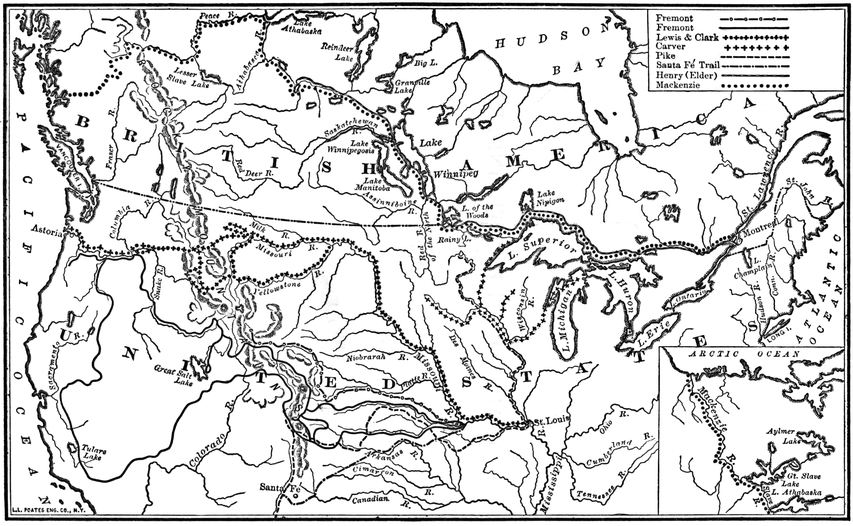
In June, 1766, Carver left Boston for the interior
parts of North America. He has little to say about
the country lying adjacent to the “back-settlements,”
which, he observes, have often been described. He
passed through the Great Lakes, mentioning as he goes
various Indian tribes and some of the products of the
country, stopped some little time at the great town of
the Winnebagoes, at Lake Winnebago, in Wisconsin,
where he was very civilly received. At this time these
people had a queen, or woman chief. He discusses
this tribe at some length, and incidentally repeats
a curious story: “An elderly chief more particularly
acquainted me that, about forty-six winters ago, he
marched, at the head of fifty warriors, toward the south-west
for three moons. That during this expedition,
whilst they were crossing a plain, they discovered a
body of men on horseback, who belonged to the Black
People; for so they call the Spaniards. As soon as
they perceived them, they proceeded with caution, and
concealed themselves till night came on; when they
drew so near as to be able to discern the number and
situation of their enemies. Finding they were not able
to cope with so great a superiority by daylight, they
waited till they had retired to rest; when they rushed
upon them, and after having killed the greatest part
of the men, took eighty horses loaded with what they
termed white stone. This I suppose to have been silver,
as he told me the horses were shod with it, and that
their bridles were ornamented with the same. When
they had satiated their revenge, they carried off their
spoil, and being got so far as to be out of reach of the
Spaniards that had escaped their fury, they left the useless
and ponderous burthen, with which the horses
were loaded, in the woods, and mounting themselves,
in this manner returned to their friends. The party
they had thus defeated, I conclude to be the caravan
that annually conveys to Mexico the silver which the
Spaniards find in great quantities on the mountains
lying near the heads of the Colorado River; and the
plains where the attack was made, probably, some they
were obliged to pass over in their way to the heads of
the River St. Fee, or Rio del Nord, which falls into the
Gulf of Mexico to the west of the Mississippi.”
From the Winnebago town, Carver proceeded up
the Fox River, and then carried across a short distance
to the Ouisconsin River, and proceeded down that.
Here he found the great town of the Saukies, the largest
and best built Indian town he ever saw. It consisted
of “about ninety houses, each large enough for
several families, built of hewn plank, neatly jointed,
and covered with bark so compactly as to keep out the
most penetrating rains.” The streets were regular and
spacious; and it appeared more like a civilized town
than the abode of savages. About the town lay the
plantations of the Indians, in which they raised great
quantities of corn, beans, and melons; and their annual
product was so large that this place was esteemed
the best market for traders to furnish themselves with
provisions of any within eight hundred miles. Near
the mouth of the Wisconsin River, on the banks of the
Mississippi, the Ottigaumies—Outagami, i. e., “people
of the other band,” that is the Foxes—had a large town,
at a place called “La Prairie des Chiens [Carver writes
this name in various ways], which signifies Dog
Plains,” a great trading place.
About the first of November, Carver reached Lake
Pepin, and speaks with the greatest enthusiasm of the
beauty of the country, its apparent productiveness, and
the extraordinary number of game and wild fowl seen
near about it. “On the plains,” he says, “are the
largest buffalo of any in America. In the groves are
found great plenty of turkeys and partridges; while
great numbers of fowl, such as storks, swans, geese,
brants, and ducks frequent the lake.” A little below
that lake he discovered, in a fine, level, open plain,
what had once been a breastwork, about four feet in
height, extending the best part of a mile, and sufficiently
capacious to cover five thousand men; one of the famous
mounds for which the Mississippi Valley has so
long been celebrated.
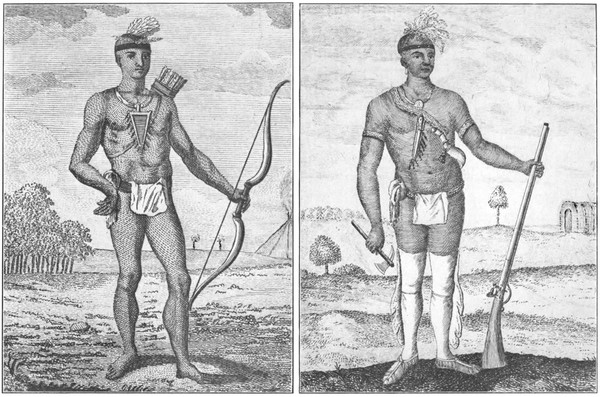
A MAN OF THE NAUDOWESSIE.
A MAN OF THE OTTIGAUMIES.
From Travels Through the Interior Parts of North America, by Jonathan Carver.
About thirty miles above Lake Pepin, near the St.
Croix River, Carver met three bands of the Naudowessie—Sioux—Indians;
and while he was there a war
party of Chippewas approached the camp, and seemed
to be preparing for an attack. The Sioux requested
Carver to help them, to put himself at their head and
lead them against their enemies. This the traveller
was of course unwilling to do, for his work in the country
made it important that he should be friendly with
all people. He endeavored to persuade the Sioux to
allow him to attempt to make peace with the Chippewas,
and when at length they assented, he met the invaders
and succeeded in inducing them to turn back
without making an attack. He then persuaded the
Sioux to move their camp to another part of the country,
lest the Chippewas should change their mind
and return to attack them. Carver declares that this
diplomatic success gained him great credit with both
Sioux and Chippewas; that to it he was indebted for
the friendly reception that he afterward met with the
Naudowessie of the Plains; and that when many
months later he reached the village of the Chippewas,
farther to the north, he was received with great cordiality
by the chiefs, many of whom thanked him for
having prevented the mischief.
About thirty miles below the Falls of St. Anthony,
Carver was shown a remarkable cave of amazing depth,
which the Indians called Wacon-teebe—Wakán tipi,
mysterious or sacred dwelling—that is to say, “the
Dwelling of the Great Spirit.” Within it is a lake,
which “extends to an unsearchable distance; for the
darkness of the cave prevents all attempts to acquire a
knowledge of it.” The walls are covered with many
Indian hieroglyphics, which seem to be very ancient,
for time had nearly covered them with moss. The
Falls of St. Anthony greatly impressed Carver, as they
did the young Indian in his company.
At the mouth of the river St. Francis, Carver says,
“I observed here many deer and carraboes—a record
for the caribou unusually far south for the mid continent—some
elk, with abundance of beavers, otters and
other furs. Not far above this, to the north-east, are a
number of small lakes called the Thousand Lakes;
the parts about which though but little frequented,
are the best within many miles for hunting, as the
hunter never fails of returning loaded beyond his expectations.”
Above the St. Francis River, the Mississippi was new
ground, for Hennepin, the river’s first explorer, had not
passed up it farther than the St. Francis, and Carver
remarks that, “As this river is not navigable from sea
for vessels of any considerable burthen, much higher
up than the forks of the Ohio, and even that is accomplished
with great difficulty, owing to the rapidity of
the current, and the windings of the river, those settlements
which may be made on the interior branches
of it must be indisputably secure from the attacks of
any maritime power. But at the same time the settlers
will have the advantage of being able to convey their
produce to the sea-ports with great facility, the current
of the river, from its source to its entrance into the
Gulph of Mexico, being extremely favorable for doing
this in small craft. This might also in time be facilitated
by canals or shorter cuts; and a communication
opened by water with New York, Canada, etc., by
way of the lakes.”
Returning to the mouth of the river St. Pierre, now
the Minnesota River, Carver ascended this about two
hundred miles, to the country of the Naudowessie of the
Plains. The northern branch of the river St. Pierre
rises, he says, from a number of lakes near the Shining
Mountains; and it is from some of these also that a
capital branch of the river Bourbon—the York, now
Nelson River—which runs into Hudson’s Bay, has
its sources. All this geography comes from the accounts
of Indians, and is clearly misunderstood as to
distance and location, for Carver says, also, that the
river Messorie, which enters the Mississippi far to the
southward, also takes its rise at the head of the river
St. Pierre. His distances were very far from right, for
he makes the St. Lawrence, the Mississippi, the river
Bourbon, and the Oregon, or River of the West (Columbia),
head all together in these high mountains.
At the great Sioux camp, which he came to on this
river, and which he estimated to contain a thousand
people, most of whom had never seen a white man, he
was most hospitably received. He spent the winter
with them, studying their language, acquiring so far as
possible a knowledge of the geography of the country,
and at last, with a considerable portion of the camp,
returning down the river to the Great Cave, and to the
burial ground which lay near it. Before parting with
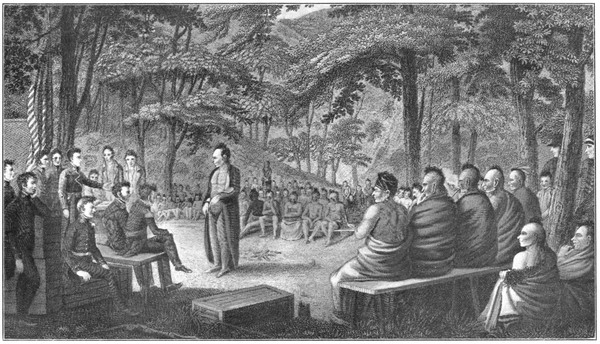
the Sioux he held a council with them, at which long
speeches were made by both Englishman and Indians,
and finally Carver left them to return to La Prairie du
Chien, where there were some traders from whom he
purchased goods for his farther journey.
Among the places now well known which Carver
visited, was what he calls the Red Mountain, from
which the Indians get a sort of red stone out of which
they hew the bowls of their pipes. This is, no doubt,
the pipestone quarry, described by Catlin, and then
owned by the Sioux Indians, which has been purchased
by the government as a park. Carver says, also, that
in some of these parts is found a black, hard clay, or
rather stone, of which, the Indians make their family
utensils.
Carver was much impressed by the beauties of the
country through which the river St. Pierre [Minnesota
River] flowed; of which he says: “Wild rice grows
here in great abundance; and every part is filled with
trees, bending under their loads of fruit, such as plums,
grapes, and apples; the meadows are covered with
hops, and many sorts of vegetables; whilst the ground
is stored with useful roots, with angelica, spikenard,
and ground-nuts as large as hen’s eggs. At a little distance
from the sides of the river are eminences, from
which you have views that cannot be exceeded even by
the most beautiful of those I have already described;
amidst these are delightful groves, and such amazing
quantities of maples, that they would produce sugar
sufficient for any number of inhabitants.”
Carver at length reached La Prairie du Chien, and
after attending to various matters there, returned up
the Mississippi to the place where the Chippewa River
enters it, a little below Lake Pepin. Here he engaged
an Indian pilot, and instructed him to steer toward the
Ottowaw Lakes, which lie near the head of that river.
About thirty miles from the mouth, Carver took the
easternmost of the two branches and passed along
through the wide, gently flowing stream. “The country
adjoining to the river,” he says, “for about sixty
miles, is very level, and on its banks lie fine meadows,
where larger droves of buffaloes and elks were feeding,
than I had observed in any other part of my travels.
The track between the two branches of this river is
termed the Road of War between the Chipeway and
Naudowessie Indians.” Near the head of the stream
he came upon a Chippewa town, the houses built after
the Indian manner, and having neat plantations behind
them. He then carried over to the head of the river
St. Croix, descended one of the branches, and then ascended
another; and on both streams he discovered
several mines of virgin copper. Then carrying across
a height of land and descending another stream, he
found himself on Lake Superior, and coasted along its
western shores until he reached the Grand Portage,
between Lake Superior and Lac la Pluie, or Rainy
Lake.
Here were met a large party of Killistinoe and Assinipoil
Indians, “with their respective kings and their
families.” They had come to this place to meet the
traders from the east, who were accustomed to make
this their road to the north-west. From these Indians
Carver received considerable geographical information
about the country to the westward, much of which,
however, is too vague to be very valuable. Many of
the great lakes to the westward were mentioned and
described, and some of them are readily recognized.
Such are Lake Winnepeek, Lac du Bois, and Lac la
Pluye, or Rainy Lake. Of the country about Lake
Bourbon and Lake Winnepeek it was said that there
were found some buffalo of small size, which were fat
and good in the latter part of the summer. This difference
in size Carver attributes to their northerly situation;
“just as the black cattle of the northern parts of Great
Britain differ from English oxen.” But it is quite probable
that these “small buffalo” may have been musk-oxen,
and their location wrong.
“These Indians informed me that to the northwest
of Lake Winnepeek lies another whose circumference
vastly exceeded any they had given me an account of.
They describe it as much larger than Lake Superior.
But as it appears to be so far to the northwest, I should
imagine that it was not a lake, but rather the Archipelago
or broken waters that form the communication
between Hudson’s Bay and the northern parts of the
Pacific Ocean.”
As already stated, Carver believed that the headwaters
of the Missouri were not far from the headwaters
of his St. Pierre River. The Indians told him that they
frequently crossed over from the head of that stream
to the Missouri. The nearest water to the head of the
Minnesota River is Big Sioux River in Dakota, which
is, in fact, a tributary of the Missouri.
The ethnological information there gathered was as
little trustworthy as that concerning the geography of
the more distant parts. For example, it is said that in
the country belonging to the Pawnees, and the Pawnawnees,
nations inhabiting some branches of the Messorie
River, mandrakes are frequently found, a species of root
resembling human beings of both sexes; and that these
are more perfect than such as are discovered about the
Nile in Nether-Ethiopia.
“A little to the northwest of the heads of the Messorie
and the St. Pierre, the Indians further told me, that
there was a nation rather smaller and whiter than the
neighboring tribes, who cultivate the ground, and (as
far as I could gather from their expressions), in some
measure, the arts. To this account they added that
some of the nations who inhabit those parts that lie to
the west of the Shining Mountains, have gold so plenty
among them that they make their most common utensils
of it. These mountains (which I shall describe more
particularly hereafter) divide the waters that fall into
the South Sea from those that run into the Atlantic.
“The people dwelling near them are supposed to be
some of the different tribes that were tributary to the
Mexican kings, and who fled from their native country
to seek an asylum in these parts, about the time of
the conquest of Mexico by the Spaniards, more than
two centuries ago.” After a brief discussion of the reasons
which may have led these supposed immigrants,
and the Winnebagoes to leave their southern home for
the north, Carver speaks at some length of the Shining
or Rocky Mountains, just mentioned.
“That range of mountains, of which the Shining
Mountains are a part, begin at Mexico, and continuing
northward on the back or at the east of California, separate
the waters of those numerous rivers that fall
either into the Gulph of Mexico or the Gulph of California.
From thence continuing their course still northward,
between the sources of the Mississippi and the
rivers that run into the South Sea, they appear to end
in about forty-seven or forty-eight degrees of north
latitude; where a number of rivers arise, and empty
themselves either into the South Sea, into Hudson’s
Bay, or into the waters that communicate between these
two seas.
“Among these mountains, those that lie to the west
of the river St. Pierre are called the Shining Mountains,
from an infinite number of crystal stones, of an amazing
size, with which they are covered, and which, when
the sun shines full upon them, sparkle so as to be seen
at a very great distance.
“This extraordinary range of mountains is calculated
to be more than three thousand miles in length, without
any very considerable intervals, which I believe
surpasses anything of the kind in the other quarters of
the globe. Probably in future ages they may be found
to contain more riches in their bowels than those of
Indostan and Malabar, or that are produced on the
Golden Coast of Guinea; nor will I except even the
Peruvian mines. To the west of these mountains,
when explored by future Columbuses or Raleighs, may
be found other lakes, rivers and countries, full fraught
with all the necessaries or luxuries of life; and where
future generations may find an asylum, whether driven
from their country by the ravages of lawless tyrants,
or by religious persecutions, or reluctantly leaving it to
remedy the inconveniences arising from a superabundant
increase of inhabitants; whether, I say, impelled
by these, or allured by hopes of commercial advantages,
there is little doubt but their expectations will be fully
gratified by these rich and unexhausted climes.”
The pages which Carver devotes to a description of
the unknown country to the west, are inserted in his
account while he was sojourning with these Crees and
Assiniboines, at the Grand Portage. There were more
than three hundred people in the camp, and as they
waited for the traders who did not come, their stock of
provisions began to run low; and the coming of the
traders was awaited with an impatience that increased
day by day.
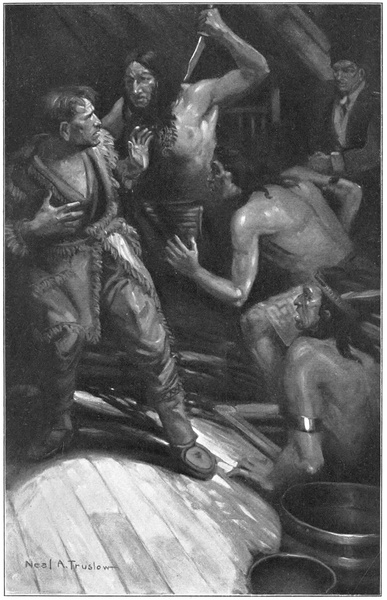
It was during this period of waiting that Carver had
an opportunity to witness one of those prophecies by a
priest, or medicine man, which even in modern times
have puzzled many cool and clear heads; and though
the story of what he saw is long, yet it is worth while
to give his account of it in full. It appears that one
day while all were expressing their hopes for the early
arrival of the traders, and were sitting on the hill looking
over the lake, in the hope that they might be seen,
the chief priest of the Crees informed those who were
with him that he would endeavor to obtain information
from the Great Spirit as to when the traders would
arrive. Carver gave little heed to the suggestion, supposing
it to be merely a juggling trick; but the chief
of the tribe advised him that the priest had made this
offer chiefly for the purpose of allaying his anxiety, and
at the same time to convince Carver of his ability to
talk with the Great Spirit.
“The following evening was fixed upon for this
spiritual conference. When everything had been properly
prepared, the king came to me and led me to a
capacious tent, the covering of which was drawn up,
so as to render what was transacting within visible
to those who stood without. We found the tent surrounded
by a great number of the Indians, but we
readily gained admission, and seated ourselves on skins
laid on the ground for that purpose.
“In the centre I observed that there was a place of
an oblong shape, which was composed of stakes stuck
in the ground, with intervals between, so as to form
a kind of chest or coffin, large enough to contain the
body of a man. These were of a middle size, and
placed at such a distance from each other, that whatever
lay within them was readily to be discerned. The
tent was perfectly illuminated by a great number of
torches made of splinters cut from the pine or birch
tree, which the Indians held in their hands.
“In a few minutes the priest entered; when an amazing
large elk’s skin being spread on the ground, just
at my feet, he laid himself down upon it, after having
stript himself of every garment except that which he
wore close about his middle. Being now prostrate
upon his back, he first laid hold of one side of the skin,
and folded it over him, and then the other; leaving
only his head uncovered. This was no sooner done,
than two of the young men who stood by took about
forty yards of strong cord, made also of an elk’s hide,
and rolled it tight around his body, so that he was
completely swathed within the skin. Being thus bound
up like an Egyptian mummy, one took him by the
heels and the other by the head, and lifted him over the
pales into the inclosure. I could now also discern him
as plain as I had hitherto done, and I took care not to
turn my eyes a moment from the object before me, that
I might the more readily detect the artifice, for such I
doubted not but that it would turn out to be.
“The priest had not lain in this situation more than
a few seconds when he began to mutter. This he continued
to do for some time, and then by degrees grew
louder and louder, till at length he spoke articulately;
however, what he uttered was in such a mixed jargon
of the Chippeway, Ottawaw, and Killistinoe languages,
that I could understand but very little of it. Having
continued in this tone for a considerable while he at
last exerted his voice to its utmost pitch, sometimes raving
and sometimes praying, till he had worked himself
into such an agitation that he foamed at his mouth.
“After having remained near three-quarters of an
hour in the place and continued his vociferation with
unabated vigor, he seemed to be quite exhausted, and
remained speechless. But in an instant he sprung to
his feet, notwithstanding at the time he was put in it
appeared impossible for him to move either his legs or
arms, and shaking off his covering, as quick as if the
bands with which it had been bound were burned
asunder, he began to address those who stood around,
in a firm and audible voice. ‘My Brothers,’ said he,
‘the Great Spirit has deigned to hold a talk with his
servant at my earnest request. He has not, indeed,
told me when the persons we expect will be here, but
to-morrow, soon after the sun has reached his highest
point in the heavens, a canoe will arrive, and the people
in that will inform us when the traders will come.’
Having said this, he stepped out of the inclosure, and
after he had put on his robes, dismissed the assembly.
I own I was greatly astonished at what I had seen, but
as I observed that every eye in the company was fixed
on me with a view to discover my sentiments, I carefully
concealed every emotion.
“The next day the sun shone bright, and long before
noon all the Indians were gathered together on the
eminence that overlooked the lake. The old king came
to me and asked me whether I had so much confidence
in what the priest had foretold as to join his people on
the hill and wait for the completion of it? I told him
that I was at a loss what opinion to form of the prediction,
but that I would readily attend him. On this
we walked together to the place where the others were
assembled. Every eye was again fixed by turns on me
and on the lake; when just as the sun had reached his
zenith, agreeable to what the priest had foretold, a
canoe came round a point of land about a league distant.
The Indians no sooner beheld it than they sent
up an universal shout, and by their looks seemed to
triumph in the interest their priest thus evidently had
with the Great Spirit.
“In less than an hour the canoe reached the shore,
when I attended the king and chiefs to receive those
who were on board. As soon as the men were landed,
we walked all together to the king’s tent, where according
to their invariable custom we began to smoke;
and this we did, notwithstanding our impatience to
know the tidings they brought, without asking any
questions; for the Indians are the most deliberate people
in the world. However, after some trivial conversation,
the king inquired of them whether they had
seen anything of the traders? The men replied that
they had parted from them a few days before, and that
they proposed being here the second day from the present.
They accordingly arrived at that time, greatly to
our satisfaction, but more particularly to that of the
Indians, who found by this event the importance both
of their priest and of their nation greatly augmented in
the sight of a stranger.
“This story I acknowledge appears to carry with it
marks of great credulity in the relator. But no one is
less tinctured with that weakness than myself. The
circumstances of it I own are of a very extraordinary
nature; however, as I can vouch for their being free
from either exaggeration or misrepresentation, being
myself a cool and dispassionate observer of them all, I
thought it necessary to give them to the public. And
this I do, without wishing to mislead the judgment of
my readers, or to make any superstitious impressions
on their minds, but leaving them to draw from it what
conclusions they please.”
The arrival of the traders, so anxiously looked for,
did not greatly help Carver, who found that he could
not procure from them the goods that he desired,
and shortly afterward he proceeded eastward, having
coasted around the north and east shores of Lake Superior.
He describes the lake, and the various peoples
who inhabit its borders, most of whom are Chippewas.
During his trip, he found native copper on a stream
running into the lake on the south, and describes how
large a trade might be made in this metal, which, as he
says, “costs nothing on the spot, and requires but little
expense to get it on board; could be conveyed in boats
or canoes through the Falls of St. Marie to the Isle of
St. Joseph, which lies at the bottom of the straits near
the entrance into Lake Huron; from thence it might be
put on board large vessels, and in them transported
across that lake to the Falls of Niagara; there being
carried by land across the Portage, it might be conveyed
without much more obstruction to Quebec. The
cheapness and ease with which any quantity of it may
be procured will make up for the length of way that
it is necessary to transport it before it reaches the sea-coast,
and enable the proprietors to send it to foreign
markets on as good terms as it can be exported from
other countries.” Stockholders in the Calumet and
Hecla and in other Lake Superior copper concerns
are requested to take notice.
The fishing of Lake Superior impressed Carver as
much as it has other travellers. Of these fish he says:
“The principal and best are the trout and sturgeon,
which may be caught at almost any season in the greatest
abundance. The trout in general weigh about
twelve pounds; but some are caught that exceed fifty.
Besides these, a species of white fish is taken in great
quantities here, that resemble a shad in their shape,
but they are rather thicker, and less bony; they weigh
about four pounds each, and are of a delicious taste.
The best way of catching these fish is with a net; but
the trout may be taken at all times with the hook.
There are likewise many sorts of smaller fish in great
plenty here, and which may be taken with ease; among
these is a sort resembling a herring, which are generally
made use of as a bait for the trout.” The foot of the
Sault Ste. Marie, which Carver calls the Falls of St.
Marie, is noted by him as “a most commodious station
for catching the fish, which are to be found there in immense
quantities. Persons standing on the rocks which
lie adjacent to it may take with dipping nets, about the
months of September and October, the white fish before-mentioned;
at that season, together with several
other species, they crowd up to this spot in such amazing
shoals that enough may be taken to supply, when
properly cured, thousands of inhabitants throughout
the year.”
Passing now through the Straits into Lake Huron,
this body of water is described, and attention called to
the rise and fall of the waters, which Carver says is not
diurnal, but occurs in periods of seven years and a half.
Still going eastward, the town of Detroit was reached,
and something given of its history in recent years, and
especially of the conspiracy of Pontiac, and the death
of that chief.
In Lake Erie, Carver noticed the islands near the
west end, so infested with rattlesnakes that it is very
dangerous to land on them; and also the great number
of water-snakes, which lie in the sun on the leaves
of the large pond-lilies floating on the water.
“The most remarkable of the different species that
infest this lake is the hissing-snake [the innocent Heterodon
platyrhinos], which is of the small, speckled
kind, and about eighteen inches long. When anything
approaches, it flattens itself in a moment, and its spots,
which are of varied dyes, become visibly brighter through
rage; at the same time it blows from its mouth with
great force a subtile wind, that is reported to be of a
nauseous smell; and if drawn in with the breath of
the unwary traveller, will infallibly bring on a decline,
that in a few months must prove mortal, there being
no remedy yet discovered which can counteract its baneful
influence.” Still proceeding eastward, the author
continues to describe the country, mentioning many
well-known lakes, and the peoples about them.
This concludes Carver’s journey, but by no means
his book, of which the remaining two-thirds are devoted
to the manners and customs of the Indians, with a
chapter giving vocabularies of several languages, and
other chapters treating of the fauna and flora of the
vast region passed over. Like most writers about the
Indians, he discusses their origin, quoting a great number
of authors, from the discovery of America to the
time of his writing; the last of these, Adair, who, as is
well known, devoted a very considerable work to proving
to his own satisfaction that the Indians were the
lost tribes of Israel. Carver announces that he is of the
opinion that “the North American continent received its
first inhabitants from the islands which lie between the
extremities of Asia and America, viz., Japon, Yeso, or
Jedso, Gama’s Land, Behring’s Isle, with many others”;
to which he adds a cluster of islands that reach as far
as Siberia, which may possibly be the Aleutian Islands.
To support this conclusion, he advances many cogent
arguments, and announces that “that great and learned
historian Doctor Robinson,” is of the same opinion with
him.
Concerning the persons and dress of the Indians,
Carver has much to say. He notices many things still
well known, and speaks of certain others that are so long
obsolete as to be almost forgotten. Thus he declares
that: “It is also a common custom among them to
bore their noses, and wear in them pendants of different
sorts. I observed that sea-shells were much worn by
those of the interior parts, and reckoned very ornamental;
but how they procured them I could not learn:
probably by their traffick with other nations nearer the
sea.” Another custom noted, which has long been
obsolete, but is still remembered by the most ancient
persons of some of the Western tribes, is the woman’s
fashion of dressing the hair. To the west of the Mississippi,
he says, the Sioux and Assiniboine women “divide
their hair in the middle of the head, and form
it into two rolls, one against each ear. These rolls are
about three inches long, and as large as their wrists.
They hang in a perpendicular attitude at the front
of each ear, and descend as far as the lower part
of it.”
The characteristics of the Indians, their method of
reckoning time, their government, division into tribes,
their chiefs, food, dances, and many other matters, are
described at great length; as is also their hunting, their
manner of making war, and, incidentally, the defeat of
Braddock, and the massacre of the people under Col.
Monroe, at Fort William Henry. Carver himself appears
to have been with the prisoners, of whom so
many were massacred on that unhappy day; but he
himself at length reached Fort Edward in safety. He
tells something, also, of the way in which the Indians
tortured their captives, and speaks of the Illinois Indian
brought into the town of Ottigaumies, who was
bound to a tree while all the small boys in the village
were permitted to amuse themselves by shooting arrows
at the victim. As none of the boys were more
than twelve years old, and they were placed at a considerable
distance, their arrows did little more than
pierce the skin; so that the prisoner stood for more
than two days pierced with these arrows. During all
this time he sung his warlike exploits, told how much
injury he had inflicted on his enemies, and endeavored
with his last gasp to incite his tormentors to greater
efforts, in order that he might give still greater proofs
of his fortitude.
Following the chapter on war comes one on their
methods of making peace; then one on games, marriage,
religion, and character. The last hundred pages
of the volume treats “Of the Beasts, Birds, Fishes,
Reptiles, and Insects, which are found in the interior
parts of North America.” Of the larger mammals a
catalogue is given from which two or three descriptions
may be taken.
“The Carrabou. This beast is not near so tall as
the moose, however, it is something like it in shape,
only rather more heavy, and inclining to the form of
an ass. The horns of it are not flat as those of an elk
are, but round like those of the deer; they also meet
nearer together at the extremities, and bend more over
the face than either those of the elk or moose. It partakes
of the swiftness of the deer, and is with difficulty
overtaken by its pursuers. The flesh of it likewise is
equally as good, the tongue particularly is in high
esteem. The skin being smooth and free from veins is
as valuable as shamoy.”
“The Carcajou. This creature, which is of the cat
kind, is a terrible enemy to the preceding four species
of beasts. He either comes upon them from some concealment
unperceived, or climbs up into a tree, and
taking his station on some of the branches, waits till
one of them, driven by an extreme of heat or cold, takes
shelter under it; when he fastens upon his neck, and
opening the jugular vein, soon brings his prey to the
ground. This he is enabled to do by his long tail, with
which he encircles the body of his adversary; and the
only means they have to shun their fate is by flying
immediately to the water, by this method, as the carcajou
has a great dislike to that element, he is sometimes
got rid of before he can effect his purpose.”
There is a very long description of the beaver, and
its extraordinary intelligence.
The list of birds, too, is a long one; but that of the
fishes is very short. To snakes, as might be imagined,
much space is given; but to insects very little.
Carver describes the lightning-bug, but adds: “Notwithstanding
this effulgent appearance, these insects are
perfectly harmless; you may permit them to crawl upon
your hand, when five or six, if they freely exhibit their
glow together, will enable you to read almost the finest
print.”
Trees, plants, and shrubs are all described, and
among them the wild rice, of which Carver says: “In
future periods it will be of great service to the infant
colonies, as it will afford them a present support until
in the course of cultivation other supplies may be produced;
whereas in those realms which are not furnished
with this bounteous gift of nature, even if the climate
is temperate and the soil good, the first settlers are often
exposed to great hardships from the want of an immediate
resource for necessary food.”
In his appendix, Carver sums up conclusions drawn
from his extensive travels in, and wide knowledge of,
the interior of the continent. He has faith in the discovery
of a north-west passage, and believes that Hudson’s
Bay would be a safe retreat for the adventurous
navigators who might try, at first unsuccessfully, a
north-west passage. He even names a certain Richard
Whitworth, gentleman, of England, who had proposed
pursuing nearly the same route as Carver, and
having built a fort at Lake Pepin, to have proceeded up
the river St. Pierre, crossed over the river Messorie,
till, having discovered the source of the Oregon, or River
of the West, he would have sailed down that river to
the place where it is said to empty itself near the
Straits of Annian. Carver was to have accompanied
this Mr. Whitworth on his explorations, and many of
the preparations had been made for the trip, “when
the present troubles in America began, which put a
stop to an enterprize that promised to be of inconceivable
advantage to the British dominions.”
So the War of the Revolution put an end to Carver’s
Western explorations.