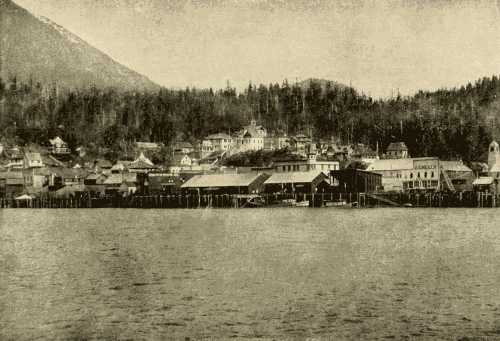
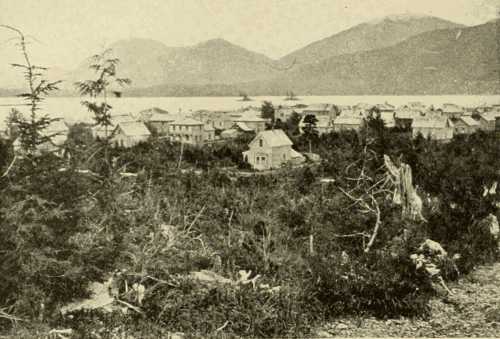
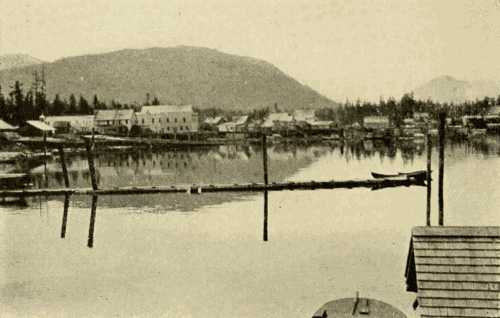
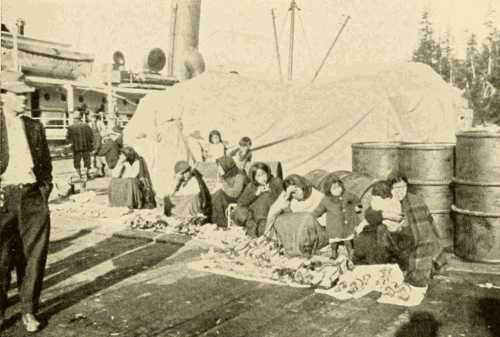
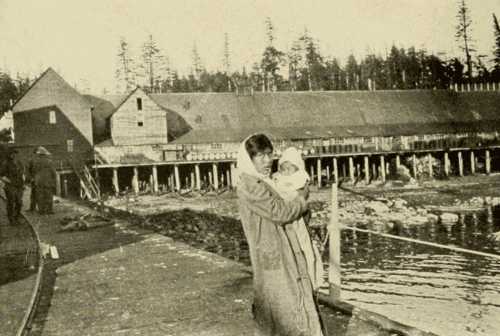
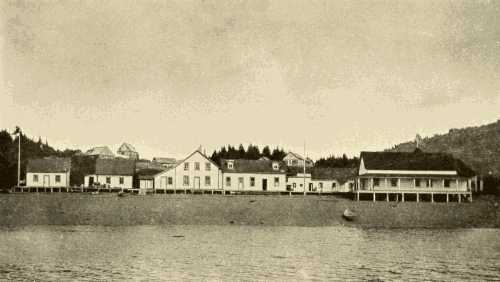
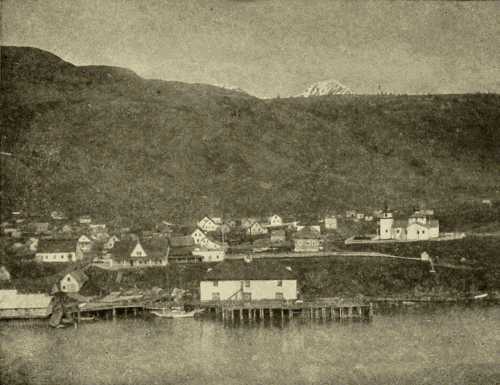
We arrived at Seldovia, on Cook’s Inlet,
on the evening of August 28th. Between
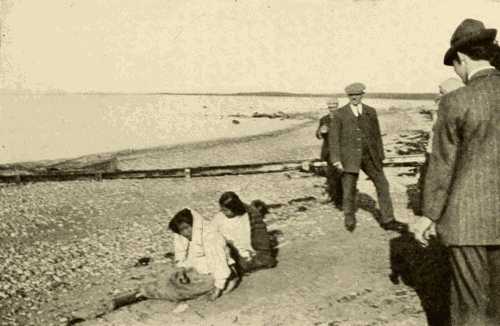
the steamer landing and the town,
a creek, unbridged as yet, enters the bay,
and except at ebb tide the passengers are
compelled to cross the arm of the bay by
rowboat. The tide being then at flood, it
was necessary to get a dory before we could
reach the village. One of the natives who
hailed from the cannery nearby was the proud
owner of an old dugout. We knew the water
was quite shallow across the arm of the fiord,
yet some of the party were fearful of the
craft. We all got into the boat, and how
quickly the inexperienced displayed their
awkwardness. Instead of stepping carefully
to the center they landed on the side, causing
the dugout to ship water. After righting
matters we started across, when “Clumsy,”
in trying to make himself comfortable, rocked
the craft and “Timid” gave peremptory commands
to return, which we did. Two of
the party got out and the rest were landed
safely on the other shore. In a few hours we
were all aboard a home-made tug of six tons
burden, called the Bydarky, and on our way
up the inlet some sixty miles to Kenai. We
retired to our bunks shortly after the boat
got under way, and when we awoke in the
morning we were lying at anchor near the
beach at Kenai. The captain of the boat,
being very anxious to get out on the tide,
asked us to unload our duffel as quickly as
possible, so that he might start at once. In
our haste we overlooked Doc’s hand satchel
but did not discover this until too late.
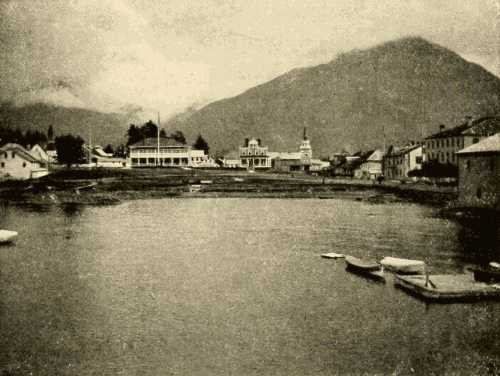
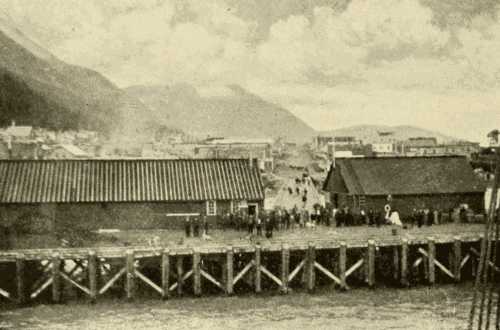
Kenai is a little village built on a plateau
overlooking the inlet, a sixty-foot sand embankment
down to the water’s edge, lending
it the appearance of a fortified town. We
ascended the road, entered the post-office and
store, and began to make inquiries about
guides, boats, and equipment. We soon
learned that we could get white guides for
ten dollars per day and “keep,” and natives
for five dollars; white packers for five dollars
per day and “keep,” natives for three dollars.
After scouring the village we found two
licensed native guides and two packers and
gave them instructions to get our boats and
provisions ready as quickly as possible, so
that we could leave on the next flood tide
for the Kenai River. In selecting guides and
packers, I think it is a mistake to take natives,
as they are naturally indolent, lack the
interest the white man has in his work, are
over-sensitive about their treatment, and sulk
upon the least provocation; and then one
never can impress upon them the eagerness
of the party to secure, in the limited time at
its disposal, photographs of big game in its
natural haunts, or a desirable trophy. Time
is the only object to them when they are
out with a party at five dollars a day. To
illustrate, on this occasion we had made an
agreement with the head guide that the
packers would go with us for three dollars
a day and “keep,” but we were not out more
than a three days’ “line” of the river until
they demanded three fifty, and when refused
began to sulk and lag behind with their work,
and for fear they would leave us before we
got up the river we were obliged to grant
their demand. Indeed, they will sometimes
purposely lead parties away from the best
game country in order to keep them out as
long as possible.
The evening before we arrived at Kenai,
two miners had come to town for provisions
and had sold their dust. They then started
out for a good time, landed in a “joint,”
consumed all the “houch,” after which they
proceeded to “paint the town red.” They
succeeded fairly well, ended up with broken
heads and limbs, and with a bullet in the
breast of one. In the village was a doctor,
some eighty years of age, who had long been
in the habit of locating for the summer at
Kenai to practice medicine. When the old
man learned that there was a doctor in our
party he looked us up and invited a consultation.
Doc accepted the invitation, and
on examination found the lead had entered
the side, glanced around the ribs, and embedded
itself in the muscles. He was very much
surprised to find that the patient was wrapped
in an extremely dirty towel, and everything
was filthy. He said to the local physician,
“Are you not afraid of the wound becoming
infected?” Whereupon the latter informed
him that no pus ever formed in wounds in
that country and that infection was unknown.
Our doctor made considerable inquiry about
the matter, for he was very much interested,
and learned that this was true.
The man who did the shooting was arrested
and placed in the custody of the town bailiff,
but was permitted to roam over the country
at will. The authorities well know, and so
do the prisoners, that it would be suicide of
the worst form for the guilty to try to escape
to the woods, for it means death of the most
horrible sort—by exposure and starvation.
The only avenue of escape was by boat that
left twice a week. Inquiring about the case
on our return trip, we learned that the commissioner
had arrived, a day was fixed for
hearing, the testimony was beyond a doubt
conclusive against the prisoner, and he was
held without bail for trial at Valdez, whither
he was taken by the commissioner. However,
the injured man recovered and the
gallows was again defrauded.
Our party consisted of four, and for brevity’s
sake we will call them “Doc,” “Old
Sourdough,” “Cheechalker,” and “Esau.”
The provisions had all been purchased at
Seattle and packed carefully in water-proof
bags and cans. Many and varied were the
suggestions made by the party as to what
should be taken along. Doc suggested talcum
powder, frostilene, and vaseline, with
pills of various colors, red, white, and blue.
He had a special satchel well filled with antiseptics,
anodynes, astringents, styptics, and
bactericides, but unfortunately for his peace
of mind he discovered, too late, that the
precious satchel had been left on the Bydarky,
the little boat that brought us over
from Seldovia to Kenai, and there were
no immediate prospects of recovering the
important parcel. Doc looked wistfully
after the little boat disappearing in the
distance as it plowed its way through the
tide-rifts, and submitted with such grace
as he could command to the chaffing of his
companions.
By way of firearms Cheechalker (northern
name for “tenderfoot”) had quite an assortment,—a
ten-gauge shotgun with five hundred
rounds of ammunition, one Springfield army
rifle, model of 1909, a Winchester .30-.30, and
several others. Cheechalker insisted upon his
tin bathtub, but Old Sourdough finally pacified
him with a description of a bath à la Wilderness.
This is accomplished by erecting a
tepee, like that the Indians build, around a
fire in a small depression filled with stones,
then, when the bather is ready, removing the
fire and pouring water on the stones, thus
producing steam enough to open the pores of
the skin, after which a good rubbing at the
hands of an Indian valet completes the ablution.
In this way one might get along for
a few weeks at least without his tub. For
this substitute Cheechalker finally consented
to give up the useful article.
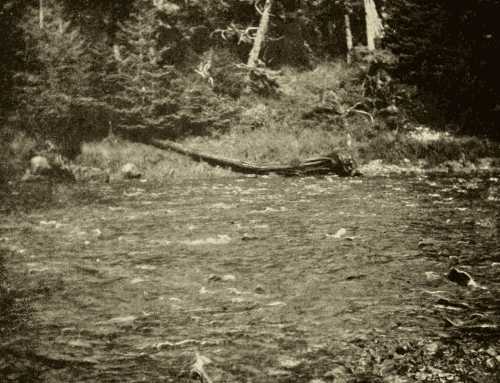
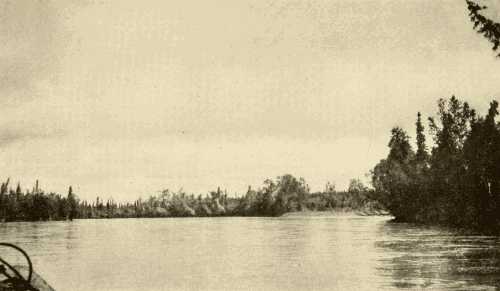 Kenai River
Esau carefully selected a prospector’s pick,
gold pan, and shovel to do a little prospecting
on the side. In his telescope he had his toothbrush,
comb, hair-brush, manicure set, etc.,
which he considered absolutely necessary
for his personal comfort. He also carried his
own knife and fork, tin cup, and tin plate,
each artistically marked with his own symbol.
Old Sourdough watched these arrangements
with an expression of disgust. He
carried a red bandanna handkerchief dangling
from his belt, containing his change of socks,
some smoking tobacco, and matches. Later
he improvised a very serviceable pipe by
fitting a shot cartridge shell with a split
willow stem, artistically wrapped with thread.
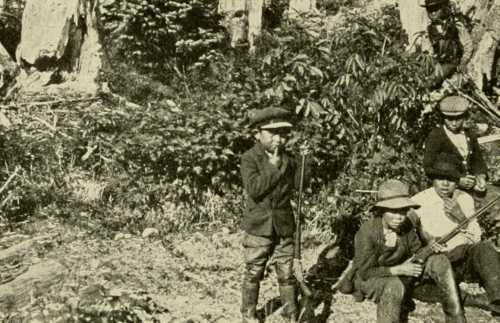
After the packing was completed we embarked
upon the Kenai River in two twenty-foot
dories, with the tide in our favor. The
river meandered like a wriggling snake for
about a mile through the marshy flats; beyond,
the shore was lined to the water’s edge with
cottonwood, birch, and spruce. On our way,
ducks, geese, and many other water-fowl were
flushed by the noise of the oars in the locks
and the splash of the blades as they dipped
into the water. The guides were making
all haste, being anxious to get as far up the
river as possible, knowing it was no mean
task to pull, line, and pole the mile or more
to the head of tide water without the aid
of full tide.
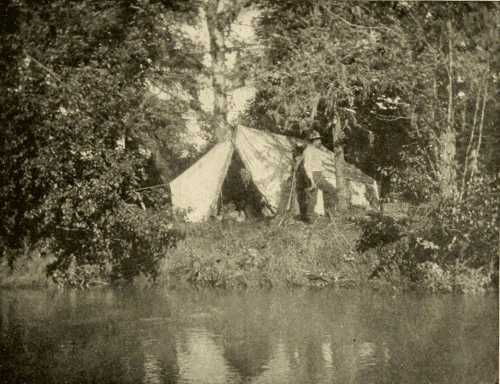
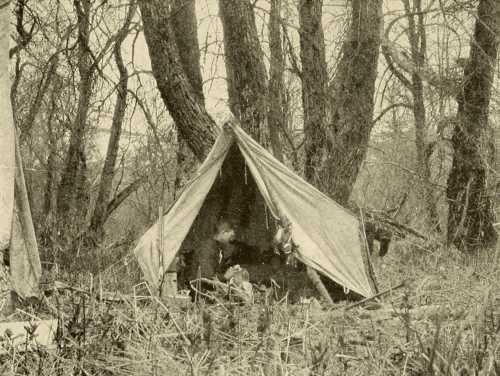
When we reached our first camp the flies
and mosquitoes were very plentiful. The
boys were loud in their forceful expressions
against the songsters and their near cousins,
the black flies. All hands were busy, some
erecting the tents, others cutting spruce
boughs for a good bed, and the rest getting
something to eat for the hungry party.
Pitching camp very quickly developed the
inexperience of Cheechalker. Always willing
to lend a helping hand, he started the fire on
the windward side, filling our eyes with smoke.
The site he selected for the tent showed plenty
of roots, well calculated to furnish an uneasy
experience for the night. When he pointed
it out to us, we soon overruled him. The
duffel was hardly unloaded until Doc was
ransacking the outfit for his .22 rifle to shoot
some Canada grouse (Dendragapus canadensis).
They are very plentiful in the spruce
timber and when flushed will fly to a limb,
where they sit and crane their necks at the
hunter, who, if he is wise enough to pick off
the lowest bird at each shot, may, if he so
desires, clean out the entire covey. In the
meantime one of the party had shot a red
squirrel, and at the suggestion of Old Sourdough
it was nailed to the limb of a tree in
anticipation of a little fun at Doc’s expense.
On his return the old Indian said in his guttural
voice (pointing at the squirrel), “Look! look!
him big squirrel, shoot!!” Old Sourdough,
meanwhile helping the fun along by craning
his neck in every direction, said, “Where?
where?” In the meantime Doc was making a
mad rush for his .35 Winchester; crack went
the gun, off went the ears of Mr. Squirrel,
and he gently swayed on the nail; once more
the gun cracked, and this time the body fell
to the ground in fragments. Then the woods
rang again and again with the shouts of the
party, while Doc threatened dire vengeance
on those who perpetrated the joke.
After dinner, a smoke, and a few stories, the
Indians departed to their tent and we all
stretched out in a row for our night’s sleep.
But too soon, for one fellow pulled the blanket
from his neighbor. Then there was a “rough
house,” and after that duels to the death with
mosquitoes, all punctuated with such a variety
of exclamations that the vocabulary of each
was exhausted before quiet was restored.
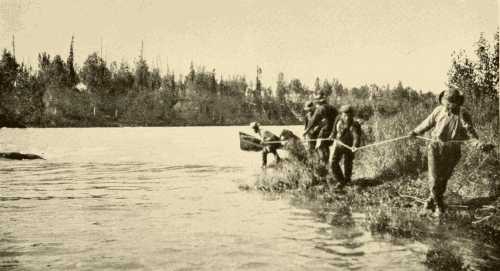 Lining the Boat
On the way out next morning the hunters
were boasting about the number of fine
trophies they were going to take home, for
all reports indicated plenty of sheep and
moose. About that time one of the party
remembered we had forgotten to bring salt
along for curing the “fine trophies;” then
a call was sent out for a meeting to discuss
ways and means to procure the necessary
salt. At the caucus it was decided to send the
packers back to Kenai with a boat, and a halt
was called until the following day, when the
return of the packers was expected. They
arrived in good time with a bushel of coarse
salt.
Kenai River is very swift and cannot be
ascended in a dory pulled with oars, so the
boat must be “lined” along the shore. There
is no beach along the river and the shore
is almost impassable by foot on account of
trees growing at every conceivable angle and
hanging over and under the water.
In the morning we started, two natives
and two hunters to a boat, the leader with
his two-hundred-foot line well in advance,
carefully keeping the rope on the river side
of all obstructions. Doc selected the position
of captain (steersman) of one of the dories.
Cheechalker took hold of the rope, but before
long he was panting for breath, being quite
fleshy and tipping the scales at two hundred
pounds. He soon found that carrying his
weight on the many ups and downs over
fallen timbers, with the washouts along the
bank and the alder growing thick at places
along the shore, was not a joy ride over a
macadamized road in an auto, nor was it
conducive to easy respiration. The advantage
a man of experience has over the inexperienced
individual, in making his way
over and under logs and overcoming other
difficulties with the least resistance, is wonderful.
For instance, experience has taught the
veteran that he must not step on a slanting
stick, a slime-covered stone, or grass concealing
a washout in the bank. He likewise learns
to avoid many other little indiscretions that
cause heavy falls and bruising of the limbs
and body, which will wear out the vitality
of the strongest. Before long Cheechalker,
who had had several tumbles into the water,
had to have assistance to get out. He was
soon lagging behind, and ere the first lap of
the journey was completed he was begging
us to let him get into the boat. Travel was
delayed long enough for him to don dry
clothing, and when we started he refused to
walk any more, saying it was out of the
question,—he was completely “tuckered
out.” It was then that one of the natives
hesitated for some time before he would
consent to go on, for it required all the red
men’s strength and skill on the line to get the
boat along without this additional load of two
hundred pounds. Cheechalker, with his red
face, looked for all the world like a lobster,
so Old Sourdough took pity on him and had
a heart-to-heart talk with the natives. His
argument was, “Him sick, heap sick,—like
turtle, no walk!” This and similar logic was
used for a period of about five minutes,
whereupon the two natives looked at each
other, emitted a few grunts, and started up
the river.
At the end of the first day’s work we had
made about eight miles and built our camp-fire
for the night. Nothing unusual happened
that evening, but the inevitable “no-see-ims”
and mosquitoes had sufficient time to
gather and kept us busy moving at short
intervals from place to place, following the
smudge smoke. Cheechalker, although naturally
sluggish on account of his avoirdupois,
was quite active now, first to windward
and then to leeward of the smudge, between
periods of relief from smoke and “no-see-ims.”
Doc complained at frequent intervals
about the “pesky critters,” donned his veil,
and with hands in his pockets strutted around,
restless and impatient.
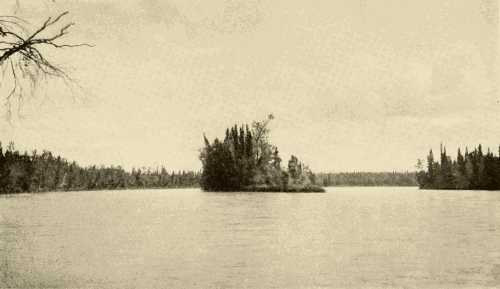 Mid-day on the Kenai
Old Sourdough, without any modern frills,
sat quietly smoking his makeshift pipe, evidently
enjoying his smoke, but occasionally
disturbed and raising his hand to chase an
importunate pest out of his eye or ear.
A fallen spruce furnished boughs for a
temporary bed for the tired campers after
a day’s lining, pulling, and wading. Each
man opened his pack, spread his rubber
blanket on the boughs, and one long tarpaulin
was laid over all. Then each one lay down
wrapped in his blanket, and another tarpaulin
was drawn over all four in a row. Thus
settled, we enjoyed the sweet but restless sleep
of the weary. Toward morning when the ice
was forming on the water in the camp pails,
there was a tug of war going on most of the
time between the two end men for the control
of the upper canvas, and as the middle man
expressed it later, “it had made three round
trips during the night,” for he felt it “sawing
its way across” under his nose.
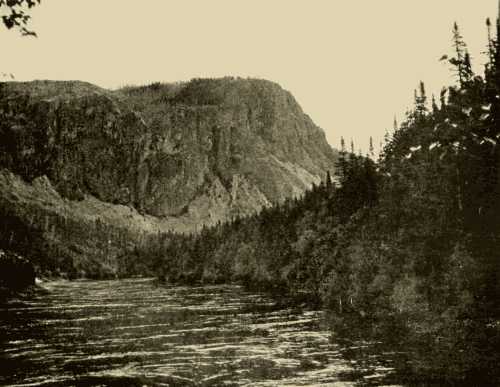
Ever to our ears through the night came
the roar of the river, here two hundred yards
wide, rushing day and night to the sea, grand
and powerful, glistening here and there in
the morning twilight as the raging waters
boiled and seethed over the hidden bowlders
that threw the water as though some huge
monster were trying to “buck” the current.
As soon as breakfast was over every man
went to his task, the blankets were rolled
in separate bundles, the entire equipment
packed carefully, the guns tied fast for fear
of the boat capsizing in the strong current.
The leader started with the rope, two others
followed, each taking a hold in turn, and the
captain steered. The leader in advance put
the rope on the river side of all trees, rocks,
and debris; the other two, climbing out on the
trees that extended over the water, assisted in
pulling and keeping the rope clear. Occasionally
we struck rapids, where the current was
swift and caused much trouble to the boats
by driving one or the other against a hidden
bowlder, where it would hang as on a pivot,
swinging backward and forward until one of
the Indians would wade out in the ice-cold
water up to his waist and release it.
The mania to kill was very strong in the
hunters and at dawn the most bloodthirsty
was astir, exhorting the cook to build a fire
in the Yukon stove and hustling the packers
to get ready for our up-river trip by loading
the boats with the duffel. Across the beautiful
river, sparkling with the silt of the glaciers,
aglow with the morning sun, stood a solitary,
snow-white herring gull, breakfasting upon
a king salmon that had been cast by the
swift current into an eddy and gently washed
ashore. The passion for wilful destruction
was uppermost in the heart of the gunner,
and as quickly as possible he had a leaden
missile on its way across the water. With
the field-glasses could be seen the white bird
with its graceful wings spread helplessly over
the water and the beautiful white feathers
crimsoned with its life blood, slowly moving
with the current to the sea.
In a short time stakes were pulled, duffel
packed, lines adjusted, and we were on our
way. There was a little commotion at the
head of the line when Simeon, one of the
Indians, spied a large porcupine plodding
his way deeper into the forest. Letting go
of the rope he made a rush for the “porky,”
caught it by the tail, held on till he got a
club nearby, and proceeded to pound it over
the head. The natives are very fond of
“porky,” and when we pitched camp in the
evening Simeon was very busy singeing the
hair over the fire before boiling.
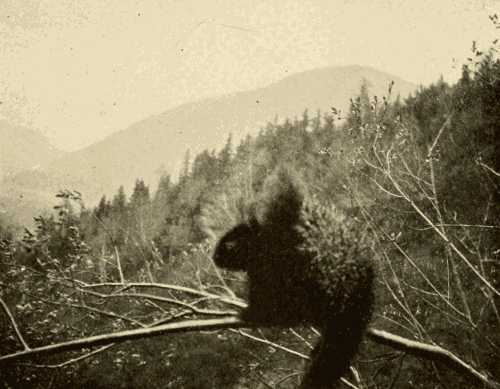 “Porky”
On our way up the river we were agreeably
surprised to see a stranger walk into camp.
Tall, erect, with clean-cut features, he looked
the very picture of health. He wore a broad-brimmed
hat with the garb of a hunter.
Lunch was about ready, and on invitation
he dined with us. In conversation we soon
learned that he was a college man, a graduate
of one of the leading colleges in the East, and
had come from our own eastern city some
fourteen years before. He told us that for several
years he had corresponded with relatives
and friends, but finally quit writing because
he had not yet made his stake. However,
he now had many encouraging prospects,
and before long expected to make good and
return east. It was surprising to us how an
educated man could spend fourteen of the
best years of his life in his little tent, with
mosquitoes and “no-see-ims” as his only
companions, dreaming, dreaming of the find
that never came, and with his pan, pick, and
shovel digging every here and there, with
color, color everywhere, but not in paying
quantities. On our way down we found him
as usual, dreaming of the prospects he had
staked, and when we left him a sack of flour
and a few other necessaries of life he was very
grateful, showing that a warm heart beat
beneath the rough exterior. We bid him
good-bye, and a large tear coursed down his
cheek as he said: “I wish I were going with
you, boys; but not yet; soon, I hope.” Is
it any wonder that the steamers on their
return trips carry so many insane men to the
States? The entire river has been prospected
and staked; the blazed trees and
indelible pencil marks are about the only
method of indicating that a claim has been
staked. About half-way up the river we
came to the deserted tent of the fellows who
had participated in the shooting at Kenai.
In order to have a pleasant time on a trip
of this sort it is very essential to have companions
accustomed to “roughing it.” Every
man in the party must sacrifice individual
comfort for the benefit of the camp as a whole.
I have in mind a trip taken to Alaska with
another party where one individual was so
selfish that every action was for his own
comfort and enjoyment. For instance, he
was always first to eat and managed to get
a double portion of everything, cooked and
uncooked. If there was one duck, one grouse,
or one trout, he managed to cook the one and
gorge himself and eat all to his own satisfaction.
In the morning he was always first
up and ready for breakfast, taking care of
his individual interests and paying no attention
to others. In fact, he would even
permit the destruction of goods not his own
without showing the least interest. In the
same party was another character in many
ways the opposite, always last to the table
and never looking out for his own things;
going around growling about this, that, and
the other thing,—never in time for breakfast,
lunch, or supper. There is no better opportunity
to find out the good qualities of a
companion than to go camping with him in
the wilds. A selfish disposition soon becomes
unbearable, and many a good outing has
been spoiled by having such a fellow in the
party. Few men are so constituted that they
can stand “roughing it” very long under
trying circumstances without showing the
“yellow streak.”
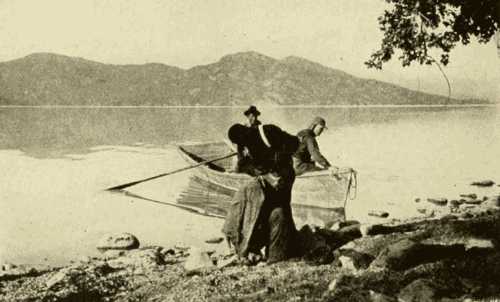 The Tonsorial Artist at Work
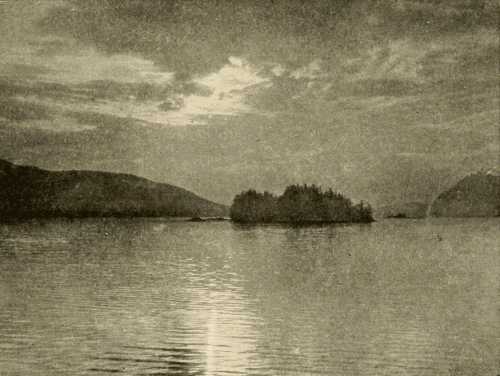
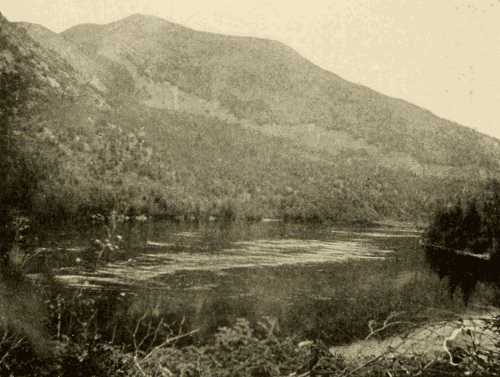
After seven days’ hard work we reached
Lake Skilak. The sun was just setting,
casting a mellow crimson reflection over
the placid waters. The beautiful lake was
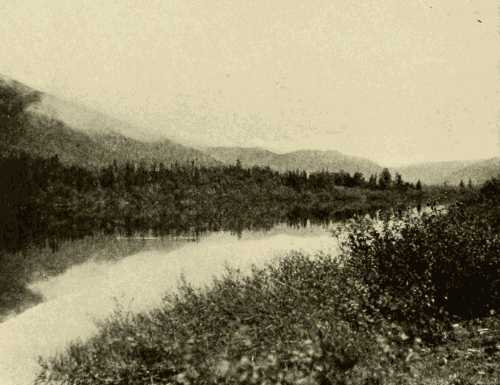
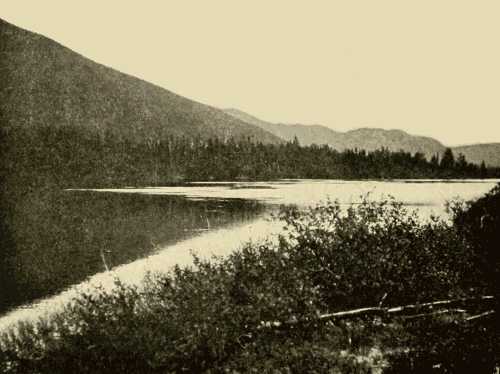
hemmed in on all sides by verdured slopes
and snow-capped peaks, the dark green of
the spruce intermingling with patches of
cottonwood clothed in autumnal colors, “the
sear, the yellow leaf” predominating. On
the surface of the water, idling away the
time, were little flocks of ducks, and in the
air were black cormorants heavy in their
flight. This serene panorama filled the nature-lovers
in the party with joy and delight,
and they felt themselves well repaid for all
the hardship of the week. The Indians
wanted to make camp at once, and showed
their displeasure when they learned that we
desired to take advantage of a strong fair
wind and hoist our sail regardless of their
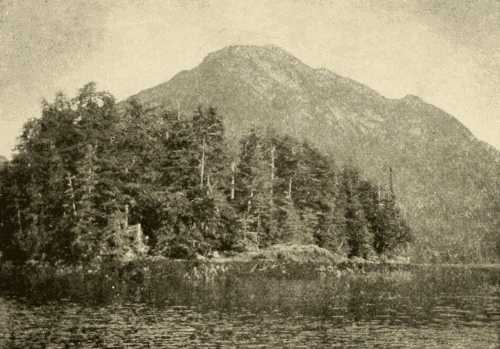
wishes. We made elegant time to an island,
on which we camped for the night. The
next day we reached the head of the lake,
where we expected to spend several weeks.
The party had decided to make a try after
white sheep on the mountain beyond the
divide. By this time Cheechalker had had
enough of tramping and quietly informed
us that we might count him out; he was
perfectly satisfied, he said, to remain with
the cook at the permanent camp. This was
located at the mouth of a little stream which
entered the lake after a precipitous course
from the glacier at the summit, down the
mountain canyon, through the narrow gulch
of the upper foothills to the wooded valley,
chasing and tumbling under and over moss-grown
and decayed trees, fallen giants of
other years. The under foliage had been
destroyed by a fire which was still smoldering
here and there among the moss, and the sun,
entering the opening between the trees,
shimmered and fluttered on the spray-moistened
bowlders like fantastic rays of Aladdin’s
lamp. Here we pitched our tent among the
stately birches, intending to make this our
headquarters for some time.
Taking a stroll a little way up the beach
we were agreeably surprised to find we had
neighbors, and were interested to know who
they were and what they were doing. One
suggested prospectors, another hunters; in
the meantime, while we were looking at their
outfit for a suggestion, a collection of stones
in the niche of a tree, the skull of a rodent,
an insect or two, answered the question beyond
the shadow of a doubt,—a naturalist
in pursuit of data that the world might be
benefited by his researches. The following
day his packer came into camp with a beautiful
specimen of Dall’s sheep (Ovis dalli nelson).
We then learned that it was Mr. Bell, from
the University of Minneapolis.
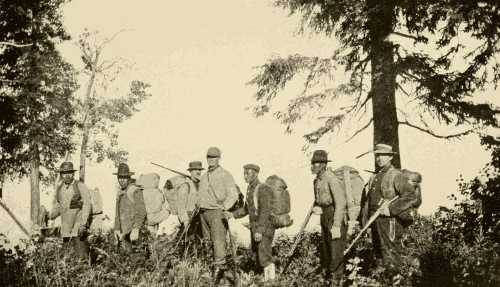 Ready for the Start
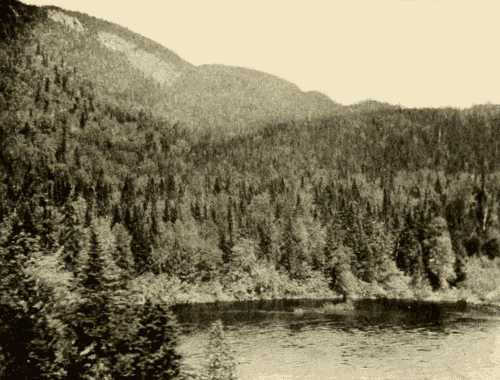
We left camp for the top of the mountain,
every man with his pack. The tramp along
the trail was interesting, leading as it did
through spruce, birch, and cottonwood until
we reached the end, where we were obliged
to push through low alder and “devil’s clubs.”
The latter average about one inch in thickness,
and in this locality grow as high as a
man’s head. They are usually straight and
branchless, of a yellowish-green color, and are
thickly covered with slender sharp spines
that readily penetrate the clothing and cause
great discomfort to one who undertakes to
pass through a thicket.
The ascent was very steep from this point
until we reached the altitude of “little sticks.”
One of the Nimrods was in advance a short
distance, and so anxious was he to reach the
sheep country that he went off the trail and
had to be recalled. But his aggressiveness
was short-lived, and long before midday he
was shouting at the top of his voice from the
rear end of the string of packs, “Wait! Wait!
You’re going too d—— fast!” In a short time
we ran into a bees’ nest, and you should have
seen the party scatter to get out of raiding
distance of the nest, every man for himself,
packs bouncing, hats waving, all shouting
until we reached a safe distance.
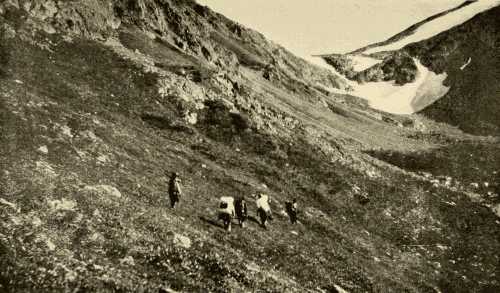 Approaching the Low Pass
As we ascended the mountain the mosquitoes
grew scarcer and scarcer. About the
“land of little sticks” we stopped for a light
lunch. Looking in the direction indicated
by the guide we saw a large moose feeding
in a little swale. Doc could not see him, try
as he would. The Indian endeavored to
assist him by locating the animal with reference
to a good-sized rock, but his untrained
eye, even with the aid of field-glasses, could
not make out the outline and we had to give
up in despair, although he was very keen to
see it. Blueberries were quite plentiful all
around us and after we ate our lunch we filled
up with them as a dessert. We came to a
little pond of crystal water at the foot of a
small glacier, and as soon as we reached the
margin some twenty-five or thirty ptarmigan
took flight in all directions. They were still
in their moulting plumage. By this time
the largest man in the party was unable to
keep the pace, and lagging behind kept the
entire party back. In starting up the canyon
the ambitious member turned up the right
side, but erelong came to a place that was
impassable and began to shout, “I can’t go
any farther along here.” One of the others
answered, “Slide, slide!” and the mighty
Nimrod took the suggestion and slid down the
shale to the bottom and then began the ascent
from another point on the opposite side,
where he found traveling much easier. This
is the common experience of the over-zealous
tenderfoot.
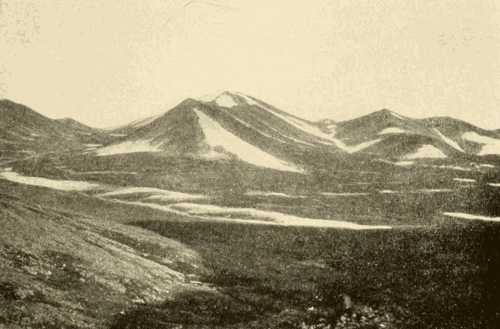 Home of the White Sheep
There was a low pass over the mountain
and we had to wind our way up, down, and
around in order to make it, for it was only
accessible by way of an almost perpendicular
rock. The leaders reached the top and were
required to wait for the rear-guard, but the
tail end, before he could get up, had to have
the assistance of a rope tied around his body.
What with pulling and tugging by the guides
on the upper end of the rope, the big fellow
was gently and carefully landed in safety.
When he reached us he was puffing and blowing
like a wind-broken horse and insisted we
must camp right there, for he could go no
farther. And although we had intended to
reach the valley some five miles beyond,
where we could get wood and water, we were
forced, out of sympathy for a big-hearted,
congenial companion, to camp just where
we were, he being completely tired out from
his trying experience.
After a restless night, with visions of sheep
and photographs galore, we were up and
ready to start about the time the ptarmigan
were clucking their announcement of the
rosy dawn. The country was cut into gently-sloping
valleys clothed with verdure, between
long ridges of mountains partly covered with
snow. Through the glasses a dozen or more
white specks on the mountain-side could be
distinguished as sheep moving slowly as they
grazed. We were too far away to tell whether
there were any big rams in the flock.
Considering the topographical conditions,
the wind and the method of approach, we
mapped out our modus operandi and started
up the ridge of the mountain on the right.
It was a long, hard pull and by the time we
reached the summit all were wearied, especially
my companion, who kept shouting a
request not to go so fast. Several hours
after we spied the sheep we were crawling
stealthily over the backbone of the ridge
where we expected to find the flock, but
were sadly disappointed. The photographer
threw his kodak back into the case with a
quiet “d——”; the other pushed his “safety”
on, threw his gun over his shoulder, and turned
back with a shaking of the head that was
more expressive than language. After examining
carefully every likely place, all that
we could find of the flock was one lonely
little lamb looking at us as though in disgust.
Presently it went away down into the valley
and we watched it as it ascended the opposite
side and disappeared as a little speck over
the divide.
When we left camp in the morning the
tenderfoot was still in bed and on our return
we were surprised to see how happy he was.
Pointing to the carcass of a little lamb, and
beating his breast with his good right hand,
he said: “I’ve got my sheep. No more
tramping those d—— mountains for me. I’m
going back to camp.” We were very much
disgusted to think he would travel six thousand
miles and spend so much money to hunt
one half-day and then turn “quitter.” We
used every argument in our power and as
tactfully as possible tried to persuade him
not to turn back, but of no avail. Turning
to us he retorted: “You old Sourdoughs, I
wouldn’t follow you over those mountains
for ten thousand dollars.” So with a packer
he started around the mountain towards
camp, happy as a lark, promising us he would
send the packer back with flour and other
provisions. Little did we suspect that he
would try to starve us out of the camp and
thereby force us to return to headquarters.
According to prearranged plan, we intended
to move down the valley and select a camp
site where we could get wood. About the
time we started the wind blew a gale, bringing
rain and sleet. For four hours we tramped
through the wet underbrush with the elements
pelting and lashing us in their fury. We were
drenched to the skin. As soon as our camp
site was selected, we threw off our packs in a
drizzling rain and each man turned to his
task. Two arranged the canvas under a
spreading scrub hemlock, for we needed the
protection from the wind. Soon a huge fire
was going, dispensing its cheerful warmth
through the gloom, driving away the blues
of my companion, who was beginning to
complain a great deal. Disrobing, we hung
our wet clothing over the surrounding limbs,
where it was soon steaming away, while the
hunters were toasting their shins as they
waited for dry clothes and liquid refreshment,
for by this time the teapot was trying to
quench the little side fire and the sizzling
lamb chops were about done to a finish.
After a while my friend began to thaw out;
turning to me, he said: “Billy, I wonder what
our friends would say if they saw us now.
I have no doubt they would suggest a committee
of the person,” and I answered: “But
this is only one side of it. We enjoy life by
contrast. When we get into our dry clothing,
how we will enjoy it, and when the sun shines
to-morrow, how it will fill our hearts with
gladness! Every thorn has its rose, the
darkest cloud its silver lining.”
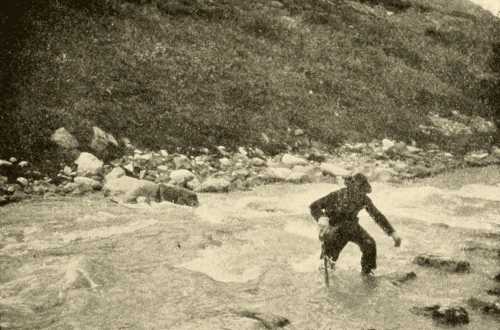 Seeking a Ford
After a good night’s rest and something
to eat, we divided into two parties. My
companion and his guide going toward the
north, I started westward up Benjamin Creek
with the intention of crossing, but the current
was so swift that it was impossible to find a
ford. Although the guide, with me on his
back, waded into the ice-cold water several
times, he was forced to return for fear of being
carried off his feet. On the opposite side
of the creek could be seen a great many sheep,
some feeding, others lying down on rocky
points from which they could command a
good view of the surrounding valley. They
are very quick to distinguish any strange
object a long way off, and before you can
get at all near they take to the summit and
disappear beyond. In the flock there was
not a single head that could be considered a
trophy worthy of the chase, even to a tenderfoot.
I am sorry I did not have a telephoto
lens, for I could have secured a fairly
good picture of the group. My friend, George
Shiras, III., got many good pictures in this
same location with a telephoto lens.
In ecstasy I followed the stream, reveling
in the solitude of the rocky fastnesses, where
the right of eminent domain is granted by
the Creator to none save the cloven-hoofed
creatures who have roamed there unmolested
from time immemorial. But now they are
being taught a new lesson. The modern gun
in hands controlled by steady nerves and
unerring eye sounds the death knell of the
species, unless they are given protection.
They are learning slowly and by bitter experience
that even at any distance they are in
imminent danger from the rifle.
Away yonder on the uppermost crag stood
His Majesty, as though chiseled out of and
forming a part of the very rock itself. A
little below stood his companion, another
big ram. Selecting the lower sheep for a
trophy, I elevated the sights for six hundred
yards. I instructed the guide to watch with
the field-glasses where the lead struck the
rock. A loud report, a great recoil, and a
thud carried the message of danger to the
curious, though unsuspecting, sheep. The
guide said, “A little too high.” In the
meantime the rams were nervous and undecided
what to do, seeming uncertain as to the
exact location of the enemy. Another thud
on the rocks, this time below, and then away
they went out of sight over the crest. We
did not see them again, and they offered the
only desirable trophies of their kind that we
found on the trip. In the fall the big rams
roam together a great deal in the most
remote and inaccessible places, the ewes
generally flocking by themselves. It seems
to be the popular belief in that country that
the large rams separate from the flocks and
withdraw by themselves at that season. We
saw several flocks, an average of seventy-five
sheep a day, but there were no big rams
among them.
Our attention is attracted by a movement
on the ground, a glimpse of a marmot, as,
making a bolt along its well-worn path, it
disappears into a hole, reappears, and again
disappears,—a caper which is characteristic
of the little animal, as though he were curious
to know something definite about the invaders
of his domain. This habit frequently gives
the hunter a shot, but their tenacity of life
is so great that they usually get back into
the hole and one seldom recovers the body.
Their flesh is quite a delicacy among the
natives, as well as to the hunter when hungry.
He is conscious of their presence at all times,
for their whistling can be heard continually
in every direction.
The ptarmigan are plentiful, some partly
concealed among the rocks, and some walking
about craning their necks, all beautiful in
their moulting plumage. Each is in a different
stage of transformation from the handsome
brown of summer to the more beautiful
winter dress of snow-white. How wonderful
are the ways of the Creator for the preservation
of the species! If the summer plumage
were to remain until the whole land is covered
with snow, how easy it would be for the
ptarmigan hawk, occasionally seen soaring
in the air, to distinguish the bird, make a
dart, pick it up for his evening meal—and
thus bring about the speedy extermination
of this beautiful species! They are so tame
you could kill with stones all you would eat.
The manner in which nature provides protection
for the inhabitants of the snow peaks
is illustrated again in the case of the sheep,
which are white.
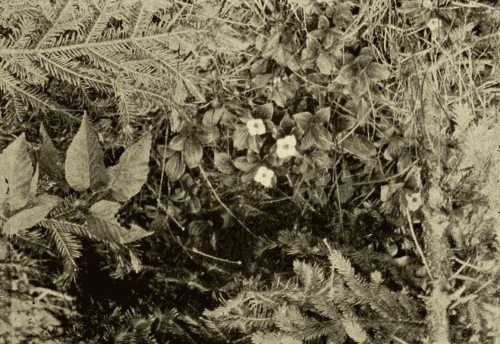
We saw many beautiful little flowers, the
bluebell always in evidence, daisies, a bunch
of forget-me-nots, and what fascinated me
beyond description,—several bunches of violets
away above the snow-line. They took
me back to the springtime in the Middle
States. The wild geraniums were in bloom,
varying in color from a delicate purple to a
faded hue, with leaves colored from green to
scarlet.
When we left the main camp provisions
enough to last two days were packed. It
was our intention to keep a packer going
between camps carrying our supplies; thus
we could move from place to place as light
as possible. When Doc returned from the
last camp to headquarters with his lamb and
a packer to show him the way, he promised
faithfully to send the Indian back to us with
a good supply of provisions. We suggested
writing down the articles desired, but he
thought this was not necessary,—that a good
supply would be forthcoming. Thus we separated.
My companion was uneasy for fear
of the Indian not being able to find our camp,
for our supplies were getting low. I had no
fear from this source, knowing well the
natural instinct of a child of the forest for
taking our trail, which was so pronounced
that even a novice could follow us. You
may imagine the chagrin of the party when
he returned on the following day with no
flour and only bread enough to last one meal.
We then came to the conclusion that Doc
was tired of the hunt and had adopted this
means of forcing us by starvation to return
to the provision camp. We hunted all that
day with only one small biscuit apiece. It
was raining, and in the evening, when we
returned to camp wet and hungry, a large
fire was built and our wet clothing dried.
A tin cup full of boiling hot tea soon revived
our depressed spirits. This, with a few ptarmigan
roasted on a spit, enabled us to retire
in good condition.
By this time my comrade could not stand
the hardships any longer and wanted to
return to the lake. He insisted that there
were no big trophies in the country. I
succeeded in getting him to stay a day or
two longer by telling him I had seen a large
ram. The last day we hunted together we
came upon a prospector’s cache. On top of
a large stone we noticed a pile of small stones
arranged in a way that at first sight indicated
the hand of man. Examining the pile we
found beans, flour, and dried fruits. Although
we had been living on porcupine for two days,
the natives refused to touch the cache. There
is an unwritten law among prospectors and
hunters that is never violated in this far-away
land. The cache is never disturbed,
for they know full well that some fellow-man
is depending upon the provisions to reach
civilization, and to disturb it may cost the
life of the owner. However, if one in a
starving condition helps himself, he leaves
his name and the owner considers it an act
of humanity. Those only who have been
in a similar situation can appreciate what
it means. One of the guides insisted it was
cached by the owner, who had gone back to
civilization and left it in the hope that some
person in great need might find it. How we
longed to have a mess of those navy beans,
but we had not yet reached the condition
where we could help ourselves, for we were
only one day’s march from plenty.
Finally my companion had his way, and
in the morning, though the weather looked
threatening, we started, two of the packers
towards camp with the outfit, and the hunters
for the summit once more. While resting
a little before we made the ascent of a high
mountain, my guide pointed out a large
moose, with huge palmated horns. He was
feeding peacefully in the distance, occasionally
looking around as though always on the alert
for foes. One horn was still in the velvet,
and on the other the velvet was dangling
down just ready to drop off, with the red
corpuscles on the antlers glittering in the
rain.
By and by the clouds began to form on
the mountain-tops, and gradually lowered
until they enveloped the entire mountains
and valleys. Again the rain commenced, and
continued a steady downpour for the remainder
of the day. The fates were against
us in respect to the weather, but we did not
have to go hungry, for the marmots were
plentiful, whistling here and there, as though
a kind Providence had provided a good supper
for the camp. After walking all day in a
cold, drizzling rain that was almost sleet,
we overtook our packers, who had been traveling
since morning in order to reach a
camping place where there were both wood
and water. We finally reached the foothills,
where we found water and scrub spruce
in abundance. One of the guides, while
“rustling” sticks for fire, ran onto a large
porcupine, and between marmot soup and
porcupine roast we had an abundance to
satisfy the inner man.
After the Indians had eaten their fill,—and
the amount they could eat was surprising,—the
one that got the brisket had picked it clean
and started to twirl it in the air, uttering some
chanting words each time he tossed it, until
it fell with the narrow side up, then he turned
to his companions laughing and shaking his
head. Then another went through the same
motions. I subsequently learned that if the
narrow side turned up frequently this indicated
they would have another “porky”
on the morrow. Porcupine they prefer to
any other kind of meat. The intestines seem
to be considered the choice morsels. Our
guide would take hold of the intestine with
one hand and with the other would strip it
of its contents in the various stages of digestion.
Then to each man would be allotted
his pro rata share,—and each was careful
to see that he got his full portion of the delicacy.
Next they would string the sections
on sticks and gather round the fire on their
“hunkers,” singeing the tidbits more or less,
each according to his taste. Upon our inquiring
why they did not wash the dainties,
they explained that washing spoiled the
flavor. There was a great deal of humor
about them and they frequently tried to play
simple jokes on each other. Occasionally
one would reach for the field-glasses, look
long and earnestly, then point in the direction
of the mountain to some rocks and
shout “Mushee”[1] (meaning “Sheep”), and
when another member of the party would
hurriedly reach for the glasses and shout
“No mushee,” all would have a laugh at his
expense. They are great tea drinkers and
when in camp the teapot is always on the
fire getting hot for the next cup. If for any
reason they were compelled to do without
it, they would sulk until they got it.
It rained all night and we did not rest
well, although very tired after our trip over
long stretches of mountain-side covered with
loose stones of all sizes and forms thrown
down by the elements from the mountain-top.
The bed was hard; the tent was pitched
under a scrub hemlock to get protection
from the strong wind that was blowing down
the pass. The wind moaned and groaned
all the fore part of the night, then subsided,
but the rain continued till morning. The
Nimrods huddled together in a small depression
on the ground, with no bed but the
rubber blankets and very scanty covering.
Our hip bones would get sore, and one
would turn and then the other, continually.
We were glad to see the dawn of another
day. All night long, “drip, drip, drip” in
different parts of the tent the rain could be
heard. The hunting shoe of my companion,
standing upright under one of the largest
leaks, proved an opportune receptacle, consequently
in the morning his shoe was about
half full of rain water. After a breakfast
of porcupine stewed with a spoonful of
evaporated potatoes and washed down with
a cup of tea, we folded our tent and plodded
our weary way towards camp. Blueberries
and salmon-berries were very plentiful. We
found at the higher elevations an abundance
of a species of blueberry, the woody plants
of which grew less than three inches in height.
They were laden with a small berry, very
sweet to the taste, and so plentiful that they
could be stripped off by the handful. Among
them grew another species as heavily laden
with red fruit, which I think was a species
of partridge-berry. The two grew about the
same height. The Indians preferred the red
berries and seemed fond of them. As for
myself, I was not partial to them, but ate
liberally of the blue.
Among the berries we came upon a covey
of ptarmigan feeding. Doc, murderously inclined,
fired some ten shots at one of them
before it flew. Indeed, so recklessly did he
scatter his leaden pellets as the birds rose,
that old Shanghai, one of our Indians, called
to me: “Hey, Billy, Billy! Come on! Damn!
Him make bullets whiz by head!”
As we reached lower levels, the blueberries
gave way to salmon-berries. They resemble
raspberries in growth and appearance, but
have a peculiar tart flavor. They were in
great abundance, and were much relished by
our party.
We arrived at camp in due time, tired and
hungry, but none the worse for our experience,
and after a short rest, quite ready for
another tramp through the enchanting forest
of birch, Cottonwood, and hemlock.
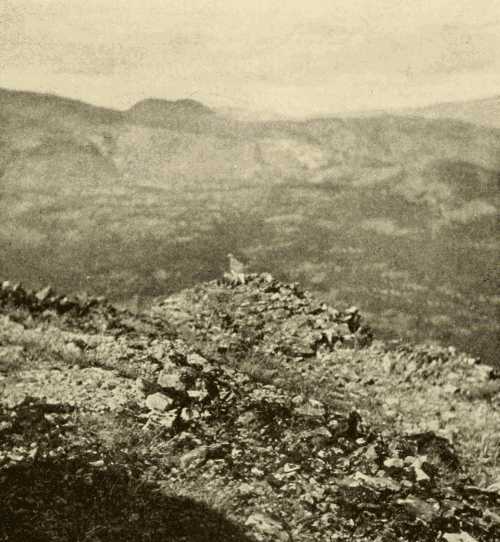 Ptarmigan
On our way through the woods the Indians
gathered for snuff-making a great many
fungi growing on the birch trees. In preparing
the snuff, they first take a birch limb
of sufficient size and with a pocket-knife cut
out a round hole about two inches in diameter
and an inch and a half deep; this is the mortar.
The fungi are then placed in the hot coals
of a birch-wood fire until they are charred
through and through, when they are broken
into the mortar with a like amount of tobacco
leaves. Then with another piece of birch
wood about three feet long for a pestle the
mixture is ground in the mortar until it becomes
of the color and consistency of a moist
snuff. This the Indians continually chew and
rub in their teeth. Of the many uses of the
noble birch surely this is the most unique.
From the seedling to the giant tree the
life history of the birch is one of usefulness
to the inhabitants of the wild. The hardwood
ridge over yonder looks like the woods
in the vicinity of a beaver community, only
over a much larger area. Acres and acres of
birch trees averaging two inches in diameter
are broken off a couple of feet from the ground
by the giant moose, which straddle a sapling
and bend it down to browse upon the boughs
and tender twigs of the top. An old-timer
in the country told us that once after a hard
winter he came upon several “moose yards”
in the spring and found many bodies of moose
that had starved to death. He also told us
that he had saved the lives of quite a number
by cutting down trees where they could feed
and thus tide themselves over a severe spell
of bad weather. The birch-buds nourish
the grouse during the winter. Birch-bark
starts the fire and birch-wood furnishes the
fuel. Birch-bark supplies the natives raw
material from which to manufacture canoes
and various utensils and trinkets. Taking
it all in all I do not know of any other tree
of the forest that is put to so many uses.
An interesting instance of its application to
the culinary art comes to mind. According
to a tradition in our family, some of whom
were pioneers in the Huron district of Canada,
the Indians taught them to make a very fair
substitute for baking powder out of a compound
of the ashes of birch and hickory wood.
I am sorry I never learned the formula.
Around the camp fire we gathered just
before retiring. The night was dark. The
doleful cry of the solitary great northern
diver (Urinator imperator) came through the
stillness of the invigorating atmosphere, and
scarcely would the echo die away in the
distant hills until the call was repeated.
The bird may have been floating on the
surface of the lake, or flying in the air, calling,
as it frequently does while in flight. The
native Indians, like the sailors, do not take
kindly to the laughing of the loon, for there
is a superstition among them that it forebodes
bad weather or some misfortune. The camp-fire
was burning brightly, cutting a luminous
hemisphere out of the inky darkness. In
the north the aurora borealis was throwing
its weird light in streamers stretched in a
semicircle over the horizon. While I was
admiring these the moon pushing up over
the black hilltop across the lake, looked
cherry-red. It seemed as though I was
under a spell. In my fancy I could see
a great boat approaching over the dark
water, with a huge search-light just rotating
into view and sweeping the northern heavens
with its rays. But even as I gazed the full
moon appeared in all its northern splendor,
the vision dissolved, and I realized that the
northern lights and Old Luna had played
a prank on me.
The next day we packed our belongings
and shifted camp some four miles farther
south on the same lake. As soon as the bow
of our little boat struck the shore we hopped
out and began a reconnoiter for a camp site.
A well-worn path across the narrow neck of
land separating one little fiord from another
attracted our attention. A stroll in that
direction disclosed a camp which had lately
been occupied by some unknown party. On
a tree we found the card of our fellow townsman,
George Shiras, III., who had recently left
the camp for the sheep country. It was like
receiving a letter from home. How pleasant
the surprise had we been so fortunate as
to meet him! The “few days in camp together,”
suggested by his invitation of long
standing, would have been realized by a
strange coincidence. While he left civilization
from Seward, we departed by way of
Kenai, several hundred miles distant, yet
both arrived at the same place, he by way
of the upper Kenai and we by the lower.
A hurried pitching of camp in anticipation
of rain, which had been incessant for the
past four days, with only brief intervals of
relief from the downpour, put us in excellent
shape, with plenty of spruce boughs for
bedding, before the rain began to patter,
patter on the stretched canvas. To me a
most interesting experience is that of being
lulled into dreamland under such conditions.
It may be due to the effect of the ozone and
to the fact that in the woods one is always
tired when night comes.
On the following morning we divided the
parties and left camp in different directions.
After tramping many miles alone I came to
a swamp country. Crossing over one arm
of the swamp, wading up to my knees in
water, I came upon a path worn almost a
foot deep by moose traveling from one place
to another. I was unable to figure out why
they traveled backward and forward along
this particular route. After returning home
I learned from Mr. Shiras that not far from
this point was a salt lick and the path was
the regular route to and from the lick.
The path led through a little depression
in a ridge that projected into the swamp.
Mounting an elevation in the center of the
ridge, I could see on every side little lakes
and ponds, surrounded with alders and acres
of yellow swamp grass, an ideal home for
moose. Taking my field-glass, I looked in
every direction for game, and finally my eye
rested on a yellowish-brown object, then
another and another, which proved to be
cow moose feeding among the birches. While
resting, there came to my ears from another
direction the snapping of bushes. I knew
it was a moose feeding, a cow, to be sure.
I at once started in the direction whence
the sound came, and happened upon three
cows feeding and resting. They did not
seem to be wild, for on seeing me they threw
their ears back and hair forward, just like
mules, then walked off a short distance and
stopped. In fact, they appeared to be very
tame and evidently knew that the law protected
their sex. While looking in the finder
of my camera I noticed that their curiosity
seemed to be aroused and that they were advancing
towards me a little too closely for
safety. I hurriedly set down my kodak and
raised my gun for fear the foremost would take
a notion to charge. Just at this moment she
wheeled straight around and with a trotting
motion, took to the closest cover. Before I returned
to camp my intention had been to come
back the next day, but I found the entire
party had decided to turn homeward the next
morning. What an opportunity I missed
to get some photographs of big bull moose!
The party saw at least ten cow moose that
day. Without a doubt, when the rutting
season arrived in about ten days, the large
bulls, now in the high timber, would be
scouring the forests in search of their
mates, bellowing in answer to the call of
their lady-loves.
As soon as he reached the camp that evening
Cheechalker began to inquire about his bath,
and his equilibrium was greatly disturbed
when the Indians refused to erect a tepee
for a sweat box and give him a bath. The
guide, pointing to the crystal water of the
lake, said, “Him good water, make good
wash.” Now Cheechalker took as kindly
to the crystal water as fish take to the land.
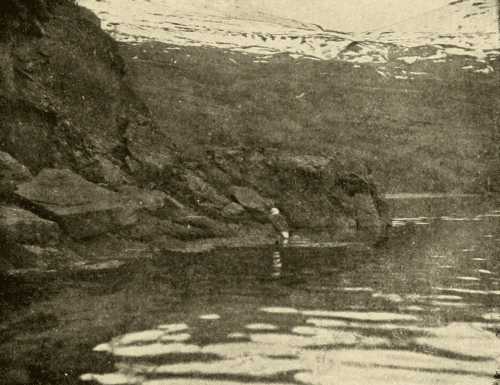
Finally the party went for a bath, each performing
his ablution in installments, and
while they were sunning themselves, Old
Sourdough took a header into the lake as an
example that they might follow. This was
too strenuous for the balance of the party
and they were satisfied to look on.
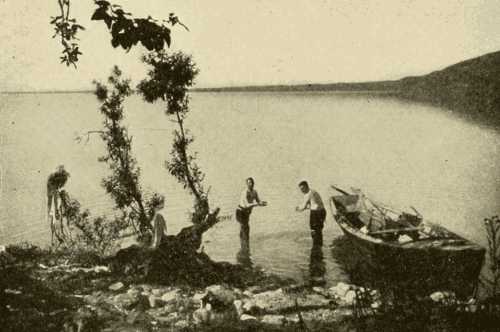 A Bath in Lake Skilak
Doc took a stroll along the beach with his
shotgun and returned with a brace of snipe.
The white crescent over the eye was very
conspicuous between the black bill and slaty-black
feathers of the crown.
Pulling stakes after our breakfast was over
next morning, we were soon on our way homeward.
We were just one day going down
the river. The current was very swift and
save for a few stops we made excellent time.
At two of the worst rapids we all got out
and the Indians ran the rapids. Before we
pulled into Kenai we were told the Bydarky
had left for Seldovia and would not make
another trip for three days, which, if true,
would be too late for us to catch the last boat
of the season from Seldovia to Seattle. After
arriving at Kenai we had about completed
arrangements for a little schooner to take us
up the inlet to Sunrise, on Turnagain Bay,
where we expected to get a train for Seward,
in time for the steamer, when, much to
our pleasant surprise, the belated Bydarky
came into port on her way to Seldovia.
We had been misinformed. We quickly
transferred our outfit, much relieved that
we would not have to miss the last boat of
the season.
At two o’clock in the afternoon the boat
left Kenai under full steam for the westward.
The waters of the inlet were as smooth as
glass and we were making good headway.
Not even a gentle breeze was blowing as
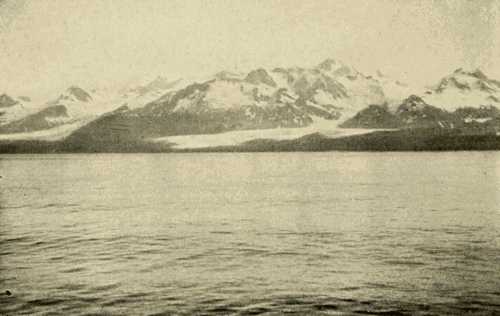
the sun disappeared behind the snow-covered
peaks of Iliamna and Redoubt. The afterglow,
reflected from the snowy cap, and the steam
bursting from the side of old Redoubt gave
it a weird appearance.
All the passengers had retired except Doc
and myself, who had been left without a
bunk. We first thought we would throw
our blankets on the floor of the combination
cabin, kitchen, and dining-room. A strong
breeze began to blow and we decided to go
into the hold for the night, coil ourselves up
in our duffel, and go to sleep. The wind
increased to a hurricane. What a night we
spent down in the hold of that old tub! She
was carrying little freight, had no ballast,
and could make no time. The tide caught us,
and between the outgoing and the incoming
tide-rifts the boat was tossed about at the
mercy of the elements. When she pitched
forward the propeller was out of the water
and spun like a button on a barn door. The
engine throbbed and beat, stopped and
started, with jerks and bounds, and the
climax came when it broke.
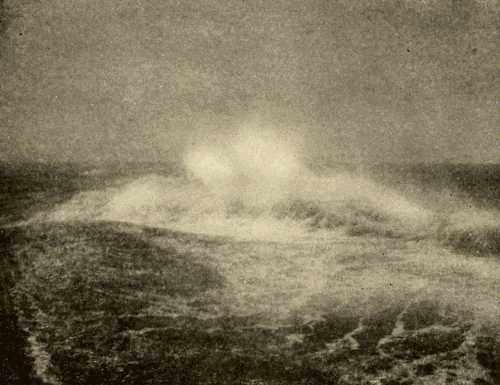
We were in the most treacherous water of
the Pacific, rolling and tumbling in the trough
and on the ridge of the high seas. The boat
was drifting out of the charted course and
toward a coast bristling with unknown rocks,
upon which we were sure of being lost. The
instant the engine broke, the engineer came
down the hatchway like a meteor. The boat
made a plunge and he landed in a heap on
top of the doctor, who was so sick that in his
misery he did not care whether the craft
went down or floated. Righting himself, the
engineer made a dash for the engine-room to
repair the damage. In the storm the poop
deck went to windward over the stern. The
repair-men were at work; above the din of
the hammer and chisel could be heard the
cargo shifting from side to side with the billows.
Oh! how I longed to hear again the
vibrating of the engine and smell the stench
of the fuel oil, which before the storm had
made our condition almost unbearable. The
doctor lying on the broad of his back
lifted his head and stared through the now
open poop deck and asked, “Where are
those sparks coming from?” I looked up
and thought the stack was belching sparks
from its fiery bowels. A second look, however,
sufficed to show that what seemed
to be sparks were the stars as they passed
back and forth over the hatch with the
rocking of the boat. The illusion was much
more realistic than the narration of it would
indicate.
I mustered up enough courage to crawl
to the ladder, climbed up, looked out,—and
what a night! The stars seemed large and
brilliant enough for planets, the moon almost
large and bright enough for the sun. How
it danced on the foamy crests of the tide-rifts
when the whitecaps broke, throwing
the silvery spray all around the heaving,
plunging, tossing boat. Iliamna and Redoubt
stood in their majesty, silent onlookers at
the battle that was waging between the
little boat and the powerful elements,—wondering
who was going to be the victor. I
dropped bade into the hold half believing
it was all a dream, when I heard the captain
shouting to the pilot, “Keep her head on,
head on!” For fear of drifting upon the rocks
they were obliged to run many miles out to
sea before they dared make the turn for the
harbor. I heard him shout to the man at
the wheel, “Head her into the harbor as
quickly as possible when she is in the next
trough!” We had now reached the critical
moment,—would they select the right time to
make the turn? When the boat was turned
halfway to leeward and on the crest, the
turbine without resistance spun around at a
fearful rate, then the engine stopped for a
moment and the breakers struck the side
a terrific blow, causing the hull to creak and
groan as though it were human and about
ready to collapse. The water in the cabin
overhead swished back and forth and the
pots and kettles, as they beat against the
walls, kept time with the rolling and plunging
of the boat. The old tub righted herself,
we had crossed the danger line, and were
heading straight for the harbor.
When we reached quiet water the old-timers
shook their heads and vowed that
was their last trip in the Bydarky. What
happened in the bunks no one would tell,
though at least one of the party said that
during the night he had offered many a silent
prayer for the safety of the craft. There
was a foot of water on the cabin floor, the
pots and pans were drifting about amid a
flotsam and jetsam of pork and beans,
vegetables, and what not.
Thus we reached Seldovia and learned
that the steamer Portland was about due
on her last trip for the season. Coming
home by way of the inside passage, we had a
pleasant trip, full of interest in a hundred
ways. On one occasion, while many miles
from land, a curious little bird came fluttering
from mast to mast. Evidently on its way
south it had become exhausted in the long
flight from some northern point and had
taken a short cut across the water. Finally
one of the passengers caught the little fellow
and it proved to be a crossbill. The mandibles
of this species are considerably crossed
to assist in picking seeds from the pine cones
of the northern land. It stayed with us all
day and seemed to be perfectly contented
and satisfied to be caressed in the open hand,
but just as soon as the boat neared land it
took to wing and with a graceful flight reached
the timber safely. So the days passed until
in due time we arrived at Seattle, where we
took the train for the East.