Old Ken was "down on his luck." For
well-nigh fifty years he had "gone the
pace" in a district where certain men
say glibly, "there's no God west of the
Rockies." The old prospector had been,
according to those who knew him best,
in one of three conditions for some years.
He was either "getting drunk, drunk, or
sobering up." And yet in spite of his
weakness and sin, and in spite of the
curses he got, there was no more popular
man in the whole camp than Old Ken,
although likely he was not conscious of it.
One of the miners had once expressed a
conviction about Ken that was dangerously
popular. It was at the time Frank Stacey's
mother died, in the East, and Frank had
not "two bits" to his credit. As might
have been expected, it was Old Ken who
started the hat to wire that Frank was
leaving on the next train, and to see that he
had "enough of the needful to do the
decent thing." "It's his last chance,
boys," said Ken, as he made the rounds
during the noon hour. "I got twenty-two
dollars since eleven o'clock, so I guess,
with what you fellers is a-going to do, the
old camp's on the job, as usual, when a
chap like Frank wants to pay his last
respects." There was some mystery about
those twenty-two dollars until Andy the
bar-tender told how Old Ken had "got
it out of the boss" on the solemn promise
that for two weeks he would "work like
a Texas steer" without touching a cent
until the debt of thirty dollars, minus eight
for board, was discharged. Then it was
that one of the boys expressed himself thus
about Ken: "By gosh, fellers, he's white
clear through, that same old soak is, when
there's any trouble on. He's a pile decenter
than his thirsty old carcase 'll let him be."
On a particular morning some months
ago the old prospector stood at the little
station a mile or so away from the camp
centre. The "mixed" was winding her
way slowly around the curves of the summit
of the Rockies. From the windows of the
solitary passenger car a young man looked
somewhat anxiously across the valley
below. A few shacks nestled among the
poplar brush, and in the distance an
unpainted building stood, with distinct
outline, towering against the dark
background of the mountain range opposite.
The young man knew well enough, from
his work among the miners and loggers,
that yonder building was as a moral cancer
eating out the best life of the community.
The outlook was not bright, but he was on
the King's Business, and he knew that he
had in his care the mightiest thing, and
the greatest remedy, the world knows of.
Alone he stepped off the train, and
being the only arrival he received the
entire benefit of Old Ken's curious but not
unfriendly gaze. The new-comer, who was
conducting special services at selected
mining and lumbering camps that were
considered especially needy, looked around
for a district missionary who was expected
to act as his pilot for a few days. No one
but Old Ken and the station agent were
in sight, so after friendly greetings to the
former the young preacher made known
the purpose of his visit. Old Ken listened
courteously. "Well, stranger, you've hit
the right spot alright; we kin stand the
gospel in big doses here for sure; most
of us is whiskey soaks or bums, and some
of us is both. I wish you luck, partner,
but I'm feared most of us is incurable.
Yes, partner, I'm feared you've come
too late, too late."
The Frenchman who was hotel-keeper,
professional gambler, lumberman and mine-owner,
was not enthusiastic about allowing
the sky-pilot to board in his notorious
hotel and gambling den, but eventually accommodation was secured.
The dance-hall was procured for the
services, and Ken volunteered the
information that the preacher wouldn't likely
be disturbed, because there were only
four women left in the camp, and he
added, "two of 'em can dance like
elephants and one's got ingrowing toenails
or something else, so there's only one
on duty, and that ain't enough variety
for a good hop."
A few days after the services commenced,
Old Ken managed to replenish his treasury
by the fortunate desire on the part of two
men to get a haircut. The old man
boasted that he knew how to do most
things. "I'm never idle, preacher," he
said with a wink; "when I ain't doing
something I'm a-doing nothin', so I'm
always a-doing something you see."
No sooner were the locks shorn than
the old man made his way to the bar-room.
He was emerging from his favourite haunt
when the preacher met him. "'Taint no
use pretending I'm what I ain't, preacher,"
he said after a few minutes' conversation.
"I'm an old fool and I know it, but what
does it matter? Who cares?"
"It matters a good deal to you, Ken,"
the preacher replied quietly, "and there
are some of us who care. Ken, if you
would give God as big a place in your life
as you've given whiskey there wouldn't
be room for the things that have made
you call yourself an old fool. I know
He could make a mighty good man of you,
Ken."
"Thank you kindly, preacher, but you
don't know me: I'm the hardest old guy
in this country; the fellers around here
think they can go it some, but let 'em all
get as full as they kin hold and I'll take as
much as any one of 'em and then put
twelve glasses more on top of that to keep
it kind of settled, and then pile the whole
gang under the table and walk out like a
gentleman. Yes, sir, I kin do it; and if a
feller's as big as a house I'll whittle him
down to my size and lick him. Yer
intentions are good, partner, but you're
about fifty years late on this job."
The days allotted to the mission were
rapidly passing away, and while not a few
had given evidence of seeing "the vision
splendid," there were some after whom
"the little preacher," as he had come to
be generally spoken of in the camp, greatly
longed.
Coming down the stairs one day he saw
Old Ken standing with his back to the stair
rail. Putting his hand on the old man's
shoulder he entered into conversation.
"Ken, you haven't been to one of the services
yet, and I want you to come to-night."
"Lord bless you, preacher, if I went to a
religious meeting the roof 'ud fall in for
sure, and I don't want to bust up the
dance-hall."
But the little preacher was not in a
mood to be "jollied" that day. "Ken,"
he continued, "I'd like you to give God
a chance. Do you know, I like the look
of you, and——"
The old prospector cut the sentence
short, straightened up, and gazed
appreciatively into the speaker's eyes. "What's
that you said, preacher? What's that
you said? You like the look o' me!
Well, siree, that's the decentest thing
that's been said to me in thirty years!
Yes, sir, it is: I'm treated like a yaller
dog around here; but you speak decently
to a yaller dog, he'll wag his tail. He
likes it, you know. Say, preacher, when
you need me just you whistle and I'm on
the job!"
"I take your offer, old man," said the
preacher. "I've been here for some time
and I've heard a good deal that I didn't
want to hear. Some of you fellows have
been cursing pretty nearly day and night
since I came. I didn't want to hear it,
but I couldn't get away from it. I've
heard the boys; it's only fair they should
hear me. Ken, you round them up and
bring them to the dance-hall."
Ken's hand was extended. "Here's my
hand on it, preacher; I'm yer man. If the
boys ain't there you'll see my head in a
sling in the morning."
At 7.30 Ken organized himself into
an Invitation Committee. There were
rumours that he even brushed his coat.
At any rate, at 7.45 he stood at the door
of the gambling den, and with an air of
unusual importance he succeeded in getting
silence long enough to tell "the boys"
that there was "a religious show on in the
dance-hall." "The procession will form
in ten minutes," he continued, "and every
—— man in this place has got to be in it." A
few laughed; some cursed at the interruption,
and others were so engrossed in
their game that they appeared not to have heard.
In a few minutes Ken entered the
barroom and started his round-up. After
telling one or two quietly that it was "up
to him" to get the boys to the religious
show, he made his proclamation. "Come
out of this, you —— fellers, and come up to
the —— dance-hall and give the —— little
preacher a fair show, or I'll kick the
—— hide off you." The writer has no
apology to make for blasphemy either in
the East or West, but like classical music,
to some ears, Old Ken's blasphemous
language was not so bad as it sounded.
After the old man had brought into use
all his remarkable reserve of Western
mining camp vocabulary, there was only
one man besides the bar-tender who failed
to join the procession.
The services had become well advertised
throughout the entire district by this time,
so that when Old Ken arrived with his
company the little hall was fairly well
filled. But the old man was "going to see
this thing through," and so, despite the
protestations that almost upset the gravity
of the preacher conducting the preliminary
song service, the gang was coaxed and
forced to the front seats. Ken directed
the seating operations in a way that
suggested his ownership of the entire
place. In a stage whisper he instructed
the boys to "get a squint at the preacher's
hair." With pride he continued, "mighty
good cut that, I performed the operation
this afternoon."
At the close of the service he came to the
platform. "Say, preacher, that was a
great bunch. There ain't a —— (excuse
me, preacher, I forgot you don't swear),
but say, there ain't a man of 'em but's
done time. I'll tell you, preacher, we'll
run this show together. I'll round 'em
up and you hit 'em;" then with a swing
of his big arm he added, "and hit 'em
hard. See here, preacher, you take a tip
from me; us old sinners don't want to
listen to none of yer stroke-'em-down-easy
preachers; we wants a feller what 'll
tell us we're d—— fools to be
hoodwinked by hitting the pace, and what'll
help us to get up after he shows us we're
down."
A few nights later the preacher had
Ken's "bunch" particularly in view as he
delivered his message. Near the close he
asked during one of those times of reverent
silence that may be felt but not described:
"Are not some of you men tired of going
the pace? You know it doesn't pay.
Many a time you curse yourselves for being
fools, and yet you go back to the old ways
that blast your life. Men! God knows
how some of you are tempted, and He is
ready to help. His Son came into the
world to save sinners. He stood in the
face of the fiercest temptations, and with
the command of a conqueror He said,
'Get thee behind Me.' And, Men! He is
ready to stand alongside of every
passion-torn man to-day and to help him to
overcome. Isn't there some man here to-night
who wants to do the decent thing, and
who will accept His offer of help in the
biggest fight any man has?"
The words were simple and commonplace
enough, but the One who uses stumbling
lips was present that night. Unexpectedly
one man arose, pulling himself up by the
back of the seat in front of him—a
sin-marred man, trembling as a result of daily
dissipation—and said in a muffled voice,
"I want to do the decent." A confirmed
gambler not far away stood up and merely
said, "Me too, Bob." Another, in a tone
of despair, cried, "God and me knows
there's nothing in this kind of life! Oh
the d——, d—— whiskey, it's ruined me." Late
into the night the preacher walked
along the trail with one of these
sin-wrecked men; but the transformation of
that life and other lives must constitute
a separate story.
A few days before the mission closed Old
Ken came to the preacher and announced
his intended departure from the camp.
"You see, stranger, the camp's pretty
quiet, and I ain't a-making enough money
to buy a dress for a humming-bird. I ain't
got the wherewithal for a ticket, but if
I strike the right kind of conductor I guess
I'll make the grade. You see they can't
put a feller off between stations in this
country. So I'll get one station along
anyway, and if they chuck me off I'll wait
for the next train, and a few chucks and
I'll get to N—— anyway."
The following morning prospector and
preacher walked together down the railway
track to the little station. A farewell word
was spoken, and a farewell token slipped
into the big hard hand. Old Ken stood
a moment or two on the steps of the car.
There was a far-away look in the old
man's eyes as he gazed in the direction of
the distant Cascade range. "Good-bye,
preacher. Yes, maybe, maybe we'll strike
the main trail that leads home. I hope
so—God knows—maybe it ain't too late for me
yet. I kinder think lately that God wants
Old Ken. Good-bye, preacher; God bless you."
Three months later "the little preacher"
received a letter from a British Columbia
miner. One paragraph may be quoted
here: "Poor Old Ken was burned to
death in a hotel fire in S—— three weeks
ago. He was the kindest old man I ever
met, and as long as I live I shall thank God
for the night he rounded us up and brought
us to your meeting in the dance-hall."
When Charlie Rayson passed out of the
dance-hall in the little mountain mining
town a few nights after Old Ken's
round-up, he was on the border-line between
despair and hope. Was there any chance?
For years he had apparently worked with
the logging gang only that he might give
full rein to the lusts that devoured him;
and if he remained in the bush the whole
winter it was with an impatience for the
days to pass so that the spring might
bring him to the bar-rooms and dens of
vice, where the awful monotony might be
relieved in a spring-long spree. Nobody
had any particular interest in Charlie, and
no one knew from whence he came.
And yet there seemed to be some slight
ray of hope to-night. He had listened for
the first time since boyhood to the pearl
of the parables, and then Old Ken had
asked the preacher to "sing that there
Wandering Boy piece." Charlie knew not
if his mother still lived, but the words,
"Oh! could I see you now, my boy, as
fair as in olden times," came like his
mother's call through the sin-stained past.
For thirteen years he had cut himself
entirely off, so far as his whereabouts
was concerned, from that one who had
never ceased to love him.
In a few minutes after the close of the
service Charlie and the preacher were
alone on the mountain trail. Suddenly
Charlie stopped and said, "Good God,
preacher, you can't, you don't understand
what I'm up against. For nineteen years
I've been in the hands of the doctor or
the policeman—my passions rip me to
pieces—men can't help me; I wonder if
God can? I want to believe what you
said to-night is true, but I've always
wanted to do the thing that damns me,
worse than I have wanted to do anything
else, and yet I never do it without
something saying 'don't.'"
In the silence of the lonely hills the
two men stood, while one asked Him who
is the Help of the helpless to be the Refuge
of the passion-pursued man. Poor Charlie
could utter but few words: "God, oh,
God," he sobbed, "I'm like that prodigal,
and I'm sick of it all. Oh, God, can you
help me? I want to see my old mother." With
the mention of the word mother the
man burst into a passion of weeping. For
several minutes no word was uttered, as
the preacher steadied the trembling man.
It was no easy task for Charlie to do what
he was counselled to do after he had
made the Great Decision. But that night
he read, from the Testament given him,
a portion of the third chapter of St. John's
Gospel, and knelt by his bunk and asked
for strength sufficient. To kneel down
and pray in certain Western mining camp
bunk-houses is a man's job, but Charlie
had realized that only One was able to
deliver from the passions that rend, and
to that One he appealed.
A fortnight later an old woman in a
far-away Ontario village received a letter
bearing a British Columbia postmark. She
was a poor, lonely, half-crippled individual,
but the message of that letter enriched and
cheered her and quickened her footsteps
as nothing had done in years. To
everybody she knew, and to a good many people
she did not know, she told of her new joy.
In her trembling old hands she held the
precious letter. "Do you know, I've got
a letter from my Charl. I thought he
was dead. I haven't heard from him in
thirteen years, but he's in British Columbia,
and he says he's a Christian man now,
and he wants to see his mother—and
he's going to save up so's he can come home,
and till he comes he's going to write every
week—and he sent me some money. Oh,
how good God is to give me back my
Charl!" The poor old soul seemed raised
as if by a miracle from her invalidism.
Charlie toiled on in the logging gang, and
when pay-day came the hotel-keeper reaped
the usual harvest from most of the men, and
was hoping that Charlie and Bill Davis,
two of his best customers, would be coaxed
back to their old habits. Bill had been
known as the "little devil" of Primeau's
gang, and his professed change of heart
was a thing incredible to the entire
community. But Charlie and Bill had been a
good deal together of late, and the latter
had told Charlie all he purposed to do and
be with God's help, and so the two men
became mutually helpful.
Five months passed, and besides having
purchased new clothes, Charlie Rayson
had one hundred and fifty dollars in the
savings bank at Brandon Falls.
And so at last the home journey was to
be made. It would be hard to say who
was the more excited, Charlie or his loyal
friend Bill Davis. For some time Bill
thought he would "pull out" when Charlie
went, but later he decided to stay on his
job a few months longer. Nothing would
do but that Charlie should take "just a
little remembrance" of $25 from Bill to
the aged mother.
On Saturday afternoon the final arrangements
were made, and Bill did a score of
things to make Charlie's get-away easier
and pleasanter. While Bill was purchasing
a few little necessities at the company
store, Charlie stepped across the threshold
of the bar-room for the first time in months.
He wanted to say good-bye to Andy the
bar-tender. A number of Charlie's old
pals were sitting or lounging around, some
of them well on the way to their terrible
monthly debauch. Numerous hands were
extended and not a few glasses offered to
Charlie. "Not for me, boys—I've cut it
out for good, thanks all the same," was
Charlie's firm response.
"Oh, come off," cried one, "you ain't
a-going back on your old pals just 'cause
you've got a new suit o' clothes."
Numerous sallies followed this, but to
each one Charlie gave a similar reply, and
backed towards the door. It has always
been supposed that it was Primeau himself
who tripped Charlie, but be that as it may,
somehow Charlie stumbled backwards to the
bar-room floor; and when Bill Davis was
returning through the hall some of the men
were holding Charlie while others were
pouring whiskey through his lips, "just to
give him a lesson in sociability." Bill
Davis could scarcely believe that the boys
had tried to make Charlie drink, but when
he realized what had happened, his
indignation prompted the profanity that had
become a life habit. He checked the
words, however, and shouted at the
scoffing group to leave Charlie alone or
somebody would get a headache. There
was a laugh from one and a muttered "mind
your own d—— business" from another.
And then Bill took a hand in the affair.
The following day the affray was being
generally discussed. One or two men who
were participants in it were careful to keep
out of the public gaze. Bill had not
selected places where they should fall
when he was defending Charlie. To a
little group in the bar-room Andy gave the
information that "There was something
doing alright, when Bill started in to look
after Charlie. Say! the feathers was
a-flying. Bill ain't such a blamed good
Christian that he's forgot how to fight."
The taste of whiskey had aroused the old
craving in Charlie, and long after the
east-bound train had pulled out he was
fighting his battle with Bill by his side.
Never had the two men felt more alone,
and never had they more needed a friend
than now. All Charlie's confidence in his
ability to stand firm seemed to be shaken.
"Bill!" he said, "I swallowed some,
and it seems like it was running all through
me to find some more to keep it company.
Bill! for God's sake don't leave me.
I feel as if I was going to lose the game."
Bill hardly knew what to say or do.
The fight in Charlie's behalf and the
disappointment over the delayed journey had
left a great depression. Neither of the
men went down to the evening meal.
To pass the bar-room door and to face the
men again seemed more than Charlie dare
undertake.
The next train for the East passed
through at 3 a.m., and after thinking
over the events of the afternoon, Bill made
up his mind that they would flag Number
56, and that he would journey a hundred
miles or so with his sorely-tempted chum.
In the darkness of midnight, the two men
passed quietly out of the building and
along the trail to the railway station.
At last they were really on the train,
and having found an empty double seat
the men made themselves as comfortable
as possible, and were soon, like their
fellow-passengers, getting such fitful sleep
as one may obtain on the average "local."
It was the season of the year when
"washouts" make journeying dangerous,
and frequently in Western Canada trains
are delayed many hours, and sometimes
days, by the swelling of the mountain
streams which in their onward rush
sometimes carry culverts and ballast from
beneath ties and track.
The train had pulled out of Sinclair, and
was making her usual time through the
eastern section of the Pass, when passengers
were suddenly thrown from their seats by
a terrific jolt. Lamp glasses crashed to
the aisle, and baggage was dislodged from
the racks. Charlie pulled himself to his
feet almost instantaneously, despite the
knocks he had received. The lamps were
flickering and smoking, but fortunately
there appeared no danger of fire. The
brakeman, hatless and with a bleeding face,
came rushing through the cars seeking to
allay the fears. "Stay in the cars,
please—there's no danger of fire. You're better
here than outside. Doctors will be here soon."
Bill had not escaped serious injury.
He found it impossible to rise, and as
tenderly as he knew how, Charlie pillowed
his head and stooped beside him as he lay
in the aisle. "I'm feared I'm pretty
badly hurted, pardner," groaned Bill.
"There was something kind o' crushed
inside. Guess I'll just lie here for a bit."
The engine had plunged through an
undermined piece of track, and engineer
and fireman were terribly cut and scalded,
while the baggage-man had been pinned
beneath some heavy trunks that had shot
forward and downward when the engine
crashed into the washout.
"It's the hospital for you, my man,"
said the doctor kindly, after a hurried
examination of Bill's injuries. "We'll
make you as comfortable as we can before
the 'special' pulls out, but you need a
little attention that you can't get in the
camp even if you were able to stand the
journey."
Charlie got permission to accompany his
pal, and for Bill's sake he kept a brave
heart, although the events of the past
twenty-four hours robbed him of the
lightheartedness that had been his in
anticipation of the home-going.
Two days later Charlie decided to
continue his journey eastward. The doctors
were still anxious about Bill, but there was
nothing Charlie could do, and he knew
the old mother was waiting for her boy.
It was a touching farewell as the sick
man's hand was clasped. A score of times
Charlie had expressed his sorrow that he
had ever let Bill accompany him, and yet
each time in his own way he thanked Bill
for standing by him when he was "near
bowled out."
Bill tried to say that he was glad Charlie
was going home, but his tone and look
revealed his sense of loss and loneliness at
the prospect of his pal's departure, and
Charlie's eyes needed a good deal of
attention, which they received surreptitiously.
Motioning for Charlie to come nearer, the
sick man whispered: "You're a brick,
old pard, to stay by me this long. I guess
she's getting anxious for yer. Say, Charlie,
when yer away down there I'll be kind er
lonely; how would it be if yer made a
bit of a prayer once in a while for
me?" Then with a last pressure on the still
clasped hand, he added, "Good-bye, old
pal, God bless yer; maybe we'll hit the
trail together again some day, but say,
Charlie!" (the voice was throbbing with
emotion, and the eyes reflected well-nigh
a mother's tenderness)—"say, Charlie! we'll
stay by it, won't we? If the whole
world goes back on Jesus Christ we two'll
stick to him, 'cause we know what He
can do; don't we, Charlie?"
Thus they parted. Inside of three days
the one was clasped in a mother's arms
and there was great joy in the little village
home; and almost at the same hour the
other reached his Father's Home, and
there, too, was great joy.
Charlie Rayson was the man who first
suggested the holding of special services
at the "Banner." "Oh! boys, but it's
a hard spot. I mind when Old Ken hit
the trail to get a job there. Somebody
brought word they was paying six bits
an hour for rough carpentering, and next
morning Ken took over the mountain with
his pack. He never stopped even long
enough to get on a spree. In about a week
he was back at the old spot. That night
he was in the bar-room telling the boys
about his trip. I mind he told 'em they
could judge what it was like when he was
'the only gentleman in the place.'" Those
who knew Ken needed no further report
of conditions at the Banner Mines.
When the District Superintendent heard
that the men were planning to go to the
"Banner," he wrote to tell them not to
be too much discouraged if it took a week's
hard work to get half a dozen hearers.
"The spot is known to many as the
'hell-hole of the Province,' and the Church
does not begin to figure in importance
with the corner grocery, but with two
special workers and the amount of earnest
prayer that is everywhere being offered.
I am hopeful that the heartrending
indifference may be overcome."
And so on a certain Monday morning
the missioners made their way to the
Junction, and then took the dirty
work-train up the gulch to the camp. In a
community where men have for years
read anti-church, anti-religious literature,
and where "parasite" is hissed under the
breath every time a minister of the Gospel
is seen, it could scarcely be expected that
anything approaching a welcome would
be given the new-comers.
Inside of an hour the work of getting
acquainted was commenced. On the trail,
along the railway track, at the tipple, at
the entrance to the mines, in the
washroom, wherever men could be met, the
missioners sought to enter into
conversation with the miners. Some answered civilly,
a few were almost cordial, many were surly,
and many others either absolutely
indifferent and silent, or openly antagonistic.
Dave Clements, a disabled miner, who
looked after the wash-room, expressed
himself thus: "Religion ain't no good here;
most of the mine-owners is supposed to
hev got it, and so the rest of us don't
want it. Look at the houses what they
make us live in—my missus has been sick
most all winter—jest frozen, that's why!
We pays eighteen dollars a month for the
—— places. The company owns
everything around here: land, houses, stores,
train—even the air belongs to 'em, 'cause
it's full of their coal-dust. We has to
pay about three times the proper price
for things; but, then, that's what helps
'em to be religious; that's what gives 'em
the front seats in the synagogue, you bet;
we fellers sweat to buy church organs
and plush cushions, and then the parasite
parsons pat the mine-owners on the pate
and give thanks for such generous brethren.
If anybody needs revivalling, stranger,
it's that gang of hypocrites back yonder
what makes us poor devils raise the wind
to blow their glory trumpets." Yet even
Dave was compelled to say of Him whom
the missioners sought to exalt, "I find no
fault in this man."
In response to an invitation to attend
an evening service one miner replied:
"Meeting, eh? Any booze going? No?
Any dance after? Something better than
that? Gee! it must be swell!" Then
the tone was contemptuous: "No, siree;
you couldn't get me into a religious meeting
with a couple of C.P.R. engines."
Yet the daily conversations and invitations
were not all in vain, for when there
is a real concern on the part of Christians
for non-Christians, that concern is likely
to be imparted to those whom they seek
to win.
Moses Evans, a Welsh miner, listened
somewhat impatiently to the missioner's
words, as he stood leaning against a
telephone pole. Then with apparent
weariness he answered, "Look here, young
fellow, there ain't a —— man in this
country can live a Christian life in this
camp. I've tried it; you ain't. I know;
you don't. I used to be a Christian in
Wales—leastwise, I think I was—but you
can't be here." The interview ended,
however, with a promise on Moses' part to be
present on the following night. Three
nights later he knelt, at the close of the
service, behind the old piano, and brokenly
asked God to make him "different
again." "Forgive my sins," he continued, "and
help me like You did in Wales."
Near the end of the week the missioners
planned to hold an open-air service a
mile and a half down the gulch, at a spot
called "Spanish Camp," where nearly two
hundred miners lived. It was hoped that
by arranging the meeting between "shifts"
a number might hear the Gospel message,
who had not previously been reached.
Every tent and shack was visited twice
preceding the meeting, and hand-printed
signs were posted wherever likely to arrest
attention. At the time for the meeting
to commence there were five children and
eight dogs present. It was not a "dignified"
course to pursue, and probably
merited the disapproval of the "church
fathers," but one of the missioners,
yearning to get a hearing for his message, got
possession of a large tin can from a
nearby rubbish heap, and with the aid of a club
succeeded in getting considerable noise
from its emptiness. The people may have
appreciated his advertising ability, or it
may be they preferred to hear the Gospel
rather than the noise that was coming from
the tin can; but, at any rate, in a few
minutes a circle of thirty or forty gathered
around the speakers.
A few minutes after the meeting had
commenced the limping figure of Moses
Evans might have been seen on the
mountain-side near No. 3 Mine. Hurrying
down the trail he crossed the rustic bridge
over the little mountain stream, and came
to where the crowd had gathered. Without
any hesitation he pushed through the
circle and stood in the centre. Reverently
removing his miner's cap, he said, "I'd
like to pray." A few faces expressed a
sneer, but Moses clasped his hands and
uttered his petition, which was written
down immediately thereafter. "Oh, God,
you know as how the devil has been at me
all day, saying as I dasn't stand out in
the public air and confess Thee. You
know, oh, my God! that I want to be a
good man again. You know I can't read
nor write in English, but You've put words
in my mouth; put them into my heart,
and keep it clean, for Jesus' sake. Amen."
Moses Evans and other men, who with
him made open confession of Jesus Christ,
were again and again spat upon and
cursed, as they passed along the "entry"
at their daily toil in the mine. "But it's
a great thing," wrote the school-teacher,
"that these men can be by tongue damned
higher and damned lower than anything
else in this world, and yet stand firm.
Increase the number of such men, and you
have a leaven of righteousness that will
eventually permeate this whole mining
community. This is our only hope of
rescue from the mire of sensuality and
vice into which many of our miners have
sunk. Moses says to please tell you that
the words of the hymn you used to sing
are true in his own experience:—
'Through days of toil, when heart doth fail
God will take care of you;
When dangers fierce your path assail,
God will take care of you.'"
It was the acceptance of the challenge to
attend the "Hop" at the Bonanza Camp
that popularized the services at the Banner
Mines.
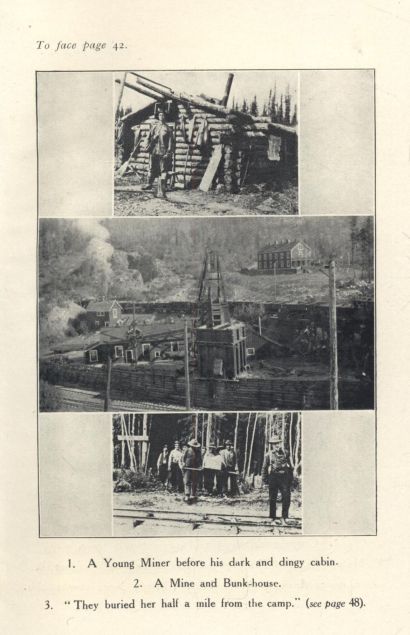
1. A Young Miner before his dark and dingy cabin.
2. A Mine and Bunk-house.
3. "They buried her half a mile from the camp." (see page 48).
After the open-air meeting a number of
men lounged around one of the shacks
discussing the question of religion. When
one of the preachers approached the group
to invite them to the meeting in the Hall,
"Smut" Ludlow at once began to air
his grievances against the Church, and to
inform the preacher that there were "more
—— rascals in the Church than in any
other organization on earth." Then Frank
Stacy contributed his bit of condemnation:
"See here, preacher! The last
time I was back East, I thought I'd see
what sort of a show they was still running
in yer House o' God, and so I went in.
Just over the archway inside was a fine
piece of writing, something about 'the
rich and the poor meeting together, and
going snooks.' I thought it sounded pretty
good, so I made myself as comfortable as
I could in one of them soft seats. After
a while some dude started to play the
organ, and folks dressed up fit to kill
strutted into their seats and bobbed their
heads down and pretended to say their
prayers. Then I watched an old guy
trying to get his overcoat off: I mind
how his other coat well-nigh come off with
it; he sure was scared when he saw his
shirt sleeve, and he hustled both his coats
on again like he'd been caught stealing.
Just then somebody tapped me on the
shoulder, and a coon with a silk tile in his
hand told me to sit at the back where the
seats weren't rented. I went back looking
like a fool, but you bet I didn't stop for a
back seat: I decided I'd take an outside
berth, and it'll be a few hundred years
before this chicken gets caught again.
Rich and poor meet together, and go
snooks! It looked like it, didn't it?
See here, preacher, ain't it about time
you fellers stopped talking one thing and
serving up another? The whole thing is
tommy-rot, that's what I say."
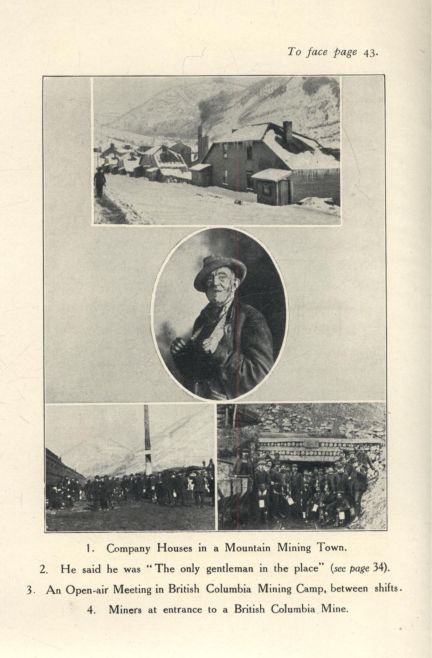
1. Company Houses in a Mountain Mining Town.
2. He said he was "The only gentleman in the place" (see page 34).
3. An Open-air Meeting in British Columbia Mining Camp, between shifts.
4. Miners at entrance to a British Columbia Mine.
Hal Rinnell was not antagonistic, but
objected to an illustration that the preacher
had used. "Say, preacher, warn't that
there story about the Bishop and the silver
candlesticks a bit fishy? You mind you
said about the feller swiping 'em after
the Bishop had give him a bed, and then
he got away with 'em through the night;
and when the p'liceman saw him with
'em next morning, and know'd they
belonged to the Bishop, they jest nabbed him
and brought him back. And you mind
you said the Bishop told 'em the man
didn't swipe the candlesticks, but got 'em
from him as a present. Then when the
p'lice was gone, the Bishop called the thief
'brother,' and made him keep his haul and
promise to be square from that on. Now
that ain't reasonable: it ain't human
nature. I'd like to see the pumpkin-head
what would swipe my candlesticks, if I
had any, arter I'd give him a decent bed.
He'd hev his next breakfast in Hades,
you bet. Some o' you preachers ain't
reasonable; you kinder get yer wires
crossed."
The cross-firing ended by a proposition
from "Smut." "There's going to be a
hot old time to-morrow night at the
Bonanza, preacher. I'll make a deal with
you. You don't like our style; we don't
like your hot air. You attend the ball at
Bonanza, we'll attend your show,
providing you start when we start, and leave
when we leave, and get home as soon as
we do. How's that, boys?" The "boys"
trusted Smut's judgment, and knew by
his wink that the proposition was safe,
hence their unanimity to make it a
"go." None of them dreamed that the proposal
would be accepted, but after a moment's
conference with his fellow-worker the
preacher agreed; and in order that there
should be no misunderstanding, he repeated
Smut's proposition.
The following evening the six-mile walk
to the Bonanza was commenced, and the
second party to the contract followed
the leaders. The first mile of trail was
familiar to the preacher, then the way led
over rarely-travelled paths. Carefully he
took his bearings when that was possible,
for few landmarks existed. He observed
the whisperings and smiles when the way
was wide enough for two or three of the
men to walk together, and surmised that
he was the subject of the conversation.
At last the Bonanza was reached, and
already the gaudily-decorated dining-room
of the boarding-house resounded with
laughter and shouting from well-nigh a
hundred guests. From all corners of the
district they had gathered, for where social
opportunities are so rare the camp ball is
a great event.
The "band" consisted of violin, cornet,
and horn, accompanied by the rhythmic
pounding of the performers' feet.
Women were scarce in the district, and
most of the men desired to dance with
every woman present, so that the periods
of rest were few and short.
Liquor was dispensed freely, and some
of the dancers became hilarious and others
quarrelsome.
Only once was there anything approaching
a fight. "Nell" Webster, a notorious
character, who was once well known in
the crime colony of an American city
because of her more than ordinary
attractiveness, had passed through many
degrading experiences, and had eventually
taken up her abode at the Bonanza.
Excessive use of drugs and liquor had wrecked
her attractiveness, but a dance was
considered incomplete without her, and when
excited by intoxicants she could "hold the
floor with any of them." It was through
one miner attempting to monopolize Nell's
dances that the quarrel arose. Heated
words, then curses and threats, created an
ugly situation, until a few of the more
sober managed to separate the angered
ones. It was the last night they would
quarrel over Nell. Her mad race was
ended. The girl of beauty had let sin
become her taskmaster, and now for years
her cup of pleasure had contained only
the dregs. Step by step the progress had
been downward. Once, "respectable" men
with refined brutality had made her think
she was their valued companion, and then,
like an orange from which the sweetness
had been extracted, they had cast her off.
For a time she gained notoriety by being
the wife of Len Walsh, counterfeiter,
burglar, confidence-man, and all-round
crook. At that time she was known as
"Len Walsh's woman," but when Len
lapsed from clever crime to simple
drunkenness, she left him and took another name.
And now for years her associates had been
drunks and crooks.
Once during the revelry, as an opportunity
presented itself, the preacher spoke
a few words to her about her terrible mode
of living. He thought there was a shadow
of remorse as, with a forced smile, she
replied, "I don't give a d—— now; better
try it on somebody younger."
Two days later the preacher was asked
to return to the Bonanza and "make a
last prayer over Nell." They had found
her lifeless body the morning following
the camp ball. Her grimy shack was
littered with bottles and glasses, and
there were evidences of a fracas—sin-marred,
sin-mauled Nell lay on the
filthy floor in the dress she had worn at
the dance. They buried her half a mile
from the camp, and one of the boys crudely
carved the word "Nell" on a cedar post,
and placed it at the head of the solitary
grave amid the lonely mountains. Few
sadder moments has the preacher ever
spent than the ones occupied in the burial
of Nell. Again and again were her last
words to him recalled—words that have
since become an appeal in behalf of the
wandering: "I don't give a d—— now;
better try it on somebody younger."
But to return to the dance. It was
long past midnight when the "Banner"
contingent started for home. There was
something of interest that Smut had to
confidentially communicate to each man.
Then there was a hurried shout, "All
right, boys," and the crowd immediately
disappeared in the darkness. Thus far
the preacher had kept his part in the
agreement, but Smut Ludlow was planning that
on the homeward journey the rest of the
contract must be made impossible.
The miners struck a furious pace, and
the preacher was for a few minutes unable
to see the winding way, but he stumbled
along as rapidly as the hindmost of his
fellow-travellers. Very soon he realized
that many of the men could not maintain
that pace for long, and so, refraining from
conversation, he held himself well in
reserve, being content to take his pace
from the slowest in the line. For half an
hour no change in position took place. The
foremost men were chuckling to themselves
over "shaking" the preacher, and were
wondering how far back on the trail he
was, and whether he would spend the next
few hours in the woods waiting for daylight.
But their mirth was short-lived. The
preacher decided that it was his move next.
He could hear the panting of the men
immediately ahead of him, and at a favourable
opportunity he increased the length
and speed of his stride, and passed two of
the boys. At each widening of the trail
he performed the same feat, until only
Smut remained ahead.
Smut was mightily amazed when he
discovered who was his nearest fellow-traveller,
and an oath escaped him. With
vigorously swinging arms he made every
effort to keep the lead, trying for a while
to do a "jog-trot," but his feet began
to drag heavily, and once or twice he
stumbled. No word was exchanged, for
Smut was being pressed to the utmost
expenditure of his strength, and the other
contestant had never more longed for
victory. More than once he had received
the cheers of the thousands when he was
the favourite on McGill's field-day, but
somehow he felt to-night larger issues
were at stake than the athletic glory of a
college. He was still comparatively fresh,
for he had been only an onlooker at the
dance, and had no alcohol in his system.
Narrating his final contest to his fellow-worker,
he said, "If ever I prayed Samson's
prayer with all my heart it was right
then: 'Strengthen me, I pray Thee, only
this once, O God.'"
At last the two men were side by side,
but only for a few seconds. With the
enthusiasm of a victor the preacher quickly
lengthened the distance, and managed to
spare enough breath to call back, "Come
on, boys; it's no use hanging around here
all night." At the first winding of the
trail he broke into a run, and kept it up
until he reached the bunk-house. With all
possible speed he unlaced his boots, threw
off his coat, made himself as comfortable
as possible, and when the boys filed in
he was sitting alongside of the dining-table
with his feet on a box and a book in
his hand, looking as though he had been
having a quiet night of reading.
Poor Smut! If ever a man had it rubbed
in, it was Smut Ludlow. Even before the
camp was reached the attack commenced.
"Smut, you're a —— fool, and you've
made —— fools of every —— man in the
camp," started Frank Stacey.
But with characteristic Western fair-play
the preacher's stock went up rapidly.
"That sky pilot ain't no slouch." "Gee! whiz! you
should have seen him give
Smut the go-by when he was plunging
around like a whale in shallow water, and
puffing like the 'dummy' when she's
trying to make the grade with too big a
haul." Many similar expressions went the
round the next day, and the preacher was
no longer regarded as the under-dog.
"Say, pilot," said Frank at the noon
hour, "where d'you learn that gait you
struck last night?" With a smile came
the quiet reply, "I was brought up on
the farm, and used to drive the calves
to the water." As Frank walked away he
remarked, "Yer guv'nor must have raised
blamed good calves."
The most annoying result of the whole
incident, so far as the men were concerned,
lay in the fact that they were in honour
bound to attend the evangelistic meeting.
To some it was so exasperating that they
suggested the violation of the contract.
But that was not to be thought of in the
opinion of the majority. "We was licked,
and we'll take our medicine, though it's
—— hard to swaller," said Hal Rinnell.
For the meeting that night the
hand-printed signs gave the information that a
series of lantern slides would be exhibited
at the commencement of the service.
A few minutes after the opening, and
while a popular Gospel hymn was being
sung, about a dozen men availed
themselves of the mercifulness of the
semi-darkness, and slipped into back seats.
By the time the lights were turned up they
had become accustomed to their surroundings,
and bore with fair grace the suggestive
glances that were directed towards
them.
The appeal was based on the words:
"I find no fault in this Man." All the
controversial weaknesses of the Church
were dismissed, and the great problems of
heart and life were dealt with in a manly,
sympathetic manner, and men's thoughts
were directed to that One whose name
still occupies its splendid solitary
pre-eminence. Before any person left the
building, the speaker was in his accustomed
place at the door to speak a personal word
and give a handshake. Frank Stacey
clasped the proffered hand with genuine
cordiality, and in a voice that was heard
by all, said, "You're playing a bully good
game, preacher. You hit as good a pace
to-night as last night, and if you keep it
up you'll lick us to a finish before your
innings is out."
Smut Ludlow was not in good humour,
and as the boys sat around the bunk-house
stove having their last smoke for the day,
he was clearly disgusted and maddened
at the changed attitude of the camp toward
the preacher. Once he expressed himself
after Frank had praised the preacher for
his "grit." "You're a —— lot of
turncoats; things are in a —— of a mess if
you fellows can be bamboozled by one of
these —— parasites."
"Well! we ain't the only ones what
were bamboozled, Smut. He sure put it
all over you last night, and if you had
enough brains to fill a thimble you'd keep
your fool mouth shut." Never in their
long acquaintance had Frank opposed Smut
to the extent of this deliverance, but there
was no question but that the preacher had
overcome Frank's opposition and aroused
his admiration. "Anyhow," he continued,
"that chap's a different brand to most of
'em, and I kinder think he can put up
the genuine goods."
Frank threw his clothes over the line
and clambered into his untidy bunk, and
long after the heavy breathing of wearied
men had become general he lay with
strangely new thoughts. He agreed with
the preacher that it wasn't a square deal
to "find no fault in this Man," and then
to deliver Him to be crucified. And that
night the preacher had, by numerous
illustrations, compelled the worst of men
to pay their tribute to Him who was the
highest that humanity has known; and
yet were they any "squarer" to Him than
Pilate was? Had they not much more
evidence than Pilate had, and yet, in the face
of an absolutely unanimous verdict of "not
guilty," they pronounced what was equal
to the death penalty. Again and again
Frank said to himself "That ain't square."
There was not a seat to spare in the
dance-hall during the subsequent nights.
Frank Stacey missed no service, and when,
at the mission's close, a meeting was called
of those interested in the organization of a
Church and the erection of a building, he
was one of the little company.
When six months later they were ready
to occupy the new church, Frank was
insistent that Mr. ——, "the man who
showed Smut where to get off," should be
the preacher for the day. "Impossible,"
said a number; "it would cost over thirty
dollars for railway fare alone." "Impossible
nothing!" was Frank's response;
and twenty-four hours later he handed
fifty dollars to the Treasurer for railway
fare and pulpit supply, and after two
weeks of correspondence the announcement
was made that the desired speaker was
coming.
No one enjoyed the day of the opening
more than Frank. The building of the
church had absorbed all his interest, and
now the effort was crowned with success.
For several nights a dozen Welsh and
English miners had practised the hymns
"to give the thing a good send-off." They
sat in the corner near the reading-desk,
and led the music with increasing confidence
as the day's services progressed.
"I guess the devil over-reached himself
when he tried to make a fool of the preacher
the night of the dance," said Frank, as a
group stood outside at the close of the
afternoon's Communion service. "'Tain't
often he gets as hard hit in the neck by
his friends as he was that night."
The Church at the "Banner" has had
its ups and downs during the past three
years. One of the mines has closed, and
many shacks are now unoccupied. Frank
Stacey has gone over to Vancouver Island,
and some of the "charter members" have
ceased their earthly labours; but each
Sabbath-day a few faithful ones, "the salt
of the earth," gather for worship in the
Church that Smut Ludlow unwittingly
caused to be built.
Jack Roande was on one of his periodical
sprees. For eight years he had been
going the pace. They had been long,
weary years to the one whom Jack had
vowed to love and cherish. Night after
night, through these long years, she had
listened for the awful home-coming.
There were few in the little mining town
but had often seen her eyes reddened by
weeping, and all knew of the Eastern home
she had left. Among those who had joined
in the "send-off," nearly fifteen years ago,
were two men whose names are still
honoured household words throughout the
Dominion. There was no note of sadness
that day, for Jack was a "model young
man," and every one agreed that there was
"no finer girl than Nell."
Jack blamed his downfall to dabbling
in politics. "Politics are rotten in this
province," said he, as he endeavoured to
excuse his condition; but perhaps, as a
chum of Jack's said, he only blamed
politics "'cause a fellow generally tries
to find a soft place to fall." Whatever
the cause, at least the fact was plain to all
in the town that Jack was "down and out."
The business men said so, and agreed
with the authorities that Jack was a
nuisance to the town. Some of those who
had assisted in his downfall spoke of him
as a "dirty loafer," and even the
bar-rooms, where he had "spent all," tolerated
his presence only when the cruel pity of
some patron called him in for a treat, or
when he could exhibit some coin.
It was through the "tender mercies of
the wicked" to Jack that there were three
empty stockings in the Roande home on
the recent Christmas Eve. "For the
children's sake," there had been a tearful
plea that the husband would be home
Christmas Eve and Christmas Day. With
glad expectancy the meagre resources of
the pantry were combined by loving hands
to give the nearest possible approach to
a feast. From the near-by woods the
children had brought cedar and pine for
decorative purposes, and these, with stray
bits of brightly-coloured tissue paper, had
done much to give the home a Christmas
appearance. The usual notes had been
written to Santa Claus, and the mother-heart
had lovingly suggested a curtailment
of such requests as Santa might find it
difficult to grant. The little ones had
thrown their letters into the fire, and
watched some of the gauzy ashes carried
up the chimney to the mysterious but
generous friend of the children, who would
soon be loading his sleigh somewhere in
the far north.
Jack appeared to respond to his wife's
pleadings, and so on account of her many
home duties she confided to him some of
the requests the children had made, and
how the much-coveted toys were parcelled
and waiting to be called for at one of the
down-town stores. No word was spoken of
the sacrifice the purchases had involved,
nor of the sting love had endured when for
the children's sake she began to take in
sewing. It was therefore agreed that Jack
should bring the parcel home shortly
before tea on Christmas Eve, and in the
darkness it could be hidden away until
the little ones were asleep.
Jack was true to his word, and started
for home with the precious toys under
his arm, in ample time for the evening
meal.
"Merry Christmas, Jack," called a voice
as Jack was rounding the saloon corner;
"come on in and have one."
"Guess I'd better get home," was the
hesitating reply. It needed little
persuasion, however, to get Jack inside, and
after a second treat he lost all anxiety
to reach home, and was ready for a night's
debauch.
During the tea-hour the bar patrons
became fewer, and Jack's chances for
further drinks were far apart. In response
to a request to "chalk up a couple of
whiskeys," he received an emphatic "not
on your life" from the bar-tender.
There was a momentary conflict within
Jack, and then the beast became lord
over the man. Going to the corner he
brought his parcel from the bench and
placed it on the bar. "How much can
I draw on for that?" There was a wild
determination in the voice. Unwrapping
the parcel beneath the bar, the bar-tender
at once knew what the contents meant.
"I don't want 'em, Jack: you better
get home to your kids." But Jack was
insistent, and gradually the other weakened.
"Well, it's your property, and if you're
going to sell 'em I guess I may as well buy
'em as anybody else. I'll chalk you fifty
cents." The articles were worth three
times the amount offered, but Jack was
being consumed with that hellish thirst
that he had developed through many
years, and he at once started to use up
his credit.
A mile away an anxious wife awaited
Jack's return. Cheerfully she had gone
about her work until the hour for the
evening meal, but with the passing
moments the husband's absence caused
her fears to increase.
With forced smiles she did her best to
bring into the home the gladness that
belongs to Christmas Eve, but the heart was
heavy, and the little ones saw now and
again the tears that could not be suppressed.
Bedtime was prolonged to two hours
beyond the customary time, but still
there was no sign of the father. Once the
mother expressed the fears that were in
her heart when she suggested that
sometimes Santa Claus did not get to homes
when the father was away, at which
suggestion there were tearful little eyes
and oft-expressed wishes that "daddy"
would come home. Bravely the mother
gathered the three children around her
chair for their good-night sing. Favourite
hymns of the Sabbath School were sung,
and all the time four pairs of ears were
alert for the sound of Jack's return.
It was while Grace's favourite hymn,
"I am so glad that our Father in Heaven,"
was being sung, that footsteps were heard
at the door. Instantly the little ones
ceased their singing, as Grace joyously
shouted, "It's daddy; Santa Claus will
come now, won't he, mother?"
For a minute or two before Grace's glad
shout two men had stood an the darkness
outside the Roande home. After he had
been turned out of the "Kelby House,"
Jack had staggered and stumbled around
the streets for some time, and at last lay
prostrate in the snow not far from the
home of one who had often befriended him.
A woman hurrying along the street
suddenly saw the dark form on the snow,
and with a cry of fear ran to the near-by
house. The minister who resided there,
at once recognizing poor Jack, dragged
him into the house, and after securing a
neighbour's sleigh and a driver, started
for Jack's home.
From the sleigh to the house he managed
to conduct Jack safely, but when the
strains of "I am so glad" from childish
voices reached his ears, he stood still for
a moment. How could he take such a
father home at such a time! Yet it was
impossible for him to remain long outside
with Jack as he was, and so he guided
the poor drunken father onward. Jack
stumbled and fell heavily against the
door just as Grace's glad shout silenced
the hymn-singing. The minister was
dragged almost to the floor as the door
sprang open and Jack lurched into the room.
Few words were spoken, for all hearts
were sad as the stupefied man almost
immediately fell asleep on the floor of
the sitting-room, and filled the air with the
drunkard's stench. The little ones were
tenderly told to go to their beds.
"Had he a parcel when you found him?"
whispered the mother as soon as she could
control her voice. Then followed the
narration of her plans to fill the three
stockings that had already been hung
up at the back of the stove. And now it
was too late to find out what had happened
to the parcel. The minister looked into
the mother's face, and then at the three
empty stockings with their mute appeal
for a visit from Santa Claus.
"I could bear this, hard as it is," she
continued, glancing at the drunken sleeper,
"but the poor children——." The head
dropped on her arms which were resting
on the table, and quietly she wept over
the bitter disappointment the little ones
must bear on Christmas morning.
"Mrs. Roande"—a hand touched her
shoulder lightly—"if you are not too
wearied to wait up I'll do my best
to locate the parcel." The look from the
grateful mother was all that was needed
to send the minister forth on his errand
of love.
The store from which the toys were
secured was closed, but the proprietor
had not yet retired, and was able to reassure
the midnight visitor that Jack had
procured the parcel shortly before supper-time.
It was not long before the clue led
the minister to the home of the bar-tender.
Wearied, but with mingled sorrow and
anger, he rang the door bell. The man he
was looking for came downstairs partly
disrobed, and was manifestly surprised
at a pastoral call, especially at such an
hour. The minister stepped unasked into
the hall. "Mr. Klint, I apologize for
disturbing you, but Mr. Roande left a
parcel somewhere that I must find
to-night, and I understand he was in your
bar-room. Do you know anything about it?"
The answer not being satisfactory, a
further question was put.
"No, sir, he left nothing; we had a
square deal, but that's nobody's business
but mine and his."
"May I then ask if a parcel containing
toys had any place in that deal?" No
answer being given, the minister said with
quiet firmness, "I must have an answer
to that question before I leave this house.
Mr. Klint, this is Christmas Eve! There
are three empty stockings hanging in the
room where Jack Roande lies drunk, and
the things intended for those stockings
must be there before morning."
"I'm not obliged to tell you or anybody
else anything about my business," answered
Klint surlily; "but if you are so anxious
to know, then I can tell you that I bought
that parcel to oblige Jack, and it was
his deal, not yours."
"This is not the time for much talking.
Be good enough to tell me where the parcel
is now, and what you paid for it." Again
there was hesitancy, and again there was
pressure. At last the information was
elicited that the toys were beneath the
roof that sheltered them, and that the
price paid was fifty cents.
"Be good enough for the children's sake,
if not for your own, to take back your
fifty cents and let me take the parcel."
Eventually the deal was consummated.
When the toys were safely in his possession
the minister said, "Mr. Klint, if you were
dealt with as you deserve, you would
spend Christmas day, not in your own
comfortable home, but in the hospital or in
jail: I only hope you are not as
contemptible as your deed. I shall see you
again, some other day."
The hand-clasp from the thankful mother
was ample repayment for the midnight
search, and in the early morning the
exclamations of delight from her little
ones in turn lifted something of the burden
from her trouble-worn life.
Thus had it been, sorrow after sorrow,
for poor Nell Roande for over eight years,
and at times she felt there was little hope
of any change, but the new day was soon
to come, and the night of weeping was to be
turned into the morn of song.
On the Tuesday night following the
commencement of special services, as a
little group of young men were leaving the
Pool-room adjoining the Opera House,
Jack Roande came stumbling along. It
was a great joke, so Bill Thornton thought,
to "jolly" Jack into believing that there
was a "free show in the Opera House, with
pretty girls and swell dancing." Within a
few minutes Jack was sitting with eyes as
wide open as he could get them, ready to
take in the "swell dancing." He quickly
realized that he had been fooled, and
catching the word "religion" he shook
his fist as he departed saying, "Religion! it's
all d——d rot. There's nothing in
it." The missioner was down the aisle
in a few seconds, and as Jack was passing
through the swinging doors a kindly hand
was laid upon his shoulder, and a voice,
made tender by acquaintance with the
Friend of sinners, said "Good-night, friend;
you have the marks of a gentleman although
you have made a slip to-night. I hope
you will come again."
Returning to the platform he continued
his message, but it was easy to see that the
speaker's heart was out in the night
whereever Jack was. Was it that yearning that
brought Jack back again in less than half
an hour? Be that as it may, the man who
had left with a curse, staggered in again
before the closing hymn, and made not the
slightest disturbance after he reached a
seat. At the close he conversed in as
intelligent a way as his intoxication
permitted. The conversation need not be
recorded. It was one of several. Five
nights later, twenty minutes after the
clock had made its lengthiest strike, a
subdued knock was heard at the door of
the home in which the missioner was
being entertained. The burner of
midnight oil hurried downstairs. Jack stood
in the doorway. "Mr. Williams, I've
got to settle it, and I've got to do it
now." Two souls tarried in the upper room,
and while they tarried He came. At last
the broken cry ascended, "My Father,
I want to get back to Thee. Help me to
walk in the paths of righteousness, for
Jesus' sake. Amen."
It was a great night for the fisher of men.
Like the wearied disciples of old, he said
"It is the Lord."
The following night, Jack Jr., Mamie
and Grace accompanied their father to the
service, and happily united their voices in
the service of praise.
Grace—they called her "Gay," for that
was the best pronunciation wee Jean, now
departed, could once give—told several
of her schoolmates confidentially in her
mother's words, that she had a "new
daddy." And the subsequent days have
proven the truth of her assertion.
The closing night arrived. The Opera
House was crowded, and from the opening
words, "Our Father," until the "And
now I commend you to God," every one
present seemed to feel that this was no
ordinary religious gathering. An
opportunity was given for a word from new
converts. Tenderly, prayerfully, these
were urged to in some way publicly confess
their new-found Lord. There was a hush
as Jack stood erect. In a low, clear voice
he addressed himself particularly to the
half-hundred young men at the back.
"I do not need to tell you what I was.
Two weeks ago it would have been
inconceivable to you and to me that the
change I have experienced could take
place. There is only One who could do it,
and He has done it. I cannot say more
now, but if you want to know all about
it, come to me at the close of this service,
or come to my home."
The eyes of the wife at his side were red
again, but the tears were tears of joy.
"It is very wonderful: we are all so
happy. Oh, how glad I am that these
services have been held," were her farewell
words.
Jack's hand was the last one the
missioner clasped. "Jack, you will be
God's man. I go, but He remains. This
change is all His doing, and He will hold
you fast if you only trust Him. Many
a day I'll pray for you, Jack. Remember
that your feelings may change, but your
purposes must endure. Good-bye."
"Good-bye, Mr. Williams; God helping
me I won't fail. It'll be no easy business,
but I'm not in the fight alone; God's
in it too. Good-bye."
And the years that have passed since
these words were spoken have shown
clearly enough that Jack is not fighting
alone. Once again prayerful hearts are
returning thanks for the touch that "has
still its ancient power."
George fell—all the people knew that was
what would happen. When he told in
the church that he was going, with God's
help, to be a Christian and "act the
square," there was only one at the close
of the meeting to say an encouraging
word to him; the rest left him alone.
On the whole, they did not believe in
"results" from Special Services, and,
despite the Pastor's frequent appeals for
their unprejudiced and whole-hearted
support, none were enthusiastic over the
effort being put forth, and many were
antagonistic. In the opinion of the
majority the regular, "well-ordered"
Sabbath services gave ample opportunity
for those who wanted to lead different
lives, and so far as reaching the outsiders
was concerned, the endeavour to invite
personally the non-churchgoers was quite
unnecessary—all such knew they were
welcome, because the fact had been on the
announcement board outside the church
for over ten years.
The missioner was told on all sides what
a notoriously untrustworthy man George
was: "You see, we know his past, and
you have been here only two weeks, or
you'd know better than to put any faith
in what he did and said last night. It was
just a passing emotion, and it won't mean
anything." So George fulfilled their
expectations when he returned from the
city uproariously drunk one night three
weeks after the mission closed.
The morning following the outbreak the
minister's wife made a special trip down
street. The door of the carpenter's shop
was fortunately open, and George was
leaning against his bench looking, as he
felt, far from happy. Pleasantly the little
woman greeted him, and passed on. Then,
with an exquisite piece of deception, she
appeared to have a sudden after-thought,
and turning quickly, she said, "Oh,
George, the doors in the pantry cupboard
are so swollen that I cannot close them.
Could you fix them for me?"
The carpenter looked wearily at her.
"I ain't feeling much like fixing anything,
Mrs. Lamb, but I'd try to do most
anything for you."
"Thank you, George," was the reply,
"I believe you would; come as soon as
you can."
George had said what was true; he
believed in Mrs. Lamb, and what was still
better, he felt that she believed in him.
When, on the night of his confession, she
took his hand and said, "I'm so glad,
George," he valued her word and tone,
and look and hand-clasp, as only the
friendless man can.
But George was thoroughly disheartened
to-day. Everybody knew what he had
said in the meeting, and by now they would
know that he had failed. Yet no one
would blame him more than he blamed
himself. He called himself a fool for
going to the city. The business could
have been done equally well by
correspondence. From the time he decided to
go he feared that he would return home
intoxicated. He was quite aware of a
terrible craving, that he knew only too
well made it dangerous for him to frequent
the old haunts so soon, but in spite of
inner warnings he made up his mind to go,
so that the battle was lost before the
temptation was actually met.
Twice that afternoon George took up
a few tools to go to the Manse in response
to Mrs. Lamb's request, and twice he put
them down again. The prison cell would
have been entered with less fear than the
Manse that day. He felt he had betrayed
one of the best friends he ever had. And
so night came, and the pantry doors were untouched.
Family prayers were about to be
conducted at the Manse. Baby Jean was on
mother's knee, and Harold's chair was
close to father's. Just before kneeling
the good wife said quietly: "Please
remember George, papa." There were
tears in her eyes when the petition was
offered "for those who have failed," and
a whispered "Amen" followed each clause
that was uttered in behalf of George.
The following morning George made
his way to the Manse and attended to
the pantry doors. When the work was
finished, Mrs. Lamb led the way through
the dining-room to the front door. Her
hand rested on the door-knob, and
she seemed in no hurry to let George
out. It was evident she wanted to say
something, but the words did not easily
come.
At last George broke the silence, and
his voice quivered with penitence as he
looked for a moment into Mrs. Lamb's
sympathetic eyes. "I suppose you've
heard all about it, Mrs. Lamb, and the
mess I've made of things?"
"Yes, George, I know, and I'm so sorry;
but you are going to win yet: God's going
to help you win. Perhaps, George, you
trusted too much in your own strength,
and you forget how weak we all are when
we stand alone. You know the hymn
that says—'Christ will hold me fast'? You
cannot get along without Him, George.
Tell Him all about it, when you and He
are alone, and ask forgiveness, and, George,
I know God can and will make you a good,
strong, true man; He loves you, and we
love you."
"You are going to win yet," and "He
loves you, and we love you," were sentences
that gave the man, overtaken in a fault,
new hope. Deep yearnings were in his
heart as he walked back to the shop. He
believed his better moments were his
truest moments, and yet it seemed to him
that no one except Mrs. Lamb credited
him with noble aspirations. He knew
very well that there were Christian people
who were suspicious and unsympathetic
toward him, and so his better nature seemed
to retire in their presence.
Later on he told how he used to feel
like saying, "Why won't you believe in
me, and stand by me, and give me a
fighting chance?" Often he felt like a
man who had been injured, and who needed
support until he could reach a place of
safety; and yet few did more than look
with disgust on him, and think it unlikely
that he could make the journey without
falling. But, despite his weakness and his
sin, George believed there were possibilities
of noble living even for him.
The following Sabbath he was back in
his place in church, a humble, penitent
man. The sermon that day was different
from the ones the people were used to
hearing; not that it was better, for all
Mr. Lamb's sermons were of a high order,
but it had an element that was unusual,
an element of great tenderness. The text
was: "Go, tell His disciples and Peter." Peter's
past, traitorous conduct was
graphically pointed out, but so also was
his weeping. "We cannot think too
harshly of our sins," said the preacher,
"but we may think too exclusively of them.
Peter thought of his sins, but he also thought
of His Saviour, and when he saw his Risen
Lord, the erring but penitent disciple said:
'Thou knowest that I love Thee,' and the
Master forgave all and sent him out to
service."
The God whom the Minister was accustomed
to preach about was a splendid,
strong, but rather pitiless Being; now
they heard of a loving, pitiful Father who
was ever seeking those who had turned
from Him, and who was more than ready
to receive them as they turned again home.
All He wanted was to hear from their
own lips, "Father, I have sinned." That
confession opened Heaven's wardrobe for
the man made disreputable by wandering.
At the close of the evening service
George accepted Mrs. Lamb's invitation
to "slip in and have a cup of cocoa." "Just
the three of us," she added. "You
know the way; walk right in." Hurriedly
she passed on to give kindly greetings to a
few strangers she had noticed.
For nearly two hours George and the
Minister sat in the glow of the firelight.
It was a great relief to the disheartened
man to be with those who knew all, and
who yet loved him, and who, by their
faith in him, gave him a little more faith
in himself and in God.
Referring to his drinking habit, he said,
"Sometimes I feel I'd rather drop dead
in my tracks than touch it again; and
then there are other days when it seems
as if some slumbering devil had awakened
within me, and I'm so crazy for it that
I'd give the whole of Canada, if I had it,
for another drink." Then, after a pause,
he continued, "I suppose a man shouldn't
try to blame his sin on others, but one of
the earliest things I can remember,
Mr. Lamb, is being held in my mother's arms
and putting my hands around the beer jug
while she gave me a drink. Many a night,
when I was 'knee-high to a grasshopper'
as we say, I have clung to her skirt, as she
dragged me from bar to bar, around High
Street and George Street in old Glasgow.
I guess my father and mother were drunk
every Saturday night for five years. One
night I can remember as clear as if it was
only yesterday. It was the time of the
Glasgow Fair, and I was wishing they'd
go home. I must have been about six
years old, and my sister Janet was two
years younger, and then there was a baby
they called Bobbie. Mother had Bobbie
fastened around her with an old shawl.
She and father had been on a spree all
the evening. Father was leaning against
a lamp-post, just drunk enough to say the
fool things that amuse some of them folks
who don't think anything about the big
price somebody is paying for that kind of
fun. Maybe you think it's queer of me
to talk that way, when God knows I've
been guilty enough myself. Well! let
me finish my story, anyway. My mother
was dead drunk, sitting on the curbstone
near him, and maybe Bobbie was stupefied
with liquor like I had been many a time.
Once in a while she'd rouse up, and press
her hands against her maddened head and
shriek all kinds of curses. Police! why,
Mr. Lamb, the Glasgow police couldn't
have handled the crowds that was drunk
them days. I've seen hundreds of drunken
men and women in one night around
Rotten Row and Shuffle Lane, and other
streets near the corner of George and High
Streets: so long as they didn't get too
awful bad the police let them alone.
Mother was a very devil when she got
fighting. I've heard father brag about
what she could do in that line. When
she used to roll up her sleeves for a fight,
she was like a maddened beast. I tell
you, there isn't much in the fighting line
I haven't seen; but it makes me kind of
shudder yet when I think of how she'd
punch, and kick, and scratch, and all the
time she'd be using language that would
make a decent man's blood run cold. You
were saying something about 'sacred
memories around the word "mother"' in
one of your sermons, but that was the
kind of mother I had, Mr. Lamb.
"It must have been near Sunday morning
when somebody helped to get us home.
Janet and me had been sleeping in the gutter,
and I can remember the time they had
getting father and mother up the stairs in
the 'Close.' Somebody slipped near the
top, and there was a heap of us jammed
against the wall at the turning of the
stairs. But we children were used to
bruises, and we learned to keep quiet, or
we'd only get more for our trouble. I
likely cried myself to sleep on the rotten
old floor, and I suppose I'd never have
remembered any more about it if it hadn't
been for Bobbie. In the morning the poor
wee chap was dead. He must have died
through neglect; pretty close to murder
I call it. Did the death make any
difference to the parents? Not likely! At
least I never remember them any different.
I was ten years old when my mother died,
and she died through stumbling in a
drunken fight; her head struck the
curb-stone, and she never spoke again. After
her death I was taken care of in one of
the Orphanages until I was sent to Canada,
But what I often wonder about, Mr. Lamb,
is whether God will be hard on those of us
who've had parents like that, and who've
been brought up where we didn't get a
fair chance. God only knows what we
kids had to see and hear and suffer. People
don't make any allowance for bad blood,
and bad food, and bad treatment, except
in cattle. I wonder if God does? Yes,
I know I'm having a chance now, and yet
God must pity even me when He knows
how I've been handicapped for these years;
but some of those boys live and die right
there, and they don't get even the chance
I've had. It's easy for folks who know
nothing about it to say the people should
get out of such places; but some of them
are like heathen, they don't know there's
anything better. What did I know about
a different kind of life? Where could I
have gone? Who would have wanted
me? How could a street youngster get
out of the place, where a good many of
his meals were picked off the streets and
out of the ash-barrels, and he never had
two coppers ahead? And there were
thousands like I was. I think about
these things once in a while, when I'm
alone in the shop, and I've sometimes
thought it was well-nigh a crime to allow
children to be born in such hell-like places.
And there are some people have no right
to be fathers and mothers at all."
It was only rarely that George
unburdened his mind to such an extent;
but Mr. Lamb gave him "right-of-way"
that night, and many perplexities were
expressed with a candour that gave the
Minister a larger sympathy with the
handicapped man, and a resolve to
deal more tenderly with men of George's
type who had such terrific battles to keep
the body under.
At the close of the conversation the
evening prayer especially commended
George to the Father's care, and while the
encouraged man was walking back to his
dwelling-place with thankful heart,
Mr. and Mrs. Lamb were kneeling together,
and in earnest petition were placing their
home and all they might ever possess at
the service of the One in whose hands
things commonplace may be mighty with
blessing.
The missioner has been permitted to
visit again the Manse where George did a
bit of carpentering. It was a great pleasure
to find that George was one of those invited
to the evening meal. During the after-supper
conversation he spoke confidentially
to the visitor of the mistress of the Manse.
"She's the greatest little woman in this
country. God knows I'd have still been
on the down-grade but for her; she never
let me go. She told me one night how
she'd told God that she couldn't go to
heaven and leave me outside, and thank
God He's taking her at her word."
The midnight chat which ministers are
accustomed to have on such occasions
revealed the story of George's many and
sore temptations and hard battles, and of
how the unfailing faith and patience of
one in the Manse had heartened the
discouraged man, had led him into active
service, and had brought a new sense of
responsibility and possibility to many of
the church members who were beginning
to practise Paul's injunction: "If a man
be overtaken in a fault, ye which are
spiritual restore such an one in the spirit
of meekness, considering thyself, lest thou
also be tempted."
"Hope to visit your field Wednesday,
February nineteenth—arrive M——
Station midnight, eighteenth. Andrew
Ransom."
The Western minister had been "house-cleaning"
his study, and in separating the
valued from the useless he ran across the
above telegram, which had been buried
away for several years. He handled it
almost reverently and then put it away
in his Home Mission folder for future
reference. The story connected with it
was told one night as the missioner sat
after the evening's service in the quiet
of the prairie manse, exchanging
reminiscences of one of the greatest and best
loved men that ever crossed the prairie
provinces—Andrew Ransom, the great
Home Missionary Superintendent.
Within fifteen minutes from the time
the student missionary received the above
message, the people in McLean's general
store, in Stevenson's boarding-house, and
in Mallagh's blacksmith's shop had heard
the good news, and all knew that Wednesday
the nineteenth would be a great day
for those whose homes the old Doctor
could visit, and for the people who could
get into the little church at night.
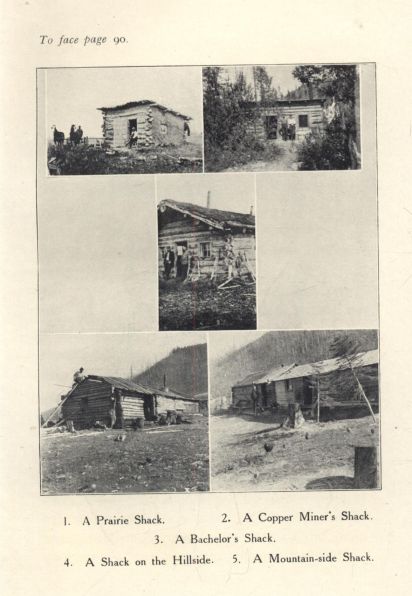
1. A Prairie Shack. 2. A Copper Miner's Shack.
3. A Bachelor's Shack.
4. A Shack on the Hillside. 5. A Mountain-side Shack.
Those who had met and heard Dr. Ransom
before, vied with each other in
recalling events connected with his former
visits. They remembered his appeal for
their "fair share" of money to help build
the little church. Everybody said the
amount could not be raised until
Dr. Ransom came, but after he had painted
his word-picture of their glorious heritage—after
he had pleaded that that heritage
should never become "the wild and woolly
West"—after he had shown the Gospel
as the "antiseptic influence" in the life
of the great Westland—after he told them
what they got their land for and what it
was worth that day, and after that strong
voice, with its downright sincerity, had
been lifted in prayer, everybody in the
dining-room of the boarding-house knew
the amount was raised.
And then that hand-clasp, and that
identification of himself with the poorest
settler's problems, and sorrows—who
could forget these things?
"D'ye mind," said Dick McNabb,
"the time he was here just after
Alex. McLaren's son was killed on the railway?
Well, sir, I'll never forget seeing them
two old men standing with hands clasped.
The Doctor looked as if it might 'a been his
own boy what was killed. "McLaren,"
he said, "I'm sorry for you. I once lost
a boy, and I know what it means;" then
he whispered something, and Alex. wiped
away the tears as he still clung to the old
Doctor's hand, and I guess they stood
that way for two or three minutes."
"Well, sir, you bet Grant Sinclair
won't miss Wednesday night," put in
Dan McLean from behind the counter.
"D'ye mind when Dr. Ransom was here,
Grant couldn't walk at all! Say! will
I ever forget that day in the Fall when he
fell off the fence on to the scythe he was
carrying? The gash was a foot long,
and there was no doctor within thirty
miles, and the road wasn't as good as it is
now, and it ain't anything to write home
about even yet. Bill Grayson was the
only one who had the grit to sew the gash
up, and it was fourteen hours before the
doctor got here. Nobody thought Grant
would get over it; he lost so much blood.
He'd been on his back about two months,
I mind, when Dr. Ransom came. It was
one of them dirty days when it don't
know whether to snow or rain, but the old
Doctor had heard about Grant and was
bound to get out there. The folks said he
did him more good than the regular doctor
did. Jim Sinclair and the boys had rigged
up a pair of crutches so's to get Grant
a-moving around, but they didn't make
a very swell job of it. Well, sir, about
three weeks later the slickest pair of
crutches you ever set eyes on come out
here with some express of mine. They
was addressed to Grant and marked
'Rush.' Mind you, they come from
Toronto, and they fitted Grant as if he'd
been measured for them. Jimmy said
after they got the crutches he remembered
the old Doctor kind o' spanning the quilt
along Grant's side while he was talking,
but he never paid no particular attention
to it, but he says that's how he must 'a got
the measure."
The days between the thirteenth and
the nineteenth were spent by Mr. Stewart,
the student missionary, in covering the
district, so that all the scattered settlers
should know of Dr. Ransom's visit. On
Tuesday morning he borrowed an extra
robe, and, hitching up his team of bronchos,
started on his journey to M—— Station.
The roads were heavy, and twenty-five
miles was a hard journey through the
unpacked snow. By mid-afternoon he
reached the railway, and soon had his
ponies comfortably stabled in a near-by
barn.
About midnight he tramped through
the deep snow to the dimly-lighted station.
The night operator reported the train as
an hour late, with the additional
information that she would probably lose a
little more time on the grade which lay
about ten miles away.
Shortly before two o'clock the welcome
whistle was heard, and in a minute or two
the midnight express slowed down for
M——. The tall figure of the
Superintendent was behind the brakeman, on
the steps of the day-coach, and there was
a wave of recognition before the cordial
hand-clasp and words of greeting could
be given. "We'll just wait till she pulls
out," said the Superintendent, as
Mr. Stewart started to move away after the
exchange of greetings. "Yon operator
has the tongue." His duties performed
at the baggage car, the operator returned
to the office dragging a heavy trunk
along the plank platform. "Man! but
that's a great muscle you have," said the
Doctor genially, and in less than a
five-minute conversation he knew the man's
name, Old Land home, length of time in
Canada, and church relationship. As he
gripped the hand in bidding good-night,
he got in a message that the operator has
never forgotten. In recalling the visit to
the writer many months later, he said,
"He's a gran' man that: he'd be a wechty
man gin he lived in Edinburgh. He mak's
you think."
"Well, Doctor," said Mr. Stewart as they
neared the place where a bed had been
prepared, "you'll be glad enough to get
right to rest."
"How far are we from your field, Mr. Stewart?"
"About twenty-five miles," was the reply.
"Well, then, if your team is fit, I think
we'll not bother about bed just now, but
get out there." Despite the protests that
were made in the Doctor's interests, there
was a kindly insistence that resulted in
the bronchos being immediately harnessed
for the return journey. In the month
of February, with deep snow and zero
weather, a twenty-five mile drive between
3 and 8 a.m. is by no means a pleasure
trip. As the little animals ploughed their
way through the drifts, the Superintendent
every now and again raised his mouth
above his coat collar to express his
admiration. "A gr-reat team that—a gr-reat
team."
The day was dawning as on Wednesday
the 10th the student missionary and the
eagerly-looked-for visitor, frost-covered
and shivering, drove up to Mackenzie's
barn. Mackenzie and his wife were just
getting on the fires, and were not a little
surprised at the early arrival of their
distinguished guest. Embarrassment could
not, however, remain long in any home
where Dr. Ransom entered. Everybody
but the indolent admired and loved
him, and there seemed to be no
circumstance or combination of circumstances
but he could adapt himself to.
After breakfast Mr. Stewart was ready
enough to get a few hours' rest, and having
conferred with Mrs. Mackenzie regarding
the readiness of the spare room for the
Superintendent, he invited the latter to
retire. "Did you think I came out here
to get a sleep, my boy? When would we
visit the field? No! no! thank
you." Protests were again futile. "I have to
meet two Committees on Saturday, in
Winnipeg, and you must get me back
to M—— Station in time for the 11.30
to-morrow morning. What about a horse?
Can we get right away?"
"Ain't the old Doctor a horse to work,"
said MacKenzie to Stewart while hitching
up his best driver.
Hurried but helpful and purposeful calls
were made until it was time to return for
the evening service. The visit that stands
out most clearly in the Missionary's
memory was one made at the noon-hour.
Alex. McDonald's place was the one
spot in the whole district where no man
who had any respect for his stomach would
ever dream of dining. Few, indeed, cared
even to enter the dirty little shack. And
so it was not to be wondered at that
the Missionary was planning to pass
McDonald's on the up trip, and to
reach one of those bright, clean centres of
hospitality that are usually to be found
in even the most isolated district. But
"the best laid plans of mice and men gang
aft agley."
"Who lives in the shack on the hillside?"
asked the Superintendent.
"A family named McDonald," was the
reply, "but they never enter a church—-they
live like pigs, and I think we had
better leave calling there until we see how
our time holds out."
"We'll go there for dinner," was the
almost brusque response of the Superintendent.
Stewart laughed incredulously.
"I don't think you could swallow a
homoeopathic pill in that shack, Doctor."
"We'll go there for dinner, Mr. Stewart.
It'll do them good."
"No finer missionary stands in
shoe-leather than Caven Stewart" was a
testimony that all who knew him heartily
agreed with, but Stewart had an absolute
horror of dirt, and it was with feelings of
distressful anticipation that he dragged
open McDonald's rickety apology for a
gate, and drove across the rough swamp
to the dilapidated shack on the hillside.
The barking of the dog brought faces to
the little four-paned window. "Drive
slowly! Give them time, give them
time," said the Superintendent, as the
faces quickly disappeared. A few fowls
fluttered from within the shack, and a
family pet in the shape of a pig grunted
disapproval at being forced to take an
outside berth. For fully three minutes
there was such a house-cleaning as the old
shack had not known for many a month.
Alex. McDonald, pulling a dirty
corduroy coat around him, sauntered over
to where the visitors were getting out
of the cutter. He "guessed" that the
Superintendent and the student could find
accommodation for their horse, and a bite
for themselves during the noon hour.
"We ha'ena got much of a place," he
said, as the Superintendent lowered his
head to enter the miserable shack.
Each member of the family received a
cheery greeting from the magnetic
superintendent, who never seemed at a loss to
say the fitting word. Mrs. McDonald was
profuse in explanations and apologies.
"We wesna expectin' onybody, and these
dark mornings it seems to be noon afore
you can get turned round." The visitors
entered sympathetically into the various
reasons why things "wesna just straight."
To this day Caven Stewart remembers
the deepened convictions that came to
him of the Superintendent's possibilities,
as he watched him enjoy his dinner. By
various excuses Stewart had reduced his
own portion to the minimum when the
pork and potatoes were dished up, and
even then more food went to his pocket
than to his mouth. But not so with the
Superintendent. Not only did he have
a liberal first supply, but actually passed
back his plate for more, meantime
complimenting McDonald on the gr-reat
potatoes he grew and the fine pork he
raised, and incidentally remarking that
the best potatoes and the finest pork were
easily spoiled in the hands of an
incompetent cook. When he told Mrs. McDonald
that the dinner was just as he liked
it—well-cooked and plain—his place in her
highest esteem was fixed. That he was
a man of excellent judgment she had no doubt.
McDonald's Old Land home was well-known
to the Superintendent, and as
scenes familiar to both were recalled,
geniality prevailed.
At the close of the meal the Doctor
asked for "The Book." Anxious looks
were exchanged by the occupants of the
shack, and ere long three members of
the family were uniting in the search.
When at last, to the great relief of the
searchers, a dusty but unworn Bible
was produced, the Superintendent held
it reverently in his outstretched hand.
Looking squarely at the head of the home,
he said with a yearning that no man could
miss, "Eh, mon, but I'm sorry—sorry it's
not worn more. It's the best piece of
furniture you have in the house. If any
man ought to have a well-worn Bible it's
a Highland Scotsman." A few verses were
impressively read, and then for the first
time in its history the miserable shack
contained a group kneeling in the attitude
of prayer.
There were no meaningless pleasantries
when the little company arose. It seemed
as though the place was hallowed ground.
A man and his Maker had been in
communion. The invitation to "cast thy
burden upon the Lord" had been heeded,
and with an exquisite tenderness the
anxieties, the problems, the hopes and the
fears of the little home were brought to
the Great Burden Bearer.
The parting was little short of
affectionate. The last hand-clasp was
McDonald's. "McDonald, I can scarcely
believe you've never darkened the kirk
door, and you an Aberfeldy man. I want
you to give me your word for it that next
Sabbath morning you and the good wife
and the bairns will make a new start
and be found worshipping God. Six
months from now I expect to hear
from Mr. Stewart that you've been regular
in attendance at the house of God.
McDonald! give me your word that
you'll not disappoint me—nor Him!"
No words came from McDonald's lips,
but there were moistened eyes and a
lingering hand-clasp that made the
Superintendent's heart glad.
When, nine months later, Stewart was
leaving the field for college, and was
reporting conditions to the Superintendent,
he wrote as follows: "You will remember
the visit I did not want to make at the
McDonalds. May God forgive me for my
lack of interest and of faith! Since last
February McDonald, with some of his
children, has never missed a service. At
the Communion in June, Rev. Mr. Rowatt
came over from the Fort and welcomed
seven new members, John McDonald,
his wife, and their son Bruce being among
the number. The Bible you helped them
to resurrect has been much 'thumbed'
since then. I am thankful I stayed the
year on this field. To have seen the change
that has taken place in the shack on the
hillside has done more for me than the
whole year's course in Apologetics."
It had been a bitterly cold drive across
what was known as "The Plains," and
the student missionary was thankful when
his pony reached the shelter of the
jack-pines. After a few miles of bush a
small "clearance" was reached. The
low-roofed shack standing at the back of it
never looked more inviting than to-day;
but though twenty-five miles from the
"highway of commerce," there were
homes still more remote that had been
expecting a visit from the little preacher
for some time, and so, despite his pony's
protest against driving by even poor
shelter in weather like this, he had regretfully
to tell her she might not turn in that
road to-day. As was the missionary's
custom in passing any dwellings, he waved
his greeting in the direction of the humble
shack. Before he had gone many yards
the good-natured pioneer farmer was
outside shouting his "halloos," and, on being
heard, signalled for the preacher to stop.
Making his way through the snow, he
said, "Ain't you going to give us a call
to-day? Better come in and get thawed
out; soon be grubbing time."
"Not to-day, Mac, thanks," was the
reply. "I've been to your place pretty
often, and I thought I ought to make the
end of this road to-day."
"Well, if you won't come in, I'll tell
you what I was a-wanting to ask you.
There's a fellow I'd like you to see awful
well. Say! do you call on anybody else
except Protestants? You do, eh? Well,
I wish you'd see Jimmy Hayson. He's
in a bad fix. They shipped him home
from the camp. He was cookee there,
and I guess he couldn't stand that kind
of life. His stummick's gone on a holiday.
Anyway, he's most all in. It ain't much
of a trail to follow, but after you pass
Marston's you'll see a wood road, and
then, if you keep your eyes skinned, on the
north side you'll see, about forty rod along,
a foot track—Jimmy ain't got any team—just
follow the track, and you'll stumble
into his shack."
The second stop that afternoon was at
Hayson's. It was a poor place for a sick
man to be in. The entire furnishings of the
home would not have been a bargain at
five dollars. The wife was most grateful
for the visit, and before the missionary
had spoken to the invalid, she said,
"You are the only preacher ever in our
house; and will you make a bit of a
prayer for Jimmy?" A few flour sacks
had been made into a curtain, and the
faithful wife pulled them aside and gazed
lovingly at the sick man, and then
questioningly at the missionary. The
missionary felt that not many prayers would
have to be made for Jimmy, and perhaps
there was an increased tenderness in the
voice as it was lifted to the Friend of the
weary and heavy-laden. The five children
were not very clear as to what was going
on, and during the devotions the dog kept
up a low growl of distrust at the whole
procedure, but the wasted form of poor
Jimmy, and the subdued sobs of the wife,
overshadowed minor disturbances.
It was the first of almost a dozen calls
during the next two months. A round trip
of thirty-two miles once a week meant
something over unbeaten tracks; but
Jimmy was in need, and there was only
One Helper: other helpers had failed,
and Jimmy was pathetically eager for
something he had not hitherto received.
On the occasion of the fourth visit, the
wife called the visitor as far away from
the sick bed as the dimensions of the
little shack permitted. "Would you"—the
voice was agitated—"would you——.
Oh! please, you won't mind me asking,
but would you stay for dinner; we've
never had a minister take a bite in our
house, and Jimmy'd be so pleased?"
The invitation was most gladly accepted.
What a time ensued! How the poor soul
exerted herself to prepare that meal!
It was over an hour before the "bite"
was ready, and in that hour one child had
gone over two miles. The preacher saw
her fluttering rags as she ran across the
snow. He saw her come back with a little
newspaper package. It contained a knife
and fork—two miles, that the preacher
might have a knife and fork! The meal
was not appetizing, but after the trouble
it had cost, no man with a heart could leave
a morsel which it was possible to dispose of.
Day by day Jimmy weakened, and it
was evident that he needed attention and
quiet, such as was not possible in the
one-roomed shack. Could he gain entrance
to the distant hospital, and was it possible
to provide anything like a satisfactory
conveyance in which the sick man could
safely make the journey from that pioneer
district? These possibilities especially
occupied the mind of the missionary on a
subsequent visit.
He talked to the now worn-out wife about
the matter. Prejudices against hospitals
were very real in that remote district, and
it was some time before she could be
convinced that such a course would be in the
interest of the family. The few neighbours
did much coming and going for the next
two days, and such blankets and wrappings
as the community afforded were provided
for the cold journey. Bricks and hardwood
sticks were to be heated and placed around
Jimmy to keep him as warm as possible.
Henry Wallis was to make the trip the
day before to arrange for the replenishing
of these, and for some nourishment for
the sick man, at three selected stopping-places.
It was late in the evening when the
sleigh pulled up in front of the hospital.
The sufferer had stood the journey better
than was expected. The "Sisters" soon
had Jimmy in the most comfortable bed
that he had occupied for years.
Two days later the missionary called
at the hospital as early in the morning
as he was permitted to. Jimmy knew his
end was not far distant. He could speak
but little, and in order to hear the
feeble whisper it was necessary to put
an ear close to the patient's lips. Very
slowly the words came:
"Say—about—Shepherd." Once more the Shepherd
Psalm was repeated with its message for
those whose lives are overshadowed.
Jimmy's eyes spoke his thanks, and
tenderly the student wiped the tears off
the sunken cheeks. Something else was
wanted. Again the whisper was with
difficulty understood:
"Tell—about—rest." It was the words that only the
publican Matthew has recorded that Jimmy
wanted to hear.
Slowly they were repeated: "Come
unto Me, all ye that labour and are heavy
laden, and I will give you rest." Once
again the parched lips moved:
"If—I—could—see children—that's all." The eyes
were so irresistibly pleading that the
student could only reply, "I'll try,
Jimmy."
A few words were spoken to the nurse.
How long would Jimmy be here? She
thought he might go that night. Certainly
within three days the end would come. It
was no small undertaking to bring a family
such as the Haysons into town. Clothing
had to be procured in order that the little
ones might be protected on the longest
journey any of them had ever taken.
Their own scanty attire would afford little
protection from the cold wind. And so
hurried visits were made to a few homes,
and to the stores of one or two merchants.
The case was briefly stated, and a dozen
hearts instantly kindled into kindness for
the needy ones in the lonely home. A
wardrobe, such as the Hayson family had
never dreamed of, was soon stowed away
on the missionary's "jumper."
Inside of two hours the long, cold drive
was commenced. At each shanty and
shack word was given as to the sick man's
condition, and what the present journey
was for. Within five miles of the lonely
home, which would soon be the abode of
the fatherless and widow, the missionary
stopped for the night. In the
dimly-lighted shack of Sandy MacGregor Jimmy's
last request was made known. MacGregor
rose from a nail-keg on which he was
sitting, and said slowly and emphatically,
"Well, if Jimmy wants to see the children,
he's a-going to see 'em."
The student grasped the roughened hand
of the speaker gratefully. "I knew I could
count on you, Mac. Thanks. I'm tired,
so I'll say good-night. I can sleep now
that that's settled."
Before the missionary appeared the next
morning, Mac had everything ready for
driving Jimmy's family into the town
where the husband and father was rapidly
nearing his end.
The horses were driven as hard as was
consistent with mercy. Jimmy was still
alive, the Sister told them as they stood in
the hall. In a moment they were beside the
bed. It was one of those scenes that live
in the memory. The sobbing wife, kissing
again and again the poor, wan face. The
little ones weeping, perhaps more in
sympathy with the mother than on account
of their own realization of the coming
sorrow. Quietly the large screen was
placed around the group at the bedside,
and for a few moments the family was
left alone. The journey had been
accomplished just in time. In less than an hour
Jimmy was gone. His last request was
for the passages of Scripture mentioned
above. "Yes, that's it," he whispered,
"rest—rest." The wasted arm was raised
a little as if he would put it around
the missionary's shoulder, but the poor
Cookee's strength had departed. They saw
he would say something more, and ears
were alert to catch his every word.
"I—think——" Then there was a long pause,
and the sunken eyes turned from face to
face as though seeking to tell them what the
tongue refused to utter. They waited with
tear-bedimmed gaze, but no other word
was uttered. Ere long there was a rattling
in the throat, and the death-pallor
increased; a few short and long-separated
gasps and the Cookee had finished his
course. They laid him away in the quiet
little cemetery during an almost blinding
snowstorm.
With less than five dollars in cash, and
a rough bit of land heavily mortgaged,
the mother went back to the lonely shack
to toil through weary days to provide
for her five little children. With occasional
help from other settlers, the struggle for
existence was made a little less severe.
* * * * *
Ten years have passed away. The
poverty-stricken pioneers of earlier days
have cleared large sections of land, and
the earth has brought forth her fruit.
Prosperity abounds. Where Jimmy Hayson's
shack stood is an attractive modern
farm-house. A mother looks proudly at
her farmer son as she introduces him to a
city pastor who is visiting the mission field
of his student ministry. A few hours
later, in the quiet of eventide, she stands
with the visitor exchanging incidents of
bygone days.
"It's been a pretty hard road to travel,
sir, but the neighbours were just as good
as they could be after Jimmy went. But
I often say to my boy Allan that there
is only One who can help us in such times
as I passed through then."
A severe snow-storm had raged for over
twelve hours, and the home missionary
was twenty miles away from head-quarters.
His little Indian pony was "all grit," as
one of the settlers said, but with darkness
only two hours away, the preacher began
to reconsider his decision to make The
Valley and home that night. Not a few
days "Queenie" and her driver had
travelled fifty miles, but to-day the drifting
snow almost blinded man and beast, and
with eleven miles of unbeaten path on
the storm-swept plain immediately before
him, the missionary hesitated. At best it
would be dark before he reached the bush,
and he had not forgotten a former
experience, when anxious hours were spent
in a similar storm seeking to find the
rarely-travelled road that led from the
plain through the bush to The Valley.
One reason out of several that made him
anxious to get home was the fact that Widow
Nairn's wood-pile needed replenishing. She
was a poor friendless old woman, who had
remained on a plot of ground to which she
had only "squatter's rights," and while
the few scattered neighbours were kindness
itself, the widow was, as Grayson said, so
"blamed peculiar" that it was "hard to
know how to do anything for her without
making her mad." Perhaps she could
get along for one more day, and the
missionary resolved to drive directly to
her shack the next morning.
The decision being made, he spoke
cheerily to his pony, and after a little
manoeuvring, the cutter was turned
around and Queenie was headed towards
the spot where two solitary pines rose
like sentinels from the underbush. The
road to Pearson's was not far beyond these
landmarks, and the home was one of the
few he knew in this rarely-visited district.
An hour later he peered anxiously
through the storm. The snow melting
around his eyes made seeing difficult, and
he began to fear he had taken a
wood-path instead of the one intended.
Pulling up his pony, he listened for the
jingle of bells, the bark of a dog, the call
of a settler, or anything that might help
him to locate some abode, but no sound
except that made by the winter wind
reached him. Tying his pony to a poplar,
he plunged ahead in an endeavour to
find out something about the road he was
on. In a few minutes he saw that the
trees closed together again, and knew that
the pony had taken the wrong track.
Once more the cutter was turned around
with considerable difficulty. It was a hard
return journey; every sign of their own
recently-made track was gone, and the
snow was still falling.
No more welcome sound had been heard
by any ears that day than when distinct,
though somewhat distant, the tired traveller
heard the bark of a dog. Stopping his
pony, he engaged in a barking contest,
until he was sure of the direction from
which the sound came. "We are all right
now, thank God," he said aloud.
Through the trees a light flickered a few
minutes later, and soon a pioneer's home
came into view. The little clearance with
its low-roofed log-house was not one the
missionary had seen before, but where
there was a house there was hospitality
on a night like this.
Bill Sanders was soon assisting the
traveller to unhitch, and with the aid of
a "bug"[*] Queenie was crowded into the
roughly constructed stable. There were
times when it would have been both
difficult and dangerous to have put her
into such quarters, but that night she
seemed to understand, and behaved
herself accordingly.
The occupants of the little home
consisted of father, mother, two boys and two
girls. When the missionary introduced
himself there was manifest embarrassment
on the part of the wife, and the children
gazed in wonderment from "the room"
door; they were unwilling to run any
risks through getting too close to this
human novelty until they saw how he
acted. "You see, sir, we don't have
many people here, and they aren't used
to strangers: I guess you are the first
minister that's been in this house; and
then, as the husband went to bring in a
fresh supply of firewood, she added half
apologetically, "but I was praying all
week that God might send somebody in
here that loved Him. When I used to
work for Home Missions in Ontario, I never
thought how much I'd long for the visit
of a missionary myself some day; it's
very lonesome sometimes."
Before the missionary retired to his
allotted space on the floor, he asked
permission to read a few verses of Scripture.
There was no response from the father:
the mother said, "Yes, please."
The Scripture and prayer were for the
encouragement of the heavy laden, and
tears were wiped away from the mother's
eyes as the little group arose from
kneeling.
When prayers were mentioned after
breakfast the next morning, Bill Sanders
deliberately left the shack. "Two doses
of religion within twelve hours" were too
many for him, as he often said in after
years when recalling the missionary's visit.
"We've a lot to be thankful for," said the
much-tried wife, as the visitor spoke a few
words of encouragement. The missionary
glanced at the mud floor, at the roughly-hewn
table, at the round blocks used for
chairs, at the newspaper curtains, at the
flour-sacks that partitioned off the
bedroom, at the miscellaneous and damaged
collection of dishes and tins that rested
on the coverless table, and wondered
wherein the "lot to be thankful for" lay.
"We don't get along well with the farm;
somehow Bill don't——." The words
were checked, and nothing suggestive of
complaint at the husband was uttered.
"The children are well," she continued,
"and they are obedient," and then, with a
fine reticence that cannot be written, she
added slowly, "I am trying to teach them
about God; and I often tell them that if
the shack isn't a credit to us, we must
try to be a credit to it. You see, sir, I'm
not strong, and with the little ones to look
after, I can't work outside as much as a
settler's wife ought; but anyhow, I'd rather
leave my children a good character than
anything else. Yes, God knows I would."
Late in the morning the storm was over,
and with a promise on the part of the
missionary to return again as soon as
possible, and on the part of the children to
come to a Sunday School being started
in the four-mile-distant schoolhouse,
good-byes were said.
Many weeks passed before the missionary
could visit again the lonely little home.
This time the mother, pale and trembling,
was struggling from the stable with a pail
of milk. Inside the house lay a
four-days'-old baby boy. The missionary's
heart was heavy. Since his last visit
he had heard of the faithfulness and
goodness of the wife and mother, and of
the brutality of the husband and father,
but he found it hard to believe that any
man would compel his wife to do what
this poor creature had been made to do
in such a physical condition.
At first there was fight in the
missionary's heart, but when the lazy,
cruel husband returned from his
rabbit-snaring, the fighting spirit had been
replaced by a great yearning for this man's
salvation. To angrily rebuke Bill might
only add to the wife's burden, while "the
soul of all improvement is the improvement
of the soul." Bill's need was of a changed heart.
A prayer for guidance was breathed forth
as he walked to meet one who, a few
years ago, had promised to protect and love
the wife whose spirit was crushed and
whose heart was well-nigh broken by
neglect and abuse.
The two men stood talking for some
time on the evening of that now memorable
day. Often the pale face of an anxious,
prayerful wife looked out through the tiny
window. Perhaps the prayer within was
mightier than the simple message spoken
without, but at any rate new desires and
purposes were awakened in Bill's heart that
night. There was no sudden "light of
glory," or ecstatic condition, but during
the next few weeks it was evident that
this man was being changed. When the
missionary suggested getting his pony
hitched, Bill urged him to remain overnight.
At retiring time, it was the father
who handed a much-soiled Bible to the
preacher. Strange that so simple an act
as that should cause the wife to weep, but
at that hour she saw the dawning of a new day.
Three weeks later the scattered settlers
"visiting" outside the schoolhouse on
Sunday afternoon were amazed to see Bill
Sanders bringing his wife to church on the
"jumper."
The singing in the little service was
usually more hearty than harmonious.
For two or three years it had been an
unsettled and vexed question as to whether
Sam Gadsley or Martha McLeod was the
finer singer. One faction deemed the
matter settled beyond all controversy
when a late arrival at the service confided
to a few friends at the close that he
"could hear Sam, good, clear across the
concession," while he "couldn't have told
whether Martha was there at all, at
all." Martha's friends felt keenly the consequent
verdict of the community, deposing their champion.
To-day the missionary broke all his own
previous records in the singing of "Praise
God from whom all blessings flow."
People said "it was a great sermon
that the little parson preached" that day.
Although the congregation may not have
known it, the preacher almost broke down
in prayer, his heart was so filled with
gratitude. When he shook hands with
Bill, there was a grip that thrilled
new-comer and preacher alike. To the wife
he managed to say, "I'm so glad," and
the now happy woman looked as though
the opening doxology had become a large
part of her very self.
* * * * *
The visit of the Home Mission Superintendent
is always a great day in these
isolated places, and when on his next
visit he welcomed the new members into
full communion, and took father, mother,
and two children from the little log-house,
not a few felt it was the greatest day the
schoolhouse had seen.
During the subsequent days of the
missionary's term of service, whenever
there was work to be done, Bill Sanders
could be counted on.
* * * * *
In the summer of 1912, after a lapse of
ten years, the missionary stood once more
in The Valley. As is true of most Western
communities, everything was changed. A
little city had arisen—the old schoolhouse
was no more, and the once well-known
places could no longer be located. But
there stands a beautiful little church not
far from where the old schoolhouse once
stood, and one of the honoured elders
bears the name of William Sanders. Two
of his daughters teach in the Sabbath
School, and of the five children, a
well-known business man said, "Why, you'd
just be proud of every one of them, if
they were your own."
In the churchyard a marble slab bears
the name, "Mary Perry Sanders," and
near the base, "She hath done what she
could." As was her desire in the days of
struggle and isolation, the patient, faithful
mother had left the precious legacy of a
good character to her children.
Thus had the seed sown brought forth
its fruit after many days. Among hallowed
memories, few are so precious to the
missionary as that of the day when his
now old friend "Queenie" took the wrong
road. And whenever on lonely prairie,
in quiet hamlet, or noisy city, he hears a
congregation sing Cowper's hymn, "God
moves in a mysterious way, His wonders
to perform," he thinks of that distant,
stormy winter day when a barking dog
led him to a home that is now transformed,
and to a darkened life that was in God's
goodness guided into that light "that
shineth more and more unto the perfect
day."
The hotels in the town on the "boundary"[*]
were crowded. For several days the men
had been returning from the bush after
the winter's cut, until over a thousand
"lumber-jacks" from the various camps
in the immediate vicinity had taken
possession of the place. For most of these
men the bar-room was the only social
centre, and the arrival of each gang meant
the recognition of old friends and the
celebration thereof in a call for "drinks
all round."
In a hallway adjoining a popular
bar-room the missioner stood sadly watching
the procession of hard toilers losing
at the one time their winter's earnings
and the control of their faculties. It
seemed useless to plead with the men
either collectively or individually.
"It's the only way we've got to let off
steam, boss—it's a fool way, you bet, but
here goes." The speaker was a man of not
over thirty years of age. With unsteady
step he entered the bar-room again, and
pushed his way to the double line that
kept the bar-tenders perspiring as they
sought to respond to the sometimes cursing
demands for more rapid service.
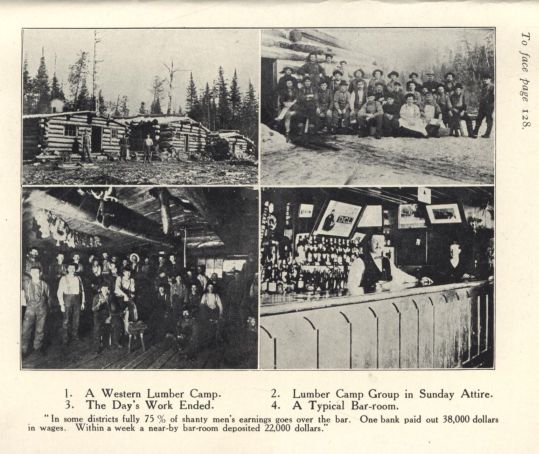
1. A Western Lumber Camp. 2. Lumber Camp Group in Sunday Attire.
3. The Day's Work Ended. 4. A Typical Bar-room
"In some districts fully 75% of shanty men's earnings goes over the bar.
One bank paid out 38,000 dollars in wages. Within a week a near-by
bar-room deposited 22,000 dollars."
Along the hallway were men in various
stages of intoxication, and the missioner
knew from past experiences that some of
the men were only at the beginning of a
debauch that would last for several days,
perhaps weeks. Much had been done by
the lumber companies to improve the
conditions in camp and to brighten and
turn to good account the long winter
evenings. Then, in order to protect the
earnings of the men at paytime,
arrangements were made to furnish immediate
facilities for banking or for remitting
home; yet everything proved ineffective
in the case of some. The open bar with
its foolish and dangerous treating system
had led to what had become known
around town as "the lumber-jacks' annual
spring spree."
The cashier of one of the companies
sauntered through the crowd, and the
missioner entered into conversation with
him, questioning him about the men
thronging the bar-room. "Yes, Reverend,
I know most of the boys; I make out
pay-checks for over two hundred of them, and
in my time I've run across thousands, and
most of them are splendid fellows if you
can only keep the booze away from them.
They look pretty well damaged just now,
eh? And they'll be worse yet. When
they get started you can't stop them till
they're at the end of their tether. See
that fellow lighting his cigar in Ern. Dean's
pipe? Wait till he turns round a
bit—there! now! his ear's half gone, see?
He's some fighter, believe me! A year ago
last month somebody got a few bottles of
whiskey into the camp on the q.t. We
try to keep it out, but you might as well
try to keep out mosquitoes in June. Well,
sir, that night Bill got into a fight with a
chap called Frenchy, and in about ten
minutes Frenchy needed an identification
label on him. Bill was clean plump crazy,
and as Frenchy had been looking for a
scrap for weeks the boys let them have
their innings for a while. Just before the
boys prised them apart, the two of them
took a deuce of a tumble to the bunkhouse
floor, and somehow Frenchy got his teeth
on Bill's ear. We couldn't patch the thing
together, so Bill had to foot it nearly thirty
miles to the nearest town, and you see what
the crossbones had to do to trim off his
receiving apparatus? Bill gets ninety
dollars a month—I handed him a check
for four hundred and fifty last Saturday,
and it would be safe to bet the whiskies
he hasn't fifty dollars left right this minute.
He doesn't know what he's done with it—quite
likely a pile of it has been swiped
when he was dead to the world. Between
ourselves, Reverend, there's lots of dope
served out right here, and when the boys
come to, a good part of their boodle is gone.
Just the other day Dick Booth was yelling
blue murder around here, and Bertois
came from the office and hooked his arm
into Dick's and said, 'Come on, Dick,
and have one on me.' In less than five
minutes there wasn't so much as a chirp
from Dick, and he looked like the dickens
for a few seconds, and then he slid down
the wall to the floor, and Bertois and Sam
carried him into the snake-room. You
bet Bertois fixed Dick's drink alright.
The trouble comes between season when
the boys are off a few weeks. They come
into town to kill time, but it works the
other way round."
Two days later the missioner was sitting
writing at the hotel table when Bill,
blear-eyed, unshaven and dirty, came
staggering toward him. The voice was
almost terrifying in its intensity of appeal,
"For God's sake give me something to eat;
I've had nothing but that stuff (pointing
toward the bar-room) for three days."
Before anything more could be said,
Bertois, the proprietor, hurried from
behind his desk, and grabbing Bill by the
shoulder, uttered an oath, and dragged
him to a door at the end of the hall.
Unfastening the door with his latch-key
he gave Bill a vigorous shove, and the
intoxicated man, stumbling over some
object, fell heavily to the floor. Banging
the door, Bertois turned to the basement
stairway just around the corner, and in
a sharp voice called "Sam." Sam
immediately responded to the call.
"How in the —— did Bill Bird get out
of there."
"Didn't know 'e was out, sir," was the
reply.
"Did you give anybody your key?"
"Hi did not, sir."
"Well, then, you must have left the
door unlocked; mind you don't let any
more of them d—— fools out."
As calmly as was possible the missioner
protested against the treatment Bill
received.
"What would you do with them?
Would you want them around the house?"
was the gruff reply. "Give them a bed?
Not much! We don't keep beds for that
brand. The only thing you can do is to
kick 'em into the snake-room. You don't
know anything about Bill's kind. He's
seeing life; them fellows have been
counting on this blow-out for months."
An hour or so later the missioner found
Sam alone in the basement. The old
man was worthy of a better job than the
doing of the dirtiest and most objectionable
work around a lumber-town hotel, but
times had gone hard with him of late years,
and his few relatives were on the other
side of the Atlantic.
"No, sir, hit ain't the kind of place
hi expected to be in at my hage, but
beggars mustn't be choosers, you know,
sir, and after hi cut me foot half off
with a hax I ad to take wot I could
get, especially as me rheumatiz bothered
me a lot. Wot's the snake-room like, did
you say? Hit just depends oo's hin it.
Hit's chuck full these days, I'm sorry to
say, and it hain't a sight yer reverence
would like to see. You want a peep hin,
eh? Well, hi don't know as how you'd
be allowed; the boss is rather perticlar
about who sees 'is customers hin the
snake-room. It hain't a very good
hadvertisement, hin my opinion."
Nevertheless Sam agreed, if the territory
was clear, to show the missioner the
snake-room. By way of apology, the old man
explained that he had often told his boss
that it was a shame to put men into such
a place without any kind of bed, with no
food, and frequently, in decidedly cold
weather, without any heat.
When the opportunity afforded itself,
Sam and the missioner went quietly
upstairs and, unseen, entered the snake-room.
Accustomed as he had been to see the
effects of alcohol and evil-living, the scene
before the visitor was a fresh and terrible
revelation of their destructive power.
The room was probably fifteen feet
square. Its furnishings consisted of one
table and two framed pictures—the latter
being advertisements of "popular brands of
whiskies," which were said to have "stood
the test for nearly one hundred years." Some
results of the test were upon the floor.
In order to get inside, Sam had pushed
hard against the door, crowding back the
feet of the man nearest. There was
scarcely more floor space than the two
men needed to stand on. Curses, snores
and groans came from the filthy, stench-laden
mass of men that covered the floor.
Several boards in the wainscotting were
spattered with human blood. One man
with a recently made gash across his
forehead was lying on his side, and with
eyes closed, kept striking out with his fist,
sometimes hitting the leg of an old man
who seemed absolutely paralysed with
liquor, and sometimes hitting the partition.
Every blow was accompanied by profanity.
Partly under the table lay two camp
cooks. One of them, Heinrich Lietzmann,
was a most generous individual, and a
great favourite with his fellow-workers.
Because of his appearance he was dubbed
"Roly-Poly" Lietzmann. His broken
English was very attractive, and nothing
pleased the younger men better than to
"get him going" on international politics.
Judging from his terribly bruised face, he
had either fallen heavily or been in a fight.
Poor Heinrich made several attempts to
raise himself to a sitting posture, each
time falling back with a disturbing effect
on the men nearest him, and receiving
therefore their muttered curses, which he
returned in full measure.
Along the table, on his back, lay
Chris. Rogers. Nobody knew the history of
Chris. although, because of a remarkable
gift of speech which he manifested when
excited by liquor, the report that he had
once been a "Shyster lawyer" in a Western
State was generally believed. He was
far above the average lumber-jack in
knowledge, but far below in vice. After
the discovery of an unusually mean trick,
Bill Bird had, in the opinion of the camp,
fittingly described Chris, when he said,
"That dirty rascal is so near mongrel dog,
that if he had a bit more hair on him he'd
start running rabbits." Just why Chris. had
been given charge of the camp stores
was a mystery, but for nearly two years
he had held the position. He was a slender,
wiry man with a singularly repulsive face.
His teeth were gone, and his long pointed
moustache drooped alongside of the hard
mouth that was continually stained with
tobacco juice. His coat and vest were
plastered with grease from careless eating
and his whole appearance suggested a
dirty demon-possessed man.
Bill Bird, the fighter, had managed to
get into a corner, and was sitting with
arms on knees and drooping head—a
picture of wretchedness. Once he
managed to look up, and for a moment gazed
in a dazed way at the missioner: "By
God! I wish I was dead:" then there was
a prolonged cry on the word "Oh," as of
a man in great agony. A few of the
stupefied men roused themselves enough
to utter a curse in Bill's direction. Gazing
once more at the missioner, Bill cried
out: "Oh! oh! the devil's got me for sure."
Sam laid his hand on the missioner's arm;
"We'd better slip out now, sir, or there
might be trouble."
With a sigh and a heavy heart the
missioner passed into the hall and up to
the room he had been occupying for ten
days. With a whispered cry, "How long,
O Lord, how long?" he fell on his knees
at his bedside, and then in silence he
pleaded with his God that at least Bill
Bird might be released from the grip of
the Evil One.
After the regular service that night, a
few Christian people met for prayer. The
missioner confided in those present, and
with sadness told of his visit with Sam to
the snake-room. "What are we doing,"
he asked, "either as a church or as
individuals, for these men? Has Satan
any opposition from us as he enslaves our
fellow-countrymen? Surely it is not a
matter of indifference to us when these men
are wrecking their own and other lives,
in dens of vice that have been allowed to
plant themselves in this town, and that
can only thrive as manhood and womanhood
are debased?
"Several lumbermen in this district say
that in the past fifteen years there has
been a steady deterioration in the men
employed in the woods. After every
pay-day, by their debauchery, seventy-five
per cent. unfit themselves for the work
to be done, and take from two to eight
weeks to get back to normal condition.
There is much that may and must be done
along social lines if we are going to arrest
these degrading influences, but in the
meantime is it not possible for us as
individuals to get into personal touch with
some of these boys, and throw around
them the protection of our Christian friendship
and hospitality? Preaching is not the
only means for advancing the Kingdom.
So much may be done if Christian people
will put themselves and their possessions
at the service of humanity, and learn to
love the lowest as well as the best of the
race. Some of these lumber-jacks might
go back to camp changed men if we gave
God a fair chance to use us. Perhaps
some of you business men, or some of you
ranchers, could get alongside of at least
one poor fellow from that snake-room, and
live for his reclamation. There are many
ways of keeping in touch with these men,
even when they return to the bush, and,
in this land of investments, you would
find nothing yield such a dividend as the
investment of your time in the attractive
presentation of the love and power of
Jesus Christ. Will you at least make the
effort, and leave the results to your
Master?" The words were spoken and
the question asked with an earnestness
that had been intensified by the
heart-rending appeal of the broken manhood
that the speaker knew was represented by
what he had looked upon in the snake-room.
In the prayerful atmosphere and the
silence that followed the question, one
man said in his heart, "I will." That
man was George Clarke.
George Clarke had a small ranch a
short distance from the town. He was
one of the most industrious men in the
Province, but his industry had not resulted
in the prosperity that most of his
neighbours enjoyed. He had met with enough
reverses to absolutely dishearten the
average man, but he had borne them all
bravely, keeping his disposition unsoured,
and his character clean. His extreme
reticence, however, often led strangers to
misjudge him, and to underestimate his
worth. In public affairs he treated himself
as though he had no right to anything but
the most inferior position, and to have
given expression to his own opinion before
even a small audience would, in his own
judgment, have resulted fatally. Once,
under great pressure, he had consented to
pass the collection plate at a church
service, but after getting on his feet,
"everything was a blur." The boys at
the rear vowed that he stumbled against
every bench-end but one, and that by the
time he was half way down the aisle "he
didn't know which side of the plate should
be up." In replacing the plate on the
organ, to the great surprise of the organist,
he unceremoniously deposited most of the
offering in her lap, and was too much
overcome with embarrassment to assist
her in replacing it. During the closing
hymn he made his escape to a quiet spot in
the bush, where he could wipe his profusely
perspiring brow and where he could
solemnly promise himself not to be
entrapped again. But despite his reticence
he was an exceptionally intelligent man,
and when any individual could get George
to express himself on questions of
importance, it was not long before "this is
what George Clarke thinks," was passed
from mouth to mouth throughout the
community. All through the years he had
resided in the West he had been absolutely
upright in his dealings and conduct, and
though his reticence prevented him from
taking an aggressive part in certain moral
reforms that were advocated from time
to time, yet there was never a shadow of a
doubt as to which side he would be on.
The cynical individual who stated that
"every man has his price," was compelled
to make an exception in the case of George
Clarke.
And so it will not be deemed irreverent
if we say that when George Clarke said in
his heart "I will," God knew he could
trust him.
Very thoughtfully George passed, with
his wife, from the meeting out into the
darkness. "I'm going to look for Bill
Bird, Mary, and if I get him I'll bring him
home—how would it do if you go on
with the Frasers?" The suggestion was
all that Mrs. Clarke needed, and her
neighbours, without any questioning,
cheerfully made room for her in their
democrat.
George halted several times on his way
to the hotel shed where his horse and buggy
had been left—he was wondering how best
to carry out his resolve. That resolve
was to do his utmost to help Bill Bird to a
new life. Years ago in the East he had
been on very friendly terms with the Bird
family, and though he had once or twice
tried to show Bill a kindness, yet he knew
he had not measured up to his opportunities
and he felt condemned. Quietly
he walked down the roadway to the rear
of the Imperial Hotel. The shouts and
oaths of the drinking and the drunken, and
the clatter of glassware reached his ears
as he passed along. Was Bill still inside,
and if so, how could he get hold of him?
A side door opened, and George stepped
back into the deep shadow of the building.
Bertois, the proprietor, and some man
whom George did not know, came to the
step and stood in the light for a moment.
Then the door was pulled to, and the men
stood silent as if listening to assure
themselves they were alone. Under ordinary
circumstances George would have spoken
to Bertois, but this night he deemed it
wiser to remain unobserved. The men
conversed in low tones at first, but after
a while Bertois' words reached him:
"Don't play too swift a game for a start:
give 'em plenty of bait; they'll keep on
biting till we land 'em. We can easily
clear five hundred from those three suckers
if you watch yourself. Dick knows the
drinks to dish out. Here's for luck!
Come on."
Re-entering they closed the door
quietly, and George still waited, hoping
that Sam would come out, and that
the old man might be persuaded to get
Bill Bird into the yard. Many times
during the next fifteen minutes the door
opened, and each time George Clarke got,
in some form or other, information of the
hell that was inside. The hour was late,
yet he felt he must remain longer. Bill
Bird was in his keeping, for like those
near the blind beggar of old, George had
heard the call from the Great Physician,
"Bring him hither to Me."
To face the crowd of men he knew
would be inside the hotel was more than
he felt equal to, and he knew that in all
probability any attempt to get Bill out
under such circumstances would fail.
Once more the side door opened—this
time slowly and unsteadily. A man leaned
against the jamb for a few seconds as
if needing support. Then some one from
within slammed the door against him, and
he slipped heavily down to the narrow
platform. There was a curse and a drunken
hiccough, and then the words the missioner
had heard were uttered again, "By God,
I wish I was dead."
George Clarke did not immediately
recognize the voice, but he did immediately
step near to his needy brother-man,
and said sympathetically, "What's the
matter, mate?"
Taken by surprise the man asked,
"Who in the —— are you?"
George recognized the voice and the form
and said, "I'm George Clarke, and I'm
your friend, Bill Bird." His hand was
laid upon the shoulder of the sickened
man, and in a kindly voice he persuaded
him to accompany him to his home. "The
place here is crowded, and we've got lots
of room at our place and can give you
a comfortable bunk for the night: come
along, Bill, for old time's sake."
Linking his arm in Bill's, he led the
staggering man to the drive-shed, and after
some difficulty and a few arguments, got
him safely into his buggy, and not a soul
in the place was the wiser.
Mrs. Clarke was a worthy helpmeet
for George, and though her household
cares were many, she grudged no extra
labour that would please her husband and
help a fellow-being. And so everything
necessary for the comfort of the fallen
man had been done. A supper had been
prepared, and the guest-room made ready.
Bill ate as freely as his condition would
allow, and then very willingly acted on
the suggestion that he should "creep in." George
gave the dirty, tired, whiskey-soaked
man such assistance as he felt
would be advisable. Once Bill raised his
heavy eyelids and appeared to be trying
to understand the "why" of things.
"This is no place for me, George Clarke—by
God, no!" The body wobbled wearily,
and Bill could think and talk no more.
And so with most of his clothes on, filthy
from his stay in the snake-room, Bill Bird
was placed in the best bed in the best
room of one of the truest homes with
which the district was blessed.
Before retiring himself, George Clarke
went to a wicker-basket in the parlour,
and searched through the family collection
of photographs. At last he found the one
he sought. It was of the Bird family, and
was taken shortly before the oldest boys
went West. George took it out to his
wife, who was still working in the kitchen.
Pointing to the face of a bright manly
boy who stood with hand upon his mother's
shoulder, he said to his wife, "If Bertois
and his gang changed a boy's face as
terribly as Bill's has been changed, and
did it in a few minutes, they would be sent
to the 'pen' for five years, and yet we let
that same gang take their time on the
job, and do it in hundred lots, and scarcely
raise so much as a finger to stop it—and
I'm as guilty as the rest of them. Poor
Bill! he used to be as decent a little
chap as you could find in the County of
Addington."
The photograph was returned to the
parlour, and dropped somewhat carelessly
upon the table, but the unthinking,
and yet perhaps not unguided act was the
first of many influences that brought
better days to Bill Bird.
Long into the morning the occupant
of the guest-room slept on. George Clarke
had opened the door quietly at breakfast
time, but the heavy breathing caused him
to leave the wearied man undisturbed.
About the middle of the forenoon, after
much yawning and stretching, Bill's
consciousness slowly returned.
He pushed back the white coverlets and
gazed around the room. Many times he
had awakened in a drive-shed, twice in
the police cell, more than once in the
"snake-room." But this morning
everything was different. What had happened?
Was he dreaming? The room was the
most attractively furnished of any he had
slept in for years, and his soiled clothes
on the chair at the bedside were strangely
out of harmony with the surroundings.
He had confused memories of events
since he came out of the camp, but he
knew he had spent his money in the way
most of his earnings had gone for the last
few years, and he condemned himself for
having been a fool again. With a
half-consciousness of some one being near, he
looked to the opposite side of the room.
The bedroom door had been quietly
opened and a bright "good-morning"
greeted him. There need be no hurry, he
was told, but whenever he was ready he
might just as well have a bite of breakfast.
No word was spoken in explanation of
his presence, nor in regard to the trouble
George had had in getting him away from
the "Imperial" the night before. Slowly
and with mingled feelings of embarrassment
and disgust, Bill attempted to clean
himself up a little. He knew he was in
George Clarke's home, and in his own
words, "felt like a fool and looked the part
to perfection."
It was not easy to face those he knew
had befriended him, for sin had not yet
lost its shame to Bill Bird.
His bedroom door opened into the
parlour, and he stood alone for a few
seconds. Then his eyes fell on the old
photograph. His hands trembled as he
held it and gazed into the faces of mother
and brothers and sister. Pictures of the
old home and of happy family relationships
of past years crowded themselves upon
his memory.
He remembered how his widowed mother
had toiled and struggled to bring up her
six boys aright and give them the best
equipment possible for the battle of life.
He recalled his own setting out from
home—from the home to which he
had never returned, and to which he had
rarely written. The "Western fever" had
gripped him in his early twenties, and
nothing could induce him to stay on the
Homestead. And so ere long the property
had to pass into other hands, because
there were no boys left to work the place.
The mother's sorrow over the parting
with her "Willie" had rested very lightly
on him the morning he started Westward.
Yet to-day he viewed it in a different light,
and he lived the parting over again with
very different feelings. The last breakfast
had been prepared in silence by the one
who had never ceased to love him. More
than once she had tried to speak, but the
lump in the throat prevented. At last
they stood in the hall, and her words were
uttered with sobs as she clung to her
"baby boy." "Good-bye, my Willie, and
remember, that as long as your mother has
breath she will pray every day for her boy,
and ask God to take care of him." He
had assured her he could take care of
himself. He remembered the last flutter
of the handkerchief as she stood on the
milk-stand watching the buggy disappear
from the sideroad on to the "gravel." He
had "taken care of himself," and
a mighty poor job he had made of it,
and there seemed little chance of any
improvement.
While he was in the midst of such
thoughts, George Clarke entered. Bill
was still holding the photograph. With
moistened eyes he looked into the face of
his hospitable friend. "George Clarke,"
he commenced, "it takes a man a long
time to own up that he has made a botch of
things; it's too late now to make a fresh
start, but I've been looking at this picture,
and God knows I'd like to have as good a
character as I had when that was taken.
That woman is as good a mother as any
boys ever had, and I haven't shown her
the gratitude of a dog."
To this day, George Clarke feels that he
never made a poorer attempt at trying to
speak a helpful word to a discouraged man
than on the morning when Bill Bird stood
in his little parlour on the old ranch. One
result of the conversation, however, was the
decision on Bill's part to accept the
invitation to remain at the Clarke ranch for
at least a few weeks, and during those
weeks he saw demonstrated the best type
of Christian living with which he had ever
come in contact. On several occasions he
accompanied George to the hall in which the
special services were being held. Rather
to the surprise of the Clarkes, he made no
response to the appeals from the missioner,
which seemed to them so powerful. One
Sabbath evening, however, as they sat
around the stove, Bill expressed himself
in such a way as to bring a thrill of joy
to the hearts of those who were greatly
concerned in seeing him make the "Choice
of the Highest."
"George Clarke," said Bill, "I haven't
taken much stock in religion, but if there's
a kind that makes a man do what you
and your missus did for me when I
wasn't fit company for a pig, I guess
I ought to go in for it." Then in a lower
and subdued tone he added, "For
anybody to take an interest in me is a
stunner, the dirty tough that I was."
It was Bill's own opinion that for him
life in the bush was no longer safe, and so,
until his future was fully decided, he agreed
to assist the Clarkes with the work on the
ranch. When a few months later, through
the death of a brother in the East, George
Clarke decided to make his home in Nova
Scotia, Bill Bird said in effect, "Where
thou goest, I will go."
And it so happens that to-day, down
by the Eastern sea, the former lumberjack
is building a home, a business and a
character. He has not again returned
West, but he has often told intimate
friends that there is a rancher's small
home in the distant province which he
never forgets; and he thanks God for
those who valued a dirty, wrecked, but
God-loved man more than furniture and
carpets, and whose hospitality and service
awakened desires that have transformed
a life.
But it was not to Bill Bird alone that
an uplift came. Let George Clarke speak
for himself. His words were spoken as
he renewed his acquaintance with the
missioner two years later. The audience
had dispersed, and George and the speaker
walked down the street of the little fishing
village. Bill Bird was the main subject
of their conversation. For a long time
they stood in the darkness as George
narrated all that had transpired after the
missioner's departure from the Western
town. When his story was ended, the
missioner clasped his hand and said, "God
bless you, Clarke, for what you did in
Bill's behalf. If only we could multiply
that kind of effort we could redeem this
dominion."
George clung to the extended hand as he
said, "You are very good, sir, to say that
to me, but I tell you honestly, when
I tried to do that little bit for Bill Bird, I did
a deal more for George Clarke. I have had
my ups and downs as you know. Since
I've been in the East I've done pretty
well on the whole, but honestly, sir, the
palmiest days I've ever had, and the best
returns my bank-book ever showed, are
as nothing in value compared to the
satisfaction that came to me and my
wife when we saw Bill Bird solidly on his
feet as a Christian man. If you're going
back by the Intercolonial, try to stop over
at C——. Bill would be mighty glad to
see you, and you'll see what the Lord
can do with a man who has gone even as
far as the "snake-room."
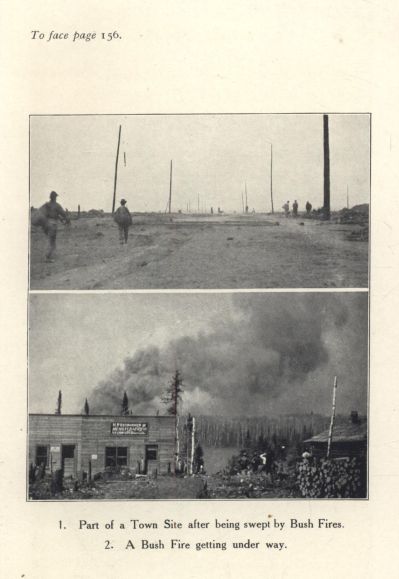
1. Part of a Town Site after being swept by Bush Fires.
2. A Bush Fire getting under way.
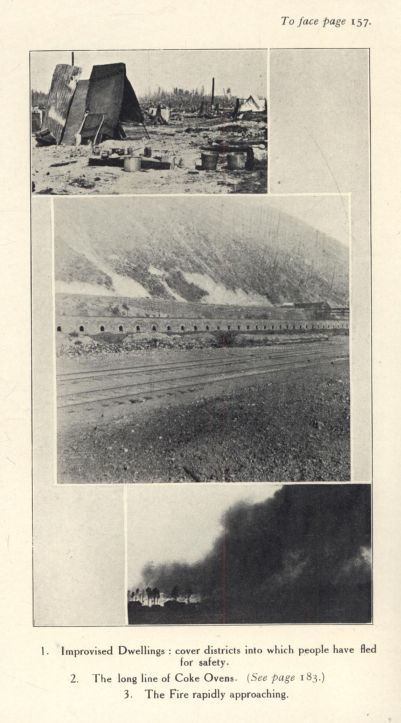
1. Improvised Dwellings: cover districts into which people have fled
for safety.
2. The long line of Coke Ovens. (See page 183.)
3. The Fire rapidly approaching.
"Bush fires are said to be raging throughout
the vicinity of Lundville."
This bulletin was one of several
occupying the boards in front of "The
Journal" building in Carlton Mines—a
British Columbia mining town. As
Lundville was thirty miles south-west, no
unusual anxiety was felt by those who
read the brief announcement about
noon-tide on an August day. The atmosphere
had been heavy with smoke for the past
forty-eight hours; but that was not at
all uncommon during that month.
By nightfall, however, the town was
enveloped in a dense cloud of smoke; and
from the roofs of high buildings on the
outskirts the atmosphere seemed to be
penetrated by the lurid glow of the raging
fires which now extended for several miles.
Telephone communication with Lundville
had been impossible since noon, and from
Burnt River, only fifteen miles away, the last
message received told of the whole
population being engaged in a desperate effort
to effectively check the fire which
threatened to wipe out the village. From
Burnt River to Carlton Mines there were
unbroken timber lands, a fact which
caused deep anxiety to many of the
inhabitants of the mining town. Not a few
retired that night with forebodings that
made anything but fitful and troubled
sleep impossible. Many were the fervent
hopes that ere morning the heavens might
open and send forth an abundance of rain
upon the sapless woods and withered
grasses. Nothing but a heavy downpour
of several hours' duration would penetrate
the parched earth far enough to quench
the fire which was well into the root-filled soil.
Fire rangers, assisted by many citizens,
including nearly a hundred miners, spent
the night in the woods at the edge of the
town, cutting down as much bush as was
possible, and clearing it away from such
points as were considered dangerous
connecting links with Carlton Mines. By
dawn it was felt that the night's hard toil
and the precautions taken had left the
town fairly secure.
Shortly after daylight, however, the
rough trail into Carlton Mines was dotted
for miles with settlers hurrying distractedly,
they scarcely knew where, before the cruel
flames that had driven them from their
homes, and that had by this time destroyed
those homes and many other results of
several years of hard labour.
All sorts of vehicles, from home-made toy
wagons to dump-carts and ranch-wagons
were loaded with household effects, some of
which had to be left behind, when a few
hours later, all that most people could hope
to save was life itself.
By six o'clock, fire, church, and
school-bells clanged out their general alarm,
calling every available citizen to the
fire-fighting, that perchance united effort might
save the town. Already huge sparks were
raining upon the south-west section, but
fortunately in that section the shacks and
buildings were few and far between. Yet
it was soon apparent that the fire-fighters
could not hold their position, even there,
but would have to take up a fresh stand
nearer the town's centre. Every household
was on guard; tubs, barrels, pails,
milkcans and kitchen utensils were filled
with water, and for a time the falling
sparks were quenched almost as quickly as
they fell. Straddle-legged on the ridge
of the roofs in the fire zone, boys and men
with dampened clothes were kept busy
extinguishing the sparks that would so
easily ignite shingles upon which no rain
had fallen for five weeks.
Throughout these long anxious hours,
when men were toiling side by side for
the protection of their town and their
homes, no man had acquitted himself
more worthily than the stalwart minister
of St. Paul's Church. Until that night
no one knew how he could make the chips
fly from the tree trunk, and when the most
needed work was the turning over of sods
to arrest the fire running through the dry
grass, no hands were readier than those
of the Reverend Walter Nicholson, and
when his palms began to blister and to
peel, no one knew of it except himself.
When, after the general alarm, reinforcements
arrived, he felt he could no longer
leave his loved ones without some word
of the probable and immediate danger.
Stopping at only one or two homes on the
way, he hastened to the manse. Despite
the seriousness of the situation,
Mrs. Nicholson could not restrain her laughter,
as her husband stood, coatless and vestless,
at the door of the dining-room. Pieces of
coarse string had been substituted for
certain important buttons which had been
lost in his strenuous activity at the
fire-fighting. The all-night's toil in the dirt
and the smoke, amidst falling ashes,
had transformed the immaculately clean
husband into a dirt-begrimed labourer.
"It looks as if the town was doomed,
Jess," he commenced. "The brewery's
gone (though that's no particular loss),
and a number of shacks are already burnt
down. I must get right back with the
men, but in the meantime you'd better get
what you value most into a couple of
valises. You'll need a few extra clothes
for the youngsters and yourself. Put my
marginal bible and my black suit in if you
can. It's of no use trying to take much,
as we may have to foot it for quite a
distance. The 'Eastbound' hasn't come
in yet, and it's hard to get any information
because the wires are down, but it looks
as if some of the bridges had been burned,
so there isn't much hope of getting out by
rail. You can count on me being back
in about half an hour."
Mrs. Nicholson, as a bride, had brought to
her Western home the handiwork of three
busy years, and when the furnishing had
been completed and her "extras" tastefully
arranged, the minister and his young
wife had looked with grateful pride upon
the attractiveness of the manse. During
the ten subsequent years her enthusiasm in
keeping that home orderly, clean and cosy,
had never failed. And now she had less
than half an hour in which to select what
she most desired from that home that had
become endeared by ten years of effort
to keep it, as it had been kept, a radiant
centre of helpfulness—and that selection
from their entire earthly possessions must
fit the narrow compass of two valises.
The reader who is able to imagine
Mrs. Nicholson's feelings on that memorable
nineteenth day of August will readily
believe that a few minutes were lost in the
feeling of helplessness as to what was best
to select. A glance through the window
at the smoke-filled street, and occasional
sparks, put an end to her hesitancy.
Whatever was to be done must be done
quickly. Her husband's request was first
complied with, then such clothing as she
and the children might need was included,
and a small supply of food for immediate
needs. Within a few minutes she had
gathered together the few articles of
jewellery she possessed, a package of
business papers, a bit of silverware, one or
two photographs, and an "encyclopædic"
scrapbook which contained, among many
other interesting items, several newspaper
clippings of the work and doings of the
Rev. W. Nicholson. From her much-prized
secretary, a Christmas gift from the
children in her Sunday School class, she
took a locket in which was a small curl
of hair—her mother's hair.
In her hurried packing she had not
forgotten that at least two things must
be included from her box of relics and
sentimental treasures in the attic. The
first pair of baby shoes ever worn in the
manse were among Mrs. Nicholson's most
valued reminders of the happy days spent
in caring for Baby Dorothy—now a bright
girl of eight years. Whenever a visit
had been made to the box in the attic, the
little shoes were always taken out and
looked upon with a loving smile.
There were many other articles of much
greater value than what was
Mrs. Nicholson's final selection, but she could
not leave "dear little Hugh's favourite
toy." How he had loved that little horse!
Even after the terrible accident that had
left the "gee gee" noseless, nothing could
ever displace it in his affections. For at
least a year it had shared his bed without
one night's exception, and though it was
usually taken from his arms after the
little lad had fallen asleep, it was always
placed on the chair at the bed-side, so that
on awakening he might immediately find
his valued wooden friend. And when,
during his long and fatal illness, he was
unable to take an interest in any other
toys, the wasted hand would rest for
hours across the back of the broken
toy-horse. And so the noseless little animal,
with its stand minus two wheels, found a
place among the most valued things that
were chosen from the well-furnished manse
when but a brief half-hour was given in
which to make a final choice.
The thirty minutes had not fully elapsed
when Mr. Nicholson came rushing in to
say there was not a moment to lose. The
wind by this time had increased well-nigh
to a hurricane, and no force of men could
have protected the buildings from the
fiery embers that were being hurled in
large quantities in all directions.
Walter Nicholson went forth with the
two valises strapped over his shoulders,
while on his left arm he carried his eighteen
months old baby boy. Close behind him
came his wife with a few extra wraps
thrown over one arm, and her free
hand clasping that of the trembling
little Dorothy. Thus the Nicholson family
departed from the manse, that twelve
hours later was nothing but a heap of
smouldering ashes.
The streets were filled with terror-stricken
people laden with such of their
worldly possessions as their strength would
allow. The fierce wind hastened them on
in their frenzied race for life. Shouts,
shrieks, agonized cries and prayers greeted
the ears of the minister and his wife as
they joined the homeless throng on the
streets of Carlton Mines. "Every house in
Freeman's Terrace is burning." "The
Methodist Church is ablaze." "The Opera
House was on fire when we came by." "Oh,
my God! what'll we all do?" "There
won't be a house left in town." "God
have mercy on us!" Such were the
cries from scores of voices in the terrified
crowd.
Here and there aged and sick folk
were being borne in the arms of loved ones
or neighbours, although each one rendering
such willing service knew that the delay
involved was imperilling his own life.
Perhaps the saddest sight in the whole sad
procession was that of a poor Italian
woman, whose little girl had died the
previous morning. The father was working
in a construction gang several miles away,
and the word of the child's death had not
yet reached him. When the fire had
spread to the humble dwelling, the
distracted and sorrow-stricken mother could
not endure the thought of leaving her
darling to the devouring flames. Tenderly
lifting the little one from the casket, she
wrapped a shawl around the lifeless form
and struggled with her burden alongside
of some who knew not what she carried.
Cries and prayers in her native tongue were
intermingled with her broken English.
Walter Nicholson had forgotten for the
moment that the previous afternoon he
had heard of the poor woman's sorrow and
had fully intended to at least call and offer
such sympathy and help as was possible.
But the call to the fire-fighting had caused
everything else to be put aside. When,
however, he heard the pathetic wail, "Oh,
ma Annetta, ma leetle Annetta," and
glanced at the strange-looking bundle the
Italian woman was carrying, he at once
surmised the meaning of it all.
Burdened and anxious though he was,
he walked alongside of the lonely mother
that he might share her burden also. The
sad-eyed woman looked into his face, and in
an appealing tone said, "Please not mak'
her go from me—ma dear leetle Annetta.
Da father, he no come yet. Oh! he must
come first!" Walter Nicholson hurriedly
readjusted his baggage and then held his
baby boy so as to leave his right arm free
to give the poor Italian woman such
support as was possible. The assistance
given was only slight, but his sympathetic
words and the touch of his hand soothed a
little the aching heart of one who felt that
day the loneliness of a bereaved stranger
in a strange land.
Information was passed through the
fleeing crowd that the work-train was
taking the people out of danger as rapidly
as possible, and that the best course to
pursue was to make for the railway station.
In any case, the railway track eastward
would be the safest highway down the
Pass, as the mountain stream two miles
away might be reached on foot if necessary.
A place of at least temporary protection
would be found there.
Before the station-house was reached,
another member was added to the Nicholson
party. A lad of not more than five years
had either wandered away from his home
before his friends had felt the necessity
to leave, or had become separated from
them on the way. At any rate, he was
doing his very best to make everybody
acquainted with the fact that he was
lost. To attempt to locate his friends was
out of the question. Mrs. Nicholson bent
over him for a moment, and her words and
looks produced a quieting effect on the
little lad, who at once did as he was
bidden, and clung to one of the wraps on
the arm of his newly-found guardian.
By the time the railway station was
reached the fire had made such headway
that it would have been impossible to
make a safe return as far as the manse,
which had been left less than fifteen
minutes before. The frame buildings of
which most of the town was composed
made the onrush of the flames the more
rapid.
The station platform was packed with
an impatient crowd awaiting the return
of the work-train which had already made
two trips as far as the coke-ovens at
Twyford. The line was single track, and
the only rolling-stock available consisted
of an antiquated engine and two dingy
passenger cars with rough board seats
lengthwise beneath the windows. The
morning of the fire there had been added
to these cars a few open coal trucks. The
old engine could not make the grades with
anything but a light train, so that it was
seen by many how improbable it was
that all those then waiting could find
transportation before the buildings around
them would be licked up by the approaching
fire. Surrounding roofs had been saturated
by the station fire-hose, but the gauge-ball
on the water-tank was rapidly lowering,
and the engineer at the pump-house had
been compelled to leave his post half an
hour before, so that at best their protection
by water was a matter of only an hour or so.
Yet it needed no small amount of courage
to isolate oneself from the throng and to
pass out of sight in that heavy cloud of
smoke which prevented one seeing more
than a short distance ahead. The fire
now seemed to have gained headway in
other directions, so that even if they went
forth they might soon find themselves in a
position where advance and retreat were
alike impossible. Frequent explosions and
loudly crackling timbers added to the
anxiety of those who awaited the return
of the work-train.
The Rev. Walter Nicholson was soon
surrounded by a group of those anxious
to hear any suggestion he had to make.
The Station Agent assured him that even
if the track remained clear, at least two
additional trips would need to be made
before all on the platform could be
removed to a place of safety. "Then the
wires are dead, Mr. Nicholson, and we've
no news of any other train being on the
way, so there isn't a minute to spare." He
explained that the station-yard might
be a comparatively safe place for a while,
yet, in view of the extent of the fire, those
remaining might find themselves hemmed
in and have difficulty in getting over the
burned and burning earth for many hours.
Several buildings west of the station had
already collapsed, blocking certain portions
of the road-bed.
A number decided to follow the minister's
lead and start on the journey along the
eastward track. Mrs. Nicholson refused
to remain for the train, preferring to share
the fortunes or misfortunes of her husband,
while the poor Italian woman, still clinging
to her precious burden, followed every
move her sympathizer made. Would she
not wait and try to get on the train?
"Oh, no, please me walk wid you. I will
be so strong!" Even the little lad
refused to be transferred to the care of
others, and as none were particularly
anxious to add to their responsibilities,
there was nothing for it but to take him
along. It was no easy task that the
Nicholsons had undertaken. The usual
heat of mid-August was intensified by
many miles of burning bush, while the
smoke added greatly to the discomfort.
Then the poorly ballasted track made
walking exceedingly tiresome. Yet no
complaints were uttered: even the children
realized that every effort must be made
to reach the stream before the resistless
enemy overtook them. Little more than
half a mile had been covered when the
whistle and rumble of the work-train
announced that it was returning for its
third load of passengers. A glance at the
cars as the train passed was sufficient to
show that fire had broken out further east,
at some point between the pedestrians and
Twyford. The old paint was covered with
blisters, and many of the windows were
badly cracked through intense heat. A
few minutes later the train returned with
every foot of space occupied, even to the
steps of cars and engine. A number of
passengers tried to let their slower
fellow-travellers know that the station-house was
in flames, but the noise from the train
drowned most of their words.
The inhabitants of Carlton Mines who
had not driven or walked out earlier in the
day or been conveyed on the railway
were now hastening to the limit of their
powers in the direction of Twyford.
Fortunately for the almost exhausted
pastor, the last half-mile of his journey
was made a trifle easier by the voluntary
assistance of a rugged Galician girl who
had been well known at the manse. One
small coarse bag contained her few
belongings, and accustomed as she had
been to long walks and heavy loads when
she had lived on the Saskatchewan prairie,
the carrying of the baby boy would make
small difference to her.
And so at last the mountain stream was
reached, and after crossing the bridge the
wearied refugees laid down their burdens
on the pebbly bed at the water's edge.
At that point the width of the open space
between the stream-divided bush was only
about a hundred feet, so that in case the
fire continued its course the danger would
still be very great. Already they had seen
showers of sparks carried much farther
than the short distance that separated the
banks between which they stood, and
there was every probability that the timber
on each side of the stream would be ablaze
simultaneously.
But to continue their flight through the
thick bush that lined both sides of the
track for miles might be to place themselves
in a much worse plight. Where they now
stood was an abundance of water, and
fortunately it was shallow enough to make
it safe for all to stand in the centre when
that time became necessary. It would
then be a matter of endurance against the
stifling heat.
Within five minutes the number of those
seeking refuge at the stream side was
considerably over a hundred. The Station
Agent was the last one to arrive, and
reported that when the third train-load
was leaving, the railway yards and the
station-house was seen to be on fire,
everyone had immediately set out on foot.
He had kept in the rear to be sure that no
one was missing.
Except for an attempt on the part of
some to safeguard certain belongings by
burying them in the gravel, there was
nothing to do but wait—and to many the
moments seemed as hours. It was a race
between old Dave Minehan, the driver
on the antiquated engine from the East,
and the devouring elements from the
south-west. Which would reach them first?
A few men acted as sentinels, and paced
the track to discover the progress of the
fire. The wind had dropped a little, but
the flames were still making rapid headway,
and very soon no report was needed from
the outposts—the fire's own voice could
be heard only too plainly. The agent
figured out that the work-train had been
due over ten minutes—something must
have happened! Surely the train-crew
realized the need of the courageous ones
who had voluntarily walked, and of the
others for whom no accommodation was
possible.
Flames were now visible to all who were
close to the bridge, and the scorching heat,
the stifling smoke, and the ash-laden wind
combined to make waiting almost
unendurable. Brows of fainting ones were
being bathed in the merciful stream, and
the strongest were becoming fearful.
"Thank God, she's coming!" The shout
was from the throat of the Station Agent
who had been down the track listening for
the return of the work-train. The words
had scarcely ended when the shrill whistle
from the little engine confirmed the
statement.
When a few days later a number of
men were discussing the disaster, one of
them spoke for each individual at the
stream when he said, "Say! I used to
hate that blooming raspy whistle, but that
day it was the finest bit of music I ever
heard."
Dave Minehan slowed up as he neared
the bridge, and the Agent signalled him
to stop, and at once scrambled aboard to
let him know that everybody had reached
the bridge and that there was no need to
try to go farther. Old Dave was trembling
with excitement and irritation, but just
then he had no time to tell of the fretful
delay over a hot box, and all the trouble
entailed in putting in a new "brass" at
Twyford—and neither then nor later did
he tell of the terrible strain that he had
endured in taking his train through a
piece of blazing bush three miles down.
The eager, frightened people were rushing
up the banks, but Dave kept his train
moving until it was about midway on the
bridge. From the cab he shouted to
them to "keep off." The moment he
brought his train to a standstill he leaped
from his engine and again thundered the
same prohibition. Sharply he yelled to
the men to line up and form a
bucket-brigade. The fireman passed a dozen
buckets from the tender, and Dave, with
harsh and hasty commands, got the men
on their job. For about five minutes,
with a rapidity that would have done
credit to a trained brigade, the double
line passed the buckets and old Dave
dashed the water over such portions of
the cars as in his judgment needed the
protection. In the meantime he had
ordered the rest of the men to soak a few
camp blankets that he had taken the
precaution to bring along. "There's one
bad spot where you'll maybe need to
cover yourselves a bit: it'll be raining
fire by when we get back—better give your
coats and hats a dip too, boys! Get a
move on!"
It was no longer possible to remain on
the bridge. The old engineer shouted
"All aboard," and hurried back to his
engine. The women and children were
rushed into the passenger car. At one end
stood the Nicholsons, while in the corner
the bereaved Italian mother sat with her
lifeless child. More than once had the
minister felt that he must insist on her
leaving her burden behind, but each time
that he glanced at the sad face and saw the
passionate pleading of her eyes, and
observed the tender clasp of the mother
arms, his courage deserted him.
The last foot was scarcely off the ground
when old Dave reversed the lever and
opened the throttle, and with a jerk the
train started once more.
Let the brakeman tell the story of the
return trip, as we heard it from his lips
months after in one of the temporary
buildings that had arisen among the
ash-heaps of Carlton Mines.
"Yes, siree, you just bet it kept me
firing that morning. The west-bound
express was away late, or it could have got
the whole crowd out in two trips. I never
thought "Old 98" would stand the gait
she did that day. On that last trip we
hit a clip both ways that would make your
hair stand. Davie was bound to get them
people to Twyford. We got a scorching
on the up-trip let me tell you. Gosh! it
seemed like we was running through
Nebuchadnezzar's furnace. I wondered if
Davie would face the return trip, 'cause the
blaze was getting worse every minute.
I moved over to him and asked him if he
was going to try it. Whew! I wish you
could have seen him! He hadn't cooled
off from the mad he had on at Twyford.
We had to put a 'brass' on the front
car, and when the boys down there couldn't
find their jackscrews, Davie got rip-tearing
mad, 'cause he knew what the rest of the
crowd at Carlton was up against, and he
was scared he might be too late. Well,
sir, he dumped all the bad language what
was in his system on me. It was the
kind you don't put in mother's letter.
He finished up with the sickliest kind of
smile I ever set eyes on, and yelled, 'You
fool: do you think I'm up here on a
Sunday School picnic?' But Davie knew
what was what when we reached the
bridge. He lined up the bosses and
parsons and the rest of that crowd like he
was a British General. And he got his
orders obeyed in double-quick time too.
"But it was that last down-trip that
this child won't need a diary to remember
by! Gee! you know that curve about a
mile and a half below the bridge? Well,
we'd got most all the head on we could
carry, and I was feeling about as safe
as if I was having a smoke on a can of
dynamite. I was watching for Dave to
slow up for the curve, but blame me if he
didn't open the throttle another notch.
"As Billy S—— would say, 'Religion
isn't my long suit,' but I got ready to
say my prayers; I backed up a bit into the
coal-bunker, and gripped the side of the
tender, and I told the Almighty I hadn't
bothered Him much for a long time, but
that if He'd keep the cars on the track
around the curve I'd be much obliged.
Seemed to me like some of them cars
jumped clean off the rails, and I thought
we were on the home stretch to Kingdom-come,
but Davie brought us through O.K.
Did we pass through much fire? Well,
I should say! There wasn't a rail or
post for half a mile that wasn't burning.
If it hadn't been for the way Davie soused
them cars, and got the fellows to fix their
coats and the blankets, we'd never have
made it.
"Did you see the watch they gave
Davie? Get him to show it to you!
It's a dandy—solid gold—got a whole lot
of writing on the back—something about
'a tribute to Mr. Dave Minehan's courage
and skill in the face of grave danger and
difficulty.' He don't say much, but he's
as tickled about it as the fellow what got a
Christmas-box of sealskin underclothes.
Davie's alright, you bet. I'd rather fire
for him on 'Old 98' than for any guy
I know on a big Mogul. He's a bit
rough-like sometimes, but if he can help
anybody he's on the job; he'd break his neck
to do somebody a good turn."
Such was the brakeman's narration of
Dave Minehan's final race on "Old 98," on
the day that Carlton Mines was levelled
by the bush fire.
* * * * *
The shadows of evening had fallen over
Twyford on what is still regarded in
Carlton Mines as "disaster day." The
afternoon had been a busy one for the
inhabitants of the almost verdureless
village that is known chiefly for its long
lines of coke-ovens. Generous hearts had
made shacks and homes have an expansive
hospitality that would have seemed
incredible before the homeless throng
arrived. But after every available lodging
device had been resorted to there were
many people unprovided for. And so the
coke-ovens were the best accommodation
that could be offered those still unhoused.
In one of these unusual lodging-houses a
candle cast its dim light over the figures
of two men and a woman who were kneeling
in the attitude of prayer. In one corner
a black box rested on two backless chairs.
It had been made an hour or two before
by the local carpenter, and covered with
black cloth by the kindly hands of Mr. and
Mrs. Nicholson. Little Annette was to be
laid away in the early morning, and this
was the best that loving hearts could devise
in that place and under those circumstances.
The manse valises had made their contribution
to the final robing of little Annette,
and the weeping mother, looking upon what
Christ-like friends had done, clasped and
kissed the hands that had dealt so kindly
with her and her "leetle Annetta." For
nearly eight hours the father had walked
seeking his wife, and now they were
kneeling together in the presence of their
dead child.
Walter Nicholson's voice was tremulous
with sympathy as he commended the
sorrow-stricken strangers to the all-pitying
Father. The mourners did not understand
all that was uttered, but they
understood the spirit that was manifested
and were deeply grateful. A few words of
comfort were spoken, and the minister
passed out into the darkness to another
oven in which his own loved ones were
awaiting his return. Mrs. Nicholson was
sitting on a box with Dorothy on her knee.
Angus and the five-year-old stranger had
fallen asleep on the ashy floor. No trace
had been discovered of the lad's friends.
He could give little information beyond
the fact that his name was Hans Kuyper,
and that he was "losted." Mrs. Nicholson
had quieted the wee chap's fears, by
assuring him that his mother would come
soon, and though, with darkness at hand
and no sign of mother, a few tears had been
shed, it was not long before the wearied
and worn child was asleep.
The husband and father sat alongside
of his loved ones in sympathetic silence for
a few minutes. The all-night's toil, the
hours of solicitude for others, the heat of
the day, the burdens carried, the sympathy
extended and the discomforts endured, had
combined to produce a feeling of depression.
"We have lost everything, Jess: maybe
I'll feel better by morning, but to-night
I've lost my courage as well as everything
else, and I can scarcely bear to think of the future."
Little Dorothy placed herself between
her father's knees, and looking lovingly
into eyes where the unbidden tears had
forced themselves, said quietly, "Isn't
it a good thing, daddy, that you haven't
lost mamma and Angus and me?"
Walter Nicholson enfolded the child in
his big arms and kissed the curl-encircled
face. "Yes! God bless you, little
sunbeam, that is a good thing, and maybe
daddy was forgetting. Now let us say
the twenty-third Psalm and have our
good-night prayer."
With sometimes unsteady voices the
three repeated the Psalm they had so
often joined in at home under such
different circumstances. Then father, mother
and child knelt beside the box, and
a prayer of thanksgiving and a cry for
strength came from a thankful but needy
heart. Walter Nicholson's arm rested on
Dorothy's shoulder, and his voice quivered
again as he thought of the little black
box in the near-by oven; and prayed for
those to whom the past hours had brought
a double sorrow that had left them
homeless and childless.
As was her custom, Dorothy offered up
her own prayer at her mother's knee. A
sweet confidence in religious matters had
always existed between child and mother,
and there was never any restraint in the
expression of the little one's thought
toward God. Tired though she was, her
"poetry prayers," as she called them,
were said in full, and then her own
additions followed. "Thank you for taking
care of us all, and we are glad that papa
and mamma and Angus and Dorothy are
all here. Help the little boy's mamma to
find him, and please to take care of the
poor Italian woman now that her little
girl is gone to heaven. Bless papa and
mamma and Angus, and make me a good
girl, and please help us to get another
home soon, for Jesus' sake. Amen."
The fire had almost spent itself by
nightfall, and with the dawn the
long-wished-for rain began to fall. By the
middle of the forenoon the danger of any
further outbreak was past. The construction
gang from the East, and a number
of section men from the West, were
immediately put to work at clearing the
track and repairing culverts and bridges.
By the middle of the afternoon a number
of men who had fled from the burning
town were able to make the return trip.
For four or five miles the outlook from
the car-windows was a very dreary one.
The underbrush had been entirely burned
up, and of the standing timber little but
charred, jagged remnants of tree-trunks
remained. Only here and there had a
telegraph pole escaped, and even the
protruding ends of many of the railway ties
had smouldered to the ballast.
The entire business section of Carlton
Mines was destroyed. A few isolated
buildings in the residential portion
north-west, and a few in the north-east had
escaped, but all the rest had been reduced
to ashes. What could be done under such
circumstances? Who would have the
courage to attempt a fresh start and face
all the difficulties arising out of such a
disaster? Who? Every man who that
afternoon stood gazing at those ash-heaps.
With that inextinguishable optimism that
has its headquarters in Western Canada,
they began then and there to formulate
their plans. Several contracts for
rebuilding were signed before night, and
ere the ashes were cold, men started to
rear a new and better town.
The preacher, with the rest of the
impoverished ones, went back to his job.
Not only did he assist in clearing away the
debris, in preparation for a new church and
manse, but many a lift did he give to
others who were busily engaged in getting
a roof over their heads.
During the months of rebuilding he
preached successfully in the open-air, in
shack-restaurant, sawmill, hotel, opera-house,
and finally, after many disappointments
and discouragements, in the new church.
Among the interesting contributions
received by Mr. Nicholson for the Building
Fund, was one from the mother of the boy
who was "losted." When on the morning
of the fire she was compelled to hastily
leave her dwelling, she felt quite sure her
little lad was with some of his playmates
in a neighbour's home. On the way she
discovered that her friends had already
departed, but she was still hopeful that
her boy was in their care. And so she
had very gladly accepted a ride in one of
the last vehicles leaving the town, and,
after a rough and rapid drive, had reached
a mining camp a mile or two south of
Twyford. Her friends had gone in a
different direction, and it was over
twenty-four hours before she found them.
They could give her no news of her lost
boy, and she began to fear that he had
never left the town. Two days later,
without having received any word of his
whereabouts, she suddenly saw him, riding
"pickaback" with arms twined around
the neck of the Rev. Walter Nicholson.
Mr. Nicholson still delights to tell how
the mother and child were unexpectedly
brought face to face as he was turning the
corner of a building. He professes to have
confused memories of certain details, but
states that before he had a chance to get
the lad from his shoulders or extricate
himself, he was the centre of the most
vigorous hugging and kissing imaginable.
When the overjoyed mother learned all
that had taken place, her gratitude to
those who had befriended her boy was
simply unbounded. For some months
after the fire she struggled along in a
small shack several miles away from
Carlton Mines. The following letter from
her to Mr. Nicholson is reproduced exactly
as written, except for corrections in
spelling:
"DEAR SIR,—I shall thank you very
much for what you have done to me.
Never will I not forget it. It is sorry for
me that I not can write much English.
Dear Sir, I am well here, but the work
is very still and so we not can get money.
I went to the church on all the Sunday.
I am glad to be a better woman. I wish
you my blessing and Hans do it too. After
25th I will send you $1.00 for your another
church.—G. KUYPER."
The one dollar arrived in due time, and
knowing the sacrifice it involved, it was
valued out of all proportion to the amount.
Walter Nicholson's courage in facing
the future did not fail. He stayed at
his post until his work was completed.
To "preach to a procession," as the
work in some districts has frequently been
described, to face an appalling indifference
on the part of some, and a cynical
antagonism on the part of others, and to
struggle along with an inadequate income,
constitutes a task that only the bravest
can face year after year, yet in the face of
all this he said cheerfully, "I've seen a lot
of preachers come and go, but I think God
wants me here, and the need is call enough
for any man, so here I stay as long as
He wills. I've had many rewards, and
I thank God I've had the chance to do my
bit in this great Westland."
THE PRODIGAL
"Isn't he awful looking, Mother? Why
does daddy let him come in so much?
I don't like the way the study smells after
he's been in."
Little Ruth, of a village manse, made
many other observations, and asked many
other questions as a poor, wretched-looking
man shuffled across the lawn in the early
evening of an autumn day.
The mother's smile changed quickly to
a look of sadness, and giving the wee girl
a kiss, she said, "Mother will tell Ruthie
all about it at story-time to-night."
From the Children's Bible Story Book
that night the mother read of the Prodigal
Son. There were a number of interruptions
from the occupant of the little bed:
"Why didn't he go home before he got
so dreadful hungry, Mother?" "Where
was his mother?" "Why did his father
run so far?"
After answering many questions the
mother continued: "There are lots and lots
of prodigal sons still living; men who have
been bad, and who then, like some little
children who have been naughty, run away
from those who love them best. And all
the time those who love them are wishing
so much that they would come back,
and say they are sorry and that they will
try to be better. God is our Father, and
He loves everybody; you know what we
often say when daddy has prayers: 'For
God so loved the world that He gave His
only begotten Son, that whosoever
believeth on Him should not perish, but
have everlasting life.' Well, darling, you
wanted to know why daddy let poor
Mr. Gage come in so often? He lets him
come because God would let him come.
The poor man thinks that God doesn't want
him because he's been so bad, and because
he's gone, oh! so far away, and daddy is
trying to tell him that God does want him,
and that God will take care of him if he
will only love Him and trust Him, like
you trust daddy and mother to take care
of you. Mr. Gage is awful looking because
sin is awful, and he has let sin be his master
instead of God. But mother's darling will
be nice and kind to him, because God loves
him, and we must love those whom God
loves. Perhaps some day you will see
him look as much different as the Prodigal
Son looked after he came back home."
Ruth did not altogether forget her
mother's words, and when the half-drunken
man was brought to the Manse for a meal
a little later on in the week, she somewhat
timorously handed him two or three asters
that she had picked from the garden.
John Gage looked a little embarrassed,
and at first seemed inclined to leave them
in Ruth's possession, but the little hand
remained outstretched, and with sweet
winsomeness the child told him she had
picked them for him.
"Picked them for me! Well, well! then
I guess I'll take them. Thank you."
On several occasions, as he sauntered
around the village, his attention was
arrested by a childish voice calling him by
name, so that he came to feel he had a
friend in the minister's little girl.
There were many head-shakings among
the village wiseacres regarding the minister's
interest in John Gage. It was generally
agreed that while the preacher was well
meaning enough, his knowledge of human
nature was not very keen. The village
constable knew John so well that he felt
able to speak authoritatively on the matter.
"'Tain't no use, young man," he said to
the preacher. "We wus talking about
him the other day in Cyrus Haag's
blacksmith shop, and every man says the same
as I do. He's just a-bleeding you, that's
all. Five years' hard labour is what he
needs; s'long as you'll take care of him
when he's drunk, and feed him when he's
broke, he'll just bum around. Don't I
know the whole bunch? Didn't me and
the county constable arrest his father when
he pretty nigh murdered Sam Collins?
Ain't his brother in Kingston Penitentiary
this very minute? The only way to
improve them fellers is to hang 'em."
The authoritative information having
been given the preacher, there was no
further need of sympathy for him if he
wilfully rejected the constable's gratuitous,
labour-and-money-saving counsel.
And the passing of the weeks seemed to
confirm the "'tain't-no-use" judgment.
People living near the Manse reported
everything that happened, and a good deal
that did not happen, in connection with the
visits of John Gage and others of his type,
for it was generally known that the preacher
was "easy." But the preacher went on
with his work, and whatever the results
of his efforts might be, nobody ever
doubted his belief in the Gospel he
preached.
Every Sabbath evening, in some form
or other, he dealt with the Fact of Sin and
its Soul-destroying power. He knew that
"sin and punishment go through the
world with their heads tied together," but
he knew also, and he preached it as a fact
that for him was beyond all controversy,
that by immediate act of God salvation
might come, and had come, delivering the
life from the gripping, enslaving, murderous
power of sin.
* * * * *
The year was drawing to its close. The
little village had its share of Christmas
festivities, and family reunions were taking
place. There were men from the East,
and men from the West, back in the old
haunts for the holiday season. Wonderful
stories of material success were told as
"the boys" from the West expounded the
opportunities of the prairie provinces. As
is too often the case, the bar-room was the
main social centre of week-day life in the
village, and John Gage was always ready
to fall into line when the prosperous ones
gave the all-inclusive invitation, "Come
on, boys." And so long as John helped
to swell the receipts, his drunken presence
was tolerated around the bar. Scores of
times did he join in the greeting "A Merry
Christmas," and the merrier it seemed to
be to the frequenters of the Derby House
bar, the sadder it really was to the homes
from which they came.
THE PRODIGAL'S DELIRIUM
Weeks of drinking, followed by the revelry
of Christmas, brought John to such a
condition that when the bar-room closed on
Saturday night he was turned out of the
house, and a little later dragged out of a
corner of the drive-shed, and told to "get
clean away" from the premises.
There was a strange look about the man
on this particular Saturday night—a wild,
almost savage appearance. He stood a
moment on the sidewalk as if uncertain
of his whereabouts, and then turned and
walked in the direction of the Manse.
The minister answered the door-bell, and
without a word John walked right in and
through the hall to the study. At last
he spoke. "You—told—me—to—come—any—time.
I—want—to—stay—here—to-night." Then,
with body bent, and as if
in pain, with arms crossed, he rocked
himself to and fro. "Oh, God! but I'm
sick; three days nothing but whiskey:
I've got it to-night for sure."
After much persuading the minister had
the man in bed. The mistress of the Manse
had prepared strong coffee as fast as her
trembling body would let her. Once before
she had passed through a night such as
she feared this would be, and the prospect
might well make her timorous. But the
Manse and its furniture had three years
ago been pledged to His service, and she murmured not.
The doctor had been sent for, but he
was on a country call, and was not
expected back until eleven.
At one end of the bedroom the minister
sat watching John Gage. In some way
the drink-inflamed man had placed under
his pillow an old revolver and a short
stiletto. After a time the hands clasped
these with a vice-like grip. Suddenly
standing out on the carpet he looked at
the preacher, and said, "Why in the devil
don't you go home? D'you want a fight?
Say! I could rip you so's they'd have to
pick you up in baskets."
A little later he imagined he was once
more on the South African battle-field.
With a sickening shudder he pointed to
where his deluded eyes saw again the
wounded and bleeding. "My God! see
that poor devil with his leg nearly off!
Look! ain't that awful. See that one
squirming!—him yonder with his head
half open!" Then straightening himself,
he said, as if addressing some audience,
"Friends, I say, and I know, war is hell!"
From time to time, under persuasion, he
would return to his bed. Once he imagined
he was driving down the old concession
road near his grandfather's farm as in
boyhood days. The sheets were jerked and
handled as if reins. "Well, now, this is
a slow horse. It will, ladies and gentlemen,
be quite appropriate to sing we won't get
home till morning.' I tell you what I'll
do—I'll put the horse in the rig, and I'll
get in the shafts, and then there'll be a
horse in the buggy and an ass in the shafts,
but we'll make better time." Then
followed a weird burst of laughter.
The doctor arrived about midnight. For
a couple of hours he watched the effect of
his treatment, but rest would not come to
the occupant of the guest-room. The eyes
would appear to be closing in sleep, and
then would suddenly open wide as if their
owner were in terror of some impending
disaster. Then the danger spot seemed
to have been located, and with a series of
jerks the head was raised higher and higher
until John was sitting up in bed. Never
once did the gaze leave the corner of the
room. With the utmost stealth, first one
foot and then the other was pushed from
under the bedclothes to the floor. Very
slowly and noiselessly, with knife still
gripped, the demon-possessed man glided
toward the corner. With great caution,
as if measuring the distance, he bent the
left knee, and at the same time lifted the
right hand ready to strike. Then with
blasphemous exclamations he stabbed the
imaginary monstrosities. Again and again
he seemed hurled back as by some real
enemy in the fight. At last the knife went
deep into the floor, and he seemed to have
conquered. Never once taking his gaze
from where the knife stood he backed
slowly toward the bed. "Ah! I got him
that time! See him! see him!" Then
followed a blood-chilling burst of profanity
at the wriggling object of his delirium.
"But he can't get up! No! no! no! it's
through his neck."
And so the long night wore on, and the
wearied preacher, looking upon what drink
could do with "God's Masterpiece," vowed
anew to fight the cursed traffic in intoxicants
as long as life lasted, and never knowingly
to have his home defiled by such a
life-blasting beverage.
It was nearly seven o'clock on Sabbath
morning when John Gage fell asleep. At
ten o'clock the bell of the adjoining church
awakened him. The minister had anticipated
the awakening, and was at the
bedside. John seemed dazed for a time,
but in a little while conversed with the
one who had befriended him. He was
urged to remain quietly in bed, and after
a few words the minister clasped the hand
of the outcast man, and kneeling at the
bedside, laid the burden of his heart upon
the One who is mighty to save. As the
Amen was uttered Ruth approached the
door. "Alright, little one, come and see
your friend John," were her father's words.
Ruth was ready for church, and with
garments and face alike attractive, laid
her little hand in the big hand of the
sin-wrecked man. Who can understand the
power of the touch of a child's hand?
Closing his fingers over the dainty, wee
hand, John Gage turned his face to the wall
and sobbed aloud. Little Ruth hardly
knew what to do. Gently she placed the
other hand on the dirty, unshaven cheek,
and merely said sympathetically, "Don't cry."
John turned his head back again long
enough to say brokenly, "God bless you,
little gal."
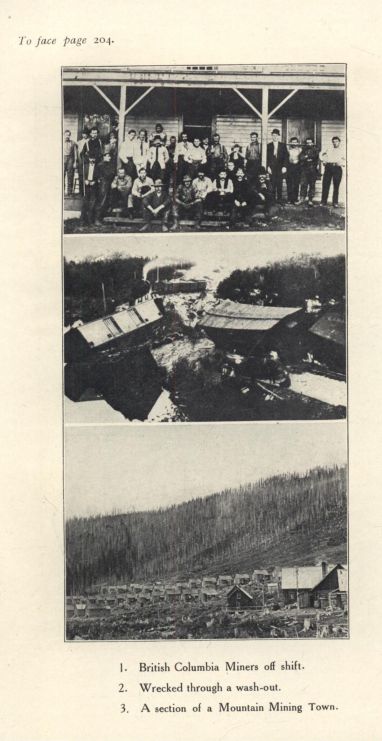
1. British Columbia Miners off shift.
2. Wrecked through a wash-out.
3. A section of a Mountain Mining Town.
Leading Ruth out the room, the
minister gathered up his books and went
to the morning service. When he returned
John Gage had departed. Early Monday
morning Allan Short, a near-by farmer, called
to tell him that John was out at his place
cutting away at the winter's wood-pile.
Allan promised to do what he could for
John, but incidentally remarked that he
did not see why a man couldn't "take a
glass of beer without making a fool of
himself."
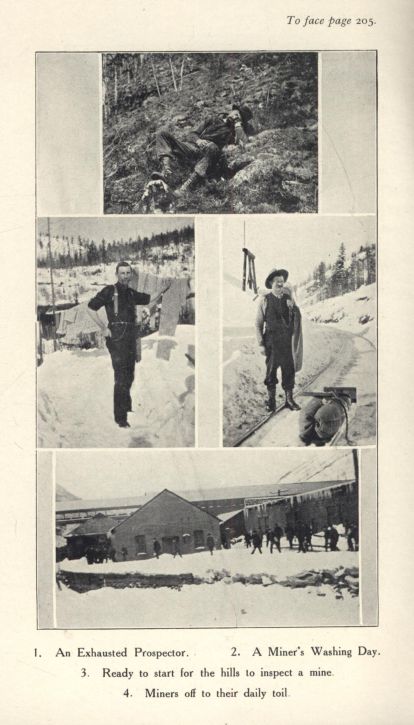
1. An Exhausted Prospector. 2. A Miner's Washing Day.
3. Ready to start for the hills to inspect a mine.
4. Miners off to their daily toil.
A day or two later the minister drove
by the Short homestead, presumably to
make a call at the Meen's farm, where he
had several faithful church-goers. As he
passed, he recognised John at the saw-horse,
and waved a greeting as to a friend.
On his return he drove up the road to
the Short Farm, and John at once came
forward, with the customary Canadian
courtesy, to tie up or unhitch the horse,
according to the visitor's wish. After a
few pleasantries the minister went to the
house and made a call on such members
of the Short family as were home, and then
returned to where his horse was tied.
Hesitating a moment, he turned and walked
to the wood-pile, and after complimenting
John on his ability to swing the axe, spoke
a few encouraging words. For a moment
the hand rested on John's shoulder as he
said, "You will be one of God's good men
yet, John. I know it's a terrible fight,
but God knows all about it, and with Him
you can conquer. Come and see us any
time you are in, but for the life of you don't
loiter around the village, and do keep clear
of the men who would be likely to make
it easy for you to get what you know is
ruinous to you. And don't forget we are
your friends always, always."
As he turned the corner of the side road,
he met Allan Short returning from a trip
to the village. Referring to John Gage the
farmer said, "He's been as straight as
a British Columbia pine since he came
out; but, say! it's kind o' pitiful, after
all, the way he craves for whiskey. Me
and the Missus watched him yesterday.
She's been keeping her eyes open. Well!
John was taking a breathing spell, after
he had done a fine lot of splitting (and he's
no greenhorn with the axe, let me tell you!),
when all of a sudden he went to the fence-post
where his coat was hanging, and
putting it on as he walked, he made down
the road. He got about ten rod and then
stopped like as if he'd forgotten
something, and then he started back, took off
his coat, and pitched into that wood-pile
as if it was sure death if he didn't get it
finished by night. The missus says he's
done the same thing three times to her
knowledge, and once he went so far she
was sure he was gone for good. But she
says he sure did 'lambaste' them blocks
when he got back."
RUTH'S ILLNESS
The following Sunday morning little
Ruth was missing from the Manse pew,
and her absence from that service was so
unusual as to cause many inquiries.
"Nothing serious," said the mother.
"Just a little throat trouble, and as she
seemed somewhat feverish we thought we
had better leave her at home. Lizzie is
taking care of her."
But on Monday morning the doctor
looked very anxious after an examination
of Ruth's throat, and in departing advised
the minister to keep out of the child's room
until an examination a few hours later.
On Tuesday morning it was a bit of
village news that was passed from mouth
to mouth, that the minister's little girl
had diphtheria, and that the house was
placarded. The occupants of the Manse
were deeply touched during the following
days by that spontaneous expression of
practical sympathy that is characteristic
of village life. But perhaps no one stirred
the deepest emotions as did John Gage.
Darkness had fallen over the village on
Tuesday before he had heard of Ruth's
sickness. There was some look of
solicitation on Mrs. Short's face when John
"guessed" he would stroll to the village.
He answered the look by saying almost
curtly, "I'm going to the Manse."
The little patient's symptoms showed
severe infection, and a second doctor was
in consultation when the minister heard a
very gentle rap on the door.
"Sorry I can't ask you in, John," he
said, as he saw John standing on the
verandah.
"How is she?" asked the caller, in a
tone that revealed a great concern.
"She is a very sick little girl, John.
Dr. Dodds is with Dr. Burnett just now.
We can only give her the best care possible,
and hope and pray. It is good of you to
call, and when the wee girl is better she
will be pleased to know you came. The
poor little soul has been restless and
feverish all the afternoon."
"Poor little gal! Tell her John hopes
she'll soon be alright. I ain't much of a
friend, God knows, but all the same I've
been that lonesome like, since I heard she
was sick, I don't feel as if I want to do
anything, but just wait around. If there's
any job I can do to help, I give you my
word I'll be in trim to do it as long as the
little gal needs me."
For two weeks John's "little gal"
caused anxious days and nights—some of
them days and nights when tearful prayers
were sobbed out in the solitariness of study
or bedroom—times when the physicians
found no hopeful signs, and the little life
seemed to be passing beyond human reach.
It was on one such night that John brought
a few delicacies from the farm for the
minister's household, and waited for the
report from the sick-room.
"The doctor has been with her an hour,
John, and the wee girl is alive, and that's all
we can say." The voice broke into a sob
as the last words were spoken.
The two men stood in silent sympathy
for a few minutes, and then John broke the
silence. "She was friendly to me, sir,
and I'll never forget it. Lots of folks what
thinks they're big toads in the puddle
treats me as if I was dirt, but the little gal
is the biggest Christian of the lot, and she's
done me more good than the whole gang
of 'em. Say! the way she put her little
hand on my face that Sunday morning was
better'n any sermon I ever heard. Queer,
ain't it, but it broke me all up." Then in
response to a request from the minister
John continued, "I'm afeared it wouldn't
count much if I tried to pray, sir; but
there ain't anything I wouldn't try my
hand at for her."
The following day there was better news,
and two days later the little sufferer was
able to smile in response to the tokens of
love that were showered upon her.
The physicians' faces relaxed, and they
were delighted that professionally they
were winning the battle, and the
big-hearted senior physician rejoiced for other
reasons. "By the way," he said that night
in the Manse study, "I have met that
fellow John Gage several times lately,
and his interest in Ruthie is really
remarkable. I didn't think it was in
the man to care for anybody. And
stranger still, he was sober each time.
The little girl may yet be the salvation of
the poor chap, and do what no one else
has been able to do."
Shortly before St. Valentine's Day the
Manse was thoroughly fumigated, and the
placard removed. Ruth was amusing
herself cutting out the kindergarten
suggestions for Valentines, and sending them
to selected friends. On a crudely shaped
heart in poorly fashioned letters that she
had learned to print, were the words,
"Ruth loves John." On February the
14th, John Gage received the tiny envelope
containing his Valentine. Nothing he had
received in years pleased him quite so much.
"Now, ain't that great," he confided
to Mrs. Short, "'tain't worth a cent,
I suppose, but just this very minute
they're ain't enough money in the whole
village to buy it."
THE PREPARATORY SERVICE
The quarterly communion service was
about to be conducted in St. Andrew's
Church. The usual invitations had been
given from the pulpit, and a few had
called at the Manse to discuss the question
of membership. It was always a time of
prayerful concern on the part of the
minister lest any should take the step
without realizing its obligations and
privileges. At the minister's invitation,
John Gage had spent over an hour in the study.
"Nothing less than an out and out
surrender will do, John. You have had
your way, and the devil has had his
way, now you must be willing to let God
have full control. There must be an entire
breaking away from past associations, and
you must take the step that can never
mean retreat. Unless you do that the
path back to the old ways will be too
attractive, and too easy."
Once again the two men read passages
from well-thumbed pages in the study Bible,
and again the shepherd of souls called on
the One who is Mighty to Save, and then
John prayed, and as the long silence was
broken and a wanderer in a far country
turned his face to his Father and uttered
penitent words, the minister's tears of joy
could no longer be restrained. As they
rose from their knees, hands were clasped,
and those feelings, too deep for words,
found expression in the pressure of a
protecting and a trusting hand.
In the eyes of the majority of the Kirk
Session, there was little risk in receiving
into membership the well-to-do respectable
sinner, but when the minister narrated
the conversations he had had with John
Gage, and suggested his name as a
candidate for membership, eyebrows were
raised and heads shook ominously.
"Wad it no' be better to put him off
for a few months to see whether he could
stan' alone first?" was the question of
John McNair, the senior elder.
Colonel Monteith, who was greatly burdened
with the responsibility for maintaining
the dignity of the Presbyterian Church,
wondered whether "this rather disreputable
man Gage would not find more
congenial associates down in the Free
Methodist Hall." Tom Rollins didn't know
"how the people would take it."
Murray Meiklejohn, characterized by his
reticence and good common sense, moved
that "John Gage be received," and
stammeringly added that so far as leaving
John to stand alone was concerned, he
"guessed" they had been doing that ever
since he came to town, ten years ago.
And so with some misgivings, and with
some wounded pride, the Session included
John Gage in its reception list.
On Friday night, an hour before the
time for preparatory service, John called
at the Manse. "I'm a-trembling all
through," he said to the minister, "and
I was half-minded not to come. If it
hadn't been for what you said about the
hospital being a place for sick folks,
I wouldn't had the courage to face it."
The preparatory service of that night
is still spoken of in the quiet village.
Perhaps the atmosphere was created by
one who had prayed much that day that
the congregation might receive a new
vision of the Redeemer, through the words
of one for whom not an individual in the
entire congregation had any hope six
weeks before.
The sermon over, the minister and elders
extended the right hand of fellowship to
the little company occupying the front
seats. "To-night," said the minister, as
he returned to the platform, "I have asked
my friend Mr. John Gage to say a few
words." The lecture-hall had probably
never known stiller moments than those
immediately following the announcement.
John Gage, pale and trembling, not
daring to look at his audience, stood
facing the platform. In a low voice he
said, "Well, friends, I have been a bad
man—that's no news to anybody, but
God helping me I'm going to be better.
Seems like a miracle, don't it, that John
Gage has been sober for five weeks?"
As he sat down, the "Let us pray" of
the minister preceded a petition for "our
brother," that made most hearts tender
and prayerful.
"It's a new day for St. Andrew's," said
Murray Meiklejohn, as he shook the hand
of the minister after the benediction.
"Nothing like to-night's meeting in my
memory. Looks as if we were going to
stop singing 'Rescue the Perishing' and
get on the job."
It is no easy task for the average
Presbyterian elder to utter a fervent "God bless
you," but that night hearts were stirred
and tongues were loosened, and John
Gage felt that after all the world was not
so unfriendly as he had imagined. Hand
after hand was extended in genuine
welcome. But the finest thing of all, as
the minister said a little later, was the
way the Colonel warmed up to John. He
had never been seen to manifest the
same cordiality in the Church before. "A
manly step to take, sir—a manly step—needs
courage to fight that kind of a
battle. Personally I am glad to welcome
you to St. Andrew's."
When story-time came at the Manse
on the following evening, Ruth was all
attention as her mother told of the homecoming
of another prodigal, and of all it
might mean.
Ruth's prayer had two additional words
that night. The closing part was uttered
more deliberately than usual, as if in
anticipation of the seriousness of the added
petition. "Bless daddy and mamma,
and—all—the—friends—I—love—and
John, for Jesus' sake. Amen."
THE TEMPTATION
John Gage secured temporary work in the
village delivering freight for a local carter.
Whenever opportunity afforded, the
habitués of the bar-rooms did not spare
him their sneers and jeers. "Folks say
you're a hell of a good preacher, John." "When
are you going to wear the starched
dog-collar, John?" Calling him to a little
group on the sidewalk, one of his former
chums said, with mock solemnity, "Let
us pray." A roar of laughter followed,
as John, crimson-faced, walked away.
There were days when the sting in some
of the taunts was hard to bear—days
when only One knows the conflict in that
will that had become enfeebled by sin.
But John Gage was steadily gaining the
victory, and the visits to the Manse and
the new friends around the church were
displacing the former associations.
Signs of a material prosperity that
John had never before known were
gradually appearing. The village tailor
took particular pride one morning in
showing the minister a piece of blue serge,
"as fine a bit of goods as is imported.
I'm cutting a suit out of it for John Gage,
and it will be as good as I can make it.
Did you ever think how much the tailor
can co-operate with God in fixing a man up?"
But not all the villagers were desirous
of co-operating with God in the reformation
of John Gage. A little crowd had gathered
one night in McKee's barber shop, and the
minister of St. Andrew's was being harshly
criticized for his frequent attacks on the
liquor traffic. The proprietor of the
pool-room, who attended St. Andrew's at the
time of the Lodge annual parade, announced
his intention of absenting himself
unless the minister "minded his own
business." Others made similar threats,
which in the aggregate might bring the
minister to the proper frame of mind
which became one who "received his
bread and butter from some of the very
people he had been abusing."
Then the case of John Gage was
discussed, and uncomplimentary terms were
freely applied. McKee thought "it would
be a d——d good joke on the Presbyterian
preacher if John could be made as full
as a goat, and then sent to the Manse." To
the lasting disgrace of the barber,
he attempted to perpetrate the "joke."
Bud Jenks was a willing tool of
anybody who would reward him with a
whiskey, and when McKee offered him
all he could take at one standing if he got
Gage to take a drink, he was ready to at
least make the attempt. And so on a
day when John had shovelled coal from
car to waggon and waggon to cellar for
eight hours, and was warm, tired and
thirsty, Bud appeared with a little pail,
as if coming from the town pump.
John was at the grating tramping the
coal further into the cellar, and his head
was about on a level with the sidewalk.
"Good-day, Bud," he called up as Bud
stood for a moment.
"Good-day, John; warm job, eh?"
"You bet it's warm," was the reply,
as the coal-begrimed brow was wiped.
"Take a drink o' water?" asked Bud.
"Sure I will, and thank you," answered
the thirsty toiler with hand extended to the
pail, which was placed on the sidewalk.
Quickly Bud removed the lid, and gave
the pail a tilt as the rim came near John's
face. Just a touch of froth from the
lager beer was carried to John's lips, but
instantly he pushed back the pail with an
exclamation almost of pain. At the same
moment he slid further into the cellar,
and kneeling on the coal, with hands
clasped against the wall, cried out again and
again, "Oh, my God, help me, help me,
help me!"
Bud peered into the darkness and called
several times to John. At last John
approached the grating again. "Bud,"
he said quietly, "for God's sake go away
and leave me alone; I'd rather drop dead
than put another drop of that to my
lips."
Bud did not immediately depart, despite
the pleading of the man in the cellar, and
not until a passer-by had entered into
conversation with him, and the two had
moved off together, did John pull himself
to the sidewalk and drive away. "Oh,
the smell of it near drove me mad for a
few minutes," he said, as he confided the
occurrence to his friends at the Manse.
"If it wasn't for the little gal, and coming
up here, I'd get far enough away from
this place, so's I wouldn't have the same
temptations."
"Temptation is not a matter of locality,
John, and you would not escape it by
crossing a continent, and besides, we need
you right here. If you win out and give
God the glory, you will do more to prove
His power than a year of sermons could."
THE COLONEL'S OUTBREAK
"Bully for Colonel Monteith! He's a
brick, by jinks he is! The words were
uttered in an excited voice by the young
minister on his return from one of his
daily trips to the Post Office.
"Why, daddy," exclaimed the wife,
"I'll report you to the Session for using
bad language. But what has happened
anyway?"
It was several minutes before the cause
of the "bad language" could be
satisfactorily narrated. The conversation in
McKee's barber shop was related, and the
indignation of the mistress of the Manse
was all that could be desired.
"Well," continued the minister,
"somebody who heard it happened casually to
tell Colonel Monteith. Within half an
hour, the Colonel was in the shop. McKee
was lathering Lawyer Taskey, but that
didn't seem an important matter to the
Colonel, for without waiting until he was
through he at once faced him with what he
had heard, and asked if it was true. At
first McKee tried to evade the question,
but the Colonel pressed for an answer.
'Well, suppose I did. Is it any of
your business?' replied McKee.
Then with a sneer he added, 'And anyhow,
I didn't know that you and Mister John
Gage were such bosom friends.' 'Look
here, McKee,' and the voice of the Colonel
trembled with emotion, 'I hold no brief
for this man Gage any more than I do for
any other man in the village, but when a
fellow puts up a fight like he has for the
last two months—a fellow, as you know
very well, with veins full of bad blood—it
is in the highest degree reprehensible
for any man to be even a party to such a
devilish scheme as you tried to work out
by making a poor sot like Bud Jenks your
catspaw. And nobody, sir—I say, sir,
nobody but a contemptible cur would
attempt such a dastardly act.' And then
the barber got impudent and told the
dignified elder to go on a long trip. Moving
nearer to him the Colonel said, 'Before
I go there, McKee, there's a place I wish
to accompany you,' and quick as a flash
he grabbed McKee and tried to drag him
to the back of the shop. McKee didn't
know what was going to happen, and
naturally objected some, but Jim Morton,
who saw it, says the Colonel was 'mad
from the toes up,' and after laming a few
chairs, and damaging a mirror in the
scuffle, he got the rear door open and
pulled McKee after him down the bank
to the creek. The barber likely surmised
what was the next item on the programme,
and not caring for cold baths in March,
he did some furious scuffling, but though
the Colonel's hat and a few buttons had
disappeared, he was able to report progress.
Jim says the language of McKee as he got
near the water has never been surpassed
in Emsdale. Lawyer Taskey felt like
going to McKee's rescue, as he doubtless
earnestly desired to have his shave finished,
but when he got his hat on and started down
the bank the Colonel thundered something
at him that caused him to decide it would
be pleasanter to remain in the shop.
"Unfortunately the Colonel could not
part company with McKee at the critical
moment, and the two of them fell into
the water together. The Colonel stood
the shock well enough to have sufficient
presence of mind to immediately grab
the barber and duck him thoroughly, and
then the two of them scrambled out, and
the air is still blue around McKee's place;
but taking a conjunct view of the entire
affair, the Colonel appeared satisfied.
"Jim says that the Colonel's language
was not what would be expected from an
elder, and that when there was the final
scuffle at the edge of the creek, he heard
him call McKee 'a blawsted skunk.' I
suppose that's terrible in a member of
St. Andrew's Session, but I'm sinner
enough to be glad that McKee got a small
percentage of his deserts, and my backbone
feels stiffer and I shall carry my head
a little higher because Colonel Monteith's
on my Session."
The minister jumped to his feet, and
swinging his arm in a circle above his
head shouted, "Bully for Colonel
Monteith, the man who turned McKee's 'joke'
into a boomerang."
The eyes of the minister's wife had
sparkled with interest as she listened to
what had happened to McKee, and the
minister was satisfied when at the
conclusion of the incident she said quietly,
"I am so sorry Colonel Monteith fell in
the creek. Ask him up for dinner
to-morrow, or some day soon. I'll do my
very best to show my appreciation of his
well-meaning defence of our John."
THE VALENTINE
Some weeks later John procured a
position in a distant city. Ruth and her
father went to the station to bid him
farewell, the latter assuring him of the
unfailing interest of his friends at the
Manse, and uttering a few words of counsel,
now that distance would prevent the
frequent visits of the past.
For a while all went well, and encouraging
reports reached the village Manse.
Sometimes the letter was addressed to the
Minister, but oftener to Ruth, and all of
them revealed the strong hold the little one
had upon the reforming man.
Then came word of dull times and
scarcity of work and loneliness. It was
after a letter that revealed unusual
despondency, that an urgent invitation was sent
for John to return to the village and spend
a few weeks at the Manse until labour
conditions improved.
No answer came to this invitation, but
two weeks later a letter came from John's
boarding-house, which read as follows:—
"Dear Sir,—I take the liberty of writing
you, because there is a Mr. Gage boarding
at my place, and he is real sick and don't
seem to have no friends near here, and I
can't take care of him no longer. He says
you are his best friend, and so I thought
you would tell me what to do, as he hasn't
got no money, and I am a hard-working
woman and can't afford to do without
it. He ought to go to the Hospital, I
guess, but he don't take to the notion.
Please do something right away.—Mrs. JOHN
McCAUL, 14, St. Lawrence Lane."
The following morning the minister
started for the city, and late that afternoon
stood at the door of No. 14, St. Lawrence
Lane. The lane consisted of a long,
monotonous row of dingy little houses on the
one side, and a miscellaneous group of
stables and sheds on the other. Factory
buildings, with their "insolent towers that
sprawl to the sky," overtowered the whole,
shutting out much light, and pouring forth
from their immense chimneys the smoke that
usually hung like a pall over the narrow lane.
Mrs. McCaul was greatly relieved by
the presence of the minister, and as they
sat in the ventilation-proof parlour she
told him of John's hard luck, interspersing
most of her family history in the
narration. "He's terrible discouraged,"
she added, "and the doctor says he'd
oughter be in some more cheerfuller place,
although I'm doing the best I can."
It was a poorly furnished dark bedroom
into which the minister was ushered,
and the surroundings of the whole place
reminded him of a popular description
of certain American city boarding-houses,
which are said to "furnish all the facilities
for dying."
John clasped the extended hand with
gratitude, and the visitor's presence did
much that medicine had failed to do. As
he stood talking to the sick man, his
eyes rested a moment on a little red
Valentine that had been inserted between
the glass and the frame of the tinselled
mirror.
"I see you're looking at me Valentine,"
said John.
"Yes! I did notice it."
"Well, sir, many a day the last few
weeks I've wondered whether I could hold
out. When a fellow ain't got a job, and
money and friends is scarce, it seems like
it's easier for the devil to get th' inside
track. There was some days when it
seemed as if all the devils in hell was after
me a-trying to get me back to the old
life, and I used to come up here and look
at me Valentine. I've stood before that
there glass a good many times lately, and
looked at the red heart what Ruthie cut
out, and said, 'God help me to be faithful
to the little gal.'"
After a good deal of persuasion John
consented to go to the hospital, so that he
might receive proper care.
For seven weeks the disease, which was a
part of "the wages of sin," held sway.
Once John thought the end was near, and
that probably, ere many days, he must
pass away. He expressed his fears in a
broken voice to the nurse, and then asked
for the Valentine. Tears filled his eyes
as he gazed at the trifling token of a child's
love. With an effort he controlled his
voice and said huskily: "If anything
happens, nurse, I want to have that
Valentine with me. You know what I
mean, don't you?"
The nurse nodded her head.
"You see, nurse, it was sent me by a
little gal—the minister's little gal. I was
pretty far gone a year ago, and if ever God
sent an angel into this world to help lift
up a poor wretch of a man, it was when
that little gal started to be my friend. And
when them little hands cut out the heart
for my Valentine and sent it to me, and
I read 'Ruth loves John,' I felt as good as
if I'd been sent a fortune."
The news of John's sickness had its
effect on Ruth's nightly prayer: "Please,
God, make John better, because he's very
sick. For Jesus' sake. Amen."
John's sickness was not unto death.
Slowly he regained health and courage,
and as soon as he was able to work he
secured a position in a city factory. Much
of his leisure is being given to City Mission
Work.
He has often been seen on a street corner
joining in an open-air service. Not long
ago he was telling a crowd of men what
the Gospel had done for him. "Say,
fellows, when I think of it—think of what
I was—I just know He's able for anything.
I'm ashamed of myself, but I'm proud of Him."
As he finished his testimony a workman
in the same factory, who was standing at
the rear of the crowd, called out, "Yes, and
John's the decentest feller in the factory,
so he is."
The red heart has faded almost to a
brown. It no longer occupies its place on
the mirror. A stranger picking up John
Gage's Bible might wonder why a soiled
and worn bit of paper in the shape of a
heart should be pasted on the front inside
page; but often a tired workman, reading
his "verses" for the night, turns first of
all to the front inside page, and reads three
words that light and time and dirt have
almost effaced—"Ruth loves John."
Sometimes the gaze is long, and sometimes
the fading words are still further
dimmed by tears, but the faded Valentine
is fragrant with precious memories of a
child's love that resulted in the
homecoming of the prodigal.
A transcontinental express was speeding
across the prairies to its Pacific Coast
terminus. Two hours before it shrieked
its approach to a foothill city, the local
police received a message which, being
interpreted, read: "Detain Lavina Berson,
travelling on No. 96; age about fifteen,
black hair, very attractive. Travelling in
company of two men when train left B——."
When No. 96 pulled into the depôt,
two plain-clothes officers boarded the train
and soon located the girl wanted. At first
the flashing black eyes looked defiantly
into the face of Staff-Inspector Kenney
as he requested her to accompany him.
But the law must be obeyed, and on being
shown a detective's badge the little runaway
passed with her escort comparatively
unnoticed into the city street.
At the police-station she sat in the
ante-room with the matron, while the inspector,
the staff-inspector and the plain-clothes
detective discussed the case. The girl's
youthfulness and attractiveness appealed
to their sympathies.
"It's too blamed bad to send a pretty
youngster like that to the cells," said one.
"Why not send her to that new Rescue
Home till we get more particulars? They'll
take care of her. There's a woman there
that knows her job alright."
And so to the Redemptive Home Lavina
was sent, the authorities giving the usual
instructions governing such a case. For a
few hours the new-comer was silent, but
few girls could long be silent in the presence
of the big-hearted, winsome Superintendent
of that Home. It was a new experience
for Lavina; the only kindness she had
known was the traitorous type, and it was
hard for her to believe that there was such
a thing as unselfish love. Forty-eight
hours from the time she crossed the
threshold of the Home, the hand that was
almost ready to strike any one who seemed
to have co-operated in checking her
reckless career was slipped along the forearm
of the Superintendent.
"Everybody thinks I'm bad, and I guess
I am, but I believe if I had lived with you
I might have wanted to be good."
The words did not come easily, but when
the Superintendent stroked the black hair
and put an arm around the wanderer,
drawing the head to her shoulder, she
realized that love had won its first battle
in that misguided life.
The following morning a young man
rang the door-bell of the Home in an
impatient manner. When the Superintendent
appeared he said, "Is this where Lavina
Berson is?"
"Yes," was the reply.
"Well, I want her, and I want her
d——d quick. She's a d——d nuisance.
She's never been any good. Nobody can
do anything with her." Then, drawing a
rope from his pocket, he said, "I'll bind
the little devil with this, and if that won't
do I've something else in here (putting his
hand over his hip-pocket) that will settle
her." His face was red with passion, and
his eyes flashed with anger. "Oh! you
needn't tell me," he continued. "I know
all about her; I'm her brother. I'm sick
of getting her out of difficulties. I say
she's a d——d nuisance, and I ain't going
to let her forget this trip I've had to take,
not on your bottom dollar I ain't. I've
got something else to do than to be chasing
over the country after her."
"You cannot get possession of your sister
to-day," answered the Superintendent.
"Even if I were not under obligation to
the authorities to detain her, pending their
instructions, I could not let her go with
you just now. She is a friend of mine,
and I love her. She has told me her story;
she is only just sixteen. Ropes and pistols
and policemen are not the remedy, sir;
she needs a brother—a real brother. If
you call in the morning I shall be glad to
have a quiet talk with you."
Ten days later, in her own town, the
court-room was crowded when the case of
Lavina Berson was called. The trial
resulted in a mass of evidence to show that
she was bad. There seemed no other
course open to the Judge but to send her
to a reformatory. She had associated
with the fastest boys and girls, and with
the most lawless men and women her
town had known. The policeman, giving
evidence, made it clear that the town
would be well rid of her. Not one witness,
even to the girl's mother, had any hopeful
word to speak.
In the face of such evidence there seemed
only one course open. When the word
"reformatory" reached the girl's ear she
broke into a passion of weeping, so that
the Judge hesitated a moment. Then
there was some movement and whispering
near the witness-box. The Superintendent
mentioned had journeyed Eastward to be
present at the trial, and she was now
conferring with the Morality Inspector.
The weeping girl looked appealingly
through her tears at the one who had
befriended her. "Oh, please," she
whispered, in a voice broken with sobs,
"don't let them send me to that awful
place. It'll only make me worse; take
me with you. I'll do anything you tell
me; please, oh! please, Miss Moffatt."
Turning to the Judge the Superintendent
said, "Your Honour, I am a stranger to
you, but as a representative of the Women's
Council of the —— Church in Canada
may I say a few words?" The Judge
nodded assent, and with a heart full of
love for the wayward, Miss Moffatt made
one of the most impassioned appeals
conceivable. In closing, she said, "I ask your
Honour to give this girl into my charge for
one year. In view of the evidence given,
may I be allowed to say that she has been
brutally sinned against. No man who has
spoken has referred to her partners in sin,
nor has any man suggested that the stronger
sex has any responsibility to be a brother
and protector of girls. The evidence
reveals the fact that plenty of men
co-operated in her downfall; apparently not
one made any effort to uplift. Some of her
betrayers are still counted as respectable
men, while she receives all the blame and
the shame. One remedy does not seem
to have been tried, and in the name of the
One who long ago said, 'Neither do I
condemn thee; go, and sin no more,' I
ask you to be gracious enough to allow
me to try a corrective which I believe
will be more effective than what has been
suggested."
The Judge caught the light in those
eyes, and with manifest emotion addressed
the accused: "Lavina, you have found
a friend; so long as you are true to her
you will not again be called to appear
before this Court. May Heaven's blessing
rest upon such women as the one who has
spoken in your behalf! The case is dismissed."
Once again Lavina journeyed Westward.
Once again she was on No. 96, but no
longer with betrayers. By her side was
the Superintendent with her sweet,
sheltering influence.
And so life began again for Lavina in
the Redemptive Home. In view of her
past life, it was worth crossing a continent
to see the gladness in her eyes when one
day Miss Moffatt put her hand upon her
shoulder and said playfully, "Lavina is
my right-hand girl; I think she'll soon be
Assistant Superintendent."
As one of the workers was passing along
the hallway upstairs some months later
she was arrested by the sound of a pleading
voice—some one was offering a prayer.
Noiselessly she drew near the room from
which the voice came. The last petition
was being uttered, "O God, please help
the other girls to be good like You helped
me, for Jesus' sake. Amen." The little
dark-eyed girl was kneeling by the bedside
with arm around the shoulder of a young
Hungarian maiden who had been rescued
from a life of shame. It developed later
that these two rescued ones were daily
praying for others who were being sheltered
in the Home.
How it all reminds one of that far-away
scene! "No man could bind him; no,
not with chains; because that he had been
often bound with fetters and chains, and
the chains had been plucked asunder by
him, and the fetters broken in pieces:
neither could any man tame him....
Jesus said unto him, Come out of the man,
thou unclean spirit." And the modern
evil spirit and its rebuke is like unto that.
"Nobody can do anything with her;
I've got this rope to bind the little devil
with." And then this: "O God, please
help the other girls to be good like You
helped me, for Jesus' sake. Amen." On
the heels of the failure of all others Jesus
comes and reveals Himself to-day, as of
old, as the master of demons.
What the future days hold for Lavina
Berson we know not, but the height of
her ambition to-day is that she be accepted
for training, so that some day she may
work among those of the class to which she
once belonged.
St. Andrew's Church was losing its
respectability. It was one of the oldest
in the Province, and the town in which
it was situated had for some years prided
itself in being a "Society" town. The
select few who had for so long been
undisturbed by the "common" people were
having to endure the presence, in near-by
pews, of some who had no entrance into
the best social circles—and the shocking
part of it was that the new minister, who
was reported to have come from one of
the best families in Montreal, rather gloried
in this condition of affairs.
Two families had already withdrawn
from the membership of St. Andrew's—two
of the wealthiest and gayest—and that
within six months of the minister's
induction. The withdrawal of the Farsees and
Shunums happened on this wise. A few
Sabbath evenings previous to the "interview"
that Mrs. Farsee had had with the
minister, a young woman of unsavory
reputation had dared to enter St. Andrew's.
Perhaps the minister was not aware of what
he did, but there was no denying the fact
that he shook hands with the said young
woman, and hoped she would "always
feel welcome at St. Andrew's." After
seeing, with her own eyes, a second and a
third visit, and a second and a third
welcome, Mrs. Farsee, with the moral
backing of Mrs. Shunum, had her now
much-talked-of interview with the
Rev. Thomas Fearnon.
"Mr. Fearnon," she commenced in an
agitated tone, "there is a matter that so
greatly affects our church that, although it
is rather a delicate subject, I felt I must be
frank enough to speak with you about it.
Do you know—but of course you don't
know—the character of the young woman
who has been sitting in Mrs. Greatheart's
seat for the past three Sunday evenings,
and to whom you have given three
distinct welcomes to St. Andrew's?"
"Yes," was the reply, "I think I know
something of her character and past, and
it is very sad."
"But, Mr. Fearnon," exclaimed Mrs. Farsee,
"you surely cannot sanction her
attendance at our church! What will
people say?"
"Mrs. Farsee," was the quiet rejoinder,
"I wonder what my Master would say if
I did not sanction the presence of any for
whom He died. For whom are our services,
if not for the sinful?"
"Yes, but, Mr. Fearnon, that kind of
person should go to some other place—for
instance, there's the Salvation Army."
"Thank God there is the Salvation
Army, but so long as Thomas Fearnon is
pastor of this church, yonder doors shall
never be too narrow to admit the
sin-burdened." Thomas Fearnon's voice
thrilled with emotion as he uttered these
words.
"Well, I suppose it's no use saying
anything more," said Mrs. Farsee with an
injured air, "but it's hard to hear people
sneer at one's church, and twice lately
I've heard people—and prominent society
people too—say that our church was
getting to be a 'House of Refuge,' and
I tell you that kind of thing goes hard with
people who have taken the pride we have
in St. Andrew's Church."
"To me," said Mr. Fearnon, "that
report is encouraging, and I covet that
intended sneer as a permanent tribute
to any church of which I may be pastor—a
House of Refuge is what I want St. Andrew's
to be. Surely the young woman
you have named needs a place of refuge?"
"Then I understand you will still allow
her to attend our church, despite the
wishes of two of the most loyal and
best-giving families you have,
Mr. Fearnon?" Mrs. Farsee placed an unmistakable
emphasis on "best giving."
"Your understanding is quite correct,
Mrs. Farsee, and if ever St. Andrew's
Church closes its doors on any man or
woman, in like circumstances to the one
you refer to, I care not how sinworn and
wretched, it closes them at the same time
on Thomas Fearnon—we go out together."
"If that is your decision," replied
Mrs. Farsee haughtily, "please remove the
names of Mr. and Mrs. M. T. Farsee and
Miss Lucy Farsee from the membership
roll, and I am also authorized by
Mrs. Shunum to tell you that all the Shunums
withdraw from the church for the same
reason."
Thomas Fearnon retired that night sad
at heart—not that the loss of these two
families from the membership roll gave him
much concern, for to tell the truth he was
more concerned to know how they ever
came to be put on the roll, but he was
concerned to find that kind of spirit
among the membership of the congregation
to which he had come with such high
hopes, fresh from college. So far as losing
members was concerned, he reminded himself
that, in God's arithmetic, subtraction
often produced an increase. Perhaps of
his congregation the words of Scripture
were true, "The people are yet too
many." Nevertheless, the offended families needed
His Saviour and the ministry of the church
as much as, perhaps more, than the poor
creature whose very presence they thought
defiled their heretofore select congregation.
The following Sabbath morning the
text was Luke xix. 10, "For the Son of
Man is come to seek and to save that
which was lost." Those who had attended
Mrs. Farsee's "afternoon bridge" on the
preceding Thursday knew that the sermon
was the outgrowth of the "interview." None
of them used their favourite
adjective "lovely" of Thomas Fearnon's
sermon that morning; the mission of the
Master and the consequent mission of His
church was presented with a clearness
and an earnestness that made not a few
decidedly uncomfortable.
"I charge you, my fellow workers,"
he pleaded, "never to degenerate into
dilettante church parlour triflers, but strike
out for God in hard work to recover the
lost. There are those whose life's roses
are turned to ashes, those who have almost
forgotten how to smile, those from whose
hearts all music has fled. What an incomparable
joy to tell them of, and seek to lead
them to, the One who with divine delicacy
said, 'Neither do I condemn thee; go, and
sin no more.' That welcoming Saviour
would speak through us to those whom too
often we, professedly His followers, would
cast out. If every individual in this world
treated the fallen as you do, my friend,
would it be easy or hard for that one to get
into the Kingdom of God? Where shall
the wanderers be welcome if not in the
Father's House? Where shall those whom
He created and for whom He died find
friendship and help, if not in that company
of worshippers who cry 'Our Father'?"
To not a few the message of that morning
seemed intensely personal. In that inner
judgment hall, where the prisoner and the
judge are one, some verdicts were arrived
at, and the verdicts were "guilty."
"If every individual in this world treated
the fallen as you do, would it be easy or
hard for that one to get into the Kingdom
of God?"
Thomas Fearnon had asked that question
with an intensity of feeling that revealed
itself in the whispered words, and that
produced a profound silence throughout the
sanctuary. And it was not in vain
that he had put his best into prayer
and preparation for that morning's
message. At least one in the congregation
asked to be forgiven for passing by, like
priest and Levite, needy ones to whom
there should and could have been a ministry of mercy.
Jessie Buchanan saw the "vision
splendid" that morning, and no longer
could she be satisfied with her life of
elegant ease. From that very hour her
life and all the trappings of life were
promised fully to her rightful Lord—no
longer would she hope to have Him as
Saviour but reject Him as Lord.
* * * * *
A peaceful Sabbath day's services had
closed, and in the quiet of her beautiful
and cosy little "den" Jessie Buchanan
sat talking to a friend before the flickering
embers in the fireplace. Three months
had passed away since Thomas Fearnon's
sermon on Luke xix. 10: three months
of sometimes perplexing but always joyous
service to Jessie Buchanan. Already
several lives had been gladdened and
helped by the radiating influence of her
consecrated life.
The Buchanan home on the hillcrest
had gladly opened its doors during these
three months to some who had never
expected to cross its threshold. And so
to-night, for the third time, the young
woman who had unknowingly caused
the departure of two families from
St. Andrew's Church, sat in the fire-light with
her new-found friend.
Wisely and unostentatiously Jessie
Buchanan had made her acquaintance,
and their meetings had been invariably
away from the public eye. But into the
broken life was coming the conquering
power of an unselfish love. To-night, as
the flames diminished, the young woman
unfolded a little of her life.
"Please don't hate me for it—I had to
tell some one. Oh! if only some one like
you had helped me when I first went to
the city; but it was my own fault. Still,
if you do wrong, there seem so many more
to help you to keep on in the same way
than there are to help you back."
For some minutes she talked on, and
then Jessie Buchanan moved her chair a
little closer and laid a hand
sympathetically upon the girl's shoulder.
"You think my name is Flossie, don't
you, Miss Buchanan?" the girl asked
slowly. "Well, it isn't. Nobody here
knows either of my right names, but I'm
going to tell you: my right name is
Nellie Gillard; and Miss Buchanan, I
want to be good again, and maybe get
back home soon—only, I am afraid, for
I haven't even written for nearly a
year." Tears were wiped away as the memory
of the old home was revived in the light
of new desires.
* * * * *
Another week was nearing its close, and
Jessie Buchanan was as usual making her
plans for a hospitable Sunday. Glancing
down the driveway, she was surprised to
see Nellie Gillard approaching the house.
This was the first daylight visit Nellie
had made, and Saturday morning was so
unusual a time that Jessie Buchanan was
at the door before the bell-handle could
be pulled. A cordial greeting and Nellie
was accompanied to the now familiar den.
As the door closed the visitor at once made
known the purpose of her visit. "Miss
Buchanan, I'd like to go home, but I
cannot—I dare not go alone."
"Oh! I'm so glad you have decided.
How soon do you wish to go, dear?" Jessie
Buchanan's voice and face revealed
her joy and thankfulness.
"I'd like to go right away" was the reply.
Within a few hours Nellie and her
new-found friend were on their way to the
railway station.
The "local" was nearly three hours
late when almost at midnight it pulled
into a little flag station in North-Western
Ontario. It was over two miles to the
Gillards' home, and Jessie Buchanan
suggested the desirability of getting the
station agent to assist them in procuring
a vehicle and driver.
The night was clear and bright, and
Nellie urged that if it was not too tiring
for her companion she would much rather
walk. "I know every step of the way,
and—and—well you are the only one I
want with me just now."
In the moonlight of that early October
night two young women might have been
seen walking along the fifth concession.
At a turn of the road Nellie pointed to a
little building: "There is the schoolhouse
I attended." When a church spire
stood out clear against the sky, there was a
sob in the voice, "I used to teach in that
Sunday School and sing in the choir."
The gate of the old homestead was
reached at last. The wanderer's hand
clung for a moment to the top rail and the
head rested on her forearm.
"I wonder—I wonder if Father will let
me in; I don't deserve it, but I believe
he will." And she was not mistaken.
At the side of the old roughcast dwelling,
two bedroom windows had been raised
a few inches. Beneath these the only
daughter of the home called out in a
trembling voice, "Father." There was
no response. Could anything have
happened? A second time on the silent
night the voice anxiously uttered the
same word. Immediately thereafter they
heard a movement and a man's head
appeared at the window. "Father! it's
Nell: I want to be your Nell again. Will
you let me come home?"
"Let you come home? You bet I will,
Nell—you bet I will." The last words
were re-uttered after the head had
disappeared.
The only other words they heard were,
"Ma! Ma!" uttered in a voice trembling
with joy.
No pen can adequately describe that
home-coming. Jessie Buchanan was
forgotten for the moment, but as she saw
the daughter's head resting first on father's
and then on mother's shoulder, and heard
the old man say again and again, "My
Nell: oh! my Nell," her cup of joy was
full.
It was not what one could call a praying
home, but on that early Sabbath morning
four people knelt in the little sitting-room,
and Jessie Buchanan's first audible prayer
was offered in thanksgiving for the
home-coming of the wanderer. And to-day, in
the little church in the grove, one of the
regular worshippers is Nellie Gillard.