Author of “With Washington in the West,” “American Boys’ Life of William McKinley,” “Old Glory Series,” “Pan-American Series,” “Dave Porter Series,” etc.
ILLUSTRATED BY J. W. KENNEDY
BOSTON
LOTHROP, LEE & SHEPARD CO.
Published August, 1906
Copyright, 1906, by Lothrop, Lee & Shepard Co.
All rights reserved
Trail and Trading Post
Norwood Press
Berwick & Smith Co.
Norwood, Mass.
U. S. A.
PREFACE
v
“Trail and Trading Post” is a complete story
in itself, but forms the sixth and last volume of a
line known under the general title of “Colonial
Series.”
As I have mentioned before, when I started this
series I had in mind to write not more than three
volumes, telling of colonial times during the war
between France and England for the possession of
Canada and the territory bordering the Great Lakes.
The first book, entitled “With Washington in the
West,” told of the disastrous Braddock campaign
against Fort Duquesne; the second, called “Marching
on Niagara,” gave many of the particulars of
General Forbes’s advance against the same French
stronghold and likewise the particulars of the advance
of Generals Prideaux and Johnson against
Fort Niagara; while the third volume, “At the Fall
of Montreal,” told of the heroic fighting of General
Wolfe at Quebec, and that last contest which
brought this long-drawn struggle to a close.
The war with France was now over, but the
viIndians were very bitter against the English, and in
a fourth volume, called “On the Trail of Pontiac,”
were given the particulars of how that noted red
warrior formed a conspiracy among a number of
tribes to exterminate the English. The first conspiracy
failed to come to a head, but Pontiac was not
disheartened, and in a fifth volume, “The Fort in
the Wilderness,” were related how the warriors
under him laid siege to Fort Detroit and Fort Pitt,
and how the English under Colonel Bouquet won
the bloody battle of Bushy Run,—the last regular
contest with the red men for some years to
come.
With the Indian struggle at an end, the English
were more eager than ever to push forward to the
west, to establish trading posts and settlements, and
it is with this movement that the present volume concerns
itself. The advance of the whites was watched
with hatred by the Indians, who lost no opportunity
to do them injury. Among those to push onward,
to the fertile country bordering the Ohio River, were
our old friends, the Morrises—and what they did to
make our glorious country what it is to-day I leave
the pages which follow to relate.
In closing this series I wish to thank the many
thousands who have shown their appreciation of my
efforts to amuse and instruct them. In penning the
viivolumes I have endeavored to be as accurate historically
as possible, and I trust the perusal will do
my young readers much good.
“If we can only get that buffalo, Henry, it will
be a feather in our cap.”
“Right you are, Dave. But the animal may be
miles and miles away by this time. As you know,
they can run a long distance when they are
frightened.”
“Oh, yes, I know that well enough,” answered
Dave Morris, as he rested for a moment on the
paddle he had been using. “I haven’t forgotten
the buffalo that once knocked our tent flat and ran
away.”
“And I haven’t forgotten how I went after him
and nearly lost my life tumbling over the rocks and
down the big hill,” added Henry. “I can tell you,
I don’t want another such experience!”
“Do you think the buffalo went around the head
of the lake?”
“He was headed that way—the last I saw of him.
2Let us paddle up to the brook and go ashore. If
the tracks are there we can follow them: if not, I
reckon we’ll have to give up the hunt and content
ourselves with some small game.”
“You don’t suppose that there are any unfriendly
Indians around,” resumed Dave Morris, after a few
minutes of silence, during which time both young
hunters applied themselves to the paddles of the
canoe they occupied. “I’ve had enough of fighting
to last me for a long time to come.”
“There is really no telling about that, the redskins
are so treacherous. Down at the fort they seem to
think the district for fifty miles around is clear, but
Sam Barringford told me to keep my eyes peeled—that
there is no telling yet what may happen. The
war is over, but Pontiac isn’t dead, and neither is
Moon Eye, and a lot more of the other chiefs.”
“Don’t mention Moon Eye to me,” said Dave
Morris, with a shrug of his broad shoulders. “That
Indian will never forgive me for escaping from him
with Nell and the twins. I suppose he’d give a
whole lot to get his hands on me again.”
“As for that, he’d like to get his hands on any of
the men who fought against him and his followers.
The Indians think——Wait, Dave! Turn in to
the shore, quick! I just saw the buffalo. He is
back of the rocks over yonder!”
3The canoe was turned in the direction indicated
with all possible speed. Soon it glided under some
overhanging bushes, and the paddles were stowed
away noiselessly. Then each of the young hunters
caught up his flint-lock musket, looked to the priming,
to make certain that the weapon was ready for
use, and stepped ashore.
“As you saw him first, you lead,” whispered Dave
Morris to his companion, and Henry led off, with
the other youth close at his heels. Both had their
eyes and ears on the alert for whatever might turn
up.
As the old readers of this “Colonial Series” know,
Dave and Henry Morris were cousins, of about the
same age, who when at home lived near Will’s
Creek, Virginia—close to where the town of Cumberland
now stands. Dave was the only son of a
widower, James Morris, who was a well-known trapper
and fur trader. Henry came of a more numerous
family, he having an older brother Rodney
and also a sister Nell, a bright miss of tender
years.
In the first three volumes of this series, entitled,
respectively, “With Washington in the West,”
“Marching on Niagara,” and “At the Fall of Montreal,”
I told how Dave worked for the first President
of our country when the latter was but a humble
4surveyor, and how the youth also served under his
former employer during the memorable and disastrous
Braddock advance on Fort Duquesne—held at
that time, 1755, by the French, and located where the
prosperous city of Pittsburg stands to-day. This
was really the opening of the fourth intercolonial
war, and was followed by an attack on Fort Niagara,
and then by assaults on Quebec, Montreal, and other
points, in which fights both Dave and Henry took
active parts, doing their duty as common soldiers to
the best of their ability.
With the close of the war between England and
France, both of the young soldiers were glad enough
to return home, which they did in company with a
number of others, including Sam Barringford, a
frontiersman who had been their friend through
thick and thin, and also White Buffalo, an old chief
of the Delawares, who was very friendly with all of
the Morrises and who had done them more than one
service.
Previous to the war Dave’s father had established
a small trading post in what was then considered the
“far western country.” This was on the Kinotah,
a small but beautiful stream flowing into the Ohio
River. The trader had a good deal of trouble with
a rascally Frenchman, who claimed the post as his
own, and who hired a number of Indians to make
5war on Mr. Morris, and at last the post had to
be abandoned.
“I shall go and re-establish myself in the west,”
said James Morris, to his son and to his other
relatives, and soon he set forth with a pack-train, as
related in the fourth volume of this series, called
“On the Trail of Pontiac.” Dave and Henry went
with him, and after a number of more or less thrilling
adventures, the site of the post was reached.
The place had been burned down, and the forest for
a long distance around was a mass of blackened
tree-stumps. Seeing this, the party journeyed
further, presently reaching the Ohio, where a new
post was established and held, despite the warlike
attitude of Pontiac and many other Indian chiefs.
Once the trader and his men had to retreat to Fort
Pitt (formerly Fort Duquesne) for protection. A
fierce fight was had with the enemy under Jean Bevoir,
the rascally French trader who had caused the
Morrises so much trouble, and nearly all of the
enemy were killed, Bevoir himself being wounded
both in the arm and the side.
Pontiac’s first conspiracy against the English had
come to naught, but the wily Indian leader was not
dismayed, and soon he plotted to fall upon many of
the settlements simultaneously. What this led to
has been related in detail in the fifth volume of this
6series, entitled “The Fort in the Wilderness,” Fort
Detroit was besieged and likewise Fort Pitt and
many other points of lesser importance, and had it
not been for the advance of an English army from
the east, with victories at Bushy Run and other
points, there is no doubt but that the massacre of the
settlers would have been appalling. As it was,
James Morris had to abandon his new trading post,
and he and Henry, with some others, reached Fort
Pitt only after a desperate struggle to escape the red
men.
Dave, during this trouble, was at the home near
Will’s Creek. Here the effects of the uprising were
also felt. White Buffalo, the ever-faithful friend,
brought word to the Morrises, and they took their
flight to Fort Cumberland just in the nick of time.
During a previous winter, when the snow lay deep
upon the ground, the old frontiersman, Sam Barringford,
had made a curious discovery. Wrapped
in a bundle swinging from a tree he had found two
boy babies, evidently twins. He had carried the
twins to the Morris cabin, where Mrs. Morris had
taken care of the babes, who, later on, were named
Tom and Artie. Barringford learned through
White Buffalo that a Frenchman at Detroit knew
something about the twins and he determined to visit
the fort, taking Dave with him. The trip brought
7to light little that was new, but the old frontiersman
and the young soldier saw how Fort Detroit was
besieged and had much trouble in getting away.
Then, in company with Rodney Morris, the two
joined the English army marching westward to
relieve Fort Pitt. After the battle of Bushy Run
Dave was made a prisoner by some Indians under
Moon Eye and taken to a village, where, to his surprise,
he also found the twins and Nell, they having
been stolen some time previous. Watching his
chances, the young soldier managed to escape in a
canoe during a violent storm, taking the little twins
and his cousin with him. Later he was aided by
White Buffalo, and though the Indians under Moon
Eye did their best to retake their captives, they were
soon halted by James Morris, Rodney, Barringford,
Henry, and some of the English regulars, and were
forced to leave that section of the country. Dave
continued on his way to Fort Pitt with his relatives
and friends; and there the whole party rested for the
time being. In the meantime word was received
from the east that matters had quieted down around
Will’s Creek, so that Joseph Morris and his wife
could return to the old homestead, for which those
at the fort were thankful.
“I’d like to be back home myself,” said Rodney.
In years gone by he had been almost a cripple and
8the campaign against the Indians had told greatly
upon him.
“I think you had better start before long,” his
uncle had answered. “Your father will need you,
and besides Nell and the twins must get back.”
While at Fort Pitt the Morrises and Sam Barringford
had come in contact with Benoit Vascal, the
Frenchman who knew something about the twins.
They thought Vascal had stolen the children from
their parents, but the Frenchman laid the blame on
one Paul Camont, who had been killed by the wolves
at the spot where Tom and Artie were found.
Benoit Vascal said the children belonged to a Mr.
Maurice Hamilton, a gentleman who had visited
America to look up some land claims. It was said
that Mr. Hamilton had returned to London almost a
year before. A letter was sent to England, but in
those days it took a long time to cross the ocean, and
so far no answer had been received. It had been
decided to keep Benoit Vascal a prisoner at Fort Pitt,
but the wily Frenchman slipped away and left for
parts unknown.
CHAPTER II A BUFFALO AND A BEAR
9
Two weeks had passed quietly at Fort Pitt when
Dave suggested to Henry that they go out on a hunt
for large game. In the meantime it was arranged
that Rodney, Sam Barringford, and a number of
others should journey to the east, taking little Nell
and the twins with them. The start was to be made
on the following Monday, and this was Thursday.
“You must be very careful,” said Mr. Morris,
when the two young hunters set out on their quest
for big game. “Run no needless chances, and if you
see any unfriendly Indians lose no time in returning
to this fort.”
It was the middle of September—a clear, cool day,
with a faint breeze blowing from the northward.
Dave and Henry had set out directly after breakfast,
each armed with his long flint-lock musket and his
day’s rations. Both wore their old army uniforms,
which were much the worse for the hard usage received.
But, as Dave remarked, anything was good
10enough for the forest, where nobody was likely to see
them.
Three hours of tramping had brought them to a
small body of water, called by the Indians Lake
Kashaka. Here, drifting about, they came across
an Indian canoe containing two good paddles.
Without hesitation they entered the canoe and
crossed the lake, where they came upon the track of
several deer. They were deliberating upon whether
to follow the trail or not when Henry chanced to
look up the lake and see a buffalo near some rocks.
The animal was gazing at them with lifted head, and
almost instantly ran from sight behind some bushes.
“There’s our meat!” cried Henry, and dashed back
to the canoe. Then he told of what he had seen, and
the boys made after the game, as already described.
Buffaloes were not so plentiful in this section of the
country as they had been previous to the coming of
the English and French hunters, and the idea of
bringing down so much good meat at a single shooting
filled the youths with keen enthusiasm.
It took the two young hunters but a few minutes
to reach the spot where Henry had seen the buffalo.
The game was not in sight, but the marks of his
hoofs were plainly to be seen and some young and
tender bushes showed where he had been browsing.
“’Tis only a question of how far he had traveled,”
11said Henry, who had always been considered the best
hunter among the Morris boys. “It may be only a
quarter of a mile, and then again it may be six or
eight miles.”
“Let us follow the trail, at least for awhile,” answered
Dave. “It is plain enough. He must be a
pretty heavy fellow, by the depth of the marks he
has left.”
“I imagine all full-grown buffaloes are rather
heavy,” answered Henry. “Come on, and do not
make any more noise than is necessary. We don’t
want him to get scared again—if he is within
hearing.”
The trail of the buffalo led up a small hill and then
down into a bit of meadow, where the grass was
thick and damp. As the youths progressed a flock
of birds started up directly in front of them and
presently they caught sight of three fair-sized
rabbits.
“Now just look at that!” cried Dave, in vexed
tones. “They seem to know that we are afraid to
shoot at them, for fear of disturbing the bigger
game.”
“Puts me in mind of what Ira Sanderson once
said,” returned his cousin with a grin. “He argued
that a fellow always saw the best game when he was
out without his shooting-iron.”
12“I reckon he was right, Henry; I’ve seen some fine
deer when I didn’t have anything to shoot with.”
The two young hunters now relapsed into silence,
as the meadow came to an end and they entered the
forest. Here there was a buffalo trail well defined,
having been used by the animals for many years.
The trail in general was old, but the fresh hoofmarks
of the single animal that had just passed were easily
followed by Henry, who was as good on a trail as
the average Indian.
The forest was a primeval one, with great trees
stretching their branches in all directions. Monstrous
roots lay sprawled over the trail, and they had
to watch out that one or the other did not take a
tumble. The air was filled with the songs and cries
of birds, while here and there they heard the steady
tap-tap of the woodpecker at his work. They could
have brought down a dozen squirrels had they felt
so inclined, and not a few chipmunks also showed
themselves.
“That buffalo must have gone quite a way,” remarked
Henry, as they came to a halt in the midst of
a forest glade. “We have already covered a good
mile and a half.”
“Don’t give up yet,” pleaded Dave, who had set
his heart on returning to Fort Pitt with the news of
laying low the bison.
13“Oh, I’m willing enough to go on, Dave. But
we have got to leave the regular trail now.”
“Where is the new trail?”
“Over yonder,” and Henry pointed with his hand.
“It seems to me he left the regular trail rather
suddenly,” remarked Dave, walking over to the spot
indicated. “Don’t you think so?”
“I do.”
“What for?”
“I don’t know, excepting that something must
have scared him—some rabbits in the brush, or something
like that.”
Once more the two young hunters pushed forward,
the trail now leading among some rocks, where walking
was anything but agreeable. In some places
there were sharp brambles which scratched them not
a little.
“Henry, that buffalo didn’t come this way for
nothing,” whispered Dave.
“Just what I think. He was scared, and scared
good and proper too. I wish I knew what did it.”
“Can there be any other hunters around here?”
“That isn’t impossible. A number of the men
who were at the fort have gone away in the last few
days. Some of them may be in this vicinity.”
“If they are I trust we shoot that buffalo first.”
They now reached another rise of ground, beyond
14which was a depression encircled by bushes and
rocks. As they mounted the rise they heard a peculiar
snort.
“Listen!” whispered Henry, and held up his
hand.
“It’s the buffalo!” answered his cousin. “And
hark! Some other animal is there!”
“I think I know what it is, Dave. Be careful now
and don’t make any more noise.”
Guns to the front, they crawled up the rise and
peered through the fringe of brushwood. A sight
met their gaze that thrilled them to the heart.
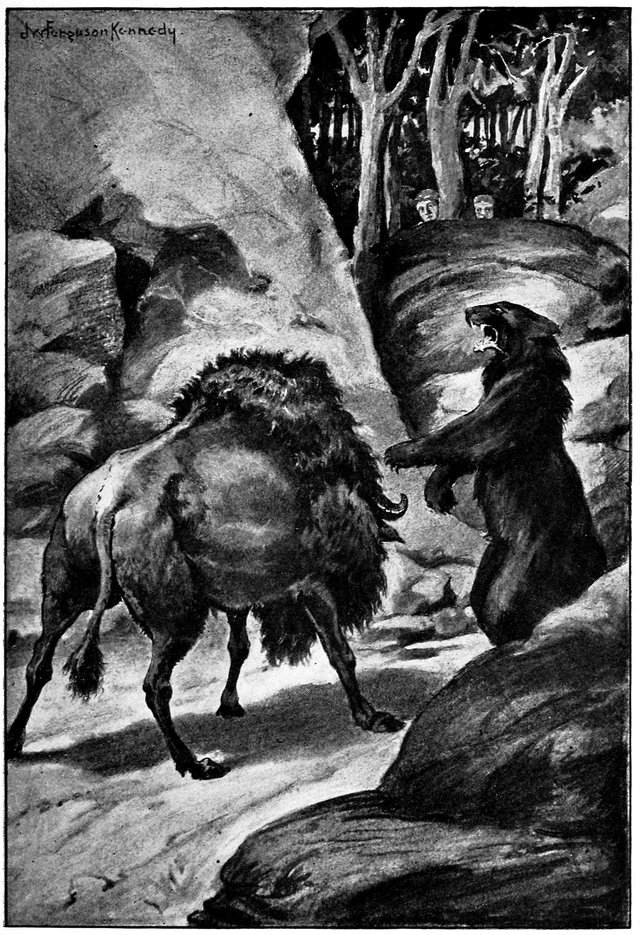
The buffalo was there, heavy-set and shaggy as to
head and shoulders, and with a look of fierceness in
his staring eyes. He was crouched beside a rock,
and directly in front of him was a small she-bear,
standing on her hind legs, and with her jaws dripping
with blood. Behind the bear were two half-grown
cubs, both whining because of wounds in
their sides.
To Henry’s practiced eye the scene told its own
story. In leaping over the rise of ground the buffalo
had come close to the den of the bear and had
stepped on both of the cubs, who were probably
playing around at the time. This had aroused the
ire of the mother bear, and she had sprung to the
rescue and bitten the buffalo in the flank. The big
beast, unable to proceed on his flight, had turned
around and struck the bear in the side. Then both
had separated, and were now getting ready to renew
the contest between them.
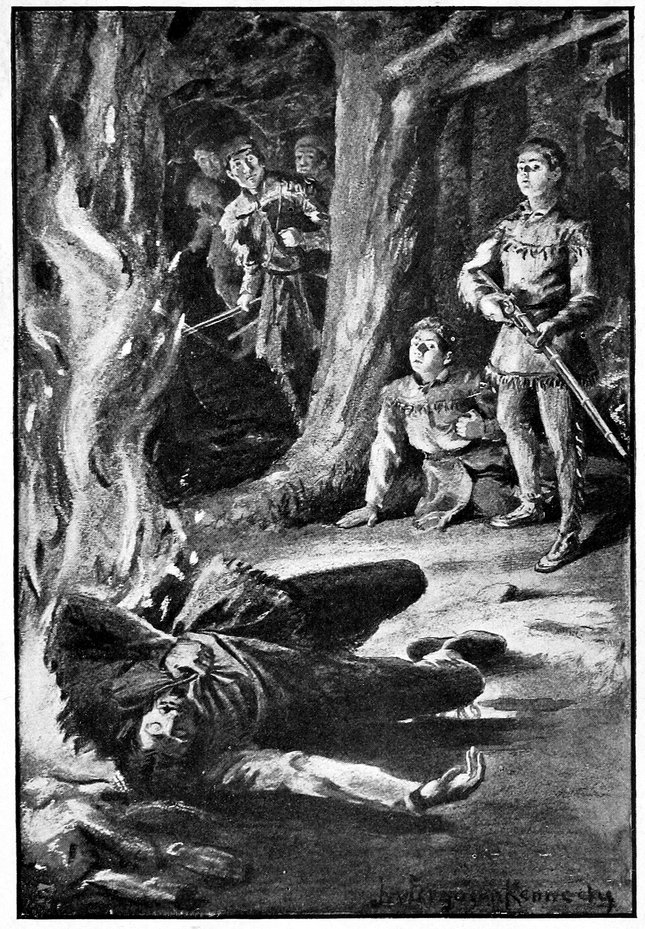
Both had separated, and were now getting ready to renew the contest.—Page 15.
15The mother bear now uttered a peculiar sound,
and at this the cubs retreated to a hole under some
rocks, which was their home. The next instant the
buffalo charged once more, hitting the bear squarely
on the head and knocking her over. But as she
tumbled, she caught her enemy by the neck and sank
her teeth deeply into the buffalo’s throat.
“What a fight!” whispered Dave. “What shall
we do?”
“Wait—but be ready to shoot,” answered Henry.
“I think the buffalo will try to run for it in another
minute.”
There was a snarl and a snort, and the buffalo did
his best to throw the bear off. But the latter clung
fast, in the meantime clawing rapidly with her hind
feet at the bison’s forequarter. Then the buffalo
swung around, knocking the smaller beast against
the rocks with such force that the two young hunters
heard the ribs of the bear crack. She fell to the
ground and the buffalo struck at her repeatedly with
his hoofs.
“It’s all over with the bear,” whispered Dave.
“Hadn’t we better shoot at the buffalo?”
16Before Henry could reply, the bison swung
around once more and made a leap which, for the
instant, took him out of sight of both youths. His
instinct told him of more danger in that vicinity,
and he sprang up on some rocks to get a better look
around. This movement brought him face to face
with Dave and Henry.
Crack! It was the report of Henry’s gun, and the
bullet hit the bison on the side of the head, not far
from the left eye. But the shot was merely a glancing
one and did little damage. Then Dave
fired, hitting the beast in the fleshy part of the
neck.
The fight with the bear had left the buffalo in
anything but a good humor and the two shots from
the young hunters only added to his ugliness. He
paused to glare at the pair and then made a savage
leap towards Henry, lowering his horns as he did so.
“Look out!” screamed Dave, and Henry sprang
to one side. The movement was so quick that he
could not calculate on where he was going and he
slipped into a hollow, his right foot going down
between two heavy stones in such a fashion that his
ankle was badly wrenched.
The buffalo now turned upon Dave and he too
leaped away. With unloaded gun he could do nothing,
and as quickly as possible he started to put in
17a fresh charge and fix the priming. In the meantime
the buffalo swung around once more, gave
Henry and the bear another look, and then sprang
for the brushwood and was out of sight in a
twinkling.
CHAPTER III DAVE AND THE INDIAN
18
“He has gone!”
“Shoot him, Dave, shoot him!”
With frantic haste Dave fixed the priming of his
flint-lock musket. But long before the weapon was
ready for use the buffalo was out of sight and
hearing.
On the ground in the hollow lay the she-bear, giving
a last convulsive shudder. At the mouth of her
den were the two cubs, whining plaintively, as if
they understood that something had gone wrong.
Henry sat on one of the rocks, with his foot still
caught fast and a look of pain on his face.
“What’s the matter? Did the buffalo hit you?”
called out his cousin, after he had looked to make
certain that the bear could do no further harm.
“No, but I—I hurt my ankle,” panted Henry.
He gave his leg a pull. “Oh! But that hurts!”
“The bear is out of it,” said Dave. He came
closer. “Hullo, your foot is caught. Let me help
19you. I reckon we have seen the last of that buffalo.”
“I don’t know about that, Dave. We both hit
him, and the bear gave him something to remember
her by.”
“Poor beast! She certainly did what she could
for her cubs. Just look at them now!”
It was an affecting sight. The mother bear had
passed away and both of the cubs had crawled forth
from the den and were licking her face and pushing
her form with their little noses. Then both began
to whine once more. Neither seemed to think of
running away.
Dave set down his gun and helped Henry to release
his caught foot. Then they took off the legging
and the shoe. The ankle had begun to swell and
there was a deep scratch on one side.
“Can you step on it?” asked Dave, and his cousin
tried to do so. He caught his breath and gave a
gasp.
“Like pins and needles going through my
leg!” he announced. “Oh, what luck! And we
didn’t get the buffalo after all!” he added, ruefully.
The bear cubs now came up and one made a snap
at Dave’s foot while the other took up Henry’s shoe
and began to chew it. Seeing this, Dave drew his
20hunting knife and dispatched them both. Then he
turned again to his cousin.
“I suppose it is out of the question for you to
think of walking,” he said.
“Not just yet,” answered Henry. “Maybe I’ll
be able to do it in an hour or two.”
“Then we may as well rest right here. One comfort,
we have the bear and her cubs even if we didn’t
get the buffalo.”
“Dave, why don’t you follow the trail again?
That buffalo may not be far off. It won’t do any
good for you to sit down here by me—I can take
care of myself. Only be careful that the beast
doesn’t corner you.”
“I’ll do it. But I’ll get you some water first,”
answered Dave.
He had noted a spring just before coming to the
bear hollow, and he walked back to it and procured
some water in a gourd they carried for that purpose.
With this Henry started to bathe his swollen ankle,
while Dave took to the fresh trail the buffalo had
made.
“Don’t stay away more than an hour!” called out
Henry after him.
“Not unless it takes a little longer to get a good
chance at the buffalo,” replied his cousin.
The buffalo had crashed through a long stretch of
21brushwood where the trail could be followed with
ease. Then he had taken to the old trail once more,
at a point a good half-mile from where he had before
left it.
“He is bound for the west, that’s certain,” said
Dave to himself. “And more than likely he will
keep on until sundown. I may as well give up all
hopes of bringing him down. Heigh-ho! such are
the fortunes of hunting!” And he heaved a deep
sigh.
He kept on for quarter of a mile further, reaching
a point where the trail crossed a small but clear
stream of spring water. Here the bison had paused
for a drink, and resting his gun against a tree, the
young hunter got down on his hands and knees to
do likewise.
The water tasted so good that Dave took his time
and drank his fill. Then he raised his head, started
to rise, and looked toward the tree where he had
placed his weapon.
The gun was gone!
For the moment the young hunter could not believe
the evidence of his senses. He remained in a
crouching position, wondering what he had best do.
He felt that an enemy must have taken the gun, and
wondered who it could be. With caution he looked
around, but not a soul was in sight.
22It was a peculiar position to be in, and small
wonder that the cold perspiration stood out upon
the young hunter’s forehead. He had been in
peril before, among the Indians, and felt fairly
certain that a red man had gotten the better of
him.
What was best to do? He asked himself the
question several times, his heart beating meanwhile
like a trip-hammer within his breast. An enemy
was surely at hand. What would be the next movement
of the unknown?
Cautiously he put his hand to his side, drew his
hunting knife, and arose slowly to an upright position.
Overhead the branches of the trees were
tightly interlaced, making the spot rather gloomy.
The stream came down between a number of rocks
which were backed up by bushes and trees. Would
it be best to make a dash for this shelter?
“White boy drop knife!”
The unexpected command, issued in a guttural
tone, came from a clump of brushwood behind Dave.
The young hunter swung around, but could see no
one.
“White boy drop knife, or Indian shoot,” were the
next words spoken, and now Dave saw the barrel of
his own gun pointed at his breast.
“Who are you?” he asked.
23“White boy drop knife, or shoot him sure!” was
the only answer, and now the muzzle of the gun was
shoved a little closer to the youth’s breast. Looking
through the brushwood, Dave made out the repulsive
features of a savage and saw the wicked gleam of
his black eyes.
There seemed to be no help for it, and the hunting
knife dropped to the ground. The Indian gave a
grunt of satisfaction and then stepped into the opening,
still, however, keeping the gun levelled at
Dave’s breast. He was a brawny warrior of the
Senecas, arrayed in his war-paint and feathers,
and he carried a tomahawk and a knife in
his girdle and a bow with arrows across his
shoulders.
“Where white boy come from?” he asked,
abruptly.
“I came from Fort Pitt,” answered Dave. “Why
did you steal my gun?”
At the last question the red man gave a grunt that
might mean anything. He looked Dave over with
care and made him back away, so that he could secure
the lad’s hunting knife, which he placed beside
his own.
“White boy sodger, um?” went on the savage,
noting the tattered uniform.
“Yes, I have been a soldier,” answered Dave. He
24continued to gaze at the savage. “I’ve seen you
before. Oh, I remember now. You were with
Moon Eye, right after I was captured. You had
something to do with the stealing of my little cousin
and the twin boys.”
The red man’s eyes flashed, but he did not answer
to this. Evidently he was pondering upon what to
do next. He had come upon Dave quite unexpectedly
and had taken the gun on the impulse of
the moment.
“White boy alone?” he asked, after an awkward
pause.
“No, I have a good many friends around here,”
was Dave’s quick reply, but he did not add that the
majority of his friends were at the fort.
At this the face of the warrior darkened. He
allowed the gun barrel to drop and drew his tomahawk.
If others of the whites were near he thought
it might be best to brain Dave on the spot, making as
little noise as possible, and then get away from that
vicinity.
The young hunter understood the movement, and
his heart leaped into his throat. He had no desire
to feel the edge of the savage’s stone hatchet. As
the gun barrel dropped still lower he thought of
the rocks and the brushwood and made a spring
towards them.
25“Pawah!” cried the Indian, in a rage. “White
boy stop!” And he made a dash after the youth.
But as luck would have it one moccasin caught in a
trailing vine and he pitched headlong. As he went
down, the trigger of the gun struck some brush,
caught fast, and the piece went off with a loud report.
Dave imagined the gun was discharged at himself,
and fully expected to feel the sting of the bullet,
perhaps in some vital portion of his body. He felt
himself making a silent prayer, and as the sting did
not come realized that as yet he was unharmed. He
cleared the rocks at another bound, almost fell into
the bushes, and ran on and on with all the speed he
could command.
Dave covered a good quarter of a mile before he
thought of coming to a halt. He was now in the
very depths of the great forest, with a heavy growth
of timber on all sides of him. The way had been
rough and he had stumbled twice, scratching his
hand and his knee so that they smarted greatly.
He was far away from the buffalo trail and also
away from the stream where he had stopped for a
drink. He had made a number of turns while running,
and could not tell in what direction he had left
either the red warrior or Henry.
“Here’s a fine kettle of fish!” he muttered, as he
26stopped to catch his breath. “Everything is going
wrong to-day. First we lost the buffalo, then Henry
sprained his ankle, and now here am I, trying to get
away from a redskin who wants to take my life and
who has robbed me of my rifle and hunting knife!
I wonder what will happen next?”
He listened intently, but could hear nothing of his
red foe, nor could he see anything to alarm him. It
was more gloomy than ever under the trees, the sun
having gone under a cloud. The breeze sighed
mournfully through the tallest branches, and only
the occasional note of a bird, or the distant bark of
a fox, broke the stillness.
Dave did not dare to linger long in one spot, fearing
that the Indian might be sneaking over his trail
with the slyness of a fox. He pushed forward, hoping
to come to a series of rocks, or a deep stream,
where the trail might be hidden.
His search was at last rewarded. Some flat rocks
appeared, forming something of a cliff. He walked
over these, taking care to avoid every accumulation
of dirt or trailing vines. Then, coming to the end
of the stones, he leaped down into a gully, where
flowed a stream of water several feet wide and more
than a foot deep. He followed this stream a long
distance, until it was lost among some rugged rocks,
where his further progress appeared to be barred.
27“There—I don’t think that Indian can follow me
to here,” he told himself. “The question is, How
am I to get back to Henry without being discovered,
and how are we both to get back to the fort?”
CHAPTER IV TAKEN BY SURPRISE
28
Dave’s hasty flight had tired him out, and he was
glad enough to sit down upon one of the rocks and
rest. The cloudiness in the sky had continued, and
it looked as if there might be a shower before nightfall.
The young hunter was in anything but a cheerful
frame of mind, and would have given a good deal to
have been back at the fort once more. He was
worried also about his cousin, and trusted that
Henry would not fall into the hands of the Indian.
At last, having gotten back his breath, he resolved
to start off once more and see if he could not
locate the spot where he had left his cousin. He
walked through the forest with extreme caution,
often coming to a halt, to survey the surroundings
and make sure that the enemy was nowhere near.
Thus a full hour more was consumed, and he knew
that Henry would now be growing exceedingly
anxious concerning his prolonged absence.
“I hope he doesn’t try to follow me up,” said Dave
29to himself. “If he does it’s more than likely that
redskin will see him.”
At length, after moving in several directions, the
young hunter came to a spot that looked slightly
familiar to him. He made a circle of the point, and
finally recognized it as the very spot he had come
to with White Buffalo when he and the Indian were
on the way to the fort with little Nell and the twins.
“Well, I never thought I’d see this place again!”
he murmured, half aloud. “I wish I had White
Buffalo with me now. I’d feel a heap safer than I
do.”
He now knew how to reach the fort, and resolved
to follow that course until he should come to the
point where the trail crossed that which he and
Henry had taken after leaving the lake to go after
the buffalo. Then he would follow up the buffalo
trail to where his cousin had been left.
He tramped on and on, growing bolder as he saw
nothing more of his red enemy. It was well past
noon, and he munched some of the rations in his
game bag, washing down the hasty meal with more
water from a brook.
He was almost up to the spot where the fight
between the buffalo and the bear had occurred when
he suddenly heard the murmur of voices, conversing
in the Indian language. Looking to one side of the
30clearing, he made out four Indians, one of whom
was the fellow who had deprived him of his rifle and
hunting knife.
The discovery came as a shock to Dave, and once
again his heart sank within him. He had presence
of mind enough to leap behind some bushes, and a
moment later the red men passed within three yards
of him. Then he heard a cry from the Indians, followed
by an exclamation from Henry.
“They have found him!” thought Dave, and he
was right. The four red men came upon poor
Henry just as he was putting on his shoe, preparatory
to looking for his cousin. One leaped forward,
pinning the young hunter to the rocks, and in a
twinkling the four had made him a prisoner and disarmed
him.
“What does this mean?” demanded Henry,
although he knew only too well. “Let up, I say!”
But the Indians paid no attention. One carried a
length of rawhide and with this they bound the
young hunter’s hands behind him. Then his pockets
were searched, and they took from him the three
shillings and sixpence he happened to be carrying.
After the capture, the four Indians held a consultation
among themselves. It was in their native
tongue, so that Henry could understand next to
nothing.
31“White boy come with Indians,” said the red man
who could speak English. He had joined his
brother warriors after giving up the chase after
Dave.
At that moment Henry caught sight of the extra
hunting knife and the rifle he knew only too well.
“Dave’s gun and Dave’s knife!” he cried. “What
have you done with him?” he asked, with a sinking
heart.
The Indian would not answer this question, but
drew up his eyes in a peculiar fashion that caused
Henry to shiver. He concluded that Dave must
have been killed, although he noted with just a grain
of hope that none of the warriors carried his cousin’s
scalp.
Despite the fact that his ankle hurt him a good
deal, Henry was forced to march along with the
Indians, who prodded him now and then with the
points of their hunting knives to make him move
along faster. The course was to the northwest, to a
stream known to the red men as the Mustalonack,
where a small band had taken up their secret abode
since the disastrous battle of Bushy Run.
After what was to Henry a painful walk lasting
an hour, the Mustalonack was reached, and from the
bushes along the bank the Indians drew a long canoe.
They made Henry enter and then got in themselves
32and shoved off. The course was up the stream, and
two used the paddles. As the current was rather
swift, the progress of the craft was necessarily slow.
In moving towards the river the Indians had been
on the alert for the possible appearance of white
hunters or English soldiers. They knew that to
stay in that neighborhood was dangerous, and they
expected in a few days to move much further to the
westward, perhaps even as far as the Mississippi.
They were awaiting orders from their chief, who, in
turn, was hoping every day to receive some wampum,
or speech belt, from Pontiac.
But though the red warriors were on the alert,
their eyes were not sharp enough to catch sight of
Dave, as he followed them at a safe distance. Although
unarmed, the young hunter could not bear
to think of leaving his cousin to his fate, and so he
kept the party in front in sight, hoping that sooner
or later he would be able to render Henry some
assistance.
When the Indians set off in the canoe, Dave was
for the moment nonplussed, not knowing how to follow
them. But when he saw how slowly the craft
moved, he took courage, and walking through the
forest along the shore, managed, although not without
an effort, to keep them in sight until they had
journeyed as far as they wished, when he saw them
33land on the opposite shore, pull the long canoe into
the bushes, and hurry once more into the forest.
To some faint-hearted persons this might have
meant the end of the pursuit, but Dave was made of
sterner stuff, and besides he loved his cousin too
dearly to give up the hope of a rescue thus readily.
He saw that the stream at this point was rather shallow,
and without hesitation pulled off his shoes and
stockings, rolled up his breeches, and waded in.
Fording the stream was not as easy as it looked,
and more than once Dave was in danger of slipping
down on the loose rocks or of having the current
carry him off his feet. But he managed to reach the
opposite shore of the stream in safety, and there,
donning his stockings and shoes again, hurried on
after the red men as before.
Dave had not gone very far when he saw the unmistakable
signs of an Indian village. He slackened
his pace and soon saw a lean and hungry-looking
Indian dog coming toward him. The canine
began to bark viciously and showed his teeth.
Here it was that the young hunter’s nerve again
showed itself. He was well acquainted with the
general worthlessness of the Indian curs—dogs that
were not to be compared with the hunting and watch
animals of the English—and picking up a sharp
stone he let drive, taking the canine in the side. The
34dog gave a sharp yelp, turned and fled, and that was
the last Dave saw of the animal.
In the meantime the Indians had arrived at their
temporary village, located in a dense portion of the
forest, and consisting of nothing more than half a
dozen dirty shelters of blankets and skins. In the
center was a small clearing where a campfire
smoldered, and around this lolled half a dozen
Indians, while not far off were several squaws and
a dozen dirty and half-clad Indian children.
The coming of the four warriors with their captive
produced a mild sensation, and there was a running
fire of questions and answers in the native dialect,
lasting some time. In the meanwhile two of the
warriors bound Henry to a tree near the largest of
the wigwams, and left him, for the time being, to
take care of himself.
The head of the tribe, Moon Eye, was away, and
was not expected back until the next day at noon.
This being so, the Indians decided to keep Henry
where he was. He was given nothing to eat, and
when he asked for a drink he was handed some
dirty water that even a dog would have refused.
“What do you want of me?” Henry asked, of the
Indian who could speak English.
“White boy wait and he shall see,” answered the
warrior.
35“Did you kill my cousin—the one who owns that
rifle and the hunting knife?”
“White boy must not ask so many questions.”
“If you don’t let me go you’ll get into trouble,”
went on Henry, thinking he might scare the Indians
into releasing him. “See how you have already suffered.
The English have many soldiers—they can
do the red men great harm.”
“The French have many soldiers also,” answered
the warrior. “Soon their army will come to the
aid of Pontiac and his followers.”
This was a story that had often been told to the
red men by the French traders, and many of the
Indians believed it. But they waited in vain for help
from France, or from Canada. Instead of sending
help, the king of France sold his holding along the
Mississippi to Spain, so that the Indians were worse
off than ever.
As night came on it began to rain gently, while a
heavy mist filled the air. The Indians did not like
this at all, and after huddling around the campfire
for awhile the majority of them crawled into the
wigwams and went to sleep. Two of them visited
Henry, binding him more securely to the tree than
ever, so that to break or slip his bonds was entirely
out of the question.
“White boy sleep good,” said one of them, as a
36joke, and then both stalked over to the fire once
more. But the rain and the mist were not to their
liking and presently they, too, retired. Then the
fire died down gradually, and the Indian village became
as quiet as a graveyard.
CHAPTER V THE FLIGHT TO THE RIVER
37
“Henry!”
“Dave! How did you manage——”
“Hush! Don’t make any noise, or the Indians
may hear you. Stand still until I untie the ropes.
They took my knife away from me.”
No more was said just then. Henry’s heart gave
a great bound of joy. Dave was alive and well,
after all. The discovery was almost too good to be
true.
With dextrous fingers Dave undid the rawhide
which held his cousin a prisoner. Henry was so
stiff that he staggered, and Dave had to support him
for the moment.
“Come with me to the river—we can take to the
canoe,” whispered Dave into his cousin’s ear. He
was fearful that one of the Indians might awaken at
any moment and stop their flight.
“All right, Dave, but——” Henry hesitated, and
tried to look through the darkness and the rain.
“Are you armed?”
38“No.”
“Neither am I—they took everything I had. We
ought to try to get at least one rifle and a knife.”
“Yes, but the risk?”
“Is the canoe ready for use?”
“Yes,—all we have to do is to jump in and shove
off.”
“Then keep still until I take a look around. At
the first sign of an alarm make for the canoe as tight
as you can.”
Henry’s wrenched ankle still pained him, but in
the excitement of the occasion he paid no attention
to the injury. With the wiliness of the red warriors
he was trying to outwit, he crawled forward
in the darkness until he was close to one of the wigwams.
This he knew held several Indians and also
his own weapons and those belonging to Dave.
With bated breath the young hunter raised the
dirty flap to the wigwam and tried to pierce the
darkness inside. He could see next to nothing. He
crawled in a little further, and his hand came in
contact with an Indian’s foot. He felt further, and
touched the barrel of a gun. He raised the weapon
and drew it towards him. One of the red men gave
a deep sigh and a grunt, but did not awaken.
Encouraged by his success so far, Henry crawled
forward again and this time obtained the second
39rifle, the powder horns, and also one of the hunting
knives. His eyes were now becoming accustomed
to the darkness, and finding a tomahawk he took
that too, and then a bow and a quiver full of arrows.
At that instant one of the Indians turned over,
muttering in his sleep. Fearful that he was awakening,
the young hunter made a hasty move toward the
wigwam opening. He stepped on the foot of a
sleeping warrior, and the red man sat up with a
start and called out in his native tongue, demanding
to know what was the matter. Then, as he saw
Henry dart from the shelter, he gave a war-cry that
alarmed the entire camp.
“Lead the way to the canoe, Dave!” cried Henry.
“And here, take one of these rifles. If they press
us too closely, fire!”
Dave took the weapon handed to him, and side
by side they rushed toward the river. Hardly had
they gained the shelter of the forest when the red
warriors were in full pursuit. One caught up a dying
brand from the fire, and swinging it in a circle
soon had it burning brightly for a torch.
Fortunately for the two young hunters, Dave had
noted the trail to the river with care, so that he did
not get mixed up, even though it was dark and misty.
But Henry could not run very fast on account of his
lame ankle.
40“I’m glad we are to—to go by way of the—the
river,” he gasped. “I—I can’t run much
further!”
The Indians were yelling wildly, and one of them
let fly an arrow which whizzed through the bushes at
their side. Dave caught his cousin by the arm, to
aid him, and an instant later another arrow flew
directly between their heads.
“They must see us, Henry. Come, can’t you run
just a bit faster?”
“I’ll—I’ll try,” gasped Henry, and gritted his
teeth, so great was the pain in his ankle.
The forest now came to an end, but luckily for
the youths the river was bordered with thick brushwood.
Into this they dove, and in half a minute
more reached the point where Dave had left the
canoe in readiness for immediate flight.
“It’s gone!” cried the young hunter, in dismay.
“The canoe?” queried his cousin.
“Yes, I left it right here.”
“Then we are lost!”
Sick at heart, they caught each other by the arm
and listened. The Indians were close at hand.
What was to be done?
“Let us try to trick them!” whispered Dave, and
caught up a stone that was handy. He threw it into
the water with a splash, and then threw another
41stone after it. This accomplished, he drew Henry
into the bushes, and both made their way down the
shore for a good hundred feet, walking in shallow
water to conceal the trail.
The mist over the water was thicker than in the
forest, and when the Indians came out on the shore
they could see little or nothing, even though they
swung the torch in all directions.
“They leaped into the water,—I heard them,”
said one warrior, in the Indian language.
“I heard them too,” answered another. “They
must be swimming for the other side.”
“We’ll get into the canoe and look around,” put
in a third.
They ran to where the long canoe had been left,
and then uttered cries of anger at finding the craft
missing.
“They have taken the canoe!”
“If that is so we cannot catch them—the mist will
hide them from view.”
“Moon Eye will be angry when he finds his best
canoe gone,” grumbled the Indian who could speak
English. “And my bow is gone too!”
The Indians continued to walk up and down the
river bank, looking for some trace of the two whites.
They could not imagine who had come to Henry’s
rescue, but thought it must be somebody from Fort
42Pitt, and were much disturbed, thinking that some
English soldiers might be in that vicinity.
Meanwhile Dave and Henry remained hidden in
the bushes, close to the water’s edge. They caught
an occasional flash from the torch, but otherwise saw
nothing of their enemies. The cooling water
seemed to soothe Henry’s ankle greatly, for which
the young hunter was grateful.
“Let us go on a little further,” whispered Henry,
after a short rest, and while the Indians were out of
sight and hearing. “The further we get away, the
better.”
Dave was more than willing, and they moved
through the shallow water until they reached a bend
in the river. Then both gave a cry of satisfaction:
“The canoe!”
“It must have drifted to this spot,” said Dave.
“See, the paddles are just as I left them. But I
thought the canoe was fast.”
“Get in and be quick about it,” returned his
cousin.
They entered the craft and shoved out into the
stream. The rain had ceased, but the mist was so
thick they could scarcely see two yards in any direction.
Catching up the paddles, they guided the
canoe down the watercourse as best they could. At
first they caught a faint glimpse of the Indians’
43torch, but this was quickly swallowed up by the mist
and darkness.
“I reckon we are out of it,” said Dave, after
quarter of an hour had passed. “And I am glad of
it.” He heaved a long sigh of relief.
“You are not half as glad as I am,” answered his
cousin. “I felt pretty blue when they had me tied to
the tree, I can tell you! How ever did you locate
me?”
“It’s a long story,” answered Dave, and then told
of his meeting with the Indian who could speak
English, and of what had happened afterward.
“We can certainly count ourselves more than
lucky,” said Henry. “In nine cases out of ten those
redskins would have killed us on the spot, and
scalped us in the bargain. They are terribly bitter
because Pontiac’s last conspiracy failed.”
“I think I know why they let you live, Henry.
They wanted to learn how matters stood at the fort.
They’d make you tell everything, even if they had to
torture you into doing it.”
“I reckon you are right on that point.”
Feeling themselves safe for the time being, the
two young hunters stopped paddling and tried to
gaze around them. Nothing could be seen but the
mist and water, the latter rushing along with increased
swiftness.
44“Did they have another canoe?” asked Henry,
presently.
“I couldn’t find any, and I looked pretty carefully.”
“In that case, they won’t be able to follow us very
readily.”
“They won’t know where to look for us, in this
darkness, Henry. The question is, where are we
going? I know nothing of this river, do you?”
“I do not, but I imagine it flows into the Allegheny
or the Ohio.”
“If it will take us to the fort, that is just where
we want to go.”
They talked the matter over, and decided to keep
on the river at least for a few miles further. Then
they would go ashore, make themselves as comfortable
as possible, and wait for daylight to appear.
“If the sun comes out we can climb a tall tree and
get the lay of the land,” said Dave. “Or, I can
climb it alone, since your ankle is hurt. How does it
feel now?”
“No worse,” answered his cousin. “I think if I
can keep off it for a few hours it will be all right
again. But it was a pretty bad twist.”
“Do you notice that the river seems to be growing
narrower?” said Dave, after a short spell of silence.
“I have been wondering if we are not on some
45branch,” was the reply. “Anyway, it is flowing
much swifter than before.”
“Maybe we had better turn into shore now.”
“I think so myself. We don’t want to run into
anything.”
They started to turn the canoe around. To their
surprise the water began to boil and foam on all sides
of them. Then came a grating sound from the
bottom.
“We just ran over a rock!” cried Dave. “Henry,
this is getting dangerous!”
“I think so myself, Dave. Come, we will make
for the shore over yonder. Perhaps—— Oh!”
Henry’s remarks came to a sudden ending, as the
canoe swept swiftly under the low-hanging branch of
a big tree. The young hunter was standing up at
the time, and he was carried overboard in a flash,
paddle in hand. Then the canoe struck a rock, slid
up along some tree-roots, and began to fill with
water!
CHAPTER VI BACK TO THE FORT
46
Henry was so taken by surprise that it was not
until he found himself over his head in the river
he realized what had occurred. His shoulder
struck a rock, but the blow was of small moment.
He came up, spluttering and still holding the
paddle.
“Whe—where are you, Dave?” was his first question,
as he dashed the water from his eyes.
There was no answer, and in the mist and darkness
he could see nothing. He struck out, and soon
reached a spot where he could stand on the rocky
bottom of the watercourse. He was under some
tree-limbs, and knew that the shore must be close at
hand.
“I say, Dave!” he called again. “Dave!”
“Henry!” was the feeble reply.
The voice was sufficient for Henry to locate the
canoe, and he hastened toward it. Feeling around
in the utter darkness he caught hold of his cousin’s
knee and then his arm.
47“What’s the matter? Are you hurt?”
“I—I don’t know,” faltered Dave. “A tree-limb
struck me on the head.” He put up his hand.
“Phew! I’ve got a lump on my forehead like a
walnut!”
Henry could feel that the canoe was filling with
water, and so lifted up the guns and the powder and
bullet horns. Dave was slowly recovering from the
shock received. Both stood up and leaned against
a thick limb above the canoe.
“Let us follow the limb to shore,” said Henry,
and this was done, they taking everything that had
been in the canoe with them.
Among the jagged rocks the water swirled
swiftly, and they had to pick their way with care.
Close to the tree-trunk was a deep hole, and they
had to circle this. At last they stood on the shore,
where the rocks were backed up by brushwood and
tall timber.
“I fancy the canoe is done for,” announced Dave.
“It went up on those rocks good and hard.”
“Well, let us be thankful that it carried us as far
as it did,” answered Henry, trying to be cheerful.
“We must be four or five miles from that Indian
camp.”
“You are wet to the skin, Henry. You’ll have to
dry your clothes or you’ll take cold.”
48“I’ll wring them out and make that do, Dave.
We won’t dare to light a campfire.”
“Not if we can find a hollow? The mist will hide
a good deal, remember.”
“Well, we’ll see about it.”
Henry did not relish remaining in the wet and
darkness any more than did his cousin, and both
searched around until they found a spot with high
rocks on two sides and a thick group of trees opposite.
To get some dry wood was the next task, and
then came the problem of starting the blaze. But
this was solved by Henry, who poured some loose
powder on a dry rock, mixed it with some tinder,
and then hammered the rock with the ramrod of his
gun. Soon came a flash and a hiss, and the tinder
glowed, and presently the fire flared up pleasantly
enough. Around it they piled some flat stones,
shutting in the light as much as possible.
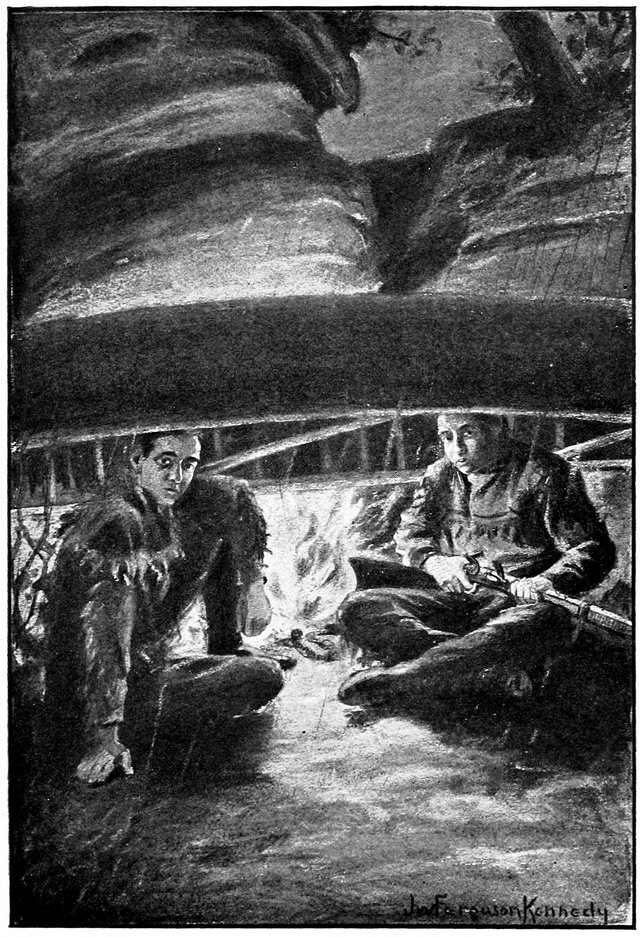
“Do you think we ought to pull in the canoe?”
asked Dave. “The Indians may come along and
see it.”
“It wouldn’t be a bad plan,” answered Henry.
They soon had the battered craft out of the river.
They turned it upside down, resting each end on a
rock, and thus it formed for them something of a
shelter in front of the fire.
With the brightness of the blaze, matters appeared
49to take on a more cheerful turn. Henry took off
the most of his garments and dried them, and Dave
did likewise, and the former also cared for his hurt
ankle. The youths calculated that it was about midnight.
They did not know where they were, nor
what new dangers might confront them. Each
looked to his firearm, to see that it could be used if
necessary, and one kept the hunting knife and the
other the tomahawk in readiness.
“I think we had better take turns watching,” said
Henry. “There is no use in both keeping awake.”
He took the first vigil, allowing Dave to sleep
until about three o’clock. Then he turned in for a
solid sleep lasting several hours.
In the morning the mist and the rain cleared away.
The day, however, was still gloomy, and although
Dave climbed one of the tall trees at hand, he could
see little or nothing by which to locate himself.
“I think the fort is in that direction,” he said,
pointing with his hand. “But I am by no means
sure.”
“Well, we may as well journey in that direction
as any other,” was Henry’s reply. “I think you are
right. The canoe is not fit for use, so we cannot go
down the river, and may as well throw the paddles
away or burn them up.”
At early dawn Dave had discovered a squirrel on
50a branch near by, and laid the game low with an
arrow. This had made him do a little hunting with
the bow, and he had ended by obtaining four squirrels.
These, broiled over the fire, gave them a good
breakfast, washed down as it was by a drink from
the river. They looked up the watercourse as far
as they could, but saw no signs of the Indians.
They were soon on the tramp. Knowing that
Henry’s ankle must still pain him, Dave let his cousin
set the pace. This was somewhat slow for the
frontier youths, but would have proved stiff walking
for anybody not used to it. The route was
comparatively easy to travel, and by high noon,
when they sat down to rest, they calculated that
they had covered at least eight miles.
“The sun is breaking through the clouds, and I
am going to take another look around,” said Dave,
and this time Henry climbed a tree with him. A
grand panorama of woods, hills, and waters was
spread around them, and at a distance they saw
where Fort Pitt was located, at the junction of the
Allegheny and Monongahela rivers.
“There is the fort!” cried Dave, light-heartedly.
“Henry we are almost on the direct road!”
“And not an Indian in sight, so far as I can see,”
was the answer, as Henry’s trained eye moved
slowly from one direction to another.
51“Let us go on again. I want to get back before
night—if it can be done. But, of course, you’ll have
to set the pace,” added Dave, considerately.
As they journeyed along they talked over the
situation, and wondered if the Indians had taken
possession of the dead bear and her cubs.
“I don’t think they took the whole bear,” said
Henry. “Maybe they took the hide and the choicest
of the meat.”
“I didn’t dare to watch them too closely, for fear
of being caught,” said Dave.
They took an almost direct course for the fort,
and by the middle of the afternoon calculated that
they were but two or three miles away. Nothing
had come to alarm them outside of the appearance
of a rattlesnake that glided from under a rock over
which they were stepping. They lost no time in
giving the reptile a wide berth, and on his part the
rattlesnake did not attempt to molest them.
“I think we’ll reach Fort Pitt by sundown,” said
Henry. “We might do it in less time, but there is
no use in hurrying.”
“Does the ankle still hurt?”
“It doesn’t hurt very much, but it feels weak. I
think I’ll rest all day to-morrow.”
“We’ll have earned a rest, I’m thinking,” returned
Dave, with a grim smile. “Won’t they open their
52eyes at the fort when they hear the story we have
to tell!”
Another mile was covered, and they had to pass
around a hollow filled with thick brushwood. Henry
was in advance, when he came to a sudden halt.
“Here is our chance, Dave!” he whispered. “We
won’t have to go back empty-handed.”
Dave pressed to the front and took a look ahead.
There, among the bushes, was a beautiful doe with a
fair-sized fawn beside her.
“Good!” whispered Dave, raising his rifle. “The
best kind of deer meat. Which will you take,
Henry?”
“I’ll take the doe.”
“All right, I’ll take the fawn. It’s a pity to kill
such a beautiful creature, but it can’t be helped.
We need the meat.”
Both moved a little closer, to a spot where they
could get a better chance at the doe and her fawn.
Just as they raised their rifles the mother deer looked
up and gave a sniff. The fawn followed, and both
started to bound away.
Bang! bang! Both guns rang out in quick
succession. The fawn fell in a heap in the bushes
and lay still. The doe struggled on, mortally
wounded in the breast. But hardly had she gone
ten feet, with Henry and Dave after her, than an old
53frontiersman stepped from behind a tree, ran up,
and plunged a hunting knife into her throat, bringing
her career to an end.
“Sam Barringford!” cried Dave and Henry in a
breath.
“Right ye air, boys,” answered the old frontiersman.
“I wasn’t quite quick enough fer ye,
was I? Thought as how thet meat war mine fer
sartin.”
“Were you after the doe and her fawn?” asked
Henry.
“Yes—been a-followin’ ’em fer the last hour.
They war in sight o’ the fort, an’ I thought I’d add
to the provender by bringin’ ’em low.”
“Well, you’ve had your hand in the killing,” said
Dave. He examined the fawn. “There’s meat fit
for the table of a king.”
“Yes, and I wish mother had it,” added Henry.
Sam Barringford was alone and carried only his
long rifle, his horn of powder and ball, and his hunting
knife. As of old he was attired in a hunting
shirt, with leggings, and wore his coonskin cap,
with the tail trailing behind. He was surprised to
learn that they had no game with them, but still
more surprised when he heard the tale they had to
tell.
“We’ll want to git back to the fort without delay,”
54he said. “The commandant there must know about
this.”
The doe was hung on a long pole, and Dave and
Henry carried the game between them. The fawn
Sam Barringford slung across the back of his neck,
with the front hoofs in one hand and the rear hoofs
in the other. Thus they walked as swiftly as possible
to the fort, where their coming was noted from
a distance.
“Not so bad,” said James Morris, as he eyed the
game. “But you have made a long stay of it.”
“Yes, and we might have had a bear, two cubs,
and a buffalo had it not been for the Indians,” replied
Dave.
“The Indians!” burst out his parent. “Do you
mean to say you ran into the Indians again?”
“We certainly did,—and I have been a prisoner,
too,” said Henry. “I might be a prisoner yet if it
hadn’t been for Dave.”
“Well, this is certainly news,” said Rodney. “I
thought all the Indians had cleared out.”
“I said all along they’d be skulkin’ around,” said
Sam Barringford. “Don’t ye remember as how I
warned ye to keep your eyes peeled? Some o’ them
redskins ain’t a goin’ to git out until they actually
have to, mark me!”
The news that Dave and Henry had encountered
55the Indians quickly spread, and Captain Ecuyer, who
was in charge of the stronghold, sent for them, that
he might learn the details. They knew the captain
well, and readily told him all.
“I shall have to look into this,” said the commandant
of Fort Pitt. “The Indians must be
cleared out of this district entirely.”
CHAPTER VII THE START FOR THE EAST
56
The news that the Indians were still in that vicinity
alarmed James Morris exceedingly, and he shook
his head sadly when he remembered that it had been
arranged for Rodney to start for the east with little
Nell and the twins on the following Monday.
“I hardly think it will be safe,” said he, to Rodney.
“I should not wish anything to happen to you and
the others.”
“There are six men to go along, besides Sam
Barringford,” answered the young soldier who had
fought so bravely at the battle of Bushy Run.
“There can be only small bodies of Indians around,
and they will not dare to attack us if we keep a
good watch.”
“The Indians may unite for an attack,” said Mr.
Morris. “Better wait until we are certain the way
is clear.” And so the start for the Morris homestead
was delayed.
Dave and Henry had returned to Fort Pitt on
Friday night, and Saturday morning Captain
57Ecuyer sent out a body of fifty regulars and six
frontiersmen, to scour the vicinity for Indians.
With the number went Sam Barringford and another
old hunter, Tony Jadwin, both of whom knew
that territory well. Jadwin had been Mr. Morris’s
right-hand man at the trading post, and was counted
an Indian trailer of extraordinary ability.
“I’d like to go with them myself,” said Dave, but
his father demurred. Henry was glad enough to
give his ankle a rest, and Rodney thought he had
better reserve his strength for the trip eastward.
“Oh, Henry, please don’t go out among the
Indians again!” cried little Nell, to her brother.
“And don’t you go either, Cousin Dave,” she added.
“We are not going just yet,” said Henry, giving
his sister a kiss.
“Oh, I hate the Indians so!” went on the miss,
with a stamp of her foot.
“Not all Indians,” replied Dave, with a smile.
“Don’t forget White Buffalo.”
“Oh, he is only an Indian in looks,” answered
Nell. “He has a white man’s heart—Uncle Sam
told me so.”
“By the way, where is White Buffalo?” asked
Henry.
“He has gone to visit his tribe,” answered Rodney.
“He thinks the different factions will unite
58now and sue for peace. Sir William Johnson is
going to give them all a chance to bury the hatchet,
and White Buffalo thinks it is a grand chance for
his tribe to unite once more and live in peace.”
What Rodney said about Sir William Johnson
was true. The Indian Superintendent had sent
agents to all of the chiefs of the Six Nations, and
also to the chiefs of the tribes along the St. Lawrence
and in Canada. The Indians were to meet the
Superintendent at Johnson Hall in central New
York State. Many came to the conference, which
began early in September and was productive of
some good, although not a great deal. The Iroquois
were induced to send messages to other tribes in
the west, urging them to bury the hatchet, and they
also sent word to the Delawares telling them not to
listen to the western tribes that desired to plunge
them into further bloodshed. The Senecas would
not come to the conference, and they continued to
kill and plunder whenever the opportunity presented
itself, and the tribes from along the Mississippi did
likewise. White Buffalo’s tribe of Delawares continued
to remain split, much to the old chief’s sorrow,
one part aiding the English, and another part
aiding the Indians, and the French who still held
certain trading posts and refused to give them
up.
59The regulars and frontiersmen to sally forth from
Fort Pitt after the enemy, were gone four days.
When they returned they announced that practically
all the red men had departed either for the north or
the west. They had encountered one band of fleeing
men under Moon Eye and had slain two of the
Indians. One regular had been shot in the arm,
a wound that was painful but not serious. They
had come upon the torn carcass of the bear, which
the wolves had used for a feast after the Indians had
cut away the hide and some choice steaks, and had
found the torn body of one cub. Sam Barringford
had also gotten a long-distance shot at a buffalo,
probably the one followed by Dave, but the animal
had gotten away from him.
“I think we can make the trip eastward in safety
now,” said Rodney, to his uncle. “Evidently the
redskins are pretty badly scared. It may be safer
to make it now than later on. Besides, we don’t
want to wait till winter is on us.”
The matter was talked over at great length, and
finally it was decided that the start for the east
should be made at the end of a week. Rodney and
Barringford were to go, taking with them Nell and
the twins. A settler named Dobson was also going,
along with his wife, who promised to keep an eye on
Nell, Tom, and Artie. The escort was to be composed
60of five frontiersmen, and ten regular soldiers
who had received their discharge from the service,
and who were anxious to get back to Annapolis,
where they belonged. The party were to take with
them six pack-horses, all belonging to Mr. Morris.
This plan of departing for the east put Rodney in
better spirits, for he wanted to see home again,
not being used to being away, as were Dave and
Henry. Everything was gotten in readiness and
long letters were written by those left at the fort.
In his letter to his brother, James Morris stated that
he intended to go back to his trading post on the
Ohio as soon as it seemed fairly safe to do so, and
that, as agreed upon before, he would take Dave and
Henry with him.
“Good-bye, Rodney,” said Dave, when it came
time to part. “Take good care of yourself, and
good care of Nell and the twins.”
“And you take care of yourself,” answered the
former cripple. “Don’t start for the trading post
until it is perfectly safe.”
When the actual parting came Nell’s eyes were
full of tears and she kissed her brother Henry, Uncle
James, and Cousin Dave over and over again. Even
the twins hated to leave the fort, where they had
been general favorites since their arrival.
“Tom wants to stay by the soldiers,” said one.
61“Artie wants to stay by the soldiers, too, and by
Dave!” cried the other.
They were sturdy little chaps, the picture of
health, and Dave and Henry could not resist giving
each a toss and a hug.
When the little expedition started Dave, Henry,
and Mr. Morris accompanied them for several miles
of the journey. Then all reached the top of a hill,
and here those to remain at the fort halted. The
others went on and presently a bend in the road hid
them from view.
“I pray to heaven that they have a safe journey
home,” said James Morris, with much feeling.
As my old readers know, there were two roads
running between Fort Pitt and the east—one the old
trail used by General Braddock on his disastrous
campaign and the other used by General Forbes on
his march to victory. The Braddock road was now
but little used, and Rodney and his friends took to
the other, as being perhaps safer and easier.
The advance was in regular order, half of the
frontiersmen and regulars going ahead and the
others keeping to the rear. In the center came the
pack-horses, with Rodney and Dobson in charge.
With Mrs. Dobson were Nell and the twins, who
walked or rode, as suited them.
In these days of fast trains, trolley cars, and automobiles
62it is difficult to imagine what such a journey
as this before the colonists meant. Instead of covering
thirty to sixty miles an hour they were content
to cover ten to twenty miles between sunrise and
sunset. The road lay over the hills and through the
mountains, with mighty forests on all sides, where
the ring of the woodsman’s axe had scarcely been
heard. Great rivers were to be crossed, and if the
bridge was down or out of repair they had to find
another place to cross or else stop to mend the structure.
Where the road lay along a mountain side
the rain would sometimes cover it with mud and
stones to a depth of a foot or more, making the
advance extra laborious. Here and there the wind
had blown a tree down over their path, and then they
would have to either work their way around it, or
else cut through or over it. In some spots the tree-branches
were so low the horses could scarcely get
under them, and here all the travelers would have
to advance on foot, and see to it that none of the
packs were lost. Once a pack caught on a sharp
bough and tore open, scattering the contents in all
directions.
“Won’t catch me coming out here again,”
grumbled Asa Dobson. “Folks out Baltimore way
said I could make my fortune in them western countries,
but I don’t see it. Them Injuns nearly killed
63me and my wife twict, and they stole my hoss, and
I’m going to stay in the east after this, and work for
my old master, the Earl of Chester. The Injuns
can have them western countries for all o’ me!”
“Don’t you want to be your own master and own
your own plantation?” asked Rodney.
“No, not if I’ve got to fight Injuns to keep it,”
answered Dobson. He was used to life around the
larger towns, and the loneliness of the wilderness
struck him with a peculiar terror.
However the journey had its bright spots. The
men in advance always secured plenty of game—deer,
rabbits, squirrels, wild turkeys, and partridges—and
the children often stopped to pick the wild
flowers which still bloomed along the roadside. At
nightfall they would go into camp beside some brook
or spring of pure mountain water, and there would
gather around a generous campfire, to eat the main
meal of the day and make themselves at home. During
the evening hours Sam Barringford would tell
the children wonderful stories of hunting, or of his
army adventures while out with Dave and Henry,—tales
which they listened to with much interest.
“Tom is going to be a soldier when he grows up,”
said one of the little boys.
“Artie is going to be a soldier too, and have a
beautiful uniform,” put in the other promptly. They
64spoke thus in childish fashion, little dreaming of the
days to come when they would both shoulder their
muskets in the War for Independence.
So far they had met nobody on the road. When
Sunday came they spent the day in a much-needed
rest. Nell repeated to Rodney some Bible verses
and tried to teach them to the twins.
On Monday afternoon those in advance saw a
pack-train approaching, composed of eight horses
and one cart, and in charge of six frontiersmen and
a trader named Packerson.
“Where bound, Packerson?” asked Sam Barringford.
“Fort Pitt,” was the short reply. Packerson was
a rather silent man, of few words.
“Come straight through from Cumberland?”
“Yes.”
“See any Injuns?”
“Seven. Had a fight with ’em too,” answered the
trader. Then his train came to a halt, and the
others at once surrounded him for particulars of the
encounter.
CHAPTER VIII THE MASSACRE OF A PACK-TRAIN
65
Jed Packerson’s story was soon told. His party
had first seen the Indians while crossing a high hill
where a landslide had carried down many trees of
the forest to the valley below. As soon as discovered
the red men had run for shelter. Half an
hour later one of the frontiersmen had given the
alarm, and the next moment a shower of arrows had
fallen around them, hitting one man in the shoulder.
Then two guns had been discharged and a horse had
been hit in the thigh and had stampeded. The
whites had returned the fire of the Indians, who,
however, had kept under cover. At least one red
warrior had been wounded, and then the whole party
had taken themselves to parts unknown. The horse
to run away was still missing and Packerson had
decided to let him go rather than lose time on a trail
that appeared so dangerous.
The fight had occurred two days before, and the
spot where the Indians had opened fire was less than
sixteen miles away. This was disturbing news to
66Rodney and his friends, and after Packerson had
continued on his way a council of war was
held.
“We’ll have to be on our guard night an’ day,”
said Sam Barringford. “The advance guard will
have to spread out purty well an’ beat the brush
thoroughly. At the first sign o’ danger, whistle or
fire a gun and then come to the center.”
The old frontiersman had been selected as a
leader, and the others agreed to follow his advice.
The bordermen and the regulars spread out into a
regular circle around the pack-horses and those with
the steeds, and Mrs. Dobson and the children were
cautioned not to wander off by the roadside under
any circumstances.
That evening the party encamped by the side of a
stream at a point where there was a good-sized opening
in the forest. Guards were stationed on both
sides of the watercourse, every man being on duty
four hours during the darkness. The horses were
tethered in a circle and in the center a small tent was
pitched, in which Mrs. Dobson, Nell, and the twins
might rest.
Sam Barringford remained on guard duty from
eight o’clock to midnight, his post being to the north
of the camp proper, where the stream made a turn
between some rocks and tall trees. The old frontiersman
67was tired out by his day’s tramp, but did
not grumble over being compelled to keep awake.
“It’s got to be done, an’ thet’s all there are to it,”
he said to Rodney, “Reckon we kin sleep a week
when we git to hum.”
“I shan’t mind staying awake, when my turn
comes,” answered Rodney. “But I do hope the
Indians won’t appear. I shouldn’t care so much if
we were alone, but with Mrs. Dobson, Nell, and the
twins it is different.”
The night was a fairly clear one, with countless
stars showing between the drifting clouds. There
was no breeze worth mentioning and the stillness,
away from the somewhat restless horses, was
intense.
Barringford walked slowly up and down the
watercourse, occasionally mounting one of the rocks
to get a better look at the surroundings. His
trained eyes took in a good portion of territory, and
the least movement among the trees would have attracted
his attention. He was sleepy, but he did not
allow his eyes to close for an instant.
He had just climbed down from the rocks for at
least the tenth time, when he heard a rustle in some
bushes at a distance. He listened with strained ears,
at the same time dropping flat upon the ground, so
that a possible enemy might not see him too readily.
68All became silent, and he waited patiently for
several minutes. Then came the crack of a twig,
as some weight pressed upon it. A moment more
and a figure ran through the bushes, not towards the
camp but from it.
“Help!” came in a woman’s voice. “Help!”
“Mrs. Dobson, by ginger!” ejaculated the old
frontiersman. “What’s the matter with her?”
The fleeing woman was some distance away, and
he made after her with all possible speed. She
crashed through the bushes and he came after
her.
“Mrs. Dobson!” he called. “What is the matter?
Stop!”
His cries, and those of the frantic woman, aroused
the entire camp, and Dobson himself came rushing
toward Barringford, followed by Rodney.
The old frontiersman soon gained the immediate
rear of the woman. As he did so, he heard a rush
through the thickets ahead and caught a glimpse of
an Indian. Then he saw another red warrior rise
up from behind a rock, tomahawk in hand. This
fellow made a leap for Mrs. Dobson, but before he
could use his weapon, Barringford brought his long
rifle into play and the Indian pitched forward,
fatally wounded in the breast. The other Indian
continued to run, and so did several others who could
69be heard but not seen, and soon their footsteps died
away in the distance.
“Maria, what is it?” cried Asa Dobson, catching
his wife by the arm. “What is it?” And he gave
her a shake. Then he saw her open her eyes and
stare at him. “Creation! Be you asleep?” he
gasped.
“Asa! Oh, save me!” she screamed. “Save me
from the Indians! Don’t let them scalp me!”
Then she gazed around in bewilderment. “I—I
thought we were at the fort and the Indians had
come in after us,” she faltered.
“You were dreaming,” said her husband. “We
are on the journey to Cumberland and Baltimore.”
“Yes, yes, I know; but—but——” She stared
around her. “I—I—where is the tent, and the
horses?”
“You’ve had a nightmare, and it did us a heap o’
good,” broke in Sam Barringford. “Your runnin’
around has scared off some redskins, I reckon.”
By this time half a dozen were near. They gazed
at the red warrior whom Barringford had laid low.
“He is done for,” said Rodney. “He is too far
gone even to question him.” But even as the young
soldier spoke the red man raised up suddenly and
flung his tomahawk squarely at Barringford. The
70fling was a weak one and the weapon fell short of
its mark. Then the warrior sank back, gave a gasp,
and was dead.
“Game to the last,” muttered Barringford.
“Don’t know as I blame him. Might be I’d do likewise,
ef one o’ the varmin plugged me,” he added
philosophically.
It took several minutes for Mrs. Dobson to settle
herself. Her husband stated that she often arose
in her sleep. She had been terribly worked up over
the red men ever since leaving Fort Pitt, and this
had gotten on her nerves.
The alarm kept the entire camp “on edge” until
daybreak. Barringford and two others made
several tours in the immediate vicinity, but could see
or hear nothing more of the enemy.
“They have either cleared out entirely, or else
they know how to hide,” said the old frontiersman.
“Do you think it is the same party that Packerson
met?” questioned Rodney.
“Like as not, Rodney. We ain’t seen or heard o’
anybody else on this trail.”
They went on as before, and the following forenoon
made a discovery that filled even the stoutest
of them with horror. Coming to a spot where the
road led down to a ford over a good-sized brook
71they beheld a man lying beside a rock, with one
ear gone and part of his scalp cut away. The
man was shot through the body and was all but
dead.
“Who shot you?” asked one of the frontiersman,
running up.
“Th—the Indians,” was the low and hoarse
answer. “Water!”
Water was brought, but the man was almost too
weak to drink. One of the party recognized him as
Stephen Banoggin, a trader well known in those
days around Carlisle and Bedford. Banoggin had
left Bedford ten days before, with a view of establishing
a new trading post in the vicinity of Venango
as soon as it seemed safe to do so.
“All dead—all killed by the Indians!” was about
all he could say. “Fool, fool that I was to attempt
it! All dead!” And that night he expired.
His tale was almost true, although not quite so.
His pack-train had consisted of ten horses and nine
men, including three negroes who were his slaves.
The Indians—a mixed band under a chief called
Crow Feather—had ambushed the train at the ford
and slained or mortally wounded all but one negro
and a white hunter named Sturm, a German from
upper Pennsylvania. Sturm and the negro got
away together, each however wounded. They
72traveled for four weeks in the forest, when Sturm
went crazy. At last they reached a settlement,
where the negro told his story. Sturm was placed
under medical care and regained his reason some
time later.
The sights presented to Rodney and the others at
the ford were so revolting that Mrs. Dobson, Nell,
and the twins were held back, that they might not
see what had occurred. The slain were all scalped
and an effort had been made to burn one at the stake.
The bodies of the men and the dead horses lay together.
Four horses were missing, and on these the
Indians had packed such stores as they wanted,
scattering the other goods or burning them.
“This is enough to make one sick!” said Rodney,
as he turned away with a shudder. “These redskins
must have been fiends!”
“They were certainly cold-blooded,” answered
Barringford. “Poor Banoggin! He had better
have stayed in the east.”
“Sam, this doesn’t look as if it would be safe for
us to go any further.”
“Easily said, lad; but what are ye goin’ to
do?”
“You mean it is as safe to go forward as to turn
back?”
“Don’t it look thet way?”
73“Maybe. But we are a little closer to Fort Pitt
than we are to Fort Cumberland.”
“Thet’s true too. But I don’t reckon the Injuns
will dare to go as far east as Cumberland—not after
the lickin’ they got at Bushy Run.”
“The band that did this can’t be the band that
tried to surround us.”
“No, they are another tribe, I think.”
“Then the forest must still be full of wandering
bands, and we are not near as safe as we thought we
were.”
“We’ve got to make the best on’t, Rodney. We
must travel as fast as we can and keep our eyes
peeled more’n ever before. It’s the only way out,
so far as I kin see.”
The bodies of the slain were placed in a hollow,
with some flat stones on top, to keep off the wolves
and other wild beasts. The place was marked on
the trees. A few of Banoggin’s possessions were
taken along and the others left where they had
fallen.
“Poor fellow, he will never want anything in this
life again,” murmured Rodney, brokenly. And
when the trader died they placed his body away with
those of his followers. Fortunately he had been a
bachelor, so there would be no widow or child to
mourn his loss.
74Early in the morning Rodney and those with him
moved on again. Everybody in the party was exceedingly
sober. All realized their great danger.
The fate of Stephen Banoggin and his party was
ever before their eyes and in their thoughts.
CHAPTER IX UNDER THE CLIFF
75
“Thank fortune we have come so far without
injury!”
It was Rodney who uttered the words. He and
Sam Barringford were standing on a little rise of
ground, the trail in front and behind them. The
warm noonday sun shone down upon them, and all
was calm and peaceful with not an enemy of any
kind in sight. Close at hand Dobson and his wife
were preparing a meal for all hands and little Nell
was playing with the twins.
Two days had passed since they had left the fateful
ford, and they had covered thirty-two miles, over
a trail which the past rains had left in anything but
a good condition. They had been on guard every
minute, day and night, their nerves strung to top
tension. The early morning had taken them
through a spot lined upon either side with tall rocks,
and they had expected a shot at almost every turn—but
nothing had come to disturb them.
Considering the condition of the road, the horses
76had done well. Only one was injured,—from slipping
over some rocks,—but he could still carry his
load. Nobody was sick, although the constant
worry had given Mrs. Dobson a headache.
“While we are waiting for dinner, let us go ahead
and look at the trail,” suggested Rodney; and Barringford
agreed. Not far off was another hollow,
backed by a cliff of rocks, overgrown with heavy
vines, and they were both anxious to know what was
beyond.
They gained the region of the cliff without difficulty.
To save himself the trouble of climbing the
rough rocks, Rodney tested the vines and then commenced
to pull himself up, hand over hand.
“Be careful that you don’t fall!” cried the old
frontiersman. “These rocks at the bottom ain’t no
easy bed to drop on, I kin tell ye thet!”
“The vines are strong enough to hold a horse,”
answered the young soldier.
He continued to go up, until he was a good fifteen
feet over Barringford’s head. He had still six
feet to go, when he heard a slight sound from
above.
“Must be the vines tearing away,” he told himself,
after a pause. “Maybe they are not as strong as I
thought they were.”
He glanced up, saw his dire peril, and let himself drop.—Page 77.
77He waited and then went up an additional foot or
two. The vines held, and he took another grip of
them a little higher up. His head was now within
a yard of the top of the cliff, which was covered
with the vines and a stunted growth of
bushes.
Suddenly, from out of the bushes, there appeared
the head of an Indian, bedecked in war-paint and
feathers. Then a long, bronzed arm stole forward,
holding a tomahawk. The tomahawk was raised
and a blow was aimed at Rodney’s head.
Had the blow fallen as intended, the young soldier’s
skull must have been cleft in twain. He
glanced up, saw his dire peril, and let himself drop.
An instant later a shot rang out from below, and the
Indian’s hand quivered and the hatchet slipped down
among the vines and out of sight.
Rodney struck the rocks below heavily and rolled
over. When he sat up he found Sam Barringford
beside him, the smoke still rolling out of the frontiersman’s
gun.
“Oh, Sam——” he began, and knew not what
further to say.
“Press in clost to the wall,” answered the frontiersman,
hastily, and began to reload his rifle with
all speed. Rodney’s gun stood against the rocks,
where he had left it on starting to mount the
cliff.
78“Did you hit him, Sam?”
“Yes, an’ I reckon I broke his wrist—leas’wise,
he drapped the tomahawk. It was a narrer shave
fer you, lad.”
“Indeed it was.” Rodney tried to catch his
breath, which the sudden drop had knocked out of
him. “Do you suppose he is alone?”
“Ain’t supposin’ nuthin jest yit. Are you all
right?”
“I—think so.”
Both pressed in close to the rocky wall, so that
no one standing above could see them. They listened,
but no sound from above reached them.
“Perhaps the Indian ran away,” said Rodney,
wiping the blood from where his left hand had been
scratched.
“Don’t be too sure, Rodney.”
“If the enemy are so close we ought to warn the
others.”
“The rifle shot will do that. Maybe somebuddy
will be comin’ this way soon.”
They waited another five minutes, even the old
frontiersman not knowing exactly what to do. Then
they saw a frontiersman named Casbury coming forward,
slowly and cautiously.
“Look out!” shouted Barringford. “Injun on
the rocks!” And he pointed upward.
79Casbury understood, and promptly dove out of
sight behind some bushes. As he did this there was
a crashing through the vines, and a mass of rocks
and dirt came down directly in front of where Rodney
and Barringford were standing.
“Goin’ to bombard us with rocks, hey?” snorted
the old frontiersman. “Maybe I kin play ye a trick
fer that. Groan, Rodney, groan,” and he began to
groan and moan, as if in the greatest of pain. Rodney
did the same, keeping it up several minutes.
Then both began to breathe heavily, as though
totally exhausted.
Several minutes more passed and Rodney and
Barringford breathed softer and softer. Thrown
off their guard, and thinking the whites dead or mortally
hurt, three Indians leaned over the edge of the
cliff to get a view of the situation.
The young soldier and the old frontiersman were
on the alert, and as soon as the warriors appeared
they blazed away. Two drew back, one with a
shot through the side of the neck. The third pitched
forward with a yell, struck the rocks head first, and
lay dead where he had landed.
“There, I reckon thet will teach ’em a lesson,”
cried Sam Barringford, as he and Rodney again
loaded up.
A shot was now fired by Casbury, and another
80Indian was hit in the shoulder. Then Casbury saw
four Indians run from the front of the cliff and disappear
in the bushes far back.
“Come on, if you want to!” cried Casbury, and
leaving the shelter of the cliff Rodney and Barringford
made for the camp with all haste. Here they
found all the others on guard. The midday meal
was forgotten, and the men stood ready to shoot the
moment a red warrior showed himself.
“This is the worst possible place to be caught in,”
said Rodney. “The Indians can get behind yonder
trees and pick us off at will—if they have any firearms.”
“I saw nothing but bows and arrows,” said Casbury.
“Still, they may have guns.”
The situation was talked over while they waited
for the Indians to reappear. Some brushwood had
been gathered for the fire, and Mrs. Dobson and the
children were placed behind this and behind some of
the horses.
“I’m going over into the woods,” said Barringford,
to the others. “If I see anything wrong, I’ll
screech like an owl.”
“Do you want me to go along?” asked Rodney.
“No, lad, I want you to stay here, by Nell an’ the
twins.”
Barringford slipped to the rear, crawled through
81the grass, and thus reached a few low bushes, from
which he made his way into the forest.
Two hours went by slowly. Not an Indian
showed himself, nor did any signal come from Barringford.
The men remained on the alert, and when
a rabbit crossed the trail two drew a bead on the
animal like a flash.
“I trust Sam hasn’t gotten into trouble,” said
Rodney, at last.
“If he has, he’ll have to git out o’ it,” answered
one of the others, with a shrug of his shoulders.
Presently one of the regulars saw a form wriggling
through the grass. He was on the point of
firing when he recognized the old frontiersman.
Barringford came in a good deal out of
breath.
“We’ve got to move, an’ move quick, too!” he
announced. “There’s a crowd o’ thirty Injuns over
thar,”—he pointed with his hand. “They are goin’
to attack us as soon as the sun goes down.”
“But where shall we move to?” questioned
Rodney.
“I war thinkin’ o’ thet cave ye spoke about, Hempser,”
went on Barringford, turning to one of the
other old hunters. “You said it war nigh
here.”
“It’s half a mile beyond the cliff,” was Hempser’s
82answer. “I don’t know the way very good, but I
think I can find it.”
“Then thet is where we’ll go, an’ to onct,” decided
Sam Barringford.
Not a minute was lost in breaking camp, and in a
close body the pack-train set out, past the cliff and
then through a valley of heavy grass and bushes.
The men carried their guns ready for use, and
screened Mrs. Dobson and the children as much as
possible.
“Oh dear! I’d rather be dead than be so worried,”
sighed the woman. “I am that nervous I am
ready to drop!”
At the end of the short valley was another rise of
rocks, among which was located the cave. They
had just gained the first of the rocks when a
hideous war-whoop sounded out on the afternoon
air.
“They have discovered us!” cried Rodney, and he
was right. At the far end of the valley appeared
fully a score of Indians, a few on horseback and the
others on foot.
The Indians had been surprised, thinking the
whites were still on the trail. But they soon recovered,
and came riding and running towards our
friends, yelling at the top of their lungs and flourishing
their tomahawks. A moment later they sent a
83volley of arrows and several rifle shots, for some
carried one kind of weapon and some the
other.
“Are you hurt?” asked Barringford of Rodney,
as he saw the young soldier stagger.
“No, an arrow hit me in the coat-sleeve, that’s all—it
didn’t get through my shirt though.”
One of the regulars had been struck by a bullet in
the shoulder, and his friends had to help him along.
Then the Indians sent forth more arrows, one of
which tore through little Nell’s dress.
“Oh!” cried the little miss, in great terror.
“Give ’em a dose o’ their own medicine!” ordered
Barringford. “Make the shots tell!” And then
everybody fired at the advancing foe, and three of
the red warriors pitched into the grass, while two
others stopped running and then limped to the rear,
badly wounded.
Hempser was looking around anxiously for the
cave. At first he could not locate it, but, just as the
Indians advanced again, he discovered a hole and
rushed towards it.
“Here you are!” he shouted. “This way! Once
in the cave, I think we can hold ’em at bay!”
“Into the cave!” cried Barringford. “Mrs. Dobson
and the children first. Hempser, is there a back
opening?”
84“Yes, but not a very big one. We can close it up
with loose rocks.”
“Then you run back and pile up the rocks. The
others remain at this opening, to keep the Indians at
a distance.”
CHAPTER X BARRINGFORD AS A SCOUT
85
The volley poured into the Indians by the whites
made the red warriors pause for the time being.
They were close to a clump of bushes and trees
growing near the center of the glade, and they got
behind this shelter with alacrity.
In the cave all was confusion. It was an opening
ten to fifteen feet in height and equally broad at the
mouth. It ran back a distance of over two hundred
feet, where it ended in a split among the rocks, coming
out at a point where there was a thick patch of
nettle bushes.
The horses had been brought into the cave and
were led to the rear. Here Hempser worked like
a Trojan, with one of the regulars helping him.
Loose stones were to be had in plenty, and they
blocked up the rear opening completely.
“They’ll have their hands full, getting in this
way,” said the regular. “The nettles will keep them
back if nothing else will.”
“Right you are,” answered Hempser. “Injuns
86don’t like to git scratched any more than anybody
else.”
At the front of the cavern Sam Barringford took
command. A glance showed him how the land lay,
and he at once ordered some of the men to pile up
the loose stones to a height of several feet. This
formed a barricade, behind which the frontiersmen
and regulars could lie with but little danger of the
enemy picking them off.
“This is a situation we didn’t bargain for,”
said Rodney, after the construction of the barricade
had come to an end. “I must say I don’t
like it.”
“Well, lad, it’s better than being surrounded in
the open,” answered Barringford, with an effort to
look on the bright side of the affair.
“I don’t think they’ll attack us now,” went on the
young soldier. “But they may do it to-night.”
“We’ll have to keep on guard, and shoot the first
man who shows himself,” put in Casbury.
“Maybe they’ll try to starve us out,” came from
another of the frontiersman.
“We’ve got rations enough for a week or more, on
a pinch,” said Rodney. “We’ve got our regular
things and also that deer Barton shot early this
morning, and some rabbits.”
“How about water?” asked another.
87“We’ll have to see about that,” said Sam Barringford.
Satisfied that the Indians did not contemplate an
immediate attack, the old frontiersman, accompanied
by Rodney, made a tour of the cave, lighting a torch
for that purpose. In one corner the rocks were
found to be very damp, and when some were pulled
up a little water trickled forth.
“Thar’s a spring thar,” said Barringford, with
satisfaction. “We kin do a bit o’ diggin’ an’ then
have all the water we wish.” A little later two of
the regulars set to work, with pike-poles and shovels,
and soon had a hollow made into which the water
flowed to a depth of several inches. The water was
brought up in a dipper, and proved to be both clear
and wholesome.
As the time slipped by the whole party became
more composed, and Nell and the twins clamored for
their delayed dinner. A meal was prepared in the
cave, which the men ate while on the watch.
“Oh, Rodney, will the bad Indians catch us in
here?” asked Nell, as she came up to her elder
brother.
“I think not, Nell,” he answered, hopefully.
“I wish I was home.”
“So do I, Nell—wish it more for your sake than
for my own.”
88“Tom wants to go out and fight the bad Indians,”
said one of the twins. He had picked up a rifle resting
against the wall and was trying to shoulder the
long weapon.
“Here, you give me that gun!” cried Rodney,
reaching for it. “Tom, you mustn’t play with the
guns. One of ’em might go off and hurt you.”
“Tom ain’t ’fraid of no gun,” said the little boy.
“Want to shoot the Indians.”
“You keep quiet and stay with Mrs. Dobson or
Nell.”
“How long will we have to stay here, Rodney?”
asked his little sister.
“I can’t answer that question, Nell. It depends
on the Indians. Perhaps they’ll get tired of watching
us and go away.”
It was a hard matter to keep the twins quiet, but
presently both grew tired of wandering around the
cave, and went to sleep on a pair of blankets spread
out for them. Mrs. Dobson sat on one of the packs
with Nell beside her and her husband not far off.
“Oh, Asa, how foolish we were to come out to
this western country!” sighed the woman, for at
least the fiftieth time. “We should have stayed at
home and been content with what we had!”
“Ain’t no uset to cry over spilt milk,” grumbled
her husband.
89“I think the Indians will come to-night and scalp
all of us!”
“Oh, Mrs. Dobson, you don’t mean that!” gasped
little Nell.
“Don’t scare the little girl, Mrs. Dobson,” put in
Casbury, who chanced to be near. “It won’t help
matters to git anybuddy worked up.”
At last the sun sank in the west and it began to
grow dark at the mouth of the cave. Two men
were stationed at the spot where the rear opening
had been, and all the others gathered at the
front. Then Sam Barringford called Rodney to
him.
“I’m a-goin’ out on a scoutin’ tour,” said the old
frontiersman. “I’m a-goin’ to leave you an’ Casbury
in charge until I git back. Don’t shoot me, but
don’t let none o’ them Injuns git near, nuther.”
“Don’t you want me to go with you, Sam?”
“No, it will be hard enough fer one to git around,
let alone two. Ef ye ain’t sure it’s me comin’ back,
hoot like an owl an’ I’ll answer like a catbird, understand?”
“Yes.”
Barringford gave the others a few directions and
then, stepping quickly over the rocks, snaked his
way along through the grass to a fringe of low
bushes. From the bushes he made for the rough
90rocks, where he paused, to consider the situation in
all of its details.
The old frontiersman felt that he was surrounded
by enemies fully as alert as himself and ready to
shoot him down on sight.
“An’ they won’t ax me if I’ll like it nuther,” he
murmured to himself. “They be jest a-hankerin’
arter my sculp like all possessed.”
Peering cautiously around, he saw nobody, and
after a short wait took his way between the rocks
towards the spot where the rear of the cave was
located. Here he listened again, and this time heard
the low murmur of two voices. But they were those
of Dobson, the settler, and a regular, talking from
inside.
“They ought to know enough to keep quiet,”
mused the old frontiersman, in disgust. “How can
they spot the enemy if they gab like thet?”
In a few minutes the voices ceased, and thinking
the coast clear the old frontiersman worked his way
among the rocks and through the bushes toward a
point he imagined the Indians might be holding.
The darkness of night had now fallen completely
over the forest and scarcely a sound broke the stillness.
Barringford was about to cross to another patch
of brushwood when the distant call of a night bird
91arrested his attention. He was well versed in the
calls of all birds and that which he heard did not
sound exactly true to his ear. He smiled grimly to
himself and waited.
As he had surmised, an answering call soon followed.
It came from the very brushwood he had
been on the point of entering, and a tall Indian
stepped forth, as if to advance. Before Barringford
could retreat or draw to one side the pair were face
to face.
Not a word was uttered—indeed, there was no
time for speech. The Indian had his tomahawk in
his hand, and this he raised, aiming a blow at the
old frontiersman’s skull. As old as he was getting,
Barringford was still nimble on his feet and dexterously
dodged to one side. As the arm of the red
warrior came down, he caught the red man by the
shoulder, and over went the pair on the soil. Then
the Indian tried to cry out, but Barringford’s hand
was clapped on his mouth.
It now became a desperate but silent struggle for
life. From the red man’s mouth, the old frontiersman’s
hand was shifted to his throat, which was
caught with a grip of steel. The Indian struggled
desperately, first kicking heavily and then drawing
up a knee against Barringford’s breast. Then he
tried to use his tomahawk again, and hit the frontiersman
92a glancing blow on the shoulder. The
hatchet fell, and in a twinkling the Indian had Barringford
by the throat, in a clutch equally firm and
relentless.
Like two bulldogs that have a death-grip and will
not let go, white man and Indian rolled over and
over, on the rocks and in the bushes, each doing all
in his power to get the better of the other. The
Indian was muscular, and his strength was equal if
not superior to that of his white adversary. But
Barringford had secured the first grip, and the red
man’s breath was fast leaving him. His tongue
stuck out, his eyes bulged from their sockets, and
he could not utter even so much as a faint gurgle.
It was at this moment that an interruption came.
Another form glided into the midst of the bushes.
It was a second Indian, and a glance showed him
the condition of affairs. Without stopping to use
his tomahawk or his knife he kicked Barringford
heavily in the left ear. Then followed other blows,
and with a groan the old frontiersman stretched out
on the rocks unconscious.
As the hold on his throat relaxed the Indian who
had been in the death struggle gave a gasp and
stared about him. The coming of his fellow warrior
had undoubtedly saved his life.
“Where did that white man come from?” asked
93the second Indian, as he gave Barringford a close
look.
“Cushina knows not,” was the faint reply. It
was some time before the other could get back his
breath.
“Are there others about?”
At this question Cushina shrugged his shoulders.
“Did he come from the cave, think you?”
“Perhaps—all of the whites were driven to that
shelter, like so many dogs of the prairie.”
“It may not be so. Others may be at hand. We
must be careful. Moon Eye has news of some
soldiers. They may be marching in this direction.”
“Then Moon Eye himself is here?”
“Yes.”
The first warrior drew a long breath and then
brought from his girdle a keen hunting knife. He
felt of its edge with satisfaction.
“Mist of the Lake has come to the aid of Cushina
and has brought the white man to grief,” said he,
looking at the other closely. “Does Mist of the
Lake claim the scalp?”
At this query the second Indian shrugged his
shoulders.
“Does Cushina still wish to linger in the footsteps
of Laughing Eyes and make her his bride?” he
asked, after another pause.
94Cushina winced at this question. Both he and
Mist of the Lake were in love with the same Indian
maiden. As Mist of the Lake had saved his life he
was bound, according to the laws of his tribe, to
give his rival a clear field in his wooing.
“Laughing Eyes is Mist of the Lake’s—if she will
have him,” he said, in a low voice.
“And the scalp of the white man belongs to
Cushina,” was the prompt reply of the other warrior.
“He can take it at his pleasure.”
CHAPTER XI IN WHICH WHITE BUFFALO APPEARS
95
“Something must surely have happened to Sam,
or he wouldn’t stay away as long as this,” said Rodney
to Casbury, after half the night had passed without
the old frontiersman reappearing.
“I am afraid you are right, Rodney. Maybe the
Injuns caught an’ killed him.”
“Don’t you think somebody ought to go out and
try to hunt him up?”
“It won’t be any safer for us than it was for him,”
answered the borderman, with a grave shake of his
head.
Had it not been for Nell and the twins Rodney
might have gone on a hunt for his old friend. But
he felt his responsibility, and so remained in the
cavern. He felt that if an attack came his place
was beside his sister and the twins. Barringford
thought as much of the twins as if they were his own
flesh and blood, and would not forgive him did he
not do all he could to shield the youngsters from
harm.
96Slowly the time wore away. Nell, the twins, and
Mrs. Dobson had gone to sleep, and also several of
the frontiersmen and regulars, who were off duty
for the time being. The cave was kept in total
darkness, so that those inside could see better what
was happening without.
Rodney had listened for the cry of a catbird in
vain, and stood leaning against a rock, peering forth
into the semi-darkness. He was tremendously
sleepy, having gotten only a short nap the night
before.
Presently he straightened up and listened. Was
he mistaken, or had he heard the croaking of
a frog? He had not noticed this earlier in the
night.
He was not mistaken; the croaking was repeated,
at regular intervals. He could not resist the
temptation to croak also, mimicking the sound as
best he could. At once the answer came back, and
the heart of the young soldier gave a bound of astonishment
and gratification.
The call was one often used by White Buffalo,
the old chief of the Delawares who had proved
such a friend to the different members of the Morris
family. What he could be doing in this vicinity
was a mystery, since it was supposed that he was
either at the regular village of his tribe or at the
97conference being held by Sir William Johnson and
the red men at Johnson Hall.
“Perhaps it’s a ruse,” thought Rodney. “I must
be on my guard—it won’t do to be caught in a trap.”
The croaking of the frog continued, moving
gradually closer to the mouth of the cave. Then
Rodney saw something wave in the air, between two
bushes. The object went up and down twice, then
crosswise three times and then around in a circle.
“White Buffalo true enough!” murmured the
young soldier. He called some of the others to his
side. “White Buffalo, a friendly Indian, is out
there. He wants to talk to us.”
“I’ll trust none of them,” said one of the regulars
promptly. “They are all cutthroats!”
“White Buffalo has been a friend to our family
for years,” went on the young soldier. “I can
vouch for him in every respect. You know him,
Casbury, and so do you, Malloy.”
“Yes, he is square, so far as I know,” answered
Casbury.
“He’s a putty good Indian, so he is,” said the
Irish borderman mentioned. “But not wan av
thim can be thrusted whin the war’s goin’ ag’in ’im.
Betther be afther bein’ careful, Rodney.”
“He wants to talk to us—he has something important
to say,” persisted Rodney.
98“How do yez know that?”
“He just signaled to me. He and my brother
Henry and cousin Dave are great friends, and White
Buffalo taught us some of his signals. We had better
let him come in and talk to us.”
Those in the cave discussed the matter and at last
agreed to follow Rodney’s advice. But they remained
on guard, to shoot White Buffalo or any
other Indian down, at the first sign of treachery.
The matter settled, Rodney signaled White
Buffalo to approach. He started to go forth, to
meet the friendly red man, but White Buffalo quickly
warned him back. In a minute the old Delaware
chief was in the cavern.
“White Buffalo, I am glad to see you,” cried
Rodney, shaking hands.
“How! how!” returned the aged Indian. He
peered closely at Rodney in the darkness. “My
friend Rodney is better? He can walk well?”
“Yes, I am much better. And how are you?
Hello, there is blood on your face!”
“White Buffalo had a fight—down by the river—with
some other Indians. They had almost killed
his old friend Barringford.”
“Sam! Is he alive?”
“Yes—White Buffalo knocked an Indian over.
Then he took Sam and ran through the forest.
99They were about to torture Sam—to make him
speak of this place and who was here. First one
Indian wanted his scalp, but Moon Eye came up and
stopped the bloody work.”
“And you fought the Indians alone?”
“No, White Buffalo has six warriors with him—they
are watching down at the river. Sam could not
come—he is too sorely wounded. He sent White
Buffalo. He told White Buffalo to cry as a catbird,
but that is a bad signal—it would bring Moon Eye
and his warriors to the spot. So White Buffalo
used the old signal—the one he taught to Dave and
Henry. He thought his friend Rodney would
remember.”
“And I did remember. But you are hurt. Let
me bind up the wound.”
“’Tis but a scratch,” answered the aged Indian.
The cut smarted greatly, but he would not show his
pain.
“See here, what do you know about the other
Indians around here?” asked Casbury.
“They number thirty,” said White Buffalo, who
had learned how to count in English style. “All
strong, crafty, and full of the war spirit. White
Buffalo’s small band can do but little against them.”
In his own fashion the Indian then told his story
in detail, how he and his followers were journeying
100to a distant village, to try to bring their entire tribe
in harmony with each other. They had seen the
actions of Moon Eye and his followers while at a
distance and come to the conclusion that something
unusual was going on. They had come closer and
heard the other Indians discuss the subject of an
attack on the cave. The followers of Moon Eye
intended to wait until daybreak and then try to
smoke out those in the place. All the men were
to be shot down and scalped, and the woman and
the children were to be made captives. This much
White Buffalo had learned before going to the
rescue of Sam Barringford. What Moon Eye and
his men were going to do now, the old chief could
not tell.
“What do you think we had best do?” asked
Rodney, after the recital had come to an end.
“Escape from the cavern without delay,” answered
the aged Indian. “’Tis the only hope. Unless
that is accomplished you will surely be shot down
like bears coming from a smoke-out.”
“How shall we go?”
“If you will trust yourselves to White Buffalo
he will do what he can,” answered the old chief,
simply.
Rodney was willing, and some of the others said
they would follow the chief, but several of the
101regulars demurred and so did Malloy the frontiersman.
“I’ll thrust meself to no redskin,” said the Irishman,
with a vigorous shake of his head. “I have no
desire to wake up in the marnin’ wid me throat
cut!”
“I shall follow White Buffalo,” said Rodney,
decidedly. “And I shall take Nell and Tom and
Artie with me.”
“White Buffalo is a good Indian!” cried Nell, who
had awakened and run forward to greet the old chief,
whom she knew by the voice. “I know he will save
me,” and she took his hand confidently.
At last Malloy and the regulars gave in and all
looked to see what White Buffalo’s first move would
be. His plan to rescue them was as old as it was
simple.
“White Buffalo will go back to his braves,” said
the aged chief. “They will make a great noise to
the northward, fire shots and yell. They will attack
one or two of Moon Eye’s men. That will cause
Moon Eye to rush with more warriors to that point.
Then my friends must slip away in the darkness and
go down to the river—to the spot where Sam has
been left. I will tell how the spot can be found.”
And he did so.
This matter arranged, White Buffalo added that
102he and his braves would join the whites in the morning—the
signal to be the croaking of frogs. Then,
after a few additional words to Rodney, he bowed
to those around him, leaped over the barricade of
stones, and vanished into the night.
No time was lost, after the departure of the aged
Indian chief, in getting ready to leave the cave.
Such things as could be dispensed with were left
behind. Two horses were brought to the front, and
Nell and Tom were placed on one and Mrs. Dobson
and Artie on another. All the men looked to their
firearms and their hunting knives.
“This may be our last night on earth,” said one
regular. “At the best, we have only a fighting
chance.”
Casbury had followed White Buffalo and was outside,
on the watch. He fancied that he saw an
Indian at a distance, but was not sure and did not
fire.
A half-hour went by—an unusually long time to
those in the cavern, whose nerves were strung to
the topmost pitch. All was now in readiness for the
flight, but so far not a sound had broken the stillness.
“Mebbe something has miscarried,” observed one
regular.
“White Buffalo may be dead,” said another.
103“One of the Moon Eye crowd may have been lying
in wait for him.”
A few minutes more passed, and even Rodney was
beginning to worry, when from a distance came a
rifle shot. Then arose a mad yelling, and more
shots were fired. The din increased, until the alarm
appeared to spread through the whole of the forest
to the north of the cave. White Buffalo and his
six trusty followers were making noise enough for a
band of fifty, and it must be confessed that Moon
Eye and his warriors were taken completely by surprise.
“’Tis the Delawares!” was the cry. “They have
come to do us battle!”
“Mist of the Lake has been killed!” called out
another. “And Squat Foot is wounded!”
The din kept on, and for the time being the attention
of all the Indians was taken from the cavern.
This was what Rodney had hoped for, and as soon as
he thought it safe, he ordered an advance. The men
rushed out of the cave and, finding the coast clear,
urged forward the horses, and away went the whole
expedition into the woods to the south of the cavern.
“There is one Injun!” cried an old frontiersman.
“Don’t shoot—unless it becomes necessary!” said
Rodney, hastily, as the man raised his rifle. “If we
can get away silently, so much the better.”
104The Indian had only his bow and arrows with him.
He did not stop to attack the whites, but ran into the
forest,—to join those moving to the north. He,
like the others, imagined that a large band of their
hated rivals, the Delawares, had appeared.
Rodney kept as close as possible to the horses on
which rode Mrs. Dobson and the children. On
the other side was Asa Dobson, in such a tremble
that he could scarcely walk. The settler imagined
that every minute might be his last.
“I’d give all my money to be back home again!”
he groaned.
“Money doesn’t count here,” said Rodney,
briefly. “We must use our wits, and if the worst
comes to the worst, fight to the last,—for the sake of
your wife and the children!”
CHAPTER XII HOME ONCE MORE
105
The route to the river was a rough one, over
jagged rocks and around stunted growths of evergreens
and elderberry bushes, with here and there a
bramble bush or a tangle of wild grapes. Often the
men stumbled, and it was with difficulty that
the horses got through without throwing their
loads.
Not a word was spoken, Rodney cautioning all to
silence. Every eye and ear was on the alert. Who
knew but what they might be running into an ambush
of the worst kind?
When the watercourse was gained,—a small
stream flowing to the southeastward,—they came to
a halt in a small grove of hemlocks and walnuts.
Not another Indian had appeared, for which all were
thankful.
The din to the northward was now growing less,
and Rodney was certain that White Buffalo and his
handfuls of braves were in retreat, not daring to meet
the superior force under Moon Eye.
106On gaining the vicinity his Indian friend had mentioned
to him, Rodney lost no time in looking around
for Sam Barringford.
“Sam!” he called, softly. “Sam, are you here?”
“Rodney!” came in a weak voice. “Here I be—an’
glad ye have come!”
The old frontiersman was up in a short, wide-spreading
tree, where White Buffalo and another
friendly red man had placed him. He was weak
from his encounter with the enemy and glad to have
the young soldier and the others come to his
aid.
“I had what ye might call a putty clost shave,”
said Barringford. “They got me down an’ one o’
the rascals war a-goin’ to sculp me when Moon Eye
cuts in an’ says to let me alone—he would torture me
into tellin’ em’ some o’ the white folks’ secrets—about
the fort an’ the soldiers on the march, an’
sech. They war a-goin’ to burn me at a stake—jest
as them Injuns war goin’ to burn me when I war on
my way to Detroit with Dave,—when White Buffalo
plays a trick on ’em.”
“What did he do, Sam?”
“Got one o’ his followers to wave a torch from
some rocks. The feller war kivered with a white
blanket an’ I reckon they took him fer a ghost.
When Moon Eye’s crowd war lookin’ at the figger
107in white, White Buffalo come up to me, fixed up
as one o’ the enemy, an’ cuts me loose. I didn’t
know him myself till he spoke. The disguise
did the trick, and we got away into the forest.
Then I dropped, I war thet weak, and they brung
me here. Then he said he would do what he
could fer ye—an’ he must have kept his word,
or ye wouldn’t be here,” concluded the old
frontiersman.
White Buffalo had mentioned another spot—down
the river—where the party of whites might
wait until morning for the Delawares to join them.
Helping Sam Barringford upon one of the horses
that had been carrying supplies, they set off for the
place mentioned, reaching it without mishap just as
day was breaking.
By this time the entire party was so worn out that
half the number were glad to throw themselves
down to rest, leaving the others on guard for two
hours, when they were relieved by their companions.
A light breakfast was served, no campfire being lit
for fear the smoke might attract the attention of the
enemy.
It was well toward noon when White Buffalo
came in, he and his followers having had to make a
wide detour, in order to escape another encounter
with Moon Eye. White Buffalo had been struck
108in the left forearm by a tomahawk, an ugly but not a
serious cut, and one brave had received an arrow in
the fleshy part of the leg.
“Do you think they are coming this way?” was
Rodney’s first question.
“There is no telling what they will do next,”
answered the aged Indian chief. “White Buffalo
and his followers drew them as far northward as
possible—we could do no more. Rodney had better
travel eastward as fast as he can. In that direction
alone lies safety.”
Without delay the march was once more begun,
first to a fording spot across the stream and then
directly eastward. They moved onward until long
after sunset, covering at least fifteen miles, over a
broken deer trail that was rough in the extreme.
On the way one horse—that carrying Nell and little
Tom—stepped into a hole and went down, throwing
both children into the bushes.
“Are you hurt, Nell?” asked Rodney, rushing up
in alarm.
“I—I think not!” she gasped. “But I don’t like
such tumbles at all!”
“Bad horse, to go down with Tom,” said the little
boy.
“He couldn’t help it,” answered Rodney. “I am
glad you are not injured,” he added, heartily, and
109picked the boy up in his arms while Nell arose unaided.
The horse was in a bad way, having broken his
leg and dislocated his shoulder. To put him out of
his misery, Rodney had one of the Indians kill him
with several blows from a tomahawk. Then Nell
and Tom were placed on another horse, and the
party went on as before.
The next day found them once more on the
regular road. Not a sign of the enemy had been
seen and all began to breathe a little easier.
“I think we are out of it at last,” said Rodney.
“We are getting pretty well on to the east now.”
“Right you are,” answered Casbury.
“That White Buffalo is a pretty good Injun after
all, so he is,” admitted Malloy.
They had now reached what in past years had
been the foremost of the homesteads along the army
road. The places were burned down without exception,
only the blackened ruins showing where log
cabins and stables had stood. The owners had long
since either fled or been killed.
“It may be a long while before this is settled
again,” said Rodney.
“Perhaps not, lad,” answered one of the frontiersmen.
“As soon as it is known the Indians are under
control some folks will come out again, and others
110will follow,” and this proved to be true. Inside of
three years there were more settlements along the
Forbes and the Braddock roads than ever before.
Feeling themselves fairly free from danger, they
did not push along quite so rapidly. This rested the
horses and was also more comfortable for Sam
Barringford, who had suffered more than he cared
to admit.
“Rodney will not want White Buffalo any more,”
said the aged chief one morning, when they were
within two days’ journey of Fort Cumberland.
“White Buffalo must go elsewhere.”
“Won’t you come home with me?” asked the
young soldier. “Father will be glad to see you, I
know.”
“White Buffalo must attend to the affairs of his
tribe,” was the reply, and soon the aged chief departed
with his followers, stating that if it was
possible he would stop at Fort Pitt and let James
Morris, Dave, and Henry know how they had come
through without great loss. Rodney thanked the
Indian for all he had done and shook hands warmly,
and Barringford did the same. It was a long while,
and many startling things occurred, before they saw
White Buffalo again.
The thoughts of Rodney and his sister turned
111homeward now, and both were anxious to see the old
homestead once more. The twins did not remember
much, having been away so long, but they were
glad to get away from “the shooting Indians” as
Artie called them.
It was a cold but clear day when the expedition
reached Fort Cumberland. Here the regulars reported,
as they had been told to do, and were
properly discharged from further service in the
army. Rodney, Barringford, and the others also
told their stories and delivered a message sent by
Colonel Bouquet, who was still near Fort Pitt, trying
to locate Pontiac.
All was now comparatively quiet around Fort
Cumberland. To the southward, a small band of
Indians had appeared a few weeks before and attacked
some white and colored people, carrying two
colored girls, slaves of a Mr. Bowman, into captivity.
To the northward, the enemy had fallen on a
band of Moravians while at their devotions and
slaughtered one of the leaders and two young
women. The Moravians were very bitter and
wanted the English army to drive the red men to
the far west, beyond the Mississippi.
Leaving the others at Fort Cumberland, Rodney
took the horses and set off for the Morris homestead,
in company with Barringford, Nell, and the twins.
112The route was now familiar even to Nell, and she
watched eagerly for the first sign of the cabin.
“Papa! I see papa!” she cried, as they made a
turn along the brook road, and soon they saw Joseph
Morris walking toward them, rifle in hand, for none
of the settlers thought of going out without being
armed.
“Rodney! and Nell!” burst from Joseph Morris’s
lips, and he came running up with a beaming face.
He kissed his little daughter several times. “Glad
you are back! And you too, Sam,” he added to the
old frontiersman. “And how are the twins?” and
he chucked them under the chin.
“I am glad to be back,” said Rodney. “It seems
like an age since I went away and joined the
soldiers.”
They did not stop to tell their story, for it was
only a step more to the log cabin. Mrs. Morris, the
kindest of motherly women, came rushing out of the
door to greet them.
“Nell, my Nell!” she burst out, and hugged her
daughter over and over again, while the tears of joy
streamed down her face. “Oh, how glad I am that
you are back!”
“And I am glad too, mamma,” said Nell. “Oh,
it’s been such a very, very long time since the Indians
took me!”
113“And Rodney!” went on Mrs. Morris, kissing his
sunburnt cheek. “How did you stand it? Didn’t
the old lameness bother you?” And then she
hugged the twins and shook hands with Sam Barringford.
It was indeed a happy meeting all
around.
“You must stay home, at least for the winter,”
said Joseph Morris to his son. “You have seen
enough of peril for a time.”
“I am willing to stay home,” said Rodney. “But
I think I ought to join Uncle Jim and Dave and
Henry in the spring.”
He told all the news that evening, sitting around
the kitchen fire, and Barringford and little Nell also
told their tales. The old frontiersman wanted to
know if any letter had come from England regarding
the twins.
“Nothing as yet,” said Joseph Morris. “But it is
something to know that their father’s name is
Maurice Hamilton, and that he is well-to-do. Some
day we shall probably hear from him.”
Much about the homestead had been destroyed by
the Indians, but Joseph Morris had worked hard to
get things into shape again. Family stores had
been brought in, from Fort Cumberland and from
Annapolis, and the settler had cut a pile of wood for
winter use.
114“I hope all goes well with those left at Fort Pitt,”
said Joseph Morris. “It is said here that the
Indians are very bitter out there.”
“They certainly are,” answered Rodney.
“It’s a pity Pontiac was not slain. He is the head
and front of this constant fighting. More than
likely he will try to get up another conspiracy before
long.”
“Your neighbor, Jack Spader, just told me some
news,” said Sam Barringford, who sat on the doorstep,
taking his ease in the sunshine. “It is reported
at Fort Cumberland that the Indians are
going to make another attack on Fort Pitt. Nobody
seems to know where the report started.”
“I trust it is not true,” replied Rodney.
“So do I,” added Mrs. Morris, “for the sake of
Henry, and your uncle, and Cousin Dave.”
“Well, they will have to do what they can to take
care of themselves,” said Joseph Morris. “Perhaps
we shall have our own hands full here this winter.
The Indians have made no preparations for cold
weather, and rather than starve they may attack us.”
CHAPTER XIII AN OLD ENEMY APPEARS
115
After the departure of Rodney, Nell, and the
twins from Fort Pitt, matters at that stronghold
went along smoothly for several weeks. Once Dave
and Henry went out hunting with Mr. Morris, and
managed to secure a deer and some smaller game,
but that was all.
In the meantime the meeting that Sir William
Johnson had arranged with the Six Nations and
other tribes of Indians from upper New York and
from Canada came to a conclusion. Many of the
red men agreed to keep the peace and some even
agreed to take up arms against the Indians of the
Mississippi region, being offered good pay for this
service. But others, including the Senecas, went
away murmuring, saying that the English were trying
to rob them of their lands and they would not
submit to it. Then there were certain bands, like
that under Moon Eye, that had become absolutely
lawless, killing and plundering whenever the opportunity
offered. Some of these bands united with
116some of the most lawless of the French, especially
those who held isolated trading posts, and what they
did to make life miserable for the frontiersmen will
be told later on.
The coming of winter in the vicinity of Fort Pitt
made hunting extra good, and both Dave and Henry
urged Mr. Morris to go out again. As a result a
party of five was organized, the two others being
Tony Jadwin the frontiersman and another character
well known to my old readers, Peaceful Jones,
who had fought so bravely when the Morrises had
defended their trading post the season previous.
The party took along something in the way of a
camping outfit and expected to be gone at least three
days. Although he did not tell those at the fort,
James Morris decided to push westward, to note if
the way was clear, so he might start for his trading
post in the spring.
The first day out the party got on the trail of a
whole herd of deer. But something scared the timid
creatures, and they bounded away to the westward,
through a thick snow that was falling at the time.
“Oh, we must get some of those deer!” cried
Henry. “We can’t afford to miss them!”
“Well, we’ll get them if the falling snow doesn’t
put us off the trail,” answered his uncle.
But the snow continued to come down heavily,
117and by nightfall the chase had to be abandoned, at
least for the time being. They went into camp
between the hemlocks, finding a comfortable shelter
under some thick, snow-laden branches.
“I wonder if there are any Indians around?” remarked
Dave, while they were eating supper. “I
hope not.”
“It is possible some of them may be out hunting
like ourselves,” answered his father. “Somebody
will have to stand guard.”
But the night passed without interruption. In
the morning it began to snow once more, and this
time so furiously that they did not know what to do.
“Hunting is all out of the question in sech a storm
as this,” said Tony Jadwin, with a deep sigh. “No
game stirring, onless it’s a rabbit, an’ they ain’t wuth
wastin’ powder an’ shot on.”
The snow kept up until noon and was then over a
foot in depth. But after that the sun came out,
making the landscape dazzling white.
The party was coming out of a heavy stretch of
timber when James Morris called a sudden halt. At
a distance could be seen the smoke of a campfire.
“Must be Injuns,” was Peaceful Jones’s comment.
A brief consultation was held, and Tony Jadwin
took it on himself to go forward and investigate.
118He skirted the clearing and passed among the trees,
and that was the last the others saw of him for a
full half-hour.
“Got news fer ye,” he said, to James Morris, on
returning. “Powerful news, too.”
“What is it?” demanded the trader, quickly.
“Who do ye reckon I see over yonder?”
“Some Indians?”
“Yes, a handful. But thet ain’t all. I see thet
good-fer-nuthin’ Frenchman thet made so much
trouble fer ye fer years.”
“What, you don’t mean Jean Bevoir!” broke in
Dave.
“Thet’s exactly the pusson I do mean.”
“I shouldn’t think he’d dare to show his face
around here,” said Henry. “He must know that if
he is captured it will go hard with him.”
“An’ thet ain’t the whole o’ it,” went on Tony
Jadwin. “Do ye remember thet Frenchman as run
away from Fort Pitt—the feller thet had somethin’
to do with stealin’ them twins?”
“You mean Benoit Vascal?” asked the trader.
“Yes. Wall, he’s thar too, an’ he an’ Bevoir
seem to be putty thick, ez near ez I kin figger it.”
“Father, we ought to try to capture ’em both!”
burst out Dave.
“That’s the talk,” said Henry. “Why, it will
119never be safe around the trading post as long as
Jean Bevoir is at large. He will incite other Frenchmen
and also Indians to do us harm.”
“Who else is in the party?” asked James Morris
of Jadwin.
“Two other Frenchmen—trappers who used to
help Bevoir—and about a dozen Injuns—the crowd
that used to be under Flat Nose.”
“Yes, I remember that crowd,” said Dave. “They
were certainly a bloodthirsty set.”
“Sixteen all told,” mused James Morris. “I am
afraid they are too many for us.”
“Perhaps the Indians won’t fight,” suggested
Henry.
“They’ll fight right enough,” answered Tony Jadwin.
“They have just enough rum in them to make
’em ugly. I think Bevoir had been supplyin’ ’em
with liquor.”
“His old trick,” murmured Dave. “And it
always works—with such Indians as he gets to aid
him in his dirty work.”
The matter was talked over, and James Morris
said he would take a look at the enemy himself.
Dave begged to be taken along, and his parent consented.
It was an easy matter to follow the trail Tony
Jadwin had made. Walking through the snow, they
120made no noise, and soon reached the point of vantage
the old trapper had occupied. They found the
enemy encamped in the midst of a patch of wood,
with some rocks on one side. Stationing themselves
behind the rocks they readily saw and heard a good
deal of what occurred.
The four Frenchmen spoke in French, while the
Indians used their native language. As a consequence,
Dave understood but little of what was said.
But Mr. Morris could speak French fairly well, and
understood much of the red men’s dialect. He
took in every word that reached his ears, and as he
listened his brow darkened.
At the end of an hour the talk came to an end, and
Indians and French got ready to move. There were
four horses in the camp, which Jean Bevoir and his
countrymen rode, leaving the Indians to accompany
them on foot. Bevoir was scarred from his wounds,
and limped as he mounted his steed.
“I ought to put a bullet through that rascal’s
head!” whispered James Morris. “He is not worthy
to live.”
“If they discover us they will surely kill us,
father,” whispered Dave, in return. “They can
easily track us through the snow. Even as it is, they
may come across our tracks and follow us up.”
“I know it, Dave—and I shall do nothing now.”
121The enemy were soon on their way, following
what was a trail leading to the far west. James
Morris saw them depart with a darker look than
ever on his face.
“The rascals! The infamous scoundrels!” he
cried, when he dared to speak in louder tones.
“What did you learn, father?” asked the son.
“A great deal, Dave. Do you know what Jean
Bevoir intends to do?”
“I haven’t the least idea.”
“He and his followers, including that Benoit Vascal,
are going to join forces with a large body of
Indians. They are going to induce other Frenchmen
to do likewise, if they can. The Indians are
to aid the Frenchmen in an attack on every trading
post for miles around, and whenever successful
French and Indians are to divide the plunder.”
“Well, they have done just as bad things before.”
“That is not all. If the other Indians are finally
subdued Jean Bevoir is to take charge of my old trading
post, producing a paper to the effect that I once
signed over all my rights to the place to him. To
this document the other Frenchmen will affix their
names as witnesses.”
“Oh, what a rascally thing to do!”
“In return for aiding Jean Bevoir, Benoit Vascal
is also to receive favors,” went on James Morris.
122“Do you remember the papers that were lost—those
relating to Mr. Maurice Hamilton’s right to certain
tracts of land along the St. Lawrence?”
“Of course.”
“Well, Vascal will have duplicates made and have
the rights transferred to himself, the others being
witnesses to this instrument. Thus, they will cheat
the father of the twins out of his property.”
“But what will they do when you turn up, and
when Mr. Hamilton appears?”
“That is the most dastardly part of the whole
business. They are either going to poison us in
secret or else capture us and turn us over to some
Indians, who, for a consideration, will make way
with us in such a fashion that the authorities will be
completely baffled.”
“How awful, father! How can a man like Jean
Bevoir be so bloodthirsty?”
“It is his old hatred of me grown more bitter day
by day. He hated me when first we established rival
trading posts, and now he cannot bear to think of
the English winning this war against the French
and Indians and see me getting what is justly my
due.”
“And what do you intend to do about it?”
“I do not know yet—I must think the matter over,
and perhaps I will consult with Captain Ecuyer and
123Colonel Bouquet. They certainly ought to know
about such dastardly plots as these.”
Mr. Morris and Dave rejoined the others, and
there told of what had been heard. Peaceful Jones,
who was in reality a most pugnacious trapper,
wanted to attack the enemy on the spot.
“We kin mow ’em all down afore they know
what’s struck ’em,” said he. “Come on in an’ have
a shindy!”
“I will not risk it—it is asking too much of you,”
answered James Morris. “Were it necessary it
would be different. Let them escape for the time
being. Another time we may be better able to cope
with them.”
From a safe distance they saw the Frenchmen and
the Indians move along the trail they had chosen.
Soon the coming of night hid them from view.
Dave drew a sigh of relief.
“I wish we could get rid of Jean Bevoir,” he said.
“He has caused us so much trouble.”
“There is one comfort,” said his father, with a
faint smile. “‘Forewarned is forearmed.’ I know
what he intends to do, and I can accordingly lay my
plans to thwart him.”
“Do you think the French government will allow
such actions?”
“Scarcely, Dave—yet, as matters stand to-day, he
124may be able to explain matters to their satisfaction.
Remember, at the present time all Frenchmen are
very bitter against the English.”
“I wish we could capture that Benoit Vascal. I
am certain he can tell us a good deal more about the
twins, if he will only open his mouth.”
“Vascal and Bevoir seem to be tarred with the
same stick. Both are rascals and will do anything to
get hold of money. I am afraid we shall have a
great deal of trouble before we have seen the last of
them,” concluded James Morris, and his forecast
was correct, as later events amply proved.
CHAPTER XIV A FIGHT WITH A WOLVERINE
125
The whole party had lost much of their interest
in the hunt, and it was decided to return to Fort Pitt
without delay. They went into camp for the night
at the spot the enemy had occupied.
“It is going to be cold to-night,” said Tony Jadwin,
and his words proved true. A keen, penetrating
wind started up, and they were glad enough to
crouch as close to the fire as possible.
After an early breakfast they started for the fort
by another trail. On this they were fortunate
enough to come across three deer, caught in something
of a hollow between the rocks. Henry
brought one of the animals down and the frontiersmen
shot the others. Later on Dave got a shot at
some partridges and brought down two that were
plump and tender.
“Well, we shall not go back empty-handed,” said
James Morris.
When they reached the fort they found the garrison
on strict guard duty. A report had come in
126from the northward that some of the Six Nations
were not going to agree on peace, but were marching
to reduce the stronghold. The report was false,
but it kept those at Fort Pitt on the watch for a week.
Captain Ecuyer listened to James Morris’s story
with interest, and when Colonel Bouquet came in he
did the same.
“I do not see what can be done at present,” said
the commandant of the fort. “I cannot send any
men out to your trading post this winter. It may be
that we can do something in the spring.”
This was what Colonel Bouquet said also, and the
trader had to accept it as final. But the delay chafed
him.
“I have an idea of making my way to the post,”
said he to his son. “I know it will not be a very
nice trip at this time of year, but I would like to
arrive there before Jean Bevoir has a chance to
settle down and make himself at home.”
“If you go of course you will take me along,” returned
Dave, instantly.
“No, I was thinking of taking only two or three of
the old trappers. You see, if we cannot get into the
post we shall have to stay in the forest and get our
living as best we can, and that will be hard,—if the
winter proves a severe one.”
The matter was talked over for a week, but nothing
127came of it just then. But at the end of the next
week James Morris arranged to go west, taking
Tony Jadwin, Peaceful Jones, and a trapper named
Pomeroy with him. They elected to go on foot, taking
some snowshoes with them. Each was to carry
a good stock of provisions and also plenty of ammunition.
“If we get into the post and have no further
trouble, I will send Pomeroy back with the news and
also with a letter of instructions,” said James Morris.
“And supposing you can’t get into the post?” said
Dave.
“Then we may stay in that vicinity, or we may
come back—just as I think best.”
“But you will send some kind of word, won’t
you?” inquired Henry.
“Yes, I will send word of some kind before the
New Year,” answered his uncle.
The two youths saw the expedition well on its
way, going out with it a distance of three miles.
Then came an affectionate parting, and those moving
to the west were lost to view down the snowy
forest trail.
“I wish I was going along,” said Dave, with a
deep sigh.
“The same here, Dave,” answered his cousin.
“But your father did not wish it, and so we shall
128have to stay at the fort. I hope all goes well with
them.”
“Yes, I shouldn’t wish father to fall into the
clutches of Jean Bevoir. Oh, how I despise that
rascal!”
The youths had decided to try a bit of hunting
while they were out. Henry led the way into the
forest, and they wandered along until they came to
the tracks of some wild animal.
“What is it?” asked Dave.
“It stumps me,” answered his cousin. “It is certain
not the track of a deer.”
“Maybe it’s a bear, or a buffalo.”
“I don’t think so. But whatever it is, it was
carrying something in its mouth.”
“How do you know that?”
“Don’t you see the occasional dip in the snow
alongside of the trail? The load was heavy and
sagged down at times.”
“Shall we follow the trail up?”
“I’m willing.”
The trail led into the very depths of the great
forest, and to help them from getting lost they broke
off the bushes here and there, thus “blazing” the
trail as they proceeded. In the open spaces the
wind had drifted the snow quite a little, but where
the trail led the walking proved fairly easy.
129“The animal certainly traveled a good distance,”
remarked Dave, after almost a mile had been
covered.
“We are coming to the end now,” answered
Henry, whose keen eyes took in every detail of the
trail.
“How do you know that?”
“Don’t you see how the dips increase? That
shows the load was growing heavier. The steps
are shorter too.”
“Henry, it’s wonderful how you notice such
things!”
“Not at all. I only keep my eyes open, that’s all.
Now we had better keep quiet, or we may scare the
game away.”
After that they proceeded a short distance further.
Then they reached a clearing, where the heavy wind
of the summer previous had cut down several of the
tallest trees.
“There must have been a whirlwind here,” whispered
Dave.
“Hush, the trail leads under that mass of
piled-up trees,” returned Henry. “Got your gun
ready?”
“Yes.”
Dave had hardly spoken when there came a snarl
from under the mass of trees, and looking down both
130young hunters saw a pair of gleaming eyes glaring
hatefully at them.
“It’s a bear!” cried Dave.
“No, a wolverine!” burst out Henry. “And an
ugly one, too. Look out for yourself.”
Henry was indeed right; it was a wolverine they
had trailed to its lair—a ferocious beast, sometimes
known as a glutton, because of its enormous appetite
for meat. The wolverine was of unusual size, with
a shaggy body of brownish-black. The muzzle was
darker than the rest of the beast, and under the
throat were several whitish spots. The upper lip
hairs were long and coarse, and the fangs keener
than those of a wolf.
The wolverine had been feasting on the carcass of
a fox, but the meal had evidently not sweetened his
temper. Suddenly he turned and disappeared from
view along the tree-branches.
“He has gone,” said Dave.
“Keep your eyes open!” shouted Henry. “He
means fight! I know the kind!”
A moment passed and the wolverine reappeared,
this time on an upper limb of a fallen tree. He gave
one low snarl and then sprang directly for Dave’s
throat.
Crack! It was Henry’s rifle that spoke up. The
aim was a hasty one, and the wolverine was hit in
131the hind quarters. Dave slipped to one side, and the
beast landed at his feet. Then Dave stepped back,
to get a shot, but the beast whirled around in the
snow and once more gained the shelter of his lair.
The two young hunters lost no time in retreating,
but Henry kept Dave from going too close to any
bushes in the vicinity.
“You can’t trust a wolverine,” he said. “Load up
quick—and keep your eyes wide open. He may be
at our backs next.”
Dave was well aware of their danger. He had
heard of a hunter being killed by a wolverine
and heard Sam Barringford say that the beast was
the most treacherous of animals. If cornered a
wolverine will often fight to the death, no matter
what the odds. It has been known to attack animals
much larger than itself.
The two young hunters reloaded with speed and
kept their eyes on the fallen trees. They saw a
branch move, but could not see the wolverine.
Dave, it must be confessed, began to grow a trifle
nervous.
“Do you see him?” he asked, after fully a minute
had passed.
“No, but—— There he is! Look out!”
The wolverine had appeared on one of the highest
of the tree-branches. He made a lightning-like leap
132and gained one of the neighboring trees. Dave took
a quick shot, but missed his mark. Then the body
of the wolverine was hidden by the broad tree-limb.
“Let us get out of this,” said Dave. “Before we
know it, one of us will get hurt.”
“I am going to kill that wolverine,” answered
Henry, determinedly, all his hunting instinct on
edge over what had already occurred.
“What’s the use? He is no good for meat.”
“The beast is not going to get the better of me.”
Henry walked around the tree with care. He got
a slight glimpse of the wolverine’s bushy tail, but
that was all.
“Can you see him, Henry?”
“I know where he is. I think I can make him
move.”
Henry picked up some snow, made a snowball,
and threw it at the bushy tail. There was a snarl
and a snap, and down into the snow leaped the
wolverine, all ready for a fight.
As soon as the beast landed Dave fired. As luck
would have it, the wolverine was hit in the side and
turned over and over, sending the snow in all
directions.
“I’ve got him! I’ve got him!” called out the
young hunter, excitedly.
“I reckon I’d better finish him,” answered Henry,
133and once again his rifle spoke up. At once the
whirling of the wolverine ceased, and he stretched
himself out on the snow.
“My gracious! that was a fight,” observed Dave,
wiping the cold perspiration from his forehead. “I
don’t wonder some folks think there is nothing so
savage as a wolverine.”
“We want to be on guard still,” said Henry.
“Load up. His mate may be around here, and they
say a she-wolverine is ten times worse than a he-one.”
“She’ll certainly be bad enough when she learns
that we have killed her mate.”
“We may as well give up hunting around here,”
went on Henry. “Our shots have probably scared
away any deer that may be in this vicinity.”
“We can look for small game, Henry. I don’t
want to go back empty-handed.”
“Listen!”
The two young hunters were reloading, when
Henry uttered the exclamation.
“What did you hear?” asked Dave.
“Sounded to me like a wolf, and it was pretty
close too.”
“I hope we don’t meet any wolves in this forest!”
cried Dave.
Both listened, and soon heard three more wolves.
134They were coming along the trail made by the
wolverine and the youths.
“I see them! And they are coming directly for
us!” cried Dave, a minute later, and as he spoke
eight or nine wolves burst into view, coming forward
on a run, their eyes gleaming and their fangs
showing viciously.
CHAPTER XV WOLVES, AND A SNOWSTORM
135
The two young hunters knew from former experience
that it would be useless to attempt to shoot
down so many wolves, and so they looked around
for some other means whereby to escape from the
beasts, who were evidently hungry and bloodthirsty.
“Into one of the trees!” cried Henry, and slung
his rifle over his shoulder. His cousin did likewise,
and both caught hold of some tree-limbs just as the
wolves drew near. One made a snap at them, but
they managed to get out of the reach of the animal
before any damage was done.
As was to be expected, the first wolves to appear
were the forerunners of a pack, and soon, to the
consternation of Dave and Henry, more of the beasts
appeared until they could count forty. They
snapped and snarled, and several fell upon the carcass
of the wolverine and tore it into pieces.
“That’s the way they’d like to tear us into bits,”
remarked Dave, with a shudder over the sight.
136“Dave, no two ways about it, we are in a pickle.”
“And likely to stay there for some time to come,
Henry.”
“That’s the truth of it. Trying to shoot such a
pack is utterly impossible.”
“And I doubt if we can drive ’em away either.”
Just to try the effects of a shot, both took careful
aim, each at a big wolf. The beasts went down, one
killed outright and the other mortally wounded.
The rest of the pack retreated for a few minutes,
then came forward as before.
“See, they are eating up the dead one!” said
Henry, and it was true. The carcass was hauled
and pulled and torn apart, the wolves fighting
greedily over the pieces. The wounded wolf
crawled off in the snow and later followed the fate of
the other.
After firing the two shots the young hunters reloaded
as before and sat down among the tree-branches
to consider the situation. It was about
noon, and both were hungry.
“We are fortunate in having some rations along,”
remarked Dave. “But it will be dry eating, without
a drink of water.”
However, they ate their meal, taking their time,
as there seemed nothing else to do. In the meantime,
the wolves sat around the tree in a wide circle,
137watching them intently. There would be a spell of
silence, then one of the number would growl or snap
and in a moment the whole pack would be at it.
Then another silence would follow.
“This is certainly growing interesting,” observed
Dave, as he swallowed the last of his food. “I’d
give a sixpence for a drink of water.”
“And two shillings to have the wolves go away,”
added Henry, with a grin. “Dave, perhaps we are
booked to stay here all night.”
“It will be a cold roosting-place. As it is I am
pretty cold.”
To keep warm they slapped their arms across their
chests, and hammered their heels against the tree-trunk.
In doing this Dave suddenly slipped and
fell.
“Look out!” cried his cousin, and made a clutch at
him. Both went down, one on one side of a limb
and one on the other. Henry had Dave by the arm,
and there they hung for a moment, with the wolves
below, leaping up and snapping as never before.
“Don’t let go!” shrieked Dave, who had no desire
to fall among those snapping jaws waiting to receive
him.
Henry clung fast, although it was no easy matter
to sustain his cousin in such an unusual position.
His wrist was twisted painfully. Then each caught
138the limb with his free hand, and they both swung up
to safety once more.
“That was a narrow squeak!” gasped Dave. “I
thought the wolves had me sure. I hope you didn’t
get hurt, Henry.”
“Got my wrist scraped a little, that’s all,” was the
reply. “But please don’t slip down again. Where’s
your gun?”
Dave felt around in dismay. Then he looked below.
The strap had broken and the weapon lay in
the snow among the wolves.
“You’ll not do any more shooting just yet,” went
on Henry, grimly.
“It’s too bad!” cried Dave. “The strap wasn’t
very good, but I thought it would hold for this trip.
Look out that yours doesn’t drop, Henry.”
“I’ll try to keep it on hand.”
Once again there came a period of waiting. So
far it had been clear, but now it commenced to cloud
over.
“We are going to have either snow or rain,” announced
Dave.
“Well, of the two I hope it is snow,” said Henry.
“I don’t want to get wet through in such cold
weather as this. It will give us our death of cold.”
A little while after that it began to snow. At
first the flakes were large and drifted down like so
139many feathers. But soon they grew smaller and
came down so thickly that a large portion of the
landscape was blotted out. Then a wind sprung up,
making the situation of the young hunters anything
but comfortable.
“The wolves are leaving!” cried Henry, presently,
as an extra blast of wind sent the snow swirling
around. “They don’t like this storm. Reckon
they are afraid of being snowed in.”
“I don’t like the storm myself,” returned his
cousin. “See how thickly the snow is coming down
now.”
Soon the last of the wolves had disappeared and
silence reigned in that part of the vast forest. With
caution they let themselves down to the ground, and
Dave picked up his gun, cleaned it, and put on a new
priming.
“We’ll have to watch out for those wolves,” he
cautioned.
“If they come for us, we can climb another tree,”
answered Henry. “But I don’t think they will turn
back. Their lair may be miles from here, and they
will want to get there before they become snowbound.”
The falling snow had covered the wolverine trail,
and it was with difficulty that they could see the
bushes they had broken off while journeying along.
140It was growing darker and the snow swirled and
blew in every direction, almost blinding them.
“This will delay father,” observed Dave. “The
party will have to go into camp and stay there until
the storm clears away.”
“We may have to go into camp ourselves, Dave.”
“Perhaps so. This puts me in mind of the time
Sam Barringford and I were journeying to Fort
Oswego, and got caught in a terrible storm—the
time we got a bear.”
“You were after Jean Bevoir then, weren’t you?”
“Yes, we thought he had Nell as a prisoner. My,
but that was a howler, Henry!”
“Well, this is going to be a howler, too! Listen
to the wind rising!”
There was no need to listen, for they could not
have shut out the sound had they tried. The flakes
of snow had given way to fine, hard particles resembling
salt, and these pelted them in the face until they
could not see and had to turn around to catch their
breath.
“May as well give it up,” said Henry, after struggling
along for almost a mile. “Let us find some
place under the cedars.”
They had reached a spot where the cedars were
plentiful, and picked out one with the lower boughs
bent down to the ground. Getting under this they
141were sheltered from the biting wind, and had a
chance to rest and consider the situation.
“One thing is certain, I don’t want to stay out all
night without something to eat and without a fire,”
said Henry, who loved all the comforts of a hunter’s
life. “We must find a better shelter than this.
We can’t start a blaze here without the danger of
setting fire to the forest.”
“I’m willing to go anywhere, providing it isn’t too
far,” answered Dave.
Having rested for half an hour they started onward
once more. They soon reached a spot that
looked familiar to both of them.
“Hurrah! I know where we are now!” cried
Dave.
“So do I, and I know where we can find a pretty
good shelter,” added Henry.
He referred to what had once been an Indian
village, long before the French and English had
come to that territory. Here, among the ruins, was
located an old council-house, of logs and bark, with
a sort of fireplace at one end.
“At the old Indian village?”
“Yes.”
They hurried on, for it was now growing night.
Both had their guns over their backs, but presently
Henry swung his weapon around to the front.
142“Maybe we’ll be able to pick up something for
supper and breakfast,” he observed.
It did not take long to reach the deserted village.
Nothing was standing but the old council-house, and
that was next to being a wreck. As they stepped
over the threshold they saw something hop away
through an open doorway on the other side.
Quickly Henry blazed away.
“A rabbit, and a fat one too!” he cried, holding up
the game. “That is better than nothing.”
They stirred around and soon found a nest of the
animals and killed two more. Then they put down
their guns and went out to find some firewood. It
was cold work, and they were half frozen by the time
they had a blaze started. They piled on several big
sticks of wood and soon began to warm up.
“This is not so bad but that it might be worse,”
declared Dave, while they were preparing one of the
rabbits for supper.
Searching around they came across a small iron
pot. It was rusty, but they managed to scour it out,
and then melted some snow for drinking water.
One rabbit tasted so good that they cooked a second,
for the walk and the keen air had made them
tremendously hungry. They took their time over
the meal, for they had nothing else to do.
“I think I’ll try to close up some of the openings,”
143remarked Henry, after they had finished picking the
bones. “We can do it with cedar branches.”
With their hunting knives they cut a quantity of
cedar branches and placed them in the broken-out
doors and windows of the old council-house. This
kept out most of the wind, and soon the temperature
rose so that it was far more comfortable within
than before. Then they brought in some more
wood for the fire, that the blaze might last through
the night.
“I suppose this was a well-known place at one
time,” observed Dave, as he gazed around the structure.
“What famous addresses the Indian chiefs
must have delivered here!”
“Yes, and what plans they laid to massacre the
whites,” replied Henry. “If these walls could talk
they could tell some cruel stories, I’m thinking.”
“Henry, I don’t think the Indians are altogether
to blame.”
“Why not?”
“Because they haven’t been treated just right,
that’s why. The land used to belong to them.”
“Humph! They never tilled it, did they? They
can’t expect to let this fine soil lie in idleness for
century after century.”
“But they had rights which neither the French
nor the English have respected.”
144“Do you stick up for such a wily wretch as Pontiac?”
“No, but I stick up for such a noble red man as
White Buffalo.”
“Oh, well, if they were all like White Buffalo
there wouldn’t be any trouble.”
They sat by the fire a good hour, talking about
the Indians, the departure of James Morris for the
trading post, and about the folks at home and other
matters. Then they grew sleepy, and lay down to
rest, never realizing the double peril so close at
hand.
CHAPTER XVI SAVED BY A WINDSTORM
145
The two young hunters had been asleep perhaps
ten minutes when a form stole forward from behind
a corner post in the old council-house.
The form was that of a young Seneca warrior,
Boka the Fox, a red man known for miles around for
his skill in hunting and fishing. No matter who
went out with him Boka the Fox usually got the
biggest turkey, the biggest deer, and very often the
biggest fish.
Boka the Fox was alone. He had been spying in
the vicinity of Fort Pitt, and was now on his way
westward to report what he had seen. The storm
had overtaken him, and fancy had caused him to
seek shelter in the deserted village. He had come
up just at the arrival of Dave and Henry and had
heard the gunshots when the rabbits were brought
down.
Despite the snowstorm, Boka the Fox waited
around patiently for some chance to do the whites an
injury. He had only his hunting knife with him—a
146weapon taken from a murdered frontiersman some
months before. His bow had been broken the day
before and his tomahawk had been lost during a
wild flight to get away from some soldiers who had
seen him on the trail and fired several shots after his
retreating form.
Not to remain out in the howling storm—for the
wind was growing wilder every moment—Boka the
Fox had wormed his way into a small recess close
to the rude fireplace of which this council-house
boasted. I say boasted, for the majority of such
places had only an open place where a fire might be
built, the smoke rising directly to the outer air.
In his warm corner the red warrior waited
patiently for Dave and Henry to go to sleep.
Several times he was in danger of being discovered,
and he kept his hand on the handle of his knife, ready
to battle the instant he was seen. He heard every
word that was spoken, but understood only a
little.
The wind was now whistling shrilly around the
old council-house, causing the dilapidated building to
creak and groan and quiver from end to end. With
so much noise, Boka the Fox stepped forward boldly
to the center of the room. The fire was still bright,
and he could distinctly see the faces of the two
youths as they slept.
“Boka must kill both before either awakens,” murmured the Indian.—Page 147.
147“Boka must kill both before either awakens,” murmured
the Indian in his native tongue. “Then he
can take their guns and all of their belongings and
fly as soon as the storm ceases.”
He dropped the blanket he had been wearing, so
that he might be free to act, and draw himself up,
knife in hand,—a tall, slim figure, with a face full of
shrewdness and treachery.
As he took a step towards Dave the wind came
up once more, shaking the old building worse than
ever. Henry turned uneasily in his sleep, and gave
a deep sigh. The Indian turned toward the youth,
thinking to kill him before he had a chance to rouse
up.
There was now a sudden spell of silence—so unusual
and so impressive that the Indian was compelled
to stop in his dastardly work and listen. It
was as if the wind had ceased utterly.
Then, with almost the quickness of lightning,
came a strange humming sound, accompanied by the
cracking of trees and tree-limbs, and the fierce pelting
of hard snow as it swept along on the wings of a
tornado. The onrush of the elements was directly
for the old council-house, and in a twinkling the
building was caught up and fairly blown into the
air.
“Henry!” gasped Dave, as he found himself rolled
148over and over in the snow. “What in the world is
this?”
There was no answer—indeed, no answer could
have been heard above that terrible shrieking and
humming of the wind. In the path of the tornado
the trees were being mowed down from one end of
the forest to the other. Branches were flying in all
directions, and when Dave tried to rise he found
himself powerless to do so. He was rolled over and
over again, and at last brought up against a tree-stump,
out of breath and completely bewildered.
Inside of five minutes the tornado was a thing of
the past and the wind died down to a moderate
breeze. The fire that had been built in the old
council-house had been blown in a heap between two
old tree-stumps and was still blazing away, thus
affording some light. Where the two youths had
been sleeping were half a dozen broken and twisted
tree-limbs, partly covered with snow.
It took Dave some little time to recover his
breath. He had to feel of himself, to make sure
that no limbs were broken. He looked around for
Henry, but his cousin was nowhere in sight.
“Henry!” he called, loudly. “Where are you?
Henry!”
He repeated the cry many times, walking slowly
around the wreck of the council-house and among
149the trees which had been blown down in that vicinity.
At last came a faint response, and running in the
direction of the sound he found poor Henry wedged
under some heavy tree-branches.
“Tak—take them off!” gasped the prisoner. “I—I
can hardly breathe.”
To remove the big limbs was impossible, but after
a good deal of maneuvering, Dave managed to raise
one branch a little and Henry crawled through the
snow from underneath. Then he sat on the branch
panting for breath.
“It’s a windstorm,” said Dave. “About the worst
I ever saw.”
“Whe—where is the house?”
“Gone—the wind took it up like a kite. Henry,
we can be thankful that we weren’t killed.”
“You are right. Oh, how my breast hurts!”
“Any ribs broken, do you think?”
“No, I think I—I am scraped more than anything
else,” answered the injured one.
As the fire was in a safe place, Dave stirred it up
and helped Henry to a spot where he might keep
warm. Then Dave dragged some tree-branches up
in a semicircle, to keep off what little was left of the
wind.
“We’ll have to look for our guns and traps,” said
Henry. “Have you any idea where they are?”
150“They can’t be far off, Henry. But why not wait
until morning?”
“It’s not safe. Some wild animal might attack
us.”
Taking a firebrand Dave made a torch of it and
began a hunt. Soon he came across Henry’s rifle
and other things. Then he brought out of the snow
a hunting knife.
“Hullo! Whose hunting knife is this?” he asked,
examining it carefully. “Henry, you didn’t have
this, did you?”
“I did not,” was the answer. “I never saw it
before. Let me see. It’s got the initials R. D. C.
on it. I don’t know anybody by those letters, do
you?”
“Old Dick Capenfeld. He was killed by the
Indians several weeks ago.”
“I’d like to know how the knife got here.”
The young hunters looked the blade over, and
then both sat down by the fire. Presently Henry
feel asleep once more, and after a bit Dave followed
his example.
When they awoke it was dawn, and the storm
had cleared away completely. The fire had died
down, but it was easily replenished, and then both
of the youths began a systematic hunt for the rest
of their belongings. Henry declared that he felt
151all right, saving for a certain stiffness across
the chest, where the tree-limb had held him
down.
Dave was stirring among some heavy tree-branches
when he leaped back with a loud cry.
“An Indian!”
“An Indian! Where?” came from Henry, and
he caught up his rifle.
“Here—between the tree-limbs. I—I reckon he
is dead.”
Henry ran to the spot, and both of the young
hunters gazed at Boka the Fox. The tornado had
caught up the Indian and landed him head first in
the branches of a tree laid low by the mighty wind.
In turning over the red warrior had been unable to
save himself, and his neck had been broken, killing
him instantly.
“This beats the kingdom!” cried Dave. “Henry,
that Indian must have been on hand when the tornado
occurred!”
“Like as not he was watching us.”
“And maybe he was going to kill us.”
“The finding of that hunting knife makes it look
that way, Dave.”
“Perhaps there are more near by.”
The two young hunters looked around without
delay—Henry holding his rifle ready for use,
152should a warrior appear. They were greatly upset
and did not quiet down for half an hour.
“He must have been alone,” said Henry, at last.
“Where he came from there is no telling. Well,
if he was going to kill us, it was a lucky thing
that the tornado came along as it did and stopped
him.”
They continued their search in the snow and
among the fallen trees, and presently uncovered
Dave’s rifle and the rest of the traps, and also the
last of the rabbits. This they spitted over the fire
and ate for breakfast.
“Now we may as well get back to the fort—before
another storm overtakes us,” said Henry.
“What about the Indian?”
“Leave him where he is. I reckon the wolves will
take care of him. I am not going to bother myself
on his account.”
“I hope the tornado didn’t overtake father and his
party,” went on Dave. “It’s a wonder we weren’t
killed.”
“Yes, we can certainly be thankful,—not only
because we escaped from the windstorm, but for escaping
from that Indian.”
The wind had swept the snow into great drifts or
ridges, and they knew they would have to make wide
detours in order to escape the worst of these piles.
153They kicked out the fire, picked up their traps and
the blanket of the dead Indian, and set out.
It was a hard, exhausting journey, and they often
stopped to rest. On their way they saw in the distance
a small deer, stalled in a snowdrift, and Henry
could not resist the temptation to fire. The deer
leaped into the air, threw up a flurry of snow, and
then disappeared from view.
“There’s something to take to the fort!” cried the
young hunter.
“It will be all we can carry,” observed Dave.
“What! you wouldn’t leave a deer behind, would
you?” questioned Henry, reproachfully.
“Oh, no.”
With care they worked their way around to where
the deer had disappeared in the snow. To do this
they had to cross a hollow, where they sank up to
their waists.
“Look out, or you’ll get stuck!” sang out Dave,
and just then Henry sank to his armpits. He
floundered around a good deal before he emerged
from the hollow, blowing like a winded ox.
The deer had fallen over a small cliff, and they had
something of a task raising it up. But at last they
had the game secure, and they carried it between
them, slung on a long, slender pole.
“Hurrah! I see the fort!” cried Dave, an hour
154later, as they drew to the top of a long hill. “The
worst of the trip is over.”
He was right, and by noon they reached Fort Pitt.
They were glad to rest and eat a hearty dinner, after
which they told their story. The effects of the
windstorm had been felt at the fort, but no great
damage had been done.
CHAPTER XVII THE JOURNEY TO THE TRADING POST
155
Leaving Dave and Henry at Fort Pitt, let us shift
the scene further westward and note how James
Morris and his party fared on their way towards
the trading post on the Ohio River.
The party felt the full effects of the snowstorm,
and had to go into a temporary camp. The wind,
however, hardly touched them, and they were left in
ignorance of the great damage done in other directions.
“’Tis lucky we brought our snowshoes with us,”
said Peaceful Jones. “With such a fall, most of our
traveling will have to be with the shoes on.”
They had gone into camp under some overhanging
rocks, where a big fire had kept them warm.
The old trappers had brought down a deer and some
rabbits, so they did not suffer for the want of food,
having brought along two slabs of bacon, some beans
and flour, and likewise a few cooking utensils.
On the morning after the snowstorm they set off
early, and by the middle of the afternoon found
156themselves ten miles further on their journey in the
direction of the post. It had been hard work to
travel on the snowshoes, over a trail which was all
but obliterated, and Pomeroy requested that they
rest again.
“I’ve been a-loafin’ around thet fort so much I
ain’t got my walkin’ legs yit,” was the manner in
which he expressed himself. “Maybe I’ll hev ’em
by ter-morrer.”
“I fancy we all need the rest,” answered James
Morris. “I am stiff myself. We’ll get used to the
snowshoes in a day or two.”
They searched for another resting-place, and
James Morris found a spot he had used for that
purpose when he had first gone west—to establish
himself on the Kinotah.
“That seems a long time ago,” said the trader, to
Tony Jadwin. “And think of all that has happened
since! The war with France, and the capture of
Fort Pitt, Niagara, Quebec, Montreal, and a number
of other places, and then this war with Pontiac and
the tribes under him. Surely, Tony, we can be
thankful that we live to tell about it.”
“Yes,” answered the trapper addressed. “And
think of the fights at the old trading post and then at
the new one! And we ain’t done yet, I am sorry to
say.”
157“Sometimes I wonder if it is worth all the trouble
and risk”, continued James Morris. “I have gained
a little, but it has cost me dear.”
“I’d never give in to the Indians or to them
Frenchmen, Mr. Morris. Why, if you give ’em a
pound they’ll want a thousand.”
“I know that.”
“The land in the west belongs to the English now,
and a fair share of it is yours. Those Indians and
those Frenchmen have got to leave us alone, an’ the
sooner they learn the lesson the better,” concluded
Tony Jadwin.
The new resting-place was where some tall trees
grew on the very edge of a cliff. One tree had
fallen, and its gigantic roots hung over the cliff,
forming a network over which it was easy to place
some pine branches. As the cliff was hollowed out
just beyond the trees, this left a space about eight
feet deep by twenty feet long where they could make
themselves comfortable. Against the rocks they
built a fire, the smoke escaping through some crevices.
They cooked themselves a haunch of venison
and some beans and biscuits, and took their own time
about eating. All went to sleep as soon as it grew
dark, knowing that a long, hard tramp lay before
them at daybreak.
The travelers were destined not to be allowed to
158rest undisturbed. James Morris slept several hours
when he was awakened by having a cold nose pressed
against his face. He opened his eyes and sat up and
at the same instant heard a low growl.
“A bear!” he yelled, as loudly as he could. “A
bear! Two of them!”
The trader was right—two full-grown bears had
entered the camp, evidently attracted by the smell of
venison and bacon. As James Morris arose the
bears retreated to another part of the shelter, one
stepping directly upon Peaceful Jones.
“Git orf o’ me, ye sinner!” gasped the frontiersman,
wrathfully. “Git orf, I say!” And then as
the bear backed away, he reached for his rifle and
tried to take aim. But Mr. Morris was in the way,
and he did not dare to pull the trigger.
By this time the whole camp was in an uproar.
Tony Jadwin tried to rise, but just as he did so one
of the bears ran against him, pitching him down in
such a fashion that one hand went into the smoldering
fire.
“Great hamstrings!” roared the trapper, wiping
the hot ashes from his hand. “What’s this mean?
Two b’ars, eh? Shoot ’em, somebody! Shoot
em!”
The bears were now evidently as much frightened
as those who had been asleep, and tumbling against
159the rocks and the tree-roots they got out of the
shelter and ran off along a stretch which the wind
had swept clear of snow. The commotion made
some dirt and snow fall on the fire, practically extinguishing
it.
“Stir up that fire, Pomeroy,” said James Morris,
as soon as something like quietness had been restored.
The man addressed did so and piled on some
light brushwood, so that they might look around
them. They found much in disorder, and soon
made the discovery that the bears had carried off
every pound of the meat.
“They didn’t do it just now,” said Tony Jadwin.
“They must have made two trips o’ it. Likely they
didn’t get enough the first time. Drat the luck, anyway!
We kin shoot some more venison, but we
can’t git no bacon, an’ bacon is what I like best.”
In those days deer meat was so plentiful among the
hunters that many grew tired of eating it, just as
many farmers to-day get tired of eating chickens.
Had it been daylight some of the party would
have been in favor of following the bears up and
shooting them. But this was voted out of the question
in the darkness, and so they retired once more,
leaving one man, however, to remain on guard and
attend to the fire.
The next day the weather remained clear and the
160sun made the snow pack down a trifle, so that it became
easier to walk on snowshoes. The route lay
over several hills and then along a frozen watercourse
where the ice was as smooth as glass.
“You want to be careful here”, observed Pomeroy.
“This ice ain’t so hard as it looks. We ain’t
had much winter, outside o’ the snowstorm.”
They followed the stream until they came to a
bend, and then started to cross over. Tony Jadwin
was in advance, when he heard a shout from Peaceful
Jones.
“A deer!”
All looked and saw the deer, but a long distance
off. Anxious to get a shot, Peaceful Jones started
along the river bank on the icy snow. He had gone
only a few steps, when they suddenly saw him
throw up his hands and disappear from view.
“Hello! What does that mean?” exclaimed
James Morris. “Was he shot?”
“Either thet or he went through a hole,” answered
one of the other men.
All brought their rifles around, ready for use, and
then started toward the spot where the trapper had
disappeared so suddenly. They saw a hole in the
snow.
“He is down there!” cried James Morris. “Come,
we must get him out.”
“I think we had better take turns watching,” said Henry.—Page 49.
161This was easier said than done. The hole was
ten or twelve feet deep. The men on the surface
of the snow joined hands, and thus held James
Morris from falling in as the trader bent over the
hole. Looking down, he could see Jones below,
spluttering wildly.
“Sa—sa—save me!” were his first words. The
man was so chilled that he could do scarcely more
than chatter.
“We will,” answered James Morris.
He directed the last man on the line to pass forward
a rifle, and he took hold of the barrel of this,
while he allowed Peaceful Jones to grasp the stock.
Then James Morris began to pull, and Peaceful
Jones came up, over the edge of the hole, and was
quickly drawn to a place of safety.
The man was so chilled that the others lost no time
in building a big fire, in the meantime covering him
with a blanket. Then, while he was getting warm,
Pomeroy went fishing with a stick and some lines,
and after a lot of trouble succeeded in bringing up
Jones’s rifle.
“I was a-lookin’ at the deer, an’ didn’t see
the hole,” was the explanation the trapper gave
of his mishap. “After this I’ll look whar I’m
steppin’.”
“Ye had better,” was Pomeroy’s comment. “’Cos
162it might be as thar wouldn’t be nobuddy around to
help ye out ag’in!”
The river left behind, they passed on directly to
the region where the first trading post had been
located. This was still suffering from the effects of
the burn-over, although here and there a few trees
and bushes had sprouted out during the past summer.
“It was a fine spot,” said James Morris, as he
stood and surveyed the site of the old post. “A fine
spot. But it is no good now, and will not be for
years to come.”
“As good as it was, the site of the new post is
better,” answered Tony Jadwin. “In fact, I think
that the new spot is the finest in this section of the
country.”
“And I suppose that is why Jean Bevoir wishes to
get possession of it,” went on the trader, with a trace
of bitterness in his tones.
“Jean Bevoir knows a good thing when he sees it,”
said Peaceful Jones. “He’s about ez wise ez he is
wicked.”
“I think his party must have passed this way,” put
in Pomeroy, who had been walking around.
“Thar’s been a camp in yonder trees not long ago—I
kin tell it by the fresh-burnt sticks.”
“Perhaps some Indians have been here,” said
163James Morris. “Bevoir and his followers must have
reached the trading post long ago.”
“Not if they were stopped on the way.”
At this remark a sudden hope sprang into the
breast of the trader.
“It would be a fine thing if he had been stopped
and we could get there first!” he cried. “But I am
afraid that is hoping for too much. However, let
us not linger here, but move forward at once.”
The others were willing, and without delay the
journey down to the Ohio was resumed. Every
foot of the way was familiar to all of the party, and
one or the other took the lead, over trails which their
feet had trod in times of war as well as in peace.
“The Ohio at last!” said James Morris, at noon of
the next day. “I am glad to see this broad stream
once more.”
They were now within a few miles of the trading
post, and all hurried forward with much interest,
curious to learn what they should find when they
arrived there.
CHAPTER XVIII RUNNING INTO A TRAP
164
“There is the post!”
It was James Morris who said this. He was
slightly in advance of the others, and coming around
a bend of the Ohio River caught sight of the place
which had cost him so much hard work to establish.
As my old readers know, the trading post proper
was a substantial building of heavy logs, containing
four rooms, the main one of which was usually
devoted to trading with the trappers and Indians.
Near by was a storehouse of two rooms, with a
stable attached for horses and cattle.
The site of the trading post was a small bluff
fronting the broad Ohio, and not far away was a
gurgling brook, with some rough rocks beyond.
The buildings and grounds were surrounded by a
strong palisade of sharpened logs, containing, at a
convenient point, a gate ten feet in width, locked by
two heavy crossbars. The palisade contained many
loopholes for shooting purposes in case of attack.
Around the outside of the palisade the ground had
165been cleared for a short distance, but otherwise, excepting
for the river, the unbroken forest stretched
for many miles. To-day this same locality is dotted
with rich farms and villages, with a railroad running
through it, and where the canoes of Indians and
white hunters used to ride there now plow steamboats
and tugboats. And yet this was but a hundred
and forty-odd years ago! What wonderful strides
our country is making, and who can imagine what
the next hundred and forty years will bring forth?
James Morris called a halt, and all gathered
around him, wondering what the next move was to
be. They looked toward the trading post. The
great gate of the palisade was wide open and there
appeared to be no sign of life anywhere.
“Looks deserted, don’t it?” remarked Tony Jadwin.
He had helped to erect the place and knew
every nook and corner as well as did its owner.
“It certainly does,” answered James Morris.
“But we must not take too much for granted.”
“’Pears like I kin see tracks in the snow, near the
gate,” remarked Peaceful Jones. “What do ye
think on’t, Pomeroy?”
“Some tracks thar certain, but the wind has swept
’em so ye can’t tell ef they belong to man or beast.”
“Let us walk through the forest and look at the
other side of the place,” said James Morris, and this
166was done. Try their best they could see nobody,
and from the branches of a tree Tony Jadwin announced
that the door to the main building stood
wide open.
“Then it’s empty,” said Pomeroy. “Because, if
anybuddy war thar, they’d shet it in sech weather as
this.”
At last James Morris concluded to venture
through the gate, and did so, gun in hand, and followed
by the others. A look around the broad
grounds revealed nobody, and with a heart that beat
strangely, the trader advanced toward the main
building.
“Ho! Within there!” he called out, sharply.
He waited, but there was no answer, nor did anybody
appear.
“Reckon we’ve got it all to ourselves,” said Pomeroy.
“Either Bevoir an’ his crowd ain’t got here
yit, or else they are out on a hunt, or somethin’ else.”
“I’ll soon make sure,” said Tony Jadwin, and
entered the main building, and James Morris followed
him. It was rather dark within, and for the
moment they could see next to nothing. Jadwin
walked to one side of the room, while the trader
stepped to the doorway of the next room. In the
meanwhile Pomeroy entered also, leaving only
Peaceful Jones outside.
167It was then that the scene changed as if by magic.
From several places of concealment Jean Bevoir,
Benoit Vascal, and a number of Indians under Moon
Eye leaped forth and fell upon the three newcomers.
James Morris was sent flat on the floor, face downward,
so that he could not use his gun, and Tony
Jadwin received a blow from a club that stretched
him lifeless. Two Indians pounced upon Pomeroy,
who uttered a loud cry for assistance. A moment
later a tomahawk split Pomeroy’s skull in twain, killing
him instantly.
Peaceful Jones ran forward and was just in time
to see Pomeroy go down, with the hatchet still sticking
in his head. He fired at one of the Indians,
shooting him through the heart. Then a rifle rang
out within the building, and Peaceful Jones felt a
bullet graze his shoulder.
“Come on out o’ thet!” he roared. “This is too
hot fer us!”
“Save yourself!” came faintly from James Morris.
“We are trapped! They mean to massacre us!”
His cries were cut short by two pistol shots.
Then followed sounds of several blows, and James
Morris appeared at the doorway, his face covered
with blood. He took one more step forward, and
with a gasp sank down in a heap.
From the storehouse now poured half a dozen
168Indians, armed with bows and arrows and tomahawks.
Realizing that it would be useless to fight
such a number of the enemy, and satisfied in his own
mind that all of his companions were either killed or
mortally wounded, Peaceful Jones turned and ran
for the rear of the main building. Three arrows
whizzed beside him, and a bullet from a pistol flew
close to his ear.
“After heem! He must not escape!” came in
the voice of Jean Bevoir. “Ve must keel dem all!”
Reaching the back of the main building, Peaceful
Jones did not pause. In the snow lay some brushwood,
and he caught up a branch of this, and, holding
it behind him, continued to run. Two more
arrows were sent after him and lodged in the tree-branch,
thus saving him from further injury.
As he came close to the corner of the palisade he
wondered what he had best do next. The Indians
were after him hot-footed and so was one of the
Frenchmen. He felt that to make a stand would
mean certain death.
He had thus far gained a spot used the year before
for sawing and splitting wood. A big saw-buck
was still standing there, and he picked it up with ease
and continued to run. Reaching the palisade, he
stood the saw-buck up on one end and climbed to the
top.
169“Stop!” roared a voice, in French, and a rifle rang
out. The bullet this time struck Peaceful Jones in
the left shoulder, inflicting an ugly and painful
wound. He gave a grunt, mounted the sharp points
of the palisade, and dropped outside. Then, with
all the strength that was left to him, he started for
the nearest patch of timber, sixty yards distant. As
he entered the timber some more arrows flew towards
him, but went shy of their mark.
The trapper was now weak from the loss of blood,
which was flowing down from his shoulder to his
hand. But he staggered on, knowing that he now
had no time to stop and bind up his wound. He
rushed straight into the forest and staggered onward
until he came to a clump of low-branched trees.
Then, to “cut the trail,” as it was called, he pulled
himself up into the trees by his uninjured arm and
climbed from one tree to another, and so on, until a
hundred feet had been covered. Then he dropped
on some rocks, which the wind had swept clear of
snow, and went forward as before, gritting his
teeth, to keep himself from fainting from loss of
blood.
It was well for Peaceful Jones that night was coming
on, and in the depths of the forest it was growing
dark. Plucky though he was to the last degree, he
was but human, and now felt that he might drop
170from sheer exhaustion at any moment. He looked
for some sort of a hiding-place, and reaching a cedar
tree growing in a split of the rocks, dove under it.
For a good quarter of an hour the trapper did
little but hold his hand tightly over his wound and
pant for breath, leaning against the tree in the meanwhile
with eyes closed. He could do nothing more
to save himself, and was in that condition of mind
when capture or escape meant little or nothing to
him.
But as his breath came back to him, and none of
the Indians or Frenchmen appeared, a spark of hope
came to his breast. He tore off his heavy coat and
his hunting shirt and examined the wound from
which he had suffered the most. The bullet had
passed directly through the flesh and some lint was
sticking in the wound. He took out the lint, cleaned
the wound with soft snow, and bound it up as best
he could with a handkerchief and a bandage he
carried for emergencies. Then he drew on his hunting
shirt once more and his coat, closed his eyes,
and fell back in a sort of stupor.
It was pitch-dark when Peaceful Jones came to
himself once more. At a distance he heard a murmur
of voices. Some Indians and a Frenchman
were holding a conversation.
“I can see nothing of a trail,” said one of the
171Indians, in his native tongue. “I doubt if he came
this way.”
“He must not be allowed to get away,” said the
Frenchman, also in the Indian tongue. “Dead men
are best, since they tell no tales.”
“Are the others all dead?” asked another Indian.
“Dead or dying.”
“It was lucky that Moon Eye discovered their
coming in time,” said the first Indian who had
spoken. “We set a nice trap for them.”
The Indians and the Frenchman continued to talk,
in the meantime moving away from the cedar tree,
so that Peaceful Jones made out no more of the
conversation. He himself could speak the Indian
language and understood every word that had been
spoken.
The news filled his heart with grief. All his companions
were either dead or dying and the enemy
were doing their best to find and slay him. He felt
that only by the help of Providence would he be
enabled to escape. He was not a very religious man,
but he breathed a silent prayer to Heaven that he
might be spared, if for no other purpose than to
carry the sad news back to Fort Pitt.
An hour went by, and the Indians and the Frenchman
left the vicinity entirely. But then came something
else to disturb and alarm him.
172A small bear stepped into view, sniffing the air
suspiciously. His den was among the rocks close to
the cedar under which the hunter was resting. He
came forward slowly, as if knowing by instinct that
all was not right.
At first Peaceful Jones was alarmed, then a sudden
grim smile came to his bronzed features. He drew
his long hunting knife and waited for the bear to
come within striking distance.
“Your life or mine—an’ it ain’t goin’ to be me ef
I kin help it,” he muttered to himself.
The bear came to the cedar and pushed a branch
aside with his nose. Like lightning, Peaceful Jones
leaped forward and made a plunge with his hunting
knife. Then the blade was withdrawn and slashed
rapidly across the animal’s throat. There was a
grunt, a gasp, and the animal fell down in its tracks,
gave a convulsive shudder, and lay dead.
Weak as he was, the old trapper managed to draw
the game under the cedar and kicked some fresh
snow over the spot where the blood had flowed.
Then he took his hunting knife, cut out a piece of
bear meat, and began to suck and gnaw upon it like
some wild animal. It was a primitive meal, and
might have made another person sick, but it satisfied
him and gave him strength,—and strength was what
he needed above anything else.
173The morning brought a light snowstorm, for
which he was thankful, since it would cover up his
tracks. As soon as he felt able to do so, he cut himself
a big chunk of the bear meat, slung it over his
shoulder, and set off, in the direction of the Kinotah.
He plunged directly into the great forest, afraid to
take to any of the trails leading eastward for fear
he would run into the enemy once again.
CHAPTER XIX THE SHOOTING CONTEST
174
To Dave and Henry, left at Fort Pitt, the days
passed slowly. Occasionally they went out hunting,
with fair success, but, warned by Captain Ecuyer,
did not venture far away. They waited patiently
for some word from Rodney, and some word from
Dave’s father, but no news came to them.
“I hope Rodney got home in safety,” said Henry,
one day. “I don’t see why we don’t hear from him.”
“I wish father would send some word,” answered
Dave. “I am beginning to grow anxious.”
October slipped into November, and winter was
now on them in earnest. It snowed a great deal,
and Fort Pitt was cut off from communication in all
directions. The soldiers scarcely knew what to do
with themselves, and the settlers who had gone to
the stronghold for protection were also weary of the
confinement.
To pass the time some of the men one day got up
a shooting contest, and asked Dave and Henry to
join. The youths were willing, and paid the admission
175fee, two shillings. The first prize was a
silver mug, the second prize a fancy bullet-mold, and
the third a new hunting knife.
Among the soldiers to participate in the contest
were two named Gasway and Pelton. Both were
beefy Englishmen, from London, who had come over
the year before. Each was given to boasting, and
each felt certain of winning either the first or the
second prize.
“What! you boys going to compete!” cried Gasway,
to Dave, disdainfully. “Sure, ’twill be good
money thrown away.”
“Perhaps we’ll not do so badly,” said Dave, nettled
by Gasway’s superior manner.
“The first prize will go to me and the second to
my friend Pelton,” went on the English soldier.
“I take it you chits will be at the end of the list.”
Left to himself, Dave sought out his cousin and
told him what Gasway had said. Henry smiled
grimly.
“He had better do his crowing after the shooting,
not before, Dave.”
“I wish we could beat him, and beat Pelton, too.”
“Well, we can try.”
The contest was to come off on the following
afternoon. The day proved clear, and a goodly
number of those stationed at the fort gathered to
176witness the shooting. The target, a large affair of
wood, with several rings and a bull’s-eye, was nailed
to a tree, and a stump marked the spot where each
contestant must stand while shooting. Each contestant
was to have three shots, and the highest possible
score was eighteen points.
The first soldier to shoot, a man named Pepperley,
made two points with his first shot. Another made
three, and another five. Then came Gasway, who
made five also, and Pelton, who made six.
“Now, Dave,” said Henry, and Dave stepped to
the front, took careful aim, and pulled the trigger.
“Four!” announced the officer who was keeping
the tally.
Dave was a trifle disappointed, as he had hoped
to make at least five. Yet he managed to smile as he
turned to Henry.
“You can do better than that, I know,” he said.
Two other marksmen now came to the front,
making four each. Then it was Henry’s turn.
The youth took his time about shooting, and when
the smoke cleared away a shout went up:
“A bull’s-eye for Henry Morris!”
“Good—that counts six for you, Henry!” exclaimed
Dave.
177Soon the men were shooting for the second time.
Dave got a bull’s-eye and Henry a five, giving them
10 and 11 respectively. Strange to say Gasway and
Pelton also scored 10 and 11, so the friends on each
side were a tie. The other marksmen got from 8
to 10 each.
Those to make the highest scores were to shoot
last, and as a consequence Dave was pitted against a
soldier named Brocaw and against Gasway, while
Henry was pitted against Pelton.
Brocaw was the first to shoot and made a four,
much to his disgust.
“You go next,” said Gasway to Dave.
“Toss up for it,” said the officer who was judging
the contest, and the toss of a penny sent Gasway
to the front. He was a trifle nervous and took so
long to shoot that some friends jeered at him.
“Five!” called out the judge, when the shot had
been taken.
“Now, Dave, make a bull’s-eye!” cried Henry.
It must be confessed that Dave was also nervous,
although he did his best to conceal it. This time he
raised his rifle quickly and blazed away before anybody
expected it.
“A bull’s-eye, sure enough!”
“That gives him two points above Brocaw and one
point above Gasway!”
The toss of the penny now brought Pelton to the
front, and he shot with great care, yet all he could
178make was a five, which gave him a total of 16 points,
just what Dave had.
“Now, Henry, a bull’s-eye sure,” said Dave.
“More likely he’ll make a three,” sneered Gasway.
He was disgusted because of his own showing.
Henry was cool, for his nerves seldom bothered
him. He took aim with great deliberation, and hit
the target exactly in the center.
“Seventeen points for Henry Morris!” was the
cry.
“He takes the first prize!”
“He certainly can shoot, even if he is young.”
It was decided that Dave Morris and Ike Pelton
should have one more shot each, the one coming
nearest to the center of the target taking the second
prize and the other taking the third prize. The toss
made Pelton shoot first. All of the other shots on
the target were chalked over, so that there might
be no mistakes in scoring.
This time Pelton took more care than ever in
shooting, and as a consequence put his bullet directly
on the inner ring,—something which, though between
5 and 6, would count the higher number.
“I fancy the youngster can’t beat that,” said Gasway.
“Don’t be so sure,” answered a soldier who
favored Dave.
179Dave’s heart thumped loudly in his breast as he
stepped up beside the tree-stump. But he kept outwardly
calm and did what he could to steady his
arms. He took one good look at the target, raised
his rifle, and fired. The smoke cleared away and
there was a second of silence.
“A miss!”
“What!” cried Dave and Henry, in a breath.
“The bullet does not seem to have touched the
target,” announced the judge.
“Oh, I must have hit the target!” went on Dave.
“Why, I aimed as carefully as before, when I made
16 in three shots.”
“Can’t help it. The target has not been touched.
You can see for yourself.”
Dave ran forward, and so did all of the others.
There was Pelton’s shot and all of the others’, each
marked with chalk.
“I know wot he did!” shouted one old frontiersman.
“And so do I!” added Henry, triumphantly. “It’s
been done before, too.”
“What?” came in a chorus.
“His bullet is on top of mine, directly in the center
of the bull’s-eye.”
“Can that be possible?” cried the officer in charge.
“We’ll soon see.”
180He got out his penknife and began to dig at the
hole in the middle of the target. Soon one bullet
came up, and another was revealed beneath it.
“Dave Morris gets the second prize, and Pelton
takes third!”
“And Gasway and the others get nothing,” said
one of the soldiers. “Gasway, maybe you won’t
blow so much after this.”
“Bah! The shooting didn’t amount to much
anyway!” growled Gasway, and lost no time in getting
out of sight. But he never said anything more
to Dave or Henry about target shooting, nor did
Pelton mention the subject.
After that Henry was urged to try his hand at
long-distance shooting. To please his friends he
complied, and made several remarkable shots, which
called forth praise from Captain Ecuyer and many
others.
“I know of nobody who can shoot better than
you,” said the commandant of the fort.
“I know one man who can—the man who taught
me,” answered the youth.
“And who is he?”
“Sam Barringford. I don’t know if he can do
any better at a target, but he can best me in shooting
at running game or flying birds. He is remarkably
quick that way.”
181“But you must be able to hit a bird on the
wing.”
“I can generally. Once in a while I miss,” answered
Henry.
“But not often,” said Dave. “He is the best hunter
in our family, by a good deal,” he added, warmly.
“Well, you can do a little too,” said Captain
Ecuyer, with a laugh.
The shooting had taken place in a clearing
behind Fort Pitt. The party was about to
return to the fort, when a sudden shouting was
heard.
“What is the matter?” asked Captain Ecuyer,
quickly.
“Somebody is coming down the trail!”
“A messenger! A messenger!” was the cry.
“It is Peaceful Jones!”
The report proved true; it was indeed Peaceful
Jones who was coming along the trail leading from
the west. He walked slowly, as if very tired or
full of pain.
“Let’s go to meet him!” cried Dave, and ran forward,
followed by Henry and half a dozen others.
It did not take them long to reach the trapper, who,
as soon as he saw them, stopped short and clutched
a tree for support.
“What is it, Jones?” asked Henry, and then
182started, as did Dave, for they saw the man was very
thin, as if he had suffered from a long illness.
“Thank Heaven I—I am ba—back at last!”
gasped Peaceful Jones. “I th—thought I’d never
ma—make it!”
“You are sick—you have been hurt!” burst out
Dave, and helped to support him.
“Yes—got shot—Bevoir’s crowd—got away—sick—lost
in forest—Indians—old medicine man—got
away again—come here—and now——” Peaceful
Jones could not go on.
“You were shot?” queried Dave; “and by Bevoir’s
crowd? What of my father?” And the
youth’s heart seemed to stop beating.
“Dead—everybody is dead but me, and I—I—oh!”
And then Peaceful Jones dropped limply
into the arms of Dave and Henry. His eyes closed,
and for the time being he knew no more.
“He has fainted from exhaustion,” said an under
officer who had come up. “Carry him to the fort,
and we will do what we can to revive him. He must
have important news to tell.”
“Yes,” said Dave, brokenly. The mist was swimming
before his eyes. “Oh, Henry, can this be
true? Can father be dead?”
“Let us hope for the best,” answered his cousin.
He, too, could hardly speak.
183Then some soldiers raised Peaceful Jones to their
shoulders and marched off to the fort with him.
Dave and Henry followed in their rear, each with a
heart that sank lower and lower at every step.
CHAPTER XX ANOTHER LONG JOURNEY
184
For several hours Peaceful Jones lay in a stupor
of pain and exhaustion. He was given the best
medical attention the fort afforded, and at last
dropped into a deep sleep, from which he did not
awaken until the next day. He was then still weak,
but able to tell his story in detail.
Much of it we already know. After leaving the
vicinity of the cedar with his bear meat over his
shoulder he had wandered around in the woods and
gotten lost. Then he had been snowed in for over
a week, and at the end of that period had been taken
down with a fever, and had come out of it to find
himself in an Indian camp and under the care of a
medicine man for whom he had once done a favor.
The medicine man told him that some other Indians
wished to kill him, and at the first opportunity the
trapper had fled from the Indian village and started
again for Fort Pitt. He had fallen over some rocks
into a hollow while on the last three miles of his
185journey and was so weak that he could hardly stand
when discovered by his friends.
“But are you certain the others were all killed—that
my father was killed?” asked Dave.
“He must be dead, Dave—although I didn’t see
him go down. I was outside of the tradin’ post.
But I heard a Frenchman and an Indian speak about
it. They were more than anxious to kill me too.”
“Oh, I cannot believe that father is dead!” burst
out the youth, and had to turn away to hide his
tears.
Henry did what he could to comfort his cousin,
but was himself much downcast. That evening the
pair talked the matter over for several hours, but
the discussion did not appear to help the situation.
“I wish we could get Colonel Bouquet or Captain
Ecuyer to march against Jean Bevoir,” said Dave.
“That Frenchman and his associates ought to be
shot down or hanged.”
“I don’t think either the colonel or the captain
will want to go out during the winter,” answered
Henry, which was a correct conclusion. The season
was proving so severe that the idea of sending a
body of soldiers on a trail that was then but little
known was out of the question, in the opinion of
both the colonel and the commandant of the fort.
Both said nothing could be done until spring.
186“I don’t believe they will ever send the soldiers
out there,” said Dave to Henry, with much bitterness
in his tone. “They think they have their hands
full taking care of matters as far west as this
fort.”
“Well, we can’t exactly blame them, Dave. They
have had some hard times here, during the past few
years.”
“But do you want to stay here and let Bevoir and
his crowd escape punishment?”
“I certainly do not. But what can we do? It
would be foolhardy for us to dream of going out
there alone.”
“We might go home and organize a party from
there. I think your father would help us.”
“That is a roundabout way of getting at it,” answered
Henry, thoughtfully. “But it could be
done.”
“I can’t bear to think of staying here and doing
nothing,” resumed Dave. “Why, every day would
seem like a month! I must know the truth, and I
must do something to bring Jean Bevoir and those
other rascals to justice.”
With Dave, to think was to act, and by the next
day he had made up his mind fully. He would
return to Will’s Creek, tell his Uncle Joe and the
others all, and get them to aid him in organizing an
187expedition to move against Jean Bevoir and his evil
associates.
The commandant of the fort was much surprised
at the youth’s determination and secretly admired his
pluck. Yet he shrugged his shoulders over the wisdom
of the plan.
“’Tis a long journey to the east and ’twill be a
longer journey to the west,” he said. “However,
have your own way, and I will aid you as much as
I can.”
It was arranged that two frontiersmen named
Lawson and Devine should accompany Dave and
Henry on their journey eastward. The four were
to go on foot, taking along snowshoes, and each was
to carry a knapsack well filled with rations. They
were to move along as quickly as possible, only
stopping to shoot game when it was absolutely necessary.
Lawson and Devine were fairly well known to the
youths. Each had been over the trail a number of
times, and each was stout and strong and well able to
resist the hardships of the trip. All went over their
outfits with care, and did not carry anything more
than seemed absolutely necessary.
The start was made from Fort Pitt on a bright
clear day in the middle of December. A few of the
soldiers went out to see them off, and to the first
188bend in the trail. Then they turned back, and the
party of four was left to confront whatever lay
before it.
“I do not think we shall meet any Indians,” said
Henry. “They do not fancy moving around in such
nipping weather as this.”
“Keep your eyes open, is what I say,” answered
Lawson, who was striding along in advance. “An
Injun ain’t going to announce his coming with bells
and a horn.”
For the first few miles of the journey but little
was spoken, the frontiersmen being of a silent turn
of mind and Dave and Henry being busy with their
thoughts. They were following the old Braddock
road, thinking they might make better progress on
this through the heavy snows than on the General
Forbes route.
“I am afraid, if we push ourselves too much the
first day, we’ll be rather stiff the second,” remarked
Henry, as they stopped for a minute on a rise of
ground to get their breath.
“Oh, I want to make as many miles as I possibly
can,” answered Dave impatiently.
“I agree with Henry,” said Devine. “We’ll have
to take it a bit easier. We’ll gain by it in the end,
mark my words.”
That night they encamped in a snug spot among
189the rocks. Plenty of firewood was handy, and they
built up a roaring blaze. On the way Henry had
seen a bunch of rabbits and had not resisted the
temptation to take a shot. He had secured three,
and these were cooked to a turn and eaten, after
which they turned in without delay, each taking his
turn at standing guard and keeping up the fire.
The next day was largely a repetition of the first,
and the third day was on the same order, although
Lawson saw a deer and shot at it, breaking its leg.
Dave gave the game a finishing bullet, and they took
the meat to their next camping spot. There the
deer was cut up, and each was given a good-sized
piece to carry along.
“That ought to last us several days,” said Lawson.
“So we won’t have to waste time or powder
on more stuff for the larder.”
The next day, about noon, came an alarm.
Turning a bend of the trail they came in sight of
fully a score of Indians, all on snowshoes and journeying
in the direction of Fort Pitt.
“Out of sight!” warned Lawson, and leaped behind
some bushes, followed by his companions.
“I think they saw us first,” said Henry. “And if
so, it will do us small good to hide.”
He had hardly spoken when a shrill whistle filled
the air, followed by a cry that was well known to
190Dave and Henry. At once both boys ran out into
the road.
“White Buffalo!” cried Dave, and moved onward
to greet the aged chief.
“Where goes my young friend?” questioned
White Buffalo.
“I am going home,” answered Dave, and then
told of what had happened at the trading post.
White Buffalo was much concerned.
“’Tis sad news indeed,” said he. “And comes at
a time when White Buffalo’s heart was filled with
gladness.”
“What has happened to make you glad?” asked
Henry.
“My tribe is at peace once more. Henceforth all
of our warriors will be friendly to the English.
And they have made me the chief of all my
people.”
“I am glad of that, for your sake!” cried Dave.
“And you deserve this, White Buffalo, for you are
the very best Indian I know.”
“White Buffalo wishes he could aid his friend
Dave,” said the Indian. “But now he must journey
to the home of the Delawares, to prepare for the
great ceremonial. But when he is at liberty he will
follow Dave, and bring with him some of his best
braves.”
191“I’ll be glad of that, White Buffalo.”
“If Bevoir and his curs have slain Dave’s father
and his friends they must suffer for it,” went on the
aged chief. “And the trading post belongs to Dave
and his people,” he added, firmly. “Neither the
French nor the red men can have it.”
A talk lasting an hour followed, and White Buffalo
said again that sooner or later he would aid
Dave. How he kept his word we shall see in a later
chapter.
The Indians went on their way, and once again
Dave and the others turned their faces eastward.
Nothing more happened to alarm them, and thus
they went on for two days more.
“We’ll soon be there,” said Dave. “We ought to
strike one of the settlements in a day or two.” They
had certainly pushed ahead with rapidity, as their
strained and tired legs testified.
That night they encamped among some trees, and
in the morning found everything covered with snow.
The snow was still coming down steadily.
“We are not going to do so well to-day,” said
Henry. “We must take care, or we’ll get off the
trail.”
“Trust me to keep to the trail,” said Lawson. “I
know the ground too well to get lost.”
It was indeed hard to go on, and by noon they
192were glad enough to stop for a long rest. The wind
was biting cold and the temperature was going
down rapidly.
“Unless I miss my guess we’re going to have an
awful night,” remarked Devine. “The best thing
we can do is to find some good shelter before it gets
too dark.”
They pushed on from two o’clock to four. By
that time the leaden sky was growing dark, and they
looked around for the best shelter obtainable. At
last they chose a spot where there were some rocks
and thickly set trees.
“This isn’t as good as it might be, but it’s the
best around here, I reckon,” said Lawson.
They scraped away the snow and built a fire, and
then heaped up some brushwood as a shelter from
the wind. But it kept growing colder and colder,
until they were glad enough to huddle close to the
blaze with their coats buttoned closely around
them.
“This is going to be a banner night,” said Henry,
and his words proved correct, so far as the cold was
concerned. The temperature dropped steadily until
two o’clock in the morning, when Dave felt as if he
was “breathing icicles” as he expressed it. It was
so cold that nobody could sleep, and they spent the
time in hugging the fire and in drinking hot coffee.
193The two men had a bottle of liquor, of which they
consumed not a little. The liquor was offered to the
two youths, but each declined.
“I think we are better off without it,” said Dave,
and Henry said the same.
CHAPTER XXI A NEW MOVE
194
All were glad to see the sun rise in the morning.
The storm had cleared away, the wind had fallen,
and gradually the temperature rose once more.
“That was a night to remember,” said Henry.
“I don’t want to be out in anything colder.”
“Nor I,” answered his cousin. “Had it not been
for the roaring fire and the hot coffee we might have
been frozen to death.”
“I’d rather have my liquor than the coffee,” said
Devine.
“I don’t agree with you,” said Dave. “Liquor
may heat you up for awhile, but it will make you
colder afterwards.”
They were glad enough to break camp and walk
just for the sake of getting warm. But they were
all more or less sleepy, and in the middle of the day
each dozed off after dinner. That night they found
a well-sheltered spot, and got a rest that did them
a world of good. The weather was still cold, but
not as freezing as it had been.
195It was not until two days later that they reached
the first of the settlements, and after that they slept
each night in either a log cabin or some other shelter.
The folks they met were glad to do what they could
for them, although this was but little, as the Indian
war had left them all comparatively poor.
“I’ve got to start just where I began twelve years
ago,” said one old settler. “The Injuns didn’t leave
me a thing but this old cow-shed. We’ve got to
build a new cabin, and buy some stock, and do a
mountain o’ work to get the place into shape again.”
And his position was that of hundreds of others.
Many had left the frontier entirely, not caring
to make a living where there was so much
danger.
Another slight snowstorm was encountered, but
the party kept on steadily, and soon came within
sight of Will’s Creek. Then, one clear afternoon,
both Dave and Henry set up a loud shout:
“Rodney!”
“Hello!” was the answer, and Rodney, who was
out hunting, turned to them in great amazement.
“Dave and Henry! How in the world did you get
here?”
“Walked,” answered Henry. “How are all the
folks at home?”
“Everybody is doing very well. But this is certainly
196a surprise. Come along to the house. The
folks will be wild to see you, mother especially,” and
Rodney gave Henry a meaning glance.
They soon reached the log cabin, and all at the
place rushed out to give them a warm greeting.
Mrs. Morris kissed her son several times and then
kissed Dave, and little Nell also came in for her
share of caresses.
“I certainly did not expect you at this season,”
said Joseph Morris. “Perhaps you have brought
some sort of a message?” and he looked inquiringly
at his son and his nephew.
“It’s about father,” said Dave. He tried to go
on, but his voice choked up and he motioned for
Henry to speak.
Henry told the tale of the disaster at the trading
post, just as it had been related by Peaceful Jones.
Mr. Morris and the others listened with keen interest.
Mrs. Morris burst into tears and Nell did
likewise.
“Dave, I am so sorry for you!” cried his aunt, as
she hugged the youth to her breast.
“And so am I!” burst out Nell. “Oh, that wicked,
wicked Jean Bevoir!”
“I do not wonder that you wished to bring the
news home,” said Joseph Morris. “It is a fearful
state of affairs. The fight must have been a losing
197one from the start. Peaceful Jones can be thankful
that he escaped.”
“I wanted to go to the trading post—to get somebody
from the fort to go,” said Dave, brokenly.
“But no one in command would take the responsibility.”
“It is because of the rumors that are afloat,” answered
his uncle. “Some say Pontiac is going to do
his best to capture Fort Pitt and every place west of
Fort Detroit.”
The whole evening was spent in discussing the
situation, Dave and Henry going over matters just
as they had at the fort. It was a sober home-coming,
and none of the older folks thought of going to
bed until late. Lawson and Devine were told to
make themselves at home.
“Sam Barringford has gone to Fort Cumberland
on business,” said Joseph Morris, in reply to an inquiry
from Henry. “He will be back to-morrow or
the day after.”
The next day matters were talked over once more,
and Dave told his uncle that nothing would satisfy
him but to make the effort to reach the trading post
and learn the truth concerning his parent.
“Well, I do not blame you, Dave,” answered his
uncle. “But to get out there from here will be no
easy matter, and to go alone or with only a handful
198of men would be folly. By this time Jean Bevoir
has probably put the post in a good state of defense,
and, since Jones escaped, he must be on constant
guard.”
“I have a little plan to suggest, Uncle Joe. Why
cannot we travel almost to the post and then go into
quarters somewhere and send one or two men out in
quiet? The men might go to the post, pretend to
be friendly with Bevoir, and state that Peaceful
Jones is dead, having been found so in the woods.
Bevoir may then expose his plans and relax his
vigilance, and we can watch our chances, rush in,
and take possession.”
This plan appealed strongly to Henry, and even
Mr. Morris nodded as if he approved. Still, there
were many things to consider, the planter told his
nephew, and he wanted a few days to deliberate.
That night he talked it over in private with his wife.
“Dave wants to find out the truth about his father,
Lucy,” said the planter. “I do not blame him, and I
want to find out the truth myself, and see that justice
is done. If he goes out to the trading post I feel it
will be my duty to go with him.”
“But, Joseph, I do not wish to stay here alone!”
cried Mrs. Morris. “Remember, I have not only
Nell but the twins to take care of!”
“Henry will want to go with Dave, since they are
199like brothers,” continued Joseph Morris. “But
Rodney can remain here, and so can some of the
neighbors, if you wish it.”
“And would you go out there alone with the
boys?”
“No! no! by no means! I should want to organize
a regular expedition, and have the men sworn
into regular army service at the fort. Then, when
the time came, we could deal with Bevoir and his
men in true military style.”
“You must have been doing a deal of thinking
about this, Joseph?”
“And why not? James was my only living
brother, and he was very dear to me.”
“And he was dear to me too, and I think of Dave
as of a son. But I hate to see you leave, just when
we thought we might settle down again as of old.”
“Poor Dave will never have any peace of mind
until he knows the exact truth.”
“True! My heart aches for him. Well, Joseph,
do as you think best. But, for my sake, do not be
rash!” And then Mrs. Morris kissed her husband
affectionately.
The next day Sam Barringford came back from
Fort Cumberland. He too was surprised to see the
new arrivals and greatly shocked over the news
they had brought.
200“The skunk! The dirty skunk!” cried the frontiersman,
referring to Jean Bevoir. “Oh, just wait
till I git my paws on him, thet’s all!” And his big
frame shook with emotion. He was willing to start
for the post at any time and under any conditions.
Barringford had brought in news that interested
the Morrises as much, almost, as it did himself.
At Fort Cumberland he had met a French-Englishman,
who had just arrived from Detroit. This
gentleman knew something about Maurice Hamilton,
the father of the twins, and said that Mr.
Hamilton was not in England but in this country,
although exactly where he could not tell. He had
started for London by way of New York, but had
then changed his mind and gone to Philadelphia.
“As soon as I heard thet, I sent a letter to Philadelphia,”
said Sam Barringford. “If he’s thar he’ll
most likely git it and write back, or come on.”
“I hope he does come on,” said Mrs. Morris. “I
should like to see what the father of Tom and Artie
looks like.”
“I don’t want Tom and Artie to go away,” pouted
Nell. “I love them and I want them to stay here.”
“Well, they are not going away just yet,” said
Rodney, to quiet his sister.
During the winter a great many trappers and
frontiersmen remained close to the forts and settlements,
201so it was comparatively easy for Joseph
Morris and Dave to organize the expedition that
was to start for the trading post on the Ohio. The
company was organized upon military lines, with
Joseph Morris as captain, and Dave and Henry as
first and second lieutenants. It was composed of
eighteen men, all well versed in shooting and in
scouting. As an old army sharpshooter, Sam Barringford
was placed in charge of the advance guard.
The company took along a pack-train of twelve
horses, each animal carrying only such articles as
were deemed necessary for the trip. The men were
told why the expedition had been formed, and each
promised to stand by Mr. Morris to the end.
While the preparations were being made, the
holidays came and went, but only Nell and the twins
received any gifts, the minds of the older folks being
filled with other matters.
“I couldn’t celebrate Christmas if I tried,” said
Dave to Henry. “In fact, I couldn’t celebrate anything.
All I want to do is to find out the truth about
father.”
“And bring Jean Bevoir, Benoit Vascal, and those
rascally Indians to justice,” added Henry, who
always looked at the practical side of affairs.
It had been arranged that Asa Dobson and his
wife should remain at the Morris homestead for the
202time being, and also an old colored man known as
Pompey Sugg. Pompey was a fine shot, and said
he would keep a constant guard against Indians.
“Dar ain’t no Injuns gwine ter git de best ob dis
chicken,” said the colored man. “If da come nosin’
around hyer Pomp will gib ’em a dose ob buckshot,
ki hi!” And he laughed as if shooting Indians was
the best joke in the world. He was known to be a
faithful fellow, and Joseph Morris placed great
reliance on him.
The expedition was gotten together at Fort Cumberland,
but the actual start was from the Morris
homestead. Here, many men and women gathered
to see the party off, and numerous were the handshakes
and well-wishes. Dave received a warm embrace
from his aunt.
“Keep up your courage,” she whispered into his
ear. “Remember, Dave, I shall always be a mother
to you, and your Uncle Joseph will be a father.”
“Yes, I know, Aunt Lucy, and you are very kind,”
he answered. He would have said more, but the
words stuck in his throat.
“Take good care o’ the twins!” called out Sam
Barringford. And then he gave each a tight hug,
for he did not know but that their father would be
along to take them away before his return.
“Good-bye, Lucy,” said Joseph Morris, to his
203wife, as he gave her a last embrace. “Remember, I
shall be back again as soon as possible. Do not
worry while I am away.”
“How can I help but worry?” she answered,
through her tears. “The West is such a wild
country, and the Indians and those wicked Frenchmen
are so cruel! If you give them the chance,
they will kill you, and all of the others, too, just as
they did brother James and his party!”
“We shall try to be careful.”
Everything was now in readiness for the start, and
at the command from Joseph Morris the men fell
into place and set off, the pack-horses with their
drivers occupying the middle of the little train. The
boundless West and the mighty forest lay before
them. Would they succeed or fail in their mission?
CHAPTER XXII A FIGHT AMONG WILD BEASTS
204
“There is no use in talking, this is certainly slow
traveling. If it wasn’t for the pack-horses we could
get along twice as fast.”
It was Henry who spoke, and he addressed his
father. The pair were trudging along the snow-clad
trail, with Dave and Sam Barringford slightly
in advance. It was a mild, clear day in January,
with the sun kissing every mound of white and causing
it to glitter as if with diamonds.
The little expedition had been on the march four
days, and all evidence of civilization had been left
behind. They were taking what Sam Barringford
and two of the other frontiersmen considered a
“short cut” on the route to Fort Pitt. Whether or
not they would stop at the fort when they arrived
in that vicinity was still an open question. On the
one hand, they did not wish to lose the time to do so,
and on the other, they wanted to make certain that
no news from the West had come to the stronghold
during their absence.
205So far they had seen no trace of the Indians—indeed,
they had met no strangers of any kind. The
loneliness of the wilderness winter was on all sides
of them. Sometimes they journeyed for hours
through the untracked snow without a single sound
disturbing them. At times this oppressiveness was
hard on Dave and caused him to grow so “blue” that
he hardly knew what to do. Henry tried to cheer
him up, but with little success.
The frontiersmen were all of the silent kind—their
calling had rendered them so—and conversation
dragged, enlivened only now and then by the
talk of the men who urged along the horses. The
steeds did their best, but the footing was uncertain,
and more than once they went down into pitfalls
partly covered with snow and had to be hauled out
by main strength.
“The Injuns have certainly left this neighborhood,”
observed Sam Barringford, after another
spell of silence. “Not a sign on ’em anywhere.”
“I am glad of that,” answered Joseph Morris. “I
want to meet nobody until we arrive at Fort Pitt or
the trading post.”
“When I war to Fort Cumberland I heard a report
about Pontiac,” went on the old frontiersman.
“They said he war goin’ west—to stir up the redskins
along the Mississippi and lower Ohio, to make
206another attack on the English. It war said the
French trappers an’ traders would help him.”
“Such a thing is possible,” answered Joseph Morris.
“Of one thing I am certain: Pontiac will not
rest until he has either won a victory or been killed.”
It was true that Pontiac was again active, this time
close to the banks of the Illinois River. Here he
essayed to unite the western tribes against the English,—a
work that availed him little.
The Indian uprisings at Fort Pitt, Detroit, and
other points had created a terrible feeling against
the red men in all portions of the Colonies, but this
hatred was most bitter in Pennsylvania, especially
in Paxton township, where a large body of settlers
of Irish and Scotch blood organized themselves into
a command popularly known as the Paxton Boys.
This command hunted down the Indians on all sides,
and even slaughtered a harmless tribe, living under
the protection of some Moravian missionaries.
“Down with all redskins!” was their cry, and
they moved upon Lancaster, where some Indians had
taken refuge in the workhouse. The doors were
battered down and all of the Indians slain, and then
the Paxton Boys marched down to Philadelphia, to
capture some of the enemy who had fled to that city.
To hold the maddened frontiersmen in check, Benjamin
Franklin aided in forming a body of militia,
207and these compelled the Paxton Boys to leave without
further bloodshed. The killing of the friendly
Indians was looked upon by the law-abiding citizens
as an outrage and the feeling against the Paxton
Boys was very bitter. On their side, the Paxton
Boys contended that the Indians had all proved
treacherous more or less and that “the only good
Indian was the dead Indian,”—a saying that soon
became a household word among a certain class of
the communities.
In many cases, after the meeting at Johnson Hall,
the Indians were compelled to give up their captives,
and this brought on numerous affecting scenes.
Some women and children had been separated from
their people for several years, and had made warm
ties among the Indians. A number had even married
red men and had children, and these did not
want to separate from their husbands. Some little
children had completely forgotten their real parents,
and when taken from the Indians cried loudly, much
to the distress of their mothers and fathers.
“Look! look!” cried one poor woman. “My own
child, my Bessie, does not know me!”
“And look you!” said one man. “My Johanna
has married an Indian and they have two children!
I would rather she were dead!” And the settler
turned and would have nothing more to do with his
208own flesh and blood. Tradition says of this man
that in years after the Indian husband of his daughter
saved him from being massacred during an uprising,
and he was taken to safety by a grandson
whom he had disowned.
One day after another went by, and still the expedition
under Joseph Morris wended its way westward
through the wilderness. So far the weather
had remained fine, but at the end of a week it began
to thaw and then there set in a misty rain, disagreeable
in the extreme. The trail was sloppy, and if
a person slipped down he was bound to get wet
through and through.
“This is fine weather in which to catch cold,”
grumbled Henry. The only thing he objected to
when being out was rain.
During the rain and mist, which lasted for two
whole days, they made but slow progress. Each
night they went into camp early, and spent several
hours in getting dry and making themselves half
comfortable.
On the morning of the day when it cleared off,
Henry and Dave were in advance, in company with
Sam Barringford. They were looking for game,
and hoped to stir up some rabbits, if not something
larger.
“I see some partridges!” cried Henry, presently,
209and was about to take aim, when a sudden loud
snapping and snarling broke upon the air, coming
from the forest on their left.
“Wild animals!” cried Dave. “Don’t you think
so, Sam?”
“I do,” was the short answer. “Come on an’ see
wot they be.”
The old frontiersman led the way, and soon the
party of three came upon a scene that thrilled them
with interest.
In a little glade in the forest lay a dead deer, the
blood still pouring from a big bite in the throat.
Close at hand were a small panther and a full-grown
wildcat, tightly locked together, and biting and snapping
in the most vicious manner possible. At one
moment the wildcat would be on top, then the
panther, and then they would roll over and over, the
snow and fur flying in all directions. The blood
was flowing from a gash in the panther’s side and the
wildcat’s left ear was slitted into shreds.
“Here is a fight surely!” whispered Barringford.
“They mean business, they do!”
“What shall we do?” whispered Dave. The sight
thrilled him to the core.
“Let ’em have it out, lad—ain’t no ust to interfere
in sech a muss as thet.”
The two animals were certainly “having it out.”
210Over and over they went and the fur continued to
fly. The wildcat now had the panther by the neck,
while the latter was twisted half around and was
clawing frantically, trying to reach its enemy’s
vitals.
“Looks as if the wildcat would get the best of it,”
observed Henry. But at that moment the larger
beast shook the hold of the other, and swinging
around caught the wildcat in the stomach with its
claws. Then the wildcat closed in with another
snarl, catching the panther in the lower jaw. It was
a death-like grip that could not be shaken, and the
animals fell over on their sides. The fur and snow
continued to fly, but both animals soon grew weaker.
There was a last struggle, a gasp from the wildcat,
and then that animal stretched out dead. The hold
on the panther’s jaw relaxed and slowly the panther
staggered up. It went but a few steps, then fell
down, gave a grunt or two, and began to kick feebly.
“Both on ’em done fer!” said Sam Barringford.
“It war certainly a great fight.”
“The painter ain’t dead yet!” cried Henry.
“Look out!”
They turned and saw that the panther was trying
to get up. It had discovered the intruders and
wanted to fight. It gave a feeble leap, but failed to
reach them.
211“I’ll fix thet painter,” murmured Barringford, and
drew his hunting knife.
“Don’t touch him—let him go,” pleaded Dave.
“He made such a good fight against the wildcat.”
The panther had turned towards the bushes. Now it
slunk out of sight, so weak that it could scarcely
drag one foot after another. Before they left the
spot they saw the animal breathe its last.
They examined the deer and found it had suffered
nothing but the gaping wound in the throat, made
evidently by the wildcat.
“This is a prize,” said Henry. “It saves us the
trouble of shooting one.”
“I suppose the wildcat brought the deer down and
the painter wanted to steal it,” said Dave. “It’s a
pretty good-sized deer for a wildcat to tackle.”
“I reckon as how the wildcat war half starved an’
got desprit,” spoke up the old frontiersman. “He
must have jumped down on the deer from some tree
and hung on till the deer war dead.”
The others had by this time come up, and they
looked at the deer with interest. The game was
slung over the back of one of the horses and the onward
march resumed. That night all enjoyed the
fresh venison.
On the following day they came to a fair-sized
river, and there encamped for their noonday repast.
212Taking an axe, Henry cut a round hole in the ice
and brought forth his fishing lines.
“Going to try fishing, eh?” said Dave. “All
right, I’ll do what I can to help.”
They soon had their lines ready, and baiting up,
allowed them to sink through the hole. The fish
were sluggish, and for a long time they got no bite.
But then came a lazy tug, and hauling in, Henry
brought up a fat fish that weighed all of two pounds.
“Good for you, Henry!” cried his cousin. “You
always were lucky at this sort of thing.”
“Not always,” answered Henry, grimly. “I have
fished through the ice more than once and caught
next to nothing.”
“I’ll never forget how I once brought up a snake
and then fell into the water,” went on Dave, recalling
an incident already related in detail in this series.
“No more snakes for me. I hate——Gracious!
Look at that! A snake as sure as you’re born!”
Dave’s line and hook came up. On the end was
something dark and slimy. Henry started back and
then gave a laugh.
“Only an old tree-root, Dave!” he cried, merrily.
“Don’t holler before you are hurt.”
“I was thinking of that other snake,” answered
his cousin, somewhat sheepishly. He dropped in
his hook again. “Hope I get a bite this time.”
213His wish was gratified. Fishing proved so good
that the youths persuaded Mr. Morris to let them
continue for awhile, and in less than an hour they
had a full mess for supper. The men enjoyed the
change greatly, and told Henry and Dave they could
go fishing at every river the expedition crossed.
CHAPTER XXIII THE RESCUE OF THE STRANGER
214
A few days later brought the expedition to Fort
Pitt. Captain Ecuyer was surprised to see Dave
and Henry back so soon, and praised them for the
rapid time they had made. But he shook his head
when he listened to the further plans of the
party.
“I believe you are taking a great risk,” said he.
“I have been sending out scouts within the last week,
and their reports are far from satisfactory. They
have seen Indians at a distance, and there is not the
slightest doubt but that this stronghold is being
watched closely.”
“It is queer then that we were not attacked in
coming here,” answered Joseph Morris. “We kept
a careful watch, but saw no enemy.”
“Perhaps your guard saved you,” said the commandant
of the fort. “But, remember, it will be
different when you go westward from here. The
215Indians are surely gathering in the West, and what
they intend to do, Heaven alone knows. Were I
you I should at least wait until spring before venturing
further.”
Dave would not listen to this, and Henry sided
with his impatient cousin, knowing well how anxious
Dave was to learn the truth concerning his father.
Joseph Morris realized the situation, and it must be
admitted that he, too, was anxious, since his brother
had been very dear to him. A consultation was held,
and it was resolved that the expedition should rest
at Fort Pitt until over Sunday—four days—and
then push forward as before.
The coming of the expedition to Fort Pitt brought
a smile to the face of Peaceful Jones, who was slowly
recovering from the privation to which he had been
exposed.
“It’s an outright shame I can’t go with ye!” said
the old trapper, with a profound sigh. “Wouldn’t
like no better fun nor to lick Jean Bevoir an’ his
crowd good!”
“Don’t worry about thet, Peaceful,” answered
Sam Barringford. “Only give us the chance an’
we’ll lick Bevoir an’ his crowd good an’ proper, believe
me!”
“Thet feller ain’t fit to be on this airth, Sam—he’s
wuss nor a snake in the grass!”
216“I agree with ye, Peaceful, an’ when I git through
with him he’ll be wuss off nor any snake ye ever
heard tell on,” concluded the old frontiersman.
From Fort Pitt the expedition took to the trail
James Morris had followed in journeying to his
trading post. The January thaw was a thing of
the past, and once again cold weather, with several
heavy falls of snow, reigned supreme. The trail
was in spots all but impassable, and on more than one
occasion they had to literally dig the horses out of
the drifts into which they wandered. Twice they
had to go into camp for two days at a time—to rest
up and wait for the skies to clear. It was a wearisome
and courage-testing journey, as even stout-limbed
Sam Barringford testified.
“It’s pure grit an’ nuthin else is goin’ to carry us
through,” said he. “Fer this travelin’ ain’t fit fer a
dog.”
“There is one comfort,—it is keeping the Indians
away from us,” answered Joseph Morris. “They
won’t venture very far from their villages in this
sort of weather.”
But Joseph Morris was mistaken. All unknown
to the whites, the red men were watching their movements
closely. Even though the expedition had left
Fort Pitt under cover of darkness the Indians had
discovered them on the western trail early in the
217morning, and now speedy runners were carrying the
news to various villages for fifty miles around.
Soon a counter expedition, under Eagle Nose,—a
well-known Maumee River warrior,—was sent out,
to do battle with the coming white men. The
Indians in this detachment numbered about thirty
warriors, all young and eager to fight. They advanced
over the snow on snowshoes, and as soon as
they came up to the trail of Joseph Morris’s expedition
went into hiding.
“Let us wait until the hated English sleep,” said
Eagle Nose. “Then we can kill them all and take
their goods and horses back to our lodges with us.”
It may be mentioned here that it was Eagle Nose
and his men who had, the year before, fallen on an
English detachment near Venango and murdered all
the soldiers, mutilating some of the bodies most
horribly. For this Eagle Nose became afterwards
known as the Red Butcher,—an appellation that
clung to him to the day of his death.
On the afternoon that the Indians came upon the
trail of the whites, Sam Barringford set out on a
hunt, taking Dave and Henry with him. A halt had
been made, to rest up before climbing through a
hollow all but filled with snow. The old frontiersman
and the two youths took themselves into the
woods where the snow was not so deep, and there
218presently came upon the tracks of some big animal
which Barringford declared must be an elk.
“Let us get him by all means!” cried Henry, enthusiastically.
The others were willing enough, and followed the
tracks of the elk a distance of quarter of a mile.
Here they came to something of a buffalo trail, and
were surprised to behold the prints of many feet and
of snowshoes.
“Sam, what does this mean?” demanded Dave,
quickly.
The old frontiersmen did not answer at once, but
examined the prints with care. Then he brought
his teeth together with a snap—a sure sign that he
had made an important discovery.
“Injuns!” he said, laconically. “Injuns!”
“Indians!”
“Aye, lad—twenty or more on ’em, too,—an’
headed up along close to the trail we made this
morning.”
“They must be following us,” broke in Henry.
“It looks like it.”
“Do you think they mean to attack us, Sam?”
questioned Dave.
“They will ef they git the chanct, Dave. It ain’t
in human nature fer ’em not to—thet is, if they be
enemies.”
219“They might be friends.”
“Wall, I wouldn’t gamble on thet, out here.”
“What had we best do?”
“You an’ Henry can go back and tell Mr. Morris
about it. I’ll go on an’ do a little scout work.”
So it was decided, and in a very few minutes Dave
and Henry were on their way to the spot where the
expedition had encamped. Sam Barringford followed
the trail of the Indians, moving along with
the secrecy that years of experience had given him.
“We must lose no time in getting back to camp,”
said Henry, as he and his cousin hurried along.
“Every moment may be precious.”
“Right you are, Henry. Oh, I hope we escape!”
“Captain Ecuyer must have been right—we have
been watched.”
Their hurried entrance into camp created some
consternation, and the story they had to tell made
every one uneasy. A council of war was held, and
the camp was moved to another spot, where the frontiersmen
might make a better stand, in case of an
attack.
Two anxious hours went by, and all looked for the
return of Sam Barringford, but he did not come.
Then it began to grow dark, and guards were posted
all around the camp, to give the alarm at the first
appearance of any Indians.
220Dave was on guard duty, close to some rocks
which the wind had swept clear of snow, when he
saw a figure stealing across an open glade a short
distance away. Hardly had the figure appeared
when two Indians came into view, each with a bow
and arrows. Both red men aimed at the other
figure and sent an arrow on its way. The figure
threw up its arms and pitched headlong in the snow,
beside a clump of bushes.
“It must be Sam Barringford!” cried the youth, to
himself. “Sam—and he has been shot!”
It was an awful thought, and for the moment
Dave did not know what to do. Then, as the Indians
came closer, he took aim at one with his rifle and
blazed away. The Indian staggered and fell, and
then dragged himself back from the direction he
had come, seriously wounded. The second Indian
ran away and was quickly lost to view in the tall
timber.
Dave was busy reloading, when his uncle rushed
up, followed by two frontiersmen, all with their
rifles in readiness to resist an attack.
“What was it, Dave?” questioned his uncle.
And when told, he added: “Was it Sam?”
“I think so. He dropped——There he is
now!”
As the youth uttered the words the man who had
221fallen picked himself up in a dazed way. He walked
a few paces in one direction and then turned and
walked in another. Clearly he did not know what
he was doing.
“He has been struck and is hurt,” said Joseph
Morris. “Hello, come this way!” he called out.
“Come this way!”
The man at first paid no attention, but presently he
came towards them, reeling and staggering from
weakness. One arrow was sticking through his
arm, and the second had grazed the back of his
head.
“Save me!” he moaned. “Don’t let the—them
ki—kill me!”
“We’ll do what we can for you,” answered Joseph
Morris, and ran to take the man by the arm. He
was an utter stranger, tall and slim, with curly
black hair and dark eyes. His clothing had once
been of the best, but was now much soiled and in
rags.
“The Indians—they are all coming!” gasped the
man, when he felt able to speak once more. “They
have plotted to fall upon a pack-train bound for th—the
we—west. I was their prisoner and thought
to—to get to the pack-train and warn them of——”
He tried to go on, but could not, and sank a leaden
weight in Joseph Morris’s arms.
222“Poor fellow, he is almost done for,” said
one of the frontiersmen. “I don’t think he will
live.”
“Let us carry him into camp,” answered Joseph
Morris. “He may not be so badly hurt as you
think.”
The two frontiersmen who had come up with Mr.
Morris picked the senseless form up and hurried to
the camp with it, where they did what they could for
the sufferer. In the meantime Joseph Morris did a
little scouting around, but could see nothing more of
the Indians.
“The alarm has frightened them off for the time
being,” said Mr. Morris. “They may be too
cowardly to attack us while we are wide-awake and
on the watch.”
Fortunately for the whites, the night proved to be
an exceptionally clear one, with the stars glittering
in the heavens like so many diamonds. It was quiet,
saving for the far-away howls of some wolves and
the occasional bark of a fox or hoot of an owl. But
the frontiersmen kept on guard, not knowing what
each succeeding minute might bring forth.
The man who had been brought in still lay unconscious
and breathing heavily. He was a handsome
individual, all of forty years of age, and
evidently of good breeding. His face was pale, as if
223he had suffered much during his captivity among the
Indians.
“I wish he was well enough to tell his tale,” said
Henry. “He might relate something to our advantage.”
As the hours slipped by all the Morrises became
anxious over the prolonged absence of Sam Barringford.
At the most they had not expected the old
frontiersman to remain away later than midnight.
“Perhaps something has happened to him,” said
Henry. “Those Indians are mighty slick.”
“Oh, don’t say that!” cried Dave. “Sam knew
exactly what he was doing, and he ought to be able
to take care of himself.”
“He may have walked into some trap. You must
remember, Dave, that some of the redskins out here
are slyer than those in the East. They are regular
foxes on the warpath.”
Slowly the night wore away, until a glow in the
east announced the coming of another day. The
man who had been brought in was now conscious,
but so weak he could scarcely speak. He wanted to
tell them something, but could not, and sank back
again utterly exhausted.
“Take it easy,” said Joseph Morris, kindly. “We
will do what we can for you.” And at this, the man
tried to smile, but it was a dismal failure.
224“Tell me one thing,” said Dave, who had come up
a moment before. “Did you meet another white
man in the woods—a frontiersman, one of our
men?”
At this the man shook his head. “Nobody—on—only
Indians!” he gasped.
“Then something has certainly happened to Sam,”
said Dave, and gave a sigh that came from the very
bottom of his young heart.
CHAPTER XXIV SNOWBOUND ON THE TRAIL
225
Another council of war was held, and two of the
frontiersmen went scouting around once more. Not
a sign was to be seen of the Indians, and at last
Joseph Morris concluded to advance as before, but
with everybody on the alert.
“If Sam comes back to this point he will know
that we have gone on and can follow us up,” said
the planter.
The sick man had to be carried on a stretcher, and
the men took turns at the task. As soon as breakfast
was had, the expedition moved, three frontiersmen
well to the front, on the watch for the first sign
of the enemy.
Thus a mile had been covered, and they were approaching
a spot where their route lay between a
cliff and a hill, when an interruption came from the
rear. The expedition halted, and a minute later
Sam Barringford came up on a run, and well-nigh
exhausted.
“I war afraid ye’d move afore I got back,” panted
226the old frontiersman. “Ye hadn’t ought to have
done it. You be a-walkin’ right into a hornets’
nest.”
“Where have you been?” questioned Dave.
“Been follerin’ them Injuns. They are a bad
crowd under Eagle Nose, an’ they mean to wipe us
out, if they kin do it. They held a grand pow-wow
last night, and they have moved forward to the cliff
and the hill thet’s ahead. When we go through below
they reckoned to shoot us down with bullets an’
arrows, an’ roll some big rocks down on us. I
waited to learn jest what they war up to an’ thet
kept me from gittin’ back to camp afore.”
Sam Barringford, after that, related his night’s
adventures in detail. At no time had the Indians
seen him or suspected his presence, and he had been
so close that he had even stolen a gun belonging to
one of them, a weapon of ancient French make,
which he now had with him.
Having no desire to run into the “hornets’ nest”
which the old frontiersman had described, Joseph
Morris determined to move onward by another
route. This suited Barringford, but he was of a
mind to attack the Indians because of the plot they
had concocted.
“We must teach ’em a lesson,” he said. “If we
don’t, it won’t be safe travelin’ for us at any time.”
227This was considered sound advice by many
present, and in the end it was decided that six men
should climb the hill ahead, coming out above the
Indians if possible. The rest of the expedition, in
the meantime, was to move onward around the cliff,
making a wide detour, to avoid all possible contact
with the enemy.
“I want to go with Sam,” said Henry to his
father, and was at last permitted to accompany the
old frontiersman. Dave had to remain with the
others, to help take care of the horses and the sick
man.
Sam Barringford knew exactly where he was
going, having traveled the ground several times in
the past. He was a natural-born woodsman, and
never forgot a locality once he had visited it. To
him trees and rocks were the same as signboards to
a dweller in the city. The only time he got lost was
when a territory was entirely new to him.
The way was by no means an easy one and, when
the top of the hill was reached, the tramp through
the snow had taken the wind out of more than one
of the detachment. The men and Henry rested for
a few minutes, and then, cautioned by Barringford,
moved slowly and cautiously over the hilltop in the
direction of the trail far below.
“Halt!” whispered Sam Barringford, presently.
228“I see an Injun!” And he pointed out the red warrior
two hundred feet or more below them.
The Indian was watching the trail below, and soon
he was joined by ten or a dozen others. The Indians
were totally unconscious of the fact that some
white men were looking down upon them, and their
eyes were fixed steadfastly upon the trail below,
watching for the first appearance of the Morris
expedition.
“What a trap!” murmured Henry. “Had we
been caught in it, nothing could have saved us.”
“Right you are, Henry,” said another of the party.
“Sam deserves a good deal of credit for saving us.”
To give the others of the expedition time to get
as far as possible from the scene of action, it was
decided to wait awhile before beginning an attack
on the Indians. The latter waited patiently for over
an hour, when they began to show some uneasiness,
thinking their plot had miscarried.
“Now we’ll show ’em a trick or two,” said Sam
Barringford, and gave the order to advance.
The Indians were taken completely by surprise,
and at the first fire of the English three fell, one dead
and the others mortally wounded. One other was
struck in the thigh and rolled down the hill on to
the trail below.
“Give it to ’em again!” roared Sam Barringford.
229“Give it to ’em, the sons o’ Satan!” And he fired a
second time, while some of the others did the same.
Another Indian went down, and then the rest fled,
in several directions. The whites went after them,
and in the end fully half of the band under Eagle
Nose were exterminated. Eagle Nose himself was
struck in the left forearm, and withdrew with the
rest of his warriors, vowing bitter vengeance.
Of the whites, strange to state, not one was injured,
although the red men fired arrows and shots
at them many times. One arrow went through the
hunting shirt of one of the frontiersmen, and a
bullet clipped the cap of another, and that was all.
The Indians fled to the northward, and that was the
last seen of them for a long while to come. Some
were very bitter against Eagle Nose for leading
them into a trap, as they expressed it, and there was
some talk of deposing the chief, but nothing came
of this.
“Sam, you saved us from utter annihilation,” said
Joseph Morris, when the two parts of the expedition
had been once more united. “I thank you from the
bottom of my heart,” and he gave the old frontiersman’s
hand a tight squeeze.
“I wish I had been in that fight,” said Dave to
Henry. “It must have been exciting.”
“It was, but not as much so as some of the fights
230we had during the war,” answered his cousin. “We
had the Indians on the run from the very start.”
No time was now lost in moving forward, it being
Joseph Morris’s wish to leave the Indians as far
behind as possible. They traveled until late at
night, when they reached a safe shelter among the
rocks and trees. It was now cloudy once more, and
soon after they went into camp it began to snow.
“We are in for a heavy fall,” said Dave, and he
was right. The snow continued all night and all of
the next day, and still there was no let-up to the
storm. They remained in the temporary camp,
watching the fall anxiously.
“Dave, I really believe we are going to be snowed
in!” cried Henry, as he walked outside, to get a good
look at the sky. “It doesn’t seem to brighten up a
bit!”
“Just what I am thinking,” answered his cousin.
“It is certainly coming down as thickly as ever.”
All were now watching the snowfall, and they
went to bed with anxious hearts. Dave woke up
just at dawn. The snow had stopped, but there was
more overhead, as he could easily see.
“If only this storm had kept off a few days
longer,” sighed Joseph Morris. Three days of fair
traveling would have brought the expedition to the
vicinity of the trading post.
231Breakfast was had, and all were wondering if
they could make any headway in such a depth of
snow when the flakes began to come down again.
The whole landscape was blotted out in a sea of
whirling flakes.
“That settles it; we remain here,” grumbled Dave.
The nearer he drew to the trading post the more
anxious he became to learn the whole truth of the
situation there.
The men of the expedition made themselves as
comfortable as possible, and not to be caught without
provisions, some went out on a short hunt.
They managed to bring down a few birds, but that
was all—not worth the powder and shot, as Barringford
declared.
Dave was greatly interested in the sick man, who
dozed away the greater portion of the time. Once
or twice the youth tried to engage the man in conversation,
but the effort was a failure.
“I’ll have to wait till he feels more like himself,”
said Dave to Henry. “One thing is certain, he is
not used to a life in the open or used to roughing it
in any way.”
“It is queer how he came among the Indians,
Dave. He will most likely have quite a story to tell—if
he is ever able to tell it.”
“Oh, I think he will recover, don’t you?”
232“Yes, physically, but——” And Henry shrugged
his shoulders.
“You think it will affect him here?” And Dave
tapped his forehead.
“Perhaps. Don’t you remember Dick Barsbee?
He went crazy from the Indian tortures he endured.”
“Yes, I remember that.” Dave shook his head.
“I hope the man comes around all right. I must
say there is something about him that interests me a
great deal.”
“Does his face look familiar to you?”
“It certainly does,—but I can’t trace the likeness
to save myself.”
“It’s the same way with me, and Sam Barringford
says the same. Now what can it mean?”
“We may find out when we learn who the man is.”
The snow continued all of that day and far into
the night. Then the wind arose, sweeping great
drifts of white across the landscape. The expedition
was under the shelter of a cliff and some trees,
and was snowed in beyond a doubt.
“Snowbound!” cried Sam Barringford, grimly.
“Here we be an’ here we are likely to stay fer some
time to come.”
“We are certainly shut in pretty well,” returned
Joseph Morris. “At the best, we’ll have to dig our
way out.”
233“The hosses could never git through on the trail,”
put in one of the frontiersmen. “It would be cruelty
to try it. Why, the snow must be ten an’ twelve
feet deep in some o’ the hollows.”
“And we’d lose our way,” said another. “Might
as well stay where we are and be comfortable until
it clears a bit.” He was troubled with soreness of
the feet, and found traveling very hard.
“We can’t stay here very long,” said Joseph
Morris. “We have lost so much time our provisions
are running low.”
The matter was discussed for an hour, and they
decided to remain in the camp and make themselves
as comfortable as possible. The snow was banked
up for shelter, and pine boughs cut for couches, and a
roaring fire was kept going all the while.
“It’s a pity we must stay here,” sighed Dave. “I
think if we could reach the post in such weather as
this we would take Jean Bevoir and his crowd completely
by surprise.”
“I think so myself,” replied Henry. “But we
must be patient, and take matters as they come.”
CHAPTER XXV CRUSHING NEWS
234
The expedition had to remain in camp for the
best part of a week, and during that time provisions
ran exceedingly low. To stock the larder several of
the men, and also Dave and Henry, went out in the
near-by woods and shot whatever came into sight.
The two youths were fortunate in bringing down
several wild turkeys of good size and also uncovered
a sleeping bear that they killed with ease. This
meat came in when the stock of provisions was at its
lowest, and proved highly acceptable.
At last the trail seemed to be fit to use once more,
and Joseph Morris ordered the advance to be made.
It was hard walking, either on foot or on snowshoes,
and many times the poor horses refused to go another
step and had to rest for an hour at a time.
Six miles were all they could cover the first day after
starting, and the youths felt as tired as if they had
walked five times that distance. Moving the sick
stranger was a harder task than ever, but nobody
thought of leaving him behind.
235The second day, however, brought an improvement.
They gained a small creek flowing into the
Kinotah and followed this to the larger stream.
Walking on the ice was easier than in the snow.
Occasionally one or another would slip down, but
nobody complained.
“We are at the old post!” cried Dave, as the burnt
district came into view. They stopped for dinner
on the spot, and then took their way down the
Kinotah to the Ohio.
The weather was now moderating rapidly, so that
during the middle of the day the sun was positively
warm. Much of the snow turned to slush and
water, freezing a little at night and thawing more
than ever during the day. The surface of the river
became wet, and Joseph Morris cautioned all against
stepping on ice that might be rotten.
“If this weather keeps on it won’t be long before
there is a spring freshet,” remarked Sam Barringford.
“Queer how quickly things change in nature.”
“That big snowfall about wound up the winter,”
answered Henry, and he was right, as it afterwards
proved.
It was Joseph Morris’s plan to halt when about a
mile from the trading post and then go forward with
Sam Barringford and one or two others and reconnoiter
the situation. As the expedition neared the
236post all kept on the alert for the possible appearance
of Bevoir or any of his crowd.
“For all we know Moon Eye may not be in the
post at all, but somewhere on the outside, on guard,”
said Dave, who accompanied his uncle and Barringford
when reconnoitering.
Mr. Morris, Barringford, and Dave advanced
with extreme caution. It was another warm day,
with the sun shining brightly and the snow melting
rapidly on all sides. They kept among the bushes
and trees until they came to a point where they could
see a corner of the stockade plainly.
“Do you see anybody around?” asked Dave. He
was so agitated that he could not speak. Oh, if
only he knew the whole truth about his father!
Sam Barringford shook his head and so did
Joseph Morris. Not a soul could be seen, and
slowly the three made their way to a point opposite
the stockade gate.
“The gate is shut,” announced Dave. “I suppose
it is barred, too.”
“More’n likely,” answered Sam Barringford. He
was looking at the loopholes with a critical eye.
“They are on guard,” he announced, a minute later.
“How do you know that?” questioned Joseph
Morris.
“Saw a feller squinting through a loophole jest
237now. Thar’s another!” went on the old frontiersman.
“I see an Indian!” said Dave, and pointed along
the stockade, where a crack in the posts had given
him a glimpse of some feathers. “They are surely
on the watch.”
“Then they must have learned of our coming!”
murmured the planter, and was much discouraged.
A thorough survey of the situation convinced
them that the party at the post was indeed on guard.
The alarm had been given by a runner of Eagle
Nose’s tribe, who had brought the word for Moon
Eye’s benefit, the latter chief being related to him by
marriage. Jean Bevoir had been greatly surprised,
but had at once issued orders both to the Frenchmen
and the Indians to keep a close guard.
“Ve shall fight zem,” he said, boldly. “Fight zem
to ze end! I vill show zem zat za cannot stand
against Jean Bevoir!”
The Frenchman had procured a good stock of
rifles and ammunition, and everybody in the post
was, consequently, well armed. More than this, the
palisade had been strengthened at various points,
making the trading post a veritable fortress.
The runner had not told Bevoir or Moon Eye how
many men there were with Joseph Morris, but said
there must be at least a dozen. In the post were
238now assembled ten Frenchmen, several of whom had
been soldiers in the army during the war for the
possession of Canada, and fourteen Indians under
Moon Eye. There were also three Indian women
and five Indian children—all that were left of the
tribe since the downfall of Pontiac’s conspiracy.
What to do next was a problem hard for Joseph
Morris to solve. The more he surveyed the situation
the more he became convinced that to attack the
post openly would prove highly disastrous.
“They have the best of the situation,” said he to
Dave and the others. “They could pick us off
through the loopholes at will. Perhaps I had better
parley with them.”
“Ye can’t parley with Bevoir,” answered Sam
Barringford, in disgust.
“And why not?”
“Because ye can’t believe a word the Frencher
says. Thet man would rather lie nor eat.”
“But perhaps I can convince him that he cannot
hold the post,” went on the planter.
“Well, ye kin do as ye please, Mr. Morris, but I
don’t agree to it. Ye don’t know the varmint as I
do, an’ as Mr. James Morris did,—an’ as Dave an’
Henry do. We have got to git the best o’ them,
either in the open or by trickery. He won’t listen
to reason until he’s licked good an’ proper.”
239“I think Sam is right,” said Dave, as his uncle
looked at him. “Jean Bevoir is not to be trusted—father
and I found that out a number of times, to our
sorrow. He may promise all sorts of things,—but
he won’t keep his word unless it suits him to
do so.”
Nevertheless, rather than risk a fight at the beginning,
Joseph Morris resolved to have a talk with
the French trader, and for that purpose sent a frontiersman
named Hope to the post. Hope carried a
white handkerchief tied to a stick, and was allowed
to come to within a few paces of the stockade gate,
when he was halted.
“I want to talk to Jean Bevoir,” said the frontiersman.
“Vat you vant?” demanded the Frenchman, from
within, and without showing himself.
“Is that you, Jean Bevoir?”
“Yees.”
“Joseph Morris is here with a large party, and he
demands that you throw the gate of this post open.”
“Ha! Vat for, tell me zat? So he can come in
and murder us, not so?”
“If you will not open the gate and let him march
in he will come in by force.”
“Let heem try it! Let heem try it!” cried Jean
Bevoir, in a rage. “Zis is my post—I vill defend
240my property. Now I vant you to go avay—an’ stay
avay!” he added, sharply.
“Will you talk to Mr. Morris?”
“Vy I do zat? Haf I not told you vat to do?
Go avay!”
“He has something of great importance to say to
you. Perhaps he will make terms,” continued Hope,
wishing to bring the two men together, so that he
might not have too much responsibility on his own
shoulders.
Jean Bevoir demurred and was evidently seconded
by some other Frenchmen within the post, but at last
he consented to talk to Joseph Morris, provided the
planter would come to the gate unattended.
Secretly the French trader was anxious to know
just what the English had in mind to do.
Hope went back and delivered his message. At
once Dave, Henry, and Barringford set up another
protest.
“There is sure to be treachery, father!” cried
Henry. “Why, they may even shoot you down in
cold blood. You do not know the temper of these
black-hearted rascals.”
“I do not think they will dare to go as far as
that,” answered Joseph Morris. He was brave-hearted
to the core. “If they do kill me attack them
and show no mercy,” he added.
241The conference between Jean Bevoir and the
planter took place an hour later. Joseph Morris,
waving a white handkerchief, approached the front
of the trading post boldly. He saw himself covered
by several rifle barrels, but did not falter. As he
came to a halt there was a slight noise, as a short
ladder was thrown into place, and then the head of
Jean Bevoir appeared over the stockade gate.
“Hullo! Jean Bevoir has shown himself!” cried
Dave, who was at a distance. “I must say, I didn’t
think he would do it.”
“He wants us to believe that he is not afraid,”
answered Henry. “Probably he has been fortifying
his courage with a few drinks of rum.” And in this
guess Henry hit the nail on the head.
“Jean Bevoir,” began James Morris. “Do you
realize that you have committed a great wrong?”
“I haf done no wrong,” returned the Frenchman,
stubbornly. “This post ees mine; I shall keep
heem.”
“You killed my brother.”
“It ees not so,—I did not touch heem.”
“But he is dead, is not that true?” demanded the
planter, with a sudden hope swaying in his heart.
“Yees, he ees dead. But I did it not, no. An
Indian shot heem down—who, I know not. He vas
badly wounded, an’ I, yes, I hees enemy, took care of
242heem, oui, until he died. Zen I gif heem a good
burial. Vat can I do more? He not do so much
for Jean Bevoir, no! no!”
“You caused his death—the attack on him and
his companions was your work,—it is useless to deny
it. And this post is not yours. Since my brother
is dead it belongs to his son, David Morris,—and
he shall have it, be the cost what it may. Jean
Bevoir, you must surrender, or take the consequences.”
At this plain speech the Frenchman grew slightly
pale. But he quickly recovered.
“Ha! Take care how you threaten Jean Bevoir!”
he exclaimed. “Ve are vell armed here an’ ve can
shoot! Haf I not told you zat zis post ees mine?
I haf ze papers, wid ze signature of James Morris,
oui! Ze law ees as good for me as for you, an’ I
snap my fingair at you!” Jean Bevoir suited the
action to the word. “Go avay, an’ nevair come here
again!”
“You have my brother’s signature? Impossible!
It must be a forgery! He would never deal in that
way with such as you.”
“Eet ees true, an’ I warn you avay. Come back
again at your peril!” answered Jean Bevoir, and then
disappeared from view.
This was a signal that the conference was at an
243end. Turning swiftly, Joseph Morris walked back
into the forest. Barringford and the others expected
a shot or two, but nothing of the kind came.
“What did he say?” asked Henry, rushing up.
“He will give in to nothing,” answered the
planter, with a sigh.
“And father—what of father?” questioned Dave.
He could hardly utter the words.
James Morris stepped to his side and caught Dave
by both arms.
“It’s too bad, my boy,” he said, tenderly.
“Then he is—is——”
“Yes, lad—he was badly wounded, so Jean Bevoir
says, and died some time later.”
Dave staggered and sank down on a fallen tree.
Never had he felt so miserable before. For days
and weeks he had been hoping against hope—and
now it had all been in vain. His father was gone,
and he was left alone in the world.
CHAPTER XXVI BY WAY OF THE TUNNEL
244
“There is one consolation: if we cannot get into
the post they cannot very well get out. If the worst
comes to the worst maybe we can starve them into
submission,”
Henry uttered the words after a long council of
war between his father and the other men of the
expedition. All had withdrawn to the shelter of the
forest, and were keeping a close watch on the trading
post.
Dave took but little interest in what was said.
He was thinking of the loss of his father. It was a
terrible blow, and he did not see how he would ever
get over it.
“Your plan is all right, Henry, but it would take
too long,” said Sam Barringford. “More’n likely
Bevoir an’ his crowd have a good stock o’ rations on
hand an’ kin hold out all winter. They have shelter
while we have none. I’ve got another plan, although
it’s mighty risky. Don’t ye remember thet
tunnel from the yard out into this forest? If the
245rascals ain’t discovered thet we might use it in the
dark an’ git into the post thet way.”
“Yes! yes!” cried Henry, brightening. “The
tunnel Tony Jadwin and I used. It came out in a
hollow tree only a short distance from here. I am
sure I can find the tree easily enough.”
“It is more than likely they have found the tunnel,”
answered Joseph Morris. “And if so, they
will watch it, or block it up.”
“I’m a-goin’ to take a look,” said the old frontiersman.
While the majority of the men continued to watch
the trading post, to guard against a possible attack
by those inside, the planter, Barringford, Henry, and
Dave walked to the hollow tree. How this was used
before has already been told in another volume of
this series.
It was an easy matter for Sam Barringford to let
himself down into the hollow tree. He had to clear
away a little snow, but found the tunnel practically
empty. It was only a small affair, dug for bitter
emergency, and ran directly from the hollow tree
under the palisade, and came out near a corner of the
storehouse. It had several turns, around rocks and
roots of trees long since cut down, and it took some
time for the old frontiersman to worm his way along
until he reached the vicinity of its termination.
246To light his way, Barringford had brought along
a small torch, and now he stuck this behind him, in
the wall of the tunnel. In front of him was a large
flat stone, covering the end of the passageway.
He placed his ear to the stone and listened. Not
a sound broke the stillness beyond, and gently but
firmly he pushed on one end of the stone. It was
frozen fast, but at last came away, letting down a
small shower of snow.
“Covered with snow, eh?” he murmured to himself.
“So much the better. They ain’t found it, an’
more’n likely they don’t know a thing about it.”
With extreme caution he continued to push upon
the stone, until he had raised up one end a foot or
more. Beyond, he now discovered a drift of snow,
covered with an icy crust. All he had to do was to
clear away the snow, break the crust, and step out
into the open, less than ten feet away from the door
to the storehouse and stable.
Not deeming it wise to go further in the daylight,
Barringford allowed the stone to drop into place
once more, and wormed his way back to the hollow
tree. The others were anxiously awaiting his return.
“What did you find?” asked Henry.
“We can git in that way, if we want to,” answered
the old frontiersman, and related the particulars.
247Dave was for entering the post at once, but Joseph
Morris shook his head, and Barringford did the
same.
“We had better wait until nightfall,” said the
planter, “and in the meantime perhaps we can throw
Jean Bevoir off his guard.”
“Let us pretend to go away,” said Henry. “Have
a talk with him, and say you will come back with a
company of regulars from Fort Pitt.”
This was considered a good suggestion, and a little
later Joseph Morris walked again into the open,
waving his white handkerchief. At first nobody
paid attention to him. Then Bevoir showed himself
once more.
“Jean Bevoir, we have talked matters over,” began
the planter. “We want you to consider well before
you decide. Will you give up the post, or do you
want us to return to Fort Pitt and bring a company
of soldiers here to fight you?”
“I vill not give up ze post, no!” shouted the
French trader.
“Then you want us to bring the soldiers from
Fort Pitt?”
“You cannot do zat,” was the reply, but a look of
anxiety crossed the bronzed features of the French
rascal.
“I think I can do it. Captain Ecuyer is my
248friend, and was the friend of my brother. He will
aid us all he can.”
“Ze post ees mine, haf I not said so before? Ze
capitaine must respect Jean Bevoir’s rights. Ven he
comes here I show heem ze papairs. He must respect
ze document, oui.”
“You have no right to this place, and I know it,”
answered Joseph Morris, doggedly. “Then you will
not give up?”
“No, nevair!”
“Then, when we bring the soldiers, the consequence
be on your own head,” said the trader, and
walked away to join his friends. He was just entering
the forest when a rifle shot rang out and the
bullet whistled close to his ear.
“The skunks!” roared Sam Barringford. “Didn’t
I tell ye they wasn’t to be trusted?”
“I think I have fooled them,” said the planter.
The shot had somewhat disturbed him, but he did
not show it. “Now, let us pretend to break camp
and march away.”
This was done with great skillfulness, at a point
where those in the post could see what was going on.
Everything was packed on the horses and they
moved off, up the Ohio. They continued to journey
onward until darkness and a bend in the river hid
them from the view of their enemy.
249“Now to get back, and get ready for the attack,”
said Joseph Morris, and he had Barringford lead the
way, by a route deep in the forest, where it would
be impossible for anybody at the post to catch sight
of them.
The marching away of the expedition was viewed
with interest by Jean Bevoir, Moon Eye, and their
followers. At first they imagined it might be a ruse,
but then concluded that Joseph Morris really intended
to go to Fort Pitt for assistance.
“What he said about Captain Ecuyer is true,” said
Benoit Vascal to Jean Bevoir, in their own tongue.
“The Morrises were warm friends of the fort commandant.
He will surely do all he can for them.”
“The soldiers will aid their own,” said Moon Eye.
“Did not these whites get aid when Moon Eye
was fighting them? If they reach Fort Pitt and
obtain assistance it may go hard with all of us.”
“It is a long journey,” said Jean Bevoir.
“Yes, but spring is at hand,” answered Moon Eye.
“Soon the trail will be open, and then the journey
will not be difficult. The soldiers will be glad of a
march, after being housed up so long.”
“And what do you advise?” asked the French
trader.
“Let us follow them on the sly and shoot them
down. They will not dream of our leaving the post.
250We can fall upon them when they are asleep and kill
them to a man.”
“Yes! yes! let us do that!” said a warrior who was
eager for bloodshed. “Remember the saying, ‘the
dead bear brings no news to her cubs.’”
A general council of war was held, and the upshot
of the matter was that it was decided to leave the
post under the care of two of the Frenchmen and
two Indians. All of the others, including Moon
Eye, Jean Bevoir, and Benoit Vascal, prepared to
follow up the Morris expedition as soon as it seemed
safe to do so.
Unconscious of what was in the minds of their
enemy, our friends made a long detour through the
mighty forest and arrived in the vicinity of the post
once more shortly after midnight. They found
everything remarkably quiet and not a single light
of any kind was showing.
Barringford lost no time in entering the tunnel,
followed by Dave and Henry. The others came
after, each taking his gun and hunting knife with
him.
“Be cautious,” warned Joseph Morris. “Do not
risk a shot needlessly.”
When the old frontiersman reached the flat stone
he shoved it up as before. All was still quiet and
dark, and scraping away some of the snow he broke
251the icy covering and peered forth. He could see the
storehouse and stable and above was the clear sky,
with the stars twinkling far overhead.
“Nobuddy in sight,” he whispered, after a careful
survey of the surroundings.
He stepped out of the tunnel and like a ghost
vanished into a dark angle of the storehouse building.
Dave and Henry followed him, and then came
Joseph Morris and some others.
The hearts of all beat rapidly, for they felt that
they were taking their lives in their hands. A discovery
might mean death for many and perhaps all
of them.
“Ha! I see a man!” whispered Barringford, and
pointed out a Frenchman, stationed, gun in hand,
near the stockade gate.
“And there is an Indian,” put in Dave, pointing
to another portion of the post defense.
Try their best they could see no others on guard.
The Frenchman and the Indian walked up and down
slowly, stopping every few minutes to peer through
one loophole or another.
“The others must be asleep,” whispered Joseph
Morris. “If so we may be able to surprise them
completely.”
In a few minutes all of the party were out of the
tunnel. Several looked into the stable and storehouse,
252to find both empty, saving for stores, pelts,
and horses.
“Let us move to the main building,” whispered
Joseph Morris. “At the first sign of an outbreak,
fire on them and show them no quarter.”
“They need expect no quarter from me, Jean Bevoir
especially,” answered Dave, grimly.
The entrance to the main building was gained, and
still they caught sight of nobody but the two guards
near the stockade. Softly the door was pushed
open and Sam Barringford entered, followed by
Joseph Morris and Dave and Henry.
A bright fire burnt in the big open chimney, casting
a ruddy glare around the room. In front of the
fire, on the floor, lay an Indian, snoring lustily.
On a couch in a corner rested a Frenchman, also
asleep.
Without awaking the sleepers, Dave and Henry
glided into the sleeping room of the post. Here it
was dark, and they had to go slow, for fear of
arousing somebody. They felt their way from
bunk to bunk, listening intently and putting forth
cautious hands. Then they tiptoed their way back
to the main room.
“The bunks are empty!” whispered Dave, and
Henry nodded.
“All of them?” queried Joseph Morris.
253“Yes.”
“They must be outside—maybe they are going to
trap us after all,” came softly from Sam Barringford.
“We had better——”
He stopped short and raised his long rifle. The
sleeping Frenchman had roused up and was staring
at the intruders. He rubbed his eyes in bewilderment.
“What want you here?” he stammered, in French.
“Silence!” came sternly from the old frontiersman.
“Silence, ef ye don’t want to be kilt!”
The Frenchman understood little of English, but
he understood enough, and he calmly submitted to
being bound with a rope that was handy. In the
midst of the work the Indian awoke, gave a swift
look around, and started for the doorway, uttering a
war-cry as he did so.
“Stop!” cried Joseph Morris, and fired his rifle at
the red warrior. His aim was true, and the Indian
went down, wounded in the back. Then came a
shout from outside in French, followed by a war-whoop.
“We must fight for it now!” cried Henry.
“I am ready!” answered Dave. “Come on! The
quicker we get at them the better!”
CHAPTER XXVII HOLDING THE TRADING POST
254
All ran out of the main building, looking in
every direction for the enemy. They expected to
be confronted by at least a dozen Frenchmen and
Indians, and when these did not appear James Morris
and his followers were much perplexed.
The Indian at the stockade fired on them, and so
did the Frenchman at the gate. Our friends fired in
return, and the Frenchman went down with two
bullets in his breast. The Indian was slightly
wounded, and as he saw the others pouring from the
main building, he turned back to the stockade, ran
to one of the corners, climbed up and over, and disappeared
from view.
“He is running away!” cried Dave. “Something
is wrong here! Where can Jean Bevoir be?”
Nobody attempted to answer that question, just
then. The party scattered throughout the grounds
and the buildings, looking in all directions for the
enemy. But nobody was found outside of those
already seen.
255“They have disappeared,” said Joseph Morris.
“Can it be possible that they have gone out to follow
us up?”
“That’s it!” shouted Henry. “They didn’t want
us to go to Fort Pitt for aid.”
“Henry must have hit the truth,” said Sam Barringford.
“It’s a lucky thing fer us. We have
gained the post with no loss at all.”
“But it remains to be seen if we can hold it,” answered
Joseph Morris, quickly.
“Don’t forget that Indian who got away,” added
Dave. “He will carry the news to the others as
soon as he can, and they will be about our ears in no
time.”
“We must prepare to defend this place,” said his
uncle. “I will call the men together, and we can
go over our plans. Dave, you know more of this
post than I do. How had we best distribute the
men?”
Dave told of what had been done in the past, and
soon the men were put on guard, two at the gate,
one at each corner of the stockade, and the others
at a point in the center of the grounds, from which
they could run to any spot where they were needed.
Each man was armed with two rifles, and some of
them had a pistol besides,—old Spanish weapons
and extra long.
256“We must not forget that our horses are still in
the forest and likewise that sick man,” said Joseph
Morris. “If possible, we ought to bring them in.”
“If you say so, I’ll go after them,” answered his
son. “I am not afraid to do it.”
At first the planter demurred, but finally consented
to let Henry go, accompanied by Sam Barringford.
They did not wish their pack-train to fall into the
hands of Bevoir and Moon Eye, for that would give
the enemy a great advantage. Besides, they felt it
their duty to care for the stranger who had sought
their aid.
“You must return with all possible speed,” said
Joseph Morris, when Henry and Barringford were
departing. “If you hurry you will likely get back
before Jean Bevoir starts to return to this post.”
The two departed by climbing the stockade at one
of the corners, and lost not a moment in getting into
the shelter of the timber. Here they looked around
carefully, but could not find a single trace of their
enemy or of the Indian who had vanished.
The Indian who had been wounded in the short
fight at the post refused to speak when questioned.
Dave recognized him as one of Moon Eye’s followers
whom he had met before. When the red warrior
saw the youth he merely scowled and turned his face
away. A little later he lapsed into unconsciousness,
257and nobody paid further attention to him, thinking
he was about to breathe his last.
The Frenchman who had been captured was a man
Henry and Barringford had met several times. He
was a lawless and brutal fellow, given to heavy
drinking, and he took his capture with an air of
bravo and told them to do their worst if they chose.
“What has become of Jean Bevoir?” asked Mr.
Morris of the man.
“Jean, he ees ze big fool,” was the answer. “He
go to catch you—you come here an’ tak post. By
gar! dat ees big fool t’ing!”
“Tell me about my father,” said Dave. “How
was he wounded and how did he die?”
“Vat I know ’bout dat? I no keel heem! I no
see heem ’t all. Jean, he fix dat, I tell you!” And
the Frenchman winked suggestively.
“I suppose you mean that Bevoir killed my
father,” went on Dave, bitterly.
“I no say dat, no. You ask Jean—he tell truth—I
haf noddings to do wid dat, no!” And then the
Frenchman would say no more on the subject, nor
would he say what had become of the others who
had accompanied James Morris. Evidently he did
not wish to render himself liable in any manner if it
could be avoided.
Slowly the night wore away and morning dawned,
258bright and clear. To the chagrin of those at the
post neither Henry nor Barringford showed himself,
nor did they see anything of the sick man or the
horses.
“I hope they have not gotten into trouble,” said
Joseph Morris. “Yet, if all went well, they should
have been here long before this.”
It was about nine o’clock in the morning when
they heard several shots at a distance. They
watched eagerly, and presently saw Sam Barringford,
on horseback, riding with might and main for
the post.
“Sam is coming!” cried Dave, running to the
gate. “Put down the bars and let him in!”
The bars were loosened and the big gate opened,
and a minute later the old frontiersman swept
through the opening. He was so exhausted he
almost dropped from his steed.
“Is Henry here?” were his first words.
“No,” answered several.
At this announcement the face of the frontiersman
fell. He glanced back toward the forest.
“It’s too bad, but we can’t do nuthing now. Bar
the gate ag’in, afore they git in on ye!”
His directions were followed, and soon after this
the party under Jean Bevoir and Moon Eye swept
into view. They were in a great rage, and doubly
so when they saw how they had been tricked out of
the possession of the trading post.
The old frontiersman swept through the opening.—Page 258.
259“Surrendair!” cried Jean Bevoir, as he came
closer. “Zat ees my property, an’ I call upon you to
surrendair!”
“Keep your distance, or we will fire upon you!”
answered Joseph Morris, and to check the advance he
had one of his men fire over the enemy’s head. At
this the advancing party lost no time in secreting
itself behind the neighboring trees.
“Keep a strict watch and sound the alarm at the
first outbreak,” said the planter, and then walked to
where Dave was assisting Sam Barringford from
his steed.
The frontiersman’s story was soon told. He and
Henry had gone straight to where the pack-train and
the sick man had been left, to find the man gone and
also one of the horses. They were looking around
for the individual and the steed when five Indians
pounced upon them and made them prisoners. The
Indians took them into the forest and also led the
horses away. From their talk they were evidently a
portion of Moon Eye’s tribe that was journeying to
the post to join their chief. What had become of the
sick man none of them appeared to know.
“We watched our chances,” continued Sam Barringford,
“and jest when we thought as how we
260could do it, Henry an’ I made a break fer liberty.
We got on two o’ the hosses an’ rode as if the Old
Nick war after us. The Injuns fired at us, but their
aim was no good so far ez I was consarned. In the
woods Henry an’ I got separated. I thought he
rode straight fer here, but I must have been mistook
on that p’int. I was coming along full bent when I
spotted Jean Bevoir and Moon Eye and thet crowd.
Then I knowed I must ride fer all I was wuth, an’
I did it.”
“Then Henry must be somewhere in the forest,”
said Dave.
“Yes, but if he’s alive or dead I don’t know,”
answered Sam Barringford, soberly.
“I must find out about this,” said Joseph Morris.
“And I must do it at once.”
“You cannot go out now, Uncle Joe,” said Dave,
hastily. “They would shoot you on the spot!”
“No, ye can’t go now,” added Barringford.
A short time passed, and then came a hail from
without. Looking they saw Jean Bevoir waving a
bit of dirty white cloth.
“He wants another pow-wow,” said a frontiersman
at the gate.
“If I were you I’d not show myself,” said Dave,
to his uncle, but Joseph Morris mounted the short
ladder nevertheless.
261“What do you want now?” demanded the
planter.
“I vish to make terms,” began Jean Bevoir, and
then went over his old story of his rights regarding
the post.
“Jean Bevoir, I do not wish to listen to you,”
answered the planter. “This post belongs to David
Morris, and that is the end of it. The best you can
do is to take yourself off and be quick about it. All
of this land now belongs to the English, and you
Frenchmen have no rights here at all. If you want
to establish a post you must do it in French territory.
The war with your country and with the Indians is
at an end, and you must act according to the treaty
of peace. You are accountable for the death of my
brother, and that is bad enough, without making
matters worse. Go away, and never let me see your
face again.”
“I vill go—but I shall come back!” shouted Jean
Bevoir, in a rage, and shaking his fist at Joseph
Morris he retreated once more behind the trees.
“Did he say anything about Henry?” asked
Dave.
“No. I will ask him,” answered his uncle, and
started to call to Jean Bevoir, when Barringford
stopped him.
“Don’t ye do it,” said the old frontiersman.
262“Maybe they don’t know Henry is still out, an’ if so,
it won’t be wise to let ’em know.”
“That is true,” answered the planter, thoughtfully.
“I will say nothing. But pray Heaven
that my boy is safe!”
After that the best part of the day passed slowly.
The only excitement occurred when the French
prisoner broke his bonds and tried to escape. He
was overtaken by one of the frontiersmen and a
desperate hand-to-hand fight ensued, in which the
frontiersman was stabbed in the shoulder. But then
the Frenchman received a pistol bullet in his abdomen
and fell flat. He was picked up and taken
to the main building of the post, where he received
such medical attention as the limited means of the
garrison afforded. This did small good, however,
and he died at sunrise on the following day. Before
he died he tried to tell Dave something about James
Morris, but couldn’t speak clearly.
“What do you want to say?” asked Dave. “Tell
me if you can.”
“Your fadder, he ees—he ees——” said the
wounded man, and that was as far as he could get.
He gasped for breath, tried to sit up,—and a minute
later all was over.
“He must have known something,” said Dave, to
his uncle. “What was it?”
263The planter shook his head. “Do not ask me,
Dave,” he said, gently. “It is too bad! First your
father, and now it may be Henry!” And he turned
away to hide the tears that sprang into his eyes.
Dave could not content himself, and wandered
idly from one part of the trading post to another.
His father was continually in his mind. He missed
his parent as he had never done before.
Suddenly as he walked along one of the men came
running towards him.
“I say, Dave, have you seen that redskin that was
wounded in the fight?” he called out. “The one
your uncle shot?”
“No, I haven’t seen him.”
“He is gone—we can’t find him anywhere. We
all thought he was dying, but it looks now as if he
had gotten away,” went on the man.
He turned into the stable and then into a small
compartment of the storehouse, where the powder
for the post was usually kept. A moment later he
came rushing into the open yelling wildly.
“The Injun’s in there!” he gasped. “He has got
a torch and is going to set off all the powder and
blow us sky-high!”
CHAPTER XXVIII IN WHICH A BATTERING RAM IS USED
264
The announcement that the frontiersman made
filled Dave and the others who heard it with horror.
For the moment the youth could not believe the evidence
of his senses.
“Going to blow us up?” he queried.
“Yes—look for yourself, if you don’t believe it!”
And the man ran further away than ever.
“What does he say?” asked Joseph Morris, who
had just come up.
“He says the Indian you wounded is in the storehouse
and is going to set fire to the casks of powder
stored there.”
“In there?” returned the planter.
“Let us stop him—if we can,” went on Dave, and
rushed forward, without considering the great risk
he was assuming by such action.
He ran into the storehouse, and his uncle came at
his heels. Sure enough, the wounded Indian was
there, firebrand in hand. He was waving it over a
powder keg that was broken open and muttering a
265weird chant. He knew that he was mortally
wounded, and if he had to die he wanted his hated
enemies to die with him.
Dave and his uncle gazed on the scene as if bound
by a spell. A single spark from that torch dropped
into the powder would mean death and destruction
to nearly everybody and everything in the post. The
Indian was calm and continued to chant.
Presently, with a start, Dave broke the spell that
bound him. He made one swift leap, caught the
torch from behind and sent it whizzing away
through the open doorway. Some sparks dropped
to the floor and as they fell his foot covered
them.
The Indian, taken completely off his guard, turned
in consternation. The youth sprang upon him and
bore him to the floor. Then Joseph Morris leaped
in, and together they dragged the miscreant out of
the building.
A crowd of half a dozen had collected. They saw
the torch and saw the red man pushed and dragged
into the open. They waited for an explosion, but
it did not come. Then all began to breathe
easier.
“Dave, you saved us all!” It was Joseph Morris
who spoke. The great beads of perspiration were
standing out on his forehead.
266“I—I am glad if I did,” answered the youth.
Now the danger was past, he found himself trembling
like a leaf.
“Kill that Injun!” was the cry. “Kill him! He
ain’t fit to live!”
Swiftly the crowd turned on the red man. The
Indian had sunk on the ground in a heap. His
wound had broken afresh and he was gasping
heavily. Barringford ran to him, hunting knife in
hand. Then the old frontiersman shook his head
and motioned the others back.
“He’s dying, men,” he said. “Let him alone.”
“Are ye sure o’ thet, Sam?” asked one
man.
“Dead sartin.” And Barringford’s words proved
true, for the Indian expired soon after.
The alarm had put everybody in the post on his
mettle, and a strict hunt was made, to see if anybody
else was in hiding around the place. Nobody
was found, and gradually the garrison settled
down.
“It is maddening to think that Henry is missing,”
said Joseph Morris, shortly after the noon hour.
“I would give a great deal to know what has become
of him.”
“And I’d like to know what Jean Bevoir intends
to do next,” returned his nephew.
267“He and his followers may wait until to-night and
then attack us.”
Slowly the rest of the day wore away, and
during that time all in the post made themselves as
comfortable as possible. An examination of the
stores showed that the Frenchmen and Indians had
provided themselves with plenty of food, so the
present garrison would not suffer in that respect.
“So far as rations are concerned, we can hold this
place for a month,” said Joseph Morris. “And as
the river is so near, they cannot very well close off
our water supply.”
“Jean Bevoir won’t wait to starve us out,” said
Barringford. “He’ll attack us, or do somethin’ else,
mark my words.”
An early supper was had, and then the men on
guard began a closer vigilance than ever. Every
tree and bush and every rock without was closely
watched. The tunnel had been shut up in such a
way that it could not be used for the time being.
So far there had been little wind, but now a strong
breeze came up. Hardly had it started than a
shower of fire arrows came sailing over the stockade,
to land in many directions.
“They are going to try to set fire to the buildings!”
cried Dave.
“Put out the arrows!” cried Joseph Morris, and
268ran for some wet bags. With the bags the majority
of the fire arrows were quickly extinguished. Two
lodged on the roof of the main building, and Dave
climbed up to put them out.
“Be careful,—don’t expose yourself!” exclaimed
his uncle.
The instant Dave made a whack with his wet bag
at the fire arrow several other arrows flew in the
direction, one striking his hunting shirt. The flame
on it burnt fiercely and set fire to the youth’s garments.
“Look out, you’re burning!” cried one man.
“Roll down in the snow!” came from Sam Barringford.
This was good advice, and Dave lost no time in
following it. Down he came in a pile of snow and
rolled over and over, and the small blaze was immediately
extinguished.
One of the arrows shot last had got a good hold
between the logs of the roof and was burning at a
lively rate.
“We ought to have some water,” said Joseph
Morris.
“Snow will do,” answered the old frontiersman,
and taking up a good-sized chunk, he hurled it at
the arrow. His aim was good and the fire was
blotted out. Then others took up handfuls of snow,
269and as soon as the burning arrows appeared, covered
them completely; so that that new danger was
quickly past.
The Indians under Moon Eye had hoped much
from their burning arrows and were deeply
chagrined to see them put out so easily. They sent
out half a hundred or less and then ceased operations.
“The snow has aided them,” grunted the chief
in disgust. “We must try some other plan.”
“Why not get a battering ram and ram down the
gate?” asked Benoit Vascal of Jean Bevoir, in
French.
The Frenchman suggested this to Moon Eye.
The Indian leader was willing, provided the Frenchmen
would use the ram, leaving the Indians to enter
the post after the gate was down.
During the early part of the evening, another band
of red men and several Frenchmen had come up,
friendly to Moon Eye and to Bevoir. They joined
forces with those besieging the post, making those
without much stronger than before. Jean Bevoir
promised the Indians and his countrymen all sorts of
things if they would aid in capturing the post and
in killing all the whites found defending it.
The plan to batter down the gate was carefully
made. A fair-sized tree was cut down and trimmed
270off, leaving just enough of the branches to make
good handles. This battering ram was brought up
in the forest in a direct line with the stockade gate.
At the front was placed a shield of loose branches
and bark.
It the meantime, it was decided that six Indians
should go to the rear of the post and make a demonstration
there, shouting loudly and firing their guns
and arrows,—doing this to draw the attention of the
post defenders to that point. When the alarm was
at its height, the battering ram was to be used with
all force and as swiftly as possible. The moment
the gate was down, Indians and Frenchmen were to
rush into the post grounds and slaughter all who
opposed them.
Having eaten his supper after the others, Sam
Barringford walked around the entire stockade,
questioning all who were on guard. Nobody had
seen either a Frenchman or an Indian, although constantly
on the alert.
“Tell ye wot I heard though,” said one frontiersman
to Barringford. “I heard ’em choppin’ down a
tree over yonder.”
“Sure it war a tree, Collins?” asked the old frontiersman,
with interest.
“I am.”
“Humph!”
271Sam Barringford said no more, but went straight
to Joseph Morris.
“We want to watch thet gate harder nor ever,”
he announced.
“Why, Sam?”
“They have been cuttin’ down a tree.”
“Ha! Do you think they wish to use it for a
battering ram?”
“Don’t know wot else they’d want it fer. Anyway,
it won’t hurt to watch the gate extry well.”
“I’ll have it done,” answered the planter, and was
as good as his word.
Another hour went by and still the silence around
the trading post continued. A few of the men were
sleepy, but they were ordered to keep awake.
“Our sleeping will be done in the daytime after
this—until the alarm is at an end,” said Joseph
Morris.
Suddenly there burst upon the night air a chorus
of wild yells, coming from a point at the rear of
the stockade. The six Indians sent to that place
appeared, but took care to keep out of range of the
frontiersmen’s rifles.
“They are coming—over the back stockade!” was
the cry.
“Don’t run that way yet!” roared Sam Barringford.
“Watch the gate! Watch the gate!”
272Some of the men paused in bewilderment. Looking
to the front, they could see nobody. From the
rear a shot rang out, followed by several others, and
then came a shower of arrows.
“Pretend to go back—and then turn and watch the
gate,” ordered Joseph Morris.
The men obeyed. But Dave remained at the gate,
his eye glued to a near loophole. Only the stars
were shining, so he had to watch closely in order to
see anything at all.
The demonstration at the rear of the post went on,
and now the Indians became a little bolder, running
to within fifty yards of the palisade. As a consequence
one received a bullet wound in his arm, and
then all slipped behind the trees.
“Here they come!” yelled Dave, suddenly. “Here
they come! Sam, quick! They have a battering
ram!”
“Jest as I supposed!” returned the old frontiersman.
“Give it to ’em, Dave!”
Crack! went the rifle of the youth and one of the
Frenchmen carrying the ram staggered for a moment,
grazed in the side. Then the crowd came forward,
swiftly and silently. Barringford took aim
and fired, and another Frenchman dropped back,
seriously wounded. But the others did not pause.
Crash! The battering ram struck the gate with
273great force, causing it to quiver from top to bottom.
But the posts and the oaken bars held, and those outside
had to run back with the tree-trunk.
“Fire on ’em! Fire on ’em!” yelled Barringford,
and he and Dave let drive a second time, and two
other defenders followed suit. The men with the
battering ram came up, but just as they were within
three yards of the gate one of the leaders staggered
and fell, shot through the knee. This confused the
others, and the second blow on the gate was, consequently,
a feeble one.
“Again! Again!” shrieked Jean Bevoir. “Up
with the log!” he added, in French. “Remember
the reward, if you get into the post! Now then,
all together!”
Once more those outside raised the battering ram
and ran back with it. They paused for a moment,
to gather their strength. Then they hurled themselves
forward, and the ram hit the gate with a crash
that was deafening, causing the splinters to fly in
all directions.
CHAPTER XXIX FROM ENEMIES TO FRIENDS
274
It is now necessary to go back a little, to learn
how poor Henry fared, after he and Sam Barringford
escaped from the Indians who had made them
prisoners.
Henry was on a good horse, but in leaping over
some rocks the steed went down into a hollow, striking
its head heavily. The youth was thrown off,
and he and his steed were both stunned.
When Henry recovered he was again in the
clutches of the red men. Three of them surrounded
him and threatened to take his life on the spot if he
did not submit, and they soon after bound his hands
behind him with rawhides. The horse was found
to be still fit for use, and Henry was bound on the
animal’s back. Then the party of Indians journeyed
off to parts unknown.
Henry had suffered before, but now his red captors
treated him worse than ever. They were a low
grade of warriors, in reality outcasts, and hardly
knew what to do with their white prisoner. They
275moved on for several miles, and then went into camp
near the bank of the Ohio. Here they took Henry
from the horse and fastened him to a tree. They
had some food for themselves, but did not offer their
captive a mouthful. They did, however, give him a
drink, for which he was thankful.
Henry wondered if Barringford had escaped or
been shot down. He saw no new scalp among the
red men, which gave him a slight hope.
“If he got away maybe he will bring somebody to
rescue me,” thought the youth, but hour after hour
went by, and nobody came near the camp.
Fortunately for Henry, the weather was exceedingly
mild, so that he suffered little from the cold.
He tried several times to question the Indians, but
they understood little English and were not inclined
to answer the questions he put. One slapped him in
the face and another put a handful of soft snow
down his back. Then they went away, to talk among
themselves, leaving him alone.
He tried with might and main to either slip or
break the bonds which bound him, but with no success.
He looked around for some other means of
getting away, but nothing presented itself.
Soon after consulting among themselves, some of
the Indians went away, leaving only one red man on
guard. This fellow, a warrior with a visage horribly
276pitted from smallpox, and a squint in one eye,
wrapped himself in his blanket and sat down on a
log, his bow and arrows across his knees.
A half-hour slipped by and the Indian dropped
into a doze. Henry watched him with interest,
and a little later saw that the warrior was fast
asleep.
“Now, if only I could break these bonds and get
away!” sighed the youth to himself.
Once again he went at the rawhide, but all he
could do was to cut his wrists. At last he gave up
in despair.
The other Indians came back soon after this,
bringing some additional warriors with them. One
could speak English, and he questioned Henry
closely about himself and about those at the trading
post.
“Let me go and I will reward you well,” said
Henry, after he saw that the red men had no intention
of giving him his liberty.
Instead of agreeing to this, the Indian asked the
youth about Jean Bevoir and Moon Eye. Then
Henry was left once again to himself, while two
Indians went off on a run,—to interview the French
trader, as it afterwards proved.
The upshot of the matter was that Henry was
taken to the camp Jean Bevoir and Moon Eye had
277made in the forest. Bevoir hailed the coming of the
young prisoner with keen delight.
“Ha! so ve haf at least von of dem!” said he,
rubbing his hands together. “How you like to be
prisonair, hey?”
“Not at all,” answered Henry, bluntly. “Now
you have me, what do you intend to do, Jean Bevoir?”
“You shall soon see, oui! I haf not forgot ze
past, no! no! I tak care of you, by gar!” And
Jean Bevoir shook his fist in poor Henry’s face.
“You will gain nothing by mistreating me,” went
on the youth, as steadily as he could. “Sooner or
later the law will get hold of you. The best thing
you can do is to let me go.”
“I not let you go. Ve shall fight zem at ze post.
Ve vin sure—but if ve lose, hey? I haf you, hey?
Vat can za do to Jean Bevoir if you be a prisonair,
hey? If za keel me den my men keel you! Now
you understand, oui?”
Henry did understand, and it made his heart sink
lower than ever. By holding him a prisoner the
Frenchman expected to keep himself from harm.
If he was captured he would warn his captors not to
harm him, otherwise Henry must suffer.
The preparations for attacking the post were now
going forward, and a little later Henry was removed
278in the care of two Indians to a station still further
up the Ohio. Here some of the red men had
something of a village, and here, to his astonishment,
the youth found many of the horses of the pack-train
and also the sick man who had so mysteriously disappeared.
The sick man lay in a wigwam on some blankets.
Strange to relate, his recent adventures had not made
him any weaker than he had formerly been; in fact,
they appeared to have helped him.
“I, too, tried to get away, on one of the horses,”
he said. “But some Indians followed me up, and
captured me. They brought me to this place, and
an old Indian medicine man gave me some medicine
which has helped me wonderfully.”
The man then wanted to know something about
Henry, and the youth told him as much as he deemed
necessary. The two were in the midst of the conversation
when two Indians came in and hustled
Henry out of the wigwam and to another part of the
village.
“White people talk too much,” said one of the
Indians, thereby giving the youth to understand
that they did not wish the pair to consult together.
From what little Henry had learned he was now
certain that a strong attack was to be made on the
trading post. As a consequence he wanted to get
279free more than ever, that he might warn his
friends.
His bonds were not the same as those which had
kept him a prisoner before, and by working diligently
over them, he managed at last to get one hand
free. The other quickly followed, and then he freed
his feet.
He was alone in the wigwam, the Indians in the
village having gathered to hold a pow-wow, the
question being how much they should do to aid
Moon Eye and Jean Bevoir. The Indians had no
desire to become hurt in a battle, yet they were
anxious to obtain some of the many gifts which Bevoir
had promised them in case of a victory over the
English.
With great caution Henry looked out of the wigwam
and surveyed the situation. The camp was
close to the river bank and was backed up by the
virgin forest, which, at this point, was rough and
uncertain. It would be an easy matter to hide in
the forest, but the question arose, what should he do
when he got there?
“Well, anything is better than being a prisoner,”
he mused. “I’ll take what I can lay my hands on
and get out.”
He looked about him and managed to secure an
old hunting knife and likewise a pretty fair bow and
280several arrows. It was growing dark, and at the
risk of being seen he stole to a place where the
Indians had stored some blankets and some provisions.
He supplied himself with what he wanted,
and then, like a ghost, glided into the mighty forest.
“Now for the trading post,” he muttered to himself.
“By hook or crook, I must get there, and pray
Heaven I get there before it is too late!”
He knew that in order to reach the post he would
have to keep close to the river. He imagined the
trading post was about three miles away, although
he was by no means sure.
Traveling through the forest in the dark proved
to be a harder task than Henry had anticipated.
He went plunging along until several falls knocked
the wind completely out of him and barked his shins
mightily. At last he had to give it up and turned
to the river, resolved to travel on the ice, even
though the danger might be greater.
Coming down to the open he gazed around, and
seeing nobody, stepped on the ice. It appeared to
be firm, and he started on a swift trot, straight for
the trading post.
Crack! Henry had not been on the ice over a
minute when this ominous sound greeted him. He
had come to where the surface was more than slushy.
The ice bent beneath him.
281“This won’t do!” he cried, and tried to turn
toward the shore once more. But the movement
came too late; down went the ice and Henry with it,
and the next instant he was over his head in the
chilling water.
Had Henry not been so robust and such a good
swimmer he would have perished on the spot. As
it was, the coldness of the water almost paralyzed
him, and when he went down he could do little but
gasp and splutter and reach out blindly. Then,
when he came up, his head hit the under surface of
the ice, and down he went as before.
The sturdy youth now realized that he had a life
or death struggle before him. No one was at hand
to give him aid, and if he was to be saved he must
do it himself. As he came up once more he clutched
at the under surface of the ice and felt around until
he found something of an opening. Then, with
might and main, he pulled himself up, until his head
and shoulders were out of the water. It was high
time, for he could no longer hold his breath.
The ice was all around him, but so rotten that it
threatened at every instant to break away and let
him down again. He was less than ten yards from
the bank of the river, but try his best he could make
no headway toward safety.
As Henry was wondering how long he could stand
282the cold and keep from losing his grip something
along the shore attracted his attention. He gave a
closer look and saw three Indians stealing along.
That they were enemies he had not the slightest
doubt, yet he hailed their appearance with a certain
sense of joy. They could save him, even though
they might make him their prisoner once more.
“Help!” he called, as loudly as he could. “Help!”
The Indians were at first startled by the call, and
in a trice fled behind some trees and out of sight.
But then they saw the youth’s head and noted his
plight and came forth and ran to the edge of the
river bank.
“Help me!” went on Henry. “Do not let me
drown!”
“We help,” grunted one of the Indians, and threw
out a lasso he chanced to be carrying. It fell within
Henry’s reach, and he quickly grasped it. Then the
three red men hauled him to a place of safety.
“My friend Henry!” cried one of the red men,
in amazement.
“White Buffalo!” gasped the youth. “Can it be
possible? How came you here?”
“White Buffalo is journeying to the trading post.
He heard that harm had befallen his old friends,”
answered the old chief of the Delawares. “Is his
friend Henry alone?”
283“Yes. I was out with Sam Barringford, and we
were captured by some unfriendly Indians,” returned
Henry, and related his story in detail, to
which White Buffalo listened with close attention.
Then the chief asked about Joseph Morris, Dave,
and also about Jean Bevoir and Moon Eye.
“Bevoir and Moon Eye are snakes, not fit to live,”
said White Buffalo. “A runner brought me the
news of what was being done. If they have slain
my friend James Morris both of them shall die.
White Buffalo swears it by the Great Spirit.”
“Have you only these two warriors with you?”
“No, close at hand White Buffalo has two score
men—the flower of his warriors. Our tribe is
united and in the future all will fight only for the
English. We shall aid in driving the French and
the bad Indians from the land.”
“Good for you!” cried Henry. The news made
his heart give a bound. “If you intend to help
us, the quicker you get to the trading post the
better.”
“It shall be as my brother Henry wills,” answered
the chief. “But Henry cannot travel while he is
wet and cold. Here, let him take White Buffalo’s
blanket,” and the chief passed it over.
“Thank you, the blanket and walking will keep me
warm. Let us get your men together without delay
284and start for the post. For all I know the attack
may have already begun!”
They left the vicinity of the Ohio and plunged
straight into the forest. While hurrying along
White Buffalo explained that he had been out scouting,
to note how matters were going. In their
march westward they had encountered several wandering
Indians who had told them of some of the
doings of Jean Bevoir and Moon Eye.
“I cannot believe that my friend and brother,
James Morris, is dead,” said the old chief, sadly.
“It is hard upon my young friend Dave.”
“That it is,” answered Henry. “I am afraid Dave
won’t care for the post any more, even if it is saved.”
As soon as they came to the Indians’ stopping-place
White Buffalo delivered a brief address to his
braves. They were perfectly willing to do whatever
he wanted of them; and in a few minutes the
whole party set off for the trading post.
CHAPTER XXX FOR LIFE OR DEATH
285
“The gate is giving way!” cried one of the frontiersmen,
when the battering ram had struck it once
more with tremendous force.
“This way, everybody!” called out Joseph Morris.
“We must fight for it now!”
Half a dozen were already stationed at convenient
loopholes and were pouring in a constant fire on the
Frenchmen. Several went down, but the others kept
at the work. Jean Bevoir had furnished them with
all they wished of strong liquor, and many were
reckless to the last degree.
On the edge of the forest Moon Eye waited with
the majority of the savage warriors under him. He
saw the gate quiver and splinter, and then, as there
came another onslaught, ordered his braves to advance.
On they came, yelling like demons, and
sending a flight of arrows over the stockade.
Sam Barringford was in his element, and from a
loophole nearest to the gate he continued to shoot
at the Frenchmen. But some of the attackers had
286stuck slabs of wood into their girdles in front, and
these slabs acted as shields.
“They are coming again!” cried Dave. He stood
with his eye to a loophole, his gun smoking from a
recent discharge. “They are bound to get in.”
“Look at the Indians!” shrieked one of the frontiersmen.
“They have been reinforced! There
must be half a hundred of them!”
“If they come in, perhaps we had better retreat
to the main building,” suggested Joseph Morris.
“We cannot stand up against more than twice our
own number.”
The Indians who had been making the demonstration
in the rear of the trading post, now came
around to the front. At the same time the Frenchmen
prepared for a last attack on the gate. On they
came with a force that nothing could resist. Crash!
came the battering ram and snap! crash! went the
gate, the oaken bars splitting and breaking and sending
a shower of splinters over those behind. Then
the gate went down in the snow and mud.
“’Tis down! ’Tis down!” Frenchmen and Indians
gave a cheer and a yell. Those who had been
handling the battering ram stepped to one side, and
on swept the warriors under Moon Eye, straight for
the opening that had been created in the stockade.
“Hold ’em back!” yelled Sam Barringford, stepping
287to the center of the gateway. “Give it to ’em
hot! Don’t let a skunk o’ ’em git in!” And he
blazed away at one of the leading Indians. The
warrior pitched headlong and the man behind went
down on top of him.
Dave, his uncle, and many of the others, also fired,
and four of the red warriors were either killed or
mortally wounded. There was a brief pause, and
then Moon Eye urged his braves to go on.
“Yes! yes!” yelled Jean Bevoir. “At zem! At
zem! Keel zem all! A big, big reward shall be
yours if ve capture ze post!”
“Go to the front—do some fighting yourself!”
growled Benoit Vascal. He had received an ugly
wound in the forearm.
“I am not afraid,” answered Jean Bevoir, recklessly.
He too had been drinking freely. And forward
he rushed, and some of his countrymen with
him, following up the Indians to the gateway of the
stockade.
The battle was now on in all its fury. Two of the
frontiersmen had been shot down and Sam Barringford
had been struck in the thigh. Dave was on the
point of using the pistol he carried when a warrior
hit him in the side with an arrow.
“Dave!” cried Joseph Morris, in alarm, but could
say no more, for he found himself confronted also,
288and had to fight his best to save his life. He was
struck by a bullet in the shoulder, but the wound was
of small consequence.
The noise was now terrific, the Indians yelling
like demons and the guns and pistols being discharged
freely. Some of the contestants were at it
hand-to-hand, with hunting knives, tomahawks, and
clubs. Slowly but surely the English were driven
back from the gateway, and Indians and French
began to crowd into the trading post enclosure.
“We can’t keep this up! They are too many for
us!” gasped one of the frontiersmen. The blood
was pouring from a cut in his cheek. “It’s three or
four to one!”
“It’s for life or death!” came from another.
“Don’t give in! The Indians will show no mercy!
We must fight to a finish!”
All realized the truth of the speaker’s remarks.
The Indians would surely kill them all or else make
them prisoners first and torture them to death afterwards.
It would be better to die fighting than to
allow themselves to be captured.
In the midst of the noise and excitement a yell
was heard from the forest, and then followed several
scattering shots. No one paid attention to these
for the minute, but soon came a yell that caused the
Indians under Moon Eye to listen in consternation.
289It was the war-cry of the Delawares, and it told that
they were about to enter the fray.
“What’s that?” came from Joseph Morris.
“I know what it is!” yelled Dave. His heart gave
a bound. “That is White Buffalo’s war-whoop!”
“White Buffalo is comin’!” came from Sam Barringford.
He gave an answering cry at the top of
his lungs. “I only hope he has a good followin’!
We need ’em!”
The band under White Buffalo was coming forward
on a run, firing rapidly. With the aged chief
was Henry, who had cast aside the blanket, forgetting
in his excitement that he was soaked from
his involuntary bath in the river.
“Give it to ’em!” shouted Henry, firing a gun that
had been given to him. “Shoot ’em down! They
deserve it! And don’t let any of the Frenchmen get
away!”
The Delawares came up directly behind Moon
Eye’s band, and their first volley of shots and arrows
laid four of the enemy low. Then they fired once
more and closed in with hunting knives and hatchets,
doing fearful execution. In the midst of the
slaughter was White Buffalo, his teeth set, his eyes
flashing, and his whole demeanor the personification
of courage and daring. Of all the whites he had
ever known, the Morrises were his dearest friends,
290and he was more than ready to lay down his life for
them.
The coming of White Buffalo with his band gave
fresh courage to Joseph Morris and those under him,
and they renewed with vigor the fight they were
making in the trading post yard. In the meantime
the Indians under Moon Eye and the Frenchmen
scarcely knew what to do.
“The Delawares have come to give us battle!”
cried one of Moon Eye’s under chiefs.
“They are strong and fresh!” added another, who
was sorely wounded in the leg.
“We are hemmed in!” came from one of the
Frenchmen. “Reinforcements for the post have
arrived!”
Loud yells and more shots drowned out the words
spoken after that. The din became louder than ever
and the smoke rolled upward from every direction.
Henry was in a fierce hand-to-hand fight with one
of the Indians when Benoit Vascal limped past.
“Ha! It ees you!” shrieked the Frenchman, and
made a lunge at Henry with his hunting knife. But
at that moment White Buffalo threw his tomahawk
at Vascal. The rascal received a glancing blow
that stretched him senseless. Then over his body
rushed some Indians, and he was, for the time
being, forgotten.
291The coming of the Delawares was disconcerting
to Jean Bevoir. It came at a moment when he had
felt certain victory would soon rest with himself and
Moon Eye. He and his followers were practically
caught, some inside of the gateway and some outside,
and knew not how to turn. A galling fire was
poured into them by the newcomers, and fully a
dozen Indians and Frenchmen went down never to
rise again. Bevoir was hit in the shoulder and
later received a knife stab in the side.
For fully ten minutes the battle continued, but
then, as he saw his warriors being slaughtered, Moon
Eye lost heart, and sounded the retreat. The
Indians under him got out of the gateway as best
they could and scattered to the right and left, some
running along the river and others taking to the
shelter of the forest.
“After them!” said White Buffalo, to his braves,
in his native tongue. “Let not one of them escape.
They are vile creatures, not fit to live, enemies of us
all!” And away went his braves after the others,
following Moon Eye’s men for over a mile and killing
fully half of them. Moon Eye himself was
struck by a bullet in the back and fell, and a few
minutes later White Buffalo finished the rascal with
his tomahawk.
As soon as they saw that their Indian allies were
292retreating, the Frenchmen also tried to retire. All
told they now numbered five, including Jean Bevoir.
They sneaked along the stockade until they came
to a point nearest to the mighty forest and then
made a break for the trees. Those at the post
fired several shots after them, but these did no
harm.
“Where is Jean Bevoir?” asked Joseph Morris, as
the battle came to an end.
“He got away,” answered Barringford, who was
panting from his exertions. “Drat the luck! He’ll
come back, I reckon, to make more trouble for us
some other time.”
“Dave, you are wounded,” said his uncle.
“It doesn’t matter,” answered the youth, bravely.
“Oh, how glad I am that White Buffalo came up!
We should have lost had it not been for him and his
warriors.”
“He has gone after what’s left of the other redskins,”
said one of the frontiersmen. “I hope he
kills them all!”
Joseph Morris and Dave were overjoyed to see
Henry back again and gave the youth a warm greeting.
Torches were lit, and a list made of the dead
and wounded, and the latter were made as comfortable
as possible.
“I vote to go after Jean Bevoir,” said Dave. “I
293must catch that man and make him tell me all he
knows about father.”
“An’ I am with ye, lad,” said Barringford. “It
ain’t right to let thet hound git away. He has caused
all o’ us trouble enough.”
“We cannot go away and leave the post alone,”
said Joseph Morris. “Bevoir might come back in
the meantime and take possession.”
“We can fool him,” said Dave. “Let us raise the
gate and fasten it in some manner and then leave a
few men on guard. He won’t know but what all of
us are inside.”
This was considered a good plan, and leaving the
dead where they had fallen, those able to work
quickly set the broken gate into place and propped
it fast with some heavy logs. Then seven of the
party, including the planter, Barringford, Dave, and
Henry, left the post and took to the forest in
the direction Jean Bevoir and his followers had
gone.
“Be careful,” warned Sam Barringford. “We
don’t want to run into a trap. Remember, Jean Bevoir
is foxy, an’ always was.”
The night was still fairly clear, and they followed
the trail through the wet snow with ease. Evidently
the Frenchman had not imagined that he
would be pursued, and so had not taken any precautions
294to hide his tracks. The trail led straight
forward for nearly a mile, then curved in the direction
of the river.
“I believe he is bound for that Indian village I
was at,” said Henry, who had, during the brief rest
at the post, donned some dry clothing. “Perhaps he
hopes to get aid there. Well, he will be disappointed,
I think, although I am not sure.”
As they drew closer to the village they advanced
with increased caution, and each member of the party
looked to make sure that his weapons were in proper
order. All were tired out, and each was more or
less wounded, but none thought of giving up the
task they had undertaken.
Dave was particularly eager to meet Bevoir and,
if possible, make the rascally French trader a
prisoner. He felt that Bevoir was the only one to
give him all the particulars of his father’s death and
burial, and he felt that if the Frenchman got away
now he might remain away forever.
At last they saw a distant gleam of light through
the forest and knew that the Indian camp was not far
off. They moved ahead slower than ever.
“I see somebody moving around!” cried Dave, in
a low voice. “I think it is an Indian.”
“I see two Indians,” said Sam Barringford. “But
they are old men and unarmed.”
295They drew closer still, until only a fringe of
bushes hid the dark camp from view. The campfire
had burned low, and they could see that the most
of the wigwams had been taken down. Evidently
what was left of the tribe were getting ready to
leave that vicinity.
Presently they heard sounds from the opposite
side of the camp, and two Indians and three Frenchmen
appeared, leading a number of horses.
“There is Jean Bevoir now,” whispered Henry.
“Yes, and those horses are our own,” answered
his father.
The horses were stopped at the doorway of one of
the wigwams and an Indian went in, to appear a
moment later leading the sick man whom Henry had
seen but a few hours before.
“Where are you going to take me?” asked the
man, feebly.
“You vill know zat in ze morning,” answered Jean
Bevoir. “You shall ride a horse.”
Then Bevoir entered another wigwam. Soon
he came forth, dragging another man by the
arm.
“Don’t!” gasped the man, feebly. “Don’t! I—I
cannot stand it! Have a little mercy, Bevoir, I—I
beg of you!” And the man fell in a heap.
“Git up!” roared Jean Bevoir, savagely. “You
296shall come with me. Dead or alive, I shall take you
avay!”
“See! see!” shrieked Dave, forgetting himself
completely. “See, it is my father! Jean Bevoir,
let him alone, or I’ll shoot you on the spot!”
CHAPTER XXXI DAYS OF PEACE—CONCLUSION
297
It was indeed James Morris who lay on the
ground at Jean Bevoir’s feet.
The trader had not been killed, only seriously
wounded, and for days had lain between life and
death, in the care of an old Indian medicine man.
Many a time the French trader had thought to slay
him, but had hesitated, thinking he might some day
make use of his prisoner.
James Morris was still so weak that he could do
nothing for himself, yet Jean Bevoir wanted him to
mount a horse and ride away, to a cave up the river,
where, in years gone by, the French trader and his
trappers had had a regular rendezvous.
It made Dave’s blood boil to see his father so
abused, and forgetful of everything else, he ran forward,
leveling his rifle at Bevoir’s head as he did so.
“Dave! My son Dave!” cried James Morris,
and there was a ring of relief and joy in his tones.
“Father!” was all the son answered. He still
298kept his eyes on the French trader, who shrank back
in consternation.
“Come on, all of you!” cried Joseph Morris, who
now saw that further secrecy would be useless.
“Surrender, you villains, or we’ll shoot you down
like dogs!”
“Thet’s the talk!” came from Barringford, and
as he saw one of the Indians raise a gun he shot the
warrior through the heart.
The next instant the entire camp was in alarm.
Thinking a large body of English had arrived, the
few Indians present took to their heels and disappeared
into the forest as if by magic. The Frenchmen
tried to follow, fighting as they did so. Jean
Bevoir aimed a pistol at Dave and fired, the bullet
striking the youth in the side. As he staggered and
fell Henry fired at the French trader, and so did two
others, and Bevoir threw up his arms and pitched
headlong into the smoldering campfire, scattering
the embers in all directions.
Inside of five minutes the battle was at an end and
the English were in complete possession of the camp
and had also gained possession of their horses and a
large portion of their stores. What was left of the
French and Indians disappeared, and that was the
last seen of them.
Bevoir pitched headlong into the smoldering campfire.—Page 298.
299Dave’s wound was but slight, and his first
thoughts were of his father. The two embraced
over and over again, the tears of joy standing in the
eyes of each. Joseph Morris, Henry, and Barringford
were likewise more than happy to learn that the
trader was really alive.
“I am the only one living to tell the tale,” said
James Morris. “The others were killed or mortally
wounded.”
“Not all,” answered Dave. “Peaceful Jones escaped
and told us the news, and that is what brought
us here so quickly.”
“You have had a great fight. I could hear some
of the shooting,” continued the trader.
“Yes, and we might have had the worst of it,
only White Buffalo came to our aid.”
“And where is he now?”
“Gone in pursuit of Moon Eye and his followers.”
After that James Morris told his story in detail,
to which Dave and the others listened with much
interest.
“At first I was kept at the post,” said he. “Jean
Bevoir pretended to be kind and considerate, but I
soon found out his object. He had drawn up some
documents stating that I surrendered to him all my
rights and interests in the trading post and he
wanted me to sign them. When I refused he got
angry and wanted to kill me. But some of the men
300interfered and then I was brought to this place.
Then, of a sudden, I was treated better again.
From the Indians I learned that Bevoir had an idea
that if he got cornered later on he would use me in
some way for his benefit—as a hostage, or something
like that.”
“Just what he wanted to do with me, when I was a
prisoner,” said Henry. “It is queer that I didn’t see
you when I was here,” he added.
“They must have kept us apart purposely, Henry.”
James Morris drew a long breath. “How good it
feels to be together once more. I declare, it seems
to brace me up wonderfully!” And his face showed
his relief.
Somebody had dragged Jean Bevoir’s body from
the fire just after the man fell. The trader was not
yet dead, and lay groaning and writhing in a fearful
manner. Nothing could be done for him, and he
died at sunrise. It was the last of a misspent life,
full of golden opportunities which the rascal had
trampled under foot. His body was laid in a hollow
and some flat stones placed over it, to keep off the
wild animals. His pockets were searched and
the fraudulent documents confiscated by Joseph
Morris.
“We must get back to the post as soon as we can,”
said Barringford, after the excitement was over.
301“Remember, we don’t know how matters are a-goin’
there.”
“I have heard no shots,” answered Henry. “And
that is a good sign.”
“I do not see how anything can be wrong there,”
said Dave. “We have wound up the Bevoir crowd
and you can trust White Buffalo to take care of
Moon Eye’s tribe.”
Nevertheless, the start for the trading post was
made as soon as matters could be gotten into shape
for the journey. The two sick men were carried on
stretchers made of blankets tied to long poles, and
all took turns at the task. Dave did not mind the
load at all, and in the joy at finding his parent forgot
all about his own injuries, which, fortunately, proved
slight.
The strange man who was sick wanted to know
what it all meant, and smiled when told. Then he
heaved a sudden sigh.
“I, too, have had many troubles,” he said.
“Many, many troubles. I wish that I could get
some help.”
“We will aid you all we can,” said Henry, kindly.
“Yes, yes, I know. But my head—it is not clear.
My brain whirls when I try to think. The past is
such a blank!”
“You were hit on the head, that’s the trouble,”
302went on the youth. “But I think you will get over
it soon.”
“Perhaps—some days I know I feel better. But
then my head whirls again and I am in the dark!
Oh, it is awful!” And the sick man sighed as
before.
“Can’t you remember where you came from at
all?”
“I remember the sea—the great boundless ocean,
and a great storm. I was alone then—all alone.
And I remember before that,—a beautiful garden
and kind friends and relatives, and the babies, the
beautiful babies! And then I remember—I remember——”
The man paused. “It is cloudy again—dark—I
can remember nothing, nothing!” And he
lay back and closed his eyes.
“Maybe as how he’ll never be jest right ag’in,”
whispered Sam Barringford. “It’s terribul, no two
ways on’t! I wish I could do somethin’ fer
him.”
“It will take time,” said Joseph Morris. “It is
useless to worry him now, it will only make matters
worse.” And so they let the strange man rest in
peace. They had previously searched his pockets,
but had found nothing by which he could be identified.
The journey to the trading post accomplished,
303they found matters quiet there. No more of the
enemy had appeared, and nothing had been seen of
White Buffalo and his followers. The old Delaware
chief came in about noon, bringing the news that
Moon Eye’s tribe had been completely shattered.
“They will never trouble my white friends again,”
said White Buffalo. “Those who are left alive
have learned a lesson which they will never
forget.”
The old Indian chief was more than glad to learn
that James Morris was living, and shook hands
warmly.
“You have done me and mine a great service,
White Buffalo,” said the trader, gratefully. “We
shall not forget it.”
“White Buffalo knows his real friends,” answered
the aged chief, calmly. “He is glad to serve them.”
Then he and his warriors went off to get something
to eat, for they had had nothing since the day before.
They were treated to the best the post afforded.
Among those found living after the battle at the
post was Benoit Vascal. He had been sorely
wounded and trampled upon in the mêlée, and it
was evident he could not long survive his hurts. He
was placed on a rude couch and there he remained,
since he could swallow neither food nor water. He
304groaned continually and bitterly bewailed the fate
that had brought him to the place.
When the strange sick man was brought in he was
placed on a cot not far from where Benoit Vascal
was resting. For some time the two did not notice
each other. Then, of a sudden, the Frenchman
glanced at the other and uttered a shriek of amazement
and terror.
“’Tis he! ’Tis he! Tis the judgment!” he
screamed in French. “Take him away! I cannot
bear to face him!”
At the sound of Vascal’s voice the strange sick
man turned over and gave him a wandering look.
Then he also started up and gave a cry.
“You! you!” he screamed. “You! I know you,
Benoit Vascal! What have you done with my children!”
He staggered from his couch, fell forward,
and caught the Frenchman by the arm. “Tell me!
My children, what of them?”
“What’s the matter here?” demanded Sam Barringford,
who chanced to be close by.
“This man!” panted the strange sick man. “He—he
stole my children! He is the rascal I have been
hunting for—he and another, a Paul Camont. They
took my twin boys! Ah, I remember it all now!
Where are my children? Don’t dare to say you
killed them!”
305“Your children—twins,” gasped the old frontiersman.
“Can it be possible thet you air Mr. Maurice
Hamilton?”
“Yes! yes! that is my name! How strange I could
not think of it before. Maurice Hamilton, yes, of
London.”
“Well, by the eternal!” came faintly from Barringford.
He looked at the sick man sharply. “It
must be so—ye look alike, same eyes, same nose, an’
all. This staggers me!”
“Let me go!” came faintly from Benoit Vascal.
“He has ze children—I haf zem not, no! Let me
go!” for the other man now held him by the throat.
The cries and loud talking had attracted a crowd,
and all pushed forward to learn the cause of the disturbance.
“It’s the greatest thing ye ever heard tell on,” said
Sam Barringford. “This man is Maurice Hamilton,
and the father o’ the twins.”
“Can it be possible!” exclaimed Dave.
“But where—where are my children?” asked
Maurice Hamilton.
“They are safe—leas’wise they war, the last I
heard o’ ’em,” answered Barringford. “But this
gits me! I never dreamed o’ sech a thing.”
“Nor did I,” added Joseph Morris.
After that there remained nothing to do but to tell
306Maurice Hamilton all about his little ones, how Barringford
had found them, and how they had been
cared for ever since by the Morrises. The sick man
could not take it all in, but he understood enough
and the tears of joy streamed down his wan
face.
“How I long to see them—my darling boys!” he
murmured.
“And you shall see them,” said Joseph Morris.
“But first you must get well.”
“And what of—of that rascal who robbed
me?”
“He is dying—let him rest,” was the planter’s soft
answer. And then, for the time being, Maurice
Hamilton was silent. From that hour on he mended
rapidly, both mentally and physically, until, two
months later, he was as well as ever. Benoit Vascal
died two days later, and was buried in a common
grave, along with the other Frenchmen who had
fallen in the battle for the possession of the trading
post.
Maurice Hamilton’s story was a long one, and I
have no space to relate it here. He was a fairly
well-to-do man who, after the death of his beautiful
wife and his father and mother, had come to
America to seek his fortune. Upon arriving here
his twins had been stolen from him by Benoit Vascal,
307aided by Paul Camont. He had in vain tried to
follow the rascals up, although he had received
several letters offering to compromise the matter for
a certain amount. He said that his wife, when a
girl, had received an offer of marriage from Vascal
and had refused him, and this had made the Frenchman
so bitter. The two gold lockets the twins
possessed contained the portraits of Mr. Hamilton’s
father and mother.
“This clears up that mystery,” said Dave to
Henry. “I must say I am glad of it—on Mr. Hamilton’s
account.”
“Yes, and also on account of the twins,” answered
his cousin. “But Sam will hate to have them go,
and mother and Nell will hate it, too.”
“Well, such things can’t be helped.”
Now that the fighting was over, all hands found a
great many things to do in and around the trading
post. A new gate was put into place, stronger even
than the other, and the stockade generally was also
strengthened. The stable was enlarged, so that the
numerous horses might have proper quarters, and
another room was built to the main building. In
the meantime some of the trappers and Indians went
out on the hunt and brought in plenty of meat and
not a few skins of value.
With the coming of spring came a fresh alarm,
308and it was not deemed wise to send an expedition
eastward. Pontiac was trying his best to combine
the Indians in another conspiracy. But his plans
failed, and in the end the noted Indian chief fell,
brained by a tomahawk in the hands of another
Indian. So perished one of the most gifted and at
the same time one of the most warlike Indian chiefs
this country ever saw.
At last the way seemed clear for a start for Will’s
Creek, and an expedition set out, by way of Fort
Pitt. Among those to go along were Joseph Morris,
Sam Barringford, Mr. Hamilton, and Henry. Mr.
Hamilton was feeling in the best of health once more,
and he and the old frontiersman had become warm
friends. The gentleman wanted to reward Barringford
for what he had done, but the latter would not
listen to it.
“Let me see them twins now an’ then,” said the
old frontiersman. “Thet will be reward enough fer
me.” And so it was arranged.
It was a great day when the party reached the
Morris homestead. Maurice Hamilton hugged his
children tightly to his breast and kissed them repeatedly,
and Mrs. Morris was so affected that she
wept.
“They are good boys,” she said. “I’ll hate
awfully to have them go away.”
309“Then supposing I leave them here for the present?”
answered Maurice Hamilton. “I have no
home of my own.”
“Yes! yes! Do leave them, please!” cried Nell;
and so it was arranged, much to the satisfaction of
all concerned.
Here let me add a few words and then bring to a
close this story of “Trail and Trading Post,” and
likewise this “Colonial Series.”
During the ensuing summer matters fared very
well both at the Morris homestead and at the trading
post. The twins grew up healthy and strong, and
looked upon Sam Barringford as their uncle, which
pleased the old frontiersman mightily. Mr. Hamilton
came and went, for he had property on the St.
Lawrence and near Philadelphia to look after. He
was glad to have his children in such excellent care.
“I hope them little chaps never see sech fightin’
as we’ve seen,” said Barringford to Henry one day,
as he was dancing both on his knees.
“I don’t think they will,” answered Henry. But
he was mistaken. The twins did see some spirited
fighting—during the Revolutionary War—the particulars
of which I may relate some other time.
They were such sturdy, manly chaps that nobody
could help but like them.
310During the summer the trading post was attacked
just once, by a band of Indians, under an old chief
who in years gone by had been one of the Morrises’
worst foes. The warriors were defeated without a
loss among the whites, while the Indians lost several
men, including the chief. After that the red men
remained away from that territory for many years
to come.
As soon as peace was firmly established, other
traders flocked to the Ohio, followed by regular settlers.
Many of the posts were valuable, but none
more so than that belonging to the Morrises. More
than this, James Morris and Dave dealt fairly by all
who wished to do business with them, be they whites
or Indians, and as a consequence they soon
established a reputation that was known far
and wide. The very best skins and furs were
offered to them, and they began to make money
rapidly.
“How things have changed since first we came out
here,” said Dave one day. “And what a number of
events have happened since then!”
“Let us be thankful that all has ended well,” replied
his father. “Many have suffered deeply, while
we have escaped.”
“I am thankful,” said Dave, reverently. “Very
thankful indeed!”
311White Buffalo, who stood near, nodded his head
slowly.
“The Great Spirit has watched over us all,” said
he. “Blessed be the Great Spirit, both of the white
man and of the Indians.”
THE END
EDWARD STRATEMEYER’S BOOKS
Old Glory Series
Six Volumes.Cloth.Illustrated.Price per volume $1.25.
UNDER DEWEY AT MANILA.
A YOUNG VOLUNTEER IN CUBA.
FIGHTING IN CUBAN WATERS.
UNDER OTIS IN THE PHILIPPINES.
THE CAMPAIGN OF THE JUNGLE.
UNDER MacARTHUR IN LUZON.
Soldiers of Fortune Series
Cloth.Illustrated.Price per volume $1.25.
ON TO PEKIN.
UNDER THE MIKADO’S FLAG.
AT THE FALL OF PORT ARTHUR
WITH TOGO FOR JAPAN.
Colonial Series
Cloth.Illustrated.Price per volume $1.25.
WITH WASHINGTON IN THE WEST.
MARCHING ON NIAGARA.
AT THE FALL OF MONTREAL.
THE FORT IN THE WILDERNESS.
ON THE TRAIL OF PONTIAC.
TRAIL AND TRADING POST.
Mexican War Series
Cloth.Illustrated.Price per volume $1.25.
FOR THE LIBERTY OF TEXAS.
WITH TAYLOR ON THE RIO GRANDE.
UNDER SCOTT IN MEXICO.
Pan-American Series
Cloth.Illustrated.Price per volume $1.25.
LOST ON THE ORINOCO.
THE YOUNG VOLCANO EXPLORERS.
YOUNG EXPLORERS OF THE ISTHMUS.
YOUNG EXPLORERS OF THE AMAZON.
TREASURE SEEKERS OF THE ANDES.
Dave Porter Series
Cloth.Illustrated.Price per volume $1.25.
DAVE PORTER AT OAK HALL.
DAVE PORTER IN THE SOUTH SEAS.
DAVE PORTER’S RETURN TO SCHOOL.
DAVE PORTER IN THE FAR NORTH.
DAVE PORTER AND HIS CLASSMATES.
Lakeport Series
Cloth.Illustrated.Price per volume $1.25.
THE GUN CLUB BOYS OF LAKEPORT.
THE BASEBALL BOYS OF LAKEPORT.
THE BOAT CLUB BOYS OF LAKEPORT.
THE FOOT BALL BOYS OF LAKEPORT.
American Boys’ Biographical Series
Cloth.Illustrated.Price per volume $1.25.
AMERICAN BOYS’ LIFE OF WILLIAM McKINLEY.
AMERICAN BOYS’ LIFE OF THEODORE ROOSEVELT.
Stratemeyer Popular Series
Twelve Volumes.Cloth.Illustrated.Price per volume $0.75.
TWO YOUNG LUMBERMEN. Price $1.25.
BETWEEN BOER AND BRITON. Price $1.25.
DEFENDING HIS FLAG. Price $1.50.
THE LAKEPORT SERIES
By EDWARD STRATEMEYER
VOLUME ONE
THE GUN CLUB BOYS OF LAKEPORT
Or The Island Camp
321 pagesIllustratedPrice $1.25
A bright, breezy, outdoor story, telling how several lads organized
a gun club and went camping in the winter time. They had with
them a trusty old hunter who revealed to them many of the secrets of
Nature as found in the woods. A volume any boy who loves a gun
will appreciate.
This story of camping and hunting will appeal to every American boy.—Register,
New Haven, Conn.
VOLUME TWO
THE BASEBALL BOYS OF LAKEPORT
Or The Winning Run
315 pagesIllustratedPrice $1.25
With the coming of summer the boys turned their attention to
baseball and organized a club, and played many thrilling games.
The rivalry was of the keenest, and the particulars are given of a plot
to injure the Lakeport nine and make them lose the most important
game of all.
Will appeal to every healthy American boy.—American, Baltimore, Md.
VOLUME THREE
THE BOAT CLUB BOYS OF LAKEPORT
Or The Water Champions
300 pagesIllustratedPrice $1.25
This time the scene is shifted to the lake. The boys all know how
to row and sail a boat, and they organize a club and have fun
galore. During a squall on the lake something of great value is lost
overboard. The abduction of a little girl adds to the interest of the
volume. Every lad who loves the water will read this volume with
pleasure.
This author knows how to please red-blooded lads.—Times-Union, Albany,
N. Y.
Mr. Stratemeyer’s popularity will be increased by “Dave
Porter.”—Times, Hartford, Conn.
DAVE PORTER SERIES
By EDWARD STRATEMEYER
VOLUME ONE
DAVE PORTER AT OAK HALL
Or the Schooldays of an American Boy
312 pagesIllustratedPrice $1.25
Never was there a brighter, more manly, thoroughly up-to-date boy
than Dave Porter, and all boys who read about him, and girls too,
for the matter of that, will be sure to love him from the start. How, as
a green country boy, he went to Oak Hall, how he was hazed, and how
he had to fight his way through is told with a naturalness that is true
to life.
The story is told with great fidelity to real life.—Eagle, Brooklyn, N. Y.
VOLUME TWO
DAVE PORTER IN THE SOUTH SEAS
Or The Strange Cruise of the Stormy Petrel
286 pagesIllustratedPrice $1.25
Dave is the same bright, wide-awake youth he was at school, and his
adventures on shipboard and among the unexplored islands of the
South Seas will render him dearer to the hearts of the boys than ever. Dave
is trying to solve the mystery of his parentage, and several of his school
chums are with him during his wanderings, some sharing his perils. A
great tidal wave sends the ship into a strange harbor and there follows a
mutiny which places a number on board in great peril.
Mr. Stratemeyer’s heroes are full of fun, and the activity that goes with youth,
strength and high spirits. They are all safe—they work hard and play fairly.—Star,
Washington, D. C.
Mr. Stratemeyer has seldom introduced a more popular hero than Dave Porter.
He is a typical boy, manly, brave, always ready for a good time if it can be obtained
in an honorable way.—Wisconsin, Milwaukee, Wis.
VOLUME THREE
DAVE PORTER’S RETURN TO SCHOOL
Or Winning the Medal of Honor
304 pagesIllustratedPrice $1.25
In this volume the scene is shifted back to Oak Hall, and once again
Dave becomes the centre of as interesting a group of schoolboys as it is
possible to imagine. There is a strong plot, with plenty of fun, and not
a few rivalries on the athletic field, and the whole volume has a swing
and a dash that are irresistible.
A good wholesome story, full of fun and go.—Christian Work, N. Y.
Each story that comes from Edward Stratemeyer’s pen is eagerly read.—Boston
Herald.
VOLUME FOUR
DAVE PORTER IN THE FAR NORTH
Or The Pluck of an American Schoolboy
285 pagesIllustratedPrice $1.25
In this book Dave is still at his well-liked boarding-school, Oak Hall,
with his lively but manly comrades, who rejoice with him that he not
only has discovered his parentage, but has a father and sister living, though
unaware of his existence. Dave cannot rest until he finds those of his
own family, and having secured leave of absence from school and accompanied
by his chum, the son of a United States Senator, he goes to
England only to find that his father has left on an expedition to the upper
part of Norway. The boys follow in a most exciting pursuit which is
replete with adventure.
The success of the “Dave Porter Series” is already surpassing Mr. Stratemeyer’s
previous triumphs.—American, Nashville, Tenn.
Dave Porter is a typical American schoolboy, a scholar, an athlete and a good
fellow.—Herald, Rochester, N. Y.
SOLDERS OF FORTUNE SERIES
By EDWARD STRATEMEYER
VOLUME ONE
ON TO PEKIN
Or Old Glory in China
Cloth330 pagesIllustrated by A. B. Shute$1.25
The hero, Gilbert Pennington, goes from the Philippines with the
Ninth Regiment to take part in the rescue of the beleaguered British
Embassy at Pekin by the international forces. Mr. Stratemeyer has
risen to the occasion by giving, in addition to one of his very best stories,
a store of information concerning China and the Chinese, conveyed in a
natural and entertaining manner.
The demands of boy readers are peculiar, and the author who can satisfy
them, not once or twice, but uniformly, must possess rare ability in
an extremely difficult field. Such an author is Edward Stratemeyer.—Sunday
News, Newark, N. J.
VOLUME TWO
UNDER THE MIKADO’S FLAG
Or Young Soldiers of Fortune
320 pagesClothIllustrated by A. B. ShutePrice $1.25
“Under the Mikado’s Flag” relates the adventures of two young
Americans in Korea and Manchuria during the outbreak of the
great war between Russia and Japan, one of the leading characters being
Gilbert Pennington, the hero of “On to Pekin,” and the other, Ben
Russell, who with his brothers, Larry and Walter, is so well known to the
thousands of readers of the famous “Old Glory Series.” It closes with
the great Battle of Liao-Yang, and is as valuable for the information
conveyed as it is interesting as a story.
Mr. Stratemeyer is undoubtedly improving very greatly on the average
book for boys.—Star, St. Louis, Mo.
He knows how to attract and hold boy readers.—Evening Standard,
New Bedford, Mass.
VOLUME THREE
AT THE FALL OF PORT ARTHUR
Or A Young American in the Japanese Navy
300 pagesIllustrated by A. B. ShutePrice $1.25
This story relates, primarily, the adventures of Larry Russell,
who is on board his old ship, the Columbia, which is carrying
a cargo for the Japanese government. The young sailor joins
the Japanese navy, and under Admiral Togo assists at the bombardment
of Port Arthur. Life in the Japanese navy is described in
detail, and also life in Port Arthur during the siege and bombardment,
which has few parallels in history.
“At the Fall of Port Arthur” is very well told.—Chronicle, San Francisco.
A rattling good story for boys.—Republican, Denver, Col.
VOLUME FOUR
UNDER TOGO FOR JAPAN
Or Three Young Americans on Land and Sea
310 pagesIllustrated by A. B. Shute12moCloth $1.25
The “Soldiers of Fortune Series” is a continuation of the famous
“Old Glory Series,” and enjoys equal popularity. The principal
characters are Ben and Larry Russell, Gilbert Pennington,
and the fine old gunner, Luke Striker, all of whom are well known
to thousands of readers. The climax of the book naturally deals
with the Battle of the Sea of Japan and Admiral Togo’s wonderful
victory, in which Larry and Luke Striker bear an honorable part.
The fortunes of Ben and Gilbert Pennington on land also furnish
much that is of interest.
The youth who finds a good story of war adventure on the sea to his liking will
gain his heart’s desire in “Under Togo for Japan.”—Philadelphia Press.
Young readers will find the volume entertaining from first to last.—News, Baltimore,
Md.
Will undoubtedly prove a favorite with the boys.—Advertiser, Newark, N. J.
No more popular book for boys could be imagined just at this time.—Christian
Endeavor World.
PAN-AMERICAN SERIES
By EDWARD STRATEMEYER
VOLUME ONE
LOST ON THE ORINOCO
Or American Boys in Venezuela
12moClothIllustratedPrice $1.25
This volume tells of five American youths, who, with their tutor, sail
from New York to La Guayra, touching at Curaçao on the way.
They visit Caracas, go westward to the Gulf of Maracaibo and lake of
the same name, and at last find themselves in the region of the mighty
Orinoco, and of course they have some exciting experiences, one of which
gives name to the book.
Its pictures of South American life and scenery are novel and instructive.—The
Literary World, Boston.
The scenes described are of the sort to charm the hearts of adventurous boys.—The
Outlook, N. Y.
VOLUME TWO
THE YOUNG VOLCANO EXPLORERS
Or American Boys in the West Indies
12moClothIllustratedPrice $1.25
The boys, with their tutor, sail from Venezuela to the West Indies,
stopping at Jamaica, Cuba, Hayti, and Porto Rico. They have
numerous adventures on the way, and then set out for St. Pierre, Martinique,
where they encounter the effects of the eruption of Mt. Pelee,
and two of the boys are left on a raft to shift for themselves. Life in the
West Indies is well portrayed.
VOLUME THREE
YOUNG EXPLORERS OF THE ISTHMUS
Or American Boys in Central America
306 pagesClothIllustrated by A. B. ShutePrice $1.25
Relates adventures in a tour covering Nicaragua, Costa Rica,
and the Isthmus of Panama. The party travel the various canal
routes, and have a number of highly interesting experiences. The volume
contains a vast amount of timely information, and will be read with
interest by young men as well as boys.
VOLUME FOUR
YOUNG EXPLORERS OF THE AMAZON
Or American Boys in Brazil
300 pages12moIllustrated by A. B. ShutePrice $1.25
An absorbing tale of sight-seeing and adventures in
Brazil. The five boys and their tutor travel the
whole seacoast from Rio de Janeiro to Para, and then
move up the Amazon into the rubber country and beyond.
The volume is filled with pen pictures of life as it exists
in Brazil to-day, and will be heartily enjoyed by all young
people.
The Pan-American Series by Edward Stratemeyer has been declared by
the boys of this country to be the most up-to-date of all reading for the
young. Filled with action and good fellowship.—Waverley Magazine.
VOLUME FIVE
TREASURE SEEKERS OF THE ANDES
Or American Boys in Peru
310 pagesIllustrated by Charles NuttallPrice $1.25
This volume takes the young explorers from the head
of the Amazon River to the coast of Peru and then
into the mighty snow-topped mountains. One of the boys
obtains possession of a secret regarding a Spanish treasure
and, with a companion, goes in quest of the same, and both
get lost in a series of caves. The volume is up-to-date and
will please both young and old.
Mr. Stratemeyer has acquired the art of weaving a good deal of solid
information with his web of startling adventure.—San Francisco Bulletin.
COLONIAL SERIES
By EDWARD STRATEMEYER
FIRST VOLUME
WITH WASHINGTON IN THE WEST
Or a Soldier Boy’s Battles in the Wilderness
Illustrated by A. B. Shute302 pages$1.25
Mr. Stratemeyer has woven into an excellent story something
of Washington’s youthful experience as a surveyor, leading on
to the always thrilling Braddock’s defeat. The hero, David Morris,
is several years younger than Washington, with whom he becomes
intimately associated. Pictures of pioneer life are given; scenes with
friendly Indians; and old-time games.
SECOND VOLUME
MARCHING ON NIAGARA
Or The Soldier Boys of the Old Frontier
Illustrated by A. B. ShutePrice $1.25
The story relates the doings of two young soldiers who join the
Colonial forces in a march on Fort Niagara, during the time of
the war with France, when the whole territory between the Blue
Ridge and the Great Lakes was in a state of unrest. Many side lights
are thrown into the colonial homes, and much useful information is
given of the pioneers who helped to make our country what it is to-day.
David Morris is a fine fellow, and about him is woven a fine “Injun” story that
is sure to delight the boys.—Universalist Leader, Boston.
THIRD VOLUME
AT THE FALL OF MONTREAL
Or a Soldier Boy’s Final Victory
Illustrated by A. B. ShutePrice $1.25
This volume relates the adventures of Dave Morris and his cousin
Henry during the two last campaigns against the French for the
possession of Canada and the territory below the great lakes. The scaling
of the heights of Quebec under General Wolfe, and the memorable
battle on the Plains of Abraham, are given in detail. There are many
stirring scenes of battle, and there are also adventures while fishing and
hunting, and with the Indians.
The chief charm of Mr. Stratemeyer’s stories lies in the fact that an enormous
quantity of valuable information, collected from the most reliable sources, is
deftly woven into the narrative without taking away from the interest.—Philadelphia
Inquirer.
FOURTH VOLUME
ON THE TRAIL OF PONTIAC
Or Pioneer Boys of the Ohio
Illustrated by A. B. ShutePrice $1.25
This volume tells of times in our country immediately after the war
with France for the possession of Canada. A fight with the Indians
and the French in a snowstorm is especially realistic, and the entire book
carries with it the atmosphere of colonial times.
Boys are attracted to stories by Edward Stratemeyer, and they will enjoy “On
the Trail of Pontiac.”—Plain Dealer, Cleveland, O.
VOLUME FIVE
THE FORT IN THE WILDERNESS
Or The Soldier Boys of the Indian Trails
306 pagesIllustrated by A. B. ShutePrice $1.25
This story is one of the best tales of Colonial days penned by this
favorite author for young people. A central figure is the noted
Indian warrior, Pontiac, and the particulars are given of the rise and fall
of that awful conspiracy against the whites, which will never be forgotten,
and vivid pen pictures are given of fights in and around the forts and at a
trading post on the Ohio.
VOLUME SIX
TRAIL AND TRADING POST
Or The Young Hunters of the Ohio
320 pagesIllustratedPrice $1.25
A fine closing volume to this deservingly popular series. Here we
again meet the Morris boys, and many other friends. The plot
centres about the possession of a certain trading post on the Ohio River at
a time just previous to the Revolution, and there are some encounters
with the unfriendly Indians and with some Frenchmen who wished to
claim the post as their own.
There are few authors whose books have so wide and so thoroughly satisfactory
a reading as those by Mr. Stratemeyer.—Courier, Boston.
GOOD BOOKS FOR BOYS
By EDWARD STRATEMEYER
TWO YOUNG LUMBERMEN
Or From Maine to Oregon for Fortune
320 pagesClothIllustratedPrice $1.25
A splendid story, the scene shifting from Maine to
Michigan and the Great Lakes, and then to the Columbia
and the Great Northwest. The heroes are two sturdy
youths who have been brought up among the lumbermen
of their native State, and who strike out in an honest endeavor
to better their condition. An ideal volume for every
wide-awake American who wishes to know what our great
lumber industry is to-day.
Mr. Stratemeyer’s books are not only entertaining but instructive.—Daily
Press, Portland, Me.
Profitable reading for its information concerning a great American industry.—Outlook,
New York.
The book is an excellent one for youngsters.—Republican, Springfield,
Mass.
A rattling good story.—Herald, Baltimore, Md.
Mr. Stratemeyer is able to give an air of reality to his work which commends
it.—Chicago News.
BETWEEN BOER AND BRITON
Or Two Boys’ Adventures in South Africa
Illustrated by A. Burnham Shute354 pagesPrice $1.25
Relates the experiences of two boys, cousins to
each other, one American and the other English,
whose fathers are engaged in the Transvaal, one in farming
and the other in mining operations. While the two boys
are off on a hunting trip after big game the war between
the Boers and Britons suddenly breaks out, and while endeavoring
to rejoin their parents the boys find themselves
placed between hostile armies.
A stirring story of the South African War.—The Journal, Indianapolis,
Ind.
Mr. Stratemeyer certainly gets right next to the boys’ heart in his excellent
stories of adventure.—News, Providence, R. I.
The author is one of the most accomplished writers for the young.—San
Francisco Chronicle.
Both Sides of the Great Civil War
DEFENDING HIS FLAG
Or A Boy in Blue and a Boy in Gray
By Edward Stratemeyer
431 pagesEight full-page illustrations by Griswold Tyng
Beautifully bound in colors and goldPrice $1.50
This tale relates the adventures of two boys, or rather
young men, during the first campaign of our great
Civil War. One enlists in the infantry of the North, while
the other throws in his fortunes with the cavalry of the
South. Of the story Mr. Stratemeyer himself says:
“In writing this work I have had but one object in view, and that was
to give a faithful picture of a part of the Civil War as seen from both sides
of that never-to-be-forgotten conflict. During the war, and for years afterward,
grown folk and young people were treated to innumerable books on
the subject, all written from either the Northern or the Southern point of
view, thoroughly biased, and calculated to do more harm than good.
I think the time has come when the truth, and the whole truth at that, can
be told, and when it will do positive good. Since the Spanish-American
War, when some of the gallant Southern officers and men made such records
for themselves under Old Glory, the old lines have been practically wiped
out. The reconstructed South is as firm a part of our nation as was the
old South during the first half of the last century, and it has a perfect right
to honor the memories of those who, while wearing the gray and marching
under the stars and bars, fought so gallantly for what they considered
was right and true.”
The mantle of Henty, as a writer of books of history and travel for boys, seems to
have fallen on Mr. Stratemeyer.—Zion’s Herald, Boston.
Everybody knows that Edward Stratemeyer is the most widely read of all living
American writers for boys.—Dispatch, Pittsburg, Pa.
American Boys’ Biographical Series
By EDWARD STRATEMEYER
VOLUME ONE
AMERICAN BOYS’
LIFE OF WILLIAM McKINLEY
300 pagesIllustrated by A. B. Shute and from Photographs
$1.25
Here is told the whole story of McKinley’s boyhood days, his life
at school and at college, his work as a school teacher, his glorious
career in the army, his struggles to obtain a footing as a lawyer,
his efforts as a Congressman and a Governor, and lastly his prosperous
career as our President, all told in a style particularly adapted to boys and
young men. The book is full of interesting anecdotes, all taken from
life, showing fully the sincere, honest, painstaking efforts of a life cut all
too short. The volume will prove an inspiration to all boys and young
men, and should be in every library.
For nearly a year Mr. Stratemeyer has been gathering material and
giving careful study to the life of the young William, his childhood, his
boyhood, and all his inspiring and romantic history. The story was nearing
its end when the awful finale came and tragedy ended the drama of
President McKinley’s life.—New York Journal.
VOLUME TWO
AMERICAN BOYS’ LIFE OF
THEODORE ROOSEVELT
300 pages12moIllustrated from Photographs$1.25
This excellent work for young
people covers the whole life of
our strenuous executive, as schoolboy,
college student, traveler, author,
hunter and ranchman, as assemblyman,
as civil service commissioner,
as Assistant Secretary of the Navy,
as a daring rough rider, as Governor
of New York, and lastly as President.
Full of stories taken from real life
and fold in a manner to interest both
young and old.
We unreservedly recommend Mr. Stratemeyer’s
books for boys. They are wholesome, accurate as to historical
details, and always interesting.—Boston Times.
TRANSCRIBER’S NOTES
P. 2, changed “there any unfriendly Indians” to “there are any unfriendly
Indians”.
Silently corrected typographical errors and variations in spelling.
Archaic, non-standard, and uncertain spellings retained as printed.