"By that painful way they pass
Forth to an hill that was both steep and high;
On top whereof a sacred chapel was,
And eke a little hermitage thereby."
—SPENSER'S Fairy Queen.
Clitheroe, the hill ly the-waters, the ancient seat of the Lacies,
carries back the mind to earlier periods and events—to a rude and
barbarous age—where justice was dispensed, and tribute paid, by the
feudatories to their lords, whose power, little less than arbitrary, was
held directly from the crown.
The Lacies came over with the Conqueror; and, on the defection of Robert
de Poictou, obtained, as their share of the spoil, sixty knights' fees,
principally in Yorkshire and Lancashire. For the better maintainence of
their dignity they built two castles, one at Pontefract, the principal
residence, and another at Clitheroe. A great fee, or great lordship,
as Pontefract was a possession of the highest order; an honour, or
seigniory, like Clitheroe, consisting of a number of manors, was the
next in rank; and these manors were severally held by their subordinate
lords in dependence on the lord paramount, the lord of the fee or
honour.
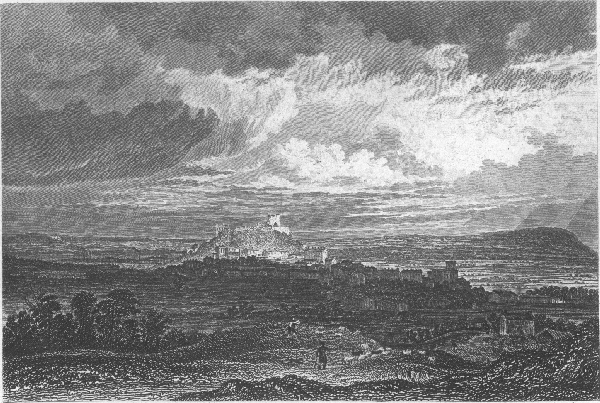 CLITHEROE CASTLE.
Drawn by G. Pickering. Engraved by Edwd Finden.
What was the precise aspect of our county when the Normans possessed
themselves of the land, it might be deemed an effort of the imagination
perhaps to portray. "Yet," says Dr Whitaker, in one of his happier
moods, "could a curious observer of the present day carry himself nine
or ten centuries back, and, ranging the summit of Pendle, survey the
forked Calder on one side, and the bolder margins of Ribble and Hodder
on the other, instead of populous towns and villages, the castle, the
old tower-built house, the elegant modern mansion, the artificial
plantation, the park and pleasure ground, or instead of uninterrupted
enclosures, which have driven sterility almost to the summit of the
fells; how great must then have been the contrast, when, ranging either
at a distance or immediately beneath, his eye must have caught vast
tracts of forest ground stagnating with bog or darkened by native
woods, where the wild ox, the roe, the stag, and the wolf had
scarcely learned the supremacy of man—when, directing his view to the
intermediate spaces, to the windings of the valleys, or the expanse of
plain beneath, he could only have distinguished a few insulated patches
of culture, each encircling a village of wretched cabins, among which
would still be remarked one rude mansion of wood, scarcely equal in
comfort to a modern cottage, yet then rising proudly eminent above the
rest, where the Saxon lord, surrounded by his faithful cotarii, enjoyed
a rude and solitary independence, owning no superior but his sovereign.
"This was undoubtedly a state of great simplicity and freedom, such as
admirers of uncultivated nature may affect to applaud. But although
revolutions in civil society seldom produce anything better than a
change of vices, yet surely no wise or good man can lament the
subversion of Saxon polity for that which followed. Their laws were
contemptible for imbecility, their habits odious for intemperance; and
if we can for a moment persuade ourselves that their language has any
charm, that proceeds less, perhaps, from anything harmonious and
expressive in itself, or anything valuable in the information it
conveys, than that it is rare and not of very easy attainment; that it
forms the rugged basis of our own tongue; and, above all, that we hear
it loudly echoed in the dialect of our own vulgar. Indeed, the manners
as well as language of a Lancashire clown often suggest the idea of a
Saxon peasant; and prove, with respect to remote tracts like these,
little affected by foreign admixtures, how strong is the power of
traduction, how faithfully character and propensities may be transmitted
through more than twenty generations."
The Normans were a more polished, a more abstemious people; as scribes
and architects they were men to whom this district was greatly indebted.
Our only castle, our oldest remaining churches, our most curious and
valuable records, are all Norman.
"Such was the state of property and manners when the house of Lacy
became possessed of Blackburnshire." The simplicity of the Saxon tenures
was destroyed. A tract of country, which had been parcelled out among
twenty-eight lords, now became subject to one; and all the intricacies
of feodal dependence, all the rigours of feodal exaction, wardships,
reliefs, escheats, &c., were introduced at once. Yet the Saxon lords,
though dependent, were not in general actually stripped of their fees.
By successive steps, however, the origin of all landed property within
the hundred, some later copyholds excepted, is to be traced to voluntary
concessions from the Lacies, or their successors of the house of
Lancaster; not grants of pure beneficence, but requiring personal
service from the owners, and yearly customs or payments, equivalent at
that time to their value. Their present worth grew out of the operation
of causes little understood in these ages either by lord or
vassal—namely, the certainty of the possession, the diminishing value
of money, and the perpetuity of the title.
In four generations, or little more than one hundred years, the line of
the Lacies became extinct; Roger Fitz-Eustace, lord of Halton and
constable of Chester, coming into possession by right of his grandmother
Awbrey, uterine sister of Robert de Lacy, the last of this illustrious
race. Fitz-Eustace, however, took the title of De Lacy; but in the
fourth descent from him the very name was lost. Henry de Lacy, the last
and greatest man of his line, dying the 5th February 1310, left one
daughter only, who had married, during her father's lifetime, Thomas
Plantagenet, Earl of Lancaster—and carried along with her an
inheritance even then estimated at 10,000 marks per annum. On the earl's
attainder, the honour of Clitheroe, with the rest of his possessions,
were forfeited to the crown. After undergoing many changes while it
continued a member of the Duchy of Lancaster—that is, until the
restoration of Charles II.—that prince, in consideration of the great
services of General Monk, whom he created Duke of Albemarle, bestowed it
upon him and his heirs for ever. Christopher, his son, dying without
issue, left his estates to his wife, daughter and co-heiress of Henry
Cavendish, Duke of Newcastle; by her they were bequeathed to her second
husband, Ralph, Duke of Montague, whose grand-daughter Mary, married
George, Earl of Cardigan, afterwards Duke of Montague. Elizabeth, his
daughter, married Henry, Duke of Buccleuch, in whose family the honour
of Clitheroe is now vested.
Clitheroe Castle is described by Grose as "situated on the summit of a
conical insulated crag of rugged limestone rock, which suddenly rises
from a fine vale, in which towards the north, at the distance of
half-a-mile, runs the Ribble, and a mile to the south stands Pendle
Hill, which seems to lift its head above the clouds."
In the time of the Commonwealth it was dismantled by order of
Parliament; the chapel has totally disappeared; and nothing now remains
but the square keep and some portions of the strong wall by which the
building was surrounded.[49] The tower, though much undermined, remains
firm as the rock on which it was built, and forms the principal object
in our engraving.
It was midnight; and the priest was chanting the service and requiem for
the dead in the little chapel or chantry of St Michael, which was built
within the walls of Clyderhow or Clitheroe Castle. The Dies iræ from
the surrounding worshippers rose in a simple monotone, like the sound of
some distant river, now caught on the wing of the tempest, and flung far
away into the dim and distant void, now rushing on the ear in one deep
gush of harmony—the voice of Nature, as if her thousand tongues were
blended in one universal peal of praise and adoration to the great
Power that called her into being. Many a heart quailed with
apprehension, many a bosom was oppressed with doubtful and anxious
forebodings. Robert de Lacy, the last of this illustrious race, fourth
in descent from Ilbert de Lacy, on whom the Conqueror bestowed the great
fee of Pontefract, the owner of twenty-eight manors and lord of the
honour of Clitheroe, was no longer numbered with the living; and here in
the chapel of this lone fortress, before the dim altar, all that
remained of this powerful baron, the clay no longer instinct with
spirit, was soon to be enveloped in the dust, the darkness, and the
degradation of its kindred earth.
Many circumstances rendered this scene more than usually solemn and
affecting. Robert de Lacy had died without issue to inherit these
princely domains, the feudal inheritance of a family whose power had so
wide a grasp, that it was currently said the Lacies might pass from
Clitheroe Castle to their fortress at Pontefract, a journey of some
fifty miles, and rest in a house or hostelrie of their own at every
pause during their progress.
With him ended the male line of this great family. Failing in issue, he
had devised all these vast estates to Awbrey, his uterine sister,
daughter of Robert de Lizours, married to Richard Fitz-Eustace, lord of
Halton and constable of Chester.
Thus ended the last of his race; and the inheritance had passed to a
stranger.
The surrounding worshippers were mostly domestics and retainers of the
family, save Robert de Whalley, the dean of that ancient church,
supposed to have been founded by Augustine or Paulinus in the seventh
century, and then called "The White Church under the Leigh." No tidings
had been heard from the Fitz-Eustace at Halton, and in two days the body
was to be carried forth on its last pilgrimage to Kirkstall Abbey,
founded by Henry de Lacy, father of the deceased, about forty years
prior to this event.
The beginning of February, in the year 1193, when our story commences,
was an epoch memorable for the base and treacherous captivity of Richard
Coeur de Lion by the Duke of Austria; and for the equally base and
treacherous, but short-lived, usurpation of John, the brother of our
illustrious crusader. The nation was involved in great trouble and
dismay. The best blood of England and the flower of her nobility had
perished on the deserts of Palestine, or were pining there in hopeless
captivity. The house of Fitz-Eustace, into whose possession the estates
of the Lacies were now merged, had themselves been shorn of a goodly
scion or two from the family tree during these "holy wars."
Richard Fitz-Eustace, the husband of Awbrey, died about the 24 Hen. II.
(1178), leaving one son, John, who founded the Cistercian Abbey of
Stanlaw in Cheshire, the present establishment of Whalley. He was slain
at Tyre in the crusade, A.D. 1190, the second of the reign of Richard
I., leaving issue, Richard a leper, and Roger, who followed his father
to the Holy Land, but of whose fate no tidings had been heard since his
departure thence on his return to Europe. Besides these were two sons,
Eustace and Peter, and a daughter named Alice.
Roger Fitz-Eustace and his friend William de Bellamonte—from whom are
descended the Beaumonts of Whitley-Beaumont, in Yorkshire—had fought
side by side at the memorable siege of Acre; but whether alive or dead
the certainty was not yet known, though there might be good grounds for
the apprehension generally entertained, that they were held in captivity
by infidels or by princes miscalled Christian, the bitterest enemies to
the faith they professed.
Clitheroe Castle was built by Roger de Poictou, or, as he is otherwise
called, Roger Pictavensis, of a noble family in Normandy, and related to
the Conqueror. He led the centre of William's army at the battle of
Hastings. King William having given him all the lands between the Mersey
and the Ribble, he built several castles and fortresses therein,
providing largely for his followers, from whom are descended many
families who are still in possession of manors and estates originally
granted by this unfortunate relative of the Conqueror. He was twice
deprived of his honours, many of them being escheated to the crown,
while Clitheroe Castle, together with the great fee of Pontefract, was
bestowed on Ilbert de Lacy, a Norman follower of William.
In a country not abounding with strong positions, an insulated conical
rock of limestone rising out of the fertile plain between Penhull
(Pendle) and the Ribble would naturally attract the attention of the
invaders. Here, therefore, we find a fortress erected even earlier than
the castle at Lancaster. The summit of this rock was not sufficiently
extensive to admit of a spacious building, and probably nothing more was
at first intended than a temporary retreat and defence from the
predatory incursions of the Scots. The structure was, however, gradually
enlarged, and became one of the chief residences of the Lacies. A lofty
flanking wall ran along the brink of the rock, enclosing the keep and
adjoining buildings, likewise the chapel of St Michael, coeval with the
foundation of the castle, and forming part of it, being amply endowed by
the founder, and license procured from the Dean of Whalley for the
purpose of having divine service performed and the sacraments
administered therein, to the household servants, foresters, and
shepherds, who occupied these extensive and thinly-inhabited domains.
In this little sanctuary now lay the remains of its lord. The cold
February sleet pattered fitfully against the narrow panes; and the
shivering mourners muffled themselves in their dark hoods, while they
knelt devoutly on the hard bare pavement of the chapel. Oliver de
Worsthorn, the old seneschal, knelt at the foot of the bier; his white
locks covered his thin features like a veil, hiding their intense and
heart-withering expression. He felt without a stay or helper in his last
hours—a sapless, worthless stem in this wilderness of sorrow.
Robert, the Dean of Whalley, attended as chief mourner. Being descended
from a distant branch of the Lacies, he had long thrown a covetous
glance towards the inheritance. A frequent guest at the castle, he had
been useful as an auxiliary in the management and control of the secular
concerns; the spiritual interests of its head were in the keeping of
another and more powerful agent, little suspected by the dean of
applying the influence he had acquired to purposes of secular
aggrandisement.
It may not be deemed irrelevant that we give a brief outline of the
constitution or office of dean, as then held by the incumbents of
Whalley. The beautiful abbey, now in ruins, was not as yet built. Some
Saxon lord of  had, about the seventh century,
founded a parish church, dedicated to All Saints, called The White
Church under the Leigh. The first erection was of wood, many years
afterwards replaced by a plain building of stone. The rectors or deans
were also lords of the town, and married men, who held it not by
presentation from the patron, but as their own patrimonial estate, the
succession being hereditary. In this manner the deanery of Whalley was
continued until the Lateran Council, in the year 1215, which, by
finally prohibiting the marriage of ecclesiastics, put an end to this
order of hereditary succession, and occasioned a resignation of the
patronage to the chief lord of the fee, after which the church of
Whalley sunk, by two successive appropriations, into an impoverished
vicarage.
had, about the seventh century,
founded a parish church, dedicated to All Saints, called The White
Church under the Leigh. The first erection was of wood, many years
afterwards replaced by a plain building of stone. The rectors or deans
were also lords of the town, and married men, who held it not by
presentation from the patron, but as their own patrimonial estate, the
succession being hereditary. In this manner the deanery of Whalley was
continued until the Lateran Council, in the year 1215, which, by
finally prohibiting the marriage of ecclesiastics, put an end to this
order of hereditary succession, and occasioned a resignation of the
patronage to the chief lord of the fee, after which the church of
Whalley sunk, by two successive appropriations, into an impoverished
vicarage.
Long before the Conquest the advowson had become far more valuable than
the manor, and the lords, who were also patrons, saw the advantage and
convenience of qualifying themselves by inferior orders for holding so
rich a benefice; and thus the manor itself in time ceased to be
considered as a lay fee, and became confounded with the glebe of the
church.[50]
The office of dean, at the period in which our history commences, had
for centuries been considered as a dignity rather secular than
ecclesiastical, and the pursuits of the incumbent had doubtless
assimilated generally with those of his lay associates. Indeed, it is
recorded that Dean Liulphus, in the reign of Canute, had the name of
Cutwulph, from having cut off a wolf's tail whilst hunting in the
forest of Rossendale, at a place called Ledmesgreve, or more properly
Deansgreve. Like many other ancient and dignified ecclesiastics, they
were mighty hunters, enjoying their privileges unmolested through a vast
region of forest land then unenclosed, and were only inferior in
jurisdiction to the feudal lords of these domains. "On the whole, then,
it appears," says Dr Whitaker, "that the Dean of Whalley was compounded
of patron, incumbent, ordinary, and lord of the manor; an assemblage
which may possibly have met in later times, and in some places of exempt
jurisdiction, but at that time probably an unique in the history of
the English church."
Robert de Whalley, the incumbent before named, was not a whit behind his
progenitors in that laudable exercise of worldly wisdom and forethought,
as it regarded matters of a temporal and transitory nature. His bearing
was proud, and his aspect keen; his form was muscular, and more fitted
for some hardy and rigorous exercise than for the generally self-denying
and peaceful offices of the Catholic Church. In his youth he had the
reputation of being much disposed to gallantry; and the same proneness
to intrigue was yet manifest, though employed in pursuits of a less
transitory nature. His disappointment was, in consequence, greatly
augmented when these long-coveted possessions were given to another, and
his ambitious dreams dissipated. Yet was he not without hope that the
succession of the Fitz-Eustace family might be frustrated. The leper
would of necessity be passed over, and, Roger being either dead or in
captivity, the revenues and usurpation of this distant and almost
inaccessible territory might still be enjoyed without molestation or
inquiry. Such were the meditations of this plotting ecclesiastic, as he
knelt before the altar in that solemn hour, in the chapel of "St
Michael in Castro."
The walls of the chapel, or rather chantry, were smeared with black; and
in front of the screen were portrayed uncouth representations of the
arms and insignia of the deceased. A pall was thrown over the body, and
a plate of salt, as an emblem of incorruptibility, placed on the
corpse—a heathenish custom borrowed from the Druids. The candles burnt
dimly at the little altar, and the cold and bitter wind threw the
shadows in many a grotesque and startling shape on the dark bare walls
which enclosed them. It was an hour and a scene that superstition might
have chosen for manifesting her power; and many an anxious glance was
thrown towards the dark recesses out of which imagination was ready to
conjure some grim spectre, invested with all the horrors that monkish
legends had created. The priest who officiated was an unbeneficed
clergyman, long known as an inmate of the castle. He was of a quiet and
inoffensive disposition, but much attached to his lord; often during the
service grief stayed his utterance, and he mingled his loud sobs with
those of the surrounding worshippers.
The dirage was concluded, and vespers for the dead were now commencing
with the "Placebo Domino." The priest with his loud rich voice sang or
recited the anthem, and the attendants gave the response in a low and
muttering sound. Just as he was beginning the fumigation with a sign of
the cross, to drive away demons and unclean spirits from the body,
suddenly a loud, deep, and startling blast was heard from the horn at
the outer gate. The whole assembly started up from their devotions, and
every eye was turned towards the dean, as though to watch and take the
colour of their proceedings from those of his reverence. He lifted his
eyes from the corpse, which lay with the face and shoulders uncovered;
and, as if startled from some bewildering reverie, cried aloud—
"What untimely visitor art thou, disturbing the sad offices of the
dead?"
He paused, as though the sound of his own voice had disturbed him; while
wrapping himself in his cloak, he hastily approached Oliver, who stood
irresolute, not knowing how to act in this unexpected emergency. De
Whalley pointed towards the door, and the seneschal prepared to obey,
accompanied by the porter with a light, and one or two attendants.
Immediately outside the chapel the way led down a steep angle of the
rock, which Oliver, by dint of much use and experience, descended
without any apparent difficulty, save what arose from the slippery state
of the path, which rendered the footing more than usually precarious and
uncertain.
Again, the blast brayed forth a louder and more impatient summons,
startling the echoes from their midnight slumber, while the deep woods
answered from a thousand unseen recesses.
"Hang thee for a saucy loon, whoever thou be! I'll warrant thee as much
impudence in thy face as wind i' thy muzzle," said the disturbed
seneschal. "Tarry a while, Hugo; ope not the gate without a parley,
despite the knave's untimely summons."
Oliver, hobbling onward, reached the wicket, just then occupied by
Hugo's broad and curious face prying out cautiously into the misty and
unintelligible void, without being a whit the wiser for his scrutiny.
"What a plague do ye keep honest men a-waiting for at the gate," said a
gruff voice from the pitchy darkness without, "in a night that would
make a soul wish for a dip into purgatory, just by way of a warming?"
"Hush," said Oliver, who was a true son of the Church, and moreover,
being fresh from the services appointed for the recovery of poor souls
from this untoward place, felt the remark of the stranger as peculiarly
impious and full of blasphemy—"Hush! thou bold-faced scorner, and learn
to furbish thy wit from some other armoury; we like not such unholy
jests—firebrands thrown in sport! Thy business, friend?"
"Open the gate, good master priest-poke," said the other, in a tone of
authority.
"Not until thou showest thine errand," said the equally imperative
interrogator within; who, having the unequivocal and somewhat ponderous
advantage of a pair of stout-built and well-furnished gates to back, or
rather face, him in the controversy, was consequently in a fair way for
keeping on the strong side of the argument.
"Now, o' my troth, but ye be a pair of rude curs, barking from a warm
kennel at your betters, who are shivering in the cold, without so much
as a bone to pick, or a wisp of straw to their tails! Well, well, 'tis
soon said; every dog, you know,—and 'twill be my turn soon. I come
hither from the castle at Halton, where my Lady Fitz-Eustace would lay
your curs' noses to the grinding-stone; but, rest her soul, she will not
long be above ground, I trow. Know then, masters, I am her seneschal,
whom she sends with a goodly train to the burying. Quick, old goat-face,
or we will singe thy beard to light thee to our discovery."
The gates were immediately unbolted at this command, opening wide before
so dignified a personage, who, as the representative of the
Fitz-Eustace, was evidently impressed with a sufficient sense of his own
importance, while he and his attendants rode through the grim Norman
arch into the courtyard. The uppermost extreme of this illustrious
functionary was surmounted with a sort of Phrygian-shaped bonnet or cap,
made of deerskin, suitably ornamented. A mantle or cloak of a dark
mulberry colour, fancifully embroidered on the hem, was clasped upon one
shoulder by a silver buckle. Underneath was a short upper riding-tunic
made of coarse woollen, partly covering an under-vest made of finer
materials. A leathern girdle was buckled round his loins, having sundry
implements attached thereto, requisite during the performance of so long
a journey through a thinly-inhabited region. The upper garment scarcely
covered the knee, over which stockings of red cloth were seen, reaching
half-way up the thigh; round the leg were bandages or cross-garterings
well bespattered with mud; low boots or buskins protected the feet and
ankles; to these spurs were fastened, the head being spear-shaped and
something crooked in the shank. His beard was forked, and this
appendage, apparently the result of a careful and anxious cultivation,
he occasionally twisted with one hand whilst speaking. He carried a
lance, or rather hunting-spear, which he wielded with an air of great
formality and display; his followers were likewise furnished each of
them with a cloak and tunic, and a conical cap of coarse felt tied under
the chin with a leathern band: a girdle of the same material was buckled
round the waist, with a scrip and other necessaries for the journey.
They rode horses of the Welsh breed, small and stout-built; spoil
captured, in all probability, from that rebellious and unruly nation.
The entry of this armed train was more like an act of taking possession
than that of a peaceable and formal embassage; and the newly-arrived
seneschal soon began to exercise the office of governor or castellan,
seizing the reins of government with an iron grasp. He was a square
carroty-headed personage, about the middle size, and of a ruddy aspect.
He held an office of trust under the Fitz-Eustace, and, spite of his
saucy garrulity, in which he indulged on most occasions, he was
faithful, and would have challenged and immolated any one who had dared
to question the right of the Fitz-Eustace to precedence before any other
baron of the land. Long service rendered him more intrusive than would
have been thought becoming, or even excusable in any other enjoying less
of his mistress's confidence.
"Now, my merry men all," said this authoritative personage, "a long and
a weary path have we ridden to-day; and had we not been, as it were,
lost in your savage wildernesses—where our guide, whom we forced before
us by dint of blows and hard usage, could scarce keep us in the right
track—we had been here before sunset. Thanks to this saint of yours,
whosoever he be, for we saw the watchlights at times from the chapel, as
we guessed, else had we been longer in hitting our mark, and might,
peradventure, have supped with the wolves on a haunch of venison. Now
for the stables. What! have ye no knaves hereabout to help our followers
with the beasts?"
Oliver, much troubled at this loquacious and unceremonious address,
replied with some acrimony—
"The household are in the chapel, where it had been better thou hadst
let us bide, and given the corpse a quiet watchnight—the vigils for the
dead are not ended."
"Go to, master seneschal, for of this post I do adjudge thee, and
reverence thine office in respect of mine own, but let dead men make
their own lanterns; we must have supper anyhow, and that right
speedily."
Oliver, after seeing the gate secured, sent Hugo for help, whilst he led
the way himself into the hall of this once formidable fortress. It was
high and gloomy, the fire being apparently extinguished. A step on the
floor showed where the higher table was placed, prohibiting those
beneath a certain rank from advancing upon the skirts of their
superiors; an indispensable precaution, when servants and retainers of
all sorts ate their meals with the master of the feast. Perches for
hawks, in form like unto a crutch, were placed behind his chair; for
these birds were usually taught to sit hoodless in the evening among
company undisturbed. Hunting-spears, jackets, chain-armour, shields, and
helmets, decorated the walls; and many a goodly heritage of antlers
hung, like forest boughs stripped of their verdure. There were two
oriels furnished with leaning-stones for the convenience of loungers.
Painted glass filled the higher portions of the windows, representing
uncouth heads, hands, feet, and bodies of saints, in all the glowing and
gorgeous magnificence which the beam of heaven can give to colours of
more than earthly brightness, though disposed in forms of more than
childish absurdity.
The hall, the usual rendezvous of the household, was now deserted for
the dread solemnities of that cheerless night. But the stranger was much
discouraged by reason of the coldness and gloom, shivering audibly at
the comfortless appearance that was before him.
"St Martin's malison light on ye—fire, billets, and all—I've seen
nothing like to warm my bare nose and knuckles since we left Halton, two
long days agone. Verily, to my thinking, there's as much timber burnt
there daily as ye would pile here for a winter's use."
"Prithee come with me into the kitchen, we may have better quarters
peradventure among the fleshpots," said Oliver, leading the stranger
through a small doorway on the left. This coquinus of our ancestors
was usually placed near the hall, for the convenience of serving. Here,
through a sliding aperture in the panel, the victuals were transferred
with safety and despatch. It was built entirely of stone, having a
conical roof with a turret at the top for the escape of steam and smoke.
A fire was still burning, provided with a large cauldron suspended on a
sort of versatile gibbet, by which contrivance it could be withdrawn
from the flame. Fire-rakes and fire-jacks were laid on the hearth, and
around the walls were iron pots, trivets, pans, kettles, ladles,
platters, and other implements of domestic economy. Huge dressers
displayed symptoms of preparation for to-morrow's necessities, and a
coarse kitchen-wench was piling fuel on the ever-burning fire.
The envoy, glad to be ensconced so near the blaze, quickly addressed
himself to the task of improving it by a dexterous use of a huge faggot
by way of poker. He had thrown off his upper clothing; and the grim
walls soon reddened with the rising glow. So intent was he on an
occupation which he evidently enjoyed, that he was not aware when Oliver
departed, the latter slipping off unobserved to the chapel for the
purpose of informing the dean of this arrival.
In one part of the kitchen was a long low-roofed recess, accessible only
by a ladder, wherein dried meats, consisting of bacon, ham, deers'
tongues, mutton, venison, and other dainties of the like nature, were
stored. To this inviting receptacle was the attention of our guest more
especially directed. Without ceremony or invitation he ascended, and
drawing out a formidable weapon from his belt he commenced a furious
attack.
Oliver, on his return, found this worthy usurping the functions of both
cook and consumer of the victual with great assiduity. He was
accompanied by the dean, who addressed the intruder as follows:—
"How is it that we have none from the noble house of Fitz-Eustace save
thou and thy company?"
The messenger looked askance from his occupation, disposing of a large
mouthful of the viands with sufficient deliberation ere he vouchsafed a
reply.
"Me and my company! As goodly a band, I trow, as ever put foot to
stirrup or fist to crupper! yet will I resolve thy question plain as
Beeston Castle. My lady is old, and her only son died long ago on a
crusade. Her third grandson, now in the office of constable, is out
amongst the Welsh—plague on their fiery blood!—by reason of the
absence of his elder brother, Roger, yet abroad in these Holy Wars. Of
the eldest born, Richard, we know not but that he is deceased. He left
the castle many years ago, sorely afflicted, for he was a leper. So
that, peradventure, my lady hath sent the best man she had, inasmuch as
I am steward and seneschal, being appointed thereto through her
ladyship's great wisdom and discretion."
Here he surveyed himself with an air of indescribable assurance and
satisfaction.
"And, saving your presence," continued the deputy, "I come here as
castellan, or governor, until he whose right it is shall possess it."
"And how know we that we be not opening our gates and surrendering our
castle to some losel knave, whose only title may lie on the tip of his
tongue, and his right on the end of his rapier?"
"By this token," said the seneschal haughtily, at the same time drawing
out a formal instrument, to which was appended the broad seal of the
ancient house of Fitz-Eustace.
The dean cast his eyes over the document, returning it to the messenger
without either answer or inquiry, and immediately retired from the
presence of this usurper on his long-coveted possessions.
Much chagrined by so unexpected an interference, he left the castle,
even at this untimely hour. Yet his footsteps were not bent towards the
shadow of his own roof, the deanery at Whalley.
Outside the castle wall, and on the steepest side of the hill, was a
little hermitage, wherein dwelt one of those reputed saints that dealt
in miracles and prayers for the benefit of the "true believers." Many of
these solitaries were well skilled in craft and intrigue; others,
doubtless, deceived themselves as well as others in the belief that
Heaven had granted them the power to suspend and control the operations
of nature. To this habitation, occupied by one of these holy santons of
the Church, were the steps of the dean immediately directed. He raised
the latch as though accustomed to this familiarity. The chamber, a high
narrow cell, scooped out of the rock, was quite dark; but the voice was
heard, a deep sepulchral tone, as though issuing from the ground—
"Art thou here so soon, De Whalley?"
"Sir Ulphilas," said the intruder hastily, and with some degree of
agitation, "canst work miracles now? The Canaanites are come into the
land to possess it; nor will threatenings and conjurations drive them
forth."
"I know it," said the hermit, who, though unseen, had not, it seems,
been an inattentive observer of the events of the last two hours. A
light suddenly shot forth, enkindled as if by magic, showing the tall
gaunt form of the "Holy Hermit of the Rock." He was dressed in a long
grey garment of coarse woollen. It was said that he wore an iron corslet
next his skin, for mortification, it was thought by the vulgar; but
whether for this purpose, or for one of a more obvious nature, it would
perhaps be easy to surmise. A girdle of plaited horse-hair encompassed
his thin attenuated form. His head was uncovered; and he seemed to have
just risen from his couch, a board or shelf, raised only a few inches
from the rock on which it lay. His eye was wild, quick, and sparkling;
but his cheek was deadly pale, and his features collapsed and haggard in
their expression.
"I have dreamed a dream," said the visionary.
"And to what end?" inquired his visitor, seating himself with great
deliberation.
"Nay, 'twas not a dream," continued the hermit: "St Michael stood before
me this blessed night, arrayed as thou seest him portrayed in the glass
of his holy chapel above. His armour was all bright and glistering, and
his sword a devouring flame. He flapped his wings thrice ere he
departed, and said unto me, 'Arise, Ulphilas, and work, for thine hour
is come!'"
"And what the better am I," said the irreverent priest, "for this
saintly revelation? I must work too, or "———
"Hold," said the hermit, laying his hand on the other's shoulder with
great solemnity; "speak not unadvisedly with thy lips; there be created
intelligences within hearing that thou little knowest of."
"Thou didst promise; but verily the substance hath slidden from my
grasp: whilst I, fond fool, embraced a shadow. Cajoled by thine
assurance, that my blood should be with the proud current that inherits
these domains, I forebore, and let thee work. But thou hast been a
traitor to my cause I do verily suspect, nay, accuse thee of this fraud.
Thy machinations and thy counsel were the cause. By thine accursed arts
Robert de Lacy hath left his patrimony to a stranger!"
"True, I counselled him thus. What then?"
"I and mine are barred from the inheritance!"
"Shall the word of the Hermit of the Rock fall to the ground? Have I not
promised that thy blood shall be with those that inherit these domains?"
"Promises are slender food for an hungry stomach," cried the unbeliever.
"If the promise fail, blame thy dastardly fears, and not my power. Thou
shalt see the promised land thou shalt not inherit. Thy son shall
receive the blessing."
The dean looked for a moment as though he could have fawned and
supplicated for a reversion of the decree; but pride or anger had the
mastery.
"And so," cried he, "thou findest thy predictions run counter to thy
schemes, perdie; for thou dost mock me in them with a double sense."
"How, false one? Have I not wrought for thee? Hath not he, whose corpse
now resteth in hope, overwhelmed thee with his favours through my
counsel and contrivance? I owed thee a service, for thou wast my stay
and sustenance when driven hither an outcast from the haunts of men. But
thoughtest thou that I should pander to thy lust, and hew out a pathway
to thy desire?"
"To me this!" said the covetous intruder, his voice quivering with rage.
"Yes, to thee, Robert de Whalley," replied the hermit: "because thou
hast not leaped the last height of thine ambition, forsooth—because
thou art not lord of these wide domains, through my interest and holy
communion with the departed—and because I have not basely sold myself
to thee, thou art offended. Beware lest the endowment be wrested from
thy grasp, the glebe and manor pass away from thine inheritance."
"Thou hadst the privity and counsel of the deceased, and a whisper would
have made it mine," said the dean, with great dejection.
"Greedy and unblushing as thou art, know it was I who counselled him,
and the deed is in my keeping. I sent a secret message unto Halton with
the news, and Roger de Fitz-Eustace will be here anon!"
"Thou dreamest; he is in bondage, or slain at Ascalon."
"He will reappear," replied the hermit, "and the banner of the
Fitz-Eustace wave on yonder turret. Hence! ungrateful member of our holy
communion;—to thy house, and let an old man rest in peace."
The disappointed priest departed in great haste: terror, of which he
could not divest himself, and for which he could not account,
overpowered him in the presence of the hermit. He durst not provoke him
further; but as he crossed the courtyard again a glimpse of hope shot
suddenly on his soul.
"In thy keeping!" He spoke scarcely above his breath; but the walls
seemed to give back the sound. He started like some guilty thing at the
discovery of its crime.
Before morning light on the following day the castle bell began to toll.
Preparations were making for the conveyance of the last of the Ladies to
the Abbey of Kirkstall, a journey which would occupy the greater part of
two successive days. The pathway over the hills was narrow, and the mode
of conveyance difficult, if not dangerous. A sort of litter was made for
the corpse, and slung on a pole between two horses, covered, as in a
bier, with the pall and trappings. A sword of ceremony was carried in
front; the dean rode immediately before the body, the chanters
preceding, and a priest with the cross and censer. Behind came the male
domestics, and the seneschal of Halton with his train.
Psalms were sung at every halting-place, and in the villages through
which they passed, and torches were kept lighted during the greater part
of the journey. These were for the purpose of being extinguished in the
earth that should finally cover the body.
Thus attired, and thus attended, was this once powerful baron conveyed
to his narrow dwelling-house in the dust.
We will not follow them further, nor detail the pomp of the funeral
rites, that last mockery of greatness, but return to existing objects
and events—man's ever-gnawing ambition; so vast, when living, that the
whole earth is too narrow for its sphere; when dead, the veriest churl
hath as wide a possession!
Weeks and months passed away, and the raw February wind grew soft in the
warm and joyous impulse of another spring. One night, about the hour of
vespers, two men, habited in monkish apparel, came to the cell of the
Hermit of the Rock. After the usual salutation they entered, carrying
with them staff and scrip, as if bent on a long and weary travel.
"Whence come ye, and whither bound?" said the hermit, surveying the
intruders by the light of a solitary lamp that was burning in a niche,
wherein stood a skull and crucifix, emblems of our faith and our
mortality.
"We are from the Abbey of Stanlaw, on our way to Kirkstall in the
morning."
"Wherefore abide ye here? There is lodging and better cheer withal in
the castle above."
"We are under a vow, and rest not save on holy ground: we crave thy
hospitality, therefore, and shelter for the night."
"Is your errand to Kirkstall hidden, or is it an open embassage?"
"The Lady Fitz-Eustace sendeth greeting by our ministry unto the holy
abbot through our superior at Stanlaw, beseeching that he would make
diligent inquiry touching the will of Robert de Lacy, once lord of this
goodly heritage. She hath had news of his demise, and likewise another
message with an assurance that every of these possessions have been
devised to the Fitz-Eustace by his last will and testament. Yet this
writing she has not yet seen, nor knoweth she into whose custody it hath
been given. Apprehending the great favours which the Cistercian house at
Kirkstall hath received from the Lacies, and the close intimacy which
the abbot once enjoyed, she doth conjecture that, in all likelihood, the
testament is in his keeping."
"Your journey hath need of none other reference, for the will is in my
custody."
"In thine, Sir Ulphilas?"
"How! know ye my name already?" said the hermit sharply, and a fierce
glance shot from under his high and pallid brow.
"Holy St Agatha! and has not the fame and sanctity of the Hermit of the
Rock gone forth to many lands! Where the broad Mersey and the silver Dee
roll their bright waters, thou art known by thy holiness and thy faith."
"And how is our good brother Roger, abbot of your monastery at Stanlaw?"
inquired the hermit, not deigning to notice their fulsome and flattering
epithets.
"Holy Virgin! how knowest thou his name?"
"And hath not the fame of your holy abbot, and the sanctity of your
house, reached us even here?" said the hermit, with a look of scrutiny
and scorn. The visitors were silent. The hermit seized the lamp, and
surveyed their persons with much care and deliberation.
"Holy father," said the abashed intruders, "we crave thy blessing, and
moreover a share of thy pittance, for our way hath been long and
toilsome: since yesterday our journeying hath been over hills and
through deep forests, infested by wolves and noisome beasts, which we
had much ado to escape."
The hermit drew a little table from the recess, blowing the wan embers
until a cheerful blaze flashed brightly through the cell. He then opened
a cupboard scooped out of the solid rock, and took thence a scrap of
hard cheese, a barley cake, and a few parched peas, with which the holy
men commenced their supper. They ate their meal in silence, washing down
the dainties with a draught from the spring. When the repast was
finished, one of the brethren thus addressed his host—
"And what shall be thy message to our holy abbot? Wilt thou send the
parchments to his grace?"
"Nay, brethren, that is not my purpose."
Another and a brief pause ensued.
"But the message?"
"Say that the will is here,"—he looked towards his bosom as he
spoke,—"and at the appointed hour it shall be ready. When Roger de
Fitz-Eustace comes hither, his claim shall be duly certified."
"Alas!" said the wayfaring guests, in a tone of deep sorrow and
apprehension, "he went on a warfare against the infidels."
"He will return," was the reply.
"The Virgin grant him a safe deliverance! but he tarrieth long, and a
rumour hath lately been abroad that he fell at Ascalon."
"'Tis false!" cried the hermit, roused to an unexpected burst of wrath.
His eyes kindled with rage, and he darted a glance at the intruders
which made them cower and shrink from his rebuke. In a moment he grew
calm, relapsing into his usual moody and thoughtful attitude. Taking
courage, they again addressed him.
"Is this thy message to the abbot of Stanlaw? If so, our errand hath but
a sorry recompense."
"And what recompense should fall to the lot of miscreants like ye?" said
the hermit, surveying them with a contemptuous glance. "I hear the sound
of your master's feet behind ye. Tell Robert, the proud Dean of Whalley,
that when he sends ye next on so goodly an errand, to see that ye con
your lesson more carefully, else will ye be known for a couple of errant
knaves as ever went a-mousing into an owl's nest! Hence, begone!" said
the hermit, as he drave them from his threshold; and the counterfeit
monks went back to Whalley in haste, reporting the ill success of their
mission.
"Nevertheless," said De Whalley, "I have some clue to the search, if
the glance of his eye, which these varlets have reported, do show truly
where the treasure is hidden. I will foil the old fox yet with his own
weapons."
This comfortable reflection, in all probability, moderated his anger at
the unskilful disposition of his messengers, whom he dismissed with
little ceremony from his presence.
In the meantime the new castellan was exercising his power with
unsparing and immoderate severity. Oliver de Wortshorn was almost
heartbroken; the old man suddenly found himself reduced to the condition
of a mere dependant on the self-will and caprice of this petty tyrant,
his authority having been usurped, and his office wrested from him, by
the hand of a stranger. Adam de Dutton[51] was the name of this new
functionary, and he rode it out bravely over the necks of the servants
and retainers, discharging some, punishing others, and making the whole
community groan beneath the iron yoke of his oppression. Had there been
a master-spirit to wield the elements of conspiracy, and unite the
several members, so as to act from one common impulse, matters were just
ripe for rebellion.
Early in the morning, after a day of more than ordinary discipline,
Oliver bent his feeble steps to the hermitage. He laid his complaints
before the occupier of the cell, who was ever ready to administer aid
and comfort to the afflicted.
"Take little heed of the deputy now," said the holy man, "his master
will be here anon. I hear the tramp of armed men, with the herald's
trumpet. I see the red griffin, and the banner of the Fitz-Eustace."
"But, holy father, Sir Ulphilas," replied the ejected steward, "there is
no peace either by night or day, and we are nigh worn out with his
waywardness and oppression. If it might be that your reverence would
come with me, peradventure the churl would grow tame at your presence."
The hermit, complying with this importunity, accompanied Oliver to the
castle.
In the hall Adam de Dutton was about consigning one of the villains,
for some venial offence, unto the whipping-post and the stocks. The
accused besought his inexorable judge for some remission of the
sentence, falling on his knees before him just as the hermit, with great
solemnity, entered the hall. His face was partly concealed by a large
hood, and little of his countenance was visible above the long beard
which flowed over his bosom, and the fire of his eye, which seemed to
glow through the dark shadows beneath.
"Whom bring ye next for our disposal?" inquired the castellan; but there
was no answer; every eye was directed to the hermit, who came slowly
forward, standing opposite to, and within a very short distance from,
the dread arbiter of justice in the castle of the Lacies.
"What brings thee to our presence? Back to thy sanctuary; else we may
deal with thee as with other knaves who live by their wits and the
witlessness of fools."
"What hath this man done amiss?" inquired the hermit, in a tone that
showed his meekness to be disturbed, and his wrath evidently kindling;
nor would the thunder be long ere it followed the flash.
"It is our pleasure!" answered Adam de Dutton, reddening with rage; "and
furthermore our pleasure is, that thou get thee to thy cell, or, by the
beard of St Michael, my bowmen shall help thee thither when this fellow
hath had his allowance at their hands."
"Fool!" cried the hermit, in a voice which struck terror through the
assembly; and even the judge himself started back with amazement.
"Begone, child!" said Ulphilas to the culprit; "I dismiss thee of the
punishment; peradventure thou hast deserved to suffer, but I give to
this emissary a timely warning thereby."
The criminal was not loth to obey, disappearing speedily without
hindrance, while the spectators were mute with amazement. The hermit,
too, was silent before the usurper, who, almost frantic with vexation,
cried out—
"Seize him!—help, for the Fitz-Eustace!—treason against our Lady of
Halton!"
Uttering many rapid and incoherent expressions, he approached the
hermit, who stood unmoved, apparently the only unconcerned spectator in
the rising tumult. The seneschal's guards were already in motion, but
Adam was the first who attempted the seizure.
The holy man drew back, as though from some touch of pollution.
"Hold!" cried he, "one touch and 'tis thy last. Rash fool, thou hast
provoked this rebuke!"
The hand of the seneschal had scarcely been put forth, when, lo! the
astonished deputy shrank back in dismay. A sudden change came over his
angry countenance—a look of surprise mingled with horror, as though he
could have wished the earth to gape and hide him from the object of his
apprehensions. He stood trembling, speechless, pale as ashes, expecting
immediate and condign punishment. So suddenly this change was wrought
that the spectators fancied it to be some direct interposition from
heaven; concluding that he was smitten for the sacreligious and profane
hand he had dared to stretch toward this holy man. Yet was the change
not so sudden but that a quick-eyed observer, if such were there, might
have seen the hermit's outer garment loosened for a moment, and a
significant whisper which the other evidently heard with such visible
tokens of alarm.
Ulphilas immediately retired to his cell, and from that hour the
castellan discharged his official duties evidently under the control of
some overmastering influence or apprehension.
Not long afterwards it was rumoured abroad that tidings had been heard
from Roger de Fitz-Eustace, who was supposed either to be in captivity
or to have fallen at the siege of Ascalon.
The king was still detained in prison by the Emperor Henry VI., and it
was only through the remonstrance of the German princes, and a threat of
excommunication from the Pope, that Henry, finding he could no longer
hold him in durance, concluded a treaty for his ransom at the exorbitant
sum of 150,000 marks, about £300,000 of our money; of which sum
two-thirds were to be paid before he received his liberty, and
sixty-seven hostages delivered for the remainder. The captivity of the
superior lord was one of those cases provided for by the feudal tenures,
and all vassals were, in that event, obliged to contribute towards his
ransom. Twenty shillings were therefore levied on each knight's fee
throughout England; but as this money came in slowly, and was not
sufficient for the intended purpose, the voluntary zeal of the people
readily supplied the deficiency.
The churches and monasteries melted down their plate to the amount of
30,000 marks; the bishops, abbots, and nobles paid a fourth of their
yearly rent; the parochial clergy contributed a tenth of their tithes;
and the requisite sum being thus collected, the queen-mother and Walter,
Archbishop of Rouen, set out with it to Germany, paid the money to the
emperor and the Duke of Austria at Mentz, delivered to them hostages for
the remainder, and freed Richard from captivity.[52]
During these important negotiations two messengers arrived at Clitheroe,
who in consequence of the deputy's absence for a season, held a secret
conference with the Dean of Whalley ere they departed. An order was left
that the castle should be forthwith in readiness for the reception of
some distinguished guest. In those days tidings travelled slowly in such
thinly-populated districts; like the heath-fire, which extends rapidly
where the fuel is thickly strewn, but is tardy in spreading where it is
less abundant.
The dean, having received the messengers, took special care that the
knowledge of their arrival should be kept, if possible, from the ears
and eyes of Adam de Dutton, who happened for several days at that season
to be hunting in the forest, where a mighty slaughter of game—wolves,
bears, and such like—was the result; in which dangerous pastime,
Geoffery, the dean's only son, acted a distinguished part. This bold
adventurer was accounted the most skilful hunter in the whole range of
these vast forests, where the venison was so strictly kept that the life
of a man was held in but little estimation, comparatively, with the care
and preservation of a beast.
The Deans of Whalley, as we have before seen, were mighty hunters in
those days; and a wild and picturesque story is told in Dugdale's Mon.
Angl.. v. i., to which we have before alluded—to wit, that the
great-grandfather of the present incumbent, Liwlphus Cutwolph, cut off a
wolf's tail whilst hunting, from which he acquired this surname.
Geoffery inherited a more than ordinary passion for the chase. With his
bow and hunting-spear he had been known to spend many days in these deep
and trackless recesses, where the feet of man rarely trod, and the wild
roe and the eagle had their almost inaccessible haunts. Adam was often
his only companion; the seneschal's partiality for the sport having
rendered these dissimilar spirits more akin than their nature had
otherwise permitted.
On the evening of a sultry day Ulphilas had thrown himself on his couch,
when, without warning or intimation, the Dean of Whalley stood beside
him.
"The holy hermit hath betaken himself early to his repose. How fareth he
in this hard cell? 'Tis long since we have met."
"Peradventure it might have been longer, had not news travelled to thine
ear touching the safety of the Fitz-Eustace and his speedy arrival,"
said the hermit, without so much as turning his eyes toward his visitor.
Robert de Whalley stood silent and aghast. This was a direct and
unequivocal testimony to the prescience of the good father, for to no
ears but his own had the tidings been communicated.
"Thou knowest of his return?"
"Yes, ere the knowledge was thine," said the hermit carelessly.
"There is little use in secrecy where the very walls possess a tongue;
and seeing that the first part of mine errand is known, it may be thou
art as well instructed in the latter, which is the true purport of my
visit."
"I am," replied the other quickly, now for the first time fixing his
eyes on the intruder, "and of the issue too, I trow."
"Ah!" said the dean, with a long-drawn exclamation of surprise, and a
sudden gasp as though he would have held the secret more tightly to his
bosom; "and who"—
"Nay, thou art but obeying the impulse of thy nature," said the hermit,
musing. "The brutes ye hunt obey their common instinct—and thou—Yet
the ravening wolf and the cunning fox ye follow, and worry to their
death."
"Death!" cried the dean; "what meanest thou?"
"Did I not counsel thee to beware? But thou wilt tumble into thine own
pitfall. The trap is laid for thine own feet!"
The hermit sat on the low couch, and he gazed wildly round the cell as
though pursuing some object visible only to himself.
"Give me the parchments committed to thy trust by De Lacy, and I will
build a house to thy good saint, enriching it with rare endowments."
"Thou wouldest drive a thrifty bargain with Heaven. Verily thou
shouldst have the best on 't, though," replied the hermit, with a
contemptuous smile.
"Truly I could but return to Heaven the bounties that it gave; yet would
I, peradventure, build, for His honour and glory, to whom all things
belong, a habitation, the like whereof hath not been seen for
stateliness and grandeur," said the dean, with affected reverence and
humility of spirit.
"Others may do that as well as thou."
"But will he, whose coming is now at hand, make so costly a sacrifice
for the welfare of the Church? I will found an abbey, holy father,
consecrate to thy patron, wherein thou shalt be the ruler. I purpose to
enrich it with half my possessions, even of those whereby, through thy
ministry, I do become entitled from the death of Robert de Lacy."
"Which meaneth, if I but aid thee to rob another of some large and
goodly inheritance, thou wilt give to Heaven, forsooth, a portion of
what belongs not to thee."
"Once thou didst promise me thine aid."
"To robbery and rapine?"
"I have not wronged thee!"
"Nor I"—
"Thou hast; the inheritance is mine; thou hast robbed me of my right,
but I will regain these lands or perish on them."
"And so thou mayest, unblushing traitor."
"Traitor!—ah! this word to me?"
"Yes, to thee, Robert de Whalley!"
"Thou art in my power, old man; ere I entered thy cell I left a trusty
keeper at the door," cried the dean, with a grin of savage exultation.
"In thy power!—never, miscreant."
"Give the deed to my keeping, and no harm shall happen thee; refuse, and
thou art my prisoner. Force may accomplish my wishes without thy
compliance."
The hermit's eyes glistened like twin fires in their hollow recesses. He
stood erect, confronting his visitor, who, bold in audacity and guilt,
repeated his demand.
"Never!" said the hermit.
"Then die, fond dotard!" cried De Whalley; and, sudden as the
lightning-stroke, he drew a dagger from his vest, aiming a blow at the
hermit's bosom; but, marvellous to relate, the steel hardly penetrated
the folds of his drapery, glancing back with a dull sound, his person
remaining uninjured. A look of unutterable scorn curled the features of
the charmed, and apparently invulnerable, being before him.
"Cowardly assassin!" he cried, "I hold thy threats at less worth than a
handful of this base dust beneath my feet, and utterly defy thy power. I
am free as the untrammelled air, and thou mayest as well attempt to
grasp the shadow or the sunbeam!"
Swift as the words he uttered the hermit disappeared! The effect was so
sudden, aided, in all likelihood, by the dimness and obscurity of the
cell, that, to the astonished apprehension of De Whalley, Ulphilas had
made himself more impalpable than the air he breathed, sinking like a
shadow through the rocky floor.
"Thou hast escaped me, fiend," said the dean, gnashing his teeth with
vexation; "but I will overmatch thy spells: with the aid of this good
hand I may yet retrieve the inheritance."
Saying this, he left the cell, and returned to his home at Whalley.
Early on the morrow the hermit entered the hall where Adam de Dutton was
preparing for another expedition to the forest. The seneschal looked
uneasy and surprised, but acknowledged his presence with great respect
and humility.
"Adam de Dutton, thou hast other work to do," cried the holy man, "than
rambling after these fools i' the forest! Thy lord will be here anon."
"How! whom meanest thou?" inquired the castellan, with a vacant stare of
astonishment.
"Roger de Fitz-Eustace. He is at hand; see thou prepare to meet him."
"Surely thou mockest, Roger de"—
"Peace! The last beam of to-morrow's sun shall see the banner of the
Fitz-Eustace beneath the gate."
"To-morrow! Why—how cometh my lord? Surely thou dreamest—or thy"—
"Once more I warn thee of his coming; see to his reception, or thy lord
will be wroth; and Roger with the ready hand was not used to be
over-nice, or loth in the administering of a rod to a fool's back."
The hermit departed without awaiting the reply.
But great was the stir and tumult in the stronghold of the Lacies on
that memorable day. The hurrying to and fro of the victuallers and
cooks—the clink of armourers and the din of horses prancing in their
warlike equipments—kept up an incessant jingle and confusion. A
watchman was stationed on the keep, whose duty it was to give warning
when the dust, curling on the wind, should betoken the approach of
strangers. The guards were set, the gates properly mounted, and the
drawbridge raised, so that their future lord might be admitted in due
form to his possession.
The sun went gloriously down towards the wide and distant verge of the
forest, and the brow of Pendle flung back his burning glance. Nature
seemed to welter in a wide atmosphere of light, from which there was no
escape. Panting and oppressed, the hounds lay basking by the wall, and
the shaggy wolf-dog crept, with slouching gait and lolling tongue, from
the glare into the shadow of some protecting buttress. The watchman sat
beneath the low battlements, hardly able to direct his aching eyes
towards the forest path below the hill. The monotony of this dull and
weary task was reiterated until the very effort became habitual, and he
could scarcely recognise or identify any change of object from the
absorption of his faculties by the listlessness it created. One slight
curl of dust had already escaped him, another waved softly above the
trees where the path wound upwards from the valley. Again it was
visible, and the watchman seemed to awaken as from a lethargy or a
dream. Strangers were surely approaching, but without retinue, as the
wreath of dust, from its slight continuance, would seem to intimate.
Just as he came to this conclusion, two horsemen swept into view, where
a broad turn of the road was visible, disappearing again rapidly behind
the arched boughs of the forest.
Bounding almost headlong down the narrow stair, he ran immediately to
the hall, informing the deputy of what he had seen. Scarce had he
concluded when a hoarse blast from the horn rang at the outer gate. Adam
de Button hurried to the postern, where he saw two horsemen, bearing
unequivocal signs of their allegiance to the renowned constable of
Chester. They wore what was then considered a great novelty in dress,
the tabord or supertotus, a sleeveless garment, consisting of only two
pieces, which hung down before and behind, the sides being left
open.[53] Low-crowned yellow caps covered their heads, and the upper
tunic was yellow, richly embroidered, reaching only to the knees. They
wore forked beards, well pointed, and gloves and boots of beautiful
Spanish leather. Their horses were low, but of an exquisite symmetry,
and the beasts were pawing and champing before the gate when Adam
hastened down into the courtyard. These were avant couriers or
messengers from Roger de Fitz-Eustace, whom they announced as being
nigh, and to be expected ere nightfall, with his daughter Maud, a maiden
much renowned for her beauty.
As the sun sank deeper into the gloom of the woods, and the shadows grew
long on the green and sunny slope of the hill, the wild shrill notes of
a clarion rung through the forest glades; a distant burst of martial
music was heard, together with the roll of a drum—an instrument
borrowed from the Saracens, and in use only after the crusades.
Now went forth Adam de Dutton and his train bareheaded to meet their
lord, whom they found riding at a slow pace, conversing familiarly, but
attentively, with the Dean of Whalley. Behind him came the blushing Maud
on a beautiful white palfrey, and beside her a comely youth, in a fair
hunting-suit, the son of De Whalley, who, by his fervid and impassioned
glances, showed himself apt in other and nobler exercises than the
upland chase and the forest cover could afford.
Roger de Fitz-Eustace, the terror and scourge of the Welsh, and by them
called "Hell," from the great violence and ferocity of his temper, was
then about forty years old. He was clothed in a light suit of armour,
the hauberk, with the rings set edgewise, reaching down to the knees.
His helmet was cylindrical, the avantaille, or face-guard, thrown up.
He wore a coloured surcoat; a fashion that seems to have originated with
the Crusaders, not only for the purpose of distinguishing the different
leaders, but as a veil to protect the armour, so apt to heat excessively
when exposed to the direct rays of the sun. It was of a violet colour,
without any distinctive mark or badge. His highly-decorated shield was
borne behind him, the three garbs and the lions being chiefly
conspicuous in the marshalling: the former, the original bearing of Hugh
Lupus, was often used by the constables of Chester, in compliment to
their chief lord. Its shape was angular, and suspended from the neck by
a strap called guige or gige, a Norman custom of great antiquity. A huge
broadsword was carried by his armour-bearer, the person of the chief
being without any further means of impediment or defence than a French
stabbing sword, fastened on one side of his pommel, and a stout
battle-axe on the other. The horse was decorated with great and costly
profusion. At a short distance rode William de Bellomonte, the baron's
inseparable companion. A small train of archers and cross-bowmen brought
up the rear of the escort, save the baggage and sumpter horses, laden
not only with provisions but cooking utensils, and even with furniture
for the household. In those days it was a matter both of economy and
necessity for the occupants or lords of several castles to travel with
accompaniments of this sort; though possessing many residences, most of
them had the means and even conveniences only for the furnishing of one.
The seneschal and his train alighted, doing homage to their lord, who
was conducted with great pomp and ceremony into the fortress, now lapsed
for ever from the blood and succession of the Lacies; yet Roger de
Fitz-Eustace and his descendants, probably in commemoration of the
source whence originated their great honours and endowments, were ever
afterwards styled by the surname of De Lacy; and, strange as it may
appear, his father, John, constable of Chester, who died fifteen years
previously to this event, and who founded the Cistercian abbey of
Stanlaw, the parent establishment of Whalley, though he had not the
slightest pretensions to the name of Lacy, was popularly invested with
the name. It is still more singular that the mistake should have been
committed by Henry de Lacy, the last of the line of the Fitz-Eustace,
third in descent from Roger, in the foundation-charter of Whalley Abbey,
where he expressly styles his ancestor "Joh. de Lacy, Const. Cest."
Accompanied by her father and her female attendants, the "gentle" maiden
entered the hall. She was stately and beautifully formed, with little
show of her lineage except the high forehead and well-formed nose of the
Fitz-Eustace. She was enveloped from head to foot in a long gown or
habit; over this was cast a richly-embroidered purple silk surcoat or
cloak, embellished with those ephemeral absurdities called
pocketing-sleeves. These hung from the wrists almost to the ground,
showing an opening or pocket which might have supplied the place of a
lady's arm-bag in our own era. A wimple or peplus was thrown over the
head; a sort of hood, which, instead of covering the shoulders, was
brought round the neck beneath the chin like a warrior's gorget, giving
an exceedingly stiff and muffled appearance to the upper part of the
figure.
Geoffery was unremitting in his attentions, and his father seemed as
assiduous in his court to the fierce Crusader, who listened intently to
some private intelligence which the dean was evidently much interested
in communicating. The following were the only words that could be
distinguished at the dismissal of the courteous De Whalley, as he
retired a few paces ere he departed:—
"To-morrow be it," said Fitz-Eustace, "after matins, and we will hear
thee further in this matter: let him then be conveyed to our presence."
The dean retired, but at dawn he was again present in the chantry of St
Michael, within the castle.
Fierce came the beams of the morning sun through the eastern oriel of
the hall, and the guards and retainers of this feudal fortress were
waiting the appearance of their lord. Lounging idly at the great
entrance were those more immediately in attendance on their chief, some
playing at merelles, or nine-men's morris; others tilting with mimic
arms, and twanging the bowstring. The pikemen were drawn up in the
courtyard, awaiting orders from their superior. Their glittering weapons
flung back the morning light in sharp flashes to the sky; while on the
tower the dark pennon hung motionless and drooping in the sultry air.
The news of his arrival had drawn hither not a few of the surrounding
peasantry to gaze upon the pomp and to pay homage at the court of their
feudal lord; and a crowd of idlers was accumulating beneath the walls of
the fortress.
The breakfast meal being over, the baron entered through a side door
behind a rude bench, overhung with faded drapery, which formed an
elevation for the chief. His cheek was scorched and darkened with the
burning suns of Palestine, while his beard seemed to have been whitened
in that fiery clime. He was now habited in a rich purple cope or gown,
fitting close, without sleeves or armholes, and embellished with a deep
gold-coloured border, the Anglo-Saxon mantle being now discarded by
persons of distinction. The tunic underneath was of scarlet, bordered
with real ermine, which, together with the low square cap or coronet
that he wore, gave him something of a regal appearance. A leash of
hounds crouched at his feet. Before and below him the heralds and
officers of the household arranged themselves, amongst whom Adam de
Dutton was conspicuous by his ludicrously-solemn attitude and
appearance. The whole scene had the aspect of a military tribunal,
especially when Roger de Lacy (by which name we shall now distinguish
him) ordered that silence should be proclaimed, and that the Dean of
Whalley should be summoned to his presence.
Robert de Whalley immediately presented himself, with arms folded, and
an air of great ceremony in his behaviour.
"Thou hast been prompt to our bidding; the lark, I trow, had but newly
risen from her bed ere thou wast away from thine," said the baron.
"Three weary miles through this grim forest is good speed ere matins;
but I knew the occasion was urgent, and my lord's commands admit not of
delay. The palfrey which you so pleasantly noted yestereen is the sole
companion of my pilgrimages to and fro for the good of this noble house.
I did offer prayers for the soul of the deceased ere matins this
morning, in the chapel."
"Hast heard aught of, or communicated with, the traitor thou didst
denounce to me privily yesterday?"
"Being holden as one of great sanctity, by common report, peradventure
it were dangerous to lay hands on him without an express warranty from
our chief."
"He shall be summoned to our court. Adam de Dutton"—
"Stay, my lord," said the wily dean. "I would, with all due submission,
urge that caution were best in this matter."
"Caution, De Whalley! and to what end? Are not the Lacies able to
execute as well as to command? or is the lax ministration of justice now
complained of throughout the realm prevailing here also? By the beard of
Hugh Lupus, I will be heard, and obeyed too!"
"In good sooth, my lord, I see nor let nor hindrance in this matter,
provided that he whom we seek were of such ordinary capacities that be
common to flesh and blood, and subject to the same laws; but when we
have to cope with the devil, we must use his subtilty. Pardon me, my
lord," continued the accuser, seeing symptoms of impatience gathering on
the brow of the haughty chieftain, "though I am plain of speech, yet is
it the more easily understood. This delinquent of whom we speak hath
not, as the general report testifieth, the same nature and existence as
our own. He useth magic—I have credible testimony thereto, my
lord;—and anointeth his body so that it shall be invisible. The free
unconfined air is not more accessible to the scared bird than rocks and
walls are to this impalpable mockery of our form; and yet he may be
dealt with."
"Troth, a man of many faculties. How came he thus?"
"The vulgar do imagine that by dint of great maceration and humility, by
prayer and fasting, he hath attained communion with angels; but I
suspect they be those of the bottomless pit!"
"And why should he withhold the deed?"
"I know not, save that he purposeth by fraud and subtilty to cast these
fair possessions into the treasury of the holy church, and build an
abbey hereabout, the like whereof hath not been seen for glory and
magnificence."
"Doth he then deny our right to the inheritance? The Lady Fitz-Eustace
had a fair copy of the deed, purporting to be sent by the holy confessor
who shrived the testator in his extremity. But how hath this canting
hermit gotten the writing into his possession?"
"I know not, my lord, unless it be that the like arts have enabled him
to appropriate it by other means than those of honesty and good faith.
But give me a band of men, together with leave so to deal with him as I
shall see fit, and I trust ere long to render a good account of the
matter. I will come upon him unawares, ere he can render his body
inaccessible, and lay hold of the traitor."
"Traitor!" echoed a voice from behind a screen at the lower extremity of
the hall. Every eye was turned in that direction; when lo! the hermit
himself, the end and object of their deliberations, stalked forth,
unquestioned and unobstructed.
The baron rose, and his grim eyebrows were fiercely knit and contracted.
He looked inquiringly towards the dean, who, for a moment, was
confounded by this unexpected event. Yet his presence of mind and
fertility of expedient did not forsake him.
"Let him be instantly bound, my lord," whispered De Whalley, "and holden
by main force, or he will escape like a limed bird from the twigs. Let
him be led forthwith to the dungeon, where I myself will question him.
It is not fitting that this plotter should practise devilish devices
upon our assembly."
At a signal from their chief the soldiers surrounded him; but the
hermit, whose features were still hidden by the cowl, took hold of the
foremost, and with an incredible strength, dashed him to the ground. The
others drew back intimidated.
"Treason, my lord, treason!" cried the dean; "you behold him even in
your presence exercising forbidden arts. Away with him to the dungeon!
Guards, do your office."
"Miscreant, beware!" said the hermit. De Whalley, though bold and
generally undaunted, started back at the sound.
"What, this lawless intromission to our face, and in our council too?"
cried the baron. "Seize that hooded kite, knaves, or I will hang every
one o' ye on the Furca ere the sun be two hours older!"
Roger de Lacy, in a threatening attitude, approached the guards, who now
environed the hermit, using more caution than before. Suddenly they
rushed upon him, and he was pinioned ere he could make the least
resistance.
At this moment, so anxiously hoped for and expected by the dean, the
latter pushed towards him. Thrusting his hand into the hermit's bosom,
the long-coveted parchment was in his grasp, and in a twinkling it was
conveyed to his own.
"How now!" cried the baron, "wherefore in such haste? I trow the deed is
ours!"
With a great show of obedience and respect he drew the parchment again
from beneath his robe, and holding it cautiously beside him, exclaimed—
"My lord, ere this be read is it not prudent that we convey the traitor
to the dungeon, lest by his subtilty the writing be wrested from our
grasp?"
The hermit, yet held in close custody of the guards, cried with a loud
voice—
"Who is the traitor let the walls of my cell bear witness, when they
heard him offer a heavy bribe that this, the only evidence to the right
of the Fitz-Eustace, might be destroyed!"
"Fatherest thou the accursed progeny of thine avarice upon me?" cried
the dean, apparently indignant at so unjust an accusation.
"Give me the roll," said the constable, "and we will confront him by
what he would have withheld. After we have made our own right secure, we
adjudge him to his deserts."
The dean was obliged, however unwillingly, to obey; handing forward the
parchment, which Roger de Lacy unfolded in the presence of the hermit.
But it would be impossible to describe the consternation of the
chieftain when he read therein a formal grant, bequeathing the whole of
these vast possessions to Robert de Whalley and his heirs for ever.
The dean, apparently with surprise, and a well-feigned indignation at
the fraud which the hermit intended to have put upon him, exclaimed—
"I had a grievous suspicion long ago that this hoary hypocrite would
play me false; and indeed his great unwillingness to show the deed led
me to think that he meditated some deadly wrong."
"But wherefore," inquired the chieftain, "should there be messengers to
Halton with news and credentials so explicit that the estate was left
without let or encumbrance to the Lady Fitz-Eustace? A web of mystery is
here which we will speedily unravel. Who gave thee this deed? and
wherefore shouldest thou conceal it?" said he, addressing the hermit.
"Roger de Fitz-Eustace," replied the prisoner, "thine honour is abused.
That lying instrument was never in my charge."
"Why hast thou refused to render up the deed?"
"Lest it should fall into the hands of robbers, and thou shouldest be
cheated of thine inheritance. This traitor hath long had an eye to the
possession."
"'Tis his," returned the constable, sternly, "by this good title."
"'Tis a fraud—a base attempt put forth by this cut-purse to wrest it
from thee. Search him, and if thou findest not another, and of a
different tenor, hidden about his goodly person, let me die a traitor's
death."
"I see not that our power hath need of such a pleasant exercise. Thou
art accused by him of treachery; and verily 'tis a vain attempt to rid
thee of the charge to throw back the accusation upon him thou hast
wronged."
"My Lord de Fitz-Eustace," said the dean,—but Roger looked displeased
at this style and address, reminding him so soon of the departure of his
lately-assumed title De Lacy,—"your ear and mine have been too long
abused by this plotting wizard. He is now subject to my authority.
Hereby do I assume my rights, and arraign the culprit before my
tribunal."
The ambitious churchman approached the judgment-seat, whereon he was
just ascending; but the hermit, with a desperate effort, burst from his
bonds, and ere the guards could arrest him, he had grasped his adversary
by the throat.
"Traitor, I warned thee beforetime. Now will I unrobe thy villany to its
very nakedness."
The hermit, thrusting one hand beneath the garment of his victim, drew
forth the real deed, which had been dexterously exchanged by the wily
priest for his own fraudulent imposture. He then loosened his grasp, and
placed the real instrument in the hands of the baron.
"'Tis a forgery—- a base disposal of my rights," roared out the
infuriate and detected hypocrite.
But Roger de Lacy immediately saw that the deed was to a similar purport
with the copy which had been sent by some unknown hand, immediately on
the death of the testator, to Halton Castle.
With a look of devouring and terrible indignation he cried out—
"Though thou wert the holy pontiff himself, and all the terrors of the
Church were at thy command, thou shouldst not escape my vengeance, thou
daring priest! To the Furca!—his offence is repugnant to my
nostrils—'tis rank with treason!"
"Hold!" cried the mysterious hermit; "I have promised him protection,
nor shall the promise be foregone."
"Thou!" cried the warrior, with unfeigned astonishment; "and who art
thou that seemest here the arbiter of destiny, whether good or evil?"
"A sinful but heaven-destined man," replied the hermit, meekly.
"Our vengeance slumbereth not," said the chief; "the sentence is gone
forth, and he dies ere sunset."
"Not so," replied the hermit, again assuming the attitude of command.
"By the beard of Hugh Lupus, he dieth."
"He doth, but not by thy decree."
"How! methinks the fever of disloyalty hath seized you all: the
infection hath so tainted your nature that a skilful leech, whom I
employ in cases of emergency, will be of service—my headsman, or
hangman, as shall seem most fitting. He dies, I tell thee, though the
saints themselves were interceding."
"I have promised," said the hermit again, with the confidence of
careless superiority.
Adam de Dutton, who had hitherto been waiting anxiously for an
opportunity to communicate with his lord, now whispered something in his
ear.
"How!" said the bewildered chieftain; "'tis said thou wearest the badge
of our house, and art thyself under some surreptitious disguise."
"I wear no disguise," returned the hermit calmly; "what thou seest is my
badge, and will be, Heaven permitting, until I die."
"Who art thou?"
"A sinful mortal like thyself; but worn down with long vigils and
maceration. Lord of as wide inheritance as thou, and yet a tenant only
in a narrow cell!"
"Thou speakest riddles;—thy meaning?"
"I was an outcast, though heir to a vast heritage. I vowed that if He,
whose prerogative it is, would cleanse me from my stains, my life should
thenceforth be His, and consecrate to Heaven. I was a leper; but my
prayer was heard. I washed in yonder holy well which gushes from the
rock, whose virtues had been reported to me. Washing daily, with faith
and prayer, I was healed. I found close by a convenient hermitage; and
many caverns and secret chambers, with hidden passages and
communications, had been dug therefrom, by which I could pass to and
fro, and thus visit the castle unseen. I was the confessor and companion
of Robert de Lacy. At my desire, he left the whole of his domains to the
Fitz-Eustace. But thou art not the eldest-born of thy father."
"My eldest brother has long been dead. He was a leper; his cruel disease
drove him from the haunts of men. The last we knew of him, he went forth
with cup and clapper as they are wont. Soon after news arrived of his
decease."
"Was he not driven forth by rude and cruel taunts, the rather?" said the
hermit, gazing with unaverted eye on the haughty chieftain. "This noble
birth and heritage are mine! Behold, 'tis thus I repay your injustice!"
He threw off his cloak; underneath appeared a complete suit of proof
armour, and a surcoat, on which was emblazoned the badge of the
Fitz-Eustace.
"I am Richard Fitz-Eustace, thine elder brother! Nay, put off that brow
of discontent. I claim not my birthright; the vows of Heaven are upon
me, and to thee and thine will this good inheritance devolve. One right
only do I claim—this prisoner is free. Was he not my stay and
sustenance when the fiat of Heaven guided me hither? He sheltered me,
and had pity on mine infirmity. Moreover, he had some well-founded
expectancy towards these domains, by reason of kindred to the Lacies,
had they not been devised by will to the Fitz-Eustace. His blood is
noble as our own. He thinks there is injustice in the deed, but not to
him shall the atonement come. Thou hast a daughter, and my prescience
hath this consequence, that by her this rankling wound shall be healed.
If so be that he have found favour in her sight, let her and the son of
this ambitious priest be joined together in the bonds of holy wedlock;
for my word is gone forth—his blood mingles with ours."
The whole assembly were aghast with this thrilling discovery. The baron
would have embraced his brother; but the gloomy ascetic forbade. He left
the hall, returned to his cell, and but a short period elapsed ere the
grave he had prepared with his own hands was closed over his corpse—the
period of his sojourn having been shortened, no doubt, by the
austerities and mortifications he deemed himself called upon to endure.
Maud was shortly afterwards united to Geoffery de Whalley, unto whom her
father granted the Villa de Tunley or Townley, and the manor of
Coldcoats, with Snodworth, as a marriage portion. From them is descended
the present owner of Townley, nephew to that celebrated scholar and
antiquary, Charles Townley, the twenty-ninth in descent from
Spartlingus, the first Dean of Whalley upon record. The latter was
predecessor to Cutwulph, whose exploits in the days of Canute we have
before noticed.
Soon afterwards died Robert de Whalley, his departure hastened, it is
said, by grief and chagrin at the loss of these long-coveted
possessions.
Roger de Lacy died 1st October A.D. 1211, after a long and active life,
spent between his arduous wars and invasions of the Welsh, and his no
less arduous journeyings to and fro between the castles of Clitheroe and
Pontefract, where he spent the latter part of his days. He was succeeded
by John de Lacy, his eldest son, who, by marriage with Margaret,
daughter and co-heiress of Robert, son of De Quincy, Earl of Winchester,
became Earl of Lincoln by patent from Henry III., the monarch having
re-granted this title to him and his heirs for ever.
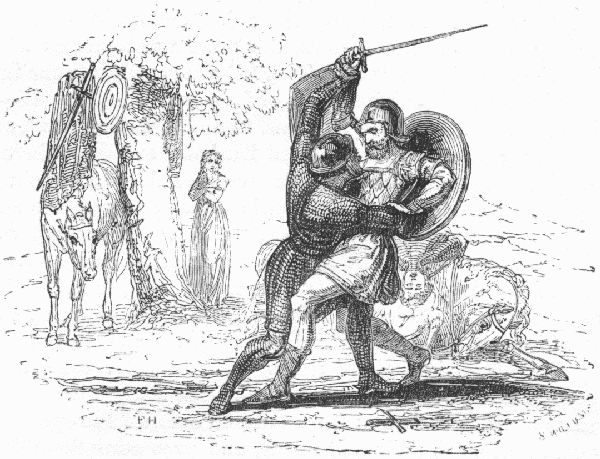
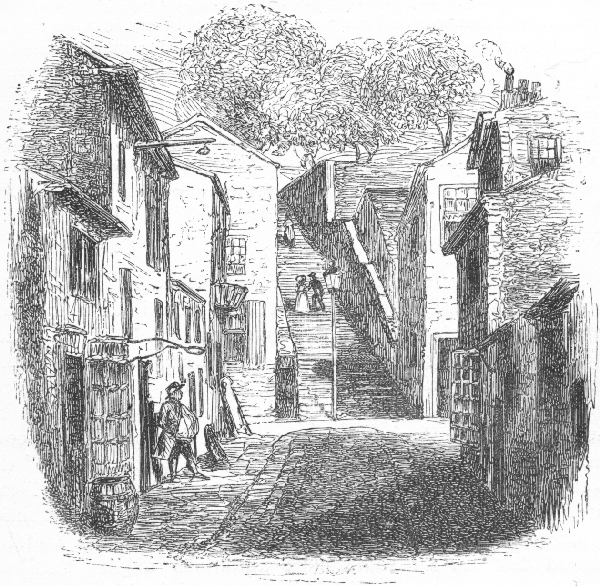
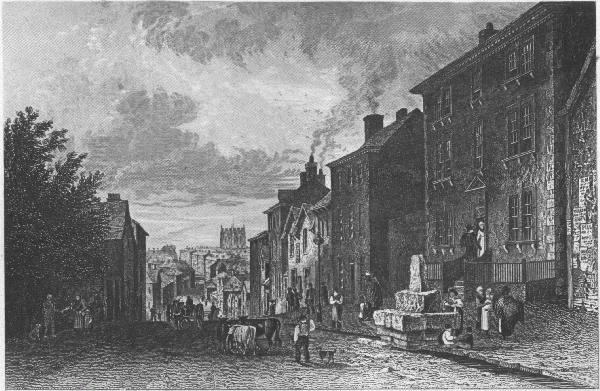 MAB'S CROSS, WIGAN.
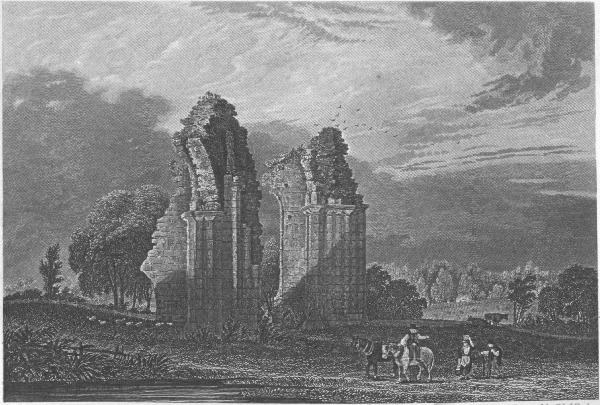 BURSCOUGH ABBEY.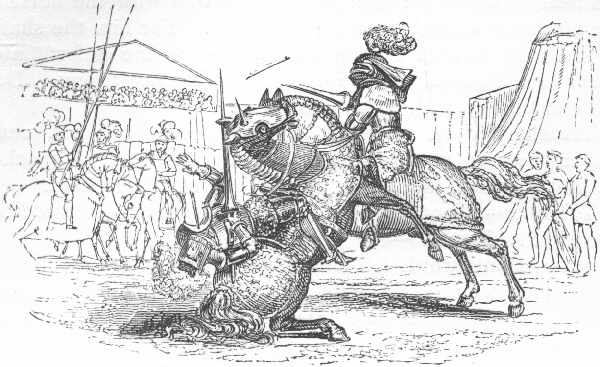
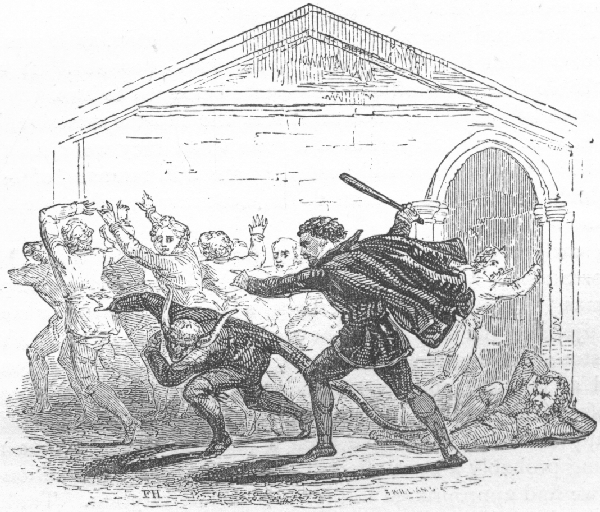
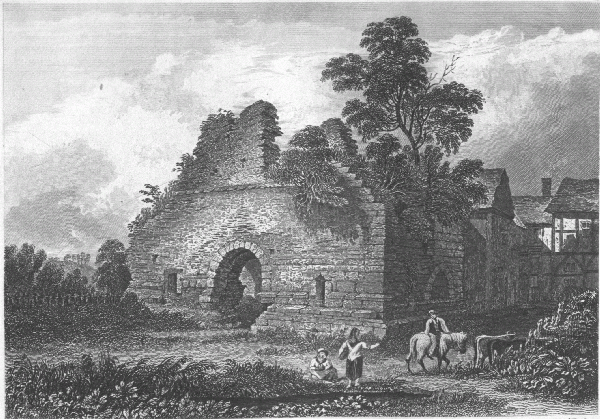 RADCLIFFE TOWER.
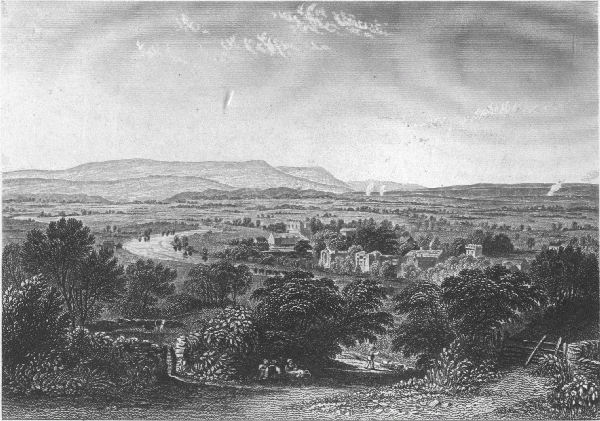 WHALLEY ABBEY.
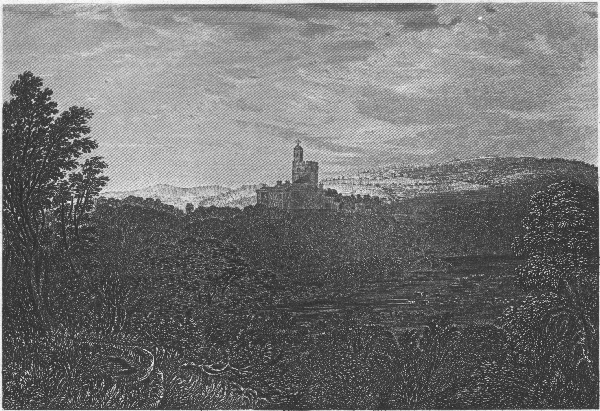 HORNBY CASTLE.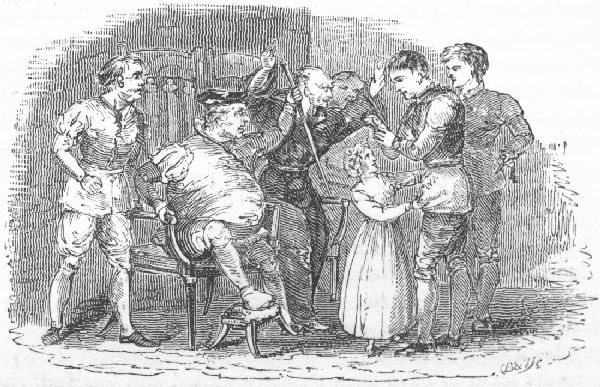
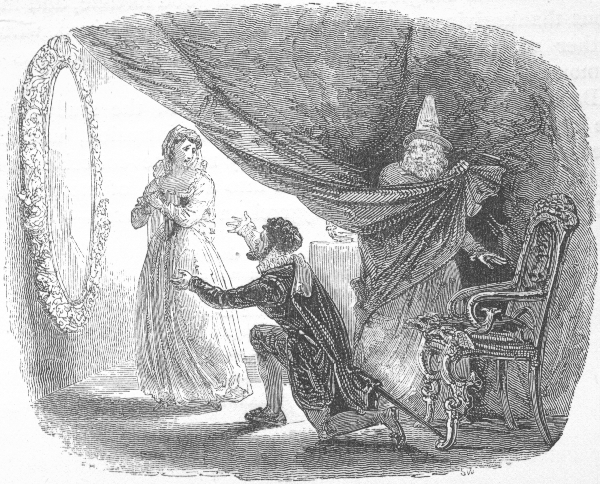
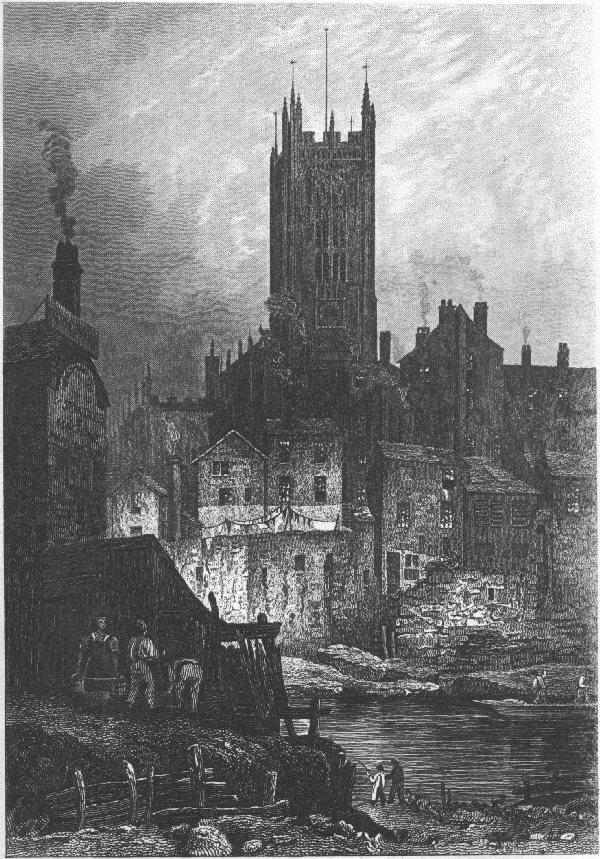 COLLEGIATE CHURCH, MANCHESTER.
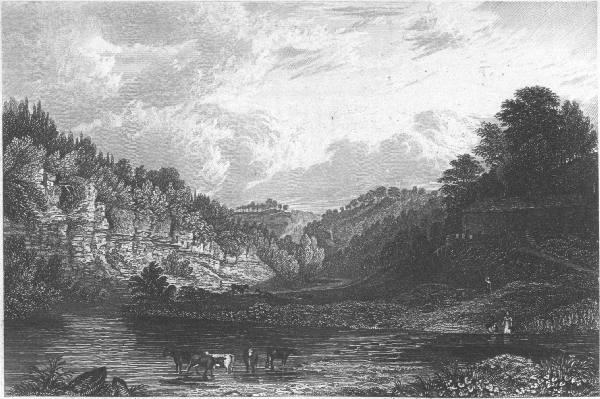 TYRONE'S BED, NEAR ROCHDALE.
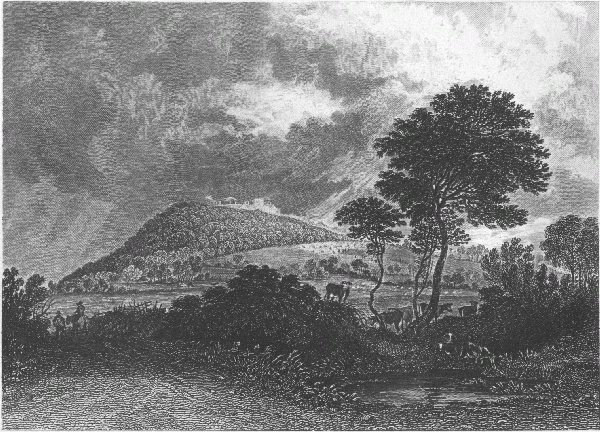 HOGHTON TOWER.
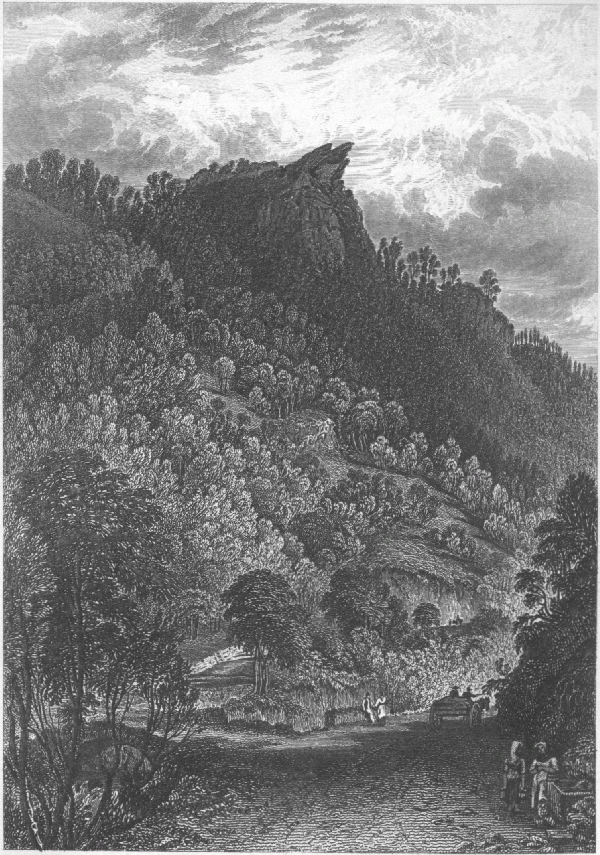 EAGLE CRAG, VALE OF TODMORDEN.
 , or the rocky district.
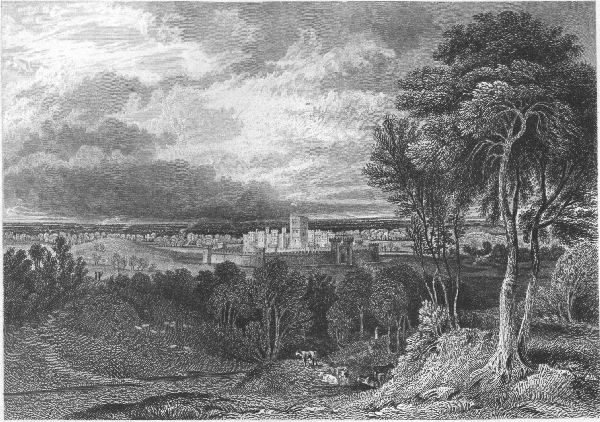 LATHOM HOUSE AS IT EXISTED BEFORE THE SIEGE, RESTORED
FROM EXISTING DOCUMENTS.
LATHOM HOUSE AS IT EXISTED BEFORE THE SIEGE, RESTORED
FROM EXISTING DOCUMENTS.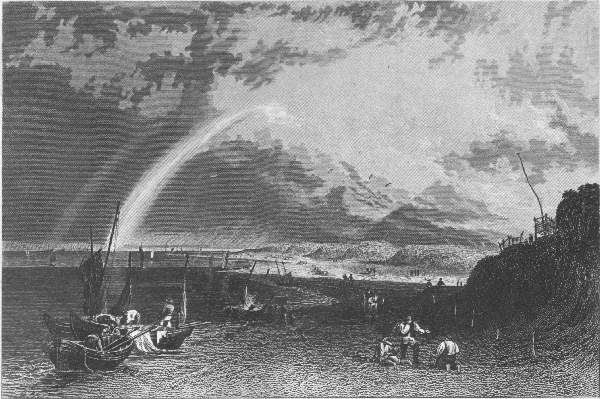 SOUTH PORT.
 ,
spiritus, anima."
,
spiritus, anima." ,
a town, and
,
a town, and 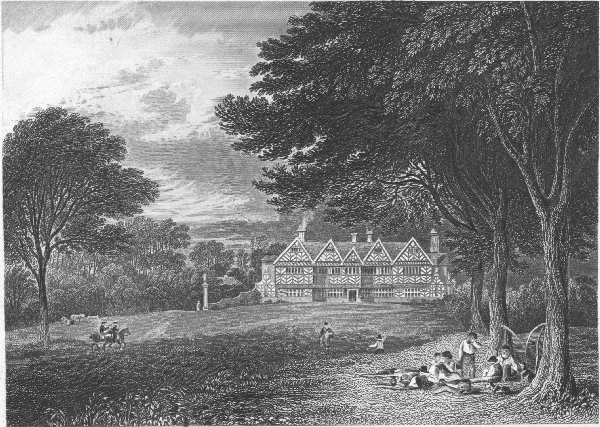 INCE HALL, NEAR WIGAN.
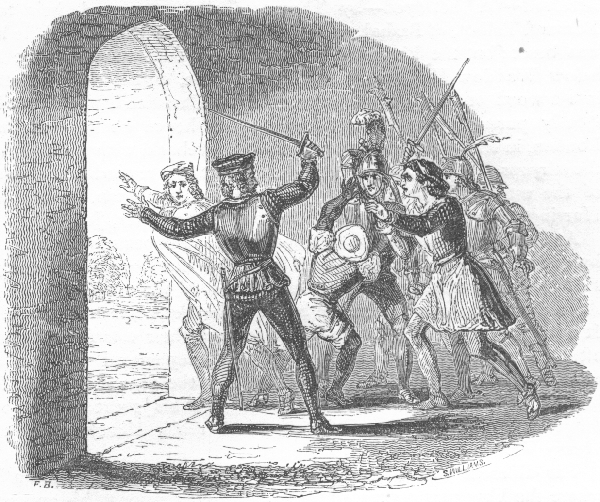 THE GREY MAN OF THE WOOD; OR, THE SECRET MINE.