All within is dark as night;
In the windows is no light;
And no murmur at the door,
So frequent on its hinge before.
Come away: no more of mirth
Is here, or merry-making sound.
The house was builded of the earth,
And shall fall again to ground.
Tennyson.

SOME few years ago, there might have been seen on
rising ground, west of the road which passes through
Treen, the remains of a very old dwelling, formerly
known in that neighbourhood as the I'an's (pro Jan's)
house. Though neglected and ruinous it still retained
some signs of its former consequence when it was regarded as a
mansion. Visitors to the Logan Rock often stopped to look at
this forlorn-looking old house, with great part of its mullioned
windows and a doorway, that had once been its grand entrance,
walled up. Its peculiar old style of masonry, the massiveness
and irregularity of the rough granite blocks with which it was
constructed, and its high-pitched thatched roof, made this old
building an object of interest, though it was neither beautiful
nor picturesque. And a few casements, still retaining their old
lead-lights of small panes in various patterns, to which age had
imparted purple or rather prismatic hues, glimmered and glanced
with changing lights that gave to the habitation a very ghostly
look.
What remained had long been divided into three or four
dwellings; but one wing was mostly unoccupied, because few
persons could be found so courageous or necessitous as to live in
it and have their rest disturbed every night, and often by day,
with the rumbling of a turn (spinning-wheel) varied by wild
shrieks, unearthly laughter, and other frightful noises. There
was also beyond the kitchen-court (and entered from it) a
garden, surrounded by high walls, which rendered it as secluded
as any room of the mansion. This ground was long called
Beaton's garden, even after, denuded of herbs and flowers, it was
turned into a pig's-court. This place was haunted too. In this
state the old house and appurtenances remained until destroyed by
fire, about ten years since, and it always retained the name of a
family that built it and resided there for generations, in the style
of gentry, though never very rich nor persons of much note
beyond that locality.
Three or four centuries ago, from their extravagance and a
run of bad luck, the I'ans were reduced to comparative poverty.
It was said that ill fortune ever followed them from the time
they broke up and removed to Garrack-zans (holy rock) that
stood in front of their mansion, and around which a market was
held in old times when Treen was an important trading-place.
However, that may have been, shortly after all the family
remaining in Treen were John I'an (or Ivan) and his sister
Beatrice, usually called Beaton, who had lost their parents when
children. Young I'an from having much family pride and but
little property to support its dignity, led a very unsettled life—mostly
at sea, with a company of reckless young men, who carried
on a hazardous trade in importing liquors, silks, salt, and other
contraband goods from Roscroff; making Penberth, or some other
cove, near it, their usual landing-place. Both brother and sister
are said to have been remarkable for their tall stature and good
looks, though of very dark complexion.
They might, now and then, be seen at church—the former
dressed in a long bottle-green coat of cut velvet, and dusky
crimson waistcoat (both overlaid with tarnished gold lace,) a plush
breeches, and diamond-buckled shoes. These everlasting
garments, that might have been worn by his grandfather, were
only changed in winter for home spun; and his sturdy legs were
then encased in long funnel-topped boots of French make; and
his jet black hair, that hung in curls on his shoulders, was
surmounted by a laced hat and plume. Though young I'an's
state dress appeared much the worse for wear he looked every
inch a gentleman, when, with old-fashioned courtesy, he led
into church his sister, arrayed in silks or samite, a century old or
more, yet still looking rich with their brilliant sheen, and thick
enough to stand on end; point-lace ruffles, yellow with age,
hanging from her elbows, were met by embroidered silk gloves;
her hair, of darkest chestnut hue, turned back over cushions,
hung in ringlets down her neck; and a little hat was fastened by
jewel-headed pins to her high head-dress. These remnants of
old finery, contrasted with homely articles of dress that had to
sustain more wear and tear, made the I'an's poverty only too
apparent; the more so because, at that time, several well-to-do
families resided in St. Levan, and at church their old bravery
and newest fashions were all displayed and duly criticised.
Beaton showed, however, what her brother thought becoming
pride, in treating with coolness or contempt all attentions offered
by such rural beaux as he thought beneath her, though she had
but slight chance, poor girl, of becoming acquainted with any of
higher rank.
I'an being seldom at home during the summer, his sister and
two or three old servants managed the farm—then but a few
acres of arable land, and a great run of common—and were sole
occupants of their gloomy mansion. The poor young lady's dreary
existence was partially relieved by her brother's presence during
winter. Then, too, he often brought home with him many of
his sea-mates or hunting companions, and the old house resounded
with their reckless drunken revelry for days and nights together.
Among I'an's comrades his favourite was an able seaman
called Willy Taskes or Trevaskes, who was a few years older
than I'an—a courageous smuggler, and mate of his fair-trader the
Mur. Taskes was remarkably strong built, the best wrestler and
boxer in the western parishes. With much practice he taught
I'an these arts of self-defence, and trained him to be just as good
a seaman as himself. I'an, when overloaded with drink, was
often quarrelsome or rather fond of fighting, without reason,
both at home and abroad. Taskes as often belaboured him
soundly to divert his combative inclinations from dangerous
antagonists; often also, he got himself thrashed black and blue
in taking I'an's part, which he was ever ready to do against any
odds. From Willy being frequently in Beaton's company, and
from the favour shown him by her brother, she was less reserved
with him than others of his crew whom she kept at due
distance.
Of an evening when he often came alone, Beaton would ask
him to card the wool that she passed great part of her time in
spinning, and no one more ready than Willy Taskes to please her.
I'an frequently left them together, little deeming that his sister—of
gentle blood, poor as she might be—could have a thought
of the handsome young sailor as a lover. Ere long, however,
I'an was informed by his ugly old female domestic—one who ever
longed for but never had a lover—that her young mistress often
met Willy Taskes by night in the walled garden, Caercreis barn,
or among the Castle carns. I'an, enraged, entered his sister's
apartments—she had three rooms at her sole disposal in that
portion of the mansion known as Beaton's wing—and, after
much upbraiding, threatened to shoot Taskes if he came near
the house any more, and both of them if he caught them
together. Beaton defied her brother, and answered that if she
could not see Willy Taskes there she would meet him elsewhere,
and that it only depended on Willy as to whether she should be
his wife or not. Warned of what had taken place, the lover kept
aloof, and I'an, discarding his jovial companions, remained much
within doors, moody and discontented, wishing for the company
of his former comrade, but pride forbade his making friendly
overtures; and his ill-humour was aggravated all the more
because his sister had the policy to persuade him that, after all, she
didn't care anything for Willy Taskes, nor any of his crew, and
that his chagrin was all for nought. The dreary winter past,
and corn tilled, I'an and his crew prepared for an early trip to
Roscroff. Their former mate, from his quarrel with the captain,
or rather from the coolness between them, having gone to work
on land, they selected a new one and made sail.
I'an left on good terms with his sister, thinking that, though
she might have had an unbecoming affection for Taskes, yet her
self-respect and regard for the dignity of their family—which he
had awakened—had enabled her to subdue her misplaced love.
In a few weeks the Mur, as I'an's craft was called, returned
with the usual goods, which were soon landed and disposed of,
as the most valuable liquors, silks, lace, &c., were bespoke by the
neighbouring gentry. Farmers, and others who assisted to land
and secure the cargo soon took off what remained. There was
then little or no interference from any government officials;
indeed in more recent times those paid to check "fair-trade"
were often the smugglers' friends, because they durst not interrupt
their proceedings with anything but well-understood shams of
activity, and they were always rewarded with a share of the
goods if they conducted themselves with discretion. Old smugglers
say they often wished to fall in with the revenue-cutter that
their trip might be the more exciting—they answered her shots by
a loud hurrah, and a blaze from their own swivel-gun. As for the
riding-officer they didn't mind him a straw, and of other coast-guards
there were none.
All hands being ready for another trip, the evening before
they intended to start I'an told his sister he was going to meet his
crew at the Skaw Tree—the inn at St. Levan Church-town,—have
a carouse, and sail in the morning early. Wishing to become
friends with his old mate, I'an had requested one of his crew to
tell Taskes that he would be glad of his company at the public-house
and to let all past unpleasantness be forgotten. In I'an's
happier moods a lingering regard for his former comrade and
staunch friend would get the upper hand of his prejudice and
family pride, and then he would even think of Taskes as his
brother-in-law with complacency.
From jealousy on the part of his new mate and others, his
friendly message was not delivered. I'an not guessing the reason
why Taskes didn't join them, and only thinking his offers of
renewed friendship were slighted, was in ill-humour, and what
was intended to have been a jovial night, passed unpleasantly.
At length some of the fuddled crew, vexed because of their
captain's preference for his former mate, hinted that he might
be in Caercreis barn, in company he better liked, and that, by all
accounts, his sister and Willy had always been on very good
terms. I'an, tipsy as he was, understood their meaning, made
imprudent threats of the way he would be revenged on Taskes;
and left the company much earlier than was his wont on such
occasions.
Very mixed feelings, and all of an irritating nature, spurred him
on his way towards an old solitary 'bowjey,' or field barn, where
a cottage now stands—five minutes' walk from Castle Treen; and
he had only gone a few yards beyond Pedny-vounder lane,
when, by the dim moonlight, he spied two persons sauntering
along a sheep-track that wound among rocks and carns below
him. Approaching and seeing they were his sister and her lover
he assailed them with angry words, which soon came to blows
between the men. Taskes, finding that I'an was the worse for
drink, merely defended himself and received his blows that he
might expend his fury on him, as he had often done when they
were the best of friends. But, as bad luck would have it,
Taskes, in going back, to avoid what might have been ugly
strokes, fell over a shelving rock on to a ledge (or shelf, as we
say), many feet below.
When I'an saw the young man he had once loved as a brother
lying prostrate and apparently dead, his pride and anger gave
place to bitter sorrow. He raised the wounded man, who moaned,
and gasped for breath for some minutes; then hearing I'an
crying like a child, begging him to forget and forgive the past
and be friends, "I have nothing to forgive thee, my son," Taskes
replied; "it was my bad luck, and, whether I die or live a
cripple, I would rather for it to be my case than thine."
Over a while I'an and his sister helped him to stand, and one
on either side of Taskes, with his arm round the neck of each,
they slowly reached their house and placed him on I'an's bed.
The servant-man was summoned, and told to ride with all speed
for a doctor. Taskes tried to speak, and signed that he might
be lifted up in bed. Supported on I'an's breast, and holding the
brother's and sister's hands, he said "I know, dear John, a doctor
can do me no good." And, looking towards Beaton, he told her
to bring the man close to the bedside, for he had something to
say before it might be too late.
The old servant approached. Taskes called him by name, and
continued, "I am dying. None but ourselves know how I came
by my end. You must bear witness for John, your master, that
I declare it was all by my own mischance that I fell over a rock,
and received my deadly hurt." He hadn't strength to say more.
I'an wiped the bloody froth from the sinking man's lips, and tried
to cheer him by saying, "Thou shalt live yet, my dear Willy,
and be my brother."
Beaton, like one in a terrible dream, was unconscious of most
that passed, till Taskes, awakening from a long swoon, grasped
her hand and moaned in sad accents, "Beaton, dear Beaton; if I
could but live till we might be married, I should die more content.
And my dear John," he continued, directing his gaze towards
I'an, "promise me, for all the years we have been like brothers,
to be ever kind to Beaton and to my—to our"—he gasped for
breath—with a gurgling in his throat, blood oozed from his lips.
Looking wistfully at Beaton, he grasped brother's and sister's
joined hands with a death-grip; his head sunk on I'an's breast;
and thus Willy Taskes passed away in his prime.
Beaton, distracted by sorrow, had to be forcibly taken from
her lover's bedside, and for weeks she seemed to be on the verge
of madness. Her brother scarcely less grieved, tried to find
some solace for his anguish in ordering that, in all respects, the
funeral should be conducted as for one of his kindred. It was a
custom with the I'ans, and a few other West Country families, to
have their burials at night. So, a week after the fatal encounter,
and in the summer evening's twilight, Willy Taskes was borne
out of the old mansion, carried by his former comrades, followed
by I'an and by many neighbours to his last resting-place in St.
Levan Churchyard.
She woke at length, but not as sleepers wake,
Rather the dead, for life seem'd something new,
A strange sensation which she must partake
Perforce, since whatsoever met her view,
Struck not her memory, though a heavy ache
Lay at her heart, whose earliest beat, still true,
Brought back the sense of pain without the cause,
For, for a while, the furies made a pause.
Byron.
I'an being reluctant to leave his sister all alone with her
sorrow, procured a good seaman to command the Mur for her
next run. Fears were entertained that Beaton's mind might
become permanently deranged from excessive grief. She could
seldom be induced to leave the room in which her lover died,
and I'an, feeling a repugnance to sleep there, she took it for a
bed-room, saying she intended to keep it because that apartment,
with two or three others adjoining it, were bequeathed to her (as
indeed they were, with their furniture), for her lifetime. For
many days together she was never seen except by the aged
servant, who, at the usual meal-times, took to the gloomy
chamber food that was often removed untasted. Her spinning-wheel
was thrown aside; yet she seemed occupied in some quiet
mysterious way; and I'an, getting alarmed for the probable
result of her sad seclusion, consulted a doctor, who, being an old
friend of the family, came to visit Beaton without delay, and
requested to be taken to her room without being announced.
I'an entered, followed by the doctor, and saw Beaton in a window-recess,
busily sewing; at the same time, so absorbed was she in
singing a baby's lullaby and rocking a cradle—in which there
was no child, but a christening-dress with other articles of her
infantile wardrobe—that she did not perceive her visitors. They
noted, too, that the bed was covered with old dresses, in various
beautiful fabrics, and that Beaton had been cutting them up,
seemingly to waste. I'an annoyed to see this destruction of gay
and costly gowns, said, "Sister dear, art thou going crazy to be
cutting up thy best clothes?" "No, John," she replied,
without looking up from her work; "yet methinks you are
very rude thus to enter a lady's bedchamber with so little
ceremony. But men understand so little of women's hearts,"
she continued, as if speaking to herself and taking no further
notice of her brother; "little do they know that, when damsels
don their gayest robes, they long for the time when they may cut
them up for their babies' clothes. But is it to-morrow that is to
be my wedding-day?" demanded she. "Oh, dear Willy, where
art thou? Do tell me. It was to have been some time before
brother John came back. The banns called thrice, we are to be
wedded before he returns; then he will love my Willy like he
used to, and all will be right well."
Unconscious, seeming, of any presence save what her crazed
fancy imaged, she looked towards her brother and the doctor,
who now advanced and noticed there was no intelligence in her
fixed gaze. She appeared to be looking within rather than at
anything external, when she went on to say, "Our child, if a
boy, shall be named William, after you, my love; but if a girl,
it shall never be called Beatrice for me. I have often been told
that the name, though a favourite one, has always been ill-starred
in our family. Shall we call her Mary for your mother, or Agnes
for mine? Any names of those we love sound sweet, like a dear
mother's. That I remember, and how she rocked me singing,
'Lullaby, lullaby, littly maid Beatrice; angels protect thee, my
darling.'"
I'an, cut to the heart to see her thus, took her hand and said,
"Sister, you are ill, dear, and our good friend, the doctor, is come
to visit you." "Oh, how foolish people are," she replied, "I was
never better in my life, yet our old Betty will have it that I don't
eat enough, what next I wonder? I am glad, however, he is
come to visit us; our house seems lonely now, and he is a dear
man—so kind, true, and hearty, I always liked him from a child,
and how he enjoys his pipe and glass, dear man! I'll leave my
work now, and see that he be entertained with the best our
house will afford."
Beaton folded her work, rose, passed near their friend without
recognition, and descended to the kitchen, where she gave orders
for a sumptuous repast, though there was nothing in her house
to furnish it. She then returned to her work, saying that it would
be time enough to dress for dinner in an hour or more, meanwhile
her brother would entertain their guest, and the doctor
would excuse her; for indeed she was very busy. Then she
wailed, rather than sung,
'Twas down in the garden green, sweetheart,
Where you and I did walk;
But the fairest flower that in my garden grew
Is withered to a stalk.
The doctor, perceiving her pitiably distracted state, advised
I'an to remove her to a change of scene—far away if he could—and
trust to an occurrence that might soon take place to do more
to restore her reason than anything in his power. "Nature," he
observed, "beats all doctors, and maternal instinct supplies the
place of reason, now happily dormant for the assuagement of her
bleeding heart, poor dove."
The old servant, being called and questioned, she confirmed
what the doctor surmised, and further informed him that she was
aware of the intention of William and Beaton to be married
during her master's absence, trusting to have his forgiveness,
when all was done; then possible to make amends for the
thoughtlessness of youth and love.
The doctor's advice tallied with I'an's inclination. He had
often thought, and at length determined, to leave the wreck of
his property for his creditors, as it was deeply mortgaged, and
the accumulated interest of many years unpaid. He would seek
a home for himself and his sister in Brittany, where he had
formed acquaintances, and where no fancied requirements of
sham gentility and beggarly state would impede his endeavours to
push his fortune by land or sea. Being assured that a trip across
the Channel was likely to prove beneficial to Beaton, who had
often been to sea and enjoyed life on the waves like the sea-bird
after which the smuggler's craft was named; wearing apparel,
bedding, and a few heirlooms, of no great value, were soon
packed so that they might be ready to leave when the Mur next
made sail for France. Their moveable furniture was placed in
Beaton's portion of the house, where two old servants were
installed to keep possession for her of that, and also of some
garden ground and pasture land in which she had a life interest.
It was feared there might be some difficulty in persuading the
poor demented woman to embark; yet, when the vessel was
ready, by a harmless deception she was led to connect the
proposed voyage, somehow, with going to meet her lover and
hastening her bridal. So, one day, about a month after Willy
was laid beneath the turf, I'an had a stone placed to mark the
spot, and—following a very ancient custom in St. Levan—planted
rosemary, box, lillies, and other garden flowers on the grave, over
which he and his crew shed many tears. The following night
I'an, with his sister, bade farewell to the ancient home of their
forefathers, now rendered doubly sad to him by the remembrance
of Taskes's ill-fated death, and his sister's melancholy plight.
Little more was then heard of either brother or sister.
Penberth men, belonging to I'an's crew, purchased his share of
their vessel, and before they left port, Beaton was lodged at a
farm house, where she was kindly nursed; and it was hoped that,
ere long, maternal cares might tend to restore her reason and
somewhat relieve her anguish for her lover's untimely death.
I'an was well known at the port, where they had long traded, as
an expert seaman and good navigator, and he soon obtained the
command of a ship. For a long while the old servants lived in
Beaton's part of the house, hoping for her return, and cultivated
the small quantity of ground that belonged to her. But no
tidings ever reached them of either sister or brother; and when
the two old servants died—it being supposed that their mistress
was also dead, and her portion fallen in hand—I'an's creditors
took possession of it.
With fairest flowers,
Whilst summer lasts, and I live here, Fidele,
I'll sweeten thy sad grave.
Cymbeline.
A little above Penberth Cove, and near the Green, there is an
ancient cottage in an orchard. In this dwelling lived an old
dame called Joan Taskes, who kept a kind of public-house,
as liquors and other goods were entrusted to her, by smugglers,
for sale.
One afternoon, about nineteen or twenty years after Willy's
death—when he and the I'ans were almost forgotten—An' Joan,
whilst busy spinning flax with a treadle-turn heard a knock at
her open door, and, thinking it was somebody come to buy
liquor, or "honey-pins"—a sweet apple for which her orchard
was noted—without rising she called out, "Come 'e in cheeld,
and don't 'e stay knacking at the door." But An' Joan was
rather startled when, on looking round, she saw two ladies
standing near her. They were both tall. One appeared about
fifty and the other near twenty years of age. Their dresses
made her think they must be foreigners. The elder was clad in
some kind of white woollen stuff, by whatever name one might
call her garb: it had loose, hanging sleeves, and its ample folds
were confined by a girdle to her waist. Over her head she wore a
square of black serge; its ends hanging on her shoulders, and
shading her face, gave it a pallid appearance, which was rendered
somewhat ghastly by a white linen band across her forehead. The
younger wore a silver-grey dress of more ordinary mode, and for
head-dress a lace veil that covered, without concealing, her
braided dark brown hair.
An' Joan, rising, drew out her form and said, "Pray be seated,
ladies, and excuse me, as I thought you might have been some
neighbours' children knocking at the door."
"We called," the elder lady replied, "to enquire if there be
any small dwelling unoccupied in Penberth, or Treen, or in any
place near."
"Be pleased to sit, ladies, and leave me think a moment,"
said the dame; "but I havn't heard of any place that would be
good enough for you, and the only one I know of, close at hand,
is Chynance. Why it seems to me," she continued, "as if I had
heard the sound of your voice, years agone, somewhere, but
can't call 'e to mind."
"Look at me well, Aunt Joan," the lady rejoined, "and tell
me if you can think of anyone you ever saw like me."
The dame having adjusted her barnacles, peered at the lady's
face and at length said in tremulous tones, "You can't be a
spirit to come here high by day! Yet now I look at 'e again
there's the dark brown eyes, straight nose, small mouth, and
pitted chin of our poor lost Beatie! You can't be she? But
with that white band across your forehead one can't see a lock of
your hair; her's was of the darkest chesnut colour; besides
the black kerchief or scarf, over your head, shades your face."
"If you saw my hair, now nearly as white as your own, you
wouldn't know me by that," the lady answered. "But don't be
frightened, dear An' Joan," continued she, in folding back her
veil, "look again and you will see Beatrice I'an, and this dear
girl is my daughter Mary."
An' Joan sprung from her seat, kissed Mary, clasped Beaton
to her breast, and wept aloud for joy. She then took from her
cupboard a bottle of brandy and another of sweet-drink (mead),
filled two rummers with a mixture of the strong and sweet,
saying, "Here, dears, drink this, and help yourselves to more
while I get something for 'e to eat before I hear another word."
The old dame skipped about as if the sight of Beaton and her
daughter had made her twenty years younger.
In a few minutes An' Joan fried fish, boiled eggs, and placed
on the board milk, cream, and butter, with bread and honey,
apple pasties, a jug of beer, and more bottles of her choice
cordials. When all three had done ample justice to the repast,
Beaton, looking round the dwelling, said, "Now Aunt Joan, I
am again at home and as happy as I can ever hope to be, but I
always felt like one banished for all the years I dwelt in the land
where Mary was born and bred. Everything here looks the same
as long ago, when my delight was to run down for some of your
choice fruit and sweet flowers, and to play with your turns till you
learnt me to spin just as well as yourself." Seeing Mary's gaze
fixed on the dresser, she continued, "You may well admire
that, dear, and all its shelves contain; a dresser is the crowning
glory of every Cornish cottage. You have never seen such
quaint looking old jugs, ornamented with queer figures and wry
faces, grinning amidst flowers and fruit, as those on the upper
shelf; see on the next there are bright coloured glasses with
long threaded or twisted stems, and scores of rare pretty things
besides, brought from over sea or saved from wrecks; the dresser-bed
is covered with a cloth as white as snow, and many ladies
would covet the bowls and other vessels of old china that rest
on it; and one might take the bright pewter flagons and platters
for silver. A brass warming-pan, such as you see on the other
side, is an article for ornament rather than use, but every couple
here, however poor, think they must get one before they be
married. And that shelf of wooden trenches, butter-prints,
mustard-bowls, and other 'temberan things,' scoured with
'gard,' have a look of cleanliness not to be surpassed by more
costly furniture."
On the chimney-piece they might have noticed an hour-glass
between tall brass candlesticks, branches of coral, sea-birds'
eggs, sea-urchins, and foreign shells. Turning to An' Joan,
Beaton remarked as if delighted, "there, too, beside the door
is the same sweet-brier; rosemary, thyme, and other sweet flowers,
blooming all over the garden; and the house swarming with
bees, as of old, coming and going through the open window, and
alighting on your cap as if to tell 'e they were going on well, and
to see how you were looking."
"I hope, dears, you are now come home to live for the rest of
your days," said Joan. "Your grand old house is cut to pieces,
and three families dwelling in it; but most of your furniture is
still there, packed away in the best chamber, all in that
room as you left it, and the door hasn't been unlocked for many
years,—scarcely opened, indeed, since you last slept there."
Beaton replied to the effect that during all the time she lived
abroad, her greatest desire was to return and end her days where
she was born, and to be buried beside the one she loved above
all the world; and that she intended, after a short rest, to go
along the cliff to church-town to see his grave, and that she
wished to go alone.
"Poor dear Willy, the Lord rest with him," said An' Joan,
"you will see by his grave that he hasn't been forgotten. On
his breast there's a rosemary, the pride of my heart, grown to a
bush that overtops his tombstone; a box-tree grows at the foot,
and betwixt them sweet-brier, tansy, herb-of-grace, and such
other long-lived and evergreen plants as are good for remembrance,
besides a border of pinks and lillies. You'll see that
none in the church-hay have been more lovingly tended, for I
and others have planted on his grave fresh flowers when old
ones died."
When Cribba Head threw its shadow over the water, Beaton
started on her sad pilgrimage, saying to her daughter, who
wished to accompany her, "Remain, dear, with our old friend;
tell her all about your uncle John, and how we lived in Brittany;
she is longing to know but don't like to ask."
The kind dame took Mary round her garden, well stocked with
sweet old-fashioned flowers and many hives of bees; then
passing through her orchard from one tree of choice fruit to
another, equally good, they came to a clear brook, overhung by
branches weighed down by their load of apples, pears, and
plums that often fell in the stream and floated out to sea, unless
found on their passage by children who often watched the water,
gurgling among reeds and rocks below the orchard, for An'
Joan's apples and plums.
Milking time being come, Joan took her bucket, and they
went up to Penberth Green, where the old dame's cow—little
and good—was waiting to be milked. At that time, and long
after, almost every cotter kept a cow, which found sufficient
pasture in green lanes, and commons. An' Joan, having
finished her out-door evening work, made a mullet-and-parsley
pie, as that was a favourite supper dish. When placed on the
hearth to bake, she said, "I have, for many years, been longing
to know how it fared with your mother and uncle, and had given
up all hopes of ever again seeing them, not knowing if they
were alive or dead; and you, poor lonely flower, have no other
relations on your mother's side that I know of."
"I have a good many cousins in Brittany," replied Mary, "as
my uncle has a large family." She then related what she had
heard from her mother, and what she remembered, to the effect
that when I'an settled in Brittany he hired a small farm, and
soon after married a person of good property. For a short time,
he cultivated the land acquired by his marriage, but he soon
tired of a farmer's life, and went to sea as captain of a large
ship; he was often away for years together. Mary seldom saw
him, as there appeared to be little desire, on the part of brother
or sister, for much intimacy. Yet, on his return from a voyage,
he always sent them money and goods, which they didn't require,
because Beaton, by her spinning, and Mary, by her lace-work
and embroidery, gained more than sufficed for their needs. Her
uncle often took her lace-work abroad, where he traded, and
brought her more for it than its weight in gold.
Although they wanted for nothing, and everybody was kind to
them, Beaton was always pining to return; and in spite of I'an's
wishes for them to remain, she made a vow that before Mary
became of age, she would go home and pass the rest of her life in
the practice of some devotion for the repose of Mary's father.
About a week ago, Beaton having heard there was a smuggling
craft from Cornwall in a cove near their dwelling, she packed up
all her household goods that she cared about, and they left, bag
and baggage, in the boat which landed them in Mousal that
morning. When Mary had just ended her recital, her mother
silently glided in, kissed her, and placed in her bosom a few
flowers, saying, "Cherish these from a garden I prize above all
others, and we will soon plant it with choicest flowers." "And
now," she continued, "we must bid dear Aunt Joan good-bye,
and proceed to Buryan Church-town, where we can remain for
the night." "No, my dears," An' Joan interposed, "there's a
pie baking for your supper, and a spare bed on the talfat as good
as any in Church-town, though I say it; remain with me till you
have found a better place, or hired Chynance for a time, as there
may be more delay than you calculate before your house in Treen
will be ready for 'e." Both ladies gladly accepted the kind
dame's hearty welcome, and enjoyed her savoury pie and good
ale, of her own brewing; no woman then expected to get a
husband, unless she knew how to make a good barley-brew, and
they say that people of that day, who drank good beer as their
ordinary beverage, were stronger by far than their descendants,
raised on tea-wash.
Beaton hired Chynance, procured a few articles of furniture—in
addition to what she brought from over sea—also a cow and
poultry; had the garden planted, the house thatched, and
comfortably arranged for winter. Owing to delay in getting
possession of Beaton's property in Treen they lived here a year
or more, and, when all was ready for their removal, Mary would
have much preferred to remain in that sunny sheltered cot,
nestled at the foot of Buryan Hill; but her mother got into a
restless fidgetty state that caused An' Joan to look more grave
than was her wont. She had heard that as far back as there
was any record, many of the I'an family—particularly the
women—when between forty-five and fifty years of age, either
went mad or died; and she feared that the gloomy grandeur of
Beaton's old home, with the sad remembrances, likely to be
renewed thereby, would tend to bring on this family infirmity.
It was all in vain, however, for Mary to say, "Dear mother let
us remain here in this sunny nook, where flowers grow all the
year; spotted trout sport in the stream; and our goats, lambs,
and poultry can range at their own sweet will." When all was
arranged in Beaton's part of the mansion, so as to give it an air
of its former state, thither they removed, but still retained
Chynance for the sake of having pasture for their cow, and to
please Mary, who took a great fancy to it.
Beaton was not in her old habitation many days when she had
her 'turn' and other spinning utensils taken into the chamber
where Taskes breathed his last. There she passed most of her
time, and often kept all night at her work; the rumble of her
spinning-wheel and doleful noises that she frequently made, soon
caused those living in parts of the house, not in her possession,
to quit rather than have their rest nightly disturbed; and she
rejoiced that the house was cleared of all strangers and interlopers,
as she styled its other occupants. Often she would be
away to St. Levan churchyard at dead of night—unknown to
Mary and their servant—pass hours, in prayer it was supposed,
beside Willy's grave; and bring thence flowers, wet with
morning dew, to be kept in her chamber, and when withered all
were laid by in her chest. This penance, as much inspired by
love as enjoined by her faith, was duly observed, in spite of her
failing health. On dark, stormy nights, she would often be met
wandering along the cliffs between Church-town and Treen; or
seen kneeling on the rock where her lover received his fatal
hurt.
Many persons were startled by encountering, at unexpected
times, her phantom-like figure, gliding along the cleves or
amongst the carns of Castle-Treen, in her strange dress of white
robe, black veil, and ghastly linen band across her forehead,
that made her look like one escaped from a grave in a winding-sheet
and shroud. It was evident that Beaton was at times
insane; yet, sad as such a state seems, it may not have been the
most melancholy portion of this poor soul's destiny; for when
her mind was burthened with more grief than it could bear, her
reason became unsettled, and her memory infolded with clouds
that were often of roseate hue. Old crones whispered that they
had heard of more than one Beatrice I'an, and men of that
family as well, who went crazy; and that their madness began
in melancholy seclusion, and the practice of old-fashioned
devotions that few cared about since they were declared Popish
and unlawful. Yet, the same old dames took good care to
preserve many charms for the cure of diseases, and to use them
as in Catholic times, and the same are retained and practised by
their descendants to this day, with others that are probably
transmitted from an age when sun-worship was in vogue.
As Penberth and Mousal fair-traders maintained a constant
intercourse with Roscroff, I'an's family often sent Beaton presents
of flax, clothing, and other goods; they did not require them,
however, for Mary, like her mother, was an excellent spinster
and skilful in embroidery and lace-work. Treen being a noted
place for good weavers, they provided them with plenty of
spinning-work; and when Mary showed her rare lace to An' Joan,
she assured her that ladies, within a short distance, paid large
sums to smugglers for what was no better. The old dame took
it round to gentlemen's seats, and soon returned with much more
money than Mary expected for her wares; and with orders for
more lace-work than she could execute in a long time.
Beaton's lucid intervals became less and less frequent. When
crazy fits prevailed, she seemed happy, nay joyful; but when
reason,—such as it was,—or more sober moods intervened, she
would talk regretfully, often moaning to herself, "The Lord help
me, alas it was all my fault, I brought blood on my brother's
head, he can never have rest, nor I, no, nevermore, not even in the
grave." One of her strange freaks was to sleep by day and to
visit the churchyard or spin by night. Sometimes she knitted
stockings and other things for her Willy; these were to be put
in her coffin. She would often say, "Willy, dear, I am working
for thee, love, and will soon fetch thee back; we will live here,
nobody shall ever put us out of this chamber. Oh! what delight
I took in spinning years ago, when thou didst card the wool of
winter's nights. I can never pass the time in singing, for ever
singing. I should be weary in a day, and would rather spin
the time away with thee to card the wool; and as of old thou
shalt give me a kiss, such a long sweet kiss, with every rull I
take from the cards."
Her last whim was to spin and knit herself a shroud, which
she called her wedding-dress. This was made of the whitest
and finest lamb's-wool she could procure. Mary, to please her,
had to give much of her best lace for trimming this 'wisht'
garment; and at length after much alteration, she had it to her
mind, and repeated to her daughter and An' Joan all her whimsical
fancies about her bridal arrangements, as she called her funeral
ceremonies. The following night she walked alone to the churchyard,
and returned late.
About midnight Mary, as was her custom, looked into her
mother's room, and saw by the glimmering light of a chill (iron
lamp), hanging on the wall, her mother sitting in a high-backed
chair, apparently in a sweet sleep, with a placid smile on her
countenance; as she sometimes dosed in her chair, Mary, loath
to disturb her, stepped quietly back to her own room; but feeling
uneasy from her mother's unusual silence she lay awake till daybreak
and then returned to her mother. On approaching her,
Mary noticed that over a fine white dress she wore her shroud,
with its face-cloth turned back on her head. Mary took her hand,
and feeling it cold and stiff, the truth struck her that her mother
was dead. Yet she hoped that it might only be a trance, as she
looked so life-like and pleasant, as when asleep, in her happiest
moods. But a neighbour, who was called in, assured Mary that
her mother had been dead some hours. "Yet to behold her
thus," said the dame, "sitting in her chair, with fresh flowers in
her bosom, the hour-glass beside her, and beads in her hand, one
would think she had only fallen asleep whilst saying her prayers;
the Lord rest her poor soul." On looking round, when the rising
sun-beams streamed in through an open window, they saw that
her best quilt was spread on the bed, and on that the clothes
Taskes wore on that unlucky night when he received his death-wound,
and other things that belonged to him. Where, or how,
Beaton could have kept them so long no one knew. An' Joan
had these, and withered flowers, with other things that Beaton
prized, put into her coffin, in hopes to give her spirit rest; and
Beatrice I'an, according to her oft-repeated request, was laid in
St. Levan churchyard, beside the dust of Willy Taskes.
"And we Treen people," said the old man who related her
story, "would have been glad if she had stayed there, but she
hadn't been under the turf three days when she was back again
and spinning, as she always said she would, in the chamber that
was locked up with everything in it as it stood when she was
carried out; and it was supposed that other spirits came back
with her, by the capperouse they often made." We will leave
them, however, and their ghostly doings, for a while, to follow
Mary's destiny.
O it is sad! O it is sad
To think of the joys that once I had:
To wander lone over land and sea,
And know that she waits no more for me.
This tress of her fair, soft, chestnut hair,
Is all the cruel grave would spare.
Mortimer Collins.
At Beaton's death what had been her portion of the property
fell in hand, and Mary removed to Chynance, taking with her a
few such articles of the old furniture as were not too cumbersome
for her small dwelling; but everything in "Beaton's chamber"
was left there for the time, as it stood when she was carried out.
Mary's life had been anything but a cheerful one for the past
year or two, but after her mother's decease she felt very desolate.
Her uncle's family urged her to return and live with them, which
she was inclined to do, as she often said that Brittany seemed
less gloomy to her than this country; because in the Cornuaille
over the water young and old met, every Sunday at least, at their
parish church, and joined in a dance after service; besides there
were yearly feasts, in neighbouring parishes on their patron
saints' days, to which people flocked from miles away; they were
hospitably entertained, without regard to rank, at the feasten
board; and all regarded it as a sort of religious duty to take
part in dancing, hurling, wrestling, and other games that were
continued several days of the feasten week.
"It seems to me like forsaking my poor mother to leave
this place," Mary would say to An' Joan, "but over sea my
cousins are always happy together, and they knew no difference
between me and their sisters; but here I feel as desolate as a
forsaken bird, though Chynance is a pleasant sunny spot, and
nobody can be kinder to me than you and others who knew my
dear mother." In such like sad complaints she bemoaned her
lonely state, till love came to brighten the scene, for a brief
space.
Mary frequently took her work to Penberth and passed the
afternoons or evenings with An' Joan. As the dame sold liquor
from a noggin to an "anker" (keg), her dwelling was often
pretty well filled with company, of an evening. And Mary often
said that such gatherings of neighbours, to hear news, sing
songs, or relate old stories, reminded her of home, as she called
Brittany.
Now, it so happened, a few months after Mary again settled in
Chynance, she was one afternoon on a visit to An' Joan, when a
young officer, home on a furlough from a man-of-war, entered
the dwelling, saluted An' Joan—who had known him from a
child—and called for brandy and cordials to treat the dame and
himself; by the time they were seated for cosy chat, Mary entered
with baskets of fruit from the orchard. The young sailor rose,
saluted her, and seemed surprised to see one—apparently an
inmate of Joan's—with the dress and demeanour of a lady; her
broken English, with Breton accent, betokened her to be a
foreigner. "Don't 'e disturb yourself, Mr. Pendar," said An'
Joan, "this young lady, poor dear, all the same to me as a
daughter, is the damsel Mary I'an."
Mr. Pendar—who is said to have been one of those who
then lived in Pendrea—had heard some gossip, on his first
arrival at home, about the good looks, rare accomplishments, and
strange history of this waif of the I'an's; and how she had
refused many offers of marriage from farmers' sons that were
thought good chances for her. Young Pendar took a liking
at first sight to the poor orphan, and his love was not more
sudden than honest and constant; and her feelings towards the
young sailor must have been equally favourable, one may
suppose, as they often met at Penberth and elsewhere, and
purposed to be wedded on his next return from a short voyage.
But the artless sailor and simple maiden made their calculations
without his parents' consent. Little thought Mary, and less
cared her lover, about what the old Pendars styled the stain on
her paternity, or their talk about disowning or disinheriting.
The brave heart of oak but little regarded his mother railing
in bitter terms, of Mary's poverty and base birth, and of Beaton's
youthful failing; or his father saying, "that as he made his bed
he might lie on it; that if he wedded one of nought, he should
be cut off with a shilling." But more devilry was set to work
than the youngster knew of.
At parting, to join his ship, he told his father to keep his
shilling, as he cared not for anything he had to withhold or
bestow, that he saw no reason why the daughter should suffer
for her parents' failings; he thought they had undergone more
than enough themselves, and that he was determined to win
fortune and choose a wife for himself. On taking leave of
Mary he assured her that when he returned from a short voyage
he would make her his bride.
Pendar left home to join his ship, which he thought would
make but a short voyage.
Many months elapsed, but Mary had no tidings of her affianced
lover; and, about the time she expected his return a report was
circulated that he was killed in a naval engagement. As months
rolled on and brought no other intelligence, Mary too readily
believed the common talk; and, poor grieved soul, for many an
hour she would sit, all alone, on a rock beside the shore, look
wistfully out to sea, and chant some old Breton melody about
meeting her true-love in the fairy orchards of Avalon. And her
wild song, by the moaning waves, was sad to hear as a funeral
dirge. Like a blasted flower she pined and died, and was laid
beside her parents, when the young seaman, her lover, was hastening
homeward in hopes to make her his bride.
Pendar arrived at Penberth with a good store of prize-money,
heard, with anguish, how Mary had died of a broken heart, all
through a vile scheme of his parents, who spread the sad rumour,
and had no reason to think him dead; because they, unknown
to him, contrived to have him drafted to a cruiser that was sent
to protect merchantmen in distant seas. He was kept in ignorance
of his destination, and had no means to inform Mary that
years might elapse before his return. He left home without
seeing his father or mother, and never more returned to Buryan;
yet 'tis said that he became renowned as a brave naval commander,
and died unmarried.
Within a few days of Mary's death, her uncle made a trip to
Fowey, with a cargo of contraband goods, and on his return
voyage, shaped his course for the Land's End, intending to land
in Mount's Bay, to visit his niece, and persuade her to return
with him. His ship approached land off Penberth; the sea
being smooth, he ran her close in, near the cove, that he might
be taken ashore in his ship's boat. It so happened that his old
craft was running for the cove in this Autumn evening's twilight
with a thick fog. The Mur's crew mistook I'an's vessel, beating
the same course, for a revenue cutter, and one of the hands fired
a random shot between "wind and water" that killed their
former commander, as he was about to step into his boat; some
say it was on the very evening of his niece's funeral. The
Breton crew fired on the Mur, and sunk her. Almost all Penberth
men were on board, and the greatest part of them were
drowned within hail of the cove and their dwellings. I'an was
taken home to be buried, in Brittany, and his family dropped
all intercourse with their father's native place.
It was not known here till years after the fatal mishap that
I'an was killed by a shot from the Mur, or that it was his ship's
company who sent many of his old crew to a watery grave.
We have no title-deeds to house or lands,
Owners and occupants of earlier dates
From graves forgotten stretch their dusty hands,
And hold in mortmain still their old estates.
Longfellow.
Now that ghostly visits are rare, many persons may be sceptical
of what is said of this haunted house, and we shall only
relate a few of the most remarkable stories. Shortly after
Beatrice died, noises like the rumble of a spinning-wheel and
clicking of cards, with unnatural shrieks, were often heard in
"Beaton's chamber," which remained locked up, with its furniture
just as it was when she died; persons passing by the house
at night, who had courage to cast a glance at its windows, saw in
that room and others a glimmer of light, and shadowy forms
flitting to and fro. But almost everybody hurried by without
casting an eye towards the house, or took a roundabout way rather
than run the risk of having a fright or their rest disturbed by a
remembrance of those strange apparitions.
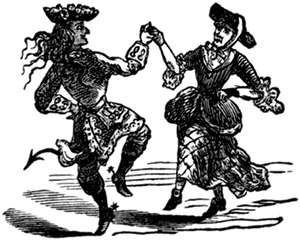
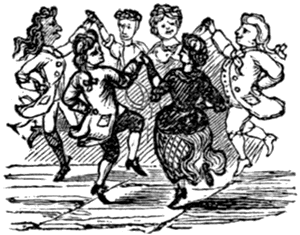
Over a while it seemed as if more spirits joined those that first
arrived, till at length they made such a 'rattle-cum-stave' throughout
the whole house that it was left for years unoccupied,—by
mortal tenants at least. The turn continued its rumble upstairs,
and what had formerly been kitchen, hall, and parlour, seemed
filled with a revelrout all night long, and folks were often
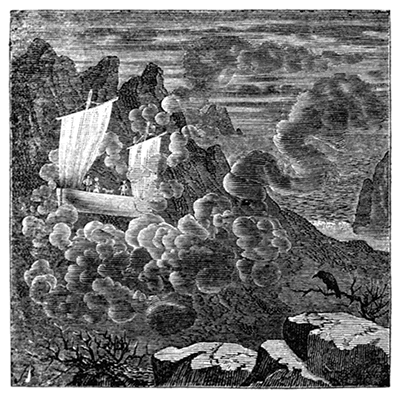
dismayed by unnatural appearances outside the house. Towards
night clouds of fog would roll in from over sea, settle around the
I'an's premises, and become denser and darker till the place
seemed shrouded in thunder-clouds; then lights would flash
around the house, and such sounds be heard as if made by
discharges of small fire-arms, with a roar of cannon now and
then; one would, also, hear the surging and splashing of waves,
flapping of sails, creaking of blocks and tackle, with other
sounds usually heard on shipboard, till this apparition rose high
above the houses, drifted away seaward, and disappeared.
Sometimes all lights in the house would go out, at the same
instant, without any visible cause; this was such a common
occurrence that the inmates would merely say, "that's Beaton
come again; but, never mind, we shall soon hear her spinning,
then we may light the candles again, and hope to be left quiet
for a time." When people would persist and occupy the house,
it was often troubled by day, and all its mortal inmates, both
man and beast, would be seized with fear, and run to doors, at
times when nothing unusual was seen or heard. Often in the
height of a clear summer's day, a blast of chilly air, with a
grave-like scent, would pervade the old dwelling; then children
would screech, dogs howl, cats, with their hair bristled up, rush
out of doors, or smash through windows, if doors were closed.
The cats never returned, and died of fright when they couldn't
escape the house. There's no end of stories about the ghostly
pranks that were acted here for more than a century, and we
shall only relate another.
A carpenter, who was working about the place, said he
didn't believe that all the I'an's spirits would make him quit the
house or Beaton's chamber even; and he waged a pint of brandy
that he would see, that very night, what made the racket there,
and hail the spirits if he saw any. That he might have a sight
of them, without more ado, he bored an auger-hole in Beaton's
chamber door. Having primed himself with drink, when night
came, and the usual noises began, he fixed himself close to the
door and peeped in. At first he only beheld a faint light
glimmering over the bed, and what looked like a dead man
stretched thereon, with shadowy figures moving about the room;
then he saw more distinctly, and made out a woman, dressed in
grave clothes, sitting on a chair beside the bed.
Then the chamber became so dark that he could see nothing
of the figures on the bed and in the chair but their eyes, that shone
with purple light. The woman's eyes—he could see nothing else
but her eyes glistening like coals of fire—arose from the bedside
and approached the door, and still the carpenter could only see
a pair of flaming orbs when they were within a few inches of his
face; and he—terror-struck or spell-bound—had neither power
to move away, nor to withdraw his gaze. There he stood like
one rivetted to the spot for minutes, that seemed hours, till a
blast of cold air smote his face, and something pierced his eye
like a red-hot nail. He fell on the floor, was found insensible
when raised, and he ever remained blind of one eye.
There was but little rest for anyone dwelling in the I'an's
house until some years after Parson Corker came to Buryan;
and, at first, he made many fruitless attempts to confine those
unresting spirits to their graves. He ordered that the locked-up
chamber should be opened, and all its furniture burned—as no
one would venture to make use of anything therein—and he
would try again what could be done.
So one night the reverend gentleman came over from Tresidder—where
he lived with his cousins the Tresillians;—a good number
assembled; they broke open Beaton's chamber-door, and
began to throw out the furniture, but they found it a more difficult
job than was expected. Turns, chests, chairs, tables, were
soon cleared out, and a great hanging-press was smashed to
pieces, tossed through a window, and added to the blazing pile on
an open space fronting the house. They found it, however, no
such easy work to break up the grand carved-oak bedstead,
which must have been made and put together in the room,
because neither its tester nor its head would pass through the
doorway. In this bed-head were two deep recesses, ornamented
at their backs and all around with carved foliage, framing the
names and ages of some old I'an or Ivan and his wife, who probably
had this bedstead made when their house was built. High
up on either side of these recesses, between them and the tester—among
flowers and creeping plants—were boldly carved faces,
supposed to be those of the family; they were all very much
alike, with peaked beards, wonderful high foreheads, and long
noses,—straight as a line. Bedding, rich hangings, and old
raiment, very grand in their day, were rotten and gone to dust.
When all was at length cleared out and blazing in the town-place,
the parson entered to conclude his work by sprinkling
salted water all about; at the same time he repeated long words,
spells, or incantations in Latin, because that tongue was said to
be more respected by devils and restless spirits than any vulgar
dialect. He also performed other ceremonies, whose use and
practice were only known to learned divines.
But it is doubtful whether the reverend exorcist did any good
on that occasion. For whilst Treen folks made a bonfire of what
had been the I'an's furniture, he or the spirits raised an awful
tempest; houses were unroofed, walls blown down, and other
damage done throughout the neighbourhood and far away.
Meanwhile, ghostly forms were seen and unearthly voices heard,
high up over flames and smoke, making derisive shouts like
demons' laughter. They seemed to enjoy the fun, whilst many
people cursed the parson for rising such a storm. One can't say
how his best endeavours failed to lay these unruly ghosts. But
"Perchance some form was unobserved,
Perchance in prayer or faith he swerved;"
for on the following night troops of spirits arrived at their
accustomed hour and made as much disturbance as ever. Then
Mr. Corker—determined to rout them—sought advice and
assistance from the most remarkable "spirit-queller" of that
time, one parson Polkinghorne, who belonged to some parish
east of Penzance.
It was believed, of this Parson Polkinghorne, that no spirits
walking the earth could resist his spells, and that, when other
exorcists failed to obtain a mastery over an obdurate one, this
gentleman no sooner joined them than the poor ghosts would
exclaim—like that of old Squire Harris, of Kenegie—"Now,
Polkinghorne, thee art come and I must be gone!" And he at
once sent the shadow off to its grave and there confined it for
evermore.
One night, a week or so after the unsuccessful attempt, the two
parsons—arrayed in their priestly vestments, bearing large books
and a coil of new hempen cord—arrived at the haunted house's
door, and requested all the inmates to quit it before they entered,
and not to attempt to hear or see anything that might take place,
nor to re-enter their dwellings for that night. When all the living
inhabitants had left the house, the reverend exorcists entered it;
but how they worked to get control over these troublesome
spirits nobody knew but themselves, as they were no more seen
till an hour or so after midnight, when they issued forth and
took their way to Church-town, with the bound spirits in their
company (it is supposed), and, having finished their work in the
graveyard, they, about daybreak, aroused the inmates of the
"Scaw-tree" inn, made a hearty breakfast, and returned to
Tresidder.
Now, 'tis said that this Parson Polkinghorne had power, also,
over the spirits of air, or whatever they be, that usually raise the
wind, when ghosts are laid; for on this night all was so quietly
done that the weather was not, for a wonder, uncommonly stormy.
The I'an's ghosts, however, were settled, that's certain; they
met with their match at last, and quitted their old habitation for
good. From that night their old house was quiet and remained
so for a few years, then part of it was again haunted by the
ghost of a crazy spinster called 'Bitha (Tabitha) who also became
insane from grief at her sweetheart's untimely end. But this
spirit gave little trouble, compared with the former ones, and
took its departure in a few years, of its own accord; at least we
never heard of anything having being done to "lay" it.
About sixty years ago these almost forgotten traditions were
revived. One Sunday afternoon, in summer time, a carriage
arrived in Treen, stopped near the I'an's house, and a middle-aged
gentleman stepped from the conveyance just as an old man
drew near, who saluted the visitor, and asked if he would be
pleased to accept of his services to show him the Castle? The
stranger replied, in but indifferent English, that he would like to
know if there were any remains in Treen of an ancient mansion,
or castle, that once belonged to a family called I'an or Ivan, as
he spelt it for Uncle George, who was a most intelligent old
guide and the best chronicler of Treen.
"Why, there's the dwelling," said he, "that old people always
called the I'an's house, though young ones, thinking to improve
the name, have lately called it the John's house; but no family
called Johns were ever proprietors of it that I ever heard of."
The gentleman looked at the old house, and said that he
expected to find a much grander one.
"Yet, in its day, that was considered far above the common,"
Uncle George remarked; "and it must have cost much to build
when no wheel-carriages were in use, and timber had to be dogged
(dragged) many miles through narrow lanes, and stones and
other materials were carried on drays, or on horses' backs.
Besides, where you see nothing now but pigs'-crows and turf-ricks,"
continued he, in conducting the visitor towards the house,
"there was once a large green-court; and at the back where
you will find little else but dung-pits and heaps of rubbish, there
were more buildings belonging to the house, with a large walled
garden and a rabbit warren beyond."
The gentleman then informed his guide that he was a descendant
of an old Catholic family who, between two or three
centuries ago, owned a Castle in Treen and much land in that
neighbourhood, if such traditions and documents as were preserved
in his family might be credited—that he resided in Brittany, to
which place his ancestors had hence removed at a time when
Catholics were much persecuted here—that, being in England
on business and curious to see his family's ancient home, he had
come to Treen for that purpose—and that he would also like to
know if there were any tombstone inscriptions, or other records
of them, in St. Levan Church. Besides, he said, that others of
his family had long been desirous to know something of a place
respecting which they had many curious traditions. Moreover, he
informed the old man that the name usually spelt I'an was an
abbreviation of Ivan and equivalent to Juan or plain John; the
confusion in, or the various modes of, spelling took place,
probably, before J and U replaced I and V, but still the old pronunciation
was retained. [The same applies to many old French
names here, that seem to be spelt one way, and pronounced
differently. Take Lanyon as a familiar example, pronounced
Lanine.] This Breton gentleman, whom we may call M. Ivan,
as he spelt his name in full, when shown through the old house
was much disappointed to find its interior a mere wreck, with
little to show that it had ever been a gentleman's residence, except
a few fragments of carved wainscot and ornamental plaster-work
in an apartment that had been a portion of hall or parlour in
olden time. It seems the "gentil Breton" had heard much of
Castle Treyn, and 'Uncle' was much diverted and surprised to
find that he thought it was a grand building situated in the village,
and hinted that it might have been his ancestor's residence.
"Faix! they must have been the giants then," said the old
man to himself, "for I never heard of anybody else who ever
lived there."
And, in answer to M. Ivan's enquiries where the Castle was and
if any of it was still standing, "still standing, sir," he exclaimed.
"I believe 'e, faith, and stand it will till Doomsday, unless one
can get out of a rock the Castle-key; but when that is done, as
Merlin prophecied, all will sink into the sea, whence it was raised
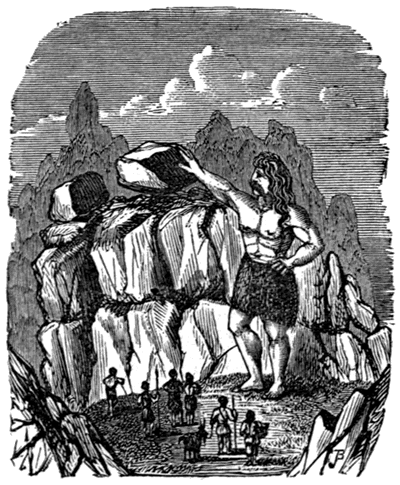
by enchantment, they say, with the giants who dwelt there of
yore. But the Castle isn't here in town; it's down to cliff,"
continued he, showing the way; "and we can travel there across
the fields, if you please, while your carriage can go out the lane
and await 'e in Pedny-vounder cliff, if so be that you would like
to ride to Church-town."
As there were many interesting objects to be seen by the way,
the gentleman decided to walk to St. Levan Church also, and his
conveyance remained in Treen. In passing the fields Uncle George
said, "Old folk, who are dead and gone, always held (and I
believe it for truth) that people seldom lived in Castle Treen, or
in any of our cliff or hill-castles, for more than a few days at a
time; and that was when they had to seek refuge there for their
old people, women, and children, with their flocks and other
property, from the Danes and other northern robbers who used to
land at Parcurno, Penberth, and elsewhere, to ravage the country,
carry off women, and do worse mischief than that, if the hair that
crops up every now and then in some families may be taken as
evidence. But the red-haired pirates were soon put to rout, and
then nobody remained in our stronghold of Treen Dynas except a
man to keep watch from Castle Peak."
He might have remarked, too, that the old proprietors of Treen
held to a tradition that Kaerkeis bowjey and barn were as old as
the Castle, and were built in that out-of-the-way place for the
purpose of storing fodder for cattle near the stronghold against
an invasion. They also believed that valuables were, at such
times, hastily buried in the Castles; those who secreted the
property being slain, nobody knew where to find it. As a proof
of the probability of such a belief, within the old guide's remembrance,
about the quantity of two quarts of ancient Roman and
other coins were found within or near Castle Maen. The
coins were simply placed in a pile, on a flat stone, and enclosed
by three others set on edge and capped. The whole was buried
in a bank of earth and small stones that formed part of an
old hedge or gurgo. Probably some of these coins may still
be found among old folks of Sennen. The writer had many
of them, when too young to know the value of such interesting
objects.
Having passed the fields and ascended the rising ground
beyond, M. Ivan asked where the Castle was—he could behold
nothing like a building between them and the sea, towards
which they had shaped their course.
"We are already within it," replied the venerable guide, "and
have passed the outer wall through a breach where it is levelled
and the ditch filled in to make a road. I ought to have pointed
it out to 'e. The outer mound is little short of half a mile long.
Hundreds of cartloads of stones have been carried away from the
walls for building houses and hedges. Yet on Kaerkeis side,
where it isn't easily reached, some of it is still pretty perfect;
except, indeed, where our youngsters have bowled the stones over
cliff for their Sunday afternoon's sport; and it would be just as
well, or better, 'seeman' to me, that they were allowed to have
their wrestling and hurling-matches at such times, to keep them
from doing mischief, like they had in their great-grandfars' days,
when folks were quite as good, and to my 'seeman,' better than
they are now, for all that constables do and duffans say."
We can't follow the old guide through the long story he used
to relate of what passed between him and the Armorican gentleman.
Having shown the Castle and related the legends of giants,
small people, &c., connected with this enchanted spot, they
passed along the cliff to St. Levan Church. Service was over
and the congregation dispersed, but the church-door key being
kept at the inn, they inspected the church to see if any memorial
of the I'ans was to be found, but nothing connected with them
was observed in carved shields or bench-ends, nor elsewhere.
Parish registers—if any remained two centuries old—he had no
opportunity to see.
They also visited St. Levan's Well and Chapel. The old man
pointed out a long flight of steps that may still be traced best
part of the way from the spring to the ancient chapel's site. The
gentleman took particular interest in the ancient cliff oratories,
with their holy wells, and in every spot along their way hallowed
by saintly legend. In returning from Chapel-Curno, as the
little oratory over Parcurno used to be called, they were met at
the foot of Carnole hill by a gentleman of Penzance, who used
occasionally to preach at the Methodist Chapel in Sowah. This
gentleman often returned thence to Treen (where he usually remained
over night) by way of St. Levan Church and along the
cliffs. He knew Uncle George very well; for they often disputed
about what the old man styled a new-fashioned religion.
Yet they were always great friends.
The gentlemen were introduced and walked together to Treen.
By the way M. Ivan related how curiosity had led him to visit
Treen, and that he was, on the whole, gratified with his visit,
though quite taken down in his exaggerated ideas (as transmitted
by family traditions) of their former importance here; and thought
the foregoing tragic story, which the old man related in part, just
as probable a reason for his ancestor's departure as that of religious
persecution; yet he believed they were always attached
to, and held, the old faith. When they arrived at Treen he
handsomely rewarded the intelligent old guide, and was about to
leave when the preaching gentleman proposed for M. Ivan to
take tea with him at the house where he put up. The invitation
was accepted, and he was regaled with bread, cream, and honey—the
produce of what was once his family's acres.
Mr. Richard Edmonds remarks that "Treryn Castle, Maen
Castle, Chûn Castle, Castle-an-Dinas, and several other cliff-castles,
and hill-castles, in the Land's End district, have been in
existence probably between two and three thousand years. And
Treryn Castle, with its high massive vallum, deep ditch, and the
foundations of its stone wall, twelve feet thick, presents so little
temptation either to the agriculturist or to the builder, that its
existing remains, vast as they are, need no Society's protection
for their continued duration for generations yet to come.
All castles, of course, do, or did once contain dwellings of some
kind for their occupants. But the low huts which once stood
within the castles near Penzance (although considerable remains
of such dwellings in Chûn Castle were extant in Borlase's time)
have now almost everywhere disappeared. It was not, however,
from these rude huts, but from the fortifications enclosing them,
that our very ancient castles derived their name; and not one of
them, at the present day, appears more worthy of being thus
called than at Treryn Castle."