HE next great class of signs to be noticed consists of what may be
termed “Mammalian Signs.” In Essex no less than 464 houses, or 34·2 per
cent. of the whole, display devices derived from the animal kingdom.
There are, however, only 102 distinct signs. These may be classified as
follows:—
HE next great class of signs to be noticed consists of what may be
termed “Mammalian Signs.” In Essex no less than 464 houses, or 34·2 per
cent. of the whole, display devices derived from the animal kingdom.
There are, however, only 102 distinct signs. These may be classified as
follows:—
| |
No. of
signs. |
No. of
distinct signs. |
| Mammals | 384 | 81 |
| Birds | 75 | 18 |
| Fish | 1 | 1 |
| Insects | 4 | 2 |
| | 464 | 102 |
This calculation is, moreover, made independent of “man and his parts,”
as the heralds say. Signs of human origin have been placed in a separate
class, and will be treated of hereafter by themselves.
Although many of the signs belonging to this class are, undoubtedly,
nothing more than very modern vulgarisms, there can be no doubt whatever
that a great number have a truly heraldic origin, as will be seen from
what follows.
To commence the list, we find at Buckhurst Hill a Bald-faced Stag, and
in the adjoining parish of Chigwell a Bald Hind. These two signs have,
doubtless, the same origin, but one which it is not now easy to
discover. In Essex a horse is always said to be “bald” when he has a
white face.
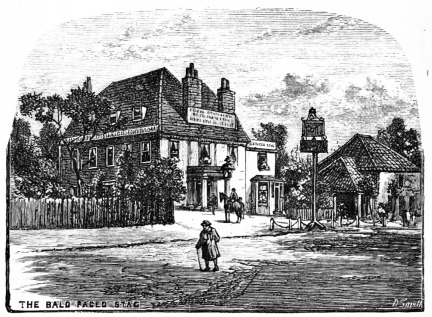 BALD-FACED STAG.
(Buckhurst Hill.)
Possibly the signs commemorate the killing of two deer with white faces
in the adjoining forest, which was the last locality in the east or
south-east of England in which the aboriginal wild red deer survived,
the last having been killed so lately as the year 1817 or thereabouts.
Both the Bald Hind and the Bald-faced Stag are among the oldest of the
forest inns. The latter is, presumably, the same house marked as the
Bald Stag on Cary’s map, published in 1768. It has the same name in Mr.
Creed’s list (p. 7). The Rev. Wm. Cole tells us, in his voluminous MSS.,
that on the morning of October 27, 1774, he “started from the Cock at
Epping without eating, and breakfasted at an Inne, called the Bald-faced
Stag.” The existing inn is a large square, white-washed building, with a
high-pitched roof. It contains a portrait of Queen Anne, and the
coffee-room is panelled. From it, according to the author of Nooks and
Corners in Essex (p. 21), the famous “Epping Hunt,” so cleverly
satirized by Tom Hood, used to start every Easter Monday, when it was no
uncommon thing for five hundred mounts to ride off from the ridge on
which the house stands. The Easter Monday hunt is said to have
originated as far back as the year 1226, in the reign of Henry III. The
custom was kept up until so recent a date as 1853, after which it
gradually fell off, owing to the rough East End element which marked the
annual meeting, and made it little more than a public nuisance. The
stag—a tame one—was, on these occasions, taken round in turn to all
the neighbouring public-houses before being set at liberty, and the
amount of liquor consumed, and riot occasioned, was, in consequence,
considerable. Something approaching a celebration of the old custom has,
however, been attempted as lately as the last two or three years. There
was also a Bald-faced Stag at Hatfield Broad Oak in 1789.
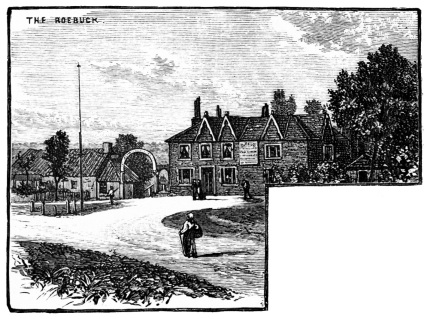 ROEBUCK.
(Buckhurst Hill.)
At Buckhurst Hill there is also a Roebuck, as well as a Reindeer. The
former is marked on Cary’s map, published in 1768, and is probably the
same house several times spoken of (p. 6) as the Buck in The Trials of
John Swan and Elizabeth Jeffries, published in 1752. It is still one of
the best and most widely-known inns on the Forest. In its large Assembly
Room public gatherings often take place. The old Reindeer, which is
shown on Cary’s map, published in 1768, is now a private house,
inhabited by Captain Mackenzie, the Forest Superintendent, and known as
“Warren House.” The present Reindeer is situated about a mile distant
from the old one. An Archer shooting at a stag is also depicted on the
undated halfpenny token of “John Unwin at Layton Stone.”
It is in every way probable that the fallow deer, formerly living in the
surrounding forests of Epping and Hainault, and still existing in
considerable numbers in the former, gave rise in some way to these
numerous cervine signs in and around the parish of Buckhurst Hill. It
is, however, a moot point whence the parish derived its name. Some
connect the name with Lord Buckhurst, a favourite of Queen Elizabeth;
others regard it as composed of two Anglo-Saxon words, Boc, a beech,
and hurst, a wood or forest, which is not unlikely to be the true
derivation; others, however, state that this part of the forest was
severed from the remainder by Royal Charter, and so termed Book-hurst,
meaning book-forest; while yet others consider the name to mean
Buckhurst, the wood or forest in which bucks lived. The latter
derivation seems in every way the most likely one. Nevertheless, the
place was formerly often called “Buckit’s Hill,” as, for instance, in
The Trial of John Swan and Elizabeth Jeffries (p. 8), published in
1752, but this was probably a corruption. The farthing of “William
Locken in Tollsbvry in Esex, 1668,” bore a Stag, and that of “John
Attewell in Black Notle in Esex, 1670,” bore Three Stags’ Heads couped,
probably taken from the coat of arms of some private family. The Stag’s
Head at Colchester is also, probably, a form of some family crest. Forty
years ago there was a Doe Inn at Halstead. There is now a Stag at
Hatfield Heath, and another at Little Easton. Concerning the latter,
there can be very little doubt that it represents the crest of the
Maynard family (a stag statant or). It would be interesting to learn
whether this house has come to be known as the Stag after having first
been called the Maynard Arms. The Stag also serves as a beer-house sign
at High Ongar. It is not very easy to say what first led to the Reindeer
being used as a sign; but that it was in use as early as the
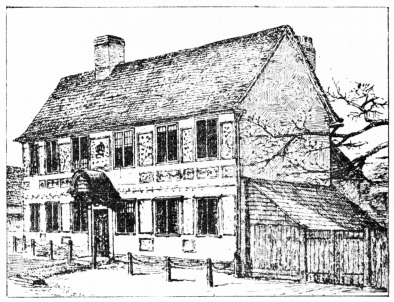 CROWN HOUSE.
(Newport, Essex.)
seventeenth century is clear from what Pepys says in his Diary. He
tells us that on the night of October 7, 1667, he “lay very well” at the
“Rayne-deere at Bishop Stafford” (meaning Bishops Stortford), where the
sign is still in existence. The same sign also occurs at Takeley, Black
Notley, and (as already mentioned) Buckhurst Hill, having been probably
set up at the latter place in order to keep company with the other kinds
of deer that are found there. The Reindeer at Takeley has been in
existence since 1786 at least, as it is mentioned in the Chelmsford
Chronicle on January 20th in that year. At Greenstead, near Colchester,
there is to be seen the sign of the Buck’s Horns, which is very likely
intended to represent the deer’s “attires” in somebody’s coat of arms.
The sign is not mentioned by Larwood and Hotten. The Horns at Barking
Side may have had the same origin, or the house may have taken its sign
from the noted tavern of the same name which formerly existed in Fleet
Street. The residence at Newport, now commonly known as the Crown House
(from the crown sculptured over the door), or Nell Gwynne’s House, used
formerly to be an inn. Its present names have been given to it within
living memory. Mr. C. K. Probert states[49] that in the time of his
father, eighty or ninety years ago, there was a tradition still
lingering in the town that the inn was formerly known as the Horns, and
that Charles II., The Duke of York, and Nell Gwynne used to stop there
on their way from London to Newmarket races. This circumstance is
alluded to in an old folio history of the Rye House Plot, and Mr.
Probert has seen a play, printed about seventy years ago, in which the
scene was laid at the Horns at Newport, the characters being Charles
II., Nell Gwynne, the Duke of York, &c. Mr. Probert writes:
“Tradition says they used to come with packhorses by the Great
North Road, viâ Rickling and the lane near Wicken Bonhunt, still
called ‘London Lane;’ then along the ancient road at the foot of
Bury Field in Newport; then along the back of the Burywater House,
and so emerging opposite the Crown House.”
The Horn Hotel in the High Street at Braintree is a well-known old
coaching inn, and has long been one of the best in the town. If the late
Mr. Joseph Strutt is to be believed, this house, at the beginning of the
present century, was known as the Bugle Horn. In his Essex and Herts
romance, entitled Queenhoo Hall, published in 1808, the hero relates
(ii. p. 180) that “we took some dinner at the Bugle Horn at Braintree,
and proceeded in the afternoon to Dunmow, where we arrived before
sunset.” In any case, this sign, like that of the Horn and Horseshoes at
Harlow Common, is probably connected with the old coaching days. The
sound of the horn and of the horses’ shoes would be the first intimation
of the approach of a stage-coach. The latter sign, however, may have
some heraldic significance, as Larwood and Hotten mention a London token
of 1666 on which a horseshoe is represented within a pair of antlers or
deer’s attires. In 1789, too, it seems to have been the Horns and
Horseshoes. The Bugle Horn might easily be connected either with
coaching, hunting, or heraldry, were it not situated in Barrack Street,
*Colchester. This, of course, makes it in every way probable that it is
a military sign. Here, also, must be noticed the popular sign of the
White Hart. This device appears to be unusually common in the county of
Essex. Nearly every town or village of any consequence possesses an
example. At present we have no less than fifty, and twenty years ago the
number was exactly the same. London itself cannot boast of having more,
as it has also just fifty examples of the sign. The White Hart in the
High Street at Brentwood is in all respects the most notable house now
displaying this sign in Essex. In its best days it was a coaching inn of
great importance, and is still by far the best hotel in the town. Mr. H.
W. King has ascertained that it was in existence under its present name
in the time of Queen Elizabeth; but, looking at the house itself, he
believes it to be of still earlier date, perhaps of the fifteenth
century, or even earlier. It is certainly one of the very best examples
of an old-fashioned inn, with a central courtyard and galleries running
round it, now remaining in England. It is mentioned in the Chelmsford
Chronicle for September 14, 1764, as a stopping-place for the coaches
“which set out on Monday the 27th instant at 7 o’clock in the morning
from the Black Bull in Bishopsgate, London, and at the same time from
the Great White Horse Inn[50] in Ipswich, and continue every day (Sunday
excepted) to be at the above places the same evening at 5 o’clock. Each
passenger to pay 3 pence per mile and to be allowed 18 pounds luggage,”
&c.
During the reign of Elizabeth the White Hart was also the principal inn
in the town of Saffron Walden, but it is not now known in what street
the house was situated. Possibly the inn now known as the Hoops, in King
Street, was the White Hart of those days, as it is a very ancient
structure. Boyne describes a farthing bearing the Grocers’ Arms, and
issued by “Anne Mathews, in Safforn Walden, 1656.” Mr. H. Ecroyd Smith
has ascertained, from the registers in the church, that a few years
later she married John Potter of the White Hart, and also that they
thereupon jointly issued fresh tokens, retaining her name, arms, and
date on the obverse, but having a new reverse, bearing the words “John
Potter,” and in the centre a hart lodged with the monogram “I.A.
P.” over it, perhaps to indicate that they continued to carry on their
two trades simultaneously. On the 25th of February, 1659, Pepys says in
his Diary: “Mr. Blayton and I took horse, and straight to Saffron
Walden, where, at the White Hart, we set up our horses, and took the
master of the house [in all probability the aforesaid John Potter] to
show us Audly End House.” References to this inn occur early on in the
records of the Corporation of Walden. Thus, in 1627, 14s. was expended
“for wine when the Earl of Sussex was at the White Hart;” in 1631, 9s.
was “spent at the White Hart when we ourselves did ring for the king;”
in 1643, 2s. 10d. was “payd at the White Hart when Radcliffe was taken
for a Jesuit;” and in 1661, the sum of 3s. 4d. was “spent at the White
Hart when the ryot was, some of the company being there.” The White Hart
on a sign-board at Boreham is correctly and heraldically represented,
but has evidently, in the mind of the artist, been associated with the
deer in Boreham Park, as a view of Boreham House has been introduced in
the background. The White Hart at Great Yeldham is a very ancient
village hostel. Its windows, and its exterior generally, are quaint and
antique. In front of the inn, on each side of the door, are old oaken
settles, whereon the village sages debate the topics of the day. From
the sign-board on the Green opposite, the white hart has long since
departed. The White Hart in Tindal Street, *Chelmsford, has a new and
large graven sign, heraldically represented, and prominently projected
over the street. The White Hart at *Witham, too, has a large and rather
grotesque sign, though it is correctly represented. It is rudely cut out
of what appears to be a thin sheet of iron, and is suspended over the
pavement. The White Hart at *Coggeshall—doubtless the existing
hotel—is mentioned in Bufton’s Diary in 1678.[51] It is also recorded
in Bufton’s Diary[52] that “In April, 1682, there was ye floore of
a Chamber fell downey at ye White Hart at Bocking [probably the still
existing Hotel of that name], where ye Justices sat and about 200
people in ye roome, and one man broke his leg.” In an early number of
the Gentleman’s Magazine is an illustration of an old inscribed beam
from the White Hart between Springfield and Boreham. Mr. J. A. Repton in
a note says that the building was thought to have been a hermitage. He
adds: “There is a long inscription at the bottom of one of the gables,
but it is at present concealed with plaster;” “that the beam measured 52
inches by seven; and that it bore the inscription, ‘Jesus! Mercy! Lady
help! Jesus!’ ” Taylor, in his Catalogue of Tavernes, mentions a White
Hart at *Romford in 1636, probably the hotel of that name still existing
there. An inn with this sign at Colchester is mentioned in one of the
old Corporation records, dated 1603, as being an “auncyent inne” at that
time. In old deeds Mr. H. W. King finds mention of a White Hart—either
inn, shop, or tenement—at Horndon-on-the-Hill in both 1704 and 1719.
There does not seem to be any apparent reason why the white hart should
have become so common a device as a sign as it has done. According to
Larwood and Hotten, its use dates from a very remote period; but there
can be very little doubt that its present abundance is due to the fact
that a White Hart lodged, collared and chained or, was the favourite
badge of King Richard II., and appears, with variations, no less than
eighty-three times upon his monument at Westminster. At a tournament
held in Smithfield in 1390, in honour of various foreign counts who had
been elected members of the garter—
“All the kynges house were of one sute; theyr cotys, theyr armys,
theyr sheldes, and theyr trappours were bowdrid all with whyte
hertys, with crownes of gold about their neck, and cheyns of gold
hanging thereon, which hertys was the kinges leverye that he gaf to
lordes, ladyes, knyghtes and squyers, to know his household people
from others.”
The White Hart was also used as a badge by Edward IV. It is just
possible that the fact of the crest of the Maynard family being a stag,
as already mentioned, has something to do with the abundance of the
White Hart as a sign in Essex, or at least in the northern parts of the
county. It is possible, too, that the abundance of this sign in Essex
may be due in part to the fact that a very ancient and famous White Hart
formerly stood in Bishopsgate Street Without, in such a position that it
would probably form a stopping-place for most travellers to and from
London along the Great East Road. Timbs, in his Clubs and Club-life in
London (p. 397), says that it was originally built in 1480, but the old
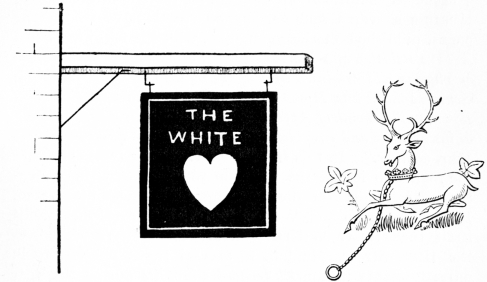
house was pulled down and rebuilt in modern style in 1829. Allusion has
already been made (p. 25) to an absurd corruption of this sign at West
Bergholt, where the landlord of the White Hart, not content with a
script sign, has added a pictorial one of his own designing,
representing a large White Heart on a black ground! Whether this has
been done through ignorance or intent, it is a good example of the way
signs become corrupted and altered in the course of time. Illustrations
of both forms are given above.
 THE WHITE HART (Heart).
THE WHITE HART.
THE WHITE HART (Heart).
THE WHITE HART.
(At West Bergholt.)
The horse and his belongings are referred to no less than seventy-three
times on Essex sign-boards, although a simple horse does not once occur.
The use of the horse as a sign is probably derived both from the animal
himself and from the part he anciently played in Heraldry. Horses of
fantastic colour, such as the Golden Horse at Forest Gate, are, in all
probability, of heraldic origin. No less than thirty-six times in this
county do we meet with the sign of the White Horse, and there is an Old
White Horse at North Ockendon. Boyne describes tokens issued by “John
Tvrner at the White Horse in Chelmsford, 1667,” and by “John Langston at
the Whit Horse in Mvchboddow.” White Horses are still in existence at
both of these places. There can be no doubt that the one at Great Baddow
is the one from which the token was issued in the seventeenth century;
but in the case of Chelmsford there is some doubt. The matter is not
without interest, for there is in the British Museum a scarce and
curious quarto tract, of twenty-one pages, published in the year 1688,
with the following title: “A True Relation of a Horrid Murder,
committed upon the person of Thomas Kidderminster of Tupsley in the
County of Hereford, Gent., at the White Horse Inn in Chelmsford, in the
County of Essex, in the Month of April, 1654, together with a True
Account of the Strange and Providential Discovery of the Same nine years
after, &c., &c.” In this tract one Mr. Turner (without doubt the man
who issued the token in 1667) is many times mentioned as landlord at the
time the murder was discovered. Forty years ago the White Horse at
Dovercourt styled itself the Great White Horse. The White Horse in the
High Street, Maldon, is several times referred to in advertisements in
the Chelmsford Chronicle during the year 1786. Likely origins for this
sign have already been given (p. 18). The Flying Dutchman, which is a
beer-house sign at Braintree, probably commemorates the racehorse of
that name. There are Black Horses at White Roothing, Widdington, Sible
Hedingham, Pilgrim’s Hatch, and Chelmsford (beer-house). Sixty years ago
there was another at *Coggeshall. There are also Yorkshire Greys at
Coggeshall (at least forty years old), Stratford (two), and Brentwood.
Probably these are named after some famous racer. One or other of those
at *Stratford is several times referred to in the Trials of John Swan
and Elizabeth Jeffries (1752). It was then kept by a certain Ann
Wright. Sixty years since, too, there was another at *Colchester.
Adjoining the racecourse at Galleywood there is a Running Mare. The
Nag’s Head is a sign which seems to be becoming increasingly common, as
we have five now existing in the county, not counting a beer-house so
called at Chelmsford, though, twenty years ago, there were only three.
The sign of the Three Colts, which occurs at Stanstead Montfitchet and
Buckhurst Hill, has very likely an heraldic origin. It is not a modern
device, as there was an inn of this name in Bride Lane, London, in 1652,
and our houses may have taken their name from this one. A Horse
passant is depicted on the farthing token of “Ioseph Gleson,” 1664,
and a Horse Galloping on that of “Samvell Salter,” 1656, both of Dedham.
In Essex the horse enters into many combinations with other sign-board
objects. In most cases the meaning of the combination is so evident that
no explanation of it is required. For instance, at Colchester we find a
Chaise and Pair, at Stratford a Cart and Horses, at Mistley a Waggon and
Horses, and another at *Colchester. There are also beer-houses so called
at Braintree and Hadleigh. The Coach and Horses occurs no less than
thirteen times, the Old Coach and Horses once, the Horse and Groom seven
times, and the Horse and Wheel once. This latter is, however, a misprint
on the part of the compilers of the Post Office Directory. Twenty
years ago it appeared in the list as the Horse and Well, and as the
house is situated at Woodford Wells, this is undoubtedly its correct
form. The sign is not mentioned by Larwood and Hotten. That part of
Woodford known as Woodford Wells, takes its name from a mineral spring
which once existed there. It was formerly in great repute, but is now
quite dry and neglected. An Itinerary of Twenty-five Miles round
London, published towards the end of last century, and quoted by Mr.
Walford in Greater London (vol. i. p. 464), indicates that the name of
the house was then the Horse and Groom. The adjoining mineral spring,
says the author, “was formerly in good repute, and much company resorted
to drink the waters at a house of public entertainment called ‘Woodford
Wells;’ but the waters have long lost their reputation.” Hood, in his
witty poem on the Epping Hunt, refers to the house as follows:
“Now many a sign at Woodford Town,
Its Inn-vitation tells;
But Huggins, full of ills, of course,
Betook him to the Wells.”
The Horse and Groom at Great Warley seems to be at least a century old,
as it is mentioned in the Chelmsford Chronicle on March 10, 1786. At
Margaret Roothing there is a Horseshoe, which is a comparatively rare
sign by itself. The Bull and Horseshoe at North Weald is, doubtless,
merely an impaled sign. Our three Horseshoes and ten Three Horseshoes
have already been referred to (p. 40). At Finchingfield there is a
beer-house with the sign of the Kicking Dickey, and the Cross Keys at
Roxwell is commonly known in the parish by the same name. The origin of
the sign, which Larwood and Hotten do not mention, is hard to explain.
The Lion, with frequent variations of colour and position, is of common
occurrence in the county. This great variety in colouring clearly shows
that we are indebted to the art of Heraldry for most of our sign-board
lions. Messrs. Larwood and Hotten say (p. 118): “The lion rampant most
frequently occurs, although in late years naturalism has crept in, and
the Felis leo is often represented standing or crouching, quite
regardless of his heraldic origin.”
When it is remembered that three lions passant, guardant, or occur on
the Royal Arms of England, and a lion rampant gules on the arms of
Scotland; that a crowned lion statant, guardant or is used as the
Royal Crest of England, a crowned lion sejant affrontée gules as the
Royal Crest of Scotland, and a lion rampant guardant, or as the dexter
supporter of the Royal Arms of England; and that lions of various
colours and in different attitudes have served as charges, badges,
crests, and supporters to many of our earlier sovereigns, and now appear
in the armorial bearings of innumerable private families, it will not be
found in any way surprising that the lion figures so commonly as he does
upon our sign-boards. So frequently, indeed, are lions made use of in
Heraldry that it is almost impossible to assign the variously-coloured
examples now to be seen on our sign-boards to their original wearers.
Lions rampant appear on the trade-tokens of John Rayment of Brentwood,
in 1669, and of Richard Boyse and Richard Rich, both of Colchester, in
1668 and 1656 respectively. At present the animal occurs eight times in
Essex as a simple Lion, and once as a British Lion. The Lion at
Chelmsford, although it has now disappeared, was once evidently a very
important inn. The Rev. R. E. Bartlett finds several mentions of it in
the parish registers, the earliest before the middle of the sixteenth
century. They are as follows: “1543. William Knight, a stranger, who by
misfortune and his own lewdness was drowned at the Lion, and was buried
the 22nd of May.” Again, in 1545, “Wyllyam Pemberton, servaunte to the
Irle of Essex, was slayne at the Lion by one of his Fellows and bury’d
the 19th Day of Januarii.” From the first of these it appears that the
inn was near the river. Taylor, in his Catalogue of Tavernes, also
mentions the Lion as one of the chief inns in Chelmsford in 1636.
Whether this was the same inn afterwards known as the White Lion, and
mentioned in the Chelmsford Chronicle on April 14, 1786, as then
existing at Chelmsford, is hard to say. Possibly the latter house was
identical with that shown with the sign of a rampant lion in the
frontispiece. Its back premises would probably abut upon the river bank.
The site is now occupied by an inn with the sign of the Queen’s Arms.
The Golden Lion, if it does not represent the true “lion of England,”
may represent the lion passant, guardant, or which appears on the arms
of the Haberdashers’ Company.[53] The sign now occurs at Prittlewell,
*Chelmsford, *Romford, and Rayleigh. There are also beer-shops so-called
at Braintree, Hatfield Peverell, Rochford, and elsewhere. The Golden
Lion at Rayleigh is mentioned in the Chelmsford Chronicle for February
24, 1786. Sixty years ago another house of this name existed. A Golden
Lion at Harwich in 1764 is also mentioned in the Chelmsford Chronicle
for that year. The sign of the Blue Lion occurs at Galleywood and at
Great Baddow. Larwood and Hotten think that it “may possibly have been
first put up at the marriage of James I. with Anne of Denmark.” There
can, however, be very little doubt that in Essex this sign represents
the arms of the Mildmay family,[54] which was once of very great
influence in the county. At the time of James I. there were nine several
families of this name possessed of very large estates in the county, the
heads of eight of them being knights. Our nine White Lions perhaps
represent the badge of Edward IV., though the Dukes of Norfolk, the
Earls of Surrey, and other prominent personages have also borne lions
argent. Forty years since an Old White Lion existed at Epping, being
probably the *White Lion which lived there in 1789 (p. 7). As he has now
disappeared, it is only natural to suppose that he has died of old age.
The sign-board of the existing house at Epping is fully pictorial. The
White Lion at Waltham Abbey is mentioned in the parish registers in
July, 1746, when W. Chesson (presumably the landlord) was buried. Black
Lions are to be seen at Plaistow, Stisted, Althorne, Layer Marney, High
Roothing, and *Epping. At the last-mentioned place two houses of this
name existed forty years ago, one of which has existed since 1789, at
least. According to advertisements in the issues of the Chelmsford
Chronicle for February 10 and April 14, 1786, a Black Lion then existed
at Braintree; but, unless identical with the Lion and Lamb or White
Lion, still in existence there, it has now disappeared. Larwood and
Hotten say (p. 120), “The Black Lion is somewhat uncommon; it may have
been derived from the coat of arms of Queen Philippa of Hainault, wife
of Edward III.,” or it may represent the lion sable in the arms of
Owen Glendower. The Red Lion is, however, by far our commonest leonine
sign in Essex. It occurs as many as thirty-four times. The authors so
frequently quoted, say (p. 119) that it doubtless originated in the
badge of John of Gaunt, Duke of Lancaster, who bore the lion of Leon and
Castille on his arms as a token of his claim to the throne of those
countries. In after years it may often have been used to represent the
lion of Scotland. The Red Lion, opposite the church at Stambourne, has a
truly heraldic sign—a lion, rampant, gules, armed, langued, &c.,
argent, on a wreath argent and sable. On one of its gables this inn has
two designs—one representing an old man with long white hair, wearing a
large green coat and boots of the same colour, and apparently blowing a
long horn or trumpet; the other a monogram “I.W.E.” and the date
1709. This may indicate that it was formerly known as the Green Man. The
Red Lion at *Colchester is a very well-known house. Like the White Hart
at Brentwood, it is one of the few examples now remaining in the county
of the old-fashioned inn of several centuries ago. Its capacious
courtyard has evidently once been galleried, and it is altogether one of
the most ancient inns now existing in Colchester, or even in the county,
as well as being certainly one of the most quaint and antique in its
appearance. Its uppermost story considerably overhangs the others, and
the whole of the front shows much old carving which is certainly not
later than the fifteenth, and probably the fourteenth, century, to which
has been added some good modern work. Probably if the plaster were
removed much more old carving would be brought to light. Among other
faces, are those of two lions, which look down upon the entrance. The
doorway is also carved. Miss L. S. Costello, in an article on Colchester
in Bentley’s Miscellany for 1840 (vol. xviii. p. 62), says, that among
the few interesting houses in the High Street, she “was struck with a
wooden doorway at the entrance of the [Red] Lion Inn. It has evidently
been elaborately carved on the different storeys all over, but very
little of its ornament remains. The spandrels of the arch have a
representation, on one side, of a dragon, huge and grim, and on the
other of a knight on foot, with an immensely long spear, tilting at the
monster.” An entry, dated Jan. 9, 1603-4, in one of the old Corporation
assembly books, states that “the Lion, the Angel, and the White Hart
were appointed the only three wine taverns in ye towne, being
auncyent Innes and Taverns.” Mr. Chas. Golding of Colchester has,
however, traced its existence back many years earlier, having found
mention of it under its present name in the Corporation records of the
year 1530 or thereabouts. The still-extant Red Lions at Great Wakering
and Ilford are referred to in advertisements in the Chelmsford
Chronicle on Jan. 20 and 27, 1786, respectively. The latter was a
posting-house of great importance in the days when coaching was at its
height; but, like its neighbour, the Angel (another house once of
considerable fame), it has now sunk into comparative insignificance,
though still quite one of the leading inns of the district. It is a
large, massive square brick building, before which on the top of the
sign-post reposes a graven representation of a Red Lion couchant. The
Red Lion at Waltham Abbey is referred to in the parish registers in
1644, when 1s. 8d. was “given to the woman that lay in at the Reed
Lyon.” Capt. Andrew Hamilton has given[55] an interesting account of an
old house at Kelvedon, formerly known as the Red Lion Inn. It is now
converted into four good-sized tenements, and is known as Knight
Templars Terrace, from a tradition that the inn once belonged to that
fraternity. In its day it was probably the most considerable inn in
Kelvedon, and the largest on the main road between Chelmsford and
Colchester. It was certainly built before the year 1420, and is now an
excellent example of a half-timbered house of that date. Until lately,
however, the original work has been hidden by no less than two false
fronts of lath and plaster of the seventeenth and eighteenth centuries
respectively. Capt. Hamilton describes in detail both the internal and
external construction of this singularly interesting house, but his
remarks are too lengthy to quote here. Opposite to it stood the Angel.
The Red Lion at Abberton figures in the Rev. S. Baring-Gould’s
Mehalah. The Red Lion at Springfield is an extremely ferocious one,
if one may judge from the appearance of his effigy, which is rudely cut
out of a thin sheet of iron, painted red, and placed upon the top of the
beer-house to which he serves as a sign. A Red Lion at Radwinter
(perhaps the existing Lion) finds mention in the Chelmsford Chronicle
on January 20, 1786. The Lion and Boar at Earls Colne may represent the
lion and boar which sometimes appear as the supporters of the arms of
King Richard III., or it may simply be an impaled sign. The sign is not
mentioned by Larwood and Hotten. The Lion and Key at Leyton is a sign of
somewhat obscure origin. It is not a modern invention, as there was a
house of the same name near Lion’s Quay, London, in 1653. Our house,
which is over forty years old, and was formerly a blacksmith’s shop, may
have taken its sign from this one, or it may have derived its name
independently from the popular version of some family crest. This is
rendered extremely likely from the fact (supplied by the present
landlord, who, however, is unable to give any further information as to
the sign) that among the old property taken with the house is a
punch-bowl bearing the heraldic device of a lion rampant, its paw
resting upon the ring of an upright key, and dated either 1756 or 1786.
Whose this crest is, it is hard to say. The Rev. H. L. Elliot has
ascertained that it is not included among those in The Book of Family
Crests, although the family of Lyngard of Northants bore a lion sejant
guardant sable, in the dexter fore paw a key in pale or; while the
families of Knox, Criall, and Chamberlain had crests with a demi-lion
holding a key. The very common sign of the Lion and Lamb is now met with
at Braintree, Stratford, Takeley, Chelmsford, and Brentwood, although,
twenty years ago, the county only contained three examples. At the
last-named place the sign seems to have existed since 1786 at least, as
it is mentioned in the Chelmsford Chronicle on March 17th in that
year. At *Chelmsford a Lion and Lamb carved in stone repose peacefully
upon the parapet of the building, while a newly-painted sign-board, very
well designed, depicts them in the same attitude. The fact of the name
containing an alliteration has, no doubt, had something to do with its
adoption; but it is also an emblematic representation of the Millennium,
when (as Larwood and Hotten say) “the lion shall lie down by the kid.”
Those gentlemen, however, together with all who use the sign, appear to
be a little at fault in their knowledge of Scripture. The passage
describing the “Millennium” (Isaiah xi. 6) says nothing about a lion
lying down, either with a lamb or a kid. It runs as follows: “The wolf
shall dwell with the lamb, and the leopard shall lie down with the kid;
and the calf and the young lion and the fatling together.” The sign
first came into use over two centuries ago. In connection with this sign
there is an amusing tale, which is worth repeating, told of a sceptical
American. When the significance of the sign was explained to him, he
remarked that the state of things depicted might possibly come to pass
some time, but that, when it did, he “guessed that there Lamb would be
inside that there Lion!”
Bovine signs are very frequently to be seen upon our Essex sign-boards.
The simple sign of the Bull is the commonest device, occurring no less
than twenty-two times. Its intimate connection with Christmas beef,
heraldry, and bull-baiting is sufficient to account for the frequent
appearance of this animal on the sign-board. About seventy years ago the
Bull Inn, Whitechapel, was the resort of the Essex farmers, who came to
London once a week to dispose of their corn, &c. The landlord, named
Johnson, who was formerly “boots” at this inn, being in good credit with
his customers, they occasionally left their samples with him, and he
acted as a middle man so much to their satisfaction, that he shortly
after opened an office upon Bear Quay, styling himself “Factor of the
Essex Farmers.” The business ultimately grew to one of great extent. In
old deeds Mr. King finds mention of a Bull—either shop, inn, or
dwelling-house—at Billericay as early as 1616, also of another house
with the same sign at Hockley early in the seventeenth century. Taylor,
in his Catalogue of Tavernes, mentions a Bull (probably the existing
inn of that name) at Barking in 1636, and another at Brook Street, where
also there is a still existing Bull. The Black Bull appears at Fyfield,
Chelmsford, Margaretting, and Old Sampford, while an Old Black Bull
occurs at Stratford. Very probably these two signs owe their existence
to the fact that a bull sable formed one of the badges, as well as the
sinister supporter of the arms, of Edward IV. In 1662 there was a Black
Bull Inn at Romford, as appears from a mention made of it in the
Account of the Murder of Thomas Kidderminster, already referred to. In
1789 there were other examples of the Black Bull at Loughton and Harlow,
and that at Fyfield was then existing. Sixty years ago there was also
one at Grays. On the map of the road between London and Harwich, given
in Ogilby’s Itinerarium Angliæ, published in 1675, “Ye Bull
Inn”—evidently a house of some importance—is shown about midway
between Ingatestone and Widford. In the Traveller’s Guide, a smaller
edition of the same work, published in 1699, the same house figures as
the Black Bull Inn. Probably this is the still existing Black Bull at
Margaretting. The Bull and Crown, which has been in existence at
Chingford for at least forty years past, may be simply an impaled sign,
or it may (like the last sign spoken of) be derived from the black bull
of Edward IV., or from the white bull used as a supporter by Henry VIII.
In either case the bull would probably be crowned. This device is not
referred to in the History of Sign-boards, nor is that of the Bull and
Horseshoe, which occurs at North Weald. It is probably only an impaled
sign. The Bull’s Head, to be seen at Loughton, is, as already stated (p.
34), probably taken from the arms of the Butchers’ Company. There was
once a famous Bull Inn at Newport. It has now disappeared, having, it is
said, been compelled to close owing to the opening of the Hercules just
opposite; but there are old folks still living who can recollect the
shields of arms in coloured glass in the windows, and the “Bull Orchard”
still remains. The house is mentioned in the Corporation records of
Saffron Walden for the year 1734. Cole also, in his MSS., speaks of it
by the name of the Red Bull (a rather uncommon sign, of which Essex does
not now possess an example). The sign, however, seems to have undergone
a change of colour, for it is referred to as the Black Bull in Poor
Robin’s Perambulation from Saffron Walden to London, performed this
month of July, 1678.[56] The author says:
“To Newport Pond my course I next way bent,
And in at the sign of the Black Bull went.
Where scarcely in a room I had set down,
When in came my old friends, kind Mr. Br ...
And Mr. Woo ..., two who love their friend
With true and hearty love unto the end;
For though they in another town do live,
They to their neighbour some kind visits give.
’Twas twelve o’clock; dinner time did approach,
When men whet knives on wheels of cart or coach.
The cloth was laid, and by the scent o’ th’ meat,
One might perceive there something was to eat.
And so it proved, indeed; for from the pot
Came forth a rump of beef, was piping hot,
And from the spit was brought a loyn of mutton,
Would satisfy the stomack of a glutton,
For like a loyn of beef it might well have been knighted,
To which our hostess kindly us invited;
Which we accepted of, and to delight her,
Told her that none could deny such an inviter;
For she’s a widow of such excellent carriage,
Would make a man most happy in her marriage,” &c.
Boyne describes a halfpenny token issued by “Thomas Rvnham at ye Bull
[represented in the centre] in Newport, 1667.” He assigns the token to
Newport in Shropshire; but, as Mr. Joseph Clarke, F.S.A., has informed
the author that no less than seven examples have been found at Newport,
Essex, and as the man’s name also occurs in the parish register, there
can be no doubt that Boyne was wrong.[57] At Chingford Hatch there is a
house with the sign of the Dun Cow. This is an ancient device, and
probably has reference to the feat of Guy, Earl of Warwick, who,
according to an old ballad, slew a “dun cow bigger than an elephaunt” on
Dunsmore Heath. The Red Cow, as a sign, may be seen at Chrishall, Ashen,
and Shelley. A once well-known Red Cow at *Chelmsford is now an equally
well-known coffee-tavern with the same sign. At Waltham Holy Cross a
beer-shop displays the very strange sign of the Spotted Cow, which is in
all probability unique. Larwood and Hotten do not mention it. The sign
of the Red Cow is probably intended to express the idea that good drink
may be obtained within, as from a cow; but, in former times, especial
value seems to have attached to the milk of red cows. At Cold Norton,
near Maldon, there is a house with the very strange, and probably
unique, sign of the Fly and Bullock, kept by one William Pond. It is at
first difficult to see what possible sign-board connection the two
creatures can have. Farmers have reasons for believing that, during hot
weather, a great animosity exists between the two. Inquiry has at last
elicited the fact that the sign is a corrupted one, but this was not
arrived at until after much amusing and erudite speculation, as the sign
in its present form is a very perplexing one. The first guess was that
it was a corruption of the “Flying Bullock” or “Winged Bull,” the usual
emblem of St. Luke. This seemed the more likely, as we have in Essex
signs which might represent at least two other of the Apostolic emblems,
namely, the Angel for Matthew, and the Eagle for John; and who can say
but that some of our Lions were not once winged, thus representing the
only remaining Evangelist, Mark? Moreover, Larwood and Hotten, although
they do not refer to this sign, mention (p. 73), when speaking of the
sign of the Flying Horse, “a facetious innkeeper at Rogate, Petersfield,
who has put up a parody in the shape of a Flying Bull.” But then arose
the question, “Why should Luke be thus commemorated?” It was next
suggested in several quarters that the sign might have originated in the
old fable of La Mouche et le Toreau, of which Miss Elliot of Gosfield
has kindly forwarded a copy, and which is thought to be of Oriental
origin. This, however, did not decide the question, so inquiry was made
of the landlord, who, though knowing nothing of the origin of his sign,
stated that it formerly was, and should now be, the Butchers’ Arms,
thereby clearing up the doubt, the crest and supporters of those arms
being “Flying Bulls.”[58] There can be no doubt, therefore, that the Fly
and Bullock originally represented one of the Flying Bullocks in the
Butchers’ Arms. It seems, moreover, that the sign does after all
represent the winged ox of St. Luke, that Evangelist being, in a way,
the Patron Saint of butchers, for in Chambers’s Book of Days (ii. p.
464) it is stated this symbol has been associated with St. Luke,
“because, to quote the words of an ancient writer, ‘he deviseth about
the presthode of Jesus Christ,’ the ox or calf being the sign of a
sacrifice, and St. Luke entering more largely than the other Evangelists
into the history of the life and sufferings of our Saviour.”
The Blue Boar is, perhaps, the most interesting of all our Essex signs.
At present it occurs five times in the county—namely, at *Prittlewell,
*Maldon, *Colchester, *Stratford, and Abridge. The two first-named
houses have been in existence at least a century, as they are mentioned
in advertisements in the Chelmsford Chronicle in 1786 and 1788
respectively, while the last-named is marked on Greenwood’s Map of
Essex, published in 1824. Forty years ago there was another example of
the sign at Stanford Rivers, and Mr. H. W. King informs the author that
the house at Hadleigh, now known as the Castle, displayed the sign of
the Blue Boar until late in the last century. Taylor (see p. 28)
mentions another Blue Boar at Ilford in 1636. In 1789, too, there was
one at Fyfield. In the year 1750, a Blue Boar’s Head Inn existed
opposite the Church at Waltham Abbey. Mr. Charles Golding, of
Colchester, in writing to Notes and Queries[59] to inquire the latest
date at which bull-baiting is known to have taken place in England,
mentions that an entertainment of this kind was announced, in an old
advertisement that he had seen, to take place at the above house on
Whitsun Monday, 1750, and “any gentleman bringing a dog should be
entertained at a dinner free.” The same house is referred to in an
entry in the parish registers in 1647, when 12s. 6d. was “paid for a
dinner at the Borsehed when the ould Churchwardens gave up their
accounts.” The sign of the Boar’s Head occurs at East Horndon,
*Braintree, and *Dunmow. The first of these houses appeared in the list
forty years ago as the Old Boar’s Head. Our houses of this name have,
perhaps, been named after the famous Boar’s Head tavern which used to
exist in Eastcheap, or they may have had a separate origin. As to the
derivation of the sign itself, Larwood and Hotten are inclined to
believe that it represents the boar’s head as formerly often brought to
table, rather than a charge taken from some one’s arms; but, in this, it
is difficult altogether to agree with them. A boar’s head forms part of
the arms of the Butchers’ Company (p. 34), and we have had in Essex
several families bearing the same charge in their arms, such as the
Borehams of Haverhill, the Welbores of Clavering, and the Tyrrells,
Baronets, of Boreham House—the charge and the name of the place being
very probably connected in some way in the latter case. Indeed, so far
as the Boar’s Head at East Horndon is concerned, there can be no doubt
whatever that it represents the crest of the family of Tyrrells,
Baronets (connected with the Boreham Tyrrells), formerly of Heron Hall,
in the same parish, which was demolished about the year 1789. Their
crest, which was a boar’s head, couped and erect, argent, issuant out
of the mouth a peacock’s tail proper, is now correctly represented on
the sign-board, exactly as upon several of the family monuments in the
church. Both the sign-board and the heraldic device it bears are new,
having been recently set up under the supervision of the rector of the
parish. The old board, which is altogether unheraldic, is displayed over
the door, and exhibits the head of an extremely ferocious-looking boar
emerging from a clump of rushes in a most threatening manner.
There can be very little doubt that in Essex the sign of the Blue Boar
represents the boar azure, armed, unguled, and bristled or, which
served as a crest, as one of the supporters, and also as one of the
principal badges of the once powerful De Veres, Earls of Oxford,
formerly of Hedingham Castle. This is shown to be the more probable by
the fact that we have still no less than five examples of the sign in
the county, while the adjacent counties of Kent, Middlesex, and Herts
possess none. Elsewhere, too, the sign is very uncommon. Not a single
example now appears in Surrey, Sussex, Durham, Devonshire,
Nottinghamshire, Derbyshire, Northumberland, Cumberland, Westmoreland,
or Cheshire. Norfolk, Kent, and Cambridge have one each. Leicestershire
and Suffolk (in which county the De Veres also had large estates) have,
however, two each. In London, although there is both a Boar’s Head and a
Blue Boar’s Head, there is not now a Blue Boar. However, a tradesman’s
token issued “at the Bleu Boore without Bishopsgate” in the seventeenth
century still exists. Much valuable information concerning the Blue
Boar as used by the De Veres, is contained in a paper by the Rev. H. L.
Elliot, of Gosfield, On Some Badges and Devices of the De Veres, on the
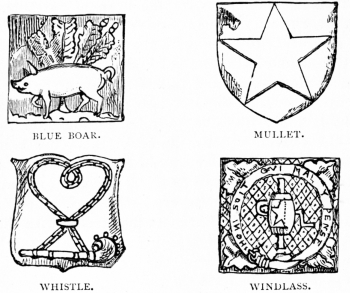
Tower of Castle Hedingham Church.[60] Four of these—the Boar, the
Mullet, the Whistle, and the Windlass—are here reproduced.
 BLUE BOAR.
MULLET.
BLUE BOAR.
MULLET.
WHISTLE.
WINDLASS.
(Badges of the De Veres.)
 BADGE OF THE DE VERES.
(Front the Black Boy, Chelmsford.)
BADGE OF THE DE VERES.
(Front the Black Boy, Chelmsford.)
The motto of the family, Vero nihil verius and Verite vient formed a
rebus on the name. The boar as a badge was evidently assumed for the
same reason. The Latin name for the animal is verres, though the De
Veres probably got it through the Dutch (veer or vere), as they were
a branch of the House of Blois, and owned the Lordship of Vere in
Zetland. The boar has been a favourite device of the De Veres from a
very early period. The feet of the cross-legged and mail-clad figure of
Robert, the fifth Earl, who died in 1296, still existing at Earls Colne
Priory, are placed against a boar, and the same animal appears in
different capacities on all, or nearly all, the other existing monuments
of the family. Stowe speaks of John, the sixteenth Earl, “riding into
the city, to his house by London Stone, with eighty gentlemen in a
livery of Reading tawney, and chains of gold about their necks, before
him, and one hundred tall yeomen in the like livery to follow him,
without chains, but all having his cognizance of the Blew Boar
embroydered on their left shoulder.” As a badge, the boar is carved,
alternately with the mullet (another device of the De Veres[61]), over
the clerestory windows of Castle Hedingham Church; on several parts of
Lavenham Church, Suffolk; on the roof of the south aisle of Sible
Hedingham Church; over the west door of Chelmsford Church, and
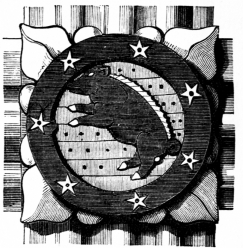
elsewhere. In the Chelmsford Museum, moreover, is preserved a wooden
boss, taken from the ceiling of a room of the old Black Boy Inn when it
was pulled down. On this is carved a boar, within a circular ribbon
charged with seven mullets. Some information as to how these devices
came into these positions is given hereafter. For close upon five
centuries this mighty family, whose riches were immense, and whose power
was second only to that of the sovereign, ruled over a large portion of
East Anglia in semi-regal fashion. For 567 years, too, was the same
title retained in this one family. It is no wonder, therefore, that
their armorial bearings should have been largely used as signs by those
who were in various ways dependent upon them; but it is interesting to
find at the present day such comparatively clear evidence of this fact.
The principal Essex inn exhibiting the sign of the Blue Boar (and the
one from which, in all probability, some, at least, of our others have
taken the name) was the once famous Blue Boar at Castle Hedingham. This
ancient house may be cited as a good example of an inn deriving its sign
directly from the armorial bearings of a great historical family which
formerly resided in the immediate vicinity, and, without doubt, owned
the house. Its sign, of course, represented the badge of the mighty
Earls of Oxford. The inn was a fine old house standing in St. James’s
Street, where its ornamental chimneys once formed the most prominent
feature. After being injured by fire it was pulled down in 1865. On this
occasion various old coins and other relics were discovered, the most
interesting being an inscription in Early English characters, written in
chalk on a blackened beam behind the wainscot. It ran thus:—
“Hans pes withe yore nebor whilom ye maye,
For oftyn tymes favore do the passe withe ye daye.”
This may be translated as follows:—
“Be at peace with your neighbour while ye may,
For often times the favour will pass with the day.”
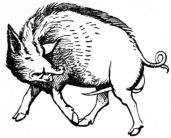
According to the authors of the History of Sign-boards (p. 116), this
sign was originally a white boar, and represented the boar argent,
which formed the favourite badge of Richard III., as well as one (or,
more generally, both) of the supporters of his arms.
 THE WHITE BOAR.
(Badge of Richard III.)
“The fondness of Richard for this badge appears from his wardrobe
accounts for the year 1483, one of which contains a charge ‘for
8,000 bores made and wrought upon fustian,’ and 5,000 more are
mentioned shortly afterwards. He also established a herald of arms
called ‘Blanc Sanglier,’ and it was this trusty squire who carried
his master’s mangled body from Bosworth battle-field to
Leicester.... After Richard’s defeat and death the White Boars were
changed into Blue Boars, this being the easiest and cheapest way of
changing the sign; and so the [White] Boar of Richard, now painted
‘true blue,’ passed for the [Blue] Boar of the Earl of Oxford, who
had largely contributed to place Henry VII. on the throne.”
Shakespeare in Richard III. (act v., scene 3) alludes to the dead king
and his badge as follows:—
“The wretched, bloody, and usurping boar
That spoiled your summer fields and fruitful vines;
... This foul swine ... lies now ...
Near to the town of Leicester, as we learn.”
It is related that in this king’s reign one William Collingbourne was
executed for composing the following couplet:—
“The Cat, the Rat, and Lovell our Dog,
Rule all Englonde under an Hogge.”
The king and his ministers, Sir Richard Ratcliffe, Sir William Catesby,
and Lord Lovell, were, of course, thus referred to. At Earls Colne, as
already stated (p. 63), there is a Lion and Boar. Here, in all
probability, we have again represented the boar of the De Veres, Colne
Priory having been another seat of the family, some members of which lie
buried there. Other signs, which have, in all probability, been derived
(partly, at least) from other badges of the De Veres, will be noticed
hereafter.
The sign of the Flitch of Bacon is most conveniently described in
connection with the boar. The authors just quoted say (p. 420), “The
Flitch of Dunmow is a common sign in Essex, and is sometimes seen in
other counties;” but it does not appear that we have had more than one
in the county for forty years past, that one being, of course, the
well-known inn at *Little Dunmow. How the sign originated is too well
known to need any explanation here. A similar custom has occasioned a
similar sign at Wichnor, near Lichfield (Gent’s Mag., 1819). A
beer-shop, about thirty years old, in the market-place at Romford, is
known by the appropriate name of the Pig in the Pound. A Pig and Whistle
is in existence at Thames Haven, and there are beer-shops of the same
name in Broomfield and Writtle parishes. The origin of this sign appears
not to have come down to us out of the mists of antiquity. Very many and
very learned are the explanations which have, of late, been proposed as
the solution of it. Half the European languages have been ransacked for
its derivation, but so far without any satisfactory results. Larwood and
Hotten dismiss it as “simply a freak of the mediæval artist.” Possibly
it may represent, in a corrupted form, the peg said to have been placed
in the wassail-bowl by King Edgar, who, in order to discourage
drunkenness, imposed a penalty upon any one who drank so deeply as to
leave it uncovered. There is, however, a by-no-means-unlikely origin for
the sign, and one which the author believes has never before been
suggested. In Mr. Elliot’s interesting paper just quoted (p. 70) it is
stated that, in addition to the blue boar, the De Veres, among several
other devices, made use of a Whistle and Chain as a household badge.
Thus, among the devices of this one family, are found the two objects—a
pig (or boar) and a whistle—which, when combined, constitute this most
perplexing sign. It is very difficult—perhaps impossible—to prove now
that the sign was actually derived from these two badges of the De
Veres, but, remembering the enormous past importance of the family, it
must be admitted that the sign was in no way unlikely to have been so
derived. Mr. Elliot himself writes that he considers this suggestion not
unlikely to be the correct one. Very probably this description of the
Earl’s badges was a derisive one, applied to them by the Yorkist party
during the Wars of the Roses. A whistle, like that adopted by the De
Veres, was formerly worn by sea-captains, even of high rank; and Mr.
Elliot is of opinion that it was assumed by the De Veres as a symbol of
the office of Lord High Admiral, an appointment held by John, the
thirteenth Earl, who was very active on behalf of the Lancastrian
party.
Forty-six inns in Essex exhibit signs which are more or less canine. A
few of these may have had their origin in Heraldry; but there can be no
doubt that, in the great majority of cases, the signs have originated in
the modern use of the dog, whether for sporting or other purposes. At
Wethersfield and Halstead the Dog appears alone; at East Horndon there
is an Old Dog; a Pointer exists at Alresford; and at Colchester, East
Mersey, and Tolleshunt Knights the Dog and Pheasant appears; while at
Stifford and Great Leighs (beer-house) the Dog and Partridge is used, as
it was also at *Halstead sixty years ago. The sign of the Spotted Dog,
although it is not mentioned by Hotten, occurs four times, namely at
Witham, Barking, Chelmsford, and West Ham, and there is a beer-house of
the same name at Braintree. The sole use of the Spotted, or Dalmatian,
Dog in this country, says a writer in the Gentleman’s Magazine, “is to
contribute, by the beauty of its appearance, to the splendour of the
stable establishment, constantly attending the horses and carriage to
which he belongs.” On October 22, 1804, a disastrous and fatal fire took
place at the Spotted Dog, *Chelmsford. The details are given in a scarce
pamphlet, reprinted in Hughson’s London (vol. vi. p. 246). It seems
that about 120 Hanoverian soldiers marched into Chelmsford on the day in
question, and about 70 of them took up their lodgings in the stables of
this inn. While most of them were asleep it was discovered that the
straw upon which they lay had caught fire. All were, of course, at once
aroused, but being unused to the fastening of the door, they were unable
to open it. When at last it was opened and the inmates liberated, many
of them were sorely burned, and others had their clothing on fire. The
flames were got under after a time, but not until they had extended to
other stables and burned several horses. On clearing away the rubbish,
the bodies of no less than thirteen of the Hanoverian soldiers who had
perished in the flames were found. They were afterwards buried with
military honours in the church. At Hordon-on-the-Hill there is a Black
Dog (beer-house). The Shepherd and Dog is a device which
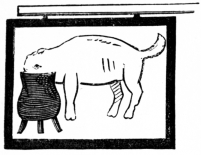 DOG’S HEAD IN POT.
(After Larwood and Hotten.)
is now to be seen at Upminster, Ramsden Cray, and Great Stambridge
(beer-house). Two centuries ago it appeared on the farthing token of
“Peeter Pearcce” of Braintree; while a DOG WITH CHAIN, passant, occurs
on that of “Thomas Peeke, Wyre Street, in Colchstr,” and a dog eating
out of a fleshpot (the Dog’s Head in Pot) on the halfpenny issued by
John Phillips of Plaistow in 1670. This device seems to have been
originally used to indicate a dirty, slovenly housewife. It was never
common. The Hare and Hounds occurs seven times, the Fox and Hounds ten
times, and the Huntsman and Hounds once (at Upminster). Both the Fox and
the Fox and Hounds are very common beer-house signs. The Hare, an
unusual sign when not accompanied by the Hounds, appears at Great
Parndon. The Talbot at North Weald may be named after the famous Talbot
in Southwark, which, under its former name of the Tabard, sheltered
Chaucer’s pilgrims on their way to Canterbury. Talbot is the name of an
old variety of hunting dog which, at the present day, is never heard of
except in connection with Heraldry; and, as the sign in question is not
now a pictorial one, most of the inhabitants of North Weald would
probably be much puzzled to explain what it originally represented.
There was another Talbot in Stapleford Tawney until about ten years ago,
but it is now a private house. The county contains no less than thirteen
Greyhounds, one of which is an Old Greyhound. The sign of the Greyhound
existed at Chelmsford in 1786, according to the Chelmsford Chronicle
for July 21st in that year, but it is not now extant, though Greyhound
Lane still exists. In all probability this was the house that existed
under the same name in 1662, as mentioned in the Account of the Murder
of Thomas Kidderminster, to which reference has been already made. The
Greyhound at Waltham Abbey is mentioned in the parish registers on June
4, 1735, when “John Munns from ye Greyhound was Bur.” The Greyhound
at Barking is mentioned in the parish register as early as 1592.[62] An
entry states that “Henry, the supposed son of Henry Fisher of London,
from the Greyhound, was bapd the 17th of October.” For this sign we
are probably about equally indebted both to the sport of coursing and
the art of Heraldry. Greyhounds argent formed either one or both of
the supporters of Henry VII., the badge, and often one of the
supporters, of Henry VIII., and one of the supporters of Elizabeth and
Mary; so that in all probability the sign found its origin in Heraldry,
but owes its use in the present day, largely at least, to coursing.
In a hunting district like Essex it is in no way surprising that there
should be as many as twenty-five references to the fox on our
sign-boards. Although twenty years ago the sign of the Fox only occurred
five times, it now occurs eleven times; while there are ten signs of the
Fox and Hounds, and three of the Fox and Goose. The latter is a
combination which mediæval artists never tired of representing. It may
be seen, among other places, on a carved oak screen in Hadstock Church.
Of the Flying Fox at Colchester, Larwood and Hotten say (p. 170)—“It
may represent some kind of bat or flying squirrel (?) so denominated, or
is a landlord’s caprice.” It seems much more probable, however, that the
device is intended to represent a fox flying before the hounds.
There is a beer-house known as the Wolf at Great Coggeshall. The origin
of the sign, which is not mentioned by Larwood and Hotten, is hard to
explain. Probably it is unique.
The sign of the Hare and Hounds, of which, as previously stated (p. 76),
we have seven examples, is, doubtless, entirely derived from the sport
of coursing; but the Rabbits, a very old house still in existence at
Little Ilford, has probably an heraldic origin. Most likely the sign is
derived from three coneys appearing on some family coat of arms, but
whose, it is now difficult to say. The sign appeared in the list as the
Three Rabbits forty years ago, and as the Three Coneys on Jean Roque’s
Map of Ten Miles Round London, published in 1746. Lysons, in his
Environs of London (1796, vol. iv. p. 157), says—
“A great mart for cattle from Wales, Scotland, and the North of
England is held annually, from the latter end of February till the
beginning of May, on the flat part of the forest of Waltham
(commonly called Epping Forest), within the parishes of Ilford,
Eastham, Westham, Leyton, and Wanstead. A great part of the
business between the dealers is transacted at the Rabbits in this
parish—on the high road.”
There is also a beer-shop known as the Rabbits in Stapleford Tawney
parish. It is probably named after the foregoing. There is another
beer-house so called at West Thurrock. Larwood and Hotten do not mention
the sign under any of the above forms, although they say that in 1667
Hugh Conny, of Caxton and Elsworth, Cambridge, had Three Conies for a
sign, and a RABBIT is depicted on the farthing token of one William
Hutchenson, of Chelmsford.
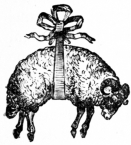 FLEECE.
The sign of the Fleece occurs twice at *Colchester, once at *Coggeshall,
and once at Brentwood. That of the Golden Fleece appears at Chelmsford
and East Ham, although the former seems to have become golden only
during the last forty years. There were also Fleeces at Halstead and
Witham sixty years ago. Both forms of the sign are, of course, intended
to represent Jason’s Golden Fleece, or Gideon’s, and their use
commemorates the time when the woollen trade was one of the staple
industries of Essex. The Fleece also formed the pendant of the Order of
the Golden Fleece, which was founded in 1429 by Philip, Duke of Burgundy
and Count of Flanders, “to perpetuate the memory of his great revenues
raised by wools with the Low Countries,” as Ashmole says. Ancient
encaustic tiles have been found, Mr. Elliot writes, both in Witham and
Maldon (St. Mary’s) Churches bearing the arms of the Dukes of Burgundy,
with their badge of flint, steel, and sparks in the upper and side
spandrels, and the figure of the Fleece below. A fleece forms a charge
in the arms of the town of Leeds,[63] now the principal seat of the
woollen trade. Larwood and Hotten facetiously remark that “a fleece at
the door of an inn or public-house looks very like a warning of the fate
a traveller may expect within.” The Star and Fleece is an odd
combination, which does not appear to be noticed in the History of
Sign-boards. It may simply be an impaled sign, or may represent the
fleece of one of the mullets in the arms of Leeds. An example has
existed at Kelvedon for over forty years, and another was in existence a
few years since. Another emblem of the woollen trade is the Woolpack, of
which, as already stated (p. 39), we have six examples, arranged in an
almost straight line across the county, namely, at *Romford,
Ingatestone, Chelmsford, Witham, *Coggeshall, and *Colchester. Three, at
least, of these were in existence sixty years since, at which time there
was another at Bocking. It is recorded in Bufton’s Diary[64] that on
May 1, 1693, at Coggeshall, “Ye soldiers set up a Maypole at ye
Woolpacke doore.” The Woolpack is a device which appears commonly on the
tokens of the seventeenth century. It is met with at Billericay, Dunmow,
Castle Hedingham (twice), Braintree, Bocking, Witham, and Colchester.
The sign of the Woolpack, it should be noticed, is still, or was lately,
to be seen at the three last-named places. The sign of the Shears, as
pointed out elsewhere (p. 41), is another relic of the now departed
woollen trade. From the middle of the seventeenth to the end of the
eighteenth century, the spinning, carding, and weaving of wool formed
the staple industry in most of the larger towns and villages of Eastern
England. Several prominent families of the district in former days owed
their wealth to this trade. In the neighbourhood of Hedingham it is said
that several old houses, of which remnants only now exist, were once
“wool-halls,” combining a residence for the merchant with a warehouse
for his wools, worsteds, and “pieces.” Very high wages were earned by
the workpeople, even by children and old persons. It has been estimated
that, at the middle of last century, not less than 20,000 hands in and
around Colchester were employed in the woollen trade; but by the end of
the century the number had sunk to less than 8,000. Many old persons
still living can remember their parents’ or grand-parents’ accounts of
the festivities on St. Blaize’s Day, the 3rd of February, when there
were processions in mediæval fashion, with shepherdess and lamb, and men
and women spinning and weaving, accompanied by a great deal of noise and
fun, bell-ringing and band-playing, ribbons and banners, roystering and
drinking. In the evening bonfires were lit upon the hills to commemorate
(as the common people thought) the name of their patron, St. Blaize. The
weaving of bunting for ships’ flags lingered in and around Sudbury until
about twenty years ago, but has now quite died out in East Anglia. The
Ram, at North Woolwich, perhaps, represents the crest of the
Clothworkers’ Company.[65] Our six examples of the sign of the Lamb may,
or may not, have had an heraldic origin. They probably represent the
Lamb with the flag of the Apocalypse; but this was used as a crest by
the Merchant Taylors’ Company.[66] The farthing issued in 1654 by “Tho.
Lambe at Bvttls Gate in Colchester” bears a Holy Lamb couchant, and
that of “Joseph Lamb of Lee [Leigh], 1664,” bears the same device. In
both cases a rebus or pun on the name of the issuer is, of course,
intended. The Lambs at *Colchester and *Romford are both at least sixty
years old. Probably the sign was first set up as an emblem of the
woollen trade. The five instances in which the Lamb occurs in
conjunction with a Lion have already been noticed (p. 63), and attention
has also been drawn to the fact (p. 23) that some, at least, of our
Ships are probably intended for sheep. The Shoulder of Mutton, which
occurs both at Great Totham and Fordham, probably represents the joint
so often brought to table.
The Bear occurs by himself only twice, namely, at Buttsbury (where he is
at least forty years old), and at Romford. The Bear at Buttsbury is
mentioned in the Stock parish registers in 1673. Forty years ago there
were also Bears at Colchester and Great Baddow. We are probably more
indebted to the old custom of bear-baiting for this sign than to
Heraldry. Larwood and Hotten say that it was originally adopted by
ale-houses as a pun on the word “beer.” If so, the pun was a very weak
one. The White Bear is to be seen at Galleywood and at Stanford Rivers.
At the latter place he has existed at least since 1789, and is
represented on a board over the door, but not upon the swinging
sign-board, as a Polar Bear picking his way over blocks of ice. The sign
of the White Bear is not a modern one. It was used in the seventeenth
century, and both of our Essex examples are over forty years old. The
Queen of Richard III. used a White Bear as her badge, and this perhaps
originated the sign.
Of the Elephant and Castle, a very old device, we have two instances in
Essex, one at Harwich, and the other at Colchester. Neither seems to
have been in existence twenty years ago. Most probably they are named
after the famous old coaching inn at Newington Butts; but they may have
originally been cutlers’ signs. The elephant with a castle on his back
(as he was generally represented in the Middle Ages) formed the crest of
the Cutlers’ Company.[67] At Great Baddow, Rayleigh, and elsewhere the
device serves as a beer-house sign.
The Goat and Boots on *East Hill, Colchester, though over forty years
old, is a sign which is not noticed in the History of Sign-boards. It
is, doubtless, a corruption of the not-uncommon sign of the Goat in
Boots, which appears to be a caricature of Welshmen, and not a
corruption of the Dutch description of Mercury, der goden boode (the
gods’ messenger), as is often stated. We have in Essex no example of the
not-uncommon sign of the Goat and Compasses, which is usually supposed
to be a corruption of the Puritan motto, “God encompasses us.” This
explanation, however, is not sound. The motto could never have been
represented pictorially upon the sign-board, and we know that pictorial
representation was the sole aim and object of the sign in olden times.
Probably the sign is merely a compound one; or it may represent the arms
of the Cordwainers’ Company[68] in a corrupted form. To this origin may
be certainly traced the sign of the Three Goats’ Heads, which, however,
does not occur in Essex.
The Squirrel’s Head at Squirrel’s Heath, Romford, has no doubt some
connection with the locality. It was not in existence forty years ago.
The sign of the Three Squirrels, which is not found in Essex, has been
in use for over two centuries.
The sign of the Sea Horse, which has existed at *Colchester for at least
sixty years past, is not noticed by Larwood and Hotten. Very likely it
commemorates the capture in the Colne, and subsequent exhibition in the
town, of some such strange creature as a seal or porpoise, which vulgar
belief set down as a “sea horse.”
The sign of the Dolphin occurs four times in the county, namely, at
*Colchester, *Chelmsford, Maldon, and *Romford. The animal also figures
as a beer-house sign at Stisted, Goldhanger, &c. The houses bearing it
may have taken their sign from the many representations of the dolphin
in private coats of arms; but, most likely, they have simply been called
after the famous Dolphin Inn which existed in London for several
centuries, and is said to have been occupied by Louis, the Dauphin of
France, who, in 1216, came over to contest the English crown with King
John. It was once adorned with fleurs-de-lys, dolphins, and other French
cognizances. The dolphin formed the badge of the Dauphins of France,
just as the three ostrich feathers form the badge of our own Princes of
Wales. Larwood and Hotten do not notice the sign of the Whalebone of
which Essex possesses four examples, namely, at Woodham Ferrers,
*Colchester, Fingringhoe, and White Roothing. That at the latter place
has apparently been in existence for at least a century, as it is
mentioned more than once in the Chelmsford Chronicle in the year 1786,
while the one at Colchester figured in the list as the Old Whalebone
forty years ago. The Fishbone, however, spoken of by Larwood and Hotten
as being “rarely met with as a public-house sign,” though frequently
used by dealers in rags and bones, is probably the same sign under a
different name. In the museum at Saffron Walden there has been, for
nearly fifty years past, a large whale’s scapula, which is said formerly
to have hung as a sign in one of the streets of that town. Mr. Joseph
Clarke believes it was displayed at the King’s Head, and it has on it an
almost illegible letter R, probably part of the monogram G. R.; but more
likely it formed the sign of the Whalebone at some house not now in
existence, or not under that name. Of the Sun and Whalebone which has
existed at Latton since 1789 at least, the authors so frequently quoted
say that “it may have originated from a whalebone hanging outside the
house or [it may indicate] that the landlord had laid the foundation of
his fortune as a rag merchant.” More probably, however, its origin was
the impalement of two distinct signs. The sign-board is not pictorial.
This sign was very fully discussed in Notes and Queries in 1862 (3rd
series, vol. i. pp. 250, 335, 359, 397, 419, and 473). Several most
profound speculations were advanced to account for it, but they were all
more or less far fetched. The Whalebone at Chadwell Heath has now
disappeared, though a beer-shop so named existed there until about the
year 1870. From it, in all probability, our four existing houses of this
name, as well as the Sun and Whalebone at Latton, have taken their
designation; for the sign is a very uncommon one in the adjoining
counties, and does not appear at all in London. The house in question
originally took its name from two whale’s jaw-bones (not rib-bones, as
is commonly supposed) set up in the form of an archway over the road
close at hand. Local tradition says that the bones were those of a whale
that was stranded in the Thames near Dagenham during the great storm
that prevailed on the night preceding September 3, 1658, when Oliver
Cromwell died.
This was, perhaps, the case, as “Ye Whalebone” is marked against the
tenth milestone from London on the map of the high-road from London to
Harwich, given in Ogilby’s Itinerarium Angliæ, published in 1675, only
seventeen years after the whale is said to have been stranded. Also in
Dr. Howell’s Ancient and Present State of England, first published in
1678, it is stated (6th Ed. p. 263) that, “near about this time [1658],
there came up the Thames as far as Greenwich a whale of very great
length and bigness.” Daniel Defoe, too, in his Tour through the whole
Island of Great Britain, first published in 1724, says (vol. i. p. 3)
the Whalebone was “so called because the rib-bone of a large Whale,
taken in the River of Thames, was fixed there in 1658, the year Oliver
Cromwell died, for a monument of that monstrous creature, it being at
first about Eight and Twenty Foot long.” The Whale’s Bone is also marked
on Andrew and Drury’s Map of Essex, published in 1777. That a storm of
most unusual magnitude did rage on the night in question, is certain.
Prideaux, in his Introduction to History (1682), speaks of “that most
horrid tempestuous night which ushered in this day [on which Cromwell
died].” Pepys also mentions the storm. Nor is it anything new for whales
and similar animals to appear in the Thames. In Sir Richard Baker’s
Chronicles of the Kings of England (p. 425), published in 1684, it is
recorded that on the 19th of January, 1606, “a great Porpus was taken at
West Ham, in a small creek a mile and a half within the land; and within
a few days after a Whale came up within eight miles of London, whose
body was seen divers times above the water, and was judged to exceed the
length of the largest ship in the River: but when she tasted the fresh
water and scented the land, she returned again into the sea.” On the
morning of April 31, 1879, too, a whale alarmed some fishermen by his
spouting near Hole Haven. Many other records might be cited. It is,
however, a curious circumstance that in M. J. Farmer’s History of
Waltham Abbey, published in 1735, there is given as an appendix “The
Inquisition taken the 17th of King Charles I. [1642] of a Perambulation
of Waltham Forest in the County of Essex,” in which occurs the following
passage:—[The Forest boundary runs] “from Great Ilford directly by the
same King’s High Way leading towards Rumford, to a certain Quadrivium
(or way leading four ways), called the Four Wants, where late was placed
and yet is a certain side of a whale, called the Whale bone.” From
this it would appear that the spot was known as the Whalebone long
before Cromwell’s death. Possibly, however, there is an error in the
above date, Charles I. being inserted instead of Charles II.
A good deal of discussion upon the subject took place several years ago
in the pages of Notes and Queries. In 1871 (p. 4), “G. S.” wrote that
he had often seen whales’ bones set upright in Holland for cattle to rub
against, and that he “was once struck with the same in a large park
between Ingatestone and Chelmsford. The owner was a Dutch gentleman, who
had introduced this sensible idea into England.” Other correspondents
wrote that they knew of whales’ bones having been set up in various
parts of England. Later on (p. 195), Mr. J. Perry, of Waltham Abbey,
wrote that—
“There is (or was lately) a pair of whale’s ribs placed over the
old toll-gate at Chadwell Heath, near Romford, Essex, which form a
kind of Gothic arch across the roadway. They must have been there
for a considerable period, as it is beyond the memory of any of the
good old country-folks living in the locality to tell when first
erected. At a little distance from the toll-house occurs a similar
pair, set up over the carriage entrance to a residence.”
Afterwards (1878, p. 397) “S. P.” wrote as follows:—
“When I was a boy, there stood by the roadside, about two miles
west of Romford, at the east end of the long straggling village of
Chadwell Heath, and on the left hand going from London, a
tremendous pair of bones, forming an arch. The bases were deeply
rooted in the earth, but even then the space spanned was
considerable. Near by was a toll-house, with its bar, known from
the adjacent relic as ‘Whalebone Gate.’ I think, too, if I remember
rightly, there stood near the spot a road-side inn called by the
sign of ‘the Whalebone.’ My father, an Essex man, long since dead,
used to tell me that he had it from his grandfather, that the bone
was the upper [should be lower] jaw of an immense whale, which had
been cast ashore about three miles to the south of the spot, on the
north bank of the Thames, at Dagenham, while the Great Storm was
raging on the night that Oliver Cromwell died. In course of time,
toll on suburban roads was abolished; the toll-house and gate were
cleared away; and the jaw was appropriated to serve as an entrance
arch to the front garden of a neighbouring suburban villa—the
rural residence, I believe, of a Whitechapel pork-butcher—an
edifice known, and still indicated on suburban maps of a tolerably
modern date, as ‘Whalebone House.’ ... What became of the worthy
tradesman I have above alluded to, I do not know. Probably his
house is still standing, but I am unable to identify it now by its
former title or peculiar gate. I am under the impression that what
remains of the relic has been transferred to its original site; for
I was past the spot where, so far as my memory serves me, it
formerly stood, on July 25th in this year. Half the arch (i.e.,
one bone) stood upright, still deeply rooted in the earth, but
alone, forgotten and deserted, by the side of the high road in a
fallow field. No one in the neighbourhood seemed to know anything
about it or its history.”
To this, Mr. J. A. Sparvel-Bayly, of Billericay, wrote (1879, p. 58):—
“In the little village of East Tilbury in Essex, situate on the
banks of the Thames, and not far from Romford, is a house known as
‘Whalebone Cottage,’ in front of which is an arch composed of the
jawbones of a huge whale. From their weather-worn appearance they
may possibly have belonged to that alluded to by S. P.”
In reply to this, Mr. W. Phillips (p. 338) stated that—
“The jawbones spoken of by Mr. Sparvel-Bayly as being at East
Tilbury, ‘not far from Romford’ (it is twelve miles from Romford as
the crow flies), cannot be identical with those mentioned by S. P.,
whose account I can corroborate, so far as knowing the jawbones he
mentions, forty years ago, when travelling on the box-seat of the
old Colchester Coach alongside a coachman of the Mr. Weller sort,
of some sixty-five summers. The two bones were then in existence on
the north side of the road near the tenth milestone, and two miles
the London side of Romford, in front of a roadside public-house
with the sign of the ‘Whalebone,’ which my coachman said used to be
the resort of the many highwaymen that once infested Chadwell Heath
close by. He spoke of his being told when a boy that the bones had
been there from the time of Cromwell.”
From the foregoing, it is clear that there were formerly two pairs of
bones set up near together; indeed, Mr. J. Perry distinctly says there
were. One pair has now entirely disappeared. The other pair still stand
(although S. P. seems to have overlooked them), as described, over the
entrance of an adjoining house, known to this day as “Whalebone House”
or “Lodge,” and marked as such in local directories. There is also in
the immediate vicinity a “Whalebone Farm,” as well as a “Whalebone
Lane.” The bones (of which an illustration is here given) are of the
following dimensions:—
| | Feet. | Inches. |
| Height out of ground (along curve) | 15 | 6 |
| Circumference (at base) | 3 | 3½ |
| “(near top) | 2 | 0 |
| Breadth at base (flat inner side) | 1 | 5 |
| “(round outer side) | 1 | 10½ |
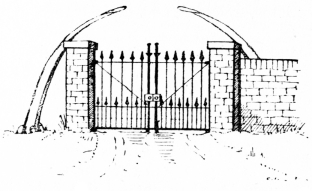 GATEWAY AT WHALEBONE HOUSE.
(Chadwell Heath.)
If, as seems probable, the bones are those of the Greenland whale
(Balœna mysticetus), it is extremely unlikely that the creature
which owned them was ever stranded in the Thames. The following letter
from Prof. W. H. Flower, F.R.S., is of much interest. He says—
“Pairs of the lower jawbones of the Greenland whale, erected
usually as gate-posts, occur in many parts of the eastern counties,
especially in the neighbourhood of the old whaling-ports—the
Thames, Yarmouth, Hull, Whitby, &c. They have all been brought from
the Arctic Seas by whalers, at any time since 1611, when the first
ships left England for the Spitzbergen whaling, which (with the
Baffin’s Bay whaling) has been carried on with more or less success
ever since, though now confined to Peterhead and Dundee. I very
much doubt Defoe’s ‘28 feet long.’ Twenty feet, following the
curve, is the maximum of the Greenland whale, and no other whale
has such large jaws. I also doubt the story of the creature being
stranded, because, if so, it cannot have been a Greenland whale—a
species which never visits our shores.”
Larwood and Hotten, in common with nearly all heraldic writers,
innocently treat of whales and dolphins as fishes, as they were
commonly supposed to be in the Middle Ages. A writer in All the Year
Round, so lately as the year 1879, commits the same absurd error.
It will here be necessary to ask pardon of modern men of science for
discussing, under the heading “Zoology,” certain monstrous beasts which,
though unknown to us in these enlightened times, were accredited with a
material existence by the ancient heralds, and others who wrote in the
dark days of several centuries ago. Such imaginary creatures as dragons,
griffins, unicorns, and the like, are, of course, here referred to.
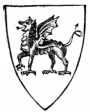 DRAGON.
The Dragon in his own proper colour (whatever that may be) does not
occur in the county; but we have four examples of the Green Dragon,
situated respectively at Shenfield, Black Notley, *Saffron Walden, and
Waltham Abbey. Sixty years ago there were also Green Dragons at
*Colchester and elsewhere. It is very easy to account for the origin of
the use of the Dragon as a sign, but it is not so easy to say why he
should so often be green. The Green Dragon, however, has been a common
sign for over two centuries. As the badge and supporter of the arms of
many of our sovereigns, he was generally red, though occasionally black
or golden. The Dragon appeared on the standard of the Saxons, and was
used as a badge by several early Princes of Wales. It formed one or
other of the supporters of the arms of Henry VII., and of all the Tudor
sovereigns except Queen Mary. It appears also in the heraldic bearings
of many private families. There can, therefore, be very little doubt as
to its heraldic derivation, although it was formerly used as a chemist’s
sign, in which case its origin was probably non-heraldic. Perhaps, as
the Rev. H. L. Elliot writes, the strange colour in which this monster
usually appears on sign-boards is due to the fact that a Green Dragon,
holding in his mouth a bloody hand, was a badge of William Herbert, Lord
Steward, created Earl of Pembroke in the time of Edward VI. The George
and Dragon is a sign which occurs eight times in Essex. This very
common sign has increased greatly in popularity since the institution of
the Order of the Garter, of which a representation of St. George killing
a dragon forms the pendant; but the fact that several of our recent
kings have borne the name of George has no doubt had a good deal to do
with its adoption. The legendary act of St. George, the patron-saint of
England, is alluded to in the following amusing little rhyme:—
“To save a mayd, St. George the Dragon slew—
A pretty tale, if all that’s told be true.
Most say there are no dragons, and ’tis sayd
There was no George;—let’s hope there was a mayd.”
A representation of St. George killing the Dragon appears on the token
issued by J. Lark of Coggeshall in 1667.[69]
There are also in Essex three examples of the sign of the Griffin,
situated respectively at Great Canfield, Halstead, and Danbury. The
Griffin at Danbury, an ancient and well-known inn, is mentioned in the
Chelmsford Chronicle on May 9, 1788. It is also several times
prominently alluded to (ii. p. 174, iii. pp. 130 and 144, and iv. p. 66)
in Mr. Joseph Strutt’s Essex and Herts Romance of Queenhoo Hall,
published in 1808. Although in former ages people firmly believed in the
existence of griffins, the animal has never yet been seen except in
Heraldry. Consequently it is only natural to assign the origin of its
use as a sign to that art; but griffins appear upon the escutcheons of
so many families that it is now quite impossible to say in whose honour
it made its first appearance upon the sign-board.
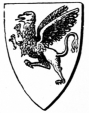 GRIFFIN.
The Unicorn appears as a public-house sign at West Ham and at Romford.
At the latter place the house is situated in Hare Street, and is at
least a century old, as it is mentioned in the Chelmsford Chronicle
for March 2, 1787. A unicorn rampant is depicted on the farthing
tokens of William Alldred of Colchester, and a unicorn passant on
those of “Will. Anger of Mvch Clafton [? Clacton] in Esex, 1654.” The
original use of the Unicorn as an inn-sign may be attributed to the fact
that it was formerly a common chemist’s sign, and is one of the
supporters of the arms of the Apothecaries’ Company, or to the fact that
it now forms the sinister supporter of the Royal Arms. Much interesting
information as to the ancient belief in its existence, and the power of
its horn as an antidote to all poison, is given in the History of
Sign-boards.