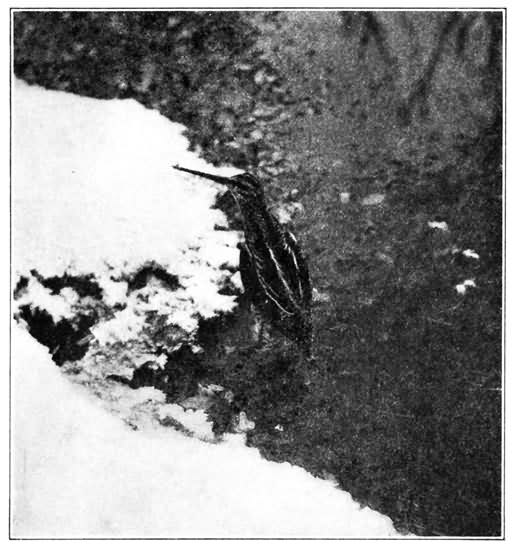
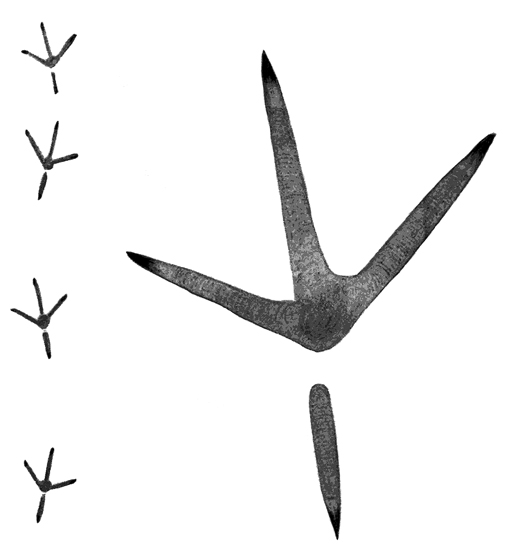
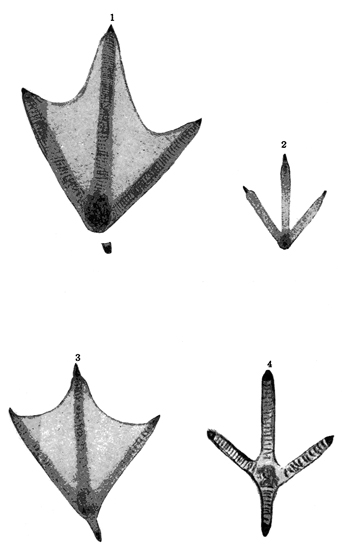
HOOFED GAME
THOUGH the American sportsman still
can enjoy in some districts, as an inheritance
from prehistoric times, the pursuit
of the majestic moose, and though the lordly elk
still awakens the echoes in many of our mountain
ranges with his challenging call, the game in
which the great majority of hunters are pre-eminently
interested is the elusive white-tailed deer,
which is found in all the states except California,
Nevada, Oregon, and Delaware, and because to
bring it down demands, to say the least, no less
skill than is required in the pursuit of its larger
relatives.
Though, under ordinary conditions, a single
track of any other animal is nearly sufficient to
ascertain the species or variety, the case is different
where white-tailed and mule deer are concerned—that
is, if they inhabit the same locality;
and even a small elk track may be taken for that
of the white-tailed deer.
The track of a mule deer, roaming in rocky
hills or out in the arid breaks of the Bad Lands,
is of course a very different thing from that of
a white-tail, but let the animals make their permanent
stand in white-tail country proper, and
almost all difference in their track soon disappears.
It is evident that the sole of their hoof
undergoes the same change as that of a horse,
which can be ridden daily without shoes in dry
regions, but which will get footsore within a day
or two if it is transferred into a district where
rain and dew moisten the grass and keep the
ground damp.
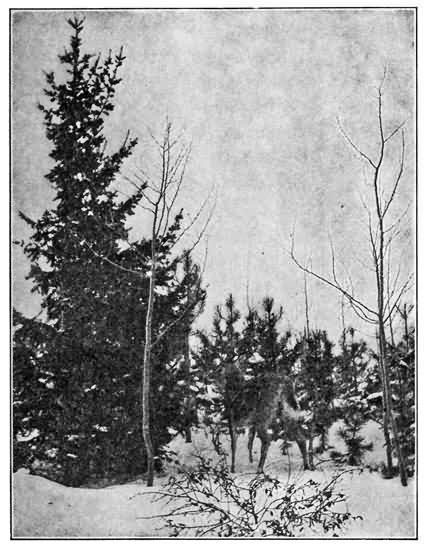
Considering the individual track, the hoof of
the Virginia deer evidently spreads easier than
that of any other member of the family, except
moose and caribou. It is because of this that,
during the season when they are in good condition
and in hunting time, the ridge of dirt or
snow that is made between the two halves of the
hoof, and left in the track, is much more conspicuous
than that left by any other deer. However,
if the conditions are not ideal—and they
most certainly are not if snow is on the ground,
under which circumstances most tracking is
done—the variance appears so slight that it can
be noticed only by examining minutely a perfect
track, which may be found along the trail under
some tree where not more than an inch of snow
has fallen or at a barren spot.
The writer does not depend on the size of the
track in deciding whether it was made by a buck
or a doe, as he has seen many does which have
made as large tracks as the largest bucks; and
the common claim that rounded toes always indicate
a buck he has also found to be a fallacy.
Sometimes it is noticeable in the trail that the
hind feet lag, i. e., they do not quite reach the
forefeet tracks. This almost invariably means
an old buck which has become rather stiff with
age. The chance that the same mark is made by
an old sterile doe is remote, though, according to
observations, possible.
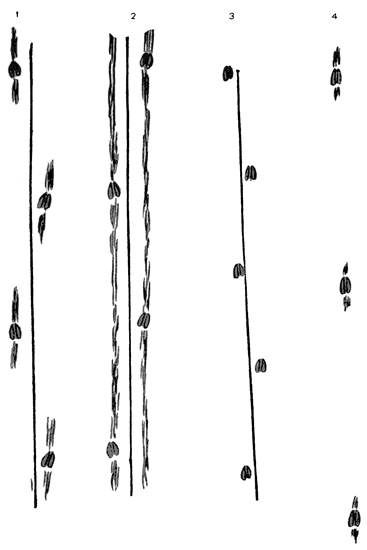
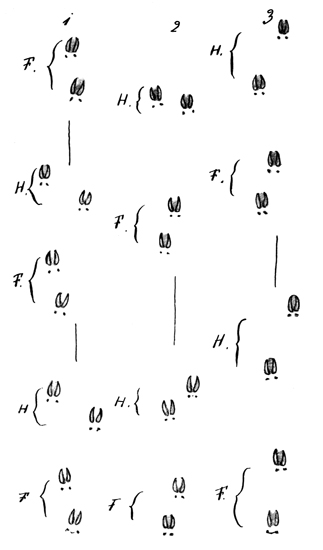
TRACKS OF VIRGINIA DEER
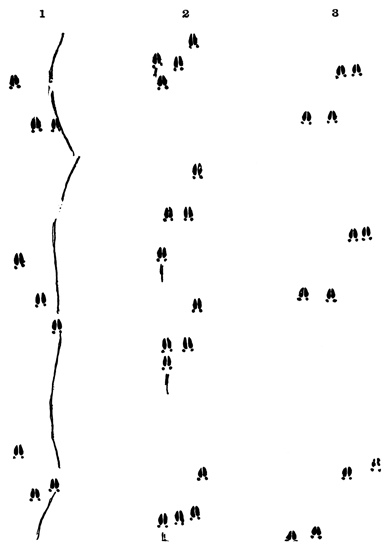
(1) Trail of buck before and after rutting season. (2) During rutting season the
drag extends from one step to the next. (3) Trail of doe and fawn; the
latter, however, takes still shorter steps. (4) Buck or doe trotting.
Not infrequently, at least much oftener than
with black-tail and elk, a marked difference
between the two halves of the hoof may be observed
in the track of the Virginia deer, and the
tracks of the latter appear more slender than
those of the former—that is, in the same locality.
Some claim that they can always distinguish the
track of Virginia from that of other deer, but
the writer counts himself among those who can
not, and he has noticed that the hunters who claim
the skill are in the same predicament when out
in the woods.
Accurate measurements with the divider and
tapeline would possibly show some slight differences
in the tracks of the various kinds of similar
sized deer, but they would be so diminutive and
variable as to be worthless in practice.
The trail, together with other signs, is much
more significant of the doings, ailments and sex
of the animal than an individual track would be.
During the summer months the buck, and, it
must be admitted, the sterile doe also, accumulates
a considerable amount of fat; and the
result is markedly shown in the placing of the
feet, their tracks being an appreciable degree off
the center line supposed to be under the middle
of the body. For this reason the toes of the
hoof point more outward than is usual in the doe
and fawn. From this it might appear that a
single track, or a few of them, would be sufficient
to decide the sex, but it is not; because any deer
in crossing a trackable spot is likely to look to the
right and then to the left, and the tracks will
point in the direction the animal has looked.
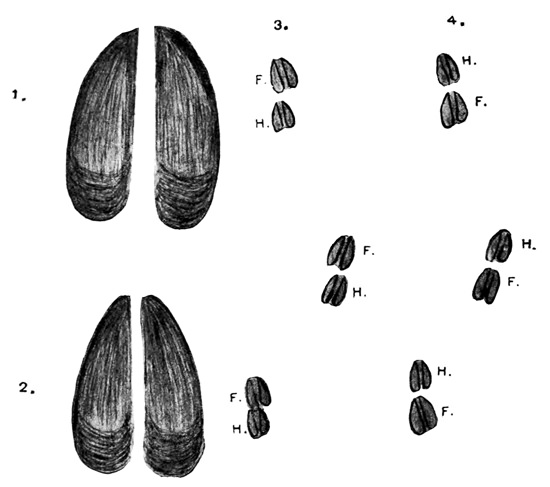
VIRGINIA DEER. (ONE-HALF NATURAL SIZE)
(1) Front track. (2) Hind track. (3) Lagging back of hind feet; sign
of the old buck. (4) Overhastening; the sign of the young buck.
3 and 4 also apply to the elk bull.
Does heavy with fawns show similar features
in their trail, but as there are no such does during
autumn, we can pass them over. A buck
always has the tendency to drag his legs, a feature
which reaches the climax during rutting
season, while any doe, even the sterile, steps clean
if the snow is less than one foot deep. This fact
makes it possible to tell a buck's track with certainty,
even if tracking conditions are not favorable,
because there is always some displacement
behind and in front of the tracks which is readily
observed in sand or dry snow.
There is one other feature by which the trail
of a white-tail buck can be distinguished from
that of a doe, and even that of the buck of black-tails,
and that is the animal's habit of scanning
the surroundings while standing near trees, windfalls,
and the like. An old buck at leisure will
take careful observations two or three times inside
of a hundred yards, except during the rutting
season, when he is too busy to spend so much
time for safety's sake, and he always does this
from what he evidently considers cover.
In open forests are often seen places where the
ground has been pawed up, and the ground covering,
moss, leaves or sod, thrown in every direction.
This always indicates the presence of at
least two old bucks in the same locality, and is
never done by does.
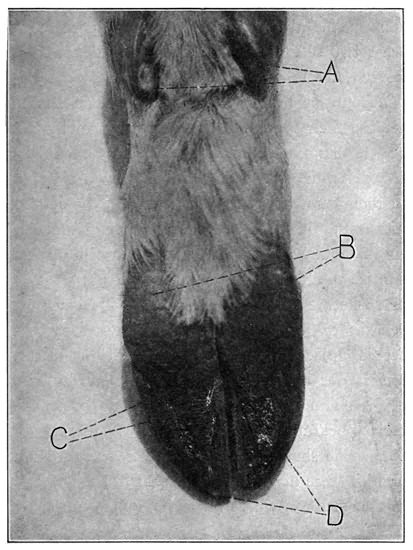
HIND FOOT OF VIRGINIA DEER. (SLIGHTLY REDUCED)
(A) Dew claws. (B) Heels. (C) Soles. (D) Toes.
About the first of September bucks begin to
cleanse their horns of the velvet and small trees
and bushes exhibit the signs of having been used
for that purpose. Where such signs are found
in roomy forests near dense thickets, the sportsman
can, with moderate certainty, count on getting
a trophy by stalking quietly or waiting from
sunrise to about 8 o'clock A.M., or from an hour
or so before sundown until dark. Of course it
is easier to get meat for the pot near streams and
feeding places, where there are plenty of tracks,
but as doe and fawn shooting aims at the base
of life, and as old bucks usually do not make
their appearance there as long as it is light enough
for a rifle shot, I would not advise one to stalk
or wait there at all. Stalking during rainy days
in open forests where bucks have left evidences,
such as blazed trees, will, as a rule, be rewarded.
At that time, game being comparatively undisturbed,
most deer are shot at while standing, and
even a poor shot can hardly miss. However, as
tracking is more difficult than when snow covers
the ground, it is advisable to watch the deer
closely for the signs at the moment of firing.
The most important sign to observe is the
action of the game when it receives the missile,
since it is an evidence of where it was hit. If struck
somewhere in the front half, it usually jumps into
the air—that is, if it does not drop instantly,
which incident we have no need to consider in this
connection—and if struck in the hind half, it will
kick out with the hind legs. A deer shot through
the heart seldom drops immediately. After the
first jump, which is often hardly perceptible and
no doubt overlooked by the average hunter, it generally
makes off at top speed, running close down
to the ground. It may run only fifty yards, and
it may run five hundred, but one thing is certain—the
hunter can follow at once, and the animal
will be dead by the time he reaches it.
The most striking exception to the rule of
heart shots the writer saw in the Snowy Mountains,
Montana, during 1904. A buck was galloping,
broadside exposed, at a distance of about
one hundred and twenty yards, and was fired at.
Four or five jumps after the shot was fired he
stopped behind some trees, which prevented
another shot. He remained hidden a few seconds,
then trotted about thirty yards and stopped
again; finally he trotted off, directly away from
me, and if ever I would have sworn that a deer
was missed, I would have done so then.
However, force of habit compelled me to follow
the trail, and about two hundred yards from
where he stopped last, the buck lay stone dead.
The bullet, a steel-jacketed .30 U. S., had penetrated
the heart squarely, and made a hole the
size of a quarter. There was not a drop of blood
along the trail. Moral: Follow the deer, even
if you think you have missed.
A deer shot through the lungs usually goes
off, after the first jump, as if nothing had happened
to it. There is no variance in its trail from
that of an uninjured deer, but alongside the trail
there is in every case the story of where the bullet
hit, in the shape of foamy, light-colored blood.
This trail, too, may be followed immediately.
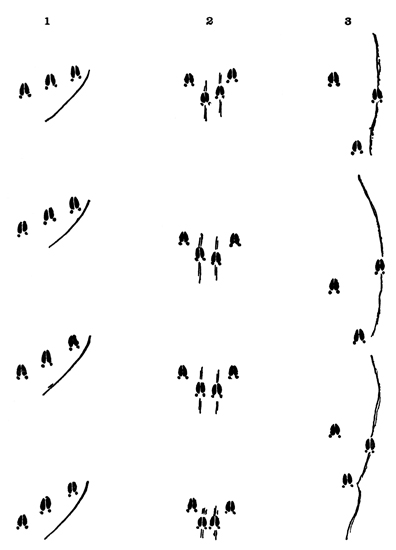
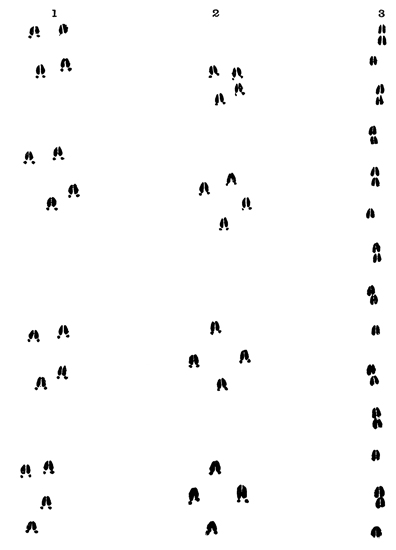
(1) Trail of a deer shot through brisket, and leg broken low in shoulder.
(2) Trail of a deer shot through the shoulders high. (3) Trail of a
deer with broken foreleg—the lower the leg is broken the more
drag there is.
The shoulder shot (No. 2) should be followed immediately. It is best
to shoot again when a deer gets up after the first shot strikes it
here. They always drop like dead when shot thus.
(1) Trail of a deer with broken hind leg—the lower the leg is broken
the more drag there is. (2) Trail of a deer shot through the ham.
(3) This trail usually means shot through intestines, liver and often
lungs at the same time; the animal will not go much over a mile,
even if not given time to get sick, and death results in less than
two hours.
(1) Same as No. 3 on opposite page, but bullet did not penetrate to the
lungs. The animal dies slowly, and after a couple of hours is
usually shot in its bed. (2) The cross jump; result of a bullet
through intestines or liver when the animal was broadside to the
hunter—usually the slowest killing shot. (3) The tracks of a
wounded deer never register where the animal was walking.
All these curious jumps may be seen on one trail, alternating with jumps as made by
a sound deer. They indicate soft shots, and should not be followed within two hours
after the animal was shot. Blood, etc., on the trail decides for the tracker where the
bullet struck. Usually the less blood the surer the animal will be found dead after a
few hours.
A liver shot is, perhaps, the least satisfactory
of any. Sometimes the deer on being shot
through the liver, kicks, and at other times it
humps itself up, but always it leaves the place
at a quite lively rate, making a trail like a lung-shot
deer, with here and there a cross jump
between. (See illustration.) It is hard to advise
what one should do in this case. I generally
smoke a pipeful of tobacco before taking up the
trail, to give the animal time to lie down. After
that I follow and try to get another shot. While
I have killed deer instantly with shots through
the liver, there have been some that I never
brought to bag.
Once I killed an elk three days after we had
fried parts of its liver which had dropped out
through the hole made by a projectile from a
heavy-caliber English rifle, used previously for
hunting elephants. At another time I killed a
deer one year after having shot it through the
liver. When killed, this deer was apparently as
well and fat as could be, though in place of the
soft liver we found a hard mass.
A shot through the intestines causes the animal
to kick violently, hump up its back, and go off
at a slow rate. It usually lies down within a
quarter of a mile, and stays down if not molested
too soon. Along the trail may be found a little
dark-colored blood, and sometimes matter the
animal has eaten. Deer shot thus should not be
followed before at least two hours have passed,
since if jumped they often go for miles. A deer
with a broken leg may be followed at once, though
the chase is usually quicker ended if half an hour
is given for the animal to settle down.
In my opinion a sportsman who does any considerable
hunting for big game should have his
dog trained to follow a track as far as his master
will follow him. A dog that runs deer is useless,
and if he will not stay close to his master he
must be kept on a leash. There is no law in any
State against such use of a dog, and it would save
much hard work to the man whose eye is not
trained for tracking when there is no snow.
Besides the signs visible when a deer is shot,
there are those which are brought to the hunter's
knowledge through his ear: a hard, sharp sound
conveying the intelligence that a bone is struck
(and if it is not a leg the deer will hardly run),
and a dull "thud" telling that a soft part is hit.
In any and every case the hunter should examine
minutely the place where the game stood when
it was shot at. The hair cut off by the bullet is
often of great assistance in determining the location
of the wound, and the torn-up needles or
ground often show if the animal jumped or
kicked as it was shot. Remember that the successful
hunter is never in a hurry, and minutes
spent in close observation will often save hours
of exhausting chase.
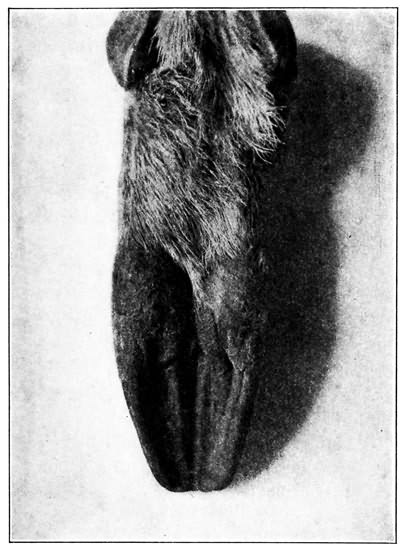
HOOF OF BLACK-TAILED DEER. (SLIGHTLY REDUCED)
Later in the season, when rough winds have
robbed deciduous bushes of their leaves, bucks
generally change their day stand, abandoning
quaking-aspen thickets, and settling down
among windfalls and small coniferous trees,
thereby offering better chances for shots at any
hour of the day. Still later, during the rutting
season, the biggest specimens and best fighters
will occupy those roomy, open forests, where in
September and early October they make their
appearance only during morning and evening
hours. These old over-lords at this time select
the places of a wider view, apparently to see
others of their kind that may pass, to fight them
off their range if they are bucks, and to claim
ownership of them if they are does. The white-tail
buck does not keep a harem, as is done by
the elk and to some extent by the black-tailed
deer, but stays with a doe a few days only, generally
two or three, and then looks out for adventures
elsewhere, or, more probably, the doe does
not care for his company after being satisfied, and
avoids him. Before the close of the hunting season,
where it is extended until January 1, bucks
again stay in thickets as prior to the rutting season,
and soon after migrate to their winter range,
where they, in company with does and fawns,
spend the rigorous season of the year.
Summing up, we have seven signs by which to
distinguish a buck's trail from that of a doe, of
which the first in the following list is a feature
of the white-tailed deer solely, and of which the
three last named cannot be regarded as always
absolutely certain:
| 1. |
Watching from cover; |
| 2. |
Drag; |
| 3. |
Blazing of trees; |
| 4. |
Pawing of ground; |
| 5. |
Distance of tracks from center line; |
| 6. |
The pointing outward of toes; |
| 7. |
The lagging back with the hind legs. |
THE existence of the fan-tailed deer, or
gazelle-deer, as it is sometimes called, is
denied by some who know no better, but
it is generally recognized by "old timers" and
men who hunt it in its present restricted habitat.
That its range was formerly more extensive than
now, and that even now it still exists in widely
separated districts, the writer infers from a letter
of Justice Douglas, late of the Supreme
Court of New York, whose guide apparently
shot one in Michigan, and from an article in a
sportsman's periodical by Mr. Ernest McGaffey,
who found it in the Black Hills. The writer
found relics of them in the Bad Lands of Montana
and live specimens in the Snowy Mountains
of the same State. It is evidently a smaller
variety of the common Virginia deer, with a
markedly longer tail; however, as its track shows
some decided differences, by which it can readily
be distinguished, it is considered advisable to
treat it separately.
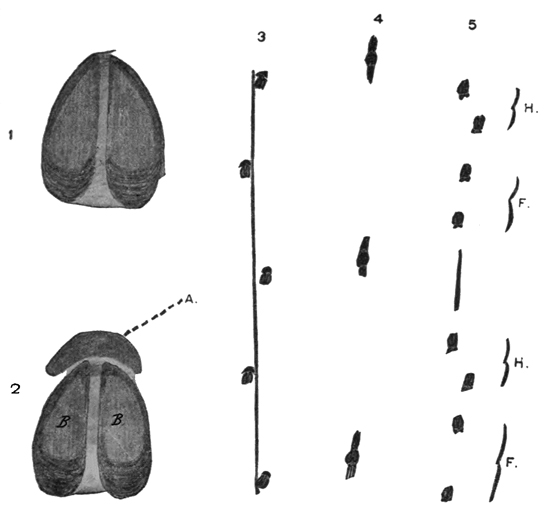
FAN-TAILED BUCK DEER. (ONE-HALF NATURAL SIZE)
(1) Front track. (2) Hind track. (3) Walk. (4) Trot. (5) Gallop.
(A) Dust heap. (B) Hillock.
To begin with, the heels of the hoof are as
broad as those of the Virginia deer, yet the hoof
is considerably shorter, and consequently the track
also, a feature which is, however, of value only
on good tracking ground.
The buck of this deer, whose tracks always
register, walks with hoofs pressed close together,
puts the heels firmly on the ground, which action
moves the ground or snow toward the front, and
steps off by making a deep imprint with the
toes. The result is a small hillock in the middle
of the track and, as this deer never drags its feet,
a small dust heap in front of it. In snow or
mud, of course, the latter sign cannot be found.
As this deer is much smaller than the ordinary
white-tail, its steps are consequently shorter, and
in loose snow, where no individual track is visible,
its trail may be mistaken for that of a fawn,
and only by following it a distance can an error
be avoided.
Once a friend and I on our way home struck
a trail, and while walking alongside it we both
expressed our opinion that the deer which made
it was the smallest fawn in that territory. We
never would have given that trail any consideration
had it not run along our path. As it was,
we followed it, and after we had gone a hundred
yards or so, my indifference changed to
intense interest; for it could be seen that the deer
had taken observations from nearly every shielding
object it had passed. This caused me to
express the belief that this deer was a very old
fan-tailed buck, and events proved I was not mistaken.
He had lost all his front teeth but two,
which were badly used up, had four points on
each antler, and weighed less than fifty pounds
after his entrails were removed. As his conduct
the day he was hunted down disclosed some features
often experienced in the pursuit of deer,
it is not out of place to relate it.
DEER TRACKS
(1) Canter. (2) Going at a lively rate, in bounds up to twenty-four
feet; lung-shot deer often run this way. (3) Top speed, bounds up
to twenty-eight feet—indicates heart-shot if the animal is wounded.
He was located in a thicket, and jumped with
the assistance of the wind, a method which will
be referred to later. We saw him but did not
fire, as our chance opportunity was lost while we
were looking for the horns so as to be sure not
to kill a doe. His trail led to a creek two miles
distant, and there disappeared. I knew that he
had gone along in the creek, for wounded deer
had often tricked me in that manner, but that a
well deer should resort to that method to throw
me off the track, after being so slightly molested,
was rather astonishing. A quarter of a mile upstream
I found where he had left the water, and
I followed the trail, having resolved that I would
kill that buck in one way or another. The trail
led me two miles farther, and then it stopped.
The snow was like sand, and prevented the individual
tracks from being seen plainly. The buck
had back-tracked, and I had overrun the spot
from which he made the side-jump. Back I
went, and after going three hundred yards I
found his artful side-jump, and the trail led into
a thick clump of pines. Again I sent the wind
in as a driver, and that time got a shot; but I did
not down my quarry. The trail showed the buck
was shot through the brisket and shoulder (low).
Then I sat down, ate my lunch, and smoked my
pipe. After that the trail led me again to the
creek. I crossed to the other side and, about
fifty yards from the creek, followed its course
over half a mile, knowing that the buck would
not leave the water on the side he entered it to lie
down. Finally the creek led past a fir tree with
low-hanging branches, and as the trail had not
been seen thus far, I was moderately sure that
the buck had not passed that cover—and it proved
that he had not. During snowless times if a deer
has been wounded and gets away, hunting a day
or two after along streams in the district will
often bring to bay the wounded animal. If it
has the strength, it will hunt up water to cool
the wound, and then crawl into the densest cover
that is near. I have found many deer in this
way, dead and alive—and still more skeletons to
which the tracks of "varmints" led me in the
later season.
The signs of the fan-tailed buck are:
| 1. |
Watching from cover; |
| 2. |
Hillock in track; |
| 3. |
Dust heap in front of track; |
| 4. |
Blazing of trees; |
| 5. |
Pawing of ground. |
THE track of the black-tailed or mule-deer,
while it shows no appreciable differences
from that of the Virginia (in white-tail
country), undergoes—even in the mountains
and breaks, its proper habitat—changes interesting
not only to the student but to the hunter.
The three pictures of the hind foot of the same
four-year-old mule-deer buck show what intermediate
variations occur in the track of this animal.
The photograph was taken when the buck
was killed, and the drawings made in the rainy
month of June, and at the time of the deer's
death in October, respectively. That particular
buck had its preferred stand on a lofty ridge,
too high an altitude for white-tailed deer to make
their permanent abode, though they frequent it
as transient visitors.
The mule-deer always puts its foot down
firmly from above, while the motion of the Virginia
deer might be called rather one of sliding;
and because of this the hoofs spread sideways
without lengthening the tracks. This gives the
track of the latter a somewhat round appearance
as long as there is moisture in the ground, or if
it is covered by snow that is not too dry. This
form of the track is usually found during the
winter and early summer. Of course, when the
rim becomes prominent enough to prevent spreading,
as is the case during prolonged dry weather
or in the arid regions, a big mule-deer will make
a rather small track, and in many instances the
sole of the hoof does not show at all in the
mark. The track has very much the appearance
of that made by a domestic sheep, yet it is different
from it because in the sheep's track the heels
and soles always show, and the hoofs are spread
to an extent not found in deer. Besides, the
halves of the hoof of a mule-deer are as a rule
almost exactly alike, whereas with the sheep that
is but seldom the case.
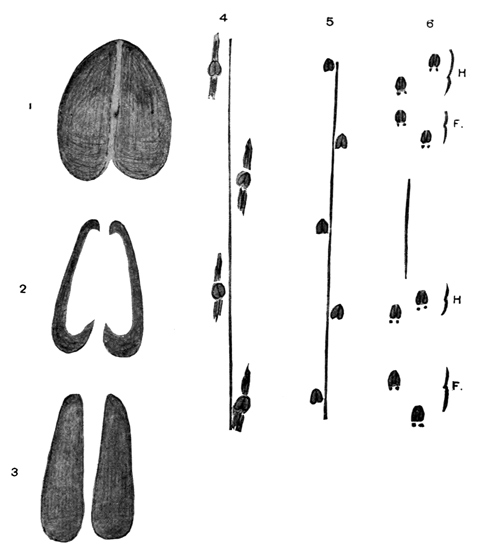
MULE-DEER
(1) Track of buck, sketched during June (flat;
about half natural size). (2) Track of same
buck in October (see photograph of foot).
(3) Domestic sheep (flat). (4) Trail of buck;
drag during rutting season from one step to
the next. (5) Trail of doe. (6) Gallop.
The buck of the mule-deer evidently has not
sense enough to spend, for safety's sake, some of
his time in watching from cover, and because of
this his trail leads along without stopping, except
where he did so to feed. Moreover, he does not
vent his anger at a rival by pawing the ground
as the white-tail buck does. As the rutting season
of mule-deer is later in the year, the drag
in the buck's trail is a most prominent feature,
when in the case of the Virginia deer it has ceased
to connect the individual tracks.
In determining whether one stands before the
trail of a mule-deer or some other kind, the locality
where the track is found has to be considered,
which often solves the question. Their natural
habitat is usually higher mountains, and even the
treeless breaks where no white-tailed deer are to
be found. The possibility of confounding a big
mule-deer track with a small elk track is not
remote; however, if one observes closely, mistakes
will not occur often, as the young elk places his
feet nearer the center line under the body than
an old mule-deer buck, and never makes any
drag. Then again a full-grown elk always
makes a track at least twice the size of that of
the mule-deer.
The signs of the mule-deer buck are:
| 1. |
Drag; |
| 2. |
Blazing of trees; |
| 3. |
Distance of tracks from center line; |
| 4. |
Pointing outward of toes. |
IN the pursuit of Cervus canadensis the aim of
the tracker is to distinguish the signs of the
bull from those of the cow. As the number
to be killed per season by each hunter is limited
by law to one or two bulls, the pursuer is naturally
interested in knowing how to tell the signs
of the old ones.
They are:
| 1. |
Size of track; |
| 2. |
Distance of track from center line; |
| 3. |
Pointing outward of hoofs; |
| 4. |
Hillock in track; |
| 5. |
Lagging back with hind legs; |
| 6. |
Closeness of track; |
| 7. |
Roundness of toes; |
| 8. |
Blazing of trees; |
| 9. |
Pawing of ground; |
| 10. |
Size and roundness of dew-claws. |
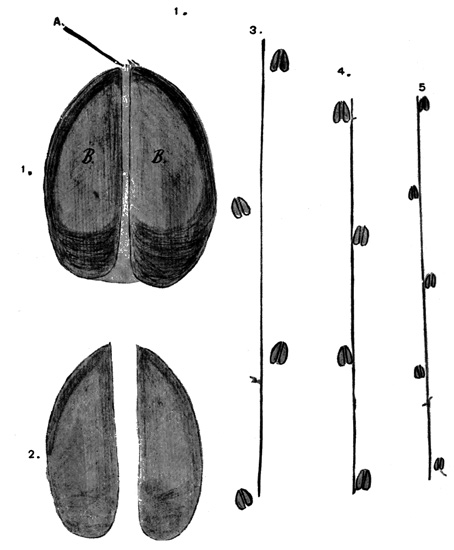
ELK. (ONE-HALF NATURAL SIZE)
(1) Bull track. (A) Closeness of track. (B) Hillock. (2) Cow track, flat
(note spread). (3) Trail of bull. (4) Trail of cow. (5) Trail of calf.
A male yearling has a bigger hoof, and consequently
makes a larger track, than a female of
the same age, and as the track of a three-year-old
bull is the size of that of a large cow, it is obvious
that even the track of the largest sterile
specimen of the hornless sex cannot approach in
size that made by an old bull. As the general
size of the elk differs in their various districts,
this fact has to be considered; an elk in the Coast
country, for example, is much inferior in weight
to an elk of the same age in the Rockies. For
this reason it is necessary to know the general size
of the elks in the territory in which the tracking
is done to estimate with approximate correctness
the number of points on their horns from the size
of the track.
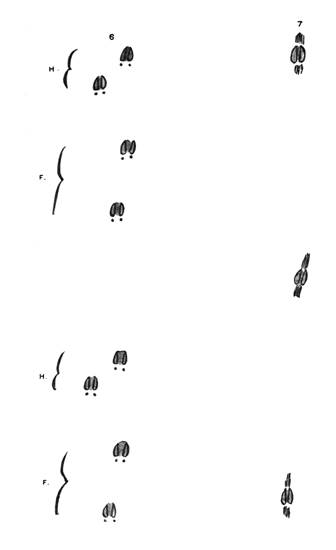
ELK
(6) Gallop. (7) Trot.
The bigger the bull, the farther, of course,
stand the tracks away from the center line.
What has been said about this, and about the
pointing outward of toes in the chapter on Virginia
deer, applies also to the elk, with the difference,
however, that in the latter it is always a
sure sign of the bull, as is also the lagging back
with the hind feet.
Like the fan-tail buck, the elk bull, in his manner
of walking, makes a hill in his track, but there
is no dust heap in front of the latter's, as the elk
apparently does not step off so clean.
The bull elk always manages to walk with
tightly closed hoofs, at variance with the cow,
which lets the hoofs spread more.
By reason of his weight and his habit of pawing
the ground, the points of the hoofs or toes
of an old bull become rather blunt, causing a much
rounder track than a cow makes; and in a big
track, like that of an elk, such features show up
conspicuously, while it would be a hard matter
to detect them in a much smaller deer track, even
on the best tracking ground.
The dew-claws, being much thicker and blunter
in the bull than in the cow, are a certain distinctive
feature, but their imprint can be seen
only in mud or snow, and there the other more
prominent signs of the bull track are, as a rule,
visible also and will be found more reliable.
The young bull often oversteps the forefoot
track with the hind foot; therefore in case the
tracks do not register it is necessary to examine
the two individual tracks of one side. If the bigger
track is in front, an old bull made it, and if
the reverse is the case, the animal is not worth
following, because it is a young one.
Like all members of the deer tribes, the elk
bull cleanses his horns of the velvet on trees, and,
in addition to pawing the ground with the hoofs,
he often belabors it with his horns in his anger
with a rival.
Some consider the distance between the individual
tracks in the attempt to determine the size
and other points of the elk, and if the animal has
been seen, this is well, but if there is only the
trail to decide by, it appears to be a far-fetched
"sign," because the foundation, a knowledge
of the speed, is lacking.
THE favorite rendezvous, in summer or winter
range, of any other member of the deer
tribes may be ascertained by the observant
trailer, and the animal found within a given area
with moderate certainty, but not so our most
gigantic game, the moose; he is far too much
of a traveler. True, he too has his range, but
its limits are so extended that he may return to
the same place but once within a month or two.
Here to-day and elsewhere to-morrow seems to
be his rule.
Yet, in spite of the moose's habits, the tracker
may bag him in any given locality by ascertaining
in what umbrageous thicket or on what
wooded hillside the moose prefers to stay during
his visits, that is, if the hunter does not wish to
run him down by sheer endurance, which would
take him over deep, crusted snow, cost about a
week's hard work, and furnish poor sport.
On account of its extraordinary size, it is out
of the question that the track of a bull moose
should be mistaken for that of another deer;
rather it might be taken for that of a big ox,
except the track of the latter is always rounder
and the entire hoof-form different. Where any
doubt exists, a close examination will invariably
dispel it. In forming a conclusion about a moose
track the chief aim is always to decide if it was
made by a bull or cow. The hoof of the bull is
bulkier than that of the cow, and should therefore
produce a rounder track. The immense weight
of the animal tends to obliterate such minor distinctive
features in most cases where the ground
is not very hard.
The dew-claws on the bull are always farther
apart than on the cow, and as they are much
blunter they make a good mark to consider.
The individual tracks of the bull are farther
off from the center line than in the case of the
cow; but as the stride is long, this feature is not
apparent to any appreciable extent.
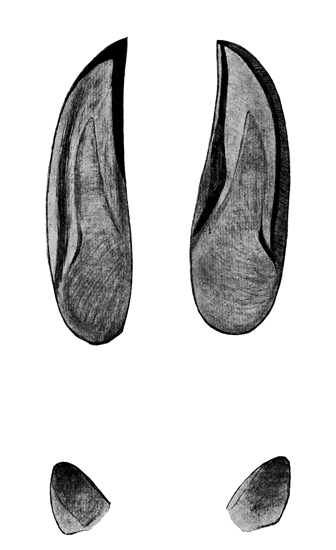
MOOSE BULL TRACK
(About one-half natural size)
The length of the steps, if it is possible to
estimate the gait he was traveling from his other
actions (feeding, etc.), is one of the best signs
of the bull, since he makes markedly longer
strides than the cow of equal size.
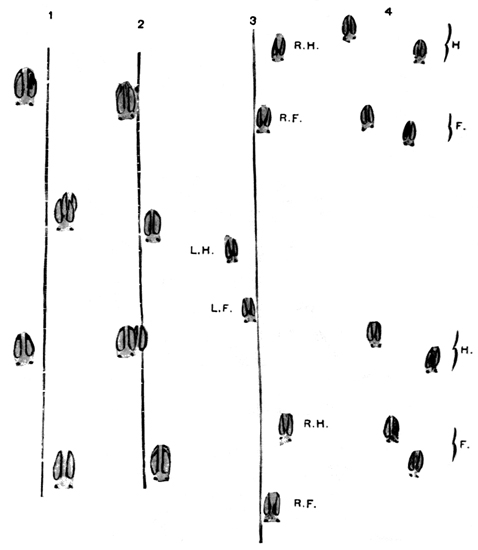
MOOSE TRACKS
(1) Trail of bull. (2) Trail of cow. (3) Trot. (4) Gallop.
From all the foregoing it is obvious that it is
a rather doubtful possibility for the beginner to
tell the track of a bull from that of a cow, but
actual observations in the woods will impart to
him the ability to distinguish between them with
a considerable degree of accuracy. Until he so
learns he should follow every likely looking track
until it enters a thicket, and if he is following a
bull with a halfway good set of horns he will
notice overhead broken twigs and bent branches,
or perhaps he will find along the trail blazed
trees, broken bushes, or the ground torn with
hoofs or horns, and may know by these also that
a bull made the signs.
Unlike any other deer previously discussed,
the moose, when trotting, oversteps the forefeet
tracks with the hind feet to a considerable extent.
(See sketch of trail.)
As signs of the bull moose we may consider:
| 1. |
Roundness of hoof; |
| 2. |
Distance between and bluntness of dew-claws; |
| 3. |
Distance of tracks from center line; |
| 4. |
Length of steps; |
| 5. |
Breaking of twigs with horns (overhead along trail); |
| 6. |
Blazing of trees; |
| 7. |
Pawing of ground. |
Where first the early sunbeams glow
On rugged cliffs, through morning shrouds,
Where icy winds in summer blow
On crests among the thunder clouds,
Way up on mountains high and steep,
There lives and roams the bighorn sheep.
THE king of sports, undoubtedly, is the
pursuit of the bighorn, but on account of
the habitat of this game, under normal
conditions, it is restricted to comparatively few
hunters, since perfect physical condition and unswerving
perseverance are required to endure
the hardships which present themselves in mountain
climbing and "camping out of camp," and
to bear cheerfully the many discouraging experiences
which are commonly the lot of the sportsman
who desires to secure the finest trophy to be
taken in our country.
No other reminder of the chase will bring back
to memory so many pleasant recollections as the
head and horns of an old mountain ram after
time has obliterated the memory of the hardships
endured, and has woven around the trophy a halo
through which the mind's eye sees again sublime
views from lofty mountain peaks, roseate dawns
and glowing sunsets, which bathed cliffs and
crests and crags in a flood of molten gold.
Again the hunter feels the thrill of care-free
independence of the trifling world below, and
experiences boundless elation as the crack of the
rifle, sounding and resounding from a thousand
crags, proclaims to the Alpine world the triumphant
end of the chase.
The tracking of this game consists chiefly in
locating it by the signs left on high meadows, or
near springs or salt-licks. Except for the larger
spoor of the ram, there is no difference in the
track or trail of either sex.
Generally on meadows or near springs, where
the big tracks of a single animal, or at most a
couple of them, are frequently found, and where
the tracks of lambs are conspicuous by their
absence, one may expect, with moderate certainty,
to see game worthy of a shot, as rams prefer to
range alone, except at rutting time and during
the winter.
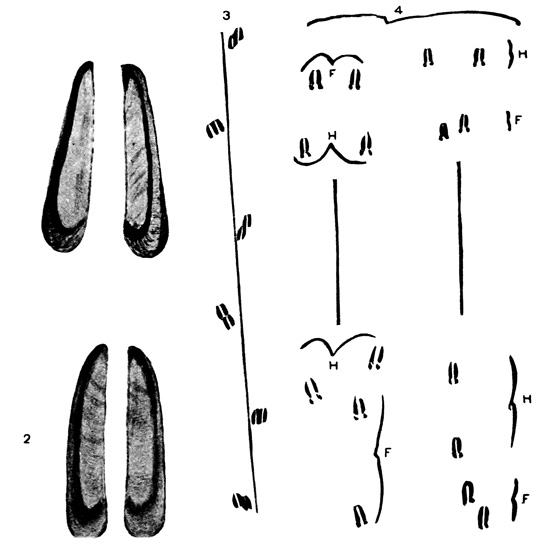
MOUNTAIN SHEEP. (ONE-HALF NATURAL SIZE)
(1) Front track. (2) Hind track. (3) Trail. (4) Leaps.
If there is no snow, one may learn to know the
track of every individual sheep which frequents
the range, and if he spends much time there he
will see an animal at too great a distance to be
shot at, but if he has any memory at all, he will
recognize its track if he finds it anywhere in that
region. This, of course, does not refer to mountain
sheep below the average, which, I assume,
are of little interest to the sportsman who takes
the trouble to hunt for a trophy; nor does the
meat hunter go up into these regions for the pot,
as he will get something easier lower down.
If the feeding ground or watering place of an
old ram is once known, about the best thing to do
is to wait for the quarry. If the game is seen,
and it has not already observed the hunter, it usually
can be flagged as antelopes were in former
days. The oldest bucks, however, seldom respond
to the summons, and are seldom lured
within rifle range by this method.
Hunting bighorn has much in common with
hunting antelopes, but in the pursuit of the
former there is grander scenery and more physical
exercise.
The tracks of mountain sheep often show the
cross-step, seldom register, and, as the animals
when running have to place their feet where they
can, the trail gives no indication of where an animal
has been hit. Infinitely greater vigilance is
required than in deer hunting to observe the
signs at the moment of firing, and in the study
of hair and blood.
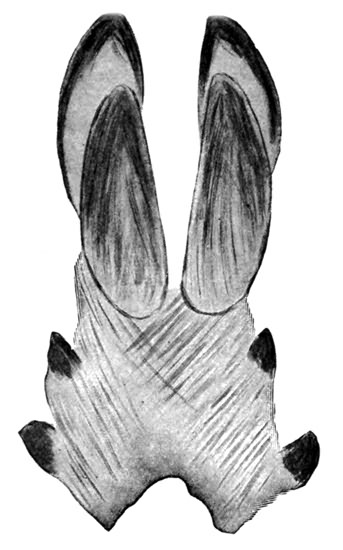
HOG TRACK; WALKING. (ABOUT HALF NATURAL SIZE)
To save the novice from ridiculous experiences this illustration is given.
The hog track is always spread, very seldom registers, and, if the
ground is not very hard, the dew-claws are always shown.
The hoof of the bighorn spreads easily and
evenly; therefore, in the track the distance between
the heels is as great as between the
toes, and frequently greater—a fact which makes
it impossible to confound it with that of any other
animal.
As stated, there is but one sign by which to tell
the ram: Size of the track.
THE track of the antelope looks like a combination
of a bighorn track, which it resembles
somewhat in length and prominence
of the outer rim of the hoof, and that of the
domestic sheep, to which it bears a likeness in the
shape of the heels. To confound it, however,
with either one of them is a rather remote possibility,
since the heels are broader and closer together
than those of a mountain sheep, with
which in the Bad Lands the antelope is sometimes
found in the same range, and the spread is different
from that of the domestic sheep. In the
case of the domestic sheep the greatest spread is
at the point of the toes, while in the case of the
antelope, the hoof being hooked, it is more between
the soles.
An antelope buck of moderate size makes at
all times a bigger track than any range sheep, the
track of the latter always being rather flat. As
antelopes live on the open plains where they are
generally hunted by sighting them, and as a
sportsman is allowed to kill but one in a season,
we will therefore consider only the signs of the
old bucks.
There are but two signs, and these can be condensed
into one, because they are usually found
at the same spot: Pawing of ground, and droppings.
The droppings are of similar size, and though
more or less connected, always comparatively
dry, while from does and fawns they are either
dry and scattered, or, if moist, in a lump and
always irregular in size; the cause of which seeming
phenomenon is a certain amount of glutinous
substance in the droppings of the buck.
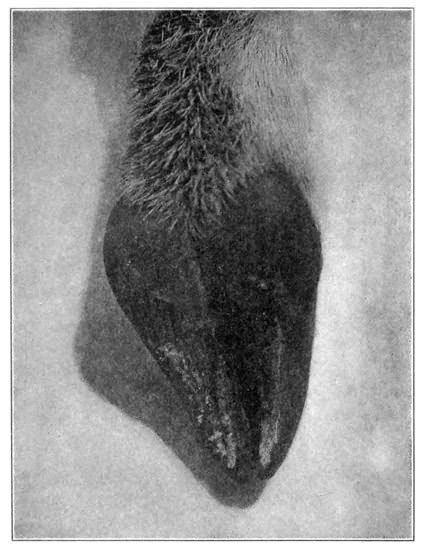
HIND FOOT OF ANTELOPE. (LIFE SIZE)
The pawing is usually done in old buffalo
trails, cattle runways, and roads, or where coal
deposits come to the surface making the ground
barren of vegetation; where this sign is found,
an old buck is always near, even if the locality
cannot properly be considered antelope country.
Old bucks, before and after rutting season, frequently
make their habitat in roomy forests or
in the breaks of the Bad Lands, sometimes several
miles distant from the grounds where the
herds roam.
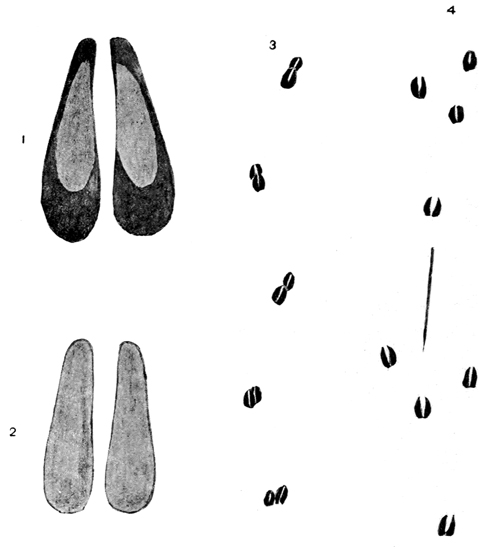
ANTELOPE. (ONE-HALF NATURAL SIZE)
(1) Track of antelope. (2) Domestic sheep (flat), note spread. (3)
Trail of antelope. (4) Gallop (no dew-claws; the antelope has
none).
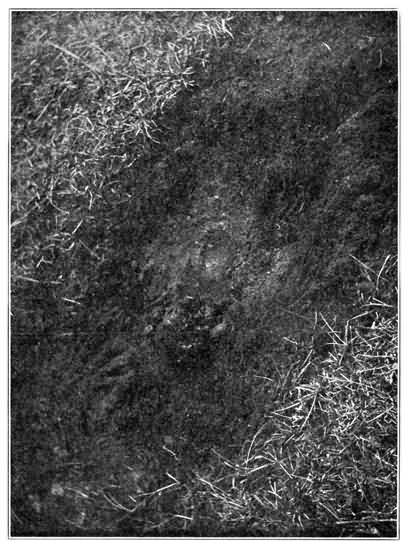
THE SIGN OF THE ANTELOPE (BUCK)
The rutting season begins about the middle of
August. The old bucks are first in selecting
their does, but they have to leave their respective
adherents on account of the stronger young bucks,
which fight off their old and emaciated rivals.
During the rutting season all bucks have such an
emphatically disagreeable odor that it is absolutely
impossible to eat the meat; afterward they
are but skin and bones, and before they can pick
up again and are fit for food, they shed their
horns. The sportsman, in consequence of the
law, which opens the shooting season for antelope
September 1st, is put to two disagreeable alternatives:
either to shoot a buck and let the meat
rot, saving horns and skin as a trophy of the
sport (?), or to kill a doe or fawn, to feast on
excellent venison, and incidentally hasten the
extermination of the most beautiful creature of
the plains.
Sport with antelope bucks in the full sense of
the word, can be had only during the summer
months; then they tax the hunter's skill, and their
meat is fit for the table of an epicure.
When their natural range is absorbed by private
preserves, or when human progress is advanced
so far that it demands even of politicians
the exercise of some common sense, then, no
doubt, laws will be passed befitting the game.
Until then, the sportsman, to keep his shield of
honor bright, must abstain from the killing of
antelope; else, ridiculous and inconsistent as it
may seem, if he decides he must have a trophy
of this kind, in any event, he must disregard the
statutory laws.
Flagging old bucks seems to me an inexcusable
waste of time; those which I have tried to flag
have invariably heeded the signal, and left immediately
for distant ranges, apparently having
profited from previous experiences.
The distress cry of a jack-rabbit, however,
invariably causes antelope to investigate. Often
when I have been calling for wolves and coyotes,
antelopes have appeared seemingly from nowhere
and approached so close that they could easily
have been killed with a shotgun. If there is a
herd of cattle in the known range of an old buck
it is almost a sure thing that he will associate with
them during the late afternoon. In timbered
country bucks will be found frequenting comparatively
small parks where it is easy to stalk
them.
The antelope has the widest range of vision of
all our game, but like the others it is unable to
distinguish objects when looking toward he sun,
a fact which at times has its advantages when
hunting the antelope or bighorn sheep.
The wound-signs are the same as in deer; but
as antelope are usually shot at in open country,
they can generally be seen until they drop dead
or lie down. In the latter case it is more merciful
to let them die without disturbing them, unless
it is possible from the lay of the country
to stalk them so that their misery may be ended
by a second well-aimed shot.
By reason of the hoof-form, the very prominent
hillock in the antelope track is of no value
in ascertaining the sex, and neither is the irregular
stepping in the trail.
Comparisons of the Male Signs as Found in the Various Hoofed Game Animals
| Animal |
Size of
Track |
Distance
from
Center
Line |
Pointing
Outward
of Hoofs |
Hillock in
Track |
Drag |
Lagging
Back of
Hind Legs |
Virginia
Deer |
- |
+ |
+ |
- |
+ |
+ |
Fan-
Tailed
Deer |
Dust heap in front of track |
+ |
- |
- |
Mule
Deer |
- |
+ |
+ |
- |
+ |
- |
| Elk |
+ |
+ |
+ |
+ |
- |
+ |
| Moose |
- |
+ |
Length of steps
Breaking of twigs with horns |
- |
| Bighorn |
+ |
- |
- |
- |
- |
- |
| Antelope |
+ |
- |
- |
- |
Droppings |
| |
| Animal |
Clearness
of Track |
Roundness
of
Toes |
Size and
Form of
Dew
Claws |
Blazing of
Trees |
Pawing of
Groung |
Virginia
Deer |
Watching from |cover |
+ |
+ |
Fan-
Tailed
Deer |
Watching from cover |
+ |
+ |
Mule
Deer |
- |
- |
- |
+ |
- |
| Elk |
+ |
+ |
+ |
+ |
+ |
| Moose |
- |
+ |
+ |
+ |
+ |
| Bighorn |
- |
- |
- |
- |
- |
| Antelope |
- |
- |
- |
- |
+ |
PREDACEOUS ANIMALS
HUNTING bears with the assistance of
guides supplied with a well-trained pack
of hounds may be satisfactory, if merely
the killing of them is desired, but it certainly is
not sport, and does not even deserve to be ranked
with trapping bears, as in the latter case the
hunter must possess at least some knowledge of
the quarry's habitat and habits. Unlike a fox,
a bear when once found by the hounds stands no
chance of escaping, and there would be just as
much sport in shooting the animal in a park or
pen as in killing a run-to-bay bear. This applies
also with truth to mountain lions, although
perhaps there is in the case of the cougar the
excuse of the animal's destructiveness.
The employment of dogs in the chase would
never exterminate or even appreciably lessen the
number of deer in any hunting country where
lakes are not abundant, but everywhere it surely
means the downfall and extinction of that relic
of gray ages, the bear.
Where not plentiful—and the places where
they are found in number are to-day quite few
and remote from civilization—bears are, on the
whole, harmless, and decidedly more useful than
injurious. The damage they do is almost nil,
while they serve man in many ways. The meat
of young bears is equal to the best venison; their
fat is decidedly superior to the "fancy" lard we
buy, of the source and handling of which we are
ignorant; and the hides give excellent service as
robes, rugs and clothing. In my opinion bears
should be protected to a certain extent rather than
shot down merely to make a record.
Sport should be conducted in a spirit of fairness
to the game, and while a couple of dogs is
perhaps permissible in bear hunting, still-hunting
is the better sport, because it requires the utmost
skill and knowledge of woodcraft on account of
the quarry's sagacity and cunning, which is
superior to that of any other of our wild animals.
Even if one is able to read the habits of the
bear clearly from its trail, it is necessary to possess
an abundant supply of patience, for, barring
lucky accidents, no one can reasonably hope to
outwit Bruin at the first attempt.
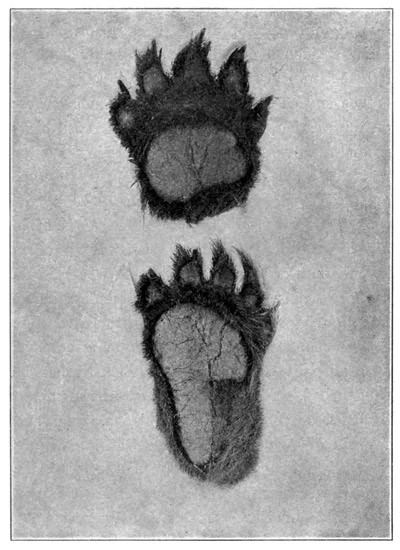
BEAR FEET—RIGHT SIDE (ONE-QUARTER NATURAL SIZE)
The end of their hibernation depends largely
on the weather, but about March or April bears
frequent snowless slopes and gulches in search of
roots, bulbs, and similar food, and it is there one
must look for signs at that time. If a cold
spell interrupts the spring weather, as is often
the case, a trail, sometimes a week old, will often
lead the hunter to a nearby thicket where Bruin
has made himself a bed on the ground, with the
intention of sleeping until another thaw. He
usually changes his bed every two or three days,
but ordinarily will not leave the thicket unless he
is disturbed. If a bear is found to be in such a
thicket, the hunter should curb his impatience and
suspend following up the trail until the snow gets
soft, when he can work carefully against the
wind toward his quarry. However, as it is usually
impossible to see farther than ten or twenty
feet ahead, Bruin has, in this kind of hunting,
much the best of the hunter, and the latter finds
in most cases an empty bed.
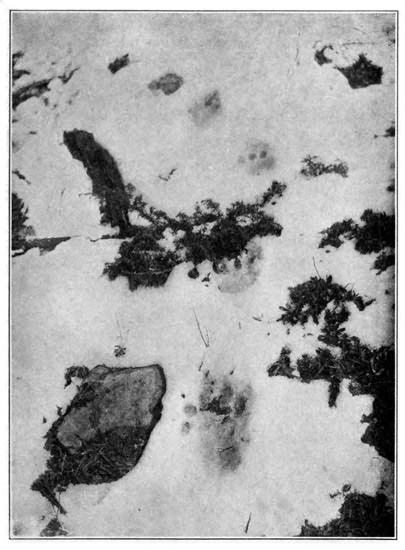
BEAR TRAIL. (STEPS ABOUT TWO FEET APART)
If the thicket is not too large the wind-hunting
method before described will, no doubt, often
give satisfaction; but as a rule the thickets which
the bears make their spring habitat are of too
great an extent. The surest and easiest way to
get him is to persuade some other fellow to follow
the trail while you intercept and shoot the bear
when he leaves the thicket. Knowledge of
Bruin's cunning then furnishes the means to
decide where he will pass, since, as a rule, he will
sneak off under the densest cover and try to reach
another thicket under shelter of bushes, rocks and
the like. Anyone, not altogether a tyro in the
woods, can easily decide from the lay of the
country where to wait for His Bearship. When
the place is selected, one should be sure that there
is an absolutely clear opening at least a couple
of feet wide. A bear is bulky and clumsy-looking
enough, but he is able to pass without offering
a chance for a shot at places where another
animal could hardly escape an average hunter's
lead. I am by no means slow with my trigger
finger, but before I learned to appreciate this
fact I was chagrined on several occasions by having
bears pass me unharmed at a less distance
than fifty yards, and that too at places where I
thought I could kill a running rabbit if I wished
to do so.
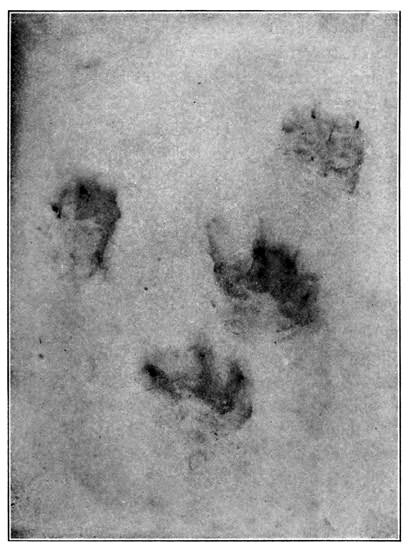
If a bear succeeds in leaving a thicket without
giving opportunity for a shot, there is no need
for disappointment—he will pass the same spot
when he happens to be in the same thicket again,
and this is a certainty if he does not abandon that
part of the country. This statement has met
with some disbelief among a few of my personal
acquaintances, and to prove my claims I had to
shoot a bear within a month from a given point.
I killed Bruin, or rather Old Eph, as it was a
grizzly, less than ten feet from where I said I
would, and that settled the matter.
A mile and a half from my home there is such
a thicket not over one acre in extent, and if fresh
bear signs are seen anywhere in the surrounding
woods, which cover several thousand acres and
contain many larger and just as dense thickets,
I wait there, reasonably sure that I will see Bruin
soon after sunrise or at sunset. Experience has
proved to me that it is a waste of time to watch
for bears where signs are most numerous. They
invariably leave their home thicket very quietly
before dark, and start their noisy feeding, chewing
up logs, and breaking down berry bushes,
not less than half a mile from their abiding
place, near which no signs except a few tracks
are visible.
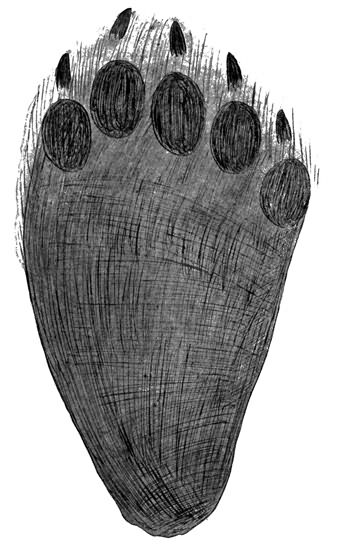
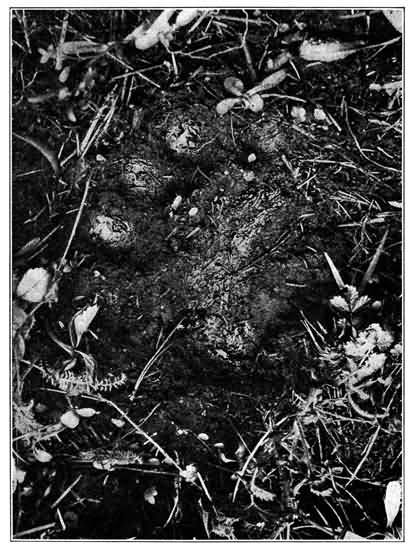
BEAR TRACK. (HIND FOOT; TWO-THIRDS NATURAL SIZE)
For the entertainment of a visiting friend the
thicket was driven a few times by the wind
method, which worked splendidly. An "old
mule," which was shot through the lungs with
a .30-40 rifle on the previous evening, was the
only one that left the shelter slowly. All the
others, presumably the same on every occasion,
appeared to be very much frightened, and ran
for about three-quarters of a mile after they had
passed the danger point.
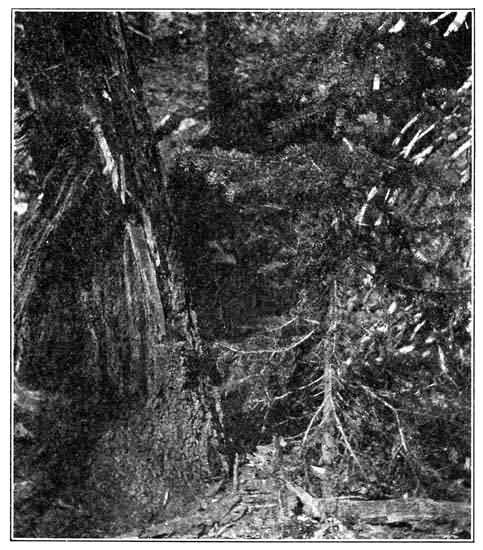
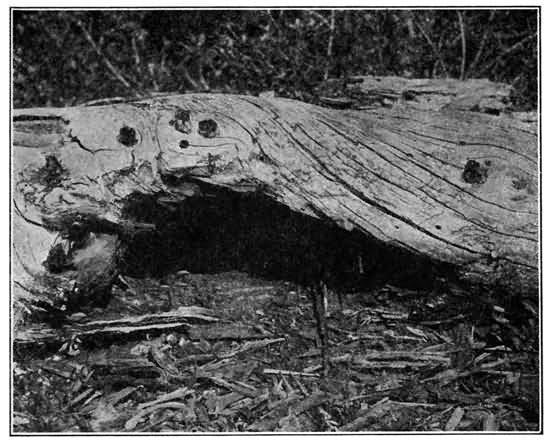
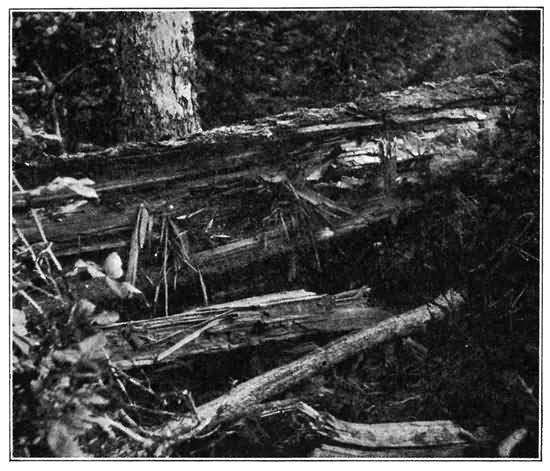
BEAR STUMP. (ANTS WERE CHEWED OUT SEVEN
FEET ABOVE GROUND)
To locate the abode of bears in such thickets
during the summer and early autumn, it is best
and simplest to trail them by the signs they make
during their nocturnal rambles, such as overturned
logs, etc.; and if only a few of such
signs are found near dense cover, facing north
or northwest, the ground should be carefully examined
for tracks. These are usually difficult
to see, and if no moist places are near such cover,
the apparently used paths that lead into it, but
on which there are no signs except an occasional
claw mark, must serve as base for a conclusion,
which must be verified by watching at a good
point near the thicket during the morning or
evening. The snapping of a twig or the breaking
of a log on which Bruin carelessly steps often
confirms the conclusions, though the bear may
sometimes remain invisible to the hunter for several
consecutive visits.
BEAR TRACK. (FRONT FOOT; ABOUT TWO-FIFTHS
NATURAL SIZE)
When the thicket they prefer is once located,
the rest is easy. If quick results are desired,
driving or, perhaps, calling will yield results. I
once shot a bear which made its appearance immediately
when, by way of experiment, I imitated
the distress cry of a jack-rabbit. If the
hunter has plenty of time to spend in the woods
it is a good plan to watch for the quarry. During
autumn proper, bears retreat to the more
remote districts and the fastnesses of the mountains;
here they are usually found during the daytime
where they are accustomed to feed. In
places where berries are plentiful, on ridges and
in gulches where blue jays and squirrels are storing
their winter supply of mast, here will be
found the bears' favorite autumn haunts. In
the mountains of the West there is a berry bush
called kinni-kinic barberry or bearberry—I am
not sure which is the correct term—that is thickly
covered with fruit about the size of buffalo berries,
and which is a favorite food for bears before
they can obtain mast; or, if the latter fails, Bruin
seems to regard the seeds of the piñon as a delicacy;
but as it would apparently take up too
much of his time to fill himself from those that
fall to the ground, he resorts to easier methods
to obtain them—he becomes a thief and incurs
the enmity of squirrels and jays.
On ridges he robs the caches of the jays, and
in cañons he depletes the stores of the squirrels,
and, by no means approving of such actions, they
heartily hate him and "cuss" at him whenever
he approaches, and in this way often betray his
presence to the hunter who has learned to interpret
the language of the wood-folk. It is always
well to approach with the utmost care places
where there is a continual chatter of squirrels and
cries of blue jays are heard; and if the "cussed"
one proves to be some other marauder—well, it
may be a bear next time. When still-hunting
during the autumn the attention paid to these
small denizens of the woods is by no means wasted,
and yields better results than covering a great
territory, or watching for hours on trails or near
baits, which latter are seldom visited by bears
during rifle light.
Until I undertook the systematic study of the
bear's habits I was under the impression, from
what I had read, that a bear track was easily
recognized, and actually passed many, regarding
them as cougar tracks. I have since noticed
that many hunters, born and reared in a bear
country, make the same mistake. Of course in
mud or snow a bear track is easily identified, but
in the vastness of mountains and forests snow
and mud are not always present; in fact, they are
of little service. There, the heel of the foot is
practically never seen in the track during snowless
times, and as the shape of the fore part of
the foot conforms with that of the mountain
lion, a mistake is easily possible if the imprints
of the five toes of the bear are not all visible.
The trailer in these districts and under these circumstances
is generally lucky if he can discern
here and there the part of a track of a bear's
foot. A couple of years ago a party of old deer
hunters told me of the great number of lion
tracks they had seen as they came into camp,
and at my query if they saw any bear tracks, they
answered, "No"; yet I had camped there over
two months, knew absolutely that no lion was in
those parts, that bears were abundant, and that
the hunters could have seen only their tracks. So
much for the information of those who have an
idea that an animal, weighing from three hundred
to over a thousand pounds, must necessarily
make a big trail which can be readily followed.
The tracker, if he will but stop and investigate
closely, need not make a mistake, even if only
the imprint of a single toe is plainly visible, as
the long nails of the bear almost always leave
some mark in front of the track. The distance
which the nails stand away from the toe imprints
is the only means of distinguishing the grizzly's
track from that of the black bear, except that
size dispels any doubt. The nails of the grizzly
stand out almost straight, while those of the black
bear are more curvate, and their imprints must
consequently be found closer to the track of the
foot.
The likeness of the bear track to that of the
human foot has been referred to by many writers.
In reality no likeness exists, and the inexperienced
trailer in the woods has the already disadvantageous
conditions under which he is working
multiplied so long as he is not disillusioned.
If a bear who knows nothing of the hunter is
shot at and suddenly whirls around, i. e., jumps
when the trigger is pulled, he is hit, no matter
whether there is another sign or not, and the
color of the blood will indicate to the hunter where
he is struck. A shot through the lungs with the
modern high-power rifle will sometimes not prove
fatal within ten or twelve hours.
A missed bear is never in a hurry to get away,
unless he has seen or scented the hunter previous
to the firing, and in most cases he offers a chance
for a second or third shot.
Not a few city hunters "pull out" if they encounter
bear signs where they intend to spend
their outing, saying they are not looking for
bears; yet the chances are many against their
seeing one even if they were anxious for an encounter.
The trouble is not to avoid a bear, but
to find him, as his greatest desire seems to be to
keep out of man's reach, and he employs all his
cunning to that end.
OF all the predatory animals there is none
which in destructiveness equals or even
approaches the mountain lion; he, and
he only, is often the cause of unsatisfactory hunting
trips into districts where other big game by
every reason ought to be abundant. A family of
these great beasts will, while the young ones are
growing up, deplete a region of almost every
other game animal.
If a cougar kills a deer during the morning
hours, he seems to spend the day near it, as I
have again and again found freshly vacated beds
under nearby bushes or rocks. On these occasions
I was following the drag the "varmint"
had made with the carcass, and although I
kept a close watch on the surroundings, the lion
remained invisible; yet I know that he was watching
me, for in every instance I found that he
visited and examined the covered carcass during
the following night.
The methods usually followed to rid the hunting-ground
of its worst poacher are to shoot or
trap him. If the former is decided upon, the
fact that the lion has an excellent nose and keen
vision should not be forgotten when the place
to watch for him is selected.
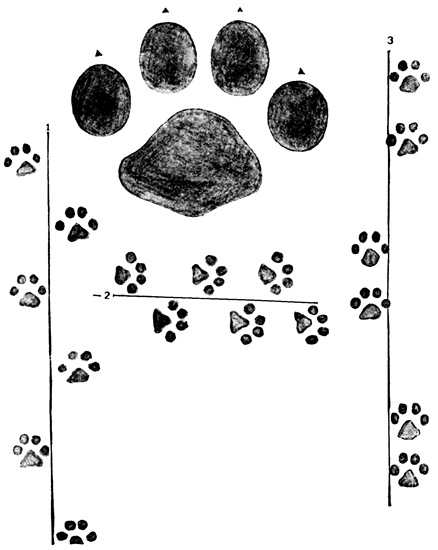
COUGAR. (ONE-HALF
NATURAL SIZE)
(1) Ordinary gait.
(2) Sneaking.
(3) Trot.
Still-hunting the cougar is about the most
thankless undertaking one could enter upon, yet
there are occasions when a close observer may be
able to kill one without extra trouble when out
primarily for other game. The main requisite is
time and a thorough acquaintance with the country.
The cougar, after the young are grown up,
does not remain in a comparatively small district
for any length of time, but usually covers a much
wider territory than the gray wolf, although the
latter is universally known as a great wanderer.
At irregular intervals, say from once in a fortnight
to once in two months, depending on the
region, it returns to the same district. Unlike
the wolf, the cougar, in returning to and hunting
over a district, does not usually go over the same
trail and buttes he has used on the previous trip,
but prefers to explore new ground on each occasion
unless there is something unusual to attract
him. If his tracks, therefore, are seen quite often
on a certain lookout point, the hunter should be
alert for the cause of attraction, generally a
fallen tree, or an overhanging rock protecting
a snug dry bed beneath from rain or snow, which
are always situated on a wind-sheltered hillside
facing south. When such a place is known, the
hunter should scrupulously refrain from going
near it, to avoid leaving any scent there; but he
should observe the "nest" as often as he comes
into its vicinity, and from a convenient distant
point. If the "nest" has an occupant, it is better
to let a bullet investigate before the hunter
does so himself, for a cat is a cat, and if its
suspicions are aroused, the devil cannot beat it in
trickiness—it will vanish unobserved without the
hunter knowing how it could have done so. I
once shot one out of a bunch of three, and felt
sure the remaining two were "my meat," yet not
a spot of yellow of them did I see afterward,
although every nook within three hundred yards
of the surrounding country was seemingly open
to my scouting.
This is tedious hunting, of course, and the
number of cougars would not be appreciably lessened
by the method; but one lion outwitted thus
is worth perhaps, as a trophy of skill, a score
killed by other means; and besides, it at least
gives the still-hunter a chance.
Cougars do not respond readily to being called
(by imitating the cries of a jack-rabbit); at least
I have lured but one in eight or ten years, and
missed it at that. Trapping them is as sure as
gambling, i. e., there is never any certainty that
one will get the lion, and as their existence is unquestionably
obnoxious to sportsmen and stockgrowers
alike, hunting them with dogs is a commendable
method, since it insures their decrease,
and to the tyro means a trophy.
Barnyard study is, undoubtedly, responsible
for the conclusions advanced by some writers that
the members of the cat family are the most perfect
track makers, i. e., walkers. As a matter
of fact, the trail of a wild cat cannot be compared,
so far as perfection goes, with the trail of the
wild dog. The cougar's tracks seldom register.
He either oversteps with the hind foot the track
made by the forefoot when in a hurry, or he
does not step quite far enough to cover the forefoot
track when leisurely walking, and the individual
tracks do not stand so close to the center
line of the trail as do those of the wolf. The
roundness of the track, together with the inconspicuousness
of the nail marks, even under the
most favorable tracking conditions, makes the
cougar track unmistakably different from that of
a wolf. However, on hard ground the track of
a bear and a lion may be easily taken for one
another, though the latter contains but four toe-marks.
But then every toe-mark is not often
visible on hard ground.
With all predatory animals the rule holds good
that the female track appears smaller than that
of the male, even though the size of the animals
be the reverse. For example, a male cougar
measuring seven feet from tip to tip, will make a
bigger track than a nine-foot-long female. Although
with dividers and tapeline one might
have difficulty to ascertain the difference, which
at best would be very small to the eye, it is unmistakable,
and one well acquainted with tracks can
hardly make the error of mistaking a female
track for that of a male. The latter always looks
more substantial.
It is the same with the tracks of males and
females of predatory animals as it is with a
bunch of deer, or of a single one for that matter,
after bucks have shed their horns. The initiated
can tell accurately from the appearance
of the animals which are bucks and which are
does; yet if questioned how he knows it, he
can scarcely answer. At best he will say, "Because
it looks like one." The reason for my
dwelling on this subject is by no means an idle
one. During the early summer the ravages of
"varmints" often become almost unbearable to
stockmen, and since females, which have to provide
for their offspring, are the worst offenders,
it is well for anyone to be able to distinguish their
tracks from those of males, in order to follow
them only, as they are the only ones that will
always with certainty lead to the den within a
day's travel.
Predatory animals are, in the writer's opinion,
not monogamous. While a male is often found
with a family, the same male may be seen the
next day with others of his kind miles away. I
have noted this while following game on horseback.
On the other hand, a male track may lead
to several dens if followed far enough. On several
occasions I have shot two or even three males
of a species near a den within a week or so,
the desire to kill the female being on every occasion
responsible for the long-continued watch.
In following a track with the purpose of hunting
up a den it makes but little difference whether
the trail be fresh or old. A trail two weeks old,
but made after a rain, is often more easily followed
than a fresher one, and will as well lead to
the den's vicinity, as the latter very often could
not be followed at all on hard ground; and a
back-trail often leads more quickly to the den
than one leading ahead. Prevailing conditions
of weather and lay of country should govern the
tracker's choice of which trail to follow. He
must know that he has to follow the back track
if it comes from rough country, for the den is
more likely situated there than elsewhere.
A den that contains young cougars is readily
recognized by the superabundance of carcasses
of game lying around its vicinity.
Certainly unless due regard is given to the
extermination of predatory animals, it is impossible
to bring a hunting preserve up to the highest
standard, and for the same reason their unrestricted
existence in the open hunting grounds
can only be harmful. The time when predatory
animals kept the number of other game in a
healthy balance has passed, and the sportsman
who kills half a dozen deer ought to have to his
credit at least one member of the former tribe to
offset his killing those of the latter. As few
of the hunting fraternity attain this desirable
result, I think those who kill as many or more
marauders as they do useful game animals,
ought to be hailed as benefactors to the sportsmen's
fraternity. Sometimes, I am sorry to
say, such an action is referred to as unsportsmanlike
by those who would soon find the
woods empty of desirable game if others gave no
more attention to marauders than they do themselves.
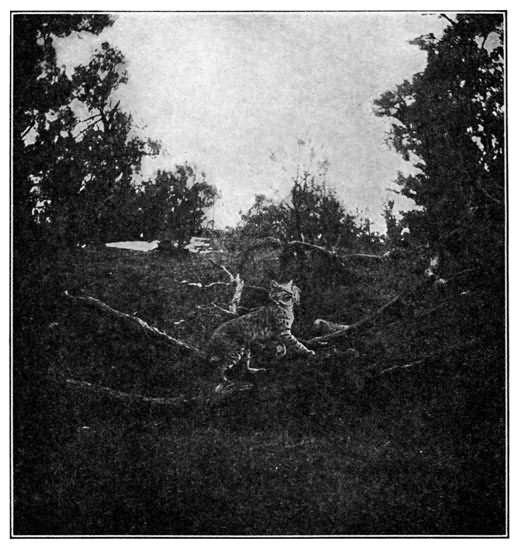
WHAT the cougar is as an enemy to the
useful big game, the bob-cat is to small
game and the young of big game. He,
however, lacks the cunning of the former, being
easily called or trapped, and therefore as a class,
and excepting individual cases few and far
between, will never become a menace to either
the sportsmen's fraternity or to stockgrowers.
Where hundreds of them infest the country—as
in certain sections of the Bad Lands—they only
serve to check the increase of the millions of
cottontail rabbits, which would otherwise so rapidly
multiply that they would become a destructive
pest throughout the cultivated sections of the
country.
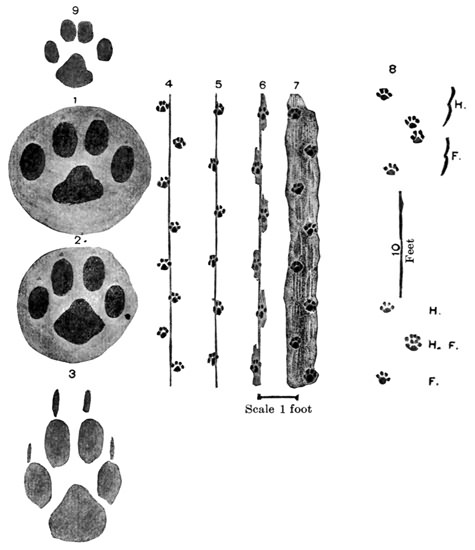
LYNX. (ONE-HALF NATURAL SIZE)
(1) Forefoot. (2) Hind foot (small specimen;
nail marks are generally invisible). (3) Imprint
of fox. (4) Lynx, ordinary gait. (5
and 6) Fox, ordinary gait. (6 and 7) Comparison
of fox and lynx trails in snow. (8)
Lynx, running. (9) Domestic cat.
The tracker, trailing bob-cats like deer, can
often surprise them at prowling, or jump them
at close range from their beds, which are usually
found under deadfalls or overhanging rocks, etc.
Until their suspicions are aroused they are very
foolish and the writer has shot not a few with a
.22 rifle when still-hunting for rabbits. When
called, they have not sense enough to run away
if missed by the first and even second shot. In
hunting them with dogs they give good sport, and
not infrequently get away by entering holes or
putting the dogs to shame in some other manner.
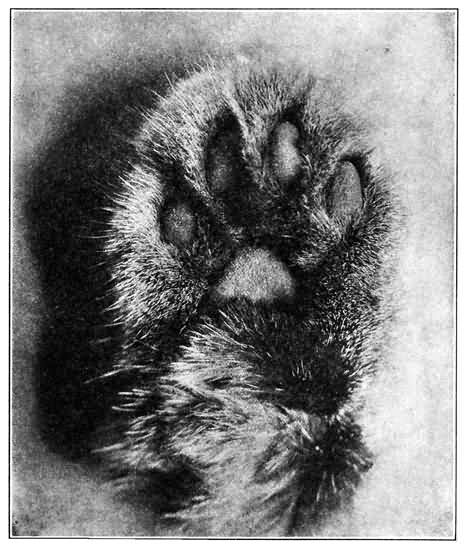
At a careless glance the lynx track is but a
miniature of that of the cougar, but a close examination
reveals the fact that the marks of the
individual toes are proportionately much more
elongated than in the latter. The trail, though
much better than the mountain lion's trail, is not
as perfect as that of the coyote or fox, for either
of which it might be mistaken in loose snow; it
is always more out of line. In Country Life in
America for June, 1905, a well-known nature
writer shows a lynx trail, as perfectly as it can be
illustrated, as that of a fox. With such good
standing tracks it is inexcusable if the trailer
makes a mistake, and even if one has had but
little actual experience in the woods, a less perfect
outline of the trail will be found sufficient
to tell the wild cat from the wild dog.
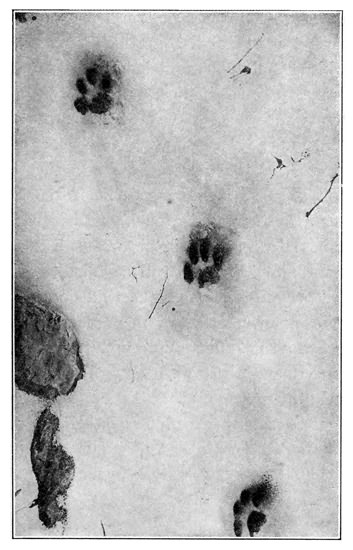
In snow five inches or more deep the lynx
makes, as a rule, quite a drag with his feet, much
more so than either fox or coyote, which latter
disturbs the snow only near the individual tracks.
On good tracking ground, or in soft snow, the
nail marks are sometimes visible, but never prominent
like those of the fox or coyote.
THE track and trail of the house cat—(if it
were only a house cat nothing would be
said about it here)—is too well known to
need description. If it is found anywhere in
hunting grounds, parks, etc., the finder will confer
a benefit on lovers of nature and its feathered
denizens if he, where possible, will set a trap
baited with fish (herring), or cheese; or if there is
a chance to fill the "varmint's" anatomy with
pellets from a shotgun or a .22 rifle, or to cut it
in two with a big rifle bullet, he should never fail
to do so. It may seem a waste of powder and
lead, but it is not, for in my opinion there is no
more harmful creature a-foot or a-wing than the
domestic cat outdoors.
It would be impossible to estimate the amount
of damage they do by killing songsters which
nature intended to check insect pests. As far as
the sportsman is concerned, a single cat will often
deprive him of his shooting in given localities, for,
if it has once found the location of a bevy of
quail, grouse or other game birds, it will not stop
until the last one of the family is killed.
Wild predatory animals generally restrict their
raids to the hours of the night; a domestic cat will
prowl and kill at any hour during the twenty-four.
Some specimens attack even deer fawns
and other game of like size.
A cat shrinks from nothing in its lust for killing—not
even from water—and I remember seeing
a big tom-cat rob a pond in a city park of its
goldfish. Unluckily for the marauder I had a
gun with me.
Anyone interested in shooting should keep a
lookout for cat tracks in the woods during the
summer and autumn, and do his best to let them
show no more.
THERE is perhaps no other animal about
which more disagreeable things are said
and written than the wolf, yet the writer,
though recognizing its bad points, would dislike
to have it become extinct. Its howl is inseparably
associated with many of my pleasantest
recollections, and the butte-fringed prairies and
rugged Bad Lands would have decidedly less
charm without it for one who has learned to
love that so-called "God-forsaken country."
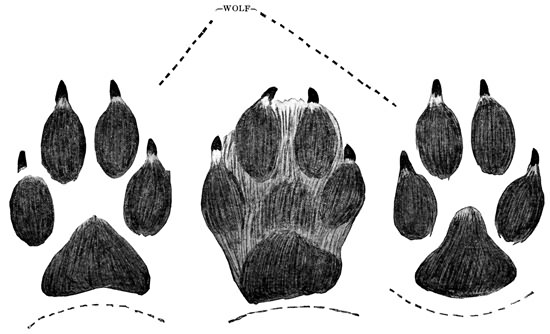
WOLF
Front track
Dog, forefoot
(Two-thirds natural size)
Hind track
Except under unusually severe weather conditions,
wolves generally kill only the weakest of
range stock and big game animals, and I doubt
if their so-called depredations in this respect are
anything but a benefit to the survivors, as weaklings
among any species of animals are always
inimical to the general health and condition of
the respective variety. The wolf in this regard
does only what the sensible warden of a well-conducted
game preserve does; i. e., weeds out
undesirable specimens. In Yellowstone Park,
for example, since the cougars there are systematically
hunted with hounds, wolves and coyotes
ought to be protected to a certain extent or else
the result will undoubtedly be a general degeneration
among the game animals in that region.
Before the warfare against lions was started,
there were already many scabby elks in that great
preserve, and if the slaughter of scavengers is
kept up indiscriminately—well, a reasonable person
can only await results with misgivings.
Nature always works out her course best if left
alone, and I believe that in the case of the Yellowstone
Park the Nation in the course of time
will be willing to pay ten times the amount it
now pays for their extermination to have the
"varmints" alive in that great preserve. Where
weaklings are not abundant, game animals naturally
suffer from an abundance of wolves, and
where the stock-raiser has enough sense to dispose
of sick or weak stock himself, Old Gray has
no business.
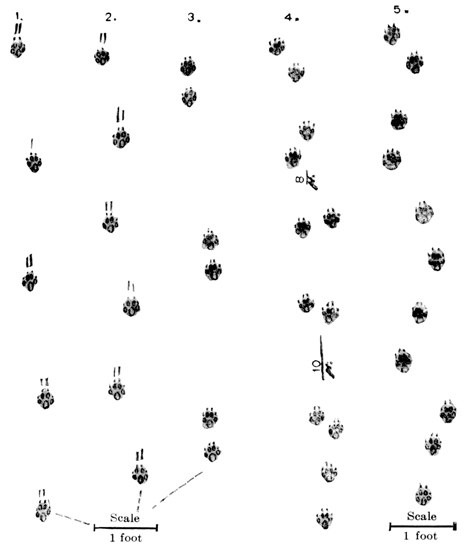
(1) Wolf (slow trot). (2) Dog (trot). (3) Wolf (quick trot). (4)
Wolf (gallop). (5) Dog walking slowly; a motion never seen in
the wolf trail.
In hunting wolves the quickest results are obtained
in calling by imitating the cries of a jack-rabbit.
Wolves evidently think one of their
tribe has caught a bunny, and, as Wildenbruch
fittingly says: "Each and everyone would eat
him." This trait is shared by most other marauders.
The wolf is a poor runner, and is easily
run down with the aid of an ordinary horse in
open country.
The surest and most effective way apart from
calling, is by trapping, which is the most extensively
practiced, and he who says that trapping
is not great sport has surely never tried to
outwit an old wolf. I always measure sport by
the amount of skill required.
The keeper of a game preserve, who is not acquainted
with the use of traps and other devices
designed to decrease predatory animals, will
never succeed in showing first-class results to the
owner or owners so far as abundance of game is
concerned; and what holds good in the case of
the shooting-preserves holds good also for the
open hunting grounds.
The track of an old full-grown wolf, although
similar to that of a dog, differs from the latter,
inasmuch as it shows that the foot is less fleshy,
the soles of the various toes appearing more
sharply divided than in the dog's track. The
latter has a comparatively big foot but also a
soft foot which, being plainly visible in the ordinary
gait, becomes much more apparent where
the animal adopts a quicker motion. The toes are
then spread out to an extent never found in the
wolf, except when the latter is running very fast,
and consequently the nail marks of the two middle
toes of the dog are about twice as far apart
as those of his wild relative. A wolf trail shows
the individual tracks ordinarily about eighteen
inches apart, while the dog, making the same
size or a slightly bigger track, steps at the same
gait less than fourteen inches; and if, in trotting,
he should equal the length of wolf-steps, the
spread of the middle toes makes his tracks easily
recognizable. A good-stepping dog steps about
as near the center line as the wolf, but as his
steps are shorter, they appear more out of line
to the eye. This is an optical illusion, but it
serves the tracker's purpose.
A young wolf, say less than one year old, has
as soft a foot as a dog's. However, as young
wolves go mostly in packs, following the trail
will generally reveal the identity of the animal.
Usually wolves do not track continuously, one
animal investigating here and another there,
while the main trail leads on. Dogs, two or more,
show no clear-cut single trail even for so short a
space as ten feet, while a number of wolves often
travel several hundred yards with the trail showing
as though only one animal had made it. If
one sees a wolf trail, and without following it
concludes that it was made by a single specimen,
he is liable to make the same mistake "Liver-eating"
Johnson made with a bunch of horse-stealing
Indians. He was stopping with a friend,
Eugene Irvin, also an old Indian fighter, and
one morning noticed about fifty horse-tracks, of
which he concluded only about half-a-dozen were
made by horses mounted by redskins. Instead
of following out on the prairies and deciding
there from the comparative absence of dust in
the tracks—a rider is not mixed up with the herd
he is driving, and consequently in his mount's
tracks less dust is to be found—he hurried back
to induce Irvin to join him in the pursuit of the
Indians. Now that old scout was not as eager
for the horses as "Liver-eating," and not at all
for a fight, but for old friendship's sake said he
would come along if a couple more fellows could
be found, which, by the way, he did not believe
possible, for the country was not settled then as
it is now. But it happened that two men did
come along just at that moment, and Johnson
soon convinced them that profitable business was
ahead if they joined in the pursuit. So the four
went, taking a straight cut toward Horsethief, a
section of the country southeast of the Big
Snowy Mountains, where they thought the
Indians would make a halt.
About three o'clock that afternoon they overtook
the "Reds," but found to their chagrin that
a dozen bucks were ready to give battle, while
still four or five were left to attend to the stolen
horses, and as neither Johnson nor any of his
companions were burning for a fight, in which
there was no promise of getting anything but
bullet holes, Johnson decided that he would
rather go home without the horses.
In the Bull Mountains a hunter followed a
wolf trail into a ravine from which there was
no escape for the "varmint" except past him,
and he was promptly attacked by a half-dozen
wolves. He killed four after a hard fight, but
he was pretty well chewed up at the finish. Of
course he had expected to find only one in the
gulch.
As a rule the wolf is not anxious to fight,
although not so cowardly as most other animals—the
cougar for example—yet I have seen a single
specimen follow a hunter, a boy of twelve years,
but the best rifle shot I ever met, about two miles.
I was with him, and waited for that wolf until
he was within twenty yards, when I allowed the
boy to fire. His nerves were evidently too much
shaken, for he missed his first wolf—nevertheless
he got his pelt.
The locating of dens, as explained in the discussion
of the cougar, is also applicable to wolves.
WHAT has been said in regard to the wolf
and dog track, is applicable also to the
track and trail of the prairie wolf, but
as the latter is small there always exists the possibility
that its track will be mistaken for that of
the fox. Where the locality gives no clue to the
identity of the maker of the trail, the tracker has
no distinguishing feature whatever from which
to form his judgment, since a big red fox makes
as big a track as a small coyote. The writer,
after hunting foxes for many years, followed
what he took for fox trails quite frequently in
a certain section of the country, until he discovered
that there was no fox within a couple of
hundred miles of the place. A big coyote, of
course, makes a larger track than a fox, but here
all difference stops. For comparison's sake the
track and trail of the average coyote and of the
average fox are shown.
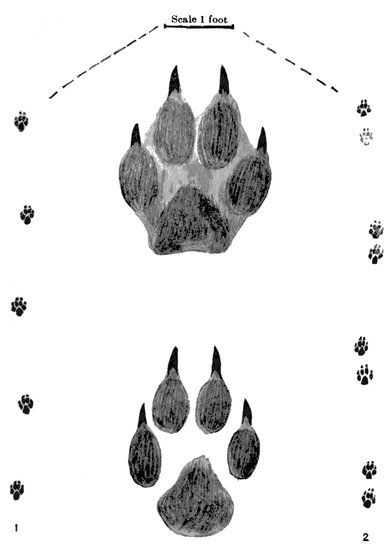
COYOTE. (TWO-THIRDS NATURAL SIZE)
(1) Ordinary trot. (2) Fast trot.
The hunting methods are the same as for the
gray wolf. Where the latter, however, is looking
for the living, the coyote is watching for the dead,
and he rather deserves to be called the hyena
of the Western Hemisphere than prairie wolf,
for his main diet is carrion. His addiction to
carrion can be made of use to the hunter, in
locating big game which has been unfortunately
"shot to the woods," and of which he desires to
secure at least the antlered or horned head.
In locating missing persons, who are supposed
to have met with a fatal accident or worse, the
trail of the coyote could be employed to advantage—and
undoubtedly will be, if it is once a
matter of general knowledge that the prairie
wolf will always visit the immediate vicinity of
the remains of a hidden or buried human body,
and sound its dismal howl over them every time
it happens to pass through that part of the
country.
THERE is very little to add to what has
been said about the fox track in the chapter
on the coyote. When galloping, the
fox's trail shows many variations not found in
that of any other animal, but as the sinful fellow
generally leaps only when he undertakes a chase,
or is chased himself, the features in the running
trail are practically of little or no consequence
to the tracker. It is hardly possible to confound
a fox trail with that of a very small dog—only
in that the latter has a foot as small as the average
fox—on account of the glaring dissimilarity
in the length of the individual steps, which is
much more apparent than between the wolf and
big dog. The writer, at the tender age of seven,
mistook once a very small dog's trail for that of
a fox, but after his father pointed out the above
feature, he never afterwards made such a mistake.
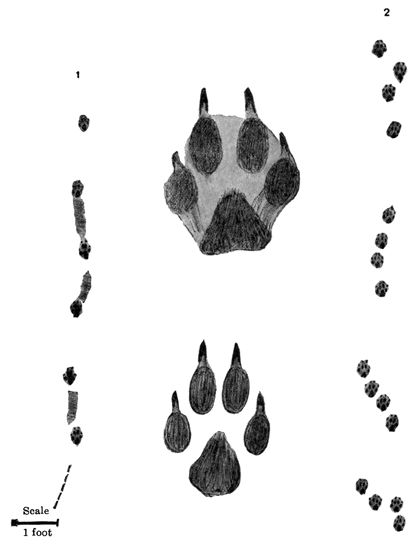
FOX. (TWO-THIRDS NATURAL SIZE)
Front and hind track. (1) Ordinary gait; the shaded part shows drag of
brush. (2) Running.
When no individual track is visible, as is the
case in dry snow, the blurry mark of the fox
brush which is frequently seen at intervals in the
trail settles any existing doubt. Some foxes, as
well as wolves and coyotes, drag their feet to the
same extent as does a dog that walks badly, and
because of this the tracker may disregard as immaterial
the prominence or absence of the drag
made by the toenails.
Hunting foxes with hounds is undoubtedly the
most popular method.
Calling him like the wolf and coyote yields
good results for the still-hunter, but of all
methods I prefer to shoot them during the rutting
season, which occurs in January. The rutting
season of coyotes is during February, and
that of wolves from January 1st until April,
approximately speaking. I have seen wolves
"run" as early as December 28th, and have
killed pups about two weeks old after the middle
of June.
It is on snowy, blustering days that, in the
depth of the woods, the fox is holding high carnival,
and his and her tracks run in all directions.
Watching where the trails are most numerous
soon furnishes work for the gun and trophies for
the hunter, for on such occasions the fox seems
to have lost the senses of sight and smell which
at other times are so well developed. It is a
singular fact that they always run the most during
the worst weather. In driving it is impossible
to tell where a wolf or coyote will leave a certain
thicket, beyond that it will not leave it where
it entered; but a fox is always the sure victim of
the hunter if he knows the fox path, for like the
bear or old boar, he and every one of his tribe
will always leave a thicket at the same point.
In calling, an old fox, like a wolf, comes
stealthily, while a young one, like a coyote, will
generally be in a hurry to get there.
BY the term "tracking" we usually understand
the following of a trail, but if a
hunter attempts to get a shot at his quarry
solely by this means he has to depend on good
luck or physical endurance. The cougar is, in
my opinion, the most perfect tracker and most
successful still-hunter; he tracks, but he does not
follow the trail like a pack of wolves or dogs;
he uses it only as a guide, following it for an
occasional fifty or one hundred yards, which is
to my mind the proper method for the human
hunter.
Tracking also means the ascertaining of the
preferred stand of certain animals. If, for example,
the rutting place of the biggest elk in a
district is located by comparison of various
tracks, and the bull is shot later by waiting for,
or stalking him at his favorite place, he undoubtedly
falls a victim to tracking. Again, a
track of a big bull moose is seen, and though it
is too old to warrant expectations of finding the
animal still in the locality, it is followed and
determines where the bull made his resting-place.
When, weeks later, perhaps, the fresh trail of
the same bull is seen and again the previously preferred
hillside, or another specific part of the
woods is hunted over carefully without attention
to the trail, but with all consideration for wind-direction
and lay of country, and a fair shot is
obtained, can it be doubted that tracking was
responsible for the downfall of this monarch of
the woods? If so, let the doubter once follow
a moose track straight and try to get an easy
shot: he will probably change his mind. The
locating of game, sometimes weeks in advance
of the time when the shooting is to be done, is
not by any means the least feature in the art of
tracking. To reduce, if possible, the annual
slaughter of men by careless hunters, it may not
be amiss to discuss certain hunting methods which
have given me the most satisfaction, and which
obviate the possibility of being fired at by mistake.
Stalking along in grown-up timber and other
open places, the sportsman will run across the
trails of all the animals which have moved in the
district he covers, and, having decided which trail
he wishes to follow, he keeps on in the direction
it leads. If it enters a thicket, a circuitous route—under
wind—will lead him to where the animal
has passed out, or show him that it is "fast," i. e.,
in the thicket. If the former, he, of course, has
to pursue the same tactics until the game is
located. The rest is generally easy enough, and
that without entering any thicket, where, as we
all know, it usually happens that hunters are
mistaken for deer.
Many hunters in relating their experiences tell
us how careful they were to hunt against the
wind, to approach their game. While it is well
enough to have the wind against one if the game
is in sight or driven toward one, I consider it
more judicious to make the wind serve me. Having
located an animal in a thicket, I select a
stump or some other elevation to windward which
allows the widest possible view, and simply wait
long enough to allow the wind to inform my
quarry of my presence. It will not require long
for the game to take the hint and get up—often
affording a shot by this means alone—to leave
the premises. Very few are the instances that
an old buck goes straight away and gives me no
chance to see him, because in that case he would
have to cross my trail, and to do that the wind,
or rather my scent, does not frighten him enough;
and if he goes out at the side which is untainted
by any scent of man, he is usually my meat—if
he is up to my standard. If the thicket is too
big, the smoke of a pipe will often do wonders.
The biggest buck I ever shot, became my victim
through the assistance of a smudge—the thicket
in that instance being about ten acres in extent.
The diagram (p. 130) will illustrate the method
better than words could. I have used it with success
on many animals, and even on a wounded
bear.
During snowless times no one can know with
certainty if a deer is in a certain thicket, and
the method has to be employed at random where
there are enough signs to make it likely that a
buck is near.
In hunting against the wind in open forests
more game is passed than many hunters would
suppose. The animals see the man, note that he
will pass them, and hide by getting as near to
the ground as possible. If they scent him after
he has passed, they evidently realize that the
danger is over, though some, mostly the younger,
inexperienced animals, then sneak off. Where
game is very wild it is often in such localities as
I have mentioned only possible to approach them
with the wind by outdistancing the latter, because
a big game animal at rest depends on its
nose to save it from danger in the direction from
which the wind comes, and on its eyes to watch
the side from which it can get no other warning.
Desirable game is often located on slopes, and
can be shot from an opposite slope if only it can
be made to move around slowly, the latter being
important, as shots in such cases have usually to
be fired at long distance, and the ability to hit
running game at three hundred or four hundred
yards is not possessed by everybody.
An imitation of the lamenting cry of a jack-rabbit
serves me best in such cases, though it has
often saved the game I was after, because it has
attracted a wolf, or a cat; and I would rather
kill one "varmint" than half a dozen bucks,
which last can at best elude a man who knows
how to track for but a limited length of time.
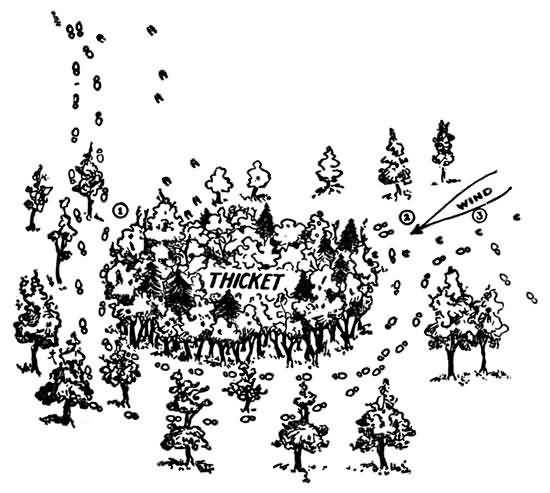
HUNTING WITH THE WIND
The stand is at 2 if the hunter is alone, and uses only his scent or pipe
smoke to drive the deer out of the thicket. If a smudge is used
for this purpose, as is necessary in big thickets, the stand is at 1,
and if the hunter has a companion, one stands at 1, and the other
at 2. A smudge should be made distant enough from the thicket—about
at 3—to give the hunter time to go around, and take his
stand at 1.
The sketch of leaps of wounded animals
apply to all of our hoofed game except bighorn
sheep. In any case, where one of them has been
fired at, the trail should be followed for at least
two hundred yards, as often an animal that goes
away with the bounds of an apparently sound
creature, will announce its distress through the
placing of its feet, a sure indication to the
tracker that he will be able to get his victim at
the trail's end.
THE jack-rabbit is generally a resident of
open country, though he may be found
also in woodlands; and, in some parts of
the country, when deep snow covers the lowlands,
he retires to the fastnesses of the mountains,
where, up to altitudes of eight thousand
feet, he frequents the range of Bighorn.
He is unquestionably the delight of the hunter
who desires to acquire efficiency in hitting moving
objects with a rifle bullet.
His tracks, being the biggest of the rabbit
tribe, cannot very well be mistaken for those of
any other animal. On sandy or muddy places
often only the imprint of the front part of the
hind foot is seen; and on hard roads, plow furrows,
etc., usually the mark of the toenails alone
is visible. When the animal is feeding or moving
along slowly, the whole imprints of the hind
feet are left, while with increasing speed only the
front parts of them touch the ground. The
forefeet rarely pair, and never if a jack-rabbit
is running. If the long-eared fellow decides in
the morning that it is time to retire for the day,
he usually runs along a road, cattle-runway, or
the like, returns in his own trail, and by a long
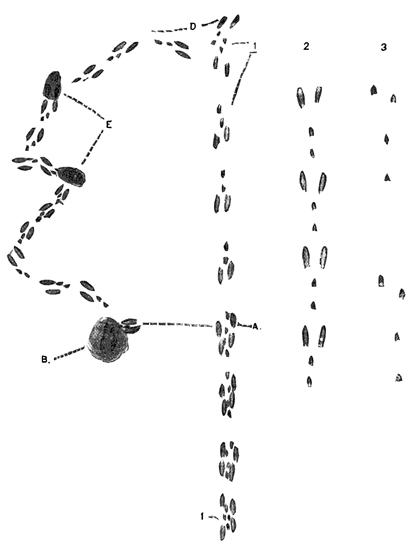
JACK RABBIT
(1) Morning trail (easy lope). (2) Moving slowly. (3) Speeding.
(A) Side-jump. (B) Day form. (E) Night forms.
(B to D)Morning trail and night trail (feeding).
side leap makes the trail seem to end. Where
he lands, the four footmarks are usually so close
together that they can be almost covered with
the hand. He may leap directly into his
"form," or he may repeat the same maneuver
several times; but one thing is certain, a jack
which acts in this manner is never far from home.
If pursued during the daytime, he employs the
same tactics again and again to throw the pursuer
off the trail. At feeding places slight forms
are often observed, and to follow the trail leading
from them means, as a rule, a tiring walk,
as those forms indicate that the jack has spent
the after-supper hours there.
I have hunted with men who blamed their dogs
if they failed to catch a rabbit with a broken
foreleg. They evidently did not consider that
a broken foreleg is of very little consequence to
the running efficiency of that kind of animal.
One with an injured hind leg, however, can be
run down easily.
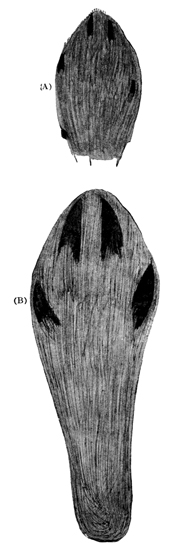
JACK RABBIT. (TWO-THIRDS NATURAL SIZE)
(A) Front foot. (B) Hind foot.
THE Varying Hare, though scarcely half
the size of the jack-rabbit, makes almost
as large a track, and when he spreads his
feet in passing over frozen snow his tracks are
fully as large. The entire track picture, however,
differs materially from that of the jack—the
individual tracks stand much closer together,
and the feet are usually paired. The hare makes
many different track pictures, but he cannot long
refrain from making the jump—shown slightly
reduced in the illustration—and a following of
the trail for a short distance will always dispel any
existing doubt, even if the individual tracks are
larger than those of a young jack-rabbit. There
is a much greater likelihood of mistaking the
varying hare's trail for that of the cottontail rabbit,
with which it has many points of resemblance.
Only the slenderness of the rabbit's foot serves
as a distinguishing feature in the trail so long as
they are both unalarmed. If, however, they are
put on the quick jump, the similarity of the two
trails disappears.
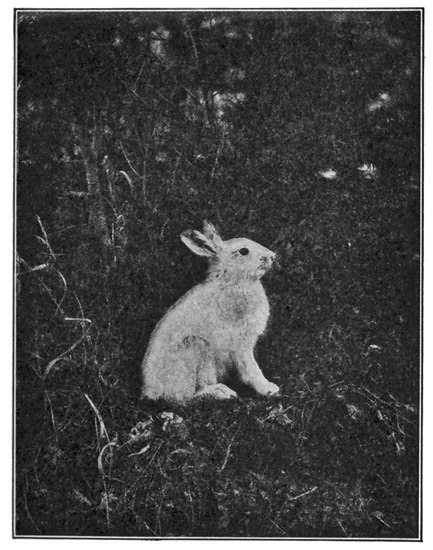
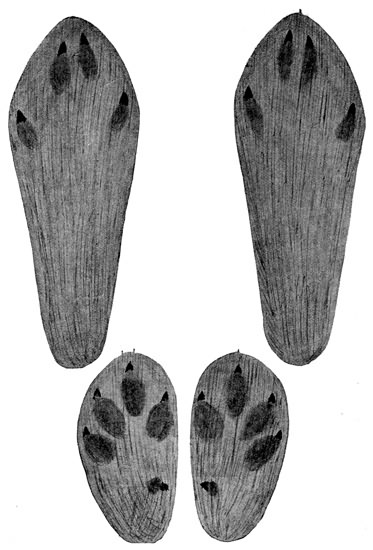
VARYING HARE. (SLIGHTLY REDUCED)
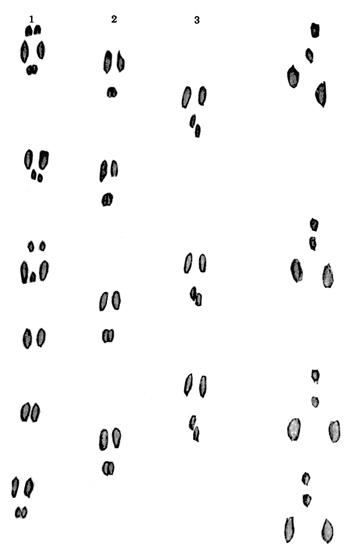
(1) At leisure (one to three feet). (2)
Steady lope (three to five feet); the
front tracks blend into one mark.
(3) On the quick jump (five to twelve
feet).
Varying Hare track when
the snow is deeper than
a couple of inches.
VARYING HARE TRACKS

Cottontail Rabbit
Tracks—
(1) At leisure.
(2) In a hurry.
AS can be easily seen from a comparison of
the life-size track picture of the varying
hare and cottontail—drawn from tracks
made under the same tracking conditions, i. e., on
ground covered by about two inches of snow, and
while the animals were running at approximately
the same speed—the tracks of the cottontail, besides
being much more slender than those of the
hare, are also more pencil-shaped at the point of
the toes. The toes are but faintly indicated, and
the toenails practically indiscernible, while in the
case of the hare both are plainly visible; in fact,
the imprint of the toenails is a prominent feature
in the track of the hare. In every case where any
doubt exists in regard to the tracks of the two
small varieties, this alone is sufficient to settle it;
as the toe marks are more prominent in the
front track, its appearance alone is sufficient for
the trailer to form a correct conclusion. Except
when jumping with the hind feet into the
front tracks two individual tracks
of the cottontail never blend into
one mark on account of the slenderness
of the feet. The jump
picture of both the small rabbits
in dry snow sometimes appears
very much like that of the marten;
but by following the trail for
a short distance one will always
dispel any doubt.
In illustrated articles the writer
has seen drawings and photographs
of tracks and trails
claimed to have been made by the
New England cottontail which
looked exactly like those made by
the varying hare. If there was
no mistake in identification, the
Western cottontail, which the illustrations
represent, evidently
makes tracks entirely different
from those of the Eastern variety.
There is every reason to believe,
however, that the track of
the same type of rabbit is the same in every part
of the country.
While the pursuit of big game is exciting
sport at times, hunting rabbits is always attended
with soul-satisfying fun. A famous occupant
of the White House found recreation and pleasure
in it, and I believe that few hunters who
ever entered into the true spirit of the sport have
failed to obtain a great deal of pleasure and
healthful exercise.
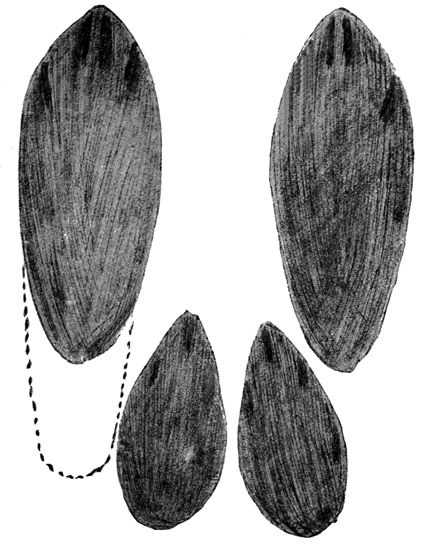
COTTONTAIL RABBIT
The dotted line shows the real length of foot.
THE squirrel practically always pairs its
feet when on the ground. Like the other
members of Group II its hind feet are
much larger than the forefeet, and, as in the
track-picture, are always planted ahead of the
latter. The hind feet point outward, so that
even by imperfect imprints, it may readily be
seen in which direction the trail leads. As there
is no other track known to the writer which could
be confused with the squirrel's, it is not necessary
to describe it; the illustration serves every purpose.
Where the remains of the feast of a
"varmint" are left in the woods—meat, entrails,
or bones—squirrel tracks are found in great numbers,
and the tyro is liable to take them for those
of other animals. Ordinarily a careful look is
sufficient to disillusion him, both as to the identity
of the tracks and the diet of the squirrel.
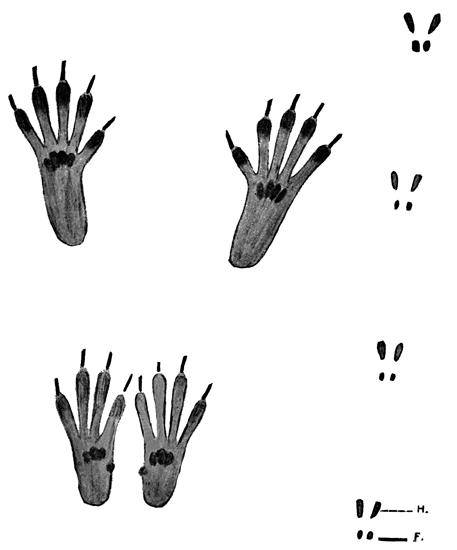
SQUIRREL. (ABOUT TWO-THIRDS NATURAL SIZE)
Besides tracks, the squirrel leaves other signs
which betray its presence in the woods—heaps of
cone chips near stumps and other elevations, or
strewn under trees one may find twigs from which
buds have been eaten. Sometimes the cries of
birds whose nests the squirrel may be robbing of
eggs or young, will betray his presence. It is
an entertaining pastime to hunt squirrels with a
small-caliber rifle.
The writer considers the squirrel one of the
most injurious creatures of our woods, and believes
that in hunting him it is better to use some
other weapon than the noisy shotgun.
THOUGH their habitat is entirely different,
these two animals make very similar tracks
and trails, so they are properly treated of
in the same division.
While the marten is a resident of the woods,
the black-footed ferret never leaves the open
prairie, where it lives in abandoned prairie-dog
holes, usually leaving its hole every second night,
unless it happens to kill a rabbit. It is the most
relentless enemy of the rabbit, and lives almost
exclusively on its flesh.
The track of the black-footed ferret is about
the size of a small marten's, but in soft snow the
soles of the toes show more prominently than
those of the latter, whose strongly haired feet
usually cause the sole marks to appear rather
indistinct.
Sometimes the trail of the marten looks like
that of the cottontail, but if followed for a short
distance it always assumes again the form of a
parallel trapeze, the evidence of the usual marten
motion to which the ferret adheres at all times
except in the pursuit of prey.
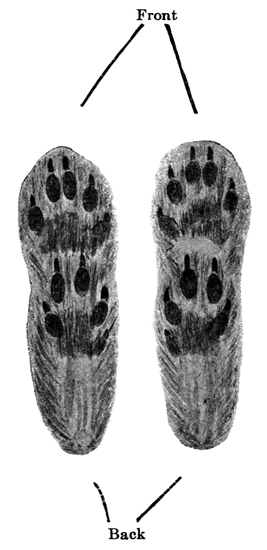
Marten track (one-third natural size), showing the four foot marks (not
the usual jump, see trails). The black-footed ferret makes a slightly
smaller track and shows not quite so much hair.
There is no reason for mistaking one for the
other, because, as aforesaid, they do not inhabit
the same locality; but if one does not know of
the existence of the wild ferret, then, of course,
one might track a supposed marten on the
prairie—as did the writer when he first came
West—where that animal never has been found.
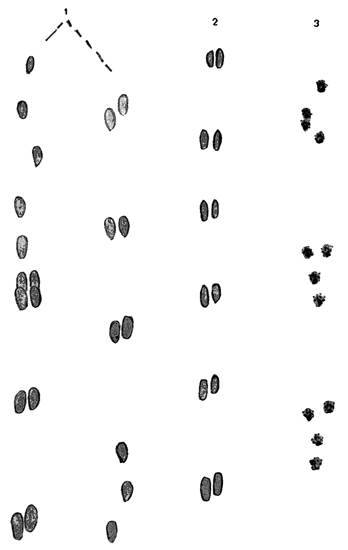
(1) Marten tracks. The lower part of the left-hand drawing shows the
usual marten motion, namely, the jump. The upper part of the
same drawing shows the walk, which is always only for a short
distance. (2) The black-footed ferret always pairs its feet and
never walks. (3) Running.
Tracking marten and shooting them is as successful
a method as trapping them.
If ferrets are tracked and their skin is wanted
whole, a trap not smaller than a No. 4 should
be set at the entrance of the hole, as the pretty
"varmint" mutilates himself if trapped and not
soon killed. If a ferret runs a rabbit into a hole
he may not leave it for two or three weeks, otherwise,
as stated, the ferret usually travels forth
every second night.
IT can be seen from the accompanying illustration
of front and hind tracks that the
footmarks of the otter are rather unusually
round; and on hard ground, which allows but a
slight impression, the almost circular standing
imprints of toes and heel show plainly. If the
individual tracks are invisible in dry snow, the
form of the trail, together with the drag made
at intervals by the long tail of the otter, obviates
any doubt as to what animal has made the trail.
The otter has a habit of leaving the streams
along which he lives, or which he visits, at regular
places, and makes what are called slides near
which parts of fish are frequently scattered.
Excrements containing fish bones found on
boulders and promontories in the rivers are unmistakable
otter signs that betray his presence,
even if no tracks or slides are seen along the
banks of the stream.
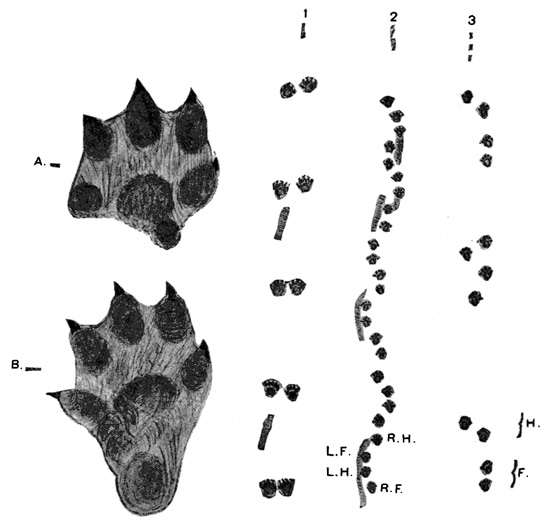
OTTER. (SLIGHTLY LESS THAN HALF NATURAL SIZE)
(A) Right forefoot track. (B) Right hind-foot track. (1) Jumping.
(2) Walking. (3) Running. The shaded line shows the drag of
the tail.
The otter is perhaps the greatest wanderer
among the mammals, and may, therefore, frequently
be found where he was supposed to be
extinct; though if he visits a trout-stream or
pond he usually makes his stay long enough to
deplete it to a greater extent than a host of fishermen
would.
Where otter signs are seen along small streams
or at favorable places along rivers, waiting for
them with a shotgun during evenings and moonlight
nights usually yields satisfactory results.
If one is shot, and there is no danger of the current
taking it away, it is well to keep quiet for
a time, as they often fish in pairs, and the second
frequently gives as good a chance for a shot as
the first.
The whistling call of the otter can easily be
imitated, and at big rivers on a clear night calling
them is good sport. However, the sportsman
must be patient, as the otter will answer
immediately, but will take his own time in coming.
On small streams it is well to post oneself
as near as possible to the water, as otherwise the
otter will pass unseen in the shadow of the bank.
Sometimes the otter travels for miles on land,
and if daylight surprises him there he will hunt
shelter for the day in any convenient hole. A
trap set in it, and the entrance closed with a boulder
is usually the easiest way to get his skin.
As the animal is especially destructive in trout
streams the sportsman gunner will always do a
great favor to the disciple of the rod when he
closes the career of one of these four-footed
poachers.
THE mink track presents some similarity to
those of the marten and the black-footed
ferret, but it is much smaller than that of
the marten, and the toe-marks are even more
prominent than those of the ferret, for which it
might be mistaken at times if it were not that the
form of the trails is different. The mink never
travels for long distances without showing at least
three tracks plainly in the jump-picture, while
the ferret practically never does this. The track
of the ferret is found near ice-bound streams only
when it crosses them to reach other hunting-grounds,
while the mink, being almost as skilful
at catching fish as the otter, generally travels
along a stream's course.
In destructiveness to small game the mink is
perhaps only equaled by the domestic cat, which,
in remote districts, he resembles in the habit of
hunting at all hours of the day.
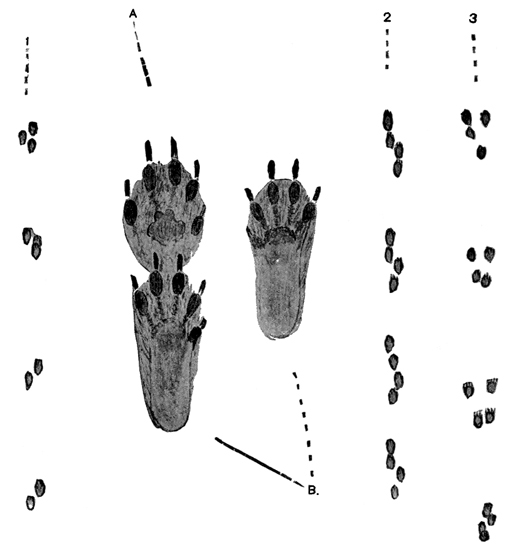
MINK. (LESS THAN ONE-HALF NATURAL SIZE)
(A) Left front-track. (B) Hind-tracks (a characteristic track picture).
(1) Ordinary jump. (2) Easy running. (3) Running.
Trapping is practically the only paying
method of hunting him. When he goes upstream
he leaves the water below rapids and travels
along its edge usually until he again reaches
quiet water. If a trap is placed in the intervening
space—the trail of the animal will show the
trapper the best point—every mink in that vicinity
may be caught without the trouble of baiting
traps, which is a rather uncertain method where
game and fish are plentiful.
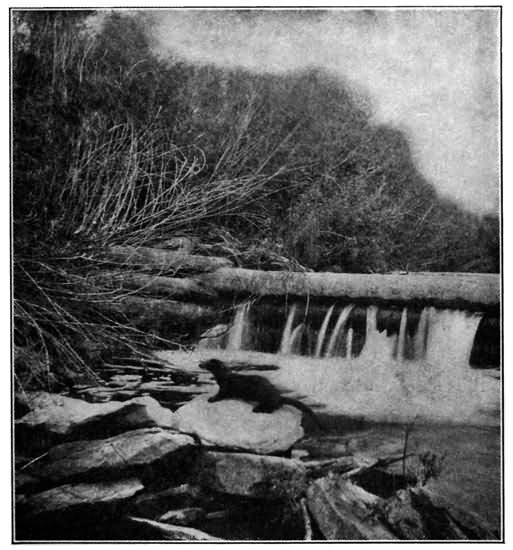
ALL lovers of our feathered song-birds kill
the weasel at every opportunity, believing
it to be one of the deadliest enemies to bird-life;
and if sportsmen bear in mind that every
time it gets a chance the little marauder fastens
its teeth in the neck of a grouse or a rabbit, they
will undoubtedly show it no mercy. Considering,
however, the number of injurious rodents it
kills, it is doubtful if this "little marten" is, on
the whole, more destructive than useful. Certainly
it does no more harm than the absolutely
useless squirrel. I leave it to others to argue
whether it should be killed or spared. I do not
spare it in ruffed grouse cover and near home,
where I wish to give the birds absolute protection.
Its tracks and trail, with the exception of the
walk, which the weasel does not use where it could
be tracked, are exact miniatures of those of its
large relative, the marten, and are, judging from
personal observations, frequently mistaken for
those of other animals even by sportsmen of long
standing. One will mistake its trail for that of
the deer, another for that of a coyote, fox or
lynx, and still another, under favorable tracking
conditions, will confound its track with that of
the mink or ferret. In loose snow, when its trail
is likely to be mistaken for that of any of those
mentioned, it should be considered that the jumps
of the ermine constantly vary in length, while the
individual tracks made by the other named animals
usually stand a regular distance apart.
If the tracker follows an ermine's tracks which
he takes to be those of a mink, he should soon discover
that the animal has entered every hole and
crevice along the trail, and that, judging by the
number of tracks around them, it found rock
piles, logs, brush heaps, etc., very interesting
and attractive. Now, marten or mink investigate
these things simply by passing over or
through them—if they do not stop inside—but
they never make regular paths around them as
the ermine does. Besides this, the ermine makes
a track hardly one-third as large as that of a
small marten.
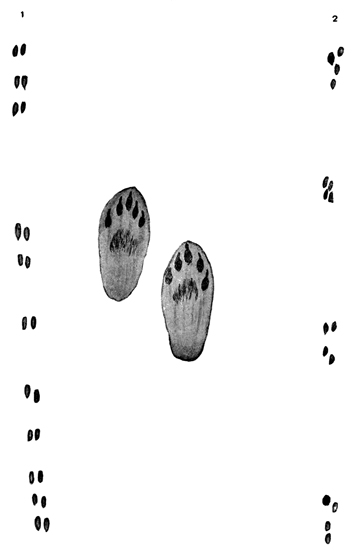
ERMINE TRACKS. (HIND FEET, LIFE SIZE)
(1) Ordinary jump. (2) Running.
I have again and again pointed out the above
features to men with whom I have hunted, yet,
presumably on account of not being thrown on
their own resources at the time, they seemingly
paid little attention to them, for I observed that
they repeated their mistakes just as soon as opportunity
offered. The secret of successful trailing
can be acquired only by the careful and
observant.
The features of a track or trail, once they are
thoroughly impressed on the mind, will always
be remembered; and he who is too careless to take
note of them, even when they are pointed out,
has only himself to blame if he spends time—hours
perhaps—in the pursuit of the trail of an
animal he does not want.
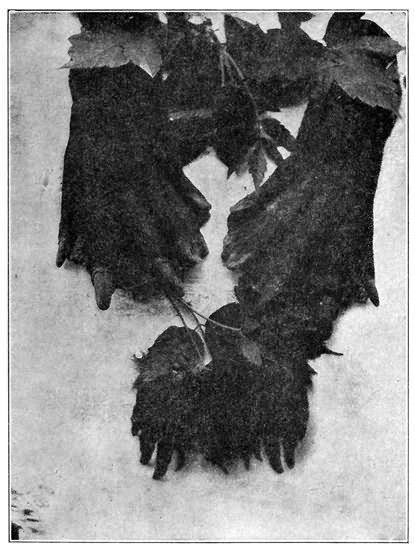
BEAVER FEET (ONE-THIRD SIZE)
THE beaver was once distributed to a vast
extent all over the globe, but is now found
in comparatively few sections of the Old
and New Worlds, and nowhere in great abundance.
The state of Montana, which until recently
had the largest number of them within its
boundaries, joined, during 1907, those States
where this interesting animal is practically extinct,
and the blackening "beaver stumps" along
its streams bear witness to the shame of the legislative
assembly of 1907, which left the beaver
without protection. For the extermination of the
beaver in this State the wealthy classes, and not
the trappers, must bear the blame, for without
the consent of the former the trapper could not
even have decreased the number of them without
endangering his own liberty.
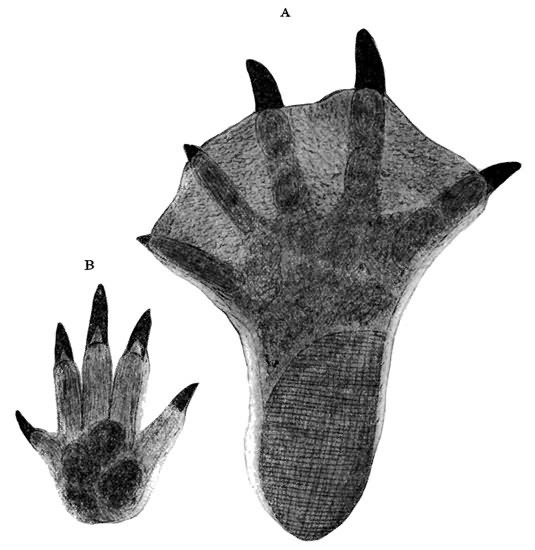
BEAVER. (ABOUT ONE-HALF NATURAL SIZE)
(A) Track of right hind foot. (B) Track of right forefoot.
Where the beaver is protected, he increases
rapidly, and if hunted with a rifle, he affords as
much excitement as any game that roams the
woods.
Business instinct, as well as sportsmanship,
should urge sportsmen to concerted action in
order to preserve and increase the comparatively
few beaver colonies now left on our continent.

BEAVER TRAIL
The third toe
touches
the center line.
The beaver's tracks most strikingly represent
the fourth group of mammals in this treatise.
In the effort to support and steady the body
adequately, the animal endeavors to plant its feet
as near as possible under the center of its body,
but its corpulency prevents, and the result is a
track so ridiculous that it is laughable. The front
tracks are covered with the hind feet, the third
toenails of which reach the center line, and the
heel of which stand, according to the size of the
specimen which made the trail, from four to eight
inches from it. The nails of the two
inside toes of the hind feet are but
to a limited extent visible as the web
between the toes protrudes them.
Where the beaver is scarce and
much pursued, the imprint of a
forefoot near the water's edge may
be discovered occasionally here and
there; in this case the prominence of
the toenails is unmistakable. I
may state here, that a front track
at the water's edge is often the only
sign which may be found along a
stream where beavers have become
very wary; they seem to be able to
live on almost nothing—leaves,
roots, etc.—for not a single cutting
can be discovered in such cases.
Where not sought extensively, the
hunter seldom notes the tracks of
this aquatic fur-bearer; cut willows or tree stumps
are, if not a surer, at least a more easily distinguished
indication of their presence, while on
much-used slides the tracks could not be seen
anywhere. It has been the writer's experience
that in every case in which he observed the building
of a new house by one of these animals, the
builder was invariably a female providing for a
happy family event.
ON our continent there is no other animal
which is responsible for so many broken
necks and limbs as the badger. While in
pursuit of his prey, he digs holes in the ground,
which when grown over with weeds or grass, are
almost certain death-traps for the unwary rider.
The man who enjoys riding after wolves or
the fox considers the badger as a menace, and is
never likely to look upon it with any degree of
favor, notwithstanding its decided usefulness as
a destroyer of undesirable rodents. I myself
bit the dust of the prairie four times within a
couple of months on account of this animal,
though there was no further damage than a
broken gunstock and sore limbs. I have since
killed everyone of the tribe when a chance offered,
though with some feeling of regret on account of
their desirable features.
The track of the badger is striking from the
prominence of the five-nail marks of the forefeet
and the twisted inward appearance of the
hind track which usually stands squarely in the
front track. Considering the size of the tracks,
the step-marks stand close together—about seven
inches—and, as in all animals of this group, to
some extent off from the center line.
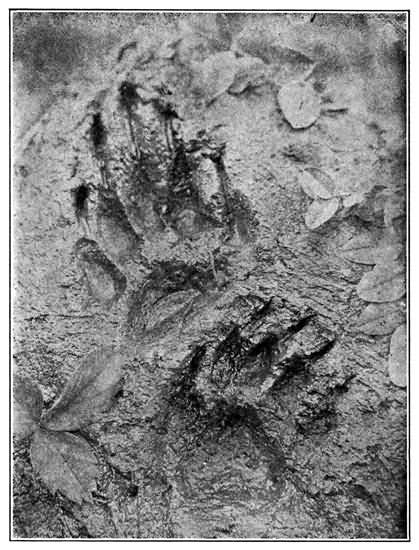
BADGER TRACKS; LEFT. (SLIGHTLY REDUCED)
It is readily tracked down, and when its hole
is approached, the animal frequently exhibits its
head as a target from its curiosity to see what
is coming. If run into a hole, it will almost invariably
reappear within a few minutes. If it
offers no chance for a shot, a trap placed at the
entrance and covered nicely generally brings
about its destruction. If no trap is at hand it
can be confined to its hole by tying a piece of
paper or a rag to a stick and placing it not less
than two feet from the entrance, which will prevent
its leaving the hole for twenty-four hours or
so. This is a surer method of keeping the animal
a prisoner than blocking the entrance, and works
satisfactorily also with other marauders that take
to holes.
A fox can usually be held thus for several
days, and by this ruse I have actually starved
two of them to death. There was in each case
three entrances, and but one trap at hand, which
was in both instances uncovered by the prisoners
during the first night.
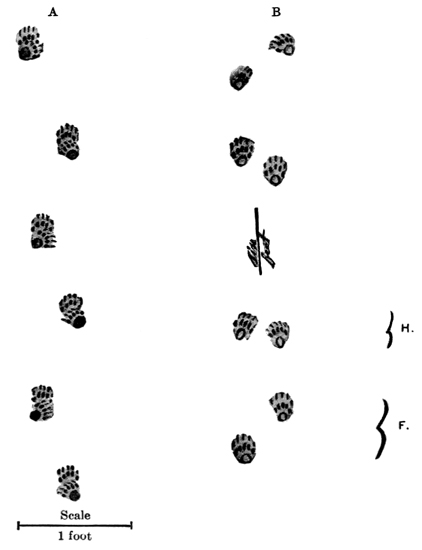
BADGER
(A) Walking. (B) Running.
As the ground was frozen hard, I did not wish
to bother with setting the trap at another entrance,
so I left things as they were, after covering
the instrument again. But the foxes knew
it was there all the same, and did not again try
to leave their prison by that exit, and the other
entrances were guarded by that fearful specter
of paper. Finally each one died about eight
feet from the scarecrow—about five feet inside
the hole, which was examined daily—one during
the nineteenth, and the other during the twenty-second
day of their imprisonment. Had the
ground not been frozen so hard as it was, the
experiment would have been unsuccessful, as each
of the foxes would of course have dug out at
some other spot. The latter method of escape
will be employed by the badger in every case
where the trap is not properly covered.
IT may appear out of place to discuss this
creature which has no sportive quality whatever,
but its trail is so conspicuous in snow
that it cannot be passed without being noticed,
and the tyro, attracted by the size of the tracks,
will in many instances follow it, thinking he is on
the trail of something else.
A short time ago I trailed a supposedly lost,
inexperienced hunting companion who had run
across the trail of a "bear," as he thought, and
followed and killed "Bruin," who happened to
be up a tree. When I caught up with the young
fellow, he was contemplating his broken gunstock,
smashed in finishing the "varmint," but
proudly exhibited, to my great hilarity, the
"bear" which may have weighed about twenty
pounds, and whose fur consisted mainly of quills.
Before I got acquainted with the "pine-porker,"
I tried in vain for a period of four
months to ascertain the identity of an animal
whose tracks I frequently saw on a road. Only
the marks of the soles were visible there, and
none of the many men I asked knew that track,
though they knew the animal which made it very
well, as developed later, when tracking conditions
became so that I could follow the trail to its end.
If conditions are half-favorable, the imprints
of the toenails—four on the forefeet and five on
the hind feet—are always visible.
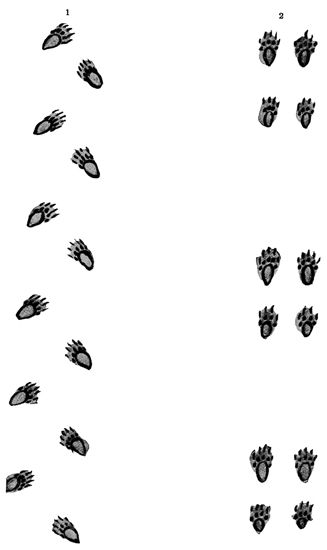
PORCUPINE TRACKS
(1) Walk. (2) Run.
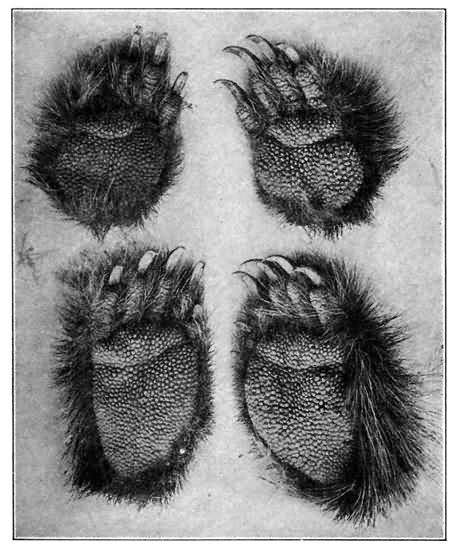
FEET OF THE PORCUPINE
Four toes on front and five toes on hind feet (about one-half natural size)
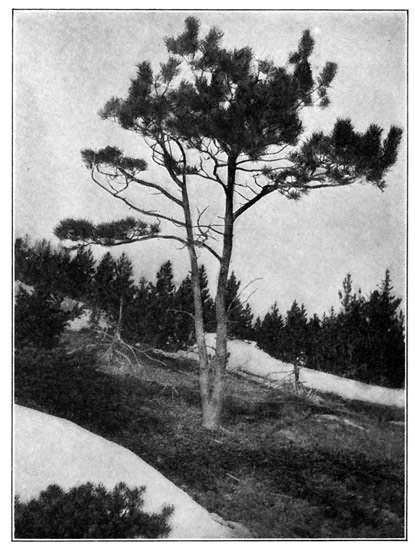
SIGN OF THE PORCUPINE
(Bark eaten from the tree)
If the snow is a few inches deep, the tracks
stand in a trough-shaped trail because the animal's
body almost touches the ground. The toes
point inward, and almost touch the center line.
In the snowless woods numerous small dead trees
attract the attention of even those not interested
in forestry. If these trees are examined they will
reveal the mark of the porcupine, easily recognized
by the partly eaten bark.
Along the streams of the Bad Lands the limbs
of cottonwood trees are sometimes depleted of
every vestige of bark, which loss ultimately
causes the death of the trees. Where forests are
cared for on an economical basis, the porcupine
is certainly a proper subject for extermination.
Their meat is excellent if fried quickly in hot
lard; roasted, or cooked slowly, it emits an odor
repellent even to a hungry man.
THOUGH an inexcusable intruder in the
chicken coop and where game birds are
raised, the skunk is decidedly useful from
the standpoint of the forester or of the farmer.
In the writer's opinion, sportsmen if they encounter
him in the woods should cease to kill the
animal just because it is "only a skunk"; others
of the fraternity advance the "just because"
argument if they are questioned why they
"shoot" the nests of useful hornets. The skunk
may rob a few birds' nests during the summer,
but his main diet consists of larvæ and berries,
and by destroying the former he is of inestimable
value to the forests and fields near his residence.
I am thoroughly convinced that his introduction
and absolute protection in localities where
moths, butterflies and the like, in their undeveloped
stage, have become a menace, would greatly
help to solve the problem of rendering these pests
harmless.
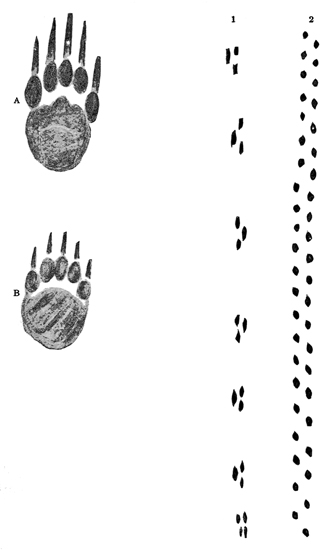
SKUNK
(A) Front track. (B) Hind track (life
size). (1) Easy lope. (2) Walk.
With every skunk we kill we interfere with the
balance of nature, and the resulting deficit has
finally to be met with the pocketbook by paying
for artificial substitutes for nature, which if left
alone would do the work much better.
In the summer woods it is not so much the
skunk's tracks which tell of his presence and
merits, as the numerous small holes in the ground,
about a couple of inches deep, from which the
animal procures the larvæ there awaiting the final
stage of development.
The soles of the skunk's feet are similar to
those of the badger, while their size about corresponds
with that of the domestic cat; the
toenails always show conspicuously under fair
tracking conditions.
The individual tracks stand about half as far
apart as do those of the domestic cat, and are
always considerably out of line. Like the other
members of this group, the skunk betrays himself
by his trail; he is a slow animal, and presumably
would not put on speed if he were capable of it,
since, when foraging he is never in a hurry, and
if molested it is usually the disturber who prefers
to employ speed.