The cashier of the safe deposit company kept gazing
in silence at Carter with open-mouthed astonishment.
Nick’s countenance was illumined with an expression
of triumph. He held in his hand damaging evidence
against Simeon Rich.
If Rich were innocent of the murder, how was it
that he had in his possession one of the bills which
the cashier of the safe deposit company had paid to
the man who had been so cruelly murdered at the Red
Dragon Inn?
“This is a valuable clew,” the detective said, when
the silence was becoming oppressive.
“How did that bill come into your possession?” the
cashier asked.
“I think you can keep a secret?”
“I can.”
“Then I will tell you.”
Then Carter gave the cashier a short account of
the evidence which he had collected.
When the detective finished the cashier remarked:
“Captain, you are gradually weaving the coils
around Simeon Rich.”
“Yes,” Carter replied, “I am weaving coils around
him, but I have no positive evidence that he committed
the crime.”
“That note?”
“Not positive. If he has others of the series in his
possession, then the coil will be stronger around him.”
“I understand. What move will you make next?”
“I cannot determine just now.”
Carter was elated over the discovery.
After leaving the cashier’s office he went direct to
the house on Fourth Street.
Here he found that Brockey was still a prisoner.
His young assistant was on guard.
“Brockey,” said the detective, as he stood in front
of the prisoner, “have you spent all the money that
Darwin gave you?”
“What’s that to you?” Brockey snarled, being in an
ugly mood.
And no wonder!
Who could blame him?
Brockey was by no means a stoic or a philosopher.
His was a nature which would brood on troubles.
There was bitter hatred and malice in every flash
of his eye. No love there, no appreciation of the detective’s
ability!
Carter gazed down into that dark countenance. He
read the man’s thoughts.
“If you have any of that money left,” Carter replied,
in a serious tone, “some of it may be bills which
were stolen from the murdered man.
“I have the numbers of those bills in my possession.”
Instantly the expression on Brockey’s face changed.
A look of terror came over it.
It had not occurred to him before that the money
might have belonged to the man who was killed at the
Red Dragon Inn.
“Do you understand?” Carter asked at length, when
Brockey made no reply.
“I understand,” the rascal said, with a gasp.
“If you should have one of those bills on you, and
if it should be identified as belonging to Lawrence,
then, if I were so inclined, I could fix the murder
on you.”
“You would not do that?”
“No, I would not.”
“I have some of the money.”
“Is it in your pocket?”
“Yes.”
Carter put his hand into Brockey’s trousers pocket
and pulled out a small roll of bills. He ran the money
over and found one of the series.
“This is one,” he remarked, holding the bill up for
Brockey to inspect.
“My God!” the rascal ejaculated.
“You will have to tell now in court how this came
into your possession.”
“I’ll tell quick enough.”
“I guess you will.”
“Let me look at the number.”
“See?”
“I do.”
The rest of the money the detective gave to Brockey.
The bill he marked and put away in his pocketbook
with the others.
The evidence against Rich was stronger.
But still more evidence was needed before a case
could be proven.
Carter left the house.
Slowly he walked through to Broadway, and when
he reached that thoroughfare he halted on the corner
and reviewed the events of the past few days. He was
forced to acknowledge in spite of himself that the evidence
against Simeon Rich was strong.
But still he was not satisfied.
Dora Ferris’ testimony and that of Lena Peters
would be damaging.
The testimony of the cashier, the cabman, and
Brockey would be sensational.
And the note which he had found in Darwin’s room
in Dora’s flat would tighten the coil.
But it was not enough.
“Every link in the chain of evidence must be complete,”
Carter muttered. What move ought he to
make?
“Should he close in on Rich and his pals and take
the chance of discovering the needed evidence against
them?”
“No, I won’t do that,” the detective muttered, as
this question flashed through his mind.
He turned and wended his way uptown.
It was seven o’clock when he halted in front of the
Studio Building.
Some force seemed to impel him to enter. He did
not go near the elevator; but he walked upstairs to the
top floor. He strolled along the hall and stopped in
front of the door of Rich’s room.
No light shone through the transom.
Were the conspirators out?
Carter knocked.
No one came to the door.
“They must have gone out,” he muttered.
At the same time he pulled a skeleton key out of his
pocket and inserted it in the lock of the door.
Two quick turns of the key and the bolt of the lock
slipped back.
Carter entered the room, and struck a match.
As the flame flickered up, and after he had looked
around, he uttered an exclamation of surprise.
Around him were all the evidences of hasty flight.
The birds had flown.
Carter lit the gas.
Then he was able to make an inspection.
A look of chagrin rested upon his face as his eyes
wandered around the room.
The furniture belonging to the room of the building
was not disturbed.
The floor was strewn with rubbish.
After the detective recovered from his surprise he
commenced to make a search of the apartment. He
rooted among the scraps of paper on the floor in the
hope that he would find something of value.
He made no discovery.
Every bureau drawer was gone through.
Nothing.
At last Carter made a search of the two closets.
Result?
Nothing.
He stood in the center of the room thinking.
His eyes wandered around.
Was there any evidence in that room? He asked
the question over and over again.
He was confident that his search had been most
thorough. But had it been? Was there not some place
about that room which contained evidence, and which
had escaped the eagle eyes of the visitor?
Carter suddenly started.
“The fireplace!” he ejaculated, and he sprang forward.
At that moment his eyes had fallen on some soot
which covered the carpet in front of the fireplace.
What did this indicate? He had not examined the
fireplace!
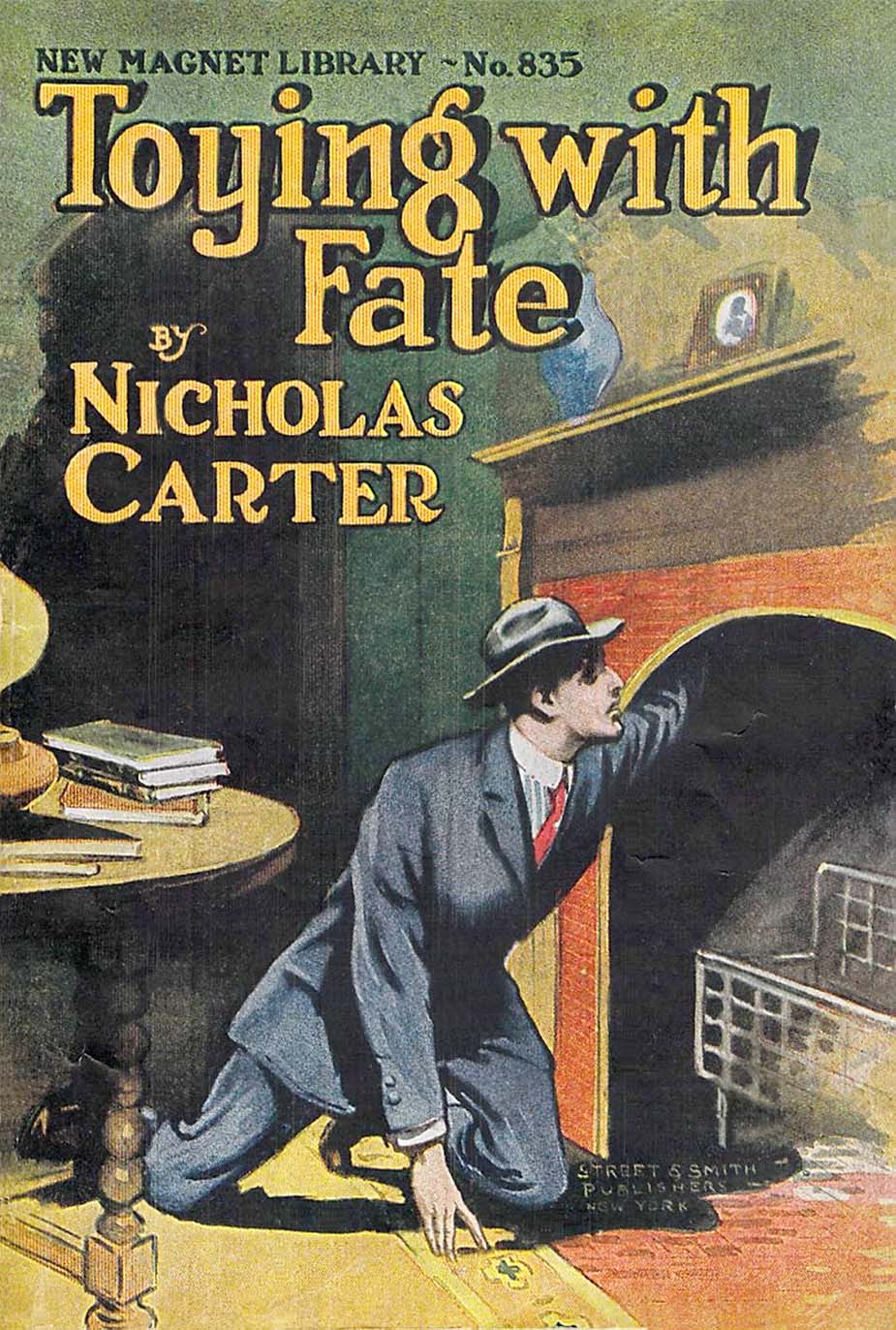
Down upon his knees he fell in front of the grate.
Up into the chimney he thrust his hand and arm.
The next instant he pulled out a large bundle.
A cloud of soot fell down, and the detective was
covered with it.
He paid no attention to it.
All of his thoughts were on that bundle, which he
carried over to the center of the room.
Slowly he unwound the wrapper.
Then a long ulster was disclosed.
Carter shook out the folds.
A black slouch hat and a false beard fell to the
floor.
Was it any wonder that the detective’s hands shook
as he gazed upon and held this evidence?
He examined the ulster.
Down the front were a number of dark stains.
Upon the right sleeve was a large dark splash as
large as a man’s hand.
“Blood!” Carter ejaculated, as he inspected these
stains.
He looked inside the ulster at the stamp on the
strap.
“Made by Delaney,” he read.
“This was made to order,” he muttered.
“For whom?”
That was the question.
“I’ll find out!” he ejaculated, after a moment’s
thought.
Down into the pockets of this ulster his hand was
shoved.
One after the other was turned inside out.
Not a scrap of paper could he find.
All the outside pockets had been gone through.
Then Carter turned his attention to those inside.
“Nothing!” he muttered.
It was disappointing.
But the detective was not downcast. He picked up
the slouch hat and the beard, and examined them.
Inside the beard was stamped the word Dazian.
“That’s the name of the costumer,” Carter muttered,
as he read that name.
There were no marks inside the hat.
The lining had been torn out.
The ulster and the hat the detective tied up in a
bundle, and the false beard he put into his pocket.
For a few minutes longer he remained in the room
searching, but he made no further discovery.
Taking the evidence under his arm, he left the apartment.
It was an important discovery. He felt sure that
he had in his possession the ulster worn by the murderer
when he committed the crime.
In going down in the elevator the detective questioned
the boy in charge.
The boy said that Rich and Darwin had moved out
just at dusk, and they did not say where they were
going.
Carter stopped at the office, and the clerk was not
able to give him any information.
When he left the Studio Building he was perfectly
calm. He did not seem to be disturbed about the sudden
departure of the men.
The thought that they might have left the city did
not enter his mind.
Carter crossed Broadway to the little park in front
of the bank building.
Here he moved about among the cabmen making
inquiries.
All claimed that they had not taken any fares from
the Studio Building.
From Greeley Square the detective walked across
to the opposite corner, where a solitary express wagon
was standing.
The man in charge was partly intoxicated.
“Did you cart away anything from the Studio
Building this evening?” Carter asked as he came up
to the man.
“You may bet I did,” the man blurted out in thick
tones. “I made a good stake.”
“They were nice men?”
“You may bet they were.”
“Where did you leave the things?”
“In a flat at number two hundred and forty-one
West Thirty-sixth Street.”
“What name?”
“Lawrence.”
“Are you sure that was the name?”
“Of course I am. The tall fellow wrote it down on
a slip of paper for me.”
“Was he at the flat to receive the things?”
“No. The two ladies were there, though.”
“Only the two ladies?”
“That was all.”
Carter did not go direct to the address on West
Thirty-sixth Street after he left the expressman. He
hurried down to Union Square and entered Dazian’s
musty-smelling establishment.
To the clerk in charge he showed the false beard.
“We made that,” the clerk said, after he had examined
the disguise.
“Do you remember selling a beard like that lately?”
the detective asked.
“I remember selling this.”
“You do?”
“Yes.”
“When did you sell it?”
“The morning of the day before New Year’s.”
“To whom did you sell it?”
“A tall man.”
“Did you sell him anything else?”
“Yes.”
“What?”
“A Moorish dagger.”
“Anything else?”
“No.”
“Did he give you his name?”
“No. He paid for the things and he took them away
with him.”
“What kind of a coat had he on?”
“An ulster.”
“What kind of a hat?”
“An old slouch.”
“Is this the color of the ulster?”
Carter untied the bundle while he was talking, and
now he displayed the ulster in front of the clerk.
“It was that color,” the young man ejaculated. “And
that is the slouch hat. I remember noticing that the
rim was slightly torn.”
“Would you be able to identify that man?”
“I would.”
“Was he alone?”
“Yes.”
The detective next went to the tailoring establishment
conducted by Delaney. He showed the ulster to
the manager.
“We made that garment six years ago,” the manager
said, after he had inspected the coat.
“Can you tell for whom?” Carter asked. “If you
can tell me, I shall be greatly obliged.”
“I can. Do you notice this number in indelible ink
on the pocket flap? Well, that is the number of the
order. I will refer to our books.”
He walked back into the office and examined a
large ledger.
In a few moments he returned to Carter and said:
“That coat was made for a gentleman named Simeon
Rich.”
“Thank you,” Carter rejoined, and then he departed.
The coils around Rich were tightening, but the detective
had not found that weapon with which the
crime had been committed.
Perhaps the murderer had thrown it away.
That was likely.
That the weapon was a Moorish dagger and the
one purchased at Dazian’s the detective was convinced.
On a mere whim, Nick took all his evidence down
to police headquarters and made a report to the chief
inspector.
When he was through the chief said:
“I will send out men to fetch in all the witnesses.
“We will assemble them here in this room, and
then, if we corral the conspirators, we will bring them
in. Mark my word. We will get a confession from
one of them.”
“I’ll make out a list of the witnesses.”
“Call them off and I’ll write them down.”
“The bartender at the Red Dragon Inn, Doctor
Thompson, Peter Wright, Brockey Gann, Lena Peters,
Lem Samson, Dora Ferris, Dazian’s clerk, the cashier
of the safe deposit company, Delaney’s manager, and
the cabman, number one hundred and forty-seven.”
“I’ll send out men for them.”
“Very well.”
“What are you going to do?”
“Close in on Rich.”
“Do you need assistance?”
“Give me two men.”
The chief inspector called in two men and they
went out with Carter.
They entered a taxicab and were driven to the
address given to the detective by the expressman.
The name of Lawrence was on the letter box belonging
to the first flat.
Carter entered the hall with his men.
One of them he sent back to guard the back door
of the flat and prevent escape by that exit. Then he
knocked on the front door, which was opened by a
tall, comely, gray-haired woman.
Within he heard voices.
“What do you want?” the woman asked, as Carter
and his aid shoved past her.
The detective made no reply. He and his companion
darted into the parlor.
Rich and Darwin and three women were there.
All sprang to their feet.
The women screamed.
Carter covered the men with his revolver and exclaimed:
“Rich, there is no chance for you to escape. The
house is surrounded by my men. You may as well
submit quietly.”
“What does this intrusion mean?” Rich demanded.
“It means that I arrest you for the murder of Alfred
Lawrence, and these others”—looking around the
room at the others and pausing for a moment—“I
arrest them as your accomplices.”
In a short time the two men were manacled.
They offered no resistance, because they saw that
it would be of no avail.
The two detectives guarded the prisoners while
Carter made a search of the flat.
In a trunk belonging to Rich he found a Moorish
dagger, the blade and hilt of which were stained with
blood. He also found an old pocketbook with papers
belonging to the murdered man in it.
On this were marks of bloody fingers.
The woman who admitted Carter was the wife of
the murdered man, and the third woman in the parlor
was Lawrence’s daughter. She was a beautiful young
woman, but at a glance the detective saw that she had
been leading a life of dissipation.
The prisoners were taken to police headquarters.
When Rich was led into the chief inspector’s office
and he beheld the witnesses congregated there all his
bravado fled.
“The game is up!” he ejaculated, and he sank into
a chair, his handsome face the color of death. “You
cornered me, Mr. Carter. I killed Lawrence. There
is no use for me to deny anything. When I learned
that he was about to be released from Sing Sing I
made up my mind to kill him. I feared him, and so
did his wife. I knew there was evidence in existence
to prove that we had conspired against him.
“I suppose you have received statements from all
these people and there is no use for me to make a long
confession.
“All I’ll say will be that I tracked Lawrence to the
Red Dragon Inn, and when the bartender’s back was
turned I slipped upstairs and hid in the parlor.
“Then I waited until the house was quiet, when I
stole up to Lawrence’s room and killed him.
“I escaped through the window and then down the
ladder to the back yard.
“I solemnly swear that Mrs. Lawrence and her
daughter had nothing to do with the crime.”
The mystery of the Red Dragon Inn was solved at
last, and when the newspapers published the facts in
regard to the work done by Carter a sensation was
created. Nick had little time to bask in the glow of
journalistic applause, even had he cared to do so. He
was soon plunged in the case to which his assistants
had been paving his way by their investigations.