To tell the history of toy-making from its earliest days it would be
necessary to follow the story back through many centuries, for the
archaeologists, in delving among the tombs of ancient Greece and Egypt,
have made the surprising discovery that children played with dolls, and
jointed dolls at that, more than five thousand years ago.
Moreover, by the side of these dolls scientists have unearthed other
playthings that children still crave: doll's furniture, animal toys and
toys with wheels, illustrating the methods of transportation of those
early days.
These same scientists claim that the custom of playing with dolls and
other toys is as old as the world itself and that playthings are, and
always have been, just as necessary a constituent of human health and
development as either food or medicine.
They claim that the reason that boys and girls crave toys is that nature
requires them, and to deprive children of such playthings would be to
retard their mental growth and development.
The Latin word trochus means a hoop for children. The hoops of Roman
children were made of bronze and iron and were rolled by a sort of a
crooked stick and sometimes had small bells attached.
Pupa, the Latin word meaning "a little girl," applies to dolls which
were made from rags, wood, wax, ivory and terra cotta. When the Greek
girls of that time married they dedicated their dolls to Artemis; the
Roman girls, to Venus; but, if they died before marriage, their dolls
were buried with them.
The Latin word crepundia meant children's playthings, such as rattles,
dolls, toy hatchets and swords.
The toys made during the middle ages for the children of noble families
and rich merchants, show special care and fine workmanship. Many of them
were of a religious nature in the form of the Cross of the Crusaders, or
military in origin, like miniature knights on horseback. The toys of
this period were generally carved by goldsmiths.
The American Indians and the Esquimaux made dolls from bits of skin and
fur of wild animals and gaily decorated them with shells, beads and
feathers. They also carved small models of animals and human beings from
wood and bone.
The oldest European toy manufacturing center is Nuremberg, Germany. This
town is especially noted for its metal playthings, like the lead
soldiers, which were the delight of our childhood. Sonneberg, in
Germany, is the greatest European center for the manufacture of wooden
toys.
Winchendon, Mass., is the greatest toy manufacturing center in the
United States, nearly every enterprise in that town being toy-making.
In spite of the early origin of toys the progress of manufacturing
playthings has been so slow that, even as late as one hundred years ago,
the types of toys were few in number, simple in construction and
extremely expensive, especially in the United States.
There was no systematic manufacture of such articles, and, as the cost
of importation was very high, comparatively few persons could afford
such means of amusement for their children.
The children of those days accepted more primitive things, dolls that
were often merely pieces of cloth folded and pinned in such a manner as
to suggest the outline that was not there.
A few other toys such as hoops, jumping-jacks, tenpins, marbles,
battledore-and-shuttlecock and alphabet blocks, represented the limit of
the toy-makers' stock.
In America the toy-making industry is of quite recent origin. Before
1875 more than ninety per cent of the toys sold in this country were of
foreign manufacture, and those that were made here were never exported
to other countries. Today, however, about five per cent of the toys sold
here are made abroad and the rest are manufactured here in our own
country. Up to 1875 there was not a doll factory in the United States.
Today, while we import some dainty toys from France, Germany and
Switzerland, nearly all the newest, unique and mechanical productions
are made in America.
Simple toys are mostly made of wood and metal, and the same principles
employed by mechanical engineers, in duplicating parts of machinery, are
used in making duplicate parts of toys.
When a design has been decided on, it is reduced to its most simple
element. Jigs are then made so that each piece will be an exact
duplicate of every similar piece, and the construction is pushed through
on the American factory system.
Some toys are very elaborate, costing several hundred dollars. These
are readily purchased, however, by people of means.
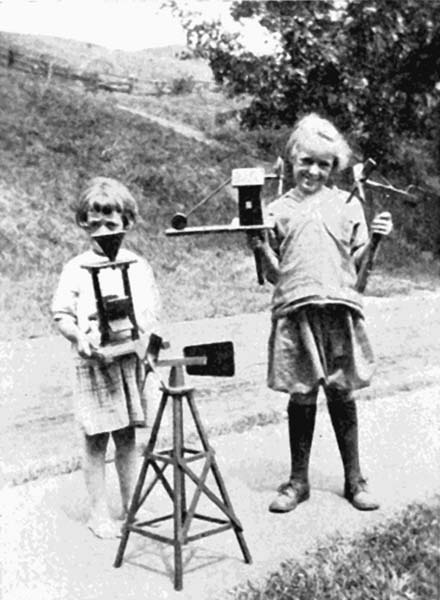
In the author's opinion the best kind of toys are those which suggest
rather than fulfill, and those with which the child can really do
something. Mechanical toys, which supply their own energy, should not be
allowed to take the place of those into which the child must infuse part
of his own life and energy. It follows naturally, then, that the toys
made by the children themselves are the ideal ones.