From the report of divers curious and experienced persons I
had been assured there was little more to be seen in the rest of
the civil world after Italy, France and the Low Countries, but
plain and prodigious barbarism.
Evelyn, Diary (1645).
The route of the Average Tourist being
determined by the considerations above-mentioned,
he was naturally directed
to those countries whose situation enabled them
to influence the course of events in his fatherland,
whose development and conditions contained
the most pertinent lessons for him as a man and
as a statesman, and whose climate, accessibility,
and inhabitants were such as hindered travellers
least. These countries were: Italy, France,
the United Provinces (i. e., Holland), the Empire,
the Spanish Netherlands (corresponding to Belgium),
England, Poland. This order is that in
which they would probably have appeared to arrange
themselves according to their importance
for the purposes under consideration. The omission
of England in the chapter heading is due, of
course, to Evelyn having started thence; of the
Empire and Poland, to the date at which he is
writing, near the close of the Thirty Years' War; a
date which, while within the period with which
this book has to deal, is later by nearly half a
century than the central date, 1600, to which all its
undated statements should be taken as referring.
Whatever criticism might have been passed on
this order of importance by this or that adviser,
not one would have been found to dispute the
preëminence of Italy. Whereas now there is no
form of human effort in which the inhabitants of
Italy have not been equalled or surpassed, it
seemed then as if there had never been any in
which they had been surpassed and very few in
which they had been equalled. So far as Art and
antiquities go, there will be no need to persuade
anybody of the likelihood of that; nor probably,
with regard to venerableness of religion or romance
of history. But the very easiness of imagining
the supremacy which would have been conceded
Italy on these points tends to close the enquiry
into the causes of its hold on men in times gone
by, and consequently to obscure the fact that
Italy then not only stood for all that Italy stands
for now, but also in the place, or rather, places,
now occupied by the most advanced States in
their most advanced aspects; for everything, in
fact, that made for progress on the lines considered
most feasible or probable at the moment; for
progress, not only in culture, but in commerce
and commercial methods, in politics, in the science
of war, in up-to-date handicraft, and, especially,
in worldly wisdom. Even a baby-food was assured
of greater respect if made from an Italian
recipe, such as the paste made of bread-crumbs,
wheat-meal, and olive-oil, of which De Thou
nearly died. In short, if the value of Italy as the
colonizer of Europe in regard to mental development
belonged by this time to the past rather
than to the present, its reputation as such must
not be ante-dated, as is generally done, and ascribed
to the age when it most thoroughly deserved
that reputation. Here, on the contrary,
as usually, merit and credit are not contemporary.
And there was plenty to deceive those who did
not look far below the surface. In discussing politics
the newest set-phrases would be those
brought into use by Italian writers; "balance of
power," "reason of state," etc.; the word "status"
itself, as a substitute for "Respublica," was
both a sign of the times and of Italian influence.[39]
So with commercial terms, we find, for instance,
the word "provvisione" (commission) being used
as late as 1648,[40] by an Englishman who had
never been to Italy, while the control of Italy
over one of the later forms of the Renascence,
that of the art of gardening, is indicated by the introduction
of the word "florist" from the Italian
during the seventeenth century. The only modern
author, moreover, whose acquaintance a European
schoolboy was certain to make, was the
Italian versifier whom Shakespeare calls "good
old Mantuan," and even if we look at things from
to-day's standpoint the most remarkable professorship
of the period would surely be accounted
that of Galileo at Padua, 1592-1610. In another
respect, too, connected with education, the relative
maturity and crudeness of civilisation south
and north of the Alps is even more apparent to-day
than it was then. The "Trans-alpine" shared
more or less Erasmus' belief in the power of words
as a means of education, whereas in Italy, and
in Italy alone, was it insisted that the influence of
environment, personal and physical, is the factor
compared to which all else is of but little account.
The first theory is abandoned now by all who can
afford to do so, the second is that of the best
effort of to-day.[41]
As for the technique of war, more than half-way
through the seventeenth century, when
Louis XIV wanted the very best available talent
to design the completion of the Louvre, it was to
Rome that he sent, and the artist, Bernini, is
recorded[42] as saying, to allay jealousy, that there
was no need for Frenchmen to be ashamed of an
Italian being called in for this purpose, seeing
that in the kind of knowledge in which they excelled
all Europe, that of war, their teachers were
still Italians. And the modernity of the latter's
reputation for supremacy in military knowledge
is thrown into relief by a remark of Bertrandon
de la Brocquière, writing in 1433, taken in conjunction
with the above. The latter was a clear-headed
Fleming of wide experience who, when
drawing up a plan for the right composition of
an army which should suffice to drive the Turks
back, only mentions French, English, and German
soldiers.
As regards applied science, again, we find
Evelyn writing of the harbour-works at Genoa,
"of all the wonders of Italy, for the art and nature
of the design, nothing parallels this." Now
Evelyn was certainly not a man to underrate the
rest of the wonders of Italy. As for comparisons
outside of Italy, all Europe had by his time settled
down to compete in the application of science
to every-day life. And as to the products of the
soil, is it not probable that if, nowadays, Europeans
left the soil to take care of itself, and the
day-labourer to take care of the seed and the preparation
of the product, Italy would regain the
first place as a producer of luxuries?
Such points as these, just a few that have
chanced to suggest themselves in the course of
reading for other purposes, are merely put forward
as typical of the relations existing between
Italy and the rest of Europe; the Italians themselves
admitted their own superiority by the
slightly contemptuous meaning that attached
itself to their word "Transalpini," and very rare
is it to find one of these "Transalpini" taking the
view that Sir Philip Sidney and Fynes Moryson
did, that the first characteristic of Italy was pretentiousness.
On the contrary, it was assumed
that little but experience could be so easily, or
so satisfactorily, acquired elsewhere. Diverse
forms of government, at least, could not be met
with elsewhere in the same variety within such
narrow limits. The south was what they termed
a "province," i. e., a dependency held down by
force, belonging to Spain; so, too, was Milan,
with its surroundings. In the centre was a monarch,
the Pope, who was both elected and "absolute,"
a term which had a specialised meaning,
that of power unlimited except by the extent to
which the holder made himself disliked. Further
north were free cities, Lucca, Genoa; six hereditary
principalities, Tuscany, Mantua, Urbino, Savoy,
Modena, Parma; and lastly, the Republic of
Venice with its miniature empire in Lombardy.
And concerning Venice, there is this to be noted,
that it was exhibiting solidity combined with
elasticity to a degree all the more astonishing in
"an impossible city in an impossible place";
which gave it a position not unlike that of England
to-day, namely, that peculiarities of its
"constitution" received an even greater degree
of respect than they were entitled to and tended
to be imitated by constitution-formulators of the
period who expected to reproduce what had been
achieved by geography and a national temperament,
by means of reproducing some of the formulas
that the latter had adopted. All of which was
of great interest to the Average Tourist; and in
consequence, if you happen to be reading one of
his accounts of a tour, at the first mention of
the word "Doge," skip twelve pages.
What remains to be seen concerning Italy is—what
were the details that mainly occupied
the foreigner as student there. In which connection
the chief fact to be noted is that his stopping-places
were invariably towns; and this not in
Italy only, but throughout Europe. As regards
the Average Tourist, this is fully accounted for
by the objects he set before himself, but it is
equally true of all. Bathing-places excepted, the
only holiday resorts lay in the very last places
where we should think of looking for them—in
the suburbs. The Riviera, for instance, was no
spot to delay in when Mohammedan pirates were
forever coasting along in search of Christian
slaves; and so on. But the essential explanation
is to be sought in a census of Europe. The population
of London exceeds that of most sixteenth-century
States, and there are London suburbs
which house more than any but the biggest sixteenth-century
cities. Many villages consisted
of no more than three or four houses; and even
near Paris, of six or seven or eight; in Spain one
might journey eight leagues without seeing a
house at all. Whereas, therefore, the difficulty,
and the pleasure, of a modern tour consists in escaping
from people, the difficulty, and the safety,
of all tourists in 1600 lay in reaching them.
Crossing the Alps, then, and making for the
towns, one came, say, upon Turin; not a town that
would detain one, but a point of the parting of
the ways. Hence to Rome, the direct way lay
through Genoa; a second viâ Milan and Bologna,
a day's journey longer but yielding the advantage
of seeing those two cities; while the third way, the
longest but most comfortable and no more expensive,
lay down the Po to Ferrara, thence to Venice,
thence by sea to Ancona, by land to Loreto, and
so to Rome. The two former routes converged at
Florence. Of these two the longer would be chosen
either going or returning. Milan must no more
be missed than Rome. It was the city of all Europe
on which the question of peace and war permanently
depended; being the key to the most debateable
district. And as such, it may be imagined
what the castle was then from what it is even in its
present state as a sort of museum of military architecture.
Then it was alive with the finest soldiers
of the age, Spaniards; a small town, complete in
itself, with rows of shops and five market-places.
And the city itself was recognised as unsurpassed
as a school both for the accomplishments that
befitted a gentleman and for craftsmanship; for
everything, in fact, that made life possible or
pleasant. Yet Bologna had the advantage of it
in one respect, in possessing a University; to
matriculate in an Italian university continued an
inexpressible honour to the "Transalpini," evident
though it was that the merest smattering of
book-knowledge was sufficient to pass; and even
though the Italian said openly, "We take the fees,
and send back an ass in a doctor's gown." Florence
again, had its own supremacy; the most attractive
town in the district where the best Italian
was supposed to be spoken. Siena was preferred
by purists for language, but the slight distinction
was outweighed by just those charms which have
not been impaired by age. One more has indeed
been added that might be expected to have existed
then, but did not; what Ben Jonson wrote in
"Volpone" in summing up the qualities of the
poets of Italy and eulogising Guarini.
Dante is hard and few can understand him
was but an echo of the Italians' own opinion.
"Like Dante's 'Inferno' which no man understandeth"
was a Venetian Senator's description
of Henry IV's policy in 1606.[43]
Assuming the third route to be the one chosen,
there was Ferrara to pass, but not to stay at
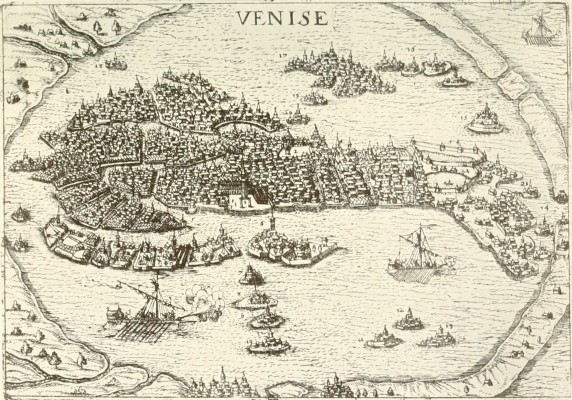
when Venice was almost in sight—Venice in
1600! to have been a witness of that would make
it well worth while to have been dead for the past
three hundred years. The essence of the change
is best expressed in the words of Mr. L. P. Smith
in his "Life and Letters of Sir Henry Wotton,"
when he speaks of it as "a shell on the shores of
the Adriatic deserted by the wonderful organism
that once inhabited it." Outward and visible
signs of the vividness and breadth of its life were
two in particular; the infinite variety and number
of persons and nationalities that filled its streets
with colour and contrast and a sense of new worlds
and of mystery in the midst of commerce; and
secondly, the Arsenal. In all Europe there was
not such another organisation as the Arsenal;
not one so completely prepared with everything
that went to the fitting out of a fleet, and very few
so well able to fit out an army. Villamont was
shown twenty-five great galleasses and eighty-five
galleys, all of them so new that they had not
been out to sea. Probably, also, its managers
were the greatest direct employers of labour in
Christendom; 2880 is one of the more moderate
estimates of those permanently at work, including
the 200 old women always mending sails, a
number increased to 700 at times; and all these
employees were assured of a pension from the
State when past work, an otherwise unheard-of
custom then, in practice, at least. It had its
place, too, in the tourist's mythology; one after
another repeating the tale how when Henry III
of France visited Venice, a galley was built and
three cannon turned out while he was at dinner.
Yet Montaigne has something to say about
Venice that cancels all the intervening years and
changes, and brings him into touch with us. He
went his way towards it with the highest expectations,
explored it eagerly, recollected it with the
keenest pleasure: yet at the end of his second day
there his feeling was one of disappointment. It
may be taken as characteristic that he alone should
experience then what seems more appropriate to
the present; more probably, other visitors shared
it but were too much subject to convention to say
so; or, perhaps, re-writing their experiences later at
home, as they generally did, they record their later
thought only, whereas Montaigne left his unrevised
and unashamed. This explanation seems the
more reasonable inasmuch as the causes of the feeling
had already come into being. On the surface
the sight rested satisfied, while the imagination remained
as hungry as ever. In a country, France,
for instance, the tourist always had a consciousness
of towns and districts unseen, all of which had contributed
to the past, for evidence of the existence
of which the imagination looks, however unconsciously;
but after two days in Venice, all that is
important and visible may seem to have been seen;
no suggestion of anything beyond, not even the
ruins of a half-buried city, as at Rome. It is true it
was clear then that the word "Venice" meant an
Empire as well as a city, though by the time the
tourist had reached the city, he had passed through
the conquests, barring an island or two in the Levant
which the Turks were in course of subtracting.
Yet the third meaning of the name was as dim to
him as both the second and the third are to most
of us, that of the source of an Empire, the whole
collection of islands in the lagoons, whose larger
life had already been drained away into the central
settlement, but where Venice and its history
were equally discoverable—but not in two days.
Another similarity between Venice of old and
of to-day lies in the fact that the gondoliers knew
much better than the visitors whither the latter
wanted to go and took them there, with, or
against, orders; only with this difference, that
then it was always to the house of the courtesan
in whose pay he was.
When the tourist had released himself and was
proceeding on his way to Rome there were the
beacons dotted along the coast for him to notice,
beacons for signalling the sighting of a Turk or
corsair vessel from south to north in a few hours.
Ravenna received little notice, Rimini less, but
Ancona was kept in the memory by one of those
rhymes characteristic of the contemporary guide-book.
Unus Deus, Una Roma,
Unus turris, in Cremona,
Una portus, in Ancona.
And then Loreto. Here it must be remembered,
first of all, that it was unpardonable to ask for a
meal before visiting the "Santa Casa." The town
was little more than one long street, well fortified
by reason of the treasure that the offerings
represented. Bassompierre relates in his memoirs
how he was invited to be one of the witnesses at
the quarterly offering of the poor-box one Christmas;
the contents amounted to 6000 crowns (in
our money about £7500); this for one quarter
only. Many men, and towns too, were represented
by models of themselves in solid silver. As to
which votive offerings Montaigne makes an assertion,
unconfirmed by any one else but with this
in its favour, that no tourist but himself gives any
details concerning a valuable offering from himself
made at Loreto. He says that the craftsmen
refuse to take any payment for such articles beyond
the cost of the materials. It seems incredible
that a town which had been the resort of pilgrims
for more than two centuries should not have become
demoralised, but Montaigne adds that the
officials refused tips, or received them unwillingly;
and certainly no one complains of extortion.
If the tourist was lucky enough to see a shipload
of pilgrims arriving from the farther coast
of the Adriatic, it would be worth while to stay
and watch, for as soon as Loreto came in sight
they rose and cried out without ceasing from that
moment until they reached the "Santa Casa,"
beseeching the Madonna to return to Fiume,
where, once upon a time, so the tale ran, her
house had stood. Leaving Loreto, not forgetting,
of course, to wear the pilgrim's badge peculiar to
the shrine—a leaden image of Our Lady surmounted
by three porcupine quills fastened together
with a silk thread, a tiny flag on each
quill—leaving Loreto, then, a détour was often
made to visit Assisi, joining the main road again
at Spoleto. And so to Rome, where the new arrival,
if a Roman Catholic, should first make his
way to the Scale Sante to return thanks for his
preservation during the past journey; where, too,
at his departure, he should pray for assistance on
the one to come.
It made considerable difference to his recollections
of Rome what date it was within this
period that he arrived. If at the beginning, he
would have found St. Peter's half-finished and
the interior in a state better suited to a pig-sty;
and the rest of the city to match; the most confident
Protestant would be gratified to find himself
scandalised beyond expectation. By 1601
St. Peter's was practically in all its glory, the
city unsurpassed in its care for the needy and
sick, and of average morality. In the interval, too,
the catacombs had been discovered, and though
Bosio, the explorer of them, did not publish the
results of his explorations till 1632 they became
more accessible meanwhile; continuing, however,
to be regarded as isolated "crypts." It was his
book "Roma Sotterranea" that first caused them
to be considered collectively; and it was under
that name that Evelyn paid his visit to them
in 1645, the first of these tourists to make
anything that can be called an excursion among
them. He entered through a burrow in a cornfield
two miles from the city, so small that he had
to crawl on his stomach for the first twenty paces.
But the main feature of the Rome of 1600 was
still its power. Not simply influence in the present
as a result of power in the past, but the
strength of age, middle-age, and youth existing in
unison. To begin with, their reverence for Ancient
Rome was greater than ours; an effect partly of
their theory of history, partly of the narrower limits
of their acquaintance with the materials of history.
For the former cause, it was bound to be
an axiom of history as long as the Bible remained
authoritative as a statement of historical fact,
that mankind had proceeded from good to bad,
and from bad to worse, as time had advanced.
And whatever, in the thought of the age, tended
to shake this view, was held in check by the discoveries,
in different, previously unexplored, parts
of the world, of communities which seemed to be
possessed at once of a higher morality and also
of a more primitive civilisation, than the European.
It is probably impossible for us to realise
the alteration that the theory of evolution has introduced
into current ideas about history.
For the second cause, the greatness of the Roman
Empire appeared the greater for their having
so little with which to compare it. The empire
of the Ottomans had, it is true, by now
eclipsed it; but Spain's was a vague wilderness,
inhabited by savages; the Persian of old they
only knew through the doctored accounts of the
Latin writers; and of the overwhelming antiquity
and extent of the Chinese they had no real
knowledge at all. All, the Turkish excepted, that
were not shadowy to them, were what Rome had
obliterated, the moral effect of which, associated,
as it must needs be, with the name of the city,
endured as the chief asset of the Papal power.
If any one then had taken Gibbon's view, that the
remains of the Roman Empire were approaching
dissolution, it would only have been because he
thought that the end of the world was equally
near. And this unbroken continuity of power
did not merely exist, but was alive with fresh
life. Nothing had replaced Rome; there was nothing
to replace it; there was no need to replace
it, since there was nothing effete nor slack about
it, however much corruption was patent to the
"Reformed."
The relations between visitors who were "Reformed"
and Rome is another interesting feature
of the tourist-life of the time when both were
militant and a large proportion of tourists anti-Catholic.
Much depended on the reigning Pope.
In the time of Sixtus V (1585-90) Protestants
came in fear, lived in disguise, and sought protection;
Englishmen from Cardinal Allen, who
readily granted it for a few days, to enable them
to see the antiquities. Clement VIII (1592-1605)
was much more lenient, yet Moryson thought it
advisable even then to pass for a Frenchman,
and to safeguard himself through Cardinal Allen,
as well; also to leave before Easter, when there
was a house-to-house visitation to enquire if all
were communicants. Precautions, on the other
hand, might be overdone. It was all very well to
make a practice, as one did, of going through a
church on the way to his morning drink, in case
spies were about, but to tell one's host, as a certain
German did, on returning home from an
afternoon walk, that he had just been to mass,
when all the masses were said in the morning,
was going too far! And conforming to custom
had its own dangers, too, when it formed a habit,
as Moryson found, who, on entering a church at
Geneva, reached out his hand towards the poor-box
in mistake for the holy-water stoop to which
he had accustomed himself; all the more embarrassing
a mistake for his being in the company
of Theodore Beza.
Gregory XV (1621-3)—to return to the Popes—forbade
even the other princes of Italy to admit
any but Roman Catholics to their dominions;
and there were, besides, the already-mentioned
prohibitions from the authorities at home. The
state of affairs in general may be taken as that
suggested by the localisation of Shakespeare's
plays. Two-thirds of his scenes are laid abroad,
in Italy more frequently than elsewhere outside
England: yet his contemporary Italy is practically
always the North, the South being reserved for
the "classical" period. Nevertheless, it may safely
be assumed that the danger was not quite so
great as the fear, and that where the former was
incurred, the sufferer had only himself to blame.
Whether or no the high officials at Rome were
faulty in dogma or in virtue, they were usually
both men of the world and gentlemen. Montaigne's
belongings, for example, provided the
searchers with plenty of material for a charge of
heresy, but a short conversation overcame all
difficulties. And one William Davis, an English
sailor[44] who fell ill at Rome in 1598, found by experience
that a Protestant who was civil would be
cared for in a hospital free and given food and
money on leaving. The more usual kind of behaviour
has already been illustrated; only it must
not be imagined that the incautiousness and incivility
which turned the Protestant into a martyr
were less conspicuous among other sects. By the
law of Geneva a three-days stay was permitted
to travellers of every creed. The poet-philosopher,
Giordano Bruno, and the Jesuit missionary, Parsons,
both rested there; their zeal prescribed the
extremes of controversial outrage in return for
tolerance and courtesy.
But Rome and its associations have had more
than their share of attention. Imagine, then, the
traveller started on the invariable excursion to
Naples, the equal of Milan as a finishing school,
and one of the few cities with underground drainage.
Some, but not many, might go on to Sicily;
to Syracuse for the feast of Santa Lucia, for choice.
But what with robbers and corsair-raids, there
was no travelling there without a strong guard,
and the towns were so unsafe that Messina seems
to have been the first of European towns to evolve
a combined bank and safe-deposit under municipal
guarantee; established by 1611, when Sandys
noticed it. Those who did reach Sicily usually
visited Malta as well; small boats with five rowers
left about two hours before sunset, and if no Turkish
sail was sighted, went on, reaching Malta
about dawn.
But the foregoing presupposes the Mont-Cenis
route into Italy, and leaves out three towns which
must be included: Padua, Verona, and Bergamo.
Padua had its university, the most-visited in Europe;
Verona, its relics of Roman times, which commanded
an attention that they now have to share
with the romantic aspects of mediæval history,
romance that sixteenth-century people were not
inclined to be attracted by, having too first-hand
an acquaintance with feuds to look at their
picturesque side. Moreover, the visible remains
of these feuds, here and in every Italian city,
showed a ludicrous side, for in so far as they did
not take the form of assassination by the foulest
means, they consisted in the two parties of retainers
parading the town, armed with an absurd
completeness, each one confining itself to certain
quarters of the town by tacit agreement in order
to render collisions impossible. The habits dramatised
in the first scene of "Romeo and Juliet"
are those of Londoners, in so far as they are at all
contemporary. The third town, Bergamo, thousands
pass by now, year by year, within a few
miles, never knowing what they miss by not stopping,
but then it lay on the north-and-south road
as much as any town in Italy, and not even the
Frankfort fair surpassed that of Bergamo, August
25 and the following week, when lucky was
he who could find sleeping-room in a stable.
Yet however complete was the outfit obtainable
across the Alps, there remained other countries
which were factors in politics; and which
possessed, moreover, histories, courts, universities,
and men of learning; fewer temptations, possibly,
and more "true religion." Of these France
was the one the most easily accessible to a greater
number. As to its boundaries, they were somewhat
narrower in almost every direction than at
present; especially southeastwards; Lyons was
a frontier-town. Its attractions lay principally
in Paris, the only city north of the Alps comparable
to Milan as a centre for the training of a man
for a courtly, or an international, life; and in the
government, which, in its extreme centralisation
and in its idealisation of monarchy, corresponded
most closely with the more practicable ideals of
the day.
In planning a route through France it was advisable
to go straight to Paris, if only for a few
days, since to have been in Paris gave one a position
in the provinces. As a place to stay at,
Orleans was really far more frequently chosen
by foreigners than Paris. Its university was as
international as any in Europe, and ahead of any
other in maintaining a circulating library for
students, which lent any book on a receipt being
given for it; "an extraordinary custom" says
Evelyn. Here, too, began the district reputed
best for spoken French, which brought strangers
to stay at Blois and Tours and Saumur as well;
to Saumur, perhaps, more than to the other two,
by reason of the number and quality of its teachers
on all subjects; it was a centre for Protestantism
and learning in combination. Poictiers for
law, Montpellier for medicine; and there is an
end of the towns that the student-tourist abided
in. For the country in general it should be added
that just here, where centralisation and autocracy
were developing most rapidly and thoroughly,
was reckoned as the most decidedly free
region of Europe, "liberty," according to sixteenth-century
standards, depending not on administration
being either lenient or constitutional,
but on the extent to which the individual was not
interfered with by social conventions. Political
tyranny was not regarded as objectionable on principle,
except by authors.
The United Provinces differed in no noteworthy
respect from Holland of to-day, so far as
territory goes, and during the earlier part of this
period attracted but little attention; but as time
went on and from imminent destruction they
escaped into independence, they drew the tourist,
first out of curiosity and subsequently as a
State which compelled the study of every one who
needed to observe the present and foresee the
future. Many minor interests, too, brought individuals
thither, as a result of Dutch enterprise.
We find, for example, Sir William Brereton surveying
the country in order to understand their
methods of decoying wild-fowl; and Sir Richard
Weston, who introduced locks into English rivers
and the rotation of crops into English agriculture,
learning both these novelties there. And though
no one as yet went abroad to study the possibilities
of practical philanthropy, there were many
who noted, with an admiration that doubtless
bore fruit, their charitable institutions of all kinds,
unequalled then outside Rome. In one respect
they were ahead of Italy: the suddenness of their
prosperity resulted in the latest improvements
in laying out towns—wider streets and greater
regularity being more in evidence there than
elsewhere. So uniform was the appearance of
the houses, says one, that they seemed to have
been all built by the same workmen at the same
time; whereas the Italian towns, even in re-building,
made no such experiments, because the old
narrow streets formed the best safeguard against
the surprise-attack of which they lived in constant
dread, especially from the Turks' corsairs.
No one town could claim precedence, though
Amsterdam, even as early as 1600, struck De
Rohan as equalled by few in Europe for wealth
and beauty; it was rather the excellence and frequency
of the towns that occasioned remark—twenty-nine
fine ones within sixty leagues of
boundary; together with the number of storks
which the municipalities cherished, as animals
known to harbour a preference for places where
representative government flourished.
As for the Empire, it meant many different
things to different visitors. The variety of territory
and government was absolutely bewildering,
yet certain marked cross-divisions presented
themselves, such as the triple division of it into
upper Germany, Hansa League (with Saxony),
and frontier; the frontier being those districts
which were forever either meeting, or fearing, a
Turkish invasion. Then there was division according
to politics, Catholic, Reformed, Protestant,
to be studied by the Average Tourist for
purposes of alliance, and a third classification according
to form of government, the imperial authority,
venerable and increasingly vague; princes;
"free" towns. The first system of division has,
however, most in common with the greater number
of foreigners' interests, and of its three sub-divisions
upper Germany was paid the greatest
attention, partly because it lay across so many
routes, partly because there was so much to see.
It gives the dominant note to references to German-speaking
countries in the travel-literature
of the day, a note of peaceful energy and hopeful
prosperity. While not recommended to these
travellers' notice by a well-known past such as
the greater coherence of France and Italy had enabled
historians to evolve for them, those who
lingered there, as most did, saw that its possessions,
human and non-human, gave it a present interest
and a promise not surpassed elsewhere. The
Germany of the last fifty years of the sixteenth
century is practically ignored by modern English
historians: the story of its continual activity
and of its continuous relations with England contain
none of those sensational hindrances to the
advance of civilisation with which historians
concern themselves, but the frequent references
to those relations by the contemporary historian
of Queen Elizabeth's reign, William Camden,
bear witness to the current opinion and knowledge
which found expression in the number of
visitors from all quarters and the attention they
devote to it in relation to that accorded to other
countries.
Among the towns of the Empire Augsburg was
easily first; its finest street was the finest street
in Europe, with roofs of copper; Nuremburg ran
it close in many ways but had nothing to show in
comparison with that one street. The cause of
Augsburg's preëminence was its being the home
of the Fuggers, the greatest financiers of Europe,
but with their decline one function of the town
that meant much in the way of attracting wayfarers,
that of being the General-Post-Office for
correspondence between Italy and Central Europe,
passed to Frankfurt. The frequency of the
use of stone as house-building material in these
towns of Upper Germany and the show of burnished
pewter and brass that was the pride of
each inhabitant of standing, who let his huge
hall-door lie open all day to exhibit it, were details
which the Average Tourist would not overlook
if he was observing as he ought where the wealth
and security prevailed that were valuable in an
ally. Thus did Strassburg fix itself in De Rohan's
recollections. Democracy, to him, was a barely credible
superstition; yet nowhere was he more courteously
treated, nowhere did he see completer preparations
against a long siege, nor any better arsenal,
a model of cleanliness, orderliness, and efficiency.
Neither was it lost on him that amongst all their
collection of cannon there was not one for siege
purposes; their aim was defence, not offence. As
little to be ignored as the others was Ulm. A
feature of the age was the development of the
methods of water-supply in towns; Ulm was the
centre for this industry; even Augsburg's water-supply
had been planned there. And it was equally
the leader in woodwork.
Similar characteristics would be found repeated
on a somewhat less striking scale among
the Hansa towns, with Lübeck ranking first
in pleasantness by general consent. A specially
charming feature lay in the number of swans
swimming in the moats, though no Englishman so
much as mentions them; doubtless because the one
town that excelled it in this respect was London.
Going east, the various capitals would provide
each its own object-lesson, and, collectively,
would illustrate the absence of avarice among
German rulers as contrasted with the princes of
Italy. Saxony formed the only exception and
Dresden showed it. In spite of it being the last
big town that Hentzner visited, its armoury
aroused more enthusiasm in him than anything
except the gardens of Naples and the all-sufficiency
of Milan; and Moryson confirms this, adding also
that the stable was the finest he had seen, with
its 136 horses, all foreigners (the German horses
had another stable to themselves), each with a
glazed window and a green curtain in front of his
nose, a red cloth, an iron rack, a copper manger,
a brass shower-bath, and a separate cupboard
for his trappings.
No Protestant who reached Dresden would
miss Wittenberg, but the contrast must have
been painful; poor and very dirty; the dwellers
therein mainly students, prostitutes, and pigs,
recalling the verses in use concerning Angers—
Basse ville, hauts clochers,
Riches putaines, pauvres escoliers.
Leipzig was in favour for the purity of its German
and Munich for pleasure, but Prague was another
disappointment in spite of the Emperor living
there; few stone houses and the wooden ones
rough, and so filthy that the saying ran that the
Turks would never take it despite the feebleness
of its fortifications, because it was so well-guarded
by its stenches; much as a Frenchman remarked
at this time of Massa, between Genoa and Pisa,
that it had a castle, but its chief defence was its
fleas. Vienna was likewise far too well defended
to attract visitors; a frontier-town against the
Turks, always garrisoned by mercenaries and its
streets unsafe in consequence.
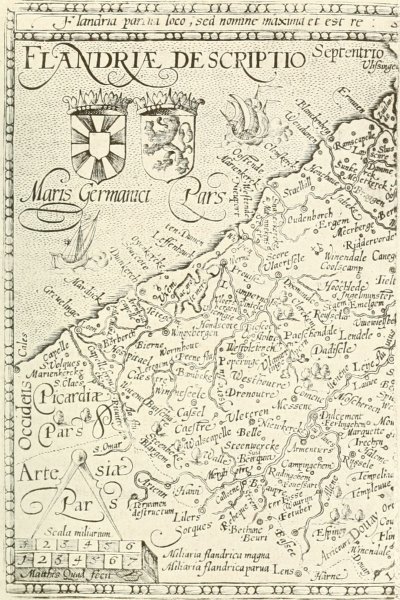
To go on to the Spanish Netherlands, they were
bound to be passed and re-passed in the course
of the work of Europe, for geographical reasons,
but still more so as a storm-centre of European
politics. Nevertheless, the tourist, however serious,
did not stay there long. The viceroy's business
was generalship, and consequently there was no
settled court: little to note, in fact, but the Spanish
infantry at work and the effects of that; towns
in ruins, dwindling trade. Yet the localisation
of the war was intermittent enough not to interfere
with the travellers from Upper Germany
making a practice of reaching France through
this district, according to Zinzerling, rather than
direct, a habit resulting not only from the attractions
that remained to Flemish towns, but still
more from the direct route through Burgundy having
become a highway of German mercenaries into
France.
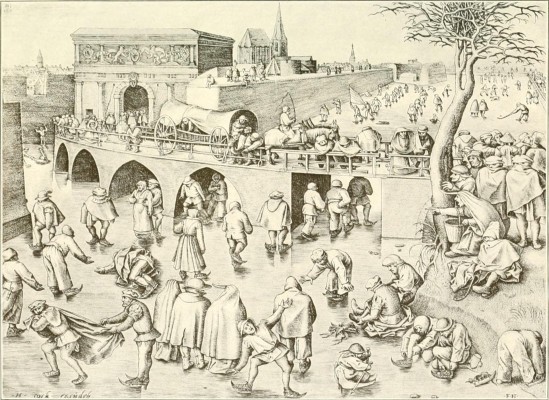
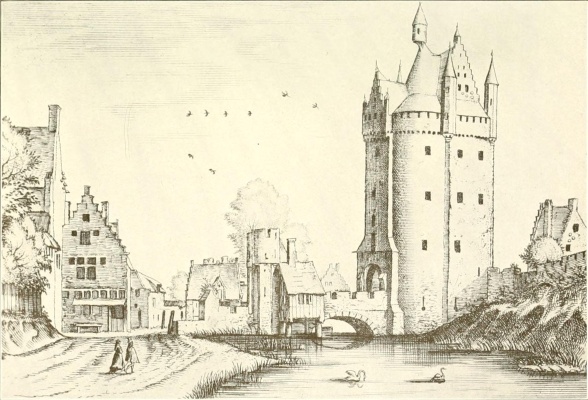
GATE OF ST. GEORGE, ANTWERP
Moreover, no one who knew his business as a
sight-seer omitted Antwerp. Trade and political
importance had for some time been deserting it
until it suggested to Howell in 1619 "a disconsolate
Widow, or a superannuated Virgin that hath
lost her Lover," but in 1600 it had not passed a
state of mellowness without stagnation, with
traces of its greatness fresh. Every visitor repeats
the same idea—"the most beautiful town
in Europe"; and not in the same formula, as
would result from the idea being a guide's commonplace,
but in words drawn from his own experience:
"as seen from the cathedral tower the
most beautiful town after Constantinople," says
one; or Lithgow, extolling Damascus, "the most
beautiful city in Asia," compares it, for every
respect save style of architecture, to "that matchless
pattern and mirror of beauty, Antwerp." It
would seem to have been the first town to turn
its fortifications into promenades, laid out in
walks and planted with trees.[45] The citadel, too,
was the finest out of Italy, on the word of a Venetian
ambassador.
Elizabethan England, on the other hand, was
rendered still more remarkable by possessing
no fortresses at all. Two exceptions, Berwick and
the Tower of London, served but to call attention
to the rule, the Tower in particular, whose
out-of-date character in the matter of defences
greatly amused connoisseurs. One Venetian ambassador,
indeed, with this fact in his mind, together
with the miscellaneous character of its
contents, describes it as not so much a fortress
as a "sicuro deposito"—a safe-deposit.[46] The
peacefulness which brought about this state of
things is still borne witness to by the large glazed
windows on the ground floors of Elizabethan
country-houses, but no foreigner remarks on that
in the presence of the other more striking points
that testified to it then. Foscarini, the successor
of the ambassador just referred to, had occasion
to traverse the length of England in 1613. Writing
home[47] he remarks on five facts concerning
the country he passes through which seemed particularly
noteworthy: (1) No unfruitful land
throughout; (2) Every eight or ten miles a town
comparable to a good Italian town (this was on the
post-road to Scotland); (3) Number of navigable
rivers; (4) and of beautiful churches; (5) No mercenary
soldiers.
To make it clear why the visitor should be so
specially struck by these features, it is necessary
to recall how differently matters stood abroad.
During this period two thirty-year civil wars
broke out in Europe, one in each half of the period,
the first in France while the Empire was at peace,
the second in the Empire while France was at
peace. Between these two came twenty years of
comparative quiet, but never a year when war
was not to be seen in progress, or its effects still
horribly new, in the course of a Continental tour.
Incidentally, it may be pointed out that this peculiarly
even distribution of peace and war gives
the writings of travellers in Europe at this time
striking value in relation to the effects of war and
peace, not only in themselves but also as to their
special characteristics in the sixteenth and seventeenth
centuries. No tourist came into contact
with both wars; almost every tourist saw something
of one district under the influence of war
or of peace, while some other is seeing another
district in an opposite state. There remains,
therefore, in their writings, a continuous comment
on each other; so continuous and so unconscious
as to leave no room for this or that man's bias to
influence the general impression.
Yet striking as the peacefulness of England
was, it probably lessened rather than heightened
what degree of attraction England possessed;
since with war so normal a condition, war and its
incidentals became a primary object of study even
to those who did not profess soldiership. Neither
did any but the Dutch need to learn the language
of the country, which was what induced so many
to make a lengthy stay in Tuscany and in Touraine.
Neither was England a thoroughfare.
Nor, even, were the recent achievements of Englishmen
more than a minor cause of the considerable
influx of visitors; not, at least, apart from
the idea which is best expressed, perhaps, in the
private letter of an Englishman writing from
Aleppo: "Your last letter made me exceeding
sorrowful, for therein you acquainted me with
the death of blessed Queen Elizabeth, at the
hearing whereof not only I and our English nation
[i. e., the residents] mourned, but many
other Christians who were never in Christendom,
but born and brought up in heathen countries,
wept to hear of her death, and said that she was
the most famous queen that ever they heard or
read of since the world began."[48]
For the "Virgin Queen" was a far greater
marvel to contemporaries than to posterity. Except
for her namesake of Spain, a century earlier,
who throughout her political life had been the ally
and wife of one of the cleverest statesmen of the
age, there was no instance since the mistiest past
of a queen-regnant a leader of men. At her accession
civil war or conquest seemed inevitable and
insolvency was a fact: yet before her death the
bond of London "is," writes one of the chief financiers
of the time,[49] "the first to-day [1595] in
Europe," and she had added victory abroad to
peace at home. To say "she had added" suggests
nowadays the phraseology of the lady's paper, but
it does really express not only the convention
which the tourist may be taken as accepting but
also the belief of reasonable men of the time.
It is true that many denied her right to the
title of "Queen," or, indeed, to that of "Virgin";
but no one had the opportunity of doubting that
both claims belonged to that secondary order of
facts known as "historical." And just as her position
as sovereign, and a strikingly successful
one, was more wonderful then than it seems to-day,
so too did her celibacy assure her of more
reverence than we should instinctively concede.
The mediæval idealisation of virginity, one of the
most beneficial, perhaps, of all the ideas of the
past that the Reformation killed, ensured a place
in the life of the world, and the self-respect contingent
on that, for all the unmarried women
whose counterparts since have had no assistance
socially from any convention, from nothing but
their own individuality. But this idea, though
dying, was not dead; and, as is the way with
ideas, challenged attention all the more definitely
for ceasing to be taken for granted.
These two facts, then, glorified Elizabeth in the
eyes of foreigners; first, that she was a queen and
a great ruler when effective queenship was half
a myth; secondly, that she remained unmarried
when virginity, considered as a virtue, was, so to
speak, due to have its last flicker before finally
dying down. The reign of James I was a sort of
after-glow, except in so far as he had a reputation
as a philosopher-king.
These ideas have a marked effect on the visitor's
itinerary. He hurried, as a rule, to London, and
thence, if the court was away, to that one of the
palaces which was in use for the time being. The
other country palaces, none far from London,
would receive a visit, at any rate Windsor and
Hampton Court; Oxford probably, Cambridge
possibly, and there an end. Of Scotland and Wales
it can only be said that the former was practically
ignored except by a few Frenchmen, as a
result of the ancient alliance; while to Wales they
paid as little attention as the semi-Welsh queen
did—none at all.
Among the foreigners who have given us their
impressions of England are several who have
much that is of interest to say and yet who seem
to have been entirely overlooked. Nevertheless,
these pages are already more numerous than the
relative importance of England warrants. Let
us therefore take but one, and that one the briefest;
the more so since he is the likeliest to continue
to be overlooked, writing as he did in Polish, from
which hitherto no translation seems to have been
made, not even in paraphrase.
Jakób Sobieski, the only man who was ever
four times Marshal of the Polish Diet, travelled
all over Europe in his youth. Henry IV of France
made a personal friend of him, and it was at Paris
that he spent more time than elsewhere, where,
eventually, he witnessed the assassination of the
king and was nearly lynched himself on the spot
by the mob who took it into their heads to regard
him as the murderer. However, he not only
escaped, but after justice had been done on Ravaillac
by his being torn asunder by horses, Sobieski
had an invitation to dinner from a bootmaker
who had collected certain pieces of Ravaillac and
was arranging a loyal dinner-party at which they
were to form the chief dish.
It was in the previous year (1609) that he
visited England in the train of Myszkowski, the
Marshal, negotiations being then in progress for
the marriage of James I's daughter Elizabeth to
Wladislas, son of the King of Poland. Sobieski,
very young and very Catholic, was easily enough
taken in by appearances to speak of James I as a
model king, and to accept without question the
declaration of the English Catholics that things
had improved greatly since the death of the "severe
and overbearing Queen Elizabeth." But
it must be borne in mind that the King had not
yet come to the bottom of the Treasury. One of
Sobieski's remarks—that the Palace at Westminster
is finer inside than outside—is an interesting
comment on the impoverishment of the
Crown that set in, if taken in conjunction with
the remark of Gölnitz of Danzig, less than ten
years later, who says exactly the opposite. In
comparing the palaces around Paris with those
of the English king, he says that the former are
fine externally, but contain many rooms in which
a respectable German would not care to receive
an acquaintance; cobwebs, unpolished woodwork,
walls in disrepair. One thing that scandalised
Sobieski greatly was that in St. Paul's he found
buying and selling going on, a statement confirmed
by a Venetian ambassador here in 1607, who says
that London possesses many fine churches but
that these are mostly used for nothing but driving
bargains in.[50]
Sobieski's business, however, lay at the court,
and the court was out of town: the King at one
palace, the Queen at another, Princess Elizabeth
at a third. On paying their respects to the last-named
a curiously characteristic thing happened;
her chamberlain met them and asked in what
language they would speak with the Princess,
French, Italian, or Latin; she was equally at home
in all three. Myszkowski chose Italian. The occasion,
of course, was not a decisive one, but the
conversation turned on Wladislas, the most
anxious enquirer being an elderly lady-in-waiting
who wanted to know if he was tall; the Princess,
she would have them know, was tall, really tall,
not made so artificially, with high heels, etc.,
to prove which she raised her mistress's skirt until
they saw not merely blue stockings, but also saffron
garters and white lace.
The last country of "European Europe" is
Sobieski's own country, but only the last because,
like England, it led nowhere. If omitted from a
tour it was omitted with regret and consciousness
of loss, being the largest monarchy in Christendom,
600 miles by 800, with a frontier reaching
to within 150 miles of Moscow and 100 of the
Black Sea; always on the verge of war, moreover,
and a paradise of aristocracy, three good reasons
for claiming the Average Tourist's attention, especially
as among this aristocracy was always to
be found a welcome and as high an average of
attainments and qualities as anywhere north of
the Alps. The statement, too, that it was not a
thoroughfare must not be taken as absolute. Negotiations
between the Tsars and the Papacy were
frequent and these of course implied journeys
through Poland by the friars whom the Papacy
was wont to use as emissaries for long distances,
as being more accustomed to endure privation
and fatigue than bishops.
Besides, from southeast to northwest stretched
the high road from the Black Sea through Kamienietz
to Danzig, which one of these travellers assures
us was the most thickly-populated highroad
in Europe.[51] Danzig itself was one of the
great centres of world-commerce; so great that
its citizens were well justified in one detail of their
daily life that Moryson records, that of taking off
their hats as they passed the town hall. The commerce
was very varied, but its main export seems
to have been grain and its main import, Scotchmen.
Of these latter there were certainly thousands;[52]
in fact, from some date in the reign of
Stephen Bathory (1575-86) till 1697, perhaps
later, a "brotherhood" of Scots existed, recognised
officially; and boys of fifteen to seventeen
came over in such quantities and so often with
such disastrous results, that in 1625 an edict was
issued in Scotland prohibiting skippers taking
over any who had not been sent for or had not
500 marks. But these can hardly be reckoned as
tourists, travelling, as they did, Scot-fashion, on
the "ubi panis, ibi patria" principle, with the
object of sharing the retail-trade with Jews, so
successfully that there has long lingered in Eastern
Prussia the proverb, "Warte bis der Schotte
kommt," alluding to the annual visits of these
pedlars. Many, too, can be traced as becoming
burgesses of Danzig, or of Posen.
Of visitors of the type with which this chapter
is more specially concerned, the reign of the
Henry who afterwards became Henry III of
France marks a starting-point, judging partly from
the evidence available before and after that date,
partly from the statement in the report of the first
resident Venetian ambassador there, Girolamo
Lippomano, who came in that reign, that Poland
was at that time an unknown land to Venetians.
So much for the Average Tourist at work. Let
us now see how he spent his spare time. It goes
without saying that the degree to which the foreigner
enjoyed himself was more or less dependent
on the behaviour of natives. Let us see,
first, then, what reception he might expect.
Small boys, of course, are the same yesterday,
to-day and forever, but they were, if possible,
somewhat more outspoken then. An ambassador's
wife went to the Hague once, never again, "by
reason of the boys and wenches who much wondered
at her huge farthingales and fine gowns,
and saluted her at every turn of the street with
their usual caresses of 'Hoore! hoore!'" Concealing
herself from view was impossible, no cart
would hold her farthingale. And although with
all the detail that is poured forth concerning the
Venetian constitution, the feature in it which,
though informal, has outlasted all the others, that
of the limited despotism of the small boys, is ignored,
yet in practice it was felt; Sastrow, for one,
did not forget being pursued with "Tu sei tedesco,
perciò Luterano."
As regards the adults, Frenchmen, or any one
dressed in French fashions, had to beware of the
Italian towns where the French had been masters
for a time, and although Strassburg had a gate
on the west, any one coming from the French side
had to enter by the east gate. Commercial quarrels
were even more bitter than political. When, for
instance, the English removed their "staple"
from Hamburg to Stade, nearer the mouth of the
Elbe, it was not safe for an Englishman to be seen
at Hamburg after the citizens had reached their
mid-day stage of drunkenness. As for theological
enmity, a Roman Catholic was saying his prayers
one evening in Frisia with the windows open; an
old woman marked it and came across the street
to spit at his inn; the next morning she came
again, to spit at him, and he had to put up with
it for fear of worse happening.
With such exceptions as these there was not
much to be feared from the upper classes; nor
even, on the main routes, from the lower; in
Dauphiné, for instance, all classes were pleasant
enough, whereas at Rochelle strangers were
liable to be pulled off their horses if they did not
remove their hats when passing the guard at the
gates. The two worst towns for brutality towards
foreigners were, by general consent, London and
Toulouse. In the former, according to Giordano
Bruno, whose account only differs from every one
else's in being more picturesque, the shop-people
and artizans, on seeing a stranger, make faces,
grin, laugh, hoot, call him dog, traitor, foreigner,
the last name being the rudest they can think of,
qualifying him for any other insult. Should he
take the offensive, or put his hand to his weapon,
an army of ruffians seems to spring out of the
ground, flourishing a forest of sticks, poles, halberds,
and partizans. In a more playful humour,
one will pretend to run away behind a booth and
come out charging on the stranger like an angry
bull; if an arm gets broken, as happened to one
Italian, the bystanders shout with laughter and
the magistrate sees nothing reprehensible in the
affair.[53] Oxford was a change for the better, for
there it was only the students who behaved like
brigands; as they did at Carcassonne, too, where the
law-students insisted on tribute from visitors,—they
called it a "bienvenu,"—or if it was not forthcoming,
the contents of the visitor's trunks were
shaken out. Yet among those of Oxford, Zinzerling
makes an exception in the case of Queen's
College, where as soon as a foreigner is recognised
as such, he is brought an ox-horn full of beer.
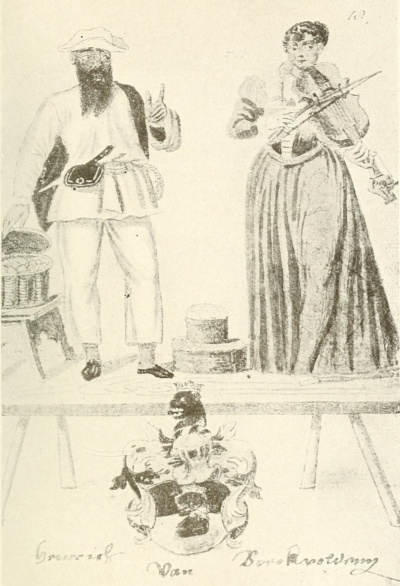
VENETIAN MOUNTEBANKS
Such presents were customary on a very large
scale on the continent; in France they generally
consisted of wine and were presented to persons
of high rank only, but in Germany every gentleman
received gifts of drink and food which usually
cost more than their value in tips and dinners.
The higher the rank of the visitor, the greater
the quantity; the Infanta Clara Eugenia writes
home that at the stopping-places in her passage
through Switzerland the gifts require thirty or
forty men to carry them, who lay them at her feet
until she is surrounded by barrels and has the
greatest difficulty in preserving her gravity. At
Lucerne she received barley as well as wine, and
two oxen, both too fat to move. Many other
local customs had to be submitted to which have
died out since; such as ceremonies of initiation
into the freedom of Hansa League towns, which
were accompanied by practical joking; the obligation
on Protestants staying at Geneva to attend
service at 7 A. M. whenever there was a sermon;
and so on.
Among these exceptional customs and regulations
should be mentioned those concerning
weapons in Italy. At Lucca no knife might be
carried unless blunted at the point; in the Papal
States, a sword was allowed, but no short, easily
hidden, weapon; in Venetian territory fire-arms
only were forbidden; elsewhere a license from the
local authorities had ordinarily to be obtained for
wearing a sword, and in Florence the license only
referred to day-time. This is Moryson's account
of the regulations; before his time the regulations
were laxer, and later they became stricter, which
gave a great impetus to the poisoning trade; in
fact, the bakers in Lombardy were mostly Germans,
and those of Rome, Jews, the Italians being
unwilling to trust their fellow countrymen.
Such subjects naturally suggest executions,
which formed one of the commonest and principal
"sights" throughout Europe. Lithgow
landed at the Piazzetta at Venice just when a
friar was being burnt alive there for getting fifteen
nuns with child in a year. It was in Venice, too,
that Moryson saw two young senators' sons, who
had had too uproarious a night, have their hands
cut off at the places where they had done the mischief,
their tongues cut out where they had sung
blasphemous songs, and finally beheaded by a sort
of guillotine in the Piazza. And when he was
staying at Leipzig, where, as was the custom in
Germany, adultery was punishable by death, a
case had recently occurred of a girl giving birth
to an illegitimate child in a church, during service.
It was under consideration when he left whether
an ancient precedent should not be revived to
meet her case, that she should be tied up in a sack
with a cat, a cock, a snake, and a dog, all alive,
and so drowned. To quote one more as a sample
of many, there is the detailed description of a
man being broken on the wheel at Hamburg, by
Taylor the "water-poet." The place of execution
was on a mound, so that the enormous crowd
could see well; moated, to keep the people at a
distance, and approached by a drawbridge which
was raised during the execution; the criminal was
drunk, according to custom. In Germany exceptional
criminals were on view for some days
before execution, nailed by the ears to posts.
Torture accompanying execution was common,
and branding and mutilation things that no traveller
could well avoid seeing. But none seemed
to want to avoid them: Evelyn went to the Châtelet
prison at Paris to look on while a prisoner
underwent legal torture. The only occasions that
seem to have struck them as too horrible was when
the headsman bungled matters: a Dutchman at
Paris saw one try sixteen times and then have to
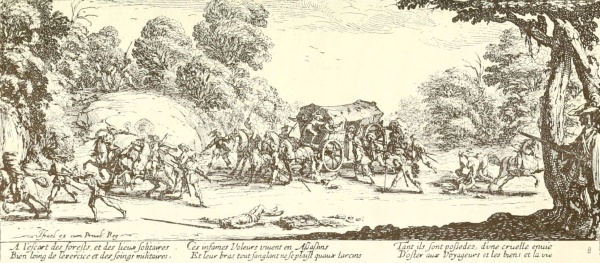
be assisted. And as in the towns, so by the wayside.
Gallows and wheels bearing the bodies of
men and sometimes of women, dying, dead, or decaying,
were continually to be seen: Taylor says he
counted seven score between Hamburg and Prague,
and Moryson mentions a criminal hanging in
chains near Lindau, starving to death, with a
mastiff at each heel, in order that he might be
partially eaten before death.
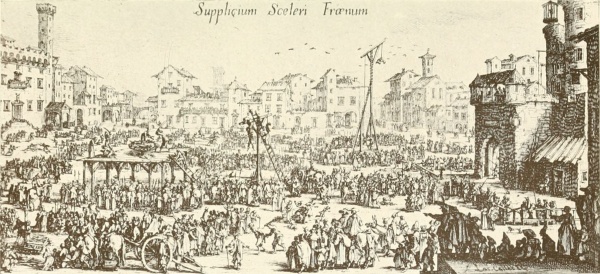
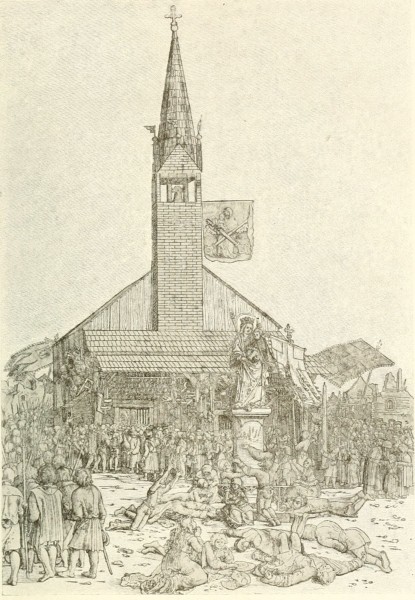
PUBLIC EXECUTIONS
No less awful a sight, and no less frequent in
certain places, such as Marseilles, was the galley-slave,
naked except for a pair of breeches, shaven,
dragging behind him when ashore the chain fixed
to his feet, treated worse than a beast, and yet
not necessarily criminal: at Leghorn was a tent,
at Naples a certain stone, where a man might
stake his liberty against a few shillings on a throw
of the dice. Among the few who obtained their
release by being bought out were those who, on
that condition, acted as deputies in the processions
of flagellants which tourists often mention: Montaigne
witnessed one at Rome with five hundred
persons in it. He, like others, was astonished to
note their unconcern; the scourging was genuine:
their backs were raw and bloody, the thongs of
the scourges adhering to each other with the
blood; yet so far from showing signs of pain, they
marched along, careless and talkative, in an
every-day mood.
Other forms of slavery were ordinarily met
with: at Naples an open slave-market was held;
at Lisbon, too, where men and monkeys were sold
side by side. And here and there one might come
across settlements of those who could not claim
all the benefits of the law. Zinzerling picked up
a cagot servant near Toulouse, a young man, well-informed,
who told him how his brother-outcasts
had just petitioned for permission to marry whom
they chose, offering to have their blood tested
to prove it no different from other men's. Those
who did not act as servants, lived by handicraft,
carpentering mostly; they were forced to dwell
in the suburbs, and nothing they owned was
heritable except furniture, which was looked on
as sharing their taint.
But he does not mention the goose-foot badge
which distinguished them from "clean" persons.
The badge of the Jew, on the other hand, often
seen, is often mentioned, varying according to the
extent they had acquired influence and used it.
In Poland, thanks to the Jewish mistress of one
of their kings, they had almost equal rights with
Christians. Elsewhere, except in those places,
such as England, which they were nominally forbidden
to enter, a badge was compulsory; lightest
in Mantua, merely a bit of yellow lace tacked on
inside their cloaks, but generally a red hat for
the men and a red garment for the women: red
as betokening their guiltiness of Christ's blood.
An alternative colour was yellow, as in Rome, where
a short-sighted cardinal once mistook a red-hatted
Jew for a brother cardinal and obtained a change
of colour in order to safeguard himself against
being so polite again.
But the tourist's leisure, so far, has been too
much occupied with blood and social damnation;
let us look for a lighter mood: let us see him at the
Zoo. Florence seems to have been the best stocked.
Rabelais saw two Zoos there, and this was not
an optical illusion of a credible kind, for he localises
them differently; one at the Palazzo
Strozzi with porcupines and ostriches as the
"stars"; one near the Belfry, boasting lions and
tigers. Moryson mentions one only, the Duke's,
containing five lions, five wolves, three eagles,
three tigers, one wild cat, bears, leopards, an Indian
mouse which could kill a cat, and wild boars.
After another fifty-year interval comes Evelyn,
who looks down upon all the animals housed together
in a deep court, a pleasanter confinement,
he thinks, than the narrow cages of the Tower at
London. But I have forgotten Audebert, who
should have come between (1576) Rabelais and
Moryson, and who found a Zoo near the "Annunziata,"
possessing fourteen lions, a tiger, an eagle,
and a vulture therein. In 1592 at Prague there were
twelve camels in the Emperor's Zoo, very probably
the sons and daughters of those whom Busbecq
brought back from Constantinople in the hope of
naturalising them in Europe as beasts of burden,—not
the only attempt of the kind, for Sir Wm.
Brereton saw some so used in Holland, and a
German others near Aranjuez. The leopards,
moreover, in this same Imperial Zoo, were taken
to assist in hunting.
Experiments and novelties such as these, of
course, provided a larger part of the interest of a
journey then than is the case now, when such news
is communicated immediately through the newspapers.
We find Tommaso Contarini, ambassador
to Flanders, greatly struck by the value of peat
as fuel, and bringing back some to Venice to assist
him in ascertaining if anything of the kind is
obtainable near. Then there was "Der Einlasse,"
the complicated night-entrance to Augsburg,
worked by mechanism which allowed a person
to be admitted without seeing any one,—such a
mystery that many allowed themselves to be
locked out on purpose to see it work, and Queen
Elizabeth sent a special agent to acquire the
secret; in vain. But in Augsburg front doors were
habitually opened by pulleys from some room,
and shut automatically; it was at Augsburg, too,
that a coach was to be seen "driven by engines"
within it by the occupant so that it seemed to
go of itself; it had been driven about the city.[54]
This occurs in the year 1655; three years later
fountain pens[55] were on sale at Paris for ten francs
each, twelve to those whom the inventor knew to
be eager to have one; that is, £5 to £6 in our money.
Even an Italian might learn: like the Florentine
who discovered in England what garden-rollers
were, in their early solid-stone-cylinder form.
But Tasso had the chance to learn something important
and not only passed it by but places it
first among the three customs in France which he
strongly condemns. It is that in some districts
the people nourished the children with cow's milk.
How, he asks, can any good come of feeding infants
with the produce of an animal that is a beast
of burden and has to endure blows daily? An Englishman
in Italy noted the method of stripping
hemp with wooden instruments instead of with the
fingers, the laborious English way; and fans, forks,
and umbrellas would be new to every one who
crossed the Alps; but a learned physician warned
Moryson against using the last-mentioned, "things
like a little canopy," as concentrating the heat of
the sun on the head.
In Flanders, again, every one might learn what
kind of a thing a door-mat was, and a Dutch barber
had only to cross the Channel to find that he
was behind the times in using dregs of beer as a
lather. And if it was possible for a twentieth-century
Englishwoman to cross into sixteenth-century
Germany she would find out what a convenience
it was for an invalid to have a towel
attached to a wheel running along the head of the
bed, to assist him or her in changing position.
Where, too, except from travel, his own or some
one else's, did Sir John Harington get his ideas
concerning the introduction of real water-closets,
with gold-fish visible swimming about in the cisterns,
just as they are to be seen at railway stations
to-day?
A greater discovery than all these put together
lay in the differences in the position of women in
the above countries. Take the United Provinces
and Italy, as the two where the contrast was
greatest. In the former, girls of good birth and
looks might not only settle down in the common-room
of an inn instead of hiring a private room for
meals, but would sit round the fire and share the
after-dinner drink of the men as a matter of
course. All-night skating-parties were so common
that the liberty was not misused; whereas in Italy
the strictness was as extreme as the Dutch freedom,
and its result, too; only, in Italy, the result
was the demoralisation of both sexes. Chioggia
was an exception, where Villamont was surprised
to see the women and girls sitting at their doors,
needle-working; and where French influence had
made itself felt some relaxation had taken place,
especially at Genoa, where one foreigner even
notes that the women walked with a longer stride
than most Italian women. But the unmixed Italian
convention gave most girls no choice between
becoming either prisoners or prostitutes, that is,
of course, like everything else in this book, from
the foreigner's point of view. Of the former class
the tourist saw next to nothing; the men of the
household did even the marketing themselves;
while the latter formed one of the best-known
features of Italian life. The numbers may seem
at first sight incredible—30,000 is the figure always
quoted for Naples; but there was some
check on such statements inasmuch as every
government licensed each one for a fixed sum
and therefore could reckon the total. Moreover,
Sir Henry Wotton writes in 1592 that a census
just taken in Rome counted 40,000, and he had
it on good authority; and in 1617, that the Espousal
of the Sea at Venice had been spoilt as a
sight because the courtesans, offended at an edict
directed at them, had abstained from taking part
in it. Those at the head of the profession lived
"like princesses," not only so far as expenditure
went, but also in their command of marks of
respect in public, except that every now and then
some sumptuary edict would create, and perhaps
enforce, some distinction between those who
populated and those who depopulated Italy. It
is pleasanter to turn back to Holland again, to
the homely arrangements of Thursday in Delft
fair week, when the women who had had enough
of waiting for husbands sat in the church and
the men who had waited long enough for wives
came to look at them. A few questions, a pot
of beer, a few details to be settled; and then the
wedding.
There were plenty of these fairs, Lyons had
four a year, so had Rouen; but the attraction they
possessed for the sixteenth-century human being
lay rather in the amount of wholesale and financiers
business done than in homely picturesqueness;
sentimentality is the last vice he can be
charged with. Who, for instance, nowadays, would
dare to say he saw nothing charming in a Breton
festival? but Brittany was left to itself in those
days, and a travelling doctor who chanced on one
leaves it with the remark that the Breton girls
singing their folk-songs reminded him of "the
croaking of frogs when they are in love." Yet St.
John's Eve was a festival that gave plenty of
pleasure to lookers-on as well as those who took
part in it; at Paris, in particular, where there was
hardly a citizen named after the saint who did not
light a fire at his door that night. And it is perhaps
worth mentioning how they kept that feast
at Naples, according to Audebert, in 1577; how
the custom was to bathe in the sea previous to
paying one's devotions at "S. Giovan' a' Mare,"
seeing that he adds that the custom was dying
out, the younger people scorning it as a pagan
survival.
A larger proportion of the public pleasures of
Europe were bound up with religious ceremony
than is the case at present; and as regards pilgrimage,
the reference above to the subject in general
needs to be supplemented by some details concerning
the relics, since there is no room for doubt
as to whether or not they held their ground as
"sights," the more so inasmuch as a sceptical
attitude did not become a conventional habit of
mind until, to judge by tourists' books, about the
third quarter of the seventeenth century. At the
abbey of Marmoutier, near Tours, for example,
was shown a vessel which had been sent from
Heaven filled with oil for the healing of St. Martin's
leg, a breakage of which the devil had caused
by taking away the stairs. They also showed a
vast barrel wherein St. Martin kept his wine; but
not till 1675 does any one remark that that was
probably the fiend who stole away the stairs.
Disbelief finds expression in plenty, it is true,
but it is always that of the Protestant who disbelieves,
not because his reason tells him the tale
must be false, but because Roman Catholicism
affirms it to be true. When there was no suspicion
of a friar at the back of the story, there
was nothing they would not swallow: even Evelyn
accepts Mettius Curtius and his chasm as if
all four evangelists had guaranteed both; or, to
take a still better example, that of the monument
near Leyden to the lady who had 365 children at
one birth—(she had laughed at a poor woman's
tale that the latter's two babies were twins, and
the woman had expressed a hope that the lady
might give birth to as many children at one confinement
as there were days in the year)—Münster,
the great Protestant geographer, repeats the
story without throwing doubt, and consequently
one tourist after another has no hesitation about
it.
So happy a frame of mind must have increased
the interest of many a resting-place. Breaking
one's journey at Angers, for instance, there was
a porphyry vase to be seen, one of those used at
the wedding feast at Cana in Galilee; others were
preserved at Famagosta, Magdeburg, and the
Charterhouse at Florence. At Angers, also, at
St. Julian's, was a copy of the portrait of Our Lady
which St. Luke had painted; at Arras, manna which
had fallen in the days of St. Jerome, looking like
white wool; at Milan, the brazen serpent which
Moses set up in the wilderness; at Vienna, one
of the stones wherewith St. Stephen had been
stoned, another at Toulouse; and at the monastery
of the Celestines at Louvain, one of the thirty
silver pennies for which Christ had been sold,
bearing the head of Tiberius on one side, a lily
on the other. It is well known how Mary Magdalen
came to Provence to live after the Crucifixion,
but less known that at Maximilien near Marseilles
the tip of her nose used to be on view: no more
than that because she had been cremated, but the
tip of her nose remained imperishable because
there Christ had kissed her. Pontius Pilate also
ended his life in Europe: in exile at Vienne, where
the tower in which he had been imprisoned was
pointed out to the visitor, likewise the lake wherein
he had committed suicide, although it was on the
shores of another lake, one in the territory of Lucerne,
that he was to be seen walking once a year
in his official robes. But this every one was content
to take on hearsay, since he who saw him
then died within the year.
The monastery of St. Nicholas at Catania, in
Sicily, had an excellent collection: a nail from the
Cross, one of St. Sebastian's arrows, and pieces of
St. George's coat of mail, of St. Peter's beard, and
of the beard of Zachary, father of John the Baptist.
This, and the places previously mentioned,
serve to show what treasures would surely be met
with on the road; great relic-centres like Venice
and Rome would require pages to catalogue their
wealth; even a secondary centre like Trier held
as many bodies of saints as there are days in the
year, besides the well by which Athanasius sat
when he composed the "Quicunque Vult" and
the knife wherewith St. Peter cut off Malchus'
ear.
As for their belief in relics, it is only fair to
point out what may not occur to every reader,
that they had the same reason, neither more nor
less, for believing so, as we for believing that the
earth moves round the sun: it is common knowledge.
'Common knowledge'—is not all of it,
whether scientific or theological, equally an act
of faith? and is it more reasonable for us to quote
Baedeker to ourselves than for pilgrim Nicholas
to put his trust in friar John? "Howbeit (if we
will truly consider it), more worthy is it to believe,
than to know as we now know"—that is not a
quotation from a theologian but from Bacon's
"Advancement of Learning." Of two things we
may be sure, that the true history of a relic would
probably be far stranger than its legend, and that
whatever marvels the southerner saw or heard,
he came across nothing more novel or more miraculous
than the ebb and flow of the northern
tides.
In speaking of relics, the secular ones must be
remembered, too: foremost among them the original
Ephesus statue of Diana, which Hentzner
saw at Fontainebleau and Evelyn at the
Louvre. Most frequently mentioned is the buck's
head at Amboise. It bore antlers of enormous size,
and for that reason had enjoyed Francis I's
special protection while alive. By Sir John
Reresby's time (1654) it had been ascertained that
the buck was of English birth, having reached
France by swimming the Channel; while thirty-three
years later it had been dead for three hundred
years and at the date of its death was nine
hundred years old. These details need no explanation;
any caretaker can equal them under pressure.
The writer once asked the sextoness of the
church where Spinoza lies buried how he came to
be laid there considering he was not exactly orthodox:
the answer was, without hesitation, that
he became a Protestant before he died!
These secular relics cannot possibly be left
without a digression concerning unicorn's horns,
which were more prized than any other kind of
exhibit. St. Mark's Treasury at Venice seems to
have been the only museum that possessed more
than one; it contained three. Dresden owned one,
which hung by a golden chain; that at Fontainebleau,
three yards high, was valued at one hundred
thousand crowns. It was, however, a wise unicorn
that knew its own horn: the Danish sailors
kept their secrets quiet and prices high, the more
easily since, owing to disasters, there were temporary
cessations in the Greenland whale-fishery,
of which unicorns' horns were a by-product, thus
rendering the supply small and fluctuating. It was
an open secret by this time that sea-unicorns existed,
but the heraldic animal had the overwhelming
advantage of support from Pliny, Aristotle,
and the Bible and therefore fought for the
"crowns" so to speak, with every success. It was
not till this time, in 1603, that the unicorn was
introduced into the arms of the King of England;
and its horn was in the greater request because
of its supposed quality of an antidote to poison.
To the lore of this part of the subject Zinzerling
makes an addition. At Tours lived a lawyer who
had travelled in Spain and India, and had brought
back three great rarities: "Rolandi gladium, Librum
in pergameno Geographiæ et Hydrographiæ,
membrum masculum Monocerotis majoris contra
toxica efficaciæ quam cornu."
He did not see these personally, but mentions
them because it would be a pity for any one to
miss them for lack of a word or two from him.
For himself, he could not find the lawyer, a kind
of trouble from which these tourists ordinarily
suffered, for it was part of their experience to
make acquaintance with private collections. Not
that there were any public ones to the extent we
are accustomed to, except the churches, which, as
picture galleries, had this advantage, that the pictures
were seen in the setting for which they were
designed. Practically all the official "treasuries"
were only public to the extent that a remarkable
country house like Compton Winyates is so
now; yet on the other hand, and for that very
reason, it was somewhat more customary for
private collections to be accessible to strangers
than is the case, probably, at present. What attracted
the greatest number of visitors, however,
was water-mechanisms.
Up till the beginning of the seventeenth century
these were found at their best only in Italy;
and of the Italian, those at Pratolino ranked first,
belonging to the Duke of Florence, who was reputed
to spend more on his water than on his
wine. The invariable custom of secret devices
for soaking the visitor as he sat down or walked
about was there carried further, and with greater
variety, than elsewhere. Besides, there was Fame
blowing a trumpet; a peasant offering a drink to
a tiger who swallows it and then looks all round;
Syrinx beckons to Pan to pipe, whereupon Pan
gets up from his seat, puts it aside, pipes, pulls
his seat towards him and sits down again with a
melancholy look because Syrinx has not rewarded
him with a kiss. And so on, with a multitude of
devices for making music and attracting attention,
only equalled by those at the Villa d' Este
at Tivoli.
It is noteworthy how long it took to introduce
them into France, where everything Italian was
fashionable. Marguerite de Valois speaks of those
she saw in Flanders in 1577 in a way that implies
no previous acquaintance with anything of the
kind, but when peace was restored, we find St.
Germain-en-Laye stocked with a poet who plays
on a lyre, and with various animals which gather
round him, and trees which bend down, as he
plays; and the king passes by with his suite. On the
other side of the Rhine ingenuity seems to have
been devoted rather to clock-work. The clock at
Strassburg, one of the chief marvels of Europe,
was outdone by one in a private house at Augsburg:
for besides displaying all the clever puerilities
which the seventeenth century rejoiced in, it
reproduced the movements and stations of the
planets and the advent and effect of eclipses, all
in their due time. Somewhat later, at Lübeck,
the striking of the hour by the town clock was
accompanied by the Virgin kissing her Baby,
and St. Peter dropping his key and picking it up
again, while at Hamburg could be seen a marvellous
Annunciation, with a most gorgeous Gabriel
and five attendant cherubim who flapped gilded
wings, and a Blessed Virgin dressed in the French
fashion who was discovered reading a book and
ended by dropping a curtsey.
Of amusements which required people to take
part in them, card games were rarely seen in
Germany, and in Italy were banned as much by
public opinion as by law, whereas in England
they were an occupation rather than an amusement.
So also with hawking and hunting. In six
years abroad Moryson saw hawking but twice,
once in Bohemia and once in Poland, and implies
that in England it was common; while of hunting
he definitely says, "England lacks not Actæons,
eaten up by their own dogs." The same contrast
he observes with regard to itinerant musicians
and plays, of which latter he is sure that more are
performed in London than in all the other parts
of the world that he had visited put together. A
variety of angling, on the other hand, he notes
as peculiar to Italy: that with bait and hooks
fastened to corks and held out of window for
birds; while golf was only played in Scotland,
Holland, and Naples; and the most frequently
played game in Europe, pallone, was as unknown
in Britain then as now. The piazza S. Stefano at
Venice was reserved for pallone every Sunday evening,
and in the disused papal palace at Avignon
one room was given up to pallone and another to
tennis, which came next in popularity, the chief
centre being Paris. In 1577 it was credited with
1800 courts, but the Dutch ambassador resident
there eighty years later had them counted and
only discovered 118.
And so the list might go on and on and on—in
all its seeming irrelevancy! And yet, when it is
borne in mind that every detail is one that some
tourist or other noticed, to the point of thinking it
worth recording, a certain, at least symbolic, relevancy
comes into view, even though it be nothing
more vital than that of a 16th-century variety of
subjective imbecility under the stimulus of a jog-trot.
On the other hand, all this comes under the
heading of
... things
Which cannot in their huge and proper life
Be here presented.
So the scenery must be shifted.
" ... a few days earlier I had read certain News-Sheets
printed here in Venice by these good fathers [the Jesuits], relating
their progress in Muscovy, the conversion of a King in Africa,
and so on. I said to myself, all right about Muscovy, it's a cold
Country, far away, few go there—and few return...."
Sir Henry Wotton,[56] 1606.
Andrew Boorde has something to say about
Iceland in his guide to Europe. He puts into the
mouth of a native the words,—
"I am an Icelander, as brute as a beast,
When I eat candle ends, I am at a feast."
And that is all they knew about Iceland. As a
country with a political history and a literature
it was no more present in their minds than as a
holiday resort. Nor were any of the countries
that bordered the Baltic, except on the South.
But Danzig alone was enough to keep the Baltic
a busy sea, and consequently Denmark was
not as much ignored as would otherwise have
happened; for both sides of the entrance to the
Baltic belonged to the King of Denmark, whose
extortions in the way of tolls kept his name before
the public.
Norway was thus practically isolated from Europe.
Sweden, however, during the Thirty Years'
War, attracted some attention, partly on account
of its share in the war, partly on account of the
development of its silver mines. There is an interesting
account of a visit to those at "Sylfbergen,"
twenty leagues from Stockholm, in 1667,
which may serve as an indication of experiences
that might have been met with at an earlier date.
The visitor, a Frenchman,[57] descended, half-naked,
in half a cask, which was attached to a cable by
three iron chains, accompanied by two workers
whose grimness, flavour, and unpleasant personalities,
gave him an attack of nerves. Among
the miners he found French, Germans, English,
Italians and Russians, all, as he says, digging their
own graves, for the conditions of mining in those
days was terrible. A traveller through Hungary
in 1615[58] notes that the miners there could not
work more than four hours at a stretch, and that
few reached middle age, what with the number
of casualties and the conditions of the mines.
One result of this was that they usually married
at fifteen. Yet weekly wages, after making allowance
for the cheapness of living in Hungary, were
equivalent to no more than twelve to fourteen
shillings at present values. It was a most natural
question at the time to ask whether, working as
they did in the bowels of the earth, they ever
came across demons. To which question a miner
answered that sometimes they did, and on those
occasions they appeared in the shape of little
black boys, chattering, but doing no harm beyond
blowing the lamps out.
Returning northwards and continuing the journey
to the other side of the Baltic, the dominions
of the Grand Duke of Muscovy would not be
reached immediately. Riga, the port most usually
aimed at, belonged to Poland; the alternative
harbour of Revel to Sweden. The choice of
Riga is another instance of the contemporary
preference for travelling by water rather than by
land. However far out of the straight line between
Danzig and Moscow, it was both the nearest coast
town to the latter and also at the mouth of the
river, the Dwina, which is navigable for the longest
distance west of Moscow. One other route remains,
discovered by the English, left wholly to
them and to the Dutch, and only used by them
because of commercial quarrels with the rulers of
the Baltic. This was the sea-voyage of about
two months from London to Archangel, then up
the Dwina and Suchona to Vologda, and thence
by land to Moscow.
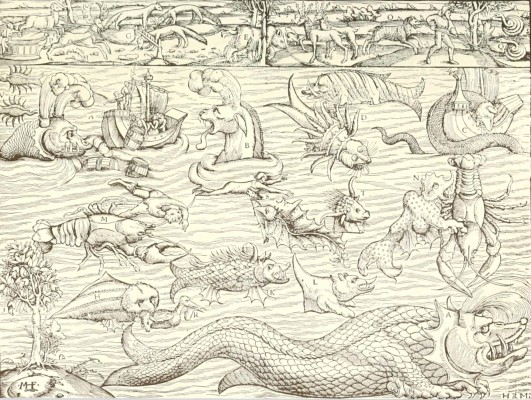
DANGERS OF THE NORTHERN SEAS
Moscow then possessed about forty thousand
houses. It may be doubted if any town in Europe
surpassed that number. Yet it was not size that
caused going to Muscovy to be practically identical
with going to Moscow, but the fact that the
latter was the residence of a ruler whose despotism
was so unlimited that every other settlement
became insignificant compared with that where
he dwelt. This is typified by the prominence
given by all foreigners to the banquet they generally
attended as the guests of the Tsar, a display
of barbaric magnificence that must evidently
have been one of the most striking sights of Europe.
Unfortunately the magnificence was apt
to stop short at the door of the banquet-hall.
One Italian[59] in particular could not forget leaving
after three hours, picking his way through the
outer rooms, pitch dark and strewn with courtiers
in the weeping-stage of drunkenness, down the
stairs. About twenty yards away from the foot
of the stairs a crowd of servants were waiting
with horses to take their masters home. Towards
these they had to wade, knee-deep in mud, still
in pitch-darkness, and so continue a good part
of the way home, since no one was allowed to
ride till he had passed out of the palace precincts.
Nowhere was this despotism more felt than in
relation to travel: every foreigner was half a
prisoner from the day he entered the kingdom
to the day he left, even though he were an ambassador.
The very Jesuits sent by the Pope, in
1581, at the Tsar's own request, to negotiate a
peace between himself and the King of Poland
were under surveillance to such an extent that
they were not allowed to water their own horses.
Neither was any subject allowed to leave the land:
the penalty for unlicensed travel being death.
It is clear that leave must have been more freely
granted than one might imagine from the general
statements of visitors, since Russian pilgrims and
merchants are by no means uncommon, and indeed,
at this period, Peter Mogila, Metropolitan
of Kiev, and Boris Godunov, ruler at Moscow,
endeavoured to encourage travel by Russians as a
means of education.
Godunov's efforts, in fact, beginning as they did
with his accession in 1586, synchronised with the
growth of the same idea in England. But his
efforts failed through being too far ahead of public
opinion; those whom he sent stayed away permanently,
those who stayed at home remained unconverted.[60]
Two instances of public opinion as
regards foreigners may be quoted, both occurring
on the direct road to Moscow at the very end of
this period, during the whole of which the number
of visitors goes on increasing. The first is the experience
of some Dutchmen who came by invitation
of the Tsar and consequently had a house
commandeered for them. The wife of the owner,
seeing no help was to be had from the local authorities,
rushed to St. Nicholas and would, she believed,
have obtained a miraculous expulsion of
the visitors had not her husband tired of the length
of her prayer and stopped it by force. The second
is that of a Danish gentleman who, with his companions,
was prevented from entering a village
by bees which the peasants had irritated for that
purpose.
So, too, with the Muscovites and travel on
their own account. Whereas other Europeans
only thought of dying when they travelled, the
Muscovite only thought of travelling when he
died. Then his friends shod him with a new pair
of shoes for the long journey that he had to go,
and put a letter in his hand to St. Nicholas, by
way of passport, testifying that the bearer died
a Russian of the Russians in the one true faith.
The distinctive characteristics of the people
as seen by strangers were drunkenness, endurance
of heat, cold, and torture, and slavish obedience
to the Tsar. Drunkenness in particular. As the
English verse-writer, Turberville, who went there,
puts it,—
Drink is their whole desire, the pot is all their pride,
The soberest head doth once a day stand needful of a guide.
The habit went the farther since it was encouraged
by the government, for the recent taking-over
of the drink-traffic by the State was but a reversion
to the state of affairs in 1600, though then it
was an offence against the State to urge a man to
leave one of the State-owned taverns, even though
he was pledging the clothes off his back: a common
custom. At every season of public rejoicing
in winter two or three hundred died in the streets
of Moscow as they lay there naked and dead-drunk,
and the stranger might see the bodies
brought home by tens and twelves, half-eaten by
dogs. One traveller tells a tale of a Muscovite
whom he saw come out of a tavern in shirt and
breeches only, meet a friend, return, and come out
again with no shirt. The traveller, who knew
Russian, expressed sympathy with him as if he
had been robbed, but was answered, "No, it's the
man at the bar and his wine that have brought
me to this, but as my shirt's there my breeches
may as well keep it company." And accordingly,
a few minutes afterwards, he came out once more
with nothing to cover him but a handful of flowers
picked at the tavern-door!
There had been a Tsar who tried to repress
drunkenness, but he became a dead failure in
every sense of the phrase shortly before the above
incident happened, and even during his lifetime
achieved nothing more than preventing people
going about the streets naked. Neither was it
just the average man who could not endure life
sober, but the priest frequently needed a lay-helper
on either side of him in order to get through
the marriage service, a result of the festivities
preceding the wedding. And the women were no
better than the men. When a Russian lady entertained
her friends, it was etiquette to send round
afterwards to know if they all got home safely.
Yet one traveller unconsciously gives the Muscovite's
own point of view: there was a quarter of
Moscow known as the "drunken" quarter: that
was where the foreign soldiers lodged.
The excessive misuse of tobacco was also bound
to be noticed, considering that smoking became
general more quickly there than anywhere else
outside England and Turkey. But the Tsar who
failed to check drunkenness succeeded against
smoking, which he prohibited, under penalty of
slitting the nostrils, in 1634, on the ground of it
being a frequent cause of fires among the houses,
all wooden ones, and of the unholy state of the
Muscovite's breath when he addressed the saints.
Along with other accusations which the travellers
have to lodge, such as that of a grossness of
indecency without parallel in their experience,
is hardly to be found one note of pleasure, except
with regard to the charm of the Russian spring.
It may be doubted if foreigners' opinions underwent
much change until such writers as Turgenev
compelled attention to the point of creating sympathy.
But yet, if their tales be few and their
enjoyment scanty, their records possess all the
greater comparative value from the very fact
of their fewness. That the pre-Christian Slav religion
still remained in memory, if not in use, at
Pskov as late as 1590 would probably never even
have been guessed but for the remark of one Johann
David Wunderer, who was there at that
date, that he saw two stone statues there, one
holding a cross, the other standing on a snake with
a sword in one hand and fire in the other, idols, he
was told, who were still known as "Ussladt" and
"Corsa."[61]
Et si pur effecti quasi miraculosi vi trovasse, come ja vi sono,
V. S. non l'imputi al scriptore, ma a la variatione et deità de la
natura.
Antonio da Beatis, 1518.
It will have been noticed that the tourist was
nothing if not unsympathetic. Yet nowhere
does this stand out so sharply as in regard to
the two countries farthest west. So far as the
Spanish peninsula was concerned, a reason may
be sought in the route usually chosen, a route
which treated the peninsula as part of "European
Europe" and implied seeing a little of it,
seeing that little in a one-sided way, and mistaking
it for an epitome of the whole.
Starting from the southwest corner of France,
the most direct way was taken for the Escorial
and Madrid, whence the return journey led past
Barcelona to Montserrat and so over the Pyrenees
again to the southeast corner of France. The
objective, of course, was the capital and the court.
And it was taken for granted, here as elsewhere,
that the other chief objects of interest were the
towns, which claimed an even greater proportion
of attention than in other countries, inasmuch as
the hardships of travel in Spain were more trying
to a foreigner than those experienced elsewhere,
and his mental energies were often, in consequence,
the less free for observation in Spain as
long as he kept on the move. Now it unfortunately
happened that the seamy side of Spanish life
thrust itself to the front in undue proportion in
the towns. Moreover, the French districts which
lay nearest to Spain were those whose characteristics
contrasted most favourably as against those
of the Spanish districts that lay nearest to France.
The liveliness and gaiety of the Bayonnais, playing
bowls all day on the carefully levelled, sanded
court between his house and the street, was
thrown into relief by the sternness of the Pyrenees
and the poverty and gloom of the Vizcaino.
The injustice done by these first impressions
was deepened by almost all that caught the
attention on a journey like that just outlined,
whatever the momentary point of view, whether
historical, geographical, social, superficial, or political,—especially
political.
The Spanish king was looked on as the most
powerful Christian monarch of the time, in prestige,
in financial resources, and as the head of an
empire whose limits were the more impressive for
being mathematicians' lines imagined in the midst
of the Unexplored. It was natural, then, to consider
his capital the centre of each, as well as of
all, of his dominions, and as the Holy of Holies
of European kingship; and this, too, at a date
when monarchical ideals were so strong that a
highly respectable middle-class man like William
Camden could allude to Simon de Montfort, who
figures in modern school-books as the ever-glorious
founder of "representative" government, as—"our
Catiline."[62] In addition, the annexation
of Portugal in 1580, and its revolt in 1640, accentuate
such ideas more in this period than in any
other as the only one during which the whole
peninsula was under one king.
Neither was this illusion of solidarity merely
a traveller's mirage which those on the spot would
rectify. Philip II's people loved to have it so;
witness one of Sancho Panza's favourite proverbs:
"Un rey, Una fe, Una ley"; and how was the tourist
to know that the Spaniard did not appreciate
his differentiation between ideals and facts? The
voice of Sancho Panza is, of course, the voice of
Castile, but then Castile has always the monopoly
of forming foreign, and leading Spanish,
opinion on things Spanish.
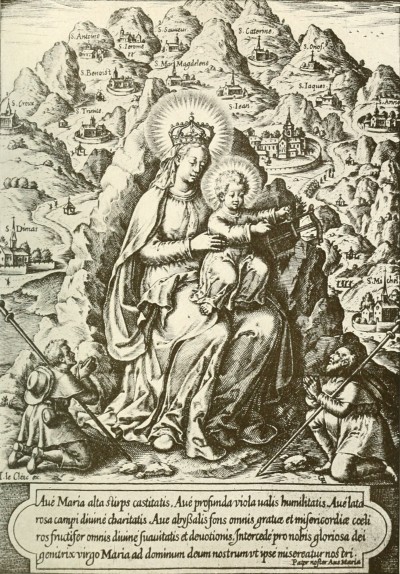
AT MONTSERRAT
Ave Maria stirps castitatis. Ave profunda viola valis humilitatis. Ave lata
rosa campi divine charitatis. Ave abyßalis omnis gratiæ et misericordiæ coeli
ros fructifer omnis divine suavitatis er devotionis. Intercede pro nobis gloriosa dei
genitrix virgo Maria ad dominum deum nostrumvt ipse misereatur nostri.
Pater noster Ave Maria
The choice of route, then, predetermined by
the usual considerations, applicable only to other
countries, failed to do justice to Spain. Yet it
was accompanied by these special assumptions, as
regards political supremacy, at the back of the
tourist's mind, no evidence in favour of which
was forthcoming; at least, no evidence of a kind
which he came prepared to recognise as such. On
the contrary, he could not avoid being struck by
the insignificance of Spanish buildings, especially,
curiously enough, at Madrid itself, where the
houses were mostly of one story; a result of it
being necessary to obtain a license from the King
for anything higher, the conditions imposed by
which license, such as that of housing ambassadors
in the second story, would prove too burdensome.
This particular impression was deepened
in the latter half of the period by the linen window-panes,
which made the interiors seem gloomy at
a date when the use of glass in windows was
spreading in the countries which the visitor had
come from and had passed through. And so with
many other matters, until one Dutchman who
had travelled viâ Italy, after being taken to see
a water-mill as something quite out of the common,
makes the general deduction: "What is
very common elsewhere, here often passes for
miraculous."
Furthermore, as has been said, there were the
historical illusions, too, which would be shaken.
What Montaigne experienced at Venice took
place on a larger scale in the minds of all who
visited Spain. The deeper the previous study,
the deeper the disappointment; but the latter
was felt nevertheless by him in whom it was unconscious;
and in both cases the recovery was
slower than at Venice where all that was visible
was so near. In fact, it is clear enough that with
most a recovery never happened.
The histories they depended on were a variety
of heroic fiction whose theory of causation consisted
of immediate causes and God. National
limitations only appeared, therefore, in so far as
they had contributed to national achievements.
But to the tourist these limitations, and even the
qualities which were simply strange to him, stood
out as defects, and the necessary minutiæ of daily
life as the unworthy preoccupations of degenerate
descendants; while the people, accordingly, whose
ancestors were represented as having done nothing
but conquer for centuries, showed up as ordinary
human beings, muddling along in the way customary
among one's own countrymen. Yet successes
of Spanish diplomacy were so recent, and
the supremacy of Spanish infantry so terribly
obvious, that strangers could not account for all
this disillusion by assuming degeneration to be
the sole reason; while it was likewise too sudden
for them to see in it nothing but an example of
the falsification of proportions inherent in all
knowledge drawn from books or other second-hand
sources. Their attitude to Spain when they revised
their journals was thus mystification rather
than contempt or disgust, though both the latter
are usually present.
This same unpreparedness to take a totally
fresh point of view is even more marked in relation
to religion. However greatly at odds the
matter-of-fact foreigner and the matter-of-faith
Castilian might be over details, both were equally
unwilling to accept the illusions of to-morrow on
that subject in place of the illusions of yesterday.
The tendency to accept the face values of things
theological was then as strong as to-day it is weak;
but, with the possible exception of seventeenth-century
Ireland, it was nowhere so strong as in
Spain. The latter's place in Europe was bound up
with leadership of the cause of Roman Catholicism;
foreigners took this for granted, and the
Spaniards unconsciously set a value on their
creed apart from its relation to theological logic
or religious experience—it had so long been the
only rallying cry which could bring about a sinking
of differences and achieve the temporary unity
which was essential to success in war. But to
the contemporary stranger, the varnish of the
water of baptism was opaque, and the Celt, the
Moor, the Pre-historic, the Outrageous-Pagan,
and the all-pervading Jew, seemed all one thing,
ultra-Holy-Roman. Another source of mystification—except
to the Protestant, who knew
exactly what it all meant and so went further
astray than the rest, in the same direction.
Socially, the unintelligible contradictoriness
was as great. Witness one whom a Burgos gentleman
invited to dinner. The dining-room was that
in which the hostess lay ill in bed with a fever;
and he remembered afterwards that he had behaved
with grossly bad manners inasmuch as he
had taken off his hat at meal-time.
To go on to the means whereby geography also
contributed to strain the sixteenth-century tourist's
easily ruptured sympathy, there was the
climate. The majority started in fear of the heat
and suffered only from cold, expecting to find an
Andalusian spring perpetually reigning at, say
Burgos, instead of its "ten months of winter and
two of hell" (or, to retain the pun, "diez mezes
de invierno y dos de infierno"); whereas the visit
to the South which was so rarely paid would
have restored beliefs which had foundation enough.
Besides, through this fear of the heat they traversed
what they did traverse at the seasons
when what fascination it possessed was least in
evidence.
Among other conditions, the economic seem
to have scandalised observers most. Perhaps the
student will have noticed that whatever year during
the last three hundred he may chance to be
reading about in the history of Spain, the country
will always at that moment have reached the
last stage of economic exhaustion. Another quarter
of a century or so, and, curiously enough, a
lower stage will have been reached; yet another
twenty-five years and one still lower; and so on
until one would think the most hypothetical zero
of bankruptcy must belong to a happier past and
the population can consist of no more than a few
emaciated grandees licking the rocks for sustenance.
The natural attempt will be to go farther
and farther back to trace the steps of the decline;
and in time one will come upon these whose accounts
are under consideration; but it will be without
satisfaction. There is nothing for it but to go
right back to the golden age. But in Guicciardini
(1513) there is just the same tale, scarcity of inhabitants;
poverty; mean aspects of daily life;
stagnation in commerce owing entirely to Spanish
aversion from work; industries under foreign control.
It suggests that possibly the same phenomena
have been in existence early and late, and
that what earlier writers describe as an undeveloped
country is the same as the "exhausted"
one of later days; the difference, if this is the
case, lying not in the conditions seen but in the
extent of the stranger's expectations, moderate
when the power of Spain had just become of international
account; too high, later, when it was
assumed that political power of long standing
could not have grown up except in association
with economic strength of equal greatness. To
travellers of this period any unsoundness or "exhaustion"
seemed the more incomprehensible in
that Spain was by far the chief importer of bullion,
the universal value of which they were accustomed
to overrate.
Guicciardini, however, says nothing about the
misbehaviour of Spanish women by which the
next three or four generations of travellers are invariably
shocked, with one exception, that of
Lady Fanshawe, who saw much to admire in
them and nothing to condemn, and had she seen
what the men saw there is no doubt whatever her
scorn would have been very pronounced. According
to the men, neither the Italian fashion of
the men restraining the women, nor the transalpine
fashion of the women restraining themselves,
was used in Spain. But it must be remembered
that the male tourist tends to see the womenfolk
of the country he visits nearer their worst
than their best.
Too warm a welcome was not a fault into which
the males fell. In Madrid a Protestant might
feel safe, and in centres of international trade,
such as Medina del Campo, free from insult; at
Burgos there was even courtesy, and at Barcelona
civility, although it went hand in hand with
robbery. But for the most part, it was needful to be
both callous and plucky. In particular, the traveller
must take care to get his hair cut short at
Vittoria at the latest. French and many Germans
as well as English wore their hair long, and nothing
laid them open to insult, and even injury, so
much as that; if they were clean-shaven as well,
it was taken as certain that they carried effeminacy
to extremes; neither were they the last to
hear of it. "Rogue" and "thief" were ordinary
terms, even after a hair-cut, and when the queen
was a German, one of her countrymen, a man
who could be trusted not to give offence, had to
buy a new hat at Toledo because the one he was
wearing bore too many traces of cow-dung; at
Seville he was stoned.
Yet considering the average elsewhere, the
individual Spaniard stood to gain by comparison;
one of the most prejudiced and illiterate of the
tourists admits being treated with great courtesy,
and there is a general agreement that the standard
of honesty was remarkably high. It is amusing,
too, to notice what disconcerting answers
were sometimes received by the gentlemen from
abroad who thought that the peasantry of a Roman
Catholic and poverty-stricken country only
needed to be questioned in order that the pitiable
state of their mind should become apparent, even
to themselves.
To one question, why extreme severity should
be reserved for heretics, the reply was that heresy
was the only crime which had not the excuse of
giving pleasure; while another who was asked why
a saint's day should be honoured so highly and
Sunday practically ignored, pointed out that the
saint's day came but once a year and Sunday
every week. So, too, it came as a surprise to the
Protestant to find Spanish nuns neither neurotic,
depressed, nor prim, but bright and attractive,
and their education "infinitely beyond all our
English schools."[63]
Nevertheless, what with the above experiences,
together with others which will be more in place
farther on, it is not surprising if Spain was considered
a country of especial danger and difficulties,
where there was nothing to be learnt that
had not better remain unlearnt, nor anything
worth seeing.
The best guide, in answering this last objection,
urges that the court at Madrid and the church of
San Lorenzo at the Escorial are alone worth the
journey, and names fifty-eight towns to complete
the answer. It would be superfluous to enter into
details; it is more difficult for us to doubt it than
for them to believe it. But Seville must not be
passed over altogether, the Seville of Cervantes'
"Novelas Ejemplares," the Seville which was
what Madrid pretended to be, the Spanish capital
of Spanish Spain. Half the buildings that the
modern visitor goes to see there were new in 1600,
but the great sight, as great a sight as any in Europe
both in itself and for its associations, was the
arrival of the silver fleet from the "Indies."
Of the two chief places of pilgrimage, Montserrat,
being on a main road from France and
not far from Barcelona, is very frequently mentioned,
but an account of a journey to Compostella
is far rarer. Concerning the former, one
account contains a particular of which there is perhaps
no other record. The occupant of the highest
of the almost inaccessible hermitages around the
monastery, that of St. Jerome, in 1599, could bring
the wild birds flocking round him when he called
them, in such numbers that the writer, who had
been throughout the peninsula, mentions the sight
as the most wonderful in all Spain. Two ravens
lived with the hermit in his cell.[64] As for Compostella,
Andrew Boorde tells how he met nine men
leaving Orleans on the way thither, and how he
tried to dissuade them, saying he would rather
go from England to Rome five times than once
to Compostella, and that the government might
well set in the stocks persons who proposed going
thither without special leave, as being a waste of
valuable lives. They persisted, and he accompanied
them. Not one of the ten survived the journey
except himself; and he was a doctor. Only one account
preserves much detail of a stay at Compostella,
that of a German soldier,[65] in 1581, who
confessed to an Italian priest, nicknamed Linguarius
for knowing Italian, Spanish, French, German,
Latin and other languages; and saw all that a
good pilgrim should see, including the two great
bells whose sound was so terrific as to frighten
lady pilgrims into miscarriages. At Santo Domingo
de la Calzada on the road, according to a
Pole,[66] there remained a curious survival of divination
by birds. In the church porch white capons
were reared in a copper-wire cage, to which the
pilgrim used to offer bread on the end of his staff;
if the bird refused the bread, it was held an omen
that the pilgrim would die on the journey.
Among the other things that Spain had in common
with "European Europe" may be mentioned
the royal Zoos: one at Madrid, where a crocodile
was to be seen, also the first rhinoceros that had
been brought to Europe; the other at Valladolid,
containing four lions, an eagle, four seals, and canary-birds.
In water-works Aranjuez could hold
its own against Italy, with its brazen statue of
Priapus, casting forth water from every extremity,
a cave with two dragons and many birds, the
birds being made to sing by the movements of
the water; with satyrs and savages, and artificial
cypresses and white roses which soaked the visitor
who touched them. Neither were the horribles
kept out of sight: at Seville some one speaks of
seeing a thief shot to death with arrows, and two
other criminals beheaded with swords, the bodies
being laid up against a church-wall to attract alms
to pay for their burial.
The coupling of Ireland with Spain does not
result from the mere chance of westernmost position,
nor even from the political needs that they
shared, or from the supposed kinship of the peoples.
While other countries aroused curiosity and then
gratified it, these two occasioned, successively,
illusion, disillusion, mystification. Which often
led to abuse, but not so often, as regards Ireland,
by Englishmen, as is represented by experienced
controversialists who well know the effect of sixteenth-century
phrases torn from their context
and set up on a background of journalese, where
the flavour of the original spelling fixes their seeming
harshness in the memory of those controversialists
cater for.
There can be no more effective counterblast
to this than a study of the books of the time
recording journeys from everywhere to everywhere,
for from these it will be evident that what
the Englishmen say of Ireland and the Irish is
more favourable than what contemporary foreigners
usually say of the countries and nations
that they visit; and also that where the English
are unfavourable they are borne out by other
foreigners. All adverse comment may be included
under the charge of barbarism. Now Captain
Cuellar, as unprejudiced a witness as could be
required, being a Spaniard wrecked there from
the Armada and a man who took everything as
it came, invariably speaks of each Irishman as
"el selvaje," which cannot be translated as anything
but "the savage."
But here lies the fact which supplies the contrast
between Spaniards and Irish, a contrast
within the similarity which classed the two together,
as countries seen by foreigners. The latter's
disillusion was produced by the barbarism
interwoven with the civilisation of Spain, but,
in Ireland, by the civilisation co-existent with the
known barbarism. It was a perpetual surprise to
all visitors to find many of the individuals of a
society that persisted in the crudest and rudest
way of living, showing a force of intelligence and
character, and in certain ways a refinement and
a degree of education, which seemed to presuppose
all the advantages that the best of European
surroundings and training had to give.
Most are content just to note these and other
contrasts; the sum of their opinion as regarded the
people being: "If they be bad you shall nowhere
meet with worse; if they be good you shall hardly
find better."[67] Of experience of this, Captain
Cuellar's narrative stands out as a quintessential
example. It is equally handy for those who
wish to prove the Irish the most charming, or the
most abominable, nation that ever existed. He
found them equally ready to strip him and to feed
him, to wound and to heal, to betray and to
shelter, to make him at home and to make him
work. Compare with this the conclusions of an
impartial Italian[68] seventy years earlier. The
women he found very beautiful and white, but
dirty; the people generally, very religious, yet
do not consider stealing a sin. He was given to
understand that Irish people looked down on such
as were averse to share and share alike as regards
the blessings of fortune, and certainly came across
many on the road anxious to give effect to communistic
theories; these he terms robbers.
Aliens of a philosophic turn of mind, after passing
through the state of surprise, not so much,
even, at their being this or that, as at their being
content or able to continue to be both at once,
turned to looking for reasons. The foreigner who
brought to bear on this question as great an amount
of knowledge, experience, and fair-mindedness as
any was Sir John Davies, who, in his "Discovery,"
after referring to the Irishman's "contempt
and scorn of all things necessary for the civil life
of man," goes on, "for though the Irishry be a
nation of great antiquity and wanted neither art
nor valour and ... were lovers of music and poetry,
and all kinds of learning, and possessed a land
abounding with all things necessary; yet ... I
dare say boldly that never any person did build
any stone or brick house for his private habitation,
but such as have lately obtained estates according
to the course of the law of England. Neither
did any of them in all this time plant any gardens
or orchards, enclose or improve their lands, live
together in settled villages or towns, nor make any
provision for posterity; which being against all
common sense and reason, must needs be imputed
to those unreasonable customs which made their
estates so uncertain and transitory in their possessions."
If Sir John Davies thought thus, it is not surprising
that hastier foreigners who had less knowledge
of the ancient Irish civilisation, thought so
too. We have just seen how, with regard to Spain,
a history made up of the imaginary glories of an
imaginary past helped to give the foreigner so
high an idea of the individuals of the nation that
the reality came as a shock. Here in Ireland, in
this matter as in others, was a similarity with a
difference. However true it may be that the Irish
suffered from a radical lack of adaptability to
modern conditions, the defects of it were undoubtedly
heightened in the eyes of strangers by the
latter's ignorance of the conditions that the Irish
could accept, the Brehon laws, for instance, and
all that they imply, especially the check on their
misuse by means of public opinion.
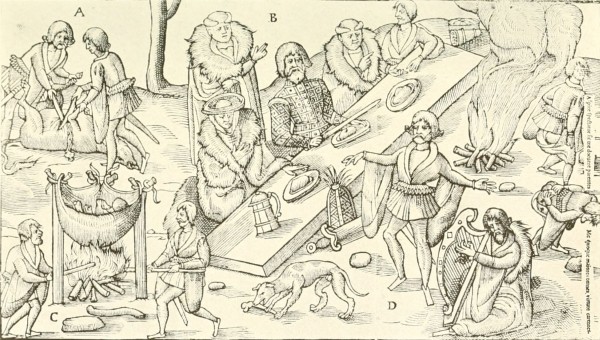
AN IRISH DINNER
Two features, however, were almost invariably
commended: Irish harping and Irish girls. And
the latter were at no disadvantage among the
foreigners, since even in the far west which Captain
Cuellar visited, they spoke Latin fluently,
although content with one garment, often with
less. The only fault that could be found with
them was that of growing older as years went on,
for to see an old Irishwoman before breakfast was,
says Moryson, enough to turn a man's stomach.
The country, too, received unlimited praise, with
one abatement here also: in respect of its wetness;
greater then than now, it may be said with some
certainty.[69] Lithgow, in particular, when he visited
"this sequestrate and most auspicuous monarchy,"
in 1619, discovered there "more Rivers, Lakes,
Brooks, Strands, Quagmires, Bogs, and Marshes
than in all Christendom besides." In five months
he ruined six horses and was himself more tired
than any of them.
Great, however, were the fetiches, and they
prevailed. The essentials of life, as they appeared
to the Irishman, and as they appeared to most
Europeans, differed so utterly, and the reasons
underlying the differences were so unrealisable
to each other, that Ireland remained comparatively
unvisited on account of its lack of the kind
of interest for which travellers felt themselves
bound to look. So, at least, the balance of the
evidence seems to show, but the evidence is as
conflicting here as in relation to everything else
to do with Ireland. While the Bollandist fathers
affirm that fifteen hundred foreigners made the
pilgrimage to St. Patrick's Purgatory during the
"Counter-Reformation,"[70] the native contemporary
Catholic, Phillip O'Sullivan, living at Madrid,
had to go back beyond the memory of living man
for the written account of such a pilgrimage with
which he wished to preface his history of the
struggle against England. Or again, the excellent
knowledge the Irish leaders in this struggle received
of foreign affairs presupposes a great deal
of going to and fro; yet De Thou, in a letter dated
1605,[71] by which date he had been working at
his history of his own times for many years and
was well known as a man worth helping to correspondents
all over Europe, writes that he has not
hitherto come across any one who has personal
knowledge of Ireland nor even any one who has
talked with some one who has been there.
Neither are there nearly so many casual references
to visitors as one chances on with regard
to other countries. Two exceptions which suggest
the likelihood of others are, however, to be
found mentioned in the correspondence between
the English Privy Council and the Deputy at
Dublin.[72] In 1572 the latter announces the arrival
of three German earls with one Mr. Rogers,
their guide, adding, to Lord Burghley, "according
to your directions, they shall travel as little
way into the country as I can manage." This is
explained by the second reference, seven years
later, when three more Germans come across with
letters of introduction from the Privy Council,
who half suspect them, young though they are, of
being spies. But after the close of this period, in
1666, we find a Frenchman[73] noting that the Provost
of Trinity College "seemed astonished that
out of mere curiosity I should come to see Ireland,
which is a country so retired and almost unknown
to foreign travellers."