CHAPTER I TOTO HELPS MILLIE
TOTO,
THE BUSTLING BEAVER
“Toto! Toto! Where are you?”
There was no answer to this call,
which Mrs. Beaver, the mother of
Toto, sounded as she climbed up on the ice and
looked around for her little boy. Mrs. Beaver
sat on her broad, flat tail, which really made quite
a good seat, and with her sharp eyes she looked
up and down Winding River for a sight of Toto.
Then she called again, in beaver animal language
of course:
“Toto! Toto! Come home this minute!
You’ve been out on the ice long enough! And
goodness knows we’ve had plenty of ice and snow
this winter,” went on Mrs. Beaver, and she kept
on looking up and down the frozen river. “I’ll be
glad when spring comes so we beavers can gnaw
down trees, eat the soft bark, and make dams for
our houses,” she added.
But though she called as loudly as she could,
and looked sharply up and down the river, which
was covered with a sheet of smooth ice, Mrs.
Beaver could see nothing of her little boy, Toto.
“What’s the matter?” asked an old gentleman
beaver, who came along just then. “Has Toto
run away?”
“I don’t know that I’d call it exactly running
away, Mr. Cuppy,” answered Mrs. Beaver. “I
said he could go out of the house and play on the
ice a little while, but I told him to come back and
get his willow bark lunch. But he hasn’t come,
so I walked out to call him.”
“And he doesn’t answer,” said Mr. Cuppy, the
old beaver gentleman, with a laugh—of course he
laughed animal fashion, and not as you do. “I
guess Toto is off playing tag, or something like
that, on the ice with the other beaver boys,” added
Mr. Cuppy. “I’m going down the river to call
on some friends of mine. If I see Toto I’ll tell
him you want him.”
“I wish you would,” said Mrs. Beaver.
“Please tell him to come straight home.”
“I will,” answered Mr. Cuppy, and then he got
up from the ice, where he had sat down on his
broad, flat tail to talk to Toto’s mother, and
walked slowly down the ice-covered river which
ran into Clearwater Lake.
That is, the river ran in summer time. In
winter it was frozen over, though of course the
water ran under the ice, where boys and girls
could not see it. But Toto, Mr. Cuppy, and the
other beavers could see it, for they could dive
under the ice and swim in the water that flowed
beneath it. In fact, they would rather swim in
the water, cold as it was, than walk on the ice.
For a beaver can not very well walk on the
ice—it is too slippery. Nor can a beaver walk
very fast even on dry ground. But, my! how
fast they can swim in water. So, though beavers
very often come out on the land, or shore, they
always run for the water, dive down, and swim
away as soon as there is the least sign of danger.
Mrs. Beaver walked back toward the hole in
the ice through which she intended getting into
her house, where she lived with her husband, Mr.
Beaver, Toto, and another little beaver boy named
Sniffy.
Mrs. Beaver’s home looked just like a bundle
of sticks from the woodpile, laid together criss-cross
fashion. In fact, if you had seen it from
the outside you would have said it was only a
heap of rubbish.
This heap of sticks was built out near the middle
of Winding River, which was not a very large
stream. And now that the river was frozen, the
pile of sticks, which made the beaver house, was
heaped up above the frozen ice.
The front door to the beaver home was under
water—so far under that it did not freeze—and
when Toto or any of the family wanted to come
out, they had to dive down, swim under water,
and come out on top some distance away. When
the river was not frozen they could come out of
the water wherever they pleased. But when Jack
Frost had made the river a solid, hard sheet of
ice, the beavers had to come out of it just where
a hole had been made for them. Sometimes they
made the hole themselves by blowing their warm
breath on the underside of the ice, and sometimes
they used an airhole such as you often see when
you are skating.
Mrs. Beaver found the hole through the ice,
dived down into the water, swam along a short
distance until she reached the front door of her
house of sticks and frozen mud, and then she
went up inside.
The house was nicely lined inside with soft
grass, and there were a number of short pieces
of sticks scattered about. It was the bark from
these sticks that the beavers lived on in winter.
“Did you find Toto?” asked Mr. Beaver, who
was taking a little nap in the house.
“No, I didn’t,” answered Mrs. Beaver. “But
I met Mr. Cuppy, the old grandfather beaver, you
know, and he said if he saw Toto he’d send our
little boy home.”
“That is very kind of Mr. Cuppy.” Mr.
Beaver stretched himself. “Well, I think I’ll
gnaw a little more bark.”
“I want some, too!” called Sniffy, the other
little beaver boy.
“Here you are!” said his mother, and she took
some of the bark-covered sticks from a pile at
one side of the house.
Of course it was dark inside the house, for mud
was plastered thickly over the crossed sticks to
keep out the cold and snow. But beavers can
see well enough in the dark, just as owls can,
or cats.
After Mr. Cuppy had watched Mrs. Beaver
dive down through the ice and swim away, he
walked on down the frozen river. He looked
from side to side as he waddled slowly along,
hoping to see Toto. But the beaver boy was not
in sight.
And now, so that you may wonder no longer
what had become of the little beaver boy, I’ll tell
you where he was and some of the wonderful adventures
that happened to him.
Toto had asked his mother if he might go out
on the ice and play, and she had said he might.
Toto was about a year old, having been born the
previous spring, and he knew that in winter there
was not much to eat outside the beaver house.
But he had gnawed a number of sticks of poplar,
and of willow, with the sweet, juicy bark on, and
now he was not hungry. He was tired of being
cooped up in the dark house, frozen fast in the
river. So Toto had gone out, and had walked
along the ice until he was quite a long way from
home.
“But I guess I can easily find my way back,”
thought Toto to himself. “It’s pretty slippery
walking, and I’d a good deal rather swim, but if
I walk slowly I won’t slip.”
So he had walked along the ice until he was out
of sight of his home, around one of the many
curves in Winding River. That was the reason
Mrs. Beaver could not see her little boy, and
also why Toto could not hear his mother calling
to him. He did not really mean to stay out when
his mother did not want him to.
“Ah, that looks like something good to eat!”
said Toto to himself, as he saw some straggly
bushes growing on the bank of the river. The
bushes had no leaves on, of course, for this was
March, and winter was still king of the land.
But Toto thought there might be bark on some
of the twigs of the bushes, and bark was what the
beavers mostly ate in winter. He was not hungry,
but Toto, like other boys, was always ready
to eat.
Toto walked slowly over the ice, and, standing
up on his hind legs and partly sitting on his broad,
flat tail, which was almost like the mortar trowel
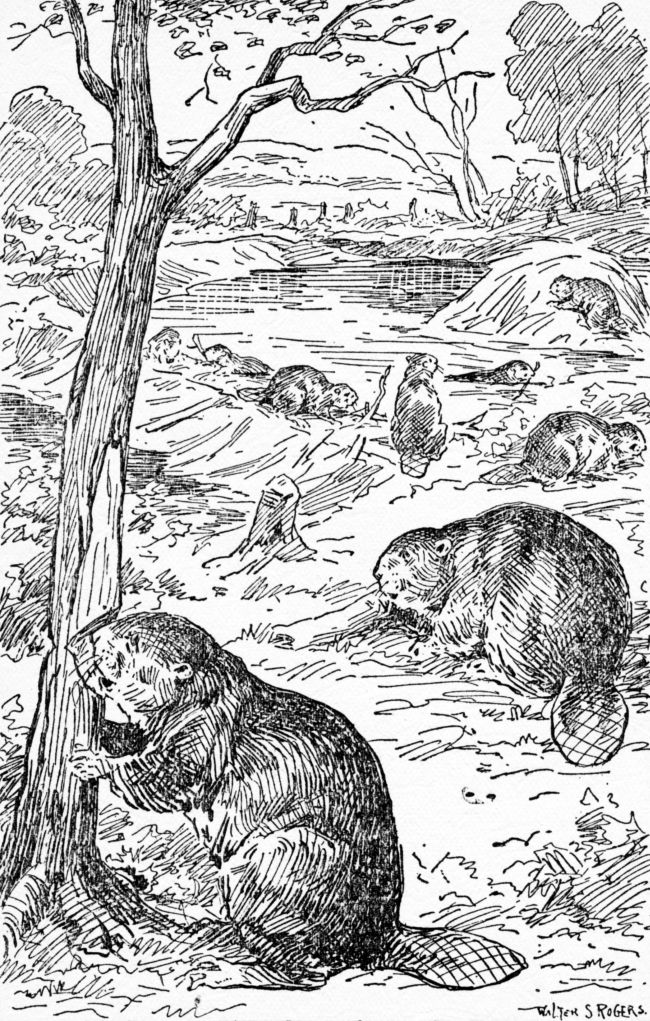
a mason uses, the little beaver boy began to gnaw
the bark.
But he had not taken more than a bite or two
before he stopped suddenly.
“Ouch!” cried Toto. “Something bit me!”
He looked about—there were no bees or wasps
flying, which might have stung him. Still something
had pricked him on his tongue. Then he
looked more closely at the twig he had been gnawing.
“Oh, ho!” exclaimed Toto. “No wonder!
This is a blackberry bush, and the thorns pricked
me. I won’t gnaw any more of this bark.”
Toto backed away and started over the ice
again, but he had not moved more than a few feet
from the thick clump of blackberry bushes, growing
on the edge of the river, when, all of a sudden,
the little beaver boy heard a queer noise—several
noises, in fact.
One was a tinkly sound, a sound Toto remembered
to have heard when in summer a farmer
was hoeing corn in a field near the river, and his
hoe struck on a stone in the dirt. Then came the
noise of a thud, as if something heavy had fallen
on the ice. And after that sounded the voice of
a little girl saying:
“Oh dear! There goes my skate!”
Of course Toto did not understand man, girl,
or boy talk. But he knew what it was, for in
the summer, as he played around his stick-home
in the river, he had often heard the farmer and
his hired men talking in the fields not far away.
So, though Toto did not know what the little
girl said, he knew it was the same sound the
farmer and his men had made when they talked
to one another. And Toto was afraid of men,
and boys and girls, too, though I don’t believe
any girl would have tried to hurt or catch the
beaver, nice as is their fur.
But this particular little girl, whose name was
Millie Watson, did not even know Toto was near
her. She had been skating on the ice when one
of her skates suddenly came off, and she fell down.
The tinkly sound the beaver heard was the loose
steel skate sliding over the ice and striking a
stone near the bush under which Toto was hidden.
The thudding sound was that made by Millie when
she fell. But she was not hurt.
“Oh, dear!” she said again. “I wonder where
my skate slid to. I can’t get along on only one
skate, and it’s slow walking on the ice. Where
is it?”
She slowly arose to her feet. One skate was
still on her foot, but on the other shoe was only
a loose strap. Millie, who had skated from her
home to take a little pail of soup to her grandmother,
who lived farther down the river, was
on her way back when she lost her skate.
“I don’t see where it can be,” mused the little
girl, looking here and there on the ice. The
reason she could not see the skate was because
it had slid under the edge of the overhanging
berry bush.
“I hope she doesn’t see me!” thought Toto, as
he crouched down under the twigs. “I wish it
were summer, and there were leaves on this bush.
I could hide better then, and the river wouldn’t
be frozen, so I could swim away very fast if this
girl comes after me. Dear me! I wonder what
she is doing here, anyhow.”
Toto did not know much about skating. But
as he peered out at the little girl he saw her pushing
herself along on one foot, and on that foot
was something long, thin and shiny. It sparkled
in the sun, just as the blade of the farmer’s hoe
sometimes sparkled.
Toto looked on either side of him, and there,
close to him, was another shiny thing, just like
the one the girl had on one foot. Toto could
see the girl moving slowly along, and looking from
side to side.
“She must be looking for me!” thought Toto,
and his heart began to beat very fast, for his
father and mother had told him always to keep
away from men and boys; and this girl was probably
just like a boy, the little beaver thought.
He had seen boys along the river bank in summer
trying to catch muskrats, and sometimes trying to
catch beavers, too. Toto did not want to be
caught.
So he crouched lower and lower under the
bush, and then, all of a sudden, his feet slipped on
the ice and they struck the long, shiny thing that
was like the object the girl had on one foot.
Instantly there was another tinkly sound, and
the shiny thing slid across the ice, out from under
the overhanging bush and straight toward the
little girl.
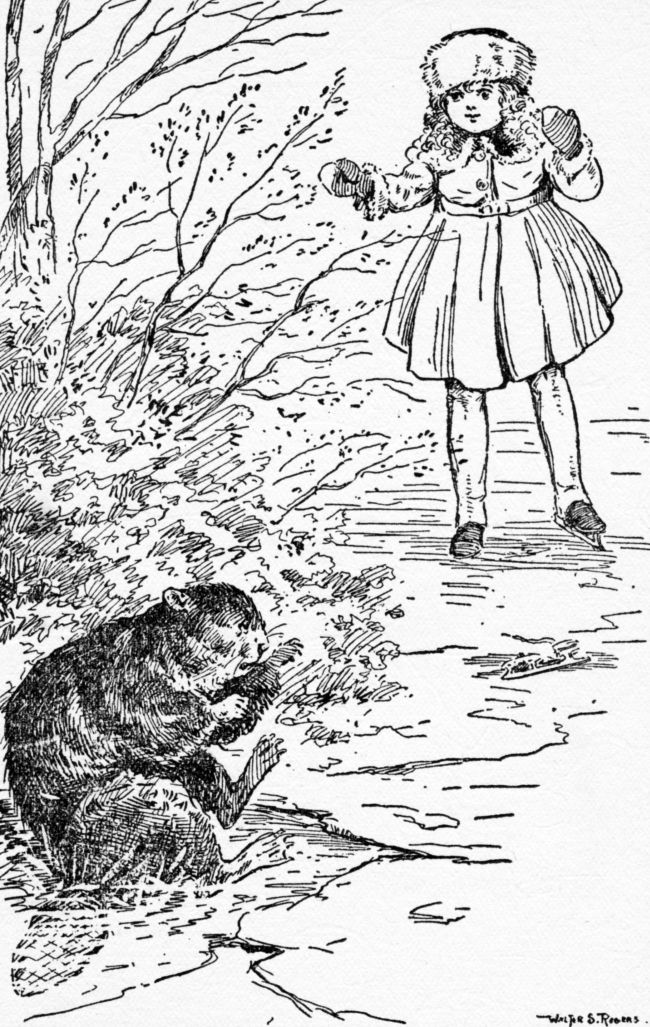
“Oh! Oh!” cried Millie, clapping her mittened
hands. “Here is my lost skate! It was
under the bush, but I wonder what pushed it out!
There must be something there! I’m going to
look!”
Toto heard this talk, but did not know what it
was. However, he could see the little girl stoop
down and pick up the skate he had accidentally
knocked over the ice to her. Then he saw Millie
come straight toward the bush under which he
was hiding!
CHAPTER II TOTO LEARNS TO GNAW
Toto, the little beaver boy, was a bright,
bustling chap. He was what is called
a “hustler” or a “bustler”—that is, some
one always ready for work or play. But just
now, as Toto saw the little girl coming toward
the bush where he was hidden, he did not know
what to do.
“But I’m going to do something!” thought the
beaver boy. “I’m not going to let her catch me!
Maybe that’s a trap she tried to get me in—maybe
that shiny thing is a trap!”
Toto knew what traps were, for his father and
mother had told him about them, and how to keep
away from their sharp teeth that caught beavers
and muskrats by the legs.
Millie came closer and closer. With bright,
eager eyes, almost as bright and eager as those of
Toto himself, she looked at the bush.
Toto was all ready to run, and he wished, more
than ever, that the river was not frozen, since
he would not have been a bit afraid if he could
have jumped in the flowing stream to swim away.
He was not afraid of any creature in the water,
and the fishes were friends of his.
Then, all at once, just as Toto was going to
start to run and do his best on the slippery ice,
he felt himself falling. He had been standing on
the edge of the frozen river, where the ice was
very thin, and it had given away, letting him down
through a hole into the water.
“Oh, now I’m all right!” said Toto to himself
when he felt the water wetting his thick fur,
though it could not wet his skin beneath.
And so he was. He was in water now, where
he felt much more at home than on the ice. And
as he slipped down, tail first through the hole that
had broken, he had a glimpse of the little girl.
The little girl saw Toto, too, and as soon as
she had seen him she clapped her red-mittened
hands again and cried:
“Oh, it’s a little beaver! He knocked my
skate out to me! Oh, don’t go away, little
beaver!” cried Millie. “I won’t hurt you!”
But of course Toto did not know that, and he
did not know what the little girl was saying. He
just wanted to get away from her, and back to his
own stick house. So he dived down under the
water, his fur being so thick and warm that he
was not a bit cold. And away he swam beneath
the ice that covered Winding River.
“Oh, he’s gone!” cried Millie, when she saw
the beaver disappear. “I wish I could have him
to take home! Maybe I’ll see him again! Anyhow,
he was nice to shove my skate out to me!”
Millie sat down on the bank and began putting
on the skate that had slipped off, causing her to
fall. And, though she never guessed it, she was
to see Toto again, and the beaver was to see how
Millie and her grandmother were made happy.
“Well, Toto, where have you been?” asked
his mother, when, some little time later, the beaver
boy swam up to the front door of the stick house.
“I’ve been looking all over for you!”
“I didn’t mean to stay away so long, Mother,”
answered Toto, in beaver talk, of course. “But it
was so slippery on the ice that, when I got to
going, it was hard to stop. I tried to eat some
bark, but it was full of stickers, and then I had
an adventure.”
“What’s an adventure?” asked Sniffy, who was
not quite so bold and daring as was Toto.
“It’s something that happens to you,” Toto
answered.
“And what happened to you?” asked Mr.
Beaver.
Toto told them about Millie’s skate coming off,
though of course he did not call it a skate. He
said it was a “trap.”
“You did well to hurry away,” said his father.
“It’s lucky for you that you fell through the hole
in the ice and could swim. Always, when you
are in danger, get in the water if you can. Very
few animals can swim as fast as we beavers swim.
The water is the place for us, even though we
have to go on land to gnaw down the trees for
the dams we make.”
“Why do we have to make dams?” asked Sniffy.
“To make the water deep enough for our houses
in places where it is otherwise too shallow,” answered
Mr. Beaver. “By putting a lot of trees,
sticks, clumps of grass, and mud across a stream
the water backs up, and gets deep behind the dam,
over which it flows, making a waterfall. We need
to build our houses behind the dam, so as to
have our doors under water. If we didn’t, other
animals from the land would come in and get us.
But land animals can not get into our houses as
long as the front doors are under water, though
it is easy for us to dive down and come up inside
where the water does not reach. Did anything
else happen to you, Toto?” asked his father.
“Well, I swam home under the ice as fast as I
could,” answered the little beaver boy.
“Did you see anything of Mr. Cuppy?” asked
Mrs. Beaver.
“No, I didn’t,” Toto answered. “Did some
one try to catch him in a trap, too?”
“No. But he said he’d send you home if he
met you,” replied Mrs. Beaver. “Of course he
didn’t meet you. I’ll go out and tell him he
needn’t look for you any more, as you are now at
home.”
“Yes, and I’m hungry, too,” said Toto. “The
bark on the bush under which I hid was full of
thorns. I couldn’t eat it.”
“Here is some nice aspen bark,” said Mr.
Beaver. “Let me see your teeth, Toto?”
“What for?” the little beaver boy wanted to
know.
“To see if they are going to be strong enough
to help us gnaw down trees this summer,” went
on Mr. Beaver.
Toto opened his mouth. His teeth were strong
and white, that is all except the four front, or
gnawing teeth. Two of these in his upper jaw
and two in his lower jaw were a sort of red, or
orange, color. All beavers have orange-colored
gnawing teeth, and the rest are white, like yours.
“Humph! Yes, I think you’ll be big enough
to help us gnaw down trees this summer,” said
Daddy Beaver, as he looked at Toto’s orange
teeth, which were almost as sharp and strong as
the chisels the carpenter uses to smooth wood with
which to build a house.
“Is it very hard to gnaw trees down?” Toto
wanted to know.
“It must be easy,” said Sniffy, who was eating
some aspen bark in the stick house. “See how
easy I can strip this bark off this piece of log.”
“Gnawing bark is much easier than gnawing
through the wood of a big, hard tree,” said Mr.
Beaver. “You boys will learn that soon enough.
But here, Toto, try some of this bark.”
So Toto and Sniffy gnawed the bark, and Toto
told his brother more about the little girl he had
seen. He thought she had tried to trap him, but
we know Millie had done nothing of the sort.
Only her skate had come off.
“And what do you think!” the little girl said,
after she had reached home and was telling her
mother about it that night at supper. “My skate
slid right over the ice, under a bush, and a little
beaver that was there pushed it out to me.”
“So the beavers are around here, are they?”
asked Millie’s father. “I wondered what made a
part of Winding River flow so slowly this fall.
The beavers must have dammed it up. Well, the
beavers are hard-working animals and do little
harm. We won’t disturb them.”
The rest of that winter Toto lived in the stick
house with the other beavers. He did not go
out very often, for there is not much beavers can
do until the ice and snow are gone. Toto went
out on the frozen river a few times, however, but
he did not again see the little girl on skates. And
though Millie went out skating, she did not see
Toto until later in the season. I’ll tell you about
that after a while.
Meanwhile the sun climbed higher and higher
in the sky. It warmed the earth, the snow and
ice melted, the banks of Winding River became
green, as the leaves came out on the trees and
bushes, and one day Mr. Beaver said:
“Come with me, Toto and Sniffy. You are
going to learn how to gnaw down trees.”
“Are we going to help build the dam bigger?”
asked Toto.
“Yes, that’s what you are,” his father said.
He dived down in the water, to slip out of the
front door, and the two beaver boys followed
him. Their noses closed, and they kept their
mouths tightly shut while under water. But they
had their eyes open to see where to swim. They
came out on top of the water not far from their
own house. But almost as soon as they had poked
up their noses to take long breaths, Toto and
Sniffy heard a booming, whacking noise, and their
father cried:
“Back! Back, boys! Dive down! There’s
danger!”
CHAPTER III TOTO MEETS DON
You may well believe that Toto and Sniffy
did not lose any time diving down under
water as soon as they heard their father
tell them to do so. Many times before, when
they were first learning to swim, they had dived
down quickly like this just after they had poked
up their noses to get a breath of air. And always
their father or mother had swum with them
out of danger.
“What was that whacking noise, Dad?” asked
Sniffy, when they were once more safely back in
their stick and mud house.
“That was Mr. Cuppy banging his flat tail on
the water to let us know there was some danger,”
answered Mr. Beaver. “Cuppy, or some of the
older beavers, are always on guard at or near the
dam. If they hear, see or smell danger they
whack with their tails. And whenever you hear
that whacking sound you little fellows must dive
into the water and swim away just as fast as you
can.”
“Oh, now I remember about Mr. Cuppy whacking
with his tail!” exclaimed Toto. “You told
us that last summer, didn’t you, Dad?”
“Yes. But the winter has been long, and all
that time you have had no chance to hear Mr.
Cuppy bang his tail on the water, so I was afraid
you had forgotten,” said Mr. Beaver.
“I did forget,” answered Sniffy.
“And I did, too,” said Toto. “But now I’m
always going to listen for Mr. Cuppy’s tail.”
“And run and dive into the water as fast as
you can when you hear him whacking and banging,”
advised Mr. Beaver. “Now we’ll wait a
little while and then we’ll swim up again. The
danger may have passed.”
Toto and his brother waited with their father
perhaps five minutes in the beaver house. Then,
once more, they dived down, out of the front
door, and up into the river, a little farther away.
Mr. Beaver went ahead, and poked up his nose
first to look about. He saw a number of beavers
working on the dam, among them Mr. Cuppy.
“Is it all right?” called Mr. Beaver to the
old gentleman.
“Yes, come along. We need lots of help to
make the dam bigger and stronger,” answered
Mr. Cuppy. “Where are your two boys?”
“Right here,” answered their father. “It’s all
right! Bob up your heads!” he called to Toto
and Sniffy.
Up they swam, and soon they were among
their friends on the dam, which was made of a
number of trees laid crosswise over the narrow
part of the river. Sticks had been piled back of
the trees, and mud, grass-hummocks, and leaves
were piled back of the sticks, so that very little
water could run through. Back of the dam the
water was quite deep, but in front it was very
shallow. The beavers all had their houses back
of the dam.
“What was the danger?” asked Mr. Beaver
of Mr. Cuppy, as the two animal gentlemen
walked along on top of the dam. “Did you see
a bear or some other big animal?”
“No,” answered Mr. Cuppy. “The reason I
whacked my tail was because I saw five or six
men over in the woods where the trees are that
we are going to cut down for our dam.”
“Were they hunter men, with guns?” asked Mr.
Beaver.
“No, they didn’t seem to be hunters,” answered
Mr. Cuppy. “They were rough-looking
men, and not dressed as nicely as most hunters
are. These men had old rusty cans in their hands—cans
like those we sometimes find in our river.
I thought they were coming over to our dam to
catch us, but they didn’t. However I gave the
danger signal.”
“Yes, it’s best to be on the safe side,” returned
Mr. Beaver. “Well, now we are here—my two
boys and myself—and we are ready to help gnaw
down trees for you. My wife will be here in a
little while. She has gone to see if she can find
some aspen bark for our dinner.”
“My wife has gone to look for some, too,”
said Mr. Cuppy. “Well, now, let’s see! Have
Toto and Sniffy ever cut down any trees?”
“No, this will be the first time for them,” said
their father.
“Well, take them over to the little grove and
show them how to work,” advised Mr. Cuppy.
“We shall need many trees this spring. How are
you, boys? Ready to gnaw with your red teeth?”
“Yes, sir,” answered Toto and Sniffy.
“Come along!” called their father, and into the
water they jumped from the top of the dam, to
swim to where the trees grew beside the river.
Beavers always swim, if they can, to wherever
they want to go. They would much rather swim
than walk, as they can swim so much better and
faster. So, in a little while, Toto and Sniffy stood
with their father beside a tree which, near where
the tree trunk went into the ground, was as large
around as your head.
“We will cut down this tree,” said Mr. Beaver.
“What! That big tree?” cried Toto. “We
can never gnaw that down, Dad! It will take a
year!”
“Nonsense!” laughed Mr. Beaver. “We can
gnaw down larger trees than this. Before you
boys are much older you’ll do it yourselves. But
now come on, let’s start. I’ll watch you and tell
you when you do things the wrong way. That’s
the way to learn.”
“I guess I know how to gnaw a tree down!”
boasted Sniffy. “I’ve often watched Mr. Cuppy
do it.” This little beaver boy stood up on his
hind legs, using his tail as a sort of stool to sit
on, and he began cutting through the bark of the
tree, using his four, strong orange-colored front
teeth to gnaw with.
“Here! Hold on! Wait a minute!” cried
Mr. Beaver to his son, while Toto, who was just
going to help his brother, wondered what was the
matter.
“Isn’t this the tree you want gnawed down,
Dad?” asked Sniffy.
“Yes, that’s the one,” his father answered.
“But if you start to gnaw on that side first the
tree will fall right on top of those others, instead
of falling flat on the ground as we want it to.
You must begin to gnaw on the other side, Sniffy.
Then, as soon as you have nearly cut it through,
the tree will fall in this open place.”
“Oh, I didn’t know that,” said Sniffy.
“Nor I,” added his brother.
“Always look to see which way a tree is going
to fall,” advised Daddy Beaver, “and be careful
you are not under it when it falls. If you do as
I tell you then you will always be able to tell just
which way a tree will fall to make it easier to get
it to the dam.”
Then Mr. Beaver told the boys how to do this—how
to start gnawing on the side of the tree
so that it would fall away from them. Lumbermen
know which way to make a tree fall, by
cutting or sawing it in a certain manner, and
beavers are almost as smart as are lumbermen.
How they do it I can’t tell you, but it is true
that beavers can make a tree fall almost in the
exact spot they want it. Of course accidents will
happen now and then, and some beavers have
been caught under the trees they were gnawing
down. But generally they make no mistakes.
“How are we going to get the tree to the dam
after we gnaw through the trunk?” asked Toto,
as he and Sniffy began cutting through the outer
bark with their strong, red teeth. “We can’t
carry it there.”
“We could if we could bite it into short pieces,
as we bite and gnaw into short pieces the logs
we gnaw bark from in our house all winter,”
said Sniffy.
“We don’t want this tree cut up into little
pieces,” said Daddy Beaver. “It must be in one,
long length, to go on top of the dam.”
“We never can drag this tree to the dam after
we have gnawed it down!” sighed Toto. “It
will be too hard work!”
“You won’t have to do that,” said his father
with a laugh. “We will make the water float the
tree to the dam for us.”
“But there isn’t any water near here,” said
Sniffy.
“No, but we can bring the water right here,”
went on Mr. Beaver.
“How?” Toto wanted to know, for he and his
brother were young beavers.
“We can dig a canal through the ground, and
in that the water will come right up to where
we want it,” said Mr. Beaver. “We’ll dig out
the dirt right from under the tree, after we have
cut it down, and bring the canal to it. The canal
will fill with water. The tree, being wood, will
float in the water, and a lot of us beavers, getting
together, can swim along and push and pull the
tree through the canal right to the place where we
need it for the dam.”
“Are we going to learn how to dig canals, too?”
“Yes, building dams and canals and cutting
down trees are the three main things for a beaver
to know,” said his father. “But learn one thing
at a time. Just now you are to learn how to cut
down this tree. Now gnaw your best—each of
you!”
So Toto and Sniffy gnawed, taking turns, and
their father helped them when they were tired.
Soon a deep, white ridge was cut in the side of
the tree.
“The tree is almost ready to fall now,” said
Mr. Beaver. “You boys may take a little rest,
and I’ll finish the gnawing. But I want you to
watch and see how I do it. Thus you will learn.”
“May I go over there by the spring of water
and get some sweet bark?” asked Toto.
“Yes, I’ll wait for you,” answered his father.
“I won’t finish cutting the tree down until you
come back.”
“Bring me some bark,” begged Sniffy, as he
sat down on his broad, flat tail.
“I will,” promised Toto.
The little beaver boy waddled away, and soon
he was near an aspen tree. Beavers like the bark
from this tree better than almost any other.
Toto was gnawing away, stripping off some bark
for his brother, when, all at once, he heard a
rustling sound in the bushes, and a big animal
sprang out and stood in front of Toto.
“Oh, dear me! It’s a bear!” cried Toto.
“No, I am not a bear,” answered the other
animal. “Don’t be afraid of me, little muskrat
boy. I won’t hurt you.”
“I’m not a muskrat! I’m a beaver!” said
Toto. “But who are you?”
“I am Don,” was the answer. “And I am a
dog. Once I was a runaway dog, but I am not
a runaway any longer. But what are you doing
here, beaver boy?”
“Helping my father cut down a tree for the
dam,” Toto answered. “What are you doing,
Don?”
“I am looking for a camp of tramps,” was the
answer, the dog and beaver speaking animal talk,
of course. “A dog friend of mine said there was
a camp of tramps in these woods, and I want to
see if I can find them,” went on Don.
“What are tramps?” asked Toto.
“Ragged men with tin cans that they cook soup
in,” answered Don. “Have you seen any around
here?”
“No, but Cuppy, the oldest beaver here, saw
some ragged men over in the woods,” began Toto.
“Maybe they are—”
But before he could say any more he heard a
loud thumping sound, and Toto knew what that
meant.
“Look out! There’s danger!” cried Toto.
CHAPTER IV TOTO AND THE TRAMPS
Toto, the bustling beaver, ran as fast as
he could and took shelter under a big
rock that made a place like a little cave
on the side of the hill.
“What’s the matter?” asked Don, the dog.
“Are you afraid because I told you about the
tramps?”
“Oh, no,” answered Toto. “But didn’t you
hear that thumping sound just now?”
“Yes, I heard it,” answered Don. “What was
it—somebody beating a carpet?”
“I don’t know what a carpet is,” replied Toto.
“We don’t have any at our house. But, whatever
it is, it wasn’t that. The noise you heard
was one of my beaver friends thumping his tail
on the ground.”
“Oh, you mean wagging his tail!” barked Don.
“Well, I do that myself when I feel glad. I
guess one of your beaver friends must feel glad.”
“No, it isn’t that,” went on Toto. “Whenever
any of the beavers thumps his tail on the ground
it means there’s danger around, and all of us who
hear it run and hide. You’d better come under
this rock with me. Then you’ll be out of danger.”
Once more the thumping sound echoed through
the woods.
“Better come under here with me,” advised
Toto.
“Well, I guess I will,” barked Don.
No sooner was he under the big rock with Toto
than, all of a sudden, there was a loud crash, and
a great tree fell almost on the place in the woods
where Toto and Don had been standing talking.
“My goodness!” barked Don, speaking as dogs
do. “It’s a good thing we were under this rock,
Toto, or else that tree would have fallen on us!
Did you know it was going to fall?”
“Well, no, not exactly. My brother and I have
been practicing on gnawing a tree this morning,
but ours isn’t cut down yet. My father is going
to finish cutting it, and show Sniffy and me how it
is done. But he promised not to cut all the way
through until I got back. So I don’t believe it was
our tree that fell.”
“Is it all right for us to come out now?” asked
Don. Though he was older than the beaver boy,
he felt that perhaps Toto knew more about the
woods—especially when tree-cutting was going
on.
Toto sat up on his tail under the big rock and
listened with his little ears. He heard the
beavers, which were all about, talking among
themselves, and he and Don heard some of them
say:
“It’s all right now. Cuppy and Slump have
cut down the big tree for the dam. It has fallen,
and now it is safe for us to come out.”
The dog and the little beaver came out from
under the overhanging rock, and Don noticed the
pieces of bark Toto had stripped off.
“What are you going to do with them?” asked
Don. “Make a basket?”
“A basket? I should say not!” exclaimed
Toto. “I’m going to eat some and take the rest
to my father and brother. They are farther
back in the woods, cutting down a tree. Don’t
you like bark?”
“Bark? I should say not!” laughed Don in
a barking manner. “I like bones to gnaw, but
not bark, though I bark with my mouth. That
is a different kind, though. But I suppose it
wouldn’t do for all of us to eat the same things.
There wouldn’t be enough to go around. But
tell me: Do you always hear a thumping sound
whenever there is danger in the woods?”
“Yes, that’s one of the ways we beavers have
of talking to one another,” answered Toto.
“Whenever one of us is cutting a tree down, and
he sees that it is about to fall, he thumps on the
ground as hard as he can with his tail. You see
our tails are broad and flat, and they make quite a
thump.”
Don turned and looked at Toto’s tail.
“Yes, it’s quite different from mine,” said the
dog. “I sometimes thump my tail on the floor,
when my master gives me something good to eat
or pats me on the head. But my tail doesn’t
make much noise.”
“Well, a beaver’s tail does,” explained Toto.
“So whenever any of us hear the thumping sound
we know there is danger, and we run away or
hide.”
“I’m glad to know this,” said Don. “When
I’m in the woods, from now on, and hear that
thumping sound, I’ll look around for danger, and
I’ll hide if I can’t get out the way. Well, I’m
glad to have met you,” went on Don. “I don’t
suppose you have seen Blackie, have you?”
“Who is Blackie?” asked the beaver boy. “Is
he another dog?”
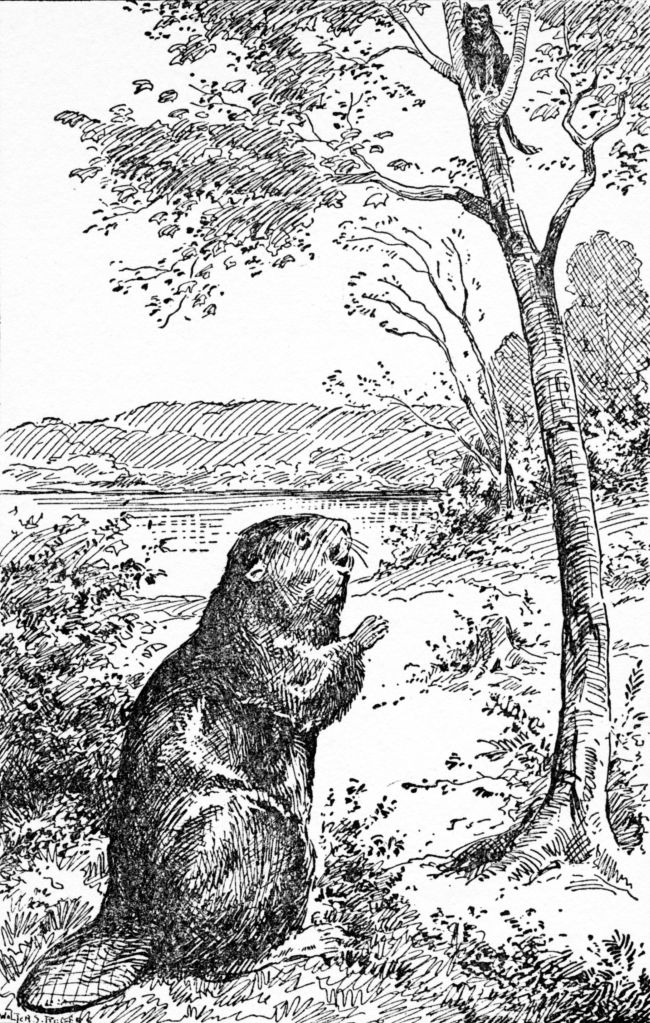
“No, she’s a cat!” explained Don, with a laugh.
“She’s quite a friend of mine. She has a story
all to herself in a book, and I have one, too. I
don’t suppose you were ever in a book, were you,
Toto?”
“Did you say a brook?” asked the beaver boy.
“Of course I’ve been in a brook many a time. I
even built a little dam across a brook once—I
and my brother Sniffy.”
“Ho, I didn’t say brook—I said book,” cried
Don. “Of course I don’t know much about such
things myself, not being able to read. But a book
is something with funny marks in it, and boys
and girls like them very much.”
“Are they good to eat?” asked Toto.
“Oh, no,” answered Don, laughing.
“Then I don’t believe they can be very good!”
said Toto, “and I don’t care to be in a book.”
But you see he is in one, whether he likes it
or not, and some day he may be glad of it.
“Well, I must be going,” barked Don. “I
want to see if I can find that camp where the
tramps live. Tramps are no good. They come
around the house where I live, near Blackie, the
cat, and take our master’s things. If I see the
tramps I’m going to bark at them and try to drive
them away.”
Then he trotted on through the woods, and
Toto, after eating a little more bark, gathered
some up in his paws, and, walking on his hind
legs, brought it to where his father and Sniffy
were waiting for him.
“Here’s Toto,” said Sniffy.
“Where have you been?” asked Mr. Beaver.
“Oh, getting some sweet bark,” answered Toto,
and he laid down on some clean moss the strips
he had pulled off. “I met a dog, too.”
“A dog!” cried Mr. Beaver. “My goodness,
I hope he isn’t chasing after you!” and he looked
through the trees as if afraid.
“Oh, this was Don, a good dog,” explained
Toto. “He’s only looking for some tramps. He
won’t hurt any beavers.”
“Well, if he’s a good dog, all right,” said the
beaver daddy. “But hunters’ dogs are bad—they’ll
chase and bite you. I suppose they don’t
know any better.”
“Where were you when Cuppy whacked with
his tail just before the big tree fell?” asked Sniffy,
as he nibbled at some of the tender bark his
brother had brought.
“Oh, Don and I hid under a big rock,” answered
Toto. “I told him the whacking sound meant
danger. He didn’t know it. And it’s a good
thing we hid when we did, for the tree would have
crushed us if we hadn’t been under the rock. Is
our tree ready to finish gnawing down, Daddy?”
“Yes,” answered Mr. Beaver. “You and
Sniffy may start now, and cut a little more. I’ll
tell you when to stop.”
“But I thought you were going to finish, Dad,”
said Sniffy.
“He will, Sniffy, if he said so. But he’s letting
us help a little more first so we can learn faster!”
So the beaver boys sat up on their tails again,
and gnawed at the big tree—the largest one they
had ever helped to cut down. They gnawed and
gnawed and gnawed with their orange-colored
front teeth, and then Mr. Beaver said:
“That’s enough, boys. I’ll do the rest. But
you may whack on the ground with your tails to
warn the others out of the way.”
So Toto and Sniffy, much delighted to do this,
found a smooth place near a big rock, and then
they went:
“Whack! Whack! Whack!”
“Danger! Danger!” cried a lot of other
beavers who were working near by. “A tree is
going to fall! Run, everybody! Danger!”
“See!” exclaimed Toto to his brother. “We
can make the old beavers run out of the way just
as Cuppy made Don and me run.”
“Yes, you beaver boys are growing up,” said
Mr. Beaver, who had waited to see that his two
sons gave the danger signal properly. “You are
learning very well. Now here goes the tree.”
He gave a few more bites, or gnaws, at the
place where the tree was almost cut through, and
then Mr. Beaver himself ran out of the way.
“Crash! Bang!” went the big tree down in
the forest. It broke down several other smaller
trees, and finally was stretched out on the ground
near the waters of Winding River.
“We helped do that!” said Toto to Sniffy, when
the woods were again silent.
“Yes, you have learned how to cut down big
trees,” said their father. “You are no longer
playing beavers—you are working beavers. Now
we must dig the canal to float the tree nearer the
dam, as it is too heavy for us to roll or pull along,
and we do not want to cut it.”
I will tell you, a little farther on, how the
beavers cut canals to float logs to the places where
they want to use them. Just now all I’ll say
about them is that it took some time to get the
tree Toto and Sniffy had helped cut to the place
where it was needed for the dam. The two
beaver boys and many others of the wonderful
animals were busy for a week or more.
Then, one day, when the tree was in place,
Toto asked his mother if he might go off into the
woods and look for some more aspen bark, as
all that had been stored in the stick house had been
eaten.
“Yes, you may go,” said Mrs. Beaver. “But
don’t go too far, nor stay too long.”
“I won’t,” promised Toto. Then he waddled
off through the woods, after having swum across
the beaver pond, made by damming the river, and
soon he found himself under the green trees.
“I wonder if I’ll meet Don, the nice dog, or
Whitie, the cat?” thought Toto. “Let me see,
was Whitie her name? No, it was Blackie. I
wonder if I’ll meet her, or that little girl who
scared me so that day on the ice?”
Toto looked off through the trees, but he saw
neither Don nor Blackie.
Toto found a place where some aspen bark
grew on trees, and he gnawed off and ate as much
as he wanted. Then he walked on a little farther
and, pretty soon, he saw something in the woods
that looked like a big beaver house. It was a
heap of branches and limbs of trees, and over the
outside were big sheets and strips of rough bark.
“But that can’t be a beaver house,” thought
Toto. “It isn’t near water, and no beavers would
build a house unless it had water near it. I wonder
what it is.”
Toto sat up on his tail and looked at the queer
object. Then all at once he heard rough voices
speaking, and he saw some ragged men come out
of the pile of bark. One or two of them had
tin cans in their hands, and another was holding
a pan over a fire that blazed on a flat rock.
“Oh, I know who they are!” said Toto to
himself. “These must be the tramps Don was
looking for. This is the tramp camp! I’ve
found the bad men. I wish I could find Don to
tell him!”
CHAPTER V TOTO SEES SOMETHING QUEER
Crouching down behind a green bush,
Toto, the bustling beaver, kept very
quiet and watched the tramps. He was
not at all bustling now, however. He was not
doing any work. Instead he was watching to see
if the tramps were going to do any work.
But you know better what tramps are than did
Toto. Tramps, as a rule, are men who don’t like
to work. They are lazy, and wander about like
gypsies, living as best they can, putting up an old
shack or a bark cabin in the woods, as these tramps
had done, boiling soup or stewing something in a
tomato can over a fire in the woods. Those are
tramps.
“I wish I could find Don to tell him,” thought
Toto. “These must be the very tramps for whom
he was looking.”
But though the beaver boy peered around
among the trees he could not see Don. The dog
was not in that part of the woods just then.
The tramps, however, were in plain sight.
Some were stretched out on the soft moss beneath
the trees. Others sat in the doorway of
the rough, bark house they had built, and still
others were cooking something over a fire.
“What a lot of hard work they have to do to
get something to eat,” thought Toto. “They
have to make a fire, and fires are dangerous. I
don’t like them!”
Well might Toto say that, for he had heard
his father and Cuppy tell of fires in the forest
that, in dry seasons, burned beaver dams and
beaver houses.
“We never have to make a fire when we are
hungry,” thought Toto. “And we don’t have
to hunt for tin cans, to put in them our things
to eat. When I’m hungry all I have to do is to
gnaw a little bark from a tree, or eat some grass
or some lily roots from the pond. I wouldn’t
like to be a tramp. That would be dreadful. I’d
rather be a beaver.”
So Toto watched the tramps. He saw them
make the fire bigger, and noticed many of the
ragged men holding over it tin cans which, later,
they ate from.
Then, as the day was warm and sunny, all the
tramps stretched out under the trees and went to
sleep.
“Now would be a good time for Don to come
along and scare them away,” thought Toto. “I
wish he would. It isn’t good to have a camp of
tramps so near our beaver dam. They may come
and try to catch some of us.”
But Don, the dog, did not come, and after
watching the ragged men for a while Toto thought
he had better start back home. He stripped off
some bark to take to his mother, who liked it
very much, and then the bustling beaver waddled
along until he came to a stream of water. Into
this he jumped and swam the rest of the way, as
that was easier than walking, or “waddling” as
I call it, for Toto was rather fat, and he sort of
“wobbled” as he walked.
“Well, did anything happen to you this time?”
asked Mrs. Beaver, when Toto reached home.
“It didn’t exactly happen to me,” he said.
“But I saw the camp of tramps Don was looking
for.”
“Tramps! In our woods!” exclaimed Mr.
Beaver, who came along just then. He was coming
home to supper, having been at work with
Cuppy and the others on the big dam. “Where
did you see the tramps, Toto?”
The little beaver boy told his father, and that
evening after they had eaten all the beavers gathered
out on the big dam which held back the
waters of the pond. It was a sort of meeting,
and though it took place nearly every night, it
was not always as serious as was this one.
On other nights the beavers gathered to talk
to one another, the older ones looking to see that
the dam was all right, and the younger ones, like
Toto and Sniffy, playing about.
But this evening there was very little playing.
After a few holes in the dam had been plastered
shut with mud, which the beavers carried in their
forepaws, and not on their tails, as many persons
think, Cuppy whacked his tail on the ground.
Every beaver grew silent on hearing that.
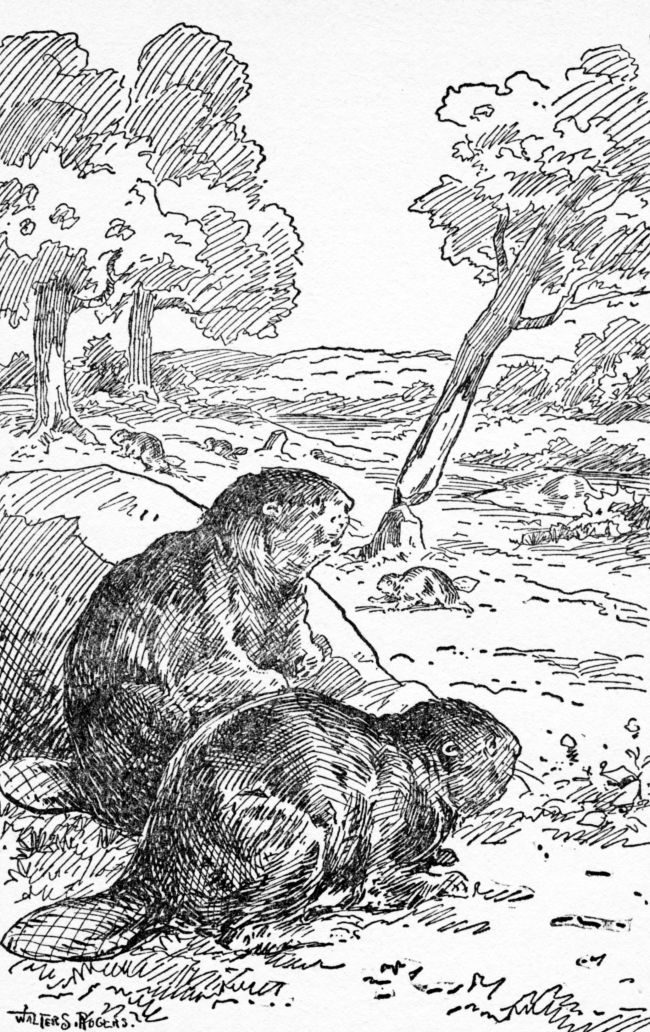
“There is no special danger just now,” said
Cuppy, speaking to all the others. “I mean no
tree is going to fall, or anything like that. But
there is likely to be trouble. Toto, tell us about
the tramp camp you saw in the woods.”
You may easily believe that Toto was quite
surprised at being called on to sit up and speak
before all the other beavers in the colony. But
he was a smart little chap, and he knew that each
one must help the others. So he told what he had
seen.
“And now,” said Cuppy, “what is to be done?
We do not want these tramps around here. Some
of them may be hunters, and may try to catch us.
Others may tear out our dam, and that would be
very bad for us, as the water would all run out
of our pond and our houses would be of no use.
Now we must either drive these tramps away, or
else make our dam so big and strong that they
will not want to try to tear it apart.”
“How can we drive the tramps away?” asked
Toto’s father.
“I don’t believe we can,” answered Cuppy.
“If we were bears or wolves we might, but, being
beavers, we can’t very well do it. The next best
thing to do is to make our dam stronger. So to-morrow
morning we must all—young and old who
can gnaw trees—we must all cut down as many as
we can and build the dam bigger. In that way we
may be safe from the tramps. Now remember—everybody
come out to cut down trees in the
morning.”
“We can cut trees now, can’t we, Dad?” asked
Toto of his father.
“Yes, you and Sniffy must do your share,” replied
Mr. Beaver. “We must all help one another.”
The woods around the dam were a busy place
next morning. All the beavers who were able
began cutting down trees. Later the trees would
be floated in canals to the big pond and made a
part of the wall that held back the waters.
“Sniffy, do you want to come with me?” asked
Toto of his brother, when the two boys had,
together, cut down a pretty good-sized tree.
“Where are you going?” asked Sniffy.
“Farther off into the woods,” answered Toto.
“I know where there is a nice, smooth, straight
tree that we can cut down. It stands all by itself,
and when it falls it won’t lodge in among other
trees, so it will be easy to get out for the dam.
Come, and we’ll cut it down together.”
“All right, I will,” said Sniffy.
Now Toto did not tell his brother that the tree
he intended gnawing down was close to the camp
of the tramps. Toto thought if he told his
brother that, Sniffy might be afraid to go.
“But we can keep hidden from the tramps,”
thought Toto, “and our teeth do not make much
noise when we gnaw. The tramps will not hear
us. Besides, I want to see if they are still there.
Maybe Don has barked at them and driven them
away.”
But when Toto and Sniffy reached the place in
the woods where the tall tree grew, there was the
bark shack in the same place, and some of the
ragged men were still in and about it.
“Oh, look!” exclaimed Sniffy, catching sight
of the tramps. “Who are the ragged men, Toto?
Are they hunters?”
“No,” answered Toto. And then he told his
brother who the men were. “But don’t be
afraid,” went on Toto. “We’ll gnaw very
silently, and the tramps won’t know we are here.
These are the ragged men I told about at the
meeting. But don’t be afraid, Sniffy.”
“All right. I won’t be afraid if you’ll stay
with me,” said Sniffy. “Now which tree are we
going to cut, Toto?”
The other beaver showed his brother the tree
he meant, and Sniffy said it was a fine one.
“If we cut that down all by ourselves, it will
help make the dam much bigger,” he said. “But
we can’t cut it in one day, Toto.”
“No, nor in two days,” answered the other.
“It may take us a week. But we can do it.”
After that, each day, Toto and Sniffy slipped
off by themselves and went to the place near the
camp of the tramps. There the two beaver boys
gnawed and gnawed and gnawed away at the tree
they were cutting down. And they worked so
quietly that none of the tramps heard them.
One day the big tall tree was almost cut
through.
“We shall finish gnawing it down in about an
hour,” said Sniffy.
“Yes,” agreed Toto, “it will soon fall.”
“And shall we whack on the ground with our
tails to signal for danger?” Sniffy wanted to know.
“We had better; yes,” agreed Toto. “We
can’t tell but what some of the other beavers may
be around here, though I haven’t seen any.”
So the two boy animals gnawed and gnawed
some more, and soon the tree began to topple
slowly to one side.
“There it goes!” cried Sniffy.
“Yes, it’s going to fall,” agreed Toto.
“Whack with your tail as hard as you can!
Whack your tail!”
Toto and Sniffy banged their flat tails on the
ground. It was the beavers’ signal for danger.
Then Toto and Sniffy ran and hid in a hollow place
under a big stump. But they could look out and
see the tree leaning over farther and farther as
it toppled to the earth.
Suddenly Toto cried:
“Look! The tree is going to fall right on the
place where the tramps live! It is going to fall
on their house and it will be smashed!”
And so it was. The beaver boys had forgotten
about the shack of the tramps when they gnawed
at the tree. Now it was toppling over directly
on the bark cabin. Toto and his brother were
going to see something very queer happen.
“Bang with your tail! Bang with your tail,
and give the danger signal to the tramps!” cried
Toto.
And he and Sniffy whacked away as hard as they
could.
CHAPTER VI TOTO AND THE BURGLARS
Now, the tramps who had built the shack
of bark in the woods knew nothing about
beavers and their ways. The tramps
did not know that when a beaver whacks his tail
on the ground it means danger from a falling
tree, or from something else.
But the tramps in the shack, toward which was
falling the tree Toto and Sniffy had gnawed down—these
tramps heard the queer whacking sounds,
and they knew they had never heard them before.
So some of them, who were not as lazy as the
others, ran out to see what it meant.
One tramp looked up and saw the tall tree
swaying down toward the bark shelter. The
tramp did not know that two little beaver boys
had, all alone, gnawed down the big tree. But
the tramp could see it falling.
“Come on! Get out! Everybody out of the
shack!” cried the tramp who saw the falling tree.
“Everybody out! The whole woods are falling
down on us!”
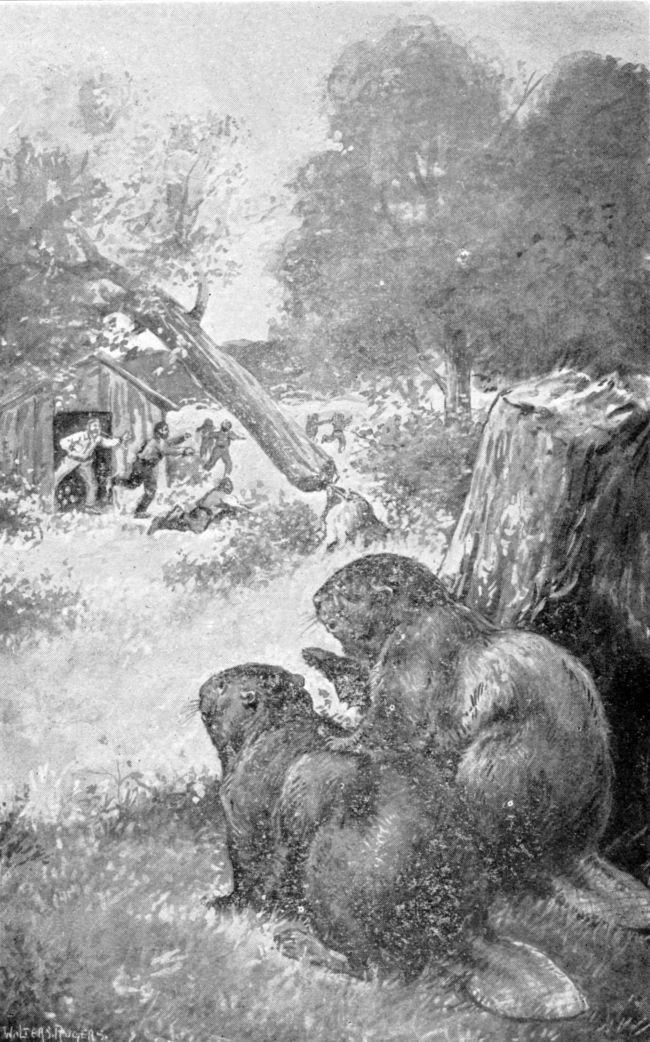
Of course that wasn’t exactly so. It was only
one tree that was falling, and the same one which
Toto and Sniffy had gnawed down. But the
tramp who called out was so excited he hardly
knew what he was saying.
And as soon as the other tramps, some of whom
were sleeping in the bark shack, heard the calls,
they came running out, some rubbing their eyes,
for they were hardly awake. They had been
asleep in the daytime, too—the daytime when all
the beavers were busy.
“Come on! Come on! Get out! Everybody
out!” yelled the tramp who had first caught
sight of the falling tree.
As soon as the others knew what the danger
was, out they rushed also, and then they all stood
outside the shack and to one side and watched the
tree crash down.
Right on top of the bark cabin crashed the tree.
There was a splintering of wood, a breaking of
branches, a big noise, and then it was all over.
For a few minutes the tramps said nothing.
They all stood looking at the fallen tree that had
crushed their home in the woods.
“Well!” exclaimed several of the men.
“It’s a good thing we got out in time,” growled
one tramp.
“I should say so!” exclaimed another. “Lucky
you saw it coming,” he added to the tramp who
had called the warning.
“Did some one chop the tree down?” asked a
third tramp.
“No, I guess the wind blew it,” said a fourth.
“There isn’t enough wind to blow a tree down,”
decided the first tramp, who had red hair.
Of course we know it wasn’t the wind that blew
the tree down. It was Toto and Sniffy who
gnawed it and made it fall. But the tramps were
too lazy to go and see what had caused the tree
to topple over. They just stood there and looked
at their crushed house.
“It will be a lot of work to build that up again,”
said one tramp. “She’s smashed flat.”
“Build it up again! I’m not going to help build
it up!” said another. “It’s too hard. I’m tired
of this place, anyhow. Let’s move off to another
woods. Maybe we can find a place near a chicken
yard, and we can have all the chickens we want.
Let’s move away, now that our house is smashed.”
“Yes, let’s do that!” cried some of the other
tramps.
And those ragged men were so lazy that they
did not want to go to the trouble of building a
home for themselves! Perhaps they thought they
could go off into the woods and find another already
built. Anyhow, they stood around a little
while longer. One or two of them picked up
ragged coats and hats that were in the ruins of
the hut, and some took old cans in which they
heated soup. That was all they had to move.
“Well, come on! Let’s hike along!” said the
red-haired tramp.
With hardly a look back at what had been a
home for some of them for a long time, the tramps
walked away through the woods. Toto and
Sniffy, hiding in the bushes, watched the ragged
men go.
“Look what we did!” said Sniffy to his brother.
“Yes, we cut down a tree, but we didn’t mean
to make it fall on the house where the tramps
lived,” said Toto.
“Anyhow, they’re going away, and that’s a good
thing for us,” went on Sniffy. “Now we won’t
have to make the dam so strong, nor move away
ourselves.”
“That’s so,” agreed Toto. “I didn’t think
about that. Why, Sniffy, we really drove the
tramps away, didn’t we?”
“Yes,” answered his brother, “we did.”
“Don, the dog, will be glad to know this,” went
on Toto. “I guess he’ll wish he had helped drive
the tramps away himself. Come on! let’s go back
and tell Dad and Mr. Cuppy about cutting down
the tree and smashing the tramps’ cabin.”
Mr. Beaver, Cuppy, and all the others in the
colony were much surprised when Toto and Sniffy
told what had happened. Almost all the grown
animals, and certainly every one of the boys and
girls, went out to see the fallen tree and the
smashed cabin.
“Well, you did a lot to help us,” said Cuppy
to the two brothers; “but we can’t use that tree
in the dam.”
“Why not?” asked Toto.
“Because it fell the wrong way. It would be
too much work to dig a canal to it and float it to
the dam. It will be easier to cut down another
tree. But I don’t know that we shall need any
more as long as the tramps have moved away.
We need not make our dam any bigger now.”
“Are all the tramps gone?” asked Toto’s
mother.
“Yes, every one,” answered Cuppy. He was
a wise old beaver, and he knew none of the ragged
men were left near what had once been their shack
of bark.
So that was another adventure Toto had—driving
away the tramps. And if I had told you,
at first, that two little beavers, not much bigger
than small puppy dogs, could make a number of
big, lazy men move, you would hardly have believed
me. But it only goes to show in what a
strange way things happen in the woods.
Now that it was not needful to make the dam
bigger, the beavers turned to other work. Some
of the canals they had dug had become filled up
at a time when there was too much rain and the
banks had caved in. Some of the beavers began
to clear out these canals. Others mended holes
in the dam, and still others cut down, and brought
to the pond, tender branches of trees on which
grew soft bark for the small beaver children to
eat.
Everybody in the beaver colony had work to
do. There was not a lazy one among them, and
Toto and Sniffy worked as hard as any. They
had time to play, too, and I’ll tell you about that
in another chapter or two. Just now I want to
speak about another wonderful adventure that
happened to Toto.
The little beaver boy was growing larger now.
He was quite strong for his size, and he was growing
wiser every day. Often he went off in the
woods alone to hunt for tender bark, or perhaps
for some berries he liked to eat.
One day Toto was walking along near a canal
he had helped to dig. He was thinking of Don,
and wishing he might meet the nice dog again,
and tell him about the tramps being driven away.
And Toto was also thinking of the little girl with
the red mittens, whose skate had come off on the
ice.
Then, as Toto stepped from the woods into a
little clearing, or place where no trees grew, he
saw something big—bigger than a thousand
beaver houses made into one.
“I wonder what that is?” thought Toto. “It
looks something like the shack the tramps had in
the woods, but it is much nicer. I wonder if it
is a house?”
And then as Toto, hidden behind a bush,
watched, he saw a little girl and an old lady come
out of the house (for such it was) and walk away
through the woods on a path.
“Why! Why!” exclaimed Toto to himself.
“That’s the same little girl I saw on the ice!
Only she’s different now. She hasn’t any red
things on her paws.”
Of course, Toto thought the little girl’s hands
were her paws. And the “red things” were her
mittens. But, as it was summer now, she did not
wear mittens. It really was the little girl who
had been skating that Toto now saw come out of
the house in the woods. The little girl had come
to get her grandmother and take her for a visit
to the little girl’s house.
Toto stayed hiding under the bush until the
little girl and her grandmother were out of sight.
Then, just as he was about to travel on, he heard
some voices coming from behind a big stump.
And, somehow or other, Toto seemed to know
those voices. Carefully he looked up over the
top of the bush.
“Now’s our chance!” said one of the voices,
though of course Toto did not know what the
words meant. “Now’s our chance! The old
lady and the little girl have gone out! Now we
can break into the house and take whatever we
want!”
“Yes, we might as well be burglars while we’re
at it,” said another voice. “We can’t get any
work, so we’ll take things that other people work
for!”
And then, to the surprise of Toto, he saw,
bobbing up from behind the stump, some of the
very same ragged tramps that had gone away
when the tree smashed their shack. They were
now near the home of Millie’s grandmother.
“I heard there was some jewelry in that house,”
said the red-haired tramp. “We can take it and
sell it and then we can buy good things to eat.”
“That’s right,” said a black-haired one.
“We’ll break in and get the jewelry. Nobody
is at home to stop us.”
And then and there, as Toto watched, the bad
tramps went toward the house to take the little
girl’s grandmother’s jewelry.
“Oh, if Don were only here now!”
CHAPTER VII TOTO AND THE BOY
Toto, being only a beaver, did not know
very much about the different things
that men do. Toto knew how to gnaw
down trees, how to strip off bark when he was
hungry, how to dig canals for the water to run in
and float logs for the dam, and he knew how to
help make dams. But he never thought of going
into another beaver’s house and taking the bark
which that beaver had stored away.
And now these men were going into the house
of the little girl’s grandmother, and they were
going after jewelry which had been hidden by the
old lady when she went away on a little visit with
her granddaughter. But Toto knew nothing of
this. All he knew was that he was hiding behind
a bush, watching the tramps steal softly toward
the lonely house.
One of the tramps, the red-haired one, broke
open the door of the grandmother’s house. It
was just the same as if Sniffy and Toto should
break into the house of Mr. Cuppy, when that
kind old gentleman beaver was out working on
the dam. Into the house went the tramps—four
of them, big, ragged men.
“I hope they don’t see me,” thought Toto, for
he knew it was dangerous to be where he was.
His father and mother had told him to keep away
from men who had traps and guns. And though
these tramps were too lazy to do any hunting or
shooting, Toto did not know that.
Really he ought not to have been so far away
from home, but you know how it is with boys—even
animal boys. Beavers sometimes don’t do
the right thing, any more than real boys do. So,
though he felt that there was danger, Toto wanted
to stay near and watch.
He saw the tramps break into the house, but of
course he did not see what they did when they
got inside, so I shall have to tell you that part of
the story myself.
The tramps easily broke open the door and got
inside. The first thing they did was to look for
something to eat, for, being lazy men, they did
not work, and all the food they had was what they
stole or begged. And as Millie’s grandmother
was a good cook, there was plenty in her house
to eat. The tramps had a fine meal, and they
then looked about for something to take away
with them.
Millie’s grandmother was not rich, but she had
some gold and silver jewelry put away in a box
in her home. Some of the rings and pins were
those Millie’s grandmother had had since she was
a little girl herself, and there was one pretty
bracelet that Mrs. Norman (which was the grandmother’s
name), had promised to give Millie.
Mrs. Norman had hidden her box of jewelry
under the bed when she went out, thinking that
would be a safe place. But, would you believe
it? That was one of the first places the tramps
looked when they finished their meal.
“Ho! Ho!” laughed the tramps. “Here it
is!”
With their coarse, rough hands they broke open
the box, for the lock was not strong. Inside
glittered the gold and silver jewelry of Mrs. Norman,
and the sun sparkled on the pretty bracelet
that was to be Millie’s.
“Ho! Ho!” laughed the tramps. “This will
bring us money when we sell it!”
The tramps were looking at the jewelry in the
box when, all at once, the red-haired one cried:
“Hark! I hear some one coming! We’d better
run!”
“Come on!” exclaimed another.
So the next thing Toto, the watching beaver,
saw was tramps come rushing from the house.
Toto did not know what the tramps had done in
the house, but he saw them come rushing out, the
red-haired one carrying a small box. Of course
Toto did not know what was in the box. Beavers
have no use for jewelry.
“Come on!” cried the red-haired tramp.
“Come on! Maybe the police are after us!”
And so the tramps ran across the fields towards
the woods where they had built themselves another
shack. And these woods were not far from those
where Toto and the other beavers lived, near the
dam.
Now the noise which had scared the tramps was
made by a boy knocking at the side door of the
house where Millie’s grandmother lived. This
boy, whose name was Bobbie Thompson, had been
sent by his mother to borrow a cup of sugar from
Mrs. Norman. Bobbie’s mother lived almost
half a mile from Millie’s grandmother, and as
there were very few stores in that part of the
country the neighbors used to borrow things from
one another. So Bobbie’s mother had sent him
to borrow some sugar.
Bobbie did not know that Millie and her grandmother
had gone out, and he did not know that
tramps were in the house, when he knocked at
the side door. And it was his knocking that had
scared the ragged men.
Out of the front door of the house they rushed,
and, as they hurried away, Bobbie, who was a
sturdy little chap, saw them go.
“Hello there! What’s this?” cried Bobbie,
who was very much surprised. “What’s this?”
Then, as he saw what kind of men they were
and that one of them had the box of jewelry under
his arm, Bobbie understood.
“Tramps! Tramps!” cried Bobbie. “I wish I
had my dog with me now! Those tramps have
been robbing Mrs. Norman!”
Bobbie stood on the side steps a few seconds,
watching the tramps run across the field. Then,
being a brave boy, he decided to run after them.
I don’t believe Bobbie really thought he could
catch the tramps, nor that he hoped he could get
the box of jewelry away from them if he did catch
them. He just wanted to see where they went,
so he could tell the police.
“Hi there! Come back with that box!” called
Bobbie, and then he began to run. Off the steps
he jumped, dropping the cup which he had come
to get filled with sugar. He had forgotten all
about that now.
After the tramps he ran, shouting and calling
to them, and the queer part of it was that the
tramps did not look back to see who was after
them. They were too frightened, as they knew
they had done wrong and could be arrested for it.
“Are the police after us?” asked one tramp.
“Yes, I guess so,” answered the red-haired one
who had the jewel box. “We’d better hide this
stuff, too! If they catch us with it we’ll have to
go to jail. We’ll hide it as soon as we get to the
woods!”
And so the tramps ran on, never once looking
back. If they had looked back they would have
seen it was only a small boy chasing them, and not
two or three policemen. But that is often the
way with persons who do wrong. Their own
fears scare them.
“Hi there! Hold on! Stop!” cried Bobbie.
But the tramps did not stop. They only ran the
faster toward the woods. And, finally reaching
the forest, the red-haired tramp looked around for
a place to hide the box of jewelry.
“I’ll put it in this hollow tree!” he said to the
other tramps, as, reaching a big chestnut tree,
he saw a hole in the trunk. “I’ll hide the jewelry
here and, when the police go, we can come back
and get it out again.”
So he thrust the box of gold and silver jewelry,
with Millie’s bracelet in it, into the hollow of the
tree. Then the tramps ran on through the woods,
and scattered, some going one way and some another,
still thinking the police were after them.
But it was only Bobbie, and the little boy, seeing
that the tramps were fast running away from
him, soon gave up the chase.
“I guess I’ll go back to Millie’s grandmother’s
house,” said Bobbie to himself. “Maybe she’s
come back. If she has I’ll get the sugar and tell
her about the tramps. If she isn’t at home I’ll
go and tell my mother.”
Now all this time Toto was wondering what
it all meant. He had seen the bad, ragged
tramps break into the house, and he had seen
them rush out, and Bobbie chasing after them.
But the beaver did not know what it was all about.
However, being very curious, as are most wild
animals, Toto wanted to find out. So when
Bobbie began to run Toto slowly followed after,
taking care, however, to keep in the shadow of
the bushes and trees.
Thus it happened that when Bobbie turned
back, after he had lost sight of the tramps in the
woods, he saw Toto ambling along.
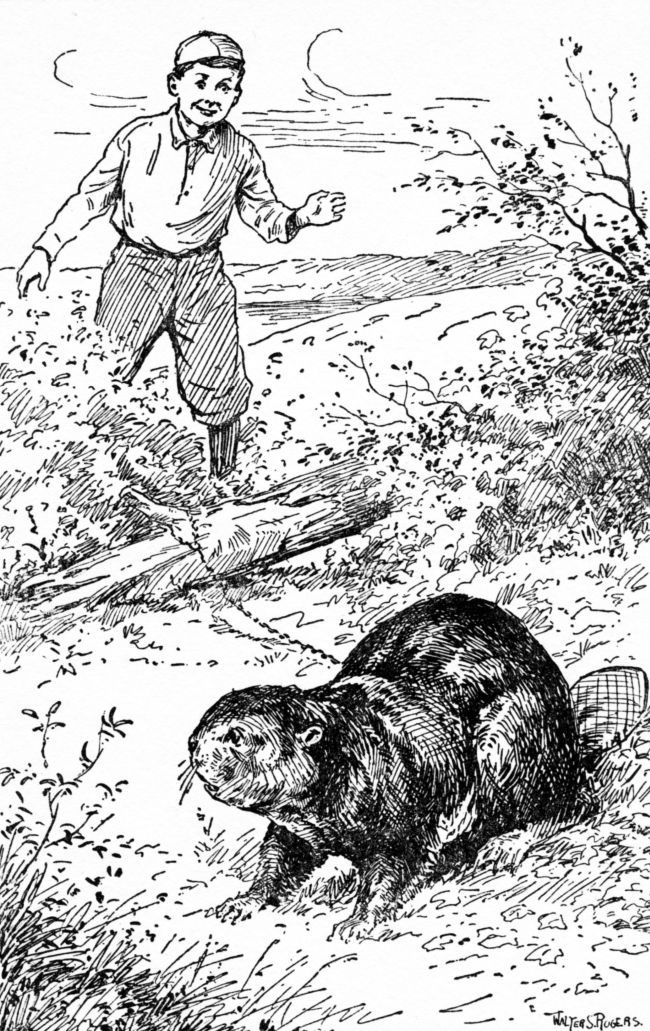
“Hello! A beaver!” cried Bobbie. “I haven’t
seen one of them for a long while! I’m going
to get him! I’ll take him home for a pet!”
And then, running as fast as he could, Bobbie
chased after Toto, wishing to catch our little
friend with the broad, flat tail.
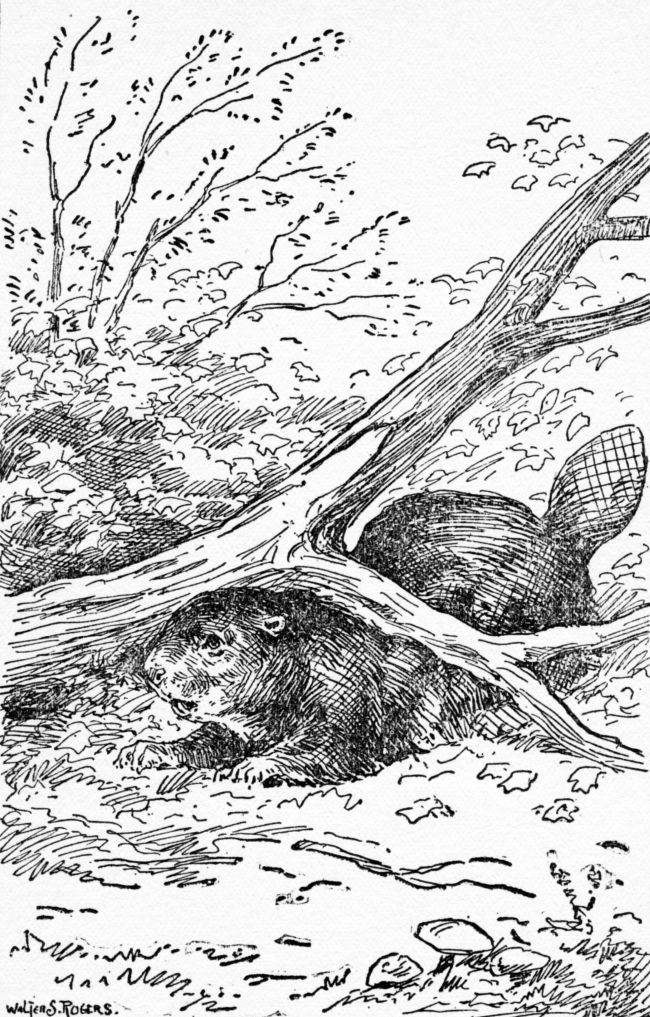
“My goodness!” thought Toto as he saw
Bobbie coming. “I’d better run!”
CHAPTER VIII TOTO MEETS BLACKIE
By this time Bobbie had forgotten all about
the tramps who took the jewelry. He
was thinking only of catching Toto.
“Oh ho! You’re a fine, fat one!” laughed
Bobbie. “I’d like you for a pet!”
“I’ve got to get away as fast as I can!” thought
Toto. “I wish I had not come so far from the
dam and the water back of it. If I could find
some deep water now I’d dive into it and this boy
chap couldn’t find me. I’d stay under a long
time.”
But, just then, Toto could see no water near
him, though he remembered he had swum in a
brook almost up to the house into which the
tramps had broken to get food and the box of
jewelry.
“If I could only find that brook now!” thought
poor Toto.
“I’ll get you! I’ll get you!” cried the boy.
Of course Toto did not know what these words
meant any more than the boy could understand
beaver talk. But Toto knew he was in danger,
and the boy knew the little animal, with the flat
tail, was trying to get away.
Now Toto could smell water even when he
could not see it. His nose was very good for
smelling, and, as he ran along—or rather “waddled,”
as I call it—he kept sniffing to see if he
could not smell water somewhere. And at last
he did. Off to his left he caught the smell he
so much wanted, and he turned sharply to one
side.
“I wonder where he’s going now,” said the boy,
aloud. “Maybe he has a nest over there. No,
beavers don’t live in nests, so Jake told me. They
have their houses in the water near a dam. I
wish I could find a beaver dam. Then I could
get two beavers for pets.”
Bobbie did not know how hard it was to capture
beavers once those busy animals are in the
water.
“I’ll get him! I’ll get that beaver!” cried the
boy.
“If I can only get to the water I’ll be all right!”
thought poor Toto, whose heart was beating very
fast, both in fear and because he had to hurry
along so quickly.
Just as the beaver reached the edge of the
little stream Bobbie got there too, and made a
grab for Toto. So close was Bobbie to Toto
that the boy could almost touch the flat tail of
our friend. But Toto gave a jump, and into the
water he landed, making a great splash. Down,
down toward the bottom dived Toto, and at once
he began to swim under water, for beavers can
do that, just as muskrats can. Of course they
are not like a fish, who has to stay under water
all the while, and can not breathe in the open air.
Beavers, and animals like that, can hold their
breath a long while under water, and so can stay
hidden and out of sight.
“Oh, there he goes!” cried Bobbie, much disappointed
as he saw Toto dive into the stream.
“But maybe I can get him!”
The boy ran along the bank of the stream,
but Toto knew better than even to stick out so
much as the tip of his nose. The beaver did
not need to do this. He could swim under water
for quite a long time, and that’s what he was
doing now. His hind feet were webbed, like
those of a duck, and his broad, flat tail helped
him, too. It was like the propeller of a boat.
In a half minute he was far enough away from
Bobbie to be safe, and, though the boy ran along
the stream for several minutes, he did not again
see Toto—that is not for some days. Toto had
got safely away, and, half an hour later, he was
back at the dam, where he found his father and his
mother and Sniffy waiting for him.
“Where have you been?” asked Mr. Beaver.
“You were gone so long that I thought something
had happened.”
“Something did happen,” answered Toto. “A
boy chased me, and I saw the ragged men—the
tramps as Don, the dog, called them!”
“My goodness!” exclaimed Mrs. Beaver.
“Chased by a boy! Did he catch you?”
“No, I got away just in time,” answered Toto.
“I hope those tramps aren’t coming to our
woods again,” said Mr. Beaver.
“Well, they ran in among the trees,” said Toto,
“and they stopped at a hollow one, put something
in there, and then they ran on.”
“Maybe they hid a lot of bark in the hollow
tree,” said Sniffy. For a beaver, you know, bark
is the best thing there is in the world. It is
better to him than jewelry ever could be.
“I don’t know what it was they hid,” said Toto.
“But the boy chased them and then he chased
me.”
“You must always be careful,” warned his
father. “These woods are too often visited by
hunter men and boys these days. Watch out for
traps.”
Toto and Sniffy said they would, and then the
beaver boys went out on a little hill, near the pond
back of the dam, to have some fun. And the fun
they had was sliding downhill!
I suppose it may sound odd to you to be told
that beavers slide downhill, but they really do,
and other wild animals in the woods do the same
thing. They don’t wait for snow and ice to cover
the hill, either, as you boys and girls do. In fact,
most animals do not like snow and ice—unless perhaps
it is polar bears—and when winter comes
many animals take a long sleep until warm
weather comes again.
Of course Toto and the other beavers have to
stand the cold, and perhaps be out in the ice and
snow, and that is why they have such a thick,
warm coat of fur.
But the sliding downhill fun I am going to tell
you about took place in the summer, and I suppose
you are wondering how any one can slide downhill
when there is no snow or ice.
Well, the beavers slide down on mud. You
know how slippery mud is when it is wet. And
there is a kind of mud, called “clay,” which is very
slippery indeed. If you have ever been near a
brickyard, and have seen the clay dug out and
wet, you know how slippery it is. It is even more
slippery than snow or ice.
Now near the beaver pond was a hill of clay,
and some of it had been taken by Cuppy and the
older animals to plaster up holes in the dam.
This digging out of the clay, made a bare place
on the hill, where the grass was torn away, leaving
the soil exposed.
This clay slide was where Toto, Sniffy and the
other beavers had their fun. And not only the
young beavers, but the old ones as well, even
Cuppy, took their turns going down the slide.
Otters also make slippery slides to coast down,
and I have even heard that big bears, when they
can find a place, like to slide downhill.
The animals do this not only for fun, but to
keep their muscles and legs limber and strong.
It is their exercise, just as you raise your arms
and bend your bodies in school when you take
your exercise.
Now to be slippery, clay has to be wet. And,
as it would not do to wait for a rain to come to
wet the slide, the beavers, otters, and other animals
wet the slides themselves. They go into
the water at the foot of the slide, get themselves
soaking wet, climb out and go to the top of the
hill. There they sit down and the water, dripping
from their bodies, makes the hill slippery. Down
they go, splashing into the stream or the pond at
the foot. Almost all the slides end in water.
“Come on out and slide down!” called Toto to
Sniffy, and away they ran. They climbed up the
hill at a place where it was not slippery and, taking
turns, sat down at the top of the slide. Then,
giving themselves a little push with their paws,
as you give yourself a push with your feet when
you sit on your sled, down they went.
Sometimes the beavers slid down on their tails,
and sometimes on their backs. Some even slid
down on their stomachs, or went down sideways.
Down they went, any way to get a slide, and into
the water they splashed.
“Hi there! Look out!” cried Toto to Dumple,
a little fat beaver boy who lived in the stick house
next to him. “Look out! I’m coming!”
But Dumple did not get out of the way quickly
enough, and when Toto slid down he bumped right
into him, and the beaver chaps went down the
slide together and into the water with a splash.
“Ho! Ho! That was fun! Let’s do it
again,” cried Dumple.
“All right!” agreed Toto. “But did I hurt
you?”
“Not a bit!” laughed Dumple. “Come on,
Sniffy! Let’s bump into one another on the
slide!” he called.
So Toto’s brother joined the fun, and many
other beavers played on the slide, climbing up
and coasting down.
When supper time came Toto and the others
had very good appetites for the bark which was
waiting for them. Darkness came, and the
beavers went to sleep. The night settled down
on the beaver pond and dam. As Toto went to
sleep perhaps he thought of the adventures of
that day—how he had seen the boy chase the
tramps, and how the ragged men had hidden something
in the hollow tree. But Toto did not think
much about that. He was too tired and sleepy
after playing on the mud slide.
It was two or three days after this that, as
our beaver friend was walking through the
woods, looking for some soft bark for his mother,
he heard a funny little noise up in a tree. The
noise went:
“Mew! Mew! Meaouw!”
“Hello! what’s that?” called Toto, looking
here and there. “Is anything the matter?” he
asked.
“I should say there was!” came the answer.
“A bad dog chased me up this tree and now I’m
afraid to come down.”
“Who are you?” asked Toto.
“I am Blackie, and once I was a lost cat,” was
the answer. “I guess I’m pretty nearly lost now.
Oh, dear! what shall I do?”
CHAPTER IX TOTO IN A TRAP
Toto looked up in the tree from which
the mewing noise came. There he saw
a black cat. The cat sat in a place where
a branch joined the main trunk of the tree, and
Toto wondered why, if she got up there, she could
not get down.
“What happened to you?” asked the beaver
boy.
“A dog chased me,” was the answer. “I was
out walking in the fields, and a dog ran along
after me. I was so frightened that I scampered
as fast as I could. Then I ran up this tree. I
hardly knew what I was doing, or how I got up
so high. But here I am, and though it seemed
easy to get up, I’m afraid to try to get down. I
might slip and fall.”
“Did you walk up the tree?” asked Toto, wondering
why she couldn’t walk down again.
“No, I stuck my claws into the bark and pulled
myself up,” answered the black cat. “But it’s
harder to go down. I don’t know what to do!
I wish that dog had let me alone.”
“Was the dog who chased you named Don?”
asked Toto. “I know him.”
“Do you? Why, so do I!” exclaimed Blackie.
“No, it wasn’t Don who chased me. He and I
are good friends. This was a strange dog, and
I don’t like him. He has made a lot of trouble
for me. Maybe I’ll never get out of this tree,
and I’ll never again see the kind lady and little
girl I live with.”
“Oh, yes, you will!” said Toto cheerfully.
“I’ll help you get down out of the tree.”
“Can you climb up here?” asked Blackie.
“No, I can’t climb trees, but I can gnaw them
down,” answered the beaver boy. “You just
wait. This is a poplar tree, and the bark is very
good to eat. You just wait up there. I’ll gnaw
through the tree, it will fall, and you can then
easily get to the ground.”
“But when the tree falls won’t I get hurt?”
asked Blackie.
“No, for I’ll cut the tree so it will fall in among
the bushes,” answered Toto, who, by this time,
could make a tree fall in any direction he liked.
“The bushes will be a sort of cushion, like the
cushion of soft grass and chips in our stick house.”
Toto took his position at the foot of the tree,
half way up in which was Blackie, the cat.
Propping himself up on his tail, and clasping his
forepaws around the trunk of the tree, which was
about as large around as a rolling pin, Toto began
to gnaw.
In a few minutes Toto had almost cut through
the trunk.
“Oh, the tree is beginning to fall!” mewed
Blackie.
“That’s what I want it to do,” answered Toto.
“Don’t be afraid. Sit tight! You will not be
hurt.”
The tree was swaying slightly, for the trunk
had almost been cut through by the hard-working
beaver boy. But he had cut it in the proper way,
and it was falling toward a clump of thick bushes.
Blackie dug her claws into the soft bark and
held on as tightly as she could. She was a little
afraid, but she need not have been, for Toto knew
what he was about. Very slowly and gently the
tree swayed over. It fell among the bushes with
hardly a crash, the boughs and the underbrush
making a cushion. And now the trunk was so
close to the ground that Blackie easily leaped
down.
“Oh, thank you, very much, for helping me,”
she mewed to Toto. “I thought I’d never get
down, or see my kind lady mistress again. She
is very sad these days, and if she lost me she
would be more sad.”
“What is she sad about?” asked Toto.
“Because her house was broken into the other
day by some bad men, she thinks,” explained
Blackie. “They took away a box of jewelry she
had hidden under the bed. And in the box was
a bracelet for a nice little girl. This little girl
pets me and gives me milk when she comes to
see her grandmother, with whom I now live.
And sometimes I go to stay at the little girl’s
house.”
“Why, how surprising!” exclaimed Toto. “I
think I know the house you mean! I saw some
ragged men go in there and come out with a box.
A boy chased them and then the boy chased me.”
“What did the men do with the box?” asked
Blackie. “Oh, how exciting! Maybe we can
find it and make my mistress happy again.”
Toto slowly flapped his flat tail.
“The men went into the woods with the box,”
he said. “That is all I know.”
“What woods?” asked Blackie.
“Well, the woods not very far from here,”
answered the beaver.
“I wish I could find the box,” mewed Blackie.
“I don’t care for jewelry myself, though I like
a red ribbon tied on my neck, as the little girl
sometimes ties it. But if I could find the box of
jewelry it would make Millie and her grandmother
happy.”
“I wish I could help you,” said Toto. “But I
don’t know where the box is. But tell me about
Don. Have you seen him lately? He wanted
to catch the tramps.”
“No, I haven’t seen Don for some time,” explained
Blackie. “He lives in another house with
a boy, and sometimes this boy comes to see Millie’s
grandmother. The old lady is his grandmother,
too. Don and I are good friends.”
“He is a nice dog,” said Toto. “Well, as long
as I have cut down this tree I may as well eat
some of the bark. Will you have some?”
“No, thank you,” answered Blackie. “I don’t
eat bark, I drink milk.”
“Bark is better,” said the beaver. “But I suppose
it wouldn’t do for us all to eat the same
thing. There wouldn’t be enough. Now, do
you know your way home?”
“Oh, yes, I can find my way back across the
fields to the house where I live,” said the cat.
“I hope the tramps don’t come again. But call
and see me sometime.”
“Thank you,” answered Toto. “I will. But I
don’t go out in the fields much. It is safer for
us beavers in the woods near the water.”
“I don’t like water,” said the black cat. “But
thank you once more for getting me down out
of the tree. I’ll tell Don, the next time I see
him, how kind you are to me.”
“Remember me to him,” begged Toto.
“I will!” mewed Blackie. Then she walked
off toward the field, and Toto began to eat some
of the poplar bark.
You remember I told you I would put in this
story something about how beavers dig canals to
float the logs they cut down to the dam. And I
guess this is a good place for that.
With their paws the beavers dig a ditch in the
dirt, starting it from the place where the fallen
tree lies, and heading it toward the waters of
their pond. The beavers are fast diggers, too,
almost as fast as they are gnawers, and many of
them, working together, will dig a little canal in
a few days. They take out the dirt and stones,
placing them to one side. They carry the dirt and
stones out of their way in their front paws.
Foot by foot the canal, which is yet only a dry
ditch in the ground, is brought to the edge of the
beaver pond. Then the little animals cut through
the remaining wall of earth, so the water from
the pond flows into the canal. The water goes
all the way back to where the big tree trunk lies
on the bank of the little canal. The beavers
now, pushing all together, roll the heavy log into
the canal which, after this, can easily be floated
through the canal to the beaver pond, and used
to make the dam bigger and stronger.
One day Mr. Beaver called out and said:
“Come on, Toto and Sniffy. You must help
Cuppy and some of the others dig canals to-day.
It will soon be winter again, and we want to get
a lot of wood and bark stored away before cold
weather comes.”
Beavers do not sleep all through the winter
as bears, and some other animals, do. The
beavers stay awake, move about, and have to eat.
So they need plenty of food.
“Digging canals is fun!” laughed Toto. “I
like it; don’t you, Sniffy?”
“Yes,” answered his brother, “I do. Here
comes Dumple!” he added. “Let’s have some
fun with him!”
So the three beaver boys tumbled about on the
ground as they went along to where the canal
was being dug. There they found Cuppy and
many other animals at work, for several large
trees had been cut down, and they must be floated
in canals to the dam.
Each of the beaver boys was given a certain
part of the work to do, and Toto was soon busy
with the others. Foot by foot the canal was dug.
Now of course beaver boys don’t like to work
all the while, any more than real boys do, and
Toto was a real beaver boy. So, after he had
dug a bit, he looked around, and, seeing no one
near him, he said to himself:
“I’m going to see if I can’t find some willow
bark to eat. Somehow to-day I seem to want a
bit of willow bark.”
He climbed out of the canal, which had no
water in as yet, and walked, or waddled, off
through the woods. And soon Toto was going
to have an adventure that was not a nice one.
He was walking along, thinking of what fun he
would have that evening on the mud slide, when,
all at once, he seemed to smell something very
good. It was a piece of apple, and Toto had
not eaten an apple for many days, as none grew
in the woods.
“Oh, how good that is!” he exclaimed. “Some
one must have dropped it here under the trees.”
Toto looked about and sniffed until he saw a
small, red apple. It seemed to be on top of
a little pile of leaves.
“Oh, how good!” cried Toto. He walked up
to the apple, and then, all of a sudden, something
happened! There was a clicking sound, and Toto
felt a pain in his leg. Then he knew what it was.
“Oh, dear, I’m caught in a trap!” cried the
beaver boy.
CHAPTER X TOTO ON A BOAT
True enough, Toto, the bustling beaver,
was caught in a trap. Some one had set
the trap in the woods, covering it over
with dried leaves so it could not be seen. And an
apple had been put near the trap, so that it would
attract, or call by its smell, some animal. And
Toto was that animal.
“Snap!” had gone the jaws of the trap, closing
together on Toto’s leg, and the beaver boy was
in great pain.
“Oh, dear! Ouch! Oh, let me go!” cried
Toto, in beaver talk. But the trap did not let
him go, and, pull as he did, Toto could not get
loose.
After struggling for a while, pulling this way
and that, and still feeling himself held fast, Toto
grew quiet and lay down on the dried leaves.
He had pulled the trap out into plain view now,
and he could see where the steel jaws were shut
fast on his leg. Toto was glad of one thing, and
this was that the jaws of the trap were not sharp
and jagged like a barbed wire fence. Some traps,
Toto knew, were made with iron teeth in them,
and when they fastened on an animal’s leg they cut
into it. This trap was an easier kind.
“If the trap wasn’t fast to a chain, and the
chain fast to a stump, I could pull the trap along
with me, and maybe Cuppy and my father could
get it loose from my leg,” thought Toto. But
the boy who had set the trap had known that any
animal which got caught in it would try to pull
it away, so he had made it fast to a stump. All
the pulling Toto did would not loosen the trap.
“Well, I’m caught, and that’s all there is to
it,” thought poor Toto. “I can’t get loose, but
maybe if I could call some of the other beavers
they could help me,” he went on. He knew that
to call the other beavers, or to warn them of
danger, he must flap his tail on the ground. If
he had been near water he would have flapped
it on the water, and it would have made a louder
sound. But he was away from the water and had
to do the best he could.
Thump! Thump! Thump! went Toto’s tail
on the ground. His tail was not caught in the
trap, and he was glad of that. Thump! Thump!
Thump! went his tail again. Then Toto listened.
But none of the other beavers came to help him.
After a while the pain in his leg was not quite
so bad. He was sure the bone was not broken,
and he was glad of that.
“But what is going to happen to me?” thought
Toto. “Dad always told me to be careful and
keep away from traps, and here I have gone and
walked right into one!
“But that apple did smell so good!” went on
Toto. “I just couldn’t help wanting it!” He
had managed to get one bite of the apple
before the trap snapped shut on his leg. And
now, as he saw the fruit lying near him, Toto
thought he might as well eat the rest of it, which
he did.
Hardly had he finished eating when he heard a
noise in the bushes and among the leaves, and he
knew some one was coming. Toto’s heart beat
very fast, and, as any wild animal would have
done, he tried to get away, forgetting, for the
moment, that he was held fast by the trap. A tug
at the chain and a pain in his leg brought to his
mind that he was still a prisoner, and he fell back
among the leaves.
And then through the bushes came a boy. In
an instant he saw Toto in the trap.
“Oh, I’ve caught a beaver! I’ve caught a
beaver!” cried the boy, jumping up and down.
The boy walked toward Toto. Once again the
little animal tried to get away, but the chain and
trap held him. The beaver crouched down in the
leaves and the boy put out his hand to stroke his
fur.
Toto showed his orange-colored teeth, opening
his lips as a dog does when he snarls. Toto knew
he could bite and bite hard, and that was all he
thought of now.
“Oh ho! showing your teeth, are you?” exclaimed
the boy, as he drew back his hand.
“Well, I must be careful! But I won’t hurt you,
poor fellow. I’m sorry you are caught in my
trap, but I am glad I didn’t use one with sharp
teeth.
“And I want a beaver for a pet, or else I’d
let you go. But I’ll be good to you. I’ll take you
home with me and you can have a nice little cage
to live in, and I’ll give you apples and bark to
eat every day. I guess you like apples, ’cause
you ate the one I used to bait my trap,” went
on the boy.
Toto looked at this boy. For a moment the
beaver thought he might be the same one who had
chased the tramps, but of this Toto could not be
sure. He did not know much about boys or men.
“Yes, I’ll take you home to our houseboat and
treat you kindly,” went on the boy. “Dad said
I couldn’t catch anything in my trap, but I did.
And now I wonder how I can get you home without
having you bite me? I guess I can put you
in a bag.”
The boy had a cloth bag in his pocket, and,
opening this, he poked Toto into it, using a stick.
The beaver tried not to go in, for he was afraid
the bag was a worse trap than the one in which
he was already caught. But the chain held the
beaver fast and he had to do just as the boy
wanted.
And so, a little later, Toto found himself shut
up in a bag, trap, chain and all, and being carried
away over the boy’s shoulder. The trap was still
fast to the beaver’s leg, and he wished it would
be loosened, for it hurt.
Then, if Toto had been a boy or a girl, he would
have cried. But beavers don’t do that.
Toto did not know where the boy was taking
him, but it seemed a long way through the woods,
and, after a while, the beaver felt himself being
set down, inside the bag as he was.
“Where have you been?” asked some one of
the boy.
“Oh, I’ve been off in the woods, Dad!” answered
the boy. “And, what do you think? I
caught a beaver in my trap! A beaver!”
Of course Toto did not understand these words,
but he could hear the boy and his father talking.
Then the bag was opened, and Toto tried to
jump out. But some one caught him round the
middle of his body, in strong hands, and Toto
could not turn his head to bite. Toto saw that a
man was holding him, and the boy was standing
near. And all around was water. Toto could
see it and smell it.
At first he thought he was back at the dear old
beaver pond, and he looked for the dam, for
Cuppy, for his father and the others. But a
second look showed him that this was not the
beaver pond. It was another body of water—much
larger. But still Toto wished, with all his
heart, that he was in that water.
“I’d soon get away from them by swimming,
if they’d let me go and would take this trap off
my leg,” thought Toto.
But the man was not going to let him go. He
held tightly to Toto, and the beaver could not bite.
“Take the trap off his leg, Donald,” said the
boy’s father. “It must hurt him. I hope the leg
isn’t broken. If you want a beaver for a pet
you should have used a box trap, that would not
have hurt him.”
“I didn’t know I was going to catch a beaver,”
replied the boy. “But I’m glad I did. I’ll make
a little cage for him, and feed him bark and
apples. You hold him, Dad, while I take off the
trap.”
So while the man held Toto, with his hands on
the middle of the fat beaver’s body, the boy
opened the trap and slipped it from the animal’s
leg. And you can well guess that Toto was very
glad of this. The pain stopped when the trap
was taken off, and, aside from a little sore place
on his leg, the beaver was not hurt.
“We’ll put him in a box, and then we must start
the boat,” said the man.
Toto did not know what a boat was, but a little
later he found himself in a box, with a wire screen
over the side which was open. Toto could look
out, he could smell the air and the water, and he
could see the water itself, but he could not get
out. And then, by the way the wind blew and
by the manner in which the sun sparkled on the
little waves, Toto knew that he was moving along.
“But it’s queer I’m not swimming,” thought
the beaver. “I am moving along on the water,
and yet I am not wet. How is that, I wonder?”
The truth was that Toto had been brought on
board a houseboat—that is, a boat made somewhat
like a house. Donald, his father and his
mother were traveling down the river on a houseboat,
and when they “tied up” for a day Donald
had gone on shore and set his trap. And he had
caught Toto. Now Toto was on the boat and
more adventures were going to happen.
CHAPTER XI TOTO GETS HOME AGAIN
Shut tightly in the cage on the deck of the
houseboat, Toto looked across the water.
The boat was moving slowly along. It was
near the bank of the river, and some of the trees
were so close that the boat brushed the branches
as it moved along.
Suddenly Toto heard a voice speaking to him
in the beloved animal language he knew so well.
“Hello there, beaver boy!” called the voice.
“What are you doing on that boat?”
“Oh, I don’t know what you mean by ‘boat,’”
answered Toto, “but I don’t want to be on it,
whatever it is. But who are you? Can’t you
help me?”
“No, I am sorry to say I can not,” was the answer.
“Don’t you remember me? I am Slicko,
the jumping squirrel, and I live in one of the trees
near your beaver pond.”
“Oh, Slicko, see what’s happened to me!” cried
Toto, looking from his cage and seeing the squirrel
frisking about in the trees on shore near the boat.
“I was caught in a trap, and now I’m in a cage.”
“Yes, I see you are,” answered Slicko. “I wish
I could help you, but I can’t. I was caught in
a trap once, myself, and I lived in a funny cage
with a wheel. But I got away, after I had had
many adventures, and now I am back in the woods
again. A man wrote a book about me, too.”
“Well, I wouldn’t care how many books they
wrote about me if I could only get out of this
cage,” sighed Toto. “I don’t know what a book
is, and I don’t much care. I heard Don and
Blackie talk about them, though.”
“Oh, do you know Don and Blackie?” asked
Slicko, as she kept running along in the trees,
chattering away to Toto and keeping up with the
slowly moving houseboat.
“Yes, I know them a little,” answered the
beaver.
“And do you know Squinty, the comical pig, and
Mappo, the merry monkey?” asked Slicko.
“I haven’t met them yet, but maybe I shall,”
answered Toto. “But I’d rather be back at the
beaver dam and hear my mother tell me to come
in and get some poplar bark.”
“I am sorry for you,” chattered Slicko, who
had once lived near the dam. “I’m going back
to the beaver pond now, and I’ll tell your father
and mother what’s happened to you.”
“Oh, thank you!” said Toto. “Maybe they
can come and take me away.”
“I hope so,” said Slicko.
Then the river grew wider, the boat moved
out farther from shore, and Toto and the
squirrel could no longer talk to one another. But
Slicko waved her bushy tail at the beaver boy
in the cage on the deck of the houseboat.
For several days Toto was kept a prisoner in
the cage on the houseboat. It was not a fast
boat, and did not go very far any day. Only a
mile or two would it move down the river, and
then it would be tied up to the shore, while the
man and his wife and Donald went walking in the
woods. The man painted pictures, and he would
stop at every pretty scene he came to. So,
though a week had passed since Toto was caught
in the trap, he really was not carried very far
away from his own home at the beaver dam in
Winding River.
The boy who had caught the beaver in a trap
was kind to Toto. He brought bits of bark, potatoes,
apples and sweet water-plant roots to the
little prisoner each day. At first Toto would
not eat, but finally he grew so hungry that he had
to. His leg was not sore any longer, and he
could have waddled on the ground, or he could
have paddled through the water if he could only
have gotten loose. But he was kept shut up in
a tin-lined wooden box with wire in front. This
was his cage.
Slicko had kept her word. She had gone back
through the woods, and, reaching the beaver pond,
she had told Cuppy and the others how she had
seen Toto in a cage on the houseboat.
Mrs. Beaver and her husband and Sniffy wanted
to go right away and rescue Toto, and they started
with Cuppy and some of the others. For beavers
are animals that help one another when they can.
They are all like one big family. But the houseboat
had gone down the river, and even Cuppy,
wise old beaver that he was, could not find it.
“I guess Toto is gone forever,” sighed Mother
Beaver. “Well, it is sad, but it can not be helped.
I hope he has a happy home.”
And so, after a few days, Toto was almost
forgotten by all who lived in the beaver pond.
His mother and father did not forget him, though,
even when they were busy gnawing down trees
or working on the dam.
One day, about two weeks after he had been
caught in the trap and put in the cage, Toto, still
on the houseboat, saw, from the deck, that they
were coming to a very wide part of the river. It
was a stretch of water much larger than the beaver
pond. And there were not so many trees near the
river now.
“Are we going to stop at the big city, Dad?”
asked Donald, the boy, of his father, as they stood
on deck, looking around.
“Yes, I think we shall tie up there for a day
or so,” was the answer. “I have painted some
pictures of the woods, and I may sell them in the
big city.”
“I like the city and I like the woods,” said the
boy. “They are going to have a circus here at
this city. I saw the pictures on the billboards.
I want to see the elephants and the lions and
the tigers.”
“The wild animals in the woods are better than
those in a circus, my boy,” said the man. “But
still if there were no circuses many people would
never see a wild animal. We shall all go to the
circus.”
And so, a little later, the boat was tied up
near the shore of the river, and Toto, looking
out from his cage, could see a number of big,
white objects. At first he thought they were
white clouds that had come down to earth, as
happens in a fog. But when he looked again
he knew they were not clouds.
“There are the circus tents!” cried the boy.
And a little later Toto saw the boy and his father
and mother leave the boat, going on shore.
But while he was lying stretched out in his cage
on the deck of the houseboat, being all alone, now
that the man and lady and boy had gone to the
circus, Toto heard voices talking, and he heard
the tramp of heavy feet.
“Here is a good place to water the elephants,”
said a man. “Come on, Tum Tum, take a drink
and go in and take a bath if you want to. There
is plenty of water. But don’t splash any on this
houseboat. The people who own it might not
like it.”
Toto looked from his cage. He saw, entering
the water, a number of big animals, many hundred
times as large as the largest beaver. And the
animals seemed to have two tails, one in front
and one behind. But the one in front was larger
and could be curled and twisted in a very strange
way.
“Take a drink, Tum Tum!” called one of the
men with the big animals.
Then Toto saw one of the big beasts stick his
front tail down into the river, suck up a lot of
water and squirt it over his back.
“Is your name Tum Tum?” asked Toto of the
big beast who was nearest the houseboat.
“That’s what it is,” was the answer. “But who
are you and why are you there?”
“I am a beaver, and my name is Toto,” was
the answer. “I was caught in a trap and now I
am in a cage, and I wish I could get out. But
what kind of animal are you? I never saw one
like you before. And why have you two tails?
I have only one.”
“I have not two tails,” answered Tum Tum,
the jolly elephant. “The one in front is my
trunk, or nose. But I am sorry for you if you
don’t like it in your cage. I live in a circus, and
some of our animals like to be in cages, while
others do not.
“We had a tiger named Tamba in the circus,
but he isn’t with us any more. He got away,
and I heard he went back to the jungle where he
first lived. But Nero, our circus lion, is still in
his cage, or he was when I came from the circus
grounds a little while ago. Nero seems to like
it in his cage.”
“Well, I don’t like it here,” said Toto. “I
don’t believe I’d like it in a circus, either, though
I never tried that. I wish I could get away.”
“Do you really want to get loose?” asked Tum
Tum, the jolly elephant, coming close to the houseboat,
on the open deck of which stood Toto’s cage.
“Of course I want to get loose. I want to go
back to the beaver dam!”
“Then keep very still and I will set you free,”
said Tum Tum, in what would be an animal
whisper. “I can reach over, with my trunk, and
tear the wire loose from the front of your cage.
Then you can get out.”
“Oh, thank you! Please do that!” begged
Toto.
So, when none of the other elephants were
looking, and when the circus men were busy
farther down the river, Tum Tum reached his
trunk over the low rail about the deck of the
houseboat.
On the end of Tum Tum’s trunk was a sort
of finger and thumb. You have seen elephants
use them in picking up peanuts. Tum Tum with
his trunk now quickly tore the wire off the front
of Toto’s cage. In another minute the beaver
was loose and out on deck.
“Oh, thank you!” he called to Tum Tum.
“Now I am free!”
“Yes, you may go anywhere you like,” said
Tum Tum. “Don’t you want to come to the
circus and see me and Nero do tricks? We are
said to be quite smart, and a man who wrote about
Blackie, Don, Mappo and some other animals,
has written a book about me and about Nero.
Better come and see us.”
“No, thank you,” answered Toto. “I want to
swim back to my beaver friends as soon as I can.
Thank you for setting me free.”
“Don’t mention it! Glad I could help you!”
said Tum Tum, speaking in a rumbly voice, for his
trunk was under water just then.
It did not take Toto long to jump off the boat
into the river. And, oh! how good it felt to
him to be in water again where he had room
enough to swim. He knew he had come down
stream, so he began to swim up, as his home was
in that direction.
I am sorry I have not room to tell you the many
adventures Toto had as he swam up the river,
and along the other streams that branched from
it. How he knew his way back to the beaver
dam I don’t know, but Toto did. Cats and dogs
find their way back home when they have been
taken many miles away, in trains or automobiles,
so it is not strange that Toto could find his way
back.
It took him more than a week, though, and he
had to be careful not to be caught again, for many
times he was chased by dogs and boys. But he
was pretty safe as long as he kept in the water.
And at last, one day, Toto found himself back
again in the very woods where he knew he lived.
He swam as near to the pond as he could, and
then he crawled out and waddled along through
the woods, taking care not to get into any more
danger.
Suddenly, as Toto traveled along, stopping now
and then to nibble a bit of bark, he heard some
voices talking—the voices of men. By this time
Toto was quite well acquainted with men’s voices.
The voices of Donald and his father were kind,
but the voices the beaver boy now heard were
harsh and angry.
“Well, you hid the jewelry away, and you ought
to know where you put it!” said one voice.
“Yes, I put it in a hollow tree, but now I can’t
find the tree,” growled another voice. “You all
saw me hide it!”
“Yes, but maybe you came and took it away
when we didn’t know it,” said another. “Where
is that jewelry?”
“In the hollow tree, I tell you! But I don’t
know which one. We hid it in such a hurry that
I have forgotten!”
Then the voices grew more harsh and angry,
and Toto, looking through a bush, saw the same
ragged men, one of them red-haired, that he had
seen before when they robbed the home of the
little girl’s grandmother.
“I guess I’d better not let them see me,”
thought Toto. “I don’t want to be caught
again!” So he slipped around the tramps sitting
in the woods, and a little later Toto came within
sight of the beaver pond. He saw his brother
Sniffy on top of the dam, mending a hole with
some clay and grass roots.
“Sniffy! Sniffy! Here I am!” called Toto.
“I’m home again!”
CHAPTER XII TOTO IN A STORM
Sniffy, the other little beaver boy, who
was plastering up a hole in the dam with
some mud, was so surprised at hearing Toto
call that for a moment he did not answer. Then,
when he had looked up and had seen his brother
walking toward him, Sniffy cried:
“Is it really you, Toto? Have you come back
to us? Where have you been and what happened
to you?”
“Well, I really have come back, as you can
see,” answered Toto. “And as for where I have
been and what happened to me, it will take a long
time to tell. I have had many adventures, but
perhaps the most strange of all was when Tum
Tum broke open the cage where I was held on
the houseboat and set me free.”
“Who is Tum Tum?” asked Sniffy. “Is he a
beaver?”
“Tum Tum is a jolly elephant, and he lives
in a circus,” said Toto. “He’s in a book, too,
and he said maybe a man might put me in a
book.”
Sniffy sat down on his tail.
“I do declare, Toto!” exclaimed the little stay-at-home
beaver, “since you went away you use
so many strange words that I don’t know what
you are talking about. Adventures, book, circus,
Tum Tum, and the like of that! Goodness, but
you must know a lot!”
“Oh, not so very much,” answered Toto. “I
didn’t know enough to keep out of a trap.”
“Is that how you were caught?” asked Sniffy.
“In a trap?”
“That’s just how,” answered Toto. “I ate a
piece of apple, as Slicko must have told you, and
was caught. But come on, I want to see my
father and mother, and Cuppy and Dumple and
all the rest.”
“Yes, and I guess they’ll be glad to see you!”
said Sniffy.
And you may be sure the other beavers were
glad to see Toto again. He had to tell them
all about his adventures, and how he met Slicko,
the squirrel, and Tum Tum, the elephant, and
also what he heard about Tamba, the tame tiger,
and Nero, the circus lion.
“Did anything happen after I was away?”
asked Toto.
“Not very much,” answered his father. “We
had one storm and the dam was broken a little.
We are mending it now.”
“Yes, and I think we are going to have another
storm,” said Cuppy. “We must hurry and cut
down more trees to make the dam stronger. We
must be busy, bustling beavers for a time now.”
So, almost as soon as he had returned home,
Toto had to go to work. But he liked it. In
fact beavers like work more than any other animal
in the world, I think.
“Did you see anything of the tramps while I
was gone?” asked Toto of his brother one day,
when they were off in the woods, gathering bark
for supper.
“No, I haven’t seen them,” Sniffy replied.
“Have you?”
“Yes, on my way back home,” Toto answered.
“They were talking loud in the woods, but they
didn’t see me. I guess they don’t live around
here.”
It was a day or so after this when Toto was
off among the poplar trees, getting some bark
for himself and some for his mother, that he heard
talking among the bushes.
“Maybe the tramps are here again!” thought
Toto, crouching down among the leaves. Then,
as he peered out, with only his head showing, the
little beaver boy saw a lady and a little girl walking
in the woods.
“Do you think we’ll ever find that box of
jewelry, Grandmother?” asked the little girl.
“I’m afraid we never shall,” was the answer.
“Well, you know Bobbie said, when he chased
after the tramps, that they ran to the woods.
Maybe they dropped the box of jewelry, with
my bracelet, somewhere among the trees. Or
maybe they hid it.”
“I hardly think so, Millie,” answered her grandmother.
“Since you first told me that I have
been looking among the trees, but I have not found
even so much as a tiny ring—one I used to wear
when I was a little girl. I guess my box is gone
forever.”
Then the little girl and her grandmother walked
on.
When Toto went back to the dam that afternoon
he found all the beavers very busy. His
father, his mother, Sniffy, Dumple and all the rest
were cutting down trees, and Cuppy was hurrying
here, there, and everywhere, keeping watch of
the work.
“What’s the matter?” asked Toto. “Are the
bad tramps coming?”
“No, but a storm is coming,” answered Cuppy,
“and it may rain hard and make our pond so
deep that the water will wash away our dam. So
we are making the dam stronger. You must help
too, Toto.”
Toto was very glad to do his share of the work,
and soon he and Sniffy were together gnawing
down a big tree. All the afternoon the beavers
worked at making their dam stronger. As the
sun began to go down the wind blew harder and
the sky was black with clouds. Cuppy banged
his tail on the ground, and all the other beavers
stopped work to see what the matter was.
“Stop gnawing trees, everybody!” called Cuppy.
“Don’t gnaw any more. Finish those you have
started, and then we will stop work.”
“Why?” asked Toto. “We can see to gnaw
in the dark almost as well as in daylight.”
“Yes, I know,” answered Cuppy. “But there
is a big wind storm coming. If a tree is half
gnawed through it may blow over before you
know it and hurt you. Whole trees, which we
have not bitten into, will not so easily blow over.
So finish what you are doing, my friends, and then
do not gnaw any more until after the storm.”
Every one did as Cuppy said, for he was the oldest
and wisest beaver of them all, and when darkness
came the last of the half-gnawed trees was
cut through, and Toto and all the rest went to
their houses.
In the night the storm came. My, how the
wind did blow! But there was not much rain,
and the beavers were glad of that, for their dam
was safe.
In the morning the wind was still blowing very
hard, and Cuppy, who looked out, said:
“No tree cutting to-day!”
So the beavers had a sort of holiday, and, after
he had eaten his breakfast, Toto went for a walk
in the woods. He did not mind the rain nor the
wind, and he was going to be very careful about
traps.
The little beaver boy was walking along, thinking
of his many adventures and wishing he could
see Tum Tum the jolly elephant again, when, all
at once, there came a strong puff of wind, there
was a crashing sound, and Toto suddenly felt himself
held fast.
“Dear me, I’m in a trap again!” said the poor
little beaver, as he noticed something pressing
heavily on his back. “But I didn’t see any apple,
or anything like that.”
Then he looked around him, turning as well as
he was able, and he found out he was not in a trap
set by a man. But he was in almost as bad a
plight.
For a tree in the woods had been blown over
in the storm and had fallen on Toto’s back,
pinning him down to the ground.
Twist and turn as he did, he could not get loose.
His tail was caught, too, so he could not pound
with it and call the other beavers to his aid. Poor
Toto did not know what to do.
“This is worse than being in a man-trap,” he
said. “No boy will come to take me out for a
pet now. Oh, if only Tum Tum were here he
could lift this heavy tree off my back!”
But no Tum Tum came. Toto was held down
by the tree, but he was in no pain. He couldn’t
get loose; that was all. And there he had to
stay, alone in the woods, with the wind blowing
all about him.
But, after a while, the storm passed. The
rain stopped, the sun came out, and the wind died
away. Still poor Toto was held fast, and he
could not wiggle loose.
As he was held there, thinking of many things,
and sadly wondering if he would ever see his
home again, he heard a crackling of wood, as if
some one were walking among the trees.
“Oh, maybe it is Tum Tum come to save me
again!” thought Toto, not knowing that circuses
never come to the forest, but show only in towns
and cities. “Maybe it is Tum Tum!”
But no jolly elephant came. Instead Toto
heard voices talking, but the voices were gentle,
and not the rough ones of the tramps.
“Oh, look, Grandma!” cried the little Millie.
“There is a tree blown down.”
“Yes, it was a terrible storm,” said the old lady.
“And, oh, Grandma! Look!” cried Millie.
“There is a little brown puppy dog caught under
this tree!”
“That is not a puppy dog—it is a beaver,”
said the old lady. “I heard there was a colony of
them in these woods, but this is the first one I have
seen. Beavers are very shy animals.”
“Oh, but Grandma! do you think we could save
this little one that is caught under the tree?”
asked Millie, who had come to walk in the woods
with her grandmother after the storm. “Maybe
he isn’t hurt much and I could take him home
for a pet. He’s like the little beaver that helped
find my skate. Maybe it’s the same one.”
“Well, we can try to see if we can lift the tree
off his back,” said the old lady. “If we both
take hold I think we can raise it.”
Millie and her grandmother took hold of the
fallen tree. Once, twice, three times they pulled
at it, and finally they lifted it off Toto’s back.
As soon as the little beaver boy found himself
free he ran away as fast as he could.
“Oh, there he goes!” cried Millie, much disappointed.
“Yes, I didn’t think you could get him,” said
her grandmother. “Beavers are too shy to make
good pets. You would have to keep this one in a
cage all the while, I’m afraid. It is better that
he should live free in the woods.”
If Toto had been a dog or a cat he might have
stayed to thank, in his own way, Millie and her
grandmother for having saved him. But being
a shy beaver all he wanted to do was to get away.
But though beavers are shy they, like most
animals, are curious. They like to see what is
going on. So when Toto had run off a little way
among the trees he stopped, crouched down among
the leaves, and looked back.
He saw something very curious, though he did
not quite know what it meant. Millie and her
grandmother went close to the broken stump of
the tree that had blown over on Toto.
“This tree was hollow and rotten—that is why
it toppled over so easily,” said the old lady.
“Look, Millie, there is quite a hole down inside
this stump.”
“Did the little beaver have his nest there?”
asked Millie.
“No, beavers always live near water,” answered
the old lady. “But perhaps a squirrel had a nest
here, though I hardly think so, for they like to
live higher up in trees, out of danger.”
The little girl put her hand and arm down in
the hollow stump. As she did so she uttered a
cry of surprise.
“Did you find a squirrel, after all?” asked her
grandmother.
“No, but look what I found!” cried the little
girl. “It’s a box, Grandmother. A box and—”
“Why—why, it’s my box of jewelry!” exclaimed
the old lady. “Oh, it’s my box of jewelry that
the tramps took! They must have hidden it in
the hollow tree, and then either forgotten about
it, or they couldn’t find it again. But here it
is. The storm blew the tree over, and we came
along and found it.”
“Isn’t it wonderful?” cried Millie. “Is my
bracelet in there, Grandma?”
The old lady opened the box, took out a pretty
gold bracelet and gave it to Millie. The little
girl looked happy.
“All my jewelry is here,” said the grandmother.
“The tramps must have been in such a hurry that
they didn’t have time to take out a single piece.
Oh, how happy I am!”
“So am I!” said Millie, and her bracelet
sparkled in the sun.
Toto looked at the girl and her grandmother.
He did not know the share he had had in helping
them find the jewel box. For if the tree had not
fallen on him Millie and Mrs. Norman might not
have stopped to lift it off, and if they had not
done that they would not have found the box.
“Well, I guess I had better go home,” said
the little beaver boy to himself. “Another tree
might fall on me.”
So back to the dam he went, and there he told
Sniffy and the others what had happened to him,
though of course Toto knew nothing about bracelets,
jewelry and things like that.
“It seems to me you have lots of adventures,”
said Sniffy to Toto that night. “You have had
almost as many as Tamba, the tiger, or Tum Tum,
the elephant. Maybe you’ll be in a book, Toto.”
“Oh, I hardly think so,” answered the beaver
boy.
But you can see, for yourself, that he is.
And that night, as Millie petted Don, the dog,
who came over with her cousin who lived near by,
and with Bobbie, the boy who had chased the
tramps, the little girl was very happy because she
had her bracelet. And the grandmother was
happy, too. And Blackie, the cat, was happy
also, when her little girl mistress petted her.
And back in the beaver house, in the waters of
the pond behind the dam, Toto was likewise
happy, as he gnawed some sweet poplar bark.
Toto had many more adventures after that, but
none of them quite as exciting as the ones I have
written about here. And now let us say good-bye
to the little beaver boy.
THE END
Transcriber’s Notes:
Punctuation and spelling inaccuracies were silently corrected.
Archaic and variable spelling has been preserved.