GREEN JACKET.
"'It's Green Men, it's Green Men,
All in the wood together;
And, oh! we're feared o' the Green Men
In all the sweet May weather,'—
"ON'Y I'm not feared o' thim mesilf!" said
Eileen, breaking off her song with a
little merry laugh. "Wouldn't I be plazed
to meet wan o' thim this day, in the wud!
Sure, it 'ud be the lookiest day o' me loife."
She parted the boughs, and entered the
deep wood, where she was to gather faggots
for her mother. Holding up her blue apron
carefully, the little girl stepped lightly here
and there, picking up the dry brown sticks,
and talking to herself all the while,—to keep
herself company, as she thought.
"Thin I makes a low curchy," she was
saying, "loike that wan Mother made to the
lord's lady yistherday, and the Green Man
he gi'es me a nod, and—
"'What's yer name, me dear?' says he.
"'Eileen Macarthy, yer Honor's Riverence!'
says I.—No! I mustn't say 'Riverence,'
bekase he's not a priest, ava'. 'Yer
Honor's Grace' wud do better.
"'And what wud ye loike for a prisint,
Eily?' says he.
"And thin I'd say—lit me see! what
wud I have first? Oh, I know! I'd ask
him— Och! what's that? A big green
grasshopper, caught be his leg in a spider's
wib. Wait a bit, poor crathur, oi'll lit ye
free agin."
Full of pity for the poor grasshopper, Eily
stooped to lift it carefully out of the treacherous
net into which it had fallen. But what
was her amazement on perceiving that the
creature was not a grasshopper, but a tiny
man, clad from head to foot in light green,
and with a scarlet cap on his head. The
little fellow was hopelessly entangled in the
net, from which he made desperate efforts to
free himself, but the silken strands were quite
strong enough to hold him prisoner.
For a moment Eileen stood petrified with
amazement, murmuring to herself, "Howly
Saint Bridget! what will I do now at all?
Sure, I niver thought I'd find wan really in
loife!" but the next moment her kindness
of heart triumphed over her fear, and stooping
once more she very gently took the little
man up between her thumb and finger, pulled
away the clinging web, and set him respectfully
on the top of a large toadstool which
stood conveniently near.
The little Green Man shook himself, dusted
his jacket with his red cap, and then looked
up at Eileen with twinkling eyes.
"Thank ye, my maiden!" he said kindly.
"Ye have saved my life, and ye shall not
be the worse for it, if ye did take me for a
grasshopper."
Eily was rather abashed at this, but the
little man looked very kind; so she plucked
up her courage, and when he asked, "What
is yer name, my dear?" ("jist for all the
wurrld the way I thought of," she said to
herself) answered bravely, with a low courtesy,
"Eileen Macarthy, yer Honor's Riverence—Grace,
I mane!" and then she added,
"They calls me Eily, most times, at home."
"Well, Eily," said the Green Man, "I suppose
ye know who I am?"
"A fairy, plaze yer Honor's Grace!" said
Eily, with another courtesy. "Sure, I've
aften heerd av yer Honor's people, but I
niver thought I'd see wan of yez. It's rale
plazed I am, sure enough. Manny's the time
Docthor O'Shaughnessy's tell't me there was
no sich thing as yez; but I niver belaved him,
yer Honor!"
"That's right!" said the Green Man,
heartily, "that's very right. Never believe
a word he says! And now, Eily, alanna, I'm
going to do ye a fairy's turn before I go. Ye
shall have yer wish of whatever ye like in
the world. Take a minute to think about it,
and then make up yer mind."
Eily fairly gasped for breath. Her dreams
had then come true; she was to have a fairy
wish! Could it possibly be true? And what
should she wish for? The magic carpet?
The goose that laid eggs of gold? The invisible
cloak? Eily had all the old fairy-stories
at her tongue's end, for her mother
told her one every night as she sat at her
spinning. Jack and the Beanstalk, the Sleeping
Beauty, the Seven Swans, the Elves that
stole Barney Maguire, the Brown Witch, and
the Widdy Malone's Pig,—she knew them
all, and scores of others besides. Her mother
always began the stories with, "Wanst upon
a time, and a very good time it was;" or,
"Long, long ago, whin King O'Toole was
young, and the praties grew all ready biled
in the ground;" or, "Wan fine time, whin
the fairies danced, and not a poor man lived
in Ireland." In this way, the fairies seemed
always to be thrown far back into a remote
past, which had nothing in common with the
real work-a-day world in which Eily lived.
But now—oh, wonder of wonders!—now,
here was a real fairy, alive and active, with as
full power of blessing or banning as if the days
of King O'Toole had come again,—and what
was more, with good-will to grant to Eileen
Macarthy whatever in the wide world she
might wish for! The child stood quite still,
with her hands clasped, thinking harder than
she had ever thought in all her life before;
and the Green Man sat on the toadstool and
watched her, with eyes which twinkled with
some amusement, but no malice.
"Take yer time, my dear," he said, "take
yer time! Ye'll not meet a Green Man every
day, so make the best o' your chance!"
Suddenly Eily's face lighted up with a sudden
inspiration. "Och!" she cried, "sure I
have it, yer Riverence's Grace—Honor, I
shud say! I have it! it's the di'monds and
pearrls I'll have, iv ye plaze!"
"Diamonds and pearls?" repeated the
fairy, "what diamonds and pearls? There
are a great many in the world. You don't
want them all, surely?"
"Och, no, yer Honor!" said Eily. "Only
wan of aich to dhrop out o' me mouth ivery
time I shpake, loike the girrl in the sthory,
ye know. Whiniver she opened her lips to
shpake, a di'mond an' a pearrl o' the richest
beauty dhropped from her mouth. That's
what I mane, plaze yer Honor's Grace. Och!
wudn't it be beautiful, entirely?"
"Humph!" said the fairy, looking rather
grave. "Are ye quite sure that this is what
you wish for most, Eileen? Don't decide
hastily, or ye may be sorry for it."
"Sorry!" cried Eileen, "what for wud I
be sorry? Sure I'd be richer than the
Countess o' Kilmoggen hersilf, let alone the
Queen, be the time I'd talked for an hour.
An' I loove to talk!" she added softly, half to
herself.
The Green Man laughed outright at this.
"Well, Eily," he said, "ye shall have yer
own way. Stoop down to me here!"
Eileen bent down, and he touched her lips
three times with the scarlet tassel of his cap.
"Slanegher Banegher!" he said. "The
charm is worked. Now go home, Eileen
Macarthy, and the good wishes of the Green
Men go with ye. Ye will have yer own
wish fulfilled as soon as ye cross the threshold
of yer home. But hark ye now!" he
added, impressively. "A day may come
when ye will wish with all yer heart to
have the charm taken away. If that ever
happens, come to this same place with a
sprig of holly in yer hand. Strike this
toadstool three times, and say, 'Slanegher
Banegher, Skeen na Lane!' And now good-by
to ye!" and clapping his scarlet cap on
his head, the little man leaped from the toadstool,
and instantly disappeared from sight
among the ferns and mosses.
Eileen stood still for some time, lost in a
dream of wonder and delight. Finally rousing
herself, she gave a long, happy sigh, and
hastily filling her apron with sticks, turned
her steps homeward.
The sun was sinking low when she came
in sight of the little cabin, at the door of
which her mother was standing, looking
anxiously in every direction.
"Is it yersilf, Eily?" cried the good woman
in a tone of relief, as she saw the child
approaching. "And where have ye been at
all? It's a wild colleen y'are, to be sprankin'
about o' this way, and it nearly sundown.
Where have ye been, I'm askin' ye?"
Eily held up her apronful of sticks with a
beaming smile, but answered never a word
till she stood on the threshold of the cottage.
("Sure I might lose some," she had been saying
to herself, "and that 'ud niver do.") But
as soon as she had entered the little room
which was kitchen, hall, dining-room, and
drawing-room for the Macarthy family, she
dropped her bundle of faggots, and clasping
her hands together, cried, "Och, mother!
what do ye think? Sure ye'll niver belave
me whin I till ye—"
Here she suddenly stopped, for hop! pop!
two round shining things dropped from her
mouth, and rolled away over the floor of the
cabin.
"Howly Michael be me guide!" cried
Mrs. Macarthy; "phwhat's that?"
"It's marvels! [marbles]" shouted little
Phelim, jumping up from his seat by the fire
and running to pick up the shining objects.
"Eily's got her mouf full o' marvels!
Hurroo!"
"They aren't marvels!" said Eily, indignantly.
"Wait till I till ye, mother asthore!
I wint to the forest as ye bade me, to gather
shticks, an'—" hop! pop! out flew two
more shining things from her mouth and
rolled away after the others.
Mrs. Macarthy uttered a piercing shriek,
and clapped her hand over Eileen's mouth.
"She's bewitched!" she cried. "Me choild's
bewitched, an' shpakin' buttons! Och, wirra!
wirra! what'll I do at all? Run, Phelim,"
she added, "an' call yer father. He's in the
praty-patch, loikely. An' ye kape shtill!"
she said to Eily, who was struggling vainly
to free herself from her mother's powerful
grasp. "Kape shtill, I'm tillin' ye, an' don't
open yer lips! It's savin' yer body an' sowl
I may be this minute. Saint Bridget, Saint
Michael, an' blissid Saint Patrick!" she ejaculated
piously, "save me choild, an' I'll serve
ye on me knees the rist o' me days."
Poor Eily! This was a sad beginning of
all her glory. She tried desperately to open
her mouth, sure that in a moment she could
make her mother understand the whole matter.
But Honor Macarthy was a stalwart
woman, and Eily's slender fingers could not
stir the massive hand which was pressed
firmly upon her lips.
At this moment her father entered hastily,
with Phelim panting behind him.
"Phwhat's the matther, woman?" he asked
anxiously. "Here's Phelim clane out o' his
head, an' shcramin' about Eily, an' marvels
an' buttons, an' I dunno what all. Phwhat
ails the choild?" he added in a tone of great
alarm, as he saw Eileen in her mother's arms,
flushed and disordered, the tears rolling down
her cheeks.
"Och, Dinnis!" cried Honor, "it's bewitched
she is,—clane bewitched out o' her sinses,
an shpakes buttons out av her mouth wid
ivery worrd she siz. Och, me choild! me
poor, misfortunate choild! Who wud do
ye sich an ill turn as this, whin ye niver
harmed annybody since the day ye were
born?"
"Buttons!" said Dennis Macarthy; "what
do ye mane by buttons? How can she
shpake buttons, I'm askin' ye? Sure, ye're
foolish yersilf, Honor, woman! Lit the colleen
go, an' she'll till me phwhat 'tis all
about."
"Och, av ye don't belave me!" cried
Honor. "Show thim to yer father, Phelim!
Look at two av thim there in the corner,—the
dirrty things!"
Phelim took up the two shining objects
cautiously in the corner of his pinafore and
carried them to his father, who examined
them long and carefully. Finally he spoke,
but in an altered voice.
"Lit the choild go, Honor," he said. "I
want to shpake till her. Do as I bid ye!"
he added sternly; and very reluctantly his
wife released poor Eily, who stood pale and
trembling, eager to explain, and yet afraid
to speak for fear of being again forcibly
silenced.
"Eileen," said her father, "'tis plain to be
seen that these things are not buttons, but
jew'ls."
"Jew'ls!" exclaimed Honor, aghast.
"Ay!" said Dennis; "jew'ls, or gims,
whichiver ye plaze to call thim. Now,
phwhat I want to know is, where did ye get
thim?"
"Oh, Father!" cried Eily; "don't look at
me that a-way! Sure, I've done no harrum!
I only—" hop! pop! another splendid diamond
and another white, glistening pearl fell
from her lips; but she hurried on, speaking
as quickly as she could: "I wint to the forest
to gather shticks, and there I saw a little
Grane Man, all the same loike a hoppergrass,
caught be his lig in a spidher's wib; and
whin I lit him free he gi' me a wish, to have
whativer I loiked bist in the wurrld; an' so
I wished, an' I sid—" but by this time the
pearls and diamonds were hopping like hail-stones
all over the cabin-floor; and with a
look of deep anger and sorrow Dennis
Macarthy motioned to his wife to close
Eileen's mouth again, which she eagerly
did.
"To think," he said, "as iver a child o'
mine shud shtale the Countess's jew'ls, an'
thin till me a pack o' lies about thim! Honor,
thim is the beads o' the Countess's nickluss
that I was tillin' ye about, that I saw on her
nick at the ball, whin I carried the washin'
oop to the Castle. An' this misfortunate colleen
has shwallied 'em."
"Shwallied 'em!" echoed Honor, incredulously.
"How wud she shwally 'em, an'
have 'em in her mouth all the toime? An'
how wud she get thim to shwally, an' the
Countess in Dublin these three weeks, an'
her jew'ls wid her? Shame an ye, Dinnis
Macarthy! to suspict yer poor, diminted
choild of shtalin'! It's bewitched she is,
I till ye! Look at the face av her this
minute!"
Just at that moment the sound of wheels
was heard; and Phelim, who was standing at
the open door, exclaimed,—
"Father! here's Docthor O'Shaughnessy
dhrivin' past. Will I shtop him? Maybe he
wud know."
"Ay, shtop him! shtop him, lad!" cried
both mother and father in a breath.
Phelim darted out, and soon returned, followed
by the doctor,—a tall, thin man with
a great hooked nose, on which was perched a
pair of green spectacles.
Eileen had never liked Dr. O'Shaughnessy;
and now a cold shiver passed over her as he
fixed his spectacled eyes on her and listened
in silence to the confused accounts which her
father and mother poured into his ear.
"Humph!" he said at last. "Bewitched?
'tis very loikely. I've known many so of late.
Let me see the jew'ls, as ye call thim."
The pearls and diamonds were brought,—a
whole handful of them,—and poured into
the doctor's hand, which closed suddenly
over them, while his dull black eyes shot out
a quick gleam under the shading spectacles.
The next moment, however, he laughed
good-humoredly and turned them carelessly
over one by one.
"Why, Dinnis," he said, "'tis aisy to see
that ye've not had mich expeerunce o' jew'ls,
me bye, or ye'd not mistake these bits o'
glass an' sich fer thim. No! no! there's no
jew'ls here, wheriver the Countess's are. An'
these bits o' trash dhrop out o' the choild's
mouth, ye till me, ivery toime she shpakes?"
"Ivery toime, yer Anner!" said Honor.
"Out they dhrops, an' goes hoppin' an' leppin'
about the room, loike they were aloive."
"I see!" said the doctor. "I understand.
This is a very sirrious case, Misther Macarthy,—a
very sirrious case indade, sirr; an' I'll
be free to till ye that I know but wan way
av curin' it."
"Och, whirrasthru!" cried Mrs. Macarthy.
"What is it at all, Docthor alanna? Is it a
witch has overlooked her, or what is it? Och,
me choild! me poor, diminted choild! will I
lose ye this-a-way? Ochone! ochone!" and
in her grief she loosed her hold of Eileen and
clapped her hands to her own face, sobbing
aloud. But before the child could open her lips
to speak, she found herself seized in another
and no less powerful grasp, while another hand
covered her mouth,—not warm and firm like
her mother's, but cold, bony, and frog-like.
Holding her as in a vice, Dr. O'Shaughnessy
spoke once more to her parents.
"I'll save her loife," said he, "and mebbe
her wits as well, av the thing's poassible. But
it's not here I can do ut at all. I'll take the
choild home wid me to me house, and Misthress
O'Shaughnessy will tind her as if she
wuz her own; and thin I will try th' ixpirimint
which is the ownly thing on airth can
save her."
"Spirimint?" said Honor. "Sure, there's
two, three kinds o' mint growin' here in oor
own door-yard, but I dunno av there's anny
o' that kind. Will ye make a tay av it,
Docthor, or is it a poultuss ye'll be puttin' an
her, to dhraw out the witchcraft, loike?"
"Whisht, whisht, woman!" said Dennis,
impatiently. "Howld yer prate, can't ye,
an' the docthor waitin'? Is there no way ye
cud cure her, an' lave her at home thin,
Docthor? Faith, I'd be loth to lave her go
away from uz loike this, let alone the throuble
she'll be to yez!"
"No throuble at all!" said the doctor,
briskly. "At laste," he added more gravely,
"naw moor thin I'd gladly take for ye an'
yer good woman, Dinnis! Come, help me
wid the colleen, now. Aisy does it! Now,
thin, oop wid ye, Eily!"
And the next moment Eileen found herself
in the doctor's narrow gig, wedged
tightly between him and the side of the
vehicle.
"Ye can sind her bits o' clothes over by
Phelim," said Dr. O'Shaughnessy, as he gathered
up the reins, apparently in great haste.
"I'll not shtop now. Good-day t' ye, Dinnis!
My respicts to ye, Misthress Macarthy. Ye'll
hear av the choild in a day or two!" And
whistling to his old pony, they started off at
as brisk a trot as the latter could produce on
such short notice.
Poor Eileen! Was this the result of the
fairy's gift? She sat still, half-paralyzed with
grief and terror, for she made no doubt that
the hated doctor was going to do something
very, very dreadful to her.
Seeing that she made no effort to free
herself, or to speak, her captor removed his
hand from her mouth; but not until they
were well out of sight and hearing of her
parents.
"Now, Eileen," he said, not unkindly, "av
ye'll be a good colleen, and not shpake a
wurrd, I'll lave yer mouth free. But av ye
shpake, so much as to say, 'Bliss ye!' I'll
tie up yer jaw wid me pock'-handkercher,
so as ye can't open ut at all. D' ye hear me,
now?"
Eileen nodded silently. She had not the
slightest desire to say "Bliss ye!" to Dr.
O'Shaughnessy; nor did she care to fill his
rusty old gig, or to sprinkle the high road,
with diamonds and pearls.
"That's roight!" said the Doctor, "that's
a sinsible gyurrl as ye are. See, now, what a
foine bit o' sweet-cake Misthress O'Shaughnessy
'ull be givin' ye, whin we git home."
The poor child burst into tears, for the
word 'home' made her realize more fully
that she was going every moment farther
and farther away from her own home,—from
her kind father, her anxious and loving
mother, and dear little Phelim. What
would Phelim do at night, without her shoulder
to curl up on and go to sleep, in the
trundle-bed which they had shared ever since
he was a tiny baby? Who would light her
father's pipe, and sing him the little song he
always liked to hear while he smoked it
after supper? These, and many other such
thoughts, filled Eileen's mind as she sat weeping
silently beside the green-spectacled doctor,
who cared nothing about her crying, so
long as she did not try to speak.
After a drive of some miles, they reached
a tall, dark, gloomy-looking house, which was
not unlike the doctor himself, with its small
greenish window-panes and its gaunt chimneys.
Here the pony stopped, and the doctor,
lifting Eileen out of the gig, carried her
into the house. Mrs. O'Shaughnessy came
out of the kitchen, wiping her hands on her
apron, and stared in amazement at the burden
in her husband's arms.
"Honor Macarthy's Eily!" she exclaimed.
"The Saints protict uz! Is she kilt, or what's
the matther?"
"Open the door o' the best room!" said
the doctor, briefly. "Open it, woman, I'm
tillin' ye!" and entering a large bare room,
he set Eileen down hastily on a stool, and
then drew a long breath and wiped his brow.
"I've got ye!" he said. "Safe and sound
I've got ye now, glory for ut! And ye'll
not lave this room until ye've made me King
av Ireland!"
Eileen stared at the man, thinking he had
gone mad; for his face was red, and his eyes,
from which he had snatched the green spectacles,
glittered with a strange light. The
same idea flashed into his wife's mind, and
she crossed herself devoutly, exclaiming,—
"Howly St. Pathrick, he's clane diminted.
'King,' indade! will ye hear um?"
The doctor turned on her sharply. "Diminted?"
he said; "ye'll soon see av I'm
diminted. I till ye I'll be King av Ireland
before the month's oot. Shpake, now, Eileen!
Open yer mouth, alanna, and make yer manners
to Misthress O'Shaughnessy."
Thus adjured, Eileen dropped a courtesy,
and said, timidly, "Good day t' ye, Ma'm!
I houp ye're well!"
Hop! pop! down dropped a pearl and a
diamond, and the doctor, pouncing on them,
held them up in triumph before the eyes of
his astonished wife.
"Div ye see that?" he cried. "That's a
dimind! There's no sich in Queen Victory's
crownd this day. And look a' that! That's
a pearrl, an' as big as a marrowfat pay. The
loike of ut's not in Ireland, I till ye. Woman,
there's a fortin' in ivery wurrd this colleen
shpakes! And she's goin' to shpake,"
he added, grimly, "and to kape an shpakin',
till Michael O'Shaughnessy is rich enough to
buy all Ireland,—ay, and England too, av
he'd a mind to!"
"But—but," cried Mrs. O'Shaughnessy,
utterly bewildered by her husband's wild
talk, and by the sight of the jewels, "what
does it all mane? Has the choild swallied
'em? And won't she die av 'em, av it's that
manny in her stumick?"
"Whisht wid yer foolery!" said her husband,
contemptuously. "Swallied 'em, indade!
The gyurrl has met a Grane Man,
that's the truth of ut; and he's gi'n her a
wish, and she's got ut,—and now I've got
her." And he chuckled, and rubbed his bony
hands together, while his eyes twinkled with
greed.
"A Grane Man! The saints be good to
uz!" cried Mrs. O'Shaughnessy. "Sure, ye
always till't me there was no sich thing ava'."
"I lied, thin!" shouted the doctor. "I
lied, an' that's all there is to say about ut.
Do ye think I'm obleeged to shpake the thruth
ivery day in the week to an ignor'nt crathur
like yersilf? It's worn out I'd be, body and
sowl, at that rate. Now, Eileen Macarthy,"
he continued, turning to his unhappy little
prisoner, "ye are to do as I till ye, an' no
harrum'll coom to ye, an' maybe good. Ye
are to sit in this room and talk; and ye'll
kape an talkin' till the room is full-up! d'ye
hear me, now?"
"Full-up?" exclaimed Eileen, faintly.
"Full-up!" repeated the doctor. "No less'll
satisfy me, and it's the laste ye can do for
all the throuble I've taken forr ye. Misthress
O'Shaughnessy an' mesilf 'ull take turns sittin'
wid ye, so 'at ye'll have some wan to
talk to. Ye'll have plinty to ate an' to
dhrink, an' that's more than manny people
have in Ireland this day. So lit me hear no
complainin'."
With this, the worthy man proceeded to
give strict injunctions to his wife to keep the
child talking, and not to leave her alone for
an instant; and finally he departed, shutting
the door behind him, and leaving the captive
and her jailer alone together.
Mrs. O'Shaughnessy immediately poured
forth a flood of questions, to which Eileen
replied by telling the whole pitiful story from
beginning to end. It was a relief to be able
to speak at last, and to rehearse the whole
matter to understanding, if not sympathetic,
ears. Mrs. O'Shaughnessy listened and looked,
looked and listened, with open mouth and
staring eyes. With her eyes shut, she would
not have believed her ears; but the double
evidence was too much for her.
The diamonds and pearls kept on falling,
falling, fast and faster. They filled Eileen's
lap, they skipped away over the floor, while
the doctor's wife pursued them with frantic
eagerness. Each diamond was clear and radiant
as a drop of dew, each pearl lustrous
and perfect; but they gave no pleasure now
to the fairy-gifted child. She could only think
of the task that lay before her,—to FILL
this great, empty room; of the millions and
millions, and yet again millions of gems that
must fall from her lips before the floor would
be covered even a few inches deep; of the
weeks and months,—perhaps the years,—that
must elapse before she would see her
parents and Phelim again. She remembered
the words of the fairy: "A day may come
when you will wish with all your heart to
have the charm removed." And then, like
a flash, came the recollection of those other
words: "When that day comes, come here
to this spot," and do so and so.
In fancy, Eileen was transported again to
the pleasant green forest; was looking at the
Green Man as he sat on the toadstool, and
begging him to take away this fatal gift,
which had already, in one day, brought her
so much misery. Harshly on her reverie
broke in the voice of Mrs. O'Shaughnessy,
asking,—
"And has yer father sold his pigs yit?"
She started, and came back to the doleful
world of reality. But even as she answered
the woman's question, she made in her heart
a firm resolve,—somehow or other, somehow,
she would escape; she would get out of
this hateful house, away from these greedy,
grasping people; she would manage somehow
to find her way to the wood, and then—then
for freedom again! Cheered by her own
resolution, she answered the woman composedly,
and went into a detailed account of the
birth, rearing, and selling of the pigs, which
so fascinated her auditor that she was surprised,
when the recital was over, to find
that it was nearly supper-time.
The doctor now entered, and taking his
wife's place, began to ply Eily with questions,
each one artfully calculated to bring
forth the longest possible reply:—
"How is it yer mother is related to the
Countess's auld housekeeper, avick; and why
is it, that wid sich grand relations she niver
got into the castle at all?"
"Phwhat was that I h'ard the other day
about the looky bargain yer father—honest
man!—made wid the one-eyed peddler from
beyant Inniskeen?" and—
"Is it thrue that yer mother makes all her
butther out av skim-milk just by making the
sign of the cross—God bless it!—over the
churn?"
Although she did not like the doctor, Eily
did, as she had said to the Green Man, "loove
to talk;" so she chattered away, explaining
and disclaiming, while the diamonds and
pearls flew like hail-stones from her lips, and
her host and jailer sat watching them with
looks of greedy rapture.
Eily paused, fairly out of breath, just as
Mrs. O'Shaughnessy entered, bringing her
rather scanty supper. There was quite a
pile of jewels in her lap and about her feet,
while a good many had rolled to a distance;
but her heart sank within her as she compared
the result of three hours' steady talking
with the end to which the rapacious
doctor aspired.
She was allowed to eat her supper in peace,
but no sooner was it finished than the questioning
began again, and it was not until ten
o'clock had struck that the exhausted child
was allowed to lay her head down on the
rude bed which Mrs. O'Shaughnessy had
hastily made up for her.
The next day was a weary one for poor
Eily. From morning till night she was obliged
to talk incessantly, with only a brief space
allowed for her meals. The doctor and his
wife mounted guard by turns, each asking
questions, until to the child's fancy they
seemed like nothing but living interrogation
points. All day long, no matter what she
was talking about,—the potato-crop, or the
black hen that the fox stole, or Phelim's
measles,—her mind was fixed on one idea,
that of escaping from her prison. If only
some fortunate chance would call them both
out of the room at once! But, alas! that
never happened. There was always a pair
of greedy eyes fixed on her, and on the
now hated jewels which dropped in an endless
stream from her lips; always a harsh
voice in her ears, rousing her, if she paused
for an instant, by new questions as stupid as
they were long.
Once, indeed, the child stopped short, and
declared that she could not and would not
talk any more; but she was speedily shown
the end of a birch rod, with the hint that the
doctor "would be loth to use the likes av it
on Dinnis Macarthy's choild; but her parints
had given him charge to dhrive out the
witchcraft be hook or be crook; and av a
birch rod wasn't first cousin to a crook, what
was it at all?" and Eily was forced to find
her powers of speech again.
By nightfall of this day the room was
ankle-deep in pearls and diamonds. A wonderful
sight it was, when the moon looked
in at the window, and shone on the lustrous
and glittering heaps which Mrs. O'Shaughnessy
piled up with her broom. The woman
was fairly frightened at the sight of so much
treasure, and she crossed herself many times
as she lay down on the mat beside Eileen's
truckle-bed, muttering to herself, "Michael
knows bist, I suppose; but sorrow o' me if
I can feel as if there was a blissing an it,
ava'!"
The third day came, and was already half
over, when an urgent summons came for
Doctor O'Shaughnessy. One of his richest
patrons had fallen from his horse and broken
his leg, and the doctor must come on the
instant. The doctor grumbled and swore,
but there was no help for it; so he departed,
after making his wife vow by all the saints in
turn, that she would not leave Eileen's side
for an instant until he returned.
When Eily heard the rattle of the gig and
the sound of the pony's feet, and knew that
the most formidable of her jailers was actually
gone, her heart beat so loud for joy that
she feared its throbbing would be heard.
Now, at last, a loop-hole seemed to open for
her. She had a plan already in her head, and
now there was a chance for her to carry it
out. But an Irish girl of ten has shrewdness
beyond her years, and no gleam of expression
appeared in Eileen's face as she spoke
to Mrs. O'Shaughnessy, who had been standing
by the window to watch her husband's departure,
and who now returned to her seat.
"We'll be missin' the docthor this day,
ma'm, won't we?" she said. "He's so
agrayable, ain't he, now?"
"He is that!" replied Mrs. O'Shaughnessy,
with something of a sigh. "He's rale agrayable,
Michael is—whin he wants to be,"
she added. "Yis, I'll miss um more nor
common to-day, for 'tis worn out I am intirely
wid shlapin so little these two nights
past. Sure, I can't shlape, wid thim things
a-shparklin' an' a-glowerin' at me the way
they do; and now I'll not get me nap at
all this afthernoon, bein' I must shtay here
and kape ye talkin' till the docthor cooms
back. Me hid aches, too, mortial bad!"
"Do it, now?" said Eily, soothingly. "Arrah,
it's too bad, intirely! Will I till ye a
little shtory that me grandmother hed for
the hidache?"
"A shtory for the hidache?" said Mrs.
O'Shaughnessy. "What do ye mane by that,
I'm askin' ye?"
"I dunno roightly how ut is," replied Eily,
innocently, "but Granny used to call this
shtory a cure for the hidache, and mebbe
ye'd find ut so. An' annyhow it 'ud kape
me talkin'," she added meekly, "for 'tis
mortial long."
"Go an wid it, thin!" said Mrs. O'Shaughnessy,
settling herself more comfortably in
her chair. "I loove a long shtory, to be
sure. Go an, avick!"
And Eily began as follows, speaking in a
clear, low monotone:—
"Wanst upon a toime there lived an owld,
owld woman, an' her name was Moira Magoyle;
an' she lived in an owld, owld house,
in an owld, owld lane that lid through an
owld, owld wood be the side of an owld,
owld shthrame that flowed through an owld,
owld shthrate av an owld, owld town in an
owld, owld county. An' this owld, owld woman,
sure enough, she had an owld, owld cat
wid a white nose; an' she had an owld, owld
dog wid a black tail, an' she had an owld,
owld hin wid wan eye, an' she had an owld,
owld cock wid wan leg, an' she had—"
Mrs. O'Shaughnessy yawned, and stirred
uneasily on her seat. "Seems to me there's
moighty little goin' an in this shtory!" she
said, taking up her knitting, which she had
dropped in her lap. "I'd loike somethin' a
bit more loively, I'm thinkin', av I had me
ch'ice."
"Jist wait, ma'm!" said Eily, with quiet
confidence, "ownly wait till I coom to the
parrt about the two robbers an' the keg o'
gunpowdther, an' its loively enough ye'll
foind ut. But I must till ut the same way
'at Granny did, else it 'ull do no good, ava.
Well, thin, I was sayin' to ye, ma'm, this
owld woman (Saint Bridget be good to her!)
she had an owld, owld cow, an' she had an
owld, owld shape, an' she had an owld, owld
kitchen wid an owld, owld cheer an' an
owld, owld table, an' an owld, owld panthry
wid an owld, owld churn, an' an owld, owld
sauce-pan, an' an owld, owld gridiron, an' an
owld, owld—"
Mrs. O'Shaughnessy's knitting dropped
again, and her head fell forward on her
breast. Eileen's voice grew lower and softer,
but still she went on,—rising at the
same time, and moving quietly, stealthily,
towards the door,—
"An' she had an owld, owld kittle, an' she
had an owld, owld pot wid an owld, owld
kiver; an' she had an owld, owld jug, an'
an owld, owld platther, an' an owld, owld
tay-pot—"
Eily's hand was on the door, her eyes were
fixed on the motionless form of her jailer;
her voice went on and on, its soft monotone
now accompanied by another sound,—that of
a heavy, regular breathing which was fast
deepening into a snore.
"An' she had an owld, owld shpoon, an' an
owld, owld fork, an' an owld, owld knife, an'
an owld, owld cup, an' an owld, owld bowl,
an' an owld, owld, owld—"
The door is open! The story is done!
Two little feet go speeding down the long
passage, across the empty kitchen, out at
the back door, and away, away! Wake, Mrs.
O'Shaughnessy! wake! the story is done and
the bird is flown!
Surely it was the next thing to flying, the
way in which Eily sped across the meadows,
far from the hated scene of her imprisonment.
The bare brown feet seemed scarcely to touch
the ground; the brown locks streamed out on
the wind; the little blue apron fluttered wildly,
like a banner of victory. On! on! on!
with panting bosom, with parted lips, with
many a backward glance to see if any one
were following; on went the little maid, over
field and fell, through moss and through mire,
till at last—oh, happy, blessed sight!—the
dark forest rose before her, and she knew that
she was saved.
Quite at the other end of the wood lay the
spot she was seeking; but she knew the way
well, and on she went, but more carefully
now,—parting the branches so that she
broke no living twig, and treading cautiously
lest she should crush the lady fern, which the
Green Men love. How beautiful the ferns
were, uncurling their silver-green fronds and
spreading their slender arms abroad! How
sweetly the birds were singing! How pleasant,
how kind, how friendly was everything
in the sweet green wood!
And here at last was the oak-tree, and at
the foot of it there stood the yellow toadstool,
looking as if it did not care about anything
or anybody, which in truth it did not: Breathless
with haste and eagerness, Eileen tapped
the toadstool three times with a bit of holly,
saying softly, "Slanegher Banegher! Skeen
na lane!" And, lo! and, behold! there sat
the Green Man, just as if he had been there
all the time, fanning himself with his scarlet
cap, and looking at her with a comical twinkle
in his sharp little eyes.
"Well, Eily," he said, "is it back so soon
ye are? Well, well, I'm not surprised! And
how do ye like yer gift?"
"Oh, yer Honor's Riverence—Grace, I
mane!" cried poor Eily, bursting into tears,
"av ye'll plaze to take it away! Sure it's
nearly kilt I am along av it, an' no plazure
or coomfort in ut at all at all! Take it away,
yer Honor, take it away, and I'll bliss ye all
me days!" and, with many sobs, she related
the experiences of the past three days. As
she spoke, diamonds and pearls still fell in
showers from her lips, and half-unconsciously
she held up her apron to catch them as they
fell, so that by the time she had finished her
story she had more than a quart of splendid
gems, each as big as the biggest kind of pea.
The Green Man smiled, but not unkindly,
at the recital of Eileen's woes. "Faith, it's a
hard time ye've had, my maiden, and no mistake!
But now 'tis all over. Hold fast the
jewels ye have there, for they're the last ye'll
get." He touched her lips with his cap, and
said, "Cabbala ku! the charm is off."
Eily drew a long breath of relief, and the
fairy added,—
"The truth is, Eily, the times are past for
fairy gifts of this kind. Few people believe
in the Green Men now at all, and fewer
still ever see them. Why, ye are the first
mortal child I've spoken to for a matter of
two hundred years, and I think ye'll be the
last I ever speak to. Fairy gifts are very
pretty things in a story, but they're not convenient
at the present time, as ye see for
yourself. There's one thing I'd like to say
to ye, however," he added more seriously;
"an' ye'll take it as a little lesson-like, me
dear, before we part. Ye asked me for diamonds
and pearls, and I gave them to ye;
and now ye've seen the worth of that kind
for yourself. But there's jewels and jewels
in the world, and if ye choose, Eily, ye can
still speak pearls and diamonds, and no harm
to yourself or anybody."
"How was yer Honor maning?" asked
Eily, wondering. "Sure, I don't undershtand
yer Honor at all."
"Likely not," said the little man, "but it's
now I'm telling ye. Every gentle and loving
word ye speak, child, is a pearl; and every
kind deed done to them as needs kindness,
is a diamond brighter than all those shining
stones in your apron. Ye'll grow up a rich
woman, Eily, with the treasure ye have
there; but it might all as well be frogs and
toads, if with it ye have not the loving heart
and the helping hand that will make a good
woman of ye, and happy folk of yer neighbors.
And now good-by, mavourneen, and
the blessing of the Green Men go with ye
and stay with ye, yer life long!"
"Good-by, yer Honor," cried Eily, gratefully.
"The saints reward yer Honor's Grace
for all yer kindness to a poor silly colleen like
me! But, oh, wan minute, yer Honor!" she
cried, as she saw the little man about to put
on his cap. "Will Docthor O'Shaughnessy
be King av Ireland? Sure it's the wicked
king he'd make, intirely. Don't let him,
plaze, yer Honor!"
Green Jacket laughed long and heartily.
"Ho! ho! ho!" he cried. "King, is it?
Nothing less would suit him, sure enough!
Have no fears, Eily, alanna! Dr. O'Shaughnessy
has come into his kingdom by this
time, and I wish him joy of it."
With these words he clapped his scarlet cap
on his head, and vanished like the snuff of a
candle.
Now, just about this time Dr. Michael
O'Shaughnessy was dismounting from his
gig at his own back door, after a long and
weary drive. He thought little, however,
about his bodily fatigue, for his heart was
full of joy and triumph, his mind absorbed
in dreams of glory. He could not even contain
his thoughts, but broke out into words, as
he unharnessed the rusty old pony.
"An' whin I coom to the palace, I'll
knock three times wid the knocker; or maybe
there'll be a bell, loike the sheriff's house
(bad luck to um!) at Kilmagore. And the
gossoon'll open the dure, and—
"'Phwhat's yer arrind?' says he.
"'It's Queen Victory I'm wantin',' says I.
'An' ye'll till her King Michael av Ireland is
askin' for her,' I says.
"Thin whin Victory hears that, she'll
coom roonnin' down hersilf, to bid me welkim;
an' she'll take me oop to the best
room, an'—
"'Sit down an the throne, King Michael,'
says she. 'The other cheers isn't good
enough for the loikes of ye,' says she.
"'Afther ye, ma'm,' says I, moinding me
manners.
"'An' is there annythin' I can du for ye,
to-day, King Michael?' says she, whin we've
sat down an the throne.
"An' I says, loight and aisy loike, all as if
I didn't care, 'Nothin' in loife, ma'm, I'm
obleeged to ye, widout ye'd lind me the
loan o' yer Sunday crownd,' says I, 'be way
av a patthern,' says I.
"An' says she—"
But at this moment the royal meditations
were rudely broken in upon by a wild shriek
which resounded from the house. The door
was flung violently open, and Mrs. O'Shaughnessy
rushed out like a mad woman.
"She's gone!" she cried wildly. "The
colleen's gone, an' me niver shtirrin' from her
side! Och, wirra, wirra! what'll I do? It
must be the witches has taken her clane up
chimley."
Dr. O'Shaughnessy stood for a moment
transfixed, glaring with speechless rage at
the unhappy woman; then rushing suddenly
at her, he seized and shook her till her teeth
chattered together.
"Ye've been ashlape!" he yelled, beside
himself with rage and disappointment.
"Ye've fell ashlape, an' laved her shlip out!
Sorrow seize ye, ye're always the black bean
in me porridge!" Then flinging her from
him, he cried, "I don't care! I'll be it!
I'll be king wid what's in there now!" and
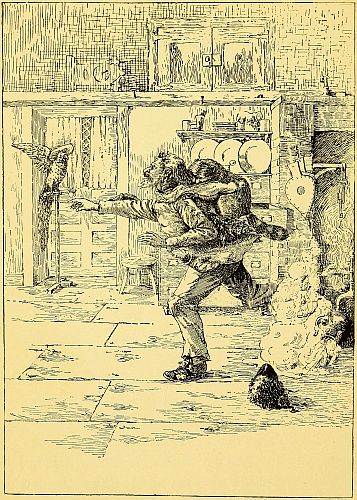
dashed into the house.
He paused before the door of the best room,
lately poor Eily's prison, to draw breath and
to collect his thoughts. The door was closed,
and from within—hark! what was that sound?
Something was stirring, surely. Oh, joy! was
his wife mistaken? Waking suddenly from
her nap, had she failed to see the girl, who had
perhaps been sleeping, too? At all events
the jewels were there, in shining heaps on
the floor, as he had last seen them, with
thousands more covering the floor in every
direction,—a king's ransom in half a handful
of them. He would be king yet, even if the
girl were gone. Cautiously he opened the
door and looked in, his eyes glistening, his
mouth fairly watering at the thought of all
the splendor which would meet his glance.
What did Dr. O'Shaughnessy see? Oh,
horror! Oh, dismay, terror, anguish! What
did he see? Captive was there none, yet the
room was not empty. Jewels were there
none, yet the floor was covered; covered
with living creatures,—toads, snakes, newts,
all hideous and unclean reptiles that hop or
creep or wriggle. And as the wretched man
stared, with open mouth and glaring eye-balls,
oh, horror! they were all hopping, creeping,
wriggling towards the open door,—towards
him! With a yell beside which his wife's
had been a whisper, O'Shaughnessy turned
and fled; but after him—through the door,
down the passage and out of the house—came
hopping, creeping, wriggling his myriad
pursuers.
Fly, King Michael! stretch your long legs,
and run like a hunted hare over hill and
dale, over moss and moor. They are close
behind you; they are catching at your heels;
they come from every side, surrounding
you! Fly, King O'Shaughnessy! but you
cannot escape. The Green Men are hunting
you, if you could but know it, in sport and
in revenge; and three times they will chase
you round County Kerry, for thrice three
days, till at last they suffer you to drop exhausted
in a bog, and vanish from your sight.
And Eily? Eily went home with her apron
full of pearls and diamonds, to tell her story
again, and this time to be believed. And she
grew up a good woman and a rich woman;
and she married the young Count of Kilmoggan,
and spoke diamonds and pearls all her
life long,—at least her husband said she did,
and he ought to know.