Now the action shifted to the
final targets of the 3d Marine
Division: that mass of hills 2,000
yards away. Once captured, they
would block the East-West Trail
where it crossed the Torokina
River, and they would greatly
strengthen the Final Inland
Defense Line that was the
Marines’ ultimate objective. A
supply base, called Evansville,
was built up for the attack in the
rear of Hill 600 for the forthcoming
attacks.
The 1st Marine Parachute
Regiment, under Lieutenant
Colonel Robert H. Williams, was
informed, two days after its
arrival on Bougainville, that
General Turnage had assigned it
to occupy those hills which IMAC
felt still dominated much of the
Marine ground. That ridgeline
included Hill 1000 with its spur
soon to be called Hellzapoppin
Ridge (named after “Hellzapoppin,”
a long-running Broadway
show), Hill 600, and Hill 600A. To
take the terrain Williams got the
support of elements of the 3d, 9th,
and 21st Marines (which had
established on 27 November its
own independent outpost on Hill
600). By 5 December, the 1st
Parachute Regiment had won a
general outpost line that stretched
from Hill 1000 to the junction of
the East-West Trail and the
Torokina River.
Then on 7 December, Major
Robert T. Vance on Hill 1000 with
his 3d Parachute Battalion walked
the ridge spine to locate enemy
positions on the adjacent spur that
had been abandoned. The spur
was fortified by nature: matted
jungle for concealment, gullies to
impair passage, steep slopes to
discourage everything. That particular
hump, which would get
the apt name of Hellzapoppin
Ridge, was some 280 feet high, 40
feet across at the top, and 650 feet
long, an ideal position for overall
defense.
Jumping off from Hill 1000 on
the morning of 9 December to
occupy the spur, Vance’s men
were hit by a fusillade of fire. The
Japanese had come back, 235 of
them of the 23d Infantry. The parachutists
attacked again and again,
without success. Artillery fire was
called in, but the Japanese found
protective concealment on the
reverse slopes. Marine shells burst
high in the banyan trees, up and
away from the dug-in enemy. As a
result, the parachutists were hit
hard. “Ill-equipped and under-strength,”
they were pulled back
on 10 December to Hill 1000. Two
battalions of the 21st Marines,
with a battalion of the 9th Marines
guarding their left flank, continued
the attack. It would go on for
six gruelling days.
Scrambling up the slopes, the
new attacking Marines would
pass the bodies of the parachutists.
John W. Yager, a first lieutenant
in the 21st recalled, “The
para-Marines made the first contact
and had left their dead there.
After a few days, they had become
very unpleasant reminders of
what faced us as we crawled forward,
in many instances right
next to them.”
Sergeant John F. Pelletier, also
in the 21st, was a lead scout.
Trying to cross the ridge spine
over to the Hellzapoppin spur, he
found dead paratroopers all over
the hill. There were dead Japanese
soldiers still hanging from trees,
and it seemed to him that no
Marine had been able to cross to
the crest and live to tell about it.
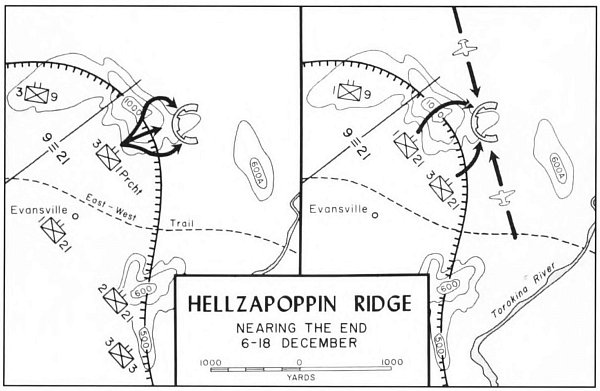
HELLZAPOPPIN RIDGE
NEARING THE END
6–18 DECEMBER
Pelletier described what happened
next:
The next morning Sergeant
Oliver [my squad leader]
told me to advance down the
ridge as we were going to
secure the point. That point
was to become our most costly
battle. We moved down
the center until we were
within 20 feet of the point.
The Japs hit us with machine
gun, rifle, and mortar fire.
They popped out of spider
holes. We were in a horseshoe-shaped
ambush. We
were firing as fast as we
could when Sergeant Oliver
pulled me back. He gave me
the order to pull back up the
ridge. He didn’t make it.
When artillery fire proved ineffective
in battering the Japanese
so deeply dug in on Hellzapoppin
Ridge, Geiger called on 13
December for air attacks. Six
Marine planes had just landed at
the newly completed Torokina
airstrip. They came in with 100-pound
bombs, guided to their targets
by smoke shells beyond the
Marine lines. But the Japanese
were close, very close. Dozens of
the bombs were dropped 75 yards
from the Marines. With additional
planes, there were four bombing
and strafing strikes over several
days. A Marine on the ground
never forgot the bombers roaring
in right over the brush, the ridge,
and the heads of the Marines to
drop their load, “It seemed right
on top of us.” (This delivery technique
was necessary to put the
bombs on the reverse slope
among the Japanese.)
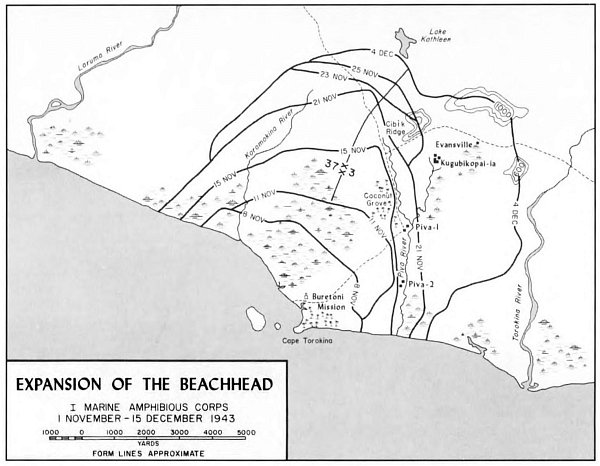
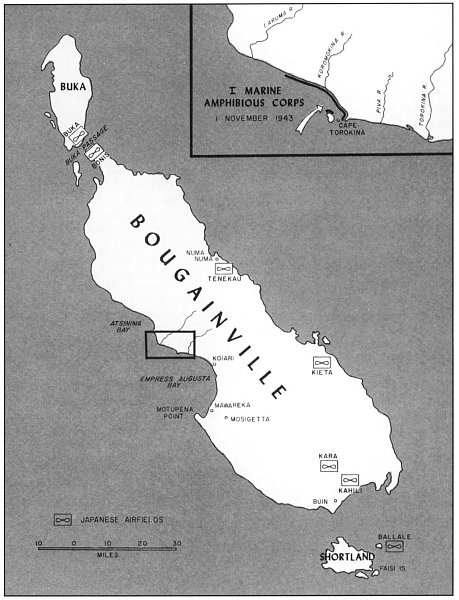
EXPANSION OF THE BEACHHEAD
I MARINE AMPHIBIOUS CORPS
1 NOVEMBER–15 DECEMBER 1943
Helping to control these early
strikes and achieve pinpoint accuracy
was Lieutenant Colonel
William K. Pottinger, G-3
(Operations Officer) of the
Forward Echelon, 1st Marine
Aircraft Wing. He had taken a
radio out of a grounded plane,
moved to the frontlines, and
helped control the attacking
Marine planes on the spot. (This
technique was an improvised
forerunner of the finely tuned procedures
that Marine dive bombers
would use later to achieve
remarkable results in close air
support of ground troops.)
The 3d Marine Division’s history
was pithy in its evaluation, “It
was the air attacks which proved
to be the most effective factor in
the taking of the ridge ... the most
successful examples of close air
support thus far in the Pacific
War.”
Geiger wasn’t through. He had
a battery of the Army’s 155mm
howitzers moved by landing craft
to new firing positions near the
mouth of the Torokina River. Now
the artillery could pour it on the
enemy positions on the reverse
slopes.
In one of the daily Marine
assaults, one company went up
the ridge for two attacks against
Japanese who would jump into
holes they had dug on the reverse
slope to escape bombardment.
The Japanese finally were tricked
when another company, relieving
the first one, jumped into the
enemy foxholes before their rightful
owners. It cost the Japanese
heavily to try to return.
In a final assault on 18
December, the two battalions of
the 21st moved from Hill 1000 to
the spur in a pincer and double
envelopment. But the artillery and
bombs had done their work. The
Japanese and their fortress were
shattered. Stunned defenders
were easily eliminated.
Patrick O’Sheel, a Marine combat
correspondent, summed up
the bitter battle, “No one knows
how many Japs were killed. Some
30 bodies were found. Another
dozen might have been put
together from arms, legs, and torsos.”
The 21st suffered 12 killed
and 23 wounded.
With Hellzapoppin finally
behind them, Marines could count
what blessings they could find
and recount how rotten their holidays
were. There had been a
Thanksgiving Day spent on the
trail while gnawing a drumstick
on the way to another engagement
at Piva Forks. And now, on
21 December, four days until
Christmas, and the troops still had
Hill 600A to “square away.”
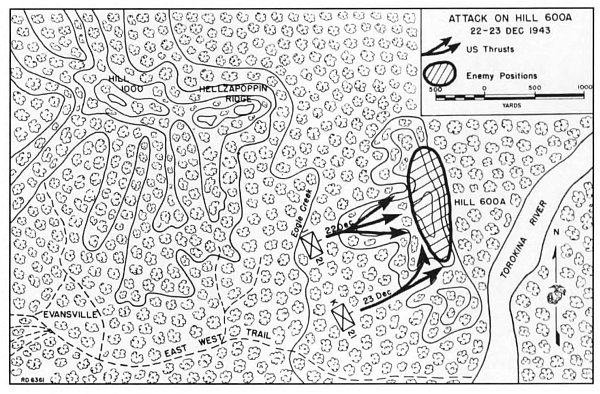
ATTACK ON HILL 600A
22–23 DEC 1943
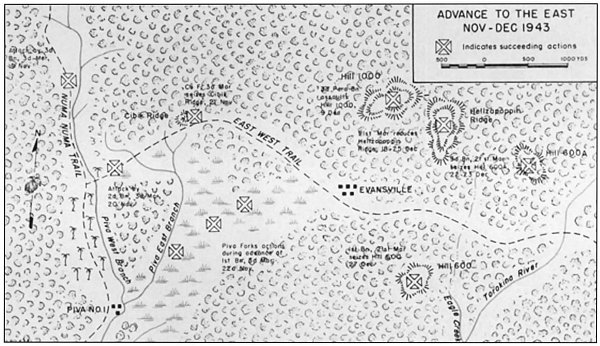
ADVANCE TO THE EAST
NOV-DEC 1943
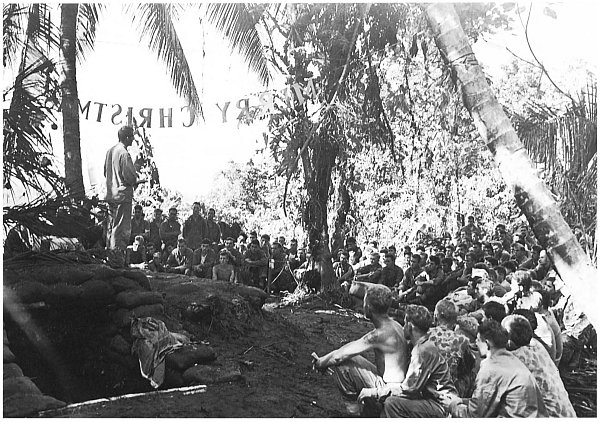
Chaplain Joseph A. Rabun of the 9th Marines delivers his sermon with a “Merry Christmas” sign overhead and a sand-bagged
dugout close at hand.
Department of Defense Photo (USMC) 74819
Reconnaissance found 14–18
Japanese on that hill, down by the
Torokina River. A combat patrol
from the 21st Marines moved to
drive the Japanese off the knob. It
wasn’t hard, but it cost the life of
one Marine and one was wounded.
But IMAC wanted a permanent
outpost on the hill, and the
3d Battalion, 21st, drew the
assignment. It began with one
rifle platoon and a platoon of
heavy machine guns on 22
December. Hill 600A was a repeat
of past enemy tactics. The
Japanese had come back to occupy
it. They held against all efforts,
even against a two-pronged
attack. A full company came up
and made three assaults. That didn’t
help either. Late on the 23d,
the Marines held for the night,
preparing to mount another
attack in the morning. That morning
was Christmas Eve, 1943.
Scouts went up to look. The
Japanese had gone. Christmas
wasn’t merry, but it was better.
For the 3d Marine Division, the
war was over on Bougainville.
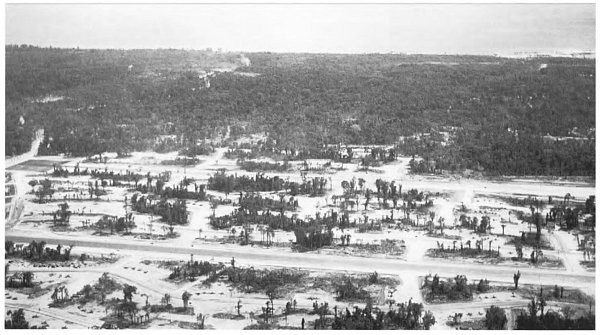
National Archives Photo 80-G-250368
The Piva airfields (shown here in February 1944 photograph) became key bomber and
fighter strips in the aerial offensive against Rabaul.
The landing force had seized
the beachhead, destroyed or overcome
the enemy, and won the
ground for the vital airfields. Now
they prepared to leave, as the airfields
were being readied to
reduce Rabaul and its environs.
Since 10 December, F4U Vought
Corsairs of Marine Fighting
Squadron (VMF) 216 (1st Marine
Aircraft Wing) had settled on the
new strip on Torokina, almost
washed by the sea. The fighter
planes would be the key to the
successful prosecution of the
AirSols (Air Solomons) offensive
against Rabaul, for, as escorts,
they made large-scale bombing
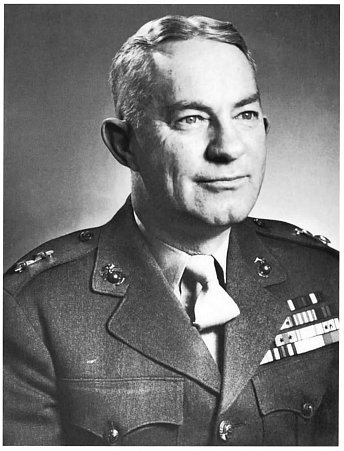
raids feasible. Major General
Ralph J. Mitchell, USMC, had
become head of AirSols on 20
November 1943. By 9 January
1944, both the fighter and bomber
aircraft were operating from the
Piva strips. Following Bougainville,
Mitchell would have twice
the airpower and facilities that the
Japanese had in all of the
Southwest Pacific area.
The campaign had cost the
Marines 423 killed and 1,418
wounded. Enemy dead were estimated
at 2,458, with only 23 prisoners
captured.
It was now time for the 3d
Marine Division to go home to
Guadalcanal, with a “well done”
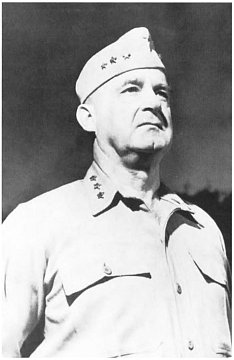
from Halsey. (In the Admiral’s colorful
language, a message to
Geiger said, “You have literally
succeeded in setting up and opening
for business a shop in the Japs’
front yard.”) Now there would be
plenty of papayas and Lister bags,
as well as a PX, a post office, and
some sports and movies. General
Turnage was relieved on 28
December by Major General John
R. Hodge of the Americal
Division, which took over the
eastern sector. The 37th Infantry
Division kept its responsibility for
the western section of the
Bougainville perimeter. Admiral
Halsey directed the Commanding
General, XIV Corps, Major
General Oscar W. Griswold, to
relieve General Geiger, Commanding
General, IMAC. The
Army assumed control of the
beachhead as of 15 December. The
3d Marines left Bougainville on
Christmas Day. The 9th left on 28
December, and had a party with
two cans of beer per man. The
21st, last to arrive on the island,
was the division’s last rifle regiment
to leave, on 9 January 1944.
Every man in those regiments
knew full well the crucial role that
the supporting battalions had
played. The 19th Marines’ pioneers
and engineers had labored
ceaselessly to build the bridges
and trails that brought the vital
water, food, and ammunition to
the front lines through seemingly
impassable swamps, jungle, and
water, water everywhere.
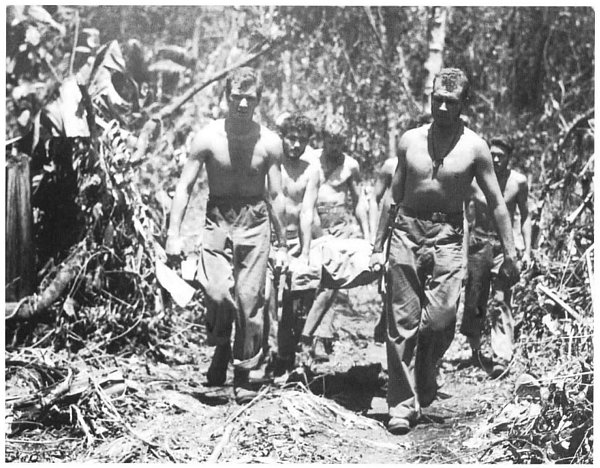
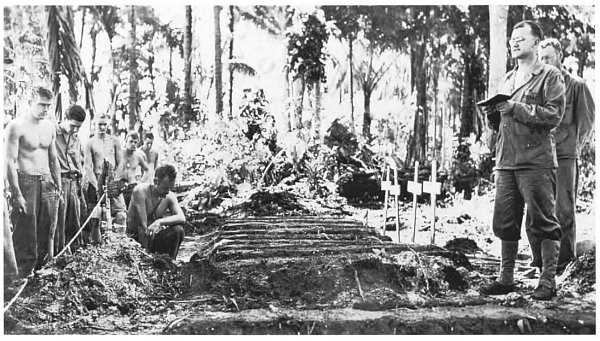
A chaplain reads prayers for the burial of the dead, while their friends bow their heads
in sorrow at the losses.
From the Leach File, MCHC Archives
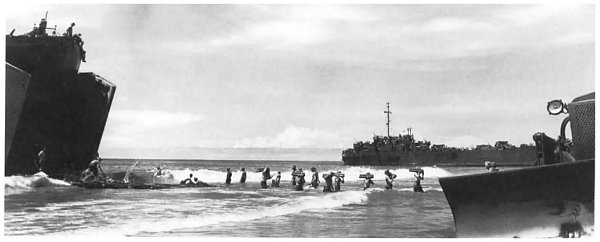
And the amtracs of the 3d
Amphibian Tractor Battalion had
proven essential in getting 22,922
tons of those supplies to the riflemen.
They were “the most important
link in the all-important supply
chain.”
Working behind the amtracs
were the unsung men of the 3d
Service Battalion who, under the
division quartermaster, Colonel
William C. Hall, brought order
and efficiency from the original,
chaotic pile-up of supplies on the
beach. As roads were slowly built,
the 6×6 trucks of the 3d Motor
Transport Battalion moved the
supplies to advance dumps for
the amtracs to pick up.
The 12th Marines and Army
artillery had given barrage after
barrage of preparatory fire—72,643
rounds in all.
The invaluable role of Marine
aviation, as previously mentioned,
was symbolized by
General Turnage’s repeated
requests for close air support, 10
strikes in all.
The Seabees, working at a
“feverish rate,” had miraculously
carved three airfields out of the
unbelievable morass that characterized
the area. And it was from
those bases that the long-range,
strategic effects of Bougainville
would be felt by the enemy.
The 3d Medical Battalion had
taken care of the wounded. With
omnipresent corpsmen on the
front lines in every battle and aid
stations and field hospitals right
behind, the riflemen knew they
had been well tended.
General Turnage summarized
the campaign well, “Seldom have
troops experienced a more difficult
combination of combat, supply,
and evacuation. From its very
inception, it was a bold and hazardous
operation. Its success was
due to the planning of all echelons
and the indomitable will, courage,
and devotion to duty of all members
of all organizations participating.”
Thus it was that the capture of
Bougainville marked the top of
the ladder, after the long climb up
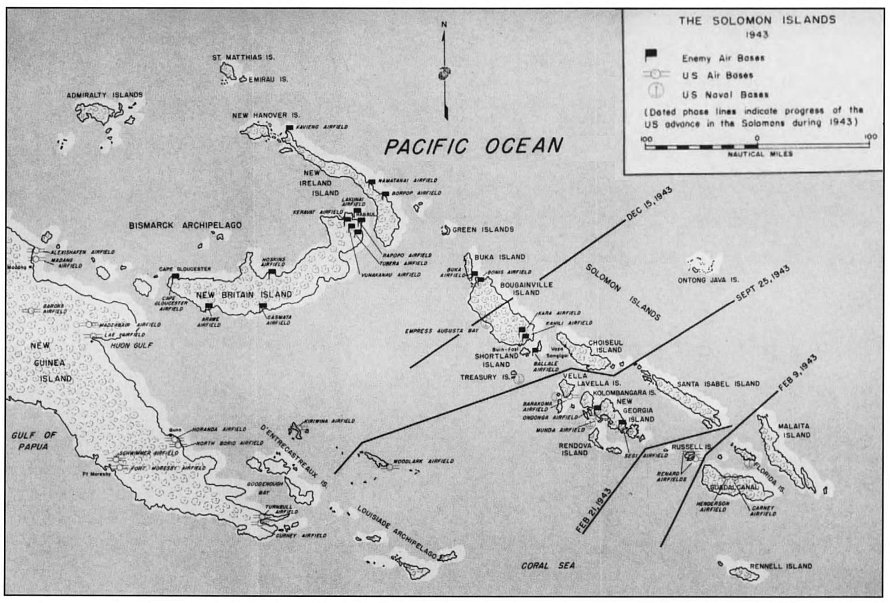
the chain of the Solomon Islands.