“I HAVEN’T forgotten Blue Lady; I haven’t forgotten, please, Miss
Margaret, Miss,” and Tommy turned over sleepily in bed, then wakened,
yawned, rubbed his eyes and sat upright.
“What sort o’ weather, Daddy?” he demanded. “Is’t sun an’ fine?”
It was.
Tommy then called down to Mammy in the kitchen, pleading to be dressed
at once, so as to be ready when the gingle came. Mammy got out his
brown jersey suit.
“Miss Margaret said old clothes, Mammy, so I shan’t wear ’e.”
“You’ll do they no harm, and you’ll just wear ’em.”
“I wants my old clothes, Mammy, where be ’em. Miss Margaret said old
clothes; she said old clothes, Mammy, she did.”
It was not until Miss Margaret approved of the brown jersey suit that
Tommy submitted and was dressed.
When he was ready he stood in the doorway, and to every one who passed
he shouted the news. “I be goin’ a-drivin’ in a gingle to Polderry.”
And to the question, “Who with?” he gave the invariable answer, “With
Miss Margaret and Miss Dorothea and Ruthie and me.”
After breakfast the sun was hidden behind a cloud of mist. Tommy and
the ladies consulted the glass on the front. It was very high, and all
the watermen thought there was no fear of rain. Then Mrs. Tregennis
packed the luncheon basket, and Tommy wished it was ten o’clock.
Miss Margaret had a happy thought, and suggested that they should go
across to West Draeth and themselves bring round the gingle for Miss
Dorothea and Ruthie. This was a grand idea. Hurriedly Mrs. Tregennis
put on Tommy’s boots and ran upstairs for his warm coat and his cap.
Miss Margaret and Tommy crossed the river by the ferry for quickness.
“If you like, Tommy, you shall help me to hold the reins and to
drive,” promised Miss Margaret.
“If it be all the same to ee I’d rather have the whip,” was the reply.
“But why?”
“For to hit ’en.”
“But he won’t want hitting,” objected Miss Margaret. “I expect he’ll
trot along awfully well and won’t want any hitting at all.”
Tommy looked unconvinced, and as they left the boat at the slip he
turned the conversation into other channels. “Lugger a-buildin’ over
there,” he pointed with his thumb. “Must be for West Draeth as ’tis on
that side. I seen one lanch one evenin’ an’ one lanch the next.”
By the time Tommy had imparted all he knew of boatbuilding and
launches they had reached Mr. Chard’s door. The gingle was already
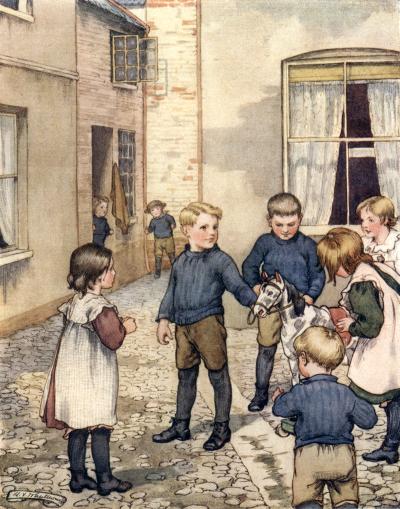
outside, and while the pony was being brought round a small crowd of
boys collected and watched with interest.
“Hallo, Tommy Tregennis.”
“Hallo!”
“What be a-doin’ over here, Tommy; ain’t there room for ee to East
Draeth?”
“Goin’ to Polderry,” said Tommy, proudly, and fell into the gingle as
he spoke.
“Do these boys go to school with you, Tommy?” and Tommy told Miss
Margaret that they did.
“They West Drayers do play their own side evenin’s,” he explained,
“when they comes over to we they comes with their mothers an’ just
sits on our sands, an’ that do be just so good as nothin’, that be.”
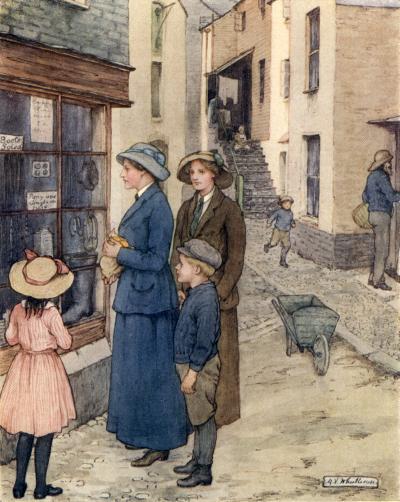
From every doorway people came out to see the start of the gingle for
Polderry. Everybody waved and everybody shouted, and it was for all
the world like a Sunday-school treat. Near the Post Office a louder
cry than ever came from Tommy and was at once echoed by Ruthie, and
both children rose up and waved their long white mufflers.
“We’m goin’ to Polderry; we’m goin’ to Polderry.”
Miss Margaret’s whole attention was taken up with the astonished pony,
but, far away in the distance, standing on the quay, Miss Dorothea
descried the figure of Uncle Harry and Uncle Harry was waving and
shouting too.
Polderry was only five miles off along the cliff, but in driving you
cover nearly twice that distance in order to have a better road. Miss
Margaret had been directed to go past the station, up by the
golf-links, through St Peter’s and along the main road to Esselton,
then they were to turn off to the right down the beautiful Brenton
Valley and so to Polderry.
In the gingle Tommy sat up near the horse on the right-hand side with
Miss Margaret next to him. Opposite Tommy was Miss Dorothea, so that
Ruthie was near the door facing Miss Margaret. The reins, therefore,
passed in front of Tommy, and suddenly he clutched them very tight
while they were driving through the town, with the result that Jimmy,
the pony, swerved to the left and almost ran into the corner of the
bridge. Miss Margaret told him that he should help to drive when they
were up on the wide country road, and very reluctantly Tommy let go.
It was both surprising and disappointing when immediately afterwards
Tommy again seized the reins, this time so tightly that it was with
difficulty that his fingers were unclasped.
“You must be quite obedient,” Miss Margaret reminded him.
So little, however, did Tommy realize what was meant by obedience that
scarcely had she finished speaking than he again seized the reins with
both hands, while a naughty look of defiance appeared on his face.
After this there was distinct depression in the gingle until Ruthie’s
shrill, bright voice pierced the gloom.
“There do be a nest on that wall under the ivy,” she said, very
confidentially. “’Tis a brave, big secret, an’ no-one knows of it at
all except only me an’ Tommy, an’ my daddy an’ mammy, an’ his daddy
an’ mammy, ’n Aunt Keziah Kate an’ Granfäather Tregennis.”
“Just a family secret,” interposed Miss Margaret. “And what sort of a
nest is it?”
“I don’t know what sort o’ nest it be. It do be a very nice little
tight nest, an’ ’tis quite empty this little nest, but I don’t know
what kind of nest ’e do be; just little an’ tight.”
Tommy disliked being ignored. “It hasn’t got no eggs in it, ’tis
empty; ef there was eggs in ’e I should know what ’twas.”
“My daddy, he knows of a nest up here wanst,” Ruthie continued, “that
had twelve eggs in it, twelve speckly eggs.”
“Oh, Ruthie, as many as twelve?”
“Yes, just so many as twelve.”
“But what a very improvident mother-bird!” Miss Margaret objected.
“How would she ever manage to feed twelve babies? And think of the
very hard work it would be for the father to teach twelve
children-birds to sing.”
All this time Jimmy was pulling his load uphill, trotting every now
and again, as though he were thoroughly enjoying the morning’s work.
When the top of the hill was in sight, “Which way do we turn, to the
right or to the left, Tommy?” asked Miss Dorothea.
“To the left,” replied Tommy, without hesitation.
“How do you know which is your right hand and which is your left?”
Tommy became most communicative. “Why, I writes with my right hand
over to school. There be two girls an’ one boy in the second class as
writes with their left hand, so they can’t never tell. I wrote my name
wanst six times on one side of my slate and six times on the other,
an’ it was so lovely I had to bring it home to show Mammy, Miss
Lavinia said. ’Twas brave an’ handsome, it was!”
“What be they white flowers?” interrupted Ruthie.
“Stitchwort,” the ladies answered.
“’Tisn’t, ’tis cat’s eyes!” contradicted Tommy.
“Hush, Tommy,” said Ruthie, “you’m a naughty boy. My mammy always
calls they ‘rattle-baskets’ because it do rattle so when ’tis dry.”
Ruthie’s last words came spasmodically, for Tommy had unexpectedly
leaned forward over the splashboard and hit Jimmy on the back with his
white muffler. It had been a great disappointment to Tommy to find,
when they started, that there was no whip in the gingle, and that the
pleasure of hittin’ ’en was not to be his. Realizing that the muffler
would make a fairly good substitute, he used it with such effect that
the startled pony broke into a quick gallop, and the ladies and Ruthie
were jerked backwards in their seats.
When Miss Margaret had quietened the pony she spoke very seriously to
Tommy.
Jimmy proved an unusually good pony for steep hills, taking them at a
brisk trot. Going downhill, however, he was cautious and picked his
way most carefully. Half-way down a steep, rough road Tommy again
used his muffler as a whip. Then Miss Margaret was quite angry. As she
felt that more words were useless, she merely loosened the muffler
from his tight grasp and put it in the corner near the lunchbasket,
where Ruthie sat.
It was most perplexing and embarrassing to have one’s principal guest
in constant need of correction.
Tommy was evidently quite surprised at Miss Margaret’s decided action
in the matter of the muffler, and for some moments afterwards sat
silent and subdued. Then slowly, very slowly, his left hand stole
towards her disengaged right resting upon the cushion. This seemed a
sign of repentance on Tommy’s part, and Miss Margaret’s fingers closed
tightly over his as she smiled across at Miss Dorothea.
Her happiness in Tommy’s regeneration was short-lived. Snatching his
hand away, “Get me some o’ that stuff, Miss Margaret,” he shouted,
“get me some o’ that stuff for a whistle.”
“What stuff?”
“Suckymores, suckymores for a whistle.”
They were still driving down the steep, rugged road, so Miss Margaret
turned Jimmy to the grass of the hedge-bank and Miss Dorothea, Ruthie
and Tommy got out. Miss Dorothea was able to break off some grand
sycamore twigs for whistles, enough for all the boys in Miss Lavinia’s
school.
“Whoa, Jimmy; steady, Jimmy!” and Miss Margaret pulled hard at the
right rein, only just saving Tommy from being knocked down by the
wheel and run over.
Tommy tried to look natural and unconcerned, but Miss Dorothea had
seen the cause of Jimmy’s start. Tommy had picked up a hazel switch
and, thinking himself unobserved, had hit the pony sharply on the
flank.
It seemed quite useless to reprove him any more, so Miss Margaret
sternly ordered him to return to the gingle. This he obstinately
refused to do. He was goin’ to walk for a bit, he was goin’ to run on
behind, he was. When Miss Dorothea walked towards him he ran away. He
was literally lifted into the gingle, and then sat in Miss Dorothea’s
place, refusing to move, as he wished to be next to Ruthie. Ruthie
herself explained to him that in that way the balance would be all
wrong, but he still remained obdurate. Once more he was lifted up and
put into his proper place.
Then, although Miss Margaret took the reins, she did not drive on.
Instead, “Miss Dorothea,” she said, “shall we go on to Polderry, or
shall we drive straight back home?”
“Oh, Miss Margaret,” pleaded Ruthie, “please, please, go on! don’t ee
go home. Tommy will be a good boy, won’t ee now, Tommy?”
Tommy shook his head affirmatively.
“Well,” said Miss Margaret, “you must quite understand that if we go
on you are to be good. If you are naughty again I shall turn Jimmy
round and drive home at once.”
Unfortunately Tommy was used to threats that were seldom carried out.
The policeman would come for him, Mammy said, when he was naughty,
and, although he had often been really quite naughty, still the
policeman had not come. At other times he was told that he would be
sent to London to live with the monkeys in the Zoo. At first this
possibility had filled him with dread, but now familiarity had blunted
the sharp edge of fear.
Something in Miss Margaret’s manner, however, warned him that hers was
not an idle speech, and he decided that he must be really careful for
the rest of the drive.
A little farther on, down the same hilly part of the main road, a lady
approached them. “Have you just come through a village?” she asked, as
they were passing by.
They had noticed on the right, down a side road, a few scattered
houses, but scarcely thought it could be called a village.
“Had it any shops or a garage?” she asked again, and seemed
disheartened when they told her that there were no shops nearer than
Draeth, five miles away.
Afterwards they understood her anxiety, for right in the middle of the
roadway stood a big, immovable motor. Two men were crawling under its
body, and Miss Margaret had to call out sharply to one of them to
withdraw his feet before she could drive Jimmy and the gingle past.
At Polderry it was decided that the very first thing to do was to eat
the lunch that Mrs. Tregennis had packed in the big round basket.
When Tommy and Ruthie found that the yellow part of their eggs was
green outside they were much surprised.
“Be they raw?” asked Tommy.
“Hard-boiled,” answered Miss Dorothea, and Tommy ate his egg quickly,
all by itself.
After this he gave back his slice of bread and butter. “Don’t want ’e
now, I wants a piece of cake.”
“You must eat the bread and butter first,” he was told.
“No, shan’t,” he said, and passed it on to Ruthie, who could not take
it from him because Miss Margaret shook her head.
“Shan’t eat ’en,” Tommy stated, emphatically.
But this was a case in which Miss Margaret undoubtedly held the upper
hand. She made no reply to Tommy’s assertion, and when he tried to
extract a piece of cake from the basket it was placed beyond his
reach.
“Shan’t eat ’en,” he said again, but again no notice was taken of
his words. Defiantly he picked up the bucket and spade and began to
dig in the sand.
A tempting row of Cornish splits, halved and spread with jam and
cream, was prepared by Miss Dorothea.
Tommy soon returned. “Can I have a split, please?” he asked, in quite
a different voice.
“Yes,” he was promised, “as soon as ever the bread and butter’s
eaten.”
He shook his head, and almost at once asked again, “Please can I
have a split, ’n jam ’n cream?”
“Tommy,” said Miss Margaret, very definitely, “don’t be such a foolish
boy. Until you have eaten the bread and butter you can have nothing
else. Try to understand that I mean that.”
Tommy’s hands hung limply at his sides. He gazed in open-mouthed
amazement at Miss Margaret. She did really and truly mean it, he
supposed. It was very odd and very surprising, and he picked up the
rejected bread and butter and slowly began to eat.
“Oh, my cake,” exclaimed Ruthie, as half a slice of saffron-cake broke
in her hand and fell into the sand.
“You can’t eat that now, Ruthie,” laughed Miss Margaret, as she was
about to pick it up. “It will be much too gritty.”
Then Miss Margaret realized that she had made a grave tactical error,
for at once Tommy’s bread and butter fell at his feet.
“That must be eaten,” said Miss Margaret quickly, and Tommy put his
heel upon it and ground it deep down in the sand. Out of the corners
of his eyes he glanced at Miss Margaret, but apparently she was quite
unaware of his action, so he sidled up to her and once more pleaded
for a split.
At this point, with disconcerting suddenness, the rain began to fall.
Hastily the luncheon basket was repacked and Miss Margaret, Miss
Dorothea and Ruthie ran to the shelter of a coach-house near by, where
they were given permission to stay. Tommy remained behind and resumed
his digging in the sand. When no notice was taken of his absence, he
decided that making castles in the rain was poor sport. Accordingly he
rejoined his party and found them merrily continuing the interrupted
lunch.
Confidently he approached Miss Margaret, asking for “a split an’
cream, please.”
“But I can’t give you a split,” she said, “you were to have it when
you’d eaten the bread and butter, and not until then.”
“I did eat the bread and butter in my hand.”
“What about the piece in the sand?”
Then Miss Margaret had seen him tread on it: this was unexpected.
“Couldn’t help droppin’ ’e,” he said, now almost tearfully.
“But why did you bury it deep down in the sand?”
“I thought somebody might come along an’ not know, an’ pick ’e up an’
eat ’e, an’ it wouldn’t be nice for they.”
“Very well,” said Miss Margaret, “I’ll give you another piece exactly
the same size, and when you’ve eaten that you can have splits and
cream and just whatever you like.”
But Tommy refused and kicked a ball savagely round and round the
coach-house to soothe his outraged feelings. Violent exercise,
however, did not allay his hunger.
“Please can I have a split,” he asked once more.
Without speaking, Miss Margaret offered him a piece of bread and
butter exactly the size of that which he had hidden in the sand, and
Tommy ate it without remonstrance.
After lunch the picnic-party played ball-games in the roomy
coach-house, but when at the end of an hour the rain showed no sign of
abating, the ladies, in spite of Ruthie’s earnest pleading, decided
that it would be wiser to go home.
Somewhat dejectedly they walked to the inn for the gingle and Jimmy.
Tommy brought up the rear, trailing his long spade after him and
rattling his bucket against his knees each step he took. “Well,” Miss
Dorothea overheard him say, “Well, Ruthie; now this day do be bravely
spoiled.”
On the homeward drive Miss Dorothea told the children the history of
Little Black Sambo. Then Ruthie told a story in which full-stops
occurred in the middle of sentences whenever it was absolutely
necessary that she should pause for breath.
“There was wanst a little boy an’ he had a rabbit and it lived in a
house in the garden an’ he went up to feed it with green stuff one
night an’ he. Left the door open an’ he met a man an’ he said to the
man what have you got in your pocket an’ the man said a little rabbit
an’ the boy took this little baby rabbit an’ took it to his home
because he’d lost his own rabbit. Through leavin’ the door open an’ he
met a man an’ he said to the man what’ve you got in your pocket an’ he
said a very little bird so he took it to his home and put it in a
house in his garden.”
At some length the story went on. Always the boy met a man, and always
the man had in his pocket some strange and unexpected animal which the
boy took to his home and put in a house in the garden.
But finally, “An’ the boy went out again an’ he met a lady wheelin’ a
pram an’ there was a baby in the pram an’ the boy said what’ve you
got in your pocket an’ the lady said I haven’t got nothin’ in my
pocket an’ neither she hadn’t got nothin’ in her pocket for she only
had a little baby an’ the little baby was in the pram.”
Then Ruthie looked round the gingle, smiling, and the wet audience of
three, realizing that in this unfinished and unsatisfactory way the
story ended, thanked her politely, and wondered whether the boy kept
all his new pets safely or whether, like the original rabbit, they too
escaped.
Going up the hill from Esselton they again passed the big, immovable
car; it was still standing right in the middle of the road. All the
passengers sat very closely together under the hood, evidently
awaiting relief. Fired by Ruthie’s example, Tommy decided that he,
too, would tell a story.
“There was wanst a rabbit—. An’ it went down to the beach—. An’
there was another rabbit, too—. An’ a great, big giant came down—.
An’ he took away one of the rabbits, did the giant—. An’ the giant
ate it all up.”
They were passing St Peter’s by this time. Draeth and home and Mammy
were very near and Tommy felt unhappy inside. “I do be feelin’ brave
an’ bad,” he said, lifting tearful eyes to Miss Margaret. But Miss
Margaret was busily occupied with the pony and the reins, and had no
sympathy to extend to a conscience-stricken boy.
In pelting rain the gingle drew up in front of Mr. Chard’s door. “Been
a-sailin’, Tommy Tregennis?” asked some of the West Drayers, but Tommy
felt too bad to reply.
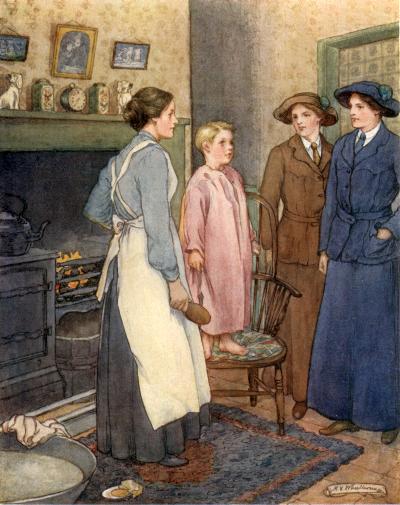
“Been a good boy, my lovely?” asked Mammy, as she drew off his boots.
“I dunno!”
“But you must know,” said Mammy, as she buttoned the strap shoes.
“Been a good boy?”
There was no answer.
“Well, have you been naughty?” Mammy persisted.
Tommy wriggled down from the chair. “I dunno, and don’t ee bother I no
more, Mammy, ask Miss Margaret what I been,” and he ran from the
house, unmindful of the rain, to seek the soothing presence of his
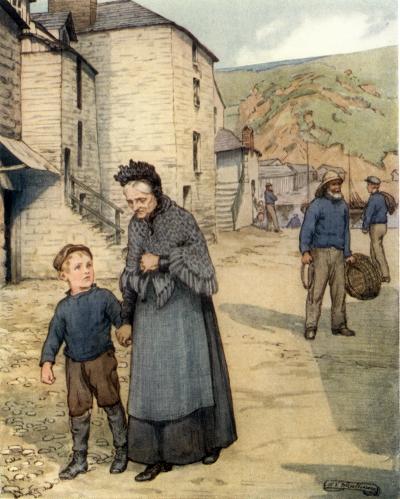
never-failing admirer, Aunt Keziah Kate.
After tea Mammy had a long and serious talk with the ladies. “’Underds
of times,” she admitted, she threatened Tommy, and nothing happened.
“When there’s visitors here I feel I must go the easiest way,” she
explained.
“He’s too good to be spoiled,” urged Miss Margaret.
“We don’t want to spoil him, Miss, his daddy an’ me, and we must try
and be firmer with him, for he do indeed be gettin’ out of hand.”
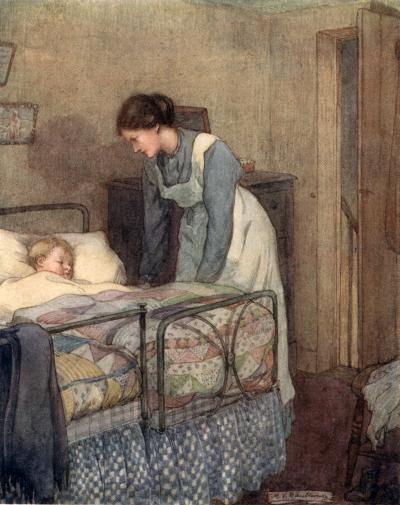
At six o’clock Miss Margaret heard Tommy go into the bedroom, and soon
afterwards there was Mrs. Tregennis’s heavier step on the stairs.
There was a rustle of bed clothes and a creaking of springs, and by
these signs Miss Margaret knew that Tommy was in bed.
“Tommy,” said Mrs. Tregennis, “do you know why your Mammy do be
feelin’ very sad?”
“No Mammy,” was the reply, “but shall us talk a bit about you, when ee
was just a very little girl.”
“No, my son,” said Mrs. Tregennis, with great firmness; “we’m not
goin’ to talk about me when I was small; we be goin’ to talk about
you, instead, my son.”
Then the door was closed and Miss Margaret heard no more.