THE FLOWER-SHOW
THE next thing that happened was a visit from a school attendance
officer to know why Harry was not at school.
Tomina received him with open-eyed amazement.
"You need not trouble about the little boy at all. He is under my care
now."
"But he must receive an education," insisted the attendance officer.
"There is plenty of time for that later on. He is only seven. I think
children learn too much at these Council schools."
"Then are you going to teach him yourself, miss?"
"I teach Harry! Why, he teaches me. I have learnt a lot from him."
"He must go to school," persisted the official.
"Well, I'll see about it. Good morning."
When Tomina had got rid of her visitor, she turned to Susan indignantly.
"I shall not be 'at home' to that man if he calls again, Susan."
"But, ma'am, you must. An attendance officer is like the police—you
can't shut him out."
Tomina laughed, but she did not feel quite easy in her mind, so she
wrote a note to the Doctor saying she wished to see him. And Dr. Merton
came, and was told of the incident. He laughed at Tomina's dilemma.
"Of course, Master Harry will have to go to school. You must talk it
over with Mrs. Francis. She and the Squire have just returned. I expect
she will come round and call upon you."
"Oh, I don't want any more visitors!" said Tomina, hastily. "She will
only come to see Harry."
"You and she will have to settle his future together."
"I never think about the future," said Tomina with half-shut eyes. "I
hate preparation of any kind."
The first time she met Mrs. Francis was after church on Sunday.
She was a tall, graceful young woman with a sweet sad face. In her
black shady hat, Tomina at first put her down to be a young girl.
But when she saw her closer, she knew that she was in the prime of
womanhood.
She had stayed behind to talk to the Doctor, but Harry had left
Tomina's side and dashed up to her.
"My Mrs. Francis!" he cried.
She stooped and took him in her arms. Then she turned to Tomina, and
the Rector introduced them.
"Miss Gavin is a thorough stay-at-home; we can't move her out of her
pretty cottage," the Rector said genially.
Mrs. Francis looked across at Tomina and smiled, and her smile softened
Tomina at once. She had been feeling a little aggressive towards
Harry's benefactor.
"It is very pleasant and unusual to find any one fond of staying still
nowadays," she said.
"Oh, I'm made to do it by doctor's orders!" said Tomina. "They've
buried me down here for a purpose."
"May I come and see you? Please say if you would rather not."
"When you put it like that, what can I say?" said Tomina, laughing.
"And Dr. Merton says you must interview me about Harry. So please come
any day but Tuesday or Friday. Would Wednesday suit you?"
"Perfectly. I will come then."
Harry interrupted here. Pointing his finger at Tomina, he said—
"And she reads to me every night, but she didn't know about the baby
king, and we haven't been able to find where his chapter is."
"Are you going to desert me now, Harry?" Tomina asked.
He sprang back to her.
"I lives with Tommie," he said, nodding gravely at Mrs. Francis by way
of explanation, "but I'll be very glad to come to tea with you soon."
"That's a very clever way of dividing your favours," said Tomina, and
then she shook hands with Mrs. Francis and walked away.
Susan was full of interest when she heard of the meeting.
"And don't you think her a beautiful lady, ma'am? If only she didn't
dress in such plain black always! I should dearly like to see her in
colours. I can fancy her in crimson silk with a white ostrich feather
curling round her dark head. She would look a reg'lar queen."
"Oh, Susan!" gasped Tomina. "I've never seen a queen dressed like that!
I think she is very sweet-looking, but she's a perfect stranger at
present."
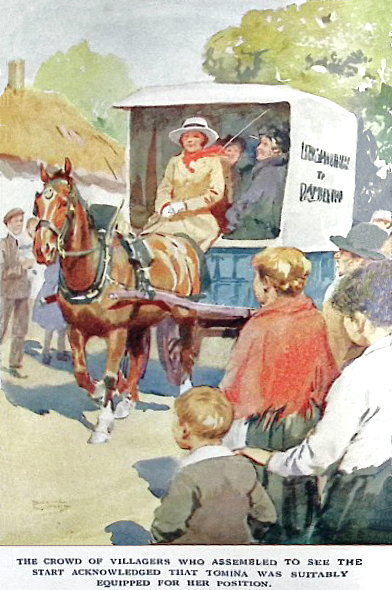
On the following Tuesday, as Tomina was driving her van, she met three
riders coming along the road.
Sir Alfred Digby and Mrs. Francis were two of the riders. Colonel
Norman made the third. Mrs. Francis was a good rider, and she was just
now talking and laughing with much animation to Colonel Norman.
He was the only one who recognised Tomina, and lifted his hat to her.
Mrs. Francis never even glanced at the van.
And when they had passed, Tomina took herself to task for the wave of
annoyance that came over her.
"It's ridiculous of me to object to her making herself so pleasant to
him. Why should she not? He is not my property, and never will be now.
No—we should only disagree again. He has become prosy, and is just as
masterful and obstinate as ever. He would expect me to go his way, and
he would never come mine. But I don't like being left outside. I have
always been accustomed to be almost the centre of everything going on.
And now—I am a carrier, and my world is amongst the poor."
Then she added stoutly to herself—
"And I am very glad of it. The poor are much more interesting than the
rich. I'm sick and bored with people of my own class, and I shall take
good care to keep away from them here."
She drove on wrapped in thought, and then came an interruption in the
shape of a sweet-faced old woman waiting to be taken up.
Tomina's van was full this morning, but she got the old woman in the
corner beside her, and soon they began to talk.
"I'm on a sad errand, miss. My dear son, Peter, be taken mortal bad,
they say. New money, or some sich name as that, they call it. And I'm
going to see him afore he dies, if I can get there in time. He have bin
such a good son to me!"
"Is he married?"
"Yes; and he be quite well-to-do—keeps a small sadler's shop in St.
Martha's Cross. Would you b'lieve it, miss, ever since his father died,
eight year gone now, he have sent me ten shillin' weekly to help me
keep my little home together!"
"Splendid!" said Tomina. "But I suppose you get a pension?"
"No, for he supports me, they say, and he won't give of it up. But now
if he goes, the ten shillin' will go too, and if I get the pension,
'twon't keep me in the old home, and nothin' will indooce me to live
with his wife. She be a hard screw, and a scold by day and night. I'd
rather go to the House, that I would!"
She wiped away a tear, and then a smile came over her sweet old face.
She placed a trembling knotty hand on Tomina's arm.
"But I'm not frettin'. 'Tis human nature to wonder a bit, and the loss
of Peter will be far bigger than his money. He's my only boy, miss, and
such a dear good boy he have bin! But if 'tis God's will, I'll say,—
"'Thy will be done.'
"And when us comes to think of it, what does it matter, when a body
gets to my age, where one lives? Every day lands me nearer the Home of
Joy above. That be something like a Home, now!"
Her eyes glistened as she spoke.
"Oh," said Tomina, "if you trust in God like that, He won't let
anything bad happen to you!"
"Ah, you know Him, miss? 'Tis good to have a talk together, isn't it?"
Tomina shook her head.
"No, I'm very ignorant. I only go by what Harry tells me. He told me
the other day that God counted our hairs, He was so interested in us."
"Yes," murmured the old woman, "that comes from the Book.
"'The very hairs of your head are all numbered.'
"I will, I do trust Him. What else did the gentleman say, miss?"
"Who? Harry? Why, he's a baby of seven, but he and you talk alike."
Tomina laughed aloud at the old woman's puzzled face.
"He's at the beginning of life, you near the end. I wish I had the
faith of either of you! The only thing is to begin life over again like
a little child, isn't it? I am going to have a try at it. I wasn't
brought up like Harry. I got off the lines in my babyhood. I was never
taught that we were to walk through the world with our Creator."
"Ah, that's it, miss. We walk with the Almighty, and He'll settle where
I'm to live. Thank the Lord, no house can shut Him out. He's bound by
His promises to abide with His children."
Tomina looked at her thoughtfully.
"You are all very religious about here—I never heard people talk like
this in London."
"I've always heard tell that the Devil be very busy in Lunnon."
Tomina laughed again, and then they relapsed into silence.
When the old woman got out, Tomina shook her by the hand.
"I hope we shall meet again. How long are you going to stay at St.
Martha's Cross?"
"Just as long as my boy needs me, miss. I don't know what I should ha'
done if your van hadn't come along to-day. Thank you kindly for talk
and sympathy."
"I shall keep my eye on her," said Tomina to herself. "I should like
her to live with me. I wonder if she would?"
She wondered sometimes at the interest she felt in her passengers to
and from the market towns. And her gay spirits and simple friendliness
made her a very popular person amongst them.
On Wednesday, Mrs. Francis came to see her. Tomina had tea in her
garden by the sweet-briar hedge and under an apple-tree.
Harry was scampering about, but he sobered down when he saw Mrs.
Francis.
"Tommie says you'll make me go to school," he said. "Will you?"
"We're going to talk about it," said Mrs. Francis, smiling at him.
Tomina and she fought shy of the subject till tea was over, and then
Harry was sent away.
"Now," said Mrs. Francis, "what do you want to do with him, Miss Gavin?"
"I don't know," said Tomina, leaning back in her chair and looking at
her questioner with laughing eyes. "I want to keep him with me till I
get tired of him."
"Will you tire of him quickly?"
"I don't think so. Susan has all the bother of him, and he amuses and
interests me."
Tomina was showing her flippant side to Mrs. Francis this afternoon.
"The question is whether he is to be brought up as a labourer's child
or a gentleman. You might get him a governess. Won't you tell me if you
mean to adopt him?"
"Mean to adopt him!" exclaimed Tomina, almost to vehemence. "I adopt a
child! I shouldn't dream of such a thing! He is only staying with me
for a time. Do you want to adopt him?"
A shadow came into Mrs. Francis's soft brown eyes.
"No, I do not feel it would be wise. But his father was a clever man,
and I think he ought to be educated as his father would have wished.
There is a good Grammar School at Damerton, and I know a doctor's
daughter who has a small boarding-house for the younger boys who attend
the school. Why should he not be sent there? I will defray the cost of
it."
"He is too young yet," said Tomina.
"She has small boys of his age. She looks after them well. I suppose
you feel you cannot part with him?"
"There is no hurry. If he goes to school next autumn, it will be time
enough."
"Perhaps it will. And meanwhile, if you do not care for teaching him,
how would it be if he came up to me for an hour every morning? I love
teaching boys to read."
"I suppose we could do that," said Tomina, with a sigh of relief. "He
will be delighted to go. And Susan will be glad to get rid of him for a
part of the morning."
"Now I am going to beg a favour. Will you come to us this day
fortnight? We are having a village gathering in the afternoon, and a
cottage flower-show. You can be as quiet as you like. There will be
enough people to leave you entirely independent of them. I should like
to have you there, and I am sure the villagers would. And may Susan and
Harry come too?"
"Of course they shall come, but I think I should like to leave it open.
I may not be inclined to appear when the time comes."
Mrs. Francis looked at her and smiled.
Tomina was quick to interpret that smile.
"Oh, I mean it! I am essentially selfish, and never do anything that I
do not want to do. I have cast all duties and social obligations to the
winds. Invalids are not to be coerced, and I am not out of the doctor's
hands yet, you know."
"There is no need to tell me that; you remind me of a thistledown when
I look at you."
And Tomina was looking very frail that afternoon. She had had a
sleepless night and a nervous headache. But the colour ebbed and flowed
in her cheeks as she talked, and it needed a woman's sharp eyes to see
that she was really feeling far from well.
"I suppose you will have all the county at this gathering?" Tomina went
on. "If I come, you must promise not to introduce me to any one, but
just let me wander about your grounds in my own fashion."
"You shall be as free as air, I assure you."
Conversation languished between them. Tomina was afraid of being
"preached" to, and Mrs. Francis knew it and wisely held her peace.
When she had gone, Tomina said to herself—
"If I was quite, quite sure that he would not be there, I would go. But
if there are crowds, I can lose myself amongst them. I know what these
country flower-shows are like."
Then she dismissed the matter from her thoughts.
Harry started his lessons at the Hall the very next day. He trotted off
by himself quite contentedly. His extreme independence was a continual
surprise to Tomina. She spoke to Susan about it.
"If he were in our class of life, he would be in the nursery with
nurses looking after him all day long. He would never be allowed to
cross the road by himself."
"But he's never had a nurse," said Susan. "He is quite accustomed to
run errands and go about by himself. You make too much of a baby of
him, ma'am."
"Oh no!" said Tomina, shaking her head. "It is his mixture of
babyishness and independence that I love. He tries to be so manly, and
his baby soul almost bursts in the trying. I hope Mrs. Francis won't
turn him into a little prig."
"Mrs. Francis never does naught but good to any human being," said
Susan, a little huffily.
Tomina laughed.
"Oh, I know she is a saint! But I am a sinner, Susan, and sinners don't
care for saints."
Susan backed out of the room. Tomina shocked her continually, and yet
she was her devoted slave.
When the flower-show day arrived, Tomina found that the whole village
was in a state of festivity. The flag was on the church tower, the
children in the village had a half-holiday, and the householders were
busy getting their daily routine over early, so as to dress themselves
in good time for the occasion.
Tomina first announced that she should not go, then she said she would.
When the afternoon came, she was irresolute, but finally sallied forth
in the blazing sun about four o'clock. She had on a white "crêpe de
chine" gown and a very ethereal-looking hat, and Susan thought her a
picture of dainty grace and beauty.
Susan held Harry by the hand, for Tomina had delivered him into her
charge.
"He will embarrass me," Tomina explained. "He will persist in being
friends with people whom I want to avoid. Keep him with you as much as
possible."
So Susan and Harry followed Tomina at a respectful distance.
A regimental band was already playing outside the big marquee when
they arrived. Tomina was greeted very warmly by Mrs. Francis, and to
her dismay was at once seized hold of by several town friends who were
staying in the neighbourhood and had been invited to the show.
There was a Captain and Mrs. Norton-Dynevor—the latter was an old
school friend of Tomina's—and a Lady Houghton and her daughters.
They all exclaimed at meeting her.
"So we've run you to earth! And this is your rest cure!" cried May
Houghton, a very outspoken young woman. "Why, you're a perfect fraud!
I'll tell Charlie of you directly I get home. He'll pelt down and make
it lively for you."
Charlie was their brother, and a very devoted admirer of Tomina's.
Tomina inwardly shuddered, and was much annoyed that her friends should
have come here and discovered her. But she responded to them with cool
sweetness, took their bantering in the same calm aloofness, and looked
about for escape.
She seemed hemmed in on all sides by people who wanted to talk to her.
The Rector and his wife, Alice Merryweather, her brother and his wife,
and Mrs. Norman severally claimed her attention. Then, Dr. Merton and
Sir Alfred Digby.
Colonel Norman was the only one who did not approach her. She was
introduced to a Mr. Tracy St. Vincent, the young Squire of Corring,
whom she had met when she was first driving up from the station to
Little Honeycombe, and he interested her, for he told her he had been
born and bred in London and had toiled in a City office for fifteen
years before he came into his property.
"And now I never intend to go near London again. I always did hanker
after the country. My mother died, I believe, of longing for it. She
never could cotton to London, and I take after her: but, oh, what a
lot one has to learn! I couldn't sit a horse when I first came down. I
didn't know the difference between a field of barley and one of oats.
I have been taken in right and left by these country louts. But I'm
learning their ways and customs fast. If you've got the liking for the
country life embedded in you, you'll soon graft yourself into it."
He stopped abruptly. Tomina's sympathetic eyes had drawn him out of his
usual reticence.
"I love the country people," said Tomina—"they are dears! I wouldn't
have come here to-day if I thought I was not going to mix with them."
"Oh, I have heard of your carrier's van!" said young St. Vincent. "I
thought it was the finest thing I've heard for ages! Shall we go over
to the tent and see some of your friends? They're most of them in there
looking at their piles of vegetables."
Before Tomina could reply, an imposing-looking lady swept down upon
them.
"Tracy, I am so sorry, but can you find my car? I must go on to Lady
Phillipa's. She is expecting me. Miss Gavin, surely you remember me?"
"It is Mrs. De Bullon," said Tomina, slowly.
She remembered her well. She was the wife of a Member of Parliament,
and was more admired for her powers as a successful philanthropist and
organiser than as a friend.
"Tracy is my nephew," she explained. "We've taken a house for the
summer to be near him. Poor boy, he was quite unprepared and unfitted
for this property! Three deaths in one year brought it to him. I help
him with his household. He wants it badly."
Tracy St. Vincent had walked off reluctantly. Mrs. De Bullon seated
herself on his vacant chair and commenced to question Tomina about her
health.
"I shall be seeing Lady Gavin next week, have to run up to town about a
children's 'fête' that we are organising together. What report shall I
take to her of you? A reassuring one, I suppose, for she told me most
emphatically you were unable for any social functions. A little bird
told me that you were in this neighbourhood, though I believe you have
tried to keep it dark. You must not play havoc with young men's hearts
down here. I must warn my poor Tracy. He is unused to the ways of young
women, and I should not like him to get bitten, especially as he is
virtually engaged to his cousin. It is our great wish that that match
should come off. Do you remember Connie Laurence? Such a charming girl!
And an uncle has lately died and left her a most handsome legacy."
Tomina mentally squirmed under Mrs. De Bullon's conversation. She
glanced eagerly round for a way of escape, and almost smiled when she
saw Colonel Norman approaching their corner.
"I'm 'so' sorry," she said sweetly to Mrs. De Bullon. "But I'm getting
quite faint. I expect it's the heat. I shall have some tea, and see
whether it will revive me. Colonel Norman, will you take me to the tea
tent?"
She rose as she spoke and greeted Colonel Norman with a bewildering
sweet smile.
He was so astounded that a little flush crept up into his tanned
cheeks, but he responded at once.
Then, as they walked across the lawn together, Tomina's tone was
petulant.
"Take me away anywhere—anywhere except into the society of those men
and women who are looking on and talking each other threadbare. I'm a
villager now and am happiest amongst my own set."
"I'll get you some tea under the trees here," said Colonel Norman,
quietly, but he wondered if his heart-beats could be heard. Here was
Tomina at last ready and willing to be alone with him. He added, "We'll
go and see the prizes given afterwards. You'll find most of your
friends at that."
Something in his cool possessive tone made Tomina say hastily—
"I can't conceive why Fate should continually send you across my path
when I am needing help. But I would make use of any one to save myself
annoyance. You know that, I suppose?"
"I think I do remember it."
"You need remember nothing," said Tomina, angrily, and as she spoke,
she encountered his gaze of tender amusement. It took her back in a
flash to the time when she had sought to draw that expression out of
his stern grey steel eyes.
He placed a chair in the shade for her, and whilst she was meditating
making a second escape from him, he was back with refreshments for her.
She leant back in her chair, and decided that it was cool and restful
and away from the buzz of people's voices. He left her a second time,
and then returned bringing a cup of coffee for himself. He seated
himself near her, but for a moment or two both of them were silent, and
Tomina determined that she would not be the one to break the silence.
"Your small satellite is not with you to-day?"
"He is with my maid," Tomina answered abruptly.
Another silence.
Then Colonel Norman leant forward and began to speak in a very
persuasive voice. When he abandoned his masterful tactics and
condescended to diplomatic measures, he generally won his way.
"Don't you think we might patch up a truce? You don't want me to
remember the past. As I told you the other day, I shall be more than
willing to start afresh. We'll bury our past and work for a new future.
Let us be friends. I won't worry you; I am so busy now that I have
little time for visiting my neighbours. But if we do come across each
other, as we have done to-day, let us be pleasant to one another, as
mere acquaintances are."
Then Tomina looked at him.
"As a 'mere acquaintance,' then, I'll be civil, and
occasionally—'perhaps' pleasant."
Here a smile stole across her face in spite of herself.
"May we shake hands on this agreement?"
He held her hand in his longer than was necessary. Tomina frowned as
she withdrew it, but she said nothing for a moment. Then she rose from
her seat.
"And now we'll go and look at the flowers and vegetables."
If Colonel Norman was disappointed, he did not show it. He was too
pleased at the success of his move to be downhearted.