Scarcely had the echoes of the explosion in
Tom Swift’s laboratory died away, being swallowed
up in the blackness and silence of the
night, than members of the Swift household began
stirring.
Mr. Swift, Tom’s aged and rather infirm father,
sat up in bed and called:
“What was that? Thunder?”
“No, Massa Swift,” answered Eradicate, the
faithful colored servant, who, now that Mr.
Swift had declined so, was his personal attendant,
sleeping in the next room. “No, Massa
Swift,” he repeated. “Dat wa’n’t no thunder.”
By this time Eradicate was moving about and
fumbling for a light. Mr. Swift, however, had
reached up and switched on the reading lamp attached
to the head of his bed.
“What was it then?” asked the aged inventor,
for Mr. Swift had begun invention work when
Tom was a mere baby.
“I spects, Massa, dat it was somethin’ Tom
been doin’ out in his lab’tory,” the colored man
answered. He had his own light on now and
was beginning to dress, preparatory to making
an investigation.
“If Tom was in the midst of anything that
made a noise like that he must be hurt!” declared
Mr. Swift. “That was a sharp explosion.
Hurry, Rad, and see what it was.”
“Yes, sah, Massa Swift, I’s a-hurryin’!” answered
Eradicate.
From a room farther down the hall in the
Swift home came a deep, heavy voice exclaiming:
“Fire! Fire! Koku see much blaze!”
Koku was a gigantic specimen of a man whom
Tom had brought back with him from an airship
trip to a distant, mysterious land. The
giant was rather simple, and never seemed to be
able to master the English language. But he
was a faithful servant and, because of his enormous
strength, Tom frequently used Koku as a
guard about the plant.
“Fire?” cried Mr. Swift, fumbling for his
clothes. “Is there a fire, Koku?”
“Much blaze in Master Tom’s workshop,” the
giant replied. He could not twist his tongue
around “laboratory.”
“Dey suah is a fire!” cried Eradicate, running
to his window. “By golly, whole place looks
like it was burnin’!”
By this time Mrs. Baggert, the housekeeper,
several other servants, and Garret Jackson, the
shop manager and superintendent, who was
spending the night at the Swift home, had been
aroused. Several workmen in the Swift plant,
who lived not far from the experimental laboratory,
had also been aroused by the explosion and
the glare of flames and were now running to
help, adding their voices to the others giving the
alarm.
By this time Mr. Swift, with Eradicate and
Koku, had descended to the yard that was between
the laboratory and the house, and by the
glare of the flames Tom’s inert body was seen
stretched out on the grass.
Eradicate and Koku bent over the body of the
young inventor. Koku felt for the heart and
found it beating.
“Master Tom no dead,” said the giant simply.
“Then carry him into the house, and send for
a doctor at once,” directed Mr. Swift. “Oh,
what could have happened? The whole place
will go up in flames and Tom’s valuable new invention
will be destroyed!”
“Dat fire’ll soon be out!” predicted Eradicate,
and Koku, lifting Tom like a child, started toward
the house with him. “Fire not so bad,
after all, Massa Swift!”
While the injured inventor is being ministered
to I shall take a brief moment to acquaint new
readers with, a few facts regarding Tom Swift.
He was a young man, well set up physically,
and in spite of the fact that he was young, had
to his credit many important inventions, not
a few of which had been adopted by the United
States Government.
Tom’s mother was dead, but he and his father,
were well looked after by Mrs. Baggert, the
housekeeper. As related in the first volume of
this series, entitled “Tom Swift and His Motorcycle,”
the youth began his inventive activities
early. Wakefield Damon, who lived in the
neighboring town of Waterfield, had, some years
before this present story opens, bought a motorcycle.
Not knowing much about such machines,
Mr. Damon soon found himself climbing
a tree near Tom’s home.
Tom rescued the eccentric individual and,
“blessing” many animate and inanimate objects
from his rubber boots to his collar button, Mr.
Damon declared he was through with motorcycles.
Tom bought the damaged machine, repaired
and improved it and had several thrilling
adventures on it. From then on his inventions
followed one another and they were not yet
ended. In the volume immediately preceding
this and named “Tom Swift Circling the Globe,”
you may read of the further doings of the young
inventor.
Tom had many friends and not a few enemies,
the latter chiefly unscrupulous men who had
tried to steal his inventions but who had been
worsted by Tom, with the aid of Mr. Damon,
Ned Newton, Eradicate and Koku.
Tom always insisted that Mary Nestor, a
beautiful girl to whom the young inventor was
practically engaged, had a lot to do with his
success, but Mary always smiled tolerantly when
her friend said this.
“What do I do, Tom?” she would ask.
“You give me inspiration,” he would answer,
“and that, to an inventor, is the one thing
needed.”
Whether Mary Nestor was the inspiration for
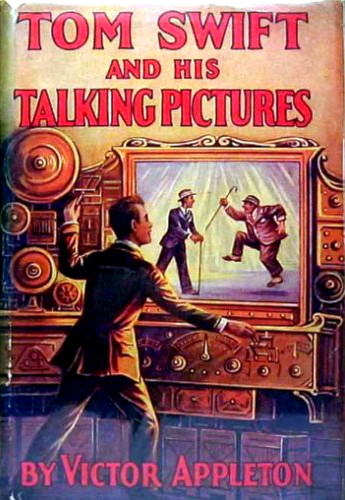
Tom’s latest talking-picture invention does not
matter, but the fact remains that Tom was in
the midst of perfecting that machine when the
explosion occurred.
While the fire was being brought under control
by several of the shop men, under the direction
of Mr. Jackson, the young inventor was
hurriedly carried into his home and laid on a
bed. Mrs. Baggert, sensing that medical aid
might be needed, had, almost as soon as she got
up after the alarm, telephoned for the nearest
doctor. So it was not long after the explosion
before Tom was in the care of the medical
man.
“Is he badly hurt?” asked Mr. Swift, anxiously
hovering around the room.
“I think not,” was the cheerful reply of Dr.
Layton. “He has had a shock and is suffering
more from that than from actual injuries,
though he is cut and bruised and has some nasty
burns. But we will soon make him comfortable.”
“He is still unconscious, though, isn’t he?”
asked Mr. Swift.
“Yes,” Dr. Layton admitted. “But that is
nothing to worry about. Nature will take care
of that. It is better to let his senses come back
gradually rather than to give some strong stimulant
that will shock him into wakefulness and
perhaps do more harm than good. I’ll make
him as comfortable as I can and we’ll just wait
for him to rouse.”
The burns and cuts were dressed, Koku being
of great service because he could lift and move
Tom as if the young man were a baby. Yet
Tom was of husky build, strong and muscular.
The giant made an ideal nurse in a case like
this, though Eradicate, who had a deep love for
Tom Swift, fluttered eagerly about, anxious to
do something to help. Mrs. Baggert had him
bring hot water and bandages, and this gave
Eradicate as much pleasure as Koku found in
ministering more personally to his young master.
After the first alarm over Tom’s condition
was over and when it was apparent that there
was no immediate danger, Mr. Swift went out to
see what damage had been done and if there
was any further danger from the fire and explosion.
The flames, by this time, were subdued.
There had been a second but slight, explosion.
This, however, did little damage, as the force
of it was directed toward the outer corridor, part
of the wall of which was blown away. The
greatest force of the first explosion, likewise, had
been in the same direction, and though the door
of Tom’s private laboratory had been stove in
and some of his valuable apparatus scattered
about and burned, fortunately no great damage
was done to the secret room.
Ascertaining this and knowing how jealously
Tom guarded the new secret, Mr. Swift had
some of the men nail the laboratory up, an improvised
door being made and boards being fastened
over the shattered windows.
Tom had been blown through a window in the
corridor outside his laboratory. But, luckily,
the window was up at the bottom, and Tom had
shot through a wire mosquito screen instead of
through the glass. In spite of this, and the fact
that he had landed in a clump of deep, thick
grass, the young inventor had not come off
scatheless from the accident.
“Things aren’t as bad as they seemed at first,
Mr. Swift,” reported Mr. Jackson a few hours
after the explosion. “The fire is all out now
and Tom’s things don’t seem to be much damaged.
I’ve got several men on guard. They’ll
stay there the rest of the night.”
“It will soon be morning,” murmured the old
gentleman. “Thank you, Jackson.”
“I wonder how much longer Tom will remain
unconscious?” Mr. Swift said, entering the sickroom
and glancing toward the bed on which his
son lay.
“I think he is coming around now,” said the
doctor softly, as he moved to his patient’s side.
“Yes, he is coming out of it,” he added. “How
do you feel?” he asked as Tom opened his eyes
and stared about.
“Pretty—pretty—rocky,” was the husky answer.
“What—what happened?” he asked in a
stronger voice. Then, as recollection came back
to him, Tom went on: “I remember now.
There was an explosion just as I was coming out
of my laboratory. Is it gone? Is everything
gone?” and he tried to get up. Dr. Layton
pushed him back.
“Now lie still,” said the doctor. “Things
aren’t half as bad as you think, and you’re not
much hurt.”
“I don’t care about myself!” declared Tom
fiercely. “But if that new—that machine is
blown up—” He looked anxiously at his father,
the only other person in the room who knew
about the secret of the talking-picture invention.
“It’s all right, Tom,” the aged inventor made
haste to say. “The door and windows of your
laboratory were blown out and some of your apparatus
damaged by the fire and explosion.
But your—the main object is all right,” he finished,
and Tom understood.
Before Tom could ask any more questions,
Dr. Layton administered a sedative to quiet his
patient’s nerves, and, after a few more questions
had been answered to the satisfaction of the
young inventor, he sank back into a sleep.
Not before, however, he had told his father
and the others that he had no idea what had
caused the explosion and fire.
“Was it an electrical blast?” Mr. Swift wanted
to know. He was aware that often a high tension
current may act almost like a blast of
dynamite.
“I think not,” Tom had said. “I examined
my wires the last thing, after Greenbaum had
left the building, and they were all right. The
explosion seemed to be coincident with my opening
of the door.”
“It were a bomb! Dat’s whut it were—a
bomb!” declared Eradicate. “An’ ef I kotches
de feller whut done planted it I——”
“That will do now, Rad,” whispered Mrs.
Baggert. “Tom must be kept quiet.”
The injured young inventor was now sleeping
quietly, and Dr. Layton said he would remain
until morning to see how Tom was when he
awakened again. Then, the fire being out and
no more danger appearing, the house became
quiet.
But Mr. Swift had a worried, anxious air. He
could not account for that explosion. Some
more of Tom’s enemies must be at work, was the
conclusion of the aged inventor.
The sun was rising and Tom was just awakening
again when the telephone rang. Mrs. Baggert,
answering it, brought word that Mary
Nestor was on the wire and wanted to know how
badly Tom was hurt.
“How’d she hear about it?” Tom demanded
when he was prevented from answering the call
in person.
“Why, it seems,” reported the housekeeper,
“that the town fire-department responded to the
alarm. However, they weren’t needed, as your
own men put out the blaze, Mr. Swift. However,
it was rumored that you were hurt and
Mary heard of it. What shall I tell her?”
“Tell her I’m all right and that I’ll be over as
soon as I can get dressed,” Tom answered.
“No you won’t!” chuckled Dr. Layton.
“You’re not badly hurt, but I’m taking no
chances with you and you’ll stay in bed all day.
Miss Nestor can call here if she likes,” he conceded,
with a smile.
“Thanks for that favor,” and Tom smiled in
answer. “Tell her, please, Mrs. Baggert.”
“I will,” and the housekeeper hurried back to
the telephone.
A further inspection of Tom’s injuries by daylight
did not reveal them as any worse than the
first diagnosis indicated and Dr. Layton said
that his patient would be up and about in a few
days.
“And when I am things are going to hum!”
declared Tom.
He had finished a light breakfast and the
medical man was preparing to depart when the
telephone rang again.
“If that’s Mary I’m going to speak to her!”
exclaimed Tom.
“But it isn’t,” said Mrs. Baggert, with a smile,
coming in from the hall outside Tom’s room, the
telephone being installed in a booth in the corridor.
“It’s Mr. Newton.”
“Ned?” exclaimed Tom Swift.
“No, not Ned—his father,” replied the housekeeper.
“He wants to know when Ned will be
home.”
“When Ned will be home!” exclaimed Tom, in
bewildered surprise. “Why, I thought he was
at home now. He left me before midnight to go
home.”
“He isn’t there,” said Mrs. Baggert. “Mr.
Newton says Ned hasn’t been home all night and
he thought he must be here, as he often stays
all night, you know.”
“Yes, I know,” admitted Tom, with a puzzled
look on his face. “But he didn’t stay last night.
He started for home. He was dead tired from
helping me. Ask Mr. Newton if he is sure Ned
isn’t sleeping soundly in his own room.”
Mrs. Baggert went back to the telephone. In
a few moments she came back.
“Ned seems to have disappeared,” she announced.
“He didn’t come home or send any
word. Mr. Newton is quite worried. He wants
to talk to you.”