STRONG WORDS
Tom Swift, with a negative shake of his head, shoved several papers
across the table that separated him from a burly, red-faced man whose
eyes narrowly observed the young inventor.
"Then you refuse this contract, Mr. Swift—a contract for constructing
over one hundred thousand dollars' worth of machinery on which you can
make a handsome profit? You absolutely refuse it?"
The red-faced man in his eagerness was leaning forward now.
"Yes, Mr. Cunningham, I refuse!" was Tom's crisp answer. "The Swift
Construction Company does not care to handle it."
Mr. Barton Swift, father of the young man who thus calmly turned down
what seemed like a good business proposition, nodded in affirmation of
what his son had said.
"Is that your last word?" asked Basil Cunningham, who plainly showed
his English ancestry, not only in his face and figure but in his
general bearing and manner. "This refusal is final?" he inquired.
"Quite final and complete," answered Tom, as he added another document
to the pile of those he had pushed toward his visitor. They were blue
prints, specifications, and contract forms, but they all went across
the table. "The matter is closed."
"But, look here! I say, now!" and Mr. Cunningham began to wax excited,
not to say wroth. "I can't understand——"
"Do you mean to say you don't understand English?" asked Mr. Swift, and
the smile on the face of the aged inventor took away whatever sting
there might otherwise have been in the words. "I thought my son spoke
very plainly. He said 'no,' and that's what he means."
"But look here, Mr. Swift! Do you agree with him?"
"Absolutely!"
"And you won't consider the contracts further?"
"The matter is closed, I told you!" and Tom Swift's voice was a bit
sharp now.
With an imperious gesture the burly Englishman gathered up his papers
and began to stuff them into a leather brief case bulging with other
documents. If possible the red of his face deepened.
"Well," he began, "of all the——"
Tom Swift looked up sharply. He was on the verge of saying something
that, he himself admitted, he might later have been sorry for when the
door of the private office opened and a veritable giant of a man fairly
squeezed his way through the doorway.
"What is it, Koku?" asked Tom, not quite pleased with such an
interruption at this time.
"Excuse, Master," murmured the foreign giant, whose struggle with a
strange tongue sometimes got the best of him. "But new engine him have
come an' Mr. Jackson say him got to be lift up—so I lift if you want."
As if to demonstrate his strength, the giant put one finger under the
edge of the heavy table around which the three men sat and, with as
much ease as if he were lifting a feather, tilted it.
"My word, man! Don't do that!" cried Mr. Cunningham, for one of his
feet was close to the leg of the table and he evidently feared the
weight would come down on his toes when Koku let go.
"Don't worry," said Tom, with a smile. "Koku won't drop it."
Fascinated by this remarkable exhibition of strength, by which the
giant raised several hundred pounds on one finger, the Englishman
started to move from his proximity to Koku. But there was no need of
alarm, though the timely entrance of Tom Swift's gigantic henchman had
evidently stopped a tirade that was on the lips of the visitor.
"That will do, Koku," said Tom, in a low voice. "I will see Mr. Jackson
shortly and look at the new engine."
"Yes, Master," murmured the giant, whose whisper, however, was a hoarse
bellow in contrast with others.
Koku took himself out and Cunningham, staring at the closed door as
though he could not believe what he had seen, continued to stuff his
rejected contracts into his case.
"I'm sorry about this," said the Englishman in more subdued tones than
he had used before the advent of Koku. "I'm not only sorry, but I'm
disappointed and I think I haven't been fairly treated." His anger was
rising again, that was evident.
"How do you mean—not fairly treated?" asked Tom sharply.
"Why, dash it all, when I first broached this matter to you I was as
much as given to understand that your firm would go ahead and make the
apparatus for me."
"You were given to understand nothing of the sort," replied Tom quietly.
"I say I was!" and the Englishman banged his fist hard on the heavy
table that Koku had raised with one finger. "I tell you I have been
shamefully treated here, and I'm not going to stand it. I——"
Again the door suddenly opened and Basil Cunningham made a move as if
to hide beneath the table he had so lately pounded. But instead of
Koku, this time the intruder was an aged and decrepit colored man whose
whitening, curly hair made a pathetic frame for his black, wizened
face. No gentler creature, as a man, could well have been visioned, and
Mr. Cunningham, who had evidently been expecting a return of the giant,
looked a bit foolish.
"Did yo' all call me, Massa Swift?" asked the negro gently.
"No, Rad, we didn't call," said Tom, with a kind smile at the aged
servant who often claimed, regarding the young inventor: "I done
nussed him from a baby, dat's whut I done!"
"'Scuse me, Massa Tom," went on Eradicate. "But I thought I done heard
a noise in here, an'——"
"We were just talking, Rad, that was all. We have about finished," and
Tom looked significantly at the red-faced Briton. "I'll call you if I
need you, Rad."
"Yes, sah," and Eradicate shuffled out.
"There is no use in further wasting your time or my own, Mr.
Cunningham," proceeded Tom Swift, when the three again faced each
other. "My mind is fully made up, and you see that my father agrees."
"I agree fully with my son," added aged Mr. Swift.
"Then I'll have to get somebody else to carry out this contract!"
snapped Mr. Cunningham. "I'll go to some firm that knows how to take a
big profit when it's offered."
"That's your privilege," replied Tom, smiling. "We don't want it."
There was something so final in his words that Mr. Cunningham knew
better than to try other arguments. The last paper was thrust into the
case, and the way in which the Englishman snapped the lock showed his
anger. He caught up his hat, muttered a "good-day," and hurried out.
"Well, that's that," said Tom Swift, with something between a sigh of
relief and regret.
"Tom, you did just right!" exclaimed his father. "I didn't want to
interfere, but you gave him the right answer. We want nothing to do
with his sort, even though we may have to close down the plant on
account of lack of orders."
"We are running a bit short," Tom admitted. "And with all I spent on
the talking pictures, with no prospect of any substantial revenue from
them for some time, we may be financially up against it soon, Dad."
"Don't worry, Tom. We'll pull through, somehow. You can keep busy,
can't you?"
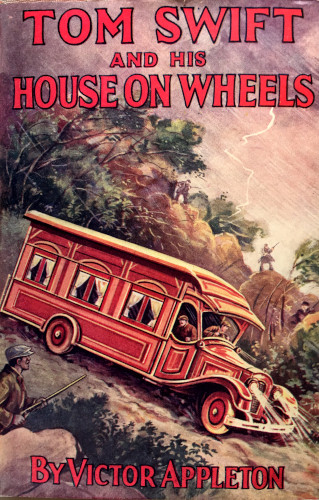
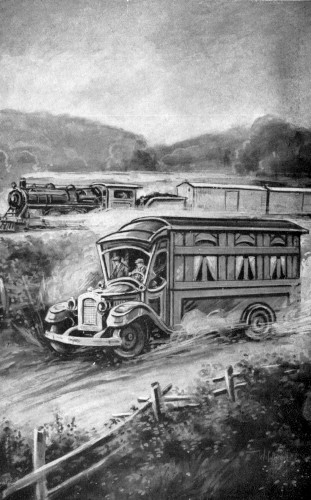
"Oh, yes, I've got to finish my House on Wheels," and Tom fairly
spoke of it in capital letters, so near to his heart was this newest
invention.
"Ah, yes, Tom, your House on Wheels," and Mr. Swift chuckled a little.
"I've been looking it over now and again. Seems as if you had a pretty
good thing there."
"I hope it will work out," responded the young man.
"Looks as if you were fitting it up for a trip around the world," went
on his father smiling. "Are you?"
"Not exactly, Dad."
"I might make another guess, Tom, my boy," and still the aged man was
laughing.
"Well, there's no law that I know of, Dad, to stop you from making
guesses," and Tom busied himself over several papers that seemed to
need close attention.
"Well, then, Tom, I'll guess that you're going to use your new House on
Wheels for a wedding journey. How about that?"
"Who says anything about a wedding trip?" cried Tom, his face almost as
red as the Englishman's had been.
"Oh, no one has said anything, Tom," his father answered mildly. "But
from the manner in which you and Mary Nestor have been going about of
late, looking into furniture store windows and——"
"Oh, there's too much talk going on in this town!" exclaimed Tom, and
his father laughed heartily at his son's evident discomfiture.
"Well, wedding trip or world tour, your new House on Wheels appears to
be a clever bit of work," went on Mr. Swift. "When will it be finished?"
"Can't say, exactly. Though now that the new engine has arrived,
as Koku informed me, I can rush things. I've been waiting for the
machinery. That's why I'm glad, in a way, I didn't have to take on the
Cunningham contracts."
"Valuable as they were," remarked Mr. Swift.
"Valuable as they were," agreed his son. "And now, if you'll excuse me,
Dad, I'll go take a look at that new engine."
"I have some matters to attend to myself," said old Mr. Swift, who,
though he had given up active participation in the plant some time
before, still maintained a general supervision over certain matters.
He left the private office just as Ned Newton, the young financial
manager, entered in some haste. Nodding to Tom's father, Ned turned to
the young inventor and asked:
"What's this I hear about you turning down Cunningham's work?"
"I don't know, Ned, what you heard, nor how, so I can't reply."
"I was just coming in through the yard when I saw Cunningham getting
into an auto with a man who had a face like a rat's. He was a stranger
to me; but I knew Cunningham, of course. Say, he was mad, that
Englishman! I heard him muttering something about your having refused
his contracts and, as nearly as I could make out, he was cussing you up
hill and down dale and threatening not only to take his contracts to
another firm but to get even with you as well."
"Yes he was angry when he left here," admitted Tom. "But that's all
bosh about his going to get even. It was a plain business proposition.
Cunningham is a good business man, whatever else he may be, and
business men don't look for revenge just because one firm won't do
their manufacturing for them."
"Maybe not. It might have been a lot of superheated atmosphere. But
I can't understand, Tom, why you didn't take his work. There would
have been a good profit in it, you told me, after the preliminary
investigation."
"Yes, the profit was there."
"Well, then, what was wrong with such a handsome contract for the very
kind of machinery that we are so well equipped to manufacture?"
"If you really want to know, Ned, I'll tell you."
"Of course I want to know."
"Well, then, it's my opinion that Basil Cunningham is a plain,
unvarnished, first-water crook!"