Towser Welcomes Tom to the White House—Lincoln
Re-elected President—Grant Commander-in-Chief—Sherman
Marches from Atlanta to the Sea—Tom on Grant's Staff—Five
Forks—Fall of Richmond—Hans
Rolf Freed—Bob Saves Tom from Capture—Tom
Takes a Battery into Action—Lee
Surrenders—Tom Strong, Brevet-Captain
U. S. A.
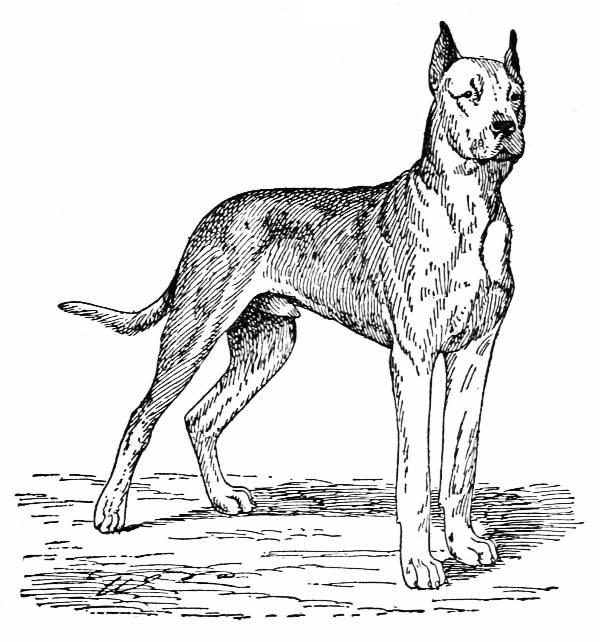
The warmest welcome Tom had at the
White House was given him by Towser.
The next warmest was given him by Uncle
Moses and the next by Lincoln. The staff was
glad to see him back, but many of them were
jealous of the President's evident liking for him
and would not have sorrowed overmuch if he
had not come back at all. The patient President
found time, amid all his myriad cares, to
listen to Tom's story and to make Secretary
Stanton give a captain's commission to Jim
Grayson, who was sent to his own mountains to
gather recruits for the Union army. For
Towser, time existed only to be spent in welcoming
his young master home. He clung close
to him, with slobbering jaws and thumping tail,
through the first day, and the first night he
managed to escape from Uncle Mose's care in
the basement and to find Tom's attic room.
Thenceforth, as long as Tom stayed at the
White House, Towser stretched his yellow
bulk across the threshold of his door every
night and slept there the sleep of the utterly
happy.
There were no utterly happy men under the
White House roof. Lincoln's presidential term
was drawing to a close. He was renominated
by the Republicans, but his re-election at times
seemed impossible. The Democrats had put
forward Gen. George B. McClellan, once chief
commander of the Union forces, but a pitiful
failure as an aggressive general. A discontented
wing of the Republicans had nominated Gen.
John C. Fremont. Fremont had not fulfilled the
promise of his youth. At the beginning of the
war, he had been put in command at St. Louis,
had proved to be incompetent, and had been retired.
He was still strong in the hearts of many
people, but Lincoln feared the success, not of
Fremont, but of McClellan. John Hay once
said to the President:
"Fremont might be dangerous if he had more
ability and energy."
"Yes," was the reply, "he is like Jim Jett's
brother. Jim used to say that his brother was
the greatest scoundrel that ever lived, but in the
infinite mercy of Providence he was also the
greatest fool."
Family sayings, when they are not loving, are
apt to be bitter. One of the Vanderbilts said
of a connection of his by marriage that he was
"more kinds of a fool to the square inch than
anybody else in the world."
McClellan, who seemed practically certain of
success in August, 1864, was badly beaten in
November, when the battle of parties was
fought out at the polls. Fremont had retired
from the contest early in the campaign. At the
first Cabinet meeting after the election, November
11, 1864, the President took a paper out of
his desk and said:
"Gentlemen, do you remember last summer
I asked you all to sign your names to the back
of a paper, of which I did not show you the
inside? This is it. Now, Mr. Hay, see if you
can get this open without tearing it."
Its cover was so thoroughly pasted up that it
had to be cut open. This done, Lincoln read it
aloud. Here it is:
"Executive Mansion,
Washington, August 23, 1864.
"This morning, as for some days past, it seems
exceedingly probable that this Administration
will not be re-elected. Then it will be my duty
to so co-operate with the President elect as to
save the Union between the election and the inauguration;
as he will have secured his election
on such ground that he cannot possibly save it
afterwards.
A. Lincoln."
In that memorandum is the sign-manual of a
great soul. Lincoln, believing his own defeat
was written in the stars, thought, not of himself,
but of how he, defeated, could best save the
cause of the Union from defeat. A small man
thinks first of himself. A big man thinks first
of his duty.
Life was happy at the White House now.
The President had been re-elected and it was
clear that long before his second term was over,
he would have won a victorious peace. The
South was still fighting with all the energy
brave men can show for a cause in the righteousness
of which they believe, but after all the
energy was that of despair. Grant was now in
supreme command of the Union forces, East and
West. He had been commissioned Lieutenant-General
and put in command March 17, 1864.
In commemoration of this event, the turning
point in the great struggle, Lincoln had had a
photograph of himself taken. But two copies of
it were printed. One Lincoln kept himself. One
he gave Grant. Here is the one given Grant.
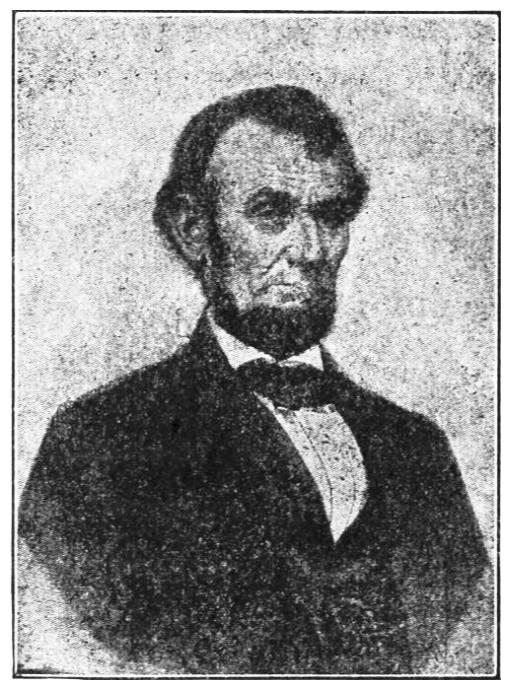 ABRAHAM LINCOLN
The new Lieutenant-General was hammering
away at Richmond. The Mississippi, now under
Union control, cut the Confederacy in two. All
the chief Southern seaports, except Savannah
and Charleston, had been captured. And in this
same month of November, 1864, Gen. William
Tecumseh Sherman, who ranked only second to
Grant in the United States army, cut loose from
Atlanta, Georgia, captured two months before
and began his famous march to the sea, with
Savannah as his destination. He illustrated his
own well-known saying: "War is hell." If it
was hell in Sherman's time, what word can
describe the horror of it in our day? He swept
with sword and fire a belt of fertile country,
sixty miles wide, from Atlanta to the sea. He
found it smiling and rich; he left it a bare and
blackened waste. He had destroyed the granary
of the Confederacy and before the next month
ended he had made his country a Christmas
present of the remaining chief Southern seaport,
Savannah. He wrote to Lincoln: "I beg to present
to you as a Christmas gift the city of
Savannah, with one hundred and fifty heavy
guns and plenty of ammunition and also twenty-five
thousand bales of cotton." Cotton was
worth a dollar a pound in those days.
Early in 1865 Sherman swung northward
from Savannah, forced the surrender of Charleston,
South Carolina, and joined Union forces
advancing from the North at Goldsboro', North
Carolina, March 23. Six days later Grant began
the final campaign against the Confederacy.
Six days before, Lincoln had said to the boy:
"Tom, would you like to see some more
fighting?"
"Yes, Mr. President; very much."
"Well, you needn't tell anybody, but I guess
there'll be some to see before long near Richmond.
I've had you ordered from special service
at the White House to special service with
the Lieutenant-General. Here's the order and
here's a letter to General Grant. I wouldn't
wonder if he put you on his staff."
"How can I thank you, Mr. Lincoln?"
"The best way to thank anybody is to do well
the work he gives you to do. Good-by, my son,
and good luck."
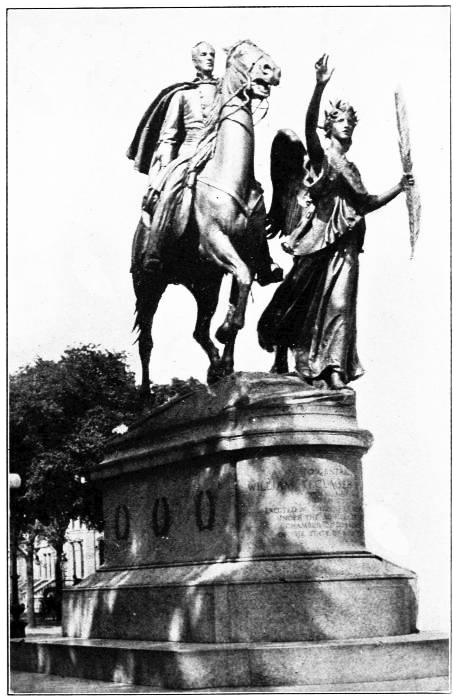 Gen. W. T. Sherman
St. Gaudens' Statue, New York
With a pressure of Lincoln's huge hand Tom
was sped on his rejoicing way. Two days later
he was at Grant's headquarters, at City Point,
Virginia, near Fortress Monroe. He saluted
and handed the General Lincoln's letter. The
soldier sat, a silent sphinx, for a moment. Then
he looked up at Tom with a quizzical but not
unkindly smile, and said:
"Have you learned anything since you
brought me dispatches at Fort Donelson and
Vicksburg?"
"I hope so, General."
"Sometimes the President sends me people
for political reasons. I suppose he has to. But
I don't take them if I know it. Have you any
political influence behind you?"
"Not a bit, sir." Tom laughed at the
thought.
"You laugh well. You and Horace Porter
ought to get on together. He laughs well, too.
You can serve on my staff.
"I thank you, General."
Tom saluted and walked away, to find Horace
Porter, whom he found to be a very nice fellow
indeed. One of the first things the nice fellow
did for him was to get him a good horse. There
was no lack of horses at headquarters. The difficulty
was not to find one, but to choose the
best of many good ones. Tom, who had a good
eye for a horse, found one that exactly suited
him except as to color. He was of a mottled
gray. The boy did not much care for such a
color, but he knew it had its advantages. It
does not advertise its presence. Where a black,
a white or a bay horse would stand out and
make a mark for hostile sharpshooters, a mottled
gray might well elude their view. And the
horse, apart from this, was just what he wanted.
He paced fast, he galloped fast, and he walked
fast, which is a rare and precious accomplishment
in a horse. The average horse walks, as
a rule, slower than the average man. In an
hour, he covers a quarter-of-a-mile less ground.
One question remained to be settled.
"Can he jump?" asked Tom.
"Jump, is it?" answered the soldier-groom.
"Shure, the cow that jumped over the moon
couldn't lift a leg to him."
"You bet your life he can jump," said Horace
Porter. "General Grant has ridden him twice
and I saw him put Bob over a fence or two."
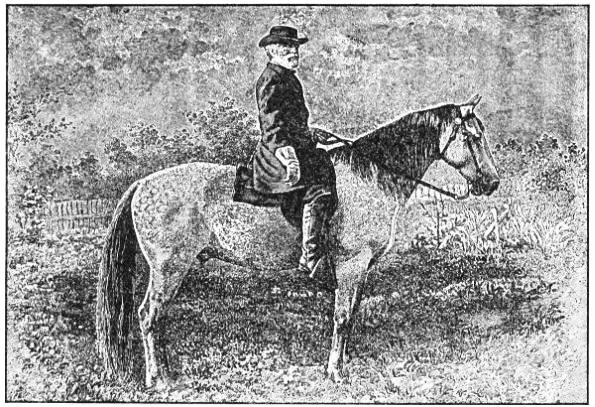
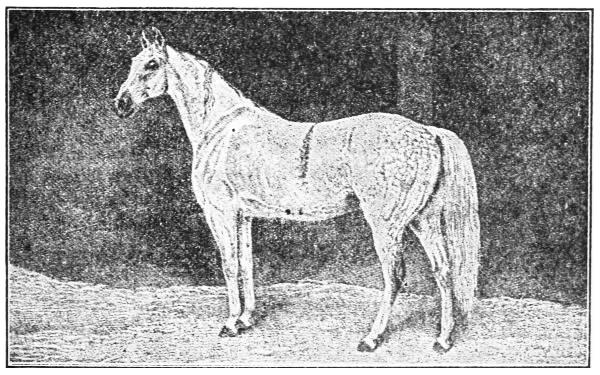 BOB
BOB
Not long afterwards Tom did bet his life on
Bob's jumping. He was named Bob before the
United States took him. He had been captured
the month before and had come across the lines
with his name embroidered by some woman's
hand on his saddle-blanket and with his late
owner's blood upon his saddle. He was a tall,
leggy animal who showed a trace of Arabian
blood and who needed to be gentled a bit to get
his best work out of him. His mouth was
appreciative of sugar and his eyes were appreciative
of kindness.
Both dogs and horses talk with their eyes.
"I like my new master," was what Bob's eyes
said to Tom.
It was through a chance suggestion of Colonel
Porter that the boy saw most of what he did see
of the final fight for freedom. Porter had presented
Tom to Gen. Philip H. Sheridan, who
was then at City Point, receiving Grant's final
instructions for the twelve-day campaign that
ended in the fall of Richmond and the surrender
of Lee's brave army. Sheridan was a stocky,
red-faced young Irishman, a graduate of West
Point, and a born leader of men, especially of
cavalrymen. He liked the clear-eyed lad who
stood respectfully before him. He had done too
much in his own youth to think Tom was useless
because he was so young. Porter saw that
the boy had made a good impression. He ventured
a suggestion.
"Why don't you take young Strong with you,
General?"
Sheridan turned sharply to Tom, asking:
"Can you ride?"
"Oh, yes, sir. I've ridden ever since I can
remember."
"Well, that's not so very long a time. But
I'll take your word for it. Would you like to go
with me?"
"I'd like it better than anything else in the
world, General."
Tom had rejoiced in the idea of being with
Grant, but he knew that the commander-in-chief
must stay behind his lines and that his
staff could catch but glimpses of the fighting,
when they were sent forward with orders,
whereas with Sheridan he might be in the very
thick of the fighting itself. His ready answer
and the joy that beamed in his eyes pleased the
fighting Irishman.
"Can I borrow him of General Grant?"
Sheridan asked Porter.
"I'll answer for that," Porter replied. "The
General told me to put Strong to whatever work
I could find for him to do."
"Come ahead," said Sheridan. "You'll see
some beautiful fighting!"
Sheridan loved fighting, but he made no pretense
of never being afraid. He thought a general
should be close to the front, to keep his
soldiers' spirits high.
"Are you never afraid?" Charles A. Dana,
then Assistant Secretary of War, once asked
him.
"If I was, I should not be ashamed of it. If I
should follow my natural impulse, I should run
away always at the beginning of the danger.
The men who say they are never afraid in a battle
do not tell the truth."
March 29, 1865, the twelve-day campaign began.
The cavalry swung out towards Five
Forks, where Lee's right wing lay behind deep
entrenchments. April 1, Sheridan attacked in
force. Americans fought Americans with stubborn
bravery on both sides. The issue was long
in doubt. Sheridan and his staff were close to
the firing-line, so that Tom had but a few hundred
yards to gallop under fire when his general
said to him:
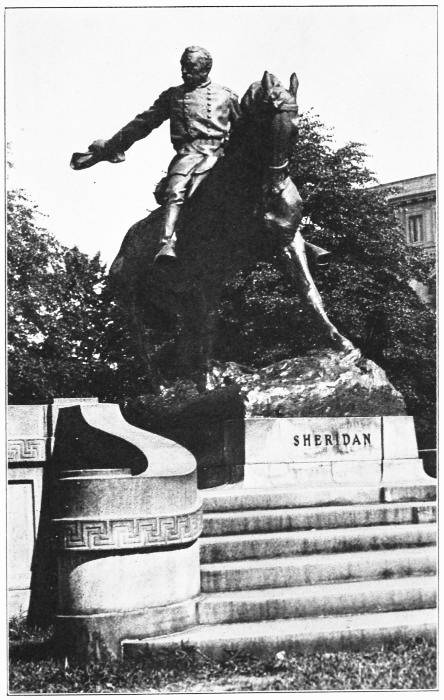 Statue of Gen. Philip H. Sheridan
Sheridan Square, Washington, D. C.
Copyright by Underwood & Underwood, New York.
"Tell General Griffin to charge and keep
charging."
Griffin's order to his troops was so quickly
given that it seemed an echo of the order Tom
brought him. It was the boy's business to return
forthwith and report upon his mission, but
he simply couldn't do it. There were the Confederate
lines manned with hungry soldiers in
the remnants of their gray uniforms, the Stars-and-Bars
flying above them. And there were
battalions of blue-clad cavalry, men and horses
in prime condition, straining to start like hounds
upon a leash. Griffin's order was the electric
spark that fired the battery. The men shouted
with joy as they spurred their horses into a mad
gallop. The shout was answered by the shrill
"rebel yell" from the dauntless foe in the
trenches. The charging column shook the
ground. In its foremost files rode Second-lieutenant
Tom Strong, forgetful of everything
else in the world but the joy of battle. Musketry
and artillery tore bloody lanes in the close-packed
column. Men and horses fell in heaps
upon the blood-stained ground. But the column
went on. At dusk of that April day it poured
over the parapets so bravely held. Even then
the fight was not over. There was still stout
resistance. The two armies were a mass of
struggling men, shooting, stabbing, striking.
The battle had become a series of duels man to
man. Tom, pistol in hand, rode at a big Kentuckian,
but the gray-clad giant dodged the bullet,
caught his own unloaded musket by the
muzzle, and dealt the boy a blow with its butt
that knocked him off his horse and left him
senseless on the ground.
A few minutes later, when he came to his
senses, he felt as if he were a boy annexed to a
shoulder twice as big as all the rest of his body.
It was on his shoulder that the blow of the
clubbed musket had gone home. The fall from
his horse had stunned him. Bob was standing
over him, as Black Auster stood over Herminius,
nuzzling at the outstretched hand of this
silent, motionless thing that had been his
master. They had been together for less than
a week, but a day is often long enough for a
horse to find out that his master is his friend.
Tom had been more careful of his horse's comfort
than of his own. Now the good gray had
stood by him and over him, perhaps saving him
from being trampled to death in that fierce last
act of the Drama of Five Forks. Bob whinnied
with joy as Tom's eyes slowly opened again.
He thrust his muzzle down along the boy's
cheek and the boy caught hold of the flowing
mane with his right hand and pulled himself
upon his feet again. His left arm hung useless
by his side. One glance told him the battle was
won. The duels were over. The Confederates
were in full retreat. A stream of prisoners was
already flowing by him. He mounted and followed
it to Sheridan's headquarters. There the
skillful fingers of a surgeon found that no bones
were broken. The swollen shoulder was dressed
and bandaged. The healthy blood that filled
Tom's veins did much to make a speedy cure.
So did the joy of victory. Sheridan had done
what Grant had given him to do. He had
driven back Lee's right flank and cut the railroad
by which Lee must escape from Richmond,
if escape he could.
Richmond was doomed. The next morning,
Sunday, April 2, 1865, Jefferson Davis, President
of the Confederate States of America, sat
in his pew in St. Paul's Church, Richmond. The
solemn service began. Soon there was a stir at
the door, a rustle, a turning of heads away from
the chancel, where the gray-haired rector stood.
Swiftly a messenger came up the aisle. Davis
rose from his knees to receive the message. The
service stopped. Every eye was bent upon the
leader of the Lost Cause. He put on his spectacles,
opened the missive, and read it amid a
breathless silence. It told him that the Cause
was lost indeed. It was from Lee, who wrote:
"My lines are broken in three places. Richmond
must be evacuated this evening." There
was no sign of feeling upon Jefferson Davis's
impassive face, as he read the fateful dispatch.
Without a word, without a sign, he left the
church with the wife whose utter devotion had
helped him bear the burden of those terrible
years, during which proud hope gradually gave
way to sickening fear. Davis was not of those
weak men who despair. There was still a little
hope in his heart, despite the tremendous blow
Lee's letter had dealt him. He walked down
the aisle with head as high as though he were
marching to assured victory. But through the
congregation there ran the whisper "Richmond
is to be evacuated." A panic-stricken mob
poured out of the church with faltering steps
behind Jefferson Davis's firm, proud ones.
Early that afternoon the Confederate Government
fled. Early the next morning, Monday,
April 3, 1865, Gen. Godfrey Weitzel marched
his negro troops into the Confederate capital.
The flag of the free floated from the dome of
the Statehouse, which almost from the earliest
days of the war had sheltered what was now
indeed the Lost Cause. It was raised there by
Lieut. Johnston L. De Peyster, a youth of
eighteen, who had carried it wrapped around the
pommel of his saddle for some days, hoping for
the chance that now came to him. The second
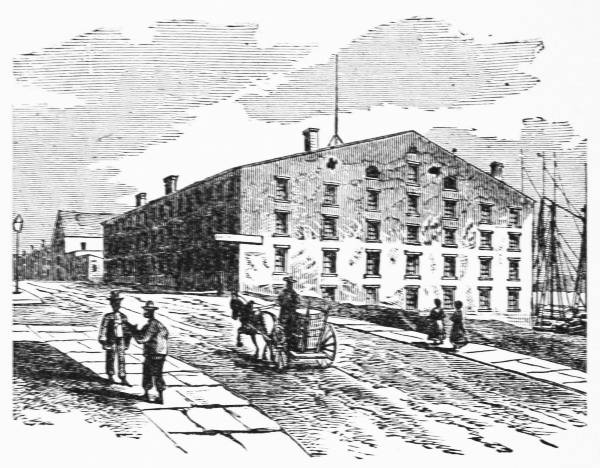
Union flag that was raised that day in Richmond
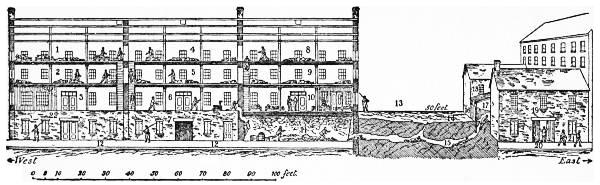
was over Libby. The prison gates gave up their
prey. The prisoners poured out, some too weak
to do more than smile, others in a frenzy of
joy. Major Hans Rolf, reduced by hunger to a
long lath of a man, had lost none of his spirit.
"Now, boys," he shouted, "three times three
for the old flag!"
The cheers rang out in a feeble chorus and
then there rang out Han's contagious laughter.
"Ha! ha!" he roared. "We're free, boys,
we're free."
By that Sunday night, the fate of Petersburg
was sealed. Grant had ordered an assault in
force at six o'clock Monday morning, but the
Confederates abandoned their works in the gray
dawn and our troops met little resistance in taking
over the town. "General Meade and I,"
says General Grant in his "Personal Memoirs,"
"entered Petersburg on the morning of the
third and took a position under cover of a house
which protected us from the enemy's musketry
which was flying thick and fast there. As we
would occasionally look around the corner, we
could see ... the Appomattox bottom ...
packed with the Confederate army.... I had
not the heart to turn the artillery upon such a
mass of defeated and fleeing men and I hoped
to capture them soon."
"Let us follow up Lee," Meade suggested.
He was a better follower than a fighter. He had
followed Lee before, from Gettysburg to Richmond,
without ever attacking him.
"On the contrary," Grant replied, "we will
cut off his retreat by occupying the Danville railroad
and capture him. He must get to his food
to keep his troops alive. We will get between
him and his food."
With constant fighting this was done. By
Wednesday, April 5, the Union lines were drawn
about the Confederate army. Sheridan, hampered
by Meade's slowness, was urgent that
Grant should come to the front. He sent message
after message to that effect to Grant on
Wednesday. A scout in gray uniform was entrusted
with the second message. He was made
up to look like a Confederate scout, but he was
Tom Strong. He had put on his disguise at
Sheridan's headquarters. As he stood at attention
to receive his orders, Sheridan laughed and
said:
"You make a good 'Johnny Reb.' Do you
chew tobacco?"
Surprised at the question, Tom said he didn't.
"Well, you may have to begin the habit today.
You're to take this message to General Grant.
If you're caught, chew it—and swallow it quick."
He handed the boy a bit of tinfoil. It looked
like a small package of chewing-tobacco, but it
contained a piece of tissue-paper upon which
Sheridan's message was written.
The ride from the left flank to the center was
not without danger. Tom, duly provided with
the password, could go by any Union forces
without difficulty, but the country swarmed
with Confederates, some of them deserters,
many of them straggling detachments cut off
from the main army and seeking to rejoin it, all
of them more than ready to capture a Union
soldier and his horse.
The boy climbed a little clumsily into the saddle.
His left shoulder still felt like a big balloon
stuffed full of pain. But there was nothing
clumsy in his seat, as Bob shot off like an arrow
at the touch of Tom's heel on his flank. It was
a beautiful, bright April morning, too beautiful
a day for men to be killing each other. Evidently,
however, it did not seem so to the commander
of a company of Confederate cavalry,
who had laid an ambush into which Tom gayly
galloped. He heard a sharp order to halt. He
saw men ride across the road in front of him.
He whirled about, only to see the road behind
him blocked. He was fairly trapped. But there
was one chance of escaping from the trap and
Tom took it. His would-be captors had come
from the left of the road, its northern side, for
he was traveling east. On the south was a high
rail-fence, laid in the usual zigzags, one of the
few which had not fed the camp-fires of Northern
Virginia. It was a good five feet high; it was
only a few feet away; Bob was standing still
for a second in slippery mud. It was not at all
the kind of place to select for a jump, but the
Confederates had selected the place, not Tom.
He remembered Colonel Porter's saying "You
can bet your life Bob can jump," and he bet his
life on Porter's being right. He put Bob at
the fence. The gallant gray, as if he sensed his
master's danger, took one bound toward the
rails, gathered himself together into a tense
mass of muscle, and rose into the air like a bird.
As he flew over the top-rail, carbines cracked behind
him, but as he leaped southward across the
countryside, a ringing cheer followed him too.
The brave Southerners rejoiced in the brave feat
that took their captive into freedom. Their jaded
horses could not follow. There was no pursuit.
It took Tom some hours to double back towards
Grant's headquarters. He met long lines
of Union cavalry, infantry, and artillery pressing
forward to strengthen Sheridan's forces. They
were going west and they choked every road
and lane and path by which the boy sought to go
east. They had begun their march at three
o'clock that morning. They had had no breakfast.
They carried no food. Their wagon-trains
were miles in the rear. It was their fourth day
of continuous fighting. They had a right to be
tired, but they were not tired. They had a right
to be hungry, but they were not hungry. When
the air was full of victory, what did an empty
stomach matter? Cheering and singing, they
swept along. The end of four years' fighting
was in sight. The hunted foe was trying to
slink away to safety, as many a fox, with hounds
and huntsmen closing in upon him, had tried to
do on these Virginian fields. Never were huntsmen
more anxious to be "in at the death" than
were those joyous Union soldiers on that memorable
April day.
It was nearly night when the boy reached
headquarters, saluted the commander-in-chief,
said "A message from General Sheridan," and
handed over the little tinfoil package.
"You can go back with me," said Grant.
"That horse of yours is Bob, isn't it?" Grant
never forgot a horse he had once ridden.
Within an hour the General and his staff, with
a small cavalry escort, started for Sheridan's
headquarters. By ten that night the two were
together. Sheridan was almost crying over the
orders Meade had given him. By midnight
Sheridan was happy. "I explained to Meade,"
say the "Personal Memoirs," "that we did not
want to follow the enemy; we wanted to get
ahead of him; and that his orders would allow
the enemy to escape.... Meade changed his
orders at once."
That change of orders incidentally put Tom
Strong the next day into the hottest fight of his
life. This was the battle of Sailor's Creek, almost
forgotten since amid the mightier happenings
of that wonderful April week, but never
forgotten by Tom Strong. Our forces had attacked
Lee's retreating legions, retreating toward
the provision trains that were their only
hope of food. The fight was fierce. We had
attacked with both infantry and cavalry, but our
gallant fellow-countrymen held their lines unbroken.
Then with a thunder of wheels our
field artillery came into action. The Confederate
guns were shelling the hillside up which the
plunging horses drew our cannon. There were
six horses in each team, an artilleryman riding
each near horse and holding the off horse of
the pair by a bridle. Tom had come up with
orders and was standing by General Wright as
the guns bounded up the hillside. Bob stood
behind his master, whinnying a bit with excitement.
General Wright snapped his watch shut impatiently.
"They're ten minutes late," he complained.
"We're beaten if we don't get 'em into action
instantly. Good Heavens! there goes our first
gun to destruction!"
A Confederate shell had struck and burst
close to the leaders. A fragment of it swept the
foremost rider from his seat and from life. The
two horses he had handled reared, plunged,
jumped to one side. The six horses were huddled
into a frightened heap. The two other soldiers
could do nothing with the leaders out of
control. The gun stopped short. And behind it
stopped all of one of the two lines of advancing
artillery.
"Take that gun into action!"
Tom heard the General's brief command and
ran toward the huddled horses. He sprang into
the saddle, seized both bridles, and drove on.
As he did so, another Confederate shell burst
beside the off horse. Its fragments spared the
foremost rider this time, but they dealt death
to one of his two comrades. The man in control
of the wheelers threw his right arm out and
toppled over into the road, dead before the
heavy cannon-wheel crashed and crushed over
him. The leaders, so skillfully handled that
their very fear made them run more madly into
danger, tore ahead, keeping the other four
horses galloping behind them, until the gun was
in position. It roared the news of its coming
with a well-aimed shot into the midst of the
enemy's forces.
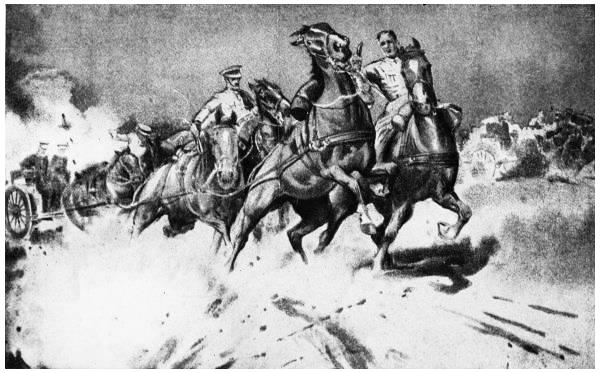 Tom Takes a Battery Into Action
Its fellows fell into line and
followed suit. The infantry and cavalry attacked
with renewed spirit. Sullenly and savagely,
fighting until darkness forbade more
fighting, Lee's troops withdrew towards the
west, with the Union forces pounding away at
them. They left a mass of dead upon the battlefield,
lives finely lost for the Lost Cause, and
they also left as prisoners six general officers
and seven thousand men. More than a third of
all the prisoners taken in the battles before the
final surrender were taken at the battle of
Sailor's Creek. Tom had stuck to his new arm
of the service through the three hours of fighting.
The guns had been continually advanced
as the Southerners retreated. They had been
continually under fire. Nearly half the gunners
had been killed or wounded. When the fight
was over, Tom remembered for the first time his
own wounded shoulder. He had never thought
of it from the moment when he had sprung upon
the artillery horse. Now it began to throb with
a renewed and a deeper pain, as if resenting his
ignoring of it so long, but the new pain also
vanished when he rejoined General Wright and
heard him say:
"Mr. Strong, you helped to save the day.
I shall recommend you for promotion for distinguished
bravery under fire."
The boy saluted, his heart too full to speak.
As he rode away upon Bob, some of the joy
in his heart must have got into Bob's heels, for
Bob pirouetted up the main street of the little
town of Farmville, late that night, as though he
were prouder than ever of his master.
Farmville was now headquarters. Grant was
there, in a bare hotel, not long before a Confederate
hospital. It was from the Farmville hotel
that he wrote to Lee a historic note. It ran
thus:
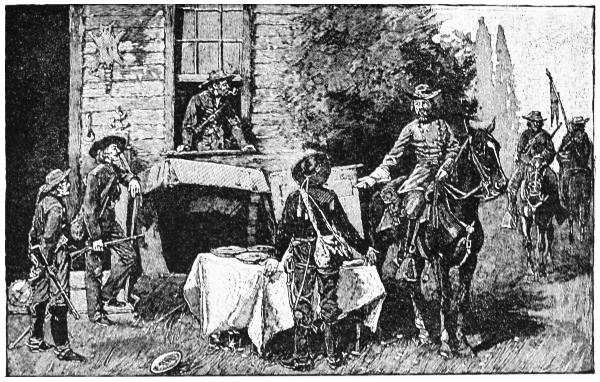
"Headquarters Armies of the U. S.
5 P.M., April 7, 1865.
"General R. E. Lee,
Commanding C. S. A.:
The results of the last week must convince
you of the hopelessness of further resistance on
the part of the Army of Northern Virginia in
this struggle. I feel that it is so, and regard it
as my duty to shift from myself the responsibility
of any further effusion of blood by asking
of you the surrender of that portion of the Confederate
States army known as the Army of
Northern Virginia.
U. S. Grant ,
Lieut.-General."
Under a flag of truce, this note reached General
Lee that evening, so near together were the
headquarters of the contending armies in those
last days. His letter in reply, asking what terms
of surrender were offered, reached Grant the
next morning while he was talking on the steps
of the Farmville hotel to a Confederate Colonel.
"Jes' tho't I'd repo't to you, General," said
the Colonel.
"Yes?"
"You see I own this hyar hotel you're
a-occupyin'."
"Well, sir, we shall move out soon. We are
moving around a good deal, nowadays. Why
aren't you with your regiment?"
"Well, you see, General, I am my regiment."
"How's that?"
"All the men wuz raised 'round hyar. A few
days ago they jes' begun nachally droppin' out.
They all dun dropped out, General, so I jes'
tho't there wan't any use being a cunnel without
no troops and I dun dropped out too. Here
I be? What you goin' to do with me, General?"
"I'm going to leave you here to take care of
your property. Don't go back to your army and
nobody'll bother you."
That was a sample of the way in which the
beaten army was melting away. Not even the
magic of Lee's great name could hold it together
now. But the men who did not drop out fought
with heroism to the bitter end.
The next day, Saturday, April 8, 1865,
Sheridan captured some more of Lee's provision
trains at Appomattox Station and on Sunday,
April 9, Lee's whole army attacked there,
still seeking to cut its way out of its encircling
foes. Its brave effort was in vain. Held in a
vice, it threw up its hands. A white flag flew
above the Confederate lines.
Grant had spent Saturday night struggling
with a sick headache, his feet in hot water and
mustard, his wrists and the back of his neck covered
with mustard-plasters. On Sunday morning,
still sick and suffering, he was jogging along
on horseback towards the front, when a Confederate
officer was brought before him. He carried
a note from Lee offering to surrender.
"When the officer reached me," writes Grant,
"I was still suffering with the sick headache;
but the instant I saw the contents of the note,
I was cured." The ending of the war ended
Grant's headache.
The two commanders met at Appomattox
Court House, a sleepy Virginian village, five
miles from the railroad and endless miles from
the great world. It lies in a happy valley, not
wrapped in happiness that April day, for Sheridan's
forces held the crest at the south and Lee's
were deployed along the hilltop to the north. A
two-hour armistice had been granted. If that
did not bring the end desired, that end was to
be fought out with all the horrors of warfare
amid the peaceful houses that had straggled together
to make the peaceful little town.
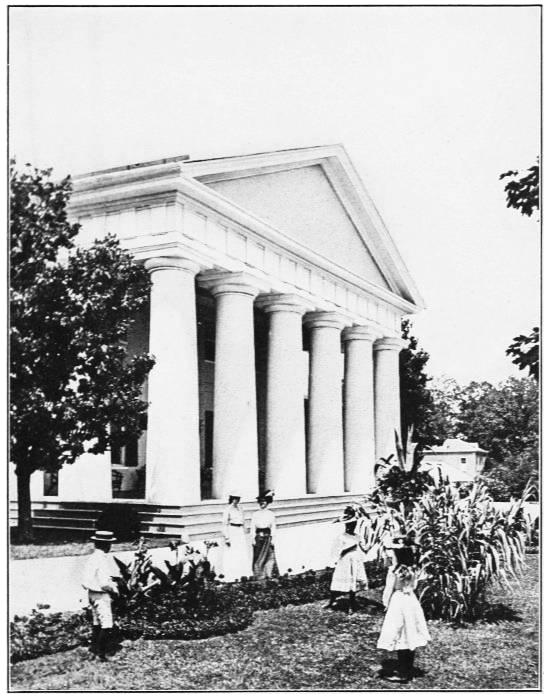
At the northern end of the village street, surrounded
by an apple orchard, stood a two-story
brick house with a white wooden piazza in front
of it. It was the home of Wilmer McLean, a
Virginia farmer upon whose farm part of the
battle of Bull Run had been fought at the outbreak
of the war. Foreseeing that other battles
might be fought there—as the second battle of
Bull Run, in 1862, was—he had sold his property
there and had moved by a strange chance
to the very village and the very house in which
the final scene of the great tragedy of this war
between brothers was to be played. Here Lee
awaited Grant.
The Union general had gone to Sheridan's
headquarters before riding up to the McLean
house. Sheridan and his staff had gone on with
him. Least important of the little group of
Union officers who followed Grant into the
presence of Lee was Tom Strong, but the boy's
heart beat as high as that of any man there.
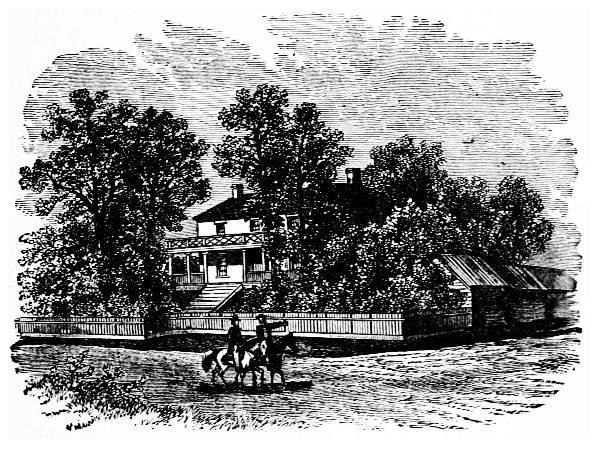 The McLeanN House, Appomattox Courthouse
It was in the orchard about the house that
the myth of "the apple-tree of Appomattox"
was born. Millions of men and women have
believed that Lee surrendered to Grant under an
apple tree at Appomattox. That apple tree is
as famous in mistaken history as is that other
mythical tree, the cherry tree which George
Washington did not cut down with his little
hatchet. Washington could not tell a lie, it is
true, but he never chopped down a cherry tree
and then said to his angry, questioning father:
"Father, I cannot tell a lie; I cut it down with
my little hatchet." That fairy story came from
the imagination of one Parson Weems, who did
not resemble our first President in the latter's
inability to tell lies. Perhaps the myth of the
apple tree will never die, as the myth of the
cherry tree has never died. In 1880, when
Grant's mistaken friends tried to nominate him
for a third Presidential term, other candidates
had been urged because this one, it was said,
could carry Ohio, that one Maine, and so on.
Then Roscoe Conkling of New York strode
upon the stage to nominate Grant and declaimed
to a hushed audience of twenty thousand men:
"And if you ask what State he comes from,
Our sole reply shall be:
He comes from Appomattox
And the famous apple tree!"
The twenty thousand were swept off their feet
by the magic of that myth. Grant was almost
nominated—but not quite.
The historic interview began in the room to
the left of the front door in the McLean house.
Two very different figures confronted each
other. Grant had not expected the meeting to
take place so soon and had left the farmhouse
where he had spent the night before in rough
garb. He writes: "I was without a sword, as
I usually was when on horseback in the field,
and wore a soldier's blouse for a coat, with the
shoulder-straps of my rank to indicate to the
army who I was.... General Lee was
dressed in a full uniform, which was entirely
new, and was wearing a sword of considerable
value, very likely the sword which had been presented
by the State of Virginia.... In my
rough traveling suit, the uniform of a private
with the straps of a lieutenant-general, I must
have contrasted very strangely with a man so
handsomely dressed, six feet high and of faultless
form. But this was not a matter that I
thought of until afterwards."
Lee requested that the terms to be given his
army should be written out. Grant asked General
Parker of his staff, a full-blooded American
Indian, for writing materials. He had prepared
nothing beforehand, but he knew just what he
wanted to say and he wrote without hesitation
terms such as only a great and magnanimous
nation could offer its conquered citizens. After
providing for the giving of paroles (that is, an
agreement not to take up arms again unless the
paroled prisoner is later exchanged for a prisoner
of the other side) and for the surrender of
arms, artillery, and public property, he added:
"This will not embrace the sidearms of the officers
nor their private horses or baggage. This
done, each officer and man will be allowed to
return to their homes, not to be disturbed by
United States authority so long as they observe
their paroles and the laws in force where they
reside." There are some mistakes in grammar
in these words, but there are no mistakes in
magnanimity. When Lee, having put on his
glasses, had read the first sentence quoted
above, he said with feeling:
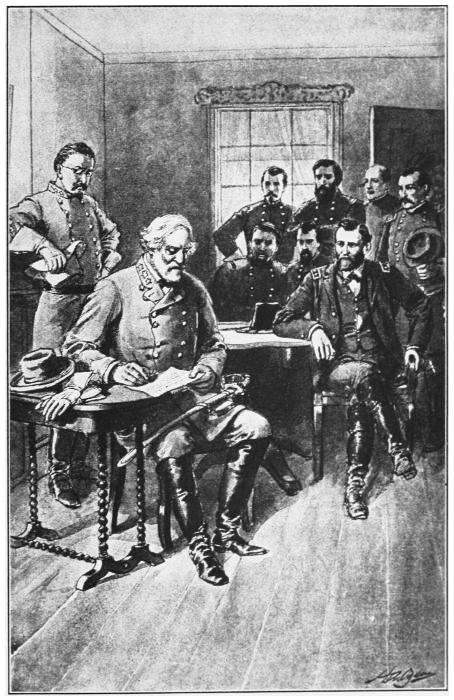 Lee Surrenders to Grant
"This will have a happy effect upon my
army."
He went on to say that many of the privates
in the Confederate cavalry and artillery owned
their own horses; could they retain them?
Grant did not change the written terms, but he
said his officers would be instructed to let every
Confederate private who claimed to own a horse
or mule take the animal home with him. "It
was doubtful," writes Grant, "whether they
would be able to put in a crop to carry themselves
and their families through the next winter
without the aid of the horses they were then
riding." Again Lee remarked that this would
have a happy effect. He then wrote and signed
an acceptance of the proposed terms of surrender.
The war was over. The first act of
peace was our issuing 25,000 rations to the army
we had captured. For some days it had lived
on parched corn.
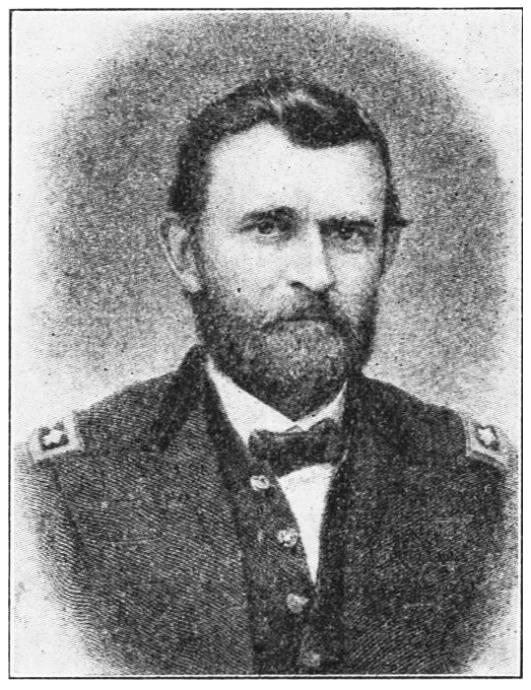 GEN. U. S. GRANT
The news of the surrender flashed along the
waiting lines like wildfire and the Union forces
began firing a salute of a hundred guns in honor
of the victory. "I at once sent word," says
Grant, "to have it stopped. The Confederates
were now our prisoners and we did not want to
exult over their downfall." This was the spirit
of a great man and of a great nation. It was
not the soldiers who fought the war who kept
its rancors alive after peace had come, It was
the politicians, who tore open the old wounds
and kept the country bleeding for a dozen years
after the Lost Cause was lost.
On the morning of Tuesday, April 10, 1865,
Grant and Lee again met between the lines and
sitting on horseback talked for half an hour.
Then Grant began his journey to Washington.
His staff, including Tom, went with him. When
they reached their goal, Second-Lieutenant
Strong found he was that no longer. For General
Wright had done what he had told Tom
he meant to do. The recommendation had been
heeded. Lincoln himself handed the boy his
new commission as a brevet-captain.
"I was glad to sign that, Tom," the President
told him, "and even Stanton didn't kick this
time."
"You don't know how glad I am to get it,
Mr. President," was the reply. "Now I'm a
boy-captain, as my great-grandfather was before
me."
"I'm not much on pedigrees and ancestry and
genealogical trees, my boy," answered Lincoln.
"Out West we think more of trees that grow
out of the ground than we do of trees that grow
on parchment. But you're right to be proud of
an ancestry of service to your country. When
family pride is based on money or land or social
standing, it is one of the most foolish things
God Almighty ever laughed at, but when it is
based on service, real service, to your country,
to your fellowmen, to the world, why, then,
Tom, it's one of the biggest and best things in
God's kingdom. But remember this, son,"—Lincoln's
eyes flashed in their deep sockets—"if
a boy has an ancestor who has done big
things, the way to be proud of him is to do big
things yourself. Living on the glory of what
somebody else has done before you is a mighty
poor kind of living. I never knew but one man
that was perfect and I'd never have known he
was if he hadn't told me so. Nobody else ever
found it out. But if we can't be perfect, we can
grow less imperfect by trying every day to serve
our fellowmen. Remember that, Tom."
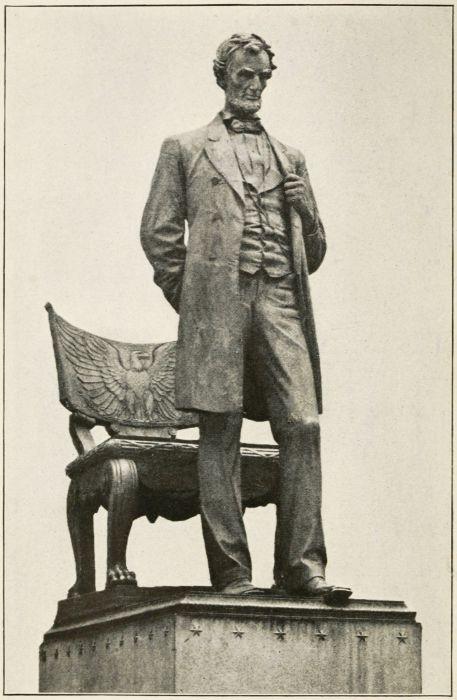 St. Gaudens' Statue of Lincoln