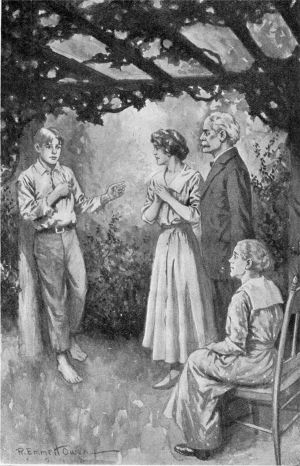
"You needn't be afraid," said Tom; "we didn't leave any tracks; we came
across the fields—all the way from the crossroads down there. We
crawled along the fence. There ain't any tracks. I looked out for that."
Pausing in suspense, yet encouraged by their expectant silence, he spoke
to some one behind him in the bushes and there emerged a young fellow
quite as ragged as himself.
"It's all right," said Tom confidently, and apparently in great relief.
"It's them."
"You must come inside ze house," whispered Florette fearfully. "It is
not safe to talk here."
"There isn't any one following us," said Tom's companion reassuringly.
"If we can just get some old clothes and some grub we'll be all right."
"Zere is much danger," said the girl, unconvinced. "We are always
watched. But you are friends to Armand. We must help you."
She led the way into the house and into a simply furnished room lighted
by a single lamp and as she cautiously shut the heavy wooden blinds and
lowered the light, the two fugitives looked eagerly at the first signs
of home life which they had seen in many a long day.
It was in vain that the two Americans declined the wine which old Pierre
insisted upon their drinking.
"You will drink zhust a leetle—yess?" said the girl prettily. "It is
make in our own veenyard."
So the boys sipped a little of the wine and found it grateful to their
weary bodies and overwrought nerves.
"Now you can tell us—of Armand," she said eagerly.
Often during Tom's simple story she stole to the window and, opening the
blind slightly, looked fearfully along the dark, quiet road. The very
atmosphere of the room seemed charged with nervous apprehension and
every sound of the breeze without startled the tense nerves of the
little party.
Old Pierre and his wife, though quite unable to understand, listened
keenly to every word uttered by the strangers, interrupting their
daughter continually to make her translate this or that sentence.
"There ain't so much need to worry," said Tom, with a kind of dogged
self-confidence that relieved Florette not a little. "I wouldn't of
headed for here if I hadn't known I could do it without leaving any
trace, 'cause I wouldn't want to get you into trouble."
Florette looked intently at the square, dull face before her with its
big mouth and its suggestion of a frown. His shock of hair, always
rebellious, was now in utter disorder. He was barefoot and his clothes
were in that condition which only the neglect and squalor of a German
prison camp can produce. But in his gaunt face there shone a look of
determination and a something which seemed to encourage the girl to
believe in him.
"Are zey all like you—ze Americans?" she asked.
"Some of 'em are taller than me," he answered literally, "but I got a
good chest expansion. This feller's name is Archer. He belongs on a farm
in New York."
She glanced at Archer and saw a round, red, merry face, still wearing
that happy-go-lucky look which there is no mistaking. His skin was
camouflaged by a generous coat of tan and those two strategic hills, his
cheeks, had not been reduced by the assaults of hunger. There was,
moreover, a look of mischief in his eyes, bespeaking a jaunty
acceptance of whatever peril and adventure might befall and when he
spoke he rolled his R's and screwed up his mouth accordingly.
"Maybe you've heard of the Catskills," said Tom. "That's where he
lives."
"My dad's got a big apple orrcharrd therre," added Archer.
Florette Leteur had not heard of the Catskills, but she had heard a good
deal about the Americans lately and she looked from one to the other of
this hapless pair, who seemed almost to have dropped from the clouds.
"You have been not wise to escape," she said sympathetically. "Ze
Prussians, zey are sure to catch you.—Tell me more of my bruzzer."
"The Prussians ain't so smarrt," said Archer. "They're good at some
things, but when it comes to tracking and trailing and all that, they're
no good. You neverr hearrd of any famous Gerrman scouts. They're clumsy.
They couldn't stalk a mud turrtle."
"You are not afraid of zem?"
"Surre, we ain't. Didn't we just put one overr on 'em?"
"We looped our trail," explained Tom to the puzzled girl. "If they're
after us at all they probably went north on a blind trail. We monkeyed
the trees all the way through this woods near here."
"He means we didn't touch the ground," explained Archer.
"We made seven footprints getting across the road to the fence and then
we washed 'em away by chucking sticks. And, anyway, we crossed the road
backwards so they'd think we were going the other way. There ain't much
danger—not tonight, anyway."
Again the girl looked from one to the other and then explained to her
father as best she could.
"You are wonderful," she said simply. "We shall win ze war now."
"I was working as a mess boy on a transport," said Tom; "we brought over
about five thousand soldiers. That's how I got acquainted with
Frenchy—I mean Armand——"
"Yes!" she cried, and at the mention of Armand old Pierre could scarcely
keep his seat.
"He came with some soldiers from Illinois. That's out west. He was
good-natured and all the soldiers jollied him. But he always said he
didn't mind that because they were all going to fight together to get
Alsace back. Jollying means making fun of somebody—kind of," Tom
added.
"Oh, zat iss what he say?" Florette cried. "Zat iss my
brother—Armand—yess!"
She explained to her parents and then advanced upon Tom, who retreated
to his second line of defence behind a chair to save himself from the
awful peril of a grateful caress.
"He told me all about how your father fought in the Franco-Prussian
War," Tom went on, "and he gave me this button and he said it was made
from a cannon they used and——"
"Ah, yess, I know!" Florette exclaimed delightedly.
"He said if I should ever happen to be in Alsace all I'd have to do
would be to show it to any French people and they'd help me. He said it
was a kind of—a kind of a vow all the French people had—that the
Germans didn't know anything about. And 'specially families that had men
in the Franco-Prussian War. He told me how he escaped, too, and got to
America, and about how he hit the German soldier that came to arrest you
for singing the Marseillaise."
The girl's face colored with anger, and yet with pride.
"Mostly what we came here for," Tom added in his expressionless way,
"was to get some food and get rested before we start again. We're going
through Switzerland to join the Americans—and if you'll wait a little
while you can sing the Marseillaise all you want."
Something in his look and manner as he sat there, uncouth and forlorn,
sent a thrill through her.
"Zey are all like you?" she repeated. "Ze Americans?"
"Your brother and I got to be pretty good friends," said Tom simply; "he
talked just like you. When we got to a French port—I ain't allowed to
tell you the name of it—but when we got there he went away on the train
with all the other soldiers, and he waved his hand to me and said he was
going to win Alsace back. I liked him and I liked the way he talked. He
got excited, like——"
"Ah, yess—my bruzzer!"
"So now he's with General Pershing. It seemed funny not to see him after
that. I thought about him a lot. When he talked it made me feel more
patriotic and proud, like."
"Yess, yess," she urged, the tears standing in her eyes.
"Sometimes you sort of get to like a feller and you don't know why. He
would always get so excited, sort of, when he talked about France or
Uncle Sam that he'd throw his cigarette away. He wasted a lot of 'em.
He said everybody's got two countries, his own and France."
"Ah, yess," she exclaimed.
"Even if I didn't care anything about the war," Tom went on in his dull
way, "I'd want to see France get Alsace back just on account of him."
Florette sat gazing at him, her eyes brimming.
"And you come to Zhermany, how?"
"After we started back the ship I worked on got torpedoed and I was
picked up by a submarine. I never saw the inside of one before. So
that's how I got to Germany. They took me there and put me in the prison
camp at Slopsgotten—that ain't the way to say it, but——"
"You've got to sneeze it," interrupted Archer.
"Yes, I know," she urged eagerly, "and zen——"
"And then when I found out that it was just across the border from
Alsace I happened to think about having that button, and I thought if I
could escape maybe the French people would help me if I showed it to 'em
like Frenchy said."
"Oh, yess, zey will! But we must be careful," said Florette.
"It was funny how I met Archer there," said Tom. "We used to know each
other in New York. He had even more adventures than I did getting
there."
"And you escaped?"
"Yop."
"We put one over on 'em," said Archer. "It was his idea (indicating
Tom). They let us have some chemical stuff to fix the pump engine with
and we melted the barbed wire with it and made a place to crawl out
through. I got a piece of the barbed wirre for a sooveneerr. Maybe you'd
like to have it," Archer added, fumbling in his pockets.
Florette, smiling and crying all at once, still sat looking wonderingly
from one to the other of this adventurous, ragged pair.
"Those Germans ain't so smart," said Archer.
The girl only shook her head and explained to her parents. Then she
turned to Tom.
"My father wants to know if zey are all like you in America. Yess?"
"He used to be a Boy Scout," said Archer. "Did you everr hearr of
them?"
But Florette only shook her head again and stared. Ever since the war
began she had lived under the shadow of the big prison camp. Many of her
friends and townspeople, Alsatians loyal still to France, were held
there among the growing horde of foreigners. Never had she heard of any
one escaping. If two American boys could melt the wires and walk out,
what would happen next?
And one of them had blithely announced that these mighty invincible
Prussians "couldn't even trail a mud turtle." She wondered what they
meant by "looping our trail."
CHAPTER IV — THE OLD WINE VAT
"We thought maybe you'd let us stay here tonight and tomorrow," said Tom
after the scanty meal which the depleted larder yielded, "and tomorrow
night we'll start out south; 'cause we don't want to be traveling in the
daytime. Maybe you could give us some clothes so it'll change our looks.
It's less than a hundred miles to Basel——"
"My pappa say you could nevaire cross ze frontier. Zere are
wires—electric——"
"Electric wirres are ourr middle name," said Archer. "We eat 'em."
"We ain't scared of anything except the daylight," said Tom. "Archy can
talk some German and I got Frenchy's—Armand's—button to show to French
people. When we once get into Switzerland we'll be all right."
He waited while the girl engaged in an animated talk with her parents.
Then old Pierre patted the two boys affectionately on the shoulder
while Florette explained.
"It iss not for our sake only, it iss for yours. You cannot stay in ziss
house. It iss not safe. You aire wonderful, zee how you escape, and to
bring us news of our Armand! We must help you. But if zey get you zen we
do not help you. Iss it so? Here every day ze Prussians come. You see?
Zey do not follow you—you are what you say—too clevaire? But still zey
come."
Tom listened, his heart in his throat at the thought of being turned out
of this home where he had hoped for shelter.
"We are already suspect," Florette explained. "My pappa, he fought for
France—long ago. But so zey hate him. My name zey get—how old——All
zeze zings zey write down—everyzing. Zey come for me soon. I sang ze
Marseillaise—you know?"
"Yes," said Tom, "but that was years ago."
"But we are suspect. Zey have write it all down. Nossing zey forget. Zey
take me to work—out of Alsace. Maybe to ze great Krupps. I haf' to work
in ze fields in Prussia maybe. You see? Ven zey come I must go. Tonight,
maybe. Tomorrow. Maybe not yet——"
She struggled to master her emotion and continued. "Ziss is—what you
call—blackleest house. You see? So you will hide where I take you. It
iss bad, but we cannot help. I give you food and tomorrow in ze night I
bring you clothes. Zese I must look for—Armand's. You see? Come."
They rose with her and as she stood there almost overcome with grief and
shame and the strain of long suspense and apprehension, yet thinking
only of their safety, the sadness of her position and her impending fate
went to Tom's heart.
Old Pierre embraced the boys affectionately with his one arm, seeming to
confirm all his daughter had said.
"My pappa say it is best you stay not here in ziss house. I will show
you where Armand used to hide so long ago when we play," she smiled
through her tears. "If zey come and find you——"
"I understand," said Tom. "They couldn't blame it to you."
"You see? Yess."
To Archer, who understood a few odds and ends of German old Pierre
managed to explain in that language his sorrow and humiliation at their
poor welcome.
All five then went into an old-fashioned kitchen with walls of naked
masonry and a great chimney, and from a cupboard Florette and her mother
filled a basket with such cold viands as were on hand. This, and a pail
of water the boys carried, and after another affectionate farewell from
Pierre and his wife, they followed the girl cautiously and silently out
into the darkness.
Tom Slade had already felt the fangs of the German beast and he did not
need any one to tell him that the loathsome thing was without conscience
or honor, but as he watched the slender form of Armand's young sister
hurrying on ahead of them and thought of all she had borne and must yet
bear and of the black fear that must be always in her young heart, his
sympathy for her and for this stricken home was very great.
He had not fully comprehended her meaning, but he understood that she
and her parents were haunted by an ever-present dread, and that even in
their apprehension it hurt them to skimp their hospitality or suffer any
shadow to be cast on a stranger's welcome.
Florette led the way along a narrow board path running back from the
house, through an endless maze of vine-covered arbor, which completely
roofed all the grounds adjacent to the house. Tom, accustomed only to
the small American grape arbor, was amazed at the extent of this
vineyard.
"Reminds you of an elevated railroad, don't it," said Archer.
On the rickety uprights (for the arbor like everything else on the old
place was going to ruin under the alien blight) large baskets hung here
and there. At intervals the structure sagged so that they had to stoop
to pass under it, and here and there it was broken or uncovered and they
caught glimpses of the sky.
They went over a little hillock and, still beneath the arbor, came upon
a place where the vines had fallen away from the ramshackle trellis and
formed a spreading mass upon the ground.
"You see?" whispered the girl in her pretty way. "Here Armand he climb.
Here he hide to drop ze grapes down my neck—so. Bad boy! So zen it
break—crash! He tumbled down. Ah—my pappa so angry. We must nevaire
climb on ze trellis. You see? Here I sit and laugh—so much—when he
tumble down!"
She smiled and for a moment seemed all happiness, but Tom Slade heard a
sigh following close upon the smile. He did not know what to say so he
simply said in his blunt way:
"I guess you had good times together."
"Now I will zhow you," she said, stooping to pull away the heavy tangle
of vine.
Tom and Archer helped her and to their surprise there was revealed a
trap-door about six feet in diameter with gigantic rusty hinges.
"Ziss is ze cave—you see?" she said, stooping to lift the door. Tom
bent but she held him back. "Wait, I will tell you. Zen you can open
it." For a moment pleasant recollections seemed to have the upper hand,
and there was about her a touch of that buoyancy which had made her
brother so attractive to sober Tom.
"Wait—zhest till I tell you. When I come back from ze school in England
I have read ze story about 'Kidnap.' You know?"
"It's by Stevenson; I read it," said Archer.
"You know ze cave vere ze Scotch man live? So ziss is our cave. Now you
lift."
The door did not stir at first and Florette, laughing softly, raised the
big L band which bent over the top and lay in a rusted padlock eye.
"Now."
The boys raised the heavy door, to which many strands of the vine clung,
and Florette placed a stick to hold it up at an angle. Peering within
by the light of a match, they saw the interior of what appeared to be a
mammoth hogshead from which emanated a stale, but pungent odor. It was,
perhaps, seven feet in depth and the same in diameter and the bottom was
covered with straw.
"It is ze vat—ze wine vat," whispered Florette, amused at their
surprise. "Here we keep ze wine zat will cost so much.—But no more.—We
make no wine ziss year," she sighed. "Ziss makes ze fine flavor—ze
earth all around. You see?"
"It's a dandy place to hide," said Archer.
"So here you will stay and you will be safe. Tomorrow in ze night I
shall bring you more food and some clothes. I am so sorry——"
"There ain't anything to be sorry about," said Tom. "There's lots of
room in there—more than there is in a bivouac tent. And it'll be
comfortable on that straw, that's one sure thing. If you knew the kind
of place we slept in up there in the prison you'd say this was all
right. We'll stay here and rest all day tomorrow and after you bring us
the things at night we'll sneak out and hike it along."
"I will not dare to come in ze daytime," said Florette, "but after it is
dark, zen I will come. You must have ze cover almost shut and I will
pull ze vines over it."
"We'll tend to that," said Tom.
"We'll camouflage it, all right," Archer added.
For a moment she lingered as if thinking if there were anything more she
might do for their comfort. Then against her protest, Tom accompanied
her part way back and they paused for a moment under the thickly covered
trellis, for she would not let him approach the house.
"I'm sorry we made you so much trouble," he said; "it's only because we
want to get to where we can fight for you."
"Oh, yess, I know," she answered sadly. "My pappa, it break his heart
because he cannot make you ze true welcome. But you do not know. We
are—how you say—persecute—all ze time. Zey own Alsace, but zey do not
love Alsace. It is like—it is like ze stepfather—you see?" she added,
her voice breaking. "So zey have always treat us."
For a few seconds Tom stood, awkward and uncomfortable; then clumsily he
reached out his hand and took hers.
"You don't mean they'll take you like they took the people from Belgium,
do you?" he asked.
"Ziss is worse zan Belgium," Florette sobbed. "Zere ze people can escape
to England."
"Where would they send you?" Tom asked.
"Maybe far north into Prussia. Maybe still in Alsace. All ze familees
zey will separate so zey shall meex wiz ze Zhermans." Florette suddenly
grasped his hand. "I am glad I see you. So now I can see all ze
Americans come—hoondreds——
"Tomorrow in ze night I will bring you ze clothes," she whispered, "and
more food, and zen you will be rested——"
"I feel sorry for you," Tom blurted out with simple honesty, "and I got
to thank you. Both of us have—that's one sure thing. You're worse off
than we are—and it makes me feel mean, like. But maybe it won't be so
bad. And, gee, I'll look forward to seeing you tomorrow night, too."
"I will bring ze sings, surely," she said earnestly.
"It isn't—it isn't only for that," he mumbled, "it's because I'll kind
of look forward to seeing you anyway."
For another moment she lingered and in the stillness of night and the
thickly roofed arbor he could hear her breath coming short and quick, as
she tried to stifle her emotion.
"Is—is it a sound?" she whispered in sudden terror.
"No, it's only because you're scared," said Tom.
He stood looking after her as she hurried away under the ramshackle
trellis until her slender figure was lost in the darkness.
"It'll make me fight harder, anyway," he said to himself; "it'll help me
to get to France 'cause—'cause I got to, and if you got to do a
thing—you can...."
CHAPTER V — THE VOICE FROM THE DISTANCE
"My idea," said Archer, when Tom returned, "is to break that stick about
in half and prop the doorr just wide enough open so's we can crawl in.
Then we can spread the vines all overr the top just like it was beforre
and overr the opening, too. What d'ye say?"
"That's all right," said Tom, "and we can leave it a little open
tonight. In the morning we'll drop it and be on the safe side."
"Maybe we'd betterr drop it tonight and be on the safe side," said
Archer. "S'pose we should fall asleep."
"We'll take turns sleeping," said Tom decisively. "We can't afford to
take any chances."
"You can bet I'm going to get a sooveneerr of this place, anyway," said
Archer, tugging at a rusty nail.
"Never you mind about souvenirs," Tom said; "let's get this door
camouflaged."
"I could swap that nail for a jack-knife back home," said Archer
regretfully. "A nail right fresh from Alsace!"
But he gave it up and together they pulled the tangled vine this way and
that, until the door and the opening beneath were well covered. Then
they crawled in and while Archer reached up and held the door, Tom broke
the stick so that the opening was reduced to the inch or two necessary
for ventilation. Reaching out, they pulled the vine over this crack
until they felt certain that no vestige of door or opening could be seen
from without, and this done they sat down upon the straw, their backs
against the walls of the vat, enjoying the first real comfort and
freedom from anxiety which they had known since their escape from the
prison camp.
"I guess we're safe herre forr tonight, anyway," said Archer, "but
believe me, I think we've got some job on our hands getting out of
this country. It's going to be no churrch sociable——"
"We got this far," said Tom, "and by tomorrow night we ought to have a
good plan doped out. We got nothing to do all day tomorrow but think
about it."
"Gee, I feel sorry for these people," said Archer; "they'rre surre up
against it. Makes me feel as if I'd like to have one good whack at
Kaiser Bill——"
"Well, don't talk so loud and we'll get a whack at him, all right."
"I'd like to get his old double-jointed moustache for a sooveneerr."
"There you go again," said Tom.
Now that the excitement was over, they realized how tired they were and
indeed the strain upon their nerves, added to their bodily fatigue, had
brought them almost to the point of exhaustion.
"I'm all in," said Archer wearily.
"All right, go to sleep," said Tom, "and after a while if you don't wake
up I'll wake you. One of us has got to stay awake and listen. We can't
afford to take any chances."
Archibald Archer needed no urging and in a minute he was sprawled upon
the straw, dead to the world. The daylight was glinting cheerily through
the interstices of tangled vine over the opening when he awoke with the
heedless yawns which he might have given in his own beloved Catskills.
"Don't make a noise," said Tom quickly, by way of caution. "We're in the
wine vat in Leteur's vineyard in Alsace, remember." It took Archer a
moment to realize where they were. They ate an early breakfast, finding
the simple odds and ends grateful enough, and then Tom took his turn at
a nap.
Throughout most of that day they sat with their knees drawn up, leaning
against the inside of the great vat, talking in hushed tones of their
plans. There was nothing else they could do in the half darkness and the
slow hours dragged themselves away monotonously. They had lowered the
door, but still left it open upon the merest crack and out of this one
or the other would peek at intervals, listening, heart in throat, for
the dreaded sound of footfalls. But no one came.
"I thought I hearrd a kind of rustling once," Archer said fearfully.
"There's a couple of cows 'way over in a field," said Tom; "they might
have made some sound."
After what seemed to them an age, the leaves over the opening seemed
bathed in a strange new light and glistened here and there.
"That crack faces the west," said Tom. "The sun's beginning to go down."
"How do you know?" asked Archer.
"I always knew that up at Temple Camp. I don't know how I know. The
morning sun is different from the afternoon sun, that's all. I think
it'll set now in about two hours."
"I wonder when she'll come," Archer said.
"Not till it's good and dark, that's sure. She's got to be careful.
Maybe this place can be seen from the road, for all we know. Remember,
we didn't see it in the daylight."
"Sh-h-h," said Archer. "Listen."
From far, far away there was borne upon the still air a dull, spent,
booming sound at intervals.
"It's the fighting," whispered Tom.
"Wherre do you suppose it is?" Archer asked, sobered by this audible
reminder of their nearness to the seat of war.
"I don't know," Tom said. "I'm kind of mixed up. That feller in the
prison had a map. Let's see. I think Nancy's the nearest place to here.
Toul is near that. That's where our fellers are—around there. Listen!"
Again the rumbling, faint but distinctly audible, almost as if it came
from another world.
"The trenches run right through there—near Nancy," said Tom.
"Maybe it's ourr boys, hey?" Archer asked excitedly.
Tom did not answer immediately. He was thrilled at this thought of his
own country speaking so that he, poor fugitive that he was, could hear
it in this dark, lonesome dungeon in a hostile land, across all those
miles.
"Maybe," he said, his voice catching the least bit. "They're in the Toul
sector. A feller in prison told me. You don't feel so lonesome, kind of,
when you hear that——"
"Gee, I hope we can get to them," said Archer.
"What you got to do, you can do," Tom answered. "I wonder——"
"Sh-h. D'you hearr that?" Archer whispered, clutching Tom's shoulder.
"It was much nearerr—right close——"
They held their breaths as the reverberation of a sharp report died
away.
"What was it?" Archer asked tensely.
"I don't know," Tom whispered, instinctively removing the short stick
and closing the trap door tight. "Don't move—hush!"
CHAPTER VI — PRISONERS AGAIN
"Do you hear footsteps?" Archer breathed.
Tom listened, keen and alert. "No," he said at last. "There's no one
coming."
"What do you s'pose it was?"
"I don't know. Sit down and don't get excited."
But Tom was trembling himself, and it was not until five or ten minutes
had passed without sound or happening that he was able to get a grip on
himself.
"Push up the door a little and listen," suggested Archer.
Tom cautiously pressed upward, but the door did not budge. "It's stuck,"
he whispered.
Archer rose and together they pressed, but save for a little looseness
the door did not move.
"It's caught outside, I guess," said Tom. "Maybe the iron hasp fell into
the padlock when I put it down, huh?"
That, indeed, seemed to be the case, for upon pressure the door gave a
little at the corners, but not midway along the side where the fastening
was. Archer turned cold at the thought of their predicament, and for a
moment even Tom's rather dull imagination pictured the ghastly fate made
possible by imprisonment in this black hole.
"There's no use getting excited," he said. "We get some air through the
cracks and after dark she'll be here, like she said. It's beginning to
get dark now, I guess."
But he could not sit quietly and wait through the awful suspense, and he
pressed up against the boards at intervals all the way along the four
sides of the door. On the side where the hinges were it yielded not at
all. On the opposite side it held fast in the center, showing that by a
perverse freak of chance it had locked itself. Elsewhere it strained a
little on pressure, but not enough to afford any hope of breaking it.
"If it was only lowerr," Archer said, "so we could brace our shoulderrs
against it, we might forrce it."
"And make a lot of noise," said Tom. "There's no use getting rattled;
we'll just have to wait till she comes."
"Yes, but it gives you the willies thinkin' about what would happen——"
"Well, don't let's think of it, then," Tom interrupted. "We should
worry." And suiting his action to the word, he seated himself, drew up
his knees, and clasped his hands over them. "We'll just have to wait,
that's all."
"What do you suppose that sound was?" Archer asked.
"I don't know; some kind of a gun. It ain't the first gun that's been
shot off in Europe lately."
For half an hour or so they sat, trying to make talk, and each pretended
to himself and to the other that he was not worrying. But Tom, who had a
scout's ear, started and his heart beat faster at every trifling stir
outside. Then, as they realized that darkness must have fallen, they
became more alert for sounds and a little apprehensive. They knew
Florette would come quietly, but Tom believed he could detect her
approach.
After a while, they abandoned all their pretence of nonchalant
confidence and did not talk at all. Of course, they knew Florette would
come in her own good time, but the stifling atmosphere of that musty
hole and the thought of what might happen——
Suddenly there was a slight noise outside and then, to their great
relief, the unmistakable sound of footfalls on the planks above them,
softened by the thick carpet of matted vine.
"Sh-h, don't speak!" Tom whispered, his heart beating rapidly. "Wait
till she unfastens it or says something."
For a few seconds—a minute—they waited in breathless suspense. Then
came a slight rustle as from some disturbance of the vine, then
footfalls, again, modulated and stealthy they seemed, on the door just
above them. A speck of dirt, or an infinitesimal pebble, maybe, fell
upon Archer's head from the slight jarring of some crack in the rough
door. Then silence.
Breathlessly they waited, Archer nervously clutching Tom's arm.
"Don't speak," Tom warned in the faintest whisper.
Still they waited. But no other sound broke upon the deathlike solitude
and darkness....
CHAPTER VII — WHERE THERE'S A WILL——
"They're hunting for us," whispered Tom hoarsely. "It's good it was
shut."
"I'd ratherr have them catch us," shivered Archer, "than die in herre."
"We haven't died yet," said Tom, "and they haven't caught us either.
Don't lose your nerves. She'll come as soon as she can."
For a few minutes they did not speak nor stir, only listened eagerly for
any further sound.
"What do you s'pose that shot was?" Archer whispered, after a few
minutes more of keen suspense.
"I don't know. A signal, maybe. They're searching this place for us, I
guess. Don't talk."
Archer took comfort from Tom's calmness, and for half an hour more they
waited, silent and apprehensive. But nothing more happened, the solemn
stillness of the countryside reigned without, and as the time passed
their fear of pursuit and capture gave way to cold terror at the thought
of being locked in this black, stifling vault to die.
What had happened? What did that shot mean, and where was it? Why did
Florette not come? Who had walked across the plank roof of that musty
prison? The fact that they could only guess at the time increased their
dread and made their dreadful predicament the harder to bear. Moreover,
the air was stale and insufficient and their heads began to ache
cruelly.
"We can't stand it in here much longer," Tom confessed, after what
seemed a long period of waiting. "Pretty soon one of us will be all in
and then it'll be harder for the other. We've got to get out, no matter
what."
"Therre may be a Gerrman soldierr within ten feet of us now," Archer
said. "They'rre probably around in this vineyarrd somewherre, anyway.
If we tried to forrce it open they'd hearr us."
"We couldn't force it, anyway," Tom said.
"My head's pounding like a hammerr," said Archer after a few minutes
more of silence.
"Hold some of that damp straw to it.—How many matches did she give
you?"
"'Bout a dozen or so."
"Wish I had a knife.—Have you got that piece of wire yet?"
"Surre I have," said Archer, hauling from his pocket about five inches
of barbed wire—the treasured memento of his escape from the Hun prison
camp. "You laughed at me for always gettin' sooveneerrs; now you see——
What you want it for?"
"Sh-h. How many barbs has it?" asked Tom in a cautious whisper.
"Three."
"Let's have it; give me a couple o' matches, too."
Holding a lighted match under the place where he thought the iron
padlock band must be, he scrutinized the under side of the door for any
sign of it.
"I thought maybe the ends of the screws would show through," he said.
"What's the idea?" Archer asked. "Gee, but my head's poundin'."
"If that hasp just fell over the padlock eye," Tom whispered, "and
didn't fit in like it ought to, maybe if I could bore a hole right under
it I could push it up. Don't get scared," he added impassively. "There's
another way, too; but it's a lot of work and it would make a noise. We'd
just have to settle down and take turns and dig through with the wire
barbs. I wish we had more matches. Don't get rattled, now. I know we're
in a dickens of a hole——"
"You said something," observed Archer.
"I didn't mean it for a joke," said Tom soberly.
"This has got the trenches beat a mile," Archer said, somewhat
encouraged by Tom's calmness and resourcefulness.
Striking another match, Tom examined more carefully the area of planking
just in the middle of the side where he knew the hasp must be. He
determined the exact center as nearly as he could. While doing this he
dug his fingernails under a large splinter in the old planking and
pulled it loose. Archer could not see what he was doing, and something
deterred him from bothering his companion with questions.
For a while Tom breathed heavily on the splintered fragment. Then he
tore one end of it until it was in shreds.
"Let's have another match."
Igniting the shredded end, he blew it deftly until the solid wood was
aflame, and by the light of it he could see that Archer was ghastly pale
and almost on the point of collapse. Their dank, unwholesome refuge
seemed the more dreadful for the light.
"You got to just think about our getting out," Tom said, in his usual
dull manner. "We won't suffocate near so soon if we don't think about
it, and don't get rattled. We got to get out and so we will get out.
Let's have that wire."
All Archer's buoyancy was gone, but he tried to take heart from his
comrade's stolid, frowning face and quiet demeanor.
"We can set fire to the whole business if we have to," said Tom, "so
don't get rattled. We ain't going to die. Here, hold this."
Archer held the stick, blowing upon it, while Tom heated an end of the
wire, holding the other end in some of the damp straw. As soon as it
became red hot he poked it into the place he had selected above him. It
took a long time and many heatings to burn a hole an eighth of an inch
deep in the thick planking, and their task was not made the pleasanter
by the thought that after all it was like taking a shot in the dark. It
seemed like an hour, the piece of splintered wood was burned almost
away, and what little temper there was in the malleable wire was quite
gone from it, when Tom triumphantly pushed it through the hole.
"Strike anything?" Archer asked, in suspense.
"No," said Tom, disappointed. He bent the wire and, as best he could,
poked it around outside. "I think I can feel it, though. Missed it by
about an inch. There's no use getting discouraged. We'll just have to
bore another one."
Long afterward, Archibald Archer often recalled the patience and
doggedness which Tom displayed that night.
"As long's the first hole has helped us to find something out, it's
worth while, anyway," he said philosophically.
Resolutely he went to work again, like the traditional spider climbing
the wall, heating the almost limp wire and by little burnings of a
sixteenth of an inch or so at a time he succeeded in making another hole
through the heavy planking. But this time the wire encountered a
metallic obstruction. Sure enough, Tom could feel the troublesome hasp,
but alas, the wire was now too limber to push it up.
"I can just joggle it a little," he said, "but it's too heavy for this
wire."
However, by dint of doubling and twisting the wire, he succeeded after
many attempts and innumerable straightenings of the wire, in joggling
the stubborn hasp free from the padlock eye on which it had barely
caught.
"There it goes!" he said with a note of triumph in his usually impassive
voice.
Instantly Archer's hands were against the door ready to push it up.
"Wait a minute," whispered Tom; "don't fly off the handle. How do we
know who's wandering round? Sh-h! Think I want to run plunk into the
Prussian soldier that walked over our heads? Take your time."
In his excitement Archer had forgotten that ominous tread above their
prison, and he drew back while Tom raised the door to the merest crack
and peered cautiously out. The fresh air afforded them infinite relief.
The night was still and clear, the sky thick with stars. Far away a
range of black heights was outlined against the sky, and over there the
moon was rising. It seemed to be stealthily creeping up out of that
battle-scourged plain in France for a glimpse of Alsace. It was from
beyond those mountains that had come the portentous rumblings which they
had heard.
"The blue Alsatian mountains," murmured Tom. "I wish we were across
them."
"We'll have to go down and around if we everr get therre," Archer said.
"Sh-h-h!" warned Tom, putting his head out and peering about while
Archer held the lid up.
The moonlight, glinting down through the interstices of the trellised
vine, made animated shadows in the quiet vineyard, conjuring the wooden
supports and knotty masses of vine stalk into lurking human forms. Here
some grim figure waited in silence behind an upright, only to dissolve
with the changing light. There an ominous helmet seemed to stir amid the
thick growth.
The two fugitives, elated at their deliverance, but tremblingly
apprehensive, stood hesitating at so radical a move as complete
emergence from their hiding place.
"We can't crawl out of herre in daylight, that's surre," whispered
Archer. "D'you think maybe she'll come even now—if we waited?"
"It must be long after midnight," Tom answered. "You wait here and hold
the door up while I crawl out. Don't move and don't speak. What's that
shining over there? See?"
"Nothin' but an old waterring can."
"All right—sh-h-h!"
Cautiously, silently, Tom crept out, peering anxiously in every
direction. Stealthily he raised himself. Then suddenly he made a low
sound and with a rapidity which startled Archer, dropped to his hands
and knees.
"What's the matterr?" Archer whispered. "Come inside—quick!"
But Tom was engrossed with something on the ground.
"What is it?" Archer whispered anxiously. "His footprints?"
"Yop," said Tom, less cautiously. "Come on out. He's standing over there
in the field now. Come on out, don't be scared."
Archer did not know what to make of it, but he crept out and looked over
to the adjacent field where Tom pointed. A kindly, patient cow, one of
those they had seen before, was grazing quietly, partaking of a late
lunch in the moonlight.
"Here's her footprint," said Tom simply. "She gave us a good scare,
anyway."
"Well—I'll—be——" Archer began.
"Sh-h!" warned Tom. "We don't know yet why Frenchy's sister don't come.
But there weren't any soldiers here—that's one sure thing. We had a lot
of worry for nothin'. Come on."
CHAPTER VIII — THE HOME FIRE NO LONGER BURNS
"That's the first time I was everr scarred by a cow," said Archer, his
buoyant spirit fully revived, "but when I hearrd those footsteps overr
my head, go-od night! It's good you happened to think about looking
for footprints, hey?"
"I didn't happen to," said Tom. "I always do. Same as you never forget
to get a souvenir," he added soberly.
"I'd like to get a sooveneerr from that cow, hey? You needn't talk; if
it hadn't been for that wire, where'd we be now? Sooveneerrs arre all
right. But I admit you've got to have ideas to go with 'em."
"Thanks," said Tom.
"Keep the change," said Archer jubilantly. "Believe me, I don't carre
what becomes of me as long as I'm above ground—on terra cotta——"
"We've got to get away from here before daylight, so come on,"
interrupted Tom.
"Are we going up to the house?"
"What else can we do?"
The explanation of those appalling footfalls by no means explained the
failure of Florette to keep her promise, and the fugitives started along
the path which led to the house.
They walked very cautiously, Tom scrutinizing the earth-covered planking
for any sign of recent passing. The door of the stone kitchen stood
open, which surprised them, and they stole quietly inside. A lamp stood
upon the table, but there was no sign of human presence.
Tom led the way on tiptoe through the passage where they had passed
before, and into the main room where another lamp revealed a ghastly
sight. The heavy shutters were closed and barred, just as Florette had
closed them when she had brought the boys into the room. Upon the floor
lay old Pierre, quite dead, with a cruel wound, as from some blunt
instrument, upon his forehead. His whitish gray hair, which had made him
look so noble and benignant, was stained with his own blood. Blood lay
in a pool about his fine old head, and the old coat which he wore had
been torn from him, showing the stump of the arm which he had so long
ago given to his beloved France.
Near him lay sprawled upon the floor a soldier in a gray uniform, also
dead. A little bullet wound in his temple told the tale. Beside him was
a black helmet with heavy brass chin gear. Archer picked it up with
trembling hands. Across its front was a motto:
"Mitt Gott—und Vaterland."
The middle of it was obscured by the flaring German coat-of-arms. A
pistol lay midway between the two bodies and part of an old engraved
motto was still visible on that. Tom could make out the name Napoleon.
"What d'you s'pose happened?" whispered Archer, aghast.
Tom shook his head. "Come on," said he. "Let's look for the others."
Taking the lamp, he led the way silently through the other rooms. On a
couch in one of these was laid a soldier's uniform and a loose paper
upon the floor showed that it had but lately been unwrapped. There was
no sign of Florette or her mother, and Tom felt somewhat relieved at
this, for he had feared to find them dead also.
"What d'you think it means?" Archer asked again, as they returned to the
room of death.
"I suppose they came for her just like she said," Tom answered in a low
tone. "Her father must have shot the soldier, and probably whoever
killed the old man took her and her mother away."
He looked down at the white, staring face of old Pierre and thought of
how the old soldier had risen from his seat and had stood waiting with
his fine military air at the moment of his own arrival at the shadowed
and stricken home. He remembered how the old man had waited eagerly for
his daughter to translate his and Archer's talk and of his humiliation
at the shabby hospitality he must offer them. He took the helmet, a
grim-looking thing, from the table where Archer had laid it, and read
again, "Mitt Gott——"
It seemed to Tom that this was all wrong—that God must surely be on the
side of old Pierre, no matter what had happened.
"Do you know what I think?" he said simply. "I think it was just the way
I said—and like she said. They came to get her and maybe they didn't
treat her just right, and her father hit one of them. Or maybe he shot
him first off. Anyway, I think that soldier suit must be the one Frenchy
had to wear, 'cause he told me that the boys in Alsace had to drill even
before they got out of school. I guess she was going to bring it to us
so one of us could wear it.... We got to feel sorry for her, that's one
sure thing."
It was Tom's simple, blunt way of expressing the sympathy which surged
up in his heart.
"I liked her; she treated us fine," said Archer.
For a few seconds Tom did not answer; then he said in his old stolid
way, "I don't know where they took her or what they'll make her do, but
anybody could see she didn't have any muscle. Whenever I think of her
I'll fight harder, that's one sure thing."
For a few moments he could hardly command himself as he contemplated
this tragic end of the broken home. Florette, whom he had seen but
yesterday, had been taken away—away from her home, probably from her
beloved Alsace, to enforced labor for the Teuton tyrant. He recalled her
slender form as she hurried through the darkness ahead of them, her
gentle apology for their poor reception, her wistful memories of her
brother as she showed them their hiding-place, her touching grief and
apprehension as she stood talking with him under the trellis....
And now she was gone and awful thoughts of her peril and suffering
welled up in Tom's mind.
He looked at the stark figure and white, staring face of old Pierre and
thought of the impetuous embrace the old man had given him. He thought
of his friend, Frenchy. And the mother—where was she? Good people, kind
people; trying in the menacing shadow of the detestable Teuton beast to
keep their flickering home fire burning. And this was the end of it.
Most of all, he thought of Florette and her wistful, fearful look
haunted him. "Maybe for ze great Krupps"—the phrase lingered in his
mind and he stood there appalled at the realization of this awful,
unexplained thing which had happened.
Then Tom Slade did something which his scout training had taught him to
do, while Archer, tremulous and unstrung, stood awkwardly by, watching.
He knelt down over the lifeless form of the old man and straightened the
prostrate figure so that it lay becomingly and decently upon the hard
floor. He bent the one arm and laid it across the breast in the usual
posture of dignity and peace. He took the threadbare covering from the
old melodeon and placed it over the face. So that the last service for
old Pierre Leteur was performed by an American boy; and at least the
ashes of the home fire were left in order by a scout from far across the
seas.
"It's part of first aid," explained Tom quietly, as he rose; "I learned
how at Temple Camp."
Archer said nothing.
"When a scout from Maryland died up there, I saw how they did it."
"You got to thank the scouts for a lot," said Archer; "forr trackin' an'
trailin'——"
"'Tain't on account of them," said Tom, his voice breaking a little,
"it's on account of her——"
And he kneeled again to arrange the corner of the cloth more neatly over
the wrinkled, wounded face....
CHAPTER IX — FLIGHT
"Anyway, we've got to get away from here quick," said Tom, pulling
himself together; "never mind about clothes or anything. One thing sure,
they'll be back here soon. See if he has a watch," he added, indicating
the dead soldier.
"No, but he's got a little compass around his neck; shall I take it?"
"Sure, we got a right to capture anything from the enemy."
"He's got some papers, too."
"All right, take 'em. Come on out through the kitchen way—hurry up.
Don't make any noise. You look for some food—I'll be with you right
away."
Tom crept cautiously out to the road and, kneeling, placed his ear to
the ground. There was no sound, and he hurried back to the stone kitchen
where Archer was stuffing his pockets with such dry edibles as he could
gather.
"All right, come on," he whispered hurriedly. "What have you got?"
"Some hard bread and a couple of salt fish——"
"Give me one of those," Tom interrupted: "and hand me that tablecloth.
Come on. Got some matches?"
"Yes, and a candle, too."
"Good. Don't strike a light. You go ahead, along the plank walk."
Leaving the scene of the tragedy, they hurried along the board walk
under the trellis, Tom dragging the tablecloth so that it swept both of
the narrow planks and obliterated any suggestion of footprints. When
they had gone about fifty yards he stooped and flung the salt fish from
him so that it barely skimmed the earth and rested at some distance from
the path.
"If they should have any dogs with 'em, that'll take 'em off the trail,"
he said.
"I'm sorry I didn't get you a souveneerr too," said Archer, as they
hurried along.
This was the first intimation Tom had that Archer regarded the little
compass merely as a souvenir.
"You can give me those papers you took," he said, half in joke.
"It's only an envelope," Archer said. "Have you got your button all
right?"
"Sure."
When they reached the wine vat, Tom threw the old tablecloth into it,
and pulled the vine more carefully so as to conceal the door. They were
tempted to rest here, but realized that if they spent the balance of the
night in their former refuge it would mean another long day in the dank
hole.
The vineyard ended a few yards from the wine vat and beyond was an area
of open lowlands across which the boys could see a range of low wooded
hills.
"We've got about four hours till daylight," said Tom; "let's make for
those woods."
"That's east," said Archer. "We want to go south."
"We want to see where we're going before we go anywhere," Tom answered.
"If we can get into the woods on those hills, we can climb a tree
tomorrow and see where we're at. What I want is a bird's-eye squint to
start off with, 'cause we can't ask questions of anybody."
"No, and believe me, we don't want to run into any cities," said Archer.
"We got through one night anyway, hey?"
Notwithstanding that they were without shelter, and facing the
innumerable perils of a hostile country about which they knew nothing,
they still found action preferable to inaction and their spirits rose as
they journeyed on with the star-studded sky overhead.
They found the meadows low and marshy, which gratified Tom who was
always fearful of leaving footprints. The hills beyond were low and
thickly wooded, the face of the nearest being broken by slides and
forming almost a precipice surmounted by a jumble of rocks and
underbrush. The country seemed wild and isolated enough.
"I suppose it's the beginning of the Alps, maybe," Tom panted as they
scrambled up.
"There's nobody up here, that's surre," Archer answered.
"We'll just lie low till daylight and see if we can get a squint at the
country. Then tomorrow night we'll hike it south. If we go straight
south we've got to come to Switzerland."
"It's lucky we've got the compass," said Archer.
"Maybe this is a ridge we're on," Tom said. "If it is, we're in luck. We
may be able to go thirty or forty miles along it. One thing sure, it'll
be more hilly the farther south we get 'cause we'll be getting into the
beginning of the Alps. There ought to be water up here."
"I wish there were some apples," said Archer.
"You're always thinking about apples and souvenirs. Let's crawl in under
here."
They had scrambled to the top of the precipitous ascent and found
themselves upon the broken edge of the forest amid a black chaos of
piled up rock and underbrush. Evidently, the land here was giving way,
little by little, for here and there they could see a tree canting
tipsily over the edge, its network of half-exposed roots making a last
gallant stand against the erosive process and helping to hold the weight
of the great boulders which ere long would crash down into the marshy
lowlands.
They crept into a sort of leafy cave formed by a fallen tree and
stretched their weary bodies and relaxed their tense nerves after what
had seemed a nightmare.
"As long as we're going to join the army," said Tom, "we might as well
make a rule now. We won't both sleep at the same time till we're out of
Germany. We got to live up to that rule no matter how tired we get."
"I'm game," said Archer. "You go to sleep now and when I get good and
sleepy I'll wake you up."
"In about two hours," said Tom. "Then you can sleep till it's light.
Then we'll see if it's safe to stay here. Keep looking in that
direction—the way we came. And if you see any lights, wake me up."
Archer did not obey these directions at all, for he sat with his hands
clasped over his knees, gazing down across the dark marshland below. Two
hours, three hours, four hours, he sat there and scarcely stirred. And
as the time dragged on and there were no lights and no sounds he took
fresh courage and hope. He was beginning to realize the value of the
stolid determination, the resourcefulness, the keen eye and stealthy
foot and clear brain of the comrade who lay sleeping at his side. He had
wanted to tell Tom Slade what he thought of him and how he trusted him,
but he did not know how. So he just sat there, hour in and hour out, and
let the weary pathfinder of Temple Camp sleep until he awoke of his own
accord.
"All right," said Archer then, blinking. "Nothing happened."
CHAPTER X — THE SOLDIER'S PAPERS
All that day they stayed in their leafy refuge. They could look down
across the marshy meadows they had crossed to the trellised vineyard of
the Leteurs, looking orderly and symmetrical in the distance like a
two-storied field, and beyond that the massive gables of the gray,
forsaken house.
They could see the whole neighboring country in panorama. Other houses
were discernible at infrequent intervals along the road which wound
southward through the lowland between the hills where the boys were and
the Vosges Mountains (the "Blue Alsatian Mountains") to the west.
Through the long, daylight hours Tom studied the country carefully. Now,
as never before (for he knew how much depended on it), he watched for
every scrap of knowledge which might afford any inference or deduction
to help them in their flight.
"You can see how it is," he told Archer, as they watched the little
compass needle, waiting for it to settle. "This is a ridge and it runs
north and south. I kind of think it's the west side of the valley of a
river, like Daggett's Hills are to Perch River up your way."
"I'd like to be therre now," said Archer.
"I'd rather be in France," Tom answered.
"Of course it'll fizzle out in places and we'll come to villages, but
there's enough woods ahead of us for us to go twenty miles tonight.
That's the way it seems to me, anyway."
Once Tom ventured out on hands and knees into the woods in quest of
water, and returned with the good news that he had had a refreshing
drink from a brook to which he directed Archer.
"Do you know what this is?" he said, emptying an armful of weeds on the
ground. "It's chicory. If I dared to build a fire I could make you a
good imitation of coffee with that. But we can eat the roots, anyway.
Now I remember it used to be in the geography in school about so much
chicory growing in the Alps——"
"Oh, Ebeneezerr!" shouted Archer, much to Tom's alarm. "I'm glad you
said that 'cause it reminds me about the mussels."
"The what?"
"'The mountain streams abound with the pearrl-bearing mussels which are
a staple article of diet with the Alpine natives,'" quoted Archer in
declamatory style. "I had to write that two hundred and fifty times f'rr
whittlin' a hole in the desk——"
"I s'pose you were after a souvenir," said Tom dryly.
"Firrst I wrote it once 'n' then I put two hundred and forty-nine ditto
marrks. Ebenezerr! Wasn't the teacherr mad! I had to write it two
hundred and fifty times f'rr vandalism and two hundred and fifty morre
f'rr insolence."
"Served you right," said Tom.
"Oh, I guess you weren't such an angel in school either!" said Archer.
"I'll never forget about those pearrl-bearing mussels as long as I
live—you can bet!"
Tom separated the chicory roots from the stalks and Archer went to wash
them in the stream. In a little while he returned with a triumphant
smile all over his round, freckled face and half a dozen mussels in his
cupped hands.
"Now what have you got to say, huh? It's good I whittled that desk and
was insolent—you can bet!"
Tom's practical mind did not quite appreciate this line of reasoning,
but he was glad enough to see the mussels, the very look of which was
cool and refreshing.
"I always said I had no use for geographies except to put mustaches and
things on the North Pole explorers and high hats on Columbus and Henry
Hudson, but, believe me, I'm glad I remembered about those
pearrl-bearing mussels—hey, Slady? I hope the Alpine natives don't take
it into their heads to come up herre afterr any of 'em just now. I just
rooted around in the mud and got 'em. Look at my hand, will you?"
They made a sumptuous repast of wet, crisp chicory roots and
"pearrl-bearing mussels" as Archer insisted upon calling them, although
they found no pearls. The meal was refreshing and not half bad. There
was a pleasant air of stealth and cosiness about the whole thing, lying
there in their leafy refuge in the edge of the woods with the Alsatian
country stretched below them. Perhaps it was the mussels out of the
geography (to quote Archer's own phrase) as well as the sense of
security which came as the uneventful hours passed, but as the twilight
gathered they enjoyed a feeling of safety, and their hope ran high. They
had found, as the scout usually finds, that Nature was their friend,
never withholding her bounty from him who seeks and uses his
resourcefulness and brains.
All through the long afternoon they could distinguish heavy army wagons
with dark spots on their canvas sides (the flaring, arrogant German
crest which allied soldiers had grown to despise) moving northward along
the distant road. They looked almost like toy wagons. Sometimes, when
the breeze favored, they could hear the rattle of wheels and
occasionally a human voice was faintly audible. And all the while from
those towering heights beyond came the spent, muffled booming.
"I'd like to know just what's going on over there," Tom said as he gazed
at the blue heights. "Maybe those wagons down there on the road have
something to do with it. If there's a big battle going on they may be
bringing back wounded and prisoners.—Some of our own fellers might be
in 'em."
They tried to determine about where, along that far-flung line, the
sounds arose, but they could only guess at it.
"All I know is what I hearrd 'em say in the prison camp," said Archer;
"that our fellers are just the otherr side of the mountains."
"That would be Nancy," said Tom thoughtfully.
"That Loquet feller that got capturred in a raid," Archer said, "told me
the Americans were all around therre, just the otherr side of the
mountains—in a lot of differrent villages: When they get through
training they send 'em ahead to the trenches. Some of 'em have been in
raids already, he said."
"You have to run like everything in a raid," said Tom. "I'd like to be
in one, wouldn't you?"
"Depends on which way I was running.—Let's have a look at these paperrs
before it gets too darrk, hey?" he added, hauling from his pocket the
papers which he had taken from the dead Boche. "I neverr thought about
'em till just now?"
"I thought about it," said Tom, who indeed seldom forgot anything, "but
I didn't say anything about it 'cause it kind of makes me think about
what happened—I mean how they took her away," he added, in his dull
way.
For a minute they sat silently gazing down at the vineyard which was now
touched with the first crimson rays of sunset.
"You can just see the chimney," Tom said; "see, just left of that big
tree.—I hope I don't see Frenchy any more now 'cause I wouldn't like to
have to tell him——"
"We don't know what happened," said Archer. "Maybe therre werren't any
otherr soldierrs; she may have escaped—and her motherr, too."
"It's more likely there were others, though," said Tom. "I keep
thinking all the time how scared she was and it kind of——"
"Let's look at the papers," said Archer.
The German soldier must have been a typical Boche, for he carried with
him the customary baggage of written and statistical matter with which
these warriors sally forth to battle.
"He must o' been a walking correspondence school," said Archer,
unfolding the contents of the parchment envelope. "Herre's a list—all
in German. Herre's some poetry—or I s'pose it's poetry, 'cause it's
printed all in and out."
"Maybe it's a hymn of hate," said Tom.
"Herre's a map, and herre's a letter. All in Gerrman—even the map.
Anyway, I can't understand it."
"Looks like a scout astronomy chart," said Tom. "It's all dots like the
big dipper."
"Do you s'pose it means they're going to conquer the sky and all the
starrs and everything?" Archer asked. "Here's a letter, it's dated about
two weeks ago—I can make out the numbers all right."
The letter was in German, of course, and Archer, who during his long
incarceration in the prison camp had picked up a few scraps of the
language, fell to trying to decipher it. The only reward he had for his
pains was a familiar word which he was able to distinguish here and
there and which greatly increased their desire to know the full purport
of the letter.
"Herre's President Wilson's name.—See!" said Archer excitedly. "And
herre's America——"
"Yes, and there it is again," said Tom. "That must be Yankees, see?
Something or other Yankees. It's about a mile long."
"Jim-min-nitty!" said Archer, staring at the word (presumably a
disparaging adjective) which preceded the word Yankees. "It's got
one—two—three—wait a minute—it's got thirty-seven letters to it.
Go-o-od night!"
"And that must be Arracourt," said Tom. "I heard about that place—it
ain't so far from Nancy. Gee, I wish we could read that letter!"
"I'd like to know what kind of a Yankee a b-l-o-e——"
But Archer gave it up in despair.
CHAPTER XI — THE SCOUT THROUGH ALSACE
As soon as it was dark they started southward, following the ridge.
Their way took them up hill and down dale, through rugged uplands where
they had to travel five miles to advance three, picking their way over
the trackless, rocky heights which formed the first foothills of the
mighty Alps.
"S'pose we should meet some one?" Archer suggested, as he followed Tom's
lead over the rocky ledges.
"Not up here," said Tom. "You can see lights way off south and maybe
we'll have to pass through some villages tomorrow night, but not
tonight. We'll only do about twelve miles tonight if it keeps up like
this."
"S'pose somebody should see us—when we'rre going through a village?
We'll tell him we'rre herre to back the Kaiser, hey?"
"S'pose he's a Frenchman that belongs in Alsace," Tom queried.
"Then we'll add on out o' France. We'll say—look out for that
rock!—We'll just say we'rre herre to back the Kaiser, and if he looks
sourr we'll say; out o' France. Back the Kaiser out o' France. We win
either way, see? A fellerr in prison told me General Perrshing wants a
lot of men with glass eyes—to peel onions. Look out you don't trip on
that root! Herre's anotherr. If you'rre under sixteen what part of the
arrmy do they put you in? The infantry, of course. Herre's——"
"Never mind," laughed Tom. "Look where you're stepping."
"What I'm worrying about now," said Archer, his spirits mounting as they
made their way southward, "is how we're going to cross the frontierr
when we get to it. They've got a big tangled fence of barrbed wirre all
along, even across the mountains, to where the battleline cuts in. And
it's got a good juicy electric current running through it all the time.
If you just touch it—good night!"
"I got an idea," said Tom simply.
"If I could get a piece of that electrified wirre for a souveneerr,"
mused Archer, "I'd——"
"You'll have a broken head for a souvenir in a minute," said Tom, "if
you don't watch where you're going."
"Gee, you've got eyes in your feet," said Archer admiringly.
"Whenever you see a fallen tree," said Tom, "look out for holes. It
means the earth is thin and weak all around and couldn't hold the
roots."
"It ought to drink buttermilk, hey?" said Archer flippantly, "if it's
thin and pale."
"I said thin and weak," said Tom. "Do you ever get tired talking?"
"Sure—same as a phonograph record does."
So they plodded on, encircling areas of towering rock or surmounting
them when they were not too high, and always working southward. Tom, who
was not unaccustomed to woods and mountains, thought he had never before
traversed such a chaotic wilderness. He would have given a good deal for
a watch and for some means of knowing how much actual distance they were
covering. It was slow, tiresome work.
Every little while he would check their course by the little compass, to
see which he often had to light one of their few precious matches.
"One thing surre, we won't meet anybody up herre," said Archer, as he
scrambled along. "See those little lights over to the east?"
"Don't worry," said Tom, "that's twenty miles away. We're all right up
here. There were some lights further down too and one over that way but
I can't see them now. I guess it's after midnight. Sh-h-h. Listen!"
They stood stark still, Archer gripping Tom's arm.
"It's water trickling," said Tom dully.
"Gee, you had the life scared out of me!" breathed Archer.
A little farther on they came to an abrupt, rocky declivity which
crossed their course and in the bottom of which was a swift running
stream.
"It's running east," said Tom, listening intently. "I can tell by the
ripples."
"Yes, you can!" said Archer contemptuously.
"Sure I can," Tom answered. He held his hand first to his right ear,
then to his left. "The long, washy sound comes first when you close your
left ear, so I know the water's flowing that way. It's easy," he added.
They kept along the precipitous brink, searching for a place to descend
and at last scrambled down and into the shallow stream.
"Didn't I tell you so?" said Tom, laying a twig in the water and
watching it as best he could in the dim light. "What's on the east of
Alsace, anyway?"
"Another parrt of Gerrmany—Baden," Archer answered.
"I was wondering where this stream goes," Tom said; "let's walk along in
it a little way and go up at a different place. They can't track you in
the water."
"I bet you could," said Archer admiringly.
"Let's have a drink and give me a couple of those chicory roots, and
I'll show you something," Tom said.
From each chicory root he cut a plug such as one cuts to test the flavor
of a watermelon. Then he soaked the roots in the stream. "The inside's
softer than the outside," he said, "and it holds the water." After a few
moments he replaced the plugs. "Even tomorrow," he added, "they'll be
fresh and cool and they'll quench your thirst. Carrots are best but we
haven't got any carrots."
About fifty yards down stream they turned out of it and scrambled up a
less abrupt hillside and into an area of more or less orderly forest.
"Maybe it's the Black Forest," said Archer; "anyway it's black enough.
Look around and you'll probably see some toys—jumping-jacks and things.
'Most all the toys like that arre made in the Black Forest."
"Not here," said Tom; "we won't find anybody in here."
They were indeed entering the less densely wooded region which formed
the extreme northern reaches of that mountainous wilderness famed in
song and story as the Black Forest. Even here, where it fizzled out on
the eastern edge of Alsace, the world-renowned fragrance of its dark and
stately fir trees was wafted to them out of the wild and solemn recesses
they were approaching.
"I wish I had a map," said Tom.
"We ought to be thankful we've got the compass. If this is the Black
Forest, you can bet I'm going to get a sooveneer. Gee, isn't it dark! It
smells good though, believe me."
They passed on now over land comparatively level, the soft, fragrant
needles yielding under their feet, the tall cone-like trees diffusing
their resiny, pungent odor. It seemed as if the war must be millions of
miles away. The silence was deathlike and the occasional crunching of a
cone under their feet startled them as they groped their way in the
heavy darkness.
"That looks like an oak ahead," said Archer. "You can see the branches
sticking out——"
"Sh-h-h," said Tom, grasping his arm suddenly and speaking in a tense
whisper. "Look—right under it—don't move——"
Archer looked intently and under the low spreading branches he saw a
human form with something shiny upon its head. As the two boys paused,
awestruck and shaking, it moved ever so slightly.
The fugitives stood rooted to the ground, breathing in quick, short
gasps, their hearts pounding in their breasts.
"He didn't see us," whispered Tom, in the faintest whisper. "Wait till
there's a breeze and get behind a tree."
When presently the breeze rustled in the tress the two moved cautiously
behind two trees.
And the silent figure moved also....
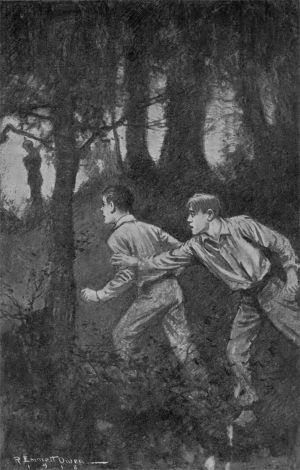 "SH-H-H." SAID TOM IN A TENSE WHISPER. "LOOK—DON'T MOVE. Page 78"
CHAPTER XII — THE DANCE WITH DEATH
The boys were thoroughly frightened, but they stood absolutely
motionless and silent and Tom, at least, retained his presence of mind.
They were not close enough together to communicate with each other, nor
could they more than distinguish each other's forms pressed against the
dark tree trunks.
But the figure, being comparatively in the open, was discernible and
Tom, by concentrating his eyes upon it, satisfied himself beyond a doubt
that it was a human form—that of a German soldier, he felt sure.
Thanks to his stealth and dexterity, they were apparently undiscovered.
He tried to distinguish the bright spot on the cap or helmet, but it was
not visible now, and he thought the man must have turned about.
In his alarm it seemed to him that his breathing must be audible miles
away. His heart seemed in his throat and likely to choke him with every
fresh breath. But he did not stir. Then another little breeze stirred
the trees, sounding clear and solemn in the stillness and Tom moved ever
so slightly in unison with it, hoping by changing his angle of vision to
catch a better glimpse. He could see the bright spot now, the grim
figure standing directly facing him in ghostly silence.
No one moved. And there was no sound save the half audible rustle of
some tiny creature of the night as it hurried over the cushiony ground.
What did it mean? Who was it, standing there? Some grim Prussian
sentinel? Had they, in this remote wilderness, stumbled upon some
obscure pass which the all-seeing eye of German militarism had not
forgotten? Was there, after all, any hope of escape from these demons of
efficiency?
Archer, his chest literally aching from his throbbing breaths, crowded
close behind his tree trunk in terror, startled by every fresh stir of
the fragrant breeze. It seemed to him, as he looked, that the figure
danced a trifle, but doubtless that was only his tense nerves and
blinking eyes playing havoc with his imagination.
There was another rustling in the trees, caused by the freshening night
breeze which Tom thought smelt of rain. And again the silent figure
veered around with a kind of mechanical precision, the very perfection
of clock-work German discipline, as if to give each point of the compass
its allotted moment of attention.
Tom strained his eyes, trying to discover whether that lonely sentinel
were standing in a path or where two paths crossed or where some favored
view might be had of something far off in the country below. But he
could make out nothing.
Suddenly he noticed something large and black among the trees. Its
outline was barely discernible against the less solid blackness of the
night, and it was obscured by the dark tree branches. But as he looked
he thought he could see that it terminated in a little dome, like the
police telephone booths on the street corners away home in Bridgeboro. A
tiny guardhouse, possibly, or shelter for the solitary sentinel.
Perhaps, he thought, this was, after all, a strategic spot which they
had unconsciously stumbled into; a secret path to the frontier, maybe.
He remembered now the talk he had heard in the prison camp, of Germany's
building roads through obscure places in the direction of the Swiss
border for the violation of Swiss neutrality if that should be thought
necessary. These roads were shrouded in mystery, but he had heard about
them and the thought occurred to him that perhaps these poor Alsatian
people—women and children—were being taken to work on these avenues of
betrayal and dishonor.
But try as he would, he could discern no suggestion of path, nor any
other sign of landmark which might explain the presence of this remote
station in the desolate uplands of Alsace. He believed that if they had
taken five steps more they would have been discovered and challenged.
How to withdraw out of the very jaws of this peril was now the question.
He feared that Archer might make an incautious move and end all hope of
escape.
Tom watched the solitary figure through the heavy darkness. And he
marvelled, as he had marvelled before, at the machine-like perfection of
these minions of the Iron Hand. Even in the face of their awful danger
and amid the solemnity of the black night, the odd thought came to him
that this stiff form turning about like a faithful and tireless
weathercock to peer into the darkness roundabout, might be indeed a huge
carved toy fresh from the quaint handworkers of the Black Forest.
As he gazed he was sure that this lonely watcher danced a step or two.
No laughter or sign of merriment accompanied the grim jig, but he was
sure that the solitary German tripped, ever so lightly, with a kind of
stiff grace. Then the freshening breeze blew Tom's rebellious hair down
over his eyes, and as he brushed it aside he saw the German indeed
dancing—there was no doubt of it.
Suddenly a cold shudder ran through him and he stepped out from his
concealment as he realized that this uncanny figure was not standing but
hanging just clear of the ground.
CHAPTER XIII — THE PRIZE SAUSAGE
"Come on out, Archy," said Tom with a recklessness which struck terror
to poor Archer's very soul. "He won't hurt you—he's dead."
"D-e-a-d!" ejaculated Archer.
"Sure—he's hanging there."
"And all the time I wanted to sneeze," said Archer, laughing in his
reaction from fear. "Ebe-nee-zerr, but I had a good scarre!"
Going over to the tree, they saw the ghastly truth. A man wearing a
garment something like a Russian blouse, but of the field-gray military
shade of the Germans (as well as the boys could make out by the aid of a
lighted match) was hanging by his garment which had caught in a low
spreading branch of the tree. His feet were just clear of the ground and
as the breeze blew he swayed this way and that, the gathering strain
upon his garment behind the neck throwing his limp head forward and
giving his shoulders a hunched appearance, quite in the manner of the
clog dancer. The German emblem was blazoned upon his blouse and
superimposed in shining metal upon the front of his fatigue cap. Even as
they paused before him he seemed to bow perfunctorily as if bidding them
a ghastly welcome.
Tom's scout instinct impelled him instantly to fall upon the ground in
search of enlightening footprints, but there were none and this puzzled
him greatly. He felt sure that the man had not been strangled, but had
been killed by impact with some heavier branch higher up in the tree;
but he must have made footprints before he climbed the tree, and——
Suddenly he jumped to his feet, remembering what he had thought to be a
guardhouse. It lay a hundred or more feet beyond the dangling body and
as they neared it it lost its sentinel-station aspect altogether.
"Well—what—do you—know about that?" said Archer.
"It's an observation balloon, I'll bet," said Tom. "A Boche sausage!
Look for another man before you do anything else—there's always two. If
he's around anywhere we might get into trouble yet."
It was a wise thought and characteristic of Tom, but the other man was
quite beyond human aid. He lay, mangled out of all semblance to a human
being, amid the tangled wreckage of the car.
The fat cigar-shaped envelope of the balloon stood almost upright, and
though it looked not the least like a police telephone station now, it
was easy to see how, from a distance in the dim light, it might have
suggested a little round domed building.
"How do you s'pose it happened?" Archer asked.
"I don't know," said Tom. "It's an observation balloon, that's sure.
Maybe it was on its way back from the lines to somewhere or other. Hurry
up, let's see what there is; it'll be daylight in two or three hours and
we don't want to be hanging around here. They might send a rescue party
or something like that, if they know about it."
"Morre likely they don't," said Archer.
"I guess it only happened tonight," said Tom, "or more gas would have
leaked out. Let's hunt for the eats and things."
The wreckage of the car proved a veritable treasure-house. There was a
flashlight and a telescopic field glass, both of which Tom snatched up
with an eagerness which could not have been greater if they had been
made of solid gold. In the smashed locker were two good-sized tins of
biscuit, a bottle of wine and several small tins of meat. Tom emptied
out the wine and filled the bottle with water out of the five-gallon
tank, from which they also refreshed their parched throats. The food
they "commandeered" to the full capacity of their ragged pockets.
"And look at this," said Archer, hauling out a blouse such as the
hanging German wore; "what d'ye say if I wearr it, hey? And the cap,
too? I'll look like an observation ballooner, or whatever you call 'em."
"Good idea," said Tom, "and look!"
"A souveneerr?" cried Archer.
"The best you ever saw," Tom answered, rooting in the engine tool
chest by the aid of the flashlight and hauling out a pair of rubber
gloves.
"What good are those?" said Archer, somewhat scornfully.
"What good! They're a passport into Switzerland."
"Do you have to wear rubber gloves in Switzerland?" Archer asked
innocently, as he ravenously munched a biscuit.
"No, but you have to wear 'em when you're handling electrified wire,"
said Tom in his stolid way.
"G-o-o-d night! We fell in soft, didn't we!"
Indeed, for a couple of hapless, ragged wanderers, subsisting wholly by
their wits, they had "fallen in soft." It seemed that the very things
needed by two fugitives in a hostile country were the very things needed
in an observation balloon. One unpleasant task Tom had to perform, and
that was to remove the blouse from the hanging German and don it
himself, which he did, not without some shuddering hesitation.
"It's the only thing," he said, "that would make anybody think
somebody's been here, and that's just what we've got to look out for.
The other things won't be missed, but if anybody should come here and
see him hanging there without his coat they'd wonder where it was."
However, this was a remote danger, since probably no one knew of the
disaster.
Tom's chief difficulty was in restricting that indefatigable souvenir
hunter, Archer, from loading himself down with every conceivable kind of
useless but interesting paraphernalia.
"You're just like a tenderfoot when he starts out camping," said Tom.
"He takes fancy cushions and a lot of stuff; he'd take a brass bed and a
rolltop desk and a couple of pianos if you'd let him," he added, with
rather more humor than he usually showed. "All we're going to take is
the biscuits and two cans of meat and the flashlight and the field
glass and the bottle, and, let's see——"
"I don't have to leave this dandy ivory cigar-holderr, do I?" Archer
interrupted. "We could use it for——"
"Yes, you do, and we're going to leave that cartridge belt, too, so
chuck it," ordered Tom. "If anybody should come up here we don't want
'em to think somebody else was here before 'em. All we're going to take
is just what I said—some of the eats, and the flashlight and the field
glass and the bottle and the rubber gloves and the pliers and—that's
all."
"Not even this dial-faced thing?" pleaded Archer.
"That's a gas gauge or something," said Tom. "Come on now, let's get
away from here."
Archer pointed the flashlight and cast a lingering farewell gaze upon a
large megaphone. For a brief moment he had wild thoughts of trying to
persuade Tom that this would prove a blessing as a hat, shedding the
pelting Alsatian rains like a church steeple. But he did not quite
dare.
CHAPTER XIV — A RISKY DECISION
"Did you notice that Victrola?" Archer asked fondly.
"Yes, it was busted; did you want that, too?"
"We might have used the arm for a chimney if we were building a fire,"
Archer ventured.
"We'd look nice crawling through these mountains with a Victrola in our
arms. The Fritzies always have a lot of that kind of junk with 'em. They
had one on the submarine that picked me up that time."
They were both now clad in the semi-military blouses worn by the German
"sausage men" and felt that to a casual observer at least they were
disguised. It gave them a feeling of security even in these unfrequented
highlands. And their little store of food refreshed their spirits and
gave them new hope.
What cheered Tom most of all was his precious possession, the rubber
gloves, a detail of equipment which every gas-engine mechanic is pretty
sure to have, though, he regarded the discovery as a rare find. He was
thankful to have found them, for the terrific deadly current which he
knew rushed through the formidable wire entanglement along the frontier
had haunted him and baffled his wits. It was characteristic of Tom to
think and plan far ahead.
All the next day they journeyed through the hills, making a long detour
to avoid a hamlet, and meeting no one. And at night, under the
close-knit shelter of a great pine tree, they rested their weary bodies
and ate the last of their meat and biscuits.
When Tom roused Archer in the morning it was to show him a surprising
view. From their wooded height they could look down across a vast tract
of open country which extended eastward as far as they could see,
running north and south between steep banks. Converging toward it out of
the hills they had followed, they could see a bird's-eye panorama of the
broadening streams, the trickling beginnings of which they had forded
and drunk from, and their eyes followed the majestic water southward
until it wound away among the frowning heights which they had all but
entered.
"It's the Rhine," said Archer, "and that's the real Black Forest where
it goes. Those mountains are in Baden; now I know."
"Didn't I say there must be a big river over that way?" said Tom. "I
knew from the way that ridge went. It's a big one, huh?"
"You said it! Maybe that twig you threw in to see which way it went is
floating down the Rhine now. They'll use it in the Black Forest to make
a toy out of, maybe."
"I s'pose you'd like to have it for a souvenir."
"If we could make a raft we could sail right down, hey?" queried Archer
doubtfully.
Tom shook his head. "It must pass through big cities," he said, "and
we're safe in the mountains. Anyway, it flows the other way," he added.
It was not difficult now for them to piece out a fairly accurate map of
the locality about them. They were indeed near the eastern edge of
Alsace where the Rhine, flowing in a northeasterly direction, separates
the "lost province" from the Duchy of Baden. To the south, on the Baden
side, the mighty hills rolled away in crowding confusion as far as they
could see, and these they knew held that dim, romantic wilderness, the
Black Forest, the outskirts of which they had entered.
Directly below the hill on which they rested was a tiny hamlet nestling
in the shadow of the steep ascent, and when Tom climbed a tree for a
better view he could see to the southwest close by the river a surging
metropolis with countless chimneys sending their black smoke up into the
gray early morning sky.
"I bet it's Berrlin," shouted Archer. "Gee, we'll be the firrst to get
therre, hey? It might be Berrlin, hey?" he added with less buoyancy,
seeing Tom's dry smile.
"It might be New York or Philadelphia," said Tom, "only it ain't. I
guess it must be Strassbourg. I heard that was the biggest place in
Alsace."
They looked at it through their field glass and decided that it was
about twenty miles distant. More to the purpose was the little hamlet
scarce half a mile below them, for their provisions were gone and as Tom
scanned the country with the glass he could see no streams to the
southward converging toward the river. He feared to have to go another
twenty-four hours, perhaps, without food and water.
"We got to decide another thing before we go any farther, too," he said.
"If we're going to hike into those mountains we've got to cross the
river and we'll be outside of Alsace. We won't meet any French people
and Frenchy's button won't do us any good over there. But if we stay on
this side we've got to go through open country. I don't know which is
better."
They were indeed at a point where they must choose between the doubtful
hospitality of Alsace and the safe enveloping welcome of the mountain
fastnesses. Like the true scout he was, Tom inclined to the latter.
"Do you notice," he said, looking down through the glass, "that house
that looks as if it was whitewashed? It's far away from the others."
Archer took the glass and looking down saw a little white house with a
heavy roof of thatch. A tipsy, ramshackle fence surrounded it and in the
enclosure several sheep were grazing. The whole poor farm, if such it
was, was at the end of a long rustic overgrown lane and quite a distance
from the cluster of houses which constituted the hamlet. By scrambling
down the rugged hillside one could reach this house without entering the
hamlet at all.
"If I dared, I'd make the break," said Tom.
"Suppose they should be Gerrmans living therre?" Archer suggested. "I
wouldn't risk it. Can't you see therre's a German flag on a flagpole?"
"That's just it," said Tom. "If I knew they were French people I could
show them Frenchy's button. If I was sure this uniform, or whatever you
call it, was all right, I'd take a chance."
"It's all right at a distance, anyway," Archer encouraged; "as long as
nobody can see yourr face or speak to you."
It was a pretty risky business and both realized it. After three days of
successful flight to run into the very jaws of recapture by an
ill-considered move was not at all to Tom's liking, yet he felt sure
that it would be equally risky to penetrate into that dark wilderness
which stretched away toward the Swiss border without first ascertaining
something of its extent and character, and what the prospect was of
getting through it unseen. Moreover, they were hungry.
Yet it was twilight and the distant river had become a dark ribbon and
the outlines of the poor houses below them blurred and indistinct in the
gathering darkness before Tom could bring himself to re-enter the haunts
of men.
"You stay here," he said, "and I'll go down and pike around. There's one
thing, that house is very old and people don't move around here like
they do in America. So if I see anything that makes me think the house
is French then probably the people are French too."
It was a sensible thought, more dependable indeed than Tom imagined, for
in poor Alsace and Lorraine, of all places, people who loved their homes
enough to remain in them under foreign despotism would probably continue
living in them generation after generation. There is no moving day in
Europe.
CHAPTER XV — HE WHO HAS EYES TO SEE
It was quite dark when Tom scrambled down and, with his heart beating
rapidly, stole cautiously across the hubbly ground toward the
dilapidated brush fence which enclosed the place. The disturbing thought
occurred to him that where there were sheep there was likely to be a
dog, but he would not turn back.
He realized that he was gambling with those hard-won days of freedom,
that any minute he might be discovered and seized. But the courage which
his training as a scout had given him did not forsake him, and he
crossed the fence and stealthily approached the house, which was hardly
more than a whitewashed cabin with two small windows, one door and a
disheveled roof, entirely too big for it as it seemed to Tom. The odd
conceit occurred to him that it ought to be brushed and combed like a
shocky head of hair. Within there was a dim light, and protecting each
window was a rough board shutter, hinged at the top and held open at an
angle by a stick.
He crept cautiously up and examined these shutters with minutest care.
He even felt of one of them and found it to be old and rotten. Then he
felt to see if his precious button was safe in his pocket.
Evidently the dilapidated shutter suggested something to him, for he
glanced about as if looking for something else, and seemed encouraged.
Now he stole a quick look this way or that to anticipate the approach of
any one, and then looked carefully about again.
At last his eyes lit upon the flagpole which was projected diagonally
from the house, with the flag, which he knew must be the German flag,
depending from it. The distant sight of this flag had quite discouraged
Archer's hopes, but Tom knew that the compulsory display of the Teuton
colors was no indication of the sentiment of the people.
He was more interested in the rough, home-made flagpole which he
ventured to bend a little so as to bring its end within reach. This he
examined with a care entirely disproportionate to the importance of the
crude, whittled handiwork. He pushed the drooping flag aside rather
impatiently as it fell over his face, and felt of the end of the pole
and scrutinized it as best he could in the darkness.
It was roughly carved and intended to be ornamental, swelling into a
kind of curved ridge surmounted by a dull, dome-like point. He felt it
all over, then cautiously bending the pole down within reach of his
mouth, he bit into the wood and deposited the two or three loose
splinters in his pocket.
Then he hurried back up the hill to rejoin Archer.
"Let me have the flashlight," he said with rather more excitement than
he often showed. And he would say no more till he had examined the
little splinter of wood in its glare.
"It's all right," he said; "we're safe in going there. See this? It's a
splinter from the flagpole——"
"A souveneerr!" Archer interrupted.
"There you go again," said Tom. "Who's talking about souvenirs? See how
white and fresh the wood is—look. That's off the end of the pole where
it's carved into kind of a fancy topknot. And it was whittled inside of
a year."
"I could whittle it inside of an hour," said Archer.
"I mean it was whittled not longer than a year ago, 'cause even the
weather hasn't got into it yet. And it's whittled like a
fleur-de-lis—kind of," Tom added triumphantly.
"Why didn't you bring the whole of it?"
"When they were building the shacks at Temple Camp," said Tom, "there
was a carpenter who was a Frenchman. I was good friends with him and he
told me a lot of stuff. He always had some wine in his dinner pail. He
showed me how French carpenters nail shingles. Instead of keeping the
nails in their mouths like other carpenters do, they keep them up their
sleeves and they can drop them down into their hands one by one as fast
as they need them. They hit 'em four times instead of two—do you know
why?"
"To drive 'em in," suggested Archer.
"'Cause in France they don't have cedar shingles, like we do; they have
shingles made out of hard wood. And they get so used to hitting the nail
four raps that they can't stop it—that's what he said."
"Here's another one," said Archer. "You can't drive a nail with a
sponge—no matter how you soak it."
"He told me some other things, too," said Tom, ignoring Archer's
flippancy. "He used to talk to me while he was eating his lunch. The way
he got started telling me about the different way they do things in
Europe was when he put the shutters on the big shack. He put the hinges
at the top 'cause that's always the way they do in France. He said in
Italy they put 'em on the left side. In America they put them on the
right side—except when they have two.
"So when I saw the shutters on that old house I happened to notice that
the hinges were at the top and that made me think it was probably a
Frenchman's home."
"Maybe it isn't now even if it was when the shutterrs werre made," said
Archer skeptically.
"Then I happened to remember something else that man told me. Maybe you
think the fleur-de-lis is only a fancy kind of an emblem, but it ain't.
He told me the old monks that used to carve things—no matter what they
carved you could always find a cross, or something like a cross in it.
'Cause they think that way, see? The same as sailors always tattoo
fishes and ships and things on their arms. He said some places in the
Black Forest the toymakers are French peasants and you can always tell
if a fancy thing is carved by them on account of the shape of the
fleur-de-lis. It ain't that they do it on purpose," he added; "it's
because it's in their heads, like. They don't always make regular
fleur-de-lis, but they make that kind of curves. He told me a lot about
Napoleon, too," he added irrelevantly.
"So when I happened to think about that, I looked around to see if I
could find anything to prove it, kind of. It don't make any difference
if the German flag is on that pole; they've got to do that. When I
saw the topknot was carved kind of like a fleur-de-lis I knew French
people must have made it. And it was only carved lately, too," he added
simply, "'cause the wood is fresh."
"Gee whillicums, but you're a peach, Slady!" said Archer ecstatically.
"Shall we take a chance?"
"Of course I don't know for sure," Tom added, "but we've got to go by
signs—just like Indian signs along a trail. If you pick up an old flint
arrowhead you know you're on an Indian trail."
"Christopherr Columbus! But I'd like to find one of those arrowheads
now!" said Archer.
CHAPTER XVI — THE WEAVER OF MERNON
But for all these fine deductions, you are not to suppose that Tom and
Archer approached the little house without trepidation. The nearer they
came to it the less dependable seemed Tom's theory.
"It might be all right in a story book," Archer said, backsliding into
dismal apprehensions. But before he had a chance to lose his courage Tom
had knocked softly on the door. They could hear a scuffling sound inside
and then the door was opened cautiously by a little stooping old man
with a pale, deeply wrinkled face, and long, straight white hair. From
his ragged peasant's attire he must have been very poor and the
primitive furnishings in the dimly lighted room, of which they caught a
glimpse, confirmed this impression. But he had a pair of keen blue eyes
which scrutinized the travellers rather tremulously, evidently supposing
them to be German soldiers.
"What have I done?" he asked fearfully in German.
Tom wasted no time trying to understand him, but bringing forth his iron
button he held it out silently.
The effect was electrical; the old man clutched the button eagerly and
poured forth a torrent of French as he dragged the boys one after the
other into his poor abode and shut the door.
"We're Americans," said Tom. "We can't understand."
"It iss all ze same," said the man. "I will talk in ze American. How you
came with ziss button—yess? Who have sent you?"
To Tom's surprise he spoke English better than either Florette or her
brother, and the boys were infinitely grateful and relieved to hear
their own language spoken in this remote place.
"We are Americans," said Tom. "We escaped from the prison camp across
the Alsace border, and we're on our way to the frontier. I knew you were
French on account of the fleur-de-lis on the end of your flagpole——"
"And ze button—yess?" the old man urged, interrupting him.
Tom told him the whole story of Frenchy and the Leteurs, and of how he
had come by his little talisman.
"I have fought in zat regiment," the old man said, "many years before
you are born. I have seen Alsace lost—yess. If you were Germans I would
die before I would give you food. But I make you true welcome. I have
been many years in America. Ah, I have surprise you."
"What is this place?" Archer ventured to ask.
"Ziss is Mernon—out of fifty-two men they take forty-one to ze
trenches. My two sons, who are weavers too, they must go. Now they take
the women and the young girls."
Further conversation developed the fact that the old man had worked in a
silk mill in America for many years and had returned to Alsace and this
humble place of his birth only after both of his sons, who like himself
were weavers, had been forced into the German service. "If I do not come
back and claim my home, it is gone," he said. So he had returned and was
working the old hand loom with his aged fingers, here in the place of
his birth.
He was greatly interested in the boys' story and gave them freely of his
poor store of food which they ate with a relish. Apparently he was not
under the cloud of suspicion or perhaps his age and humble condition
and the obscurity and remoteness of his dwelling gave him a certain
immunity. In any event, he carried his loathing of the Germans with a
fine independence.
"In America," he said, "ze people do not know about ziss—ziss beast.
Here we know. Here in little Mernon our women must work to make ze
road down to ze river. Why is zere needed a road to ze river? Why is
zere needed ze new road above Basel? To bring back so many
prisoners—wounded? Bah! Ziss is what zey say. Lies! I have been a
soldier. Eighty-two years I am old. And much I have travelled. So can I
see. What you say in Amerique—make two and two together—yess? Zere
will be tramping of soldiers over zese roads to invade little
Switzerland. Am I right? If it is necessaire—yess! Necessaire!
Faugh!"
This was the first open statement the boys had heard as to the new
roads, all of which converged suspiciously in the direction of the Swiss
frontier. They were for bringing home German wounded; they were to
facilitate internal communication; they were for this, that and the
other useful and innocent purpose, but they all ran toward the Swiss
border or to some highway which ran thither.
"Ziss is ze last card they have to play—to stab little Switzerland in
ze back and break through," the old man said. "In ze south runs a road
from ze trench line across to ze Rhine. Near zere I have an old
comrade—Blondel. Togezzer we fight side by side, like brothers. When ze
boat comes, many times he comes to see me. Ze last time he come he tell
me how ze new road goes past his house—all women and young girls
working. It comes from ziss other road zat goes from ze trenches over to
ze Rhine. South it goes—you see?" he added shrewdly. "So now if you are
so clevaire to see a fleur-de-lis where none is intentioned, so zen you
can tell, maybe, why will zey build a road zat goes south?"
Tom, fascinated by the old man's sagacity and vehemence, only shook his
head.
"Ah, you are not so clevaire to suspect! Ziss is Amerique! Nevaire will
she suspect."
Tom did not altogether like this reference to Uncle Sam's gullibility,
but he contented himself with believing that it was meant as a thing of
the past.
"They can't flim-flam us now," Archer ventured.
"Flam-flim—no," the old man said, with great fervor.
"Maybe that's where they took my friend's sister and his mother," Tom
said.
"I will tell you vere zey take them," the old man interrupted. "You know
Alsace—no? So! See! I tell you." He approached, poking Tom's chest with
his bony finger and screwing up his blue eyes until he seemed a very
demon of shrewdness. They wondered if he were altogether sane.
"Nuzzing can zey hide from Melotte," he went on. "Far south, near Basel,
zere lives my comrade—Blondel. To him must you show your button—yess.
In Norne he lives."
"We'll write that down," said Tom.
"Nuzzing you write down," the old man said sharply, clutching Tom's arm.
"In your brain where you are so clevaire—zere you write it. So! You are
not so clevaire as Melotte. Now I will show you how you shall find
Mam'selle," he went on with a sly wink.
Emptying some wool out of a paper bag, he pressed the wrinkles from the
bag with his trembling old hand and bending over the rough table close
to the lantern, he drew a map somewhat similar to, though less complete
than, the one given here.
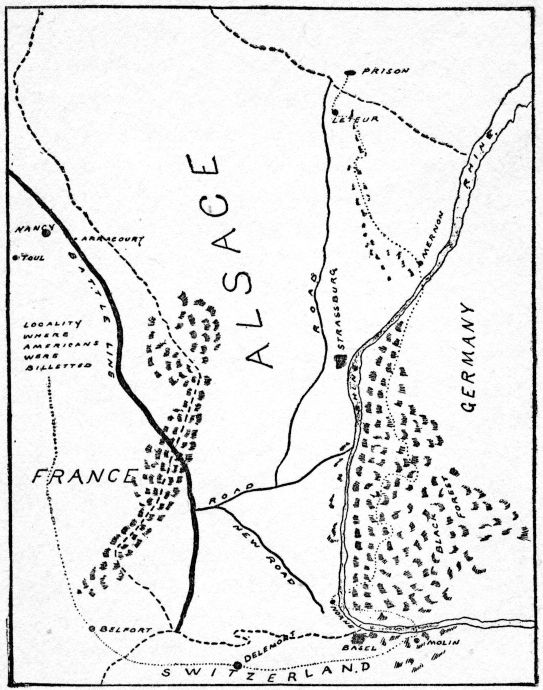 SHOWING THE ROUTE TAKEN BY TOM AND ARCHER.
There is nothing like a map to show one "where he is at," to quote
Archer's phrase, and the boys followed with great interest as Melotte
penciled the course of the Rhine and the places which he wished to
emphasize in the southern part of Alsace.
"Here at Norne lives my comrade, Blondel," he said. "Two years we work
togezzer at Passake—you know? In ze great silk mills."
"Passaic," said Tom; "that's near Bridgeboro, where I live."
"Passake, yess. So now you are so clevaire to know who shall leeve in
a house, I will tell you how you shall know ze house of my comrade,
Blondel. By ze blue flag with one black spot! Yess? You know what ziss
shall be? Billet!" He gave Archer a dig in the ribs as if this
represented the high water mark of sagacity.
"Oh, I know," said Archer; "it means Gerrman officerrs are billeted
therre. Go-o-od night! Not for us!"
The old man did not seem quite to understand, but he turned again to his
map. "Here now is ze new road," he said, drawing it with his shaky old
hand. "From ze Rhine road it runs—south—so. Now you are so
clevaire—Yankee clevaire, ha, ha, ha!" he laughed with a kind of
irritating hilarity; "why should zey make ziss road? From ze north—from
Leteur—all around—zey bring our women to make ziss road. Ziss is
where Mam'selle is—so! Close by it lives my comrade, Blondel. Ziss is
noble army to command, ugh!" He gritted his teeth. "All are women!"
Tom looked at the map, as old Melotte poised his skinny finger above it
and peered eagerly up into his face from the depths of his scraggly
white hair. It was little enough Tom knew about military affairs and he
thought that this lonesome old weaver was in his dotage. But surely this
new road could be for but one purpose, and that was the quick transfer
of troops from the Alsatian front to the Swiss border. And the sudden
conscription of women and girls for the making of the road seemed
plausible enough. Could it be that this furnished a clew to the
whereabouts of Florette Leteur? And if it did, what hope was there of
reaching her, or of rescuing her?
He listened only abstractedly to the old man's rambling talk of
Germany's intention to violate Swiss neutrality if that became necessary
to her purpose. His eyes were half closed as he looked at the rough
sketch and he saw there considerably more than old Melotte had drawn.
He saw Frenchy's sister Florette, slender and frail, wielding some
heavy implement, doing her enforced bit in this work of shameless
betrayal. He could see her eyes, sorrow-laden and filled with fear. He
could see her as she had stood talking with him that night in the arbor.
He could see her, orphaned and homeless, slaving under the menacing
shadow of a German officer who sprawled and lorded it in the poor home
of this Blondel close by the new road. Here he climb to drop ze grapes
down my neck. Bad boy! Strange, how that particular phrase of hers
singled itself out and stuck in his memory.
"So now you are so clevaire," he half heard old Melotte saying to
Archer.
And Tom Slade said nothing, only thought, and thought, and thought....
CHAPTER XVII — THE CLOUDS GATHER
"We never thought about asking him to translate that letterr," said
Archer.
"I'm not thinking about that letter," Tom answered. "All I'm thinking
about now is what he said about that new road. I'm not even thinking
about their going through Switzerland, either," he added with great
candor. "I'm thinking about Frenchy's sister. If they've got her working
there I'm going to rescue her. I made up my mind to that."
"Some job!" commented Archer.
"It don't make any difference how much of a job it is," said Tom, with
that set look about his mouth that Archer was coming to know and
respect.
They were clambering up the hillside again, for not all old Melotte's
hospitable urging could induce Tom to remain in the hut until daylight.
He would have liked to take along the rough sketch which the old man
had made, but this Melotte had strenuously opposed, saying that no maps
should be carried by strangers in Germany. So Tom had to content himself
with the old man's rather rambling directions.
Several things remained indelibly impressed on his mind. Old Melotte had
told him that upon the western bank of the Rhine about fifteen miles
above the Swiss border was an old gray castle with three turrets, and
that directly opposite this and not far from the Alsatian bank was the
little village of Norne.
"The way I make it out," said Archer, "is that this Blondel, whoeverr he
is, has got some Gerrman officerr wished on him and that geezerr has
charrge of the women worrking on the new road. I'd like to know how you
expect to get within a mile of those people in the daytime."
"We got plenty of time to think it out," Tom answered doggedly, "'cause
we'll be in the woods a couple of days and nights and that's where
thoughts come to you."
"We'd be big fools, afterr gettin' all the way down to the frontierr to
cross the riverr and go huntin' forr a road in broad daylight," said
Archer; "we'd only get caught."
"Well, we'll get caught then," retorted Tom.
"Anyway, I think the old fellow's half crazy," Archer persisted. "He's
got roads on the brain. He jumps all around from Norrne to Passaic
and——"
"He gave us something to eat," said Tom curtly.
"Well, I didn't say he didn't, did I?" Archer snapped. "If we'd had any
sense, we'd have stayed therre all night like he wanted us to. Therre
wouldn't have been any dangerr in that old shack, a hundred miles from
nowherre."
"We're safest in the hills," said Tom.
"It's going to rain, too," Archer grumbled.
Tom made no answer and they scrambled in silence up the uninviting
hillside, till old Melotte's shack could be seen far below with the dim
light in its windows.
"You'rre so particularr about not bein' caught," Archer began again,
"it's a wonder you wouldn't think morre about that when we get down
close to the borrderr. If I've got to be caught at all I'd ratherr be
caught now."
They had regained the height above the little hamlet and to the south
they could see the clustering lights of Strassbourg and here and there a
moving light upon the river.
"We've got to cross that, too, I s'pose," Archer said sulkily.
Tom did not answer. The plain fact was that they were both thoroughly
tired out, with that dog-tiredness which comes suddenly as a reaction
after days of nerve-racking apprehension and hard physical effort. For
the first two days their nervous excitement had kept them up. But now
they were fagged and the tempting invitation to remain at the hovel had
been too strong for Archer. Moreover, this new scheme of Tom's to divert
their course in a hazardous quest for Florette Leteur was not at all to
his liking. But mostly he was tired and everything looks worse when one
is tired.
"We're not going to keep on hiking it tonight, are we?" he demanded.
"You said yourself that the old man was kind of—a little off, like,"
Tom answered patiently. "He's got the bug that he's very shrewd and that
he can always get the best of the Germans. Do you think I'd take a
chance staying there? We took a chance as it was."
"Yes, and you'rre going to take a biggerr one if you go chasing all over
Gerrmany after that girrl. You won't find herr. That was a lot of
rattlebrain talk anyway—we're so clevaire!"
"There's no use making fun of him," said Tom; "he helped us."
"We'll get caught, that'll be the end of it," said Archer sullenly. Tom
did not answer.
"You seem to be the boss of everything, anyway."
They scrambled diagonally down the eastern slope of the high ground,
heading always toward the river and after an hour's travelling came out
upon its shore.
"Here's where we'll have to cross if we're going to cross at all," said
Tom. "What do you say?"
"I haven't got anything to say," said Archer; "you're doin' all the
saying."
"If we go any farther south," Tom went on patiently, "we'll be too near
Strassbourg and we're likely to meet boats. Listen."
From across the river came the spent whistle of a locomotive accompanied
by the rattling of a hurrying train, the steady sound, thin and clear in
the still night, mingling with its own echoes. A few lights, widely
separated, were visible across the water and one, high up, reassured Tom
that the mountains, the foothills of which they had followed, continued
at no great distance from the opposite shore.
There were welcoming fastnesses over there, he knew, and a dim, wide
belt of forest extending southward. There, safe from the haunts of men,
or at least with timely warning of any hamlets nestling in those sombre
depths, he and his comrade might press southward toward that promised
land, the Swiss border.
Yet, strangely enough (for one side of a river is pretty much like the
other) Tom felt a certain regret at the thought of leaving Alsace.
Perhaps his memory of the Leteurs had something to do with this. Perhaps
he had just the boyish feeling that it would change their luck. And he
knew that over there he would be truly in the enemy's country, with the
magic of his little talisman vanished in air.
Yet right here he must decide between open roads and stealthy
hospitality and that silent, embracing hospitality which the lonesome
heights would offer. And he decided in favor of the lonesome heights.
Perhaps after all it was not the enemy's country, though the names of
Baden and Schwarzwald certainly had a hostile sound.
But the rugged mountains and dim woods are never enemies of the scout,
and perhaps Tom Slade of Temple Camp felt that even the Schwarzwald,
which is the Black Forest, would forget its allegiance to whisper its
secrets in his ear.
CHAPTER XVIII — IN THE RHINE
"What do you say?" said Tom. "It's up to both of us."
"Oh, don't mind me," Archer answered sarcastically. "I don't count. I
know one thing—I'm going to head straight for the Swiss borderr. If
crossing the river herre's the quickest way to do it, then that's what
I'm going to do, you can bet!"
For a moment Tom did not speak, then looking straight at Archer, he
said,—
"You don't forget how she helped us, do you?"
"I'm not saying anything about that," said Archer. "My duty's to Uncle
Sam. You've got the crazy notion now that you want to rescue a girrl,
just like fellerrs do in story books. If you'rre going to be thinking
about herr all the time I might as well go by myself. I could get along
all right, if it comes to that."
"Well, I couldn't," said Tom, with a note of earnestness in his voice.
"Anyway, there's no use of our scrapping about it 'cause I don't
suppose we'll find her. As long as we're going south through the
mountains we might as well see if we can pick out Norne with the glass.
Maybe we could even see that feller Blondel's house. The old man said
the west slopes of the mountains were steep and that they run close to
the river down there, so we ought to be able to pick out Norne with the
glass. There isn't any harm in that, is there?" he added conciliatingly,
"as long as we've got the glass?"
Archer maintained a sullen silence.
"I know we've got to think about Uncle Sam, and I know you're
patriotic," said Tom generously, "and we can't afford to be taking big
chances. But if you had known her brother, you'd feel the way I
do—that's one sure thing."
"I wouldn't run the risk of getting pinched and sent back to prison just
on account of a girrl," said Archer scornfully. "That's one sure
thing," he added, sulkily mimicking Tom's phrase.
"That ain't the way it is," said Tom, flushing a little. "I ain't—if
that's what you mean. Anyway, I admit we got to be careful, and I
promise you if we can't spy out the house and the road with the glass I
won't cross the river again till we get to the border."
"First thing you know somebody'll come along if we keep on standing
here," said Archer.
"Here, you take one of these rubber gloves," said Tom. "Shut the glass
and see if it'll go inside. I'll put the flashlight and the compass in
the other one. It's going to rain, too. Here, let me do it," he added
rather tactlessly, as he closed the little telescope and forced its
smaller end down into the longest of the big glove fingers. "Twist the
top of it and turn the edges over, see?" he added, doing it himself,
"and it's watertight. I can make a watertight stopple for a bottle with
a long strip of paper, but you got to know how to wind it," he added,
with clumsy disregard of his companion's mood. Tom was a hopeless
bungler in some ways.
"Oh, surre, you can do anything," said Archer.
"Maybe it would be best if you held it in your teeth," said Tom
thoughtfully; "unless you can swim with it in your hand."
The compass and the flashlight, which indeed were more susceptible of
damage from the water than the precious glass, were encased in the other
rubber glove, and the two fugitives waded out into the black, silent
river.
Scarcely had their feet left the bottom when the first drop of rain fell
upon Tom's head, and a chill gust of wind caught him and bore him a
yard or two out of his course. He spluttered and looked about for
Archer, but could see nothing in the darkness. He did not want to call
for he knew how far voices carry across the water, and though the spot
was isolated he would take no chances.
It rained hard and the wind, rising to a gale, lashed the black water
into whitecaps. Tom strove vainly to make headway against the storm, but
felt himself carried, willy-nilly, he knew not where. He tried to
distinguish the light beyond the Baden shore, which he had selected for
a beacon, but he could not find it. At last he called to Archer.
"I'm going to turn back," he said; "come on—are you all right?"
If Archer answered his voice was drowned by the wind and rain. For a few
moments Tom struggled against the elements, hoping to regain the
Alsatian shore. His one guiding instinct in all the hubbub was the
conviction that the wind smelled like an east wind and that it ought to
carry him back to the nearer shore. He would have given a good deal for
a glimpse of his precious little compass now.
"Where are you?" he called again. "The light's gone. Let the wind carry
you back—it's east."
He could hear no answer save the mocking wind and the breaking of the
water. This latter sound made him think the shore was not far distant.
But when, after a few moments, he did not feel the bottom, his heart
sank. He had been lost in the woods and as a tenderfoot he had known the
feeling of panic despair. And he had been in the ocean and seen his ship
go down with a torpedo's jagged rent in her side. But he had never been
lost in the water in the sense of losing all his bearings in the
darkness. For a minute it quite unnerved him and his stout heart sank
within him.
Then out of the tumult came a thin, spent voice, barely audible and
seeming a part of the troubled voices of the night.
"——lost——," it said; "——going down——"
Tom listened eagerly, his heart still, his blood cold within him.
"Keep calling," he answered, "so I'll know where you are. I'll get to
you all right—keep your nerve."
He listened keenly, ready to challenge the force of the storm with all
his young skill and strength, and thinking of naught else now. But no
guiding voice answered.
Could he have heard aright? Surely, there was no mistaking. It was a
human voice that had spoken and whatever else it had said that one,
tragic word had been clearly audible:
"——down——"
Archer had gone down.
CHAPTER XIX — TOM LOSES HIS FIRST CONFLICT WITH THE ENEMY
"Down!"
For the first time in Tom Slade's life a sensation of utter despair
gripped him and it was not until several seconds had elapsed, while he
was tossed at the mercy of the storm, that he was able to get a grip on
himself. He struck out frantically and for just a brief minute was
guilty of a failing which he had never yielded to—the perilous weakness
of being rattled and hitting hard at nothing. In swimming, above all
things, this is futile and dangerous, and presently Tom regained his
mental poise and struck out calmly, swimming in the direction in which
the wind bore him, for there was nothing else to do. Not that his effort
helped him much, but he knew the good rule that one should never be
passive in a crisis, for inaction is as depressing to the spirit as
frantic exertion is to the body. And he knew that by swimming he could
keep his "morale"—a word which he had heard a good deal lately.
His heart was sick within him and a kind of cold desperation seized him.
Archer, whom he had known away back home in America, whom he had found
by chance in the German prison camp, who had trudged over the hills and
through the woods with him, was lost. He would never see him again.
Archer, who was always after souvenirs....
These were not thoughts exactly, but they flitted through Tom's
consciousness as he struggled to keep his head clear of the tempestuous
waters. And even in his own desperate plight he recalled that their last
words had been words of discord, for he knew now (generous as he was)
that he was to blame for this dreadful end of all their fine
hopes—that Archer had been right—they should have stayed at Melotte's
hovel. Amid the swirl of the waters, as he swam he knew not where, he
remembered how Archer had said he ought to think of his duty to Uncle
Sam and not imperil his chance to help by going after Florette Leteur.
He was sick, utterly sick, and nearer to hopelessness than he had ever
been in his life; but he struck out in a kind of mechanical resignation,
believing that the wind and the trend of the water must bring him to one
shore or the other before he was exhausted. There was no light anywhere,
no clew or beacon of any sort in that wild blackness, and since he
therefore had no reason to oppose his strength to the force of the storm
he swam steadily in the direction in which it carried him. It made no
difference. Nothing mattered now....
After a while the noise of the lashing changed to that lapping sound
which only contact with the land can give, and soon Tom could
distinguish a solid mass outlined in the hollow blackness of the night.
He had no guess whether it was the Baden or the Alsatian shore that he
was approaching nor how far north or south he had been carried. Nor did
he much care.
His foot touched something hard which brought him to the realization
that he must lessen the force of his advance or perhaps have his life
dashed out upon a rocky shore; and presently he was staggering forward,
brushing his hair away from his eyes, wondering where he was, and
scarcely sensible of anything—his head throbbing, his whole body on the
verge of exhaustion.
"It's my fault—anyway—I got to admit it——" he thought, "and—it
serves—me—right."
One firm resolution came to him. Now that Providence had seen fit to
cast him ashore, if he was to be permitted to continue his flight alone,
he would go straight for his goal, the Swiss border, and not be led
astray (that is what he called it, led astray) by any other
enterprise. His duty as a soldier, and he thought of himself as a
soldier now, was clear. His business was to help Uncle Sam win the war
and he must leave it to Uncle Sam to put an end to the stealing of young
girls and to restore them to their homes. He saw himself now, as Archer
had depicted him, in the silly role of a "story book hero" and he felt
ashamed. He knew that General Pershing would not have sent him rescuing
girls, and that the best way he could help France, and even the Leteurs,
was to hurry up and get into the trenches where he belonged. Yes, Archer
was right. And with a pang of remorse Tom remembered how Archer had said
it, "rescuing a girrl!" He would never hear Archer talk like that any
more....
He had more than once been close enough to death to learn to keep his
nerve in the presence of it, but the loss of his companion quite
unnerved him. It had not occurred to him that anything could happen to
Archer, who claimed himself that he always landed right side up because
he was lucky. Tom could not realize that he was gone.
Still, comrades were lost to each other every day in that far-flung
trench line and in that bloody sea of northern France friends were
parted and many went down.
"Down——"
How that awful word had sounded—long drawn out and faint in the storm
and darkness!
He stumbled over a rocky space and ran plunk into something solid. As he
looked up he could distinguish the top of it; uneven and ragged it
seemed against the blackness of the night. Whatever it was, it seemed to
be slender and rather high, and the odd thought came to him that he was
on the deck of some mammoth submarine, looking up at the huge conning
tower. Perhaps it was because he had once been rescued by a submarine,
or perhaps just because his wits were uncertain and his nerves unstrung,
but it was fully a minute before he realized that he was on solid
earth—or rock. It afforded him a measure of relief.
What that grim black thing could be that frowned upon him he did not
know, and he staggered around it, feeling it with his hands. It was of
masonry and presently he came to what was evidently a door, which opened
as he leaned against it. Its silent hospitality was not agreeable to
him; the very thought of a possible German habitation roused him out of
his fatigue and despair, and with a sudden quick instinct he drew
stealthily back until presently he felt the water lapping his feet
again.
Here, at a comparatively safe distance, he paused for breath after what
he felt to be a worse peril than the storm, and felt for the one trusty
friend he had left—the little compass. The precious rubber glove
containing this and the flashlight was safe in his pocket, and he held
both under his coat and tried to throw the light upon the compass and
get his bearings. But the glove must have leaked, for the battery was
dead. The little compass, which was to prove so useful in days to come,
was probably still loyal after its immersion, but he could not
distinguish the dial clearly.
He knew he must go southeast, where the dim woods seemed now to beckon
him like a living mother. Never had the thought of the mountains and the
lonely forest been so grateful to this scout before. If only he had
strength to get there....
"What you got to do—you do," he panted slowly under his breath,
frowning at the compass and trying in the darkness to see which way that
faithful little needle turned. Once, twice, he looked fearfully up
toward that grim building.
Then he decided, as best he might, which direction was southeast and
dragged his aching legs that way until presently he was stumbling in
the water again.
Surely, he thought, the river ran almost north and south, and southeast
must lead on into the mountains. But perhaps he had not read the
compass aright or perhaps he was on the edge of a deep bay, which would
mean water extending still westward. Or perhaps he was on the Alsatian
shore.
For a moment he stood bewildered. Then he tried to read the compass
again and started forward in the direction which he thought to be west.
If he were on the Alsatian shore, this should take him away from that
black, heartless Teuton ruin.
But it only took him into a chaos of broken, shiny rock where he
stumbled and fell, cutting his knee and making his head throb cruelly.
And then Tom Slade, seeing that fate was against him, and having used
all the resource and young strength that he had, to get to the boys
"over there," gave up and lay among the jagged rocks, holding his head
with one bruised hand and thinking hopelessly of this end of all his
efforts.
CHAPTER XX — A NEW DANGER
He did not know how long he lay there, but after a while he crept along
over the slimy rocks and because it was not easy to stand alone he
limped to that grim, threatening structure, and leaned against it,
trying to collect his faculties.
"If he was—only here now," he breathed, half aloud, "I'd let him—I'd
be willing not to be boss—like he said. That's the—trouble—with
me—I'm always wanting to—be——Oh, my head——"
He knew now, what it was a pretty hard thing for one of his indomitable
temperament to realize, that things were out of his hands, that he could
go no farther. North or south or east or west, he could go no farther.
Capture or firing squad or starvation and death from exhaustion, he
could go no farther. His name would not be sent home on the casualty
lists, any more than Archer's would, but they had tried, and done
their bit as well as they could.
There was one faint hope left; perhaps this house was not occupied, or
if it was on the Alsatian side of that terrible river (a true Hun river,
if there ever was one) it might be occupied by a Frenchman. Scarcely
knowing what he was doing, Tom pushed the door open and staggered
inside. Dazed and suffering as he was, he was conscious of the rain
pelting on the roof above him and sounding more audibly than outside
where the boisterous river drowned the sound of the downpour.
Something big and soft which caught in his feet was directly before him
and he stumbled and fell upon it. And there he lay, pressing his
throbbing forehead, which seemed bursting with fresh pain from the force
of his fall.
He had a reckless impulse to end all doubt by calling aloud in utter
abandonment. But this impulse passed, perhaps because he did not have
the strength or spirit to call.
Soon, from mere exhaustion, he fell into a fitful, feverish slumber
accompanied by a nightmare in which the lashing of the wind and rain
outside were conjured into the clangor and hoof beats of cavalry and he
was hopelessly enmeshed in a barbed-wire entanglement.
With the first light of dawn he saw that he was lying upon a mass of
fishnet and that his feet and arms were entangled in its meshes.
He was in a small, circular apartment with walls of masonry and a broken
spiral stairway leading up to a landing beside a narrow window. Rain
streamed down from this window and trickled in black rivulets all over
the walls. A very narrow doorway opened out of this circular room, from
which the door was broken away, leaving two massive wrought-iron hinges
sticking out conspicuously into the open space. As Tom's eyes fell upon
these he thought wistfully of how eagerly Archer would have appropriated
one of them as a "souveneerr." Poor, happy-go-lucky Archer!
"I thought he was a good swimmer," Tom thought, "because he lived so
near Black Lake.[A] It was all my fault. He probably just didn't like to
say he wasn't——"
He closed his eyes for a moment, trying to ease the pain in his head and
collect his scattered senses. Evidently, he was alone in this dank
place, for there was no sign of occupancy nor any sound but the light
patter of rain without, for the storm had spent its fury and subsided
into a steady drizzle.
He dragged himself to his feet, and though his knee was stiff he was
glad to discover that he was not incapable of walking. He believed he
was not feverish now and that his headache was caused by shock and
bruising rather than by illness. Perhaps, he thought, he was not so
badly off after all. Except for Archer....
Limping to the doorway he peered cautiously out. The sky was dull and
hazy and a steady, drizzling rain fell. There is something about a
drear, rainy day which "gets" one, if he has but a makeshift shelter;
and this bleak, gray morning carried poor Tom's mind back with a rush to
rainy days at his beloved Temple Camp when scouts were wont to gather in
tent and cabin for yarns.
He now saw that he was on a little rocky islet in the middle of the
river and that the structure which had sheltered him was a small tower,
very much like a lighthouse except that it was not surmounted by a
light, having instead that rough turret coping familiar in medieval
architecture. Far off, through the haze, he could distinguish, close to
the shore, a gray castle with turrets, which from his compass he knew to
be on the Baden side. He thought he could make out a road close to the
shore, and other houses, and he wished that he had the spy-glass so that
he might study this locality which he hoped to pass through.
Of course, he no longer cherished any hope of finding Florette Leteur;
Archer's chiding words still lingered in his mind, and, moreover,
without the glass he could do nothing for he certainly would never have
thought of entering Norne without first "piking" it from a safe vantage
point.
There was nothing to do now but nurse his swollen knee and rest, in the
hope that by night he would be able to swim to the Baden shore and get
into the hills. Never before had he so longed for the forest.
"If it wasn't for—for him being lost," he told himself, as he limped
back into the tower, "I wouldn't be so bad off. There's nobody lives
here, that's sure. Maybe fishermen come here, but nobody'll come today,
I'll bet."
After all, luck had not been unqualifiedly against him, he thought. Here
he was in an isolated spot in the wide river. What was the purpose of
this little tower on its pile of rocks he could not imagine, but it was
fast going to ruin and save for the rotting fishing seine there was no
sign of human occupancy.
If only Archer were there it would not be half bad. But the thought of
his companion's loss sickened him and robbed the lonely spot of such
aspect of security as it might otherwise have had for him. Still, he
must go on, he must reach the boys in France, and fight for Archer too,
now—Archer, whom his own blundering had consigned to death in these
treacherous waters....
He looked out again through the doorway at the dull sky, and the rain
falling steadily upon the sullen water. It was a day to chill one's
spirit and sap one's courage. The whole world looked gray and cheerless.
Again, as on the night before, he heard the rattle of a train in the
distance. High up through the drenched murky air, a bird sped across the
river, and somehow its disappearance among the hills left Tom with a
sinking feeling of utter desolation. In Temple Camp, on a day like this,
they would be in Roy Blakeley's tent, telling stories....
"Anyway, it's better to be alone than in some German's house," he tried
to cheer himself. "We—I—kept away from 'em so far, anyway——"
He stopped, holding his breath, with every muscle tense, and his heart
sank within him. For out of that inner doorway came a sound—a sound
unmistakably human—tragically human, it seemed now, shattering his
returning courage and leaving him hopeless.
It was the sound of some one coughing!
CHAPTER XXI — COMPANY
Ordinarily Tom Slade would have stopped to think and would have kept his
nerve and acted cautiously; but he had not sufficiently recovered his
poise to meet this emergency wisely. He knew he could not swim away,
that capture was now inevitable, and instead of pausing to collect
himself he gave way to an impulse which he had never yielded to before,
an impulse born of his shaken nerves and stricken hope and the sort of
recklessness which comes from despair. What did it matter? Fate was
against him....
With a kind of defiant abandonment he limped to the little stone doorway
and stood there like an apparition, clutching the sides with trembling
hands. But whatever reckless words of surrender he meant to offer froze
upon his lips, and he swayed in the opening, staring like a madman.
For reclining upon a rough bunk, with knees drawn up, was Archibald
Archer, busily engaged in whittling a stick, his freckled nose wrinkling
up in a kind of grotesque accompaniment to each movement of his hand
against the hard wood.
"I—I thought——" Tom began.
"Well,—I'll—be——" countered Archer.
For a moment they stared at each other in blank amaze. Then a smile
crept over Tom's face, a smile quite as unusual with him as his sudden
spirit of surrender had been; a smile of childish happiness. He almost
broke out laughing from the reaction.
"Are you carvin' a souvenir?" he said foolishly.
"No, I ain't carrvin' no souveneerr," Archer answered. "Therre's fish
among those rocks and I'm goin' to spearr 'em."
"You ain't carvin' a what!" said Tom.
"I ain't carrvin' a souveneerr," Archer said with the familiar Catskill
Mountain roll to his R's.
"I just wanted to hear you say it," said Tom, limping over to him and
for the first time in his life yielding to the weakness of showing
sentiment.
"All night long," he said, sitting down on the edge of the bunk, "I was
thinkin' how you said it—and it sounds kind of good——"
"How'd you make out in the riverr?" Archer asked.
"You can't even say river," said Tom, laughing foolishly in his great
relief.
"It was some storrm, all right! But I got the matches safe anyway, and
they'll strike, 'cause I tried one."
"You ought to have made a whisk stick[A] to try it," said Tom, then
caught himself up suddenly. "But I ain't going to tell you what you
ought to do any more. I'm goin' to stop bossin'."
"I got yourr spy-glass forr you," said Archer. "I had to dive f'rr't.
Didn't you hearr me call to you it was lost and I was goin' down
f'rr't?"
"——lost——down——"
The tragic words flitted again through Tom's mind, and he reached out
and took Archer's hand hesitatingly as if ashamed of the feeling it
implied.
"What'd you do that for? You were a fool," he said.
"What you got to do, you do," said Archer; "that's what you'rre always
sayin'. Didn't you say you wanted it so's you could see that fellerr
Blondel's house from the mountains? Therre it is," he said, nodding
toward an old ring-net that stood near, "and it's some souveneerr too,
'cause it's been at the bottom of the old Rhine."
Tom looked at the spy-glass which Archer had thrown into the net and the
net seemed all hazy and tangled for his eyes were brimming. He would not
spare himself now.
"I see I'm the fool," he stammered; "I thought I shouldn't have started
across because maybe you couldn't swim so good and didn't want to admit
it."
"Me? I dived in Black Lake before you werre borrn," said Archer. This
was not quite true, since he was two years younger than Tom, but Tom
only smiled at him through glistening eyes.
"I see now I was crazy to think about finding her—anyway——"
"You haven't forrgot how she treated us, have you?" Archer retorted,
quoting Tom's own words. "It came to me all of a sudden, when I dropped
the glove, and that's when I called to you. And all of a sudden I
thought how you walked back toward the house with herr that night
and—and—do you think I don't understand—you darrned big chump?"
CHAPTER XXII — BREAKFAST WITHOUT FOOD CARDS
"Do you know what I think?" said Archer. "If Alsace used to belong to
France, then the Rhine must have been the boundary between France and
Gerrmany and we'rre right on that old frontierr now—hey? I'm a smarrt
lad, huh? They used to have watch towers and things 'cause I got kept in
school once forr sayin' a poem wrong about a fellerr that was in a watch
towerr on the Rhine. I bet this towerr had something to do with that old
frontierr and I bet it was connected with that castle overr on shorre,
too. Therre was a picture of a fellerr in a kind of an arrmorr looking
off the top of a towerr just like this—I remember 'cause I marrked him
up with a pencil so's he'd have a swallerr-tailed coat and a sunbonnet."
Archer's education was certainly helping him greatly.
"If we could once get overr therre into that Black Forest," he
continued, scanning the Baden shore and the heights beyond with the
rescued glass, "we'd be on easy street 'cause I remember gettin' licked
forr sayin', 'the abrupt west slopes of this romantic region are
something or otherr with wild vineyards that grow in furious
thing-um-bobs——'"
"What?" said Tom.
"Anyway, there's lots of grapes there," Archer concluded.
"If that's the way you said it I don't blame 'em for lickin' you," said
sober Tom. "I think by tonight I'll be able to swim it. There seems to
be some houses over there—that's one thing I don't like."
The Baden side, as well as they could make out through the haze, was
pretty thickly populated for a mile or two, but the lonesome mountains
arose beyond and once there, they would be safe, they felt sure.
They spent the day in the dilapidated frontier tower, as Archer called
it, and he was probably not far from right in his guess about it.
Certainly it had not been used for many years except apparently by
fishermen occasionally, and the rotten condition of the seines showed
that even such visitors had long since ceased to use it. Perhaps indeed
it was a sort of outpost watch tower belonging to the gray castle which
they saw through the mist.
"Maybe it belonged to a Gerrman baron," suggested Tom.
"Anyway, it's a barren island," said Archer; "are you hungry?"
Tom sat in the doorway, favoring his hurt knee, and watched Archer move
cautiously about among the sharp, slippery rocks, where he succeeded in
cornering and spearing several bewildered fish which the troubled waters
of the night had marooned in these small recesses.
"I'm afraid, you'll be seen from the shore," Tom said, but without that
note of assurance and authority which he had been accustomed to use.
"Don't worry," said Archer, "it's too thick and hazy. Just wait till I
spearr one morre. Therre's a beaut, now——"
They wasted half a dozen damp matches before they could get flame enough
to ignite the whisk stick which Tom held ready, but when they succeeded
they "commandeered" the broken door as a "warr measurre," to quote
Archer, and kindled a fire just inside the doorway where they believed
that the smoke, mingling with the mist, would not be seen through the
gray, murky atmosphere.
It is a great mistake to be prejudiced against a fish just because it is
German. Tom and Archer were quite free from that narrow bias. And if it
should ever be your lot to be marooned in a ramshackle old watch tower
on the Rhine on a dull, rainy day, remember that the same storm which
has marooned you will have marooned some fishes among the crevices of
rock—only you must be careful to turn them often and not let them burn.
The broken rail of an old spiral stairway, if there happens to be one
handy, can be twisted into a rough gridiron, and if you happen to think
of it (as Tom did) you can use the battery case of your flashlight for a
drinking-cup.
"If we couldn't have managed to get a light with these damp matches," he
said, as they partook of their sumptuous breakfast, "we'd have just had
to wait till the sun came out and we could a' got one with the lens in
the spy-glass."
Once a scout, always a scout!
CHAPTER XXIII — THE CATSKILL VOLCANO IN ERUPTION
All day long the dull, drizzling rain continued, and as the hours passed
their hope revived and their courage strengthened.
"Therre's one thing I'm glad of," said Archer, "and that's that I
thought about putting that Gerrman soldierr's paperrs in the glove. I've
got a hunch I'd like to know what that letterr says."
"I'm glad you did," said Tom. "I got to admit I didn't think of it."
By evening Tom's knee was much better though still sore, and his head
pained not at all. They had but one thought now—to swim to shore and
get into the mountains where they believed they could continue their
course southward. Swimming to the nearest point on the east, or Baden
bank, would, they could see by the glass, bring them into a fairly
thickly populated district and how to get past this and into the
protecting highlands troubled them. They had thus far avoided
civilization and towns, where they knew the ever-watchful eye of
Prussian authority was to be feared. They knew well enough that their
wet garments constituted no disguise; but they could, at least, get to
shore and see how the land lay.
They were greatly elated at their success so far, and at their
providential reunion. Whatever difficulties they had encountered they
had surmounted, and whatever difficulties lay ahead they would meet and
overcome, they felt sure.
As the day wore away, the rain ceased, but the sky remained dull and
murky. Their plan was to wait for the darkness and they were talking
over their good luck and what they thought the rosy outlook when Tom,
looking toward the Alsatian shore with the glass, saw a small boat which
was scarcely distinguishable in the hazy twilight.
"I don't believe it's coming this way," he said confidently, handing the
glass to Archer. But at the same time he was conscious of a sinking
sensation.
"Yes, it is," said Archer; "it's coming right for us."
"Maybe they're just rowing across," said Tom.
Archer watched the boat intently. "It's coming herre all right," he
said; "we'rre pinched. Let's get inside, anyway."
Tom smiled with a kind of sickly resignation. "Let's see," he said;
"yes, you're right, they've got uniforms, too. It's all up. We might
have had sense enough to know. I bet they traced us all the way through
Alsace. There's no use trying to beat that crowd," he added in cynical
despair.
Hope dashed when it is just reviving brings the most hopeless of all
despair, and with Tom, whose nerves had been so shaken, their imminent
capture seemed now like a kind of mockery.
"When I found you were all right," he said to Archer in his dull way,
"and we were all alone here, I might have known it was too good to be
true. I wouldn't bother now. I just got bad luck.—When I tried for the
pathfinders' badge and tracked somebody that stole something," he added
with his stolid disregard for detail, "I found it was my own father, and
I didn't claim the badge. That's the kind of luck I got. So I wouldn't
try any more. 'Cause if you got bad luck you can't help it. I dropped my
knife and the blade stuck in the ground—up at Temple Camp—and that's
bad luck. Let 'em come——"
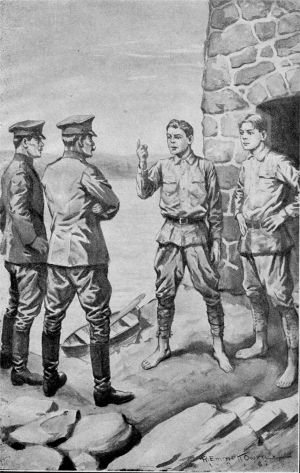 "IT'S FIFTY-FIFTY,—TWO AGAINST TWO," SAID ARCHER. Page 153
This side of Tom Slade was new to Archer, and he stared curiously at the
lowering face of his companion.
"That's what you call losing your morale," he said; "if you lose
that—go-od night! Suppose General Joffre said that when the Huns
werre hitting it forr Paris! S'pose I said that when my foot stuck in
the mud on the bottom of this plaguey riverr!"
"I didn't know that," said Tom.
"Well, you know it now," retorted Archer, "and I don't give up till they
land me back in prison, and I don't give up then, eitherr. And I ain't
lettin' any jack-knives get my goat—so you can chalk that up in yerr
little old noddle!"
"I guess that's the trouble," Tom began; "my head aches——"
"Can you swim now?" Archer demanded.
"You go," said Tom; "my knee's too stiff."
"If you everr say a thing like that to me again," said Archer, his eyes
snapping and his freckled face flushing scarlet, "I'll——"
"I didn't think we'd start till midnight," Tom said, "and I thought my
knee'd be well enough by that time."
The little boat, as they could see from the doorway, bobbed nearer and
nearer and Archer could see that it contained two men.
"They've got on uniforms," Archer said, "but I can't see what they arre.
Let's keep inside."
"They know we're here," said Tom; "they'd only shoot us if we started
away."
Closer and closer came the little boat until one of its occupants jumped
out, hauling it into one of the little rocky caverns of the islet. Then
both came striding up to the doorway.
As soon as they caught sight of the boys they paused aghast and seemed
to be much more discomfited than either Tom or Archer. Evidently they
had not come for the fugitives and the thought occurred to Archer that
they might be fugitives themselves.
"Vell, vat you do here, huh?" one asked.
Archer was managing this affair and he managed it in his own sweet way.
"We're herre because we're herre," he said, in a perfect riot of rolling
R's.
"You German—no?"
"No, thank goodness! We'rre not," Archer said recklessly. "Are we
pinched?"
"How you come here?" the German demanded in that tone of arrogant
severity which seems to imply, "I give you and the whole of the rest of
the world two seconds to answer."
Tom, whose spirits revived at this rather puzzling turn of affairs,
watched the two soldiers keenly and noticed that neither had sword or
firearms. And he realized with chagrin that in those few moments of
"lost morale," he had been strangely unworthy of himself and of his
scout training. And feeling so he let Archer do the talking.
"We're Americans."
"Americans, ach! From prison you escape, huh?" the younger soldier
snapped. "You haff a peekneek here, huh?" And turning to his companion
he poured a kind of guttural volley at him, which his comrade answered
with a brisk return of heavy verbal fire. Archer, listening intently and
using his very rudimentary knowledge of German, gathered that whoever
and whatever these two were, they were themselves in the perilous
business of escaping.
"They'rre in the same box as we are," he said to Tom. "Don't worry."
It did not occur to the boys then, though they often thought of it
afterward, when their acquaintance with the strange race of Huns had
been improved, that these two soldiers manifested not the slightest
interest in the experiences which the boys had gone through. Almost
immediately and without condescending to any discourse with them, the
two men fell to discussing how they might use them, just as their
masters had used Belgium and would use Switzerland and Holland if it
fell in with their purpose.
After the generous interest that Frenchy and his people had shown and
the lively curiosity about his adventures which British Tommies in the
prison camp had displayed, Tom was unable to understand this arrogant
disregard. Even a greasy, shifty-eyed Serbian in the prison had asked
him about America and "how it felt" to be torpedoed.
It was not just that the two soldiers regarded the boys as enemies,
either. They simply were not German and therefore nothing that they did
or said counted or was worth talking about.
At last the one who seemed to be the spokesman said, "Ve make a treaty,
huh?"
It was more of an announcement than a question, and Archer looked at Tom
and laughed.
"A treaty!" said he. "Good night! Do you mean a scrap o' paperr?"
"Ve let you off," said the German in a tone of severe condescension. "Ve
gif you good clothes—here," he added, seeming unable to get away from
his manner of command. "Ve go feeshing. Ve say nutting—ve let you go.
You escape—ach, vat iss dis?" he added deprecatingly. "Ve say
nutting."
"And we don't say anything eitherr, is that it?" said Archer.
"Eef you talk you can't escape, what? Vy shall you talk, huh?"
Tom looked at Archer, who screwed up his freckled nose and gazed
shrewdly at the Germans with a sagacious and highly satisfied look in
his mischievous eye.
"That's the treaty, is it?" he said. "And that's just the kind of—shut
up!" he interpolated, glancing sideways at Tom. "I'll do the
talking—that's just the kind of stuff you'rre trying to put overr on
President Wilson, too—tryin' to make the otherr fellerr think he's
licked and then making believe you'rre willing to be generous. You got
the nerrve (the R's fairly rolled and rumbled as he gathered
momentum)—you got the nerrve to come herre with out any guns or sworrds
and things and think you can scarre us. Do you know—shut up!" he shot
at Tom by way of precaution. "Do you know wherre I think yourr sworrds
and things arre? I think the English Tommies have got 'em. I know all
about you fellerrs deserrting—I hearrd about it in prison. You'rre
deserrting every day. Some of you arre even surrenderrin' to get a good
squarre meal. And do you know what an English Tommy told me—you
consarrned blufferr, you——"
He was in full swing now, his freckled nose all screwed up and rolling
out his R's like artillery. Even sober Tom couldn't help smiling at the
good old upstate adjective, consarrned.
"He told me a Hun is no good when he loses his gun or his sworrd. You
don't think I'm a-scarred of you, do you? It's fifty-fifty—two
against two, you pair of bloomin' kidnapperrs, and you won't tell 'cause
you can't afford to! Same reason as we won't. But you can't put one
overr on me any morre'n you can on President Wilson and if you'rre forr
making treaties you got to get down off your high horrse—see? You ain't
got a superiorrity of numbers now! You got nothing but fourr fists, same
as we got. Forr two cents, I'd wash yourr face on those rocks! Treaties!
I come from Corrnville Centre, I do, and——"
Tom laughed outright.
"You shut up!" said Archer. "You want to make a treaty, huh? All right,
that'll be two Huns less forr the Allies to feed. We'll swap with you,
all right, and I wish you luck. I don't know wherre you'rre going or
what you'rre going to do and I don't carre a rotten apple. Only you
ain't going to dictate terrms to me. You'll take these crazy old rags
and you'rre welcome to 'em, and we'll take yourr uniforms if that's what
you want. Treaty! We'll make a treaty with you! And we'll take the
boat too, and if that don't satisfy you then that's the end of the
what-d'-you-call it! You keep still!" he added, turning to Tom.
CHAPTER XXIV — MILITARY ETIQUETTE
"What did you mean by the what-d'-you call it?" Tom asked, as they
rowed through the darkness for the Baden shore.
"Arrmis-stice," said Archer, wrestling with the word.
"Oh," said Tom.
"That's the way to handle 'em," Archer said with undisguised
satisfaction.
"I never saw you like that before," said Tom. "I had to laugh when you
said consarn."
"That's the Huns all overr," said Archer, his vehemence not yet
altogether abated. "They'll try to do the bossing even afterr they'rre
licked. Treaties! They've got theirr firrst taste of a Yankee treaty,
hey? Didn't even have a sworrd and wanted me to think they werre doin'
us a favorr! President Wilson knows how to handle that bunch, all right,
all right!—Don't row if you'rre tirred."
"It don't hurt my leg to row, only I see now I couldn't swim it."
"Think I didn't know that?" said Archer.
"I got to admit you did fine," said Tom.
"You got to get 'em down on theirr knees beforre you make a treaty with
'em," boasted Archer. "You can see yourself they'rre no good when they
haven't got any commanderr—or any arrms. When Uncle Sam makes a treaty
with that gang, crab-apples, but I hope he gets the boat, too."
"I know what you mean," said Tom soberly. "I have to laugh at the way
you talk when you get mad. It reminds me of the country and Temple
Camp."
"That's one thing I learned from knockin' around in Europe since this
warr starrted," said Archer. "The botches, or whatever you call 'em, are
no darrned good when you get 'em alone. The officers may be all right,
but the soldierrs are thick. If I couldn't 'a' knocked the bluff out o'
that lord-high critturr, I'd 'a' rubbed his pie face in the mud!"
Tom laughed at his homely expletives and Archer broke out laughing too,
at his own expense. But for all that, Tom was destined to recall, and
that very soon, what Archer had said about the Huns. And he was shortly
to use this knowledge in one of the most hazardous experiences of his
life.
They were now, thanks to their treaty, both dry clad in the field-gray
uniforms of the German rank and file; and though they felt somewhat
strange in these habiliments they enjoyed a feeling of security,
especially in view of the populated district they must pass through.
Of the purposes and fate of their late "enemies" they had no inkling and
they did not greatly concern themselves about this pair of fugitives who
had crossed their path. They knew, from the gossip in "Slops" prison,
that Germany was full of deserters who were continually being rounded up
because, as Archer blithely put it, they were "punk scouts and had no
resourrce—or whatever you call it." Tom did not altogether relish the
implication that a deserter might be a good scout or vice versa, but
he agreed with Archer that the pair they had encountered would probably
not "get away with it."
"If they had a couple o' generrals to map it out forr 'em, maybe they
would," said Archer.
"I think I'm above you in rank," said Tom, glancing at an arrow sewn on
his sleeve.
"I'm hanged if I know what that means," Archer answered. "Therre's a
couple morre of 'em on your collarr. Maybe you'rre a generral, hey? I'm
just a plain, everyday botch."
"Boche," said Tom.
"Same thing."
They landed at an embankment where a railroad skirted the shore and it
occurred to Tom now that the guiding light which had forsaken him the
night before was a railroad signal which had been turned the other way
after the passage of the train he had heard. At his suggestion, Archer
bored a hole in the boat and together they gave it a smart push out into
the river.
"Davy Jones forr you, you bloomin' tattletile, as the Tommies would
say," Archer observed in reminiscence of his vast and varied
acquaintanceship. "Come on now, we've got to join our regiment and blow
up a few hospitals. How do you like being a botch, anyway?"
"I'd rather be one now than a year from now," said Tom.
"Thou neverr spakst a truerr worrd.
"Oh, Fritzie Hun, he had a gun,
And other things that's worrse;
He didn't like the foe to strike,
So he shot a Red Cross nurrse,"
Archer rattled on.
"Can't you say nurse?" said Tom.
"Surre I can—nurrrrse."
Tom laughed.
They tramped up through the main street of a village, for the populated
area was too extensive to afford hope of a reasonably short detour. The
few people whom they passed in the darkness paid no particular heed to
them. They might have been a couple of khaki-clad boys in America for
all the curiosity they excited.
At the railroad station an army officer glared at them when they saluted
and seemed on the point of accosting them, which gave them a momentary
scare.
"We'd better be careful," said Tom.
"Gee, I thought we had to salute," Archer answered.
They followed the railroad tracks through an open sparsely populated
region as far as the small town of Ottersweier. The few persons who were
abroad paid no particular attention to them, and as long as no one spoke
to them they felt safe, for the street was in almost total darkness.
Once a formidable-looking German policeman scrutinized them, or so they
thought, and a group of soldiers who were sitting in the dark entrance
of a little beer garden looked at them curiously before saluting. Most
of these men were crippled, and indeed as they passed along it seemed
to the fugitives that nearly every man they passed either had his arm in
a sling or was using crutches.
"Do you think maybe they had a hunch we werren't Gerrman soldierrs at
all?" Archer queried.
"No," said Tom. "I think they just didn't want to salute us till they
were sure we were soldiers like themselves. I think a soldier hasn't got
a right even to salute an officer here unless the officer takes some
notice of him. Maybe the officer's got to glance at him first, or
something."
"G-o-od night!" said Archer. "Reminds you of America, don't it—not
'arf, as the Tommies say. Wouldn't it seem funny not daring to speak to
an officerr therre? Many's the chat I've had with French generals and
English ones, too. Didn't I give old Marshal What's-his-name an elastic
band to put around his paperrs?"
In all probability he had, for he was an aggressive and brazen youngster
without much respect for dignity and authority, and Tom was glad when
they reached the hills, for he had been apprehensive lest his comrade
might essay a familiar pleasantry with some grim official or launch
himself into the perilous pastime of swapping souvenirs with a German
soldier.
But they were both to remember this business about saluting which, if
Tom was right, was eloquent of the German military system, showing how
high was the officer and how low the soldier who might not even pay his
arrogant superior the tribute of a salute without permission.
This knowledge was to serve Tom in good stead before many days should
pass.
CHAPTER XXV — TOM IN WONDERLAND
All through that night, with their compass as a guide, they climbed the
hills, keeping in a southerly direction, but verging slightly eastward.
In the morning they found themselves on the edge of a high, deeply
wooded plateau, which they knew extended with more or less uniformity to
the Swiss frontier.
Looking ahead of them, in a southerly direction, they could see dim,
solemn aisles of sombre fir trees and the ground was like a brown velvet
carpet, yielding gently under their feet. The air was laden with a
pungent odor, accentuated by the recent storm, and the damp, resiny
fragrance was like a bracing tonic to the fugitives, bidding them
welcome to these silent, unfrequented depths.
They were now, indeed, within the precincts of the renowned Schwarzwald,
whose wilderness toyland sends forth out of its sequestered hamlets (or
did) wooden lions, tigers and rhinoceroses for the whole world, and
monkeys on sticks and jumping-jacks and little wooden villages, like the
little wooden villages where they are made.
The west slopes of this romantic region were abrupt, almost like the
Palisades of the Hudson, running close to the river in some places, and
in other places descending several miles back from the shore, so that a
panoramic view of southern Alsace was always obtainable from the sharp
edge of this forest workshop of Santa Claus. In the east the plateau
slopes away and peters out in the lowlands, so that, as one might say,
the Black Forest forms a kind of huge natural springboard to afford one
a good running jump across the Rhine into Alsace.
Archer's battered and misused geography had not lied about the
commissary department of this storied wilderness, for the wild grapes
(of which the famous Rhenish wine is made) did indeed grow in "furious
what-d'you-call-'ems" or luxurious profusion if you prefer, upon the
precipitous western slopes.
All that day they tramped southward, meeting not a soul, and feeling
almost as if they were in a church. It seemed altogether grotesque that
Germany, grim, fighting, war-crazy Germany, should own such a peaceful
region as this.
In the course of the day, they helped the prohibition movement, as
Archer said, by eating grapes in such quantities as seriously to reduce
the output of Rhenish wine. "But, oh, Ebeneezerr!" he added. "What
wouldn't I give for a good russet apple and a dipper of sweet cider."
"You're always thinking about apples and souvenirs," said Tom.
"You can bet I'm going to get a souveneerr in herre, all right!" Archer
announced. "Therre ought to be lots of good ones herre, hey?"
"Maybe they grow in furious what-d'you-call-'ems?" suggested sober Tom.
"If it keeps as level as this, we ought to be able to waltz into the
barrbed wirre by tomorrow night. This is the only thing about Gerrmany
that's on the level, hey?"
Toward evening they had the lesser of the two surprises which were in
store for them in the Black Forest. They were hiking along when suddenly
Tom paused and listened intently.
"What is it?" Archer asked.
"A bird," said Tom, "but I never heard a bird make a noise like that
before."
"He's chirrping in Gerrman," suggested Archer.
The more Tom listened, the more puzzled he became, for he had the
scout's familiarity with bird voices and this was a new one to him.
"Therre's a house," Archer said.
And sure enough there, nestling among the firs some distance ahead, was
the quaintest little house the boys had ever seen. It was almost like a
toy house with a picturesque roof ten sizes too big for it, and a funny
little man in a smock sitting in the doorway. Hanging outside was a
large cuckoo clock and it was the wooden cuckoo which Tom had heard.
Shavings littered the ground about this tiny, wilderness manufactory,
and upon a rough board, like a scout messboard, were a number of little
handmade windmills revolving furiously. Wooden soldiers and
stolid-looking horses with conventional tails, all fresh from the deft
and cunning hands which wielded the harmless jack-knife, were piled
helter-skelter in a big basket waiting, waiting, waiting, for the end of
the war, to go forth in peace and goodwill to the ends of the earth and
nestle snugly in the bottom of Christmas stockings.
This quaint old man could speak scarcely any English, but when the boys
made out that he was Swiss, and apparently kindly disposed, they
sprawled on the ground and rested, succeeding by dint of motions and a
few words of German in establishing a kind of intercourse with him. He
was apparently as far removed from the war as if he had lived in the
Fiji Islands, and the fugitives felt quite as safe at his rustic abode
as if they had been on the planet Mars. His nationality, too, gave them
the cheering assurance that they were approaching the frontier.
"Vagons—noh," he said; "no mohr." Then he pointed to his brimming
basket and said more which they could not understand.
Like most persons who live in the forest, he seemed neither surprised at
their coming nor curious. They gathered that in former days wagons had
wound through these forest ways gathering the handiwork of the people,
but that they came no more. To Tom it seemed a pathetic thing that
Kaiser Bill should reach out his bloody hand and blight the peaceful
occupation of this quaint little old man of the forest. Perhaps he would
die, far away there in his tree-embowered cottage, before the wagons
ever came again, and the overflowing basket would rot away and the
windmills blow themselves to pieces....
CHAPTER XXVI — MAGIC
Leaving the home of the Swiss toymaker, who had shared his simple fare
with them, they started southward through the deep wilderness.
Tom's idea was to keep well within the forest, but within access to its
western edge, so that they might scan the country across the river at
intervals. They were so refreshed and encouraged as they tramped through
the deep, unpeopled wilderness which they knew must bring them to the
border, and so eager to bring their long journey to an end, that they
kept on for a while in the darkness until, to their great surprise, they
came upon a sheet of water the bank of which extended as far east and
west as they could see. Tom fancied he could just distinguish the dark
trees outlined on the opposite shore.
"Let's follow the shore a ways and see if we can get round it," he said.
But a tramp along the edge, first east, then west, brought no general
turn in the shore-line and they began to wonder if the Schwarzwald
could be bisected by some majestic river.
"I don't think a river so high up would be so wide," Tom said. "If I was
sure about that being the other shore over there, we could swim across."
"It would be betterr to get around if we could," said Archer, "because
if we'rre goin' wherre people arre we don't want our uniforms all
soaked."
"I'm not going to try to find her, if that's what you mean," said Tom;
"not unless you say so too, anyway."
"What d'you s'pose I dived forr that glass forr?" Archer retorted.
"We're goin' to find that girrl—or perish in the attempt—like old
What's-his-name. You've got the right idea, Slady."
"It ain't an idea," said Tom soberly, "and if you think it's—kind
of—that I—that I—like her——"
"Surre it ain't, it's 'cause you hate herr," said Archer readily.
"You make me tired," said Tom, flushing.
Since they had to sleep somewhere, they decided to bivouac on the shore
of this water and take their bearings in the morning. As the night was
warm, they took off their coats and hanging them to a spreading branch
above them they sprawled upon the cushiony ground, abandoning for once
their rule of continuous watch, and were soon fast asleep. You do not
need any sleeping powders in the Black Forest, for the soft magic of its
resiny air will lull you to repose.
When they awakened in the morning they squirmed with complicated
gymnastic yawns, and lay gazing in lazy half slumber into the branches
above them. Suddenly Archer jumped to his feet.
"Wherre arre ourr coats?" he cried.
Tom sat up, rubbed his eyes and gazed about. There were no coats to be
seen.
"What d'you know about that?" said Archer. "Maybe they blew away," he
added, looking about.
"There hasn't been any wind," said Tom. "Look at that handkerchief."
Near him lay a handkerchief which Archer remembered spreading on the
ground beside him the night before.
"Well—I'll—be—jiggered," he exclaimed, looking about again in dismay.
"Somebody's been herre," he added conclusively.
Tom fell to scrutinizing the ground for footprints, but there was no
sign of any and he too gazed about him in bewilderment.
"They didn't walk away, that's sure," he said, "and they didn't blow
away either. There wasn't even a breeze."
A thorough search of the immediate locality confirmed their feeling of
certainty that the coats had not blown away. Indeed, they could not have
blown far even if there had been any wind, for the closeness of the
trees to one another would have prevented this. Tom gazed about, then
looked at his companion, utterly dumfounded.
"Maybe they blew into the waterr," Archer suggested. But Tom only shook
his head and pointed to the light handkerchief upon the ground. A mere
breath would have carried that away.
They could only stand and stare at each other. Some one had evidently
taken their coats away in the night.
"It's Gerrman efficiency, that's what it is," said Archer.
"Why didn't they take us, too?" Tom asked.
"They'll be along forr us pretty soon," Archer reassured him. "They'rre
superrmen—that's what they arre.—Maybe it's some kind of strategy,
hey? They can do spooky things, those Huns. They've got magic uniforms."
"I don't see any reason for it," said sober Tom, still looking about,
unable to conquer his amazement.
"That's just it," said Archer. "They do things therre ain't any reason
forr just to practice theirr efficiency. Pretty soon you'll see all the
allied soldierrs'll be losing their coats. Go-o-o-o-d night!"
"Well, I can't find any footprints, that's sure," said Tom, rather
chagrined. "I usually can."
"Maybe it was some sort of an airship," Archer suggested.
Whatever the explanation of this extraordinary thing, the coats were
gone. There were no footprints, and there had been no wind. And the
mysterious affair left the boys aghast.
"One thing sure—we'd better get away from here quick," said Tom.
"You said it! Ebeneezerr, but this place has got the Catskills and old
Rip Van Winkle beat! Come on—quick!"
Tom was not sure that one side of the water was any safer than the other
in this emergency, and he was almost too nonplussed to do anything, but
surely they were in danger, he felt, and would better be upon their way
without the loss of a minute. What troubled him not a little also was
that the precious spy-glass and the compass were with the missing coats.
They could see now that the water was a long, narrow lake the ends of
which were just discernible from the midway position along the shore
where they stood, and the opposite shore was perhaps a mile distant.
"Are you game to swim it?" Archer asked.
They felt that this would be easier than the long tramp around and that
they would have the advantage while swimming of an extended view and
would avoid any danger which might lurk behind the trees.
They had almost reached the opposite shore when Archer sputtered and
called out to Tom: "Look, look!"
Tom looked and saw, hanging from a branch on the shore they were
nearing, the two missing field gray uniform coats.
This was too much. Speechless with amazement they clambered ashore and
walked half fearfully up to their fugitive garments. There was no doubt
about it, there were the two coats dangling from a low hanging branch,
perfectly dry and in the pockets the spy-glass and the trusty compass.
The two boys stared blankly at each other.
"Well—what—do—you—know—about—that?" said Archer.
"They didn't steal anything, anyway," said Tom, half under his breath.
Archer stared at the coats, then peered cautiously about among the
trees. Then he faced Tom again, who returned his stare in mute
astonishment.
"You don't s'pose we could have swum across in ourr sleep, do you?" said
Archer.
Tom shook his head thoughtfully. Could it be that those Huns, those
fiends of the air and the ocean depths, those demons who could shoot a
gun for seventy miles and rear their yellow heads suddenly up out of the
green waters close to the American shore—could it be that they were
indeed genii—ghouls of evil, who played fast and loose with poor
wanderers in the forest until the moment came for crushing them utterly?
Or could it be that this black wilderness, perched upon its mountain
chain, was indeed the magic toyland of all creation, the home of Santa
Claus and——
"Come on," said Archer, "let's not stand herre. B'lieve me, I want to
get as far away from this place as we can!"
CHAPTER XXVII — NONNENMATTWEIHER
But the worst was yet to come. They hurried now, for whatever the cause
of this extraordinary incident, they wished to get away from it, and
having crossed the lake they paused not to dry their garments but
continued southward following the almost obliterated wagon tracks which
ran from the shore.
"I wonder how the wagons got across?" said Tom.
"Wings," said Archer solemnly, shaking his head.
In a little while they came to the toymaker's cottage, with the
mechanical cuckoo and the windmills and the basket of soldiers and
animals and the old Swiss toymaker himself, sitting like a big toy, in
the doorway.
"Well—I'll—be——" began Archer.
Tom simply gaped, too perplexed to speak. He had believed that he was
something of a woodsman, and he certainly believed that he would not go
north supposing that he was going south! Could there be another Swiss
toymaker, and another cottage and another squawking cuckoo, exactly like
the others? Were they all alike, the lonesome denizens of this spooky
place, like the wooden inhabitants of a Noah's ark?
"This Hun forest has got Aladdin's cave beat twenty ways," said Archer.
"Either we'rre crazy or this place is."
Suddenly the bright thought occurred to Tom to look at his compass.
Unless the magnetic pole had changed its position, and the whole earth
gone askew, they were tramping northward, as he saw to his unutterable
amazement.
"Did we swim across the lake or didn't we?" he demanded of Archer,
roused out of his wonted stolidness.
"Surre, we did!"
"Then I give it up," said Tom resignedly. "The compass says north—we're
going north. This is the very same toymaker."
"Go-o-od night!" said Archer, with even more than his usual vehemence.
"Maybe the Gerrmans have conquerred the Norrth Pole and taken all the
steel to make mountains, just like they knocked international law all
endways, hey? That's why the compass don't point right. G-o-o-o-o-od
night!"
This ingenious theory, involving a rather large piece of strategy even
for "supermen," did not appeal to Tom's sober mind.
"That's what it is," said Archer. "You've got to admit that if they
could send Zeps and submarines and things to the North Pole and cop all
the steel, the British navy, and ourrs too, would be floppin' around the
ocean like a chicken with its head cut off.—It's a good idea!"
Tom went up to the old toymaker, who greeted them with a smile, seeming
no more surprised to see them than he had been the day before.
"North—north?" asked Tom, pointing.
"Nort—yah," said the old man, pointing too.
"Water," said Tom; "swim—swim across" (he pointed southward and made
the motions of swimming). The old man nodded as if he understood.
"Ach—vauder, yach,—Nonnenmattweiher."
"What?" said Tom.
"What?" said Archer.
"Nonnenmattweiher," said the old man. "Yah."
"He wants to know what's the matter with you," said Archer.
"Water," Tom repeated, almost in desperation.
"Swim (he went through the motions): Swim across water to south—start
south, go north." He made no attempt to convey the incident of the
vanishing coats.
"Water—yah,—Nonnenmattweiher," the man repeated.
At last, by dint of repeating words and swinging their arms and going
through a variety of extraordinary motions, the boys succeeded in
conveying to the little man that something was wrong in the neighborhood
of the lake, and he appeared willing enough to go back with them,
trotting along beside Tom in his funny belted blouse, for all the world
like a mechanical toy. Tom had his misgivings as to whether they would
really reach the lake no matter which way they went, but they did reach
it, and standing under the tree where they had recovered their vanished
coats they tried to explain to the old man what had happened—that they
had crossed from the north to the south bank and continued southward,
only to find that they were going north!
Suddenly a new light illumined the little man's countenance and he
chuckled audibly. Then he pointed across the lake, chattering and
chuckling the while, and went through a series of strange motions,
spreading his legs farther and farther apart, pointing to the ground
between them, and concluded this exhibition with a sweeping motion of
his hands as if bidding some invisible presence of that enchanted place
God-speed across the water.
"Och—goo," he said, and shook his head and laughed.
"I know what he means," said Tom at last, with undisguised chagrin, "and
I'm a punk scout. I didn't notice anything at all. Come on. We've got to
swim across again—that's south, all right."
"What is it?" asked Archer.
"I'll show you when we get there—come on."
The little Swiss toymaker stood watching them and laughing with a
spasmodic laugh which he might have caught from his own wooden cuckoo.
When they reached the other shore Tom fell at once to examining a very
perceptible rift in the earth a few feet from the shore.
"Do you see?" he said, "we floated over on this piece of land. The tree
where we hung our coats was on the real shore, and——"
"Go-od night, and it missed the boat," concluded Archer.
"This tree here is something like it," said Tom, "and that's where I
made my mistake. I ought to have noticed the trees and I ought to have
noticed the crack. Gee, if my scout patrol ever heard of that!
'Specially Roy Blakeley," he added, shaking his head dubiously.
It was indeed something of a "bull" in scouting, though perhaps a more
experienced forester than Tom would have become as confused as he in the
same circumstances. Perhaps if he had been as companionable with his
school geography as Archer had been with his he might have known about
the famous Lake Nonnenmattweiher in the silent depths of the Schwarzwald
and of its world-famed floating island, which makes its nocturnal
cruises from shore to shore, a silent, restless voyager on that black
pine-embowered lake.
As the boys looked back across the water they could see the little Swiss
toymaker still standing upon the shore, and looking at him through the
rescued glass (of which they were soon to make better use), Tom could
see that his odd little figure was shaking with merriment—as if he were
wound up.