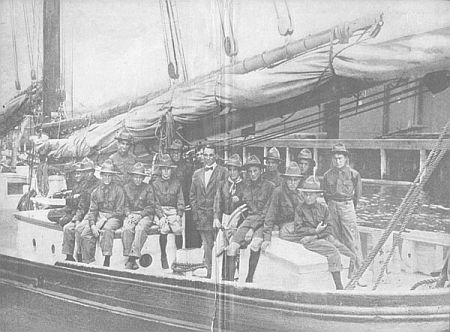
Tom found Mr. Conne poring over a scrapbook filled with cards containing
finger-prints. His unlighted cigar was cocked up in the corner of his
mouth like a flag-pole from a window, just the same as when Tom had seen
him last. It almost seemed as if it must be the very same cigar. He
greeted Tom cordially.
“So they didn’t manage to sink my old chum, Sherlock Nobody Holmes, eh?
Tommy, my boy, how are you?”
“Did the spy get rescued?” Tom asked, as the long hand-shake ended.
“Nope. Went down. But we nabbed a couple of his accomplices through his
papers.”
“I got a new mystery,” said Tom in his customary blunt manner. “I was
going to give these papers to my boss, but when I got your letter I
decided I’d give ’em to you.”
He told the detective all about Adolf Schmitt and of how he had
discovered the papers in the chimney.
“You say the place had already been searched?” Mr. Conne asked.
“Yes, but I s’pose maybe they were in a hurry and had other things to
think about, maybe. A man came there again just the other day, too, and
said he wanted to read the gas-meter. But he looked all ’round the
cellar.”
“Hmm,” Mr. Conne said dryly. “Tom, if you don’t look out you’ll make a
detective one of these days. I see you’ve got the same old wide-awake
pair of eyes as ever.”
“I learned about deducing when I was in the scouts,” said Tom. “They
always made fun of me for it—the fellers did. Once I deduced an
aeroplane landed in a big field because the grass was kind of dragged,
but afterwards I found the fellers had made tracks there with an old
baby carriage just to fool me. Sometimes one thing kind of tells you
another, sort of.”
“Well, whenever you see something that you think tells you anything,
Tommy, you just follow it up and never mind about folks laughing. I
shouldn’t wonder if you’ve made a haul here.”
“There was one of ’em that interested me specially,” ventured Tom; “the
one about motors.”
Mr. Conne glanced over the papers again. “Hmm,” said he, “I dare say
that’s the least important of the lot—sort of crack-brained.”
Tom felt squelched.
“Well, anyway, they’ll all be taken care of,” Mr. Conne said
conclusively, as he stuffed the papers in his pocket.
Tom could have wished that he might share in the further developments
connected with those interesting papers. But, however important Mr.
Conne considered them, he put the matter temporarily aside in the
interest of Tom’s proposed job.
“I just happened to think of you,” he said, as he took his hat and coat,
“when I was talking with the steward of the Montauk. He was saying
they were short-handed. Come along, now, and we’ll go and see about it.”
Mr. Conne’s mind seemed full of other things as he hurried along the
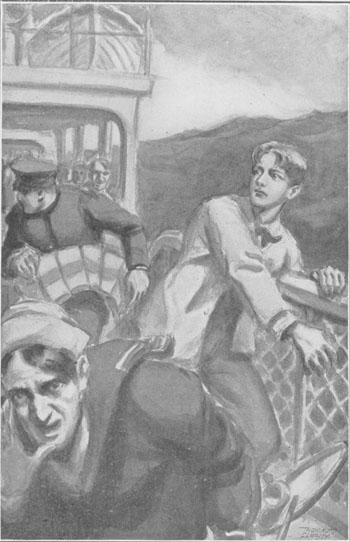
street with Tom after him. On the ferryboat, as they crossed to Hoboken,
he was more sociable.
“Don’t think any more about those letters now,” he said. “The proper
authorities will look after them.”
“Yes, sir.”
“And whatever they set you to doing, put your mind on your work first
of all. Keep your eyes and ears open—there’s no law against that—but
do your work. It’s only in dime novels that youngsters like you are
generals and captains and famous detectives.”
“Yes, sir,” said Tom.
“What I mean is, don’t get any crazy notions in your head. You may land
in the Secret Service yet. But meanwhile keep your feet on the earth—or
the ship. Get me?”
Tom was sensible enough to know that this was good advice.
“Your finding these letters was clever. If there are any spies in the
camps they’ll be rounded up double quick. As for spy work at sea, I’ll
tell you this, though you mustn’t mention it, there are government
sleuths on all the ships—most of them working as hands.”
“Yes, sir,” said Tom.
“I’m going across on a fast ship to-morrow myself,” continued Mr. Conne,
greatly to Tom’s surprise. “I’ll be in Liverpool and London and probably
in France before you get there. There’s a bare possibility of you seeing
me over there.”
“I hope I do,” said Tom.
The transport Montauk was one of the many privately owned steamers
taken over into government service, and Tom soon learned that outside
the steward’s department nearly all the positions on board were filled
by naval men. Mr. Conne presented him to the steward, saying that Tom
had made a trip on a munition carrier, and disappeared in a great hurry.
Tom could not help feeling that he was one of the least important things
among Mr. Conne’s multitudinous interests, and it must be confessed that
he felt just a little chagrined at finding himself disposed of with so
little ceremony.
But, if he had only known it, this good friend who stood so high in that
most fascinating department of all Uncle Sam’s departmental family, had
borne him in mind more than he had encouraged Tom to think, and he had
previously spoken words of praise to the steward, which now had their
effect in Tom’s allotment to his humble duties.
He was, in a word, given the best position to be had among the
unskilled, non-naval force and became presently the envy of every
youngster on board. This was the exalted post of captain’s mess boy, a
place of honor and preferment which gave him free entrance to that holy
of holies, “the bridge,” where young naval officers marched back and
forth, and where the captain dined in solitary state, save for Tom’s own
presence.
Now and then, in the course of that eventful trip, Tom looked enviously
at the young wireless operators, and more particularly at the marine
signalers, who moved their arms with such jerky and mechanical precision
and sometimes, perhaps, he thought wistfully of certain fortunate young
heroes of fiction who made bounding leaps to the top of the ladder of
fame.
But he did his work cheerfully and well and became a favorite on board,
for his duties gave him the freedom of all the decks. He was the
captain’s mess boy and could go anywhere.
Indeed, with one person he became a favorite even before the vessel
started.
It was well on toward dusk of the third day and he was beginning to
think they would never sail, when suddenly he heard a tramp, tramp, on
the pier and up the gangplank, and before he realized it the soldiers
swarmed over the deck, their tin plates and cups jangling at their
sides. They must have come through the adjoining ferry house and across
a low roof without touching the street at all, for they appeared as if
by magic and no one seemed to know how they had got there.
Their arrival was accompanied by much banter and horseplay among
themselves, interspersed with questions to the ship’s people, few of
which could be answered.
“Hey, pal, where are we going?”
“Where do we go from here, kiddo?”
“Say, what’s the next stop for this jitney?”
“We don’t know where we’re going,
but we’re on our way,”
someone piped up.
“We’re going to Berlin,” one shouted.
The fact that no one gave them any information did not appear to
discourage them.
“When do we eat?” one wanted to know.
Tom saw no reason why he should not answer that, so he said to those
crowded nearest to him, “In about half an hour.”
“G-o-o-d-ni-ight!”
“When are we going to start? Who’s running this camp anyway?”
“Go and tell the engineer we’re here and he can start off.”
“Fares, please. Ding ding!”
“Gimme me a transfer to Berlin.”
And so it went. They sprawled about on the hatches, perched upon the
rail, leaned in groups against the vent pipes; they covered the ship
like a great brown blanket. They wrestled with each other, knocked each
other about, shouted gibberish intended for French, talked about Kaiser
Bill, and mixed things up generally.
At last they were ordered into line and marched slowly through the
galley where their plates and cups were filled and a butcher was kept
busy demolishing large portions of a cow. They sprawled about anywhere
they pleased, eating.
To Tom it was like a scout picnic on a mammoth scale. Here and there was
noticeable a glum, bewildered face, but for the most part the soldiers
(drafted or otherwise) seemed bent on having the time of their lives. It
could not be said that they were without patriotism, but their one
thought now seemed to be to make merry. Tom’s customary stolidness
disappeared in the face of this great mirthful drive and he sat on the
edge of the hatch, his white jacket conspicuous by contrast, and smiled
broadly.
He wondered whether any other country in the world could produce such a
slangy, jollying, devil-may-care host as these vociferous American
soldiers. How he longed to be one of them!
A slim young soldier elbowed his way through the throng and, supper in
hand, seated himself on the hatch beside Tom. He had the smallest
possible mustache, with pointed ends, and his demeanor was gentlemanly
and friendly. Even his way of stirring his coffee seemed different from
the rough and tumble fashion of the others.
“These are stirring times, hey, Frenchy?” a soldier said.
“Yess—zat is verry good—stirring times,” the young fellow answered,
in appreciation of the joke. Then, turning to Tom, he said, “Zis is ze
Bartholdi statue, yess? I am from ze West.”
“That’s the Statue of Liberty,” said Tom. “You’ll see it better when we
pass it.”
“Ah, yess! zis is ze first; I haf’ nevaire seen. I zank you.”
“Do you know why the Statue of Liberty looks so sad, Frenchy?” a soldier
asked. “Because she’s facing Brooklyn.”
“Do you know why she’s got her arm up?” another called.
Frenchy was puzzled.
“She represents the American woman hanging onto a strap in the subway.”
“Don’t let them jolly you, Frenchy,” another said.
Frenchy, a little bewildered, laughed good-humoredly as the bantering
throng plied him with absurdities.
“Are you French?” Tom asked, as some new victim diverted the attention
of the boys.
“Ah, no! I am Americ’.”
“But you were born in France?”
“Yess—zey call it Zhermany, but it is France! I take ze coat from you.
Still it is yours. Am I right? I am born in Alsace. Zat is France!”
“Doncher believe him, kiddo!” said a soldier. “He was born in Germany.
Look on the map.”
“He’s a German spy, Whitey; look out for him.”
“Alsace—ziss is France!” said Frenchy fervently.
“Ziss is the United States,” shouted a soldier derisively.
“Ziss is Hoboken!” chimed in another.
“Vive la Hoboken!” shrieked a third.
Tom thought he had never laughed so much in all his life.
CHAPTER V — HE MAKES A DISCOVERY AND RECEIVES A SHOCK
Soon after dusk the soldiers were ordered to throw away their “smokes”
and either go below or lie flat upon the decks. Officers patrolled the
rail while others strolled among the boys and reminded the unruly and
forgetful not to raise themselves, and soon the big ship, with its
crowding khaki-clad cargo, was moving down the stream—on its way to
“can the Kaiser.” Then even the patrol was discontinued.
A crowded ferryboat paused in its passage to give the great gray
transport the right of way, and the throng of commuters upon its deck
saw nothing as they looked up but one or two white-jacketed figures
moving about.
Tom thought the ship was off, but after fifteen or twenty minutes the
throb of the engines ceased and he heard the clank, clank of the anchor
winches. A little distant from the ship tiny green, red and white lights
appeared and disappeared and were answered by other colored lights from
high up in the rigging of the Montauk. Other lights appeared in other
directions and were answered by still others, changing rapidly. Tom
thought that he could distinguish a dark outline below certain of these
lights. The whole business seemed weird and mysterious.
In the morning he looked from the rail at a sight which astonished and
thrilled him. No sign of land was there to be seen. Steaming abreast of
the Montauk and perhaps a couple of hundred yards from her, was a
great ship with soldiers crowding at her rail waving caps and shouting,
their voices singularly crisp and clear across the waters. Beyond her
and still abreast was another great ship, the surging army upon her
decks reduced to a brown mass in the distance. And far off on either
side of this flotilla of three, and before it and behind it, was a
sprightly little destroyer, moving this way and that, like a dog jumping
about his master.
Upon the nearest vessel a naval signaler was semaphoring to the
Montauk—his movements jerky, clean-cut, perfect. Enviously Tom
watched him, thinking of his own semaphore work at Temple Camp. He read
the message easily; it was something about how many knots the ship
could make in a steady run of six hundred miles. The Montauk answered
that she could make twenty-eight knots and keep it up for nineteen
hours. The other signaler seemed to be relaying this to the transport
beyond, which in turn signaled the destroyer on that side. Then there
was signaling between the Montauk and her own neighbor destroyer about
sailing formation in the danger zone.
It was almost like A B C to Tom, but he remembered Mr. Conne’s good
advice and resolved not to concern himself with matters outside his own
little sphere of duty. But a few days later he made a discovery which
turned his thoughts again to Adolf Schmitt’s cellar and to spies.
He had piled the captain’s breakfast dishes, made his weather memoranda
from the barometer for posting in the main saloon, and was dusting the
captain’s table, when he chanced to notice the framed picture of a ship
on the cabin wall. He had seen it before, but now he noticed the tiny
name, scarcely decipherable, upon its bow, Christopher Colon.
So that was the ship on which somebody or other known to the fugitive,
Adolf Schmitt, had thought of sailing in order to carry certain
information to Germany. As Tom gazed curiously at this picture he
thought of a certain phrase in that strange letter, “Sure, I could tend
to the other matter too—it’s the same idea as a periscope.”
Yet Mr. Conne’s sensible advice would probably have prevailed and Tom
would have put these sinister things out of his thoughts, but meeting
one of the steward’s boys upon the deck shortly afterward he said,
“There’s a picture of a ship, the Christopher Colon——”
“That’s this ship,” interrupted the steward’s boy. “They don’t say much
about those things. It’s hard to find out anything. Nobody except these
navy guys know about how many ships are taken over for transports. But I
saw a couple of spoons in the dining saloon with that name on them. And
sometimes you can make it out under the fresh paint on the life
preservers and things. Uncle Sam’s some foxy old guy.”
Tom was so surprised that he stood stark still and stared as the boy
hurried along about his duties. Upon the Montauk’s nearest neighbor
the naval signalman was semaphoring, and he watched abstractedly. It was
something about camouflage maneuvering in the zone. Tom took a certain
pride in being able to read it. Far off, beyond the other great ships,
a sprightly little destroyer cut a zigzag course, as if practicing. The
sky was clear and blue. As Tom watched, a young fellow in a sailor’s
suit hurried by, working his way among the throng of soldiers.
Presently, Frenchy strolled past talking volubly to another soldier, and
waving his cigarette gracefully in accompaniment. A naval quartermaster
leaned against the rail, chatting with a red-faced man with
spectacles—the chief engineer, Tom thought.
Who were Secret Service men and who were not? thought Tom. Who was a spy
and who was not? Perhaps some one who brushed past him carried in his
pockets (or more likely in the soles of his shoes) the designs of the
Liberty Motor. Perhaps some one had the same thought about him. What a
dreadful thing to be suspected of! A spy!
That puzzling phrase came into his mind again: Sure, I could tend to
the other matter too—it’s the same idea as a periscope. What did that
mean? So the Montauk was the Christopher Colon....
He was roused out of his abstraction by the fervid, jerky voice of
Frenchy, talking about Alsace. Alsace was a part of Germany, whatever
Frenchy might say.... Again Tom bethought him of Mr. Conne’s very wise
advice, and he went to the main saloon and posted the weather
prediction.
That same day something happened which shocked him and gave him an
unpleasant feeling of loneliness. Mr. Wessel, the steward, died suddenly
of heart failure. He was Tom’s immediate superior and in a way his
friend. He, and he alone, had received Tom’s recommendation from Mr.
Conne, and knew something of him. He had given Tom that enviable place
as captain’s boy, and throughout these few days had treated him with a
kind of pleasant familiarity.
He stood by as the army chaplain read the simple burial service, while
four soldiers held the rough, weighted casket upon the rail; and he saw
it go down with a splash and disappear in the mysterious, fathomless
ocean. It affected him more than the loss of a life by torpedoing or
drowning could have done and left him solemn and thoughtful and with a
deep sense of loss.
Just before dark they semaphored over from the Dorrilton that they
could spare the second steward for duty on the Montauk. Tom mentioned
this to one of the deck stewards, and to his surprise and
consternation, an officer came to him a little later and asked him how
he knew it.
“I can read semaphoring,” said Tom. “I used to be in the Boy Scouts.”
The officer looked at him sharply and said, “Well, you’d better learn to
keep your mouth shut. This is no place for amateurs and Boy Scouts to
practice their games.”
“Y-yes, sir,” said Tom, greatly frightened.
The next morning, when the sea was quieter, they rowed his new boss over
in a small boat.
CHAPTER VI — HE HEARS ABOUT ALSACE AND RECEIVES A PRESENT
That was a good lesson for Tom and a practical demonstration of the
wisdom of Mr. Conne’s advice. Not that he had exactly gone outside his
duties to indulge his appetite for adventure, but he had had a good
scare which reminded him what a suspicious and particular old gentleman
Uncle Sam is in wartime.
The officer, who had thus frightened him and, in Tom’s opinion, cast a
slur upon the Scouts, made matters worse by scrutinizing him (or so he
fancied) whenever they met upon the deck. But that was all there was to
it, and the captain’s mess boy did his allotted tasks each day, and
stood for no end of jollying from the soldiers, who called him “Whitey”
and “Eats,” because he carried the captain’s tray back and forth.
This banter he shared with Frenchy, who took it as good-humoredly as Tom
himself, when he understood it, and when he didn’t Tom explained it to
him.
“Ziss—how you call—can ze Kaiser?” he would inquire politely.
“That means putting him in a tin can,” said Tom.
“Ze tin can? Ze—how you call—wipe ze floor wiz him?”
“They both mean the same thing,” said Tom. “They mean beating him—good
and thorough—kind of.”
Frenchy did not seem to understand but he would wave his hands and say
with great vehemence, “Ah, ze Kaiser, he must be defeat! Ze wretch!”
Frenchy’s name was Armande Lateur. He was an American by adoption and
though he had spent much time among the people of his own nationality in
Canada, he was strong for Uncle Sam with a pleasant, lingering fondness
for the region of the “blue Alsatian mountains,” whence he had come.
It was from Frenchy that Tom learned much which (if he had only known
it) was to serve him well in the perilous days to come.
The day before they entered the danger zone the two, secure for a
little while from the mirthful artillery fire of the soldiers, had a
little chat which Tom was destined long to remember.
They were sitting at dusk in the doorway of the unoccupied guardhouse
which ordinarily was the second cabin smoking-room.
“Alsace-Lorraine is part of Germany,” said Tom, his heavy manner of
talking contrasting strangely with Frenchy’s excitability. “So you were
a German citizen before you got to be an American; and your people over
there must be German citizens.”
“Zey are Zherman slaves—yess! Citizens—no! See! When still I am a
leetle boy, I must learn ze Zherman. I must go to ze Zherman school. My
pappa have to pay fine when hees cheeldren speak ze French. My little
seester when she sing ze Marsellaise—she must go t’ree days to ze
Zherman zhail!”
“You mean to prison?” Tom asked. “Just for singing the Marsellaise! Why,
the hand-organs play that where I live!”
“Ah, yess—Americ’! In Alsace, even before ze war—you sing ze
Marsellaise, t’ree days you go to ze zhail. You haf’ a book printed in
ze French—feefty marks you must pay!” He waived his cigarette, as if
it might have been a deadly sword, and hurled it over the rail.
“After Germany took Alsace-Lorraine away from France,” said Tom,
unmoved, “and began treating the French people that way, I should think
lots of ’em would have moved to France.”
“Many—yess; but some, no. My pappa had a veenyard. Many years ziss
veenyard is owned by my people—my anceestors. Even ze village is name
for my family—Lateur. You know ze Franco-Prussian War—when Zhermany
take Alsace-Lorraine—yess?”
“Yes,” said Tom.
“My pappa fight for France. Hees arm he lose. When it is over and Alsace
is lost, he haf’ lost more than hees arm. Hees spirit! Where can he go?
Away from ze veenyard? Here he hass lived—always.”
“I understand,” said Tom.
“Yess,” said Frenchy with great satisfaction. “Zat is how eet is—you
will understand. My pappa cannot go. Zis is hees home. So he
stay—stay under ze Zhermans. Ah! For everything, everything, we must
pay ze tax. Five hundred soldiers, zey keep, always—in zis little
village—and only seven hundred people. Ziss is ze way. Ugh! Even ze
name zey change—Dundgart! Ugh!”
“I don’t like it as well as Lethure,” said matter-of-fact Tom.
Frenchy laughed at Tom’s pronunciation. “Zis is how you say—Le-teur.
See? I will teach you ze French.”
“How did you happen to come to America?” Tom asked.
“Ah! I will tell you,” Frenchy said, as a grim, dangerous look gathered
in his eyes. “You are—how many years, my frien’!”
“I’m seventeen,” said Tom.
“One cannot tell wiz ze Americans,” Frenchy explained. “Zey grow so
queeck—so beeg. In Europe, zey haf’ nevaire seen anyzing like zis—zis
army,” he added, indicating with a sweeping wave of his hand the groups
of lolling, joking soldiers.
“They make fun of you a lot, don’t they?”
“Ah, zat I do not mind.”
“Maybe that’s why they all like you.”
“I will tell you,” said Frenchy, reverting to Tom’s previous question.
“I am zhust ze same age as you—sefenteen—when zey throw my seester in
ze zhail because she sing ze Marsellaise. Zat I cannot stand! You
see?—When ze soldiers—fat Zhermans, ugh! When zey come for her, I
strike zis fat one—here—so.”
“I’m glad you did,” said Tom.
“Hees eye I cut open, so. Wiz my fist—zhust boy’s fist, but so
sharp.”
“I don’t blame you,” said Tom.
“So zen I must flee. Even to be rude to ze Zherman soldier—zis is
crime. So I come to Americ’. Zey are looking for me, but I go by night,
I sleep in ze haystack—zis I show. (He exhibited a little iron button
with nothing whatever upon it.) You see? Zis is—what you
call—talisman. Yess?
“So I come to Epinal across ze border, through ze pass in ze mountains.
I am free! I go to my uncle in Canada who is agent to our wines. Zen I
come to Chicago, where I haf’ other uncle—also agent. Now I go to
France wiz ze Americans to take Alsace back. What should I care if they
laugh at me? We go to take Alsace back! Alsace!—Listen—I will tell
you!
“Vive la France!
A bas la Prusse!
D’Schwowe mien
Zuem Elsass ’nuess!
See if you can say zis,“ he smiled.
Tom shook his head.
“I will tell you—see.
“Long live France!
Down with Prussia!
The Boches must
Get out of Alsace!”
“It must make you feel good after all that to go back now and make them
give up Alsace,” said Tom, his stolid nature moved by the young fellow’s
enthusiasm. “I’d like it if I’d been with you when you escaped and ran
away like that. I like long hikes and adventures and things, anyway. It
must be a long time since you saw your people.”
“Saw! Even I haf’ not heard for t’ree year. Eight years ago I fled
away. Even before America is in ze war I haf’ no letters. Ze Zhermans
tear zem up! Ah, no matter. When it is all over and ze boundary line is
back at ze Rhine again—zen I will see zem. My pappa, my moother, my
seester Florette——”
His eyes glistened and he paused.
“I go wiz Uncle Sam! My seester will sing ze Marsellaise!”
“Yes,” said Tom. “She can sing it all she wants.”
“If zey are not yet killed,” Frenchy added, looking intently out upon
the ocean.
“I kind of feel that they’re not,” said Tom simply. “Sometimes I have
feelings like that and they usually come out true.”
Frenchy looked suddenly at him, then embraced him. “See, I will give you
ziss,” he said, handing Tom the little iron button. “I haf’ two—see? I
will tell you about zis,” he added, drawing close and holding it so that
Tom could see. “It is made from ze cannon in my pappa’s regiment. Zis is
when Alsace and Lorraine were lost—you see? Zey swear zey would win or
die together—and so zey all die—except seventy. So zese men, zey swear
zey will stand by each other, forever—zese seventy. You see? Even in
poor Alsace—and in Lorraine. So zese, ze haf’ make from a piece of ze
cannon. You see? If once you can get across ze Zherman lines into
Alsace, zis will find you friends and shelter. Ah, but you must be
careful. You see? You must watch for zis button and when you see—zen
you can show zis. You will know ze person who wears ze button is
French—man, woman, peasant, child. Ze Zhermans do not know. Zey are
fine spies, fine sneaks! But zis zey do not know. You see?”
It was as much to please the generous Frenchy as for any other reason
(though, to be sure, he was glad to have it) that Tom took the little
button and put it in his pocket.
“Ze iron cross—you know zat?”
“I’ve heard about it,” said Tom.
“Zat means murder, savagery, death! Zis little button means friendship,
help. Ze Zhermans do not know. You take this for—what you call—lucky
piece?”
“I’ll always keep it,” said Tom, little dreaming what it would mean to
him.
An authoritative voice was heard and they saw the soldiers throwing away
their cigars and cigarettes and emptying their pipes against the rail.
At the same time the electric light in the converted guard house was
extinguished and an officer came along calling something into each of
the staterooms along the promenade tier. They were entering the danger
zone.
CHAPTER VII — HE BECOMES VERY PROUD, AND ALSO VERY MUCH FRIGHTENED
Tom’s talk with Frenchy left him feeling very proud that he was American
born. He had that advantage over the Frenchman, he thought, even though
Frenchy had escaped through a pass in the Alsatian mountains and made
such an adventurous flight.
When Frenchy had spoken of the American soldiers Tom felt especially
proud. He was glad that all his people so far as he knew anything about
them, were good out-and-out Yankees. Even his poor worthless father had
been a great patriot, and played the Star-Spangled Banner on his old
accordion when he ought to have been at work.
Then there was poor old one-armed Uncle Job Slade who used to get drunk,
but he had told Tom about “them confounded rebels and traitors” of
Lincoln’s time, and when he had died in the Soldiers’ Home they had
buried him with the Stars and Stripes draped over his coffin.
He was sorry now that he had not mentioned these things when gruff,
well-meaning Pete Connigan had spoken disparagingly of the Slades.
He was glad he was not an adopted American like Frenchy, but that all
his family had been Americans as far back as he knew. He was proud to
“belong” to a country that other people wanted to “join”—that he had
never had to join. And as he stood at the rail when his duties were
finished that same night and gazed off across the black, rough ocean, he
made up his mind that after this when he heard slurs cast upon his
father and his uncle, instead of feeling ashamed he would defend them,
and tell of the good things which he knew about them.
He stood there at the rail, quite alone, thinking. The night was very
dark and the sea was rough. Not a light was to be seen upon the ship.
It occurred to him that it might be better for him not to stand there
with his white steward’s jacket on. He recalled how, up at Temple Camp,
one could see the white tents very clearly all the way across the lake.
There was no rule about it, apparently, but sometimes, when people
forgot to make a good rule, Tom made it for them. So now he went down to
his little stateroom (the captain’s mess boy had a tiny stateroom to
himself) and put on a dark coat.
The second cabin dining saloon and dining room, which were below decks
and had no outside ports, were crowded with soldiers, playing cards and
checkers, and they did not fail to “josh” Whitey as he passed through.
Frenchy was there and he waved pleasantly to Tom.
“Going to get out and walk, Whitey?” a soldier called. “I see you’ve got
your street clothes on.”
“I thought maybe the white would be too easy to see,” Tom answered.
“Wise guy!” someone commented.
Reaching the main deck he edged his way along between the narrow
passageway and the washroom to a secluded spot astern. He liked this
place because it was so lonesome and unfrequented and because he could
hear the whir and splash of the great propellers directly beneath him as
each big roller lifted the after part of the vessel out of the water.
Here he could think about Bridgeboro and Temple Camp, and Roy Blakeley
and the other scouts, and of how proud he was that he was an American
through and through, and of what he was going to say to people after
this when they called his father a “no good” and Uncle Job a “rummy.” He
was glad he had thought about that, for back in Bridgeboro people were
always saying something.
Suddenly a stern, authoritative voice spoke just behind him. “What are
you doing here?”
In the heavy darkness Tom could just make out that the figure was in
khaki and he thought it was the uniform of an officer.
“I ain’t doing anything,” he said.
“What did you come here for?” the voice demanded sternly.
“I—I don’ know,” stammered Tom, thoroughly frightened.
Quickly, deftly, the man slapped his clothing in the vicinity of his
pockets.
“Who are you?” he demanded.
“I’m captain’s mess boy.”
Laying his hand on Tom’s shoulder, he marched him into the saloon and to
the head of the companionway where the dim light from the passageway
below enabled him to get a better sight of the boy. Tom was all of a
tremor as the officer scrutinized him.
“You’re the fellow that read the semaphore message, aren’t you?” the
officer demanded.
“Y-yes, sir, but I didn’t notice them any more since I found out I
shouldn’t.” Then he mustered courage to add, “I only went back there
because it was dark and lonely, kind of. I was thinking about where I
live and things——”
The officer scrutinized him curiously for a moment and apparently was
satisfied, for he only added, speaking rather harshly, “You’d better be
careful where you go at night and keep away from the ropes.” With this
he wheeled about and strode away.
For a minute or two Tom stood rooted to the spot where he stood, his
heart pounding in his breast. He would not have been afraid of a whole
regiment of Germans and he would probably have retained his stolid
demeanor if the vessel had been sinking, but this little encounter
frightened him. He wished that he had had the presence of mind to tell
the officer why he had doffed his white jacket, and he wished that he
had had the courage to mention how his Uncle Job had fought at
Gettysburg and been buried with the flag over his coffin. Those things
might have impressed the officer.
As he lay in his berth that night, his feeling of fright passed away
and he was overcome with a feeling of humiliation. That he, Tom Slade,
who had been a scout of the scouts, who had worked for the Colors, whose
whole family history had been one of loyalty and patriotism, should be
even—— No, of course, he had not been actually suspected of anything,
and he knew that the government had to be very watchful and careful,
but—— Well, he felt ashamed and humiliated, that’s all.
He made up his mind that if he should see that officer again, and he did
not look too forbidding, he would mention how his mother had taught him
to sing America, how his father had played the Star-Spangled Banner
on his old accordion and how Uncle Job had died in the Soldiers’ Home.
Those were about the only good things he could remember about his father
and Uncle Job, but weren’t they enough?
And since the government was so very particular, Tom got up and hung his
coat across the porthole, though no clink of light could possibly have
escaped, for his little stateroom was as dark as pitch and even when he
opened his door there was only the dim light from the inner passage.
CHAPTER VIII — HE HEARS SOME NEWS AND IS CONFIDENTIAL WITH FRENCHY
The next morning there was a rumor. Somebody told somebody who told
somebody else who told a deck steward who told Tom that a couple of men
had gone very stealthily along the dimly lighted passageway outside the
forward staterooms below, looking for a lighted stateroom.
“There was never so much as a glint,” the deck steward volunteered.
Instantly Tom thought of his experience of the previous night and there
arose in his mind also certain passages from one of the letters he had
turned over to Mr. Conne.
Acting on his benefactor’s very sensible advice, he had not allowed his
mind to dwell upon those mysterious things which were altogether outside
his humble sphere. But now he could not help recalling that this ship
had been the Christopher Colon on which somebody or other had thought
he might be able to sail. Well, in any event, the ship’s people had
those things in hand, and after his disturbing experience of the night
before, he would not dare speak to one of his superiors about what was
in his mind. But he was greatly interested in this whispered news.
“The electric lights are turned off in the staterooms, anyway,” he said.
“Yes, but that bunch is always smoking—them engineers,” said the deck
steward, “and a chap would naturally stick his head out of the port so
as not to get the room full of smoke. All he’d have to do is drop his
smoke in the ocean if anyone happened along. It’s been done more’n
once.”
“Then you don’t think it was spies they suspected or—anything like
that?”
The deck steward, who was an old hand, hunched his shoulders. “Maybe,
and maybe not. You can’t drum it into some men that a cigarette is like
a searchlight on the ocean.”
“Yet the destroyers signal at night—even here in the zone,” Tom said.
“Not much—only when it’s necessary. And the transports don’t answer.
It’s just a little brown kind of light, too. They say the tin fish[1]
can’t make it out at all.”
“Is that where the engineers sleep—down there?” Tom asked.
“The chief and the first assistants up on deck; third and fourth and
head fireman are down there, and two electricians. The carpenter’s
there, too.”
“Well, they didn’t find anything, anyway,” said Tom. “Is that all they
did?”
“Did? They opened every room on their way back and searched every nook
and corner. Not so much as a pipe or a cigarette or a cigar could they
find—nor a whiff of smoke neither. Besides, the port windows were
locked shut and the steward had the keys! They’re takin’ no chances in
the zone, you can bet.”
“I was thinking, if it was a spy or anyone like that, he might have had
a flashlight,” said Tom, “and thrown it out if he heard anyone coming.”
“With the glass locked shut?”
“No, that spoils it,” said Tom.
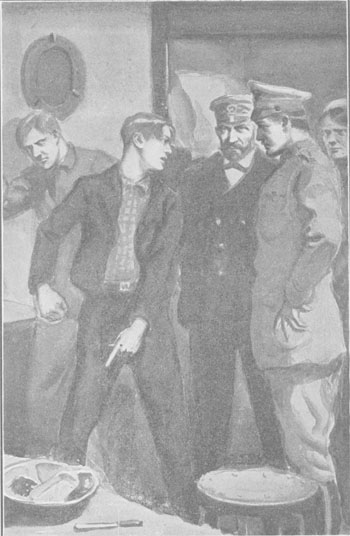
“They searched every bloomin’ one of ’em,” said the deck steward.
“Charlie was two hours making up the berths again after the way they
threw things around. But nothing doing. They found a mess plate with a
little black spot on it and he said they thought it might have been
from a match-end being laid there, but I heard they told the captain
there was nothing wrong down there.”
“What made them think there was?” asked Tom.
The deck steward shrugged his shoulders. “You can search me. But
they’re mighty particular, huh?”
He went about his duties, leaving Tom to ponder on this interesting
news, and though admittedly nothing had come of that stealthy raid which
had exposed neither rule breakers nor spies, still Tom thought about it
all day, more or less, and he was glad that Uncle Sam was so watchful
and thorough. It made him realize, all the more, how absurd and
preposterous it would be for him, the captain’s mess boy, to concern
himself or ask questions or say anything about serious matters which
were none of his business.
All day long they ran a zigzag course, taking a long cut to France, as
Pete Connigan would have said, the general tension relieved by the
emergency drills, manning the boats and so forth.
In the afternoon hours of respite from his duties he met Frenchy, whose
patience had been a little tried by some of Uncle Sam’s crack jolliers,
and they sat down on the top step of a companionway and talked.
“Zis I cannot bear!” he said, shrugging his shoulders. “To be called ze
Hun! Ugh!”
“They’re only kidding you,” said Tom; “fooling with you.”
“I do not like it—no!”
“But if you hadn’t become an American before the war,” said Tom, “you
couldn’t have enlisted on our side because you really were a German—a
German citizen—weren’t you?”
“Subject, yess! Citizen, no! All will be changed. Alsace will be France
again! We go to win her back! Yess?”
“Yes,” said Tom. “I only meant you belonged to Germany because you
couldn’t help it.”
“You are a lucky boy,” Frenchy said earnestly. “Zare is no—what you
say?—Mix-up; Zhermany, France, America—no. You are all American!”
“I got to remember that,” said Tom simply. “I know some rich fellers
home where I live. They let me join their scout troop, so I got to know
’em. One feller’s name is Van Arlen. His father was born in Holland.
They got two automobiles and a lot of servants and things. But anyway my
father was born in the United States—that’s one thing.”
“Ah,” said Frenchy, enthusiastically, “zat is ever’ting! You are fine
boy.”
His expression was so generous, so pleasant, that Tom could not help
saying, “I like France, too.”
“Listen, I will tell you,” said Frenchy, laughing. “It is ze old saying,
‘Ever’ man hass two countries; hees own and France!’ You see?”
In the warmth of Frenchy’s generous admiration Tom opened up and said
more than he had meant to say—more than he ever had said to anyone.
“So I got to be proud of it, anyway,” he said, in his honest, blunt
fashion. “Maybe you won’t understand, but one thing makes me like to go
away from Bridgeboro, kind of, is the way people say things about my
folks. They don’t do it on purpose—mostly. But anyway, all the fathers
of the fellows I know, they call them Mr. Blakeley and Mr. Harris, and
like that. But they always called my father Bill Slade. I didn’t ever
hear anybody call him Mister. But anyway, he was born in the United
States—that’s one sure thing. And so was my grandfather and my
grandmother, too. Once my father licked me because I forgot to hang out
the flag on Decoration Day. That shows he was patriotic, doesn’t it? The
other day I was going to tell you about my uncle but I forgot to. He was
in the Civil War—he got his arm shot off. So I got a lot to be proud
about, anyway. Just because my father didn’t get a job most—most of the
time——”
“Ah!” vociferated Frenchy, clapping him on the shoulder. “You are
ze—how you say—one fine boy!”
Tom remained stolid, under this enthusiastic approval. He was thinking
how glad and proud he was that his father had licked him for forgetting
to hang out the flag. It had not been a licking exactly, but a beating
and kicking, but this part of it he did not remember. He was very proud
of his father for it. It was something to boast about. It showed that
the Slades——
“Yess, you are a fine boy!” said Frenchy again, clapping him on the
shoulder with such vehemence as to interrupt his train of thought. “Zey
must be fine people—all ze way back—to haf’ such a boy. You see?”
CHAPTER IX — HE SEES A STRANGE LIGHT AND GOES ON TIPTOE
Of course, it would have been expecting too much to suppose that the
boys in khaki would overlook Tom Slade any more than Frenchy would
escape them, and “Whitey” was the bull’s-eye for a good deal of target
practice in the way of jollying. It got circulated about that Whitey had
a bug—a patriotic bug, particularly in regard to his family, and it was
whispered in his hearing as he came and went that his grandfather was
none other than the original Yankee Doodle.
Of course, Tom’s soberness increased this good-natured propensity of the
soldiers.
“Hey, Whitey,” they would call as he passed with the captain’s tray, “I
hear you were born on the Fourth of July. How about that?”
Or
“Hey, Whitey, I hear your great grandfather was the fellow that put the
bunk in Bunker Hill!”
But Tom did not mind; joking or no joking, they knew where he stood with
Uncle Sam and that was enough for him.
Sometimes they would vary their tune and pleasantly chide him with
being a secret agent of the Kaiser, “Baron von Slade,” and so on and so
on. He only smiled in that stolid way of his and went about his duties.
In his heart he was proud. Sometimes they would assume to be serious and
ply him with questions, and he would fall into their trap and proudly
tell about poor old Uncle Job and of how his father had licked him, by
way of proving the stanch Americanism of the Slades.
In their hearts they all liked him; he seemed so “easy” and bluntly
honest, and his patriotism was so obvious and so sincere.
“You’re all right, Whitey,” they would say.
Then, suddenly, that thing happened which shocked and startled them with
all the force of a torpedo from a U-boat, and left them gasping.
It happened that same night, and little did Tom Slade dream, as he went
along the deck in the darkening twilight, carrying the captain’s empty
supper dishes down to the galley, of the dreadful thing which he would
face before that last night in the danger zone was over.
He washed his hands, combed his hair, put on his dark coat, and went up
on deck for an hour or two which he could call his own. In the
companionway he passed his friend, the deck steward, talking with a
couple of soldiers, and as he squeezed past them he paused a moment to
listen.
It was evidently another slice of the same gossip with which he had
regaled Tom earlier in the day and he was imparting it with a great air
of confidence to the interested soldiers.
“Don’t say I told you, but they had two of them in the quartermaster’s
room, buzzing them. It’s more’n rule breaking, I think.”
“German agents, you mean?”
The deck steward shrugged his shoulders in that mysterious way, as if he
could not take the responsibility of answering that question.
“But they haven’t got anything on ’em,” he added. “The glass ports were
locked—they couldn’t have thrown anything out. So there you are. The
captain thinks it was phosphorus and maybe he’s right. It’s a kind of a
light you sometimes see in the ocean.”
“Huh,” said one of the soldiers.
“It’s fooled others before. So I guess there won’t be any more about it.
Keep your mouths shut.”
Tom passed them and went out upon the deck. He did not venture near the
forbidden spot astern, but leaned against the rail amidships. He knew he
had the right to spend his time off on deck and he liked to be alone.
Now and then he glimpsed a little streak of gray as some apprehensive
person in a life belt disappeared in a companionway, driven in by the
cold and the rough sea.
Presently, he was quite alone and he fell to thinking about home, as he
usually did when he was alone at night. He thought of his friend Roy
Blakeley and of the happy summers spent at Temple Camp; of the stalking
and tracking, and campfire yarns, and how they used to jolly him, just
as these soldiers jollied him, and call him “Sherlock Nobody Holmes”
just because he was interested in deduction and had “doped out” one or
two little things.
One thing will suggest another, and from Temple Camp, with its long
messboard and its clamoring, hungry scouts, and the tin dishes heaped
with savory hunters’ stew, his thoughts wandered back across the ocean
to a certain particular mess plate, right here on this very ship—a mess
plate with a little black stain on it, where someone might have laid a
burning match-end.
He caught himself up and thought of Mr. Conne. But this was his time
off and he had the right to think about anything he pleased. He could
not be reprimanded for just thinking. Nothing would tempt him to run the
risk of another encounter with one of those stern, brisk-speaking
officers, but he could think.
And he wondered whether that black spot had been made by a match-end.
The spot would show plainly, of course, for he knew how shiny and clean
mess plates were kept. Had he not done his part in scouring and rubbing
them down there in the galley?
He wondered how the mess plate had happened to be in the stateroom,
anyway. Sherlock Nobody Holmes again! But the crew, as well as the
troops, carried their supper wherever they pleased to eat it. So there
was nothing so strange about that. If there had been, why, Uncle Sam’s
all-seeing eye would not have missed it.
He fell to thinking of Bridgeboro again. And he thought of Adolf Schmitt
and——
A phrase from one of those letters ran through his mind—It’s the same
idea as a periscope.
For a moment Tom Slade felt just as so often he had felt when he had
found an indistinct footprint along a woodland trail. What was the
same idea as a periscope? What was a periscope, anyway?
Why, a thing on a submarine by means of which you could look two ways at
once—you could look up through the ocean and across the ocean—all with
one look.
He wondered whether Mr. Conne had noticed that rather puzzling phrase
and whether the people on this ship had seen that letter. Mr. Conne had
seemed to think that one the least important of the lot. Perhaps he had
just told the ship’s people to look out for spies. And they would do
that anyway. The names of uniformed spies in the army cantonments—names
in black and white—that was the important thing—the big discovery.
But Tom Slade was only a humble Sherlock Nobody Holmes and he couldn’t
get that phrase out of his head.
It’s the same idea as a periscope.
A periscope is a kind of a—a kind of a——
Tom’s brow was knit, just as when he used carefully and anxiously to
move the grass away from an all but obliterated footprint, and his eyes
were half closed and keen.
“I know what it is,” he said to himself, suddenly. “It means how light
can be passed through a room even while the room is dark all the
time—kind of reflected—and you wouldn’t have to use any match.”
He stood still, almost frightened at his own conclusion. The clean,
shiny mess plate and the phrase out of that letter seemed to fit
together like the sections of a picture puzzle. The black spot and the
match-end (if there was any match-end) meant just nothing at all. The
dim light out in the passageway down below hardly reached the dark
staterooms, but——
He could not remember just how it was down there, but he knew that in
the staterooms where the glass ports were locked (and that was the case
with all of the crews’ quarters below) air was admitted by a slightly
opened panel transom over the door.
What should he do? Go and tell an officer about his discovery? If it
were a discovery that would be all very well. But after all, this was
only a—a kind of a deduction. And they might laugh at him. He had
always stood in awe of the officers and since last night he was mortally
afraid of them. If he told any of the soldiers or even the steward they
would only jolly him. He did not know exactly what he had better do.
He made up his mind that he would go down through the passageway where
those under engineers and electricians slept and see how it looked down
there. He had been through there many times, but he thought that perhaps
he would notice some thing now which would help to prove his theory and
then perhaps they would listen to the captain’s mess boy if he could
muster the courage to speak.
He had just left the rail when he saw, some distance to starboard as it
seemed, and well forward of the ship, an infinitesimal bluish brown
spark. How he happened to notice it he did not know. “Once a scout,
always a scout,” perhaps. In any event, it was only by fixing his eyes
intently upon it that he could keep it in sight. And even so, he lost it
after a few seconds. He tried to find it again, but quite in vain. It
had been about as conspicuous as a snowflake would have been in a glass
of milk.
“Huh, if there’s anyone on this ship can see that, he must be a peach.
Maybe up in the rigging you can see it better, though. If it’s on the
destroyer, she’s quite a ways ahead of us——”
He squinted his eyes and, seeing a number of imaginary lights, decided
that perhaps the other had been imaginary too. He crossed the saloon,
went down the companionway and through the second class cabin
dining-room where the soldiers hailed him pleasantly, and, passing the
stokers’ washroom, tiptoed along the dim, narrow passageway.
CHAPTER X — HE GOES BELOW AND GROPES IN THE DARK
There were half a dozen or more staterooms along this passage. At the
end of it was the steep, greasy flight of iron steps leading down into
the engine-rooms. Here, also, was a huge box with a hinged lid, filled
with cotton waste. It was customary for one going down here to take a
handful of this waste to protect his hands from the oily rail, and also
on coming up to wipe his hands with a fresh lot. The very atmosphere of
a ship’s engine-room is oily. Here, also, were several fire-buckets in a
rack.
Along the side of the passage opposite the staterooms were electric
bulbs at intervals, but only two of them were burning—just enough to
light one through the narrow passage. Above each closed door was a solid
wooden transom, hinged at its lower side and opened at an angle into the
room.
Tom moved quickly and very quietly, for he feared to be caught loitering
here. He saw at once that only one of these staterooms could possibly
be used for any such criminal purpose as he suspected, and that was the
one with a light directly opposite it in the passage, for the other
light was beyond the staterooms.
For a few seconds he stood listening to the slow, monotonous sound of
the machinery just below him. The vibration was very pronounced here;
the floor thumped with the pulsations of the mighty engines. And Tom’s
heart was thumping too.
Within the staterooms all was dark and quiet. He knew the under
engineers turned in early. Not the faintest flicker was to be seen
through any of those transoms. He had been mistaken, he thought; had
jumped at a crazy notion. And he half turned to go up again.
But instead he listened at the companionway, then tiptoed stealthily
along the passage and looked over the oily iron rail, down, down into
the depths of the great, dim, oil-smelling space with its iron galleries
and the mammoth steel arms, moving back and forth, back and forth, far
down there upon the grated floor. A tiny figure in a jumper went down
from one of the lower galleries, paused to look at a big dial, then
crossed the floor and disappeared, making never a sound. No other
living thing was in sight—unless those mighty steel arms, ever meeting
and parting might be said to be living. To come up from down there would
mean the ascent of three iron stairways.
Tom withdrew into the passage and quietly lifting one of the
fire-buckets from the rack, tiptoed with it to the door which was
directly opposite the passageway.
Then he paused again. He could open that door, he knew, for no keys or
bolts were allowed on any stateroom door. He could surprise the
occupant, whom he would find in darkness. If his suspicion was correct
(and he was beginning now to fear that it was not) there would be no
actual proof of anything inside of that dark little room, save only just
what the authorities had already found—an apparently innocent mess
plate. The criminal act would consist of simply holding a shiny plate in
a certain position. The moment a sound was heard outside the plate could
be laid down. And who would be the wiser?
Tom’s heart was thumping in his breast, his eyes anxiously scanning one
end of the passage, then the other.
Not a sound—no sign of anyone.
Tom Slade had been a scout and notwithstanding his suspense and almost
panicky apprehension, he was not going to act impulsively or
thoughtlessly. He knew that if he could only present a convincing case
to his superiors, they would forgive him his presumption. If he made a
bungle it might go hard with him. Anyway, he could not, or would not,
turn back now.
In truth, he did not believe that anything at all was going to happen.
The stateroom was so dark and so still that all his fine ideas and
deductions, which had seemed so striking and plausible up on the
lonesome, wind-swept deck, began to fade away.
But there would be no harm in one little test, and no one would be the
wiser. He tried to picture in his mind’s eye the interior of that little
stateroom. If it were like his own, then the mirror was on the other
side of the passage wall, that is, on the opposite side of the stateroom
from the port hole. If one looked into the mirror he would see the port
hole. All of the smaller rooms below decks which he had seen were
arranged in the same way.
Therefore, thought Tom, if one should hold a shiny mess plate, for
instance, up near the transom, so as to catch the light from without,
he could throw it down into the mirror, which would reflect not only the
glare but the brilliant image of the bulb as well. From out on the ocean
that reflected light would be very clear.
All of which, thought Tom dubiously, was a very pretty theory, but——
Without making a sound he placed the inverted bucket on the floor and
listened. He put one foot on it and listened again. Then he stood upon
it, his heart pounding like a triphammer.
Not a sound.
Probably the tired occupant of the room was fast asleep—sleeping the
peaceful sleep of the innocent.
Tom knew that if his mind’s eye picture of the room’s arrangement were
correct, the metal reflector would be of no avail unless tilted at a
slight angle from the horizontal, right inside the transom.
For a moment he stood upon the bucket, not daring to budge. He could
hear his own breathing, and far away the steady, dull thud of the
tireless machinery. Something creaked in the passage, and he turned
cold. He did not stir a muscle.
Only some superficial crevice or crack somewhere—some loose panel or
worn hinge responding to the onslaught of a giant wave without——
Nothing——
He turned his head and looked down the passage, clenching his fists in
momentary fright, as if he feared the bending of his neck might be
heard.
No one. Not a sound.
He tried to look through the transom but his eyes were not high enough.
For another second he paused. Then he reached through the transom and
moved his hand about in the silence and darkness. He heard the cracking
again and waited, trembling, though he knew it was nothing.
Then he groped about with his hand again.