The big transport Texas Pioneer came slowly about in obedience to her
straining ropes and rubbed her mammoth side against the long wharf. Up
and down, this way and that, slanting-wise and curved, drab and gray and
white and red, the grotesque design upon her towering freeboard shone
like a distorted rainbow in the sunlight. Out of the night she had come,
stealing silently through the haunts where murder lurks, and the same
dancing rays which had run ahead of the dispatch-rider and turned to
mock him, had gilded her mighty prow as if to say, "Behold, I have
reached you first."
At her rail crowded hundreds of boys in khaki, demanding in English and
atrocious French to know where they were.
"Are we in France?" one called.
"Where's the Boiderberlong, anyway?" another shouted, the famous
Parisian boulevard evidently being his only means of identifying
France.
"Is that Napoleon's tomb?" another demanded, pointing to a little round
building.
"Look at the pile of hams," shouted another gazing over the rail at a
stack of that delectable. "Maybe we're in Hamburg!"
"This is Dippy," his neighbor corrected him.
"You mean Deppy," another said.
And so on and so on. There seemed to be hundreds of them, thousands of
them, and all on a gigantic picnic.
"Which is the quickest way to Berlin?" one called, addressing the throng
impartially.
"Second turn to your left."
Some of these boys would settle down in France and make it their long,
final home, under little wooden crosses. But they did not seem to think
of that.
At the foot of the gangplank stood the dispatch-rider and the man with
the cigar. Several other men, evidently of their party, stood near by.
Mr. Conne's head was cocked sideways and he scanned the gangway with a
leisurely, self-assured look. Tom was shaking all over—the victim of
suppressed excitement. He had been less excited on that memorable
morning when he had "done his bit" at Cantigny.
It seemed to be in the air that something unusual was likely to happen.
Workers, passing with their wheelbarrows and hand trucks, slackened
their pace and dallied as long as they dared, near the gangplank. They
were quickly moved along. Tom shifted from one foot to the other,
waiting. Mr. Conne worked his cigar over to the opposite corner of his
mouth and observed to an American officer that the day was going to be
warm. Then he glanced up and smiled pleasantly at the boys crowding at
the rail. He might have been waiting on a street corner for a car.
"Not nervous, are you?" he smiled at Tom.
"Not exactly," said Tom, with his usual candor; "but it seems as if
nothing can happen at all, now that we're here. It seems different,
thinking up things when you're riding along the road—kind of."
"Uh huh."
Presently the soldiers began coming down the gangplank.
"You watch for resemblances and I'll do the rest," said Mr. Conne in a
low tone. "Give yourself the benefit of every doubt. Know what I mean?"
"Yes—I do."
"I can't help you there."
Tom felt a certain compunction at scrutinizing these fine, American
fellows as they came down with their kits—hearty, boisterous,
open-hearted. He felt that it was unworthy of him to suspect any of this
laughing, bantering army, of crime—and such a crime! Treason! In the
hope of catching one he must scrutinize them all, and in his generous
heart it seemed to put a stigma on them all. He hoped he wouldn't see
anyone who looked like Major von Piffinhoeffer. Then he hoped he would.
Then he wondered if he would dare to look at him after—— And suppose
he should be mistaken. He did not like this sort of work at all now that
he was face to face with it. He would rather be off with Uncle Sam,
riding along the French roads, with the French children calling to him.
For the first time in his life he was nervous and afraid—not of being
caught but of catching someone; of the danger of suspecting and being
mistaken.
Mr. Conne, who never missed anything, noticed his perturbation and
patted him on the shoulder saying,
"All kinds of work have to be done, Tommy."
Tom tried to smile back at him.
Down the long gangplank they came, one after another, pushing each
other, tripping each other—joking, laughing. Among them came a young
private, wearing glasses, who was singing,
"Good-bye, Broadway. Hello, France!"
He was startled out of his careless merriment by a tap on the shoulder
from Mr. Conne, and almost before Tom realized what had happened, he was
standing blinking at one of the other Secret Service men who was handing
him back his glasses.
"All right, my boy," said Mr. Conne pleasantly, which seemed to wipe out
any indignity the young man might have felt.
Tom looked up the gangplank as they surged down, holding the rail to
steady them on the steep incline. Nobody seemed to have noticed what had
happened.
"Keep your mind on your part, Tommy," said Mr. Conne warningly.
Tom saw that of all those in sight only one wore glasses—a black-haired
youth who kept his hands on the shoulders of the man before him. Tom
made up his mind that he, in any event, would not detain this fellow on
the ground of anything in his appearance, nor any of the others now in
sight. He was drawn aside by Mr. Conne, however, and became the object
of attention of the other Secret Service men.
Tom kept his eyes riveted upon the gangplank. One, two, more, wearing
glasses, came in view, were stopped, examined, and passed on. After that
perhaps a hundred passed down and away, none of them with glasses, and
all of them he scrutinized carefully. Now another, with neatly adjusted
rimless glasses, came down. He had a clean-cut, professional look. Tom
did not take his eyes off the descending column for a second, but he
heard Mr. Conne say pleasantly,
"Just a minute."
He was glad when he was conscious of this fine-looking young American
passing on.
So it went.
There were some whom poor Tom might have been inclined to stop by way of
precaution for no better reason than that they had a rough-and-ready
look—hard fellows. He was glad—half glad—when Mr. Conne, for
reasons of his own, detained one, then another, of these, though they
wore no glasses. And he felt like apologizing to them for his momentary
suspicion, as he saw them pause surprised, answer frankly and honestly
and pass on.
Then came a young officer, immaculately attired, his leather leggings
shining, his uniform fitting him as if he had been moulded into it. He
wore little rimless eye-glasses. He might lead a raiding party for all
that; but he was a bit pompous and very self-conscious. Tom was rather
gratified to see him hailed aside.
Nothing.
Down they came, holding both rails and lifting their feet to swing, like
school boys—hundreds of them, thousands of them, it seemed. Tom watched
them all keenly as they passed out like an endless ribbon from a
magician's hat. There seemed to be no end of them.
There came now a fellow whom he watched closely. He had blond hair and
blue eyes, but no glasses. He looked something like—something like—oh,
who? Fritzie Schmitt, whom he used to know in Bridgeboro. No, he
didn't—not so much.
But his blond hair and blue eyes did not escape Mr. Conne.
Nothing.
"Watching, Tommy?"
"Yes, sir."
A hundred more, two hundred, and then a young sergeant with glasses.
While this young man was undergoing his ordeal (whatever it was, for Tom
kept his eyes riveted on the gangway), there appeared the tall figure of
a lieutenant. Tom thought he was of the medical corps, but he was not
certain. He seemed to be looking down at Mr. Conne's little group, with
a fierce, piercing stare. He wore horned spectacles of goodly
circumference and as Tom's eyes followed the thick, left wing of these,
he saw that it embraced an ear which stood out prominently. Both the ear
and the piercing eagle gaze set him all agog.
Should he speak? The lieutenant was gazing steadfastly down at Mr. Conne
and coming nearer with every step. Of course, Mr. Conne would stop him
anyway, but—— To mention that piercing stare and that ear after the
man had been stopped for the more tangible reason—there would be no
triumph in that.
Tom's hand trembled like a leaf and his voice was unsteady as he turned
to Mr. Conne, and said.
"This one coming down—the one that's looking at you—he looks like—and
I notice——"
"Put your hands down, my man," called Mr. Conne peremptorily, at the
same time leaping with the agility of a panther up past the descending
throng. "I'll take those."
But Tom Slade had spoken first. He did not know whether Mr. Conne's
sudden dash had been prompted by his words or not. He saw him lift the
heavy spectacles off the man's ears and with beating heart watched him
as he came down alongside the lieutenant.
"Going to throw them away, eh?" he heard Mr. Conne say.
Evidently the man, seeing another's glasses examined, had tried to
remove his own before he reached the place of inspection. Mr. Conne, who
saw everything, had seen this. But Tom had spoken before Mr. Conne moved
and he was satisfied.
"All right, Tommy," said Mr. Conne in his easy way. "You beat me to it."
Tom hardly knew what took place in the next few moments. He saw Mr.
Conne breathe upon the glasses, was conscious of soldiers slackening
their pace to see and hear what was going on, and of their being
ordered forward. He saw the two men who were with Mr. Conne standing
beside the tall lieutenant, who seemed bewildered. He noticed (it is
funny how one notices these little things amid such great things) the
little ring of red upon the lieutenant's nose where the glasses had sat.
"There you are, see?" he heard Mr. Conne say quietly, breathing heavily
upon the glasses and holding them up to the light, for the benefit of
his colleagues. "B L—two dots—X—see—Plain as day. See there, Tommy!"
He breathed upon them again and held them quickly up so that Tom could
see.
"Yes, sir," Tom stammered, somewhat perturbed at such official
attention.
"Look in the other one, too, Tommy—now—quick!"
"Oh, yes," said Tom as the strange figures die away. He felt very proud,
and not a little uncomfortable at being drawn into the centre of things.
And he did not feel slighted as he saw Mr. Conne and the captive
lieutenant, and the other officials whom he did not know, start away
thoughtless of anything else in the stress of the extraordinary affair.
He followed because he did not know what else to do, and he supposed
they wished him to follow. Outside the wharf he got Uncle Sam and
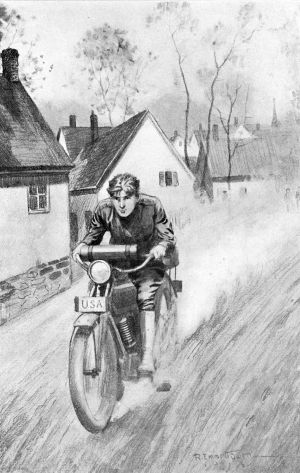
wheeled him along at a respectful distance behind these high officials.
So he had one companion. Several times Mr. Conne looked back at him and
smiled. And once he said in that funny way of his,
"All right, Tommy?"
"Yes, sir," Tom answered, trudging along. He had been greatly agitated,
but his wonted stolidness was returning now. Probably he felt more
comfortable and at home coming along behind with Uncle Sam than he
would have felt in the midst of this group where the vilest treason
walked baffled, but unashamed, in the uniform of Uncle Sam.
Once Mr. Conne turned to see if Tom were following. His cigar was stuck
up in the corner; of his mouth as usual and he gave Tom a whimsical
look.
"You hit the Piff family at both ends, didn't you, Tommy."
"Y-yes, sir," said Tom.