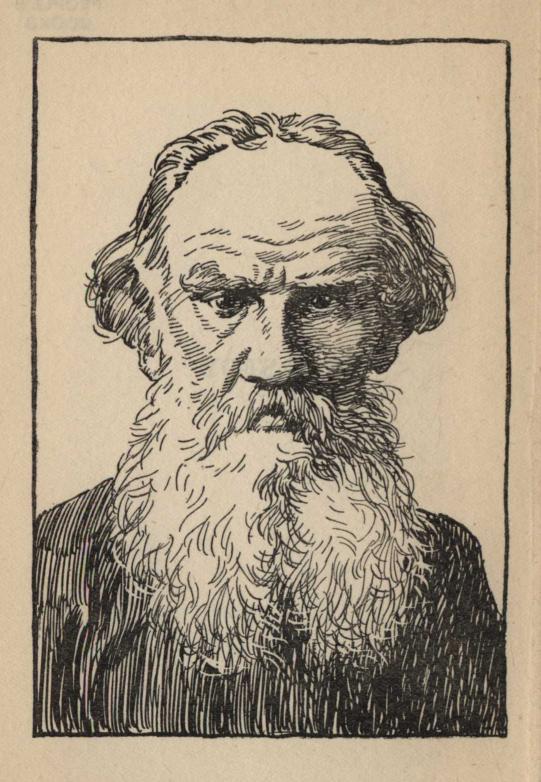
TOLSTOY'S CONTEMPORARIES
The most striking literary phenomenon of the nineteenth
century is, undoubtedly, the rise into power and
prominence of Russian authors.
Some fifty years ago Russian literature was
practically unknown to Western Europe; by the majority of
people its very existence seems to have been
unsuspected; we find even so great an adventurer as Carlyle,
himself guiding his countrymen to many new tracts of
literary discovery, speaking of "the great silent Russians
who are drilling a whole continent into obedience, but
who have produced 'nothing articulate' as yet."[1] In
less than thirty years from the time when Carlyle
penned that sentence Russian literature had become
recognised as one of the most powerful and vital in
Europe; its influence, already enormous, increases
every day; it is great in France, in Germany, in
Scandinavia, even in conservative England; hardly since the
Renaissance has Europe beheld such a phenomenon—a
literary advance at once so rapid and so great.
The truth is that we have seen in Russia a growth
very similar to that which occurred in Western Europe
at the time of the Renaissance. In the fifteenth and
sixteenth centuries Europe as a whole experienced the
vivifying influence of two great literatures—Greek and
Latin—and it had, at the same time, a mode of life
to depict and ideas of life to express which differed
widely from those of the classical nations: the great
models showed them the fascination of poetry and art,
and stimulated them to production; the different
conditions of life, the varying ideals, prevented their
production from becoming a mere imitation, and made it
new, significant, and vital. Something very similar
has occurred hi modern Russia. Russia has had the
stimulus of Western Europe—especially of England and
France—but, at the same time, the conditions of its life
are so powerfully individual, so exceedingly unlike those
of England and France, that its authors are hardly even
tempted to produce work which is a mere imitation; as
soon as they observe at all, the result of their
observations is bound to be different. Their production is
thus distinctive and individual, and, in its own turn,
reacts upon the literatures which first inspired it.
The chief literary form in the later nineteenth century
has been the psychological novel, and it is this which
the Russians have taken up, developed, and almost
recreated.
In psychology Russian writers are greatly helped by
their own exceeding truthfulness and candour. France
and England are lands of complex civilisations, of many
social grades and many conventions, and the mental
attitude of their writers is, almost inevitably, conventional,
and thus, to a certain extent, insincere. Russian
life has far fewer social grades and far fewer conventions;
Russian writers are, beyond comparison, more candid
with themselves and with others; they speak the
exact truth with a naïveté almost resembling the naïveté
of children, but with the far-reaching intelligence of
maturity. This invaluable quality of sincerity is found
in all the greatest Russians; Tolstoy and Dostoïevsky,
in especial, hide nothing, but reproduce all they know
with an absence of self-consciousness that amazes even
while it fascinates.
We all of us know in our hearts that this profound
sincerity is essential to really great literature; but,
none the less, we, in a variety of ways, discourage and
forbid it: in prudish England an author is always
afraid of offending "moral" prejudices; in France
writers, though in moral respects far freer, are most
sensitively afraid of appearing ridiculous or absurd.
To a Russian neither of these fears would seem to exist.
Throughout his work Tolstoy insists with the most
vehement intensity that absolute truthfulness in all
respects is the essential foundation of morals, and
nothing angers him more than concealment, which he
declares to be, always and everywhere, the assistant
and protector of vice, while the fear of being absurd
he dismisses as one of the most ridiculous vanities of
adolescence, unworthy of a sane man.
Another quality that greatly assists Russian writers
is their unique gift of sympathy; there may be,
probably there is, something in the very fibre of the race
essentially feminine and sensitive, but the peculiar
conditions of their government account for much.
Russia is the nation which, above all other great nations
in our days, has the most tragic destiny, suffers most
deeply and undeservedly; it is probably this which
helps to give her great writers so deep a compassion;
they penetrate to the very foundation of human
experience, they fathom the deepest abysses of human
suffering, and they return with an unequalled tenderness,
with a noble beauty of compassion, which has, in
the modern world, no rival at all.
It is worthy of note that the ancient Greeks would
appear to have gained in a similar way some of the
greatest qualities in their national soul. They too had
the experience of a deep suffering; they stood between
East and West, they bore the brunt of long-lasting racial
conflicts, and, when they finally emerged triumphant,
they carried with them the beautiful fruit of that bitter
experience, in their profound understanding of human
suffering, and their knowledge of all the depths of
tragedy. They too gain from their own anguish a unique
tenderness and compassion; Priam kissing the hands
of Achilles, "terrible man-slaying that had slain so
many of his sons," is one of the world's supreme types
of pathos; this lovely tenderness illumines all the
great Greek poetry from Homer to Euripides.
Latin literature, in comparison with the Greek, is
wanting both in compassion and in depth, but the
Romans had never in the same way suffered, and they
knew less of the secrets of the human soul.
Tolstoy, we are told, read much in Homer, and was
greatly influenced by him in writing his War and Peace.
It is hardly surprising, for, notwithstanding all differences,
there is a considerable similarity—the two are alike in
their heroism, in their understanding of war, their vast
and crowded canvas, their tragic view of human destiny,
and their lovely compassion. It is characteristic of
the Russian breadth of mind and elemental sincerity
that Tolstoy really can take Homer as his model in
writing a modern novel. It is hardly necessary to
remark that he has not Homer's sense of beauty, but
who in this modern world has?
The fecundity of Russian literature is very great; it
is a great mistake to regard Tolstoy as if he stood alone;
like Shakespeare, Tolstoy is only the highest peak, or
perhaps we should say the greatest magnitude, among a
number of writers only less distinguished than himself.
Among Tolstoy's predecessors the Russians
themselves rank Gogol very high; he owes much to the
influence of Dickens; his books show endless comic
verve, are crowded with situations full of laughter, but
at the same time he has, in general, a very serious
purpose behind. Gogol, though humane and good-tempered,
is a keen satirist; comparatively little known
abroad, he is greatly loved by Russians themselves.
Among Tolstoy's leading contemporaries the man
whom, above all others, he most whole-heartedly
admired was Féodor Dostoïevsky. Dostoïevsky had a
tragic history which is reflected in his works; he was
involved in the plots of the Decembrists, condemned to
execution, and only at the last moment reprieved; for
the remainder of his life, possibly in consequence of the
shock to his nervous system, he became an epileptic;
he was exiled for a time to Siberia.
Dostoïevsky's books are largely studies in crime, but
quite unlike those familiar to our modern press; the
modern detective story with its police-court atmosphere
and its vulgar shallowness of interest belongs to a world
immeasurably beneath Dostoïevsky; even the world of
tragic crime, depicted so forcibly by the Elizabethans,
stands far apart from his; in Elizabethan dramas
crime is observed for the sake of its passion, it is
invested with a terrible though gloomy allurement, and
its end is the ruin of the noblest or the tragic
destruction of a human soul.
Dostoïevsky's novels of crime are really studies in
redemption: in Crime and Punishment the hero is a
murderer and the heroine a fallen woman, but both
ultimately work out their salvation. To Dostoïevsky
crime is a moral disease, a source of the most exquisite
suffering to the soul; he studies the process by which
the soul, sick to death and horribly distressed, purifies
and cleanses itself. Dostoïevsky is not, like the
Elizabethans, impressed by the tragic beauty of crime; on
the contrary, he realises and makes us realise its
loathsomeness, its sordid horror; but, notwithstanding its
dark and gloomy setting, his work is in essence far
from pessimistic; the expiatory power of suffering,
the innate nobility of the human soul, the miserable
meanness of sin, the beauty of compassion—these are
the impressions which he prints most deeply in the mind.
The nearest western parallel is to be found, no doubt,
in Victor Hugo's Les Miserables, where the redemption
of a human soul is, in somewhat similar method,
described; but Victor Hugo does not penetrate to the
foundations of human life in the same manner as
Dostoïevsky; he—the petted idol of the French public—had
not that first-hand acquaintance with the terrible
realities of oppression; there is something theatrical
and rhetorical, almost insincere, about Hugo if we
compare him with the great Russian.
It is worthy of observation that Tolstoy greatly
admired both Les Miserables and Dostoïevsky; the
older he grew and the more powerfully the influence of
the latter became manifest, his sympathy with the
oppressed, his interest in redemption, increased, until
in the last of his great novels, Resurrection, we find that
he writes in the very spirit of Dostoïevsky; his heroine
goes down to the depths of shame and degradation,
and yet is redeemed and restored. The pessimist may
perhaps declare that both Tolstoy and Dostoïevsky are
mistaken in thinking that a human being can sink so
low and yet be redeemed; to which it can only be
replied that the unflinching courage with which they
face realities—all realities, however horrible and
sordid—earns them their right to be believed when they
assert the restorative power of purity and love.
Amid all Tolstoy's contemporaries the one most widely
appreciated in Europe is, without doubt, Turgénief. He
was understood earlier and more readily than his
fellow-countrymen, this appreciation being no doubt due to
the fact that there is more foreign influence in his work,
and that he is less purely Russian. Turgénief owes
much to French literature; the influence of its clarity
of style, its artistic form, its sense of proportion, are
evident throughout his writing; he is the most artistic
and literary of Russian authors, but, strong as the
French influence is in his work, no one could ever mistake
him for a Frenchman; he has the depth and tenderness
of the Slavonic temperament, its moral earnestness, its
profound sincerity.
Turgénief and Tolstoy were exceedingly unlike in
life and work; it is not surprising that, when they met,
they were alternately fascinated and repelled. Turgénief
complained that Tolstoy pursued him like a woman in
love and yet, when they were together, was always
quarrelling with him. At one time they were devoted
friends, at another they came near to fighting a duel.
Russia might well have been horrified by the spectacle
of her two greatest men of genius destroying each other;
their friends intervened and separated them, but the
reconciliation was never quite complete. The same
opposition of personality can be plainly perceived in
their work. Tolstoy is by far the more masculine genius,
enormous in his vitality and power, immense in his
canvases; he loves, in his early work especially, to
study masculine and virile characters, to dwell on war
and hunting, and all the vigorous activities of men;
his heroines, charming as they often are, are rarely or
never heroic; they are nearly always dominated by
their own emotions, they yield only too thoroughly to
the men who, with a cruel masculine egoism, at once
love and destroy them. Again it is hardly until he
reaches Resurrection that he shows a true sense of the
value of women as individuals: in his earlier novels he
consents to value them only in their maternal aspect,
as the mothers of men. His conception of love is nearly
always a masculine passion with, it must be
acknowledged, a somewhat crude masculinity; it is a
disturbance of the senses rather than an emotion of the
soul (Plato would have classed it unquestioningly as
born of the lower Aphrodite), and Tolstoy's finest heroes
nearly always yield to it reluctantly and, as it were,
churlishly.
Like another great masculine genius—Milton—Tolstoy
feels most intimately, but shudders at the power that
women possess over men. How often in his works one
meets with women who are like Milton's Dalila,
possessed of a charm that is mixed with loathing and
disgust. Both Milton and Tolstoy regard with horror,
as one of the worst of snares, the idealising power of
love.
Turgénief is very different. He has not Tolstoy's
enormous vitality nor his immense scope; his novels
are, in comparison, quite brief, and some of his best
work is done in a very small compass, though it is
always so deep in meaning that it never seems slight. He
has achieved nothing more perfect than the little story
of Faust, which might, so far as length goes, be only a
French feuilleton. He is always and essentially poetic; one
of the keenest of all human observers, he dislikes sordid
realism; he avoids war and all other forms of extreme
violence; it is quite characteristic of him that when
he does, for once, choose a soldier hero—Insarov in
On the Eve—he does not accompany him to war, but
makes him die of consumption before the conflict
actually begins. Love plays a far larger part in his
work than in that of Tolstoy, and it is an altogether
nobler kind of love. As a lover, indeed, he belongs to
the great poetic idealists, he is of the same race as Dante,
as Shakespeare, as Shelley. He understands, quite as
well as Tolstoy, the dreadful glamour of an evil passion;
he understands how it leads to atrophy of the heart,
to desolation and to ruin; but he understands also
that nobler passion whose very existence Tolstoy
explicitly and vehemently denies—the love which belongs
both to the senses and to the soul. Passion in Tolstoy
is always a concession to the animal in man; in
Turgénief it is often his redemption. It follows from this
that he understands women far better than Tolstoy;
indeed Turgénief lays his main stress on feminine rather
than on masculine character, and the most heroic and
beautiful figures in his pages are usually those of women.
He draws them, indeed, with a Shakespearean strength
and delicacy; he does not regret the influence they have
over man's life—it is so often for good; even when he
draws the destructive siren who lures men to their doom,
he draws her without the Tolstoyan frenzy of hate; he
gives her the same kind of charm that Shakespeare gave
Cleopatra, and permits her poetry to fascinate even while
he shows with the clearest irony all her sensuality and
her falseness. It is worthy of note that neither Tolstoy
nor Turgénief wholly escape from the influence of their
rank. Widely democratic as they are in sympathies
they yet betray their aristocratic birth—Tolstoy in the
wrath and anger, the almost Satanic fury he turns upon
those with whom he happens to disagree, and Turgénief
in the fastidious delicacy with which he loves the
beautiful, the distinguished, and the rare.
It is Dostoïevsky who is truly the man of the people;
he sees through all the cheats of power, but he hates
no one; he loves purity and beauty, but he finds them
even in the foulest prisons and the lowest slums; of
the three he is the truest democrat.
LIFE OF TOLSTOY—"A LANDED PROPRIETOR"—"CHILDHOOD"—"THE
COSSACKS"—"TALES FROM SEBASTOPOL"
Leo Tolstoy was born August 28, 1828, at the village
of Yasnaya Polyana, not far from Tula, on the old main
road to Kieff.
His parents were Count Nicolas Tolstoy and Princess
Marie Volkonsky, both of them members of well-known
families. The Tolstoy family had played a famous,
though at times a questionable part in Russian history;
its first Count—Peter Tolstoy—was an accomplice in
the assassination of the Tsarevitch Alexis, son of Peter
the Great; he was appointed Chief of the Secret
Service, and, later on, enjoyed the confidence of the
Empress Catherine I. When Peter II, son of the
murdered Alexis, ascended the throne, Count Tolstoy
lost his great position; being at that time an old man,
he retired to the monastery of Solovetsky on the White
Sea, where he died. The Tolstoy family were, for a
period, deprived of their title, but it was restored in the
reign of the Empress Elizabeth, daughter of Peter the
Great.
The Princess Marie Volkonsky also came of an eminent
family; they traced their descent from Rurik, and
several of her near relatives had been great generals.
The novelist's father, Nicolas Tolstoy, served in the
great campaigns of 1813 and 1814; he was taken
prisoner by the French but liberated in 1815, when the
allied armies entered Paris. Tolstoy has depicted a
number of his relatives in the novel of War and Peace;
his father is Nicolas Rostof and his mother the Princess
Mariya Bolkonsky; in real life as in the book, this
mother appears to have been the more remarkable of
the two parents, a woman possessed of a singularly
noble and beautiful character. Leo was only eighteen
months old at the time of his mother's death, but, from
what his aunts and other relatives told him, he created
a portrait which, whether accurate or not, is of
unforgettable charm.
The father died when Leo had reached the age of
nine, and the children—four brothers and a sister—were
left to the guardianship of their father's sister; they
were, as a matter of fact, brought up mainly by a lady
named Tatiana Yergolsky, whom they called "aunt,"
but who was, in reality, only a distant relative. Tatiana
Yergolsky had a romantic history; she loved Count
Nicolas Tolstoy, and he returned her affection, but she
sacrificed herself in order that he might marry the
wealthy heiress, Princess Marie Volkonsky. After the
marriage she remained an inmate of her cousin's house
and won the deep affection of his wife; when a widower
Count Nicolas once more desired to marry Tatiana,
but she still refused, fearing to spoil the tenderness of
her relation to the dead wife and to the children. It
would be difficult to imagine a character more sweet
and self-sacrificing; upon the orphaned children she
bestowed a devoted love; to Leo she took the place
of the mother he had never known, and the father he
had lost so soon; she was the chief happiness of his
childhood, and he declares that, in the building up of
his moral character, she, of all human beings, played the
most beneficent part.
He says: "Aunt Tatiana had the greatest influence
on my life. It was she who taught me while yet in my
childhood the moral joy of love. Not by words but by
her whole being she imbued me with love. I saw, I felt
how happy she was in loving, and I understood the joy
of love. That was the first lesson. And the second
was that she taught me the beauty of a quiet, lonely life."
The four Tolstoy brothers possessed strong
individualities, and Tolstoy had a keen feeling of affection
for all the members of his family; his favourite brother
was, however, Nicolas—some six years older than
himself. He and Nicolas, in their child's play,
founded a society which they called "Ant-Brothers,"
which was to embrace all mankind and all the earth in
a loving union; they buried a green stick as a kind of
charm to celebrate the founding of this society. When
Tolstoy came to die he asked that he might be buried
on the hill where, so long ago, he and Nicolas had placed
the green stick; it will, at any rate, be one of the
world's great places of pilgrimage.
Nicolas possessed great talents; Leo always generously
and obstinately believed this brother more gifted than
himself, and quotes, with warm approval, Turgénief's
opinion: "Turgénief quite correctly observed that he
only lacked the imperfections necessary for the making
of an author. He did not possess the principal and
necessary defect—vanity. But the qualities of an
author which he did possess were a refined artistic
instinct, an exceedingly delicate sense of proportion,
a good-natured gay humour, exceptional and inexhaustible
imagination and high moral conceptions, and
all this without any conceit. He had such an imagination
that for hours he could tell humorous tales and
ghost stories."
Tatiana Yergolsky was exceedingly religious, and
one of the customs of Yasnaya Polyana was to extend
hospitality to all types of pilgrims—monks and nuns
and beggars, who led a life of humility and deliberately
courted contumely.
Tolstoy's early life was spent in a peculiar poetic
and religious atmosphere, an atmosphere mediæval in
its tone. This should never be forgotten, for, after a
whole lifetime of experience and achievement, we find
him returning once more to the beliefs of his youth,
stripping them of supernaturalism and ecclesiasticism,
but holding with all his heart to the virtues of these
pilgrim friends—humility and simplicity and love.
The Tolstoy brothers all went in turn to the
university of Kazan. Leo first chose the faculty of
Eastern languages, intending to enter the diplomatic
service; he then tried law and other courses, but was
capricious and unsuccessful; few great writers have
ever cared so little for studies or been so scornful of
intellectual attainment in others. Tolstoy left the
university in disgust, and returned for a time to Yasnaya
Polyana, intending to devote himself to his peasants.
There is a study of his life at this period in the book
entitled A Landed Proprietor, which gives an account,
at once graphic and sombre, of the enormous difficulties
of the task. We are shown typical days in the life of
the hero—Nekhlúdof—as he visits the peasants who
have asked for his aid. Many of them live in wretched
hovels—this, for example, is the house of one Churis:
"The uneven, smoke-begrimed walls of the dwelling
were hung with various rags and clothes; in the
living-room the walls were literally covered with reddish
cockroaches, clustering around the holy images and
benches.... In the middle of this dark foetid
apartment, not fourteen feet square, was a huge crack in the
ceiling; and in spite of the fact that it was braced up
in two places, the ceiling hung down so that it threatened
to fall from moment to moment.
"'It will crush us to death, it will crush the children,'
cried the woman."
Nekhlúdof is annoyed that Churis should have
allowed his house to sink into such a condition, but he
discovers that Churis has been ruined through the
exactions of a land-agent (employed by Nekhlúdof's
grandfather), who had cheated the peasant family out
of their best land. We see how early and how decidedly
Tolstoy has traced the miseries of the peasants to their
landlords' exactions. Yet he does not disguise the
faults of the peasants themselves: in another hut which
Nekhlúdof visits the owner is thoroughly idle, lying on
the oven all day and sleeping; his wife has been worked
to death, and the old mother bears all the burden of the
house and fields. She begs Nekhlúdof to find her a
new daughter-in-law, but, with disgust and anger, he
declines to force a fresh martyr into the wretched hovel.
The overseer recommends that this particular peasant
should be flogged, but the "barin" decides to take
him into his own house and try to teach him how to
labour. Tolstoy has often been accused of idealising
Russian peasants, but, as these most graphic pictures
attest, he perceived the worst that could be said.
Indeed Turgénief complained of this particular book
that it was pessimistic and did not do justice to the
peasants.
After a brief space Tolstoy left the country and
returned to St. Petersburg, where he plunged into
dissipation; it was, morally considered, the most ignominious
portion of his life. He confesses in his diary: "I
am living like a beast, though not entirely depraved;
my studies are nearly all abandoned, and spiritually I
am very low."
In his religious work, My Confession, he speaks with
bitter anger of this period of his life.
"I honestly desired," he says, "to make myself a
good and virtuous man; but I was young, I had
passions, and I stood alone, altogether alone, in my
search after virtue. Every time I tried to express the
longings of my heart for a truly virtuous life I was
met with contempt and derisive laughter; but directly
I gave way to the lowest of my passions I was praised
and encouraged.... I cannot now recall those years
without a painful feeling of horror and loathing. I put
men to death in war, I fought duels to slay others, I
lost at cards, wasted my substance wrung from the
sweat of peasants, punished the latter cruelly, rioted
with loose women, and deceived men. Lying, robbery,
adultery of all kinds, drunkenness, violence, and murder,
all committed by me, not one crime omitted, and yet I
was not the less considered by my equals a comparatively
moral man."
We should remember that it is the ascetic Tolstoy
who is speaking here and judging his former life with
all possible sternness, but there can be little doubt
that it was this period which gave him his life-long
scorn for the corrupt aristocracy whose whole existence
was "a mania of selfishness." Never again did he
sink so low.
In the meantime Nicolas Tolstoy was serving with
the Russian artillery in the Caucasus; in 1851 he
returned home on leave, perceived the danger of the
immoral life his brother was leading, and persuaded
Leo to join him.
Tolstoy spent nearly three years in the Caucasus,
and the fresh, beautiful and poetic life restored him to
mental and physical health, and awoke in him both
religious and creative power. His first novel, Childhood,
appeared in 1852, and was at once recognised by leading
Russian writers as a work of rare promise and charm.
It is largely autobiographical, not in the actual
incidents, but in the general circumstances, and especially
in the mental development. It is most remarkable
for the amazing psychological fidelity with which the
impressions of childhood are remembered and recorded;
the strong affections for parents and brothers, for
sister and teacher, the awe-struck reverence for the
crazy pilgrim, Grisha, the first faint gleam of romantic
love, the poetry of forest rides, the love of animals, the
shuddering physical horror in the face of death, the
strange confusion and sadness of loss. Everything is
at once realistic and full of romance; Tolstoy has
brought before us all the clear-cut sharpness of these
early impressions of the world before custom has laid
upon them a hand "heavy as frost and deep almost as
life."
Tolstoy's life in the Caucasus, in its actual details,
provided him with the subject-matter for two of his
most fascinating works, The Cossacks, and The Invaders.
These are not among his greatest productions; psychologically
and dramatically they cannot equal the later
novels, but they stand almost alone in their fresh, pure
poetry. In these the remorseless realist shows himself
as a romantic adventurer—almost, except for the deeper
mentality, a Russian Stevenson; the breath of the
mountain and forest, the clear, cold sweetness of dawn
blows through their pages; they charm with the sense
of great spaces, of gay, glad daring; they are filled,
above all, with the intoxication of freedom.
It is one of the secrets of Tolstoy's greatness that he
experienced, directly and at first hand, so many
different kinds of life, and no change could well have
been greater than that from the artificial, feverish,
corrupt St. Petersburg to the primitive life of the hunter
and mountaineer. The hero, Olyénin, is a reflection of
Tolstoy himself. We are told how he delights in the
first signs of danger, such as the carrying of weapons, &c.
Before he has seen them he cannot believe in the beauty
of snow-clad mountains; he thinks it as much a figment
of the imagination as the melody of Bach's music or
the romantic love of woman, in neither of which he is
able to believe. But when he sees the mountains they
surpass all he has heard and transcend his wildest
dreams; they give him an almost Wordsworthian
depth of inspiration. "At first the mountains aroused
in Olyénin's mind only a sentiment of wonder, then of
delight; but afterwards, as he gazed at this chain of
snowy mountains, not piled one upon another, but
growing and rising straight out of the steppe, little by
little he began to get into the spirit of their beauty and
he felt the mountains.... From that moment all
that he had seen, all that he had thought, all that he
had felt, assumed for him the new, sternly majestic
character of the mountains.... 'Now life begins,'
seemed to be sounded in his ears by some solemn voice."
He shares in the romantic, adventurous life of the
Cossacks, a little tribe barricaded away in their own
corner of the world and surrounded by their enemies—the
semi-civilised Mohammedans.
The most interesting character in the book is the old
Cossack hunter, Yeroshka; whole past ages of the
world seem to live again in this primitive and fascinating
figure; he takes us back to the very childhood of
man. He is so strong that, when he has killed a wild
boar weighing three hundred and sixty pounds, he can
carry it home on his back. He says to Olyénin: "I
will find and show you every sort of animal, every kind
of bird, and how and where.... I know it all. I have
dogs and two fowling-pieces, and nets, and decoys, and
a falcon. I can find the track of any wild beast....
I know where he comes to his lair and where he comes
to drink or wallow."
Yeroshka has studied all the wisdom of the animals,
he is continually pitting his wits against theirs, and he
thinks them, on the whole, much cleverer than men:
notwithstanding his hunting he loves all creatures so
much that he will save even moths from the flame.
Life in the forest is marvellously described—the
misty mornings, the search for the stag's lair, the
interpreting of his tracks, the swaying of innumerable
boughs, the fear of the wild tribes; it is all here—the
forest loneliness, the forest enchantment, the forest
terror. Even the tiny gnats which cover Olyénin so that
they make him grey from head to foot, have their own
peculiar attraction; he grows to feel their stings a part
of the forest fascination and freedom; they prevent
him from growing somnolent, and keep him alive to
that immense joy which he finds everywhere in nature
and would not miss even for a moment.
Throughout Tolstoy's later work he hates civilisation,
and we understand why; he is always longing to escape
from it to the life that is inspired by the immense joy
of nature and freshened by hard physical toil.
Characteristically enough, Tolstoy will not idealise even what
he loves, and he confesses that the mere touch of civilisation
spoils his Yeroshka; he cannot live like a modern
man, and his hut is filthy.
"On the table were flung his blood-stained coat, a
half of a milk cake, and next to it a plucked and torn
jackdaw.... On the dirty floor were thrown a net
and a few dead pheasants, and a hen wandered about
pecking, with its leg fastened to a table leg."
In the forests which he so loves Yeroshka is like a
wood-god—strong, wise, and happy—but he has only
to touch the ordinary life of man and he becomes a
Silenus, debased and drunken.
In 1853 Tolstoy left the Caucasus for the Crimea, the
influence of his relatives procuring him a post on the
staff of the Commander-in-Chief, Prince Gorchakoff.
He could not rest until he reached Sebastopol itself,
and he entered it in November 1854. He was often in
great danger, for he volunteered for duty on the most
dangerous posts, even on the famous fourth bastion,
whose horrors have never been surpassed in war.
Tolstoy published his Tales from Sebastopol in 1854;
this book aroused the attention of the Czar, and gained
for the author a considerable literary reputation. But
Tolstoy achieved something more than reputation, for
his whole nature was deepened and widened; it was
Sebastopol which first showed him the heroism and
tragedy of human destiny, and taught him his immense
appreciation of the common man. For him mere
cynicism was henceforth at an end; no man who had
beheld the sublime heroism of Sebastopol—twenty-two
thousand perishing under fire, as many more suffering
hideous tortures on the operating tables (without
chloroform) and in the hospitals, all this borne not
merely with fortitude, but with cheerfulness, not for
the sake of any personal gain, but for the sake of an
ideal—the ideal of patriotism—no man who had beheld
this could relapse into that cheap cynicism which
proclaims the essential worthlessness of the human kind.
Tolstoy begins his studies (and this is quite characteristic
of his grim realism) in the hospital, and dwells
on the passive endurance which is shown there. He
passes on to the emotions of men under fire, and gives a
masterly exposition of the psychology of war; the
physical shrinking, the consciousness of everything
sordid and wretched, the curious elation that follows
upon fear, the reckless hilarity and carelessness that
mark the new recruit, the seasoned calm of the veteran
who is grateful for every day left him of his life, the
curious superstitions, not based on any soldier's folklore,
but springing up of themselves in an environment
where all things are so insecure, the swift and noble
friendships broken by the heartrending tragedy of
death and, through it all, the sombre pride that men
feel in their own superhuman endurance.
Tolstoy describes the actual moment of death in
battle with such imaginative vividness that it seems
almost impossible a man could so realise it without a
personal experience.
We may trace from Sebastopol also Tolstoy's characteristic
attitude to war, which is peculiar because it
unites such a great appreciation of war as a school of
heroic virtue with such a whole-hearted condemnation.
Most men are blind either to one side or to the other,
but, from the very beginning, Tolstoy keeps both
steadily in view. We could not explain the fascination
war has possessed for so many of the noblest human
minds if it were not for the fact that it is often a school
of heroic virtue. Homer himself could hardly better the
sublime courage of these Tolstoyan heroes, but Tolstoy's
very appreciation teaches him also the vast futility of
war; it is such a waste of noble human beings, and the
ends for which it is waged are, compared with the
tremendous sacrifices it evokes, so childish and futile.
LIFE OF TOLSTOY (continued)—JOURNEY ABROAD—PEASANT
SCHOOLS—"TALES FOR CHILDREN"—MARRIED
LIFE—RELIGIOUS DIFFICULTIES—CONVERSION
Soon after the capitulation of Sebastopol, Tolstoy,
disgusted, with the mere idea of military glory, left
military service and returned to St. Petersburg. He
was received into the chief literary society of the day,
introduced to Turgénief and the poet Fet, who became
his most intimate friend. Tolstoy, however, never
cared much for literary society; he spoke of it
afterwards very slightingly and even scornfully, and he soon
left.
In January 1857 he started on a tour in Europe; he
visited Paris, and, while there, witnessed an execution
which gave him his life-long horror of capital
punishment. He declares that he had previously accepted it
as a necessity, but, when he saw the ghastly preparations,
when he heard the dull sound made by the head
falling into the basket, he realised suddenly that, no
matter what laws or customs countenanced this act, it
was wrong and would always remain wrong. Even the
horrors of war did not inspire him with an aversion
quite so sickening; what he so disliked was the
cold-blooded, premeditated violence wreaked upon a bound
and helpless man.
Tolstoy also visited Switzerland—Geneva and
Lucerne. At the latter place he was disagreeably
impressed by the arrogance of the English tourists.
One of the most charming of his minor tales—a little
sketch entitled Albert—tells the story of a wandering
musician treated with haughty severity by the
English and, as the candid narrator admits, entertained by
Tolstoy himself, with a somewhat exaggerated and
theatrical kindness. It shows Tolstoy's habit of digging
down to the very foundations of social life in seeking a
remedy for the simplest injustice.
In 1860 consumption declared itself in Nicolas
Tolstoy and he was soon seriously ill; he went in search
of health to Soden and afterwards to Hyères.
Leo went to help in nursing him, and, on September
20th, Nicolas died in his brother's arms.
This event made a deep and tragic impression upon
Tolstoy: it was not only the personal loss, though he
loved Nicolas more than any other human being, but
the worst horror lay in his brother's fear of death, and
in the unavailing struggle against it. The circumstances
are described in the death of Nicolas Levin in Anna
Karénina.
Tolstoy next studied elementary education in France,
Germany, and England.
In February 1861 the Russian serfs were liberated,
and a new era in Russian history began; Tolstoy tried
to play his part by starting peasants' schools upon his
estate. In his theories of education he was largely
influenced by Rousseau; it was from Rousseau that he
obtained his ideas of "freedom," and of permitting
unchecked development to the child; he organised his
schools in a very original manner, and his theories
seem to have had a far-reaching effect on Russian
education in making it more free and flexible than that of
Western Europe.
The tales he wrote for his peasant children, and
embodied in various school-readers, form a charming
portion of his work; they are exquisitely simple, and
full of that fresh observation of the ways of animals and
plants and the ways of children themselves which the
young so love.
Among the best are stories of his dogs, Milton and
Bulka; tales of bear-hunting and its perils; there is an
unforgettable study of the hare and its timid ways,
another which tells how mother-wolves train their
young to hunt. Nor does Tolstoy limit his sympathies
to animals—he can make the trees live for us in the same
vivid and forcible way; thus he tells how hundreds of
young poplars sprang up around an old poplar which was
decaying, and how he ordered the young trees to be
cut down since he could see that they were taking the
sap from the old one. The young trees resisted stoutly:
"Sometimes four of us would try to pull up the roots of
some young poplar that had been cut down, and found
it impossible; it would resist with all its might and
would not die." However he persists in destroying
them; the old tree itself dies and Tolstoy comments:
"He had been long dying, and was conscious of it, and
was giving all his life to his shoots. That was the reason
why they had grown so rapidly, and I, who had wished to
help him, had only killed all his children."
Perfectly charming also are the little studies of
peasant children, such as the boy "Filipok," who is
passionately eager to go to school but, when he gets
there, cannot say a word through shyness; however
they leave him alone, and he comes to himself and makes
one of the best scholars.
Tolstoy's own educational experiments were not
permitted to continue for long; the officials became
jealous of his schools, and they were accordingly closed.
In dividing out the land between the nobles and the
peasants many disputes occurred, and Tolstoy offered
his services as arbitrator; he incurred a good deal of
odium among his aristocratic neighbours because he so
often took the part of the poor; he saw how the
peasants were steadily cheated out of their fair share
of land. It is this unfair division which explains the
terrible severity of the Russian famines; the peasant
has never been allowed sufficient land to support
himself, and he cannot, with his best efforts, keep any
reserve for bad times. Tolstoy perceived this and, to
the best of his ability, struggled against it; like the
heroism of the common soldier at Sebastopol, it served its
purpose in making him the ardent champion of the poor.
In the year 1862 Tolstoy married Sophia Behrs, with
whose family he had been for some time acquainted;
he was thirty-four and his bride eighteen.
There ensued a period of great family happiness and
of powerful creative work. It was, in the ordinary
sense, the happiest time of Tolstoy's life, though he
himself, with his ever-progressing moral development
and his ever-increasing idealism, later on condemned its
happiness as selfish and enervating.
Tolstoy managed his own estate and, by the testimony
of many observers, was exceedingly successful with
his stock, his buildings, and his crops; he succeeded
also in making his peasants happy and contented. His
family was large, and his wife proved herself an admirable
mother, devoting herself passionately to her children.
It was during this period that Tolstoy achieved
his European reputation as a novelist by producing his
two great works of War and Peace, 1864-9, and Anna
Karénina, 1873-6.
Tolstoy was a most conscientious and exacting
literary artist. Before writing War and Peace, he made
careful historical studies; it is his longest and most
ambitious work, and might be termed a prose epic rather
than a novel.
Tolstoy also planned a novel on the period of Peter
the Great, but the more he studied this subject the
less he liked it; he found the whole epoch
unsympathetic, and declared that Peter's so-called reforms
were not really intended for the good of the people, but
mainly for his own personal profit, and that what he
really desired was freedom for a life of immorality.
Tolstoy's next great novel, Anna Karénina, was based
on an event which had occurred in real life—the suicide
of a young lady who, owing to an unhappy love affair,
flung herself before a train. Tolstoy chose as a motto for
his book the biblical saying: "Vengeance is mine, I
will repay," the fundamental idea being that people
have no right to judge others, and that for human
relations there is but one law—the law of mercy. Among
all Tolstoy's critics Dostoïevsky appears to have been
the only one who understood him in this sense; most
readers seem to have interpreted the motto in the
narrowest possible way as meaning the punishment of
Anna for her breach of the marriage vow.
During all this period of literary activity Tolstoy was
greatly aided by his wife; she served as his amanuensis,
she alone being able to interpret his crabbed and difficult
handwriting with its endless corrections, and one of
her relatives records that she seven times re-copied the
enormous MS. of War and Peace.
It was, as he himself tells us, about his fiftieth year
that a great change came over Tolstoy. His life had
been one of brilliant success; he had achieved great
distinction, he had an excellent property, a congenial
wife, a happy family, but he became profoundly
dissatisfied. Merejkovsky, the most severe of Tolstoy's
critics, ascribes this condition mainly to the ebb of
vitality natural at his age, and considers it to be, in
its origin, essentially physical and egoistic; but
Merejkovsky surely forgets the intense interest in moral and
religious problems which Tolstoy had always taken
even in his youth; in The Cossacks, and in War and
Peace, Tolstoy's heroes are continually searching for
"the meaning of life."
The truth would appear to be that Tolstoy, in his
youth greatly perplexed by philosophical and religious
doubts, had never solved his problems, but had done
what so many men do—evaded them by taking refuge
in the joys and duties of practical life; but to most
really thoughtful natures there comes a crisis when these
duties will no longer serve as anodynes, and the old
questionings, ten times stronger for their repression,
return once more.
This was really the "Sturm und Drang" period of
Tolstoy's life; it came unnaturally late, and its severity
was proportioned to its delay. In the book entitled
My Confession, Tolstoy has given a most sincere, graphic,
and terrible account of his sufferings at this period. He
traces its inception (surely with accuracy!) to the
lack of any true religious faith in his youth. He tells
how he had momentary gleams of revelation which
showed him what a true religion might be, but his faith
soon became merely conventional. Moreover, the new
scientific materialism was spreading over Russia, and
reaching the intellectual élite in the schools and colleges;
the ceremonial, superstitious religion of the Greek Church,
so essentially mediæval in all its methods of thought,
could not stand against this dry, scientific determinism.
Tolstoy gave way to scepticism and dissipation, and
afterwards forgot and buried deep down his longings
for a higher life.
After, as we shall see later, a desperate and almost
overwhelming struggle, Tolstoy emerged from his
darkness convinced that the true faith lay in a literal
obedience to the precepts of the Gospel and especially
to the Sermon on the Mount. He thought the precepts
of the Gospel were realised more completely in the life
of the Russian peasants than in that of any other
human beings, and, taking their life as his model, he
built up his creed: that the great essentials of life are
labour and love, that man should be simple, laborious,
and kind, that he ought to give more than he receives,
to contribute to the common stock more than he takes
from it, that he should rejoice in service; in this life
he will find health and happiness, and he will not fear
death because if he banishes egoism, the loss of his own
personality—even to its total extinction—will not
appear to him an evil.
This, stated in its essence, is the "solution" at which
Tolstoy arrived, and from the year 1879 onwards we
find him devoting his life almost entirely to moral and
religious teaching.
Taking peasant life always as his model, he himself
lived very frugally and simply; he partook only of the
plainest food—vegetarian; he dressed like a peasant, he
waited upon himself and did the work of his own room,
and he "paid" even for this simple sustenance with
the labour of his own hands; he worked at haymaking
and reaping in the fields, at woodcutting in the woods,
and in the winter he made shoes. He spent a portion
of each day in manual labour, giving himself appetite
to enjoy his simple diet; his temperance and toil kept
him strong and vigorous, and he declared that he had
as much time as ever to devote to intellectual work.
Tolstoy, had, in fact, returned to the passionate and
practical faith of the Middle Ages; his life was the
life of a mediæval monk when monasticism was at its
best—ascetic, laborious, intellectual—but his
nineteenth century scepticism had caused him to omit and
reject mediæval dogmas and superstitions.
Tolstoy, like so many other religious mystics, wished
to yield up his property entirely and strip himself of
all worldly goods. It was here that, as with others
before him, he came into conflict with his own family.
Another, though a much less reformer of our own
time, General Booth, was able to interest all the members
of his own family, and to find in them his best and most
willing helpers, but he had the advantage of a wife who
was, from the beginning, on his side.
Tolstoy was in a different position: the Countess
proved herself an admirable wife so long as he devoted
himself to adding lustre and aggrandisement to his
family; she helped him in the management of his
estates, she understood his literary work and gloried in
his renown, but further she could not go; she could not
comprehend his moral and religious crisis, and her great
terror was lest her children should be, in any degree,
impoverished. It is painful to hear that at one time
she contemplated appealing to the authorities to have
her husband declared insane and incapable of managing
his own property.
The truth was that Tolstoy's idealism had come in
conflict with that maternal egoism which is the dark
side of maternal altruism, and one of the strongest
forces of the world. This experience helps us to
understand the curious bias against maternity which occurs
in much of Tolstoy's later work. With regard to this
situation Tolstoy ultimately compromised and, in the
year 1888, renounced his estates in favour of his family.
He continued to produce religious works: The Four
Gospels Harmonised and Translated, 1881-2; My
Religion, 1884; The Kingdom of God is Within You,
1893, &c.
Political events in Russia more and more grieved
and distressed him. The Revolutionary Executive
Committee condemned Alexander II to death, and
carried out their sentence. This event shook the whole
nation. Tolstoy was horrified by the crime but he
profoundly pitied the criminals; he addressed an open
letter to the new emperor, Alexander III, imploring
him in the name of Christ to forgive the culprits, and
declaring that the only way to Russia's salvation lay
in following the precepts of Jesus; the other possible
methods—cruel repression and liberal reforms—had
both been tried and found wanting. No answer was
made, and the regicides were put to death.
Throughout Tolstoy's later work we perceive a horror
of violence in all its forms, whether legal or illegal: to
him all violent death is murder, and, no matter whether
it is inflicted by the sentence of revolutionary
committees or by the sentence of the law, it is equally
criminal.
Tolstoy went for a time to reside in Moscow, and was,
more than ever, startled and dismayed by the great
contrasts between the extremes of poverty and of
wealth.
In 1882 a census was taken; Tolstoy volunteered his
help, and was thus enabled to plumb to the very depths
the miseries of Moscow. A full account of this census
is given in the book entitled What to Do? It is a
most clear, graphic, and ruthless study of the miseries
of poverty and vice; Tolstoy shows with ironic
completeness the total insufficiency of charity to compete
with the evil, and asks what remedies are possible.
He arrives at the same conclusion as Mr. Bernard
Shaw: "What is wrong with the rich is idleness;
what is wrong with the poor is poverty."
He shows how the honest and hard-working toiler is
defrauded of his comforts because the results of his
labour are appropriated to find luxuries for his masters;
he shows how the work of the community is distracted
from the production of the necessities required by all
to luxuries available only for a few and enervating even
to them; moreover the rich themselves, corrupted by
their idleness, spread corruption around them which
disseminates itself through all classes and creates a race
of idlers, parasitic upon the labour of others; the
analysis of social conditions given in this little book is
acute and keen.
Tolstoy found the city too artificial, and returned to
the country, where he resumed his simple life. He
composed much popular literature; it was printed by a
special press in the form of very cheap booklets, which
were carried round by pedlars and sold to the people.
Tolstoy henceforth regarded his former literary work
as bad and selfish, considering it as being in essence a
luxury intended for the entertainment of a limited
class. His booklets achieved the purpose he had in
view; they were greatly loved by the common people,
and have penetrated, in the most remarkable way, to
every corner of Russia. So great was the demand that
each pamphlet was printed in an edition of twenty-four
thousand copies, and of most there were five editions in
a single year; towards the end of the fourth year the
number of copies sold amounted to twelve millions.
The first publications were taken from his reading books
for children, and included such tales as The Prisoner of
the Caucasia, God Sees the Truth, Where Love Is God Is, &c.
It is interesting to note that other distinguished
Russian authors have since followed Tolstoy's example.
During an illness he wrote The Power of Darkness, which
was, however, prohibited for a number of years.
In 1891-2 he was occupied in relieving the dreadful
Russian famine, procuring assistance by his appeals to
Western Europe and, with the money obtained, organising
relief-works in different districts.
Tolstoy became greatly interested in the Doukbobors:
they were a Russian Nonconformist sect, many of
whose principles—condemnation of violence, of taking
life and of all church-ritual—were closely akin to his
own. They were cruelly persecuted, and Tolstoy did
his utmost to aid them; at length they received
permission to emigrate to Canada, but were without money
for the passage, and, in order to provide it, Tolstoy
finished and published his last great novel, Resurrection,
in 1899; it had been begun some time previously but
abandoned.
In March 1901 Tolstoy was formally excommunicated
by the Russian Church, as the unorthodox character of
his writings and teachings was undeniable, while their
great and ever-increasing influence made them too
powerful to be ignored.
But this excommunication had the opposite effect
to the one intended; the Russian people seemed to
awaken suddenly to the fact that this man was indeed
their great prophet, and the noblest moral teacher they
had ever possessed; he was treated with an
ever-growing reverence and sympathy; incessant
deputations were sent to express the national admiration.
Tolstoy's influence grew, not only in his own country
but abroad: he continued to work at his literary labours,
and, even at his death, left a considerable amount of
MS. which is still in process of publication. His old
age was far from peaceful; the unhappy condition of
his country tore his heart.
Silent for long on political matters, the cruel
repression of the revolution was too much for him; he
published in the leading organs of the European press
the mournful and tragic letter beginning, "I can keep
silence no longer." He declares that his unhappy
country is so given over to crimes of violence, both
legal and illegal, that, if men had their way, there would
be literally not one human being left uncondemned, but
all would perish. He summons all parties, as their
only way of salvation, to cease from hatred and revenge,
and he tells the Government that, if they must have
victims, he offers his "own old throat," as an expiation:
but little of his life is left, and that little is made
unendurable by the sight of sufferings so terrible.
Tolstoy was also distressed by the luxury of his wife
and family; he longed to leave them, but it was against
his principles to grieve anyone wilfully. At length,
however, he felt that he must have a time of peace for
the end. He fled from his home on a snowy autumn
night in company with one trusted friend, but the
chill and the exposure were too much for him; he
was compelled to relinquish his journey at a little
wayside station, and he died there in the house of the
station-master, a man belonging to the peasant class
whom he so loved, and who touchingly and simply
received him. The date was November 20, 1910. He
was buried on his own estate without, of course, any
ceremony from the Church which had repudiated him;
the service was conducted mainly by the peasants
who had loved him like a father. The Russian Government,
which had not dared to touch him, kept over his
followers to the last the iron hand of repression;
thousands who had wished to attend his funeral were
prohibited from doing so; many of his works are still
censored, and his disciples still persecuted.
"WAR AND PEACE"
War and Peace is the longest and most important of
Tolstoy's single works. In this book Tolstoy aimed at
giving the picture of a whole epoch, and that one of the
most stirring in the history of modern Europe; the
real subject is the conflict between the French and the
Prussians from 1805 to 1812, the historical events of the
novel concluding with the tragedy of the French retreat
from Moscow. The enormous scope of the book, the
power of its psychology, the vast number of characters
crowding its pages, its tremendous vitality—all won
for Tolstoy a recognition deservedly world-wide. After
reading it we feel as if we have beheld with our own eyes
a terrific and soul-stirring crisis in the history of a
great nation, and one of the epoch-making events of the
world. And yet the work is truly a novel, and not
history in the form of fiction, because we are shown all
these events not in the dry, detached light of the
historian (whom Tolstoy dislikes), but through their effect
on the minds and souls of the private individuals
participating in them. Tolstoy selects a little group of
Russian families whose circumstances involve them in
all the main events; we see with their eyes and hear
with their ears; we share in their sufferings, until at
the end it is difficult to believe that we ourselves have
not witnessed Austerlitz and Borodino, the conflagration
of Moscow, and the horrors of the French retreat.
Yet the total impression is not one of catastrophe; the
great nation, having shed of its heart's blood and
sacrificed its noblest, yet recuperates and recovers; those
who are left continue the race, and life proceeds as before.
The whole narrative is grouped around three families:
the Bolkonskys, the Rostofs, and the Bezukhois,
whose relations and inter-relations are very skilfully
planned.
The book has three heroes, one in each of the families,
and our attention is first attracted to Prince Andrei
Bolkonsky. He is a man of high rank, son of a
distinguished general, possessed of aristocratic prejudice,
handsome, far more intellectual than his companions;
the faults of his character are haughtiness and disdain;
far superior to the majority of human beings, he is only
too keenly conscious of the fact. Yet Prince Andrei is
capable of strong and deep affections; he dearly loves
his father, his sister, and one friend—Pierre Bezukhoi.
Bezukhoi is massive, clumsy, and sensuous, but the
keen-sighted Prince Andrei pierces through all his
faults and judges his friend justly when he declares
that he has "a heart of gold." Among the people
whom Prince Andrei secretly despises is his own wife,
the Princess Lisa: he finds her cowardly and frivolous,
and, though outwardly respectful, he has little real
affection.
Prince Andrei enters military service; he becomes
aide-de-camp to Kutuzof, and Tolstoy thus has an
opportunity of showing us the whole course of the
campaign from a really intimate point of view. The
great passion of Prince Andrei's life is ambition—the
desire for glory—and he considers war as being essentially
a means to honour; he is present throughout the
battle of Austerlitz, where his calm, cool courage wins
him the highest commendations. But the experience
changes all his views of life. In the first place he
realises how seldom the rewards of courage go to the
really deserving.
During the engagement at the Enns the honours of
the day really rest with an obscure artillery officer
named Tushin, who keeps his battery firing upon the
French, and at the critical moment covers the Russian
retreat; Tushin's gunners are almost annihilated, but,
with the most heroic courage, the battery stick to their
task and the army is saved. Tushin himself is a modest
and unassuming man, and his superiors are so confused
that they not only fail to recognise his achievement,
but are about to reprimand him severely for losing
some of his guns; Prince Andrei's indignant protest
that this man has saved the army spares Tushin the
reprimand, but his superiors are too hopelessly
bewildered to recognise the truth. The real hero of the
day is thus a man who gains nothing—not a single
reward or honour—and is only too thankful to escape
blame.
At Austerlitz, when the Russian army are broken
and in flight, Prince Andrei attempts to save the day;
he stems the tide of the fugitives, seizes the flag as it
falls from the hand of a dying officer, and leads the whole
battalion against a French battery; he is shot down
with the flag still in his hand; he believes himself
fatally wounded and, as he sinks into unconsciousness,
realises suddenly the emptiness of all he has striven for
and the beauty of that sweet and profound peace which
lies at the heart of the world, but which, until that
moment of marvellous insight—-the insight given by
the near approach of death—he had never even seen.
"He opened his eyes, hoping to see how the struggle
between the artilleryman and the Frenchman ended,
and anxious to know whether or not the red-headed
artillerist was killed, and the cannon saved or captured.
But he could see nothing of it. Over him, he could see
nothing except the sky, the lofty sky, no longer clear
but still immeasurably lofty and with light grey clouds
slowly wandering over it.
"'How still, calm, and solemn! How entirely different
from when I was running,' said Prince Andrei to himself.
'It was not so when we were all running and shouting
and fighting.... How is it that I never saw before this
lofty sky? And how glad I am that I have learned to
know it at last. Yes! all is empty, all is deception,
except these infinite heavens. Nothing, nothing at all,
beside! And even that is nothing but silence and
peace! And thank God!'"
Prince Andrei, sinking once more into unconsciousness,
recovers to find Napoleon surveying him and calling
him "une belle mort." When it is discovered that
he is alive Napoleon congratulates him on his magnificent
courage; but even the praise of this man, hitherto Prince
Andrei's idol, does not move him. He has seen, once
and for all, the emptiness of military glory. He
recovers from his wound, and, softened and tender,
returns to his family, who are mourning him as dead;
he finds a son just born to him and his wife dying in
childbirth.
Henceforward Prince Andrei is changed, gentle, and
tender, but melancholy, and regarding himself as a
man whose life is done. Interest returns again when
he meets Natasha Rostof—one of the most charming
heroines in fiction; Natasha is the very embodiment of
joy in life, all poetry, passion, and romance. She enthrals
Prince Andrei, he is happy as he has never been, and
they are betrothed, but the opposition of his family
causes the marriage to be postponed.
Unfortunately Natasha has the defects of her
qualities; she allows herself to be fascinated (though
only momentarily) by a hopelessly inferior man. Prince
Andrei, deeply wounded both in his love and in his pride,
refuses to forgive; the old bitterness against life, the old
anger return once more. He seeks his rival, Kuragin,
and, not finding him, re-enters military service.
At the battle of Borodino Prince Andrei is wounded
again, and this time, as it proves, fatally; he lingers
for some weeks, and, before his death, fate grants him
one last happiness; the Rostofs, in the flight from
Moscow, sacrifice their own property to save some
Russian wounded among whom, unknown to them, is
Prince Andrei; he and Natasha meet again.
In all Tolstoy's pages none are more lovely and
pathetic than those depicting this union on the edge of
the grave; for a time there is hope—the renewal of
his heart's joy assisting the wounded man to rally—but
it is only for a brief space, and there succeeds the
tragic and terrible yet beautiful alienation of death.
Prince Andrei is one of the few Tolstoyan heroes who
have no physical fear of death, who meet it, not with
shuddering nausea, but with noble and grave composure.
If he clings to life it is not from any weak fear but
because life means Natasha, poetry, and joy; when
the pang of resignation is once over, all is peace.
"Prince Andrei not only knew that he was going to die,
but he also felt that he was dying, that he was already
half-way towards death. He experienced a consciousness
of alienation from everything earthly, and a
strange beatific exaltation of being. Without impatience
and without anxiety, he waited for what was before
him. That ominous Eternal Presence, unknown and
far away, which had never once ceased, throughout all
his life, to haunt his senses, was now near at hand and,
by reason of that strange exhilaration which he felt,
almost comprehensible and palpable."
Natasha and his sister grieve for themselves, but they
cannot really grieve for him. "They both saw how he
was sinking, deeper and deeper, slowly and peacefully
away from them, and they both knew that this was
inevitable, and that it was well. He was shrived and
partook of the sacrament. All came to bid him
farewell.
"When his little son was brought, he kissed him and
turned away, not because his heart was sore and filled
with pity, but simply because this was all that was
required of him."
In this lofty and beautiful isolation the hero passes
away. Prince Andrei has something in him of Byronism;
there is the Byronic ideal in his aristocratic disdain, his
mental solitude, his melancholy; he is Byronic also in
his courage, his love of glory and his disillusionment
with glory, but no mere Byronist could ever have
drawn the portrait. The marvellous thing in Tolstoy's
art is that he so plainly reveals the change and
development of human character; we never feel that his
people are static and finished; before our very eyes
Prince Andrei changes from Byronic pride to sweetness
and tenderness, a bitter disillusion brings him back to
pride, but, once more, the depths of the man's nature
are stirred and his fundamental sweetness is revealed.
Many times in his epic novel Tolstoy makes us feel
the bitter cost of war, but never more than in the death
of this, the noblest of his heroes, on the threshold of
happiness and love.
Pierre Bezukhoi—the second hero—is a wholly
different type. He is much more Russian and national
than Prince Andrei; the two are so unlike that the
friendship between them strikes us with the same
surprise as it would in real life. Pierre is clumsy and
awkward, and not sufficiently strong-willed; he is
continually led away to do things he does not desire;
his chief fault is sensuality, and this is the rock on which
he all but wrecks his life. It leads him into marriage
with a woman whom he desires but does not love—the
beautiful, profligate Elena. The analysis of his motives
is wrought with a terrible sombre power, which
anticipates The Kreutzer Sonata. Pierre, in the toils of
his own sensuality, is, on our first acquaintance with
him, a most unattractive character, and we wonder why
Tolstoy has allowed him a position so prominent, just
as we wonder why the fastidious Prince Andrei can have
selected him as a friend; but, by degrees, we realise his
true nature; he has indeed a heart of gold and, little
by little, his goodness and kindness and simplicity
shake his character free from its coarsest faults. He has
a genius for sympathy, and he appears to understand
all those who surround him better than they understand
themselves. The real love of his life is Natasha Rostof,
but he does his best, most unselfishly, to reconcile her
to Prince Andrei; in a sense he deserves her the better
of the two, for, even when her betrothed turns against
her, Pierre still loves and appreciates, and his devotion
helps her through the darkest hours of her life. It is
only fitting that, in the end, Natasha should make him
happy. Like Prince Andrei, Pierre finds his moral
regeneration in war, but in a different way; he does not
enter active service nor is he wounded, but he views
other aspects of the great tragedy; he is present at the
burning of Moscow, he is captured by the French, and
taken as prisoner on their terrible retreat. It is the
heroism of the common man, the beauty and nobility
of suffering finely borne, which redeem Pierre from the
depression which has darkened his mind and which
teach him the true meaning of life.
He is especially influenced by one man—the peasant
soldier Platon Karatayef—one of Tolstoy's greatest
creations. Platon is not clever nor handsome, his whole
life has been privation, but he is love itself, kind and sweet
to all men. Most tragic is his fate! The French shoot
those of the Russian prisoners who cannot keep up
with the march, and Pierre, seeing his friend failing,
cannot endure the thought of what must happen and
keeps away. One morning he sees Platon, not attempting
to walk, but sitting beneath a tree with a calm and
radiantly happy expression; he gives a beseeching
glance to Pierre, but Pierre turns his back and walks
off. Shortly afterwards there is heard the sound of a
gunshot, two French soldiers pass with guilty faces,
and there is the melancholy howling of Karatayef's
dog.
Platon's fate is one of the means Tolstoy uses to
drive home his lesson of the immense futility of war;
it is to the last degree abominable that this most loving
and beautiful nature, wholly guiltless, should be
murdered in cold blood; even a dog has the sense to lament
such a deed.
But the moral of this wonderful nature is not lost
upon Pierre; he finds in it "the meaning of life," the
clue which he has all along been seeking. As Pierre's
sufferings increase so does his heart grow lighter; he
learns the joy of endurance and the pleasure even of
anguish, and all things are less grievous than he would
have thought.
"Of all that which he afterwards called sufferings,
but which at the time he scarcely felt, the worst was
from his bare, bruised, scurvy-scarred feet. The
horse-flesh was palatable and nourishing, the saltpetre odour
of the gunpowder which they used instead of salt was
even pleasant ... the vermin which fed upon him
warmed his body. The one thing hard at that time
was the state of his feet. On the second day of the
retreat, Pierre, examining his sores by the fire, felt that
it was impossible to take another step on them; but
when all got up he went along, treading gingerly, and
afterwards, when he was warmed to it, he walked
without pain, though when evening came it was more
than ever terrible to look at his feet. But he did not
look at them and turned his thoughts to other things....
He saw and heard not how the prisoners who
straggled were shot down, although more than a
hundred had perished in this way.... The more
trying his position, the more appalling the future,
... the more joyful and consoling were the thoughts,
recollections, and visions which came to him."
Tolstoy's account of this terrible retreat is Homeric
in its tragic nobility; Homeric, too, is the spirit of the
Russian army: they are short of food, short of clothes,
sleeping in the snow at twenty degrees below zero;
they melt away to half their numbers, yet they grow
ever happier and happier, more and more cheerful, for
all the poor-spirited, the weak, and cowardly succumb,
and only the heroes remain. In his previous life Pierre
has been miserable, disenchanted, and disillusioned,
but he emerges from this hell of suffering a man finally
happy. And Tolstoy makes us see that it could not
be otherwise; his hero has learnt for ever the
tremendous capacities of the human soul.
Of Tolstoy's two heroines the Princess Mariya is the
nobler type; she is what he imagined his mother to
have been, and to this, no doubt, a large part of her
fascination may be traced. In her the author has
drawn a woman exceedingly plain, not particularly
clever, without accomplishments and melancholy by
temperament, yet, by sheer spiritual beauty, she compels
admiration, affection, even passionate love.
Her physical appearance, on which Tolstoy dwells,
gives the clue to her nature; she treads heavily and
blushes unbecomingly in patches; this heavy tread
shows us her awkwardness and self-distrust, and the
blushing her almost painful modesty.
But she is one of those who have life's secret—the
gift of love; she idolises her brother; she loves and
admires her little selfish sister-in-law, the Princess
Lisa; she bears, year in and year out, with the
exasperating and even cruel tyrannies of her father, and
loves him dearly to the end; she cherishes her nephew.
Ultimately, though slowly, she wins her reward for all
this patient sweetness; her brother has always understood
her at her full value, her father dies acknowledging
her as his good angel, and we are not surprised when
Nikolai Rostof, cold to more beautiful and more
attractive women, turns and gives her his love.
And yet the portrait is not sentimentalised or made
incredibly virtuous; the Princess Mariya does not find
self-abnegation easy, she longs for a home and happiness,
she is jealous of Natasha because Natasha is young
and beautiful, and has achieved the poetry of love; to
the end, notwithstanding her deep affections, she finds
it a little hard to comprehend others.
Tolstoy's second heroine, Natasha Rostof, is, for
pure fascination, the most enthralling character in the
book. Tolstoy seems to have drawn her from an actual
person—his sister-in-law; and she has all the reality
of a minute portrait.
Natasha is beautiful or, it would be more correct to
say, has the promise of beauty; she has also a lovely
voice; but her most remarkable gift is her power of
winning love. From her first introduction she is the
idolised of all; she and her younger brother, Petya,
are her mother's favourite children; Natasha is the
adored of her brothers and her father, and almost every
man who visits the house falls in love with her. Tolstoy
makes us understand why. Natasha is herself prepared
to see all that is delightful and all that is good in
others; she is highly vitalised; she has strong
affections, and an intense joy in life; wherever Natasha is
things move; it is she who is always ready to suggest
games and amusements; it is she who perceives poetry
and romance where others cannot or only in much less
degree. Morning in the forest, a moonlight night in
spring, sledging over the snow, music—all are to her
enrapturing things. That magical period of youth, that
period of half-childhood, half-adolescence, when the
world is suffused by "the light that never was on sea
or land," has nowhere been more beautifully depicted
than in her. It is this romantic charm which so
powerfully attracts the somewhat cold but poetic nature of
Prince Andrei. In the midst of the gloomy tragedies
of bloodshed and battle Natasha Rostof shines like an
incarnation of springtime, the very joy of life in a
human form. The most beautiful passage in the whole
novel is probably that which describes Prince Andrei's
first meeting with her.
He is in a mood of some sadness, and feels, after all
his experiences, old beyond his years; he drives to the
Rostofs and perceives a number of young girls running
among the trees. "In front of the others ... ran a
very slender, indeed a strangely slender maiden, with
dark hair and dark eyes, in a yellow chintz dress, with
a white handkerchief round her head, the locks emerging
from it in ringlets."
It is Natasha, and, that same night, Prince Andrei
hears her conversing with her cousin Sonya at the
window above his own. "The night was cool and
calmly beautiful. In front of the window was a row of
clipped trees, dark on one side and silver-bright on the
other.... Farther away, beyond the trees, was a roof
glittering with dew; farther to the right a tall tree with
wide-spreading branches, showed a brilliant white bole
and limbs; and directly above it the moon, almost at
her full, shone in the bright, nearly starless spring night.
Prince Andrei leaned his elbows on the window-sill and
fixed his eyes on that sky."
He hears Sonya and Natasha sing a duet, he hears
Sonya try to persuade her cousin to sleep and Natasha's
protest:
"Sonya! Sonya! How can you go to sleep? Just
see how lovely it is! How lovely! Come wake up,
Sonya," she said again with, tears in her voice. "Come,
now, such a lovely, lovely night was never seen!"
Prince Andrei meets her again at a ball in St. Petersburg,
where her childlike happiness brings a breath of
pure air into the artificial atmosphere; Natasha is so
completely unaffected that, in the very midst of
affectations, she keeps her unspoilt romance.
Prince Andrei proposes for her hand, but the Rostofs'
family affairs are in confusion, and Prince Andrei's
father insists on a year's delay; for that space of time
he goes abroad. Prince Andrei does not find the time
of delay unreasonably long, and cannot understand that
Natasha should do so, but the girl suffers the dangers of
her inexperience; Prince Andrei has roused her to a
full consciousness of womanhood, and her sensuous
and passionate nature cannot endure the blank of his
absence; also, since she is extremely sensitive, she is
grieved by the cold attitude his family persistently
maintain.
She meets Anatol Kuragin, a man exceedingly handsome
but unscrupulous, who at once makes violent love
to her; she writes a letter to Prince Andrei breaking off
their engagement, and consents to elope with Kuragin,
this plan being discovered and frustrated by her family.
Natasha wakens from her brief madness, realises how
badly she has behaved to her betrothed, and, in her
remorse and shame, attempts suicide.
Prince Andrei, returning, learns the whole story; he
is stung to the quick in his haughty pride; his spiritual
nature makes him totally unable to understand the
temptation, and he cannot forgive.
It is Natasha's innate generosity which gives them,
however, their last chance of reconciliation; the Rostofs
are carting their family property away from Moscow,
which is threatened by the French, but there are not
sufficient horses to transport the Russian wounded,
and Natasha, keenly opposing her mother, demands
that the family property shall be sacrificed, and the
wounded rescued instead; the Rostofs discover Prince
Andrei's presence and forbid Natasha to see him, but
her own daring takes her to his side, and there follows
the most simple but touching of reconciliations.
Natasha becomes his nurse, and proves the depth of
her nature by her skill and tenderness. But the brief
time of joy is soon over; Prince Andrei's sufferings
are agonising, and he passes away.
Natasha feels bereavement with the same intensity
as everything else; she herself seems to sink out of the
world; thin and pale and visibly wasting away, she sits
for hours in silence, gazing at the place where Prince
Andrei has lain. Her family have lost all hope of saving
her life, but tragic news arrives; the younger
brother—Petya—has been killed in battle, and the mother is
mad with grief; she screams for her beloved Natasha,
who is the only person who can comfort her, and, in
straining every nerve to save her mother's reason, the
girl herself is restored to life. She lives again by virtue
of those profound and passionate affections which had
almost destroyed her. She is so greatly changed,
however, that, when Pierre meets her again, he does not
know her; he cannot recognise in her thin, pale, and
stern face the Natasha of adorable and abounding life;
yet the moment he shows that he loves her, the old
Natasha, with her radiant joy, flashes back into his view,
and she is willing, almost at once, to become Pierre's
affianced. To the Princess Mariya, with a nature much
less emotional but infinitely more constant, Natasha
is a continual marvel, and, though she is glad of her
friend's happiness, the Princess grieves at the
inconstancy to her brother.
The whole portrait is wonderful in its realism, glowing
with vitality and with charm, and, just as in the case of the
men, Natasha deepens and changes before our very eyes.
But few readers will be inclined, however, to appreciate
Tolstoy's final picture of her; he shows us Natasha as
Pierre's wife and the mother of four children; she is
loving but exacting, very jealous, almost parsimonious
in her care for her children, she has become untidy in
her personal appearance, and the old poetic charm only
in the rarest moments returns.
Natasha, in fact, seems to show us the limitations in
Tolstoy's patriarchal view of woman; he regards her not
really as an individual, an end in herself, but as a means
towards the race, and the individual loss is nothing to
regret; he seems to realise and rejoice in the shock he
gives us when he tells us of Natasha the generous
become parsimonious, of Natasha the sylph tearing round
in a dirty morning wrapper; but we are inclined to resent
the admiration accorded to this second Natasha, who
limits her sympathies to such a narrow circle, and who
has become a maternal egoist of the most colossal type.
Tolstoy himself found, as we have seen, in his relations
with his wife, that the maternal egoist is not quite the
finest ideal of humanity.
It is impossible to study in any detail the crowded
canvas of War and Peace, but the minor characters are
often among the best-drawn and the most attractive.
The whole Rostof group are delightfully depicted.
Petya Rostof, the dear boy who is killed, has almost
the same charm as Natasha. He has intense affections,
is full of amusing boyish interests, and possesses a lofty
ideal of patriotism; he likes to think himself a hero, and
really is one. When only sixteen he insists on joining
the army: his brother's friends try to protect him and
to keep him out of danger, but his gallantry leads him
into every peril, and he is killed, quite uselessly and
casually, while exposing himself in a dangerous
engagement. It is one more example of the immense futility
of war. Nikolai Rostof, Tolstoy's third hero, is more
commonplace than Pierre and Prince Andrei, but he
gives Tolstoy a splendid opportunity for depicting the
psychology of war; we are shown all his emotions
from the day when he first joins, is alternately elated
with a feeling of heroism and depressed by the conviction
that he is a coward, to the time when, as a seasoned
veteran, he can hardly recall his old excitement and his
old dread; the only trace his former fear has left in his
mind shows itself in his compassion for the younger
officers, whose mental sufferings he so fully understands.
Nikolai Rostof has always a certain humility of
character; he is very ready to reverence others, and is
attracted to the Princess Mariya by her great spiritual
superiority to himself.
The artillery officer, Tushin, to whom we have
already alluded, is evidently Tolstoy's type of a true
Russian hero. He is simplicity and modesty itself; his
magnificent courage is not in the least sanguinary, but
is accompanied by a heart as tender as a woman's;
when he is returning after his terrific day he is still kind
enough to help the wounded Nikolai Rostof on to the
blood-bespattered gun-carriage.
Nor does Tushin stand alone; continually in War
and Peace, as in so many other works, Tolstoy makes us
feel the enormous value of man as man.
With the really eminent we cannot but feel that he
is less successful. One curious feature of the book is
its almost Eastern fatalism. Tolstoy will allow practically
nothing to the will of man as an individual; all
the great events of the book are due to the power of an
unknown destiny urging men on to deeds which are,
even to themselves, unexpected and surprising, while
the men who think that they are directing all are really
as helplessly incapable of any true control as a fly
revolving upon a cart-wheel.
Tolstoy is especially embittered towards Napoleon;
he does not blame him, like Byron, because his greatness
was "antithetically mixed" with so much of meanness;
he does not blame him, like Shelley, because, possessing
in his genius a unique opportunity for good, he chose to
divert that genius to his own self-aggrandisement.
Tolstoy goes much further; he is so excessively
angry that he altogether denies Napoleon's genius; he
will not acknowledge him to have any talent except of
the most trifling kind; to him Napoleon is a mean-souled,
small-minded man, contemptible in everything,
colossal in his vanity but great in nothing besides. And
when the reader asks in amazement how Napoleon won
his tremendous victories, how he gained the unparalleled
devotion of his army, Tolstoy answers contemptuously
that the victories were due mainly to destiny, to the
unknown Ruler of the world who so ordained, and that
the devotion of the army was mere hypnotism. Nor is
it only from Napoleon that he endeavours to strip the
borrowed plumes; in several amusing studies Napoleon's
great soldier-marshals are revealed as vain, childish, and
even absurd, proud of their uniforms and almost
infantile in their love of decorations. But, it must be
confessed, Tolstoy is impartial in his dislike of the
eminent; he is almost as hard on the Russian generals
as on the French. The one man whom he
praises—Kutuzof—is the man whom the Russians themselves
failed to appreciate, and Tolstoy admires him for the
somewhat curious reason that he also was a fatalist,
that he believed no general could do much, and was
always, with Fabian tactics, waiting upon the event.
"ANNA KARÉNINA"
Anna Karénina is, perhaps, considered as a whole, a
more artistic work than War and Peace; the very fact
that its scope is less gigantic permits Tolstoy to make it
clearer and more concentrated; everything is directed
towards the one end—the tragic death of Anna—and
though the novel has an under-plot, that is very skilfully
blent with the main plot, and is everywhere kept subordinate.
Anna Karénina is much less distinctively Russian
and national than War and Peace; it shows very
plainly the influence of the French novel, and its plot
is of the type that French novelists are fond of selecting,
though the moral intensity with which Tolstoy invests
it is unusual with them.
Notwithstanding the power and beauty of its telling,
it seems, however, somewhat restricted when compared
with the vast spaces and terrific issues of War and Peace,
where individual tragedies, however great, are forgotten
in the crisis of a nation.
Anna Karénina is a very great novel, but no one
would dream of saying that it suggested Homer. It is a
domestic tragedy only, but, like Shakespeare in Othello,
Tolstoy has known how to make his domestic tragedy
a revelation of the heights and depths, of the passionate
potentialities of the human soul.
Tolstoy openly refrains from judging his heroine,
and it is a mistake to consider Anna Karénina as being
essentially a protest against the breaking of the marriage
bond. Tolstoy does believe in the indissolubility of
marriage, but the book is just as much a protest against
the dangers of marriage without love or the cruel
injustice of society.
The truth is that it is a picture of life, and expresses,
as Tolstoy acutely says an artistic work always should,
a moral relation to life rather than a moral judgment.
Anna Karénina, is, of all Tolstoy's heroines, the most
perfect human being; she is a mature woman, possessed
of wit, grace, and beauty, and above all, the gift of
sympathy; she is one of those people who have strong
affections, who love profoundly and appreciate readily
all that is best in others, who are also possessed of keen
intellectual powers, but who live mainly from impulse
and not from principle. Such people are, perhaps, the
most attractive characters in the world, and their
impulses, springing from a warm heart, are usually right:
but it is their peril that, in moments of moral stress,
their emotions may be too much for them, and may
fatally mislead them. There is a certain resemblance,
though not too close, between Anna and Natasha
Rostof; both possess the poetic and emotional
temperament; they add, wherever they are, to the romance
of life; it may be noted too that, though Natasha's
fate is happier, that is due mainly to accident, and not
to her own achievement, for she twice escaped the ruin
of her life only by the intervention of others, and she
also came very near to death by her own hand.
There is no surer proof of Anna's sweetness than the
charm she possesses for members of her own sex. She
appreciates the beauty of the young girl who is her
unconscious rival, Kitty Shcherbatsky, and she can
enter into the family griefs and troubles of Kitty's
sister Dolly, who, although most virtuous herself, clings
to Anna through all her ostracism. Even the frivolous
and immoral Betsky Tverskáia is grieved to the heart
when her own cowardice compels her to desert Anna.
Even before the heroine enters the story the effect
of her presence is felt. Her brother who, owing to a
matrimonial infidelity, has quarrelled with his wife,
looks to her as his only hope; he and Dolly both love
her dearly, and they hope that she may find for them a
way out of the intolerable situation; she does, in fact,
prevent the break-up of the home, though she cannot
(and this is another example of Tolstoy's quiet ironic
truth) either reform her brother or leave Dolly really
happy. Tender and sympathetic as Anna at once
shows herself to be, she has yet a void in her own life.
When quite a young girl she had been married to a
government official, Aleksei Karénin, who held an
important position but who was twenty years her senior,
stiff, dry, and cold; the marriage was entirely due to
the intrigues of Anna's clever and unscrupulous aunt.
Anna has one child, her son Serozha, and in the
effort to fill her life completely with her maternal
affection, she has almost made it an affectation. Though
she herself hardly suspects it, the real emotional capacities
of her nature have never been developed. It is a stroke
of tragic irony that Anna, who comes to Moscow to
avert the destruction of her brother's home, should find
there what is to prove the ruin of her own. She meets
Count Aleksei Vronsky—young, handsome, attractive.
Vronsky has been regarded by everyone, including
Kitty herself, as the suitor of Kitty Shcherbatsky, but
he is not deeply stirred, and, the moment he meets Anna,
he yields to her far greater charm.
Had there been the slightest disrespect in Vronsky's
attentions, Anna would have known how to defend
herself, but Vronsky is perfectly reverent. His family,
on discovering the intrigue, consider Anna simply as
an amusement for Vronsky, but he himself has never
regarded her in that light; from the first moment he
has loved her seriously and profoundly, with all the
strength of his nature.
Against all the ordinary infidelities, the light and
cheap loves of the society in which she lives, Anna is
immune, but she is helplessly ensnared by this love,
so immediate that she has no time to be on her guard,
so tender and reverent that she cannot feel insulted.
The reader is, at first, somewhat inclined to resent
Anna's overwhelming passion, and to consider Vronsky
as commonplace, he seems so much the typical military
dandy, his whole life's aim (as he avows even to himself)
being the desire to be comme il faut in everything—in
dress, speech, manners, and sentiments. He attempts to
make his passion for Madame Karénina fit in the
conventional framework, but Vronsky is finer than he
himself suspects; he really is what Anna had, at the
first glimpse, divined him to be—her nature's destined
mate; under the exterior of the St. Petersburg dandy,
he conceals a nature capable of extraordinary generosities
and the most enduring devotion. He realises all the
charm of Anna's nature; he realises that her heart is
as yet unawakened and that he has the power to arouse
it; there is nothing in his moral code to hold him
back; he and his society consider the pursuit of a
married woman as being quite comme il faut. Our
first real surprise with regard to Vronsky does not occur
in his relations to Anna, but comes when we discover
that he has, with almost quixotic generosity, sacrificed
the greater part of his fortune in favour of his younger
brother, for no reason except that his brother wished to
marry into a distinguished family, and the fortune would
greatly aid.
With the same generosity, Vronsky, when he discovers
the need, makes real sacrifices for Anna. He
had at first regarded his passion for her as being only
an additional joy in life, entailing no responsibility; but
Tolstoy, with his unerring accuracy, shows that the
responsibilities of an illicit love are not only as great as
those of a legal one, but far more difficult and galling,
because society, having ordained the responsibilities of
marriage, assists the individual to execute them,
whereas, in the other case, it incessantly hinders and
impedes. Vronsky is compelled either to leave Anna
or to sacrifice his ambition, hitherto the dearest thing
in his life, and he gives up his ambition.
Matthew Arnold, in his criticisms on Anna Karénina,
remarks that it is difficult to imagine an Englishwoman
yielding herself as readily as Anna to an illicit love.
But we may doubt if this is not a piece of British
Pharasaism, for an emotional Englishwoman, living in
a society as corrupt as Anna's (and many periods of
English society have been as corrupt), would probably
yield in the same way. Tolstoy, with his usual insight,
has shown us how natural this yielding really is. Anna,
though quite young, is well accustomed to marital
infidelity; her own brother's, though it distresses, does
not shock her; moreover, in the character of this
brother, Stepan, we have a subtle side-light thrown
upon Anna's; Stepan is a far inferior type, but there is
undoubtedly a family affinity. Stepan is affectionate,
kind-hearted, and cheerful; wherever he goes he is
thoroughly liked; but he altogether fails to realise his
obligations, even to those he loves, and in Anna's nature,
incomparably more refined, there is, none the less, a
touch of the same carelessness.
Anna's husband is not the person to exercise any
restraining influence. Tolstoy never agrees with the
wife's conception of him as a mere official machine, but
he makes us understand how inevitable it is that Anna
should take such a view. Karénin is cold by nature,
and, in her sense of the word, he has never really loved
her; her relations with Vronsky do not so much wound
and grieve his affections (Anna could readily
understand that), but they fill him with an overmastering
fear for his dignity, his place in society, and, to an
idealist like Anna, this very fear appears as contemptible.
The course of the long, ever-changing drama between
these three is traced with acutest psychological skill.
Anna yields to her lover only after long solicitation,
and with an instant shame and regret; for a time she
hides the truth from Karénin, but concealment of any
sort is hateful to her candour, and soon becomes
impossible; she is present at a dangerous steeple-chase
when Vronsky is thrown, and her emotion is so manifest
that her husband rebukes her; she gives way to her
own passionate desire for truth, and, notwithstanding
her bitter humiliation, acknowledges her infidelity.
She hopes that the confession will end an intolerable
situation, but her hope is disappointed; her husband
simply forbids her to receive Vronsky in his house, and
Anna finds that one insufferable situation has only
given place to another still worse; to deceive Karénin
was a torture, but to live on terms of cold hostility with
him, seeing her lover by stealth, is even more wretched.
Karénin meditates a divorce, but neither Anna nor he
really desires it; he cannot bear to yield her entirely
to Vronsky, and Anna knows that it would mean a
final separation from her son. In the meantime Vronsky
is sacrificing his whole career in order to remain in
St. Petersburg. Anna longs for death, and nature seems
about to send it; her daughter—Vronsky's child—is
born, and for a week she hangs between life and death.
In her extremity her mind is oppressed by remorse for
the suffering she has caused her husband; she entreats
his forgiveness, and with great compassion he does,
really and genuinely, forgive; he even consents to be
reconciled to Vronsky, and, at Anna's bedside, they
clasp hands.
But destiny reveals its customary irony (Tolstoy,
we may remark, is as firm a believer in tragic irony as
any of the Greeks). The touching reconciliation is
based really upon one condition—that Anna dies—and
this does not happen. Moreover she, who had,
for a moment, exalted her husband above her lover,
soon finds the balance redressed. Vronsky discovers
himself in a position for which his philosophy has no
remedy; instead of being the triumphant lover he finds
himself a humiliated offender, pardoned by the man whom
he had most grievously injured; there was also the
terrible anguish of believing Anna's death inevitable.
Vronsky shoots himself, bungles it, and is wounded
seriously though not fatally. His attempted suicide
is, in part, a supreme sacrifice to his doctrine of comme
il faut, an attempt to escape humiliation and ridicule,
in part a manifestation of the feeling, so strong it
amazes even himself, that life without Anna is impossible.
But Anna recovers; Vronsky's attempted suicide has
turned her sympathies almost wholly to him, and when
once she is convalescent (here again is the tragic irony)
she finds her husband as tiresome and tedious as before.
Vronsky and Anna end the intolerable situation by
taking flight. For a time all seems well with them;
after so many brief and stolen interviews, so many
harsh separations, they find it unalloyed bliss to be
together without let or hindrance; they spend in Italy
an ideally happy honeymoon.
But Tolstoy's art is inexorable, as inexorable as life.
Neither Vronsky nor Anna can remain content in
isolation; they are both rich and generous natures,
meant for fruitful intercourse with their fellows, and
they cannot, in their position, obtain either suitable
society or suitable duties. Vronsky has resigned his
military profession, which he really loved, and for which
he was admirably adapted; he does his best to find
occupation in other ways; in Italy he attempts art,
but soon discovers that he is a mere dilettante, wasting
his efforts and his time. They return to Russia, and
he devotes himself to the duties of a landed proprietor,
becoming quite reasonably successful. So far as he
himself is concerned Vronsky could get along, but he is
stabbed through his affection for Anna; the really
intolerable burden of the situation falls upon her; men
will associate with her, but not her own sex; she is
ostracised from the society of good women, and even
women who are, morally speaking, infinitely her
inferiors venture to insult her; moreover she knows that
Vronsky's mother tries to entice him away from her
and get him married; she has had to resign her son,
and the thought of his destiny, misunderstood, and
perhaps neglected, tortures and grieves her. She
attempts to obtain a divorce from Karénin, so that her
position can be regularised, but her husband, fallen under
the sway of a malevolent woman, refuses.
Thrown, as she is, entirely upon Vronsky's honour,
she is desperately jealous; every hour that he spends
away from her is an anguish, and she is continually
tortured by the fear of desertion; conscious that her
jealousy exasperates and alienates him, she is still
unable to control it.
Vronsky is really a gentleman, and he has true and
deep love; he shows great consideration, but the
incessant scenes of jealousy followed by passion and
passion followed by jealousy strain his patience to the
breaking-point. At length, having tried, as he thinks,
everything else, he believes that the only way left is to
try indifference; Anna, however, is on the edge of
the abyss, and his coldness drives her over.
Vronsky is absent for the day; in terror at her own
despair she sends him a note, beseeching him to return;
he answers coldly that he will be back at the appointed
time, and, yielding to her anguish, she flings herself
beneath a train.
All Anna's feelings at this crisis of her fate are
depicted with the deepest truth and tragedy. The
unhappy creature herself knows whither she is tending,
and struggles frantically, but her views of life grow ever
more and more gloomy; hatred of herself, hatred of her
lover, well up in her heart, and, at last, her only desire
is to punish him.
"'There,' she said, looking at the shadow of the
carriage thrown upon the black coal-dust which covered
the sleepers, 'there, in the centre, he will be punished
and I shall be delivered from it all ... and from
myself.'
"Her little red travelling-bag caused her to miss the
moment when she could throw herself under the wheels
of the first carriage, as she was unable to detach it from
her arm. She awaited the second. A feeling like that
she had once experienced just before taking a dive in
the river came over her, and she made the sign of the
cross. This familiar action awakened in her soul a
crowd of memories of youth and childhood. Life, with
its elusive joys, glowed for an instant before her, but
she did not remove her eyes from the carriage, and
when the centre part, between the wheels, appeared,
she threw away her red bag, lowered her head upon her
shoulders, and, with outstretched hands, threw herself
on her knees beneath the vehicle, as though prepared to
rise again. She had time to feel afraid. 'Where am
I? What am I doing? Why?' thought she, trying
to draw back; but a great inflexible mass struck her
head and threw her on her back. 'Lord! forgive me
all,' she murmured, feeling the struggle to be in vain.
A little muzhik, who was mumbling in his beard, leant
from the step of the carriage on to the line.
"And the light—which, for the unfortunate one, had
lit up the book of life with its troubles, its deceptions,
and its pains—rending the darkness, shone with greater
brightness, then flickered, grew faint, and went out for
ever."
On Vronsky the terrible punishment takes effect;
he rejoins the service a crushed and broken man, having
henceforward only one desire—to lose his life in battle.
Mingled with the main story of Anna and Vronsky is
the companion one or "under-plot" of Kitty
Shcherbatsky and Konstantin Levin. We may notice that
Tolstoy's method of construction differs essentially
from that of Turgénief; Turgénief, making his work
briefer and more concentrated, omits all that is not
essential to his main theme, but Tolstoy aims at giving,
not so much the drama of life as life itself.
He wishes to show us the slow, deliberate motion of
reality, and when in Anna's life there are no events,
he fills up the space with the acts and experiences of his
other characters.
Kitty Shcherbatsky's story is very simple: she at
first refuses Levin, believing herself in love with
Vronsky; he, however, deserts her for Anna; she is
cruelly mortified, passes through a period of ill-health
and depression, but Levin ultimately returns, she
marries him, and they are happy. Kitty is a charming
girl, but her character seems slight and even
common-place beside the depth and richness and passion of
Anna's; the two heroines in this book do not balance
so well as in War and Peace, though Tolstoy has most
skilfully used them as foils to each other, and helped,
by their mutual relations, to reveal their characters;
thus there is no stronger proof of Anna's wonderful
charm than the fact that Kitty, who has hated her,
both from jealousy and because she thinks her wicked,
has only to meet her in order to be overwhelmed by
love and compassion. Konstantin Levin, is, in some
ways, more interesting than Vronsky; he has a much
more complex mental development. It is agreed
that Levin represents, to some extent, Tolstoy
himself. The points of resemblance are many and close;
Levin works among his peasants just as Tolstoy did,
mowing and reaping in the fields, rejoicing in the
health and activity of such a life, and in the lovely
pictures of nature that it reveals. Levin's proposal to
his wife follows, detail by detail, Tolstoy's proposal to
Sophie Behrs; the death of Levin's brother from
consumption is like the death of Tolstoy's—even the name
is the same—Nicolas; Levin, like Tolstoy, is happy in
his family life, but is, nevertheless, so greatly distressed
by religious doubts and difficulties that he is driven
almost to suicide.
The resemblance being so strong, it is noteworthy and
significant that Tolstoy has painted Levin as a great
egoist. He is a good fellow at heart, and the reader is
thoroughly interested in his mental development, but
his egoism is so strong that it continually exasperates
and annoys. When Kitty refuses him, Levin is deeply
wounded in his affections, but still more hurt in his
pride; he cannot get over the fact that he—Levin—has
been "refused by a Shcherbatsky," and feels as if
the whole world must be cognisant of his disgrace—in
fact he becomes really comic. Again, when he hears
from her sister that Kitty's affection for Vronsky was
really very slight, that her only real regret is the
alienation from him, he will not even call at the house, and
this though he knows that the whole Vronsky entanglement
was due mainly to his own eccentric behaviour.
Even when he is married he is incessantly and unnecessarily
jealous of his wife, and always, on the slightest
pretext, tormenting her with this jealousy.
This irritable self-consciousness is shown no less
strikingly in his relations with men who, although they
esteem his integrity and talents, find it exceedingly
difficult to like him. The same self-consciousness
makes him clumsy in society, and, when he has to act
with other people in public business, he grows caustic
and angry because they do not agree with him in
everything. The worst egoism of all occurs in his attitude
towards his dying brother. When he sees his brother
visibly perishing from consumption, he pities him
deeply, but, none the less, his chief concern lies in the
thought that this horrible and degrading misfortune of
illness and death will one day befall himself; he
positively disturbs the invalid in the night (how terrible to
break that hard-won sleep of the consumptive!) by
rising to look in the glass, dreading to find that he has
wrinkles and grey hairs and is growing old.
When he and Kitty attend Nikolai's death-bed we
see the strongest possible contrast between the unselfish
courage of the young wife, thinking only of the sick
man, and doing everything possible for him, and the
distressing egoism of Levin, who is filled with fear,
disgust, and almost anger at the sight of death.
"Levin, though terrified at the thought of lifting
this frightful body under the coverlet, submitted to his
wife's influence, and put his arms around the invalid,
with that resolute air she knew so well": and again,
"The sight of the sick man paralysed him; he did not
know what to say, how to look or move about....
Kitty apparently did not think about herself, and she
had not the time. Occupied only with the invalid, she
seemed to have a clear idea of what to do; and she
succeeded in her endeavour."
Anna Karénina shows already that fear of death which
is such an obsession in Tolstoy's later works. In War
and Peace, he takes the soldier's view of it, as something
almost trifling in comparison with greater matters;
his noble Prince Andrei grieves over many things,
but neither the utmost extremity of peril, nor the anguish
of his gangrened wound, nor the immediate presence of
dissolution can shake his courage or dismay his soul.
It is different with the pitiful, almost animal terror of
death shown by poor Nikolai Levin, and it plays an
increasing part in Tolstoy's mind until, as he describes
in My Confession, it becomes an obsession which occupies
the whole of his mind, and from which he can only shake
himself free by an entire conversion. Even then, like a
mediæval monk, he allows the thought of death to colour
almost the whole of life. The truth is that he thinks
too much of it. Even his pagan Homer might have
taught him better; Achilles cries:
"My friend, thou too must die; why thus lamentest
thou? Patroklos too is dead, who was better far than
thou. Seest thou not also what manner of man am I for
might and goodliness? and a good man was my father
and a goddess-mother bare me. Yet over me too hang
death and forceful fate."
Tolstoy had reached, more than once, the height of
the heroic age. It is a pity his soul ever condescended
to our modern and craven fear of death.
The canvas of Anna Karénina is rich in minor characters,
almost as excellently drawn as the main one. Stepan,
Anna's brother, has been already referred to; he is an
ironically complete portrait of the man of the world, drawn
with a Thackerayan lightness and zest. There are not, as
a rule, many resemblances between Thackeray and Tolstoy,
for Tolstoy is so much the deeper, but the portrait of
Stepan might have come from the same pen as that of
Major Pendennis. Stepan is always kind, but his kindness
is as purely constitutional as a good digestion. He is
faithless to his wife, not once nor twice, but habitually;
he deserts the "adorable" women who confide themselves
to his protection; he claims an excellent post, and
thinks he has fulfilled all its duties by keeping himself
invariably well-dressed; he is, of course, a connoisseur
in meats and wines, and, however well-spread the table
may be, must always show his fastidiousness by ordering
something else. He is very generous, and pays all his
debts of honour, but the money for this has to be found
by his unfortunate family, who economise even in the
necessities of life; one summer they spend their time
in a miserable tumble-down house; next year, as the
place is positively uninhabitable, they are driven to take
refuge with the Levins. But it does not grieve Stepan
that Konstantin Levin should support Stepan's wife
and six children; he doubtless thinks that Levin enjoys
that sort of thing as much as he—Stepan—the spending
of money. Yet Stepan is invariably liked, for he will do
a good turn for anyone if he can, and is always tactful
and sympathetic. If Tolstoy has drawn a candid and
unflattering picture of his own type of egoism in
Konstantin Levin, he has drawn in Stepan a portrait of the
other type of egoism—the amiable, Epicurean type—which
is still more drastically complete.
Stepan's wife—Dolly, sister to Kitty Shcherbatsky—is
a thoroughly natural and lovable creature; terribly
disillusioned by her husband's infidelity, she is yet
persuaded, for the children's sake, to forgive him and
reunite the family; she bears with endless patience
the worries his extravagance entails, and copes single-handed
with the debts and the six children. It is hardly
surprising if, at moments, she murmurs, and is almost
inclined to think that the people who lead irregular lives
(like Anna) have the best of it; it is only after a visit
to Anna and Vronsky that she realises her own blessings,
and understands that the tortures of a dissatisfied
conscience are worse even than debts and a faithless
husband. Dolly, however, stands by Anna in all her
misfortunes; while women full of secret sins insult
Anna in public, Dolly, the irreproachably virtuous,
loves her to the end.
Aleksei Karénin—the husband of Anna—is brought
before us in all his reality. We see the ugliness which
so exasperates Anna—the ears that stick out straight,
the habit of cracking the finger-joints—and we realise
his cold vanity. And yet it is impossible not to be
sorry for Karénin; he suffers a veritable martyrdom;
that which he dreads worse than death—ridicule—overwhelms
him at all points; he is crushed by the
undeserved contempt of his fellows. Tolstoy shows us
how little Anna's persecution was dictated by morality,
for the cruelty accorded to the guiltless husband is just
as great.
For a moment, when Karénin pardons Anna and
Vronsky, he rises to real heroism, but it is a height to
which he cannot keep; the poor man really is, as Anna
well knew, a pretentious mediocrity; he is found out
as a husband, found out as an official, found out even
as a martyr; for a brief space, after the scene of the
pardon, the reader is inclined to feel as if Karénin had
been all along misjudged, but he returns to his usual
self. When Anna has left him he falls under the
influence of the stupidly sentimental Lidia Ivanovna;
he becomes a convert to the most foolish form of
spiritualism, submits Anna's fate to the decision of a
medium, and refuses her a divorce because the medium
pronounces against it—a course of procedure so
extravagantly silly that it amazes even Stepan.
There are in the book many amusing and caustic
portraits. One group—Lidia Ivanovna, Betsky Tverskáia,
the Princess Miagkaïa, and Veslovsky—might have
come from the pen of some eighteenth-century satirist;
they have a Sheridan-like keenness and lightness of
touch.
Lidia Ivanovna, especially, is excellent: she is a
sentimentalist of the rankest type; having disgusted
her own husband within a fortnight of marriage, she has
ever since been incessantly conceiving romantic
affections for one distinguished person after another; most
of them are completely unconscious of her adoration,
others ignore it, and the remainder are supremely
bored; in poor deserted Karénin she finds at last a
responsive object for her sentimentality and brings
about, indirectly, Anna's tragedy.
"MY CONFESSION"—"MY RELIGION"—"WHAT IS ART?" ETC.
We have seen that, in his fiftieth year, a great mental
and moral change came over Tolstoy. The first of his
religious works, My Confession, tells the story of this
conversion, and it is a wonderful document—as intimate
and candid as the confessions of Rousseau, but expressing
a nature more profoundly moral, of deepest interest
to us, moreover, as rendering a mood of doubt and despair
so frequent in the nineteenth century that most of the
century's leading minds have experienced something like
it at one period or another.
It shows all the agony of a great soul, struggling in the
deepest abysses of doubt, astray in a universe where
all seems chaotic, dark, and meaningless, with no firm
footing anywhere.
Tolstoy traces his own scepticism to the general
scepticism of his age; with his usual incisive completeness
he depicts for us, in one single paragraph, the whole
mentality of such an epoch.
"I remember once in my twelfth year, a boy, now
long since dead, Vladimir M——, a pupil in the
gymnasium, spent a Sunday with us and brought us the news
of the last discovery in the gymnasium—namely, that
there was no God, and that all we were taught on the
subject was a mere invention (this was in the year 1838).
"I remember well how interested my elder brothers
were in this news; I was admitted to their deliberations,
and we all eagerly accepted the theory as something
particularly attractive and possibly quite true.
I remember also that when my elder brother, Dmitri,
then at the university, with the impulsiveness natural
to his character, gave himself up to a passionate faith,
began to attend the Church services regularly, to fast,
and to lead a pure and moral life, we all of us, and some
older than ourselves, never ceased to hold him up to
ridicule, and for some incomprehensible reason, gave
him the nickname of Noah."
Tolstoy goes on to analyse the situation as he saw it
in his youth—that the men of his class did not obey in
the least the precepts of the religion which they professed,
but, on the contrary, lived in direct opposition to them;
their faith had become purely conventional, having no
influence upon their lives. He declares: "The open
profession of the Orthodox doctrines is mostly found
among persons of dull intellects, of stern character, who
think much of their own importance. Intelligence,
honesty, frankness, a good heart, and moral conduct are
oftener met with among those who are disbelievers."
From the age of fifteen years onwards Tolstoy read
many philosophical works; being in consequence far
more self-conscious than his comrades, he was well
aware of the disappearance of his faith; he ceased to
pray, to attend the services of the Church, or to fast.
He still possessed ideals of moral excellence, and honestly
desired to make himself a good and virtuous man, but
his passions were very strong, and he found himself
almost alone in his search for virtue.
"Every time I tried to express the longings of my
heart for a truly virtuous life I was met with contempt
and derisive laughter, but directly I gave way to the
lowest of my passions I was praised and encouraged."
Then follow the most bitter self-reproaches, describing
how he yielded to all the sins and vices of his class.
It is curious and noticeable that Tolstoy does not
perceive, in his first literary ambitions, any of the
promptings of a higher ideal, but analyses his literary
pretensions with contemptuous irony. He declares
that he began to write out of vanity, love of gain, and
pride. Here, again, he is surely too severe, for the most
cursory reader of Tolstoy cannot but perceive that there
is always in his work something true and genuine:
sympathy with the lives of others, the pure and healthy joy
of the artist.
Tolstoy continues with the same ruthless severity;
it is doubtful if there ever has been a literary man more
contemptuous in tone to himself and his fellows.
"The view of life taken by these, my fellow-writers,
was that life is a development, and the principal part in
that development is played by ourselves—the thinkers;
the chief influence is again due to ourselves—the poets.
Our vocation is to teach mankind. In order to avoid
answering the very natural question, 'What do I know,
and what can I teach?' the theory in question is made
to contain the formula that such is not required to be
known, but that the thinker and the poet teach
unconsciously."
For a time, he says, he gladly believed this theory,
because he earned a great deal of money and praise and
everything else he desired. He firmly believed in the
theory of progress, and that he himself, though
unconsciously, helped it. After some two years, however,
he became discontented, and it was his fellow-writers
who disenchanted him; they were more dissolute even
than his former military associates, and full of vanity.
His connection with them, he declares, only added
another vice to his character—that of morbid and
altogether unreasonable pride. "Hundreds of us wrote,
printed, and taught, and all the while confuted and
abused each other. Quite unconscious that we
ourselves knew nothing, that to the simplest of all problems
in life—what is right and what is wrong—we had no
answer, we all went on talking together without one to
listen, at times abetting and praising one another on
condition that we were abetted and praised in turn, and
again turning upon each other in wrath; in short we
reproduced the scenes in a madhouse."
There is surely something of unfairness here, and
we may suspect that it was the proud and defiant
spirit of Tolstoy which made him resent the contradictions
of his literary friends. But, as we have pointed
out, it was always Tolstoy's fault to underrate the
intellectual powers of others, and also, to the end of his
life, he underrated the value of intelligence in human
affairs.
It was this pride which prevented him from nobly
loving, as he might have done, men of the stamp of
Turgénief, and, great artist as he was, it prevented him
from that entire, humble absorption in his work which
has saved the soul of many a lesser man. Tolstoy had
to save his soul by a longer and a darker road.
On his tour abroad he still sought for satisfying moral
ideas, and still found them, as he believed, in the
conception of progress; he thought, at the time, that it
had a real meaning.
"In reality I was only repeating the answer of a man
carried away in a boat by the waves and the wind, who
to the one important question for him, 'Where are
we to steer?' should answer, saying 'We are being
carried away somewhere.'"
Tolstoy refers to the execution in Paris as shaking his
belief in progress, and giving him a real moral shock.
The death of his brother marked another crisis in his
mentality. The terrible sense of loss, the cruel fear of
death in his brother, were things that made the doctrine
of "progress" seem idle and tiresome.
Tolstoy next reviews his educational activity, and
judges that too most harshly; he did not, he says, really
know what to teach the children, so he evaded the
difficulty by trying to make them teach themselves,
with results which he describes as whimsical.
Shortly after this he married, and was so engrossed
by his happy family life that he wholly ceased to inquire
into the real meaning of life. He continued to write.
"In my writing I taught what for me was the only
truth—that the object of life should be our own happiness
and that of our family."
After some ten years, however, he became hopelessly
puzzled by the questions "Why?" and "What after?"
and his torment increased until, by degrees, he could
think of nothing else. His life had come, as it were, to
a sudden stop. He could carry on the mechanical
business of existence, he could breathe, eat, drink, and
sleep, but he felt as if there were no real use in life, as if
its meaning and its savour were gone. What was still
stranger and more terrifying was that he could see
nothing left even to desire.
"Had a fairy appeared and offered me all I desired I
should not have known what to say.... The truth
lay in this, that life had no meaning for me."
His life seemed to him to be a foolish and wicked joke
played upon him by he knew not whom, and he refrained
from carrying a gun because he was so continually
tempted to suicide.
His mind dwelt on the inevitable miseries of human
life; illness and death would most certainly come both
to himself and to those who loved him best, and there
would remain nothing of them but stench and worms.
He found his favourite reading at this time in
Schopenhauer and Ecclesiastes. Solomon, the wisest man who
had ever lived, declared that all was vanity, and he
exactly agreed with him. There was no escape; the
theory of "progress" did not apply at all to the
individual life; philosophy was uncertain; science was
marvellous in its methods and its intellectual power,
but it led to no real result.
His conclusion was the conclusion of Schopenhauer
and Solomon—that life was an evil poisoned through
and through by the thought of death.
He began to study other men and their methods of
escape. He saw that the young escaped this evil very
largely through ignorance, by simply not perceiving
the absurdity of Life, but it was impossible for him to
take this means, as people cannot unknow what they know.
The second method was the Epicurean one; this was
the favourite method with men of his class, because they
really had plenty of means for enjoyment, and sheer
selfishness prevented them from seeing or caring that
the vast majority of men had no such resource. For
this Tolstoy was too clear-sighted. The third means
of escape was suicide, which was possible only to the
strong and resolute. "The number of those in my own
class who thus act continually increases, and those who
do this are generally in the prime of life, with their
physical strength matured and unweakened."
He considered this means of escape the worthiest,
but had not the courage to make use of it.
The one thing that gave him pause was to see that
the mass of men did not agree with this view and never
had agreed with it; they continued to live as if life
were a good thing and one that had meaning.
He turned his attention once more to the labouring
classes whom he had always loved, and perceived that
they held the true solution. He could not class them
among those who failed to understand it, for they put
it before themselves with quite extraordinary clearness;
still less were they among the Epicureans, for their lives
were rough, hard, and laborious; neither did they
seek the solution in self-murder, for they looked upon
that as the greatest of evils. Where, then, lay their
secret? He answered: "In their religion." The
peasantry were not like the upper classes; their religion
was not for them a convention, but they really lived
according to its teachings.
"Their whole lives were passed in heavy labour
and unrepining content ... they accepted illness and
sorrow in the quiet and firm conviction that all was
for the best ... thousands and millions had so
understood the meaning of life that they were able both to
live and to die."
Tolstoy sought, passionately and despairingly, to
gain this faith; he conformed to all the ceremonial
requirements of the Greek Church, prayed morning and
evening, fasted and prepared for the Communion; he
took a pleasure in sacrificing his bodily comfort by
kneeling, by rising to attend early service; he took a
pleasure also in mortifying his intellectual pride by
forcing himself to believe doctrines which he had formerly
condemned.
At the same time his invincible intellectual honesty
remained with him and tortured him. Thus when he
took the Communion, he tried hard to persuade himself
that it meant only a cleansing from sin and a complete
acceptance of Christ's teaching.
"But when I drew near to the altar, and the priest
called upon me to repeat that I believed that what I
was about to swallow was the real body and blood, I
felt a sharp pain at the heart; it was no unconsidered
word, it was the hard demand of one who could never
have known what faith was ... knowing what awaited
me I could never go again."
The same invincible intellectual honesty made
Tolstoy search into the whole teaching of the Church;
he saw that its faith was irrational and merely a
tradition, not the staff of life.
He found the Orthodox Church more and more opposed
to what he believed: it conducted persecutions,
sanctioned massacres, and blessed war. He was obliged to
break with it. Once more and with humility he turned
to the Gospels themselves; he drew from them what
seemed to him the real essence of the Christian religion;
from them and from the life of the common man—the
Russian muzhik—he made up his own creed and lived
as has been described.
Tolstoy followed My Confession with several other
works. The Four Gospels Harmonised and Translated
appeared in 1881-2. In this work Tolstoy extracts what
he considers essential in the Gospel narratives.
My Religion appeared in 1884. It explains still
further and in more detail Tolstoy's religious views.
He bases his theories almost entirely on the "Sermon on
the Mount"; he accepts quite literally the command
against violence, which is henceforth the basis of his
creed. "The passage which for me was the key to the
whole was verses 38 and 39 of the fifth chapter of
Matthew: 'It hath been said, An eye for an eye and a
tooth for a tooth: but I say unto you, that ye resist
not evil.' I suddenly for the first time understood the
last verse in its direct and simple meaning. I
understood that Christ meant precisely what he said.
"These words, 'Do not resist evil,' understood in their
direct sense, were for me indeed the key that opened
everything to me, and I marvelled how I could have so
perverted the clear, definite words."
It is in this spirit that Tolstoy objects so profoundly
to the whole organisation of modern society, since it
is all based upon force. "Everything which
surrounded me, my family's peace and their safety and my
own, my property, everything was based on the law
which Christ rejected, on the law, 'A tooth for a tooth.'"
From this precept of non-resistance Tolstoy deduces
the wickedness of all war, however waged and for
whatever object.
From the precept, "Judge not, that ye be not
judged," he similarly deduces the wickedness and evil
of all law-courts. From the precept, "Swear not at all,"
he deduces the evil of all oaths, and has no difficulty in
showing that nearly all the things he thinks contrary to
the law of Christ, "murder in wars, incarcerations,
capital punishments, tortures of men," are committed
only by the device of the oath, which substitutes a
collective responsibility for an individual one, and so
takes away from each man the sense he would otherwise
have of committing an individual crime. There is in
this book a very severe criticism of the Greek Church,
which Tolstoy accuses of bolstering up and supporting
all the worst evils of the time.
The Kingdom of God is Within You, 1893, is another
long work which contrasts life on Christian principles
with life as it is actually lived according to the maxims
of the Church and State. There is an ironic and bitter
analysis of the absurdities of Greek Orthodoxy, and an
equally ironic and bitter analysis of the absurd
conditions of modern Europe, which keep whole nations
armed under the pretence that their ever-increasing
military burdens are a way to peace.
With this group of works also we should class What is
Art? 1899. It is the book which carries Tolstoy's
asceticism to its climax.
There are many people who, though they
sympathise with Tolstoy's ideals, decline to take
seriously on the ground that he is a fanatic, and, if
the matter be inquired into, it will usually be found
that they base the accusation mainly upon his treatment
of science and art.
Tolstoy has never a good word for science; he insists
upon considering it as if it were concerned solely with
abstract questions, and had no practical bearing upon
the lives of men. The modern reader is overwhelmed
with surprise by such an unwarranted assumption.
Even if it were true that science is only valuable on its
utilitarian side, we are still driven to confess that that
utilitarian value is enormous; it has irrigated deserts,
fertilised soils, improved animals, banished many
diseases; it has made, even in the one occupation
Tolstoy really reverences—agriculture—man's labour
tenfold or a hundredfold more productive than it ever
was before. If science has not yet effected the
transformation of human life that it might have done, that
is surely because our imperfect organisation of society
prevents us from reaping the full value of its great and
beneficent achievement.
And the case is even more astonishing when we turn
to art. Tolstoy, himself one of the world's greatest
writers, condemns almost all great art, from the Greek
tragedians to Shakespeare, and almost all modern
art—including, characteristically enough, himself. We must
remember this truth, that Tolstoy was born an aristocrat,
and that the members of aristocracies are nearly always
cold to intellectual attainments; they belong to a
privileged class which despises work and repudiates
intellect. Tolstoy learnt, with all the energy of his
strong soul, to exalt and reverence the once-despised
labour of the common man, but he never learnt to
esteem justly the intellect; he resembles Lord Byron,
who, although a great poet, only condescended to the
trade of letters, and regarded it always with a certain
scorn.
Tolstoy is never, with his whole heart, a man of letters,
and he is still less a scholar, for though at times he reads
voraciously, it is almost wholly without system; there
are the strangest gaps in his knowledge, and he is
singularly impervious to all ideas except those with which
he happens to be at the moment in tune.
However, What is Art? contains some admirable
things. Tolstoy defines art as a human activity, the
aim of which is to communicate to some other person
the feelings which the artist has himself experienced.
Art is effective in proportion as the artist's feeling is
sincere and profound, and the expression of it clear;
art is good or bad in accordance with the nature of the
feeling transmitted; if the feeling is good it is good art,
if the feeling is bad it is bad or debased art.
This is a fine definition, and well worth studying.
From Aristotle downwards great critics have agreed that
one aim of art is certainly "infection," and that the
greater the art the more powerful the "infection"
is likely to be.
Tolstoy asserts again that art is one of the great
unifying forces of mankind, that it binds together
different nations and different generations of men, and
that that art is the greatest which has the most universal
appeal. Here again there is little with which to quarrel.
Tolstoy's definition of great art is almost St. Beuve's
definition of a classic.
The amazement lies in the extraordinary manner in
which Tolstoy has applied his own most excellent ideas.
He loves Homer, and declares that his poems are truly
national art, but he declines to admire the Greek
tragedians. Why? They are surely as national as Homer
himself. Again, he declares that the truly great artist
ought always to express the best religious and ethical
ideas of his time. Quite probably! Yet he denies this
greatness to Dante, but if there ever was a poet who
embodied the noblest religious thought of his epoch it
was surely Dante! And Tolstoy condemns Goethe,
who embodied the new religious conceptions arising
upon the ruins of the materialistic eighteenth century.
The fact of the matter is that Tolstoy does not really
know the content of the world's great classics, and those
whom he happens to praise—Homer and Molière—he
appreciates, not because they are finer moralists than
the rest (they are not), but because some accident has
directed towards them his attention. It is curious to
compare this essay with Shelley's Defence of Poetry;
the underlying ideas in both treatises are identical;
Shelley also says that the main aim of art is a unifying
aim, and that the artist ought always, as a moral duty,
to communicate the best impression that he knows.
But what a world of difference in the catholic appreciation
of Shelley! Shelley, also a great lover of mankind, never
made the mistake of underrating the human intellect.
What is Art? had a sequel, to the English mind
still more extraordinary, in two essays on Shakespeare
published separately. In them Tolstoy condemns all
Shakespeare, but singles out King Lear especially,
mainly on the ground that the plot is absurd and the
whole division of the kingdom fantastic. It is strange
Tolstoy cannot see that King Lear is in essence, the
thing he himself most admires—a moving and beautiful
folk-tale; the very absurdity of the plot Shakespeare
took over directly from the old story, and probably left
untouched because it was so deeply embedded in his
hearers' hearts.
Of course, it is not difficult to see why Tolstoy so
dislikes Shakespeare—mainly because he throws such a
glamour over aristocracy, and makes his aristocrats so
noble in their sorrows, so radiant, generous, and joyful
in their prosperity. Tolstoy is always insisting that
aristocrats are not really like that—that they are selfish,
stupid, and bored to death; but Shakespeare in glorifying
aristocracy is only acting as the people, even in
folk-tale and fairy-tale, have always done; they prove
by that, it is true, nothing but their own naïve and
inexhaustible goodness of heart. The truth is that, in
belabouring Shakespeare, Tolstoy is doing the thing that
would of all others, had he known its true import, have
shocked him most: he is Tolstoy—the aristocrat—cuffing
Shakespeare—the peasant's son—for being so like a
peasant.
Tolstoy has often been blamed for making his
uneducated Russian peasants the supreme arbiters of taste,
but they would not agree with him about Shakespeare.
A friend of mine, a Russian lady, told me she once saw
King Lear played in a barn, with the roughest of
accessories, before a peasant audience, and, at the
conclusion of the drama, there was not a dry eye among the
audience.
Still Tolstoy's eccentricities need not blind us to those
ideas which really are stimulating and valuable. There
is his warning against commercialised art—art is not a
commercial product, and can never be "ordered" and
"paid for" in the same way; there is the warning that
schools of art can teach nothing but technique, and that,
by an over-elaborate technique, talent itself is often
crushed and spoiled; there is the emphatic statement
that all great art should be catholic, and that the art
which can appeal only to a limited coterie is, almost of
necessity, poor art; there is the statement that all art
should be as clear as the artist himself can make it, and
that "contortions, obscurities, and difficulties" are
mostly due to the vain attempt to hide shallowness;
and finally, and most important of all, there is the
statement that really great art can only be produced by those
to whom life is a lovely, a joyous, and a noble thing.
"THE POWER OF DARKNESS"—"THE KREUTZER SONATA"—"RESURRECTION"
Tolstoy has written but few dramas; among these
stands pre-eminent the tragedy entitled The Power of
Darkness. The scene is laid among peasants, and the
work is didactic; as is the case with Resurrection, its
aim is to show the possibility of redemption even for the
most fallen.
The drama opens with an exceedingly effective situation:
Anisya, the second wife of an invalid husband, is
in love with the vigorous and powerful young labourer
Nikíta, and reproaches him jealously because his father
wishes him to marry.
Matrónya, Nikíta's mother, is a wonderful study in
the evil side of maternity—its colossal egoism and its
willingness to sacrifice everything to the welfare of a
beloved child. Matrónya condones her son's adultery,
because she hopes that it may lead, when the invalid
husband is dead, to a good establishment.
The old father—Akím—represents the good genius of
the piece: Nikíta has got an innocent girl into trouble
and his father wishes him to atone by marrying her; he
insists that moral welfare is the only real welfare, and
that, in comparison with it, nothing else matters, and
the whole terrible course of the play shows how right he
is. Akím represents in the drama the one element of
real moral beauty, the one light in the "inspissated
gloom," and it is characteristic of Tolstoy that he should
ascribe this position to the man upon whom society has
thrust its filthiest and most repulsive task; Akím, able
to find no other honest work, has become a cleaner of
cesspools, and has grown so repulsive outwardly that his
own wife feels sick when she approaches him. Nor is he
a man of intelligence; his habit of continuously repeating
his words makes him appear almost half-witted, and his
wife terms him "an old mumbler."
The Power of Darkness produces a terrible effect on
the nerves, for the gloom is as dreadful as in Macbeth,
and it is not relieved by heroic battle or the splendours
of a crown; it is to the last degree sordid—the concentrated
essence of sin. Yet the chain of moral causation
is linked as firmly as in Macbeth, and we are shown, in
the same unflinching way, how crime haunts and sears
the conscience, and how the worst punishment of sin is
that it leads on to ever more and more sin.
The conflict between the evil genius and the good
genius—Matrónya and Akím—turns first on the girl
whom Akím has seduced, and Matrónya wins, persuading
her son to repudiate the unfortunate orphan whom he
has so deeply wronged. Also, to hurry matters on,
she persuades Anisya to give her husband sleeping-powders
which are really poisons.
The second act shows us the working out of this
crime: with tragic irony we are made to see that
Anisya has no particular objection to poisoning her
husband; what she does mind is that he dies so slowly;
his horrible sufferings wring her heart, yet she hates
him the more for the grief he causes her.
Anisya could not maintain her cruelty were she not
continually urged on by Matrónya; she has not even
the consolation of Nikíta's support, for Matrónya will
not permit him to be told; again with grim tragic
irony she declares that he is so kind-hearted that he
could not kill a chicken.
In the third act events have moved a stage further.
Nikíta and Anisya are married, but further than ever
from happiness! Nikíta has learnt of the crime; he
regards his wife as a murderess, feels her hateful and
repulsive, and, with his usual soft-hearted sensuousness,
has turned for consolation to his wife's half-witted
stepdaughter—Akoulina. Anisya has to bear all alone
the dreadful consciousness of her guilt; she has the
bitterness of seeing Nikíta spend on another the money
for which she, as she feels, sold her soul; Nikíta beats
her, and her passion for him enslaves her so that she
can make no real protest. She is surprised herself at
her own weakness: "I haven't a grain of courage
before him. I go about like a drowned hen."
Anisya's only hope is to get rid of Akoulina by marriage,
but the neighbours suspect something and hold aloof.
Even Matrónya, always on her son's side, has turned
against the unhappy daughter-in-law; the one person
who pities her is old Akím, who warns his son that he is
acting against God and on the road to ruin.
Again Tolstoy reminds us of Macbeth; his peasant
heroine has gained all she desired, but it is hollow and
worthless, and she envies her victim in his very grave.
In the fourth act we have the punishment of Nikíta.
Akoulina is to be married, for the sake of her dowry
only, but her confinement comes just before the wedding
should take place, and, if the child's existence is once
known, it will ruin all. Nikíta, as usual, wants to throw
the burden on his wife, but Anisya refuses absolutely.
Matrónya, callous as ever, urges her son to the murder
of his infant; with tragic irony in her speech she
declares that it is such a little thing, it can hardly be
counted as human at all. Anisya too urges him on,
not with callousness but with a more terrible hate.
"Let him also be a murderer! Then he'll know
how it feels.... I'll make him strangle his dirty brat!
I've worried myself to death all alone with Peter's bones
weighing on my soul. Let him feel it too."
Nikíta, always weak, gives way, and commits the
murder, but it sickens him to the very soul.
In the fifth act we see the long-delayed punishment
of Matrónya. To the end she remains callous; she
cannot understand the moral sufferings of Anisya and
her son, but she can be reached through her son's worldly
ruin, and that is what occurs.
Nikíta cannot endure the hideous consciousness of
his guilt. "When I eat, it's there! When I drink, it's
there! When I sleep, it's there! I am so sick of it,
so sick! ... Even drink takes no hold on me."
He ponders suicide, but reflects that this would only
be a new crime, and at length he nerves himself, before
all the wedding guests, his old father helping and
assisting him, to make full confession.
There is no splendour in this drama, not even the
splendour of crime, but Tolstoy has good warrant in
depicting evil as he does; he shows the worst feature
of evil as being its insufferable meanness and dirtiness,
and the same truth is driven home by The Kreutzer
Sonata and Resurrection. But though this drama is so
gloomy it is not despairing; the one point of light glows
and kindles till it overpowers the whole; even in the
heart of the darkness God has made manifest His power.
The Kreutzer Sonata probably ranks with Anna
Karénina as being the best-known of Tolstoy's productions.
It had in England and elsewhere what might be
termed a succès de scandale. The emphasis laid upon
it is, in some ways, unfortunate; it serves many people
as an introduction to Tolstoy; they read it, are
repelled, and explore no further. The truth is that it
stands almost alone among Tolstoy's works; the same
elements are present, the same ideas are discussed else
where, but they are nowhere else brought to a focus of
such intensity and concentrated in such powerful
expression.
The piece is almost pure Strindberg; it represents
that woman-hatred, that loathing of marriage, that
helpless rage against physical passion, of which the
Swedish author has made himself the chief European
exponent. The situation is exactly the sort of situation
Strindberg delights in: husband and wife bound
together by a purely sensual passion which they both
abominate but cannot, either of them, control; the
paroxysms of indulgence followed by paroxysms of
mutual loathing; the endless quarrels; the reciprocal
jealousy; the miserable and shallow infidelity; and, as
a climax, the miserable, vanity-inspired murder. But,
though the subject is almost pure Strindberg, Tolstoy
is infinitely more just to women than Strindberg could
contrive to be.
For Tolstoy's wretched and morbid hero, roused to
insight by his own cruel deed, can place the blame where
it rightfully belongs; he can see that the real fault
does not lie in woman as woman, but in woman as man
has corrupted her. With an incisive truth that Strindberg
cannot rival he gets to the very root of the mischief
and reveals it in man's own sensuality. He makes a
serious and passionate plea for purity in men; he
speaks with horror of the doctors who encourage vice
and of the pseudo-science which declares it necessary.
The moral corruption which ensues does not begin and
end, as people falsely think, with women of loose life;
on the contrary, it pervades the whole of society. The
man who has "fallen" takes a wrong attitude towards
all women; he regards them, even the pure and innocent,
as being created for his physical pleasure. Tolstoy,
like Meredith, finds in the demand for "innocence" and
"bloom" mainly the desire of the voluptuary to whet
his own jaded appetite. The result is the degradation
of women; they are all, even to most innocent young
girls, turned into sexual lures, made to expose their
arms and bosoms in immodest ways, and to provoke
the appetites of men.
The hero goes on to analyse the miseries of his
unhappy marriage; here again they are traced to the
root-cause—the excessive sensuality of the husband, who
degrades his wife and destroys her health and her nerves,
thus exciting in her incessant irritability, which, in its
turn, exasperates and annoys him.
The only remedy, Tolstoy insists, is to treat woman as
a human being, to give her full human rights, and not
consider her simply as a possession. At present woman
is treated as an object of pleasure, and becomes a
degraded and demoralised serf. In her turn she enslaves
man by demanding endless luxuries which his labour
must produce.
Once the exposition is complete the story advances
with Tolstoy's usual masterly skill. The psychology
of hate has never been drawn with a more fearful
accuracy. To the end the hero is self-rigorous; he
acknowledges that he killed his wife, not because she
violated his love (he had none), but simply because he
regarded her as a property in which he had an inalienable
right. He feels, and makes us feel, that this is the
most horrible feature in the whole repulsive tale.
Resurrection, the last of Tolstoy's great novels, was
written after he had, as he thought, definitely resigned
fiction. Wishing to help the Doukhobors, he took up
and completed the unfinished manuscript of this book,
which shows that his hand had in no way lost its
cunning. Less purely a work of art because far more
didactic than War and Peace or Anna Karénina, it is in
every way worthy of the author of both. It tells a
single story of the most wonderful and moving pathos.
We are introduced to the hero—Prince Dmitri
Nekhlúdof—at the moment when he is summoned to take
his place on a jury. The first case is one of murder;
three people are accused, among them a prostitute
named Máslova, and in her Nekhlúdof recognises to his
horror a certain Katusha whom he had first known as a
pure and innocent girl, and whom he himself had
seduced. He tries to stifle his conscience; he assures
himself that "everybody" does these things, and that he
is not to blame for Máslova's fate; but, notwithstanding
his struggles, the conviction is borne in upon him that
he is morally responsible both for the woman's hideous
degradation and for her presence in the dock.
With the most consummate art Tolstoy introduces us
first to the foetid and wretched atmosphere of the
law-court, with the story of the poisoned merchant, and the
horrible description of his half-putrefying dead body,
and then, by force of Nekhlúdof's recollections, shows
us the magical contrast of Katusha's pure and innocent
girlhood.
There is no love story in literature rendered with a
more poignant charm. Katusha is the one woman
whom Nekhlúdof had really and truly and poetically
loved; he loved her when he was himself innocent,
and his love had the aroma of Paradise, never, in all his
later life, to be recalled again.
Katusha was a poor girl, the daughter of a gipsy
tramp, whom his aunts had educated, half as a servant
and half as a companion. She is very beautiful, refined
in her manners, exquisitely tender; he loves her with a
love full of reserves and mysteries, incredibly sweet,
transfiguring the whole world. Nekhlúdof goes away;
he returns, but, in the meantime, he has tasted of vice,
and he is no longer the same. When he sees Katusha
again the old innocent poetic charm revives once more,
but it has now to contend with what Tolstoy called
"the dreadful, animal man." For a moment the
better nature conquers. No scene in all Tolstoy's
pages is more lovely than that of the Easter Mass, when
Nekhlúdof rides to the church early in the morning
across the snow, sees it brilliantly lighted, the priests
in their gorgeous vestments, hears the glorious Easter
hymns, and feels as if all the joy, the tenderness, and
the beauty were for Katusha and for her alone.
"For her the gold glittered round the icons; for her
all these candles in candelabra and candlesticks were
alight; for her were sung these joyful hymns.... All
... all that was good in the world was for her."
But Nekhlúdof has been corrupted by his own evil
life; he cannot for long control his passions, and, in spite
of the poor girl's piteous fear, he takes advantage of
the fascination he possesses over her to ruin her.
It is a night of spring, with a white mist above the
melting snow, the ice tinkling and breaking in the river.
Nekhlúdof twice summons Katusha, and twice she evades
him, but in the end it is done. Never has the charm
and romance of passion been more wonderfully rendered,
but Tolstoy makes us feel this seduction terrible as a
murder.
And the worst detail of all, the one that Nekhlúdof
remembers with burning cheeks, is that, when he left,
he paid Katusha by thrusting into the pocket of her
apron a hundred-rouble note.
The trial proceeds. Máslova, though manifestly
innocent, is condemned by a technical error and
sentenced to Siberia. Nekhlúdof determines to appeal,
and, moved by his remorse, he decides also to make
himself known to her and ask her forgiveness.
In the meanwhile we are introduced to the household
of the Korchágins, whose daughter Nekhlúdof is expected
to marry. We see the contrast between the wretched
lives of the prisoners, who suffer and have always suffered
from every form of privation, and the debasing luxury of
the Korchágins, which produces, not happiness but only
ennui and fatigue. We see the contrast between the
conventionality and tiresomeness of Nekhlúdof's
relations with the young princess and the pure poetry of
those earlier relations with Katusha. The mariage de
convenance is evident in all its weariness.
These scenes are closely linked with the main purpose
of the book: what Tolstoy wishes is to make his reader
feel that the whole penal system is wrong and false,
partly because the people who come under it are mainly
the victims of a cruel form of society, and partly because
those who condemn them are, in their own way of life,
no better but probably far worse. The Korchágins
have to their credit a long series of evil deeds, floggings
and judicial murders, gluttony and sexual offences.
Nekhlúdof sees that, compared with these people,
Máslova and the rest are almost innocent, and grows
more and more disgusted with the life of his set. He
makes himself known to Máslova.
Tolstoy has no sentimentality, and he cannot pretend
that the horrible life which his heroine has led has not
made any essential difference; on the contrary, it is
her profound moral corruption which is, as Nekhlúdof
at once realises, the most hideous consequence of his
sin. When she first recognises his interest, she has no
special feelings towards him, but only wishes to make use
of him in order to extract from him money for drink.
But, when he asks her forgiveness, she overwhelms
him with foul abuse. She cannot believe in his real
penitence, but thinks that, just as he once used her for
his physical pleasure, so now he wishes to make use of
her to save what she calls his "dirty soul."
Tolstoy now tells us the story of the seduction as it
appeared to her, and adds details of a terrible and
haunting pathos. The poor deserted girl realised that
she was about to become a mother; she was aware
that the train in which her lover travelled would pass
through the station at a certain hour, and determined
to make an appeal to him, but she lost her way in the
darkness and arrived too late. She was not able to
speak though she saw him through the lighted carriage
window; in the night and storm, and darkness, injuring
his child which she bore, she rushed along by the train
as far as she could go, and saw it carry him away faster
and faster. In that hour something vital—belief in
God and in man—snapped in Katusha. Unable to free
herself, she sank lower and lower into vice, until she
arrived where Nekhlúdof found her. When he implores
her forgiveness she is roused to fury because he tortures
her by reminding her of her lost innocence, and forces
her to realise all the abominable degradation she has
endured. Nekhlúdof is, however, true to his repentance;
he insists that he is willing to marry her if she will
consent, but, if not, he will follow her to Siberia, and do
all in his power to alleviate her lot.
As soon as she realises that this is being done genuinely,
for her and not for "other-worldliness," she is touched
and moved.
From this point onwards she begins to return to her
true self—not her former self (Tolstoy's art is far too
subtle for that), but a self deepened and saddened by
suffering. This gradual awakening is wonderfully
depicted; the daring title which Tolstoy gives his book is
truly merited; indeed the revival of a dead body seems
almost a small thing as compared with this amazing
transformation of a human soul. Never since the
Magdalen has the story of a fallen woman been treated
with such a noble beauty.
We are accustomed to sentimentalising over the
courtesan who at last conceives a "pure" love, but
Tolstoy does not write in the spirit of a Dumas or a
Victor Hugo. Máslova is sick of passion; she and
Nekhlúdof redeem each other, but, in the ordinary
sense, they do not love. Máslova throughout the book
is one of the most real women in fiction; we see every
detail of her appearance—the white skin, the black curls
over her forehead, the eyes black as sloes and slightly
squinting, the expression of willingness with which she
turns to anyone who addresses her. It is strange how
Tolstoy insists on that detail of the "slightly squinting"
eyes; it haunts us as it must have haunted Nekhlúdof.
And her mind and heart are as real as her bodily
personality. Tolstoy, as we have seen, always did possess a
marvellous power of maintaining a consistent personality
while permitting his characters to change and develop,
but nowhere else has he shown it in a manner quite so
magical. From the pure romantic young girl to the
prostitute, from the prostitute to the woman redeemed
and sweetened and saved—his heroine is still herself
throughout.
It is in the hero that Tolstoy's talent for once fails
him, since Nekhlúdof is too obviously only a mouthpiece
for Tolstoy's own reflections.
We could understand him if the change in him were
essentially a spiritual one similar to that in Máslova,
but what Tolstoy has portrayed is rather a profound
intellectual dissatisfaction, so deep and so far-reaching
that it could only have been experienced by a man of
the greatest intellectual and moral power, a man of
genius, while there is nothing in Nekhlúdof's previous life
to suggest that he was in any way out of the ordinary.
He is too slight to undergo the tremendous mental
experiences of a Tolstoy, and we cannot believe that he
does; nevertheless, the experiences remain, and
tremendous they are. Resurrection is an indictment of the
whole of society as we know it now, and it is impossible
to read it without the gravest searchings of the heart.
It is true that some of the most serious counts in the
indictment apply mainly to Russia. More than with
the West, Russian society is divided into two great
classes—the rich who have everything and are idle, and
the poor, who have nothing and labour; in England we
have—in the professional classes and the better
artisans—numbers who possess a very fair share of the amenities
of life and also do valuable work.
Again, it is impossible to say of any large class in our
prisons, what Tolstoy says of the Russian political
prisoners: that they get there because they are the best
members of the community, more intelligent, more
unselfish, and more courageous than their fellows.
Still, when all allowances are made, the greater part
of Tolstoy's indictment lies good against the whole of
modern society: in all countries there are classes ruined
by idleness, leading lives which, as Tolstoy says, are "a
mania of selfishness," consuming in senseless luxury the
toil of thousands. Everywhere there are other classes,
degraded by poverty and misery, who spend their whole
lives in labour, and reap for themselves hardly any of
the benefits of their toil. Everywhere men permit many
thousands of people to become criminals simply because
they are helpless and defective, and then, when they
have made them criminals, debase and torture them
further by imprisonment. Tolstoy is convinced from
the bottom of his heart that the whole penal system is
cruel, savage, and unjust, and it is almost impossible to
read him without feeling the same.
He is certain that the majority of men are naturally
good, and that the so-called "wicked" are either the
victims of our social system, or else of a physical and
mental weakness they cannot control.
It is easy to object to the "sordid realism" of Resurrection,
and to declaim against its morbidness and misery,
but this morbidness and misery are not Tolstoy's fault;
they are inherent in the social system which we, all of
us, uphold and, in wishing to escape from them, we are
trying to escape from the consequences of our own acts
and principles.
To use one of Tolstoy's own phrases, he "rubs our
noses" into the mess we have made of civilisation; he
makes us realise the horrors in which our depths
abound—the vice, the dirt, the foul obscenity, the vermin—and
people who think that great literature exists merely to
amuse and soothe object with furious vehemence.
The great heart of the writer is stung with anger and
pity and shame that men—our brothers—should be so
debased and tortured. He is goaded to madness by this
outrage on our common humanity, this insult to God.
Tolstoy is a realist because he has the courage to face
facts as they are, because he believes that the cause of
true morality is never served by evasions and concealment,
because this concealment is, in itself, one of the
chief allies of vice.
Though a realist Tolstoy is not, in essence, a
pessimist. There is more real pessimism in one chapter
of Thackeray than in the whole of Resurrection, for
Thackeray thinks men despicable, and despairs of their
being otherwise.
Tolstoy, like Rousseau before him, is convinced that
human beings are naturally good, and that, if human
nature becomes base, it is only because it has slipped
from the divine ideal, the spark of God, which exists in
each one of us. Like his Master, Tolstoy is assured of
the redeeming power of penitence and tenderness.
Our redemption may come to us from within, through
the struggles of our own soul, or by the aid of another,
but it is always accompanied by sweetness and compassion;
loving-kindness is the true centre of our being;
the supreme sin—the sin against the Holy Spirit—is to
transgress, no matter for what motive, the law of love
in our dealings with our fellows.
Our so-called "principles" and "ideals" do not
excuse us; any ideal, whether patriotism or justice or
honour or religion, becomes reprehensible when it makes
man act inhumanly to man; the supreme test, always
and invariably, is the test of brotherhood.
THE INFLUENCE OF TOLSTOY
Tolstoy's influence is a great and growing one, both in
Europe as a whole and in England. He is the most
powerful and impressive critic of our existing social
order.
We have seen that, in certain respects, Tolstoy stands
apart from the humanism of Europe; it is impossible
to read him without seeing that he is imperfectly
acquainted with the achievements of the human mind,
and very imperfectly indeed with their value. He
emphasizes the fact that he is not a humanist by his
intense dislike of the Renaissance and his continual
references to it as a period of moral decay.
But his very limitations are, in some respects, his
strength. He has no unreasonable reverence for
civilisation which, to use one of his own favourite words,
can "hypnotise" him into accepting civilisation's
defects.
He insists on trying it, fairly and squarely, by its
conformity to the needs of man, and in condemning it
when it does not conform to man's noblest
ideal—brotherhood.
And Tolstoy is the latest and the greatest of the
mystics; the essence of his creed is the Christian
mysticism of the Middle Ages, stripped of its ecclesiasticism
and supernaturalism, but insisting most strenuously on
the old ideal of the Catholic Church—the brotherhood
of all men through religion. According to Tolstoy's
creed the Spirit of God exists in each one of us, the highest
good for man is to cherish this Divine Spirit within
himself, and the supreme duty, both for the individual and
for the social order, is to further the true Christian
unity.
Moreover, Tolstoy's rule of life is the old monastic
rule of poverty, chastity, and labour, though he
substitutes for obedience to an "Order," the harder and
more rigorous command of immediate obedience to a
man's conscience.
The vital spirit of mediæval religion, its unquestioning,
wonderful, literal acceptance of the commands of
Christ, lives still among the Russian peasants; what
Tolstoy has done is to take this spirit, shake it free from
ceremonies and dogma, rescue the true and glowing fire
from its incumbent mountains of ashes, and insist, with
all the vehemence of his most vehement soul, that it is
the true light of the world.
Our Christianity, he tells us, is sick to death; it
has become so entangled with paganism and rationalism
that it is hardly worth while calling Christianity at all;
indeed we find in some modern writers—Nietzsche and
others—the frankest paganism, calling Christianity a
"slave-morality," and declaring it unworthy of the
free. Tolstoy declares that Christianity is not founded
on rationalism but is divinely inspired; he is original
only so far as he insists that this divine inspiration
occurs not in any Church or tradition, but in a man's
own heart; like the seventeenth-century Puritans, he
accepts the Bible as his guide, but he rejects the Old
Testament and relies entirely upon the New.
And Tolstoy's influence is so profound because he
announces the dissatisfaction which, secret and overt,
is assailing us on all sides; we are, none of us, really
satisfied with our civilisation as it stands, we all desire
a better one, and Tolstoy's is the most powerful and
eloquent amid those voices which are summoning us to
emerge from the dwelling which has grown too narrow
and to build a new.
This is why Tolstoy, the preacher of non-resistance
and peace, is really one of the most powerful of
revolutionaries. And, paradoxical as it may sound, he is
also one of the most powerful of individualists.
It might be imagined, at the first glance, that Tolstoy
stands at the opposite pole from such a writer as
Ibsen—Ibsen the uncompromising individualist, who preaches
self-realisation at all costs, and breaks furiously through
our so-called "duties," and Tolstoy who preaches
self-abnegation, self-sacrifice, and humility.
But, when we look closer, we see that there is a
unity underlying all seeming differences; both men are
profoundly dissatisfied with the "ideals" of present-day
Europe; they insist that all values must be revalued,
that all the old "duties" must be questioned,
and rejected if they will not stand the test of the new
morality.
And who is to be the supreme arbiter? Both Tolstoy
and Ibsen answer: "The man's own soul."
No one would trample on the old "duties" more
thoroughly than Tolstoy; he insists that his
countrymen must renounce all they have previously held most
sacred, their "duty" to the Czar, their "duty" to the
State, to their oaths, even in the last resort to their
families; for, like Ibsen, he finds the "family snare"
one of the worst and deadliest.
Both Ibsen and Tolstoy are quite agreed that, when
a man is sure of himself, he should, if need be, stand
alone against the world.
Tolstoy is, indeed, one of the strongest of individualists,
and, as the terrified Greek Church saw when it
excommunicated him, his doctrine of "peaceful anarchy" is
the most tremendous solvent for society's hierarchy
that has ever been conceived by the mind of man.
We may sum up briefly the leading channels in which
the influence of Tolstoy runs.
He is one of the most powerful forces in favour of
what may be termed "social justice." The conscience
of civilised Europe is more and more declaring that
some reconstruction of our social system has become
imperative, and Tolstoy is among those who have done
most to arouse this conscience. That he overstates in
some ways, that he is too hard on the upper classes—all
this is possible, but there is so much in his indictment
which is true and accurate that we all feel guilty before
him.
Again, he is one of the most powerful of all apostles
of peace. He is aware, as we have seen, of the nobler
side of war. He knows that it really can and does rouse
an enervated aristocracy to something finer (in War and
Peace he shows us the actual process); but he also realises
that the vast majority of the people—the working
class—are moralised and strengthened by their daily toil.
For the mass of the people war is as needless as it is
futile. Tolstoy shows that the ends for which it is
waged are nearly always childish and absurd, and his
unflinching realism has made him an unrivalled exponent
of its horrors. Ruskin and Carlyle have both preached
against the horrors of war, but Tolstoy is more effective
than they because he knows it at first hand.
In the third place, Tolstoy is one of the most effective
critics of our penal system and capital punishment.
Here again there are many other writers—such as
Mr. Galsworthy and Mr. Bernard Shaw—who follow in
the same track; they also declare that the faults and
sins of the rich, who almost escape our penal system,
are no less serious than the sins of the poor, who
fall victims to it; they also declare that our penal
system is mainly torture and revenge, that it does not
cure but only brutalises, and that the majority of its
victims are not foes of society but only people who are
too weak to keep straight, and whom our harsh
industrial system flings to the wall. But here again,
though Tolstoy agrees with other men in his diagnosis
of the evil, his exposition of it is far more masterly
than theirs. It is not possible to name any other work
which shows the tragedy and terror of prison life in the
same manner as Resurrection.
In social purity, again, Tolstoy's has been one of the
most potent voices. Many people think that he carries
his asceticism unnecessarily far, but, when we think of
the corruption which has invaded so large a part of
Europe, we can see that he heads a much-needed
revulsion. And here again he excels by the extraordinary
power and fidelity with which he shows the evil results
of loose living: its tragic cruelty to the seduced woman,
its power of corrupting, by a kind of reflex action, even
those who would seem most remote from its sphere.
And Tolstoy has not limited his condemnation to
"irregularities"; he condemns the immoral marriage
no less severely, and has given a most drastic analysis
of the vices which underlie "respectability." Tolstoy
will not allow virtue to consist in anything so cheap
and easy as mere legality.
Again, his influence also tells in the direction of
simplicity of life. Many people are arriving at the
conclusion that modern civilised life is too complex, that it
achieves not real refinement, but luxury which enervates
and ostentation which vulgarises. Tolstoy joins the
cult of the "simple life" by another road: by pointing
out the immensity of the labour which luxury entails
upon others.
And finally, we may point out that in art also the age
is feeling its way towards an attempt to realise,
consciously or unconsciously, the Tolstoyan ideals.
We are beginning to ask for the simplification of art,
for its deliverance from over-elaborate technique; we
are beginning to see that it cannot be truly deep and
profound unless it is also national and of the people;
that Tolstoy is essentially right when he declares that
art, by cutting itself off from popular inspiration,
becomes barren and sterile.
BIOGRAPHIES OF TOLSTOY
Life of Tolstoy. Aylmer Maude.
Life of Tolstoy. Holland.
Life of Tolstoy. Birukoff.
Recollections of Tolstoy. Behrs.
ESSAYS AND STUDIES
Tolstoy and his Problems. Aylmer Maude.
Tolstoy as Man and Artist. Merejkovski.
How Tolstoy Lives and Works. Sergyenko.
Ideals and Realities in Russian Literature. Kropotkin.
Leo N. Tolstoy. A. Löwenfeld.
Essays in Criticism (2nd Series). Matthew Arnold.
(French) Tolstoi et les Doukhobors, faits historiques réunis par J. Bienstock.
(German) Graf Leo Tolstoi. Anna Seuron.
TOLSTOY'S WORKS
(Specially notable works are marked with an asterisk)
1852. Childhood.*
1853. The Raid.
1854. Boyhood.*
1855. Memoirs of a Billiard Marker.
The Wood Felling.
1856. Sevastopol* (Complete).
The Snow Storm. Two Hussars. A Landed Proprietor.
1857. Youth.* Lucerne.
1858. Albert.
1859. Three Deaths.* Family Happiness.*
1863. The Cossacks.* Polikoushka.
1869. War and Peace* (Complete).
1872. A Prisoner in the Caucasus.
God Sees the Truth.
1874. On Popular Education.
1877. Anna Karénina* (Complete).
1878. First Recollections.
1879. My Confession.*
1880. Criticism of Dogmatic Theology.
1881. What Men Live By.
Church and State.
1882. The Four Gospels Harmonised and Translated.
On the Census.
1884. What I Believe.*
The Decembrists.
1885. Where Love Is God Is.*
Two Old Men.*
1886. What Must We Do?
Ivan the Fool.
Death of Ivan Ilyitch.*
How Much Land Does a Man Need?
Eyas. The Three Hermits. The Candle.*
The Power of Darkness.*
1887. On Life (Philosophical Essay).
1889. Culture's Holiday.
Kreutzer Sonata.*
1891. The Fruits of Culture (A Comedy).
1892. Articles on the Famine.
1893. The Kingdom of God Is Within You* (Against War and
Government).
1894. Season and Religion.
1895. Master and Man.*
1898. What is Art?
1899. Resurrection.*
1900. The Slavery of Our Times.
Thou Shalt Not Kill.
1905. The One Thing Needful.
1906. Shakespeare and the Drama.
1908. I Cannot Be Silent.*
Posthumous. Father Sergius.*
Albert, 25
Alexander II, 32
Alexis, 15
Arnold, Matthew, 55
Austerlitz, 36-8
Behrs, Sophia, 28, 60
Borodino, 37-9
Byron, 40, 49, 73
Catherine I, 15
Caucasus, 20-1
Confession, My, 71
Crimea, 23
Dostoïevsky, 8, 10-14, 28
Doukhobors, 33, 82
Enns, 37
Filipok, 27
Four Gospels, 32
Geneva, 25
God Sees the Truth, 33
Gogol, 10
Homer, 10, 43, 62
Hugo, Victor, 11, 86
Ibsen, 91
Kingdom of God, 72
Kutuzof, 35, 50
Lucerne, 25
Merejkovsky, 29
Moscow, 32
Napoleon, 49
Peter the Great, 15, 28
Religion, My, 32
Rousseau, 26, 65, 88
Schopenhauer, 69
Sebastopol, 23-5
Shakespeare, 14, 51, 73-5
Switzerland, 25
Tolstoy, Nicolas, 16-17, 26, 60-1
Turgénief, 12-14, 68
Volkonsky, 15
Yergolsky, Tatiana, 16-17, 20
Printed by BALLANTYNE, HANSON & Co.
at Paul's Work, Edinburgh