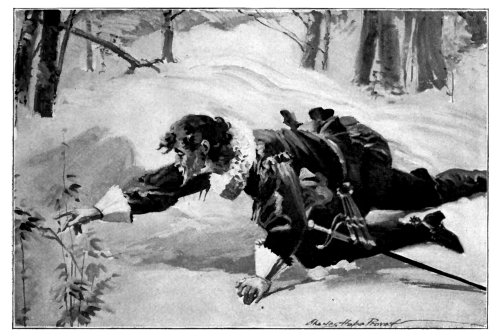
I was ensign in a regiment under command of General Melchior Hatzfeld
of the imperial forces. (Thus Hugo began his confession the next day
when he had been brought to the court-room from the death-cell.) My
conduct at that time was exemplary; I acquired so much skill in
handling fire-arms that, at the siege of Cracow, I was advanced to the
position of chief gunner of a battery.
Cracow at that time was in the hands of George Rákóczy, prince of
Transylvania, who had leagued with Sweden to subdue Poland; and he
would most likely have succeeded had not the imperial army come to the
assistance of the Poles.
I shall not dwell long on the siege of Cracow lest I awake in the
minds of the honorable gentlemen of the court a suspicion that, by
relating incidents not immediately connected with my transgressions, I
am purposely prolonging my recital. I shall therefore speak only of
those occurrences which it will be necessary to mention in order to
explain why I committed the crimes of which I am guilty. While with
the army before Cracow I made the acquaintance of the daughter of a
Polish noble. The young lady, who took a great fancy to me—I wasn't a
bad-looking youth in those days, your honors—was a charming creature
of sixteen years, with the most beautiful black eyes. If I remember
rightly her name was Marinka. She taught me how to speak her
language—and something else, too: how to love—the fatal passion
which has all my life been the cause of much of my trouble.
During the siege my general frequently sent me to reconnoiter among
the Hungarian camps; and as I was a fearless youth, I would venture to
the very gates of the manor-houses in the neighborhood of Cracow. At
one of these houses I met my sweetheart; and after that, you may
guess, honored sirs, that it was not for the general's "yellow boys"
alone I risked my neck night after night. No, my little Marinka's
sparkling eyes were as alluring as the gold pieces; and I knew when I
set out on my nightly tour that my sweetheart would be waiting for me
at the gates of her father's place. But our secret meetings were at
last discovered. There was an old witch of a housekeeper who ferreted
out her young mistress' secret, and informed the old noble. One
moonlight night Marinka was teaching me in her own little cozy chamber
how to say: "Kocham pana z calego zersa"—which is "Mistress, I love
you with my whole heart,"—when we heard her father's heavy footsteps
ascending the staircase. I tell you I was frightened and said to
myself, "This is the end of you, my lad!" but Marinka whispered in my
ear:
"Nebojsa! (don't be afraid), go into the corridor, walk boldly
toward my father, and to whatever he may say to you, do you reply 'God
is One.'"
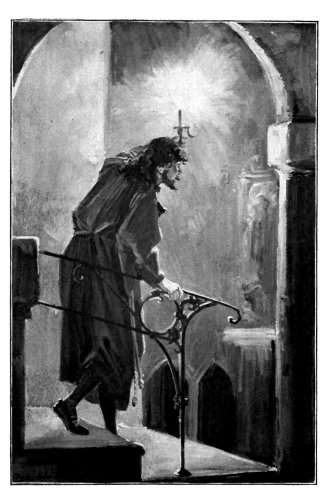
Then she softly opened the door, pushed me into the corridor, closed
and locked the door behind me. The old gentleman was coming up the
stairs very slowly because of a lame leg which he had to drag after
him step by step. He had a square red face which I could see only
indistinctly above the burning lunt he carried in one hand, blowing it
continually to prevent it from going out. In the other hand he held a
musket. The blazing lunt must have blinded him, for he did not see me
until the muzzle of the musket came in contact with my breast. Then he
stopped and cried in a stern voice:
"Kto tam? Stoj!" (Who are you? Stand!)
"God is One," I made answer. What else could I have said? The old
gentleman's aggressive mien changed at once. He became quite friendly;
he extinguished the lunt by stamping on it with his foot, tapped my
shoulder in a confidential manner and called me little brother. Then
taking me by the arm he led me down the stairs to a room where a huge
fire was blazing on the hearth. Here he bade me seat myself on a
settee covered with a bear skin and placed before me an English flagon
of spirits. After he had arranged everything for my comfort he fetched
from a secret cupboard a small book—it was so small I could have
hidden it in the leg of my boot—and began to read to me all manner of
heretical phrases such as "There is no need for a Holy Trinity,
because the little which is done on earth in the name of God can
easily be done by One alone."
My hair stood on end as I listened to the sinful words and I found
what a trap I had fallen into. My Marinka's father was a Socinian, a
leader of the heretical sect, and he was trying to make a proselyte of
me.
The doctrines of Blandrata had spread extensively throughout Poland,
but, owing to the persecution of its adherents, they could meet and
work only in secret. The old noble's manor was one of their retreats,
where recent converts were received for instruction. When the old
gentleman believed he had enlightened me sufficiently he produced a
heavy volume, bade me lay my right hand on it and repeat after him the
vows of the society.
You may believe I was in a dilemma!
If I refused to repeat the vows I should have to confess that I had
come to the manor for Marinka's sake, then the old noble would fetch
his musket and send me straightway to paradise. If, on the other hand,
I repeated the vows, then I was sure to journey to hades. Which was I
to choose?
Should I elect to travel by extra-post, direct, without stopping, into
the kingdom of heaven, or should I journey leisurely by a circuitous
route, with frequent halts, to hades?
I was a mere lad; I was sorry for my pretty curly head—I chose the
latter alternative!
From that time I became a daily visitor in the retreat of the
followers of Socinus. Being a neophyte I was permitted to take part in
their meetings only during the singing; when the sermon began I was
sent to the gates to guard against a surprise. This was a welcome
duty; for, once outside the house, all thought of taking up my station
at the gates would leave me and, instead, I would climb the tree which
grew close to my Marinka's window, swing myself by a branch into her
room, in which she was kept a prisoner by her father to prevent our
meeting; and there, while the sages below-stairs expounded the dogma
of the unity of God, we two ignorant young people demonstrated how two
human hearts can become as one.
One day our little community received an unexpected addition to its
membership. There arrived from Cracow a troop of Hungarian soldiers
who announced themselves as followers of Socinus. They received a
hospitable welcome from the old noble, whom they overwhelmed with joy
by telling him the prince of Transylvania had become an adherent of
Socinus; that his highness had averred that, were he the King of
Poland, all persecution of the heretics should cease at once and that
some of the churches should be given over to them for their worship.
When I repeated this piece of news to my general he became so excited
he sprang from his seat—his head almost struck the roof of the
tent—and shouted: "It is perfectly outrageous how those Hungarians
will stoop to base methods in order to win allies! If they succeed in
inveigling the Polish Socinians to their ranks then we may as well
stop trying to get them out of Poland!"
Fortunately, however, there arose dissensions between the Hungarian
and the Polish adherents of Socinus. I must mention here, in order to
explain how I became cognizant of the facts I am about to relate, that
Marinka's father had begun to suspect me. Instead of sending me to
stand guard at the gates when the sermon began, I was permitted to
hear it and take part in the disputations.
The Hungarian troopers maintained that it was the duty of all pious
Socinians to commemorate, at every one of their meetings, the death of
the Savior by drinking wine; and they were so extremely devout that an
entire quarter-cask of their host's best Tokay was emptied at every
celebration. After the meetings, when the old noble would lift and
shake the empty wine-cask, I could read in his countenance signs that
heterodoxy was gradually taking root in him. At first he contented
himself with remonstrating against the frequency of the celebration;
surely it ought to satisfy the most devout member of the sect to
observe the ceremony on Sundays, and holy days. But the troopers met
his arguments with scriptural authority for their practices.
Then the old gentleman, finding his remonstrances of no avail, made an
assault upon the dogma itself. He delivered an impassioned address in
which he sought to disprove the divinity of Jesus. To this blasphemous
assertion the Magyars made reply:
"If what you say be true, then He was the son of an honest man, and a
good man Himself. Therefore, it is meet and right for us to show Him
all honor and respect." And another quarter-cask was brought from the
cellar. The old noble became daily more fanatical in his assaults upon
the tenets to which he had so devoutly adhered before the accession to
his little congregation of the Hungarian troopers; and, at last
declared that Jesus was a Jew; that He deserved to be put to death,
because He had promulgated the unjust law of taxation. But not even
this fearful blasphemy deterred the Hungarians from their frequent
celebrations. They said:
"If the Nazarene is so unworthy, then it is our plain duty to shed His
blood, the symbol of which is wine—"
"Tremendously clever fellows, those Magyars!" here interrupted the
prince.
"They were impious devils!" exclaimed the mayor reprovingly. "Impious
devils!"
"Habet rectum," responded his highness. Then to the prisoner:
"Continue, my son."
Hugo resumed his confession:
When the last cask was brought from the cellar the old noble declared
to his congregation that the entire story of the Divine birth was a
myth invented by the priests—
"And you took part in those blasphemous meetings?" sternly interrupted
the mayor.
No, indeed, your honor! That is a crime of which I am guiltless. I
never said one word; and escaped from the meetings whenever I could
manage to do so. I had determined to flee with Marinka from the sinful
community. Our plan was: I was to steal from the meeting on a certain
night, assist my pretty Marinka to descend from her room by means of
the tree outside her window and then set fire to the sheep-stables.
The conflagration would scatter the blasphemers; everybody would run
to the stables to release the horses, and in the general confusion
Marinka would hastily secure as many of the family jewels as could be
packed into a portmanteau. Then she and I would mount two of the freed
horses and gallop straightway to my camp, where I would introduce her
as my wife—
"A pious idea, certainly," commented the prince.
"How can your highness say so!" in a tone of reproof, exclaimed the
mayor. "It was incendiarism pure and simple: Incendiarii ambitiosi
comburantur; and further: raptus decem juvencis puniatur, and
rapina palu affigatur."
"Very well, then," assented his highness. "My son, for the
incendiarism you shall be burned at the stake; for the rape of the
maid you shall pay a fine of ten calves; for the theft of the jewels,
the punishment is impalement. Continue."
Unfortunately, resumed the prisoner, our plans miscarried, through the
intermeddling of the old housekeeper I spoke of. Her suspicions had
been aroused by Marinka's preparations for flight; she informed the
old noble, who set spies to watch me. I was caught in the act of
firing the stables and was flogged with hazel rods until I confessed
that I was a spy from the enemy's camp. The old noble wanted to bind
me to the well-sweep; but one of the Hungarian troopers took
compassion on me and offered to buy me for sixteen Polish groschen.
His offer was accepted; I was sold to him and taken to Cracow. I
should not have had such a hard time as a slave had I not been
compelled to grind all the pepper used in the Hungarian army. I ground
enormous quantities, for the Magyars like all their food strongly
seasoned with the condiment. My eyes were red constantly; my nose was
swollen to the size of a cucumber. The only other complaint I had to
make was that my master compelled me to eat everything that was set
before me. He would say, when he placed before me enough for three
men:
"You shall not be able to say that you hungered while you were my
slave."
When I had eaten until I could not swallow another morsel, my master
would seize me by the shoulders, shake me as one shakes a full bag in
order to get more into it, and he would repeat the operation until the
contents of every dish had been emptied into me. I used to sicken at
the approach of meal-times, and whenever I saw the huge spoon—twice
the size of my mouth—with which the food was ladled into me. Your
honors will hardly believe that there is no greater torture than to be
stuffed with food—
"We have never tried that method," remarked the prince.
"Nor are we likely to test it very soon," supplemented the mayor, with
a grim expression on his countenance.
I yearned to be released from my unpleasant situation, resumed the
prisoner. For the first time I realized the enormity of the
transgression I had committed in joining the Socinian Community. Now
I had no one to intercede for me with the Supreme Ruler of the earth.
Had I become a Mussulman I should have had Mohammed; had I adopted the
Jewish faith I should have been able to call to my aid Abraham, or
some one of the other fathers in Israel. But I had no one. However, my
desire to be released from the tortures of food-stuffing and
pepper-grinding was at last fulfilled; I was captured, together with
the entire Hungarian army, by the Tartars—
"Hold! hold!" interrupted the chair. "You must not tell untruths. You
forget that you were in Poland. The Tartars could not have fallen from
the sky."
I was about to explain how they came to be at Cracow when your honor
interrupted me. It was this way: His Majesty, the Sultan of Turkey,
who had become angry because his vassal, George Rákóczy, prince of
Transylvania, had presumed to aspire to the crown of Poland, had
commanded the khan of Crim-Tartary to attack the Hungarians with
100,000 cavalry. The khan obeyed. He devastated Transylvania in his
march, surrounded the Hungarian army in Poland and captured every man
jack of them—
"The explanation is satisfactory," enunciated the prince. "It was easy
enough for the Tartars to appear at Cracow."
Yes, your highness; but I wish they hadn't, continued the accused. No
one regretted it more bitterly than did I. After the capture of the
Transylvanian army by the Tartars the victors divided the spoils as
follows: The commanding officers took possession of all the valuables;
the under-officers took the prisoners' horses; the captives
themselves were sold to the common soldiers, each of whom bought as
many slaves as he had money to spare.
My former master was sold for five groschen; my broad shoulders
brought a higher price—nine groschen. The same Tartar—an ugly,
filthy little rascal for whom I would not have paid two
groschen—bought my master and me.
The first thing our Tartar master did was to strip us of our good
clothes and put on us his own rags. He couldn't talk to us, as we did
not understand his language; but he managed in a very clever manner to
convey his meaning to us. He examined the material of which our shirts
were made—the Hungarian's was of fine, mine of coarse homespun linen,
and concluded that one of us was a man of means—the other a poor
devil.
Then he took from his purse a gold coin, held it in his open palm
toward the Hungarian, while with the other hand he hung a rope of
horse-hair around his captive's neck. Then he closed his fingers over
the coin, opened them again, at the same time drawing the rope more
tightly about the captive's neck.
This pantomime signified: "How many coins like this gold one will your
friends pay to ransom you?"
The Hungarian closed and opened his fist ten times to indicate "one
hundred."
The Tartar brought his teeth together, which was meant to say, "not
enough."
Then the Hungarian indicated as before, "two hundred," whereupon the
Tartar placed the end of the rope in the captive's hand—he was
satisfied with the ransom. Then came my turn. How much ransom would be
paid for me? I shook my head to indicate "nothing;" but in Tartary, to
shake one's head means consent. The little fellow smiled, and wanted
to know "how much?"
Not knowing how else to express my meaning, I spat in his palm, which
he understood. He put the gold coin back into his purse, took out a
silver one and held it toward me. I treated it as I had the gold coin.
Then he produced a copper coin; but I indicated with such emphasis
that not even so small a sum would be paid for me that he raised his
whip and gave me a sound cut over the shoulders. The Tartars then set
out on their return to Tartary. My former master and I were bound
together and driven on foot in front of our owner.
How forcibly my sainted grandmother's words, "He that reviles his
Savior will be turned into an ass," came home to me when I was given
dried beans to eat—the sort we feed to asses at home. Dried beans
every meal, and my Tartar master did not think it necessary to stuff
into me what I could not eat. What were left at one meal were served
up again the next. Still more forcibly were my grandam's words
impressed on my mind when, the fifth day of our journey, I became a
veritable beast of burden. My Hungarian yoke-fellow declared his feet
were so sore he could go no farther. His was certainly a weighty body
to drag over the rough roads, especially as he had never been
accustomed to travel on foot per pedes apostolorum. The little
Tartar became alarmed; he feared he might lose the ransom if he left
his rich captive behind, so he alighted from his horse, examined the
Hungarian's feet and ordered him to get into the saddle. Then my feet
were examined, and I imagined I too was to be given a mount. But I was
mistaken. Before I could guess what he intended the little Tartar was
seated astride my shoulders, with his feet crossed over my breast, and
his hands clutching my hair for reins.
Luckily for me it was a lean little snips, not much heavier than the
soldier's knapsack I was accustomed to carrying. It would have been
worse had the Hungarian been saddled on my shoulders. That gentleman
was greatly amused by the turn affairs had taken, and from his seat on
our master's horse made all manner of fun of me.
He ridiculed my prayers, said they were of no avail where the enemy
was concerned; that a hearty curse would give me more relief. I tell
you he was a master of malediction! There was an imprecation he used
to repeat so often that I remember it to this hour. I will repeat it
for you—it is in that fearful Magyar lingo: "Tarka kutya tarka
magasra kutyorodott kaeskaringós farka!"[3]
"Hold!" commanded the prince. "That sounds like an incantation."
"Like 'abraxas,' or 'ablanathanalba,'" added the mayor, shuddering.
"We must make a note of it; the court astronomer may, with the
assistance of the professors, be able to tell us its portent."
When the notary had taken down the imprecation, his highness, the
prince, said to the prisoner:
"Continue, my son. How long were you compelled to remain in that
deplorable condition of slavery?"
One day, resumed the accused, while I was fervently praying that
heaven, or Satan, would relieve me from my ignominious situation, we
turned into an oak forest. We had hardly got well into it, when, with
a fearful noise, as if heaven and earth were crashing together, the
huge trees came toppling over on us, burying the entire vanguard of
the Tartar horde, together with their captives, under the trunks and
branches.
Every one of the trees in the forest had been sawn clear through the
trunk, but left standing upright, thus forming a horrible trap for the
Tartars. The first tree that toppled over, of course, threw over the
one against which it fell, that one in turn throwing over the next
one, and so on until the entire wood was laid low.
My Tartar rider and I were crushed to the earth by the same tree. It
was fortunate for me that I had him on my back, for he received the
full force of the falling tree; his head was crushed, while mine was
so firmly wedged between his knees I couldn't move. The horrible noise
and confusion robbed me of my senses; I became unconscious. It is,
therefore, impossible for me to tell how I escaped with my life. I
only know that when I came to my senses I found myself in the camp of
the "Haidemaken," a company of thieves and murderers, made up of all
nationalities, the worst of all the robber bands that infested the
country. The members were the outcasts of every land—the flower of
the gallows. When inflamed with wine, they fought each other with
axes; settled all disputes with knife and club. He who had become
notorious for the worst crimes was welcomed to their ranks; the
boldest, the most reckless dare-devil, became their leader. They would
release condemned criminals, often appearing as if sprung from the
earth at the place of execution, bear away the miscreants, who,
naturally, became members of the band.
Was a pretty woman condemned to the stake for violation of the
marriage vow or for witchcraft, the haidemaken would be on hand before
the match was applied to the faggots, and bear away the fair culprit.
In a word, the haidemaken were the hope, the comfort, the providence
of every miscreant that trembled in shackles.
The band claimed no country as fatherland. Every wilderness, every
savage ravine, from the Matra mountains to the Volga, offered them a
secure retreat. They knew no laws save the commands of their leader,
which were obeyed to the letter. None kept for himself his stealings;
all booty was delivered into the hands of the leader, who divided it
equally among the members of the band.
To him who, through special valor, deserved special reward, was given
the prettiest woman rescued from the stake, the dungeon, the rack.
Where the haidemaken set up their camp, the Roman king, the prince of
Transylvania, the Wallachian woiwode, the king of Poland, the hetman
of the Cossacks, ruled only in name. The leader of the robbers alone
was the law-giver; he alone levied taxes, exacted duties.
The trading caravans passing from Turkey to Warsaw, if they were wise,
paid without a murmur the duty levied by the haidemaken, who would
then give the traders safe conduct through all the dangerous forests,
over suspicious mountain passes, so that not a hair of their heads
would be hurt or a coin in their purses touched.
If, on the other hand, the caravan leaders were unwise, they would
employ a military escort. Then, woe to them! The robbers would lure
them into ambush, scatter the soldiers and plunder the caravan. He who
resisted would be put to death.
There was constant war between certain nobles and the robbers. If the
band, however, could be brought to seal a compact of peace with an
individual or a community, it was kept sacred, inviolable, as we shall
see later.
The haidemaken never entered a church unless they desired to secure
the treasures it contained. Yet, they numbered several priests among
their ranks. They were such as had been excommunicated for some
transgression.
The band never set out on a predatory expedition without first
celebrating mass, and receiving a blessing from one of these
renegados. If the expedition proved to be successful, the priest would
share the spoils, and dance with the robbers to celebrate the
victory.
When one of the band took unto himself a wife, a renegado would
perform the marriage ceremony. The haidemaken were as great sticklers
for form as are the members of good society. To abduct a maid, or a
woman, was not considered a crime; but for one member to run away with
the wife of another was strictly prohibited.
They did not erect strongholds, for they knew where to hide in
mountain caverns and in morasses, from which no human power could
drive them.
In their various retreats they had stores of food, enough to stand a
siege for many months. How great was their daring is best illustrated
by the plot which threw me into their power. The prince of
Transylvania had invaded Poland with an army of 20,000 men. This army
was captured by the Tartar khan with his 80,000 men. Four hundred of
the robbers laid in wait for this combined force, and slaughtered the
vanguard of 2,000 men in the oak forest, as I have described.
When I opened my eyes after the catastrophe, I was lying on a bundle
of faggots on the bank of a purling brook. By my side stood a gigantic
fellow, with a hideous red face—compared to him the Herr Mayor,
there, is a very St. Martin!—his beard and eyebrows were also red,
but of a lighter shade. His nose was cleft lengthwise—a sign that he
had had to do with the Russian administration of justice. He had the
muscles of a St. Christopher.
At a little distance apart stood a group of similar figures, but none
was so repulsive in appearance as the giant by my side. He was
leaning on his sword, looking down at me, and when he saw my eyes open
he said, or rather bellowed, for his voice was more like the sound
that comes from the throat of a bull:
"Well, young fellow, are you alive? Can you get up on your knees? If
so, swear that you will join our band, or I'll fling you out yonder
whence I brought you, to perish with the rest of your comrades."
I had heard many fearful tales of the dreaded haidemaken, and knew
them to be capable of any atrocity. Moreover, I was indifferent as to
what became of me, so I said I would join the band if my life were
spared.
"What are you?" then asked the red one, who was the leader of the
band, "peasant or noble?"
I was not lying when I answered that I was as poor a devil as ever
caught flies to satisfy a craving for food.
"That is well," returned the leader, "we have no use for nobles in our
ranks. You shall stand the test at once." He blew a whistle, and two
sturdy ruffians dragged from a cave nearby the loveliest maid I had
ever set eyes on. Her complexion was of milk and roses; every virtue
beamed in her gentle countenance. I can see her now, with her golden
hair falling to her ankles—and she was very tall for a woman.
"Now lad," continued the leader, "we shall see how you stand the test.
You are to cut off this maid's head. She is the daughter of a noble,
whom we stole for a ransom; and, as her people have seen fit to ignore
our demands, she must die. Here, take this sword, and do as you are
bid."
He handed me his sword, which was so heavy I could lift it only by
grasping it with both hands.
The maid knelt in the grass at my feet, bent meekly forward, and
parted her beautiful hair at the back of her snowy neck, so that I
might the more easily strike the fatal blow.
But I didn't do anything of the sort!
Instead, I flung the sword at the feet of the leader and cried:
"Go to perdition, you red devil! You may devour me alive—I won't harm
a hair of this pretty child's head."
"Ho-ho," bellowed the red one, "you have betrayed yourself, my lad!
Were you a peasant you would cut off the girl's head rather than lose
your own. You are a noble—you would rather die yourself than harm a
woman. Very well; so be it! On your knees! The maid will show you how
to cut off a head at one blow. She is my own daughter."
He handed the sword to the maid, who had risen to her feet and was
laughing at me. She took the heavy weapon in one hand and swung it as
lightly as if it had been a hazel rod, several times about her head. I
have always been fortunate enough to be able to command my feelings,
no matter what the situation; no matter how extreme the danger, I
never allow myself to yield to fear.
I looked at the wonderful maid confronting me with mocking eyes, her
white teeth gleaming between her red lips, her beautiful hair shining
like gold.
"Kneel!" she cried, stamping her foot. "Kneel and say your prayers."
A faint-hearted fellow would, most likely, have lost courage; but, as
I said before, I had never made the acquaintance of fear. So I
laughed, and said: "I am not going to kneel; and I am not going to
pray. I don't want to part with my head, I have too much need of it
myself." Then I turned boldly toward her father, and addressed him:
"Captain, I want to marry your daughter," I said. "Let me serve under
you for one year, and, if at the end of that time I have not proved
myself worthy to be your son-in-law, you may cut off my head, and
welcome!"
The robber chief received this daring speech with a grin that was like
the grimace of a hungry wolf preparing to devour a lamb.
"Fellow, do you know what you ask?" he bellowed. "The suitor for the
hand of my daughter is tortured to death by that hand if he fails to
perform the tasks she sets for him."
"All right!" I returned jauntily, "you needn't give yourself any
trouble about me."
He held out his hand; I gave him mine, and the pressure it received in
the powerful grasp was so severe that the blood spurted from under the
finger-nails. But I did not betray by look or sign how badly it hurt
me. Nay, I even gave a playful pinch with the crushed fingers to the
cheek of the golden-haired maid and received from her in return a
sound slap on my hand.
I could see that my behavior won favor in the eyes of the robbers.
But we had little time for merry-making. The main body of the Tartar
army now drew near, and we were face to face with an infuriated enemy
outnumbering our band a hundred to one.
In face of the extreme danger which threatened, our leader remained
calm. At a signal from him, his men with lightning speed set fire in
fifty different places to the fallen trees, among which a considerable
number of the vanguard, who had not been crushed to death, were
hiding.
Of course the poor wretches, Tartars and captives alike, were consumed
in the flames; we could hear their shrieks of agony when we were half
way up the mountain, to which we had made our escape.
The Tartar army not being able to follow us, because of the burning
forest, made our escape easy; and, by the time the trees had been
reduced to ashes, we were far enough away, and in a place of safety.
Instead of giving me weapons to carry, I was compelled to continue in
the role of beast of burden; a heavy bag of treasure was strapped on
my back. We marched until the next morning. The haidemaken travelled
only by night, consequently they were familiar with all roads and
mountain passes.
When day broke we halted to rest and partake of a scanty meal. While
we were eating, the leader asked me my name, and I gave him the first
one that came into my head: "Jaroslaw Terguko," which was the name of
Marinka's father. If I couldn't steal anything else from him I could
at least steal his name?
Late in the afternoon we set out again on our journey, which led us
over rugged paths and through savage gorges where no signs of human
life were to be seen. At last we entered a deep defile between two
mountain spurs. The walls of rock on either side seemed, with their
projections and hollows, as if they might once have been joined
together. They were nearer together at the top than at the base, and
when I looked up at the narrow strip of sky far, far above me, I had a
sensation as if the two walls were coming together. In this almost
inaccessible defile was the chief retreat of the haidemaken. It was a
stronghold that could successfully defy all human assaults.
In the south wall, about twenty yards from the base, yawns the mouth
of a huge cavern.
At that point the wall is so steep, and inclines forward to such a
degree, that access to the cavern cannot be gained by means of a
ladder. The robbers, however, had contrived a clever hoisting
apparatus.
From the top of the opposite wall a mountain brook had once leaped
into the defile, to continue its way over the rocky bed into the
valley.
When the haidemaken first established themselves in the cavern, it
happened frequently that they would be blockaded in their retreat by
the nobles and their followers, who had pursued the predatory band to
the defile.
At such times the robbers suffered greatly from the scarcity of fresh
water, especially if they chanced to be out of wine. Therefore, they
conceived the plan of conducting the brook from the opposing wall into
the cavern through a stout oaken gutter, and the water at the same
time served to turn a series of wheels. Over one of the wheels ran a
stout iron chain, to which were securely attached several large
baskets; and so skillfully was the apparatus manipulated that the
entire band might be hoisted into, or let down from, the cavern in the
short space of two hours. It was a most admirable contrivance for the
robbers, but not so admirable for the dwellers in the valley. The
intercepted brook now flowed into the cave, and, as the water did not
fill the cave, the most natural conclusion was that it found an outlet
through various subterranean fissures.
The turning of the water from its original channel caused Prince
Siniarsky considerable inconvenience, in that all his saw-mills,
flour-mills and leather factory were left without a motor; while the
inhabitants of the surrounding hamlets, who were dependent on their
looms for a livelihood, were compelled to remove to another region,
because they now were unable to bleach the linen.
Still greater was the misfortune which had overtaken Count Potocky. He
was the owner of extensive salt mines on the further side of the
mountain, which contains an illimitable deposit of the saliferous
substance. The haidemaken were unable to drink the water of the
lakelet in the bottom of their cavern, because of its saline
character.
After the course of the brook had been changed, the worthy Count
Potocky discovered one day that innumerable springs of fresh water
were bursting from his side of the mountain, and flooding his most
profitable mines. If he attempted to obstruct the flow of water in
one place it would break out in another.
At last the two magnates discovered the cause of the mischief, and
determined to oust the thievish haidemaken from their retreat by
fumigation. So long as the band confined their depredations to the
trading caravans they might be tolerated; but, when they became
insolent enough to interfere with the comfort and convenience of the
magnates, it was high time to put a stop to their pestiferous conduct!
And so an expedition against the cavern was planned. Before it could
be carried out the war against the Transylvanians and Swedes broke
out, and the noble gentlemen were compelled to march with their
followers toward the invaders; but when hostilities ceased and the
succoring Tartars had returned home, a formal blockade of the robbers
was constituted.
The entrance to their cavern, which is about as large as the door of
the cathedral at Coblentz, was fortified by a double parapet furnished
with loop-holes. The intercepted brook did not pour its waters into
the main entrance, but into a side opening, underneath which was the
hoisting wheel. This wheel also turned the mill-stone, which ground
the rye used by the robbers.
The band included a miller as well as a smith, a shoemaker and a
tailor. As it is dark in the cave, all work was performed by
torchlight. Where all the torches used in the cavern were procured I
learned afterward.
The fore part of the cavern, into which the rays of the blessed sun
penetrate as far as the opposite wall permits, is like a vaulted hall.
In it were stored the weapons: all manner of fire-arms, all patterns
of cutting, thrusting and hurling implements, which had been purloined
from the armories of noble castles. Here, for the first time, I saw an
old-time culverin, rusty with age and for want of care. In this part
of the cavern were stored also the provisions in huge stone
receptacles—enough to feed four hundred men during a long siege.
From the provision chamber a low, narrow passage leads to the
mill-cave, but, as I never entered it, I cannot tell you just what it
contained.
The main cavern is spacious as a church. When the entire band were
assembled in the vast hall they were as lost in it. The arched roof is
so high above the floor it is invisible in the gloom, which not even
the light of many torches can dispel.
From this hall numerous narrow passages and corridors lead to smaller
caves, in which the artisans of the band performed their labors. These
unfortunates certainly must have been captives; for it is hardly
possible that any man would, of his own free will, consent to pass his
life toiling in so gloomy a hole. When we arrived at the cavern the
leader asked me if I had a trade, and, as I could truthfully reply
that the only one I was perfectly familiar with was that of
bombardier, I did so.
"Very good; you shall soon have an opportunity to prove that you
understand your trade as thoroughly as you say," he growled. "It is
not safe to boast here, my lad, and not be able to perform—as you
shall soon learn."
Meanwhile the robbers had hoisted to the cavern the booty taken from
the Tartars. It was stored in one of the smaller chambers, into which
I merely got a glimpse, as they rolled the huge slab of granite from
the entrance, but that fleeting glance was enough to dazzle my eyes.
There were heaps on heaps of costly articles: robes, mantles,
vestments, richly embroidered with gold and precious gems, gold and
silver chalices, shrines, ciboria, pastoral staffs, and a host of
valuables too numerous to remember. Had the haidemaken only decided to
disband then, every one of them would have received a fortune as his
share of the plunder.
It is not to be wondered at that such stores of gold and silver had
accumulated. The robbers never had occasion to need money.
The provision chamber was filled with food and drink. Such quantities
of meat and bread were served that every man had all he wanted to eat,
while casks of metheglin were constantly on tap.
The secret of this inexhaustible food supply was known only to the
leader and his daughter. No matter how much was taken from the
provision chamber, no decrease was ever noticeable.
The first evening of our return, the successful expedition was
celebrated by a feast. After the robbers had eaten their fill, they
lighted a huge fire and danced wildly around it; and when they had
drunk all they wanted, they gathered about their leader and his
daughter, who had taken their seats on an estrade draped with purple
cloth.
Then a pale-faced young man was dragged into the hall and placed in
front of the leader.
I saw now that a sort of trial was about to be held, a singular
tribunal, where the judge and the jury first get tipsy!
"Jurko," said the leader to the youth, "you are accused of
cowardice—of having run away at the approach of the enemy; also, of
having neglected to give warning of the coming of the Tartars."
"I am not guilty," responded the youth in defence. "You placed me on
guard to watch for the Tartars. Instead of the Tartars came wolves.
Ten of the beasts attacked me—maybe there were fifty. If I had
allowed the wolves to eat me, how could I have signaled to you? I
didn't run away—I hid in a hollow tree to defend myself—one against
fifty! I call that brave, not cowardly."
"Silly chatter!" bellowed the leader. "No matter what happened, you
should have obeyed the command of your leader. If you are not the
coward you are accused of being, then prove it by standing the test."
"That I will!" cried the youth, striking his breast with his fist.
The leader rose, took his daughter's hand, stepped down from the
estrade, and, bidding his comrades follow, moved with the maid toward
the rear of the cavern, which, until now, had been buried in midnight
gloom.
Here the ground slopes steeply downward, and I could see by the light
of the torches that we were on the verge of an abyss, at the bottom of
which was water.
The leader held a wisp of straw to a torch, then tossed it into the
abyss, which was lighted for a few seconds by the circling wreath of
blazing straw; but it was quite long enough for me to see the terrible
grandeur of the yawning gulf.
After tossing the straw into the abyss, the leader snatched the red
and yellow striped silken kerchief from his daughter's neck, leaving
the lovely snow-white shoulders and bosom uncovered, and flung it also
into the abyss.
"There, Jurko," he cried, "you have often boasted that you are the
bravest of our band, and you have aspired to the hand of my daughter
Madus. If you are what you pretend to be, fetch the bride's kerchief
from the lake down yonder."
The youth stepped boldly enough to the rim of the yawning gulf, and
every one believed he was going to dive into it. But he halted on the
edge, leaned forward and peered down at the water far below. After a
moment's survey, he drew back, rubbed his ear with his fingers and
made a wry face.
"Why don't you jump?" cried his comrades, tauntingly.
Jurko cautiously thrust one leg over the edge, bent forward and took
another look; then he drew back his leg and rose to his feet.
"The devil may jump into this hell for me!" he exclaimed; "there's no
getting out of it again for him who is fool enough to enter it!"
"Ho, coward! coward!" derisively shouted his comrades, rushing upon
him. They disarmed him and dragged him by the hair toward a cleft in
the wall of the cavern, wide enough only to admit the body of a man.
This opening was closed by a block of granite that required the
combined strength of six men to move it. A lighted candle was placed
in the trembling youth's hand; then he was thrust into the rock-tomb,
and the granite door moved back to its place. The wild laughter of his
comrades drowned the shrieks of the victim who had been buried alive.
Then followed the "dance of death," and I never witnessed anything
more terrifying. The lovely Madus feigned death and looked it, too!
and every member had to dance a turn with her. When it came my turn,
the leader said to me:
"Hold, lad, you may not dance with Madus until you have become really
one of us—until you have stood the test. Moreover, you, too, presume
to aspire to the hand of my daughter."
"Yes, I do!" I replied, "and I will do whatever I am bid."
"Very good; the bride's kerchief lies down yonder in the lake; let us
see if you are courageous enough to go after it."
"You surely did not undertake so foolhardy a task?" here interrupted
the prince; and the chair dictated to the notary as follows:
"Sinful tempting of providence, prompted by criminal desire for an
impure female."
"Yes, your highness, I performed the task," continued Hugo, "but I beg
your honors not to register the leap as an additional transgression. I
am not responsible for it. I was compelled to jump or be buried alive
in the wall of the cavern. Besides, I knew the danger was not so great
as it appeared. When a boy, I once visited a salt mine. I had seen by
the light of the blazing straw that the walls of the abyss were formed
of the dark blue strata peculiar to salt mines, and guessed that the
lake was strongly impregnated with salt. I had also noticed on the
further wall of the abyss a flight of steps hewn in the rock, and
concluded that I had nothing to fear from drowning in the buoyant
water, if I reached it in safety. But, before I proceed farther, I
desire to enter a formal protest against the chair's designating my
beloved Madus an 'impure female.' She was pure and innocent—an angel
on earth, a saint in heaven. He that defames her must do battle with
me—my adversary in coat of mail, I in doublet of silk. The weapons:
lances, swords, or maces—whatever he may select; and I positively
refuse to proceed with my confession until his honor, the mayor, has
given me satisfaction, or amended the protocol."
"Well, mayor," said the prince, addressing the chair, "I think the
prisoner is justified in his protest. Either you must amend the
protocol, or fight him."
The former expedient was chosen, and the notary erased the latter
clause of the protocol. It read, when corrected: "Sinful temptation
of providence by chaste affection for a respectable maid."
"Now, my son, you may jump."
Hugo thanked the prince and resumed his confession:
I pressed my ankles together, bent forward, and sprang, head foremost,
into the abyss. As I sped swiftly downward, there was a sound like
swelling thunder in my ears, then I became stone deaf, and the water
closed over me. My eyes and mouth told me it was salt water, and
whatever apprehension I had had vanished. The next moment I was
floating on the surface, my head and shoulders above the water. I soon
found the kerchief, which I tied about my neck, amid the acclamations
and cheers of my comrades, which were multiplied by the echoing walls
to the most infernal roaring. The torches held over the mouth of the
abyss gleamed through the darkness like a blood-red star in the
firmament of hades.
A few vigorous strokes propelled me to the steps leading from the lake
to the upper gallery of the abyss, which is really an abandoned salt
mine.
There are one hundred and eighty steps, but by taking two at a time I
reduced them to ninety; and three minutes after I had taken my leap, I
stood, encrusted from head to foot with salt—like a powdered
imp!—before my blushing Madus.
She received me with a bashful smile when the robbers carried me on
their shoulders to her, and I was about to kiss her, when the leader
seized me by the collar and drew me back.
"Not yet, lad, not yet!" he cried. "You have only been through the
christening ceremony. Confirmation comes next. You must become a
member of our faith before you can become my daughter's husband. Every
man that marries a princess must adopt her belief."
Now, as your honors may have guessed, the question of religion was one
I did not require much time to answer. I consented without a moment's
hesitation to adopt my Madus' faith. The leader then signed to one of
the band to prepare for the ceremony of confirmation. It was one of
the priests of whom I have spoken—I had taken particular notice of
him during the feast, because he ate and drank more than any one else.
"He that becomes a member of our society"—the leader informed
me—"must take a different name from the one he has borne elsewhere. I
am called 'Nyedzviedz,' which signifies either 'the bear,' or 'without
equal.' What name shall we give you?"
Some one suggested that, as I was an expert swimmer, I should be
called "Szczustak" (perch); another thought "Lyabedz" (swan), more
suitable and prettier, but I told them that, as I excelled most in
hurling bombs, "Baran" (ram), would be still more appropriate; and
Baran it was decided I should be called.
In the meantime the robber priest had donned his vestments. On his
plentifully oiled hair rested a tall, gold-embroidered hat; over his
coarse peasant coat he had drawn a richly decorated cassock; his feet
were thrust into a pair of slippers, also handsomely
embroidered—relics, obviously, of some gigantic saint; for the robber
priest's feet, from which he had not removed his boots, were quite
hidden in them. In his hands he held a silver crucifix; and as I
looked at him, the thought came to me that he had, without a doubt,
made way with the original wearer and bearer of the rich vestments,
and the crucifix.
He ordered me to kneel before him. I did so, and he began to perform
all sorts of hocus-pocus over me. I couldn't understand a word of it,
for he spoke in Greek, and I had not yet become familiar with that
language. I learned it later.
After mumbling over me for several minutes, he smeared some
ill-smelling ointment on my nose; then he fumigated me with incense
until I was almost suffocated. In concluding, when he bestowed on me
my new name, he gave me such a vigorous box on the ear, that it rang
for several seconds, and I almost fell backward. The blow was not
given with the hand of the priest, but with the sturdy fist of the
robber.
This is carrying the joke too far, I said to myself; and, before the
ruffian could guess what I intended, I was on my feet, and had
delivered a right-hander on the side of his head that sent his gold
hat spinning across the floor, and himself, and his slippers after it.
"Actus majoris potentiae contra ecclesiasticam personam!" dictated
the mayor to the notary; while his highness, the prince, held his
stomach, and laughed until the tears ran down his cheeks.
"I should like to have seen that performance!" he exclaimed when he
had got his breath again. "Did the padre excommunicate you?"
Not much, he didn't, your highness! From that moment I became a person
of consequence among the haidemaken. The leader slapped me heartily on
the shoulder, and said approvingly:
"You're the right sort, lad—we need no further proof."
After a bumper all 'round, to celebrate my entrance to the community,
every man wrapped himself in his bear-skin, and lay down on the floor
of the cavern. Although the torches had been extinguished I could see,
by the faint light which penetrated from the entrance, that Madus
ascended a rope ladder to a deep hollow high up in the wall, and drew
the ladder up after her.
In a very few minutes the snores from the four hundred robbers
proclaimed them oblivious to this work-a-day world.
At day-break the watchman's horn brought every man to his feet; at the
same moment the leader appeared from an adjoining chamber, and gave to
each one his task for the day.
After we had breakfasted, Nyedzviedz conducted me, in company with
Madus and several of the band, to the armory.
"Here Baran," he said,—thrusting his foot against the culverin I
mentioned before—"you claim to be a skilled bombardier. Let us see if
you understand how to manage a thing like this. We stole it from
Count Potocky's castle, and brought it here with great difficulty.
Sixteen men would carry it two hundred steps, then other sixteen would
relieve them, and so on. We didn't find out until we had got it up
here that it would be of no use to us. The first time we tried to fire
it off—it lay on the ground as now—four men sat astride of it, as on
a horse, to steady it. I, myself, directed the shot toward the mouth
of the cavern, and three men stood behind me to observe operations.
When I applied the fuse, the infernal thing sprang into the air
flinging the four men astride it to the roof of the cave; while the
ball, instead of going where I had aimed—out of the
entrance—imbedded itself in the wall over yonder, where it still
sticks."
I laughed heartily at his amusing description of the gun's behavior;
whereupon he said soberly:
"Oh, you may laugh, but it was no laughing matter I can tell you! I
made a second attempt. I tied a rope around the rascal's neck to
prevent him from kicking again, and fastened the ends securely to two
stout pegs driven into the ground. 'There, sir,' I said, 'now kick if
you want to!' I lighted the fuse—the demon didn't kick this time;
instead he rushed backward dragging both pegs with him; broke the
right leg of one of the men, the left of another, and both legs of the
third; and the ball bored itself into the corner over there. Now let
us see if you can do any better."
"Oh, you stupid bear!" I exclaimed, unable to restrain my mirth, "you
may thank your stars that the rusty old gun didn't burst into flinders
and kill every one of you!—as you deserved! The first thing to be
done with the culverin is to clean and polish it until it shines like
a mirror. Then—who ever heard of laying a cannon on the ground to
fire it off?—it must have a sort of platform on wheels so it can be
moved about."
The leader immediately gave orders to the smith and the wagon-maker of
the band to obey my instructions and complete as quickly as possible
the sort of gun-carriage I should describe to them, and I set about at
once to clean and scour the old culverin which, with the accumulated
rust of years, was no light task.
There was no time to lose, for the Tartars, with their Hungarian
captives, having vacated Poland, the Polish magnates returned to their
castles, and prepared to carry out the plans for punishing the
insolent haidemaken, which had been interrupted by the war. Those
members of the band who were sent on various errands into the regions
adjacent to the Prsjaka Gorge, brought back, instead of booty, bloody
heads, and the startling news that the roads leading to the Gorge were
filled with armed troopers.
The two despoiled magnates had combined their forces, and were
prepared for a regular siege of the plundering haidemaken.
The latter, however, merely laughed at the warlike preparations. They
were not afraid of a siege! Nyedzviedz, on learning of the approach of
the beleaguerers, instead of curtailing our rations, doubled them,
mystifying all of us by the seemingly illimitable supplies in the
provision chamber. We received, every day, double rations of fresh
goats' meat and mutton, and yet there was not in any of the caves even
the sign of a living animal.
Meanwhile the beleaguerers advanced steadily.
There was a stratagem the robbers had frequently resorted to in order
to vanquish a beleaguering foe. They opened an underground sluice
through which the water of the salt lake in the bottom of the abyss
would rush into the defile and drown the enemy. But Prince Siniarsky's
troopers had become familiar with this trick; and one morning, when we
awoke, we found that a stone wall had been built across the gorge
while we slept. An arched opening in the center of the base would give
egress to all the water we might choose to let out of the lake.
This was bad enough, but worse came later.
The wall increased in height every night. I told Nyedzviedz at the
beginning what would be the outcome of such a proceeding; when the top
of the wall should have reached to the height of the wooden gutter
which conveyed the brook into the cavern, Siniarsky's men would fling
a line over it, attach a stout chain to the line, and when they had
drawn it over the gutter it would be easy enough to pull it down.
"In that case we shall die of thirst," growled the leader, "for there
isn't any other water in the cavern fit to drink. But a still greater
danger, of which you know nothing, threatens us."
He did not tell me what it was, but he became so morose and
ill-tempered, that no one but his daughter ventured to speak to him.
The haidemaken made several assaults on the wall, but the troopers
returned the fire with such volleys from the numerous loop-holes in
it, that our men were always forced to retreat.
All hopes were now centered in me, and on the culverin, which I had
polished until it shone like gold. The carriage for it had been
completed, and balls cast under my directions.
The wall grew higher and higher, until at last the top was on a level
with our conduit. Its completion was celebrated in the enemy's camp by
the blaring of trumpets, and beating of drums, and what I had foretold
came to pass; the arquebusier mounted to the top of the wall, adjusted
his arquebuse on its forked rest, and prepared to take aim at our
water conduit.
"Now, watch me!" said I to Nyedzviedz, pointing the culverin's muzzle
toward the cornice of the wall.
Two shots sounded simultaneously, and when the smoke had cleared away,
there was neither arquebuse, nor arquebusier—nor yet the cornice of
the wall, to be seen. All three had vanished.
I took aim a second time—this time at the base of the wall; and at
the sixth shot, the entire structure of solid masonry tumbled down
with a deafening crash, burying under it the musketeers who were at
the loop-holes. Not one of them escaped alive.
The haidemaken, with loud cries of triumph, now hastily descended from
the cavern in their baskets, and flung themselves on the enemy, and
while the combat raged in the defile below me, I wheeled my culverin
to the mouth of the cavern, and hurled shot after shot toward the
troopers who were hurrying to the aid of their comrades.
The enemy was completely routed, and our men returned to the cavern
richly laden with spoils.
So all-powerful is a cannon when its management is thoroughly
understood.
"That will do for today;" at this point observed the prince. "The
confession will be continued tomorrow."
THE VISZPA OGROD.
The next morning Hugo resumed his confession:
When the haidemaken, after having put to flight the troopers returned
with their booty to the cavern, the leader said to me:
"Well, Baran, you certainly earned your name today, by proving
yourself a most effective 'ram.' To your assaults with the culverin we
owe our victory. Here is the treasure we took from the vanquished
foe—take of it what you want, you have the first choice." Gold and
silver galore lay before me, but I answered: "Thank you, Nyedzviedz,
you know very well I have no use for money; instead, I want your
daughter—for her alone I have served you; she is the reward I
desire."
To this reply the leader shook his head irritably, and said: "I am
disappointed in you, Baran. You are, after all, only a tender-hearted
dove that wants to bill and coo. The man who has a wife is only half a
man. The true haidemak embraces his sweetheart, then slays her—or
better: slays her first. Why do you desire to marry? Be wise, lad, and
remain a celibate. If you will think no more of Madus I will make you
my second in command."
"But I can't, and won't think of anything but Madus," I returned,
stubbornly; "and if you don't give her to me, you are not a man of
your word."
"You don't know what you are asking, Baran," again said the leader.
"If you persist in your demand you will compel me to send you the way
all our members have gone who proved themselves to be soft-hearted
doves. The man who wants to bill and coo cannot remain with us. If you
marry Madus you must leave us."
I told him I would manage somehow to endure such a calamity, which
made him laugh heartily.
"I know very well, Baran, my lad, that it would not grieve you to
leave us, if you were allowed to depart with Madus to the outside
world. But that may not be. The man we pronounce a 'dove,' must go a
different route. The youth who refused to leap into the abyss the day
you arrived, was a dove. You saw what became of him. A hundred and
more love-lorn swains, and cowards have gone the same way. You will
find in every crevice the skeletons of the unfortunates. Do you still
desire to join the ghastly company?"
It did not sound very alluring—to celebrate one's nuptials among
cadavers; but when I looked at Madus, who was standing by her father's
side, the glance which met mine from her beaming eyes banished from
my thoughts everything but her beautiful image, and I said:
"It matters not whither I go if my Madus goes with me—be the journey
to hades itself!"
When Madus also declared she had no dread of undertaking the journey
with me, her father summoned a priest—the same bearded rascal that
had performed the ceremony of confirmation over me.
His vestments this time were even more magnificent—('acquired,' I
have not the least doubt, from some wealthy cathedral by my respected
father-in-law and his comrades) and with all manner of unintelligible
mummery he performed the ceremony, which united me and my beloved
Madus in the holy bonds of matrimony.
When the marriage ceremony was concluded, my wife and I each received
from her father a costly, gold ornamented cap, and a richly
embroidered mantle; a bag of provisions, and a jug of wine were also
given to us. Then we were conducted to the same cleft in the wall of
the cavern, in which the unfortunate Jurko had been entombed.
When the heavy rock had been removed from the opening the robbers, one
after the other, shook hands with us. The leader was so deeply
affected he embraced both of us. After a lighted taper had been placed
in my hand, we were thrust into the narrow passage which was
immediately closed behind us.
The noises in the cavern sounded like the low murmur one hears in a
sea-shell held close to the ear. By the faint light from our taper I
could see a smile of encouragement on my Madus' face, and obeyed
without a question when she bade me follow her.
We had forced our way through the narrow passage, which was hardly
wide enough for one person, a considerable distance, when we suddenly
came to a small chamber about the size of a room in a pleasant
cottage. Here, Madus said, we should have to rest and pass the night.
"Night?" I repeated. "We can easily bring the blackness of midnight
upon us in this hole! We have only to extinguish the candle. But we
shall never know when it is morning. Daylight never enters here. No
cheerful cock-crow ever reaches this tomb. Here, no one will come to
rouse us, and say: 'Rise, rise! morning, beauteous morning, is come.'"
"Fie, fie, Baran," chided my Madus. "Do you already regret the step
you have taken? Should you be sorry never again to see daylight—now
that you have me with you?"
"No, no," I answered, promptly, ashamed of my momentary regret. "No,
no," and I set about preparing for our night's rest. We spread our
bear skins on the floor of the cave, sat down on them, and ate our
supper, becoming quite cheerful as the wine sped with pleasurable
warmth through our veins.
Suddenly Madus turned toward me and asked:
"Where do you imagine we are, Baran?"
"In paradise," I made answer, kissing her.
Thereupon she roguishly blew out the light and asked again: "Can you
see me?"
"No," I answered, for I could see nothing at all. "Look again, Baran,
and repeat after me what I say."
I fixed my eyes where I believed her to be, and repeated after her,
word for word, the Lord's Prayer, the Ave Maria and the Credo, and
as I did so, it seemed to me as if the dear child's countenance came
into view, gradually growing brighter and brighter, until the gloom
disappeared, and the subterranean grotto became irradiated as with the
sunlight of noon. I did not tell her so, though, for women are so
easily made vain; but from that moment I became convinced that Madus
was my guardian angel.
Never, in all my life, have I been so happy as I was with my beloved
Madus in that underground cave, and I should have been content to stop
there with her until the end of time! I would not have inquired if
ever a morning would dawn again for us, had not Madus roused me from a
sound slumber, and lighted the taper.
"What do you imagine will become of us?" she asked, and I replied:
"I believe the haidemaken are playing a trick on us, and that they
will fetch us away from here after a while."
"No, you are mistaken, Baran, we shall never again return to the
cavern. The haidemaken do not expect to see us again."
"But, surely, Nyedzviedz will not allow his only daughter to perish
miserably in this hole?" I exclaimed.
"Alas, you don't know him, my poor Baran," returned Madus sorrowfully.
"My father's heart is impervious to pity. Those whom he banishes, as
we have been banished, can never return to the cavern."
I now became alarmed in earnest. Until that moment I had entertained a
suspicion that the haidemaken were only trying to frighten me.
I was cursing my folly—mentally of course—for having allowed the
fascinations of a love-dream to lure me to so wretched a fate, when
Madus rose from her bear skin couch, and bade me follow her. I
remembered her radiant countenance of the preceding evening, and my
confidence in her was restored.
We passed onward, through the narrow corridor which traversed numerous
caves, larger and smaller than the one in which we had rested. I kept
glancing furtively, right and left, expecting every moment to see the
helpless skeletons with which Nyedzviedz had tried to intimidate me.
On, on we pressed, occasionally passing the entrance to a cave that
was stored with all manner of plunder. At last I noticed that the
corridor began to widen, and suddenly my soul was rejoiced to
discover, far ahead, a faint gleam of light that became brighter and
brighter as we approached. It was daylight!
"Hurrah!" I shouted aloud, in my ecstacy clasping Madus to my heart.
"We are free! We are free!"
"Free? No, my Baran, far from it!" she returned gently and sadly. "We
are approaching our life-prison. You will soon see it."
The passage was now wide enough for the two of us to walk side by
side. We did not need the taper now, for we had sunlight from the
strip of blue sky we could see overhead. I pressed eagerly forward to
see more of it. I could have drunk in at one long breath the entire
heaven.
At last we arrived at the end of the passage between the two tall
walls of rock, and there below us lay the Viszpa Ogrod, which means:
"Island Garden."
And it is a veritable island; only, instead of water, it is
encompassed by rocks—rocks so high, and so steep, that nothing
wingless can ever hope to escape over them into the world outside.
Heaven-towering walls of basalt, naked cliffs, sheer inaccessible,
dome-shaped, and truncated, ranged one against the other in a compact
mass like the facade of a vast cathedral, environ the Viszpa Ogrod,
which, with its verdant fields, forest, fruit and vegetable gardens,
lies like a gleaming emerald in a setting of rock, at the bottom of
the deep crater.
From the dizzy heights of the cavern wall leaps a stream, that is
transformed to iridescent spray before it reaches the valley, there to
pursue its sinuous course amid the fields, gardens, and tiny white
dwellings upon which we looked down as through a misty veil.
"That is our future home," whispered Madus. "Our life-prison from
which there is no escape. To this island garden is banished all those
haidemaken who prove too tender-hearted for their cruel trade, or tire
of their adventurous life; also those who refuse to desert the women
they love. Here, the banished dwell together and till the ground—they
will never again see any other portion of the globe than this little
valley."
The Viszpa Ogrod revealed the secret of the haidemaken's power to defy
a siege. This island garden made it possible for them to defy all the
troops sent against them, for it contained an inexhaustible supply of
provisions. When the robbers discovered it, it was a wilderness of
stunted fir trees. No living creature could exist in it, for there was
no water until the brook, conducted into the cavern from the opposite
side of the defile, found an outlet into it, thence, through the
ground, into Prince Siniarsky's salt mines.
The water very soon wrought a wonderful change in the aspect of the
valley. A portion of the stunted forest was cleared, and the ground
planted with rye, vegetables, and various shrubs and plants which
throve luxuriantly in this "garden" sheltered from the cold winds by
the wall of rock. The firs left standing put forward new growth, and
became stately trees—everything, even the human beings that came to
dwell here, underwent a complete transformation.
True, those whom the haidemaken sent to the valley had already become
tender-hearted, or, weary of the wild life of the robbers; but, no
matter what the life of a man had been before he became a member of
the little community in the island garden, there he would forget the
entire world, become an entirely new being.
I speak from experience, for I, who have enjoyed a full share of this
world's pleasures—everything that can rejoice the king in his palace,
and the dreams of the prisoner in his dungeon—I never was truly happy
until I went to dwell with my beloved Madus in the Viszpa Ogrod.
A narrow path winds from the outlet of the rock-corridor down into the
valley. Madus, who was perfectly familiar with the path, led the way,
recognizing, while still at a distance from them, each occupant of the
little cottages. The children ran to meet us, and, on hearing from
Madus who I was, seized our hands, and with shouts of joy drew us
toward the village.
A bell was rung to announce our arrival. Later I learned from the
inscription on this bell that it had formerly swung in the tower of
Bicloviez monastery. Like everything else in the valley, it had been
stolen. Everything, even the beautiful cloth and silk garments which
clothed the women—nay the women themselves, were plunder.
Robber and robbed dwelt together amid plunder in harmony, happy as
Adam and Eve in Eden. They ploughed, planted, and gathered the harvest
in perfect contentment. They shared their abundance with the cavern,
and received in return plunder from all parts of the world.
As I have said before, there were no animals in the Viszpa Ogrod when
the robbers discovered it, and as it was impossible to convey
full-grown cattle through the narrow passage from the cavern, calves,
goats, and lambs instead were brought to the valley, which had become
so well stocked with everything necessary to sustain a large army,
that no potentate on earth could have reduced the haidemaken to
starvation, no matter to what length the siege might have been
extended.
The only danger which threatened the cavern was the stoppage of their
water supply. Were that cut off, the luxuriance and fruitfulness of
the valley would vanish, and it would become again an arid wilderness
uninhabitable for man and beast. This was the danger dreaded by
Nyedzviedz when the troopers began to build their wall in the defile.
The dwellers in the Viszpa Ogrod lived together like the family of
Father Abraham in the promised land. The eldest of the men was the
patriarch. He made all the laws; issued all the commands; allotted to
each one his task and share of the harvest, giving to everyone as much
as was required for the needs of himself and his household.
There was no priest in the valley. There was no Sabbath. The pleasant
days were working-days; when it rained everybody rested.
There was no praying, no cursing, no quarreling. There, where every
head of a household had once been a thief, no disputing about mine and
thine was ever heard. There, every woman—and not one of them had been
given an opportunity to vow fidelity to her mate before the altar, but
had been forcibly conveyed to the valley—was so faithful, so modest,
that no stranger could have told what was the color of her eyes.
When Madus and I arrived in the valley, Zoraw, the patriarch, prepared
for us a feast, to which were invited the rest of the community to the
number of eighty. After the feast, Zoraw conducted us to the brook,
where we drank with everyone the pledge of fraternity from a wooden
bottle of fresh water—that being the only beverage in the valley. At
the conclusion of this ceremony, the bottle was broken in pieces, to
symbolize unalterable alliance.
Then Zoraw measured off and assigned to us our plot of ground. The
entire community lent a hand, and in two days our cottage was under
roof, modestly furnished, and ready for occupancy. In the stable stood
a cow and a goat for the housewife. When we were comfortably settled
in our new home I was asked by the patriarch what manner of tools he
should give me; and finding that I should be compelled to
work—something I had never learned at school, or in the field—I
chose the trade of smith, which would at least give me the handling of
iron, without which I never felt contented.
I became accustomed in a very short time to my new mode of life. I
would work at my trade the allotted time every day, then go home to my
wife, who would tell me how the ducklings had got smothered in the
shell, how the milk had turned sour, and such like prattle. And one
day she whispered blushingly in my ear the secret which makes the
husband's heart beat faster with joy and pride. In listening to it, I
forgot everything else in the world. The thought that I was to become
the father of a family, that would grow up to know no other home but
this peaceful valley, filled my soul with joy and content. This
thought became to me what roots are to a tree; it attached me so
securely to my little plot of ground, that I felt as if no power on
earth could tear me away from it. My beloved Madus, and our little
home, became doubly dear to me. Had all the wealth, all the splendor
that came to me later, been offered me then in exchange for my Madus
and the humble little home she filled with her joyous presence, I
should have refused with scorn.
THE KOLTUK-DENGENEGI.
I had become perfectly satisfied with my peaceful and uneventful
existence. My entire world now lay within the rocky rim of the Viszpa
Ogrod. My entire happiness lay in the beaming smile with which my
Madus greeted my home-coming every day. My labors in the smithy were
always over by noon; the afternoons were devoted to work required to
be done at home.
One day I was siting in the hall-way of our cottage busily employed
fashioning, from some crimson willow withes, a pretty basket-cradle,
when a shadow suddenly shut out the sunlight from me. I looked up and
was startled to see Nyedzviedz standing in the door-way.
"You here!" I exclaimed. "Have you, too, been relegated to the Viszpa
Ogrod because of the softened heart? Or have you come here to hide
from an enemy?—Which?"
"Neither, my good Baran," answered the leader. "I am not come to stop
in this happy valley, but to fetch you away from it. We need you in
the cavern. We cannot get on without you. We are planning a most
important expedition, and need your assistance. A rich caravan is on
the road to Mohilow; it is made up of Russian, Turkish and Jew
traders, and is accompanied by a military escort. We propose to
capture this caravan, and take possession of all the treasure and
valuables, after which, we shall proceed to Berdiczov and loot the
monastery. As the monastery is strongly fortified, and garrisoned, we
shall have to batter down the walls; therefore we must take you with
us, as you are the only one who understands how to handle our field
gun. I shall appoint you second in command of the expedition."
Madus had come from the kitchen while her father was speaking. She was
not in the least glad to see him; on the contrary, she greeted him
with a frown, and demanded angrily:
"Why do you try to lure my gentle-hearted Baran away from me? He does
not need your stolen treasure. He has all he wants here in his humble
home. You buried us here—we are dead to you, therefore leave us here
in peace."
To which Nyedzviedz made answer by saying: "Baran, does the father or
the husband control the wife? If you, the husband, don't know how to
control your wife, I, her father, will show you what to do with the
woman who speaks when she is not spoken to."
I well knew what a hasty temper was the leader's, and persuaded Madus
to come with me to the kitchen, where I gently argued away her
opposition to my leaving home. I assured her it would be for our good;
that when I had got together enough money to keep us in comfort I
should return, and find a way to escape with her from the valley to
some large city, where we should be safe from the haidemaken, and
where she might sweep the dusty streets with a long-tailed silk gown,
and be addressed as "gracious lady."
This had the desired effect. She wept bitterly; but she bade me go
with her father. When I turned to cast a last look into the valley,
before we entered the rock-corridor, I could see my poor little wife's
red kerchief still gleaming in the doorway of our cottage. Her
favorite dove had flown after me to the entrance of the corridor;
there it settled down on my shoulder and began to coo into my ear. I
had to fling it away from me quite forcibly in order to frighten it
back to its mistress. My former comrades greeted me with loud cries of
welcome, and celebrated my return by a tremendous drinking-bout.
When, after my long abstention from it, I again tasted wine, I forgot
the Viszpa Ogrod and everything connected with it—as one will, when
awake, forget even the most enchanting dreams.
It is a well-known fact that the wine-drinker who abstains for a long
period from his favorite beverage, then yields again to the
temptation, becomes a more inveterate drunkard than before he resisted
the fascinations of the cup. The haidemaken drank only Tokay; they
made a point of selecting from the cellars of the prelates, and
magnates whom they plundered, only the best vintages.
The following night we set out for Mohilow, a twelve days' journey.
I am almost willing to wager that not a soul, in the region to which
we were going, really believed such a band of robbers as the
haidemaken was in existence—or, if it had ever been heard of, the
tales of its marvelous exploits were looked upon as kindred to the
fables repeated in the nursery.
As I said before, the band always traveled by night. During the day we
rested, hidden in a dense forest, or in an uninhabited valley.
We never entered a village to procure food, but carried with us
rations of dried meat, varying our diet with mushrooms collected on
the way.
On learning definitely from the scouts we had sent to reconnoiter that
the caravan was expected to reach Mohilow on a certain day, we
concealed ourselves in a swampy thicket by the side of the road over
which it would have to pass. Here we were forced to wait two days,
during which our meat gave out, and we had to eat raw frogs and birds'
eggs. The peasant carts passing along the road, with pretzels, smoked
sausages, cheese, mead and wine for the market at Mohilow, were not
molested by the hungry robbers, who would only have needed to stretch
out their hands to secure the good things for which they languished.
But the leader would not allow it.
"We are here to fight, not feast," he said.
Our patience was well nigh at an end, when, one day, the sound of a
trumpet and drum announced the approach of the caravan.
On mules, on horses, camels, and ox-carts, came the
fifteen-hundred-odd human souls, their escort, a valiant company of
soldiers in coats of mail, and helmets, and armed with halberds, and
muskets. It was a motly crowd, outnumbering our band in souls; but
inferior to us in strength.
When, at a preconcerted signal, our men dashed from the thicket, the
entire caravan fell into confusion. The soldiers fired off their
muskets, heedless where they aimed; we, on the other hand, sent our
shots where they would prove most effective.
A frightful tumult ensued—it was: save himself who can; while the
heavily laden carts and vans were left behind.
I must admit that the haidemaken behaved atrociously. Never, in all my
experience on the battlefield, did I witness such a scene of carnage.
It made me ill; I became so faint with horror and disgust I sank
unconscious to the ground.
When I came to my senses, I saw a Turkish merchant hobbling on a
crutch toward me. He was old, and seemed to have been seriously
wounded, for he was covered with blood. He came straight toward me,
and, sinking to the ground by my side, said in a pleading tone: "My
son, I beg you, take my yataghan, and cut off my head."
Your honors may believe that I was startled by so singular a request.
"I shan't do any such thing!" I replied promptly, and with decision.
"Pray do," he urged. "Cut off my head without further parley, and you
shall have this koltuk-dengenegi," which is Turkish for "beggar's
staff."
"No, Baba," I returned, with the same decision as before. "I can't cut
off your head, for I have no grudge against you. I am not an
assassin—though I do belong to the haidemaken; I was forced into
this band, much as Pilate was thrust into the credo—against his
will, I'll warrant!"
"Your countenance tells me, my son, that you are better than your
comrades," said the old Turk. "For that reason I ventured to ask a
favor of you. Come, hesitate no longer to perform the deed of mercy
for which you shall be handsomely rewarded. Decapitate this old body;
it will not be assassination; one can murder only a living being—so
says the Koran, the only truthful book on earth—and I cannot strictly
be called a living being. I have a deadly wound in the abdomen, and am
bound to die sooner or later. Besides, I am prepared and desire to
die. I can't flee any farther; and if I fall into the hands of your
cruel comrades I shall be horribly tortured. Therefore, I beg you to
release me from further suffering; cut off my head with this beautiful
yataghan, which shall also be yours."
But, not even then could I bring myself to grant his prayer, and
relieve him of his sufferings and his bald head.
"Leave me, Baba," I exclaimed impatiently. "If you want to get rid of
your head, cut it off yourself with that beautiful yataghan; or else,
hang yourself on one of those beautiful trees over yonder."
To this the old Turk responded with pious mien: "That I dare not do,
my son. The Koran—the only truthful book on earth—says, there are
seven hells: one underneath the other, and each one more terrible than
the one above it. The first hell is for true believers, like myself;
the second is for Christians; the seventh is for the Atheists. The
fourth, Morhut, is for those persons who commit suicide. Were I to
take my own life, I should have to descend to the fourth hell, where,
as well as in every one of the three hells above it, I should be
obliged to remain three-hundred and thirty-three years before I should
be permitted to enter paradise. Whereas, if I should lose my life at
the hands of an unbeliever like yourself, I should—so says the Koran,
the only truthful book on earth—go straightway to paradise."
And still I hesitated; though it seemed but kindness to grant the old
Turk's request, and send him speeding straightway into paradise. But,
I remembered that our Bible (really the only truthful book on earth)
says: "Thou shalt not kill;" and thrust the importunate old fellow
away from me.
But he renewed his pleading with increased urgency: "See, my son, I
will give you this koltuk-dengenegi—" "Of what use would that crutch
be to me?" I interrupted.
"If you will screw off the top you will see that the crutch is filled
with gold pieces," he replied; and to prove that he spoke the truth,
he unscrewed the shoulder rest and shook several gold coins into the
palm of his hand.
The yellow metal dazzled my eyes: "The crutch would hold a good many
coins," I said to myself, to which added the Turk's pleading voice:
"You shall have it all, my son, if you will but grant my prayer."
And still I hesitated.
"I can't do it, Baba," I said. "Even if you gave me the crutch, I
should not be allowed to keep the gold. No member of our band is
allowed to keep for his own use alone any valuables that may come into
his possession. Everything must be placed at once in the common
treasury for the use of the entire band—and woe to the haidemak who
would dare to keep for himself even a single Polish groschen! So, you
see, Baba, your gold would be of no use to me."
"Listen to me, my son," again urged the wounded Turk, who was growing
visibly weaker; "you are young; I can see that this wild life is not
suited to you. If you had my gold, you could escape to Wallachia, buy
an estate—a castle—serfs, and marry. Perhaps you already have a
sweetheart—if so, why shouldn't you live in happiness with her,
instead of skulking about in caves and swamps like a wild animal?"
This suggestion made me thoughtful. It brought back to my mind my dear
good Madus. Ah! if only I might fly with her, far away, to some region
where she might become a respected lady. If I had the Turk's gold! I
could easily keep it secreted in the crutch. Some day, when the
haidemaken were away on an expedition, I could easily stupefy the few
members of the band remaining in the cavern by drugging their mead
with Venice treacle; and when they were sound asleep I could fetch my
Madus from the Viszpa Ogrod and with her escape to a far away land.
This thought impressed itself so deeply on my mind—it became so
alluring that, unconsciously, my hand went out toward the beautiful
yataghan.
"If I thought I could keep the gold hidden!" I said, unconscious that
I had given voice to the thought.
"That will be easy enough; just leave it in the crutch," promptly
responded the Turk. "When you join your comrades make believe to have
taken cold in the swamp yonder, say that the muscles of your leg have
contracted and made you lame. That will not only give you an excuse to
use the crutch, but it will most likely get your discharge; a hobbling
cripple is not a desirable comrade in a band of robbers."
Without waiting to see how I might take his suggestion, the Turk
proceeded at once to show me how to bandage my left leg, so that it
could not be straightened at the knee; how to keep my ankle against
the crutch, and hobble along on the right leg. I thought of Madus, for
whom I would have hobbled on one leg to Jerusalem, and let him show me
how to transform myself to a cripple.
"Now, my son," he said, when he had delivered his instructions, "take
my yataghan, my beautiful yataghan, and cut off my head—only don't
hack it off as a butcher would with a cleaver. Swing the yataghan,
thus, in a half-circle—easily, gracefully, as you would the bow of a
violin. I will kneel here at your feet, bend forward, thus; then do
you strike just here: between these two segments of the vertebræ. Be
sure to keep firm hold on the handle to prevent the blade from
slipping—"
He gave me so many directions, kept on talking so long that Satan, who
is ever at one's elbow, gave my arm a sudden thrust, and, before I
knew what had happened, a body minus a head lay at my feet, while a
head minus a body was rolling down the hill—
"Homicidium!" dictated the chair to the notary. To this the prince
appended:
"Under extenuating circumstances. We must not ignore the fact that the
deed was committed at the urgent request of the decapitated—under
approval of the Koran, and instigated, I might say, forced, to the act
by the wicked one at the perpetrator's elbow."
"It was killing a human being, all the same!" said Hugo, "and I had
cause soon afterward to repent most bitterly what I had done. After I
had committed the bloody deed I set out to overtake my comrades. They
had secured much valuable booty which they were carrying on their
backs. When I came up with them, hobbling on one leg and leaning on my
crutch, they broke into loud laughter:
"What the devil is the matter with you?" queried the leader.
"I am all used up!" I groaned. "I killed an old Turk, whose lame leg
prevented him from running away with the rest of them; and before he
gave up the ghost he cursed me and prayed that I might be compelled to
hobble along on a crutch for the rest of my life. He had hardly got
the words out of his throat before my leg became as you see it, and I
can't straighten it."
"That comes of standing in the swamp—cold water will affect
effeminate fellows like you in that way," observed Nyedzviedz. "But
don't worry, we have among us one who understands how to cure such
maladies. Ho, there! Przepiorka, come hither."
I was frightened, I can tell you! If my leg were examined it would be
found to be in a sound and healthy condition. But there was no help
for it—I could not escape an examination. So I drew up the calf of
the leg so tightly against the lower part of the thigh that
Przepiorka, after he had tried several times in vain to straighten it
pronounced it permanently crippled.
On hearing this decision, I forgot my role and would have straightened
the leg to convince myself that it could be done; but, what was my
consternation and alarm to find that I was unable to do it. The
affliction I had pretended had come upon me in earnest! God had
punished me. I was a miserable cripple, unable to take a single step
without the koltuk-dengenegi.
How I cursed him who had left it to me in legacy!
"Don't worry," said Nyedzviedz again, when he saw my distress. "Don't
worry! You can still be of great service to us, even if you are lame.
We have long wanted to add to our number just such a cripple."
Then he summoned a sturdy, broad-shouldered robber and bade him take
me on his back and in this fashion I journeyed with the band, the
stronger members taking turns in carrying me.
When we arrived at Oezakover forest, where we halted to rest, the
leader said to me:
"You will leave us here, Baran, and hobble to Berdiczov as best you
can. I want you to spy out the situation there for us and get all the
information you can. Then you will return to the cavern and on the
news you bring will depend our plans of attack; I propose to capture
the monastery."
The extraordinary success of the Mohilow expedition had made our
leader so arrogant that, because he had, with three-hundred men
vanquished two-thousand, half of whom were armed, he now aspired to
nothing of less importance than a garrisoned castle.
And the wedge with which he proposed to force an entrance was my
crippled leg!
From near and far—from distant lands even, all manner of crippled
folk, and invalids afflicted with divers maladies, journeyed to
Berdiczov in search of healing. The indigent limped and hobbled on
crutches to the miracle-working spot; the well-to-do rode on mules;
the peasant was trundled in a barrow by his sturdy spouse; the
tradesman travelled in his two-wheeled ox-cart; and the magnate was
borne in his sedan-chair by his servants.
Berdiczov monastery was the property of the Premonstrant monks. It
stood on an elevation in the center of a charming valley. It was
strongly fortified, and surrounded by thick walls, which were
protected outside by a deep moat and palisades.
A thermal spring at the foot of the hill fed the moat and turned the
wheels of a grist mill. The only entrance to the monastery was over a
narrow drawbridge that spanned the moat at its deepest part. The
multitude of visitors to the healing spring found lodgings in the
little village outside the walls of the monastery; and only one
hundred worshippers at a time were permitted to enter the chapel
inside the gates. If the crowd gathered at the drawbridge at the hour
for services exceeded that number then mass was celebrated all day
long, one hundred of the faithful entering at one door, as the hundred
that had worshipped passed out by the other. Day and night guards
armed to the teeth patrolled the walls and the court-yard; and no
visitor was allowed to enter with weapons of any sort, for enormous
wealth lay heaped within the walls of the monastery. When I saw the
heaps on heaps of valuables in the treasure-chamber, I no longer
wondered that Nyedzviedz desired to possess it. There was a massive
altar of pure silver, the gift of King Stanislaus; golden alms basins,
engraved with the name and history of the donor, Count Leszinsky;
images of saints with mosaics of priceless gems; golden chalices;
shrines glittering with rubies and diamonds; gemmed thuribles; antique
crowns which had once adorned crania twice the size of the heads of
our day; costly reliquaries; and, amid all this splendor, countless
numbers of crutches and staves, the votive offerings of the afflicted
who had found healing in the waters of the spring.
The crutches and staves were the first objects to attract my eye, and
I said to myself: "How gladly would I add to this collection the old
Turk's koltuk-dengenegi with all its gold, could I but find healing
for my crippled leg."
When the choral began, I can't describe the feeling which took
possession of me as I listened to the beautiful melody. I had no
thought then for the treasures of gold and silver—no glance for
anything but the image of the saint above the altar. I could not
escape from the reproachful eyes it fixed on me. I felt that it was
reading all the wicked thoughts in my breast. But, as I listened to
the beautiful music, all the evil intentions I had brought with me to
the monastery faded from my heart; and when the last sounds died away,
there was not, in all the devout company, a more bitterly repentant
wretch than I. When the service was concluded, the worshippers passed
in front of the prior to receive his benediction. The prior was a
venerable saint with a flowing white beard; his countenance expressed
infinite goodness and benevolence.
We had been told not to offer any gifts to the monks on entering the
monastery; but to leave whatever we might think fit to bestow, on
departing.
The venerable prior dispensed his blessing to all alike. He did not
inquire if the recipient were a believer, or a heretic. Christians,
Jews, Mohammedans, all alike, received the godly man's benediction.
I quitted the chapel wholly repentant. I had completely forgotten the
errand on which I had been sent. Not once did it occur to me that I
was there as a spy, to examine the walls, the mortars, to learn the
strength of the garrison.
I took my place in the procession of cripples, and hobbled along with
them, mumbling the prayers prescribed for us.
When we arrived at the miracle-working spring, I and my
fellow-sufferers were undressed and placed on rafts in the water—rich
and poor alike, no distinction was made between the magnate and the
beggar.
I can't say exactly how long I remained in the water; but when I came
out, the crook had left my leg, it was straight and sound as before I
came into possession of the old Turk's crutch.
"Miraculum! Miraculum!" shouted the entire company; while I wept like
a little child, for joy and gratitude.
With my crutch over my shoulder, instead of under it I returned to the
prior, who received me with a benignant smile.
I knelt at his feet and asked him to receive my confession. I told him
every thing; that I was there at the behest of the haidemaken leader
to spy out the strength of the fortifications and the garrison; that
the band was preparing to assault the monastery, so soon as they
should hear from me; that they intended to bring with them a powerful
field-gun, with which to force a breach in the walls through which the
four-hundred fearless robbers would enter and overpower the soldiery.
When I had concluded, and the prior had given me absolution, he said:
"Now, my son, go back to those who sent you here and tell them what
you have learned. Let them come with their field-gun, and do you come
with them. When you are ordered to bombard the walls, do you obey—"
"What? father;" I interrupted in astonishment. "You advise me to do
that?"
"Yes. On the bombardier depends the effect of the bombardment! It
rests with him to aim well, or ill! Better you at the gun than
another!"
I understood the sagacious reply, and said:
"I shall take good care not to aim well, father."
"On you, my son, will it depend that the relief troops I shall send
for reach here in time to save us from the robbers."
"And you may rest assured, father, that I shall know how to prolong
the siege!"
As a pledge that I would keep faith with him I gave him my crutch,
gratitude also prompting the gift, for, not even a gold-filled crutch
is too great a price to pay for a sound leg!
"I will keep it for you, my son," said the benevolent sage. "If you
succeed in averting the danger which threatens us you shall have the
crutch back, and something in addition—something of more value than
gold: aid to reform. Take this image of the Holy Virgin to your wife
with my blessing."
A changed man at heart, I returned to the cavern, where, however, I
was forced again to tell untruths, in order to deceive the robbers.
But it was for a good cause.
My comrades received me with gratulatory shouts when they saw me
walking on two healthy legs. I told them I had been healed by
magic—by the incantations of a witch, and they believed me! Had I
told the truth, and that I had received the blessing of the prior, it
would have made them suspicious.
We now held a council of war, at which I delivered my report. I knew
from experience that, to gain credence for a lie, one must invest it
with a modicum of truth. Therefore, I described, without deviating one
iota from the truth, the treasures I had seen, and even added to
them—as, for instance: I said there were barrels filled with gold and
silver, which made the robbers' mouths water. Nyedzviedz was full of
ambitious plans. He intended, so soon as he got money enough, to
combine under his leadership all the predatory bands in the Carpathian
region, and with them invade and plunder the wealthy Galician cities,
castles, and monasteries. He felt confident that the common people
would be glad to aid in plundering the prelates and nobles.
I described the fortifications of Berdiczov monastery as almost
impregnable, when the truth was, that I could, with the culverin, have
battered down the walls the first day while the rusty old mortars
would do little damage among the beleaguerers. I ascribed to the prior
the strategic talents of a field-marshall. My description of the moat,
with the formidable palisades concealed under the water, quite
discouraged the robbers from the plan they had made to swim across it,
and storm the walls.
Indeed, I told such astounding tales about the powder mines under the
walls and moat, that their confidence in me became absolute when I
sketched my plan of assault. I proposed to batter the fortifications
in such a manner, that the debris would fall into and fill up the
moat, which would enable us to cross it without injury, and enter
through the breaches I had made in the walls. I won the leader's favor
and approval to such an extent that he committed the entire conduct of
the important expedition into my hands.
At the conclusion of the council, I asked as a special favor to be
allowed to spend a day with my beloved Madus before we set out on the
expedition.
Nyedzviedz at first was unwilling to consent. "I know," he said, "just
how women-folk are. It is best for a soldier to have nothing to do
with them. Their tears are sure to melt a soft heart."
But I persisted in my request, and at last received permission to
visit the Viszpa Ogrod.
It was a beautiful autumn afternoon when I descended the steep path to
the secluded valley. While yet some distance from our little cottage,
I heard my Madus singing sweetly—I can hear her now, and see her as
she came joyfully to meet me.
How happy she was!
The poor child believed I had come to stop, and as I did not want to
cloud her joy, I put off until the moment of my departure, telling her
that I was again to accompany her father on a distant expedition.
One day at least I would spend happily. So, I let my Madus tell me all
that had happened in the valley during my absence; I heard also how
much dried fruit, how many smoked trout, how many cheeses, she had in
store for the winter; how many yards of beautiful linen she had woven
from the flax she had cultivated with her own hands.
Last of all, she exhibited, with blushing cheeks, her little
treasures: cunning little caps, and jackets, at sight of which my
heart leapt for joy in my bosom. She confided to me in a whisper that,
when Christmas should arrive, her Bethlehem crib would have received
its occupant.
Oh, how gladly would I have remained with her! But it could not be. I
had more ambitious plans for her. I was bent on escaping with her to
the great world, where she should—as she deserved—become a fine
lady.
After she had told me everything about herself, she asked me to relate
what I had done while absent. When I told her how successful the
expedition had proved, I found that the Madus who tended her doves
and made cheeses in the Viszpa Ogrod, was vastly different from the
Madus who had once accompanied the haidemaken expeditions. She grew
pale with horror when I described the slaughter of the caravan; and
the occurrence which resulted in my becoming the inheritor of the old
Turk's crutch, and a lame leg. She became more composed, however, when
I told her about the marvelous cure at the healing spring; and quite
recovered her composure when I gave her the image of the Holy Virgin
the prior had sent her. Ah me! that image was her death, as well as
her salvation.
The next morning I told her I had to leave her again. She sought with
tears and caresses to dissuade me from going. She clasped her arms
around my neck, then flung herself at my feet, and clasped my
knees—she seemed unable to control her wild despair.
I have often thought since that the poor child had a presentiment she
would never again behold me in this life.
I sought in vain to comfort her; in vain I assured her that I would
never leave her again after I returned from this expedition, from
which I hoped to secure what would enable me to establish a home for
her in some large city. She was inconsolable.
She accompanied me to the entrance to the rock-corridor, and would
have gone clear to the cavern, had not her father met us just as we
were entering the passage. He frightened her by saying it would be
unsafe to venture among the haidemaken in her condition, as all
robbers entertained the superstitious belief that the fourth finger
from the hand of an unborn babe rendered the possessor invulnerable to
bullet and sword.
Nyedzviedz would not even allow a last embrace, but thrust us roughly
apart; and forced me to precede him into the corridor. I kept looking
back from time to time, so long as the entrance remained in sight. My
Madus stood, looking after me, in the circular opening of the rocky
wall; she seemed like a saint encompassed by a halo of light, and as
the corridor grew darker and more gloomy the radiant image at my back
increased in brilliance until a sudden turn hid the beautiful vision
from my sight.
That same evening we set out for Berdiczov—four-hundred haidemaken,
with the culverin.
CHRISTMAS.
It was early Autumn when we began the siege, which I conducted in so
skillful—from my point of view!—a manner, that December found us
still outside the walls of the monastery. Three times I changed the
position of our assaulting forces; but took good care every time to
select a point far enough from the walls to prevent our shots from
damaging them to any considerable extent.
Nyedzviedz kept urging me to a nearer approach: he said we were so
distant, that the cannon-balls from the fortifications had to roll
over the ground to reach our lines. So, one day, after he had examined
the ground, and discovered what he believed to be a more advantageous
position, I was forced, in order not to rouse his suspicions, to
comply with his request. While superintending the throwing up of
intrenchments the first night I managed to secrete under the
earth-works a keg of powder, and in the morning I told the leader that
extreme caution would be necessary, now that we were so much nearer to
the fortifications, as the monks were having powder-mines laid under
our breast-works. I had heard peculiar noises during the night, I told
him, and, suspecting what was being done, I had scattered a few peas
on the head of a drum standing on the ground. The lively dancing of
the peas had convinced me that my suspicions were correct.
But the leader was incredulous. He decided to take observations for
himself; and would spend the following night in the trenches, when he
could also watch the result of our bombardment. This would make it
impossible for me to carry out my plans for exploding the keg of
powder hidden in the breast-works. But, I was not to be outdone. I
happened to remember an expedient I had once employed with success,
and resorted to it again: I drew the fuse through a long reed, one end
of which I thrust into the keg.
I had to be very cautious; for Nyedzviedz had a nose that could smell
a match cord at long range; but with the fuse inside the reed, I could
prevent the fumes from getting into the range of his olfactor.
The powder exploded at the right moment, just when the leader was
bending eagerly over the breast-work to peer after a bomb. After the
smoke and dust cleared away, I drew him from under the heap of earth,
from which only his legs protruded. He had not been injured in the
least, but all desire to assault the enemy at so close a range had
fled, and I was allowed to return to our former position, on the brow
of a hill, a considerable distance farther from the fortifications.
I consoled the dissatisfied haidemaken with the assurance that, when
the real cold weather of winter should set in, the moat would freeze
over; then it would be an easy matter to storm the walls at close
range. I did not think it necessary to tell them that the warm spring
would prevent the water in the moat from freezing. In the meantime
came Christmas—an anxiously longed-for day in many respects. With the
dawn of Christmas morning came a furious snow-storm, the north wind
flinging down on us such masses of flakes that it was impossible to
see ten steps away.
It was just the sort of weather I had calculated on. The bombardment
had to cease, as the monastery was completely hidden from view behind
the veil of snow. The haidemaken retired to their tents, and amused
themselves, gaming with dice and cards, for what stakes do you
imagine? They had no money, remember! Why, the winner paid, and the
loser received, a box on the ear! I hadn't any fondness for the game
myself; but my comrades seemed to enjoy it hugely.
While gaming, drinking, cursing, were going on in the other tents, I
sat in my own, alone, and silent, pondering over my past years. I
recalled the different anniversaries of the blessed day, beginning
with the first I could remember when, held in my mother's arms, I
removed from the Christmas-tree my first ginger-bread doll, which I
was loath to eat because of its beautiful golden hue.
Then, my thoughts turned to the humble cot in the Viszpa Ogrod; and I
wondered, with a strange trembling in my bosom, if the little
Bethlehem crib, my Madus had prepared for the reception of a precious
occupant, now held its treasure.
The monastery bells were ringing for the Christmas service; on the
bastion a long procession of monks with innumerable lamps was moving
toward the chapel.
The wind was driving the clouds across the sky, and hundreds of
witch-forms rioted above the camp, in the faint light which came from
a mist-veiled moon.
The snow-fall had ceased; only the wind, which was scattering the
storm-clouds, still swept with unabated vigor across the plain,
packing the fine snow more compactly together.
Suddenly, amid the noise of carousing and shouting which came from the
neighboring tents, I heard a sound that made me drop quickly to my
knees, and lay my ear close to the ground. At last! At last! They were
coming! I could hear distinctly the hoof-beats, when they crossed the
rocky road from which the wind had swept the snow. Then, the sound
ceased—they were come to the plain where the snow muffled the noise
of the hoofs. Duke Visznovieczky's dragoons were approaching at a
brisk trot to the assistance of Berdiczov monastery.
I did not wait for them to come up. In the dark all cows are black! I
said to myself: "It will be useless to try to convince the dragoon
who raises his sword against me that I am this one, and not the other
one!" So I wrapped myself in my mantle, slipped from the tent, and ran
fleetly toward the monastery.
When I paused to look back, after the relief troop had begun the
attack on the robber camp, I saw the witch-dance I had seen earlier,
it had descended to the earth, and with it was joined a tumult of
demons; of black forms, and white, darting hither and thither; of
furious sword cuts; frenzied cries; mad flight, and swift pursuit!
The early morning assault was successful. The dragoons routed the
haidemaken without a shot. What became of my comrades I cannot say,
for I continued on my way to the monastery, where I shouted myself
hoarse before the draw-bridge was lowered to admit me.
Early mass had just been concluded. The monks with their tall
candlesticks, chanting a psalm of praise, led the procession returning
from the chapel; the cripples hobbling in the rear, hummed the
antiphony. But, hei! didn't the devout company break ranks quickly
when I appeared before them with the announcement:
"Duke Visznovieczky's dragoons are come, and have attacked the
haidemaken camp!"
The psalm-singing ceased at once; and, instead, everybody was
shouting: "To arms! To arms!"
Even the canopy-bearers left the prior in the middle of the
court-yard, and ran to fetch their arms; while the cripples hopped
about on one leg and brandished their crutches and staves.
By this time we could see that the beleaguerers were fleeing before
the dragoons in every direction. The valiant burgers who, at the
beginning of the siege, had taken refuge in the monastery, could now
no longer repress their heroic feelings. Seizing whatever would serve
as a weapon, the brave fellows dashed across the draw-bridge and sped
toward the field of battle; the reverend fathers followed at a more
dignified pace; the cripples brought up the rear, and assisted the
worthy burgers to complete the work of destruction begun by the
dragoons, by cutting off the feet of those haidemaken who had already
been decapitated.
Whether Nyedzviedz had succeeded in escaping the fate of many of his
comrades, I could not learn then; nor did I care! I was too thankful
that I had been spared from destruction and delivered from the clutch
of the robber-band. Therewith ended my career as a haidemak.
The prisoner here paused in his confession, feeling that he, as well
as the court, needed a rest.
"I am inclined to believe," observed the prince, "that the accused
rehabilitated himself through his valiant act. So much as he sinned,
so much he made good! He was healed by a miracle of God; therefore, it
behooves us earthly judges to consider well before we pass sentence
where the Heavenly Judge granted absolution."
To this the chair, with obvious irritation, made reply: "If your
highness intends to permit this malefactor to extenuate, in a like
manner, all the rest of his misdeeds, when he gets to the end of the
list we shall feel that he deserves canonization instead of
punishment."