TOLD BY THE COLONEL. — AN ORNITHOLOGICAL ROMANCE.
Four Americans were sitting in the smoking-room
of a Paris hotel. One of them was a grizzled,
middle-aged man, who sat silent and apart
from the others and consumed his heavy black
cigar with a somewhat gloomy air. The other
three were briskly talking. They had been
three days in Paris, and had visited the Moulin
Rouge, the tomb of Napoleon, and the sewers,
and naturally felt that they were thoroughly
acquainted with the French capital, the French
government, and the French people. They
were unanimously of the opinion that Paris was
in all things fifty years behind the age, and at
least sixty behind Chicago. There was nothing
fit to eat, drink, or smoke in Paris. The French
railway carriages were wretched and afforded
no facilities for burning travellers in case of
an accident. The morals of French society—as
studied at the Moulin Rouge—were utterly
corrupt, owing possibly to that absence of free
trade in wives and husbands which a liberal
system of divorce permits. The French people
did not understand English, which was alone
sufficient to prove them unfit for self-government,
and their preference for heavy five-franc
pieces when they might have adopted soft and
greasy dollar bills showed their incurable lack
of cleanliness.
Suddenly the silent man touched the bell and
summoned a waiter.
“Waiter,” he said, as that functionary entered
the room, “bring me an owl.”
“If you please, sir?” suggested the waiter,
timidly.
“I said, bring me an owl! If you pretend to
talk English you ought to understand that.”
“Yes, sir. Certainly, sir. How would you
please to have the nowl?”
“Never you mind. You go and bring me an
owl, and don’t be too long about it.”
The waiter was gone some little time, and,
then returning, said, “I am very sorry, sir, but
we cannot give you a nowl to-night. The barkeeper
is out of one of the materials for making
nowls. But I can bring you a very nice cocktail.”
“Never mind,” replied the American.
“That’ll do. You can go now.”
“I beg your pardon, sir,” said one of the
three anatomizers of the French people, speaking
with that air of addressing a vast popular
assemblage which is so characteristic of dignified
American conversationalists. “Would you
do me the favor to tell me and these gentlemen
why you ordered an owl?”
“I don’t mind telling you,” was the answer,
“but I can’t very well do it without telling you
a story first.”
“All right, Colonel. Give us the story, by all
means.”
The elderly American leaned back in his
chair searching for inspiration with his gaze
fixed on the chandelier. He rolled his cigar
lightly from one corner of his mouth to the
other and back again, and presently began:
“A parrot, gentlemen, is the meanest of all
creation. People who are acquainted with parrots,
and I don’t know that you are, generally
admit that there is nothing that can make a
parrot ashamed of himself. Now this is a mistake,
for I’ve seen a parrot made ashamed of
himself, and he was the most conceited parrot
that was ever seen outside of Congress. It
happened in this way.
“I came home one day and found a parrot in
the house. My daughter Mamie had bought
him from a sailor who was tramping through the
town. Said he had been shipwrecked, and he
and the parrot were the only persons saved. He
had made up his mind never to part with that
bird, but he was so anxious to get to the town
where his mother lived that he would sell him
for a dollar. So Mamie she buys him, and
hangs him up in the parlor and waits for him
to talk.
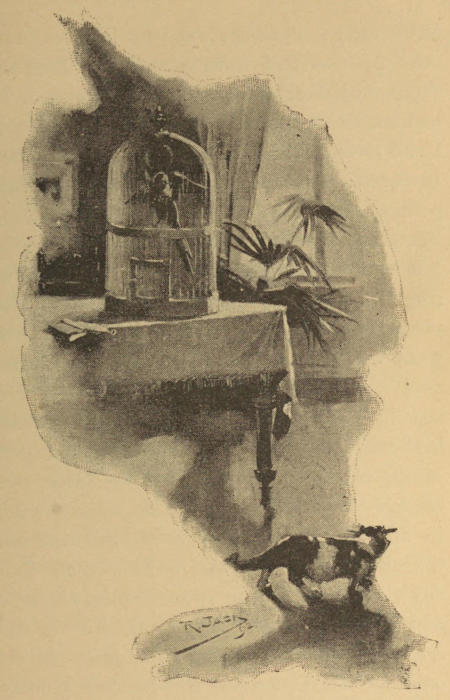
“ASKING THE CAT IF HE HAD EVER SEEN A MOUSE.”
“It turned out that the parrot couldn’t talk
anything but Spanish, and very little of that.
And he wouldn’t learn a word of English,
though my daughter worked over him as if he
had been a whole Sunday-school. But one day
he all at once began to teach himself English.
Invented a sort of Ollendorff way of studying,
perhaps because he had heard Mamie studying
French that way. He’d begin by saying, ‘Does
Polly want a cracker?’ and then he’d go on and
ring the changes. For example, just to give
you an idea of the system, he’d say, ‘Does Polly
want the lead cracker of the plumber or the
gold cracker of the candlestick maker?’ and
then he’d answer, ‘No, Polly does not want the
lead cracker of the plumber nor the gold cracker
of the candlestick maker, but the large steel
cracker of the blacksmith.’ He used to study
in this way three hours every morning and
three every afternoon, and never stop for Sundays,
being, as I suppose, a Roman Catholic,
and not a Sabbath-keeping bird. I never saw
a bird so bent on learning a language as this
one was, and he fetched it. In three months’
time that parrot could talk English as well as
you or I, and a blamed sight better than that
waiter who pretends that he talks English. The
trouble was the parrot would talk all the time
when he was not asleep. My wife is no slouch
at talking, but I’ve seen her burst into tears
and say, ‘It’s no use, I can’t get in a word edgewise.’
And no more could she. That bird was
just talking us deaf, dumb, and blind. The cat,
he gave it up at an early stage of the proceedings.
The parrot was so personal in his remarks—asking
the cat if he had ever seen a
mouse in his whole life, and wanting to know
who it was that helped him to paint the back
fence red the other night, till the cat, after cursing
till all was blue, went out of the house and
never showed up again. He hadn’t the slightest
regard for anybody’s feelings, that bird
hadn’t. No parrot ever has.
“He wasn’t content with talking three-fourths
of the time, but he had a habit of thinking out
loud which was far worse than his conversation.
For instance, when young Jones called of an
evening on my daughter, the parrot would say,
‘Well, I suppose that young idiot will stay till
midnight, and keep the whole house awake as
usual.’ Or when the Unitarian minister came
to see my wife the parrot would just as likely
as not remark, ‘Why don’t he hire a hall if he
must preach, instead of coming here and wearing
out the furniture?’ Nobody would believe
that the parrot made these remarks of his own
accord, but insisted that we must have taught
them to him. Naturally, folks didn’t like this
sort of thing, and after a while hardly anybody
came inside our front door.
“And then that bird developed a habit of
bragging that was simply disgusting. He
would sit up by the hour and brag about his
superiority to other birds, and the beauty of his
feathers, and his cage, and the gorgeousness of
the parlor, and the general meanness of everything
except himself and his possessions. He
made me so tired that I sometimes wished I
were deaf. You see, it was the infernal ignorance
of the bird that aggravated me. He
didn’t know a thing of the world outside of
our parlor; and yet he’d brag and brag till you
couldn’t rest.
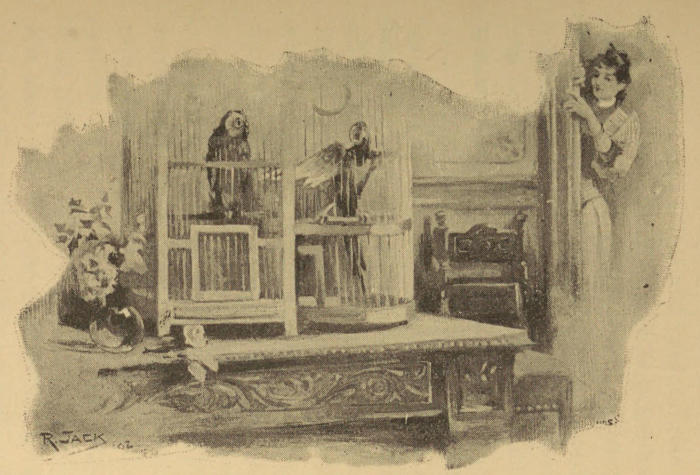
“THE PARROT BEGAN BY TRYING TO DAZZLE THE OWL WITH
HIS CONVERSATION, BUT IT WOULDN’T WORK.”
“You may ask why didn’t we kill him, or
sell him, or give him to the missionaries, or
something of that sort. Well, Mamie, she said
it would be the next thing to murder if we were
to wring his neck; and that selling him would
be about the same as the slave-trade. She
wouldn’t let me take the first step toward getting
rid of the parrot, and the prospect was that
he’d drive us clean out of the house.
“One day a man who had had considerable
experience of parrots happened to come in, and
when I complained of the bird he said, ‘Why
don’t you get an owl? You get an owl and
hang him up close to that parrot’s cage, and in
about two days you’ll find that your bird’s dead
sick of unprofitable conversation.’
“Well, I got a small owl and put him in a
cage close to the parrot’s cage. The parrot
began by trying to dazzle the owl with his conversation,
but it wouldn’t work. The owl sat
and looked at the parrot just as solemn as a
minister whose salary has been cut down, and
after a while the parrot tried him with Spanish.
It wasn’t of any use. Not a word would the
owl let on to understand. Then the parrot tried
bragging, and laid himself out to make the owl
believe that of all the parrots in existence he
was the ablest. But he couldn’t turn a feather
of the owl. That noble bird sat silent as the
grave, and looked at the parrot as if to say,
‘This is indeed a melancholy exhibition of imbecility!’
Well, before night that parrot was
so ashamed of himself that he closed for repairs,
and from that day forth he never spoke an unnecessary
word. Such, gentlemen, is the influence
of example even on the worst of birds.”
The American lit a fresh cigar, and pulling
his hat over his eyes, fell into profound meditation.
His three auditors made no comment on
his story, and did not repeat the inquiry why
he had asked the waiter for an owl. They
smoked in silence for some moments, and then
one of them invited the other two to step over
to Henry’s and take something—an invitation
which they promptly accepted, and the smoking-room
knew them no more that night.
JEWSEPPY.
“Yes, sir!” said the Colonel. “Being an
American, I’m naturally in favor of elevating
the oppressed and down-trodden, provided, of
course, they live in other countries. All Americans
are in favor of Home Rule for Ireland,
because it would elevate the Irish masses and
keep them at home; but if I were living in Ireland,
perhaps I might prefer elevating Russian
Jews or Bulgarian Christians. You see, the
trouble with elevating the oppressed at home is
that the moment you get them elevated they
begin to oppress you. There is no better fellow
in the world than the Irishman, so long as you
govern him; but when he undertakes to govern
you it’s time to look out for daybreak to westward.
You see, we’ve been there and know
all about it.
“Did I ever tell you about Jewseppy? He
was an organ-grinder, and, take him by and
large, he was the best organ-grinder I ever met.
He could throw an amount of expression into
‘Annie Rooney,’ or, it might be, ‘The Old
Folks at Home,’ that would make the strongest
men weep and heave anything at him that they
could lay their hands to. He wasn’t a Jew, as
you might suppose from his name, but only
an Italian—‘Jewseppy’ being what the Italians
would probably call a Christian name if they
were Christians. I knew him when I lived in
Oshkosh, some twenty years ago. My daughter,
who had studied Italian, used to talk to him
in his native language; that is, she would ask
him if he was cold, or hungry, or ashamed, or
sleepy, as the books direct, but as he never answered
in the way laid down in the books, my
daughter couldn’t understand a word he said,
and so the conversation would begin to flag. I
used to talk to him in English, which he could
speak middling well, and I found him cranky,
but intelligent.
“He was a little, wizened, half-starved-looking
man, and if he had only worn shabby black
clothes, you would have taken him for a millionaire’s
confidential clerk, he was so miserable
in appearance. He had two crazes—one
was for monkeys, who were, he said, precisely
like men, only they had four hands and tails,
which they could use as lassoes, all of which were
in the nature of modern improvements, and
showed that they were an advance on the original
pattern of men. His other craze was his
sympathy for the oppressed. He wanted to liberate
everybody, including convicts, and have
every one made rich by law and allowed to do
anything he might want to do. He was what
you would call an Anarchist to-day, only he
didn’t believe in disseminating his views by
dynamite.
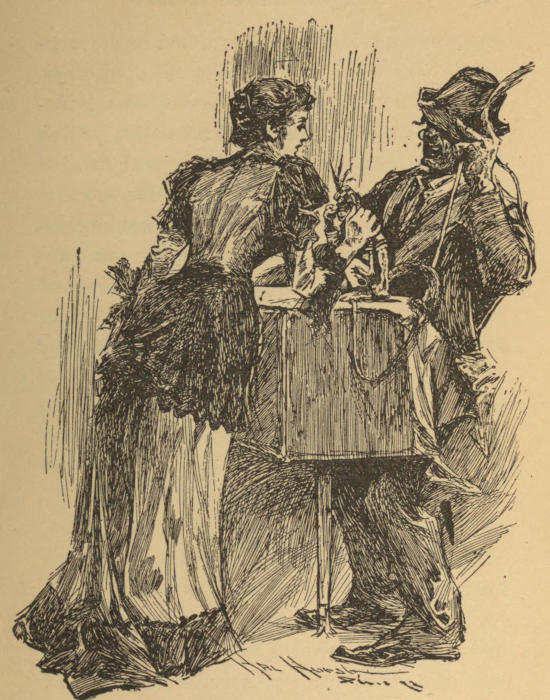
“SHE WOULD ASK HIM IF HE WAS COLD OR HUNGRY.”
“He had a monkey that died of consumption,
and the way that Jewseppy grieved for the
monkey would have touched the heart of an
old-fashioned Calvinist, let alone a heart of ordinary
stone. For nearly a month he wandered
around without his organ, occasionally doing
odd jobs of work, which made most people think
that he was going out of his mind. But one
day a menagerie came to town, and in the menagerie
was what the show-bill called a gorilla.
It wasn’t a genuine gorilla, as Professor Amariah
G. Twitchell, of our university, proved
after the menagerie men had refused to give
him and his family free tickets. However, it
was an animal to that effect, and it would probably
have made a great success, for our public,
though critical, is quick to recognize real
merit, if it wasn’t that the beast was very sick.
This was Jewseppy’s chance, and he went for
it as if he had been a born speculator. He offered
to buy the gorilla for two dollars, and the
menagerie men, thinking the animal was as
good as dead, were glad to get rid of it, and
calculated that Jewseppy would never get the
worth of the smallest fraction of his two dollars.
There is where they got left, for Jewseppy
knew more about monkeys than any man living,
and could cure any sick monkey that
called him in, provided, of course, the disease
was one which medical science could collar.
In the course of a month he got the gorilla
thoroughly repaired, and was giving him lessons
in the theory and practice of organ-grinding.
“The gorilla didn’t take to the work kindly,
which, Jewseppy said, was only another proof
of his grand intellect, but Jewseppy trained
him so well that it was not long before he could
take the animal with him when he went out
with the organ, and have him pass the plate.
The gorilla always had a line round his waist,
and Jewseppy held the end of it, and sort of
telegraphed to him through it when he wanted
him to come back to the organ. Then, too, he
had a big whip, and he had to use it on the
gorilla pretty often. Occasionally he had to
knock the animal over the head with the butt
end of the whip-handle, especially when he was
playing something on the organ that the gorilla
didn’t like, such as ‘Marching through Georgia,’
for instance. The gorilla was a great
success as a plate-passer, for all the men were
anxious to see the animal, and all the women
were afraid not to give something when the
beast put the plate under their noses. You see,
he was as strong as two or three men, and his
arms were as long as the whole of his body, not
to mention that his face was a deep blue, all of
which helped to make him the most persuasive
beast that ever took up a collection.
“Jewseppy had so much to say to me about
the gorilla’s wonderful intelligence that he made
me tired, and one day I asked him if he thought
it was consistent with his principles to keep the
animal in slavery. ‘You say he is all the same
as a man,’ said I. ‘Then why don’t you give
him a show? You keep him oppressed and
down-trodden the whole time. Why don’t you
let him grind the organ for a while, and take up
the collection yourself? Turn about is fair play,
and I can’t see why the gorilla shouldn’t have
his turn at the easy end of the business.’ The
idea seemed to strike Jewseppy where he lived.
He was a consistent idiot. I’ll give him credit
for that. He wasn’t ready to throw over his
theories every time he found they didn’t pay.
Now that I had pointed out to him his duty
toward the gorilla, he was disposed to do it.
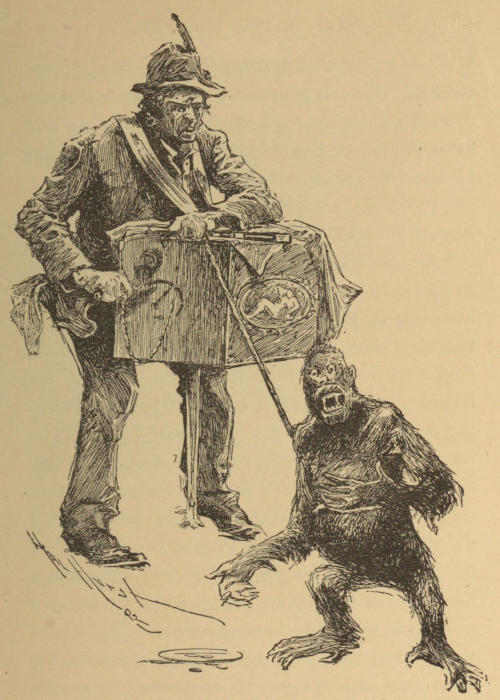
“THE GORILLA WAS A GREAT SUCCESS.”
“You see, he reasoned that while it would only
be doing justice to the beast to change places
with him, it would probably increase the receipts.
When a man can do his duty and make
money by it his path is middling plain; and
after Jewseppy had thought it over he saw that
he must do justice to the gorilla without delay.
“It didn’t take the beast long to learn the
higher branches of hand-organing.
“He saw the advantages of putting the money
in his own pocket instead of collecting it and
handing it over to Jewseppy, and he grasped
the idea that when he was pushing the little
cart that carried the organ and turning the
handle, he was holding a much better place in
the community than when he was dancing and
begging at the end of a rope. I thought, a day
or two after I had talked to Jewseppy, that
there was considerable uproar in town, but I
didn’t investigate it until toward evening, when
there seemed to be a sort of riot or temperance
meeting, or something of the kind, in front of
my house, and I went out to see about it. There
were nearly two thousand people there watching
Jewseppy and his gorilla, or rather the gorilla
and his Jewseppy. The little man had been
elevating the oppressed with great success. A
long rope was tied around his waist, and he
was trotting around among the people, taking
up the collection and dancing between times.
“The gorilla was wearing Jewseppy’s coat,
and was grinding away at the organ with one
hand and holding Jewseppy’s rope with the
other. Every few minutes he would haul in
the rope, hand over hand, empty all the money
out of Jewseppy’s pocket, and start him out
again. If the man stopped to speak to anybody
for a moment the gorilla would haul him in and
give him a taste of the whip, and if he didn’t
collect enough money to suit the gorilla’s idea,
the animal would hold him out at arm’s length
with one hand and lay into him with the other
till the crowd were driven wild with delight.
Nothing could induce them to think that Jewseppy
was in earnest when he begged them to
protect him. They supposed it was all a part
of the play, and the more he implored them to
set him free, the more they laughed and said
that ‘thish yer Eyetalian was a bang-up actor.’
“As soon as Jewseppy saw me he began to tell
me of his sufferings. His story lacked continuity,
as you might say, for he would no sooner
get started in his narrative than the gorilla
would jerk the rope as a reminder to him to attend
strictly to business if he wanted to succeed
in his profession. Jewseppy said that as soon
as he tied the rope around his waist and put the
handle of the organ in the gorilla’s hand the
beast saw his chance and proceeded to take advantage
of it. He had already knocked the
man down twice with the handle of the whip,
and had lashed him till he was black and blue,
besides keeping him at work since seven o’clock
that morning without anything to eat or drink.
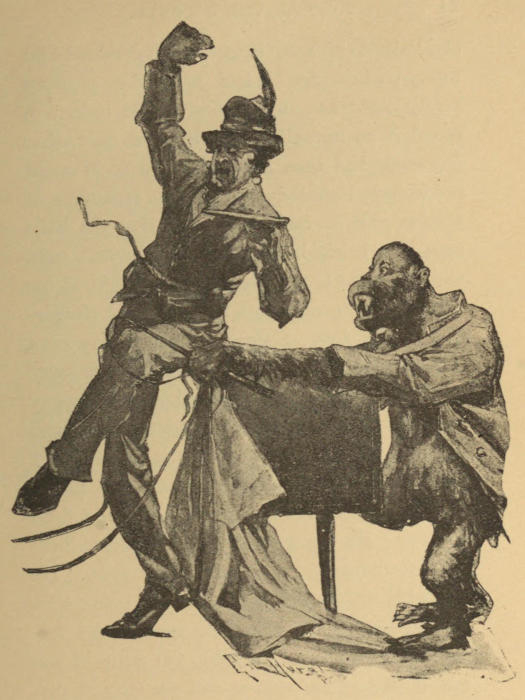
“WEARING JEWSEPPY’S COAT, AND WAS GRINDING AWAY AT THE ORGAN.”
“At this point the gorilla hauled Jewseppy in
and gave him a fairly good thrashing for wasting
his time in conversation. When the man
came around again with the plate I told him
that he was taking in more money than he had
ever taken in before, and that this ought to console
him, even if the consciousness that he was
doing justice to the oppressed had no charms
for him. I’m sorry to say that Jewseppy used
such bad language that I really couldn’t stay
and listen to him any longer. I understood him
to say that the gorilla took possession of every
penny that was collected, and would be sure to
spend it on himself, but as this was only what
Jewseppy had been accustomed to do it ought
not to have irritated a man with a real sense of
justice. Of course I was sorry that the little
man was being ill treated, but he was tough,
and I thought that it would not hurt him if the
gorilla were to carry out his course of instruction
in the duty of elevating the oppressed a
little longer. I have always been sort of sorry
that I did not interfere, for although Jewseppy
was only a foreigner who couldn’t vote, and
was besides altogether too set in his ideas, I
didn’t want him to come to any real harm.
After that day no man ever saw Jewseppy, dead
or alive. He was seen about dusk two or three
miles from town on the road to Sheboygan. He
was still tied to the rope and was using a lot
of bad language, while the gorilla was frequently
reminding him with the whip of the
real duties of his station and the folly of discontent
and rebellion. That was the last anybody
ever saw of the Italian. The gorilla turned
up the next day at a neighboring town with his
organ, but without anybody to take up the collection
for him, and as the menagerie happened
to be there the menagerie men captured him
and put him back in his old cage, after having
confiscated the organ. No one thought of making
any search for Jewseppy, for, as I have said,
he had never been naturalized and had no vote,
and there were not enough Italians in that part
of the country to induce any one to take an interest
in bringing them to the polls. It was
generally believed that the gorilla had made
away with Jewseppy, thinking that he could
carry on the organ business to more advantage
without him. It’s always been my impression
that if Jewseppy had lived he would have been
cured of the desire to elevate the down-trodden,
except, of course, in foreign countries. He
was an excellent little man—enthusiastic, warm-hearted,
and really believing in his talk about
the rights of monkeys and the duty of elevating
everybody. But there isn’t the least doubt that
he made a mistake when he tried to do justice
to that gorilla.”
THAT LITTLE FRENCHMAN.
“Does anybody doubt my patriotism?” asked
the Colonel. We all hastened to say that we
should as soon doubt our own existence. Had
he not made a speech no longer ago than last
Fourth of July, showing that America was destined
to have a population of 1,000,000,000 and
that England was on the verge of extinction?
Had he not perilled his life in the cause of freedom,
and was he not tireless in insisting that
every Chinaman should be driven out of the
United States? If there ever was one American
more patriotic than another it was the
Colonel.
“Well, then,” continued the speaker, “you
won’t misunderstand me when I say that the
American railroad car is a hundred times more
dangerous than these European compartment
cars. In thirty years there have been just four
felonious assaults in English railroad cars.
There have been a few more than that in France,
but not a single one in Germany. Now, I admit
that you are in no danger of being shot in an
American car, unless, of course, two gentlemen
happen to have a difficulty and shoot wild, or
unless the train is held up by train robbers who
are a little too free with their weapons. But I
do say that the way in which we heat our cars
with coal-stoves kills thousands of passengers
with pneumonia and burns hundreds alive
when the trains are wrecked.
“You see, I’ve looked into this thing and
I’ve got the statistics down fine. I’m the only
man I know who ever had any trouble with
a passenger while travelling in Europe, and I
don’t mind telling you about it, although it will
be giving myself away. Kindly push me over
those matches, will you? These French cigars
take a lot of fuel, and you have to encourage
them with a match every three minutes if you
expect them to burn.
“When I was over here in Paris, ten years
ago, there was a fellow here from Chicago who
was trying to introduce American cars, and he
gave me a pamphlet he had got up showing the
horrors of the compartment system. It told of
half a dozen murders, fifteen assaults, eleven
cases of blackmail, and four cases in which a
solitary traveller was shut up in a compartment
with a lunatic—all these incidents having occurred
on European railways. I was on my way
to Egypt, and when I had read the pamphlet I
began to wonder if I should ever manage to live
through the railroad journey without being
killed, or blackmailed, or lunaticked, or something
of the kind. You see, I believed the
stories then, though I know now that about
half of them were false.
“I took the express train—the Peninsular and
Oriental they call it—from Paris about twelve
o’clock one night. I went early to the train,
and until just before we started I thought I
was going to have the compartment to myself.
All at once a man very much out of breath
jumped in, the door was slammed, and we
were off.
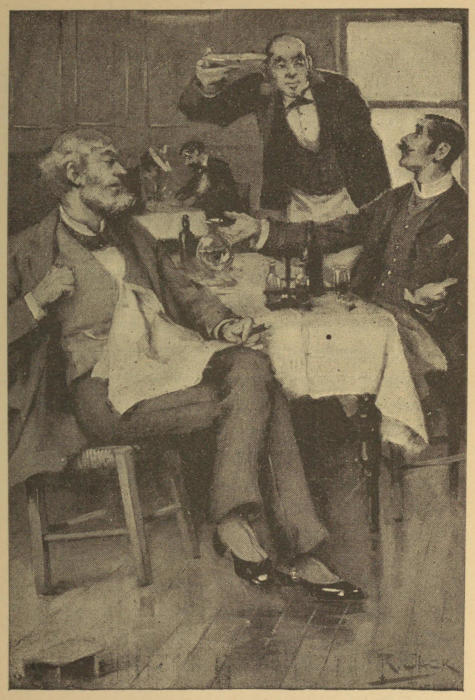
“‘DOES ANYBODY DOUBT MY PATRIOTISM?’ ASKED THE COLONEL.”
“I didn’t like the looks of the fellow. He
was a Frenchman, though of course that wasn’t
his fault. He was small but wiry-looking, and
his sharp black eyes were not the style of eyes
that inspires me with confidence. Then he had
no baggage except a small paper parcel, which
was queer, considering that the train was a long-distance
one. I kept a close watch on him for a
while, thinking that he might be one of the professional
lunatics that, according to the Chicago
chap’s pamphlet, are always travelling in order
to frighten solitary passengers; but after a while
I became so sleepy that I decided to lie down
and take a nap and my chances of being killed
at the same time. Just then the man gets up
and begins to talk to me in French.
“Now, I needn’t say that I don’t speak French
nor any of those fool languages. Good American
is good enough for me. One reason why
these Europeans have been enslaved for centuries
is that they can’t make each other understand
their views without shouting at the top of
their lungs, and so bringing the police about their
ears. But I did happen to know, or thought
I did, the French word for going to sleep,
and so I thought I would just heave it at this
chap so that he would understand that I didn’t
require his conversation. I have always found
that if you talk to a Frenchman in English very
slowly and impressively he will get the hang of
what you say. That is, if he isn’t a cabman.
You can’t get an idea into a French cabman’s
head unless you work it in with a club. So I
said to the fellow in the train: ‘My friend! I
haven’t any time to waste in general conversation.
I’m going to sleep, and I advise you to
do the same. You can tell me all about your
institutions and your revolutions and things in
the morning.’ And then I hove in the French
word ‘cochon,’ which I supposed meant something
like ‘Now I lay me down to sleep.’
“The fellow staggered back as if I had hit
him, and then he began to sling the whole
French language at me. I calculate that he
could have given Bob Ingersoll fifty points in a
hundred and beaten him, and, as you know,
Bob is the ablest vituperator now in the business.
The Frenchman kept on raving and getting
madder and madder every minute, and I
saw that there wasn’t the least doubt that he
was a dangerous lunatic.
“I stood up and let him talk for a while, occasionally
saying ‘non comprenny’ and ‘cochon,’
just to soothe him, but presently he came close
to me and shook his fist in my face. This was
too much, so I took him by the shoulders and
slammed him down in a corner seat, and said,
‘You sit there, sonny, and keep quiet, or you’ll
end by getting me to argue with you.’ But the
minute I let go of him he bounced up again as
if he was made of India-rubber, and came at me
just as a terrier will come at a horse, pretending
that he is going to tear him into small
pieces. So I slammed him down into his corner
again, and said, ‘This foolishness has gone far
enough, and we’ll have it stopped right here.
Didn’t you hear me say cochon? I’m going to
cochon, and you’d better cochon, too, or I’ll
make you.’
“This time he jumped up as soon as I had let
go of him and tried to hit me. Of course I
didn’t want to hit so small a chap, letting alone
that he knew no more about handling his fists
than the angel Gabriel, so I just took and twisted
his arms behind his back and tied them with a
shawl-strap. Then, seeing as he showed a reprehensible
disposition to kick, I put another strap
around his legs and stretched him on the seat
with his bundle under his head. But kindness
was thrown away on that Frenchman. He
tried to bite me, and not content with spitting
like a cat, he set up a yell that was the next
thing to the locomotive whistle, and rolling off
the seat tried to kick at me with both legs.
“I let him exercise himself for a few minutes,
while I got my hair-brush and some twine out
of my bag. Then I put him back on the seat,
gagged him with the handle of the hair-brush,
and lashed him to the arm of the seat so that
he couldn’t roll off. Then I offered him a drink,
but he shook his head, not having any manners,
in spite of what people say about the politeness
of Frenchmen. Having secured my own safety
and made the lunatic reasonably comfortable, I
turned in and went to sleep. I must have slept
very sound, for although the train stopped two or
three times during the night, I never woke up
until we pulled up for breakfast about eight
o’clock the next morning. I sat up and looked at
my lunatic, who was wide awake and glaring at
me. I wished him good-morning, for I couldn’t
bear any grudge against a crazy man; but he
only rolled his eyes and seemed madder than
ever, so I let him lie and got out of the train.
“Two policemen were walking up and down
the platform, and I took one of them by the arm
and led him to the car, explaining what had
happened. I don’t know whether he understood
or not, but he pretended that he didn’t.
“As soon as he saw the lunatic there was a
pretty row. He called two more policemen, and
after they had ungagged the fellow they hauled
us both before a magistrate who had his office
in the railroad station. At least he acted like
a magistrate, although he wore the same uniform
as the policemen. Here the fellow I had
travelled with was allowed to speak first, and
he charged me, as I afterward found, with having
first insulted and then assaulted him. He
said he rather thought I was a lunatic, but at
any rate he must have my blood. Then an interpreter
was sent for, and I told my story, but
I could see that nobody believed me.
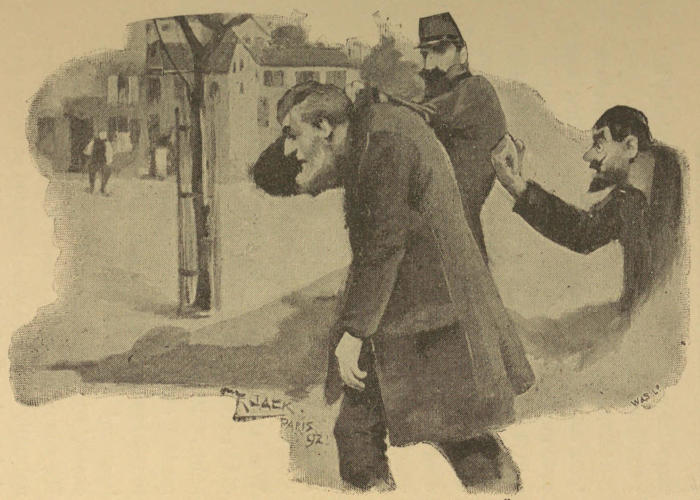
“THEY HAULED US BOTH BEFORE A MAGISTRATE.”
“‘Accused,’ said the magistrate very sternly,
‘you called this gentleman a pig. What was
your motive?’
“Of course I swore that I had never called
him a pig, that I hardly knew half a dozen
words of his infamous language, and that I had
used only one of those. Being asked what it
was, I said ‘cochon.’ And then that idiot ordered
me to be locked up.
“By rare good luck there happened to be an
American secretary of legation on the train.
You know him. It was Hiram G. Trask, of
West Centreopolis. He recognized me, and it
didn’t take him very long to explain the whole
affair. It seems that the Frenchman had asked
me if I objected to smoking, and when I tried
to tell him that we ought to go to sleep, I said
‘cochon,’ which means pig, instead of ‘couchons,’
which was the word I ought to have used.
He was no more of a lunatic than a Frenchman
naturally is, but he was disgusted at being carried
two hundred miles beyond his destination,
which was the first stopping-place beyond Paris,
and I don’t know that I blame him very much.
And then, too, he seemed to feel that his dignity
had been some ruffled by being gagged and
bound. However, both he and the policemen
listened to reason, and the man agreed to compromise
on my paying him damages and withdrawing
the assertion that he was morally or
physically a pig. The affair cost considerable,
but it taught me a lesson, and I have quit believing
that you can’t travel in a European railroad
car without being locked up with a lunatic
or a murderer. I admit that the whole trouble
was due to my foolishness. When the Frenchman
began to make a row, I ought to have
killed him and dropped the body out of the
door, instead of fooling with him half the night
and trying to make him comfortable. But we
can’t always command presence of mind or see
just where our duty lies at all times.”
THOMPSON’S TOMBSTONE.
We had just dined in the little Parisian restaurant
where Americans are in the habit of
going in order to obtain those truly French delicacies,
pork and beans, buckwheat cakes, corned
beef, apple pie, and overgrown oysters. I knew
a man from Chicago who dined at this restaurant
every day during the entire month spent
by him in Paris, and who, at the end of that
time, said that he was heartily sick of French
cookery. Thus does the profound study of the
manners and customs of foreign nations enlighten
the mind and ripen the judgment.
The Colonel had finished his twelfth buckwheat
cake and had lighted his cigar, when he
casually and reprovingly remarked to young
Lathrop, who, on principle, was disputing the
bill with the waiter, that “he was making more
trouble than Thompson’s tombstone.” Being
called upon to explain this dark saying, he
stretched his legs to their limit, tipped back his
chair, knocked the ashes of his cigar among the
remnants of his pork and beans, and launched
into his story.
“In the town where I was raised—and I’m
not going to give away the name of it at present—there
were two brothers, James and John
Thompson. They were twins and about forty
years old, as I should judge. James was a
bachelor and John he was a widower, and they
were both pretty well to do in the world, for
those times at least. John was a farmer and
James was a wagon maker and owned the village
hearse besides, which he let out for funerals,
generally driving it himself, so that any profit
that was to be made out of a melancholy occasion
he could make without sharing it with
anybody. Both the men were close-fisted, and
would look at a dollar until their eyesight began
to fail before they could bring themselves to
spend it. It was this miserly spirit that brought
about the trouble that I’m going to tell you of.
“After John Thompson had been a widower
so long that the unmarried women had given up
calling on him to ask his advice about the best
way of raising money for the heathen, and had
lost all expectation that any one of them would
ever gather him in, he suddenly ups and marries
Maria Slocum, who used to keep a candy store
next door to the school-house and had been a
confirmed old maid for twenty years. She had
a little money, though, and folks did say that
she could have married James Thompson if she
had been willing to take the risk; but the fact
that James always had the hearse standing in
his carriage-house made him unpopular with
the ladies. She took John because his views
on infant baptism agreed with hers, and he
took her because she had a good reputation for
making pies and was economical and religious.
“The Thompson brothers owned burial lots
in the new cemetery that were close together.
James, of course, had, so far, no use for his lot,
but John had begun to settle his by burying his
first wife in about the middle of it. The lot
was a good-sized one, with accommodation for a
reasonably large family without crowding them,
and without, at the same time, scattering them
in any unsocial way. I don’t know how it
came about, but no sooner was John married
than he took a notion to put up a tombstone over
his first wife. He thought that as he was going
to incur such an expense he would manage it
so that he wouldn’t have to incur it again; and
so he got up a design for a combination family
tombstone, and had it made, and carved, and
lettered, and set up in his burial lot.
“Near the top of the stone was John Thompson’s
name, the date of his birth, and a blank
space for the date of his death. Next came the
name of ‘Sarah Jane, beloved wife of the
above,’ and the date of her birth and death.
Then came the name of ‘Maria, beloved and
lamented wife of the above John Thompson,’
with the date of her birth and a space for the
date of her death. You see, John worked in
this little compliment about Maria being ‘lamented’
so as to reconcile her to having the date
of her birth given away to the public. The
lower half of the tombstone was left vacant so
as to throw in a few children should any such
contingency arise, and the whole advertisement
ended with a verse of a hymn setting forth that
the entire Thompson family was united in a
better land above.
“The cost of the affair was about the same
as that of one ordinary tombstone, the maker
agreeing to enter the dates of John’s death and
of his wife’s death free of charge whenever the
time for so doing might arrive; and also agreeing
to enter the names of any children that
might appear at a very low rate. The tombstone
attracted a great deal of attention, and
the summer visitors from the city never failed
to go and see it. John was proud of his stroke
of economy, and used to say that he wasn’t in
danger of being bankrupted by any epidemic,
as those people were who held that every person
must have his separate tombstone. Everybody
admitted that the Thompson tombstone gave
more general amusement to the public than any
other tombstone in the whole cemetery. Every
summer night John used to walk over to his lot
and smoke his pipe, leaning on the fence and
reading over the inscriptions. And then he
would go and take a fresh look at the Rogers’
lot, where there were nine different tombstones,
and chuckle to think how much they must have
cost old man Rogers, who had never thought of
a combination family tomb. In the course of
about three years the inscriptions had grown,
for there had been added the names of Charles
Henry and William Everett Thompson, ‘children
of the above John and Maria Thompson,’
and John calculated that with squeezing he
could enter four more children on the same
stone, though he didn’t really think that he
would ever have any call so to do.
“Well, a little after the end of the third year
John’s troubles began. He took up with Second
Advent notions and believed that the end of
the world would arrive, as per schedule, on the
21st of November, at 8:30 A.M. Maria said
that this was not orthodox and that she wouldn’t
allow any such talk around her house. Both of
them were set in their ways, and what with
John expressing his views with his whip-handle
and Maria expressing hers with the rolling-pin,
they didn’t seem to get on very well together,
and one day Maria left the house and took the
train to Chicago, where she got a divorce and
came back a free and independent woman.
That wasn’t all: James Thompson now saw his
chance. He offered to sell out the hearse business,
and after waiting ten months, so as to give
no opportunity for scandal, Maria married him.
“John didn’t seem to mind the loss of his
wife very much until it happened to occur to
him that his combination family tombstone
would have to be altered, now that Maria was
not his wife any longer. He was a truthful
man, and he felt that he couldn’t sleep in peace
under a tombstone that was constantly telling
such a thumping lie as that Maria was resting
in the same burying-lot and that she was his
beloved wife, when, in point of fact, she was
another man’s wife and would be, at the proper
time, lying in that other man’s part of the
cemetery. So he made up his mind to have
the marble-cutter chisel out Maria’s name and
the date of her birth. But before this was
done he saw that it wouldn’t be the square thing
so far as Charles Henry and William Everett
were concerned. It would be playing it low
down on those helpless children to allow that
tombstone to assert that they were the children
of John Thompson and some unspecified woman
called Maria, who, whatever else she may have
been, was certainly not John Thompson’s wife.
Matters would not be improved if the name of
Maria were to be cut out of the line which stated
the parentage of the children, for in that case it
would appear that they had been independently
developed by John, without the intervention of
any wife, which would be sure to give rise to
gossip and all sorts of suspicions.
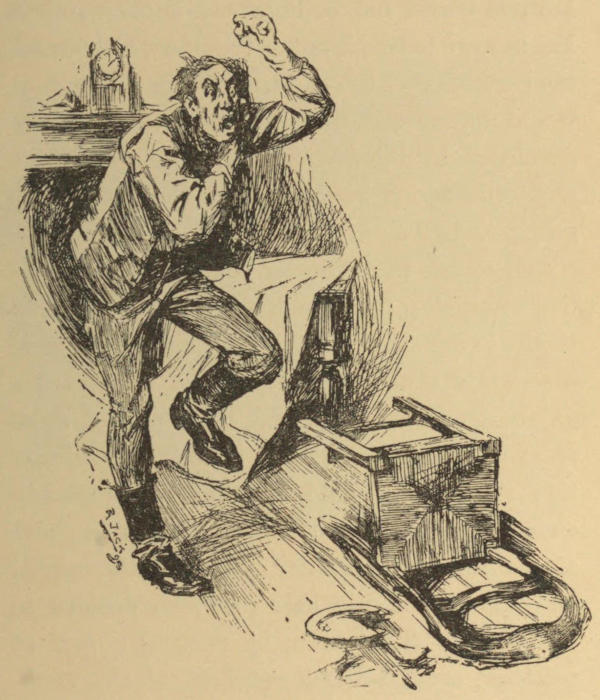
“DIDN’T SEEM TO GET ON VERY WELL TOGETHER.”
“Of course the difficulty could have been settled
by erasing from the tombstone all reference
to Maria and her two children, but in that case
a separate stone for the children would some
day become necessary, and, what was of more
consequence, John’s grand idea of a combination
tombstone would have to be completely
abandoned. John was not a hasty man, and
after thinking the matter over until the mental
struggle turned his hair gray, he decided to
compromise the matter by putting a sort of
petticoat around the lower half of the tombstone,
which would hide all reference to Maria
and the children. This was easily done with
the aid of an old pillow-case, and the tombstone
became more an object of interest to the public
than ever, while John, so to speak, sat down
to wait for better times.
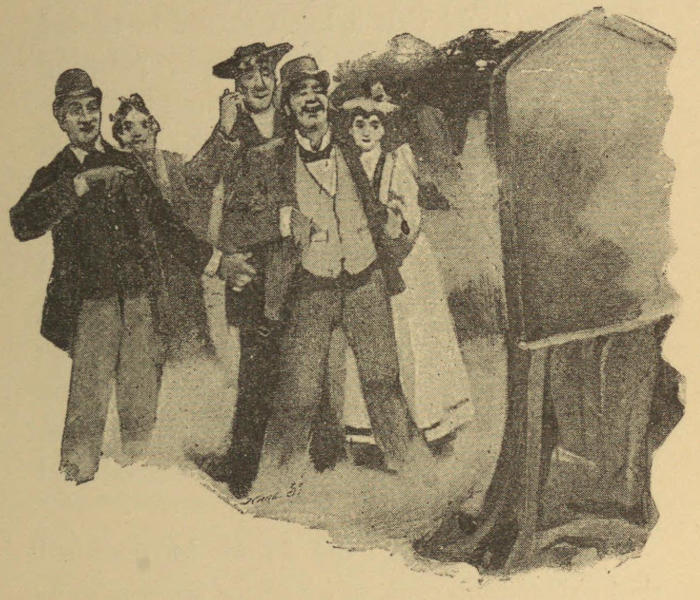
“THE TOMBSTONE BECAME MORE AN OBJECT OF INTEREST TO THE
PUBLIC THAN EVER.”
“Now, James had been thinking over the
tombstone problem, and fancied that he had
found a solution of it that would put money in
his own pocket and at the same time satisfy
his brother. He proposed to John that the inscription
should be altered so as to read: ‘Maria,
formerly wife of John and afterward of James
Thompson,’ and that a hand should be carved
on the stone with an index-finger pointing
toward James’ lot, and a line in small type saying,
‘See small tombstone.’ James said that
he would pay the cost of putting up a small uninscribed
stone in his own lot over the remains
of Maria—waiting, of course, until she should
come to be remains—and that John could pay
the cost of altering the inscriptions on the large
stone. The two brothers discussed this scheme
for months, each of them being secretly satisfied
with it, but John maintaining that James should
pay all the expenses.
“This James would not do, for he reasoned
that unless John came to his terms the combination
tombstone would be of no good to anybody,
and that if he remained firm John would come
round to his proposal in time.
“There isn’t the least doubt that this would
have been the end of the affair, if it had not
been that James chuckled over it so much that
one day he chuckled a fishbone into his throat
and choked to death on the spot. He was buried
in his own lot, with nothing but a wooden headboard
to mark the spot. His widow said that
if he had been anxious to have a swell marble
monument he would have made provision for it
in his lifetime, and as he had done nothing of
the kind, she could not see that she had any
call to waste her money on worldly vanities.
“How did this settle the affair of the combination
tombstone? I’m just telling you. You
see, by this time the world had not come to an
end, and John, who always hated people who
didn’t keep their engagements, seeing that the
Second Adventists didn’t keep theirs, left them
and returned to the regular Baptist fold. When
his brother died he went to the funeral, and did
what little he could, in an inexpensive way, to
comfort the widow. The long and short of it
was that they became as friendly as they ever
had been, and John finally proposed that Maria
should marry him again. ‘You know, Maria,’
he said, ‘that we never disagreed except about
that Second Advent nonsense. You were right
about that and I was wrong, as the event has
proved, and now that we’re agreed once more,
I don’t see as there is anything to hinder our
getting married again.’
“Maria said that she had a comfortable support,
and she couldn’t feel that it was the will
of Providence for her to be married so often,
considering how many poor women there were
who couldn’t get a single husband.
“‘Well,’ continued John, ‘there is that there
tombstone. It always pleased you and I was
always proud of it. If we don’t get married
again that tombstone is as good as thrown
away, and it seems unchristian to throw away
a matter of seventy-five dollars when the whole
thing could be arranged so easy.’
“The argument was one which Maria felt
that she could not resist, and so, after she had
mourned James Thompson for a fitting period,
she married John a second time, and the tombstone’s
reputation for veracity was restored.
John and Maria often discussed the feasibility
of selling James’ lot and burying him where
the combination tombstone would take him in,
but there was no more room for fresh inscriptions,
and besides, John didn’t see his way clear
to stating in a short and impressive way the
facts as to the relationship between James and
Maria. So, on the whole, he judged it best to let
James sleep in his own lot, and let the combination
tombstone testify only to the virtues of
John Thompson and his family. That’s the
story of Thompson’s tombstone, and if you don’t
believe it I can show you a photograph of the
stone with all the inscriptions. I’ve got it in
my trunk at this very moment, and when we go
back to the hotel, if you remind me of it, I’ll
get it out.”
A UNION MEETING.
“Well, sir,” said the Colonel, “since you
ask me what struck me most forcibly during
my tour of England, and supposing that you
want a civil answer to a civil question, I will
say that the thing that astonished me more than
anything else was the lack of religious enterprise
in England.
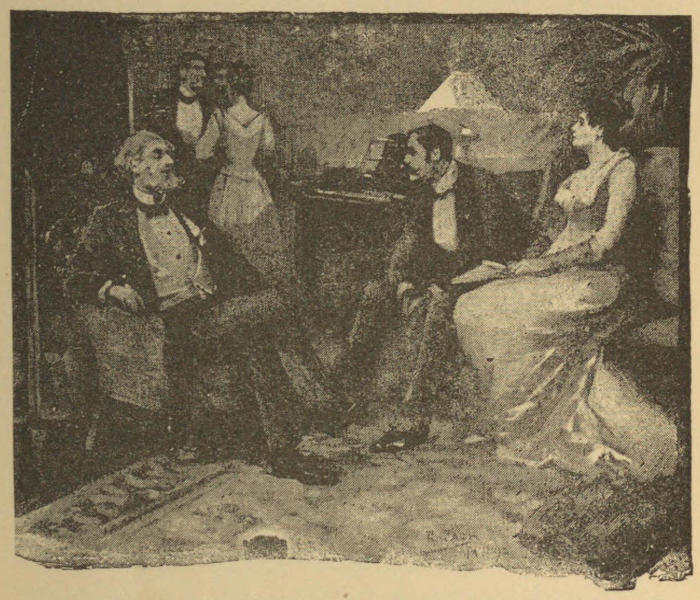
“THE LACK OF RELIGIOUS ENTERPRISE IN ENGLAND.”
“I have visited nearly every section of your
country, and what did I find? Why, sir, in
every town there was a parish church of the
regulation pattern and one other kind of church,
which was generally some sort of Methodist in
its persuasion. Now, in America there is hardly
a village which hasn’t half a dozen different
kinds of churches, and as a rule at least one of
them belongs to some brand-new denomination,
one that has just been patented and put on the
market, as you might say. When I lived in
Middleopolis, Iowa, there were only fifteen hundred
people in the place, but we had six kinds
of churches. There was the Episcopalian, the
Methodist, the Congregational, the Baptist, the
Presbyterian, the Unitarian, and the Unleavened
Disciples church, not to mention the colored
Methodist church, which, of course, we
didn’t count among respectable white denominations.
All these churches were lively and aggressive,
and the Unleavened Disciples, that had
just been brought out, was as vigorous as the
oldest of them. All of them were furnishing
good preaching and good music, and striving
to outdo one another in spreading the Gospel
and raising the price of pew-rents. I could go
for two or three months to the Presbyterian
church, and then I could take a hack at the
Baptists and pass half a dozen Sundays with
the Methodists, and all this variety would not
cost me more than it would have cost to pay
pew-rent all the year round in any one church.
And then, besides the preaching, there were the
entertainments that each church had to get up
if it didn’t want to fall behind its rivals. We
had courses of lectures, and returned missionaries,
and ice-cream festivals till you couldn’t
rest. Why, although I am an old theatrical
manager, I should not like to undertake to run
a first-class American church in opposition to
one run by some young preacher who had been
trained to the business and knew just what the
popular religious taste demanded. I never was
mixed up in church business but once, and then
I found that I wasn’t in my proper sphere.”
The Colonel chuckled slowly to himself, as
his custom was when anything amused him,
and I asked him to tell me his ecclesiastical
experience.
“Well, this was the way of it,” he replied.
“One winter the leading citizens of the place
decided to get up a series of union meetings.
Perhaps you don’t know what a union meeting
is? I thought so. It bears out what I was
saying about your want of religious enterprise.
Well, it’s a sort of monster combination, as we
would say in the profession. All the churches
agree to hold meetings together, and all the
preaching talent of the whole of them is collected
in one pulpit, and each man preaches in turn.
Of course every minister has his own backers,
who are anxious to see him do himself and his
denomination credit, and who turn out in full
force so as to give him their support. The result
is that a union meeting will always draw, even
in a town where no single church can get a full
house, no matter what attractions it may offer.
“Now, a fundamental rule of a union meeting
is that no doctrines are to be preached to
which any one could object. The Baptist
preacher is forbidden to say anything about
baptism, and the Methodist can’t allude to falling
from grace in a union meeting. This is
supposed to keep things peaceful and to avoid
arguments and throwing of hymn-books and
such-like proceedings, which would otherwise
be inevitable.
“The union meetings had been in progress
for three or four nights when I looked into the
Presbyterian church, where they were held one
evening, just to see how the thing was drawing.
All the ministers in town, except the Episcopalian
minister, were sitting on the platform
waiting their cues. The Episcopalian minister
had been asked to join in the services, but he
had declined, saying that if it was all the same
to his dissenting and partially Christian friends
he would prefer to play a lone hand; and the
colored minister was serving out his time in
connection with some of his neighbors’ chickens
that, he said, had flown into his kitchen and
committed suicide there, so he couldn’t have
been asked, even if the white ministers had been
willing to unite with him.
“The Presbyterian minister was finishing his
sermon when I entered, and soon as he had retired
the Baptist minister got up and gave out
a hymn which was simply crowded with Baptist
doctrine. I had often heard it, and I remember
that first verse, which ran this way:
“‘I’d rather be a Baptist
And wear a smiling face,
Than for to be a Methodist
And always fall from grace.’
“The hymn was no sooner given out than the
Methodist minister rose and claimed a foul, on
the ground that Baptist doctrine had been introduced
into a union meeting. There was no
manner of doubt that he was right, but the Baptists
in the congregation sang the hymn with
such enthusiasm that they drowned the minister’s
voice. But when the hymn was over there
was just a heavenly row. One Presbyterian
deacon actually went so far as to draw on a
Baptist elder, and there would have been blood
shed if the elder had not knocked him down
with a kerosene lamp, and convinced him that
drawing pistols in church was not the spirit of
the Gospel. Everybody was talking at once,
and the women who were not scolding were
crying. The meeting was beginning to look
like an enthusiastic political meeting in Cork,
when I rapped on the pulpit and called for
order. Everybody knew me and wanted to
hear what I had to say, so the meeting calmed
down, except near the door, where the Methodists
had got a large Baptist jammed into the
wood-box, and in the vestibule, where the Unitarians
had formed a ring to see the Unitarian
minister argue with an Unleavened Disciple.
“I told the people that they were making a
big mistake in trying to run that sort of an
entertainment without an umpire. The idea
pleased them, and before I knew what was
going to be done they had passed a resolution
making me umpire and calling on me to decide
whether the Baptist hymn constituted a foul.
I decided that it did not, on the ground that,
according to the original agreement, no minister
was to preach any sectarian doctrines, but
that nothing was said about the hymns that
might be sung. Then I proposed that in order
to prevent any future disputes and to promote
brotherly feeling, a new system of singing
hymns should be adopted. I said, as far as I
can recollect, that singing hymns did not come
under the head of incidental music, but was a
sort of entr’acte music, intended to relax and
divert the audience while bracing up to hear the
next sermon. This being the case, it stood to
reason that hymn-singing should be made a real
pleasure, and not an occasion for hard feeling
and the general heaving of books and foot-stools.
‘Now,’ said I, ‘that can be managed in this
way. When you sing let everybody sing the
same tune, but each denomination sing whatever
words it prefers to sing. Everybody will
sing his own doctrines, but nobody will have
any call to feel offended.’
“The idea was received with general enthusiasm,
especially among the young persons present,
and the objections made by a few hard-headed
old conservatives were overruled. The
next time singing was in order the Unitarian
minister selected a familiar short-metre tune,
and each minister told his private flock what
hymn to sing to it. Everybody sang at the top
of his or her lungs, and as nobody ever understands
the words that anybody else is singing,
there did not seem to be anything strange in
the singing of six different hymns to the same
tune. There was a moment when things were
a little strained in consequence of the Presbyterians,
who were a strong body, and had got
their second wind, singing a verse about predestination
with such vigor as partly to swamp
their rivals, but I decided that there was no
foul, and the audience, being rather tired with
their exertions, settled down to listen to the next
sermon.
“The next time it was the Methodist minister
who gave out the tune, and he selected one that
nobody who was not born and bred a Methodist
had ever heard of. We used to sing something
very much like it at the windlass when I was a
sailor, and it had a regular hurricane chorus.
When the Methodist contingent started in to
sing their hymn to this tune, not a note could
any of the rival denominations raise. They
stood it in silence until two verses had been
sung, and then——
“Well, I won’t undertake to describe what
followed. After about five minutes the Methodists
didn’t feel like singing any more. In
fact, most of them were outside the meeting-house
limping their way home, and remarking
that they had had enough of ‘thish yer fellowship
with other churches’ to last them for the
rest of their lives. Inside the meeting-house
the triumphant majority were passing resolutions
calling me a depraved worldling, who, at
the instigation of the devil, had tried to convert
a religious assemblage into an Orange riot.
Even the Unitarians, who always maintained
that they did not believe in the devil, voted for
the resolutions, and three of them were appointed
on the committee charged with putting me out.
I didn’t stay to hear any more sermons, but I
afterward understood that all the ministers
preached at me, and that the amount of union
displayed in putting the blame of everything on
my shoulders was so touching that men who
had been enemies for years shook hands and
called one another brothers.
“Yes! we are an enterprising people in ecclesiastical
matters, and I calculate that it will be
a long time before an English village will see a
first-class union meeting.”
A CLERICAL ROMANCE.
“If you want to know my opinion of women-preachers,”
said the Colonel, “I can give it to
you straight. They draw well at first, but you
can’t depend upon them for a run. I have had
considerable experience of them, and at one time
I thought well of them, but a woman, I think, is
out of place in the pulpit.
“Although I never was a full member of the
New Berlinopolisville Methodist church, I was
treated as a sort of honorary member, partly
because I subscribed pretty largely to the pastor’s
salary, the annual picnics, and that sort
of thing, and partly because the deacons, knowing
that I had some little reputation as a theatrical
manager and was a man of from fair to
middling judgment, used to consult me quietly
about the management of the church. There
was a large Baptist church in the same town,
and its opposition was a little too much for us.
The Baptist house was crowded every Sunday,
while ours was thin and discouraging. We had
a good old gentleman for a minister, but he was
over seventy, and a married man besides, which
kept the women from taking much interest in
him; while his old-fashioned notions didn’t suit
the young men of the congregation. The Baptists,
on the other hand, had a young unmarried
preacher, with a voice that you could hear a
quarter of a mile off, and a way of giving it to
the Jews, and the Mormons, and other safe and
distant sinners that filled his hearers with enthusiasm
and offended nobody. It was growing
more and more evident every day that our
establishment was going behindhand, and that
something must be done unless we were willing
to close our doors and go into bankruptcy; so
one day the whole board of trustees and all the
deacons came round to talk the matter over
with me.
“My mind was already made up, and I was
only waiting to have my advice asked before
giving it. ‘What we want,’ said I, ‘is a
woman-preacher. She’ll be a sensation that will
take the wind out of that Baptist windmill, and
if she is good-looking, which she has got to be,
I will bet you—that is, I am prepared to say—that
within a fortnight there will be standing-room
only in the old Methodist church.’
“‘But what are we to do with Dr. Brewster?’
asked one of the deacons. ‘He has been preaching
to us now for forty years, and it don’t seem
quite the square thing to turn him adrift.’
“‘Oh! that’s all right,’ said I. ‘We’ll retire
him on a pension, and he’ll be glad enough to
take it. As for your woman-preacher, I’ve got
just what you want. At least, I know where
she is and how much we’ll have to pay to get
her. She’ll come fast enough for the same
salary that we are paying Dr. Brewster, and
if she doesn’t double the value of your pew-rents
in six months, I will make up the deficit
myself.’
“The trustees were willing to take my advice,
and in the course of a few days Dr. Brewster
had been retired on half-pay, the church had
extended a call to the Rev. Matilda Marsh, and
the reverend girl, finding that the salary was
satisfactory, accepted it.
“She was only about twenty-five years old,
and as pretty as a picture when she stood in
the pulpit in her black silk dress with a narrow
white collar, something like the sort of
thing that your clergymen wear. I couldn’t
help feeling sad, when I first saw her, to think
that she did not go into the variety business or
a circus, where she would have made her fortune
and the fortune of any intelligent manager.
As a dance-and-song artiste she would have
been worth a good six hundred dollars a week.
But women are always wasting their talents,
when they have any, and doing exactly what
Nature didn’t mean them to do.
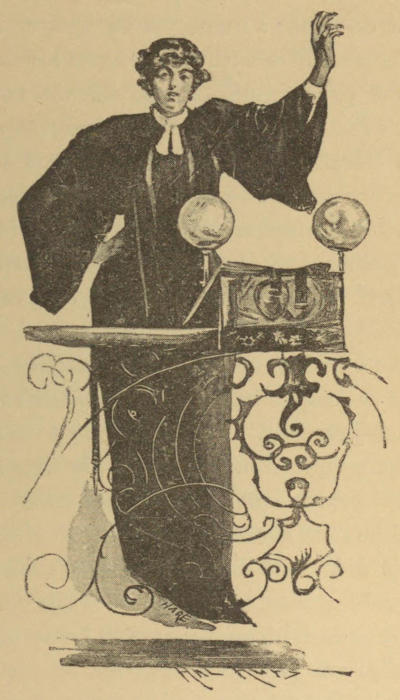
“THE REV. MATILDA MARSH.”
“Miss Marsh was a success from the moment
that she came among us. Being both unmarried
and pretty, she naturally fetched the young men,
and as she let it be understood that she believed
in the celibacy of the clergy and never intended
to marry under any circumstances, the greater
part of the women were willing to forgive her
good looks. Then she could preach a first-class
sermon, and I call myself a judge of sermons,
for at one time I managed an agency for supplying
preachers with ready-made sermons, and
I never put a single one on the market that I
hadn’t read myself. I don’t mean to say that
Miss Marsh was strong on doctrinal sermons,
but every one knows that the public doesn’t want
doctrinal sermons. What it wants is poetry
and pathos, and Miss Marsh used to ladle them
out as if she had been born and bred an undertaker’s
poet.
“As I had prophesied, the Baptists couldn’t
stand the competition when we opened with our
woman-preacher. Their minister took to going
to the gymnasium to expand his chest, and by
that means increased his lung-power until he
could be heard almost twice as far as formerly,
but it didn’t do any good. His congregation
thinned out week by week, and while our church
was crowded, his pew-rents fell below what was
necessary to pay his salary, not to speak of the
other incidental expenses. A few of the young
men continued to stick by him until our minister
began her series of sermons ‘To Young Men
Only,’ and that brought them in. I had the
sermons advertised with big colored posters, and
they proved to be the most attractive thing ever
offered to the religious public. The church was
crammed with young men, while lots of men of
from fifty to seventy years old joined the Young
Men’s Christian Association as soon as they
heard of the course of sermons, and by that
means managed to get admission to hear them.
Miss Marsh preached to young men on the vices
of the day, such as drinking, and card-playing,
and dancing, and going to the theatre, and she
urged them to give up these dissipations and
cultivate their minds. Some of them started a
Browning Club that for a time was very popular.
Every time the club met one of Browning’s
poems would be selected by the president,
and each member who put up a dollar was allowed
to guess its meaning. The man who
made the best guess took all the money, and
sometimes there was as much as thirty dollars
in the pool. The young men told Miss Marsh
that they had given up poker and gone in for
Browning, and of course she was greatly
pleased. Then some of the older men started a
Milton Club, and used to cut for drinks by putting
a knife-blade into ‘Paradise Lost’—the
man who made it open at a page the first letter
of which was nearer to the head of the alphabet
than any letter cut by any other man winning
the game. Under Miss Marsh’s influence a good
many other schemes for mental cultivation were
invented and put into operation, and everybody
said that that noble young woman was doing
an incalculable amount of good.
“As a matter of course, at least half the young
men of the congregation fell in love with the
girl-preacher. They found it very difficult to
make any progress in courting her, for she
wouldn’t listen to any conversation on the subject.
When Christmas came, the question what
to give her kept the young men awake night
after night. The women had an easy job, for
they could give the preacher clothes, and lace,
and hairpins, and such, which the young men
knew that they could not give without taking a
liberty. If she had been a man, slippers would,
of course, have been the correct thing, but the
young men felt that they couldn’t work slippers
for a girl that always wore buttoned boots, and
that if they did venture upon such a thing the
chances were that she would feel herself insulted.
One chap thought of working on the
front of an underskirt—if that is the right name
of it—I mean one of those petticoats that are
built for show rather than use—the words,
‘Bless our Pastor,’ in yellow floss silk, but when
he asked his sister to lend him one of her skirts
as a model, she told him that he was the champion
fool of the country. You may ask, why
didn’t the preacher’s admirers give her jewelry?
For the reason that she never wore anything
of the kind except a pair of ear-rings that
her mother had given her, and which she had
promised always to wear. They represented
chestnut-burs, and it is clear to my mind that
her mother knew that no young man who had
much regard for his eyesight would come very
near a girl defended by that sort of ear-ring.
Miss Marsh used to say that other people could
wear what they thought right, but she felt it to
be inconsistent with her holy calling to wear
any jewelry except the ear-rings that her sainted
mother had given her.
“The best running was undoubtedly made by
the cashier of the savings bank and a young
lawyer. Not that either of them had any real
encouragement from Miss Marsh, but she certainly
preferred them to the rest of the field, and
was on what was certainly entitled to be called
friendly terms with both of them. Of the two
the cashier was by far the most devoted. He
was ready to do anything that might give him
a chance of winning. He even wanted to take
a class in the Sunday-school, but the bank directors
forbade it. They said it would impair
the confidence of the public in the bank, and
would be pretty sure to bring about a run which
the bank might not be able to stand. They consented,
however, that he should become the
president of the new temperance society which
the Rev. Miss Marsh had started, as the president
had the right to buy wines and liquors at
wholesale in order to have them analyzed, and
thus show how poisonous they were. As the
cashier offered to stand in with the bank directors
and let them fill their cellars at wholesale
rates, both he and the directors made a good
thing of it.
“The other young man, the lawyer, was a
different sort of chap. He was one of those
fellows that begin to court a girl by knocking
her down with a club. I don’t mean to say
that he ever actually knocked a woman down,
but his manner toward women was that of a superior
being, instead of a slave, and I am bound
to say that as a general thing the women seemed
to like it. He wasn’t a handsome man, like the
cashier, but he had a big yellow beard that any
sensible girl would have held to be worth twice
the smooth-shaved cheek of his rival. He never
tried to join the Sunday-school or the temperance
society, or do anything else of the kind
to curry favor with the minister; but he used
occasionally to give her good advice, and to tell
her that this or that thing which she was doing
was a mistake. Indeed, he didn’t hesitate to
tell her that she had no business in the pulpit,
and had better go out as a governess or a circus
rider, and so conform to the dictates of Nature.
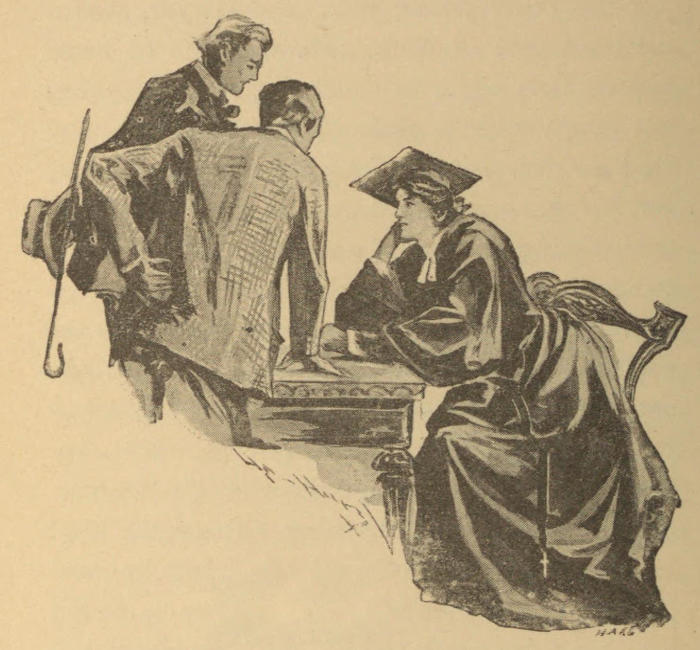
“MAKING THE RUNNING.”
“I used to watch the game pretty closely, because
I had staked my professional reputation
on the financial success of the girl-preacher, and
I didn’t want her to marry and so put an end
to her attractiveness with the general public.
I didn’t really think that there was much danger
of any such thing, for Miss Marsh seemed to be
entirely absorbed in her work, and her salary
was exceptionally large. Still, you can never
tell when a woman will break the very best engagement,
and that is one reason why they will
never succeed as preachers. You pay a man a
good salary, and he will never find that Providence
calls him elsewhere, unless, of course, he
has a very much better offer; but a woman-preacher
is capable of throwing up a first-class
salary because she don’t like the color of a deacon’s
hair, or because the upholstery of the pulpit
doesn’t match with her complexion.
“That winter we had a very heavy fall of
snow, and after that the sleighing was magnificent
for the next month or two. The cashier
made the most of it by taking the minister out
sleigh-riding two or three times a week. The
lawyer did not seem to care anything about it,
even when he saw the minister whirling along
the road behind the best pair of horses in the
town, with the cashier by her side and her lap
full of caramels. But one Saturday afternoon,
when he knew that the cashier would be detained
at the bank until very late—the president
having just skipped to Canada, and it being
necessary to ascertain the amount of the deficit
without delay—the lawyer hired a sleigh and
called for the minister. Although she was preparing
her next day’s sermon by committing to
memory a lot of Shelley’s poetry, she dropped
Shelley and had on her best hat and was
wrapped in the buffalo robe by the side of the
lawyer in less than half an hour after she had
told him that she positively wouldn’t keep him
waiting three minutes.
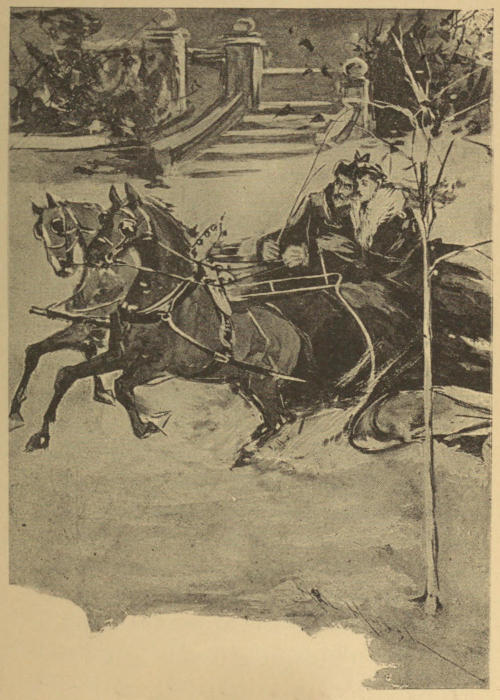
“CALLED FOR THE MINISTER.”
“You remember what I said about the peculiar
pattern of her ear-rings. It is through those
ear-rings that the Methodist church lost its minister,
and I became convinced that a female
ministry is not a good thing to tie to. Miss
Marsh and her admirer were driving quietly
along and enjoying themselves in a perfectly
respectable way, when one runner of the sleigh
went over a good-sized log that had dropped
from somebody’s load of wood and had been
left in the road. The sleigh didn’t quite upset,
but Miss Marsh was thrown against the lawyer
with a shock for which she apologized, and he
thanked her. But it happened that one of her
ear-rings caught in the lawyer’s beard, and was
so twisted up with it that it was impossible to
disentangle it. Unless Miss Marsh was ready
to drag about half her companion’s heard out
by the roots, there was nothing to be done except
for her to sit with her cheek close against
his until some third person could manage to
disentangle the ear-ring. While she was in
this painful position—at least she said at the
time that it was painful—a sleigh containing
two of her deacons and a prominent Baptist
drove by. Miss Marsh saw them and saw the
horrified expression on their faces. She knew
quick enough that her usefulness as a minister
in New Berlinopolisville was at an end and that
there was going to be a terrible scandal. So,
being a woman, she burst into tears and said
that she wished she were dead.
“But the lawyer was equal to the occasion.
He told her that there was nothing left to be
done except for them to be married and disentangled
at the next town. Then he would
take her on a long wedding-trip, stopping at
Chicago to buy some clothes, and that if she so
wished they would afterward settle in some
other town, instead of coming back to New
Berlinopolisville. Of course she said that the
proposal was not to be thought of for a moment,
and of course she accepted it within the next
ten minutes. They drove to the house of the
nearest minister, and the minister’s wife disentangled
them, to save time, while the minister
was engaged in marrying them.
“That was the end of the experiment of playing
a woman-preacher on the boards of the
First Methodist Church of Berlinopolisville.
Everybody was content to call a man in the
place of Miss Marsh, and everybody agreed to
blame me for the failure of the experiment. I
don’t know whether the lawyer ever had any
reason to regret his marriage or not, but when
I saw his wife at a fancy dress hall at Chicago,
a year or two later, I could see that she was not
sorry that she had given up the ministry. Ever
since that time I have been opposed to women-preachers,
and consider a woman in the pulpit
as much out of place as a deacon in the ballet.”
A MYSTERY.
“Do I believe in spiritualism?” repeated the
Colonel. “Well, you wouldn’t ask me that
question if you knew that I had been in the
business myself. I once ran a ‘Grand Spiritual
Combination Show.’ I had three first-class
mediums, who did everything, from knocking
on a table to materializing Napoleon, or Washington,
or any of your dead friends. It was a
good business while it lasted, but, unfortunately,
we showed one night in a Texas town before a
lot of cowboys. One of them brought his lasso
under his coat, and when the ghost of William
Penn appeared the cowboy lassoed him and
hauled him in, hand over hand, for further investigation.
The language William Penn used
drove all the ladies out of the place, and his
want of judgment in tackling the cowboy cost
him all his front teeth. I and the other mediums
and the doorkeeper had to take a hand
in the manifestation, and the result was that the
whole Combination was locked up over-night,
and the fines that we had to pay made me tired
of spiritualism.
“No, sir! I don’t believe in spiritualism,
but for all that there are curious things in the
world. Why is it that if a man’s name is
Charles G. Haseltine he will lose his right leg
in a railway accident? The police some years
ago wanted a Charles G. Haseltine with a
wooden right leg in the State of Massachusetts,
and they found no less than five Charles G.
Haseltines, and every one of them had lost his
right leg in a railway accident. What makes
it all the more curious is that they were no relation
to one another, and not one of them had
ever heard of the existence of the others. Then,
will someone tell me what is the connection between
darkies and chickens? I say ‘darkies’
instead of ‘niggers’ because I had a colored
regiment on my right flank at the battle of
Corinth, and that night I swore I would never
say ‘nigger’ again. However, that don’t concern
you. What I meant to say was that there
is a connection between darkies and chickens
which nobody has ever yet explained. Of course
no darky can resist the temptation to steal a
chicken. Everybody knows that. Why, I
knew a colored minister who was as honest a
man as the sun ever tried to tan—and failed—and
I have known him to preach a sermon with a
chicken that he had lifted on his way to meeting
shoved up under his vest. He wouldn’t have
stolen a dollar bill if he was starving, but he
would steal every chicken that he could lay his
hands on, no matter if his own chicken-house
was crowded with chickens. It’s in the blood—or
the skin—and no darky can help it.
“What was I going to say about the connection
between darkies and chickens? I had very
nearly forgotten it. This was what I was referring
to. A chicken will draw a darky just
as a dead sheep will draw vultures in Egypt,
though there may have been no vultures within
twenty miles when the sheep was killed. You
may be living in a town where there isn’t a
single darky within ten miles, but if you put
up a chicken-house and stock it there will be
darkies in the town within twenty-four hours,
and just so long as your chicken-house has a
chicken in it fresh darkies will continue to
arrive from all sections of the country. This
beats any trick that I ever saw a spiritual
medium perform, and I can’t see the explanation
of it. You may say that some one carries word
to the darkies that there is a new chicken-house
waiting to be visited, but the answer to this is
that it isn’t true. My own idea is that it is
a matter of instinct. When you carry a cat
twenty miles away from home in a bag and let
her out, we all know that her instinct will show
her the way home again before you can get
there yourself. Just in the same way instinct
will draw a darky to a chicken-house he has
never seen or heard of. You’ll say that to talk
about instinct doesn’t explain the matter. That
is true enough, but it makes you feel as if you
had struck the trail, which is some satisfaction
at any rate. So far as I can see, that is about
all that scientific theories ever do.
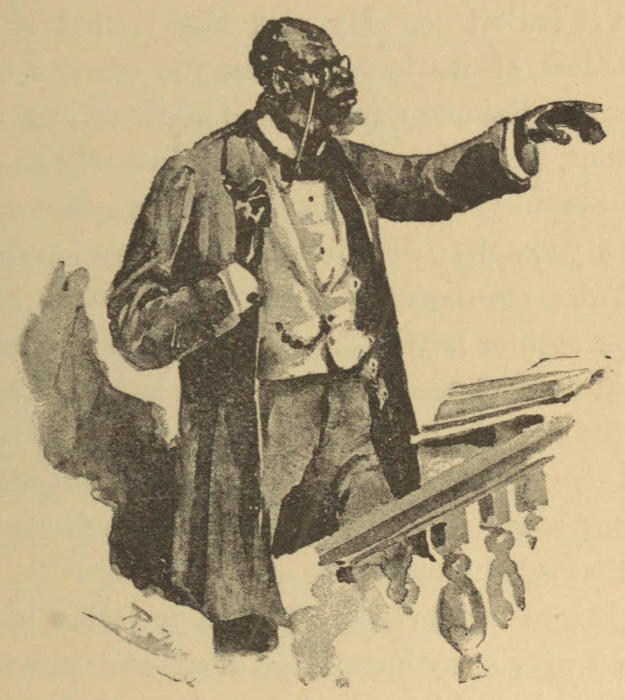
“PREACH A SERMON WITH A CHICKEN UNDER HIS VEST.”
“If you care to listen, I’ll tell you what happened
within my knowledge in connection with
darkies and chickens. I was located a little
after the war in the town of South Constantinople,
in the western part of Illinois, and my
next-door neighbor was Colonel Ephraim J.
Hickox, who commanded the 95th Rhode Island
Regiment. The town was a growing place, and
it had the peculiarity that there wasn’t a darky
in it. The nearest one lived over at West
Damascus, seven miles away, and there was
only two of him—he and his wife. Another
curious thing about the place was the scarcity
of labor. There weren’t above a dozen Irishmen
in the place, and they wouldn’t touch a
spade or a hoe under three dollars a day, and
wouldn’t work more than four days in a week.
You see, a certain amount of digging and gardening
had to be done, and there wasn’t anybody
to do it except these Irishmen, so they
naturally made a good thing of it, working half
the time and holding meetings for the redemption
of Ireland the rest of the time in the bar-room
of the International Hotel.
“One day Colonel Ephraim, as I always used
to call him, wanted to drain his pasture lot, and
he hired the Irishmen to dig a ditch about a
quarter of a mile long. They would dig for a
day, and then they would knock off and attend
to suffering Ireland, till Ephraim, who was a
quick-tempered man, was kept in a chronic state
of rage. He had no notion of going into politics,
so he didn’t care a straw what the Irishmen
thought of him, and used to talk to them
as free as if they couldn’t vote. Why, he
actually refused to subscribe to a dynamite
fund and for a gold crown to be presented to
Mr. Gladstone, and you can judge how popular
he was in Irish circles. I used to go down to
Ephraim’s pasture every once in a while to see
how his ditch was getting along, and one afternoon
I found the whole lot of Irishmen lying on
the grass smoking instead of working, and
Ephraim in the very act of discharging them.
“‘Perhaps it’s “nagurs” that you’d be preferring,’
said one of the men, as they picked themselves
up and made ready to leave.
“‘You bet it is,’ said Ephraim, ‘and, what’s
more, I’ll have that ditch finished by darkies
before the week is out.’ This seemed to amuse
the Irishmen, for they went away in good spirits,
in spite of the language that had been hove at
them, and it amused me too, for I knew that
there were no darkies to be had, no matter what
wages a man might be willing to pay. I said
as much to Ephraim, who, instead of taking it
kindly, grew madder than ever, and said,
‘Colonel! I’ll bet you fifty dollars that I’ll have
that ditch finished by darkies inside of four
days, and that they’ll do all the digging without
charging me a dollar.’
“‘If you’re going to send over into Kentucky
and import negro labor,’ said I, ‘you can do it,
and get your ditch dug, but you’ll have to pay
either the darkies or the contractor who furnishes
them.’
“‘I promise you not to pay a dollar to anybody,
contractor or nigger. And I won’t ask
anybody to send me a single man. What I’m
betting on is that the darkies will come to my
place of their own accord and work for nothing.
Are you going to take the bet or ain’t you?’
“I didn’t hesitate any longer, but I took the
bet, thinking that Ephraim’s mind was failing,
and that it was a Christian duty in his friends
to see that if he did fool away his money, it
should go into their pockets instead of the
pockets of outsiders. But, as you will see,
Ephraim didn’t lose that fifty dollars.
“Early the next morning Ephraim had a
couple of masons employed in turning his brick
smoke-house into a chicken-house, and he had
two dozen chickens with their legs tied lying on
the grass waiting for the chicken-house to be
finished. The masons broke a hole through the
side of the house and lined it with steel rods
about four feet long, which Ephraim had
bought to use in some experiments in gun-making
that he was always working at. The
rods were set in a circle which was about a foot
and a half wide at one end and tapered to about
four inches at the other end. The arrangement
was just like the wire entrance to a mouse-trap,
of the sort that is meant to catch mice alive and
never does it. It was nothing less than a
darky-trap, although Ephraim pretended that
it was a combined ventilator and front door for
the chickens. The masons, so far as I could
judge, thought that Ephraim’s mind was going
fast, and I made up my mind that it would be a
sin to let the man bet with anybody who would
be disposed to take advantage of his infirmity.
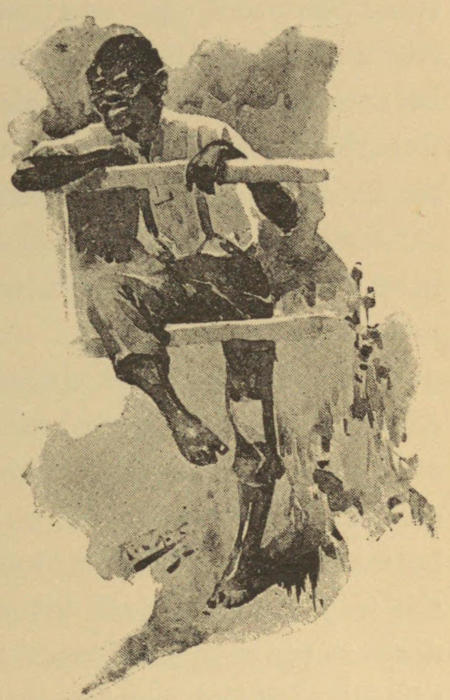
“‘DUNNO!’”
“The trap was finished before dark, and
baited with two dozen young chickens. I came
by the place a second time about sunset, just as
Ephraim was locking up his chicken-house, and
I saw a small darky boy leaning on the fence.
I asked him
where he came
from, but he
only said ‘Dunno.’
I found
out afterward
that he came
from a house at
least ten miles
away, and that
those two dozen
chickens had
drawn him
there wasn’t a
shadow of doubt
in my mind.
At the time,
however, I was a little afraid that Ephraim
had begun to import colored labor, and that
there was some trick about his bet that might
prove that his mind was all right. Two days
afterward I went down to the pasture and
found sixteen darkies digging away at that
ditch and Ephraim superintending with a
twenty-five-cent cigar in his mouth. ‘Come to
pay that fifty dollars, I suppose!’ he said when
he saw me. ‘You can wait till the ditch is
finished, which will be some time to-day. You
see I was as good as my word.’
“I asked him to explain how he had collected
his darkies, and being in unusually good spirits
he told me about it.
“He had made his trap just large enough to
admit a good-sized darky, who could push the
steel rods apart as he crawled in but who
couldn’t crawl out again, no matter how hard
he might try. The morning after he had set
the trap Ephraim took his shot-gun and went
down to his chicken-house. He found that the
night’s catch had been larger than he had hoped.
There were sixteen colored men of different
sizes sitting on the ground or leaning up against
the side of the house. There was a good deal
of wool and cloth sticking to the ends of the
steel rods, and some of the younger darkies
looked as if they had been fighting with wild-cats,
but they didn’t try to explain things. Besides
the darkies, there were two white tramps
in the trap, but Ephraim just kicked them into
the streets without even proposing work to
them. Then he came back and told the darkies
that the legislature had just passed a bill making
it felony to break into a chicken-house, and
that he was very much afraid that they would
be hung and dissected, unless they could show
him some reason for being merciful to them.
“The darkies were frightened, besides being
hungry and cold, and when Ephraim said that
he had a job of ditching to be done, and that if
they would do it for him he would let them off
scot-free, they were delighted, and the whole
chicken-house was lit up with their teeth. They
went into that ditch a happy and contented
gang and finished it before night. Ephraim
was a liberal man, and considering that he had
won fifty dollars and had got his ditch finished
for nothing, he was disposed to be generous.
So he gave the darkies a lot of good advice and
informed them that, with a view of removing
temptation from their way, he should sell
his chickens and go out of the business. The
darkies went away as happy as if they had been
well paid, and the next morning there wasn’t a
darky in the whole town. They had gone back
to their homes, or else they had been drawn
somewhere else by other chickens.
“Do I mean to say that Ephraim had not
made arrangements with some one to send him
those sixteen darkies? That is just what I do
mean to say. When he fitted up his chicken-house
he had no more idea where his darkies
would come from than I had, but he knew that
the chickens would draw darkies and that his
trap would hold them, so he felt that he had a
sure thing. I have no more doubt that those
darkies were drawn to Ephraim’s place by those
chickens than I have that a magnet will draw a
needle. I can’t explain how it was done, but I
believe it all the same. It is what is called a
mystery, and the good book says that the less
you try to explain mysteries the better.”
MY BROTHER ELIJAH.
“I never told you about my brother, the inventor,
did I?” asked the Colonel. “Speaking
of flying-machines reminds me of him, for he
invented seven of them, and one of the lot was
a stunning success. Stunned one darky and
came very near stunning a whole camp-meeting
of darkies. My brother Lije—his name was
Elijah—was what you might call a general inventor.
He didn’t stick to any one line, such
as electricity, for example, but he would invent
anything, from a woman’s pocket to a new
motive power. He invented a pocket for a
woman’s skirt that was warranted never to be
found by the most expert pickpocket, and he put
the pocket in the skirt of his wife’s dress on
trial. She searched for it for about a month—not
all the time, you understand, but on an
average three or four hours a day—and then
gave it up. She said she could always find her
usual old-fashioned pocket in the course of a
week or ten days, and that was as much time
as she could afford to waste on the subject. As
for Elijah’s perpetual-motion machines, he invented
a new one at least every year, and the
loft in our barn was always full of them. Of
course they were failures, but that did not discourage
Lije. You can’t discourage a born
inventor—that is, unless he is in the chemical
line and blows himself up with some new kind
of dynamite. Lije’s inventions were, to my
mind, as smart as those of Edison, but the
trouble with them was that for the most part
they wouldn’t work. However, they amused
him and did no harm to anybody.
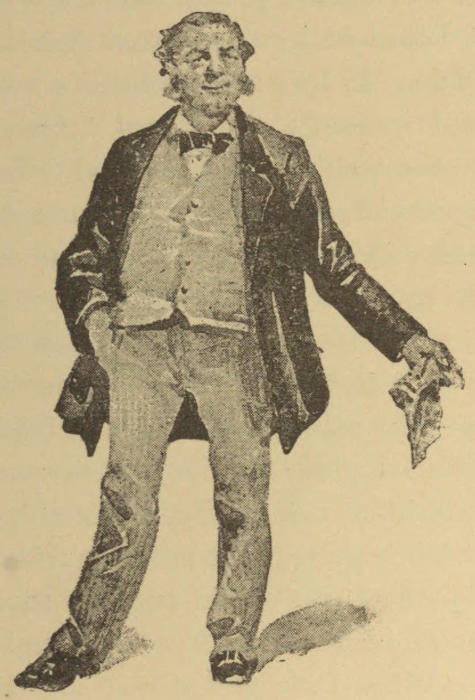
“ELIJAH.”
“My brother was not in the least like me in
anything. He was short and stout and the
best-tempered man in the State. Everybody
liked him, especially the darkies, who said that
there was no more harm in him than if he was
a child. I’ve seen him when he had just
accidentally chopped off a finger or had burnt
all his hair off, and I never heard him use the
smallest swear-word. I never could see why he
got married. A man with that sort of heavenly
temper doesn’t need the discipline that other
folks need, and he was too much absorbed in
science to have any time to associate with a
wife. He spent nearly all his time in his workshop
monkeying with his inventions, and his
only companion was a darky boy, about twelve
years old, named Aristophanes, who waited on
him and was so fond of him that there is nothing
that Lije told him to do that Aristophanes
wouldn’t do. If Lije had invented a new guillotine
and wanted to try it on Aristophanes’
neck, the boy would have consented to have his
head chopped off, and would never have doubted
that Massa Lije would put it on again without
even leaving a scar.
“You were speaking of this new flying-machine
that somebody had just invented and
that acts on the principle of a kite. ‘Resistance
of an inclined plane to the air’ is what you
called it, but that means kite, and nothing else.
Why, Elijah invented that machine forty years
ago, and it was one of his greatest successes,
the only one, in fact, that I ever remember his
making. When I say that it was successful, I
don’t mean to say that it was practicable. It
would rise and it would carry a man with it,
but it never came into general use, for it was
about impossible to get the man down again
without killing him. Next to a Swiss excursion
steamboat, it was the riskiest mode of locomotion
ever invented.
“The way in which Lije’s machine was constructed
was very simple. You must have seen
what we boys used to call a spider-web kite. If
you haven’t, I might as well tell you that it is
made with three sticks that cross one another at
the same point in about the middle of the kite,
or rather a little above the middle, and gave the
kite something the shape and look of a big
spider-web. Lije was fond of kite-flying, and
was always trying to make improvements in
kite-building, which were naturally failures,
for you can be sure that the millions of boys
that have been making kites ever since boys
were first invented know a great sight more
about kites than any scientific man knows.
“Elijah’s flying-machine was nothing more
or less than the biggest spider-web kite that was
ever built. The sticks were ash poles an inch
in diameter, and they were covered with silk
instead of paper. I forget the exact dimensions
of the kite, but according to Lije’s calculations
it would sustain a hundred and fifty pounds of
human being, in addition to its own weight and
the weight of its tail. The question of the exact
amount of tail that the kite would require gave
Lije a good deal of trouble, but he solved it like
a man of science by sending up an ordinary
kite and finding by experiment how much tail
it needed, after which he calculated by the rule
of three how much tail to give his flying-machine.
In order to get the necessary weight
without too great length, the tail of the flying-machine
was made of light iron chain, and at
the end of it there was an iron hook, so that a
lantern could be attached to it at night. As
for the string that was to hold the kite, it was
about the size of a ship’s signal-halyards, and
Lije calculated that it would bear twice the
amount of any strain that could possibly be put
on it.
“Aristophanes was to make the trial trip, and
he was perfectly willing to go, never having the
least doubt that Massa Lije would secure him a
safe and pleasant trip to the moon or thereabouts.
Lije fastened the boy in the centre of
the kite, in about the position of some celebrated
Scotchman—St. Andrew, wasn’t it?—whose picture
is in Fox’s ‘Book of Martyrs.’ Aristophanes’
arms and legs were lashed to the kite
sticks, and he had a sort of rest for each foot,
so as to take the strain from off the lashings. In
order to make him comfortable, Lije fastened a
pillow under the boy’s head, so that he could go
to sleep in case he should feel sleepy, which he
nearly always did. If Aristophanes could only
have managed to take his dinner with him and
eat it in the air, he would have been about as
happy as a darky can be, and an average
darky can hold more happiness to the square
inch than any white man.
“The trial trip was made from the back yard
of our house, and nobody was present except
Lije and Aristophanes, for my brother was a
little shy of exhibiting his inventions in public,
owing to their habit of proving failures. The
kite was laid on the ground, and Aristophanes
was strapped to it and told that he must keep
perfectly cool and remember everything that he
might see in the clouds. When all was ready,
the kite was leaned up against the side of the
barn, with the tail neatly coiled so that it would
not foul anything, and then Elijah, taking a
good run with the string over his shoulder, had
the satisfaction of making the kite climb up as
if it had been made by the best boy kite-builder
in town.
“Holding the string was rather a tough job,
for the kite pulled tremendously, and Lije was
not a strong man. However, he paid out the
line as fast as he could, and so managed to keep
the kite steady. He was a little afraid that it
would accidentally get away from him, so he
tied the end of the string round his waist.
There was where he made his great mistake.
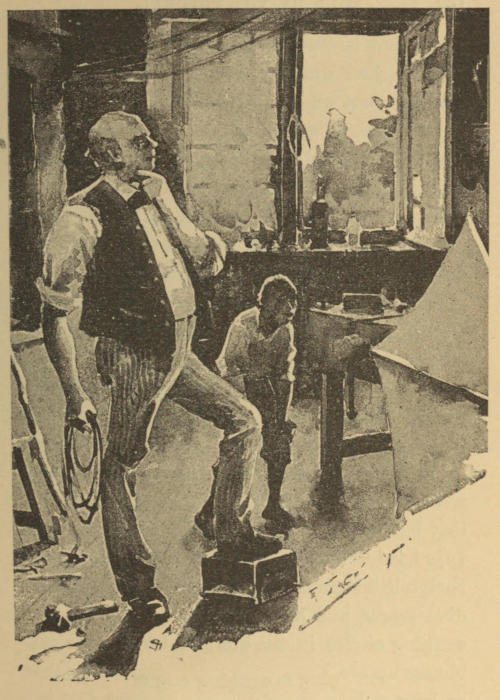
“ELIJAH’S FLYING-MACHINE.”
“The kite attracted a good deal of attention
in the town, and everybody agreed that the
figure in the middle of the kite was a remarkably
good representation of a darky, but nobody
thought for a moment that it was a genuine
darky. Lije had forgotten, in estimating the
amount of tail that the kite required, the fact
that the wind might rise while the kite was in
the air, and that in such case the amount of tail
might not be enough to keep it from diving.
That is just what happened. After the kite
had run out all the string and was as high
as the string would let it go, the wind increased
and the kite began to dive. Now,
everybody knows that diving is one of the most
dangerous things a kite can do, and that unless
it can be stopped it is sure to bring the kite
down and smash it to pieces. Moreover, in this
particular case there was Aristophanes, who
was pretty sure to be frightened by the diving
of the kite—that is, supposing that he was
awake. When a kite dives the only remedy is
to give it string. As Lije had no more string
to let out he was obliged to do the next best
thing, which was to slack the string by running
with it toward the kite. That stopped the diving,
but only for a moment. Every time that
Lije tried to stop running and managed to hold
back a little against the kite, it would begin to
dive again, and about half the time was describing
circles in the air and turning Aristophanes
upside down. However, Lije knew that
so long as he could keep the kite from dashing
itself to the ground the darky would come to
no harm.
“The wind kept on increasing and the kite
pulled harder than ever. Even if Lije had not
wanted to run, the kite would have dragged
him. He went through the town at about eight
miles an hour, yelling to everybody he met,
‘Gimme some string!’ But nobody understood
what he said, and they all thought that it was
a good joke to see a fat little man careering over
the country in tow of a big kite. Of course
they supposed that Lije was acting of his own
free will and accord. They knew that he was
peculiar in his ways, and they fancied that he
was taking a little holiday after his hard work.
So beyond encouraging him to keep it up and
remarking to one another that ‘Lije was the
most amusing darned fool in the county,’ they
paid no attention to his outcries.
“My brother was not used to active exercise
and had next to no wind. The longer he ran
with the kite, the more he felt convinced that a
tragedy was about to happen. If he kept on
running he believed he would drop dead with
stoppage of the heart, and if he stopped running
he knew that the kite would dash Aristophanes
to pieces; and though, of course, it was not as if
Aristophanes had been a white boy, still there
was the chance that his parents would be disagreeable
if he were killed. They were ordinary
ignorant darkies, with no sort of love for
science. But Lije had grit in him, in spite of
all the science that he had pumped into his
head. He stuck to the kite-string, and ran his
level best until the moment came when he was
unable to catch another breath. Then he threw
himself against a telegraph pole and clung to it
with all his might. The kite couldn’t drag him
away from it, and so it gave one tremendous
dive, and Lije felt by the sudden slackening of
the string that the kite had reached the ground.
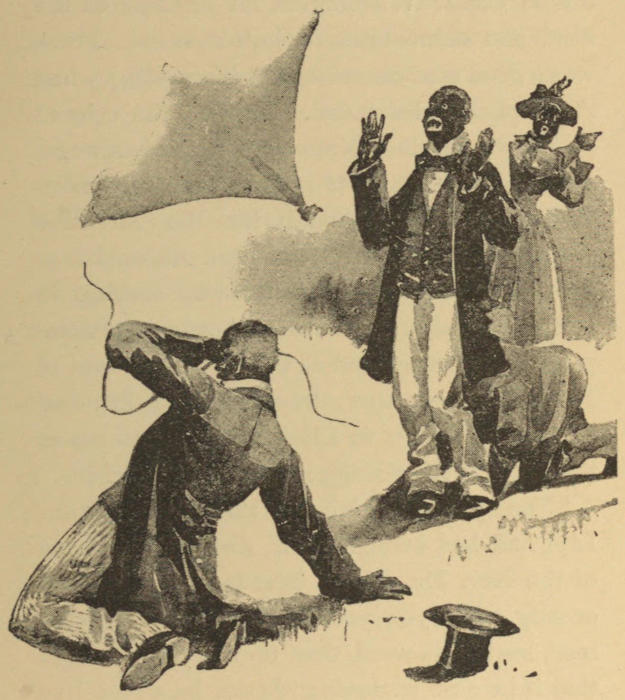
“HIT THE REV. JULIUS CÆSAR WASHINGTON ON THE SIDE OF THE HEAD.”
“It came down in the middle of a negro camp-meeting
that was in progress about a quarter of
a mile away. The spot was a sandy one, and
the kite, which naturally fell head downward,
buried the ends of its upper sticks in the sand,
and did no injury whatever to Aristophanes.
The chain tail, however, damaged the eye of
the Rev. Hannibal Blue, and then hit the Rev.
Julius Cæsar Washington on the side of the
head and stunned him for half an hour. There
was a good deal of excitement in the camp when
Aristophanes descended. Most of the colored
people were of the opinion that he was an angel
who had come down to express his satisfaction
with the services, though the Rev. Mr. Blue
was strongly of the opinion that Aristophanes
was the devil in person, who was seeking to
buffet the faithful. In time, however, Aristophanes
was recognized as the private servant of
Massa Lije, and was released from the kite and
allowed to return to Lije’s workshop to report
the result of his voyage in the flying-machine.
“The flying-machine was never tried again.
Lije had had enough of it, and besides, some
of the Rev. Mr. Blue’s friends, who were not
exactly what you would call law-abiding citizens,
sent Lije word that they rather thought
that if he quit inventing things he would live
longer than he otherwise might. Aristophanes
didn’t seem to think anything of his adventure,
and said he was ready to go up again whenever
Massa Lije should want to send him. But Lije
told him that he intended to make a little modification
in his flying-machine before using it
again. That was what he always said when
he gave an invention up as a bad job, and
accordingly nobody ever saw or heard of the
flying-machine again. He was a remarkable
man, was my brother, and the doctor of the
asylum where he spent his declining years said
that he was the most interesting lunatic that he
had ever met.”
THE ST. BERNARD MYTH.
Some one had told a dog-story showing the
miraculous intelligence and profound piety of a
French poodle. The Colonel listened with an
incredulous smile on his grim face. When the
story was ended and we had all expressed our
surprise and admiration, as is the custom when
dog-stories are told, and had carefully suppressed
our conviction that the man who told the story
was as impudent as he was mendacious—as is
also the custom on these occasions—I asked the
Colonel to favor us with his views in regard to
canine sagacity.
“There are dogs that show signs of good
sense now and then,” he replied. “Even human
beings do that occasionally. But as to these
yarns about dogs who calculate eclipses and
have conscientious objections to chasing cats on
Sunday, I don’t believe a word of them. Talk
about fish-stories! Why, there isn’t a fish
caught or uncaught that can begin to stimulate
the imagination to the extent that a dog will
stimulate it. I have known fishermen who
could convert two minnows into a string of
thirty trout, averaging two pounds each, and I
have seen these men slink away crestfallen before
a man who told stories of what his fox-terrier
had done the day before. What I don’t
understand is why people pretend to believe dog-stories.
We all know that the dog is a well-meaning,
stupid, parish-vestry sort of an animal,
but we listen to the thumpers that some
men tell about him without even a cough.
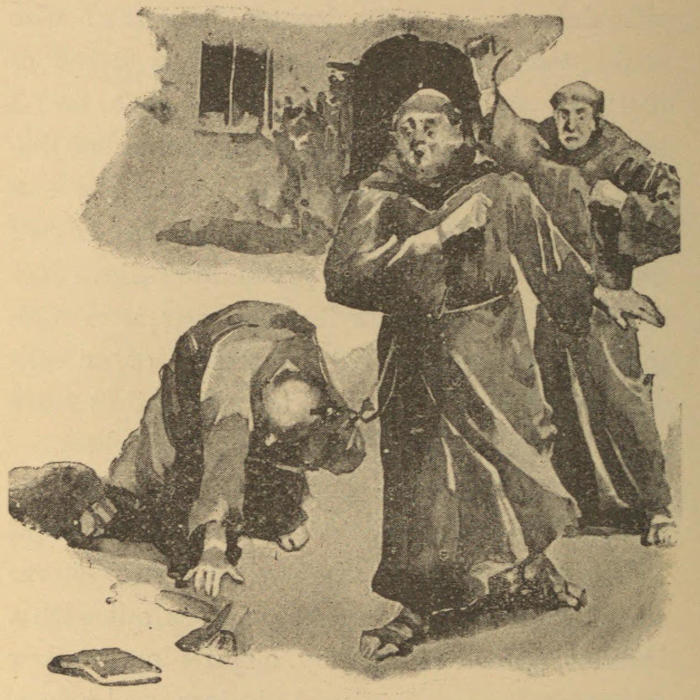
“THE MONKS SHIED PRAYER-BOOKS AND WOODEN SANDALS AT THEM.”
“Look at the lies that have been told for the
last hundred years about the St. Bernard dogs!
People really believe that when a snow-storm
comes on the St. Bernard dog goes out with a
blanket, a flask of whiskey, a spirit-lamp, a box
of matches, some mustard plasters, and a foot-bath
strapped on his back. When he meets a
frozen traveller we are told that he sits down
and lights his spirit-lamp, mixes some hot-whiskey
and pours it down the traveller’s throat,
gives him a hot foot-bath, puts mustard plasters
on the soles of his feet, rubs him down and
wraps him up in the blanket, and then hoists
him on his back and brings him to the convent,
where the monks put him to bed and read
prayers to him till he feels strong enough to put
some money in the contribution-box and to continue
his journey. Now, I’ve been to the St.
Bernard Convent. I went there just to meet
one of these dogs and see for myself what he
could do. There was a pack of about forty of
them, but the only thing they did was to sit up
all night and bark at the moon, while the monks
shied prayer-books and wooden sandals at them
out of the windows. I wanted to see a few
travellers rescued from the snow, but the monks
said the supply of travellers had been running
low of late years; still, they added, if I’d go
and sleep in a snow-bank a mile or two from
the convent, they would see what could be done.
I wasn’t going to risk the forfeiture of my life-insurance
policy by any such foolishness as that,
so I came away without seeing any dog performance.
However, I saw enough, a little
later on, to convince me that the St. Bernard
dog is about the biggest kind of canine fool that
ever imposed on credulous people.
“The monks had a whole penful of genuine
St. Bernard puppies, and I bought one. I am
ashamed to tell you how much I paid for it. I
could hire an army mule to kick me every time
I think of the transaction. I took the puppy
to the States with me—I was living at New
Berlinopolisville, in the State of Iowa, at the
time—and brought him up as carefully as if he
had been my own son. He grew to be a big,
rough-haired dog—one of the biggest I ever
saw. And I can’t say that the monks cheated
me in respect to his breed. Of course it was all
a matter of luck that he didn’t turn out to be a
poodle or a black and tan terrier. The fact is
that no man or monk knows what one of those
pure-blooded St. Bernard pups that are sold at
the convent will turn out to be when he gets his
growth. He is liable to be anything in the line
of dog, from a yellow cur up to a Siberian bloodhound.
I once knew a man who bought a St.
Bernard pup from one of the very holiest of the
entire gang of monks, and that puppy grew up
to be a red fox. But you all know of the St.
Bernard puppy lottery, and I won’t take up
your time commenting on it.
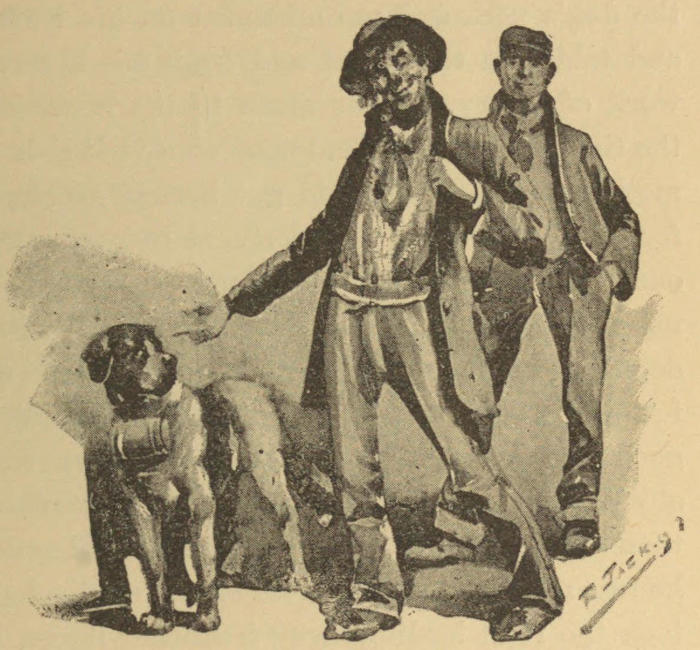
“SAID THE DOG HAD PROMISED THEM A DRINK.”
“The monks told me that the puppy would
not need the least training. His instinct was
so wonderful that the moment he should catch
a glimpse of snow on the ground he would rush
off to rescue travellers. ‘You just load him up
with blankets and things,’ said the monk, ‘and
send him out in the snow, and he’ll rescue
travellers till you can’t rest.’ The dog was
nearly a year old before I had a chance to try
his powers, but one November we had a regular
blizzard, and when the snow quit falling it was
at least two feet deep on a level, not to speak of
the drifts.
“After breakfast I tied a whiskey-flask around
the dog’s neck and put a blanket on his back,
and told him to go out and begin his blessed
work of mercy. I was alone in the house at
the time, for my wife had gone on a visit to her
mother and the cook had got herself arrested
for being drunk and disorderly, so there was no
one to make any objection to my use of one of
my wife’s best blankets. The dog barked with
delight when he saw the snow, and rolled in it
for a few moments just so as to get the blanket
good and wet, and then he started down the
street at a gallop. I lived something more
than a mile from the village, and there were no
houses nearer than half a mile, and as the dog
took the road leading away from the village, I
did not think that he would stand much chance
of picking up any travellers. He didn’t return
until noon, and then he didn’t bring anybody
home on his back. He did, however, bring six
tramps with him, three of whom were pretty
drunk, they having drank all the whiskey in the
flask. The other three said that the dog had
promised them a drink if they would follow
him, and they hoped that I would be as good as
the dog’s word. As I wasn’t armed, and as the
tramps carried big sticks and evidently meant
business, I judged it best to sustain the dog’s
character for veracity and get rid of them
peaceably. They went away after wrestling
with a pint of good whiskey, and all the time
that idiotic dog was wagging his tail as if he
deserved the Humane Society’s medal, instead
of deserving a thrashing for trying to rescue
tramps when Nature had taken the trouble to
furnish a blizzard expressly to thin them out.
“I explained to the dog with my riding-whip
the view that he must take of tramps in the
future, and then I sent him out again, after
filling up his whiskey-flask and giving him
another blanket in the place of the one that the
tramps had stolen. I told him that in future I
should prefer to have him rescue women and
children, especially the latter, and that if he
found a frozen male traveller he had better confine
himself to giving information to the police,
instead of lavishing whiskey on possibly undeserving
people. He went off, somewhat
humbled, but still in excellent spirits, and in a
short time rushed up my front steps, dropped
something on the door-mat, and rushed off
again. At first I thought that the idiot had
been rescuing somebody’s linen that had been
hung out to dry, but when the linen began to
make remarks in a loud voice, I found that it
was a particularly lively baby.
“Of course I couldn’t let the little innocent
lie and freeze on my doorstep, so I brought it
into the house and did my best to quiet it. As
I had never had much experience with babies,
I found myself in a pretty tight place. I had
no milk to give the baby, so I mixed a little
flour and water till it looked like milk and got
a little of it down the baby’s throat. Then I
shook it on my knee till it dropped asleep. I
put it in my bed, intending to go out and find
some woman who would come and attend to it,
when I heard the dog barking, and on opening
the front door saw his tail disappearing down
the street, and saw that he had left another
infant on the door-mat.
“The first baby was a saint in comparison
with this one, which was a sort of infantile
tramp in appearance and was as noisy as it
was dirty. It would not have anything to do
with the flour and water, and though I shook
it on my knee till I must have loosened all its
organs, it refused to go to sleep. So I finally
gave it a rubber overshoe to bite on, and put it
in a bureau drawer in the spare room and told
it to howl its head off if it felt that such was its
duty toward mankind. Then I started a second
time to search for a woman, and I nearly fell
over a third baby on the doorstep. That infernal
dog had brought it while I was struggling
with the infantile tramp, and he was now off
searching for more infants. I wrapped this one
up in a blanket and sat down on the doorstep
with it, resolved to wait till that dog came
back and to lock him up till I could get enough
babies off my hands to give me a chance to kill
him. I was bound not to miss him, for if I did
he would probably keep on till he had brought
me all the babies in the county. This baby was
the best of the lot, for it slept in my arms without
saying a word or expressing the slightest
desire to be shaken. In about twenty minutes
the dog reappeared with another invoice of
babies. This time he brought a brace of twins,
as nearly as I could judge, but it was his last
exploit that day. I got him by the collar before
he could start out again and locked him up in
the cellar. The babies I put in a heap in a big
clothes-basket that they could not climb out of,
and left them to have a crying-match for the
championship till I could find a nurse.
“I didn’t have as much trouble in that matter
as I had anticipated, for before I could get out of
the house some one rang the front-door bell and
pounded and yelled as if it was a matter of life
and death that the door should be opened instantly.
I opened it, and there was a woman
who called me every name she could lay her
tongue to, and wanted me to give her back her
baby instantly. I showed her the babies and
told her to take her choice. In fact, I begged
her to take away the whole lot, but she said I
was worse than a murderer, and after selecting
one of the least desirable of the babies, she
rushed off with it, promising to send me a
policeman immediately. I had never expressed
the least desire to see a policeman, but such is
female gratitude! I had offered that woman
five babies, free, gratis, and for nothing, and
instead of being grateful she wanted to get me
into trouble.
“I had still four babies on my hands, and as
they were now all awake and making all the
noise they knew how to make, I put them all in
the clothes-basket together, so they could enjoy
one another’s society. It wasn’t a bad plan,
and I recommend it to any mother with a noisy
pair of twins, as it is certain to reduce the noise
by one-half. Two of my babies were so occupied
with putting their fingers in the other
babies’ eyes and in investigating their hair
that they had no time to cry. I admit that the
two who were undergoing investigation did
their best to make a riot, but even then there
was only half as much noise as there would
have been had the other two joined the concert.
“I thought it so probable that the mother who
had visited me was only the first of a procession
of mothers, that I gave up the idea of going out
to look for a nurse, and stayed at home to receive
the mothers politely. It was not long
before one presented herself. She was an Irishwoman
and the only sensible one of the lot.
When she saw that her baby was safe and contented
and had a good grip on the hair of a
black-eyed baby, she sat down and laughed, and
said that she never saw anything so sweet before.
According to her account, she lived
about a mile from my house, and she was
standing at her front door looking at the landscape,
when the dog bounded in, caught up the
baby out of the cradle, and carried it off. At
first she thought the dog was the devil, but
presently she remembered that the devil’s time
was too much occupied with Irish affairs to permit
him to steal babies in Iowa, so she followed
the dog as rapidly as she could make her way
through the snow. She tracked him by the
prints of his paws until she came to my door,
and instead of calling me a kidnapper and talking
about the police, she was full of pity for me,
and volunteered to stay and take care of the
whole menagerie until the last of the babies
should be called for and taken away.
“The remaining mothers arrived in the course
of an hour. I locked myself in the top of the
house and left the Irishwoman to explain things.
As I afterward learned, the intelligent dog had
knocked two women down in the street and
stolen their babies out of their arms, and had
also broken into two houses, in the last one of
which he had bagged his brace of twins. All
the mothers, except the Irishwoman, were as
unreasonable as they could possibly be. They
insisted that I deliberately trained dogs to steal
babies, and they had no doubt that my object in
stealing them was to vivisect them. As for the
dog, they were convinced that he was mad and
that their babies would be sure to die of hydrophobia.
Two of the women brought their husbands
with them, who asked to see me, explaining
that they desired to blow my head off.
The Irishwoman nobly lied to them, telling
them that she had driven me out of the house
with a club, and that I was on my way to
Chicago and far out of reach. The mothers
and their husbands went away at last, and as
soon as it was dark I stole out of the back door
and took the first train for St. Paul. I didn’t
show myself in New Berlinopolisville for the
next year.
“What became of the dog? Oh! I forgot to
say that the Irishwoman promised to take care
of him and to cure him of his passion for babies.
I am sorry to say that she did not succeed.
She kept him tied up for six weeks, but one day
he broke loose and captured a baby out of a
baby-wagon in the park. But the baby’s father
happened to be with it, and he was one of the
best pistol-shots in town, having been a judge
of the Montana Supreme Court. He got the
drop on the dog before the beast had gone ten
feet away with the baby, and though they afterward
had to pry the dog’s jaws open in order to
get the baby loose, no harm was done to the
latter. I settled all the lawsuits without letting
them go to trial, although it cost me considerable
and I finally judged it best to remove to
another State.
“Now, I suppose that some one will be enough
of an idiot to repeat this story with variations
as a proof of the wonderful intelligence of the
St. Bernard dog. If it is intelligence that leads
a dog to steal other people’s babies and dump
them on a respectable man, I’d like to see what
idiocy would do for such a dog. No, sir! depend
upon it, the stories about St. Bernard dogs
are invented by the monks after stimulating
their minds by reading the ‘Lives of the Saints’
and by going trout-fishing. Probably the
monks have gradually brought themselves to
believe most of the stories. They look like a
credulous set of people, and I should rather like
to try them with a good American political
speech, full of campaign statistics, and see if
they could believe it. I shouldn’t be in the
least surprised if they could.”
A MATRIMONIAL ROMANCE.
“And by the way,” continued the Colonel,
“a curious thing about this Josiah Wilson was
that he was married for fifteen years and never
had any wife whatever.”
The Colonel had begun a story concerning
one Josiah Wilson which promised to be interesting,
but his incidental allusion to Mr.
Wilson’s matrimonial experience awakened our
curiosity, and we begged him to interrupt his
narrative long enough to tell us how it came to
pass that Josiah was a married man who never
had a wife.
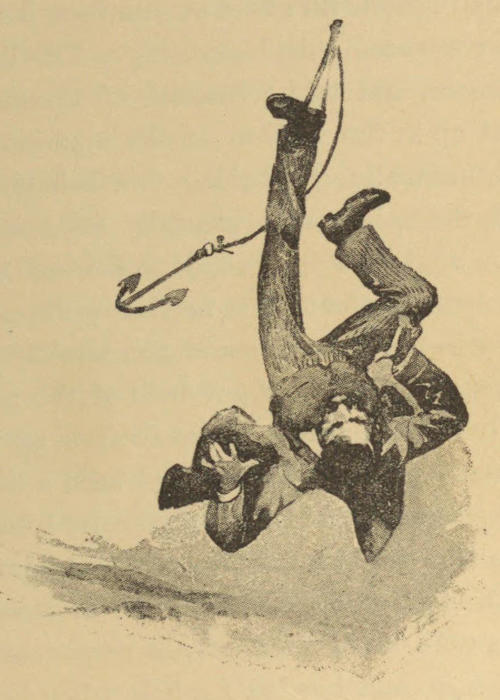
“HOWLED FOR HELP WHEN HE WASN’T SWEARING.”
“The marriage laws in the United States,”
said the Colonel, giving his chair an increased
tilt backward, which was his usual way of beginning
a fresh anecdote, “are as peculiar in
their way as are the divorce laws. You would
think to look at them that they would permit
anybody to marry anybody else in any way that
either of them might choose; but for all that
they sometimes make it impossible for a man or
a woman to get married. There was a couple
who intended to be married in a balloon, which
is a style of lunacy that is quite fashionable in
some parts of the country, though I can’t see
why a man should want to risk his neck in a
balloon on his wedding-day, unless it is that it
takes so much courage to be married at all that
a man forgets all about such minor dangers as
are connected with ballooning. The bride, the
minister, and two witnesses of assorted sexes
went up in the balloon at the appointed time,
and, naturally, the bridegroom intended to go
with them, but he accidentally caught his foot
in a neglected guy-rope and went up head
downward about twenty feet below the car. The
party in the balloon could not haul him up because
they could not get hold of the rope, and
the bride would not consent to give up the trip
because the groom had always been a little shy,
and she was afraid that if she let him go this
time she might not be able to land him again.
So the parson went on with the ceremony, and
the groom made most of his responses in bad
language, and howled for help when he wasn’t
swearing. When the ceremony was over the
aeronaut managed to land the balloon without
seriously damaging the bridegroom, but when,
a year or two afterward, the bride wanted to
get her divorce, the court held that there had
never been any marriage, for the reason that
both the groom and the bride had not appeared
together in the presence of the officiating minister,
and that, furthermore, there was no provision
in the law which would permit a man to
be married upside down.
“But to get back to Josiah Wilson. He lived
in Indiana, close to the boundary line between
that State and Illinois, and he courted Melinda
Smith, a young woman who lived a little way
up the mountain-side with her father and three
brothers. The girl was anxious to be married,
but her family were dead against it. You see,
Josiah was a Republican and a Methodist, while
the Smiths were Democrats and Baptists, and,
naturally, they hated each other like poison; and
one night as old man Smith and Josiah met on
their way to rival prayer-meetings they exchanged
revolver-shots, without, however, doing
any harm. Then, once Josiah had most of the
calf of his leg taken off by the Smiths’ bull-dog,
and twice the Smith boys came into the sitting-room
where Josiah was calling on Melinda, and
suggested to him with their shot-guns that he
had better go home. Gradually Josiah and
Melinda came to the conclusion that her family
were resolved to discourage the match, so they
determined to elope and be married without the
knowledge or consent of anybody.
“One dark night Josiah carried a ladder and
planted it under Melinda’s window. He had
advised her to walk out of the front door, which
was always left unlocked at night, but she refused,
saying that if she was going to elope she
should do it in the proper way, and that if
Josiah had no respect for her she had some little
respect for herself. She climbed down the
ladder with a good deal of difficulty, because
she insisted that Josiah should help her, and
also that he should stand forty yards away, for
reasons connected with her ankles, and he found
it rather trying to follow out these contradictory
orders. However, Melinda reached the
ground at last, and the pair started in a carriage
that had been waiting just around a bend in the
road, in company with the Methodist minister.
Their plan was to drive to the next town and
there to be married, but it happened that one of
the Smith boys, being restless, got up in the
night, and, looking out of the window, saw the
ladder standing at Melinda’s window. In about
twenty minutes after the young people had
started, the whole Smith family and their shot-guns
were following the runaways in a wagon
and gaining on them fast.
“The Methodist minister, whose hearing was
unusually good, heard the sound of hoofs before
Josiah noticed it, and told the young people that
there was not the least doubt that they were
pursued, and would be overtaken in a very few
minutes. ‘And then, you know,’ he added,
‘the chances are that, being Baptists, they will
shoot first and ask for explanations afterward.
The only thing for us to do is to get the marriage
ceremony over before they come up.
Then they will see that opposition is of no use
and will listen to reason.’
“Josiah and Melinda at once consented, and
the parson, noticing a little clearing in the
woods on the left-hand side of the road and a
flat sort of tombstone standing in the middle of
it, said that he would stand on that stone and
marry his young friends so quick that it would
make their hair curl. He was particularly glad
to meet with a handy tombstone, for he said
that a tombstone was the next thing to a church,
and that to be married by the side of a tomb
would be almost as solemn as to be married in
a minister’s study. So the party hastily descended,
the parson mounted the stone, Josiah
and Melinda joined hands in front of him, and
they were married and the parson had kissed
the bride and pocketed his fee just as the
Smiths’ wagon drove up and the Smith boys
cocked their guns and covered the party. But
the parson was wide awake. He had his
revolver out and old man Smith covered
before anybody had taken aim at him, but
instead of shooting he remarked that he was
a minister of the blessed gospel of peace, that
there was no necessity for bloodshed, and that
he would blow a hole through old Smith unless
the Smith boys lowered their weapons and consented
to argue the matter. ‘The fact is, Colonel
Smith,’ said the parson, ‘you’re too late.
The young people are legally married, and the
sooner you accept the situation the better. I
married them not two minutes ago, standing on
that identical tombstone.’
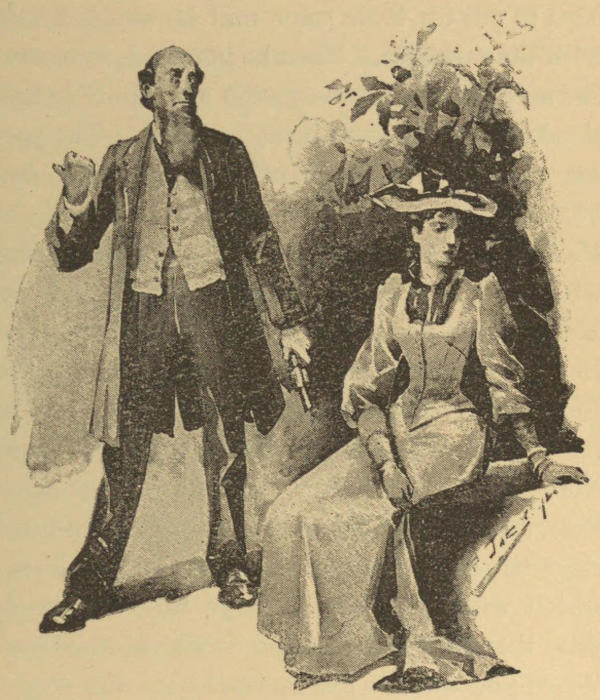
“‘YOU’LL COME STRAIGHT HOME WITH ME.’”
“Colonel Smith was a lawyer, and the sharpest
one in that part of the country. He saw the
force of the minister’s remarks, so he told the
boys to put up their guns and he shook hands
with the minister. Then he inquired, in a careless
sort of way, where Josiah and Melinda had
stood while they were being married. The parson
showed the footprints of the bride and
groom, and then Colonel Smith turned to
Melinda and said, ‘You’ll come straight home
with me. There hasn’t been any marriage yet.
That stone is the boundary mark between
Indiana and Illinois, and you were standing in
Indiana and that other idiot was standing in
Illinois when the parson tried to marry you.
Nobody can marry in two States at the same
time, and I shan’t recognize the pretended marriage
till a court of law compels me to do so,
which will be never. I hope this will teach
you the folly of fooling with Methodism.
When you want to get married next time try a
Baptist minister, who will know the difference
between a tombstone and a boundary mark.’
There were too many Smiths and they were too
well armed to be reasoned with successfully, so
the upshot was that Melinda went home with
her family and Josiah and the parson went to
see a lawyer.
“The next day Josiah brought a suit for
divorce against Melinda. It was a friendly
suit, you understand, and his only object was
to test the question of the validity of his marriage,
for, of course, no man can get a divorce
unless he first proves that he is married. Old
man Smith conducted the case on his side, and
a lawyer named Starkweather, who is now a
member of the Illinois Legislature, appeared for
Josiah Wilson. Colonel Smith argued that
while the parson who conducted the alleged
marriage ceremony could undoubtedly have
married a couple in the State of Indiana, he
could not marry a woman in Indiana to a man
in Illinois, for the reason that the man and the
woman could not be in the same place while
they were in two different commonwealths, and
that hence Josiah and Melinda had not legally
appeared together before the officiating minister.
Furthermore, he argued that the minister at the
time of the pretended marriage was standing
neither in Indiana nor in Illinois, but on the
boundary line; that the statute defined the
boundary line as ‘an imaginary line’ running
from such and such a point to such and such a
point, and that a minister who stands in a
purely imaginary locality stands virtually nowhere,
and hence cannot perform any function
of his calling.
“On the other hand, Josiah’s lawyer claimed
that the minister had married Melinda Smith in
the State of Indiana; that consequently she
must have been married to somebody, and that
that somebody was unquestionably Josiah Wilson.
As to the point that the minister stood in
an imaginary locality because, as was alleged,
he stood on the boundary line, the lawyer maintained
that it was a physical impossibility that
a minister weighing two hundred and fifty
pounds could stand in a purely imaginative
place. Moreover, he was prepared to prove
that while performing the ceremony at least
one of the minister’s feet was in the State of
Indiana, which was sufficient to make him
legally present in that State.
“The arguments lasted three days, and the
court before which it was tried, consisting of
three judges, took all the third day to deliver
its verdict. It decided that Melinda Smith was
legally married to some person unknown, though
not to Josiah Wilson, and that Josiah Wilson
was also married to some unknown woman,
who was not Melinda Smith, whoever else she
might be; that no marriage between the plaintiff
and the defendant had ever taken place; and
that no divorce could be granted, but that if
either of them married any one else he or she
would be guilty of bigamy.
“The Smiths, with the exception of Melinda,
were delighted with the decision, for it made it
reasonably certain that Josiah could never be
recognized as her husband. She was a good
deal cast down about it, for, like every other
Indiana girl, she had looked forward to being
married and divorced as the natural lot of
woman. Now it appeared that she was married,
but in such an unsatisfactory way that she
could never have a husband and never be
divorced from any one. As for Josiah, he was
furious, but there was no help for it; the law
was against him, and, as a law-abiding man,
he was obliged to respect it, especially as he
could not hope to kill off all four of the Smiths
if he decided to make a family feud of it; he
himself having no family whatever, and no one
to help him to keep up his end of the feud.
“For the next fifteen years Josiah lived
a single man except in name, and Melinda
mourned her hard fate and kept house for her
father and brothers; but one day Josiah’s lawyer,
who was by this time in the legislature,
came to him and offered to have his marriage to
Melinda made legal in all respects for five hundred
dollars. The lawyer was so certain that
he could do this that he was willing to wait for
his pay until after he had gained a verdict, and
Josiah, after a little bargaining such as every
self-respecting man would have made in his
place, consented to the lawyer’s terms. It
seems that the lawyer had accidentally discovered
that there had been a mistake in the survey
of part of the boundary line between Indiana
and Illinois, and at the very place where Josiah
and Melinda were married. A rectification of
this mistake would move the line ten feet west,
and so place the spot where the pair stood during
their wedding entirely within the State of
Indiana. The proper steps to obtain the rectification
of the boundary were taken, and it was
rectified. Then Melinda in her turn began a
suit for divorce against Josiah, and had no
difficulty in proving the marriage and in obtaining
a decree. Josiah paid the lawyer his five
hundred dollars and was overjoyed at being
finally able to call his Melinda his own. But he
met with a little disappointment. Now that
Melinda had obtained her divorce, she thought
she might as well live up to it and marry a
fresh husband. So she married the Methodist
minister, who had just lost his third wife, and
lived happily ever afterward.
“It was just after this that Josiah, being perhaps
made a little reckless by his disappointment,
became involved in the affair that I was
going to tell you about when you interrupted
me and wanted to hear about his marriage.
Matrimony is a mighty curious thing, and you
can never tell precisely how it is going to turn
out. That is one reason why I was never married
but once, though I spent ten years of my
life in Chicago, and had friends at the bar who
stood ready to obtain divorces for me at any
moment and without a dollar of expense.”
HOSKINS’ PETS.
“Yes!” said the Colonel reflectively, “I’ve
been almost everywhere in my time except
in jail, and I’ve been in a great deal worse
places than a first-class American jail with all
the modern improvements. The fact is that
philanthropic people have gone so far in improving
the condition of prisoners that most of
our prisons are rather better than most of our
hotels. At any rate, they are less expensive
and the guests are treated with more respect.
“I never could understand a craze that some
people have for prisoners. For instance, in
New York and Chicago the young ladies have
a society for giving flowers to murderers.
Whenever a man is convicted of murder and
sentenced to be hanged, the girls begin to heave
flowers into his cell till he can’t turn round
without upsetting a vase of roses or a big
basinful of pansies and getting his feet wet. I
once knew a murderer who told me that if anything
could reconcile him to being hung it
would be in getting rid of the floral tributes that
the girls lavished on him. You see, he was one
of the leading murderers in that section of
country, and consequently he received about a
cart-load of flowers every day.
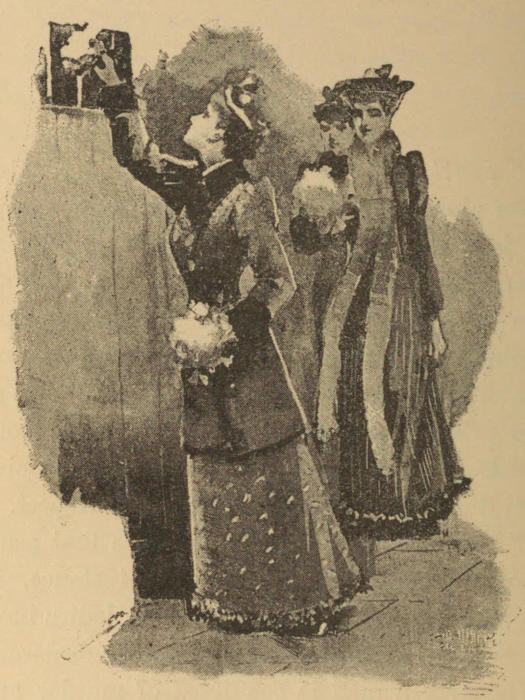
“HEAVE FLOWERS INTO HIS CELL.”
“I had a neighbor when I lived in New
Berlinopolisville who was President of the
Society for Ameliorating the Condition of
Prisoners, and he was the craziest man on the
subject that I ever met. His name was Hoskins—Colonel
Uriah Hoskins. He was the
author of the Hoskins Bill that attracted so
much attention when it was before the legislature,
though it never became law. The hill
provided that every prisoner should have a sitting-room
as well as a sleeping-room, and that
it should be furnished with a piano, a banjo,
a library, a typewriter, a wine-cooler, and a
whist-table; that the prisoner should be permitted
to hold two weekly receptions, to which
everybody should be allowed to come, and that
he should be taught any branch of study that
he might care to take up, books and masters
being, of course, supplied free. Colonel Hoskins
used to insist that the only thing that made
a man go wrong was the lack of kindness, and
that the sure way to reform a criminal was to
treat him with so much kindness that he would
grow ashamed of being wicked, and would fall
on everybody’s neck and devote the rest of his
life to weeping tears of repentance and singing
hymns of joy.
“While Colonel Hoskins was fond of all
styles of criminals, burglars were his particular
pets. According to him, a burglar was more
deserving of kindness than any other man.
‘How would you like it,’ he used to say, ‘if you
had to earn your living by breaking into houses
in the middle of the night, instead of sleeping
peacefully in your bed? Do you think you
would be full of good thoughts after you had
been bitten by the watch-dog and fired at
by the man of the house, and earned nothing
by your labor except a bad cold and the prospect
of hydrophobia? There is nothing more
brutal than the way in which society treats
the burglar; and so long as society refuses
to put him in the way of earning an easier
and less dangerous living, he cannot be blamed
if he continues to practise his midnight profession.’
“I must say this for Colonel Hoskins. He
did not confine himself to talk, like many other
philanthropists, but was always trying to carry
out his principles. He really meant what he
said about burglars, and there isn’t the least
doubt that he had more sympathy for them than
he had for the honest men of his acquaintance.
“When people asked him what he would do if
he woke up in the night and found a burglar in
his house, and whether or not he would shoot
at him, he said that he would as soon think of
shooting at his own wife, and that he would
undertake to reform that burglar, then and there,
by kindness alone. Once somebody said to
Hoskins that he ought really to let the burglars
know his feelings toward them, and Hoskins
said that he would do it without delay.
“That same day he drew up a beautiful
‘Notice to Burglars,’ and had it printed in big
letters and framed and hung up in the dining-room
of his house. It read in this way: ‘Burglars
are respectfully informed that the silverware
is all plated, and that the proprietor of
this house never keeps ready money on hand.
Cake and wine will be found in the dining-room
closet, and burglars are cordially invited to rest
and refresh themselves. Please wipe your feet
on the mat, and close the window when leaving
the house.’
“Colonel Hoskins took a good deal of pride in
that notice. He showed it to every one who
called at the house, and said that if other people
would follow his example and treat burglars
like Christians and gentlemen, there would soon
be an end of burglary, for the burglars would be
so touched by the kindness of their treatment
that they would abandon the business and become
honored members of society—insurance
presidents, or bank cashiers, or church treasurers.
He didn’t say how the reformed burglars
were to find employment in banks and
insurance offices and such, but that was a matter
of detail, and he always preferred to devise
large and noble schemes, and leave the working
details of them to other men.
“One morning Colonel Hoskins, who was an
early riser, went down to the dining-room before
breakfast, and was surprised to find that he had
had a midnight visit from burglars. Two
empty wine-bottles stood on the table, and all
the cake was eaten, which showed that the
burglars had accepted the invitation to refresh
themselves. But they did not seem to have
accepted it in quite the right spirit. All Hoskins’
spoons and forks lay in a heap in the middle
of the floor, and every one was twisted or
broken so as to be good for nothing. The window
had been left open and the rain had ruined
the curtains, and on a dirty piece of paper the
burglars had scrawled with a lead-pencil the
opinion that ‘Old Hoskins is the biggest fule
and the gol-darndest skinflint in the country.
You set out whiskey next time, or we’ll serve
you out.’
“Hoskins was not in the least cast down by
the rudeness of the burglars. ‘Poor fellows,’
he said, ‘they have been so used to bad treatment
that they don’t altogether appreciate kindness
at first. But they will learn.’ So he laid
in some new spoons and forks and added a bottle
of whiskey to the wine that he kept in the
closet for the burglars, and was as confident as
ever that the next gang that might break into
his house would be melted into tears and repentance
and would call him their best and dearest
friend.
“A week or two later Mrs. Hoskins was
awakened by a noise in the dining-room, and
after waking up her husband told him that
there were burglars in the house, and that he
must get out of the back window and go for the
police. He told her that he was sorry to see
her manifest such an unchristian spirit, and
he would show her how burglars ought to be
treated. There was not the least doubt that
there were burglars in the house, and they were
making a good deal more noise than was strictly
consistent with the prospect of rising in their
profession, for no able burglar ever makes any
unnecessary noise while engaged in business,
unless, of course, he falls over a coal-scuttle,
and then he naturally uses language. St. Paul
himself would probably say something pretty
strong in similar circumstances. Hoskins was
sincerely delighted to have the opportunity to
meet his burglarious friends, and he lost no
time in dressing and descending to the dining-room.
“He wore his slippers, and the burglars—there
were two of them—did not hear him until
he was fairly in the dining room. They were
seated at the table, with their feet on the
damask table-cloth, and the bottle of whiskey
was nearly empty. The Colonel was much
pleased to see that they had not damaged his
silverware, and he was just about to thank them
when they saw him. They started up, and one
of them caught him by the throat, while the
other held a pistol to his head and promised to
blow out his brains if he made the slightest
noise. Then they tied him hand and foot,
gagged him, and laid him on the floor, and then
sat down to finish the whiskey.
“Both the burglars were partly drunk, which
accounted for the unprofessional noise they had
been making. They talked in rather a low
tone, but Hoskins could hear everything they
said, and it was not particularly encouraging
to a gagged and bound philanthropist. They
agreed that he was a fool, and a stingy fool, or
else he would have kept money in the house,
and would have set out lemons and sugar as
well as plain whiskey. They said that any
man who treated poor working-men in that way
wasn’t fit to live, and that Hoskins would have
to be killed, even if it was not necessary—as it
plainly was in this case—to kill him in order to
prevent him from appearing at any future time
as a witness against them. They admitted that
the whiskey was not bad of its kind, but they
were of the opinion that Hoskins had left it in
their way so that they might get drunk and be
caught by the police.
“Colonel Hoskins listened to this conversation
with horror, and the prospect that the drunken
rascals would be as good as their word, and kill
him before they left the house, was only a little
more painful than the conviction that his
method, appealing to the better nature of burglars,
had failed for the second time. When the
whiskey was exhausted the men rose up and
looked at Hoskins, and a happy thought struck
one of them. ‘Thishyer idiot,’ he said, ‘may
not have any money in the house, but he’s
bound to have some in the bank, and he’s going
to write us a check for a thousand dollars, provided
we let him off and don’t kick his brains
out this time.’ The other burglar, who was
in that benevolent frame of mind that Irish
whiskey and conscious virtue sometimes produce,
agreed to the suggestion, and Hoskins
was therefore unbound and seated at the table,
and told to draw a check at once if he had the
least regard for his life. As he was gagged he
could not explain to the burglars the kind feelings
that he still had toward them, and the fact
that they could not draw the money on the
check without being captured by the police.
So he simply signed the check, and groaned to
think that the poor burglars were so slow to be
reformed in the way that he had hoped they
would be.
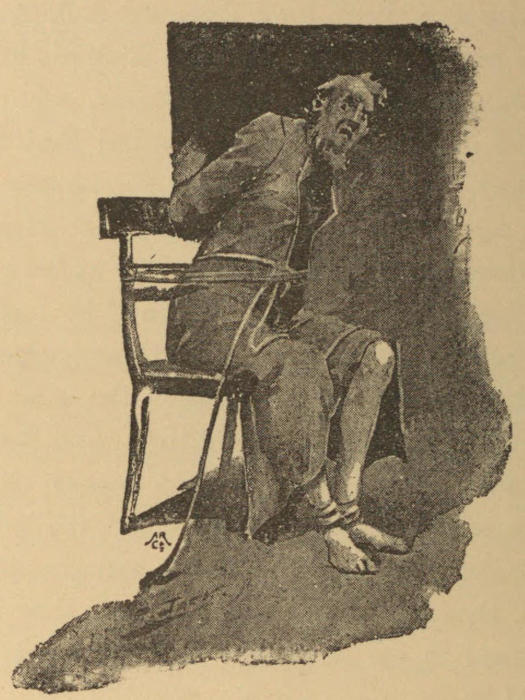
“TIED HIM IN A CHAIR.”
“When this business was over, the burglars
tied Hoskins’ wrists together again and then
tied him in a chair. Then they set to work to
do all the damage they could do without making
too much noise. They tore the curtains and
hacked the piano with knives, and poured a jug
of golden syrup over the carpet. Then they
plastered Colonel Hoskins’ face with raspberry
jam and emptied a sack of flour over his head,
and went away, telling him that if he ever
again ventured to trifle with the feelings of poor
but self-respecting men, they would put him to
death by slow tortures.
“Hoskins sat in the chair for a couple of
hours, till his wife timidly crept downstairs and
released him. It took him a good hour to get
the jam and the flour out of his hair and
whiskers, and as Mrs. Hoskins said that he was
in no state to enter a decent bedroom and made
him wash at the pump in the back yard, he
found it a rather cold operation. Perhaps it
was the remarks that Mrs. Hoskins addressed
to him during the operation that irritated him,
for she intimated very plainly that he was no
better than a professional idiot, and when a
man’s hair is stuck together with jam, remarks
of this sort from the wife of his bosom seem to
be lacking in tenderness. However that may
be, Colonel Hoskins had no sooner got himself
into what his wife condescended to call a state
of comparative decency, than he took down his
‘Notice to Burglars’ and tore it into a thousand
pieces. That day he had an electric burglar-alarm
put into his house, he bought the
savagest dog that he could find, and he stopped
the payment of the check, which, however, was
never presented. He continued to be the President
of the Society for Ameliorating the Condition
of Prisoners, but he steadily refused to
ameliorate a single prisoner convicted of burglary,
and while he was always a lunatic in
regard to other criminals, he openly maintained
that a burglar was the worst of men and that
kindness was utterly thrown away upon him.
He never had any more burglars in his house,
though the dog now and then lunched off warm
leg when some stranger to that part of the country
ventured into the Hoskins premises at
night. Hoskins was very fond of the animal,
which was quite right, but his practice of leaving
a bottle of whiskey, with an ounce of
strychnine in it, on the dining-room table every
night, in case a burglar should succeed in getting
into the house, was, in my opinion, going
a little too far. Antimonial wine would have
been much more humane and sufficiently effective.
But there is no man who is more severe
than a philanthropist who has been turned sour.”
THE CAT’S REVENGE.
We had been discussing the Darwinian
hypothesis, and the Colonel had maintained a
profound silence, which was sufficient evidence
that he did not believe in the development of
man from the lower animals. Some one, however,
asked him plumply his opinion of Darwinism,
and he sententiously replied, “Darned
nonsense!”
Feeling that this view of the matter possibly
merited expansion, the Colonel caused his chair
to assume its customary oratorical attitude on
its two rear legs, and began to discourse.
“There are some things,” he remarked,
“which do look as if there might be a grain of
truth in this monkey theory. For instance,
when I was in France I was pretty nearly convinced
that the monkey is the connecting link
between man and the Frenchmen, but after all
there is no proof of it. That’s what’s the matter
with Darwinism. When you produce a
man who can remember that his grandfather
was a monkey, or when you show me a monkey
that can produce papers to prove that he is my
second cousin, I’ll believe all Darwin said on
the subject; but as the thing stands I’ve nothing
but Darwin’s word to prove that men and
monkeys are near relations. So far as I can
learn, Darwin didn’t know as much about
animals as a man ought to know who undertakes
to invent a theory about them. He never
was intimate with dogs and he never drove an
army mule. He had a sort of bowing acquaintance
with monkeys and a few other animals of
no particular standing in the community, but
he couldn’t even understand a single animal
language. Now, if he had gone to work and
learned to read and write and speak the monkey
language, as that American professor that you
were just speaking of has done, he might have
been able to give us some really valuable information.
“Do I believe that animals talk? I don’t
simply believe it, I know it. When I was a
young man I had a good deal to do with
animals, and I learned to understand the cat
language just as well as I understood English.
It’s an easy language when once you get the
hang of it, and from what I hear of German
the two are considerably alike. You look as if
you didn’t altogether believe me, though why
you should doubt that a man can learn cat
language when the world is full of men that
pretend to have learned German, and nobody
calls their word in question, I don’t precisely
see.
“Of course, I don’t pretend to understand all
the cat dialects. For example, I don’t know
a word of the Angora dialect and can only
understand a sentence here and there of the
tortoise-shell dialect; but so far as good, pure
standard cat language goes, it’s as plain as
print to me to-day, though I haven’t paid any
attention to it for forty years. I don’t want
you to understand that I ever spoke it. I
always spoke English when I was talking with
cats. They all understand English as well as
you do. They pick it up just as a child picks
up a language from hearing it spoken.
“Forty years ago I was a young man, and,
like most young men, I fancied that I was in
love with a young woman of our town. There
isn’t the least doubt in my mind that I should
have married her if I had not known the cat
language. She afterward married a man whom
she took away to Africa with her as a missionary.
I knew him well, and he didn’t want to
go to Africa. Said he had no call to be a
missionary, and that all he wanted was to live
in a Christian country where he could go and
talk with the boys in the bar-room evenings.
But his wife carried him off, and it’s my belief
that if I had married her she would have made
me turn missionary, or pirate, or anything else
that she thought best. I shall never cease to be
grateful to Thomas Aquinas for saving me
from that woman.
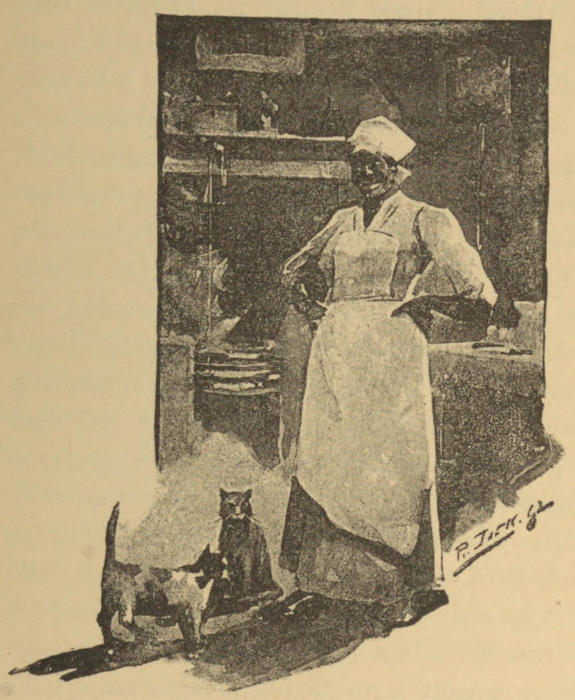
“I HAD AN OLD NEGRO HOUSEKEEPER AND TWO CATS.”
“This was the way of it. I was living in a
little cottage that belonged to my uncle, and
that he let me have rent free on condition that I
should take care of it and keep the grounds in
an attractive state until he could sell it. I had
an old negro housekeeper and two cats. One of
them, Martha Washington by name, was young
and handsome, and about as bright a cat as I
ever knew. She had a strong sense of humor,
too, which is unusual with cats, and when
something amused her she would throw back
her head and open her mouth wide, and laugh
a silent laugh that was as hearty and rollicking
as a Methodist parson’s laugh when he hears
a gray-haired joke at a negro minstrel show.
Martha was perhaps the most popular cat in the
town, and there was scarcely a minute in the
day when there wasn’t some one of her admirers
in the back yard. As for serenades, she
had three or four every night that it didn’t
rain. There was a quartette club formed by
four first-class feline voices, and the club used
to give Martha and me two or three hours of
music three times a week. I used sometimes
to find as many as six or seven old boots in the
back yard of a morning that had been contributed
by enthusiastic neighbors. As for society,
Martha Washington was at the top of the heap.
There wasn’t a more fashionable cat in the
whole State of Ohio—I was living in Ohio at
the time—and in spite of it all she was as
simple and unaffected in her ways as if she
had been born and bred in a Quaker meeting-house.
“One afternoon Martha was giving a four-o’clock
milk on the veranda next to my room.
I always gave her permission to give that sort
of entertainment whenever she wanted to, for
the gossip of her friends used to be very amusing
to me. Among the guests that afternoon
was Susan’s Maltese cat. Susan was the young
lady I wanted to marry. Now, this cat had
always pretended to be very fond of me, and
Susan often said that her cat never made a mistake
in reading character, and that the cat’s
approval of me was equivalent to a first-class
Sunday-school certificate of moral character. I
didn’t care anything about the cat myself, for
somehow I didn’t place any confidence in her
professions. There was an expression about her
tail which, to my mind, meant that she was insincere
and treacherous. The Maltese cat had
finished her milk, when the conversation drifted
around to the various mistresses of the cats, and
presently some one spoke of Susan. Then the
Maltese began to say things about Susan that
made my blood boil. It was not only what she
said, but what she insinuated, and according to
her Susan was one of the meanest and most
contemptible women in the whole United States.
I stood it as long as I could, and then I got up
and said to Martha Washington, ‘I think your
Maltese friend is needed at her home, and the
sooner she goes the better if she doesn’t want
to be helped home with a club.’ That was
enough. The Maltese, who was doing up her
back fur when I spoke, stopped, looked at me
as if she could tear me into pieces, and then
flounced out of the house without saying a
word. I understood that there was an end to
her pretence of friendship for me, and that
henceforth I should have an enemy in Susan’s
house who might, perhaps, be able to do me a
good deal of harm.
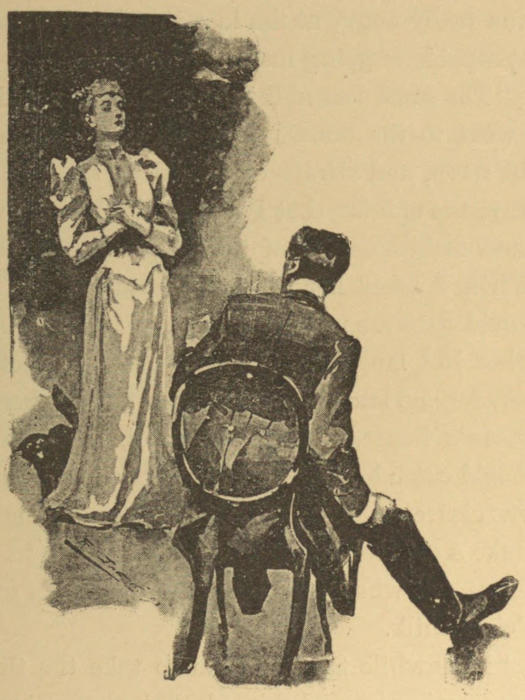
“POOR PUSSY’S NERVES ARE THOROUGHLY UPSET.”
“The next time I called to see Susan the
Maltese was in the room, and she instantly put
up her back and tail and swore at me as if I
was a Chinaman on the lookout for material for
a stolen dinner. ‘What can be the matter with
poor pussy?’ said Susan. ‘She seems to be so
terribly afraid of you all of a sudden. I hope
it doesn’t mean that you have been doing something
that she doesn’t approve of.’ I didn’t
make any reply to this insinuation, except to
say that the cat might perhaps be going mad,
but this didn’t help me any with Susan, who
was really angry at the idea that her cat could
be capable of going mad.
“The same sort of thing happened every time
I went to the house. The cat was always in
the room, and always expressed, in the plainest
way, the opinion that I was a thief and a murderer
and an enemy of the temperance society.
When I asked her what she meant to do, she
would give me no reply except a fresh oath or
other bad language. Threats had no effect on
her, for she knew that I could not touch her in
Susan’s house, and she didn’t intend that I
should catch her outside of the house. Nothing
was clearer than that the Maltese was bound to
make a quarrel between me and Susan, in revenge
for what I had said at Martha’s four-o’clock
milk.
“Meanwhile Susan began to take the thing
very seriously, and hinted that the cat’s opposition
to me might be a providential warning
against me. ‘I never knew her to take such a
prejudice against any one before,’ she said,
‘except against that converted Jew who afterward
turned out to be a burglar, and nearly
murdered poor dear Mr. Higby, the Baptist
preacher, the night he broke into Mr. Higby’s
house and stole all his hams.’ Once when I
did manage to give the Maltese a surreptitious
kick, and she yelled as if she was half-killed,
Susan said, ‘I am really afraid I shall have to
ask you to leave us now. Poor pussy’s nerves
are so thoroughly upset that I must devote all
my energies to soothing her. I do hope she is
mistaken in her estimate of you.’ This was
not very encouraging, and I saw clearly that if
the Maltese kept up her opposition the chances
that Susan would marry me were not worth a
rush.
“Did I tell you that I had a large gray cat by
the name of Thomas Aquinas? He was in some
respects the most remarkable cat I ever met.
Most people considered him rather a dull person,
but among cats he was conceded to have a colossal
mind. Cats would come from miles away
to ask his advice about things. I don’t mean
such trifling matters as his views on
mice-catching—which, by the way, is a thing that
has very little interest for most cats—or his
opinion of the best way in which to get a
canary bird through the bars of a cage. They
used to consult him on matters of the highest
importance, and the opinions that he used to
give would have laid over those of Benjamin
Franklin himself. Why, Martha Washington
told me that Thomas Aquinas knew more
about bringing up kittens than the oldest and
most experienced feline matron that she had
ever known. As for common sense, Thomas
Aquinas was just a solid chunk of it, as you
might say, and I get into the habit of consulting
him whenever I wanted a good, safe, cautious
opinion. He would see at a glance where
the trouble was, and would give me advice that
no lawyer could have beaten, no matter how
big a fee he might have charged.
“Well, I went home from Susan’s house, and
I said to Thomas Aquinas, ‘Thomas’—for he
was one of those cats that you would no more
have called ‘Tom’ than you would call Mr.
Gladstone ‘Bill’—‘Thomas,’ I said, ‘I want
you to come with me to Miss Susan’s and tell
that Maltese beast that if she doesn’t quit her
practice of swearing at me whenever I come
into the room it will be the worse for her.’
“‘That’s easy enough,’ said Thomas. ‘I
know one or two little things about that cat
that would not do to be told, and she knows that
I know them. Never you fear but that I can
shut her up in a moment. I heard that she was
going about bragging that she would get square
with you for something you said to her one day,
but I didn’t feel called upon to interfere without
your express approval.’”
“The next day Thomas and I strolled over to
Susan’s, and, as luck would have it, we were
shown into her reception-room before she came
downstairs. The Maltese cat was in the room,
and began her usual game of being filled with
horror at the sight of such a hardened wretch
as myself. Of course, Thomas Aquinas took
it up at once, and the two had a pretty hot
argument. Now Thomas, in spite of his colossal
mind, was a quick-tempered cat, and he was
remarkably free-spoken when he was roused.
One word led to another, and presently the
Maltese flew at Thomas, and for about two
minutes that room was so thick with fur that
you could hardly see the fight. Of course, there
could have been only one end to the affair.
My cat weighed twice what the Maltese
weighed, and after a few rounds he had her by
the neck, and never let go until he had killed
her. I was just saying ‘Hooray! Thomas!’
when Susan came into the room.
“I pass over what she said. Its general sense
was that a man who encouraged dumb animals
to fight, and who brought a great savage brute
into her house to kill her sweet little pussy in
her own parlor, wasn’t fit to live. She would
listen to no explanations, and when I said that
Thomas had called at my request to reason with
the Maltese about her unkind conduct toward
me, Susan said that my attempt to turn an infamous
outrage into a stupid joke made the
matter all the worse, and that she must insist
that I and my prize-fighting beast should leave
her house at once and never enter it again.
“So you see that if it had not been that I
understood what the Maltese cat said at Martha
Washington’s milk party, I should probably
never have quarrelled with either Susan or her
cat, and should now have been a missionary in
Central Africa, if I hadn’t blown my brains
out or taken to drink. I have often thought
that the man Susan did marry might have been
saved if he had known the cat language in time
and had made the acquaintance of the Maltese.”
The Colonel paused, and presently I asked
him if he really expected us to believe his story.
“Why not?” he replied. “It isn’t any stiffer
than Darwin’s yarn about our being descended
from monkeys. You believe that on the word
of a man you never saw, and I expect you to
believe my story that I understand the cat language
on my unsupported word. Perhaps the
story is a little tough, but if you are going in
for science you shouldn’t let your credulity be
backed down by any story.”
SILVER-PLATED.
The Etruria was nearing New York, and
the prospect of the inevitable interview with the
custom-house officers had already cast a gloom
over the passengers. For the most part they
were silent, and their faces wore an anxious and
solemn expression. The Rev. Mr. Waterman,
of the Eighth Day Baptist Church, who had
bought largely of ready-made clothing in London,
even suggested that it might be well to
hold a prayer-meeting in the saloon.
A group of half a dozen men were sitting
in the lee of one of the deck-houses, smoking
silently, when one of the number, a young and
sanguine person, suddenly exclaimed:
“I don’t believe any honest man ever has any
trouble with the custom-house. It’s the fellows
who want to defraud the Government who make
all the complaints.”
“What you say may be patriotism and it
may be ignorance——”
“What’s the difference?” murmured a cynical
interrupter.
“But,” continued the speaker, “it isn’t true.
I never tried to defraud the Government, but
for all that I’ve had more trouble with the custom-house
than if I’d been an honest collector
of the port trying not to mix up politics with
the business of the office.”
“America expects every man to pay his duty,
Colonel,” replied the sanguine young man, with
a vague reminiscence of Nelson. “Tell us
about your trouble, and I rather think you’ll
have to admit that it was because you didn’t
want to pay duty on something.”
The Colonel was generally understood by the
rest of the passengers to be a sort of theatrical
manager, a position which in the United
States entitles a man to the relative rank of
colonel in the militia and commodore in the
canal-boat service. He had on several occasions
shown a knowledge of music and of
professional musicians which had won for him
some respect among those of his fellow-passengers
who did not know the difference between a
hurdy-gurdy and a hautboy, and were therefore
fond of posing as musical critics. He was a
shrewd, good-tempered colonel, and the barkeeper
said that he was the most elegant, high-toned
gentleman he had ever crossed with.
“Electricity, gentlemen,” resumed the Colonel,
“is the biggest thing of the century, but it
has its drawbacks. Did any of you ever happen
to ride on that electric railroad in Berlin?
Well, I have, and ’most anybody who goes to
Berlin is liable to ride on it. It taught me,
however, that a man ought to be pretty careful
when he trusts himself in an electric car.
“It happened in this way. I was an agent
in the general show business, and was collecting
an opera company for a friend of mine who was
going to open in Chicago. I had come across a
first-class tenor—found him in a country church
choir in Germany—and was bringing him home
with me under a contract, when he and I took
that ride on that Berlin electric road. He was
a careless sort of chap, and he sat down in a
corner of the car where the electricity had been
leaking and the seat was pretty wet.”
“I never knew before,” remarked the young
man, “that electricity could make a seat wet.”
“Probably not,” retorted the Colonel. “I
should judge that there might be a right smart
lot of things that you mightn’t know. Most of
these gentlemen here, however, have probably
heard that nowadays electricity is put up for
use in bottles and metallic cans. It stands to
reason that anything capable of being put into
a bottle is capable of leaking, and wetting whatever
it leaks on. If there is anybody here who
knows more about bottles than I do, I’m ready
to let him tell this story.
“As I was saying, my man sat down in a
sort of pool of electric fluid, and sat there for
about half an hour. He was wearing in the
fob-pocket of his trousers a cheap silver watch.
I had given it to him so that he might get some
exercise and prevent himself from getting too
fat. He never suspected my motive, but he
tired himself all out winding it up for two hours
every night. Now you may not believe it, but
I give you my word that the electricity completely
dissolved that watch-case and deposited
the silver around the man’s waist. He didn’t
find it out till night, and you never saw a man
so scared as when he found that there was a
band about four inches wide silver-plated all
round his waist. The doctor told him that the
only possible way of getting it off would be to
dissolve it with acid, but that the acid would
eat clean through to his spine and injure his
voice. So my tenor had to let bad enough
alone, and be satisfied with another ten-and-sixpenny
gymnasium that I gave him to mollify
his feelings.
“We came over on the Arizona, and it got
around during the passage that my man was
silver-plated. There was a custom-house spy
on board, and it happened that after the tenor
had sworn that he had nothing dutiable with
him, the inspector ordered him to strip and be
personally examined. Of course when this was
done it was discovered that he was silver-plated,
and he was held for duty under the
general heading in the tariff of ‘all other articles,
silver-plated, or in whole, and not elsewhere
enumerated,’ and taxed fifty per cent ad
valorem and fined two hundred and fifty dollars
for failing to declare that he was plated.
He couldn’t pay and I wouldn’t pay, and so he
was locked up in a bonded warehouse, and I
went to consult my lawyer.
“I laid all the facts before him, and told him
I would pay him handsomely if he could get my
man out of the custom-house without paying
either duty or fine. Now, the lawyer knew the
tariff from beginning to end, and if any man
could help me I knew he could. He didn’t
promise anything at first, but he discussed
the question by and large and in all its bearings.
“‘I’m afraid,’ said he, ‘that there is no hope
of getting your friend out without paying duty,
but we may succeed in having him classified so
as to make the duty very low. For instance,
you say the man is a professional singer. Now,
we might have him classed as a musical instrument
and taxed forty-five per cent ad valorem.
By the bye, what did you agree to pay him?’
“‘I agreed to pay him,’ says I, ‘a hundred
dollars per week.’
“‘That’s bad,’ says the lawyer. ‘A hundred
dollars a week is fifty-two hundred per year,
which is about the interest at six per cent on
eighty-seven thousand dollars. You wouldn’t
like to pay forty-three or four thousand dollars
duty on him.’
“‘I’d see him sent to Congress first!’ says I.
“‘Very well,’ says the lawyer. ‘Then perhaps
we could classify him as machinery or
parts thereof. But you wouldn’t save much in
that way. You’d have to pay forty per cent
ad valorem, and very likely the appraisers
would say that you had undervalued the man,
and would value him at double what your contract
seems to say he is worth. They’re bound
to protect American machinery against the
pauper labor of Europe every time.’
“‘How would it do to classify him as old
family plate?’ said I.
“‘Worse and worse,’ said the lawyer. ‘He’d
have to pay sixty per cent, and you’d have a
good deal of difficulty in proving that he is old
family plate. Of course it could be done, but it
would probably cost you more than the whole
amount of the duty. They’re a perfectly honest
set of men, the appraisers, and they naturally
come high.’
“‘What will I do, then?’ said I; ‘let him die
in the custom-house and then sue for damages?’
“‘There might be something worth while
done in that way,’ says the lawyer, ‘but it
would be middling hard on the man. But I’ll
tell you what we can do. Didn’t you say that
the man was singing in a church choir when
you hired him?’
“‘I did so,’ says I.
“‘All right,’ says the lawyer. ‘We’ll classify
him as an “article used in the service of religion,”
and get him in free of any duty whatever.
You go and get him an engagement in a church
without an hour’s delay, and then come to me.
We’ll beat the custom-house this time, sure
enough.’
“I got the man an engagement to sing for a
week in a Methodist meeting-house, and before
the week was out he was decided to be an
article used in the service of religion, and was
returned to me free of duty, and cursing the
head off of every officer in the revenue service.
The end of it was that my tenor claimed that
I had broken my contract by setting him to sing
in a church, and he sued me for damages, and
got them too. So you see, my young friend,
that a man may have trouble with the custom-house
who does not want to defraud the Government
out of anything, not even the duty on that
sealskin sack that I hear you have taken apart
and packed in a spare pair of boots.”
THE END.