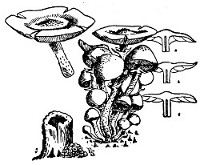
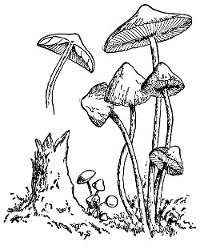
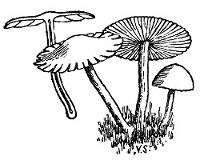
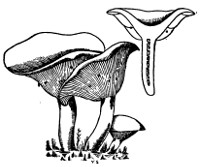
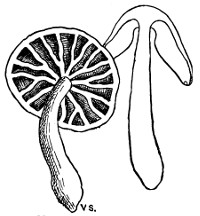
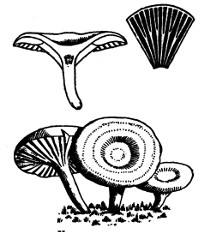
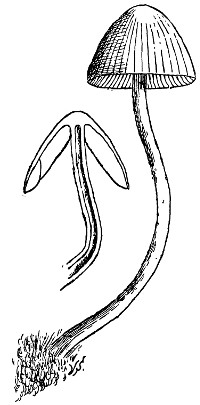
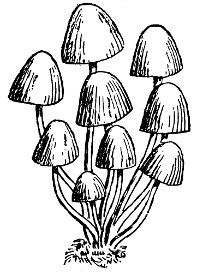
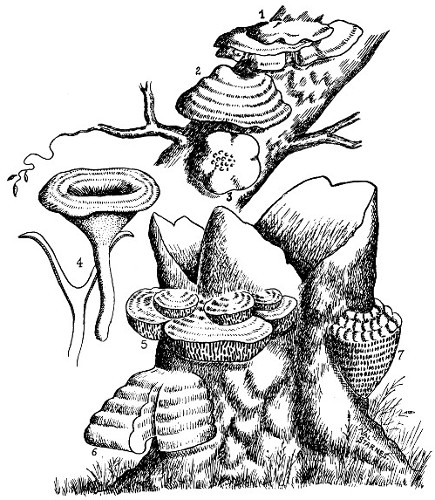
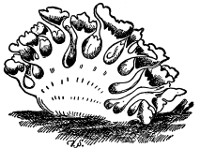
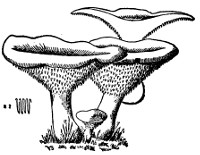
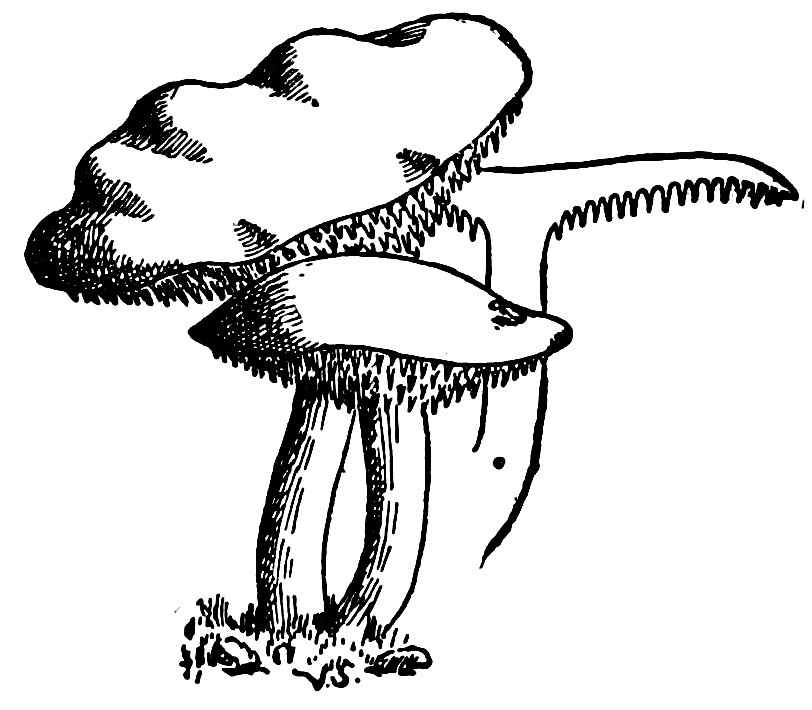
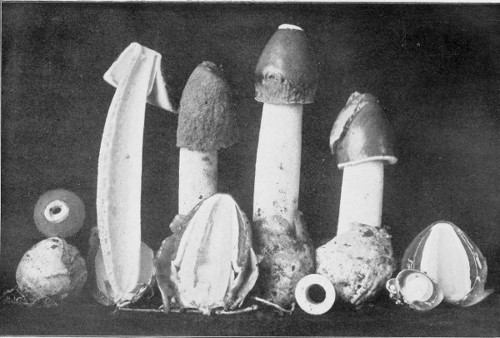
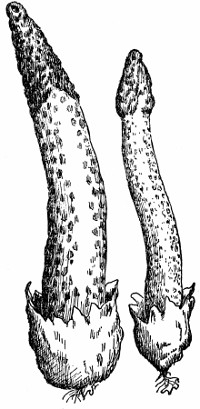
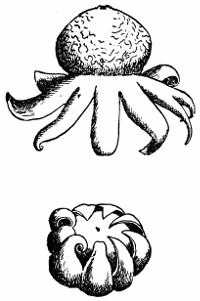
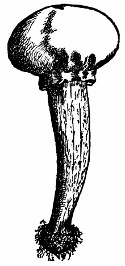
Cohort HYMENOMYCETES. Gr.—a membrane, a fruit-bearing surface;
Gr.—a mushroom. (So called from the hymenium or fruit-bearing surface.)
Fungi composed of membranes, fleshy, woody or gelatinous,
growing on wood or on the ground. The hymenium
or spore-bearing surface exposed at an early stage. The
spores are borne on basidia, spread over the surface.
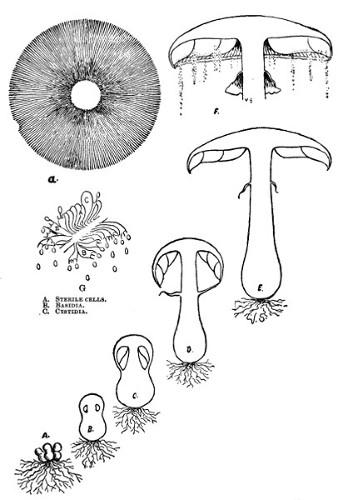
The common mushroom is typical of the family. All the
members resemble it, more or less, in organization and reproductive
organs. These latter, in the mushroom, are spread over lamellæ or
gills. The spores, after ripening and dissemination, germinate and
produce a mycelium or thread-like vine, which in turn develops the
spore-producing part of the plant. Hymenomycetes is divided into the
following six Families:—
| I. |
Spread over the surface of lamellæ or gills. |
Agaricaceæ. |
| II. |
Lining the interior of tubes or pores. |
Polyporaceæ. |
| III. |
Clothing the surface of spines or protuberances of various forms. |
Hydnaceæ. |
| IV. |
Horizontal and mostly on the under surface. |
Thelephoraceæ. |
| V. |
Vertical and produced all over the surface. |
Clavariaceæ. |
| VI. |
Superior, gelatinous fungi. |
Tremellaceæ. |
In the Agaricaceæ the hymenium is spread over lamellæ or gills
which radiate from a center or stem. The gills are composed of a
double membrane, and are simple or branched.
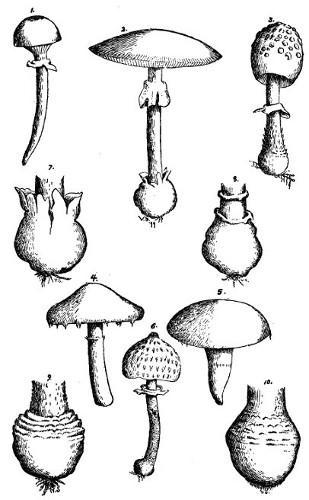
The parts of an Agaric may all be present as in Amanitæ, or severally
absent in other genera. When the young fungus is entirely enclosed in
a wrapper or case, this case is called the universal veil. When this
veil is ruptured by the growth of the stem, that part which remains
2attached to the base is called the volva. The membrane reaching from
the stem to the margin of the cap is the partial veil; when it ruptures
by the expansion of the cap and all or a portion adheres to and about
the stem it forms the annulus or ring. In some species one or both
veils may be present, or one or both may be absent.
The stem is central when supporting the cap at its center; excentric
when at one side of the center; lateral when it supports the cap from
the side. If the stem is absent, the cap is said to be sessile; if the cap
is horizontal and supported by a broad base it is dimidiate; if attached
to its place of growth by its back it is resupinate.
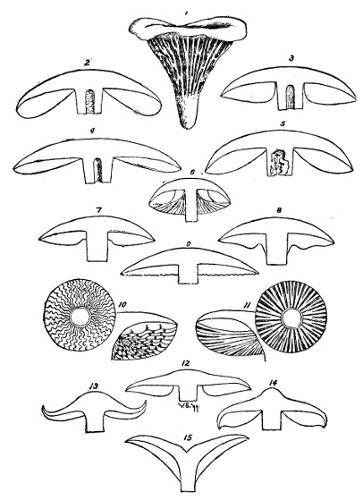
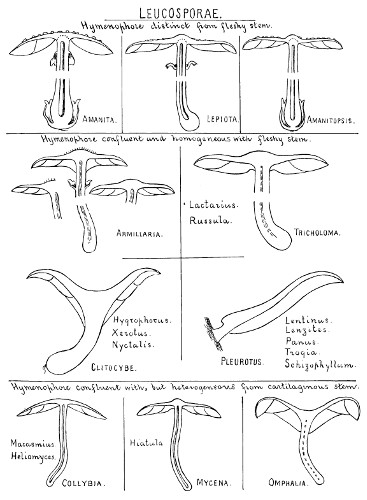
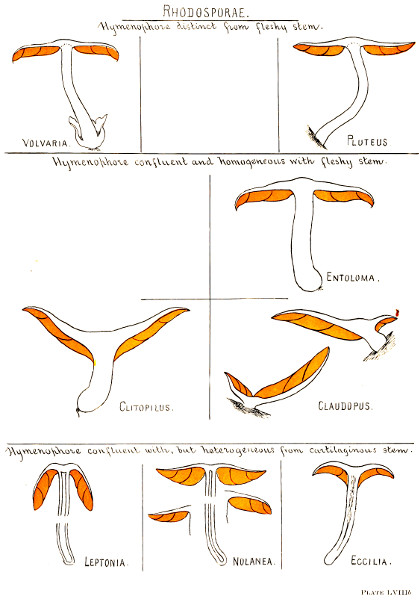
Genera are largely distinguished by the manner in which the gills are
attached to the stem. These distinguishing attachments are shown in
the plates illustrating genera and in Plate IV. Gill-shapes.
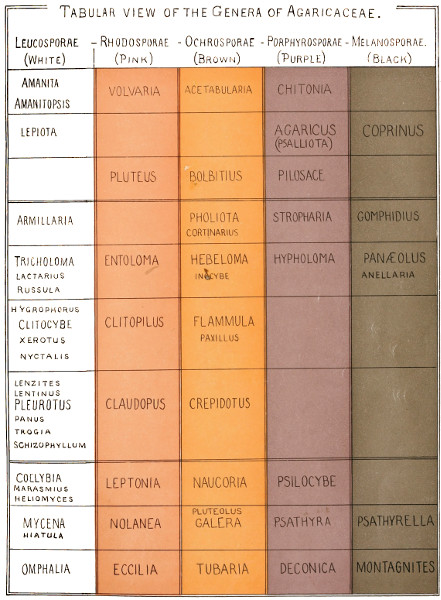
For convenience Agaricaceæ is divided by the color of the spores into
five series: white, pink, brown, purple, black. The last two, owing
to the similarity of hue, are by some writers (preferably) included in
the black-spored series. Spore color is a valuable assistant in determining
species.
Spores white, rarely dingy or inclining to reddish. In the genus
Russula the spores of some species are white, in some cream-color, and
in several pale ochraceous. Variations from pure white are found in
the spores of Tricholoma personatum and a few other species. Gill-color
is not a guide to spore-color. Purple, yellow, brown, pinkish
gills may produce white spores.
Plate I.
Plate II.
AMANITA.
(A name given to some esculent fungi by Galen, perhaps from
Mount Amanus.)
Universal veil (volva), which is at first continuous (completely enveloping
the young plant), distinct from the skin of the cap. Hymenophore
or cap, the part which bears the spore-bearing surface, distinct
and easily separable from the stem, which leaves a socket in the flesh
when it is removed. All growing upon the ground. Fries.
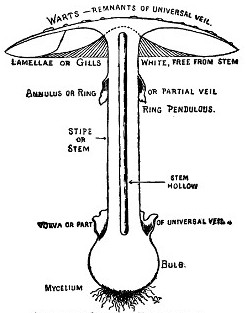
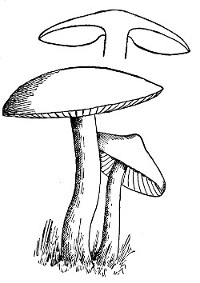
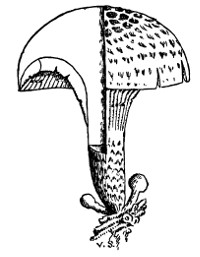
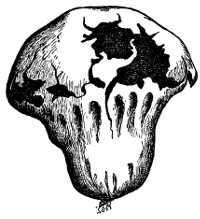
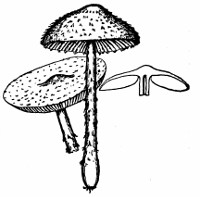
Section of Amanita Phalloides.
Pileus somewhat fleshy, convex then expanded. Gills free. Universal
veil at first enclosing the entire plant, which as it grows bursts
3through, generally carrying the upper part on the pileus, where it appears
as patches or scales, the remainder enclosing the stem at the
base as a volva, either in a cup-like
form, closely adherent or friable
and evanescent. The partial veil in
youth extends from the stem to the
margin of the pileus, enclosing the
gills; when ruptured it depends from
the stem as a ring. Stem furnished
with a ring, and different in substance
from that of the pileus.
Spores white.
On the ground.
The nearest allied genus, Amanitopsis,
is separated by the absence
of a ring, and Lepiota by its lack
of a volva; Volvaria, Acetabularia
and Chitonia, possessing volvas,
are distinguished by the color of
their spores.
Amanitæ are the most beautiful and conspicuous of fungi. While
there are comparatively few species of them, the individual members
are plentiful in appearing from spring until the coming of frost. They
are solitary or gregarious in growth. Occasionally two or three are
found together. They frequent woods, groves, copse, margins of woods
and land recently cleared of trees. They are seldom found in open
fields. A careful study of all their botanic points should be the first
duty of the student of fungi. Familiarity with every characteristic of
the Amanitæ will insure against fatal toadstool poisoning, for it is the
well-grounded belief of those who have made thorough investigation
that, with the exception of Helvella esculenta, now Gyromitra esculenta,
the Amanitæ, alone, contain deadly poisons.
No Amanita, or piece of one, should be eaten before its identity is fully
established and its qualities ascertained by referring to the descriptions
herein given or to the opinion of an expert.
They are the aristocrats of fungi. Their noble bearing, their beauty,
their power for good or evil, and above all their perfect structure, have
placed them first in their realm; and they proudly bear the three badges
4of their clan and rank—the volva or sheath from which they spring, the
kid-like apron encircling their waists, and patch-marks of their high
birth upon their caps. In their youth, when in or just appearing above
the ground, they are completely invested with a membrane or universal
veil, which is distinct and free from the skin of the cap. As the plant
grows the membrane stretches and finally bursts. It sometimes ruptures
in one place only and remains about the base of the stem as the volva.
When such a rupture occurs the caps are smooth. In most species portions
of the volva remain upon the cap as scruff or warts—pointed or
rough—or as feathery adornment; any or all of which may in part or
whole vanish with age or be washed away by rain.
Extending from the stem to the margin of the cap, and covering the
gills, is the partial veil—a membranaceous, white texture of varying
thickness. As the cap expands this veil tears from it. Portions frequently
remain pendant from the edges, the rest contracts to the stem
as a ring, or droops from it as a surrounding ruffle, or, if of slight consistency,
may be fugacious and disappear, but marks, remains, or the
veil itself will always be traceable upon the stem.
The Amanitæ are of all colors, from the brilliant orange of the A.
Cæsarea, the rich scarlet or crimson of the A. muscaria, to the pure
white of the A. phalloides in its white form.
Their stems are usually long, and taper from the base toward the top.
In some forms the base is distinctly bulbous. The volva at the base is
attached to the stem at its lower extremity. It may be visible as a
cup or ruptured pouch with spreading mouth, or it may be of such
friable texture as to appear like mealy scales. Often, when the plant
is pulled from the ground, the volva remains, but the marks of its
attachment will appear and should be carefully looked for. Their gills
are commonly white, are of equal length and radiate from near the
stem, which they do not reach, to the circumference of the cap. They
are white, unless tinged with age, excepting upon A. Cæsarea and A.
Frostiana where they are yellow.[B] Their caps are umbrella-shaped, flat
or convex. Their flesh is white, does not change color when bruised.
They are scentless and almost tasteless when fresh, when old they have
a slightly offensive odor and taste.
The family is not a large one, not over thirty members complete its
circle. Every feature, every part of its several members, should be
thoroughly known before the intimacy of eating. While at least nine
5of the family are not only edible but delicate and sapid, far better will
it be to leave all alone than to make a mistake. A piece of a poisonous
variety the size of a dime will often cause serious disorders if eaten.
Many persons have died from eating very small quantities.
Because of its ovate or button-like form when young, it is frequently
mistaken for the common field mushroom; even experienced mycophagists
have been deceived by it. No other poison has so puzzled
scientists. Other varieties of fungi may interfere with digestion, but to
the Amanitæ all deaths from toadstool-eating are traceable. Its subtle
alkaloid is absorbed by the system, and in most cases lies unsuspected
for from six to twelve hours, then its iron grip holds to the death. For
centuries it has defied all remedies. The problem has been partially
solved. At Shenandoah, Pa., August 31, 1885, a family of five were
poisoned by toadstools; two died, three lived. Noting the sad account
in the newspapers, I at once wrote to Shenandoah for specimens of the
fungi eaten and a description of the treatment. I promptly received
from Dr. J.E. Schadle (now Professor Schadle), the physician in
charge of the cases, a box containing two harmless varieties and several
fine specimens of the Amanita phalloides, all of which were gathered
on the same spot and by the same person who gathered the toadstools
doing the poisoning. They told the tale. A remarkably full
and interesting account of the cases was sent to me by Dr. Schadle.
After exhausting all other remedies, and after two of the five had died,
he administered subcutaneously, by hypodermic injection, sulphate of
atropine—a product of the deadly nightshade analagous to belladonna—1⁄180
to 1⁄60 of a grain at a dose. It proved to be an antidote and
saved the lives of the remaining three.
The action of atropine in arresting the deadly work of poisoning by
amanitine had been foreshadowed by Schmidberg and Koppe, and
dwelt upon in numerous published articles by Mr. Julius A. Palmer, to
whom more than any other is due the branding of the murderous members
of the Amanita family; but for the first time atropine was used
upon the human system to ward their blows.
All of the species herein described are found in the United States.
Of the twenty-seven, nine are edible, nine are either known to be deadly
or are so closely allied to deadly species that it is unsafe to class them
as other than poisonous until absolute proof is obtained of their harmlessness.
6The remaining nine I have not seen, neither is there any record
of their qualities.
* Volva opening at the top or splitting all around, leaving a manifest,
free border at the base of the stem. Pileus naked or with broad
membranaceous patches.
** Volva splitting regularly all round the lower portion, persistent,
more or less closely embracing the base of the bulbous stem. The
upper portion being adnate to the pileus appears on it by expansion as
scattered, thick warts.
*** Volva friable, entirely broken up into wart-like scales, therefore
not persistent at the base of the stem, which is at first globose-bulbous,
becoming less so as it lengthens. Pileus bearing mealy patches,
soon disappearing or with small, hard, pointed warts.
**** Volva rudimentary, flocculose, wholly disappearing.
*
Volva bursting at top, etc.
A. viro´sa Fr.—virus, poison.
Shining white. Pileus 3–4 in. broad, fleshy, at
first conical and acute, afterwards bell-shaped,
then expanded, naked, viscous in wet weather,
shining when dry, margin always even, but most
frequently unequal, turned backward and inflexed.
Flesh white, unchangeable. Stem 4–6 in. long,
wholly stuffed, almost solid, split up into longitudinal fibrils, cylindrical
from the bulbous base, often compressed at the apex, torn into scales
on the surface, springing from a lax, wide, thick volva, which bursts
open at the apex. Ring close to the top, lax, silky, splitting up into
floccose fragments. Gills free, thin, narrow, narrowing at both ends,
but a little broader in front, not decurrent on the stem (although the
apex of the stem is often striate), crowded, somewhat floccose at the
edge. Fries.
The pilei are most frequently oblique, extended and lobed on one
side as in Hygrophorous conicus, scarcely ever depressed. The pileus
rarely becomes yellow. The fragments of the veil often adhere to the
edge of the gills.
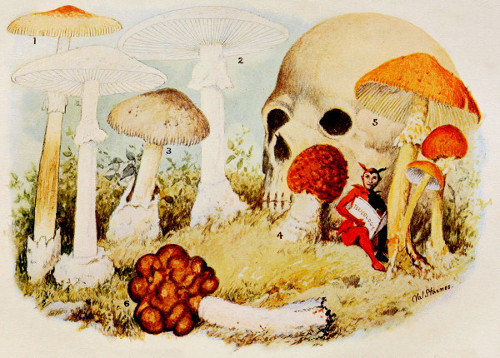
Grouped by F.D. Briscoe—Studies by C. McIlvaine. Plate VI.
| Fig. |
Page. |
Fig. |
Page. |
| 1. Amanita spreta, |
11 |
4. Amanita muscaria, |
14 |
| 2. Amanita phalloides (white var.), |
7 |
5. Amanita frostiana, |
16 |
| 3. Amanita phalloides (brown var.), |
7 |
6. Gyromitra esculenta, |
546 |
7In woods. Uncommon. August to October.
Fetid, poisonous. Stevenson.
Spores spheroid or subspheroid, 10–16µ, K.; 8µ W.P.; sub-globose,
8–10µ Massee.
POISONOUS.
I think it a variety of A. phalloides.
A. phalloi´des Fr. Gr.—phallus-like. (Plate VI, figs. 2, 3, p. 6.)
Pileus 3–4 in. broad, commonly shining white or lemon-yellow, fleshy,
oval bell-shaped, then expanded, obtuse, covered over with a pellicle
which is viscid (not glutinous) in wet weather, naked, rarely sprinkled
with one or two fragments of the volva, the regular margin even. Stem
3–5 in. long, ½ in. and more thick, solid downward, bulbous, hollow
and attenuated upward, rather smooth, white. Ring superior, reflexed,
slightly striate, swollen, commonly entire, white. Volva more or less
buried in the soil, bulbous, semifree, bursting open in a torn manner at
the apex, with a lax border. Gills free, ventricose, 4 lines broad, shining
white. Fries.
Pileus very variable in color, commonly white or yellow (A. citrina
Pers.), becoming green (A. viridis Pers.), olivaceous and occasionally
variegated with tiger spots; in late autumn with the disk almost black
but whitish round the margin. Odor somewhat fetid, but little remarkable
as compared with that of A. virosa.
In woods. Frequent. August to November.
A very POISONOUS and dangerous species. Stevenson.
Spores 8–9µ W.G.S.; 8–10µ B.; 7–9µ diam. Massee; globose, 7.6×6µ
Peck.
Pileus at first ovate or subcampanulate, then expanded, slightly
viscid when young and moist, smooth or rarely adorned by a few
fragments of the volva, even on the margin, white, yellowish-brown or
blackish-brown. Lamellæ rather broad, rounded behind, free, white.
Stem equal or slightly tapering upward, stuffed or hollow, smooth or
slightly floccose, ringed, bulbous, the ruptured volva either appressed
loose or merely forming a narrow margin to the bulb.
Plant 4–8 in. high. Pileus 2–5 in. broad. Stem 3–6 lines thick.
This species is common and variable. It occurs everywhere in woods
and assumes such different colors that the inexperienced mycologist is
apt to mistake its different forms for distinct species. With us the prevailing
8colors of the pileus are white, yellowish-white, grayish-brown
and blackish-brown. It is remarkable that the form with a greenish
pileus, which seems to be common enough in Europe, does not occur
here. Fries also mentions a form having a white pileus with a black
disk. A somewhat similar form occurs here, in which the pileus is
grayish-brown with a black disk. Some of the variously colored forms
were formerly taken to be distinct species, in consequence of which
several synonyms have arisen, of which A. virescens Fl. Dan., Amanita
viridis Pers., and Amanita citrina Pers., are examples. A. verna
Bull. is a variety having a white pileus, a rather thick annulus and an
appressed volva. It sometimes occurs early in the season; hence the
specific name. It also occurs late in the season and runs into the typical
form so that it is not easy to keep it distinct. The flesh and the lamellæ
are white, the stem is white, pallid or brownish, and the annulus is
either white or brownish. The bulb is generally very broad and abrupt
or depressed, though it sometimes is small and approaches an ovate
form. The large bulbs are sometimes split externally in two or three
places and are, therefore, two- or three-lobed. In such cases the volva
is less persistent than usual and its free portion then furnishes merely an
acute edge or narrow margin to the bulb. Specimens sometimes occur
in which the margin of the pileus is narrowly adorned with a slight
woolly hairiness, but usually it is perfectly smooth and even. By this
character, taken in connection with the membranous volva and bulbous
base of the stem, the species is readily distinguished. Sometimes a
strong odor is emitted by it, but usually the odor is slight. Authors
generally pronounce this a poisonous and very dangerous species. Its
appearance is attractive, but its use as food is to be avoided. Peck,
33d Rep. N.Y. State Bot.
Common in woods and recently cleared woodlands. Frequent over
the United States. June to frost.
An exceedingly poisonous, dangerous, seductive species, responsible
for most of the deaths from toadstool eating; because in its white form
it is mistaken for the common mushroom—Agaricus campester. The
real fault is with the collector, who should never eat any fungus found
in the woods, believing it to be the mushroom. The mushroom does
not grow in the woods. Neither has it white gills, nor white spores, nor
a volva at the base of the stem as have Amanitæ.
The caps of A. phalloides vary in color—white, oyster-color, smoky
9brown. The color of the commonest form is from white to a light hue
of greenish yellow. The center of the cap, whatever may be the prevailing
color, is usually several shades darker. In shape, the cap
changes from a knob in youth, through the shapes of expansion, until
it becomes fully spread, when it is umbrella-shaped, or almost flat.
Some forms have a slightly raised portion or umbo in the center of the
cap. The gills are white, of good width, rounded next to the stem and
free from it.
The stem conforms in color to the cap, but in lighter shades. White-capped
varieties have white stems. The stem has a sudden broad, distinct
bulb at the base. On the upper side of the bulb there is usually a
margin or rim. The stem tapers more or less toward the cap, from
which it is easily separable. The cup, wrapper or volva is torn or split
or irregular at the upper part, and is not pressed to the stem as in some
forms.
Professor Peck, in his 48th Report, gives the following excellent synopsis
of differences between the poisonous Amanita and edible fungi, for
which it could only by great stupidity be mistaken:
Poison amanita. Gills persistently white. Stem equal to or longer
than the diameter of the cap, with a broad, distinct bulb at the base.
Common mushroom. Gills pink, becoming blackish-brown. Stem
shorter than the diameter of the cap, with no bulb at the base.
From all forms of the edible Sheathed amanitopsis the Poison amanita
differs in its distinctly bulbous stem, in having a collar on the stem
and in the absence of striations on the margin of the cap.
From the edible Reddish amanita, it is easily separated by the entire
absence of any reddish hues or stains and of warts upon its cap.
From the Smooth lepiota its distinct, abrupt and marginal bulb at
once distinguishes it.
A. ver´na Bull.—vernus, of spring. A variety of A. phalloides.
POISONOUS. White. Pileus ovate then expanded, somewhat depressed,
viscid, margin orbicular, even. Stem stuffed then hollow,
equal, floccose, closely sheathed with the free border of the volva. Ring
reflexed, swollen. Gills free. Pileus glabrous, even on the margin,
white, viscid when moist. Gills white. Stem ringed, white, floccose,
stuffed or hollow, closely sheathed at the base by the remains of the
membranous volva, bulbous. Spores globose, 8µ broad.
10In woods. Spring and summer.
The Vernal Amanita scarcely differs from white forms of the A.
phalloides except in the more persistent and more closely sheathing
remains of the wrapper at the base of the stem. It is probably only a
variety of that species, as most mycologists now regard it, and it should
be considered quite as dangerous. I have not found it earlier than in
July, although in Europe it is said to appear in spring, as its name implies.
Peck, 48th Rep. N.Y. State Bot.
Common over the United States. West Virginia, New Jersey, Pennsylvania,
May to November. It appeared at Mt. Gretna, Pa., on May
28, 1899. McIlvaine.
The absence of a ring separates white forms of A. volvata and A.
vaginata.
The virulence of its poison is the same as that of A. phalloides.
A. magnivela´ris Pk.—magnus, large; velum, veil. Pileus convex
or nearly plane, glabrous, slightly viscid when moist, even on the
margin, white or yellowish-white. Gills close, free, white. Stem long,
nearly equal, glabrous, white, furnished with a large membranous white
annulus, sheathed at the base by the appressed remains of the membranous
volva, the bulbous base tapering downward and radicating.
Spores broadly elliptical, 10×6–8µ.
Pileus 3–5 in. broad. Stem 5–7 in. long, 4–6 lines thick.
Solitary in woods. Port Jefferson, Suffolk county. July.
The species resembles Amanita verna, from which it is separated by
its large persistent annulus, the elongated downwardly tapering bulb of
its stem, and especially by its elliptical spores. Peck, 50th Rep. N.Y.
State Bot.
I have not seen this species. Its resemblance to A. verna is enough
to place the ban upon it until it has been tested.
A. map´pa Fr.—mappa, a napkin. From the volva. Pileus 2–3 in.
broad, commonly white or becoming yellow, slightly fleshy, convexo-plane,
obtuse or depressed, orbicular, dry, margin for the most part
even. Stem 2–3 in. long, 3–5 lines thick, stuffed then hollow, almost
equal above the bulb, rather smooth, white. Ring superior, soft, lax,
here and there torn. Volva regularly circularly split, somewhat obliterated;
the globoso-bulbous base united with the stem, with an acute
11and distant margin; the portion covering the pileus divided into broad,
irregular, somewhat separating scales. Gills annexed, crowded, narrow,
shining, white. Fries.
Odor stinking. The color is that of A. phalloides, with which A.
virosa exactly agrees, more rarely straw color, lemon-yellow, becoming
green.
In mixed woods. Frequent. Stevenson.
Spores spheroid, 7–10µ K.; 8–9×6–8µ B.; subglobose, 7–9µ diameter
Massee.
New York woods and fields, common, September to October, Peck,
22d Rep.; North Carolina, Curtis; New England, Frost; Minnesota,
Johnson; Ohio, Morgan; District Columbia, Miss Taylor.
POISONOUS.
Probably but a variety of A. phalloides.
A. spre´ta Pk.—spreta, hated. (Plate VI, fig. 1, p. 6.) Pileus
subovate, then convex or expanded, smooth or adorned with a few
fragments of the volva, substriate on the margin, whitish or pale-brown.
Gills close, reaching the stem, white. Stem equal, smooth, annulate,
stuffed or hollow, whitish, finely striate at the top from the decurrent
lines of the lamellæ, not bulbous at the base, but the volva rather large,
loose, subochreate. Spores elliptical, generally with a single large
nucleus, 10–13×6–8µ.
Plant 4–6 in. high. Pileus 3–5 in. broad. Stem 4–6 lines thick.
Ground in open places. Sandlake and Gansevoort. August. Peck,
32d Rep. N.Y. State Bot.
This is a dangerous species, because containing a deadly poison and
resembling the most common forms of Amanitopsis, therefore likely to
be mistaken for them. Specimens sent by me to Professor Peck were
identified as his species. I add my own description.
Pileus oval, broadly umbonate, date-brown toward and on umbo,
soft, dry, smooth, more or less sulcate on edge. Flesh white, thin,
except at center. Stem tapers rapidly above ring and at base, white-reddish-brown
toward middle, narrows toward volva from which it is
almost free at the base, hollow, furfuraceous above ring. Gills white,
crowded, free. Ring white, thin, persistent, but at times hard to distinguish
because clinging to stem. Volva free, fitting close, upper
12margin thin, lower part quite thick, making stem appear bulbous, which
it is not. White forms occur.
Not as virulent as A. phalloides, but like it in its POISONOUS effects.
It differs from Amanitopsis in having a ring.
Grows in woods and on wood-margins.
Angora woods, West Philadelphia. On ground in mixed woods,
open and grassy places in wood and wood-margins. August to September.
McIlvaine.
A. recuti´ta Fr.—having a fresh or new skin. Pileus convex then
plane, dry, smooth, frequently bearing fragments of the volva, margin
nearly even. Stem stuffed then hollow, attenuated, silky, volva circumscissile,
becoming obliterated, margin closely pressed to stem; ring
distant, white. Gills striate-decurrent.
In pine woods. Common.
No report upon quality.
A. Cæsa´rea Scop.—king-like. (Called by the Greeks Cibus Deorum,
food of the gods.) CAUTION. Pileus 3–8 in. across, hemispherical,
then expanded, free from warts, distinctly striate on the margin, red or
orange becoming yellow. Gills free, yellow. Stem 4–6 in. long, up
to ¾ in. thick at base, slightly tapering upward, yellowish, flocculose,
stuffed with white fibrils or hollow, with a conspicuous yellowish ring
or veil. Volva white, large, distinct and membranous. Spores elliptical,
8–10µ Peck.
Open woods, under pines on lawns. July to October.
Reported from North Carolina, South Carolina, Massachusetts, Maryland,
New Jersey, Ohio, Alabama, Louisiana, Pennsylvania, New York.
Peck, Rep. 23, 32, 33, 48.
This emperor of fungi is the most showy of its race. It grows to 10
in. in height. The cap reaches 8 in. in diameter and the stem over 1½
in. in thickness. In very much smaller specimens about the same proportions
occur. The cap is at first ovate, then hemispherical, then expanded.
It has no warts or scales upon it. The margin is distinctly
striate. The flesh is white, yellow or reddish under the skin; next to
the gills it is usually yellow.
The stem tapers upward from the socket at its base. It is yellowish
and covered with loose fibrils of darker hue. The ring is white, but
13frequently tinged with yellow. In taste and smell it is mild. Open
woods is its favorite habitat, yet it is found growing luxuriantly under
pines, maples, elms, on lawns. It is not often found, but when it is, it
is solitary, or in groups or rings. In the latitude of Philadelphia it is
found from July until October 1st. Further south its stay conforms to
temperature, and it is more frequent. There is no doubt of its rare
edibility abroad, and of its being eaten in America.
A specimen believed to be it should never be eaten until carefully
distinguished from A. muscaria and A. Frostiana, which have warts or
scales on the cap (which sometimes are not discernible after rain),
white gills, and a volva which soon breaks up into fragments or scabs.
Appearing like a small form of A. muscaria, to which it was formerly
referred, is A. Frostiana Pk. (Frost’s Agaric). It closely resembles
small A. Cæsarea, especially in the yellow tinge of stem, ring and gills.
The volva and ring (persistent in A. Cæsarea) soon disappear, but are
traceable by fluffy fragments, or yellow stains. It is extremely poisonous.
The differences, concisely, are these: A. Cæsarea (Orange Amanita).
Cap smooth, though occasionally with a few fragments of the volva as
patches upon it. Gills yellow. Stem yellow. Volva usually persistent,
sometimes breaking up into soft, fluffy masses.
A. muscaria (Fly Amanita). Poisonous. Cap covered with remains
of the volva as scales or wart-like patches. Gills white. Stem white or
light-yellow. Volva not persistent, breaking up into fluffy fragments
or scales.
A. Frostiana. Poisonous. Smaller and more delicate than the two
preceding. Cap smooth or with yellow scales or wart-like patches.
Gills yellow or tinged on edge with yellow. Stem white or yellow,
the ring evanescent, but always leaving a yellow mark on stem. Volva
yellow, breaking up into yellow fluffy fragments.
Far better for the amateur to let the A. Cæsarea, and anything resembling
it, respectfully alone.
New York, Gansvoort. Circle forty feet in diameter. Peck, 32d
Rep.; Maryland. There is not a doubt that this fungus can be eaten
with impunity, Banning; Alabama, abundant. Edible. Alabama Bull.
No. 80.
Rogues and Cordier, French writers, regard it as the finest and most
delicate of fungi, the perfume and taste being exquisite.
14The writer has not had opportunity to eat A. Cæsarea. If such
should occur he would go about it very cautiously. No suspicion
attaches to it abroad, but evidence is accumulating in the hands of the
writer (not yet convincing) that either locality may render it poisonous
or that A. muscaria varies so much in appearance as to deceive even
the expert into mistaking it for A. Cæsarea. It is possible that A.
muscaria is, at times, in certain localities, harmless; but no such exception
as this is noted in the entire fungoid realm. It is not so common
that collectors should mourn its waste. It is better, far, to let it alone.
**
Volva splitting regularly all around; pileus bearing thick warts, etc.
A. musca´ria Linn.—musca, a fly. (Plate VI, fig. 4, p. 6. Plate
IX.) POISONOUS. Pileus 4 in. and more broad, normally at first
blood-red, soon orange and becoming pale, whitening when old, globose,
then convex and at length flattened, covered with a pellicle which is at
first thick, and in wet weather glutinous, but which gradually disappears,
and sprinkled with thick, angular, separating fragments of the volva;
margin when full-grown slightly striate. Flesh not compact, white,
yellow under the pellicle. Stem as much as a span long, shining white,
firm, torn into scales, at first stuffed with lax, spider-web fibrils, soon
hollow; the adnate base of the volva forms an ovate bulb, which is marginate
with concentric scales. Ring very soft, torn, even, inserted at
the apex of the stem, which is often dilated. Gills free, but reaching
the stem, decurrent in the form of lines, crowded, broader in front,
white, rarely becoming yellow.
Var. rega´lis, twice as large. Stem stuffed, solid when young, as
much as 1–2 in. thick, becoming light-yellow within; the volva terminates
in 8–10 concentric squamoso-reflexed rows of scales. Pileus
very glutinous, bay-brown or the color of cooked liver. Gills yellowish.
Var. formo´sa, soft, fragile. Pileus at first lemon-yellow, with mealy,
lax, yellowish, easily-separating warts, often naked. Gills often becoming
yellow. A. formosa, with the warts rubbed off.
Var. umbri´na, thinner and more slender. Stem hollow, often twisted,
bulb narrowed. Pileus at first umber, then livid, with the exception
of the disk, which is dingy-brown. Gills at length remote. Stev.
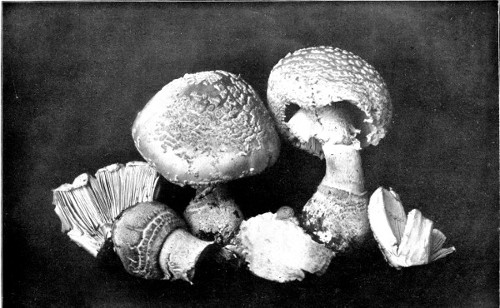
Photographed by Dr. J.R. Weist. Plate IX.
AMANITA MUSCARIA.
Pileus at first ovate or hemispherical, then broadly convex or nearly
plane, slightly viscid when young and moist, rough with numerous
15whitish or yellowish warts, rarely smooth, narrowly and slightly striate
on the margin, white, yellow or orange-red. Gills white. Stem equal
or slightly tapering upward, stuffed with webby fibrils or hollow, bearing
a white ring above, ovate-bulbous at the base, white or yellowish;
the volva usually breaking up into scales and adhering to the upper part
of the bulb and the base of the stem. Spores elliptical, 8–10x6–8µ.
Plant 5–8 in. high. Pileus 3–6 in. broad. Peck, 33d Rep. N.Y.
State Bot.
A white variety, with the pileus thickly studded with sharp warts,
occurs in Albany Rural Cemetery. July. Peck, 24th Rep.
Var. al´ba Pk. It also occurs on Long Island in two forms, the
normal one and a smaller one, in which the warts of the pileus are
evanescent or wanting. Not unfrequently it makes a close approach to
white forms of A. pantherina, in having the upper part of the bulb uniformly
margined by the remains of the definitely circumscissile volva,
but this margin is more acute than in that species. Peck, 46th Rep.
N.Y. State Bot.
Spores spheroid-ellipsoid, 10–12x8–9µ K.; 6x9µ, W.G.S.; elliptical,
8–10x6–8µ Peck.
“At Cincinnati, yellow A. muscaria are all we find.” Lloyd.
Reported from most of the states. At Mt. Gretna I found it in great
quantity, and frequently three or four tightly crowded together. Many
pounds of it were sent to Professor Chittenden, Sheffield Laboratory,
Yale University. Near Haddonfield, N.J., large patches annually
grow under pines, gorgeous in their rich orange-red caps, usually scaly,
with at times lemon-yellow in the same clusters, smooth as A. Cæsarea.
It grows from July until after hard frosts.
It is undoubtedly poisonous to a high degree. Its juices in minute
quantity, carefully and scientifically injected into the circulation of etherized
cats, kill in less than a minute. A raw piece of the cap, the size
of a hazel nut, affects me sensibly if taken on an empty stomach. Dizziness,
nausea, exaggeration of vision and pallor result from it. The
pulse quickens and is full, and a dreaded pressure affects the breathing.
I have not noticed change in the pupil of the eye. Nicotine from
smoking a pipe with me abates the symptoms, which entirely disappear
in two hours, leaving as reminiscence a torturing, dull, skull-pervading
headache. If, as is asserted on good authority, the Siberians
use it as an intoxicant, they certainly suffer the accustomed penalty.
16It is possible that persons may, in a degree, become immune to its poison,
as they do to arsenic, strychnia, opium, nicotine, or it may be that
a portion of the poison is extracted by boiling. It is, however, extremely
dangerous to rely upon extracting by any means the poison of
the Amanita, and to eat the residue. Acetic acid or vinegar does not
destroy the poison; it dissolves it to an extent and extracts it, and becomes
as poisonous as the plant itself. There is no means of telling
how much of the poison remains in the plant after such treatment. The
safe plan is to eat, only, of toadstools which do not contain any poison
to extract.
One redeeming virtue, alone, rests with A. muscaria—it kills flies.
A. Frost´iana Pk.—in honor of Charles C. Frost. POISONOUS.
(Plate VI, fig. 5, p. 6.) Pileus convex or expanded, bright-orange or
yellow, warty, sometimes nearly or quite smooth, striate on the margin.
Gills free, white or slightly tinged with yellow. Stem white or yellow,
stuffed, bearing a slight, sometimes evanescent ring, bulbous at the base,
the bulb slightly margined by the volva. Spores globose, 8–10µ in
diameter.
Plant 2–3 in. high. Pileus 1–2 in. broad. Stem about 2 lines
thick. June to October.
This appears like a very small form of the Fly Agaric, to which, as
var. minor, it was formerly referred. The only decided characters for
distinguishing it are its small size and globose spores. Our plant sometimes
grows in company with A. muscaria, but it seems to prefer more
dense woods, especially mixed or hemlock woods. It is generally very
regular and beautiful and has the stem quite often of a yellow color, and
the bulb margined above with a collar-like ring. Peck, 33d Rep. N.Y.
State Bot.
West Virginia, New Jersey, North Carolina, McIlvaine.
A. Frostiana is found well over the land. It is frequent in shady
woods and seems to favor ground under the prevailing tree—oak, chestnut,
pine, hemlock, whichever it may be. From the many hundreds
I have seen, I think it more likely to be mistaken by the novice for A.
Cæsarea than A. muscaria, because of its often yellow gills and stem.
It is much smaller and thinner than either. In the states I have found
it, it is darker than described, being a rich reddish-orange or scarlet.
The partial veil or ring is very evanescent but often found upon the
17stem as a yellow, floccose remnant. The stain of the ring is always
noticeable. The volva is seldom found entire. It, too, is evanescent,
but, like the veil, is found yellow and fluffy, adhering to the fingers
when touched.
It is probable that its highly colored cap has caused it to be gathered
by the careless collector of bright-capped Russulæ, and that thus R.
emetica got its bad name. Examine carefully any toadstool resembling
it. The Russulæ have neither ring nor volva.
A. excel´sa Fr.—excelsus, tall. POISONOUS. Pileus 4–5 in. broad,
brownish-gray, darker in the center, fleshy, soft, globose, then plane,
pellicle thin, but viscous, and in reality separable in wet weather, then
the surface is often wrinkled-papillose, or in a peculiar manner hollowed
and pitted, sprinkled with angular, unequal, whitish-gray, easily separating
warts, the remains of the friable volva; margin at first even,
but when properly developed manifestly striate, even furrowed. Flesh
soft, white throughout, unchangeable. Stem 4–6 in. long, 1 in. thick,
at first stuffed, almost solid, but at length hollow, globose-depressed at
the base, attenuated upward from the bulb, covered, sometimes as far
as the ring, sometimes only on the lower part with dense, squarrose, concentric
scales (from the epidermis of the stem being torn), striate at the
apex. Ring superior, large, separating-free or at length torn. Gills
quite free, rounded (not decurrent on the stem in the form of lines),
very ventricose, ½ in. and more broad, shining white.
The bulb when young is somewhat marginate, but by no means separable,
the margin proper, like that of A. muscaria, is marked with
scales, buried in the soil, somewhat rooting, beneath the margin marked
here and there with a concentric furrow. The shorter gills intermixed
are more numerous than is usual among Amanitæ. There is a smaller
variety, with the margin more frequently striate and the stem stuffed,
then hollow. Fries.
Solitary, in woods, chiefly under beech. Stevenson.
Spores 6x9µ W.G.S.; 8–9×5–6µ Massee.
North Carolina, Schweinitz, Curtis; South Carolina, Ravenel; California,
Harkness and Moore; Massachusetts, Frost, Andrews; Minnesota,
Johnson; Rhode Island, Olney.
A. pantheri´na De C.—spotted like a panther. Doubtful. Pileus
18commonly olivaceous-umber when young, fleshy, convex then flattened
or somewhat depressed, with a sticky pellicle, which is at first thick and
olivaceous dingy-brown, then thinned out, almost disappearing and
livid, the disk only becoming brownish; margin evidently striate; the
fragments of the volva divided into small, equal, white, regularly
arranged, moderately persistent warts. Flesh wholly white, never
yellow beneath the pellicle. Stem 3–4 in. long, ½ in. thick, at first
stuffed then hollow with spider-web fibrils within, equal or attenuated
upward, slightly firm and sometimes scaly downward, greaved at the
base by the separable volva which has an entire and obtuse margin.
Ring more or less distant, adhering obliquely, white, rarely superior.
Gills free, reaching the stem, broader in front, 3–4 lines broad, shining
white.
It is readily distinguished from A. muscaria, var. umbrina, by the
white flesh never becoming yellow beneath the pellicle. Variable in
size and color, which, however, is never red or yellow, and in the position
of the ring.
In woods and pastures. Stevenson.
Spores 7–8×4–5µ K.; 6–10µ B.; 8×4µ W.G.S.; 7.6×4.8µ Morgan.
Not poisonous, W.G.S.; not edible, Roze; poisonous, Leuba.
North Carolina, Pennsylvania, Ohio, California, Wisconsin, Minnesota,
Iowa, New York. Peck.
A. Ravenel´ii B. and C.—in honor of Henry W. Ravenel. Pileus
4 in. across, convex, broken up into distinct areas, each of which is
raised into an acute, rigid, pyramidal wart. Stem 3 in. high, bulbous.
Volva thick, warty, somewhat lobed. Ring deflexed.
South Carolina, June, H.W. Ravenel; a very fine species allied to
A. strobiliformis, Vitt. Ann. and Mag. Nat. Hist., 1859; Alabama,
Atkinson (Ll. Volvæ).
Properties not stated.
A. russuloi´des Pk.—resembling a Russula. Pileus at first ovate,
then expanded or convex, rough with a few superficial warts, or entirely
smooth, viscid when moist, widely striate-tuberculate on the margin,
pale-yellow or straw color. Gills close, free, narrowed toward the
stem, white. Stem firm, smooth, stuffed, annulate, equal or slightly
tapering upward, bulbous; annulus thin, soon vanishing. Volva fragile,
subappressed. Spores broadly elliptical, 10×8µ.
19Plant 2–3 in. high. Pileus 1.5–2 in. broad. Stem 3–5 lines thick.
Grassy ground in open woods. Greenbush. June.
This species is remarkable for the thin striate-tuberculate margin of
the pileus, which causes it to resemble some species of Russula. Peck,
25th Rep. N.Y. State Bot.
Qualities not stated.
Massachusetts, Francis.
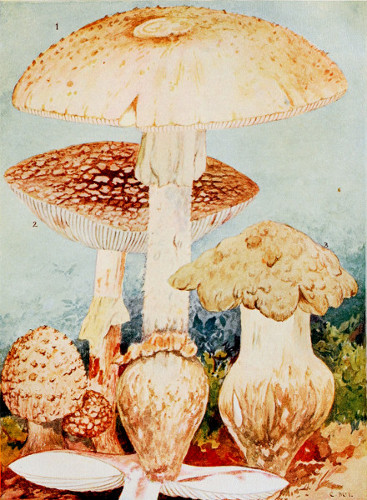
Grouped by F.D. Briscoe—Studies by C. McIlvaine. Plate VIII.
| Fig. |
Page. |
| 1. Amanita chlorinosma, |
25 |
| 2. Amanita rubescens and section, |
21 |
| 3. Amanita strobiliformis, |
19 |
A. strobilifor´mis Vitt.—strobilis, a pine-cone, from the shape of
the warts. (Plate VIII, fig. 3, p. 18.) Cap 3–10 in. across, convex
or nearly plane, white or cinereous, sometimes yellow on the disk,
rough with angular, mostly persistent warts which sometimes fall away
and leave the pileus nearly smooth; generally whitish, sometimes tinged
with brown; the margin even and extending a little beyond the lamellæ.
Gills free, rounded behind. Veil large and portions sometimes adhere
to margin of cap. Stem 3–8 in. long, up to 1¼ in. thick, equal or
slightly tapering upward, solid, floccose-scaly, white, bulbous, the bulb
very large, sometimes weighing a pound, margined above and furnished
with one or two concentric furrows, somewhat pointed below, firmly
and deeply imbedded in the earth, floccose-mealy when young.
Spores elliptical, 13–15×8–10µ Peck.
Open woods and borders. June to October.
Edible. W.G. Smith, Curtis, Peck.
This is among the best of species. Its size, solidity, flavor are
marked. I have found specimens weighing a pound and a half. It
grows singly, but when one is found several are apt to be neighbors.
When young, the cap is but a small knob upon a beet or top-shaped
base, which is largely under ground. It cuts like a soft turnip, and has
a strong, pungent, unmistakable odor, like chloride of lime, which entirely
disappears in cooking. As the plant develops the bulb decreases
in size. On all the many specimens the author has seen and eaten, the
scabs are light brown and reddish-brown.
A. solita´ria Bull.—growing alone. Pileus convex or plane, warty,
white or whitish, even on the margin. Gills reaching the stem, white
or slightly tinged with cream color. Stem at first mealy or scaly, equal,
solid, white, bulbous, the bulb scaly or mealy, narrowed below into a
root-like prolongation. Ring lacerated, often adhering in fragments to
the margin of the pileus and gills. Spores elliptical-oblong, 8–13×6.5µ.
20Plant 4–8 in. high. Pileus 3–6 in. broad. Stem 4–6 lines thick.
Peck, 33d Rep. N.Y. State Bot.
Solitary in woods and open places. July to October.
Georgia, H.N. Starnes; Indiana, H.I. Miller; West Virginia, New
Jersey, Pennsylvania, McIlvaine.
Edible. Curtis, H.N. Starnes, Philadelphia Myc. Club.
In many localities I find it quite plentiful, and it is so reported from
Georgia. Southern and middle New Jersey woods abound with it, and
at Mt. Gretna, Pa., it is always present in its growing months.
The cap is sometimes tinged with brown as are the angular, erect
warts which are generally numerous, but often falling off or few and
scattered. The flesh is white and smells like chloride of lime, but not
nearly so strong as A. strobiliformis. The volva is broken up into
floccose scales which cling to bulb and lower part of stem. These scales
may be white and mealy or brownish. The entire fungus has a fluffy
exterior, which is easily removed by rubbing. The annulus is torn, a
part often adhering to the margin of the pileus and the gills. This and
the long, tapering, rooting bulb are marked characteristics. The bulb
is brittle. It is difficult to get the fungus from the ground entire.
Stem and cap are juicy, tender, mild in flavor, wholesome. It is not
equal in flavor to A. rubescens, but is more delicate.
By many its properties have been stated as poisonous, doubtful.
Quantities of it have been eaten by myself and friends. Hypodermic
injection of its juices into the blood circulation of live animals prove it
perfectly harmless.
A. can´dida Pk.—shining white. Pileus thin, broadly convex or
nearly plane, verrucose with numerous small, erect, angular or pyramidal,
easily separable warts, often becoming smooth with age, white, even on
the margin. Flesh white. Gills rather narrow, close, reaching to the
stem, white. Stem solid, bulbous, floccose-squamose, white, the annulus
attached to the top of the stem, becoming pendent and often disappearing
with age, floccose-squamose on the lower surface, striate on the
upper, the bulb rather large, ovate, squamose, not margined, tapering
above into the stem and rounded or merely abruptly pointed below.
Spores elliptical, 10–13×8µ.
Pileus 3–6 in. broad. Stem 2.5–5 in. long, 5–8 lines thick, the
bulb 1–1.5 in. thick in the dried specimens.
21This is a fine large species related to A. solitaria, but differing from
it in the character of its bulb and of its annulus. The bulb is not marginate
nor imbricately squamose. Its scales are small and numerous.
Nor is it clearly radicating, though sometimes it has a slight abrupt
point or myceloid-agglomerated mass of soil at its base. The veil or
annulus is large and well developed, but it is apt to fall away and disappear
with age. Its attachment at the very top of the stem brings it
closely in contact with the lamellæ of the young plant and the striations
of its upper surface appear to be due to the pressure of the edges of
these upon it. It separates readily from the margin of the pileus and is
not lacerated. In the mature plant the warts have generally disappeared
from the pileus and sometimes its margin is curved upward
Peck, Bull. Torr. Bot. Club, Vol. 24, No. 3.
Woods. Auburn, N.Y., Alabama, U. and E.; Pennsylvania, West
Virginia, New Jersey, August to October, McIlvaine.
A dozen or more specimens were found in oak woods near Philadelphia,
and carefully tested. Their edible qualities were found to be
precisely the same as A. solitaria.
***
Whole volva friable, etc.
A. rubes´cens Pers.—rubesco, to become red. (Plate VIII, fig. 2,
p. 18. Plate XII, fig. 4, p. 32.) Pileus about 4 in. broad, dingy-reddish,
becoming pale flesh-color, tan, scarcely pure, fleshy, convex,
then plane, obtuse, moist but not glutinous in rainy weather and opaque
when dry, covered with unequal, soft, mealy, whitish, easily-separating
warts, which are smaller, harder and more closely adherent in dry
weather; margin even and, when old, slightly striate only in wet weather.
Flesh commonly soft, white when fresh, reddening when broken. Stem
4–5 in. long, as much as 1 in. thick, stuffed, somewhat solid, though
soft within, conico-attenuated from the thickened base, reddish-scaled,
becoming red-white, and without a trace of a distinct volva at the base.
Ring superior, large, membranaceous, soft, striate and white within.
Gills reaching the stem in an attenuated manner, forming decurrent lines
upon it, thin, crowded, soft, as much as ½ in. broad, shining white.
Very changeable, but readily distinguished from all others of the
same group by the flesh being reddish when broken; the stem and pileus
are commonly spotted-red when wounded. In dry weather it is firmer,
flesh reddening more slowly, warts minute. Odor scarcely any. There
22is a remarkable variety circinata, pileus becoming plane, umber-brown,
warts adnate, crowded, roundish. A. circinatus Schum. Stevenson.
Spores spheroid-ellipsoid, 7–8×6µ K.; 8×6µ W.G.S.; 7–9×6–8µ B.;
elliptical, 8–9µ long. Peck.
Not reported west of the Mississippi river.
Oak woods, borders and open places. July to September. Indiana,
H.I. Miller; West Virginia, New Jersey, North Carolina, Pennsylvania,
McIlvaine.
It is quite common, often growing in large patches. Recent authors
agree upon the edibility and deliciousness of this species. The author
knows it to be one of the most plentiful, useful and delicious, after several
years of pleasant experience with it.
In July, 1899, at Mt. Gretna, I found, growing from the ground gregariously,
a singular fungoid growth from 2–5 in. high; cap hemispherical,
1 in. in diameter, tightly fitting a solid stem of nearly the
diameter of the cap. The whole was watery white, and evidently affected
by a parasite. It was edible. September 1st Professor Peck
wrote to me: “I think I have found the identity of the diseased
Agaric, of which you sent me samples some time ago. I mean the one
affected by Hypomyces inæqualis Pk. The host is Amanita rubescens,
at least sometimes, and probably always.”
The plant is very heavy for its size. The lack of a volva, the dingy
color and reddish stains distinctly separate this from any poisonous
Amanita.
A. spis´sa Fr.—compact, dense;—of the warts. Pileus umber, sooty
or gray, fleshy, somewhat compact, convexo-plane, obtuse, smooth,
even, but marked with small, ash-colored, angular, adnate warts; margin
even, but often torn into fibers. Flesh firm, white, quite unchangeable.
Stem 2–3 in. long, as much as 1 in. thick, solid, turnip-shaped
at the base, somewhat rooting with a globoso-depressed not marginate
bulb, curt, firm, shining white, at length squamulose with concentric
cracks. Ring superior, large. Gills reaching the stem, slightly striato-decurrent,
broad, crowded, shining white. Fries.
Spores 14µ W.G.S.; subglobose, 8–10µ C.B.P.; 6µ W.P.; rather
pear-shaped, 9–10×6µ Massee.
Cap 2–3 in. across. Stem 2½-3 in. long, up to ¾ in. thick.
New Jersey, oak woods, August and September. McIlvaine.
23A. spissa has been reported from but few localities. It is rare in the
latitude of Philadelphia. Half a dozen specimens have been found in
neighboring New Jersey.
Taste and smell strong, but when cooked the dish is savory and not
unlike one of A. rubescens.
A. as´pera Fr.—asper, rough. Pileus 2–3 in. across. Flesh rather
thick at the disk, whitish, white or reddish with tints of livid or gray,
reddish or brownish under the cuticle; convex then plane, margin thin
and even, rough with firmly adnate, minute, closely crowded, angular
warts, reddish-brown or livid-brownish, not pure white, unchangeable.
Gills free and rounded behind, not striately decurrent, ventricose, white.
Stem stuffed, striate above the ring, short at first, ovate, then elongating
to 2–3 in., attenuated upward from a wrinkled bulb, squamulose,
white without and within. Ring superior, entire.
Spores 8×6µ Massee; 8×6–7µ W.G.S.
The flesh of stem and bulb when eaten by insects is reddish, the bulb
when old is a reddish-brown. The large ring and stem become red
when touched. In these particulars it resembles A. rubescens. In smell
it is somewhat strong, not unlike A. strobiliformis, but not nearly so
pungent.
Cooked it is of excellent quality and flavor. I have eaten it since 1885.
A. abrup´ta Pk.—abrupt, of the bulb. Pileus thin, broadly convex
or nearly plane, covered with small angular or pyramidal, erect, somewhat
evanescent warts, white, slightly striate on the margin. Flesh
white. Gills moderately close, reaching the stem and sometimes terminating
in slightly decurrent lines upon it, white. Stem slender, glabrous,
solid, bulbous, white, the bulb abrupt, subglobose, often coated
below by the white persistent mycelium, the ring membranous, persistent.
Spores broadly elliptical or subglobose, 8–10×6–8µ.
Pileus 2–4 in. broad. Stem 2.5–4 in. long, 3–4 lines thick.
The chief distinguishing mark of this species is the abrupt, nearly
globose, bulbous base of the stem. This is somewhat flattened above
and is sometimes longitudinally split on the sides. The small warts of
the pileus are easily separable, and in mature specimens they have often
wholly or partly disappeared. The remains of the volva are not present
on the bulb in mature dried specimens, which indicates that the
24species should be placed in the same group with A. rubescens, A.
spissa, etc. The latter species have the bulb of the stem similar to that
of our plant, but the color of the pileus and other characters easily separate
it. Peck, Bull. Torr. Bot. Club, Vol. 24, No. 3.
Alabama, Underwood; New Jersey, Pennsylvania, McIlvaine. July
to September.
This species is edible and quite equal in quality to A. rubescens.
Great care should be exercised in distinguishing it.
A. nit´ida Fr.—niteo, to shine. Pileus when flattened 4 in. broad,
whitish, fleshy, somewhat compact, at first hemispherical, wrapped up, the
thick volva forming a floccose crust, then broken up into thick, remarkably
angular, adhering warts, which become brownish, dry, shining,
without a glutinous pellicle, margin always even. Flesh white, quite
unchangeable. Stem 3 in. long, 1 in. thick, solid, firm, conico-attenuated,
with a bulb-shaped base, squamulose, white. Ring superior, thin,
torn, slightly striate, white, villous beneath, at length disappearing.
Gills free, crowded, very broad, as much as ½ in., ventricose, shining
white. Fries.
Menands. Albany county. Our plant is more slender than the
typical form, and has smaller but more numerous warts, but in other
respects it exhibits the characters of this species. Peck, 43d Rep. N.Y.
State Bot.
California, H. and M.; Maryland. Common in nearly every woods
in Maryland. Banning.
From its likeness to poisonous species it should be suspected.
A. prairiic´ola Pk—prairie, colo, to inhabit. Pileus thin, convex,
slightly verrucose, white, more or less tinged with yellow, even on the
margin. Flesh white. Gills rather broad, subdistant, reaching the
stem, white. Stem equal or slightly tapering upward, somewhat
squamose toward the base, white or whitish, the annulus persistent.
Spores large, broadly elliptical, 12–14µ long, 7–9µ broad.
Pileus 1.5–3 in. broad. Stem 2–2.5 in. long, 2–4 lines thick.
Bare ground on open prairies. Kansas. September. E. Bartholomew.
This species belongs to the same tribe as A. abrupta. The only evidence
of the presence of a volva shown by the dried specimens is found
in a few inconspicuous, but separable warts on the pileus. There is no
25well marked bulb to the stem and no evidence remains of a volva at its
base. Peck, Bull. Torr. Bot. Club, Vol. 24, No. 3.
Reported from Kansas only. Qualities unknown.
A. monticulo´sa Berk.—mountain, from the warts. Pileus 2.5–3 in.
across, convex, areolate, with a wart in the center of each areola; those
toward the margin consisting of soft threads meeting in a point, but
sometimes simply flocculent, the central warts angular, pyramidal, truncate,
discolored. Stem bulbous, scaly, flocculent, white. Veil thick,
at length distant. Gills free, ventricose, remote, forming a well-defined
area around the top of the stem. The warts are not hard and rigid as
in A. nitida, and the free remote gills separate it from that and the
neighboring species. Berk.
North Carolina, sandy woods, common. Curtis.
Properties not known.
A. dau´cipes B. and M.—daucum, a carrot; pes, a foot. Pileus 2–5
in. broad, hemispherical, globose. Flesh white, soft, warts regular,
pyramidal, saffron color. Gills narrow, reaching the stem, broadest in
the middle. Stem 5–6 in. high, solid, base bulbous, with a restricted
cortina above, squamulose downward. Veil fibrillose, extending from
the margin of the pileus to the apex of the stem, fugacious.
In cultivated fields. Ohio. Sullivant. Properties not given.
A. lenticular´is Lasch.—resembling (the stem) a lentil.
Fries places this species in Amanita, in which Stevenson follows him.
Cooke and Massee place it in Lepiota, where it will be found.
****
Volva rudimentary, wholly disappearing.
A. chlorinos´ma Pk.—smelling like chlorine. (Plate VIII, fig. 1,
p. 18.) Pileus convex or expanded, warty on the disk, covered on
the even margin with a light powdery, at length evanescent substance,
white. Gills white. Stem nearly cylindrical, stout, deeply penetrating
the earth. Spores broadly elliptical, 7–10µ long. Odor distinct, chlorine-like.
Plant 6–7 in. high. Pileus 4–6 in. broad. Stem 1–2 in. thick.
Peck, Bot. Gaz., Vol. 4.
26Burnt ground in woods. August. Closter, N.J., C.F. Austin;
Alabama, U. and E.; West Virginia, Nuttall; New Jersey, Ellis;
Mt. Gretna, Pa., July, in a cluster of a dozen individuals, and afterward
until frost, strong smelling, warts brownish-white. McIlvaine.
It is edible and equal to A. strobiliformis.
A. calyptra´ta Pk. Pileus fleshy, thick, convex or nearly plane,
centrally covered by a large irregular persistent grayish-white fragment
of the volva, glabrous elsewhere, striate on the margin, greenish-yellow
or yellowish-brown tinged with green, the margin often a little paler or
more yellow than the rest. Lamellæ close, nearly free, but reaching
the stem and forming slight decurrent lines or striations on it, yellowish-white
tinged with green. Stem stout, rather long, equal or slightly
tapering upward, surrounded at the base by the remains of the ruptured
volva, white or yellowish white with a faint greenish tint. Spores
broadly elliptic, 10µ long, 6µ broad, usually containing a single large
nucleus.
Pileus 10–20 cm. broad. Stem 10–15 cm. long, 12–20 mm. thick.
Rich ground in fir woods or their borders. Autumn. Oregon. Dr.
H. Lane.
This is a large and interesting species, well marked and easily recognized
by its large size, by the greenish tint that pervades the pileus,
lamellæ, annulus and stem, and especially by the large persistent patch
of grayish-white felty material that covers the center of the pileus and
sometimes extends nearly to the margin. This is in fact the upper part
of the ruptured volva that is carried up by the growing plant, and is
very suggestive of the specific name. In the young state the plant is
entirely enveloped in the volva, which then is similar to a goose egg in
size and shape, and its walls are one-fourth to one-half inch thick. So
thick and firm are they that the young plant appears sometimes to be
unable to break through and it decays in its infancy.
Dr. Lane says that, having found that the Italians made use of this
mushroom for food, he began eating it and introducing it to his friends,
and he learned by personal trial that it is a thoroughly good and wholesome
mushroom, which, when broiled with bacon, fried, baked or
stewed, may be eaten with perfect safety and that it is a nutritious food.
Peck, Bull. Torrey Bot. Club, Vol. 27, January, 1900.
27A. crenula´ta Pk. Pileus thin, broadly ovate, becoming convex
or nearly plane and somewhat striate on the margin, adorned with a few
thin whitish floccose warts or with whitish flocculent patches, whitish or
grayish, sometimes tinged with yellow. Lamellæ close, reaching the
stem, and sometimes forming decurrent lines upon it, floccose crenulate
on the edge, the short ones truncate at the inner extremity, white.
Stem equal, bulbous, floccose mealy above, stuffed or hollow, white,
the annulus slight, evanescent. Spores broadly elliptic or subglobose,
7.5–10µ long, nearly as broad, usually containing a single large nucleus.
Pileus 2.5–5 cm. broad. Stem 2.5–5 cm. long, 6–8 mm. thick.
Low ground, under trees. Eastern Massachusetts. September. Mrs.
E. Blackford and George E. Morris.
The volva in this species must be very slight, as its remains quickly
disappear from the bulb of the stem. The remains carried up by the
pileus form slight warts or thin whitish areolate patches. The annulus
is present in very young plants, but is often wanting in mature ones, in
which state the plant might be mistaken for a species of Amanitopsis.
Its true affinity is with the tribe to which A. rubescens belongs. As in
that species, the bulb soon becomes naked and exhibits no remains of
the volva. It is similar to A. farinosa also in this respect, but quite
unlike it in color, in the adornments of the pileus and in the character
of its margin, which is even in the young plant and but slightly striate
in the mature state. Its dimensions are said sometimes to exceed those
here given, and it is reported to have been eaten without harm and to
be of an excellent flavor. I have had no opportunity to try. Peck,
Bull. Torrey Bot. Club, Vol. 27, January, 1900.
28AMANITOP´SIS Roze.
Amanita; opsis, resembling.
Having a universal veil at first completely enveloping
the young plant, which soon bursts through,
carrying particles of it on the pileus, where they
appear as scattered warts readily brushed off; the
remainder or volva closely enwraps the base of the
stem. Ring absent. Spores white. This genus
was formerly included in Amanita. It differs from
Amanita in the absence of a ring or collar upon the stem and in the
more sheathing volva. It differs from Lepiota in having a volva.
Close observation is necessary in collecting Amanitopsis for the table.
It has no trace of ring or veil upon the stem. So far as the species are
known no poisonous one exists. But Amanita spreta Pk., which is
deadly, so closely resembles forms of Amanitopsis that those confident
of their knowledge will be deceived. The veil or traces of veil, which
Amanita spreta always has, sometimes so adheres to and wraps the stem
that it is not noticeable without close examination, thus giving to it
every appearance of an Amanitopsis.
The volva of A. spreta is attached for a considerable distance to the
base of the tapering stem, and is not readily removed. This is a guide
to detect it. It is a wolf in sheep’s clothing.
Amanitopsis corresponds to Volvaria in the pink-spored series, in
which, as far as known, there is no poisonous species.
All American species of Amanitopsis are given. Several have not
been tested by the writer because of lack of opportunity.
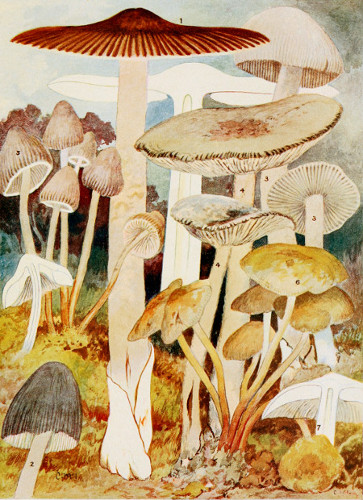
Grouped by F.D. Briscoe—Studies by C. McIlvaine. Plate X.
| Fig. |
Page. |
Fig. |
Page. |
| 1. Amanitopsis vaginata, |
28 |
5. Mycena galericulata, |
127 |
| 2. Amanitopsis vaginata, var. livida, |
29 |
6. Mycena prolifera, |
126 |
| 3. Amanitopsis nivalis, |
29 |
7. Mycena prolifera (section), |
126 |
| 4. Amanitopsis strangulata, |
30 |
|
|
A. vagina´ta Roze—vagina, a sheath. (Plate X, figs. 1, 2, p: 28.)
Pileus thin, fragile, glossy, smooth except in rare instances where a
few fragments of the volva adhere to it for a time, deeply and distinctly
striate on the margin, sometimes umbonate. Flesh white, in the dark
forms grayish under the skin. Stem ringless, sometimes smooth, but
generally mealy or floccose, hollow or stuffed with a cottony pith, not
bulbous. Volva long, thin, fragile, closely sheathing yet free from the
stem, except in the lower part, easily detachable and frequently remaining
in the ground when the plant is pulled. Color variable, generally
mouse-gray, sometimes livid, tawny-yellow or white, in one variety a
29rich date-brown. Spores globose, 8–10µ broad Peck; elliptical 10×7–8µ
Massee.
Var. liv´ida Pers.—livid. Leaden brown, gills dingy. (Plate X,
fig. 2, p. 28.)
Var. ful´va Schæff.—yellowish. Tawny-yellow or pale ochraceous.
This plant is widely dispersed, having been reported from many localities
in the United States, also from Nova Scotia and Greenland.
On ground in woods and on margins of woods, under trees, in shaded
grassy places. Sometimes in open stubble and pastures. June to frost.
Mt. Gretna, September, 1899, found a cluster on decayed chestnut
stump. Various colors abound—hazel, brown, gray, yellow, whitish.
The caps and stems are tender as asparagus tips, but without much distinct
flavor when cooked.
Great care must be taken to distinguish these forms from Amanita
spreta Pk. which is poisonous. See heading of genus—Amanitopsis.
A. niva´lis Grev.—snowy. (Plate X, fig. 3, p. 28.) Pileus at first
ovate, then convex or plane, smooth, striate on the thin margin, white,
sometimes tinged with yellow or ochraceous on the disk. Flesh white.
Gills subdistant, white, free. Stem equal, rather tall, nearly smooth,
bulbous, stuffed, white; the volva very fragile, soon breaking up into
fragments or sometimes persisting in the form of a collar-like ring at the
upper part of the bulb. Spores globose, 7.5–10µ in diameter.
Plant 4–6 in. high. Pileus 2–3 in. broad. Stem 2–4 lines thick.
July to October.
It approaches in some respects A. Frostiana, but its larger size,
smooth pileus, lighter color and the absence of an annulus will easily
distinguish it from that species. Peck, 33d Rep. N.Y. State Bot.
Specimens have been repeatedly found by the writer in open oak
woods near Philadelphia.
A strong, unpleasant bitter, which appears to develop while cooking,
renders it unpalatable. It is harmless, but its use is not advised.
A. velo´sa Pk.—velosus, fleecy. Pileus at first subglobose, then bell-shaped
or nearly plane, generally bearing patches of the remains of the
whitish felty or tomentose volva, elsewhere glabrous, becoming sulcate-striate
on the margin, buff or orange-buff. Flesh compact, white.
Gills close, reaching the stem, subventricose, pale cream color. Stem
30firm, at first attenuated and tomentose at the top, then nearly equal,
stuffed, white or whitish, closely sheathed at the base by the thick volva.
Spores globose, 10–13µ.
Pileus 2–4 in. broad. Stem 3–4 in. long, 3–4 lines thick.
Under oak trees. Pasadena, California. April. A.J. McClatchie.
This fungus is closely related to A. vaginata, from which it may be
separated by the more adherent remains of the thicker volva which
sometimes cover the whole surface of the pileus, and by the thicker gills
which are somewhat adnate to the stem and terminate with a decurrent
tooth. Bull. Torr. Bot. Club, Vol. 22, No. 12.
As it is probable this species will be found elsewhere than California,
and from its close relation to A. vaginata likely to be edible, its description
is here given.
A. strangula´ta (Fr.) Roze—choked, from the stuffed stem. (Plate
X, fig. 4, p. 28.) Pileus at first ovate or subelliptical, then bell-shaped,
convex or plane, warty, slightly viscid when moist, deeply and distinctly
striate on the margin, grayish-brown. Gills free, close, white. Stem
equal or tapering upward, stuffed or hollow, nearly smooth, white or
whitish, the volva soon breaking up into scales or subannular fragments.
Spores globose, 10–13µ.
Plant 4–6 in. high. Pileus 2–4 in. broad. Stem 3–6 lines thick.
Peck, 33d Rep. N.Y. State Bot.
A. Ceciliæ B. and Br. is a synonym.
Not distinct in color and general appearance from A. vaginata, but
distinctly separated by its warty pileus and evanescent mouse-colored
volva which does not sheath the stem. Pileus striate when young, then
sulcate. Stem mealy, especially on the upper part.
Woods, open grassy places, wheat stubble, etc. June to September.
Pennsylvania, New Jersey, West Virginia, McIlvaine.
In the latitude of Philadelphia the plant is found in great abundance.
Its rather early appearance, staying quality, delicate consistency and
flavor make it valuable as a food supply.
Pearl color, bluish-gray and gray are the prevailing cap-coloring.
A. adna´ta (W.G.S.) Roze—adnatus, adnate, of the gills. Pileus
about 3 in. across. Flesh thick, whitish, firm, convex, then expanded,
rather moist, pale yellowish-buff, often furnished with irregular, woolly
31patches of volva; margin even, extending beyond the gills. Stem 2–4
in. long, ½ in. thick, cylindrical, rough, fibrillose, pale buff, flesh distinct
from that of the pileus, stuffed, then hollow; base slightly swollen.
Volva adnate, white, downy, margin free and lax, sometimes almost
obsolete. Gills truly adnate, crowded, with many intermediate shorter
ones, white. Spores subglobose, with an oblique point, 7–8µ Massee.
Tender, good flavor, yielding more substance when cooked than any
other Amanitopsis.
A. volva´ta Pk.—possessing a volva. Pileus convex, then nearly
plane, slightly striate on the margin, hairy or floccose-scaly, white or
whitish, the disk sometimes brownish. Gills close, free, white. Stem
equal or slightly tapering upward, stuffed, minutely floccose-scaly,
whitish, inserted at the base in a large, firm, cup-shaped, persistent
volva. Spores elliptical, 10×8µ.
Plant 2–3 in. high. Pileus 2–3 broad. Stem 3–4 lines thick.
Peck, 33d Rep. N.Y. State Bot.
The plant is easily recognized by its large, cup-shaped volva and cap,
which is not smooth, as is usual in a species with a persistent membranous
volva, more or less scaly with minute tufts of fibrils or tomentose
hairs. The gills are white in the fresh plant.
Professor Peck notes the species as quite rare. Numerous specimens
occur in the sandy oak woods of New Jersey, and in oak woods near
Angora, Philadelphia. July to October.
Care must be taken to determine the absence of an annulus or any
trace of one. Tender, delicate, without pronounced flavor. Equal to
Amanitopsis vaginata.
A. farino´sa Schw.—covered with farina, meal. Pileus nearly plane,
thin, flocculent-pulverulent, widely and deeply striate on the margin,
grayish-brown or livid-brown. Gills free, whitish. Stem whitish or
pallid, equal, stuffed or hollow, mealy, sub-bulbous, the volva flocculent-pulverulent,
evanescent. Spores variable, elliptical ovate or subglobose,
6–8µ long.
Plant about 2 in. high. Pileus 1 in. to 15 lines broad. Stem 1–3
lines thick. July to September.
This is our smallest Amanita (now Amanitopsis). It is neither very
common nor very abundant when it does occur. It is described by
32Schweinitz as “solid,” but I have always found it stuffed or hollow.
Peck, 33d Rep. N.Y. State Bot.
A. pusil´la Pk.—small. Pileus thin, broadly convex or nearly plane,
subglabrous, slightly umbonate, even on the margin, pale brown. Gills
narrow, thin, close, free, becoming brownish. Stem short, hollow,
bulbous, the bulb margined by the remains of the membranous volva.
Spores broadly elliptical, 5–6×4µ.
Pileus about 1 in. broad. Stem 8–12 lines long, 1–2 lines thick.
Grassy ground. Gouverneur, St. Lawrence county. September. Mrs.
Anthony. Peck, 50th Rep. N.Y. State Bot.
Edibility not tested.
A. pubes´cens Schw.—downy. Pileus yellow, covered with a thin
pubescence, margin involute. Stem short, about 1 in. in length, at
first white becoming yellowish, bulbous, bulb thick. Volva evanescent.
Gills white.
In grassy grounds. Rare.
North Carolina, Schweinitz, Curtis.
A. agglutina´ta B. and C.—viscid. Pileus 1–2 in. broad, white,
hemispheric then plane, viscid, areolate-scaly from the remains of the
volva, margin thin, sulcate. Stem .5–1.5 in. long, 2 lines thick, short,
solid, bulbous. Volva with a free margin. Gills broad, ventricose,
rotundate-free. Spores elliptic.
In pine woods.
North Carolina, Curtis.
Resembling some of the dwarf forms of A. vaginata but at once distinguished
by its solid stem and decidedly viscid, areolate-squamose
pileus. Am. Jour. Sci. and Arts, 1848.
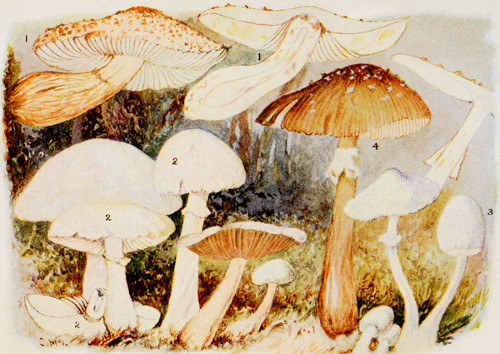
Grouped by F.D. Briscoe—Studies by C. McIlvaine. PLATE XII.
| Fig. |
Page. |
Fig. |
Page. |
| 1. Lepiota americana, |
48 |
3. Lepiota Cepaestipes, |
46 |
| 2. Lepiota naucinoides, |
45 |
4. Amanita rubescens, |
21 |
33LEPIO´TA Fr.
(Plate XI.)
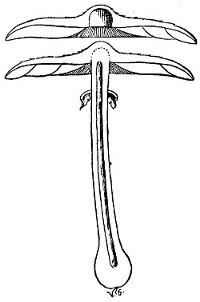
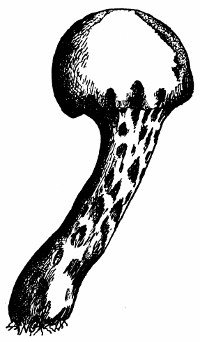
Section of Lepiota procera.
Pileus generally scaly from the breaking up of the cuticle and the
adherence of the concrete veil. Gills free, often very distant from the
stem and attached to a cartilaginous
collar. Stem hollow or stuffed,
its flesh distinct from that of the
pileus. Ring at first attached to
the cuticle of the pileus, often movable,
sometimes evanescent.
On the ground. Several are found
in hot-houses and hot-beds, and are
probably introduced species.
The universal veil, covering the
entire plant when very young, is
closely applied to the pileus, which
from the breaking up of the cuticle
is generally scaly. The stem in
most species differs in substance
from the pileus. This is readily
seen by splitting the plant in half
from cap to base. It is easily separated
from the cap, leaving a cup-like
depression therein. Gills usually
white. In some species they are yellow-tinted. In others they
become a dingy red when wounded or ageing.
The veil in this genus, being concrete with the cuticle of the pileus,
never appears as loose warts or patches, neither is there a volva as in
Amanita and Amanitopsis. These three genera are the only ones in
the white-spored series having gills free from the stem. In a few species
the gills are slightly attached to the stem, but are never decurrent upon
it as in Armillaria. When the plant is young it is egg-shaped. It then
gradually spreads, becomes convex, and opens until it is nearly flat,
with a knob in the center.
The only species in this genus known to be poisonous to some persons
is L. Morgani Pk., which is distinguished by its green spores and white
34gills becoming green. L. Vittadini has also been regarded with suspicion.
Proceri (
L. procera). Page
35.
Ring movable. The plant is at first entirely enclosed in a universal
veil, which splits around at the base, the lower part disappearing on
the bulb, the upper part attached to the pileus breaking up into scales.
Stem encircled at the top with a cartilaginous collar to which the free,
remote gills are attached.
Clypeolarii (L. clypeolaria). Page 39.
Ring fixed, attached to the upper portion of the universal veil which
sheaths the stem from the base upward, making it downy or scaly below
the ring. The remainder of the veil united with the pileus breaking up
and becoming downy or scaly. Collar at the apex of stem not so large
as in Proceri, hence the gills are not usually so remote. Taste and
smell unpleasant, resembling that of radishes.
Annulosi (
annulus, a ring). Page
44.
Ring fixed, somewhat persistent, universal veil closely attached to the
pileus. Collar absent or similar in texture to the stem. Stem, not
sheathed.
Granulosi (
L. granulosa). Page
49.
Pileus granular or warty. Universal veil sheathing the stem, at first
continuous from the stem to the pileus, finally rupturing, forming a ring
nearer the base. Stem not so distinctly different from the pileus as in
other sections.
Mesomorphi (L. mesomorpha).
Small, slender, stem hollow. Pileus smooth, dry.
B. Pileus Viscid. Neither Scaly Nor Warty.
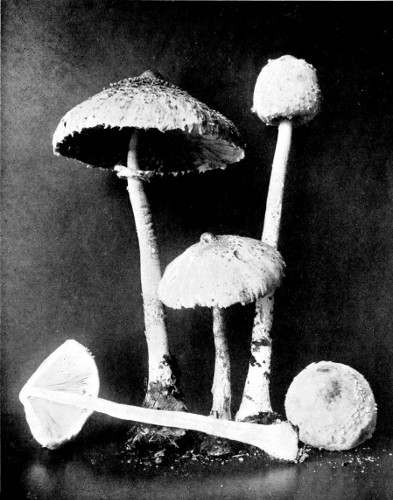
Photographed by Dr. J.R. Weist. Plate XIII.
LEPIOTA PROCERA.
Proce´ri. Ring movable, etc.
L. proce´ra Scop.—procerus, tall. (Plate XIII, p. 34.) Tall
Lepiota, Parasol Mushroom, in some localities Pasture Mushroom (a
misleading title).
The Flesh not very thick, soft, permanently white.
Pileus at first ovate, finally expanded, cuticle soon
breaking up into brown scales, excepting upon the
umbo, umbo smooth, dark-brown, distinct. The
caps vary in shades of brown, sometimes they
have a faint tinge of lavender. Gills whitish,
crowded, narrowing toward the stem, and very remote
from it. Stem variable in length, often very
long, tubular, at first stuffed with light fibrils,
quite bulbous at base, generally spotted or scaly with peculiar snake-like
markings below the ring, which is thick, firm and readily movable.
When the stem is removed from pileus it leaves a deep cavity extending
nearly to the cuticle.
Pileus 3–6 in. broad. Stem 5–12 in. high, about ½ in. thick.
White spores elliptical, 14–18×9–11µ Peck; 12–15×8–9µ Massee;
14×10µ Lloyd.
Readily known by its extremely tall stem, shaggy cap, distinct umbo
and the channel between the gills and stem. Resembles no poisonous
species.
Before cooking the scurf should be rubbed from the caps, which alone
should be eaten, as the stem is tough. Though the flesh is thin, the
gills are meaty and have a pleasant, nutty flavor. Fried in butter it
has few equals. It makes a superior catsup.
L. racho´des Vitt. Gr.—a ragged, tattered garment. Pileus very
fleshy, but very soft when full grown, globose then flattened or depressed,
not umbonate, at first incrusted with a thick, rigid, even, very smooth,
bay-brown, wholly continuous cuticle, which remains entire at the disk
but otherwise soon becomes elegantly reticulated with cracks; these very
readily separate into persistent, polygonal, concentric scales, which are
revolute at the margin and attached to the surface with beautifully
radiating fibers, the surface remaining coarsely fibrillose-downy. Flesh
36white, immediately becoming saffron-red when broken, easily separating
from the apex of the distinct stem, which is encircled with a prominent
collar. Stem stout, at the first bulbous with a distinct margin upon the
bulb, conical when young, then elongated, attenuated upward, as much
as a span long, very robust, 1 in. thick, and more at the base, always
even, and without a trace of scales or even of fibrils although the appearance
is obsoletely silky, wholly whitish, hollow within, stuffed with
spider-web threads, the walls remarkably and coarsely fibrous. Ring
movable, adhering longer to the margin of the pileus than to the apex
of the stem, hence rayed with fibers at the circumference, clothed
beneath with one or two zones of scales. Gills very remote, tapering
toward each end or broadest at the middle, crowded, whitish, sometimes
reddening. Stevenson.
Veil remarkable in its development and thick margin.
Spores 6×8µ W.G.S.
Fort Edward, Howe; Westfield, N.Y., Miss L.M. Patchen; Pennsylvania,
New Jersey, McIlvaine.
A heavier species than L. procera, of which by some writers it has
been considered a variety, but it differs in the absence of umbo and flesh
becoming tinged with red.
Stem is decidedly swollen downward. Veil heavy, apparently double,
thickest at margin of cap to which it remains attached in heavy fragments.
It tears from the stem, leaving no mark of ring.
Var. puella´ris Fr.—puella, a girl. Smaller than typical form, shining
white, pileus with downy scales. Not yet reported in America.
Edible qualities similar to those of L. procera. It is sold indiscriminately
with it in London markets.
L. excoria´ta Schaeff.—stripped of its skin. Flesh spongy, rather
thick, white, unchangeable. Pileus at first globose, then flat, hardly
umbonate, pale-fawn or whitish, disk dark; cuticle thin, silky or scaly,
sometimes areolate, more or less peeled toward margin, hence its name.
Gills ventricose, white, free, somewhat remote. Stem attenuated,
hollow or stuffed, short, scarcely bulbous, smooth, white, not spotted,
very distinct from flesh of pileus. Ring movable but not so freely as
that of L. procera.
Stem 1½-2½ high, less than ½ in. thick. Pileus 2–3 in. broad.
Spores 14–15×8–9µ Massee.
37In pastures or grassy lawns. May to September.
North Carolina, edible, Curtis; Massachusetts, Frost; California, H.
and M.; Ohio, Morgan; Minnesota, Johnson.
Distinguished from the preceding by its smaller size and short stem
which is scarcely bulbous.
Esculent qualities good.
L. mastoi´dea Fr. Gr.—breast-shaped. Pileus rather thin, ovate,
bell-shaped, then flattened, with a conspicuous acute umbo, cuticle thin,
brownish, breaking up in minute scattered scales; the pileus appears
whitish beneath. Stem hollow, smooth, tough, flexible, attenuated
from the bulbous base to the apex. Ring entire, movable. Gills very
remote, crowded, broad, tapering at both ends, white.
Pileus 1–2 in. broad. Stem 2–3 in. long, 3–4 lines thick at base,
1½-2 lines at apex.
North Carolina, edible, Curtis. It is generally eaten in Europe.
In woods, especially about old stumps. October.
The entire plant is whitish and is well marked by the prominent umbo,
which generally has a depression around it. It has the least substance
of any in this section, and consequently not much value as food.
L. gracilen´ta Krombh.—gracilis, slender. Pileus rather fleshy,
thickest at the disk, ovate then bell-shaped, finally flattened, obscurely
umbonate; at first brownish from the adnate cuticle, which, breaking
up into broad adpressed scales, allows the whitish pileus to be seen beneath
them. Gills remote, very broad, crowded, pallid. Stem whitish,
obscurely scaly, hollow or containing slight fibrils, slightly bulbous.
Ring thin, floccose, vanishing.
Stem 5–6 in. long, 3–5 lines thick. In pastures, also in woods.
Spores 11×8µ W.G.S.
Almost as tall as L. procera, but slighter in stem and pileus; the
ring, instead of being firm and persistent, is thin and fugacious, and
the stem is hardly bulbous.
Edible, but not of the first quality.
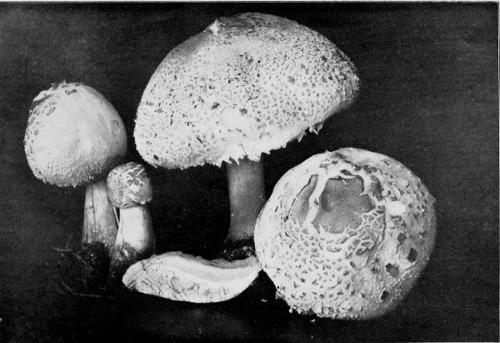
Photographed by Dr. J.R. Weist. Plate XIV.
LEPIOTA MORGANI.
L. Mor´gani Pk.—in honor of Professor Morgan. (Plate XIV.)
Pileus fleshy, soft, at first subglobose, then expanded or even depressed,
white, the brownish or yellowish cuticle breaking up into scales except
38on the disk. Gills close, lanceolate, remote, white, then green. Stem
firm, equal or tapering upward, subbulbous, smooth, webby-stuffed,
whitish, tinged with brown. Ring rather large, movable. Flesh both
of the pileus and stem white, changing to reddish and then to yellowish
when cut or bruised. Spores ovate or subelliptical, mostly uninucleate,
sordid green, 10–13×7–8µ.
Plant 6–8 in. high. Pileus 5–9 in. broad. Stem 6–12 lines thick.
Peck in Bot. Gaz., March, 1879.
Open dry grassy places. Dayton, Ohio. A.P. Morgan.
This species is remarkable because of the peculiar color of the spores.
No green-spored Agaric, so far as I am aware, has before been discovered,
and no one of the five series, in which the very numerous species
of the genus have been arranged, is characterized in such a way as to
receive this species.
It seems a little hasty to found a series (Viridispori) on the strength
of a single species. Until other species of such a supposed series shall
be discovered it seems best to regard this as an aberrant member of the
white-spored series. The same course has been taken with those Agarics
which have sordid or yellowish or lilac-tinted spores.
It gives me great pleasure to dedicate this fine species to its discoverer
Mr. Morgan. Peck.
Commonly 6–8 in. high, 5–9 in. diameter, though larger specimens
are sometimes found. It is the most conspicuous Agaric in the meadows
and pastures of the Miami valley; it appears to flourish from spring to
autumn whenever there is abundance of rain.
It is heavier and stouter than L. procera and I am disposed to claim
that it is the largest Agaric in the world. Spores 10–12×7–8µ. In
immature specimens they are greenish-yellow. Morgan.
Kansas, Bartholomew (Peck, Rep. 50); Kansas, Cragin; Alabama,
U. and E.; Georgia, Benson; Louisiana, Rev. A.B. Langlois; Michigan,
C.F. Wheeler (Lloyd, Myc. Notes); Texas, Prof. W.S. Carter;
Indiana, H.I. Miller.
L. Morgani is one of the largest, handsomest of the genus. It is
very abundant in the western and southwestern states. Mr. H.I.
Miller, Terre Haute, Ind., writes August 18, 1898: “I have recently
measured several which were more than twelve inches across. At the
present time this mushroom is growing in more abundance throughout
Indiana than any other. It grows luxuriantly in the pastures, generally
39in grand fairy rings, five, ten, fifteen feet in diameter. We find it also
in the woods. It is beautifully white and majestic, and these rings can
be seen in meadows where the grass has been eaten close, for half a
mile or more. The gills are white until the cap is almost opened, by
which time the green spores begin to cause the gills to change to green.
The meat is fine and is usually more free from worms than other mushrooms.
Six families, here, have eaten heartily of them. The experience
is that one or two members of each family are made sick, though
in two families, who have several times eaten them, no one was made
sick. I enjoy them immensely, and never feel any the worse for eating
them. I doubt if we have a finer-flavored fungus. The meat is simply
delicious. One fairy ring yields a bushel.”
Prof. W.S. Carter, University of Texas, Galveston, reported to me
(and sent specimens of L. Morganii) the poisoning of three laboring
men from eating this fungus. They were seriously sick, but recovered.
The conclusion is inevitable that this green-spored Lepiota contains a
poison which violently attacks some persons, yet is harmless upon others.
I have not had opportunity to test it. It should be tested with great
caution.
Clypeola´rii. Clypeus, a shield. Ring fixed; stem sheathed, etc.
L. Frie´sii Lasch.—in honor of Fries. Pileus fleshy, soft, lacerated
into appressed tomentose scales. Stem hollow, with a webby pith, subbulbous,
scaly. Ring superior, pendulous, equal. Gills subremote,
linear, crowded, branched. Fries.
Pileus fleshy but rather thin, convex or nearly plane, clothed with a
soft, tawny or brownish-tawny down, which breaks up into appressed,
often subconfluent scales, the disk rough with small acute, erect scales.
Flesh soft, white. Gills narrow, crowded, free, white, some of them
forked. Stem equal or slightly tapering upward, subbulbous, hollow,
colored like the pileus below the ring, and there clothed with tomentose
fibrils which sometimes form floccose or tomentose scales, white and
powdered above. Ring well developed, flabby, white above, tawny
and floccose-scaly below. Spores 7–8×3–4µ.
Plant 2–5 in. high. Pileus 1–4 in. broad. Stem 2–5 lines thick.
Catskill mountains and East Worcester. July to September.
I have quoted the description of this species as it is found in Epicrisis,
40because the American plant which I have referred to it does not in
all respects agree with this description, but comes so near it that it can
scarcely be specifically distinct. In the American plant, so far as I
have seen it, erect, acute scales are always present, especially on the
disk, and the down of the pileus does not always break up into distinct
areas or scales. Neither is the stem usually scaly, but rather clothed
with soft tomentose or almost silky fibrils. The gills are crowded and
some of them are forked. At the furcations there are slight depressions
which interrupt the general level of the edges, and give them the appearance
of having been eaten by insects. The plant has a slight odor,
especially when cut or bruised. Peck, 35th Rep. N.Y. State Bot.
Remarks under L. acutesquamosa apply to L. Friesii, which Fries
himself doubts being distinct from the first. The plants vary greatly in
size, color and habitat. The name—acutesquamosa—carries a descriptive
meaning with it that L. Friesii does not.
It does not appear to have been reported except by Professor Peck,
but probably appears as L. acutesquamosa in other lists.
The edible qualities are excellent.
L. acutesquamo´sa Wein.—acutus, sharp; squama, a scale. Pileus
fleshy, obtuse, at first hairy-floccose, then bristly with erect, acute,
rough scales. Stem somewhat stuffed, stout, bulbous, powdered above
the moderate-sized ring. Gills approximate, lanceolate, simple. Fries.
Pileus convex or nearly plane, obtuse or broadly subumbonate,
clothed with a soft tawny or brownish-tawny tomentum, which usually
breaks up into imperfect areas or squamæ, rough with erect, acute scales,
which are generally larger and more numerous on the disk. Gills close,
free, white or yellowish. Stem equal, hollow or stuffed with webby filaments,
subbulbous. Spores about 7×3–4µ.
Woods and conservatories. Buffalo, G.W. Clinton; Albany, A.F.
Chatfield; Adirondack mountains and Brewertown, Peck.
The form found in the hot-houses seems to have the tomentum of the
pileus less dense and the erect scales more numerous than in the form
growing in woods. The annulus is frequently lacerated. In the specimens
of the woods the erect scales are sometimes blackish in color, and
they then contrast quite conspicuously with the tawny or brownish-tawny
tomentum beneath them. They vary in size and shape. Some
resemble pointed papillæ, others, being more elongated, are almost
41spine-like. These are sometimes curved. They are generally larger
and more numerous on the disk than elsewhere, and often they are
wholly wanting on the margin. Peck, 35th Rep. N.Y. State Bot.
West Philadelphia, 1897, on lawn and growing from trunk of a maple
tree; Mt. Gretna, Pa., mixed woods. McIlvaine.
I first saw specimens of L. acutesquamosa when sent to me by Miss
Lydia M. Patchen, President Westfield Toadstool Club. It was later
found by myself and tested. Specimens were sent to Professor Peck
and identified as L. acutesquamosa.
Caps and stems brownish-purple. The pointed squamules or tufts
have dark-brown points, shaded to a delicate purple at base. Gills
light, faint flesh-color. Veil is silky, transparent, beautiful, quite tenacious—stretching
until cap is well expanded, persistent, though at times
fugacious. Smell like stewed mushrooms. The caps are of excellent
substance and flavor.
L. his´pida Lasch.—rough. Pileus 2–3 in. across. Flesh thin,
white, unchangeable; hemispherical then expanded, umbonate, tomentose
or downy at first from the remains of the universal veil; during
expansion the down becomes broken up into small, spreading, scaly
points, which eventually disappear, umber-brown, sometimes with a
tawny tinge. Gills free but near to the stem, the collar of the pileus
prominent and sheathing the stem, crowded, ventricose, simple, white.
Stem about 3–5 in. long, 3–5 lines thick, attenuated upward, densely
squamosely-woolly up to the superior, membranaceous, reflexed ring,
dingy-brown, stem tubular, but fibrillosely stuffed. Spores 6–7×4µ
Massee.
In margins of and in open mixed woods, under pine trees, Haddonfield,
N.J., July to September, 1892. Quite plentiful year after year in
the same places. The American plant is taller than the English species,
the stem reaching five inches, and the color of the cap a delicate tawny-brown.
Smell slight, but pungent like radishes.
The whole fungus is tender and delicious. It is one of the few Lepiotæ
that stews well.
L. feli´na Pers.—belonging to a cat. Pileus thin, bell-shaped or
convex, subumbonate, adorned with numerous subtomentose or floccose
blackish-brown scales. Gills close, free, white. Stem slender, rather
42long, equal or slightly tapering upward, hollow, clothed with soft, loose,
floccose filaments, brown. Ring slight, evanescent. Spores elliptical,
6–8×4–5µ.
Plant 2–3.5 in. high. Pileus .5–1.5 in. broad. Stem 1–2 lines
thick.
Woods. Adirondack Mountains. August and September.
It is easily distinguished from A. rubrotincta by the darker color of
the scales of the pileus, by the loose floccose filaments that clothe the
brown stem, by the fugacious ring and the smaller spores. Peck, 35th
Rep. N.Y. State Bot.
The caps compare favorably with other Lepiotæ in substance and
flavor.
L. crista´ta A. and S.—crista, a tuft, crest. Pileus thin, bell-shaped
or convex, then nearly plane, obtuse, at first with an even reddish or
reddish-brown surface, then white adorned with reddish or reddish-brown
scales formed by the breaking up of the cuticle, the central part
or disk colored like the scales. Gills close, free, white. Stem slender,
hollow, equal, smooth or silky-fibrillose below the ring, whitish. Ring
small, white. Spores oblong or narrowly subelliptical, 5–7×3–4µ.
Plant 1–2 in. high. Pileus .5–1.5 in. broad. Stem 1–2 lines thick.
Grassy places and borders of woods. June to September.
This species is easily known by its small size and the crested appearance
of the white pileus, an appearance produced by the orbicular unruptured
portion of the cuticle that remains like a colored spot on the
disk. The fragments or scales are more close near this central part and
more distant from each other toward the margin, where they are often
wholly wanting. The scales are sometimes very small and almost granular.
In very wet weather the margin of the pileus in this and some
other species becomes upturned or reflexed. Peck, 35th Rep. N.Y.
State Bot.
Found in Woodland Cemetery, Philadelphia. June to September,
1897. McIlvaine.
Scales were appressed and slightly tinged with brown, often very
small. Caps of same, upturned and bare near margin. Taste sweet,
slightly like new meal. Odor strong.
Cooked it is of good consistency and pleasing to taste.
43L. alluvi´na Pk.—alluvies, the over-flowing of a river. Pileus thin,
convex or plane, reflexed on the margin, white, adorned with minute
pale-yellow hairy or fibrillose scales. Gills thin, close, free, white or
yellowish. Stem slender, fibrillose, whitish or pallid, slightly thickened
at the base. Ring slight, subpersistent, often near the middle of the
stem. Spores elliptical, 6–7×4–5µ.
Plant 1–2 in. high. Pileus .5–1 in. broad. Stem 1–1.5 lines thick.
Alluvial soil, among weeds. Albany. July.
In the fresh plant the scales are of a pale yellow or lemon color, but
in drying they and the whole pileus take a deeper rich yellow hue. The
ring is generally remote from the pileus, sometimes even below the
middle of the stem. Peck, 35th Rep. N.Y. State Bot.
In 1897, I found it growing among weeds on lot near University of
Pennsylvania, Philadelphia. Seemingly it is a city resident.
The taste and smell are pleasant. Cooked it is tender and savory.
Both stems and caps are good.
L. metulæ´spora B. and Br.—metula, an obelisk. Pileus thin, bell-shaped
or convex, subumbonate, at first with a uniform pallid or brownish
surface, which soon breaks up into small brownish scales, the margin
more or less striate, often appendiculate with fragments of the veil.
Gills close, free, white. Stem slender, equal or slightly tapering upward,
hollow, adorned with soft floccose scales or filaments, pallid.
Ring slight, evanescent. Spores long, subfusiform.
Plant 2–3.5 in. high. Pileus .5–1.5 in. broad. Stem 1–2 lines
thick.
Woods. Adirondack mountains. August and September.
This species occurs with us in the same localities as L. felina, which
it very much resembles in size, shape and general characters, differing
only in color, the striate margin of the pileus and the character of the
spores.
The species has a wide range, having been found in Ceylon, England,
Alabama and Kentucky. Peck, 35th Rep. N.Y. State Bot.
This has not been elsewhere noted in the United States, probably
from neglect of the spore characters, being reported as L. clypeolaria.
New Jersey and Pennsylvania. McIlvaine.
44Annulo´si. Ring large, fixed; stem not sheathed.
L. holoseri´cea Fr. Gr.—entire, silken. Pileus 3 in. and more
broad, whitish or clay-white, fleshy, soft, convex then expanded, rather
plane, obtuse, floccoso-silky, somewhat fibrillose, becoming even, fragile,
disk by no means gibbous; and wholly of the same color; margin involute
when young. Flesh soft, white. Stem 2½-4 in. long, ½ in.
and more thick, solid, bulbous and not rooted at the base, soft, fragile,
silky-fibrillose, whitish. Ring superior, membranaceous, large, soft,
pendulous, the margin again ascending. Gills wholly free, broad,
ventricose, crowded, becoming pale-white. Fries.
A species well marked from all others. Inodorous.
On soil in flower beds.
Spores elliptical, 7–8×5µ Massee; 6×9µ W.G.S.
Wisconsin, Bundy; Minnesota, Johnson.
Considered esculent in Europe.
L. Vittadi´ni Fr.—in honor of the Italian mycologist. Pileus 3–4
in. across. Flesh 4–6 lines thick at the disk, becoming very thin at
the margin, white; convex then plane, obtuse or gibbous, densely
covered with small, erect, wart-like scales, altogether whitish. Gills
free but rather close to the stem, 3–4 lines broad, rounded in front,
thickish, ventricose, with a greenish tinge. Stem 2½-3½ in. long,
up to ⅔ in. thick, cylindrical, with numerous concentric rings of squarrose
scales, up to the superior, large ring; whitish, or the edges of the
scales often tipped with red, solid. Fries.
In pastures, etc.
Intermediate between Lepiota and Amanita.
Noted by Fries as poisonous. It may or may not be, but as a matter
of precaution it is described. A large species, pure white, extremely
beautiful.
Massachusetts, Farlow.
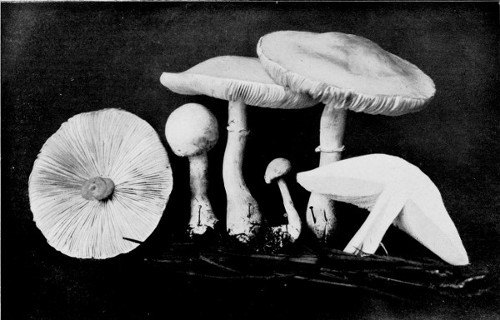
Photographed by Dr. J.R. Weist. Plate XV.
LEPIOTA NAUCINOIDES.
L. nauci´na Fr. No translation applicable. Pileus 1–1½ in. broad,
white, the disk of the same color, fleshy, soft, gibbous or obtusely umbonate
when flattened, even, the thin cuticle splitting up into granules.
Stem 1½-3 in. long, stuffed, at length somewhat hollow, but without
a definite tube, attenuated upward from the thickened base, fibrillose,
45unspotted, white. Ring superior, tender, but persistent, adhering to
the stem, at length reflexed. Gills free, approximate, crowded, ventricose,
soft, white.
There is a prominent collar, as in the Clypeolarii, embracing the stem.
Stature and appearance of L. excoriata, but commonly smaller, the
superior ring adfixed, etc. Fries.
Spores subglobose, 6–7µ Massee.
L. naucina Fr. is the European species which has its American counterpart
in L. naucinoides Pk. The variations in the American species
are noted under L. naucinoides.
As Amanita phalloides—in its white form—the poisonous white Amanita,
resembles L. naucina or L. naucinoides in some stages of its growth
and may be confounded with it, careful note should be taken of their external
differences. In L. naucinoides the bulb and stem are continuous,
each passing into the other imperceptibly; in A. phalloides the junction
of stem and bulb is abrupt and remains so, and the bulb is more
or less enwrapped in the volva. The ring is also larger than in L. naucinoides
and is pendulous, and the gills are permanently white. A certain
means of distinguishing between them is by the application of heat
as in cooking. On toasting both it will be found that the gills of the
Amanita remain white, but those of the Lepiota turn quickly brown.
L. naucinoi´des Pk. No translation applicable. (Plates Plate XV, XII
fig. 2, p. 32.) Pileus soft, smooth, white or snowy-white. Gills free,
white, slowly changing with age to a dirty pinkish-brown or smoky-brown
color. Stem ringed, slightly thickened at the base, colored like
the pileus. Spores subelliptical, uninucleate, white, 8–10 long×5–8µ
broad. Peck, 48th Rep. N.Y. State Bot.
Kansas, Cragin; Wisconsin, Bundy; New Jersey, Ellis; Iowa, Macbride;
New York, Peck, 23d, 29th, 35th Rep.; Indiana, H.I. Miller,
Dr. J.R. Weist.
L. naucinoides Pk. is the American counterpart of L. naucina Fr.,
a European species, excepting that the spores of the latter are described
as globose. The caps are ovate when young and usually from 1½-3 in.
across when expanded, but occasionally reach 4 in., smooth, but
frequently rough or minutely cracked in the center, white or varying
shades of white deepening in color at the summit. In a rare form var.
squamo´sa, large, thick scales occur which are caused by the breaking
46up of the cap surface. When young the gills are white or faintly yellow,
becoming pinkish or dull brown in age. The pinkish hue is not always
apparent. The outer edge of the veil or ring is thickest; usually it is
firmly attached to the stem, but movable rings are frequently noticed.
When the plant ages the ring is often missing, but traces of it are always
discernible. Stem rarely equal, often it is distinctly bulbous, generally
tapering upward from a more or less enlarged base, hollow when fully
grown, until then containing cottony fibers within the cavity or appearing
solid, 2–3 in. long, ¼-½ in. thick.
Its habitat is similar to that of the common mushroom—lawns,
pastures, grassy places—though unlike the latter it is found in woods.
Until thoroughly acquainted with it, specimens found in woods and
supposed to be L. naucinoides should not be eaten. An Amanita might
be mistaken for it. It is readily distinguishable from the common
mushroom and its allies by the color of the gills and spores which are
white, and differences in stem and veil.
It is found from July until after hard frosts. It was first reported
edible by Professor Peck in 1875, under the name of Agaricus naucinus.
The L. naucinoides is rewarding the favor with which it has been
received as an esculent, it being equal to the common mushroom and
quite free from insects. Large crops of it are reported from all over the
country, and from many sections it is told of as a stranger. During
1897–98 the author has found it in plenty upon ground familiar to him
for years, upon which it had not previously shown itself. The common
mushroom must look to its laurels.
Its cultivation as a marketable crop is possible and probable.
L. cepæsti´pes Sow.—cepa, an onion; stipes, stem. (Plate XII, fig.
3, p. 32.) Pileus thin, at first ovate, then bell-shaped or expanded,
umbonate, soon adorned with numerous minute brownish scales, which
are often granular or mealy, folded into lines on the margin, white or
yellow, the umbo darker. Gills thin, close, free, white, becoming
dingy with age or in drying. Stem rather long, tapering toward
the apex, generally enlarged in the middle or near the base, hollow.
Ring thin, subpersistent. Spores subelliptical, with a single nucleus,
8–10×5–8µ.
Plant often cespitose, 2–4 in. high. Pileus 1–2 in. broad. Stem
2–3 lines thick.
47Rich ground and decomposing vegetable matter. Also in graperies
and conservatories. Buffalo, G.W. Clinton; Albany, A.F. Chatfield.
Peck, 35th Rep. N.Y. State Bot.
Spores elliptical, 7–8×4µ Massee; 8×4µ W.G.S.; 8–10×5–8µ Peck.
Haddonfield, N.J., Pennsylvania, McIlvaine; New York, Mrs. E.
C. Anthony; Indiana, H.I. Miller. July to October.
Whoever has seen the seed-stalks of an onion knows the shape from
which this fungus takes its name. The dense clusters are graceful,
dainty, and contain many individuals of all ages—from the very young
with egg-shaped heads, like pigmy C. comatus, to the fluff-capped eldest,
willowy and fair to look upon. The out-door kind soon droops
when matured; the young plants of a cluster will remain fresh for
several days after taken from their habitat. Stems in these tufts are
often quill-shaped, and the striations on the cap margins are shorter
than those on their indoor cousins. These grow in hot-houses and stables.
One of the two forms has a yellow cap, the other is white and
fair.
These forms have often come to my table as a pleasant winter surprise.
Children in the hot-houses of Haddonfield, N.J., watched for
its appearance among the bedded plants, sure of a present when they
brought me a meal of it. Both the white and yellow varieties were
equally enjoyed.
The entire fungus is tender and delicious cooked in any way.
L. farino´sa Pk.—farina, meal. Pileus thin, rather tough, flexible,
at first globose or ovate, then bell-shaped or convex, covered with
a soft, dense, white veil of mealy down, which soon ruptures, forming
irregular, easily-detersible scales, more persistent and sometimes brownish
on the disk. Flesh white, unchangeable. Gills close, free, white,
minutely downy on the edge. Stem equal or slightly tapering upward,
somewhat thickened at the base, slightly mealy, often becoming glabrous,
hollow or with a cottony pith above, solid at the base, white,
pallid or straw-colored, the ring lacerated, somewhat appendiculate on
the margin of the pileus, evanescent. Spores subovate, 10–13×8µ.
Pileus 1.5–2.5 in. broad. Stem 2–3 in. long, 2–4 lines thick.
Mushroom beds in a conservatory, Boston, Mass. March. Communicated
by E.J. Forster.
This species is related to L. cepæstipes, from which it may be distinguished
48by its pileus, which is not folded on the margin, and by its
larger spores. It is edible. It is very distinct from Amanita farinosa.
Peck, 43d Rep. N.Y. State Bot.
Ohio, Lloyd, Prof. William Miller (Lloyd Myc. Notes).
L. America´na Pk. (Plate XII, fig. 1, p. 32. Plate XVa.) Pileus
at first ovate, then convex or expanded, umbonate, scaly, white, the
umbo and scales reddish or reddish-brown. Gills close, free, white.
Stem somewhat thickened at or a little above the base, hollow, bearing
a ring, white. Spores subelliptical, uninucleate, 8–10×5–8µ.
The American lepiota belongs to the same genus as the parasol
mushroom and the Smooth lepiota. It has one character in which it
differs from all other species of Lepiota. The whole plant when fresh
is white, except the umbo and the scales of the cap, but in drying it
assumes a dull reddish or smoky-red color. By this character it is
easily recognized.
In the very young plant the cap is somewhat egg-shaped and nearly
covered by the thin reddish-brown cuticle, but as the plant enlarges the
cuticle separates and forms the scales that adorn the cap. On the
central prominence or umbo, however, it usually remains entire. The
margin of the cap is thin and is generally marked with short radiating
lines or striations. The gills do not quite reach the stem and are, therefore,
free from it. Sometimes they are connected with each other at or
near their inner extremity by transverse branches. They are a little
broader near the margin of the cap than at their inner extremity. The
stem affords a peculiar feature. It is often enlarged towards the base
and then abruptly narrowed below the enlargement, as in the Onion-stemmed
lepiota. In some instances, however, the enlargement is not
contracted below and then the stem gradually tapers from the base upward.
The stem is hollow and usually furnished with a collar, but sometimes
this is thin and may disappear with advancing age. Wounds or
bruises are apt to assume brownish-red hues.
The caps vary in width from 1–4 in.; the stems are from 3–5 in.
long, and 2–5 lines thick. Sometimes plants attain even larger
dimensions than these. The plants grow singly or in tufts in grassy
ground or on old stumps. They may be found from July to October.
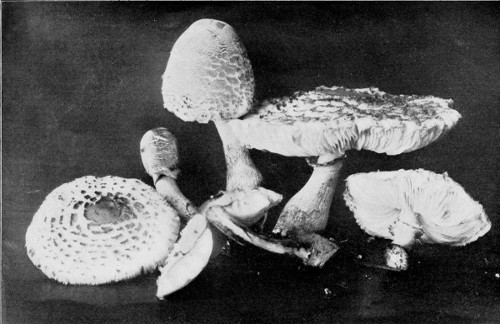
Photographed by Dr. J.R. Weist. Plate XVa.
LEPIOTA AMERICANA.
In flavor this species is not much inferior to the parasol mushroom,
but when cooked in milk or cream it imparts its own reddish color to
49the material in which it is cooked. It is, however, a fine addition to
our list of esculent species. Peck, 49th Rep. N.Y. State Bot.
I found several on a decaying willow trunk, and on the ground beside
it, in Philadelphia. In July, 1898, large quantities, often clustered,
grew under the great, open auditorium of the Pennsylvania Chautauqua,
at Mt. Gretna, Pa., from ground covered with crushed limestone.
The caps are meaty and excellent in flavor. They should be broiled
or fried.
Granulosi. Pileus granular or warty. Stem sheathed, etc.
L. granulo´sa Batsch.—granosus, full of grains. Pileus thin, convex
or nearly plane, sometimes almost umbonate, rough, with numerous
granular or branny scales, often radiately wrinkled, rusty-yellow or
reddish-yellow, often growing paler with age. Flesh white or reddish-tinged.
Gills close, rounded behind and usually slightly adnexed,
white. Stem equal or slightly thickened at the base, stuffed or hollow,
white above the ring, colored and adorned like the pileus below it.
Ring slight, evanescent. Spores elliptical 4–5×3–4µ.
Plant 1–2.5 in. high. Pileus 1–2.5 in. broad. Stem 1–3 lines
thick. Woods, copses and waste places. Common. August to October.
This is a small species with a short stem and granular reddish-yellow
pileus, and gills slightly attached to the stem, a character by which it
differs from all the preceding. The ring is very small and fugacious,
being little more than the abrupt termination to the coating of the stem.
Peck, 35th Rep. N.Y. State Bot.
Spores 5–6×3µ B.; 3×4µ W.G.S.; elliptical, 4–5×3–4µ Peck.
Var. rufes´cens B. and Br. Pure white at first, then partially turning
red and in drying acquiring everywhere a reddish tint.
Var. al´bida Pk. Persistently white.
Though small many plants grow neighboring. Being fleshy for their
size, and of pleasing quality, they well repay gathering. Remove stems.
Open woods, Angora, West Philadelphia; Haddonfield, New Jersey,
McIlvaine.
A. Cuticle Viscid. Neither Scaly nor Warty.
L. delica´ta Fr.—delicatus, delicate. Up to 1½ in. across, reddish,
becoming yellowish toward margin. Flesh well proportioned to cap,
50convex, obscurely umbonate, glabrous, slightly viscid. Stem 1½-2 in.
long, very thin, but covered with dense downy scales, equal, lighter
than cap. Ring usually entire, membranaceous, fluffy from scales.
Gills free, crowded, ventricose, white.
Haddonfield, N.J., January, 1896–97, in hot-houses. McIlvaine.
A delicate, delicious Lepiota. Though small, it is meaty. Its appearance
in hot-houses (it is found in woods) insures a crop at a time of
year when other species are not plentiful, and when anything edible in
the toadstool line is most welcome to their lovers.
L. lenticula´ris Lasch.—lenticula, a lentil. Pileus at first globose,
then convex, even, naked, pinkish-tan color. Flesh thick, spongy,
white. Gills close to stem, but free from it, ventricose, crowded,
whitish. Stem 4–6 in. high, thick, equal or swollen at base, solid but
spongy, more or less covered with scales; above the ring it is frequently
covered with drops of water more or less green, which leave spots when
they dry. Veil superior and very large.
Pileus 3–4 in. across. Stem 4–6 in. long, ½ in. and more thick. In
damp woods.
Redman’s Woods, Haddonfield, N.J. September, 1894. McIlvaine.
This species is included in Amanita by Fries and Stevenson. Massee
places it in Lepiota. In the dozen or more specimens I have found,
there was no trace of a volva, even when very young. I tested it carefully
and at one time ate three good-sized caps without experiencing
any indications of poison. I have seen it during but one season and
not then (at one time) in sufficient quantity to make a meal off it.
Cooked it has a slight cheesy flavor which is pleasant.
L. illi´nita Fr.—illino, to smear over. Pileus rather thin, soft, at
first ovate, then campanulate or expanded, subumbonate, smooth, white,
very viscid or glutinous, even or striate on the margin. Gills close,
free, white. Stem equal or slightly tapering upward, stuffed or hollow,
viscid, white. Spores broadly elliptical, 5×4µ broad.
Plant 2–4 in. high. Pileus 1–2.5 in. broad. Stem 2–3 lines thick.
Thin or open woods. Adirondack mountains. July to September.
This is a smooth white species with the stem and pileus clothed with
a clear viscid or glutinous veil. The margin of the pileus is often even,
but the typical form of the species has it striate. The flesh is soft and
51white. The species may be distinguished from the viscid white species
of Hygrophorus by the free, not adnate nor decurrent lamellæ. Peck,
35th Rep. N.Y. State Bot.
Springton and Mt. Gretna, Pa., 1887–1897. McIlvaine.
Not yet found by me in quantity. Several specimens eaten were of
good flavor.
L. rugulo´sa Pk. Pileus thin, submembranaceous, broadly convex
or nearly plane, umbonate, rugulose, widely striate on the margin,
whitish. Lamellæ thin, narrow, close, free, whitish. Stem short,
equal, slightly silky, whitish, the annulus thin, persistent, white. Spores
elliptic, 7.5µ long, 4µ broad.
Pileus 12–20 mm. broad. Stem about 2.5 cm. long, 2 mm. thick.
Moist grassy places under trees. Washington, D.C. July. Mrs.
E.M. Williams. Perhaps in the fresh state the pileus is not as distinctly
rugulose as when dry. Peck, Bull. Torrey Bot. Club, Vol. 27,
January, 1900.
52ARMILLA´RIA Fr.
Pileus and Stem continuous. Veil partial, sometimes only indicated
by the scales which clothe the stem
terminating in the form of a ring.
Spores white. On the ground or on
stumps.
In the young plant the veil extends
from the stem to the pileus, sometimes
forming scaly patches upon it;
below the ring it is attached to the
stem often in scales.
But for the presence of the ring
the species of this genus could be distributed
in Tricholoma, Clitocybe and Collybia, with which they agree
in all other characters.
In Amanita and Lepiota, the other ringed genera of the white-spored
series, the flesh of the stem and pileus is not continuous; and their stems
are therefore easily separated. Amanita is also distinguished by its
volva.
Gills sinuately adnexed, stem fleshy, ring often evanescent. (Like
Tricholoma.)
Gills not sinuate, more or less decurrent, narrowed behind; ring permanent.
(Resembling Clitocybe.)
Gills adnate, equal behind; stem somewhat cartilaginous outside;
ring permanent. (Resembling Collybia.)
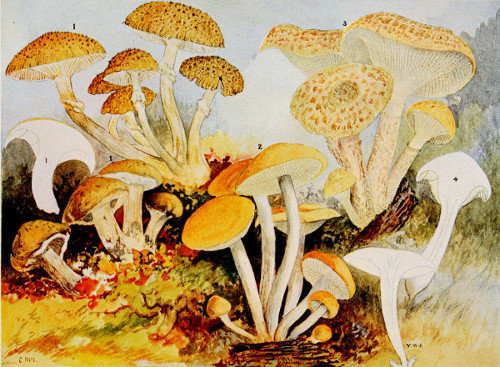
Grouped by F.D. Briscoe—Studies by C. McIlvaine and Val Starnes. Plate XVI.
| Fig. |
Page. |
Fig. |
Page. |
| 1. Armillaria mellea, |
55 |
3–4. Lentinus lepideus, |
230 |
| 2. Armillaria mellea var. exannulata, |
56 |
|
|
I.—Tricholomata. Gills sinuately adnexed, etc.
A. robus´ta A. and S.—robustus, robust, sturdy. Substance of entire
plant compact. Pileus 2–3 in. across, varying in shades of gray and
53brown, scaly, fibrillose on margin, decreasing toward center or smooth,
convex or top-shaped and margin involute at first, expanding. Flesh
firm, very thick. Gills broad, emarginate, nearly free, crowded, whitish,
up to ½ in. broad. Veil large, membranaceous, sometimes floccose,
remaining adherent to the stem. Stem 1–2 in. long, obese, solid,
tapering at the base, brownish-white and fibrillose below veil, white and
flocculose above, flesh of stem continuous with that of the cap.
Stevenson gives var. minor with even cap with both gills and ring
very narrow.
Spores ovoid-spherical. 7µ. Q.
Edible, Curtis; District Columbia, Mrs. M. Fuller.
In mixed woods. Pennsylvania, West Virginia, New Jersey, McIlvaine.
The substance of A. robusta differs from all other Armillaria in being
very compact. It is not acrid but has a marked flavor. Cut into small
pieces and well cooked it makes an acceptable dish. It is best in
croquettes and patties, or served with meats.
A. viscid´ipes Pk.—viscidus, sticky; pes, a foot. Pileus fleshy, compact,
convex or nearly plane, glabrous, whitish with a slight yellowish
or reddish-yellow tint. Flesh white, odor peculiar, penetrating, sub-alkaline.
Gills narrow, crowded, sinuate or subdecurrent, whitish.
Stem equal, solid, viscid and slightly tinged with yellow below the
narrow membranous ring, whitish above. Spores elliptical, 8×5µ.
Pileus 3–6 in. broad. Stem 3–4 in. long, 6–12 lines thick.
In mixed woods. Rock City, Dutchess county. October.
It is a large fine fungus, easily known by its white and yellowish hues,
its crowded gills, viscid stem and peculiar penetrating almost alkaline
odor. The cuticle of the pileus is thin and soft to the touch, but it
sometimes cracks longitudinally and is sometimes slightly adorned with
innate fibrils. A. dehiscens is said to have a viscid stem, but it is also
squamose and the pileus is yellowish-ochraceous. Peck, 44th Rep
N.Y. State Bot.
Quite common in Pennsylvania and New Jersey. McIlvaine.
It loses its strong odor when cooked and is equal to other Armillaria
in edibility. Unless well cooked it has a slight saponaceous flavor.
This is easily overcome by a few drops of lemon juice or sherry.
54A. appendicula´ta Pk.—bearing an appendicula or small appendage.
Pileus broadly convex, glabrous, whitish, often tinged with rust color
or brownish rust color on the disk. Flesh white or whitish. Gills
close, rounded behind, whitish. Stem equal or slightly tapering upward,
solid, bulbous, whitish, the veil either membranous or webby,
white, commonly adhering in fragments to the margin of the pileus.
Spores subelliptical, 8×5µ.
Pileus 2–4 in. broad. Stem 1.5–3.5 in. long; 5–10 lines thick.
Auburn, Ala. October. C.F. Baker.
The general appearance of this species is suggestive of Tricholoma
album, but the presence of a veil separates it from that fungus and places
it in the genus Armillaria. The veil, however, is often slightly lacerated
or webby and adherent to the margin of the pileus. Peck, Bull.
Torrey Bot. Club, Vol. 24.
Mt. Gretna, Pa., Angora, Pa. On decaying roots in ground. August
to November. Found plentifully in resorts of other Armillaria. Edibility
the same. McIlvaine.
A. pondero´sa Pk.—ponderosus, weighty, ponderous. Pileus thick,
compact, convex or subcampanulate, smooth, white or yellowish, the
naked margin strongly involute beneath the slightly viscid, persistent
veil. Gills crowded, narrow, slightly emarginate, white inclining to
cream color. Stem stout, subequal, firm, solid, coated by the veil,
colored like the pileus, white and furfuraceous above the ring. Flesh
white. Spores nearly globose, 4µ in diameter.
Plant 4–6 in. high. Pileus 4–6 in. broad. Stem about 1 in. thick.
Ground in woods. Copake, Columbia county. October.
The veil for a long time conceals the gills, and finally becomes lacerated
and adheres in shreds or fragments to the stem and margin of the
pileus. Peck, 26th Rep. N.Y. State Bot.
New England, Frost; New York, Peck, Repts. 26, 29, 41. West Virginia
and Pennsylvania. Ground in woods. September to November.
McIlvaine.
Professor Peck says in 26th Report: “This species has not been
found since its discovery in 1872.”
Where the Armillaria mellea frequents I have often found A. ponderosa.
It was plentiful at Mt. Gretna, Pa., in September, 1898.
55Young specimens are quite as edible as A. mellea, and rather more
juicy.
II.—Clitocybæ. Gills not sinuate, etc.
A. mel´lea Vahl.—melleus, of the color of honey. (Plate XVI, fig. 1,
p. 52.) Pileus adorned with minute tufts of brown or blackish hairs,
sometimes glabrous, even or when old slightly striate on the margin.
Gills adnate or slightly decurrent, white or whitish, becoming sordid
with age and sometimes variegated with reddish-brown spots. Stem
ringed, at length brownish toward the base. Spores elliptical, white,
8–10µ long. Peck, 48th Rep. N.Y. State Bot.
Spores 9×5–6µ W.G.S.; 10×8µ B.; 8–10µ Peck.
The A. mellea is unusually prolific and is common over the United
States and Europe. Specimens may be found in the spring-time, but
in middle latitudes it is common from August until after light frosts. It
is usually in tufts, some of which contain scores of plants and are showy
over ground filled with roots, or on stumps or boles of decaying trees.
It frequents dense woods and open clearings. I have seen acres of dense
woodland at Mt. Gretna, Pa., so covered with it and its varieties that
but few square yards were unoccupied.
A description of the typical A. mellea will rarely apply to any one
plant. A combination of its variable features in one description would
include something of nearly every white-spored Agaric under the sun.
Yet there is something indescribable about it which once learned will
unerringly betray it.
Its Caps vary from perfectly smooth, through tufts of scales and hairs,
more or less dense, to matted woolliness. It may show any one of these
conditions in youth and be bald in age. Some shade of yellow is the
prevailing color, but this will vary from whitish to dark-purplish or
reddish-brown. When water-soaked it is one color, when dry, another.
Commonly the margins of the Caps are striated, sometimes they are
smooth as a cymbal, and not unlike one, have a raised place or umbo
in the center. Flesh white or whitish. Gills when young are white or
creamy, usually running down the stem, sometimes slightly notched at
attachment. They freckle in age and lose their fair complexion. The
Veil or collar about the stem is as variable as fashion—thick and closely
woven or flimsy as gossamer, or vanishing as the plant grows old. The
56Stems may be even as a lead pencil, or swollen like a pen-holder, or
bulbous toward the base, or distorted by pressure in the tufts. It is as
variable in color as the cap, usually darkening downward in hues of
brown. The outside is firm and fibrous, sometimes furrowed, inside
soft or hollow.
Cap 1–6 in. across. Stem 1–6 in. long, ¼-¾ in. thick.
Var. obscu´ra has the cap covered with numerous small blackish scales.
Var. fla´va has the cap yellow or reddish-yellow, but in other respects
it is like the type.
Var. gla´bra has the cap smooth, otherwise like the type.
Var. radica´ta has a tapering, root-like prolongation of the stem,
which penetrates the earth deeply.
Var. bulbo´sa has a distinctly bulbous base to the stem, and in this
respect is the reverse of var. radicata.
Professor Peck writes: “Var. exannulata (Plate XVI, fig. 2, p. 52)
has the cap smooth and even on the margin, and the stem tapering at
the base. The annulus is very slight and evanescent or wholly wanting.
The cap is usually about an inch broad, or a little more, and the plants
grow in clusters, which sometimes contain forty or fifty individuals. It
is more common farther south than it is in our state (N.Y.), and is
reported to be the most common form in Maryland. This I call var.
exannulata.” From Dr. Taylor, Washington, D.C.; Indiana, H.I.
Miller.
To these may be added also var. al´bida Pk. in which the pileus is
white or whitish.
A variety, perhaps a variation of var. bulbosa was sent to me by E.
B. Sterling, Trenton, N.J., and afterward found by myself at Mt.
Gretna, Pa. The Cap purplish-brown, convex, striate and light on
margin, edge irregular with parts of veil attached. Flesh white, very
thin. Gills decurrent, arcuate, pinkish-gray. Stem stuffed, fibrous, white
above, dense floccose veil, same color as cap below, swollen toward
base which is pointed, sulcate, white inside, closely clustered and some of
the stems distinctly bulbous. Taste decidedly unpleasant. An intense
acridity develops and increases when the juices of raw pieces are swallowed,
and the salivary glands are much excited. The acridity is not
lost in cooking. It simply can not be eaten. Specimens were sent by
me to Professor Peck who referred it to A. mellea.
I have never seen the abortive form of Clitopilus abortivus, though
57found in many places and in great quantity, showing any part or trace
of the original plant. But that a similar monstrosity occurs upon A.
mellea is shown by individuals and parts of individuals of a cluster being
aborted. Without such positive proof, no one would suspect either of
these odd formations to be abortive of either C. abortivus or A. mellea,
or any other fungus. I consider the abortive form of A. mellea far
superior in substance and flavor to it or any of its varieties.
The Armillaria can not be ranked among the tender or high-flavored
toadstools, yet their abundance, meaty caps and nourishing qualities
place them among our most valuable food species.
The caps when chopped into small pieces make good patties and
croquettes. They have an impressive flavor of their own, and offer an
esculent medium for seasoning and the gravies of various meats.
A. nardos´mia Ellis—nardosmius, of the odor of nardus. (A name
applied by the ancients to several plants, especially spica nardi—spikenard.)
Pileus fleshy, firm, thick and compact on the disk, thin toward
the margin, whitish, variegated with brown spots, with a thick, tough
and separable cuticle. Flesh white. Gills crowded, subventricose,
slightly emarginate, whitish. Stem solid, fibrous, not bulbous, sheathed
below by the brown velvety veil, the ring narrow, spreading, uneven on
the edge. Spores subglobose, 6µ in diameter.
Pileus about 3 in. broad. Stem 1.5–3 in. long, 4–6 lines thick.
Ground in woods, Suffolk county. September. Peck, 43d Rep. N.Y.
State Bot.
Several specimens from sandy grounds in pine woods, Haddonfield,
N.J., were sent by me to Professor Peck and were identified by him.
Plentiful at Mt. Gretna, Pa., September to frost, 1898. In mixed
woods, on gravelly ground. Eaten in quantity by several persons.
McIlvaine.
Cuticle of caps when dry breaking up into brownish, squamulose
scales, margin involute. Gills subdecurrent. Veil thick, persistent.
Stem short, subbulbous, solid. Flesh white. Very much resembles a
short-stemmed Lepiota. Smell and taste strong, like almonds. Disappears
in cooking.
58III.—Collybiæ. Gills adnate, stem somewhat cartilaginous.
A. mu´cida Schrad.—mucidus, slimy. Pileus commonly shining
white, thin, almost transparent, hemispherical then expanded, obtuse,
more or less radiato-wrinkled, smeared over with a thick tenacious gluten;
margin striate when thinner. Stem 1½-3 in. long, 1–2 lines thick
at the apex, thickened at the base, stuffed, thin, rigid, curved ascending,
smooth, white, but sooty scaly at the base when most perfectly developed.
Ring inserted at the apex of the stem, bent downward and
glued close to the stem, furrowed, the white border again erect, with a
swollen and entire margin, which sometimes becomes dingy brown.
Gills rounded behind, obtuse, adhering to the stem and striato-decurrent,
distant, broad, lax, mucid, always shining white.
Very variable in stature, from 1 in. (when of this size the stem is
almost equal) to as much as 6 in. broad. The color of the pileus varies
gray, fuliginous, olivaceous. The gills sometimes become yellow, but
only from disease. Sometimes solitary, sometimes a few are joined in
a cespitose manner at the base. Stevenson.
Spores elliptical, 15–16×8–9µ Massee; 17×14µ W.G.S.
North Carolina, Schweinitz, Curtis; Pennsylvania, Schweinitz; Maryland,
Miss Banning.
West Virginia mountains, 1882, Haddonfield, N.J., 1891–94, on
beech trees and roots. McIlvaine.
Commonly considered esculent in Europe.
Dirt adheres so tenaciously to it that it is difficult to clean. This,
however, occurs only when the fungus grows from roots and pushes its
way up through covering earth. When growing from trees it is attractive
and of good quality.
Should be chopped fine and well cooked.
59TRICHOLO´MA Fr.
Pileus symmetrical, generally fleshy, never truly umbilicate, seldom
umbonate. Veil absent or appearing only as fibrils or down on the
margin of the pileus. Gills sinuate
(the small sudden curve near the
stem always apparent in the young
plant), sometimes with a slightly decurrent
tooth. Stem central, usually
stout, fleshy-fibrous, without a bark-like
skin. Flesh continuous with
that of the pileus. Ring and Volva
absent. Spores white or dingy.
But one is known to be poisonous.
Some are acrid or unpleasant in flavor.
With one exception all grow
on the ground in pastures and woods,
appearing from May to late in the
autumn.
Gills generally white or dingy, frequently
spotted or stained. The pileus
may be smooth or adorned with
fibrous or downy scales, dry, moist,
viscid or water-soaked.
The distinguishing feature of Tricholoma is the sinuate gills. In
Collybia the stem bears a distinct bark-like skin; in Clitocybe the gills
are never sinuate; species of Pleurotus are distinguished by growing on
wood only, and Paxillus by their strongly-incurved margin and anastomosing
gills.
In cooking Tricholoma consistency must be the guide to plan and
time. The tougher varieties require to be cut into small pieces and to
be well cooked, while the brittle and delicate varieties will cook quickly.
Many of them make excellent soups.
A. Pileus Viscid, Fibrillose, Scaly Or Downy, Not Water-Soaked.
Stem fibrillose from the remains of the adnate universal veil.
60Limacina (
limas, a slug or snail, slimy). Page
61.
Cuticle of pileus viscid when moist, innately fibrillose or scaly, but not
lacerated; flesh of pileus thick, firm; margin almost naked.
* Gills not discolored, nor becoming reddish.
** Gills discolored, usually spotted with reddish-brown.
Cuticle of the pileus never moist or viscid; torn into downy or floccose
scales. Flesh soft, not water-soaked; margin involute and slightly
downy at first.
* Gills not changing color, nor spotted with red or black.
** Gills becoming reddish or gray, the edge at last generally with
reddish or black spots.
Rigida (
rigeo, to be stiff). Page
74.
Pileus rigid, hard, somewhat cartilaginous when fleshy, very fragile
when thin, cuticle rigid, granulated or broken up when dry into smooth
scales, not torn into fibrils. Young specimens occur which are fibrillose
from the veil, not from laceration of the cuticle.
* Gills white or pallid, not becoming spotted with red or gray.
** Gills becoming reddish, grayish or spotted.
Sericella (
sericeus, silky). Page
74.
Pileus first slightly silky, soon becoming smooth, very dry, neither
moist, viscid, water-soaked, nor distinctly scaly; rather thin, opaque,
absorbing moisture, but is the same color as the gills. Stem fibrous, by
which the smaller species resembling Collybia may be distinguished.
* Gills broad, rather thick, somewhat distant.
**:sericella2 Gills narrow, thin, crowded.
B. Pileus Even, Smooth, Not Downy Nor Scaly, Not Viscid.
In rainy weather moist; when very young pruinose (but rarely conspicuously)
from the universal veil. Flesh soft and spongy or very
thin when it is water-soaked.
Guttata (
gutta, a drop). Page
76.
Pileus fleshy, soft, fragile, marked with drop-like spots or rivulose.
Appearing in spring, rarely in autumn.
61Cespitose, in troops or often in rings.
* Gills whitish.
** Gills becoming reddish or smoky-gray.
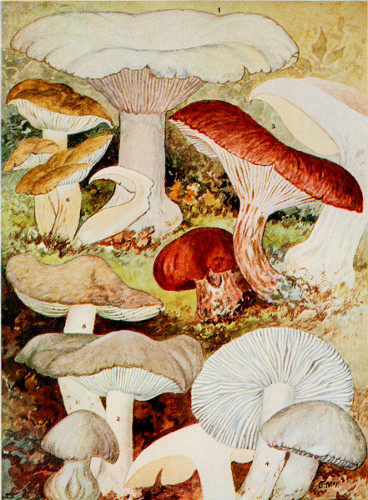
Grouped by F.D. Briscoe—Studies by C. McIlvaine. Plate XVIII.
| Fig. |
Page. |
Fig. |
Page. |
| 1–2. Tricholoma personatum, |
79 |
5. Tricholoma columbetta, |
68 |
| 3. Tricholoma russula, |
65 |
6. Tricholoma humile, |
81 |
| 4. Tricholoma terreum, |
71 |
|
|
Spongiosa (
spongia, a sponge). Page
78.
Pileus compact, then spongy, obtuse, even, smooth, moist but not
hygrophanous; firm, growing in troops late in the autumn. Stem
stout, base usually thickened, spongy fibrous. Gills at length decurrent
but sinuate, by which character they are distinguished from Clitocybe.
* Gills not discolored.
** Gills discolored.
Hygrophana (
Gr., wet; to appear). Page
80.
Pileus thin, somewhat umbonate; flesh at length soft, watery. Stem
rootless, containing a pith, entirely fibrous.
Flesh not exceeding in depth the width of the not broad, thin gills;
thinnest toward the margin, hence somewhat umbonate. Color of the
pileus either moist or dry, very variable in the same species. Pileus
sometimes pulverulent from the persistence of the veil in dry weather.
* Gills whitish, not spotted.
** Gills more or less violet, gray or smoky. Not represented.
Pileus Viscid or Fibrillose, Downy Or Scaly.
I.—Lima´cina. Viscous when moist.
*
Gills not becoming discolored, nor becoming reddish.
T. eques´tre Linn.—equestre, belonging to a horseman or knight,
from distinguished appearance. Pileus fleshy, compact, convex becoming
expanded, obtuse, pale-yellowish, more or less reddish tinged, the
disk and central scales often darker, the margin naked, often wavy.
Flesh white or tinged with yellow. Gills rounded behind, close, nearly
free, sulphur-yellow. Stem stout, solid, pale-yellow or white, white
within. Spores 6.5–8×4–5µ.
Pileus 3–5 in. broad. Stem 1–2 in. long, 6–10 lines thick.
62Pine woods, especially in sandy soil. Albany county. September
to November.
This is a noble species but not plentiful in our state (N.Y.). The
pileus is said to become greenish very late in the season. The stem, in
the typical form, is described as sulphur-yellow in color, but with us it
is more often white. The scales of the disk are sometimes wanting.
In our plant the taste is slightly farinaceous at first, but it is soon
unpleasant.
Var. pinastreti A. and S. is a slender form having a thin, even pileus,
thinner and more narrow gills and a more slender stem. A. crassus
Scop., A. aureus Schaeff., and A. flavovirens Pers. are recorded as
synonyms of this species. Peck, 44th Rep. N.Y. State Bot.
Professor Peck later says in “Mushrooms and Their Use,” p. 52:
“I confidently add it to the list of edible species.”
New Jersey, Pennsylvania and West Virginia. In pine forests and
groves. September to frost. McIlvaine.
I have eaten it since 1883. All disagreeable odor about T. equestre
(which I have seldom noticed) disappears upon cooking. The substance
is rather tough, but good.
T. coryphæ´um Fr.—chief, leader. From its distinguished appearance.
Pileus very fleshy but not compact, convex then plane, obtuse,
viscid, yellowish, streaked with small brownish scales. Stem solid,
attenuated upward. Gills emarginate, crowded, white, edge yellow.
Large and of striking appearance. In shady beech woods.
Pronounced a good edible by the Boston Myc. Club.
The color of the plants is given as greenish-yellow. Bull. Boston
Myc. Club, 1896.
T. ustale Fr.—uro, to burn. Pileus fleshy, convex, then plane,
obtuse, even, smooth, viscid, bay-brownish. Stem stuffed, equal, dry,
rufo-fibrillose, apex naked, silky, nearly smooth. Gills emarginate,
crowded, white, at length with reddish spots. Cooke.
Chiefly in pine woods.
Pileus 3 in. Stem 2–3 in. long, about ½ in. thick.
Spores 5×8µ W.G.S.; 7–8×5µ Massee.
North Carolina, Curtis, pine woods, Schweinitz; Kansas, Cragin.
Massachusetts. Edible. Boston Myc. Club, Bull. No. 5.
63T. resplen´dens Fr.—shining brightly. Pileus fleshy, convex then
nearly plane, even, bare, viscid, white, sometimes hyaline-spotted or
yellowish on the disk, shining when dry, the margin straight. Flesh
white, taste mild, odor pleasant. Gills nearly free when young, then
emarginate, somewhat crowded, rather thick, entire, white. Stem
solid, bare, subbulbous, even, dry, white. Spores 8×4µ.
Pileus 2–4 in. broad. Stem 2–3 in. long, 4–8 lines thick.
Thin woods. Catskill mountains. September. Peck, 44th Rep.
N.Y. State Bot.
Mt. Gretna, Pa., in mixed woods. October and November. McIlvaine.
It is of excellent flavor, consistency and food value.
T. transmu´tans Pk.—changing. Pileus convex, nearly bare, viscid
when moist, brownish, reddish-brown or tawny-red, usually paler on the
margin. Flesh white, taste and odor farinaceous. Gills narrow, close,
sometimes branched, whitish or pale yellowish, becoming dingy or reddish-spotted
when old. Stem equal or slightly tapering upward, bare
or slightly silky-fibrillose, stuffed or hollow, whitish, often marked with
reddish stains or becoming reddish-brown toward the base, white within.
Spores subglobose, 5µ.
Pileus 2–4 in. broad. Stem 3–4 in. long, 3–6 lines thick.
Woods. The plants are often cespitose.
I suspect that Agaricus frumentaceus of Curtis’s catalogue belongs to
this species. Both the pileus and stem, as well as the gills, are apt to
assume darker hues with age or in drying, and this character suggested
the specific name. The species is classed as edible. Peck, 44th Rep.
N.Y. State Bot.
Curtis catalogues T. frumentaceum as edible.
T. transmutans is reported from many states. It has a mealy taste
and odor. Wherever it is found it is a valuable food species.
T. sejunc´tum Sow.—separated; from the peculiar manner in which
the gills separate from the stem. Pileus fleshy, convex then expanded,
umbonate, slightly viscid, streaked with innate brown or blackish fibrils,
whitish or yellowish, sometimes greenish-yellow. Flesh white, fragile.
Gills broad, subdistant, rounded behind or emarginate, white. Stem
solid, stout, often irregular, white. Spores subglobose, 6.5µ.
Pileus 1–3 in. broad. Stem 1–3 in. long, 4–8 lines thick.
64Mixed woods. Suffolk county, N.Y. September.
The plants referred to this species are not uncommon on Long Island,
growing on sandy soil in woods of oak and pine. They are usually
more or less irregular and the pileus becomes fragile. It is quite variable
in color, sometimes approaching a smoky-brown hue, again being
nearly white. The taste of the typical form is said to be bitter, but the
flavor of our plant is scarcely bitter. In other respects, however, it
agrees well with the description of the species. Peck, 44th Rep. N.Y.
State Bot.
Spores 6µ. W.G.S.
Flesh is tender. Cooked, of good body and peculiar but pleasant
flavor. A valuable species, baked, scalloped, fried.
T. terri´ferum Pk.—terra, earth; fero, to bear. Pileus broadly convex
or nearly plane, irregular, often wavy on the margin, glabrous, viscid,
pale-yellow, generally soiled with adhering particles of earth carried up
in its growth. Flesh white, with no decided odor. Gills thin, crowded,
slightly adnexed, white, not spotted or changeable. Stem equal, short,
solid, white, floccose-squamulose at the apex. Spores minute, subglobose,
3µ.
Pileus 3–4 in. broad. Stem 1–1.5 in. long, 6–8 lines thick.
Woods. Catskill mountains. September. Peck, 44th Rep. N.Y.
State Bot.
Found in West Virginia, Pennsylvania, New Jersey. August to frost.
McIlvaine.
Not inviting, hard to clean, nevertheless edible and good.
T. portento´sum Fr.—portentosus, strange, monstrous. Pileus 3–5 in.
broad, sooty, livid, sometimes violaceous, fleshy, but thin in comparison
with the stoutness of the stem, convexo-plane, somewhat umbonate,
unequal and turned up, viscid, streaked with black lines (innate fibrils),
but otherwise even and smooth, the very thin margin naked. Flesh
not compact, white, fragile. Stem commonly 3 in. often 4–6 in. long,
1 in. thick, stout, solid, the whole remarkably fibrous-fleshy, somewhat
equal, naked, but fibrilloso-striate, white; the base, which is occasionally
attenuato-rooted, villous. Gills rounded, almost free, 3–4 lines to as
much as 1 in. broad, distant, white, but varying, becoming pale-gray
or yellow. Fries.
65Spores 4–5×4µ K.; 5×4µ W.G.S
West Virginia, 1882; New Jersey, Pennsylvania, in woods and open
places. May to November. McIlvaine.
It is one of the first toadstools I experimented upon. I have been
constant to it. Its caps fried in butter are unsurpassed.
**
Gills discolored, usually spotted with reddish-brown.
T. fla´vo-brun´neum Fr.—flavus, yellow; brunneus, brown. Pileus
fleshy, conical, then convex, at length expanded, subumbonate, viscid,
clothed with streak-like scales. Stem hollow, somewhat ventricose,
fibrillose, at first viscid, yellowish within, tip naked. Gills emarginate,
decurrent, crowded, yellowish, then reddish. Fries.
Odor that of new meal. Stem 3–5 in. long, ½ in. thick, dull-reddish
or brownish. Pileus 3–6 in. broad, disk darker, dingy dull-red or
reddish-brown.
North Carolina, Curtis; damp woods, A. fulvus, Schweinitz.
Edible, Cooke, 1891.
T. rus´sula Schaeff.—reddish. (Plate XVIII, fig. 3, p. 60.) Pileus
fleshy, convex, becoming plane or centrally depressed, obtuse, viscid,
even or dotted with granular squamules on the disk, red or incarnate,
the margin usually paler, involute and minutely downy in the young
plant. Flesh white, sometimes tinged with red, taste mild. Gills sub-distant,
rounded behind or subdecurrent, white, often becoming red-spotted
with age. Stem solid, firm, whitish or rose-red, squamulose at
the apex. Spores elliptical, 7×4µ.
Pileus 3–5 in. broad. Stem 1–2 in. long, 6–8 lines thick.
Mixed woods. Albany. Cattaraugus and Steuben counties. September
and October.
According to the description the typical plant has the pileus incarnate
and the stem rosy-red, but in the American plant the pileus is generally
more clearly red and the stem white, though this is often varied by reddish
stains. Peck, 44th Rep. N.Y. State Bot.
Mixed woods. August until after frost. At Mt. Gretna, Pa. 1897–1898
the patches were large, generous yielders.
Edible, Cooke; edible, Cordier, Roques.
T. russula is a dressy fungus and has a fashion of its own. The mottlings
66upon its cap, gill and stem, in shades of red, subdued though
they be, give it a handsome personality distinct from any other.
The species is a variable one in its minor markings. When moisture
is prevalent the caps of all are viscid. Both young and old are often
cracked. Stems frequently not squamulose at apex, frequently rosy
when young, often flattened. The fibrous interior of the stem and its
fibrous connection with the flesh of the cap are very marked. Gills
emarginate in youth as well as in age. It is solitary, gregarious, occasionally
bunched.
An excellent fungus, a free late grower, meaty, easily cooked, and
of fine flavor.
T. frumenta´ceum Bull.—frumentum, made of corn. Pileus 2–3 in.
broad, whitish or clay-color and variegated dull red, truly fleshy, convex
then plane, obtuse, viscous, dry in fine weather, even, smooth.
Flesh white. Stem 3 in. long, ½ in. thick, solid, equal, fibrillose
when dry, whitish. Gills rounded, somewhat crowded, rather broad,
white, at length spotted-red.
Wholly becoming pale white, but the stem and pileus are alike marked-red,
and the gills are at length reddish, wherefore, as well as for the
strong smell of new meal, it is undoubtedly nearest to A. pessundatus.
When full grown it has all the appearance of Entoloma. On the
ground. Stevenson.
Spores 6µ W.G.S.
North Carolina, Curtis. Edible. Porcher says Dr. Curtis was the
first to declare it edible.
T. pessunda´tum Fr.—pessum dare, bent downward. Pileus fleshy,
compact, convex, very obtuse, repand, viscid, granulose or spotted.
Stem solid, firm, at first ovato-bulbous, everywhere villose with whitish
scales. Gills emarginate, nearly free, crowded, white, at length spotted
with red.
In pine woods. Odor and taste mealy.
Pileus bay, reddish, paler at the margin. Stature of Ag. equestris.
Fries.
Spores 5×2.5µ Massee; very minute, globose, 2–3µ C.B.P.
Reckoned edible, but very rare. Stevenson.
California, H. and M.
67II.—Genui´na. Cuticle of pileus torn into downy or fibrillose scales.
*
Gills not changing color nor becoming spotted.
(Plate XX.)
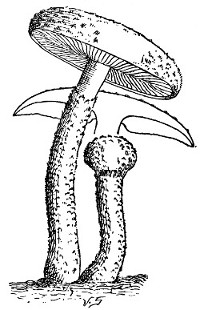
Tricholoma decorosum.
Two-thirds natural size.
T. decoro´sum Pk.—decorus, decorous. Pileus firm, at first hemispherical,
then convex or nearly plane,
adorned with numerous brownish sub-squarrose
tomentose scales, dull ochraceous
or tawny. Flesh white. Gills
close, rounded and slightly emarginate
behind, the edge slightly scalloped.
Stem solid, equal or slightly tapering
upward, white and smooth at the top,
elsewhere tomentose-scaly and colored
like the pileus. Spores broadly elliptical,
5×4µ.
Pileus 1–2 in. broad. Stem 2–4
in. long, 2–4 lines thick.
Decaying trunks of trees. Catskill
mountains and Alleghany county.
September and October.
A rare but beautiful species. It is
often cespitose. It departs from the
character of the genus in growing on
decaying wood. Peck, 44th Rep.
N.Y. State Bot.
Tricholoma decorosum is not rare in Pennsylvania. I have found it
at Angora, Philadelphia and in Chester county, Pa., growing in clusters
and singly. At first sight one might take it for one of the many
forms of Armillaria, but even cursory examination shows the difference.
It is of good consistency and flavor, having a decided mushroom taste.
T. flaves´cens Pk.—pale yellow. Pileus convex, firm, often irregular,
dry, slightly silky becoming bare, sometimes cracking into minute
scales on the disk, whitish or pale yellow. Flesh whitish or yellowish.
Gills close, white or pale-yellow, emarginate, floccose on the edge.
Stems firm, solid, often unequal, central or sometimes eccentric, single or
cespitose, colored like the pileus. Spores subglobose, 5µ in diameter.
68Pileus 2–3 in. broad. Stem 1–2.5 in. long, 4–6 lines thick.
Pine stumps. Albany and Rensselaer counties. October.
The species seems to be related to T. rutilans but has not the red or
purplish tomentum of that fungus. It, like T. decorosum, is always
lignicolous. T. rutilans is sometimes so. Peck, 44th Rep. N.Y. State
Bot.
Frequently found in New Jersey, Pennsylvania and West Virginia.
Pine stumps. September to frost. McIlvaine.
The flesh compares with that of T. rutilans, and makes an equally
good dish.
T. gran´de Pk. Pileus thick, firm, hemispherical, becoming convex,
often irregular, dry, scaly, somewhat silky-fibrillose toward the
margin, white, the margin at first involute. Flesh grayish-white, taste
farinaceous. Gills close, rounded behind, adnexed, white. Stem stout,
solid, fibrillose, at first tapering upward, then equal or but slightly
thickened at the base, pure white. Spores elliptical, 9–11×6µ.
Pileus 4–5 in. broad. Stem 2–4 in. long, 1–1.5 in. thick.
Among fallen leaves in woods. Cattaraugus county. September.
The plants are often cespitose, and then the pileus is more or less
irregular and the gills somewhat lacerated. The species is related to
T. columbetta, from which its larger size, constantly scaly pileus, more
cespitose mode of growth, larger spores and farinaceous taste separate
it. The scales of the pileus are brownish, and the pileus itself is sometimes
slightly dingy on the disk. The young margin is pure white like
the stem, and both it and the upper part of the stem are sometimes
studded with drops of moisture.
The plant was found on trial to be edible, but not of first quality.
The flesh is not very tender, nor the flavor captivating even in young
specimens. Peck, 44th Rep. N.Y. State Bot.
Mt. Gretna, Pa. Mixed woods. August to frost. McIlvaine.
Gross when old. Young specimens of medium quality and flavor.
T. columbet´ta Fr.—columba, a pigeon. (Plate XVIII, fig. 5, p. 60.)
Pileus convex, then nearly plane, fleshy, obtuse, rigid, somewhat flexuous,
dry, at first bare, then silky-fibrillose, becoming even or scaly,
white, the margin at first involute, more or less tomentose. Flesh white,
69taste mild. Gills close, emarginate, thin, white. Stem stout, solid,
unequal, nearly bare, white. Spores 7–8×4.5µ.
The species is very variable and the following varieties have been described:
Var. A. Pileus nearly always repand or lobed, at first bare, even,
at length cracked-scaly, often reddish spotted, the margin when young
inflexed, tomentose. Stem obese, even, unequal, swollen, an inch thick.
The typical form.
Birch wood among mosses.
Var. B. Pileus subflexuous, silky-fibrillose, at length scaly, sometimes
dingy-brown spotted, the margin scarcely tomentose. Stem
longer, equal or slightly narrowed at the base.
Bushy places. Intermediate between A and C.
Var. C. Pileus regular, flattened, evidently fibrillose, sometimes
spotted with blue, four inches broad. Stem equal, cylindrical, fibrillose-striate,
four inches long.
Beech woods. A showy variety so diverse from variety A that it
might be regarded as a distinct species, did not variety B connect them,
and so much resemble both that it might with equal propriety be referred
to either.
Pileus 2–4 in. broad. Stem 1–4 in. long, 3–12 lines thick.
Woods and pastures. Albany county, N.Y.
It may be distinguished from T. album by its mild taste. It is recorded
as edible. Peck, 44th Rep. N.Y. State Bot.
Edible, Curtis, Cooke, Stevenson.
This much varied Tricholoma is as varied in its habitat. I have
found it on vacant lots in Philadelphia, in mixed woods at Devon, Pa.,
and in the forests of the West Virginia mountains, and eaten it since
1881.
It cooks readily and is of mild, agreeable flavor.
T. ru´tilans Schaeff.—rutilo, to be reddish. Pileus fleshy, campanulate
becoming plane, dry, at first covered with a dark-red or purplish
tomentum then somewhat scaly, the margin thin, at first involute. Flesh
yellow. Gills crowded, rounded, yellow, thickened and downy on the edge.
Stem somewhat hollow, nearly equal or slightly thickened or bulbous at
the base, soft, pale-yellow variegated with red or purplish floccose scales.
Spores 6.5–8×6.5µ.
70
(Plate XXI.)
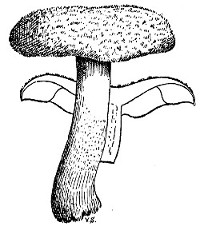
Tricholoma rutilans.
About three-eights natural size.
Pileus 2–4 in. broad. Stem 2–4
in. long, 5–8 lines thick.
On or about pine stumps, rarely on
hemlock trunks. July to November.
Peck, 44th Rep. N.Y. State Bot.
Spores subglobose, 5–6µ diameter
Massee; 6–8×6µ B.; 6×9µ W.G.S.
West Virginia, Pennsylvania,
New Jersey. May to November. McIlvaine.
Quite common in West Virginia mountains and in pine woods of New
Jersey. The Boston Mycological Club reports it found in quantity in
Massachusetts. The flesh when cooked is gummy, like the marshmallow
confection. It is excellent.
**
Gills becoming reddish or gray, etc.
T. vacci´num Pers.—vacca, a cow. Pileus fleshy, convex or campanulate,
becoming nearly plane, umbonate, dry, floccose-scaly, reddish-brown,
the margin involute, tomentose. Flesh white. Gills adnexed,
subdistant, whitish, then reddish or reddish-spotted. Stem equal, hollow,
covered with a fibrillose bark, naked at the apex, pale reddish.
Spores subglobose, 6µ.
Pileus 1–3 in. broad. Stem 2–3 in. long, 4–6 lines thick.
Under or near coniferous trees. Greene and Essex counties. September
and October. Peck, 44th Rep. N.Y. State Bot.
Recorded as edible by Gillet.
Plentiful in New Jersey, Pennsylvania, West Virginia. Have eaten it
since 1885. Fair.
T. fuligi´neum Pk.—fuligineus, resembling soot. Pileus convex or
nearly plane, obtuse, often irregular, dry, minutely scaly, sooty-brown.
Flesh grayish, odor and taste farinaceous. Gills subdistant, uneven on
the edge, ash-colored becoming blackish in drying. Stem short, solid,
equal, bare, ash-colored. Spores oblong-elliptical, 8×4µ.
71Pileus 1–2.5 in. broad. Stem 1–1.5 in. long, 3–5 lines thick.
Among mosses in open places. Greene county. September. Rare.
Peck, 44th Rep. N.Y. State Bot.
Quite common in Pennsylvania and New Jersey on mossy wood
margins. It is of fair quality and flavor.
(Plate XXII.)
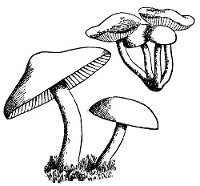
Tricholoma terreum.
One-half natural size.
T. ter´reum Schaeff.—the earth. (Plate XVIII, fig. 4, p. 60.) Pileus
fleshy, thin, soft, convex, campanulate
or nearly plane, obtuse or
umbonate, innately fibrillose or floccose-scaly,
ashy-brown, grayish-brown
or mouse color. Flesh white
or whitish. Gills adnexed, subdistant,
more or less eroded on the edge,
white becoming ash-colored. Stem
equal, varying from solid to stuffed
or hollow, fibrillose, white or whitish.
Spores broadly elliptical, 6–7×4–5µ.
Pileus 1–3 in. broad. Stem 1–2
in. long, 2–4 lines thick.
Woods. Albany, Rensselaer and Cattaraugus counties. September
to November. Peck, 44th Rep. N.Y. State Bot.
Spores 7×5.5µ Morgan; 5–6µ, Massee; 6–7×4µ K.; 6µ W.G.S.
Eaten by Professor Peck. Eaten by McIlvaine. Quality fair.
T. ter´reum Schaeff.—var. fra´grans Pk. Pileus convex or nearly
plane, dry, innately-fibrillose or minutely floccose-scaly, grayish-brown
or blackish-brown. Gills rather broad, adnexed, whitish or ash-colored.
Stem equal, solid or stuffed, rarely hollow, whitish. Spores broadly
elliptical, 6–7×4–5µ.
The Fragrant tricholoma has a distinct farinaceous odor and flavor.
In other respects it closely resembles the Earth-colored tricholoma of
which it is considered a mere variety. The typical European plant is
said to be without odor or nearly so and has not been classed among
the edible species by European writers. But our variety, though not
high-flavored, is fairly good and entirely harmless. Its cap varies considerably
in color but is some shade of gray or brown. Its center is
without any prominence or very bluntly prominent, and its surface is
72commonly very obscurely marked with innate fibrils or in small plants
may have very small flocculose tufts or scales. The flesh is whitish as
also are the gills, though these sometimes assume a more decided grayish
hue. They are rather broad and loose and sometimes uneven on
the edge or even split transversely. They are usually deeply excavated
next the stem and attached to it by a narrow part. The stem is whitish
or slightly shaded with the color of the cap. It often has a few longitudinal
fibrils, but never any collar. It may be either solid, stuffed or
spongy within, or in large specimens, hollow.
The plants grow gregariously or sometimes in tufts on the ground
under or near trees or in thin woods, especially of pine, or in mixed
woods. The caps vary from 1–4 in. broad, and the stems from 1–3 in.
long and from 2–6 lines thick. The plants occur in autumn. In Europe
there is a variety of this species which also has a farinaceous odor, but
it differs from our plant in having reddish edges to the gills. It is called
variety orirubens. Peck, 49th Rep. N.Y. State Bot.
Var. fragrans is plentiful and gregarious among New Jersey pines,
October to frost. Other varieties are often found. Specimens found
by me at Mt. Gretna, Pa., and sent to Professor Peck who identified
them as var. fragrans Pk., were decidedly umbonate. Gills were easily
separable from cap.
Var. fragrans is a favorite. It is pleasant to many, even raw. Plentiful
salting while cooking develops a high and exquisite flavor.
T. fumes´cens Pk.—smoky. Pileus convex or expanded, dry,
clothed with a very minute appressed tomentum, whitish. Gills narrow,
crowded, rounded behind, whitish or pale cream color, changing to
smoky-blue or blackish where bruised. Stem short, cylindrical, whitish.
Spores oblong-elliptical, 5–6.5µ.
Pileus 1 in. broad. Stem 1–1.5 in. high, 2–3 lines thick.
Woods. Columbia county. October. Rare.
The species is remarkable for the smoky or blackish hue assumed by
the gills when bruised and also in drying. It is apparently related to
T. immundum Berk., but in that species the whole plant becomes
blackish when bruised, and the gills are marked with transverse lines
and tinged with pink. Peck, 44th Rep. N.Y. State Bot.
Mt. Gretna, Pa. September to November, 1898. McIlvaine.
The size of cap sometimes attains to 3 in and stem to ½ in. in thickness.
73Taste at first farinaceous then sweetish. The caps are of excellent
quality and flavor.
(Plate XXIII.)
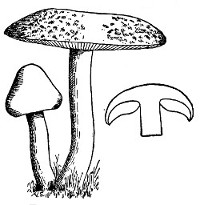
Tricholoma imbricatum.
One-half natural size.
T. imbrica´tum Fr.—covered with tiles. Pileus fleshy, compact,
convex or nearly plane, obtuse, dry,
innately scaly, fibrillose toward the
margin, brown or reddish-brown, the
margin thin, at first slightly inflexed
and pubescent then naked. Flesh firm,
thick, white. Gills slightly emarginate,
almost adnate, rather close,
white when young, becoming reddish
or spotted. Stem solid, firm, nearly
equal, fibrillose, white and mealy or
pulverulent at the top, elsewhere colored
like the pileus. Spores 6.5 ×
4–5µ.
Pileus 2–4 in. broad. Stem 2–3
in. long, 4–10 lines thick. Under or near coniferous trees. Greene and
Essex counties. September and October.
This is an edible species. It has a farinaceous odor and taste when
fresh. Peck, 44th Rep. N.Y. State Bot.
Closely resembles T. transmutans in size, color and taste. It is, however,
easily separated by its dry cap and solid stem. Peck.
Plentiful in pine woods of New Jersey, and among hemlocks in West
Virginia. Mt. Gretna, Pa., under pines. October and November,
1898. McIlvaine.
Specimens found at Mt. Gretna had caps dark umber when young,
and margin incurved to stem. Gills yellowish. Stem up to 4 in. long,
stout, solid, swollen at base, and having a short pointed ending, firm,
fibrillose, white. Flavor farinaceous.
Flesh of good texture and taste.
74III.—Rig´ida. Pileus rigid, cuticle broken up into smooth scales, etc.
*
Gills white or pallid, not becoming spotted with red or gray.Not represented.
**
Gills becoming reddish or grayish, spotted, etc.
T. sapona´ceum Fr.—sapo, soap. Strong, smelling of an undefinable
soap. Cap 2–4 in. across, involute at first, convex then flattened,
dry, glabrous, moist in wet weather, never viscid, brownish, more or
less spotted or having the skin cracked into scales, occasionally covered
with dark fibrils. Flesh firm, whitish becoming reddish when wounded.
Gills emarginate, with a hooked tooth (uncinate) thin, distant, pale
white. Stem 2–4 in. long, about ½ in. thick, often unequal, base
sometimes long and rooting, usually smooth, at times reticulated with
black fibrils, or is scaly. Distasteful.
The species is variable in size and color. Stevenson remarks:
“Scarcely any species has been more confounded with others.” It may
always be safely distinguished by its odor, by its distant gills, by the
smooth cuticle of the cap cracking into scales, and by the change of
color to reddish when bruised.
West Virginia mountains. August to frost. 1881–85. New Jersey,
Pennsylvania. McIlvaine.
This fungus is not extremely unpleasant when eaten—like T. sulphureum,
but no one will care to eat it. There is nothing in the flavor to
recommend it or to inspire a cultivation of taste for it.
IV.—Sericel´la. Pileus slightly silky, soon smooth, etc.
*
Gills broad, rather thick, somewhat distant.
T. sulphu´reum Bull.—sulphur, brimstone. Odor strong, fetid or
like gas tar. Cap 1–4 in. across, subglobose, then convex and plane,
slightly umbonate, sometimes depressed, fleshy, margin at first involute.
Color dingy or reddish sulphur-yellow, at first silky, becoming smooth
or minutely tomentose. Flesh thick, yellow. Gills rather thick, narrowed
behind, emarginate or acutely adnate, sometimes appearing arcuate
from shape of cap. Stem 2–4 in. long, 3–5 lines thick, equal or
75slightly bulbous, often curved, smooth striate, sulphur-yellow, stuffed,
fibrous or hollow, yellow within, at times having yellow fibrous roots.
Spores 9–10×5µ Massee.
Very variable in size. Gregarious, common in mixed woods.
West Virginia, 1881. West Philadelphia, 1886. McIlvaine.
When quite young T. sulphureum is showy and inviting. Its smell
is discouraging, its taste forbidding. No amount of cooking removes
its unpleasant flavor. I have tried to eat enough of it to test its qualities,
but was satisfied after strenuous efforts to mark it INEDIBLE.
T. chrysenteroi´des Pk.—like gold. Pileus fleshy, convex or plane,
not at all umbonate, firm, dry, glabrous or slightly silky, pale-yellow
or buff, becoming dingy with age, the margin sometimes reflexed, flesh
pale-yellow, taste and odor farinaceous. Gills rather close, emarginate,
yellowish, becoming dingy or pallid with age, marked with transverse
veinlets along the upper edge, the interspaces veined. Stem equal,
firm, solid, bare, fibrous-striate, yellowish without and within. Spores
elliptical, 8–10×5–6µ.
Pileus 1–2 in. broad. Stem 2–3 in. long, 3–4 lines thick.
Woods. Lewis and Cattaraugus counties. September.
Nearly allied to T. chrysenterum, but separable by the gills, which
are somewhat veiny and not free, by the entire absence of an umbo and
by its farinaceous odor and taste. Peck, 44th Rep. N.Y. State Bot.
Frequently found at Angora, and in Woodland Cemetery, West
Philadelphia.
Edible. Fair flavor and good quality.
T. o´picum Fr.—uncouth. Pileus 1–1½ in. across. Flesh rather thin,
becoming grayish; convex, then expanded, obtusely-umbonate, at
length usually upturned and split, very dry, even at first, then minutely
scaly, gray. Gills broadly emarginate, ventricose, rather thick, scarcely
distant, hoary. Stem 2–3 in. long, 2–3 lines thick, equal, fibrillose,
becoming almost glabrous, pallid then grayish, stuffed. Massee.
Among moss, in pine woods, etc.
Inodorous. Somewhat resembling T. saponaceum, but distinguished
by the absence of smell.
Waretown, N.J. Under pines and open places in pine woods. August
to September, 1889. McIlvaine.
76When wet the caps become darker and have a mottled appearance.
They are tender, but rather tasteless. The species serves to make
quantity when cooked with others of higher flavor.
T. pipera´tum Pk.—piper, pepper. Pileus rather thin, firm, dry,
convex, obtuse or subumbonate, virgate with innate brownish fibrils,
varying in color from grayish-brown to blackish-brown, sometimes with
greenish or yellowish tints. Flesh white or whitish, taste acrid. Gills
broad, close, rounded behind, adnexed, whitish or yellowish. Stem
generally short, equal, solid, silky, slightly mealy or pruinose at the
top, white or slightly tinged with yellow. Spores elliptic, 6–7µ long,
5µ broad. Pileus 4–7 cm. broad. Stem 5–7 cm. long, 6–12 mm. thick.
The central part of the pileus is sometimes a little darker than the
rest. The peppery or acrid taste is very distinct and remains in the
mouth many minutes. This and the innately fibrillose character of the
pileus are distinguishing characters of the species. The plants appear
from September to November. Peck, Torr. Bull., Vol. 26.
Mt. Gretna, Pa. October to November, 1898, on damp ground
among moss. McIlvaine.
Cap up to 3 in. across, bell-shaped, then convex, depressed in center
and undulate, light-brown, darker toward center, dry, minutely fibrillose.
Flesh thick, white, thin toward margin. Gills emarginate, unequal,
not forked. Stem 1½-2 in. long, hard, equal or enlarging
toward base, white, silky, striate.
Though peppery raw, this Tricholoma is of good substance and flavor
when cooked.
B. Pileus Even, Smooth, Not Downy, Scaly, Nor Viscid, Etc.
V.—Gutta´ta. Pileus marked with drop-like spots or rivulose.
* Gills whitish.
T. gambo´sum Fr.—gambosus, swelling near the hoof. Pileus
3–4 in. and more broad, becoming pale-tan, fleshy, hemispherico-convex,
then flattened, obtuse, undulated and bent backward, even, smooth, but
spotted as with drops, at length widely cracked (not, however, torn into
squamules), the margin at the first involute and tomentose. Flesh thick,
soft, fragile, white. Stem 2 in. and more long, ½-1 in. thick, solid,
fleshy-firm, almost equal, often curved-ascending at the base, white,
77downy at the apex. Gills rounded or emarginato-adnexed, with a somewhat
decurrent tooth and when old sinuato-decurrent, crowded, ventricose,
2–3 lines broad, whitish. Fries.
Odor pleasant, of new meal. Often forming large rings or clusters.
A whitish form must not be confounded with T. albellus.
Spores 13×11µ W.G.S.; 13–14×8–9µ Massee; 13×10µ Cooke.
Angora, Philadelphia. Chester and Lebanon county, Pa. McIlvaine.
Fair.
**
Gills becoming reddish or smoky-gray.
T. tigri´num Schaeff.—spotted like a tiger. Pileus 2 in. broad, pallid-brown,
variegated with crowded and darker dingy-brown spots, compactly
fleshy, convex then expanded, obtuse, repand. Flesh thick,
firm, white, unchangeable, but thin at the involute margin. Stem 1 in.
long and thick, very compact, solid, pruinate, white. Gills rounded
behind, at length decurrent with a tooth, crowded, narrow, white, at
length darker.
Solitary or cespitose. Very distinguished, obese, and without any
marked smell of new meal. In fir woods and open grassy ground.
Rare. June to July. Stevenson.
Edible, Cooke, Fries.
T. albel´lum Fr.—albus, white. Pileus about 3 in. broad, becoming
pale-white, passing into gray when dry, fleshy, thick at the disk,
thinner at the sides, conical then convex, gibbous when expanded, when
in vigor moist on the surface, spotted (mottled) as with scales, the thin
margin naked. Flesh soft, floccose, white, unchangeable. Stem curt,
1½-2 in. long, 1 in. thick at the base, reaching ½ in. toward the apex,
solid, fleshy-compact, ovato-bulbous (conical to the middle, cylindrical
above the middle), fibrillose-striate, white. Gills very much attenuated
behind, not emarginate, becoming broad in front, very crowded, quite
entire, white. Fries.
Spores elliptical, 6–7×4µ Massee; ovoid, 3µ W.G.S.; ovoid, 3µ
Cooke.
Pileus not becoming yellow. Odor weak when fresh, taste pleasant,
almost that of cooked flesh. There are two forms: one larger, solitary,
another smaller, connato-cespitose, quite as in A. albellus Sow. It is
often confounded with smaller forms of A. gambosus. Stevenson.
North Carolina, Curtis. Damp woods. Edible.
78VI.—SPONGIO´SA. Pileus compact then spongy, smooth, moist.
T. vires´cens Pk.—viresco, to grow green. Pileus convex or nearly
plane, sometimes centrally depressed, moist, bare, dingy-green, the margin
sometimes wavy or lobed. Gills close, gradually narrowed toward
the outer extremity, rounded or slightly emarginate at the inner, white.
Stem subequal, stuffed or hollow, thick but brittle, whitish, sometimes
tinged with green. Spores broadly elliptical, 5×4µ.
Pileus 3–5 in. broad. Stem 3–4 in. long, 6–12 lines thick.
Thin woods. Essex county. July.
The dull smoky-green hue of the pileus is the distinguishing feature
of this species. Peck, 44th Rep. N.Y. State Bot.
Quite common in West Virginia, New Jersey and Pennsylvania. July
to October. McIlvaine.
Edible. Tastes somewhat like many Russulæ, when cooked. Flavor
good.
T. fumidel´lum Pk.—smoky. Pileus convex, then expanded, subumbonate,
bare, moist, dingy-white or clay-color clouded with brown,
the disk or umbo generally smoky-brown. Gills crowded, subventricose,
whitish. Stem equal, bare, solid, whitish. Spores minute, subglobose,
4.5×4µ.
Pileus 1–2 in. broad. Stem 1.5–2.5 in. long, 2–3 lines thick.
Woods. Albany county and Catskill mountains. September and
October.
The stem splits easily and the pileus becomes paler in drying. It
sometimes becomes cracked in areas. Peck, 44th Rep. N.Y. State Bot.
On ground. Mt. Gretna. October and November. 1897. McIlvaine.
The species was plentiful among the leaf mold, growing from the
ground in mixed woods.
The caps are delicate in substance and flavor.
T. leucoceph´alum Fr. Gr.—white; head. Pileus 1½-2 in. across,
convex then plane, even, moist, smooth, but when young covered with
a satiny down; water-soaked after rain. Flesh thin, tough, white. Gills
rounded behind and almost free, white. Stem up to 2 in. long, ¼ in.
79thick, exterior hard, shining, fibrous; interior hollow but solid at base
which is attenuated and rooting, twisted. Smell strong of new meal.
Taste pleasant.
Spores 9–10×7–8µ.
Mt. Gretna, Pa. Grassy woods and borders. October to November,
1898. McIlvaine.
Quite common. The caps are excellent.
T. al´bum Schaeff.—albus, white. Pileus fleshy, tough, convex,
becoming plane or depressed, obtuse, very dry, even, glabrous, white,
sometimes yellowish on the disk, rarely wholly yellowish, the margin at
first involute. Flesh white, taste acrid or bitter. Gills emarginate, somewhat
crowded, distinct, white. Stem solid, elastic, equal or tapering
upward, externally fibrous, obsoletely frosted at the apex, white. Spores
elliptical, 5–6µ, long.
Pileus 2–4 in. broad. Stem 2–4 in. long, 4–6 lines thick.
Woods. Common. August to October. This species is variable in
color and in size, being sometimes robust, sometimes slender. It grows
singly, in troops or in tufts. It has no decided odor, but a bitter unpleasant
taste. Peck, 44th Rep. N.Y. State Bot.
Cooked, tender and of fair flavor.
**
Gills becoming discolored.
T. persona´tum Fr.—wearing a mask (from its many varieties of
colors). (Plate XVIII, p. 60.) Pileus compact, becoming soft,
thick, convex or plane, obtuse, regular, moist, bare, variable in color,
generally pallid or ashy tinged with violet or lilac, the margin at first
involute and frosted with fine hairs. Flesh whitish. Gills broad,
crowded, rounded behind, free, violaceous becoming sordid-whitish or
dingy-brown. Stem generally thick, subbulbous, solid, fibrillose or
frosted with fine hairs, whitish or colored like the pileus. Spores dingy
white, subelliptical, 8–9×4–5µ. On white paper the spores have a
slight salmon tint, but they are regular in shape, not angular as in Entoloma.
Pileus 2–5 in. broad. Stem 1–3 in. long, 6–12 lines thick. Peck,
44th Rep. N.Y. State Bot.
Woods and open places, and growing from old, matted stable straw.
Common over the United States.
80When T. personatum becomes known to the collector, either in the
field or on the table, it is sure to become a favorite. It is fleshy, rotund,
stocky, moist and smooth, with a tendency in its cap to be wavy-rimmed
and jauntily cocked in wet weather. It grows singly or in troops, occasionally
in tufts of from five to six individuals. A patch of it is valuable
and worth husbanding with covering of fine straw. Cortinarius
violaceus resembles it somewhat in color and shape, but it shows a spidery
veil, and has brown spores. It is edible.
The common name of T. personatum in England is Blewits, which
translated into understandable English is believed to be “blue-hats.”
It is everywhere eaten, being of substantial substance, good flavor and
cookable in any way. It is especially fine in patties, stews and croquettes.
T. nu´dum Bull.—naked. Pileus about 3 in. broad, becoming purple-violaceous
then changing color, reddish, fleshy, comparatively thin, convexo-plane
then depressed, obtuse, even, smooth, with a pellicle which
is moist and manifest in rainy weather; margin inflexed, thin, naked.
Flesh thin, pliant, colored. Stem about 3 in. long, ½ in. thick, stuffed,
elastic, equal, almost naked, mealy at the apex, violaceous then becoming
pale. Gills rounded then decurrent (on account of the depressed pileus),
crowded, narrow, of the same color as the pileus or deeper violaceous,
but soon changing color, at length reddish without the least tinge of
violet. Stevenson.
Spores 7×3.5µ Massee; 6–8×4µ B.; 6×3µ W.G.S. On ground
among leaves. Esculent, very good and delicate. Cordier. Edible.
Roze. Edible, all American authorities.
VII.—Hygroph´ana. Pileus thin, water-soaked, etc.
*
Gills whitish, not spotted.
T. grammopo´dium Bull. Gr.—a line; Gr.—a foot. Pileus 3–6 in.
broad, pallid-livid or brownish-red when moist, whitish when dry,
fleshy, very thin toward the margin, campanulate then convex, and at
length flattened, obtusely umbonate, even, smooth, pellicle moist in
rainy weather, not viscous, separating, flesh-colored when moist, white
when dry, soft, fragile. Stem tall, about 3–4 in. long, ½ in. and more
81thick, solid, elastic, equal with exception of the thickened base, cylindrical,
firm, smooth, evidently longitudinally sulcate, whitish. Gills
arcuato-adnate or broadly horizontally emarginate, acute at both ends,
very crowded, quite entire, very many shorter, somewhat branched
behind, white.
Odor moldy. Striking in appearance; the chief of this group.
There is a variety wholly white. In pastures and grassy woods. Stevenson.
Spores 5–6µ Massee.
Distinguished by the grooved stem and crowded gills, which are
adnate when the pileus is expanded. Often growing in rings.
North Carolina, Curtis. Not reported elsewhere. Esculent. Cooke.
Much eaten in Europe.
T. bre´vipes Bull.—brevis, short; pes, a foot. Pileus about 2 in.
broad, umber then becoming pale, fleshy, soft, convex then becoming
plane, even, smooth, moist (opaque when dry); flesh of the pileus becoming
brownish when moist, becoming white when dry. Stem solid,
very rigid, at length fibrous, pruinate at the apex, externally and internally
fuscous; otherwise very variable, sometimes very short, 2–3
lines only long and thick, attenuated downward; commonly 1 in.,
sometimes bulbous, sometimes equal, more slender. Gills emarginato-free,
crowded, ventricose, disappearing short of the margin, quite entire,
becoming fuscous then whitish. Solitary. Inodorous. The pileus is
often stained with soil. Stevenson.
Spores elliptical, 7.5×5µ Peck; 7–4µ Massee.
Esculent and very delicate. Paulet. Esculent. Cooke.
T. hu´mile Pers.—low, small. (Plate XVIII, fig. 6, p. 60.) Very
variable in form and color. Cap 2–3 in. across, convex then expanded,
wavy, flattened, sometimes umbonate, sometimes depressed, glabrous,
occasionally powdered with thin white dust, fragments of veil, sometimes
viscid. Color changes with moisture, blackish, grayish, and
having somewhat the appearance of an oyster. Gills rounded-adnexed,
with a slight tooth, arcuately decurrent, crowded, 2–3 lines broad,
whitish. Flesh soft, whitish or grayish. Stem 1–2 in. long, up to ½
in. thick, equal (misshapen by pressure when tufted), light gray, covered
82with fine down, stuffed, becoming hollow, soft, fragile. Gregarious,
usually tufted.
Spores 7–8×5–6µ K.
Open woods, in gardens, among cinders, grass, etc., September to
frost.
Woodland Cemetery, Philadelphia, 1897. McIlvaine.
Its tufted habit and fair size, fleshy cap of good flavor, make it a desirable
species. It cooks readily and the caps are of fine flavor.
T. pæ´didum Fr.—pædidus, nasty. Pileus about 1-½ in. across.
Flesh very thin, tough, becoming whitish; bell-shaped then convex, at
length expanded, umbonate, at length depressed round the conical,
prominent umbo, moist, virgate or streaked with innate fibrils radiating
from the center, otherwise almost even, smoky-mouse color, opaque,
margin naked. Gills adnexed with a slight decurrent tooth, slightly
sinuate, crowded, narrow, white then gray. Stem about 1 in. long and
2 lines thick, base slightly bulbous, tough, slightly striate, naked, dingy-gray.
Spores elliptic-fusiform, 10–11×5–6µ.
In gardens, on dung-hills, etc. Small, tough, color dingy, without
a trace of violet tinge. Massee.
Edible. Cooks tender, and is of good flavor, notwithstanding its
name, which in no way applies.
T. subpulverulen´tum Pers.—slightly dusty. Pileus 1–2½ in. across,
convex then plane or depressed in center, even, innately pruinose,
hoary, white, whitish, grayish, margin extending as a slight rim incurved
beyond gills. Flesh white, thick, firm, hygrophanous. Gills
rounded without a tooth, close, narrow, white. Stem 2–3 in. long,
3–5 lines thick, equal, solid, somewhat striate, whitish.
Spores 5×3µ Massee; 4×3µ W.G.S.
Biological grounds, University of Pennsylvania. Philadelphia. May
to November, 1898. McIlvaine.
A species one is glad to find. It has a healthy substantial presence
full of promise. It is a solitary grower among grass on lawns and pastures,
but its individuals are neighborly. Caps and stems are excellent.
83
Grouped by F.D. Briscoe—Studies by C. McIlvaine. Plate XXIV.
| Fig. |
|
Page. |
Fig. |
|
Page. |
| 1–2–3. |
Clitocybe ochropurpurea, |
108 |
8. |
Clitocybe amethystina, |
107 |
| 4. |
Clitocybe ochropurpurea (section), |
108 |
9. |
Clitocybe odora, |
90 |
| 5. |
Clitocybe maxima, |
99 |
10. |
Clitocybe laccata, |
107 |
| 6. |
Clitocybe maxima (section), |
99 |
11. |
Clitocybe infundibuliformis, |
100 |
| 7. |
Clitocybe nebularis, |
85 |
|
|
|
CLITO´CYBE Fr.
Gr.—sloping. (From the depression of the pileus.)
Pileus generally fleshy, becoming thin toward the margin, flexible or
tough, plane or depressed, margin involute. Gills adnate or decurrent,
never sinuate. Stem confluent and homogeneous with flesh of pileus,
somewhat elastic, with a spongy stuffing, frequently becoming hollow,
externally fibrous. Universal veil when present conspicuous on the
pileus like frost or silky dew, but commonly wanting.
Growing on the ground, frequently in groups. The thinner and
hygrophanous species appear late in autumn. Some are quite fragrant.
Collybia, Mycena and Omphalia are separated by their stems being cartilaginous,
not externally fibrous as in Clitocybe. Tricholoma by its
sinuate gills.
Variations in species of Clitocybe are great. A few are easily fixed
in the genus, but many of them will puzzle the amateur and perplex
the expert. The gills are always attached to the stem, and usually run
down it. They are not notched next to the stem as in Tricholoma.
Like Tricholoma, Clitocybe has many species, most of which are common,
and are probably edible. I therefore give Professor Peck’s description
of all Clitocybes thus far submitted to him.
I know of but one species which is injurious to some persons—Clitocybe
illudens. Many eat and enjoy it. It does not agree with others.
A few untried species are suspicious to a like extent. Clitocybe illudens
possesses the property of phosphorescence.
Several species of Clitocybe have not been seen or tested by me, nor
have I information that these have been tested.
A. Pileus Fleshy, Often Pallid When Dry, not hygrophanous.
Flesh firm, not watery, nor splitting into plates. Those which turn
pale in drying differ from Series B by their silky luster.
Disciformes (disk-shaped). Page
85.
Pileus somewhat equally fleshy; convex then plane or depressed, obtuse,
regular; gills at first adnate or regularly adnato-decurrent. Normally
solitary.
84* Pileus gray or brownish.
** Pileus violet or reddish.
*** Pileus becoming yellowish.
**** Pileus greenish, becoming pale.
***** Pileus white, becoming shining white.
Distinguished from white hygrophanous species and white species of
Paxillus.
Difformes (irregularly shaped). Page
94.
Pileus fleshy in the center, thin at the margin, at first umbonate, then
expanded and depressed, irregular. Gills unequally decurrent, longer
in some places than in others, sometimes rounded on one side of the
stem or only reaching it as in Tricholoma. Stem somewhat cartilaginous
externally, but fibrous.
Cespitose, often grown together at base, variable in form, sometimes
solitary.
Infundibuliformes (funnel-shaped). Page
98.
Pileus becoming thin from the fleshy center to the margin, at length
funnel-shaped or deeply umbilicately depressed in the center. Stem
spongy, externally fibrous. Gills deeply and equally decurrent from
the first. Pileus often becoming discolored or pallid, not hygrophanous.
* Pileus colored or becoming pale, the surface (at least under a lens)
innately flocculose or silky, bibulous, not moist.
** Pileus colored or pallid, smooth, moist in rainy weather.
*** Pileus shining whitish, with scattered superficial flocci or becoming
smooth.
B. Pileus Fleshy-Membranaceous.
Flesh thin, soft, watery, hygrophanous.
Cyathiformes (cup-shaped). Page
104.
Flesh of pileus thin, consisting of two separable plates, disk not compact,
hygrophanous, depressed then cup-shaped; gills at first adnate
then decurrent, descending, straight. Color dingy when moist.
Orbiformes (round-shaped). Page
109.
Pileus somewhat fleshy, hygrophanous, convex then flattened or depressed,
85polished, not squamulose nor mealy; gills plane, horizontal,
thin, crowded, adnate or decurrent with a small tooth. Color dingy or
becoming watery pale.
* Gills becoming ash-colored. Pileus at first dark.
** Gills whitish. Pileus becoming pale.
Versiformes (variable in shape). Page
106.
Pileus thin, convex then deformed, tough, more or less squamulose
or furfuraceous; gills adnate, broad, rather thick, generally distant.
Color hygrophanous.
* Pileus squalid or brownish with dark squamules. None known to
be edible.
** Pileus bright, of one color.
I.—Discifor´mes.
*
Pileus gray or brownish.
C. nebula´ris Batsch.—nebula, a cloud. (Plate XXIV, fig. 7, p. 82.)
The Clouded clitocybe, Clitocybe nebularis, takes its name from the
clouded-gray appearance of its thick cap, which is at first convex, but
when mature, either flat or a little depressed. Its flesh is white, thickest
in the middle, and in a vertical section is seen to taper rapidly downward
into the stem. The gills are close together and rather narrow for
the size of the plant. They are white or yellowish-white. The stout
solid stem usually tapers upward from the base and is whitish.
The cap is two to four inches or more broad, the stem one to two
inches long and about half an inch thick. The Clouded mushroom
grows in woods, and sometimes forms large tufts or clusters among fallen
leaves. It is found in autumn, but is not very common in this country.
Authors differ in their estimate of the edible qualities of this mushroom,
but the more recent ones generally agree in classing it as edible. “Mushrooms
and Their Use,” C.H. Peck.
Spores 4.5×3µ Cooke; elliptical 6×3.5µ Massee; 3×4µ W.G.S.
There has been great diversity of opinion as to the edibility of this
species on the continent. Cordier and a friend suffered from it. Paulet
counseled mistrust.
86This fungus is quite common in the West Virginia mountains and in
some parts of Pennsylvania and New Jersey, where I have found it. It
is, however, limited to localities. It is one of my favorites, being of
marked flavor and agreeable consistency. I have not known it to harm
anyone.
(Plate XXV.)
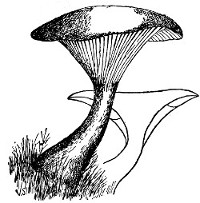
Clitocybe clavipes.
About two-thirds natural size.
C. cla´vipes Pers.—clava, a club; pes, a foot. Pileus 1½-2½ in.
across, rather convex at first, soon
plane, at length almost obconical,
very obtuse, even, glabrous, dry,
sometimes all one color, brown,
sooty, livid-gray, etc., sometimes
whitish towards the margin, very
rarely entirely white. Flesh loose in
texture, white, thin at the margin.
Gills deeply decurrent, continued
down the stem as straight lines,
rather distant, flaccid, quite entire,
broad, entirely and persistently white.
Stem 2 in. long, base ½ in. and
more thick, conically attenuated upward,
rather fibrillose, livid, sooty, solid, spongy within. Spores
elliptical, 6–7×4µ.
In woods, especially pine. Resembling C. nebularis in color, but
quite distinct. Smell pleasant, entire substance soft and elastic. Fries.
Spores elliptical, 6–7×4µ Massee; sub-ellipsoid, 5–7×3–4µ K.;
6×8µ W.G.S.
Found in pine woods of New Jersey, and under spruce in West
Virginia. Its substance is spongy, therefore does not stew well. Cooked
in any other way it is delicate and of excellent flavor.
C. gangræno´sa Fr.—gangræna, gangrene. Pileus fleshy, convex
then plane, obtuse, whitish, at first sprinkled with white powder, then
naked, variegated, streaked. Gills slightly decurrent, arcuate, crowded,
dingy-white. Stem somewhat bulbous, soft, striate, spongy, solid.
Stinking; large, flesh becoming blackish and variegated with black.
Stem curved, sometimes excentric. Pileus whitish, here and there
greenish, livid, etc. Fries.
87Var. nigres´cens Lasch. Whitish; pileus thin, soft, at first convex,
obtuse then plane, somewhat umbonate, and somewhat depressed; gills
decurrent, very much crowded, narrow, stem solid, downy.
Pileus 2–3 in. broad. Stem 1¼-1½ in. long, 2–3 lines thick.
Odor rather sweet, taste unpleasant. Cooke.
New Jersey, Haddonfield, pine woods. July to August. McIlvaine.
This Clitocybe is in every way unattractive. It is not poisonous, but
no one would care to eat it.
(Plate XXVI.)
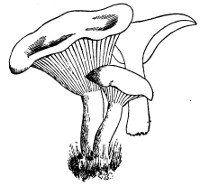
Clitocybe media.
One-half natural size.
C. me´dia Pk.—medius, middle. Because intermediate between C.
nebularis and C. clavipes. Pileus
fleshy, convex, becoming plane or
slightly depressed, dry, dark grayish-brown,
the margin often wavy or irregular,
flesh white, taste mild. Gills
broad, subdistant, adnate or decurrent,
whitish, the interspaces somewhat
venose. Stem equal or but
slightly thickened at the base, solid,
elastic, not polished, colored like or
a little paler than the pileus. Spores
elliptical, 8×5µ.
Pileus 2–4 in. broad. Stem 1–2
in. long, 4–8 lines thick. Mossy ground in deep woods. North Elba.
September.
This species is intermediate between C. nebularis and C. clavipes.
In its general appearance, and in the character of the pileus and stem,
it resembles C. nebularis, but in the character of the more distant gills
and in the size of the spores it is nearer C. clavipes, of which it might
perhaps be regarded as a variety. Two forms are distinguishable. In
one the gills are more distant, slightly rounded behind, and adnate or
abruptly terminated; in the other they are closer and more distinctly
decurrent. The plant is edible. Peck, 42d Rep. N.Y. State Bot.
I have known this fungus very favorably since 1883, and regard it as
one of the best. I have seen it in the West Virginia mountains only,
but it will probably be found in cool, shaded, high localities all over the
country. Both it and the C. nebularis are well worthy of search.
88C. viles´cens Pk.—vilesco, of little value. Pileus convex, then plane
or depressed, often irregular, glabrous, slightly pruinose on the involute
margin, brown or grayish-brown, becoming paler with age, often
concentrically rivulose. Gills close, adnate or decurrent, cinereous,
sometimes tinged with dingy-yellow. Stem short, solid, sometimes
compressed, grayish-brown, with a whitish tomentum at the base.
Spores subglobose or broadly elliptical, 5–6.5µ; flesh whitish-gray,
odor slight.
Plant gregarious, 1–2 in. high. Pileus 1–1.5 in. broad. Stem
1–2 lines thick. Grassy pastures. Jamesville, August. Peck, 33d
Rep. N.Y. State Bot.
A pale form of this species grows on sandy soil, in which the pileus
is smoky white, but it becomes grayish-brown in drying. The mycelium
binds together a mass of sand, so that when the plant is taken up
carefully a little ball of sandy soil adheres to the base of the stem. The
stem is sometimes pruinose. The flavor is mild and agreeable. Peck,
50th Rep. N.Y. State Bot.
Sometimes plentiful about Philadelphia. Edible. Caps tender, slight
flavor.
C. comitia´lis Fr.—belonging to an assembly. Pileus about 1½ in.
across, fleshy, convex, then plane, obtuse, even, glabrous, rather moist
but not hygrophanous, every part colored alike, sooty-umber, almost
black. Flesh firm, white. Gills very slightly decurrent, horizontal,
plane, thin, crowded, white. Stem 2–3 in. long, 3–4 lines thick,
equally attenuated upward from the base, glabrous, sooty, elastic,
stuffed. Spores elliptical, 7–8×4µ.
Damp places among mosses in pine woods, etc. Distinguished by
the blackish color of the almost flat pileus, and the very slightly decurrent
gills. Somewhat allied to C. clavipes, but firmer, smaller and inodorous.
Massee.
Rather rare. Found in New Jersey among pines; in Pennsylvania
in mixed woods.
Edible. Good texture and flavor.
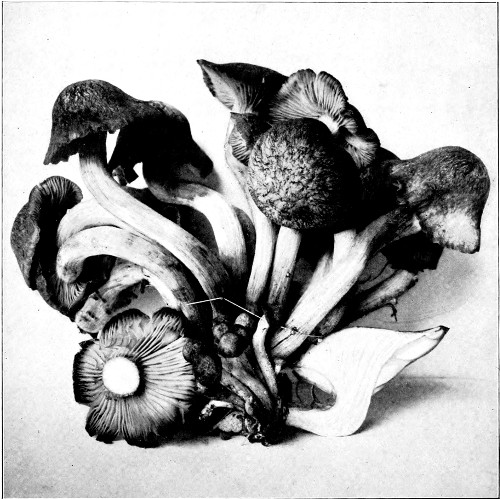
Photographed by Dr. J.R. Weist. Plate XXVII.
CLITOCYBE MONADELPHA.
C. cyanophæ´a Fr. Gr.—blue. Pileus 3–4 in. broad, becoming
bluish-dusky-brown, compact, convex then plane, obtuse, smooth.
89Stem 3 in. long, 1 in. thick at the base, attenuated upward, robust,
solid, smooth, becoming azure-blue when young, abruptly white at the
apex. Gills deeply decurrent, crowded, violaceous, then becoming pale.
New York, Albion. In woods. October. Edible. Dr. E.L.
Cushing.
Specimens sent to me by Dr. Cushing are the first and only ones of
the species I have seen. The description is accurate. The spores were
cream color.
C. monadel´pha Morg.—monas, single; adelphos, a brother. From
its cespitose habit. (Plate XXVII.) Densely cespitose. Pileus fleshy,
convex then depressed, at first glabrous, then scaly, honey color, varying
to pallid-brownish or reddish. Stem elongated, solid, crooked,
twisted, fibrous, tapering at the base, pallid-brownish or flesh color.
Gills short, decurrent, not crowded, pallid flesh color. Spores white,
a little irregular, 7.5×5.5µ.
On the ground in wet woods, spring to late autumn. Pileus 1–3 in.
Stem 3–7 in. Morgan.
Grassy places. Menands. Albany county. September. Edible.
Resembling Armillaria mellea, but distinguished from it by the absence
of a collar from the stem, by the more decidedly decurrent lamellæ and
by the solid stem. It is also more agreeable in flavor. It is related to
C. illudens in habit and manner of growth. Peck, 51st Rep. N.Y.
State Bot.
Spores 8×5µ Peck.
October 15, 1898. Identified by Professor Peck. September until
frost.
Grows in great clusters about roots, etc., at Mt. Gretna. Frequently
much water-soaked and uninviting. Taste variable, sometimes strong,
woody.
It is edible, but care should be exercised in collecting to get young,
fresh groups.
C. socia´lis Fr.—socius, a companion. Pileus about 1 in. broad,
pale-yellowish with a reddish tinge, fleshy, convex then expanded,
acutely umbonate especially when young, even, smooth, dry. Flesh
moderately thin, white. Stem 1 in. long, 2 lines or a little more thick,
90solid, fibrous, commonly ascending, smooth, reddish, the rooting base
hairy. Gills plano-decurrent, scarcely crowded, becoming yellow. Fries.
A very pretty species, densely gregarious, inodorous. The stem is
sheathed-hairy at the base like Marasmius peronatus. Its greatest affinity
is with A. vernicosus, of which it is perhaps a variety. Stevenson.
Quite common in pine woods of New Jersey. Though small, goodly
messes of it may be gathered from its patches. The caps make a pleasing
dish.
***
Pileus becoming yellow.
None reported as tested for edibility.
****
Pileus greenish or becoming pallid.
C. odo´ra Bull.—odorus, fragrant. (Plate XXIV, fig. 9, p. 82.)
Fragrant. Pileus about 2 in. across, flesh rather thick, tough; soon
plane and wavy, even, smooth, pale dingy green, silky when dry. Gills
adnate, rather close, broad, greenish or pallid. Stem about 1–1½ in.
long, 2 lines thick, base incrassated, elastic, stuffed. Spores elliptical,
6–8×4–5µ. In woods. Massee.
Readily distinguished by the strong, aniseed smell, dingy bluish-green
pileus, and the pallid or greenish gills.
Sometimes somewhat cespitose. Tough; size variable, color varies
between pale green and greenish-gray, usually all colored alike, but the
gills are sometimes white; smell pleasant, spicy, especially when dry.
Fries.
Spores 6×5µ K.; 8×4µ B.
A rather delicate, even exquisite dish. Cooke.
Edible. Exceedingly spicy. The flavor is pleasant, but rather
strong. A few specimens mixed with others of like texture but less
flavor make a tasty dish.
C. rivulo´sa Pers.—rivus, a stream. (Named from rivulet-like streaks
on pileus.) Pileus 1–3 in. across, flesh thin, convex then plane and
depressed, obtuse, often undulately lobed, dingy flesh-color or reddish,
becoming pale, glabrous, then covered with a whitish down. Gills
slightly decurrent, broad, rather crowded, pinkish-white. Stem about
2 in. long, 3–4 lines thick, rather fibrillose, tough, elastic, whitish,
stuffed. Spores elliptical, 6×3.5µ. Massee.
91Among grass by road-sides, etc.
Not common, but when found it is basket-filling. I have found it in
Pennsylvania, New Jersey and West Virginia.
Edible. The caps are rather tough but become glutinous and tender
when well cooked. Flavor fine.
*****
Pileus white, shining when dry.
C. cerussa´ta Fr.—cerussa, white lead. Pileus 1½-3 in. across,
flesh thick at the disk, becoming thin toward the margin; convex then almost
plane, obtuse, even, minutely floccose then almost glabrous, white.
Gills adnate, then decurrent, very much crowded, thin, permanently
white. Stem about 2 in. long, 3–5 lines thick, smooth, tough, elastic,
naked, spongy and solid, white. Among dead leaves, etc.
Taste mild, smell almost obsolete. Stem rather thickened at the base
and often tomentose. Pileus said to be gibbous, but not umbonate nor
becoming rufescent. Gills not changing to yellowish. Fries.
Spores 3µ W.G.S.
Edible. Good.
C. phylloph´ila Fr. Gr.—leaf-loving. Whitish-tan. Pileus 1–3 in.
across, rather fleshy, convex then plane, becoming umbilicate and depressed,
sometimes wavy, smooth and even. Gills thin, subdistant,
white then tinged with ocher, rather broad, very slightly decurrent.
Stem 2–3 in. long, equal, stuffed then hollow, whitish, tough, silky-fibrillose.
Spores 6×4µ.
Among leaves in woods, etc.
Spores 6×4µ Massee; 6×3µ W.G.S.; 5.5×2.8µ Morgan.
Found at Devon, Pa., 1888; Angora, West Philadelphia, 1897. It is
equal to the Pleurotus ostreatus (oyster mushroom) in texture, but not
so high in flavor. Well cooked it is an agreeable and valuable food.
C. pithyoph´ila Secr. Gr.—pine-loving. Pileus 2–3 in. broad, dead-white
when moist, shining whitish when dry, fleshy but thin, rather
plane, umbilicate, at length irregularly shaped, repand and undulato-lobed,
even, smooth, flaccid, the margin slightly striate when old. Stem
somewhat hollow, rounded then compressed, equal, even, smooth, obsoletely
or scarcely pruinose at the apex, white tomentose at the (not
92bulbous) base. Gills adnate, somewhat decurrent, very crowded, plane,
2–3 lines broad, distinct, quite entire, white.
Odor not remarkable, but pleasant. Gregarious, somewhat cespitose;
white indeed, but when moist watery and somewhat hygrophanous,
in which it evidently differs from A. phyllophila. A. tuba, which appears
in the same places, is very like it. Stevenson.
Spores 6–7×4µ B.
Massachusetts, Sprague; New York, Peck, Bull. 1887.
Albion, Orleans county, N.Y., October, 1898, Dr. Cushing.
Several specimens received were clearly referable to C. pithyophila,
though varying in having caps deeply depressed but not umbilicate.
The white tomentosity at base was present but indistinct.
Four specimens were eaten and found good. Eaten enjoyably by
Dr. Cushing.
C. fus´cipes Pk.—fuscus, dirty; pes, a foot. Pileus thin, broadly
convex or plane, umbilicate, glabrous, whitish and striatulate when
moist, pure white when dry, odor and taste farinaceous. Gills nearly
plane, subdistant, adnate or slightly decurrent, white. Stem equal,
glabrous or slightly mealy at the top, hollow, dingy brown when moist,
paler when dry. Spores globose, 5–6µ.
Pileus 4–8 lines broad. Stem about 1 in. long. Under pine trees.
Carrollton. September. Peck, 44th Rep. N.Y. State Bot.
Edible. Its small size gives it minor importance, but a quantity of
it makes an excellent meal.
C. can´dicans Pers.—candico, to be shining white. Entirely white.
Pileus about 1 in. across, flesh thin, convex then plane or slightly
depressed, umbilicate, regular or slightly excentric, even, with an
adpressed silkiness, shining, shining white when dry. Gills adnate
then slightly decurrent, crowded, very thin, narrow, straight. Stem
1–2 in. long, 1–2 lines thick, even, glabrous, cartilaginous, polished,
equal, hollow, base incurved, rooting, downy. Spores broadly elliptical
or subglobose, 5–6×4µ. Massee.
Among damp fallen leaves, etc.
Entirely white, small, rather tough; approaching Omphalia in the
structure of the stem. The following form is described by Fries as
occurring in pine woods: Stem thin, flexuous, base glabrous; pileus
93plane, not umbilicate, naked (without silky down). Gills scarcely
decurrent.
A remarkable form but scarcely to be separated as a species. Fries.
Quite common in West Virginia, Pennsylvania, New Jersey. The
caps are excellent when well cooked.
C. dealba´ta Sow.—dealbo, to whitewash. Pileus about 1 in. or a
little more broad, white, slightly fleshy, tough, convex then plane and
at length revolute and undulated, always dry (not watery in rainy
weather), even, smooth, somewhat shining, but as if innately pruinose
under a lens. Flesh thin, arid, white. Stem 1 in. long, 2 lines thick,
stuffed, wholly fibrous, at length also tubed, equal, but often ascending,
whitish, mealy at the apex. Gills adnate, scarcely decurrent, thin,
crowded, white.
Pileus sometimes orbicular, sometimes upturned and wavy. Odor
weak, pleasant, but not very remarkable. Most distinct from A. candicans
in the nature of the stem.
Edible. Its top is exceedingly like ivory. Its charming flavor is exceeded
by very few other fungi. Stevenson.
Among leaves and grass. Woodland Cemetery, Philadelphia.
This charming fungus is common over the land. I have known it
since 1881, and found it from North Carolina to West Virginia.
C. robus´ta Pk.—robustus, stout. Pileus thick, firm, at first convex,
soon plane or slightly depressed in the center, glabrous, white, the margin
at first involute or decurved, naked. Flesh white. Gills narrow,
close, decurrent, whitish. Stem stout, rather short, solid, glabrous,
equal or slightly tapering upward, often with a bulbous base, white.
Spores elliptical, 8×4–5µ.
Pileus 3–4 in. broad. Stem 1–2 in. long, 8–12 lines thick.
Woods among fallen leaves. Catskill mountains. September to
November.
This large and robust fungus is closely allied to C. candida Bres.,
from which it differs in the naked margin of the pileus, the absence of
any marked odor and especially in the more elliptical shape of its spores.
The same plant has been collected in Maryland by Mr. L.J. Atwater,
who considers it edible, having eaten it with satisfaction and safety.
Peck, 49th Rep. N.Y. State Bot.
94This fungus is quite plentiful in Pennsylvania and in open oak woods
in New Jersey. Its size and sometimes gregarious growth give it a
permanent food value. Its texture is coarse, but when cooked it is
highly satisfactory.
C. gallina´cea Scop.—gallina, a hen. Application not apparent.
White; acrid. Pileus 1–1½ in. across, rather fleshy at the disk, margin
thin; convex then depressed, but not funnel-shaped, even, dry,
opaque. Gills slightly decurrent, narrow, crowded, thin. Stem about
1½ in. long, 2 lines thick, equal, even, solid. Among grass, moss, etc.
Resembling C. dealbata in form, but smaller, opaque, dingy-white,
taste somewhat acrid. Stem solid, but not cartilaginous, about 2 in.
long, equal, ascending or flexuous, excentric, at first floccosely mealy,
always opaque, white. Pileus slightly fleshy, convex then plane, not
depressed, obtuse, ½-1 in. broad, unequal, dry, pruinosely hoary;
flesh white, compact, but thin. Gills adnato-decurrent, thin, crowded,
plane. Fries.
It loses its acridity in cooking and is quite equal to C. dealbata.
C. trunci´cola Pk.—truncus, trunk of a tree. Pileus thin, firm,
expanded or slightly depressed in the center, smooth, dry, white. Gills
narrow, thin, crowded, adnate-decurrent. Stem equal, stuffed, smooth,
often excentric and curved, whitish.
Plant 1 in. high. Pileus 1 in. broad. Stem 1 line thick.
Trunks of frondose trees, especially maples. Croghan. September.
Peck, 26th Rep. N.Y. State Bot.
Spores 5×3.5µ Morgan.
Found on maple trees in West Philadelphia, Pa. Edible. Good
quality.
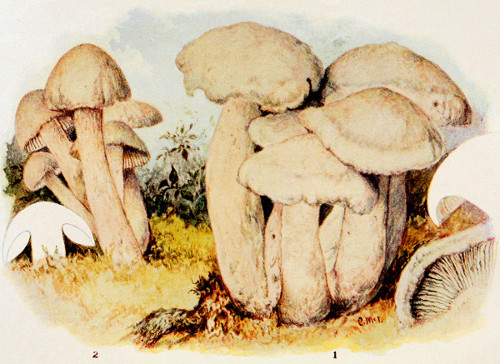
Grouped by F.D. Briscoe—Studies by C. McIlvaine. Plate XXVIIa.
| Fig. |
Page. |
Fig. |
Page. |
| 1. Clitocybe multiceps, |
95 |
2. Clitocybe multiceps, var. |
95 |
C. decas´tes Fr. Gr.—a decade; a number of ten. From the stems
being often joined in bundles of about ten. Densely cespitose. Pileus
5–12 in. across, soon almost plane, disk gibbous or obtuse; margin at
first shortly incurved, then expanded, very much waved and often lobed,
even, glabrous, dingy-brown or livid when moist, pale clay-color when
dry. Flesh exceedingly thin except at the disk, whitish. Stem 4–7
in. long, ½-1½ in. thick, usually slightly thinner upward, rather soft,
95entirely fibrous, solid, white, usually curved and ascending, coalescent
into a solid mass at the base. Gills adnato-decurrent, or often more or
less adnexed, up to ½ in. broad, rather narrowed towards the margin,
often wavy. Spores globose, smooth, 4µ diameter.
On the ground and on sawdust.
Albion, Orleans county, N.Y., Dr. Cushing. October, 1898.
On ground in grassy places (Woodland Cemetery, May 22, 1897).
McIlvaine.
Particularly welcome to toadstool lovers are the early comers. The
present species is among the first. It is rich in quantity, substance and
flavor.
C. mul´ticeps Pk.—multus, many; caput, a head. (Plate XXVIIa,
p. 94.) Pileus fleshy, thin except on the disk, firm, convex, slightly
moist in wet weather, whitish, grayish or yellowish-gray. Flesh white,
taste mild. Gills close, adnate and slightly decurrent, whitish. Stems
densely cespitose, equal or slightly thickened at the base, solid or stuffed,
firm, elastic, slightly pruinose at the apex, whitish. Spores globose,
5–8µ.
Pileus 1–3 in. broad. Stem 2–4 in. long, 3–6 lines thick.
Open places, grassy ground, etc. Albany and Sandlake. June and
October. This species forms dense tufts, often composed of many individuals.
In this respect it is related to such species as C. tumulosa,
C. aggregata and C. illudens. From the crowding together of many
individuals the pileus is often irregular. Sometimes the disk is brownish
and occasionally slightly silky. The gills are sometimes slightly
sinuate, thus indicating a relationship to the species of Tricholoma. The
taste, though mild, is somewhat oily and unpleasant. The plants appear
in wet, rainy weather, either early in the season or in autumn. Specimens
have been sent to me from Massachusetts by R.K. Macadam and
Professor Farlow, and from Pennsylvania by Dr. W. Herbst. Peck,
43d Rep. N.Y. State Bot.
West Virginia, New Jersey, Mt. Gretna, Pa. In May, and in autumn
months. Very variable in size, color, shape of gills, texture and taste.
McIlvaine.
The early spring clusters are remarkable for their tenderness and
excellence. Clusters of hundreds of individuals grew abundantly at Mt.
Gretna in May, 1899. When the fungus was young the gills were
96sometimes adnate, almost free, often decurrent. The varying color of
oysters is well seen in C. multiceps.
Edible. They should be well cooked. The addition of a little lemon
juice or sherry conceals a slight raw taste sometimes present.
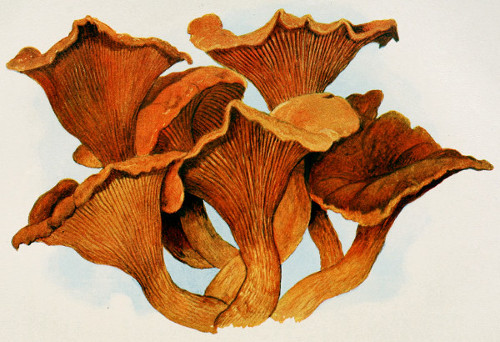
Photographed by Dr. J.R. Weist—Painted by C. McIlvaine. Plate XXIXa.
|
Page. |
| Clitocybe illudens |
96 |
C. illu´dens Schw.—mocking, deceiving. (Plate XXIXa, p. 96.)
Pileus fleshy, convex or expanded, smooth, generally with a small umbo.
Gills not crowded, unequally decurrent, some of them branched, narrowed
toward each end, the edge, in dry specimens, discolored. Stem
firm, solid, long, smooth, tapering at the base.
Height 5–8 in., breadth of pileus 4–6 in. Stem 6–8 lines thick.
Spores 4–5µ Peck.
Grows in clumps or large masses about stumps or decaying trees from
August to October. Its bright, deep yellow is attractive from a distance.
As many as fifty plants may form a cluster. Cap from 2–6 in., fleshy,
convex or expanded, often with a raised center directly over the stem;
flesh juicy and yellow; gills yellow, widely separated, running down
stem unequally; stem long, firm, solid, smooth, tapering toward base.
When cooked the taste is rather saponaceous. Strong stomachs can
retain a meal of them, but the fungus generally sickens the eater.
Many testings show it to contain a minor poison. It is not deadly, but
should not be eaten. Bull. No. 2, Phila. Myc. Center.
New York, Peck, Rep. 23–49. Well known in southern states.
Indiana, H.I. Miller.
The mysterious property of phosphorescence is possessed by this
fungus. As heat is known to develop in masses of the fungus it is of
interest to know whether it is from the phosphorescence or a ferment.
Its radiance by night surpasses its splendor by day. Mr. H.I. Miller,
of Terre Haute, Ind., first drew the writer’s attention to this quality.
A large box of specimens sent by him retained their luminous quality
after three days of travel to such an extent that the print of a newspaper
could be read when held close to the mass.
Mr. Miller writes: “There is something about this fungus which
generates heat. When I bring in a basketful of it, for the pleasure its
phosphorescence affords my friends, I find that after having been in the
basket for two or three hours, and while piled one bunch upon top of
another, that to insert one’s hand among the different clusters is like
putting it close to a hot stove.”
97This fungus is so inviting in quantity and beauty that one turns from
it with a regret that lingers. Eaten in quantity it acts upon some persons
as an emetic. I have several times eaten of it without other than
pleasurable sensations, but persons partaking of the same cooking have
been sickened.
C. fumo´sa Pers.—fumus, smoke. Pileus 1–3 in. across, fleshy, margin
thin; convex, often gibbous when young, regular or wavy, even,
pellicle not separable, glabrous, sooty-brown, soon livid or gray when
dry. Gills adnate in regular forms, but often decurrent when the pileus
is irregular, crowded, distinct, grayish-white from the first. Stem 2–3
in. long, 3–6 lines thick, almost equal, often twisted or curved, glabrous,
dingy-white, apex mealy, solid, fibrous. Spores subglobose,
5–6µ diam.
In woods. Autumn.
Gregarious, somewhat cespitose, tough, rather cartilaginous. Pileus
truly obtuse, never streaked, often regular. Smell none. Fries.
Var. po´lius. Densely and connately cespitose. Pileus convex, then
plane, obtuse, smooth, gray. Stem flexuous, smooth. Gills crowded,
whitish. Edible. Cooke, 1891.
Var. polius found growing in large quantities in Boston navy yard in
stone barn. Determined by Professor Peck. A fair edible. R.K.
Macadam.
This woods-growing Clitocybe has been many times found by me in
a hot-house in Haddonfield, N.J. Professor Peck confirmed my identification.
Either its spores or mycelium had evidently been carried
thither in the wood-earth used by florists. The hot-house crops appeared
in March, and continued until June.
Several of the plants showed an effort to comply with some condition
unusual to them, by producing gills upon the upper side of the
pileus. Those below were venose and crisped.
This wild species had thus been brought into cultivation. The cultivated
plants were much more tender than the wild. Both are excellent.
C. connex´a Pk.—connexus, joined. From its relation to Tricholoma.
Pileus thin, convex or expanded, subumbonate, clothed with a minute
appressed silkiness, white, the margin sometimes faintly tinged with
98blue. Gills crowded, narrow, white inclining to yellowish. Stem
equal or tapering downward, solid, whitish.
Plant 2–3 in. high. Pileus 2–3 in. broad. Stem 2 lines thick.
Ground in woods. Croghan. September.
The gills sometimes terminate rather abruptly and are not strongly
decurrent, hence it might easily be mistaken for a Tricholoma. The
margin of the pileus is sometimes marked with slight ridges as in Ag.
laterarius. The odor is weak but aromatic and agreeable. Peck, 26th
Rep. N.Y. State Bot.
Found in plenty in oak woods near Philadelphia, and in West Virginia;
a few specimens in southern New Jersey. Autumn.
Edible, and quite equal to most of the Clitocybes.
C. tumulo´sa Kalchbr.—tumulus, a mound. Cespitose. Pileus 1–2
in. across, disk fleshy, margin thin; conico-convex then expanded, obtusely
umbonate or obtuse, even, glabrous, brownish-umber, becoming
pale, margin drooping. Gills more or less decurrent or slightly emarginate,
crowded narrow, white, then grayish. Stem 3–5 in. long, unequal,
usually thicker below, minutely downy, pallid, solid.
On the ground in woods. Spring and autumnal months. Readily
distinguished by the densely clustered habit, and the umber pileus.
The gills are very variable, sometimes distinctly decurrent, at others
rounded behind, and almost resembling a Tricholoma. Spores subglobose,
5–6µ. Massee.
California, H. and M.; New York, Peck, Rep. 42.
Sent to me by Mrs. Mary Fuller, Washington, D.C. The specimens
eaten were of good consistency and flavor.
*
Pileus colored or becoming pale, etc., surface innately flocculose orsilky; not moist.
C. gigante´a Sow.—giganteus, of gigantic size. Pileus 6–10 in.
across. Flesh rather thin in proportion to the size of the fungus, white,
or tinged with tan, glabrous when moist, slightly flocculose when dry;
margin involute then spreading, glabrous, rather coarsely grooved.
Gills slightly decurrent, broad, very much crowded, branched and connected
99by veins, whitish then pale tan-color, not separating spontaneously
from the hymenophore. Stem 1–2 in. long and nearly the same
in thickness, equal, pallid, solid. Spores white, 5×3µ.
In woods, etc.
A very distinct species, very showy, large, subcespitose, entirely
whitish tan-color; without close affinities. Stem solid, compact, and
firm inside and outside, 2½ in. long, ½ in. thick, equal, even, glabrous.
Pileus depressed from the first, then broadly, i. e., plano-infundibuliform,
thin but equally fleshy, soft, not flaccid, but easily splitting from
the margin toward the center (almost papery and involute when old),
upward of a foot broad, often excentric and generally sinuately lobed,
moist and adpressedly downy when growing, slightly flocculose and
cracked into scales when dry; margin at first very thin, involute,
pubescent, soon spreading, glabrous, at length revolute, coarsely furrowed
or radiately wrinkled. Gills slightly decurrent, closely crowded,
almost 3 lines broad (2–3 times as broad as thickness of flesh of pileus),
connected by veins, thin, fragile, straight, but sometimes varying to
crisped and anastomosing, whitish then yellowish or tinged with rufous,
smell weak. Fries.
This species was placed in Clitocybe in Syst. Myc. and Epicrisis, but
in Hym. Europ. Fries removed it to Paxillus in which he is followed by
Stevenson. Cooke and Massee continue it in Clitocybe. Dr. Somers
found one measuring over 15 inches in diameter. R.K.M.
North Carolina, Schweinitz. Edible, Curtis; Wisconsin, Bundy; California,
H. and M.; Nova Scotia, Dr. Somers.
Large quantities of Clitocybe gigantea grow in the West Virginia
mountains, and in woods around Philadelphia. July to November.
Its substance is coarse, but of good flavor. It should be chopped fine.
C. max´ima Gärtn and Meyer. (Fl. Wett.)—greatest. (Plate
XXIV, fig. 5, page 82.) Pileus as much as 1 foot broad, becoming
pale-tan or whitish, fleshy, compact at the disk, otherwise thin, somewhat
flaccid (not capable of being split), broadly funnel-shaped, gibbous
with a central umbo, always very dry, the surface becoming silky-even
or squamulose; margin involute, pubescent, always even. Flesh
white, at length soft. Stem as much as 4 in. long, 1 in. thick, solid,
compact, but internally spongy, elastic, attenuated upward, fibrillosestriate,
100whitish. Gills deeply decurrent, pointed at both ends, somewhat
crowded, soft, simple, whitish, not changeable.
The pileus is always very dry because the surface absorbs moisture.
Odor weak, pleasant, almost that of A. infundibuliformis. On account
of its gigantic stature and color, it has often been interchanged with A.
gigantea Sow.; it is in no wise, however, allied to that species, but is so
closely allied to A. infundibuliformis that it might be taken for a very
luxuriant form of it. Stevenson.
Spores 6×4µ Massee; 5×3µ, W.G.S.
New England, Frost; California, H. and M.
Common in the West Virginia mountains, mixed woods in New Jersey
and Pennsylvania. June to November. McIlvaine.
It is coarse, dry, hard, but chopped fine and cooked in various ways,
either by itself or with meats, it is a good food.
C. infundibulifor´mis Schaeff.—infundibulum, a funnel; forma, form.
(Plate XXIV, fig. 11, p. 82.) The Funnel-form clitocybe, Clitocybe
infundibuliformis, is a neat and pretty species easily recognized by the
funnel shape of its mature cap and by its pale red color. When very
young the cap is slightly convex and often adorned with a slight umbo
in its center. As it matures the margin becomes elevated so that the
cap assumes a shape somewhat resembling that of a wine glass. The
margin is sometimes wavy. The flesh is thin and white. The gills are
close, thin, white or whitish and decurrent. The stem is smooth, colored
like or a little paler than the cap and mostly tapering from the
base upward.
The cap is 2–3 in. broad, the stem 1½-3 in. long and ¼-½ in. thick.
The funnel-shaped mushroom grows in woods or copses in summer
and autumn, especially in wet seasons. It is somewhat variable in color,
but is usually a pale-red, tinged with buff, and sometimes becoming
more pale with age. It delights to grow among fallen leaves, and often
there is an abundant white cottony mycelium at the base of the stem.
When it grows in clusters the caps are apt to be irregular because of
mutual pressure. “Mushrooms and Their Use.” Peck.
Spores 5–6×3–4µ B.
Very common and in plenty after rains, when large patches of it may
be found. I have usually found the light pinkish-buff color to abound,
101and the stem thinner than described by Prof. Peck. Size of cap from
1–3 in.
It is a good, reliable food species. The stem should be removed, and
the caps well cooked.
**
Pileus colored or pallid, smooth, moist in wet weather.
C. subzonal´is Pk.—sub, under; zonalis, pertaining to a zone. Pileus
thin, centrally depressed or subinfundibuliform, marked with two or
three obscure zones, with a slight appressed silkiness, pale yellow. Gills
close, narrow, equally decurrent, some of them forked, pallid or yellowish.
Stem equal, slightly fibrillose, stuffed, pale yellow.
Plant 2 in. high. Pileus 2–3 in. broad. Stem 2–3 lines thick.
Ground in woods. Croghan. September. Peck, 26th Rep. N.Y.
State Bot.
Found in oak woods, Angora, West Philadelphia, growing singly.
Specimens few. Edible; pleasant.
C. gil´va Pers.—gilvus, pale brownish-yellow. Pileus 2–4 in. broad,
pale yellowish, fleshy, compact, convex then depressed, very obtuse, even,
smooth, dampish when fresh, polished and shining when dry, here and
there spotted as with drops, the margin remaining long involute. Flesh
compact, not laxly floccose, but at length fragile, somewhat of the same
color as the pileus. Stem 1–2 in. and more long, ½ in. and more thick,
solid, fleshy, stout, not elastic, somewhat equal, smooth, paler than the
pileus, villous at the base. Gills decurrent, thin, very much crowded,
often branched, arcuate, narrow, pallid then ochraceous.
Odor not remarkable. The stem has been noticed at length also
hollow, perhaps eroded by larvæ. It corresponds with the Paxilli.
The primary form, which is very different from all the rest, is curt,
obese, robust, scarcely ever infundibuliform. Stevenson.
Spores 4–5×5µ K.; 4–5µ Massee.
North Carolina, Schweinitz, Curtis; Pennsylvania, Schweinitz; New
York, Peck, R. 51, under pines. July to September.
Mt. Gretna, Pa. July, 1898, ground, mixed woods. McIlvaine.
Pileus 1–2½ in. across, depressed, almost infundibuliform, smooth.
Color varied lemon to bright orange. Flesh lemon color throughout.
Gills varying in color, usually same color as pileus. Stem all of one
102color, same as pileus, stuffed, sometimes short, and pointed, sometimes
thickened at base. Taste and smell pleasant. Edible; good.
C. subinvolu´ta Batsch.—turned under at the margin. Pileus
brick color, convex, depressed, smooth, margin closely involute. Flesh
pallid. Stem paler, stout, straight, somewhat equal, veined on the
lower part with oblique coalescing slightly elevated wrinkles, tomentose
and inclining to flesh color above toward the gills, base obtuse. Gills
decurrent, rather broad, of the same color as the pileus.
The stem is rough on the surface and destitute of luster. It resembles
Paxillus involutus in size and habit, in the crenate and involute
margin of the pileus, and in the stem being obsoletely veined at the
base and tomentose toward the gills. Stevenson.
New England, Frost; New York, Peck, Rep. 22.
Edible, Cooke.
C. geo´tropa Bull. Gr.—the earth; Gr.—to turn. From the turned
down margin. Pileus 2–5 in. across. Flesh thick, white convex,
then plane and finally more or less depressed, obtusely umbonate, the
prominence remaining after the pileus becomes depressed, very smooth,
even, margin thin, incurved, downy, pale pinkish-tan or buff. Gills
decurrent, crowded, narrow, simple, white, then colored like the pileus.
Stem 3–5 in. long, 1 in. or more thick at the base, slightly attenuated
upward, compact, fibrillose, colored like the pileus or paler, solid.
Spores elliptical, 6–7×4–5µ. Massee.
In woods and on their borders. Often in rings or troops.
Differs from C. maxima in being firmer, glabrous, and color much
more variable; from C. gilva in the thinner pileus, less crowded gills,
and white flesh.
Spores 5–7µ W.G.S.
In England and on the continent it is considered excellent and superior
to most edible fungi.
Found in West Virginia, 1881; Haddonfield, N J., 1891. Spring
and autumn. McIlvaine.
Edible, coarse, dry. In stews and mixed to form croquettes or patties,
it is a desirable species, owing to its plentifulness.
C. splen´dens Pers.—splendens, shining. Solitary. Pileus 2–3 in.
across, flesh rather thick, white, plane then depressed or funnel-shaped,
103glabrous, shining, yellowish. Gills deeply decurrent, narrow,
crowded, simple, white. Stem about 1 in. long, 3 lines thick, glabrous,
colored like the pileus, solid, slightly thickened at the base or
equal. Massee.
In woods, among pine leaves, etc.
Intermediate between C. gilva and C. flaccida. The typical form of
C. gilva differs in the compact pileus, often with drop-like markings,
the very much crowded, somewhat branched, pale ochraceous gills and
flesh. Fries.
Sent to me from Trenton, N.J., by E.B. Sterling.
Edible; quality good, deficient in flavor.
C. inver´sus Scop.—inverto, inverted. Pileus 2–3 in. across. Flesh
thin, fragile; convex, soon funnel-shaped, margin involute, glabrous,
even, reddish or dull brownish-orange. Gills decurrent, simple, pallid
then reddish. Stem about 1½ in. long, 2 lines thick, glabrous, rather
rigid, paler than the pileus, stuffed, soon hollow. Spores subglobose,
4µ diameter. Massee.
Among leaves, etc.
Gregarious, subcespitose, forming very large tufts, especially late in
the autumn, deformed. Smell peculiar, slightly acid. Stem sometimes
stuffed, usually hollow, hence compressed, rather rigid and corticated
outside, not elastic, without a bulb, glabrous, whitish; the somewhat
rooting base with white down, and often growing together in tufts,
variously deformed, curved, ascending, etc. Fries.
Spores subglobose, 4µ Massee; 3µ W.G.S.
Closely resembles C. infundibuliformis, but differs from it in the color
of gills and flesh. The entire plant is dark in color. Solitary; in troops;
cespitose.
Found in mixed woods. Haddonfield, N.J. Summer and autumn.
That part of the plant which readily breaks away from the stem is
tender and of good flavor. The remainder is tough.
C. flac´cida Sow.—flaccidus, limp. Pileus 2–3 in. across, flaccid,
orbicular, umbilicate, umbo persistently absent, margin spreading,
arched, glabrous, even, rarely cracking into minute squamules, tawny-rust
colored, shining, not becoming pale. Flesh thin, pallid, rather
fragile when fresh, but quite flaccid when dry. Gills deeply decurrent,
104arcuate, crowded, narrow, about 1 line broad, white, then tinged yellowish.
Stem imperfectly hollow, elastic, tough, 1–2 in. long, 2–3
lines thick somewhat equal, polished, naked, reddish-rust color, base
thickened, downy. Spores subglobose, 4–5×3–4µ.
Among leaves, etc. Gregarious, stems often grown together at the
base. Sometimes solitary and regular. Summer and autumn. Massee.
Spores subglobose, 4–5×3–4µ.
Found in 1886 in West Philadelphia—oak woods. Since in New
Jersey, North Carolina, and interior of Pennsylvania.
Edible. Well cooked it compares favorably with C. infundibuliformis
and others of like texture.
***
Pileus shining white.
C. cati´na Fr.—catinus, a bowl. Pileus 2 in. broad, at first white,
in no wise hygrophanous, then passing into pale flesh-color during rain,
and into tan-color in dry weather, fleshy, moderately thin, plane then
funnel-shaped, always obtuse, even, smooth. Flesh thin, flaccid, white.
Stem 3 in. long, 1½ in. thick, stuffed, internally spongy, elastic, tough,
thickened and tomentose at the base. Gills decurrent, straight, descending,
not horizontal, broad, not much crowded, persistently white.
Fries.
Ray Brook, Adirondack mountains. August. The pileus is at first
white, but in wet weather it becomes pallid or discolored with age. The
plants were found growing among pieces of bark of arbor vitæ lying on
the ground. Peck, 43d Rep. N.Y. State Bot.
Quite common in West Virginia, Pennsylvania, New Jersey. Woods
among dead leaves. August until frost.
Edible. Excellent in flavor and quality.
C. cyathifor´mis Bull.—cyathus, a cup; formis, form. Pileus 1½-3
in. across, flesh thin, plano-depressed when young, then infundibuliform,
even, glabrous, hygrophanous, rather slimy and usually dark
brown when moist, becoming pale and opaque when dry, undulate in
105large specimens, the margin remains involute for a long time. Flesh
watery, similar in color to the pileus, splitting. Gills adnate, becoming
decurrent with the depression of the pileus, joined behind, distant, grayish-brown,
sometimes branched. Stem spongy and stuffed inside, elastic,
at length often hollow, 2–4 in. long, 3–4 lines thick, attenuated
upward, brownish-fibrillose, fibrils forming an imperfect reticulation,
colored like the pileus or a little paler, apex naked (not mealy), base
villous. Massee.
On the ground in pastures and woods, rarely on rotten wood.
Usually blackish-umber, but varies to paler grayish-brown, pinky-tan,
pale cinnamon or brownish; then dingy-ochraceous or tan-color.
Margin expanded when old, and also indistinctly striate. Fries.
Var. cineras´cens Fr. Pileus up to 1 in. across, thin, infundibuliform,
pale smoky-brown. Gills decurrent, yellowish-white. Stem 1–2
in. long, 1½ line thick, grayish, reticulately fibrillose, hollow.
Spores 8×5µ W.G.S.; 10–12×5–6µ, B.; 9×6µ Morgan.
Mt. Gretna, Pa. Among leaves in woods. September to October.
Gregarious. McIlvaine.
Fair in quality.
C. bruma´lis Fr.—bruma, winter. From its late appearance. Pileus
about 1 in. across. Flesh thin, expanded, umbilicate then infundibuliform
and usually variously waved and lobed, glabrous, flaccid, hygrophanous,
livid, whitish or yellowish when dry, disk often darker. Gills
decurrent, about 1 line broad, crowded, pallid. Stem up to 2 in. long
and about 2 lines thick, nearly equal, slightly curved, glabrous, whitish,
often compressed, imperfectly hollow. Spores 4–5×3–4µ.
In woods, etc.
Truly autumnal, being most abundant in November. There are
two forms: (a) on pine leaves in pine woods; (b) among heather.
(a) Stem rather firm, hollow, about 2 in. long, 2 lines thick, equal or
slightly thickened at the apex, at length compressed, somewhat incurved,
glabrous, naked, becoming livid, white when dry, base white
and downy. Flesh of pileus membranaceous, at first convex, umbilicate,
margin reflexed, about 1 in. across, then funnel-shaped, often irregular
and undulate, up to 2 in. broad, glabrous, even, livid when moist,
whitish then becoming yellowish when dry, disk at first usually darker.
Gills decurrent, at first arcuate, then descending, 1 line broad, crowded,
106distinct, livid then yellowish-white, smell weak, not unpleasant. (b)
Entirely watery white; stem hollow, somewhat striate, base glabrous;
pileus infundibuliform, margin deflexed, milky-white when dry. Gills
less crowded, but rather broader, whitish. Fries.
Spores 3µ W.G.S.; 4–5×3–4µ Massee.
Edible. Cooke.
C. morbi´fera Pk.—morbus, disease; fero, to bear. Pileus thin, fragile,
glabrous, convex, becoming plane or centrally depressed, slightly
hygrophanous, grayish-brown when moist, whitish or cinereous when
dry, sometimes slightly umbonate. Gills narrow, close, adnate or
slightly decurrent, whitish or pallid. Stem short, equal, hollow, colored
like the pileus or a little paler. Spores minute, broadly elliptical,
4µ long, almost as broad.
Pileus .5–1.5 in. broad. Stem about 1 in. long, ⅙–¼ in. thick.
Grassy ground and lawns. November. Washington, D.C. F.J.
Braendle.
The species seems related to C. expallens, but the margin of the
pileus is not striate as in that fungus. The taste is very disagreeable
and remains in the mouth a long time. Two persons were made ill by
eating it, but their sickness lasted only about three hours. Peck.
I have not seen this species. Its reputation is bad. Caution should
be observed.
Pileus bright, of one color.
C. trullisa´ta Ellis. Pileus fleshy, plano-convex, at length depressed
in the center, innate fibrous-scaly, becoming smoother on the disk, margin
thin. Gills unequal, not crowded, coarse and thick, adnate with a
decurrent tooth, at length white pulverulent, purple-violet at first, becoming
dark brick-red. Stem stuffed, fibrillose, with a long club-shaped
base penetrating deeply into the sand. Spores large, cylindric-oblong,
15–20µ.
In old sandy fields. September to October.
The interior of the stem in the young plant is like the gills, violet-purple,
and the club-shaped base is covered with a tomentose coat, to
which the sand adheres tenaciously.
107Related to A. laccatus and A. ochropurpureus B.
Resembles the larger forms of A. laccatus, but it has a stouter habit,
the pileus is more squamulose, the stem is bulbous or thickened at the
base, the mycelium is violet-colored and the spores are oblong. Bull.
Torrey Bot. Club, November, 1874.
New Jersey, Ellis; New York, Peck, Rep. 33.
Haddonfield, Watertown, N.J. Sandy soil in pine woods. McIlvaine.
Densely cespitose. Caps and stems brown, glutinous and so incrusted
with sand that it is almost impossible to clean them. Edible,
but not desirable.
C. lacca´ta Scop.—made of lac. (Plate XXIV, fig. 10, p. 82.)
Pileus thin, fleshy, convex, sometimes expanded, even or slightly umbilicate,
smooth or minutely tomentose-scaly, hygrophanous when moist,
dull reddish-yellow or reddish flesh-colored, sometimes striatulate when
dry, pallid or pale dull ochraceous. Gills broad, rather thick and distant,
attached, not decurrent, flesh-colored. Stem slender, firm, fibrous,
stuffed, equal, concolorous.
Height 1–6 in., breadth of pileus 6 lines to 2 in. Common. June
to October.
An extremely variable and abundant species occurring almost everywhere
throughout the season. Peck, 23d Rep. N.Y. State Bot.
Spores 8–9µ Massee; 8–10µ B.
Var. pallidifo´lia Pk.—pallidus, pale; foliumaf. Gills whitish or
pallid, decurrent.
Var. stria´tula Pk.—stria, a furrow. Pileus moist, smooth, thin,
showing shading radiating lines, extending from near the center to the
margin. In wet or damp places.
A form occurs with a decidedly bulbous base. Gills appearing emarginate
with a decurrent tooth.
Clitocybe laccata is made the type of a new genus by Berkeley and
Broome. Massee accepts the genus but it is not generally accepted by
the standard authors. It is a well defined genus, and a fitting place for
C. laccata, C. amethystina, C. ochropurpurea, C. tortilis, which it
puzzles anyone to identify as Clitocybe.
C. amethys´tina Bolt.—amethystinus, color of an amethyst. (Plate
108XXIV, fig. 8, p. 82.) Pileus 1–2½ in. across, dark-purple, umbilicate,
smooth, minutely tomentose, involute. Gills dark-purple, decurrent,
broad. Stem 2–3 in. high, fibrillose, purple, streaked with white
fibrils, equal, densely covered with white tomentum at base.
Also written Clitocybe laccata amethystina Sacc.
“In my opinion it is a good species and should be kept distinct as
Bolton gave it, and not be tacked on to C. laccata as a variety. I should
write it Clitocybe amethystina Bolt.” Peck, letter September 17, 1897.
New York, Peck, Rep. 41; New Jersey, Sterling; Mt. Gretna, Pa.,
on wood soil, June to frost, 1897–1898, McIlvaine.
Generally included in C. laccata as a variety, and has therefore been
reported under that name.
Great quantities of C. amethystina grew in troops on beds made up
of wood earth about the cottages at Mt. Gretna, Pa. The woods over
them is dense.
The caps are tough, but they cook readily and make a pleasing dish.
C. tor´tilis Bolt.—tortilis, twisted. Pileus membranaceous, convexo-plane
then depressed, obscurely marked with radiating striæ. Stem
hollow, twisted, fragile. Gills adnate, thick, distant, fleshy-rose, cespitose,
small, irregular, pileus and stem rusty in color.
Hard ground in an old road. Sandlake. August. A species closely
allied to C. laccata and appearing like an irregular dwarf form of that
species. Sometimes cespitose. Peck, 41st Rep. N.Y. State Bot.
Excepting that this fungus is frequently found with C. laccata, and
might be taken for a new species if not here described, it would not be
separated from C. laccata.
Its edible qualities are similar.
C. ochropurpu´rea Berk.—ochra, ocher; purpureus, purple. (Plate
XXIV, figs. 1, 2, 3, 4, p. 82.) Pileus subhemispherical, at length
depressed, fleshy, compact, tough, pale yellow, slightly changing to
purplish, cuticle easily separable; margin inflexed, at first tomentose.
Stem paler, here and there becoming purplish, solid, swollen in the
middle, occasionally equal. Gills thick, purple, broader behind, decurrent.
Spores white or pale yellow.
Pileus 2 in. broad. Stem 2½ in. high, ¾ in. thick in the center.
August. On clayey soil in woodlands.
109Its spores darken when shed in quantity, have a granulated and light-lilac
appearance. It is a solitary grower, sometimes reaching the height
of six inches. The upturned, wavy pileus, showing the purple gills in
contrast with the pale Naples-yellow of the cap is markedly attractive.
The stem is often rough with fibers, hard and tough. The caps are
tough. It grows in grassy woods and open places. The novice, even
the expert, will be puzzled to place it in its genus.
Specimens were sent to me by Miss Lydia M. Patchen, Westfield,
N.Y., and E.B. Sterling, Trenton, N.J. I afterward found many at
Mt. Gretna, Pa. I reported their edible qualities to Prof. Peck who
wrote, September 3, 1897: “I have often wished it was edible, but it
has such a disagreeable flavor when fresh that I have never ventured to
eat it. I have known it to be mistaken for the common mushroom,
but not eaten.”
Though tough it cooks tender and is excellent. Stew and put in
patties or croquettes.
*
Gills becoming ash-colored.
C. di´topa Fr. Gr.—twofold; Gr.—a foot. Probably from stems
growing two together. Pileus thin, submembranaceous, convex, rarely
with a small umbo, smooth, hygrophanous, brown when young and
moist, grayish-white when dry. Gills grayish, close, thin, attached,
not decurrent. Stem slender, equal, smooth, hollow.
Height 1–2 in., breadth of pileus 6–18 lines. Stem 1–2 lines thick.
Pine woods. West Albany. October.
The plant has the odor and taste of new meal. I have seen no specimens
with the pileus depressed. Peck, 23d Rep. N.Y. State Bot.
C. meta´chroa Fr. Gr.—changing color. Separated from C. ditopa
by its thicker, depressed pileus, its thicker, less close gills, and the absence
of odor.
Pine woods. West Albany. October. Peck, 23d Rep. N.Y.
State Bot.
Moderately plentiful in New Jersey pines. September to October.
Edible, tough; when well stewed of good flavor.
C. compres´sipes Pk.—compressus, pressed together; pes, a foot.
Pileus thin, convex or expanded, umbilicate, glabrous, hygrophanous,
brownish when moist, whitish or pale yellow when dry, margin thin.
Gills close, subarcuate or horizontal, adnate or subdecurrent, whitish.
Stem firm, hollow, generally compressed, slightly pruinose. Spores
elliptical, 5–6.5×4–4.5µ. Flesh white when dry, odor slight, farinaceous.
Plant gregarious, 1–1.5 in. high. Pileus 6–16 lines broad. Stem
1–2 lines thick.
Grassy places. Albany. July.
The moist pileus is sometimes obscurely zonate. The odor is not
always perceptible unless the pileus is moist or broken. The stem is
sometimes compressed at the top only, sometimes at the base only, and
rarely it is wholly top-shaped. Peck, 33d Rep. N.Y. State Bot.
Found on open lots in West Philadelphia. Though small it usually
grows in troops which yield fair quantity. The caps are tender and of
good flavor.
C. fra´grans Sow.—fragrans, fragrant. Smell strong, spicy. Pileus
about 1 in. across. Flesh rather thick; convex, soon expanded and
slightly depressed or umbilicate, even, glabrous, hygrophanous, uniform
watery-white, disk not darker, whitish when dry. Gills slightly decurrent,
rather crowded, 1 line broad, distinct, whitish. Stem about 2 in.
long, equal, slightly curved, elastic, glabrous, whitish, stuffed then
hollow.
In woods among moss, etc.
Distinguished from other species resembling it in color and size, by
the fragrant smell resembling aniseed. Massee.
Spores 6×4µ. W.G.S.
Found in West Virginia, New Jersey, Pennsylvania. July to severe
frosts. McIlvaine.
Edible. The strong taste of anise is not lost in cooking.
C. pino´phila—pine loving. Pileus thin, convex, umbilicate or centrally
depressed, glabrous, moist, pale tan-color, paler or alutaceous
when dry. Gills moderately close, subarcuate, adnate or slightly decurrent,
whitish. Stem equal, stuffed or hollow, glabrous or subpruinose,
111colored like the pileus. Spores nearly elliptical, 4–6µ long; odor
and taste resembling that of fresh meal.
Plant 1–2 in. high. Pileus about 1 in. broad. Stem 1–2 lines thick.
Ground under pine trees. Albany and Ticonderoga. July and
August. Peck, 31st Rep. N.Y. State Bot.
Quite plentiful in pine woods of New Jersey. Edible; pleasant.
112COLLY´BIA Fr.
Pileus fleshy, usually thin, margin incurved at first, not corrugated.
Stem different in substance from the pileus, but confluent with it; hollow,
with a cartilaginous bark, internally cartilaginous or soft, often
rooting. Gills free or obtusely adnexed, membranaceous, soft.
Growing on the ground, wood, leaves and decaying fungi.
In Clitocybe and Tricholoma the substance of the stem and pileus is
alike; they differ in the character of the stem. Tricholoma has no
distinct bark-like coat, and in Clitocybe the stem is covered with minute
fibers. In Mycena as in Collybia the stem is different in substance
from the pileus, but is distinguished by the margin of the pileus being
straight. It is most closely allied to Marasmius, which is characterized
by its tough coriaceous substance, which when dried fully revives and
expands on being moistened. The line between them can not always
be closely drawn, and there are numerous species which it is difficult to
place with certainty in either genus. This does not apply to the fleshy
edible species of this genus as they are quite distinct from Marasmius.
Peck’s 49th Report contains a monograph of the New York species
of Collybia, supplemented by one of those found in other states.
Several common, prolific, long-season, delicious fungi occur in this
genus. They vary in size from “a small coin” to five inches across.
They grow in woods, on wood, on ground, on leaves, on lawns and
among moss and grass in shaded places. The writer has tested many
species raw, and eaten small quantities cooked, which are not herein
described for the reason that not enough of a species was found to test
to full extent. So far as is reported and as his experience goes, there is
not a poisonous species in Collybia. Many of them are strong in odor.
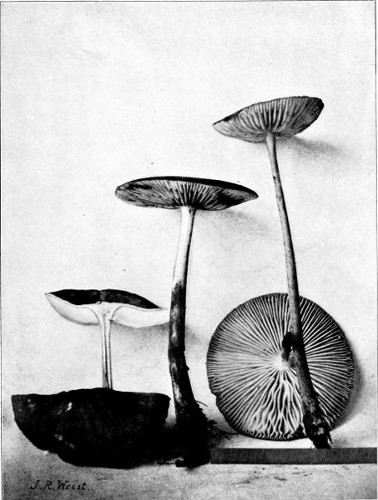
Photographed by Dr. J.R. Weist. Plate XXIX.
COLLYBIA RADICATA.
Series A. Gills White or Brightly Colored, Not Gray. Flesh White.
Striæpedes (striate-stemmed). Page
113.
Stem stout, hollow or imperfectly filled with a spongy pith; grooved
or striate with fibers.
113* Gills broad, rather distant.
** Gills narrow, crowded.
Vestipedes (clothed-stemmed). Page
118.
Stem thin, equal, hollow or with a pith, even, velvety, downy or covered
with a bloom.
* Gills broad, rather distant.
** Gills very narrow, closely crowded.
Lævipedes (even-stemmed). Page
120.
Stem thin, equal, hollow, naked, smooth—except the base—apparently
not striate, but some species are minutely striate under a lens.
* Gills broad, lax, usually more or less distant.
** Gills narrow, crowded.
Series B. Gills Becoming Gray. Hygrophanous.
Color brownish becoming gray. Allied to the last section of Tricholoma
and Clitocybe, but distinguished from them by the cartilaginous
stem.
Some are strong scented. None known to be edible.
*
Gills broad, rather distant.
C. radica´ta Relh.—radix, a root. (Plate XXIX, p. 112.) Pileus
1½-4 in. across, from convex to nearly plane, broadly umbonate, frequently
wrinkled toward and at the umbo, glutinous when moist. Color
variable, usually brown in grayish shades, from dark to almost white.
Flesh thin, white, elastic. Gills white, thick, tough, distant, ventricose,
adnexed, rounded or notched behind like Tricholoma, sometimes with
a decurrent tooth. Stem 4–8 in. long, 3–5 lines thick, smooth, firm,
same color as pileus, tapering upward, becoming vertically striate or
grooved, often twisted, ending in a long, tapering, pointed root deeply
planted in the earth.
Spores elliptical, 14–15×8–9µ Massee; 11×17µ W.G.S.; 11×9µ W.P.;
16–17×10–11µ B.
114Often sombre, but erect, neat and handsome. Growing solitary and
in troops in woods, usually near stumps, if much decayed, sometimes
on them, or on shaded lawns and grassy places. June to October.
Var. furfu´racea Pk. Stem furfuraceous, less distinctly striate.
Var. pusil´la Pk. Plant small. Pileus about 1 in. broad, passing
gradually into the typical form. Stem slender.
Professor Peck says: “The variety furfuracea is common and connects
this species with C. longipes, which has a villose stem and dry velvety
pileus.” 49th Rep.
Common to the United States. Edible. Curtis, according to Dr. F.
Peyre Porcher of Charleston, S.C., was the first to declare this edible.
A very attractive species. The purity of its gills is especially noticeable.
I began eating it in 1881, and it has continued to be a favorite.
The caps should be broiled or fried. They are sweet, pleasing in texture,
and delicately flavored.
C. platyphyl´la Fr. Gr.—broad; a leaf. (Plate XXVIII, fig. 1,
p. 114.) Pileus 3–4 in. broad, dusky and gray then whitish, fleshy-membranaceous,
thin, fragile, soon flattened, obtuse, watery when moist,
streaked with fibrils. Stem 3–4 in. long, ½ in. thick, stuffed, soft,
equal, fibrilloso-striate, otherwise smooth, naked or obsoletely powdered
at the apex, whitish, shortly and bluntly rooted at the base. Gills obliquely
cut off behind, slightly adnexed, ½ in. and more broad, distant,
soft, white.
Odor not remarkable. It inclines toward the Tricholomata in the
somewhat membranaceous cuticle of the soft stem. Fries.
Spores 13×19µ W.G.S.
Solitary, gregarious, rarely clustered. On rotten wood, roots, ground
near stumps, among leaves, etc. June to October.
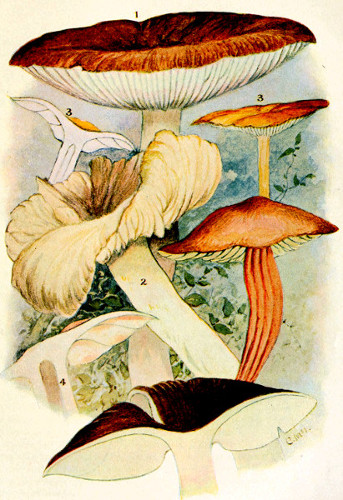
Grouped by F.D. Briscoe—Studies by C. McIlvaine. Plate XXVIII.
| Fig. |
Page. |
Fig. |
Page. |
| 1. Collybia platyphylla, |
114 |
3. Collybia dryophila, |
120 |
| 2. Collybia platyphylla (after rain), |
114 |
4. Collybia fusipes, |
116 |
Distinguished by the very broad and deeply emarginate gills, which
frequently slope up behind to near the cap then with a short turn downward
connect with the stem which is either stuffed or hollow, and by
the abundant, cord-like rooting mycelium. The gills are very broad.
Professor Peck says: “The species is quite variable. The pileus is
sometimes irregular and even eccentric, the thin margin may be slightly
striate, is often split and in wet weather may be upturned or revolute.
The lamellæ are sometimes ½ in. broad or more and transversely split.
They may be obscurely striated transversely and even veiny above with
115venose interspaces. Occasionally a slight anise-like odor is perceptible,
but in decay the plants have a very disagreeable odor and disgusting
appearance.” 49th Rep. N.Y. State Bot.
West Virginia, 1880–1885; Haddonfield, N.J., 1896. Gregarious,
and in large bunches. Mt. Gretna and Eagle’s Mere, Pa., 1897,
McIlvaine.
When fresh, in good condition, the caps are good, but they are not
nearly equal in substance or flavor to C. radicata and C. longipes. They
are best broiled or fried.
Var. re´pens Fr. Pileus more fleshy, depressed. Stem hollow,
compressed, pruinate at the apex, with a creeping, string-like mycelium.
It is best distinguished by its white, villous, anastomosing, very
much branched mycelium which creeps a long distance in a rooting
string-like manner. The so-called roots are quite different from the
stem, not a prolongation of the stem itself. Fries.
Clearly a variety of C. platyphylla. C. platyphylla is quite variable,
even puzzling. Edible qualities the same.
C. long´ipes Bull.—longus, long; pes, a foot. Pileus 1–2 in. across,
conical then expanded, umbonate, dry, minutely, beautifully velvety.
Color from pale to date-brown, sometimes umber. Flesh white, thin,
elastic. Gills white, broad, tough, thick, adnexed, distant, ventricose,
rounded behind, emarginate. Stem 4–6 in. long, 2–4 lines thick, tapering
upward, usually densely and minutely velvety like the cap, nearly
same color, with a long, tapering root.
On much decayed stumps and logs. July to October. Closely resembles
C. radicata. It is readily distinguished by its velvety cap and
stem. It is more glutinous.
Spores spheroid, 12µ Q.
California. Edible. H. and M.
West Virginia mountains, 1880–1885; Cheltenham, Pa., 1889. McIlvaine.
Excepting from California, C. longipes has not previously been reported
as found in the United States. It is not plentiful in the forests
of West Virginia, yet I often found it upon rotting stumps and logs,
solitary, but up to a dozen in the same vicinity. It is unmistakable. Its
rich yet dull velvety cap and stem and the purity of its gills hold the
finder’s admiration.
116The caps fried or broiled are delicious, resembling in every way those
of C. radicata.
C. fu´sipes Bull.—fusus, a spindle; pes, a foot. (Plate XXVIII,
fig. 4, p. 112.) Pileus 1–3 in. broad, reddish-brown, becoming pale
and also dingy-tan, fleshy, convex then flattened, umbonate (the umbo
at length vanishing), even, smooth, dry, here and there broken up in
cracks when dry. Stem 3 in. and more long, commonly ½ in., but
here and there as much as 1 in. broad, fibrous-stuffed then hollow, remarkably
cartilaginous externally, swollen, ventricose in the middle, attenuated
at both ends, often twisted, longitudinally furrowed, red or
reddish-brown, rooted in a spindle-shaped manner at the base. Gills annulato-adnexed
(joined into a ring), soon separating, free, broad, distant,
firm, connected by veins, crisped, white then becoming somewhat
of the same color as the pileus, often spotted. Stevenson.
Spores 6×3µ W.G.S.; 4–5×2–4µ B.
Solitary, gregarious, usually densely clustered on decaying wood,
roots, etc. August until after heavy frosts.
West Virginia, 1882, McIlvaine.
In the West Virginia mountains C. fusipes is frequent. Caps in the
clusters rarely exceed 1½ in. across. They show an auburn or burgundy
shade of brown in their color. When young they are smooth
and appear to remain so unless rained upon or moistened, when they
crack more or less finely in drying. At first the connection of the gills
with the stem is peculiar—they join in a collar-like ring at the top of the
stem. As the cap expands the gills part more or less and separate
from the stem. The stem is markedly spindle-shaped, though variously
flattened by compression in dense clusters; the outside often splitting,
breaking and turning out from the stem.
The caps, alone, are good, the stem being hard and refractory. The
caps are very fine, cooked in any way.
The caps dry well, and are a pleasant addition to gravies, soups and
other dishes. They make a choice pickle.
**
Gills narrow, crowded.
C. macula´ta A. and S.—macula, a spot. Pileus fleshy, firm, convex
or nearly plane, even, glabrous, white or whitish, sometimes varied
117with reddish spots or stains. Flesh white. Gills narrow, crowded,
adnexed, sometimes nearly or quite free, white or whitish. Stem generally
stout, firm, equal or slightly swollen in the middle, striate, white,
stuffed or sometimes hollow, commonly narrowed at the base, rooting,
often curved at the base, rarely slightly thickened and blunt. Spores
subglobose, 4–6µ broad, sometimes showing a slight point at one end.
Pileus 2–4 in. broad. Stem 2–4 in. long, 3–6 lines thick.
Var. immacula´ta Cke. This differs from the type in having no reddish
spots or stains.
This species is easily recognized by its large size, firm or compact
substance and white color. It grows in soil filled with decaying vegetable
matter or on much decayed wood. Peck, 49th Rep. N.Y. State Bot.
West Philadelphia, Pa. Weed grown lot near University of Pennsylvania.
September to frost. Grew gregariously over a large lot.
The plants varied greatly in size and appearance. The gills of most
were crenulate (scalloped). Assorted specimens were sent Professor
Peck who wrote: “They are all forms of C. maculata.”
The caps were stewed and eaten in abundance by many, and pronounced
“Fine.”
C. butyra´cea Bull.—butyrum, butter; buttery to the touch. Pileus
2–3 in. broad, normally reddish-brown,
but becoming pale, fleshy,
convex then expanded, more or less
umbonate, dry, even, smooth. Flesh
buttery, soft, somewhat hygrophanous,
flesh-color then white. Stem
2–3 in. long, attenuated upward from
the thickened white downy base,
hence much thinner at the apex, 2–3
lines only, but at the base ½-1 in.
thick, externally covered over with a
rigid cartilaginous cuticle, internally
stuffed with soft spongy pith, or hollow
only when old, striate, reddish,
commonly smooth, but varying with
white deciduous scales, and occasionally wholly downy with soft hairs.
118Gills slightly adnexed, somewhat free, thin, crowded, notched at the
edge, white, never spotted-reddish. Stevenson.
Spores 6–10×3–5µ B.; elliptical, 7–9×4–5µ.
Cap greasy looking. Umbo dark.
The color of the cap is variable. The species differs from C. dryophila
in having an umbonate pileus, slightly uneven gill-edges and
stem which tapers upward.
Solitary and in troops under coniferous trees. Spring, autumn.
West Virginia, Chester county and Eagle’s Mere, Pa., McIlvaine.
The caps cook quickly, are tender and have a good flavor.
*
Gills broad, rather distant.
(Plate XXIXb.)
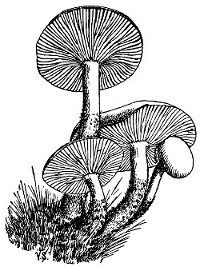
Collybia velutipes.
Natural size.
C. velu´tipes Curt.—velutum, velvet; pes, a foot. Pileus 1–4 in. broad
in the same cluster, tawny, sometimes
paler at the margin, moderately
fleshy at the disk, but thin at
the circumference, convex then soon
becoming plane, often eccentric, irregular
and bent backward, smooth,
viscous; margin spreading and at
length slightly striate. Flesh watery,
soft, slightly tawny-hyaline. Stem
1–3 in. long, 1–4 lines thick, tough,
externally cartilaginous, umber then
becoming black, densely, minutely velvety,
commonly ascending or twisted,
commonly equal, even, internally
fibrous-stuffed and hollow. Gills
broader and rounded behind, slightly
adnexed, so as at first sight to appear
free, somewhat distant, very unequal,
becoming pallid-yellow or tawny. Fr.
Spores ellipsoid, 7µ W.G.S.; 6×4µ B.; elliptical, 7×3–3.5µ Massee.
Our American plant, common to the states, is rarely found attaining
such dimensions. Its usual size is from 1–2 in. across, more frequently
119at 1–1¼. It is generally found in clusters more or less dense. The
color varies from yellowish to a dark yellowish-brown. The center is
darker than the margin. The cap viscid when moist, often irregular
from crowding. Gills may be rounded or notched at their attachment
to the stem, whitish or yellowish. Stem usually hollow, 1–4 in. long,
1–3 lines thick, whitish when young becoming colored with the dense
brownish velvety hairs.
It grows on stumps, roots in the ground, trunks and earth heavily
charged with wood matter. I have found it in every month of the year.
The heavier crop appears in September, October and November, and
lasts until long after heavy frosts. Then sporadic clusters spring up
wherever the winter sun gives them encouragement.
It sometimes does considerable damage to the tree so unfortunate as
to be its host. It begins its growth upon some injured or decayed spot
and by continually insinuating itself under the surrounding bark it, by
its mycelium and growth, pries the bark away from the wood until the
tree is entirely denuded.
It is a valuable species, not only on account of its continuous growth,
but because of its plentifulness and excellent substance.
**
Gills very narrow, closely crowded.
C. con´fluens Pers.—Pileus ¾-1½ in. broad, thin, tough, flaccid,
convex or nearly plane, obtuse, rarely somewhat umbonate, glabrous,
hygrophanous, reddish grayish-red or reddish-brown and often striatulate
on the margin when moist, pallid, whitish or grayish when dry.
Lamellæ narrow, crowded, free, whitish or yellowish-gray. Stem 2–5
in. long, 1–2 lines thick, equal, cartilaginous, hollow, clothed with a short
dense somewhat pulverulent whitish pubescence or down. Spores
minute ovate or subelliptical, slightly pointed at one end, 5–6×3–4µ.
Among fallen leaves in woods. Common. July to October.
The plants commonly grow in tufts, but sometimes in lines or arcs of
circles or scattered. They revive under the influence of moisture and
thereby indicate an intimate relationship to the genus Marasmius. The
pileus varies much in color, but commonly has a dull reddish or russety
tinge when moist, sometimes approaching bay-red. It fades in drying
and becomes almost white or grayish-white, but sometimes the center
remains more deeply colored than the margin. The stem is commonly
120rather long in proportion to the width of the pileus. Occasionally it is
somewhat flattened either at the top or throughout its entire length.
Sometimes the stems become united at the base which union is suggestive
of the specific name. Peck, 49th Rep.
West Virginia, New Jersey, Pennsylvania, McIlvaine. July to frost.
The caps of C. confluens are of excellent substance and flavor. Their
quantity makes up for their small size. I have gathered them 2 in.
across, but their average size is about 1 in. They dry well.
*
Gills broad, more or less distant.
C. esculen´ta Wulf.—esculent. Pileus ½ in. and more broad, ochraceous-clay,
often becoming dusky, slightly fleshy, convex then plane,
orbicular, obtuse, smooth, even or when old slightly striate. Flesh
tough, white, savory. Stem 1 in. and more long, scarcely 1 line
thick, or thread-like and wholly equal, obsoletely tubed, tough, stiff and
straight, even, smooth, slightly shining, clay-yellow, with a long perpendicular,
commonly smooth, tail-like root. Gills adnexed, even decurrent
with a very thin small tooth, then separating, very broad, limber,
somewhat distant, whitish, sometimes clay-color.
Gregarious but never cespitose. The tube of the stem is very narrow.
Stevenson.
The smallest edible Collybia. Cooke. Edible. In dense woods.
Curtis. It is dried and preserved. Cordier.
In pastures and grassy places. Spring and early summer.
Edible, but rather bitter flavor. In Austria, where it is in great
plenty in April, large baskets are brought to market under the name of
Nagelschwämme—nail mushrooms.
Professor Peck describes C. esculentoides Pk., 49th Rep. N.Y. State
Bot., which he states: “Differs from the type in its paler and more
ochraceous color and in its farinaceous flavor, and is related to the
European C. esculenta from which it differs essentially in the umbilicate
pileus and in the absence of any radicating base to the stem.”
**
Gills narrow, crowded.
C. dryophil´a Bull. Gr.—oak-loving. (Plate XXVIII, fig. 3, p. 112.)
Pileus 1–3 in. across, bay-brown-rufous, etc., becoming pale, but not
121hygrophanous, slightly fleshy, tough, convexo-plane, obtuse, commonly
depressed in the center, even, smooth; margin at first inflexed then flattened.
Flesh thin, white. Stem 1–3 in. long, 1–3 lines thick, cartilaginous,
remarkably tubed, thin, even, smooth, somewhat rooting,
commonly becoming yellow or reddish. Gills somewhat free, with a
small decurrent tooth, but appearing adnexed when the pileus is depressed,
crowded, narrow, distinct, plane, white or becoming pale.
There are numerous monstrous forms which are very deceiving: a.
Stem elongated, waved, decumbent, inflated at the base; pileus broader,
lobed; gills white. b. Funicularis, larger, cespitose, the lax and decumbent
stem equal and hairy at the base, gills sulphur-yellow. These
forms, analagous with A. repens Bull., occur on heaps of leaves. c.
Countless specimens growing together in a large cluster; stems thick,
inflated, irregularly shaped, sulcate, brown, the mycelium collecting the
soil in the form of a ball; pileus very irregularly shaped, full of angles,
undulated, blackish then bay-brown. In gardens. Stevenson.
Spores elliptic-fusiform, 7–8×4µ; 6µ W.G.S.
Professor Peck, 49th Rep. N.Y. State Bot., gives the following:
Pileus thin, convex or nearly plane, sometimes with the margin elevated,
irregular, obtuse, glabrous, varying in color, commonly some shade of
bay-red or tan-color. Flesh white. Lamellæ narrow, crowded, adnexed
or almost free, white or whitish, rarely yellowish. Stem equal
or sometimes thickened at the base, cartilaginous, glabrous, hollow, yellowish
or rufescent, commonly similar in color to the pileus. Spores,
6–8×3–4µ.
Pileus 1–2 in. broad. Stem 1–2 in. long, 1–2 lines thick.
Woods, groves and open places. Common. June to October.
West Virginia, North Carolina, New Jersey, Pennsylvania. McIlvaine.
C. dryophila is so common and variable that descriptions would fail
to cover it in its eccentricities. The writer has eaten it in all the forms
obtained since 1881. A very pretty form grew in large quantities
among pine needles at Eagle’s Mere, Pa., in August, 1897. It was
cooked and served at the hotel table. Many ate it and were delighted.
Dr. Badham refers to a case in which illness was caused by eating it.
In my eighteen years' experience with it, knowing it to have been enjoyably
eaten by scores of persons, I have not heard of the slightest
discomfort from it.
122C. spinulif´era Pk.—spinula, a little thorn. Pileus fleshy, thin, convex
or nearly plane, glabrous, hygrophanous reddish tan-color tinged
with pink and slightly striatulate on the margin when moist, paler when
dry, adorned with minute colored spinules or setæ. Gills narrow, close,
rounded behind and free, pale cinnamon-color, becoming somewhat
darker with age, spinuliferous. Stem slender, tough, glabrous, shining,
hollow, reddish-brown, often paler or whitish at the top, especially in
young plants, with a whitish myceloid tomentum at the base. Spores
elliptical or nearly so, 4µ.
Plant cespitose. Pileus 8–16 lines broad. Stem 2–3 in. long, about
1 line thick.
Prostrate trunks and ground among leaves in woods. Lewis county.
September.
In this species the lamellæ, under a lens, appear to be minutely
pubescent or velvety. This is due to the colored spinules or setæ which
clothe them. Peck, 49th Rep. N.Y. State Bot.
Angora, Pa. September, 1897. Among moss in mixed woods.
September to frost. McIlvaine.
Specimens identified by Professor Peck. Stems of some tapered at base.
Excepting the extreme base of stems the whole plant is tender and
of good flavor.
(Plate XXXI.)
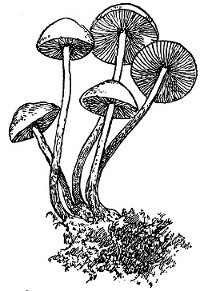
Collybia Acervata (young).
C. acerva´ta Fr.—acervus, a heap.
Pileus fleshy but thin, convex
or nearly plane, obtuse, glabrous,
hygrophanous, pale tan-color or
dingy pinkish-red and commonly
striatulate on the margin when moist,
paler or whitish when dry. Gills
narrow, close, adnexed or free, whitish
or tinged with flesh-color. Stem
slender, rigid, hollow, glabrous, reddish,
reddish-brown or brown, often
whitish at the top, especially when
young, commonly with a white
matted down at the base. Spores
elliptical, 6×3–4µ.
Plant cespitose. Pileus 1–2 in.
broad. Stem 2–3 in. long, about 1
line thick.
123Decaying wood and ground among fallen leaves in woods. Adirondack
mountains. August and September. Peck, 49th Rep. N.Y. State Bot.
This very pretty plant resembles forms of C. dryophila. The coloring
of the stems is often extremely delicate, like paintings upon rice
paper.
West Virginia mountains; Eagle’s Mere, Pa. August to frost. McIlvaine.
The entire plant is tender, delicate and of fine flavor. In these qualities
it is not distinguishable when cooked from the smaller forms of C.
dryophila.
124MYCE´NA Fr.
Pileus regular, rarely depressed in the center, thin, usually streaked
with longitudinal lines, at first conico-cylindrical,
margin at the first
straight, closely embracing the stem
which is attenuated upward. Stem
hollow, slender, cartilaginous. Gills
adnate or adnexed, sometimes with a
small tooth, never decurrent. Spores
white.
Generally small and slender, growing
on branches, twigs, heaps of
leaves, sometimes on the ground,
some minute species on single dead
leaves. Long, rooting stems are not
uncommon. Clitocybe and Omphalia
are separated by their decurrent
gills and in Collybia the margin is
at first incurved.
In this genus the species of the various sections are not always distinguished
by single sharply defined characteristics, so that it will sometimes
be necessary to pay attention to all the features. Species with a
thread-like stem are found in other sections than Filipedes and some of
the Lactipedes are slippery when moist, but not truly viscous.
Calodontes (
kalos, beautiful;
odontes, teeth). Page
126.
Stem juiceless, not dilated into a disk at the base. Edges of gills
darker, minutely toothed.
Adonideæ (
Adonis, referring to beauty). Page
126.
Stem juiceless, not dilated at the base. Gills of one color, not changing
color. Color pure-colored, bright, not becoming brownish or gray.
On the ground.
125Rigipedes (rigid-stemmed). Page
126.
Stem firm, rigid, rather tough, juiceless, more or less rooting. Gills
changing color, white, then gray or reddish, generally at length connected
by veins.
Tough, persistent, inodorous, usually on wood, very cespitose, but
individuals of the same species sometimes grow singly on the ground.
Fragilipedes (fragile-stemmed). Page
130.
Stem fragile, juiceless, fibrillose at the base, scarcely rooting. Pileus
hygrophanous. Gills becoming discolored, at length somewhat connected
by veins.
Thin, fragile, often soft, normally growing singly on the ground. A
few strong smelling, cespitose on wood.
Filipedes (thread-stemmed). Page
130.
Stem thread-like, flaccid, somewhat tough, rooting, juiceless, generally
extremely long in proportion to the pileus. Gills becoming discolored,
paler at the edge.
Straight, growing singly on the ground; inodorous. Pileus dingy-brown,
becoming paler.
Lactipedes (milky-stemmed). Page
130.
Gills and rooting stem milky when broken.
Glutinipedes (glutinous-stemmed). Page
131.
Stem juiceless but externally sticky with gluten. Gills at length decurrent
with a tooth.
Basipedes (base-stemmed). Page
131.
Stem dry, rootless, the base naked and dilated into a disk or small
hairy bulb. Growing singly, slender, soon becoming flaccid.
Insititiæ (
insero, to insert or graft). Page
131.
Stem very thin, dry, growing as if inserted in the supporting surface,
not downy, not disk-like at the base.
Gills adnate with a small decurrent tooth. Small, very tender, becoming
flaccid with the first touch of the sun.
126Mycena is a large genus composed of small species. About sixty
members have been found in America. They are from ½ to 1 in.
across the cap, with thin stems and altogether delicate appearance. Yet
the flesh of most of them has a gummy consistency in the mouth, and
they shrink but little in stewing. Heretofore not any appear to have
been reported as edible, probably because the size of the species has not
attracted experimenters. While some have a strong odor and taste of
radishes, and one species is bitter, it is probable that all are edible.
The writer has eaten, raw and cooked, small quantities (all he has found)
of many species not here reported as edible, which will, when further
tested, be reported upon.
The substance and flavor of those here given is remarkably pleasant.
Their late coming, hardiness and abundance are commendable qualities.
I.—Calodon´tes. Stem juiceless. Gills minutely toothed.
None tested.
II.—Adoni´deæ. Stem juiceless. Gills of one color, etc.
None tested.
III.—Rigidi´pedes. Stem rigid. Gills at first white, changing
color, etc.
M. prolif´era Sow.—proles, offspring; fero, to bear. (Plate X, figs.
6, 7, p. 28.) Pileus ⅔-1¼ in. across, slightly fleshy, expanded bell-shape,
dry, the broad umbo darker (dingy-brown), slightly striate, and
at length furrowed or rimosely split at the margin (pale yellowish or
becoming brownish-tan). Stem 2½-3 in. long, firm, rigid, smooth,
shining, slightly striate, rooted. Gills adnexed, somewhat distinct, becoming
pale white.
Inodorous, only at length nauseous. Very closely allied to M. galericulata,
in habit approaching nearest to M. cohærens. The stems are
pallid at the apex, but slightly tawny-bay-brown below, and glued together
by hairy down at the base. There is a white form with transparent
stem—on trunks. Fries.
Mt. Gretna, Pa. On ground in grass. Mycelium spreading on
leaves. McIlvaine.
127Found in great plenty. Base of stems is sometimes white when in
dense tufts.
The whole plant is tender, cooking in fifteen minutes, and is of fine
flavor. No one will want a better fungus.
M. rugo´sa Fr.—ruga, a wrinkle. Pileus ash-color but becoming
pale, very tough, slightly fleshy at the disk, otherwise membranaceous,
bell-shaped then expanded, at length rather plane, somewhat obtuse,
more or less corrugated (unequal with elevated wrinkles), always dry,
not moist even in rainy weather, striate at the circumference. Stem
commonly short, remarkably cartilaginous, tubed, rigid, tough, straight,
at length compressed, even, smooth, pallid, with a short oblique hairy
root. Gills arcuato-adnate, with a decurrent tooth, united behind in a
collar, somewhat distant, connected by veins, broad, ventricose, white
then gray, edge sometimes quite entire, sometimes with saw-like teeth.
Always inodorous. Formerly connected with M. galericulata. M.
rugosa is arid, very tough, more rarely cespitose, the pileus firm, somewhat
obtuse, wrinkled but without striæ, the gills arcuato-adnate with
a hooked tooth, white then ash-color. The genuine M. galericulata is
fasciculato-cespitose, somewhat fragile, the pileus thinner, at first conical
and umbonate, striate without wrinkles, the gills adnate, with a decurrent
tooth, white then flesh-color. Between these there is a long
series of intermediate forms. Fries.
California, H. and M.; Kansas, Cragin; Wisconsin, Bundy; New
York, September, Peck, 46th Rep.; West Virginia, New Jersey, Pennsylvania.
On decaying wood and ground near stumps. August to
November. McIlvaine.
The tenacity frequently occurring in Mycena is well shown in this species.
The caps and stem cook tender, but it is better to discard the
stems, as the two do not become tender at the same time.
M. galericula´ta Scop.—galericulum, a small peaked cap. (Plate
Plate X, fig. 5, p. 28.) Pileus somewhat membranaceous, conical bell-shaped
then expanded, striate to the umbo, dry, smooth, becoming
brownish-livid or changeable in color. Stem rigid, polished, even,
smooth, with a spindle-shaped root at the base. Gills adnate, decurrent
with a tooth, connected by veins, whitish and flesh-colored.
Very protean. Normally growing in bunches, the numerous stems
128(never sticky) glued together with soft hairy down at the base. But it
occurs also solitary, larger, pileus as much as 2 in. broad, wrinkled-striate.
The essential marks by which it is distinguished from A. rugosa
are these: Stem in general thinner, less tense and straight, often curved,
more fragile. Pileus membranaceous, conico bell-shaped, umbonate,
striate but not corrugated, moist in rainy weather. Gills adnate, with
a decurrent tooth, more crowded, whitish then flesh-colored. The color
both of the pileus (normally dingy-brownish then livid) and of the stem
(normally becoming livid-brownish) is much more changeable than that
of A. rugosa, becoming yellow, rust colored, etc. It is not so tough
and pliant as A. rugosa. Forms departing from the type are very numerous;
the most beautiful is var. calopus (Gr., beautiful; Gr., a foot)
with chestnut-colored stems, united in a spindle-shaped tail. Fries.
Spores spheroid or subspheroid, 9–10×6–8µ K.; 8–11×4–6µ B.;
6–7×4µ Massee.
Common. Autumnal. Very variable. On trunks, fallen leaves.
Two well-marked varieties of this very variable species were observed
the past season. One grows on the ground among fallen leaves. It has
a dark brown pileus, close lamellæ and a very long stem, generally of a
delicate pink color toward the top. It might be called var. longipes.
The other grows under pine trees, has a broadly convex or expanded
grayish-brown pileus and a short stem. It might be called var. expansus.
Peck, 26th Rep. N.Y. State Bot.
“M. alcalina is closely allied to it (M. galericulata), but has a stronger
alkaline odor and a rather more fragile stem. In one of your specimens
I detect a slight incarnate tint to the gills, and this is pretty conclusive
evidence that it belongs to M. galericulata. Species of Mycena are not
generally reckoned among edible fungi or even promising fungi; I suppose
on account of the thin flesh of the cap, but of course it is possible
to make up in numbers what is lacking in size. I am glad to know you
have found this to be an esculent one.” Letter Professor Peck to C.
McIlvaine, October 5, 1893.
The caps and stems when young make as good a dish as one cares to
eat. The substance is pleasant, and the flavor delicate. They are best
stewed slowly in their own fluids, after washing, for ten minutes and
seasoned with pepper, salt and butter.
M. parabo´lica Fr.—shaped like a parabola. Pileus becoming black
129at the disk, inclining to violaceous, otherwise becoming pale, whitish,
somewhat membranaceous, at first erect and oval, then parabolic, obtuse,
never expanded, moist, somewhat shining when dry, smooth, even, striate
toward the entire margin. Stem 2–3 in. long, 1 line thick, tubed, tense
and straight but not very rigid, thickened and bearded-rooted at the
base, pale below, dark violaceous above, when young white-mealy,
otherwise even, smooth, dry. Gills simply adnate, ascending, somewhat
distant, rarely connected by veins, quite entire, white, somewhat
gray at the base.
Stem less rigid than that of A. galericulatus. Truly gregarious or
cespitose. Fries.
Spores 12×6µ B.; elliptical, 11–12×6µ Massee.
Trenton, N.J. June. E.B. Sterling; West Virginia, New Jersey,
Pennsylvania, on decaying stumps, trunks of oak, chestnut, poplar, pine.
June until far into the winter. McIlvaine.
Plant up to 2½ in. high. Caps usually about ½ in., but reaching
¾ in.
A neat, attractive plant, whether single or in dense tufts. Its smell
is strong of fresh meal, and taste of that delicate flavor one finds in the
succulent base of the round, swamp rush, when pulled from its sheath—one
that every country school boy and girl knows. It is pleasant raw,
and delicious when cooked.
M. latifo´lia Pk.—latus, broad; folium, a leaf. Pileus convex,
rarely somewhat umbonate, striatulate, grayish-brown. Gills white,
broad, hooked, decurrent-toothed. Stem slender, smooth, hollow, subconcolorous,
white-villous at the base.
Height 1–1.5 in., breadth of pileus 4–6 lines. Stem .5 lines thick.
Under pine trees. Center. October.
A small species with quite broad gills, growing among the fallen
leaves of pine trees. Gregarious. Peck, 23d Rep. N.Y. State Bot.
Mt. Gretna, Pa. Among pine needles, scattered, sometimes four or
five in a cluster. September to October. McIlvaine.
Autumnal. Not rare. The caps though small are tenacious in the
mouth and lose little in cooking. The substance is agreeable and flavor
fine.
130IV.— Fragili´pedes. Stem fragile, juiceless, etc. None tested.
V.—Fili´pedes. Stem thread-like, etc.
M. collaria´ta Fr.—collare, a collar. Pileus ½ in. and more broad,
typically dingy-brown, but becoming pale, commonly gray-whitish, becoming
brownish only at the disk, membranaceous, bell-shaped then
convex, somewhat umbonate, striate, when dry rigid, smooth, not soft
nor slightly silky. Stem about 2 in. long, tubed, thread-like but almost
1 line thick, tough, dry, smooth, even or slightly striate under a lens,
becoming pale. Gills adnate, joined in a collar behind, thin, crowded,
hoary-whitish or obsoletely flesh-colored.
The gills are somewhat distant when the pileus is expanded. There
is not a separate collar as in Marasmius rotula; the gills are only joined
in the form of a collar, and remain cohering when they separate from
the stem. Fries.
Spores 8–10×4–6µ B.
New York. Old stumps and rotten logs. June. Peck, 23d Rep.
Mt. Gretna, Pa. Cespitose on decaying wood. July, September and
October. McIlvaine.
Very much like M. galericulata, but gills not connected by veins.
The caps usually have a pinkish hue, often brownish. The stems are
not as tender as the caps. The flavor is excellent.
VI.—Lacti´pedes. Stem and gills milky, etc.
M. hæma´topa Pers. Gr.—blood; Gr.—a foot. Pileus about 1 in.
broad, white flesh-color, fleshy-membranaceous, slightly fleshy chiefly
at the disk, conical then bell-shaped, obtuse, nay convex and spuriously
umbonate, naked, even or slightly striate at the margin, which is at the
first elegantly toothed. Stem 2–4 in. long, 1 line and more thick, remarkably
tubed, rigid, normally everywhere powdered with whitish,
delicate, soft hairy down, sometimes, however, denuded of it. Gills
adnate, often with a small decurrent tooth, the alternate ones shorter,
in front disappearing short of the slight margin of the pileus, whitish
and wholly of the same color at the edge.
Cespitose (very many of the stems conjoined and hairy at the base),
131firm, stature almost that of M. galericulata, wholly abounding with
dark blood-colored juice.
On stumps. Frequent. September. Stevenson.
Spores spheroid-ellipsoid, 10×6–7µ K.
I find a non-cespitose form of this species with red-margined gills.
Its red juice, however, will serve to distinguish it and show its true relations.
Peck, 31st Rep.
Common in tufts like M. galericulata and of about the same size, but
is readily distinguished by its red juice. This pretty plant can often be
gathered in considerable quantity, and well repays the collector.
VII.—Glutini´pedes. Stems gelatinous, etc.
None tested.
VIII.—Basi´pedes. Stem dilated at base, etc.
None tested.
IX.—Insiti´tiæ. Stem inserted.
None tested.
132HIA´TULA Fr.
Pileus symmetrical, very thin,
without a distinct pellicle, formed by
the union of the backs of the gills,
splitting when expanded. Gills
almost or quite free, white. Stem
central. Spores white.
Allied to Lepiota in the thin pileus
and free gills, but differing in
the entire absence of a ring. Not
at all deliquescent as in the genus
Coprinus, near to which it was at one
time placed by Fries. Massee. Reported from North Carolina.
OMPHA´LIA Fr.
Gr.—belonging to an umbilicus.
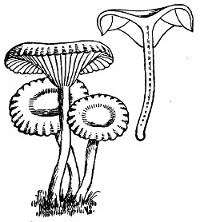
Omphalia Umbellifera.
Enlarged about two sizes.
Pileus generally thin, usually umbilicate at first, then funnel-shaped,
often hygrophanous, margin incurved
or straight. Gills truly decurrent
from the first, sometimes branched.
Stem distinctly cartilaginous, polished,
tubular, often stuffed when
young. Flesh continuous with that of
the pileus but differing in character.
Spores white, somewhat elliptical,
smooth.
Generally on wood, preferring
hilly woods and a damp climate.
Resembling Collybia and Mycena
in the flesh of stem and pileus being
different in texture and in the externally
cartilaginous stem. It is perfectly
separated by the gills being markedly decurrent from the first.
133The American species of Omphalia number between thirty-five and
forty. Many of them are common. Few woods are free from them.
Several of them are beautiful. They are usually small and lacking in
substance. Raw, the writer has not found one that is objectionable in
any way; a few have a woody taste. But two species have been found
by him in sufficient quantity to make a dish. It is probable that all are
edible. At best the species of Omphalia are valuable in emergency only.
* Pileus dilated from the first, margin incurved.
Pileus campanulate at first, margin straight and pressed to the stem.
COLLYBA´RII.
*
Pileus dilated from the first; margin incurved.
O. onis´cus Fr. Gr.—a wood-louse. From the ashy color. Pileus
scarcely 1 in. broad, dark ashy becoming pale, gray-hoary when dry,
somewhat membranaceous, or slightly fleshy, flaccid, fragile when old,
convexo-umbilicate or funnel-shaped, often irregular, undulato-flexuous,
even-lobed, smooth, even, margin striate. Stem 1 in. long, 1 line and
more thick, stuffed then tubed, slightly firm, moderately tough, sometimes
round, curved, sometimes unequal, compressed, ascending, undulated,
gray. Gills shortly decurrent, somewhat distant, quaternate,
ash-color. Not cespitose. Fries.
Spores 12×7–8µ B.
Massachusetts, Sprague; California, H. and M., who record it as
edible.
O. umbellif´era—umbella, a little shade; fero, to bear. From its umbrella-like
shape. (Plate XXXIV, p. 132.) Pileus about ½ in. broad,
commonly whitish, slightly fleshy-membranaceous, convex then plane,
broadly obconic with the decurrent gills, not at all or only slightly umbilicate,
hygrophanous, when moist watery, rayed with darker striæ,
134when dry even, changeable in appearance, silky, flocculose, rarely
squamulose, the margin, which is at first inflexed, crenate (scalloped).
Stem short, not exceeding 1 in. long, almost 1 line thick, stuffed then
soon tubed, slightly firm, equal or dilated toward the apex into the
pileus, of the same color as the pileus, commonly smooth, but varying
pubescent, white villous at the base. Gills very broad behind, triangular,
decurrent, very distant, edge of the gills straight.
Cosmopolitan. The common form is to be found everywhere from
the sea level to 4,000 feet. Stevenson.
Spores 3×4µ W.G.S.; 10×4µ W.P.; green variety 10×6µ W.P.;
broadly elliptical, 8–10×5–6µ Peck.
O. umbellifera is known the world over. It is very variable in size
and color. With us it is seldom over ¾ in. broad. Stem ½-1 line
thick. It grows on decaying wood and ground full of decaying material.
There are several varieties. All are edible, but not worth describing.
This description is given that the student may recognize one
of our common plants, and eat it, if very hungry.
O. campanel´la Batsch.—campana, a bell. Pileus thin, rather tough,
hemispherical or convex, glabrous, umbilicate, hygrophanous, rusty
yellow-color and striatulate when moist, paler when dry. Gills moderately
close, arcuate, decurrent, yellowish, the interspaces venose. Stem
firm, rigid, hollow, brown, often paler at the top, tawny-strigose at the
base. Spores elliptical, 6–7×3–4µ.
Pileus 4–8 lines broad. Stem about 1 in. long, scarcely 1 line thick.
Much decayed wood of coniferous trees. Very common. May to
November. Peck, 45th Rep. N.Y. State Bot.
Spores ellipsoid, 6–8×3–4µ C.B.P.; 7×3µ W.P.; 6–9×3–4µ B.
The quantity alone, in which this small species can be found, makes
it worth mentioning as an edible species. It is common over the United
States where coniferous trees abound. Its favorite habitat is upon the
rotting debris of these trees. Occasionally it grows from the ground,
but only from that which is heavily charged with woody material. It
is social in troops, or affectionate in clusters, or maintains a single existence.
It is edible, of good substance when stewed, tender and of fair flavor.
135
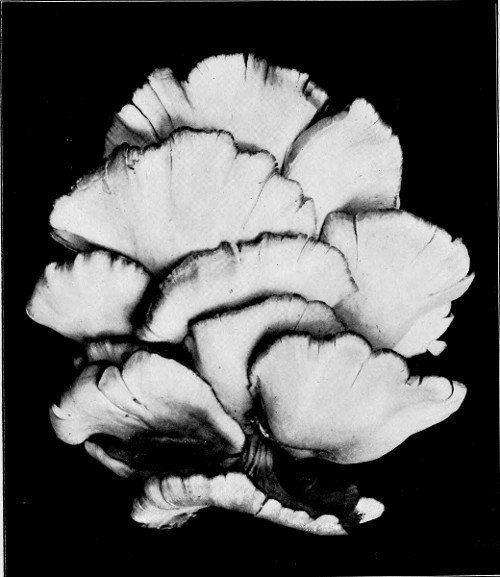
Photographed by Dr. J.R. Weist. Plate XXXV.
PLEUROTUS OSTREATUS.
PLEURO´TUS.
Stem excentric, lateral or none. Epiphytal (very rarely growing on
the ground), irregular, fleshy or membranaceous. Fries.
The excentric, generally lateral stem, absent in some of the species,
separates this from other genera of the white-spored series.
Pileus varying from fleshy in the larger to membranaceous in the
smaller forms, but never becoming woody. Veil generally wanting,
when present its remains sometimes appear on the margin of the pileus,
or as an evanescent ring on the stem. Gills, edge acute, generally decurrent,
in some species with a well-marked tooth, rarely simply adnate.
Stem fleshy, confluent and homogeneous with the pileus.
Wood, dead or alive; a few species appear on the ground.
P. ulmarius and others of the larger forms, when growing in an upright
position, may have the stem central and the pileus horizontal.
The stems of some species of Clitocybe and Omphalia if growing laterally
are sometimes excentric and oblique.
This genus is analogous to Claudopus, pink-spored, and Crepidotus,
brown-spored.
Spores white, but those of P. sapidus are faintly tinged with lilac,
and of P. ostreatus, var. euosmus, with purple.
Pileus entire, laterally extended, excentric, not truly lateral.
* Veil fugacious, fragments adhering to stem or margin of pileus.
** Veil none, gills sinuate or obtusely adnate.
*** Veil none, gills very decurrent, stem distinct, almost vertical.
**** Veil none, gills very decurrent, stem proper absent, pileus lateral,
extended behind into a short, stem-like oblique base.
Pileus not at first resupinate, lateral, prolonged without a definite
margin behind, into a very short lateral, stem-like base.
Pileus resupinate from the first, then reflexed.
If any odium attaches to the word toadstool, it should be forgotten
and forever banished in presence of this cleanly, neat, handsome genus,
choice in its growing places from lichen-covered stumps, or bark-clad
boles, or highly perched limbs, or the scented surfaces of decaying
wood. Several of its species perfume themselves throughout with pleasant
spicy odors. Many are most accommodating in their constant
coming.
Mr. H.I. Miller, superintendent Terre Haute and Indianapolis Railroad,
writes: “Most of the mushroom books give greatest space to the
A. campester. For some parts of the country this may be desirable,
but for Indiana and Ohio, considering the food value, the P. ostreatus
is the best fungus we have in these states, from the fact that anybody
wanting a mess can nearly always obtain a basketful of this variety,
whereas the others depend upon a good many weather conditions.
Having located a few logs and stumps in the spring, where the P. ostreatus
grows, these same stumps and logs can be used all season. The
crops are successive, and while some of the spots seem to be barren for
a few days at a time, the others will be bearing. It does not make
much difference what the kind of log or stump, whether it be beech,
oak or elm, or what the species of tree. I think I have found them on
all our forest trees, and it is not necessary for the tree to be dead. If
there is a decaying portion, the spores seem to be carried by the little
black beetle that infests the ostreatus, from one place to another, and
wherever a small spot of dead wood is found we are likely to find the P.
ostreatus. This being the only edible mushroom that we can find in
large quantities all through the season in this neck of the woods, it
seems to me that a general knowledge of it will serve the economic purpose
more than any other fungi.”
The presence of the P. ostreatus and its esculent companions is noted
from our northern boundary to the gulf. Poplar, maple, birch, hickory,
ash, apple, laburnum and oak trees are its favored residences.
Deer feed upon it, and kine are attracted by its scent even when deep
under snow. When properly selected and slowly cooked, the Pleuroti
are toothsome.
From the fact that the spores of this fleshy and valuable genus find
137fostering lodgment in many trees when in decay, it is more than probable
that the several species can be propagated by planting their spores
upon such decaying woods, or by transplanting the mycelium.
Growths of P. ostreatus, P. sapidus, P. salignus, and probably other
species of Pleurotus, can be forced, by watering the spots upon which
they are known to grow. Dr. Kalchbrenner mentions that the P.
sapidus is in this way cultivated in Hungary. Acting upon this mention
the writer had good success with P. ostreatus. Experiments in
this direction are likely to be interesting and rewarding.
No species is suspected of being noxious.
An analysis of P. ostreatus is given by Lafayette B. Mendel, Sheffield
Laboratory of Physiological Chemistry, Yale University, as follows:
| Water |
73.70% |
| Total solids |
26.30 |
| The dry substance contained: |
|
| Total nitrogen |
2.40 |
| Extractive nitrogen |
1.27 |
| Protein nitrogen |
1.13 |
| Ether extract |
1.6 |
| Crude fiber |
7.5 |
| Ash |
6.1 |
| Material soluble in 85% alcohol |
31.5 |
American Journal of Physiology, Vol. 1, No. 11, March 1, 1898.
I.—Excen´trici.
P. dry´inus Pers. Gr.—oak. Pileus 2 in. broad, whitish, variegated
with spot-like scales which become dingy-brown, lateral, oblique, rather
plane. Flesh thick. Stem very curt and obese, commonly 1 in. long
and thick, somewhat lateral, somewhat woody, squamulose, white, with
a short, blunt root. Veil scarcely conspicuous on the stem, but
appendiculate round the margin of the pileus when young. Gills not
very decurrent, somewhat simple, not anastomosing behind, narrow,
white, becoming yellow when old.
On trunks, oak, ash, willow, etc. Stevenson.
Spores 10×4µ Massee.
Edible. Cordier, Cooke.
When young the caps are tender; of the consistency, when cooked, of
138Polyporus sulphureus. In taste and smell the species varies from other
Pleuroti, in having a distinct musk-like flavor. This is agreeable,
reminding one of the common mushroom—A. campester.
**
Veil none, gills sinuate, etc.
P. ulma´rius Bull.—ulmus, an elm. Pileus 3–5 in. and more broad,
becoming pale-livid, often marbled with round spots, fleshy, compact,
horizontal, moderately regular although more or less excentric, convex
then plane, disk-shaped, even, smooth. Flesh white, tough. Stem
2–3 in. long, 1 in. thick, solid, firm, elastic, somewhat excentric, curved-ascending,
thickened and tomentose at the base, not rarely villous
throughout, white. Gills horizontal, emarginate or rounded behind,
slightly adnexed, broad (broader in the middle), somewhat crowded,
whitish.
The pileus is sometimes cracked in a tessellated manner. Stevenson.
Spores nearly globose, 5µ long Morgan; 5–6.5µ broad Peck; 6µ
W.G.S.
Var. aceri´cola—acer, maple; colo, to inhabit. Plant smaller, cespitose.
Trunks and roots of maple trees. Adirondack mountains. September.
Var. populi´cola—populus, poplar; colo, to inhabit. Plant subcespitose,
stem wholly tomentose. West Albany. Peck, Monograph, N.Y.
Species of Pleurotus, Rep. 39.
The gills are sometimes torn across like those of Lentinus.
The historic elms of Boston Common have borne copious crops of
this well-known and easily distinguished species from time immemorial.
Every fall, about the first of September, if the season is favorable, later
if not, copious crops appear decorating the trunks, and branches, sometimes
at a height of thirty or forty feet. Growth takes place where
branches have broken off or the trees have been wounded from other
causes. They occur very generally on elms in the outlying districts of
the city, but are rare in the country, seeming to be distinctly urban in
their tastes. No damage is apparent from their growth.
Immediately in the rear of Independence Hall, Philadelphia, a fine
cluster appears with equal autumnal regularity.
Though the elm tree is the chosen habitat of this fungus, it is little
less select in its choice than other members of its genus.
139When young and small P. ulmarius is tender and of acceptable flavor.
The stems and centers of older specimens should be cut away, and the
tender parts of the caps, only, used.
P. tessula´tus Bull.—tessela, a small cube for pavement. Pileus
becoming pale-tawny, horizontal, compactly fleshy, convex then plane,
and in a form which is somewhat lateral depressed behind, irregular,
even, smooth, variegated with round and hexagonal paler spots. Flesh
thick, white. Stem short, 1 in. or little more long, solid, compact,
equal or attenuated at the base, very excentric, curved-ascending, even,
smooth, white. Gills sinuate behind, uncinato-adnate, thin, crowded,
white or becoming yellow.
Solitary; according to some cespitose. The pileus is not cracked in
a tessellated manner, as one might easily imagine from the name, but
variegated with spots. Smaller than A. ulmarius (to which it is too
closely allied), but almost more compact, with a smell of new meal.
On trunks. Stevenson.
North Carolina, Schweinitz. Edible. Curtis. Edible. Cordier.
On specimens growing cespitose and singly, found at Haddonfield,
N.J. September, 1895, on trunk of apple tree, and at Eagle’s Mere,
Pa., singly on sugar maple, August, 1898, the margin of caps were
beautifully marked, but not cracked.
In quality it is better than P. ulmarius.
P. subpalma´tus Fr.—sub and palma, a palm. Pileus 3–5 in. across.
Flesh thick, soft, variegated; convex then more or less flattened, irregularly
circular, obtuse, wrinkled, smooth, with a gelatinous cuticle,
rufescent. Stem excentric or almost lateral, but the pileus is always
marginate behind, fibrillose, short, equal, flesh fibrous, soft. Gills adnate,
3–4 lines broad, crowded, joined behind, dingy. Massee.
On old trunks, squared timber, etc.
Very remarkable for having the flesh variegated as in Fistulina hepatica.
Pileus, especially when young, covered with a viscid pellicle. Fr.
Spores minutely echinulate, nearly globose, 5.6×7µ Morgan.
Ohio, Morgan; Wisconsin, Bundy.
I frequently found this species in North Carolina, growing from oak
ties and standing oak timber. I did not notice distillation of rufescent
drops from the cap. The soft flesh had good flavor. The gelatinous
140cuticle imparts its character to the dish. Mixed with Lentinus lepideus,
a much tougher plant, which grows in great abundance in the same localities,
it makes toothsome food.
P. lignati´lis Fr.—lignum, wood. Dingy whitish. Pileus 1–4 in.
broad, rarely central, commonly more or less excentric, occasionally
wholly lateral, often kidney-shaped, fleshy, thin, but compact and
tough, fissile, convex then plane, obtuse and often umbilicate, flocculoso-pruinate,
at length denuded with rain, repand, margin at first involute
then expanded, undulato-lobed when luxuriant. Stem sometimes 2–3
in., sometimes 3–4 lines long (even obliterated), stuffed then hollow,
always thin, unequal, curved, curved or flexuous, tough and flexile,
whitish, everywhere pruinato-villous, rooting and somewhat tomentose
at the base. Gills adnate, very crowded and narrow, unequal, divergent
in the lobes, shining white. Fries.
Exceedingly variable, wholly inconstant in form; substance thin and
pliant; commonly densely cespitose, but also single. Odor strong of
new meal.
On wood, beech, etc. Stevenson.
Parasitic on a rotten plant of Polyporus annosus on elm. W.G.S.
White and grayish-white, margin faintly striate; white-spotted, odor
distinctly farinaceous. C.M.
Spores 3–4µ long, Morgan, Cooke, W.G.S.; 4–5µ K.
Var. abscon´dens Pk.—obscure. New York, Peck, Rep. 31, 39.
On trunks, scattered, sometimes loosely clustered. Griffins, Delaware
county, N.Y. September. New York, Peck, Rep. 31, 39.
Kingsessing, near Philadelphia; Mt. Gretna, Pa. McIlvaine.
This is a good species in every way. I have not found it in extended
quantity, but it is probable that it will be found in plenty when closer
observed and better known.
P. circina´tus Fr.—to make round. Wholly white, not hygrophanous.
Pileus about 3 in. broad, orbicular, horizontal, fleshy, tough, convex
then plano-disk-shaped, obtuse, even, but covered over with a shining
whitish slightly silky luster. Stem 1–2 in. long, 3–4 lines thick,
stuffed, elastic, equal, central or slightly excentric, commonly straight,
smooth, bluntly rooted at the base. Gills adnate, slightly decurrent,
crowded, broad (as much as 3 lines), white. Fries.
141An exceedingly distinct species. Regular, solitary, with a weak,
pleasant, not mealy odor. The pileus is a little thicker than that of
A. lignatilis, but less compact; the gills are twice as broad. As A.
lignatilis is changeable, this is always constant in form.
On rotting birch stump. Stevenson.
California, H. and M.
Found at Eagle’s Mere, Pa., August, 1898, on birch trees. Generally
solitary; sometimes six or eight on one tree, beautifully shining white,
at a distance resembling young Polyporus betulinus. Large quantities
of it grow in the extensive birch forests at Eagle’s Mere, yielding a
ready food supply. Its flavor is pleasant, and texture, when cooked,
quite tender.
P. pubes´cens Pk.—pubes, down or soft hair. Pileus fleshy, convex,
suborbicular, pubescent, yellowish. Gills broad, subdistant,
rounded behind, sinuate, pallid tinged with red. Stem short, firm,
curved, eccentric, colored like the pileus. Spores globose, 8µ broad.
Pileus about 2 in. broad. Stem scarcely 1 in. long.
Trunks of trees. Lyndonville. C.E. Fairman. Peck, 44th Rep.
N.Y. State Bot.
West Virginia, on oak trunks. McIlvaine.
High, agreeable flavor; texture about as in P. ostreatus.
***
Gills decurrent; stem distinct, etc.
(Plate XXXVI.)
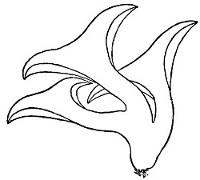
Section of Pleurotus sapidus.
One-half natural size.
P. sa´pidus Kalchb.—savory. Cespitose, or several pilei appearing
to spring from a common branched
stem. Pileus 1–3 in. across. Flesh
thick, excentric, regular, convex or
obtusely gibbous then depressed,
glabrous, white or brownish. Stem
stout, solid, several usually springing
from a thickened knob, whitish,
1–2 in. long, expanding upward into
the pileus. Gills decurrent, rather
distant, narrow, whitish. Spores elliptical,
10–11×4–5µ.
On elm trunks.
A very variable species; according
142to Kalchbrenner, the spores have a faint tinge of lilac, and the pileus
is white, tawny, brownish, or umber on the same trunk. The white
form only has been met with in this country. Massee.
Spores with a lilac tinge, oblong or a little curved and pointed,
8.3×3.7µ Morgan; oblong, 9–11.5×4–5µ Peck; 10–11×4–5µ Massee.
Not observed in England until 1887.
Quite common throughout the United States, growing upon decaying
wood, whether above or under ground. It has few distinct features.
The only positive one distinguishing it from P. ostreatus is its lilac-tinted
spores. The tint is faint but noticeable upon white background.
Excepting for purposes of the student, its separation, as a species, from
P. ostreatus is not necessary. When old it has more body than the
latter, but is equally superior as a food fungus.
Professor Peck remarks of it: “A stew made of it is a very good
substitute for an oyster stew.”
It can be cultivated by watering the places upon which it is known to
appear.
P. pome´ti Fr.—pometum, an orchard. Pileus white, fleshy, soft,
sub-flaccid, irregular, involute, convex, even, smooth, disk depressed.
Gills decurrent, crowded, separate behind. Stem 2–3 in. high, 3–4
lines thick, excentric, solid, tough, ascending, rooting.
On trunks of pear and apple trees.
Especially distinguished by the rooting stem.
North Carolina, edible, Curtis; California, H. and M.
****
Gills decurrent. Stem lateral, etc.
P. ostrea´tus Jacq.—ostrea, an oyster. (Plate XXXV, p. 134,
XXXVa, p. 142.) Pileus 3–5 in. broad, when young almost becoming
black, soon becoming pale, brownish-ash color, passing into yellow
when old, fleshy, soft, shell-shaped, somewhat dimidiate, ascending,
smooth, moist, even, but sometimes with the cuticle torn into squamules.
Stem shortened or obliterated, firm, elastic, ascending obliquely,
thickening upward, white, strigoso-villous at the base. Gills decurrent,
anastomosing behind, somewhat distant, broad, white, sometimes turning
light yellow, and without glandules.
For the most part cespitose, imbricated, very variable, sometimes
143almost central. The pileus is at first convex and horizontal, then
expanded and ascending. Stevenson.
Spores 10–12×4–5µ Massee; 7.5–10×4µ Peck.
General over the United States.
Var. glandulo´sus Ag. g. Bull.—With the habit of the typical form,
but larger. Pileus dark brown, becoming pale. Gills white, with scattered
small wart-like or glandular bodies.
On trunks. A very constant but somewhat rare variety; easily known
by the dark-brown pileus. The gland-like bodies on the gills are due
to the outward growth of the hyphæ of the trama in minute patches
here and there. Massee.
Var. euos´mus Berk.—strong-smelling. Strong scented, imbricate.
Pileus fleshy, depressed, shining, silky when dry, at first white with a
tinge of blue, then brownish. Stem short or obsolete. Gills decurrent,
ventricose, dingy, white. Spores 12–14×5µ, pale pinkish-lilac.
On elm trunks. Pilei very much crowded, 2 in. or more across,
deeply depressed, unequal, at first white, invested with a slight blue
varnish, at length of a pale brown. Stems distinct above, connate below.
Gills rather broad; running down to the bottom of the free portion
of the stem. Spores oblong, narrow, oblique, white, tinged with
purple. The whole plant smells, when first gathered, strongly of tarragon.
B. and Br.
Found at Richmond, Ind., Dr. J.R. Weist. On hickory stump at
Mt. Gretna, Pa., McIlvaine; Haddonfield, N.J., T.J. Collins.
This esculent fungus closely allied to P. ostreatus, and differing only
in having lilac spores, has been followed from book to book by a bad
reputation, probably because of its “rosy” or lilac spores—all fungi
having pink spores having been, until recently, ignorantly branded by
authors as poisonous. The writer has eaten meals of it many times, as
have his friends. It is in every way equal to P. ostreatus.
The rare qualities of this species are stated in the descriptive heading
of the genus. Its very name implies excellence. The camel is gratefully
called the ship of the desert; the oyster mushroom is the shellfish
of the forest. When the tender parts are dipped in egg, rolled in
bread crumbs, and fried as an oyster they are not excelled by any vegetable,
and are worthy of place in the daintiest menu.
P. salig´nus Schwam.—salix, willow. Pileus 2–3 in. broad, sooty
144ash-color or ochraceous, fleshy, compact, spongy, somewhat dimidiate,
horizontal, at first pulvinate, even, at length depressed behind and here
and there strigose, the incurved margin entire. Stem always short,
firm, more or less tomentose. Gills horizontal, hence less manifestly
decurrent, separate behind, but branched in the middle, crowded, dingy,
often eroded at the edge, not glandular.
Among the larger and firmer species. Solitary, scarcely ever cespitose.
It is commonly confounded with A. ostreatus, but is certainly a
different species. Although the stature is in general the same, it is
easily distinguished by the pileus being more compact, and more pulverulent
when young, then depressed, by the gills being thinner, more
crowded, somewhat branched, but not anastomosing behind, and dingy
soot-color; the spores also are dingy. Stevenson.
Spores oblong or cylindrical-oblong, 8×4µ W.G.S.; 8–10×3–4µ B.
Dr. Curtis wrote of this: “Indeed I have found several persons who
class this among the most palatable species. To such persons a dish
of fresh mushrooms need seldom be wanting, as this one can be had
every month of the year in this latitude.”
In New Jersey, in the vicinity of Philadelphia, Pa., I have found P.
salignus in quantity. It has been sent to me by Dr. J.R. Weist, of
Richmond, Ind., who writes, “I have eaten it with great enjoyment.”
In 1881 I found it frequently on water beeches and willows, and thoroughly
tested its edible qualities. R.K. Macadam, Boston.
When young or fresh, it is quite equal to any Pleurotus. When old,
as with others of the Pleuroti, it is tough. Nevertheless their margins
are always edible unless decaying.
II.—Dimidia´ti.
P. petaloi´des Bull.—petal of a flower. Pileus 1–2 in. long, dingy-brown,
becoming pale, dimidiate, fleshy, but in no wise compact, rather
plane, somewhat spathulate, continuous with the stem and depressed behind,
hence the villous down of the stem ascends to this point (the disk)
of the pileus, otherwise smooth, even, margin at first involute then expanded.
Stem about ½ in. long, sometimes however very short, solid,
firm, compressed, channeled when larger, more or less villous, whitish.
Gills decurrent, very crowded, very narrow (scarcely beyond 2 mm.
broad), linear, very unequal, white then ash-color.
145Taste bitter. The form on wood is somewhat horizontal, gregarious
here and there imbricated. Stevenson.
Spores 9–10×4µ Massee; 8×4µ W.G.S.; minutely globose, 3–4µ
Peck.
Edible. Cooke, Cordier.
P. spathula´tus Pers.—shaped like a spathula. Pileus rather thin,
1–2 in. broad, ascending, spathulate, tapering behind into the stem,
glabrous, convex or depressed on the disk and there sometimes pubescent,
alutaceous or brownish tinged with gray, red or yellow. Gills
crowded, linear, decurrent, whitish or yellowish. Stem compressed,
sometimes channeled above, grayish-tomentose. Spores elliptical, 7.6×4–5µ
broad; odor and taste farinaceous.
Ground. Sandlake. June. Edible.
It grows singly or in tufts and is an inch or more in height. The
margin is thin and sometimes striatulate and reflexed. Toward the
base the flesh is thicker than the breadth of the gills. The cuticle is
tough and separable. The flesh is said by Gillet to be tender and
delicate. Persoon describes the disk as spongy-squamulose, but in our
specimens it is merely pubescent or tomentose. Peck, 39th Rep. N.Y.
State Bot.
Recorded as edible by Professor Peck. At Eagle’s Mere, Pa., I
found many specimens agreeing with this description. They grew from
decaying wood under ground, yet had the appearance of growing from
the earth. It is probable that others have been deceived. In quality
I found this to be one of the best.
P. sero´tinus Fr.—late. Pileus fleshy, 1–3 in. broad, compact,
convex or nearly plane, viscid when young and moist, dimidiate kidney-shaped
or suborbicular, solitary or cespitose and imbricated, variously
colored, dingy-yellow, reddish-brown, greenish-brown or olivaceous,
the margin at first involute. Gills close, determinate, whitish or
yellowish. Stem very short, lateral, thick, yellowish beneath and minutely
tomentose or squamulose with blackish points. Spores minute,
elliptical, 5µ long, 2.5µ broad.
Dead trunks of deciduous trees. Peck, 39th Rep. N.Y. State Bot.
Mt. Gretna, Pa., 1887, and at Mt. Moriah, near Philadelphia, from
August until November, 1898. Upon these findings the pileus was
tomentose at base, as was the short stem.
146The species is not noticeably viscid after its youth. The viscidity
can be detected in old specimens by moistening the pileus. Its flavor
is not marked, nor is its texture as pleasing as most others of its genus,
but being a late species it satisfies the longing of the mycophagist for
his accustomed food.
P. pulmona´rius Fr.—pulmo, lung, from texture. Pileus 2–3 in.
broad, ash-colored, continuous with the stem, fleshy, soft, but tough,
flaccid, obovate or kidney-shaped, plane or reflexo-conchate at the margin,
even, smooth. Flesh thin, soft, white. Stem very short, solid,
exactly lateral, horizontal or ascending, round, villous, expanded into
the pileus. Gills decurrent but ending determinately, moderately broad,
distinct, not branched or anastomosing at the base, livid or ash-color.
The primary form is solitary. The pileus is ashy-tan when dried. It
differs from A. salignus alike in the definitely lateral stem and in the
thin flaccid pileus. Fries.
Not previously reported.
Found by Miss Madeleine Le Moyne, Washington, Pa., September,
1898, and sent to writer. Gills 3 lines broad, not narrow in proportion
to flesh.
Taste and smell similar to P. ostreatus. Cooked it is tender, and
more succulent than P. ostreatus.
III.—Resupina´ti.
P. mastruca´tus Fr.—mastruca, a sheepskin. Pileus up to 2 in.
long and 1 in. broad, sessile, at first resupinate then expanded and
horizontal, often lobed, upper stratum of pileus gelatinous, brown,
bristling with squarrose or erect squamules. Flesh thickish. Gills
radiating from the point of attachment, broad, rather distant, grayish-white.
On old trunks. Imbricated. Readily distinguished by the brown,
squarrosely scaly pileus. Massee.
Spores oblong, oblique, 8×5µ Morgan.
In June, 1886, the writer found this species in oak woods near Philadelphia.
It grew on fallen trunks and on decaying spots of living
timber.
It is edible, and of good flavor, but is rough in the mouth. If found
in quantity, the extract of it would make a delicate soup.
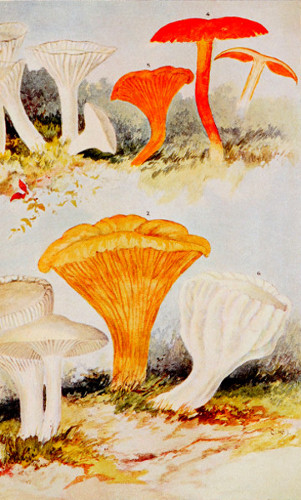
Grouped by F.D. Briscoe—Studies by C. McIlvaine. Plate XXXVII.
| Fig. |
Page. |
Fig. |
Page. |
| 1. Hygrophorus pratensis (white var.), |
152 |
5. Hygrophorus cantharellus, |
156 |
| 2. Hygrophorus pratensis (colored var.), |
152 |
6. Hygrophorus virgineus, |
153 |
| 3. Hygrophorus pratensis (after rain), |
152 |
7. Hygrophorus niveus, |
153 |
| 4. Hygrophorus miniatus, |
159 |
|
|
147HYGROPH´ORUS Fr.
Pileus regular or undulated and wavy, often viscid or moist. Flesh
of the pileus continuous with that of
the stem and descending as a trama
into the gills. Gills adnate or adnexed,
more or less decurrent, waxy,
often thick and forked, edge always
thin and sharp, often branched.
On the ground. Many species are
brightly colored. Spores white.
This genus differs from the preceding
genera in the manifest trama,
the substance of which is similar to
that of the pileus; from Lactarius
and Russula by the trama not being vesicular, but somewhat floccose
with granules intermixed; from Cantharellus, its nearest ally, by the
sharp edge of the gills. The Cortinarii, Paxilli and Gomphidii are at
once distinguished from it by their colored spores and the changing color
of their gills, as well as by other marks. From all the other genera of
Agaricini it is distinguished by a mark peculiar to itself, viz., by the
hymeneal stratum of the gills changing into a waxy mass, which is at
length removable from the trama. This altogether singular character is
specially remarkable in H. caprinus, coccineus, murinaceus, etc. Hence
the gills seem full of watery juice, but they do not become milky like
those of the Lactarii. Fries.
From the description by Fries, the author of the genus, it is manifest
that one has to wait the ripening of the fungus before the peculiar characteristic
mark of the genus, i. e.—gills turning into a waxy mass,
easily removable from the cap—can be observed. Many of the species
are difficult to determine when fresh. Nevertheless, there is an indescribable,
watery, waxy, translucent appearance about the gills which
catches the eye of the expert, and is soon learned by the novice. The
white spores readily separate the genus from kindred shapes in the colored-spored
genera.
So far as tested none of the species is poisonous. One English species
148is fetid. It is probable that they are all edible, varying in quality
only. Fries well, and is superior in croquettes and patties.
Limacium (
limax, a slug). Page
148.
Universal veil viscid, with occasionally a floccose partial one, which
is annular or marginal.
* White or becoming yellowish.
** Reddish.
*** Tawny or yellow.
**** Olivaceous-umber.
***** Dingy cinereous or livid.
Camarophyllus (
Gr.—a vault; a leaf). Page
152.
(From the arched shape of the gills.)
Veil none. Stem even, smooth or fibrillose, not rough with points.
Pileus firm, opaque, moist after rain, not viscid. Gills distant, arcuate.
* Gills deeply and at length obconically decurrent.
** Gills ventricose, sinuately arcuate or plano-adnate.
Hygrocybe (Gr—moist; Gr—the head). Page 155.
Veil none. Whole fungus thin, watery, succulent, fragile. Pileus when
moist viscid, shining when dry, rarely floccoso-scaly. Stem hollow, soft,
without dots. Gills soft. Most of the species are brightly colored and
shining. This tribe is the type of the genus.
* Gills decurrent.
** Gills adnexed, somewhat separating.
*
White or yellowish-white.
H. chry´sodon Fr. Gr—gold; a tooth. From tooth-like squamules.
Pileus 2–3 in. broad, white, shining when dry, but commonly yellowish
with minute adpressed squamules at the disk, light yellow-flocculose at
the involute margin, fleshy, convex then plane, obtuse, viscid. Flesh
149white, sometimes reddish. Stem 2–3 in. long, about ½ in. thick,
stuffed, soft, somewhat equal (sometimes, however, irregularly shaped
or thickened at the base), white, with minute light yellow squamules,
which are more crowded and arranged in the form of a ring toward the
apex. Gills decurrent, distant, 3 lines broad, thin, white, somewhat
yellowish at the edge, sometimes crisped.
Odor not unpleasant. There is a manifest veil, not woven into a
continuous ring, but collected in the form of floccose squamules at the
apex of the stem and the margin of the pileus. Var. leucodon with
white squamules. Fries.
In woods.
The lamellæ are said to be crisped, and when young, to have the
edge yellow-floccose; but I have seen no such specimens. Peck, 23d
Rep. N.Y. State Bot.
Spores 8×4µ Cooke.
West Virginia, New Jersey, Pennsylvania. McIlvaine.
A pleasant, excellent species, whose rarity is regrettable.
H. ebur´neus Bull. Fr.—ebur, ivory. Wholly shining white. Pileus
fleshy, sometimes thin, sometimes somewhat compact, convexo-plane,
somewhat repand, even, very glutinous in rainy weather, margin soon
naked. Stem sometimes short, sometimes elongated, stuffed then
hollow, unequal, glutinous like the pileus, rough at the apex with dots
in the form of squamules. Gills decurrent, distant, veined at the base,
3–4 lines broad, tense and straight, quite entire. Fries.
Odor mild, not unpleasant. Very changeable. The veil is absent,
unless the very plentiful gluten which envelops the stem be regarded
as a universal veil; margin of the young pileus involute, only at the first
pubescent, soon naked. The stem is soft internally, at length hollow,
attenuated toward the base.
In woods and pastures. Frequent. September to October. Stevenson.
The whole plant is pure white when fresh, but in drying the gills
assume a cinnamon-brown hue. Peck, Rep. 26.
Spores 6×5µ Cooke; 4×5µ W.G.S.; 5–6µ K.; 6×4µ C.B.P.
A common and wide-spread species frequenting woods and pastures.
Edible. Curtis.
The author ate it in West Virginia, in 1882; at Devon, Pa., 1887;
150Haddonfield, N.J., 1890. It is well flavored but in texture is not of
first quality.
H. pena´rius Fr.—penus, food. Pileus tan-color, opaque, fleshy,
especially when young, at first umbonate, then very obtuse, hemispherical
then flattened, even, smooth, commonly dry, margin at first
involute, exceeding the gills, undulated when flattened. Flesh thick,
hard, whitish, unchangeable. Stem curt, 1½ in. or more long, about
½ in. thick at the apex, solid, compact, hard, attenuated at the base
into a spindle-shaped root, ventricose to the neck, again attenuated
upward or wholly fusiform-attenuated, pale-white, smeared with tenacious,
easily dried slime, warty. Flesh firm, but externally more rigid,
cuticle somewhat fragile. Veil not conspicuous. Gills adnato-decurrent,
acute behind, distant, thick, 3–4 lines broad, veined, tan inclining to
pale. Fries.
Odor pleasant, taste sweet. The fusiform root is as long as the stem.
In mixed woods. Stevenson.
Spores 7–8×4–5µ.
Edible. Cooke.
Large specimens occurred in mixed woods, in November, 1898, at
Mt. Gretna. The caps varied from 1½-5 in. across. The color was
white, tinged with yellow, much lighter than described. The caps look
coarse and the stems are not inviting; but the caps have a pleasant odor.
When stewed for twenty minutes they are meaty and tasty.
H. erubes´cens Fr.—erubesco, to become red. Pileus 2–4 in. and more
broad, white becoming everywhere red, fleshy, gibbous then convexo-plane,
viscid, adpressedly dotted with squamules or becoming smooth,
sometimes wholly compact, sometimes thin towards the margin which
is at the first naked. Flesh firm, white. Stem sometimes short, robust,
2 in. long, 1 in. thick and attenuated upward, sometimes elongated, 4
in. long, equal or attenuated at the base, solid, flexuous, with red fibrils,
dotted with red upward. Gills decurrent, distant, soft, white, with red
spots. Fries.
Veil none. The ground color is white, as it is also internally, but it
151everywhere becomes red and the pileus often rosy blood-color. Handsome,
growing in troops, commonly forming large lax circles.
In pine woods. Stevenson.
Spores ellipsoid, very obtuse at both ends, 8–10×4–5µ K.; 8×4µ
Cooke.
Edible. Cooke.
H. ni´tidus B. and Rav.—shining. Pileus thin, fleshy, convex,
broadly umbilicate, smooth, shining, viscid, pale yellow with the margin
striatulate when moist, nearly white when dry. Gills arcuate, decurrent,
yellow. Stem slender, brittle, smooth, viscid, hollow, yellow. Flesh
yellow.
Height 2–4 in., breadth of Pileus 8–12 lines. Stem 1–2 lines thick.
Swamps. Sandlake. August.
The cavity of the stem is very small. Peck, 23d Rep. N.Y. State Bot.
Found in many states and places, usually on moist ground beside
streams, or spring heads. It sometimes parades itself in irregular processions,
at others in sparse patches. It is delicate in flavor, and tender
cooked.
H. limaci´nus Fr.—limax, a slug. Pileus 1½-2½ in. broad, disk
umber then sooty, paler round the margin, fleshy, convex then flattened,
obtuse, smooth, viscid. Flesh rather firm, white. Stem 2–3 in. long,
½ in. thick, solid, firm, ventricose, sticky, flocculose, fibrilloso-striate,
roughened with squamules at the apex. Gills adnate, then decurrent,
somewhat distant, thin, white inclining to ash-color. Fries.
Veil entirely viscous, not floccose.
In woods among damp leaves. Stevenson.
Spores 12×4µ Cooke.
New York, Peck, Rep. 34. Thin woods and open places.
Reported edible Bulletin No. 5, 1897, Boston Mycological Club.
H. hypoth´ejus Fr. Gr.—under; Gr—sulphur (under gluten).
Pileus 1–2 in. broad, at first smeared with olivaceous gluten, ash-colored,
when the gluten disappears, becoming pale and yellowish, orange
152or rarely (when rotting) rufescent, fleshy, thin, convex then depressed,
obtuse, even, somewhat streaked. Flesh thin, white then becoming
light yellow. Stem 2–4 in. long, 2–3 lines and more thick, stuffed,
equal, even, viscous, but rarely spotted with the veil, at length hollow.
Partial veil floccose, at the first cortinate and annular, soon fugacious.
Gills decurrent, distant, distinct, at first pallid (even whitish) soon yellow,
sometimes flesh-color. Fries.
Very protean, changeable in color and variable in size. Stem not
scabrous. There is no trace of the veil when the plant is full grown.
Appearing after the first cold autumn nights, and lasting even till snow.
In pine woods. Frequent. Stevenson.
Spores 10×6µ Cooke; 12×4µ W.G.S.
Hollis Webster, in Bulletin No. 5, 1897, Boston Mycological Club,
writes: “H. hypothejus Fr., when dried, is crisp and nutty, and very
good to carry in the pocket for occasional nibble.”
II.—Camarophyl´lus.
*
Gills deeply decurrent, etc.
H. praten´sis Fr.—pratum, a meadow. (Plate XXXVII, figs. 1, 2,
3, p. 146. Plate XXXVIII, p. 147.) Pileus 1–2 in. and more
broad, somewhat pale yellowish, compactly fleshy especially at the disk,
thin toward the margin, convex then flattened, almost top-shaped from
the stem being thickened upward, even, smooth, moist (but not viscous)
in rainy weather, when dry often rimosely incised, here and there split
regularly round. Flesh firm, white. Stem 1½-2 in. long, ½ in. and
more thick, stuffed, internally spongy, externally polished-evened and
firmer, attenuated downward, even, smooth, naked. Gills remarkably
decurrent, at first arcuate, then extended in the form of an inverted cone,
very distant, thick, firm, brittle, connected by veins at the base, very
broad in the middle, of the same color as the pileus. Fries.
Very protean. Veil none. The flesh of the pileus is formed as it
were of the stem dilated upward. The typical form resembles the
Cantharelli. Everywhere becoming light yellow-tawny, but varying with
the stem and gills pale-white.
In pastures. Common. Stevenson.
Spores 6×4µ Cooke; 6–10×4–6µ K.
153Common over the United States. West Virginia, 1881, North Carolina,
1890, Pennsylvania, 1887, Mt. Gretna, 1897–1898. McIlvaine.
Gregarious, and often in tufts, sometimes in partial rings.
An exceedingly variable species. White, buff, smoky, pinkish colors
are common. The cap shapes are also diverse. The margins of some
are incurved; of others repand. The weather seems to have much to
do with their shapes.
M.C. Cooke says: “It requires careful cooking, as it is liable to be
condemned as tough, unless treated slowly, but it is a great favorite
abroad.” He calls them “Buff Caps.”
All fungi are the better for slow cooking. The H. pratensis in all its
forms is excellent, but particularly so in croquettes and patés.
H. virgin´eus Fr.—virgo, a virgin. (Plate XXXVII, fig. 6, p. 146.)
Wholly white. Pileus fleshy, convex then plane, obtuse, moist, at length
depressed, cracked into patches, floccose when dry. Stem curt, stuffed,
firm, attenuated at the base, externally becoming even and naked. Gills
decurrent, distant, rather thick. Fries.
Flesh sometimes equal, sometimes abruptly thin. Commonly confounded
with H. niveus, but it is more difficult to distinguish it from
white forms of H. pratensis. It is distinguished chiefly by its smaller
stature, by the color being constantly white, sometimes becoming pale,
by the obtuse pileus being scarcely turbinate, at length cracked into patches
and floccose when dry, and by the gills being thinner, etc.
In pastures. Common. Stevenson.
Spores 12×5–6µ Cooke.
Tastes like M. oreades. M.J.B. Delicious broiled or stewed. Cooke.
“Mony littles make muckle,” says the Scotch proverb. It applies
well to the brave little toadstool looking through the first grass of lawns
for the coming of spring, and coming again in the autumn, defiant of
early frosts. Small though it be, its numbers soon fill the basket.
The “Ivory Caps” are plentiful, and extend their haunts to the
woods, where thick mold or grassy places abound.
H. ni´veus Fr.—niveus, snow-white. (Plate XXXVII, fig. 7, p. 146.)
Wholly white. Pileus scarcely reaching 1 in. broad, somewhat membranaceous,
and without a more compact disk, hence truly umbilicate,
154bell-shaped then convex, smooth, striate and viscid when moist, not
cracked when dry. Flesh thin, everywhere equal, white, hygrophanous.
Stem 2 in. or a little more long, 1–2 lines thick, tubed, equal, even,
smooth, tense and straight. Gills decurrent, distant, thin, scarcely
connected by veins, arcuate, quite entire.
Thinner, tougher, and later than H. virgineus, etc. Being hygrophanous
the pileus is shining white when dry. Very tender forms occur.
In pastures. Stevenson.
Spores 7×4µ Cooke.
The H. niveus, H. virgineus, “Ivory Caps” as M.C. Cooke calls
them, are pretty and plentiful in some sections. In the West Virginia
mountains, along grass-grown road-sides, their purity and exquisite
perfume attracted me in 1881. I have them and a few others to thank
for seducing me into becoming a mycophagist. I think of them affectionately.
I have seldom met with them since. They are found on
lawns and in pastures and on grassy edges of woods, early in spring and
late in autumn.
H. boreal´is Pk.—northern. Pileus thin, convex or expanded,
smooth, moist, white, sometimes striatulate. Gills arcuate-decurrent,
distant, white. Stem smooth, equal or tapering downward, stuffed,
white.
Plant 2 in. high. Pileus 8–12 lines broad. Stem 1 line thick.
Ground in woods. Croghan and Copake. September and October.
The species is related to H. niveus but the pileus is not viscid. Peck,
26th Rep. N.Y. State Bot.
Found at Mt. Gretna, Pa., October 20, 1898, ground in mixed
woods. The cap is white, silky, smooth, not viscid. Stem likewise.
A neat species pleasant in every way.
**
Gills ventricose, adnate, etc.
H. dis´tans Berk.—distant (of the gills). Pileus about 2 in. broad,
white, with a silky luster, here and there stained with brown, somewhat
fleshy, plane or depressed, viscid. Stem white above, gray below, and
attenuated, not spotted. Gills decurrent, few, very distant, somewhat
ventricose, pure white then tinged with ash-color, interstices obscurely
wrinkled.
155Often umbilicate. Remarkable for the few and distant gills. Stevenson.
Spores 10×8µ Cooke.
Caps white, shaded to light pinkish-brown toward center. Gills very
distant. Leaves adhere to cap.
Specimens tested were of mild, pleasant flavor.
H. sphæro´sporus Pk. Pileus fleshy and thick in the center, sub-obconic,
convex, obtuse or slightly umbonate, whitish, inclining to reddish-brown,
the margin incurved. Flesh firm, white. Gills rather
broad, subdistant, adnate or slightly decurrent, white. Stems tufted,
flexuous, solid, glabrous, often slightly thickened at the base, colored
like the pileus. Spores globose, 6–8µ broad.
Pileus 6–12 lines broad. Stem 1–2 in. long, 2–3 lines thick.
Iowa. October. Communicated by C. McIlvaine.
The fresh plant is said to have no decided odor, but when partly dried
it emits a slight but rather unpleasant odor. It belongs apparently to
the section Camarophyllus, and is related to Hygrophorus Peckii.
Peck, Torr. Bull., Vol. 22, No. 12.
Received by the writer from Hon. Thomas Updegraff, MacGregor,
Iowa, and forwarded to Professor Peck as a new species.
The fungus has but slight taste and is without odor when fresh.
It is probably edible. Not received in sufficient quantity to test.
H. cera´ceus Fr.—cera, wax. Pileus about 1 in. broad, waxy-yellow,
shining, slightly fleshy, thin, but slightly firm, convexo-plane,
obtuse, slightly pellucid-striate, viscid. Stem 1–2 in. and more long,
about 2 lines thick, hollow, often unequal, flexuous and at length compressed,
even, smooth, of the same color as the pileus, never darker at
the apex. Gills adnato-decurrent, broad, almost triangular, distinct,
yellow. Fries.
Fragile; easily distinguished from others by its waxy (not changeable)
color. Stevenson.
Spores 8×6µ Cooke.
Eaten in Germany.
156Found at Angora and Kingsessing, Philadelphia, 1887. August to
October. Open grassy places in woods, and in pastures. Scattered
and in troops. Excellent. Stew slowly.
H. cantharel´lus Schw. Gr—a small vase. (Plate XXXVII, fig.
5, p. 146.) Pileus thin, convex, at length umbilicate or centrally depressed,
minutely squamulose, moist, bright red, becoming orange or
yellow. Gills distant, subarcuate, decurrent, yellow, sometimes tinged
with vermilion. Stem smooth, equal, subsolid, sometimes becoming
hollow, concolorous, whitish within.
Height 2–4 in., breadth of pileus 6–12 lines. Stem 1–2 lines thick.
Swamps and damp shaded places in fields or woods. July to September.
Common. Peck, 23d Rep. N.Y. State Bot.
Var. fla´va. Pileus and stem pale yellow. Gills arcuate, strongly
decurrent.
Var. fla´vipes. Pileus red or reddish. Stem yellow.
Var. fla´viceps. Pileus yellow. Stem red or reddish.
Var. Ro´sea. Has the pileus expanded and the margin wavy scalloped.
Swamps. Sandlake. Peck, 23d Rep.
Common in the Adirondack region, and throughout Pennsylvania
and New Jersey, in all its varieties.
The resemblance to H. miniatus in color is great, but there is a marked
difference in the gills, which extend further down the thinner stem. It
is tougher, and takes longer to cook. It has a flavor of its own which
is enjoyed by some and condemned by others.
H. cocci´neus Schaeff.—of a scarlet color. (Plate CXXXVI, fig. 6,
p. 508.) Pileus 1–2 in. and more broad, at first bright scarlet, then
soon changing color and becoming pale, slightly fleshy, convex, then
plane and often unequal, obtuse, at first viscid and even, smooth, not
floccose-scaly. Flesh of the same color as the pileus. Stem 2 in. long,
3–4 lines thick, hollow, then compressed and rather even, not slippery,
scarlet upward, always yellow at the base. Gills wholly adnate, decurrent
with a tooth, plane, distant, connected by veins, watery-soft as if
fatty, when full grown purplish at the base, light yellow in the middle,
glaucous at the edge. Fries.
Flesh of the pileus descending into the gills and forming a trama of
the same color. Fragile. Varying in stature, easily mistaken for some
157of the following species which are of the same color. Pileus at length
becoming yellow. Stevenson.
Spores 10–12×6µ Cooke; 7×4µ Morgan.
Edible. Cooke, Peck.
In woods and pastures. In troops. Common in West Virginia, Pennsylvania,
New Jersey. McIlvaine.
Excellent when stewed for twenty minutes.
(Plate XXXIX.)
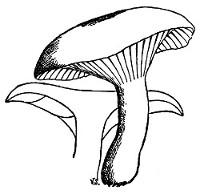
Hygrophorus flavo-discus.
About two-thirds natural size.
H. fla´vo-dis´cus Frost—flavus, yellow; discus, disk. Pileus convex
or plane, smooth, glutinous, white
with a pale-yellow or reddish-yellow
disk. Flesh white. Gills adnate or
decurrent, subdistant, white, sometimes
with a slight flesh-colored tint,
the inter-spaces sometimes veiny.
Stem subequal, solid, glutinous,
white, sometimes slightly stained with
yellow. Spores elliptical, 6–8×4µ.
Plant 2–3 in. high. Pileus 1–3 in.
broad. Stem 2–8 lines thick.
Pine woods. West Albany. November.
This, like H. fuligineus, has a
short white space at the top of the stem, free from the viscidity that
exists elsewhere. It resembles in many respects Hygrophorus speciosus,
which has the pileus red, fading to yellow with advancing age.
Perhaps the three may yet prove to be forms of one very variable
species, for the most conspicuous differences between them consist in
the colors of the pileus. The constancy with which the three styles of
coloration has thus far been maintained indicates a specific difference,
but color alone is not generally regarded as having any specific value.
Peck, 35th Rep. N.Y. State Bot.
Spores 6.4–7.6×4µ Peck.
I find this very good but its dirty pellicle should be peeled before
using. Peck, in letter, 1896.
Mr. Hollis Webster writes of H. flavo-discus (Yellow Sweet Bread)
in Bull. No. 45, of the Boston Mycological Club, 1897: “This is a
mushroom worth going a long way to get. It is abundant in rich woods
158under pines in certain localities, and is a great favorite with those who
know it. It is easily prepared and requires little cooking.”
I have eaten enjoyably of it since 1881.
Plentiful in the Jersey pines, in West Virginia and Pennsylvania, and
equal to any toadstool of its size.
(Plate XL.)
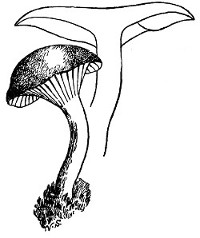
Hygrophorus fuligineus.
About one-half natural size.
H. fuligi´neus Frost—resembling soot. Pileus convex or nearly
plane, glabrous, very viscid or glutinous,
grayish-brown or soot-color,
the disk often darker or almost black.
Gills subdistant, adnate or decurrent,
white. Stem solid, viscid or glutinous,
white or whitish. Spores elliptical,
7–9×5µ.
The Sooty hygrophorous resembles
the Club-stemmed clitocybe in the
color of its cap, but in nearly every
other respect it is different. When
moist the cap is covered with an abundant
gluten which when dry gives it a
shining appearance as if varnished.
The color varies from grayish-brown
to a very dark or sooty-brown with
the central part usually still darker or
almost black, but never with an umbo. The flesh and the gills are white.
The stem also is white or but slightly shaded toward the base with the
color of the cap. It is variable in length and shape, being long or short,
straight or crooked, everywhere equal in thickness or tapering toward
the base. It is glutinous and unpleasant to handle.
The cap is 1–4 in. broad, the stem 2–4 in. long, and 4–8 lines thick.
The plants grow either singly or in tufts. In the latter case the caps
are often irregular from mutual pressure.
The plants occur early in October and November, in pine woods or
woods of pine and hemlock intermixed.
This mushroom is tender and of excellent flavor, but its sticky and
often dirty covering should be peeled before cooking. Peck, 49th Rep.
N.Y. State Bot.
159Found at Angora, near Philadelphia, August 1, 1897. Densely cespitose.
Raw it tastes like dead leaves. Tender and of fine flavor when cooked.
H. minia´tus Fr.—minium, red lead. (Plate XXXVII, fig. 4, p.
146.) Pileus thin, fragile, at first convex, becoming nearly plane, glabrous
or minutely squamulose, often umbilicate, generally red. Gills
distant, adnate, yellow, often tinged with red. Stem slender, glabrous,
colored like the pileus. Spores elliptical, white, 8µ long.
Cap ½-2 in. broad. Stem 1–2 in. long, 1–2 lines thick. Peck, 48th
Rep. N.Y. State Bot.
Var. lutes´cens. Pileus yellow or reddish-yellow. Stem and gills yellow.
Plant often cespitose. Peck, 41st Rep. N.Y. State Bot.
Spores 10×6µ Cooke; elliptical, white.
Grows where it pleases and abundantly throughout the land. In wet
weather I have found it in July and late in autumn.
Professor Peck says: It is scarcely surpassed by any mushroom in
tenderness of substance and agreeableness of flavor.
The gunner for partridges will not shoot rabbits; the knowing toadstool
seeker will pass all others where H. miniatus abounds.
H. puni´ceus Fr.—blood-red. Pileus 2–4 in. broad, glittering blood-scarlet,
in dry weather and when old becoming pale especially at the
disk, slightly fleshy for its breadth, at first bell-shaped, obtuse, commonly
repand or lobed, very irregular, even, smooth, viscid. Flesh of the same
color, fragile. Stem 3 in. long, ½-1 in. thick, solid when young, at
length hollow, very stout (not compressed), ventricose (attenuated at
both ends), striate, and for the most part squamulose at the apex, when
dry light yellowish or of the same color as the pileus, always white and
often incurved at the base. Gills ascending, ventricose, 2–4 lines
broad, thick, distant, white-light yellow or yellow and often reddish at
the base. Fries.
The largest of the group and very handsome. It certainly differs
from H. coccineus, for which it is commonly mistaken, in stature, in
the adnexed gills, and in the white base of the striate stem. The attachment
of the gills varies, but from the form of the pileus they ascend to
the base of the cone and appear free.
160In pastures. Stevenson.
Spores 8×5µ Cooke.
Edible. Cooke. No harm would come of confusing it with the vermilion
mushroom—H. miniatus Pk.
H. con´icus Fr.—conical. Pileus thin, submembranaceous, fragile,
smooth, conical, generally acute, sometimes obtuse, the margin often
lobed. Gills rather close and broad, subventricose, narrower toward
the stem, free, terminating in an abrupt tooth at the outer extremity,
scarcely reaching the margin, yellow. Stem equal, fibrous-striate, yellow,
hollow.
Height 3–6 in., breadth of pileus 6–12 lines. Stem 1–2 lines thick.
Ground in woods and open places. North Elba and Center. August
to October.
The color of the pileus is variable. I have taken specimens with it
pale sulphur-yellow and others with it bright red or scarlet. The plant
turns black in drying. Peck, Rep. 23, New York State Bot.
Spores 10×7µ Cooke; 10×6µ Morgan.
An old-time cure-all had medicinal virtues proportionate to its offensiveness.
Old-time writers, contrariwise, gave every toadstool a bad
name which changed color or displeased their noses. The pretty little
Hygrophorus conicus, for these reasons, has, until now, been under the
ban of suspicion. M.C. Cooke, in his handy book, Edible and Poisonous
Mushrooms, was the first to lighten its sentence and make it a sort
of ticket-of-leave culprit.
The writer has frequently eaten it, and is glad to vouch for its harmlessness
and testify to its eminent respectability.
H. chloroph´anus Fr. Gr—greenish-yellow. Pileus 1 in. broad,
commonly bright sulphur-yellow, sometimes, however, scarlet, not
changing color, somewhat membranaceous, very fragile, at first convex,
then plane, obtuse, orbicular and lobed, and at length cracked, smooth,
viscid, striate. Stem 2–3 in. long, 2–3 lines thick, hollow, equal,
round, rarely compressed, wholly even, smooth, viscid when moist,
shining when dry, wholly unicolorous, rich light yellow. Gills emarginato-adnexed,
very ventricose, with a thin decurrent tooth, thin, distant,
distinct. Fries.
Very much allied to H. conicus, but never becoming black, and otherwise
161certainly distinguished by its convex, obtuse, striate pileus, by its
even and viscous stem, and by its emarginato-free, thin, somewhat distant,
whiter gills. Like H. ceraceus in appearance.
In grassy and mossy places. Common. August to October. Stevenson.
Spores 8×5µ Cooke; 8µ Q.
Received from E.B. Sterling, Trenton, N.J., August, 1897.
Open grassy woods.
But three specimens were tested. They were in every way agreeable.
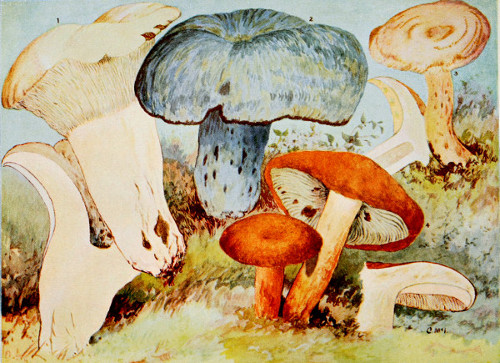
Grouped by F.D. Briscoe—Studies by C. McIlvaine. Plate XLI.
| Fig. |
Page. |
Fig. |
Page. |
| 1. Lactarius piperatus, |
168 |
3. Lactarius deliciosus, |
170 |
| 2. Lactarius indigo, |
171 |
4. Lactarius volemus, |
180 |
LACTA´RIUS Fr.
The hymenophore continuous with the stem. Pileus
somewhat rigid, fleshy, becoming more or less depressed,
often marked with concentric zones. Gills
unequal, membranaceous-waxy, slightly rigid,
milky, edge acute, decurrent or adnate and often
branched. Stem stout, central, rarely excentric
except in those growing on trunks. Spores globose, minutely echinulate,
white, rarely yellowish.
Nearly all grow on the ground.
Distinguished from all other fungi by the presence of a granular milk
which pervades every part of the plant and especially the gills; it is
commonly white, sometimes changing color and in section Dapetes
highly colored from the first. The nature of the milk, especially its
taste, whether acrid, subacrid or mild, must be carefully noted in distinguishing
species, as it is the most useful characteristic.
In Russula, the only allied genus, the milk-bearing cells are present,
but their contents do not appear as milk.
Many of the species are peppery, acrid, astringent; some mildly so,
others will be long remembered if tasted raw. Yet not a species is hotter
than some radishes, onions, and others of our favorite vegetables.
Who would condemn them because they are peppery? There is not a
single species of Lactarius which retains its pepperiness after cooking.
This quality has to be and is supplied by one of our favorite condiments—pepper
162itself. Simply because they are toadstools and hot, they have
been condemned without trial. It is remarkable that not one of the
fungi known to be deadly gives any warning by appearance or flavor of
the presence of a poison. The day will probably come when it can be
said that if toadstool eaters will confine themselves to hot species, otherwise
attractive, they will run no risk. Panus stypticus is astringent,
not hot.
Piperites (peppery, after piperitis, pepperwort). Page 163.
Stem central. Gills unchangeable, not pruinose nor becoming discolored.
Milk white at first, usually acrid.
* Tricholomoidei—inclining to Tricholoma. Pileus moist, viscid,
margin incurved and downy at first.
** Limacini—limax, a slug. Pileus viscid when moist, with a pellicle,
margin naked.
*** Piperati. Pileus without a pellicle, hence absolutely dry, often
more or less downy or unpolished.
Dapetes (
daps, a feast). Page
170.
Stem central. Gills naked. Milk highly colored from the first.
Russularia (inclining to Russula). Page
173.
Stem central. Gills pallid then discolored, at length dark and powdered
with the white spores. Milk at first white, mild, or from mild
becoming acrid.
* Viscidi—viscidus, viscid, sticky. Pileus viscid at first.
** Impoliti—impolitus, unpolished. Pileus squamulose, downy or
pruinose.
*** Glabrati—glaber, smooth. Pileus polished, smooth.
Pleuropus (pleura, side; pous, a foot).
Stem excentric or lateral. Growing on trunks. None known to be
edible.
*
Tricholomoi´dei. Pileus viscid, margin incurved, etc.
L. tormino´sus Fr.—tormina, gripes. Pileus 2–4 in. broad, convex,
then depressed, viscid when young or moist, yellowish-red or paleochraceous
tinged with red or flesh color, often varied with zones or
spots, the at first involute margin persistently tomentose-hairy. Gills
thin, close, narrow, whitish, often tinged with yellow or flesh color.
Stem 1.5–3 in. long, 4–8 lines thick, equal or slightly tapering downward,
hollow, sometimes spotted, whitish. Spores subglobose or
broadly elliptical, 9–10µ. Milk white, taste acrid.
Woods. Adirondack mountains and Sandlake. August. Peck,
38th Rep. N.Y. State Bot.
Poisonous, and Gillet declares it to be deleterious and even dangerous,
and that in the raw state it is a very strong drastic purgative. On
the other hand, Cordier states that almost all authors agree in stating
that it is eaten with impunity, and that Letellier has eaten it more than
once without inconvenience.
Cooke states: “Whether it is poison is rather uncertain, and probably
assumed from its acridity.”
Bulliard says: “It is very acrid and this is changed by heat into an
astringent of such power that a very little suffices to produce the most
terrible accidents.” On the other hand, Boudier says that the presence
of an acrid milk is an indication of no importance, that in certain
parts of the country they eat such Lactaria as even L. piperatus
and do not experience any trouble. Certain Russulæ as acrid as any
Lactaria are known to be inoffensive.
The Russians preserve it in salt and eat it seasoned with oil and vinegar.
L. tur´pis Fr.—turpis, base, from its ugly appearance. Pileus large,
as much as 3–12 in. broad, olivaceous inclining to umber, fleshy, rigid,
convex becoming plane, disk-shaped or umbilicate, at length depressed,
innately hairy at the circumference or wholly covered over with tenacious
gluten, zoneless, sometimes tawny toward the margin, at length
entirely inclining to umber; margin for a long time involute, at the first
villous, olivaceous-light-yellow, then more or less flattened, at length
164often densely furrowed. Flesh compact, white, then slightly reddish.
Stem 1½-3 in. long, ½-1 in. and more thick, solid, hard, equal or
attenuated downward, even or pitted and uneven, but not spotted, viscid
or dry, pallid or dark olivaceous, ochraceous-whitish at the apex. Gills
adnato-decurrent, thin, 1–2 lines broad, much crowded, forked, white
straw-color, spotted brownish when broken or bruised. Milk acrid,
white, unchangeable. Fries.
Gregarious, rigidly and compactly fleshy; habit almost that of Paxillus
involutus. It varies with the stem hollow, and the pileus somewhat
zoned.
Spores spheroid or subspheroid, uniguttate, echinulate, 6–8µ K.;
minutely spinulose, 6–8µ Massee.
New Jersey, Trenton, E.B. Sterling; North Carolina, Curtis,
Schweinitz; Mt. Gretna, Pa. September, 1898. Along road in woods,
moist places. McIlvaine.
The species is attractive by its very homeliness and odd individuality.
It is not inviting. Cooked it is coarse and resembles L. piperatus. An
emergency species.
L. controver´sus Fr.—contra, against; verto, to turn. Pileus 3 in.
and more broad, fleshy, compact, rigid, at the first convex, broadly
umbilicate, when fuller grown somewhat funnel-shaped, oblique, on
emerging from the ground dry, flocculose, whitish, then with rain
smooth, viscid, reddish, with blood-colored spots and zones (especially
toward the margin), margin acute when young, closely involute, more
or less villous. Flesh very firm. Stem commonly 1 in. long and thick,
sometimes, however, 2 in. long and then manifestly attenuated toward
the base and often excentric, solid, obese, even but pruinate and as if
striate at the apex from the obsoletely decurrent tooth of the gills,
wholly white, never pitted. Gills decurrent, thin, very crowded, 1–2
lines broad, with many shorter ones intermixed, but rarely branched,
pallid-white-flesh-color. Milk white, unchangeable, plentiful. Fries.
Odor weak but pleasant, taste very acrid. Allied to L. piperatus.
In woods. Uncommon. August to October. Stevenson.
Spores echinulate, 8×6µ W.G.S.; globose, rough, 6–8µ Massee.
California, H. and M.
Edible, rather deficient in aroma and flavor. Cooke.
165
(Plate XLa.)
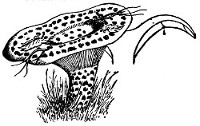
Lactarius blennius.
About one-fourth natural size.
L. blen´nius Fr. Gr—slimy. Pileus 3–5 in. across. Flesh thick,
firm; soon expanded and more or
less depressed, glutinous, dingy
greenish-gray, often more or less
zoned with drop-like markings; margin
at first incurved and downy.
Gills slightly decurrent, crowded,
narrow, whitish or with an ochraceous
tinge. Stem 1–2 in. long, up to
1 in. thick at the apex, where it expands
into the thick flesh of the pileus,
often attenuated at the base, viscid, colored like the stem or paler,
soon hollow. Milk persistently white, very acrid. Spores subglobose,
7–8×6µ.
In woods, on the ground, very rarely on trunks.
L. turpis somewhat resembles the present species but differs in the
darker olive-brown pileus and the yellow down on the incurved margin,
especially when young. Massee.
Pileus 2–4 in. broad, fleshy, rarely subzonate, convex, the margin
generally involute and adpresso-tomentose (quite smooth, Fries); at
length more or less depressed, dull cinereous-green, at first viscid, more
or less pitted. Milk white, not changeable. Gills rather narrow, pale
ochraceous, scarcely forked, not connected by veins. Stem 1 in. long,
¼-½ in. thick, paler than the pileus, attenuated downward, obtuse,
smooth, at length hollow, sometimes pitted, very acrid. Berk.
Edible. Coarse.
**
Limaci´ni. Pileus viscid, etc.
L. insul´sus Fr.—tasteless. Pileus 2–4 in. broad, convex and umbilicate,
then funnel-shaped, glabrous, viscid, more or less zonate, yellowish,
the margin naked. Gills thin, close, adnate or decurrent, some of
them forked at the base, whitish or pallid. Stem 1–2 in. long, 4–6
lines thick, equal or slightly tapering downward, stuffed or hollow,
whitish or yellowish, generally spotted. Spores 7.6–9µ. Milk white,
taste acrid.
Thin woods and open, grassy places. Greenbush and Sandlake, N.Y.
July and August.
166Our plant has the pileus pale yellow or straw color, and sometimes
nearly white, but European forms have been described as having it
orange-yellow and brick-red. It is generally, though often obscurely,
zonate. The zones are ordinarily more distinct near the margin, where
they are occasionally very narrow and close. The milk in the Greenbush
specimens had a thin, somewhat watery appearance. Peck, 38th
Rep. N.Y. State Bot.
West Virginia, Pennsylvania, New Jersey. July to September. Common
in mixed woods and grassy places. McIlvaine.
Edible. Cordier, Curtis.
L. insulsus is another peppery member of Lactarius which has
suffered unjustly. I have eaten it since 1881, and think it the best of
the hot milk species. Its flesh is not as coarse as others, and is of
better flavor. There is little difference in quality between it and L.
deliciosus.
L. hys´ginus Fr. Gr—a crimson dye. Pileus 2–3 in. broad, rigid,
at first convex, then nearly plane, umbilicate or slightly depressed, even,
viscid, zoneless or rarely obscurely zonate, reddish-incarnate, tan-color
or brownish-red, becoming paler with age, the thin margin inflexed.
Gills close, adnate or subdecurrent, whitish, becoming yellowish or
cream-colored. Stem 1–2 in. long, 4–8 lines thick, equal, glabrous,
stuffed or hollow, colored like the pileus, or a little paler, sometimes
spotted. Milk white, taste acrid.
Woods. Sandlake and Canoga, N.Y. July and August. Not
common.
The reddish hue of the pileus distinguishes this species from its allies.
The gluten or viscidity of the pileus in our specimens was rather tenacious
and persistent. Peck, 38th Rep. N.Y. State Bot.
Spores subglobose, whitish on black paper, yellowish on white paper,
9–10µ Peck; 10×7–8µ Massee.
Mt. Gretna, Pa., 1897. Mixed woods. August, September.
Not very acrid. The entire acridity disappears in cooking. Several
specimens were found and eaten, enough to prove it esculent and of
good quality.
167***
Piperati. Pileus dry, etc.
L. plum´beus Fr.—like plumbum, lead. Pileus 2—5 in. broad, compact,
convex, then infundibuliform, dry, unpolished sooty or brownish-black.
Gills crowded, white, or yellowish. Stem 1.5–3 in. long, 3–6
lines thick, solid, equal, thick. Milk white, acrid, unchangeable.
Spores 6.3–7.6µ.
The specimens which I have referred to this species were found in the
Catskill mountains several years ago, growing in hemlock woods, under
spruce and balsam trees. I have not met with the species since. The
pileus in the larger specimens had a minutely tomentose appearance,
but in the dried specimens this has disappeared. They also varied in
color from blackish-brown to pinkish-brown and grayish-brown, but
they can scarcely be more than a mere form or variety of the species
the description of which, as given by Fries, I have quoted. In the
Handbook the pileus is described as dark fuliginous-gray or brown, and
Gillet describes it as black-brown, dark fuliginous or lead color, and
adds that the plant is poisonous and the milk very acrid and burning.
Cordier says that the flesh is white and the taste bitter and disagreeable.
Peck, 38th Rep. N.Y. State Bot.
Poisonous. Gillet.
L. pergame´nus Fr.—parchment. White. Pileus fleshy, pliant,
convex then plano-depressed, spread, zoneless, slightly wrinkled,
smooth. Stem stuffed, smooth, changing color. Gills adnate, very
narrow, horizontal, very crowded, branched, white, then straw-color.
Milk white, acrid.
Very much allied to L. piperatus, but differing in the stem being
stuffed, at length softer internally, elongated, 3 in., unequal, attenuated
downward and here and there ascending, quite smooth; in the pileus
being thinner, pliant, elastic, most frequently irregular and excentric,
for the most part flexuous, at first convex (not umbilicate), then rather
plane, the surface very smooth, but unpolished and wrinkled in a peculiar
manner; and in the gills being adnate, not decurrent, very crowded,
very narrow (scarcely 1 line broad), always straight and horizontal, not
arcuate or extended upward, soon straw-color. The flesh is very milky,
but the gills are sparingly so. Fries.
In woods. October.
168Spores subglobose, rather irregular, 6–8µ C.B.P.; broadly elliptical,
echinulate, 7×5–6µ Massee.
Eaten on the continent and Nova Scotia. Edible. Cooke.
North Carolina, Curtis; New England, Frost; Ohio, Morgan.
L. pipera´tus Fr.—piper, pepper. (Plate XLI, fig. 1, p. 160.) Pileus
4–9 in. broad, white, fleshy, rigid, umbilicate when young, reflexed (margin
at first involute) at the circumference, when full grown wholly funnel-shaped,
for the most part regular, even, smooth, zoneless. Flesh white.
Stem 1–2 in. long, 1–2 in. thick, solid, obese, equal or obconical, even,
obsoletely pruinose, white. Gills decurrent, crowded, narrow, scarcely
broader than 1 line, obtuse at the edge, dividing by pairs, arcuate then
all extended upward in a straight line, white, here and there with yellow
spots. Milk white, unchangeable, plentiful and very acrid.
Compact, firm, dry, inodorous. The pileus becomes obsoletely yellow
when old. Although the gills are spotted with yellow, they do not
change to straw color like those of L. pergamenus. Fries.
Spores white, nearly smooth, 6.3–7.6µ Peck; subglobose, 8–9µ diameter
Massee; 5×6µ W.G.S.
Pennsylvania, West Virginia, 1881–1885. New Jersey, Pennsylvania
in woods and on grassy places. July to October. McIlvaine.
Edible. Curtis.
L. piperatus is a readily distinguished species. It is very common.
In 1881, after an extensive forest fire in the West Virginia forests, I saw
miles of the blackened district made white by a growth of this fungus.
It was the phenomenal growth which first attracted my attention to
toadstools. I collected it then in quantity and used it, with good results,
as a fertilizer on impoverished ground.
It has been eaten for many years in most countries, yet a few writers
continue to warn against it. It is the representative fungus of its class—meaty,
coarse, fair flavor. It is edible and is good food when one is
hungry and can not get better. It is best used as an absorbent of
gravies.
L. decepti´vus Pk.—deceiving. Pileus 3–5 in. broad, compact, at
first convex and umbilicate, then expanded and centrally depressed or
subinfundibuliform, obsoletely tomentose or glabrous except on the margin,
white or whitish, often varied with yellowish or sordid stains, the
169margin at first involute and clothed with a dense, soft or cottony tomentum,
then spreading or elevated and more or less fibrillose. Gills rather
broad, distant or subdistant, adnate or decurrent, some of them forked,
whitish, becoming cream-colored. Stem 1–3 in. long, 8–18 lines thick,
equal or narrowed downward, solid, pruinose-pubescent, white. Spores
white, 9–12.7µ. Milk white, taste acrid.
Woods and open places, especially under hemlock trees. Common.
July to September.
Trial of its edible qualities was made without any evil consequences.
The acridity was destroyed by cooking. Peck, 38th Rep.
N.Y. State Bot.
Alabama, U. and E.; New York, Peck, 38th Rep.; West Virginia,
1881–1885, Pennsylvania, New Jersey. Woods and open places. July
to October. McIlvaine.
In common with all peppery Lactarii the present species loses the
quality in cooking. The edible qualities then depend upon texture,
substance, flavor. The species is coarse but meaty and of fair flavor.
L. velle´reus Fr.—vellus, fleece. Pileus 2–5 in. broad, compact, at
first convex and umbilicate, then expanded and centrally depressed or
subinfundibuliform, the whole surface minutely velvety-tomentose, soft to
the touch, white or whitish, the margin at first involute, then reflexed.
Gills distant or subdistant, adnate or decurrent, sometimes forked,
whitish becoming yellowish or cream-colored. Stem .5–2 in. long,
6–16 lines thick, firm, solid, equal or tapering downward, pruinose-pubescent,
white. Milk white, taste acrid. Spores white.
Woods and open places. Common. July to September. Peck, 38th
Rep. N.Y. State Bot.
Spores white, nearly smooth, 7–9µ. Peck; 4×8µ W.G.S.
West Virginia, Pennsylvania, New Jersey. Woods and open places.
July to October. McIlvaine.
Poisonous according to some authors. Cordier. Edible. Leveille.
Eaten it for eighteen years. McIlvaine.
This common, very acrid species is characterized by the downy
covering of its cap.
It is a coarse species, but meaty. Its acridity is lost in cooking,
when it makes a fair dish.
170L. involu´tus Soppitt.—involved. Every part white or with a very
slight ochraceous tinge. Pileus 1–2 in. across, flesh about 1½ lines
thick, equal up to the margin, compact, rigid, convex, soon becoming
plane or slightly depressed, margin strongly and persistently involute,
extreme edge minutely silky, remainder even and glabrous. Gills very
slightly decurrent, densely crowded, not ½ line broad, sometimes forked.
Stem ⅔-1 in. long, 2–3 lines thick, equal, or slightly thickened at the
base, glabrous, even, solid, very firm. Milk white, unchangeable, not
scanty, very hot. Spores obliquely elliptical, smooth, 5×3µ.
Very firm and rigid, resembling in habit L. vellereus in miniature.
Most nearly allied to L. scoticus, but known at once by the exceedingly
narrow, densely-crowded gills and the smooth, elliptical spores. Massee.
West Virginia, 1881–1885, plentiful. Angora, West Philadelphia.
August, September, 1897. In mixed woods. McIlvaine.
Much smaller than L. piperatus. Pileus convex, then plane with
depressions in center, margin involute. Gills slightly decurrent, densely
crowded, very narrow. Stem short, firm, solid. Milk white, very hot.
L. involutus is readily mistaken for small forms of L. vellereus and
L. piperatus. The extremely narrow gills, so close and firm that it takes
sharp eyes to follow them, are a distinguishing mark.
Its flesh is of same consistency as L. piperatus—hard and coarse. It
loses its pepperiness in cooking and is a good emergency plant, or
solvent.
II.—Dapetes—daps, food. Milk highly colored, etc.
America is rich in this section. Fries records but two species, L.
deliciosus and L. sanguifluus, while America has four. The edible
properties of three are known to be good; L. subpurpureus has not come
under observation, but is added to complete the series as it is probably
edible and is well marked by its dark-red milk. McIlvaine.
L. delicio´sus Fr.—delicious. (Plate XLI, fig. 3, p. 160.) Pileus
2–6 in. broad, orange-brick-color, yellowish or grayish-orange, becoming
pale, fleshy, when quite young depressed in the center, margin
naked, involute, then plano-depressed or broadly funnel-shaped with
the margin unfolded, smooth, slightly viscid, zoned (zones sometimes
obsolete). Flesh soft, not compact, pallid, colored at the circumference
171only by the juice. Stem 1–2 in. and more long, 1 in. thick,
stuffed then hollow, at length fragile, equal or attenuated at the base,
spotted in a pitted manner, of the same color as the pileus or paler.
Gills somewhat decurrent, crowded, narrow, arcuate, often branched,
typically saffron-yellow, but becoming pale and always becoming green
when wounded. Milk aromatic, from the first red-brick-saffron. Fries.
Spores white, spheroid, echinulate 7–8µ K.; 6µ W.G.S.; echinulate,
9–10×7–8µ Massee; subglobose, 7.6–10µ Peck.
In woods, under firs, etc.
Pileus dingy orange-red becoming pale, often greenish. Every part
turns to a homely green when bruised. It is from 3 to 5 in. across,
thick, convex, then depressed in center, margin at first curved in. Gills
decurrent, narrow, saffron-color. Milk saffron-red or orange changing
to green; sweet scented but slightly acrid. I have never seen but one
specimen with milk distinctly orange, and changing to green. The
milk in this species varies in color, much depending upon moisture. It
grows in patches, sometimes in clusters.
Edible. Curtis.
There is no question of its edibility. Old and modern writers applaud
it. Each cooks to his liking and thinks his own way best. It requires
forty minutes' stewing or baking; less time if roasted or fried. It can
be cooked in any way, but, like all Lactarii, it must be well cooked.
L. in´digo Schw.—(Plate XLI, fig. 2, p. 160.) Pileus 2–5 in.
broad, at first umbilicate with the margin involute, then depressed or
infundibuliform, indigo-blue with a silvery-gray luster, zonate, especially
on the margin, sometimes spotted, becoming paler and less distinctly
zonate with age or in drying. Gills close, indigo-blue, becoming yellowish
and sometimes greenish with age. Stem 1–2 in. long, 6–10
lines thick, short nearly equal, hollow, often spotted with blue, colored
like the pileus. Milk dark-blue.
Dry places, especially under or near pine trees. Not rare but seldom
abundant. July to September. Peck, 38th Rep. N.Y. State Bot.
Spores subglobose, 7.6–9µ long Peck.
West Virginia, North Carolina, New Jersey, Pennsylvania. Solitary
and in groups, in pine and mixed woods. July to September. McIlvaine.
The exceptional color of L. indigo will halt anyone with ordinary
observing power. It is unnecessary to describe it further. Being a
172large, stout plant it frequently lifts the leaf mat as it pushes upward,
making leaf-mounds under which it is hidden, as do many of the Cortinarii.
But even in such instances there are usually a few solitary
plants standing prominently forth as sentinels.
It is edible, but coarse. Good flavor.
L. chelido´nium Pk. Pileus 2–3 in. broad, at first convex, then
nearly plane and umbilicate or centrally depressed, grayish-yellow or
tawny, at length varied with bluish and greenish stains, often with a few
narrow zones on the margin. Gills narrow, close, sometimes forked,
anastomosing or wavy at the base, grayish-yellow. Stem 1–1.5 in.
long, 4–6 lines thick, short, subequal, hollow, colored like the pileus.
Spores globose, 7.5µ. Milk sparse, saffron-yellow; taste mild.
Sandy soil, under or near pine trees. Saratoga and Bethlehem.
The milk of this species resembles in color the juice of celandine,
Chelidonium majus. It is paler than that of L. deliciosus. By this
character and by the dull color of the pileus, the narrow lamellæ, short
stem and its fondness for dry situations, it may be separated from the
other species. Wounds of the flesh are at first stained with the color
of the milk, then with blue, finally with green. A saffron-color is sometimes
attributed to the milk of L. deliciosus, which may indicate that
this species has been confused with that, or that the relationship of the
two plants is a closer one than we have assigned to them. Peck, 38th
Rep. N.Y. State Bot.
Mt. Gretna, Pa. In mixed woods, gravelly low ground. September,
October. McIlvaine.
A score or more solitary specimens were found and eaten. The substance
and flavor are not distinguishable from L. deliciosus, which is
lauded to the summit of good toadstools.
L. subpurpu´reus Pk.—sub, under; purpureus, purple. Pileus at
first convex, then nearly plane or subinfundibuliform, more or less
spotted and zonate when young, and moist dark-red with a grayish
luster. Gills close, dark-red, becoming less clear and sometimes greenish-stained
with age. Stem equal or slightly tapering upward, soon
hollow, often spotted with red, colored like the pileus, sometimes hairy
at the base. Spores subglobose, 9–10µ. Milk dark-red.
Pileus 2–3 in. broad. Stem 1.5–3 in. long, 3–5 lines thick.
173Damp or mossy ground in woods and swamps. July and August.
At once known by the peculiar dark-red or purplish hue of the milk,
which color also appears in the spots of the stem and in a more subdued
tone in the whole plant. The color of the pileus, gills and stem is
modified by grayish and yellowish hues. In age and dryness the zones
are less clear, and dried specimens can scarcely be distinguished from
L. deliciosus. Peck, 38th Rep. N.Y. State Bot.
I have not seen this species.
*
Viscidi. Pileus viscid.
L. pal´lidus Fr.—pale. Pileus 3–6 in. broad, flesh-color or clay-color
to pallid, somewhat tan, fleshy, umbilicato-convex, depressed,
obtuse, margin broadly and for a long time involute, smooth, gluey,
zoneless. Flesh pallid. Stem 2 in. and more long, about ¾ in. thick,
somewhat equal, stuffed then hollow, even, smooth, of the same color
as the pileus. Gills somewhat decurrent, arcuate, rather broad, 1½-2
lines and more; somewhat thin, crowded, somewhat branched, whitish
at length of the same color as the pileus. Milk white, unchangeable.
Fries.
Taste somewhat mild. Stature that of L. deliciosus, but more lax in
texture and always pallid. There is a variety with the pileus inclining
to dingy-brown. Stevenson.
Mixed woods. September to October.
Spores echinulate, almost round, 8µ W.G.S.; 7–11µ Cooke; 9–10×7–8µ
Massee.
North Carolina, Schweinitz, Curtis; Massachusetts, Frost; Minnesota,
Johnson; Rhode Island, Bennett.
Edible. Cooke.
L. quie´tus Fr.—calm, mild. Pileus 3 in. broad, fleshy, depressed,
obtuse, margin deflexed, smooth, at first viscid, somewhat cinnamon,
flesh-color, disk darker, somewhat zoned, soon dry, somewhat silky,
opaque, becoming pale. Flesh white then reddish. Stem 2–3 in. long,
½ in. and more thick, stuffed, spongy, smooth, reddish, at length
beautifully rust-color. Gills adnato-decurrent, somewhat forked at the
174base, 1½-2 lines broad, white then soon brick-red. Milk white, unchangeable,
sweet. Fries.
In woods. August to November. Stevenson.
Spores echinulate, 8–10×6–7µ Massee; 10–12µ Cooke.
Nova Scotia, Somers; New York, Peck, Rep. 42.
Edible. Cooke. Eaten in France and held in estimation.
L. theio´galus Fr. Gr—brimstone; milk. Pileus 2–5 in. broad,
fleshy, thin, convex, then depressed, even, glabrous, viscid, tawny-reddish.
Lamellæ adnate or decurrent, close, pallid or reddish. Stem
1–3 in. long, 4–10 lines thick, stuffed or hollow, even, colored like the
pileus. Spores yellowish, inclining to pale flesh-color, subglobose, 7.5–9µ.
Milk white, changing to sulphur-yellow, taste tardily acrid, bitterish.
Woods and groves. Common. July to October.
Our plant does not fully accord with the description of the species as
given by Fries. Peck, 38th Rep. N.Y. State Bot.
Spores subglobose, 7–8µ diameter Massee; subglobose, 7.5–9µ Peck.
West Virginia, 1881–1885; Mt. Gretna, Pa. July, 1897; New
Jersey, common in mixed woods. July to frost. McIlvaine.
L. theiogalus possesses all the good qualities of the hot milk species.
While I ate it whenever I chose in West Virginia, I did not again eat it
until 1897 at Mt. Gretna. There several partook of it and thought it
rather coarse, but of good flavor. It requires long cooking.
L. fuligino´sus Fr.—fuligo, soot. Pileus 1–2.5 in. broad, firm, becoming
soft, convex plane or slightly depressed, even, dry, zoneless,
dingy ash-color or buff-gray, appearing as if covered with a dingy pruinosity,
the margin sometimes wavy or lobed. Gills adnate or subdecurrent,
subdistant, whitish then yellowish, becoming stained with pink-red
or salmon-color where wounded. Stem 1–2 in. long, 3–5 lines thick,
equal or slightly tapering downward, firm, stuffed, colored like the
pileus. Spores globose, yellowish, 7.5–10µ. Milk white, taste tardily
and sometimes slightly acrid.
Thin woods and open grassy places. Greenbush and Sandlake, N.Y.
July and August. Peck, 38th Rep. N.Y. State Bot.
A form with the pileus colored like that of L. lignyotus, but with the
gills much closer than in that species, was found in a swamp near Sevey.
July. Peck, 43d Rep.
POISONOUS. Barla and Reveil, Cordier.
175L. fumo´sus Pk. Pileus 1.5–2.5 in. broad, firm, convex, then expanded
and slightly depressed in the center, smooth, dry, smoky-brown
or sordid-white. Gills close, adnate or slightly rounded behind, white,
then yellowish. Stem 3–5 lines thick, firm, short, smooth, stuffed,
generally tapering downward. Spores distinctly echinulate, yellow, 6µ
in diameter. Flesh and Milk white; taste at first mild, then acrid.
Plant 1.5–2 in. high.
Grassy ground in open woods. Greenbush. July.
The peculiar smoky hue of the pileus and yellow spores enable this
species to be easily recognized. The flesh when wounded slowly
changes to a dull pinkish-color. Related to L. fuliginosus. Peck, 24th
Rep. N.Y. State Bot.
**
Impoliti. Pileus downy, etc.
L. ru´fus Fr.—red. Pileus 2–4 in. broad, convex and centrally
depressed, then funnel-shaped, generally with a small umbo, glabrous,
sometimes slightly floccose or pubescent when young, especially on the
margin, zoneless, bay-red or brownish-red, shining. Gills narrow or
moderately broad, sometimes forked, close, subdecurrent, yellowish or
reddish. Stem 2–4 in. long, 3–5 lines thick, nearly equal, firm, stuffed,
paler than or colored like the pileus. Spores white, 7.6–10µ. Milk
white, taste very acrid.
Low woods and swamps. North Elba. August. Rare.
The red Lactarius is known by its rather large size, dark-red pileus
and intensely acrid taste. It has been found but once in our state. The
flesh is pinkish and the stem sometimes pruinose. It is designated by
authors as very poisonous and extremely poisonous. Cordier even says
that worms never attack it. Peck, 38th Rep. N.Y. State Bot.
Massachusetts, Frost; New York, Peck, Rep. 23, Rep. 38.
I have not recognized this species. It is given as markedly
POISONOUS.
L. glycios´mus Fr. Gr—sweet; Gr—scent. Pileus ½-1½ in.
broad, thin, convex nearly plane or depressed, often with a small umbo
or papilla, minutely squamulose, ash-colored, grayish-brown or smoky-brown,
sometimes tinged with pink, the margin even or slightly and
distinctly striate. Gills narrow, close, adnate or decurrent, whitish or
176yellowish. Stem ½-1½ in. long, 1–3 lines thick, equal, glabrous or
obsoletely pubescent, stuffed, rarely hollow, whitish or colored like the
pileus. Milk white, taste acrid and unpleasant, sometimes bitterish,
odor aromatic. Peck, 38th Rep. N.Y. State Bot.
Smell agreeable, of melilot, as that of L. camphoratus.
Spores spheroid, echinulate, 6–8µ K.; subglobose, size variable,
6–10µ Massee.
The American plant, so far as observed, does not have the red hues
ascribed to the European.
Haddonfield, N.J., T.J. Collins; Scranton, Pa., Dr. J.M. Phillips;
Chester county, Pa., September, 1887, on ground in woods, McIlvaine.
This small Lactarius was found on several occasions. Its odor is
attractive, but its taste is not. Cooked it is of high flavor, but will
not be liked by many.
L. aqui´fluus Pk.—watery. Pileus fragile, fleshy, convex or expanded,
at length centrally depressed, dry, smooth, or sometimes
appearing as if clothed with a minute appressed tomentum, reddish tan-colored,
the decurved margin often flexuous. Gills rather narrow,
close, whitish, becoming dull reddish yellow. Stem more or less
elongated, equal or slightly tapering upward, colored like the pileus,
smooth, hollow, the cavity irregular as if eroded. Spores subglobose,
rough, 7.6µ. Flesh colored like the pileus. Milk sparse, watery.
Plant 3–8 in. high. Pileus 3–6 in. broad. Stem 5–10 lines thick.
Swamps and wet mossy places in woods. Sandlake and North Elba.
August and September.
The relationship of this plant is with L. serifluus, to which it was
formerly referred, but from which I am now satisfied it is distinct. The
hollow stem is a constant character in our plant, and affords a ready
mark of distinction. The plant, though large, is very fragile, and
breaks easily. The taste is mild or but slightly acrid. Sometimes there
is an obscure zonation on the pileus, which, in large specimens, is apt
to be irregular and much worm-eaten. The milk looks like little drops
of water when first issuing from a wound, but it becomes a little less
clear on exposure to the atmosphere. The decided but agreeable odor
of the dried specimens persists a long time. Peck, 28th Rep.
This plant is sometimes cespitose. The pileus when dry is tawny-gray
and scaly or cracked scaly. The margin may be even or coarsely
177sulcate-striate. The flesh is grayish or reddish-gray. The color of the
lamellæ varies from creamy-white to tawny-yellow. The stem often has
a conspicuous white myceloid tomentum at its base. I have never
found this plant with a white or milky juice, and therefore I am disposed
to regard it not as a variety of L. helvus, but as a distinct species.
Its mild taste and agreeable odor suggested a trial of its edible qualities.
It is harmless, but the lack of flavor induces me to omit it from the list
of edible species. Peck, 50th Rep. N.Y. State Bot.
Var. brevis´simus Pk. Pileus 1–1.5 in. broad, grayish-buff. Gills
crowded, adnate, yellowish or cream-color. Stem very short, 6–8 lines
long.
Black mucky soil in roads in woods. Township 24, Franklin county.
September.
Plant fragrant; sometimes cespitose. Peck, 51st Rep. N.Y. State Bot.
Angora, West Philadelphia, in moist oak woods. August, 1897,
Philadelphia Myc. Center.
Flesh rather hard when cooked, and insipid. Good as an absorbent
or in emergency.
L. lignyo´tus Fr.—lignum, wood. Pileus 1–4 in. broad, broadly
convex plane or slightly depressed, dry, with or without a small umbo,
generally rugose-wrinkled, dark-brown, appearing subpulverulent or as
if suffused with a dingy pruinosity, the margin sometimes crenately
lobed and distinctly plicate. Gills moderately close or subdistant, adnate,
white or yellowish, slowly changing to pinkish-red or salmon color
where wounded. Stem 1–3 in. long, 2–6 lines thick, equal or abruptly
narrowed at the apex, even, glabrous, stuffed, colored like the pileus,
sometimes plicate at the top. Milk white, taste mild or tardily and
slightly acrid.
Var. tenu´ipes. Pileus about 1 in. broad. Stem slender, 2–3 in.
long and about 2 lines thick.
Wet or mossy ground in woods and swamps. Adirondack mountains
and Sandlake. July and August. Not rare in hilly and mountainous
districts. Peck, 38th Rep. N.Y. State Bot.
Spores globose, yellowish, 9–11.3µ Peck; pale ochraceous, subglobose,
minutely echinulate, 9–10µ diameter Massee.
West Virginia mountains, 1881–1885; Eagle’s Mere; Mt. Gretna,
178Pa. Solitary and gregarious, moist woods and wooded places. July
to September. McIlvaine.
In my long experience with the plant I have not seen any change of
color, save that, like the white milk of other species, it darkens slightly
to a cream color. I have found it distinctly umbilicate and quite umbonate
in the same patch.
L. lignyotus is one of the best of Lactarii and quite equal to L.
volemus.
L. corru´gis Pk.—having wrinkles or folds. Pileus 3–5 in. broad,
firm, convex, then nearly plane or centrally depressed, rugose reticulated,
covered with a velvety pruinosity or pubescence, dark reddish-brown or
chestnut-color, fading with age to tawny-brown. Gills close, dark
cream-color or subcinnamon, becoming paler when old, sordid or brownish
where bruised or wounded. Stem 3–5 in. long, 6–12 lines thick,
equal, solid, glabrous or merely pruinose, paler than but similar in color
to the pileus. Spores subglobose, 10–13µ. Milk copious, white, taste
mild.
Thin woods. Sandlake, Gansevoort and Brewerton, N.Y. August
and September.
This curious Lactarius is related to L. volemus, from which it may
be separated by its darker colors and its corrugated pileus. The flexuous
reticulated rugæ present an appearance similar to that of the
hymenium of a Merulius. The pileus is everywhere pruinose-pubescent
and the gills bear numerous spine-like or acicular cystidia or spicules,
4–5µ long. These are so numerous on and near the edges of the gills
that they give them a pubescent appearance. Peck, 38th Rep. N.Y.
State Bot.
I found many at Mt. Gretna, Pa., up to 6½ in. in diameter. Flesh
not so firm as L. volemus. Stem equal, rugulose, flattened in old
specimens. Milk very slightly acrid.
Better in taste and quality than L. volemus.
L. lute´olus Pk.—yellowish. Pileus 2–3 in. broad, fleshy, rather
thin, convex or nearly plane, commonly umbilicately depressed in the
center and somewhat rugulose, pruinose or subglabrous, buff-color.
Flesh white, taste mild. Milk copious, flowing easily, white or whitish.
Gills close, nearly plane, adnate or slightly rounded behind, whitish,
179becoming brownish where wounded. Stem 1–1.5 in. long, 3–5 lines
thick, short, equal or tapering downward, solid, but somewhat spongy
within, colored like the pileus. Spores globose, 7.6µ broad.
Dry woods. East Milton, Mass. August. H. Webster.
This species is related to Lactarius volemus and L. hygrophoroides,
but its smaller size and short stem will distinguish it from the former
and its close gills from the latter. Its paler buff-color will separate it
from both. Some specimens have a narrow encircling furrow or depressed
zone near the margin and a slightly darker shade of color on
the margin. The milk constitutes a remarkable feature of the species.
According to the notes of the collector it is exceedingly copious, rather
sticky, serous in character with white particles in suspension. It flows
from many points as soon as the plant is disturbed and it stains the gills.
It is impossible to collect an unstained specimen, so free is the flow of
the milk. He, Mr. Webster, says: “I have never succeeded in picking
a specimen so quietly as to prevent an instant and copious flow of
its milk.” Torrey Bull., Vol. 23, No. 10, 1896.
Angora, West Philadelphia, August, 1897. In oak woods. August,
September. McIlvaine.
Quite frequent there. My attention was directed to it by the “narrow
encircling furrow or depressed zone near the margin.”
It is of like quality to L. volemus.
L. Gerar´dii Pk. Pileus 1.5–4 in. broad, broadly convex plane or
slightly depressed, dry, generally rugose-wrinkled, with or without a
small umbo or papilla, dingy-brown, the thin spreading margin sometimes
flexuous lobed or irregular. Gills distant, adnate or decurrent,
white or whitish, the interspaces generally uneven. Stem 1–2 in. long,
3–6 lines thick, subequal, stuffed or hollow, colored like the pileus.
Spores globose, white, 9–11.3µ. Milk white, unchangeable, taste mild.
Woods and open places. Poughkeepsie, W.R. Gerard. Greenbush,
Sandlake and Croghan, N.Y. July to September.
This Lactarius closely resembles the Sooty lactarius in color, but differs
from it in its more distant gills, white spores and constantly mild
taste. Wounds of the flesh and gills do not become pinkish-red as in
that plant. From L. hygrophoroides its darker color, hollow stem and
more globose rougher spores separate it. Peck, 38th Rep. N.Y. State
Bot.
180In the color of the pileus and stem this species is like the larger forms
of L. fuliginosus. Peck, 26th Rep.
Edible. Boston Myc. Club Bull.
***
Glabra´ti. Pileus smooth.
L. vole´mus Fr.—volema pira, a kind of large pear. (Plate XLI,
fig. 4, p. 160) Pileus 2–5 in. broad, firm, convex, nearly plane or
centrally depressed, rarely funnel-shaped, sometimes with a small umbo,
generally even, glabrous, dry, golden-tawny or brownish-orange, sometimes
darker in the center, often becoming rimose-areolate. Gills close,
adnate or subdecurrent, white or yellowish, becoming sordid or brownish
where bruised or wounded. Stem 1–4 in. long, 4–10 lines thick,
subequal, variable in length, firm, solid, glabrous or merely pruinose,
colored like the pileus, sometimes a little paler. Milk copious, white,
taste mild, flat.
Var. subrugo´sus. Pileus rugose-reticulated on the margin. Peck,
38th Rep. N.Y. State Bot.
Spores globose, white, 9–11.3µ Peck; 5–6µ diameter Massee.
Very delicious raw and celebrated from early times. Fries.
Common over the United States, well known everywhere and distinguished
for its edible qualities. It is crisp and unless carefully cooked
is hard and granular. It should have long, slow cooking, though it
may be roasted or fried.
(Plate XLII.)
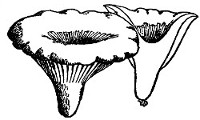
Lactarius hygrophoroides.
L. hygrophoroi´des B. and C.—resembling Hygrophorus. Pileus
1–4 in. broad, firm, convex or nearly
plane, umbilicate or slightly depressed,
rarely funnel-shaped, glabrous
or sometimes with a minute
velvety pubescence or tomentum,
dry, sometimes rugose-wrinkled and
often becoming cracked in areas,
yellowish-tawny or brownish-orange.
Gills distant, adnate or subdecurrent,
white or cream-color, the interspaces uneven or venose. Stem
.5–1 in. long, 4–8 lines thick, short, equal or tapering downward, solid,
glabrous or merely pruinose, colored like the pileus. Spores subglobose
181or broadly elliptical, nearly smooth, 9–11.3µ. Milk white, taste
mild.
Grassy ground and borders of woods. Albany, Greenbush and Sandlake.
July and August.
This plant has almost exactly the color of L. volemus, but differs
from it in its distant gills, short stem, less copious milk and less globose
spores. Its flesh is white, with a thickness about equal to the breadth
of the gills. It is probably edible, but has not yet been tested. The
typical L. hygrophoroides is described as having the pileus yellowish-red
and pulverulent, and the gills luteous. It is also represented as a
small plant; but our specimens, while not fully agreeing with this description,
approach so closely to it in some of their forms that they
doubtless belong to the same species. We have therefore extended the
description so that it may include our plant. In wet weather the pileus
sometimes becomes funnel-form by the elevation of the margin. Peck,
38th Rep. N.Y. State Bot.
Mt. Gretna, Pa., 1897, grassy grounds and borders of woods.
Mixed, moist woods and grassy borders. July to September. McIlvaine.
Pileus up to 4 in. across. Stem 1–2½ in., tapering, equal or tapering
downward. When growing in woods the stem is longer than when
growing on borders.
Its edible qualities are excellent.
L. mitis´simus Fr.—mitis, mild. Pileus 1–3 in. broad, golden-tawny,
zoneless, fleshy, thin, somewhat rigid, convex, papillate, depressed,
papilla vanishing, even, smooth, somewhat slippery when moist. Flesh
pallid. Stem elongated, 1–3 in. long, ⅓-½ in. thick, stuffed, then
hollow, even, smooth, of the same color as the pileus. Gills adnato-decurrent,
somewhat arcuate, then tense and straight, 1–1½ lines and
more broad, thin, crowded, a little paler than the pileus, most frequently
stained with minute red spots. Milk white, mild, plentiful.
Thin; very much allied to L. subdulcis, but distinguished by the
taste being mild, then somewhat bitterish, and especially by the bright,
golden-tawny, resplendent color of the pileus and stem. Fries.
In mixed and pine woods. August to November. Stevenson.
Spores 6–8×5–6µ Massee; 10µ Cooke; spheroid, echinulate, 6–7µ
C.B.P.
182California, H. and M.
Edible. Cooke. Eaten on the continent.
L. subdul´cis Fr.—sub; dulcis, sweet. Pileus .5–2 in. broad, thin,
convex, then plane or slightly funnel-shaped,
with or without a small umbo
or papilla, glabrous, even, zoneless,
moist or dry, tawny-red, cinnamon-red
or brownish-red, the margin
sometimes wavy or flexuous. Gills
rather narrow, thin, close, whitish,
sometimes tinged with red. Stem
1–2.5 in. long, 1–3 lines thick, equal
or slightly tapering upward, slender,
glabrous, sometimes villous at the
base, stuffed or hollow, paler than or colored like the pileus. Spores
7.6–9µ. Milk white, taste mild or tardily and slightly acrid, sometimes
woody or bitterish and unpleasant. Flesh whitish, pinkish or reddish
gray, odor none.
Fields, copses, woods, swamps and wet places. July to October.
Very common.
This species grows in almost every variety of soil and locality. It
may be found in showery weather on dry, rocky soil, on bare ground
or among mosses or fallen leaves. In drier weather it is still plentiful
in swamps and wet, shaded places, and in sphagnous marshes. It sometimes
grows on decaying wood. It is also as variable as it is common.
Gillet has described the following varieties:
Var. cinnamo´meus. Pileus cinnamon-red, sub-shining. Stem stuffed,
then hollow; taste mild, becoming slightly acrid or bitter.
Var. ru´fus. Pileus dull chestnut-red; becoming more concave.
Stem spongy; taste mild.
Var. ba´dius. Pileus bay-red, shining as if varnished, with an obtuse
disk and an inflexed, elegantly crenulate margin. Stem very glabrous,
hollow.
The first and second varieties have occurred within our limits. The
first also has the stem elastic and furnished with a whitish or grayish
tomentum or strigose villosity at the base, when growing among moss
in swamps. A form occurred in Sandlake, in which some of the specimens
183were proliferous. The umbo had developed into a minute pileus.
With us the prevailing color of the pileus is yellowish-red or cinnamon-red.
Sometimes the color is almost the same as that of L. volemus
and L. hygrophoroides, and again it is a tan-color or a bay-red, as in
L. camphoratus, from which such specimens are scarcely separable, except
by their lack of odor. In young plants the pileus usually has a
moist appearance, which is sometimes retained in maturity. Cordier
pronounces the species edible, and says that he has tested it several
times without inconvenience. Peck, 38th Rep. N.Y. State Bot.
Spores 10µ Cooke; 7µ W.G.S.
West Virginia mountains, 1881–1885; Pennsylvania, New Jersey,
everywhere on moist ground. July to October. McIlvaine.
Edible. Curtis.
The description of Fries as enlarged and modified by Professor Peck,
together with that of the varieties placed to the credit of the species by
Gillet, are given above in full. The species with its ascribed varieties
is common and well known. Var. ba´dius occurs in West Virginia and
Pennsylvania. They are all edible and vary but little in quality.
L. subdulcis requires long cooking.
L. muta´bilis Pk.—changeable. Pileus 2–4 in. broad, thin, convex
or nearly plane, zonate when moist, reddish-brown, the disk and zones
darker, zoneless when dry, flesh colored like the pileus. Milk sparse,
white, taste mild. Gills narrow, close, adnate, whitish, with a yellowish
or cream-colored tint when old. Stem 1–2 in. long, 3–5 lines thick,
equal or tapering upward, stuffed or spongy within, glabrous, colored
like the pileus. Spores subglobose, rough, 7.6µ broad.
Low, damp places. Selkirk and Yaphank, N.Y. June and September.
The species is allied to L. subdulcis, from which the larger size and
zonate pileus separate it. The zones disappear in the dry plant, and
this change in the marking of the pileus suggests the specific name.
They appear to be formed by concentric series of more or less confluent
spots and are suggestive of such species as L. deliciosus and L. subpurpureus.
Peck, 43d Rep. N.Y. State Bot.
West Virginia, Pennsylvania. Solitary but frequent. In moist woods
and margins of woods. June to October. McIlvaine.
184I have been familiar with and eaten this plant since 1882, but thought
it might be a variety of L. deliciosus, with light-colored milk.
L. mutabilis is an excellent species, equal to any Lactarius.
L. camphora´tus Fr.—camphor. Pileus 1–2 in. across, brown-brick-red,
somewhat zoned, sometimes zoneless, fleshy, thin, depressed, dry,
smooth. Stem short, 1–2 in., stuffed, somewhat undulated, of the same
color as the pileus. Gills adnate, crowded, yellowish-brick-color. Milk
mild, white, odor agreeable, spicy. Fries.
Strong smelling. So like L. subdulcis that it can be distinguished
safely only by its odor of melilot when dried. Stevenson.
Pileus .5–1.5 in. broad. Stem 1–2 in. long, 2–3 lines. Peck, 38th
Rep. N.Y. State Bot.
Spores spherical, echinulate, 6–7µ Q.; subglobose, 8–9µ Massee;
7.6–9µ Peck.
Taste and smell not of camphor, but of melilot.
North Carolina, Curtis; South Carolina, Ravenel; Wisconsin, Bundy;
New York, Peck, Rep. 23, Mon. 38th Rep.
West Virginia, Pennsylvania, July to October, in moist places. Mixed
woods, etc. McIlvaine.
Edible. Gillet.
Its mild taste distinguishes it at once from L. rufus.
It has high but pleasant flavor. If the flavor is too evident to suit
some tastes, it is well to mix milder species with it.
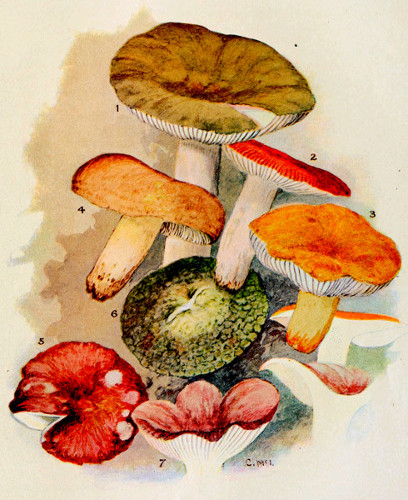
Grouped by F.D. Briscoe—Studies by C. McIlvaine. Plate XLIV.
| Fig. |
Page. |
Fig. |
Page. |
| 1. Russula cyanoxantha, |
198 |
5. Russula roseipes, |
209 |
| 2. Russula emetica, |
201 |
6. Russula virescens, |
194 |
| 3. Russula flavida, |
197 |
7. Russula puellaris, |
208 |
| 4. Russula sordida, |
190 |
|
|
185RUS´SULA Pers.
Pileus regular, rigid, usually becoming more or less depressed.
Flesh of the pileus descending into
the gills forming a cellular trama.
Veil and consequently the ring absent.
Stem smooth, stout, rigid,
brittle, spongy within. Gills rigid,
fragile, edge thin and acute. Spores
rounded, often echinulate, white or
yellowish. On the ground.
Closely allied to Lactarius but
separated by the absence of milk.
The gills of some species exude watery
drops in moist weather. Owing
to the similarity of form and the variable
coloring many species are difficult
to determine; all the characters should be carefully noted, not
omitting that of the taste.
Russulæ are readily distinguished by the stout, short, brittle stem and
the fragility of the pileus and gills. They especially love open woods
and appear during the summer and fall months, some being found until
sharp frosts occur.
It has been claimed by mushroom growers, until within a few years,
that the spores of the mushroom have to pass through the digestive
apparatus of the horse before they will germinate. It has been conclusively
demonstrated that such a transmission is not a necessity. It was
for a long time my opinion—following the opinion of others—that such
assistance was necessary. In my many efforts to propagate valuable
food species of the wild toadstools I endeavored to find the method by
which the spores were disseminated, and through what digestive medium
they passed—either of insect or animal—before germination. Noticing
that the Russulæ were fed upon by a small black beetle, I planted in
suitable places, not the toadstools, but the beetles found upon them.
The result was that in several instances I grew the Russulæ. My
experiments, while interesting, are not conclusive, because I later found
that the same results could be obtained from the toadstool itself when
186planted under its own natural life conditions. It is certain that beetles
can not be raised by planting Russulæ.
The beetles known as tumble-bugs—canthon lævis—deposit eggs in
the center of balls made of animal droppings; dig a hole in the ground
and drop them into it. These droppings frequently contain the spores
of the meadow mushroom. Thus planted with the proper surrounding
of manure, and at the proper depth, the spores germinate, spread
mycelium, and a crop of mushrooms is the result. The beetle becomes
a horticulturist. No wonder the Egyptians, thousands of years ago,
made it—the scarabeus—their sacred emblem, and that, today, the
fleur-de-lis of France, so the Rosicrucians say, perpetuates its glorious
worth and calling.
Most Russulæ are sweet and nutty to the taste; some are as hot as
the fiercest of cayenne, but this they lose upon cooking. To this genus
authors have done especial injustice; there is not a single species among
them known to be poisonous, and, where they are not too strong of
cherry bark and other highly flavored substances, they are all edible;
most of them are favorites. Where they present no objectionable appearance
or taste, their caps make most palatable dishes when stewed,
baked, roasted or escalloped. The time of cooking should be determined
by the consistency of the variety; some will cook in five minutes,
others not under thirty. Salt, butter and pepper are the only necessaries
as seasoning.
I.—Compactæ (compingo, to put together; compact). Page 187.
Pileus fleshy throughout, hence the margin is at first bent inward and
always without striæ, without a distinct gluey pellicle (in consequence
of which the color is not variable, but only changes with age and the
state of the atmosphere). Flesh compact, firm. Stem solid, fleshy.
Gills unequal.
II.—Furcatæ (furca, a fork. With forked gills). Page 191.
Pileus compact, firm, covered with a thin, closely adnate pellicle,
which at length disappears, margin abruptly thin, at first inflexed, then
spreading, acute, even. Stem at first compact, at length spongy-soft
within. Gills somewhat forked, with a few shorter ones intermixed,
commonly attenuated at both ends, thin and normally narrow.
187III.—Rigidæ (rigidus, rigid). Page 194.
Pileus without a viscid pellicle, absolutely dry, rigid, the cuticle commonly
breaking up into flocci or granules. Flesh thick, compact, firm,
vanishing away short of the margin which is straight (never involute),
soon spreading, and always without striæ. Stem solid, at first hard,
then softer and spongy. Gills, a few dimidiate, others divided, rigid,
dilated in front and running out with a very broad, rounded apex,
whence the margin of the pileus becomes obtuse and is not inflexed.
Exceedingly handsome, but rather rare.
IV.—Heterophyllæ (R. heterophylla, the typical species
of the section). Page 198.
Pileus fleshy, firm, with a thin margin which is at first inflexed, then
expanded and striate, covered with a thin adnate pellicle. The gills
consist of many shorter ones mixed with longer ones, along with others
which are forked. Stem solid, stout, spongy within.
V.—Fragiles (fragilis, fragile or brittle). Page 201.
Pileus more or less fleshy, rigid-fragile, covered with a pellicle which
is always continuous, and in wet weather viscid and somewhat separable;
margin membranaceous, at first convergent and not involute, in
full-grown plants commonly sulcate and tubercular. Flesh commonly
floccose, lax, friable. Stem spongy, at length wholly soft and hollow.
Gills almost all equal, simple, broadening in front, free in the pileus
when closed. Several doubtful forms occur. R. integra is specially fallacious
from the variety of its colors.
* Gills and spores white.
** Gills and spores white, then light-yellowish or bright lemon-yellowish.
*** Gills and spores ochraceous.
R. ni´gricans Bull.—nigrico, to be blackish. Pileus 2–4 in. and
more broad, olivaceous-fuliginous, at length black, fleshy to the margin
which is at first bent inwards, convex then flattened, umbilicato-depressed,
when young and moist slightly viscid and even (without a
separable pellicle), at length cracked in scales. Flesh firm, white,
188when broken becoming red on exposure to the air. Stem 1 in. thick,
persistently solid, equal, pallid when young, at length black. Gills
rounded behind, slightly adnexed, thick, distant, unequal, paler, reddening
when touched. Fries.
Compact, obese, inodorous, within and without at length wholly black,
in which it differs from all others. The flesh becomes red when broken
because it is saturated with red juice, although it does not exude milk.
Sometimes a very few of the gills are dimidiate.
In woods. Common. June to November. Stevenson.
Var. albo´nigra Krombh.—albo, white; negro, to be black. Pileus
fleshy, convexo-plane, depressed in the middle, at length funnel-shaped,
viscid, whitish, smoky about the margin. Flesh white, turning black
when broken. Stem solid, stout, dusky, becoming blackened. Gills
decurrent, crowded, unequal, dusky-whitish. In grassy places.
Spores papillose, 8µ W.G.S.; subglobose, rough, 8–9µ Massee.
New York. Our specimens agree with the description in every respect,
except that the gills are not distant. Peck, 32d Rep.
Mild when raw, but with a heavy woody taste.
Cooked it makes a good dish, but does not equal most Russulæ.
R. purpuri´na Quel. and Schulz.—purple. (Plate XLVa.) Pileus
fleshy, margin acute, subglobose, then plane, at length depressed in
the center, slightly viscid in very wet weather, not striate, often split,
pellicle separable, rosy-pink, paling even to light yellow. Gills crowded
in youth, afterward subdistant, white, in age yellowish, reaching the
stem, 2–4 lines broad in front, not greatly narrowed behind, almost
equal, not forked. Stem spongy, stuffed, very variable, cylindrical,
attenuated above and below the middle, rosy-pink becoming paler
(rarely white) toward the base, color obscure in age. Flesh fragile,
white, reddish under the skin; odor slight, taste mild. Spores white,
globose, sometimes sub-elliptical, 4–8µ long, minutely warted.
Pileus 1.5–2.5 in. across. Stem up to .4 in. thick, 1.2 in. long.
“This is a beautiful and very distinct species easily known by its red
stem, mild taste and white spores.” Peck, 42d Rep. N.Y. State Bot.
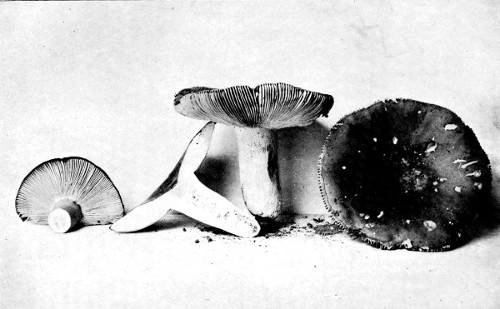
Photographed by Dr. J.R. Weist. Plate XLVa.
RUSSULA PURPURINA.
R. adus´ta Fr.—aduro, to scorch. Pileus pallid or whitish, grayish-sooty,
equally fleshy, compact, depressed then somewhat infundibuliform,
margin at first inflexed, smooth, then erect, without striæ. Flesh
189unchangeable. Stem solid, obese, of the same color as the pileus.
Gills adnate then decurrent, thin, crowded, unequal, white then dingy,
not reddening when touched. Fries.
Spores subglobose, almost smooth, 8–9µ Massee.
In pine and mixed woods.
West Virginia, Pennsylvania, New Jersey, in pine woods and in mixed
woods. August to frost. McIlvaine.
R. adusta is solitary but often in small troops. It is easily recognized
by the brownish blotches upon its cap, and the crowding of its thin gills.
The solid flesh must be well cooked. It is then of good flavor.
(Plate XLVb.)
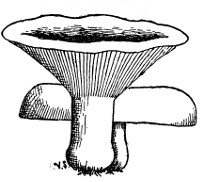
Russula brevipes.
After Prof. Peck.
R. bre´vipes Pk.—brevis, short; pes, a foot. Pileus 3–5 in.
broad, at first convex and umbilicate,
then infundibuliform, dry, glabrous
or slightly villose on the margin,
white, sometimes varied with reddish-brown
stains. Flesh whitish,
taste mild, slowly becoming slightly
acrid. Lamellæ thin, close, adnate
or slightly rounded behind; white.
Stem solid, white.
Spores globose, verruculose, 10–13µ.
Stem 6–10 lines long, 6–10 lines
thick.
Sandy soil in pine woods. Quogue. September.
This species is related to Russula delica, but is easily distinguished
by its short stem and crowded gills. The pileus also is not shining and
the taste is tardily somewhat acrid. From Lactarius exsuccus it is
separated by the character of the gills and the very short stem which is
about as broad as it is long. The spores also are larger than in that
species. The gills in the young plant are sometimes studded with
drops of water. They are not clearly decurrent. Some of them are
forked at the base. The pileus is but slightly raised above the surface
of the ground and is generally soiled by adhering dirt and often marked
by rusty or brownish stains. The plants grew in old roads in the woods
where the soil had been trodden and compacted. Peck, 43d Rep. N.Y.
State Bot.
190West Virginia, 1882; Pennsylvania, 1887–1894; New Jersey, 1892.
Solitary in pine and hemlock woods, generally on bare, compact ground.
August to October. McIlvaine.
This species is a sparse grower, but its good size and respectable numbers
soon fill the basket. When fresh it is of good substance and flavor.
R. del´ica Fr.—delicus, weaned. (Milkless, juiceless in gills.)
White. Pileus 3–5 in. broad, fleshy throughout, firm, umbilicate then
infundibuliform, regular, everywhere even, smooth with a whitish luster,
the involute margin without striæ. Flesh firm, juiceless, not very
thick, white. Stem curt, 1–2 in. long, ½ in. and more thick, solid,
even, smooth, white. Gills decurrent, thin, distant, very unequal,
white, exuding small watery drops in wet weather. Fries.
Spores minutely echinulate, white, broadly elliptical, 8–10×6–7µ
Massee.
In appearance it resembles Lactarius vellereus and L. piperatus, but
its gills do not distill milk or juice. It differs, too, in its mild taste. It
is related to R. brevipes Pk.
A large, coarse species, cup-shaped at maturity. I have found it in
several localities in Massachusetts in July and August. It is of fair
quality cooked, but much inferior to R. virescens, etc. Macadam.
West Virginia, Pennsylvania, New Jersey, in mixed woods, August
to October. McIlvaine.
Edible. Taste mild. From the juiceless variety of L. vellereus its
mild taste alone furnishes a separate character. Peck.
I have eaten it since 1882, but it is not a favorite. Its quality is fair.
R. sor´dida Pk.—dirty. (Plate XLIV, fig. 4, p. 184.) Pileus firm,
convex, centrally depressed, dry, sordid-white, sometimes clouded with
brown. Gills close, white, some of them forked. Stem equal, solid,
concolorous. Spores globose, 7.5µ. Taste acrid. Flesh changing color
when wounded, becoming black or bluish-black.
Plant 4–5 in. high. Pileus 3–5 in. broad. Stem 6–12 lines thick.
Ground under hemlock trees. Worcester. July.
It resembles L. piperatus in general appearance. The whole plant
turns black in drying. Peck, 26th Rep. N.Y. State Bot.
Ohio, Morgan; Pennsylvania, Herbst; West Virginia, 1881–1885,
191Pennsylvania, New Jersey, pine, hemlock and mixed woods, July to
September. McIlvaine.
It is of better quality than most coarse-grained Russulæ.
R. furca´ta Fr.—furca, a fork. Pileus 3 in. broad, sometimes
greenish, sometimes umber-greenish, fleshy, compact, gibbous then
plano-depressed or infundibuliform, even, smooth, but often sprinkled
with slightly silky luster, pellicle here and there separable, margin thin,
at first inflexed, then spreading, always even. Flesh firm, somewhat
cheesy, white. Stem 2 in. or a little more long, solid, firm, equal or
attenuated downward, even, white. Gills adnato-decurrent, rather thick,
somewhat distant but broad, attenuated at both ends, frequently forked,
shining white. Fries.
Spores globose, echinulate, 6–7µ C.B.P.; 7–8×9µ Massee.
In woods, and grass under trees.
The frequently forked gills, from which the species takes its name,
their being thick and slightly decurrent, help to distinguish it. It is
quite common in its several varieties.
Taste mild at first. A slight bitter develops which disappears in
cooking. It is then of good quality, not equal to R. virescens. Older
writers marked it poisonous, doubtless for no other cause than its slight
bitter. I have eaten it freely for fifteen years.
R. sangui´nea Fr.—sanguis, blood. Pileus 2–3 in. broad, blood-red
or becoming pale round the even, spreading, acute margin, fleshy,
firm, at first convex, obtuse, then depressed and infundibuliform and
commonly gibbous in the center, polished, even, moist in damp weather.
Flesh firm, cheesy, white. Stem stout, spongy-stuffed, at first contracted
at the apex, then equal, slightly striate, white or reddish. Gills
at first adnate, then truly decurrent, very crowded, very narrow, connected
by veins, fragile, somewhat forked, shining white. Fries.
Spores 9–10µ diameter Massee.
In pine and mixed woods. July to October.
Color same as R. rubra but differs in its hard cheesy flesh, rigid,
slightly yellowish gills in age. The gills of R. sanguinea are truly
decurrent, and pointed in front.
192Poisonous. Stevenson. Krapp says he has experienced grave inconveniences
from eating it.
Myself and very many friends eat all fresh inviting Russulæ. We do
not discriminate against a single peppery or acrid species, not even the
R. emetica which has been severely maligned. In fact the peppery
Russulæ are usually substantial in flesh and choice in substance.
The opinion of many is that R. sanguinea is one of the best. I have
eaten it for years.
R. depal´lens Pers.—palleo, to be pale. Pileus 3–4 in. across, pallid-reddish
or inclining to dingy-brown, etc., fleshy, firm, convex,
then plane, more rarely depressed, but commonly irregularly shaped
and undulated, even, the thin, adnate pellicle presently changing color,
especially at the disk, the spreading margin even, but slightly striate
when old. Flesh white. Stem about 1½ in. long, solid, firm, commonly
attenuated downward, white, becoming cinereous when old. Gills
adnexed, broad, crowded, distinct, but commonly forked at the base,
often with shorter ones intermixed. Inodorous, taste mild. The color
of the pileus is at first pallid-reddish, or inclining to brownish, then
whitish or yellowish, opaque in every stage of growth. It approaches
nearest to the Heterophyllæ. Fries.
In beech woods, pastures, etc. August to September.
Spores subglobose, echinulate, 7–8µ Massee.
R. depallens somewhat resembles R. heterophylla. Both are edible.
It is a solitary grower and not common, but when found it occurs in
good quantity. It belongs to the best class of Russulæ.
R. subdepal´lens Pk.—sub, de and palleo, to be pale. Pileus fleshy,
at first convex and striate on the margin, then expanded or centrally
depressed and tuberculate-striate on the margin, viscid, blood-red or
purplish red, mottled with yellowish spots, becoming paler or almost
white with age, often irregular. Flesh fragile, white, becoming cinereous
with age, reddish under the cuticle, taste mild. Lamellæ broad, subdistant,
adnate, white or whitish, the interspaces venose. Stem stout,
solid but spongy within, persistently white.
Spores white, globose, rough, 8µ broad.
Pileus 3–6 in. broad. Stem 1.5–3 in. long, 6–12 lines thick.
Under a hickory tree. Trexlertown, Pa. June. W. Herbst.
193Closely related to Russula depallens, from which it differs in having
the margin of the pileus striate at first and more strongly so when mature,
also in the pileus being spotted at first, the gills more distant, the
stem persistently white and the spores white. Bull. Torrey Bot. Club.
Vol. 23, No. 10. October, 1896.
I do not doubt its edibility. See R. depallens.
R. ochrophyl´la Pk.—ochra, a yellow earth; phyllon, a leaf. Pileus
2–4 in. broad, firm, convex becoming nearly plane or slightly depressed
in the center, even or rarely very slightly striate on the margin when
old, purple or dark purplish red. Flesh white, purplish under the adnate
cuticle, taste mild. Gills entire, a few of them forked at the base,
subdistant, adnate, at first yellowish, becoming bright ochraceous buff
when mature, dusted by the spores, the interspaces somewhat venose.
Stem equal or nearly so, solid or spongy within, reddish or rosy tinted,
paler than the pileus. Spores bright ochraceous buff, globose-verruculose,
10µ broad.
The ochery-gilled Russula is a large fine species, but not a common
one. It differs but little in color and size from the European pungent
Russula, Russula drimeia, but it is easily distinguished from it by its
mild taste.
The cap is dry, convex or a little depressed in the center, purple or
purplish red, the white flesh purplish under the cuticle, which, however,
is not easily separable.
The gills are nearly all entire, extending from the stem to the margin
of the cap. They are therefore much closer together near the stem than
at the margin. They are at first yellowish, but a bright ochraceous buff
when mature. They are then dusted by the similarly colored spores.
The stem is stout, nearly cylindric, firm but spongy in the center and
colored like the cap, but generally a little paler. There is a variety in
which the stem is white and the cap deep red. In other respects it is
like the typical form. Its name is Russula ochrophylla albipes.
The ochery-gilled Russula grows in groups under trees, especially
oak trees, and should be sought in July and August. Peck, 51st Rep.
N.Y. State Bot.
West Virginia, Pennsylvania, July to September, McIlvaine.
Edible. Peck, 50th Rep. N.Y. State Bot.
194Ri’gidæ.
R. lac’tea Fr.—lac, milk. Pileus 2 in. broad, at the first milk-white,
then tan-white, throughout compactly fleshy, bell-shaped, then convex,
often excentric, without a pellicle, always dry, at the first even, then
slightly cracked when dry, margin straight, thin, obtuse, even. Flesh
compact, white. Stem 1½-2 in. long, 1½ in. thick, solid, very compact,
but at length spongy-soft within, equal, even, always white. Gills
free, very broad, thick, distant, rigid, forked, white. Fries.
Spores subglobose, echinulate, 7–9µ Massee.
Closely allied to R. albella Pk. from which it differs in its shorter
stem, and pileus cracking into areolæ, and gills not being entire.
In mixed woods, in patches, not common.
Botanic creek, West Philadelphia, Pa., patches, McIlvaine, 1887.
Edible and of good flavor. Macadam.
Raw, it has a raw, rather unpleasant taste and odor, a little like
some acorns. But its firm, thick flesh, meaty gills and stem, and good
flavor when well cooked, rank it equal to any.
R. albel’la Pk.—whitish. Pileus 2–3 in. broad, thin, fragile, dry,
plane or slightly depressed in the center, even or obscurely striate on
the margin, commonly white, sometimes tinged with pink or rosy-red,
especially on the margin. Flesh white, taste mild. Lamellæ entire,
white, becoming dusted by the spores. Stem 1–2 in. long, 3–4 lines
thick, equal, solid or spongy within, white.
Spores white, globose, 7.6µ broad.
Dry soil of frondose woods. Port Jefferson. July.
Closely allied to R. lactea, but differing in its fragile texture, entire
lamellæ, more slender stem, and in the pileus not cracking into areas.
Peck, 50th Rep. N.Y. State Bot.
R. vires’cens Fr.—viresco, to be green. (Plate XLIV, fig. 6, p.
184.) Pileus green, compactly fleshy, globose then expanded, at
length depressed, often unequal, always dry, not furnished with a pellicle,
wherefore the flocculose cuticle is broken up into patches or warts, margin
straight, obtuse, even. Flesh white, not very compact. Stem solid,
internally spongy, firm, somewhat rivulose, white. Gills free, somewhat
195crowded, sometimes equal, sometimes forked, with a few shorter
ones intermixed, white. Fries.
Taste mild; good, raw.
Spores scarcely echinulate, almost globular, 6µ W.G.S. Spores
8–10µ Massee; 6–7.6µ Peck.
Cap round when young, very hard, then convex or becoming dished,
sometimes repand. It is without a separable skin, covered with various
sized areas of mouldy looking patches which are at times distinctly
cracked. The color varies from a bright bluish-green to grayish-green,
such shades remind one of mouldy cheese or the shades of Roquefort;
again the color may vary in shades of light leather brown, occasionally
the caps are almost white, opaque in each shade of color. Flesh crisp,
brittle, thick, white, mild, good raw. Gills and stem as described.
R. virescens is common in the United States but not generally plentiful.
It is a solitary grower, usually but few are found in a patch.
Striking in appearance when its green colors are present, and always
clean looking and inviting. It sometimes attains the size of 5 in. across.
It is a hot weather Russula and rarely appears before the latter part of
June, then after rains.
To eat, it should be in a healthy, fresh condition. All Russulæ
impart a stale flavor if any part of gills or cap is wilting, drying or
decaying. It requires forty minutes' slow stewing, or it can be dressed
raw as a salad. Roasted or fried crisp in a hot buttered pan it is at its
best. It should be well salted.
R. lep´ida Fr.—lepidus, neat, elegant. Pileus 3 in. broad, blood-red-rose,
becoming pale, whitish especially at the disk, somewhat equally
fleshy, convex then expanded, scarcely depressed, obtuse, opaque, unpolished,
with a silky appearance, at length often cracked scaly, margin
spreading, obtuse, without striæ. Stem as much as 3 in. long, often
1 in. thick, even, white or rose-color. Gills rounded behind, rather
thick, somewhat crowded, often forked, connected by veins, white, often
red at the edge.
Taste mild; wholly compact and firm, but the flesh is cheesy, not
somewhat clotted. The gills are often red at the edge, chiefly toward
the margin, on account of the margin of the pileus being continuous
with the gills. Fries.
Spores 8–10×6–8µ Syll.
196Frequent. July to October, in mixed woods.
A common and variable species in size and color, but the cap is
always some shade of rose-red or lake. The flesh is compact and
cheesy. The gills sometimes edged with pink as they near the margin.
Taste mild.
The crisp flesh of R. lepida requires forty minutes' slow stewing, if
stewed. It yields a delicate pink shade to the dish. Roasted or cooked
in a hot buttered pan it is excellent.
R. ru´bra Fr.—ruber, red. Pileus unicolorous, a cinnabar-vermilion,
but becoming pale (tan) when old, disk commonly darker, compact,
hard but fragile, convex, then flattened, here and there depressed,
absolutely dry, without a pellicle, but becoming polished-even, often sinuously
cracked when old, margin spreading, obtuse, even, always persistent.
Flesh white, reddish under the cuticle. Stem 2–3 in. long,
about 1 in. thick, solid, even, varying white and red. Gills obtusely
adnate, somewhat crowded, whitish, then yellowish, with dimidiate and
forked ones intermixed.
Very acrid, very hard and rigid, most distinct from all the others of
this group in the pileus becoming polished-even, although without a pellicle,
in the flesh being somewhat clotted, and in the very acrid taste.
Gills often red at the edge. Fries.
Spores whitish, Fries; spheroid, 8–10µ K.
Krapp says he has experienced grave inconveniences from eating it.
European authorities mark “poisonous.”
I do not hesitate to cook it either by itself or with other Russulæ and
serve it at my table. It is easier cooked than R. virescens and others
of the crisp species, and has equal flavor.
R. Linnæ´i Fr.—in honor of Linnæus. Pileus 3–4 in. broad, unicolorous,
dark purple, blood-red or bright rose, opaque, not becoming
pale, everywhere fleshy, rigid, plano-depressed, sometimes spread upward,
even, smooth, dry, without a separable pellicle, margin spreading,
obtuse, without striæ. Flesh thick, spongy-compact, white. Stem 1½
in. and more long, 1 in. and more thick, stout, firm, but spongy-soft
within, somewhat ventricose, obsoletely reticulated with fibers, intensely
blood-red. Gills adnate, somewhat decurrent, rather thick, not crowded,
broad (more than ½ in.), fragile, sparingly connected by veins, white,
197becoming yellow when dry, with a few dimidiate ones intermixed, somewhat
anastomosing behind. Fries.
Spores wholly white, Fries; ellipsoid, spheroid, echinulate, 11µ
Q.; 9–11×8–9µ Massee.
West Virginia, 1881–1885. West Philadelphia, Pa., on Bartram’s
Botanic creek. McIlvaine.
R. Linnæi is one of our handsomest and best Russulæ. European
authors state its habit to be exactly that of R. emetica, but though I have
known it intimately for many years I have not been struck with this in
the American plant. Its large size, its more or less red stem never entirely
white, at times hollow, cavernous, its less solid flesh, habit of growing
in troops, sometimes parts of rings, flourishing best where the leaf
mat is heaviest, loving the leaf drift in fence-corners, are well marked
distinctions.
When young there is no better Russula. As it ages the stem becomes
soft, spongy and should be thrown away. The caps, only, eaten.
R. oliva´cea Fr.—oliva, an olive; olivaceus, the color of an olive.
Pileus 2–4 in. across, dingy-purple then olivaceous or wholly brownish-olivaceous,
fleshy, convexo-flattened and depressed, slightly silky and
squamulose, margin spreading, even. Flesh white, becoming somewhat
yellow. Stem firm, ventricose, rose-color to pallid, spongy-stuffed
within. Gills adnexed, wide, yellow, with shorter and forked ones
intermixed.
Mild. Near to R. rubra, but certainly distinct in the stem being
definitely spongy, in the pileus being unpolished, and in the gills being
soft and brightly colored; corresponding with R. alutacea. Fries.
Spores light yellow, Fries; spheroid, punctate, 10µ Q.; globose,
minutely granulate, yellow, 9–10µ diameter Massee.
Mt. Gretna, Pa., 1897–1898.
Pileus 2–4 in. across, 2–3 in. long, ½-⅓ in. thick.
The caps are equally good with R. alutacea. They must be fresh,
and similarly cooked.
R. fla´vida Frost—yellow. (Plate XLIV, fig. 3, p. 184.) Pileus
fleshy, convex, slightly depressed, unpolished, bright yellow. Gills
white, adnate, turning cinereous. Stem yellow, solid, white at the extreme
apex. Frost Ms.
198Pileus fleshy, convex, slightly depressed in the center, not polished,
yellow, the margin at first even, then slightly striate-tuberculate. Gills
nearly entire, venose-connected, white, then cinereous or yellowish.
Stem firm, solid, yellow, sometimes white at the top.
Spores yellow, subglobose, 6.5–7.6µ in diameter. Flesh white, taste
mild.
Plant 2–3 in. high. Pileus 2–3 in. broad. Stem 4–6 lines thick.
Frost Mss.
Ground in woods. Sandlake. August. Peck, 32d Rep. N.Y.
State Bot.
R. flavida is showy, solitary and in patches. The stem when young
and solid is equally good with the cap. Cooks in twenty-five minutes
and is of good flavor.
R. ves´ca Fr.—vesco, to feed. Pileus red-flesh-color, disk darker,
fleshy, slightly firm, plano-depressed, slightly wrinkled with veins, with
a viscid pellicle, margin at length spreading. Flesh cheesy, firm, shining
white. Stem solid, compact, externally rigid, reticulated and
wrinkled in a peculiar manner, often attenuated at the base, shining
white. Gills adnate, crowded, thin, shining white, with many unequal
and forked ones intermixed, but scarcely connected by veins.
Of middle stature. Taste mild, pleasant. Fries.
Spores globose, echinulate, white, 9–10µ diameter. Massee.
In mixed woods. Common. August to frost.
R. vesca is frequent in woods or margins, and under trees in the
open. It is especially fond of growing in the grass under lone chestnut
trees. The caps seldom exceed 2-½ in. across.
It is one of the best.
R. cyanoxan´tha (Schaeff.) Fr. Gr—blue; Gr—yellow. (From the
colors.) (Plate XLIV, fig. 1, p. 184.) Pileus 2–3 in. and more
broad, lilac or purplish then olivaceous-green, disk commonly becoming
pale often yellowish, margin commonly becoming azure-blue or livid
purple, compact, convex then plane, then depressed or infundibuliform,
sometimes even, sometimes wrinkled or streaked, viscous, margin
deflexed then expanded, remotely and slightly striate. Flesh firm,
199cheesy, white, commonly reddish beneath the separable pellicle. Stem
2–3 in. long, as much as 1 in. thick, spongy-stuffed, but firm, often
cavernous within when old, equal, smooth, even, shining white. Gills
rounded behind, connected by veins, not much crowded, broad, forked
with shorter ones intermixed, shining white.
Allied to R. vesca in its mild, pleasant taste and in other respects,
but constantly different in the color of the pileus, which is very variable,
whereas in R. vesca it is unchangeable. The peculiar combination of
colors in the pileus, though very variable, always readily distinguishes
it. Fries.
Spores 8–9µ, cystidia numerous, pointed, Massee; 8–10×6–8µ Sacc.
In mixed woods. Common. August to October.
Pronounced one of the best esculent species by all authorities.
R. heterophyl´la Fr. Gr—differing; Gr—a leaf. (Gills differing
in length.) Pileus very variable in color, but never becoming reddish
or purple, fleshy, firm, convexo-plane then depressed, even, polished,
the very thin pellicle disappearing, margin thin, even or densely but
slightly striate. Flesh white. Stem solid, firm, somewhat equal, even,
shining white. Gills reaching the stem in an attenuated form, very narrow,
very crowded, forked and dimidiate, shining white.
Taste always mild, as in R. cyanoxantha, from which it differs in its
smaller stature, in the pileus being thinner, even, never reddish or purplish,
with a thin closely adnate pellicle, in the stem being firm and solid,
and in the gills being thin, very narrow, very crowded, etc. The apex
of the stem is occasionally dilated in the form of a cup, so that the gills
appear remote. Fries.
Spores echinulate, 5×7µ W.G.S.; 7–8µ diameter Massee.
Common. Woods. July to November.
Edible, of a sweet nutty flavor. Stevenson.
R. heterophylla is very common. Its smooth, even pileus, colored in
some dingy shade of green, distinguishes it. It is much infested by
grubs. Specimens for the table should be young and fresh. Wilted
specimens are unpleasant.
R. fœ´tens Fr.—fœtens, stinking. Pileus 4–5 in. and more broad,
dingy yellow, often becoming pale, thinly fleshy, at first bullate, then
expanded and depressed, covered with a pellicle which is adnate, not
200separable, and viscid in wet weather, margin broadly membranaceous,
at the first bent inward with ribs which are at length tubercular. Flesh
thin, rigid-fragile, pallid. Stem 2 in. and more long, ½-1 in. thick,
stout, stuffed then hollow, whitish. Gills adnexed, crowded, connected
by veins, with very many dimidiate and forked ones intermixed, whitish,
at the first exuding watery drops.
Fetid. Taste acrid. Very rigid, most distinct from all others in its
very heavy empyreumatic odor. In very dry weather the odor is often
obsolete. The margin is more broadly membranaceous and hence
marked with longer furrows than in any other species. It differs from
all the preceding ones in the gills at the first exuding watery drops.
The gills become obsoletely light yellow, and dingy when bruised.
Fries.
Pileus fleshy, with a wide thin margin, hemispherical or convex, then
expanded or depressed, viscid when moist, widely striate-tuberculate on
the margin, dull pale yellow or straw color. Lamellæ rather broad,
close, venose-connected, some of them forked, whitish. Stipe nearly
cylindrical, whitish, hollow. Spores white. Plant sometimes cespitose.
Height 2–4 in.; breadth of pileus 2–3 in. Stipe 4–6 lines thick.
Pine woods. West Albany. October.
Taste mild at first, then slightly disagreeable. Peck, 23d Rep. N.Y.
State Bot.
Spores minute, echinulate, almost globular, 8µ W.G.S.; 8–10µ
Massee.
In woods. Common. July to October.
Var. granula´ta has the pileus rough with small granular scales. Peck,
Rep. 39.
A very coarse and easily recognized species. Reckoned poisonous,
though eaten by slugs. W.G.S.
The verdict is against it. Both smell and taste are usually unpleasant.
Cooked it retains its flavor, more closely resembling wild
cherry bark than anything else. On two occasions I ate enough to convince
me that it was not poisonous.
R. el´egans Bresad.—elegans, pretty. Mild at first, becoming acrid
with age. Pileus 2–3 in. across. Flesh rather thick; convex then depressed;
margin tuberculose and striate when old, viscid, bright rosy
flesh-color, soon ochraceous at the circumference, everywhere densely
201granulated. Gills adnexed or slightly rounded, narrow behind, very
much crowded, equal, rarely forked, whitish, becoming either entirely
or here and there ochraceous-orange. Stem 1½-2 in. long, 5–7 lines
thick, a little thickened at the base, rather rugulose, white, base ochraceous.
Flesh white, turning ochraceous and acrid when old.
Spores 8–10µ diameter Massee.
Allied to R. vesca. Known by the bright rose-colored, densely granular
pileus and tuberculose margin. When old the pileus is almost entirely
ochraceous. Massee.
Frequent in the West Virginia forests, 1881–1885. Chester county,
Pa., 1887–1890. In mixed woods. July to September. McIlvaine.
It differs from R. vesca in its cap being minutely granulated instead
of streaked, and in becoming acrid with age.
The caps are of good quality, needing to be well cooked.
* Gills and spores white.
R. eme´tica Fr.—an emetic. (Plate XLIV, fig. 2, p. 184.) Pileus
3–4 in. broad, at first rosy then blood-color, tawny when old, sometimes
becoming yellow and at length (in moist places) white, at first bell-shaped
then flattened or depressed, polished, margin at length furrowed
and tubercular. Flesh white, reddish under the separable pellicle. Stem
spongy-stuffed, stout, elastic when young, fragile when older, even,
white or reddish. Gills somewhat free, broad, somewhat distant, shining
white.
Handsome, regular, moderately firm, but fragile when full grown,
taste very acrid. Fries.
Spores shining white, Fries; spheroid, echinulate, 8–10µ K.; 7µ
W.G.S.
Maryland, Miss Banning; New York, Peck, Rep. 22; Indiana, Illinois,
H.I. Miller.
Said to act as its name implies as an emetic. Certainly poisonous.
Stevenson.
Krapp says he has himself experienced rare inconveniences from eating
it. Preferred to others in Indiana and Illinois. H.I. Miller, 1898.
The varying reports upon R. emetica are quoted above. In 1881, in
202the West Virginia mountains, I began testing this Russula and soon
found that it was harmless. At least twenty persons ate it in quantity,
during its season, for four years. Yet, in my many published articles, I
continued, out of regard for the opinions of others and in excess of
caution, to warn against all bitter and peppery fungi. But from that
time until the present I have eaten it, and I have made special effort to
establish its innocence by getting numbers of my friendly helpers to eat it.
It was suggested by one of its prosecutors that perhaps I was mistaking
another fungus for it. In October, 1898, I sent to Professor
Peck a lot of the Russula I was eating. He wrote: “It seems to be
R. emetica as you state. It certainly is hot enough for it.”
R. pectina´ta Fr.—pecten, a comb. Pileus 3 in. broad, at first gluey,
toast-brown, then dry, becoming pale, tan, with the disk always darker,
fleshy, rigid, convex then flattened and depressed or concavo-infundibuliform
(basin-shaped); margin thin, pectinato-sulcate (deeply ribbed),
here and there irregularly shaped. Flesh white, light yellowish under
the pellicle, which is not easily separable. Stem curt, 3 in. long, ¾–1
in. thick, rigid, spongy-stuffed, longitudinally slightly striate, shining
white, often attenuated at the base. Gills attenuato-free behind, broader
toward the margin, somewhat crowded, equal, simple, white.
Odor weak, but nauseous, approaching that of R. fœtens. Fries.
Spores 8–9µ diameter Massee.
New York, Peck, 43d Rep. West Virginia, Pennsylvania, New Jersey.
Common in woods, grassy, mossy places. July to frost. McIlvaine.
Named from the furrows of the margin being like the teeth of a comb.
Both the appearance and smell of this Russula will detect it. The
peculiar comb-like furrows of its margin, viscid or varnished-looking
cap, and strong but more spicy smell than cherry-bark are noticeable.
It is edible, but so strong in flavor that a piece of one will spoil a
dish if cooked with other kinds.
R. ochroleu´ca Fr. Gr—pale yellow; Gr—white. Pileus yellow,
becoming pale, fleshy, flattened or depressed, polished, with an adnate
pellicle, the spreading margin becoming even. Stem spongy, stuffed,
firm, slightly reticulato-wrinkled, white, becoming cinereous. Gills
rounded behind, united, broad, somewhat equal, white becoming pale.
Odor obsolete, but pleasant. The pileus is never reddish. It agrees
203wholly with R. emetica in structure and stature, as well as in the acrid
taste; it differs however in the stem being slightly recticulato-wrinkled,
white becoming cinereous, in the adnate pellicle of the pileus, in the
margin remaining for a long time even (remotely striate, but not tubercular,
only when old), and in the gills being rounded behind and becoming
pale. The color of the pileus is constant. The gills remain
free and do not exude drops. Fries.
Cap 2–4 in. across. Stem 2–3 in. long, up to ¾ in. thick.
Spores papillose, 7µ W.G.S., 8×9µ Massee.
Frequent in woods. July to October.
Not as common as R. emetica, yet frequently found, usually solitary,
at times gregarious. It is quite peppery, but loses pepperiness in cooking.
Myself and others have frequently eaten it.
R. ci´trina Gillet—citrina, citron colored. Mild. Pileus 2–3 in.
across, slightly fleshy at the disk, margin thin; convex then more or
less expanded and slightly depressed, rather viscid when moist, smooth,
slightly wrinkled at the margin when old, bright lemon-yellow, color
usually uniform, sometimes paler at the margin, occasionally with a
greenish tint, center of pileus at length becoming pale-ochraceous; pellicle
separable. Gills slightly decurrent, broadest a short distance from
the margin, and gradually becoming narrower towards the base, forked
at the base and also sometimes near the middle, white, 1½ lines deep
at broadest part. Stem 2–3 in. long, about 4 lines thick, equal or
slightly narrowed at the base, slightly wrinkled, straight or very slightly
waved, solid.
Spores subglobose, echinulate, 8µ diameter.
In woods.
Known by the clear lemon-yellow or citron-colored pileus and the
persistently white gills and stem. The taste is mild at first, but becomes
slightly acrid if kept in the mouth for a short time. Massee.
R. citrina can hardly be classed among the acrid species. The taste
is slightly of cherry-bark and disappears in cooking. It is usually found
in patches which contain ten to twenty individuals. It is a species of
fair quality.
R. fra´gilis Fr.—fragile. Pileus 1–1½ in. broad, rarely more, flesh-color,
changing color, very thin, fleshy only at the disk, at the first convex
204and often umbonate, then plane and depressed, pellicle thin, becoming
pale, slightly viscid in wet weather; margin very thin, tuberculoso-striate.
Stem 1½-2 in. long, spongy within, soon hollow, often slightly
striate, white. Gills slightly adnexed, very thin, crowded, broad, ventricose,
all equal, shining white. Fries.
Very acrid. Smaller and more fragile than the rest of the group,
directly changing color. The color is variable, often opaque, typically
flesh-color, when changed in color white externally and internally, often
with reddish spots. Among varieties of color is to be noted a livid
flesh-colored form, with the disk becoming fuscous.
It is not easy to define it from fragile forms of R. emetica, but the
gills are much more crowded, thinner, and often slightly eroded at the
edge, ventricose; the pileus thinner and more lax, etc. Stevenson.
Var. nivea Fr.—nivea, snowy. Whole plant white.
Spores minutely echinulate 8–10×8µ Massee.
Though one of the peppery kind, I have not, after fifteen years of
eating it, had reason to question its edibility. The caps are not meaty,
but what there is of them is good.
R. puncta´ta Gillet—punctata, dotted. Mild. Pileus 1½-2½ in.
across. Flesh thin, white, reddish under the cuticle; convex then flattened,
viscid, rosy, disk darkest, punctate with dark reddish point-like
warts, pale when old; margin striate. Gills slightly adnexed, 2 lines
broad, white then yellowish, edge often reddish. Stem about 1 in.
long, 4–5 lines thick, attenuated and whitish at the base, remainder
colored like the pileus, stuffed.
Spores 8–9µ diameter Massee.
Among grass.
Edible. Boston Myc. Club Bull. 1896.
**
Gills and spores white then yellowish or bright lemon.
R. in´tegra Fr.—integer, entire, whole. Pileus 4–5 in. across, typically
red, changing color, fleshy, campanulato-convex then expanded
and depressed, fragile when full-grown, with a gluey pellicle, at length
furrowed and somewhat tubercular at the margin. Flesh white, sometimes
yellowish above. Stem at first short, conical, then club-shaped
205or ventricose, as much as 3 in. long, up to 1 in. thick, spongy-stuffed,
commonly stout, even, shining white. Gills somewhat free, very broad,
up to ¾ in., equal or bifid at the stem, somewhat distant, connected
by veins, pallid-white, at length light yellow, somewhat powdered yellow
with the spores.
Taste mild, often astringent. The most changeable of all species,
especially in the color of the pileus which is typically red, but at the
same time inclining to azure-blue, bay-brown, olivaceous, etc. Sometimes
the gills are sterile and remain white. Fries.
Spores ellipsoid-spheroid or spheroid echinulate, globose, rough,
8–9µ C.B.P.; 9–10µ diameter, pale ochraceous. Massee.
It is difficult to separate R. integra from R. alutacea. The spores
usually show upon the gills as pale dull yellow powder. It is of equal
excellence.
R. decolo´rans Fr.—de and coloro, to color. Pileus 3–5 in. broad,
color various, at first orange-red, then light yellow and becoming pale,
fleshy, spherical then expanded and depressed, remarkably regular,
viscid when moist, thin and at length striate at the margin. Flesh
white, but becoming somewhat cinereous when broken, and more or less
variegated with black spots when old. Stem elongated, 3–5 in., cylindrical,
solid, but spongy within, often wrinkled-striate, white then becoming
cinereous especially within. Gills adnexed, often in pairs, thin,
crowded, fragile, white then yellowish.
Taste mild. Colors changeable according to a fixed rule, but not
variable. The gills are not ochraceous-pulverulent as in R. integra, nor
shining and pure yellow as in R. aurata, etc. Fries.
Spores yellow, 8.3µ Morgan.
New York, Peck, 23d Rep. Angora, West Philadelphia, Pa., 1897,
in mixed woods. August to October. McIlvaine.
Esculent and of good quality. Morgan.
Meals of it make one regret its scarcity.
R. basifurca´ta Pk.—forked near stem. Pileus 2–3 in. broad, firm,
convex, umbilicate, becoming somewhat funnel form, glabrous, slightly
viscid when moist, the thin pellicle scarcely separable except on the
margin, dingy-white, sometimes tinged with yellow or reddish-yellow,
the margin nearly even. Lamellæ rather close, narrowed toward the
206base, adnate or slightly emarginate, many of them forked near the base,
a few short ones intermingled, white becoming yellowish. Stem 8–12
lines long, 5–6 lines thick, firm, solid, becoming spongy within, white.
Spores elliptical, pale yellow, uninucleate or shining, 9×6.5µ. Flesh
white, taste mild, then bitterish.
Dry hard ground in paths and wood roads. Canoga, N.Y. July.
This species closely resembles pale forms of R. furcata, from which
it is separated by the absence of any silky micor and by the yellowish
color and elliptical shape of the spores and by the yellowish hue of the
lamellæ. Peck, 38th Rep. N.Y. State Bot.
Mt. Gretna, Pa., September, 1898, to frost. Gravelly ground. Solitary.
Gills adnate. Identified as his species by Professor Peck.
The slight bitterish taste disappears in cooking. It is edible and of
fair quality.
R. aura´ta Fr.—aurum, gold. Pileus 2–3 in. broad, varying lemon-yellow,
orange and red, disk darker, fleshy, rigid, brittle however, hemispherical
then plane, disk not depressed, pellicle thin, adnate, viscid in
wet weather, margin even, and slightly striate only when old, but sometimes
wrinkled. Flesh lemon-yellow under the pellicle, white below.
Stem 2–3 in. long, solid, firm, but spongy within, cylindrical, obsoletely
striate, white or lemon-yellow. Gills rounded free, connected by
veins, broad, equal, shining, never pulverulent, whitish inclining to light
yellow, but vivid lemon-yellow at the edge. Fries.
West Virginia, 1881–1885; Pennsylvania, 1887–1898. In woods
under pines. July to October. McIlvaine.
Pileus sometimes depressed in center, very viscid when wet.
A troop of this Russula upon brown wood mat is a pretty sight. Its
rich and brightly-colored cap attracts the eye from a distance. The
yellow edge of its gills is the distinctive mark of the species.
The smell is pleasant, the taste slightly of cherry bark.
Cooked it is one of the best Russulæ.
R. atropurpu´rea Pk.—atre, black; purpureus, purple. Dark purple
Russula. Pileus 3–4 in. broad, at first convex, then centrally depressed,
glabrous, dark purple, blackish in the center, the margin even
or slightly striate. Flesh white, grayish or grayish-purple under the
separable pellicle, taste mild, odor of the drying plant fetid, very unpleasant.
207Lamellæ nearly equal, subdistant, sometimes forked near the
stem, at first white, then yellowish, becoming brownish where bruised.
Stem 2–3 in. long, 5–8 lines thick, equal, glabrous, spongy within,
white, brownish where bruised. Spores subglobose, minutely rough,
pale ochraceous with a salmon tint, 8–10µ.
Open woods. Gansevoort. July.
In color this species resembles R. variata, but in other respects it is
very different. It is very distinct in the peculiar color of its spores,
and in the brownish hue assumed by wounds. Peck, 41st Rep. N.Y.
State Bot.
West Philadelphia, Pa. July, 1897. Open woods. Solitary. Philadelphia
Myc. Center.
Many were eaten and enjoyed. Only fresh plants are acceptable, and
they should be cooked as soon as gathered. Even in wilting they become
unpleasant.
***
Gills and spores ochraceous.
R. aluta´cea Fr.—aluta, tanned leather. Pileus 2–4 in. broad,
commonly bright blood-color or red, even black-purple, but becoming
pale, especially at the disk, fleshy, bell-shaped then convex, flattened
and somewhat umbilicate, even, with a remarkably sticky pellicle,
margin thin, at length striate, tubercular. Flesh snow-white. Stem
2 in. long, solid, stout, equal, even, white, most frequently variegated-reddish,
even purple. Gills at first free, thick, very broad, connected
by veins, all equal, somewhat distant, at first pallid light yellow, then
bright ochraceous, not pulverulent.
It is distinguished from R. integra by its gills not being pulverulent.
Fries.
Spores yellow 7–9µ Massee; 11–14×8–10µ Sacc., Syll.
July to frost. McIlvaine.
R. alutacea is easily recognized among Russulæ by its mild taste and
broad yellow gills. In young specimens one sometimes has to look at
the gills at an angle to detect the yellow. It is quite common but a
solitary grower. It is everywhere eaten as a favorite. Only fresh
plants yield a good flavor. When the stem is soft, it should be thrown
away.
208R. puella´ris Fr. (Plate XLIV, fig. 7, p. 184.) Mild. Pileus 1–1½
in. across, flesh almost membranaceous except the disk; conico-convex
then expanded, at first rather gibbous, then slightly depressed, scarcely
viscid, color peculiar, purplish-livid then yellowish, disk always darker
and brownish; tuberculosely striate, often to the middle. Gills adnate
but very much narrowed behind, thin, crowded, white then pale-yellow,
not shining nor powdered with the spores. Stem 1–1½ in. long, 2–4
lines thick, equal, soft, fragile, wrinkled under a lens, white or yellowish;
stuffed, soon hollow; taste mild.
Spores subglobose, pale-yellow, echinulate, 10×8–9µ Massee.
In woods.
Among the most frequent and readily recognized of species, occurring
in troops. Always small, thin, taste mild. Allied to R. nitida, but
more slender; color paler, and not shining. Fries.
Distinguished from R. nitida and R. nauseosa by the absence of smell.
Massee.
Var. inten´sior Cke. Nearly the same size as the typical form; pileus
deep purple, nearly black at the disk.
The stem has a tendency to become thickened at the base, and turns
yellowish when touched.
Var. rose´ipes Sec., given by Massee, has been retained as a distinct
species by Professor Peck, Rep. 51, and is described in place. R.
pusilla Pk., 50th Rep., is closely allied to it.
West Virginia, Pennsylvania, New Jersey, North Carolina. Common
in woods and under trees in short grass. July to September. McIlvaine.
This little Russula is ubiquitous. It does not amount to much when
other fungi are plenty, because of its very thin cap, but it thrives in all
sorts of summer weather. When its companions are scarce or parched
R. puellaris is gladly gathered by the mycophagist, its numbers making
up for its lightness and lack of flavor.
R. pusil´la Pk.—little. Pileus very thin, nearly plane or slightly
and umbilicately depressed in the center, glabrous, slightly striate on
the margin, red, sometimes a little darker in the center, the thin pellicle
separable. Flesh white, taste mild. Lamellæ broad for the size of the
plant, subventricose, subdistant, adnate or slightly rounded behind,
white, becoming yellowish-ochraceous in drying. Stem short, soft,
solid or spongy within, white.
209Spores faintly tinged with yellow, 7.6µ broad.
Pileus scarcely 1 in. broad. Stem 6–12 lines long, 2–3 lines thick.
Bare ground in thin woods. Port Jefferson. July.
The coloring matter of the pileus may be rubbed upon paper and
produce on it red stains if the surface is previously moistened with water
or dilute alcohol. This is one of the smallest Russulas known to me.
The pileus was less than an inch broad and the stem less than an inch
long in all the specimens seen by me. The species is closely allied to
R. puellaris, and especially resembles the variety intensior in color. It
differs in its smaller size, even or but slightly striate margin, broad
lamellæ and in the stem or flesh not becoming yellowish spotted where
touched. Peck, 50th Rep. N.Y. State Bot.
West Virginia, 1881–1885. Pennsylvania, 1896–1897. July to
September. McIlvaine.
It makes up in quality what it lacks in quantity.
R. rose´ipes (Secr.) Bres.—rosa, a rose; pes, a foot. (Plate
XLIV, fig. 5, p. 184.) Pileus 1–2 in. broad, convex becoming nearly
plane or slightly depressed, at first viscid, soon dry, becoming slightly
striate on the thin margin, rosy-red variously modified by pink orange
or ochraceous hues, sometimes becoming paler with age, taste mild.
Gills moderately close, nearly entire, rounded behind and slightly
adnexed, ventricose, whitish becoming yellow. Stem 1½-3 in. long,
3–4 lines thick, slightly tapering upward, stuffed or somewhat cavernous,
white tinged with red.
Spores yellow, globose or subglobose.
The plants grow in woods of pine and hemlock and have been collected
in July and August. The flesh is tender and agreeable in flavor.
Peck, 51st Rep. N.Y. State Bot.
Spores globose, minutely echinulate, pale ochraceous, 8–10µ diameter
Massee.
R. roseipes is common in West Virginia under hemlocks and spruces.
At Mt. Gretna, Pa., it grew sparingly under pines. It is excellent.
R. Ma´riæ Pk. Pileus fleshy, convex, subumbilicate, at length expanded
and centrally depressed, minutely pulverulent, bright pink-red
(crimson lake), the disk a little darker, margin even. Lamellæ rather
210close, reaching the stem, some of them forked, venose-connected, white,
then yellowish. Stem equal, solid, colored like the pileus except the
extremities which are usually white. Spores globose, nearly smooth,
7.6µ in diameter; flesh of the pileus white, red under the cuticle, taste
mild.
Plant 2 in. high. Pileus 1.5–2 in. broad. Stem 3–6 lines thick.
Dry ground in woods. Catskill mountains. July.
The minute colored granules, which give the pileus a soft pruinose
appearance, are easily rubbed off on paper, and water put upon the
fresh specimens is colored by them. Peck, 24th Rep. N.Y. State Bot.
New York, Peck, 24th and 50th Rep.; West Virginia, 1882–1885; Mt.
Gretna, Pa., solitary in mixed woods. July to September. 1897–1898.
McIlvaine.
It is on a par with most Russulæ.
R. ochra´cea Fr.—ochra, a yellow earth. Mild. Pileus about 3 in.
across. Flesh rather thick at the center, becoming thin toward the
margin, pale ochraceous, soft; convex then expanded and depressed,
margin coarsely striate, pellicle thin, viscid, ochraceous with a tinge of
yellow, disk usually becoming darker. Gills slightly adnexed, broad,
scarcely crowded, ochraceous. Stem about 1½ in. long, 5–7 lines
thick, slightly wrinkled longitudinally, ochraceous, stuffed, soft.
Spores globose, echinulate, ochraceous, 10–12µ diameter.
In pine and mixed woods.
The mild taste and ochraceous color of every part, including the flesh,
separate the present from every other species.
Commonly confounded with Russula fellea, but known at once by its
mild taste. Agreeing most nearly with R. lutea in color, but differing
in the softer flesh, which becomes ochraceous upward; sulcate margin
of the pileus, and broader, less crowded gills. Pileus persistently
ochraceous, disk usually darker. Stem sometimes yellow, sometimes
white. Fries.
North Carolina, borders of woods, Curtis; California, Harkness and
Moore.
Fries says that the flavor is mild, but Roze places it in the list of suspected
species, although he notes it as not acrid; it may be inferred that
he considers the flavor unpleasant. Macadam.
“Like chicken,” not common. Boston Myc. Club Bull. 1896.
211R. lu´tea (Huds.) Fr.—luteus, yellow. Pileus 1–2 in. broad, yellow,
at length becoming pale, and occasionally wholly white, thinly
fleshy, soon convexo-plane or plano-depressed, sticky when moist, even
or when old obsoletely striate at the margin. Flesh white. Stem ½
in. long, 3–4 lines thick, stuffed then hollow, soft, fragile, equal, even,
white, never reddish. Gills somewhat free, connected by veins, crowded,
narrow, all equal, ochraceous-egg-yellow.
Always small, very regular, taste mild. When young the pileus is
always of a beautiful yellow. Fries.
Spores yellow, echinulate, 8µ W.G.S.; globose, rough, 6–7µ C.B.P.;
8–10×7–8µ Massee.
Allied to R. vitellina, but differs in having the margin of the cap
even, and but little odor.
The plant I have so referred has the gills at first white and the stem
yellow like the pileus; it may be a new species. In beech woods,
Morgan; West Virginia, Pennsylvania, New Jersey, in mixed woods,
often under beeches, August to November, McIlvaine.
The plants I have found have white gills when young (few species
have not), but rapidly become yellow. The stem is usually white when
young, and sometimes remains so, but often becomes more or less
yellow.
It is a pretty species. The flavor is not as strong as in some species,
but is delicate.
R. nauseo´sa Fr. Pileus variable in color, typically purplish at the
disk, then livid, but becoming pale and often whitish, laxly fleshy, thin,
at first plano-gibbous, then depressed, viscid in wet weather, furrowed
and somewhat tubercular at the somewhat membranaceous margin.
Flesh soft, white. Stem short, about 1 in. long, 4 lines thick, spongy-stuffed,
slightly striate, white. Gills adnexed, ventricose, somewhat
distant, here and there with a few shorter ones intermixed, light yellow
then dingy ochraceous.
The taste is mild, but also nauseous, as the odor often is. The habit
is that of R. nitida, of the same color of pileus, but differing in the color
of the gills. Fries.
Cap about 2 in. across. Stem 1–2 in. long, ¼-½ in. thick.
Spores dingy yellow, 8–9µ diameter. Massee.
North Carolina and Pennsylvania, Schweinitz; West Virginia, Pennsylvania,
212New Jersey, in pine and mixed woods. August to October.
McIlvaine.
The odor and taste of R. nauseosa are misnamed, therefore the plant.
They are heavy at times, when the plant is wet or old, as is the case
with R. fœtens, but they are always of cherry bark. Both odor and
taste disappear in cooking. The species is as good as any Russula of
its texture.
R. vitelli´na Fr.—vitellus, yolk of egg. Pileus 1 in. broad, uni-colorous,
light yellow then wholly pallid, somewhat membranaceous, at
length tuberculoso-striate, somewhat dry, disk very small, slightly fleshy.
Stem thin, scarcely exceeding 1 in. long, 2 lines thick, equal. Gills
separating-free, equal, distant, rather thick, connected by veins, saffron-yellow.
Pretty, very fragile, strong-smelling, mild. Fries.
Spores 7–8µ diameter Massee.
West Virginia, New Jersey, Pennsylvania, August to October. In
pine and mixed woods, July to October. Not common in number.
This pretty species has a cherry-bark taste and smell like R. fœtens,
though not so offensively heavy. It is not poisonous. A small piece
of it will affect a whole dish of other Russulæ.
R. chamæleonti´na Fr.—changing color like a chamæleon. Pileus
1–2 in. broad, thinly fleshy, soon flattened, sometimes oblique with a
thin, separable, viscid pellicle, which is at first flesh-color, then presently
changing color, becoming yellow at the disk and at length wholly
yellow, margin even, then slightly striate. Stem as much as 3 in. long,
but thin, somewhat hollow, slightly striate, white. Gills more or less
adnexed, thin, crowded, equal, narrow, somewhat forked, light-yellow-ochraceous.
Mild, inodorous, very fragile. Pileus rosy blood-red, purplish lilac,
etc. Sometimes even at the first yellowish at the disk. Fries.
Spores globose, ochraceous, 7–8µ diameter Massee.
In pine and in mixed woods. August to October. McIlvaine.
The change in color of the cap which gives name to this species is
not remarkable. Most species of Russulæ are sensitive to light. An
otherwise highly colored cap will be almost white when a leaf adheres
to it. If in youth it grows under dense shade it will be very much
213lighter than if where light is generous, and will remain so. If in growing
it thrusts itself out of shadow, its color will change and it will
deepen. The apparent rarity of R. chamæleontina I think due to the
close observation necessary to detect its changes in color, which, as I
have found it, are by no means constant. It is quite plentiful in the
pines of southern New Jersey, and at Mt. Gretna, Pa., it is frequently
found.
It is a good esculent species.
214CANTHAREL´LUS Adans.
Hymenophore continuous with the stem, descending unchanged into
the trama. Gills thick, fleshy, waxy, fold-like, somewhat branched,
obtuse at the edge. Spores white. Fleshy,
putrescent fungi, without a veil. Fries.
In Cantharellus the gills—vein-like and generally
thick with an obtuse edge—are entirely
different from those of all the preceding
genera. In those they are thin, and distinct
from the pileus and from each other. In
Hygrophorus the gills are frequently thick,
but the edge is always sharp. The species
of Craterellus are funnel-shaped, resembling some of those in Cantharellus,
but are distinguished by their lack of evident gills.
Monograph New York Species of Cantharellus, Peck, Bull. 1887.
The members of this genus are few, but they are choice. Of them
is the Cantharellus cibarius, of which Trattinik quaintly says: “Not
only this same fungus never did any one harm, but might even restore
the dead.”
The writer first made its acquaintance when among the West Virginia
mountains in 1881. The golden patches of single and clustered
cibarius, fragrant as ripened apricots, tufting the short grass or mossy
ground under beeches, oaks and like-growing trees, through which the
sunlight filtered generously, were so tempting, that he determined there
must be luxury, even in death, from such toadstools.
Experiments made by the writer in West Virginia where the species
grows luxuriantly and is of much higher flavor than any he has found
elsewhere, prove that it is easy to transplant within congenial habitats,
either by the mycelium or spores. Nature, there, resorts to washing
masses of leaves containing the propagating parts of the fungus along
the depressions of the water-sheds, and it is found growing plentifully
where the wind has drifted forest leaves against trees, brush, and fence-corners.
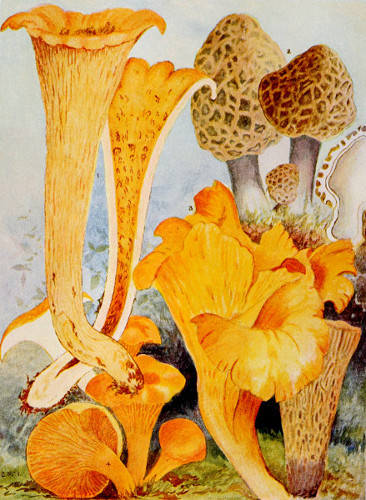
Grouped by F.D. Briscoe—Studies by C. McIlvaine. Plate XLVI.
| Fig. |
Page. |
Fig. |
Page. |
| 1. Cantharellus floccosus, |
218 |
4. Cantharellus cibarius, |
215 |
| 2. Morchella esculenta, |
542 |
5. Cantharellus brevipes, |
219 |
| 3. Craterellus cantharellus, |
508 |
|
|
Other species of the genus do not, as a rule, grow so plentifully,
neither are they of equal excellence, but several of them are equal to
215any other species. Suspicion has been thrown upon C. aurantiacus.
There is such a marked difference between the excellence of the genus
in West Virginia and other localities, that it is possible C. aurantiacus
may be noxious elsewhere, but the writer has not found it so; and it
would be an astonishing contradiction of Nature’s ways if it was.
Stevenson says: “It (C. cibarius) must have four hours slow cooking.”
The writer has found thirty minutes to be sufficient; and it will
fry in butter as quickly as any other fungus.
Mesopus (
mesos, middle;
pous, a foot). Page
215.
Stem central.
* Stem solid.
** Stem tubular.
Pleuropus (pleura, the side; pous, a foot).
Stem lateral.
Resupinatus (resupinatus, lying on the back).
Stem absent.
All the species known to be edible belong to Mesopus.
C. ciba´rius Fr.—cibaria, food. (Plate XLVI, fig. 4, p. 214.
Plate XLVII.) Pileus fleshy, obconic, smooth, egg-yellow, slightly
depressed. Gills thick, distant, more or less branching and anastomosing,
concolorous. Stem firm, solid, often tapering downward, concolorous.
Flesh white.
Height 2–4 in., breadth of pileus 2–3 in. Stem 3–6 lines thick.
In open woods and grassy places. Common. July and August.
Edible. The smell of apricots is not always clearly perceptible in
American specimens. Peck, Monograph New York Species of Cantharellus,
Rep. 23.
216Spores 6×8µ W.G.S.; 7.6×5µ Morgan; spheroid-ellipsoid, 8–9×5–6µ
K.; 11µ Q.
Reported from the Atlantic to
the Pacific and from Columbia
river to Louisiana. June to September.
Wherever grown C. cibarius is
one of the best. In European
countries it is highly rated, and
is expensive. Its mode of growth
varies with its plentifulness. In
the West Virginia mountains large
patches of it closely cover the
ground. Clusters weighing ½
pound are frequent.
When shredded, or cut across
the fibers, slow cooking for half
an hour is sufficient, if the plants
are fresh. If gathered for some
hours, they should be soaked for
a time.
C. mi´nor Pk. Pileus fleshy, thin, convex then expanded and depressed,
egg-yellow. Gills very narrow, distant, sparingly branched,
yellowish. Stem slender, subflexuous, equal, smooth, hollow or stuffed,
concolorous.
Height 1–2 in., breadth of pileus 6–12 lines.
In open woods. July. Peck, 23d Rep. N.Y. State Bot.
Spores 6.4–7.6×4–5µ Peck.
West Virginia, New York, Pennsylvania. McIlvaine.
Grows in the West Virginia mountains, along with C. cibarius, and
separate from it. It is more tender than C. cibarius, and not equal in
flavor to those found there. I usually cooked them together and thus
got quantity well flavored.
C. auranti´acus Fr.—orange-yellow. (Plate CXXXVI, fig. 4, p. 508.)
Pileus fleshy, obconic, nearly plane above, smooth or minutely tomentose,
dull orange with the disk usually brownish, the margin decurved
217and sometimes yellowish. Gills narrow, close, repeatedly forked,
orange, sometimes yellowish. Stem inequal, generally tapering upward,
colored like the pileus. Flesh yellowish, taste mild.
Height 2–3 in., breadth of Pileus 1–3 in. Stem 2–4 lines thick.
Ground and very rotten logs in woods or in fields. Common. Peck,
23d Rep. N.Y. State Bot.
Spores 6.4–7.6×4–5µ Peck, 10×5µ Massee.
Var. pallidus Pk. Pileus and gills pale yellow or whitish yellow.
Stevenson says of the English species, “Unpleasant, reckoned poisonous.”
The writer’s acquaintance with C. aurantiacus has been principally
confined to West Virginia. There its taste is mild, scent but little,
flavor not distinguishable from eastern C. Cibarius. There it is perfectly
safe and wholesome; neither have the writer and his friends any
reason for condemning it.
C. umbona´tus Fr.—having an umbo. Pileus 1 in. and more broad,
ashy-blackish, slightly fleshy, convex when young, umbonate, at length
depressed, even, dry, flocculoso-silky on the surface, shining brightly
especially under a lens. Flesh soft, white, often becoming red when
wounded. Stem 3 in. long, about 4 lines thick, stuffed, equal, elastic,
villous at the base, ash-colored, but paler than the pileus. Gills decurrent,
thin, tense and straight, crowded, repeatedly divided by pairs,
shining-white.
Odor and taste scarcely notable. Gregarious. Among the taller
mosses the stem is longer. Often overlooked from its habit being that
of an agaric. It varies with the pileus squamulose and blackish.
In woods. April to August. Fries.
The rather prominent gills of this small species are likely to confuse
those not familiar with its variance from the genuine type. Reddish
tinge to flesh not noticed in the American species. The writer has
gathered it in several states and enjoyed it for many years.
(Plate XLVIII.)
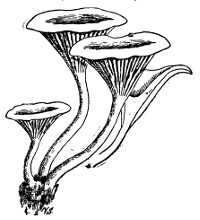
Cantharellus rosellus.
Natural size.
C. rosel´lus Pk.—rosy. Pileus thin, funnel-shaped, regular, glabrous,
pale pinkish-red. Flesh white. Gills narrow, close, dichotomous, deeply
decurrent, whitish, tinged with pink. Stem equal, slender, solid,
subglabrous, often flexuous, colored like the pileus. Spores minute,
broadly elliptical, 3.5×2.5µ.
Pileus 4–8 lines broad. Stem about 1 in. long, scarcely 1 line thick.
218Mossy ground in groves of balsam.
North Elba. September. This small
species belongs to the section Agaricoides,
and is apparently closely allied
to C. albidus, from which its
smaller size and different color distinguish
it. The pileus is sometimes
deeply umbilicate. Peck, 42d Rep.
N.Y. State Bot.
Frequent in pine woods of New
Jersey, near Haddonfield, where the
plant is sturdier than described.
Though small it grows gregarious
and in troops from which appetizing
quantities can be gathered.
It makes a pretty dish of pinkish
hue and one of rare excellence.
C. lutes´cens Bull.—yellowish. (Plate CXXXVI, fig. 9, p. 508.)
Pileus thin, fleshy, convex, umbilicate, brownish-floccose, yellowish.
Gills very distant, sparingly branched, arcuate-decurrent, pale ochraceous.
Stem slender, slightly tapering downward, smooth, shining, bright
orange-tinted yellow, stuffed or hollow.
Height 2–3 in., breadth of Pileus 8–15 lines.
Mossy ground in woods. Catskill and Adirondack mountains, also
Sandlake. August to October.
This is regarded by some as a variety of A. tubæformis. Peck, 23d
Rep. N.Y. State Bot.
In mixed and scrub-pine woods near Haddonfield, N.J.; mixed
woods Angora and Kingsessing, Philadelphia.
Perhaps constancy to C. cibarius has influenced the writer in favor of
members of its family, and accounts for the gusto in “Fine” set opposite
his notes to the present species. Nevertheless such is his opinion.
C. flocco´sus Schw.—woolly. (Plate XLVI, fig. 1, p. 214.) Pileus
fleshy, elongated funnel-form or trumpet shape, floccose-squamose,
219ochraceous-yellow. Gills vein-like, close, much anastomosing above,
long decurrent and subparallel below, concolorous. Stem very short,
thick, rarely deeply rooting.
Height 2–4 in., breadth of Pileus at the top 1–3 in.
Woods and their borders. Not rare. Utica, Johnson. Albany and
Sandlake. July and August. Peck, 23d Rep. N.Y. State Bot.
Spores 12.5–15×7.6µ Peck.
New York, Peck, Rep. 23; Maine, Mrs. Stella F. Fairbanks; West
Virginia, McIlvaine.
A beautiful species of good quality.
(Plate XLIX.)
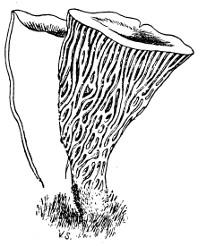
Cantharellus brevipes.
Small plant, two-thirds natural size.
C. bre´vipes Pk.—brevis, short; pes, a foot. (Plate XLVI, fig. 5, p.
214.) Pileus fleshy, obconic, glabrous,
alutaceous or dingy cream-color,
the thin margin erect, often
irregular and lobed, tinged with
lilac in the young plant; folds numerous,
nearly straight on the margin,
abundantly anastomosing below,
pale umber tinged with lilac.
Stem short, tomentose-pubescent,
ash-colored, solid, often tapering
downward. Spores yellowish,
oblong-elliptical, uninucleate, 10–12µ×5µ.
Plant 3–4 in. high. Pileus 2–3
in. broad. Stem 4–6 lines thick.
Woods. Ballston, Saratoga county.
July.
This interesting species is related
to the C. floccosus, both by its short
stem and its abundantly anastomosing folds. The two species should
be separated from the others and constitute a distinct section. The
flesh in C. brevipes is soft and whitish, and the folds are generally thinner
than in C. floccosus. Peck, 23d Rep. N.Y. State Bot.
Plentiful in West Virginia mountains in 1884, growing in patches.
Found in mixed woods near Cheltenham, Pa., and at Springton, Pa.,
1887.
220In West Virginia it is prolific and rivals the C. cibarius in excellence.
The flesh is softer, not so fibrous, and cooks more readily.
In that locality there is a marked difference between C. brevipes and
C. floccosus. The latter is much longer, and markedly resembles the
large end of a gold lined cornet. Like the C. cibarius it is not of as
good quality in eastern states.
NYC´TALIS Fr.
Gr—night. From inhabiting dark places.
Hymenophore continuous with
the stem. Gills fleshy, thick, juicy,
obtuse at the edge, not decurrent
on the stem nor fold-like. Veil
(in species which have been fully
observed) floccoso-pruinose.
Fleshy fungi, not reviving, of
uncertain and irregular occurrence,
differing in many respects from
one another and from the rest of
the Agaricini. Fries.
The typical species are saprophytic
on decaying fungi. But one
species, Nyctalis asterophora, reported
in America. See Peck, 26th Rep. N.Y. State Bot.
221MARAS´MIUS Fr.
(Plate LI.)
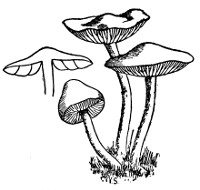
Marasmius oreades.
About one-half natural size.
Pileus regular, thin, tough and pliant. Gills pliant, rather tough,
somewhat distant, variously attached
or free, with an acute
entire edge. Stem cartilaginous or
horny, continuous with the pileus
but of different texture. Not putrescent
but drying up with lack
of moisture, reviving and assuming
the original form with the advent
of rain. This character distinguishes
Marasmius from all other
genera of Agaricaceæ.
Its nearer relations are Collybia
and Mycena.
Fries says that all Agaricaceæ
having the smell of garlic are found
in this genus. On the ground, but generally on wood or leaves.
Professor Peck reports over forty species of this genus found in New
York state. Several not found in New York are reported from other
states. The writer has found a few such species in Pennsylvania and
West Virginia. Many untried species will probably prove to be edible;
the majority are too small to be of food value. M. urens, reported poisonous,
and M. peronatus, heretofore considered poisonous, have been
found by the writer to be edible. Several species not described herein
have been tested for edibility to a limited extent only.
In this genus occurs the famed M. oreades, the Mousseron of France,
the Champignon and Scotch bonnet of England, the Fairy-ring mushroom
of America.
Collybia (inclining to Collybia). Page
223.
Flesh of pileus pliant, at length rather leathery, grooved or wrinkled,
margin incurved at first. Stem somewhat cartilaginous; mycelium
woolly, absent in some species.
222A. Scortei (
scorteus, leathery). Page
223.
Stem solid or stuffed, then hollow, fibrous within, outside covered
with down. Gills separating from the stem, free.
* Base of stem woolly or strigose.
** Stem naked at the base, often interwoven with twisted fibers.
B. Tergini (
terginus, leathery). Page
225.
Stem rooting, distinctly tubular, not fibrous, distinctly cartilaginous.
Gills receding then free. Pileus thinner than in the preceding group,
hygrophanous, even or with the margin striate.
* Stem woolly below, smooth above.
** Stem when dry covered with velvety down.
C. Calopodes (
Gr—beautiful;
Gr—a foot). Page
226.
Stem short, not rooting, often with a floccose or downy, tubercular
base. Pileus convex, involute, then plane and more or less depressed,
in which state the gills typically adnate are subdecurrent. On twigs,
branches, etc. Gregarious.
* Stem quite smooth above, shining, base not swollen.
** Stem covered with velvety down, rather swollen at the base.
Mycena (inclining to Mycena). Page
227.
Stem horny, hollow, often filled with pith, tough, dry. Mycelium
rooting, not floccose. Pileus somewhat membranaceous, bell-shaped,
then expaned, margin at first straight and pressed to the stem.
A. Chordales (
chorda, a gut). Page
227.
Stem rigid, rooting or dilated at the base. Pileus bell-shaped or
convex. Type manifestly that of Mycena.
B. Rotulæ (rotula, a little wheel).
Stem thread-like, flaccid, base not dilated or floccose but appearing
to enter the matrix abruptly. Pileus soon becoming plane or umbilicate.
On leaves.
* Stem quite smooth, shining.
** Stem minutely velvety or hairy.
Apus (a, without; pous, a foot).
Pileus sessile, resupinate.
* Stem woolly or strigose at base.
M. u´rens Fr.—uro, to burn. Pileus 2–3 in. broad, unicolorous,
pale yellowish, becoming pale, slightly fleshy, moderately compact at the
disk, even, but here and there scaly or cracked in wavy lines when dry,
smooth, the thin margin involute. Stem 2–3 in. long, 3 lines thick,
solid, composed of crisp tough fibers, rigid, equal, sometimes however
ventricose, ½ in. thick, everywhere clothed with white flocci, pale, white-downy
at the base. Gills free, united behind, at length remote from the
stem, distant, tough, at first pale-wood-color, then brown.
Gregarious, somewhat cespitose. Taste very stinging. The stem is
not strigosely sheathed at the base. Fries.
In mixed woods. Frequent. June to September.
A curious form occurred with the pileus turning very dark when full-grown.
B. and Br. POISONOUS. Worthington Smith has tested it
by accident. It produced headache, swimming of brain, burning in
throat and stomach, followed by severe purging and vomiting. Stevenson.
Gregarious or cespitose. Taste very pungent, a feature which separates
the present from M. oreades. Not coarsely tomentose at the base,
as in M. peronatus, but only downy. Massee.
Spores 3×4µ W.G.S.; elliptical, 8×4µ Massee.
Pennsylvania, New Jersey, West Virginia. McIlvaine.
I have not known it to disagree with myself or friends. That it may
not agree with some persons is unquestioned. Collectors should carefully
test it upon themselves.
M. perona´tus Fr.—pero, a kind of boot. Pileus 1–2 in. and more
broad, light yellowish or pallid brick-red, then becoming pale, wood-color
or tan, at first fleshy-pliant, then coriaceo-membranaceous, convex
then plane, obtuse, flaccid, slightly wrinkled, even at the disk, at length
pitted, striate at the margin. Flesh white. Stem 2–3 in. long, 1–2
lines thick, stuffed, fibrous, tough, attenuated upward, at length hollow
and compressed, furnished with a bark, light yellow then pallid, cuticle
villous but separating and reddish when rubbed, somewhat incurved at
the base, where it is clothed with dense, somewhat strigose, yellowish or
224white villous down. Gills adnexed, then separating, free, moderately
thin, and crowded, when young whitish, pallid wood-color, at length
somewhat remote, reddish.
B. Woolly sheathed at the base. Taste acrid like that of M. urens,
odor none. Fries.
In woods. Common. Stevenson.
Spores pip-shaped, 7×4µ W.G.S.; 10×6–7µ Massee.
New York. Thin woods. North Elba. August. September. Peck,
42d Rep.; West Virginia, June to December, West Philadelphia and
Mt. Gretna, Chester county, Pa. McIlvaine.
M. peronatus is the wood-cousin of M. oreades. It is still reputed
poisonous by all writers upon the subject, though M.C. Cooke gives it
the benefit of a doubt. The name is given because of the base of the
stem being densely covered with short hairs or a woolly down, and is
thus easily recognized. It is common in woods, among decaying
leaves, especially of the oak, from May until after frosts. It is usually
solitary, but a few individuals are sometimes clustered. It is quite
peppery to the taste, but pleasantly so. I have repeatedly eaten it,
as have my friends. It loses its acridity in cooking, and though the
caps are tougher than M. oreades, they make a highly flavored and
delicious dish. Collectors should carefully test it for themselves.
**
Stem naked at the base, etc.
M. ore´ades Fr. Gr—mountain-nymphs. Scotch bonnet. Champignon.
Mousseron. (Plate LI, p. 221.) Pileus 1–2 in. broad,
reddish then becoming pale, absorbing moisture, whitish when dry,
fleshy, pliant, convex then plane, somewhat umbonate, even, smooth,
slightly striate at the margin when moist. Stem 2–3 in. long, 1½ lines
thick, solid, very tough, equal, tense and straight, everywhere clothed
with a villous-woven cuticle which can be rubbed off, pallid; bluntly
rooted at the base, naked, not villous or tomentose. Gills free, broad,
distant, the alternate ones shorter, at first soft, then firmer, pallid-white.
Odor weak, but pleasant, stronger when dried, taste mild. Commonly
growing in circles or rows. Fries.
Spores 6–7×5–6µ K.; elliptical, 8×5µ Massee; nearly elliptical, white,
7.6–9µ long Peck.
Common throughout the states during the summer months after rains,
225and in rings, but can be found from May until after frost. If one knows
where the rings are to be found M. oreades can be gathered when
shriveled, and are quite as good, after soaking, as when fresh.
M. oreades must be sought for where the grass is luxuriant. It hides
among it. It is well worthy of the search. Raw, fresh or shriveled,
it is sweet, nutty, succulent when eaten; stewed well it is delicious.
Though tough its consistency is agreeable. The most delicate stomachs
can digest it. The writer saved the life of a lovely woman by feeding
her upon it when nothing else could be retained; and of another, by
feeding Coprinus micaceus, after a dangerous operation. He introduced
these species, together with a few others, into a large hospital in Philadelphia,
where they were used with marked beneficial effect, and such
use is now widespread.
When dried, by exposure to the air or sun, it can be kept indefinitely,
neither losing its aroma or flavor, which it graciously imparts to soups
or any other dish.
Collybia dryophila, Stropharia semi-globata, and Naucoria semi-orbicularis
are sometimes found growing with it. These species are
delicious and harmless.
Lafayette B. Mendel in the Am. Jour. of Physiology, March, 1898,
gives the following analysis:
Twenty freshly gathered specimens (from New Haven) weighed 9
grams, an average weight of 0.45 grams each. The analysis gave:
| Water |
74.96% |
| Total solids |
25.04 |
| Total nitrogen of dry substance |
5.97 |
| Ash of dry substance |
7.23 |
**
Stem downy when dry, etc.
M. Wyn´nei B. and Br. Pileus 1–1½ in. broad, lilac-brown, tardily
changing color, fleshy, convexo-plane, somewhat umbonate. Stem 2
in. long, 1½ line thick, tubed, furfuraceous, somewhat of the same
color as the pileus. Gills adnexed, thick, distant, bright-colored, beautifully
tinged with lilac; interstices even.
Inodorous. Gregarious or cespitose. The stem springs from a white
mycelium, but is by no means strigose or tawny at the base. Quite distinct
from M. fusco-purpureus. Fries.
226Among leaves, twigs, etc. Stevenson.
Spores elliptical, 7–8×4µ Massee.
Kingsessing, West Philadelphia. Gregarious and cespitose, among
leaves, etc., in oak woods. September to October, 1885.
This very pretty fungus very much resembles at first sight the small
purplish Clitocybes, but is readily distinguished on examination. I ate
the caps and enjoyed them during the seasons of 1885 and 1887, but
have not seen the plant since.
The caps are equal to M. oreades.
M. scorodo´nius Fr. Gr—a plant that smells like garlic. Pileus
½ in. and more broad, rufous when young, but soon becoming pale,
whitish (not hygrophanous), slightly fleshy, pliant, convex then soon
plane, obtuse, always arid; even when young, at length wrinkled and
crisped. Stem 1 in. long, scarcely 1 line thick, horny, tough, tubed,
equal, very smooth throughout, shining, reddish, inserted and naked at
the base. Gills adnate, often separating, connected by veins, at length
crisped in drying, whitish.
Commonly gregarious. Readily distinguished from neighboring species
by its strong odor of garlic. Fries.
Heaths and dry pastures on twigs, etc. Rare.
Edible. Esteemed for flavoring. Stevenson.
Spores elliptical, 6×4µ Massee.
North Carolina, Schweinitz, Curtis; New England, Frost; New Jersey,
Ellis; New York, August, Peck, 23d Rep.
M. ca´lopes Fr. Gr—beautiful; a foot. Pileus about 4 lines broad,
whitish, slightly fleshy, tough, convex then flattened, obtuse, rarely
depressed, even, smooth, slightly wrinkled when dried. Stem 1 in.
long, 1 line thick, tubed, slightly attenuated upward, even, smooth,
tough, dull-red or bay-brown-red, shining, somewhat rooted. Gills
slightly emarginate, in groups of 2–4, thin, white.
Inodorous. Almost smaller than M. scorodonius, but the stem is
longer, otherwise very like it. Fries.
Spores elliptical, 7×4µ Massee.
227Twigs and stems among fallen leaves in woods. Ticonderoga. August.
This might easily be mistaken for M. scorodonius, but it is without
odor, and has a different insertion of the lamellæ. It is sometimes cespitose.
The pileus in our specimens is whitish. Peck, 31st Rep.
N.Y. State Bot.
Because of its similarity to M. scorodonius, which is edible, it is
given here.
II.—Mycena.
A. Chordales.
M. allia´ceus Fr.—allium, garlic. Pileus 1–1½ in. broad, whitish
inclining to fuscous, often milk-white when young, somewhat membranaceous,
campanulate then expanded, somewhat umbonate, even, at
length striate and sulcate, smooth, dry. Stem as much as 8 in. long,
horny, rigid, fistulose, attenuated upward, pruinato-velvety, blackish,
rooted at the base where it is somewhat incurved and naked. Gills adnexed
in the form of a ring, then free, slightly ventricose, arid, slightly
distant, fuscous-whitish, crisped when dry.
Odor strong, of garlic, persistent. There is nothing of a reddish
tinge in the whole plant. The stem is not tomentose at the base as in
the Tergini. Fries.
Among leaves and on rotten wood. Frequent. August to October.
Stevenson.
Spores 14–16×8µ. Massee.
North Carolina, Schweinitz, Curtis; Pennsylvania, Schweinitz; Minnesota,
Johnson; Novia Scotia, Somers.
Edible. Bull. Boston Myc. Club.
228HELIOMYCES Lev.
Helios, the sun; myces, a fungus.
Pileus membranaceous, between leathery and gelatinous, radiately
sulcate. Gills equal, edge acute. Stem somewhat woody, cylindrical,
central.
Allied to Marasmius, but differing in its sub-gelatinous substance.
None reported edible.
LENTI´NUS Fr.
Pileus fleshy-coriaceous, pliant, tough and hard when old, persistent.
Gills becoming dry, tough, simple,
unequal, thin, margin acute, toothed,
more or less decurrent. Stem when
present central, excentric or lateral,
hard and firm, continuous with the
flesh of the pileus.
Growing on wood.
Spores somewhat round, even,
white.
Distinguished from other coriaceous
genera by its serrated and torn
gills.
“The genera Lentinus and Lenzites
are found in every region of the
world; their principal center, however,
is in hot countries, where they
attain a splendid development. On
the contrary, toward the north they rapidly decrease in number.”
Fungi. Cooke and Berkeley.
In habitat and mode of growth Lentinus closely resembles Pleurotus,
and parallel genera with colored spores. When young the species are
inviting, and when well cooked are meal-giving. They are not delicacies,
but substantials. They dry well. Grated they make soups, and
give their pleasant flavor to any dish.
Mesopodes (
mesos, middle;
pous, a foot). Page
229.
Stem distinct.
Pleuroti (pleura, a side; ous, an ear).
Stem lateral or absent. None known to be edible
I.—Meso´podes (center-stemmed).
L. Lecom´tei Fr. Pileus coriaceous, funnel-shaped, regularly reflexed,
hairy, tawny. Gills crowded, pallid. Stem short, hairy, tawny.
Common to the states.
Professor Peck writes to me: “This plant, by reason of its rather
tough substance, has commonly been referred to Lentinus, under the
name L. Lecomtei Schw., but this reference is scarcely satisfactory to
me, since the edge of the lamellæ is scarcely at all serrate as required
by that genus. It seems to me it would go better under the genus
Panus. It is variable—sometimes eccentric or even lateral. It is sometimes
called Lentinus strigosus, but I do not think the two are distinct
species, however distinct they may be in form.” February 26, 1894.
Like all Lentinus the present species is rather tough, yet chopped
into small pieces, well cooked and seasoned, it is quite equal to P.
ostreatus and many others of high renown.
(Plate LIII.)
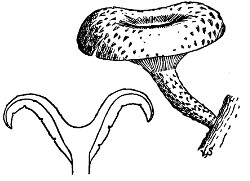
Lentinus tigrinus.
About one-half natural size.
L. tigri´nus Fr.—tigris, a tiger. From the markings. Pileus commonly
2 in. broad, white, variegated
with somewhat adpressed, blackish,
hairy squamules, fleshy-coriaceous,
thin, commonly orbicular and central,
at first convexo-plane, umbilicate,
at length funnel-shaped, often
split at the margin when dry. Stem
about 2 in. long, thin, solid, very
hard, commonly attenuated downward,
minutely squamulose, whitish,
often ascending and becoming dingy-brown
at the base, at first furnished
at the apex with an entire reflexed ring, which soon falls off. Gills decurrent
230(by no means sinuate), narrow, crowded, unequal, toothed like
a saw, white.
Somewhat gregarious, even cespitose, thinner and more coriaceous
and regular than L. lepideus B., wholly blackish with squamules. Fries.
On old stumps. Rare. Stevenson.
When fresh very tender and easily torn, when dry coriaceous. Sow.
Smell strong, acrid, like that of some Lactarii. M.J.B.
Spores 6.6×3.3µ Morgan; elliptical, smooth, 7×3.5µ Massee.
Agreeable taste and odor, eaten in Europe. Roques.
Edible, tough when old and never very delicate or digestible.—M.
C. Cooke.
Not found in sufficient quantity to test.
L. lepi´deus Fr. Gr—scaly. (Plate XVI, fig. 3, 4,
p. 52.) Pileus 2–4 in. broad, pallid-ochraceous,
variegated with adpressed, darker, spot-like scales,
fleshy, very compact and firm, irregular, commonly
excentric, convex then depressed, but not
truly umbilicate, sometimes broken up into cracks.
Flesh pliant, white. Stem short, commonly 1 in. long, solid, stout,
very irregularly formed, almost woody, tomentose-scaly, whitish, rooted
at the base, at the first furnished with a veil toward the apex. Gills
decurrent, but sinuate behind, crowded broad, transversely striate,
whitish, edge torn into teeth.
Odor pleasant. Fries.
Spores 11×5µ W.G.S., 7×3µ. Massee.
Lentinus lepideus is a sort of commercial traveler. It is common
wherever railroads are. It is partial to oak ties and its mycelium is injurious
to them. It is found upon pine and other timbers. The writer
has collected large clusters of it from oak sawdust. The European
plant is noted as “almost always solitary.” In the United States it is
seldom so. It is noted as growing in damp, dark places, but it loves
the sun.
As a food it is about on a par with P. ulmarius, not as tough, but
harder when old. It is a reliable species from spring until late autumn,
is persistent and dries well. It is neat, handsome, prolific. When
young it makes a good dish, and when old can be used to advantage in
soups.
231L. cochlea´tus Fr.—cochlea, a snail. Pileus 2–3 in. broad, flesh-color,
but becoming pale, somewhat tan, fleshy-pliant, thin, commonly
excentric, imbricated, very unequal, somewhat lobed or contorted,
sometimes plane, sometimes funnel-shaped-umbilicate, but not
pervious, smooth. Stem solid, firm, sometimes central, most frequently
excentric, sometimes wholly lateral, always sulcate, smooth, flesh-colored
upward, reddish-brown downward. Gills decurrent, crowded, serrated,
white-flesh-color. Fries.
Pliant, tough, flaccid, very changeable in form, sometimes solitary,
sometimes cespitose, imbricated, growing into each other. From very
small forms which are commonly solitary, with the stem and pileus
scarcely 1 in. it ranges to 3 in.
On stumps. Frequent. August to October.
According to Fries the odor is weak, of anise; but it is generally
strong and very pleasant. Stevenson.
Spores nearly globular, 4µ diameter Morgan; spheroid or ellipsoid-spheroid,
uniguttate, 4–6µ K.; almost globular, 4µ W.G.S.
The dense clusters of all sized members are usually plenty in favored
localities. It is inviting in appearance, taste and spicy odor. It retains
a suspicion of the latter when cooked which gives the dish a flavor
pleasant to many. It must be young to be tender. When dry—like
others of its kind—it can be grated and used in many ways.
L. Un´derwoodii Pk. Pileus fleshy, tough, convex or nearly plane,
the glabrous surface cracking into areola-like scales which are indistinct
or wanting toward the margin, whitish or slightly tinged with buff or
pale ochraceous. Flesh white. Gills moderately close, decurrent,
slightly connecting or anastomosing at the base, somewhat notched on
the edge, whitish, becoming discolored in drying. Stem stout, hard,
solid, eccentric, squamose, colored like the pileus. Spores oblong,
13–15×5–6.5µ.
Plant cespitose. Pileus 3–6 in. broad. Stem 1.5–3 in. long, about
1 in. thick.
This differs from L. magnus in its cespitose habit, eccentric stem,
longer spores, less distinctly areolate-squamose pileus and in its habitat.
The gills are connected at the base very much like those of Pleurotus
ostreatus. Peck, Torr. Bull. Vol. 23, No. 10.
North Carolina, Pennsylvania, McIlvaine.
232The writer first met with it in North Carolina, near Washington, on
oaks and railroad timbers, and in Fairmount Park, Philadelphia. It
attains quite a size, grows singly and in clusters. Its clean, cake-like
appearance is attractive. Cooked it ranks with P. ulmarius, L. lepideus,
and Panus strigosus.
PA´NUS Fr.
A name given to a tree-growing fungus by Pliny.
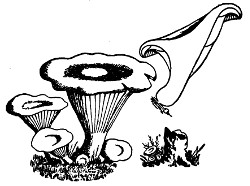
Panus torulosus.
About one-fourth natural size.
Whole fungus between fleshy and leathery, tough, not woody, texture
fibrous. Gills unequal, tough, becoming
leathery, edge acute and unbroken.
Stem present or absent.
Growing on wood. Various in
form, lasting long. Allied to Lentinus
but differing in the tough and very
entire gills.
Spores even, white.
* Stem excentric.
** Stem lateral.
*** Stem absent. Pileus resupinate or dimidiate.
Species of this genus are among our most observable fungi. Their
settlements are frequent on decaying trees, stumps, branches, on fences,
cut timber, etc. Most of them are small, but their coriaceous build prevents
their shrinking in cooking. Most species have a pleasant farinaceous
taste and odor, which they yield, together with a gummy substance,
to soups and gravies.
Tasting a small piece will immediately tell, if the species is not
known, whether it is edible or of the styptic kind.
P. concha´tus Fr.—Formed like concha, a shell-fish. Pileus about
2333 in. across, tough and flexible, unequal, excentric or dimidiate, margin
often lobed, cinnamon-color becoming pale, at length more or less
scaly. Flesh thin. Gills narrow, forming decurrent lines on the stem,
somewhat branched; pinkish-white then pale-ochraceous. Stem about
⅔ in. long, 3–4 lines thick, solid, unequal, pale, base downy. Massee.
On trunks of beech, poplar, etc.
Often imbricated and more or less grown together. Allied to Panus
torulosus, but distinguished by the much thinner pileus, more expanded
and excentric, also dimidiate, flaccid, cinnamon becoming pale, but the
form not constant. Stem about ½ in. long, 4 lines thick, often compressed,
downy at the base. Pileus 2–4 in. broad, scaly when old.
Gills decurrent in long, parallel lines, not at all resembling those of
Pleurotus ostreatus, which anastomose behind, but frequently unequally
branched, at first whitish or pale flesh-color, then wood-color, crisped
when dry. Fries.
Always known by its shell-like form and its tough substance.
Sent to the writer by Mr. E.B. Sterling, Trenton, N.J. September,
1898.
The appearance of scales upon the pileus was scarcely noticeable.
Taste pleasant. The fungus is tough when old, but yields an excellent
gravy.
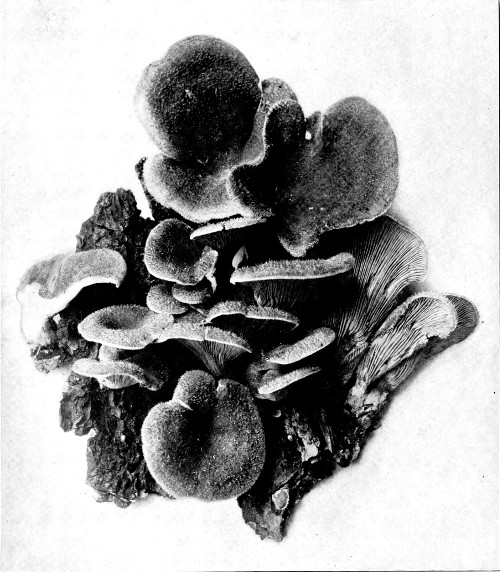
Photographed by Dr. J.R. Weist. Plate LV.
PANUS STRIGOSUS.
P. torulo´sus Fr.—a tuft of hair. (Plate LIV, p. 232.) Pileus 2–3
in. broad, somewhat flesh-color, but varying reddish-livid and becoming
violet, entire, but very excentric, fleshy, somewhat compact when young,
plano-infundibuliform, even, smooth. Flesh pallid. Stem short, commonly
1 in., solid, oblique, tough, firm, commonly with gray, but often
violaceous down. Gills decurrent, somewhat distant, simple, separate
behind, reddish then tan-color.
Very changeable in form, at first fleshy-pliant, at length coriaceous.
In the covering of the stem it approaches Paxillus atro-tomentosus, but
there is no affinity between them. Fries.
On old stumps.
Spores 6×3µ W.G.S.
North Carolina, Curtis; Massachusetts, Frost; Minnesota, Johnson;
Kansas, Cragin; New York, Peck, Rep. 30.
Much esteemed in France, W.D.H. Edible, but tough. M.C.C.
234P. lævis B. and C.—light. Pileus 3 in. broad, orbicular, slightly
depressed, white, clothed in the center with long, intricate, rather delicate
hairs, which are shorter and more matted toward the inflected margin;
substance rather thin. Stem 3 in. high, ½ in. thick, attenuated
upward, generally excentric, sometimes lateral, not rooting, solid, hairy
below like the margin of the pileus. Gills rather broad, entire, decurrent,
but not to a great degree, the interstices even above, behind
clothed with the same coat as the top of the stem. Spores white.
On oak and hickory trunks.
A most distinct species, remarkable for its great lightness when dry
and the long villous but not compressed or compound flocci of the
pileus. Sometimes the center of the pileus becomes quite smooth when
old.
One of the prettiest of fungi. The markings upon the white margin
are more precise than those of the finest bee comb. One does not tire
looking at the work of Nature’s geometrician. It is not plentiful, but is
of useful size. It has good flavor and cooks quite tender.
(Plate LVa.)
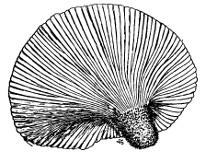
Panus Strigosus.
One-third natural size.
P. strigo´sus B. and C.—covered with stiff hairs. Pileus white, excentric,
clothed with coarse strigose
pubescence, margin thin. Stem strigose
like the pileus. Gills broad,
distant, decurrent. Allied to P. lævis.
Pileus 8 in. broad. Stem 2–3 in.
long, 1 in. or more thick.
On oak stumps.
Decaying wood of deciduous trees.
September.
It is remarkable for its large size
and the dense hairy covering of the
pileus and stem. Peck, 26th Rep. N.Y. State Bot.
A remarkably handsome fungus. A specimen taken from a cluster
growing upon an apple tree measured 10 in. across. Its creamy whiteness,
and short hairy stem make it unmistakable among other tree-fungi.
When very young it is edible, but soon becomes woody. Even when
aged it yields a well flavored gravy.
P. farina´ceus Schum.—farina, meal. From the scurf on the pileus.
Pileus cinnamon-umber, somewhat coriaceous, flexuous, cuticle separating
into whitish-bluish-gray scurf. Stem short, lateral, of the same
color as the pileus. Gills determinately free, distinct, paler.
The habit is that of P. stipticus. Stevenson.
Pennsylvania, A. pleurotus f., Schweinitz; Ohio, Morgan.
Var. albido-tomentosus. See Panus albido-tomentosus.
P. al´bido-tomento´sus Cke. Mass.—albidus, white; tomentum,
down. Pileus about ⅔ in. long, ½ in. broad, horizontal, sometimes
imbricated, semi-circular, subcoriaceous, flexuous or regular, pale umber,
densely clothed with a short, whitish, velvety down, which seems
to be persistent, but thinner and shorter toward the shortly incurved
margin. Stem lateral, very short, or entirely absent, and attached by
a downy base. Gills radiating from the point of attachment; narrowed
behind, lanceolate, honey-colored, margin entire, rigid, scarcely crowded,
shorter ones intermixed. Spores subglobose, smooth, 5µ diameter.
On trunks and branches.
Pileus about 1 in. broad, often in imbricated tufts. It is doubtful
whether this is not a distinct species from the type described by Fries.
Cooke and Massee.
Panus albido-tomentosus is given by Cooke and Massee as a variety
of Panus farinaceus. The writer decides to give it place as a species.
It has been sent to me by Mr. H.I. Miller, from Terre Haute, Ind.,
by Dr. E.L. Cushing, Albion, N.Y., Miss Madeleine Le Moyne,
Washington, Pa. I have found it in West Virginia, New Jersey and
many parts of Pennsylvania. It is plentiful in patches upon branches
and boles of deciduous trees. Long, slow cooking makes it tender.
It makes a luscious gravy after thirty minutes' stewing.
***
Stem absent, pileus resupinate or dimidiate.
P. betuli´nus Pk.—betula, birch. Pileus thin, suborbicular or dimidiate,
nearly plane, glabrous, prolonged behind into a short stem, grayish-brown,
darker or blackish toward the stem. Gills narrow, close, decurrent,
236whitish. Stem adorned with a slight tawny hairiness which is
more fully developed toward the base. Spores minute, 4–5×1.5–2µ.
Decaying wood of birch. Newfoundland. October, Rev. A.C.
Waghorne. Peck, Bull. Torrey Bot. Club, Vol. 23, No. 10.
Common in West Virginia mountains on birches, 1882; found at Eagle’s
Mere, Pa., August, 1898. Quite plentiful on decaying birch trees,
which abound there. Size from ½-1½ in. across.
Eaten raw it has a gummy quality and very pleasant nutty flavor. I
did not have opportunity to cook it, but regard it as a species well
worth trying.
P. stip´ticus Fr.—stypticus, astringent. Pileus ½-1 in. broad, cinnamon
becoming pale, arid, thin, but not membranaceous, kidney-shaped,
pruinose, the cuticle separating into furfuraceous scales. Stem
not reaching 1 in. long, solid, definitely lateral, compressed, dilated upward,
ascending, pruinose, paler than the gills. Gills ending determinately
(not decurrent), thin, very narrow, crowded, elegantly connected
by veins, cinnamon. Fries.
Gregarious, cespitose, remarkable for its astringent taste. The pileus
sometimes has a funnel-shaped appearance with lobes all around.
On stumps, etc. Common. August to February.
Reckoned poisonous. Stevenson.
Spores obovoid-spheroid, 2–3×1–2µ K.; 3×4µ W.G.S.
Plentiful and general. The markings upon the cap in moist weather
are sometimes exquisitely regular.
The immediate and lasting unpleasantness of this fungus to mouth
and throat, whether cooked or raw, will cancel all desire to eat of it
forevermore. A nibble will detect it. It is reckoned poisonous, and
may be. No one but a determined suicide would resort to it. Dr.
Lambotte asserts that it is a violent purgative.
237XER´OTUS Fr.
Hymenophore continuous with
the stem, descending into the
trama which is homogeneous with
the coriaceous pileus. Gills coriaceous,
broadly plicæform, dichotomous,
edge quite entire, obtuse.
Rigid, persistent, analogous
with the Cantharelli, but differing
in the whole structure. Fries.
The gills are more distant than
in any species of Agaricaccæ.
None edible.
TRO´GIA Fr.
After Trog, a Swiss botanist.
(Plate LVIII.)
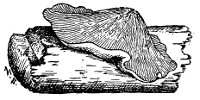
Trogia crispa.
Natural size.
Gills fold-like, edge longitudinally channelled (in the single European
species only crisped). In
other respects agreeing with Xerotus.
Soft, flaccid, but arid and
persistent, texture fibrillose. Fries.
Reviving when wet. Spores
white. Stevenson.
Spores elongated or cylindrical.
American representative, Trogia
crispa, var. variegata.
Pileus and gills variegated with bluish or greenish-blue stains. Sandlake.
September. Peck, 38th Rep. N.Y. State Bot.
Not edible.
238SCHIZOPHYL´LUM Fr.
Pileus fleshless, arid. Gills coriaceous,
fan-wise branched, united
above by the tomentose pellicle,
bifid, split longitudinally at the edge.
Spores somewhat round, white.
Fries.
The two lips of the split edge of
the gills are commonly revolute. The
farthest removed of all the Agaricini
from the type.
Growing on wood. Stevenson.
Common on decaying wood.
Tough.
LENZITES Fr.
After Lenz, a German botanist.
Pileus corky or coriaceous, texture arid and floccose. Gills coriaceous,
firm, sometimes simple and unequal, sometimes anastomosing and
forming pores behind, trama floccose and similar to the pileus, edge
somewhat acute. The European species are dimidiate, sessile, persistent,
growing on wood, quite resembling Dædalea. Fries.
Allied most nearly to Trametes and Dædalea and forming as it were
the transition from Agaricaceæ to Polyporaceæ. In tropical countries
they are more woody in texture. Stevenson.
Very common. None edible.
239
Plate LVIIIb.
Chart of genera in pink-spored series—Rhodosporae. Page 239.
under; rhodon, rose.
Spores pink or salmon-color.
In Volvaria, Pluteus and most of Clitopilus, the spores are regular in
shape, as in the white-spored series, in the rest of the subgenera they
are generally angular and irregular.
Though European writers, generally, condemn the rosy-spored series
as inedible, a few of our best American edibles are found in it—notably
Pluteus cervinus.
VOLVA´RIA Fr.
Spores regular, oval, pink, or salmon. Veil universal, forming a
perfect volva, distinct from the cuticle of the pileus. Stem separating
easily from the pileus. Gills free, rounded behind, at the very first
white then pinkish, soft. Analogous with Amanita.
Growing in woods and on rich mold, rotten wood and damp ground,
hence often found in hot-houses and gardens. V. Loveiana Berk. is
parasitic on Clitocybe nebularis.
There are thirteen species reported from different parts of the United
States. Most of them grow upon wood. Two species have previously
been reported as edible, to which I have added V. Taylori, tested by
myself.
One species, V. gloiocephala, is upon the authority of Letellier,
given as poisonous. It is found in several parts of the United States,
but no comment has been made upon its edibility. I have not seen it.
A careful study of its botanic characters is urged. It should be regarded
as poisonous until its reputation is cleared up, as it probably
will be.
* Pileus dry, silky or fibrillose.
** Pileus more or less viscid, smooth.
240
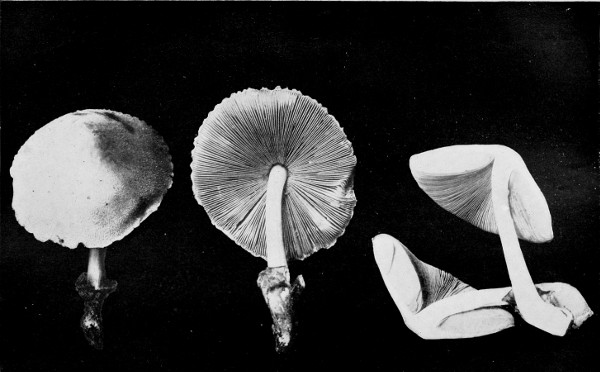
Photographed by Dr. J.R. Weist. Plate LIX.
VOLVARIA BOMBYCINA.
*
Pileus dry, silky or fibrillose.
(Plate LIXa.)
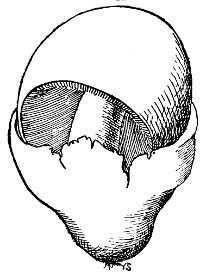
Volvaria bombycina.
Natural size.
V. bombyci´na Schaeff.—bombyx, silk. Pileus 3–8 in. broad, wholly
white, fleshy, soft, at first globose, soon
bell-shaped, at length convex, somewhat
umbonate, everywhere silky or, when older,
hairy-scaled, more rarely becoming smooth
at the vertex. Flesh not thick, white.
Stem 3–6 in. long, ½ in. thick or more at
the base, solid, equally attenuated from
the base to the apex, even, smooth, white.
Volva, soon torn asunder, ample, 2–3 in.
broad, membranaceous, lax, slashed, somewhat
viscid, persistent. Gills free, very
crowded when young, almost cohering,
ventricose, in groups of 2–4, then toothed,
flesh-colored.
Ovate when young. According to some
becoming brownish. The stem is curved-ascending
on vertical trunks and straight
on prostrate ones. Commonly solitary, sometimes however cespitose.
Stevenson.
Spores elliptic, smooth, 6–7×4µ Massee; 6–8µ Lloyd.
Considered edible. Stevenson. Edible. Curtis.
Very general but not common over the United States. It is a large
plant, from 3 in. upward across cap. Growing from wood, oaks, maples,
beech, etc.
The writer has not been successful in finding it. Drawing, spore-print
and description received from H.I. Miller, Terre Haute, Ind.
Upon such an authority as the late Dr. Curtis there is no doubt of
its edibility.
(Plate LX.)
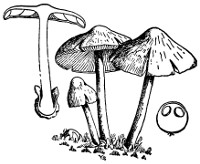
Volvaria volvacea.
Two-fifths natural size.
V. volva´cea Bull.—volva, a wrapper. Pileus 2–3 in. across.
Flesh white, thick at the disk, very thin elsewhere, soft, bell-shaped
then expanded, obtuse, grayish-yellow, virgate or streaked with adpressed
blackish fibrils. Gills free, about 2 lines broad, pale flesh-color.
Stem 2–4 in. long, about 4 lines thick, almost equal, white, solid.
241Volva large, loose, whitish. Spores
smooth, elliptical, 6–8×3.5–4µ; no
cystidia. Massee.
On the ground by roadsides, etc.,
also in stoves.
Allied to V. bombycina, but constantly
different in the less ample
and less persistent, brownish volva.
Pileus 3 in. across, rarely more,
gray, elegantly virgate with blackish
fibrils; flesh-color of the gills not
so pure. Fries.
Once found in woods at roots of a
tree. It occurs every year in the cellar of our drug store. Lloyd
“Volvæ.”
North Carolina, Schweinitz; Minnesota, Johnson; Ohio, Morgan.
Probably edible, should be carefully tested.
V. Tay´lori Berk. Pileus 1¾ in. high and broad, livid, conico-campanulate,
obtuse, striately cracked from the apex, thin, margin lobed
and sinuated. Stem 2½ in. long, ¼ in. thick, pallid, solid, nearly
equal, slightly bulbous at the base. Volva date-brown, lobed, somewhat
lax, small. Gills uneven, broad in front, very much attenuated
behind, rose-color.
Pileus beautifully penciled and cracked. The dark volva, bell-shaped
pileus, and uneven, attenuated gills are marked characters. The habit
is rather that of some Entoloma than of its more immediate allies. Fries.
Spores 6×9µ W.G.S.; broadly elliptical, smooth, 5×3.5–4µ Massee.
Indiana, Mrs. L.H. Cox; West Philadelphia, in much decayed stump
of maple. McIlvaine.
Caps 1½-2 in. across and beautifully penciled and cracked. Stem
1½-3 in. long. Gills up to ⅓ in. wide. The spores when shed in
body are a beautiful maroon. Resembling V. volvacea, but lighter in
color, and having a brown volva. Specimens sent me by J.J. Newbaker,
Steelton, Pa., had snow-white caps and when young were velvety
to the touch. Gills tinged with pink; volva dark brown.
The few specimens eaten were of good flavor, somewhat resembling
Pluteus cervinus.
242**
Pileus more or less viscid, smooth.
V. specio´sa Fr.—speciosus, handsome. Pileus 3–5 in. broad, whitish,
gray or umber at the disk, fleshy, globose when young, then bell-shaped,
at length plane and somewhat umbonate, even, smooth, gluey.
Flesh soft, floccose, white. Stem 4–8 in. long, as much as 1 in. thick,
solid, firm, slightly attenuated from the base as far as the apex, when
young, white-villous and tomentose at the base, then becoming smooth,
white. Volva bulbous rather than lax, free however, variously torn
into loops, membranaceous, ½-1 in. broad, externally tomentose, white.
Gills free, flesh-colored.
The gills are wholly the same as those of A. bombycinus. It occurs
also thinner, with the pileus wholly gray. Fries.
Spores 12–18×8–10µ K.; elliptical or subglobose, smooth, 14–16×8µ
Massee.
Distinguished by the whitish, viscid pileus, and the downy volva and
stem. Massee.
“Common in cultivated soil, especially grain fields and along roads.
A fine edible agaric and our most abundant one in California.” McClatchie.
Volvæ, U.S., Lloyd.
V. gloioceph´ala Dec. Fl. Gr—sticking; head. Pileus dark
opaque brown, fleshy, bell-shaped then expanded, umbonate, smooth,
glutinous, striate at the margin. Stem solid, smooth, becoming brownish
or tawny; the volva, which is circularly split, pressed close. Gills
free, reddish.
Fragments of the volva are sometimes seen on the pileus. The stem
is commonly more slender than that of A. speciosus. Fries.
On the ground. Uncommon. June to October. Stevenson.
Pileus about 3 in. across, with a strong regular, obtuse umbo in the
center, of a delicate mouse-gray, viscid when moist, but when dry
shining, quite smooth, margin striate in consequence of the thinness of
the flesh. Stem 6 in. or more high, about ½ in. thick in the center,
attenuated upward, bulbous at the base, clothed with a few slight fibers,
easily splitting, solid, rather dingy, ringless. Volva loose, villous like
the base of the stem, splitting into several unequal lobes; the gills are
broad, especially in front, narrower behind and quite free, so as to leave
a space round the top of the stem, white, tinged with grayish-pink;
243margin slightly toothed. Smell strong and unpleasant, and taste disagreeable.
M.J.B. Very poisonous according to Letellier. Stevenson.
Spores 19×9µ W.G.S.; elliptical, smooth, 10–12×6–7µ Massee.
Distinguished by the smoky, glutinous pileus. The measurement of
the spores as given by Saccardo (19×9µ) is certainly too large, and is
probably an uncorrected error. Massee.
North Carolina, Curtis; South Carolina, Ravenel; Ontario, Dearness;
California, Harkness and Moore; Ohio, Morgan; Mississippi, Minnesota,
Johnson.
Grouped by F.D. Briscoe—Studies by C. McIlvaine. Plate LXI.
| Fig. |
Page. |
Fig. |
Page. |
| 1. Pluteus cervinus, |
243 |
2. Pluteus cervinus, var., |
245 |
PLU´TEUS Fr.
(Pluteus, a shed. From the conical shape of the pileus.)
Stem fleshy, distinct from the pileus. Gills free, rounded behind
(never emarginate), at first cohering, white, then colored by the spores.
Generally growing on or near trunks of trees.
Resembling Volvaria in all respects but the volva. Spores rosy.
Several of the genus are edible. Pluteus cervinus is one of our earliest,
persistent, plentiful, delicious food species. The caps of those
tested are tender, easily cooked and best fried.
* Cuticle of the pileus separating into fibrils or down, which at length
disappear.
** Pileus frosted with atoms, somewhat powdery.
*** Pileus naked, smooth.
*
Cuticle of pileus fibrillose, etc.
P. cervi´nus Schaeff.—cervus, a deer. (Plate LXI, fig. 1, p. 242.)
Pileus fleshy, at first campanulate, then convex or expanded, even,
glabrous, generally becoming fibrillose or slightly floccose-villose on the
disk, occasionally cracked, variable in color. Lamellæ broad, somewhat
ventricose, at first whitish, then flesh-colored. Stem equal or
slightly tapering upward, firm, solid, fibrillose or subglabrous, variable
in color. Spores broadly elliptical, 6.5–8×5–6.5µ.
244Plant 2–6 in. high. Pileus 2–4 in. broad. Stem 3–6 lines thick.
The typical form has the pileus and stem of a dingy or brown color
and adorned with blackish fibrils, but specimens occur with the pileus
white, yellowish, cinereous, grayish-brown or blackish-brown. I have
never seen it of a true cervine color. It is sometimes quite glabrous
and smooth to the touch and in wet weather it is even slightly viscid.
It also occurs somewhat floccose-villose on the disk, and the disk,
though usually plane or obtuse, is occasionally slightly prominent or
subumbonate. The form with the surface of the pileus longitudinally
rimose or chinky is probably due to meteorological conditions. The
gills, though at first crowded, become more lax with the expansion of
the pileus. They are generally a little broader toward the marginal
than toward the inner extremity. Their tendency to deliquesce is often
shown by their wetting the paper on which the pileus has been placed
for the purpose of catching the spores. The stem is usually somewhat
fibrous and striated but forms occur in which it is even and glabrous.
When growing from the sides of stumps and prostrate trunks it is apt to
be curved. Two forms deserve varietal distinction.
Var. al´bus. Pileus and stem white or whitish.
Var. al´bipes. Pileus cinereous yellowish or brown. Stem white or
whitish, destitute of blackish fibrils.
In Europe there are three or four forms which have been designated
as species under the names of A. rigens, A. patricius, A. eximius and
A. petasatus, but Fries gives them as varieties or subspecies of A. cervinus,
though admitting that they are easily distinguished. None of
these have occurred in our state. Peck, 38th Rep. N.Y. State Bot.
Var. visco´sus. The normal character of the cuticle of the species is
slightly viscid in wet weather, but the specimens we collected and photographed
were exceedingly viscid. They also differed from the normal
form in their lighter color, flesh much thicker at the disk and thin at the
margins, and cuticle not appearing fibrillose. It is close to petasatus,
but differs, however, in its narrower gills and in having no striæ. It is
a good variety if it is not a good species. Lloyd, Myc. Notes.
Spores 7–8×5–6µ K.; 6–8×4–5µ B.; 4×5µ W.G.S.; 5.8×4.6µ Morgan.
Frequent on decaying stumps, roots and wood, May to frost. McIlvaine.
Its free gills should distinguish it from any Entoloma, though both
have pink spores and eventually pink gills. Among the earliest of
245large species. The sight of it is stimulating to the mycophagist. He
then knows the toadstool season to be truly opened.
Caps only are tender. The stems are edible, but they are not of the
same consistency as the caps, therefore will not cook with them. Fried
in a buttered pan or broiled, they are exceedingly toothsome.
In October, 1898, a beautiful variety (see Plate LXI, fig. 2, p.—),
occurred which I had not previously seen. It was sent by me to Professor
Peck. The plants grew in large clusters from rotting, refuse
straw in the ruin of a stable; the white, cottony mycelium running
upon and through the straw. The solid stems of some were straight,
others curved, ranging from 2–6 in. long, the taller ones tapering from
base to spindling apex, the shorter ones decidedly bulbous and ending
abruptly. They were twisted and delicately marked. These markings
break up into dark thread-like fibrils, leaving the stem striate and satin-glossy.
Pileus from 2–4 in. across, dark Vandyke-brown when young,
lighter in age, streaked, glossy. Gills at first white, tardily changing
to light salmon color, broad, ventricose, free.
Taste and smell pleasant of almonds. Good, delicious.
Professor Peck wrote of it: “It has the general appearance of
Pluteus cervinus, but these specimens seem to depart from the usual
form of growing in clusters from the ground, and in having an almond
flavor. Without knowing more about it I would scarcely feel justified
in separating it from such a variable species. As Fries sometimes remarks
concerning variable species: Perhaps several species are concealed
under the one name, but a pretty full and accurate knowledge of
them is desirable if one is to split them up.”
This is excellent judgment. While I believe the above to be a distinct
species, the disposition to make new species of varieties is regrettable
in many botanists.
Var. Bul´lii Berk., MS. Pileus 4–6 in. across, flesh thick, convex
then expanded, smooth, even, pallid, the disk darker. Gills free,
rounded behind, rather distant from the stem, crowded, ½ in. broad,
pale salmon-color. Stem 3–4 in. long, 1 in. and more thick, slightly
swollen at the base, fibrillose, pale brown, darkest at the base, solid.
Massee.
Pileus 6 in. across, expanded from bell-shape, ashy-white (oyster
color), glossy, like floss silk, silky fibrillose, irregularly corrugated.
Skin separable. Flesh spongy, pure white, like shreds of cotton, separable
246into plates, very brittle, ½ in. thick at stem, immediately thinning
to ⅛ in., very thin toward margin. Gills thin, elastic, rounded
behind, close to stem, free, ½ in. wide, close, alternate short and long,
white, then tinged and spotted pink with spores which when cast in mass
are a pinkish-brown with slight lavender shade. Stem 5 in. long, ½-¾
in. thick, subequal, spreading at top, white, silky-fibrillose, changing to
very light yellowish brown from center to base, exterior hard, skin thin,
tough, interior filled with continuous, cottony fibers, snow-white, brittle,
watery, slightly swollen at base. Taste pleasant.
Mt. Gretna, Pa., July, 1898, on chestnut stump and in woods on
ground among leaves. Leaves adhere to base of stem which is powdery-white.
McIlvaine.
Cooked, it is as good as P. cervinus.
Var. petasa´tus Fr. Pileus 3–4 in. across, flesh rather thick, campanulate
then expanded, umbonate, grayish-white, very smooth, with a
viscid cuticle, at length striate to the middle. Gills free, ½ in. and
more broad, crowded, becoming dry, white then reddish. Stem 4–5
in. long, ½-⅔ in. thick, rigid, very slightly and equally attenuated
from the base, whitish, fibrillosely striate, solid.
On heaps of straw and dung, sawdust, etc.
Color verging on bay when old. Stem and margin of gills at length
with a tawny tinge. Fries.
Haddonfield, New Jersey, Bell’s Mill, sawdust, 1890; Mt. Gretna,
Pa., August, 1898, among sawdust from ice-house. Caps 6 in. across.
Stem easily split, exterior hard, fibrillose, streaked, whitish, shining,
stuffed with cottony fibers. Spores dark pink. McIlvaine.
Equal to P. cervinus.
P. umbro´sus Pers.—shady, from its dark color. Pileus fleshy, at
first bell-shaped, then convex or expanded, roughly wrinkled and more
or less villose on the disk, fimbriate on the margin, blackish-brown.
Gills broad, somewhat ventricose, at first whitish, then flesh-colored,
blackish-brown and fringed or toothed on the edge. Stem solid, colored
like or paler than the pileus, fibrillose or villose-squamose. Spores
elliptical, 8×5µ.
Decaying woods and swamps, especially of pine, both in shaded and
open places. Not rare. Peck, 38th Rep. N.Y. State Bot.
247Spores broadly elliptical, smooth, 6–7×5µ; cystidia ventricose, 65–75×18–20µ
Massee.
New York, Peck, Rep. 32, 38; West Virginia, Pennsylvania, North
Carolina, New Jersey, frequent on decaying logs, stumps, pine and
other woods. McIlvaine.
At times the caps are a deep sepia-brown. It is readily distinguished
from P. cervinus by the wrinkled, downy disk of the cap and the gills
having dark-brown edges. Smell rather strong. Professor Peck says
he has not seen it with the margin fimbriate. Neither have I, though
this is prominent in the European species.
P. umbrosus is a fine species, equal in every way to P. cervinus,
which is seldom excelled. Caps only are tender.
P. pelli´tus Fr. Pileus 1–2 in. across. Flesh thin, soft, white, convex
then plane, somewhat umbonate, regular, silky-fibrous, dry, white.
Gills free, rounded behind, crowded, 1½ line broad, ventricose, white
then flesh-color, margin slightly toothed. Stem about 2 in. long, 2–3
lines thick, slightly thickened at the base, even, glabrous, shining, white,
stuffed. Spores elliptical, smooth, 10×6µ.
Among grass at the roots of trees, etc.
Our only Pluteus with a pure white, even pileus and stem. Superficially
resembling Entoloma prunuloides, which differs in the broadly
emarginate—not free—gills, and in the strong smell of new meal.
Massee.
Mt. Gretna, Pa., October, 1898. McIlvaine.
Pileus up to 3 in. across. Gills ¼ in. broad, free, moist, imbricated.
Stem up to 5 in. long, easily detachable from cap, solid, juicy, solitary
and cespitose. On very old sawdust, upon which grass was growing.
Tender, excellent.
P. granula´ris Pk.—sprinkled with grains. Pileus convex or nearly
plane, subumbonate, rugose-wrinkled, granulose or granulose-villose,
varying in color from yellow to brown. Lamellæ rather broad, crowded,
ventricose, whitish, then flesh colored. Stem equal, solid, colored like
the pileus, often paler at the top, velvety-pubescent, rarely scaly. Spores
subglobose or broadly elliptical, 6.5–8×5–6.5µ.
248Plant 1.5–3 in. high. Pileus 1–2 in. broad. Stem 1–2 lines thick.
Decaying wood and prostrate trunks in woods. Hilly and mountainous
districts. June to September.
The species is closely related to P. cervinus and P. umbrosus, but is
readily distinguished from them by the peculiar vesture of the pileus
and stem. The granules are so minute and so close that they form a
sort of plush on the pileus, more dense on the disk and radiating
wrinkles than elsewhere. The clothing of the stem is finer, and has a
velvety-pubescent appearance, but in some instances it breaks up into
small scales or squamules. The color of the pileus and stem is usually
some shade of yellow or brown, but occasionally a grayish hue predominates.
The darker color of the granules imparts a dingy or smoky
tinge to the general color. The disk is often darker than the rest of
the pileus. Peck, 38th Rep. N.Y. State Bot.
West Virginia mountains. Eagle’s Mere and Springton Hills, Pa.
Frequent. July to October, on decaying wood. McIlvaine.
P. granularis is a much smaller species than P. cervinus and its allies.
At Eagle’s Mere, Pa., August, 1898, it was quite plentiful in mixed
woods. Its caps are excellent.
P. admira´bilis Pk.—admirable. Pileus thin, convex or expanded,
generally broadly umbonate, glabrous, rugose-reticulated, moist or hygrophanous,
striatulate on the margin when moist, often obscurely striate
when dry, yellow or brown. Lamellæ close, broad, rounded behind,
ventricose, whitish or yellowish, then flesh-colored. Stem slender,
glabrous, hollow, equal or slightly thickened at the base, yellow or yellowish
white, with a white mycelium. Spores subglobose or broadly
elliptical, 6.5–8×6.5µ.
Var. fus´cus. Pileus brown or yellowish-brown.
Plant 1–2 in. high. Pileus 6–10 lines broad. Stem .5–1 line thick.
Decaying wood and prostrate trunks in forests. Common in hilly and
mountainous districts. July to September.
This beautiful Pluteus is closely related to P. chrysophlebius B. and
R., a southern species, which, according to the description, has the
veins of the pileus darker colored than the rest of the surface and the
249stem enlarged above and hairy at the base, characters not shown by our
plant.
In our plant small young specimens sometimes have the stem solid,
but when fully developed it is hollow, though the cavity is small. This
character, with its small size, distinguishes it from P. leoninus. Peck,
38th Rep. N.Y. State Bot.
Springton Hills, Chester county, Pa., Mt. Gretna, Pa. Frequent.
June to frost. McIlvaine.
Possesses the same rare edible qualities as P. cervinus, P. umbrosus.
The caps, only, are tender.
P. chrysophæ´us Schaeff. Gr—gold. Pileus 1–2½ in. across.
Flesh very thin except at the disk, bell-shaped then expanded, glabrous,
naked, slightly wrinkled, margin striate, cinnamon-color. Gills free,
2–3 lines broad, whitish then pale salmon-color. Stem 2–3 in. long,
2–3 lines thick, whitish, glabrous, equal, more or less hollow.
On beech trunks, etc.
Resembling P. leoninus in size, but differing in the cinnamon color of
the pileus, which is often obtusely umbonate. Massee.
Spores 5µ W.P.
Haddonfield, N.J. June to October, beech roots and trunks. McIlvaine.
Excellent.
250ENTOLO´MA Fr.
Gr—within; Gr—a fringe.
(Probably referring to the innate character of the pseudo veil.)
Pileus rather fleshy, margin incurved, without a distinct veil. Stem
fleshy or fibrous, soft, sometimes waxy, continuous with the flesh of the
pileus. Gills sinuate, adnexed, often separating from the stem. Spores
rosy, elliptical, smooth or subglobose and coarsely warted.
Corresponding in structure with Tricholoma, Hebeloma and Hypholoma;
separated from other rosy-spored genera by the sinuate gills.
About twenty species of Entoloma are given in the states; of them
seventeen are described by Professor Peck, as found in New York. I
have not found a single species in sufficient quantity to test its edibility.
Two of the European species, E. sinuata Fr. and E. livida Bull., are
reputed to be very poisonous, producing headache, dizziness, vomiting,
etc. Worthington Smith ate ¼ oz., which nearly proved fatal.
Professor Peck reports a species, E. grande Pk., which he considers
suspicious.
Even the reported poisonous species have a pleasant odor corresponding
to those of the esculent species. This makes them the more deceptive
and dangerous. The pinkish or flesh-colored spores and gills
distinguish Entoloma from Hebeloma, which has brown spores, and
Tricholoma, which has white. Pluteus, which has pink spores and gills,
is readily separated from it.
Great caution should be observed. Entolomas should be thrown away
or carefully tested.
Genui´ni (genuine, typical species). Page
251.
Pileus smooth, moist or viscid; not hygrophanous.
Leptoni´dei (inclining to Leptonia).
Pileus flocculose or squamulose; absolutely dry.
Nolani´dei (inclining to Nolanea). Page
252.
Pileus thin, hygrophanous, somewhat silky when dry.
251I.—Genui´ni.
E. gran´de Pk.—Pileus fleshy, thin toward the margin, glabrous,
nearly plane when mature, commonly broadly umbonate and rugosely
wrinkled about the umbo, moist in wet weather, dingy yellowish-white
verging to brownish or grayish-brown. Flesh white, odor and flavor
farinaceous. Lamellæ broad, subdistant, slightly adnexed, becoming
free or nearly so, often wavy or uneven on the edge, whitish becoming
flesh-colored with maturity. Stem equal or nearly so, solid, somewhat
fibrous externally, mealy at the top, white. Spores angular, 3–10µ.
Pileus 4–6 in. broad. Stem 4–6 in. long, 8–12 lines thick.
Thin mixed woods. Menands. August.
The flavor of this mushroom is not at first disagreeable, but an unpleasant
burning sensation is left in the mouth for a considerable time
after tasting. It is therefore to be regarded with suspicion. Peck, 50th
Rep. N.Y. State Bot.
SUSPICIOUS. I have not seen this species. It is given that it may
be guarded against until tested for edibility.
(Plate LXII.)
Entoloma sinuatum.
About one-fourth natural size.
E. sinua´tum Fr.—waved. Pileus 6 in. broad, becoming yellow-white,
very fleshy, convex then expanded,
at first gibbous, at length
depressed, repand and sinuate at
the margin. Stem 3–6 in. long,
1 in. thick, solid, firm, stout, equal,
compact, at first fibrillose, then
smooth, naked, shining white.
Gills emarginate, slightly adnexed,
½-¾ in. broad, crowded, distinct,
pale yellowish-red. Fries.
Gregarious, compact, handsome.
Odor strong, pleasant, almost
like that of burnt sugar, not of new
meal. The pileus becomes broken
into squamules when dry. There is a variety with a shorter stem.
In mixed woods. Uncommon. July to October.
The gills are often irregular in their attachment. Very poisonous;
producing headache, swimming of the brain, stomach pains, vomiting,
252etc. Worthington Smith, who first experimented with it, ate about ¼
oz., which very nearly proved fatal. Stevenson.
Spores 9µ W.G.S.
Rhode Island, Olney (Curtis Am. Jour.); Massachusetts, Sprague;
Connecticut, Wright; Minnesota, Johnson; New York, Peck, Rep. 35.
“This and E. fertilis, which are closely allied, are deserving of more
than suspicion, for they are veritably dangerous.” Cooke.
“Wholesome and very good to eat.” Cordier.
In the presence of such opposite opinions it is better to choose the
safer. Do not eat it.
E. prunulo´ides Fr.—prunus, a plum. Pileus 2 in. and more broad,
whitish, becoming yellow or livid, fleshy, bell-shaped then convex, at
length flattened, somewhat umbonate, unequal (but not repand), even,
viscid, smooth, at length longitudinally cracked, at length slightly striate
at margin. Stem 3 in. long, 3–4 lines thick, fibrous-fleshy, solid,
equal, even or slightly striate, smooth, naked, white. Gills somewhat
free, emarginate, rarely rounded, at first only slightly adnexed, 3–4 lines
broad, crowded, ventricose, white then flesh-color. Fries.
Odor strong of new meal, wholly that of A. prunulus. Very scattered
in growth. Like A. lividus, but very different, thrice as small.
It differs entirely from A. cervinus.
On the ground in woods. Autumn. Spores subglobose, coarsely
warted, 10µ Massee; regularly six-angled or one angle more marked,
8µ B.; 9µ W.P.
North Carolina, dry swamps, Curtis; Minnesota, Johnson.
POISONOUS. Roze.
I have not seen this species. Do not eat it before carefully testing.
III.—Nolani´dei.
Pileus thin, hygrophanous, repand, etc.
E. clypea´tum Linn.—resembling a shield. Pileus as much as 3 in.
broad, lurid when moist, when dry gray and variegated or streaked with
darker spots or lines, fleshy, bell-shaped then flattened, umbonate,
smooth, fragile. Flesh thin, white when dry. Stem almost 3 in. long,
3–4 lines and more thick, stuffed, at length hollow, wholly fibrous, equal,
round, fragile, longitudinally fibrillose, becoming ash-colored, pulverulent
253at the very apex. Gills rounded-adnexed, separating-free, 3–4
lines broad, ventricose, somewhat distant, dingy, then red-pulverulent
with the spores, serrulated at the edge chiefly behind.
It has occurred in May cespitose; better developed and solitary in
the end of August.
In woods, gardens and waste places. Frequent. Spring, autumn.
Stevenson.
North Carolina, Schweinitz, Curtis; Ohio, Morgan; New England,
Frost; California, H. and M.; Rhode Island, Bennett; New York, Peck,
Rep. 23.
POISONOUS. Leuba.
I have not seen this species. It should not be eaten before careful
testing.
E. rhodopo´lium Fr. Gr—rose; Gr—gray. Pileus 2–5 in. broad,
hygrophanous, when moist dingy-brown (young) or livid, becoming pale
(when full grown), when dry isabelline-livid, silky-shining, slightly-fleshy,
bell-shaped when young, then expanded and somewhat umbonate
or gibbous, at length rather plane and sometimes depressed, fibrillose
when young, smooth when full grown, margin at the first bent inwards
and when larger undulated. Flesh white. Stem 2–4 in. long,
3–5 lines thick, hollow, equal when smaller, when larger attenuated upwards
and white-pruinate at the apex, otherwise smooth, slightly striate,
white. Gills adnate then separating, somewhat sinuate, slightly distant,
2–4 lines broad, white then rose-color. Fries.
Fragile, commonly large and often handsome, almost inodorous.
In mixed woods. Frequent. August to October.
Spores pretty regular, 8–10×6–8µ B.; 7µ W.G.S.
New England, Frost; Minnesota, Johnson; Iowa, Brœndle; Rhode
Island, Bennett; Ohio, Morgan; New York, Peck, Rep. 23d, 38th, A.
rhodopolius, var. umbilicatus Pk., the same as Clitopilus subvilis Pk.,
Rep. 40.
Edible. Paulet. Edible. Cooke.
254
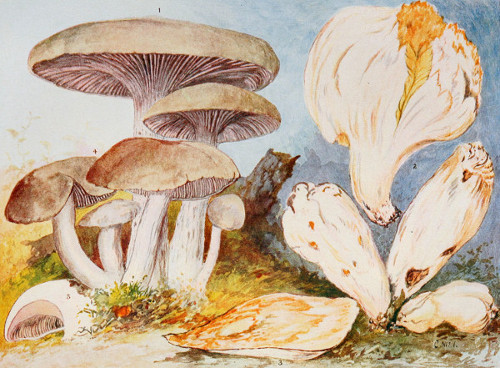
Grouped by F.D. Briscoe—Studies by C. McIlvaine. Plate LXIII.
| Fig. |
Page. |
Fig. |
Page. |
| 1. Clitopilus abortivus, |
257 |
4. Clitopilus prunulus, |
255 |
| 2. Clitopilus abortivus (aborted), |
256 |
5. Clitopilus prunulus (section), |
255 |
| 3. Clitopilus abortivus (aborted) (section), |
258 |
|
|
CLITOPI´LUS Fr.
Gr—a declivity; Gr—a cap.
(Plate LXIV.)
Clitopilus prunulus.
One-third natural size.
Pileus more or less excentric or regular, margin at first involute.
Gills more or less decurrent, never
sinuate nor seceding from the stem,
salmon-color. Stem fleshy or fibrous,
not polished and cartilaginous externally,
central, expanded upward into
the flesh of the pileus. Spores
smooth or warted.
Closely resembling Eccilia, differing
mostly in the stem not being
cartilaginous at the surface. Distinguished
from Entoloma by the gills
not being sinuate.
Agrees in structure with Clitocybe
in the Leucosporæ. Massee.
Growing on the ground, often strong smelling. Caps usually depressed
or umbilicate and waved on margin.
Some of the best of edible kinds are within this genus; a few are unpleasant
raw, none poisonous.
Most authors follow Fries in the arrangement of the species, dividing
them into two groups, the Orcelli, distinguished by deeply decurrent
gills and an irregular, scarcely hygrophanous pileus, with the margin at
first flocculose; and Sericelli, distinguished by adnate or slightly decurrent
gills and a regular silky or hygrophanous-silky pileus with a
naked margin. This arrangement is not strictly applicable to some of
our species. C. abortivus, C. erythrosporus and C. Noveaboracensis
have the gills deeply decurrent in some individuals, adnate or slightly
decurrent in others, and therefore the same species might be sought in
both groups. For this reason the primary grouping of our species has
been made to depend upon the variation in the spore colors. By far
the greater number of our species appear to be peculiar to this country,
only two of them occurring also in Europe.
| Spores and mature gills flesh-colored |
1 |
| Spores and mature gills rosy-red |
9 |
| Spores very pale flesh-colored |
10 |
| 1. Pileus hygrophanous |
8 |
| 1. Pileus not hygrophanous |
2 |
|
2. Pileus gray or grayish-brown |
5 |
|
2. Pileus some other color |
3 |
| 3. Pileus white or whitish |
4 |
| 3. Pileus pale tan-color |
C. pascuensis |
|
4. Pileus firm, dry, pruinate |
C. prunulus |
|
4. Pileus soft, slightly viscid when moist |
C. Orcella |
| 5. Pileus large, more than 1.5 in. broad |
C. abortivus |
| 5. Pileus small, less than 1.5 in. broad |
6 |
|
6. Spores even |
C. unitinctus |
|
6. Spores angular |
7 |
| 7. Stem longer than the width of the zoneless pileus |
C. albogriseus |
| 7. Stem shorter than the width of the commonly zonate pileus |
C. micropus |
|
8. Pileus brown or grayish-brown |
C. subvilis |
|
8. Pileus white or yellowish-white |
C. Woodianus |
| 9. Stem colored like the pileus |
C. erythrosporus |
| 9. Stem white, paler than the pileus |
C. conissans |
|
10. Pileus even |
11 |
|
10. Pileus rivulose |
C. Noveboracensis |
| 11. Stems cespitose, solid |
C. cæspitosus |
| 11. Stems not cespitose, hollow |
C. Seymourianus |
| Peck, 42d Rep. N.Y. State Bot. |
C. pru´nulus Scop.—prunus, plum. (Plate LXIII, fig. 4, 5, p. 254.)
Pileus fleshy, compact, at first convex and regular, then repand, dry,
pruinate, white or ashy-white. Flesh white, unchangeable, with a
pleasant farinaceous odor. Gills deeply decurrent, subdistant, flesh-colored.
256Stem solid, naked, striate, white. Spores subelliptical,
pointed at each end, 10–11×5–6µ.
Pileus 1.5–3 in. broad. Stem 1–2 in. long, 3–4 lines thick.
Woods.
Not abundant, but edible, and said to be delicious and one of the
best of the esculent species. Peck, 42d Rep. N.Y. State Bot.
June to October. Most plentiful in August and September.
Very plentiful in oak woods at Angora, West Philadelphia, moderate
crops at Mt. Gretna, Pa.
An abortive form (see Plate LXIII, fig. 2, 3, p. 254) occurs not
distinguishable from that of Armillaria mellea. It grows singly and in
tufts, very variable in shape, white, tinged with brown on ruptured surfaces.
This form equals its original.
C. prunulus has a strong smell of fresh meal. It is a delicious species.
Stew. It is one of the very best in patties, croquettes, etc.
(Plate LXV.)
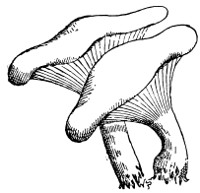
Clitopilus orcella.
Two-thirds natural size.
C. Orcel´la Bull.—Pileus fleshy, soft, plane or slightly depressed,
often irregular, even when young,
slightly silky, somewhat viscid when
moist, white or yellowish-white. Flesh
white, taste and odor farinaceous. Gills
deeply decurrent, close, whitish then
flesh-colored. Stem short, solid, flocculose,
often eccentric, thickened above,
white. Spores elliptical, 9–10×5µ.
Generally a little smaller than the
preceding species, softer and more irregular,
but so closely allied that by some
it is considered a mere variety of it. It
is said to be edible and of delicate flavor.
It occurs in wet weather in pastures and
open places. Peck, 42d Rep. N.Y. State Bot.
Grows in oak woods, Angora, West Philadelphia; Mt. Gretna, Pa.
Qualities same as C. prunulus. Delicious.
C. pascuen´sis Pk.—pasture. Pileus fleshy, compact, centrally depressed,
glabrous, reddish or pale yellowish, the cuticle of the disk
cracking into minute areas. Gills rather narrow, close, decurrent,
257whitish, becoming flesh-colored. Stem short, equal or tapering downward,
solid, glabrous, colored like the pileus. Spores subelliptical,
pale incarnate, 7.5–10×5–6µ.
Pileus 2–3 in. broad. Stem 8–18 lines long, 4–6 lines thick.
Pastures. Saratoga county.
The species is related to C. prunulus from which it is distinct by its
shorter, paler spores, its glabrous pileus cracked in areas on the disk
and tinged with red or yellowish and by its paler gills. From C. pseudo-orcella
it differs in its glabrous pileus with no silky luster and in its
closer gills. Its odor is obsolete but it has a farinaceous flavor. It is
probably esculent, but has not been found in sufficient quantity to afford
a test of qualities. Peck, 42d Rep. N.Y. State Bot.
C. unitinct´us Pk.—one-colored. Pileus thin, submembranaceous,
flexible, convex or nearly plane, centrally depressed or umbilicate,
glabrous, subshining, often concentrically rivulose, grayish or grayish-brown.
Flesh whitish or grayish-white, odor obsolete, taste mild.
Gills narrow, moderately close, adnate or slightly decurrent, colored like
the pileus. Stem slender, straight or flexuous, subtenacious, equal,
slightly pruinose, grayish-brown, with a close white myceloid tomentum
at the base and white root-like fibers of mycelium permeating the soil.
Spores elliptical, 7.5×5µ.
Var. al´bidus. Whitish or grayish-white, not rivulose. Gills broader.
Spores brownish flesh-color.
Pileus 6–16 lines broad. Stem about 1 in. long, 1 line thick.
Woods of pine or balsam. Albany and Essex counties. Autumn.
The variety is a little paler than the typical form, with gills a little
broader, but is probably not specifically distinct. Peck, 42d Rep. N.Y.
State Bot.
I have not seen this species. Edibility not reported.
B. Spores Angular or Irregular.
1. Pileus not hygrophanous.
C. aborti´vus B. and C.—abortive. (Plate LXIII, fig. 1, 2, 3, p.
254.) Pileus fleshy, firm, convex or nearly plane, regular or irregular,
dry, clothed with a minute silky tomentum, becoming smooth with
age, gray or grayish-brown. Flesh white, taste and odor subfarinaceous.
258Gills thin, close, slightly or deeply decurrent, at first whitish or
pale gray, then flesh-colored. Stem nearly equal, solid, minutely flocculose,
sometimes fibrous-striated, colored like or paler than the pileus.
Spores irregular, 7.5–10×6.5µ.
Pileus 2–4 in. broad. Stem 1.5–3 in. long, 3–6 lines thick.
Ground and old prostrate trunks of trees in woods and open places.
August and September.
Our species has been found to be edible, but its flavor is scarcely as
agreeable as that of some other species. Peck, 42d Rep. N.Y. State
Bot.
It requires longer cooking than C. prunulus, and is then quite equal
in excellence.
The fungus is so named because of the abortive form of it frequently
found associated with it. This is faithfully portrayed on Plate LXIII.
This is in every way similar to the aborted forms of C. prunulus and
Armillaria mellea.
Both forms plentiful near Philadelphia. The undeveloped masses
are also similar to those of C. prunulus.
The abortive form is a superior edible to the original.
C. popina´lis Fr.—popina, a cook-shop. Pileus 1–2 in. across,
flesh thin, flaccid, convex then depressed, somewhat wavy, glabrous,
opaque, gray, spotted and marbled. Flesh grayish-white, unchangeable.
Gills very decurrent, broader than the thickness of the flesh of
the pileus, lanceolate, crowded, dark-gray, at length reddish from the
spores. Stem stuffed, 1–2 in. long, 2 lines thick, equal, often flexuous,
naked, paler than the pileus. Spores subglobose, slightly angular,
4–5µ Massee.
Solitary or gregarious, smell pleasant like new meal, entirely gray.
Fries.
Woods. Gansevoort. July. The whole plant is of a grayish color
except the mature gills, which have a flesh-colored hue, and the base
of the stem, which is clothed with a white tomentum. It has a farinaceous
odor. Peck, 51st Rep. N.Y. State Bot.
Scattered. Mt. Gretna, Pa. September to November. McIlvaine.
Edible, pleasant.
C. carneo-al´bus Wither.—light flesh color. Pileus up to 1 in.
259across, convex then expanded, center becoming depressed and the margin
drooping, even, polished, white, the disk becoming usually tinged
with red. Flesh thin. Gills slightly decurrent, 1 line broad, crowded,
salmon color. Stem 1–1½ in. long, 1 line thick, about equal, solid,
white. Spores globose, nodulose, 7–8µ diameter.
Inodorous; gregarious.
In the section given in Cke. Illustr., the stem is represented as being
distinctly hollow. Massee.
New York, shaded ground. June. Peck, 45th Rep.
C. al´bogri´seus Pk.—pale-gray. Pileus firm, convex or slightly depressed,
glabrous, pale-gray, odor farinaceous. Gills moderately close,
adnate or slightly decurrent, grayish then flesh-colored. Stem solid,
colored like the pileus. Spores angular or irregular, 10–11×7.5µ.
Pileus 6–12 lines broad. Stem 1.5–2.5 in. long, 1–2 lines thick.
Woods. Adirondack mountains. August. Peck, 42d Rep. N.Y.
State Bot.
Scattered. Mt. Gretna, Pa., woods. August to October. McIlvaine.
Edible, pleasant.
C. mi´cropus Pk.—short-stemmed. Pileus thin, fragile, convex or
centrally depressed, umbilicate, silky, gray, usually with one or two narrow
zones on the margin, odor farinaceous. Gills narrow, close, adnate
or slightly decurrent, gray, becoming flesh-colored. Stem short,
solid, slightly thickened at the top, pruinose, gray with a white mycelium
at the base. Spores angular or irregular, 10×6µ.
Pileus 6–12 lines broad. Stem 8–10 lines long, 1 line thick.
Thin woods. Essex and Rensselaer counties. August.
This species is closely allied to the preceding one, but may be separated
from it by its short stem and silky umbilicate subzonate pileus.
Both species are rare and have been observed only in wet, rainy weather.
Peck, 42d Rep. N.Y. State Bot.
Scattered markedly umbilicate. Mt. Gretna, Pa., woods. August,
September. McIlvaine.
Edible, pleasant.
2602. Pileus hygrophanous.
C. subvi´lis Pk.—small value. Pileus thin, centrally depressed or
umbilicate, with the margin decurved, hygrophanous, dark-brown and
striatulate on the margin when moist, grayish-brown and silky shining
when dry, taste farinaceous. Gills subdistant, adnate or slightly decurrent,
whitish when young, then flesh-colored. Stem slender, brittle,
rather long, stuffed or hollow, glabrous, colored like the pileus or a little
paler. Spores angular, 7.5–10µ.
Pileus 8–15 lines broad. Stem 1.5–3 in. long, 1–2 lines thick.
Damp soil in thin woods. Albany county. October.
The species is allied to C. vilis, from which it is separated by its
silky-shining pileus, subdistant gills and farinaceous taste. Peck, 42d
Rep. N.Y. State Bot.
Scattered. Mt. Gretna, Pa. September to November. McIlvaine.
Edible, pleasant.
C. Wood´ianus Pk. Pileus thin, convex or nearly plane, umbilicate
or centrally depressed, hygrophanous, striatulate on the margin when
moist, whitish or yellowish-white and shining when dry, the margin
often wavy or flexuous. Gills close, adnate or slightly decurrent,
whitish, then flesh-colored. Stem equal, flexuous, shining, solid, colored
like the pileus. Spores subglobose, angular, 6–7.5µ.
Pileus 1–2 in. broad. Stem 2–3 in. long, 2 lines thick.
Ground and decayed prostrate trunks in woods. Lewis county. September.
This species is perhaps too closely allied to the preceding, but it may
easily be separated by its paler color, closer gills and solid stem, though
this is sometimes hollow from the erosion of insects. Peck, 42d Rep.
N.Y. State Bot.
C. Un´derwoodii Pk.—in honor of L.M. Underwood. Pileus rather
thin but fleshy, nearly plane or slightly depressed in the center, even,
whitish. Gills narrow, close, slightly decurrent, pale flesh-colored.
Stem rather short, equal or slightly tapering upward, solid, whitish.
Spores subglobose, 4–5µ long.
Pileus 6–18 lines broad. Stem about 1 in. long and 2 lines thick.
261Syracuse and Jamesville. September and October. L.M. Underwood.
Peck, 49th Rep. N.Y. State Bot.
Spores Rosy-red.
C. erythro´sporus Pk. Gr—red-spored. Pileus thin, hemispherical
or strongly convex, glabrous or merely pruinose, pinkish-gray.
Flesh whitish tinged with pink, taste farinaceous. Gills narrow,
crowded, arcuate, deeply decurrent, colored like the pileus. Stem
equal or slightly tapering upward, hollow, slightly pruinose at the top,
colored like the pileus. Spores elliptical, 5×3–4µ.
Pileus 1–2 in. broad. Stem 1–1.5 in. long, 2–3 lines thick.
Decayed wood and among fallen leaves in woods. Albany and
Ulster counties. September and October.
The species is easily recognized by its peculiar uniform color, its narrow,
crowded and generally very decurrent gills and by its bright rosy-red
spores. Sometimes individuals occur in which the gills are less
decurrent. Peck, 42d Rep. N.Y. State Bot.
Mt. Gretna, Pa., among fallen leaves. Sparsely gregarious. September
to November. McIlvaine.
Edible, good.
C. conis´sans Pk.—dusted. Pileus thin, convex, glabrous, pale
alutaceous, often dusted by the copious spores. Gills close, adnate, reddish-brown.
Stem slender, brittle, hollow, cespitose, white. Spores
narrowly elliptical, 7.5×4µ.
Pileus 1–1.5 in. broad. Stem 1–2 in. long, 1–2 lines thick.
Base of an apple tree. Catskill mountains. September.
Remarkable for the bright rosy-red spores which are sometimes so
thickly dusted over the lower pilei of a tuft as to conceal their real color.
The species is very rare. Peck, 42d Rep. N.Y. State Bot.
Spores Very Pale Flesh-Colored, Merely Tinted.
C. cæspito´sus Pk.—tufted. Pileus at first convex, firm, nearly regular,
shining, white, then nearly plane, fragile, often irregular or eccentric,
glabrous but with a slight silky luster, even, whitish. Flesh white,
taste mild. Gills narrow, thin, crowded, often forked, adnate or slightly
262decurrent, whitish, becoming dingy or brownish-pink. Stems cespitose,
solid, silky-fibrillose, slightly mealy at the top, white. Spores 5×4µ.
Pileus 2–4 in. broad. Stem 1.5–3 in. long, 2–4 lines thick.
Thin woods and pastures. Ulster county. September.
This is a large, fine species, very distinct by its cespitose habit, white
color and very pale sordid-tinted spores. But for the color of these the
plant might easily be taken for a species of Clitocybe. The tufts sometimes
form long rows. Peck, 42d Rep. N.Y. State Bot.
Mt. Gretna, Pa. October. McIlvaine.
Tender, not much flavor.
C. Noveboracen´sis Pk.—New York Clitopilus. Pileus thin, convex,
then expanded or slightly depressed, dingy white, cracked in areas or
concentrically rivulose, sometimes obscurely zonate, odor farinaceous,
taste bitter. Gills narrow, close, deeply decurrent, some of them forked,
white, becoming dingy, tinged with yellow or flesh-color. Stem equal,
solid, colored like the pileus, the mycelium white, often forming white
branching root-like fibers. Spores globose, 4–5µ broad.
Var. brevis. Margin of the pileus, in the moist plant, pure white.
Gills adnate or slightly decurrent. Stem short.
Pileus 1–2 in. broad. Stem 1–2 in. long, 1–3 lines thick.
Woods and pastures. Adirondack mountains, Albany and Rensselaer
counties. August to October.
The plant is gregarious or cespitose. Sometimes, especially in the
variety, it grows in lines or arcs of circles. The margin is often undulated,
and in the variety it is, when fresh and moist, clothed with a film
of interwoven webby white fibrils which give it a peculiar appearance,
and if the spore characters are neglected it might be mistaken for Clitocybe
phyllophila. The disk is often tinged with reddish-yellow or rusty
hues when moist, and its rivulose character is then more distinct. A
farinaceous odor is generally present, especially in the broken or bruised
plant, but its taste is bitter and unpleasant. Sometimes bruises of the
fresh plant manifest a tendency to assume a smoky-brown or blackish
color. The base of the stem is sometimes clothed with a white mycelioid
tomentum. Peck, 42d Rep. N.Y. State Bot.
C. Sey´mourianus Pk.—Pileus fleshy, thin, broadly convex or slightly
depressed, even, pruinose, whitish with a dark lilac tinge, sometimes
263lobed and eccentric. Gills narrow, crowded, decurrent, some of them
forked at the base, whitish with a pale flesh-colored tint. Stem equal,
silky-fibrillose, hollow. Spores minute, globose or nearly so, 3.5–4µ
long.
Pileus 1–2.5 in. broad. Stem 1.5–2.5 in. long, 3–4 lines thick.
Woods. Lewis county. September. Peck, 42d Rep. N.Y. State Bot.
LEPTO´NIA Fr.
Rosy-spored. Stem cartilaginous,
tubular (the tube stuffed or hollow),
polished, somewhat shining. Pileus
thin, umbilicate or with a darker
disk, cuticle fibrillose or separating
into darker scales, margin at first incurved.
Gills at first adnexed or adnate
but readily separating. Fries.
The Leptoniæ are related to the
Clitopili as the Collybiæ are to the
Clitocybæ. The species are small,
elegant, brightly colored, inodorous
(except A. incanus), and abound in
rainy weather. Gregarious or growing
in troops; on the ground, commonly
on dry mossy pastures, but
also in marshy places. Stevenson.
Six American species reported. I have not seen any.
264NOLA´NEA Fr.
(Plate LXVII.)
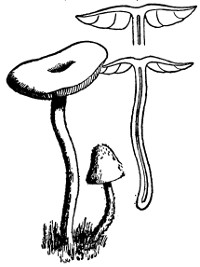
Nolanea pascua.
About natural size.
Rosy-spored. Stem tubed, the tube
more rarely stuffed with a pith, cartilaginous.
Pileus somewhat membranaceous,
bell-shaped, somewhat
papillate, striate and sometimes even,
sometimes also clothed with flocci,
margin straight and at the first pressed
to the stem, and not involute. Gills
free or adfixed, and not decurrent.
Fries.
Nolanea agrees with Leptonia and
Eccilia among the pink-spored species.
It corresponds with Mycena, Galera
and Psathyra. Several Entolomata
are nearly allied. The species are
thin and slender, commonly inodorous
and fragile, though some of them are
tough. Growing on the ground in
summer and autumn. Stevenson.
Seven American species reported. None seen by writer.
Peck, Rep. 24, 26, 35, 39, 50.
265ECCI´LIA Fr.
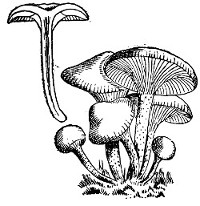
Eccilia atropuncta.
Two-thirds natural size.
Stem cartilaginous, tubular (the
tube hollow or stuffed), expanded upward
into the pileus, which is somewhat
membranaceous and at the first
turned inward at the margin. Gills
attenuated behind, truly decurrent,
becoming more so when the pileus is
depressed, and not separating as those
of Nolanea.
Corresponding in structure with
Omphalia of the white-spored and
Tubaria of the brown-spored series.
Allied to Clitopilus in the decurrent
gills, but separated by the cartilaginous,
smooth stem.
(Plate LXIX.)
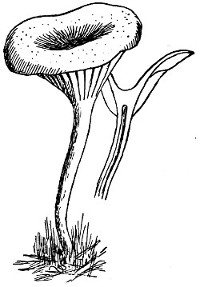
Eccilia carneo-grisea.
Natural size.
Eccilia atropuncta.
E. car´neo-gri´sea B. and Br.—caro,
flesh; griseus, gray. Pileus
about 1 in. broad, gray flesh-color,
umbilicate, striate, delicately dotted,
margin slightly glittering with dark
particles. Stem about 1½ in. long,
slender, fibrous-hollow upward, wavy,
of the same color as the pileus, shining,
smooth, white-downy at the base.
Gills adnato-decurrent, somewhat undulated,
distant, rosy, the irregular
margin darker. Stevenson.
Spores irregularly oblong, rough,
7×5µ Massee.
Nova Scotia, Dr. Somers.
New Jersey, E.B. Sterling, August,
1897; Eagle’s Mere, Pa., common under pines, McIlvaine.
266This neat little species is sweet and pleasant raw, and when cooked
makes an agreeable dish. European authorities give the taste as unpleasant,
but there is nothing of the sort about the American representative.
CLAU´DOPUS Smith.
Claudus—lame; pous—a foot.
(Plate LXX.)
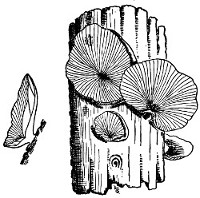
Claudopus variabilis.
Natural size.
Pileus eccentric, lateral or resupinate. Spores pinkish.
The species of this genus were formerly distributed among the Pleuroti
and Crepidoti, which they resemble
in all respects except the
color of the spores. The genus at
first was made to include species with
lilac-colored as well as pink spores,
but Professor Fries limited it to species
with pink spores. In this sense
we have taken it. The spores in
some species are even, in others
rough or angulated. The stem is
either entirely wanting or is very
short and inconspicuous, a character
indicated by the generic name. The
pileus often rests upon its back and
is attached by a point when young,
but it becomes turned backward with age. The species are few and infrequent.
All inhabit decaying wood.
| SYNOPSIS OF THE SPECIES. |
| Pileus yellow |
C. nidulans |
| Pileus white or whitish |
1 |
| 1. Spores even |
C. variabilis |
| 1. Spores angulated. |
C. depluens |
| Pileus gray or brown |
2 |
| 2. Pileus striatulate when moist |
C. Greigensis |
| 2. Pileus not striatulate |
C. byssisedus |
| Peck, 39th Rep. N.Y. State Bot. |
267C. ni´dulans Pers.—nidus, a nest. Pileus 1–3 in. broad, stemless,
attached by the pileus or rarely narrowed behind into a short stem-like
base, caps often overlapping one another, suborbicular or kidney-shaped,
downy, somewhat pointed-hairy or scaly-hairy toward the margin, yellow
or buff color, the margin at first turned inward. Lamellæ rather broad,
moderately close or subdistant, orange-yellow. Spores even, slightly
curved, 6–8µ long, about half as broad, delicate pink.
Decaying wood. Sandlake. Catskill and Adirondack mountains.
Autumn.
This fungus was placed by Fries among the Pleuroti, and in this he
has been followed by most authors. But the spores have a delicate
pink color closely resembling that of the young lamellæ of the common
mushroom, Agaricus campestris. We have, therefore, placed it among
the Claudopodes, where Fries himself has suggested it should be placed
if removed at all from Pleurotus. Our plant has sometimes been referred
to Panus dorsalis Bosc., but with the description of that species it does
not well agree. The tawny-color, spoon-shaped pileus, pale floccose
scales, short lateral stem and decurrent lamellæ ascribed to that species
are not well shown by our plant. The substance of the pileus, though
rather tenacious and persistent, can scarcely be called leathery. The
flesh is white or pale yellow. The hairy down of the pileus is often
matted in small tufts and intermingled with coarse hairs, especially
toward the margin. This gives a scaly or pointed-hairy appearance.
The color of the pileus is often paler toward the base than it is on the
margin. Peck, 39th Rep. N.Y. State Bot.
Mt. Gretna, Pa., November, 1898, decaying stumps. McIlvaine.
An autumnal species growing upon wood. Not common.
The light yellow tomentosity of the cap arranges itself into shapes as
fascinating as crystals of snow.
Taste pleasant, mild. Texture more solid than P. ostreatus, consequently
tougher. It is edible but not desirable. Must be chopped
fine and cooked well.
268
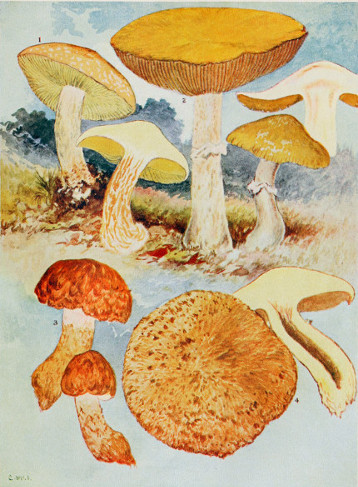
Grouped by F.D. Briscoe—Studies by C. McIlvaine. Plate LXXI.
| Fig. |
Page. |
Fig. |
Page. |
| 1. Hebeloma glutinosum, |
283 |
3. Pholiota squarrosa, |
273 |
| 2. Pholiota caperata, |
270 |
4. Pholiota subsquarrosa, |
275 |
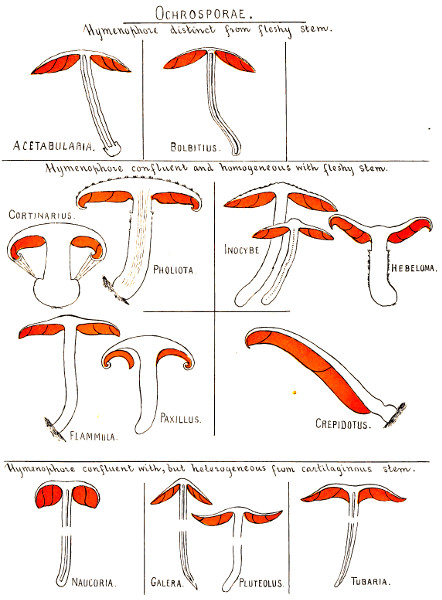
Plate LXXIa.
Chart of genera in brown-spored series—Ochrosporae.
Ochrosporæ, third in color series, ranges in spore color from dull
ochraceous, through bright ocher, to rusty orange and ferruginous or
iron-rust. The various shades will tax even a color expert.
There are no species in the series corresponding to Amanitæ. In
Acetabularia there is a cup-like volva; in Pholiota there is a distinct
interwoven ring on the stem; in Cortinarius the secondary veil is like a
cobweb, and may form an imperfect zone around the stem, or hang as
fibers from the margin of the cap; Pluteolus exactly resembles Pluteus.
There are many edible species of good quality in the series. None
are known to be poisonous. The substance, as a rule, is tougher than
in most of the preceding genera, and in many instances has a strong
woody flavor. Several species are late growers, and are among the best
of fungi. Notably in Pholiota.
ACETABULA´RIA Berk.
Acetabulum, a vinegar-cup. From the cup-like volva.
Universal veil distinct from the pileus; hymenophore distinct; gills
free; spores pallid, tawny or brown.
Analogous to Volvaria and Chitonia.
No American species reported.
269PHOLIO´TA Fr.
Pileus more or less fleshy. Gills adnate, with or without a decurrent
tooth, tawny or rust colored at maturity from the spores. Flesh
of stem continuous with that of the pileus. Ring distinct, interwoven.
Spores sepia-brown, bright yellowish-brown or light red.
Generally on wood, sometimes on the ground in damp moss, frequently
densely cespitose. Some of the species are large and bright
colored. Distinguished from all other genera of the brown-spored
series by the possession of a distinct ring. In Cortinarius the veil and
ring are web-like.
Stevenson notes in his description of the genus: “None are to be
commended as edible.” My investigation shows that there are several
delicious species, notably P. squarrosa and subsquarrosa. Their lateness
and plentifulness make them valuable food fungi. I have nothing
but praise for the entire genus.
A. Humigeni (
humus, ground;
gigno, to bear). Page
270.
On the ground, rarely cespitose.
* Eudermini. Gr—well; dermini, the brown-spored series.
Spores ferruginous.
** Phæoti. Gr—dusky.
Spores dusky rust-colored.
B. Truncigeni (truncus, a trunk; gigno, to bear). Page 273.
On wood; subcespitose.
* Ægeritini. P. ægerita, the type of the section.
Pileus naked, not scaly, sometimes cracked. Gills pallid, then reddish
or dusky. None known to be edible.
** Squamosi—squama, a scale.
Pileus scaly, not hygrophanous. Gills becoming discolored.
* Gills not becoming purely rust-colored.
** Gills yellow, then rust-color or tawny.
*** Hygrophani. Gr—moist; to appear.
Gills cinnamon, not at first yellow.
270C. Muscigeni (muscus, moss; gigno, to bear).
Hygrophanous. Like Galera with a ring.
A. Humigeni. On ground.
* Eudermini.
Spores ferruginous.
P. capera´ta Pers.—capero, to wrinkle. (Plate LXXI, fig. 2, page
268.) Pileus 3–5 in. broad, more or less intensely yellow, fleshy, but
thin in proportion to its size and robust stem, ovate then expanded, obtuse,
viscid only when moist and not truly so, even at the disk, wrinkled
in pits at the sides, incrusted with white superficial flocci. Stem 4–6
in. long, more than 1 in. thick, solid, stout, cylindrical with exception
of the base which is often tuberous, shining white, scaly above the ring,
which is membranaceous, reflexo-pendulous, and broken into squamules
at the apex. Gills adnate, crowded, thin, somewhat serrated, clay-cinnamon.
When young the pileus is incrusted with the veil or with white mealy-floccose
soft, hairy down, which is crowded on the even disk and scaly
towards the thin pitted-furrowed margin; and as this separates the
pileus is naked. Veil universal, floccoso-mealy, at the first cohering
in the form of a volva but not continuous; in rainy weather remaining
in the form of a volva at the base. Spores dark ferruginous on a white
ground, paler on a black ground. There is a smaller form (A. macropus
Pers.) in pine woods, pileus even and paler. Stem 3 in. long,
and without a tuberous base. Ring oblique and often incomplete. Stev.
Spores 10µ B. and Br.; 12×4µ W.P.; spheroid-ellipsoid, uniguttate,
11–12×8–9µ K.; 12×4.5µ Massee.
Not previously reported.
This fungus occurs sparingly in rich woods near Boston. It is much
esteemed in Germany, and eagerly sought by the common people, who
call it familiarly the “Zigeuner” (Gypsy). Boston Myc. Club Bull.
1896.
I have found this species in but one place—on the south hill of the
great Chester valley, Pa., where it grows plentifully in woods. The
taste raw was slightly acrid, but when cooked this disappeared. Many
ate of the species and enjoyed it.
271P. togula´ris Bull.—togula, a little cloak. From the ample ring.
Pileus 1½ in. broad, pallid ochraceous, fleshy, soft, bell-shaped then
expanded, obtuse, orbicular, without striæ, smooth. Flesh thin, soft,
becoming yellow. Stem 3–4 in. long, 2 lines thick, tubed, rigid, equal,
cylindrical, rough with stiff fibers, naked and becoming yellow at the
apex, becoming dingy brown downward. Ring medial, more than 1 in.
distant, entire, spreading-reflexed. Gills adnato-separating, ventricose,
crowded, narrowed in front, becoming yellow, at length pale rust-color,
never becoming dingy brown.
Protean, slender, very variable in stature, growing in troops. b. More
slender, but densely gregarious, with the wholly pallid smooth stem
thinner, often flexuous. This form is exactly A. mesodactylus Berk.
c. Very small. Pileus 1 in. Stem 1 in. or a little more, scarcely 1
line thick, very flexuous, becoming rust-color. Stevenson.
Spores elliptical, 8×3.5µ Massee.
New Jersey, on decayed chips mixed with dirt. May, 1898. E.B.
Sterling.
Not previously reported.
The specimens sent were tested and found to be of good quality.
** Phæ´oti.
Spores fuscous—ferruginous (dingy rust-color).
P. du´ra Bolt.—durus, hard. Pileus 3 in. and more broad, tawny,
tan-color, becoming dingy brown, fleshy, somewhat compact, convexo-plane,
obtuse, smooth, then cracked into patches, margin even. Stem
commonly curt, 2 in. long, about ½ in. thick, stuffed, even solid, hard,
becoming silky-even, then longitudinally cracked when dry, thickened
at the apex, mealy and more than usually widened into the pileus, varying
ventricose and irregularly-shaped. Ring torn. Gills adnate, striato-decurrent
with a tooth, ventricose, ½ in. broad, livid then dingy rust-color.
The stem is abundantly furnished with fibrillose rootlets at the base.
Although very closely allied to A. præcox, it is readily distinguished
by its rust-color or brown-rust spores. Stevenson.
Spores 9×5µ W.G.S.; 8–9×5–6µ Massee.
Haddonfield, N.J. June to October. Florist’s garden, McIlvaine.
After rains P. dura appears, solitary, from spring to autumn. The
272cracked cap, in mature specimens, distinguishes it from other species
found on its habitat. It varies in size from 1½ in. up to 4 in. across.
The caps are excellent.
(Plate LXXII.)
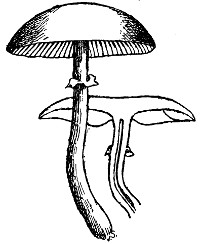
Pholiota præcox.
After Peck.
P. præ´cox Pers.—præcox, early. Pileus 1–2 in. broad, convex or
nearly plane, soft, nearly or quite glabrous,
whitish, more or less tinged with
yellow or tan-color. Gills close, adnexed,
at first whitish, then brownish or
rusty-brownish. Stem 1.5–3 in. long,
2–2.5 lines thick, rather slender, mealy
or glabrous, stuffed or hollow, whitish.
Spores elliptical, rusty-brown, 10–13×6–8µ.
The Early Pholiota is a small but
variable species. From other similarly
colored species that appear in grassy
ground early in the season, the collar on
the stem will generally distinguish it.
Its cap is usually convex when young
but nearly flat in the mature plant. It
is rather pale in color but not a clear white, being tinted with yellow or
pale tan-colored hues. The gills are whitish when the cap first opens,
but they soon change to a rusty-brown hue in consequence of the ripening
of the spores. They are excavated at the inner extremity and
slightly attached to the stem. They are ventricose when the cap is
fully expanded. The stem is rather slender, nearly or quite straight
and soon smooth and hollow. It is pale or whitish, and usually furnished
with a small collar. Sometimes the collar is slight and disappears with
age and sometimes the fragments of the veil remain attached to the
margin of the cap leaving nothing for a collar.
The plants usually grow in grassy ground, lawns and gardens, and
appear from May to July.
Var. minor Batt. is a small form having the cap only about 1 in.
broad and the remnants of the veil adherent to the margin of the cap.
It is represented by figures 6 to 12.
Var. sylvestris Pk. has the center of the cap brownish or rusty-brown,
and grows in thin woods. Peck, 49th Rep. N.Y. State Bot.
273Spores inclining to fuscous, spheroid-ellipsoid, 8–13×5–7µ K.; 8×6µ
W.G.S.; 8–13×6–7µ Massee.
West Virginia, New Jersey, North Carolina, Pennsylvania, May to
August. On rich ground, lawns, gardens, etc. McIlvaine.
Coming as it does in early spring, it is a prized species wherever
found.
The caps only are good.
B. Truncigeni. On wood.
(Plate LXXIII.)
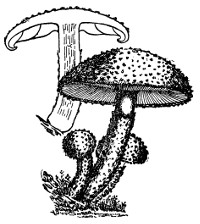
Pholiota squarrosa.
One-half natural size.
P. squarro´sa Mull.—squarrosus, scurfy. (Plate LXXI, fig. 3, page
268.) Pileus 3–5 in. broad, saffron-rust-color,
scaly with innate,
crowded, revolute, darker (becoming
dingy brown), persistent
scales, fleshy, convex bell-shaped
then flattened, commonly obtusely
umbonate or gibbous, dry. Flesh
light-yellow, compact when
young, sometimes thin. Stems
curt when young, as much as 8
in. long when full-grown, as much
as 1 in. thick at the apex, remarkably
attenuated downwards,
stuffed, scaly as far as the ring
with crowded, revolute, darker
scales. Ring only slightly distant
from the apex, rarely membranaceous,
entire or often slashed,
generally floccoso-radiate, of the same color as the scales. Gills adnate
with a decurrent tooth, crowded, narrow, pallid-olivaceous then rust-color.
Spores ferruginous. Very cespitose, forming large heaps. Stems
commonly cohering at the base, varying very much in stature in the
274same cluster; varying also much thinner, scarcely ever curved-ascending.
Odor heavy, stinking; sometimes, however, obsolete. Stevenson.
Spores ellipsoid, 7–8x4–5µ K.; 4x5µ W.G.S.; 8x4µ Massee.
On trunks of trees, on and near stumps, etc. Common. August to
December.
West Virginia, 1881–1885, New Jersey, Pennsylvania. On rotten
wood and stumps. August to long after frost. McIlvaine.
Edible. Curtis.
The American species, as I have repeatedly found it, is not so large as
given in the European description, and the habitat is more closely confined
to the trunks of standing trees and stumps not much decayed. It
is a showy species, to be seen from afar off, especially after the leaves
fall. Taste when young, raw, is sweet, mealy; when mature, like stale
lard.
Cooked, the caps are of good substance and flavor. One of the very
best.
P. squarrosoi´des Pk.—squarrosus, scurfy; eidos, form. Pileus
firm, convex, viscid when moist, at first densely covered by erect papillose
or subspinose tawny scales, which soon separate from each other,
revealing the whitish color and viscid character of the pileus. Lamellæ
close, emarginate, at first whitish, then pallid or dull cinnamon color.
Stem equal, firm, stuffed, rough with thick squarrose scales, white
above the thick floccose ring, pallid or tawny below. Spores minute,
elliptical, 5×4µ.
Densely cespitose, 3–6 in. high. Pileus 2–4 in. broad. Stem 3–5
lines thick.
Dead trunks and old stumps of maple. Adirondack and Catskill
mountains. Autumn.
This is evidently closely related to A. squarrosus, with which it has,
perhaps, been confused, but its different colors and viscid pileus appear
to warrant its separation. Peck, 31st Rep. N.Y. State Bot.
Occurred in large clusters on sugar maples at Eagle’s Mere in October,
and on stumps at Mt. Gretna. It very closely resembles P. squarrosa.
Its caps are of the very best.
275P. subsquarro´sa Fr.—sub, under; squarrosus, scurfy. (Plate LXXI,
fig. 4, p. 268.) Pileus 2 in. and more broad, brown rust-color, with
darker, adpressed, floccose scales, fleshy, convex, obtuse or gibbous,
viscid. Stem 3 in. long, 4–5 lines thick, stuffed (often hollow when
old), equal, yellow-rust-color, clothed with darker scales which are
adpressed, or spreading only at the apex, not rough, furnished with an
annular zone at the apex, becoming yellow-rust-color within. Gills
deeply sinuate, emarginate, almost free, arcuate, crowded, at first pale
then dingy yellow.
Spores rust-color. The pileus is viscid, but not glutinous like that
of A. adiposus. It holds a doubtful place between A. aurivellus and
A. squarrosus, departing from both, however, in the gills being at the
first yellow; and from A. squarrosus, to which it is more like, in the
gills being emarginato-free, not decurrent. Somewhat cespitose. Almost
inodorous. Fries.
Spores ferruginous, size not stated.
West Philadelphia, Mt. Gretna, Pa., Haddonfield, N.J. September
until after frosts. McIlvaine.
Not previously reported.
The maple trees in West Philadelphia frequently show large clusters
of it up to twenty feet from ground; to be seen from afar after the leaves
have fallen. Our American species differs somewhat from the European.
American species:
Pileus 1–3 in. across, fleshy, convex, very viscid, rich brownish-yellow,
covered with darker adpressed floccose scales. Flesh slightly
yellow. Gills white when very young slightly emarginate, adnexed,
crowded, ¼ in. broad, brown. Stem 2–3 in. long, ½ in. thick, equal
or tapering toward base, stuffed, then hollow, covered with squamose
scales as far up as the slight ring, smooth above ring. Ring membranaceous,
slight.
Spores rust-color.
The species is variable and differs greatly in youth and maturity.
The caps, fried in hot buttered pan, are unexcelled.
Equally fine in croquettes and patties.
276**
Gills yellow, then rust-color.
(Plate LXXIV.)
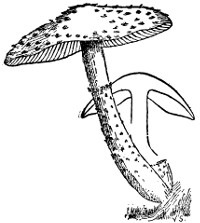
Pholiota adiposa.
About natural size.
P. adipo´sa Fr.—adeps, fat. Pileus fleshy, firm, at first hemispherical
or subconical, then convex,
very viscid or glutinous when moist,
scaly, yellow. Flesh whitish. Gills
close, adnate, yellowish becoming
rust-color with age. Stem equal or
slightly thickened at the base, scaly
below the slight radiating floccose
ring, solid or stuffed, yellow, generally
rust-color at the base. Spores
elliptical, 7.6×5µ.
The Fat pholiota is a showy species.
Its tufted mode of growth,
rather large size, yellow color and
rusty-brown scales make it a noticeable
object. The stem is somewhat
and the cap very viscid when moist,
and this viscidity when dry gives it a shining appearance. The scales
of the cap become erect or reflexed and sometimes appear blackish at
the tips. They sometimes disappear with age. The flesh is firm and
white or whitish. The gills when young are yellow or pale-yellow, but
when mature they assume a ferruginous or rusty color like that of the
spores. The stem is similar in color to the cap, but paler or nearly
white at the top and usually reddish-brown or rusty-brown at the base.
The collar is slight and often scarcely noticeable in mature specimens.
The Cap is 2–4 in. broad, the Stem 2–4 in. long and 4–6 lines thick.
The plants commonly grow in tufts on stumps or dead trunks of deciduous
trees in or near woods. They may be found from September
to November. It is well to peel the caps before cooking. This species
is not classed as edible by European authors, but I find its flavor agreeable
and its substance digestible and harmless. Peck, 49th Rep. N.Y.
State Bot.
Spores 8×5µ W.G.S.; elliptical, ferruginous, 7×3µ Massee.
Mt. Gretna, Pa. October until after frost. About trees and stumps
and on logs. McIlvaine.
P. adiposa yields a substantial substance of good flavor.
277P. flam´mans Fr.—flamma, flame. Pileus 2–4 in. broad, yellow-tawny,
fleshy, convex then plane, somewhat umbonate, absolutely dry,
sprinkled with superficial, pilose, somewhat concentric, paler or sulphur-yellow,
rough or curly scales; margin at first inflexed, then spread when
larger. Flesh thin, light yellow. Stem 3 in. long, 2–3 lines thick,
stuffed then hollow, equal, most frequently flexuous, very light yellow
as are also the crowded rough scales. Ring membranaceous, entire,
not far removed from the pileus, of the same color. Gills adnate and
without a tooth, somewhat thin, crowded, at the first bright sulphur-yellow,
at length rust-color, edge quite entire.
Pileus by no means hygrophanous. It is distinguished from all others
by the sulphur-yellow scales on the tawny pileus. Forming small clusters.
Inodorous. The ring is sometimes only indicated by an annular zone.
Fries.
Spores ellipsoid, 4×2µ K.; ellipsoid, 3–4×2–2.5µ C.B.P.; 4×2µ
W.P.; 8×4µ Massee.
Quite plentiful in the New Jersey pines, from October until after
heavy frosts. Caps seldom over 3 in. across. Solitary, and in clusters
of not over half a dozen.
The caps fried are delicious.
P. luteofo´lia Pk.—luteus, yellow; folium, a leaf. Pileus firm, convex,
dry, scaly, fibrillose on the margin, pale-red or yellowish. Lamellæ
broad, subdistant, emarginate, serrate on the edge, yellow, becoming
bright rust-color. Stem firm, fibrillose, solid, colored like the
pileus, often curved from the place of growth. Ring obsolete. Spores
bright rust-color, 7×4µ.
Plant subcespitose, 2–3 in. high. Pileus 1–2 in. broad. Stem 3–5
lines thick.
Trunks of birch trees. Forestburgh. September.
The general appearance of this plant is like A. variegatus or reddish
forms of A. multipunctus. The reddish color appears sometimes to
fade with age. Peck, 27th Rep. N.Y. State Bot.
Eagle’s Mere, Pa. In clusters, on birch trees. August, 1898. McIlvaine.
Grows in quantity in the birch forests. The caps are delicious.
278P. ornel´la Pk. (Agaricus ornellus Pk., 34 Rep., p. 42.) Pileus
convex or nearly plane, slightly squamose, reddish-brown tinged with
purple, the margin paler, floccose-appendiculate. Gills moderately
close, yellowish or pallid, becoming brown. Stem equal or slightly
thickened upward, solid, squamulose, pale-yellow, sometimes expanded
at the base into a brownish disk margined with yellowish filaments.
Spores brown, elliptical, 6–7.5×4–5µ.
Plant 1–2 in. high. Pileus about 1 in. broad. Stem 1 line to 1.5
lines thick.
Decaying wood. South Ballston, Saratoga county. October.
The scales of the pileus are sometimes arranged in concentric circles.
The purplish tint is not always uniform, but in some instances forms
spots or patches. Peck, 34th Rep. N.Y. State Bot.
Specimens, clustered, found by me on railroad ties at Haddonfield,
N.J., September, 1897, had caps 1–1½ in. broad, of a dull green
without tinge of purple; skin minutely cracked, showing the white flesh
in the interstices; stem 1–2 in. long, 3–4 lines thick, slightly thickened
upward, pale orange, solid, squamulose; ring floccose; taste when raw,
slightly bitter. These were sent to Professor Peck who wrote: “Appears
to be a form of P. ornella Pk., but it differs some in color, being
more of a green hue than of purple or olivaceous. It is pretty and I
would like to know more about it before deciding on it fully.”
I have not since found it. Very palatable when cooked.
*** Hygrophani.
Gills cinnamon, etc.
P. muta´bilis Schaeff.—changeable. Pileus about 2 in. broad, cinnamon
when moist, becoming pale when dry, hygrophanous, slightly
fleshy, convex then flattened, commonly obtusely umbonate, sometimes
depressed, even and smooth, but when young occasionally scaly throughout.
Stem about 2–3 in. long, 2 lines and more thick, rigid, stuffed
then hollow, equal or attenuated downward, scaly-rough as far as the
ring, rust-color, blackish or umber downward, often ascending or
twisted. Ring membranaceous, externally scaly. Gills adnato-decurrent,
crowded, rather broad, pallid then cinnamon. Stevenson.
Densely cespitose, variable in stature.
Spores ellipsoid-obovate, 6×11µ W.G.S.; 7×4µ W.P; 9–11×5–6µ
Massee; 11×7µ Morgan.
Edible. Curtis. Considered excellent in Europe.
279P. margina´ta Batsch.—marginatus, margined. Pileus 1 in. and
more broad, honey-colored when moist, tan when dry, hygrophanous,
slightly fleshy, convex then expanded, obtuse, even, smooth, margin
striate. Stem about 2 in. long, 1–2 lines thick, tubed, equal, fibrillose
or slightly striate, not scaly, of the same color as the pileus, but becoming
dingy-brown, and commonly white velvety at the base. Ring 1–2
lines distant from the apex, often in the form of a cortina and fugacious.
Gills adnate, crowded, thin, narrow, at first pallid, then darker cinnamon.
It varies much, and is deceptive on account of the vanishing veil. In
hedges there is a very small cespitose form with the pileus only ½ in.
broad, and the stem tough and smooth, with exception of the remains
of the fugacious cortina. There also occur on the ground among
mosses smaller and paler forms, which must be carefully distinguished
from A. unicolor, etc. Stevenson.
Spores 7–8×4µ Massee.
Haddonfield, N.J., November, December, 1896. In pine woods.
McIlvaine.
The caps of this small Pholiota, seldom over 1 ½ in. across, can be
gathered in goodly numbers where it frequents. They are of excellent
quality.
P. dis´color Pk.—changing color. Pileus thin, convex, then expanded
or slightly depressed, smooth, viscid, hygrophanous, watery-cinnamon
and striatulate on the margin when moist; bright ochraceous-yellow
when dry. Lamellæ close, narrow, pallid then pale rust-color.
Stem equal, hollow, fibrillose-striate, pallid. Ring distinct, persistent.
Spores elliptical, 7×5µ.
Plant subcespitose, 2–3 in. high. Pileus 8–16 lines broad. Stem
1 line thick.
Old logs in woods. Greig. September.
The change of color from the moist to the dry state is very marked.
This species resembles Agaricus autumnalis, in which the annulus is
fugacious and the spores are longer. The edge of the gills in both is
white-flocculose. Peck, 25th Rep. N.Y. State Bot.
Two forms of this species are found. One has a scattered form of
growth, the other found on decaying wood of birch is cespitose. The
280species is allied to P. marginata, from which it is readily distinguished
by its viscid pileus. Peck, Rep. 44.
Var. discolor minor Pk. Small. Pileus 6–10 lines broad, chestnut
color when young or moist. Stem about 1 line thick, at first clothed
with whitish fibrils.
Among mosses about or on the base of stumps. September. Peck,
Rep. 46.
West Virginia. Eagle’s Mere, Mt. Gretna, Pa. August to frost.
On decaying wood. McIlvaine.
This little Pholiota is abundant where it does grow. In the West
Virginia forests I have seen logs with many tufts of it upon each. The
caps are fairly good.
281INO´CYBE Fr.
(Plate LXXV.)
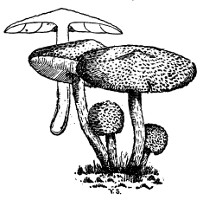
Inocybe lanuginosa.
One-fourth natural size.
Universal veil somewhat fibrillose, concrete with the cuticle of the
pileus, often free at the margin, in
the form of a cortina. Gills somewhat
sinuate (but they occur also
adnate and in two species decurrent),
changing color, but not
powdered with cinnamon. Spores
often rough, but in others even,
more or less brownish-rust color.
Inocybe (with Hebeloma) corresponds
with Tricholoma. Inocybe
and Hebeloma have some
common features, but they are
really very distinct. Inocybe is
readily distinguished by the fibrillose
covering of the pileus, which
never has a distinct pellicle, by the
veil which is continuous and homogeneous with the fibrils of the pileus,
and by the rusty-brown spores. All grow on the ground. They are
(mostly) strong-smelling (commonly nauseous). None are edible.
Stevenson.
None reported as either edible or poisonous. Those I have tested
are not pleasant.
282PLUTE´OLUS Fr.
Pileus conical or bell-shaped, then expanded, rather fleshy, viscid,
margin at first straight and pressed to the stem. Gills free, rounded
behind. Stem somewhat cartilaginous, its substance different from that
of the pileus.
Growing on wood.
Spores rust or saffron color. Pluteus, the only genus having the same
structure, is separated by its salmon-colored spores.
(Plate LXXVI.)
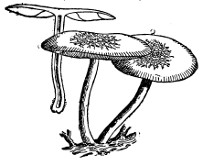
Pluteolus reticulatus.
About natural size.
P. reticula´tus Pers.—rete, a net. From the net-work of veins on
the pileus. Pileus slightly fleshy,
bell-shaped, then expanded, sticky,
reticulate with anastomosing veins,
pale violaceous, striate on the margin.
Lamellæ free, ventricose, crowded,
rusty-saffron. Stem hollow, fragile,
fibrillose, mealy at the top, white.
Spores elliptical, ferruginous, 10–13×5–6.5µ.
Pileus 1–2 in. broad. Stem 1–2
in. long, 1–2 lines thick.
Decaying wood. Cattaraugus
county. September.
The specimens which I have referred to this species appear to be a
small form with the pileus scarcely more than an inch broad and merely
wrinkled on the disk, not distinctly reticulate as in the type. In the
dried specimens the pileus has assumed a dark violaceous color. The
dimensions of the spores have been taken from the American plant. I
do not find them given by any European author. Peck, 46th Rep.
N.Y. State Bot.
In October, 1897, P. reticulatus grew in large quantities on a fallow
lot close by the University of Pennsylvania, Philadelphia. The lot was
thickly covered with tall heavy-stemmed weeds, a mat of which, from
the year before was present. The reticulations upon the cap are intricate
and distinct. I have not seen it since.
The whole plant is tender and of fine flavor.
283HEBELO´MA Fr.
Hebe, youth; loma, fringe.
Partial veil fibrillose or absent. Pileus smooth, continuous, somewhat
viscid, margin at first incurved. Flesh of stem continuous with
that of the pileus; fleshy, fibrous, clothed, top rather mealy. Gills attached,
notched at the stem, edge inclined to be pale. Spores clay-colored.
On the ground.
Closely allied to Inocybe, formerly included in Hebeloma, but differing
in the character of the cuticle of the pileus which in Inocybe is scaly
or fibrillose. Many of the species are strong in smell and taste. None
have hitherto been considered edible and some have been regarded as
poisonous.
Indusiati (
indusium, a garment). Page
283.
Furnished with a ring from the manifest veil, which often makes the
margin of the pileus superficially silky.
Denudati (
denudo, to lay bare). Page
286.
Pileus smooth. Veil absent. None known to be edible.
Pusillus (pusus, a little boy).
Pileus scarcely an inch broad. None known to be edible.
The writer has not as yet investigated the edible qualities of this
genus to his satisfaction. Much work remains to be done. But two
species of Hebeloma are given as edible. They are good, but do not
rank above second-class. Several others have been tested, but not in
sufficient quantity to report upon their quality with perfect safety. So
far as tested the species have been harmless.
Indusia´ti. With a ring, etc.
H. mus´sivum Fr.—mussivus, undecided. (Uncertain in generic
place.) Pileus 2–4 in. broad, either of one color, yellow or darker at
the disk which is like a smooth sugar-cake, fleshy, compact, firm, convex
284then plane, unequal, very obtuse, viscid, at first smooth and even,
margin bent inward, even, then commonly turning upward and broken
up into scales. Flesh thick, becoming yellow. Stem 4 in. long, commonly
1 in. thick, very fleshy, sometimes stuffed, sometimes hollow at
the top, equal or broad in the middle, wholly fibrillose and powdered at
the top, light yellow. Veil fibrillose, very evanescent. Gills emarginate,
somewhat crowded, 3 lines broad, dry (not distilling drops), at
first light yellow, then together with the spores somewhat rust-colored.
Odor weak, not unpleasant. Very distinct. It departs widely from
all the following species in its habit and bright colors. The habit is
that of a Flammula or Cortinarius, but the gills are emarginate and not
powdered; from the turned up pileus and from the stem being powdered
at the top, and from other marks it is to be referred to Hebeloma. Fries.
Spores elliptical, 12×6µ Massee.
New Jersey, Haddonfield. Under pine trees. Solitary. Frequent.
September, 1896. McIlvaine.
Not previously reported.
Taste, even raw, is pleasant. It is meaty and the meat is good. It
requires slow cooking and is best chopped fine and served in patties or
croquettes.
(Plate LXXVIa.)
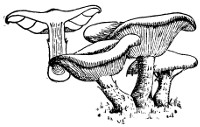
Hebeloma fastibile.
One-fourth natural size.
H. fasti´bile Fr.—fastidibilis, loathsome. From the smell. Pileus 2 in.
and more broad, pale yellowish,
tan or becoming pale, compactly
fleshy, convexo-plane, obtuse,
somewhat wavy, even, smooth, the
turned-in margin downy. Stem
2–3 in. long, ½ in. thick, solid,
wholly fleshy-fibrous, stout, somewhat
bulbous, often twisted, everywhere
white-silky and fibrillose,
white, but varying pallid, white-scaly
upward. Cortina remarkable,
white, occasionally in the form of a ring. Gills remarkably emarginate,
somewhat distant, rather broad, at first becoming pale-white,
then dingy clay-color, edge whitish, distilling drops in rainy weather.
Somewhat cespitose. Odor and taste of radish, bitterish. Like A.
285crustiliniformis; the odor is the same except that it is stronger, but it
differs conspicuously in the manifest veil and somewhat distant gills.
Var. al´ba, stem longer, equal, somewhat hollow, fibrous-scaly at the
apex, gills distant. A. spiloleucus Krombh., A. sulcatus Lindgr. is
an elegant form with the margin of the pileus sulcate or rugoso-plicate.
In mixed woods. Common. July to October. Stevenson.
Spores 11×8µ W.G.S.; elliptical, pointed, 10×8µ Morgan.
Var. elegans. Pileus purple-brown.
This sometimes appears on disused mushroom beds in large quantities,
but the method by which the spores gain access is involved in darkness.
“A very suspicious species and has the reputation of being noxious.”
Cooke.
“There is considerable external resemblance between this and A.
campestris. No fungus is so often mistaken for A. campestris as this
dangerous plant.” W.G. Smith.
This species is considered noxious abroad. No test is reported of
its qualities here.
I have not seen it.
H. glutino´sum Lind.—gluten, glue. (Plate LXXI, fig. 1, p. 268.)
Pileus about 3 in. broad, yellow-white, the disk darker, fleshy, convex
then plane, regular, obtuse, with a tenacious viscous gluten, and
slimy in wet weather, sprinkled with white superficial scales. Flesh
whitish, becoming light-yellow. Stem 3 in. long, stuffed, firm, somewhat
bulbous, white-scaly and fibrillose, and white-mealy at the top,
often rough with bundles of hairs at the base, at length rust-color within.
Partial thread-like veil manifest, in the form of a cortina. Gills
sinuato-adnate, somewhat decurrent, crowded, broad, pallid then light-yellowish,
at length clay-cinnamon. Odor peculiar, mild.
On branches and among leaves, oak and beech. Frequent. September
to December. Stevenson.
Spores 5×4µ W.P.; plum-shaped, 7µ Q.; elliptical, 10–12×5µ Massee;
ellipsoid, 6–7×3–4µ K.
New York. Among fallen leaves and half-buried decaying wood, in
thin woods. Conklingville. September. In wet weather the gluten
is sufficiently copious to drop from the pileus. Peck, Rep. 40.
Haddonfield, N.J., among leaves in mixed woods. Frequent. 1896.
286Mt. Gretna, Pa., among leaves under oaks. Frequent. September to
November. McIlvaine.
Caps 1½-3 in. across. Remarkably glutinous, shining as if varnished
when wet. Partial veil not always noticeable.
The odor and taste are pleasant. The caps when well cooked are
meaty, good, but of second quality.
Denuda´ti. Pileus smooth, etc.
H. crustulinifor´me Bull.—crustulum, a small pie; forma, form.
Pileus pale-whitish tan, most frequently pale-yellowish or brick-color at
the disk, fleshy, convexo-plane, obtuse or slightly gibbous with an obtuse
umbo, somewhat spreading with an uneven margin, even, smooth,
at first slightly viscid, not zoned. Flesh transparent when moist. Stem
stuffed then hollow, stout, somewhat bulbous, white, naked, white-scaly
at the top. Gills rounded-adnexed, crowded, narrowed, 1 line broad
and linear, thin, whitish then clay-color, at length date-brown, the unequal
edge distilling watery drops in wet weather, spotted when dry.
Veil quite wanting. Odor strong, fetid, of radish. Very variable
in stature; the stem, however, is never elongated as in A. elatus, etc.;
in smaller specimens equal, pileus regular, gills almost adnate.
In mixed woods. Common. August to November. Stevenson.
Spores ellipsoid, 10–12×5–7µ K.; 9×5µ W.G.S.
Var. mi´nor Cke. Smaller than the type.
Minnesota, common in woods, Johnson; California, H. and M.; Wisconsin,
Bundy; New Jersey, Ellis; Vermont, Burt (Lloyd); New York,
Peck, 41st Rep.; Mt. Gretna, Pa., November, 1898. In woods. McIlvaine.
But one specimen found and that was sent to Professor Peck. Taste
bitter.
Regarded as poisonous by European writers. It is not reported as
tested in America.
287FLAM´MULA Fr.
Flamma, a flame.
(In reference to the bright colors of many of the species.)
Pileus fleshy, margin at first turned inward. Veil fibrillose or none.
Stem fleshy-fibrous, not mealy at the top. Gills decurrent or attached
without a tooth. Spores mostly pure rust color; some brownish-rust,
others tawny-ochraceous.
A few species grow on the ground, the majority on wood.
Gymnoti (naked). Page
288.
Pileus dry, generally scaly. Spores not yellowish.
Lubrici (
lubricus, slimy). Page
289.
Pileus covered with a continuous, viscid, smooth, partly separable
cuticle. Veil fibrillose. Spores not yellowish. Gregarious, on the
ground, rarely on wood. Distinguished from Hebeloma by the gills not
being sinuate and the top of the stem not mealy.
Udi (
udus, moist). Page
290.
Veil slight, generally hanging in fragments. Cuticle of the pileus
continuous, not separable, smooth, in places superficially downy, moist
or slightly viscid in rainy weather. Spores not yellowish. Cespitose,
growing on wood.
Sapinei (
sapinus, pine). Page
291.
Veil silky, very slight, adpressed to the stem or forming a silky ring
on it. Cuticle of pileus thin, the flesh splitting at the surface into
scales, not viscid. Distinguished by the gills and spores being light
yellow or tawny. Somewhat cespitose; always on pine or on the ground
among pine branches.
Sericelli (sericeus, silky).
Cuticle of the pileus slightly silky, dry or at the first viscid.
None known to be edible.
288The genus Flammula is not represented in our territory by a large
number of species. It is, nevertheless, not very sharply distinct from
the allied genera, Pholiota, Hebeloma and Naucoria. From Pholiota
it is especially separated by the slight development of the veil which is
merely fibrillose or entirely wanting. It never forms a persistent membranous
collar on the stem. From Hebeloma it may be distinguished
by the absence of a sinus at or near the inner extremity of the gills, by
the absence of white particles or mealiness from the upper part of the
stem and by the brighter or more distinctly rusty or ochraceous color of
the spores. From Naucoria the fleshy or fibrously fleshy stem affords
the most available distinguishing character. The genus belongs to the
Ochrosporæ or ochraceous-spored series, but the spores of its species
vary in color from ochraceous or tawny-ochraceous to rust-color or
brownish-rust color. The three things to be especially kept in mind in
order to recognize the species are the color of the spores, the adnate
or decurrent but not clearly sinuate gills and the fleshy or fibrously
fleshy stem without a membranous ring.
Our species are mostly of medium size, none being very small and
one only meriting the appellation large. They appear chiefly in late
summer or in autumn and grow in woods or in wooded regions either
on the ground or more often on decaying wood. Many are gregarious
or cespitose in their mode of growth. Some have a bitterish or unpleasant
flavor and none of our species has yet been classed as edible. Fries
arranged the species in five groups, of which the names and more
prominent characters are here given. Peck, 50th Rep. N.Y. State Bot.
The few species which the writer has found to be edible, and the two
new species found by him, were tested after the publication of the above.
Several of the species found are not mentioned herein for the reason that
a sufficient quantity was not obtained to make certain their quality as a
food. The bitterness, as far as observed, with which most of the species
are tainted disappears in cooking.
Gymno´ti. Veil absent, pileus dry, etc.
F. alie´na Pk. Pileus thin, flexible, broadly convex, umbilicate,
dry, bare, slightly striate on the margin when old, grayish or pale
grayish-brown. Flesh white, fibrous. Gills thin, subdistant, bow-shaped,
decurrent, ochraceous-brown. Stem firm, fibrous-striate, solid,
289slightly tapering upward, colored like the pileus, covered at the base
with a dense white tomentum. Spores rusty-brown, globose, 5µ broad.
Pileus 3–5 cm. broad. Stem 5 cm. long, 4–6 mm. thick.
Gregarious on partly burned anthracite coal, Mt. Gretna, Pa. September.
C. McIlvaine.
The species is peculiar in its color and habitat. In the dried specimen
the gills have assumed a brown color with no ochraceous tint.
Mr. McIlvaine remarks that it is an edible species, dries well, and is
excellent when cooked. Its relationship is with F. anomala Pk., but it
is a larger plant with darker color and a different habitat. Peck, Bull.
Torr. Bot. Club, Vol. 26, F. 1899.
It grows on partly burned anthracite coal, not buried, as printed in
the Torrey Bulletin. The mycelium completely involves the pieces of
coal, holding them tightly in its meshes. Patches of it were strictly
limited to the size of the ash-pile containing the partly burned coal.
Quite fifty were found.
As stated, it is edible, and it is of remarkably fine substance for a
Flammula.
Lu´brici. Pileus viscid, etc.
F. edu´lis Pk.—eatable. Pileus fleshy, convex, obtuse, glabrous,
moist, brown, grayish-brown or yellowish-brown, sometimes rimose.
Flesh whitish. Lamellæ rather broad, close, decurrent, bright tan
color, becoming brownish-rusty. Stems cespitose, equal, stuffed or hollow,
brown. Spores subelliptical, 13×5–6µ.
Pileus 2–3 in. broad. Stem 2–3 in. long, 3–6 lines thick.
Grassy ground, along pavements, in gutters and by the side of wooden
frames of hotbeds. Haddonfield, N.J. October. C. McIlvaine.
The collector of this species informs me that the flavor of the fresh
plant is slightly bitter, but that this disappears in cooking and the fungus
furnishes a very good and tender article of food. Successive crops continued
to appear for a month. In the dried specimens the stem is
striate. Peck, Bull. Torr. Bot. Club, Vol. 24, No. 3.
This new species appears annually in the same place. I have not
found it elsewhere. It is meaty and excellent.
290Udi. Pileus smooth, not viscid; veil fragmentary, etc.
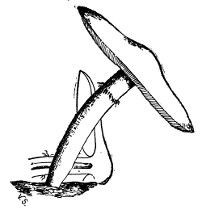
Flammula alnicola.
Two-thirds natural size.
F. alni´cola Fr.—alnus, alder; colo, to inhabit. Pileus 2–3 in.
broad, yellow, at length becoming
rust-color and sometimes
green, fleshy, convex then flattened,
obtuse, slimy when moist,
but not truly viscous, at the first
superficially fibrillose toward the
margin. Flesh not very compact,
of the same color as the
pileus. Stem 2–3 in. and more
long, ½ in. thick, stuffed then
hollow, attenuato-rooted, commonly
curved-flexuous, fibrillose,
at first yellow, then becoming
rust-color. Veil manifest, sometimes
fibrillose, sometimes woven
into a spider-web veil. Gills
somewhat adnate, broad, plane,
at first dingy-pallid or yellowish-pallid,
at length together with the plentiful spores rust-colored.
The gills vary decurrent and rounded according to situation. Odor
and taste bitter. There are two forms: a. Pileus irregular, fibrillose
round the margin; gills at first dingy-pallid. b. Salicicola, pileus somewhat
convex, smooth, rarely at the first downy-scaly; gills at first
yellowish-pallid. Fries.
Spores subelliptical, 8×5µ K.; 8–10×5–6µ Peck.
New York, swampy woods about base of alders, October, Peck,
Rep. 35; at base of alders, with adnate gills, and on birch stumps,
with the gills rounded behind, Rep. 39. Mt. Gretna, Pa., New Jersey,
mixed woods, August to November, 1898, McIlvaine.
Gregarious and in loose tufts, not plentiful. It is a pretty plant,
usually of a bright yellow, sometimes darker at the center of cap.
Traces of an evanescent fibrillose ring are occasionally found or the fibrils
adorn the margin of the cap. The gills next to the stem are either
rounded, attached or slightly decurrent.
Raw the taste is slightly bitter. This disappears in long cooking.
291F. fla´vida Schaeff. (Pers.)—flavidus, light yellow. Pileus fleshy,
thin, broadly convex or nearly plane, glabrous, moist, pale yellow.
Flesh whitish or pale yellow, taste bitter. Lamellæ moderately close,
adnate, pale or yellowish becoming rust-color. Stem equal, often more
or less curved, hollow, fibrillose, whitish or pale yellow, with a white
mycelium at the base. Spores 8×5µ.
Pileus 1–2 in. broad. Stem 1–3 in. long, 1–3 lines thick.
Decaying wood of various trees. Commonly in wooded or mountainous
districts. Summer and autumn.
Our specimens were found on wood of both coniferous and deciduous
trees. The plants are sometimes cespitose. The pileus becomes more
highly colored in drying. The spores are pale rust-colored approaching
ochraceous. In Sylloge the spores of this species are described as
pale yellowish. Peck, 50th Rep. N.Y. State Bot.
Spores broadly elliptical, 6–8×5µ Massee.
New York, decaying wood, Peck, Rep. 32, 50; Mrs. E.C. Anthony,
August. West Virginia, 1881–1885; Mt. Gretna, Pa. August to October.
McIlvaine.
F. flavida is a frequent species, gregarious and tufted on decaying
wood, either standing, fallen, or as roots in the ground. The texture
and substance are good. The slight bitter when raw disappears in
cooking. The caps, only, are tender.
Sapin´ei. Gills and spores yellowish, etc.
F. hy´brida Fr.—hybrida, a hybrid. Pileus about 2 in. broad, at
first tawny-cinnamon, then tawny-orange, fleshy, hemispherical with the
margin involute, then expanded, obtuse, regular and well formed, even,
smooth, moist. Flesh moderately compact, pallid. Stem 2–3 in. long,
4–5 lines thick, at first stuffed with a soft pith, then hollow, attenuated
(almost conico-attenuated) upward, whitish with adpressed silky-hairy
down (becoming tawny when the down is rubbed off) slightly striate,
with white hairs at the base, and somewhat mealy at the apex. Veil
manifest in the form of an annular zone at the apex of the stem, white
or at length colored with the spores. Gills adnate, somewhat crowded,
light yellow then tawny, not spotted. Fries.
Spores elliptical, tawny-ochraceous, 7–8×4–5µ Massee; 6×4µ W.P.
292Mt. Gretna, Pa., August, September, 1898. On ground under pine
trees. Gregarious. W.H. Rorer. Not elsewhere reported.
This is a handsome plant, quite prolific in the large pine groves at
Mt. Gretna, Pa. The caps are of good flavor.
F. mag´na Pk.—magnus, large. Pileus fleshy, broadly convex,
soft, dry, fibrillose and somewhat streaked, pale yellow or buff, the margin
commonly becoming revolute with age. Flesh whitish or yellowish.
Gills close, adnate or slightly decurrent, often crisped or wavy toward
the stem, about three lines wide, ochraceous. Stem equal or thickened
toward the base, fleshy-fibrous, solid, elastic, fibrillose, colored like the
pileus, brighter yellow within. Spores subelliptical, ochraceous, 10×6µ.
Cespitose. Pileus 4–6 in. broad. Stem 3–4 in. long, 8–12 lines
thick.
About the base of trees. Westchester county. October.
This is a large and showy species. The stems are sometimes united
at the base into a solid mass. The young gills are probably yellow,
but I have seen only mature specimens. Peck, 50th Rep. N.Y. State
Bot.
New Jersey, Trenton, ground in clearing, in pairs and singly. November,
E.B. Sterling; Mt. Gretna, Pa. Mixed thin woods. October
to November. Near trees. Cespitose, McIlvaine.
Individuals of all ages were found and eaten. The young gills are
very light yellow, darkening to a deep, rich yellow.
The caps are of good substance and flavor. When very young the
stems are edible.
293TUBA´RIA W.G.S.
(Plate LXXVII.)
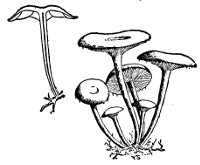
Tubaria furfuracea.
Natural size.
Stem somewhat cartilaginous,
fistulose. Pileus somewhat membranaceous,
often clothed with the
universal floccose veil. Gills somewhat
decurrent. Spores rust-color
or (in Phæoti) brownish-rust color.
The species referred to this subgenus
were taken from Naucoria
and Galera because they correspond
with Omphalia and Eccilia.
The pileus is, however, distinctly
umbilicate or depressed in only a
few of them; the others are placed
here on account of their somewhat
decurrent gills, which are broadest behind and triangular. Fries.
Small and unimportant.
294NAUCO´RIA Fr.
(Plate LXXVIII.)
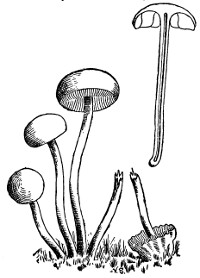
Naucoria semi-orbicularis.
Natural size.
Pileus more or less fleshy, conical or convex, then expanded, margin
at first incurved. Gills free or adnate,
not decurrent. Veil fugacious
or absent, sometimes attached
in minute flakes to the edge of the
young pileus. Stem cartilaginous,
hollow or with a spongy stuffing.
Growing on wood or on the ground,
sometimes rooted. Spores various
shades of brown, dull or bright.
Naucoria corresponds with Collybia,
Leptonia and Psilocybe; from
the latter it is distinguished by the
spore colors and from Galera in the
brown-spored series by the margin
of the pileus being at first incurved.
“The spores are rust-color, or
brownish rust-color. The color of
the pileus is some shade of yellow.
The stem is not distinctly ringed,
but sometimes a slight spore-stained
band marks the place of the obsolete
ring.” Peck, 23d Rep. N.Y. State Bot.
The members of this genus are with two or three exceptions very
common, and common over the land. The greater number grow on
the ground among grass; a few grow upon decaying wood. The stems
are not of the same texture as the cap and frequently will not cook
tender. The caps, however, are, of all species tested, tender and of
good flavor. Species of the genus are among the first to appear in spring,
and well reward the enterprising mycophagist for his early tramps.
Gymnoti (
Gr—naked). Page
295.
Pileus smooth. Veil absent. Spores rust-color, not becoming dusky-rust-color.
295Phæoti (
Gr—dusky). Page
296.
Pileus smooth. Gills and spores dusky rust-color. Veil rarely manifest.
Lepidoti (lepis, a scale).
Pileus flocculose or squamulose. Veil manifest.
None known to be edible.
I.—Gymno´ti.
N. hama´dryas Fr.—Gr, a nymph attached to her tree. Pileus
1½-2 in. broad, bay-brown-ferruginous when young and moist, pale
yellowish when old and becoming pale, slightly fleshy, convex then expanded,
gibbous, even, smooth. Stem 2–3 in. long, 3 lines thick,
somewhat fragile, hollow, equal, naked, smooth, pallid. Gills attenuato-adnexed,
somewhat free, slightly ventricose, almost 2 lines broad,
crowded, rust-color, opaque. Veil none. Widely removed from neighboring
species. Pileus somewhat separate as in Plutei. Fries.
Spores elliptical, rust-color, 13–14×7µ Massee.
Haddonfield, N.J. Frequent. Solitary. On ground along pavements,
under trees, in woods. Spring to autumn. McIlvaine.
Massee gives it as hygrophanous. I have not found it so. It is
moist after rain and dew.
The caps and upper part of the stem are tender, easily cooked and of
good flavor.
N. cero´des Fr. Gr—wax. Pileus ½-1 in. broad, watery cinnamon
when moist, tan-color when dry, somewhat membranaceous, convex
bell-shape and flattened, at length depressed, obtuse, when moist
smooth, pellucid-striate at the circumference, when dry even, slightly
silky-atomate. Stem 2–3 in. long, 1–2 lines thick, slightly firm, tubed,
equal, somewhat flexuous, fibrilloso-striate under a lens, becoming dingy
bay-brown sometimes for the most part, sometimes only at the base,
pallid upward, mealy at the apex. Gills adnate, separating, very broad
behind, hence almost triangular, somewhat distant, broad, plane, soft,
distinct, pallid then cinnamon very finely fimbriated at the edge under
a lens. Fries.
The typical form, growing among damp mosses, is quite early, gregarious,
with the colors almost those of Galera hypnorum, but otherwise
296very different. b. Another form occurs on naked, commonly burnt
soil, in late autumn, with almost the habit of N. pediades, but with a
different color of gills and spores; this form is firmer. Stem 1 in. long,
tense and straight, and color more ochraceous. Stevenson.
Spores 9µ B. and Br.; smooth, 6×3µ Massee.
West Virginia, New Jersey, Pennsylvania, in grass and moss, along
damp wood margins. August to October. McIlvaine.
N. cerodes is not plentiful where I have found it. Enough has been
collected at a time to prove it esculent. It is tender, but has not much
flavor.
N. stri´apes Cke.—stria, a line;
pes, a foot. Pileus 1–1½ in. broad,
ochraceous, bell-shaped, obtuse, then
expanded, smooth, even. Stem 2–3
in. long, 2 lines thick, hollow, equal,
erect or flexuous, white, longitudinally
striate. Gills slightly adnate behind,
rather distant, tawny rust-color.
Cespitose or gregarious. Among
grass on lawn. Stevenson.
Spores narrowly elliptical, 10–12×4µ
Massee.
New Jersey, Trenton. Growing
among leaves near dump. May to
November. E.B. Sterling.
The few specimens tested were delicate
and of slight flavor.
II.—Phæ´oti.
N. pedi´ades Fr.—Gr, a plain. Pileus 1–2 in. broad, yellow or
pale yellowish-ochraceous then becoming pale, slightly fleshy, convex
then plane, obtuse, even, dry, smooth, at length crookedly cracked, but
always without striæ. Flesh white. Stem 2–3 in. long, 1–2 lines
thick, stuffed with a pith, somewhat flexuous, tough, equal, but with a
small bulb at the base, slightly silky becoming even, yellowish. Gills
adnexed, 2 lines broad, at first crowded, at length somewhat distant,
somewhat dingy-brown, then dingy cinnamon.
297Spores brownish-rust-color. The small bulb at the base is formed by
the mycelium being rolled together. Stature variable. Fries.
Spores dingy rust-color, elliptical, 10–12×4–5µ Massee.
West Virginia, New Jersey, Pennsylvania, in grassy places, pastures
and along pavements. Common. May to November. McIlvaine.
In 1897 Fairmount Park, Philadelphia, abounded with N. pediades,
which were collected and eaten by many. The caps are tender and of
a mushroom flavor.
N. semi-orbicula´ris Bull.—semi, half; orbicularis, round. (Plate
LXXVIII, p. 294.) Pileus 1–2 in. broad, tawny rust-color then ochraceous,
slightly fleshy, convexo-expanded, obtuse, dry, even, smooth,
corrugated when dry. Stem 3–4 in. long, scarcely beyond 1 line thick,
cartilaginous, tough, slender, tense and straight, equal, even, smooth,
becoming pallid rust-color, shining, often darker at the base, internally
containing a separate narrow tube which is easily broken up into fibrils.
Gills adnate, rarely sinuate behind, almost 3 lines broad, and many
times broader than the flesh of the pileus, crowded, pallid then rust-color.
The pileus is slightly viscid when fresh and moist. Easily distinguished
from S. semi-globatus, with which it has been confounded, by
the stem. Stevenson.
Spores 14×8µ W.G.S.; 10×5–6µ Massee.
Allied to N. pediades, distinguished by its viscid cap when moist,
and dark stem.
Common over the states. Washington, D.C., Mrs. Mary Fuller.
West Virginia, Pennsylvania, North Carolina, New Jersey. Solitary,
sometimes cespitose, very common on lawns, rich pastures, etc. April
until frost. McIlvaine.
This is one of our first appearing toadstools, coming up when the
grass shows its full spring hue. It is found after rains until the coming
of frost. Its hemispherical caps, precise, neat, dark gills and brown
spores readily distinguish it. While usually small, patience and picking
will soon gather quarts. The caps cook easily and are of excellent
flavor.
N. platysper´ma Pk.—platys, broad; sperma, seed. Pileus convex,
becoming nearly plane, glabrous, slightly tinged with ochraceous or reddish-yellow
when young, soon whitish, the margin at first adorned with
298vestiges of a white flocculent veil. Flesh white. Lamellæ moderately
close, slightly rounded behind, pallid, becoming brownish. Stem
equal, stuffed with a white pith, slightly flocculent or furfuraceous above
when young, whitish, the mycelium sometimes forming white thread-like
strands. Spores broadly elliptical, 15µ long, 12.5µ broad.
Pileus 1–1.5 in. broad. Stem 3–5.5 in. long, 1.5–2 in. thick.
On the ground. Compton, Cal. Prof. A.J. McClatchie.
This species differs from N. pediades and N. semi-orbicularis, to which
it is related, by its larger, broader spores and paler color. Peck, Bull.
Torr. Bot. Club, Vol. 25, No. 6.
This new species reported from California is so closely allied to N.
semi-orbicularis and N. pediades, both of which are edible, that it is
here given, that it may be recognized by students on the Pacific coast
or wherever it occurs.
299GALE´RA Fr.
Pileus more or less membranaceous, conical or oval, then expanded,
striate, margin at the first straight, then adpressed to the stem. Gills
not decurrent. Stem somewhat cartilaginous, continuous with the
pileus, but differing in texture, tubular. Veil none or fibrillose. Spores
tawny-ochraceous.
Slender, fragile, generally growing on the ground.
Galera corresponds with Mycena, Nolanea, Psathyra and Psathyrella,
which are distinguished by their spore colors. In the brown-spored
series Naucoria is separated by the margin of the pileus being at first
incurved, and Tubaria by the decurrent gills.
The genus is composed of small species, but many grow in clusters,
and are of a consistency which decreases but little in quick cooking.
Those tested are delicate in texture and flavor.
G. lateri´tia Fr.—later, a brick. Pileus 1 in. high, pale yellowish
when moist, ochraceous when dry, hygrophanous, membranaceous,
acorn-shaped then bell-shaped, obtuse, even, smooth, slightly and densely
striate at the margin when moist. Stem 3 in. and more long, 1 line
thick, tubular, attenuated upward, tense and straight, even, but white-pruinose,
whitish. Gills adnexed in the top of the cone, hence appearing
as if free, ascending, very narrow, crowded, cinnamon.
Gills almost adpressed to the stem, almost pendulous. Remarkably
analogous with A. ovalis, but easily distinguished by the linear gills
and the absence of a veil; very fragile. Fries.
Spores 11×5µ W.P.; 11–12×5–6µ Massee.
West Virginia, New Jersey, North Carolina, Pennsylvania. On dung
and rich pastures. June to frost. McIlvaine.
The narrow conical cap, distinctly striate, distinguishes this species
from G. tenera. In quality there is no difference. It is a well-flavored,
delicate species.
300
(Plate LXXIX.)
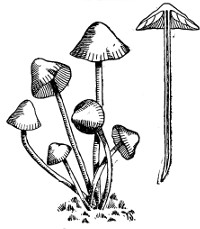
Galera tenera.
Two-thirds natural size.
G. te´nera Schaeff.—tener, tender. Pileus ½ in. and more high,
of one color, pallid rust-color when
damp, becoming pale when dry, hygrophanous,
somewhat membranaceous,
conico-bell-shaped, commonly
smooth, slightly striate when moist,
wholly even when dry, opaque, somewhat
atomate. Stem commonly 3–4
in. long, 1 line thick, tubular, fragile,
equal or when larger thickened downward,
tense and straight, somewhat
shining, striate upward, of the same
color as the pileus when moist, and
like it becoming pale when dry. Gills
adnate in the top of the cone, appearing
as if free, ascending, somewhat
crowded, linear, cinnamon.
Pastures and grassy places in
woods. Common. May to November. Stevenson.
Spores ellipsoid, 14–21×8–12µ K.; 14–8µ W.G.S.; 14×7µ W.P.;
12–13×7µ Massee; elliptical, dark rust-color, almost rubiginous, 13–16.5×8–10µ
Peck.
Var. pilosella (Agaricus pilosellus Pers.), has both pileus and stem
clothed with a minute erect pubescence when moist. A form is sometimes
found in which the center of the pileus is brown or blackish-brown.
Peck, 46th Rep. N.Y. State Bot.
Var. obscu´rior Pk. A notable form of this species was found growing
in an old stable of an abandoned lumber camp. The plants were
large, the pileus in some being more than an inch broad, the stems
were 3–6 in. long and the color was rust-colored as in G. ovalis, to
which the plants might be referred but for the large spores. Essex
county. July. I have labeled the specimens variety obscurior. Peck,
50th Rep.
Haddonfield, N.J.; Chester county; West Philadelphia, Pa.; West
Virginia. In rich pastures, on lawns, dung in woods. Common. June
to October. McIlvaine.
Very variable in size and in color when wet and dry. The color of
gills and spores readily distinguishes it in its habitats. From spring to
301frost it can usually be gathered in quantity. It is small, tender, shrivels
in cooking, but makes a savory, excellent dish.
Var. obscurior found cespitose on very old manure at a ruined stable,
Mt. Gretna, Pa., August. McIlvaine.
G. fla´va Pk.—flavus, yellow. Pileus membranous, ovate or bell
shaped, moist or subhygrophanous, obtuse, plicate striate on the margin,
yellow. Lamellæ thin, narrow, crowded, adnate, at first whitish,
then yellowish-cinnamon. Stem equal or slightly tapering upward, hollow,
slightly striate at the top, sprinkled with white mealy particles,
white or yellowish. Spores ovate or subelliptical, brownish-rust-color,
13×8µ.
Pileus 6–12 lines broad. Stem 2–3 in. long, 1–1.5 lines thick.
Damp vegetable mold in woods. Tompkins county. July.
This species is well marked by the pale-yellow color of the pileus and
its plicate striations which are very distinct even in the dried specimens.
They extend half way to the disk or more. When dry the pileus is seen
to be sprinkled with shining atoms as in some other species of the same
genus. Occasionally the yellow cuticle cracks into squamules or small
scales. Peck, 46th Rep.
Trenton, N.J., Sterling; Haddonfield, N.J.; Pennsylvania. Among
chips in woods and on woods ground. McIlvaine.
This species is frequent, and when plentiful well worth gathering. It
has a more woody flavor than other Galera, but is tasty.
G. vittæfor´mis Fr.—vitta, a chaplet; forma, form. Pileus ½-1 in.
broad, date-brown when moist, membranaceous, conical then hemispherical,
obtuse, even at the disk, striate toward the margin, smooth.
Stem 1½-3 in. long, ½-1 line thick, tubular, equal, somewhat straight,
but not tense and straight, smooth or sometimes pubescent, slightly
striate under a lens, opaque, rust-color. Veil scarcely conspicuous.
Gills adnate, broader at the middle, in the form of a segment when
larger, somewhat ascending, somewhat distant, at first watery-cinnamon,
at length rust-color. Fries.
Spores elliptical, 12×6µ Massee.
Haddonfield, N.J.; Mt. Gretna, Pa. On pastures, lawns, etc. June
to September. McIlvaine.
Not previously reported.
302Though small it makes up in quantity when found. The stems are
not as tender as the caps. Quality good.
BOLBITIUS Fr.
Pileus membranaceous. Gills adnexed or free, membranaceous, soft,
salmon-color or rusty, dissolving (not dripping as in Coprinus), powdered
with the rusty spores. Stem central; universal veil absent,
partial veil often obsolete.
Very delicate and fragile, remarkable among the Ochrosporæ for the
gills dissolving into mucus, and in this respect analogous with Coprinus
among the Melanosporæ, and Hiatula amongst the Leucosporæ. Growing
on dung or amongst grass where dung abounds.
A small but very natural genus, with the vegetative portion like
Coprinus and the fructification resembling Cortinarius, hence occupying
an intermediate position between these two genera. Fries.
B. Bol´toni Fr.—after Bolton. Pileus rather fleshy, viscid, at first
even, then with the membranaceous margin sulcate, disk darker, subdepressed.
Stem attenuated, yellowish, at first floccose from the remains
of the fugacious veil. Gills subadnate, yellow then livid-brown. Fries.
Haddonfield, N.J., cespitose among manure on sawdust.
Of small substance but good consistency and flavor.
303
(Plate LXXX.)
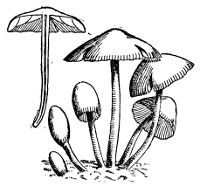
Bolbitius fragilis.
Two-thirds natural size.
B. fra´gilis Fr. Pileus 2 in. broad, light yellow, then becoming
pale, somewhat membranaceous,
almost pellucid, conical then expanded,
somewhat umbonate,
smooth, viscous, striate round the
margin (which is often crenulated).
Stem 3 in. long, 1 line or little
more thick, fistulose, attenuated upward,
naked, smooth (and without
a manifest veil), yellow. Gills attenuato-adnexed,
almost free, ventricose,
yellow then pale cinnamon.
Spores rust-colored. Fries.
Thinner than B. Boltoni, etc., very
fragile, rapidly withering.
On dung. Common. June to October.
Stevenson.
Spores subspheroid-ellipsoid, elliptical,
7×3–5µ Massee.
West Virginia; Pennsylvania. June
to frost. On rich grass and dung.
Pileus usually not over 1.5 in.
across. Often in plenty. Its substance
does not cook away as with C. micaceus.
It amply repays gathering,
being highly flavored.
(Plate LXXXa.)
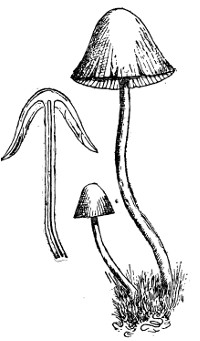
Bolbitius nobilis.
About two-thirds natural size.
B. no´bilis Pk.—noble. Pileus
thin, fleshy on the disk, ovate then
bell-shaped, smooth, plicate-striate,
pale-yellow, the disk tinged with red,
the margin at length recurved and
splitting. Gills subdistant, tapering
outwardly, attached, the alternate ones
304more narrow, pale-yellow with a darker edge. Stem long, equal, smooth,
striate at the top, hollow, white.
Plant cespitose, 3–5 in. high. Pileus 1 in. broad. Stem 1 line thick.
Ground in woods. Greig. September.
A fine large species, but probably rare. Peck, 24th Rep. N.Y.
State Bot.
I have not seen this species. Figure after Professor Peck.
CREPIDO´TUS Fr.
(Plate LXXXI.)
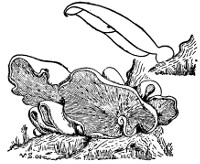
Crepidotus mollis.
Natural size.
Veil wanting or not manifest. Pileus eccentric, lateral or resupinate.
Spores rust-color.
The Crepidoti correspond in shape
and habit to the smaller Pleuroti and
the Claudopodes, but they are distinguished
from both by the rust-color
of their spores. These are globose
in several species, in others they are
elliptical. In some there is a depression
on one side which gives them a
naviculoid character and causes the
spore to appear slightly curved when
viewed in a certain position. In consequence
of the similarity of several
of our species, the character of the spores is of much importance in
their identification, and it is unfortunate that European mycologists
have so generally neglected to give the spore characters in their
descriptions of these fungi. In most of the species the pileus is at first
resupinate, but it generally becomes reflexed as it enlarges. It is generally
sessile or attached by a mass of white fibrils or tomentum. For
this reason it is usually somewhat tomentose or villose about the point
of attachment, even in species that are otherwise glabrous. In several
species the pileus is moist or hygrophanous and then the thin margin is
commonly striatulate. This character is attributed to but one of the
305dozen or more European species. Their mode of growth is usually
gregarious or somewhat loosely imbricated, in consequence of which
the pileus, which in most species is white or yellowish, is often stained
by the spores, and then it has a rusty, stained or squalid appearance.
The species occur especially on old stumps, prostrate trunks and soft
much decayed wood in damp, shaded places. Peck, 39th Rep. N.Y.
State Bot.
C. ful´vo-tomento´sus Pk.—tawny-tomentose. Pileus ¾-2 in.
broad, scattered or gregarious, suborbicular, kidney-shaped or dimidiate,
sessile or attached by a short, white-villose tubercle or rudimentary
stem, hygrophanous, watery-brown and sometimes striatulate on the
margin when moist, whitish, yellowish or pale ochraceous when dry,
adorned with small, tawny, hairy or tomentose scales. Lamellæ broad,
subventricose, moderately close, rounded behind, radiating from a lateral
or eccentric white villose spot, whitish becoming brownish-ferruginous.
Spores elliptical often uninucleate, 8–10×5–6µ.
Decaying wood of poplar, maple, etc. Common. June to October.
A pretty species, corresponding in some respects to the European C.
calolepis, but much larger and with tawny, instead of reddish scales.
The cuticle is separable and is tenacious, though it has a hyaline gelatinous
appearance. The pileus is subpersistent, and specimens dried in
their place of growth are not rare. Peck, 39th Rep. N.Y. State Bot.
Haddonfield, N.J.; Angora, West Philadelphia. On decaying
hickory. McIlvaine.
Substance fair. Taste strong but pleasant.
306
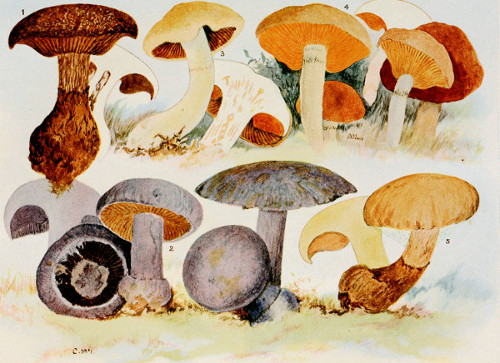
Grouped by F.D. Briscoe—Studies by C. McIlvaine. Plate LXXXII.
| Fig. |
Page. |
Fig. |
Page. |
| 1. Cortinarius squamulosus, |
318 |
4. Cortinarius turmalis, |
309 |
| 2. Cortinarius violaceus, |
314 |
5. Cortinarius armillatus, |
323 |
| 3. Cortinarius ochraceus, |
319 |
|
|
CORTINA´RIUS Fr.
Cortina, a veil or curtain.
Veil resembling the consistency of a cob-web, superficial, distinct
from the cuticle of the pileus. Flesh of pileus and stem continuous.
Gills persistent, dry, changing color, powdered with the spores. Trama
fibrillose. Spores globose or oblong, somewhat ochraceous on white
paper. Fries.
This genus is not easily confounded with any other, the cob-webby
veil stretched from stem to pileus in the young plant not being found in
other fungi. This must be looked for only in youth, as from its tender
character it soon breaks and often appears only as a very indistinct
collar on the stem, colored from catching the falling spores. The colors
are generally pronounced and often extremely bright, there being very
few prettier toadstools than those inclined to the blue or purple shades,
which are not uncommon in the immature form. The color of the
spores is also a marked feature, being rusty or brownish-ochraceous,
turning the gills to the same color at maturity. On account of this
change it is generally necessary to have specimens at both stages of
growth to accurately determine the species. The gills are thin, attached
to the stem in various manners, rarely slightly decurrent.
Cortinarius is distinguished from Flammula by growing on the ground
and by the bright ferruginous color of its spores.
Cortinarius is a sturdy, hardy genus preferring northern latitudes and
autumnal months, though several of its species grow as far south as Alabama,
and one, a new species described by Professor Peck, is found on
the Helderberg mountains in May. The genus contains many species,
most of which produce in great numbers, yet being woods-growing, and
coming as they do when leaves are falling, they are often missed because
of their similarity to their surroundings.
Heretofore, less than a dozen species have been reported as eaten.
This number is now doubled. While several species are bitter and others
equally unpleasant, not one has been accused of harm. It is highly
probable that other varieties than those herein given will prove equally
acceptable as food. I have tested all I have found in sufficient quantity
to warrant passing judgment upon them.
The genus does not contain as many species of superior excellence as
other fleshy genera of like numbers. The flesh is frequently dry and of
307a strong woody or musky flavor, which it does not lose in cooking. The
stems are seldom cookable. All can be fried in butter, but cut in small
pieces and well stewed, or stewed and served in patties, or made into
croquettes are certain ways of keeping them in palate memory.
Phlegmacium (
Gr—shiny or clammy moisture). Page
308.
Pileus viscid. Stem firm, dry. Veil partial, cobweb-like.
A. Cliduchii (
Gr—holding the keys—the typical subdivision). Page
308.
Partial veil as a ring on the upper part of the stem which is equal or
slightly expanded above. Not distinctly bulbous.
* Gills pallid then clay-colored.
** Gills purplish then clay-colored.
B. Scauri (
Gr—club-footed). Page
310.
Bulbous. Bulb depressed or top-shaped, with a distinct margin
caused by the pressure of the pileus before expansion. Veil generally
ascending from the margin of the bulb. Gills somewhat sinuate.
* Gills whitish then cinnamon.
** Gills blue then cinnamon.
*** Gills brownish-white then cinnamon.
Myxacium (
Gr—mucus). Page
313.
Universal veil glutinous. Pileus and stem viscid. Stem slightly
bulbous. Gills adnate.
Inoloma (
Gr—a fibrous fringe). Page
314.
Pileus dry, not hygrophanous or viscid, covered at first with innate
silky scales or fibrils, becoming smooth. Veil simple. Pileus and stem
fleshy, rather bulbous.
* Gills violaceous, then cinnamon.
** Gills pinkish-brown, then cinnamon.
*** Gills yellow, then cinnamon.
Pileus thin, equally fleshy, at first silky with a fine down, becoming
smooth when adult. Not hygrophanous, but flesh watery when moist
or colored. Stem equal or larger above, externally rigid, elastic or
brittle, internally stuffed or hollow. Veil single, thread-like.
Pileus moist, hygrophanous, at first smooth or sprinkled with the
whitish superficial evanescent fibrils of the veil. Flesh thin, or when
thick it becomes abruptly thin toward the margin, scissile. Stem ringed
below or coated from the universal veil, slightly veiled at the apex,
hence with almost a double veil.
Pileus hygrophanous, smooth or covered with superficial white fibrils,
not viscid, moist when fresh, becoming discolored when dry. Flesh
very thin or scissile, rarely more compact at the center. Stem rather
rigid, bare. Veil thin, rarely collapsing and forming an irregular ring
on the stem.
Phlegma´cium. (Gr—clammy moisture.)
A. Cliduchii.
*
Gills pallid, then clay-colored.
C. seba´ceus Fr.—sebum, tallow. Pileus 2½-5 in. broad, unicolorous,
pale, of the color of tallow, equally fleshy, convex then rather
plane, commonly very repand, viscid, smooth, but at the first covered
over with a whitish pruinose luster. Flesh white. Stem 3–4 in. long,
½-1 in. thick, solid, stout, compact, never bulbous, often twisted and
compressed, slightly fibrillose, pale white. Cortina delicate, fugacious,
adhering only to the margin of the pileus. Gills emarginate, not
crowded, connected by veins, 4 lines broad, clay-color or pallid-cinnamon,
paler at the sides. Fries.
The flesh of the pileus is not compact at the disk and abruptly thin
at the circumference, but equally attenuated toward the margin. The
flesh of the stem is white. The gills never turn bluish-gray. Taste
mild. Stevenson.
309Spores pip-shaped, 9×7µ Cooke.
A very common and prolific species in West Virginia, New Jersey,
Pennsylvania, North Carolina. McIlvaine.
Pushing from the earth in great clusters it raises the mat of leaves
above it into hut-like mounds through which it seldom bursts. Yet side
openings to its huts show its coziness, and reveal the ground thickly
dusted with its spores. Detecting these mounds is part of the woodcraft
of a toad-stool hunter.
Where clusters are not dense, or the fungus is solitary, the stem is
frequently swollen at the base, even bulbous.
Both caps and stems are edible, but the stems are not equal to the
caps. It is a valuable food species, because of its lateness and quantity.
It is not of best quality.
C. tur´malis Fr.—turma, a troop. (Plate LXXXII, fig. 4, p. 306.)
Pileus yellow-tan, most frequently darker at the disk, not changeable,
compact, convex then plane, very obtuse, even, smooth (sometimes
obsoletely piloso-virgate), when young veiled with pruinate but very
fugacious villous down, soon naked, viscid. Flesh white. Stem sometimes
3 in., sometimes 6 in. long, 1 in. thick, solid, very hard, rigid,
cylindrical, here and there attenuated at the base, shining white when
dry, when young sheathed with a white woolly veil, naked when full
grown. Cortina entirely fibrillose, superior and persistent in the form
of a ring, at length ferruginous with the spores. Gills variously adnexed,
rounded or emarginate, even decurrent with a tooth, crowded, serrated,
white then clay-color. Fries.
I find it edible and of great value, being plentiful in pine woods,
Maryland. I have collected a bushel in less than an hour in October.
Under pine needles forming mounds. Taylor.
The localities and the habit of C. turmalis are very like that of C.
sebaceus. The leaf mat broods the clusters.
C. turmalis is on a par with C. sebaceus. Personally I prefer the
latter.
**
Gills purplish, then clay-colored.
C. va´rius (Schaeff.) Fr.—varius, changeable. Pileus 2 in. and more
broad, bright ferruginous-tawny, compact, hemispherico-flattened, very
310obtuse, regular, slightly viscid, even, smooth, the thin margin at first
incurved, appendiculate with the cortina. Flesh firm, white. Stem
curt, 1½-2½ in. long, 1 in. and more thick, bulbous, absolutely immarginate,
compact, shining white, adpressedly flocculose, the superior
veil pendulous. Gills emarginate, thin, somewhat crowded, at first
narrow, violaceous-purplish, then broader and ochraceous-cinnamon,
always quite entire.
Variable in stature, but the habit and colors are always unchangeable.
It varies with the stem taller and somewhat equal, the pileus yellow-tawny,
and the gills dark blue. Fries.
In woods. Uncommon. September to November. Stevenson.
Minnesota; Ohio.
Edible. Cooke, 1891.
B. Scau´ri.
*
Gills whitish then cinnamon.
C. intru´sus Pk. Pileus fleshy, rather thin, convex, then expanded,
glabrous, somewhat viscid when moist, even or radiately wrinkled on
the margin, yellowish or buff, sometimes with a reddish tint. Flesh
white. Lamellæ thin, close, rounded behind, at first whitish or creamy-white,
then cinnamon, often uneven on the edge. Stem equal or slightly
tapering either upward or downward, stuffed or hollow, sometimes
beautifully striate at the top only or nearly to the base, minutely floccose
when young, soon glabrous, white. Spores broadly elliptical,
brownish-cinnamon, 6–8×4–5µ.
Pileus 1–2.5 in. broad. Stem 1–3 in. long, 3–6 lines thick.
Mushroom beds, manured soil in conservatories or in plant pots.
Boston, Mass. R.K. Macadam. Haddonfield, N.J. C. McIlvaine.
This interesting species is closely allied to Cortinarius multiformis and
belongs to the Section Phlegmacium. It has a slight odor of radishes
and is pronounced edible by Mr. McIlvaine. Its habitat is peculiar,
but it possibly finds its way into conservatories and mushroom beds
through the introduction of manure or soil, or leaf mold from the woods.
It seems strange, however, that it has not yet been detected growing in
the woods or fields. Hebeloma fastibile is said sometimes to invade
mushroom beds, and our plant resembles it in so many particulars that
it is with some hesitation I separate it. The chief differences are in
the stem and spores. The former, in Hebeloma fastibile, is described
311as solid and fibrous-squamose and the latter as 10×6 micromillimeters
in size. The brighter color of the smaller spores and the stuffed or
hollow smooth stem of our plant will separate it from this species.
Peck, Bull. of the Torrey Bot. Club, October, 1896.
Cortinarius intrusus was a happy find. Several pints of it were collected
by the author in February—usually a famine month for the
mycophagist. They grew on the ground, in beds among plants, and
with potted plants in a hot-house in Haddonfield, N.J. The crop continued
well into the spring. The species is delicate, savory, and a most
accommodating renegade from its kind. I have never found it elsewhere.
**
Gills blue, then cinnamon.
C. cærules´cens Fr. Pileus 2–3 in. across, equally fleshy, convex
then plane, obtuse, regular, even, almost glabrous, but often fibrilloso-streaked;
viscid, when dry shining or opaque, dingy yellow, almost
tan-colored, varying to yellowish-brown, etc. Gills slightly rounded
behind, adnexed, thin, closely crowded, 2 lines broad, at first clear
intense blue then becoming purplish, at length dingy cinnamon. Stem
about 2 in. long, ½ in. thick (bulb more than an inch), firm, equally
attenuated upward, at first fibrillose, bright violet, then becoming pale
and whitish, naked, bulb often disappearing with age; veil fibrillose,
fugacious. Spores elliptical, 9–10×5µ.
Amongst moss in woods, etc.
Neither the gills nor the flesh change color when broken, a point
which distinguishes the present from C. purpurascens. When young
every part is generally blue. Smell scarcely any. Fries.
Spores 10–12×5µ Cooke.
Haddonfield; West Virginia; Mt. Gretna, Pa. In woods September
to frost. McIlvaine.
The American species seldom entirely loses the bluish-purple color
of its cap. The beautiful color fades somewhat or becomes splotched
with yellow. Neither does the bulb ordinarily disappear with age. It
is common. Taste of cap is mild, somewhat woody. They require
long, slow stewing, and are better made into patties and croquettes.
C. purpuras´cens Fr.—gills becoming purple when bruised.
Pileus 4–5 in. across, fleshy, disk compact, obtuse, wavy, variable,
312covered with a dense layer of gluten, but opaque when dry, bay or reddish
then tawny-olivaceous, spotted; often depressed round the margin,
which is at first incurved then wavy, marked with a raised brown line.
Flesh entirely clear blue. Gills broadly emarginate, 3 lines and more
broad, crowded, bluish-tan, then cinnamon, violet-purple when bruised.
Stem about 3 in. long, ⅔ in. and more thick, solid, bulbous, everywhere
fibrillose, intensely pallid clear blue, very compact, juicy, becoming
purplish-blue when touched, bulb submarginate. Spores elliptical,
10–12×5–6µ Fries.
Var. subpurpuras´cens. Massachusetts. Frost.
Plentiful in West Virginia mountains in mixed woods, 1882. On
South Valley Hill, near Downington, Pa., October, 1887. Haddonfield,
N.J., 1892. In woods. September to frost. McIlvaine.
Both stems and caps are juicy when young and of agreeable flavor.
It is among the best edible species of Cortinarius.
***
Gills brownish-white, then ferruginous.
C. turbina´tus Fr.—turbo, a top. Pileus unicolorous, dingy-yellow
or green, becoming pale, hygrophanous, opaque when dry, fleshy, convex
then flattened, obtuse, at length depressed, orbicular, even, smooth,
viscid. Flesh soft, white. Stem commonly curt, 2 in., but varying
elongated, yellowish, springing from a globoso-depressed distinctly marginate
bulb, otherwise equal, cylindrical, stuffed then hollow. Gills
attenuato-adnate, thin, crowded, broad, quite entire, at first pallid light-yellowish,
at length somewhat ferruginous.
The typical form is regular, distinct from its allies in the hygrophanous
pileus, in the gills being isabelline-ferruginous and quite entire, and
in being without any dark-purple or purple color. Easily distinguished
by its turbinate bulb. Fries.
In woods. Uncommon. Stevenson.
Spores rough, 14–16×7µ; rough, Cooke.
Cap 2–4 in. across. Stem commonly about 2 in. long, sometimes
longer. Massee.
North Carolina, Schweinitz; Pennsylvania, Schweinitz; Massachusetts,
Frost; Minnesota; Nova Scotia.
Edible. Cooke.
313Myxa´cium. (Gr—mucus.)
(Plate LXXXIII.)
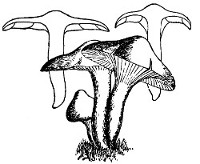
Cortinarius collinitus.
About natural size.
C. collin´itus Fr.—collino, to besmear. Pileus convex, obtuse,
glabrous, glutinous when moist, shining
when dry. Gills rather broad,
dingy-white or grayish when young.
Stem cylindrical, solid, viscid or glutinous
when moist, transversely cracking
when dry, whitish or paler than
the pileus. Spores subelliptical, 13–15µ.
The Smeared cortinarius is much
more common than the Violet cortinarius
and has a much wider range.
Both the cap and stem are covered
with a viscid substance or gluten
which makes it unpleasant to handle.
The cap varies in color from yellow
to golden or tawny-yellow and when the gluten on it has dried it is
very smooth and shining. The flesh is white or whitish. The young
gills have a peculiar bluish-white or dingy-white color which might be
called grayish or clay color, but when mature they assume the color of
the spores. They are sometimes minutely uneven on the edge.
The stem is straight, solid, cylindrical and usually paler than the cap.
When the gluten on it dries it cracks transversely, giving to the stem a
peculiar scaly appearance.
The cap is 1½-3 in. broad, and the stem 2–4 in. long, and ¼-½
in. thick.
The plant grows in thin woods, copses and partly cleared lands and
may be found from August to September.
It is well to peel the caps before cooking, since the gluten causes dirt
and rubbish to adhere tenaciously to them. Peck, 48th Rep. N.Y.
State Bot.
In 41st Rep. N.Y. State Mus. Nat. Hist., p. 71, Professor Peck describes
a closely allied species, C. muscigenus, n. sp., “separated by its
more highly-colored pileus, striate margin and even, not diffracted-squamose
stem.”
314Prof. L.B. Mendel gives the following analysis: “Young specimens
gathered in New Haven early in November, 1897, gave:
| Water |
91.13% |
| Total solids |
8.87 |
| Total nitrogen of dry substance |
3.63” |
Edible. Cooke.
In appearance the Smeared cortinarius does not appeal to be eaten.
Neither does an eel. But peeled both are inviting. Raw, the caps of
this fungus have a strong woody smell and taste. This is somewhat
subdued by cooking.
I have found the plant in West Virginia, Pennsylvania and North
Carolina, often among the leaves in mixed woods, but it prefers a goodly
supply of light and the freedom of open places. It is often gregarious,
sometimes tufted.
C. io´des B. and C. Pileus 1½-2 in., convex, at length plane,
viscid, firm, violet-purple. Flesh white, thick. Veil fugacious, spider-web.
Stem 2–3 in. long, 1½ in. thick, solid, thickened below. Gills
violet, at length cinnamon, ventricose, adnate, sub-emarginate, irregular,
sometimes forked. B. and C.
This is a small but beautiful species, the pileus, lamellæ and stem
being of a bright-violet or purplish-violet hue. The spores are subelliptical,
generally uninucleate, 10×6µ. Peck, 32d Rep. N.Y. State Bot.
The pileus in this species is sometimes spotted with white. The
bulbous white stem is adorned with lilac-colored fibrils. Peck, 35th
Rep. N.Y. State Bot.
Sparingly found among roots at Mt. Gretna, Pa., September, 1897–1898.
The caps are fairly good.
Inolo´ma. (Gr—fiber; Gr—a fringe.)
*
Gills violaceous then cinnamon.
C. viola´ceus Fr. (Plate LXXXII, fig. 2, page 306.) One of our
most plentiful and beautiful autumnal fungi. As the American plant
differs somewhat from the European, Professor Peck’s description is
given.
Pileus convex, becoming nearly plane, dry, adorned with numerous
315persistent hairy tufts or scales, dark violet. Lamellæ rather thick, distant,
rounded or deeply notched at the inner extremity, colored like the
pileus in the young plant, brownish-cinnamon in the mature plant.
Stem solid, fibrillose, bulbous, colored like the pileus. Spores subelliptical,
12.5µ long.
The Violet cortinarius is a very beautiful mushroom and one easy of
recognition. At first the whole plant is uniformly colored, but with age
the gills assume a dingy ochraceous or brownish-cinnamon hue. The
cap is generally well formed and regular and is beautifully adorned with
little hairy scales or tufts. These are rarely shown in figures of the
European plant, but they are quite noticeable in the American plant and
should not be overlooked. The flesh is more or less tinged with violet.
The gills when young are colored like the cap. They are rather
broad, notched at the inner extremity and narrowed toward the margin
of the cap. When mature they become dusted with the spores whose
color they take.
The stem also is colored like the cap. It is swollen into a bulb at
the base and sometimes a faint ochraceous band may be seen near the
top. This is due to the falling spores which lodge on the webby filaments
of the veil remaining attached to the stem.
Cap 2–4 in. broad. Stem 3–5 in. long, about ½ in. thick. Peck,
48th Rep. N.Y. State Bot.
Minerva, Essex county. A form of this species occurs here, having
the pileus merely downy or punctate-hairy under a lens, no squamules
being distinguishable by the naked eye. July. Peck, 50th Rep. N.Y.
State Bot.
Spores 12–14×10µ Cooke.
The spider web veil is exquisitely displayed in this species. This,
with its strongly bulbous base and violet tinge throughout, easily mark
it. Though usually solitary great numbers of it are found in its settlements.
The mixed woods of central New Jersey abound with it in July,
August and September. Throughout Pennsylvania and West Virginia
it is common, and is reported from several other states. In Redman’s
woods, near Haddonfield, N.J., a densely clustered form of singular
beauty occurs. A dozen individuals of various forms and sizes with
swollen stems form a compact mass, rich in color, and cutting crisp and
juicy as an apple. They are far better than other Cortinarii I have
eaten. I have not seen it elsewhere.
316C. violaceus is everywhere eaten, and is in my opinion the best of its
genus. The American plant is not inodorous, but has a decided mushroom
smell and taste.
(Plate LXXXIV.)
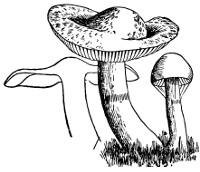
Cortinarius albo-violaceus.
One-half natural size.
C. albo-viola´ceus Pers. Pileus fleshy, rather thin, convex, then
expanded, sometimes broadly subumbonate,
smooth, silky, whitish,
tinged with lilac or pale violet.
Lamellæ generally serrulate, whitish-violet,
then cinnamon-color. Stem
equal or a little tapering upward,
solid, silky, white, stained with violet,
especially at the top, slightly bulbous,
the bulb gradually tapering into
the stipe.
Height, 3–4 in.; breadth of pileus,
2–3 in.; stipe, 3–6 lines thick.
Ground in thin woods, more frequently
under poplars. Center. October.
The stem is sometimes subannulate, and being violet above and white
below the obscure ring, it appears as if sheathed with a silky-white covering.
Inodorous. Sometimes the stem gradually tapers from the base
to the top, so that it can scarcely be called bulbous. Peck, 23d Rep.
N.Y. State Bot.
Spores 12×5–6µ Cooke; 6–9×4–5µ K.; pruniform, 10µ Q.
An allied species C. (Inoloma) lilacinus, Peck, with the stem and
bulbous part much broader than the cap, is not as common, but of far
better flavor.
Common in West Virginia, Pennsylvania, New Jersey, in mixed
woods. September to frost. McIlvaine.
A mushroom flavor develops in cooking. The consistency of the
flesh is good. It is of medium grade.
C. lilaci´nus Pk. Pileus firm, hemispherical, then convex, minutely
silky, lilac-color. Lamellæ close, lilac, then cinnamon. Stem stout,
bulbous, silky-fibrillose, solid, whitish, tinged with lilac. Spores nucleate,
10×6µ.
317Plant 4–5 in. high. Pileus 3 in. broad. Stem 4–6 lines thick.
Low mossy ground in woods. Croghan. September. This is a rare
but beautiful plant, allied to C. alboviolaceus, from which it may be
distinguished by its stouter habit, deeper color and bulbous stem. In
the young plant the bulb is much broader than the undeveloped pileus
that surmounts it. Peck, 26th Rep. N.Y. State Bot.
Massachusetts, Frost; Minnesota, Nova Scotia.
I have found a few specimens in several places: West Virginia, Redman’s
woods, Haddonfield, N.J., in which place it is more plentiful
than in any locality I have noted. Near lake at Eagle’s Mere, Pa.,
August, and at Springton, Pa. Excellent.
(Plate LXXXV.)
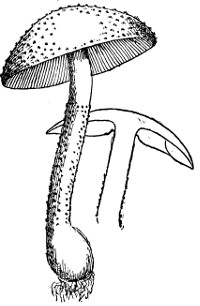
Cortinarius asper.
About two-thirds natural size.
C. as´per Pk.—rough. Pileus fleshy, firm, hemispherical, then convex,
rough with minute, erect, brown
scales, ochraceous. Gills close,
rounded behind and slightly emarginate,
dull violaceous, then pale cinnamon.
Stem equal, bulbous, solid,
fibrillose-scaly, colored like the pileus
but smooth and violaceous at the top,
the bulb white with an abundant
mycelium. Spores broadly elliptical,
with a pellucid nucleus, 8µ long.
Plant 3–4 in. high. Pileus 2–3 in.
broad. Stem 3–5 lines thick. Ground
in cleared places. Greig. September.
A fine species. The flesh of the
stem is violaceous. Peck, 24th Rep.
N.Y. State Bot.
This plant sometimes grows in tufts
or clusters and bears a very close resemblance
to Armillaria mellea, both
in color and in the character of the
scales of the pileus. Peck, 27th Rep.
In thin woods and clearings, West Virginia, New Jersey, Pennsylvania.
The whole fungus is edible when young, and ranks high in Cortinarii.
When full grown the stem is hard. Cut in thin, transverse slices it
318cooks tender, but does not equal the cap. Like most of the Cortinarii
it is found in the autumn until frost kills it.
**
Gills pinkish-brown then cinnamon.
C. squamulo´sus Pk. (Plate LXXXII, fig. 1, p. 306). Pileus
thick, fleshy, convex, densely fibrillose-squamulose,
cinnamon-brown,
the scales darker. Lamellæ not
crowded, deeply emarginate, pale
pinkish-brown, then cinnamon-colored.
Stipe thick, solid, shreddy,
subsquamulose, concolorous, swollen
at the base into a very large tapering
or subventricose bulb.
Height 4–6 in., breadth of pileus
2–4 in., stipe 6–9 lines thick at the
top, 12–18 lines at the bottom.
Borders of swamps in woods.
Sandlake. August.
Related to C. pholideus and C.
arenatus, but distinct by the deep
emargination of the lamellæ. It gives out a strong odor while drying.
The color of the flesh is pinkish-white. Peck, 23d Rep. N.Y.
This species was discovered in 1869, and had not since been observed
by the writer until the past season. It is manifestly a species of rare
occurrence. Peck, 28th Rep.
Massachusetts, Frost; Wisconsin, Minnesota. Ranges from New
England to Kentucky unchanged. Morgan.
Specimens from E.B. Sterling, Trenton, N.J., September, 1897.
Asylum grounds. Several found at Mt. Gretna, August and September,
1897. Solitary in oak woods, gravelly soil. McIlvaine. Sent to
Professor Peck and identified. Specimens were much darker than Professor
Peck’s plates.
C. squamulosus is not attractive in appearance. The caps, only, are
edible. Their consistency is very pleasant and flavor fairly good.
319
C. autumna´lis Pk. Pileus fleshy,
convex or expanded, dull rusty-yellow,
variegated or streaked with innate
rust-colored fibrils. Gills rather
broad, with a wide shallow emargination.
Stem equal, solid, firm, bulbous,
a little paler than the pileus.
Height 3–4 in., breadth of pileus
2–4 in. Stem 6 lines thick.
Pine woods. Bethlehem. November.
The plant is sometimes cespitose.
The flesh is white. Peck, 23d
Rep. N.Y. State Bot.
Mt. Gretna, Pa., 1899. McIlvaine.
Quality fair. Caps meaty.
C. ochra´ceus Pk. (Plate LXXXII, fig. 3, p. 306.) Pileus fleshy,
convex, at length broadly subumbonate or gibbous, smooth, even or
obscurely wrinkled, pale ochraceous. Stem solid, fibrillose, ochraceous
at the top, white below, gradually enlarged into a thick bulbous base.
Height 2–4 in., breadth of pileus 2–3 in. Stem 4–6 lines thick at
the top, 12–18 lines at the base.
Under balsam trees in open places. Catskill mountains. October.
The stem appears as if sheathed. In some specimens the stem is
short and rapidly tapers from the base to the top. Peck, 23d Rep.
N.Y. State Bot.
Many of the species were found by the writer in mixed woods among
leaves at Mt. Gretna, Pa., September, 1898. Specimens were identified
by Professor Peck.
The gills are bright yellow when young. Cap smooth, innately
fibrillose, not viscid. Spores light brown.
Tasteless; smell faint. Good consistency. A fair flavor develops in
cooking.
(Plate LXXXVIb.)
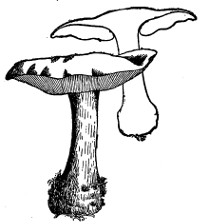
Cortinarius annulatus.
Natural size.
C. (Inoloma) annula´tus Pk. Pileus broadly convex, dry, villose-squamulose,
yellow. Flesh yellowish. Lamellæ rather broad, subdistant,
adnexed, yellow. Stem solid, bulbous, somewhat peronate by the
320yellow fibrillose annular-terminated
veil. Spores broadly elliptical or
subglobose, 8µ long.
Pileus 1–3 in. broad. Stem 1.5–3
in. long, 3–6 lines thick.
Thin woods. Whitehall. August.
The whole plant is yellow inclining
to ochraceous. It has the odor
of radishes. The squamules of the
pileus are pointed and erect on the
disk, and often darker-colored there.
The species is allied to C. tophaceus
and C. callisteus, from which it is
separated by its persistently annulate
stem and more yellow color. Peck,
43d Rep.
Specimens received from E.B.
Sterling, Trenton, N.J., September
5, 1897. Identified by Professor
Peck. Mixed woods Kingsessing,
near Bartram’s Garden, Philadelphia, September, 1897.
Solitary among grass and leaves. The permanent marking of the
veil is conspicuous. Eight specimens were found and eaten. The caps
cook tender, and have a decided but not unpleasant flavor.
Dermo´cybe. (Gr—skin; Gr—a head.)
C. cinnabari´nus Fr.—cinnabaris, dragon’s blood. Pileus 2–3 in.
broad, scarlet-red, truly fleshy, campanulate, then flattened, obtuse or
very obtusely umbonate, silky, then becoming smooth and shining, or
obsoletely scaly; the firm flesh paler. Stem 1½-2 in. long, 3–4 lines
and more thick, solid, equal, sometimes however bulbous, fibrillose or
striate, scarlet-red, reddish brick-color internally. Cortina fibrillose, lax,
cinnabar. Gills wholly adnate, somewhat decurrent, 3 lines broad, somewhat
distant, connected by veins, unequal and darker at the edge, dark
blood-color when bruised.
Odor of radish. Readily distinguished from all others by its splendid
scarlet color, and from C. sanguineus by its short solid and firm
321stem, its broad pileus and somewhat distant gills. Stem never becoming
yellow. Fries.
Spores 7–8×4µ Cooke.
It is a variable species with us.
Cap 1½ in. across, convex, broadly umbonate, margin involute, yellowish-brown,
silky, innately fibrillose, shining, when young the cap is
round, margin involute. Veil white, fibrillose, fugacious, leaving no
trace on stem. Flesh thick in center, solid, close-grained, white, tinged
with brown. Tastes strongly as radishes. Skin partially detachable.
Gills exceedingly beautiful in their deep claret-color, which is permanent,
decurrent.
Stem 3 in. long, shining, smooth, white near top, brownish below,
equal, fibrous, stuffed, skin removable.
On ground among pines, near station, Mt. Gretna, Pa. August to
frost. Solitary, gregarious and cespitose.
Taste and smell like radishes. The caps cook well and are of fair
flavor. Makes good patties and croquettes.
C. cinnabarinus, Var. 1. Mt. Gretna, Pa., August to frost. On decaying
chestnut stumps.
Cap 1 in. across, shining, convex, orange-brown, white on margin
and under minute appressed squamules, but few on margin; apparent
remnant of a veil on cap, as a viscid skin.
Gills rounded behind, slightly emarginate, like Tricholoma, grayish-brown
when young, becoming a brilliant scarlet, unequal.
Stem 2 in. high, over ¼ in. thick, white, covered with brownish-orange
appressed squamules, often with stained marking of veil or fragments
of veil as ring. Cespitose, connate.
Taste and smell strong like radishes. Flavor in dish is decided but
pleasant. Makes good patties and croquettes.
Specimens were identified by Professor Peck as C. cinnabarinus, as
were those of the preceding. The variations are so great that I give
this place as a variety.
C. sanguin´eus Fr.—sanguis, blood. Pileus 1–1½ in. broad,
blood-color, becoming slightly pale when dry, fleshy, thin, convex then
plane, obtuse, occasionally depressed, silky or squamulose. Flesh reddish,
paler. Stem 2–3 in. long, 2–3 lines thick, stuffed then hollow,
equal (rather attenuated than thickened at the base), here and there
322flexuous, with fibrils of the same color, almost darker than the pileus.
Cortina arachnoid, fugacious, red blood-color. Gills adnate, crowded,
2–3 lines broad, quite entire, dark blood-color.
Wholly dark blood-color, the stem when compressed pouring forth
bloody juice. Odor of radish. Thinner than species nearest to it. The
spores are ochraceous on a white ground, somewhat ferruginous on a
black ground. Fries.
Spores 6×4µ W.G.S.
North Carolina, Curtis; Massachusetts, Sprague, Farlow, Frost; Connecticut,
Wright; New York, Peck, 23d Rep.
Edible. Leuba.
(Plate LXXXVII.)
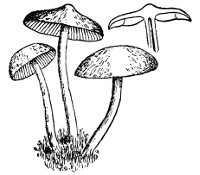
Cortinarius cinnamomeus.
Natural size.
C. cinnamo´meus Fr. Pileus 1–2½ in. across. Flesh thin, convexo-campanulate,
umbonate, somewhat
cinnamon color, silky squamulose
with yellowish innate fibrils, becoming
almost glabrous. Gills adnate,
broad, crowded, shining, yellowish,
then tawny-yellow. Stem 2–4 in.
long, equal, yellow, as is also the
flesh and the veil, hollow. Spores
7–8×4–5µ.
A very common species, especially
in mossy places in pine woods,
occurring under many well defined
forms, which can not be separated as
species. Essential points common
to all. (1) Stem everywhere equal,
stuffed, then hollow, yellowish, fibrillose from the similarly colored veil.
(2) Pileus thin, flattened and obtusely umbonate, silky with yellowish
down, often glabrous when adult, and then bright cinnamon, but the
color is variable. (3) Flesh splitting, yellowish. (4) Gills adnate,
crowded, thin, broad, always shining. (5) Spores dark ochraceous,
size and color very variable; pileus from ½-3–4 in. across; color of
pileus changeable, depending on the more or less persistence of the
down (fundamental color and veil constant in this species and its allies);
gills varying through blood-red, reddish cinnamon, tawny saffron, golden
and yellow. Fries.
323Pileus thin, convex, obtuse or umbonate, dry, fibrillose at least when
young. Flesh yellowish. Lamellæ thin, close, adnate. Stem slender,
equal, stuffed or hollow. Spores elliptical, 8µ long. Peck, 48th
Rep. N.Y. State Bot.
Spores 7–8×4µ Cooke.
The Germans are said to be very fond of this species, which is generally
stewed in butter and served with sauce for vegetables.
Catalogued by Dr. M.A. Curtis, North Carolina, as edible. Edible.
Cooke.
Var. semi-sanguin´eus received from E.B. Sterling, Trenton, N.J.,
August, 1897. Juicy and good.
The species is common over the United States and plentiful in its
numerous varieties from August to frost. It frequents mixed woods,
borders and open and mossy places. The pine woods of New Jersey
yield it in quantity, as do the hemlock forests of Eagle’s Mere, Pa., and
oak woods of West Virginia.
It has a smell and taste—mildly of radishes. Its flavor when cooked
is decided but pleasant.
Telamo´nia. (Gr—lint.)
C. armilla´tus Fr.—armilla, a ring. (Plate LXXXII, fig. 5, p. 306.)
Pileus 3–5 in. broad, red-brick color,
truly fleshy, but not very compact, at
first cylindrical, soon campanulate, at
length flattened, dry, at first smooth,
soon innately fibrillose or squamulose,
flesh dingy pallid. Stem 3–6 in. long,
½ in. thick, solid, firm, remarkably
bulbous (bulb 1 in. thick, villous,
whitish) and fibrillose at the base,
when old striate and reddish-pallid,
internally dirty yellow. Exterior veil
woven, red, arranged in 2–4 distant
cinnabar zones encircling the stem;
partial veil continuous with the upper
zone, arachnoid, reddish-white. Gills
adnate, slightly rounded, distant, at first pallid cinnamon, at length
very broad (½ in.), dark ferruginous, almost bay-brown.
324Odor of radish. A very striking species. From the pileus not being
hygrophanous, at the first smooth and at length torn into fibrils or
squamulose, it might easily be taken for a species of Inoloma. The
cortina itself is paler than the zones. It differs from all others in these
zones. The rings are usually somewhat oblique. Fries.
Professor Peck in the 23d Rep. N.Y. State Cab. Nat. Hist., describes
the American species as follows:
“Pileus fleshy, thick, convex or subcampanulate, then expanded,
minutely squamulose, yellowish-red. Lamellæ not close, broad, slightly
emarginate, whitish-ochraceous, then cinnamon. Stipe stout, solid,
fibrillose, whitish, girt with one to four red bands, bulbous.
“Height 4–6 in., breadth of pileus 2–4 in., stipe 4–8 in. thick.
“Woods. North Elba. August.
“A large and noble species. The margin of the pileus is thin and
sometimes uneven; the upper band on the stem is usually the brightest
and most regular. The pileus is not distinctly hygrophanous.”
Spores 10×6µ Cooke.
Edible. Cooke.
September 8, 1897, Mr. E.B. Sterling, Trenton, N.J., sent me
several specimens new to me and remarkable in having two well-defined
veils, the lower and thicker one of which left a dark zone upon the
stem, the upper, fibrillose, was more persistent, but left a fainter impression.
These veils are not mentioned in Professor Peck’s description
of the American species, but are prominently noted in that of Fries, as
above. In a very young specimen both veils were present. Cap light
brown, minutely squamulose, with a few small red spots; margin thin,
involute, flesh thick, yellowish, firm; gills distant, rounded behind,
slightly emarginate, alternate ones short, light brown inclined to cinereous
on edge.
Spores brown. Small young specimens did not show bulbous stem
as distinct as larger and older ones.
I afterward found several specimens at Mt. Gretna, Pa., September
and October, 1897.
The flesh is excellent, closely resembling Pholiota subsquarrosa.
The species seems to be rare. If found in quantity it will prove one of
our very best edibles.
325C. dis´tans Pk. Pileus thin except the disk, convex, squamulose,
bay-brown when moist, tawny when dry. Lamellæ broad, distant,
thick, dark cinnamon-color. Stipe subequal, often a little tapering upward,
solid, slightly fibrillose-scaly, concolorous.
Height 2–3 in., breadth of pileus 1–2 in., stipe 4–6 in. thick.
Grassy ground in pine woods. Greenbush. June.
The flesh is dull-yellowish. The pileus, when drying, has for a time
a brown-marginal zone. Peck, 23d Rep. N.Y. State Bot.
New Jersey pines. Eagle’s Mere, Pa., coniferous woods. August.
Mt. Gretna, Pa., pines. August, September. McIlvaine.
Like most of the hygrophanous Cortinarii, the taste is more or less
that of rotten wood. The flavor is flat and undesirable.
C. furfurel´lus Pk. Pileus thin, convex, furfuraceous with minute
squamules, hygrophanous, watery-tawny when moist, pale ochraceous
when dry. Lamellæ broad, thick, distant, adnate or slightly emarginate,
tawny-yellow, then cinnamon. Stem equal, peronate, colored like
the pileus, with a slight annulus near the top. Spores subelliptical,
minutely rough, 8–10×6µ.
Plant 1–2 in. high. Pileus 1–2 in. broad. Stem 2–4 lines thick.
Moist ground in open places. Gansevoort. August. Peck, 32d
Rep. N.Y. State Bot.
Haddonfield, N.J., Mt. Gretna, Pa. McIlvaine.
Strong woody flavor—like rotten wood. Not poisonous, but not
desirable.
Hygrocybe.
C. casta´neus Bull.—chestnut. Pileus fleshy, thin, campanulate or
convex, then expanded, dark chestnut-color when moist, paler when
dry. Lamellæ rather broad, violet-tinged, then cinnamon. Stipe
fibrillose, stuffed or hollow, lilac tinged at the top, white below.
Height 2–3 in., breadth of pileus 1–2 in., stipe 3–4 lines thick.
Ground under spruce or balsam trees. Catskill mountains. October.
Edible. Peck, 23d Rep. N.Y. State Bot.
Spores 8×5µ.
It is certainly a wholesome, esculent species, but a great number
would be required to make a good dish. M.C. Cooke.
Catalogued by Rev. M.A. Curtis, North Carolina, as edible.
326Eaten in Italy. Inodorous, edible and agreeable. Cordier. More
than fair. I have often eaten it. R.K. Macadam.
PAXIL´LUS Fr.
Hymenophore continuous with the stem, decurrent. Gills membranaceous,
somewhat branched, frequently anastomosing behind, distinct
from the hymenophore and easily separable from it. Spores dingy-white
or ferruginous.
Fleshy putrescent fungi, margin of pileus at first involute, then continually
and gradually unfolding and expanding. Fries.
Pileus symmetrical or eccentric. Stem central, eccentric or wanting.
Edge of gills entire, sharp.
The marked features of this genus are the strongly involute margin,
the soft, tough, decurrent gills, separating readily from the flesh, and
the color of the spores.
The members of this genus possess some of the characters of Boletus.
The gills separate easily from the hymenophore as do the tubes of the
latter, and their anastomosing tendency is in P. porosus so marked that
the hymenium consists of large angular tubes. The gills of P. solidus
B. and C. form pores at the base, and its spores are elongated, both
features indicating an affinity with Boletus.
Lepista (a pan). Page
327.
Pileus entire, central. Spores dingy-white, in P. panæolus somewhat
rust-color. On the ground.
327Tapinia (to depress). Page —--.
Pileus generally eccentric or resupinate. Spores rust-color. On the
ground or on stumps.
So far as known the species of this genus are harmless. Many of
them are large, fleshy and inviting in appearance, but their flesh is
usually dry and coarse, and, though absorbent, is hard to cook tender.
P. atrotomentosus, which seems to be rare, is an exception. The flesh
of this species being firm in texture and readily made into a first-class
dish.
Lepis´ta.
P. lepis´ta Fr.—lepista, a pan. Pileus 2–4 in. broad, flat or depressed,
dirty-white, smooth, sometimes minutely cracked near the margin
which is thin, involute and often undulate. Stem very variable in length,
1–4 in., ½-¾ in. thick, dingy white or cream, solid, white inside,
equal, with a cartilaginous cuticle passing between the gills and the
flesh of the pileus, base blunt, villous, white. Gills very decurrent,
crowded, 2–3 lines broad, slightly branched but not at the base, dingy-white
becoming darker.
Spores reddish, becoming dingy brown. Broadly pyriforme 6×8µ
Massee.
Pennsylvania. September, 1894. McIlvaine. Albion, N.Y., Dr.
Cushing, 1898.
On ground in woods and margins of woods.
Flesh white. Gills narrow, crowded, brittle, decurrent, dingy-white
or pale-buff, easily separating from cap. Stem solid, elastic, at length
hollow, often short, an inch long, tapering downward, frequently up to
four inches in length and equal, base villose.
Resembling Lactarius piperatus and some forms of Clitocybe. It is
separated from the former by the absence of milk and from the latter by
its involute margin. The Clitocybe resembling it are all edible.
Smell strong, like old oily nuts. Edible but coarse.
P. li´vidus Cke. Pileus 1–2 in. across, convex, at length slightly
depressed at the disk, margin slightly arched and incurved, dingy-white,
or livid ochraceous, opaque. Gills decurrent, arcuate, almost
328crowded, 1½ line broad, white. Stem 3–4 in. long, ½ in. thick at the
apex, attenuated downward, white, fibrillose, stuffed then hollow, usually
rather flexuous. Flesh nearly white. Spores globose, 3–3.5µ
diameter, nearly white.
In woods. Usually in small clusters. Closely allied to Paxillus revolutus,
but distinguished by the absence of any tinge of violet on the
pileus or stem, and by the persistently white gills. Massee.
Received from Katherine A. Hall, Danville, N.Y. October, 1898.
Raw it tastes like a drug-store smell. Edible, pleasant.
Tapi´nia.
(Plate XC.)
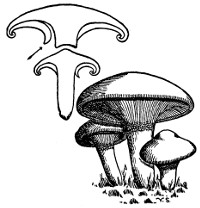
Paxillus involutus.
One-half natural size.
P. involu´tus (Batsch) Fr.—involutus, rolled inward. Pileus 2–5
in. broad, fleshy, compact, convexo-plane
then depressed, smooth,
viscid when moist, shining when
dry, yellowish or tawny-ochraceous,
strongly involute, margin
densely downy, flesh pallid. Stem
2–4 in. high, about ½ in. thick,
solid, firm, paler than the pileus,
central or eccentric. Gills 2–3
lines broad, crowded, branched,
anastomosing, forming pores behind,
whitish then yellowish or
rusty, spotting when bruised.
Spores rust-color, ellipsoid or
oblong-ellipsoid 8–16×6µ K.; 5×6µ
W.G.S. Elliptical, 8–10µ
Peck.
It grows singly or in groups and likes damp mossy soil. Common
in cool hemlock or spruce woods in the Adirondack mountains; not
rare in the mixed woods of all our hilly districts. When growing on
decayed stumps the stem is sometimes eccentric. August, November.
C.H. Peck.
In open woods near Haddonfield, N.J., it grows to a large size and
in quantity. In Angora woods near Philadelphia a complete ring of it
20 ft. in diameter was seen.
329Considered edible throughout Europe and said to be highly esteemed
in Russia. The flesh of the American plant is dry and coarse, does not
cook tender and is rather tasteless.
P. a´tro-tomento´sus (Batsch.) Fr.—ater, black; tomentum, down.
Pileus 3–6 in. broad, rust-color or reddish-brown, compactly fleshy,
eccentric, convex then plane or depressed, margin thin, frequently
minutely rivulose, sometimes tomentose in the center. Flesh white.
Stem 3–6 in. high, ½-1 in. thick, stout, solid, elastic, eccentric or
lateral, unequal rooting, covered with dense velvety down, very dark
brown. Gills adnate, 3 lines broad, close, anastomosing at the base,
yellowish, interspaces venose.
Spores subhyaline 4–6×3–4µ K. Elliptical, pale-yellowish, 5×2.5–3µ
Massee. Elliptical 5–6×4µ Peck.
Found near Philadelphia, gregarious in old woods. September. In
New Jersey in pine woods on stumps and on the ground, probably
growing from roots. McIlvaine.
Grows singly or cespitose, sometimes in large tufts, when the pileus is
frequently irregular from compression. In wet weather the pileus is
moist and sometimes obscurely mottled with dark spots. Occasionally
it has an unpleasant dirt-like odor. Peck.
Cordier considers this species suspicious and Paulet inutile on account
of its bad taste.
The flesh differs from most Paxilli in being very fine grained and
cooked is of the consistency of a marshmallow. The taste is marked
but pleasant.
Spores typically black-purple or brownish-purple, more rarely dusky
brown. (It is to be observed that the spores vary in color according to
the color of the ground on which they are deposited.) There are sterile
forms with the gills persistently white (A. obturatus, A. udus). Those
species are more deceptive in which the gills continue for a long time
white, and even begin to decay before they are discolored by the spores;
these may be easily mistaken for Leucospori. Fries.
Pratelli is the name given by the early authors to this series, based
upon the spore color; Porphyrosporæ is the name now used. The species
within the group are closely allied to those having black spores
without a tinge of purple or violet (Melanosporæ), but in none of the
species do the gills deliquesce as in Coprinus, neither are there resupinate
or lateral stemmed species.
There is a present tendency to do away with this series and include
all dark-spored species in the Melanosporæ. Professor Atkinson and
Bertha Stoneman, in their “Provisional Key to the Genera of Hymenomycetes,”
omit the series and give “Melanosporæ, Gill and Butz
(Pratellæ and Coprinariæ in broadest sense).
Spores dark brown, purplish-brown or black.”
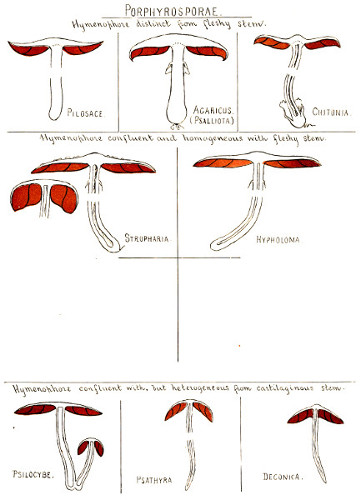
Plate XCII.
Chart of genera in purple-spored series—Porphyrosporae, Page 330.
(Plate XCIII.)
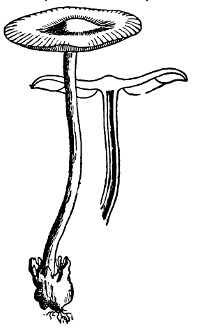
Chitonia rubriceps.
Two-thirds natural size.
It is frequently difficult to determine by the
spore-color of this series even to which series a
specimen belongs. Many of our best edibles
belong in this series. I know of none noxious.
CHITON´IA Fr.
Universal veil distinct from the pileus, at maturity
forming a distinct volva round the base of
the ringless central stem. Gills free from the
stem. Spores brownish-purple.
Analogous in structure with Volvaria and
Amanitopsis. An exotic genus imported into
this country.
No American species reported.
331
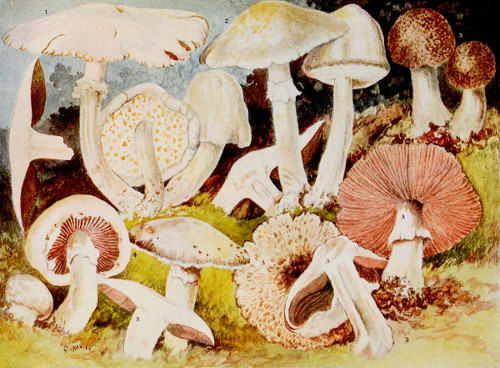
Grouped by F.D. Briscoe—Studies by C. McIlvaine. Plate XCI.
| Fig. |
Page. |
Fig. |
Page. |
| 1. Agaricus variabilis, |
346 |
4. Agaricus campester, |
332 |
| 2. Agaricus silvicola, |
343 |
5. Agaricus campester (section), |
332 |
| 3. Agaricus placomyces, |
345 |
|
|
AGAR´ICUS.
Agaricon, a Greek name for fungi, said to be derived from the name of a town, Agara.
Pileus fleshy, flesh of the stem different from that of the pileus, furnished
with a distinct ring. Gills at first enclosed by the veil, free,
rounded behind, at first white or whitish, in some species this stage lasting
but a short time, then pink or reddish, at length dark purplish-brown
from the spores. Spores brown, brownish or reddish-purple.
On the ground, generally in pastures, meadows or manured ground,
a few species occur in woods.
Analogous with Lepiota of the white-spored series. Stropharia also
bears a ring and has similar colored spores, but is separated by the flesh
of stem and pileus being continuous and the gills being more or less
adnate.
Formerly in Agaricus as sub-genus Psalliota (psallion, psalion, in
poetry, a ring). When Psalliota was raised to generic rank it was given
the name of the great genus Agaricus as a mark of distinction on account
of its including the most widely known and useful mushroom of
the world—Agaricus campester. The name Psalliota is not in modern
use.
Old Agaricus included many subgenera and consequently many more
species. Now it contains but few. All of them are highly flavored and of
marked excellence. Before the subgenera under Agaricus were promoted
to full generic standing it was customary to state the name of a species
thus: Agaricus (Psalliota) campester. Agaricus (Stropharia) semi-orbicularis.
This was lengthy and clumsy. In the older books this
form prevails. Often, however, the subgenus is omitted before the
name, which compels the student to look up the subgenus to which the
species belongs. The older books are therefore puzzling to modern
students, who find there simply the name Agaricus to guide them. The
present genus of a known species in old Agaricus can be easily found
by looking in the index for its specific name. The name of the genus
follows it in parentheses.
All of the genus can be cooked in any desired way.
* Gills at first or very soon pink or rosy.
** Gills at first brownish or gray.
*** Gills at first white or whitish.
*
Gills at first or very soon pink or rosy.
A. campes´ter Linn.—campus, a field. (Plate XCI, fig. 4 (3 figs.)
fig. 5, section, p. 332). Pileus at first hemispherical or convex, then
expanded with decurved margin or nearly plane, smooth, silky floccose or
hairy squamulose, the margin extending beyond the lamellæ, the flesh
rather thick, firm, white. Lamellæ free, close, ventricose, at first delicate
pink or flesh color, then blackish-brown, subdeliquescent. Stem
equal or slightly thickened toward the base, stuffed, white or whitish,
nearly or quite smooth. Ring at or near the middle, more or less lacerated,
sometimes evanescent. Spores elliptical, 6–8×4–5µ.
Plant 2–4 in. high. Pileus 1.5–4 in. or more broad. Stem 4–8
lines thick. Peck, 36th Rep. N.Y. State Bot.
Spores spheroid-ellipsoid, 9×6µ K.; 6×8µ W.G.S.
The varieties of A. campester are numerous. All of them are edible
and vary but slightly in their excellence.
Var. al´bus Berk.—albus, white. A very common wild form. Cap
2–4 in. across, smooth or slightly fibrillose. Stem 1½-3 in. long,
⅓-⅔ in. thick, white or whitish. Spring to autumn, in rich grassy
places. Sometimes very large. It is cultivated.
Var. gri´seus Pk.—griseus, gray. Cap grayish, silky, shining. Ring
vanishing. Reported from Virginia.
Var. prati´cola Vitt.—pratum, a meadow; colo, to inhabit. Meadow
variety. Cap covered with reddish scales. Flesh pinkish. Parade
ground, Mt. Gretna, Pa.
Var. umbri´nus Vitt.—umber, dark brown. Cap brown, smooth.
Stem short, minutely scaly.
“Var. rufes´cens Berk.—rufescens, becoming red. Pileus reddish,
minutely scaly. Gills at first white. Stem elongated. Flesh turning
bright red when cut or bruised. This departs so decidedly from the
ordinary characters of the type, especially in the white color of the
young gills, that it seems to merit separation as a distinct species.” Peck,
36th Rep.
333Var. villa´ticus Brond.—belonging to a villa. Cap scaly. Stem scaly.
Var. horten´sis Cke.—growing in gardens. Cap brownish or yellowish-brown,
covered with fibrils or minute hairs. This is a cultivated
species.
“Var. Bu´channi. Cap white, smooth, depressed in center, the margin
naked. Stem stout. Ring thin, lacerated. A rare variety, sometimes
occurring in mushroom beds.
“Var. elonga´tus—elongated. Long-stemmed variety. Pileus small,
smooth, convex, the margin adorned with the adherent remains of the
lacerated veil. Stem long, slender, slightly thickened toward the base.
Ring slight or evanescent. This is also a variety of mushroom beds.
“Var. vapora´rius. Green-house variety (A. vaporarius Vitt.) Pileus
brownish, coated with long hairs or fibrils. Stem hairy-fibrillose, becoming
transversely scaly. Conservatories, cellars, etc. Not differing
greatly from Var. hortensis.” Peck, 36th Rep. N.Y. State Bot.
The A. campester is known the world over as the common mushroom.
It is cosmopolitan, appearing in pastures and rich places from
spring and until long after severe frosts. It is the sweet morsel of gourmets.
Indirectly it has done more damage than the assembled viciousness
of all other toadstools. It is by mistaking the young button forms
of the deadly Amanita for the button forms of the common mushroom
that most cases of fatal toadstool poisoning are brought about. It is,
also, usually the persons who think they know the mushroom, and can
not be deceived, that get poisoned. If two rules are observed danger
can be avoided. (1) Never eat a fungus gathered in the woods believing
it to be the mushroom. The typical A. campester does not
grow in the woods; species of Agaricus somewhat resembling it do.
(2) Look at the gills; those of the mushroom are at first a light-pink
which rapidly, as the plant matures, darken to a dark-brown, purplish-brown,
or purplish-black. This is due to the ripening of the spores.
Those of the Amanita are constantly white.
Pages could be written upon the mushroom and its culture, and recipes
for the cooking of it would fill a volume. One important thing is
omitted from them all—it is culinary heresy to peel a mushroom. Much
of the flavor lies in the skin, as it does in that of apples, apricots,
peaches, grapes, cherries and other fruits. The mushroom should be
wiped with a coarse flannel or towel until the skin is clean. See chapter
on cooking, etc.
334Lafayette B. Mendel, in American Journal of Physiology, March,
1898, gives the following analysis of A. campester:
Two varieties of the common mushroom were collected in New Haven.
Fifteen specimens of one variety weighed 1½ ounce, an average
weight of 43 grains each. The analysis gave:
|
a. |
b. |
| Water |
87.88% |
92.20% |
| Total solids |
12.12 |
7.80 |
| Total nitrogen in dry substance |
4.42 |
4.92 |
| Ash in dry substance |
11.66 |
17.18 |
A. comp´tulus Fr.—comptus, gaily adorned. Pileus 1–1½ in. broad,
yellowish-white, slightly fleshy, convex then plane, obtuse, adpressedly
fibrilloso-silky, becoming even. Flesh thin, soft, of the same color as
the pileus. Stem 2 in. long, 2–3 lines thick, hollow, stuffed with floccules
when young, somewhat attenuated, even, smooth, white, becoming
somewhat light yellow. Ring medial, torn, fugacious, of the same
color. Gills rounded-free behind, crowded, soft, broader in front,
flesh-color then rose, not dingy-flesh-color except when old.
Closely allied to A. campestris, but constantly distinct in its more
beautifully colored gills. Fries.
Cultivated ground. Menands. August. Peck, Rep. 41.
Closely allied to A. campestris, from which it may be separated by
its smaller size, the yellowish hue of the dry plant and by the smaller
spores. Peck, 41st Rep. N.Y. State Bot.
Mt. Gretna, Pa. Parade ground, with A. campester; Haddonfield,
N.J. August to frost. McIlvaine.
A. comptulus appears frequently in the latitude of Philadelphia. It
is a neat species, but not substantial in flesh. Here it usually grows
close to the ground. The ring is very evanescent.
Its edible qualities are those of A. campester.
A. silvat´icus Schaeff.—belonging to woods. Pileus thin, at first
convex or bell-shaped, then expanded, gibbous or subumbonate, fibrillose
or variegated with a few thin tawny brownish or reddish-brown
spot-like adpressed scales, whitish, brownish or smoky-gray, the disk
sometimes tinged with red or reddish-brown, the flesh white or faintly
reddish. Lamellæ thin, close, free, narrowed toward each end, reddish,
335then blackish-brown. Stem rather long, equal or slightly tapering
upward, hollow, whitish. Spores elliptical, 5–6.5×4–5µ.
Plant 3–5 in. high. Pileus 2–4 in. broad. Stem 4–6 lines thick.
Woods. Summer and autumn. Not common. Peck, 36th Rep.
N.Y. State Bot.
Massachusetts, Farlow; Minnesota, Johnson; California—edible, H.
and M.
West Virginia, 1881–1885, New Jersey, Pennsylvania. August to
frost. In pine and mixed woods. McIlvaine.
Edible, Curtis. Edible, Peck.
In taste and smell A. silvaticus resembles A. silvicola, but is stronger.
It is a frequent but not common species in the localities where I have
found it. Quantities of it have not occurred, but myself and friends
have eaten it for years, knowing no distinction in effect between it and
allied species. Its strong taste requires that it be well cooked. It does
not lose its high flavor, which may be objectionable to some. I prefer
using its juices as a flavoring.
A. diminuti´vus Pk.—diminutive. Pileus thin, fragile, at first convex,
then plane or centrally depressed, sometimes slightly umbonate,
whitish or yellowish, faintly spotted with small thin silky appressed
brownish scales, the disk brownish or reddish-brown. Lamellæ close,
thin, free, ventricose, brownish-pink becoming brown, blackish-brown
or black. Stem equal or slightly tapering upward, stuffed or hollow,
smooth, pallid. Annulus thin, persistent, white. Spores elliptical 5×4µ.
Plant 1.5–2 in. high. Pileus 1–1.5 in. broad. Stem 1–2 lines
thick.
Woods. Croghan and Sandlake, N.Y. August. Autumn.
This is a small but symmetrical and beautiful Agaric. It is perhaps
too closely related to the preceding species (A. silvaticus), of which it
may possibly prove to be a mere variety or dwarf form. Its pileus is
quite thin and fragile. Usually the darker or reddish hue of the disk
gradually loses itself in the paler color of the margin, but sometimes the
whole surface is tinged with red. Peck, 36th Rep. N.Y. State Bot.
Chester county; West Philadelphia, Pa., September; Mt. Gretna,
Eagle’s Mere, Pa., August. McIlvaine.
I have found A. diminutivus so intimately associated with A. silvaticus
336that its being a dwarf form of the latter seemed more than probable.
Its edible qualities are the same.
A. Rod´mani Pk. Pileus rather thick, firm, at first convex, then
nearly or quite plane, with decurved margin, smooth or rarely slightly
cracked into scales on the disk, white or whitish, becoming yellowish
or subochraceous on the disk, the flesh white, unchangeable. Lamellæ
close, narrow, rounded behind, free, reaching nearly or quite to the
stem, at first whitish then pink or reddish-pink, finally blackish-brown.
Stem short, subequal, solid, whitish, smooth below the ring, often
scurfy or slightly mealy-squamulose above; ring variable, thick or thin,
entire or lacerated, at or below the middle of the stem. Spores broadly
elliptical or subglobose, generally uninucleate, 5–6×4–5µ.
Plant 2–3 in. high. Pileus 2–4 in. broad. Stem 6–10 lines thick.
Grassy ground and paved gutters. Astoria, L.I. Rev. W. Rodman.
Washington Park, Albany. May to July.
This species is intermediate between A. campestris and A. arvensis,
from both of which it may be distinguished by its narrow gills, solid stem
and smaller, almost globose, spores. In size, shape of the pileus and
general appearance it most resembles A. campestris, but in the whitish
primary color of the gills and in the yellowish tints which the pileus
often assumes, it approaches nearer to A. arvensis. * * * Peck,
36th Rep. N.Y. State Bot.
I can now add my own testimony to that of Mr. Rodman as to its
edibility. Its flesh is firm but crisp, not tough, and its flavor, though
not equal to that of the common mushroom, is nevertheless agreeable,
and its use as food is perfectly safe. Peck, Rep. 49.
This species has grown freely for several years at Hull and Cohasset,
Mass. It is usually found about June 1st, and is not seen again until
early autumn. It is the handsomest mushroom I have seen, and its
edible qualities are on a par with its appearance. Macadam.
A. hæmorrhoida´rius Shulzer. Gr—discharging blood. Pileus 4
in. across, reddish-brown, fleshy, ovate then expanded, covered with
broad adpressed scales, margin at first bent inward. Flesh when broken
immediately blood-red. Stem 4 in. high, 1 in. thick, soon hollow,
fibrillose, the solid base somewhat bulbous. Ring superior, large. Gills
free, approximate, crowded, rosy-flesh-color, at length purple-umber.
337Very striking, 3–4 in. high. The pileus and the white stem become
spotted blood-red when touched. The stem when young is adpressedly
squamulose below, when full grown mealy, becoming smooth. Fries.
Spores purple-brown, 7–8×5µ Massee; brown, elliptical, 5–6×4µ Peck.
A rare or overlooked plant in United States, first recorded by Professor
Peck, who found it but once, growing under a hemlock tree. Rep. 45.
Nebraska, Clements; West Virginia; Eagle’s Mere and Mt. Gretna,
Pa. In hemlock and mixed woods. Autumn. McIlvaine.
Cap 2–4 in. across. Stem 3–4 in. long, up to ¾ in. thick.
Every part of the plant turns red and has a congested appearance
when bruised. The flesh is white but immediately becomes red when
broken.
It is a frequent but not common species, growing singly, or in small
clusters.
In flavor and substance it is equal to any mushroom.
A. mari´timus Pk. Pileus very fleshy, firm, at first subglobose,
then broadly convex or nearly plane, glabrous, sometimes slightly
squamose with appressed spot-like scales, white becoming dingy or
grayish-brown when old. Flesh whitish, quickly reddening when cut,
taste agreeable, odor distinct, suggestive of the odors of the seashore.
Lamellæ narrow, close, free, pinkish becoming purplish-brown with age,
the edge white. Stem short, stout, firm, solid, equal, sometimes bulbous,
white, the annulus delicate, slight and easily obliterated. Spores
broadly elliptic, purplish-brown, 7–8µ long, 5–6µ broad.
Pileus 2–8 in. broad. Stem 1–2 in. long, .6 in. thick.
Sandy soil near salt water, Lynn, Mahant and Marblehead, Mass.
June to December. R.F. Dearborn.
This is a very interesting and an excellent mushroom. Dr. Dearborn
writes that he has used it on the table for fourteen years and that it is
the only mushroom that he has ever eaten in which the stem is as good
as the cap. He considers it the most hearty and satisfying of all the
numerous species that he has ever eaten. Both its taste and odor is
suggestive of the sea. The latter is quite strong, and perceptible by
one riding along the road by whose side the mushrooms are growing.
They sometimes grow in semicircles and attain a larger size in warm
weather than in the colder weather of autumn. They are most abundant
in August. The flesh, when cut or broken, quickly assumes a pink
338or reddish hue on the freshly-exposed surface. This is a very distinctive
character and with the maritime habitat makes the species easy to recognize.
Another species, Agaricus hæmorrhoidarius Kalchb. exhibits
a similar change of color in its wounded flesh, but is of very rare occurrence
with us, does not, so far as ascertained, grow near the sea, has a
darker cap and a long hollow stem. The stem in the maritime mushroom
is short and solid. Its collar is very slight and easily destroyed.
Peck, Bull. Torr. Bot. Club, Vol. 26, No. 2, F. 1899.
A. Califor´nicus Pk.—Pileus at first subconical, becoming convex,
minutely silky or fibrillose, whitish, tinged with purple or brownish-purple
on the disk. Flesh whitish. Gills close, free, pink becoming
purplish, then blackish-brown. Stem rather long, solid or stuffed, equal
or tapering upward, distinctly and rather abruptly narrowed above the
entire externally silky ring, pallid or brownish. Spores broadly elliptical,
5–6×4–5µ.
Pileus 1–3 in. broad. Stem 1.5–3 in. long, 2–4 lines thick.
Under oak trees. Pasadena. January. McClatchie.
This fungus is similar in size, shape and habitat to A. hemorrhoidarius,
but it is unlike that species in color, in the adornment of the
pileus and in its color not changing where bruised or broken. Bull.
Torr. Bot. Club, 22–5 My. 95.
A. Elven´sis B. and Br.—Name from river Elwy, Wales, where first
found. Tufted. Pileus 4–6 in. or more across, subglobose then hemispherical,
fibrillose, broken up into large persistent brown scales, areolate
in the center, margin very obtuse, thick, covered with pyramidal
warts. Stem at first nearly equal, at length swollen in the center, and
attenuated at the base, 4–6 in. high, 2 in. thick in the center, fibrillose
and areolate below, nearly smooth within the pileus, solid, stuffed with
delicate threads. Ring thick, very large, deflexed, broken here and
there, warted in areas beneath. Gills rather crowded, ¼ in. broad,
free, of a brownish flesh-color. Spores elliptic oblong, 8×4µ.
Under oak trees, etc. Edible, delicious eating. Flesh of pileus ¾ in.
thick, red when cut. Massee.
California, H. and M.
Edible. Cooke, 1891.
339A. fœdera´tus Berk. and Mont.—confederated. Pileus fleshy, thin,
at first ovoid then bell-shaped, finally convex, somewhat umbilicate
with the center slightly depressed, margin hanging down (when dry
involute), fragments of the veil hanging from the margin, tawny, scaly
with minute, scattered, white, persistent granules, 2–3 in. broad, ¾-1½
in. high.
Stem stout, hollow, stuffed with fibers, gradually increasing in size
to the base; below the ring rough from the ruptured bark, 4 in. high.
Ring superior, broad, reflexed, torn, persistent. Gills linear, medium
broad, at first pinkish-lilac, when adult brownish, edge white, pulverulent,
adnate, gradually attenuated toward the margin. Spores dingy-brown,
ovoid oblong, 10µ long. Somewhat cespitose. Elegant.
On the ground in pastures. July. Columbus, Ohio. Sullivant,
Mont. Syll., p. 121.
Edibility not reported. I have not seen this species.
A. xylo´genus Mont. Gr—produced on wood. Pileus membranaceous,
at first ovoid, then conical, bell-shaped, umbonate, finally convexo-plane,
smooth, pale-yellow, center brownish, margin split, striate
when dry, 1½-2½ in. broad, 1¼ in. high. Stem cartilaginous, white,
3 in. high, ¼ in. thick, gradually thickened toward the base, hollow.
Ring of medium size, inferior, erect or reflexed. Gills free, remote,
lance-shaped, rounded behind, attenuated toward the margin, pink as
in A. campester. Spores spherical, colorless, hyaline, 5–7.5µ.
On dead wood. August. Columbus, Ohio. Sullivant. Mont. Syll.,
p. 122.
Edibility not reported. I have not seen this species.
**
Gills at first brownish or gray.
A. argen´teus Brændle—of silver. Pileus thin, convex becoming
nearly plane, slightly silky or glabrous, pale grayish white or grayish
brown, shining with a silvery luster when dry, the margin sometimes
striate, at first incurved, often revolute when old. Flesh whitish,
becoming blackish where cut. Lamellæ close, free, at first brownish
becoming blackish brown or black with age. Stem short, glabrous,
solid, often narrowed toward the base, the annulus slight, evanescent.
Spores broadly elliptic, 7–10µ long, 6µ broad.
340Pileus 1–2 in. broad. Stem 1–1½ in. long, ¼-⅜ in. thick.
Lawns and grassy places in rich soil. Often associated with Stropharia
bilamellata Pk. After rains from April to November. Washington,
D.C. F.J. Brændle.
This is a small mushroom, peculiar in having the young gills of a dark
color and in the absence of any pink hues. The gills sometimes become
moist and manifest a tendency to deliquesce. The drying specimens
emit a strong but not unpleasant odor. Mr. Brændle says that
their edible quality is excellent and that it is not impaired by drying.
Peck, Bull. Torr. Bot. Club, Vol. 26, F. 1899.
A. praten´sis Schaeff.—a meadow. Pileus 2–3½ in. across, ovoid
then expanded, becoming smooth or sometimes broken up into scales
more or less concentrically arranged, whitish, then grayish. Flesh
thick in the center, thin toward the margin, white. Gills free, rounded
behind, about ¼ in. broad, grayish, then brown. Stem about 2 in.
long, ½-⅔ in. thick, base thickened, smooth, whitish. Ring median,
simple, usually deciduous. Stem becoming more or less hollow. Spores
elliptical, apiculate, 6×3.5µ.
On pastures and woods. Distinguished by the grayish gills becoming
brown without any intermediate pink or fleshy tinge, and in being
rounded behind, the median deciduous ring, and the more or less hollow
stem. Massee.
California. Common. Edible. H. and M. Not elsewhere reported.
A. achi´menes B. and C. Gr—an amber-colored plant. Pileus 4–6
in. broad, pallid or yellowish-white, smooth like kid leather, but studded
with warty excrescences especially toward the center. Stem 4–6 in.
high, 3–4 lines thick, white, stuffed with floccose fibers, furnished toward
the apex with a large deflexed ring. Gills broad, crowded at first,
whitish then ash-colored and dingy-brown, free. Spores brownish, oval
or ovate.
A splendid species allied to A. fabaceus, but differing in its paler
spores, warty cap, ample ring, etc.
On the earth. Solitary. June. S.C. Ravenel. Am. Jour. Sci.
and Arts, 1849.
I have not seen this species.
341A. faba´ceus Berk.—relating to beans. Pileus 4–5 in. across,
thin, almost submembranaceous, umbonate, conical when young, becoming
nearly plane as it expands, white, viscid when moist; epidermis
smooth, tough, feeling like fine kid leather, turning yellow when bruised.
Stem 3–4 in. high, ⅓ in. thick, white, smooth, with the exception of
a few fibrilla, equal except at the base. Veil large, at first covering
the gills and connecting the margin with the stem, white, externally
floccose. Gills crowded, very thin, not ventricose, free, brown when
young, then darker brown, at length almost black like the dark part of
a bean flower. A fine species allied to A. arvensis. When young it
has a peculiar but not unpleasant smell. On the ground, amongst dead
leaves in open woods. Waynesville, September 10, 1844. Hooker’s
London Jour. of Botany, 1847.
Described by Berkeley from specimens collected by Thomas G. Lea,
in the vicinity of Cincinnati.
On ground among old leaves in woods. Common. Pileus 3–4 in.
broad. Stem 3–4 in. high. Spores brown, nucleate on one side,
small, 5.5µ long. Morgan.
This is among the most delicious species for the table. Fresh specimens
have a distinct taste and odor of peach kernels or bitter almonds
which is nearly lost in cooking. Am. Jour. Science and Arts, 1850.
Curtis.
Ohio, Lea, Morgan; North Carolina, Curtis; South Carolina, Ravenel;
Massachusetts, Sprague.
***
Gills at first whitish.
A. arven´sis Schaeff.—belonging to cultivated ground. Horse
Mushroom, Plowed-Land Mushroom. (A. Georgii Sow., A. pratensis
Scop., A. edulis Krombh., A. exquisitus Vitt.) Pileus at first
convex or conical, bell-shaped then expanded, at first more or less floccose
or mealy, then smooth white or yellowish. Flesh white. Gills
close, free, generally broader toward stem, at first whitish, then pinkish,
finally blackish-brown. Stem equal or slightly thickened toward the
base, smooth, hollow or stuffed with a floccose pith; ring rather large,
thick, the lower or exterior surface often cracked in a radiate manner.
Plant 2–5 in. high. Pileus 3–5 in. or more broad. Stem 4–10
lines thick.
342Cultivated fields and pastures. Summer and autumn.
This species is so closely related to the common mushroom that it is
regarded by some authors as a mere variety of it. Even the renowned
Persoon is said to have written concerning it: “It appears to be only a
variety of A. campestris.” Fries also says that it is commonly not distinguished
from A. campestris, but that it is diverse in some respects;
its white flesh being unchangeable, its gills never deliquescing, remaining
a long time pale and not becoming dark-red in middle age. Berkeley
says of it: “A coarse but wholesome species, often turning yellow
when bruised.” Peck, 36th Rep. N.Y. State Bot.
Spores spheroid-elliptical, 9×6µ K.; 11×6µ W.G.S.; elliptical, 8–10×5–6.5µ
Peck.
Indiana, H.I. Miller; Minnesota, B.L. Taylor; West Virginia,
North Carolina, New Jersey, Pennsylvania, McIlvaine.
Unless the numerical system of John Phœnix to express degrees of
quality is adopted by a mycophagists' congress, and one species of
fungus is chosen as the standard of excellence, the comparative excellence
of species will never be settled. English epicures shun A.
arvensis; the French prefer it. Berkeley says it is inferior to the common
mushroom; Vittadini says it is very sapid and very nutritious. So
opinion varies. Individual tastes must decide excellence. Comparison
never will. Toadstools differ in substance, texture and taste as one
meat or vegetable differs from another. Beef could not be chosen as
the standard for meats, or cabbage as the standard for vegetables.
Agaricus arvensis is good.
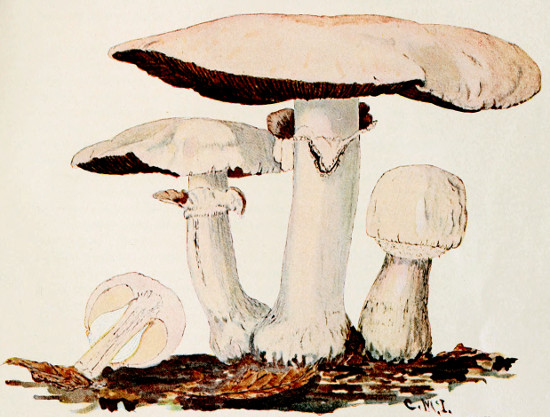
Grouped by F.D. Briscoe—Studies by C. McIlvaine. Plate XCIV.
|
Page. |
| Agaricus magnificus. Peck, |
342 |
A new species of Agaricus.
A. magni´ficus Pk.—magnificent. (Plate XCIV.) Pileus 5–15 cm.
(2–6 in.) broad, fleshy, thick, convex, becoming nearly plane or centrally
depressed, bare, often wavy and split on the margin, white or
whitish, often brownish in the center. Flesh 1.5–2 cm. (½ in.) thick
in the center, thin on the margin, white, unchangeable. Gills numerous,
rather broad, close, free, ventricose, white becoming dark purplish
brown with age, never pink. Stem 10–15 cm. long (4–6 in.), about
2.5 cm. thick (1 in.), firm, stuffed with cottony pith, bulbous or thickened
at the base, fibrillose, striate, minutely furfuraceous (covered with
scurf) toward the base, ringed, pallid or whitish, the ring thin, persistent,
white. Spores small, elliptic, 5–6µ long, 3–4µ broad.
343Gregarious or cespitose; thin woods, Mt. Gretna, Pa. August.
Charles McIlvaine.
A large fine species distinguished from its near allies by the absence
of pink hues from the gills. Mr. McIlvaine remarks that it has an anise-like
flavor and odor and that when young the whole fungus is tender
and high flavored, but when full grown the caps only are edible. Peck,
Bull. Torr. Bot. Club, Vol. 26, F. 1899.
A. silvic´ola Vitt.—silva, a wood; colo, to inhabit. (Plate XCI, fig.
2, p. 332.) (A. arvensis, var. abruptus Pk.; now A. abruptus Pk.)
Pileus convex or sub-bell-shaped, sometimes expanded or nearly plane,
smooth, shining, white or yellowish. Gills close, thin, free, rounded
behind, generally narrowed toward each end, at first whitish, then pinkish,
finally blackish-brown. Stem long, cylindrical, stuffed or hollow,
white, bulbous; ring either thick or thin, entire or lacerated. Spores
elliptical, 6–8×4–5µ.
Plant 4–6 in. high. Pileus 3–6 in. broad. Stem 4–8 lines thick.
Woods, copses and groves or along their borders. Summer and
autumn. Peck, 36th Rep. N.Y. State Bot.
Very good eating, though scarcely as highly flavored as the common
mushroom. Peck.
West Virginia, Pennsylvania, New Jersey, June to frost. McIlvaine.
A. silvicola, by many authors considered a variety of A. campester,
is, seemingly, becoming common. Professor Peck in 46th Rep. has
made the abrupt bulb and its usual double veil distinctive marks which
ally it to A. arvensis. He therefore calls it var. abruptus. As this
book goes to press Professor Peck writes me that he concludes var.
abruptus to be a good and distinct species. It is therefore given as
such. While familiar with it since 1881, I never found it in quantity
until 1898, at Mt. Gretna, Pa. There, among the straw and rubbish
of abandoned camps on wood margins, it grew in great quantity;
sometimes singly, at others in crowded clusters. When growing singly
it exhibits all the characteristics of its description; when clustered,
the stems are not always bulbous. The caps are thin but fleshy,
brittle and bear a disproportionate width to the stem—like a plate on
a pipe stem. The caps when mature are usually tinged with yellow and
are spread flat; the ring is large, often double, yellowish, often torn,
fragments of it frequently hang from the cap margin; the bulb when
344perfect is small, abrupt, as if it had once been round but the stem
pushed into it. It has a strong spicy mushroom odor and taste, and
makes a high-flavored dish. It is delicious with meats. It is the
very best mushroom for catsup. Mixed with Russulæ or Lactarii or
other species lacking in mushroom flavor, it enriches the entire dish.
The stems, excepting of the very young, are tough.
Larvæ do not infest A. silvicola. Its habit of growth shows it to be
cultivatable. It has but one draw-back. Growing as it does in woods
and in the presence of the poisonous Amanita, it is possible for the
careless collector to confound the two. The Amanitæ have larger bulbs,
cups at the base, and white gills; the A. silvicola has no volva, has
whitish gills when very young only, they become pinkish, then a marked
blackish-brown.
A. creta´ceus Fr.—creta, chalk. Pileus 3 in. and more broad,
wholly white, fleshy, lens-shaped-globose when young, then convexo-flattened,
obtuse, dry, sometimes even, sometimes rivulose chiefly round
the margin from the cuticle separating into squamules. Flesh thick,
white, unchangeable. Stem 3 in. long, 3–6 lines and more thick, hollow,
stuffed with a spider-web pith, firm, attenuated upward, even,
smooth, not spotted, white. Gills free, then remote, ventricose but
very much narrowed toward the stem, crowded, remaining long white,
becoming dingy-brown only when old. Fries.
Spores 3×4µ W.G.S.; 5–6×3.5µ Massee.
Under certain conditions the spores are white. M.J.B.
In lawns and rich ground.
North Carolina, on earth and wood. Edible, Curtis; Minnesota, rare,
Johnson; California, H. and M.; Ohio, Lloyd; Kentucky, Lloyd, Rep.
4; New York, Peck, Rep. 22.
A. subrufes´cens Pk.—sub, under; rufescens, becoming red. Pileus
at first deeply hemispherical, becoming convex or broadly expanded,
silky fibrillose and minutely or obscurely scaly, whitish, grayish or dull
reddish-brown, usually smooth and darker on the disk. Flesh white,
unchangeable. Lamellæ at first white or whitish, then pinkish, finally
blackish-brown. Stem rather long, often somewhat thickened or
bulbous at the base, at first stuffed, then hollow, white; the annulus
flocculose or floccose-scaly on the lower surface; mycelium whitish,
345forming slender branching root-like strings. Spores elliptical, 6–7µ
Peck, 48th Rep. N.Y. State Bot.
Indiana, H.I. Miller, 1898; Haddonfield, N.J., McIlvaine.
June 2, 1896, I found several specimens of a fungus new to me, and
sent them to Professor Peck for identification. He pronounced it a
dwarf form of his species A. subrufescens. The cluster grew on a florist’s
compost pile at Haddonfield, N.J. Its flesh has a flavor like that
of almonds.
This species is now cultivated and has manifest advantages over the
marketed species—it is easier to cultivate, very productive, produces in
less time after planting the spawn, is free from attacks of insects, carries
better and keeps longer.
Amateurs are likely to succeed in growing it, and to have goodly crops
of mushrooms instead of disappointments.
A. placo´myces Pk. Gr—a flat cake. (Plate XCI, fig. 3, p. 332.)
Pileus thin, at first convex, becoming flat with age, whitish, brown in
the center and elsewhere adorned with minute brown scales. Lamellæ
close, white, then pinkish, finally blackish-brown. Stem smooth, annulate,
stuffed or hollow, bulbous, white or whitish, the bulb often
stained with yellow. Spores elliptical, 5–6.5µ long.
Cap 2–4 in. broad. Stem 3–5 in. long, ¼ to nearly ½ in. thick.
It grows in the borders of hemlock woods or under hemlock trees
from July to September. It has been eaten by Mr. C.L. Shear, who
pronounces it very good. I have not found it in sufficient quantity to
give it a trial. This mushroom is very closely related to the wood
mushroom or silvan mushroom, Agaricus silvaticus, a species which is
also recorded as edible, but which is apparently more rare in our state
(New York) than even the flat-cap mushroom. This differs from the
silvan mushroom in its paler color, in having the cap more minutely,
persistently and regularly scaly, and in its being destitute of a prominent
center. In the silvan mushroom the scales, when present, are few, and
they disappear with age. Peck, 48th Rep. N.Y. State Bot.
Mrs. E.C. Anthony, Gouverneur, N.Y., June, 1898, writes: “In
great abundance on lawn, tumbling over one another in their haste to
make their appearance. One of the largest, which did not have half a
chance to display its proportions, would probably measure 7 in., perhaps
more. When mature they crack across the top, showing the white
346flesh. The gills are pink, stem white, solid and bulbous. There is no
perceptible odor when fresh.”
Indiana, H.I. Miller, edible, good.
Specimens sent to me by Mrs. Anthony, though not fresh, were eaten
by me. They very much resembled the common mushroom, but probably,
owing to their condition, were not so tender.
I have not found the species. The illustration is after a painting by
Mrs. E.C. Anthony.
A. varia´bilis Pk.—variable. (Plate XCI, fig. 1, p. 332.) Cap
2–6 in. across, ovate, bell-shaped, irregularly convex and wavy, margin
incurved but never striate, smooth, minutely fibrillose, with few remaining
floccose scales; mature plant pure white, when young distinctly
tinged with lilac and here and there with yellow when mature, slightly,
broadly umbonate and depressed around umbo, cracks along gills.
Flesh thick in center, very thin, even membranaceous toward margin,
spongy, unchangeable. Gills free, close, thin, flaccid, ventricose, narrow
next stem, but few short, pure-white when young, then dark-umber
without purple tinge. Stem equal, tubed, white, silky, smooth above
ring, rippled and minutely furfuraceous (scurfy) below, flocculose-furfuraceous
when young, densely hairy at base, and occasionally slightly
expanding, but not bulbous, densely cespitose with a coarse, white,
root-like mycelium. Veil heavy at first, mottled with yellow scales beneath;
as cap expands veil becomes thin, like tissue paper, ruptures at
both stem and margin leaving torn ring on stem and appendiculate fragments
on edge of cap.
Spores shed in great quantity, rich dark umber-brown without shade
of purple.
Taste strong like almond. Smell slightly of musk, like the running
mycelium of A. campester.
Found at Mt. Gretna, Pa. Charles McIlvaine.
I have never found worms in this species. It is very prolific and its
habitat shows that it can be cultivated. Its freedom from worms and
lasting carrying quality will make it commercially valuable.
It grew in an old roofless stable from September until after several
frosts, in enormous quantity, 25 or 30 pounds in a patch. It differs
from A. subrufescens in not having a shade of red about it, in its very
distinct light-lilac cap when full grown, and in its snow-white youth.
347The young gills are pure white as are the caps. The stems sometimes
taper upward, but they are usually remarkably equal.
It is delicate when cooked and of excellent flavor.
A. tabula´ris Pk.—relating to boards. Pileus 5–10 cm. broad, very
thick, fleshy, firm, convex, deeply cracked in areas, whitish, flesh whitish,
tinged with yellow, the areas pyramidal, truncate, the sides horizontally
striate, their apices sometimes tomentose. Lamellæ narrow,
close, free, blackish-brown when mature. Stem short, thick, solid.
Spores broadly elliptical, 7.5–9µ long, 6–7.5µ broad, generally containing
a single large nucleus.
In clay soil by roadsides. Craig, Colorado. August. E. Bethel.
This species is remarkable for the peculiar upper surface of the pileus
which is broken into pyramidal areas. The sides of these are marked
by parallel lines in such a way that they appear as if formed by small
tablets placed one upon another, each successive tablet being a little
smaller than the one immediately preceding it. Only dried and broken
specimens have been seen by me and the notes of the collector do not
give the color of the young lamellæ. There is a trace of a thick ring on
the broken stem of one specimen. Peck, Bull. Torr. Bot. Club, Vol.
25, No. 6, 1898.
Not elsewhere reported. Edible qualities not given.
348PILOSACE Fr.
(Plate XCV.)
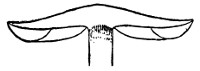
Section of Pilosace Algeriensis.
Hymenium differentiated from the stem. Gills free from the stem;
general and partial veil both absent,
hence there is no ring on the central
stem. Spores purple-brown.
A peculiar genus, with the habit
of Agaricus, but without a trace of
a ring. Massee.
P. eximius Pk., 24th Rep. N.Y.
State Bot., is the only species thus
far reported in America. Edible qualities unknown.
STROPHA´RIA.
Gr—a sword-belt. (Referring to the ring.)
Flesh of stem and pileus continuous. Veil present, when ruptured
forming a distinct ring on the stem. Gills more or less adnate.
On the ground or epiphytal.
Separated from all the genera of the purple-spored series but Agaricus
by the presence of a distinct ring, and from that by the continuity
of flesh in stem and pileus, and by the gills not being free. Pileus
somewhat fleshy, sometimes viscid.
The species belonging to this genus are rather small, and from their
habitats are frequently passed or overlooked. Yet many of them are
common and plentiful. Those which have been tested are excellent and
worth seeking in their season. The entire genus has been under a
cloud. Writers upon it assert some of its members to be dangerously
poisonous. So far as carefully tested by the writer no doubtful one has
349been encountered, and one—semiglobata—has been eaten by himself
and friends since 1881, notwithstanding its dangerous reputation.
The division between this genus and Agaricus is not always sharply
defined. S. æruginosa, S. semiglobata and S. stercoraria were formerly
placed in Psalliota, now Agaricus.
A. Viscipelles (
viscum, bird-lime;
pellis, a skin). Page
349.
Pellicle of the pileus even or scaly, generally viscid.
* Mundi—mundus, clean. Not growing on dung.
** Merdarii—merda, dung. Ring often incomplete.
B. Spintrigeri (Stropharia spintriger).
Pileus without a pellicle, but fibrillose, not viscid. None known to
be edible.
A. Viscipelles. Pellicle of the pileus even or scaly.
* Mun´di—
not growing on dung.
(Plate XCVI.)
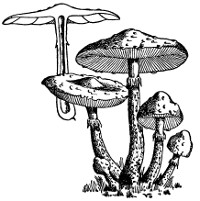
Stropharia æruginosa.
Natural size. (After Stevenson.)
S. ærugino´sa Curt.—ærugo, verdigris. Pileus fleshy, but not
compact, convex-bell-shaped then
flattened, somewhat umbonate (obtuse
when larger), with very viscid
pellicle, the ground color yellowish
but verdigris from the azure-blue
slime with which it is more or less
covered over, becoming pale as the
slime separates. Stem hollow, soft,
equal, at the first scaly or fibrillose
below the ring, viscid, becoming more
or less azure-blue green. Ring distant.
Gills adnate, plane, 2 lines and more
broad, not crowded, soft, whitish
then dusky, becoming somewhat purple.
The above are the essential marks of this species. Variable in form,
350sometimes cespitose. The typical and handsomest form is gathered in
soaking weather in later autumn in shaded woods; it is large (pileus
and stem 3 in. and more), stem squarrose with white spreading scales,
intensely verdigris or azure-blue-pelliculose and very glutinous. From
this there is a long series of forms with the gluten more separating (on
the separation of the gluten the pileus becomes yellow), and the scales
alike of the pileus and stem rubbed off. Finally, a smaller form occurs
in open meadows, stem scarcely 2 in. long, only 2 lines thick, becoming
azure-blue-green and without scales, pileus 1–2 in. broad, pale verdigris
soon light yellowish, less viscid. In this form the ring is incomplete,
while in the typical form it is entire, spreading, and persistent.
In woods, meadows, etc. Common. July to November. Stevenson.
Spores ellipsoid or spheroid-ellipsoid, 8×4–5µ K.; 5×7µ W.G.S.;
elliptical, 10×5µ Massee.
POISONOUS. Stevenson.
“There is a white variety, in which the pileus is perfectly white from
the first.” Cooke.
S. æruginosa has been noted here by Schweinitz in Pennsylvania,
Curtis in North and South Carolina, Frost in Vermont and Massachusetts,
Harkness and Moore, California, Morgan, Ohio. The qualities
of the American representatives are not reported. I have not seen the
species. As it is asserted to be poisonous by European writers it may
be. M.C. Cooke says: “It has the reputation, which is somewhat
general on the continent, of being poisonous, but probably this is only
assumed from its disagreeable taste and repulsive appearance.” Collectors
are cautioned to look out for it, and not to eat of it carelessly.
I can find no case of poisoning by this species reported. It presents
another case of “Not proven.”
** Merda´rii—
ring often incomplete.
S. stereora´ria Fr.—stercus, dung. Pileus 1 in. broad, yellow, fleshy,
but thin at the margin, hemispherical then expanded, obtuse, orbicular,
with a viscid pellicle, naked, smooth, even or at length slightly striate
only at the margin. Stem 3 in. and more long, 2–3 lines thick, stuffed
with a separate fibrous pith, equal, clothed to the ring (which is scarcely
1 in. distant from the pileus, viscous, narrow, but somewhat spreading)
with the flocculose veil which is at the same time viscous (so that it
351appears as if smooth), yellow. Gills adnate, very broad behind, 2
lines broad, somewhat crowded, dusky-umber or dusky-olivaceous, of
one color, quite entire.
Stem silky-viscous when moist, when dry becoming even, shining and
yellowish-white, and without a manifest veil. The gills are truncate and
somewhat decurrent. Fries.
Spores 17×13µ W.G.S.; elliptical, 18–20×8–10µ Massee.
West Virginia, 1881–1885; Pennsylvania; New Jersey. June to November.
McIlvaine.
I have enjoyed this species, which is common, since 1881. It is
usually conspicuous upon droppings and manure piles. It also occurs
on richly-manured ground, in wood and field, usually single; sometimes
two or three are united.
Caps and stems are edible, but do not cook in the same time. It is
better to cook the caps only. They are delicious.
(Plate XCVIa.)
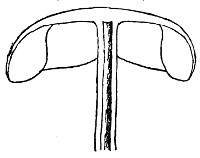
Section of
Stropharia semiglobata.
Natural size. (From Massee.)
S. semigloba´ta Batsch.—semi, half; globus, a ball. Pileus commonly
½ in. broad, light-yellow, slightly
fleshy, hemispherical, not expanded, very
obtuse, even, viscous. Stem about 3 in.
long, 1 line thick, tubed, slender, firm and
straight, equal, even, smooth, becoming
yellow, paler at the apex, powdered with
the spores, otherwise smeared with the
glutinous veil which is abrupt above terminating
in an incomplete (not membranaceous)
viscous, distant ring. Gills adnate,
very broad, plane, clouded with black.
Spores dusky-purple. Stevenson.
Spores blackish-purple, 13×8µ W.G.S.; elliptical, ends rather acute,
12×6µ Massee.
Grows on dung, rich lawns and pastures. April to November. A
common, frequent, solitary species, easily recognized by its hemispherical
cap, dark mottled gills. At first sight it resembles Naucoria
semiorbicularis.
The caps are equal to any mushroom. I have eaten it since 1881.
M.C. Cooke says: “It was Sowerby who drew attention to this species
352as dangerous, and intimated that it had been fatal. Since that period
we are not aware of any further evidence against it.”
It is tender, good and harmless.
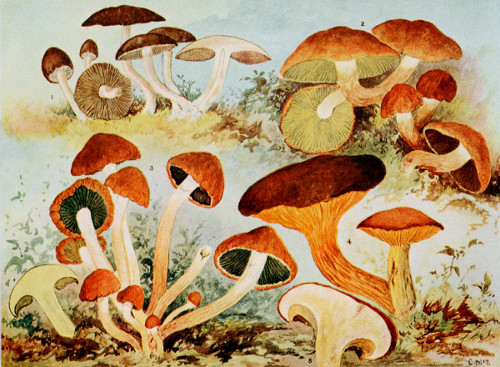
Grouped by F.D. Briscoe—Studies by C. McIlvaine. Plate XCVII.
| Fig. |
Page. |
Fig. |
Page. |
| 1. Hypholoma appendiculatum, |
363 |
3. Hypholoma sublateritium, |
359 |
| 2. Hypholoma perplexum, |
354 |
4. Gomphidius rhodoxanthus, |
394 |
HYPHOLO´MA.
(Plate XCVIII.)
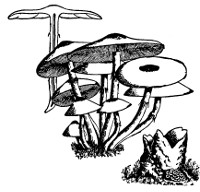
Hypholoma fascicularis.
Natural size.
Pileus more or less fleshy, margin at first incurved. Veil webby, adhering
in fragments to the margin of
the pileus, not forming a distinct ring
on the stem. Stem fleshy, similar
in substance to that of the pileus with
which it is continuous. Gills attached
to the stem, sometimes with a
notch at the juncture (emarginate),
occasionally separating and then appearing
to be free.
Generally cespitose, mostly growing
on wood above or under the
ground.
Spores brownish-purple, sometimes
intense-purple, almost black.
Corresponding to Tricholoma, Entoloma
and Hebeloma.
Fasciculares (H. fascicularis). Page
354.
Pileus tough, smooth, bright colored, not hygrophanous.
Viscidi (viscidus, viscid).
Pileus naked, viscid. None known to be edible.
Velutini (
H. velutinus). Page
360.
Pileus silky or streaked with small fibers.
Flocculosi (floccus, a lock of wool).
Pileus covered with superficial floccose scales, at length disappearing.
(None reported edible.)
Appendiculati (
H. appendiculatus). Page
362.
Pileus smooth, hygrophanous.
Members of this purple-spored genus grow upon decayed wood,
either standing or as roots in the ground, or from ground heavily laden
with woody material. They grow singly, in groups, or in densely-tufted
or overlapping masses. The several species vary in shades of
yellow, red, orange, brick-color and brown; their caps are from 1–6 in.
across; their stems are short or long, as the number in the cluster permits;
when growing singly the stems are short and sturdy. There is a
floccose veil, or remnants of one, about the stem. The gills are yellowish,
greenish, olivaceous or greenish shades of yellow, gray, purple,
almost black. They are showy, easily recognized and are found from
September until mid-winter. I have gathered them when frozen hard.
The flesh is solid, or spongy, flexible or fragile, white or yellowish; the
tastes are sweet, nutty, bitter and saponaceous. Patches of them—and
they are frequent in almost every woods in the land—often yield several
bushels. Tons of them annually go to waste.
Old authors and some copyists say “the species are not edible, the
tough ones being bitter, the fragile ones almost void of flesh.” Eighteen
years of experience with them warrants my saying that there is not a
single wild genus approaching it in economic value, and when its most
prominent species are properly cooked, few equal it in consistency and
flavor. As a pickle the Hypholomas have no superior.
354Half a dozen or more of the species are exceedingly difficult to separate.
Professor Peck has happily made a new species, H. perplexum,
which is well named. For all culinary purposes these affiliated species
may be gathered under that convenient name; for botanic purposes his
description covers several perplexing characteristics common to what
have been written as separate species, and covers a composite species.
The occasional bitter taste of some species is not constant, and can
not be relied upon as a distinguishing mark. In the same tufts some
individuals may be mild, others bitter; some individuals in groups are in
a position and of an age to absorb water; others are not. There will
be a marked difference in their taste raw. A few in the same group may
have been infested by insects; others not. Those infested are often intensely
bitter, while their companions are of pleasant flavor. The same
remarks apply to neighboring clusters and individuals. I am of the
opinion, from long observation, that the bitter is largely due to the injury
and excrement of larvæ. Changes of taste occur in toadstools in
a most marked and rapid manner. Apples from the same tree, chestnuts
from the same tree, acorns from the same oak, radishes from the
same seed, blackberries from the same bush, differ widely in taste. Why
not toadstools of the same species?
I have often seen species of this genus, described as having stems up
to 5 in. long, stretch and twist their stems to over a foot in order to get
their caps from the inside of, or from a crack in a decaying stump, out into
the light; and I have seen stems of the same species stout, solid and
sturdy when individuals grew upright and singly. But wherever and
however they grow, Hypholomas are safe. I have eaten them indiscriminately
since 1881, and as long ago as 1885 published their edibility.
Fascicula´res. Pileus smooth, etc.
H. perplex´um Pk.—perplexus, perplexed. Perplexing Hypholoma.
(Plate XCVII, fig. 2, p. 352.) Pileus convex or nearly plane, glabrous,
sometimes broadly and slightly umbonate, reddish or brownish-red
fading to yellow on the margin, the flesh white or whitish. Lamellæ
thin, close, slightly rounded at the inner extremity, at first pale-yellow,
then tinged with green, finally purplish-brown. Stem nearly
equal, firm, hollow, slightly fibrillose, whitish or yellowish above, rusty-reddish
or reddish-brown below. Spores elliptical, purplish-brown,
8×4µ.
355The Perplexing hypholoma has received the name because it is one
of a group of five or six very closely allied species, whose separation
from each other is somewhat difficult and perplexing. Of these six
species three have a decidedly bitter, unpleasant flavor, and three are
mild, or not decidedly bitter, if we may rely on the published descriptions
of them. The three bitter ones, also, have no purplish tints to
the mature gills; but two of the mild ones have. By using these and
other distinguishing characters the six species may be tabulated and
their several peculiarities more clearly shown.
|
Taste bitter |
1 |
|
Taste mild, or not clearly bitter |
3 |
| |
| 1. |
Stem solid or stuffed, flesh whitish, gills whitish, then sooty-olive |
sublateritium |
| |
| 1. |
Stem hollow, flesh yellow |
2 |
| |
|
2. Cap yellow or tinged with tawny, stem yellow, gills yellow, becoming greenish |
fasciculare |
| |
|
2. Cap brick-red, stem ferruginous, gills green, becoming olive |
elæodes |
| |
| 3. |
Cap red or brick-red, with a yellow margin; gills yellow, then greenish, finally purplish-brown |
perplexum |
| |
| 3. |
Cap yellow, or slightly tawny on the disk only |
4 |
| |
|
4. Gills gray, becoming purplish-brown |
capnoides |
| |
|
4. Gills yellow, becoming gray, neither green nor purplish |
epixanthum |
Probably in general appearance the Perplexing hypholoma most
nearly resembles the brick-red Hypholoma, H. sublateritium; but it has
often been mistaken for the tufted Hypholoma, H. fasciculare. From
this it may be separated by the more red cap, the whitish flesh, the
purplish-brown color of the mature gills, and the mild flavor. From H.
sublateritium it is distinguished by its usually smaller size, more slender
hollow stem, the yellow greenish and purplish tints of the gills, and the
absence of a bitter flavor. Some may prefer to consider it a variety of
this fungus, rather than a distinct species.
Its cap is 1–3 in. broad, its stem 2–3 in. long and 2–4 lines thick.
It commonly grows in clusters, though sometimes singly, on or about
old stumps or prostrate trunks of trees, in woods or open places. The
caps of the lower ones in a cluster are often defiled and apparently discolored
by the spores that have lodged on them from the upper ones.
356It appears in autumn, and continues until freezing weather stops its
growth. It is a very common species, as well as a late one, and may
often be gathered in large quantity. Its flavor is not first quality, but
with good preparation it makes a very acceptable dish. It has been
tested by myself and correspondents several times, and has been proved
harmless. Peck, 49th Rep. N.Y. State Bot.
West Virginia, 1881–1885; New Jersey, North Carolina, Pennsylvania,
October to January. On stumps, roots, ground containing decayed
woody matter. McIlvaine.
H. perplexum is abundant in most if not all the states. I have eaten
it and its allied species since 1881; dried them, pickled them, and fed
them to many. If the collector gets puzzled, as he will, over one or
all of these species, because no description fits, he can whet his patience
and appetite by calling it H. perplexum and graciously eating it.
H. capnoi´des Fr. Gr—like smoke, from the color of the gills.
Pileus 1 in. sometimes 3 in. broad, ochraceous-yellowish, fleshy, convex,
then flattened, obtuse, dry, smooth. Flesh somewhat thin, white. Stem
2–3 in. long, 2–4 lines thick, growing together at the base, hollow,
equal, often curved and flexuous, becoming silky-even, pallid, whitish at
the apex, here and there striate, becoming rust-colored under the surface-covering
when old. Cortina appendiculate, white, then becoming
brownish-purple. Gills adnate, easily separating, somewhat crowded,
rather broad, arid, at first bluish-gray then becoming brownish-purple.
Cespitose, fasciculate; odor and taste mild. On pine-stumps. Uncommon.
Fries.
Spores ellipsoid-spheroid, 7×5µ K.; elliptical, brownish-purple, 8×4µ
Massee.
California, H. and M.; Minnesota, not necessarily in fir-woods, Johnson;
New York, on or about stumps or decaying wood of spruce. Peck,
50th Rep.
Haddonfield, N.J., 1894. Pine roots and stumps, and on ground.
Cespitose. September to frost. McIlvaine.
A pretty species with caps up to 1½ in. across. Stem 2–4 in. long,
¼-⅜ in. thick, growing together (connate). The taste and smell are
pleasant. The basket is soon filled from its clusters. There is not a
better Hypholoma. The slightly soapy taste which attaches to most of
the abundant and better known species is absent in this.
357H. fascicula´ris Huds.—fasciculus, a small bundle. (Plate XCVIII,
p. 352.) Pileus about 2 in. broad, light yellow, the disk commonly
darker, fleshy, thin, convex, then flattened, somewhat umbonate or
obtuse, even, smooth, dry. Flesh light yellow. Stem very variable
in length, hollow, thin, incurved or flexuous, fibrillose, of the same
color as the pileus and flesh. Gills adnate, very crowded, linear, somewhat
deliquescent, sulphur-yellow then becoming green.
It is very easily distinguished from the preceding species by its bitter
odor and taste, light-yellow flesh, and somewhat deliquescent, sulphur-yellow
then green gills. It forms also more crowded clusters. There
are many remarkable varieties; one robustior (more robust), stem
thickened at the base, another nana (dwarf), both on the ground.
Cespitose on old stumps and the ground. Extremely common.
Stevenson.
Spores elliptical, 7×4µ Massee; 6–7×4µ K.; 6×4µ W.G.S.; ferruginous
purple, 6×4µ Morgan.
“It is very usual to regard this as a poisonous species, but possibly
it is not so in reality.” Cooke.
West Virginia, 1881, Pennsylvania, New Jersey, North Carolina,
McIlvaine.
A very common species appearing in October and lasting until well
into the winter, growing in large, overlapping masses or in tufts from
old stumps or roots, and about trees where decay has begun. Sometimes
solitary. It is then short-stemmed and sturdy. There are several
closely allied species. To know the one from the other, a careful
study of the group is necessary. (See introduction to genus, H. epixanthum,
H. sublateritium, H. capnoides, H. elæodes, and H. perplexum.)
Old authors give it as bitter and poisonous. The bitter is
not always present. Any there is disappears in cooking. It is not
poisonous, but one of our most valuable species. I have eaten it since
1881. A little lemon juice or sherry will cover the slightly saponaceous
taste sometimes present. The caps only are good. It makes a choice
pickle and a good catsup.
H. epixan´thum Fr. Gr—epixanthos, yellowish-brown. Pileus 2–3
in. broad, light-yellow or becoming pale, the disk commonly darker,
fleshy, moderately thin, convexo-plane, obtuse or gibbous, even, slightly
silky then becoming smooth. Flesh white, becoming light-yellow. Stem
358about 8 in. long, 3–4 lines thick, hollow, attenuated from the thickened
base or equal; floccose-fibrillose, pale rust color or becoming dingy-brown
below, with a frosty bloom at the apex; veil hanging from margin of
pileus, white. Gills adnate, crowded, at first light yellow-white, at
length becoming ash-colored, not deliquescent, and not becoming purple
or green.
Strong smelling, odor acid; extremely variable in stature; not hygrophanous.
Fries.
Spores elliptical, 7×4µ Massee.
West Virginia, Pennsylvania, New Jersey, North Carolina. On oak,
chestnut stumps and growing from tree roots in ground. October to
December. McIlvaine.
(See H. perplexum, H. sublateritium and compare descriptions.)
This species, in common with its allies, is extremely hard to determine.
When growing singly from roots or from ground heavily charged
with decaying wood, it is a sturdy, solid plant; when in clusters the
stem is longer, more flexible and the whole character of the plant is
modified. Except for botanic purposes there is no occasion to puzzle
over it. It is in every way an excellent and useful fungus.
H. disper´sus Fr.—dispergo, to scatter. Pileus 1–1½ in. broad,
tawny-honey-color, not hygrophanous, slightly fleshy, bell-shaped then
convex, at length expanded, even, superficially silky round the margin
with the veil, or squamulose, otherwise even and smooth. Flesh thin,
a little paler than the pileus. Stem 2 in. or a little more long, 2 lines
thick, tubed, equal, tense and straight, tough, fibrilloso-silky, somewhat
rust-colored, becoming dingy-brown at the base, pale at the apex.
Gills adnate, thin, ventricose, broad, 3–4 lines, crowded, at first pallid-straw
color, at length crowded, obsoletely green. Fries.
Gills broader than H. fascicularis, etc. Solitary, scarcely ever cespitose.
On pine stumps and the ground. April to November.
Spores elliptical, 7×3–4µ Massee.
North Carolina, in pine woods, Curtis; California, H. and M.; West
Virginia, Pennsylvania, North Carolina, New Jersey, McIlvaine.
Difficult to distinguish from H. fascicularis when growing solitary.
Its edible qualities are precisely the same.
H. elæo´des Fr. Gr—an olive; Gr—eidos, appearance. Pileus
359brick-red or tan, fleshy, rather plane, somewhat umbonate, dry, smooth,
opaque. Flesh yellow. Stem stuffed then hollow, equal, commonly
slender, incurved or flexuous, fibrillose, of the same color as the pileus,
becoming rust-color. Gills adnate, crowded, thin, green then pure
olivaceous.
Cespitose. Odor bitter. On trunks and on the ground. Fries.
Cap 1–2 in. across. Stem 2–4 in. long, ¼-⅜ in. thick, stuffed
then hollow.
West Virginia, 1881–1885, Haddonfield, N.J.; Pennsylvania. On
stumps, roots and ground in woods, etc. McIlvaine. Not reported
elsewhere.
Its habit is the same as H. fascicularis, to which it is closely allied,
and to me seems but a form of this very variable species. It is equally
good.
H. sublateri´tium Schaeff.—sub and later, a brick. (Plate XCVII,
fig. 3, p. 352.) Pileus 2–3 in. and more broad, tawny-brick-red, but
paler round the margin and covered over with a superficial, somewhat
silky, whitish cloudiness (arising from the veil), fleshy, convexo-plane,
obtuse, discoid, dry, even, becoming smooth. Flesh compact, white,
then becoming yellow. Stem 3–4 in. long, 3–5 lines thick, stuffed,
stout and firm, commonly manifestly attenuated downward, rarely equal,
scaly-fibrillose, fibrils pallid, rust-colored downward. Cortina superior,
at first white, at length becoming black. Gills adnate, more or less
crowded according to stature, narrow, at first dingy yellowish and darker
at the base, then sooty, and at length inclining to olivaceous.
Spores brownish purple. Somewhat cespitose. Stem incurved from
position. There are many varieties: B, somewhat solitary, the pileus
and stem, which is thickened at the base, of the same color, reddish.
C, smaller, pileus light yellowish, the hollow stem equal. Schaeff.
Var. squamo´sum, Cooke. Pileus convex, bright brick-red, shading
to yellow at the margin, spotted with superficial scales. Flesh very
thick, yellowish. Gills narrowish, adnate. Stem elongated, stout, pale
above, rust-colored below, hollow, veil hanging from the margin when
young.
On trunks. A very beautiful variety, larger and more robust than
the typical form. Massee.
Spores 6×3µ. W.G.S.; elliptical, sooty-brown, 8×4µ Massee.
360West Virginia, 1881–1885; Pennsylvania, New Jersey, densely cespitose
on stumps and roots. October to long after frosts. McIlvaine.
Edible. Dr. Taylor, 1893. Dept. of Agr. Rep. No. 5.
H. sublateritium has many forms. Both Fries and Stevenson indicate
this as a variable species and my own observation confirms the
truth of this.
This is a very common autumnal species, lasting into the winter. Old
authors give it as bitter and very poisonous. I tested it in 1881 and
have been eating it, in common with all Hypholomas I have found, ever
since. At times it is bitter. I believe this to be due to the passage of
larvæ through the flesh. Unattacked specimens are slightly saponaceous
to the taste while others in the same bunch are bitter.
Vis´cidi. Pileus viscid, etc. (None known to be edible.)
Velutini. Pileus silky, etc.
H. veluti´nus Pers.—vellus, a fleece. Velvety. Pileus fleshy, thin,
convex or expanded, brittle, minutely tomentose-scaly, becoming
smooth, hygrophanous, yellow with the disk reddish. Lamellæ rather
broad, attached, tapering toward the outer extremity, dark brown tinged
with red, the edge whitish-beaded. Stem equal, rather slender, hollow,
fibrillose, subconcolorous, white-mealy and slightly striate at the top.
Spores black.
Height about 2 in., breadth of pileus 1–1.5 in.
Roadsides. Albany Cemetery. September. The pileus sometimes
cracks transversely. Peck, 23d Rep. N.Y. State Bot.
Spores 6×8µ W.G.S.; elliptical, 10×5µ Massee.
Often used in catsup. Innocent and edible. Cooke.
West Virginia. 1881–1885, Pennsylvania, West Philadelphia, Bartram’s
Creek, 1887, McIlvaine.
Var. leioceph´alus B. and Br. (Gr—smooth; Gr—head, from its
smooth pileus). Pileus hygrophanous, rugged, smooth except at the
margin, where it is fibrillose, pallid as is the stem, whose apex is mealy.
Densely cespitose, much smaller than the common form, but apparently
a mere variety, though a striking one from its smooth but very
rugged disk. On old stumps. Stevenson.
New York, Peck, 23d Rep.; West Virginia, West Philadelphia, Bartram’s
Creek, Haddonfield, N.J., September to November. McIlvaine.
361Quantities of var. leiocephalus grow in the West Virginia forests on
stumps and on the ground from decaying roots. 1½ in. is the limit of
its width. Its frequent and dense clusters, its tenderness and delicacy
of flavor make it a favorite.
H. aggrega´tum Pk.—aggrego, to grow together. Densely cespitose.
Pileus thin, convex or subcampanulate, grayish-white, obscurely spotted
with appressed brownish fibrils. Lamellæ subdistant, rounded behind,
nearly free, at first whitish, then brown or blackish-brown with a whitish
edge. Stem rather long, hollow, somewhat woolly or fibrillose, white.
Spores brown, elliptical, 8×4–5µ.
Pileus about 1 in. broad. Stem 2–3 in. long, 1.5–2 lines thick.
At the base of trees and stumps in woods. Alcove. September.
The cespitose habit and obscurely spotted grayish-white pileus are
marked features of this species. From H. silvestre the species may be
distinguished by its smaller size, adnexed or nearly free lamellæ which
have no rosy tint, and by its very cespitose mode of growth. Peck,
46th Rep. N.Y. State Bot.
Mt. Gretna, Pa., about trees and stumps. September to November,
1898–1899. McIlvaine. Not reported elsewhere.
The caps are oyster-color. Amateurs accustomed to the gayer colors
of the autumnal Hypholomas will not suspect this of belonging to the
genus, until the color of the spores is obtained.
The caps are fine.
H. lachrymabun´dum Fr.—lachryma, a tear. Pileus 2–3 in. broad,
whitish when young, then dingy-brown, becoming pale around the margin,
truly fleshy but not compact, convex, obtuse, scaly with hairs, the
innate scales darker. Flesh white. Stem 2 in. long, 3–4 lines thick,
hollow, somewhat thickened at the base, scaly with fibrils, becoming
brownish-whitish. Veil separate, clothed with fibers, hanging from the
pileus, white. Gills adnate, crowded, 3 lines broad, whitish then
brownish-purple, edge whitish and distilling drops in wet weather.
Spores brownish-purple. From mutual pressure the caps are often
irregular. Very cespitose, firm. Fries.
Spores brownish-purple, 9×4µ Massee.
On ground and on trunks. Truly cespitose. Smaller than H. velutinus,
362but firmer, truly fleshy, not hygrophanous. Bushy pastures.
Bethlehem. October.
Our specimens do not agree in all respects with the published description
of the species. The pileus is sometimes wholly destitute of
scales and sometimes densely clothed with hairy, erect ones. The species
is manifestly variable. Peck, 30th Rep. N.Y. State Bot.
“Like H. fascicularis in quality. Intensely irritant. It is bound with
the weight of its own guilt.” Hay.
This is a good specimen of Hay’s comments. H. fascicularis is never
irritant, is good eating, is innocent.
There is irony in the comment of Dr. Cooke: “This doubtful species
is used by the smaller ketchup makers.”
I have not seen this species. When I do I shall eat it and expect to
live.
Appendicula´ti. Pileus hygrophanous, smooth.
H. incer´tum Pk. (Plate XCVIIa.) Pileus fragile, convex or subcampanulate,
then expanded, hygrophanous, often radiately wrinkled,
whitish with the disk yellowish, the thin margin sometimes purplish-tinted,
often wavy, adorned by fragments of the white flocculent fugacious
veil. Lamellæ close, narrow, whitish then rosy-brown, the edge
often uneven. Stem equal, straight, hollow, easily splitting, whitish
with a frosty bloom or slightly scurfy at the top. Spores elliptical,
purplish-brown, 8×5µ.
Plant gregarious or subcespitose, 2–3 in. high. Pileus 1–2 in.
broad. Stem 1–2 lines thick.
Ground among bushes. Green Island and Sandlake. June and July.
The veil is sometimes so strongly developed as to form an imperfect
ring. The color is nearly white from the first. Peck, 29th Rep. N.Y.
State Bot.
As the name indicates, I was uncertain whether this was a form of H.
Candolleanum, to which it is very closely related, but as Fries says of
that “Gills at first violaceous,” and as our plant has them at first white
or whitish, I concluded to risk the uncertainty on a new species.
I have seen Central Park, New York, well covered with it in May. It
is also common in the vicinity of Boston. Of very agreeable flavor and
delicate substance. The profusion of its growth compensates for its
small size. Macadam.
363Indiana, H.I. Miller; Mt. Gretna, Pa., in great clusters between
railroad ties and beside track, McIlvaine.
Tender. One of the best.
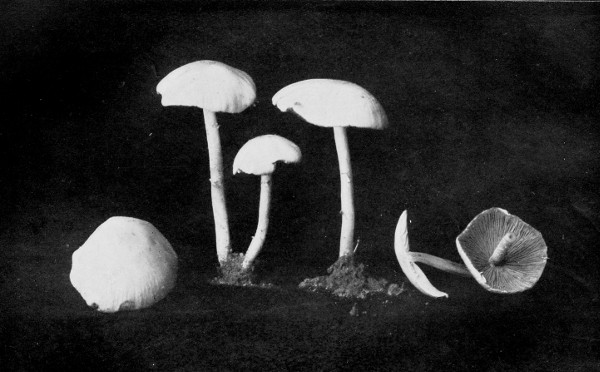
Photographed by Dr. J.R. Weist. Plate XCVIIa.
HYPHOLOMA INCERTUM.
H. appendicula´tum Bull.—a small appendage. From the veil adhering
to margin of pileus. (Plate XCVII, p. 352.) Pileus 2–3 in.
broad, date-brown then tawny, becoming pale yellowish when dry,
fleshy-membranaceous, thin, ovate then expanded, at length flattened,
obtuse, smooth, when dry slightly wrinkled, somewhat sprinkled with
atoms. Stem 3 in. long, 2–3 lines thick, fistulose, equal, smooth,
white, pruinate at the apex; veil fringing the margin of the pileus,
fugacious, white. Gills somewhat adnate, crowded, dry, white then
flesh-colored, at length dingy-brown.
Densely cespitose, very fragile and hygrophanous. Much thinner
and more fragile than H. Candolleanus. It may be safely distinguished
from species which are nearest to it by the gills being whitish then
brownish-flesh color.
Var. lana´tum. A curious form, densely woolly when young, traces
of the woolly coat remaining at the apex when the pileus is fully expanded.
Sibbertoft. B. and Br., 1876. Stevenson.
Spores ellipsoid, pellucid, 6–8×3–4µ K.; 4×6µ W.G.S.; elliptical,
5×2.5µ Massee.
Angora, West Philadelphia, October, November, December, 1897;
Haddonfield, N.J., Mt. Gretna, Pa., cespitose and gregarious in woods
about stumps. McIlvaine.
“It is very common and edible.” Farlow.
At Mt. Gretna, Pa., October, 1898, in great abundance. When
found it was gregarious in large patches and cespitose on stumps. My
identification was confirmed by Professor Peck.
It dries well, and retains flavor and esculent qualities. Cooked it is
among the best.
H. Candol´leanum Fr.—After De Candolle. Pileus 2–4 in. broad,
date-brown then becoming white, the top somewhat yellowish, somewhat
fleshy, acorn-shaped then bell-shaped, soon convex and at length
flattened, obtuse and unequal, smooth, even. Flesh thin, white. Stem
3 in. long, 2–4 lines thick, fistulose, solid at the base, somewhat thickened,
fibrillose, white, striate at the apex; veil in the form of a cortina,
364web-like, appendiculate (depending from the margin of the pileus),
white, at length becoming dingy-brown. Gills rounded-adnexed, then
separating, crowded, violaceous then brownish-cinnamon, the edge at
first whitish.
Readily distinguished from neighboring species by the gills being at
first beautifully dark violaceous, never flesh-colored. Densely cespitose,
fragile, very hygrophanous. Stevenson.
Spores elliptical, 8×4µ Massee.
Edible, often used in catsup. Cooke.
A species variable in color with the weather. Its gills are cream-colored
at first, then purplish, then very dark. After rain the fragile
cap often turns up at the margin and splits.
It differs somewhat in texture from other Hypholomas, being more
delicate in texture and substance. It is excellent.
H. suba´quilum Banning.—aquilus, brownish, tawny. Pileus brown,
convex, smooth, hygrophanous, often shaded into ocher at margin, veil
delicate, silk-like, encircling and covering the marginal extremities of
the lamellæ but forming no ring on the stem. Flesh white, turning
umber when cut. Lamellæ adnexed or nearly free, close, forked, umber.
Stem cespitose, regular, hollow, silky, white, 2–3 in. long.
Spores brown, 4×5µ. Banning MS.
Druid Hill Park, Baltimore, Miss Banning; decaying wood, Adirondack
mountains. August and September. New York. Peck, 45th
Rep. N.Y. State Bot.
H. subaquilum is closely allied to H. appendiculatum, but is distinguished
by its darker colored cap and gills.
Its edible qualities are the same. It is among the best.
365PSILO´CYBE Fr.
Gr—naked; head.
Pileus more or less fleshy, smooth, margin at first incurved. Gills
becoming brownish or purple. Stem somewhat cartilaginous, rigid or
tough, tubular, hollow or stuffed, often rooting. Veil absent or rudimentary,
never forming a membrane. Spores purple, purple-brown or
slate-color.
Generally growing on the ground, gregarious, sometimes cespitose.
Psilocybe is analogous in form to Collybia, Leptonia and Naucoria,
which are distinguished by their spore colors. Separated from Psathyra
by the incurved margin of the pileus.
But one species of Psilocybe is herein given as edible. Of it, alone,
the writer has had opportunity to eat meals. Several others of the
species have been found by him and tested in small quantity. They are
all of good texture, substance and flavor, though most are small. He
is of the opinion that increased testing will prove the entire genus edible.
Nothing can or should be prognosticated about a toadstool, but
the indications are all in favor of Psilocybe.
(Plate XCIX.)
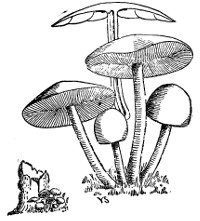
Psilocybe spadicea.
Two-thirds natural size.
P. spadi´cea Schaeff.—spadiceus, date-brown. Pileus thin, submembranaceous,
hemispherical, then convex
or expanded, smooth, hygrophanous,
pale grayish-brown and
striatulate when moist, white or yellowish
when dry. Gills narrow, close,
attached, easily separating from the
stem, at first whitish, then brown,
tinged with flesh-color. Stem straight,
equal, hollow, smooth, white.
Height 1–2 in., breadth of pileus
1–1.5 in. Stem 1–2 lines thick.
Grassy ground in yards and fields.
Albany. June. Gregarious or cespitose.
The pileus is fragile, the spores
are brown. Peck, 23d Rep. N.Y.
State Bot.
Spores brown, 9×4µ Massee; purplish brown, 7.6×5.1µ Morgan.
Haddonfield, N.J., October, November, December, 1896. In large
patches and where stumps had been taken from the ground. McIlvaine.
366Var. hygro´philus Fr. Gr—moist; loving.
Pileus tawny, then clay-color. Stem 4–6 in. long, rather fusiform,
rooting. Gills emarginate with a deeply decurrent line; at length
umber-brown.
Var. polyceph´alus Fr.—polus, many; cephale, head.
Densely crowded. Stem thinner, flexuous. Gills nearly free, at
length tawny-umber.
The plant is tender, cooks easily and is of fine flavor.
P. semilancea´ta Fr.—semi, half; lancea, a spear. Pileus ½ in.
high, not broad, various in color, becoming yellow, green, dingy-brown,
somewhat membranaceous, acutely conical, almost cuspidate, never expanded,
but the margin when young at first bent inward, covered with a
pellicle which is viscous and separable in wet weather, slightly striate
chiefly round the margin. Stem as much as 3 in. long, scarcely 1 line
thick, tubular and containing a pith, equal, more frequently flexuous,
smooth, capable of being twisted round the finger, smooth, becoming
pale; furnished with a veil when young. Gills ascending into the summit
of the cone, adnexed, almost linear, crowded, becoming purple-black.
Fries.
Gregarious, very tough. Pastures and roadsides, etc. Common.
August to November. Stevenson.
Spores ellipsoid, 9–16×4–9µ K.; 14×9µ W.G.S.
New York, Peck, Rep. 23; Novia Scotia, Somers.
Var. cærules´cens Cooke—becoming blue. Base of stem turning indigo-blue.
Not common in America, but frequently found. According to M.
C. Cooke—a careful authority—P. semilanceata has a dangerous reputation.
It is said to have proved fatal to children when eaten raw. It is
not deleterious when cooked.
367PSA´THYRA Fr.
(Plate C.)
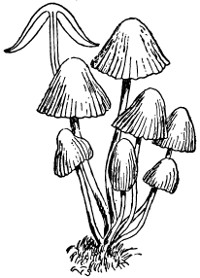
Psathyra gyroflexa.
Natural size. (After Massee.)
Omitted from Index to Species.
Veil none or only universal, and
floccoso-fibrillose. Stem somewhat
cartilaginous, fistulose with a tube,
polished, fragile. Pileus conical or bell-shaped,
membranaceous, the margin at
the first straight and adpressed to the
stem. Gills becoming purple or brownish.
Slender, fragile, hygrophanous.
Some of the last species of Hypholoma
and Psilocybe are very closely
allied to them. The Coprinarii are
readily distinguished by the gills being
white or ash-color, then black, not
dusky-brown nor becoming purple.
Psathyra corresponds with Mycena,
Nolanea, Galera and Psathyrella. All
the species grow on the ground or on
trunks. Stevenson.
But four American species reported. Small and unimportant.
DECONICA.
Stem tough; margin of Pileus at first incurved. Gills subtriangularly
decurrent. Corresponds with Omphalia, Eccilia, Tubaria.
Few American species. Small and unimportant.
Various as are the spore colors in this series (in
its broadest sense), there is an entire absence of
brown and purple shades in the black spores of four
of the genera belonging to this group or series. In
Gomphidius the spores are dingy-olivaceous. It
is an outsider affiliating with thoroughbreds because
of more technical congeniality than other genera
afford. Like comets in the universe, it has no
home. The singular genus Montagnites (of which but one species has
been found in America, and that in Texas) has the relationship of
spore-color. Panæolus, Anellaria, Psathyrella, when young, have gills
free from each other; Coprinus, in early life, presents them pressed
tightly together; as the plants age and the spores ripen, the entire gill
structure becomes black and dissolves into an inky fluid, the color of
which is due to the spores.
The species are all of delicate body, and many of them add generously
to table luxuries.
COPRI´NUS Pers.
Pileus separate from the stem. Gills membranaceous, at first closely
pressed together, cohering, at length melting into a black fluid. Trama
obsolete. Spores oval, even, black.
The extreme closeness of the gills and their entire deliquescence into
a fluid, black from the spores, sharply define this genus and separate it
from all others. At first the form is oval or cylindrical; most are
furnished with a downy or scurfy veil often adhering to the pileus,
sometimes forming an adhering volva at the base of the stem. Nearly
all are ephemeral, many completely disappearing in a day.
Cystidia (sterile cells) of large size are frequent on the gills of many
species.
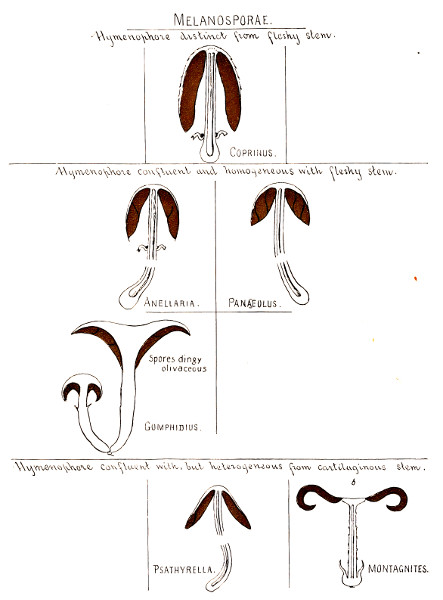
Plate CI.
Chart of genera in black-spored series—Melanosporae, Page 368.
369The majority grow on richly manured ground or dung, some on rotten
wood and other materials. Bolbitius, the only ally, has the same
ephemeral existence, and grows in similar situations, but the gills only
soften (not melting) and the spores are somewhat rust-colored.
The blackening of the gills is not a process of decay, but is due to
the growth of the spores, and the plant is still (before deliquescence)
perfectly edible although not so inviting in appearance as before.
Species of Coprinus are very common and are easily recognized by
the deliquescent gills which, when mature, stain the fingers black.
In “Once upon a Time,” when country people made their own writing
inks, the convenient Coprinus gave its juices for this purpose. A
little corrosive sublimate added to the boiled and strained fluid prevented
it from molding.
With few exceptions the species are small. They are tender, of real
mushroom flavor and highly enjoyable. They make a thin, well flavored
catsup, but are better used to give flavor to their less favored brethren.
They stew in from two to fifteen minutes, depending upon the solidity
of the species.
A. Pelliculosi (pellicula, a thin skin). Page 370.
Gills covered above with a fleshy or membranaceous skin, hence the
pileus does not split along the lines of the gills, but becomes lacerated
with the edges turned upward.
* Comati—coma, hair. Furnished with a ring formed from the free
margin of the volva. The skin of the pileus torn into innate scales.
** Atramentarii—atramentum, ink. Ring imperfect. Volva absent.
Pileus dotted with minute innate scales.
*** Picacei—pica, a magpie. Universal veil downy, at first continuous
then broken up into superficial scales forming patches on the pileus.
**** Tomentosi—tomentum, down. Pileus at first covered with a
loose hairy down, becoming torn into distinct scales, at length disappearing.
Ring absent.
***** Micacei—mico, to glitter. Pileus at first covered with minute
glistening scales, soon disappearing. Ring none.
****** Glabrati. Pileus smooth. Veil absent.
370B. Veliformes (velum, a veil; forma, form). Page 380.
Pileus very thin without a skin, at length opening into furrows along
the backs of the gills and becoming folded in furrows. Stem thin, hollow.
Gills wasting away into thin lines.
* Cyclodei. Gr—a circle; appearance. Stem with a ring or volva.
** Lanatuli—lanatus, woolly. Pileus covered with superficial woolly
floccules, at length disappearing. Ringless.
*** Furfurelli—furfureus, branny. Pileus mealy or scurfy. Gills
generally attached to a collar at the apex of the stem. Ringless.
**** Hemerobii. Gr.—living a day. Pileus always smooth.
None known to be edible.
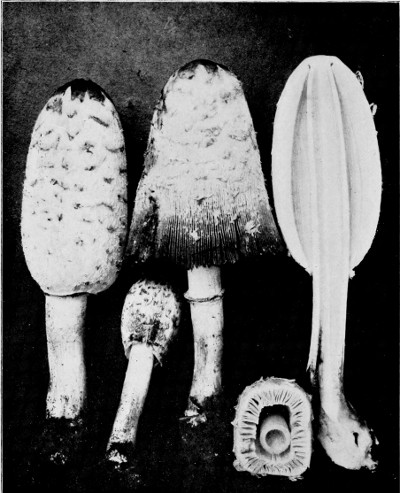
Photographed by Dr. J.R. Weist. Plate CIII.
COPRINUS COMATUS.
A. Pelliculo´si. Cap becoming torn, edge turning upward, etc.
* Comati.
Furnished with a ring, etc.
C. coma´tus Fr.—coma, hair. (Plate CIII.) Pileus 2–7 in. high,
white, fleshy, at first oblong, becoming bell-shaped, seldom expanded,
when in mature deliquescing state, splitting at the margin along the line
of the gills, the cuticle, except upon the apex, separating into shaggy,
often concentric scales, at times yellowish, at others tinged with purplish-black.
Gills free from the stem, crowded and at first cohering,
broad, white then tinged with pink or salmon color, then purple to
black and dissolving into ink. Stem up to 10 in. long, up to ⅝ in.
thick, attenuated upward, most part concealed within the cap, hollow,
but with spider-web threads within, smooth or fibrillose, white or lilac-white,
easily pulling out of cap, brittle. Ring thin, torn, sometimes
entire and movable.
On rich soil, lawns, gardens, roads, dumps, especially where ashes
have been placed. Solitary or in large dense clusters. August until
after frost, but it is occasionally found during the spring months.
Spores elliptical, black, 13–18µ long Peck. Almost black, elliptical,
13–18×7–8µ Massee; 11–13×6–8µ K.; 15×8µ W.G.S.
Var. brev´iceps Pk. Pileus before expansion subovate, shorter and
broader than in the typical form, 1.5–2.5 in. high. Dumping ground.
Albany. November. H. Neiman. Peck, 49th Rep.
Coprinus comatus is common to the United States. In its perfection
it is a stately and beautiful plant. I have seen it with the oblong cap
371eight inches long, but its usual height is from 2–4 in. It occurs after
hard rain and often in the most unexpected places. It is a rather domestic
species, usually in troops, but often in clusters of from five to
fifty individuals. I have seen it lift firmly sodded ground about railroad
stations, and again, bulging the surface of gardens like mole-hills.
There are toadstools of higher flavor, but not one of greater delicacy.
In this C. comatus is not excelled from its earliest stage until fully
ripened. It is everywhere commended.
Lafayette B. Mendel, in American Journal of Physiology, gives the
following analysis:
The specimens were freshly gathered and had not yet turned “inky.”
They varied very widely in size, thirty-six mushrooms weighing 1485
grams, of which 980 grams belonged to the caps (pileus) and 505
grams to the stems. The average weight of a fresh specimen was thus:
| Pileus |
27 |
grams |
| Stem |
14 |
|
|
— |
|
| Total weight |
41 |
|
A specimen which had attained the average growth weighed:
| Pileus |
43 |
grams |
| Stem |
25 |
|
|
— |
|
| Total weight |
68 |
|
An analysis yielded the following results:
| Water |
92.19 |
per cent. |
| Total solids |
7.81 |
|
The dry substance contained:
| Total nitrogen |
5.79 |
per cent. |
| Extractive nitrogen |
3.87 |
|
| Protein nitrogen |
1.92 |
|
| Ether extract |
3.3 |
|
| Crude fiber |
7.3 |
|
| Ash |
12.5 |
|
| Material soluble in 85 per cent. alcohol |
56.3 |
|
C. soboli´ferus Fr. Pileus 1½-2½ in. across, subcylindrical, then
oval bell-shaped, lower half of pileus usually undulate but not furrowed
or striate, disk obtuse, usually depressed, distinctly scaly, dingy white,
toward the apex tinged with pale brown, scales darker. Flesh very
thin. Gills free, tapering toward each end, ¼ in. or more broad,
crowded, pale then blackish. Stem 5–8 in. long, ¾ in. thick at the
372base, slightly attenuated upward, silky-white, stuffed; toward the base
there is a depressed zone caused by the edge of the pileus when young.
Ring fugacious. Spores elliptical, 15×7µ.
Amongst grass near to trunks, buried wood, etc. A very large and
beautiful species, distinguished from Coprinus atramentarius, its nearest
ally, by the larger size of every part, the costate (ribbed) or waved
lower portion of the pileus, the truncate, depressed disk, with distinct
squamules, the whitish color of the pileus, and the imperfectly hollow or
stuffed stem.
Spores elliptical, 15×7µ Massee.
Almshouse grounds, Philadelphia. On maple roots in grass-grown
places, May, 1897–1898. McIlvaine. Not previously noted in United
States.
C. soboliferus is a substantial food-giving species, very heavy for its
size. It grows singly and in clusters and will immediately attract attention,
wherever found. It is of fine flavor and substance. Cook at once.
C. ova´tus (Schaeff.) Fr.—ovum, an egg. Pileus white, somewhat
membranaceous, at the first egg-shaped and densely imbricated with
thick spreading concentric scales, covered with an even hood at the apex,
then expanded, striate. Stem 3–4 in. long, solid at the base, rooting,
otherwise hollow, with spider-web threads within, attenuated upward,
downy, shining white. Ring not very conspicuous and soon vanishing.
Gills free, remote, slightly ventricose, at the first somewhat naked and
remaining long shining white, at length umber-blackish, never becoming
purple.
Smaller, thinner, less handsome than C. comatus. For the most part
solitary. Fries.
Spores 11–12×7–8µ Massee.
On rich ground, dumps, etc. Same habitat as C. comatus.
West Virginia, Pennsylvania, North Carolina, New Jersey. McIlvaine.
So closely allied to C. comatus that it is with difficulty distinguished
from it. However, its edible qualities are the same, and into these the
name does not enter.
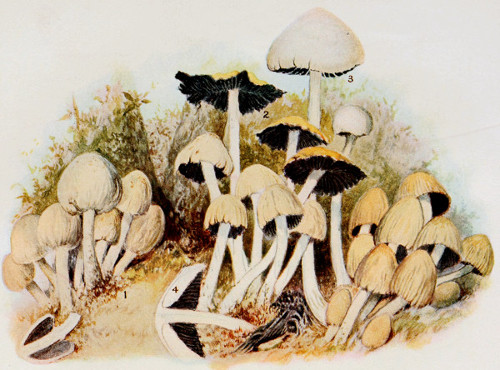
Grouped by F.D. Briscoe—Studies by C. McIlvaine. PLATE CII.
| Fig. |
Page. |
Fig. |
Page. |
| 1. Coprinus atramentarius, |
373 |
3. Panaeolus solidipes, |
385 |
| 2. Coprinus micaceus, |
378 |
4. Panaeolus solidipes (section), |
385 |
C. sterquili´nus Fr.—sterquilinium, a dunghill. Pileus about 2 in.
across when expanded, conical, then expanded, sulcate more than half
373way from margin to disk, at first villous or silky, disk rather fleshy with
rough scales, silvery-gray, tinged with brown at the apex. Flesh thin.
Gills free, ventricose, about 2 lines broad, pale then umber-purple.
Stem 4–6 in. high, slightly attenuated upward, white, fibrillose, hollow,
thickened base solid, and booted for about an inch from the base, margin
of sheath ending in a free border or ring.
On dung. A fine large species known by the scaly apex of the pileus,
the basal portion of the stem surrounded by a volva-like, adnate
structure with a free upper margin. The stem soon becomes black when
bruised. Base of stem not rooting but abrupt, and furnished with a few
white fibers. Massee.
Edible, Cooke, 1891; also Leuba.
Nova Scotia, Dr. Somers.
This species is not reported as found in the United States.
** Atramentarii.
Ring imperfect, etc.
C. atramenta´rius (Bull.) Fr.—atramentum, ink. (Plate CII, fig.
1, p. 372.) Pileus 1½-4 in. across, ovate, expanding, grayish, lead-color
or grayish-brown, with occasionally a few obscure scales on disk,
often covered with bloom; margin ribbed, sometimes notched, soft, tender.
Gills free, ventricose, up to ½ in. broad, crowded and at first
cohering and white with white floccose edges, then becoming black and
dissolving into ink. Stem up to 5 in. long, up to ½ in. thick, smooth,
whitish, hollow, at first spindle-shaped, then attenuated upward, with
more or less distinct ring near base.
Spores subcylindrical, large cystidia numerous, 12×6µ Massee; 9–10×6µ
K.; 9×5µ W.G.S.; 8–10µ long Peck.
Indiana, H.I. Miller; Harrisburg, Pa., Dr. J.H. Fager; West Virginia,
McIlvaine.
The stem is obscurely banded within, by which it may be recognized
with certainty.
It grows singly or in clusters of many individuals on rich ground,
whether lawns, gardens, gutter sides, or in woods, but not on dung. I
know of a fine cluster growing year after year on a much-decayed pear-stump.
Occasionally it appears in the spring months, but is common
during the summer and autumn after rains, and from its first appearance
374it occurs in successive crops until stopped by severe frost. It is common
in Europe and over the United States.
The flavor is higher than that of C. comatus. It should be cooked
as soon as gathered, and kept in a cool place until needed.
Analysis shows the following:
Two separate, freshly-gathered lots of this species were examined.
The one (a) contained six young small specimens weighing 5.5 grams,
or .9 gram each; the other (b) contained eight mushrooms weighing
12 grams, or 1.5 grams each. An analysis gave:
|
a. |
|
b. |
|
| Water |
92.31 |
per cent. |
94.42 |
per cent. |
| Total solids |
7.69 |
|
5.58 |
|
| The dry substance contained: |
|
|
|
|
| Total nitrogen |
4.68 |
|
4.77 |
|
| Ether extract |
3.1 |
|
5.7 |
|
| Crude fiber |
9.3 |
|
..... |
|
| Ash |
16.8 |
|
20.1 |
|
| Lafayette B. Mendel in American Journal of Physiology. |
C. fusces´cens (Schaeff.) Fr.—fuscus, dark or swarthy. Pileus 1–1¼
in. across, submembranaceous, ovate, expanded, dull, disk rather
fleshy, even or cracked into squamules, grayish-brown, disk reddish.
Gills adfixed, blackish-umber. Stem 4–5 in. long, about ¼ in. thick,
equal, fragile, hollow, subfibrillose. Ring indistinct or absent, whitish.
Massee.
Smaller and more slender than Coprinus atramentarius. Pileus
brownish-gray, disk becoming reddish, not sprinkled with micaceous
particles, but at first covered with a mealy bloom. Gills adnexed,
attenuated from the stem to the margin, deliquescent. Fries.
Spores elliptical, pointed at the ends, 10x6µ Massee; 10x5µ W.G.S.
Solitary and in tufts. On stumps, trunks, etc. May to October.
West Philadelphia, Pa., McIlvaine.
C. fuscescens is tender, delicate and of excellent flavor. In this it
ranks with C. atramentarius.
(Plate CIV.)
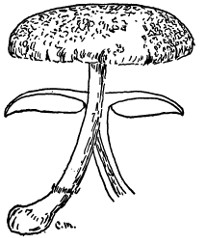
Coprinus macrosporus.
Enlarged one-third.
C. macro´sporus Pk. Pileus ovate, then expanded, rimose-striate
(cracked in lines), obscurely floccose-squamulose, white, the small even
brownish disk scaly. Lamellæ crowded, free, white then black. Stem
375glabrous, white, with traces of an annulus (ring) near the thickened or
subbulbous base.
Spores very large, elliptical, 20–20.5
long, 12–16µ broad.
Plant cespitose, 2–3 in. high. Pileus
1–2 in. broad. Stem 1 line
thick.
Ground in open fields. Ticonderoga.
August.
The prominent characters of this
species are the cracked pileus, squamose
disk, free lamellæ and large
spores. In its early state it resembles
some species of Lepiota. It seems
to be intermediate between the sections
Atramentarii and Micacei. Peck,
31st Rep. N.Y. State Bot.
Found in quantity at Mt. Gretna,
Pa. August to September, 1898,
growing among old stable bedding
on parade ground.
C. macrosporus is an excellent species, higher in flavor than any other
Coprinus.
*** Pica´cei.
Universal downy veil, etc.
C. pica´ceus (Bull.) Fr. Pileus 2–2½ in. across, membranaceous,
ovato-bell-shaped, striate up to the disk, smoky-black, variegated with
large, irregular, superficial white patches. Gills free, ½ in. or more
broad, ventricose, grayish-black. Stem 5–6 in. long, base bulbous,
abrupt, otherwise equal, ¼-⅔ in. thick, white, hollow, fragile, smooth.
Spores elliptical, apiculate, 14×8µ; cystidia large, numerous. Massee.
Decaying trunks or branches of trees in woods. Lyndonville. June.
Fairman.
The form here referred to this species differs somewhat from the
description of the type in being smaller, in having no bulb to the stem
and in having smaller spores. It is probably the “smaller variety
growing on rotten wood” noticed by Stevenson in his British Fungi. I
376have seen the true form of the species from Kansas. The New York
plant seems to me to be worthy of distinctive designation, at least as a
variety, and I call it
Var. ebulbo´sus. Plant smaller. Stem destitute of a bulb. Spores
8–10×5µ. Peck, 44th Rep. N.Y. State Bot.
Minnesota, Johnson, 1897; Kansas, Cragin, 1884; Wisconsin, Bundy,
Nebraska, Clements.
Edible. Leuba.
Large quantities grew on rotting chestnut and oak rails at Mt. Gretna,
Pa., from June to August, 1899. It is strong and unpleasant.
**** Tomento´si.
Pileus at first veiled with a loose hairy veil.
C. fimeta´rius Fr.—fimetum, a dunghill. Pileus 1–2 in. across,
membranaceous, thin, at first cylindrical,
soon conical, the edge at length revolute and
torn at the margin, when young everywhere
covered with floccose-squarrose white scales
(from the universal veil), which separate
from the vertex toward the circumference,
at length naked, longitudinally cracked,
but not opening into furrows, the vertex
which remains entire, livid. Stem about
3 in. long, 2–3 lines and more thick, hollow,
fragile, thickened and solid at the base,
attenuated upward, shining white and
downy with squamules of the same color.
Gills free, reaching the stem, at first ventricose,
then linear, flexuous, black. Stem
when young curt and firmer. Fries.
Spores spheroid-ellipsoid, 15–18×9–12µ
K.; 15×9µ W.G.S.; 12–14×7–8µ Massee.
Sometimes there is a root as long as the
stem. M.J.B. Common on dung heaps in successive crops. Spring
to autumn.
Var. pulla´tus. Pileus with adpressed scales and tomentose, soon
naked, brownish, then blackish. Stem equal, becoming smooth.
On dung. Clustered. Stature of the type.
377Var. cine´reus. Pileus membranaceous, floccosely mealy, then naked,
ashy-gray. Stem subequal, rootless, hollow to the base, often twisted.
Spores 12–8µ.
On dung and rich soil.
Var. macrorhi´za. Pileus at first with feathery squamules. Stem
short, hairy, rooting, sometimes more or less marginately subbulbous.
Spores 13–14×8–9µ.
On dung. Pileus pale and smaller than in the typical form, stem
shorter, with a more or less elongated rooting base. Berkeley.
Of this very variable species there is a small form growing on decayed
wood in woods. It has the spores rather smaller than in the
type, they being 10–11µ long, 8µ broad. It might be designated Var.
silvi´cola. Peck, 43d Rep. N.Y. State Bot.
West Virginia, 1881–1885, May to October. McIlvaine.
Common to the United States. Of excellent flavor and tender. It
must be cooked at once.
C. tomento´sus (Bull.) Fr.—tomentum, pubescence. Pileus very
thin, at first oblong-oval and floccose-scaly, soon bell-shaped, naked,
closely striate, grayish-brown or blackish-brown, often with a leaden
hue, finally expanded, the disk smooth, reddish or ochraceous-brown,
the margin turned upwards and much split or lacerated. Lamellæ
closely crowded, narrow, free, white then pinkish, finally black. Stem
white, tall, fragile, tapering upward, finely floccose-squamulose, hollow,
sometimes with a large tap root. Plant gregarious or cespitose.
Height 3–6 in., breadth of pileus 6–18 lines.
Very variable in size and color. The covering of the pileus is easily
rubbed off. It soon disappears and the plant quickly decays, seldom
continuing through the day. Peck, 23d Rep. N.Y. State Bot.
Mt. Gretna, Pa., about old picketing places in camp grounds. Prof.
M.W. Easton, July, 1898.
West Virginia, North Carolina, New Jersey, Pennsylvania, May to
September, on dung, rich ground, gardens and in woods. McIlvaine.
Very delicate; of strong mushroom flavor. It is common, and can
usually be collected in numbers. It is of little food value in itself, but
yields an excellent flavor to anything it is cooked with. It must be
cooked as soon as gathered.
378C. ni´veus Fr.—nix, snow. Pileus white, 1–2 in. across, thin, ovate
then bell-shaped, margin at length turned upward, split or covered with
a dense white, mealy or downy covering, slightly pink. Gills adnexed,
narrow, crowded, at first cohering, white then pinkish, then black.
Stem at first short, then up to 4 in., slender, attenuated upward, covered
with white down, fragile, hollow.
Spores 16×11–13µ Massee; 10×12µ W.G.S.
Common on dung and dung heaps, clustered. May to frost.
West Virginia, North Carolina, Pennsylvania, New Jersey. McIlvaine.
Very variable in size, but clearly distinguished by its snow-white color
and adnexed gills. Like all of the thin, delicate species of this genus
there is little substance left after cooking, but the savory flavor is imparted
to the cooking medium.
***** Mica´cei.
Pileus at first covered with minute, glistening scales, etc.
C. mica´ceus (Bull.) Fr.—mica, grain, granular. (Plate CII, fig.
2, p. 372.) Pileus thin, ovate, then bell-shaped, with the margin
more or less revolute, wavy, splitting, closely striate, with a few minute
scales and sparkling atoms, or naked, varying in color from whitish-ochraceous
to livid-brown, generally darker when moist or old. Gills
rather narrow, crowded, white then pinkish, finally black. Stem slender,
fragile, easily splitting, slightly silky, white, hollow, often twisted.
Plant mostly cespitose.
Height 2–4 in., breadth of pileus, 1–2 in.
Streets, yards and fields, on or about old stumps. May to September.
Peck, 23d Rep. N.Y. State Bot.
Spores elliptical, blackish, 7–8×4–5µ Massee; 7×8µ W.G.S.; 10×5µ
W.P.; elliptical, brown, 6–8µ Peck.
Var. granula´ris. Pileus sprinkled with granules or furfuraceous
scales. New York. August. Peck, 47th Rep.
Indiana, H.I. Miller; West Virginia, North Carolina, Pennsylvania,
New Jersey. May to October. McIlvaine.
Common from spring until frost. This is the oval-capped toadstool
found in clusters about trees, posts, along grassy sides of pavements, popping
up, Brownie-like, from sodded places. Although small and thin, its
379clusters soon fill baskets, and its continuous growth in some places, from
month to month, year to year, makes it one to be depended upon.
Stewed for ten minutes it makes a rich, luscious dish. C. congregatus
closely resembles it and is equally good.
****** Glabra´ti.
Pileus smooth, etc.
C. deliques´cens (Bull.) Fr. Pileus 3–4 in. broad, livid-fuliginous,
membranaceous, bell-shaped then expanded, smooth, but dotted with
minute points on the disk, never downy or split, the edge turning upward
and striate, the striæ broad but not deep. Stem 4 in. long, 2–4
lines thick, hollow, with a bark-like covering, equally attenuated upward,
smooth, shining white. Gills free, at length remote from the stem,
very crowded, flexuous, very narrow, only ½ line broad, lurid-blackish.
Fries.
Frequent on stumps and among fallen leaves, sometimes in tufts.
July to October.
Spores elliptical, obliquely apiculate, 8×5µ Massee.
Sometimes confounded with C. atramentarius.
West Virginia, Pennsylvania, New Jersey, McIlvaine.
C. deliquescens is of good size and quality. The stems do not cook
well with the caps. The flavor is the same as C. atramentarius.
C. congrega´tus (Bull.) Fr. Pileus ½-¾ in. high, cylindrical, then
bell-shaped, finally expanded and split at the margin, smooth, viscid,
margin slightly striate, ochraceous. Gills about 1 line broad, slightly
adnexed, white, finally becoming black. Stem 1½ in. high, equal,
smooth, hollow, whitish.
On the ground, also in hot-houses. Massee.
Readily distinguished by the densely cespitose mode of growth, the
small size, the viscid, ochraceous, glabrous pileus which remains elongato-cylindrical
for some time, then becomes campanulate and finally
expands and splits at the margin.
Densely cespitose, fragile, readily distinguished from C. digitalis by
its much smaller size. Fries.
Spores 7×8µ W.G.S.; 10×5µ W.P.
Fries and Cooke considered this a good species.
So closely allied to neighboring species that it is difficult to determine
it. Edible qualities are included in the alliance.
380B. Veliformes. Pileus very thin, etc.
* Cyclodei.
Stem bearing ring, etc.
None edible.
** Lanatuli.
Pileus with superficial downy covering, etc.
C. lagopus Fr.—Gr, a hare; a foot. Pileus 1 in. broad, whitish,
disk livid, very tender, cylindrical then bell-shaped, when young beautifully
downy then naked, flattened and split, radiately furrowed. Stem
5 in. and more long, 1 line thick, very weak, very fragile, slightly attenuated
at both ends, everywhere white-woolly. Gills at length remote,
narrow, black. Fries.
Fries distinguishes two forms. A, nemorum. Stem slender, 4–6 in.
long. B, viarum. Stem 2–3 in. long. Pileus broader, livid. Both
forms are inodorous. The pileus of the long-stemmed form is sometimes
entirely clear brown, at others grayish with a brownish disk. Stem
very weak, 5 in. and more in length, 1 line thick, attenuated at both
ends. Pileus thin, expanded bell-shaped, about 1 in. across, when
young elegantly flocculose, then furrowed, disk livid. Gills rather distant.
New York, Peck, 38th Rep.; Mt. Gretna, Pa., July, 1898, on rubbish
about abandoned camp. Prof. M.W. Easton.
A strikingly beautiful species. Both forms were found in abundance,
tested and eaten with enjoyment. They are extremely delicate, and of
attractive but not high flavor.
C. Virgineus Banning. Pileus ovate, bell-shaped, or cylindrical,
pale ocher, the margin thin, torn, downy. Lamellæ narrow, close,
forked, at first white, turning dark but never black, adnexed. Stem
3½ in. long, stout, somewhat stuffed, attenuated where it meets the
pileus, flattened, downy. Spores black.
Cespitose or gregarious at the roots of trees or about old stumps.
Also found in Virginia.
The plant is not rapidly deliquescent, remaining perfect for some
hours. Banning MS.
Maryland. Virginia. Miss M.E. Banning MS. Peck, 44th Rep.
Chester county, Pa. New Jersey, about pear trees and stumps.
McIlvaine.
381This little Coprinus is a valuable species when found. A patch of it
about a tree or stump is treasure trove. Patches of it appear in July
and bear until October. The not-particular observer would mistake it
for C. micaceus.
*** Furfurel´li.
Pileus micaceous or scurfy, etc.
(Plate CVI.)
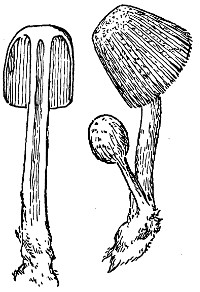
Coprinus domesticus.
Natural size.
C. domes´ticus (Pers.) Fr.—domus, a house. Pileus 2 in. broad,
fuliginous, disk date-brown, thin, ovate
then bell-shaped, covered with small
branny scales, then opening into furrows
and flattened, undulately sulcate, disk
obtuse, even. Stem 2–3 in. long, 2–3
lines thick, fistulose, slightly firm, attenuated
upward, adpressedly silky, becoming
even, white. Gills adnexed, at
first crowded, distant when the pileus is
split, linear, white then reddish, at length
brownish-blackish.
A larger and more remarkable species
than all the neighboring ones. Fries.
Spores 14–16×7–8µ Massee.
On much decayed wood, damp carpets,
in cellars, etc. Often in clusters.
Mt. Gretna, Pa., Prof. M.W. Easton,
July, 1898; West Virginia, New Jersey,
Pennsylvania, McIlvaine.
C. domesticus is the largest of its section
and is sometimes of remarkable growth. I have seen it start from
under a board in a cellar and prolong its stems for over a foot to get its
caps to air and light. Under such conditions the stems are twisted in
a confused mass.
It is very tender with a decided mushroom flavor. Cook at once.
(Plate CVII.)
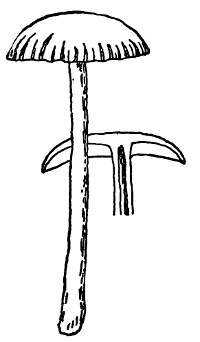
Coprinus silvaticus.
Enlarged one-fourth.
(After Peck.)
C. silvat´icus Pk. Pileus membranaceous, with a thin fleshy disk,
convex, striate in folds on the margin, dark-brown, the depressed
striæ paler. Lamellæ subdistant, narrow, attached to the stem, brownish.
Stem fragile, slender, smooth, hollow, white. Spores gibbous-ovate,
12.7µ long.
382Plant 2 in. high. Pileus 6–10 lines broad.
Stem .5 lines thick. Ground in woods. Greig.
September.
The striæ extend about half way up the pileus.
Allied to C. plicatilis and C. ephemerus
Peck, 24th Rep. N.Y. State Bot.
West Virginia, Pennsylvania, New Jersey.
Frequent, but not common. On ground in
woods, August to October. McIlvaine.
This pretty little fungus is frequently found.
I have never been able to get it in quantity, but
have often eaten it. Its flavor is musky, rather
strong. It is edible, but is not obtainable in
sufficient numbers to make it of much food value.
C. ephem´erus Fr. Gr—lasting for a day.
Pileus ½-¾ in. across, very thin, ovate, then
bell-shaped, finally expanded and splitting, furrowed
radiately, at first slightly scurfy, disk elevated, even, reddish.
Gills slightly attached, linear, white, then brownish, at length blackish.
Stem 1½-2½ in. high, 1 line or more thick, equal, glabrous, pellucid,
hollow, whitish. Spores 16–17×9–10µ.
On dunghills, manured ground, etc. To the naked eye appearing
almost glabrous, but under a lens seen to be distinctly scurfy. Known
from Coprinus plicatilis by the disk of the pileus being prominent and
not depressed. Massee.
Common dung and dung heaps. May to October. New York, Peck.
23d Rep.
Of such size and delicate substance as to be of little food value. But
it has a strong mushroom flavor which is choice as a flavoring. It appears
during the summer months on dung and dung heaps. It must
be cooked as soon as gathered.
C. semilana´tus Pk. Pileus submembranaceous, broadly conical,
then expanded and strongly revolute, and the margin sometimes split,
covered with mealy atoms, finely and obscurely rimose-striate, pale
grayish-brown. Lamellæ narrow, close, free. Stem elongated, fragile,
hollow, slightly tapering upward, white, the lower half clothed with
383loose cottony flocci which rub off easily, the upper half smooth or
slightly farinaceous. Spores broadly elliptical, 12.7µ long.
Plant very fragile, 4–6 in. high. Pileus 8–12 lines broad. Stem 1
line thick at the base. Rich ground and dung. Sandlake. August.
(Plate IV, fig. 15–18.) Allied to C. coopertus. Peck, 24th Rep. N.Y.
State Bot.
West Virginia. 1881–1885, Mt. Gretna, Pa. July to October.
McIlvaine.
I have seldom found it, though at times it was quite common about
stables in West Virginia. It has good mushroom flavor and is edible.
It is stately, attracting attention by its peculiar cap.
C. plica´tilis Fr.—plico, to fold. Pileus 1 in. broad, dusky-brown
then bluish-gray-cinereous, disk darker, dusky-brown or reddish, oval-cylindrical
then campanulate, soon expanded, opening into furrows,
sulcate-plicate, for the most part smooth, disk broad, even, at length
depressed. Stem 1–3 in. long, fistulose, thin, equal, even, smooth, pallid,
somewhat pellucid. Gills remote from the stem and adnate to a collar
which is formed from the dilated apex of the stem, distant, gray-blackish.
Fries.
Very tender and fragile, but when scorched by the sun not melting
into fluid. Very variable in stature and size. Stevenson.
Spores 12–14×8–10µ Massee; broadly elliptic, 5µ long, M.J.B.;
11–13µ long, 8–10µ broad Peck, Rep. 50.
Common in rich pastures, lawns, roadsides, etc. May to October.
West Virginia, Pennsylvania, New Jersey, McIlvaine.
A neat little fungus often found in great plenty. Though small it is
nevertheless edible and must be written with its edible companions.
384PANÆOLUS Fr.
Pileus slightly fleshy, not striate, margin exceeding the gills. Gills
ascending in a conical manner,
slate-gray, mottled with the black
spores. Stem polished. Veil
woven, often absent. Spores black.
On the ground in rich earth, and
on dung.
In the black-spored series Psathyrella
is separated by the striate
pileus, not exceeding the gills,
Anellaria by the ring and Coprinus
by the deliquescent gills.
Panæolus, in its entirety, has a
precise looking membership. If
the gills were cut from cardboard
and fixed by machinery, they could
not be more correct. Some of the
species are among the earliest arrivals
at toadstool lawn parties, and
some are the last to leave. Several
are culinary favorites, notably Panæolus
solidipes. P. papilionaceus possesses intoxicating properties.
P. campanulatus is reported to be a sedative.
The edible species are easily cooked and are exceptionally delicate
and well flavored.
P. retiru´gis Fr.—rete, a net; ruga, a wrinkle. Pileus about 1 in.
across, at first almost globose, then hemispherical, subumbonate, minutely
mealy, opaque, moist, furnished with uniting raised ribs, pinkish
tan-color; margin with irregular fragments of the veil attached. Flesh
rather thick. Gills adnexed, ascending, 2 lines or more broad, grayish-black.
Stem 2–4 in. long, about 2 lines thick, equal, pruinose, purplish
flesh-color, hollow. Fries.
Spores elliptic-fusiform, 11–13×7µ Massee.
On dung. Distinguished among the species of Panæolus by the
385raised ribs on the pileus and its appendiculate margin. The pileus is
sometimes grayish. Closely resembling, superficially, Psathyra corrugis,
which is, however, distinguished by the violet-black gills.
Spores elliptical, shortly fusiform, 20µ Q.; 16×11µ W.G.S.
New York, Peck, 23d Rep. West Virginia, 1881–1885. Pennsylvania,
New Jersey, frequent on dung. June to frost. McIlvaine.
P. retirugis is not a common species, and is a sparse grower, but is
frequently found. It is seldom that a mess can be had at one time. It
is an excellent species by itself and imparts a good flavor to others.
P. fimi´cola Fr.—fimus, dung; cola, to inhabit. Pileus ½-¾ in.
across and high, slightly fleshy, convex bell-shaped, obtuse, glabrous,
opaque, dingy-gray when moist, paler and yellowish when dry, with a
narrow brown encircling zone near the margin. Gills adnate, 2 lines or
more broad, gray, variegated with smoky-black. Stem 2–4 in. high,
1 line or more thick, equal, fragile, whitish, powdered with white meal
upward, hollow. Fries.
Stem soft, fragile, obsoletely silky-striatulate, 2–4 in. long. Pileus
when moist commonly smoky-gray, when dry grayish clay-color, sometimes
discoid. Gills semi-ovate with a minute decurrent tooth. Fries.
West Virginia, Pennsylvania, New Jersey. Frequent. On dung and
richly manured places. June to September. McIlvaine.
P. fimicola is neither as large nor heavy as P. solidipes, but in other
respects equals it.
P. soli´dipes Pk.—solidus, solid; pes, a foot. (Plate CII, fig. 3, 4,
p. 372.) Pileus 2–3 in. across, firm, at first hemispherical, then sub-campanulate
or convex, smooth, whitish, the cuticle at length breaking
up into dingy-yellowish, rather large, angular scales. Gills broad,
slightly attached, whitish, becoming black. Stem 2–4 lines thick, firm,
smooth, white, solid, slightly striate at the top. Spores very black
with a bluish tint. Height of plant 5–8 in. Dung heaps. West Albany.
June.
A large species, remarkable for its solid stem. The scales on the
pileus are larger on the disk, becoming smaller toward the margin. The
upper part of the stipe is sometimes beaded with drops of moisture.
Peck, 23d Rep. N.Y. State Bot.
386West Virginia, 1881–1885. Pennsylvania, New Jersey, frequent on
dung and dung heaps. May to frost. McIlvaine.
On mature plants, or after rains, the scales are not always present.
P. solidipes is a handsome, readily recognized species of good weight
and substance. It is one of the best of toadstools.
P. campanula´tus Linn.—campanula, a little bell. Pileus oval,
bell-shaped or obtusely conical, sometimes umbonate, smooth, somewhat
shining, brownish, with a peculiar gray or lead-colored tint, sometimes
becoming reddish-tinted, the margin, often scalloped or fringed with the
appendiculate veil. Lamellæ not broad, attached, becoming grayish-black.
Stem long, slender, hollow, reddish, pruinose and slightly
striate at the top, at length dusted with the spores.
Height 4–6 in., breadth of pileus 6–12 lines.
On horse dung and rich soil. June and July. Common.
In very wet weather the cuticle of the pileus sometimes cracks into
scales or areas. Peck, 23d Rep. N.Y. State Bot.
Spores subellipsoid, 16–18×10–13µ K.; 8–9×6µ Massee.
Mr. R.K. Macadam, Boston, Mass., informs me that he has information
of a case of poisoning by this fungus. “The victim experienced
dizziness, dimness of vision, trembling and loss of power and
memory. He recovered after simple treatment and was well inside of
24 hours.”
A full account of this case is in “The London Medical and Surgical
Journal,” Vol. 36, November, 1816. The poison acts as a sedative.
I have several times eaten of this fungus in small quantities, because
larger could not be obtained, and with no other than pleasant effect.
There does not appear to be any case of poisoning reported by it since
1816, which, considering the inquisitiveness of man, is singular. Caution
is advised.
P. papiliona´ceus Fr.—papilio, a butterfly. Pileus subhemispherical,
sometimes subumbonate, smooth, or with the cuticle breaking up into
scales, whitish-gray, often tinged with yellow. Lamellæ very broad,
attached, becoming black. Stem slender, firm, hollow, pruinose above,
whitish, sometimes tinged with red or yellow, slightly striate at the top
and generally stained by the spores.
Height 3–5 in., breadth of pileus 6–18 lines.
387On dung and rich soil. Common. May and June.
A small form occurs with the pileus nearly white, scarcely half an
inch in diameter, and the cuticle not cracking. Peck, 23d Rep. N.Y.
State Bot.
The effects of P. papilionaceus are very uncertain. I have seen it
produce hilarity in a few instances, and other mild symptoms of intoxication,
which were soon over, and with little reaction. But I have seen,
at table, the same effects from eating preserved peaches and preserved
plums which had fermented. Many personal testings have been without
effect. Testings upon others vary with the individuals. The fungus
seems to contain a mild stimulant. It is not dangerous, but should be
eaten with caution. Being of small size, and not a prolific species,
quantities of it are difficult to obtain. Moderate quantities of it have
no effect whatever.
388ANELLA´RIA Karst.
Pileus slightly fleshy, smooth and even. Gills adnexed, dark slate-color,
variegated with the black spores. Stem central, smooth, shining,
rather firm. Ring present at first, either persistent or forming a zone
around the stem.
The species of this genus were formerly included in Panæolus, from
which this is separated by the presence of a ring, more or less definite.
In other characters they are similar. As in Amanitopsis and Amanita.
(Plate CIX.)
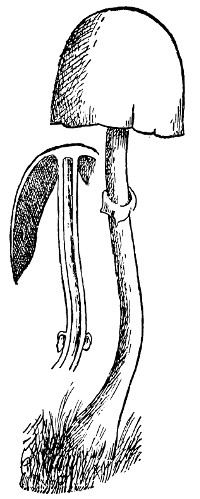
Anellaria separata.
Natural size.
A. separa´ta Karst.—separatus, distinct, separate. Pileus 1–1½ in.
across, height about the same, ovate, then
bell-shaped, not expanding, viscid, even,
ochraceous, then whitish, shining, wrinkled
when old. Flesh rather thick. Gills adfixed,
ascending, thin, crowded, broad, 2–3 lines,
grayish-black, margin paler. Stem long, 3–5
in., straight, base thickened, attenuated upward,
whitish, shining, top somewhat striate.
Ring persistent, distant. Massee.
On dung. Rather variable in size.
Pileus bell-shaped, but very obtuse at the
summit, ½-1¼ in. from the base to the apex,
not expanding at the base without cracking.
Spores broadly elliptic-fusiform, black,
opaque, 10×7µ Massee; ellipsoid, 16–22×10–12µ
K.; 16×11µ W.G.S.
West Virginia, 1881–1885. New Jersey,
Mt. Gretna, Pa., July, 1898, on dung. McIlvaine.
A common, frequent species from May to
October. It is substantial in flesh, excellent
in substance and flavor. Cook soon and not
over fifteen minutes.
389PSATHYREL´LA.
Pileus membranaceous, striate, margin straight, at first pressed to the
stem, not extending beyond the gills. Veil inconspicuous. Gills sooty-black,
not variegated. Spores black.
Closely resembling Psathyra in appearance, but separated by the
spore color.
In the black-spored series Panæolus and Anellaria are distinguished
by their pilei not being striate and Coprinus by its deliquescent gills.
The species are small and can seldom be gathered in quantity. But
those tested have the full mushroom flavor and are valued for the flavor
they give to less gifted species when cooked with them.
P. gra´cilis Fr.—slender. Pileus ½-1 in. broad, sooty, livid, etc.,
when dry, tan, rosy or whitish, hygrophanous, membranaceous, bell-shaped,
obtuse, smooth, even, slightly and pellucidly-striate only round
the margin. Stem 3 in. and more long, scarcely 1 line thick, tubular,
remarkably tense and straight, equal, naked, smooth, whitish, not rooted,
white-villous at the base. Gills wholly adnate, commonly broader behind
(rarely linear), almost distant, distinct, at first whitish, then cinereous-blackish
with the black spores, edge rose-colored. Fries.
When dry the pileus is soft to the touch. Gregarious, fragile. Very
similar to A. corrugis, and there is a variety corrugated. Stevenson.
Spores ellipsoid, 13–14×7–8µ K.; 5×12µ W.G.S.; 7×3–3.5µ Massee;
14×8µ Morgan.
New York, Peck, Rep. 23; West Virginia, New Jersey, Pennsylvania,
common, rich ground, June to October. McIlvaine.
A common and beautiful fungus, growing in patches on rich ground.
It is decidedly prim. Its conical cap is regular as an extinguisher. It
pays to gather it for flavoring other species. I have not seen the
corrugated form mentioned by Fries. P. graciloides Pk. lacks the rosy-edged
gills; gills are whitish.
390
P. graciloi´des Pk.—slender. Pileus thin, conical or bell-shaped,
glabrous, hygrophanous, brown and striatulate
when moist, whitish and subrugulose
when dry. Lamellæ ascending, rather
broad, subdistant, brown, becoming blackish-brown,
the edge whitish. Stem long,
straight, fragile, hollow, smooth, white.
Spores blackish, elliptical, 15–16.5×8–8.5µ.
Plant gregarious, 4–6 in. high. Pileus
1 in. broad. Stem 1 line thick.
Ground in an old dooryard. Maryland.
September.
This is allied to A. gracilis Fr., but the
edge of the gills is not rosy. When drying
the moisture leaves the disk of the pileus
first, the margin last. When dry the
plant bears some resemblance to large forms
of A. tener. Under a lens the texture of
the surface of the pileus is seen to be composed
of matted fibrils. Peck, 30th Rep.
N.Y. State Bot.
Pennsylvania and New Jersey, on ground
about houses and stables, often in barn
yards, after they have been cleaned out
and are empty for the summer. McIlvaine.
The whitish-edged gills with entire absence of rosiness on gill edges
distinguish this species from P. gracilis Fr. It is frequent but not
plentiful. Often a pint can be gathered. It has a fine mushroom flavor,
resembling the delicate forms of Coprinus.
P. atoma´ta Fr.—atomatus, atomate. Pileus ½-1 in. broad, livid,
when dry becoming pale tan or pale flesh-color, sometimes reddish, hygrophanous,
membranaceous, bell-shaped, obtuse, slightly striate, when
dry without striæ, slightly wrinkled, sprinkled with shining atoms.
Stem 2 in. long, almost 1 line thick, tubular, equal, not rooted, lax,
slightly bent (not tense and straight), white and white pulverulent at
391the apex. Gills adnate, broad, ventricose, slightly distinct,
whitish, but cinereous-blackish with the black spores. Fries.
Solitary or gregarious. Pileus changing like A. gracilis from livid
to whitish and rose-color, but more fragile. Stevenson.
Spores elliptical, 10×4µ Massee; 14×9µ W.G.S.; 11×8µ Morgan.
Chester county, Pa., June to September. McIlvaine.
Several specimens were eaten. In flavor they could not be distinguished
from C. micaceus. The scarcity and small size of the species
make it of little value, save as a flavoring.
P. dissemina´ta Pers.—dissemino, to scatter. Found everywhere.
Densely tufted. Pileus about ½ in. across,
membranaceous, ovate, bell-shaped, at first
scurfy, then naked, coarsely striate, margin
entire, yellowish then gray. Gills adnate,
narrow, whitish, then gray, finally
blackish. Stem 1–1½ in. long, rather
curved, mealy then smooth, fragile, hollow.
Massee.
Crowded. Pileus ovate, conical, at
length bell-shaped, ⅓-½ in. from the base
to the apex, striate and plicate, membranaceous,
pale buff or reddish-brown, at
length gray, becoming flaccid and dissolving.
Gills distant, narrow, pale brown.
Stipes 1–3 in. long, slender, weak, brittle,
crooked, hollow, pale yellowish, whitish or
grayish. Particularly partial to old willow trees, and when growing on
a stump of a felled tree often covering nearly a square yard. Grev.
Spores 8×6µ W.G.S.; 7.6×5µ Morgan.
West Virginia, New Jersey, Mt. Gretna, Pa., about abandoned camp.
Densely tufted. May to frost. McIlvaine.
Patches of it are very common on old trunks, about decaying trees,
on ground. The caps rarely reach 1 in. in diameter. The plants cook
392away to almost nothing, but they are of fine flavor, which they impart
to the cooking medium.
GOMPHI´DIUS Fr.
Hymenophore decurrent. Gills distant, composed of a mucilaginous
membrane, which can be readily separated into two plates, continuous
at the edge which is acute and powdered with the blackish fusiform
spores. Veil viscoso-floccose. Fleshy, putrescent, pileus at length the
shape of an inverted cone.
A small genus with great difference among the species. Intermediate
in habit between Cortinarius and Hygrophorus.
Universal Veil glutinous, at first terminating on the stem in a floccose
ring soon disappearing. The Gills frequently admit of being detached
and stretched out into a continuous membrane. Fries.
A genus possessing several well-marked characters. The very decurrent
gills differ from all others in their soft mucilaginous consistency.
The spores are larger than usual in the Agaricaceæ and have the elongated
spindle-shape found in Boleti. The stem and pileus are of the
same substance, and the pileus and veil are both glutinous when moist.
The spores have been described as greenish-gray becoming black, and
as dingy-olive.
I have had opportunity to see but two species of this small genus—G.
rhodoxanthus and G. viscidus. Of these the spores are decidedly
olivaceous. If the six other species recorded as found in the United
States are as creditable, they are well worth hunting for. G. Oregonensis
Pk. is reported as edible and as a valuable food species in Oregon.
393The glutinous coatings to pileus and stem do not appear on the American
form of G. rhodoxanthus in the localities I have found it in during
fifteen years.
G. glutino´sus (Schaeff.) Fr.—glutin, glue. Pileus 2–5 in. broad,
purple-brown, often mottled with black spots, fleshy, convex, obtuse,
at length plane, even depressed, even, smooth, very glutinous. Flesh
thick, about ½ in., soft, white. Stem 2–3 in. and more long, about
½ in. thick, solid, whitish, thickened and externally and internally
yellow at the base, viscid with the veil, fibrillose or varying with black
scales. Cortina often woven in the form of a ring, but soon fugacious.
Gills deeply decurrent, distant, distinct, branched, quite entire, mucilaginous,
3–4 lines broad, at first whitish, then cinereous, clouded with
the spores.
Trama none, wherefore the gills easily separate from the pileus.
Taste watery, moldy. Odor not marked. Stevenson.
Spores 20µ Cooke; 18–23×6–8µ K.; 16–17×6µ W.G.S.; 18–20×6µ
Massee.
Distinguished by the bright yellow base of stem.
Pine woods. July to November. Nova Scotia. Somers.
Edible. Leuba. Chiefly used for catsup. Cooke.
Var. ro´seus. Pileus rose-color. Stem white, attenuated and rosy
flesh-color internally at the base. Very distinguished, always smaller.
Spores 20–22×6µ K.
Nova Scotia. Massachusetts. Frost.
I have not seen this species or its variety. Eminent authorities vouch
for its edibility.
G. Oregonen´sis Pk. Pileus at first convex, becoming nearly plane
or somewhat centrally depressed, viscid, brown or dark-brown, becoming
black in drying, taste sweet and pleasant. Lamellæ numerous,
rather close, adnate or slightly decurrent, blackish in the dried plant.
Stem short, solid, equal or slightly tapering upward, colored like the
pileus. Spores oblong, 10–12.5µ long, 4–5µ broad.
Pileus 5–10 cm. broad. Stem 2.5–5 cm. long, 4–10 mm. thick.
Fir woods. Oregon. September to December. Lane.
Dr. Lane writes that this species is edible and grows so abundantly
in fir woods that it might be gathered by wagon loads and might be
394made a source of an abundant food supply. Peck. Torrey Bulletin,
Vol. 25, No. 6, June, 1898.
(Plate CXII.)
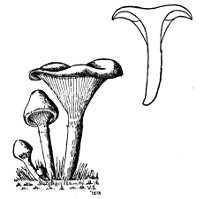
Gomphidius viscidus.
One-half natural size.
G. vis´cidus Fr.—viscid. Pileus 2–3 in. and more broad, brownish-red,
compact, at first bell-shaped, then expanded, umbonate, slightly
viscous, shining when dry. Flesh
yellowish. Stem 3–4 in. and more
long, ½ in. thick, solid, equal or
attenuated at the base which is rhubarb-colored
internally, scaly-fibrillose,
not very viscous, yellowish.
Cortina very evidently floccose,
not glutinous, woven in the form of a
ring, but readily falling off. Gills
deeply decurrent, distant, the shorter
ones adnexed to the longer, not truly
branched, at first paler, somewhat
olive, at length brownish-purple,
clouded with the spores. Fries.
Hymenophore descending between the gill plates. Odor not unpleasant.
Stevenson.
Chiefly used in catsup. Cooke. Edible. Leuba. Cooke.
North Carolina, Massachusetts, Frost. Minnesota, California, Pennsylvania.
Many grew under pines at Mt. Gretna, Pa., September to November.
The gills seemed branched, but were grown together. Taste and smell
pleasant. The caps are good, but not equal to G. rhodoxanthus.
G. rhodoxan´thus Schw. (Plate XCVII, fig. 4, 5, p. 352.) Solitary.
Pileus 1–2 in. broad, cushion-shaped, reddish-yellow, sometimes
with dusky hues. Gills arched, decurrent, orange-yellow. Stem attenuated,
short, firm.
Spores oblong, 10–12.5µ in length. Peck. Olivaceous. McIlvaine.
Solitary, gregarious or cespitose.
Among leaves and grass in shady places. August to October.
When the student has mastered the name and memorized the description,
395Gomphidius rhodoxanthus can not be mistaken for any other species.
It is not common in localities I have frequented, but its presence is
pretty general in the United States, specimens having been sent to me
from Georgia, Iowa, New York, New Jersey, etc., and I have found it
in West Virginia, North Carolina, Woodland Cemetery, Philadelphia,
and other places in Pennsylvania, from July to September, 1898, inclusive.
Having enjoyed it in West Virginia in 1882, I was delighted
to find it in generous quantity at Mt. Gretna, Pa., and to eat many
meals of it. Its caps are not excelled by any edible fungus. They
have solid, delicious substance and rich full flavor.
The plant is often cespitose. I have never found its cap viscid or
glutinous. The cooked flesh has the latter consistency.
MONTAGNITES Fr.
After Montagne. (
Plate CI, fig. 6, p. 368.)
The universal veil forming a volva, persistent. Stem dilated at the
apex into a plane round disk, even on both sides, to the margin of which
are adfixed the gills which are free, not joined by any membrane, radiating,
razor-shaped, persistent, obtuse at the edge. Trama cellulose. Spores
oblong, even, black fuscous. Fries.
A single species is reported from Texas.
396
Hymenophore inferior, facing the ground. Hymenium consisting of
tubes with poriform mouths which are round or angular, sometimes
sinuous or torn, lined with 4-spored sporophores and cystidia.
Fleshy, coriaceous or woody fungi, most abundant and luxuriant
in warm countries. Intermediate between the Agaricaceæ and the
Hydnaceæ, connected with the former by Dædalea and Lenzites, and
with the latter by Fistulina and Irpex. Fries.
Within this large family are famed edible species, notably in Boletinus,
Boletus and Fistulina. In the woody species the razor-strop man finds
material for his strops (Polyporus celulinus); the surgeon styptics; the
peasant punk to catch sparks from his flint, and the 4th of July urchin
a fire-holder to light his pyrotechnics. The Chinese have placed some
species in their fathomless materia medica, while the Polyporus of the
locust tree is used in America as a medicine for horses. No fungoid
growth is more universal. They are the ever active pruners of our trees
and converters of forest debris. They begin the task in Nature’s laboratory
of changing decaying wood into assimilable shape as food to feed
the very trees that dropped it. Some are of annual growth, others add
to their substance year after year, often attaining enormous size. In
summer and in winter they are ever present objects for interesting study.
Hymenium composed of broader radiating gills connected by very
numerous more narrow anastomosing branches or partitions and forming
large angular pores. Tubes somewhat tenacious, not easily separable
from the hymenophore and from each other, adnate or subdecurrent,
yellowish. Peck.
Stratum of tubes easily separable from the hymenophore. Stem
central.
397Strobilomyces. Page
475.
Tubes like Boletus, but pileus with large scales. Stem central.
Fleshy, lateral, tubes crowded but distinct.
Stratum of tubes distinct from hymenophore, but not separable, not
stratose; fleshy and tough, stipitate or sessile.
Tubes as in Polyporus, often stratose; woody, sessile; dimidiate.
(No edible species reported.)
Tubes as in Polyporus, not stratose, generally developing from the
center to the margin, at first shallow and punctiform, coriaceous or
membranaceous. (No edible species reported.)
Tubes as in Polyporus, not stratose; entirely resupinate. (No edible
species reported.)
Tubes studded with reddish-brown spines, intermingled with the basidia,
otherwise as in Polystictus (and also as in Polyporus and
Fomes). Atkinson. (No edible species reported.)
Tubes immersed in flesh of pileus, of various depths, hence not forming
a heterogeneous stratum, subcylindrical, not stratose; corky; sessile.
Tubes as in Trametes, but sinuous and labyrinthiform; corky; not
stratose; sessile. (No edible species reported.)
Tubes from the first dilated in hexagonal channels, not stratose;
plants corky, sessile. Atkinson. (No edible species reported.)
Tubes large at first, radiating from a central stem, or from a lateral
attachment in sessile or dimidiate forms; plants tough and fleshy. Atkinson.
(No edible species reported.)
Gills or tubes in concentric circles. Stem central, subcentral or none.
Atkinson. (No edible species reported.)
Subgelatinous. Tubes very shallow, formed by anastomosing wrinkles;
resupinate.
Hymenophore not even (as in Boletus), but extended in blunt points
descending like a trama among the tubes. Tubes not easily separable
from the hymenophore and from each other. Stem ringed, hollow.
Spores pale yellowish. Sylloge, Vol. VI, p. 51.
Professor Peck has for excellent reasons, given in his Boleti of the
United States, emended the generic diagnosis of Fries thus: Hymenium
composed of broader radiating lamellæ connected by very numerous
more narrow anastomosing branches or partitions and forming large
angular pores. Tubes somewhat tenacious, not easily separable from the
hymenophore and from each other, adnate or subdecurrent, yellowish.
Professor Peck classifies Boletinus as follows:
|
Stem hollow |
B. cavipes |
|
Stem solid |
1 |
| 1. |
Stem lateral or eccentric |
B. porosus |
| 1. |
Stem central |
2 |
|
2. |
Pileus pale yellow, silky |
B. decipiens |
|
2. |
Pileus red or adorned with red scales |
3 |
| 3993. |
Pileus red |
B. paluster |
| 3. |
Pileus soon red-squamose |
B. pictus |
| Boleti of the United States, p. 76. |
|
There are six species given as found in the United States—B. cavipes
Kalchb., B. pictus Pk., B. paluster Pk., B. decipiens Pk., B. porosus
Pk., B. appendiculatus Pk.—of these I have found and eaten four. B.
decipiens has, at this writing, not been seen by Professor Peck, but
Professor Farlow, of Harvard, has informed him of authentic specimens.
There is every probability of its being as edible as the others; a description
of it is, therefore, given.
In consistency Boletinus is of the best, being rather like that of marshmallows,
and the same as Boletus subaureus. The flavor is mild and
pleasant.
Professor Peck mentions that the smell of B. porosus is sometimes
unpleasant. I have been fortunate in not having had this experience.
B. ca´vipes Kalchb. Pileus broadly convex, rather tough, flexible,
soft, subumbonate, fibrillose-scaly, tawny-brown, sometimes tinged with
reddish or purplish. Flesh yellowish. Tubes slightly decurrent, at first
pale-yellow, then darker and tinged with green, becoming dingy-ochraceous
with age. Stem equal or slightly tapering upward, somewhat
fibrillose or floccose, slightly ringed, hollow, tawny-brown or yellowish-brown,
yellowish at the top and marked by the decurrent dissepiments
of the tubes, white within. Veil whitish, partly adhering to the margin
of the pileus, soon disappearing. Spores 8–10×4µ.
Pileus 1.5–4 in. broad. Stem 1.5–3 in. long, 3–6 lines thick.
Swamps and damp mossy ground under or near tamarack trees. New
York, Peck; New England, Frost.
The pileus is clothed with a fibrillose tomentum which becomes more
or less united into floccose tufts or scales. The umbo is not always
present and is generally small. The young stem may sometimes be
stuffed, but, if so, it soon becomes hollow, though the cavity is irregular.
The freshly shed spores have a greenish-yellow or olivaceous hue,
but in time they assume a pale or yellowish-ochraceous hue. This species
is apparently northern in its range. It loves cold sphagnous
swamps in mountainous regions. Peck, Boleti of the U.S.
400West Virginia mountains under spruce trees. Haddonfield, N.J.,
among scrub pines. Mt. Gretna, Pa., among pines.
It is of excellent consistency and of mild pleasant flavor. It is at its
best in patties, croquettes and escallops.
B. appendicula´tus Pk. Pileus fleshy, convex, glabrous, ochraceous-yellow,
the margin appendiculate with an incurved membranous
veil. Flesh pale-yellow, unchangeable. Tubes rather small, yellow,
their mouths angular, unequal, becoming darker or brownish where
wounded. Stem solid, slightly thickened at the base, yellow. Spores
pale-yellow, oblong, 10–12×4µ. Pileus 4–8 in. broad. Stem 2–3 in.
long, 4–6 lines thick.
Under or near fir trees. Washington. September to December.
Yeomans. Peck, Bull. Torrey Bot. Club, Vol. 23, No. 10.
B. pic´tus Pk. Pileus convex or nearly plane, at first covered with a
red fibrillose tomentum which soon divides into small scales revealing the
yellow color of the pileus beneath. Flesh yellow, often slowly changing
to dull pinkish or reddish tints where wounded. Tubes tenacious, at
first pale yellow, becoming darker or dingy ochraceous with age, sometimes
changing to pinkish-brown where bruised, concealed in the young
plant by the copious whitish webby veil. Stem equal or nearly so,
solid, slightly and somewhat evanescently annulate, clothed and colored
like or a little paler than the pileus, yellowish at the top. Spores
ochraceous, 9–11×4–5µ.
Pileus 2–4 in. broad. Stem 1.5–3 in. long, 3–6 lines thick.
Woods and mossy swamps. New York, Peck; New England, Frost;
North Carolina, Curtis. Peck, Boleti of the U.S.
West Virginia mountains, 1882. Haddonfield, N.J., Angora, West
Philadelphia, Mt. Gretna, Pa. August and September. In mixed
woods, principally oak. Leominster, Mass. C.F. Nixon, Ph. G.
It is sometimes found upon much decayed chestnut stumps.
The caps of some species are so cracked as to appear distinctly
areolate. The white webby veil is often persistent. The fungus is one
of the handsomest. Its rich variegated colors impress it upon eye-memory.
It is one of the very best edible species.
401
(Plate CXIIa.)
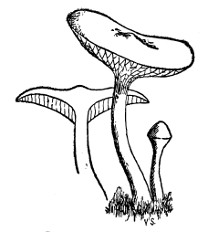
Boletinus paluster.
Natural size. (After Peck.)
B. palus´ter Pk.—Pileus thin,
broadly convex, plane or slightly
depressed, sometimes with a small
umbo, floccose-tomentose, bright red.
Tubes very large, slightly decurrent,
yellow, becoming ochraceous or dingy
ochraceous. Stem slender, solid, subglabrous,
red, yellowish at the top.
Spores pinkish-brown, 8–9×4µ.
Pileus 1–2 in. broad. Stem 1–2 in.
long, 2–3 lines thick.
Wet places and sphagnous mossy
swamps. New York, Peck. Maine,
Harvey. Peck, Boleti of the U.S.
Angora, West Philadelphia and Mt.
Gretna, Pa. September. McIlvaine.
A few specimens found at Mt.
Gretna had stems slightly reticulated. Its taste is sweet, smell mild,
and cooked it is of excellent body and flavor.
B. deci´piens (B. and C.) Pk. Pileus dry, minutely silky, whitish-yellow
or pale-buff, flesh buff, one-third in. thick; hymenium plane
or somewhat concave, yellow, consisting of large, unequal, flexuous
radiating tubes resembling multiseptate lamellæ. Stem equal, solid but
spongy. Veil floccose, evanescent, adhering for a time to the margin
of the pileus. Spores rather minute, oblong, ochraceo-ferruginous (rusty
yellow), 8–10×3.5–4µ.
Pileus 2 in. broad. Stem 2–2.5 in. long, 3–4 lines thick.
Thin woods. North and South Carolina. M.A. Curtis.
Specimens of this species have not been seen by me. The authors
remark that its affinities are clearly with Boletinus flavidus and its allies,
from which it is distinguished by its large radiating pores. They also
say that when dry it is scarcely distinguishable from Paxillus porosus
Berk., except by its spores. This would imply that its stem is eccentric
or lateral, and I have been informed by Mr. Ravenel that it is sometimes
so. But specimens of this kind, labeled Boletinus decipiens B.
and C., have been received, which show by their spores that they are
Paxillus porosus. Besides, Professor Farlow informs me that authentic
402specimens of B. decipiens in the Curtisian Herbarium have only central
stems, from which things I suspect that the two species have been confused.
The spore dimensions here given are derived from a specimen
in the Curtis Herbarium, through the kindness of Professor Farlow.
Peck, Boleti of the U.S.
I have not recognized this Boletinus. Its affinities are with excellent
edible species.
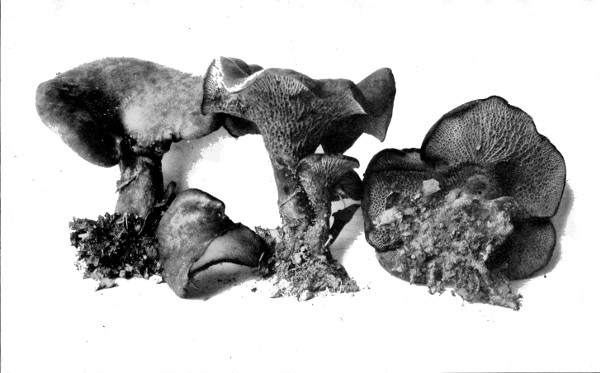
Photographed by Dr. J.R. Weist. Plate CXIII.
BOLETINUS POROSUS.
B. poro´sus (Berk.) Pk. (Plate CXIII.) Pileus fleshy, viscid when
moist, shining, reddish-brown. Flesh 3–9 lines thick, the margin thin
and even; hymenium porous, yellow, formed by radiating lamellæ a line
to half a line distant, branching and connected by numerous irregular
veins of less prominence and forming large angular pores. Stem lateral,
tough, diffused into the pileus, reticulated at the top by the decurrent
walls of the tubes, colored like the pileus. Spores semi-ovate.
Pileus 2–5 in. broad. Stem 6–16 lines long, 4–6 lines thick.
Var. opa´cus (Paxillus porosus Berk., Bull. N.Y. State Mus. 2, p.
32). Pileus dry, glabrous or subtomentose, not shining, brown or
tawny-brown. Spores brownish-ochraceous, 9–11×6–8µ.
Damp ground in woods and open places. Ohio, Lea, Morgan; North
Carolina, Curtis; New England, Frost, Farlow; Wisconsin, Bundy;
New York, Peck.
This species is remarkable for its lateral or eccentric stem. There
is often an emargination in the pileus on the side of the stem which
gives it a kidney shape. In the typical form it is described as viscid
when moist, and the Wisconsin plant is also described as viscid, but in
all the New York specimens that I have seen it is dry and sometimes
minutely tomentose. I have, therefore, separated these as a variety.
The color of the pileus varies from yellowish-brown to reddish-brown or
umber. A disagreeable odor is sometimes present. The tubes are
rather short and tough and do not easily separate from the hymenophore
and from each other. In the young plant they are not separable.
They sometimes become slightly blue where wounded. As in other
species they are pale yellow when young, but become darker or dingy-ochraceous
with age. The spores have been described as bright yellow,
but I do not find them so in the New York plant. The plant is
incongruous among the Paxilli by reason of its wholly porous hymenium,
403but in this place it seems to be among its true allies. Peck, Boleti of
the U.S.
Fine specimens were sent to me by Mr. H.I. Miller, Terre Haute,
and Dr. J.R. Weist, Richmond, Ind. They were in condition to be
eaten and enjoyed. No disagreeable odor was perceptible.
B. borea´lis Pk. Pileus fleshy, convex, obtuse or subumbonate,
brownish-yellow, obscurely and somewhat reticulately streaked with
reddish-brown lines. Pores large, angular, unequal, slightly decurrent,
brownish-yellow. Stem short, equal or slightly tapering upward,
brownish-yellow with a whitish myceloid tomentum at the base. Spores
oblong, 10–12.5×4–5µ.
Pileus 1–2 in. broad. Stem about 1 in. long.
Sandy soil. Capstan Island, Labrador. October. Waghorne.
The markings of the pileus appear as if due to the drying of a glutinous
substance. The radiating lamellæ and the transverse partitions of
the interspaces are very plainly shown. Described from two dried specimens.
Peck, Bull. Torr. Bot. Club, Vol. 22, No. 5.
The name of a fungus considered a great delicacy
among the Romans, derived from bolos, a clod,
probably to denote the round figure of the plant.
Hymenium wholly composed of small tubes,
connected together in a stratum, the surface of
which is dotted with their poriform mouths, and
which is distinct from the hymenophore on account
of the latter not descending into a trama. Tubes packed close
together, easily separating from the hymenophore and from one another.
Pores or mouths of the tubes round or angular (in the subgenus Gyrodon
sinuous or gyroso-plicate). Spores normally fusiform, rarely oval or
somewhat round. Growing on the ground, fleshy, putrescent, with central
stems. Mostly edible, and of importance as articles of food; a few
poisonous. Fries.
No American species in Gyrodon. It is therefore omitted in synopsis
of tribes. C.M.
This genus abounds in species and is related to Boletinus on one hand
and to Polyporus on the other. From the latter it is distinguished by
the absence of a trama and from both by the tubes being easily separable
from the hymenophore and from each other. Some of the species
are very variable, others are so closely allied that they appear to almost
run together.
The species are generally terrestrial, but B. hemichrysus is habitually
wood-growing, and others are occasionally so.
The spores vary so much in color in such closely related species that
this character is scarcely available for general classification, but it is valuable
as a specific character and should always be noted.
| Pileus and stem yellow-pulverulent, stem not reticulated with veins |
(p. 421.) |
Pulverulenti |
| Pileus and stem not yellow-pulverulent, or if so then the stem reticulated with veins |
1 |
| 1. |
Tubes yellowish with reddish, or reddish-brown mouths |
(p. 453.) |
Luridi |
| 4051. |
Tubes of one color, or mouths not reddish. |
2 |
|
2. Stem lacunose-reticulated and lacerated. |
(p. 436.) |
Laceripedes |
|
2. Stem reticulated with veins, not lacerated. |
3 |
|
2. Stem not reticulated. |
5 |
| 3. |
Tubes white, becoming flesh-colored. |
(p. 466.) |
Hyporhodii |
| 3. |
Tubes not becoming flesh-colored. |
4 |
|
4. Tubes free, or if adnate then stuffed when young. |
(p. 444.) |
Edules |
|
4. Tubes adnate, not stuffed when young. |
(p. 438.) |
Calopodes |
| 5. |
Pileus viscid or glutinous when moist. |
6 |
| 5. |
Pileus dry. |
7 |
|
6. Tubes adnate. |
(p. 406.) |
Viscipelles |
|
6. Tubes free or nearly so, yellowish. |
(p. 444.) |
Edules |
|
6. Tubes free or nearly so, whitish. |
(p. 459.) |
Versipelles |
| 7. |
Stem solid. |
8 |
| 7. |
Stem spongy within, soon cavernous or hollow. |
(p. 471.) |
Cariosi |
|
8. Tubes becoming flesh-colored. |
(p. 466.) |
Hyporhodii |
|
8. Tubes not becoming flesh-colored. |
9 |
| 9. |
Tubes adnate. |
10 |
| 9. |
Tubes free or nearly so. |
11 |
|
10. Pileus subtomentose. |
(p. 430.) |
Subtomentosi |
|
10. Pileus glabrous or pruinose. |
(p. 423.) |
Subpruinosi |
| 11. |
Tubes yellowish or stuffed when young. |
(p. 444.) |
Edules |
| 11. |
Tubes whitish, not stuffed. |
(p. 459.) |
Versipelles |
|
Peck, Boleti of the U.S. |
|
|
C.H. Peck, N.Y. State Botanist, has contributed to Mycological
literature his careful arrangement and analysis of species of this genus,
in his “Boleti of the United States.” Species of the genus are found in
every state of the Union. Several species are common to all the states.
Comprehending, as do the states, all sorts of climates within their vast
range of latitude, differences in appearance and structure in the same
species must be expected, dependent largely, as they are in most fungi,
upon habitat and environment. These variations will frequently suggest
new species. Descriptions which are typical and which can be
recognized as standard are most desirable. Professor Peck’s are accepted
by the writer as such, that there may be uniformity, and are
quoted as fully as space will permit. Such variations as are attributable
to locality will be noted.
406Since 1882 the writer has given great attention to the edible qualities
of the Boleti. He is convinced by many personal tests and those made
by his family and friends, that much, if not all, of the suspicion thrown
about Boleti is unjust and erroneous. He is able to state positively that
change of color when bruised or broken; bitter and pepperiness have
nothing whatever to do with the edible qualities of species exhibiting
them, excepting in B. felleus, which exhibits an intense bitter, not lost
in cooking. It is not poisonous.
The writer has the courage of his convictions, and has taken interest
in eating species with a bad reputation whenever opportunity afforded,
that their just dues might be given them. He has never experienced
the slightest inconvenience. But others may not be so fortunate.
Before cooking Boleti the stem, unless crisp and tender, should be
removed, as should the tubes unless young and fresh. They broil, fry,
stew, make good soups and dry well. See recipes.
It is believed that all species of Boleti up to this time found in
America are described in this volume. When no remarks of the writer
follow the descriptions, he has not had an opportunity to test the edible
quality of the species.
Viscipelles—viscum, bird lime; pellís, a skin.
Pileus covered with a viscose pellicle. Stem solid, neither bulbous,
lacerated nor reticulated with veins. Tubes adnate, rarely sinuate, of
one color.
The first four and several of the final species here described recede
somewhat from the character of the central or typical species of the
group.
|
Stem with an annulus |
1 |
|
Stem without an annulus |
9 |
| 1. |
Stem dotted both above and below the annulus |
2 |
| 1. |
Stem dotted above the annulus |
3 |
| 1. |
Stem not dotted |
4 |
|
2. Tubes salmon color |
B. salmonicolor |
|
2. Tubes yellowish |
B. subluteus |
| 3. |
Annulus entirely viscose |
B. flavidus |
| 3. |
Annulus membranous, fugacious |
B. elegans |
| 3. |
Annulus membranous, persistent |
B. luteus |
| 407 |
4. Pileus squamose |
B. spectabilis |
|
4. Pileus not squamose |
5 |
| 5. |
Tubes whitish or grayish |
6 |
| 5. |
Tubes yellow or yellowish |
7 |
|
6. Flesh white, unchangeable |
B. Elbensis |
|
6. Flesh white, changing to bluish |
B. serotinus |
| 7. |
Spores globose or broadly elliptical |
B. sphærosporus |
| 7. |
Spores much longer than broad |
8 |
|
8. Annulus fugacious |
B. flavus |
|
8. Annulus persistent |
B. Clintonianus |
| 9. |
Stem dotted with glandules |
10 |
| 9. |
Stem not dotted |
16 |
|
10. Pileus some shade of yellow |
11 |
|
10. Pileus some other color |
15 |
| 11. |
Stem rhubarb color |
B. punctipes |
| 11. |
Stem some other color |
12 |
|
12. Stem four lines or more thick |
13 |
|
12. Stem less than four lines thick |
B. Americanus |
| 13. |
Pileus adorned with tufts of hairs or fibrils |
B. hirtellus |
| 13. |
Pileus glabrous |
14 |
|
14. Stem yellow within |
B. subaureus |
|
14. Stem whitish or yellowish-white within |
B. granulatus |
| 15. |
Pileus white |
B. albus |
| 15. |
Pileus not white |
B. granulatus |
|
16. Stem squamulose |
17 |
|
16. Stem not squamulose |
18 |
| 17. |
Pileus dull red |
B. dichrous |
| 17. |
Pileus some other color |
B. collinitus |
|
W.G.S.us yellow |
19 |
|
W.G.S.us bay-red or chestnut |
20 |
|
W.G.S.us some other color |
21 |
| 19. |
Flesh pale-yellow |
B. unicolor |
| 19. |
Flesh white |
B. bovinus |
|
20. Stem short, one inch or less |
B. brevipes |
|
20. Stem longer, two inches or more |
B. badius |
| 21. |
Tubes olivaceous or golden-yellow |
B. mitis |
| 21. |
Tubes ferruginous |
22 |
|
22. Taste mild |
B. rubinellus |
| 408 |
22. Taste acrid or peppery |
B. piperatus |
| Peck, Boleti of the U.S., p. 83. |
(Plate CXV.)
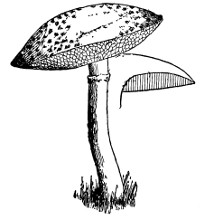
Boletus spectabilis.
Natural size.
B. specta´bilis Pk.—spectabilis, distinguished. Pileus broadly convex,
at first covered with a red tomentum,
then scaly, viscid when
moist, red, the tomentose scales becoming
grayish-red, brownish or yellowish.
Flesh whitish or pale-yellow.
Tubes at first yellow and concealed
by a reddish glutinous membrane,
then ochraceous, convex, large, angular,
adnate. Stem nearly equal, annulate,
yellow above the annulus, red
or red with yellow stains below.
Spores purplish-brown, 13–15×6–7µ.
Pileus 2–5 in. broad. Stem 3–5
in. long, 4–6 lines thick.
Thin woods in swamps. New York,
Peck; Wisconsin, Bundy.
This is a rare and showy species
which inhabits the cold northern swamps of the country. It probably
extends into Canada. When cut, the flesh emits a strong, unpleasant
odor. Wounds of the flesh made by insects or other small animals have
a bright-yellow color. When young, the tomentose veil covers the
whole plant, but it soon parts into scales on the pileus and partly or
wholly disappears from the stem. Peck, Boleti of the U.S.
London, Can., J. Dearness; Peck, Rep. 44, N.Y. State Bot.
B. Elben´sis Pk. Pileus convex, glabrous, viscid when moist, dingy
gray or pinkish-gray inclining to brownish, obscurely spotted or streaked
as if with patches of innate fibrils. Flesh white. Tubes at first whitish,
becoming dingy or brownish-ochraceous, nearly plane, adnate or slightly
decurrent, rather large, angular. Stem nearly equal, annulate, whitish
above the ring, colored like the pileus below, sometimes slightly reticulated
at the top. Spores ferruginous-brown, 10–12×4–5µ.
Pileus 2–4 in. broad. Stem 3–5 in. long, 4–6 lines thick. Thin
woods of tamarack, spruce and balsam. New York. Peck.
409Its locality is thus far limited to the Adirondack region of this state.
Peck, Boleti of the U.S.
B. sero´tinus Frost.—late. Bulletin Buffalo Soc. Nat. Sci., 1874.
Pileus flat or convex, viscid, sordid brown, streaked with the remnants
of the veil, especially near the margin, which is white, very thin, and
when partly grown singularly pendent. Flesh white, changing to bluish.
Tubes large, angular, unequal, slightly decurrent, at first sordid white
or gray, sometimes tinged with green near the stem, afterward cinnamon-yellow.
Stem reticulated above the ring which adheres partly to
it and partly to the margin of the pileus, white but stained by the
brownish spores and tinged with yellow at maturity. Spores 10×6µ.
Shaded grassy ground. New England, Frost.
Probably this is only a variety of the preceding species. Peck, Boleti
of the U.S.
B. salmoni´color Frost. Bull. Buff. Soc. Nat. Sci., 1874. Pileus
convex, soft, very glutinous, brownish or tawny-white with a faint tinge
of red, wine-color when dry, the margin thin. Flesh tinged with red.
Tubes simple, even, angular, adnate, pale salmon color. Stem small,
dotted above with bright ferruginous red, sordid below, annulus dingy
salmon-color. Spores 8×2.5µ.
Borders of pine woods. New England. Frost.
Apparently a distinct species. No specimens seen. Peck, Boleti of
the U.S.
B. el´egans Schum. Pileus convex or plane, viscose, golden-yellow
or somewhat rust-color. Flesh pale-yellow. Tubes decurrent, golden
or sulphur-yellow, the mouths minute, simple. Stem unequal, firm,
golden or reddish, dotted above the fugacious white or pale-yellowish
annulus.
Pileus 3–4.5 in. broad. Stem 2–4 in. long.
Woods, especially under or near larch trees. North Carolina, Curtis;
Wisconsin, Bundy; Minnesota, Johnson. Peck, Boleti of the U.S.
Cordier and Gillet give the species as edible though not delicate.
West Philadelphia on lawns under larches, 1887–1891. McIlvaine.
The caps are of good flavor and consistency. They are best fried or
broiled.
410B. Clin´tonianus Pk. Pileus convex, very viscid or glutinous, glabrous,
soft, shining, golden-yellow, reddish yellow or chestnut color, the
margin thin. Flesh pale yellow, becoming less bright or dingy on exposure
to the air. Tubes nearly plane, adnate or subdecurrent, small,
angular or subrotund, pale-yellow, becoming dingy-ochraceous with
age, changing to brown or purplish-brown where bruised. Stem equal
or slightly thickened toward the base, straight or flexuous, yellow at the
top, reddish or reddish-brown below the annulus, sometimes varied with
yellow stains, the annulus white or yellow, persistent, forming a thick
band about the stem. Spores brownish-ochraceous, 10–11×4–5µ.
Pileus 2–5 in. broad. Stem 2–5 in. long, 4–9 lines thick.
Mossy or grassy ground in woods or open places, especially under or
near tamarack trees. New York, Peck; New England, Frost.
This is apparently closely related to B. elegans, from which it differs
in its thick persistent ring, in its stem which is not at all dotted and in
its longer and darker-colored spores. Its smaller tubes and persistent
ring separate it also from B. flavus. In the typical form the pileus is
bay-red or chestnut color, but plants growing in open places generally
have it yellowish or reddish-yellow. It is mild to the taste and I have
eaten it sparingly. It sometimes grows in tufts. Peck, Boleti of the U.S.
B. inflex´us Pk.—curving. Pileus convex, glabrous, viscid, yellow,
often red or reddish on the disk, the margin thin, inflexed, concealing
the marginal tubes. Flesh whitish, not changing color where wounded.
Tubes rather long, adnate, yellowish, becoming dingy-yellow with age,
the mouths small, dotted with reddish glandules. Stem rather slender,
not ringed, solid, viscid, dotted with livid-yellow glandules. Spores
yellowish, 10–12×4–5µ.
Pileus about 1 in. broad. Stem about 2 in. long, 2–4 lines thick.
Open woods. Trexlertown. September. Herbst.
This Boletus belongs to the tribe Viscipelles. It is remarkable for and
easily recognized by the inflexed margin of the pileus, which imitates to
some extent the appendiculate veil of Boletus versipellis. It sometimes
grows in tufts. The paper in which fresh specimens were wrapped was
stained yellow. Boletus Braunii Bres. has an inflexed margin, but that
is a much larger plant with a yellowish-brown pileus, a fibrillose stem
and much smaller spores. Peck, Bull. Torr. Bot. Club, Vol. 22, No. 5.
411B. fla´vus With. Pileus convex, compact, covered with a brownish
separating gluten, pale-yellow. Flesh pale-yellow. Tubes large, angular,
adnate, yellow. Stem yellow, becoming brownish, reticulated
above the membranous fugacious dirty yellowish annulus. Spores 8–10×3–4µ.
Pileus 2–5 in. broad. Stem 2–3 in. long, 6–10 lines thick.
Woods. Minnesota, Johnson; Wisconsin, Bundy.
This is apparently a rare species in this country. I have not seen it.
It is said to resemble B. luteus, from which it is separated by the large
angular mouths of the tubes. In British Fungi the spores are described
as “spindle-shaped, yellowish-brown;” in Sylloge, as “ovoid-oblong,
acute at the base, granulose, pale ochraceous.” Peck, Boleti of the
U.S.
B. fistulo´sus Pk. Pileus convex, viscid, glabrous, yellow, the
margin at first incurved or involute. Flesh yellow. Tubes plane or
subventricose, medium size, round with thin walls, adnate or sometimes
depressed around the stem, yellow. Stem rather slender, subequal,
viscid, glabrous, hollow, yellow, with a white mycelioid tomentum at
the base. Spores elliptical, 13×6µ.
Pileus about 1 in. broad. Stem 2–4 in. long, about 3 lines thick.
Grassy woods. Auburn, Ala. July. Underwood.
A small but pretty species of a yellow color throughout. It is remarkable
for its hollow stem, which is suggestive of the specific name.
It is referable to the tribe Viscipelles. Peck, Bull. Torrey Bot. Club,
Vol. 24, No. 3.
B. sphæros´porus Pk.—globose-spored. (Bulletin Torrey Botanical
Club, Vol. XII.) Pileus at first hemispherical, then convex, glabrous,
viscid, creamy-yellow, becoming reddish-brown or chestnut color with
age. Flesh pale yellowish-brown. Tubes adnate or slightly decurrent,
large, angular, pale-yellow, becoming brown, sometimes tinged
with green. Stem stout, equal, even or slightly reticulated at the top,
the membranous annulus persistent, sometimes partly adhering to the
margin of the pileus. Spores globose or broadly elliptical, 8–9µ long.
Pileus 3–8 in. broad. Stem 1–3 in. long, 6–12 lines thick.
Low ravines and sandy places. Wisconsin, Trelease; Iowa, McBride.
The spores easily serve to distinguish this species from its allies. The
412European B. sphærocephalus has ovoid spores, but its tube mouths are
minute and rotund and its stem is densely squamose. Peck, Boleti of
the U.S.
B. lu´teus L.—yellow. Pileus gibbous or convex, covered with a
brownish separating gluten, becoming yellowish-brown and virgate-spotted.
Flesh white. Tubes adnate, minute, simple, yellow, becoming
darker with age. Stem stout, yellowish and dotted above the large
membranous brownish-white annulus, brownish-white or yellowish below.
Spores fusiform, yellowish-brown, 6–7×3–4µ.
Pileus 2–5 in. broad. Stem 1–2 in. long, 6–10 lines thick.
Pine woods and groves. New York, Peck.
B. luteus has an international reputation for edibility. I have found it
at Waretown and Haddonfield, N.J.; in Bartram’s Garden, West Philadelphia,
always under pines. At Waretown it was gregarious. Pine
needles, sand, anything through which it grows, adheres to the glutinous
cap. It must be carefully cleaned before cooking. It is then of
choice consistency and good flavor.
(Plate CXVa.)
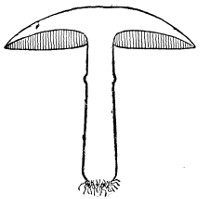
Section of Boletus subluteus.
B. sublu´teus Pk.—luteus, yellow. Pileus convex or nearly plane,
viscid or glutinous when moist, often
obscurely virgate-spotted, dingy-yellowish,
inclining to rusty-brown.
Flesh whitish, varying to dull-yellowish.
Tubes plane or convex, adnate,
small, subrotund, yellow becoming
ochraceous. Stem equal,
slender, pallid or yellowish, dotted
both above and below the ring with
reddish or brownish glandules; ring
submembranous, glutinous, at
first concealing the tubes, then generally
collapsing and forming a narrow
whitish or brownish band around the
stem. Spores subfusiform, ochraceo-ferruginous,
8–10×4–5µ. Pileus 1.5–3 in. broad. Stem 1.5–2.5 in.
long, 2–4 lines thick.
413Sandy soil in pine woods. New York, Peck, Clinton; New England,
Frost.
The species is closely related to B. luteus, from which it differs in its
smaller size, more slender stem and glutinous collapsing veil. Peck,
Boleti of the U.S.
Found at Waretown, N.J., 1887, under pines and in same locality
as B. luteus, for which it can be readily mistaken. It is usually covered
with adherent sand or pine needles. Its flesh is tender with a pleasant
glutinosity. Flavor good.
B. fla´vidus Fr.—light yellowish. Pileus thin, gibbous, then plane,
viscose, livid, yellowish. Flesh pallid. Tubes decurrent, with large
angular compound mouths, dirty yellowish. Stem slender, subequal,
pallid, sprinkled with fugacious glandules above the entirely viscose ring.
Spores oblong-ellipsoid, straight, subhyaline, 8–10×3–4µ.
Pileus 1–2 in. broad. Stem 2–3 in. long, 2–3 lines thick.
Pine woods and swamps. Pennsylvania, Schweinitz; North Carolina,
Curtis; New England, Frost; California, H. and M.; Rhode Island,
Bennett.
Fries says that this species is more slender than its allies, and differs
from them all in its merely glutinous veil. Peck, Boleti of the U.S.
Dr. Curtis, of North Carolina, places it among edible species.
Many specimens were found by the writer near Waretown and Haddonfield,
N.J., and a few at Mt. Gretna, Pa. The stems are thin and
slightly spreading at the top. They are hard. The caps are excellent.
B. America´nus Pk. Pileus thin, convex or nearly plane, sometimes
umbonate, soft, very viscid or glutinous when moist, slightly tomentose
on the margin when young, soon glabrous or the margin sometimes
remaining scaly, rarely scale-spotted from the drying of the gluten,
yellow, becoming dingy or less bright with age, sometimes vaguely
dotted or streaked with bright red. Flesh pale-yellow, less clear or
pinkish-gray on exposure to the air. Tubes plane or convex, adnate,
rather large, angular, pale-yellow, becoming sordid-ochraceous. Stem
slender, equal or slightly tapering upward, firm, not at all annulate,
yellow, often pallid or brownish toward the base, marked with numerous
brown or reddish-brown persistent glandular dots, yellow within. Spores
oblong or subfusiform, ochraceo-ferruginous, 9–11×4–5µ.
414Pileus 1–3 in. broad. Stem 1.5–2.5 in. long, 2–4 lines thick.
Woods, swamps and open places, especially under or near pine trees.
New York, Peck, Clinton; Minnesota, Arthur.
A slight subacid odor is sometimes perceptible in our plant. It
sometimes grows on much decayed wood. Its mycelium is white.
Peck, Boleti of the U.S.
The caps, only, are good.
B. subau´reus Pk.—sub and aureus, golden. (Plate CXIV, fig. 2,
p. 414.) Pileus convex or nearly plane, viscose, pale-yellow, sometimes
adorned with darker spots, the young margin slightly grayish-tomentose.
Flesh pale-yellow. Tubes small or medium; somewhat
angular, adnate or subdecurrent, pale-yellow becoming dingy-ochraceous.
Stem equal, stout, glandular-dotted, yellow without and within.
Spores oblong or subfusiform, ochraceo-ferruginous, 8–10×4µ.
Pileus 2–4 in. broad. Stem 1.5–2.5 in. long, 4–6 lines thick.
Thin woods and open places. New York, Peck; North Carolina, C.J.
Curtis; Massachusetts, Mississippi, G. Survey (Rep. 51).
This plant might almost be considered a stout variety of the preceding,
but in addition to its thicker pileus and stouter stem, it has smaller
tubes of a clearer yellow color, and the exuding drops are yellow, not
whitish, as in that species. In habit it appears more like B. granulatus,
from which it is distinct in color. Peck, Boleti of the U.S.
From early October, through heavy frosts and until long after November
snows I found this species at Mt. Gretna, Pa., in 1897–1898.
Specimens were sent to Professor Peck and identified as this species. It
grew in grass on borders of woods, or gravelly ground, sometimes
among pine needles. Large troops of it were frequent, and tufts containing
many individuals were common.
I regard B. subaureus as among the most valuable of our food species.
Its plentifulness, lateness, excellent quality will commend it to all Mycophagists.
It can be cooked in any way. The tubes need not be removed.
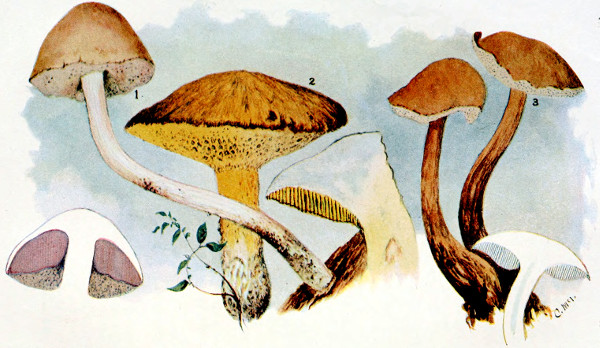
Grouped by F.D. Briscoe—Studies by C. McIlvaine. Plate CXIV.
| Fig. |
Page. |
Fig. |
Page. |
| 1. Boletus gracilis, |
467 |
3. Boletus castaneus, |
472 |
| 2. Boletus subaureus, |
414 |
|
|
B. hirtel´lus Pk.—slightly hairy. Pileus broadly convex, soft,
viscose, golden-yellow, adorned with small tufts of hairs or fibrils.
Flesh pale-yellow. Tubes adnate, medium size, angular, becoming
415dingy-ochraceous. Stem subcespitose, equal, stout, glandular dotted,
yellow. Spores pale, ochraceous-brown, 9–10×4µ.
Pileus 2–4 in. broad. Stem 2–3 in. long, 4–6 lines thick.
Sandy soil under pine trees. New York, Peck.
This species is very rare and was formerly confused with the preceding
from which it is separated by the hairy adornment of the pileus and
the darker, more brown color of the spores. Peck, Boleti of the U.S.
B. punc´tipes Pk.—punctum, a dot; pes, a foot. Pileus convex or
nearly plane, glutinous when moist, yellow, the thin margin at first
minutely grayish-pulverulent, becoming recurved with age. Tubes
short, nearly plane, adnate, small, subrotund, at first brownish, then
sordid-ochraceous. Stem rather long, tapering upward, grandular-dotted,
rhubarb-yellow. Spores 9–10×4–5µ.
Pileus 2–3 in. broad. Stem 2–3 in. long, 3–5 lines thick. Mixed
woods. New York, Peck.
The rhubarb-colored stem and the brownish color of the young hymenium
are the distinguishing features of this species. The glandules
occur also on the tubes. The species is rare. Peck, Boleti of the
U.S.
Not seen by Professor Peck since its discovery in 1878.
Spores when first dropped are olive-green on white paper, but the
green hue soon changes to brownish-ochraceous. Peck, 44th Rep. N.
Y. State Bot.
Ontario, Prof. Dearness (Lloyd, R. 4).
B. al´bus Pk.—white. Pileus convex, viscid when moist, white.
Flesh white or yellowish. Tubes plane, small or medium, subrotund,
adnate, whitish, becoming yellow or ochraceous. Stem equal or slightly
tapering downward, both it and the tubes glandular-dotted, white,
sometimes tinged with pink toward the base. Spores ochraceous, subfusiform,
8–9×4µ.
Pileus 1.5–3 in. broad. Stem 1.5–3 in. long, 3–5 lines thick.
Woods, especially of pine or hemlock. New York, Peck; New
England, Frost.
This species is easily known by its white pileus, but its color is lost
in drying. Sometimes the fresh plant emits a peculiar fetid odor.
Peck, Boleti of the U.S.
416B. granula´tus—granula, a granule. Pileus convex or nearly
plane, very viscid or glutinous and rusty-brown when moist, yellowish
when dry. Flesh pale-yellowish. Tubes short, adnate, yellowish,
their mouths simple, granulated. Stem dotted with glandules above,
pale-yellowish. Spores spindle-shaped, yellowish-orange, 7.5–10×2–3µ.
Pileus 1.5–4 in. broad. Stem 1–2 in. long, 4–6 lines thick.
Woods, especially of pine and in open places under or near pine
trees. Very common.
The plant is generally gregarious and sometimes grows in circles,
whence the name B. circinans Pers. Occasionally it is cespitose. The pileus
is very variable in color—pinkish-gray, reddish-brown, yellowish-gray,
tawny-ferruginous or brownish—and is sometimes obscurely spotted
by the drying gluten. The flesh is rather thick and often almost
white, except near the tubes, where it is tinged with yellow. The tubes
are small, at first almost white or very pale-yellow, but they become
dingy-ochraceous with age. The stem is generally short, stout and
firm, whitish-pallid or yellowish, and often dotted to the base, though
the glandules are more numerous and distinct on the upper part. Peck,
Boleti of the U.S.
B. granulatus is of frequent and general occurrence. I have found it
in the pine woods of New Jersey, North Carolina, Pennsylvania and
West Virginia, and in West Virginia and Pennsylvania in mixed woods.
It is a late-growing species, appearing in September and continuing
until frost.
All authors, with one exception (Gillet), give the species as edible.
From frequent and copious testings, the writer vouches for its edibility
and excellence. It bears favorable comparison with any of the late
Boleti.
B. bre´vipes Pk.—brevis, short; pes, foot. Pileus thick, convex,
covered with a thick, tough gluten when young or moist, dark chestnut
color, sometimes fading to dingy-tawny, the margin inflexed. Flesh
white or tinged with yellow. Tubes short, nearly plane, adnate or
slightly depressed around the stem, small, subrotund, at first whitish
becoming dingy-ochraceous. Stem whitish, not dotted or rarely with a
few very minute inconspicuous dots at the apex, very short. Spores subfusiform,
7.5×3µ.
Pileus 1.5–2.5 in. broad. Stem .5–1 in. long, 3–5 lines thick.
417Sandy soil in pine groves and woods. New England, Frost; New
York, Peck.
The species is closely related to B. granulatus, from which it differs
especially in its darker colored pileus, more copious gluten, shorter
stem and the almost entire absence of granules from the tube mouths
and stem. In the rare instances in which these are present they are extremely
minute and inconspicuous. The plant occurs very late in the
season and the pileus appears as if enveloped in slime and resting stemless
on the ground. Peck, Boleti of the U.S.
Specimens found in pine woods of New Jersey, identified by Professor
Peck. Lambertville, N.J., C.S. Ridgway; Haddonfield, N.J., T.J.
Collins; Pleasantville, Isaac F. Shaner.
B. brevipes is a disreputable, dirty, tramp-looking fungus, from which
the collector would expect no good. Nevertheless, when it has had a
good scrubbing it becomes respectable and is sweet, tender, good eating.
When other species abound, it does not pay for the cleansing.
B. collini´tus Fr.—collino, to besmear. Pileus convex, even, becoming
pale when the brown gluten separates. Flesh white. Tubes adnate,
elongated, naked, the mouths two-parted, pallid, becoming yellow.
Stem firm, often tapering downward, somewhat reticulate with appressed
squamules, white, becoming brown.
Woods of pine or fir. North Carolina, Curtis; New England, Frost.
I have seen no specimens of this apparently rare species. It is said
to be solitary in its mode of growth and to resemble B. luteus in size
and color, but to be distinct from it by its ringless, dotless stem. Dr.
Curtis records it as edible. Peck, Boleti of the U.S.
I found three specimens at Haddonfield, N.J., October, 1897, under
scrub pines. Cap 2½ in. across, convex, gibbous; stem equal, 2½ in.
long, ½ in. in diameter, slightly tapering at base. The two-parted
mouths to the tubes were very distinct. The stems were tough, but the
caps, washed and fried, were good.
B. di´chrous Ellis. Pileus convex, viscose, dull red. Flesh soft,
dull, yellowish-white, changing to greenish-blue where wounded, finally
yellow. Tubes subdepressed around the stem, large, unequal, straw-colored,
changing color like the flesh where wounded. Stem thickened
418below, solid, covered with a red scaly coat, except at the yellow apex,
yellow within. Spores elliptical, slightly bent at one end, 2µ long.
Pileus 2–3 in. broad. Stem 3 in. long, 6 lines thick.
Dry soil in oak and pine woods. New Jersey. Ellis.
I have seen no specimens of this species. From the description, its
affinities appear to be with B. bicolor, but it is placed here because of
its viscose pileus. Peck, Boleti of the U.S.
B. ba´dius Fr.—bay-brown. Pileus convex, even, soft, viscose or
glutinous, shining when dry, tawny-chestnut. Flesh whitish, tinged
with yellow, bluish next the tubes. Tubes large, angular, long, adnate
or sinuate-depressed, whitish-yellow, becoming tinged with green.
Stem subequal, even, solid, paler, brown-pruinate. Spores fusoid-oblong.
Pileus 2–3 in. broad. Stem 2–4 in. long, 3–5 lines thick.
Woods, especially of pine. New York, Peck; Minnesota, Johnson;
Wisconsin, Bundy; Nova Scotia, Somers.
In the American plant the spores are 10–12×4–5µ.
Cordier classes it among the edible species. Peck, Boleti of the
United States.
B. mi´tis Krombh.—mild. Pileus convex, then plane or depressed,
firm, viscid, yellowish-flesh color, reddish-rust color when dry. Flesh
pale, grayish-yellow. Tubes short, olivaceous or golden-yellow, their
mouths compound, angular, unequal. Stem firm, short, even, narrowed
toward the base, colored like the pileus. Spores 12–14×4µ.
Pileus 2–2.5 in. broad. Stem 2–2.5 in. long.
Mixed woods. New England, Frost.
This species is unknown to me and is recorded by Mr. Frost only.
Peck, Boleti of the United States.
B. uni´color Frost MS. Pileus broadly convex or nearly plane, viscid
when moist, even, sometimes streaked as if with minute innate brown
fibrils, pale-yellow. Flesh pale-yellow. Tubes adnate or slightly decurrent,
rather short, compound, lemon-yellow, becoming darker with
age. Stem even, equal or narrowed toward the base, colored like the
pileus. Spores reddish-yellow, 9–11×4µ.
Pileus 2–4 in. broad. Stem 2 in. long, 4–6 lines thick.
419Pine woods and open sedgy places. New England, Frost.
Specimens not seen. The species seems too near B. bovinus, of
which it may possibly be a variety, but its yellow flesh and the colors
ascribed to the tubes and spores require its separation. Rev. C.J.
Curtis sends notes of a species found by him in North Carolina, which
agree with this in its characters so far as noted. Peck, Boleti of the U.S.
B. ignora´tus Pk. Pileus convex, viscid, bright lemon-color, marked
with wrinkled lines of orange color, which are distributed over the pileus,
giving it a streaked appearance. Flesh white, solid, does not
change color when cut or broken; taste slightly acid. Pores lemon-color,
moderately large, free, connected with the stem by web-like filaments.
Stem larger at the apex, somewhat tapering toward the base,
yellow, smooth, solid. Spores 4.5×11µ.
This closely approaches Boletus unicolor Fr., from which it scarcely
differs except in its white flesh and free tubes. Fungi of Maryland,
Mary E. Banning. Peck, 44th Rep. N.Y. State Bot.
B. bovi´nus—bos, an ox. Pileus nearly plane, glabrous, viscid, pale
yellow. Flesh white. Tubes very short, subdecurrent, their mouths
compound, pale yellow or grayish, becoming rust-colored. Stem equal,
even, colored like the pileus. Spores fusiform, dingy greenish-ocher,
7.5–10×3–4µ.
Pileus 2–3 in. broad. Stem 1.5–2 in. long, sometimes cespitose.
Pine woods. North Carolina, Schweinitz, Curtis; Pennsylvania,
Schweinitz; New England, Frost, Palmer, Bennett, Sprague, Farlow;
California, H. and M.
The shallow tubes, 2–3 lines long, are said to resemble the pores of
Merulius lacrymans. The species is recorded edible by Curtis, Gillet
and Palmer. Peck, Boleti of the U.S.
West Virginia mountains under hemlocks, 1882–1885, and near Haddonfield,
N.J., under pines. McIlvaine, 1892. Gregarious and in
clusters. The pore surface was in some specimens broadly wrinkled.
Smell and taste pleasant. Cooked, the quality is of the best in Boleti.
B. rubinel´lus Pk.—dim. of ruber, red. Pileus broadly conical or
convex, viscid when moist, subtomentose or slightly pubescent when
dry, red fading to yellow on the margin. Flesh whitish or yellowish,
420taste mild. Tubes adnate or slightly depressed around the stem, dingy-reddish,
becoming subferruginous. Stem equal, slender, even, colored
like the tubes, yellow within, sometimes yellow at the base. Spores
oblong-fusiform, ferruginous-brown, 12.5–15×4µ.
Pileus 1–2 in. broad. Stem 1–2 in. long, 1–3 lines thick.
Mixed woods or under or near coniferous trees in open places. New
York, Peck. Peck, Boleti of the U.S.
B. pipera´tus Bull.—piper, pepper. Pileus convex or nearly plane,
glabrous, slightly viscid when moist, yellowish, cinnamon or subferruginous.
Flesh white or yellowish, taste acrid, peppery. Tubes rather
long and large, angular, often unequal, plane or convex, adnate or subdecurrent,
reddish-rust color. Stem slender, subequal, tawny-yellow,
bright yellow at the base. Spores subfusiform, ferruginous-brown,
9–11×4µ.
Pileus 1–3 in. broad. Stem 1.5–3 in. long, 2–4 lines thick.
Woods and open places. Common and variable.
This species may easily be recognized by its peppery flavor. The
pileus sometimes appears as if slightly tomentose, and both this and the
preceding species recede from the character of the tribe by the slight
viscidity of the pileus. This is sometimes cracked into areas and sometimes
the margin is very obtuse by the elongation of the tubes. Peck,
Boleti of the U.S.
Haddonfield, N.J., 1892. McIlvaine.
This fungus is reckoned poisonous by Stevenson. Massee gives its
taste as very hot. The taste of the American plant is peppery but not
offensively so. This pepperiness it loses in cooking. It has been eaten
by the writer and his friends with enjoyment and without any discomfort.
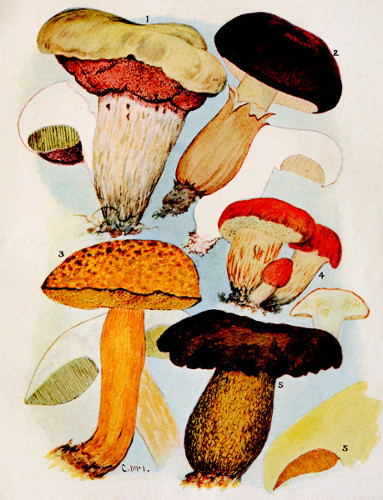
Grouped by F.D. Briscoe—Studies by C. McIlvaine New Species. Plate CXVI.
| Fig. |
Page. |
Fig. |
Page. |
| 1. Boletus eccentricus, |
470 |
4. Boletus subsanguineus, |
420 |
| 2. Boletus badiceps, |
436 |
5. Boletus crassipes, |
452 |
| 3. Boletus fulvus, |
465 |
|
|
B. subsanguin´eus Pk.—sub and sanguineus, bloody. (Plate CXVI,
fig. 4, p. 420.) Pileus convex or slightly depressed in the center, glabrous,
viscid, bright-red or scarlet. Flesh thick, firm but flexible, white,
slowly changing to a pale brownish-lilac on exposure to the air, taste
slightly bitter. Tubes very short, 2–4 mm. long, adnate, but often separating
from the stem with the expansion of the pileus, reddish, the
mouths minute, stuffed at first, pinkish, then brownish-yellow, changing
to a light-brown where wounded. Stem short, thick, uneven, often
421tapering downward, streaked with red, pale-yellow at the top, white at
the base, marked at the top by the decurrent walls of the tubes.
Pileus 2.5–10 cm. broad. Stem 2.5–5 cm. long, 2–4 cm. thick.
Solitary, gregarious or cespitose. Under beech trees. West Philadelphia,
Pa. August. C. McIlvaine.
This is a very showy species, easily recognized by its bright-red viscid
pileus and its short, thick and uneven or somewhat lacunose stem.
It is closely related to the European B. sanguineus With., from which
it is separated by its minute tubes, its uneven stem and the brownish
hues assumed where wounded.
The spore characters of this and the four succeeding species are unknown,
but the other characters are quite distinctive and apparently
sufficient for the recognition of the species. The descriptions have been
derived from colored figures and other data furnished by Mr. McIlvaine,
who says all are edible. Peck, Bull. Torrey Bot. Club, No. 27.
When slowly stewed for thirty minutes, there is no better Boletus.
Pulverulenti.
Pileus clothed with a yellow dust or a yellow powdery down. Stem
more or less yellow powdered, neither bulbous nor distinctly reticulated.
The species which constitute this tribe are easily distinguished from
all others by the sulphur-colored pulverulence which coats the pileus
and stem like a universal veil. They appear thus far to be peculiar to
this country. Though strongly resembling each other in the tribal
character they are very diverse in other respects. One species, by its
viscidity, connects with the preceding tribe; another by its differently
colored tube mouths is related to the Luridi; and the third is peculiar
in its ligneous habitat.
|
Plant growing on the ground |
1 |
|
Plant growing on wood |
B. hemichrysus |
| 1. |
Tubes adnate, of one color |
B. Ravenelii |
| 1. |
Tubes free, with red mouths |
B. auriflammeus |
|
Peck, Boleti of the U.S., p. 103. |
|
B. hemichry´sus B. and C.—half-golden. Pileus convex, at length
plane or irregularly depressed, floccose-squamulose, covered with a yellow
powder, sometimes cracked, bright golden-yellow. Flesh thick,
422yellow. Tubes adnate or decurrent, yellow, becoming reddish-brown,
the mouths large, angular. Stem short, irregular, narrowed below,
sprinkled with a yellow dust, yellowish tinged with red; mycelium yellow.
Spores oblong, minute, dingy-ochraceous.
Var. muta´bilis. Flesh slightly changing to blue where wounded.
Stem reddish, yellow within, sometimes eccentric. Spores oblong-elliptical,
7.5–9×3–4µ.
Pileus 1.5–2.5 in. broad. Stem about 1 in. long, 3–6 lines thick.
Roots of pine, Pinus palustris. The variety on stumps of Pinus
strobus.
South Carolina, Ravenel; North Carolina, Curtis; New York, Peck.
The species is remarkable for its habitat, which is lignicolous. The
New York variety grew on a stump of white pine. By its eccentric
stem it connects this genus with Boletinus, through Boletinus porosus.
According to the authors of this species it resembles Boletus variegatus.
Peck, Boleti of the U.S.
B. Ravenel´ii B. and C.—after Ravenel. Pileus convex or nearly
plane, slightly viscid when young or moist, covered with a sulphur-yellow
powdery down, becoming naked and dull-red on the disk. Flesh
whitish. Tubes at first plane, adnate, pale-yellow, becoming yellowish-brown
or umber, dingy-greenish where bruised, the mouths large or
medium size, subrotund. Stem nearly equal, clothed and colored like
the young pileus, yellow within, with a slight evanescent webby or
tomentose ring. Spores ochraceous-brown, 10–12×5–6µ.
Pileus 1–3 in. broad. Stem 1.5–4 in. long, 3–6 lines thick.
Woods and copses. South Carolina, Ravenel; North Carolina, Curtis;
New York, Peck; New England, Frost.
This is a very distinct and very beautiful species. Mr. Ravenel remarks
in his notes that “this plant is not infested by larvæ and preserves
more constant characters than any other Boletus with which I am acquainted.”
The webby powdered filaments constitute a universal veil
which at first covers the whole plant and conceals the young tubes. As
the pileus expands this generally disappears from the disk, and, separating
between the margin and the stem, a part adheres to each. The
flesh is sometimes stained with yellow. The tubes in some instances become
convex and slightly depressed around the stem. They are almost
white when young, and often exhibit brownish hues where wounded.
423The plant is sometimes cespitose. I have observed a greenish tint to
the freshly shed spores, but it soon disappears. Boletus subchromeus
Frost Ms. is this species. Peck, Boleti of the U.S.
B. auriflam´meus B. and C.—flaming yellow. Pileus convex, dry,
powdered, bright golden-yellow. Flesh white, unchangeable. Tubes
plane or convex, free, yellow, their broad angular mouths scarlet. Stem
slightly tapering upward, powdered, colored like the pileus. Spores
10–12.5×5µ.
Pileus 8–12 lines broad. Stem 1–1.5 in. long.
Woods. North Carolina, Curtis; New York, Peck.
This is evidently a rare species and as beautiful as it is rare. The
whole plant is bright-yellow except the tube mouths, and is sprinkled
with yellow dust or minute yellow branny particles. In the New York
specimen the scarlet color is wanting in the marginal tube mouths and
the stem is marked with fine subreticulating elevated lines. In other
respects it agrees well with the diagnosis of the species. Peck, Boleti
of the U.S.
Subpruinosi—sub, pruina, hoar frost.
Pileus glabrous, but more often pruinose. Tubes adnate, yellowish.
Stem equal, even, neither bulbous nor reticulated.
The species of this tribe have the pileus neither viscid nor distinctly
and permanently tomentose. Typically it is glabrous or merely pruinose,
but Fries has admitted into the group one species with a pulverulent,
and one with a silky pileus. The species are not sharply distinguished
from those of the following tribes, and possibly some have been admitted
here which might as well have been placed there. Some of the species
are variable in color and their characters are not sufficiently well known.
|
Tubes bright-yellow, golden or subochraceous |
1 |
| 1. |
Tubes pale or whitish-yellow |
6 |
| 1. |
Tubes changing to blue where wounded |
2 |
| 1. |
Tubes not changing to blue |
3 |
|
2. Stem pallid, with a circumscribing red line at the top |
B. glabellus |
|
2. Stem yellow, sometimes with red stains |
B. miniato-olivaceus |
|
2. Stem red, yellow at the top |
B. bicolor |
| 3. |
Stem viscid or glutinous when moist |
B. auriporus |
| 4243. |
Stem not viscid |
4 |
|
4. Plant growing on Scleroderma |
B. parasiticus |
|
4. Plant terrestrial |
5 |
| 5. |
Tubes greenish-yellow |
B. alutaceus |
| 5. |
Tubes golden-yellow |
B. tenuiculus |
|
6. Pileus reticulated with subcutaneous brown lines |
B. dictyocephalus |
|
6. Pileus not reticulated |
7 |
| 7. |
Tubes changing to blue where wounded |
B. pallidus |
| 7. |
Tubes not changing to blue |
8 |
|
8. Stem uniformly colored |
B. subglabripes |
|
8. Stem yellowish, streaked with brown |
B. innixus |
|
Peck, Boleti of the U.S. |
|
B. minia´to-oliva´ceus Frost—olive-red. Pileus at first convex and
firm, then nearly plane, soft and spongy, glabrous, vermilion, becoming
olivaceous. Flesh pale-yellow, changing to blue where wounded.
Tubes bright lemon-yellow, adnate or subdecurrent. Stem glabrous,
enlarged at the top, pale-yellow, brighter within, sometimes lurid at the
base. Spores 12.5×6µ.
Var. sensi´bilis (Boletus sensibilis Rep. 32, p. 33).
Pileus at first pruinose-tomentose, red, becoming glabrous and ochraceous-red
with age. Tubes bright-yellow tinged with green, becoming
sordid-yellow. Stem lemon-yellow with red or rhubarb stains at the
base, contracted at the top when young, subcespitose. Spores 10–12.5×4–5µ.
Pileus 2–6 in. broad. Stem 3–4 in. long, 3–6 lines thick.
Woods and their borders. New England, Frost; New York, Peck.
Though the sensitive Boletus differs considerably in some respects
from the olive-red Boletus, it is probably only a variety, and as such I
have subjoined it here. In it every part of the plant quickly changes
to blue where wounded, and even the pressure of the fingers in handling
the fresh specimens is sufficient to induce this change of color. I have
not found the typical plant in New York, but specimens received from
Mr. Frost are not, in the dry state, distinguishable from the variety.
Peck, Boleti of the U.S.
Indiana, H.I. Miller; West Virginia. Haddonfield, N.J. Cheltenham,
Pa., McIlvaine.
Years ago I marked it edible and excellent when young. My friends
425have eaten it, and continue to do so. Yet Professor Peck (48th Rep.,
p. 202) reports a case brought to his notice of an entire family being
sickened by eating B. sensibilis. All recovered. It may, therefore, be
one of those species which, while disagreeing with some persons, can
be eaten by the majority. Clitocybe illudens, Lepiota Morgani and
others of the Agaricaceæ are such species.
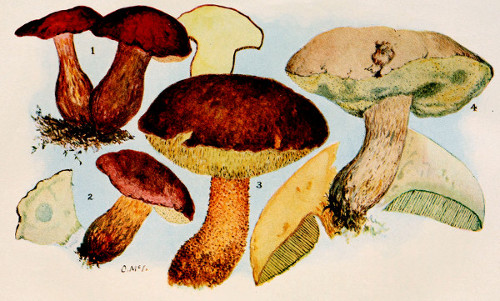
Grouped by F.D. Briscoe—Studies by C. McIlvaine. Plate CXVII.
| Fig. |
|
Page. |
Fig. |
Page. |
| 1–2. |
Boletus bicolor, |
425 |
4. Boletus pallidus, |
429 |
| 3. |
Boletus rubropunctus, |
429 |
|
|
B. bi´color Pk.—two-color. (Plate CXVII, figs. 1, 2, p. 424.) Pileus
convex, glabrous or merely pruinose-tomentose, dark-red, firm, becoming
soft, paler and sometimes spotted or stained with yellow when
old. Flesh yellow, not at all or but slightly and slowly changing to
blue where wounded. Tubes nearly plane, adnate, bright-yellow, becoming
ochraceous, slowly changing to blue where wounded, their
mouths small, angular or subrotund. Stem subequal, firm, solid, red,
generally yellow at the top. Spores pale, ochraceous-brown, 10–12.5×4–5µ.
Pileus 2–4 in. broad. Stem 1–3 in. long, 4–6 lines thick.
Woods and open places. New York, Peck; Wisconsin, Bundy.
The color of this plant is somewhat variable. In the typical form the
pileus and stem are dark red, approaching Indian red, but when old the
color of the pileus fades and is often intermingled with yellow. The
surface sometimes cracks and becomes cracked in areas. From the
European B. Barlæ this species is separated by its solid stem; from B.
versicolor by its small tube mouths and its red stem. Peck, Boleti of
the U.S.
Plentiful at Mt. Gretna, Pa., July, August, September, 1898, in
mixed woods. Very variable in shape and color. Identified by Professor
Peck from painting and description.
Fine eating, one of the very best.
B. glabel´lus Pk.—smooth. Pileus fleshy, thick, broadly convex or
nearly plane, soft, dry, subglabrous, smoky-buff. Flesh white, both it
and the tubes changing to blue where wounded. Tubes nearly plane,
adnate, ochraceous, tinged with green, their mouths small, subrotund.
Stem subequal, glabrous, even, reddish toward the base, pallid above,
with a narrow reddish circumscribing zone or line at the top. Spores
oblong, brownish-ochraceous, tinged with green when fresh, 10–12.5×4µ.
Pileus 3–5 in. broad. Stem 1–3 in. long, 5–10 lines thick.
426Grassy ground under oaks. New York, Peck.
The species is well marked by the reddish band or line on the stem
just below the tubes, but this disappears in drying. Peck, Boleti of
the U.S.
B. aluta´ceus Morgan—yellowish. Pileus cushion-shaped, glabrous,
alutaceous with a tinge of red. Flesh white, inclining to reddish. Tubes
semifree, medium in size, unequal, angular, greenish-yellow. Stem
nearly equal, striate, reticulate at the apex, colored like the pileus.
Spores fusiform, brownish-olive, 12.5×5µ.
Pileus 3 in. broad.
Rocky woods of oak and chestnut. Kentucky, Morgan.
The general aspect of the figure of this species recalls some of the
forms of Boletus subtomentosus. The tubes are nearly equal in length
to the thickness of the flesh of the pileus. Peck, Boleti of the U.S.
Quite frequent at Mt. Gretna, Pa., in mixed woods, principally oak
and chestnut.
Stem should be removed, and tubes when old. It cooks well and is
especially good.
B. tenui´culus Frost—thin. Pileus nearly plane, thin, lurid-red on
a yellow ground. Flesh unchangeable. Tubes short, adnate, small,
golden-yellow. Stem slender, equal, colored like the pileus. Spores
10×6µ.
Pileus 1–2 in. broad. Stem 4–6 in. long.
Woods. New England. Frost.
The thin pileus and long slender stem readily distinguish this species.
Peck, Boleti of the U.S.
B. auri´porus Pk.—golden-pore. Pileus convex or nearly plane,
glabrous or merely pruinose-tomentose, grayish-brown, yellowish-brown,
or reddish-brown. Flesh white, unchangeable. Tubes plane or slightly
depressed around the stem, adnate or subdecurrent, bright golden-yellow,
retaining their color when dried. Stem equal or slightly thickened
at the base, viscid or glutinous when moist, especially toward the base,
colored like or a little paler than the pileus. Spores 7.5–10×4–5µ.
Pileus 1–3 in. broad. Stem 1–3 in. long, 2–4 lines thick.
427Thin woods and shaded banks. New York, Peck; New England,
Frost.
This species is remarkable for the rich yellow color of the tubes,
which is retained unchanged in the dried specimens, and for the viscid
stem. This character, however, is not noticeable in dry weather and
was overlooked in the original specimens.
Boletus glutinipes Frost Ms. is not distinct. Peck, Boleti of the U.S.
Hopkins' Woods, Haddonfield, N.J. Grassy oak woods. 1891–1894.
McIlvaine.
The caps are delicious.
B. innix´us Frost. Pileus convex or nearly plane, glabrous, yellowish-brown,
slightly cracked in areas when old, yellow in the interstices.
Flesh white. Tubes adnate, lemon-yellow, unchangeable. Stem slender,
short, much thickened at the base in large specimens, yellowish,
streaked with brown, brownish within. Spores 10×5µ.
Grassy woods. New England. Frost.
The whole plant often reclines as if for support, Peck, Boleti of the
U.S.
B. parasi´ticus Bull.—a parasite. Pileus convex or nearly plane, dry,
silky, becoming glabrous, soon tessellately cracked, grayish or dingy-yellow.
Tubes decurrent, medium size, golden yellow. Stem equal,
rigid, incurved, yellow without and within. Spores oblong-fusiform,
pale-brown, 12.5–15×4µ.
Pileus 1–2 in. broad. Stem 1–2 in. long, 2–4 lines thick.
Parasitic on species of Scleroderma. New York, Gerard; New England,
Sprague, Bennett.
This species is very rare in this country. It is remarkable for its
peculiar habitat. Peck, Boleti of the U.S.
New York, Lydia M. Patchen; Westfield, on Scleroderma vulgare.
I found many specimens of this rare species during August, 1897,
growing on Scleroderma vulgare.
Professor Peck, to whom I sent specimens, identified them as B. parasiticus.
The tubes were large, unequal, dissepiments thin, decurrent.
The Sclerodermas frequently appear to be parasitic upon the Boletus.
I have seen the host plant thrown entirely free from the ground by the
Boletus.
428B. parasiticus is edible, but it is not of agreeable flavor.
B. dictyoceph´alus Pk.—reticulate. Pileus convex, glabrous, reticulate
with brown lines beneath the thin separable cuticle, brownish-orange,
darker in the center and there tinged with pink. Flesh white, unchangeable.
Tubes nearly plane, slightly depressed around the stem,
grayish-yellow, becoming brown where bruised. Stem equal or slightly
tapering at the top, solid, rimose, dotted with scales, lemon-yellow,
darker toward the base. Spores 15–20×6µ.
Pileus 2.5 in. broad. Stem 3–4 in. long, 5–6 lines thick.
Mixed woods. North Carolina. C.J. Curtis.
The description here given has been derived from a single dried specimen
and from the notes kindly sent by Mr. Curtis. The species is
apparently well marked and very distinct by the peculiar reticulations of
the pileus. Peck, Boleti of the U.S.
B. subgla´bripes Pk.—rather smooth. Pileus convex or nearly
plane, glabrous, reddish inclining to chestnut color. Flesh white, unchangeable.
Tubes adnate, nearly plane in the mass, pale yellow, becoming
convex and darker or greenish-yellow with age, the mouths
small, subrotund. Stem equal, solid, scurfy, pale yellow. Spores
oblong-fusiform, 12.5–15×4–5µ.
The smoothish-stemmed Boletus is well marked by its cylindric minutely
scurfy stem which is colored like the tubes. Its cap is smooth
and nearly always some shade of red or bay. Specimens occur occasionally
in which it approaches grayish-brown or wood-brown. The
flesh is white and unchangeable when cut or broken.
The tubes at first have a nearly plane surface, but this becomes somewhat
convex with age, and slightly depressed around the stem. The
tube mouths are small and nearly round. The color of the tubes is at
first a beautiful pale yellow, but it becomes darker or slightly greenish-yellow
with age.
The stem is colored very nearly like the tubes, but sometimes it has
a slight reddish tint toward the base. Its peculiar feature consists of
the minute, branny particles upon it. They are so small and pale that
they are easily overlooked.
There is a variety in which the cap is corrugated or irregularly pitted
and wrinkled. Its name is Boletus subglabripes corrugis Pk.
429The cap is 1½-4 in. broad, the stem is 2–3 in. long and 4–8 lines
thick. The plants are found in woods in July and August. Peck, 51st
Rep. N.Y. State Bot.
B. pal´lidus Frost—pale. (Plate CXVII, fig. 4, p. 424.) Pileus
convex, becoming plane or centrally depressed, soft, glabrous, pallid or
brownish-white, sometimes tinged with red. Flesh white. Tubes
plane or slightly depressed around the stem, nearly adnate, very pale or
whitish-yellow, becoming darker with age, changing to blue where
wounded, the mouths small. Stem equal or slightly thickened toward
the base, rather long, glabrous, often flexuous, whitish, sometimes
streaked with brown, often tinged with red within. Spores pale ochraceous-brown,
10–12×5–6µ.
Pileus 2–4 in. broad. Stem 3–5 lines long, 4–8 lines thick.
Woods. New England, Frost; New York, Peck.
The species is readily recognized by its dull pale color, rather long
stem, and tubes changing to blue where wounded. Peck, Boleti of the
U.S.
Common in West Virginia mountains, Angora, West Philadelphia,
Mt. Gretna, Pa. Solitary, on ground in mixed woods.
The caps are tender and delicately flavored.
B. rubropunc´tus Pk.—red-dotted. (Plate CXVII, fig. 3, p. 424.)
Pileus convex, glabrous, reddish-brown. Flesh yellowish, unchangeable.
Tubes nearly plane, depressed about the stem, their mouths
small, round, bright golden-yellow, not changing color where bruised.
Stem firm, solid, tapering upward, yellow, punctate with reddish dots
or squamules. Spores olive-green, 12.5×4–5µ.
Pileus 1–2 in. broad. Stem 1–2 in. long, 3–6 lines thick.
Woods. Port Jefferson. July. Cold Spring Harbor, H.C. Beardslee.
This is a pretty Boletus, well marked by the red dots of the stem.
It is apparently a very rare species. B. radicans is said to have the
stem sprinkled with red particles, but that is a larger plant with the
margin of the pileus persistently involute or incurved and with a radicating
stem, characters which are not shown by our fungus. Peck, 50th
Rep. N.Y. State Bot.
I found my specimens at Mt. Gretna, Pa., August-September, 1898.
430Identified for the writer by Professor Peck from painting and description.
Taste and smell slight. Cooks well and is pleasant to the taste. The
tubes should be removed.
Subtomento´si—sub, tomentosus, downy.
Pileus when young villose or subtomentose, rarely becoming glabrous
with age, destitute of a viscid pellicle. Tubes of one color, adnate.
Stem at first extended, neither bulbous nor reticulated with veins,
wrinkled or striated in some species. Flesh in some changing color
where wounded.
The tubes are generally yellow or greenish-yellow. In some species
they are occasionally somewhat depressed around the stem, but they do
not form a rounded free stratum, nor, with the exception of B. rubeus,
are they stuffed when young as in most of the Edules. The species are
scarcely separable from those of the preceding tribe except by the more
evidently tomentose young pileus.
|
Tubes brown, becoming cinnamon |
B. variegatus |
|
Tubes not having these colors |
1 |
| 1. |
Flesh or tubes changing to blue where wounded |
2 |
| 1. |
Flesh or tubes not changing to blue |
5 |
|
2. Stem glabrous |
3 |
|
2. Stem not glabrous |
4 |
| 3. |
Flesh yellow under the cuticle |
B. rubeus |
| 3. |
Flesh red under the cuticle |
B. chrysenteron |
|
4. Stem velvety at the base |
B. striæpes |
|
4. Stem with a reddish bloom or scurf |
B. radicans |
|
4. Stem with brown dot-like scales |
B. mutabilis |
| 5. |
Tubes whitish, becoming yellow |
B Roxanæ |
| 5. |
Tubes yellow |
6 |
|
6. Tube mouths large and angular |
B. subtomentosus |
|
6. Tube mouths minute |
B. spadiceus |
|
Peck, Boleti of the U.S. |
|
B. variega´tus Swartz. Pileus at first convex, then plane, obtuse,
moist, sprinkled with superficial bundled hairy squamules, dark-yellow,
the acute margin at first flocculose. Flesh yellow, here and there becoming
431blue. Tubes adnate, unequal, minute, brown then cinnamon.
Stem firm, equal, even, dark-yellow, sometimes reddish. Spores oblong-ellipsoid,
hyaline or very pale-yellowish, 7.5–10×3–4µ.
Pileus 2–5 in. broad. Stem 2–3 in. long, 6 lines thick.
Woods, especially of pine. North Carolina, Curtis, Schweinitz; California,
Harkness, Moore; Rhode Island, Bennett. Peck, Boleti of the U.S.
West Virginia mountains, 1882–1885. Haddonfield, N.J., McIlvaine;
Doylestown, Pa., Paschall. Quite common on flat benches where hemlocks
and spruces have grown.
When the caps are cooked they are sweet, nutty, excellent.
B. Roxa´næ Frost. Pileus broadly convex, at first subtomentose,
then covered with red hairs in bundles, yellowish-brown. Flesh yellowish-white.
Tubes at first whitish, then light-yellow, arcuate-adnate
or slightly depressed around the stem, the mouths small. Stem enlarged
toward the base, striate at the apex, yellowish or pale-cinnamon.
Spores 10×4µ.
Var. auri´color. Pileus and subequal stem bright-yellow, the tomentum
of the pileus yellow.
Pileus 1.5–3 in. broad. Stem 1–2 in. long, 3–5 lines thick.
Borders of woods. New England, Frost; New York, Peck.
Peck, Boleti of the U.S.
B. striæ´pes Secr.—striate stem. Pileus convex or plane, soft, silky,
olivaceous, the cuticle rust-color within. Flesh white, yellow next the
tubes, sparingly changing to blue. Tubes adnate, greenish, their
mouths minute, angular, yellow. Stem firm, curved, marked with
brownish-black striations, yellow, velvety and brownish-rufescent at the
base. Spores 10–13×4µ.
Pine and oak woods. Minnesota, Johnson.
I have seen no specimens of this species, which is recorded from but
one locality in our country. The character—flesh sparingly changing
to blue—is given on the authority of Rev. M.J. Berkeley. Peck, Boleti
of the U.S.
B. chrysen´teron Fr.—golden within. Pileus convex or plane, soft,
floccose-squamulose, often cracked in areas, brown or brick-red. Flesh
yellow, red beneath the cuticle, often slightly changing to blue where
432wounded. Tubes subadnate; greenish-yellow, changing to blue where
wounded; their mouths rather large, angular, unequal. Stem subequal,
rigid, fibrous-striate, red or pale-yellow. Spores fusiform, pale-brown,
11–12.5×4–5µ.
Pileus 1–3 in. broad. Stem 1–3 in. long, 3–6 lines thick.
Woods and mossy banks.
The species is common and very variable. The color of the pileus
may be yellowish-brown, reddish-brown, brick-red, tawny or olivaceous.
The subcutaneous reddish tint and the reddish chinks of the cracked
pileus are distinguishing features. Wounds of the tubes sometimes
become blue then greenish. Authors disagree concerning the edible
qualities of this Boletus. Stevenson gives it as edible, but Cordier and
Gillet say that it is regarded with suspicion. In one strongly marked
form the tubes are decidedly depressed around the stem, in another the
flesh is whitish tinged with red. It may be doubted whether these are
varieties or distinct species. Peck, Boleti of the U.S.
I have found, and eaten plentifully of this species in West Virginia,
North Carolina, New Jersey, Pennsylvania, from July until October.
I have no hesitancy in recommending it in all of its varieties. Excepting
from very young specimens the tubes and stems should be removed.
The flesh is sweet, delicate and toothsome.
B. fumo´sipes Pk. Pileus convex or nearly plane, minutely tomentose,
sometimes minutely rivulose, dark olive-brown. Flesh whitish.
Tubes at first nearly plane, becoming convex with age, their mouths
whitish when young, becoming yellowish-brown, changing to bluish-black
where bruised. Stem equal, solid, smoky-brown, minutely scurfy
under a lens. Spores purplish-brown, 12.5–15×5–6µ.
Pileus 1–2 in. broad. Stem 1–2 in. long, 3–4 lines thick.
Woods. Port Jefferson. July.
This species resembles small dark-colored forms of B. chrysenteron,
and this resemblance is still more noticeable in those specimens in which
the pileus cracks in areas, for in these the chinks become red as in that
species. The different color of the stem and tubes will at once separate
these species. Peck, 50th Rep. N.Y. State Bot.
B. ru´beus Frost—red. Pileus broadly convex, very finely appressed
subtomentose, bright brick-red when young, becoming mottled with red
433and yellow, yellow under the cuticle, the thin margin at first inflexed,
then horizontal, curved upward when old. Flesh pale-yellow, changing
to blue where wounded. Tubes adnate or slightly depressed around
the stem, lemon-yellow and stuffed when young, becoming yellow and
sometimes red at the mouths. Stem small, often flexuous, colored like
the pileus, reddish within, white-tomentose at the base. Spores 9–12.5×4–5µ.
Pileus 2–4 in. broad. Stem 1–3 in. long, 3–5 lines thick.
Deep woods. Rare. New England, Frost.
This is apparently too closely related to B. chrysenteron, and it also
resembles B. bicolor. Peck, Boleti of the U.S.
B. frater´nus Pk. Pileus convex, becoming plane or depressed,
slightly tomentose, deep red when young, becoming dull red with age.
Flesh yellow, slowly changing to greenish-blue where wounded. Tubes
rather long, becoming ventricose, slightly depressed about the stem,
their walls sometimes slightly decurrent, the mouths large, angular or
irregular, sometimes compound, bright yellow, quickly changing to blue
where wounded. Stem short, cespitose, often irregular, solid, subtomentose,
slightly velvety at the base, pale reddish-yellow, paler above
and below, yellow within, quickly changing to dark green where
wounded. Spores 12.5×6µ.
Pileus 1–1.5 in. broad. Stem 1–1.5 in. long, 3–6 lines thick.
Shaded streets. Auburn, Alabama. July. Underwood.
The species is apparently allied to B. rubeus, but is very distinct by
its small size, cespitose habit, color of the flesh of the stem and by the
peculiar hues assumed where wounded. When the pileus cracks the
chinks become yellow as in B. subtomentosus. The species belongs to
the tribe Subtomentosi. Peck, Bull. Torrey Bot. Club, Vol. 24, No. 3.
B. subtomento´sus L.—sub; tomentosus, downy. Pileus convex or
nearly plane, soft, dry, villoso-tomentose, subolivaceous, concolorous beneath
the cuticle, often cracked in areas. Flesh white or pallid. Tubes
adnate or somewhat depressed around the stem, yellow, their mouths
large, angular. Stem stout, somewhat ribbed-sulcate, scabrous or
scurfy with minute dots. Spores 10–12.5×4–5µ.
Pileus 1–4 in. broad. Stem 1–2.5 in. long, 2–5 lines thick.
Common and variable. The pileus is usually olivaceous or yellowish-brown,
434but it may be reddish-brown or tawny-red. When it cracks
the chinks become yellow. The species, as I understand it, may be
distinguished from its near relative, B. chrysenteron, by its paler flesh,
the clearer yellow tubes not changing to blue where wounded, and by
the chinks of the pileus becoming yellow. The species is recorded
edible by Cordier, Curtis and Palmer. Gillet says it is only medium in
quality. Peck, Boleti of the U.S.
Found and eaten in West Virginia, North Carolina, New Jersey, Pennsylvania.
Specimens received from Indiana, Minnesota, Alabama.
I have not seen any change of color in flesh or tubes. It is common
in Woodland Cemetery and Fairmount Park, Philadelphia. If the
tubes are not removed the dish is slimy. The B. chrysenteron also
makes such a dish when stewed, but fried, and well done, both species
are decidedly good.
B. cæspito´sus Pk.—cespitose. Pileus broadly convex or nearly
plane, sometimes slightly concave by the elevation of the margin, even,
brown or blackish-brown, the margin often a little paler or reddish-brown.
Flesh slightly tinged with red. Tubes adnate or slightly decurrent,
yellow, their mouths rather large, angular, concolorous. Stem
short, even, solid, glabrous, tapering upward, brown or reddish-brown.
Spores oblong-elliptic, 10µ long, 5µ broad.
Pileus 1–2.5 cm. broad. Stem 2–2.5 cm. long, 4–6 mm. thick.
Cespitose. Virginia. August. R.S. Phifer.
A small species growing in tufts and referable to the tribe Subtomentosi.
The tubes retain their bright yellow color in the dried specimens.
Peck, Bull. Torrey Bot. Club, January 27, 1900.
Edible qualities not stated.
B. spadi´ceus Schaeff.—nut brown. Pileus convex or plane, moderately
compact, dry, tomentose, opaque, date-brown, irregularly cracked.
Flesh white, unchangeable, brownish-red above. Tubes adnate, yellow,
their mouths minute, subrotund. Stem firm, clavate, even, woolly-scaled,
yellow or brownish, yellowish-white within. Spores 12×4µ.
Pileus 2–4 in. broad.
Woods. New England, Frost.
This species is admitted on the authority of Mr. Frost who alone has
recorded it in this country. But specimens received from him under
435this name do not in my opinion belong to it, and its occurrence here is
somewhat doubtful. Peck, Boleti of the U.S.
In oak woods near Bartram’s Garden, West Philadelphia, in 1887–1888,
I found several Boleti answering the description, exactly, of B.
spadiceus. They proved to be good eating.
B. radi´cans Pers.—radix, a root. Pileus convex, dry, subtomentose,
olivaceous-cinereus, becoming pale-yellowish, the margin thin, involute.
Flesh pale-yellow, instantly changing to dark blue, taste bitterish.
Tubes adnate, their mouths large, unequal, lemon-yellow. Stem
even, tapering downward and radicating, flocculose with a reddish
bloom, pale-yellow, becoming naked and dark with a touch.
Pileus 2–3 in. broad. Stem 2 in. long, 6 lines thick.
Woods. Ohio, Morgan.
Of the American plant Mr. Morgan says that the pileus is quite firm
and dry, becomes reddish or brownish-yellow and nearly glabrous,
that the flesh is pale-yellow, but that he has not observed any bluish
tinge, and that the spores are olive, fusiform, 10–12.5×5µ. Those of the
European plant have been described as very pale ocher, almost white,
6µ long, 3µ broad. Peck, Boleti of the U.S.
Near Bryn Mawr, Pa. W.C. Alderson, 1894.
Several specimens brought to me were eaten. The change in color
of flesh was instantaneous upon exposure to the air. Taste strong and
raw rather than bitterish. The caps alone were cooked, and dish marked
“fine.”
B. muta´bilis Morg.—changeable. Jour. Cin. Soc. Nat. Sci., Vol.
VII. Pileus convex, then plane or depressed, compact, dry, subtomentose,
brown. Flesh bright-yellow, promptly changing to blue
where wounded. Tubes adnate or subdecurrent, their mouths large,
angular, unequal, some of them compound, yellow changing to greenish
yellow and quickly becoming blue where wounded. Stem stout,
solid, flexuous, subsulcate, yellowish beneath the brown dot-like scales,
bright yellow within. Spores olive, fusiform, 12–13×5µ.
Pileus 2.5–4 in. broad. Stem 2–3 in. long, 6 lines thick.
Thick woods. Ohio, Morgan.
A shade of yellow sometimes appears beneath the brown of the pileus,
and as the plants grow old the pileus becomes blackish, glabrous and
436shining. The stem increases in thickness above and downward. Peck,
Boleti of the U.S.
B. badi´ceps Pk.—badius, bay and head. (Plate CXVI, p. 420.)
Pileus firm, convex or somewhat centrally depressed when mature, dry,
velvety, obliquely truncate on the margin, bay-red or dark-maroon
color. Flesh white unchangeable, taste and odor mild, sweet, suggestive
of molasses. Tubes plane, adnate, white or whitish, becoming
dingy with age, the mouths minute. Stem equal or slightly swollen in
the middle, radicating, glabrous, solid, brownish.
Pileus 4–8 cm. broad. Stem 4–5 cm. long, 1.5–3 cm. thick.
Oak woods. West Philadelphia, Pa. August and September. Charles
McIlvaine.
The truncate or beveled margin of the pileus is a striking feature in
this species. It is about 4 mm. broad and as even as if cut with a
knife. Sometimes the surface of the stem ruptures transversely just below
the top, the liberated shreds above curling upward against the tubes
and those below curving outward and downward. In mature plants
brownish spots appear in the flesh of the pileus. “When cooked it is
of high flavor and tender as kidney,” C. McIlvaine. Peck, Bull. Torrey
Bot. Club, January 27, 1900.
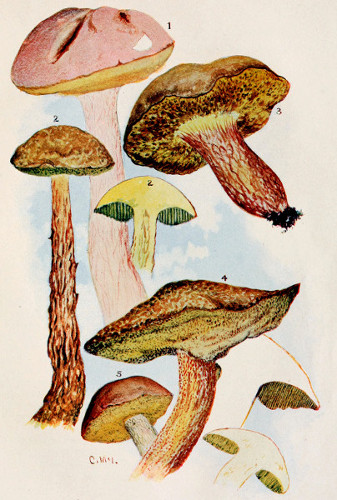
Grouped by F.D. Briscoe—Studies by C. McIlvaine. Plate CXVIII.
| Fig. |
Page. |
Fig. |
Page. |
| 1. Boletus separans, |
445 |
4. Boletus scarer areolatus, |
461–463 |
| 2. Boletus russelli, |
436 |
5. Boletus edulis, |
445 |
| 3. Boletus illudens, |
439 |
|
|
Laceri´pedes—lacerated stem.
Stem elongated, coarsely pitted or deeply and lacunosely reticulated
in small hollows, the ridges somewhat intumescent in wet weather and
more or less lacerated, giving a rough or shaggy appearance to the stem.
The species of this tribe are few, very closely allied and so far as
known are peculiar to this country.
|
Pileus viscid |
1 |
|
Pileus dry |
B. Russelli |
| 1. |
Stem red in the depressions, tubes tinged with green |
B. Morgani |
| 1. |
Stem pale-yellow, tubes not greenish |
B. Betula |
|
Peck, Boleti of the U.S. |
|
B. Rus´selli Frost—Russell’s Boletus. (Plate CXVIII, fig. 2, p. 436.)
Pileus thick, hemispherical or convex, dry, covered with downy scales or
bundles of red hairs, yellowish beneath the tomentum, often cracked in
437areas. Flesh yellowish, unchangeable. Tubes subadnate, often depressed
around the stem, rather large, dingy-yellow or yellowish-green.
Stem very long, equal or tapering upward, roughened by the lacerated
margins of the reticular depressions, red or brownish-red. Spores olive-brown,
18–22×8–10µ.
Pileus 1.5–4 in. broad. Stem 3–7 in. long, 3–6 lines thick.
This is distinguished from the other species by the dry squamulose
pileus and the color of the stem. The latter is sometimes curved at the
base. Peck, Boleti of the U.S.
B. Russelli occurs in the West Virginia mountains, where I found
and ate it in August, 1883. Though solitary in its method of growth,
it is frequent in many parts of Pennsylvania, among leaves in mixed
woods. August to October.
Taste when raw, sweet, mild. Cooked it is rather soft, tasty. Tubes
and stem should be removed.
B. Mor´gani Pk. Pileus convex, soft, glabrous viscid, red or yellow,
or red fading to yellow on the margin. Flesh whitish tinged with
red and yellow, unchangeable. Tubes convex, depressed around the
stem, rather long and large, bright-yellow becoming greenish-yellow.
Stem elongated, tapering upward, pitted with long, narrow depressions,
yellow, red in the depressions, colored within like the flesh of the pileus.
Spores olive-brown, 18–22µ long, about half as broad.
Pileus 1.5–2.5 in. broad. Stem 3–5 in. long, 3–6 lines thick.
Rocky hillsides in woods of deciduous trees. Kentucky, Morgan.
In wet weather the anastomosing ridges of the stem swell and become
broadly winged, thereby giving the stem a peculiar lacerated appearance.
The glabrous viscid pileus and the coloration of the stem distinguish
the species. Peck, Boleti of the U.S.
B. Morgani is found in like localities with B. Russelli. Excepting in
its smooth, viscid cap and whitish flesh, it closely resembles the latter.
The ridges in the stems of both species swell when moist.
Its edible qualities are the same as B. Russelli.
B. Be´tula Schw.—birch. Pileus convex, viscose and shining in wet
weather, tessellately cracked and reticulated, orange-fawn color, rather
small. Flesh yellowish-white. Tubes separating, rather large, yellow,
almost like those of B. subtomentosus but not greenish. Stem long,
438attenuated downward, everywhere covered with a deciduous reticulated
bark two lines high and separating like the bark of birches, pale-yellow
without and within.
Pileus 1.5 in. broad. Stem 5–6 in. long.
Ligneous earth. North Carolina, Schweinitz, Curtis; Pennsylvania,
Schweinitz. Peck, Boleti of the U.S.
During several seasons I found B. Betula in Woodland Cemetery,
Philadelphia.
Edible qualities good.
Calo´podes. Gr—beautiful; Gr—feet.
Stem stout, at first bulbous, typically venose-reticulated with veins.
Tubes adnate, their mouths not reddish.
The reticulate stem and adnate tubes of one color distinguish the
species of this tribe. In the Luridi the mouths of the tubes are differently
colored, and in the closely related Edules the tubes are more or
less depressed around the stem or sub-free, and their pores are commonly
stuffed when young. Fries did not admit species with whitish
tubes into this tribe, but we have done so in those cases in which this
was the only character to exclude them.
|
Tubes yellow or yellowish |
1 |
|
Tubes white or whitish, at least when young |
7 |
| 1. |
Tubes or flesh changing to blue where wounded |
2 |
| 1. |
Tubes or flesh not changing to blue where wounded |
5 |
|
2. Pileus red, at least when young |
3 |
|
2. Pileus some other color |
4 |
| 3. |
Stem red |
B. Peckii |
| 3. |
Stem yellow or reddish only at the base |
B. speciosus |
|
4. Tubes angular, pileus olivaceous |
B. calopus |
|
4. Tubes rotund, pileus not olivaceous |
B. pachypus |
| 5. |
Pileus viscid |
B. Curtisii |
| 5. |
Pileus pulverulent, stems cespitose |
B. retipes |
| 5. |
Pileus neither viscid nor pulverulent |
6 |
|
6. Stem yellow |
B. ornatipes |
|
6. Stem brown |
B. modestus |
|
6. Stem yellowish-white |
B. rimosellus |
| 7. |
Pileus some shade of red |
8 |
| 4397. |
Pileus some shade of brown or gray |
9 |
|
8. Stem pallid or yellowish |
B. rubignosus |
|
8. Stem dark-brown |
B. ferrugineus |
| 9. |
Pileus pale-brown, stem flexuous |
B. flexuosipes |
| 9. |
Pileus gray or grayish-black, stem straight |
B. griseus |
|
Peck, Boleti of the U.S. |
|
B. specio´sus Frost—handsome. Pileus at first very thick, subglobose,
compact, then softer, convex, glabrous or nearly so, red. Flesh
pale-yellow or bright lemon-yellow, changing to blue where wounded.
Tubes adnate, small, subrotund, plane or but slightly depressed around
the stem, bright lemon-yellow, becoming dingy-yellow with age, changing
to blue where wounded. Stem stout, subequal or somewhat bulbous,
reticulated, bright lemon-yellow without and within, sometimes
reddish at the base. Spores oblong-fusiform, pale ochraceous-brown,
10–12.5×4–5µ.
Pileus 3–7 in. broad. Stem 2–4 in. long, 10–24 lines thick.
Thin woods. New England, Frost; New York, Peck.
This is a very beautiful Boletus. When young the whole plant except
the surface of the pileus is of a vivid lemon-yellow color. Wounds
quickly change to green, then to blue. The color of the pileus approaches
closely to solferino. Peck, Boleti of the U.S.
Caps of specimens found in mixed woods at Mt. Gretna, Pa., were
minutely areolate when old. Stems yellow at top and with purplish red
over the bright yellow toward the bulbous base, solid, bright yellow
within.
Stems and caps are edible and rank high in flavor and texture.
B. illu´dens Pk.—deceiving. (Plate CXVIII, fig. 3, p. 436.) Pileus
convex, dry, subglabrous, yellowish-brown or grayish-brown, sometimes
tinged with red, especially in the center. Flesh pallid or yellowish.
Tubes bright yellow, plane or somewhat convex when old, adnate, their
mouths angular or subrotund, often larger near the stem. Stem nearly
equal, sometimes abruptly pointed at the base, glabrous, pallid or yellowish,
coarsely reticulated either wholly or at the top only. Spores
oblong or subfusiform, yellowish-brown tinged with green, 11–12.5×4–5µ.
Pileus 1.5–3 in. broad. Stem 1.5–2.5 in. long, 3–5 lines thick.
440Woods and copses. Port Jefferson. July. Peck, 50th Rep. N.Y.
State Bot.
Found in plenty at Mt. Gretna, Pa., September, 1898. On ground
and old stumps in mixed woods. Identified by Professor Peck.
Taste and smell pleasant. Cooked as egg-plant it is one of the best.
Remove tubes.
B. Peck´ii Frost—after C.H. Peck. Pileus convex, firm, dry, subglabrous,
red, fading to yellowish-red or buff-brown with age, the margin
usually retaining its red color longer than the disk. Tubes adnate or
slightly decurrent, nearly plane, yellow, changing to blue where wounded.
Stem equal or subventricose, reticulated, red, yellow at the top. Spores
oblong, pale ochraceous-brown, 9–12×4–5µ.
Var. læ´vipes. Stem reticulated above, even below.
Pileus 2–3 in. broad. Stem 2–3 in. long, 3–6 lines thick.
Woods of frondose trees. New York, Peck. Peck, Boleti of the U.S.
B. cal´opus Fr. Gr—beautiful; Gr—foot. Pileus globose, then
convex, unpolished, subtomentose, olivaceous. Flesh pallid, slightly
changing to blue when wounded. Tubes adnate, their mouths minute,
angular, yellow. Stem firm, conical, then elongated and subequal,
reticulated, wholly scarlet or at the apex only, sometimes colored like
the pileus toward the base. Spores fusiform, yellowish-brown, 7–8×3–4µ.
Pileus 2–3 in. broad. Stem longer than the diameter of the pileus.
Woods. North Carolina, Schweinitz, Curtis; Pennsylvania, Schweinitz;
New England, Sprague, Bennett. Peck, Boleti of the U.S.
B. orna´tipes Pk.—ornate-stem. (Boletus retipes, Rep. 23.) Pileus
convex, firm, dry, glabrous or very minutely tomentose, grayish-brown
or yellowish-brown. Flesh yellow or pale-yellow. Tubes adnate, plane,
or concave, rarely convex, the mouths small or medium size, clear-yellow.
Stem firm, subequal, distinctly and beautifully reticulated, yellow
without and within. Spores oblong, ochraceous-brown, 12–16×4–5µ.
Pileus 2–5 in. broad. Stem 2–4 in. long, 4–6 lines thick.
Thin woods and open places. New York, Peck.
The color of the tubes becomes darker with age, but it does not
change to blue where wounded. The species is related to the next following
441one with which it has sometimes been confused, but from which
it is clearly distinct. The color of the spores is quite dark and approaches
snuff-brown. Peck, Boleti of the U.S.
Edible. Good.
B. re´tipes B. and C.—reticulate stem. Pileus convex, dry, powdered
with yellow, sometimes rivulose or cracked in areas. Tubes adnate,
yellow. Stem subequal, cespitose, reticulate to the base, pulverulent
below. Spores greenish-ochraceous, 12–15×4–5µ.
Pileus 1.5–2 in. broad. Stem 2 in. long, 3–6 lines thick.
The tufted mode of growth, pulverulent pileus and paler-colored
spores separate this species from the preceding one. Peck, Boleti
of the U.S.
West Virginia, 1882–1885. Mt. Gretna, Pa.; New Jersey, McIlvaine.
The caps, alone, of this species, are desirable, the stems not cooking
well. Its way of bunching itself gratifies the collector, as do its flavor
and quality.
B. pa´chypus Fr. Gr—thick-footed. Pileus convex, subtomentose,
brownish or pale tan-color. Flesh thick, whitish, changing slightly to
blue. Tubes rather long, somewhat depressed around the stem, their
mouths round, pale-yellow, at length tinged with green. Stem thick,
firm, reticulated, at first ovate-bulbous, then elongated, equal, variegated
with red and pale-yellow. Spores large, ovate, pale yellowish-ochraceous,
12.5–14×5–6µ.
Pileus 4–8 in. broad. Stem 2–4 in. long.
Woods, either of pine or beech.
This species is noted for its thick, stout stem, which sometimes attains
a diameter of more than two inches. It approaches the Edules in
habit, but according to Gillet it is poisonous, or at least to be suspected,
has a penetrating unpleasant odor and a somewhat nauseous flavor.
He also describes the pores as at first whitish. The stem is sometimes
intensely blood-red. Peck, Boleti of the U.S.
A common species in West Virginia mountains, 1881–1885, in beech
groves. August to frost. It is rare in the pines of New Jersey, though
I have found it there. Like B. felleus, its size and attractiveness induce
the finder to over and over again try cooking it, hoping the discovery of
a successful way to rid it of its unpleasantness. I have never succeeded.
It is not poisonous.
442B. rimosel´lus Pk.—cracked. Pileus broadly convex, flat or irregular,
glabrous, tessellately cracked, dark-brown. Flesh whitish. Tubes
adnate or sinuately decurrent, somewhat depressed around the stem,
pale-yellow, becoming darker or brownish with age. Stem tapering upward,
broadly reticulated with brown veins, yellowish-white. Spores
fusiform, 15–17.5×5–6µ.
Pileus 3–5 in. broad. Stem 3–4 in. long, 6–9 lines thick.
Mixed woods. North Carolina, C.J. Curtis.
I have described this species from the notes and a single dried specimen
sent me by Mr. Curtis. More extended observation may require
some modification of the description. The color of the spores is described
as brown. They are remarkable for their size. Peck, Boleti
of the U.S.
B. modes´tus Pk.—modest. Pileus convex or nearly plane, often
irregular, firm, dry, very minutely tomentose, yellowish-brown. Flesh
gray or pinkish-gray. Tubes nearly plane, adnate or subdecurrent,
the mouths angular, pale-ochraceous. Stem equal, reticulated, brown.
Spores elliptical, 10×5µ.
Pileus 2–3 in. broad. Stem 1–2 in. long, 2–4 lines thick.
Grassy ground in thin woods. New York, Peck.
Miss Banning finds in Maryland what appears to be a form of this
species in which the part of the hymenium near the stem consists of
lamellæ, the rest of tubes. The species needs further investigation.
Peck, Boleti of the U.S.
B. Cur´tisii Berk.—after Dr. Curtis. Pileus hemispherical or convex,
viscose, golden-yellow. Tubes depressed around the stem, nearly
free, their mouths umber, at length tawny. Stem slender, attenuated
upward, polished, reticulated, straw-colored. Spores ferruginous, subelliptical,
slightly attenuated at each end.
Pileus 1 in. or more broad. Stem 2 in. long, 2–3 lines thick.
Pine woods. North and South Carolina, Curtis.
In the original description the stem of this species is said to be hollow.
Peck, Boleti of the U.S.
B. gri´seus Frost—gray. Pileus broadly convex, firm, dry, subglabrous,
gray or grayish-black. Flesh whitish or gray. Tubes adnate
443or slightly depressed around the stem, nearly plane, their mouths small,
subrotund, white or whitish. Stem equal or slightly tapering upward,
distinctly reticulated, whitish or yellowish, sometimes reddish toward
the base. Spores ochraceous-brown, 10–14×4–5µ.
Pileus 2–4 in. broad. Stem 2–4 in. long, 3–6 lines thick.
Thin woods and open places. New York, Peck.
Peck, Boleti of the U.S.
B. flexuos´ipes Pk.—flexuous stem. Pileus convex or plane, even,
subtomentose, pale-brown. Flesh white, unchangeable, the cuticle
separable. Tubes long, convex, decurrent, white or whitish, becoming
brownish with age. Stem flexuous, solid, reticulated, whitish or pallid,
changing to brown where bruised. Spores 7.5–10×4µ.
Pileus 3–4 in. broad. Stem 4–6 in. long, 8–15 lines thick.
Mixed woods. North Carolina, C.J. Curtis. Peck, Boleti of the
U.S.
B. ferrugi´neus Frost—rust color. Pileus convex, soft, subtomentose,
dark reddish-brown. Flesh white, unchangeable. Tubes
generally adnate, dingy-white, their mouths stained brown by the spores.
Stem short, reticulated, dark-brown. Spores 10–13×6µ.
Pileus 3–6 in. broad.
Borders of woods. New England, Frost. Peck, Boleti of the U.S.
Alabama, 1897.
B. rubigino´sus Fr.—rusty. Pileus convex, soft, pubescent, soon
bare, brownish-rust color. Flesh subspongy, white, unchangeable.
Tubes adnate, their mouths unequal, white. Stem firm, stout, reticulated,
at first whitish or pallid, then yellowish, subcinereous or yellowish-olivaceous
where touched.
Pileus 2–4 in. broad. Stem 2–3 in. long, 1 in. thick.
Woods. North Carolina, Curtis.
Although apparently distinct, this and the two preceding species are
not sufficiently well known. Peck, Boleti of the U.S.
B. tabaci´nus Und. Pileus fleshy, convex or nearly plane, subglabrous,
often cracked in areas, tawny-brown. Flesh at maturity soft and
similarly colored. Tubes concave or nearly plane, depressed around
444the stem, their mouths small, angular, colored like the pileus. Stem
subequal, solid, reticulated, concolorous. Spores oblong or subfusiform,
12.5–14×5µ. Pileus 2.5–5 in. broad. Stem 1.5–3 in. long, 6–10
lines thick.
Along road-sides. Alabama. May. Underwood.
The species is referable to the section Calopodes, but the tubes are
more or less depressed about the stem. Peck, Bull. Torrey Bot. Club,
Vol. 23, No. 10.
Edu´les—edulis, edible.
Tubes subfree, rounded-depressed around the stem, their mouths not
at first reddish, but commonly white-stuffed. Stem stout, bulbous as
in the Luridi but not, with a few exceptions, reticulate nor dotted with
pointed scales nor red. Flesh scarcely changeable. Taste pleasant.
This tribe is not sharply limited but partakes to some extent of the
characters of Calopodes and Luridi. From the former its nearly free
and at first white-stuffed tubes and its generally even stem separate it,
from the latter its tubes with concolorous mouths or at least with mouths
not red or reddish when young will distinguish it. The species are generally
of large or medium size and noted for their esculent qualities.
|
Stem brownish-lilac or chocolate color |
1 |
|
Stem some other color |
2 |
| 1. |
Stem reticulated |
B. separans |
| 1. |
Stem not reticulated, furfuraceous |
B. eximius |
|
2. Pileus viscid |
B. limatulus |
|
2. Pileus not viscid |
3 |
| 3. |
Tubes yellow with no tinge of green |
4 |
| 3. |
Tubes tinged with green or becoming green where bruised |
6 |
|
4. Pileus whitish |
B. æstivalis |
|
4. Pileus not whitish |
5 |
| 5. |
Stem glabrous |
B. affinis |
| 5. |
Stem pubescent |
B. impolitus |
|
6. Pileus becoming white-spotted where bruised |
B. leprosus |
|
6. Pileus not becoming spotted |
7 |
| 7. |
Pileus glabrous |
B. edulis |
| 7. |
Pileus not glabrous |
8 |
|
8. Stem reticulated, whitish or pallid |
B. variipes |
|
8. Stem even, brownish-red |
B. decorus |
Peck, Boleti of the U.S.
445B. sep´arans Pk. (Plate CXVIII, fig. 1, p. 436.) Pileus convex,
thick, glabrous, subshining, often pitted, pitted or corrugated, brownish-red
or dull-lilac, sometimes fading to yellowish on the margin. Flesh
white, unchangeable. Tubes at first nearly plane, adnate, white and
stuffed, then convex, depressed around the stem, ochraceous-yellow or
brownish-yellow and sometimes separating from the stem by the expansion
of the pileus. Stem equal or slightly tapering upward, reticulated
either wholly or in the upper part only, colored like the pileus or a
little paler, sometimes slightly furfuraceous. Spores subfusiform, brownish-ochraceous,
12–15×5–6µ.
Pileus 3–6 in. broad. Stem 2–4 in. long, 6–12 lines thick.
Thin grassy woods. New York, Peck. Peck, Boleti of the U.S.
West Virginia. September, 1881. New Jersey and Pennsylvania.
October, 1887, McIlvaine. Indiana, October, 1898. Dr. J.R. Weist,
H.I. Miller.
One of the handsomest of Boleti. It varies greatly in size and
color, but traces of purple or lilac are always detectable. The reticulations
upon the stem are often obscure, especially in young specimens.
It is pleasant when raw, and quite equal to any Boletus when cooked.
(Plate CXIX.)
1, Boletus edulis, var. clavipes.
2, 3, Boletus edulis.
B. edu´lis Bull.—edulis, edible. (Plate CXVIII, fig. 5, p. 436.)
Pileus convex or nearly plane, glabrous,
moist, at first compact, then
soft, variable in color, grayish-red,
brownish-red or tawny-brown, often
paler on the margin. Flesh white
or yellowish, reddish beneath the
cuticle. Tubes convex, nearly free,
long, minute, round, white, then yellow
and greenish. Stem short or
long, straight or flexuous, subequal
or bulbous, stout, more or less reticulate,
especially above, whitish, pallid or brownish. Spores oblong-fusiform,
12–15×4–5µ.
Var. cla´vipes. Plate CXIX. Stem tapering upward from an enlarged
base, everywhere reticulated.
Pileus 4–6 in. broad. Stem 2–6 in. long, 6–18 lines thick.
Woods and open places. Not rare. Peck, Boleti of the U.S.
446Indiana, H.I. Miller, Dr. J.R. Weist; New Jersey, Pennsylvania,
West Virginia, McIlvaine.
Some species of fungi appear to have that prize of Fairyland—the
Wishing Cap—and by its power be able to take on any form they please.
Boletus edulis is one of them. Its variableness is puzzling. It is eaten
everywhere where found and is a favorite. Carefully sliced, dried and
kept where safe from mold it may be prepared for the table at any
season.
B. edulis Bull.—Var. clavipes Pk. (Plate CXIX, fig. 1, p. 445.)
Pileus fleshy, convex, glabrous, grayish-red, bay-red or chestnut-color.
Flesh white, unchangeable. Tubes at first concave or nearly plane,
white and stuffed, then convex, slightly depressed around the stem,
ochraceous yellow. Stem mostly obclavate (inversely club-shaped)
and reticulate to the base. Spores oblong-fusiform, 12–15×4–5µ.
The club-stemmed Boletus is so closely related to the edible Boletus
and so closely connected by the intermediate forms that it seems to be
only a variety of it, but one worthy of illustration. It differs in the
more uniform color of the cap, in having the tubes less depressed
around the stem and less tinted with green when mature, and in having
the stem more club-shape and commonly reticulated to the base. The
lower reticulations are usually coarser but less permanent than the upper.
The cap is more highly colored when young and is apt to become
paler with age, but the margin does not become paler than the central
part, as it so often does in the edible Boletus. Individuals sometimes
occur in which the stem is nearly cylindric and reticulated only on the
upper part. These connect so closely with the edible Boletus that we
have considered this to be a mere variety of it. In size and in edible
qualities it is very similar to that species. Peck, 51st Rep. N.Y. State
Bot.
Same in quality as B. edulis.
B. vari´ipes Pk.—variable stem. Pileus convex or nearly plane,
thick, soft, dry, scaly, pointed scaly or minutely tomentose, grayish or
pale grayish-brown, sometimes tinged with yellow or ochraceous. Flesh
white, unchangeable. Tubes convex or nearly plane, slightly depressed
around the stem, at first white, then greenish-yellow, their mouths
small, subrotund, ochraceous, stuffed when young. Stem firm, reticulated,
447whitish or pallid. Spores oblong-fusiform, ochraceous-brown
tinged with green, 12–15×5µ. Peck, Boleti of the U.S.
Mt. Gretna, Pa. August, 1898. Stem slightly reticulated at top,
indistinctly striate below. Smell and taste strong, like B. felleus, but
sweetish, not bitter. When tubes are removed and cap fried it is
excellent.
Var. al´bipes. Stem whitish, wholly reticulated, the reticulations
coarser near the base. Peck, Boleti of the U.S.
Mt. Gretna, Pa. August, 1898. Taste slightly acrid, smell slight.
Excellent.
Var. pallid´ipes. Stem pallid, slightly furfuraceous, even or obscurely
reticulated toward the base, distinctly reticulated above. Peck, Boleti
of the U.S.
Satiny, shining. Taste slightly acrid, smell slight. Excellent.
Var. tenu´ipes. Stem slender, elongated. Peck, Boleti of the U.S.
Mt. Gretna, Pa. August, 1898, on decaying chestnut stump and on
ground. Excellent. McIlvaine.
This species, with its varieties, grows in mixed woods, the density of
which has much to do with its general appearance. Individuals growing
where the sun plays upon them, show the reticulations plainer than
those maturing in the shade. The tubes should be removed before
cooking. The caps are best fried.
B. exi´mius Pk.—select. Pileus at first very compact, subglobose
or hemispherical, subpruinose, purplish-brown or chocolate color, sometimes
with a faint tinge of lilac, becoming convex, soft, smoky-red or
pale-chestnut. Flesh grayish or reddish-white. Tubes at first concave
or nearly plane, stuffed, colored nearly like the pileus, becoming
paler with age and depressed around the stem, their mouths minute,
rotund. Stem stout, generally short, equal or tapering upward, abruptly
narrowed at the base, minutely branny, colored like or a little
paler than the pileus, purplish-gray within. Spores subferruginous,
12.5–15×5–6µ.
Pileus 3–10 in. broad. Stem 2–4 in. long, 6–12 lines thick.
Woods and their borders. New England, Frost; New York, Peck.
Peck, Boleti of the U.S.
In mixed woods and in new clearings near Bartram’s Garden, Philadelphia,
Pa. McIlvaine.
448A patch of it is treasure trove.
B. lepro´sus Pk.—leprous. Pileus very convex, glabrous, soft like
kid, cinereous-yellowish-drab or pale-brown, slowly changing to whitish
where bruised, the cuticle separable. Flesh white, changing to yellowish.
Tubes yellow or brownish-yellow, changing to greenish where
wounded, plane, depressed around the stem, short, small, stuffed when
young. Stem solid, enlarged at the top, lemon-yellow. Spores oblong-fusiform,
12.5–15×5µ.
Pileus 4–6 in. broad. Stem 2 in. long, 1 in. thick.
Mixed woods. North Carolina, C.J. Curtis.
This plant is remarkable for the whitish or leprous spots which the
pileus assumes, even from being handled, and for the change in the
color of the flesh and tubes. The stem is very thick at the top but
tapers downward. Peck, Boleti of the U.S.
B. affi´nis Pk.—related. Pileus convex above or nearly plane,
subglabrous, reddish-brown or chestnut
color fading to tawny or dingy-ochraceous
with age. Flesh white.
Tubes plane or convex, adnate or
slightly depressed around the stem,
at first white and stuffed, then glaucous-yellow
or subochraceous, changing
to rusty-ochraceous where wounded.
Stem subequal, even, glabrous,
colored like or paler than the pileus.
Spores rusty-ochraceous, 9–12×4–5µ.
The Related boletus belongs to the
tribe of Boleti known as Edules because
of their especially esculent character, but it differs from the general
character of the tribe in having its tubes not at all or but slightly
shortened around the stem and in its stem not being thickened or bulbous
at the base. The species is quite variable in the color of the cap,
which is generally darker in young plants, paler in old ones. It may
be brown, reddish-brown or blackish-brown when young, but is more or
less tinged with tawny or ochraceous when old. It is smooth and even
or minutely tomentose and sometimes slightly rugose. In wet weather
449the margin of the cap sometimes curves upward, giving a very convex
surface to the tubes. Sometimes the wounded flesh slowly assumes a
yellowish hue. The peculiar rusty-ochraceous hue of the spores is also
seen sometimes in the tubes of old specimens. As in many species, the
flesh of old plants is more soft than that of young ones. The stem is
quite variable and is often narrowed downward. It is sometimes very
obscurely reticulated at the top.
The cap is generally 2–4 in. broad, the stem 1.5–3 in. long, 4–8 lines
thick. The plants are found in thin woods or in bushy places in July
and August.
Var. maculo´sus Pk. differs from the type simply in having a few
yellowish spots scattered over the cap.
While not as high flavored as some Boleti this is, nevertheless, a
fairly good and perfectly safe one. Peck, 49th Rep. N.Y. State Bot.
Very open timber in Woodlands Cemetery, Philadelphia. August,
1898. McIlvaine.
A solitary species which does not appear to be plentiful. The whole
fungus is edible, but the stems and tubes are of different texture from
the caps and do not cook well with them.
B. æstiva´lis Fr.—pertaining to summer. Pileus convex or nearly
plane, even, glabrous, whitish, granulose in dry weather. Flesh yellow
below, white above. Tubes nearly free, the mouths minute, equal,
yellow. Stem very thick, bulbous, even, glabrous, pale yellow, reddish
within at the base. Spores elongated-oval, greenish-brown, rather
dark, 11×4–5µ.
Pileus 4–6 in. broad. Stem 4–5 in. long.
Woods and woodland pastures. Minnesota, Johnson; California, H.
and M.
A large species, recorded as edible and said to be pleasant and delicate
in flavor. I have seen no specimens of this. Peck, Boleti of the
United States.
West Virginia mountains, 1882, Haddonfield, N.J., 1894, McIlvaine,
on grassy margin of woods.
The flesh is sweet, nutty. Remove stems and tubes when old.
B. impoli´tus Fr.—unpolished. Pileus convex, dilated, flocculose,
at length grained in lines, unpolished, tawny-brown. Flesh white or
450whitish, unchangeable, yellowish under the cuticle. Tubes free, their
mouths minute, yellow. Stem stout, subbulbous, even, pubescent, pale-yellow,
sometimes with a reddish zone near the top. Spores oval or
fusiform, pale greenish-brown, 7.5–10×5µ.
Pileus 4–6 in. broad. Stem 2 in. long.
Oak woods. California, Harkness and Moore.
This species is recorded as edible and said to be among the most delicious.
It is evidently rare in this country. According to Quelet the
spores are ellipsoid, papillate, 15–18µ long. Peck, Boleti of the U.S.
Near Bartram’s Garden, West Philadelphia, Pa., 1885. Thin mixed
woods. McIlvaine.
That this species is edible and delicious is vouched for by many. I
can add my own pleasurable experience.
B. deco´rus Frost.—decorous. Pileus convex, rather firm, tomentose,
brownish tinged with red, the margin often darker colored. Flesh
white, unchangeable. Tubes becoming free, yellow, changing to green
where wounded. Stem bulbous, minutely branny, brownish-red, the
bulb sometimes white and attenuated at the base. Spores 13×5µ.
Rich woods. New England, Frost. Peck, Boleti of the U.S.
Leominster, Mass., C.F. Nixon, August, 1897; Woodland Cemetery,
Philadelphia, Pa., August, 1897, McIlvaine.
Cap 2–3 in. broad. Stem 2–2½ in. high, but variable in size. Its
edible qualities are excellent.
B. lima´tulus Frost—polished. Pileus nearly flat, thin, glabrous,
viscid when moist, somewhat polished and shining when dry, rich yellowish-brown.
Flesh reddish in the pileus, darker in the stem. Tubes
depressed around the stem, greenish-yellow, their mouths yellowish-brown.
Stem small, subbulbous, colored like the pileus. Spores 12–15×4–5µ.
Pileus 1–2.5 in. broad.
Woods. New England, Frost.
By the differently-colored tube mouths, this species approaches those
of the next following tribe, but it is placed here because these are not
red or reddish. Peck, Boleti of the U.S.
B. au´ripes Pk.—yellow-stem. Pileus convex, subglabrous, yellowish-brown,
sometimes cracking in areas when old. Flesh yellow, fading
451to whitish with age. Tubes nearly plane, their mouths small, subrotund,
at first stuffed, yellow. Stem nearly equal, solid, even or slightly
reticulated at the top, bright yellow, a little paler within. Spores
ochraceous-brown tinged with green, 12×5µ.
Pileus 3–6 in. broad. Stem 3–5 in. long, 8–12 lines thick.
Under mountain laurel, Kalmia latifolia. Port Jefferson. July.
The whole plant, except the upper surface of the pileus, is of a beautiful
yellow color. The stem is sometimes more highly colored than
the tubes. The species is referable to the tribe Edules. Peck, 50th
Rep. N.Y. State Bot.
Mt. Gretna, Pa. August, September, 1898. McIlvaine.
In mixed woods in which Kalmia latifolia is plentiful. The specimens
found were in its vicinity. The caps are excellent.
B. leptoceph´alus Pk. Gr—thin; Gr—head. Pileus thin, broadly
convex or nearly plane, dry, minutely cracked, especially near the
margin, light tawny-brown, sometimes tinged with reddish-brown.
Flesh yellowish-white, taste at first mild, then slightly acrid. Tubes
subventricose, depressed about the stem, nearly free, dingy olive-yellow,
the mouths small, subrotund. Stem nearly equal, enlarged at the top,
solid, glabrous or slightly pruinose-mealy, reticulated above, colored
like the pileus, white within, with a white mycelium at the base. Spores
greenish-olivaceous, fusiform, 12.5–17.5µ long, 5–6µ broad.
Pileus 10–12.5 cm. broad. Stem 10–12.5 cm. long, 1.2–1.6 cm.
thick.
Dry, open woods. July. Earle.
The reticulation of the upper part of the stem appears to be formed
by the decurrent walls of the tubes. The species belongs to the tribe
Edules. Peck, Bull. Torr. Bot. Club, Vol. 25.
Edible.
B. fra´grans Vitt.—fragrant. Fasciculate or solitary. Pileus 1–4 in.
across, convex, dark-brown or umber-brown, often wavy, slightly tomentose,
margin incurved. Flesh very thick, yellowish, sometimes unchangeable,
at others changing to green or blue, and finally becoming
reddish when broken. Tubes shortened around the stem and almost
free, ½ in. or more long, openings small, roundish, yellow then greenish.
Stem at first stout, ovate, usually tapering at the base, then lengthening
452and becoming thinner upward, even, variegated with yellow and
red, solid. Spores pale-olive, elongato-fusiform, 10–12×4µ.
In woods, under oaks, etc. Pileus bronze-brown, sometimes with
purple shades. Often grows in dense clusters, and in this particular
differing from any other British species. Very good for eating. Massee.
Haddonfield, N.J. Oak woods. August to September, 1894. Mt.
Gretna, Pa., 1898. McIlvaine.
Solitary. A handsome valuable species which appears to be rare in
the United States. Shade a beautiful bronze. Cap 3–4 in. across. A
dozen or more individuals were found and eaten. Excellent.
B. frustulo´sus Pk.—frustulum, a small bit. Pileus thick, convex
or nearly plane, subglabrous, cracked in areas, white or whitish. Flesh
whitish. Tubes equal to or a little longer than the thickness of the
flesh of the pileus, depressed about the stem, whitish, becoming pale
brown. Stem equal, solid, whitish, reticulated above. Spores 15–17×5–6µ.
Pileus 3–5 in. broad. Stem 1–2 in. long, 6–10 lines thick.
Open grounds and clay banks. Ocean Springs, Mississippi and
Akron, Alabama. May and June. Underwood.
The deeply cracked surface of the pileus is the most notable feature
of this species. This sometimes is seen even in quite young plants.
The cracked areas are quite unequal in size. The deep chinks with
sloping sides cause them to appear like frusta of polygonal pyramids.
In some specimens the reticulations of the stem extend nearly or quite
to its base, and make the place of the species ambiguous between the
Calopodes and Edules. Peck, Bull. Torrey Bot. Club, Vol. 24, No. 3.
Mt. Gretna, Pa., September, 1898, on soil over red conglomerate
and on road-sides. McIlvaine.
The deep cracks in the cap readily distinguish this species. After
rains the caps are frequently slightly dished and widely cracked at
margin. The exposed flesh dries with a fine silky gloss. The caps
are excellent. The tubes and stem should be removed.
B. cras´sipes Pk.—thick-footed. (Plate CXVI, fig. 5, p. 420.)
Pileus convex or centrally depressed, firm, dry, velvety, brown tinged
with yellow, the wavy or lobed involute margin extending beyond the
tubes. Flesh lemon-yellow, unchangeable, taste sweet, odor like that
453of yeast. Tubes rather short, depressed around the stem, almost free,
yellowish mottled with brown, the mouths minute, stuffed when young.
Stem stout, thick, sometimes swollen in the middle and sometimes bulbous,
beautifully reticulated but the reticulations sometimes disappearing
with age, orange-yellow tinged with brown. Flesh of a brighter
yellow than that of the pileus.
Pileus 5–10 cm. broad. Stem 6–8 cm. long, 2.5–3.5 cm. thick.
Oak woods. Mt. Gretna, Pa. August and September. McIlvaine.
The thick, beautifully reticulated stem, the deep velvety brown color
of the pileus and the yellow color of the flesh serve to distinguish this
species. Peck, Bull. Torr. Bot. Club, Vol. 27, January, 1900.
It is one of the best edible mushrooms. I have also found it in New
Jersey.
Lu´ridi.
Stratum of tubes rounded toward the stem and free, their mouths at
first closed and red. Pileus compact, then soft, cushion-shaped, the
flesh juicy, changeable. Stem stout, at first short, bulbiform, then
elongated and subequal, subreticulated or dotted.
Growing especially in frondose woods. Very poisonous.
In this tribe the tubes and their mouths are differently colored, the
latter being red or some shade of red. By this character the species
are easily distinguished from those of other tribes.
|
Flesh distinctly changing color where wounded |
1 |
|
Flesh not at all or scarcely changing color where wounded |
7 |
| 1. |
Flesh white or whitish |
2 |
| 1. |
Flesh yellow or yellowish |
5 |
|
2. Flesh changing to red or violet |
B. Satanus |
|
2. Flesh changing to blue |
3 |
| 3. |
Stem roughened |
B. alveolatus |
| 3. |
Stem even |
4 |
|
4. Stem hairy at the base |
B. subvelutipes |
|
4. Stem not hairy at the base |
B. vermiculosus |
| 5. |
Stem red |
B. luridus |
| 5. |
Stem yellow or reddish only at the base |
6 |
|
6. Pileus purplish-red |
B. purpureus |
|
6. Pileus gray |
B. firmus |
|
6. Pileus yellow or yellowish |
B. magnisporus |
| 4547. |
Pileus blood-red |
B. Frostii |
| 7. |
Pileus reddish-tawny or brown |
B. Sullivantii |
|
Peck, Boleti of the U.S. |
|
All authors, up to this date, agree in stating that the species within
this series are poisonous. Experiments made by Smiedeberg and
Koppe with Boletus Satanus developed symptoms closely resembling
poisoning by Amanitæ. Kobert, who made analysis of B. luridus,
shows that it contains muscarine, which is one of the most deadly poisons.
Such a mass of evidence commands respect. It is urged upon finders
of these species to either leave them alone or test them in minute
quantities until they have established their ability to eat them without
injury.
I have taken special pains to establish the edibility of B. Satanus and
B. luridus. For fifteen years I have eaten them in quantity when
opportunity afforded, in West Virginia, New Jersey and Pennsylvania.
My family, and my friends in widely separated localities, have partaken
freely of them many times and without discomfort. They are remarkably
fine eating. The same can be said of B. alveolatus, B. purpureus,
B. subvelutipes. I have not seen the other species of this tribe.
I have determined so many of the reputed poisonous species to be
edible, that unless positively authenticated, I do not accept repute as
truth, but carefully test suspicious species upon myself. When sure
there is no danger, I as carefully have them tested by my numerous
under-tasters—male and female.
B. Sa´tanus Lenz.—Satanic. Pileus convex, glabrous, somewhat
gluey, brownish-yellow or whitish. Flesh whitish, becoming reddish or
violaceous where wounded. Tubes free, yellow, their mouths bright
red becoming orange-colored with age. Stem thick, ovate-ventricose,
marked above with red reticulations. Spores 12×5µ.
Pileus 3–8 in. broad. Stem 2–3 in. long.
Woods. Rare. North Carolina, Curtis; New York, Peck; California,
H. and M., N.J. Ellis.
Though mild to the taste, this Boletus is said to be very poisonous,
a character suggestive of the specific name. Fries describes the color
of the spores as earthy-yellow; Smith as rich brown. Peck, Boleti of
the U.S.
455West Virginia, New Jersey, Pennsylvania, McIlvaine.
Boletus Satanus is sometimes plentiful in spots. Where it luxuriates
it is a rich decoration to the ground, and earth upon upturned-roots
upon which it often grows. It does not live long after reaching maturity,
but decomposes into a putrescent mass.
Its reputation rivals that of the original possessor of its name. But
old proverb sayeth that even “The Devil is not as black as he is
painted.” See remarks heading Luridi.
B. alveola´tus B. and C. Pileus convex, glabrous, shining, bright
crimson or maroon-color, sometimes paler and varied with patches of
yellow. Flesh firm, white, changing to blue where wounded. Tubes
adnate, subdecurrent, yellow with maroon-colored mouths, the hymenial
surface uneven with irregular alveolar depressions. Stem very rough
with the margins of rather coarse subreticular depressions, the reticulations
bright-red above with yellow stains. Spores yellowish-brown,
12.5–15×4–5µ.
Pileus 3–6 in. broad. Stem 3–4 in. long, 9 lines thick.
Damp woods. New England, Frost. Peck, Boleti of the U.S.
West Virginia mountains, New Jersey, Pennsylvania, in mixed woods
and on banks of streams. McIlvaine.
B. alveolatus appears to be more generally distributed than B. Satanus.
It is not as clannish, though occasionally three or four are found growing
together. When growing from the banks of creeks, or between the
roots of beech and other trees in low places, it is often deformed in cap
and stem. The texture is firm, close and the taste is very pleasant. It
botanically takes its place in this suspected series. I consider it one of
the best Boleti. See remarks heading Luridi.
B. lu´ridus Schaeff.—lurid in color. Pileus convex, tomentose,
brown-olivaceous, then somewhat viscose, sooty. Flesh yellow, changing
to blue where wounded. Tubes free, yellow, becoming greenish,
their mouths round, vermilion, becoming orange. Stem stout, vermilion,
somewhat orange at the top, reticulate or punctate. Spores greenish-gray,
15×9.
Pileus 2–4 in. broad. Stem 2–3 in. long.
The lurid Boletus, though pleasant to the taste, is reputed very poisonous.
Boletus rubeolarius Pers., having a short bulbous scarcely reticulated
456stem, is regarded as a variety of this species. The red-stemmed
Boletus, B. erythropus Pers., is also indicated as a variety of it by
Fries. It is smaller than B. luridus, has a brown or reddish-brown
pileus and a slender cylindrical stem, not reticulated, but dotted with
squamules. It has been reported from California by Harkness and
Moore. Peck, Boleti of the U.S.
Var. erythropus received from Dr. J.W. Harshberger, Philadelphia,
May, 1896.
Often shining as if varnished and very handsome. I frequently found
it in West Virginia, New Jersey and Pennsylvania in mixed woods
among leaves. Its reputation is bad. It is undoubtedly edible by
many, and is delicious. The caution heading Luridi should be carefully
observed.
B. purpu´reus Fr.—purple. Pileus convex, opaque, dry, somewhat
velvety, purplish-red. Flesh in the young plant only becoming blue,
then dark-yellow. Tubes nearly free, yellow or greenish-yellow, their
mouths minute, purple-orange, changing to blue where wounded. Stem
stout, firm, adorned with purple veins or dots, sometimes reticulated at
the apex only, yellow, reddish within, especially at the base. Spores
greenish-brown, 10–12×5–6µ.
Pileus 2–4 in. broad. Stem 2–4 in. long, 6–8 lines thick.
Woods. North Carolina, Curtis; New York, Peck; Minnesota, Johnson.
Peck, Boleti of the U.S.
West Virginia, Mt. Gretna, Pa., McIlvaine.
At Mt. Gretna, Pa., 1897–1898, B. purpureus was common in oak
and chestnut woods. It is a showy species, easily distinguished by its
velvety cap. In young specimens the stem is robust, then tapering
upward. When old the cap loses its rich color toward the margin,
becoming yellowish. The flesh is thick, firm and of excellent flavor.
It undoubtedly proved itself delicious and harmless to many eating it.
B. vermiculo´sus Pk.—wormy. Pileus broadly convex, thick, firm,
dry, glabrous, or very minutely tomentose, brown, yellowish-brown or
grayish-brown, sometimes tinged with red. Flesh white or whitish,
quickly changing to blue where wounded. Tubes plane or slightly
convex, nearly free, yellow, their mouths small, round, brownish-orange,
becoming darker or blackish with age, changing promptly to blue
457where wounded. Stem subequal, firm, even, paler than the pileus.
Spores ochraceous-brown, 10–12×4–5µ.
Var. Spra´guei. (Boletus Spraguei Frost, Bull. Buff. Soc., p. 102.)
Stem yellow above, minutely velvety below.
Pileus 3–5 in. broad. Stem 2–4 in. long, 4–10 lines thick.
Woods. New York, Peck; Ohio, Morgan; New England, Frost.
The species is separated from B. luridus by its dry pileus, white
flesh, even stem, which is neither reticulated nor dotted, and by its
smaller spores. I can not distinguish specimens of B. Spraguei received
from Mr. Frost, from this species. The name is scarcely appropriate,
for specimens are not always infested by larvæ. Peck, Boleti of the U.S.
I have not seen this species, therefore, have not tested it. CAUTION.
B. subvelu´tipes Pk.—velvety-stem. Pileus convex, firm, subglabrous,
yellowish-brown or reddish-brown. Flesh whitish, both it and
the tubes changing to blue where wounded. Tubes plane or slightly
convex, nearly free, yellowish, their mouths small, brownish-red. Stem
equal or slightly tapering upward, firm, even, somewhat pruinose above,
velvety with a hairy tomentum toward the base, yellow at the top, reddish-brown
below, varied with red and yellow within. Spores 15–18×5–6µ.
Pileus 2–3 in. broad. Stem 2–3 in. long, 4–6 lines thick.
Woods. New York, Peck.
This species resembles the preceding one in general appearance, but
it is very distinct by its much longer spores and by the velvety hairiness
toward the base of the stem. Peck, Boleti of the U.S.
Boletus subvelutipes is common in some localities in Pennsylvania,
especially on the Springton Hills, in chestnut and oak woods. I have
frequently eaten it and found it excellent. Others should carefully
test it.
B. fir´mus Frost—firm. Pileus convex, very firm, slightly tomentose,
gray, often pitted. Flesh yellowish or deep-yellow, changing to
blue where wounded. Tubes adnate, deeply arcuate, unequal, yellow,
their mouths tinged with red. Stem solid, hard, very finely reticulated,
yellowish, reddish at the base. Spores 13×3µ.
Pileus 2.5–4 in. broad. Stem 2–4 in. long.
Rich moist wood. New England, Frost.
458Apparently a well-marked and very distinct species. According to
the author, it is readily distinguished by its tenacity and generally distorted
growth. I have not seen it nor the next. Peck, Boleti of the
U.S.
Professor Peck’s measurement of spores, 50th Report, New York State
Botanist, is 13µ long, 6µ wide.
B. magnis´porus Frost. Pileus convex, firm, tomentose, golden-yellow;
tubes scarcely adnate, even, greenish-yellow, their mouths light
cinnabar-red. Stem long, slender, yellow above, red below. Spores
15–18×6µ.
Pileus 2.5 to 3.5 in. broad.
Woods and thickets. New England, Frost; Ohio, Morgan. Peck,
Boleti of the U.S.
I have not recognized it. CAUTION.
B. Fros´tii Russell. Pileus convex, polished, shining, blood-red, the
margin thin. Flesh scarcely changing to blue. Tubes nearly free,
greenish-yellow, becoming yellowish-brown with age, their mouths
blood-red or cinnabar. Stem equal or tapering upward, distinctly
reticulated, firm, blood-red. Spores 12.5–15×5µ.
Pileus 3–4 in. broad. Stem 2–4 in. long, 3–6 lines thick.
Grassy places under trees or in thin woods. New England, Frost;
New York, Peck; New Jersey, Ellis.
This is a highly colored, beautiful Boletus, but it is not common.
The stem sometimes fades with age, and both it and the tubes are apt to
lose their color in drying. Peck, Boleti of the U.S.
I have not recognized it. CAUTION.
B. Sullivan´tii B. and M. Pileus hemispherical, glabrous, reddish-tawny
or brown, brownish when dry, cracked in squares. Tubes free,
convex, medium size, angular, longer toward the margin, their mouths
reddish. Stem solid, violaceous at the thickened base, red-reticulated
at the apex, expanded into the pileus. Spores pallid ochraceous,
oblong-fusiform, 10–20µ long.
Pileus 3–4 in. broad. Stem 1.5–3 in. long.
Compact soil. Ohio. Sullivant.
The species is said to be intermediate between Boletus scaber and B. edulis.
459From the former it differs in its reticulated stem, from the
latter, in its larger tubes and from both in its stratum of tubes being
remote from the stem. I have not seen it. Peck, Boleti of the U.S.
B. Un´derwoodii Pk. Pileus rather thin, convex, becoming nearly
plane, slightly velvety, bright brownish-red, becoming paler with age.
Flesh yellow, changing to greenish-blue where wounded. Tubes adnate
or slightly decurrent, greenish-yellow, becoming bluish where
wounded, their mouths very small, round, cinnabar red, becoming
brownish-orange. Stem equal or slightly tapering upward, somewhat
irregular, solid, yellow without and within. Spores 10–12 x 5µ.
Pileus 2–3 in. broad. Stem 3–4 in. long, 4–6 lines thick.
Grassy woods. Auburn, Alabama. July. Underwood.
This species is remarkable for its adnate or subdecurrent tubes, in
which it departs from the character of the tribe to which it belongs according
to the colors of the tubes. Peck, Bull. Torrey Bot. Club,
Vol. 24, No. 3.
B. par´vus Pk.—parvus, small. Pileus convex, becoming plane,
often slightly umbonate, subtomentose, reddish. Flesh yellowish-white,
slowly changing to pinkish where wounded. Tubes nearly plane, adnate,
their mouths rather large, angular, at first bright red, becoming
reddish-brown. Stem equal or slightly thickened below, red. Spores
oblong, 12.5×4µ. Pileus 1–2 in. broad. Stem 1–2 in. long, 2–3 lines
thick.
Grassy woods. Auburn, Ala. July. Underwood. Peck, Bull.
Torrey Bot. Club, Vol. 24, No. 3.
Versipel´les—verto, to change; pellis, a skin.
Tubes at first white or whitish, minute, round, equal, forming a convex
stratum free from the stem.
|
Stem black |
B. alboater |
|
Stem some other color |
1 |
| 1. |
Stem yellow at the base |
B. chromapes |
| 1. |
Stem not yellow at the base |
2 |
|
2. |
Margin of the pileus appendiculate |
B. versipellis |
|
2. |
Margin not appendiculate |
3 |
| 4603. |
Stem scabrous or punctate-squamulose |
B. scaber |
| 3. |
Stem even |
4 |
|
4. |
Pileus white or whitish |
B. albellus |
|
4. |
Pileus dark-brown |
B. sordidus |
|
Peck, Boleti of the U.S. |
B. alboa´ter Schw.—black and white. Pileus convex, subtomentose-velvety,
black. Tubes free, their mouths rather small, white. Stem
black.
Pileus 3 in. broad. Stem 2 in. long.
Moist woods. Frequent. North Carolina and Pennsylvania, Schweinitz.
In Epicrisis, p. 424, Fries adds to the description here quoted, that
the stem is flocculose-veiled. He subjoins to this as a subspecies,
Boletus floccosus Schw.; but in Syn. N.A. Fung., Schweinitz makes
this a synonym of Boletus floccopus. The species does not appear to
have been recognized by recent collectors, which seems strange unless
there is some error concerning it. Can it be a black variety of Boletus
scaber? Peck, Boleti of the U.S.
Mt. Gretna, Pa. Gravelly woods. McIlvaine.
Cap 1½-4 in. across, convex, slightly depressed, margin involute
when young, black, densely velvety in youth and age—beautifully so.
Flesh firm, thick, solid, white changing to grayish. Tubes white,
stuffed, sometimes blackish when young, excepting a grayish-white
circle around stem, becoming yellowish-white when matured, rotund,
minute, up to ½ in. long, plane when young; when caps expand tubes
draw away from stem leaving a deep white depression. This drawing
away apparently elongates many dissepiments, creating a gill-like effect,
decurrent upon stem. Stem 2–3 in. long, swollen toward base when
young, equal, expanding into cap and tapering to a point at base; ¾-1
in. thick, slightly compressible, hard, sooty-black, velvety near base,
satiny and glossy upward, has the appearance of having been blackened
with burnt cork, usually with narrow white band next to the tubes, no
trace of veil, composed of rather hard waved fibers, white when split,
but changing to sooty black toward base, lighter upward.
Smell like common mushroom; taste nutty.
Gregarious in sandy-conglomerate soil in mixed woods, among moss
and leaves. Mt. Gretna, Pa.
461Differs from B. alboater Schw., in having densely tomentose cap,
tubes widely separated from stem in age.
A young specimen of apparently same species in same patch had
very short, decurrent tubes (not over 1 line) which were sooty-black.
Delicious.
B. sor´didus Frost—sordid. Pileus convex, subtomentose, dirty
dark-brown. Flesh white, slightly tinged with green. Tubes long,
nearly free, at first white, changing to bluish-green. Stem smaller at
the top, brownish, marked with darker streaks, generally greenish
above. Spores 10–13×5µ.
Pileus about 2 in. broad.
Recent excavations in woods. New England, Frost; Ohio, Morgan.
The Ohio plant occurs in damp woods, has the flesh sometimes tinged
with red and green, the tubes white, then sordid, but changing to bluish-green
when bruised, their mouths large and angular, the stem somewhat
flexuous and striate and the spores fusiform and dirty-brown, Peck,
Boleti of the U.S.
B. versipel´lis Fr. Pileus convex, dry, at first compact and minutely
tomentose, then squamose or smooth, reddish or orange-red, the
margin appendiculate with the inflexed remains of the membranous veil.
Flesh white or grayish. Tubes at first concave or nearly plane, almost
or quite free, minute, sordid-white, their mouths gray. Stem equal
or tapering upward, solid, wrinkled-scaly, whitish or pallid. Spores
oblong-fusiform, 14–18×4–6µ.
Pileus 2–6 in. broad. Stem 3–5 in. long, 4–10 lines thick.
Woods and open places, especially in sandy soil. North Carolina,
Curtis; New England, Frost; New York, Peck; California, H. and M.
Peck, Boleti of the U.S.
West Virginia, New Jersey, Pennsylvania. McIlvaine.
The caps are good cooked in any way.
(Plate CXXI.)
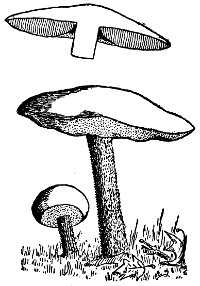
Boletus scaber.
One-half natural size.
B. sca´ber Fr.—scaber, rough. (Plate CXVIII, fig. 4, p. 436.)
Pileus convex, glabrous, viscid when moist, at length wrinkled or lined.
Tubes free, convex, white, then sordid, their mouths minute, rotund.
Stem solid, attenuated above, roughened with fibrous scales. Spores
oblong-fusiform, snuff-brown, 14–18×4–6µ.
462Pileus 1–5 in. broad. Stem 3–5 in. long, 3–8 lines thick.
Woods, swamps and open places.
Very common and appearing through
summer and autumn.
This may fairly be called our most
common and variable species. It is
recorded in nearly every local list of
fungi. The pileus is convex, hemispherical
or even subconical. It may be
glabrous, minutely tomentose, subvelvety
or squamulose. The flesh is white
or whitish and sometimes slightly changeable
where wounded. The tubes are generally
rather long and with a rounded or
convex surface. The stem is distinctly
scabrous or roughened with small blackish-brown
or reddish dots or scales, the
ground color generally being whitish,
grayish or pallid. The spores have
been described as pale-brown and light-yellowish.
When caught in a mass on white paper they appear
to me to approach snuff-brown. The viscidity of the pileus is not
always clearly discernible. Indeed the pileus is often quite as dry as in
B. versipellis. When moistened by heavy rains it sometimes is smooth
and clammy to the touch but scarcely viscid. Several varieties have
been indicated which are expressive of the variations in the color of the
pileus.
Var. testa´ceus. Pileus brick-red.
Var. auranti´acus. Pileus orange or orange-red.
These appear to connect this species and B. versipellis.
Var. aluta´ceus. Pileus yellowish-tan color.
Var. fuligin´eus. Pileus fuliginous or cinereous-fuliginous.
Var. fus´cus. Pileus brown or dark-brown.
Var. oliva´ceus. Pileus olivaceous.
Var. ni´veus. Pileus white, when old sometimes stained with blue or
livid-blue.
To these might be added:
463Var. areola´tus. Pileus rimose-areolate. (Plate CXVIII, fig. 4,
p. 436.)
Var. mutab´ilis. Flesh changing slightly to brown or pinkish where
wounded.
Var. graci´lipes. Stem very slender, 2–3 in. long, 2–3 lines thick.
Pileus thin, translucent when held toward the light.
This Boletus is classed among the edible species, but it is said to be
less agreeable than B. edulis. Peck, Boleti of the U.S.
West Virginia, North Carolina, New Jersey, Pennsylvania, McIlvaine.
The numerous varieties with their peculiarities here given by Professor
Peck will enable the finder of a Boletus with a distinctly scabrous stem—roughened
with scales, not reticulate—to select its name. For the
mycophagist it is enough to know that he has Boletus scaber. In all of
its varieties it is edible. The stems, often the tubes, unless young,
should be discarded, as they do not cook in the same time as the caps.
The comparative excellence of the species rests with the devourer. It
deserves a high place.
B. scaber, var. areolatus, Plate CXVIII, fig. 4, has slight flavor,
but is of pleasing consistency.
B. durius´culus Schulz—somewhat hard. Pileus 2–5 in. across,
hemispherical, minutely velvety, viscid when moist, varying in color
from pale-brown, through dingy-chestnut, to umber-brown, often becoming
cracked in areas when dry, interstices paler. Flesh thick, white
or tinged yellow, when cut becoming reddish copper-color. Tubes ½-¾
in. long, shortened round the stem and free, openings about ⅔ mm.
across, often compound, irregularly angular, bright-yellow. Stem 4–7
in. long, fusiform, thickest part 1½-2 in. across, situated below the
middle, yellowish, rough with blackish points, which are sometimes arranged
in a subreticulate manner, apex sometimes more or less grooved,
solid, flesh of upper part becoming coppery like the pileus. Spores
elongato-cylindrical, pale-umber, 14–16×5–6µ.
In woods. Esculent and very delicious. Allied to Boletus scaber,
but distinguished by the bright-yellow tubes and the very firm flesh,
which turns coppery-red when exposed to the air; this color eventually
changes to a dingy grayish-violet. Also allied to Boletus porphyrosporus.
Massee.
464Snow Hill, N.J. Gravelly soil, mixed woods, 1892. McIlvaine.
The stem and tubes should be removed. The caps are very fine.
B. albel´lus Pk.—whitish. Pileus convex or gibbous, soft, glabrous,
whitish. Flesh white, unchangeable. Tubes convex, free, or nearly
so, small, subrotund, whitish, unchangeable. Stem glabrous or minutely
branny, substriate, bulbous or thickened at the base, whitish. Spores
brownish-ochraceous, 14–16×5–6µ.
Pileus 1–2 in. broad. Stem 1–2 in. long, 3–6 lines thick.
Woods. New York, Peck.
This is closely related to B. scaber, of which it may possibly prove
to be a dwarf form; but it is easily distinguished by its smooth or only
slightly scurfy and subbulbous stem. It presents no appearance of the
colored dot-like squamules which are a constant and characteristic
feature of that species. Peck, Boleti of the U.S.
West Virginia. Woodland Cemetery, Philadelphia. McIlvaine.
Specimens found at Mt. Gretna, Pa., had a satiny, glossy stem,
beautifully furfuraceous, and stem not thickened at base. Professor
Peck, to whom specimens were sent, writes: “Stem is a little more
furfuraceous, and not thickened at the base, otherwise the agreement is
very good.” It is good fried.
B. chro´mapes Frost. Pileus convex or nearly plane, slightly and
sometimes fasciculately tomentose, pale-red. Flesh white, unchangeable.
Tubes subadnate, more or less depressed around the stem, white or
whitish, becoming brown. Stem equal or slightly tapering upward,
rough-spotted, whitish or pallid, chrome-yellow at the base both without
and within, sometimes reddish above. Spores oblong, 12–14×4–5µ.
Pileus 2–4 in. broad. Stem 2–4 in. long, 4–6 lines thick.
Woods. New England, Frost; New York, Peck.
The yellow base of the stem appears to be a peculiar and constant
character by which the species may easily be recognized. It imitates
Boletus piperatus in this respect, but in everything else it is very distinct
from that plant. Sometimes the stem is so badly infested by
larvæ that it is difficult to procure a sound specimen. The spores have
a subferruginous color with a slight incarnate tint, but the rough-dotted
stem indicates a relationship with B. scaber. Through this species, Boletus
conicus and B. gracilis, the Versipelles and the Hyporhodii appear
465to run together. In the Catalogue of Plants of Amherst the specific
name is “chromapus.” It would be more in accordance with
present custom to write it “chromopus.” Peck, Boleti of the U.S.
A dozen or more specimens referable to this species were found by
me at Mt. Gretna, Pa., August, 1897, in mixed woods. The caps were
eaten and were excellent.
B. nebulo´sus Pk. Pileus convex, dry, snuff-brown or smoky-brown.
Flesh white, unchangeable. Tubes convex, depressed around the stem,
pallid or brownish, becoming purplish-brown where wounded, the
mouths small, rotund. Stem enlarged toward the base, solid, scurfy,
colored like the pileus. Spores 12.5–15×6µ.
Pileus 2–4 in. broad. Stem 3–4 in. long, 4–6 lines thick.
Shaded banks by road-side. Raybrook. August.
No young or immature specimens were seen, and the description is
to that extent incomplete. Peck, 51st Rep. N.Y. State Bot.
By a painting made by the writer September, 1885, Professor Peck
identified the species of which it is a picture as B. nebulosus Pk. The
following notes accompany it, which have been verified many times
since their writing:
Oak woods. West Philadelphia, Pa., September. Mt. Gretna, Pa.,
September.
Pileus chestnut-brown and darker, covered with small, low, black
spots; convex, often depressed in center, sharp on margin. Flesh
white, thick, solid, unchangeable. Tubes very small, and light pinkish-brown.
When touched they change to a deeper hue. Stem same
color as pileus, but a shade lighter, solid, scurfy, having a striate appearance,
enlarging toward base.
Taste sweet and pleasant. Cooked it is juicy, meaty and very fine.
B. ful´vus Pk.—brownish-yellow. (Plate CXVI, fig. 3, p. 420.)
Pileus thick, convex or subcampanulate, dry, glabrous, rimose-areolate,
tawny-yellow, the extreme margin dark-brown. Flesh spongy, tough,
white, slowly assuming a reddish tint upon exposure to the air. Tubes
rather long, ventricose, depressed around the stem and free or nearly
so, greenish-yellow, the mouths small, tawny-yellow. Stem rather long,
often narrowed and striate at the top, dotted with brownish-orange granules
466or points, radicating, tough, stuffed with greenish-yellow fibers,
colored like the pileus. Spores unknown.
Pileus 2–3 in. broad. Stem 4–5 in. long, 4–8 lines thick.
Cespitose on decaying stumps. West Philadelphia, Pa. August.
McIlvaine.
Mr. McIlvaine says that there were between twenty and thirty specimens
on and about an old stump and that they were as attractive to the
eye as a cluster of Clitocybe illudens. Peck, Bull. Torrey Bot. Club, Vol.
27, January, 1900.
Excellent in flavor, rather spongy, but fine.
Hyporho´dii. Gr—somewhat rose-colored.
Tubes adnate to the stem, whitish, then white-incarnate from the
rosy spores.
In this tribe the tubes are at first whitish, but with the development
of the spores they usually assume a pinkish or flesh-colored hue.
Wounds of the tubes in some species cause a change in color but not to
blue, nor are the tube mouths differently colored as in the Luridi. The
stem in some is more or less reticulated but this is scarcely a constant
or reliable character in these species. Typically the spores are rosy or
flesh-colored, but I have admitted species in which they incline to rust-colored,
giving more weight to the color of the tubes than to that of
the spores.
|
Pileus black or blackish |
B. nigrellus |
|
Pileus some other color |
1 |
| 1. |
Stem more than four lines thick |
2 |
| 1. |
Stem slender, generally less than four lines thick |
B. gracilis |
|
2. Stem not reticulated |
3 |
|
2. Stem more or less reticulated |
4 |
| 3. |
Tubes angular, flesh-colored |
B. conicus |
| 3. |
Tubes round, white |
B. alutarius |
|
4. Taste mild |
B. indecisus |
|
4. Taste bitter |
B. felleus |
|
Peck, Boleti of the U.S. |
|
B. con´icus Rav.—conical. Pileus convex or subconical, clothed
with bundled appressed yellowish flocci. Flesh white, unchangeable,
467tasteless. Tubes ventricose, flesh-colored, becoming darker from the
spores, the mouths small, angular, slightly fringed. Stem glabrous,
tapering upward, pale-yellow. Spores fusiform, subferruginous.
Pileus 1–2 in. broad. Stem 2 in. long, 6 lines thick.
Damp pine woods. South Carolina, Ravenel.
The species is compared to Boletus scaber, from which it differs in its
smaller tubes and smooth stem, and from both this and B. albellus it
differs in the color of the tubes and in the yellowish flocci of the pileus.
I have seen no specimens, but on account of the color of the tubes I
have placed the species with the Hyporhodii. Peck, Boleti of the U.S.
B. gra´cilis Pk.—slender. (Plate CXIV, fig. 1, p. 414.) Pileus
convex, glabrous or minutely tomentose, rarely squamulose, ochraceous-brown,
tawny-brown or reddish-brown. Flesh white. Tubes plane or
convex, depressed around the stem, nearly free, whitish, becoming pale
flesh-colored, their mouths subrotund. Stem long, slender, equal or
slightly tapering upward, pruinose or minutely branny, even or marked
by slender elevated anastomosing lines which form long narrow reticulations.
Spores subferruginous, 12.5–17.5×5–6µ.
Var. lϫvipes. Stem even.
Pileus 1–2 in. broad. Stem 3–5 in. long, 2–4 lines thick.
Woods. New York, Peck; New England, Frost; Ohio, Morgan.
The slender habit separates this species from all the others here included
in this tribe. Its spores are not a clear incarnate in color, but
incline to dull-ferruginous, and by this character this and the preceding
species connect this tribe with Versipelles. In color B. gracilis resembles
some forms of B. felleus, but in size, habit and color of spores it
is easily distinct. The tomentum of the pileus sometimes breaks into
tufts or squamules. This is Boletus vinaceus, Frost MS. Peck, Boleti
of the U.S.
B. gracilis, var. lævipes, was found by the writer in Woodland Cemetery,
West Philadelphia, August, 1897, and at Mt. Gretna, Pa., September,
1898. The stem of some specimens spreads at the top. The
pileus is often cracked on the margin, and the upturning of the margin
often exposes the tubes. Painting, as of this species, identified by
Professor Peck.
The taste is at first sweet, then bitter. The bitterness is lost in cooking.
Edible, good.
468B. indeci´sus Pk.—undecided. (Plate CXXII, fig. 1, p. 468.) Pileus
convex or nearly plane, dry, slightly tomentose, ochraceous-brown,
often wavy or irregular on the margin. Flesh white, unchangeable;
taste mild. Tubes nearly plane or convex, adnate, grayish becoming
tinged with flesh color when mature, changing to brownish where
wounded, their mouths small, subrotund. Stem minutely furfuraceous,
straight, or flexuous, reticulated above, pallid without and within.
Spores oblong, brownish flesh color, 12.5–15×4µ.
Pileus 3–4 in. broad. Stem 2–4 in. long, 4–6 lines thick.
Thin oak woods. New York, Peck.
The mild taste and darker colored spores will separate this Boletus
from any form of B. felleus. Its stem reticulated above distinguishes it
from B. alutarius. It resembles B. modestus in some respects, but its
tubes are not at all yellow. Peck, Boleti of the U.S.
Kentucky, Lloyd, Rep. 4.
Woodland Cemetery, Philadelphia, July, 1897, McIlvaine; Trenton,
N.J., August, 1897, Sterling. In open mixed woods.
Boletus indecisus so closely resembles B. felleus in some of its forms
that until the color of the spores is ascertained, the sweet taste, without
trace of bitter, is the only thing that will enable the finder to discriminate
between them. Young B. felleus are at first pleasant to the taste
and do not, at once, develop their intense bitter in the mouth. They
may readily be taken for B. indecisus. If, by mistake, a single B. felleus
is cooked with mild species, the dish will be spoiled. Specimens believed
to be B. indecisus should be tested. A minute will perfectly satisfy
anyone.
The B. indecisus is delicious.
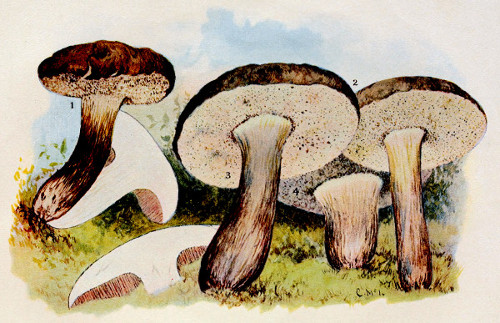
Grouped by F.D. Briscoe—Studies by C. McIlvaine. Plate CXXII.
| Fig. |
Page. |
Fig. |
Page. |
| 1. Boletus indecisus, |
468 |
2–3–4. Boletus felleus, |
460 |
B. aluta´rius Fr.—aluta, tanned leather. Pileus convex, then nearly
plane, soft, velvety, becoming glabrous, brownish tan color. Flesh almost
unchangeable, taste mild, watery. Tubes depressed around the
stem, plane, short, round, white, becoming brownish where wounded.
Stem solid, bulbous, nearly even, small, irregular prominences at the
top. Spores 14×4µ.
Pileus 3–4 in. broad. Stem 4–5 in. long.
Grassy woods. Minnesota, Johnson. Peck, Boleti of the U.S.
West Virginia mountains, 1882–1885. Margins of woods. Cheltenham,
469Pa. Margins of woods, 1888–1889, grassy woods and margins.
McIlvaine.
Common in West Virginia mountains where it grows with B. felleus,
from which it is impossible to distinguish it without tasting. It is delicious
when cooked. But I long ago ceased collecting for the table
any Boletus questionable for B. felleus. I have been deceived so many
times—taken the bitter for the sweet—that, preferring the sweet, I take
no chances for the bitter.
B. fel´leus Bull.—fel, gall. Bitter. (Plate CXXII, fig. 2, 3, 4,
p. 468.) Pileus convex or nearly plane, firm, becoming soft, glabrous,
even, variable in color, pale-yellowish, grayish-brown, yellowish-brown,
reddish-brown or chestnut. Flesh white, often changing to flesh color
where wounded, taste bitter. Tubes adnate, long, convex, depressed
around the stem, their mouths angular, white, becoming tinged with
flesh-color. Stem variable, equal or tapering upward, short or long,
sometimes bulbous or enlarged at the base, subglabrous, generally
reticulated above, colored like or a little paler than the pileus. Spores
oblong-fusiform, flesh-colored, 12.5–17.5×4–5µ.
Var. obe´sus. Pileus large. Stem thick, coarsely and distinctly
reticulated nearly or quite to the base.
Pileus 3–8 in. broad. Stem 2–4 in. long, 6–12 lines thick.
The variety is large and solitary in its mode of growth. It is remarkable
for the coarse reticulations of the stem which extend nearly or quite
to the base. After heavy rains the pileus is viscid. It may prove to
be a distinct species.
The flesh in the American plant does not always assume incarnate
hues where wounded. The color of the fresh tubes often changes to a
deeper tint where wounded. Peck, Boleti of the U.S.
West Virginia, Pennsylvania, New Jersey, North Carolina, McIlvaine;
Indiana, H.I. Miller.
A very common species in woods and on thin margins, on open
grassy places, and about decayed stumps. I saw hundreds of plants,
var. obesus, some a foot in diameter, in a wheat stubble near oak
woods.
One of the most attractive of Boleti. Its cap resembles a handsomely
browned cake. Its solidity is inviting; its flesh, generous in quantity,
excites appetite. Until one experiences its intense lasting bitter, one
470clings to it with hope. Even after tasting, it is thrown away with
regret. It is not poisonous, but a small piece of one will embitter a
whole dish. McIlvaine, Bull. Phila. Myc. Center. July, 1898.
B. nigrel´lus Pk.—blackish. Pileus broadly convex or nearly plane,
dry, subglabrous, blackish. Flesh soft, white, unchangeable. Tubes
plane or convex, adnate, sometimes slightly depressed around the stem,
their mouths small, subrotund, whitish becoming flesh-colored, slowly
changing to brown or blackish where wounded. Stem equal, short,
even, colored like or a little paler than the pileus. Spores dull flesh-colored,
10–12×5–6µ.
Pileus 3–6 in. broad. Stem 1.5–2.5 in. long, 6–12 lines thick.
Woods and copses. New York, Peck.
The blackish color of the pileus and stem distinguishes this species.
From Boletus alboater Schw., the adnate, flesh-colored tubes will separate
it. The surface of the pileus sometimes becomes cracked in areas.
Peck, Boleti of the U.S.
Mt. Gretna, Pa., August, 1898. McIlvaine.
Another distinguishing mark from B. alboater is the velvety pileus of
the latter. B. nigrellus is mild in taste and smell and an excellent
species for the table.
B. eccen´tricus Pk.—eccentric. (Plate CXVI, fig. 1, p. 420.)
Pileus thick, firm, convex, irregular, glabrous, more or less lobed or
wavy on the involute margin, gray or yellowish-gray. Flesh white,
close-grained, elastic, unchangeable, taste and odor farinaceous. Tubes
convex, depressed around the stem, not reaching the margin of the pileus,
somewhat uneven and pitted on the surface, yellowish-brown, the
mouths subangular, at first concolorous, becoming reddish or reddish-purple.
Stem eccentric, tapering downward, solid, uneven with short
irregular shallow grooves or obscure reticulations, tinged with red at the
top, grayish below, tinged with red or purple within at the base.
Pileus 5–10 cm. broad. Stem 4–5 cm. long, 3–4 cm. thick at the top.
Sandy soil in grassy places in woods. Mt. Gretna, Pa. August and
September.
The species is well marked by its eccentric stem, thick irregular pileus
and the reddish or reddish-purple mouths of the mature tubes. Mr.
471McIlvaine remarks that when it is cooked it is delicate and savory.
Peck, Bull. Torrey Bot. Club, No. 27.
In commenting upon this new species to the writer, Professor Peck
says: “I suspect that the spores of this (B. eccentricus) are pinkish
or rosy. If so, it belongs here (in Hyporhodii). If not, it may have
to go in the Luridi, or possibly may be made the type of a new tribe.”
Cario´si—caries, rottenness.
Stem never reticulated, stuffed with a spongy pith, at length commonly
excavated. Tubes at first white, then often yellowish, their
mouths minute, round.
Fries adds to these characters, “spores white.” But in our species
the spores are pale-yellow when shed in a mass on white paper. They
are more elliptical in outline than the spores of most Boleti. The
character of the stem is peculiar and easily distinguishes the tribe. The
exterior is firm, the interior soft and spongy, becoming irregularly
hollow or cavernous in the typical species.
|
Flesh unchangeable |
1 |
|
Flesh quickly changing to blue where wounded |
B. cyanescens |
| 1. |
Pileus minutely velvety-tomentose |
B. castaneus |
| 1. |
Pileus granulated |
B. Murray |
|
Peck, Boleti of the U.S. |
|
B. cyanes´cens Bull.—cyaneus, deep-blue. Pileus convex or nearly
plane, opaque, floccose-scaly or covered with an appressed tomentum,
pale-buff, grayish-yellow, yellowish or somewhat brown. Flesh rigid,
white, quickly changing to blue where wounded. Tubes free, white,
becoming yellowish, the mouths minute, round, changing color like the
flesh. Stem ventricose, hoary with fine hairs, stuffed, becoming cavernous,
contracted and even at the top, colored like the pileus. Spores
subelliptical, 10–12.5×6–7.5µ.
Pileus 2–5 in. broad. Stem 2–4 in. long, 8–18 lines thick.
Woods and open places. New York, Peck; New England, Frost,
Bennett; Minnesota, Johnson; Wisconsin, Bundy. Peck, Boleti of the
U.S.
High ground in woods. Solitary. West Virginia mountains, Springton
Hills, Pa., Kingsessing, Philadelphia, Mt. Gretna, Pa., McIlvaine.
472Boletus cyanescens is a sparse grower. The quality of the juice varies.
That of young specimens stains the fingers blue, that of old, brown.
The caps are firm and make an excellent dish cooked in any way.
B. casta´neus Bull.—chestnut. (Plate CXIV, fig. 3, p. 414.) Pileus
convex, nearly plane or depressed, firm, even, dry, minutely velvety-tomentose,
cinnamon or reddish-brown. Flesh white, unchangeable.
Tubes free, short, small, white becoming yellow. Stem equal or
tapering upward, even, stuffed or hollow, clothed and colored like the
pileus. Spores 10–12.5×6–7.5µ.
Pileus 1.5–3 in. broad. Stem 1–2.5 in. long, 3–5 lines thick.
Woods and open places. Rather common and wide spread. Peck,
Boleti of the U.S.
Boletus castaneus is one of the neatest looking of fungi. The prevailing
color is cinnamon, that of the tubes white or very light yellow,
spotted with brown wherever insects have touched them. The pore
surface of mature specimens is usually irregular. Whoever has seen
the stalagmites of Luray Cave will recognize their color on the stems of
B. castaneus. These are brittle, snapping like pipe stems, with a small
tube in center.
The fungus is common from June until September. It is gregarious,
occasionally three or four individuals form a group. Either raw or
cooked the caps are edible and will become favorites.
B. Mur´rayi B. and C. Pileus hemispherical, granulated, vivid red.
Flesh yellow. Tubes decurrent, about 1 line deep, yellow. Stem
clavate, even, pale-yellow. Spores pale-yellow.
Pileus 2–3 in. broad, nearly 1.5 thick.
New England, Murray.
On account of the color of the spores this species has been placed
with the Cariosi. The description does not mention the character of
the interior of the stem, and the decurrent tubes depart from the character
of the typical species so that its true position is uncertain. The
species seems well marked by the character of the pileus. Peck, Boleti
of the U.S.
B. isabelli´nus Pk. Pileus convex, firm, minutely tomentose,
whitish, becoming darker and smoother with age. Flesh isabelline.
473Tubes adnate, minute, sometimes larger near the stem, nearly round,
whitish. Stem nearly equal, subglabrous, hollow, whitish. Spores
subelliptical, 7.5–9×5–6µ. Pileus 2–3 in. broad. Stem 1–2 in. long,
4–6 lines thick.
Woods. Ocean Springs, Miss. June. Underwood.
The species belongs to the Cariosi. Peck, in Bull. Torrey Bot. Club,
Vol 24, No. 3.
APPENDIX (Boletus).
The descriptions of the following species are scarcely sufficient to
permit of the satisfactory reference of the species to their places in the
tribes. It is to be hoped that these plants may again be found and
their proper relations be ascertained.
B. Ana´nas Curt. Pileus pulvinate, thickly and rigidly floccose-verrucose,
yellow, flocci white above, flesh-colored beneath, the margin
thin, membranous, lacerated; hymenium plane, depressed around the
stem, yellow or tawny-yellow, becoming greenish where wounded, their
mouths medium size, obtusely angular. Stem even, solid, somewhat
enlarged at the base, white. Spores ferruginous.
Pileus 3–4 in. broad. Stem 3–4 in. long, 6–9 lines thick.
Under prostrate trunks of pine trees.
South Carolina, Ravenel; North Carolina, Curtis.
This is said to approach S. strobilaceus in habitat, but to be otherwise
very different. It is placed among the Subtomentosi in Sylloge,
but from these it recedes by its floccose wart-like scales. Peck, Boleti
of the U.S.
B. radico´sus Bundy. Pileus thin, wide, recurved, yellow tinged
with brown, the cuticle easily removed. Flesh pale-yellowish tinged
with pink, not changing color when bruised. Tubes decurrent, large,
uneven-mouthed, compound, angular, tinged with brown. Stem flexuous,
yellow above, whitish below, rough with dark appressed scales,
fibrous-rooted.
Pileus 4 in. broad. Stem 3–4 in. long, 5 lines thick.
Wisconsin, Bundy.
The pileus is not described as viscid, but in other respects the species
474appears to belong to the Viscipelles and to be related to Boletus
collinitus. Peck, Boleti of the U.S.
B. Po´cono Schw. Pileus pulvinate, cervine (dun color), minutely
covered with bundles of tomentum on the closely-inflexed margin.
Tubes rather large, somewhat prominently angular, concolorous. Stem
subattenuated, thickened toward the base, pallid-striate at the apex,
elsewhere spadiceous, subfurfuraceous.
Pileus 1 in. broad. Stem 2–3 in. long.
Beech woods. Pennsylvania, Schweinitz.
Gr—a pine cone; a fungus.
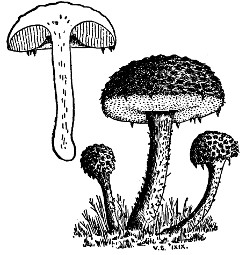
Strobilomyces strobilaceus.
Two-thirds natural size.
Hymenophore even. Tubes not
easily separable from it, large,
equal. Pileus and stem distinctly
rough-scaled, the flesh tough. Syl.
Fung., Vol. VI, p. 49.
I have given Professor Saccardo’s
emended diagnosis of this genus,
because it expresses what appears
to me to be the most important
generic character, that is, tubes not
easily separable from the hymenophore.
By this character and by
the tough substance the transition
between Boletus and Polyporus is
made.
| Tubes nearly equal in length |
S. strobilaceus |
| Tubes shortened around the stem |
S. floccopus |
| Peck, Boleti of the U.S. |
|
S. strobila´ceus Berk. Gr—cone-like. (Plate CXXIV.) Pileus
hemispherical or convex, dry, covered with thick floccose projecting
blackish or blackish-brown scales, the margin somewhat appendiculate
with scales and fragments of the veil. Flesh whitish, changing to
reddish and then to blackish where wounded. Tubes adnate, whitish,
becoming brown or blackish with age; their mouths large, angular,
changing color like the flesh. Stem equal or tapering upward, sulcate
at the top, floccose-tomentose, colored like the pileus. Spores subglobose,
rough, blackish-brown, 10–12.5µ.
Pileus 2–4 in. broad. Stem 3–5 in. long, 4–10 lines thick. Peck,
Boleti of the U.S.
West Virginia mountains, Pennsylvania, McIlvaine; Indiana, H.I.
Miller.
Common in woods and their margins, under the overhanging sods of
washes and road-cuts. Often in troops, occasionally cespitose. The
476rough fuzzy cap reminds of short fur that has been wet and dried. Its
appearance is unique among Boleti. Before cooking the stem and tubes
should be removed, unless the latter are very firm and fresh. The
squamules must be cut away or the dish will be rough.
With many this Boletus is a prime favorite. It has a strong woody
taste, sometimes musky, sometimes faintly of anisette. It cooks well
by any method.
S. floc´copus Vahl.—floccose-stemmed. Pileus convex, soft, covered
with areas of bunched rough, scaly tomentum, cinereous, at
length blackish, appendiculate with the silky, thick annular veil. Tubes
shortened behind, their mouths large, whitish-gray. Stem stout, pitted
above, umber-tomentose below. Spores perfectly globose, brown, 9µ
broad.
Pileus 4–5 in. broad. Stem 4–5 in. long, 1 in. thick.
Woods. North Carolina and Pennsylvania, Schweinitz; Ohio, Morgan;
New York, Peck.
According to Fries this is a larger and firmer species than S. strobilaceus
but manifestly related to it. The New York specimens which
I have referred to it differ from S. strobilaceus in no respect, except in
the tubes being depressed around the stem. Unless there are other
differences in the European plant, it scarcely seems to me to be worthy
of specific distinction. Boletus floccopus, Rost. tab. 40, is referred to
Boletus scaber, as is B. holopus, Rost. tab. 48. Peck, Boleti of the
U.S.
I agree with Professor Peck that this species is not worthy of specific
distinction. During 1898 I found a bunch containing eight individuals
which varied through all botanic characteristics given to both species.
The largest individual was 4½ in. across cap, the smallest 1½ in. On
some the tubes were adnate, on others shortened behind. There was
no difference in flavor excepting that due to age.
477
| Fig. |
Page. |
Fig. |
Page. |
| 1. Fistulina hepatica, |
477 |
2. Polyporus sulphureus, |
485 |
Hymenium formed on the under surface of a fleshy hymenophore, at
first warted, the warts developing into cylindrical tubes that remain distinct
and free from each other, producing in their interior cellular processes
each bearing four spores. Conidia are produced in cavities of the
old hymenophore.
With the outward appearance of a Polyporus, but separated by the
tubes being free from each other.
A small genus of which F. hepatica is the principal species. This is
known and valued in Europe and wherever found in this country. Unfortunately
it is rare or unknown in many localities. A new species has
recently been found in the United States—Fistulina firma, by Mrs. A.
M. Hadley, Manchester, N.H.—a white-flesh species whose edibility
is not reported. Torrey Bull., 1899. F. pallida B. and Rav.; F.
radicata, Schw.; F. spathulata B. and C., are reported from Alabama.
Edible qualities not stated. The writer has not seen them or he surely
would have tested them. The spread and cultivation of F. hepatica is
possible. Experiments in this line are desirable.
F. hepat´ica (Huds.) Fr. Gr—resembling the liver. (Plate CXXV,
fig. 1, p. 476.) Juicy-fleshy, not rooting. Pileus entire, blood-red.
Flesh thick, soft, viscid above, transversed with tenacious fibers, hence
variegated-red. Tubes at first pallid.
Changeable in form, sessile or extended into a lateral stem. Fries.
Spores salmon-color, nearly round with an oblique apiculus, 3µ W.G.S.;
broadly elliptical, 5–6×3–4µ; conidia, 6–10×5µ Massee; yellowish,
elliptical, 5–6.5µ long Peck.
West Virginia, New Jersey, Pennsylvania. August to frost. McIlvaine.
Small specimens may be confounded with F. pallida, which follows.
Fistulina hepatica is celebrated in most countries, and known usually
as the Beefsteak fungus. It grows from decaying crevices in oak, chestnut
and other trees and stumps, but those named are its favorites. July,
August, September are its months, and after rains. In some localities
and years it is rare. At Mt. Gretna, in 1898, a hundred pounds of it
could be gathered almost any day.
478August, 1899, at Mt. Gretna, Pa., I found several specimens in vicinity
which, though evidently F. hepatica, were remarkable for their
structure—2–4 in. across, irregularly cylindrical, with spore surface
covering the entire fungus. Stem curt, eccentric, almost central.
Specimens were sent Professor Peck, who writes:
“The sample of Fistulina which you send is a singular thing. Saccardo
has noted a somewhat similar form but without pore surface.
Yours has pore surface, but I do not find spores developed in it. I am
inclined to think it a monstrosity, as you do, but as you say you have
found several of them I think it would be well to put it on record and I
will enter it in my record as Fistulina hepatica monstrosa n. var. and
indicate its characters.” Letter from Professor Peck, August 28, 1899.
I have partially succeeded in transplanting the mycelium of F.
hepatica. Experiments in this direction, I feel confident, will introduce
this valuable fungus to localities where it is not now found, or is rare.
Experiments with the spores have not been as yet successful.
F. hepatica monstrosa n. var. Pk. Subglobose, supported on a short
stem or stem-like base, the external surface entirely covered with tubules
2–4 mm. long.
Pennsylvania. C. McIlvaine. In color and texture resembling the
common form, but Mr. McIlvaine informs me that there is nothing in
the position or place of growth of the specimens to account for their
peculiar character. They are 2–4 in. in diameter. Peck, Bull. Torrey
Bot. Club, 27, January, 1900.
Excellent.
F. pal´lida B. and Rav.—pallidus, pale. Pileus kidney-shaped,
pallid-red, pulverulent, 1–2 in. broad, about 1 in. long, margin inflexed.
Tubes more or less decurrent. Stem lateral, striate, when dry, 1½ in.
long, ⅓ in. thick.
Mountains of South Carolina on the ground. Ravenel. Alabama,
base of stumps of white oak. Peters. Grev., Vol. 1, No. 5. New Jersey,
Ellis.
| No. |
1. Polyporus fumosus.
2. Polystictus versicolor.
3. Merulius corium.
4. Polyporus perennis and section. |
|
About natural size. |
|
5. Dædalea quercina.
6. Fomes igniarius.
7. Trametes gibbosa. |
|
Reduced in size. |
Gr—many; a passage, pore.
Pileus fleshy, moist, tough, becoming harder in age, internally composed
of radiating fibers; the spore-bearing surface is within passages
or pores which are made by the descending substance of the pileus forming
the dissepiments or separating walls, hence they are not easily
separable from the pileus or from one another. The pores not appearing
at first, then becoming rounded, angular or torn. They form a distinct
strata. Stem central, eccentric, lateral or absent.
With few exceptions growing from wood. Section Merisma contains
species which are conspicuous among fungi for their size and beauty.
The majority of this genus are unedible, because of their being woody,
tough or bitter. Few of the edible species are of the first class.
Excellent dishes are made by stewing the species well, serving them
in patties or in croquettes. The cooking of P. intybaceus is a guide to
all.
I.—
Mesopus. (
Gr—middle; a foot.) Page
479.
Stem single, distinct, central or eccentric; not black at the base.
II.—
Pleuropus. (
Gr—the side; a foot.) Page
480.
Stem single, lateral or eccentric; base black.
III.—
Merisma. (
Gr—to divide.) Page
482.
Divided into numerous pileoli, borne on a simple or much-branched
stem, or a short, thick tubercle.
IV.—
Apus. (
Gr—without; a foot.) Page
488.
Stem wanting; pileus attached by the side or spread on the matrix.
V.—
Resupinati. (Lying on the back.) Page
489.
The pores being placed directly upon the wood or on the mycelium,
the pileus proper is absent.
I.—Me´sopus.
P. ovi´nus Schaeff.—relating to sheep. Pileus 2–4 in. broad, fleshy,
thick, fragile, irregular in shape, becoming scaly, whitish. Stem short,
480thick, 1 in. or more in length, white. Pores minute, equal, round,
white then citron-color.
On the ground. Autumn.
North Carolina, Curtis; Massachusetts, Frost; Ohio, Morgan; New
York, ground in pine woods. Bethlehem. September, Peck, 22d Rep.
Cordier says it possesses an agreeable odor of almonds and that Fries
and his companions ate it raw in their mycological excursions.
Edible. Peck, Curtis.
P. leuco´melas (Pers.) Fr.—leucos, white; melas, black. Pileus
2–4 in. broad, fleshy, somewhat fragile, irregularly-shaped, silky, sooty-black.
Flesh soft, reddish when broken. Stem 1–3 in. in length,
stout, unequal, somewhat tomentose, sooty-black, becoming black
internally. Pileus and stem becoming black in places. Pores rather
large, unequal, ashy or whitish, becoming black in drying.
Spores pale brown, 10–12×4–5µ. Massee.
North Carolina, edible, Curtis; Ohio, a curious esculent. Morgan.
P. circina´tus Fr.—round. Pileus 3–4 in. broad, compact, thick
round, plane, zoneless, velvety, reddish-brown. Flesh the same color.
It forms duplicate strata of pilei, the inferior contiguous with the stem
and corky; the superior compact, soft, floccose. Stem 1 in. thick
and high, bearing a reddish-brown tomentum. Pores decurrent, entire,
dusky-gray.
In fir woods.
A noble species, memorable for the stratified duplicate pilei.
Var. prolif´erus. Like the typical form but having one or more pilei
developed from the upper surface of the first one. Fulton Chain.
August. Peck, 46th Rep. N.Y. State Bot.
New York. On ground in borders of woods. September. Peck,
32d, 46th Rep.
On ground in oak woods, West Philadelphia. McIlvaine.
When young the soft pilei are good.
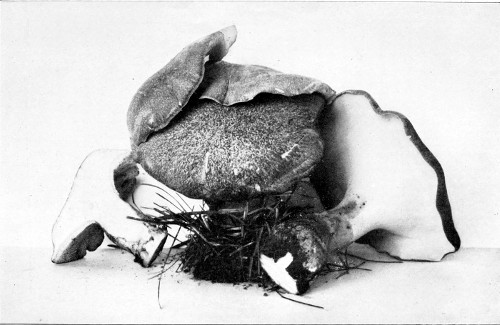
Photographed by Dr. J.R. Weist. Plate CXXX.
POLYPORUS SQUAMOSUS.
II.—Pleuropus.
P. squamo´sus Fr.—squama, a scale. (Plate CXXX, p. 480.) Pileus
3 in.-1½ ft. broad, somewhat ochraceous, variegated with a broad,
481adpressed, spot-like, centrifugal, darker scales, fleshy-pliant, fan-shaped,
flattened. Stem excentric and lateral, obese, reticulated at the apex,
blackish at the base. Pores thin, variable (at first minute), then large,
angular and torn, pallid. Fries.
Handsome, commonly very large, somewhat central and umbilicate
when young, at length lateral, very variable in shape.
On trunks and stumps, chiefly ash. Common. May to November.
Stevenson.
Spores oval, white, 14×6µ W.G.S.; elliptical, colorless, 12×5µ
Massee.
Massachusetts, Sprague; Iowa, Macbride; New York. Trunk of elm.
May. Peck, 27th Rep.; West Virginia, New Jersey, Pennsylvania.
On fallen trunks and on stumps. May to November. McIlvaine.
This species does not seem to be common in America, but is found
throughout Europe. It varies in size from 3 in. to over 3 feet. It
has been known to attain the circumference of 7 ft. 5 in., and the weight
of 40 lbs. Dr. Badham says that it can not be masticated and that its
expressed juice is very disagreeable. The fact, however, remains that
it is eaten, and is recorded as edible by most authors. It is undoubtedly
tough, but cut fine and stewed slowly for half an hour it is quite as
tender as the muscle of an oyster and has a pleasant flavor.
P. pi´cipes Fr.—pix, pitch; pes, a foot. Pallid then chestnut, commonly
pale yellowish-livid, with the disk chestnut. Pileus fleshy-coriaceous,
then rigid, tough, even, smooth, depressed at the disk or
behind. Flesh white. Stem excentric and lateral, equal, firm, at first
velvety, then naked, dotted, black up to the pores. Pores decurrent,
round, very small, rather slender, white, then slightly pale yellowish.
Fries.
Imbricated, odor somewhat sweet. The pileus is depressed behind,
commonly emarginate, funnel-shaped with lobes all round.
On trunks, especially willow. Frequent. July to December. Stevenson.
Many young plants, in tufts upon a decaying oak log, were found by
me at Mt. Gretna, August, 1899. They were oyster-color, the very
thin caps translucent, 2–6 in. across, 1⁄16 in. thick; pores not visible to
the naked eye. The black dots upon the stems developed some time
after gathering.
482They were pleasantly crisp when stewed and of fine flavor. Older
specimens were bitter and tough.
III.—Merisma.
P. umbella´tus Fr.—umbella, a sun-shade. Very much branched,
fibrous-fleshy, toughish. Pileoli very numerous, ½-1½ in. broad,
sooty, dull-red or pallid light-yellow, entire, umbilicate. Stems elongated,
separate, united at the base, white. Pores minute, white.
The pileoli have occurred white. Fries.
Edible. Fries.
New York, Peck, Rep. 51; Richmond, Ind., Dr. J.R. Weist; Gouverneur,
N.Y., Mrs. E.C. Anthony; West Virginia, New Jersey, Pennsylvania.
On decaying roots in ground and on stumps. May to
November. McIlvaine.
Tufts dense, branches spreading from a center. The pilei up to 2 in.
across, connected at base. The dense spreading tufts, up to a foot
across and half as high, are very noticeable. The flesh is soft and of
good flavor. Cook like P. intybaceus.
P. a´nax Berk. Fleshy, fibrous, rather tough, dusky-gray, branching
out from a thick, single stem at the base and forming a large head
of branches and pileoli 10–20 lines in diameter; the branches terminate
in numerous large pileoli of various forms and size, imbricating, confluent
and recurved. Flesh and pores white. Stems thick, growing
together, white. Pores large, unequal, angular, white. Spores white,
subelliptic, 7–8µ long.
Ohio, at the base of oak trees and stumps. Autumn. Morgan.
This species has apparently been confused by some American mycologists
with P. intybaceus. I have received specimens of it bearing
that name. The spores of that species are described as elliptic or ovoid.
The spores of Polyporus anax, as shown by our specimens, are globose.
Peck, 51st Rep. N.Y. State Bot.
Ohio, Morgan; New York, Peck, 51st Rep.; New Jersey, Sterling;
Angora, West Philadelphia, growing on rotting stump. September,
1897, McIlvaine.
Edible when young and fresh.
483
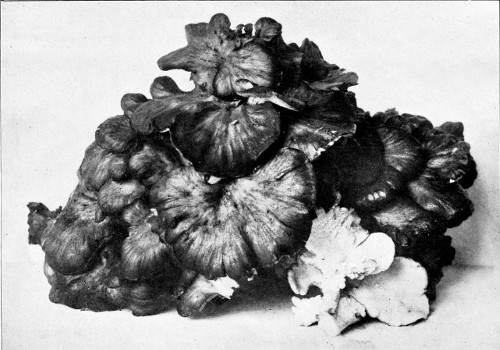
Photographed by Dr. J.R. Weist. Plate CXXVIII.
POLYPORUS FRONDOSUS.
P. frondo´sus Fr.—frons, a leafy branch. (Plate CXXVIII, p. 482.)
Tuft ½-1 ft. broad, very much branched, fibrous-fleshy, toughish.
Pileoli very numerous, ½-2 in., sooty-gray, dimidiate, wrinkled, lobed,
intricately recurved. Flesh white. Stems growing into each other,
white. Pores rather tender, very small, acute, white.
Pores commonly round, but in an oblique position, gaping open and
torn. Fries.
North Carolina, Curtis; Iowa, Macbride; New York, Peck, 24th
Rep.; West Virginia, 1881–1885, Chester county, Angora, Philadelphia,
Pa. On stumps, roots, etc. Rare. September to frost, McIlvaine.
Edible. Curtis. Sold in the Roman market.
Tufts up to 12 in. across; the branches very numerous, up to 2 in.
wide. The plant is tender when young and grows tough as it matures.
When young it is of good flavor and edible—older it makes a well-flavored
gravy, or is edible if chopped fine and very well cooked.
P. intyba´ceus Fr.—succory-like. Very much branched, fleshy,
somewhat fragile. Pileoli very numerous,
pale-yellowish inclining to
fuscous, dimidiate, stretched out, sinuate,
at length spathulate. Stems
connate in a very short trunk. Pores
firm, obtuse, white, inclining to dingy-brown.
Fries.
About same size as P. frondosus
and larger. Stevenson.
Spores colorless, elliptical, 7×3.5µ
Massee; 6×3µ W.G.S.
Indiana, H.I. Miller. Base of
living trees. Woodland Cemetery, West Philadelphia, Pa., Mt. Gretna,
Pa., West Virginia, New Jersey. Large tufts growing from oak roots
in ground and at base of oak trees. McIlvaine.
Edible. Stevenson. Paulet says: In place of its being heavy upon
the stomach, he will feel all the lighter who sups upon it.
The people of the Vosges call it the Hen-of-the-Woods.
The words of the old song—
“So very much depends upon
The way in which it’s done,”
484apply with exceptional force to the cooking of P. intybaceus. If it is
cut in thin slices across the grain and slowly stewed for half an hour it
will be tender and of good flavor. It can then be served in that way,
or made into patties or croquettes.
P. crista´tus Fr.—crista, a crest. Branched, firmly fleshy, fragile.
Pileoli about 3 in. broad, reddish-green, entire and dimidiate, imbricated,
depressed, somewhat pulverulent-villous, then cracked into scales.
Stems connate, irregularly shaped, white. Pores minute, angular and
torn, whitish. Fries.
Very changeable in form, sometimes simple with an undulato-lobed,
central pileus.
Edible. Curtis.
Mt. Gretna, Pa., Woodland Cemetery, Philadelphia, West Virginia.
On ground over roots, open woods and grassy places. September,
October. McIlvaine.
Variable in form, but usually in rose-shaped clusters, which are
slightly greenish at times; oftener shades of yellow. The substance is
the same in texture as P. intybaceus. Cook in same manner.
P. con´fluens Fr.—stems confluent; adherent. Pilei branched, fleshy,
fragile, thick, dimidiate, imbricated, confluent, smooth, fleshy-yellow
becoming obscure, slightly scaly. Stem short. Pores short, minute,
pallid-white.
Eaten about Nice; savor a little sharp. Cordier; North Carolina,
superior eating. Curtis. Pine woods. New Scotland. September.
Our specimens are not at all squamulose, and this character is not
attributed to the species by all authors. It is probable that it is not
uniform in this respect. Peck, 39th Rep. N.Y. State Bot.
P. Berk´eleyi Fr. Very much branched. Pileoli very large, subzonate,
finally tomentose, yellowish, fleshy, tough becoming corky and
hard. Stem short or none, arising from a long and thick common base
growing out of the ground usually near trees or stumps. Pores rather
large, irregular, angular, pale yellowish.
A magnificent specimen found near Boston a dozen years ago and
exhibited in the window of Doyle, the florist, was fully four feet high
and from two to three feet broad, containing very many pileoli.
485North Carolina, edible, Curtis; Iowa, Bessey; Ohio, Morgan; Mt.
Gretna, Pa., very large specimens, 20 in. across. McIlvaine.
Edible when young.
P. gigante´us Fr.—gigas, a giant. Tuft 1–2 ft. and more broad, in
many imbricated layers, fleshy-pliant then somewhat coriaceous. Pilei
date-brown, dimidiate, very broad, flaccid, somewhat zoned, rivulose,
depressed behind. Stems connato-branched from a common tuber.
Pores minute, somewhat round, pallid, at length torn.
The rigid cuticle separates into granules or fibrillose squamules.
Pores becoming dark when touched. Fries.
Edible, Curtis. Esculent when young. On the continent its esculent
qualities are known and appreciated. Cooke.
West Virginia, Chester county, Pa., Eagle’s Mere, Pa. On decaying
stumps and roots. McIlvaine.
It is well marked by its spore-surface becoming black to the touch.
When young and fresh it stews to a pleasant, edible consistency, but is
tough if not well cooked or too old. The flavor of a gravy from it is
at all times good.
P. sulphu´reus Fr.—sulphur, brimstone. (Plate CXXV, fig. 2,
p. 476.) In many cespitose layers, 1–2 ft. and more, juicy-cheesy.
Pilei 8 in. or more broad, reddish-yellow, imbricated, undulated, rather
smooth. Flesh light yellowish, then white, splitting open and not
hardened when old. Pores minute, plane, sulphur-yellow. Fries.
Soon becoming pale. Commonly sessile, but varying with a stem,
lateral on standing trees, but expanded on all sides on fallen ones; also
club-shaped, porous throughout. Sow. In its fullest vigor it is filled
with sulphur-yellow milk.
On living trees and stumps. Frequent. August to October. Stevenson.
Spores oval, white, minutely papillose, 8×5µ W.G.S.; elliptical,
hyaline, slightly papillose, 7–8×4–5µ Massee.
Edible. Stevenson, Curtis.
Maryland, Miss Banning; Indiana, H.I. Miller; West Virginia,
New Jersey, Pennsylvania. On willow, apple, cherry, maple, hickory,
etc. Frequent. August to November. McIlvaine.
Frequently in large masses. Commonly broadly attached, but sometimes
486with a short stem. Very occasionally a single pileus will protrude
from a tree like a giant yellow tongue shaded with reddish-orange.
Usually the pilei are in clusters united in a solid base, white-fleshed and
rich in color. I have seen clusters two feet across. On an old willow
at Mt. Gretna, a cluster 18 in. across afforded a dozen meals. Whenever
a meal was wanted a pound or two was broken off. It lasted until
January. If P. sulphureus is cooked properly it is a delicious fungus.
Cut fine, stew slowly and well, season, add butter, milk with a little
thickening.
P. macula´tus Pk.—having maculæ-spots. Pileus of a cheesy consistence,
broad, flattened, sometimes confluent, sessile or narrowed into
a short stem, slightly uneven, white or yellowish-white, marked with
darker zones and watery spots. Pores minute, subangular, short,
whitish, sometimes tinged with brown. Flesh white.
Pileus 4–6 in. broad, 6–8 lines thick.
Prostrate trunks of trees in woods. Worcester. July.
In texture and shape this species is related to P. sulphureus, but the
pores are smaller than in that species. The plants are sometimes cespitose,
sometimes single. The spots in the dried specimens have a
smooth depressed appearance. Peck, 26th Rep.
Angora, West Philadelphia. September, 1896. Mt. Gretna, Pa.,
September, 1897–1898. On white oak trunks. McIlvaine.
Several specimens of different ages proved good eating. Like P.
sulphureus it must be well cooked.
P. hetero´clitus Fr. Gr—one of two; Gr, to lean. In many cespitose
layers, coriaceous. Pilei 2½ in. broad, orange, sessile, expanded
on all sides from a radical tubercle, lobed, villous, zoneless.
Pores irregularly shaped and elongated, golden-yellow. Fries.
On the ground under oak. Rare.
The flat pilei extend horizontally from the tubercle. Irregular, eccentric.
Stevenson.
Minnesota, Johnson.
Haddonfield, N.J., Hopkin’s woods. June to July, 1890–1896.
McIlvaine.
Of all fungoid growth this is the most showy. Its clusters, often a
foot and a half in diameter and spread like mammoth dahlias, are gorgeous
487in color and conspicuous in design. Resting upon the ground or
reared against the base of tree or stump, they deceive by their likeness
to gaudy bouquets, left by foreign picnickers. In quality it is the same
as P. sulphureus. It does not, however, retain its edibility. As it ages
it becomes offensive.
P. por´ipes Fr.—porous-stemmed. Pileus 1.5–3 in. broad, rather
fleshy, sinuately repand, smooth, grayish-brown. Stem central or excentric,
firm, smooth, 1.5–3 in. long, 4–6 lines thick, punctuated by
the whitish decurrent pores.
On earth in hilly regions.
Cap 2 in. across, light drab, smooth, slightly furfuraceous toward
center, broken into minute appressed squamules, zoned. Flesh fibrous,
white-pliable. Tubes very shallow, round mouths with obtuse divisions,
china-white, running down to base of stem. Stem eccentric, almost
lateral, entirely surrounded by pores, connate at base, ½ in. thick.
Smell pleasant.
New York. Ground. August, Peck, Rep. 24; Mt. Gretna, Pa.,
August to November, McIlvaine. A large tufted species growing on
the ground in woods, August to November, McIlvaine.
When raw tastes like the best chestnuts or filberts, but rather too dry
cooked. Curtis.
It must be chopped fine and slowly cooked.
P. immi´tis Pk.—wide, rude. Pilei cespitose-imbricated, broad,
slightly convex or flattened, more or less rough or uneven, radiately-wrinkled,
tuberculose or fibrous-bristled, zoneless, white, becoming
tinged with yellow or alutaceous in drying. Flesh white, slightly fibrous,
soft and moist when fresh, cheesy when dry, with a subacid odor. Pores
minute, angular or even subflexuous, about equal in length to the thickness
of the pileus, the dissepiments thin, white, often at length dentate
or lacerate on the edge. Spores minute, white, elliptical, 3–4×18–20µ.
Pilei 2–4 in. broad, the flesh commonly 3–4 lines thick.
Decaying ash trunks. East Berne. August.
The species is apparently related to P. cæsareus, but the character of
the pores is quite different in the two species. Peck, 35th Rep. N.Y.
State Bot.
Mt. Gretna, Pa. On dead black oak. August to November, 1898.
488Several clusters grew on dead black oaks. The pilei overlap and
the wrinkled corrugated margins curve downward, giving them the
semblance of shells. From a distance a group looks like Pleurotus
ostreatus. The substance is juicy; while cooking it is at first bitter, but
this disappears. It becomes tender and well flavored.
P. alliga´tus Fr.—alligo, to bind to. In many cespitose layers,
fibrous-fleshy, rigid-fragile. Pilei tan-isabelline, imbricated, unequal,
zoneless, villous. Pores minute, soft, white, readily becoming stopped
up with flocci.
Often clavate when young. Commonly wrapping round stipules and
grasses. Fries.
Spores elliptical, pale, 6×7µ Massee.
Woodland Cemetery, Philadelphia. Among oak trees on grassy
ground. July, August, September. McIlvaine.
Tufts frequently weigh two pounds. When young the plant cooks
well, is tender and of sweet, pleasant flavor. When old it has a sour
unpleasant odor.
IV.—Apus.
P. chio´neus Fr. Gr—snow. White pileus 1 in. and more broad,
fleshy, soft, becoming even, smooth, zoneless, often extended behind,
margin inflexed. Pores curt, very small, round, equal, quite entire.
Fries.
Always soft, fragile, hyaline-white when moist, shining white when
dry. Odor acid. Without a cuticle. Stevenson.
Spores white, oval, 21×3µ W.G.S.
New York. Decaying wood of frondose trees. Peck, 33d Rep.
Angora, Philadelphia, Mt. Gretna, Pa. On standing and fallen
timber. June to September. McIlvaine.
This snow-white Polyporus is too conspicuous to be passed unseen.
One does not expect to find snow-balls stuck against trees in August.
At a distance it resembles one. When young and fresh it is good.
P. betuli´nus Fr.—betula, birch. Pileus fleshy, then corky, hoof-shaped,
obtuse, zoneless, smooth, the oblique vertex in the form of an
umbo, pellicle thin, separating. Pores late of being developed, curt,
minute, unequal, at length separating. Fries.
489On living and dead birch. Common. May to December.
Pileus 3–6 in. broad. The pileus is at first pale, then acquiring a
brownish tinge. The edge is always very obtuse. Stevenson.
The lower surface or hymenium is frequently rough with numerous
acicular projections, making the plant look like a Hydnum when viewed
horizontally. Peck, 24th Rep. N.Y. State Bot.
Massachusetts, Kansas, New York. Peck, Rep. 24.
Wherever the birch grows this neat, white-fleshed Polyporus abounds.
When young it is eaten by deer. Dried it burns with a white flame,
or holds fire as well as the best punk. It is a valuable fuel, already
prepared for the stove. In the birch forests near Eagle’s Mere, Pa.,
tons of it can be seen protruding from tree and log.
When very young it is fair. Unpleasant when old.
V.—Resupinati.
P. sinuo´sus Fr.—full of folds. Broadly effused, adnate, dry, the
evanescent mycelium somewhat rooting, white then yellowish. Pores
large, surface flexuous, acute, lacerated. Odor of licorice.
New York. Decaying wood of maple. Peck, 40th Rep.
Mt. Gretna, Pa. McIlvaine.
Of but little food value. Collected carefully and boiled, it yields a
pleasantly flavored liquor.
(Plate
CXXVI, fig. 3, p. 478.)
Hymenophore resting on a loose mold-like mycelium, covered with
the soft, waxy, continuous hymenium, having its surface variously
plicate or wrinkled, the folds forming irregular pores, sometimes obsoletely
toothed.
Generally on wood.
I have tasted, raw, every species I have found. They are all more
or less woody in flavor, and I believe them to be edible. At the best
Merulius would be an emergency genus. M. tremellosus is substantial,
as is M. rubellus Pk.
M. tremello´sus Schrad.—tremellosus, trembling. Resupinate; margin
becoming free and more or less reflexed, usually radiately-toothed,
gelatinoso-cartilaginous; hymenium variously wrinkled and porous; whitish
and subtranslucent looking, becoming tinged brown in the center.
Spores cylindrical, curved, about 4×1µ.
On wood. From 1–3 in. across, remaining pale when growing in
dark places. Margin sometimes tinged rose, radiating when well developed.
Massee.
Spores cylindrical, curved, hyaline, 4×1µ K.
New York. Old logs, stumps, Catskill mountains. Peck, 22d Rep.
N.Y. State Bot.
Mt. Gretna, Pa. Common, both rose-colored and translucent brown
species, numerous on decaying wood. October to November, 1898–1899.
McIlvaine.
M. tremellosus is a common species and rather attractive looking.
In substance it approaches Tremella and Peziza. The spore-bearing surface
is superior (turned upward) and then sometimes turned in at the
margin which frequently is bright rose color, sometimes yellowish-rose.
It is rather tasteless—slightly woody in flavor, rather tough. An emergency
species.
M. rubel´lus Pk.—rubellus, dim. of ruber, reddish. Generally cespitose,
imbricated, sessile, dimidiate, soft, tenacious, tomentose, evenly
red, pale when dry; margin mostly undulately inflexed; hymenium
491white or flesh-color; folds branching, forming anastomosing pores.
Spores elliptical, hyaline, minute, 4–5×2.5–3µ.
Pileus 2–3 in. long, 1.5 in. broad.
Somewhat related to M. tremellosus.
On trunks of beech in woods.
Ohio, Morgan; Indiana, Dr. J.R. Weist; Mt. Gretna, Pa., November.
McIlvaine. Specimens identified by Professor Peck.
Tough, but edible.
492
Hymenium inferior or amphigenous (not confined to one surface),
from the first definitely protuberant, spread over persistent spines,
bristles, teeth, tubercles or papilla. Fries.
While the highest members of this family possess the general form of
the mushroom, others, lacking a stem, recline on the back (resupinate);
the lowest, without even the appearance of a distinct pileus,
seem to be simply spread over the supporting body (effused). In the
highest class the spines or other spore-bearing surface are inferior, i. e.,
below the pileus; in the others they are of course superior, i. e., above
the pileus.
Of the eleven genera but two contain species of food value. Hydnum,
characterized by its acute spines, embraces species which are
eaten as delicacies, and Irpex, distinguished by its somewhat acute
teeth growing from a ridgy hymenium, contains those which may furnish
sustenance in time of need. In Caldesia, bearing spines, the texture is
floccose not fleshy. Sistotrema has a pileus and a central stem, but instead
of spines bears irregular flattened teeth. The remaining genera
are separated by the tubercles, granules, folds, etc., which take the
place of spines or teeth.
Several species of Hydnum are common to earth and wood, others
are distinct in their habitats.
Sporophore fleshy, with a central stem or entirely resupinate, texture
compact, spines acute, distinct at the base.
Resupinate; texture floccose, spines acute; spores muriculate. (No
edible species reported.)
Pileate; fleshy, central-stemmed, teeth flattened, irregular, inferior.
(No edible species reported.)
Resupinate; teeth rather acute, springing from folds or ridges that
often anastomose irregularly.
Resupinate; tubercles coarse, deformed, subcylindrical, obtuse. (No
edible species reported.)
Resupinate; hymenium covered with folds or wrinkles, having the
edge entire or corrugated. (No edible species reported.)
Resupinate; hymenium with crowded, globose, persistent, hemispherical,
minute granules, having their apices more or less excavated.
(No edible species reported.)
Resupinate; hymenium with scattered wart-like granules, which become
more or less elongated and excavated at the apices. (No edible
species reported.)
Resupinate; hymenium densely covered with small granules that are
divided at the apices in a penicillate manner. (No edible species reported.)
Resupinate; hymenium covered with very minute, barren, acute
spinules. (No edible species reported.)
Spines slender, elongated, acute, not springing from a sporophore or
subiculum. (No edible species reported.)
Gr—name for some edible fungus.
Hymenium inferior, bearing awl-shaped Spines,
distinct at the base. Fries.
In this genus the spines proceed from an even
surface, not folded or wrinkled, and are covered
with the spore-bearing surface.
The forms are extremely variable, the type of
the first section, H. repandum, being easily mistaken
for one of the Agaricaceæ until examined,
the stem being nearly central and upright, while in other forms it is
lateral or absent. Some are dimidiate (as if part of the pileus had
been removed and the plant attached by the remaining portion); the
lower forms are resupinate.
Mesopus (
Gr—middle, a foot). Page
495.
Entire, simple, stem central.
On the ground, mostly in pine woods.
Pleuropus (Gr—the side; a foot).
Stem lateral.
None known to be edible.
Merisma (
Gr—to divide). Page
501.
Very much branched or of an irregular form without a distinct margin.
Apus (
Gr—without; a foot). Page
503.
Stemless, dimidiate, margin distinct.
Resupinati (resupino, to throw on the back).
Without stem or distinct pileus.
None known to be edible.
495Mes´opus. Gr—middle; a foot.
(Entire, simple, stem central. On the ground, mostly in pine woods.)
H. imbrica´tum L.—imbrex, a tile. Pileus about 2–5 in. broad,
umber, zoneless, fleshy, rather plane, somewhat umbilicate, floccose,
tessulato-scaly. Flesh dingy whitish. Stem curt, 1–3 in. long, 1–2 in.
thick, even. Spines 4–6 lines long, decurrent, ashy-white.
There are two forms; one with the pileus plane and with thick persistent
scales, another with the pileus somewhat infundibuliform, and
with thinner, at length separating scales. Stevenson.
Spores pale yellow brown, rough, 6–7×5µ Massee; 6×5µ W.G.S.
Fleshy. The numerous scales over lapping toward the center. The
surface of the cap often cracks in a tesselated manner. Flesh dingy,
buffish or reddish. Spines short, blunt, grayish-white and mostly of
equal length.
In pine and mixed woods. Autumn.
Of delicate taste. Cordier. Edible. Curtis.
Fine specimens grew at Mt. Gretna, Pa., from September to November.
Until closely examined the cap may be mistaken for that of H.
zonatum. The zones of the latter and the pervading rust-color will
distinguish it. Both are edible, though H. zonatum is much tougher.
H. imbricatum is slightly bitter, raw. It must be sliced thin and well
cooked.
H. læviga´tum Swartz—lævis, smooth. Pileus 4–6 in. broad, umber,
fleshy, compact, firm, regular, plane, even, very smooth, margin
circinate (not repand). Flesh whitish, compact, but by no means
fibrous, soft when fresh, pliant when dry. Stem short, thick, even,
pallid-brown. Spines thin, pallid-brown.
Its size is that of H. imbricatum, but it occurs twice as large, with
the pileus minutely rimuloso-rivulose, by no means scaly. The stem
varies curt and unequal or longer and equal. Quite distinct from H.
fragile. Stevenson.
Spores 10–15µ long, Massee; globose, warted, pale lemon-yellow,
7µ Q.
In pine woods. August to October.
Edible, Curtis; edible, Leuba. “Eaten in Alpine districts.” Barla.
496
(Plate CXXXI.)
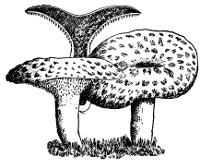
Hydnum scabrosum.
Natural size.
H. scabro´sum Fr.—scabrosus, rough. Pileus about 1½-4 in. broad,
brownish-yellow, compactly fleshy,
at first top-shaped, then plane above,
very convex beneath, at first tomentose,
then rough with flocci which
are fasciculate in the form of minute
crowded squamules, slightly repand
at the margin. Flesh very thick,
white, descending into the stem.
Stem very curt, 1 in. long, and
equally thick, round or compressed,
dotted with the rudiments of spines
decurrent upon it, ash-color, attenuated
downward, roundish and blackish
at the base. Spines 4 lines long,
equal, awl-shaped, dingy-rust color, whitish at the apex, at first sight
grayish-brown. Fries.
Spores 4–5µ diameter. Massee.
Hydnum scabrosum is frequently found in Pennsylvania, among pines
and in mixed woods where pines grow. It occurs at Mt. Gretna, Pa.,
and on Springton Hills under hemlocks.
The caps are soft, fleshy, and equal to H. repandum in quality.
H. squamo´sum Schaeff.—squama, a scale. Pileus 1½-3 in. across,
reddish-brown, fleshy, irregular, depressed, smooth, breaking up into
irregular scales. Flesh whitish. Stem curt, attenuated downward,
white. Spines grayish-brown, whitish at the apex. Stevenson.
Spores subglobose, 5–6µ diameter. Massee.
Pileus smooth and even when young. Flesh whitish. Spores grayish-brown.
Spines whitish, giving the lower surface a much lighter appearance
than the upper.
Under hemlock and spruce in West Virginia, 1884. McIlvaine.
Caps are good when sliced thin and well cooked.
H. subsquamo´sum Batsch. Pileus fleshy, somewhat convex, subumbilicate,
brownish-rust color, superficial scales soon dropping off;
spotted with brown. Stem stout, unequal, smooth. Spines whitish,
becoming brown, apex remaining whitish.
497North Carolina, Curtis; Alabama, Peters; Massachusetts, Sprague.
Edible. Curtis. Edible. Cordier.
H. repan´dum L.—repandus, bent backward (of the cap, upward).
Pileus 2–6 in. broad, pallid, etc.,
fleshy, fragile, somewhat repand,
rather smooth. Stem 2–5 in. long,
½-1½ in. thick, irregularly shaped,
pallid. Spines 4 lines long, unequal,
of the same color. Stevenson.
Spores pointed, 5–8µ Massee.
Pileus sometimes depressed, often
turned upward at margin, often
waved, sometimes tomentose. Color
variable—light-buff, brown, pinkish,
reddish. Flesh whitish, compact,
fragile. Spines conical, up to ¼ in.
in length, whitish but rich creamy shades, mostly pointed, but sometimes
appearing to be hollow. Stem central or eccentric, sometimes
covered with white down, thick, uneven, usually crooked, solid, fleshy,
light in color.
July to November.
Edible. Curtis.
Common to most countries, and, although given as a ground-growing
species, it is rather indiscriminate in its habitats. Woods, fields, leaf-covered
or bare places, much decayed wood and stumps are its living
places. Dr. Cooke thinks it irreproachable. Popularly it goes by the
name of the Hedgehog mushroom.
H. repandum varies greatly in shape, color and texture. In the open
it is usually symmetrical and tough; when clustered it is irregular, often
fanciful and quite brittle—tender.
When sliced thin an hour’s slow cooking is sufficient. All writers
commend it, and properly.
H. rufes´cens Pers.—rufus, red. Pileus 2–3 in. across, thin, fragile,
usually regular, pubescent, reddish. Spines 1–3 lines long, regular.
Stem 1–3 in. long, commonly thin, nearly equal, reddish.
498The whole plant is reddish. In all other respects it resembles H.
repandum. Usually more regular.
Commonly found in woods. New York, Peck; North Carolina,
Curtis, Schweinitz.
Edible, Curtis. Edible, Leuba.
Fries considered H. rufescens a variety of H. repandum, and the
writer agrees with him. It is given distinct place here because Massee
and Stevenson—books in the hands of many students of fungi—give it
importance.
It is quite as good as H. repandum.
H. ferrugi´neum Fr. Pileus 1–4 in. across, corky, soft, convex,
then plane or depressed, irregularly pitted, ferruginous, at first with
whitish tomentum. Flesh ferruginous. Spines thin, acute, about 2
lines long, rusty-brown. Stem firm, 2–3 in. long, unequal, rusty-brown.
Spores subglobose, 4µ diameter.
In fir woods. Often gregarious; soft when young, corky and dry at
maturity. Massee.
Mt. Gretna, Pa. November to December, 1898. Among pine
leaves.
Taste mild, mealy. Tough, but when young it cooks tender.
H. zona´tum Batsch. Ferruginous. Pileus 1–2 in. broad, equally
coriaceous, thin, expanded, somewhat infundibuliform, zoned, becoming
smooth, radiately-wrinkled, the paler margin sterile beneath. Stem
½-¾ in. long, 2–3 lines thick, slender, somewhat equal, floccose, base
tuberous. Spines 1–1½ lines long, slender, pallid, then rust-color.
Stevenson.
Spores rough, globose, pale watery brown, 4µ diameter Massee.
New York, Peck, 24th Rep. Mt. Gretna, Pa. Abundant among
hemlocks; West Virginia. McIlvaine.
Coriaceous. Edible. It will not cook tender, but yields a pleasant
flavor to a gravy made of its juices.
H. albo´nigrum Pk. Pileus convex or nearly plane, broadly obconical,
tough but soft and densely tomentose on the upper surface,
buff-brown or smoky brown, often wholly covered with a whitish downy
tomentum, sometimes on the margin only, substance within soft tomentose
499and buff-brown in the upper stratum, the lower half hard and black.
Spines short, at first white, then whitish or grayish. Stem short, often
irregular, compressed or growing together, blackish when moist, buff-brown
when dry, covered with a thick dense tomentum, which is frequently
more abundant toward the base, hard and black within. Spores
white, globose, 4–5µ.
Pileus 1–3 in. broad, sometimes 2 or 3 confluent. Stem 1–2 in. long.
Ground in mixed woods. Gansevoort. August. Peck, 50th Rep.
N.Y. State Bot.
Specimens from pine woods New Jersey, T.J. Collins, September,
1897. 1½ in. across. Frequent at Mt. Gretna, Pa.
Edible. Good flavor, but tough.
H. velle´reum Pk. This species appears to be very much like the
preceding one (H. albonigrum Pk.) from which it is separated by its
smaller size and the paler brownish or rusty-brown substance of its
pileus and stem. Peck, 50th Rep. N.Y. State Bot.
At Mt. Gretna, Pa., the species grows with H. albonigrum. In
quality it is the same.
H. al´bidum Pk. Pileus fleshy, thin, broadly convex or nearly
plane, subpruinose, white. Flesh
white. Spines short, white. Stem
short, solid, central or eccentric, white.
Spores subglobose, 4–5µ broad.
The whitish Hydnum is uniformly
colored in all parts. It grows in
groups or in clusters. In the latter
case the caps are sometimes irregular
because of the crowded mode of
growth and the stems are occasionally
eccentric. It is a small species not
liable to be mistaken for any other
except possibly for very small pale
forms of the spreading Hydnum. But wholly white examples of this
species have never been seen by me.
The caps are 1–2 in. broad and the stems are generally about 1 in.
long and 3–5 lines thick.
500The plants grow in thin woods or in open bushy places and appear in
June and July. It is not a common species, and though well flavored
it is not of very great importance as an edible mushroom, because of its
scarcity and small size. Peck, 51st Rep. N.Y. State Bot.
Port Jefferson. July. This fungus has been tested and found to be
edible. Peck, 50th Rep. N.Y. State Bot.
Mt. Gretna, Pa., 1897. Specimens identified by Professor Peck.
McIlvaine.
The caps are edible and superior to H. repandum.
H. fen´nicum Karst. Cap fleshy, fragile, unequal, at first scaly, at
length breaking up, reddish-brick color becoming darker, margin
undulately lobed, 2–4 in. broad. Flesh white. Stem sufficiently
stout, unequal below, attenuated, flexuous or curved, smooth, of the
same color as the cap, base acute, light white tomentum outside, inside
light pale-blue or dark-gray (wood-ash), 1–3 in. long, .4–1 in. thick.
Teeth decurrent, equal, pointed, from white dusky, about 4 mm. long.
Spores ellipso-spheroidical or sub-spheroidical, rough, dusky, 4–6µ long,
3–5µ broad.
Found in gravelly or sandy soil in woods.
Found at Angora near Philadelphia. Top cracked. Identified by
Professor Peck.
Occurs frequently at Mt. Gretna, Pa., ground in mixed woods.
August to September. The taste and smell are at first inviting, but
the extreme bitter which develops destroys all desire to eat it.
H. spongio´sipes Pk. Pileus convex, soft, spongy-tomentose, but
tough in texture, rusty-brown, the lower stratum more firm and fibrous.
but concolorous. Spines slender, 1–2 lines long, rusty-brown, becoming
darker with age. Stem hard and corky within, externally spongy-tomentose,
colored like the pileus, the central substance often transversely
zoned especially near the top. Spores subglobose, nodulose,
purplish-brown, 4–6µ broad.
Pileus 1.5–4 in. broad. Stem 1.5–3 in. long, 4–8 lines thick.
Woods. Rensselaer and Saratoga counties. August.
This plant was formerly referred to Hydnum ferrugineum Fr. Peck,
50th Rep. N.Y. State Bot.
Found in pine woods, near Haddonfield, N.J., by T.J. Collins,
501September, 1897. Cap and stem dark brown. Spines darker.
Stem swelling toward base, which then tapers in a long rooting way.
Cap umbilicate. Specimens identified by Professor Peck.
Edible but tough and uninviting. Yields a good fungoid flavor to
the water in which it is boiled.
H. gelatino´sum Scop. Transferred to Tremelledon as T. gelatinosum,
under which heading it is described and its edible qualities noted.
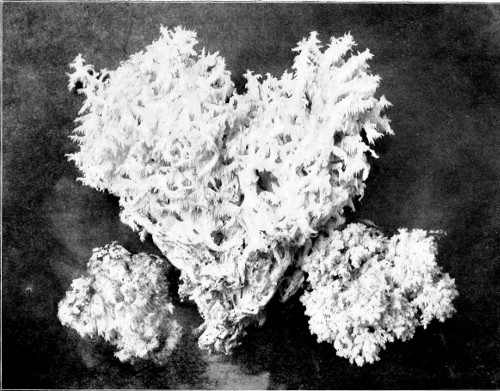
Photographed by Dr. J.R. Weist. Plate CXXXIV.
HYDNUM CORALLOIDES.
Meris´ma. Gr—a division.
(Very much branched or of an irregular form without a distinct margin.)
H. coralloi´des Scop. (Plate CXXXIV.) 6–18 in. across. Tufts
on wood. Pure shining white growing yellow with age, composed
wholly of attenuated interlacing branches ½ in. at base, tapering to a
point. Spines growing from one side of the branches, 3–4 lines in
length, awl-shaped.
Spores globose, 4–6µ diameter Massee.
Peck, Rep. 22; Indiana, H.I. Miller; Massachusetts, Sprague; California;
West Virginia, New Jersey, Pennsylvania, McIlvaine.
Edible. Curtis.
Grows upon standing and fallen timber which is attacked by decay.
Fir, oak, beech, ash, birch, hickory and other trees are inhabited by it.
August to frost.
This beautiful species can not be mistaken for any other. Its name
is the best guide to its identification. Dame Nature has made many
exquisite decorations for herself and this is one of them.
It is generally eaten, but is rare. Professor Peck speaks affectionately
of it as a gratuitous adjunct to his bill of fare when on botanical tramps
in the Adirondacks.
H. caput-ur´si Fr.—bear-head. 6–8 in. high, 6–8 in. across. Tufts
usually pendulous, compact, white, becoming yellow and brownish.
Spines up to 1 in. long, round, pointed. Branches in every direction,
short.
Closely resembling H. coralloides and in small forms with shorter
spines easily mistaken for it. Position of growth has much to do with
502its shape and appearance. On fallen timber the branchlets and spines
may be erect.
New York, Peck, 44th Rep.; North Carolina, Curtis; West Virginia,
New Jersey, Pennsylvania, McIlvaine.
Edible. Curtis. Edible. Peck.
Hydnum caput-ursi is common in West Virginia forests. It is conspicuous
on standing oaks, and at a distance a puzzling object to one
not familiar with such excrescences. It grows on standing oaks near
Haddonfield, N.J., and sparsely at Mt. Gretna, Pa.
It is more compact, and is tougher than H. coralloides and H. Medusæ,
but cooks tender and is very good.
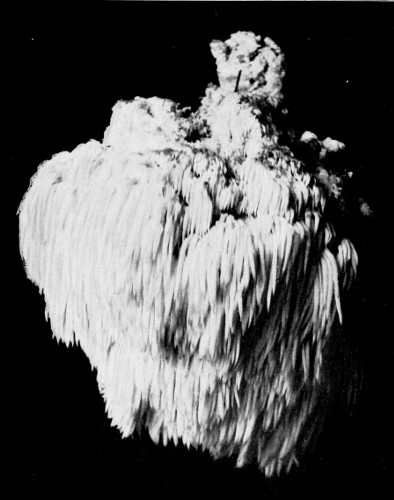
Photographed by Dr. J.R. Weist. Plate CXXXV.
HYDNUM CAPUT-MEDUSÆ.
H. caput-Medu´sæ Bull.—head of Medusæ. (Plate CXXXV.)
3–18 in. across, 2–8 in. high. Tufts pendulous. White then grayish.
Body compact, tapering to a solid base, more or less stem-like. Spines
covering entire surface. Those upon top are long, thin, straight or
distorted, growing shorter around and to the under side where they
are short and straight. The wavy appearance of the slender spines remind
of the snaky locks of Medusa, hence the name.
Edible. Curtis. Edible. Leuba.
On elms at Haddonfield, N.J.; on oaks at Mt. Gretna, Pa., and in
Woodland Cemetery, and on elms in Washington Square, Philadelphia,
Pa. McIlvaine.
Commonly eaten in Italy and parts of Austria; rare elsewhere in
Europe. Occurring over the United States. Specimens eighteen
inches across were seen by the writer in the West Virginia mountains.
Mr. H.I. Miller, Terre Haute, Ind., sent me a fine specimen weighing
10½ pounds.
The American species, as far as seen by the writer, changes to a light
yellow when ageing. The entire fungus is edible and excellent, but the
tender spines and more delicate parts make a dish equaled by few fungi.
H. erina´ceum Bull.—erinaceus, a hedgehog. 2–8 in. and more
across. Tufts pendulous. White and yellowish-white becoming yellow-brownish,
fleshy, elastic, tough, sometimes emarginate (broadly
attached as if tuft was cut in two, sliced off where attached), a mass of
latticed branches and fibrils. Spines 1½-4 in. long, crowded, straight,
equal, pendulous. Stem sometimes rudimentary.
503On trunks of oak, beech, etc. July to October.
Spores subglobose, 5–6µ diameter Massee; white, plain, 5×6µ W.G.S.
Alabama, Miss K. Skehan; Pennsylvania, McIlvaine; Massachusetts,
Sprague; New York, Peck, Rep. 22.
Eaten in Germany and France. Cooke.
A dead beech trunk at Eagle’s Mere, Pa., in August, 1898, bore at
least fifty pounds of it. It draped one side of the tree from root to top
with yellowish, pendulous tufts, with spines up to 3 in. long, which
waved in the wind. The spines and tender parts were stewed, and enjoyed
by many. It shrinks very much in drying, becoming sour.
A´pus. Gr—without; a foot.
(Stemless, dimidiate, margin distinct.)
H. septentriona´le Fr.—Northern. Fleshy-fibrous, becoming pale,
imbricated. Pilei not numerous, growing one above the other, plane,
behind thick, consolidated, margin straight, whole. Spines very
crowded, slender, equal.
The largest known Hydnum.
Received from E.B. Sterling, Trenton, N.J., September, 1897.
The specimens formed part of a dense fasciculate mass weighing over
20 pounds, growing on a beech stump. Edges of the young plant are
edible, but have little taste.
Hymenium inferior, toothed from the first. Teeth firm, somewhat
coriaceous, acute, concrete with the pileus, arranged in rows or like
network, connected at the base by folds, which are gill-like (in sessile
species) or resemble honeycomb (in resupinate ones). Sporophores
4-spored. Growing on wood, somewhat growing from the side or upon
the back, approaching Lenzites and Dædaleæ.
Irpex differs from Hydnum in having the spines connected at the
base, and in their being less awl-shaped and pointed.
It is reported as found well up in the northern States, but its species
prefer warm climates. Irpex contains no choice species, but all I have
tested can be eaten.
I. obli´quus Fr.—oblique. White, inclining to pale, effused (spread),
forming an adnate crust, circumference flaxy. Teeth extended from a
base resembling honeycomb, compressed, unequal, incised, oblique, 2–3
lines long.
At first abundantly porous, but toothed from the first, at length quite
as in Hydna.
On stumps and dead branches. November to February. Stevenson.
This spreads in irregular patches on the surface of decaying wood.
The pores for a small space round the margin are round and distinct,
but toward the center are greatly lengthened out, lying one upon another
in an imbricated manner. The color is white at first, when old it
changes to a yellow-brown, and at last to a dirty fuscous black. Bolton.
At first it looks more like a small white orbicular resupinate Polyporus
than an Irpex. Peck.
The species is common and can be collected at most times of the
year. When fresh and moist it can be shaved from its host plant.
Goodly quantities can thus be obtained. It stews to a firm gelatinous
mass of pleasant flavor. The lost hunter need not die of starvation in
any woods if he will but study the tree-growing fungi, and especially
the small species, hitherto insignificant in food circles.
I. car´neus Fr.—resembling the color of flesh. Reddish, effused, 1–3
505in. long, cartilaginous-gelatinous, membranaceous, adnate. Teeth
obtuse and awl-shaped, entire, united at the base.
It inclines to Radula and Phlebia. Stevenson.
On tulip poplar, Haddonfield, N.J., September, 1892; on hickory,
Angora, Philadelphia, September, 1897. McIlvaine.
The entire fungus is good, cooking like a Hydnum.
I. defor´mis Fr.—deformed. White, effused, crustaceous, thin, circumference
pubescent, somewhat flaxy. Teeth extended in awl-shape
from a minutely porous base, thin, somewhat digitato-incised (cut in
finger-shape), 1–2 lines long. Fries.
It approaches the Polypori. Grows on wood. Stevenson.
North Carolina, Schweinitz, Curtis; Massachusetts, Frost.
Common on stumps and trees. The awl-shaped teeth, which have
the appearance of shreds, can be scraped from the fresh plant, or if
dried plants are moistened, the teeth are detachable, and are food-giving.
I. fusco-vioia´ceus Fr.—fuscus, brown; violaceous, violet. Pileus
2 in. long, more than 1 in. broad, white inclining to hoary, effuso-reflexed,
coriaceous, silky, zoned. Teeth in rows in the form of plates,
brownish-violet, incised at the apex. Fries.
On pine trunks. Stevenson.
Decaying trunks of spruce, abies nigra. Adirondack mountains.
July.
Our specimens are not “silky,” as required by the description, but
villose or tomentose-villose as in Polyporus hirsutus and P. abietinus,
the latter of which this species closely resembles. The hymenium,
however, is coarser, more highly colored and lamellated to such an
extent that young specimens might easily be taken for a Lenzites.
Peck, 30th Rep. N.Y. State Bot.
Found in West Virginia, New Jersey, Pennsylvania, and elsewhere.
McIlvaine.
Very common on logs of coniferous trees. It is difficult to collect it
entirely free from resin, which as a seasoning is not recommended.
506
Sporophore erect and stipitate, with a central stem, effused, with the
upper portion free and bent backward, or entirely resupinate. Hymenium
perfectly even or radiately wrinkled, glabrous or minutely bristled
with projecting cystidia; basidia normally 4-spored. Spores without
a division, colorless or colored. Massee.
In Thelephoraceæ are shapes closely resembling those found in Hydnaceæ,
Polyporaceæ and Agaricaceæ. The genus Craterellus is closely
allied to Cantharellus, and, though the spore surface is much less
wrinkled or veined, resembles it in several of its species. Other types
show likeness to Merulius in Polyporaceæ; others to Tremellineæ and
Clavariaceæ. Many puzzles are presented by its species, but the solving
is interesting.
Though populous it contains but few edibles. The best of them is
Craterellus cornucopoides.
Spores smooth.
Resupinate, dry and pulverulent. (No edible species reported.)
Resupinate, soft and subgelatinous. (No edible species reported.)
Spores warted or echinulate.
Dry and fibrous, hymenium rugulose. (No edible species reported.)
Subgelatinous, effused or variously incrusting, hymenium even. (No
edible species reported.)
Parasitic on living leaves or stems.
Saprophytes growing on dead wood, branches, etc. Hymenium
minutely setulose with projecting cystidia.
Cystidia colorless, rough at the tip with particles of lime. (No
edible species reported.)
Cystidia brown, smooth. (No edible species reported.)
Entirely resupinate, hymenium usually cracked when dry. (No
edible species reported.)
Effuso-reflexed, pileus silky or strigose, hymenium even. (No
edible species reported.)
Horizontal and attached by a narrow point behind, hymenium radiato-rugulose.
(No edible species reported.)
Large, erect, funnel-shaped.
Minute, cup-shaped, mouth open. (No edible species reported.)
Minute, cylindrical, gregarious or crowded, tubular, mouth contracted.
(No edible species reported.)
Hymenium waxy-membranaceous, distinct but adnate to the hymenophore,
inferior, continuous, smooth, even or wrinkled. Spores white.
Fries.
This, the only genus of Thelephoraceæ containing edible fungi, has
the form and general appearance of Cantharellus to which it is allied,
but it is distinguished by its nearly even hymenium, which in Cantharellus
has the form of gills, fold-like and thick but still distinctly gills.
The species vary from fleshy to membranaceous, all having a funnel-shaped
pileus and stem merging into it. On the ground. Autumn.
The slightly veined surface where the spores are borne, and the spores
themselves, when a microscope is brought to bear upon them, distinguish
this genus from Cantharellus; and its thin flesh and funnel-shape
from the large forms of Pistillaria. Several of the species are edible.
It is probable that all are.
Toadstools, despite their name, are more popularly associated with
fairies than with toads. “Fairy rings,” “Fairy Bread” and “Fairy
Clubs” are titles belonging to them, and these link us to the pretty belief
of childhood—a belief we often do not outgrow. A group of C.
lutescens or C. cornucopoides may well be likened to fairy trumpets,
or to a tiny orchestrion thrusting its horns through wood earth where
roots of stumps abound.
C. cantharel´lus Schw. (Plate XLVI, fig. 3.) Capn.
across, convex, often becoming depressed and funnel-shaped, glabrous,
yellowish or pinkish-yellow. Flesh white, tough, elastic. Hymenium
slightly wrinkled, yellow or faint salmon color. Stem 1–3 in. high,
3–5 lines thick, glabrous, solid, yellow. Spores on white paper yellowish
or pale salmon.
Spores 7.5–10×5–6µ Peck.
West Virginia, McIlvaine.
No one not looking for minute botanic details would separate this
species from Cantharellus cibarius, especially if found growing near or
with it. The pinkish tinge sometimes present in C. cantharellus I have
never observed in C. cibarius. The present species is of equal excellence.
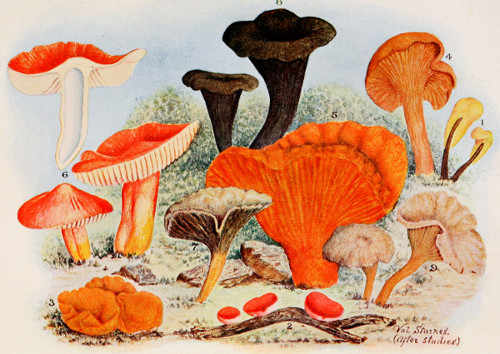
Grouped by Val Starnes—Studies by C. McIlvaine. Plate CXXXVI.
| Fig. |
Page. |
Fig. |
Page. |
| 1. Spathularia clavata, |
549 |
6. Hygrophorus coccineus, |
156 |
| 2. Peziza coccinea, |
559 |
7. Craterellus sinuosus, var. crispus, |
510 |
| 3. Peziza aurantia, |
557 |
8. Craterellus cornucopoides, |
509 |
| 4. Cantharellus aurantiacus, |
216 |
9. Cantharellus lutescens, |
218 |
| 5. Hypomyces lactifluorum, |
562 |
|
|
509C. cornucopoi´des Pers.—cornu and copiæ, horn of plenty. (Plate
CXXXVI, fig. 8, p. 508.) Cap dark sooty shades of gray or brown—shades
of well-worn velveteen—1–2 in. across, whole plant from 2–4
in. high, trumpet-shaped, or like a funnel with its open mouth, plane,
wavy, split or in folds. Substance very thin and either brittle or tough.
The inside is sometimes minutely scaly, the opening extending to the
base; outside, where the spores are borne, it has neither gills, pores nor
protuberances, but a slightly uneven surface varying little in color.
Stem obsolete or seldom noticeable. Odor slight.
Spores pointed, 11–12×7–8µ Massee.
Grows single, clustered or in troops along shaded roads, or from leaf
mold and ground in woods. July to frost.
Large patches, clustered, grow near stumps in moist places on Botanic
Creek, West Philadelphia. It is plentiful near Haddonfield, N.
J., at Mt. Gretna, Pa., and many other places in the United States.
It is not pleasant to look upon, because of its peculiar color, but
when one gets used to it it has an attractiveness of its own. Its graceful
shape, even its funereal hue and name—Trompet du Morte—are alluring.
It dries well, and when moistened expands to its normal size. It is
a first-class edible fungus. It should be stewed slowly until tender.
C. clava´tus Fr.—clava, a club. Pileus 2 in. broad, somewhat light-yellowish,
fleshy, top-shape, truncate or depressed, flexuous, unpolished,
attenuated into the solid stem. Flesh thick, white. Hymenium even,
then corrugated, purplish then changing color. Fries.
Spores elliptical, pale-yellow, 10–12×4–5µ Massee.
Professor Peck notes that the species so closely resembles Cantharellus
cibarius that it might easily be mistaken for a deformed condition of it.
The resemblance to the yellow forms of Clavaria pistillaria is marked.
Massachusetts, Sprague, Farlow; New York, Peck, Rep. 32; West
Virginia, Pennsylvania, McIlvaine.
An excellent species. Its scarcity is regrettable.
C. du´bius Pk. Pileus infundibuliform, subfibrillose, lurid-brown,
pervious to the base, the margin generally wavy and lobed. Hymenium
dark cinereous, rugose when moist, the minute crowded irregular folds
abundantly anastomosing, nearly even when dry. Stem short. Spores
broadly elliptical or subglobose, 6–7.5µ long.
510Plant simple or cespitose, 2–3 in. high. Pileus 1–2 in. broad.
Ground under spruce trees. Adirondack mountains. August.
In color this species bears some resemblance to Cantharellus cinereus.
From Craterellus sinuosus it is separated by its pervious stem, and from
C. cornucopoides by its more cespitose habit, paler color and smaller
spores. Peck, 31st Rep. N.Y. State Bot.
West Virginia, Pennsylvania, McIlvaine.
Its edible qualities are in every way equal to those of C. cornucopoides.
C. sinuo´sus Fr.—sinus, a curve. Strong scented. Pileus funnel-shaped,
downy, grayish-brown, margin undulated. Stem pale yellow,
elongated, stuffed. Hymenium with anastomosing ribs, grayish.
Spores elliptical, pale yellow, 8–9×5µ.
In woods. Pileus ½-1 in. high and broad. Stem about 1 in. high,
sometimes very short. Smell strong, musky. Hymenium becoming
tan-color when dry. Pileus more or less villose. Massee.
The above description is given so that Var. crispus which follows
may be compared with it. Fries considered var. crispus a good species.
Var. cris´pus—crispus, curled. (Plate CXXXVI, fig. 7, p. 508.)
Margin of hymenium sinuous and crisped. Pileus pervious. Stem
stuffed at base only. Hymenium almost even. Massee.
Solitary and cespitose in mixed woods.
Found by Dr. S.C. Schmucker near West Chester, Pa., 1896; Wm.
H. Rorer, Mt. Gretna, Pa., August, 1897.
Cap varies in color from dark to light brownish-gray. Gills brownish-gray,
almost even. Stem hollow, dark yellow. Smell strong,
musky, much like A. silvicola.
Substance tender and of markedly high and pleasant flavor.
511
Hymenium not distinct from the hymenophore, covering entire outer
surface. Somewhat fleshy, not coriaceous, vertical, simple or branched.
Fries.
For the most part growing upon the ground.
In this family there is no separation into stem and pileus, with the
spore-bearing surface restricted to gills or tubes, but the substance of
the plant is continuous, and the spores are produced on the clubs or
branches.
But three genera—Clavaria, Sparassis and Pistillaria—include species
of food value. They are easily recognized.
The genus Calcocera resembles Clavaria in form, but is very different
in material, being a jelly-like viscid, cartilaginous substance, horny
when dry, resembling that of Tremella.
Very much branched, branches compressed, plate-like, crisped.
Simple or club-shaped, with a thread-like stem.
Fleshy, simple or branched, branches typically round, some forms
club-shaped.
Club-shaped, simple, rigid when dry; usually minute.
Branches numerous, slender, forming a tuft, or single, leathery, round
or compressed.
Fleshy, branched, with flat leaf-like branches, composed of two plates,
fertile on both sides, with four-spored sporophores. Fries.
Very beautiful plants of striking appearance.
Unfortunately they are not common, although they generally occur
yearly in the same locality.
S. Herb´stii Pk. Plants much branched, forming tufts 4–5 in. high
and 5–6 in. broad, whitish, inclining to creamy-yellow, tough, moist,
the branches numerous, thin, flattened, concrescent, dilated above and
spatulate or fan-shaped, often somewhat longitudinally curved or wavy,
mostly uniformly colored, rarely with a few indistinct, nearly concolorous,
transverse zones near the broad, entire apices.
Spores subglobose or broadly elliptical, 5–6×4–5µ.
Trexlertown. August.
Closely allied to S. spathulata Schw., but differs in its paler color
with no rufescent hues, more branching habit and absence of any distinct
zones.
Four specimens were found at Mt. Gretna, Pa., during August, 1898.
These were not as symmetrical as S. crispa, which they closely resembled
in fold and texture. They were of equal excellence cooked.
S. lamino´sa Fr.—a thin plate. Base branching, straw-color.
Branches erect, crowded, growing together, straight at the top, zoneless,
entire.
North Carolina, Curtis. On oak log.
Edible, Curtis. “Deliciosa,” Fries.
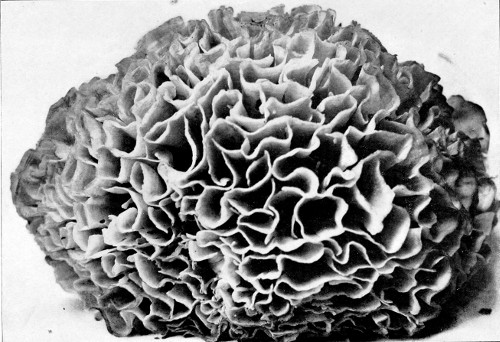
Photographed by Luther G. Harpel, Lebanon, Pa. Plate CXXXVII.
SPARASSIS CRISPA.
S. cris´pa Fr.—crispus, curly. (Plate CXXXVII.) Height 3–12
in., width 4–24 in. Tufts very handsome, whitish, oyster color or pale-yellow,
very much branched. Branches flat, leaf-like. Spore surface
on both sides, sometimes crimped on edges. Compacted into a round
mass, ending below in a solid rooting base.
Spores pale-ochraceous, 5–6×3–4µ Massee.
Very variable in size. On ground in woods and grassy places in
open woods. Summer, autumn.
513North Carolina, Curtis; West Virginia, New Jersey, Pennsylvania,
McIlvaine.
Have seen it 2 ft. across. “Delicosissima.” Fries.
A perfect specimen of S. crispa resembles a huge rosette, round and
many-folded in tortuous design. The folds are wide, flattened branches
springing from a common base, thin, semi-transparent, not unlike damp
sheets of gelatine although thicker. Surfaces of the leaves are dull, like
the flattened seaweeds and the light-colored sea-rock mosses. S. crispa
may be easily dried, and though shrinking much in size, retains its
shape, forming a very pretty ornament for the desk of the mycologist.
It is not common. Where it has chosen a habitat several tufts may be
found during the moderate season. The writer found three specimens
ranging from 6–12 in. in diameter near Haddonfield, N.J., others, not
as large, in West Virginia and in Chester county, Pa.
It has long been known as edible. It makes an ever-to-be-remembered
dish.
Fleshy, branched or simple, somewhat round, without a distinct stem.
Hymenium continuous, dry, homogeneous. For the most part growing
on ground. Fries.
The members of this genus vary greatly in form, which in some is
that of a club growing singly or cespitose, while others present a more
or less bush-like appearance, being slightly or excessively branched.
The color of the plant covers a wide range, as it may be white, red,
yellow, violet or their various shades, and to be in harmony the spores
do not confine themselves to one color, but are white, ochraceous or
cinnamon. In cases where the plant is not otherwise well defined the
spore colors will be found a valuable aid in placing it.
Ramaria (
ramus, a branch). Page
514.
Branched, branches attenuated upward.
A. Spores White or Pallid.
* Plant, color bright, red, yellow or violet.
** Plant white, gray or yellowish.
514B. Spores Ochraceous or Cinnamon.
* Plant yellow or dingy ochraceous.
** Growing on wood.
Syncoryne (
Gr—together; a club). Page
523.
Clubs almost simple, tufted at the base.
Holocoryne (
Gr—entire; a club). Page
524.
Clubs almost simple, distinct at the base.
Excepting to toadstool hunters the Clavaria, though numerous, are
not known to those who “Know a toadstool when they see it.” They
bear no semblance to the stereotyped toadstool. They seem to possess
an imitative faculty. Those growing among grasses harmonize with
the faded stalks under debris or the bleached surfaces of blades famishing
for sunlight; those of the woods take on the color of the leaf mat or
of the lichens, and shapes of club and deer-horn mosses, or assemble in
groves as pigmy trees, boled and sturdy-branched in mimicry of their
giant protectors towering above them. In their forms many are delicate,
graceful, beautiful, others are intricate. There is fascination for
eye and brain in looking through the vistas and labyrinths of their
branches.
A few species are tough as shoe-strings; a few bitter; one, C. dichotoma,
on the authority of Leuba, contains a minor poison. The genus
is plentiful and reliable. Many individuals are of marked excellence.
In soups, stews, patties, they remind one of noodles; sometimes of
macaroni. The hard parts of the stem should be removed, the branches
broken or cut in ½ in. lengths. If stewed, they require time and slow
cooking; if fried in butter they are crisp, choice bits.
Rama´ria—ramus, a branch.
Branched, branches attenuated upward.
A. Spores White or Pallid.
*
Plant, color bright, red, yellow or violet.
C. fla´va Schaeff.—yellow. Fragile, trunk thick, fleshy, white, very
much branched. Branches even, round, fastigiate, obtuse, yellow.
Fries.
515Height 2–4 in., 2–4 in. across; pale-yellow, dingy-yellow. Stem
or trunk short, robust, whitish. Branches very numerous, dense,
fragile, erect, straight, lighter than the yellow tips (fading with age)
which are toothed. Flesh white. Spores white. Taste and odor
pleasant.
Woods and open places. June to frost.
Indiana, H.I. Miller; West Virginia, New Jersey, Pennsylvania,
McIlvaine.
The C. flava and C. botrytes have long been noted edible species,
liberally commended abroad and in the United States. Variations in
their structure are interchangeable; variations in their quality are due
to environment. There is a slight difference in the measurement of
their spores, but the difference is not so great as between spores of the
same specimen. Specific differences may exhibit themselves in young
plants, yet disappear with age.
Plants for the table should be young and fresh. When aged or when
the ravages of insects appear, they should not be used, as they then
have an unpleasant taste which will effect a whole dish.
They should be cut into small pieces and stewed slowly for fully thirty
minutes. They can be seasoned and eaten as a stew or made into
patties.
C. botry´tes Pers. Gr—a cluster of grapes (from shape). Height
3–4 in., 3–6 in. across, white, yellow, pinkish, dingy in shades of these
colors. Base thick, short, fleshy, unequal. Branches many, swollen,
thick, crowded, unequal, enlarged at the ends and divided into several
small branchlets which are sometimes reddish at tips. Flesh white.
Spores ellipsoid, sub-transparent, white, 8×5µ Massee.
On wood earth. Common.
New York, Peck, Rep. 24; West Virginia, New Jersey, McIlvaine.
A general favorite and highly esteemed in Europe. Edible. Curtis.
“When old the branches both of this species and of C. flava become
elongated, obtuse, very fragile, and of a uniform color. The yellow
tips of the latter and the red ones of the former species wholly disappear.”
Peck, 32d Rep.
Excepting when young (not always then) the red tips to the branchlets
can not be relied upon as distinctive features of this species. The
place of its growth and the character of the soil have very much to do
516with its size, and the color and quality of its flesh. A well-shaded thin-soiled
spot will, after a rain, grow pale, spindling, tender bunches,
having but a tinge of red upon the points; perhaps not any. A rich,
better lighted spot will produce more robust and highly colored plants.
The same can be said of C. flava. C. botrytes is plentiful in Pennsylvania,
New Jersey, West Virginia and like latitudes. It must be well
cooked.
C. amethys´tina Bull.—amethyst in color. (Plate CXXXIX, fig. 1,
p. 516.) Height ½-3 in. Color violet, very much branched or almost
simple. Branches round, even, fragile, smooth, obtuse, known
by its color.
Spores elliptical, pale ochraceous, sub-transparent, 10–12×6–7µ
Massee.
Common in open woods and grassy places.
New York, Peck 30th Rep.; West Virginia, Pennsylvania, New Jersey,
McIlvaine. August, September.
Eaten in Europe, and by some preferred to any other.
A handsome species, very brittle, and though large, delicate.
C. fastigia´ta—fastigium, the top. Height 1–2 in., tufted, yellow.
Branches numerous, flexible, tough, equal, fastigiate (branches pointing
upward), sometimes short and simple, when higher very much
branched.
Spores white, irregularly globose, 4–6µ Massee.
In pastures and grassy places, during warm months.
North Carolina, Curtis; California, West Virginia, New Jersey, Pennsylvania,
McIlvaine.
Commonly eaten throughout Europe. In Germany they call it
Ziegenbart—goat’s beard.
This is one of the species that has to be looked for. Grass tufts hide
it. Its yellowish stools are not unlike them in color. It is freely found,
and, though not of the best, well rewards the seeker.
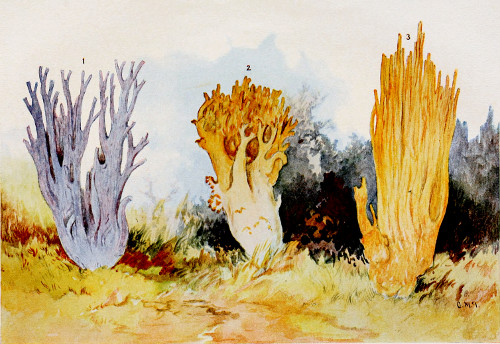
Grouped by F.D. Briscoe—Studies by C. McIlvaine Plate CXXXIX.
| Fig. |
Page. |
Fig. |
Page. |
| 1. Clavaria amethystina, |
516 |
3. Clavaria formosa, |
520 |
| 2. Clavaria aurea, |
520 |
|
|
C. muscoi´des—muscus, moss. Height 1–1½ in., slightly tufted,
yellow. Stem slender, tomentose at base, becoming two or three times
forked. Branchlets thin, tapering, crescent-shaped, acute.
Spores white, subglobose, 5–6µ Massee.
In pastures.
517North Carolina, Schweinitz, Curtis; Ohio; New York, Peck, 47th
Rep.
Edible. Curtis.
C. Her´veyi Pk. Gregarious or subcespitose, simple or with a few
branches, often compressed or irregular, scarcely 1 in. high, golden-yellow,
sometimes brownish at the apex. Flesh white. Branches
when present, short, simple or terminating in few or many more or less
acute denticles. Spores globose, 7.5µ broad, minutely roughened;
mycelium white.
Ground under hemlock trees. Orono, Me. September. F.L.
Hervey.
Allied to C. fastigiata and C. muscoides, but distinct from both by
its more irregular and less branching character and by its larger spores.
Peck, 45th Rep. N.Y. State Bot.
Near Haddonfield, N.J., August, 1890, among scrub pines and
spruce. A pretty species of medium flavor.
**
Plant white, gray or yellowish.
C. coralloi´des Linn. Height 2–4 in., usually tufted, growing into
each other, white. Trunk thick, short, much branched. Branches
repeatedly forked, compressed, hollow within, fragile, dilated upward,
tips crowded acute.
Occasionally the branches do not develop entirely and are obtuse;
they then somewhat resemble in shape C. rugosa, but are not wrinkled.
Spores pale-ochraceous, pointed, 10×8µ Massee.
Indiana, H.I. Miller; West Virginia, New Jersey, Pennsylvania,
McIlvaine.
A common edible species in Europe. Common in United States.
The writer has eaten it for many years. It is not always tender. It
should be young, fresh, and the branches alone cooked. It requires
slow, patient cooking if at all old. It does dry well, as stated by some
writers, but it does not wet well again.
(Plate CXL.)
Clavaria cinerea.
Two-thirds natural size.
C. cine´rea Bull.—cinis, ashes. (Plate CXL.) Height 1–3 in.,
gregarious or tufted, sometimes in rows. Gray. Stem either thin or
thick, short, lighter than branches. Branches very numerous compressed,
518wrinkled, irregular, somewhat
obtuse or flattened and divided
into slender points.
Its gray color easily distinguishes
it from others. It is variable in its
mode of growth and in its shape.
On ground in woods. Common.
June to frost.
Eatable, but injurious in quantities.
Cordier. Edible, but provokes indigestion
in delicate stomachs.
Leuba.
Eaten generally in Europe. In
France it is called pied de coq.
Plentiful in United States, in mixed woods. June to frost.
The writer and his friends have eaten it for fifteen years, and know
of no Clavaria equalling it.
C. tetrago´na Schw.—Four-angled. Very fragile, deep orange-yellow,
twice forked. Stem and branches quadrangular, 1–1½ in. tall.
Moist shady places.
New York. Ground in shaded places. August and September.
Poughkeepsie, Gerard, Peck, 24th Rep.; North Carolina, Schweinitz,
Curtis; Pennsylvania, Schweinitz.
Edible. Curtis.
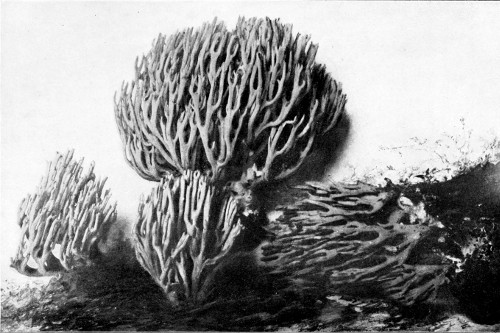
Photographed by Dr. J.R. Weist. Plate CXLI.
CLAVARIA CRISTATA.
C. crista´ta Pers.—crista, a crest. (Plate CXLI, p. 518.) Height
1–5 in., whitish, tufts of broad flattened branches cut on margins or
crested. Base short, stout. Branches numerous, irregular, flattened
upward and divided like moose horns, tough, stuffed, dingy. This peculiarity
distinguishes it and separates it from C. coralloides.
Spores pale ochraceous, pointed, 10×8µ Massee.
Woods. Common. Summer and autumn. Indiana, H.I. Miller;
West Virginia, Pennsylvania, New Jersey, McIlvaine.
Edible. Curtis.
After a summer rain the crested Clavaria is usually abundant where
there is good encouragement of mossy beds or mats of rich wood-soil
in woods where leaves and mold accumulate. It is not as tender as
519many other species, but chopped fine and stewed slowly for an hour it
will be eaten with enjoyment.
C. rugo´sa Bull.—ruga, a wrinkle. White or dingy, simple or tufted,
2–4 in. high, branched from the base with irregular blunt branches
wrinkled lengthwise, sometimes thickened upward.
Distinguished by the distinct, irregular, longitudinal wrinkles.
Spores white, irregularly globose, 8–10µ Massee.
In woods, solitary or gregarious. August to November.
North Carolina, Schweinitz, Curtis. Pennsylvania, Ohio.
It is reported edible by Dr. Curtis, M.C. Cooke and Dr. Badham.
C. pyxida´ta Pers.—pyxis, a small box. Tufted, light tan-color,
shaded with red, 1–3 in. high. Stem or trunk thin, smooth, variable
in length, dividing into many erect forked branches, which are cup-shaped
at the tips. The margins of these tips have slender branchlets
issuing from them (proliforme).
Distinguished by the cup-like tips. Spores white, 4×3µ Massee.
On rotten wood, on rotten roots in ground. June and into the
autumn.
North Carolina, Schweinitz, Curtis; Pennsylvania, McIlvaine.
Specimen sent by writer to Prof. Peck, June, 1897, and identified by
him. Not tested by writer, but is in Dr. Curtis' list of edible species.
C. subtil´is Pers. Scattered, slender, subtenaceous, pallid-white,
bases smooth and of equal thickness, branches few, forked, subfastigiate.
North Carolina, Schweinitz, Curtis; Pennsylvania.
Edible. Curtis.
C. den´sa Pk. Tufts 2–4 in. high, nearly as broad, whitish or
creamy-yellow, branching from the base. Branches very numerous,
nearly parallel, crowded, terete, somewhat wrinkled when dry, the tips
dentate, concolorous. Spores slightly colored, elliptical, 7.5–10×5–8.5µ.
Ground in woods. Selkirk. August.
Apparently closely allied to C. condensata, but differing decidedly in
color. Peck, 41st Rep. N.Y. State Bot.
Specimens identified by Professor Peck.
520Large masses of it grew at Mt. Gretna, Pa., July, August and September,
1898, in mixed woods.
Brittle; when young it is very compact. It is without much flavor,
but stews tender and makes a good dish.
B. Spores Ochraceous or Cinnamon.
**
Plant yellow or dingy ochraceous.
C. au´rea Schaeff.—aurum, gold. (Plate CXXXIX, fig. 2, p. 516.)
Trunk thick, elastic, pallid. Flesh white, dividing into numerous thick
branches that become repeatedly divided in a dichotomous manner
upward, and terminate in slender, erect, round, yellow branchlets.
Spores pale ochraceous, elliptical, 10–11×5–6µ.
In woods. Forming large tufts 2–3 in. high, colorless or almost so
below, tips yellow. Massee.
North Carolina, Curtis; Ohio, Alabama. Found in West Virginia,
1882; Devon, Angora, Eagle’s Mere, Mt. Gretna, Pa.; Haddonfield,
N.J. August and September. McIlvaine.
Eaten in Europe. Edible. Curtis.
In structure it reminds one of a miniature cropped Lombardy poplar.
The color is not bright, but dingy-yellow. Resembles C. flava; distinguished
by different color of spores. The branches (not stem) are
tender and good.
Var. rufes´cens Schaeff.
This plant occurs after heavy rains. It sometimes grows in continuous
rows several feet in extent. The pinkish-red tips of the branches
fade with age. The axils are rounded and the plant is quite fragile.
Fries considers it a variety of C. aurea. Peck, 25th Rep. N.Y. State
Bot.
Found at Springton, Chester county, Pa., August, 1887. It is
edible and good. The plant is tender and easily cooked.
C. formo´sa Pers.—formosus, finely formed. (Plate CXXXIX, fig.
3, p. 416.) Height 2–4 in. Trunk 1 in. and more thick, whitish or
yellowish, elastic. Branches numerous, crowded, elongated, divided
at ends into yellow branchlets which are thin, straight, obtuse or
toothed.
Spores ochraceous 9×3–4µ Massee; elongated, oval, rough, 16×8µ
W.G.S.
521On ground in woods, in large tufts, frequently in rows several feet
long.
North Carolina, Schweinitz, Curtis; Pennsylvania, New Jersey, McIlvaine.
Esteemed in Europe. Edible. Dr. Curtis.
Common in the United States in woods. Variable. An orange-rose
color is sometimes prominent on the tips. The tenderer portions of the
plant are excellent, but must be well cooked.
C. spinulo´sa Pers.—spined. Height 2–3 in. high. Stem ½-1 in.
thick. Trunk stout, short, whitish. Branches numerous, crowded,
erect, tense, elongated, tapering upward. Color cinnamon-brown or
darker.
Spores ochraceous, elliptical, 11–13×5–6µ Massee.
On ground in pine woods. August to October.
New York, Peck, 24th Rep.; New Jersey, Sterling; Pennsylvania,
McIlvaine.
Of same edible quality as C. aurea, which it resembles, excepting
that it is darker and less abrupt in the ending of its clusters.
C. flac´cida Fr.—flaccidus, flaccid. Height 1–3 in., bright ochraceous,
slender. Stem short, smooth, sometimes wanting, thin, 1–2 lines
thick, repeatedly branched. Branches crowded, unequal, flaccid,
upper ones forcep-shaped, pointed. Does not turn green when bruised
like C. abietina. The whitish mycelium creeps over the leaves on
which it grows. Brittle, tender, flesh white.
Spores ochraceous, broadly elliptical 4–5×3µ K.
Received from E.B. Sterling, Trenton, N.J.
Two specimens eaten. These were quite dry. After soaking they
were tender and had good flavor.
(Plate CXLII.)
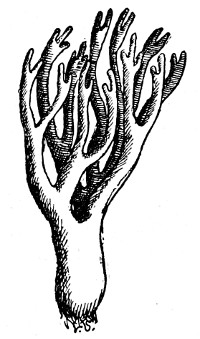
Clavaria circinans.
(After Peck.)
C. cir´cinans Pk.—circino, to make round. (Plate CXLII.) Stem
short, solid, dichotomously or subverticillately branched. Branches
slightly diverging or nearly parallel, nearly equal in length, the ultimate
ones terminating in two or more short acute concolorous ramuli.
Spores ochraceous.
Plant 1–2 in. high, obconic in outline, flat-topped, appearing almost
522as if truncated, pallid or almost whitish in color,
generally growing in imperfect circles or curved
lines.
Under spruce and balsam trees. Adirondack
mountains. August. Peck, 39th Rep. N.Y.
State Bot.
Where pines have grown, but where now oak
and chestnut trees make rather open woods, it
grows at Mt. Gretna, Pa. A stumpy fungus impressing
one as stunted. Its texture is solid.
It does not cook tender, but yields a fungus
flavor to the cooking medium.
C. stric´ta Pers.—stringo, to draw tight.
Height 2–3 in. Color pale dull-yellow becoming
brown when bruised. Stem distinct, thick, short. Branches numerous,
repeatedly forked, straight, closely pressed, tips pointed.
Spores dark cinnamon, Fries; creamy yellow 4×6µ W.G.S.
Var. fu´mida. The whole plant is a dingy, smoky-brownish hue,
otherwise of the typical form. Catskill mountains. September. In
the fresh state the specimens appear very unlike the ordinary form, but
in the dried state they are scarcely to be distinguished. Peck, 41st
Rep. N.Y. State Bot.
Eaten in Germany.
This form occurs in West Virginia mountains and at Mt. Gretna, Pa.,
Trenton, N.J., in August and September, among leaves in mixed
woods. It compares favorably with the ordinary run of Clavaria.
C. dicho´toma God.—dividing by pairs. Cespitose, white; branches
regularly dividing by pairs, elongated, flexuous, diverging, somewhat
compressed, extremities obtuse, rounded at or just below the apex
broadly compressed.
On the ground, under beeches.
“Notwithstanding its beauty this is dangerous. In 1883, when it
was very plentiful, I saw entire families sick from it and in 1888 there
was a repetition with new victims.
523“It produces nausea, vertigo and violent diarrhea.” Leuba.
I have not seen the plant.
Synco´ryne. Gr—together, a club.
Clubs almost simple, tufted at the base.
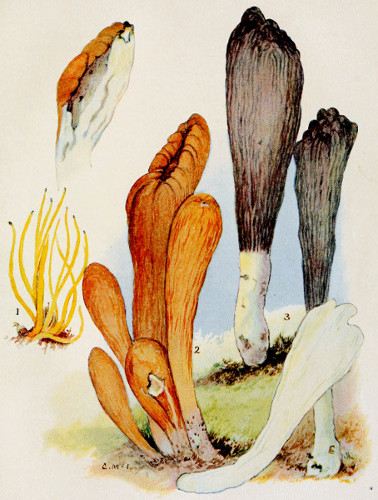
Grouped by F.D. Briscoe—Studies by C. McIlvaine. Plate CXXXVIII.
| Fig. |
Page. |
Fig. |
Page. |
| 1. Clavaria fusiformis, |
523 |
3. Clavaria pistillaris (dark var.), |
524 |
| 2. Clavaria pistillaris (yellow var.), |
524 |
|
|
C. fusifor´mis Sow.—fusus, a spindle. (Plate CXXXVIII, fig. 1,
p. 522.) Yellow, cespitoso-connate, slightly firm, soon hollow. Clubs
somewhat fusiform, simple and toothed, even, attenuated to the base
which is of the same color. Stevenson.
Spores pale yellow, globose, 4–5µ Massee.
Closely resembles C. inæqualis Fl. Dan.
Woods and pastures. August to November.
Received from E.B. Sterling, Trenton, N.J., August, 1897.
The clubs are 1⁄16 in. through, 4 in. high, light clear yellow, translucent,
clustered in groups of four or five united at the base.
Tender, well flavored, cooks easily.
C. auran´tio-cinnabari´no Schw.—aurantius, orange; cinnabaris,
vermilion. Orange-red; base white with a sub-hairy powder; clubs
simple, flexuous, fleshy, somewhat tenacious, fasciculate, thickened in
the middle and attenuated toward either end, at first cylindrical then
compressed, 6–7 mm. thick, 2–4 in. high.
Pennsylvania. On the ground among rhododendrons.
Received from E.B. Sterling, Trenton, N.J.
The plant when fresh is a beautiful rose color, inclining to orange at
the tips. It reminds one of the peach-blow vase color in some of its
shades. The single clubs, growing in cluster, to the height of four
inches, graceful in outline, exquisitely shaded, are a sight one lingers
over. While they invite the mycophagist to eat them, his voracity is
checked by their beauty. They are tender and delicious. It is regrettable
that thus far it has not been reported in quantity.
C. inæqual´is Fl. Dan.—unequal. Height 2–3 in. club-shaped,
yellow, gregarious, single or in loose tufts, fragile, stuffed. Clubs club-shaped
or almost equal, simple, sometimes forked or variously cut at
tip, one color.
Spores colorless, elliptical, 9–10×5µ Massee.
524Woods and pastures. August to October.
Distinguished from C. fusiformis by the tips not being sharp-pointed
and colored.
North Carolina, Schweinitz; New Jersey, Sterling.
This Clavaria is quite common in New Jersey. Its clusters are clear
bright yellow and conspicuously pretty. The clubs are translucent and
smooth. Excepting in color it resembles C. aurantio-cinnabarino. In
the many specimens seen there was nothing to suggest the propriety of
the name, excepting height of clubs.
A dish of it is a delicacy.
C. vermicula´ris Scop.—vermis, a worm. Height 1–2½ in., white,
tufted. Clubs simple, quill-shaped, stuffed, awl-shaped, brittle, pointed.
Spores white, elliptical, 4×3µ Massee.
New York, North Carolina, Pennsylvania, Ohio. Thin grassy woods
and among grass. July to October.
Edible. Cordier.
Common in southern New Jersey, and in warm soils from June to
frost. When growing among grass it is not conspicuous and is often
missed unless specially sought for. Its purity, its choice of refreshing
abode, its excellent qualities, make it select among Clavaria.
Holoco´ryne. Gr—entire; Gr—a club.
Clubs almost simple, distinct at the base.
C. pistillar´is L.—pistillum, a pestle. (Plate CXXXVIII, figs. 2,
3, p. 522.) Height 2–12 in., up to 1 in. and more thick, color light
yellow, ochraceous, brownish, chocolate. Clubs Indian-club shape,
ovate-rounded, puckered at top, simple, fleshy, white within, spongy,
exterior smooth or more or less wrinkled, usually with smooth base.
Spores white, 10×5µ W.G.S.; 9–11×5–6µ Massee.
Mixed woods, moss and grassy places. August until November.
North Carolina, Pennsylvania, California, Alabama.
Eaten in Poland, Russia and Germany.
The writer first found this truly club-like species in West Virginia in
1882, and ate it. But few specimens were found, and those of a dark
chocolate color. At Mount Gretna in 1897 and 1898 the yellow variety
525grew in considerable quantity from July until after frost. The
largest specimen found measured 5½ in. and was 1 in. in diameter at
its thickest part. The average height is 2½ in. Both varieties grew
in mixed woods from the leaf-covered ground. They are often clustered,
four or five together, and of different sizes. The surface, especially
of the dark variety, is regularly, vertically wrinkled, truncated in
few places, very much resembling that of the Craterellus cantharellus.
The stems of both are white. The apex of the clubs is folded inward
as though pulled by drawing-strings.
The flesh is soft, white, fine grained. A slight bitter is present in the
dark variety, when raw, which entirely disappears upon cooking. This
is one of the best of Clavariæ.
C. clava´ta Pk. Simple, straight, clavate, obtuse, smooth, not hollow,
yellow when fresh, rugose-wrinkled and orange-colored when dry,
4–6 lines high.
Damp shaded banks by road-sides. Sandlake. June. Peck, 25th
Rep. N.Y. State Bot.
Patches of it are conspicuous—golden-hued upon somber background.
They are seen at Eagle’s Mere, Mt. Gretna, and on the
Springton Hills, Pa., along wooded road-sides. Raw, they have a mild,
pleasant flavor, and have the same when cooked. A small species seldom
found in sufficient quantity to make a comforting dish.
526
Whole fungus homogeneous, gelatinous, shrivelling when dry, reviving
when moistened, pervaded internally with branched filaments,
terminating toward the surface all round in sporophores. Spores transparent,
from globose to sausage-shape and curved, sometimes septate.
Fries.
The Tremellaceæ, as their name signifies, tremble, because jelly-like
when moist. They are hard, tough, horny when dry, but swell and
become gelatinous when wet. In the typical genus, Tremella, there is
often but little consistency. Whoever has climbed an old rail fence on
a rainy day has had the doubtful pleasure of acquaintance with some of
them. Sections for the microscope are obtainable by hardening them
in alcohol.
There are several edible species in the family. They are good in
soups, giving them flavor and body, and some are excellent when
stewed.
Sub-Family—
Auricularieæ. Page
528.
Auricularia.
Broadly attached, margin free and reflexed. (No edible species reported.)
Cartilaginous, ear-shaped, attached by a point.
Sub-Family—
Tremellineæ. Page
529.
Exidia.
Cup-shaped, truncate, or irregularly lobed; spores reniform, producing
curved sporidiola on germination. (No edible species reported.)
Pulvinate and gyrose; spores reniform, producing rod-shaped sporidiola
on germination. (No edible species reported.)
Brain-like or lobed; spores globose or ovoid.
Firm, convex, with a central hard nucleus. (No edible species reported.)
Erect, spathulate. (No edible species reported.)
Gelatinous, tremelloid, fan-shaped, fleshy; hymenium with distinct
spines.
Sub-Family—Dacryomyceteæ.
Dacryomyces.
Small, pulvinate and gyrose. (No edible species reported.)
Irregularly cup-shaped, hymenium on one surface only. (No edible
species reported.)
Hymenium at the apex of a short stem, bearing conidia and spores.
(No edible species reported.)
Stem distinct, bearing the hymenium at its expanded apex. (No edible
species reported.)
Subglobose or lobed, hollow. (No edible species reported.)
Subcylindrical and erect, simple or branched (No edible species reported.)
HIRNE´OLA Fr.
Gelatinous, rather cartilaginous, soft and tremulous when moist, but
not distended with jelly, horny when dry, becoming somewhat cartilaginous
when moistened. The hard skin forming the hymenium, which
covers the cup-shaped cavity and is of a different color, can be separated
entire after a thorough soaking in water. Sporophores (spore-bearing
processes) not involved in jelly. Spores oblong, curved. Fries.
A very peculiar and distinct genus separated from the neighboring
genera by its disk-like, somewhat cup-shaped cavity and by its not being
distended with jelly.
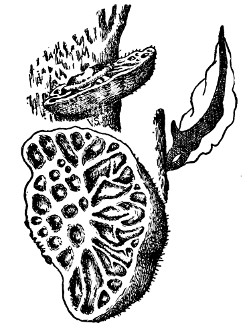
Hirneola auricula-Judea.
About two-thirds nat. size.
H. auri´cula—Jude´a (Linn.) Berk.—Jew’s ear. 1–4 in. across, thin,
and flexible when moist, hard when dry,
date-brown or blackish. Hymenium venoso-plicate
(vein-plaited), forming irregular
depressions such as are in the ear, yellowish-gray
or grayish beneath and hairy.
The large depressions or corrugations
branch from smaller ones near the center of
the plant.
Spores 20–25×7–9µ Massee.
H. auricula-Judea is not very particular
in the trees it patronizes. Elm, maple,
hickory, balsam-fir, spruce, alder bear it.
When the plant grows on upright timber it
usually turns upward. It is not generally
reported in the United States.
Ohio, Maryland, Miss Banning; Indiana,
H.I. Miller; New York, Peck; New
Jersey, Pennsylvania, West Virginia, McIlvaine.
Extensively used in China, where eating it probably antedates
all European records by several thousand years. It is brought
there dried from Tahiti in great quantities and made into soup.
The writer has found and eaten several specimens of it. It is not as
tender as other gelatinous species, but it is an oddity that pleases.
TREMEL´LA Dill.
Distended with jelly when moist, tremulous, without a defined margin
and without nipple-like elevations. Spore-bearing processes globose,
becoming divided into four parts, each division producing an elongated
free point terminating in a simple spore. Fries.
Distinguished by its peculiarly convoluted habit and jelly-like substance,
which is more or less inclined to be cartilaginous.
Exidia, similar in form, is separated by possessing minute nipple-like
elevations and Hirneola by its distinct difference in form.
Generally growing on dead wood; some species are found on trees
and others on the ground, etc.
Old tradition, in many countries, attests that the Tremellas are Fairy
bread, and T. albida the choicest baking. Pretty, indeed, must have
been the feasts when piles of such purity filled the board, and the brilliant
Pezizae were wassail cups.
They are better suited to Fairy appetites than to those of mortals;
being watery their nutritive value is small. Nevertheless they have
dainty flavor.
So far as tested no suspicion rests upon Tremellæ.
Gelatinous inclining to cartilaginous, foliaceous, naked.
Cerebrinæ (
cerebrum, the brain). Page
530.
Firm, then pulpy, somewhat pruinose with the spores.
Crusta´ceæ (crusta, a crust).
Diffused, becoming plane.
Tuberculifor´mes (tuberculum, a little tuber).
Small, somewhat erumpent.
T. fimbria´ta Pers.—fimbriæ, fringe. Olivaceous inclining to black,
cespitose, clusters 2–3 in. high and even broader, erect, corrugated;
lobes flaccid, incised at the margin, undulately fringed.
When soaked with water it has a dark tawny tinge. Stevenson.
Spores subpyriform.
On roots, dead branches, stumps, rails, etc.
From July to December, 1898, tufts five inches in diameter grew
from an oak stump close by the writer’s cottage at Mt. Gretna, Pa.
These tufts dried, and revived after rain into a gelatinous condition.
They were nibbled at raw, and several were cooked. Tufts were found
elsewhere in the same woods and eaten by others. They were unanimously
approved. The species dries hard, like thin glue, but is darker.
A dried piece swells in the mouth, grows tough, and has but little taste.
Flavor develops in cooking.
T. lutes´cens Pers.—luteus, yellow. Yellowish, cespitose, small,
cluster ½-1 in. broad, very soft, circling in wavy, undulating folds;
lobes entire, naked.
Inclining to be fluid. Whitish when young. Stevenson.
Spores subglobose, 12–16µ diameter Massee.
North Carolina, common. Curtis.
On decaying branches, stumps, etc.
July to February.
It dries and revives, or swells with
moisture, very soft and tremulous.
Edible. Leuba.
II.—Cerebrinæ. Firm then pulpy, etc.
(Plate CXLIV.)
Tremella mesenterica.
Natural size.
T. mesenter´ica Retz. Gr—the
mesentary. Gelatinous but firm,
bright orange-yellow, variously contorted;
lobes short, smooth, pruinose
with the white spores at maturity.
Spores broadly elliptical, 6–9µ diameter;
conidia 1–1.5µ diameter.
On dead branches. Very variable in
531form but known by the bright orange color. From ½-2 in. across.
Massee.
North Carolina. Common, edible. Curtis; California, Ohio, West
Virginia, New Jersey, Pennsylvania. McIlvaine. Dr. J.R. Weist,
Richmond, Ind., November, 1898, sent me fine specimens.
Very common as an apparent exudation from sticks, branches and
rails. It can usually be collected in quantity from June until far into
the winter. It can be found in every month in the year.
During the civil war the writer’s first attempt at making a dish of
cornstarch resulted in getting it into knots. T. mesenterica, when stewed,
very much resembles these same knots. It has a mild, woody flavor,
slightly sweet, and is good.
(Plate CXLIVa.)
Tremella mycetophila on
Collybia dryophila.
(After Peck.)
T. myceto´phila Pk. (Plate CXLIVa.) Suborbicular, depressed,
circling in folds, tremelloid-fleshy, slightly
pruinose, yellowish or pallid, 4–8 lines
broad. Peck, 28th Rep. N.Y. State Bot.
Haddonfield, N.J., August, 1895.
McIlvaine.
Professor Peck notes it as found parasitic
upon Collybia dryophila.
I found T. mycetophila growing parasitic
upon Marasmius oreades, August,
1894. The mass was 2 in. in diameter.
Separating them was taking the host from
the parasite. Cooked it is glutinous, tender—like
calf’s head. Rather tasteless.
T. al´bida Huds.—albidus, whitish.
Whitish, becoming dingy-brown when
dry, 1 in. broad, ascending, tough, expanded,
undulated, somewhat circling in
folds, powdered. Stevenson.
Spores oblong, obtuse, curved, 2-guttate, subhyaline, 12–14×4–5µ K.
Where birch, sugar-maple, hickory are in abundance the T. albida
will be found. At Eagle’s Mere and Springton, Pa., and other wooded
places, it is common during the warm months. It has slight taste,
sweet, woody, but makes a pleasant dish.
532T. intumes´cens Eng. Bot.—intumesco, to swell up. Gelatinous; subcespitose,
rounded, broken up into numerous tortuous lobes, brown,
shining, obscurely dotted, becoming darker when dry. Spores oblong,
slightly curved, 12–14×3–4µ.
From 1–2 in. across. Massee.
Entire year, but dried or frozen during winter, swelling in wet
weather.
North Carolina. Common. Curtis. West Virginia, Pennsylvania,
New Jersey, McIlvaine.
T. intumescens is not rare in West Virginia, or where beech logs are
in plenty, though it does not confine itself to beech. It occurs on
maples and some other woods.
It resembles the T. mesenterica in taste, but is sweeter. It is not as
large, but is equally good.
533TREMEL´LODON Pers.
Gelatinous, pileate, prickly below, spines awl-shaped, equal. Fries.
The members of this genus resemble in form the section Mesopus of
Hydnum and have the same awl-shaped spines, but differ in their gelatinous
consistency and fructification.
T. gelatino´sum Pers.—gelatina, jelly. Pileus covered with a greenish-brown
bloom, gelatinous, tremulous,
dimidiate, somewhat stipitate,
covered with small pimples. Spines
soft, glaucous.
On fir, trunks and sawdust.
September to October. Stevenson.
Of singular beauty, almost translucent
with steel-blue tints shading
into violet, while the spines are of a
pure soft white.
Spores round, somewhat irregular,
white, 2µ W.G.S.
Can not be confounded with any.
The only gelatinous spiny fungus.
North Carolina, Schweinitz, Curtis; Pennsylvania, Massachusetts, Farlow,
Frost; New York, Peck, Rep. 22. T. gelatinosum is well distributed
over the United States but is not reported in quantity. It is an autumnal
grower, lasting well into the winter. The writer found specimens near
Haddonfield, N.J., in February, 1894, and sent them to Professor
Peck. It is delicious when slowly stewed.