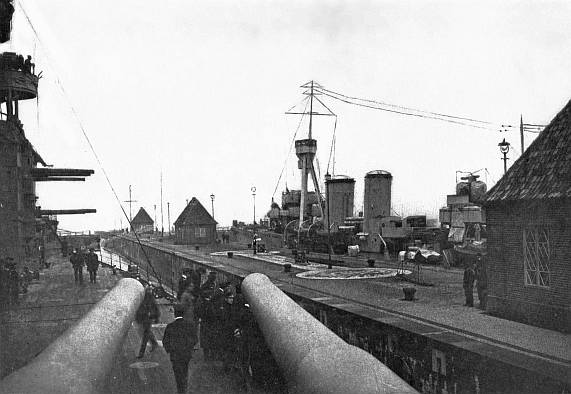
There had been a half-mile or more of visibility
when we got under weigh at eight o'clock, but in
the mouth of Kiel Fiord a solid wall of fog was
encountered, behind the impenetrable pall of which
all objects more than a few yards ahead were
completely cut off. The mist-muffled wails of
horns and whistles coughed eerily in the depths
of the blank smother to port and starboard, and
once the beating of a bucket or saucepan heralded
the spectre of a "bluff lee-boarded fishing lugger"
as the bare steerage way imparted by its
flapping yellow mainsail carried it clear of the
Viceroy's sharp stem.
Three or four more units of that same fatalistic
fishing fleet had been missed by equally narrow
margins when, looming high above us as they
sharpened out of the fog, appeared the bulging
bows of what looked to be a large merchantman.
At the same instant, too late by many seconds to
be of any use as a warning, the snort of a deep-toned
whistle ripped out in response to the querulous
shriek of our own syren.
When two ships, steaming on opposite courses
at something like ten knots, meet in a fog the
usual result is a collision, and nothing but the
quick-wittedness of the captain of the Viceroy
prevented one on this occasion. The stranger, in
starboarding his helm, bared a long expanse of
rusty paunch for the nose of the destroyer to bury
itself in, as a sword-fish stabs a whale, and that is
what must inevitably have happened—with disastrous
consequences to both vessels in all probability—had
the Viceroy also attempted to avoid
collision by turning to port. Realizing this with
a sure judgment, the captain fell back on an alternative
which would hardly have been open to
him with a destroyer less powerfully built and
engined than the latest "V's." I have already
told how, in the lock at Brunsbüttel, he had
stopped his ship dead, just short of the gates, by
going astern with the engines at the proper moment.
Here, in scarcely more time than it takes
to tell it, he not only stopped her dead but had
her backing (at constantly accelerating speed)
away from the slowly turning merchantman. The
jar (followed by a prolonged throbbing) was almost
as sharp as when the air-brakes are set on
the wheels of a speeding express, and the outraged
wake of her, like the back of a cat whose
fur has been rubbed the wrong way, arched in a
tumbling fountain high above her quivering stern.
But back she went, and so gave the burly freighter
room to blunder by in.
There was just time to note her high bulwarks,
two or three suspicious-looking superstructures
(which one's passing acquaintance with "Q"
boats suggested as possibly masking guns), and
a folded seaplane housed on the poop, before the
menacing apparition thinned and melted into the
fog as suddenly as it had appeared.
"I think that ship is the Wolf," volunteered the
pilot, watching with side-cast eyes the effects of
the announcement. "You will perhaps remember
it as the great raider of the Indian Ocean."
The captain looked up quickly from the chart
as though about to say something; then thought
better of it, and, with a wistful smile, turned back
to his study of the channel. I had seen him smile
resignedly like that a few days previously off the
Elbe estuary when a speeding widgeon, whose line
of flight had promised to carry it right over the
forecastle, had sheered off without giving him a
shot. What he had said on that occasion was,
"Hang the blighter; another chance missed!"
Going aft to breakfast, I was hailed by Korvettenkapitän
M—— (the officer commanding all
Baltic air stations who was accompanying us to
Warnemünde and Rügen), warming himself at
the engine-room hatchway, and informed that the
ship just sighted was "the famous raider, Moewe,
that has been so many times through the English
blockade." It was he that was correct, as it
turned out. We found the Moewe anchored three
or four cables' lengths on the port bow of the
Hercules when we returned to Kiel the following
evening.
They were two thoroughly typical specimens
of their kind, the pilot and the flight commander,
so much so that either would have been pounced
on with delight by a cartoonist looking for a
model for a figure of "Hun Brutality." The
former claimed to have served most of the war in
U-boats, and from the fact that he was only a
"one-striper," one reckoned that he was a promoted
rating of some kind. He was tall, dark,
and powerful of build, with hard black eyes
glowering from under bushy brows. He talked of
his submarine exploits with the greatest gusto,
among these being (according to his claim) the
launching of the torpedo which damaged the Sussex.
It is possible that he was quite as useful
a U-boat officer as he said he was (for he looked
fully capable of doing a number of the things one
had heard of U-boat officers doing); but he turned
out, as the sequel proved, only an indifferent pilot.
The flight officer is easiest described by saying
that he was like what one would imagine Hindenburg
to have been at thirty-five or thereabouts.
The resemblance to the great Field-Marshal was
physical only, for the anti-type, far from having
the "bluff, blunt fighter" air of the former, was
a subtle intriguer of the highest order. Just how
"subtle" he was may be judged from the fact
that within ten minutes of coming aboard that
morning he had drawn one of the British officers
aside to warn him of the menace to England in
Wilson's "fourteen points," and that, a quarter
of an hour after the snub this kindly advice won
him, he had cornered one of the American officers
to bid him beware of the inevitable attack his country
must very soon expect from England and
Japan.
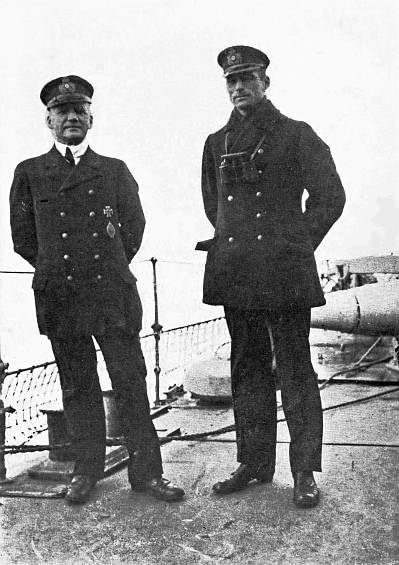
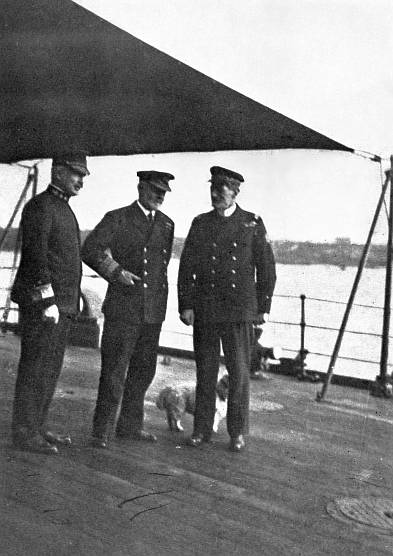
"HINDY" (LEFT) AND GERMAN PILOT WHO CLAIMED TO HAVE
LAUNCHED THE TORPEDO WHICH DAMAGED THE "SUSSEX"
A half-hour more "by luck and lead" took us
out of the fog, and an almost normal visibility
made it possible for the Viceroy to increase to her
"economic" cruising speed of seventeen knots.
The red roofs of the summer hotels along
Warnemünde's waterfront began pushing above
the horizon a little after noon, and by one we were
heading in to where the mouth of a broad canal
opened up behind a long stone breakwater. A
large ferry steamer, flying the Danish flag, was
just rounding the end of the breakwater and
turning off to the north-west, and from the word
"Armistice" painted on her sides in huge white
letters we took it she was engaged in repatriating
Allied prisoners by way of Copenhagen. As we
closed her, this impression was confirmed by the
sight of two men in the unmistakable uniforms of
British officers pacing the after-deck arm-in-arm.
Surprised that they appeared to be taking no
notice of the Viceroy, with the White Ensign at
her stern doing its best to flap them a message of
encouragement, I raised my glass and scanned
them closely. Then the dark glasses both were
wearing, and their slow uncertain steps, at once
suggested the sad explanation of their indifference.
There was no doubt the sight of both was
seriously affected, and that they were probably
hardly able more than to feel their way around.
As nothing less than "Rule Britannia" or "God
Save the King" on the syren would have given
them any hint of how things stood, we had to pass
on unrecognized.
Running a quarter of a mile up the canal, the
Viceroy went alongside the wall a hundred yards
above the railway station. The news of our arrival
had spread quickly in the town, and among
a considerable crowd which assembled along the
waterfront were a number of British prisoners,
most of them in their khaki. Several German
sailors—one or two of them with white bands on
their arms—to whom the Tommies had been talking,
kept discreetly in the background, but the latter,
grinning with delight and exchanging good-natured
chaff with the bluejackets, caught our
mooring lines and helped make them fast. They
looked in extremely good condition and spirits,
the consequence—as we learned presently—of having
had a considerable accumulation of prisoners'
stores turned over to them since the armistice.
Beer, they said, was the only thing they were short
of, and this difficulty they seemed in a fair way
to remedy when I left with the "air" party for
the seaplane station.
The great Warnemünde experiment station occupied
the grounds of what appeared to have been
some kind of a pre-war industrial or agricultural
exposition. Crossing the canal in a launch, a few
steps took us to and through a somewhat pretentious
entrance arch, from where it was several
hundred yards to the first of a long row of wood
and steel hangars. The Commander of the station
had received us at the landing; the rest of
the officers met us in the roadway in front of the
first shed to be inspected. Evidences of the resentment
they undoubtedly felt over having to
give way in the matter of the visit (it had been
the German contention that Warnemünde, not being
a service station, was not liable to inspection
under the terms of the armistice) were not lacking,
but as these were mostly confined to scowling
glances they did not interfere seriously with the
work in hand.
As the Allied Commission, in the conference of
a couple of days previously at Kiel, had insisted on
the visit to Warnemünde on the grounds of satisfying
itself that what the Germans claimed was an
experiment station was not used for service work,
inspection was limited to the comparatively perfunctory
checking over of the machines against a
list furnished in advance, seeing that they displayed
no evidences of having been used for anything
more than experimental flights, and ascertaining
that they had been properly disarmed.
This, as soon as it became evident that the station
was in fact quite what the Germans had
claimed it to be, was done very rapidly, the inspection
of well over a hundred machines, housed
in eight or ten different sheds, being completed
within three hours.
The machines were, of course, an extremely interesting
assortment, for practically all of them
were either new designs or else old ones in process
of development. There was the last word in
steel pontoons, with which the Germans have been
so successful, and also a number of the very
striking all-metal Junker machines, in the construction
of which wood, and even fabric, has been
replaced by the light but tough alloy called
"duraluminum." One of the German officers
volunteered the information that the principal
advantage of the latter over the ordinary machine
was the fact that more of it could be salved after a
crash. The fact that there was nothing to burn
sometimes rendered it possible to save an injured
pilot entangled in the wreckage, where the wood
and fabric of an ordinary machine would have
made him a funeral pyre. Against these advantages,
he added, stood the handicap of greater
weight and the fact that the metal wings occasionally
deflected into the pilot or petrol tank a bullet
which would have passed harmlessly through wood
and fabric.
There were several of the late Travemunde and
Sablatnig types, medium-sized machines which,
with their powerful engines and trim lines, looked
extremely useful. A large double-engined Gotha
torpedo-launching seaplane was viewed with a
good deal of interest by the experts of the party,
because it was a type to the development of which
it had been expected that the Germans had given
a great deal of attention. Down to the very day
of the armistice the Grand Fleet—whether at
Rosyth or Scapa—was never considered entirely
free from the menace of an attack by a flotilla of
torpedo-carrying seaplanes, and it was a matter
of considerable surprise to the sub-commission for
naval air stations when it transpired in the course
of their visits to the German North Sea and Baltic
bases to find a practically negligible strength in
these types. The almost prohibitive odds against
getting a seaplane carrier within striking distance
of either of the Grand Fleet bases—handicap imposed
by the complete surface command of the
North Sea by the British—was undoubtedly responsible
for Germany's failure to develop a type
of machine which there was little chance of finding
an occasion to use. Even this one at Warnemünde—representing
as it did the latest development
of its type—was far from being equal to
machines with which the British were practising
torpedo-launching a year before the end of the
war.
The most imposing exhibit at Warnemünde was
a "giant" seaplane rivalling in size the great
monoplane flying boat we had seen at Norderney.
The two were so different in type that it was
difficult to compare them, though it is probable
that in engine power—both of them had four
engines of from 250 to 300 horse-power each—and
in wing area they were about equal. The
Warnemünde machine—which was a biplane, with
two pontoons instead of a "boat"—had a somewhat
greater spread of wing, but this must have
been compensated for by the vastly greater
breadth of those of the monoplane. Superior seaworthiness
had been claimed for the latter on
account of the greater height of its wings from
the water when afloat; but that was ex parte evidence,
and we had no chance to hear what Warnemünde
had to say in favour of its pet.
An incident which occurred in connection with
the inspection of the "giant" furnished a very
graphic idea of the really colossal size of it. In
order to get over it the more quickly, all of the
several members of the Allied party climbed up
and took a hand in the work. Whether the German
officers thought some of the gear might be
carried off by the visitors, whether they were
afraid the secrets of some of their technical instruments
might be discovered, or whether they were
simply "doing the honours of the occasion," we
were never quite sure. At any rate, up swarmed
at least a dozen of them, scrambling like a crowd
at a ticket turnstile to get inside. In a jiffy they
had disappeared, swallowed completely by the
capacious fuselage. Not even a head was in sight.
Only the clatter of many tongues and the clang of
boots tramping on steel plates told that close to a
score of men were jostling each other in the
cavernous maw of the mighty "amphibian."
Only the Commander of the station—a somewhat
porcine-looking individual, whose rotund
figure furnished ample explanation why he had
not joined the scramble—and myself were left on
terra firma. Plainly disturbed by the thought
that Germany's supreme achievement in aerial
science was passing under the eye of the enemy,
he paced up and down moodily for a minute or
two and then, with clearing brow, came over and
asked me what was the horse-power of the largest
"Inglisch Zeeblane."
"I really can't tell you," I replied, half angry,
half amused at the supreme cheek of the man.
"Ach, but vy will you not tell me?" he urged
wheedlingly. "Der war iss over; ve vill now
have no more zeecrets. Today you see all ve haf.
Preddy soon ve come und see all you haf. There
iss much ve can learn from you, und much you can
learn from us. Ve vill haf no more zeecrets."
There were several things that I wanted to say
to that Hun optimist, and it required no little
restraint to pass them over and confine myself to
suggesting that he should take up the matter of
the exchange of "zeecrets" with Commander
C——, the Senior Officer of-the party. He looked
at the latter (who was just descending) irresolutely
once or twice, and then, doubtless seeing
nothing encouraging in the set of Commander
C—— 's lean Yankee jaw, shrugged his fat
shoulders and resumed his moody pacings. We
encountered a number of eager "searchers for
knowledge" in the course of the visit, but no other
that I heard of who employed quite such a
"Prussian mass tactics" style of attack as this
one.
Going from shed to shed as the inspection
progressed, one noticed at once the much greater
extent to which wood had figured in their construction
than in that of those of the North Sea stations.
Only the frames were of steel, and even the fireproof
asbestos sheeting which figured so extensively
in the great Zeppelin sheds had been very
sparingly employed. As this also proved to be
the practice in the two large stations we visited
the next day on the island of Rügen, it was
assumed that the comparative cheapness of wood
in the Baltic had been responsible for the freedom
with which it had been employed to save steel and
concrete. The inevitable penalty of this inflammable
construction had been paid at Warnemünde,
where the tangled masses of wreckage in the ruins
of a burned hangar indicated that all the machines
it had contained were destroyed with the
building.
When we returned to the Viceroy after the inspection
was over, we found a number of British
prisoners aboard as the guests of the bluejackets.
Several of them had asked for "rashers, or anything
greasy," but for tobacco and "home comforts"
they appeared to be rather better off than
their hosts. The captain said that he had offered
passages back to the Hercules to any that cared to
go, but they had all declined with thanks, saying
that they were helping to distribute food for other
prisoners passing through Warnemünde on their
way home viâ Denmark, and that they would not
return home until this work was finished. We left
them without any misgivings save, perhaps, on the
score that they seemed rather too tolerant of the
presence among them of a number of white-banded
German sailors.
During our absence the German harbour master
had come aboard to warn the captain that, as it
was verboten to use the turning basin after five
o'clock, it would be necessary for him to proceed
there before that hour. When the captain thanked
him and replied that he hoped to be able to carry
on without resorting to the turning basin, the
astonished official warned him that it was highly
dangerous to go out backwards, that even the German
T.B.D.'s never thought of doing so mad a
thing. The sight of the Viceroy going astern at a
good ten or twelve knots straight down the middle
of that half a mile or more of canal must have been
something of an eye-opener to that Kaiserliche
harbour master.
Passing close to the railway station on the way
out we had a brief glimpse of the sorry spectacle
of a huge mass of Russian prisoners, who appeared
to have been dumped there from one train
to wait for another, going heaven knows where.
A thousand or more in number, they had overflowed
the narrow strip of platform under the
train-shed, and as we passed some hundreds of
them, huddling together like sheep for warmth and
with no protection save the square of red blankets
thrown over their hunched shoulders, were soaking
up the rain which came drizzling down through the
early winter twilight.
"Russian prisoners that we now send back to
their homes," explained Korvettenkapitän M——
as I passed his perch in the hot-air stream from
the engine-room hatchway. "They do not like to
leave Germany, but we have not now the food for
them."
"Out of the frying-pan into the fire," commented
the chief. "A return to Russia is the one
thing left worse than what they've been through
here. Poor devils—but listen to that! Talk
about your bird singing in the rain——"
Deep, reverberant, pulsing like the throb of a
mighty organ, the strains of what might have been
either a hymn or a marching song were wafted to
our ears on the wings of the deepening dusk.
For two or three minutes the strangely moving
sound, rising and falling like the roll of a surf on
a distant shore, followed us down the canal before
it was quenched in the roar of the accelerating
fans as the bridge rang down for increased speed.
The German was the first to break the silence in
which we had listened.
"The Russians are a strange people," he said,
with a note of sincerity in his voice I had never
remarked before. "There is always sadness in
their happiness, and always hope in their despair.
I think they can never be broken."
For the first and last time I was inclined to
agree with him.
A three-hour run at a speed of fifteen knots
brought us to the island of Rügen, where we
anchored in shallow water three or four miles off
the station of Büg, which we were scheduled to
inspect in the morning. It was only a fair-weather
anchorage, however, and the lee shore, together
with a falling barometer and a rising wind,
caused the pilot to advise running round to the
somewhat better protection of Tromper Bay, on
the opposite side of the island. This shift, which
there was no real necessity for making, involved
an alteration of plan, for the shores of Tromper
Bay (where we now had to attempt a landing)
were four or five miles from Wiek, the second
station to be inspected, and entirely cut off from
communication with Büg by a long lagoon.
Under the circumstances, the only practicable
plan seemed to be to walk to Wiek across the
island, go from there to Büg by launch, and then
endeavour to rejoin the destroyer at her first
anchorage of the night before, to which she would
return in the interim. This intricate itinerary
we finally succeeded in following, but it almost
killed poor "Hindenburg," the fat German flying
officer escorting the party, who had confidently
counted on doing all of his travelling by launch.
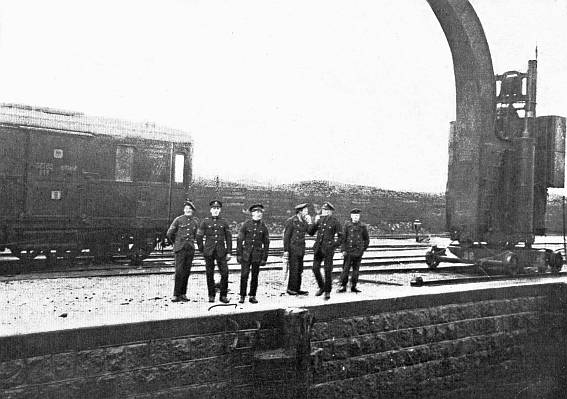
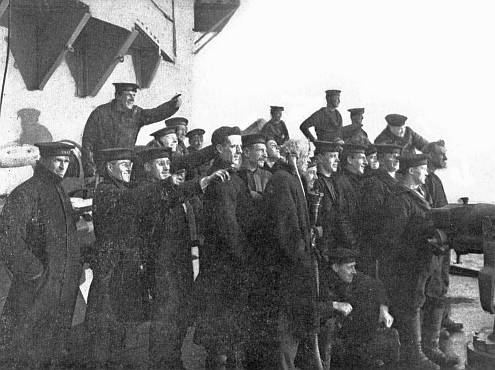
BRITISH PRISONERS AND GERMAN SAILORS AT WARNEMÜNDE
The motor launch refusing to start in the morning,
the whaler was used to land the inspection
party. As there appeared to be nothing in the
way of a quay or landing-stage, the most likely
place to get ashore seemed to be a dismantled pier,
the piles of which were visible from the deck of
the destroyer. "Hindy" (the name had already
begun to stick to him), however, promptly appointing
himself as pilot, in spite of the fact that
he knew no more of that particular stretch of coast
than any one else in the party, ruled in favour of
landing directly upon the beach. Pulling straight
in on the course he indicated, the heavily laden
whaler grounded a couple of hundred yards from
the shore, and was only worried off by all hands
going aft and raising the stranded bow. Commander
C—— took over the direction of affairs
at this juncture, and the incidence of events was
such that "Hindy" did not essay the leadership
rôle again for some hours, and even then but
transiently.
The old pier, to the end of which the whaler was
now pulled, had evidently been wrecked in a storm
of many years before and never repaired. Its
planking was gone entirely, but two strings of
timbers running along the tops of the tottering
piles offered a possible, though precarious, means
of reaching the two-hundred-yard-distant beach.
When two of the American officers clambered up,
however, they found the timbers so slippery with
moss that it was a sheer physical impossibility to
stand erect and walk along them. The only alternative
was to sit astride one of them and slither
along shoreward, a few inches at a time. This
they did, pushing along a thick roll of filthy slime
in front of them as they went, and stopping every
now and then to disengage the end of a projecting
spike that was holding their trousers. Following
behind one of them, I found the progress both vile
and painful, even after his wiggle-waggle advance
had swabbed up the worst of the slime and uncovered
the longest of the spikes lurking to ambush
the seat of my trousers. It must have been
unspeakable for the two self-sacrificing pioneers.
Halfway in, the timbers, less exposed to the
splashing spray, offered a better footing, and from
there, following the lead of Commander C——, we
managed to stand up and walk. Not until we
reached the end and jumped off on to the firm sand
and began to count noses before striking off inland
did any one notice that "Hindy" was missing.
The account of that worthy's doings in the meantime
I had that evening after our return to the
Viceroy from the coxswain of the whaler.
For the first time "Hindy" had neglected to
insist on the precedence due to his rank as a
"three-striper" and push out in the lead at a
landing. On the contrary, it appears, he had
lingered in the stern sheets of the whaler until the
last of the Allied officers had slid along out of
hearing, and then coolly ordered two of the crew
to wade ashore carrying him between them. He
would show them, he said, how the German sailors
joined hands to make a chair for their officers on
such an occasion. Failing in this manœuvre, he
had suggested that two of the oars be lashed together
with the strip of bunting in the stern sheets
and laid along across the tops of the piles to give
him a firm footing. Two of the bluejackets, he
explained, could go with him and "relay" this improvised
gangway along ahead. It was only when
the coxswain, in English probably too idiomatic to
convey its full meaning to a German, expressed
his lack of sympathy with this ingenious proposal
that he screwed up his nerve to tackling the
"wiggle-waggle" mode of progression.
Given a leg up by the whaler's crew, he wriggled
astride the nearest longitudinal strip of timber
and began his snail-like, shoreward crawl. At the
end of a quarter of an hour he had barely reached
the less slippery timbering halfway in, but here,
instead of getting up on his hind legs, as the rest
of us had done, and ambling along on his feet, the
shivering wretch still persisted in embracing the
slimy beam with his fat thighs and continuing to
worry on "wiggle-waggle."
Finally Commander C——, whose eyes for the
last fifteen minutes had been turning back and
forth between the ludicrously swaying figure on
the pier and the hands of his watch, uttered an
impatient exclamation and squared his shoulders
with the air of a man who has come to a great
decision.
"We're already two hours behind time," he
said, buttoning his waterproof and pulling on his
gloves, "and it's touch and go whether we can
finish in time to return tonight to Kiel per
schedule. It's a cert we won't make it if we have
to wait any longer for our tortoise-shaped and
tortoise-gaited friend out there. There's a disagreeable
duty to be performed, and since it is not
of a nature that I can conscientiously order one
of my subordinate officers to do, I guess it's up to
me to pull it off myself. Kindly note that I'm
wearing gloves."
Vaulting lightly from the sand to a line of timbering
running parallel, at a distance of about five
feet, to the one upon which "Hindy" was slithering
along, he trotted out opposite the latter,
reached across, lifted that protesting bundle of
anatomy to his feet, and then, leading him by the
hand, started back for the beach. The German
followed like Mary's Little Lamb as long as he
had the dynamic pressure of the American's
fingers to give him courage, but when Commander
C—— withdrew his guiding hand after he had
led his fellow tight-rope walker in above the sand,
"Hindy's" nerve went with it. Trying to sludder
down astride the timber again after tottering
drunkenly for a moment, he lost his balance and
tried to jump. The drop was not over five feet,
and to soft sand at that; but the remains of a
riveter I once saw fall to the pavement of Broadway
from the fortieth story of the new Singer
building looked less inert than the shivering pancake
that fat Prussian made when he hit the
beach of Rügen. There was really very little to
choose between it and a flatulent jelly-fish slowly
dissolving in the embrace of a mass of stranded
seaweed a few yards away; indeed, the subtle suggestion
of that comparison may have had something
to do with the reflex action behind a kick I
saw some one aim at the jelly-fish in passing.
That was the last we saw of "Hindy" (except
as a wavering blur on the rearward horizon) for
nearly two hours.
Striking inland through the dunes and a plantation
of young pine trees, we emerged at a crossroad
where a signboard conveyed the information
that Wiek (our immediate objective) was six and
four-tenths kilometres distant. "If we can hike
that four miles inside of an hour there's a fair
chance of cleaning up the whole job today," said
Commander C——, striking out along the lightly
metalled highway with a swinging stride.
"'Hindy' will have to get along as best he can.
We won't need him for the inspection anyhow."
Passing several rather dismal summer hotels
(one of which was called the "Strand Palace"),
we came to a picturesque little village of brick
and thatch houses, with brightly curtained windows,
and standing in well-kept flower gardens.
The villagers evidently a half-agricultural, half-fisher
folk—could have had no warning of our
coming, as even the station at Wiek was expecting
us from the opposite direction, and by launch.
Quite uninstructed in the matter of adopting
"conciliatory" tactics (as those of so many of the
places previously visited had so plainly been),
they simply went their own easy way, displaying
neither fear, resentment, nor even a great amount
of curiosity. Most of the shops, except those of
the butchers, were fairly well stocked, the displays
of Christmas toys (among which were some
very ingeniously constructed "working" Zeppelins)
being really attractive.
Beyond the village the Wiek road, which turned
off at right angles from the main highway, became
no more than a muddy track. Deeply rutted and
slippery with the last of the snow which had
drifted into it from a recent storm, walking in it
became so laborious that we finally took to the
fields, across the light sandy loam of which we just
managed to maintain the four-miles-an-hour stride
necessary to keep from falling behind schedule.
The several peasants encountered (mostly women
with baskets of beets or cabbages on their backs)
regarded us with stolid impersonal disinterest,
and seemed hardly equal to the mental effort of
figuring out where the motley array of uniforms
came from.
A tall spire gave us the bearing for Wiek, and
we passed close by the ancient stone church which
it surmounted in skirting the village on a short-cut
to the air station. This took us to the rear
entrance of the latter (instead of the main one
where we were naturally expected to come) and
had the interesting sequel of bringing us face to
face with a sentry wearing a red band on his
sleeve, the first of that particular brand of revolutionist
we had encountered. Although failing to
stand at attention as we approached, he was otherwise
quite respectful in his demeanour and made
haste to dispatch a messenger informing the Commander
of the station of our arrival. A number
of other "red-banders" were seen in passing
through the barracks area on the way to the sheds,
one of them even going so far as to click heels and
salute.
In spite of the flutter of red at the rear, there
was no evidence of anything Bolshevik in the display
set out for us in the shop-window. The men
lounging about the sheds fell in at once on the
order of the Commander, paraded smartly, and
when dismissed showed no disposition to hang
about the doors, as had occasionally been the case
at other stations. They apparently had not even
insisted on one of their representatives being
present during the inspection. None but the five
or six officers receiving the party conducted it
around. These were all keen-eyed, quick-moving
youngsters, but the fact that they were comparatively
sparsely decorated seemed to indicate
that the station was not of an importance to command
the services of the "star turn" men we had
seen at Norderney, Borkum, and other North Sea
bases.
There was one thing which turned up in the
course of the inspection which was not upon the
list furnished us by the Germans, and that was a
large stack of second-hand furniture which I
stumbled across in an out-of-the-way corner of
the first shed visited. An unmistakable French
name on the back of a red plush-upholstered divan
first suggested the lot was an imported one, and
looking closer I discovered a half-obliterated
maker's mark, with the letters "Brux-l-s" following
it. Diverting one of the inspecting officers
in that direction as opportunity offered, I asked
him what he thought the word had been. "Probably
the Belgian spelling of Brussels," he replied
promptly, "and certainly the English spelling of
loot." When the German Commander chanced to
mention, a few minutes later, that his flight had
only recently come from Zeebrugge, both conjectures
seemed to be confirmed.
The inspection was over by the time "Hindy"
arrived, and we departed for Büg immediately
he had completed the wash-down and brush-up
that his brother officers, who treated him with a
good deal of deference, insisted on his having.
He was too dead beat to display temper when
he had been bundled into the launch, and he impressed
me as telling the bare literal truth when
he said it was the hardest walk he had ever taken
in his life.
A half-hour's run brought the launch alongside
the landing-stage at Büg, which ideally located
station occupied a quarter of a mile of the narrow
spit of sand separating the broad, shallow lagoon
we had just crossed from the open Baltic. Concrete
runways sloped down to both strands, so
that seaplanes could be launched in either direction.
It was an admirably planned and equipped
station in every respect. An hour's inspection
showed that the provisions of the armistice, here
as at all of the other stations visited, had been
satisfactorily carried out. A novel feature of the
visit was the presence of a couple of photographers—evidently
official ones, judging from the
fine machines they had—who waylaid the party at
every corner and exposed a large number of
plates.
"Hindy," who had disappeared shortly after
we landed, turned up again about the time the
inspection of the last hangar was completed, picking
his teeth and considerably restored in aplomb
by the hearty mittagessen he had regaled himself
with at the Commander's mess. Not until then
were we informed that the station had no launch
or boat of any kind available on the Baltic side.
This meant that the Viceroy—she had now come
to anchor three or four miles off-shore—would
have to send a boat in for us, and that an hour's
time had been wasted before making a signal for
it. Hastily writing a message requesting that the
motor launch or whaler be sent in to the landing,
Commander C—— handed it to the Commander
of the station, suggesting that it be made by
"Visual" to the Viceroy in International Morse.
Here "Hindy," brave with much beer, asserted
his authority again. Snatching the paper from
the station Commander's hand, he read over the
signal with a frown of disapproval, and then
handed it back to Commander C——.
"That is much too long and complicated for a
German signalman to send in English," he
growled. "You should write only, 'Send boat
immediately.' That is quite enough."
There was a look in Commander C——'s face
like that it had worn when he turned and left
"Hindy" in a heap on the beach by the jelly-fish,
but he controlled himself and spoke with considerable
restraint.
"Since the Viceroy is not my private yacht,"
he said quietly, "any signal I make to her will
begin 'Request.' I might add that if I were her
captain, and a passenger of mine made me a signal
like the one you suggest, he could wait till—till
the Baltic froze over before I'd send a boat to
take him off. Unless you're prepared to wait
that long, you can't do better than see that the
signal is made exactly as I have written it."
In spite of its "length and complication," that
signal, as we saw it later in the Viceroy, was
identical with the original to a T.
It was rather hard luck that Büg, which was the
first station we visited without carrying our own
lunch in the form of sandwiches, was also the only
one where we were not offered shelter and refreshment.
"Hindy" disappeared again during the
next hour of waiting, and even had to be sent for
when the whaler finally did arrive. The rest of
us were so thoroughly chilled from standing out
in the biting Baltic wind that we were only too
glad to warm up a bit by "double-banking" the
oars with the whaler's crew on the pull back to the
destroyer. The sight of American and British
officers bending to the sweeps with common bluejackets
created a tremendous furore at the station.
The photographers rushed out to the end of the
jetty to make a permanent record of the astonishing
sight, and from the significant glances all of
the Germans were exchanging one gathered that
they thought that theirs was not the only Navy in
which there had been a revolution.
Climbing up to the bridge shortly after the
Viceroy got under weigh for the run back to Kiel,
I found the captain on watch with a hulking Number
8-bore shot-gun under his arm, at which
vicious weapon the German pilot, pressing as far
away from it as the restricted space allowed, kept
stealing apprehensive sidelong glances with eyes
ostensibly searching the horizon through his
binoculars. On asking the captain what the
artillery was for, he motioned me back beside the
range-finder stand, where he presently joined me.
"I'm watching for ducks—great place for them
along here," he said in a low voice; "but don't
give it away to the Hun. He seems to think it's
for him. It's old B——'s gun. He shot ducks
with it from the bridge of his E-boat all over the
Bight during the war."
"You don't mean to say that you'd stop the
destroyer and circle back to pick up a duck in case
you happened to wing one?" I asked incredulously.
"Wouldn't I?" he laughed. "Just tumble up
if you hear a shot and see. There's no finer duckboat
in the world than a destroyer if you got the
sea room to handle her in."
It was an hour or two later that I was shaken
out of a doze on a ward-room divan by a sudden
jar, followed by the threshing of reversed screws.
"The skipper's got his bird," I thought, and
forthwith scrambled out and up the ladder, especially
anxious to arrive in time to see the expressions
on the face of the Germans when they
realized that the "mad Englander" was going
back in his warship to pick up a duck. Compared
to that it turned out to have been an event of no
more than passing interest which had happened.
The pilot (perhaps because his mind was absorbed
in the menace of that terrible 8-bore) had merely
missed—by three or four miles as it transpired
presently—the gate of the anti-submarine net
fencing off that neck of the Baltic, with the result
that the Viceroy had barged into that barrage at
something like seventeen knots. Cutting through
the first of what proved to be a double net, she
brought up short against the second, the while her
spinning propellers wound in and chewed to bits
a considerable length of the former.
The seas were agitated for a half-mile on either
side by the straining of the outraged booms, while
from the savagely slashing screws floated up a
steady stream of mangled metal floats like
wienerwursts emerging from a sausage machine.
Luckily, the cables of the nets were rusted and
brittle, so that the propellers readily tore loose
from them without injury. Backing off clear, the
pilot ran down the boom until the buoys marking
the gate were sighted, and from there it was comparatively
open going to Kiel, which we reached at
nine-thirty that evening.