Titian's last work for Charles V. was the
famous "Gloria." This was painted at a
time when Charles had decided to end his
days in the shadow of the Church, and is to
be seen to-day in the Prado, a composition
of amazing strength and wonderful inspiration.
The Father and the Son are seen enthroned,
with the Virgin Mary at the feet of
Christ, and the Patriarchs grouped in the
background. Charles himself in his shroud
is pleading for forgiveness, an angel by his
side encourages him and supports his appeal.
The lighting of the picture is masterly, and
so impressed the Emperor that he took it
with him into retirement, and directed that
it should be placed above his tomb.
Philip II. has no enviable reputation in
this country, but his position as patron of the
arts stands far above criticism. Though he
was a sober ascetic upon whom the authority
of the Church weighed very heavily,
he did not ask Titian to devote himself
entirely to religious pictures. In matters
of art he saw his way to making a considerable
concession to the spirit of the
Renaissance, and when he took over the
burden of empire he commissioned several
mythological subjects from the old painter.
Among them were the "Venus and Adonis"
now in the Prado, the "Diana surprised by
Actaeon" in Bridge-water House, and the
"Jupiter and Antiope" in the Louvre. The
allegorical pictures, the latest work of the
painter's life, were commissioned later.
Strangely enough the years had done
little or nothing to dim the lustre of the
painter's work, his colour was still supremely
beautiful, his feeling for landscape more intense
than it had ever been, while his
capacity for striking and novel composition
remained a thing to wonder at. Of course
Philip was not content with secular subjects,
and Titian was required to paint a certain
number of pictures for the Escorial, but he
is best represented by his mythological
subjects. Perhaps they made a more direct
appeal to him because by their side the
religious pictures were a little old-fashioned,
and he does not seem to have faced allegorical
subjects with enthusiasm.
It is interesting to turn to Vasari and
read some of the things he has to say
about the painter at this period of his life,
for although the old chronicler is not the
most accurate of writers, he is at least a
very interesting one and he knew Titian
intimately. He says of the famous "Gloria"
picture to which reference has been made—"The
composition of this work was in
accordance with the orders of his Majesty,
who was then giving evidence of his intention
to retire, as he afterwards did, from
mundane affairs, to the end that he might
die in the manner of a true Christian, fearing
God and labouring for his own salvation."
It is not difficult to imagine the emotion
that this picture must have roused among
those who were privileged to see it, when
it came fresh from the painter's studio, to
impress an age that had not forgotten to
be devout.
Again Vasari says, "In the year 1566
when I, the writer of the present history, was
in Venice, I went to visit Titian as one who
was his friend, and found him, although then
very old, still with the pencils in his hand
painting busily." The old gossip goes on to
say that Paris Bordone, who "had studied
grammar and become an excellent musician,"
had set himself to imitate Titian,
who did not love him on that account, and
had sought to keep him from getting commissions.
Bordone persevered and went to
Augsburg, where he painted pictures, now
lost, for some of the great German merchants.
This little glimpse of rivalry suggests to us
that Titian was jealous of his reputation,
although Vasari tells us elsewhere that he
was kind and considerate to his contemporaries,
and free from uneasiness, because
he had gained a fair amount of wealth,
his labours having always been well paid.
Vasari hints, too, that he kept his brush in
hand too long; he must have written this
when he remembered that, for all his many
excellences, Titian was a Venetian. "Titian
has always been healthy and happy," he
writes; "he has been favoured beyond the
lot of most men, and has received from
Heaven only favours and blessings. In his
house he has always been visited by whatever
princes, literati, or men of distinction
have gone to Venice, for in addition to his
excellence in art he has always distinguished
himself by courtesy, goodness, and
rectitude." Perhaps his remark that Titian's
reputation would have stood higher if he
had finished work earlier may be no
more than a veiled comment upon the
indiscriminate misuse of the labours of
pupils.
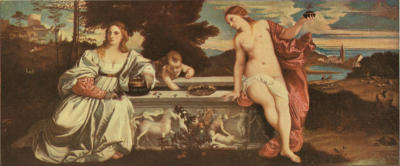
PLATE VII.—SACRED AND PROFANE LOVE
(In the Borghese Palace, Rome)
This most beautiful work of Titian's is one belonging to his early
days. It was probably commissioned in 1512 by the Chancellor of
Venice, and we find that it was in the possession of Cardinal Scipione
Borghese at the beginning of the seventeenth century. It may be
seen to-day in the Borghese Palace of Rome.
In the latter years of his sojourn in
Venice the artist lived in a house towards
Murano, between the Church of San Giovanni
de Paolo and the Church of the Jesuits.
He entertained very largely, giving supper
parties from which no seasonable delicacy
was lacking, and gathering round him distinguished
men and women who were far less
celebrated for their morals than for their attractions.
His gossip Aretino was generally
of the party, and it is to him that we owe
so much of our intimate knowledge of the
painter's home life and troubles. Aretino's
death in 1556 must have been a great blow
to Titian.
Vasari tells us that the painter's income
was considerable. Charles V. paid a thousand
gold crowns for every portrait of himself
and, when he conferred the patent of
nobility upon the painter, he accompanied it
with an annual gift of two hundred crowns.
Philip II., son of the great Emperor, added
another two hundred annually, the German
merchants gave him three hundred, so that
he had seven hundred crowns a year without
taking into account the commissions
that came to him on every side, and, as he
was painting for the richest and most
generous people of his generation, his annual
income must have been very considerable.
And yet Titian's own correspondence,
of which a part has been preserved,
shows that the State grants were not
always paid regularly. It is of course far
more easy for an arbitrary ruler to make
gifts to his favourites than it is for the
State Treasury to respond to the demands
that must needs follow each grant, and
Spanish finances have always been difficult
to administer.
As he grew older and his hand lost part
at least of its cunning, Titian depended more
and more upon pupils, but in this he was
only following the custom of his time. It is
said that a clever German artist, who worked
in his studio, was responsible for the greater
part of several of the later pictures. The
Council of Ten though they had taken from
him the office of Painter of Doges and had
given it to Tintoretto, offered him a commission
in the late 'sixties; even if they had
a grievance against him they could not afford
to nourish it. Then again if Titian was not
always prompt in doing the work for which
he was paid, even if he employed pupils to a
greater extent than seemed necessary to
those who had to pay for the finished canvas,
it must have been hard to quarrel with him,
for his personality would seem to have been
most engaging. He was an excellent musician
as well as a good host, Paolo Veronese has
included him in the famous "Marriage in
Cana" (Louvre) playing a double bass.
Moreover Titian was a courtier whose
correspondence, although it dealt so largely
with matter of finance, lacks none of the
stilted graces of the time, and these may
have helped to conciliate angry patrons. He
seems to have been an affectionate father,
and if he had any besetting sin it was love
of money, his anxiety in this respect being
increased by the fact that he was not always
able to collect the accounts due to him.
Yet he saved enough to buy land round his
birthplace and it is reported that he went
to Cadore whenever he had the opportunity.
Clearly an appreciative sense of the perennial
peace of the Dolomites never left him.
By his wife, to whom he was not married
until two sons had been born, Titian had
four children of whom two grew up. Pomponio,
to whom we have referred, was the
eldest; and he came to a bad end, being
a dissipated man. Orazio, who was the
second son, became a painter. One daughter
died young, and there was another, Lavinia,
portraits of whom may be seen at Dresden
and Berlin. His great friends were Pietro
Aretino, poet and gossip, who laid half
Europe under contribution, and was almost
as unscrupulous as he was clever, and the
sculptor Sansovino.
Whatever Titian's faults were as a man,
they may fairly be forgotten in his merits
as an artist, and it is not the least of
these merits that he worked from the time
when he was a boy to the hour when his
brush seemed falling from his hands, unsparing
in his devotion to his task. He
has left a legacy to the civilised world that
compels a measure of admiration equal to
that which is paid to Velazquez. Titian
was the supreme master of colour, but, unfortunately,
few of his pictures have escaped
the restorer's hand, and a great many have
been damaged in their journeys from city
to city in an age when the art of picture
packing was still unknown. Exposure to all
sorts of weather, long periods of neglect,
careless restoration, and reckless repainting
would have been enough to destroy the reputation
of most painters, but Titian's work
has not suffered to the extent that might
have been expected. Enough remains of the
master to make us not a little envious of
the happy patrons of the arts who knew
his work in all its glory.
It is hard to say when Titian's life would
have come to an end in the ordinary course
of events, but it is not unreasonable to
suppose that he would have lived to be a
centenarian had he retired from Venice when
he was ninety and gone to live in Pieve, the
well-beloved city that gave him birth. But
he would not leave his workshop, and in
1575 the plague paid another visit to Venice.
It will be remembered that soon after the
League of Cambrai when Titian was in
Padua, a visitation had devastated Venice
and carried off Giorgione among thousands
of lesser men. The Venetians were never
free from fear of the plague's return. In 1575
the hand of the plague lay heavy upon the
City of Lagoons, where sanitation was unknown,
and isolation and disinfection were
not practised properly. Historians tell us
that some 40,000 people perished, the greatest
panic prevailed, and while the plague was
at its height Titian died. If his own insinuation
of the year of his birth be correct
he must have been in his ninety-ninth year,
but even if we accept the date given by
those who believe that he was born as late
as 1482, he would have been within seven
years of his centenary. The epidemic is
recorded in the famous Church of the
Redentore on the Giudecca, dedicated to
Christ by the Doge Mocenigo, whose portrait
painted by Tintoretto may be seen
in the Accademia to-day.
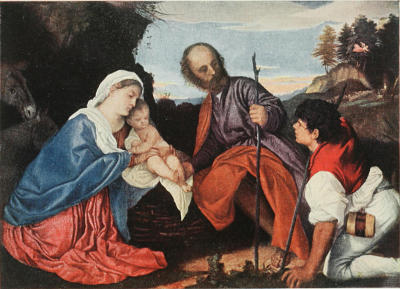
PLATE VIII.—THE HOLY FAMILY
(In the National Gallery, London)
This superb painting is one of the gems of our National Gallery,
and represents Titian at his best as a great colourist. It is painted
in oil on canvas.
In spite of the distress prevailing in the
city some effort was made to give the great
painter a State funeral, but under the conditions
existing, it was impossible to carry
out the programme, and he was buried with
comparatively little ceremony in the great
Church of the Frari which, in addition to
having one of the finest works of his hand,
is further enriched by the famous altar-piece
by his old master Gian Bellini. They
say that his residence was entered shortly
after his death by some of the riff-raff of
Venice, to whom the plague had given a
welcome measure of licence, and was despoiled
of many of its treasures. Doubtless
the painter's house held much that was
worth the small risk involved in an hour
when the authorities were hardly able to
cope with duties to the sick and the disposal
of the dead.
In considering the life of Titian we see
that much good-fortune went to its making.
He was born at the best period of the
Renaissance, he was the inheritor of the
freedom for which other painters had striven.
He painted a world that was as new to
artists as were the far-off realms to the
Spanish adventurers who were discovering
new countries and new trade routes, and
paving the way for the ultimate decline of
Venice. At the outset of his career Titian's
work was full of the joy of life, it was the
expression of an age that seemed to have
come of age, of a city that had turned to
canvas and marble rather than to books
for a reflection of the new life. While the
painter progressed, overcoming the various
difficulties of expression that confronted
him, making daring and successful experiments
in composition, handling colour as
it had never been handled before, this feeling
of enthusiasm that belonged to the age
was expressed in all his work. Then again
he had the great advantage of claiming for
sitters the most distinguished men of his
time, the statesmen and rulers who were
making history at the expense of the map
of Europe, the men who held spiritual or
temporal power, and the women they delighted
to honour. Naturally enough these
conditions gave added scope to the painter's
talent; and his subjects were worthy of
his brush. He could seek out what was
best and most characteristic in his sitters,
and express through the medium of his art
not only the likeness but the personality
underlying it. Had his work been more
fortunate, had it been preserved in anything
like its entirety, we should be able
to read the history of his times in a clearer
light, for though the written word can tell
us much, the cleverly wrought picture has
still more to say, and we can rely upon
canvas, if Titian painted it, to refute or to
confirm the verdict of the historian.
Happily, too, Titian's art grew with his
age. Practice and experience ripened it,
and some of his finest pictures were painted
when he was past the span of life that the
Psalmist has allotted to man. He covered
every field, no form of painting seems to
have come amiss to him. Altar-pieces, portraits,
historical pictures, mythological and
allegorical subjects, one and all claimed his
attention from time to time, and though we
are all entitled to express our preference,
there will be few to say that he failed in
any style of work. Perhaps he was least
successful in allegorical subjects, and in
the portraits of women, but, if this be so,
his failure is merely relative, he attained
such heights in mythological subjects and
men's portraits, that the other work is not
so good by comparison. If he gave us no
picture devoted entirely to landscape it is
worth remarking that the appeal of nature
was an ever growing one. The impression
given him by the mountains round Cadore
was never lost. From the time when he
completed Gian Bellini's last picture down
to the time when the plague came to Venice
and found him with an unfinished picture on
his easel, the attraction of the countryside
he knew so well was always with him, and
he lost no opportunity of expressing it.
Gian Bellini had opened the walls that shut
in the Madonna and the Saints of the earlier
masters, he had given the world glimpses
of exquisite landscape through which the
romance woven round his figures seemed
to spread. Titian opened the gates still
further, giving a larger, wider, and more
splendid view, convincing his contemporaries
and successors that landscape could
never more be overlooked.
He would seem to have made few studies,
a sketch by Titian is one of the rarest things
in art, he did not see in line but in colour.
With Titian as with Velazquez after him
it is hard to separate colour from line, and
in colour he was the acknowledged master
of his own time and the guide of the ages
after him. Some of his great contemporaries,
not Venetians of course, declared
that Titian was a poor draughtsman, but
it is well to remember that among the
Venetians, art was an affair of painting,
among the Florentines it embraced sculpture
and architecture; the mere handling
of paint, however splendid the results, would
not suffice Florentine ambitions. It might
even be said that much Florentine painting
is little more than tinted drawing. We
go to Titian for colour even to-day, when
time and exposure and repainting have
taken so much from the wealth that he
gave to his pictures, and we can see that
as he grew to ripe age he sought to obtain
his colour effects by less obvious means than
those that served him at the outset. It is
hard for any but an artist to realise the
secret of the cause that produced the later
results, but, if it be left for the artist to explain
it is easy for the layman to appreciate.
With Titian, Venetian painting reached the
zenith of its achievement, after him through
Tintoretto and Veronese, the descent is slow
but sure, and we are left wondering whether
any fresh revival of the world's enthusiasm,
any new discovery of the world's youth is
destined to bring into art the spirit of enthusiasm
that gave a Titian to the world.
There are few signs in our own time, but
then we do not live in an age of great
crises religious or political, or, if we do,
we are too near to the changes to recognise
them.
Perhaps there are some who find amusement
in the suggestion that Titian's action
emancipating art from the thraldom of the
Church was a great and glorious one, not
unattended by danger and difficulties. To
these sceptics one can but reply by quoting
the decree of the Council of Nicaea dated
A.D. 787 and never repealed. Here we find
the attitude of Authority towards art set out
in plainest fashion. "It is not the invention
of the painter which creates a picture," says
this remarkable decree, "but the inviolable
law and tradition of the Church. It
is not the painter but the Holy Fathers
who have to invent and dictate. To them
manifestly belongs the composition, to the
painter only the execution."
A few great artists in later times had
made their protest, definite or indefinite,
against the attitude of the Church, but
Titian rescued art as Perseus rescued
Andromeda.
The plates are printed by Bemrose & Sons, Ltd., Derby and London
The text at the Ballantyne Press, Edinburgh
Transcriber's note:
Illustrations were moved to paragraph breaks, everything else (including inconsistent hyphenation and spelling) has been retained as printed. Click on the plates to see larger images.