Author of “Squinty, the Comical Pig,” “Mappo, the
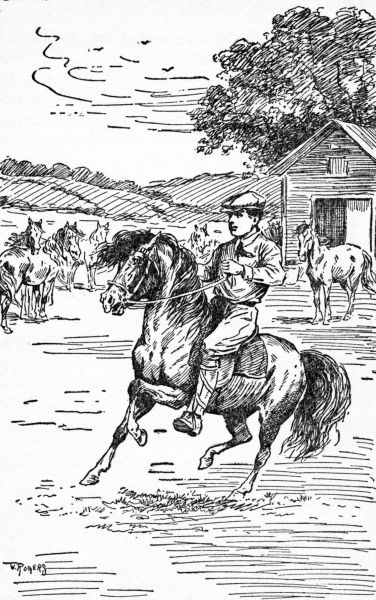
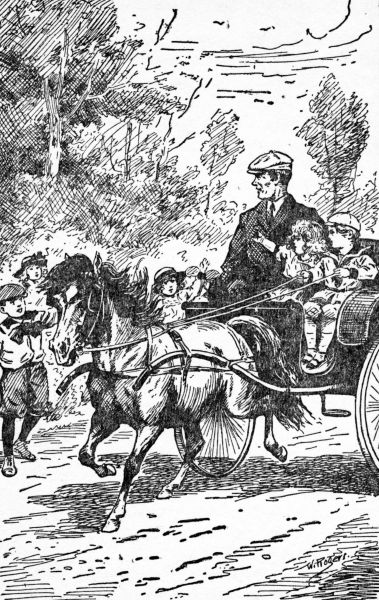
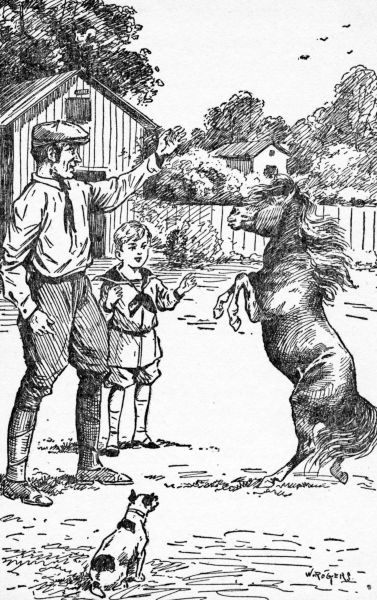
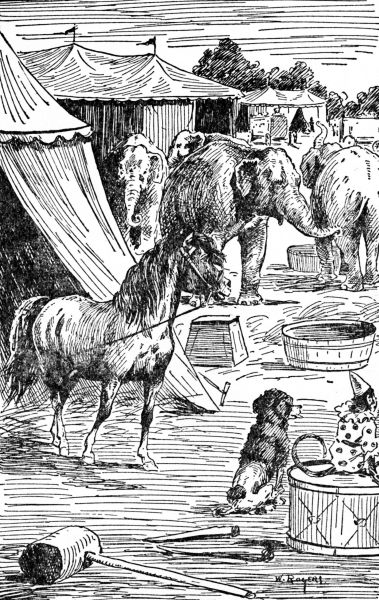
Merry Monkey,” “Tum Tum, the Jolly Elephant,”
“Don, a Runaway Dog,” “Flop Ear, the
Funny Rabbit,” etc.
ILLUSTRATED BY
WALTER S. ROGERS
PUBLISHERS BARSE & HOPKINS
NEW YORK, N. Y. NEWARK, N. J.
Tinkle stopped nibbling the sweet,
green grass of the meadow, blew a long
breath from his nose, raised his head
and looked around. Then he blinked his eyes
slowly, turned to look first on one side, then on
the other, and to himself he said:
“I’m going to run away!”
He did not say this aloud for fear some of
the other ponies or the horses would hear him.
Oh! I forgot to tell you that Tinkle was a little
pony, that lived in the big green meadow; and,
being a pony, of course Tinkle ate grass, and
liked it, too.
So, as I said, Tinkle stopped eating the grass
and said to himself once more:
“I’m going to run away!”
The reason Tinkle did not want the other
ponies and the horses to know what he was
going to do was because his mother and father
were over in one corner of the meadow, and
if they knew he intended to run away, they
would not let him do it; any more than your
mother or father would let you run away.
Of course I know that horses sometimes run
away when they are frightened by something,
and I suppose ponies, too, may, once in a while,
trot off when they ought not. But that isn’t
saying it is right.
“Yes,” said Tinkle to himself, “I’m going to
run away. I’m tired of staying in this meadow
all the while. Why, I’ve been here over a year
now, and there hasn’t a thing happened except
a thunder storm now and then, or a rain shower.
I want to see something more than that. I want
to have some fun, and go off to a big city, such
as the other horses tell about.
“Why, there’s Dapple Gray,” went on Tinkle,
looking at an old horse who had come to the
green meadow for a long rest. “I’ve heard
Dapple tell stories about drawing a big shiny
wagon that spouted fire and smoke just like the
chimney on the house where The Man lives.
That was great! I’d like to pull the kind of
wagon Dapple tells about, and hear the bells
ring and see the sparks fly and the water spout
out on the fire. I wonder what kind of wagon
it was?”
Of course you have guessed. It was a fire
engine that Dapple Gray had pulled, and he
never tired of telling the other horses about it.
Tinkle used often to listen to the stories
Dapple Gray and the other horses told as they
gathered in the shade of the clump of trees in
the green meadow after their dinner or their
breakfast of sweet, green grass.
For Tinkle lived on what is called a stock
farm, not far from a big city. The farm was
owned by a person whom the horses called “The
Man.” Really his name was John Carter and
he raised horses and ponies to sell to other
men.
Mr. Carter liked his horses very much, and
was very kind to them, and he loved his little
ponies, of whom Tinkle was one. The ponies
and the horses lived in a warm barn in the Winter,
but in the Summer they were “turned out
to grass,” and could walk or run all over the big
meadow, and do almost as they pleased.
Sometimes men would come to the stock farm
to buy horses. They might want one to pull
a coal wagon or a wagon from which vegetables
were sold. Some of the horses, like
Dapple, were used to haul fire engines, while
others pulled fine carriages in which rode men
and women. The ponies were sold, too, but
they were only put to such easy work as carrying
boys and girls around on their backs, or pulling
little carriages in the parks.
“But nothing like that ever happened to me,”
said Tinkle as he began slowly to walk away.
“So I’m going to run off, as far as I can go,
and maybe I’ll have some adventures like
Dapple Gray.”
Tinkle had eaten plenty of the sweet, green
grass, so he was no longer hungry. He did not
need to take anything to eat with him when he
ran away. In the first place ponies have no
pockets in which to carry anything, though, of
course, if they are hitched to a wagon, that would
hold corn, hay or oats which ponies like to eat.
But, as for that, all round in the meadow
where Tinkle lived was grass to eat. He had
only to stop and nibble some when he was hungry,
so he had no need to carry anything with
him.
“There is more here than I could eat all Summer,”
thought the little pony. “And when I
get tired of running away I can just rest myself,
eat grass and then run on some more.”
Though Tinkle called it “running away” he
was really walking. Just as some children do
when they start to run away, they don’t run at
all, but walk.
One reason why Tinkle did not care to run
was that he did not want his father, mother or
the other ponies or the horses to see him. They
might not notice him if he just walked, but if
he started to run some one would be sure to ask:
“Why, where is that Tinkle pony going
now?”
And then Tinkle’s mother would look up and
say:
“Oh, dear! That silly little pony will get
into trouble! I must go and bring him back.”
Then she would run after Tinkle, and all his
fun would be spoiled. Of course the ponies
and horses in the meadow used often to run
about, kick up their heels and roll over and over
on their backs in the soft grass. But this was
only because they felt so good and frisky and
lively that they simply could not do anything
else.
But when the colts ran that way, they
nearly always went around in a circle, like a
merry-go-round, only bigger, and the father and
mother horses thought nothing of that.
“I’m not going to run that way,” said Tinkle
to himself. “I’m going far off.”
By this time he was quite away from the other
horses. But, as he looked back, he saw them all
standing in a circle with their noses close together.
Dapple Gray was in the center of the
ring, and Tinkle’s father and mother were
among those on the outside.
“Dapple is telling another story about how
he drew the funny wagon with the chimney on,”
thought Tinkle. “I don’t want to hear that
again.”
Ponies and horses, you know, can talk among
themselves and think, just as we can, only, of
course, they can’t think quite as much perhaps,
nor as hard. But if they could not talk among
themselves how could the mother pony tell the
little pony what was good to eat and what not?
So, though horses and ponies can’t talk to us in
words as we talk to one another, they do speak
among themselves.
You have often heard horses and ponies
whinny, I suppose; and perhaps that is when
they are trying to talk to us, though I must say
I never could understand what they were trying
to say. Perhaps some day I may.
At any rate Tinkle was thinking to himself,
as he slowly wandered across the meadow. He
was thinking what wonderful things might happen
to him—adventures and travels.
On and on he wandered, looking back now
and then to make sure neither his father nor
his mother nor any of the others saw him.
But they were listening to Dapple Gray tell of
once falling down in the street while drawing
the fire engine and how nearly a trolley car ran
over him.
And the other horses liked the story so much
that none of them thought of Tinkle, or looked
at him. They listened to Dapple Gray.
The other young ponies, many of whom were
about the size of Tinkle, were down at the far
end of the meadow, having a game of what
you would, perhaps, call tag, though what the
ponies called it I do not know. Probably they
had some funny name among themselves like
“hoof-jump” or “tail-wiggle,” or something
like that.
Anyhow, they were having so much fun
among themselves that none of them paid any
attention to Tinkle.
“They won’t see me at all,” thought the little
pony. “I’ll run away where they can never
find me.”
Of course Tinkle was not doing this to be bad,
but he was just tired of staying in one place so
long, and he wanted to have adventures.
On and on he wandered, and finally he came
to a fence. Now the fence was put around the
meadow to keep the horses and the ponies from
getting out. But Tinkle had heard stories of
horses jumping fences so he thought he would
try it; for he was not strong enough to push
down the fence, as he had once heard of Bellow,
the big black bull, doing.
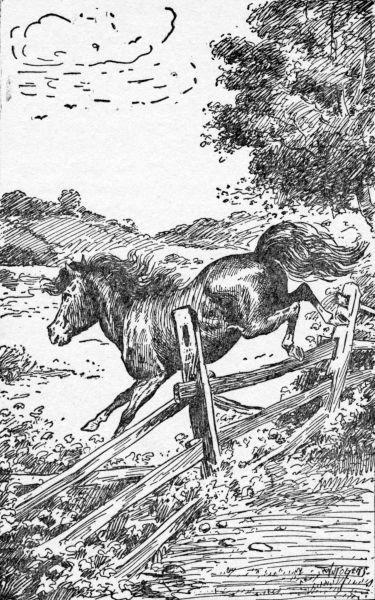
Standing off a little way from the fence Tinkle
ran toward it, gave a jump up in the air,
and then—he did not get over the fence. Instead
he fell against it and hurt himself.
“At last I have really run away,” thought the
little pony.
He found himself in another green meadow,
but it was not as nice as the one he had left. The
grass was longer, but it was hard and tough, and
hurt Tinkle’s mouth and tongue when he
chewed it.
“But I don’t have to eat it,” said the little
pony. “I can wait until I get to where there
is better grass. I’m not very hungry.”
So he walked on a little farther, and pretty
soon he came to some trees. In and out among
them he wandered, and when he stopped to look
back he found that he could no longer see the
meadow in which he had lived so long with
his father, his mother and the other ponies and
the horses.
“And they can’t see me, either,” thought Tinkle.
“They won’t know where I’ve gone, so
they can’t find me. I’m going to have a good
time all by myself, and there’ll be nobody to say:
‘Don’t do this. Don’t do that’; as they always
do when I’m in the green meadow.”
On and on went Tinkle and soon he was quite
a long distance from what had been his home.
Then he noticed that the ground, instead of
being hard and firm under his hoofs, was getting
soft and springy, and that his feet sank down in
it a little way. He saw, too, that when he lifted
his hoofs from the marks they left little pools
of water in the holes they made.
“This is queer,” thought Tinkle. “I must be
getting near the lake I have heard my father
tell about. I wonder if I can swim?”
Tinkle looked about, and just ahead he saw
a puddle of water. It was too small for a lake,
but there was enough of it for him to splash in,
and, as he was now thirsty, he ran on to get a
drink. And then a queer thing happened.
Just before Tinkle reached the water he felt
his legs and hoofs sinking down in the soft
ground. He tried to lift his left front foot, but
could not. And his right hind foot was also
stuck fast.
“Oh, dear! What has happened to me?”
cried poor Tinkle. “I can’t move!”
And really he could not. Tinkle was caught
fast in the sticky mud of a big swamp!
CHAPTER II TINKLE MAKES TROUBLE
Dapple Gray had just finished telling
the story of his being caught under
the trolley car, the time he was drawing
the fire engine.
“And so,” went on the old horse, “men came
and pushed the car off my legs. The firemen
loosened my harness and then I could get up.”
“Weren’t you hurt?” asked Mrs. Chestnut,
who was called that because she was colored
brown.
“Well, my legs were a bit scratched, and I
had some bruises on my side, but I could still
run and pull the engine. You see we horses
couldn’t stop whenever we wanted to. We had
to pull the funny chimney-wagon to where the
fire was blazing so the men could squirt water
on it.
“Men are queer,” went on Dapple Gray.
“They’ll build a big fire in a house so the house
almost burns up, and then they’ll make us
horses run like mad to draw water to put it out.
I never could understand it.”
Of course Dapple Gray did not know that
the house caught fire by accident and that it had
to be put out for fear other houses near it might
burn.
“And so you ran on, even if your legs were
cut?” asked Tinkle’s father.
“Oh, yes, of course,” replied Dapple Gray.
“The cuts hurt me, but when I got back to the
stable the firemen put some cooling salve on
the wounds and bound my legs up with white
rags so they felt better.”
“Well, I don’t believe I’d like that,” said Tinkle’s
mother. “Life is too exciting in the city.
I like it best in this quiet country meadow,
where you can eat grass whenever you like, or
rest in the shade when you are tired.”
“Look at those ponies having fun down
there,” said another horse, pointing with his
nose toward the group that was playing tag. “I
remember when I was young I liked to play
that way.”
“Is Tinkle there?” asked the pony’s father.
“He is one of the best taggers I’ve ever seen.
When he grows a little bigger he’ll be a fine
racer, I think.”
Tinkle’s mother looked toward where the
ponies were running about, touching one another
with their hoofs or noses, or switching at
one another with their frisky tails.
“I don’t see Tinkle,” she said.
“Oh, he must be there,” said Tinkle’s father.
“I’ll go and look.”
Off he trotted to where the other colts were
playing. He looked at them for a little while,
but he did not see Tinkle among them.
“That’s queer,” thought the father pony.
“Tinkle likes tag so much, I wonder why he
isn’t here?”
He stood still, looking more closely, to make
sure he had not missed the little pony; but no,
Tinkle was not there.
“I’ll ask some of them,” said the father pony
to himself. So, giving a loud whinny, to make
himself heard above the noise the tag-playing
ponies were making, the father pony asked:
“Have any of you seen our Tinkle?”
“No, I haven’t,” said a little brown pony.
“Nor I,” added one who was speckled brown
and white.
“I saw him a while ago, eating grass,” answered
a third.
“He hasn’t been playing tag with us this
morning,” added a fourth pony, who had a very
long tail.
“I wonder where Tinkle can be,” murmured
his father.
Then up spoke a little pony with a white spot
on his back.
“I saw Tinkle going over that way,” he said,
and he raised his hoof and pointed toward a
fence on the far side of the field.
“Did you really see him going that way?”
asked the father pony.
“I really did,” answered the little pony.
“Oh my! That’s too bad!” thought Tinkle’s
father to himself, but he did not say this to the
ponies, for he did not want to frighten them.
Well did the older pony know of the dangerous
swamp that was on the other side of the fence.
“If he is in the sticky bog-mud we’ll have
trouble getting him out,” said the father pony to
himself. “I must go back and tell some of the
others. But I don’t want Tinkle’s mother to
know. What shall I do?”
The father pony trotted back to where Dapple
Gray and the others stood.
“Well, was he there?” asked Tinkle’s mother.
Tinkle’s father shook his head.
“Where is he then?”
“Oh, he probably went off for a little walk
by himself. I’ll go and find him,” and he tried
to speak easily.
“But I don’t see him anywhere!” and the
mother pony looked anxiously about the big
green meadow. She could see every corner
of it, and Tinkle was not in sight.
“Now you just stay here, and I’ll bring him
back,” said Tinkle’s father quietly. At the
same time he nodded his head at Dapple Gray
and one or two of the other men-horses, and two
or three of his closest friends among the men-ponies.
They moved away together. Tinkle’s
mother looked at them as if to say:
“I wonder if anything could have happened?”
“What’s the matter?” asked Dapple Gray in
a low voice of Tinkle’s father, speaking in horse-talk,
of course.
“I’m not sure, but I’m afraid Tinkle has
jumped the fence and has gone over to the big
swampy bog,” was the answer. “If he has, and
is stuck fast, we’ll have to go and get him out.
But I don’t want his mother to know it.”
The men-animals walked over toward the
fence. Tinkle’s father looked down at the
ground. He saw little hoof marks.
“Yes, Tinkle has been here,” he said. “I can
see where he ran to get a good start so he could
jump over the fence.”
“He is a good jumper to do that,” remarked
one of the horses.
“Yes, Tinkle is a good jumper, for a colt,”
said his father. “I think he will be very smart
when he grows up. But he should not jump
fences into the swamp. That is not right.”
“How are we going to get over the fence to
help him if he is stuck?” asked Dapple Gray.
“Can’t we jump?” another horse inquired.
“Maybe you can, but I can’t,” returned Dapple
Gray. “One of my legs is stiff, where I was
hurt by the trolley car. Once I could easily
have jumped over that fence, but I’m afraid I
can’t do it now.”
“I don’t know whether I can either,” observed
Tinkle’s father. “I’m not so young as I
once was. But if we all push together I think
we can knock the fence down. Then we can get
through to see what has happened to my pony
boy. We want you to come along, Dapple, because
you have been in the big city where all
sorts of things happen to horses. You’ll know
what is best to do.”
“Thank you,” whinnied Dapple Gray.
“I’ll do my best.”
Together the big horses and the ponies pushed
at the fence. Tinkle’s mother watched them,
and when she saw what was being done she became
frightened.
“Something dreadful must have happened to
Tinkle,” she said. “I can’t stay here. I’m going
to see what it is.”
So she began to run toward the men-animals.
By this time they were giving a second push to
the fence, and, as they were very strong, they
knocked off some boards so they could get
through.
“Now we’ll see what has happened to
Tinkle,” said his father. “Tinkle! Tinkle!
Where are you?” he called.
But Tinkle did not answer, for he was far
away in the swamp, and just then he was splashing
around in the mud and water trying to pull
loose his feet from the sticky place.
“We’ll have to go farther on into the swamp,”
said Dapple Gray, when they had waited a minute
to see if Tinkle would answer.
“But we must be careful,” said one horse,
slowly picking his steps. “This is soft ground
here. See how deep my hoofs sink.”
“Indeed it is a bad place,” agreed Tinkle’s
father. “I hope nothing happens to us. Be
careful, every one.”
Slowly the horses and the ponies walked
along, picking out the hardest and firmest
ground they could find on which to step, especially
the horses, for they were, of course,
heavier than the most grown-up pony. Now
and then all stopped to listen, and Tinkle’s
father would call the pony’s name. At last
one of the horses said:
“Hark! I think I heard something.”
They all listened. Through the trees of the
swamp came a call:
“Help me! Help me!”
“That’s Tinkle!” cried his father. “We’re
coming, Tinkle. Where are you?” he asked.
“I’m over here, and I’m stuck in the swamp.
I can’t get my feet out of the mud!”
“I thought so!” exclaimed Dapple Gray.
“Just like a foolish little pony! Now we must
get him out.”
So anxious was he to help his little pony
that Tinkle’s father galloped on ahead. Some
of the others did the same. They did not listen
to Dapple calling:
“Wait! Be careful! Look out or you’ll be
caught in the swamp yourselves!”
On and on ran Tinkle’s father and the others.
They could tell which way to go by hearing
Tinkle’s voice calling to them, just as your dog
can tell where you are, even though he can not
see you, when he hears you whistling to him.
“There he is! I see him!” cried Tinkle’s
father as he came in sight of the pool of water,
on the edge of which the pony was stuck in the
mud.
“We’re coming! We’re coming, Tinkle!” he
cried.
Then something dreadful happened. Tinkle’s
father, and four or five of his friends, became
stuck in the swamp mud also. Their feet sank
away down, for they were heavier than Tinkle,
and, try as they did, they could not lift themselves
out.
“Oh!” cried Tinkle’s father. “We are caught
too!”
Only Dapple Gray had not been caught. He
had run slowly, fearing something like this
might happen.
Just see what trouble Tinkle made by running
away! For it was really his fault that the other
ponies and the horses became mired, though of
course Tinkle had not meant to do wrong. He
had not thought; but often not thinking makes
as much trouble as doing something on purpose.
“Help! Help!” cried Tinkle’s father. “We
are caught in the mud too.”
“Oh, dear!” whinnied Tinkle.
Dapple Gray saw what the matter was.
“Keep quiet, all of you!” he said. “The more
you flop about, the deeper you will sink in the
mud. I’ll go and get The Man to come with
ropes and pull you out. He and his helpers are
the only ones who can save you now. This is no
work for us horses alone. I’ll go for help.”
And, leaving Tinkle and the others stuck in
the swamp, back to the green meadow ran Dapple
Gray.
CHAPTER III TINKLE AND GEORGE
Dapple Gray, running toward the
hole which the horses had made by
pushing against the fence, met Tinkle’s
mother going into the swamp.
“Oh, my dear lady!” exclaimed the old fire
horse, “you must not go in there! You really
must not!”
“Why?” asked Tinkle’s mother. “Oh, I’m
sure something dreadful has happened! Tell
me what it is. Is Tinkle—Is Tinkle—” and
she could not ask any more.
“Now, it isn’t as bad as you think,” said Dapple
Gray. “Horses and ponies have been
caught in the swamp before. I remember when
I was a young colt I—”
“Oh, is my little Tinkle caught in the bog?”
asked his mother.
“Yes, I am sorry to say he is, and so are some
of the other ponies and horses—Tinkle’s father
among them,” said Dapple Gray. “But don’t
be worried. All they will have to do will be
to stay there until we can get The Man to come
with ropes and pull them out. They won’t be
a bit the worse for the adventure after they wash
the mud off. Now please don’t go in there, my
dear lady-horse, or you might get stuck too; and
goodness knows there is trouble enough!”
“Oh, I am so sorry Tinkle made trouble!” exclaimed
his mother. “He is usually such a
good little pony—”
“Oh well, boys will be boys!” exclaimed Dapple
Gray, or he said something about like that
which meant the same thing. And you all
know how frisky colts are; always kicking up
their heels and never knowing where they are
going to land.
“Of course Tinkle didn’t do exactly right in
running away and making this trouble,” said
Dapple Gray in a kind voice. “But then it
will be a lesson to him, and he won’t do it again,
I’m sure.”
“I should think once would be enough,”
sighed his mother. “But are you sure I can not
do anything to help?”
“Not in there,” said Dapple Gray, nodding
his head toward the swamp. “But you can
come with me, if you like, and we’ll go to get
The Man to help pull Tinkle and the others out
of the swamp.”
“Yes, I’ll do that!” whinnied Tinkle’s mother.
So she and Dapple Gray ran back to the green
meadow.
“What is it? What is it?” asked all the other
animals that were waiting by the hole in the
fence. These were the horses and the ponies
who had not gone into the swamp.
Dapple Gray quickly told them of the
trouble. At the same time he said:
“Don’t any of you go in there. The ground
is too soft now and if a lot of you horses trample
on it that will make it so much the softer, and
The Man and his friends will have trouble getting
in with their ropes and boards. So please
keep out.”
The horses promised they would, while Dapple
Gray and Tinkle’s mother ran as fast as
they could across the meadow. They wanted
to get to the long lane which led to the barn,
not far from which was the house where lived
“The Man,” as the horses called Mr. John Carter,
the stock dealer.
“How are we going to tell him that Tinkle
and the others are in the mire?” asked the pony’s
mother. “We can’t talk man-talk, you know.”
“Yes, I know,” said Dapple Gray. “But I
guess I can find a way to make him understand.
I know what I’ll do,” he said, as he galloped on.
“I’ll pick up a piece of rope in the barn and
take it to The Man in my teeth. He’ll know
that means we want him to bring other ropes
and get the horses out of the swamp.”
“I hope he will understand,” said Tinkle’s
mother.
“Oh, I think he will,” replied Dapple Gray,
hopefully.
As they ran past the barn, the big doors of
which were open, the old fire horse trotted inside.
He looked about, and on the floor he saw
a piece of rope. Picking this up in his teeth,
Dapple Gray, with Tinkle’s mother, ran on toward
the house. Out in the back yard stood
Mr. Carter talking to some of his hands.
“Look!” suddenly called one of the men.
“Some of the horses are out of the meadow.
They’re coming here!”
“So they are!” ejaculated Mr. Carter. “I
wonder what that means.”
“And Dapple Gray has a rope in his teeth,”
went on the man.
“Why, so he has!” exclaimed Mr. Carter. “I
wonder what that means.”
Right up to where the stock breeder and his
men stood ran Dapple Gray and Tinkle’s
mother. The old fire horse stretched out his
neck and shook his head up and down, the rope
flapping to and fro. He seemed to be offering
it to Mr. Carter.
“Ha! Dapple wants something,” said the
stockman. “I wonder what it is. I wish he
could talk.”
And then Dapple Gray did something which
was almost as good as talking. He rubbed the
rope that was in his mouth against Mr. Carter’s
hand, and then, dropping it at his feet, took hold
of the man’s coat in his teeth. Then the old
fire horse began to pull gently, just as often a
dog, when it finds some one in danger, will try
to lead somebody to the place to help.
“Why!” cried the surprised Mr. Carter. “I
believe Dapple wants me to come with him.”
“That’s what he does!” exclaimed one of the
hands.
“But what about the rope?” asked another.
“Maybe he wants me to bring that, too,” observed
the stockman. “I wonder if anything can
have happened to the horses?”
“I’ll go and take a look,” offered Mr. Carter’s
overseer. He quickly ran to a place where
he could look down into the green meadow.
“What is it?” asked Mr. Carter.
“All the horses seem to be over near a hole
in the fence,” the man reported. “And some
seem to be missing. I don’t see that little pony,
Tinkle, anywhere.”
“Whew!” whistled Mr. Carter. “Something
certainly has happened. This is Tinkle’s
mother,” he went on, looking at Dapple’s companion.
“Wouldn’t it be queer if Tinkle were in
trouble, and she had come to get you to help
him?” asked the overseer.
And of course you and I know that is just
what Tinkle’s mother did want, but the stockman
and his helpers did not know that yet.
“I think I see what the trouble is!” suddenly
cried Mr. Carter. “Some of the animals must
have broken down the fence and gotten into the
swamp! They’re mired there! We must get
ropes and haul them out. Smart horse, is Dapple
to tell me that! I’ll come right away.
Come on, men! Lively now.”
The man ran toward the barn for ropes, led
by Mr. Carter. Though Dapple and Tinkle’s
mother could not understand what the men said,
they knew that help would soon be carried to
Tinkle and the others held fast in the mud.
They trotted along after the men, who were
talking among themselves.
Of course horses and ponies understand some
man-talk, else how would they know they are
to stop when a man says “Whoa!” or to start
when they hear “Gid-dap!” or to back when
told to do so. But it takes a little time for a
horse to get to know these words, just as it does
your dog to know you want him to run toward
you when you say: “Come here!” or go back
when you point toward home, and tell him to
go there.
“Things will be all right now,” said Dapple
Gray to Tinkle’s mother, using horse-talk, of
course. “The Man will soon have all the
horses and ponies out of the bog.”
“Oh, I’m so glad you thought of a way to
tell him,” said Tinkle’s mother.
Taking some ropes and planks out of the
barn, Mr. Carter and his men ran on toward the
green meadow. It did not take them long to
reach the broken fence.
“Here’s where the rascals got through to the
swamp!” cried Mr. Carter. “I must make the
fence much stronger.”
Of course he did not know that Tinkle had
made all the trouble by first jumping over the
fence. The others had only broken it down to
go to help the boy-pony.
“Come on!” cried the stockman. “That bog
is a bad place. If they sink down too far we’ll
never be able to get them up again. Come on,
I say!”
On ran the men with the planks and the ropes.
They soon came to the place where the horses
and ponies were mired, as it is called.
“Tinkle is in deeper than any of them,” said
Mr. Carter. “We must get him out first.”
The men laid down the wide planks. The
pieces of wood were so broad that they did not
sink down in the soft mud, any more than wide
snow shoes will sink down when an Indian, or
any man, walks on them.
Then, standing on the planks, the men put
ropes about Tinkle and began to pull on them.
They also laid down planks near him so that
when he got one foot out of the mire he could
put it on a plank and it would not sink down
again.
After some hard work and much pulling on
the ropes, which hurt the little pony, Tinkle
was pulled out of the swamp, and led to firm,
dry ground, back in the meadow.
“And now you’d better stay there,” said Mr.
Carter. “Don’t try a thing like this again.”
“No indeed, you must never do it again!” said
Tinkle’s mother, for she could tell by Mr. Carter’s
voice that he was, in a way, scolding the
pony. “See what a lot of trouble you made
your father and me, as well as Dapple Gray and
our other friends,” said Tinkle’s mother.
“I—I’m sorry,” said the little pony. “I’m
never going to run away again.”
“And see how muddy and dirty you are,” went
on his mother. “You had better go to the brook
and wash yourself.”
“Oh, let me stay and watch them get my
father and the others out of the swamp,”
begged Tinkle, so his mother let him stay.
It was not quite so hard to get the others out
as it had been to save Tinkle, for they were not
so deep in the mud. But it took Mr. Carter and
his men quite a while. Finally, however, the
ponies and the horses were all saved from the
swamp.
“And I hope they never get caught that way
again,” said the stockman, while Tinkle and the
ponies and the horses hoped the same thing.
After the mud was washed off them, the animals
were not much worse off for what had happened.
Tinkle was sorry and ashamed for all
the trouble he had caused, and he told the other
ponies and his horse-friends so.
For some time after this Tinkle lived with
his father, mother and friends in the green
meadow. He played with the other children-ponies,
but he did not try to run away again.
He did want to have some adventures, though,
and he was soon to have some very strange ones.
One day, about a year later, a rich man called
at the stock farm to buy a horse for his carriage.
With the man, who was a Mr. Farley, was his
son George, about nine years old.
“Yes, I have some good carriage horses,” said
Mr. Carter to Mr. Farley. “Suppose you come
down to the meadow and pick out the one you
like best.”
“May I come too?” asked George.
“Yes, I think so,” answered his father. “The
horses won’t kick; will they?” he questioned.
“Oh, not at all,” answered Mr. Carter.
“They are all gentle.”
So George went with his father to look at the
horses. But no sooner had the little boy caught
sight of the ponies than he cried:
“Oh, see the little horses. I want one of them.
Please, Daddy, buy me a pony!”
“Eh? What’s that? Buy you a pony!” cried
his father, half teasing. “Why you couldn’t ride
a pony.”
“Oh, yes I could!” said the little boy. “Anyhow
I could drive him hitched to a pony cart.”
“But we haven’t a pony cart.”
“Well, couldn’t you get one? Oh, please get
me a pony, Daddy!”
“Ah, um! Well, which one would you want,
if you could have one?” asked Mr. Farley, half
in fun.
George looked over the ponies who were cropping
grass not far away. The boy’s eyes rested
longest on Tinkle, for Tinkle was a pretty pony,
with four white feet and a white star right in the
middle of his head.
“This is the pony I want!” cried George, and,
before his father could stop him the boy ran
straight to Tinkle and put his arms around the
pony’s neck.
CHAPTER IV TINKLE’S NEW HOME
“George! George! Come away!”
cried his father. “That pony may
kick or bite you!”
“Oh, no, Tinkle won’t do that,” said Mr. Carter.
“Tinkle is a gentle pony, which is more
than I can say of some I have. A few of them
are quite wild. But the only bad thing Tinkle
ever did was, one day, to leave the meadow and
get mired in a swamp. But I got him out.”
“He wasn’t really bad, was he?” asked
George, who was standing near the pony, patting
him.
“Well, no, I guess you wouldn’t call it exactly
bad,” said the stockman with a smile. “Tinkle
just didn’t know any better. He wanted to have
some fun, perhaps; but I guess he won’t do that
again.”
“I won’t let him run away when I have him,”
said George.
“Oh, ho!” cried Mr. Farley with a laugh.
“So you think you are going to have Tinkle for
your own, do you?”
“Won’t you get him for me?” begged the
little boy. “Mabel and I could have such fun
riding and driving him.” Mabel was George’s
sister. She was a year younger than he.
“Do you think it would be safe for a little
boy like mine to have a pony?” asked Mr. Farley
of the stockman.
“Why, yes, after Tinkle is trained a bit,” said
Mr. Carter. “He has never been ridden or
driven, but I could soon get him trained so he
would be safe to use both ways. Do you think
you want to buy him?”
“Well, I might,” said Mr. Farley slowly.
He was thinking whether it would be best or
not. He did not want either of his little children
to be hurt by a pony that might run away.
“I’ll tell you what we’ll do,” said the owner
of the stock farm. “I’ll sell you a horse for
yourself, and then I’ll start at once to teach Tinkle
what it means to have some one on his back,
and also how he must act when he is hitched
to a pony cart. I am going to train some of
the other ponies, and I’ll train him also. He
is old enough now to be trained. Then you and
your little boy come back in about two weeks
and we’ll see how George likes Tinkle then,”
finished Mr. Carter.
“Oh, I’ll love him all the more!” cried
George. “I love him now, and I want him for
my very own! He is a fine pony!” and once
more George patted the little creature.
“You couldn’t do that to some of the ponies,”
said Mr. Carter, as he and George’s father
walked back toward the house. “They would
be too wild, and would not stand still. But Tinkle
is a smart little chap.”
“Good-by!” called George to Tinkle as the
small boy walked away with his father. “I’ll
come back to see you soon,” and he waved his
hand at Tinkle and Tinkle waved his tail at
George. At least George thought so, though I
imagine that Tinkle was only brushing off a
tickling fly.
But one thing I do know, and that was that
Tinkle really liked the little boy who patted
him so nicely.
“He has very nice, soft hands,” said Tinkle
to Curley Mane, another pony, as they cropped
the sweet grass together. “I’m sure he would
be good to me.”
“Are you going to live with him?” asked
Curley Mane.
“Oh, I don’t know,” Tinkle answered. “But
I’ve always noticed that whenever any strange
men or boys come to the farm here, in a few
days afterward some of the horses or ponies go
away, and I guess the men and boys take them.”
“Yes, that is right,” said old Dapple Gray
walking up beside the two ponies. “You’ve
guessed it, Tinkle. The Man, here, raises us
horses to sell. I’ve been sold more than once.”
“Is it nice to be sold?” asked Tinkle.
“Well, it all depends,” was the answer. “The
first place I was sold to was not nice. I had
to draw a grocery wagon through the streets,
and the boy who sat on the seat used to strike
me with a whip.”
“What did you do?” asked Curley Mane.
“Well, I’m sorry to say I ran away. It wasn’t
the right thing to do, only I couldn’t help it.
I couldn’t stand being beaten. The boy fell off
the seat of the wagon, I ran so fast, and he
bumped his nose. Then the wagon was
smashed and I was cut and bruised and I had
a terrible time,” said Dapple Gray.
“Then the grocery man brought me back here,
saying he didn’t want me, and after that I was
sold to some men that made me draw the big
shiny wagon that had a chimney spouting flames
and smoke. I was treated well there. I had
a nice stall with plenty of hay to eat and clean
straw to sleep on. Sometimes I had oats, and
I got so I could run very fast indeed.
“But it was hard work, and I soon grew tired.
So they brought me back here again. That’s
what being sold means. You never can tell
where you’re going.”
“Do you think some of the horses here were
sold to that man and little boy?” asked Tinkle.
“We can tell pretty soon,” answered Dapple
Gray, “by watching to see if any horses or ponies
are taken away.”
And, surely enough, the next day one of the
men on the stock farm took away one of the
horses. He was called Hobble by the other
horses because, when he was a colt, he hurt his
foot on a sharp stone and had to hobble for a
week or two. But he soon got over that. And
Hobble was the horse George’s father had bought
for himself, though Mr. Carter named the horse
Prince.
“Good-by!” called Hobble, or as we must
call him, Prince, to his friends as he was led
away from the stock farm. “Maybe I’ll see
some of you again before long.”
“I don’t believe so,” called back Dapple Gray.
But neither he nor any one else knew what was
going to happen to Tinkle.
When Prince had been driven to a big city,
a few miles away from the stock farm, he was
taken into a nice clean stable where there were
one or two other horses.
“Ah, so that’s the new horse I bought, is it?”
asked a voice, and looking behind him, from
where he was tied in his stall, Prince saw Mr.
Farley. Of course Prince did not know the
man’s name but he knew he was the same one
who had been at the stock farm.
“I wonder,” thought Prince, “where the little
boy is that was patting Tinkle.”
He did not have to wonder long for he soon
heard another voice calling:
“Oh, Daddy! Did the new horse come?”
“Yes, he’s in his stall,” said Mr. Farley.
“And did he bring Tinkle?” asked George.
“No, not yet. Tinkle won’t be ready for a
week or so. And I am not sure I am going to
get him for you.”
“Oh, yes you are, Daddy! I know you are
when you smile that way!” cried Mabel, who,
with her little brother, had come out to the
stable. “Won’t we have fun, George,” she
cried gaily, “when we have a pony of our
own?”
“We surely will!” said George.
“Don’t be too sure,” returned Mr. Farley,
but he could not keep his eyes from laughing,
even if his lips did not smile.
Prince soon made friends with the other
horses in Mr. Farley’s stable, and they rubbed
noses and talked among themselves in a way that
all horses have.
And now I must go back to the stock farm to
see how Tinkle is getting on, for this story is
mostly about him.
“Well,” said Mr. Carter to one of his men a
day or two after Prince had been sold and taken
to Mr. Farley, “I think it is time we started
to train Tinkle, if that little boy George is to
have him. We want to get the pony used to
having a saddle on his back, and also teach
him how to draw a pony cart.”
So Tinkle began to have his first lessons, for
animals like horses and dogs, as well as trained
animals in a circus, have to be taught lessons,
just as you are taught lessons in school. Only,
of course, the lessons are different.
Tinkle was driven into the stable yard and
while one of the men was patting him and giving
him some oats to eat—which Tinkle liked
very much—another man slipped some leather
straps over the pony’s head. Tinkle did not like
this, for never, in all his life, had he felt anything
tied on his head before. He tried to run
away and shake it off, but he found himself held
tightly by a long strap, which was fast to the
other straps on his head.
“I wonder what in the world this is?” thought
Tinkle, when he found he could not shake off
the straps. Afterward he learned it was a
halter, which is the rope, or strap, that is used
to keep a horse or pony tied in his stall. Sometimes
the straps, or ropes, are called a “head-stall.”
So this is what Tinkle was held fast by, and
when he found that no amount of pulling or
shaking would get it off his head he stood
quietly.
“Maybe if I am good they’ll take it off anyhow,”
he thought.
But Tinkle had many more lessons to learn.
I will not tell you all about them here, because
I know lessons aren’t any too much fun, though
we all have to learn them.
So I’ll just say that after Tinkle had become
used to the halter he was given a bridle. This
was not so nice, as there was an iron thing fast
to it, called a “bit,” and this had to go in Tinkle’s
mouth so he could be driven.
“Oh, I don’t like this at all!” cried Tinkle
as he tried to get the bit out from between his
teeth. But it was held fast by straps, and a man
pulled first on one strap, and then on the other,
hauling Tinkle’s head to the left or right. Soon
the pony found that when his bit was pulled
to the left it meant he was to walk or run that
way, and so, also, when the other strap, or rein,
was pulled, he must go to the right. After a
while he did not mind the bit at all.
Next Tinkle had to learn to have a saddle
fastened to his back. First a blanket was
strapped on him, and Tinkle tried to get this
off by rolling over and over. But the blanket
stayed on, for it was fastened by straps, and soon
the little pony did not mind that. Then when
the saddle was put on he thought it was only
another kind of blanket at first, and when he
came to know (for his mother told him) that all
horses and ponies had to wear saddles part of
the time Tinkle did not mind that.
Tinkle was frightened when one of the boys
on the stock farm got in the saddle on the pony’s
back to have a ride. It was the first time Tinkle
had ever had any one on his back and he
really was quite frightened. But he soon grew
used to that also, and trotted around, walking
and running as the boy told him to.
“Well, Tinkle is learning quickly!” said Mr.
Carter one day. “As soon as he learns to draw
a pony cart he will be ready for that boy George
to drive.”
Being hitched to a cart, with harness straps
all over him, did not feel comfortable to Tinkle
at first.
“I don’t like this at all!” he thought. “It
isn’t any fun!” But he found he could not get
away from the cart, which followed him everywhere
because he was hitched fast to it. Then
he was driven about, made to turn around, and
to the left and to the right by a boy who rode in
the pony cart.
“Well, I might as well make up my mind to
it,” said Tinkle, telling the other ponies what
had happened to him.
“Yes, indeed,” remarked Dapple Gray.
“That is what you ponies and we horses are
for—to give people rides, or to pull their wagons.
That is our life and if you are good
you will be treated kindly.”
“Then I am going to be good,” said Tinkle.
In another week the pony could be ridden
or driven very easily, and Mr. Carter sent word
to Mr. Farley to come and bring George with
him to the stock farm.
“Oh, what a fine pony he is!” cried the little
boy as he saw how easily Tinkle was ridden and
driven. “Do get him for me, Daddy!”
“Yes, I think I’ll buy him,” said Mr. Farley,
so he paid Mr. Carter for the pony. Tinkle
was taken to his new home, George and his
father riding in the pony cart. Mr. Farley
drove, but let George hold the reins part of
the time.
“For you must learn to drive if you are going
to have a real live pony,” said George’s father.
So Tinkle left the stock farm, and went to
live in his new home, a big city stable.
CHAPTER V TINKLE’S FRIENDS
“Well, I never expected to see you
here!” exclaimed a whinnying voice
as Tinkle was led into his stall. The
little pony looked up in surprise and saw a big
horse.
“Oh! Why, hello, Hobble!” cried Tinkle,
as he saw the horse that used to live on the stock
farm with him.
“My name isn’t Hobble any more—it’s
Prince.”
“Oh, well. Hello, then, Prince!” called Tinkle
in a cordial, off-hand manner, for he now felt
quite grown up. Had he not been hitched up,
and had he not carried a boy on his back? “I
didn’t know you were here.”
“And I didn’t know you were coming,” observed
Prince. “How is everything back on
the farm?”
“Oh, there’s not much change. I was sorry
to come away and leave my father and mother.”
“Well, that’s the way things happen in this
world,” said Prince. “We are colts for a little
while, and then some of us grow to be big
horses or grown-up ponies and have to go away
from our friends. It’s just the same with men
and women, I’ve heard. But you’ll like it
here.”
“Is it nice?” asked Tinkle.
“Nice? I should say it is! Of course, I miss
being out in the big, green, grassy meadow.
But I get plenty to eat here, and every day a
man scratches my back—”
“Scratches your back?” cried Tinkle. “I
don’t believe I should like that!”
“Oh, yes you will,” said Prince. “You can’t
imagine how your back begins to itch and ache
when you’ve been in the harness all day. And
when a man uses a brush and comb on you—”
“A brush and comb!” cried Tinkle. “Come,
you’re joking! I know men and women, as well
as boys and girls, use brushes and combs, but
ponies or horses—”
“Yes, we really have our own brushes and
combs, though they are different from those
which humans use,” said Prince. “The brush
is a big one, more like a broom, and the comb
is made of iron and is called a currycomb. But
they make your skin nice and clean and shiny.
You’ll like them.”
“Maybe,” said Tinkle. “Is anything else different
here from what it was on the farm?”
“Oh, lots and lots of things. You have to
have shoes on your feet.”
“Oh, now I’m sure you’re fooling me!” cried
Tinkle in horse-talk. “Who ever heard of
ponies having shoes!”
“Well, of course they’re not leather shoes,
such as boys and girls wear,” went on Prince.
“They are made of iron, and they are nailed on
your hoofs.”
“Nailed on!” cried Tinkle. “Oh, doesn’t
that hurt?”
“Not a bit when a good blacksmith does it,”
explained Prince. “You see our hoofs are just
like the finger nails of boys and girls. It doesn’t
hurt to cut their finger nails, if they don’t cut
them down too close, and it doesn’t hurt to
fasten the iron shoes on our hoofs with sharp
nails. Don’t you remember how Dapple Gray
used to tell about his iron shoes making sparks
on the paving stones in the city when he ran
and pulled that funny shiny wagon with the
chimney?”
“Oh, yes,” answered Tinkle; “I do remember.
Well, I suppose I’ll have to be shod then.”
“Of course,” returned Prince. “If you don’t
have the iron shoes on your hoofs they would
get sore when you ran around on the stony
streets. A city is not like our green meadow.
There are very few soft dirt roads here. That
is one thing I don’t like about a city. Still there
is always something going on here, and lots to
see and do, and that makes up for it, I guess.”
“I wonder how I shall like it,” thought
Tinkle. “But first I must see what my new
home is like.”
He looked around the stable. It was a large
one, and there were a number of stalls in it. In
each one was a horse, like Prince, munching his
oats or chewing hay. Tinkle saw that his stall
was different from the others. It was like a big
box, and, in fact, was called a “box stall.”
Tinkle did not have to be tied fast with a rope
or a strap to the manger, which is the place where
the feed for the ponies and horses is put. There
was a manger in Tinkle’s stall and he could
walk up to it whenever he felt hungry.
Tinkle did not remember much about the
stable at home on the farm, as he was hardly
ever in it. Night and day, during the warm
Summer, he stayed out in the green meadow,
sleeping near his mother under a tree.
Tinkle was kicking the straw around in his
stall, making a nice soft bed on which he could
lie down and go to sleep, when George, who had
gone into the house to get something to eat after
driving with his father from the stock farm,
came running out to the stable again.
“How’s my pony?” cried George. “How’s
my Tinkle?”
Tinkle made a sort of laughing sound—whinnying—for
he now knew George’s voice and he
liked the little boy.
“Here’s something nice for you!” cried
George.
“Oh, what are you going to give him?” asked
Mabel, who had come home from school and
who had also hurried out to see Tinkle.
“I’m going to give him some sugar,” answered
George. “I took some lumps from the bowl
on the table. Mother said I might.”
“Are you going to let him eat them out of
your hand?” asked the little girl.
“Of course,” answered George.
“Won’t he bite you?”
“Not if you hold out your hand flat, like a
board,” said George. “The man at the farm
showed me. Put the sugar on the palm of your
hand, open it out flat and a horse can pick up
a lump of sugar, or an apple without biting you
a teeny weeny bit. Look!”
George opened the top half of the door to
the box stall where Tinkle had his home and
held out on his hand the lump of sugar. Tinkle
came over, smelled of the lump to make sure
it was good for him to eat, and then he gently
took it in his soft lips, and began to chew the
sweet stuff.
“Oh, isn’t that cute!” cried Mabel. “Let me
feed Tinkle some sugar.”
Her brother gave her a lump, and she held it
out on her hand. Tinkle, having eaten the first
lump, which he liked very much, was quite
ready for the second. He took it from Mabel’s
hand as gently as he had taken it from
George’s.
“Oh, he is a lovely pony!” cried the little girl.
“How soon can we have a ride on him?”
“Well, you can ride him around the yard
now,” said her father, who had come out to the
stable. “But before he is driven around the
city streets he must be shod. I’ll send him to a
blacksmith. But for a while now you and
George may take turns riding him. I’ll have
Patrick saddle him for you.”
Patrick was Mr. Farley’s coachman, and
knew a great deal about horses and ponies.
The pony cart which Mr. Farley had bought
from the stockman, together with a harness and
saddle for Tinkle, had been put away. Patrick
now brought out the saddle, and, after putting
a blanket on the pony, fastened on the saddle
with straps.
“Now who’s to ride first?” asked the coachman.
“Let Mabel,” said George, politely. “Ladies
always go first.”
“I’d rather you’d go first so I can see how you
do it,” said the little girl, and George was glad,
for he did want very much to get on Tinkle’s
back again. He had ridden a little at the stock
farm and, oh! it was such fun!
Patrick helped George into the saddle, and
then led Tinkle about the yard, for Mr. Farley
wanted to make sure the pony would be safe
for his little boy to ride.
“I’ll be very careful,” said Tinkle to himself.
“George and his sister are going to be kind to
me, I’m sure. I’ll not run away.”
Tinkle remembered what his father and
mother had told him about behaving when he
was in the harness, or had a saddle on.
“And if I’m good,” thought the pony, “maybe
I’ll get more lumps of sugar.”
“Let him go now and see if I can drive him,”
said George to Patrick. So the coachman
stepped aside and George held the reins in his
own hands.
“Gid-dap, Tinkle!” cried George, and the
pony knew this meant to go a little faster. So
he began to trot on the soft, green grass of the
big yard about the Farley home.
“Oh, how nice!” cried Mabel, clapping her
hands.
“Yes, it’s lots of fun!” laughed George. “Go
on, Tinkle.”
When George had ridden twice around the
yard it was Mabel’s turn. At first she was a
little afraid, but her father held her in the saddle,
and she could soon sit on alone and guide
Tinkle, who did not go as fast with her as he had
gone with George.
“For she might fall off, and I wouldn’t want
that to happen,” thought Tinkle. “They might
say it was my fault, and give me no more lumps
of sugar.”
While Mabel was riding, another boy and a
girl came into the yard. They were Tommie
and Nellie Hall, who lived next door.
“Oh, what a lovely pony!” they cried.
“Where did you get him?”
“My father bought him for Mabel and me,”
explained George. “See how soft his hair is,”
and he patted Tinkle. Tommie and Nellie
also patted the pony and called him all sorts
of nice names.
“My! I think I am going to like it here,”
thought Tinkle. “I have four new, good, little
friends. I will try to make them love me.”
CHAPTER VI TINKLE MEETS DIDO
Every morning, as soon as he had eaten
his breakfast, George would run out to
the stable to see Tinkle. He would rub
the soft, velvety nose of his pet pony, or bring
him a piece of bread or a lump of sugar. Sometimes
Mabel, too, would come out with her
brother to look at Tinkle before she went to
school.
“And when we come back from school we’ll
have a ride on your back,” said George, waving
his hand to Tinkle.
A few days after he had been brought to his
new home Tinkle had been taken to a blacksmith’s
shop and small iron shoes had been
fastened to the pony’s hoofs.
At first Tinkle was afraid he was going to
be hurt, but he thought of what Dapple Gray
and the other horses had told him and made up
his mind—if ponies have minds—that he would
stand a little pain if he had to. But he did not.
The blacksmith was kind and gentle, and though
it felt a bit funny at first, when he lifted up one
of Tinkle’s legs, the pony soon grew used to it.
It felt queer, too, when the iron shoes were
nailed on. And when Tinkle stood on his four
newly shod feet he hardly knew whether he
could step out properly or not. But he soon
found that it was all right.
“I’m taller with my new shoes on than in my
bare hoofs,” said Tinkle to himself, and he was
taller—about an inch I guess. The clatter and
clang of his iron shoes on the paving stones
sounded like music to Tinkle, and he soon found
that it was better for him to have iron shoes on
than to run over the stones in his hoofs, which
would soon have worn down so that his feet
would have hurt.
“Now Tinkle is ready to give us a ride in the
little cart!” cried George when his pony had
come home from the blacksmith shop.
“Take Patrick with you so as to make sure
you know how to drive, and how to handle
Tinkle,” said Mrs. Farley, as George and Mabel
made ready for their first real drive—outside
the yard this time.
George and Mabel got into the pony cart,
George taking the reins, while Mabel sat beside
him. Patrick, the coachman, sat in the back of
the cart, ready to help if he were needed.
“Gid-dap!” called George, and he headed the
pony down the driveway. “Gid-dap, Tinkle,”
and Tinkle trotted along.
“Don’t they look cute!” exclaimed Mrs.
Farley to her husband as they watched the children
from the dining room window. “I hope
nothing happens to them.”
“Oh, they’ll be all right,” said her husband.
“Tinkle is a kind and gentle pony. Besides
there is Patrick. He’ll know just what to do if
anything should happen.”
“Well, I hope nothing does,” said Mrs. Farley.
“There! they’ve stopped! I wonder what
for.”
The pony cart had stopped at the driveway
gates, and Patrick, with a queer smile on his
face, came walking back.
“What is it?” asked Mrs. Farley. “Did anything
happen—and so soon?”
“No’m,” replied the coachman, “but Master
George wants to know if you’d like to have him
bring anything from the store. He says he’d
like to buy something for you.”
“Oh!” and Mrs. Farley laughed. “Well, I
don’t know that I need any groceries. But I
suppose he wants to do an errand in the new
cart. So tell him he may get a pound of loaf
sugar. He and Mabel can feed the lumps to
Tinkle.”
“Very well, ma’am, I’ll tell him,” and, touching
his hat, Patrick went back to George and
Mabel.
“Well, I guess everything is all right,”
thought Tinkle to himself as he trotted along
in front of the pony cart, hauling George,
Mabel and Patrick. “It’s a good deal easier
than I thought, and my new iron shoes feel
fine!”
So he trotted along merrily, and George and
his sister, sitting in the pony cart, enjoyed their
ride very much. George drove Tinkle along
the streets, turning him now to the left, by pulling
on the left rein, and again to the other side
by jerking gently on the right rein.
“Am I doing all right, Patrick?” asked the
little boy.
“Fine, Master George,” answered the coachman.
“You drive as well as anybody.”
“I’ll let you take a turn soon, Mabel,” said
George.
“Oh, I don’t want to—just yet,” replied the
little girl. “I want to watch and see how you
do it. Besides, I’d be afraid to drive where
there are so many horses and wagons,” for they
were on the main street of the city.
“You’ll soon get so you can do as well as
Master George,” declared Patrick. “Tinkle is
an easy pony to manage.”
As George and Mabel traveled on in their
pony cart, they met several of their playmates
who waved their hands to the Farley children.
“I’ll give you a ride, some day,” promised
George.
He and Mabel were soon at the store, and,
going in, they bought the loaf sugar. Patrick
stayed out in the pony cart, and Tinkle stood
still next to the curb. Near him was a horse
hitched to a wagon full of coal.
“Hello, my little pony!” called the coal-horse.
“You have a fine rig there.”
“Yes, it is pretty nice,” said Tinkle, and he
was sure he must look very gorgeous, for Mabel
had tied a blue ribbon in his mane that morning.
“You’re quite stylish,” went on the coal-horse.
“Well, I s’pose you might call it that,” admitted
Tinkle.
“It’s much more fun to be pulling a light,
little cart like that around the city streets, than
to haul a great big heavy coal wagon, such as
I am hitched to,” went on the big horse.
“Yes, but see how strong you are!” observed
Tinkle. “I never could pull such a heavy load
as you haul.”
“No, I guess you couldn’t,” said the coal horse.
“Especially up some of the hills we have. It is
almost more than I can do, and there is one hill
that I have to take a rest on, half way up, but
my driver is good to me, and never whips me,
which is more than I can say of some drivers I
have known. So I guess, after all, it is better
for you to draw the pony cart and for me to stick
to the coal wagon.”
“Indeed it is,” said a horse that was hitched
to one of the grocery wagons. “You’d look
funny, coal-horse, trying to fit between the shafts
of that pony cart.”
“I suppose I would,” admitted the other,
laughing, in a way horses have among themselves.
When George and Mabel came out of the
store, with the bag of sugar lumps, they saw the
two horses—one hitched to a coal wagon and the
other to a grocery cart—rubbing noses with
Tinkle.
“They’re kissing each other,” laughed the
little girl.
But the horses and the pony were really talking
among themselves, and even Patrick, much
as he knew about animals, did not understand
horse-talk.
“Let’s give Tinkle some sugar now,” said
Mabel.
“All right,” answered George, so they gave
the pony two lumps.
“My, that sugar certainly smells good!” exclaimed
the horse that was hitched to the coal
wagon.
“It certainly does,” said the other horse, sniffing
hard through his nose, for the air was filled
with the sweet smell of the sugar lumps Tinkle
was eating. “You might think,” went on the
grocery horse, “that, working for a store, as I
do, I’d get a lump of sugar once in a while.”
“Don’t you?” asked Tinkle, reaching out for
another sweet lump George offered him.
“Never a bit!” said the grocery-horse, “and
I just love it!”
“So do I,” said the coal-horse.
“I’m sorry I didn’t offer you some,” apologized
Tinkle. “But it’s too late now. I’ve
swallowed it.”
Just then Mabel thought of something nice.
“Oh, George!” she cried. “Let’s give the two
horses some of Tinkle’s sugar. I guess horses
like sweet stuff the same as ponies. Don’t they,
Patrick?” she asked the coachman.
“Sure they do, Miss Mabel,” he answered.
“Sure they do!”
“Then give them some, George,” she begged.
“We have more than enough for Tinkle.”
“All right,” said the little boy. So he held
out two lumps of sugar to the coal horse, and two
to the grocery horse, and I just wish you could
have seen how glad those horses were to get the
sweet stuff. If they could have talked man language
they would have thanked George and
Mabel, but as it was they could only say to one
another and to Tinkle:
“Well, you certainly have a good home with
such nice children in it.”
“I’m glad you think so,” whinnied Tinkle to
them, and he felt very happy.
George and Mabel drove home in their pony
cart, carrying what was left of the bag of sugar.
When they were near their home, and on a quiet
street, George let his sister take the reins so
she would learn how to handle them. Patrick
watched the little girl carefully and told her
how and when to pull, so Tinkle would go to the
right or to the left, and also around the corners.
“Oh, Mother! now I know how to drive!”
cried Mabel as she ran into the house to tell her
father and Mrs. Farley about their first trip
downtown in the new pony cart.
After that George and Mabel had many rides
behind Tinkle, even in the Winter, when they
hitched him to a little sled. The little pony
grew to like his little boy and girl friends very
much indeed, and they loved him dearly. They
would hug him and pat him whenever they went
out to the stable where he was, and feed him
lumps of sugar. When Spring came they took
long rides in the country.
One day a funny thing happened to Tinkle.
He had been hitched to the pony cart which was
tied to a post in front of the house, waiting for
George and Mabel to come out. And then,
from somewhere down the street sounded the
tooting of a horn, and a queer odor, which made
him tremble, came to the pony’s nostrils.
“I wonder what that is?” said Tinkle to himself.
Very soon he found out.
Along came a man wearing a red cap, and
every once in a while he would put a brass horn
to his mouth and blow a tooting tune. But this
was not what surprised Tinkle most. What did,
was a big shaggy animal, that the man was leading
by a chain. And when Tinkle saw the
shaggy creature he was afraid. But the other
animal, rising up on its hind legs said:
“Don’t be afraid of me, little pony. I won’t
hurt you!”
“Who are you?” asked Tinkle, wonderingly.
“I am Dido, the dancing bear,” was the answer,
“and I have had many adventures that have
been put into a book.”
CHAPTER VII TINKLE DOES SOME TRICKS
For a few seconds Tinkle stood looking at
Dido, the dancing bear, not knowing what
to do or say. Some ponies would have
been afraid of a bear. They would have
snorted, stood on their hind legs, and maybe have
run away. But Tinkle had never seen a bear
before, no one had ever told him about them,
and he really did not know enough to be afraid.
Besides, Dido seemed such a funny, good-natured
and happy bear that I believe no one would
have been afraid of him.
“So you are Dido, the dancing bear, are you?”
asked Tinkle. “And you say you are in a book.
What does that mean?”
“I’ll tell you,” went on Dido, while his master,
the man who blew such jolly tunes on the brass
horn, was picking up some apples that had fallen
from a roadside tree. He let Dido walk on
ahead, without even a string tied to him, for he
knew that Dido would not run away.
“You see, it’s this way,” went on the dancing
bear. “Years ago I used to live in the woods
with my father and mother, sisters and brothers.”
“I never lived in the woods,” said Tinkle, “but
I lived in a big, green field.”
“That was nice,” murmured Dido. “I have
been in the fields, too. Well, one day I was
caught by a man, who took me away. At first
I did not like it, but the man was good to me
and taught me to do tricks.”
“What are tricks?” asked the pony, for he
could speak all animal languages as well as understand
them.
“Tricks are—well, I’ll show you in a minute,”
went on Dido. “The man was good to
me, as I said, and taught me tricks. Then I was
sold to a circus and I had lots of good times
with Tum Tum, the jolly elephant and Mappo
the merry monkey. They are in books, too.”
“What are books?” asked Tinkle. “Are they
good, like sugar; and do you eat them?”
“Oh, no!” laughed Dido. “Books are funny
things, like blocks of wood; only you can open
them, like a door, you know, and inside are funny
black marks on paper that is white, like the snow.
Boys and girls, and men and women, open these
funny things called books and look at them for
ever and ever so long.”
“Why do they do that?” asked Tinkle.
“Well, I don’t really know,” said Dido. “But
after they have looked at the books, turning over
the white things with the black marks on, called
leaves, the boys and girls laugh.”
“Why?” Tinkle demanded.
“Because of the funny things printed on
them,” answered Dido. “You see in my book
are set down all the things I did. And the
things Mappo did and the things Tum Tum did
are in their books. Some of the things were
funny, and that is what makes the boys and girls
laugh. Tum Tum’s book is enough to make any
one laugh. He is a very jolly elephant.”
“Is it fashionable to be in a book?” asked
Tinkle. “I have quite a stylish pony cart here,
as you can see, so if being in a book is—”
“Of course it’s fashionable to be in a book!”
exclaimed Dido. “You should see the funny
pictures of me in my book.”
And I might say, right here, that the books
that Dido spoke of really exist, besides others
about different animals. And this book is about
Tinkle, as you can see for yourself. Maybe the
little pony will be quite surprised when he finds
what has been set down about him.
“Toot! Toot! Toot!” blew the horn again,
and the man who owned Dido, having picked
up all the apples he wanted, came walking along
the road. Dido had been in a circus for some
time, but now he was out again, traveling around
the country doing tricks.
“Ah, you have met a friend, I see, Dido!” remarked
the man, who had little gold rings in his
ears. “A little pony, eh? Well, where there is
a pony there must be children, and I think they
will like to see your tricks, Dido. Come, we’ll
get ready for them.”
The man blew another merry tune on his horn,
and just then George and Mabel came running
out of the house, ready to go driving in the pony
cart.
“Oh, see the bear!” cried Mabel.
“And look at what he is doing!” added
George. For, just then the man told Dido to
turn a somersault, and this the bear did.
“That’s one of my tricks,” said Dido to Tinkle,
though of course George and Mabel did not
know the two animals were speaking to one another,
for they talked in a low whisper.
“Oh, so that’s a trick, is it?” asked Tinkle in
surprise.
“Yes, and I can do others. Wait, I’m going
to do some more,” went on Dido.
“Come now, Dido! Show the little boy and
girl how you play soldier!” called the man and
he tossed a stick to the bear. Dido clasped it in
his paws, held it over one shoulder just as though
it were a gun and marched around in a ring
standing up stiff and straight like a soldier on
parade.
“Oh, that’s great!” cried George.
“Is he a trained bear, Mister?” asked Mabel.
“Oh, yes he is a good trained bear,” answered
the man. “I have taught him to do many tricks.
Now stand on your head, Dido,” and Dido stood
on his head without so much as blinking his eye.
Only he could not stand that way very long because
he was quite a fat and heavy bear now.
But he did very well.
“Can he do any more tricks?” asked George,
and by this time Patrick, the coachman, Mary
the cook, and Mrs. Farley had come out to watch
Dido.
“I will have him climb a pole,” said the man,
pointing to a telegraph pole in front of the
Farley home. “Up you go, Dido!” he called,
and the bear walked slowly over to the smooth
pole. He stuck his sharp claws into the soft wood,
and up and up he climbed until he was nearly
at the top. Then he climbed down again while
Mabel and George clapped their hands and
laughed.
“He is a fine bear,” said George. “I wonder
if he would eat sugar as Tinkle, my pony,
does?”
“Try him and see,” answered the man, with a
laugh.
“Won’t he bite?” asked Mabel, as George took
some lumps of sugar from his pocket.
“Oh, no. Dido never bites,” answered his
master. “He is a very gentle bear.”
George held a lump of sugar on his hand.
Up Dido walked to the little boy.
“Don’t dare bite him!” said Tinkle to Dido,
speaking in animal talk, of course.
“Oh, no fear!” exclaimed Dido. “I wouldn’t
bite him for the world. Just watch!” Then
Dido put out his big red tongue to which the
lump of sugar stuck, just like a postage stamp,
and, in another second, it had slid down Dido’s
red throat.
“Oh, wasn’t that cute?” cried Mabel.
Then Dido did more tricks, and after Mrs.
Farley had given the man some money he and
Dido walked on down the road.
“Good-by, children!” called the man.
“Good-by,” answered George and Mabel,
waving their hands.
“Good-by, Tinkle!” called Dido. “Perhaps
some day I may see you again.”
“I hope so,” called back the pony. “I want
to hear more about being in a book and about
Tum Tum and Mappo.”
“They are in the circus now, I think,” said
Dido. “If you ever go to the circus you may
meet them.”
“I don’t believe I ever shall,” said Tinkle.
But you just wait and see what happens.
“Well, go for your drive now, children,” said
Mrs. Farley. “And don’t let Tinkle run away
with you.”
“We won’t,” answered George, laughingly.
And as he and Mabel drove away, Patrick not
going with them this time, George said: “I
wish I could teach Tinkle some tricks.”
“Oh, wouldn’t that be great!” exclaimed
Mabel. “I once saw a trick pony in a show.
He could bow and tell how old he was by pawing
on the ground with his hoof.”
“Then I’m going to teach Tinkle some tricks,”
said George. “And when he learns them we’ll
take him around the country and show him off
and earn money.”
“Oh, how nice!” cried Mabel, clapping her
hands.
When George and Mabel got back from their
drive George spoke to his father about teaching
Tinkle to do some tricks.
“I hardly think you can,” said Mr. Farley.
“But you may try. Better ask Patrick about it,
though. He knows a lot about horses and
ponies.”
“Teach Tinkle tricks, is it?” asked Patrick
when George spoke to the coachman about it.
“Well, maybe you can. He’s young yet. You
can’t teach an old pony tricks any more than you
can teach an old dog. We’ll try some day.”
A few days after this Patrick called George
out to the stable yard where Tinkle was standing.
“What are you going to do?” asked George.
“Teach Tinkle his first trick,” was the answer.
“He is going to learn how to jump over
a stick.” Patrick put two boxes, about two feet
high, on the ground and laid a stick across them.
He led the pony close to the stick and stood there
beside him.
“Now, Master George, you stand on the other
side of the stick, and hold out these lumps of
sugar,” said Patrick. “We will see what Tinkle
will do.”
George held out the sugar a few feet away
from Tinkle’s nose. Tinkle could smell it, and
he wanted it very much.
“Go get it!” called Patrick, letting loose the
halter strap he had been holding. “Go get the
sugar, Tinkle.”
Instead of jumping across the stick, as they
wanted him to do, Tinkle walked right against
it and knocked it off the boxes.
“That won’t do!” cried Patrick. “Don’t give
him the sugar, Master George, until he jumps
over the stick.”
So George held the sugar behind his back, and
Tinkle was quite disappointed at not getting it.
“I wonder what they want me to do, and why
they put that stick in front of me?” thought the
little pony. Patrick placed the stick back on
the boxes, and this time he nailed it fast so the
pony could not easily knock it off. Then the
coachman held the pony as before and George
put the lumps of sugar out on his hand again.
Once more Tinkle walked forward to get
them, but this time he could not knock the stick
down with his legs. He shoved the boxes aside,
though, and again Patrick led him back.
“Jump over the stick, Tinkle! Jump over the
stick and I’ll give you the sugar!” called George.
And then, after two or three more times, Tinkle
understood. He found that stick always in his
way when he wanted to get the sweet sugar, and
finally he thought of the fence he had once
jumped over.
“I guess that’s what they want me to do
now!” he said. And with a jump, over the stick
he went. Tinkle had done his first trick!
CHAPTER VIII TINKLE IS TAKEN AWAY
“That’s fine!” cried George, as Tinkle,
after having jumped over the stick,
came trotting up to get the sugar.
“Soon you’ll be as good as Dido, the dancing
bear.”
“Well, I guess I did pretty well for a beginner,”
thought Tinkle to himself, as he crunched
the sugar in his strong white teeth. “Now I
hope they will let me alone, or else drive me
hitched to the cart or ride on my back.”
But George and the coachman were not yet
through with Tinkle. They wanted to be sure
he understood how to do the trick. So they set
up the stick again, and George held out more
sugar. This time the pony knew what to do at
once, and, with a bound, over the stick he went.
“Oh, I want Mabel to see this!” cried George.
“Come on out!” he called to his sister. “Come
on out and see Tinkle do a trick!”
Mabel was as much pleased as was her
brother. She, too, held out the sugar and
Tinkle came to her as he had to George, leaping
over the stick. Tinkle would do almost anything
for lumps of sugar.
“Well, this is enough for the first day,” said
the coachman to the children. “We don’t want
Tinkle to get tired. Go take him for a drive
now, and to-morrow we can teach him other
tricks.”
Off in the pony cart rode the two children.
Half-way down the street they met Tommie and
Nellie Hall, and invited them to have a drive.
“Did you see the trained bear?” asked Tommie
of George. “A man was leading him past our
house. He did a lot of tricks.”
“We’re going to teach our pony to do tricks
like those,” cried Mabel.
“No! Really?” exclaimed Nellie, in surprise.
“Yes, we are,” added George. “He can do
one trick already—jump over a stick,” and he
told how Tinkle had been taught.
“I’d like to see him do that,” said Tommie.
“But there’s one trick Dido the bear did that
your pony can never do.”
“What is that?” Mabel asked.
“Climb a telegraph pole!” said Tommie with
a laugh.
“That’s right,” admitted George. “Tinkle
never could do that. But I don’t want him to.
To-morrow we are going to teach him a new
trick.”
The next day George went out to the stable
to ask Patrick what trick it would be best next
to teach the pony.
“Let us see if he has forgotten his first trick,”
said the coachman. Once more the stick was
laid across the boxes and, standing on the other
side of it, George held out the sugar. Tinkle
jumped over at once, higher than he had ever
before gone, for, now that he knew jumping was
what his little master wanted, the pony made up
his mind to do his very best.
“Yes, he hasn’t forgotten that trick,” said Patrick.
“Now we’ll teach him to make a bow.”
“How do you do that?” asked George.
“I’ll show you,” Patrick answered.
He put some soft straw on the ground in front
of the pony. Then the coachman tied a rope
around Tinkle’s left foreleg. Standing off a
little way, behind, and to one side of Tinkle,
Patrick pulled gently on the rope, at the same
time saying:
“Make a bow, Tinkle! Make a bow!”
Of course Tinkle did not know then what the
words meant, but when he felt the pull on his
leg from the rope it seemed as though his leg
was being pulled from under him. And that is
what Patrick was doing, only so gently that it
did not hurt.
Then the coachman said again:
“Make a bow, Tinkle!”
The pony suddenly felt his leg slipping and as
it bent he came down on one knee on the soft
straw.
“Oh, he did make a bow!” cried George; and
that is just what it looked like.
“Give him a lump of sugar!” said Patrick.
“Then he’ll know he is to get a lump when he
makes another bow.”
The coachman loosed his hold of the rope
and Tinkle quickly scrambled to his feet. He
was not in the least hurt, but he was a little
puzzled.
“I wonder what they are trying to do to me?”
he asked himself. But he was glad when he
found George had another lump of sugar for
him. “This part of it is all right, anyhow,”
thought the pony.
Once again he heard Patrick call:
“Make a bow, Tinkle. Make a bow!”
Again came that tug on the rope which pulled
Tinkle’s leg from under him, so that he had to
bend down and bow.
“That’s the way to do it!” cried Patrick.
“More sugar for the pony, Master George!”
“Now I begin to understand!” said Tinkle to
himself. “This is just like jumping over the
stick—only different. Ah, I have it! These
are the tricks Dido was telling me about. Now
I know what they are doing it for. I am to be
a trick pony! And maybe I’ll be in the circus
with Tum Tum and Mappo.”
But you will have to wait a little while to find
out if that part came true.
“Now we’ll try it again,” said the coachman as
Tinkle got up and stood on the soft straw.
“Make another bow, Tinkle!” he called.
The pony heard the word “bow,” he felt the
gentle pull on the rope that was tied to his leg.
This time he did not wait for his leg to be pulled
from beneath him, but he bowed of his own
accord, and then George gave him the sugar.
“He is beginning to know what we want of
him,” said the coachman. “Now he can do two
tricks.”
“And soon I can take him around the country
and show him off,” cried George, in great delight.
“Well, I don’t know about that,” laughed Patrick.
“I guess your father and mother wouldn’t
like that. But you can have him do tricks at
home here for your friends.”
Tinkle was a smart little pony and in a few
days all George had to do was to say “Jump!”
and Tinkle would jump over two or even three
sticks laid across boxes. And when George
said: “Make a bow!” Tinkle would kneel down
almost as politely as some dancers I have seen.
“Are there any other tricks you can teach
Tinkle?” asked George of the coachman one
day.
“Oh, yes, plenty more,” was the answer.
“We’ll try to get him to stand on his hind legs
and walk around. It is pretty hard but I guess
he can do it.”
Tinkle was longer in learning this trick than
he had been in learning how to do the other two
put together. Patrick and George were kind
and patient, however. Patrick, with another
man to help him, put Tinkle in front of a board
laid across two water pails. They set Tinkle’s
front feet on the board and then with Patrick
at one end, and the man at the other, they lifted
up the board with Tinkle’s feet resting on it and
started to walk. And Tinkle walked too, because
George stood in front of him with a nice
red apple, and as the pony reached for it George
kept backing away.
Of course Tinkle wanted the apple, so he kept
on walking. Only, as his front feet were resting
on the board, the pony could walk on his hind
feet only, but he was soon doing this without
knowing it. It took a little time to make him
stand up on his hind legs without anything on
which to rest his front feet, but after a bit he
understood what was wanted of him. Then he
remembered how he had seen horses in the green
meadow, where he used to live, rear up on their
hind legs in play sometimes.
“Why that’s just what I’m doing,” thought
Tinkle, and then it came easier for him. He
could soon walk half the length of the stable
yard on his hind legs, with his forefeet held up
in the air.
“That’s three tricks Tinkle can do,” said
George in delight as the pony pranced around
on his hind legs. “He will soon be able to join
a circus.”
“But you won’t let him, will you?” asked
Mabel. “You won’t let Tinkle go away,
George, I like him too much.”
“And so do I,” answered her brother. “Indeed
I won’t let Tinkle go away.”
But one day something sad happened to Tinkle.
Mr. and Mrs. Farley with George and
Mabel went on a visit to the country, to be gone
three days. They did not take Tinkle with them
as they had to travel on the train.
“But I guess he’ll be all right until we come
home,” said George as he went out to the stable
to bid his pet good-by.
“I’ll be here to watch him,” said Patrick.
Two days after the Farley family had gone
away Patrick, who slept in rooms over the
stable, had to go to the store for some salve for
one of the horses that had got a nail in his foot.
Patrick thought he would be gone only a few
minutes, so he left Tinkle outside in the stable
yard.
“I guess he will be all right until I come back,”
said the coachman.
But it took longer to put up the salve than he
had supposed, so he was nearly half an hour
away from the barn. And there was no one
in the house, for the cook and maid had also
gone away on visits when the family left.
And in that half hour something happened.
Two men drove a big, empty moving van down
the street past the Farley house. In the side-yard
was an old-fashioned pump and, seeing it,
one of the men said:
“Let’s stop off and get a drink. It’s a hot day
and I’m thirsty.”
“I am too,” said the other man.
They stopped the van in a side street near the
stable yard, and pumped some water for themselves.
Tinkle walked over near the fence and
looked at the men, for he was a bit lonesome.
“That’s a fine pony,” said one of the men,
wiping off the drops of water from his mustache.
“He sure is,” agreed the other. “Look at
him making a bow; would you!”
For just then Tinkle took it into his head to
do one of his tricks. He had not done any in
two days because George was away.
“Say, he’s smart!” exclaimed the biggest man,
who had red hair.
“He is that. Look at him jump!” for Tinkle
did his second trick then. He was showing off,
you see.
The two men talked together in low voices.
They looked toward the house and saw that it
was closed. No one was about. Patrick was
down at the drugstore and no one was near the
stable.
“We could easily put him in the moving van,”
said the red-haired man. “He isn’t heavy.”
“But what would we do with him after we
took him?” asked the shorter of the two men.
“Why, a trick pony like him is worth money.
We could sell him for a hundred dollars, maybe.
Let’s take him. No one will see us.”
Of course it was not right for the men to plan
to take Tinkle away, but they did, just the same.
“Come here, pony!” called one of the men,
and he whistled. Tinkle came closer, for
George had taught him to come at the sound of
a whistle to get a lump of sugar.
But the men had no sugar for Tinkle. Instead
they opened the gate to the stable yard,
and led Tinkle out by his mane. The pony
went along willingly enough, for he was not
afraid of men. None of them had ever hurt
him, so he had no reason to be afraid.
“Lead him right out to the van,” said the red-haired
man, “and we’ll toss him in. No one
will see him in there.”
Before Tinkle knew what was happening he
was led out of the yard, to the side street, and
suddenly the two men lifted him up and tossed
him right inside the big empty moving van,
which could easily have held two or three big
horses, to say nothing of several ponies as small
as Tinkle.
Tinkle was not much bigger than a very big
dog, and the men, being strong (for they could
lift a piano) had no trouble in lifting the pony
from the ground. Into the van they tossed him,
and he fell down, but, as it happened, there was
a pile of soft bags there so he was not hurt.
But he was much frightened when the men
banged shut the big end doors. Then Tinkle
felt himself being taken away. He was shut
up inside the dark wagon and could see nothing.
Poor Tinkle!
CHAPTER IX TINKLE IN THE CIRCUS
“What does all this mean?” thought
Tinkle to himself as he got up off
the pile of bags in the moving van,
and tried to stand. But he found that the motion
of the big wagon, as it was rapidly driven
away, toppled him about so that it was easier
to lie down than to stay on his feet.
So Tinkle stretched out on the bags and tried
to think what it all meant. His eyes were getting
used to the dark now, and he could see,
dimly, that he was in some place like his box stall.
Only it was not as nice, and Tinkle could not
smell any sweet hay or oats.
“I wonder if they can be taking me where
George is?” thought Tinkle, for he had greatly
missed the little boy and his sister who were
accustomed to ride him or drive him about.
On and on went the moving van with Tinkle
locked inside. The horses pulling the big
wagon of course did not know they were taking
a little pony away from his home. Even if they
had known there was nothing they could have
done. Poor Tinkle felt very sad and lonely.
It was the first time anything like this had ever
happened to him.
Up on the seat the two men were talking.
“Well, we got that trick pony all right,” said
the red-haired one.
“Yes, but if the folks who own him find out
we have him they’ll have us arrested,” said the
short man.
“Oh, they’ll never find out. No one saw us
take him, nobody but us knows he’s in this van
and we’ll soon be far enough away. We can
make money on this pony.”
On and on the moving van rumbled, farther
and farther away, and pretty soon Tinkle,
locked inside, began to feel hungry. He got
up, intending to go about looking for something
to eat. But the van tossed and tilted about so
on the rough road that Tinkle was thrown
against the side and bruised.
“I guess I had better stay lying down,” he
said. “But I am very thirsty!”
It was hot, shut up inside the big wagon,
and Tinkle thought longingly of the trough of
cool drinking water in the stable yard and
wished he were back there.
The men who had taken Tinkle away made
the horses drawing the van hurry along, so they
were soon out of the city where the Farleys
lived. They drove along a country road and,
just as night was coming on, they came to another
city where they had their stable, and where
they kept the van.
“Well, let’s see how the pony stood the trip,”
said the red-haired man as he opened the big
end doors.
“He seems to be all right,” replied the other.
He held up a lantern and looked inside. Tinkle
got up from his bed on the old bags. He
saw the open doors and he smelled hay and oats,
though the smell was not as good as that which
came from his stable at home.
“Lift him out, and we’ll put him in one of
the stalls,” said the red-haired man.
But Tinkle did not wait to be lifted out. He
knew how to jump, and, giving a leap, he was
quickly on the ground. Then, as he did not
like the place where he was, nor the men who
had taken him from his nice home, Tinkle tried
to run away.
But the men were too quick for him. One of
them caught him by the mane and the other by
the nose, pinching so that it hurt Tinkle.
“Look out! He’s a lively chap!” cried the
short man. “He wants to get away.”
“Yes. We must put a halter on him and tie
him in the stall,” said the other.
Tinkle again tried hard to get away, but could
not. If he had been a big, strong horse he might
have broken loose from the men. But, as I
have said, he was not much bigger than a large
Newfoundland dog. The men easily held him
and led him into the barn.
This stable was not at all like the nice place
in which Tinkle had lived when he was the pet
of George. The straw on the floor was not clean,
and when Tinkle was given a pail of water, after
he had been tied in the stall, the water was not
clean, either. Still Tinkle was so thirsty that he
drank it. Then he felt a little better. But oh!
how he did want his own, nice, clean box stall.
For now he found himself in an ordinary
stall, such as the other horses had. The manger
was too high for him to eat from, but one of
the men brought a low box and put some hay
in it.
“There! he can eat out of that I guess,” said
the man. “We’ll likely sell him in a couple of
days if we can find some one to buy him. He
ought to bring in some money if he can do
tricks.”
Poor Tinkle did not understand or pay much
attention to this talk. He was too hungry, and,
though the hay was not so sweet as that he got
at home, still he munched it. Suddenly he
heard a voice speaking in a language he understood.
“Hello in there!” was called to him. “Are
you a new horse?”
“I’m a pony,” was the answer Tinkle made.
“Who are you, if you please?”
“Ha! You’re polite, anyhow, which is more
than I can say of some of the horses in this
stable,” went on the voice. “Where did you
come from, anyhow?”
“I belong to a boy named George,” answered
Tinkle. “To George and his sister Mabel. I
don’t know where I am, nor why I was brought
here. I didn’t want to come. I’d rather be
back in my own home.”
“Oh, ho!” exclaimed the voice, and by the
light of a lantern hanging in the stable Tinkle
could see that it was a horse in the next stall
that was speaking to him. “Oh, ho! If you
stay here long you’ll find there are lots of things
you don’t want to do. I don’t want to pull a
heavy moving van about the streets all day, but
I have to,” said the horse, and he gave something
like a groan.
“Do all the horses here do that?” asked Tinkle,
who felt very sad.
“Most of us,” answered his new friend.
“Some horses haul big wagons loaded with hay
and feed, and the men don’t give us any too
much to eat, either. Sometimes, when I’m
drawing a load of hay, I’m so hungry I could
just eat nearly all that is piled on the wagon.
You won’t like it here a bit.”
“Oh, what’s the use of making trouble?” asked
a horse in the stall on the other side of Tinkle.
“He’s here, and he’ll have to stay.”
“Yes, I guess he will,” agreed the first horse.
“But I don’t see what kind of work he can do.
He isn’t big enough to be hitched up with any
of us, and, if he was, he couldn’t pull the smallest
moving van the men have.”
“I can pull a pony cart!” said Tinkle who
did not like the other horses to think he was of
no use in the world.
“Ha! Pony cart!” exclaimed one horse
whose hide was covered with mud. “You’ll
find no pony carts around here! Dump carts,
more likely. I’ve been hauling dirt in dump
carts all day long, until I’m so tired I can hardly
stand. And there’s a big sore on my back, too!”
“I’m sorry for that,” said Tinkle kindly. “If
Patrick were here he’d put something on it to
make it better.”
“Who’s Patrick?” asked the dirt-cart horse.
“Is he one of us?”
“Patrick is the coachman who taught me to
do tricks for George, the little boy,” answered
Tinkle, and he felt rather proud as he said this.
“Tricks, is it?” laughed the horse who had
first spoken. “You’ll have no time for tricks
here. You must belong in a circus. Tricks
indeed!”
“I wish I could go to a circus!” said Tinkle
eagerly. “I’ve heard about Tum Tum, the
jolly elephant. He is in the circus.”
“Well, eat your supper and be thankful for
what you have,” said the dump-cart horse. “I
hope they don’t work me so hard to-morrow.
If they do I’ll try to run away, though that isn’t
much use,” and the horse kept on with his supper
of hay.
Tinkle was very sad and lonesome. It was
not at all nice in the stable where he was tied.
It was dirty, and did not smell good. The
horses around him, though kindly, were poor,
hard-working animals, and were not like the
sleek Prince and other horses in Mr. Farley’s
stable. The men who owned the work horses
seldom took the time to use the currycomb or
brush on them. If a horse fell down in the dirt,
as they often did from pulling too heavy loads,
the dirt stayed on until it dried and blew off.
For several days Tinkle was kept tied in the
stable. The men could not use him on any of
their heavy wagons and there was no time for
him to do his tricks, and no pony cart for him
to ride children about in. Poor Tinkle felt very
bad, and many, many times he wished himself
back in his old home.
As best he could, in his stall, Tinkle practiced
the tricks he had learned from George and
Patrick. He bowed and he did a little jumping,
but not much, as his stall was too small. And
one day, when Tinkle was practicing his bowing
trick, the red-haired man suddenly happened to
come into the stable.
“Oh, ho!” he cried. “I forgot about that
pony doing tricks! We must try to sell him and
get the money. I wonder who would buy him?”
“I know,” said the other man, coming into the
stable just then.
“Who would?” asked the red-haired man.
“The circus people,” was the answer. “The
big circus which came to the city to-day. I
have been down on the circus lot just now with
a load of hay for the elephants. I saw some
little ponies there, and I asked one of the circus
men if they ever bought extra ones. He said
they did sometimes, and he said they needed a
new trick pony just now as one of theirs is sick.”
“That may be just the chance we’re looking
for!” cried the red-haired man.
“Good,” said the other. “We’ll take this
pony to the circus and sell him.”
Through the city streets one of the men led
Tinkle and before long the pony heard music
playing. He looked up and saw the big white
tents and the gay fluttering flags.
“Oh, this must be the circus Dido, the dancing
bear, told me about,” Tinkle said to himself.
“I wonder if I shall meet Tum Tum, the jolly
elephant?”
“Here’s the trick pony my partner was telling
you about,” announced the red-haired man to
a man who came out of a tent where many
ponies and horses were eating their dinners.
“Can he do any tricks?” asked the circus man.
“Well, I’ve seen him make bows and jump.
I don’t know what else he can do.”
“I’ll soon find out,” stated the circus man.
“He looks like a good pony. I’ll buy him of
you.”
So after some talk, the money was paid over
and then Tinkle belonged to the circus.
“I wonder what will happen to me now,”
thought Tinkle, and very many strange things
were to happen. I am going to tell you about
them.
CHAPTER X TINKLE AND TUM TUM
“Well, come along now, pony. I’ll
see how many tricks you know and
how many I can teach you.”
It was the circus man who had bought Tinkle
who was speaking, but Tinkle was so taken up
with looking about him, at the strange sights
all round that he did not at first listen.
“Come along!” called the man again, and then
Tinkle heard a whistle. This time he turned
around quickly. For a moment he thought his
dear little master George had come for him, but
he saw only the circus man, and other strange
men and animals all about.
“It must have been the man who whistled to
me,” said Tinkle to himself. “I guess, though,
he wants me to come with him, as George used
to want me to go with him when he whistled.
I’ll go.”
So Tinkle followed the man, which was just
what the man wanted. He led Tinkle along by
the rope made fast to his halter.
“Well, you know something, to start with,”
said the circus man, smiling at Tinkle. The
pony, of course, did not know what a smile
meant, but he did know that the man spoke in
kind tones and not sharp and cross as had the
moving men, sometimes. Besides the circus
man talked to the pony, and the other men had
not.
So Tinkle knew by the voice that the man
was kind, and he followed him to a little tent
where there were many other ponies. In a tent
next door were big horses, and they were all
either eating hay or oats, or lying down on the
straw, for it was not yet time for the circus to
begin.
“Here is a new pony I have bought, Tom,”
said the first man to one who had charge of the
ponies. “He can do a few tricks and I am going
to teach him more. Look after him, and clean
him off. He doesn’t seem to have been well
taken care of.”
“That’s right, Mr. Drake; he doesn’t,” answered
Tom. “I’ll take good care of him,
though.”
Poor Tinkle’s hairy coat was in a sad state.
It was dirty and bits of hay and straw clung to
it. Also his mane and tail were tangled. Tinkle
had been kept very clean by Patrick and
George, but the moving men spent no time on
the pony they had stolen.
“First to clean you up,” said Tom, talking
to himself, but also, in a way, speaking to Tinkle.
“Then we’ll see about your tricks. Mr.
Drake is a good pony teacher.”
Though Tinkle could understand very little
of this talk, yet, somehow, he felt happier than
he had in a long while—in fact since he had
been taken away from George.
With a brush, a currycomb, and a cloth Tom
cleaned Tinkle’s hairy coat until it began to
shine and glisten almost as it had when he lived
in the nice Farley stable.
“That will do for a while,” said Tom. “Now
I’ll get you something to eat. Come along,
pony,” and he whistled just as George used to
do. Tinkle liked to hear a clear, cheerful
whistle.
Tinkle was tied in the tent with the other
ponies. His stall was just a place between two
ropes, and his manger made of canvas, for the
tent, and everything in it, had to be moved from
place to place as the circus traveled, and wooden
stalls, such as are in barns, would never do.
In the manger were some hay and oats. Tinkle
began to eat hungrily. It was almost as good
as being home again.
“Well, where in the world did you come
from?” asked a pony on Tinkle’s left side.
“Yes, tell us about yourself,” added another
on the right side. “You are a stranger. I never
saw you in the circus before.”
“I just came to-day,” said Tinkle, after he had
swallowed some of the hay and oats. “I never
was with a circus before. Is it nice?”
“Oh, it’s lots of fun,” said the pony on
the left, whose name was Tiny Tim. “It’s
jolly!”
“We have great times doing tricks,” said the
pony on Tinkle’s right, and his name was Prancer.
“We do lots of tricks. Can you do any,
Tinkle?” for the new pony had told his name.
“I can make a bow, jump over a rope and
walk on my hind legs.”
“Those are all good tricks,” said Tiny Tim,
“but you will have to learn many more if you
are to stay with this circus.”
“I guess the man they call Mr. Drake will
teach Tinkle tricks,” remarked Prancer. “He
taught me all I know. Why, would you believe,”
he went on, “when first I joined the circus
I couldn’t do a single thing!”
“Can you do many tricks now?” asked Tinkle.
“I should say he could!” cried Tiny Tim, with
a laughing whinny. “He is the best trick pony
in the circus!”
“Oh, not the best,” protested Prancer modestly.
“I can do a few tricks, it is true, but—”
“Now you let me tell!” interrupted Tiny Tim,
laughing. “You can jump over a barrel, stand
up on a platform on your hind legs and turn
around, you can pick up different colored flags,
count, add up numbers on a blackboard and take
letters from the post-office.
“Well, yes, I can do those things,” said
Prancer.
“My! What a lot of tricks!” cried Tinkle.
“I wonder if I shall ever be able to do even
half that many?”
“Of course you will,” said Prancer kindly.
“You wait; Mr. Drake will teach you as he
taught me.”
All this while many things were going on
about the circus grounds. The big tents had
been put up, the animal cages wheeled in, the
clowns were painting their faces in such funny
ways to make the boys and girls laugh, and the
big, golden wagons were being made ready for
the parade. A band was playing, the pretty
flags were blowing in the wind, and, altogether,
the circus was such a nice place that, for the
first time in a long while, Tinkle felt happy.
But when he thought of George and the nice
home he had been taken from he felt sad.
“Still, this is much better than being kept in
the dirty stable,” thought the trick pony.
“Maybe I’ll see George some day.”
Tom, the man who had cleaned and fed Tinkle,
came running into the ponies’ tent.
“Come on now!” he cried. “Lively everybody!”
All at once some other men began taking
down, off pegs in the tent poles, red blankets,
strings of bells, gaily colored plumes and harness.
“What is going on?” asked Tinkle.
“Oh, they are going to dress us up, and hitch
us to a little golden wagon to go in the parade,”
said Prancer.
“Do you think I am to go?” asked Tinkle.
“I think not this time,” answered Tiny Tim.
“You see you don’t know much about a circus
yet, and you might be frightened by the big
crowds and the noise. Then, too, you wouldn’t
know how to pull the golden chariot in which
a lady rides, dressed up like a fairy princess.”
“Oh, that must be fine!” cried Tinkle.
“It is. But you’ll be in it soon, so don’t
worry,” put in Prancer. “We’ll be back by
noon.”
The men hitched up the ponies and led them
out of the tent to where the golden chariot stood.
“This new pony is a very pretty one,” said
the man Tom to one of his helpers. “When he
is trained he’ll go in the parade too.”
Tinkle felt a little sad when his pony friends
left him alone in the big tent, but still he had
plenty to eat and a clean place to stay, and he
knew they would come back soon. Tinkle saw
a boy coming toward him with a pail of water,
and, for a moment, the pony thought the boy
might be George. But he was not.
“I wonder if I shall ever see George, Mabel
and nice Patrick again?” thought Tinkle. “I
would just love to be in my nice home once
more, even though I like the circus.”
Suddenly Tinkle heard some one call:
“Look out! Here come the elephants!” and
the ground seemed to rumble and shake as it
did when there was a heavy thunder storm.
“Elephants? Elephants?” said Tinkle to
himself. “Where have I heard that word before?”
Then he remembered. “Oh, now I
know,” he said. “Dido, the dancing bear, told
me about them.”
“That must be Tum Tum the jolly elephant
Dido was telling me about. I’ll ask him.” So
he called, in animal talk: “How do you do,
Tum Tum?”
“Ha! What’s that? Some one must know
me,” answered Tum Tum, for it was he. “Oh,”
he went on, “it’s a little pony. But, though I
know most of the ponies in this circus, I don’t
know you,” and Tum Tum walked a little closer
to Tinkle’s tent.
“I heard about you from Dido, the dancing
bear,” said Tinkle, as he told his own name.
“I never thought I should meet you in this circus,
though.”
“Why, how strange!” cried Tum Tum.
“Fancy meeting Dido! You must tell me all
about him. He and I are very good friends.
I was sorry when he went away from the circus.
Tell me about him when I come back.
I have to go in the parade now,” and Tum Tum,
with a jolly laugh and a wink of his eye at
Tinkle, marched slowly off with a man seated
on his big head.
CHAPTER XI TINKLE IS SAD
“Now, Tinkle, we can have a nice talk,”
said Tum Tum, a little later, when he
came back from the parade. “Tell
me about yourself, how you came to join the
circus and, most of all, I want to hear about my
old friend Dido.”
So Tinkle told all he could remember; telling
first of the beautiful green meadow in which
he had once lived, and of George who had taught
him a few tricks, and of having been taken away
by two men in the big moving van.
Then Tinkle told of having met Dido, of what
the dancing bear had said, and of what he had
told Tinkle about Tum Tum and Mappo, the
merry monkey.
“Is Mappo in this circus?” asked Tinkle, as
he finished his little story.
“Yes, and you’ll probably see him in a day
or so,” answered Tum Tum.
That afternoon, when the performance was
over, Mr. Drake, the man who had bought Tinkle
from the man who had stolen him, came to
where the pony was lying down in the tent and
said:
“Now we’ll see what you know and how much
I have to teach you. We will begin with some
easy tricks.”
Then began a busy time for Tinkle, not only
that day but for a number of days. When the
circus was not traveling from one city to another
or when a performance was not being held
in the tents, Mr. Drake taught Tinkle tricks.
Tinkle, the first time it occurred, did not know
what was going to happen when, instead of
being allowed to go to sleep after the show, he
and the other ponies and animals were put in
the big railroad cars and the whole train was
hauled away by an engine.
Tinkle did not know what was happening but
the other ponies told him it was all right, that
he would not be hurt, that they were only going
to another city to give a show there and that
this happened nearly every day or night. Tinkle
soon became used to travel, and rather liked
it.
It would take too long to tell you how Tinkle
was taught to do many different tricks. It was
not so easy as at first he had thought it would
be, and many times he could not understand
what Mr. Drake wanted him to do.
In time he learned how to go to a box, in
which were a number of flags or handkerchiefs,
of different colors—red, white and blue.
“Bring me a blue flag,” Mr. Drake would
say; and though at first Tinkle could not tell
one color from another, he soon learned to do
so. And he could tell, by hearing the word
“blue,” that it was not the red or the white flag
the trainer wanted, but the other. So, though
Tinkle had no word in his own language for
blue, he knew what that sound meant, and for
which flag it stood.
“Now, Tinkle, bring me the red flag,” Mr.
Drake would say, when the blue one had been
dropped at his feet from the pony’s teeth. And
Tinkle would pick out the right color. In time
he could pick out of the box, and bring to the
trainer, any of the three colors, no matter which
one was asked for first. Tinkle hardly ever
made a mistake.
“Well, now that you know red, white and
blue,” said Mr. Drake one day, “suppose we put
all three together, and this is what we get, Tinkle,”
and he held up the beautiful United States
flag, with its stripes of red and white and the
white stars on the blue field. “Now, Tinkle
when I ask you what flag you love best I want
you to bring me from the box this red, white
and blue one,” said the trainer, shaking the flag
in front of the pony.
It was several days before Tinkle learned to
do this trick, but, after a while, he could go to
the box, pick out the red, white and blue flags,
and then, at the last when the trainer asked the
question about loving the flag, Tinkle would trot
over to him carrying in his teeth the stars and
stripes. Then Mr. Drake petted him and gave
him two lumps of sugar, for he had done the
trick well.
Nor were these all the tricks Tinkle learned.
Mr. Drake taught him how to add and subtract
simple numbers that the trainer wrote on a blackboard
with chalk. Tinkle could not really add
the numbers in his head, but when the trainer
wrote down say a 3 and a 4 and said: “Tell me
how much that is, Tinkle,” Tinkle would nod
his head seven times. He knew Mr. Drake
wanted him to nod seven times by the way the
trainer spoke and by the words he used. If the
sum were eight, on ten or some other number,
the trainer would ask the question in a different
way. So that Tinkle got to know numbers by
listening to the different ways his trainer spoke
the words to him, and it really seemed as though
the pony could do sums in arithmetic.
Another trick Tinkle learned to do was to get
letters from the “post-office.” Mr. Drake had a
box made with partitions in it so that it looked
like part of a post-office. Into the little squares,
into which the big box was divided, the trainer
would put cards with the names of different
persons written on them—such as “John Jones,”
or “Peter Smith” or “Mary Black.”
Each card was always put in the same place,
and Mr. Drake taught Tinkle to trot up to the
make-believe post-office. Then when asked:
“Is there a letter for John Jones,” the pony
would take out the right card. Tinkle learned
to do this by listening to the different sounds
of Mr. Drake’s voice just as happened when the
numbers were called. A pony knows the different
sounds of words, else how could he know
enough to stop when “whoa!” is called, or that
he should go when told to “gid-dap!”
“Well, now you know so many tricks, I think
I’ll show you off before the people in the big
circus tent,” said Mr. Drake one day. And
that afternoon Tinkle was led out all alone.
A new white bridle was put on him, and around
him was put a red strap, on top of which, in the
middle of the pony’s back, was fastened a gay,
red, white and blue plume.
Tinkle had looked in, but had never been in
the big circus tent before, where all the people
were seated, and where the band was playing
jolly tunes, with funnily painted clowns jumping
here and there making the boys and girls laugh.
And at first Tinkle was a bit frightened. But
he looked over to where Tum Tum, the jolly
elephant, was turning a hand organ with his
trunk, and Tum Tum called in his pleasant
voice:
“Steady there, Tinkle. Don’t be afraid.
You’ll do all right.”
Then Tinkle felt better, and Mr. Drake patted
him and gave him a lump of sugar before
Tinkle had done even one trick.
“We’ll begin with the easy one—make a bow,”
said the trainer.
Tinkle bowed his prettiest, and some boys and
girls in the front row of seats clapped their
hands and laughed. This made Tinkle feel
glad, and he looked around, thinking he might
see George or Mabel. But neither was in the
tent.
Then the pony went through all his tricks—he
added and subtracted numbers, he brought letters
from the post-office and then he picked out
the differently colored flags or handkerchiefs
that Mr. Drake called for.
“Now, Tinkle,” said the trainer, after the pony
had done some jumping, “tell the people which
flag you love the best.”
My! I wish you could have heard the people
clap then. And how the boys and girls shouted
with joy! They thought Tinkle was just the
finest pony they had ever seen. And Mr. Drake
patted him and gave him an extra large lump
of sugar for behaving so nicely when he first
did his tricks in public.
“I told you he’d make a good trick pony,”
said Mr. Drake, as Tom led the little animal
back to the tent.
“Yes, he’s a dandy!” replied the man. “I’ll
give him a good feed of oats for this.”
And when Tinkle was back in his stall Prancer
and Tiny Tim talked to him and told him how
glad they were that he had done his tricks so
well. Tinkle felt happy, for a while.
As the days went on, and the circus traveled
from place to place, Tinkle gave many exhibitions
of his smartness. He learned new tricks
and he could do the old ones much more easily
the oftener he practiced them, just as you can
with your music lesson.
But though he liked it very much in the circus,
Tinkle was sad. His animal friends could
tell that by looking at him, and the pony did
not eat as well as he had at first.
“Come now, Tinkle, tell me what the matter
is,” came a voice behind him one day, and,
turning, the pony saw a funny monkey seated in
the straw on the ground.
“I am Mappo, the merry chap Tum Tum and
Dido told you about,” went on the monkey. “I
haven’t had time to come to see you before. I’ve
been kept so busy in this circus.”
“Oh, yes, I remember Dido and Tum Tum
speaking about you,” said Tinkle. “Thank you
for coming to see me.”
“Well, you don’t look very happy over it,”
said Mappo. “Come, what is the trouble?
Why are you sad? Look at me, I’m merry
enough for any one,” and Mappo turned a somersault
that made Tinkle laugh in his pony way.
“Come! That’s better,” said Mappo. “Be
jolly like Tum Tum. What is the matter,
anyhow?”
“Oh, I feel sad when I think of the nice home
I was taken from,” said Tinkle. “I miss George
and Mabel, and I’d like to be with them again,
to let them ride on my back or pull them about
in the pony cart. That is why I am sad.”
CHAPTER XII TINKLE IS HAPPY
Mappo, the merry monkey, picked up
a long, clean straw and put it in his
mouth, almost as a man might do with
a toothpick. Mappo sat chewing on the straw
and looking at Tinkle.
“Tell me about that nice home where you
used to live, little pony,” said Mappo. “Maybe
it will make you feel better to talk about it.”
“I think it will,” sighed Tinkle. “Oh, I just
love to talk about George and Mabel, they were
so good and kind to me! And so was Patrick,
the coachman.”
So Tinkle told Mappo the story of his home
and of his having been taken away in the moving
van.
“Those were queer adventures,” said Mappo.
“Almost as queer as those I had.”
“Did you have adventures, too?” asked Tinkle.
“Indeed I did,” answered the merry monkey,
and he told his story of having once lived in the
jungle-forest and of how he had been caught and
put in the circus.
“I had so many adventures,” said Mappo,
“that a man put them in a book, as he did those
of Tum Tum, Dido and some other animals.
Maybe you’ll be put in a book, too, Tinkle.”
“Oh, nothing like that will ever happen to
me!” said the trick pony. But that only goes
to show we never can tell what is going to happen
in this world, doesn’t it? For Tinkle is
in this very book you are reading. And how
surprised he was when he heard about it and
saw his pictures!
But now we will leave him talking to Mappo,
if you please, and go back to where George and
Mabel live. You will remember that Patrick,
the coachman, had gone to the store for salve
for one of the horses, and that George and
Mabel, with their father and mother, were visiting
in the country.
When Patrick came back with the salve the
first thing he noticed was that Tinkle was not in
his stall.
Patrick searched all around for Tinkle, but,
of course, could not find him. He asked the
people living in neighboring houses, but none
of them had seen Tinkle go away, because the
men shut him up inside the moving van, you
see. Some persons had seen the big wagon near
the stable but none had seen Tinkle put into it.
Patrick even got a policeman and a fireman,
whom he knew, to look for Tinkle, but they
could not find him. And when, a day or so
later, Mr. and Mrs. Farley came back from the
country, with George and Mabel, the two children
cried when told that Tinkle was gone.
“I think I must cheer them up a bit,” said Mr.
Farley to his wife one afternoon. “They are
thinking too much about Tinkle. I must take
their minds off him.”
“How will you do it?” asked Mrs. Farley.
“A circus is coming to town to-morrow,” said
her husband. “I’ll take the children to see that,
and when they watch the funny monkeys, the
queer clowns and the big elephants they will
forget about Tinkle.”
So, when the big show with the white tents
came to the city where the Farleys lived, George
and Mabel were taken with their father to see
the wonderful sight.
“Do you think there’ll be any ponies in the
circus?” asked George.
“Why, yes, maybe,” answered Mr. Farley.
“Why?”
“I’m not going to look at them,” said Mabel.
“Nor I,” added George. “They’d make me
think too much of our Tinkle.”
On the way to the circus with their father,
Mabel and George passed through a part of the
city where there were not many houses, and in
what few homes there were poor people lived.
Many of them owned goats, some for the milk
they gave, for the milk of goats is almost as good
as that of cows.
“Oh, see that big goat!” cried George as they
passed a small house, on the rocks behind which
a goat was jumping about. “Look how easy he
jumps!”
“You may well say that!” exclaimed a pleasant-faced
Irish woman at the front gate. “Sure,
Lightfoot is the most illigint goat that ever was.”
“Is Lightfoot his name?” asked Mr. Farley.
“Sure an’ it is, for it fits him well. He’s that
light on his feet you’d never know he was jumpin’
at all. Ah, he’s a fine goat.”
“I had a fine pony once,” said George, “but
somebody took him away.”
“That’s too bad,” said the Irish woman, whose
name was Mrs. Malony. “Sure but I’d like to
see any one, not a friend, try to take Lightfoot
away. He’d butt ’em with his horns.”
“Isn’t it too bad Tinkle didn’t have horns?”
sighed Mabel, as she walked on.
“A pony with horns would be a funny one,”
said her brother.
I wish I had time to tell you all that George
and Mabel did at the circus and the many
things they saw, from Tum Tum the jolly elephant
to Mappo the merry monkey. They
laughed at the clowns, ate popcorn and peanuts,
giving some to the elephants, feeding a whole
bag of peanuts to Tum Tum, though they did
not know his name. But they were sure he was
nice because he looked at them in such a funny,
jolly way.
“Oh, look at the ponies!” cried Mabel, as the
little horses trotted into the middle ring. There
was Prancer and Tiny Tim, as well as others,
and they were going to do their tricks.
“They are nice ponies,” said George, glancing
at them, even though he and Mabel had said they
would not look. “But not one of them is as nice
as Tinkle.”
The ponies went through their tricks, doing
their very best, and then, when the time came,
Tinkle himself was led in to do his tricks alone,
as of late he always did. Mabel and George
were looking the other way just then, watching
a man turn a somersault over the backs of Tum
Tum and some other elephants, and at first they
did not see Tinkle. But as George turned in
time to watch the trick pony take the United
States flag out of the box, and bring it to Mr.
Drake the little boy cried:
“Oh, Mabel! See that pony!”
“Which one?” asked the little girl.
“There,” and George pointed. “Doesn’t he
look just like Tinkle? He has four white feet
and a white star on his head. Mabel, see, isn’t
he just like our pony? Why—why!” cried
George, standing up in his seat, and very
much excited, “it is Tinkle! Oh, Mabel, it is
Tinkle!”
“I—I believe it is,” said the little girl slowly.
Persons sitting near the children looked at
them, and then at the pony. Mr. Farley, too,
was staring at the little trick horse.
“I wonder if it could be Tinkle?” he asked
himself.
George was sure he was right—so sure that he
jumped from his seat and rushed into the ring
where the pony had just finished his tricks.
“Tinkle! Tinkle!” said George. “It is you,
isn’t it? And you know me, don’t you?”
Tinkle knew his little master at once though
it was several months since he had seen him.
The pony trotted across the ring, and while the
trainer, the circus folk, and the people in their
seats looked on in wonder, George threw his
arms around the pony’s neck.
Tinkle whinnied. That was the only way he
could talk our language, but it meant he was
glad to see George again—very glad indeed.
“Oh, Tinkle, Tinkle!” cried the happy little
boy. “I’ve found you again! I’ve found our
Tinkle!”
“What does this mean?” asked Mr. Drake.
“Do you say this is your pony? I bought him
for the circus.”
“Yes, Tinkle is my pony,” cried George.
“Mine and Mabel’s. I taught him some tricks,
too. Make a bow, Tinkle.” And Tinkle did.
“Well, this is very strange,” said the trainer.
“He minds you and does tricks for you. But I
bought him of a man, and—”
“Perhaps I can explain,” said Mr. Farley,
coming into the ring with Mabel, who not only
put her arms around Tinkle’s neck but kissed
him on his white star. And Tinkle rubbed his
soft nose against her soft cheek. “This looks
very much like my little boy’s pony, that was
stolen from our stable some time ago,” went on
Mr. Farley, and he told of having bought Tinkle
at the stock farm.
“Well, I guess you’re right, and it is your
little boy’s pet,” said the circus man, after
Tinkle’s story had been told by Mr. Farley. “I
didn’t like the looks of the man from whom I
bought the pony, but I never thought he had
stolen Tinkle.”
There was no doubt that Tinkle belonged to
George. You could tell that by watching how
glad the pony was to see his master again. The
people in the audience thought it was all part of
the circus, and laughed as Tinkle followed
George about the ring.
The circus man was sorry to lose Tinkle but,
as he said he had no right to him, he agreed to
let George and Mabel have the pony back.
“And may we take him now?” asked George
eagerly.
“Yes, I guess so,” said Mr. Drake. “There is
an old pony cart in one of the tents. You can
drive Tinkle home in that and send the cart back
by your coachman. But you may keep Tinkle.”
“And we’ll never let him go away again,” said
George.
“Never!” cried his sister. “We’ll keep him
forever.”
A man took Tinkle away to harness him to the
pony cart. Tinkle had a chance to say good-by
to Mappo and Tum Tum.
“So you are going back to your old home,”
observed the monkey. “I am glad, for you never
would have been happy here in the circus,
though it just suits me.”
“And me, also,” added Tum Tum, the jolly
elephant. “If you see Dido, the dancing bear,”
he went on, “tell him to hurry back. We are
lonesome without him.”
“I will!” cried Tinkle, who was so excited he
could hardly wait to be harnessed. He was very
eager to be with George and Mabel again.
The circus men patted the pony, for they liked
him. Tinkle called good-by to Tum Tum,
Mappo and all his animal friends, and then, the
pony cart being ready, he trotted home with Mr.
Farley, George and Mabel.
“There is that funny goat, Lightfoot, again,”
said George as they passed the home of Mrs.
Malony.
“Yes,” said Mabel. “I like him. I wonder
if we will ever see him again?”
And they did, several times; and you may
read about it in the book to come after this,
which will be called: “Lightfoot, the Leaping
Goat: His Many Adventures.”
You may well imagine how surprised Mrs.
Farley and Patrick were to see the children come
driving home with the long-lost Tinkle.
“We found him in the circus!” cried George.
“And he can do ever so many more tricks,”
said Mabel, laughing.
“You ought to see him find the flag!” added
her brother, and they began to make Tinkle do
some of his new circus tricks. So while the
children are doing that, and telling their mother
how they found Tinkle again, this will be a good
chance for us to say good-by to the trick pony.
THE END
GOOD STORIES FOR CHILDREN
(From four to nine years old)
THE KNEETIME ANIMAL STORIES
By RICHARD BARNUM
In all nursery literature animals have
played a conspicuous part; and the reason
is obvious, for nothing entertains a child
more than the antics of an animal. These
stories abound in amusing incidents such
as children adore, and the characters are
so full of life, so appealing to a child’s
imagination, that none will be satisfied until
they have met all of their favorites—Squinty,
Slicko, Mappo, and the rest.
Squinty, the Comical Pig.
Slicko, the Jumping Squirrel.
Mappo, the Merry Monkey.
Tum Tum, the Jolly Elephant.
Don, a Runaway Dog.
Dido, the Dancing Bear.
Blackie, a Lost Cat.
Flop Ear, the Funny Rabbit.
Tinkle, the Trick Pony.
Lightfoot, the Leaping Goat.
Chunky, the Happy Hippo.
Sharp Eyes, the Silver Fox.
Nero, the Circus Lion.
Tamba, the Tame Tiger.
Toto, the Rustling Beaver.
Shaggo, the Mighty Buffalo.
Winkie, the Wily Woodchuck.
Cloth, Large 12mo., Illustrated.
BARSE & HOPKINS Publishers
Newark, N. J. New York, N. Y.
Transcriber’s Notes:
Printer’s, punctuation and spelling inaccuracies were silently
corrected.
Archaic and variable spelling has been preserved.
Variations in hyphenation and compound words have been preserved.