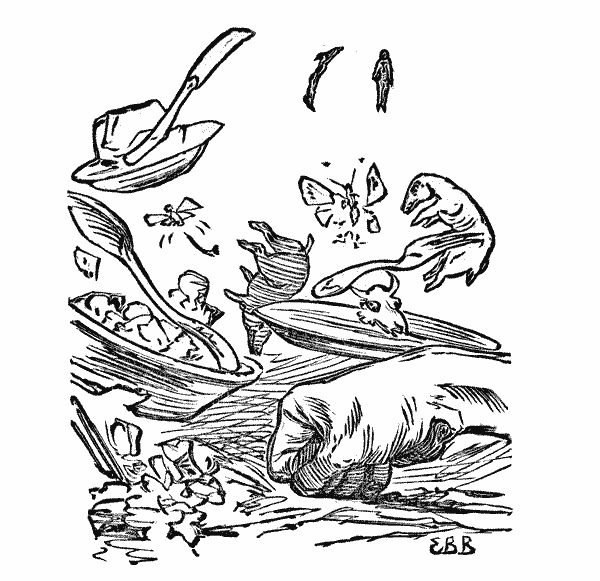
There was once an excessively mighty King, Barradin the Great, who died,
leaving no sons or daughters, or any relation on the face of the earth,
to inherit his crown. So his throne, at the time of which I write, was
vacant. This mighty King had been of a very peculiar disposition. Unlike
other potentates, he took no delight in going to war, or in cutting off
people's heads, or in getting married, or building palaces. But he was a
great musician. All that he cared for, seemed to be music; and the whole
of his leisure time, with a great many of his business hours, was
occupied in either composing or performing music of some kind. Everybody
around him was obliged to be musical; and if one was not so, it would be
of no use for him to apply for any situation. His Prime Minister played
on the violin, his Secretary performed on the horn, while his Treasurer
was superb upon the great drum. Every time the Royal Council met, the
minutes of the last meeting, all set to music, were sung by the
Secretary; and when the King made a speech, he always sung it in a
magnificent bass voice, accompanied by a full orchestra. If any one
wished to present a petition, he was always sure of having it granted,
if he could but sing it excellently well, and even folks who were good
at whistling were favorably received at court. The example of the King
was followed by the people. They nearly always talked to some tune, and
every one but the very poorest owned an instrument.
So this mighty monarch never went to war, or cut off people's heads, or
married more than once; and as for building palaces, it was of no use,
for he had as many as he wanted, already. The last ten years of his life
were occupied, almost entirely, in the composition of a wonderful piece
of music, in which he sought, by means of perseverance and magic, to
combine all the beauties and difficulties of the science. He had
scarcely finished it, when he died; and it was generally supposed that
if he had not worked so hard at it, he would have lived much longer.
The composition was not long, for you could have sung it in ten minutes,
that is, if you could have sung it at all; which is by no means likely,
for had that been the case (and you had lived in those days) you might
have ruled over the country. For, just before the mighty King died, he
made a decree to this effect,—that his successor on the throne should
be the man, woman, or child who could, at sight, sing that piece of
music.
So the music was put up against a marble tablet in the great hall of the
royal palace, and there were six judges appointed,—the most
distinguished professors of music in the country,—and these sat on
great velvet chairs, three on each side of the music, and anybody might
come to try who chose.
You may well believe that the people came in crowds, for nearly every
one wished to be king or queen, as the case might be. This music had a
very singular effect upon most of those who did not succeed in singing
it. They nearly all went crazy. The first few notes were easy, and they
were so beautiful, that it was enough to make any one crazy to think
that they could not sing the rest of it,—not to mention missing the
crown. The Prime Minister had, on this account, a great asylum built, to
which the disappointed candidates were immediately conveyed, and the
house was very soon filled. Indeed, it was often necessary to build
extensions to the main building, and it was not long before this was the
largest edifice in the country. It is true, that although every one
failed to sing the music, they did not all go crazy; but they were taken
to the asylum the same as the rest, and if they were not crazy when they
got there, they soon became so, and thus it amounted to pretty much the
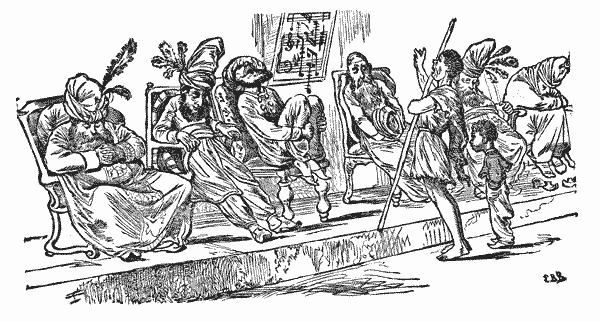
same thing in the end. Well, the judges sat in their chairs until they
died at a good old age, and they were succeeded by others just as
learned. Latterly there were not so many applications as there used to
be, but still, every few days, some one went out to the asylum. Years
passed, and the offices of the judges became sinecures; but they had to
sit there all the same, just as if they expected to be busy; and they
might have been seen, whenever anybody chose to step in during the day,
sitting there with their chins on their breasts, fast asleep. The Prime
Minister, and after him his son, ruled the country very well, and people
began to feel as if they didn't care if they never had a king or a queen
to govern them. As a rule, they all felt very comfortable without
anything of the kind.
Now it so happened that about this time a certain young Prince,
accompanied by an old gentleman (to take care of him), was travelling in
this great kingdom. His father's dominion was very many miles away; but
the Prince had been journeying in this direction for quite a long time,
taking things easily, and seeing everything that was to be seen. His
mother had died when he was quite young, and his father had lately
married the daughter of a gnome, probably because their estates
joined,—his stretching for many miles over the surface of the earth,
while hers lay immediately beneath them. The Prince did not like his
gnome step-mother (who was, you know, one of those large underground
fairies, who are more like human beings than any others), and when a
little gnome-baby was born, he could stand it no longer, and so obtained
permission of his father to travel for the good of his body and mind. So
he had been going from country to country until he reached the capital
city of the great kingdom.
There the Prince saw enough to fill him with wonder for the rest of his
life. His old friend, Trumkard, took him day by day into the bazaars,
and the palaces, and the mosques, and hundreds of places just as nice.
One beautiful evening the Prince set out for a walk by himself through
the city. The gentle twilight still tinged the sky with gold, and the
soft breeze from the river, that passed through fruit-gardens and
vineyards on its way to the city, smelt of peaches, and grapes, and
plums, and oranges, and pomegranates, and pineapples, and was truly very
delicious. Everything was lovely, and the Prince felt good and happy.
The very beggars, when he had passed them, blessed the happy stars that
had caused them to be born during his life-time, so noble and generous
was the Prince this evening. Strolling along, he came to the palace of
the mighty King. The Prince knew the palace; for Trumkard had taken him
into it, and had shown him the six judges sitting in their velvet
chairs, and the magical music hanging up against the marble tablet
between them. He knew all about the music, and the conditions attached
to it, but, not being much of a musician, he had never felt inclined to
try it. So he walked through the royal courts and vestibules, and into
the great hall where stood the six chairs,—empty, and covered with
silken covers to keep the dust off during the night. And the music was
concealed by a great plate of gold which was locked over it every night.
He met but few persons; for every one who was not detained by some
particular duty, had gone out-of-doors that lovely night. Here and
there, a porter, or a black eunuch, or a soldier or two, he met; but as
every one who saw him, knew him instantly for a prince of good blood, he
could, of course, wander where he pleased. He passed on among the golden
columns and sculptured doorways, and under vaulted and arabesque
ceilings, until he came to a door of mother-of-pearl, which had a golden
lock, an alabaster knob, and a diamond key-hole. It turned easily on
silver hinges, and the Prince passed by it into a beautiful garden. He
had never been in such a place of loveliness. The trees were hung with
many soft-colored lamps, and the fruit glittered and shone in gorgeous
colors on the branches. Every night-bird sang, and every night-flower
was giving forth its fragrance. In the middle of the garden was a
fountain, the waters of which rose in a single jet from the centre, and
then, as they fell back into the basin, each of their thousand drops
struck upon a silver harp-string, causing the most delightful sounds to
fill the air, and mingle with the songs of the birds and the perfume of
the flowers. Around the great basin were silken cushions on which the
Prince reclined, and the goldfish that were swimming in the basin came
up to him to be fed. There also came the ruby fish, that shines as red
as blood, and the zimphare, or transparent fish, which is as colorless
as the water, and can only be discovered by a green knot on its head and
another on its tail.
There were also many other fish, as the balance-fish, which comes up to
the top of the water equally balanced, having at each end of its body
expansions like the pans of scales. These are its mouths, and if one
puts a crumb into one of them without having put one into the other, it
turns right over, and sinks to the bottom. So, when this fish is
properly fed, it always gets two crumbs at a time. Then there was the
gelatine fish, that has no mouth at all, but is very soft and pulpy, and
all that is necessary is to drop some crumbs upon his back, and they
immediately soak in. Also the great flob was there, who came clattering
and clanking up from the bottom of the basin, with his hard shells and
heavy claws, as if he was the greatest fish alive. But for all that he
opened his mouth so wide, and shut it upon a little crumb with a snap
loud enough for a loaf of bread, his throat was so small that that
little crumb nearly choked him. All these fishes the Prince fed from
golden baskets filled with crumbs, and placed around the basin for the
convenience of those who wished to amuse themselves by feeding the fish.
When he was tired of this sport, he rose and entered the palace again by
another door. He had not walked far along an alabaster corridor, before
he saw a door open, and an old woman come out. She had in her hand a
silver waiter, on which was the remains of a delicious little supper,
the scent of which seemed so charming to the Prince that it made him
feel as hungry as a bear in the springtime. The old woman, who was busy
munching some of the pieces of cake, and sucking the bones of the little
birds that were left, did not notice him; and, hoping to find some more
good things where these came from, he slipped in at the door, before the
old woman shut it, and entered a large and beautiful room, lighted by a
single lamp that hung from the ceiling. At the upper end of this
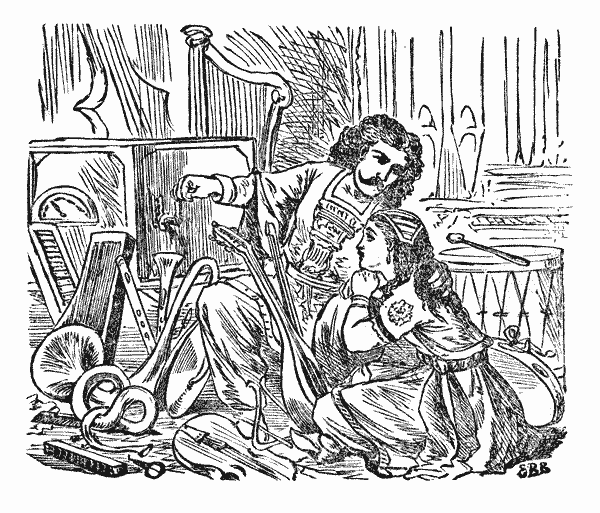
apartment, he was surprised to see a beautiful young Princess, who was
sitting in an arm-chair, fast asleep, with a guitar on the floor at her
feet. Around the room were placed musical instruments of all kinds; but
there was no one there to play on them but the Princess, and she was
fast asleep.
There was a breeze in the room, that seemed to come and go like the
waves of the sea; and the Prince could not imagine what occasioned it,
for all the doors and windows were closed. However, looking upwards, he
saw, behind the Princess's chair, the reason of the wind and the lady's
slumber. Standing behind her, with his feet on the floor and his head
high up in the obscurity of the ceiling, was a great Nimshee, or evil
spirit of the ocean, who was fanning her with his wings, and had put her
to sleep with their slow and dreamy motion. With his great eyes glowing
like meteors in the dimness of the upper part of the room, the Nimshee
glared at the Prince, and waved his wings faster and stronger. But our
young friend was not afraid of him—not a bit. He walked softly round
the room once or twice, and then, returning to the Princess, spoke to
her. She did not awake, and the Prince called her louder and louder, and
at last, putting his hand on her shoulder, he shook her; but still she
slept. He felt that he must awaken her, and seizing the guitar that lay
at her feet, he held it close to her ear, and struck the strings loudly.
The Princess opened her eyes with a start; and as she awoke, the
Nimshee, beating his breast with his wings, gave a great roar like the
waves beating in a storm against a rocky coast, and flew away. The
Princess blushed a little when she first saw the Prince, but he was so
polite that she soon recovered herself, and they conversed quite
pleasantly.
She explained the meaning of the musical instruments in the room, by
stating that she had a great passion for music, and the good people of
the palace brought her a new instrument nearly every day; but she never
sat down to play any of them but she went almost immediately to sleep.
She could not imagine the reason for this; but the Prince knew very well
that the Nimshee had put her to sleep to-day at any rate, and he had no
doubt but that he was always at the bottom of it. He said nothing to
her, however, of what he had seen, as he perceived that she did not know
it, and he did not wish to frighten her.
She said she had taken her guitar that evening, as soon as she had
finished her supper, but had fallen asleep as usual. She asked the
Prince, "Do you play?" and he said, "Only a little;" and then they
walked around the room, and looked at all the instruments, to see if
there were any that the Prince could play on better than the rest. He
wished her to perform, but she urged him, and he soon saw a hand-organ,
and said he was pretty sure that he could play on that. So he tried,
and, sure enough, he could play very well, and the Princess sat down on
the floor by him, and he played for almost an hour and three quarters,
and they were both very much pleased. Then the Prince's arm got tired,
and he stopped and asked the Princess to tell him her history. She said
she was a little ashamed to tell him her story, because he might think
that she was not of as good descent as himself; but the Prince
insisting, she told him that her mother was a water-woman.
"A mermaid, I suppose?" said the Prince.
"O no!" she cried, "none of those low things with fish-tails, but a real
princess of the ocean. She lived in a splendid palace at the bottom of
the sea, and fell in love with a prince of the earth, who left his
father's kingdom, and went down there and married her.
"I remember my father very well," continued the beautiful Princess. "He
was a fine, handsome man, but our climate never seemed to agree with
him. He could not smoke under the water, and he often used to have aches
which helped to make him unhappy. Before he died, he said that he would
give all the treasures of the ocean for a pipe and a piece of dry
flannel. When he left her, mother pined away, and soon died too, when I
was only about twelve years old. I was very lonely, but, as I was the
daughter of a water-princess and a land-prince, I could go where I
pleased, either on shore or in the water."
"Amphibious like?" said the Prince.
"I don't know anything about that," she replied; "but I used to like to
walk about on the sea-shore, for everything was so different from what I
had been accustomed to,—birds, you know, and all that sort of thing."
"O yes," said the Prince, "it must have been very different to you
indeed; but I was going to say to you, a little while ago, that you need
not think me above you, for I am half-brother to a gnome."
"O, I am glad to hear that," she said; "I was afraid you would make fun
of me."
"As if I could!" said the Prince, reproachfully.
So she went on with her story.
"One day, about a year ago, when I was quite grown up, I met some ladies
who lived here at the palace, and they wanted me to come home with them,
and I did; and I have lived here ever since, and like it very much. They
are all very kind, and if I didn't sleep so much, I should be very
happy."
The Prince now proposed to the Princess, and she accepted him, and then
she sat down to a harp to give him a little music. The Prince's
presence, in some way (perhaps because he was half-brother to a gnome),
prevented the appearance of the Nimshee; and for the first time since
she had been in the palace, she played without hindrance, and her music
was perfectly charming; and with tears of joy in his eyes, the Prince
sat wishing she would play forever. After a while, however, she got
tired and stopped; and when they turned around, they saw the room was
filled by the people of the palace, who had come to hear this delicious
music. They were nearly all wiping their eyes with their
handkerchiefs,—they were so much affected—and they could not find
words good enough with which to praise the playing of the Princess. Such
music they had never heard before.
Directly she declared that she was going to bed; but she desired the
Grand Chamberlain to take that young Prince and give him a handsome room
until morning, when she would like to see him again, and make
arrangements for their wedding.
So she went away with her ladies, and the Chamberlain took the Prince
out into the alabaster hall again.
"Prince indeed!" said the Chamberlain to himself; "O yes! I'll take care
of him, certainly. A good room,—O yes, indeed!" and, taking the Prince
by the arm, he hurried him along, until he came to the aviary, where all
sorts of wonderful and costly birds were kept, and he pushed him in
there, and locked him up. The Prince was so taken by surprise at this
hasty treatment, that he had no time to get angry, or he would certainly
have drawn his sword, and made short work of the Grand Chamberlain. As
it was, he passed the night in the aviary as well as he could; but as he
had no place to lie but the floor, and as the ostriches walked about a
good deal, he was very much afraid they might tread upon him, and this
made him feel uneasy all night. The great owls, too, made it very
unpleasant for him, by forming a circle around him, and steadfastly
gazing at him with their great eyes, which looked like enormous
cat-eyes, stuck into the darkness. As to the night-hawks and the other
birds which fly in the dark, they swooped around and over him the whole
livelong night; and when he began to get a little sleep, about daybreak,
every bird in the place began to sing, or twitter, or scream, or crow,
or gobble, or chatter, and the Prince might as well have tried to fly as
sleep. About eight o'clock, a man came to feed the birds, and seeing the
Prince in the aviary, he put him out instantly. The Prince was very
angry, and tried to find out what this all meant; but the man told him
he had better not let him catch him in there again, and slammed the door
in his face. As the Prince wandered about the palace, he met a number of
people, all of whom he asked to conduct him to the Princess. Some
laughed at him, and others told him that he had better be careful how he
talked about the beautiful Princess, but no one conducted him to her.
At last a man who seemed to have some authority, came up to the Prince,
and, having heard his story, requested him to follow him. He led the way
to a small door, and, motioning to the Prince to pass through it, shut
and fastened it after him. The Prince found himself out in the street.
Enraged and hungry, he hurried back to his lodgings, where he had left
Trumkard. On the way, he heard a great many people talking of the
beautiful music that, it was reported, the Princess had played at the
palace the evening previous. In fact, this matter seemed to be the town
talk; but the Prince did not stay to listen to much of it, for he was
extremely anxious to get something to eat, and to relate his troubles.
Trumkard did not encourage him much, and proposed that they should
continue their journey; but the Prince would not listen to such advice,
and as soon as he had finished his breakfast, he went back to the palace
in order to try and see his Princess. But all the doors were fastened,
and it was evident that there was no admission for the public that day.
A great crowd stood around the gates, and they were very much excited
about something.
The Prince learned from their discourse that it was thought that the
Princess who played so splendidly, could certainly sing as well, and
there was a suspicion that the Prime Minister, who had governed the
people so long, was afraid of her powers, and had sent her away. Indeed,
a certain Habbed-il-Gabbed, who kept a goat's-cheese shop, and who had a
cousin who was one of the royal-black-eunuch-guards, had heard from him
that the Princess had certainly disappeared, and that the public
suspicions were very likely to be correct.
At this news the Prince smote his breast, and became very sad; and all
that day and night, and the next day until sundown, he hung around the
palace, hoping to get in. Trumkard was with him a great part of the
time, and brought him cakes and things to keep him from starving. In the
early evening of the second day, the Prince, while walking round the
palace, saw a boy come out of a back-alley gate, to empty some ashes.
Rushing at him, he seized him, and demanded of him news of the Princess.
The boy, however, was deaf and dumb, and could not answer him; and the
Prince perceiving this, and being very expert in making signs, asked him
in that way what had become of his lady-love. The boy then replied by a
sign representing a heavy door, with four locks, a big bar, and a chain;
and a black eunuch with a drawn sword, asleep before it.
Then the Prince tore his hair, and groaned, and went home to Trumkard.
But he could not sleep; and when the moon arose, he got up and wandered
far away beyond the walls of the city, until he came to the borders of
the sea. There he saw, roaming about upon the sands, numbers of
water-women, who every now and then blew upon conch-shells, looking
about them in every direction, as if they expected some one to answer
them. When the Prince perceived them, he slipped softly from rock to
rock, keeping himself well concealed, until he came near one of them,
when he made a sudden rush and caught her, while all the others, with
loud cries, dashed into the sea. The one he had captured, struggled and
cried piteously; but, in as few words as possible, he entreated her to
be quiet, and to understand that if she was looking for a Princess, he
could tell her where she was, or at least where she had been. The
water-woman then became quiet, and the Prince told her all he knew, and
how anxious he was to find the beautiful Princess. The good woman of the
sea then told him that she and her companions had come up on the shore
every night for a year, hoping that the Princess would stray that way,
and be induced by them to return to her ocean home. Then she told him
who the Princess really was, and thus her story ran.
When the late mighty King, Barradin, was quite young, he married a
daughter of the ocean, at which his father, much incensed, drove him
from the court. He retired far from men, and a little son was born to
him. In a few years his wife died, and he was left alone with his son.
When this boy grew up, he also married a water-woman, and, having so
much of their blood in his veins, he went down to live with his wife's
relations, leaving his father to do as well as he could by himself,
until he ascended the throne. When Barradin became king, he did not
marry a queen, or cut off people's heads, or go to war, or build
palaces; but he took his chief delight in music, and encouraged the love
of it among his people. So it was in the hope that one of his
descendants might some day sit upon the throne, that he composed the
magical music; for he knew that no one but a descendant of the
ocean-folk could sing that music, and none but those of his blood could
read it, for there was magic in his family.
When the music was finished, the King died. His mother was a sorceress,
and a very wicked old woman, who, when her son was dead, gave it out
that she herself was dying; for she had now lived so long that people
had begun to suspect something, and to think that she had too much to do
with magic. So she pretended to die, and was buried in the royal vault;
and at night she came out and went far away from the city to a great
cave in a lonely country where dwelt the demons and evil spirits who
were her servants. She now spent her life in wickedness. She it was who
put it into the heads of so many sensible people to contend for the
crown, and it was with joy that she saw them carried out to the asylum.
Many other evil thoughts she put into the hearts of the people, and she
was forever imagining and doing mischief.
When this young Princess, her great-grandchild, was born, Mahbracca
(that was the name of the old sorceress) was very much troubled, and
used all available means to destroy the infant; but her efforts were
vain, for the people of the ocean protected her from all enchantments.
As the Princess grew up, she loved to ramble on the white sands, and she
was once perceived there by a party of ladies from the palace, who had
persuaded her to come with them to their royal home, where she had now
been for a year. She knew not who she was, nor did her friends at the
palace; and her relations of the ocean had always hoped that some day
she would return to them. Now the sorceress feared that some day she
would happen to sing the magical music, and be made queen; and she hated
the poor girl so much, that she would not have had this happen for all
the world. Therefore it was, no doubt, that she had sent the Nimshee, in
order to prevent the Princess from ever exercising the wonderful gift
she had inherited.
This much the water-woman told the Prince, but as to what had now become
of the Princess, she did not know; but there were others of her people
who knew more than she did, and she would inquire of them. Taking the
Prince by the hand, she led him out upon a headland that projected some
distance out into the sea, and blew four times loudly upon her
conch-shell. A great heaving and swelling of the waters was presently
seen, and in a few moments an elderly personage emerged from the waves,
and walked carefully up to the rock on which they stood. He was a
curious-looking individual, and, as the water-woman informed the Prince,
a powerful lord of the ocean.
He was wrapped in an old-fashioned cloak, made of the finest quality of
sea-weed, and drawing this closely around him, he requested his fair
cousin of the sea to be as quick as possible in her business with him,
as it was not prudent for him to be in the air much at his age. So the
water-woman briefly related to him what the Prince had told her.
When he heard this, the old sea-gentleman folded his arms and looked
very grave. "Mahbracca is at the bottom of this," said he. "The Prime
Minister would never have thought of imprisoning the Princess, if that
wretched sorceress had not put it into his head. I have no doubt that
she now has the Princess in her power, and very likely shut up in her
retreat."
"What!" cried the Prince, "where is it? Where is her cave? I will go
instantly and rescue my beloved Princess!" and he drew his sword of
adamant and waved it over his head.
"Ah my friend!" said the old man of the water, "you could do little
against the powerful Mahbracca and her minions. But you might go there
to be sure, and find out if she really has possession of the Princess.
But then you may lose your life."
"I care not!" cried the Prince. "Dead or alive, I will be with my
Princess."
The two citizens of the ocean talked together a few moments, and then
the old man asked him if he was really determined to undertake this
perilous enterprise, and the Prince emphatically declared that he was.
"The distance by the sea is much the shortest; would you be willing to
go in that way?" asked the old man.
"Certainly," said the Prince, "provided I have to go over, and not under
the water."
The old gentleman made no reply to this, but putting his two forefingers
in his mouth he whistled loudly.
In a few moments a sea-boy came up out of the water, and stood beside
him. The old man made a few remarks to him in the ocean dialect, when
the boy jumped off the rock and disappeared beneath the waves.
"Now, sir," said the sea-gentleman to the Prince, "you must cheer up and
be lively, or you cannot hope to succeed in this matter. My boy will
take you to the sea-side entrance of the cave of Mahbracca. There I hope
you will have no difficulty in entering, but I can say nothing positive
upon the subject."
At this moment the sea-boy reappeared, driving a pair of dolphins, which
were harnessed to a large and commodious sea-shell, somewhat resembling
in shape the boat of the nautilus.
When the equipage was drawn up at the foot of the rock, the Prince took
leave of his friends, and quickly stepped in and took his seat.
"I wish you all success," said the elderly personage, and, reminding the
boy to be sure to keep their heads up, he walked down into the sea.
The water-woman said nothing, but stood on the rock, gazing sadly after
the Prince, as the dolphins drew him rapidly from the shore. The fishes
made excellent time, and the motion of the great shell over the waves
would have been exceedingly pleasant to the Prince, if his mind had not
been filled with anxiety and impatience. He shifted his position so
often, and rolled the vehicle about so much, that once or twice the
sea-boy turned round and asked him if he did not wish to get out, to
which the Prince did not reply, but only urged him to make greater
speed. The journey lasted until the morning of the next day, and was
marked by no greater occurrence than the annoyance caused by the wild
dolphins occasionally coming up around them, endeavoring to play with
their brothers in harness. But the boy, with his whip of shark's skin,
and the Prince with his sword, soon drove them down again.
At last they dashed into shore, and the sea-boy, pulling up his steeds,
jumped out, followed immediately by the Prince.
"Take the road in front of you," said the boy, "and you cannot miss your
way."
The Prince then threw a piece of platinum to the boy, who tucked it in
between two of his scales, and jumping into his shell, drove rapidly
away.
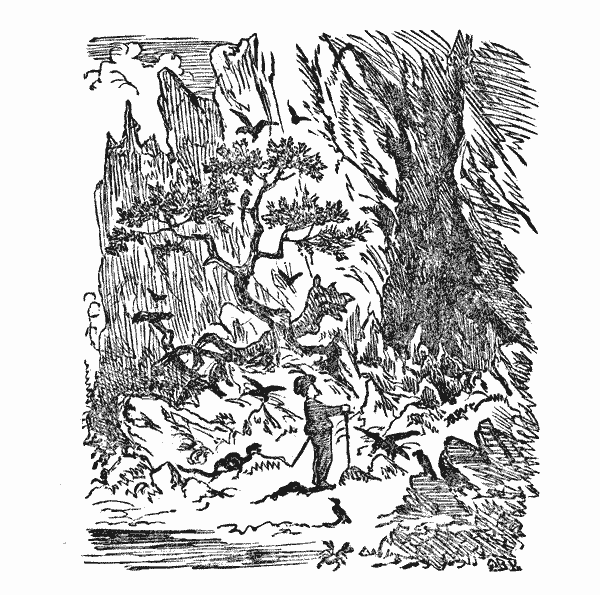
The shore where the Prince now found himself was very peculiar. A high
rocky wall, seemingly inaccessible, stood up solemnly in front of him,
and extended out, on each side, far into the sea. Directly before him
was a great cleft or tunnel in the rock, which extended so far back that
its other extremity was not visible from where he stood. This rocky
avenue was the only passage, in any direction, that the Prince could
perceive, and consequently, without delay or fear, he drew his sword,
and entered it. The way for a while was easy, but afterward became very
rough and uneven. Here and there were openings in the walls above him,
through which came a misty light; and by it the Prince perceived that
the walls were filled with precious stones, which glistened and sparkled
brightly, while great veins of gold and silver were streaked about in
all directions. Under his feet were thousands of jewels, and bits of
precious minerals without number. His way was now very difficult, for
the avenue was narrow and rough. Pearls and sapphires got into his
shoes, and he cut his legs and scratched his hands against the sharp
diamonds and rubies that stuck out from the walls. But he pressed
bravely on until the ground became more even and the walls wider apart,
and at length he entered quite an open space, inclosed by a wall in
which he saw before him an immense gate of copper. He went up and tried
to push it open, but finding it immovable, he knocked loudly upon it
with the hilt of his sword. Directly, a small window at one side of the
gate was opened, and a ghoul put his head out. Seeing that it was a
Prince who knocked, he drew in his head, and opened the gate. The Prince
quickly entered. "I wish," said he, in an imperious voice, "to see the
Princess whom the wicked Mahbracca has doubtless imprisoned in this
cavern."
"O!" said the ghoul, grinning horribly, "certainly! Pass on, great
Prince! The Princess and my mistress will both be glad to see you. Pass
on freely. You cannot miss your way." Opening then his wide mouth, he
gave a great laugh, and reëntered the porter's lodge, through the open
door of which the Prince saw, upon a table, an empty coffin and a jug.
The Prince now found himself in a long and wide passage, dimly lighted
and very damp. The place smelt like a burial vault, and against the
walls on each side, rows of ghouls sat on the floor, their knees drawn
up to their chins. As the Prince passed, some of them jumped up and
gibed at him, leering, sticking out their tongues, and smacking their
lips as they danced around him. Walking on rapidly, he soon left these
gibbering wretches, and found that the passage became much drier,
although darker, and wound and turned in various directions. Against the
walls, transfixed by great iron pins, were enormous glow-worms, which
gave the only light in this dismal place. These worms turned their heads
to look at the Prince, and flashed a brighter light from their tails,
that they might see him the better. Presently he noticed a small door in
the wall, which was not quite closed. Pushing it open, he entered a
room, the floor of which was not very spacious, but which was very high.
Against one of the walls, chained by his arms and his wings and his
legs, was the Nimshee who had fanned the Princess with his sleep-giving
wings.
When this evil spirit saw the Prince, his eyes glowed so brightly that
they lighted up the room as if they had been torches; and, putting down
his horrid head as low as his bonds would allow, he opened wide his
nostrils and his mouth, and bellowed with fury, like an immense
bull,—at the same time tugging and struggling at his chains, until the
very walls shook with his raging strength.
This spectacle caused the Prince to step out of the room with alacrity,
and quickly shutting the door behind him, he walked rapidly along the
gloomy passage. On his way he met numerous demons and evil spirits of
various kinds, but they only scowled at him as he passed, and he spoke
to none of them. He soon descended a stone stairway which led down to a
large circular hall, with various doors and passages leading from it. On
the side opposite to the stairs was a great door of green marble,
sculptured with mysterious devices. Stepping up to it, and finding that
it opened easily, he entered an octagonal room, the walls of which were
hung with the skins of spotted cats, and on the floor was spread a skin
of the sacred white elephant of India. The Prince perceived that this
was merely an anteroom, for to the left of him was a door, before which
sat a fierce and black Afrite, with a great javelin in his hand. With
his hands upon his knees, the Afrite bent down his head, and looked
steadfastly at the Prince with glaring eyes.
Advancing towards this formidable sentinel, the Prince inquired of him
where he should find the Princess, if she were shut up here, or where he
could see the sorceress Mahbracca. The Afrite arose, and, pushing aside
the block of porphyry on which he had been sitting, took down a brazen
bar by which the door was fastened, and throwing it open, told the
Prince, in a harsh and brazen voice, to enter.
The room in which the Prince now found himself, was the private
apartment of the sorceress, where had been concocted all the wickedness
with which she had cursed the subjects of her son.
At first, the Prince could scarcely distinguish the objects in the room,
as it was lighted only by a small brazier which burnt dimly on a table;
but the Afrite thrust his javelin into the brazier, and the flames, all
green and red, burst forth luridly, lighting up the apartment with
unearthly colors. The Afrite, after informing the Prince that the great
Mahbracca would soon attend him, left him, and returned to his station
on the other side of the door. Somewhat fearful that all this
willingness to admit him boded no good, the Prince still determined to
push boldly on in his adventure (that being, indeed, the only course
possible for him), and to take things as coolly as possible.
Looking around him, he saw, by the bright light which now filled the
room, that against each of the walls was a row of cages, containing
snakes of various grades of venom, placed in order, according to their
deadly properties. Standing on their heads, in various places against
the wall, were many of those dreadful green lizards which poison the air
of the deep valleys of Sumatra, and whose bite causes their victim,
together with all his blood relations, to gangrene in an instant. These,
although standing so stiffly against the wall, were all alive, and some
of them, perceiving the Prince was looking at them, winked at him. But
he paid them no further attention, and proceeded with his inspection of
the room.
There were great numbers of horrid-looking furnaces, and cages, and
grotesque lamps, with the flames out, but with wicks still smouldering,
and smelling vilely. Upon a shelf near the ceiling was a row of great
jars, and out of one of them was continually popping the head of an
excessively shining and black little demon, who had evidently, for some
offense, been put there in pickle. From the other jars came groans, but
no heads. These had been in longer. While the Prince stood, scarcely
able to refrain from laughing at the comical countenance of the young
demon in the jar, he heard the opening of a door, and, turning, saw the
sorceress Mahbracca enter the apartment. This worthy dame presented a
remarkable appearance. Short, with a large head partly covered with
stubbly white hair, she had a face of the color and smoothness of an
Irish potato, which has been lying in the sun for about eighteen months.
Her eyes opened in the middle of the pupil, with a slit, like those of a
cat, and she had three long hairs, or whiskers, on each side of her
upper lip. She advanced with a smile, which did not make her look any
more lovely, and extended her hand to the Prince. Being a man of
politeness, of course he took it, but her touch was ten times more
clammy and deadly than that of a snake.
"I am glad to see you," said Mahbracca. "Will you take some rest and
refreshment? You must be tired, for you have surely travelled a long
way."
"No," said the Prince, "I desire neither rest nor refreshment. All I
require is, that you conduct me to the Princess, if you have her here
confined, and then that you deliver her up to me."
"Ah!" said the sorceress, "that is certainly not much to ask. You shall
be gratified. Allow me to conduct you to her; she will be delighted, I
am sure."
Then taking in her hand a staff, and opening the door by which she had
entered, she requested the Prince to follow her. Passing quickly through
several apartments, they entered a wide, long, and dim avenue.
"Come," said the sorceress, "give me your hand; we will lose no time."
But the Prince, remembering his former experience of her touch, drew
back from the bony hand which she extended to him.
"Ah!" cried she, with a hideous grin, "you are able to get along by
yourself, are you, my dear? I dare say your young legs are very strong
and nimble. You don't need any old woman's help. Ha, ha! Well, come
on! The Princess awaits you!"
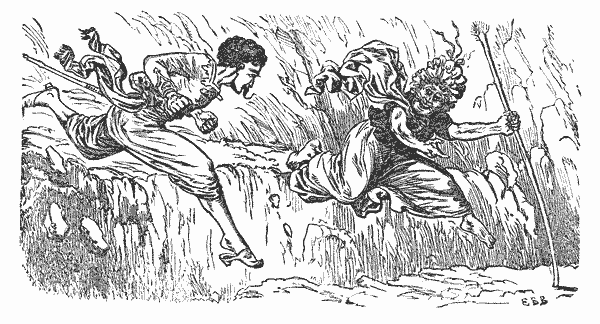
With these remarks, the aged hag set off at a pace, which, considering
her years, was truly wonderful, putting the Prince to his best endeavors
to keep up with her. The underground avenue in which they ran seemed of
great length; and very shortly the old lady varied the exercise by
introducing certain gymnastics. Sometimes, as she stretched out her
staff, the ground would suddenly open before her, and she sprang over
the wide chasm with the greatest ease; while the poor Prince, all
unprepared, would have to strain every muscle in his body to clear, in
the midst of his rapid career, the yawning gulf. Then she would wave her
staff upwards, and the ground rise in front of her, like a steep and
rocky hill, up which she would lightly run, while the Prince could
scarcely restrain himself from dashing violently against its stony face.
Then, while heated and breathless with the ascent of one of these, he
would see her wave her staff downward, and plunge down a steep
declivity, into the darkness of which he followed her pell-mell, not
knowing whether he was going to descend a few yards or a mile. Very
soon, however, he began to get his blood up, and, kicking out his legs
like a wild goat of Cashmere, he prepared to show her that it would have
to be a very smart old woman who could beat him in a race. So away they
went, like a cat and a dog, the Prince clearing the great gaps as fast
as Mahbracca could make them. At last he actually gained on her, and
kept ahead of her for a few minutes, during which time he had level
running. But with a great effort, she passed him, and, violently
throwing up the end of her staff, caused a great rock to rise with such
promptness, that the Prince came within an inch of braining himself
against it. But over it they went, and for half a mile kept neck and
neck; but the old woman soon put an end to this, for, whirling her staff
round her head, the Prince instantly found himself wading in sand up to
his armpits.
"That's mean!" he cried, with tears of indignation in his eyes. But
Mahbracca jumped up and down on top of the sand, waving her arms, and
laughing and screaming like a hyena.
"Ah ha! my vigorous Prince," cried she, "why do you stop? Hasten,
hasten! Swiftest of youths, the Princess awaits us!"
Incensed by her mockery, he gave a mighty plunge into the sand before
him, and surged along like a ship in the ocean, while Mahbracca skipped
gayly by him, playfully kicking the sand into his eyes.
"You see the advantage of lightness, my dear," cried she. "I pass easily
over the top of this sand, while you—O, how you do wallow! Ha, ha, ha!
I never saw anything like it."
With such remarks, she beguiled his way, until relenting, she at last
waved her staff again above her head, and the Prince found himself by
her side, on solid ground.
She complimented him on his remarkable agility and strength, but he made
her no answer, and, wiping his face with his handkerchief, walked on
without a word. At length they reached the end of the avenue, and,
passing through a circular aperture with which it terminated, the Prince
found himself in the cavity of an immense hollow mountain, the floor of
which was a great plain, and into which the light of day was admitted
through an opening in the top, more than two miles above him.
Scattered about over the blackish sward were many groups of ghouls and
variously colored demons, some playing pitch-penny with ancient coins,
and others lying asleep on the ground. At a distance, grazing on the
exuberant and oily foliage, were herds of the prong-horned
Yabouks,—those sanguinary monsters which impale their victims on the
great horn upon their noses, holding back their heads and opening their
mouths to let the blood slowly trickle down their throats.
Many other dreadful cattle were scattered about the plain, drinking at
the greenish streams which meandered about in various directions, or
standing ruminating, knee-deep in the oily water. But these things
claimed not the attention of the Prince.
In the centre of this great plain stood a tower.
"Behold!" cried Mahbracca, springing in front of him, and waving her
arms—"behold the dwelling of your Princess! Come! let us run, let us
bound!"
Seizing him by the hand with a strength that was not to be resisted, she
led him, at great speed, to the foot of the tower. Then at the top of
her voice she called out,—
"Princess! appear at your window quickly! Your love has come from afar
unto you. Show yourself to him!"
At these words, the Princess put her head out of the highest window, and
when the Prince saw her lovely face, he fell down on his knees,
trembling with happiness, and protesting in broken sentences his love
for her; while she, bending out over the window-sill, wept silently
tears of joy, which came down pitter, patter, on the Prince's head.
Starting presently to his feet, the Prince ran around the tower to find
the front door, and, seeing it, he endeavored to push it open, but it
was securely fastened. He then turned to look for Mahbracca, and
perceived her standing at some distance, surrounded by a crowd of ghouls
and demons, who seemed to be greatly enjoying the scene. The Prince
shouted loudly to her to send him the keys, at which the whole crowd set
up a shout of laughter, and Mahbracca hysterically screamed to him,—
"Enter! Enter, great Prince! Why wait so long outside? You grieve your
lovely Princess!"
The Prince, enraged, drew his sword of adamant, and at one blow thrust
it through the lock, but the door did not open, and the sword was fixed
immovably. In vain did he tug and struggle at it. He could not move it
an inch. Hearing greater and wilder cries of derision, he turned towards
the crowd and shook his fist at them, and then went back under the
window of the Princess, but she was not visible. He called her again and
again, at the top of his voice, but she did not answer him nor make her
appearance. The night was fast coming on, and overcome with sorrow and
despair, and weak with hunger, the Prince fell upon the ground.
When he had lain thus for an hour or two, hearing nothing of the
Princess or his enemies, he began to reflect that if he intended to
serve his lady-love, he must do something, and that speedily. He
himself, he plainly saw, had no power against this sorceress, and
perhaps even now she was within the tower, preventing the Princess from
answering or appearing to him. He would go for assistance, and, come
what would, the Princess should be delivered from that horrid tower. He
therefore arose, and, without reflecting how he was to leave this abode
of wickedness, he prepared to return to his friend and adviser Trumkard.
When he reached the aperture by which he had entered the hollow mountain
(which he did without meeting any one), he found it closed by a gate of
brass. But he was not to be thus deterred. He ran around the sides of
the mountain, rousing in his course several herds of Yabouks and
dreadful cattle that gazed, half awake, at his rapid movements, and
examined, as well as he could by the dim light, the wall of this great
cavern. He soon became convinced, by the knowledge he had gained in a
few visits to his step-mother's dominions, that these walls were not
very thick. His resolution was quickly formed. Taking off his handsome
and richly embroidered clothes, which would only impede him in his
labors, he stood dressed only in his under-vest and trousers. Then,
springing upon a projecting rock and over another, he entered a great
crack, pushed through some loose earth, and made his way through the
various crevices of the ground, as he had seen the gnomes do. After
about an hour's work, he emerged into the open air very tired and very
dirty. After resting awhile, he arose, and, taking his way across a
great plain, found himself by daybreak, worn out and footsore, near the
gates of a great city. Entering, he inquired of one of the few people
who were up so early, what city this was, and was informed that it was
the city of the Queen Altabec, and a long distance from the city of the
mighty King.
The Prince thanked his informant, and proceeded to look for a tailor's
shop, where he might provide himself with clothes; for he perceived that
people eyed him with suspicion, and well they might. Having found a
shop, he entered, and desired to be immediately fitted with a prince's
suit. The master tailor, knowing by his proud air that he was a Prince,
and supposing he had been on some youthful adventure, and had thus lost
his clothes, was delighted to serve him, and, running to the shelves and
drawers, pulled out all the princes' suits, and spread them before his
customer. The Prince selected some very handsome clothes, and, having
washed himself, put them on, and found they fitted him exactly. He
declared his satisfaction with them, and putting his hand in his pocket
for his purse, found nothing of the kind there, the tailor not
furnishing his clothes in that way. He now remembered that all his money
was in the clothes he had left behind him in the mountain, and explained
his condition to the tailor. The latter, however, had no wish to deal
with princes who had no money, and ordered him to instantly take off the
suit. The Prince, who was strictly honest, was about obeying, when one
of his feet (which were very tender with his much walking) giving him a
sudden pain, he stooped down to see what was in his shoe, and taking it
off, out rolled a magnificent pearl and two sapphires.
"There," said the Prince, picking them up, and handing them to the
tailor, "if these will be of any use to you, you can have them for the
clothes."
The tailor, filled with admiration at the sight of these jewels, and
with the most profound respect for a prince who carried such wealth in
his shoes, accepted them instantly, and the Prince left the shop. But
the good tailor, gazing joyfully at his new-found treasures, was so
conscientious and grateful, that he ran out after the Prince, and gave
him back one of the sapphires as change.
It may as well be here related that the tailor sold the pearl to a
jeweler, who gave him one third of its value, with which he retired into
the country, bought great possessions, and lived in much dignity for
many years. Some time afterward, the Queen Altabec happening to pass the
jeweler's shop, and seeing the pearl in the window, immediately ordered
the execution of the jeweler and the seizure of the pearl, which she
placed above all the other jewels in the tip-top of her crown, where it
still remains. As for the sapphire, the tailor's wife put that away for
a rainy day; but as the rainy day never came, and she never went to look
for it in its hiding-place, it made no earthly difference to her that
her youngest child had found it, and had swapped it off for half of a
little stale apple-pie.
After leaving the tailor's shop, the Prince made all haste to an inn,
where, having eaten about four meals in one, he bought from an Arab, who
was highly recommended to him, a swift dromedary of the desert, for
which he gave one sapphire, and requested the landlord of the khan to
see that the Arab paid to him, out of its value, what would suffice for
the price of his breakfast. This the landlord promised faithfully to do,
and it is said that the descendants of that landlord are still drawing
on the descendants of that Arab for installments of the price of that
wonderful breakfast.
Mounting his dromedary, the Prince would have started, but was detained
by the Arab, who embraced the animal, and begged the Prince, out of
charity to a poor man, to add a little to the meagre price he had paid
for it. Upon which the Prince, knowing the habits of these Arabs, drew
his sword, which he had got with his suit, and threatened to split the
affectionate man in halves, if he did not immediately take his hands off
the beast, which the man instantly did. When he started off, the
humpbacked courser might have gone much faster if he had felt inclined,
and at last the Prince became so enraged at the exceedingly leisurely
style of his trot, that he lifted his sword to serve the animal as he
had threatened to serve his old master; but the intelligent dromedary,
casting back its only eye, perceived the danger, and set off at such a
terrific speed, that the people in the villages through which it passed
knew not what it was that had trodden down their children, and upset the
old women at their pomegranate stalls.
Before night, the Prince pulled up in the great city before the door of
the inn in which Trumkard and himself had lodged. Trumkard was sitting
on the front step, with a melon on his lap and a skin bottle between his
knees. Hastily dismounting, the Prince threw himself upon the neck of
his old friend with such force that he upset the old gentleman and his
supper into a great pile together. Jumping up, and wiping the wine out
of his eyes and the melon-juice out of his hair, Trumkard welcomed his
young master, and assured him that he had several times wondered where
he was. The Prince then led him in-doors, and related his adventures,
and besought his advice.
Thereupon, Trumkard, throwing his right leg over his left, rested his
elbow on his knee, and, reposing his chin in his hand, cogitated. At
last he spoke.
"We cannot do better," said he, "than to apply to the Giant
Tur-il-i-ra."
This Giant, it will be remembered, was our old acquaintance, and the
friend of Ting-a-ling.
The Prince having readily consented to this proposition, it was agreed
that they should go to the Giant the next day, and implore his
assistance. The Prince would have started that night, but Trumkard had
great objections to night travelling, and he, being the best at an
argument, gained his point.
Early the next morning, the travellers set forth upon their journey,
well mounted upon two good horses. (It may be as well to state that
during the night, the Prince's dromedary had returned to its original
owner.)
As it will take two days of hard riding for our friends to reach their
destination, we will leave them, and return for a time to the gentle
Mahbracca, who, when she had left the Prince, had gone to her private
room to prepare an ingenious wire arrangement, which she called a
"prince-trap," in which he was to be inclosed and hung up before the
window of the Princess, for the amusement of this lively sorceress.
But what was her dismay when, on returning to the tower, the first
Yabouk she met told her of the escape of the Prince! Speechless with
apprehension, she ran to the place where he had passed through the side
of the mountain, and seeing his clothes upon the ground and the
indubitable signs of his egress, she became perfectly furious, and,
rushing back to the tower, commanded the dreadful Afrite who guarded her
door, and who now accompanied her, to enter and to bring down the
Princess, but on no account to injure her until she should be placed
alive in the cage that had been prepared for the Prince. The faithful
Afrite bowed his head in obedience, and having at one bound entered one
of the lower windows, he hurried up the stairs to the door of the
Princess's room. Bursting it open, he saw the Princess lying on the
floor in a swoon (into which she had fallen when she perceived that
Mahbracca was acting treacherously towards the Prince), and, supposing
her to be dead, he hastily plunged down the stairs to inform his
mistress, and rushing violently against the front door to burst it open
(as was his habit when doors were in his way), he immediately spitted
himself upon the Prince's sword of adamant, which was sticking through
the lock.
After waiting some time, and becoming alarmed at the long absence of the
Afrite, the sorceress sent for the key of the tower, and opened the
door. But when it slowly swung open, and the body of her favorite swung
with it,—the point of the sword emerging from the middle of his
back,—she fainted away. Coming to her senses in a few minutes, she
ordered him to be drawn off and carried to her room, where, after again
locking the tower door, she followed, in the hopes of reviving, by means
of proper magical remedies, whatever vitality might be left in the
unfortunate and indispensable Afrite.
Trumkard and the Prince journeyed so rapidly that their horses fell,
utterly exhausted, at the end of the first day's journey; and, not being
able to procure others, they were obliged to go the rest of the way on
foot. You may be sure that the Prince did not lag by the way, and poor
Trumkard was obliged to do his very best to keep up with him at all.
Therefore, when, near the end of the second day, they arrived at the
Giant's castle, they were tired and warm enough. Entering the great gate
(to the hinge of which little Ting-a-ling once tied his butterfly), they
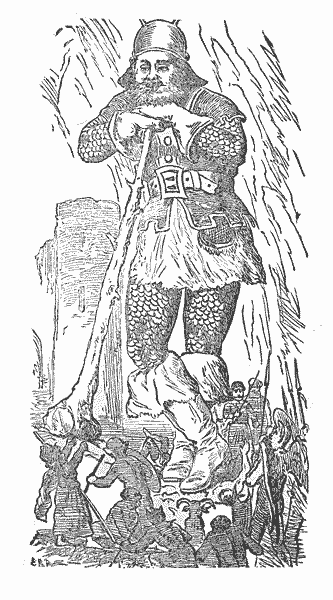
approached the castle, and perceived the Giant sitting in his front
porch, with his feet in immense slippers, comfortably resting against
one of the great pillars before the door. The Prince, who had never seen
him before, was struck with astonishment at his great size; but Trumkard
assured him that a nobler or more true-hearted being never breathed, for
all he was so big.
When Tur-il-i-ra perceived them, he arose and welcomed them heartily,
remembering Trumkard as an old friend. He caused them to be seated on
the porch, and ordered water to be brought that they might free
themselves from the dust of the journey. Then he called to his
attendants to spread a table, and to bring some cold meat and some game,
some curries and hashes, some minced meat, some pepper-pot, some
mutton-chops, omelettes, bacon and eggs; some broiled steaks, some
spare-ribs, toast, butter, cheese, pickles, and salad; some macaroni,
vermicelli, chowder, mullagatawny, lobsters, clams, oysters, mussels,
and shrimps; also some tripe, kidneys, liver, and sausages, and
calves'-foot-jelly, and stewed cranberries; also frangipanni tarts and a
Charlotte-Russe, with bottles of orgeat, sherbet, and iced wines,
together with mead and mineral water.
When his guests had partaken of these, their hunger was fully satisfied,
and they related to him the reason of their coming. When the Giant
learned how the Princess was kept from her lover, and in all probability
from a throne, by this wicked sorceress, his anger knew no bounds.
"I knew the woman well!" he cried, "but I thought her dead. Many is the
deed of vile magic which I have known her to do, but now—well, my
friends, you shall be avenged. I will take up the cause of the Princess,
and we will set out for the hollow mountain as soon as I can get myself
ready to start."
Leaving the two friends in comfortable chairs on the porch, in which
they fell asleep as soon as he had left them, the Giant ascended the
great stone stairs into his armory, which was an immense room, filled
with his mighty weapons, and armor and all sorts of implements of
warfare. Kicking off his slippers, he put upon his feet great boots, the
like of which were never seen before. Their soles were enormously thick,
and studded with nails, each one of which was so heavy that I would not
like to have to carry it very far. Then, having put on his chain armor
and his great gauntlets, and having arrayed himself otherwise according
to his taste, he put upon his head his helmet, which was like a great
iron pot, and big enough to—well, big enough to cover his head, which
is saying a great deal. He then took, from the corner of the room, his
club, which was the trunk of a tall tree, with one end fastened into a
great rock, by way of having a knob to it. Having thus accoutred
himself, he came down-stairs, and, finding his guests in such a sound
slumber, he had not the heart to waken them; so he gently took them up,
and put one of them in each of the side-pockets of the coat which he
wore over his armor. Then, having given orders to his servants to close
all the gates, and see that the house was well fastened up for fear of
thieves, he strode out of the great gate, and proceeded towards the
hollow mountain. Although this was a long journey for a man or a horse,
our Giant made such tremendous strides that it did not seem like a very
great distance to him; and when Trumkard and the Prince awoke, and stood
up, and looked in astonishment out of the pocket-holes, they saw the
mountain in the distance. The Giant, perceiving that they were awake,
looked from one to the other with his peculiar pleasant smile, and
assured them that their troubles would soon be at an end.
"I hardly think," said he, "that the old woman can keep me out of her
tower;" and he laughed at the very idea of such a thing. The Prince made
no reply, but he thought that if the Giant did get into the tower, it
would be considerably stretched.
Having arrived at the mountain, the Giant walked around it until he came
to the place where, the Prince informed him, he had made his escape, and
which was, as far as there was an opportunity of judging, one of the
thinnest parts. Tur-il-i-ra took his friends out of his pockets, and set
them on the ground at a little distance from the foot of the mountain;
and then letting his club down from his shoulder, he whirled it around
his head, and struck such a tremendous blow on the side of the mountain,
with the rock end, that everything cracked again. Then another on the
same place, and another, and another, until, at the last blow, a great
mass of rock and earth fell inside with a crash like thunder, leaving a
gap large enough for the whole party to walk in without stooping. You
may be sure that the three were not long in entering; but no sooner had
they set foot upon the great interior plain, than they perceived a
mighty commotion among the inhabitants of this secluded spot. Ghouls,
Afrites, and all sorts of demons were running towards them in a great
state of excitement; and as they approached, they formed into a solid
body, evidently intending to repel the invaders. There was no mistaking
their intentions; for they hurled at the Giant a volley of spears and
javelins that would have annihilated any one who was not so large, and
who had not on such strong and secure chain-armor.
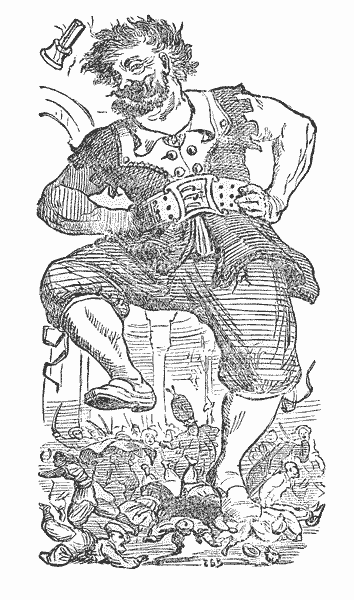
As to our two smaller friends, they were safe enough behind the Giant's
legs. Giving his club a swing, Tur-il-i-ra stepped forward, and let it
drive right into the middle of the crowd, crushing some sixty of them,
and sending the rest howling in every direction.
Being thus rid, for a time, of these opposers, the Giant picked up his
club, and, followed by the Prince and Trumkard, advanced towards the
tower. Although Tur-il-i-ra strode along at a great rate, the Prince got
to the tower first, and immediately commenced shouting to his Princess.
She, however, did not make her appearance, for she was still in a swoon.
So the Prince ran around to the door to see if, by chance, it was open,
but found it locked. He saw, however, the hilt of his sword still in the
lock, and, seizing it, he again used his utmost strength to pull it out,
but in vain. The Giant, who had just come up, perceiving what he was
trying to do, stooped down, and, taking hold of the hilt in his finger
and thumb, gave it a jerk, and out it came. He handed it, with a smile,
to the Prince, who, overjoyed at regaining his favorite weapon, jumped
around to see if there was anybody he could stick it into; but as all
the Yabouks and other cattle were standing at a respectful distance, and
there was only old Trumkard running up, he thought better of the matter,
and put his sword into its scabbard, feeling himself a man again. The
Giant walked round the tower, putting his eye to the windows, but said
he could see nothing.
"Look in the upper window!" shouted the Prince; "that is the Princess's
room."
"Yes! here she is!" cried the old fellow, peering on tiptoe into the
upper room. "And fast asleep on the floor! That wretch of a witch has
not even given her a bed." Then, clapping his great hands against the
side of the tower, he cried,—"Wake up, sweet Princess!" in a voice so
loud that the poor young lady thought it was thunder, and sprang to her
feet trembling with fright. Seeing the face of a strange Giant at the
window, she was so much more terrified that it is probable she would
have fainted away again, had she not heard the Prince's voice.
"Lift me up!" cried the Prince, jumping about almost mad with
impatience. "Put me in, quick, good Giant, if she is there!" So the
Giant took him up, and put him right in at the window. When the Princess
saw him, her face flushed, and her eyes flashed with joy. Starting back
and stamping one foot, she cried,—"My Prince!"
And he, starting back and stamping one foot, cried,—"My Princess!"
And then they rushed into each other's arms, and you could have heard
the kissing ever so far.
Old Trumkard was nearly tickled to death, and ran around on his toes,
trying insanely to reach up; but he couldn't see anything,—not he! As
for the Giant, he could see first-rate, and he stood looking in at the
window, with such a broad grin on his face, that one might almost have
driven a horse and wagon down his throat.
In a short time the Prince and Princess made their appearance at the
window, and requested to be taken down. When the Giant had deposited
them safely on the ground, they embraced each other, and then Trumkard;
and, turning to Tur-il-i-ra, they made him a very pretty speech,
expressive of gratitude and eternal remembrance.
These little duties having been performed, there seemed nothing more to
be done but to quit the mountain by the way they came. But, as they were
about leaving the tower, they were startled by a sudden burst of yells
and howls, and saw, issuing from the brazen gate by which the Prince had
first entered, a great crowd, which was approaching them at full speed,
headed by Mahbracca, who skipped along at an astonishing rate.
Our friends did not attempt to retreat. Indeed, the enemy was upon them
almost as soon as they perceived their danger.
Mahbracca stepped to one side, and the crowd, opening, discovered in the
midst forty-seven spotted demons, who carried a great copper brazier,
like an enormous covered pot, which they quickly set down, almost at the
feet of the Giant.
"Off with the lid!" shouted Mahbracca, and instantly a number of the
slaves seized the cover and dragged it off, when a great, thick,
poisonous smoke burst out of it, which would have destroyed our friends
in a few moments, had not they involuntarily sprung back and clapped
their handkerchiefs to their faces. However, they could not have lived
more than half a minute, had not the Giant, with admirable presence of
mind and surprising quickness, given the brazier such a tremendous kick
with one of his heavy boots, that he sent it more than a mile and a
half, into the midst of a distant herd of Yabouks, which were all
instantly suffocated by the dense cloud of poisonous smoke which covered
them, as the brazier fell, upside-down, right over the leader of the
herd, who, giving one great bellow, instantly crisped up into nothing.
The Giant and his party did not dare to draw breath until they had run a
considerable distance; but, notwithstanding this precaution, the
Princess presently sank down, very pale and faint; for her handkerchief,
being of the finest cambric, did not prevent her from slightly smelling
the horrid vapor, although she did not inhale any of it. However, the
fresher air, and the vigorous efforts of the Prince, soon restored her.
Mahbracca, stupefied for a moment at her utter discomfiture, and
deserted by her followers, stood gazing blankly at the scene. What she
intended doing next, was not long doubtful; for, taking a magical wand
from her pocket, she bade the Giant, with a wave of her wand, turn into
a camelopard. As he did not seem in a hurry to obey, she commanded him
to become a hippopotamus, and then an elephant. He positively declined,
however, to turn into any of these animals, owing to his having taken
the precaution, before leaving his castle, to drink a bottle of
anti-enchantment water. The old sorceress now became so enraged that she
could scarcely speak, but stood stamping her feet, and shaking her fist
at the great Tur-il-i-ra, who, leaning on his club, waited with a smile
for her next attempt upon him.
At this moment the Prince perceived, a short distance behind Mahbracca,
a small, black, and shining demon, whom he immediately recognized as the
little fellow he had seen in pickle. The young rascal was pulling and
tugging at a great wire machine that had been dropped by the followers
of Mahbracca when they ran away. He beckoned to the Prince to come and
help him; and the latter, whispering to the Princess to keep behind the
Giant, slipped quietly around to the rear of the angry sorceress, and
assisted the little fellow to place the wire affair (which was nothing
less than the "prince-trap" that Mahbracca had made) directly behind the
old hag, with the door right at her back. The Giant, perceiving this
rapidly performed stratagem, raised his club, and made a step forward,
as if, with one blow, he would crush Mahbracca, who was just beginning
to find her tongue. Startled by this sudden action, she stepped back
quickly, and stumbled right over into the "prince-trap." For an instant
she lay on her back, astounded, but quickly perceiving her predicament,
she sprang to her feet, and with loud yells tried her best to get out.
But it was of no use. The trap was made by the best rules of magic, and
there was no such a thing as getting out, even if one was as small as a
mouse. As for the little black fellow who had been in pickle, he laughed
and danced until the old woman, glaring at him between the wires,
ordered him to turn into a toad. But, unfortunately for her, she had
dropped her magic wand outside of the cage, as she fell in, and the
little demon, seeing this, merely laughed in her face, and running to
the wand, picked it up, and ordered her to turn into a jackass, which
she immediately did, and began to bray horribly. The little wretch was
so delighted with this feat, that he turned about a dozen somersaults,
and then, for the amusement of the Giant and his friends, he changed the
old sorceress successively into a lion, a pig, an old hen, a turtle, a
kangaroo, a boa-constrictor, an ape, a lobster, a cat, a crocodile, and
a crane. He declared his intention of going through these exercises
until he had used up the whole animal kingdom, and seemed delighted to
think that he could have a complete menagerie in one cage. In order that
he might pursue his amusement without interruption, the Giant put him,
with the cage, on the top of the tower; and when our friends left the
hollow mountain through the gap the Giant had made, the poor sorceress
was being changed from bird to beast, and from beast to fish or reptile,
as fast as the little demon was satisfied with her performance in any
one character; and he may be keeping up this amusing pastime yet, for
all I know.
When our party emerged into the open plain, it was night; but as the
stars were quite bright, Tur-il-i-ra, carrying his smaller friends, and
with his good club over his shoulder, took his way toward his castle.
They had not travelled far before daylight appeared, and very soon
afterward they saw in the distance what seemed to be a mighty army
coming toward them. As it drew nearer, they perceived the glittering
spears and the flags, and heard the sounds of drum and horn. This great
multitude was nothing more than two or three hundred thousand of the
inhabitants of the city of the mighty King, who were marching upon the
stronghold of Mahbracca.
During the Prince's hurried visit to the city, he had freely told the
few persons with whom he had conversed of the place of imprisonment of
the Princess; and after he had left, the story spread rapidly.
At last the excitement became so great that it ended in a grand revolt.
The Prime Minister was seized and imprisoned, and the palace was
searched; and when it was found that the Princess was indeed gone, the
whole city put full faith in the Prince's story, and all who could bear
arms, or play music, and could possibly leave home, formed themselves
into a great army, and started off for the cave of Mahbracca. They
travelled bravely until they neared the hollow mountain, and hoped soon
to destroy the wicked Mahbracca if they found that she was still alive,
as the Prince had reported.
As they approached the Giant, some of the vanguard recognized Trumkard,
and others remembered having seen the Prince before; and then when the
Princess raised her head, as the Giant gently held her on his arm,
thousands of the nearest of the army set up a great shout,—"The
Princess! the Princess!"
Then came a rush, in which the Giant might have had even his mighty legs
taken from under him, had he not, with the presence of mind for which he
was noted, mounted, at a bound, a tolerably high rock, and, waving his
hand for silence, demanded that the people should gather round and
listen to him. He then made a speech which met with the greatest
attention. He told the people everything that had happened on this
adventure, and, having such a loud voice, they all heard what he had to
say. He related the remarkable fate of Mahbracca, and advised his
hearers to forget their wrath against her, as she must, for the rest of
her life, be harmless, and to conduct the Princess back to the mighty
city, and there to establish her in whatever rights she possessed, that
is, if it were proved she had any at all. He also spoke in the highest
terms of the Prince, and recommended his old friend Trumkard to their
kindest consideration. When he had finished, the whole multitude
applauded rapturously for some time, and in the midst of it all, he
delivered up his protégés to the guardianship of the Head-man, who
immediately had the Prince and Trumkard mounted upon magnificent
chargers, and the Princess was placed in a palanquin of white silk,
embroidered with diamonds, which had been brought on purpose for her, in
case they had had the good fortune to find her.
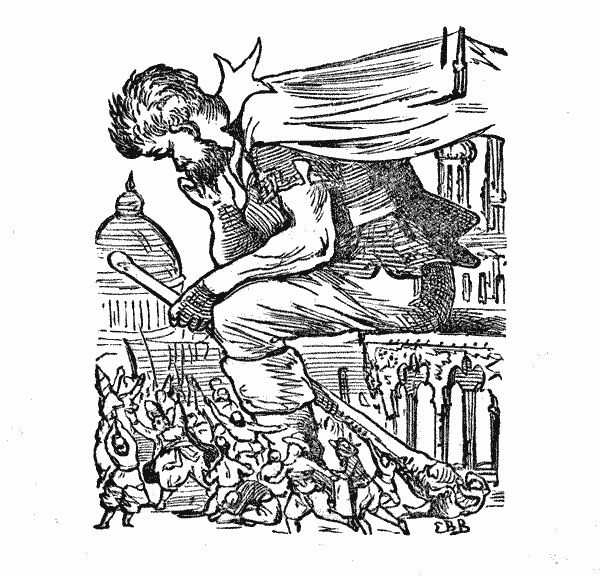
The Giant was then about to leave them; but as the citizens would not
hear of this, and as he was a rare good fellow, and did not object to
festivities, he was persuaded to go with them. As they had no horse big
enough for him, he walked.
The procession was then formed for the return march. First of all rode
the Head-man, with a sword in one hand and a golden horn in the other.
Then marched the professors of music. After them came all those of the
army who could play on the trumpet; then the guard of honor, with the
Prince and Princess; then Trumkard and the Giant, and after them the
immense host that could carry their weapons in one hand, and play upon
the drum with the other. When they started, the drums were all beaten,
the trumpets all blown, the horses neighed, the spears glittered, the
banners flapped and fluttered, and there was never so brave an army in
the world.
From all the hills, and plains, and valleys, the people came flocking to
see them as they passed. The enthusiasm was so great, that when night
came on again, enormous bonfires were lighted on both sides of their
road, and kept up with such hearty good-will, that they travelled all
night in a light as bright as day; and when the wood gave out, the
peasants tore down their cottages, and threw them on the flames.
As they proceeded, the professors of music composed marches, and when
one was finished, they gave the manuscript to the Head-man, who,
commanding silence, blew the tune on his horn, and then the whole army
struck up and played it grandly. Of these, the "Giant's Grand March" was
the best. It was what might be called good, loud music. If it had
thundered, it is not likely that it would have been heard in the grand
final burst, when all the drums and trumpets beat and blew their very
loudest.
The Giant himself played in this march; for some of those who marched
near him, seeing that he had no instrument, asked him if he would not
like to play upon something. To which he replied that he did not care if
he did. So they got for him the largest bass-drum. He was much pleased
at this, and handing his club to two hundred porters, who accompanied
the expedition, he beat away upon his drum in good style. This
performance did not last long, however; for the first time they played
the grand final burst, he beat on both drum-heads at the same time, and
of course there was no more music from him. The people around him were
very glad of this; for while he played, he became so much excited that
he did not see where he was walking, and was continually treading upon
some one. So they journeyed with joy and gladness until they reached the
city of the mighty King, and all the people who had been left behind
came out to meet them. Bells were rung, and all kinds of music played,
and the people shouted, so that the oldest inhabitant never knew such a
noise and excitement before. They entered the city, and the procession
halted at the palace. Here the Princess, after embracing the Prince, was
conducted to the ladies' apartments, where her friends were so overjoyed
at seeing her again, that one would have thought that they would never
have got over it. The Prince, Trumkard, and the Giant were each shown to
sumptuous apartments, and that night everybody in the palace had as much
of everything good as they could eat.
Twelve o'clock of the next day was the time appointed for the Princess
to make trial of the magical music. The great hall of the palace was
fitted up most magnificently, and with the utmost rapidity, for this
great occasion. The chairs of the judges were covered with new velvet,
and nothing was omitted that could add to the regal splendor of the
hall. At half-past ten the doors were opened, and the hall was
immediately filled in every part, but the small portion reserved for the
principal actors in the ceremony. There were nine galleries, one above
the other, around this truly immense room; and when it was all packed
full of people from floor to dome, it was a wonderful spectacle indeed.
At ten minutes of twelve, the procession entered the great hall. First
came, along the centre passage, which was covered with cloth of gold, a
number of beautiful boys, who strewed the way with hyacinths, and
jasmines, and the costly blossoms of the century plant. After them were
others, with golden water-pots, who sprinkled attar of roses before the
Princess, who, dressed in the purest white silk, cut bias, and trimmed
with pink fur, was escorted by the Prince. After them came the Prime
Minister (released for the occasion), the nobles, etc., and the
procession was closed by the guards of the palace, all dressed in blue
and covered with diamonds. There was no music, nor scarcely any sound
whatever, as they moved toward the judges, who were already sitting
solemnly in their chairs. When the procession reached them, it halted,
and the Princess was conducted to a chair in front of the music. Then
the youngest judge arose, and uncovered the magical music.
In all that hall, filled with such a multitude, there was breathless
silence. It was so still that the little mice came out of their holes,
thinking there was no one there.
Then the Princess, timidly raising her eyes, ran them over the music,
and began. It commenced softly and somewhat sadly, but soon, becoming
louder and richer, the tones swelled high and clear, until the pure
voice of the Princess thrilled through all the perfumed air. Then it
became more and more glorious, until its beatific beauty caused many of
the older hearers to die, and go straight to paradise. The close was
inconceivably sweet; and when the last notes died away, the people bowed
their heads in tearful peace, and all evil left their hearts, and to
many of them it never returned.
As they raised their heads, they saw the oldest judge arise and point
with his golden wand to the marble tablet. The characters of the music
had disappeared, and the vellum on which they had been written was as
white as snow. There was no need of any further decision. The judges
descended from their chairs in profound silence, and the oldest and the
youngest, each taking the Princess by the hand, led her up the steps to
the throne, and seated her upon it. Then the Prime Minister took the
crown from its velvet cushion, and placed it on her head, and, turning
to the people, said in a voice which sounded in the stillness to all
parts of the vast building, "Behold your Queen!"
Then, as one man, that great multitude gave such a sudden, wild,
tremendous shout, that it took the roof right off the top of the house,
and the wood that fell in every direction outside, was enough to keep
the poor people in kindling-wood all winter.
The Giant, whirling his iron helmet around his head, now led off, with a
thundering "Hip, hip, hurra!" in three cheers for the Queen. And three
such cheers!
The dense crowd outside took them up, and shook the very foundations of
the city with their shouts; and the country people, and those at a great
distance, heard the joyful sounds, and before many minutes the whole
country, for miles around, reverberated with cheers for the new-made
Queen.
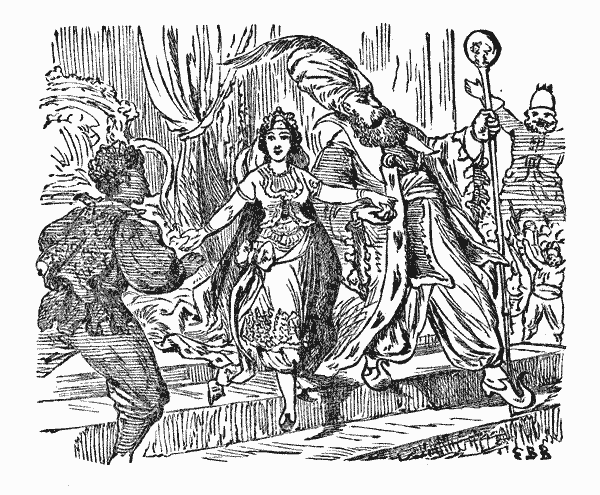
As for the palace, it shook and trembled with the thunders of applause,
still led by the Giant, who couldn't be stopped. The people about him
were all struck deaf in the ear nearest him, but the ear-doctors cured
them all for nothing, when they got outside, so full of charity was
every one. At last, when every one, the Giant and all, were hoarse with
shouting, the Prime Minister offered his hand to the Queen, and led her
down from the throne. Then she motioned to the Prince to give her his
arm; and at the head of the procession, he led her to the royal
apartments, at the door of which he left her. The multitude then
dispersed, and they spent the rest of that day in putting right the
wrongs they had committed, and in making provision for future virtue.
When the Queen had taken some refreshment, she put on an every-day
crown, and repaired to the audience chamber to receive the visits of the
various dignitaries of the kingdom, who came before her, and brought her
their keys, and papers, and account-books. Giving each one back his
keys, and ordering the papers and accounts to be deposited in a great
pile on one side, where she might look over them at her leisure, she
reappointed every man to the office he held before, and sent them away
rejoicing. Then she called for writing materials and slaves, and
commenced writing notes to the Prince. She would write one on gilded
vellum, and, folding it, would hand it to the slave next to her, who
dipped it in frankincense, and handed it to the next one, who sprinkled
it with attar of roses, and passed it to the next, who ran with it as
hard as ever he could to the Prince. For in that kingdom it was not
considered proper for lovers to visit much.
This performance the Queen kept up all the afternoon, writing as fast as
she could, and only stopping long enough to read the answers which the
slaves brought her as they returned. At last, they came back, bringing
with them her last notes unopened, saying that the Prince had gone to
sleep. At which intelligence she shed some tears, but then, like a
sensible Queen, had her supper, and went to bed.
The next day the marriage of the Queen and the Prince took place, and it
was a glorious affair indeed. Twenty-four historians were appointed by
the Crown to write the history of it; they were paid by the quarter, and
it took them a long time, I can assure you.
The whole of the wedding-day, the festivities were kept up, and all the
eating, and drinking, and merry-making, was at the royal expense. During
the day and night everybody spent, and gave away to the poor, all the
wealth they possessed, and in the morning it was all paid back to them
by the royal Treasurer. In the country, the people feasted grandly on
their own herds, and drank up their own wines, and they were also
reimbursed by the Crown.
But the great feature of the royal marriage was the decree, proclaimed
at noon of the wedding-day, that all persons married on that day should
be set up in housekeeping, free of expense!
Never, in the history of that or any other kingdom, were priests kept so
busy as those in this city. They worked as hard as they could, but at
three o'clock they were obliged to commence marrying the folks by
squads; and so, before suppertime, there was not a bachelor or maid in
the whole city,—excepting an old bobstay spinner,—one of the crossest
of old maids, who hated men so much that she had not spoken to one for
forty years; and a crabbed bachelor, who despised women so completely
that he never had his clothes washed, because it would have to be done
by females.
At midnight, the priest Ali-bo-babem was called out of his bed, and
found at the door, desiring to be married, the crabbed old bachelor and
the cross old maid. These two did not live long, but all the rest of the
people were very happy for many years.
About three o'clock of the morning after the great wedding-day, the
Giant Tur-il-i-ra arrived at his castle gate. He had walked all the way
home, and he felt in such a good humor that the road never seemed so
short to him before. But, for some reason, he could not open the gate.
There seemed to be an unusual number of locks and bolts, and the big key
he carried did not seem to fit any of the numerous key-holes. He could
easily reach over and undo the bolts, but the locks were too much for
him; and, I am sorry to say, he got a little angry, and was about to
take his club and smash his magnificent gate, when his wife, who had
been sitting up for him, and had heard the noise he had been making,
came down and let him in.
They went together into the great hall, and there Tur-il-i-ra sat down
before the fire. His wife, who thought a great deal of the good Giant,
was sorry to see that he was silent and rather grum.
"What makes you look so, my dear?" said she. "Did you not have a good
time?"
"O yes," said he, "good enough,—but that gate put me out. I wonder
what's the matter with it. It's got to be fixed. I won't be bothered and
worried in this way."
"It shall all be made right in the morning," said his wife. "But are you
sure you did not take anything that disagreed with you while you were
away?"
"Perhaps I did," said he. "It might have been the mince-pies. They told
me they were temperance pies, but I don't believe it."
"How many did you eat, my dear?" asked the good Giantess.
"Well, I don't know," said her husband. "About ten or eleven hundred, I
suppose."
"That was too many for you," said his wife. "And I think you had better
go to bed, and I will bring you something to make you feel better."
So the Giant went to bed, and as he slowly ascended the stairs, he
winked to himself with his right eye. And his wife, she went into the
kitchen, and winked to herself with her left eye.
After a while she came up to the Giant, and brought a barrel of hot
chamomile tea; and when he had drank it all, she tucked him in, nice and
warm, and the next morning he felt as well as ever.