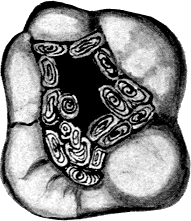
Dr. Robinson's Fibrous and Textile Metallic
Filling is a shredded metallic alloy, mostly tin, and
has the appearance of woven or felt foil. It is prepared
in a machine invented by the doctor especially
for the purpose, and he gives directions for
using as follows: "Cut the material into strips
running with the selvage, and fill as you would with
soft foil; use it in all surrounding walls, and finish
with a mallet burnisher. Where the surface comes
to hard wear, weld on gold with long, sharp serrated
pluggers, and finish the same as with gold
fillings. The advantage over gold for cervical,
buccal, and lingual walls is the perfect ease with
which it is adapted, and it can be burnished so as
to be absolutely impervious to moisture. Sharp,
coarse-serrated pluggers are particularly desirable
when using hand pressure." It comes in one-half-ounce
boxes, filled with sheets less than two inches
square; the thin ones are used for filling, and the
thick ones make good linings for vulcanite.
This material is easy to manipulate, but great
care is required in condensing at cavity-margins,
so as to make a tight filling, and also not injure the
margins. It makes as hard a surface as tin foil, and
can be cut, polished, and burnished so that it is
smooth and looks well; it can be used in temporary
or chalky teeth, as a small amount of force condenses
it. By using a matrix proximal cavities
can be filled from one-fourth to one-half full, and
the rest filled with gold, relying on the form of the
cavity to hold the gold, regardless of its connection
with the fibrous material. If the surface is not
overmalleted so as to make it brittle or powdery, a
strip of No. 4 cohesive gold, of four or five thicknesses,
may be driven into it with a hand mallet and
plugger of medium serrations; this union is largely
mechanical, but of sufficient tenacity to make
manipulation easy, as the material makes a solid
foundation to build upon. After exposure to the
oral fluids, electrolysis takes place at the junction
of the metals.
In 1884 Dr. Brophy said, "I have used Robinson's
material for two years, and find it possesses
good qualities, and can be used in deciduous teeth,
first permanent molars, and cervical margins with
better results than can be obtained with any other
material by the majority of operators."
Malleted with deeply serrated pluggers, it will
make a filling which will not leak. It has saved
many teeth from caries at the cervical margin
where it might have recurred sooner had cohesive
gold been used. In the mouth it changes color
about the same as tin foil, and a few fillings did not
maintain their integrity, but became crumbly and
granular.
For conducting properties it ranks about with
tin, and fillings can be made more rapidly than with
cohesive gold. We have used ounces of it, but
time has proved that everything that can be done
with it in filling teeth can also be accomplished as
well and in some cases better with tin foil.
In 1878 Dr. N. B. Slayton patented his Felt Foil,
which was said to be tin cut into hair-like fibers by
a machine, then pressed into small sheets and sold
in one-half-ounce books, but it sold only to a very
limited extent. Soon after this Dr. Jere Robinson,
Sr., invented a machine and began the manufacture
of a similar article, but he found he was
infringing on the Slayton patent, so he purchased
the Slayton machine and made satisfactory terms
to continue his own manufacture of fibrous material.
After this little was heard of Slayton's Felt
Foil, but Robinson's was considerably used. The
two materials look and are manipulated almost
exactly alike. Dr. Robinson has both of above-mentioned
machines now in his possession.
Archibald McBride, of Pittsburg, Pa., in 1838,
made a roll of a portion of a sheet of tin, and then
used just enough gold to cover it, aiming to keep
the gold on the surface, so as to have the filling
look like one of all gold, and not with the idea of
deriving any special benefit from the effects of wear
or preservation as obtained by thus combining the
two metals. The fee for a gold filling was one
dollar; tin, fifty cents. Some operators have advocated
using tin and gold (symbol Tg), rolled or
folded together in alternate layers, thus exposing
both metals to the fluids of the mouth; claiming
that fillings can be made quicker, are not so subject
to thermal changes, and can be inserted nearer the
pulp than when gold is used. This may be true
in comparison with gold, but these three claims are
entirely met by using tin alone. Others say that
this union of gold and tin will preserve the teeth as
well as a correct gold filling, making no conditions
or restrictions as to tooth-structure or location of
cavity. They say that it preserves the cervical
margin better than gold; that it expands slightly.
A description of some different methods of combining
and manipulating tin and gold is subjoined:
(a) Two sheets of No. 4 cohesive gold and one
of the same number of tin are used; place the tin
between the gold, cut off strips, and use with hand
or mallet force the same as cohesive gold; if non-cohesive
gold is used, the strips can be folded into
mats or rolled into cylinders, and are used on the
wedging plan, the same as non-cohesive gold, or
the strips can be folded back and forth in the cavity
until it is full.
(b) Lay a sheet of non-cohesive gold, No. 3, on
a sheet of tin of the same number, cut off strips, roll
into ropes and use as non-cohesive gold. It is
easily packed and harder than tin, and has a preservative
action on the teeth. Line the cavity with
chloro-balsam as an insulator against possible currents
and moisture; especially should this be done
in large cavities or chalky teeth.
(c) A sheet of non-cohesive gold, No. 4, is laid
on a sheet of tin of the same number, cut into strips
and rolled into cylinders, or folded into blocks,
always in equal portions; then they will unite to the
extent of two leaves. These fillings sometimes
become a solid mass about the color of amalgam,
and last very well, as the metals have become united
by electrolysis. An excess of tin will be marked by
lines or pits in the filling, showing where the tin
has been disintegrated or dissolved by the chemical
action which occurs on the surface exposed to
moisture.
No doubt, good fillings have been made by the
above methods, yet some were granular, gritty, and
were easily removed, while others were quite
smooth and hard; probably in the first instance the
proportion of tin and gold was not proper,—that is,
not equal; or it was not well condensed. Tin being
the positive element, it is more easily acted on and
disintegrated by electrolysis (chemical action of the
fluids).
When this combination does become hard, it
wears longer than tin on an occlusal surface, but
we believe that in some cases where it was used the
teeth could have been saved just as well with either
tin or gold, or by filling part of the cavity with tin
and the rest with gold.
If tin foil is laid on 22-carat gold and vulcanized,
it becomes thoroughly attached and will take a
tin polish; the attraction or interchange of atoms
takes place to this extent.
This combination of tin and gold can be used at
the cervical margin, or a cavity can be lined with it,
and the remainder filled with cohesive or non-cohesive
gold.
"Tin and gold (Tg) folded or rolled together in
equal portions possesses a greater number of desirable
properties than any other material, for it is
easily adapted, has antiseptic action and a lower
conductivity than gold. A new filling is harder
than tin, softer than gold, but after a time it becomes
as hard as amalgam. It oxidizes and thus
helps make tight margins, and is very useful at cervical
margins; generally discolors, but not always,
and does not discolor the tooth unless a carious
portion has been left, and then only discolors that
portion. In oral fluids it is indestructible if well
condensed, otherwise it is crumbly. There is no
change of form, except a slight expansion, which
does no harm. A weak electric current is set up
between the gold and tin, and tin oxid is formed.
The hardening and discoloration both depend upon
the separation of the tin by the electrical action and
its deposition on the surface of the gold. I generally
prepare cavities the same as for non-cohesive
gold, but a Tg filling may be held in a more shallow
cavity and with less undercuts than for gold.
Hand pressure is adopted, but a mallet may be
used advantageously. Lay a sheet of No. 4 non-cohesive
gold on a sheet of No. 4 tin, then cut into
strips and twist into ropes; keep the tin on the outside,
for it does not tear as easily as gold. Carry
the material against the walls and not against the
base, otherwise the filling will be flat or concave;
but should this occur, then force a wedge-shaped
plugger into the center of the filling, and drive the
material toward the walls, and then fill the hole or
remove all the filling and begin anew.
"In very deep cavities use a mat of Tg, dampened
in carbolic acid and dipped in powdered
thymol, as a base; this has an antiseptic action, and
also prevents pressure on or penetration into the
pulp.
"Drs. Abbot, Berlin; Jenkins, Dresden; Sachs,
Breslau, have observed tin-gold fillings from fifteen
to twenty-five years, and say that for certain cases
it is better than any other material. I use square-pointed
pluggers (four-cornered), as part of the
packing is done with the side of the plugger. Tg
is useful in partly erupted molars, buccal cavities
under the gums, occlusal cavities in temporary
teeth, cavities where all decay cannot be removed.
Use Tg with a gold capping in small, deep occlusal
cavities, cavities with overhanging walls, occlusal
cavities with numerous fissures, large, deep occlusal
cavities near the pulp, in proximal cavities.
"Line labial walls of incisors with non-cohesive
gold, and fill the remainder with Tg. For repairing
gold fillings I use Tg." (Dr. Miller, Berlin,
Dental Cosmos, 1890.)
Dr. Jenkins, of Dresden, says, "I use Tg in soft,
imperfect teeth, of which there are plenty in Germany,
because it has pliability, adaptability, slight
susceptibility to thermal changes, makes a water-tight
joint, very useful at cervical margins, and
can be used with a minimum amount of pressure.
When packed dry and with the gold next
to the tooth, discoloration occurs only on the surface;
packed wet, the whole discolors. I do not
attribute its success to electrical action. Lay a
sheet of No. 4 tin on a sheet of No. 4 non-cohesive
gold, fold so as to keep the gold on the outside; use
the strip with lateral pressure, doubling it upon
itself."
Dr. A. H. Thompson: "After several years'
successful use of tin-gold, I commend it for approximal
cavities, cervical margins, and frail walls. The
oxid formed penetrates the enamel and dentin; if a
filling wears down, cover the surface with gold."
Dr. Pearson: "I do not like tin and gold in
alternate layers. I prefer No. 10 tin foil."
Dr. James Truman: "I believe that tin-gold has
a positive value as a filling-material."
"I prepare tin-gold by taking a sheet of No. 4
non- or semi-cohesive gold, fold them together (or
twist them) so as to have the gold on the outside,
and then fill any cavity with it. Since adopting the
above combination I have almost abandoned amalgam.
This is recommended on account of its
density, ease of insertion, capacity for fine finish,
non-conducting and non-shrinking qualities, and
compatibility with tooth-substance. Those who
have not used it will be surprised at the rapidity
with which it can be manipulated. It may be employed
in any cavity not exposed to view, also in
crown, buccal, and approximal fillings which extend
into the occlusal surface, as it offers an astonishing
resistance to wear. It can be used anywhere
that amalgam can, and with more certainty
of non-leakage, and it has the additional advantage
that it can be finished at the same sitting. Care is
necessary in manipulating it, so as to avoid chopping.
I use hand pressure when filling, and the
mallet to condense the surface." (Dr. A. W. Harlan,
Independent Practitioner, 1884.)
"Pure tin foil is employed in connection with
non-cohesive gold in filling proximal cavities in bicuspids
and molars; a sheet of gold and a sheet of
tin are folded together." (C. J. Essig: "Prosthetic
Dentistry.")
Dr. Benj. Lord says, "A combination in which I
find great interest is in the use of soft or non-cohesive
gold with tin foil. This is no novelty in practice,
but I think that, for the most part, too great
a proportion of tin has been used, and hence has
arisen the objection that the tin dissolved in some
mouths. I am satisfied that I myself until recently
employed more tin than was well. I now
use from one-tenth to one-twelfth as much tin as
gold, and no disintegration or dissolving away of
the tin ever occurs. I fold the two metals together
in the usual way of folding gold to form strips, the
tin being placed inside the gold. The addition of
the tin makes the gold tougher, so that it works
more like tin foil. The packing can be done with
more ease and certainty; the filling, with the same
effort, will be harder, and the edges or margins are
stronger and more perfect.
"The two metals should be thoroughly incorporated
by manipulation. Then, after a time, there
will be more or less of an amalgamation. By using
about a sixteenth of tin, the color of the gold is so
neutralized that the filling is far less conspicuous
than when it is all gold, and I very often use such a
proportion of tin in cavities on the labial surfaces of
the front teeth.
"If too much tin is employed in such cases, there
will be some discoloration of the surface of the fillings;
but in the proportion that I have named no
discoloration occurs, and the surface of the filling
will be an improvement on gold in color."
"Dr. Howe. I would like to ask Dr. Lord
whether, in referring to the proportions of tin and
gold, he means them to be considered by weight?
"Dr. Lord. No, not by weight, but by the
width of the strip of tin and the width of the strip
of gold. I get the proportions in that way, then
lay the tin on the gold and fold the gold over and
over, which keeps the tin inside the gold.
"Dr. Howe. Will Dr. Lord tell us whether he
refers to the same numbers of gold foil and tin foil;
as, for instance, No. 4 gold and No. 4 tin?
"Dr. Lord. I use the No. 5 gold, and tin, I
think, of about the same number, but I always use
No. 5 gold, both cohesive and non-cohesive."—New
York Odontological Society Proceedings, 1893,
page 103.
"Tin and gold, in the proportions generally used,
do not present a pleasing color; when finished, it
looks but little better than tin, and after a short
time it grows dark, and sometimes black. I use
five parts of gold to one of tin, prepared as follows:
Lay down one sheet of Abbey's non-cohesive gold
foil, No. 6; upon this place a sheet of No. 4; upon
this place a sheet of White's globe tin foil, No. 4;
upon this another sheet of Abbey's non-cohesive
gold, No. 4; upon this a sheet of No. 6. Cut into
five strips and crimp; the crimped strips are cut into
pieces a little longer than the depth of the cavity
to be filled; some of the strips are rolled into cylinders,
others are left open, because easier to use in
starting a filling. The color of this combination is
slightly less yellow than pure gold, and hardens just
as rapidly as when the proportions are one to one,
but does not become quite as hard. This preparation
is non-cohesive, and should be inserted by
the wedge process. I use it in the grinding surface
of molars and bicuspids, buccal cavities in molars
and bicuspids, cervical fissure pits in superior incisors,
proximal cavities in bicuspids and molars.
If proximal cavities are opened from the occlusal
surface, the last portion of the filling should be of
cohesive gold to withstand mastication. In simple
cavities I place as many pieces as can be easily
introduced, using my pliers as the wedging instrument
to make room for the last pieces, and then
condense the whole. If the cavity is too deep for
this, I use Fletcher's artificial dentin as a base,
because it partly fills the cavity and the ends of the
cylinders stick to it. After an approximal cavity is
prepared, use a matrix held in place by wooden
wedges; the cylinders are about one-eighth of an
inch long, and condensed in two or three layers so
as to secure perfect adaptation; hand pressure is
principally used, but a few firm strokes with a hand
mallet are useful. When ready to add the cohesive
gold for the grinding-surface, a few pieces of
White's crystal mat gold should first be used, because
it adheres beautifully; thus a perfect union is
secured, but I never risk adding the gold without
leaving a little undercut for it in the tooth. By
this method we obtain a beautiful contour filling
in a short time. Fillings should be burnished and
then polished with a fine strip, or moistened pumice
on a linen tape. Where cohesive gold is used for
the entire filling, in many cases the enamel-walls,
already thin near the cervical margin, are made
thinner by the unavoidable friction of the polishing
strips, but tin and gold is so soft that a good surface
is obtained in a few moments, and this danger
is reduced to a minimum. The surface is as smooth
as a cohesive gold filling, while such a surface is
impossible with non-cohesive gold. In cavities
which extend so far beyond the margin of the gum
that it is impossible to adjust the rubber-dam, I
prepare the cavity as usual, then adjust a matrix,
disinfect, dry, and fill one-third full with tin and
gold, then remove the matrix, apply the rubber,
place matrix again in position, and complete the
filling by adding a little tin and gold, then pure
gold." (Dr. W. A. Spring, Dental Review, February,
1896.)
Dr. T. D. Shumway says, "To have a scientific
method of treatment, there certainly must be a
recognition of what is known of the nature of
tooth-structure. The method adopted more than
a quarter of a century ago, and which is at present
employed, does not accord with the teachings of
the physiologist and microscopist; it is in direct
opposition to natural law. Each new discovery in
the minute structure of the teeth makes this more
plain; pounding the teeth with a mallet cannot be
defended on scientific grounds. That it has not resulted
more disastrously is due to the wonderful recuperative
energy of nature to repair injury. No
one would think of attempting to arrest and prevent
disintegration in any other vital organ by
abrasion. Why, then, in operation on the teeth,
should we reverse the plain, simple teaching of nature?
Placing cohesive gold against the dentinal
walls by pounding it to heal a lesion is opposed to
natural law. Cohesive gold will not be mastered
by force; if compelled to yield by superior strength,
it seeks a way to release itself; it is easily coaxed,
but not easily driven. Cohesive gold will unite
with tin at an insensible distance just as cohesive
gold unites with itself; this union takes place without
force or pressure. Exactly what takes place
when gold and tin are brought in contact in the
way described we do not know; we can only say
that there appears to be a perfect union. When cohesive
gold was introduced to the profession, while
it was softer than non-cohesive foil, it was found to
resist under manipulation. This resistance is in accordance
with the well-known law that all crystalline
bodies, when unobstructed, assume a definite
form. With gold the tendency is to a spherical
form. The process of crystallization is always from
within outward. The mallet was introduced to
overcome the resistance caused by the development
of the cohesive property. Pounding gold with a
mallet only increases its crystallization. A crystalline
body coming in contact with a fibrous one
can neither be antiseptic nor preservative; a filling-material
which possesses these properties must be
one that corresponds or is in harmony with tooth-substance.
"In the interglobular spaces there is a substance
which is called amorphous or structureless, and a
filling to be in harmony with this substance should
be amorphous or structureless in its composition.
The only materials we have which meet these conditions
are gutta-percha and tin. It is its structureless
character that gives to tin its value. Coming
in contact with the living dentin, it is easily
adapted, and does not excite inflammation; it does
not interfere with the process going on within the
teeth to heal the lesion caused by caries. A wound
from a bullet made of tin, unless it struck a vital
part, nature would heal, even if the cause of the
wound was not removed, by encysting the ball.
This process of nature of repairing injury by encysting
the cause is of interest to the dentist in the
study of suitable filling-materials. Tin is very useful
at the cervical margin of cavities; it acts as an
antiseptic or preservative, and reduces the liability
to subsequent decay. It is our endeavor to obtain
a filling that will preserve the teeth and reduce the
liability to, if not wholly prevent, secondary decay.
The law of correspondence is of more consequence
than the mechanical construction of the filling.
Tin can be used without that rigid adherence to
mechanical rule that is necessary to retain a filling
of cohesive gold; thus less of the tooth needs to be
sacrificed.
"Gold will unite with tin under certain conditions
so as to form apparently a solid mass. By
a combination of these metals, not by interlacing
or incorporating one in the other, but by affinity,
secured by simple contact, we have all the preservative
qualities of tin combined with the indestructible
properties of gold. For the base of the
filling we have a material in harmony with tooth-substance,
introduced in a way that is in accord
with the law that governs all living bodies, and for
the outside a crystalline substance that corresponds
to the covering of the teeth. This covering
of gold is a perfect shield to the base, and the
field for the display of artistic skill in restoring
contours is as broad as though gold was used entirely.
Will a filling of this kind withstand mastication?
There is in the economy of nature a provision
made to overcome the resistance of occlusion.
The teeth are cushioned in the jaw and yield
under pressure. The elasticity of the substance
of which the teeth are made is well understood.
Ivory is the most elastic substance known. The
teeth coming together is like the percussion of two
billiard balls. Now a filling to save the teeth
should correspond as nearly as possible with the
tooth-substance; it should not be arbitrary, but
elastic and yielding. Tin is interdigitous; it expands
laterally, and is almost as easily introduced
as amalgam, and when put in place does not have
to be bound to be retained. Tin, with an outside
covering of gold to protect it, makes a filling to
which amalgam bears no comparison. In the
light of scientific investigation there can be but
one method—a method based upon the recognized
principle that the filling-material and the manner
of introducing it shall correspond to and be in harmony
with the living, vital organism with which
it comes in contact.
"After excavating, the cavity is treated with
absolute alcohol, as cleanliness and thorough dryness
are absolutely essential.
"The tin is put in with steel pluggers, after the
method of wedging; it must be thoroughly condensed,
so as to leave a smooth surface, and
enough used to come up to where the enamel and
dentin join.
"The effect is not produced by incorporating or
interlacing the gold with the tin; we rely upon the
affinity of the two metals to retain the gold; no
undercuts, angles, or pits are made in the tin,
dentin, or enamel. The gold, extra cohesive from
No. 4 to 40, is made to adhere to the tin by simple
contact, without pressure or force; the union is not
mechanical.
"The instruments used for filling the remainder
of the cavity with gold are Shumway's ivory points,
which adapt the gold nicely to the margin.
"The set consists of five and were patented in
1881, and have been used by me since that time
for manipulating cohesive gold. One 'point' is
for proximal cavities in the anterior teeth; three
'points' of different sizes are for occlusal cavities;
one 'point' for proximal cavities in bicuspids and
molars and labial and buccal cavities; the sides,
edges, and ends of the 'points' are used, as the
purpose is simply to obtain contact.
"The 'point' shown full size in Fig. 8 is of more
general application than any of the others, and is
used for proximal cavities in bicuspids,
also labial and buccal cavities. The
handle is made of ebony, and has a silver
ferrule, from which the ivory extends to
the end and completes the instrument.
"The metal pin in the end of the
handle is for picking up and carrying the
gold."
Fig. 8.

Tin has been used successfully for
completely lining cavities, filling the remainder
with gold; it is also useful for repairing
gold fillings.
Two or three thicknesses of tin foil may be
pressed into a cavity with a rubber point or hard
piece of spunk, allowing it to come well out to the
margin; filling the rest with amalgam.
"As a lining it presents to dentin an amalgam
of tin and mercury which does not discolor the dentin
like ordinary amalgam, and helps do away with
local currents on the filling, which is one cause of
amalgam shrinkage in the mouth." (Dr. S. B.
Palmer.)
When caries extends to the bifurcation of roots,
make a mat of two or three layers of tin, place it in
the bifurcation and use it as a base in filling the
rest of the cavity with amalgam.
Tin is second in importance in alloys for amalgam,
as it increases plasticity, prevents discoloration,
reduces conductivity and edge strength,
retards setting, favors spheroiding, therefore
should not be the controlling metal.
It will be noticed that when cavities are lined
with tin foil, it only constitutes a small part of
the filling, and that it has not been melted with
the other metals in the alloy before being amalgamated.
A thick mat of tin has been recommended as a
partial non-conductor under amalgam fillings.
Plastic tin can be made by pouring mercury
into melted tin, or by mixing the fillings with mercury
at ordinary temperatures; it has a whitish
color, and if there is not too much mercury it
occurs in the form of a brittle granular mass of
cubical crystals. Generally amalgams of tin and
mercury do not harden sufficiently, but forty-eight
parts of mercury and one hundred of tin make a
fairly good filling, said to have a therapeutical
value; it should not be washed or squeezed before
using, and "is not a chemical combination."
"Tin unites with mercury in atomic proportions,
forming a weak crystalline compound." (Dr. E.
C. Kirk.)
Mercury and tin readily unite as an amalgam
under ordinary circumstances, and form a definite
chemical compound having the formula Sn2Hg.
(Hodgen.)
Another preparation of tin is known as stannous
gold; it is manufactured in heavy sheets and used
the same as cohesive gold foil, and can be easily
manipulated, for it is rather plastic.
Crystal tin for taking the place of tin foil:
"Take chemically pure hydrochloric acid and
dissolve tin foil in it until a saturated solution is
obtained; this may be done speedily by heating
the acid to a boiling point, or the same thing can
be accomplished in a few hours with the acid cold;
it is then chlorid of tin. It is then poured into a
clean vessel and an equal quantity of distilled water
added; then a clean strip of zinc is plunged into the
solution, and tin crystals are deposited on the zinc;
when there is sufficient thickness on the zinc, remove
both, and slip the crystals off from the zinc
into pure water, clean the zinc thoroughly, and reinsert
for another coating. The character of the
crystallization will be modified by the extent of the
dilution of the solution in the first place. Wash
the tin in pure water until all traces of the acid are
removed, or a few drops of ammonia can be added
to neutralize the acid. It was suggested that it
would be desirable to have some acid remain in the
tin for filling teeth in which there is no sensitive
dentin. We have put in a few fillings, and it works
beautifully, and makes firmer fillings than foil. It
must be kept in water (probably alcohol is better).
It is pure tin, unites perfectly, and works easier
than foil." (Dr. Taft, Dental Register of the West,
1859.)
For some years it was considered the best practice
to enlarge all root-canals and fill them with
gold; in many of these cases the crown cavities
were filled with tin.
Tin has been used for filling root-canals, but
should there happen to be any leakage through
the foramen or tooth-structure, the tin will discolor,
and there may be infiltration into the crown,
thus causing discoloration, which might be objectionable
if the crown was filled with gold. Chloro-percha,
gutta-percha, and oxychlorid of zinc are
much better for this purpose.
The apical quarter of a canal has been filled with
tin, and the remainder with cement. Tin can be
used for filling root-canals. Roll on a broach
small triangular pieces of the foil into very small
cone-shaped cylinders, carry to place, then withdraw
the broach, and force in the cylinder with the
same or a larger broach; sometimes it is necessary
to use another broach, to push the cylinder off from
the one on which it is rolled. Another method is
to carry and pack into the canal by means of a
broach, very narrow strips of No. 10 or 20 foil; or
the apical third of the canal could be filled with
gold and the rest with tin.
"About four years ago I concluded to try tin
for filling root-canals; then I began to look for
patients whose general health was good, who had
strong, hardy-looking teeth, and kept their
mouths in good condition. I found one who
answered all my requirements, with a molar to be
filled, and they would not have it filled with gold,
or could not, on account of the expense. I filled
the canals with tin and the crown with amalgam.
After filling thirty-eight molars in this way I
stopped for developments. In six or seven weeks
a lady returned with an inferior molar abscessed,
but at the time it was filled the circumstances
were such that it could not be properly treated.
In nine months a gentleman for whom I had filled
four molars returned with an inferior one abscessed.
This is the sum-total of abscessed teeth
where tin was used in the root-canals, at the end of
four years. The others are in good condition, as
I have seen them every six months. The roots
were treated from four to six weeks with carbolic
acid before filling." (Dr. A. W. Harlan, Missouri
Dental Journal, 1872.)
"Tin foil is just as good as gold for filling root-canals,
as it is entirely innocuous and sufficiently
indestructible, while its softness and pliability commend
it. Where gold is to be used for the crown,
it is better to fill the bulbous portion of the pulp-cavity
with gold also, so as to weld these portions
of gold together. The success of Dr. Harlan's
treatment was about equal to what might be expected
from the same number of teeth where the
canals had been filled with gold." (Editor, Missouri
Journal.)
Shavings turned from a disk of pure tin have
been used in combination with Watts's sponge gold
for filling teeth, either by making a portion of the
filling from each metal or using them indiscriminately.
A mat of tin foil dipped in chloro-percha can be
used to cap an exposed pulp, or a concave tin
disk can be used for the same purpose. A mat of
tin has been used over a slight exposure of the
pulp, because of its slight conduction of heat and
cold, thus avoiding much thermal irritation and
stimulating recuperation.
Some use Robinson's fibrous material as a surface
for tin fillings, thinking that it is harder and
will wear longer because of the erroneous notion
that it has platinum in it.