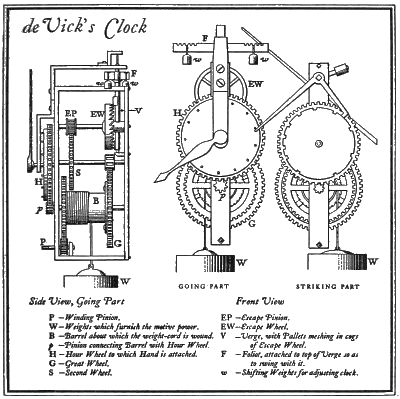
Having traced out the history of the clock and watch mechanism
all the way from De Vick's first clock and the clumsy old
Nuremberg Egg down to the perfect time-keeping device
which we have today, it may be interesting to look a little more closely
at the result of so many years and so many inventions—to see what
its parts are, and how they are put together, and to observe how the
wonderful little machine does its work.
Modern clocks and watches are nearly enough alike in their structure
and way of working, so that if we understand the one, we shall
easily understand the other also. The differences between them are few
and slight and easy to explain. So let us take for our example a typical
modern watch movement, which is easily the more beautiful and
interesting mechanism of the two.
First of all, as we saw in the days of De Vick and Henlein, a watch,
or a clock, is a machine for keeping time. So it must have three essential
parts: first, the power to make it go; second, the regulator to make
it keep time; and third, the hands and face to show plainly the time
it keeps. Each of these three parts is itself made up of several others.
The power or energy which runs the watch is put in to it by the
winding which coils up the mainspring. The outer end of this spring
is attached to the rim of the main wheel (1) and after the spring is
wound this wheel would whirl round and let the spring run down instantly
if there was nothing to stop it. The teeth on this wheel, however,
are geared into the second or center pinion (as shown in illustration
at "A") which makes it run the entire movement while running
down slowly instead of flying round and uncoiling at once.
As we will see later, the spring-power is transmitted through the
train of wheels and the lever (7) to the balance wheel (8) which lets the
escape wheel (5) turn a little each time it swings, while it simultaneously
receives, by means of the lever from the escape wheel, the "impulse"
or power which keeps it running. Thus the swinging of the
balance lets the mainspring down gradually while drawing its power
from it. The spring is made as thin as it can be and still have power
enough to make the watch go. For a modern watch, this is about one
flea-power. One horse power, which is only a small fraction of the
power of the average automobile, would be enough to drive all the
millions of watches in the world.
The center pinion into which the mainspring is geared is attached
to its staff to which is also fastened the large center-wheel (2) so that
the spring cannot turn this pinion without also turning the center
wheel. But the center wheel is, itself, geared into the third pinion,
which is attached to the third wheel (3), and this again is geared into
the fourth pinion attached to the fourth wheel (4). The fourth wheel
gears into the escape pinion which revolves with the escape wheel (5),
so that none of these wheels or pinions can turn except when the
escape wheel does. But there is a constant pressure from the spring
on all of these wheels, which together constitute what is called the
train.
The escape wheel, therefore, wants to turn continually and if it was
not restrained it would revolve rapidly, letting the movement run
down. But it is retarded and can only turn from one tooth to the next,
each time the balance (8) turns. This action is secured by connecting
the balance and the escape-wheel by means of the lever (7), one end
of which forms an anchor shaped like a rocking-beam, called the
pallet (6). In the pallet are two jewelled projections called the pallet-jewels
which intercept the escape-wheel by being thrust between its
teeth, letting it turn a distance of only one tooth at each swing of the
balance as the pallet rocks back and forth.
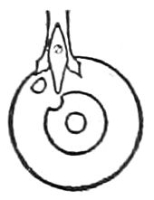
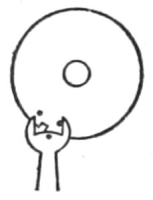
The other end of the lever is fork-shaped, having two prongs. On
the staff with the balance instead of a pinion as all the other wheels
have, is a plain, toothless disc called the roller, from the lower side
of which projects a pin or rod made of garnet. This is called the
jewel-pin or the roller-jewel. The roller being fastened to the balance-staff,
of course, turns just as the balance turns and with it the
jewel-pin. And the lever is just long enough and is so placed that every
time the balance turns, the jewel-pin fits into the slot between the
prongs of the lever-fork carrying it first one way, and then, as the
balance comes back, the other way. Thus the lever is kept oscillating
back and forth, rocking the pallet and withdrawing one pallet-jewel,
releasing the escape-wheel just long enough to let it run to its next
tooth before the other pallet-jewel is thrust in to stop it. It is a
beautiful thing, to watch, like the beating of a tiny heart, or the
breathing of a small quick creature. The hairspring (9) almost seems
to be alive. And indeed, it is in a way, the very pulse of the machine.
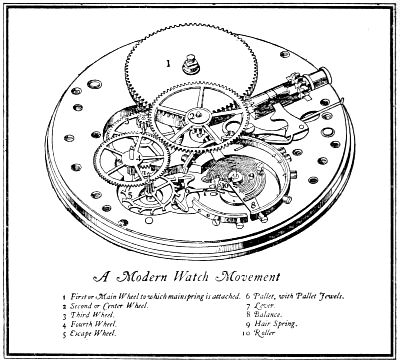
There is only one more important point to understand. You know
how the power gets as far as the escape wheel from the mainspring,
and how the motion of the balance lets the escape-wheel revolve a
tooth at a time, but you have still to learn how the power which keeps
the balance rotating reaches it from the escape-wheel through the
lever. Here is the most interesting feature of a watch movement.
After the balance has been started, its momentum at each turn
starts the lever when the jewel-pin strikes it, but unless the balance
was constantly supplied with new power it would soon stop, and the
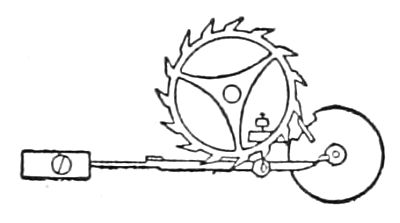
watch would not run. It will be noticed, however, from the illustration,
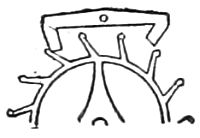
that the teeth of the escape-wheel are peculiar in shape and very
different from those of the other wheels. The ends of the pallet-jewels
are also cut at a peculiar angle.
Now, each time just before the jewel-pin starts to shift the lever
from one side to the other, the latter is in such a position that one of
the pallet-jewels is thrust in so that its side is against that of one of
the teeth of the escape-wheel, keeping it from turning. But the instant
the lever commences to move it begins to draw this pallet-jewel
outward from the tooth until the corner of the jewel passes the corner
of the tooth. Then the escape-wheel is released and the power that
is behind it makes it turn quickly, and on account of the shape of the
tooth, it gives the pallet-jewel a sharp push outward, swinging the
lever, causing it at the other end to impart a quick thrust to the jewel-pin,
thereby accelerating the speed of the balance and renewing its
momentum.
Thus the balance receives the power to keep it in motion, swinging
it as far as the hairspring allows. The hairspring then reverses it and
swings it until the jewel-pin again starts the lever in the other direction,
releasing the escape-wheel from which it receives another "impulse"
and so on as long as the mainspring is kept wound. A watch
in perfect time ticks five times to the second. That means 18,000
swings of the balance every hour, or 432,000 in a day. And in that
time, the rim of the balance travels about ten miles.
A clock is essentially only a larger and stronger watch, just as a
watch is a clock made small enough and light enough to be carried
about conveniently. But the working of the two is practically the
same. They are but different members of the same family, varying
types of one time-keeping machine which is among the most ingenious
and valuable things that man has made.
One interesting thing to know about a watch is that if it is keeping
good time, it will serve for a fairly accurate compass. So if you are
ever lost in the woods, your watch may help you out again. Lay it flat
face upward, and point the hour hand toward the sun. Then South
will be in the direction half way between the hour hand and the figure
12, counting forward as the hands turn in the morning hours, and
backward in the afternoon. This is because the hour hand moves
around the dial just twice as fast as the sun moves around the sky,
making a full circle in twelve hours while the sun makes its half
circle from horizon to horizon.
Now, the sun is always to the southward of you as you are anywhere
north of the equator. At noon, the sun is practically due South.
At that hour, both hands of your watch are together on the figure 12
and the hour hand pointing at the sun points in that direction. At
6 a.m. the sun is nearly East, so if the hour hand, now on the figure 6
is pointed eastward toward the sun, then South would be in a line
just over the figure 9. At 6 p.m., the sun being in the west and the
hour hand pointed at it, South would be half-way back toward the
figure 12, or just over the figure 3. For other morning or afternoon
hours, the same reasoning holds true.
- Adjusting, Practical Course in—Theo. Gribi. Jewelers' Circular
Publishing Company, New York City, 1901.
- American Clockmaking—Its Early History—Henry Terry. J.
Giles & Son, Waterbury, Connecticut, 1870.
- American Watchmaker and Jeweler, The—(An encyclopedia.)
H. G. Abbott. Geo. K. Hazlitt & Co., Chicago, Illinois, 1891.
- American Watchmaker and Jeweler—J. Parish Stelle. Jesse
Haney & Co., New York City, 1868. Revised Edition, 1873.
- Ancient and Modern Timekeepers—Reprint from Harper's Magazine,
July, 1869. Albert D. Richardson.
- Annuaire Suisse (de l'horlogerie et de la bijouterie)—Supplement
gratuit—de l'Annuaire du commerce suisse. Geneva, Switzerland,
1912.
- Artificial Clockmaker, The—(Fourth edition with large emendations.)
Wm. Derham. James, John and Paul Knapton, London,
England, 1734.
- Ausführliche Geschichte der Theoretisch-Praktischen Uhrmacherkunst
Seit der Altesten Art den Tag Einzutheilen
Bis an das Ende des Achzehnten Jahrhunderts—Johann
Heinrich Moritz Poppe, Roch und Compagnie. Leipzig, Germany,
1801.
- Avis Sur le Privilége des Horloges et des Montres de la
Nouvelle Invention—J. de Hautefeuille, Paris, France.
- Clock and Watchmakers' Manual—M. L. Booth. John Wiley,
New York City, 1860.
- Clock and Watchmakers' Manual, New and Complete—Mary L.
Booth. J. Wiley, New York City, 1860.
- Clock and Watchmaking, Rudimentary Treatise on—E. B.
Denison (Lord Grimthorpe). John Weale, London, England,
1850.
- Clock and Watchmaking, Treatise on—Thomas Reid. Blackie
and Son, London, England, 1849.
- Clock and Watch Repairing, Essentials of—John Drexler, Milwaukee,
Wisconsin, 1914.
- Clock and Watch Work—From the Eighth Edition of the Encyclopedia
Britannica—Sir Edmund Beckett. Adam and Charles
Black, 1855.
- Clockjobber's Handybook, The—Paul N. Hasluck. Crosby Lockwood
and Son, London, England, 1899.
- Clock, Watches and Bells—Sir Edmund Beckett. (Sixth edition
Revised and Enlarged.) Lockwood & Company, London,
England, 1874.
- Clockwork, Essays on the Improvement of—Alexander Cumming,
London, England, 1766.
- Collection Archeologique du Prince Pierre Soltykoff. Horlogerie.
Description et Iconographie des Instruments
Horaires du XVIe Siècle, Précédée d'un Abrégé Historique
de L'Horlogerie au Moyen Age—Pierre Dubois. V. Didron,
Paris, France, 1858.
- Curiosities of Clocks and Watches—E. J. Wood. R. Bentley,
London, England, 1866.
- Detached Lever Escapement, The—Moritz Grossman. (Revised,
Corrected, Enlarged.) Jewelers' Publishing Co., Chicago,
Illinois, 1884.
- Detached Lever Escapement—A Discourse on The—(Pamphlet.)
C. T. Higginbotham. South Bend Watch Co., 1912.
- Die Pendeluhr Horologium Oscillatorium—Christian Huyghens,
1673. W. Engelman, Leipzig, Germany, 1913.
- English Trades, Book of—Sir Richard Phillips. (Twelfth edition.)
London, England, 1824.
- Essai Sur L'Horlogerie, Relativement à L'Usage Civil, à
l'Astronomie et à la Navigation—2 Vols., Paris, France, 1763.
- Evolution of Automatic Machinery—E. A. March. Geo. K.
Hazlitt & Co., Chicago, Illinois, 1896.
- Evolution of the Time-Piece—Lyon and Scott. Ottumwa, Ohio,
1895.
- Friction, Lubrication and Lubricants—W. T. Lewis. Geo. K.
Hazlitt & Co., Chicago, Illinois, 1896.
- Geschichte der Uhrmacherkunst—Emanuel Schreiber. B. Fr.
Voigt, Weimar, Germany, 1850.
- Great Industries of United States—Horace Greeley. J. B. Burn,
Hyde & Co., Chicago, Illinois, 1871.
- Histoire Corporative de L'Horlogerie de L'Orfèvrerie et des
Industries Annexes—Anthony Babel. A. Kundig, Geneva,
Switzerland, 1916.
- Histoire de la Mésure du Temps par les Horloges—Ferdinand
Berthoud, Paris, France, 1802.
- Histoire de L'Horlogerie—Pierre Dubois. Published under management
of "Moyen Age et la Renaissance," Paris, France, 1849.
- History of Inventions, Discoveries and Origins—Johann Beckman.
Tr. from German by Wm. Johnston. Revised and Enlarged
by Wm. Francis and J. W. Griffith, London, England,
H. G. Bohn, 1846.
- History of Watches and Other Timekeepers, A—J. F. Kendal.
Crosby Lockwood and Son, London, England, 1892.
- Industrial History of the United States—Albert Sidney Bolles.
Henry Bill Publishing Co., Norwich, Connecticut, 1879.
- Jewelled Bearings for Watches—C. T. Higginbotham (Pamphlet.)
G. K. Hazlitt & Co., Chicago, Illinois, 1911.
- Journal Suisse D'Horlogerie—Publié sous les auspices de la
classe d'industrie et de commerce. (Société des arts de
Genève.) 1876.
- L'Art de Conduire et de Régler les Pendules—Ferdinand
Berthoud. Paris, France. 1805. 1811.
- Les Montres Sans Clef—Adrien Philippe. Geneva, Switzerland.
1863.
- Lessons in Horology—Jules Grossman and Herman Grossman.
Keystone, Philadelphia, Pennsylvania, 1905.
- Les Transformations Industrielles Dans L'Horlogerie
Suisse—Henri Borle. G. Krebs. 1910.
- Lever Escapement, The—T. J. Wilkinson. Technical Publishing
Co., Philadelphia, Pennsylvania, 1916.
- L'Horlogerie Astronomique et Civile; Ses Usages—Ses Progrès
Son Enseignement à Paris—A. H. Rodanet. Vve. C.
Dunod, Paris, France, 1887.
- L'Industrie Horlogère aux États Unis—George Blondel. Soc.
de géographie commerciale de Paris. Bull. mensuel. Paris,
France, 1917.
- Manipulation of Steel in Watchwork—John J. Bowman.
Jewelers Circular Publishing Co., New York City, 1903.
- Modern Clock, The—Ward L. Goodrich. Hazlitt & Walker,
1905.
- Modern Horology—Claudius Lanier. Trans. by J. Tripplin.
E. Rigg. (Second Edition.) Crosby Lockwood & Co., London,
England, 1887.
- Modern Horology, Treatise on—Claudius Lanier. Translation.
- Modern Methods in Horology—Grant Hood. Kansas City,
Jeweler and Optician, Kansas City, Missouri, 1904.
- Nouveau Régulateur des Horloges des Montres et des Pendules;
Ouvrage Mis à La Portée de Tout Le Monde et
Orné de Figures—Ferdinand Berthoud and L. Janvier, Paris,
France, 1838.
- Old Clock Book—Mrs. N. Hudson Moore. Frederick A. Stokes
& Co., New York City, 1911.
- Old Clocks and Watches and Their Makers—F. J. Britten. B.
T. Batsford, London, England, 1899. Revised and Enlarged,
1914.
- Old English Clocks—F. J. Britten. Lawrence & Jellicoe. London,
England, 1907.
- Old Scottish Clockmakers—John Smith. W. J. Hay, Edinburgh,
Scotland, 1903.
- Short Talks to Watchmakers—C. T. Higginbotham. (South Bend
Watch Co.) 1912. (Pamphlet.)
- Simple and Mechanically Perfect Watch, A—Moritz Grossman,
G. K. Hazlitt & Co., Chicago, Illinois, 1891.
- Sun-Dials, Book of—Mrs. Alfred Gatty. Bell and Daldy, London,
England, 1872.
- Sun-Dials and Roses—Alice Morse Earle. Macmillan Co., London,
New York City, 1902.
- Sur Les Anciens Horloges et Sur Jacques de Dondis Surnommé
Horologius—Falconet Camille. In Liber C. Col. D.
V. 16, 1838.
- Time and Clocks—A Description of Ancient and Modern
Methods of Measuring Time—(Sir) H. H. Cunnynghame,
M.A., C.B., M.I.E.E. Archibald Constable & Co., London,
England, 1906.
- Time and Its Measurement—James Arthur. (Reprinted from
Popular Mechanics Magazine.) Chicago, Illinois, 1909.
- Time and Timekeepers—L. and A. Mathey. (Pamphlet.) 1877.
- Time and Timekeepers—Adam Thomson. T. and W. Boone,
London, England, 1842.
- Time and Time Tellers—J. W. Benson. Robert Hardwicke, London,
England, 1875.
- Timekeeper Invented by the Late Thomas Mudge, The—By
Thomas Mudge—his son. Printed for the author, London,
England, 1799.
- Tower Clock and How to Make It—E. B. Ferson. Hazlitt and
Walker, Chicago, Illinois, 1903.
- Universal Clock Adjuster—Eleazar Thomas Perdue. Richmond,
Virginia, 1877.
- Watch, The—Henry F. Piaget. Third edition. A. N. Whitehorne,
New York City, 1877.
- Watch Adjusters' Manual—Charles Edgar Fritts. Charles E.
Fritts, London, England, New York City, Toronto, Canada, 1894.
(Third edition revised.)
- Watch and the Clock, The—Rev. Alfred Taylor. Phillips and
Hunt, New York City, 1883.
- Watch and Clock Escapements—Keystone. Philadelphia, Pennsylvania,
1904.
- Watch and Clockmaker's Handbook, Dictionary and Guide. F. J.
Britten. E. & F. N. Spon, London. Spon & Chamberlain, New
York City. (Tenth edition), 1902.
- Watch and Clockmaking—David Glasgow. Cassel & Co., Ltd.,
London, England; Paris, France; Melbourne, Australia, 1897.
- Watch Balance and Its Jeweling, The (A lecture)—C. T. Higginbotham.
(South Bend Watch Co.) 1907.
- Watch Factories of America, The—Henry G. Abbott. Geo K.
Hazlitt & Co., Chicago, Illinois, 1888.
- Watchmaker and Machinists' Handbook—Wm. B. Learned. G.
K. Hazlitt & Co., Chicago, Illinois, 1897.
- Watchmakers' and Jewelers' Handbook—C. Hopkins. John P.
Morton & Co., Louisville, Kentucky, 1866.
- Watchmakers' and Jewelers' Practical Handbook—Henry G.
Abbott. Fifth edition revised and enlarged. Geo. K. Hazlitt &
Co., Chicago, Illinois, 1892.
- Watchmakers' Handbook—Claudius Lanier.
- Watchmakers' Lathe—W. L. Goodrich. Hazlitt & Walker, Chicago,
Illinois, 1903.
- Watchmakers' Tables—The American Jeweler, Chicago, Illinois,
1914.
- Watchmaking in America—Reprint from Appleton's Journal. Robbins,
Appleton & Co., 1870.
- Watch Repairing—F. J. Garrard. Crosby Lockwood & Son, London,
England, 1903.
- Watch Tests—A Booklet of Tables—F. M. Bookwalter, Springfield,
Ohio, 1911.
- Watchwork, Treatise on—H. L. Melthropp, M.A., F.S.A. E. &
F. M. Spon, London, England, 1873.
- Worshipful Company of Clockmakers of London, The—Catalogue
of the Museum of—Second edition. Blades, East and
Blades, London, England, 1902.
- Workshop Notes for Jewelers and Watchmakers—Compiled by
Charles Brassler. Jewelers' Circular Publishing Co., New York
City, 1892.
Judged by the number of failures which have marked the development
of the American watch industry, watch manufacturing
might well be characterized as a perilous business. While it has
proved profitable for a few, it also has swallowed many fortunes.
There were no watch companies in America until 1850, although a
few attempts were made to manufacture watches in the United States
prior to that time—by Luther Goddard, who established the first
American watch factory at Shrewsbury, Massachusetts, in 1809 and
made several hundred watches from 1809 to 1815, when he finally
abandoned the business; by Henry and James F. Pitkin at East Hartford,
Connecticut, from 1838 to about 1845 and by Jacob D. Custer
at Norristown, Pennsylvania, from 1840 to 1845.
Except for a few companies whose organization and speedy dissolution
had small, if any, effect upon the industry as a whole, the following
briefly outlines the history of American watch manufacturing
companies from the real beginning in 1850 to the present day:
1850
The American Horologe Company of Roxbury, Massachusetts,
organized; name changed same year to The Warren Manufacturing
Company; in 1853 name was again changed to The Boston Watch
Company, the principal stockholders of which organized The Waltham
Improvement Company to buy land and buildings for The Boston
Watch Company at Waltham, Massachusetts; moved into the new
factory at Waltham in 1854; failed in 1857 and company's business
was bought in by Royal E. Robbins, watch importer of New York
City and Tracy & Baker, watch case manufacturers of Philadelphia;
in 1858 The Waltham Improvement Company increased its capital
and purchased the business and property of The Boston Watch Company
and re-incorporated under the name of The American Watch
Company; in 1885 the name was changed to The American Waltham
Watch Company and in 1906 the name was again changed to The
Waltham Watch Company, its present name; in 1913 the Company
purchased the business of the Waltham Clock Company.
1857
E. Howard & Company of Roxbury, Massachusetts, was organized
by Edward Howard; in 1861 the name was changed to The Howard
Clock & Watch Company; in 1863 the company practically failed and
was reorganized under the name of The E. Howard Watch & Clock
Company; in 1881 the Company again practically failed and was
again reorganized under the name of The E. Howard Watch & Clock
Company, with Edward Howard as President, as he had been in the
preceding organizations; in 1882 Howard withdrew as President and
severed his connection with the Company. From that time forward
the Company gave increasingly greater attention to the manufacture
of clocks, although it continued to manufacture the Howard watch
until about 1903 when it entered into a contract with The Keystone
Watch Case Company of Philadelphia, under which The E. Howard
Watch & Clock Company transferred to The Keystone Company all
rights to the use of the name "E. Howard" in connection with the
manufacture of watches and also changed its own corporate name to
The E. Howard Clock Company. Later the company failed and was
operated by receivers until 1910 when a new company of the same
name was organized and purchased the property of the old concern.
The Keystone Company purchased the factory of The United States
Watch Company at Waltham, Massachusetts, and began the manufacture
of watches under the name of The Howard Watch Company.
1859
The Nashua Watch Company of Nashua, New Hampshire, was organized;
it failed in 1862 and was bought in by the American Watch
Company—now The Waltham Watch Company.
1863
The Newark Watch Company of Newark, New Jersey, was organized;
it sold out to The Cornell Watch Company of Chicago in
1870.
The United States Watch Company of Marion, New Jersey, was
organized; it failed in 1872 and was operated by creditors for a short
time under the name of The Marion Watch Company, but again
failed; machinery of the company was sold to E. F. Bowman of Lancaster,
Pennsylvania, who manufactured a few watches and then sold
the business to The J. P. Stevens Watch Company of Atlanta,
Georgia.
1864
The National Watch Company was organized and erected a factory
at Elgin, Illinois; in 1874 the name was changed to its present name
of The Elgin National Watch Company.
The Tremont Watch Company of Boston was organized, with
Aaron L. Dennison, one of the founders of the original Waltham
Watch Company as superintendent; it ceased business in 1868 because
of lack of capital; machinery of the company was sold to an English
syndicate which organized in England The Anglo-American Watch
Company, the name of which was later changed to The English
Watch Company.
The New York Watch Company of Springfield, Massachusetts, was
organized by Don J. Mozart and others; it practically failed in 1866
and was reorganized under the same name; again failed in 1870 and
the business was taken over by a new company known as The New
York Watch Manufacturing Company. This Company survived
only a few months and the property and business were taken over by
a new group in January 1877 under the name of The Hampden Watch
Company, which company, in turn, was later purchased by John C.
Deuber and associates in control of The Deuber Watch Case Manufacturing
Company of Canton, Ohio, which was originally organized
at Cincinnati about 1888.
1867
The Mozart Watch Company of Ann Arbor, Michigan, was organized
by Don J. Mozart after leaving The New York Watch Company;
in 1871 the property and business were sold to The Rock Island
Watch Company of Rock Island, Illinois.
1869
The Illinois Springfield Watch Company was organized; in 1875 it
was reorganized under the same name; in 1879 it was again reorganized
and the name was changed to The Springfield Illinois Watch
Company, which was later changed to The Illinois Watch Company,
under which name it now operates.
1870
The Cornell Watch Company of Chicago was organized and took
over the business of The Newark Watch Company of Newark, New
Jersey; in 1874 it sold its business and property to The Cornell Watch
Company of San Francisco, California.
1871
The Rock Island Watch Company of Rock Island, Illinois, was organized
and purchased the business of The Mozart Watch Company
of Ann Arbor, Michigan; it failed the same year without producing
any watches and passed out of existence.
1872
The Washington Watch Company of Washington, D. C., was organized,
but failed after two years.
1873
The Rockford Watch Company of Rockford, Illinois, was organized;
in 1896 the company failed and the business was operated by assignee
until 1901 when it was sold and reorganized under the name of The
Rockford Watch Company, Ltd.; it discontinued business in 1915,
since which time the remaining stock has been marketed by The
Illinois Watch Case Company of Elgin, Illinois.
1874
The Adams & Perry Watch Manufacturing Company of Lancaster,
Pennsylvania, was organized; it failed in 1876 without producing any
watches; the property was purchased by a syndicate in 1877 which
organized under the name of The Lancaster Pennsylvania Watch
Company; in 1878 it was reorganized under the name of The Lancaster
Pennsylvania Watch Company, Limited; in 1878 it was again reorganized
under the name of The Lancaster Watch Company. In
1884 control of the company passed to Abram Bitzner, who, with
Oppenheimer Bros. & Vieth, selling agents of New York City, began
to operate the company and assumed the name of "Keystone Watch
Company" as a trade mark; they failed in 1890 and in 1892 the
property was purchased by The Hamilton Watch Company.
The Freeport Watch Manufacturing Company of Freeport,
Illinois, was organized, but before producing any watches the company's
factory burned and the business was discontinued in 1875.
1874
The Cornell Watch Company of San Francisco, California, was
organized and took over the business of the Cornell Watch Company
of Chicago; in 1875 the company was reorganized under the name of
The California Watch Company and in 1877 the business was sold to
the Independent Watch Company of Fredonia, New York.
1875
Fitchburg Watch Company of Fitchburg, Massachusetts, was
organized, but discontinued, for lack of funds, a few years later without
producing any watches.
1877
The Hampden Watch Company, now of Canton, Ohio, was organized
at Springfield, Massachusetts and took over the business of
the New York Watch Company; later, the Company's business and
property were purchased by the interests in control of the Deuber
Watch Case Manufacturing Company of Canton, Ohio.
The Independent Watch Company of Fredonia, New York, was
organized and purchased the business and property of the California
Watch Company of San Francisco; in 1885 the business was sold
to the Peoria Watch Company of Peoria, Illinois.
1879
The Auburndale Watch Company, of Auburndale, Massachusetts,
was organized and purchased the machinery of the United States
Watch Company of Marion, New Jersey. In 1883 the company
made a voluntary assignment.
1880
The Waterbury Watch Company of Waterbury, Connecticut, was
incorporated; in 1898 the name of the company was changed to the
New England Watch Company; in 1912 the company failed, and in
1914 the property was sold to and is now operated as one of the factories
of Robt. H. Ingersoll & Brothers. of New York City.
The E. Ingraham Company of Bristol, Connecticut, founded by
E. Ingraham in 1835 for the manufacture of clocks, was incorporated;
in 1912 the company purchased the business of The Bannatyne
Watch Company of Waterbury, Connecticut.
The Western Watch Company of Chicago was organized but failed
the same year without producing any watches, the machinery being
sold to The Illinois Watch Company.
1882
The Columbus Watch Company was organized at Columbus, Ohio;
it was the outgrowth of a private enterprise started in 1876 by D.
Gruen and W. J. Savage, who imported watch movements from
Switzerland and sold them in American-made cases. In 1903 the business
of the company was purchased by The South Bend Watch Company
of South Bend, Indiana.
The J. P. Stevens Watch Company of Atlanta, Georgia, was organized
and failed in 1887.
1883
The New Haven Watch Company of New Haven, Connecticut, was
organized; in 1886 the company moved to Chambersburg, New Jersey,
then a suburb of Trenton; in the same year the name of the company
was changed to The Trenton Watch Company; in 1907 the company
failed and in 1908 the business and property were acquired by Robt.
H. Ingersoll & Brothers. of New York City. The factory at Trenton has
since been operated as one of the plants of the Ingersolls.
The Manhattan Watch Company of New York City was organized
but did not long continue.
The Cheshire Watch Company of Cheshire, Connecticut, was organized
and continued in operation for about ten years.
The Aurora Watch Company of Aurora, Illinois, was incorporated
but did not begin operations until 1885; failed in 1886; machinery
sold in 1892 to The Hamilton Watch Company of Lancaster, Pennsylvania.
1884
The Seth Thomas Clock Company of Thomastown, Connecticut,
founded by Seth Thomas in 1813 and incorporated in 1853, began
the manufacturing of watches in 1884, but discontinued their manufacture
in 1914. Seth E. Thomas, Jr., great-grandson of the founder,
is now president of the company.
The United States Watch Company of Waltham, Massachusetts,
was organized as an outgrowth of The Waltham Watch Tool Company.
Later it failed and its plant was purchased by The Keystone
Watch Case Company, which operates the factory under the name of
The Howard Watch Company.
1885
The New York Standard Watch Company of Jersey City, New
Jersey, was organized; in 1902 it was purchased by The Keystone
Watch Case Company, which continues to operate it under the original
name.
The Peoria Watch Company of Peoria, Illinois, was organized and
took over the business of The Independent Watch Company of Fredonia,
New York, but did not long survive.
1887
The Wichita Watch Company of Wichita, Kansas, was organized,
but continued in operation only a few years.
1888
The Western Clock Manufacturing Company was incorporated
with factory at Peru, Illinois, and general offices at La Salle, Illinois;
began manufacturing watches in 1895; in 1895 the name of the company
was changed to Western Clock Company; manufacturers of
"Big Ben" alarm clock and low-priced nickel watches.
1890
D. Gruen Sons & Co., of Cincinnati, originally incorporated under
laws of West Virginia; in 1898 re-incorporated under laws of Ohio.
Prior to original incorporation the business was operated as a
partnership under the name of D. Gruen & Sons. Present company
also operates under the trade name of Gruen Watch Case Co. The
company manufactures its watch movements in Switzerland, assembling
and casing them in the United States.
1892
The Hamilton Watch Company of Lancaster, Pennsylvania, was
organized; made only movements until 1909, but since then, both
cases and movements.
1893
Robt. H. Ingersoll & Bro., of New York City, first introduced the
original Ingersoll watch to the public at the World's Columbian
Exposition; in 1892 the Ingersolls had contracted with the Waterbury
Clock Company of Waterbury, Connecticut for the manufacture of
the low-priced watch, which was first sold for $1.50 and later for $1.00;
in 1908 the Ingersolls purchased the factory and business of the Trenton
Watch Company of Trenton, New Jersey, and began watch manufacturing
on their own account; in 1914 they purchased the plant of
The New England Watch Company, formerly The Waterbury Watch
Company of Waterbury, Connecticut.
1894
The Webb C. Ball Company of Cleveland, Ohio, founded in
1879 and incorporated in 1891, began the manufacture of watches.
1899
The Keystone Watch Case Company of Philadelphia, Pennsylvania,
was organized. It controls The Howard Watch Company of
Waltham, Massachusetts, The New York Standard Watch Company
of Jersey City, New Jersey, The Crescent Watch Case Company,
Inc., of Newark, New Jersey, and The Philadelphia Watch Case
Company of Riverside, New Jersey.
1902
The South Bend Watch Company of South Bend, Indiana, was
incorporated in New Jersey under the name of The American National
Watch Company, but immediately thereafter changed to its present
name; in 1903 it purchased the business of The Columbus Watch Company
of Columbus, Ohio; in 1913 it was re-incorporated under Indiana
laws.
1904
The Ansonia Clock Company of Brooklyn, New York, incorporated
in 1873, began the manufacture of low-priced nickel watches; its
principal business, however, is that of clock manufacture.
1911
The Leonard Watch Company of Boston, Massachusetts, was incorporated
for the purpose of selling and distributing watches.
(From list compiled by Major Paul M. Chamberlain, of Chicago in 1915.)
- Abbott—George E. H. Abbott, Groton, Massachusetts.
- Addington—S. Addington, Esq., purchaser at Bernal sale.
- Ashmolean—Ashmolean Museum, Oxford, England.
- Augsburg—Maxmillian Museum, Augsburg, Germany.
- Baker—Edwin P. Baker, referred to by Britten.
- Baxter—James Phinney Baxter, Portland, Maine.
- Blois—Musee de la ville, Blois, France.
- Boston—Museum of Fine Arts, Boston, Massachusetts.
- Bourne—T. W. Bourne, referred to by Britten.
- British—British Museum, London, England.
- Bulley—Edward H. Bulley, referred to by Britten.
- Burkhardt—M. Albert Burkhardt, Basle, Switzerland.
- Chamberlain—Paul M. Chamberlain, Chicago, Illinois.
- Chesam—Lord Chesam, referred to by Britten.
- Cluny—Musee de Cluny, Paris, France.
- Clarke—A. E. Clarke, London, England.
- Cockey—Edward C. Cockey, New York City.
- Cointre—La Famille Cointre, of Poitiers, France.
- Copenhagen—Horological Museum, Copenhagen, Denmark.
- Cook—E. E. Cook, Walton-on-Thames, England.
- Czar—Imperial collection, Hermitage Gallery, Petrograd, Russia (1915).
- Cumberland—Duke of Cumberland, England.
- Debruge—Debruge collection, catalogue published in 1849, referred to by M. E.
Deville in Les Horlogers Blesois.
- Dennison—Franklin Dennison collection, Birmingham, England.
- Devotion—The Edward Devotion House, Brookline, Massachusetts.
- Dickson—R. Eden Dickson, London, England.
- Ditisheim—Henri Ditisheim, Chaux-de-Fonds, Switzerland.
- Dresden—Green Vaulted Chambers, Dresden, Germany.
- Duplessis—Family of Duplessis of Blois, referred to in Les Horlogers Blesois.
- Dover—Dover Museum, Dover, England.
- Dunwoody—Dr. W. J. Dunwoody, mentioned by Britten.
- Estreicher—Dr. Tad. Estreicher, Fribourg, Switzerland.
- Eschenbach—Baroness Marie von Ebner-Eschenbach, Vienna, Austria-Hungary.
- Fawkes—J. H. Fawkes of Farnlet Hall, England.
- Fellows—Collection of Sir Charles Fellows, of Westbourn, Isle of Wight, bequeathed by widow to British Museum.
- Fitzwilliam—Fitzwilliam Museum, Cambridge, England.
- Fleisher—Collection of Moyer Fleisher, exhibited in the Pennsylvania Museum,
- Memorial Hall, Philadelphia, Pennsylvania.
- Foulc—M. Foulc, Paris, France.
- Franck—B. Bernard Franck, Paris, France.
- Freeman—Charles Freeman, referred to by Britten.
- Froidevaux—M. Froidevaux, Blois, France.
- Garnier—M. Paul Garnier, Paris, France.
- Gelis—M. Edouard Gelis, Paris, France.
- Geyer—H. F. Geyer, mentioned by Britten.
- Georgi—M. Georgi, Paris, France.
- Glyn—George Carr Glyn, referred to by Britten.
- Gotha—Museum of Gotha, Germany.
- Greene—T. Whitcomb Greene, referred to by Britten.
- Guildhall—Guildhall Museum, London, England.
- Hartshorne—Albert Hartshorne, referred to by Britten.
- Hearn—George Hearn collection, presented by widow to Metropolitan Museum of
Art, New York City.
- Heckscher—Martin Heckscher collection in Vienna, Austria-Hungary.
- Heinz—Collection of Henry J. Heinz, exhibited in the Carnegie Museum, Pittsburg.
- Hodgkins—Collection of J. E. Hodgkins, London, England.
- Humphreys—Miss M. Humphreys, mentioned in Britten.
- Jenkins—Collection of Jefferson D. Jenkins, Decatur, Illinois.
- King—C. King, Newport, Monmouthshire, England.
- Kensington—South Kensington Museum, London, England.
- Kirner—B. A. Kirner, Chicago, Illinois.
- Lambert—Messrs. Lambert, referred to by Britten.
- Lazerus—Collection of Moses Lazerus, Philadelphia, bequeathed to Pennsylvania
Museum, Philadelphia, Pennsylvania.
- Lambiley—Compte de Lambiley, France.
- Laurance—E. A. Laurance, mentioned by Britten.
- Lebenheim—Mentioned in Morgan catalogue.
- Lecointre—Family of Lecointre, Poitiers, France.
- Leicester—Leicester Museum, Leicester, England.
- Leroux—M. E. Leroux, Paris, France.
- Liljigren—L. O. Liljigren, Chicago, Illinois.
- Londesboro—Lord Londesboro, London, England.
- Louvre—Musee de Louvre, Paris, France.
- Marfels—Collection of Carl Marfels, Berlin, Germany.
- Massey—Edwards Massey, London, England.
- Meldrum—Robert Meldrum, referred to by Britten.
- Metropolitan—Metropolitan Museum of Art, New York City.
- Mirabaud—M. G. Mirabaud, Paris, France.
- Moore—Bloomfield Moore collection in Pennsylvania Museum, Philadelphia.
- Morgan—J. Pierpont Morgan collection at Metropolitan Museum of Art, New York City.
- O. Morgan—Octavius Morgan collection in British Museum.
- Moray—Lord Moray, London, England.
- Moss—Rev. J. J. Moss, purchaser at Bernal sale, London, England, 1855.
- Munich—National Bavarian Museum at Munich, Germany.
- Nelthropp—Collection presented by Rev. H. L. Nelthropp to the Worshipful Company
of Clockmakers of the City of London and exhibited at Guild Hall Museum.
- Newington—Newington Free Library, Newington, England.
- Olivier—M. Olivier, Paris, France.
- Parr—Edward Parr, London, England.
- Partridge—R. W. Partridge, London, England.
- Ponsonby—Hon. Gerald Ponsonby, referred to by Britten.
- Proctor—Frederick Towne Proctor, Utica, New York.
- Proctor, T. R.—Thomas Redfield Proctor, Utica, New York.
- Purnell—J. B. Purnell, purchaser at Bernal sale in 1855.
- Ranken—William Ranken, London, England.
- Reeves—R. F. Reeves, St. Louis, Missouri.
- Renouard—Family of Renouard, Belois, France.
- Roberts—Evan Roberts, London, England.
- Robertson—J. Drummond Robertson, London, England.
- Roblot—Ch. Roblot, Paris—Passy, France.
- Rothchild—Baroness Alphonse de Rothchild collection.
- Rosenheim—Max Rosenheim, referred to by Britten.
- Roux—Edward Roux, mentioned by Britten.
- Salting—Collection now in the South Kensington Museum.
- Saussure—M. Th. de Saussure, mentioned by Britten.
- Sauve—M. Sauve, Belois, France.
- Schlichting—Baron von Schlichting, Petrograd, Russia, (1915).
- Shapland—Charles Shapland, London, England.
- Shaw—Morgan Shaw, London, England.
- Sidebottom—Collection of Mrs. H. Sidebottom, in South Kensington Museum.
- Sivan—M. Charles Sivan, Paris, France.
- Smythies—Major R. H. Raymond Smythies, London, England.
- Soane—Soane Museum, London, England.
- Stamford—Stamford Institution, England.
- Stroehlin—Stroehlin collection, referred to in J. P. Morgan catalogue.
- Sudell—Edward Sudell, mentioned by Britten.
- Sutton—Rev. A. F. Sutton, England.
- Thompson—Mrs. G. F. Thompson, Ottawa, Canada.
- Torphicon—Lord Torphicon, referred to by Britten.
- Turrettini—Turrettini collection referred to by Dr. Williamson in Morgan catalogue.
- Vautier—M. L. Vautier, Belois, France.
- Vendome—Calvaire de Vendome, France.
- Vienna—Imperial Treasury, Vienna, Austria-Hungary.
- Wallace—Lord Wallace collection, bequeathed by his widow to the British Museum.
- Wehrle—Eugene Wehrle, Brussels, Belgium.
- Wheeler, H. L.—Horace L. Wheeler, Boston, Massachusetts.
- Wheeler—Collection of Willard H. Wheeler, Brooklyn, N. Y., exhibited in the
Brooklyn Museum, New York City.
Abrasion—Wearing away by rubbing
or friction.
Adams, J. C.—A promoter instrumental
in organizing the Elgin, Illinois, Cornell,
and Peoria Watch Companies, and the
Adams & Perry Manufacturing Company.
He invented and patented the "Adams
System" of time records in use on most of
the railroads in the West. He last appeared
in prominent connection with the watch
and clock business as the organizer of the
Swiss horological exhibit at the World's
Columbian Exposition.
Addenda—Tips of the teeth of a wheel
beyond the pitch circle. Sometimes of
circular outline; sometimes ogive—that
is, of a shape patterned after the pointed
arch. The addendum is also known as the
"face" of the tooth.
Adjustment—The manipulation of the
balance with its spring and staff to secure
the most accurate time-keeping possible.
Three adjustments are usually made,
viz.: for isochronism, temperature and
position. Much of the difference in value
and cost of watches depends on this
operation.
Adjustment to Isochronism—Strictly
speaking this would cover all
adjustment; but it is technically understood
to mean an adjustment of the balance
spring so that the time of vibration
through the long and short arcs of the
balance is the same.
Adjustment to Positions—The manipulation
of the balance and its spring so
that a watch keeps time in different positions.
Good watches are usually adjusted
to five positions. They are pendant up;
III up; IX up; dial up; and dial down.
Adjustment to Temperature or
Compensation—The adjustment of the
balance and spring so that the time-keeping
qualities are affected as little as possible
by changes in temperature. See
Compensation.
Ahaz—King of Judea, 742-727 B. C.
See Dial of Ahaz.
Alarm—Sometimes spelled "alarum."
A mechanism attached to a clock whereby
at any desired time a bell is struck rapidly
by a hammer.
Aluminum-Bronze—An alloy of aluminum
and pure copper, usually in the
proportion of 10 parts of the former and
90 of the latter. It is considerably lighter
than brass and highly resistant to wear.
Anaximander—Greek astronomer to
whom the Greeks ascribed the invention
of the sun-dial in the sixth century B. C.
Arbor—The axle or axis on which a
wheel of a watch or clock turns. Also
applied to a spindle used by watchmakers.
Arc—Any section of the circumference
of a circle.
Archimedes—A famous Greek philosopher
and scientist sometimes credited
with the invention of the clock. About
200 B. C. he made a machine with wheel
work and a maintaining power but having
no regulator it was no better as a time
teller than a planetarium turned by a
handle. It may have furnished the suggestion
for later time-keeping machines.
Arnold, John—Born 1736. An English
watchmaker of note. He invented the
helical form of the balance spring and a
form of chronometer escapement much
like Earnshaw's. Died 1799. Arnold's
devices have been most useful and permanent.
Assembling—The putting together of
the finished parts of a watch. In a three-quarter
plate watch this is done on the
lower plate. In a full plate movement it is
easier and more satisfactory to assemble
on the top plate.
Astrolabe—1. An instrument of various
forms formerly used especially in
navigation to measure the altitudes of
planets and stars. 2. A projection of a
sphere upon any of its great circles.
Astronomical Time—Means solar
time, as computed from observing the
passage of the sun across the meridian
from noon of one day to noon of the following
day. It is counted continuously up
to 24—not in two 12-hour divisions.
Astronomy—The science which treats
of the motions, real and apparent, of the
heavenly bodies. Upon this science,
through its determination of the length
of the year, is founded the science of
horology—or time-keeping.
Automata—for Striking—Very common
on old clocks and very complicated,
such as: Indian King hunting with elephants,
Adam and Eve, Christ's flagellation,
and many others. See Clocks,
Interesting Old.
Automatic Machinery—The second
great contribution of America to watchmaking
after the establishment of the
principle of interchangeability of parts,
and making possible the effective execution
of that principle.
Auxiliary—A device attached to a
compensation balance to reduce what is
known as the "middle temperature error."
Some are constructed to act in high
temperatures only—as Molyneux's; and
some in low temperatures only—as
Poole's.
Balance—The vibrating wheel in a
watch or chronometer which with the
aid of the balance spring (hair-spring)
regulates the rate of travel of the hands.
The balance is kept in vibration by means
of the escape wheel. See Compensation
Balance.
Balance Arc—In detached escapements,
that part of the vibration of the
balance in which it is connected with the
train. The remainder is called the drop.
Balance-Clock—A form of clock
built before the pendulum came into use.
The regulating medium was a balance on
the top of the clock made with a verge
escapement. See Foliot.
Balance Cock—The
standard which supports the
top pivot of the balance.
In old watches often elaborately
pierced and engraved.
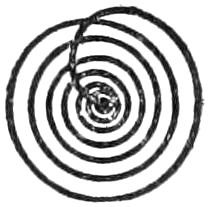
Balance Spring—In
America usually called the
"hair-spring." A long
slender spring that governs the time of
vibration of the balance. One end of the
balance spring is fastened to a collet
fitted friction-tight on the balance staff,
the other to a stud attached to the balance
cock or to the watch plate. The most
ordinary form is the volute, or flat spiral.
The other form used is an overcoil. See
Bréquet Spring. The principle of the
isochronism of a balance spring was discovered
by Hooke, and first applied to a
watch by Tompion. The name hair-spring
comes from the fact that the first ones are
said to have been made from hog bristles.
Balance Spring Buckle or "Guard"—A
small stud with a projecting tongue
attached to the index arm and bridging
the curb pins so as to prevent their engaging
two of the balance spring coils.
Used chiefly in Swiss watches.
Balance Staff—The axis of the balance.
The part of a watch most likely to
be injured by a fall.
Balance Wheel—A term often incorrectly
applied to the balance itself,
but properly it is the escape wheel of
the verge escapement.
Band—Of a Watchcase—The "middle"
of the case to which the dome, bottom and
bezel are fastened; the last sometimes
screwed, sometimes snapped.
Bank—Banking-pin.
Banking—In a lever watch the striking
of the outside of the lever by the impulse
pin due to excessive vibration of the balance.
In a cylinder or verge movement the
striking of the pin in the balance against
the fixed banking-pin.
Banking-Pin—A pin for restricting the
motion of the balance in verge and cylinder
watches.
Banking-Pins—1. In a lever watch,
two pins which limit the motion of the
lever. 2. In a pocket chronometer, two
upright pins in the balance arm which
limit the motion of the balance spring. 3.
In any watch, the curb pins which confine
the balance spring are sometimes called
banking-pins.
Barlow, Edward (Booth)—A clergyman
of the Church of England, born in
1636. He devoted a great deal of time to
horological pursuits. He invented the rack
repeating striking works for clocks, applied
by Tompion in 1676. He invented
also a repeating works for watches on the
same plan. And he invented the cylinder
escapement which he patented with
Tompion and Houghton. When he applied
for a patent on his repeating watch he was
successfully contested by Quare, who was
backed by the Clockmakers' Company.
He died in 1716.
Bar Movement—A watch movement
in which bars take the place of the top
plate and carry the upper pivots. Sometimes
termed a "skeleton" movement. Not
generally adopted because its many separate
bearing parts promote inaccuracies
where large quantities are to be produced.
Barrel—A circular box which confines
the mainspring of a watch or clock.
Barrel Arbor—The axis of the barrel
around which the mainspring is coiled.
Barrel Hollow—A sink cut either
into the top plate or the pillar plate of a
watch to allow the barrel freedom.
Barrel Hook—A bent pin in the barrel
to which the mainspring is attached.
Barrel Ratchet—A wheel on the
barrel arbor which is prevented by a dog
from turning backward while the mainspring
is being wound and which becomes
the base against whose resistance the
train is driven.
Bartlett, P. S.—One of the early
watchmakers of America. Connected with
the Waltham factory at first and later
with the Elgin Company. It is said that
he first proposed the formation of the
company at Elgin. His name became
familiar as a household word throughout
the country from being inscribed upon
a full-plate model which attained widespread
success.
Beat—The strike or blow of the escape
wheel upon the pallet or locking device.
Beat Pins—The pins at the ends of the
pallets in a gravity escapement which
give impulse to the pendulum.
Beckett, Sir Edmund—See Denison,
Edmund Beckett.
Berosus—A Chaldean historian who
lived at the time of Alexander the Great,
about 200 B. C., and was a priest of Belus
at Babylon. Said to have been the inventor
of the hollow sun-dial. He was the
great astronomer of his age.
Berthoud, Ferdinand, 1727-1807—
An eminent French watchmaker and
writer on horological subjects. Among his
books are: "Essai sur l'Horlogerie,"
"Traite des Horloges Marines," and "Histoire
de la mesure du Temps." He was a
Swiss by birth, but lived most of his life
in Paris.
Bezel—The ring of a watch or clock
case which carries the glass or crystal in
an internal groove.
Big Ben—The great bell which strikes
the hours on the clock at Westminster.
Bizzle—A corruption of Bezel. See
Bezel.
Blow Holes—Places where the brass
and steel of a compensation balance are
not perfectly united, when they are put
together with silver or solder.
Bob—The metal mass forming the body
of a pendulum.
Boethius, Ancius Manlius Severinus,
A. D. 480-524—A Roman philosopher
and statesman to whom is
sometimes attributed the invention of the
clock. He did make a sun-dial and a water
clock which latter may have contained a
germ of the idea later developed into our
modern clock.
Boss—A cylindrical prominence or
stud. The minute hand is carried on the
boss of the center wheel.
Bottom—Of a Watchcase—The cover
outside the dome of the case. Commonly
called the "back."
Bouchon—The hard brass tubing of
which pivot holes in watch and clock
plates are made; known commonly as
"bushing wire." The short sections cut off
for a pivot being called the "bushing."
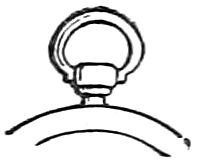
Bow—The ring of a
watch case to which the
guard or chain is attached;
also known as "pendant
bow."
Box Chronometer—A
marine chronometer.
Boxing-In—Fitting the watch movement
in its case; applied chiefly to the encasing
of stem-winding movements.
Bréquet, Abraham Louis—A celebrated
Swiss mechanician and watchmaker
born at Neufchatel in 1747. He
made several improvements in watches,
the most notable being the Bréquet hairspring
still in use in the best watches. He
died in 1823.
Bréquet Spring—A form
of balance spring which is
a volute with its outer end
bent up above the plane
of the body of the spring
and carried in a long curve
towards the center near
which it is fixed. Like all other springs in
which the outer coil returns towards the
center, it offers opportunities of obtaining
isochronism by varying the character of
the curves described by the outer coil and
thus altering its resistance. So-called from
its inventor, Abraham Louis Bréquet (q.
v.). Its advantage over the flat spring is
that the overcoil allows expansion and
contraction in all directions, thereby
avoiding a good deal of side friction on
the pivots as well as insuring more nearly
perfect isochronism in changes of temperature.
Bridge—A standard fastened to the
plate, in which a pivot works.
Bridge Model—The term given to
watch movements in which plates or
bridges carrying the upper pivots of the
train rest firmly on the lower or dial plate
and are held rigid by steady pins on lower
side of the plate; the bridge being secured
direct to the dial plate by screws termed
plate or bridge screws. This is the most
common construction of present-day manufacture
and is utilized in three-quarter
plate or separate and combination bridges
covering one or more pivots of train
wheels. Its alternate is "pillar model."
Buck, D. A. A.—A watch repairer in
Worcester, Mass., who designed a model
for the Waterbury watch. His first model
was not successful, but in 1877 he completed
one which, a little later, the Waterbury
Company, with Buck as master
watchmaker, started to make. He remained
with the company until 1884.
Bush—A perforated piece of metal let
into a plate to receive the wear of pivots.
Butting—The engaging of the tips of
the teeth of two wheels acting in gear.
The proper point of contact being in the
line of the shoulders of the teeth, butting
is remedied by setting the wheels farther
apart.
Button—The milled knob used for
winding and setting a keyless watch.
Calculagraph—Trade name for a
device for automatically computing
and recording elapsed time in connection
with factory jobs and other work where
it is necessary to show the amount of
labor used.
Calendar—A system of dividing the
year into months and days. The principal
calendars known to history are: the Julian
calendar; the Gregorian calendar; the
Hebrew calendar; the Mohammedan
calendar; and the Republican calendar.
None of them has been quite accurate in
dividing up the solar year, and frequent
arbitrary corrections are necessary to
secure a practical approximation. See descriptive
article under each title.
Julian—Established by Julius Caesar,
46 B. C., to remedy existing defects in the
Roman calendar then in use. The Julian
year was based on the assumption that the
solar year is 365¼ days—which was 11
minutes and 14 seconds too long. The
scheme adopted was to make the regular
calendar year 365 days, and to add one
day every fourth year. The Julian calendar
is still in use by Russia and Greece,
where the dates now differ from those of
most other countries by 13 days.
Gregorian—Established October 15,
1582, by Pope Gregory XIII, in correction
of the obvious errors of the Julian calendar.
It is the calendar now in use by
nearly all civilized nations. The mean
length of the Gregorian year is 365 days,
5 hours, 49 minutes and 12 seconds—26
seconds longer than the actual solar year.
Correction is made by adding a 29th
day for February every fourth year, excepting
when the date of said fourth year
is divisible by 100. If, however, the date is
also divisible by 400, the extra day is
added.
Republican—The calendar of the
French Revolution (1793) declared to begin
at midnight on the meridian of the
Paris Observatory preceding the true
autumnal equinox, September 22, 1792.
There were 12 months of 30 days each
and 5 or 6 "extra days" (as might be
necessary) at the end of the year to bring
the new year nearest to the then position
of the equinox. Abolished January 1, 1806.
Hebrew—Composed of 12 lunar months,
a thirteenth month being added from
time to time to secure correspondence of
the months with the passing seasons. The
months are arbitrarily arranged to have
alternately 29 days and 30 days. The
length of the calendar year varies from
353 days to 385 days.
Mohammedan—Based on a lunar year of
354 days divided into 12 lunar months
which are alternately 29 and 30 days in
length. During each period of 30 years a
total of 11 days are added one at a time
at the end of a year. The lack of co-ordination
with the solar year results in a
total separation of the seasonal year and
the calendar year. In use in Turkey and
some other Mohammedan countries.
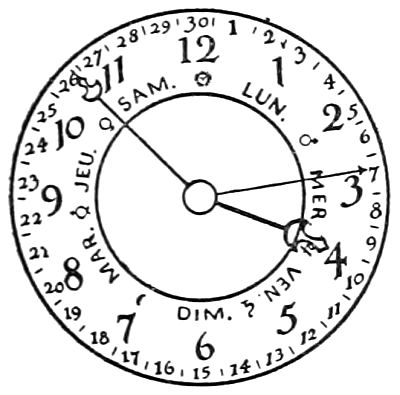
Calendar
Clock, or
Watch—A
clock or
watch which
indicates
days and
months as
well as
hours.
Caliper—The
scheme
of arrangement
of a
watch train, or the disposition of the
parts of a watch.
Cam—A rotating piece
either non-circular or eccentric,
used to convert rotary
into linear reciprocating
motion, oftener irregular in
direction, rate, or time.
Cannon Pinion—The pinion to which
the minute hand is attached. It is tubular
in form (whence its name), the main arbor
passing through it friction-tight.
Canton Berne—The Swiss district
which does the largest export business in
silver and base metal watches in Switzerland.
The cantonal government has done
everything possible to promote the industry,
among other things: 1. Established
information offices in the principal
watch-making centers. 2. Established a
permanent exhibition of articles used in
the industry. 3. Established schools and
associations and protective territories. 4.
Prepared statistics and means for negotiating
commercial relations.
Cap—The part of the case that covers
the movement.
Capped Jewel—A jewel having a protective
end-stone.
Carillon—Chimes frequently used in
the earlier clocks for striking the hours.
Still used in some clocks.
Caron, Peter Augustus—A famous
Paris watchmaker, afterward called Beaumarchais,
who made the first keyless
watch of which we have any account.
Case—The metal box in which the
movement of a watch is inclosed.
Case-Springs—The springs which
cause the outer bottom of a watch case to
fly open when the lock spring is released.
Center of Gyration—That point in
which the whole mass of a rotating body
might be concentrated without altering
its moment of inertia.
Center of Oscillation—That point
in a pendulum at which, if the whole mass
of the pendulum were collected, the time
of oscillation would be the same.
Center Seconds or Sweep Seconds—A
long seconds hand moved from the
center of a watch dial, as are the minute
and hour hands.
Center Staff—The arbor attached to
the center wheel which carries the minute
hand.
Center Wheel—The wheel in ordinary
clocks and watches placed in the
center of the frame on whose arbor the
minute hand is carried. It is intermediate
between the barrel and the third
wheel.
Chamfer—To cut away
to a bevel the right angle
formed by two adjacent
faces as of a jewel or stone.
It is also occasionally used to signify channeling
or grooving.
Chasing—A form of ornament for
metals which is made by punching or
pressing from behind to present the pattern
in relief instead of by cutting away
the material.
Chops—In a pendulum clock the
blocks, usually of brass, between which
the top of the pendulum suspension
spring is clipped to prevent its twisting as
it swings.
Chronograph—In general, a recording
clock or watch. Specifically, a watch with
a center-seconds hand which may be
stopped, started or returned to zero at
will by pressing a button. Used for timing
races, or measuring other short spaces of
time with great exactness.
Chronometer—Any very accurate
time-keeper. Usually understood to mean
a time-keeper fitted with a spring detent
escapement. They usually have a fusee
and a cylindrical balance spring.
Chronometer, Marine—Probably the
most exact form of time-keeper, especially
for use on shipboard. The driving power
is a mainspring acting by a chain on a
fusee, and governed by what is known as
the Chronometer or Detent Escapement,
with, as a rule, the cylindrical balance
spring. The movement is mounted on
gimbals in an air and water-tight brass
case, maintaining the dial constantly in
a horizontal position.
Chronoscope—A clock or watch in
which the time is shown by figures presented
at openings in the dial.
Church, Duane H.—Credited with
having contributed more to the automatic
features of watch machinery than any
other man. He was born in Madison
County, N. Y., in 1849. At 16 he was
apprenticed to a watchmaker of St. Paul,
Minn., and after working at the trade for
17 years, he became in 1882 the master
watchmaker for the Waltham Watch
Company. Besides his invaluable contributions
to automatic machinery, he improved
the general design of watch movements
and invented a form of pendant
setting which enables stem-winding movements
to be set in cases not especially
adapted to them. He died in 1905.
Circular Error—The difference in
time arising from the swinging of a pendulum
in a circular arc instead of its true
theoretical path which is a cycloidal arc.
This caused much trouble in the early
clocks. Huyghens attempted to correct it
(see Huyghens' Checks) but found that his
device caused greater error. With the
heavier pendulum and shorter arcs of
vibration this error becomes negligible.
The suspension of the pendulum by a flat
flexible spring instead of a cord, attributed
to Dr. Hooke, served to make the path
practically cycloidal.
Cleopatra's Needle—An Egyptian
obelisk at whose base a dial was marked.
Now in London. Another similar obelisk
from Egypt is in Central Park, New York
City.
Clepsammia—The sand-glass, more
familiarly known as the hour-glass. See
Hour-glass; Sand-glass.
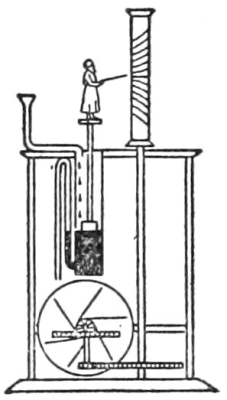
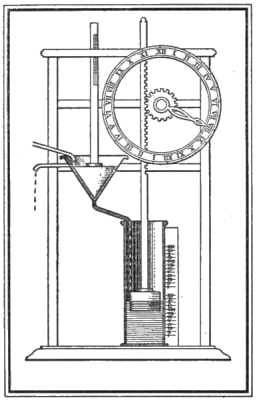
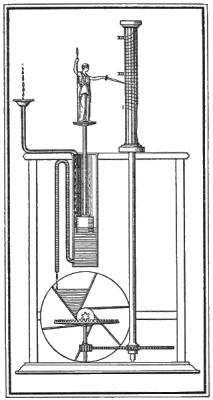
Clepsydra—A device
for the measurement of
time by the flow of running
water. Its simplest
form is a vessel filled
with water which trickles
or drops slowly from a
small aperture into another
vessel. One or the
other of the vessels is
graduated and the height
of the water in that
one at any given time
indicates the hour. Sometimes
a figure floating on
the water points to the hours. Later, falling,
or running, water was made to turn
wheels or to move a drum, as in "Vailly's
clock." Clepsydras were made and improved
up to the 17th century. The earliest
known example—one in China—is credited
with having existed in 4000 B.
C. The name indicates the stealing
away of water and is derived from two
Greek words meaning "water" and "to
steal." A common form of clepsydra in
India was a copper bowl with a small hole
in the bottom floating on water. When the
bowl filled and sank the attendant emptied
it, struck the hour upon it and floated
it again on the surface of the water. Like
the sun-dial, the clepsydra was invented
so long ago that there is no authentic
record of its origin. Its evident advantages
are exactly those which the sun-dial
lacked. It is quite independent of day or
night or other external conditions; it is
conveniently made portable; and by regulating
the size of the aperture through
which the water flows, it can be made to
work slow or fast so as, within considerable
limits, to measure accurately and
legibly long or short intervals of time.
The disadvantages of the clepsydra
were, first, that the hole in the container
tended to become worn away so as to let
the water out too fast; and second, that
the water ran faster from a full vessel
than from one nearly empty, because of
the greater pressure. This latter was in
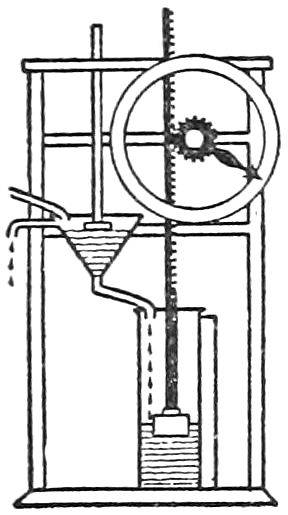
classic times corrected by a clepsydra consisting
of two vessels. The second and
larger of these was placed below, the
water running into it, out of the first. A
float within this larger vessel rose regularly
as it filled, and carried a pointer
which marked the time. The first vessel
from which the water ran into the second,
was provided with an overflow, and kept
constantly full up to this level; so that the
flow of water into the larger vessel remained
constant.
Once well established and understood
in principle, the clepsydra became widely
known over the ancient world, and underwent
a variety of improvements and modifications
in form. These latter chiefly dealt
with making it more legible. Means were
devised, for instance, to make it ring a
bell when the water reached a certain
height. And thus the alarm principle was
very early brought into use. Later on,
after the development of mechanical
devices like the pulley and the toothed
wheel or gear, the pointer was by these
means constructed to move faster or
slower than the rate at which the water
rose, or to revolve upon a
circular dial on which the
hours were marked. And
thus we owe to the clepsydra
the origin of the modern
clockface as well as of
the alarm. Later still, by a
more complex ingenuity,
devices were arranged to
strike the hours or to move
mechanical figures, in fact,
to perform all the functions
of a clockwork which
was both driven and regulated by hydraulic
power. The single hour hand, however,
remained in place of our two or three
hands moving at different speeds, as in
the modern clock or watch. The clockwork
also remained primitive in construction
compared with our own. Clepsydrae
were always expensive, because
accurate mechanical work was never
cheapened until modern time. Rather
they were made marvels of patient ingenuity
and lavish ornament. Cunning
oriental craftsmen spent their skill upon
elaborate mechanism and costly decorations.
The clepsydra thus became first
what other time-pieces later became—a
triumph of the jeweler's craft—a gift
for kings. And the Greeks, who beautified
everything that they touched, made it
at once more accurate and more artistic.
The clepsydra may thus fairly claim to
have been the first mechanical device for
measuring time, as contrasted with the
sun-dial which was really an astronomical
instrument; and thus the direct ancestor
of the mechanical clocks of later days.
Some authorities, indeed, on the strength
of certain very ancient allusions to its use
in China and elsewhere, claim for it an
antiquity prior to the sun-dial itself.
There seems, however, to be no reason for
supposing that the discovery of a mechanical
law like the regular flow of water
antedated so obvious a discovery as the
motion of a shadow upon the ground.
The explanation is probably that the
invention of the clepsydra did precede the
scientific perfecting of the sun-dial by the
inclinations of the gnomon; which may
have taken place about the time of the
correction of the Babylonian calendar in
747 B. C. Not long after this date we meet
with frequent references to the placing of
a clepsydra in the public square of some
old city, or to its use in astronomical
calculations. To this, of course, its property
of running by night was peculiarly
adapted.
Although the chief defects of the clepsydra
were minimized by the use of the
two vessels and by making the aperture
through which the water ran of gold or
some other substance which would wear
away very slowly, yet there remained
certain minor imperfections. The water
could not be kept entirely from evaporating;
it had to be emptied out at intervals
and the reservoir refilled; its accuracy
was affected by the expansion of the
parts under change of temperature, or
it might even freeze. These faults were
obviated in the sand-glass or hour-glass
which for short intervals of time was also
more convenient.
The clepsydra remained in use until
clocks became superior to it in accuracy.
See Clocks, Interesting Old; Charlemagne;
Vailly.
Clerkenwell—A district on the
north side of the city of London within
the metropolitan borough of Finsbury. It
is distinguished as one of the great centers
of the watchmaking and jewelers' industries
in England and long established
there. The Northampton Polytechnic
Institute, Northampton Square, has a
department devoted to instruction in all
branches of the trade.
Click—The click, pawl, or dog, is a
necessary accessory of a ratchet wheel. It
is a finger, one end of which fits into the
teeth of the ratchet, while the other is
pivoted on its tangent. The ratchet is
thus prevented from turning backward.
Clock—Specifically, a time-piece not
made to be carried about but to stand
upon a shelf or table, hang upon a wall
or as built into a tower. Formerly the
term signified particularly a time-piece
which struck the hours. The word has
its origin in the word for bell in Latin,
gloccio; Teutonic, glocke;
French, cloche; and Saxon,
clugga. At one time the term
was used to denote timekeepers
driven by weights as distinguished
from those driven
by springs.
Clock-Watch—A watch
which strikes the hours in
succession, as distinguished
from repeaters. Popular in
the eighteenth century.
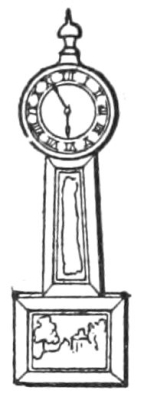
Clock, Banjo--A wall
clock, so called from its
shape, designed by Simon Willard, of
Massachusetts and very popular in
its time.
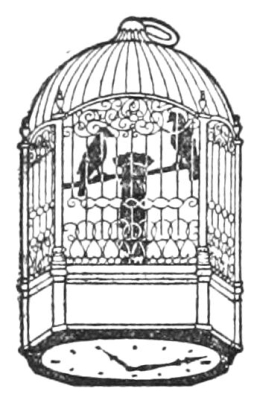
Clock, Bird-Cage—An
old form of English
clock whose manufacture
has been discontinued—it
is the
oldest form of English
clock still doing service.
Its main feature
is the endless chain
drive. These clocks
run thirty hours.
Clock, Bracket—A
form of clock very
popular in England during the reign of
Charles II, made to stand on a bracket
or table and intended to be seen from all
sides. These clocks had either a handle
on top or one on each side. They were
very beautifully finished.
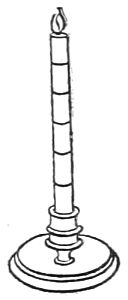
Clock, Candle—Wax or tallow candle,
usually twelve inches long and marked
with circular lines one inch apart. The
candle would burn one inch every twenty
minutes or three inches an hour. Invention
credited to King Alfred the Great.
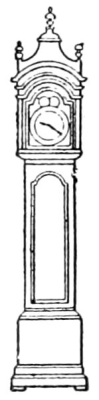
Clock, Grandfather's or
Long-Case—A tall clock with an
anchor escapement popular thru-out
the later 18th and early
19th centuries in England and
America. Its excellent timekeeping
qualities are due to the very
long and heavy pendulum which
allows a small arc of vibration.
Not often made at present.
Clock, Hood—A style of
clock originating and very popular
in Holland during the late
17th century. Made of various
woods, carved and ornamented and
named from the hood or dome on top.
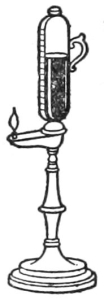
Clock, Lamp—A long glass
tube upright on a metal stand
similar in shape to the old Roman
lamps. Figures were
painted on the tube to indicate
the hours—"12" in the middle
section, with "11" above and
"1" below the "12." The lamp
was filled with oil up to the
hour at which it was lighted—then
as the oil burned away
the time was indicated. This
form of clock was used at night
in Dutch and German rural homes until
a comparatively recent date.
Clock, Lantern—Same as
Bird-Cage Clock.
Clock, Largest in World—The
Colgate clock in Jersey City
is claimed to be twice as large
as the next largest clock in the
world. Its dial can be read for
four miles and weighs six tons. Its minute
hand is twenty feet long and the tip of
it travels more than half a mile per day.
Clock Mysteries—Glass Dial—A perfectly
transparent dial behind which no
movement was visible. The hands were
caused to revolve by watch works and
semi-circular weights in the counterpoise
of the hands.
Clock, Oldest in America—A clock
owned by the Philadelphia Public Library—over
two centuries old. It was
made in London and is said to have been
owned by Oliver Cromwell.
Clock, Sheep's-Head—A clock similar
to the bird-cage or lantern clock in which
the dial face projects an inch or two beyond
the frame.
Clock, Skeleton—A clock whose
works are covered with glass as a protection
from dust, but are without a case,
the works being exposed to view. There
are eight skeleton clocks in the Charles
Mifflin Hammond collection at the Essex
Institute in Salem, Massachusetts.
Clock, Turret—A large clock in
which the dials are distinct from the
movement. Because of the exposure of the
hands to the wind and snow, of the clock
to dust and dirt, and of the oil to freezing
temperature, turret clocks to keep time
must be fitted with some device to obtain
a constant force on the pendulum. The
first used was the remontoire but since
the invention of the gravity escapement
for the Westminster clock by Sir Edmund
Beckett this has been used instead.
Clock, "Wag on the Wall"—A
wall clock typical of the
North of Holland in which
weights and pendulum hung
below the clock case, entirely
unenclosed.
Clock and Watch Makers,
English, Early—For extensive
lists, dates, places, and notes,
see: Old Clocks and Watches &
Their Makers, by Frederick J.
Britten; Worshipful Company
of Clockmakers, London, Published
by E. J. Francis and Co., London,
1875; Old Clock Book, by Mrs. N. H.
Moore.
French, Early—See: Old Clocks and
Watches and Their Makers, by F. J.
Britten.
Scottish, Early—For extensive list
with dates, places and notes, see: Old
Scottish Clock Makers, by John Smith.
Clock Makers, American, Early—For
lists, dates, places, and notes, see:
Old Clock Book, by Mrs. N. H. Moore;
American Clockmaking—Its Early History,
by Henry Terry.
Clock Mysteries; Tortoise in Water—Nicholas
Grollier during the first
part of the eighteenth century made
many mysterious timekeepers. One was
a metal dish filled with water in which
floated the figure of a tortoise always
keeping his nose to the correct time.
Ball of Venice—This was a sphere—its
upper and lower parts gold, and about
the middle a silver band bearing the
numerals. As the band revolved a Cupid's
wing pointed to the hour. Its action was
simple. The cord which suspended it was
wound about a cylinder. The weight of
the ball constituted the driving power. It
had a verge escapement. The maker is not
known.
Double Globe—Constructed of two
clear glass globes, the smaller one for the
minutes above the larger hour globe. The
mechanism for the latter was in the base,
and for the minute globe, in the cap of the
hour globe. Made by Henri Cunge.
Clocks, Interesting
Old: Anne Boleyn's—A
clock said to have
been presented to Anne
Boleyn by Henry VIII
on their wedding morning.
It is about four
inches square and ten
inches high, of silver
gilt "richly chased, engraved,
and ornamented."
The weights are of
lead covered with copper,
gilt and engraved.
On one are Henry's and
Anne's initials, and true
lovers' knots. On the
other simply H. A. At the top of each
weight is "Dieu et mon droit," at the
bottom "The most happye." On the top
of the clock is the figure of a lion holding
the arms of England, the same being engraved
on the sides. The clock is now
silent. There is no record as to its maker.
Canterbury—This was the third of
the large clocks in England. It was constructed
in 1292.
Charlemagne's—In 807 the King of
Persia sent Charlemagne a bronze water
clock inlaid with gold. The dial consisted
of twelve small doors representing the
hours. Each door opened at the hour it
represented and the correct number of
balls fell out upon a brass bell. At twelve
o'clock twelve horsemen appeared and
shut the doors.
Coblentz—At Coblentz in a tower on
the Kaufhaus is a brazen head which
gnashes its teeth as the hours strike. For
a Coblentzer to say "How is the man in
the Kaufhaus" means "How goes it with
Coblentz and the good people there?"
de Vick's—In 1364
Henry de Vick set up a
clock in the tower of
the palace for Charles
V. It was regulated by
a balance. The teeth of
the crown wheel acted
upon two small levers
called pallets which
projected from and
formed part of an upright
spindle or staff on
which was fixed the
balance. The clock was
regulated by shifting the weights placed
at each end of the balance. On the bell of
this clock the signal for the massacre
of St. Bartholomew's was struck.
Dondi's at Pavia—Built in 1344, by
James Dondi, similar to Wallingford's
clock.
Exeter—A clock built in Exeter Cathedral
sometime in the 14th century.
One erected there in 1480 has the sun—a
fleur-de-lis which points out the hours as
it revolves around a globe representing
the earth. A black and white ball represents
the moon's phases by turning on its
axis.
Frederick II—The Saladin of Egypt
presented Frederick II of Germany with a
clock in the year 1232. It resembled internally,
a celestial globe, in which figures
of the sun, moon, and other planets moved
impelled by weights and wheels. There
were also the twelve signs of the Zodiac
which moved with the firmament.
Hans von Jena's—An
old clock in Saxony at the
top of which is a very ugly
head. As the clock strikes
a pilgrim offers an apple
on a stick to the open
mouth and then withdraws
it. At the same
time an angel opposite the
pilgrim raises her eyes
from her book. The legend
goes that Hans von Jena,
for a crime, was condemned
to undergo such torture for three
centuries.
Jefferson's—An old weight clock in
which the weights are carried over a pulley
and made to indicate the day of the
week by their position. This is in the hallway
at Monticello.
Lists and Descriptions of—See Curiosities
of Clocks and Watches, E. J. Wood.
Old Clocks and Watches and their Makers,
F. J. Britten. Old Clock Book, N. H.
Moore.
Vase Clocks of Marie Antoinette—The
movement was
inclosed in a marble pedestal.
About the beautifully tinted
porcelain urn was a double band,
on which were marked the numerals
and which revolved every
twelve hours. A serpent with
head erect pointed to the hour.
Mary, Queen
of Scots—Skull
Watch or
Clock. A small
clock in the
form of a skull
said to have
been given by
Mary, Queen of
Scots, to Mary Seaton, one of her maids of
honor. The skull is of silver gilt and is
engraved with figures of Death, Time,
Adam and Eve, and the Crucifixion. The
lower part of the skull is pierced to emit
the sound when it strikes, being cut in the
form of emblems of the Crucifixion. The
works occupy the brain's position in the
skull fitting into a silver bell which fills the
entire hollow of the skull. The hours are
struck on this bell by a small hammer on a
separate train.
Pope Sixtus'—Built by Habrecht of
Strasburg in 1589. It greatly resembles
the Strasburg clock which Habrecht also
built. It was in the possession of the Popes
for more than two centuries and later became
the property of William I, King of
the Netherlands. In 1850 it was exhibited
in England after which it became the
property of Mr. O. Morgan. It performs
all the feats of the Strasburg clock.
Rouen—In the Rue de la Grosse Horloge
in Rouen a clock made by Jehan de
Fealius in 1389 is built in a tower which
surmounts an arched gateway. Its dial is
about six feet square. It shows the hours,
days of the week, and phases of the moon.
It still keeps excellent time and is the chief
clock of the city.
St. Dunstan's—Erected
in 1671 above
the gateway of the old
St. Dunstan's Church.
The clock had two
dials, back to back upheld
by a quaint
bracket. In a little
open belfry above were
the gaily painted figures
of Gog and Magog
which struck the quarters
on bells suspended near them. In 1830
the clock was sold to the Marquis of
Hertford who set it up at his home in
Regent Park.
St. Paul's—A clock existed prior to
1298 in the tower of St. Paul's Cathedral
which struck the hours by means of mechanical
figures called Paul's Jacks. Later
a fine dial was added.
Strasburg—Rebuilt twice after the
first one which was begun about 1352.
This first clock consisted of a calendar
which showed the principal movable
feasts. It showed also the movements of
the sun and moon. On the upper part was
a statue of the Virgin before which at
noon the figures of the three Magi bowed.
At the same time a cock automaton
opened its beak, flapped its wings and
crowed. 2. The second Strasburg clock was
erected about 1570. This was a very elaborate
mechanism, showing besides the
time, a calendar for a century, the movements
of the sun and moon, eclipses of the
same and other things. The striking was
done by an elaborate automatic arrangement.
(See Old Clocks and Watches &
Their Makers—F. J. Britten.) 3. In 1842
the clock was again thoroughly reconstructed.
This, too, is a very elaborate
system of motions showing the movements
of sun, moon, and planets, also
sidereal time, a calendar, etc. The hours
and quarters are struck by automatic
figures.
Ulm—In the eastern end of the old
Rathaus at Ulm is installed an astronomical
clock which dates from the beginning
of the 16th century. It was thoroughly repaired
in 1549 by the builder of the Strasburg
clock—Isak Habrecht. Shows in
addition to the hours, the diurnal and annual
revolutions of the earth and the
movements and phases of the moon. The
clock is an artistic achievement as well as
a mechanical wonder.
Vailly's—A scientific water clock. It
consisted of a tin cylinder divided into
several small cells and suspended by a
thread fixed to its axis, in a frame on
which the hour distances fixed by trial
were marked. It was so made that the
water passed slowly from one cell to the
next and as it did so it changed the center
of gravity of the cylinder and set it in
motion so as to indicate the time on the
frame. Made about 1690.
Wallingford's—Built in 1326 in St.
Alban's Monastery. It showed besides
the hours, the apparent motion of the sun,
the ebb and flow of tides, changes of moon,
etc. It continued to run until the time of
Henry VIII. Held by some to have been a
mere planetarium.
Wells Cathedral—Clock built by
Peter Lightfoot, A. D. 1340 at Glastonbury
and removed to Wells Cathedral
during the Reformation, after the dissolution
of the Glastonbury monastery. In
1835 it was again removed to the South
Kensington museum. At that time the
worn-out works were replaced by a new
train, but the dial and knights were retained.
The dial is divided into twenty-four
hours and shows the motion of the sun
and moon. On its summit are eight armed
knights tilting at one another, lance at
rest by a double rotary motion.
Westminster—A clock said to have
been erected at Westminster with the proceeds
of a fine imposed upon one of the
Chief Justices about 1288. About 1365
Edward III had a stone clock tower
erected at Westminster. This tower contained
a clock which struck the hours on
a great bell. It also contained other bells.
This tower was razed by the Roundhead
mob about 1650. Later a dial with the
motto "Discite justiam monite" was
placed on the site. The bell "Great Tom"
was given to St. Paul's about the beginning
of the 18th Century. The present
Westminster clock is made after plans by
E. B. Denison (Sir Edmund Beckett) and
made by E. J. Dent. The bell is called
"Big Ben." It is claimed to be the best
timekeeper of its kind in the world. It was
for use in this clock that Denison invented
his gravity escapement.
Wimborne—A very old clock at Wimborne
in Dorsetshire, much like the Wells
Cathedral clock. By some authorities believed
also to have been planned by Peter
Lightfoot.
Clock-Setters—During the early history
of turret clocks, for each one was
employed a caretaker called the "setter."
That such an official was needed indicates
that they were more or less undependable.
Cock—A horizontal bracket. See: Balance
Cock; Escape Cock; Pendulum Cock;
Potance.
Collet—A collar or flange on a cylindrical
piece of metal. Any part of such
cylinder of greater diameter than the rest.
Sometimes of the same piece of metal;
sometimes fitted friction tight upon it.
Compensation—The provision made in
a clock or watch to counteract the expansion
and contraction due to variations
of temperature. In the clock it is applied
to the pendulum; in the watch to the
balance.
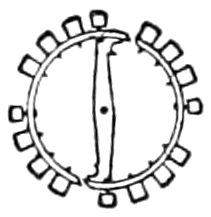
Compensation Balance—A
balance corrected for errors
caused by variations in temperature.
The type in most
general use was invented by
Thomas Earnshaw in the second half
of the 18th century. The double rim of
this balance is constructed of brass and
steel soldered together in the form of a
cut ring, the brass on the outside. When
heat, elongating the balance ring, causes
it to vibrate more slowly, the brass, expanding
more than the steel, bends the
free ends of the cut rim toward the center,
thus decreasing the diameter of the balance
and quickening the vibration. On
the other hand, when cold, contracting the
ring tends to quicken the vibration of the
balance, the contraction of the brass rim
draws the free end outward, making the
diameter larger and the vibration slower
in consequence. The compensation balance
is also made with brass as the inner
metal and aluminum outside.
Compensation Curb—A laminated
bar of brass and steel or aluminum and
brass fixed at one end, the free end carrying
the curb pins that regulate the length
of the balance spring. Common in old
watches but not now in use.
Compensation Pendulum—A pendulum
so constructed that the distance
between the point of suspension and the
center of oscillation remains constant in
all temperatures. See: Pendulum, Gridiron
and Pendulum, Mercurial Compensation.
Contrate Wheel—A
wheel whose cogs are
parallel to its axis and
whose axis is at right
angles to the axis of the
wheel into which it
gears. A crown wheel.
Corrosion—The eating or wearing
away of metals by slow degrees through
chemical action.
Countersink—To enlarge the outer
end of a hole for the reception of the head
of a screw, bolt, etc. The term is also applied
to the tool with which the countersink
is formed.
Coventry—A municipal, county, and
parliamentary borough of Warwickshire,
England. One of the important watchmaking
centers of Great Britain.
Crown Wheel—A wheel whose teeth
project at right angles to the plane of the
wheel. A contrate wheel. The escape
wheel of the verge escapement is an illustration.
Crutch—A light rod in a clock descending
from the pallet arbor and ending
in a fork which embraces the pendulum
rod. It transmits the motion of the pallet
to the pendulum.
Ctesibus—A famous Greek mechanician
who lived in Alexandria about 130
B. C. Although his was not the first
clepsydra as is claimed by some it was an
ingenious and interesting one. Believed to
have first applied toothed wheels to
clepsydrae about 140 B. C.
Curb Pins—See Banking Pins.
Cusin, Charles—A watchmaker from
Autun, Burgundy, who laid the foundation
for the Swiss watch industry in
Geneva in 1587. It grew very slowly at
first—in 1687 having only one hundred
watchmakers with three hundred assistants.
In 1760 there were at Geneva
eight hundred watchmakers with 5,000 to
6,000 assistants.
Custer, Jacob D.—(1809-1879.) A
Pennsylvania clockmaker in 1831; he was
one of the early makers of watches in
America in 1840. However, his work was
not important commercially, for he produced
only about a dozen watches. A very
ingenious man, who, it is said, made everything
from a steam engine to his own shoes.
He made hundreds of the clock movements
which at that period were used to revolve
the lanterns in lighthouses.
Cycle of the Sun—A period of
twenty-eight years, after which the days
of the week again fall on the same days of
the month as during the first year of the
former cycle. It has no relation to the
sun's course but was invented for the
purpose of finding out the days of the
month on which the Sundays fall during
each year of the cycle. Cycles of the sun
date from nine years before the Christian
era.
Cycloid—A curve generated by a given
point in the circumference of a circle
which is rolled along a straight line always
in the same place. Example: The
curve traced by any point in the rim of a
wheel which travels in a straight line
along a level road.
Cylinder Escapement—See: Escapement,
Cylinder.
Cylinder Plugs—Plugs fitted into the
ends of the cylinder of a cylinder escapement.
Their outer extremities are formed
into the pivots on which the cylinder
rotates.
Damaskeen—To decorate a metal by
inlaying other metals or jewels, or
by etching designs upon its surface. To be
distinguished from snailing,
with which it is often confounded.
Day—The time of one complete revolution
of the earth on its axis. The actual
length of this day is continually changing
owing to the eccentricity of the earth's
orbit and the angle of the ecliptic. The
mean solar day is 24 hours. The sidereal
day is 23 hours, 56 minutes, 4.099 seconds.
Day, Nautical—The nautical day begins
when the sun is on the meridian and
eight bells are struck. The day is divided
into "afternoon watch" or four hours, two
"dog watches" of two hours each, then
"middle watch," "night watch," "morning
watch" and "forenoon watch," each
of four hours, completing the day.
Denison, Edmund Beckett—Sir Edmund
Beckett—Lord Grimthorpe. Born
1816. A lawyer by profession, and the
inventor of the gravity escapement for
turret clocks; also an authoritative writer
on horological subjects. He designed and
planned the Westminster clock said to be
the best timekeeper of its kind in the
world. Died 1905.
Dennison, Aaron L.—Born in Freeport,
Me., in 1812. Died Birmingham,
England, January 9, 1898. At eighteen he
was apprenticed to a watchmaker. Later
in working at the trade, he was impressed
with the inaccuracies which existed in the
best handmade watches. This, with a visit
to the Springfield Armory, gave him his
idea of machine-made watches with interchangeable
parts. He interested Edward
Howard in the project, and having found
the needed capital they started in the business
and laid the foundation of what is
now the Waltham Watch Company.
Dennison has been called the "father of
American Watchmaking" tho there
seems ground for the claim that he shares
that honor with Edward Howard.
Depthing—The technical name for the
proper adjusting or spacing of the gearing
in a watch.
Detent—The device which halts, and
releases, at the proper instant the escapement
of a clock or chronometer. See:
Escapement.
de Vick, de Wyck, or de Wieck,
Henry—A German clockmaker who, in
1364, made the first turret clock of which
reliable information and description remains.
The clock was made for Charles V.
See: Clocks, Interesting Old—De Vick's.
Dial—Commonly called the face of the
watch—made of gold or silver or other
metal or of enamel, with the required
figures—in the United States one to
twelve upon it in a contrasting color. See
also, Sun-dial.
Dial Feet—Short wires soldered to the
back of the dial of a watch or clock which
hold it in place by fitting into holes in the
pillar plate.
Dial of Ahaz—A sun-dial belonging
to Ahaz, King of Judea 742-727 B. C.,
mention of which occurs twice in the
Scriptures—II Kings, XX: 9-11, and
Isaiah XXXVIII: 8. It is believed that
one of his Babylonian astrologers constructed
it for him.
Dial Plate—See Lower Plate.
Dial, Sun—See Sun-dial.
Dial Wheels—The wheels constituting
the motion work of a watch.
Diurnal—In an astronomical sense,
pertaining to a period covering a mean
solar day. See: Solar Time.
Dog Screw—A screw with an eccentric
head used to attach a watch movement to
a dome case.
Dog-Watch—A nautical term for two
daily two-hour periods of watching
aboard ship. The first begins at 4 P. M.,
the other at 6 P. M.
Dolmen—A sacred instrument used for
astronomical purposes at certain critical
periods of the year; formed of four stones
at the cardinal points and a leaning stone
crossing diagonally and forming with the
east stone a sacred "creep-way." The solar
hours were indicated by the shadow of the
leaning stone touching various prominent
points or edges. One at Camp, England, is
prehistoric.
Dome—The inner case of a watch which
snaps on the band of a case.
Dome-Case—A case in which the inner
case or dome snaps to the band of the case.
Dondi, Giacomo—Born at Padua,
Italy, in 1298. In 1344 he set up at Padua
a famous clock which became a model for
later clocks and which earned for him the
surname, "Orologio."
Double Bottom Case—A watch case
in which the inner cover or bottom is made
solid with the middle. The vogue in
English cases for a long time; now almost
obsolete.
Double-Sunk Dial—A dial in which
there are two sinks; one for the hour hand,
and a deeper one for the seconds hand.
Draw—1. The force which holds the
lever against its bank, due chiefly to the
angle of the locking face of the pallet stone.
2. The angle of the locking faces of pallets
in the lever escapement.
Driver—Of two wheels working together,
the one which imparts the power.
The driven wheel is termed the follower.
Driving Wheel—In a clock the wheel
on the main arbor which drives the whole
train.
Drop—That part of the motion of the
escape wheel when it is not in contact with
the pallet.
Drum—The cylinder, or barrel, on the
main arbor in a clock on which the driving
cord winds, raising the weight, when the
clock is being wound.
Dummy Watch—(Fausse Montre.)
About 1770 it became the fashion to wear
two watches. But because two real
watches were too expensive for most people,
the custom grew up for having one
sham watch—usually worn on the right
side. These were called "dummy
watches" or "fausse montres."
Earnshaw, Thomas—1749-1829. An
eminent English watchmaker who
invented the spring detent escapement
and the compensation balance, both essentially
the same as are now used in
chronometers. He first soldered brass and
steel together for the balance instead of
riveting them.
East, Edward—Watchmaker to
Charles I and an eminent horologist. He
was one of the ten original assistants
named in the charter of the Clockmakers'
Company and at once took a leading part
in their proceedings. He was elected master
in 1664 and 1682. He was the only
treasurer ever appointed by that company.
He died probably about 1693.
East's watches were often presented as
prizes by Charles in tennis tournaments.
Edward VI—King of England from
1546 to 1553. Said to have been the first
Englishman to wear a watch.
Electric Clock—A clock in which the
pallets moved electrically from a distant
mechanism drive the escape wheel and
the hands.
Ecliptic—That plane passing through
the center of the sun in which lies the
orbit of the earth. Also used to designate
the apparent path of the sun in the heavens.
Elgin—A city in Illinois, U. S. A., in
which is located the Elgin National Watch
Company—one of the largest factories in
the United States.
End-Shake—Freedom of pivots to
move endways. Necessary in a watch or
clock because there is no force to spare and
a tight pivot would stop the movement.
End-Stone—A small disc of jewel
against which the end of a pivot sets. See
Capped Jewel.
End-Stop—In a watch the same as end-stone.
Engaging Friction—Friction which
results when the teeth of two wheels gearing
together come into action before
reaching the line of centers—that is, a line
drawn from center to center of the gearing
wheels.
Engine-Turning—A pattern of curved
lines cut into metal for decoration. Introduced
about 1770 by Francis Guerint of
Geneva. The earliest specimens were cut
very deep but shallower cutting soon became
the rule.
Engraving—A form of ornamenting
metals in which the design is cut into the
metal. In "Champ-leve" engraving the
ground is cut away leaving the design in
relief.
Epact—The excess in time of the solar
year over the period of 12 lunar months,
amounting to about 11 days. The new
moons will thus fall about 11 days earlier
in each succeeding year. In a calendar so
arranged 30 days are taken off every
fourth year, as an intercalary month, the
moon having revolved once in that time,
and the three days remaining would be
the epact. The epact thus continues to
vary until at the end of nineteen years the
new moons return as at first.
Epicycloid—A curve generated by any
point in the circumference of a circle as it
rolls on the outside of the circumference
of a fixed circle. This curve is the best for
the face of the teeth of a driving wheel.
Equation Clocks—An obsolete form
of clock which showed true solar or sun-dial
time instead of mean solar, or average
time.
Equation of Time—The difference
between true time and mean, or averaged
time. There are four days in the Gregorian
year when the true time and mean time
agree, and the equation of time is zero:
These are December 24, April 15, June 15,
and August 31. Between the first two
dates and the last two dates, true time is
earlier than mean time; for the other two
periods of the year it is later.
Escape Cock—The bracket which
supports the upper ends of the escape
wheel and pallet staff arbors.
Escapement—The device in a watch
or clock which regulates the motion of the
train thus distributing the power of the
main-spring. It communicates the motive
power to the balance or pendulum. Escapements
are of three classes: recoil,
dead, or dead-beat; and detached.
Escapement, Anchor—The
recoil escapement, invented
by Hooke, used in
most house clocks. A name
also applied to one kind of
Lever Escapement with an
unusually wide impulse pin.
The recoil escapement is one in which each
tooth of the escape wheel, after it comes
to rest, is moved backward by the pallets.
Altho one of the easiest escapements to
set out correctly the pallets are often improperly
formed making an escapement
which gives indifferent service. As a timekeeper
the anchor escapement is inferior
to the dead-beat escapement.
Escapement,
Chronometer—A
detached escapement
in which the
escape wheel is
locked on a stone
carried in a detent, and in which the teeth
of the escape wheel impart an impulse to
a pallet on the balance staff with every
alternate vibration. Used in Marine
Chronometers.
Escapement, Crown-Wheel—Of the
recoil type, and the earliest known escapement;
to be found in Henry de
Wyck's clock. Not suitable for watches.
Practically the same principle as Verge
or Vertical Escapement used in watches
for so many years.
Escapement, Cylinder or
Horizontal—Invented by
Thomas Tompion in 1695—later
improved and brought
into general use by Graham. It
dispensed with the then common
vertical crown-wheel—hence the
term "horizontal" and permitted thinner
watches. This escapement is frictional,
the balance being carried on a
hollow cylinder whose bore is
large enough to admit the
teeth of the escape wheel. The
cylinder is cut away where the
teeth enter and the impulse is
given by the wedge shaped teeth striking
against the edge of the cylinder as they
enter and leave. Used at this time in the
cheaper Swiss watches.
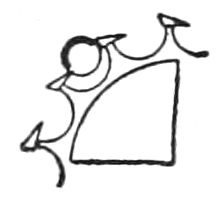
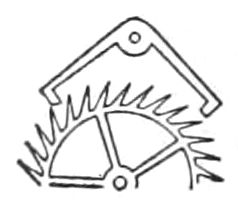
Escapement, Dead-Beat—Any
escapement in which
the pallet face is so formed
that the escape wheel remains
dead or motionless
during the supplementary
arc of the balance or swing of the pendulum.
As invented by George Graham,
the wheel is much the same as the wheel
in the anchor escapement, the difference
lying in the shape of the pallets. Each
pallet has a driving face and a sliding
face. It is so arranged that the impulse is
given the pendulum at the midpoint of its
swing thus allowing the swing to adapt
itself to the impulse and keep the time
constant. The pallets are faced with
jewels so that there is slight friction.
Used in high grade clocks such as regulators
and astronomical clocks.
Escapement, Detached—Any escapement
in which the balance or pendulum
is for some time during each vibration
free from the pressure of the train. Detached
escapements are used in chronometers,
most watches and in turret
clocks. They are of value in any movement
where the motive power varies
greatly—hence in turret clocks. Examples:
Chronometer, lever, and gravity
escapements.
Escapement, Double
Three-Legged Gravity—Invented
in 1854 by E. B. Denison, Esq.,
for the great clock at
the Houses of Parliament. It is
the best escapement for very
large clocks where the hands are
exposed to the action of the
wind and snow, because it admits
of great driving power in
the movement without its
sensibly affecting the escapement as
would be the case in the dead-beat type.
The impulse to the pendulum is given by
the weight of the lever arms falling
through a given distance and is therefore
constant. This escapement consists of
two gravity impulse pallets pivoted in a
line with the bending point of the pendulum.
There is a locking wheel made of
two thin plates of three teeth each. Between
these plates are the three pins that
lift the pallets. The locking is effected by
blocks screwed to the front of one pallet
and the back of the other. Impulse is
given by the pallets in turn striking the
pendulum rod. The pendulum rod serves
to unlock the wheel. The arrangement is
such that the lifting pins have a little
free run each time. Since the pallets are
always lifted the same distance they give
a constant impulse to the pendulum.
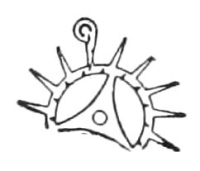
Escapement, Duplex—Invented
by Hook; later improved
by Tyrer. Very accurate
but as originally made
was affected by any sudden
motion, and hence of little use in watches.
The escape wheel has two sets of teeth.
Those farthest from the center lock the
wheel by pressing on a hollow ruby cylinder
fitted round the balance staff and
notched so as to permit the passing of the
teeth as the balance moves in a direction
opposite to the wheel's motion. The second
set stand up from the face of the
wheel and one gives impulse to the pallet
every time a tooth leaves the notch. This
is not a detached escapement, but there is
little friction. As improved this escapement
was used in the famous Waterbury
watches.
Escapement, Foliot—A form of
escapement actuated by a foliot balance.
See Foliot.
Escapement, Four-Legged
Gravity—Invented by E. B.
Denison (Sir Edmund Beckett).
The same in principle as the
Double Three-Legged escapement,
only it has but one
escape wheel with four teeth or
legs instead of two wheels with
three legs each. The wheel has
two sets of lifting pins—one
acting on each pallet. Occasionally
used in regulators and other clocks
with a seconds pendulum, but of doubtful,
if any, advantage over the Graham
dead-beat escapement.
Escapement, Frictional—Any
escapement in which the balance is never
free from the escapement. Examples: The
Cylinder, Duplex and Verge types.
Escapement, Gravity—An escapement
which gives impulse to the pendulum
by means of a weight falling through a
constant distance. Of use in turret and
other exposed clocks where the hands'
movements are affected by wind, rain,
and snow. See subtitles under these
headings: Double Three-legged Gravity;
Single Three-legged Gravity; Four-legged
Gravity; Six-legged Gravity.
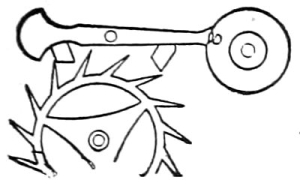
Escapement
Lever—Invented
by Thomas Mudge
about 1765. It is
the preferred escapement for
watches because of
the certainty of its performance. Possibly
inferior to the chronometer escapement as
a timekeeper. Its most noticeable defect
is the necessity of applying oil to the
pallets, the thickening of which affects the
action. There are many other kinds of
lever escapements. The Mudge escapement
was essentially like the modern
Double Roller. The connection between
the balance and the escape wheel is made
by a lever to which the pallets are fastened,
and into the forked end of which
plays the ruby pin which is carried on a
roller on the same staff as the balance.
Each pallet has an impulse face and a
locking face. The impulse is given by the
escape wheel tooth striking the impulse
face of a pallet and is communicated to
the balance by the lever, raised by the
pallet's movement striking the ruby pin
in the roller. This ruby pin also serves to
unlock the pallets by causing the lever to
lift them in turn. This escapement is of
the detached type. The action of the
lever is kept within the desired limits by
banking pins.
Escapement, Lever—Club Tooth—An
escapement like the Table Roller in
the action of the lever and roller, but differs
in the pallet action. The impulse
planes are partly on the teeth and partly
on the pallet. This is the standard watch
escapement of today.
Escapement, Crank Lever—An escapement
with a small roller having a
tooth like a pinion leaf projecting from its
circumference. This tooth acts in a square
notch cut in the end of the lever. The
lever is formed like a fork the two points
of which act as safety pins against the edge
of the roller to prevent the lever from getting
out of action with the roller. It necessitated
very careful construction and was
not so good as the Double Roller or Table
Roller.
Escapement, Lever—Double
Roller—This escapement
has two rollers on the balance
staff, the large one carrying the
balance staff and the small one
used for a safety roller only. The
best form of lever escapement but more
delicate, expensive, and difficult to make
than the Table Roller; hence not so much
used as the latter.
Escapement, Patent Detached Lever—Introduced
in 1766 by Thomas
Mudge, but neglected for years thereafter
even by Mudge himself. It was in some of
its parts the model of the best form of
lever escapement—the Double Roller.
The first pallets had no "draw" on the
locking faces which rendered the escapement
peculiarly sensitive to jolt and jar.
This may have suggested to Mudge the
addition of the small roller, whose worth
has been since unquestionably demonstrated.
Escapement, Lever—Pin-Pallet—A
lever escapement with round pins for
pallets, and the inclines on the escape
teeth. Used in alarm clocks.
Escapement, Rack-Lever—Invented
by Abbe Hautefeuille in 1734. Afterward
made and improved by Berthoud and by
Peter Litherland, who obtained a patent
for it in 1794. It consisted of anchor
shaped pallets on whose axis was fixed
a rack, or segment of a toothed wheel
which geared into a pinion on the axis of
the balance. The balance was thus never
free from the train and good timekeeping
was made impossible. It is not now in use.
Escapement, Lever-Resilient—Invented
by F. J.
Cole about 1870. A form of
lever escapement designed to
obviate the evils of overbanking. The
points of the escape-wheel teeth are bent
toward the locking faces of the pallets, the
bend in the tooth acts as the banking and
no pins are required. It was abandoned
because expensive to make and the danger
of overbanking is not considerable.
Escapement, Lever—Table Roller—Excellent
and very simple and the most
common form today. It differs from the
crank lever only in the action of the roller.
The impulse pin instead of projecting
beyond the edge of the roller is set within
its circumference and raised above its
plane.
Escapement, Lever—Two
Pin—A form of Lever
Escapement in which the unlocking
and impulse actions
were formerly divided between
two small gold pins in the
roller and one in the lever.
Later the two roller pins were discarded,
and one broad jewel pin substituted.
Escapement—Pin Wheel—Invented
by Lepaute about
1750. Similar in action to the
dead-beat. A good and simple
escapement for large clocks.
The impulse is given the pendulum
through the pallets by
pins which stand out from the
face of the escape wheel.
Lepaute made these pins semi-circular
and had his pallets of equal length acting
on opposite sides of the wheel. Sir E.
Beckett cut away part of the front of the
pins which allows the pallets to act as
in the diagram. The resting faces are
arcs of a circle. It has been superseded by
the gravity escapement for large clocks
and is inferior to the dead-beat for small.
Escapement, Recoil—Any escapement
in which the pallets actually force
the escape wheel to turn backwards a
trifle with each beat of the balance.
Cheap and easy to make but inferior as
timekeepers to the detached or dead-beat
types.
Escapement, Right-Angled—A lever
escapement so set that lines drawn between
the centers of the balance, pallets,
and escape wheel would form a right
angle. See Escapement, straight-line.
Escapement, Single-Beat—An escapement
such as the Duplex, or Chronometer,
whose escape wheel moves only
at alternate beats of the balance or
pendulum.
Escapement, Single
Three-Legged Gravity—Consists
of two pallets
and one three-legged
locking wheel. Instead
of the three pins for lifting
as in the Double
Three-Legged Gravity
escapement there is a
triangular steel block which acts against
large friction rollers, pivoted one on each
pallet.
Escapement, Six-Legged
Gravity—A modification
of the three-legged
gravity escapement. The
locking wheel has six teeth.
One of the pallet arms is
neutral and gives no impulse,
hence impulse is given
only at each alternate vibration.
A much lighter
driving weight than for the
Double Three-legged Gravity escapement
will suffice for this, since the rotations
of the escape wheel required are only
half as many.
Escapement, Straight-Line—An escapement
of the lever type in which the
escape wheel, pallets and balance are all
in a straight line; an arrangement favored
by the Swiss.
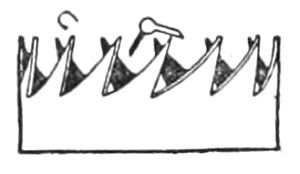
Escapement, Verge—Also
called "Crown-wheel,"
or Vertical escapement.
The earliest
form of escapement on record. The inventor
is not known, but the escapement
was used on de Vick's clock. (1364.) It
was used almost exclusively up to 1750 in
spite of its manifest inaccuracy. The verge
is a frictional recoil escapement. It consists
of a crown-wheel, with eleven, thirteen,
or fifteen teeth, shaped like those of
a rip saw, and with its axis set at right
angles to the pallets axis, or verge, which
carries the balance. The verge is a slender
cylinder as small as compatible with the
required strength, from which project
the pallets, two flat steel "flags"—at an
angle to each other varying from 90° to
115°. The wheel runs in a watch in a plane
at right angles to the face. Any variation
in the motive power causes a variation in
the arc of the balance swing. Therefore,
since the time of oscillation depends on
the arc of the swing, the time-keeping
qualities were directly affected. This gave
rise to the invention of the stack-freed
and fusee, both contrivances to equalize
the power of the mainspring. In spite of
the many defects the verge escapement
was one of the great inventions because
the first escapement, and was used for
centuries before superior kinds were devised.
It necessitated thick and bulky
watches.
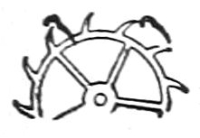
Escapement, Virgule—An
early form of escapement
invented about 1660 by Abbe
Hautefeuille. Its action can be
readily understood from the diagram.
Escape Pinion—The pinion on the
escape-wheel arbor.
Escape Wheel—The last wheel of a
train: it gives impulse to the balance,
indirectly. Also called scape wheel.
Easily identified by teeth resembling
those of a circular saw.
Face—1. Of a watch or clock is the dial.
2. Of the tooth of a wheel, that portion
beyond the pitch line.
Facio, Nicolas—A Geneva watchmaker
who invented the art of piercing
jewels for use in watches, and in May,
1705, obtained a patent therefor in London.
In December of the same year when
he petitioned for a more extended patent
he was opposed by the Clockmakers'
Company, who produced in evidence proof
that Facio was not first in this use of
jewels, in an old watch of Ignatius Huggeford's
with an amethyst mounted on the
cock of the balance wheel. Facio's petition
was denied. It was later discovered that
Huggeford's jewel had nothing to do with
the mechanism of the watch.
Favre, Perret E.—In 1876 the chief
commissioner in the Swiss Department
and a member at that time of the International
Jury on Watches at the Centennial
Exhibition at Philadelphia. On his
return home he was very emphatic in his
endorsement of the American method of
manufacture as compared to the Swiss.
Fitch E. C.—Made president of the
Waltham Watch Co., in 1886. His long
experience in watch case and movement
making and his commercial training made
his judgment on matters relating to
watchmaking of value. He was the inventor
of the screw bezel case.
Flank—The flank of a wheel or pinion
is the part lying between the pitch circle
and the center.
Flirt—Any device for causing the
sudden movement of a mechanism.
Fly—A speed regulating device or
governor consisting of a fan or two vanes
upon a rotating shaft. Used in the striking
part of clocks. By some believed to have
been used on the earliest clocks—before
the verge escapement—to check a too
rapid descent of the weight.
Fly Pinion—The pinion in a clock that
carries the fly: a part of the striking
mechanism.
Fob—Properly a watch
pocket in the waistband
of trousers. Commonly applied
to the end of a chain or
ribbon which is attached to
the watch and hangs free
from the pocket. One of the
early examples was attached
to a watch made for Oliver
Cromwell in 1625 by John
Midwall in Fleet Street.
Foliot—A
straight armed
balance with
weights used
as one of the
earliest clock
regulators. De
Vick's clock is
one example of
it.
Foliot
Balance—See
Foliot.
Follower—Of two wheels geared together,
the one to which the driver imparts
motion is called the follower.
Fork—The fork shaped end of the lever
into which plays the roller jewel.
Fourth Wheel—The wheel in a watch
that drives the escape pinion and to whose
arbor the seconds hand is attached.
Frame—The plates or plate and bars of
a watch or clock which support the pivots
of the train.
Free Spring—A balance spring not
controlled by curb pins. Used in chronometers
and other fine time pieces where the
spring is an overcoil.
Fromanteel, Ahasuerus—A clockmaker
of Dutch extraction—maker of
steeple clocks in East Smithfield. The
family of Fromanteels were celebrated as
having been the first to introduce the
pendulum clocks into England. Their
claim has since been contested in favor of
Harris and Hooke.
Full Plate—A model in which the top
plate is circular in form—the balance being
above this plate. Used now in 18 size
watches for railroad and other hard usage.
They are made only in limited quantities.
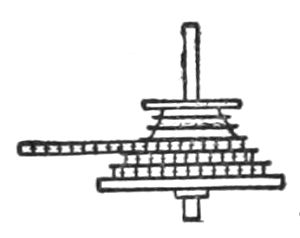
Fusee—Invented by
Jacob Zech of Prague
about 1525. Consists of
a specially grooved
cone-shaped pulley interposed
between the
mainspring barrel and the great or driving
wheel of a watch or clock. The connection
between the barrel and fusee was first
made by a cord or catgut, later by a chain.
In winding the spring the cord is drawn
from the barrel on to the fusee—the first
coil on the larger end. Thus the mainspring
when fully wound uncoils the cord
first from the smaller end of the fusee; and
as it runs down gets the benefit of increased
leverage by reason of the greater
diameter of the lower part of the fusee.
An excellent adjustment of the pressure
on the center pinion can be made in this
way. The fusee has been abandoned in
watches to allow of thinness, but is still
used in chronometers and clocks.
Fusee Cap—A thin steel plate with a
projecting nose on the smaller end of the
fusee: a part of the mechanism to stop the
fusee when the last coil of the chain is
wound thereon.
Fusee Chain—A very delicate steel
chain connecting the barrel with the fusee
of a watch, chronometer or clock. It replaced
the catgut originally used and was
first introduced by Gruet of Geneva about
1664.
Fusee Sink—The sink cut in the top
plate of a watch to give space for the
fusee.
Galileo, Galilei—Commonly called
"Galileo." A famous Italian scientist
born in 1564 who discovered, among many
other things, the isochronism of the
pendulum vibrating through long or short
arcs. The story goes that he noticed that
a swinging chandelier in a certain cathedral
took the same length of time to
each vibration whether in long or short
arcs—timing them by his pulse. He seems
never to have applied this principle to
clocks, although he issued an essay on the
subject in 1639.
Galileo, Vincentis—Son of the great
astronomer, born about 1600. He aided
his father in experiments and gave special
attention to the application of the pendulum
to clocks. He is claimed by some to
have been the first to so apply the pendulum,
in 1649, but this is disputed in favor
of Richard Harris of London.
Geneva—A city in Switzerland in
which watchmaking was first established
in that country. It is the center of the
"hand" industry, and the city is honeycombed
with garret-workers—so-called—making
parts.
Gerbert (Pope Sylvester II)—Born
in Belliac, Auvergne, in 920. In 990
Gerbert made some sort of a clock which
attained wide fame. Some authorities
claim that it was a clock moved by
weights and wheels and some even claim
for it a verge escapement. On the
other hand, other authorities state positively
that that story is a myth and that
Gerbert's horologe was a sun-dial. It
seems pretty well accepted that there was
no escapement used, however, until more
than two centuries after Gerbert's time.
German Silver—An alloy of copper,
nickel, and zinc—copper predominating.
Really a white brass.
Gimbal—A contrivance resembling a
universal joint permitting a suspended
object to tip freely in all directions. Marine
chronometers are supported in their
cases or boxes by gimbals. It was first
applied to chronometers by Huyghens.
Gnomon—A simple and
probably the most ancient
instrument for marking time
consisting simply of a staff or
pillow fixed perpendicularly
in a sunny place—time being reckoned by
the changing length of the shadow or
by its angular movement. In more recent
times the title "gnomon" was applied to
the style of the sun-dial.
Gnomonics—The art of constructing
and setting sun-dials taught especially
in the seventeenth century.
Goddard, Luther—Born at Shrewsbury,
Mass., February 28, 1762—Died
1842. He was the first American to manufacture
watches. He began in 1809 but
unable to compete as to price with cheap
foreign watches, retired after making
about five hundred.
Going-Barrel—The
Swiss early
abandoned the fusee
in watches and
cut teeth around
the outside of the
main-spring barrel
so as to drive the
train direct. Such
an arrangement is called a going-barrel.
It made possible a thinner and much
simpler watch. American makers quickly
adopted this device, but the English long
clung to the fusee. It is sometimes claimed
that the French were the first to adopt the
going-barrel.
Going Fusee—A fusee with maintaining
power attachment, so that the watch
does not stop while being wound. Invented
by Harrison.
Golden Number—Meton, an Athenian
astronomer, discovered about 432
B. C. that every nineteen years the new
and full moons returned on the same days
of the month. This period is the cycle of
the moon, called the Golden Number because
the Greeks, to honor it, had it
written in letters of gold. Anno Domini,
the year of our Lord, fell on the second
year of a lunar cycle. Hence, to find the
Golden Number for any year, add 1 to the
date (A. D.) and divide by 19. The remainder
is the Golden Number for the
year.
Gold-Filled—A sheet of brass sandwiched
between two thin plates of gold
and all brazed together. Gold-filled watch
cases were introduced in America. They
give very good wear.
Graham, George, F. R. S.—An English
watchmaker and astronomer, born in
Cumberland in 1675. Died 1751. He was
an apprentice of Tompion and succeeded
to Tompion's reputation as the best
watchmaker of his time. He invented the
mercurial compensation pendulum, the
dead-beat escapement, and perfected the
cylinder escapement of Tompion and left
it in practically its present form. He made
ornamentation distinctly subsidiary to
use. He was master of the Clockmakers'
Company in 1722-23. He was buried with
Tompion in Westminster Abbey.
Great Tom—The great bell which
struck the hours on the first clock at
Westminster. It was afterwards transferred
to St. Paul's.
Great Wheel—In a fusee watch the
toothed wheel which transmits the power
from the fusee to the center pinion. In
a going-barrel watch it is represented by
the toothed portion of the barrel drum.
Greenwich Observatory—(England)
Royal observatory founded 1675 to promote
astronomy and navigation. There is
at this observatory a standard motor clock
which is the center of a system of electrically
controlled clocks scattered over the
Kingdom, and which thus keeps official
time as our Naval Observatory clock does
for the United States.
Grimthorpe—See Denison, E. B.
Gruen, Dietrich—A Swiss watchmaker
who with his son Fred first succeeded
in making a very thin watch. The
Gruen watch factory at Cincinnati, Ohio,
is unique in this country. The buildings
and surroundings resemble those of
Switzerland, and the method of manufacture
embodies more handwork than is
common in the American system.
Gruet—A Swiss who introduced chains
for the fusee instead of catgut cord, in
1664. They are still used for marine
chronometers, some clocks, and the few
fusee watches now made.
Guard Pin—A pin in a lever escapement
which prevents the pallets leaving
the escape wheel when the hands of a
watch are turned back. Also known as the
"safety pin."
Guild or Gild—An association of
people occupied in kindred pursuits for
mutual protection and aid. Watch and
clockmakers belonged to the Blacksmiths'
Guild in England until 1631,
when the Clockmakers' Company was
formed. In France the Clockmakers' Guild
was powerful in 1544.
Hair-Spring—Said by some to be a
distinctly American term for the
balance spring of a watch. But Wood
(English) uses it in his "Curiosities of
Clocks and Watches," 1866. However, it
is not in common use outside of America.
It is thought to have originated from the
fact that in early times attempts were
made to utilize hog-bristle for the balance
spring.
Half Plate—A watch in which the
top plate covers but half of the pillar
plate, the fourth wheel pinion being carried
in a cock to allow the use of a larger
balance. Now obsolete or nearly so. Replaced
by the bridge-model.
Hall Mark—A stamp placed upon
gold and silver articles by government
officials after the metal therein has been
assayed.
Hands—The metal pointers which,
moved by the train, indicate the time by
pointing to the figures on the dial. At
present there are always two, the hour and
minute hands and frequently a seconds
hand also. Clocks at first were made with
only the hour hand; the minute hand was
introduced when the use of the pendulum
made timekeeping sufficiently accurate for
the indication of such small divisions.
Hanging Barrel—A going-barrel with
its arbor supported only at the upper end.
Harris, Richard—An English clockmaker
for whom it is claimed that he
made the first pendulum clock—set up at
St. Paul's, Covent Garden, in 1641. Most
authorities agree, however, that this honor
belongs to Huyghens.
Harrison, John—An English mechanician
born at Faulby in Yorkshire in
1693. He made many improvements in the
mechanism of clocks, the greatest of
which was the compound pendulum. He
won in 1761 a reward offered by Parliament
in 1714 for an instrument that would
determine longitude within thirty marine
miles. Harrison's chronometer gave it
within eighteen miles. He invented the
going fusee, the gridiron compensation
pendulum and suggested the idea for the
compensation balance, afterward worked
out by other watchmakers. Died 1776.
Hautefeuille, John—(Abbe.) Born
1647. Died 1724. He disputed successfully
Huyghens' claim to a prior invention
of the steel balance spring. He is also
credited with the invention about 1722 of
the rack-lever escapement.
Heart-Piece—The heart-shaped
cam on the center-seconds
wheel of a chronograph,
which causes the hand
to fly back to zero.
Hele, Peter—(See Henlein, Peter.)
Some historians credit invention of first
watch to Peter Hele. There is no doubt,
however, that Hele and Henlein were one
and the same. Preponderance of authority
favors "Henlein" as the correct spelling
of the name.
Helical—Following the course of a
helix or spiral.
Heliotropion—See "Polos."
Hemicycle—Form of sun-dial in which
the shadow of a vertical pointer or
"gnomon" is cast upon and moves around
the inner surface of a half globe or sphere.
Supposed to have been invented about
350 B. C. (See Sun-Dial). Vitruvius, the
Roman Engineer, ascribes invention to
the Babylonian priest and astronomer,
Berosus.
Henlein, Peter—Sometimes called
Peter Hele. A clockmaker of Nuremberg,
who is believed to have made the first
portable (pocket) clock or watch sometime
early in the sixteenth century. Born 1480.
Died about 1540. His clock was round,
driven by a spring and had small wheels
of steel. It was much larger than present
day watches.
Hollow Pinion—A pinion bored
through the center. The center pinion in
many watches is hollow.
"Hon-Woo-Et-Low" or Copper Jars
Dropping Water—A form of clepsydra
at Canton, China, said to be between
3000 and 4000 years old. It consists of
four copper jars arranged on steps. Each
jar drops water into the one below it until
the last one, in which a bamboo float,
indicates the time in a rude way.
Hooke, Robert, M. D.—An English
physician-philosopher born on the Isle
of Wight in 1635. His accomplishments
were numerous. He claimed to have discovered
the isochronism of the balance
spring and its application to watches,
though this was also claimed by Huyghens.
He invented a pendulum timekeeper for
finding the longitude at sea; devised the
first wheel-cutting engine about 1670; and
he invented the anchor escapement for
clocks. His studies and inventions covered
a wide field. He died in 1702.
Horologe, (Orologe), (Horologium)—A
general term applied indiscriminately
in old writings to any mechanism for
measuring time.
Horological Institute—British—An
association of watchmakers founded in
1858 for the purpose of advancing the
horological arts.
Horological Periodicals, American—American
Jeweler, (Monthly), Chicago,
Ill.; Goldsmith and Silversmith,
(Monthly), New Haven, Conn.; Jeweler's
Circular, (Weekly), New York,; Keystone
(Monthly), Philadelphia, Pa.; Manufacturing
Jeweler, Providence, R. I.; Mid-Continent
Jeweler, Kansas City, Mo.;
National Jeweler, (Monthly), Chicago,
Ill.; Northwestern Jeweler, St. Paul,
Minn.; Pacific Goldsmith, (Monthly),
San Francisco, Cal.; Trader and Canadian
Jeweler, Toronto, Canada.
Horologium—See Horologe.
Horology-The science of time-measurement
or of the construction of time
pieces.
Hour—Now consisting of sixty minutes
or one twenty-fourth of an equinoctial
day. Formerly one twelfth of the
time between sunrise and sunset, and one
twelfth of the time between sunset and
sunrise; hence of different lengths for
day and night in the different seasons.
This required much adjustment of clocks;
and automatic devices for such adjustment
were in great demand. A standard
hour of uniform length for all times and
seasons was not adopted in Paris—the
last place to change—until 1816.
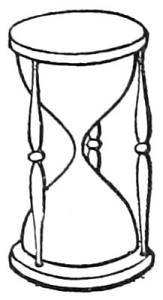
Hour-Glass—A device for measuring
hours. It has two cone-shaped superimposed
glass globes connected at their
apexes through a small opening. The
glass contains just that quantity of sand,
or mercury, as will flow in one hour
through the opening from the upper
globe to the lower. When it
has run through the glass
is reversed. See: Sand Glass.
Like the sun-dial and the
clepsydra, the hour-glass is
older than we know. Its use
probably followed close upon
that of the clepsydra, or
may even have preceded it
in dry countries like Egypt
and Babylonia, where sand
was all about and water was not a thing
to waste. Of its original forms there is
no authentic record. Dry sand does not,
like water, run faster or slower through
a given opening according to the pressure
from above; its rate is the same whether
the upper glass is full or nearly empty.
Also the hour-glass never needs to be
refilled, but only to be reversed, and
the same sand used over and over again.
On the other hand, its convenience diminished
as its size increased. It was
too clumsy for use if made large enough
to run without attention for more than
an hour or two; and in so large a glass
there was more danger that the sand,
however dry, might cake up and stop
running. It must somehow have been
transparent for convenient reading, because
sand can register the time only by
its flow: it cannot be made to raise a float
or work a pointer. But the Egyptians
very early learned to manufacture glass,
and there were other substances. A legend
ascribes the invention of the sand-glass to
Luitprand, a Carthusian monk of the
Eighth Century A. D. But this, if there is
any truth in the story at all, must have
been some improvement or reinvention
after the forgetfulness of the Dark Ages.
The device is plainly shown in Greek
sculptures antedating the Christian era.
Nowadays the sand-glass has pretty much
disappeared, except as a kitchen timepiece
for boiling eggs and the like.
Hour Hand—The hand of a watch or
clock which indicates the hour: for long
after clocks were first made, the only hand
provided.
Hour Wheel—The wheel which revolves
on the minute wheel or cannon
pinion and carries the hour hand.
Howard, Edward—Born at Hingham,
Mass., October 6, 1813. Having served
a regular apprenticeship in clockmaking
he entered into partnership with D. P.
Davis, at the age of 29, to make clocks.
He was a clever mechanic and invented
many pieces of mechanism, among them
the swing rest. In 1849 he and Davis with
A. L. Dennison and others organized the
American Horologe Company for the
manufacture of watches by machinery,
and with the parts interchangeable—the
American principle of today. Though
they were not financially successful the
American watch industry owes its present
day success largely to this beginning by
Edward Howard and Aaron L. Dennison.
The first company developed into the
present Waltham Company, and later
Mr. Howard established the E. Howard
Co., at Roxbury, but severed his connection
with them in 1882 and retired
from business. He died March 5, 1904.
Huggeford, Ignatius—An English
watchmaker, one of whose watches was
used to defraud Facio of his patent on
the use of jewels in watches. See Facio,
Nicolas.
Hunter, or Hunting-Case—A watch
case which has a solid metal cover over
the dial.
Hunter, George—Identified with
watchmaking in America since about 1860—in
the Waltham and Elgin Companies.
He was general superintendent of the
latter from 1872 to 1903, after which he
was made consulting superintendent.
Huyghens, Christian—A celebrated
Dutch astronomer and mathematician
born at The Hague, April 14, 1629. Although
the honor is claimed for Richard
Harris in 1641 and for Vincent Galileo in
1649 it seems historically established that
Huyghens in 1657 was the first to apply to
clocks the theory of the isochronism of the
pendulum which the great Galileo had
discovered. In 1669 he published his important
work, "Horologium Oscillatorium."
In 1673 he made the first clock
with concentric hour and minute hands.
He died in 1695.
Huyghens' Checks—The arc of a
swinging pendulum is a segment of a circle.
For perfect isochronism it should be a
cycloidal segment. To accomplish this
Huyghens fixed curved brass pieces called
checks for the cord to strike against but
he caused thereby a greater error than he
remedied. This end was later accomplished
by suspending the pendulum by means of
a flat steel strip instead of a cord; a device
credited to Robert Hooke.
Hypocycloid—A curve
generated by any point in
the circumference of a circle
which is rolled on the inner
side of the circumference of
a larger fixed circle.
Idler, Idle Wheel, or Intermediate
Wheel—A toothed wheel used to connect
driver and
follower wheels
so that both
shall rotate in
the same direction.
Impulse—The push transmitted to the
pallet by the escape wheel.
Impulse Pin—The jewel pin—usually
a ruby—on the table roller of the lever
escapement, which playing into the fork
of the lever transmits the impulse to the
balance.
Independent Center-Seconds—A
watch peculiarly adapted to the use of the
medical profession. It carries on a separate
train a long seconds hand in addition
to the hands of the ordinary watch
which can be stopped without stopping
the watch.
Independent Seconds—A watch
whose seconds hand is driven by a separate
train.
Ingersoll, Charles Henry—Secretary,
Treasurer and General Manager of
Robt. H. Ingersoll & Brothers., watch manufacturers,
of New York City. Born at
Delta, Eaton County, Michigan, October
29, 1865, a son of Orville Boudinot and
Mary Elizabeth (Beers) Ingersoll. At
the early age of fifteen years he left home
and went to New York City, where he
entered the employ of his brother, Robert
H., who was then engaged in the business
of manufacturing rubber stamps. Since
1880 he has been continuously associated
with his brother in various business
enterprises and in the direction and management
of the Ingersoll organization.
Married Eleanor Ramsey Bond of Brooklyn,
New York, July 5, 1898. Residence,
South Orange, New Jersey.
Ingersoll, Robert Hawley—Founder
and President of Robt. H. Ingersoll &
Brothers., watch manufacturers, of New York
City. Born December 26, 1859, of Orville
Boudinot and Mary Elizabeth (Beers)
Ingersoll, at Delta, Eaton County,
Michigan, he received his early education
in the public schools of his native town.
In 1879, at the age of nineteen years, he
came to New York City, and in the following
year engaged in the business of manufacturing
rubber stamps; later, he established
a mail order business, selling various
"dollar" specialties and novelties.
While engaged in this business he conceived
the idea and in 1892 commenced
the manufacture of the "dollar watch,"
since which time over 50,000,000 watches
have been produced and sold by the Ingersoll
organization. Married June 20,
1904, to Roberta Marie Bannister of
Green Bay, Wisconsin. Residence, Oyster
Bay, Long Island.
Ingersoll, William Harrison—Marketing
Manager of Robert H. Ingersoll
& Brothers., watch manufacturers, New York
City. Born March 22, 1879, near Lansing,
Michigan. He received a grammar
and high school education and three
years' technical training for electrical
engineer. In 1901 he entered business
in the retail sporting goods store of Robt.
H. Ingersoll & Brothers. in New York City
and was soon placed in charge of the
Ingersoll watch advertising, over which
he exercised close supervision ever since,
except for two periods prior to 1908, when
he sought and gained valuable outside
experience in other capacities, such as
salesman and as manager of the Ingersoll
watch business in Canada; he then became
advertising manager, later sales and
advertising manager and then general
marketing manager for developing all
markets of all countries of the world for
the Ingersoll products. Active in the
promotion of advertising research, Mr.
Ingersoll was one of the founders of
Truth in Advertising work, assisted in
establishing a Fellowship in Advertising
Research at Columbia University, New
York City, and has written and lectured
extensively on salesmanship, advertising,
marketing and related subjects. His
residence is at Maplewood, New Jersey.
Ingold, Franz—A Swiss watchmaker
who had the idea of making watch parts
on the interchangeable plan long before
it was put into practice anywhere. He was
ill-received by labor and capital alike
when he presented his plans in France,
England, and America. In England he was
nearly mobbed. In 1842-43 he obtained
patents on some machinery in this line,
but the machines were clumsy and for the
most part impracticable. There has been
a tendency to credit Ingold as the source
of Dennison's ideas on this subject, though
Dennison says he never heard of Ingold
until after he had started manufacturing.
Intercalary—Introduced or added
arbitrarily to a calendar; for example, the
29th day of February is an intercalary
day.
Interchangeability—America's
greatest contribution to watchmaking has
been the standardizing of parts and the
manufacturing of each of them, exactly
alike, in great quantities. So that repairing
an American watch is largely a matter of
obtaining a new part similar to the damaged
one, and simply putting it in place.
Invar—An alloy of nickel and steel
claimed to be non-magnetizable. Used for
certain parts of watches at the time when
non-magnetizable watches were desirable.
Invar is practically non-expansible
when the nickel in it is about 37%.
Isochronism—That property of a
pendulum or balance spring by virtue of
which its vibrations, of whatever length,
are all made in exactly equal periods of
time.
Jacks; or Jack o' the Clock—Figures
on the old turret clocks which automatically
struck the hours. They preceded
dials tho were usually left
when the dials were added. There are
Jacks on the clock at St. Mary Steps,
Exeter; Norwich Cathedral, South Aisle;
and St. Dunstan's in Fleet St., among
others.
Jacquemarts—Figures of
man and woman which
struck the hours on the clock
set up by Philip of Burgundy
at Dijon, prior to 1370.
G. Peignot says they are so
named from Jacquemart, a
clock maker of Lille, employed
by the Duke of
Burgundy in 1442. The lack
of co-ordination in the dates tends to
controvert the claim.
Jerome, Chauncey—Originator of the
one-day brass clock movement which
enormously increased the American clock
business and opened a market for American
clocks in Europe. Born in Canaan,
Connecticut, in 1793. Established the
Jerome Clock Company at New Haven,
Connecticut. This was the predecessor
of The New Haven Clock Company.
Jewelled—Fitted with precious stones
to diminish wear as distinguished from
precious stones for ornament. In the best
watches ruby and sapphire are used. In
lower grade watches quartz, amethyst and
garnet.
Jewels—Used in watches as bushings
at the ends of pivots and in other places
which sustain much wear. They:
- 1. Provide smooth bearings for the pivots.
- 2. Obviate corrosion.
- 3. Reduce the wear from abrasion.
Sapphire is the best of the jewels in use
and ruby second. Chrysolite is also used
and garnet, tho the latter is too brittle
for most service. This use of jewels was
invented by Nicolas Facio—a Swiss
watchmaker about 1705.
Julian Period—A period of 7980
years obtained by multiplying 28, 19 and
15—the numbers representing the cycles
of the sun and moon, and the Roman Indiction.
It will end 3267 A. D., until
which time there cannot be two years
having the same numbers for three cycles.
Jura Mountains—A watchmaking
center in Switzerland. The industry grew
rapidly following the success of Daniel
Jean Richard in 1679. This section is the
center of the system of watch-manufacturing
most nearly like the American
system. See Geneva.
Jurgensen, Jules—One of the most
famous watchmakers of the 19th century;
a son of Urban Jurgensen, born in 1808.
He studied physics, mechanics and astronomy
in Paris and London and finally
settled in Locle, Switzerland, specializing
in pocket chronometers, which have become
famous as the Jurgensen watches.
He died in 1877; and was succeeded by his
son, Jules F. U. Jurgensen.
Jurgensen, Urban—A Danish mathematician
and watchmaker born in 1776.
He practiced his trade for a time in
Switzerland, worked in Paris under Breguet
and Berthoud, and then in London,
before returning to Copenhagen to enter
into partnership with his father, the court
watchmaker. He was made superintendent
of all the chronometers of the Danish
navy and received several decorations.
He died in 1830.
Kew Observatory—The central meteorological
observatory of the
United Kingdom. Established at Richmond
in 1842 and afterward transferred
to the Royal Society. Since 1900 it has
been a department of the National Laboratory.
Important to the watch business
because of the famous Kew tests of timekeepers
and awards for accuracy of performance.
Keyless Watches—Watches winding
without a key. Such watches were made
as early as 1686 but did not come into
general use until 1843, when Adrien
Phillipe (Geneva) introduced the "shifting
clutch" type, and when the "rocking
bar" mechanism was introduced in 1855.
These are the types in use today. Self-winding
watches have been made from
time to time. Napoleon is said to have had
one which wound automatically from the
motion of being carried. The abandonment
of the key nullified the usefulness of
the fusee, although some keyless fusee
movements were attempted.
Knuckles—The rounded parts of a
watchcase that form the hinges or joints.
Usually two on the cover.
La Chaux de Fonds—A watchmaking
center in Switzerland which, in
1840, with a population of 9678, had 3109
watchmakers. At present it is the leading
exporter of gold watches in Switzerland.
In this section the system of manufacturing
is much like the American system.
Laminated—Made up of tin sheets of
beaten, rolled or pressed metal. In the
compensation balance—the sheets are of
brass and steel, or brass and aluminum.
Lancaster, Pa.—A town where there
have been watch factories for upwards of
fifty years.
Lange, Adolph—An eminent Dresden
watchmaker born there in 1815, famous
for his astronomical clocks, chronometers,
and fine watches. Under the direction and
with the assistance of his government he
established the extensive watchmaking
industry of Glashutte. He died in 1875.
Lantern Pinion—A pinion consisting
of two circular metal end plates usually
of brass joined by short steel wires which
act as cogs in a gear.
Latitude—1. In astronomy, the angular
elevation of a heavenly body above
the ecliptic. 2. In geography a distance
measured in degrees, minutes and seconds
north or south from the equator. 3. In dial
work, the elevation of the pole of the
heavens; the angle at which the plane of
the horizon is cut by the earth's axis.
Lead—The continuous action of a
wheel tooth which impels the leaf of a
pinion or the pallet of a balance.
Leap-Year—See Calendar, Gregorian.
Leaves—The name applied to the teeth
of a pinion wheel.
Lepaute, J. A.—1709-1789. A French
clockmaker famous for his turret clocks;
the inventor of the pin-wheel escapement
and an authoritative writer on horological
subjects. He wrote "Traité d'Horlogerie"
which was afterward revised and added
to by Lalaude.
Lepire, Jean Antoine—Born 1720.
Died 1814. A celebrated watchmaker of
Paris in the 18th century. About 1770 he
introduced bars to take the place of a top
plate, omitted the fusee, used a cylinder
escapement and supported his mainspring
barrel arbor at one end only. He attempted
to establish a watch factory for Voltaire
at Ferney but with no success. He is
sometimes credited with making the first
thin watch.
Le Roy, Julien—1686-1759. A French
scientist and watchmaker. He invented
the horizontal movement for turret clocks,
a form of repeating mechanism. He constructed
the first compensation balance.
Le Roy, Pierre—1717-1785. Son of
Julien Le Roy. Esteemed the greatest of
all French horologists. He invented a form
of duplex escapement and an escapement
which formed the basis for the present
chronometer escapement.
Lever—That part of a lever escapement
to which are attached the pallet
arms, and which thus transmits motion
from the escape wheel to the balance.
Lift, or Lifting Arc—That portion of
the oscillation of a balance during which
it received its impulse. The remainder of
the turn is called the supplementary arc.
Lightfoot, Peter—A Glastonbury
monk, maker of the Glastonbury and
Wimburne clocks, 1335.
Lips—In a cylinder escapement, the
rounded edges of the cylinder through
which the escape wheel gives impulse to
the balance.
Locking—1. The stopping of the escape
wheel of a watch or clock. 2. The portion
of the pallet on which the teeth of the
escape wheel drop. 3. The depth to which
the escape tooth laps upon the pallet at
the moment it leaves the impulse face.
Logan, John—Born in Lowell, Mass.,
1844. Invented a new method of tempering
springs and made superior main and
balance springs. He was connected for
several years with the Waltham Watch
Company, during which time he invented
many labor-saving machines. Died 1893.
Longitude—The circular distance east
or west subtending the angle which two
meridional planes make at the axis of the
earth, one of them being a standard reference
meridian.
Longines—A watch factory at St.
Imier in the Jura Mountains, near La
Chaux de Fonds, established in 1874.
Here all parts are made under one roof
and the work is done by machinery.
Lower Plate—The plate in a watch
nearest the dial. Also called the "dial
plate." It carries the lower pivots of the
movement.
Luitprand—A monk of Chartres who
revived the art of glass-blowing at the
end of the 8th century. To him is sometimes
ascribed the invention of the sand-glass.
Luminous Dial—A watch dial whose
hands and figures are so treated as to be
visible in the dark. Formerly accomplished
by a phosphorescent paint which required
frequent exposure to sunlight to be
effective and retained its luminosity only
an hour or two. Now effected by means of
a compound absolutely independent of
the sunlight and of a lasting
glow. See Radiolite.
Lunette—The usual form
of rounded watch crystal.
Mainspring—The long steel ribbon
used for driving a clock or watch.
The spring is coiled into a circular metal
box called the barrel and the outer end of
the spring is fastened to the barrel; the
inner end to the arbor of the great wheel.
First applied, replacing weights, by Peter
Henlein of Nuremberg, about 1500.
Maintaining Power—The device for
driving the train while a watch or clock is
being wound.
Marsh, E. A.—An important figure in
watch manufacturing in America for a
number of years. Born at Sunderland,
Conn., in 1837, in 1863 he entered the employ
of the Waltham Watch Company
and rose to the position of General Superintendent.
In 1908 he retired from active
service but retains his connection with the
company as consulting superintendent.
Besides his practical services to the watchmaking
industry Mr. Marsh wrote "The
Evolution of Automat Machinery," in
1896.
Massey, Edward—An English watchmaker
of the early nineteenth century.
He invented the "crank roller" escapement,
a kind of keyless winding for
watches, and many other watch parts.
Mean Solar Day—The average length
of all the solar days in a year. This period
is divided into 24 parts, or hours.
Mean Time—Clocks, watches, etc.,
are made to measure equal units of time
instead of the apparent time indicated
by the sun. Mean time and true solar time
agree only four times in a year. See
Equation of Time.
Mercer's Balance-A balance of the
ordinary kind fitted with an auxiliary—a
laminated arm of brass and steel fixed
at one end to the central bar of the balance
and on its free end carrying two adjustable
screws. This auxiliary may be arranged
for either extreme of temperature
with great accuracy.
Meridian Dial—A dial
for determining when the sun
is on the meridian. It is very
simply constructed. For directions
see "Watch and
Clockmakers' Handbook," by F. J.
Britten.
Meridian Watch—A watch which
shows the time in a number of places in
different parts of the world. It is set to
Greenwich time and marks the difference
between this and the time of all the great
metropolitan cities in both hemispheres.
Metronome—An instrument
for indicating
and marking exact time
music. It consists of a
counterbalanced, or reversed,
pendulum, which
may be regulated to
swing at any desired
number of vibrations per
minute.
Middle Temperature Error—The
compensation balance does not exactly
meet the temperature error. The rim expands
too much with decrease of temperature
and contracts too little with the increase.
Hence a watch or chronometer can
be correctly adjusted for two points only.
The unavoidable error between is the
middle temperature error.
Minute—The sixtieth part of a mean
solar hour.
Minute Hand—The hand on a clock or
watch which indicates the minutes. In the
earlier days clocks had no minute hand.
It was first concentered with the hour
hand in 1673.
Minute Wheel—The wheel which
carries the minute hand and is driven by
the cannon pinion.
Minute Wheel Pin or Stud—The
stud fixed to the plate on which the minute
wheel pinion turns.
Minute Wheel Pinion or "Nut"—The
pinion in watches on which the minute
wheel is mounted and which drives
the hour wheel.
Moment of Inertia—The resistance
of a body in motion (or at rest) to a
change in the velocity or direction of its
motion. In a rotating body the sum of the
products formed by multiplying the mass
of each particle by the square of its distance
from an axis.
Month—An arbitrary division of the
year, varying in the number of days it
contains, according to the calendar in
use. See Calendar.
Mortise—A slot or hole into which a
tenon of corresponding shape is to be
fitted.
Moseley, C. S.—A pioneer in the field
of designing and building automatic
watchmaking machinery. He invented
some of the most delicate and complicated
tools and mechanisms used in watch manufacture.
He was early connected with the
Waltham Co., master mechanic for the
Nashua Co., during its brief history; and
later general superintendent of the Elgin
National Watch Company.
Motion—The wheels that carry the
hands: cannon pinion, horn wheel and
minute wheel and pinion.
Motion Work—The wheels in a watch
which make the motion of the hour hand
one twelfth as rapid as that of the minute
hand.
Movement—The watch or clock complete,
without dial or case—the mechanism
of the watch or clock.
Mudge, Thomas—An English watchmaker
of the 18th century. Born at
Exeter in 1716, died 1794. In 1793 he received
from Parliament three thousand
pounds as a recompense for his improvements
in chronometers. His work was
celebrated for its excellence.
Name Bar—The bar which carries the
upper end of the arbor of a watch
barrel.
Naval Observatory—The United
States Naval Observatory at Washington,
D. C. There is there a superlatively accurate
clock from which the time is
flashed electrically to all parts of the
United States.
Neuchatel—A town in the Jura
Mountains' watch manufacturing district
of Switzerland. A Cantonal Observatory
at Neuchatel helps establish the reputation
for the accuracy of Swiss watches.
Non-Magnetic Watch—A watch in
which the quick-moving
parts—lever, pallets, balance
spring, etc., are made of some
other metal besides steel—as
aluminum bronze, invar, etc.
Nuremberg—A German
city where Peter Henlein
made the first watch. It was
one of the chief clock centers
of the 16th and 17th centuries
and with Augsburg and
Ulm supplied the markets of
Europe with the first small clocks.
Nuremberg Eggs—Watches made in
Nuremberg in the shape of eggs. If not the
first watches at least very early examples.
Obelisk—A square shaft with a
pyramidal top. The ancient Egyptian
obelisks are thought to have served as
gnomons.
Ogive—A pointed arch—of
the architectural type
known as Gothic.
Oil Sink—The cavity
around the pivot hole in
watch and clock plates,
designed to hold a small particle of oil in
contact with the pivot.
Ormolu—Gilt or bronzed metallic
ware, or a fine bronze which has the appearance
of being gilded. Used for ornamenting
the cases of fine old clocks.
Orologe—An obsolete form of horologe.
See Horologe.
Orologiers—An obsolete form of horologers,
a term not now in use but signifying
men who constructed time-pieces.
Orrery—A planetarium; an instrument
showing the relative motions, positions
and masses of the sun and planets. It
was so named from Lord Orrery, for
whom the first modern planetarium was
made in England.
Oscillation—The movement back and
forward of a pendulum or the swing of a
balance spring. The vibration.
Overbanking—Pushing of the ruby
pin past the lever, caused by excessive
vibration of the balance. In a cylinder
escapement the turning back of the
cylinder until an escape wheel tooth
catches and holds it. In a chronometer
escapement the second unlocking of the
escape wheel from the same cause.
Overcoil—The outermost coil of a
Breguet spring which is bent back across
the coil toward the center.
Pacificus—Archdeacon of Verona,
died about 850 A.D. It is claimed by
some that he made a clock furnished with
an escapement. (Bailly.) But this is not
proved, and others believe it to have been
merely a water-clock.
Pad—The pallet of the anchor escapement
for clocks.
Pair Case—At one time watches were
made with two or even three separate
cases. The outer one of shagreen tortoise
shell, or some other ornamental material
was sometimes for the protection of the
delicate enamel on the inner case. Sometimes
as in the case of repeaters the inner
case was pierced to emit the sound. Then
the outer one served as dust protection
to the works.
Palladium—A soft metal formerly
used in alloy with copper and silver for
the balance and balance spring of non-magnetizable
watches. Too soft to be as
serviceable as steel, it has been superseded
by a platinum alloy.
Pallet—Has different meanings, even
among watchmakers. Generally, the part
through which the escape wheel gives
impulse to the balance or pendulum.
Pallet Staff—The arbor on which the
pallet is mounted, and on which it turns.
Pallet Stone—The jewel on the contact
face of the pallet, where it is struck
by the teeth of the escape wheel.
Parallax—The apparent angular displacement
of a heavenly body due to a
change of the observer's position.
Pedometer—An instrument which
registers the number of paces walked—hence
if properly adjusted to the length
of step of the wearer it gives the distance
traversed.
Pendant—The small neck and knob
of metal connecting the bow of a watch
case with the band of the case.
Pendulum—A body suspended by a
rod or cord and free to swing to and fro;
used in clocks to regulate the velocity
with which the driving power moves the
wheels and hence the hands. The isochronism
of a pendulum vibrating in a
cycloidal arc was first discovered by
Galileo but he did not apply it to clocks.
Most authorities credit Christian Huyghens
with that adaptation to instruments
for keeping time. The pendulum was first
suspended by a silk cord and thus vibrated
in a circular instead of cycloidal
arc. "Huyghens' Checks" were an unsuccessful
attempt to remedy this. Dr.
Hooke succeeded in remedying it by
suspending the pendulum by a flat ribbon
of spring steel.
Pendulum, Gridiron—Invented
by Harrison in 1726, and still
with slight improvements an effective
timekeeper. The rod of this
pendulum is constructed of five
steel and four brass rods so arranged
that those which expand
most are counteracted by those of
less expansion, and the length of
the pendulum remains constant.
Pendulum, Mercurial Compensation—A
pendulum having
for a bob a jar of mercury which
expands upward with the increase
of temperature thus counteracting
the lengthening of the rod from
the same cause. Invented by Graham
about 1720. With slight improvements
still in use and keeps time very accurately.
Pendulum, Torsion—A
pendulum vibrating by the
alternate twisting and untwisting
of an elastic suspension.
The body is a horizontal disc
weighted around its edges, and
its suspension a steel or brass
wire. The period of a torsion
pendulum being much longer
than a vibrating pendulum of
the same length, the time of running is
longer. Clocks fitted with torsion pendulums
have run a year on one winding.
Pendulum Swing—The short ribbon
of spring steel which suspends the pendulum
of a clock.
Penetration of Gearing—The depth
of intermeshing of the teeth of pinion and
wheel.
Phillips Spring—A balance spring
with terminal curves after rules laid down
by M. Phillips, an eminent French mathematician.
A term seldom used though
his curves are generally followed.
Pillar—The three or
four short brass posts
which keep the plates at
their proper distance apart. In early
days made in very artistic and elaborate
shapes. Later they became plain straight
cylindrical columns.
Pillar Model—A type of movement
in which the works are hung between two
plates supported and separated by posts
or pillars and forming all the principal
bearings of the movement. Only average
adjustment is possible in this model. In
this model the plate is sometimes cut away
to imitate a "bridge model." The opposite
extreme in construction to the "bridge
model."
Pillar Plate—The lower plate of a
watch movement—the one nearest the
dial—to which the pillars are solidly
fixed, in a "pillar model."
Pinchbeck, or "Pinchbeck Gold"—An
alloy of three parts zinc to four of
copper which "resembles gold in color,
smell and ductility." So called from its
inventor Christopher Pinchbeck (1670-1732)
who during his life guarded the
secret of its composition very jealously.
Pinion—The smaller of two toothed
wheels that work together. The teeth of
a pinion are called leaves. See also Lantern
Pinion.
Pinion, Lantern—A pinion
consisting of two circular metal
plates joined by short steel
wires.
Pitch—The length of the
arc of the circumference of the
pitch circle from center to center
of two adjacent teeth.
Pitch Circle—The geometrical circle
traced with the center of the wheel as
its center and at which the curved tips of
the teeth begin. The diameter is proportional
to the number of teeth determined
upon. The proportion of the pitch circles
of a wheel and a pinion gearing together
is determined by the ratio of revolutions
desired.
Pitkin, Henry—With his brother,
James F., he started at Hartford, Conn.,
in 1838, the first factory for machine-made
watches in the United States. They
made their own machinery, which was
very crude. After making about 800
watches they were forced to abandon the
project, being unable to compete with
cheap foreign watches. He died in 1845.
Pivots—The ends of the rotating arbors
in a watch that run in bearings.
Planetarium—An astronomical clock
which exhibits the relative motions and
positions of the members of the solar
system. Has no regulating system and
usually no driving power but is run by
turning a crank by hand.
Plates—In watches and small clocks
the circular discs of brass to which the
mechanism of the watch is supported. In
large clocks the plates are usually square-cornered
oblong. See Pillar Plate, Top
Plate, Half Plate, Full Plate, etc. In
half-plate, and three-quarter-plate types
of watches part of the disc is cut away.
Pocket Chronometer—A watch with
a chronometer escapement.
Polos—A basin in the center of which
the perpendicular staff or gnomon was
erected, and marked by lines for the
twelve portions of the sun-lit day. Herodotus
ascribes its invention to the Babylonians,
Phavorinus claims it for Anaximander
and Pliny for Anaximenes. Also
called "Heliotropion."
Potance or Potence—A vertical or
hang down bracket, supporting the lower
end of the balance staff in full-plate
watches.
Prescot—A town in a remote part of
Lancashire for years the center of the
movement trade in England.
Push Piece—1. The milled knob
pushed in from the pendant to open the
case. 2. The boss pushed in when the
watch is to be set.
Quare, Daniel—1649-1724—Claimed
the invention of the repeater, and backed
by the Clockmakers' Company obtained
the patent against Barlow from James II.
Also credited with the invention of equation
clocks. He was master of the Clockmakers'
Company in 1708. He first used
the concentred minute hand in England,
but Huyghens had preceded him in this
in the Netherlands.
Quarter—1. A term in common use
for the period of three months—a quarter
of the year. 2. The fourth part of an hour—15
minutes.
Quick Train—A watch movement
balance vibrates 18,000 times per hour.
Unequal mainspring pull is less felt in the
quick train. Used generally in Switzerland
and America, and a feature of practically
all modern watches.
Rack—A straight bar, or segment of a
circle, with teeth along one edge. It
has a reciprocating motion.
"Radiolite"—Trade name adopted
by Robt. H. Ingersoll & Brothers. for their
watches having black faced dials with
luminous hands and numerals. Composed
of a substance in which genuine radium
is used in minute proportions.
Radius of Gyration—The distance
from the center of gyration to the axis of
rotation.
Ramsey, Davis—One of the earliest
British watchmakers of renown. He was
appointed "keeper of clocks and watches"
to James I, and appears to have retained
his appointments after the death of the
latter. He was the first master of the
Clockmakers' Company tho he seems
to have taken little active part in the
management thereof. Scott introduces
him into his story—"The Fortunes of
Nigel" as a Keeper of a shop a few yards
east of Temple Bar. Without doubt he
was the leading clockmaker of his day. He
died in 1655.
Ratchet—The pawl, or dog, which engages
in the teeth of a ratchet wheel and
prevents it from turning backward. It is
held lightly against the periphery of the
ratchet wheel by a small spring known as
the ratchet spring.
Ratchet Wheel—A wheel
with triangular teeth fixed on
to an arbor to prevent the
latter from turning backward.
The fronts of the teeth are
radial, the backs straight
lines running from the tip of one tooth to
the base of the next. In going-barrel,
keyless watches the ratchet has epicycloidal
teeth. By "the ratchet" in a watch,
chronometer or clock with mainspring is
meant the ratchet fastened to the barrel
arbor to prevent the mainspring from
slipping back when it is being wound.
Recoil—In recoil escapements the
pallets not only stop the escape wheel but
actually turn it backward a slight distance.
This backward motion is called the
recoil.
Regulator—1. A standard clock with
compensated pendulum with which less
accurate movements are compared. 2.
The lever in a watch by which the curb-pins
regulating the swing of the hairspring
are shifted.
Remontoire—An arrangement in the
upper part of the going train by which a
weak spring is wound up or a small weight
is lifted that gives impulse to the escape
wheel at short intervals. Its use is to
counteract the irregularities in impulse
due to the coarse train, etc. They are
delicate and complicated and now superseded
by the Double Three-legged Gravity
Escapement.
Repeater—A striking watch or clock
which by the pulling of a string or the
pressing of a button could be made to
repeat the last hour and part hour, struck.
In vogue during the 18th century. Credit
for the invention was disputed by Daniel
Quare and Edward Barlow. James II gave
the decision in favor of Quare whose
mechanism was a trifle simpler.
Repousse—A kind of chasing in which
the metal is punched or pressed from the
back bringing the design into higher relief
than by the usual method of indenting.
Ring-Dial—See Sun-dial,
Portable.
Richard, Daniel Jean—A
Swiss watchmaker, born
at La Sagne in 1665. At fifteen
a watch having come
into his hands, he constructed a similar
one unaided. That was the first watch
made in Neuchatel. After a time in
Geneva he set up business in La Sagne,
afterwards moving to Locle. He created
the watch industry of Neuchatel and saw
it grow to a neighborhood of five hundred
workers. He died at Locle 1741. In 1888 a
bronze statue was erected to him there.
Robbins, Royal E.—Born in Connecticut
1824. He was essentially one of the
"fathers" of American watchmaking because
it was through his financing and
clever management that the first watch
company finally succeeded in making a
financial success.
Roller—The circular plate in a lever
escapement, into which the ruby pin is set.
Roller-Jewel—Same as "impulse
pin."
Roman Indiction—A period of fifteen
years appointed by the Emperor Constantine
312 A. D. for the payment of
certain taxes.
Rose Engine—A lathe in which the
rotary movement of the mandrel is combined
with a lateral, reciprocating movement
of the tool rest; used for ornamenting
the outside cases of watches with
involved curved engraving.
Ruby Pin—The impulse pin in a lever
escapement, made of a ruby.
Ruby Roller—The roller in a duplex
escapement against which the teeth of the
escape wheel are locked.
Run—In the lever escapement, the
extent of the movement of the lever toward
the banking pins after the "drop"
on to the locking.
Sabinianus—Pope from 604 to 606.
Said to have invented a clock in 612 A.
D., but the clock he is supposed to have
built was probably only another of many
forms of clepsydrae, or water clocks.
Safety Pinion—A center pinion in a
going-barrel watch which allows the recoil
of the barrel if the mainspring breaks.
Sand-Glass—(Clepsammia)—A
dumb-bell-shaped glass globe
containing sand, and with a
small aperture through which
the sand flows in a certain fixed
time. The most common form
is the hour-glass but many
others are in use as the three-minute
glass for boiling eggs,
the two-minute glass used by
the British Parliament, etc. Dried and
finely powdered eggshell sometimes used
in place of sand. The principle is the
same as that of the simplest form of
clepsydra. See Hour-Glass.
Sandoz and Trot—A firm which
established the first watch factory in
Switzerland in 1804. Previous to that
time watchmaking had been a house
industry.
Second—One-sixtieth of a minute:
1-3600 of a mean solar hour.
Secondary Compensation—Same as
"auxiliary compensation." See Auxiliary.
Seconds Hand—The hand on the dial
of a clock or watch which revolves once a
minute. Sometimes small and set in a
small circle of its own. Sometimes long
and traverses the whole dial. See Center-seconds
and Sweep-seconds.
Seconds Pivot—The prolongation of
the fourth wheel arbor to which the seconds
hand of a watch is fixed.
Seconds, Split—Divided seconds—into
quarters, or fifths; measured by a
chronograph.
Shadow—A darkened space resulting
from the interception of light by an
opaque body.
Shagreen—Made from the tough skin
that covers the crupper of a horse or ass.
Rough seeds are trodden into the skin and
then allowed to dry. The seeds are shaken
out and the skin dyed green. Then the
rough surface is rubbed down smooth
leaving white spots on the green ground.
Also made from the rough skin of sharks
and dolphins. Formerly used a great deal
for the outer cases of watches. See Pair
Cases.
Sherwood, Napoleon Bonaparte—Born
in 1823. About 1855 he entered the
watchmaking business in the employ of
the Waltham Watch Co. He revolutionized
jeweling methods and invented
among other things a "Counter-sinker,"
"End-shake tools," "Truing-up tools" and
"Opener." In 1864 he organized the Newark
Watch Company but within a few
months severed his connection with it.
He died in 1872.
Sidereal Time—The standard used by
astronomers; measured by the diurnal
rotation of the earth, which turns on its
axis in 23 hours, 56 minutes, 4.1 seconds.
The sidereal day is therefore 3 minutes,
56 seconds shorter than the mean solar
day. Mean time clocks can be regulated
with greater facility by the stars than by
the sun for the motion of the earth with
regard to the fixed stars is uniform.
Clocks all over the United States are so
regulated from the Naval Observatory at
Washington.
Side-Shake—Freedom of pivots to
move sideways. See End-Shake.
Slow Train—A train whose balance
vibrates 14,400 times an hour. Now never
used in pocket watches because of susceptibility
to inequalities in the pull of
the mainspring, jars, sudden movements,
etc. Used, however, in marine chronometers.
Snail—A cam shaped like a snail, used
generally for gradually lifting and suddenly
discharging a lever, as in the striking
mechanism of clocks.
Snailing—A method of ornamenting
with circles and bars parts of a watch
movement which it is not desirable to
polish highly.
Solar Time—Time marked by the diurnal
revolution of the earth with regard
to the sun, of which the midday is the
instant at which the sun appears at its
greatest height above the horizon. This
instant varies from twelve o'clock mean
time because the earth also advances in
its orbit and its meridians are not perpendicular
to the ecliptic.
Spandrels—The
corners of a square
face outside the dial
of a clock. Formerly
very beautifully
decorated. The
age of the clock can
be told approximately
from the
form of ornamentation
employed.
Split Seconds—A chronograph in
which there are two center-seconds hands—one
under the other—which can be
stopped independently of one another.
Spring-Clocks—Clocks whose driving
power is a coiled spring instead of a
weight.
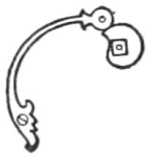
Stackfreed—The derivation
of the word is obscure; it
is possibly Persian. A device
to counteract the difference
in power of the mainspring at
the different stages of its unwinding.
Fixed to the mainspring arbor above the
top plate is a pinion having eight leaves,
which gears with a wheel having twenty-four
teeth, which do not quite fill out the
circumference of the wheel. Fastened to
the wheel is a cam, concentric for about
seven-eighths of its circumference and
indented for the remainder. Into a groove
in the concentric portion of the edge is
pressed a roller which is pivoted at the
free end of a strong curved spring. When
the mainspring is fully wound the roller
rests in the curved depression of the cam
and the effort required to lift the roller
up the incline absorbs some of the mainspring's
power. On the other hand when
the mainspring is nearly run down, the
roller is descending an inclined plane
and absorbs less of the power. Not an
acceptable device and now rarely met
with.
Stem-Winding—The ordinary method
of winding keyless watches by means of a
stem running through the pendant.
Stop Work—An arrangement for preventing
the overwinding of a mainspring
or a clock weight.
Stratton, N. P.—One of the early
watchmakers connected with American
manufacture. He was an apprentice of the
Pitkin Bros., and was sent by the
Waltham Company to England in 1852
to learn gilding and etching. He was made
assistant superintendent of the Waltham
Co. in 1857. He invented a mainspring
barrel and a hair-spring stud which were
later adopted by the Waltham Company.
Striking-Work—The part of a clock's
mechanism devoted to striking. The chief
forms are Rack, and Locking-plate, or
Count-wheel. See separate articles.
Striking-Work, Locking-Plate, or
Count-Wheel—Used in turret clocks
where there is no occasion for the repeating
movement. This form of striking work
does not allow of the repetition or omission
of the striking of any hour without
making the next one wrong.
Striking-Work—Rack—A form of
striking work used largely in house
clocks; the number of blows to be struck
depends merely on the position of a wheel
attached to the going part. In this form
the striking of any horn may be omitted
or repeated without deranging the following
strikes.
Stud—1. A small piece of metal pierced
to receive the outer or upper coil of a
balance spring. 2. The holder of the fusee
stop-work. 3. Any fixed holder used in a
watch or clock, not otherwise named, is
called a stud.
Style—The finger or gnomon on a sun-dial
whose shadow, falling on the plate,
indicates the time.
Sully, Henry—An English watchmaker
of the early eighteenth century
who lived most of his life in France. He
presented the French Academy with a
marine timekeeper superior to the timepieces
of the period, and a memoir describing
it. He died shortly afterward and
advance in the art was delayed.
Sun-Dial—A device for telling time by
the shadow of a style, cast by the sun, as
thrown upon a disk or plate marked with
the hour lines. Dials were named from
their positions—equinoctial or equatorial;
east; erect or vertical; horizontal; inclining,
etc., or from their purpose or method
of use, as portable, reflecting, etc., or as
in the case of the ring-dial, from their form.
The word is derived from the Latin dies.
The style in the earliest dials was a vertical
staff, but later it was found that
reasonable accuracy could only be obtained
by a style set parallel to the earth's
axis—that is, inclined to the horizontal
at the angle of latitude of the locality in
which the dial was set.
Even before the first astronomical discoveries
of the Babylonians, people had
felt some need of a convenient device to
mark and measure the passing of the time,
especially the shorter divisions of recurring
time, the time of day. Sunrise and
sunset marked themselves by the horizon,
but noon was harder to determine, and the
points of mid-morning and mid-afternoon
harder still. And with the knowledge of
those regular movements in the heavens
which determine time on earth, and with
the closer division of the day into its hours,
that need became a sheer necessity.
The obvious measure of the sun's movements
was the moving shadow cast by the
sun itself. And the earliest device for
recording time was naturally the sun-dial.
Its origin fades into the twilight of antiquity.
Long before we know anything
about him, primitive man measured the
moving shadow of some tree. And it occurred
to him to set up a post or pillar in
some convenient place, and mark out the
positions into which the shadow swung.
The earliest sun-dials were of this pattern,
with a vertical pointer of gnomon, and the
hours marked upon the ground. And it is
related of the early Greeks that they told
the time individually by marking and
measuring the length of their own shadows.
But the measure of time by the
length of a shadow is very irregular at
best, because of the yearly motion of the
sun. The shortest shadow of the day will
indeed fall at noon. But that noon shadow
will vary in length according as the sun's
noon is high in Summer or low in Winter;
and so the whole scale of lengths will be
different for every day in the year. If a
three foot shadow means mid-afternoon
today, it will mean quite another time
tomorrow. And for measuring by the
direction of the shadow, the vertical
gnomon is more irregular still. For the
swing of the shadow would depend not
only upon the sun's motion across the sky
from East to West, but also upon his
slant North and South along the sky.
And this would change from day to day.
The difficulty was to make a dial of which
the shadow would move as regularly as
the sun moves.
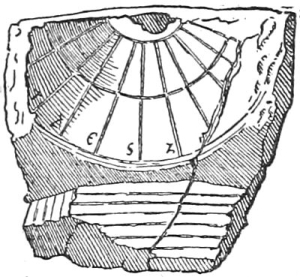
ANCIENT GREEK HEMICYCLE
This the ancients accomplished in a
very simple and ingenious way. The sun
moves in the sky as it were upon the inner
surface of a hollow globe or sphere. So
they made the dial a little hemisphere,
place with its hollow side up toward the
sky as a bowl
stands on a
table. The
pointer was
placed above
and to the
South of this,
on the side toward
the sun;
and the Time
was marked
by the shadow
of the tip end of the pointer which was
a little ball or bead. The path of this
shadow across the bowl reproduced exactly
on a small scale the path of the sun
across the great bowl of the heavens.
And it was then an easy matter to mark
off the bowl into equal divisions which the
shadow would cross at equal intervals of
the day. Of course, the track of the shadow
changed with the season of the year. But
it moved always as the sun moved, and
just as regularly, giving a true measure
of the solar day.
The principle of this was applied in
several interesting variations. The defect
of the Hemicycle, as this hollow type of
dial was called, was that it could not be
read accurately for short intervals. A
shadow moving only a few inches in the
whole day must
move so slowly that
one could hardly see
it move at all. To
mark the minutes,
it must move faster,
just as the minute
hand of your watch
moves faster than
the hour hand, and
the second hand
faster still. One cannot
read seconds
from the hour hand,
however accurately it moves, because it
moves so slowly. So the idea was applied
by making the shadow move across a
street or courtyard, down one side and
across and up the other side, as the sun
opposite went up and across and down
the sky. Sometimes the place was partly
roofed over, and a single beam of light
admitted through a small hole at the
South end. The resulting spot of light
would then move in the same way. The
long sunbeam or shadow moved faster,
and so could be read at shorter intervals.
The Hemicycle is not certainly known to
have been invented until long after this,
about B. C. 350. But the principle of it is
so simple and so entirely such as would
occur to an intelligent man still ignorant
of its mathematical explanation, that we
may not unreasonably suppose it to have
been discovered by experiments long
before.
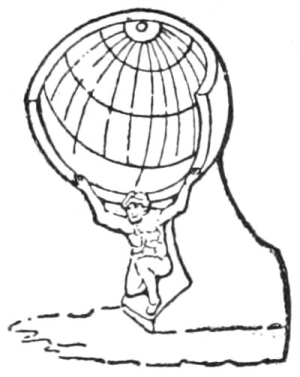
ANCIENT ROMAN HEMICYCLE
The final improvement of the sundial
was the discovery that by slanting the
gnomon so that it pointed exactly toward
the North Pole of the sky, the direction
of its shadow could be made to show the
solar time correctly. Since the sky is infinitely
far away, the line of the gnomon
would then lie parallel to the axis of the
heavens. And the sun, moving parallel to
the celestial Equator, would always move
straight across the gnomon. In other
words, he would practically revolve
around its sloping edge. Therefore the
North and South motion of the sun would
be as it were along the edge of the gnomon,
and would not influence the direction of
the shadow at all. His East and West
motion alone would govern the swing of
the shadow; and the dial would keep true
time with the sun for every day in the
year. There was no longer any necessity
for hollowing out the dial itself into the
concave form; it might just as well be the
more convenient flat surface, and this
might be either vertical or horizontal,
so long as the gnomon pointed straight to
the Celestial Pole. All that was needed
was to mark out on the dial the true direction
in which the shadow fell for each
hour of the day.
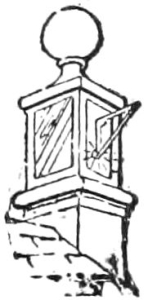
OLD ENGLISH DIAL
Just when or by whom the instrument
was thus scientifically perfected is not
known. The calculations necessary to the
projection of the hour lines upon a flat
surface could hardly have been performed
before Greek times. The Greeks
ascribed the invention of the sundial to
Anaximander, in the sixth century B. C.,
but sundials of various types had been
known in various parts of the world long
before then. On the other hand, the
Hemicycle remained the common form
of the instrument all through the classic
period and even afterwards. The Babylonians
were quite capable of understanding
the principle of the sloping gnomon.
And once this was discovered, it would
have been entirely practical to set up the
new dial beside a Hemicycle or Clepsydra,
and find the angles of the hour lines by
experiment. These, once laid out correctly,
would be determined once for all. Even
at its best the sundial had certain very
marked limitations. Scientifically constructed,
it would keep accurate time
according to the visible sun. But it could
not be read accurately unless made inconveniently
large. It was inaccurate
when removed from its original latitude,
or displaced from a true North and South
position; so that in any portable form it
became a very rough measure indeed.
Moreover, it was of course entirely useless
at night or in bad weather or in shadow.
And finally, it was never absolutely
exact under the most
ideal conditions, because of
what is known as the Equation
of Time. The Earth does
not, in fact, move around the
sun at an absolutely regular
rate of speed; it moves a trifle
faster during certain parts of
the year and slower at others.
The sun therefore varies correspondingly
his apparent speed along the Ecliptic, so
that even from noon to noon the sun is
not always precisely on time. He may be
as much as fifteen minutes late or early,
according to the season. And our modern
days are measured according to the sun's
average rate, so as to allow for this variation
and keep every day exactly twenty-four
hours long. This of course no sun-dial
can possibly be made to do, since it must
follow the actual sun.
The sun-dial has remained in use to the
present day. It seems strange to think of
a sun-dial being used as a standard for
setting clocks and actually to regulate the
running of trains. But these things were
done in civilized Europe within the last
half century. It was only when the railroad
and the telegraph had made standard
time at once necessary and easy to
obtain that the sun-dial altogether lost its
position of authority.
Sun-Dials, Descriptions—Classical
sun-dials were of many forms. Vitruvius,
the Roman engineer, mentions thirteen,
some of them portable; and ascribes the
invention of the Hemicycle to the Babylonian
astronomer and priest, Berosus.
There was a famous dial of this type at the
base of Cleopatra's Needle in Egypt. It is
now at the British Museum. And the
Emperor Augustus, returning from his
Egyptian wars, brought home to Rome
an obelisk which he set up as the gnomon
of a huge dial in the Campus Martius.
At Athens there was the famous Tower of
the Winds; octagonal in shape, with a
weather vane above, and below around
the tower, the hours and the winds, to
each of which the Greeks gave a personality
and a name. There is a curious bit of
accidental poetry in the marking of the
sun-dial in Greece. The Greek numerals,
like the Roman, were simply the letters
of their alphabet arranged in a certain
order. The hot hours of the day from noon
to four o'clock were those commonly devoted
by the Greeks to rest and recreation.
Reckoning the day from sunrise, this
period ran from the sixth hour through
the ninth. And the numeral letters for
Six, Seven, Eight and Nine, which marked
those hours upon the dial, spell out the
Greek word ΖἩΟΙ, the imperative of the
verb to live. The poet Lucian thus points
the moral:
Six hours to labor, four to leisure give;
In them—so say the dialled hours—LIVE.
The shepherds of the Pyrenees still consult
their pocket dials. And the Turk
makes a sun-dial of his two hands by holding
them up with the tips of the thumbs
joined horizontally and the forefingers
extended upward; so that the shadow of
one forefinger falls toward the other and
by its position roughly indicates the time.
But even now, when it has nearly gone
from practical use, the sun-dial, as an appropriate
adornment of our public parks
and our private gardens, is becoming increasingly
fashionable in our own generation.
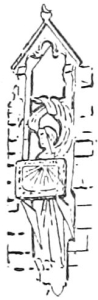
OLD FRENCH WALL DIAL
Sun-dials are common in almost
all parts of the world, and not a
few of them have in one way or
another become famous. The
largest is at Jaipur in India, and
was erected about 1730. Its
gnomon is ninety feet high and
one hundred and forty-seven feet
long. A flight of stone steps run
up the slope of it, and at the top
there is a sort of little watch-tower.
And the shadow, which falls
upon a great stone quadrant instead
of upon a flat surface, moves
at the rate of two and a half inches
a minute. Another great dial is
the so-called Calendar Stone of Mexico,
which was made by the Aztec priests
more than a hundred years before
the Spaniards came. It weighs nearly
fifty tons, and is not only a sun-dial but
a representation of the zodiac and a diagram
of the astronomical changes of the
year: thus showing that the ancient Mexicans
in their own way paralleled the
astrology of the Babylonians on the other
side of the world. Probably the most
expensive and elaborate sun-dial ever built
was the one set up in 1669 by King Charles
II of England in front of the banqueting
house at White Hall in London. It was in
the form of a tall pyramid on which were
two hundred and seventy-one different
dials, giving not only the hour of the day
but various astronomical and geographical
indications as well. The place called
Seven Dials in London takes its name
from a tall pillar with sun-dials around its
top which used to stand at the junction of
seven streets radiating starwise from that
spot as a center. The pillar was overthrown
in 1773 by a party of vandals
digging for buried treasure which they believed
to have been hidden
beneath its base. Extensive list,
descriptions and illustrations,
See Book of Sun-dials, Mrs.
Alfred Gatty; Sun-dials and
Roses, Mrs. Alice Morse Earle.
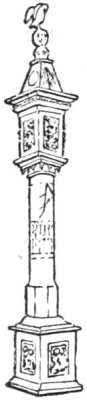
OLD ENGLISH PILLAR DIAL
Sun-Dials, Greek—1. Diogenes
asserts that the first
Greek dial or gnomon was
erected by Anaximander of
Miletus. It was probably a vertical
rod on a horizontal plane.
This was two centuries after
the Dial of Ahaz. 2. On the
"Tower of the Winds" in
Athens—a dial on each face.
Sun-Dial, Hollow—A form
of sun-dial invented by the
Chaldean Berosus. A hollow
hemisphere with a bead at its
center, whose shadow indicated
the hour of the day.
Sun-Dial, Mottoes—On nearly all
sun-dials both ancient and modern there
there is inscribed a motto—usually of the
moral significance of the passage of time.
Very ancient also, as well as equally
common in modern times is the custom of
placing upon the sun-dial some appropriate
motto expressive of the mystery of
Time. There are hundreds of such mottoes,
ranging in sentiment from the old
Roman one: Horas non numero nisi
Serenas. "I number no hours but the fair
ones," to the couplet of a modern poet:
"Time flies, you say? Ah no,
Alas! Time stays; we go."
And these two thoughts, expressed in
many forms, represent fairly the tenor of
most of them. There is a story of a lazy
apprentice asking a motto for his dial, to
whom his master sharply replied: "Begone
about your business!" and the fellow,
appropriately enough, took that for
the motto required. It is at least a familiar
sentiment, especially in Puritan times;
and equally so during
the Middle Ages is that
more mystic suggestion,
Umbra Dei—"the Shadow
of God."
Sun-Dial, Portable—Made
in different shapes
and upon different plans
small enough to carry
about. The most common form was the
ring dial, consisting of a metal ring with
a hole in it through which the light fell
upon an inside ring adjustable to the day
and month. It required careful orienting
to be dependable as a time-indicator.
Sun-Dials, Roman—The first dial in
Rome was set up B. C. 293 near the temple
of Quirinus by Papirius Cursor. It
served ninety-nine years; then one more
accurate was set up beside it. Before that,
no time was noted except the rising and
setting of the sun. Emperor Augustus
erected a dial at Campus Martius. A dial
captured in Sicily during the first Punic
war was set up in the Forum about 263
B. C. and used for years before they
learned that it was inaccurate in that latitude,
being designed for the latitude of
Sicily.
Sunk-Seconds—A dial in which the
seconds circle is sunk below the rest of
the dial. It allows the hour hand to be
placed closer to the face thus making a
thinner model possible.
Supplementary Arc—See: "Lifting
Arc."
Sweep-Seconds—See: Center-Seconds.
Table Roller—The roller of a lever
escapement which carries the impulse
pin.
Tell-Tale Clock—A clock by which
a record is left of periodical visits of some
one as a night-watchman.
Template or Timplet—One of the
four facets that surround a cut gem.
Tenon—A projection at the end of a
piece cut to fit into a corresponding mortise.
Terry, Eli—The first man to make
clocks by machinery in America. When it
was learned that he planned to make two
hundred clocks he was much laughed at.
He was born at East Windsor, Conn., in
1772. His first clocks were made by hand,
the movements being of wood. He was the
leading maker of wooden clocks in America.
He invented the shelf clock which
contained distinctly new inventions and
he introduced the pillar scroll-top case.
He was a mechanical genius and contributed
a great deal to developing clock-making
in America into a great industry.
He died in 1852.
Third Wheel—The wheel in the train
between the center wheel and the fourth
wheel.
Thales—A celebrated Ionian astronomer,
one of the Seven Sages of Greece.
He was born about 640 B. C., and is
credited by Herodotus with having predicted
an eclipse of the sun occurring about
609 B. C. He was the author of several
solutions of geometrical problems. He
died about 550 B. C.
Thomas, Seth—Born at Wolcott,
Conn., 1785. A very successful clockmaker
who contributed probably more than any
other man toward popularizing the modern
cheap clock. The Seth Thomas Clock
Co., of today, he started in 1813 with
twenty operatives. By 1853 it had nine
hundred. He died in 1859.
Three-Quarter Plate—A three-quarter
plate watch is one in which there
is a piece cut out from the top plate large
enough to permit the balance to rotate on
a level with that plate. It is the most
common form at present in use in both
cheap and high grade watches, and found
in both "pillar" and "bridge" models.
Time-Candles—Candles in
alternate black and white
sections were used to mark
the passage of time in Europe
and Asia for a long time. In
England and France they were
used to limit the bidding at
an auction. The phrase "by
inch of candle" meant that
the one bidding when the
flame expired was the successful
bidder. King Alfred is said
to have used time-candles and to have
inclosed them in thin horn plates to protect
them from drafts, thus originating
the lantern.
Timekeeper—Any device primarily
concerned with measuring and indicating
the sub-divisions of the day.
Tompion, Thomas—"The father of
English Watchmaking." Born 1638. He
was the leading watchmaker at the court
of Charles II. He found the construction
of the time-keeping part of watches in a
very indifferent condition and he left
English clocks and watches the finest in
the world, although many great improvements
were made after his time. He associated
closely with such scientists as
Hooke, and Barlow, and made practical
application of their theories—two notable
instances being the cylinder escapement
and the balance-spring. Tompion was the
first to number his watches consecutively
for the purpose of identification though
he did not so mark his early ones.
There is a famous clock in the pumproom
at Bath, England, of Tompion's construction.
Little is known of his domestic life
but he appears to have been unmarried.
He died in 1713 and is buried in Westminster
Abbey. Tompion was master of
the Worshipful Clockmakers' Company
in 1704.
Top Plate—The plate in a watch
farthest from the dial. In full plate
watches it is circular; in three-quarter
plate or half-plate watches a part is cut
away.
Tower of the Winds—An octagonal
tower north of the Acropolis of Athens
spoken of as horological by Vario and
Vitruvius. Believed to have had a sundial
on each of its eight faces and to have contained
a clepsydra fed by a spring.
Train—The toothed wheels of a watch
or clock which connect the barrel or fusee
with the escapement. In a going-barrel
watch the teeth about the barrel drive the
center pinion which drives the center
wheel and then in turn the third wheel
pinion, third wheel, fourth wheel pinion
and fourth wheel, escape pinion and
escape wheel.
Tripping—The running past the pallet's
locking face, of an escape wheel tooth.
Vacheron and Constantin—In 1840
established the first complete watch
factory in Switzerland. Not until later,
however, was motor power used instead of
foot-power; and later still manufacture
by machinery. The work in this factory is
carried on under a combination of all
accepted methods.
Vailly, Dom—A Benedictine monk of
about 1690 who made a water clock which
Beckmann says was the first to be constructed
on a really scientific principle.
See Clocks, Interesting Old—Vailly's.
Van der Woerd, Charles—A prominent
man in connection with watch manufacturing
in this country. In 1864 he
invented an automatic pinion cutter; in
1874 an automatic screw machine. From
1876-1883 he was superintendent of the
Waltham factory.
Verge—The pallet axis of the verge
escapement. See diagram of Verge Escapement.
It carries the balance at its top.
Verge Watch—A watch with a verge
escapement.
Vick, Henry de. See De Vick.
Volute—A flat spiral.
Volute-Spring—A flat metallic spring
coiled in a spiral conical form and compressible
in the direction of its axis.
Wallingford, Richard—An English
mechanic and astronomer of the
fourteenth century. He made a clock
which is supposed to have been the first
that was regulated by a fly-wheel. Several
authorities, however, claim that Wallingford's
"clock" was actually a planetarium.
Waltham—A town in Massachusetts—the
site of the first successful watch factory
in America. At present a great watch
making center.
Watch—In modern parlance, a small
timepiece to carry about on the person.
Formerly a timepiece which showed time
in distinction to clock which struck time.
Derham (1734) uses the term to indicate
all timepieces driven by springs. The term
may have been derived from the Swedish
vacht, German wachen, or Saxon woecca.
The spaces of time between the fillings of
a clepsydra were also called "watches."
Watch Collections—For list of principal
collections, past and present, see
Jewelers' Circular files August to December
1915. List compiled by Major Paul M.
Chamberlain of Chicago. For list of principal
present collections, see Appendix to
this volume derived from the Chamberlain
Compilation.
Watchmakers' Schools—American.
In America these schools usually teach
watch-repairing and not the making of
watches. Some of them offer courses in
making watches but few pupils avail
themselves of these courses. List of: De
Selins Watch School, Attica, Ind.; Detroit
Technical Institute—Detroit, Mich.;
Kansas City Watchmaking and Engraving
School, Kansas City, Mo.; Needles
Institute of Watchmaking, Kansas City,
Mo.; Bowman Technical School, Lancaster,
Pa.; Ries and Armstrong, Macon,
Ga.; Drexler School for Watchmaking,
Milwaukee, Wis.; Newark Watchmaking
School, Newark, N. J.; Philadelphia College
of Horology, Philadelphia, Pa.; St.
Louis Watchmaking School, St. Louis,
Mo.; Schwartzman's Trade Schools, San
Francisco, Cal.; Stone School of Watchmaking,
St. Paul, Minn.; Waltham Horological
School, Waltham, Mass.; Bradley
Polytechnic Institute, Peoria, Ill.
Watchmakers' Schools, Switzerland—Usually
under government management.
Teach very thoroughly and
completely the art of making a watch
from the beginning.
Watch-Papers—During the 18th century
it was a fad in England and America
to carry small round papers, which exactly
fitted the case of a watch. On these
were portraits and verses, the latter of
doubtful merit and usually of sinister or
gloomy significance.
Waterbury—A town in Connecticut
long a center of clock and watch making
in America. Home of the original Waterbury
watch. Location of principal factory
of Robt. H. Ingersoll & Brothers., manufacturers
of the Ingersoll watches.
Water-Clock—Any device, as a clepsydra,
for measuring time by the fall or
flow of water. More commonly applied to
the type in which wheels are turned by
water or in such as those in which water
sets machinery of some form in motion
as Vailly's water-clock. See Clock,
Vailly's.
Wick Timekeeper—A wick or rope
made of some fiber resembling flax or
hemp with knots tied at regular intervals
and so treated that upon ignition it would
smolder instead of breaking into flame.
Early in use in Japan and China. Time
was estimated by the burning between
the knots.
Wieck, Henry De—See De Vick.
Willard, Aaron—Born 1757. Probably
learned his trade from his older
brothers Simon and Benjamin. He made
tall, and shelf clocks, later banjo clocks—so-called
from their shape—gallery clocks,
and regulators. A better business man
than his brothers and successful from the
start. His clocks did not lack decorative
merit but were inferior to Simon Willard's.
He made a greater number than his
brother because more successful in a business
way.
Willard, Benjamin—Older brother of
Simon and Aaron Willard. Among the first
of American clockmakers. Born 1743.
Made, probably, only tall clocks with
handsome cases and some with musical
attachments. Not so good as the clocks of
Aaron and Simon Willard but older and
rarer now.
Willard, Simon—Born at Grafton,
Mass., 1753. One of the earliest Massachusetts
clock makers who disputed the
claim of the Connecticut makers for the
credit of revolutionizing the clock industry
in America. So far as cases go they
excelled Terry, Thomas, and others. But
to the Connecticut makers belongs the
credit for having developed clock making
into a great industry. Willard at first made
eight-day tall clocks and shelf clocks, later
wall clocks which he called "time pieces."
In 1802 he practically abandoned the
making of tall clocks, and confined himself
to his "time pieces" and special
orders for tower and gallery clocks. For a
detailed list of his productions see his
Biography by John Ware Willard. He was
an intimate friend of Jefferson, Madison
and other leading men of the time. Died
1848.
Worshipful Clockmakers' Company
of London, The—Incorporated August
22, 1631, under special charter by King
Charles I of England. Was given the sole
privilege of regulating the watch and
clock trade in and for ten miles around
London.
Webster, Ambrose—Mechanical superintendent,
and later assistant superintendent,
of the Waltham factory until his
resignation in 1876. He systematized the
work in the shop, standardized the measuring
system, and forced automatic
machinery to the front. He designed the
first watch factory lathe with hard
spindles and bearings of the two taper
variety. He made the first interchangeable
standard for parts of lathes. He invented
many machines now in use, among them
being the automatic pinion cutter.
Weight-Clock—A clock whose driving
power is a weight suspended by a cord
wound on a drum or cylinder.
Weights—The first clocks were made
with a weight on a cord which was wound
around a cylinder connected with the train.
The weight descending caused the cylinder
to revolve, setting the train in motion.
Too rapid unwinding was prevented
by the escapement. The weight as a driving
power is still used, especially in large
clocks.
Wheel, Count—The wheel carrying
the locking-plate in a striking mechanism.
Year—Astronomically, the period of
time occupied by the earth in making
one complete revolution around the sun.
The calendar year is an arbitrarily determined
division of time, approximating
more or less closely the astronomical year.
See Calendar, Gregorian.
Zech, Jacob—Of Prague. Invented the
fusee about 1525. The Society of
Antiquaries possesses an example of his
handiwork—a table time-piece with a
circular brass-gilt case 9¾" in diameter
and 5" high. For minute description see
Archaeologia vol. xxxiii.
Zero—A time-telling term originating
or at least made common during the Great
War. Word commonly used in a military
sense to indicate a secret instant of time
from which an attack in its various stages
is scheduled.
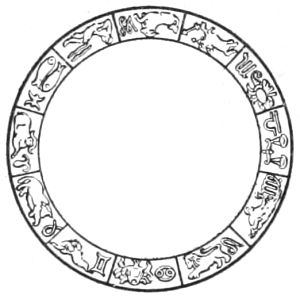
Zodiac—An imaginary belt 16 degrees
in width, spread equally on both sides
of the ecliptic (q. v.). It is divided into
twelve sections or "signs" which receive
their distinguishing names from the twelve
principal constellations within the belt.
That is how the Babylonians learned to
tell the time by looking at the sun and the
stars. Only their whole problem was
vastly complicated by the daily rotation
of the earth
on its axis,
which of
course makes
the whole sky
seem to turn
in the opposite
direction
day by day.
The earth
turns in the
same direction
that it goes
round the sun, from West to East. So the
heavens turn apparently from East to
West, while the annual motion, as we saw
just now by the illustration of the clock
face, appears in its true direction, Eastward.
Also, the great clock of the sky is
not from our point of view horizontal,
but stood up on edge; and not straight
up and down even, but slanted at an
angle. So its apparent movements are as
it were in several directions at once, and
the effect is very confusing. The real motions
as they actually do occur are very
much simpler and easier to understand.
But of these the Babylonians had no idea.
They knew only what they could see; and
it is all the more wonderful that they contrived
to reason out so much and so
correctly.
They mapped out a belt or zone around
the sky, with the Ecliptic along the middle
of it. This they divided into twelve equal
parts of thirty degrees each, called Signs
or Houses, and each containing a constellation.
These constellations were in
order, Aries or the Ram; Taurus or the
Bull; Gemini or the Twins; Cancer or the
Crab; Leo or the Lion; Virgo or the Virgin;
Libra or the Scales; Scorpio or the Scorpion;
Sagittarius or the Archer; Capricornus
or the Goat; Aquarius or the
Water-Carrier; and Pisces or the Fishes.
We know these by their Latin names, and
the whole zone by its Greek name of The
Zodiac. But their original titles were
much the same, only in a different language.
The sun went through one of these
constellations each month; and by his position
along the Zodiac they told the time
of year. Thus the Spring Equinox was
where the sun entered the House of the
Ram; and that was for the ancients the
first day of the new year. The House of
the Crab was farthest North, and when
the sun got there it was midsummer.
The Autumn Equinox was in the House
of the Scales; and when the sun reached
the House of the Goat, he would be at the
Southern or Winter end of his journey.
Moreover, since the Moon and the Planets
always keep close to the Ecliptic, their
apparent motions all lie within the
Zodiacal zone. And the Zodiac therefore
represented the most important part of
the heavens from the standpoint of keeping
time; the part, that is, wherein all of
those bodies which moved among the
stars month by month and day by day
appeared to have their motions.
Minor punctuation and printer errors repaired.