It is my privilege to address you this afternoon
on a subject in which science and poetry are
blended in a happy conjunction. If there be a
peculiar fascination about the earlier chapters of
any branch of history, how great must be the
interest which attaches to that most primeval of
all terrestrial histories which relates to the actual
beginnings of this globe on which we stand.
In our efforts to grope into the dim recesses of
this awful past, we want the aid of some steadfast
light which shall illumine the dark places without
the treachery of the will-o'-the-wisp. In the
absence of that steadfast light, vague conjectures
as to the beginning of things could never be
entitled to any more respect than was due to
mere matters of speculation.
Of late, however, the required light has been to
some considerable extent forthcoming, and the
attempt has been made, with no little success, to
elucidate a most interesting and wonderful chapter
of an exceedingly remote history. To chronicle
this history is the object of the present lectures
before this Institution.
First, let us be fully aware of the extraordinary
remoteness of that period of which our history
treats. To attempt to define that period chronologically
would be utterly futile. When we have
stated that it is more ancient than almost any other
period which we can discuss, we have expressed
all that we are really entitled to say. Yet this
conveys not a little. It directs us to look back
through all the ages of modern human history,
through the great days of ancient Greece and
Rome, back through the times when Egypt and
Assyria were names of renown, through the days
when Nineveh and Babylon were mighty and
populous cities in the zenith of their glory. Back
earlier still to those more ancient nations of which
we know hardly anything, and still earlier to
the prehistoric man, of whom we know less; back,
finally, to the days when man first trod on this
planet, untold ages ago. Here is indeed a portentous
retrospect from most points of view, but
it is only the commencement of that which our
subject suggests.
For man is but the final product of the long
anterior ages during which the development of life
seems to have undergone an exceedingly gradual
elevation. Our retrospect now takes its way along
the vistas opened up by the geologists. We look
through the protracted tertiary ages, when mighty
animals, now generally extinct, roamed over the
continents. Back still earlier through those wondrous
secondary periods, where swamps or oceans
often covered what is now dry land, and where
mighty reptiles of uncouth forms stalked and
crawled and swam through the old world and the
new. Back still earlier through those vitally significant
ages when the sunbeams were being
garnered and laid aside for man's use in the great
forests, which were afterwards preserved by being
transformed into seams of coal. Back still earlier
through endless thousands of years, when lustrous
fishes abounded in the oceans; back again to those
periods characterized by the lower types of life;
and still earlier to that incredibly remote epoch
when life itself began to dawn on our awakening
globe. Even here the epoch of our present history
can hardly be said to have been reached. We
have to look through a long succession of ages
still antecedent. The geologist, who has hitherto
guided our view, cannot render us much further
assistance; but the physicist is at hand—he teaches
us that the warm globe on which life is beginning
has passed in its previous stages through every
phase of warmth, of fervour, of glowing heat, of
incandescence, and of actual fusion; and thus at
last our retrospect reaches to that particular period
of our earth's past history which is specially
illustrated by the modern doctrine of Time and
Tide.
The present is the clue to the past. It is the
steady application of this principle which has led
to such epoch-making labours as those by which
Lyell disclosed the origin of the earth's crust,
Darwin the origin of species, Max Müller the origin
of language. In our present subject the course is
equally clear. Study exactly what is going on at
present, and then have the courage to apply consistently
and rigorously what we have learned
from the present to the interpretation of the
past.
Thus we begin with the ripple of the tide on the
sea-beach which we see to-day. The ebb and the
flow of the tide are the present manifestations of
an agent which has been constantly at work. Let
that present teach us what tides must have done in
the indefinite past.
It has been known from the very earliest times
that the moon and the tides were connected
together—connected, I say, for a great advance
had to be made in human knowledge before it
would have been possible to understand the true
relation between the tides and the moon. Indeed,
that relation is so far from being of an obvious
character, that I think I have read of a race who
felt some doubt as to whether the moon was the
cause of the tides, or the tides the cause of the
moon. I should, however, say that the moon is
not the sole agent engaged in producing this
periodic movement of our waters. The sun also
arouses a tide, but the solar tide is so small in
comparison with that produced by the moon, that
for our present purpose we may leave it out of
consideration. We must, however, refer to the
solar tide at a later period of our discourses, for it
will be found to have played a very splendid part
at the initial stage of the Earth-Moon History,
while in the remote future it will again rise into
prominence.
It will be well to set forth a few preliminary
figures which shall explain how it comes to pass
that the efficiency of the sun as a tide-producing
agent is so greatly inferior to that of the moon.
Indeed, considering that the sun has a mass so
stupendous, that it controls the entire planetary
system, how is it that a body so insignificant as the
moon can raise a bigger tide on the ocean than
can the sun, of which the mass is 26,000,000 times
as great as that of our satellite?
This apparent paradox will disappear when we
enunciate the law according to which the efficiency
of a tide-producing agent is to be estimated. This
law is somewhat different from the familiar form in
which the law of gravitation is expressed. The
gravitation between two distant masses is to be
measured by multiplying these masses together,
and dividing the product by the square of the distance.
The law for expressing the efficiency of a
tide-producing agent varies not according to the
inverse square, but according to the inverse cube
of the distance. This difference in the expression
of the law will suffice to account for the superiority
of the moon as a tide-producer over the sun. The
moon's distance on an average is about one
386th part of that of the sun, and thus it is easy
to show that so far as the mere attraction of gravitation
is concerned, the efficiency of the sun's force
on the earth is about one hundred and seventy-five
times as great as the force with which the moon
attracts the earth. That is of course calculated
under the law of the inverse square. To determine
the tidal efficiency we have to divide this by three
hundred and eighty-six, and thus we see that the
tidal efficiency of the sun is less than half that of
the moon.
When the solar tide and the lunar tide are acting
in unison, they conspire to produce very high
tides and very low tides, or, as we call them, spring
tides. On the other hand, when the sun is so
placed as to give us a low tide while the moon is
producing a high tide, the net result that we
actually experience is merely the excess of the lunar
tide over the solar tide; these are what we call neap
tides. In fact, by very careful and long-continued
observations of the rise and fall of the tides at a
particular port, it becomes possible to determine
with accuracy the relative ranges of spring tides
and neap tides; and as the spring tides are produced
by moon plus sun, while the neap tides
are produced by moon minus sun, we obtain a
means of actually weighing the relative masses of
the sun and moon. This is one of the remarkable
facts which can be deduced from a prolonged study
of the tides.
The demonstration of the law of the tide-producing
force is of a mathematical character, and
I do not intend in these lectures to enter into
mathematical calculations. There is, however, a
simple line of reasoning which, though it falls far
short of actual demonstration, may yet suffice to
give a plausible reason for the law.
The tides really owe their origin to the fact that
the tide-producing agent operates more powerfully
on those parts of the tide-exhibiting body which
are near to it, than on the more distant portions of
the same. The nearer the two bodies are together,
the larger proportionally will be the differences in
the distances of its various parts from the tide-producing
body; and on this account the leverage, so
to speak, of the action by which the tides are
produced is increased. For instance, if the two
bodies were brought within half their original distance
of each other, the relative size of each body,
as viewed from the other, will be doubled; and
what we have called the leverage of the tide-producing
ability will be increased twofold. The
gravitation also between the two bodies is increased
fourfold when the distance is halved, and
consequently, the tide-producing ability is doubled
for one reason, and increased fourfold again by
another; hence, the tides will be increased eightfold
when the distance is reduced to one half.
Now, as eight is the cube of two, this illustration
may be taken as a verification of the law, that
the efficiency of a body as a tide-producer varies
inversely as the cube of the distance between it
and the body on which the tides are being raised.
For simplicity we may make the assumption
that the whole of the earth is buried beneath the
ocean, and that the moon is placed in the plane
of the equator. We may also entirely neglect for
the present the tides produced by the sun, and we
shall also make the further assumption that friction
is absent. What friction is capable of doing
we shall, however, refer to later on. The moon
will act on the ocean and deform it, so that there
will be high tide along one meridian, and high
tide also on the opposite meridian. This is indeed
one of the paradoxes by which students are
frequently puzzled when they begin to learn
about the tides. That the moon should pull the
water up in a heap on one side seems plausible
enough. High tide will of course be there; and the
student might naturally think that the water being
drawn in this way into a heap on one side, there
will of course be low tide on the opposite side of
the earth. A natural assumption, perhaps, but
nevertheless a very wrong one. There are at
every moment two opposite parts of the earth in
a condition of high water; in fact, this will be
obvious if we remember that every day, or, to speak
a little more accurately, in every twenty-four hours
and fifty one minutes, we have on the average
two high tides at each locality. Of course this
could not be if the moon raised only one heap
of high water, because, as the moon only appears
to revolve around the earth once a day, or, more
accurately, once in that same average period of
twenty-four hours and fifty-one minutes, it would
be impossible for us to have high tides succeeding
each other as they do in periods a little longer
than twelve hours, if only one heap were carried
round the earth.
The first question then is, as to how these two
opposite heaps of water are placed in respect to
the position of the moon. The most obvious explanation
would seem to be, that the moon should
pull the waters up into a heap directly underneath
it, and that therefore there should be high water
underneath the moon. As to the other side, the
presence of a high tide there was, on this theory,
to be accounted for by the fact that the moon
pulled the earth away from the waters on the more
remote side, just as it pulled the waters away from
the more remote earth on the side underneath the
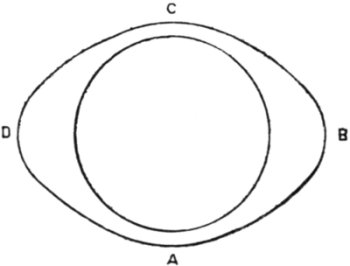
moon. It is, however, certainly not the case that
the high tide is situated in the simple position
that this law would indicate, and which we have
represented in Fig. 1, where the circular body is
the earth, the ocean surrounding which is distorted
by the action of the tides.
Fig. 1
We have here taken an oval to represent the
shape into which the water is supposed to be
forced or drawn by the tidal action of the tide-producing
body. This may possibly be a correct
representation of what would occur on an ideal
globe entirely covered with a frictionless ocean.
But as our earth is not covered entirely by water,
and as the ocean is very far from being frictionless,
the ideal tide is not the tide that we actually know;
nor is the ideal tide represented by this oval even
an approximation to the actual tides to which
our oceans are subject. Indeed, the oval does not
represent the facts at all, and of this it is only
necessary to adduce a single fact in demonstration.
I take the fundamental issue so often debated, as
to whether in the ocean vibrating with ideal tides
the high water or the low water should be under
the moon. Or to put the matter otherwise; when
we represent the displaced water by an oval, is
the long axis of the oval to be turned to the
moon, as generally supposed, or is it to be directed
at right angles therefrom? If the ideal tides were
in any degree representative of the actual tides, so
fundamental a question as this could be at once
answered by an appeal to the facts of observation.
Even if friction in some degree masked the phenomena,
surely one would think that the state of
the actual tides should still enable us to answer
this question.
But a study of the tides at different ports fails
to realize this expectation. At some ports, no
doubt, the tide is high when the moon is on the
meridian. In that case, of course, the high water
is under the moon, as apparently ought to be the
case invariably, on a superficial view. But, on
the other hand, there are ports where there is
often low water when the moon is crossing the
meridian. Yet other ports might be cited in
which every intermediate phase could be observed.
If the theory of the tides was to be the simple one
so often described, then at every port noon should
be the hour of high water on the day of the new
moon or of the full moon, because then both tide-exciting
bodies are on the meridian at the same
time. Even if the friction retarded the great tidal
wave uniformly, the high tide on the days of full
or change should always occur at fixed hours; but,
unfortunately, there is no such delightful theory
of the tides as this would imply. At Greenock
no doubt there is high water at or about noon on
the day of full or change; and if it could be similarly
said that on the day of full or change there
was high water everywhere at local noon, then
the equilibrium theory of the tides, as it is called,
would be beautifully simple. But this is not the
case. Even around our own coasts the discrepancies
are such as to utterly discredit the theory
as offering any practical guide. At Aberdeen
the high tide does not appear till an hour later
than the doctrine would suggest. It is two hours
late at London, three at Tynemouth, four at Tralee,
five at Sligo, and six at Hull. This last port
would be indeed the haven of refuge for those
who believe that the low tide ought to be under
the moon. At Hull this is no doubt the case; and
if at all other places the water behaved as it does
at Hull, why then, of course, it would follow that
the law of low water under the moon was generally
true. But then this would not tally with the condition
of affairs at the other places I have named;
and to complete the cycle I shall add a few more.
At Bristol the high water does not get up until
seven hours after the moon has passed the meridian,
at Arklow the delay is eight hours, at Yarmouth
it is nine, at the Needles it is ten hours, while
lastly, the moon has nearly got back to the
meridian again ere it has succeeded in dragging
up the tide on which Liverpool's great commerce
so largely depends.
Nor does the result of studying the tides along
other coasts beside our own decide more conclusively
on the mooted point. Even ports in the vast
ocean give a very uncertain response. Kerguelen
Island and Santa Cruz might seem to prove that
the high tide occurs under the moon, but unfortunately
both Fiji and Ascension seem to present us
with an equally satisfactory demonstration, that
beneath the moon is the invariable home of low
water.
I do not mean to say that the study of the tides
is in other respects such a confused subject as the
facts I have stated would seem to indicate. It
becomes rather puzzling, no doubt, when we compare
the tides at one port with the tides elsewhere.
The law and order are, then, by no means conspicuous,
they are often hardly discernible. But
when we confine our attention to the tides at a
single port, the problem becomes at once a very
intelligible one. Indeed, the investigation of the
tides is an easy subject, if we are contented with
a reasonably approximate solution; should, however,
it be necessary to discuss fully the tides at
any port, the theory of the method necessary for
doing so is available, and a most interesting and
beautiful theory it certainly is.
Let us then speak for a few moments about the
methods by which we can study the tides at a
particular port. The principle on which it is based
is a very simple one.
It is the month of August, the 18th, we shall
suppose, and we are going to enjoy a delicious
swim in the sea. We desire, of course, to secure a
high tide for the purpose of doing so, and we call
an almanac to help us. I refer to the Thom's
Dublin Directory, where I find the tide to be high
at 10h. 14m. on the morning of the 18th of August.
That will then be the time to go down to the
baths at Howth or Kingstown.
But what I am now going to discourse to you
about is not the delights of sea-bathing, it is rather
a different inquiry. I want to ask, How did the
people who prepared that almanac know years
beforehand, that on that particular day the tide
would be high at that particular hour? How do
they predict for every day the hour of high water?
and how comes it to pass that these predictions are
invariably correct?
We first refer to that wonderful book, the Nautical
Almanac. In that volume the movements of
the moon are set forth with full detail; and among
other particulars we can learn on page iv of every
month the mean time of the moon's meridian
passage. It appears that on the day in question
the moon crossed the meridian at 11h. 23m. Thus
we see there was high water at Dublin at 10h.
14m., and 1h. 9m. later, that is, at 11h. 23m., the
moon crossed the meridian.
Let us take another instance. There is a high
tide at 3.40 P.M. on the 25th August, and again
the infallible Nautical Almanac tells us that the
moon crossed the meridian at 5h. 44m., that is, at
2h. 4m. after the high water.
In the first case the moon followed the tide in
about an hour, and in the second case the moon
followed in about two hours. Now if we are to be
satisfied with a very rough tide rule for Dublin,
we may say generally that there is always a high
tide an hour and a half before the moon crosses
the meridian. This would not be a very accurate
rule, but I can assure you of this, that if you go
by it you will never fail of finding a good tide to
enable you to enjoy your swim. I do not say this
rule would enable you to construct a respectable
tide-table. A ship-owner who has to creep up the
river, and to whom often the inches of water are
material, will require far more accurate tables than
this simple rule could give. But we enter into
rather complicated matters when we attempt to
give any really accurate methods of computation.
On these we shall say a few words presently.
What I first want to do, is to impress upon you in
a simple way the fact of the relation between the
tide and the moon.
To give another illustration, let us see how the
tides at London Bridge are related to the moon.
On Jan. 1st, 1887, it appeared that the tide was
high at 6h. 26m. P.M., and that the moon had
crossed the meridian 56m. previously; on the 8th
Jan. the tide was high at 0h. 43m. P.M., and the
moon had crossed the meridian 2h. 1m. previously.
Therefore we would have at London Bridge high
water following the moon's transit in somewhere
about an hour and a half.
I choose a day at random, for example—the
12th April. The moon crosses the upper meridian
at 3h. 39m. A.M., and the lower meridian at 4h
6m. P.M. Adding an hour and a half to each
would give the high tides at 5h 9m. A.M. and
5h. 36m. P.M.; as a matter of fact, they are 4h.
58m. A.M. and 5h. 20m. P.M.
But these illustrations are sufficient. We find
that at London, in a general way, high water
appears at London Bridge about an hour and a
half after the moon has passed the meridian of
London. It so happens that the interval at Dublin
is about the same, i.e. an hour and a half; only
that in the latter case the high water precedes the
moon by that interval instead of following it. We
may employ the same simple process at other
places. Choose two days about a week distant;
find on each occasion the interval between the
transit of the moon and the time of high water,
then the mean of these two differences will always
give some notion of the interval between high
water and the moon's transit. If then we take
from the Nautical Almanac the time of the moon's
transit, and apply to it the correction proper for the
port, we shall always have a sufficiently good tide-table
to guide us in choosing a suitable time for
taking our swim or our walk by the sea-side;
though if you be the captain of a vessel, you will
not be so imprudent as to enter port without
taking counsel of the accurate tide-tables, for which
we are indebted to the Admiralty.
Every one who visits the sea-side, or who lives
at a sea-port, should know this constant for the
tides, which affect him and his movements so
materially. If he will discover it from his own
experience, so much the better.
The first point to be ascertained is the time of
high water. Do not take this from any local table;
you ought to observe it for yourself. You will go
to the pier head, or, better still, to some place where
the rise and fall of the mere waves of the sea will
not embarrass you in your work. You must note
by your watch the time when the tide is highest.
An accurate way of doing this will be to have a
scale on which you can measure the height at
intervals of five minutes about the time of high
water. You will then be able to conclude the
time at which the tide was actually at its highest
point; but even if no great accuracy be obtainable,
you can still get much interesting information, for
you will without much difficulty be right within
ten minutes or a quarter of an hour.
The correction for the port is properly called the
“establishment,” this being the average time of
high water on the days of full and change of the
moon at the particular port in question.
We can considerably amend the elementary
notion of the tides which the former method has
given us, if we adopt the plan described by Dr.
Whewell in the first four editions of the Admiralty
Manual of Scientific Inquiry. We speak of the
interval between the transit of the moon and the
time of high water as the luni-tidal interval. Of
course at full and change this is the same thing as
the establishment, but for other phases of the moon
the establishment must receive a correction before
being used as the luni-tidal interval. The correction
is given by the following table—
| Hour of Moon's transit after Sun: |
| 0 | 1 | 2 | 3 | 4 | 5 | 6 | 7 | 8 | 9 | 10 | 11 |
| 0 | -20m | -30m | -50m | -60m | -60m | -60m | -40m | -10m | +10m | +20m | +10m |
| Correction of establishment to find luni-tidal interval: |
Thus at a port where the establishment was 3h.
25m., let us suppose that the transit of the moon
took place at 6 P.M.; then we correct the establishment
by -60m., and find the luni-tidal interval to
be 2h. 25m., and accordingly the high water takes
place at 8h. 25m. P.M.
But even this method is only an approximation.
The study of the tides is based on accurate observation
of their rise and fall on different places
round the earth. To show how these observations
are to be made, and how they are to be discussed
and reduced when they have been made, I may
refer to the last edition of the Admiralty Manual
of Scientific Inquiry, 1886. For a complete study of
the tides at any port a self-registering tide-gauge
should be erected, on which not alone the heights
and times of high and low water should be depicted,
but also the continuous curve which shows at any
time the height of the water. In fact, the whole
subject of the practical observation and discussion
and prediction of tides is full of valuable instruction,
and may be cited as one of the most complete
examples of the modern scientific methods.
In the first place, the tide-gauge itself is a
delicate instrument; it is actuated by a float which
rises and falls with the water, due provision being
made that the mere influence of waves shall not
make it to oscillate inconveniently. The motion of
the float when suitably reduced by mechanism
serves to guide a pencil, which, acting on the paper
round a revolving drum, gives a faithful and unintermitting
record of the height of the water.
Thus what the tide-gauge does is to present to
us a long curved line of which the summits correspond
to the heights of high water, while the
depressions are the corresponding points of low
water. The long undulations of this curve are, however,
very irregular. At spring tides, when the sun
and the moon conspire, the elevations rise much
higher and the depressions sink much lower than
they do at neap tides, when the high water raised
by the moon is reduced by the action of the sun.
There are also many minor irregularities which
show the tides to be not nearly such simple phenomena
as might be at first supposed. But what
we might hastily think of as irregularities are, in
truth, the most interesting parts of the whole
phenomena. Just as in the observations of the
planets the study of the perturbations has led
us to results of the widest interest and instruction,
so it is these minor phenomena of the tides which
seem most pregnant with scientific interest.
The tide-gauge gives us an elaborate curve. How
are we to interpret that curve? Here indeed a
most beautiful mathematical theorem comes to our
aid. Just as ordinary sounds consist of a number
of undulations blended together, so the tidal wave
consists of a number of distinct undulations
superposed. Of these the ordinary lunar tide and
the ordinary solar tide are the two principal; but
there are also minor undulations, harmonics, so
to speak, some originating from the moon, some
originating from the sun, and some from both
bodies acting in concert.
In the study of sound we can employ an
acoustic apparatus for the purpose of decomposing
any proposed note, and finding not only the
main undulation itself, but the several superposed
harmonics which give to the note its timbre.
So also we can analyze the undulation of the
tide, and show the component parts. The decomposition
is effected by the process known as
harmonic analysis. The principle of the method
may be very simply described. Let us fix our attention
on any particular “tide,” for so the various
elements are denoted. We can always determine
beforehand, with as much accuracy as we may
require, what the period of that tide will be. For
instance, the period of the lunar semi-diurnal tide
will of course be half the average time occupied
by the moon to travel round from the meridian
of any place until it regains the same meridian;
the period of the lunar diurnal tide will be
double as great; and there are fortnightly tides,
and others of periods still greater. The essential
point to notice is, that the periods of these tides
are given by purely astronomical considerations
from the periods of the motions theory, and do
not depend upon the actual observations.
We measure off on the curve the height of the
tide at intervals of an hour. The larger the
number of such measures that are available the
better; but even if there be only three hundred
and sixty or seven hundred and twenty consecutive
hours, then, as shown by Professor G. H.
Darwin in the Admiralty Manual already referred
to, it will still be possible to obtain a very competent
knowledge of the tides in the particular
port where the gauge has been placed.
The art (for such indeed it may be described) of
harmonic analysis consists in deducing from the
hourly observations the facts with regard to each
of the constituent tides. This art has been carried
to such perfection, that it has been reduced to a
very simple series of arithmetical operations.
Indeed it has now been found possible to call in
the aid of ingenious mechanism, by which the
labours of computation are entirely superseded.
The pointer of the harmonic analyzer has merely
to be traced over the curve which the tide-gauge
has drawn, and it is the function of the machine
to decompose the composite undulation into its
parts, and to exhibit the several constituent tides
whose confluence gives the total result.
As if nothing should be left to complete the
perfection of a process which, both from its theoretical
and its practical sides, is of such importance,
a machine for predicting tides has been designed,
constructed, and is now in ordinary use. When
by the aid of the harmonic analysis the effectiveness
of the several constituent tides affecting a port
have become fully determined, it is of course
possible to predict the tides for that port. Each
“tide” is a simple periodic rise and fall, and we can
compute for any future time the height of each
were it acting alone. These heights can all be
added together, and thus the height of the water
is obtained. In this way a tide-table is formed,
and such a table when complete will express not
alone the hours and heights of high water on every
day, but the height of the water at any intervening
hour.
The computations necessary for this purpose are
no doubt simple, so far as their principle is concerned;
but they are exceedingly tedious, and
any process must be welcomed which affords
mitigation of a task so laborious. The entire
theory of the tides owes much to Sir William
Thomson in the methods of observation and in
the methods of reduction. He has now completed
the practical parts of the subject by inventing and
constructing the famous tide-predicting engine.
The principle of this engine is comparatively
simple. There is a chain which at one end is
fixed, and at the other end carries the pencil which
is pressed against the revolving drum on which
the prediction is to be inscribed. Between its
two ends the chain passes up and down over
pulleys. Each pulley corresponds to one of the
“tides,” and there are about a dozen altogether,
some of which exercise but little effect. Of course
if the centres of the pulleys were all fixed the pen
could not move, but the centre of each pulley
describes a circle with a radius proportional to the
amplitude of the corresponding tide, and in a
time proportional to the period of that tide. When
these pulleys are all set so as to start at the proper
phases, the motion is produced by turning round
a handle which makes the drum rotate, and sets
all the pulleys in motion. The tide curve is thus
rapidly drawn out; and so expeditious is the
machine, that the tides of a port for an entire year
can be completely worked out in a couple of
hours.
While the student or the philosopher who seeks
to render any account of the tide on dynamical
grounds is greatly embarrassed by the difficulties
introduced by friction, we, for our present purpose
in the study of the great romance of modern
science opened up to us by the theory of the tides,
have to welcome friction as the agent which gives
to the tides their significance from our point of
view.
There is the greatest difference between the
height of the rise and fall of the tide at different
localities. Out in mid-ocean, for instance, an island
like St. Helena is washed by a tide only about
three feet in range; an enclosed sea like the
Caspian is subject to no appreciable tides whatever,
while the Mediterranean, notwithstanding its connection
with the Atlantic, is still only subject to
very inconsiderable tides, varying from one foot to
a few feet. The statement that water always finds
its own level must be received, like many another
proposition in nature, with a considerable degree of
qualification. Long ere one tide could have found
its way through the Straits of Gibraltar in sufficient
volume to have appreciably affected the level of the
great inland sea, its effects would have been obliterated
by succeeding tides. On the other hand,
there are certain localities which expose a funnel-shape
opening to the sea; into these the great tidal
wave rushes, and as it passes onwards towards the
narrow part, the waters become piled up so as to
produce tidal phenomena of abnormal proportions.
Thus, in our own islands, we have in the Bristol
Channel a wide mouth into which a great tide
enters, and as it hurries up the Severn it produces
the extraordinary phenomenon of the Bore. The
Bristol Channel also concentrates the great wave
which gives Chepstow and Cardiff a tidal range of
thirty-seven or thirty-eight feet at springs, and
forces the sea up the river Avon so as to give
Bristol a wonderful tide. There is hardly any
more interesting spot in our islands for the observation
of tides than is found on Clifton Suspension
Bridge. From that beautiful structure you look
down on a poor and not very attractive stream,
which two hours later becomes transformed into a
river of ample volume, down which great ships are
navigated. But of all places in the world, the most
colossal tidal phenomena are those in the Bay of
Fundy. Here the Atlantic passes into a long
channel whose sides gradually converge. When
the great pulse of the tide rushes up this channel,
it is gradually accumulated into a mighty volume
at the upper end, the ebb and flow of which at
spring tides extends through the astonishing range
of not less than fifty feet.
These discrepancies between the tides at different
places are chiefly due to the local formations
of the coasts and the sea-beds. Indeed, it seems
that if the whole earth were covered with an
uniform and deep ocean of water, the tides would
be excessively feeble. On no other supposition
can we reasonably account for the fact that our
barometric records fail to afford us any very
distinct evidence as to the existence of tides in
the atmosphere. For you will, of course, remember
that our atmosphere may be regarded as a deep
and vast ocean of air, which embraces the whole
earth, extending far above the loftiest summits of
the mountains.
It is one of the profoundest of nature's laws that
wherever friction takes place, energy has to be
consumed. Perhaps I ought rather to say transformed,
for of course it is now well known that
consumption of energy in the sense of absolute
loss is impossible. Thus, when energy is expended
in moving a body in opposition to the force of
friction, or in agitating a liquid, the energy which
disappears in its mechanical form reappears in the
form of heat. The agitation of water by paddles
moving through it warms the water, and the
accession of heat thus acquired measures the
energy which has been expended in making the
paddles rotate. The motion of a liquid of which
the particles move among each other with friction,
can only be sustained by the incessant degradation
of energy from the mechanical form into the lower
form of diffused heat. Thus the very fact that the
tides are ebbing and flowing, and that there is
consequently incessant friction going on among
all the particles of water in the ocean, shows us
that there must be some great store of energy
constantly available to supply the incessant
draughts made upon it by the daily oscillation
of the tides. In addition to the mere friction
between the particles of water, there are also many
other ways in which the tides proclaim to us that
there is some great hoard of energy which is
continually accessible to their wants. Stand on
the bank of an estuary or river up and down
which a great tidal current ebbs and flows; you
will see the water copiously charged with sediment
which the tide is bearing along. Engineers are
well aware of the potency of the tide as a vehicle
for transporting stupendous quantities of sand or
mud. A sand-bank impedes the navigation of a
river; the removal of that sand-bank would be a
task, perhaps, conceivably possible by the use of
steam dredges and other appliances, whereby vast
quantities of sand could be raised and transported
to another locality where they would be innocuous.
It is sometimes possible to effect the desired end
by applying the power of the tide. A sea-wall
judiciously thrown out will sometimes concentrate
the tide into a much narrower channel. Its daily
oscillations will be accomplished with greater
vehemence, and as the tide rushes furiously backwards
and forwards over the obstacle, the incessant
action will gradually remove it, and the impediment
to navigation may be cleared away. Here we
actually see the tides performing a piece of definite
and very laborious work, to accomplish which by the
more ordinary agents would be a stupendous task.
In some places the tides are actually harnessed
so as to accomplish useful work. I have read that
underneath old London Bridge there used formerly
to be great water-wheels, which were turned by
the tide as it rushed up the river, and turned again,
though in the opposite way, by the ebbing tide.
These wheels were, I believe, employed to pump up
water, though it does not seem obvious for what
purposes the water would have been suitable.
Indeed in the ebb and flow all round our coasts
there is a potential source of energy which has
hitherto been allowed to run to waste. The tide
could be utilized in various ways. Many of you
will remember the floating mills on the Rhine.
They are vessels like paddle steamers anchored in
the rapid current. The flow of the river makes the
paddles rotate, and thus the machinery in the
interior is worked. Such craft moored in a rapid
tide-way could also be made to convey the power
of the tides into the mechanism of the mill. Or there
is still another method which has been employed,
and which will perhaps have a future before it in
those approaching times when the coal-cellars of
England shall be exhausted. Imagine on the sea-coast
a large flat extent which is inundated twice
every day by the tide. Let us build a stout
wall round this area, and provide it with a sluice-gate.
Open the gate as the tide rises, and the
great pond will be filled; then at the moment of
high water close the sluice, and the pond-full will
be impounded. If at low tide the sluice be opened
the water will rush tumultuously out. Now suppose
that a water-wheel be provided, so that the rapid
rush of water from the exit shall fall upon its
blades; then a source of power is obviously the
result.
At present, however, such a contrivance would
naturally find no advocates, for of course the commercial
aspect of the question is that which will
decide whether the scheme is practicable and
economical. The issue indeed can be very simply
stated. Suppose that a given quantity of power be
required—let us say that of one hundred horse. Then
we have to consider the conditions under which a
contrivance of the kind we have sketched shall yield
a power of this amount. Sir William Thomson,
in a very interesting address to the British Association
at York in 1881, discussed this question,
and I shall here make use of the facts he brought
forward on that occasion. He showed that to
obtain as much power as could be produced by a
steam-engine of one hundred horse power, a very
large reservoir would be required. It is doubtful
indeed whether there would be many localities on
the earth which would be suitable for the purpose.
Suppose, however, an estuary could be found
which had an area of forty acres; then if a wall
were thrown across the mouth so that the tide
could be impounded, the total amount of power
that could be yielded by a water-wheel worked by
the incessant influx and efflux of the tide would be
equal to that yielded by the one hundred horse
engine, running continuously from one end of the
year to the other.
There are many drawbacks to a tide-mill of
this description. In the first place, its situation
would naturally be far removed from other conveniences
necessary for manufacturing purposes.
Then too there is the great irregularity in the
way in which the power is rendered available. At
certain periods during the twenty-four hours the
mill would stop running, and the hours when this
happened would be constantly changing. The
inconvenience from the manufacturer's point of
view of a deficiency of power during neap tides
might not be compensated by the fact that he had
an excessive supply of power at spring-tides.
Before tide-mills could be suitable for manufacturing
purposes, some means must be found for storing
away the energy when it is redundant, and applying
it when its presence is required. We should
want in fact for great sources of energy some contrivance
which shall fulfil the same purpose as the
accumulators do in an electrical installation.
Even then, however, the financial consideration
remains, as to whether the cost of building the dam
and maintaining the tide-mill in good order will
not on the whole exceed the original price and
the charges for the maintenance of a hundred
horse power steam-engine. There cannot be a
doubt that in this epoch of the earth's history,
so long as the price of coal is only a few shillings a
ton, the tide-mill, even though we seem to get its
power without current expense, is vastly more expensive
than a steam-engine. Indeed, Sir William
Thomson remarks, that wherever a suitable tidal
basin could be found, it would be nearly as easy to
reclaim the land altogether from the sea. And if
this were in any locality where manufactures were
possible, the commercial value of forty acres of reclaimed
land would greatly exceed all the expenses
attending the steam-engine. But when the time
comes, as come it apparently will, that the price of
coal shall have risen to several pounds a ton, the
economical aspect of steam as compared with other
prime movers will be greatly altered; it will then
no doubt be found advantageous to utilize great
sources of energy, such as Niagara and the tides,
which it is now more prudent to let run to waste.
For my argument, however, it matters little that
the tides are not constrained to do much useful
work. They are always doing work of some kind,
whether that be merely heating the particles of
water by friction, or vaguely transporting sand
from one part of the ocean to the other. Useful
work or useless work are alike for the purpose of
my argument. We know that work can never be
done unless by the consumption or transformation
of energy. For each unit of work that is done—whether
by any machine or contrivance, by the
muscles of man or any other animal, by the winds,
the waves, or the tides, or in any other way
whatever—a certain equivalent quantity of energy
must have been expended. When, therefore, we
see any work being performed, we may always look
for the source of energy to which the machine owes
its efficiency. In fact, it is the old story illustrated,
that perpetual motion is impossible. A mechanical
device, however ingenious may be the construction,
or however accurate the workmanship, can never
possess what is called perpetual motion. It is
needless to enter into details of any proposed contrivance
of wheels, of pumps, of pulleys; it is
sufficient to say that nothing in the shape of mechanism
can work without friction, that friction
produces heat, that heat is a form of energy, and
that to replace the energy consumed in producing
the heat there must be some source from which
the machine is replenished if its motion is to be
continued indefinitely.
Hence, as the tides may be regarded as a machine
doing work, we have to ascertain the origin of that
energy which they are continually expending. It
is at this point that we first begin to feel the difficulties
inherent in the theory of tidal evolution. I
do not mean difficulties in the sense of doubts, for
up to the present I have mentioned no doubtful
point. When I come to such I shall give due
warning. By difficulties I now mean points which
it is not easy to understand without a little dynamical
theory; but we must face these difficulties,
and endeavour to elucidate them as well as we
can.
Let us first see what the sources of energy can
possibly be on which the tides are permitted to
draw. Our course is simplified by the fact that
the energy of which we have to speak is of a
mechanical description, that is to say, not involving
heat or other more obscure forms of
energy. A simple type of energy is that possessed
by a clock-weight after the clock has been
wound. A store of power is thus laid up which
is gradually doled out during the week in small
quantities, second by second, to sustain the
motion of the pendulum. The energy in this case
is due to the fact that the weight is attracted by
the earth, and is yielded according as the weight
sinks downwards. In the separation between two
mutually attracting bodies, a store of energy is
thus implied. What we learn from an ordinary
clock may be extended to the great bodies of the
universe. The moon is a gigantic globe separated
from our earth by a distance of 240,000 miles.
The attraction between these two bodies always
tends to bring them together. No doubt the
moon is not falling towards the earth as the descending
clock-weight is doing. We may, in fact,
consider the moon, so far as our present object is
concerned, to be revolving almost in a circle, of
which the earth is the centre. If the moon, however,
were to be stopped, it would at once commence
to rush down towards the earth, whither it
would arrive with an awful crash in the course of
four or five days. It is fortunately true that the
moon does not behave thus; but it has the ability
of doing so, and thus the mere separation between
the earth and the moon involves the existence of
a stupendous quantity of energy, capable under
certain conditions of undergoing transformation.
There is also another source of mechanical energy
besides that we have just referred to. A rapidly
moving body possesses, in virtue of its motion, a
store of readily available energy, and it is easy to
show that energy of this type is capable of transformation
into other types. Think of a cannon-ball
rushing through the air at a speed of a thousand
feet per second; it is capable of wreaking disaster
on anything which it meets, simply because its
rapid motion is the vehicle by which the energy
of the gunpowder is transferred from the gun to
where the blow is to be struck. Had the cannon
been directed vertically upwards, then the projectile,
leaving the muzzle with the same initial
velocity as before, would soar up and up, with
gradually abating speed, until at last it reached a
turning-point, the elevation of which would depend
upon the initial velocity. Poised for a moment at
the summit, the cannon-ball may then be likened
to the clock-weight, for the entire energy which
it possessed by its motion has been transformed
into the statical energy of a raised weight. Thus
we see these two forms of energy are mutually
interchangeable. The raised weight if allowed to
fall will acquire velocity, or the rapidly moving
weight if directed upwards will acquire altitude.
The quantity of energy which can be conveyed
by a rapidly moving body increases greatly with
its speed. For instance, if the speed of the body
be doubled, the energy will be increased fourfold,
or, in general, the energy which a moving body
possesses may be said to be proportional to the
square of its speed. Here then we have another
source of the energy present in our earth-moon
system; for the moon is hurrying along in its
path with a speed of two-thirds of a mile per
second, or about twice or three times the speed of
a cannon-shot. Hence the fact that the moon
is continuously revolving in a circle shows us that
it possesses a store of energy which is nine times
as great as that which a cannon-ball as massive
as the moon, and fired with the ordinary velocity,
would receive from the powder which discharged it.
Thus we see that the moon is endowed with
two sources of energy, one of which is due to its
separation from the earth, and the other to the
speed of its motion. Though these are distinct,
they are connected together by a link which it is
important for us to comprehend. The speed with
which the moon revolves around the earth is connected
with the moon's distance from the earth.
The moon might, for instance, revolve in a larger
circle than that which it actually pursues; but if
it did so, the speed of its motion would have to be
appropriately lessened. The orbit of the moon
might have a much smaller radius than it has at
present, provided that the speed was sufficiently
increased to compensate for the increased attraction
which the earth would exercise at the
lessened distance. Indeed, I am here only stating
what every one is familiar with under the form of
Kepler's Law, that the square of the periodic time
is in proportion to the cube of the mean distance.
To each distance of the moon therefore belongs an
appropriate speed. The energy due to the moon's
position and the energy due to its motion are
therefore connected together. One of these quantities
cannot be altered without the other undergoing
change. If the moon's orbit were increased
there would be a gain of energy due to the
enlarged distance, and a loss of energy due to the
diminished speed. These would not, however,
exactly compensate. On the whole, we may
represent the total energy of the moon as a single
quantity, which increases when the distance of
the moon from the earth increases, and lessens
when the distance from the earth to the moon
lessens. For simplicity we may speak of this as
moon-energy.
But the most important constituent of the store
of energy in the earth-moon system is that contributed
by the earth itself. I do not now speak
of the energy due to the velocity of the earth in
its orbit round the sun. The moon indeed participates
in this equally with the earth, but it does
not affect those mutual actions between the earth
and moon with which we are at present concerned.
We are, in fact, discussing the action of that piece
of machinery the earth-moon system; and its
action is not affected by the circumstance that
the entire machine is being bodily transported
around the sun in a great annual voyage. This
has little more to do with the action of our present
argument than has the fact that a man is walking
about to do with the motions of the works of the
watch in his pocket. We shall, however, have to
allude to this subject further on.
The energy of the earth which is significant in
the earth-moon theory is due to the earth's rotation
upon its axis. We may here again use as
an illustration the action of machinery; and the
special contrivance that I now refer to is the
punching-engine that is used in our ship-building
works. In preparing a plate of iron to be riveted
to the side of a ship, a number of holes have to be
made all round the margin of the plate. These
holes must be half an inch or more in diameter,
and the plate is sometimes as much as, or more
than, half an inch in thickness. The holes are produced
in the metal by forcing a steel punch through
it; and this is accomplished without even heating
the plate so as to soften the iron. It is needless to
say that an intense force must be applied to the
punch. On the other hand, the distance through
which the punch has to be moved is comparatively
small. The punch is attached to the end of a
powerful lever, the other end of the lever is raised
by a cam, so as to depress the punch to do its
work. An essential part of the machine is a small
but heavy fly-wheel connected by gearing with
the cam.
This fly-wheel when rapidly revolving contains
within it, in virtue of its motion, a large store of
energy which has gradually accumulated during
the time that the punch is not actually in action.
The energy is no doubt originally supplied from
a steam-engine. What we are especially concerned
with is the action of the rapidly rotating wheel as
a reservoir in which a large store of energy can be
conveniently maintained until such time as it is
wanted. In the action of punching, when the
steel die comes down upon the surface of the plate,
a large quantity of energy is suddenly demanded
to force the punch against the intense resistance
it experiences; the energy for this purpose is drawn
from the store in the fly-wheel, which experiences
no doubt a check in its velocity, to be regained
again from the energy of the engine during
the interval which elapses before the punch is
called on to make the next hole.
Another illustration of the fly-wheel on a splendid
scale is seen in our mighty steel works, where
ponderous rails are being manufactured. A white-hot
ingot of steel is presented to a pair of powerful
rollers, which grip the steel, and send it through
at the other side both compressed and elongated.
Tremendous power is required to meet the sudden
demand on the machine at the critical moment.
To obtain this power an engine of stupendous
proportions is sometimes attached directly to the
rollers, but more frequently an engine of rather less
horse-power will be used, the might of this engine
being applied to giving rapid rotation to an immense
fly-wheel, which may thus be regarded as
a reservoir full of energy. The rolling mills then
obtain from this store in the fly-wheel whatever
energy is necessary for their gigantic task.
These illustrations will suffice to show how a
rapidly rotating body may contain energy in
virtue of its rotation, just as a cannon-ball contains
energy in virtue of its speed of translation, or as
a clock-weight has energy in virtue of the fact
that it has some distance to fall before it reaches
the earth. The rotating body need not necessarily
have the shape of a wheel—it may be globular in
form; nor need the axes of rotation be fixed in
bearings, like those of the fly-wheel; nor of course
is there any limit to the dimensions which the
rotating body may assume. Our earth is, in fact,
a vast rotating body 8000 miles in diameter, and
turning round upon its axis once every twenty-three
hours and fifty-six minutes. Viewed in this
way, the earth is to be regarded as a gigantic
fly-wheel containing a quantity of energy great in
correspondence with the earth's mass. The amount
of energy which can be stored by rotation also
depends upon the square of the velocity with
which the body turns round; thus if our earth
turned round in half the time which it does at
present, that is, if the day was twelve hours instead
of twenty-four hours, the energy contained in
virtue of that rotation would be four times its
present amount.
Reverting now to the earth-moon system, the
energy which that system contains consists essentially
of two parts—the moon-energy, whose composite
character I have already explained, and the
earth-energy, which has its origin solely in the
rotation of the earth on its axis. It is necessary
to observe that these are essentially distinct—there
is no necessary relation between the speed of
the earth's rotation and the distance of the moon,
such as there is between the distance of the moon
and the speed with which it revolves in its orbit.
For completeness, it ought to be added that
there is also some energy due to the moon's rotation
on its axis, but this is very small for two
reasons: first, because the moon is small compared
with the earth, and second, because the angular
velocity of the moon is also very small compared
with that of the earth. We may therefore dismiss
as insignificant the contributions from this source
of energy to the sum total.
I have frequently used illustrations derived from
machinery, but I want now to emphasize the
profound distinction that exists between the rotation
of the earth and the rotation of a fly-wheel in
a machine shop. They are both, no doubt, energy-holders,
but it must be borne in mind, that as the
fly-wheel doles out its energy to supply the wants
of the machines with which it is connected, a restitution
of its store is continually going on by the
action of the engine, so that on the whole the
speed of the fly-wheel does not slacken. The
earth, however, must be likened to a fly-wheel
which has been disconnected with the engine. If,
therefore, the earth have to supply certain demands
on its accumulation of energy, it can only do so
by a diminution of its hoard, and this involves a
sacrifice of some of its speed.
In the earth-moon system there is no engine
at hand to restore the losses of energy which are
inevitable when work has to be done. But we have
seen that work is done; we have shown, in fact,
that the tides are at present doing work, and have
been doing work for as long a period in the
past as our imagination can extend to. The
energy which this work has necessitated can only
have been drawn from the existing store in the
system; that energy consists of two parts—the
moon-energy and the earth's rotation energy. The
problem therefore for us to consider is, which of
these two banks the tides have drawn on to meet
their constant expenditure. This is not a question
that can be decided offhand; in fact, if we attempt
to decide it in an offhand manner we shall
certainly go wrong. It seems so very plausible
to say that as the moon causes the tides, therefore
the energy which these tides expend should be
contributed by the moon. But this is not the case.
It actually happens that though the moon does
cause the tides, yet when those tides consume
energy they draw it not from the distant moon,
but from the vast supply which they find ready
to their hand, stored up in the rotation of the earth.
The demonstration of this is not a very simple
matter; in fact, it is so far from being simple that
many philosophers, including some eminent ones
too, while admitting that of course the tides must
have drawn their energy from one or other or both
of these two sources, yet found themselves unable
to assign how the demand was distributed between
the two conceivable sources of supply.
We are indebted to Professor Purser of Belfast
for having indicated the true dynamical principle
on which the problem depends. It involves
reasoning based simply on the laws of motion and
on elementary mathematics, but not in the least
involving questions of astronomical observation.
It would be impossible for me in a lecture like
this to give any explanation of the mathematical
principles referred to. I shall, however, endeavour
by some illustrations to set before you what this
profound principle really is. Were I to give it the
old name I should call it the law of the conservation
of areas; the more modern writers, however,
speak of it as the conservation of moment of momentum,
an expression which exhibits the nature
of the principle in a more definite manner.
I do not see how to give any very accurate
illustration of what this law means, but I must
make the attempt, and if you think the illustration
beneath the dignity of the subject, I can only
plead the difficulty of mathematics as an excuse.
Let us suppose that a ball-room is fairly filled
with dancers, or those willing to dance, and that
a merry waltz is being played; the couples have
formed, and the floor is occupied with pairs who
are whirling round and round in that delightful
amusement. Some couples drop out for a while
and others strike in; the fewer couples there are
the wider is the range around which they can
waltz, the more numerous the couples the less
individual range will they possess. I want you to
realize that in the progress of the dance there is
a certain total quantity of spin at any moment
in progress; this spin is partly made up of the
rotation by which each dancer revolves round his
partner, and partly of the circular orbit about the
room which each couple endeavours to describe.
If there are too many couples on the floor for the
general enjoyment of the dance, then both the orbit
and the angular velocity of each couple will be
restricted by the interference with their neighbours.
We may, however, assert that so long as the dance
is in full swing the total quantity of spin, partly
rotational and partly orbital, will remain constant.
When there are but few couples the unimpeded
rotation and the large orbits will produce as much
spin as when there is a much larger number of
couples, for in the latter case the diminished
freedom will lessen the quantity of spin produced
by each individual pair. It will sometimes happen
too that collision will take place, but the slight
diversions thus arising only increase the general
merriment, so that the total quantity of spin may
be sustained, even though one or two couples
are placed temporarily hors de combat. I have
invoked a ball-room for the purpose of bringing
out what we may call the law of the conservation
of spin. No matter how much the individual performers
may change, or no matter what vicissitudes
arise from their collision and other mutual
actions, yet the total quantity of spin remains
unchanged.
Let us look at the earth-moon system. The
law of the conservation of moment of momentum
may, with sufficient accuracy for our present
purpose, be interpreted to mean that the total
quantity of spin in the system remains unaltered.
In our system the spin is threefold; there is
first the rotation of the earth on its axis, there is
the rotation of the moon on its axis, and then
there is the orbital revolution of the moon around
the earth. The law to which we refer asserts that
the total quantity of these three spins, each
estimated in the proper way, will remain constant.
It matters not that tides may ebb and flow, or that
the distribution of the spin shall vary, but its total
amount remains inflexibly constant. One constituent
of the total amount—that is, the rotation
of the moon on its axis—is so insignificant, that
for our present purposes it may be entirely disregarded.
We may therefore assert that the amount
of spin in the earth, due to its rotation round its
axis, added to the amount of spin in the moon
due to its revolution round the earth, remains
unalterable. If one of these quantities change by
increase or by decrease, the other must correspondingly
change by decrease or by increase. If, therefore,
from any cause, the earth began to spin a little
more quickly round its axis, the moon must do a
little less spin; and consequently, it must shorten
its distance from the earth. Or suppose that the
earth's velocity of rotation is abated, then its contribution
to the total amount of spin is lessened;
the deficiency must therefore be made up by the
moon, but this can only be done by an enlargement
of the moon's orbit. I should add, as a
caution, that these results are true only on the
supposition that the earth-moon system is isolated
from all external interference. With this proviso,
however, it matters not what may happen to the
earth or moon, or what influence one of them may
exert upon the other, no matter what tides may
be raised, no matter even if the earth fly into
fragments, the whole quantity of spin of all those
fragments would, if added to the spin of the
moon, yield the same unalterable total. We are
here in possession of a most valuable dynamical
principle. We are not concerned with any special
theory as to the action of the tides; it is sufficient
for us that in some way or other the tides have
been caused by the moon, and that being so, the
principle of the conservation of spin will apply.
Were the earth and the moon both rigid bodies,
then there could be of course no tides on the
earth, it being rigid and devoid of ocean. The
rotation of the earth on its axis would therefore
be absolutely without change, and therefore the
necessary condition of the conservation of spin
would be very simply attained by the fact that
neither of the constituent parts changed. The
earth, however, not being entirely rigid, and being
subject to tides, this simple state of things cannot
continue; there must be some change in progress.
I have already shown that the fact of the
ebbing and the flowing of the tide necessitates an
expenditure of energy, and we saw that this energy
must come either from that stored up in the earth
by its rotation, or from that possessed by the
moon in virtue of its distance and revolution. The
law of the conservation of spin will enable us to
decide at once as to whence the tides get their
energy. Suppose they took it from the moon, the
moon would then lose in energy, and consequently
come nearer the earth. The quantity of spin contributed
by the moon would therefore be lessened,
and accordingly the spin to be made up by the
earth would be increased. That means, of course,
that the velocity of the earth rotating on its axis
must be increased, and this again would necessitate
an increase in the earth's rotational energy.
It can be shown, too, that to keep the total spin
right, the energy of the earth would have to gain
more than the moon would have lost by revolving
in a smaller orbit. Thus we find that the total
quantity of energy in the system would be increased.
This would lead to the absurd result that the action
of the tides manufactured energy in our system.
Of course, such a doctrine cannot be true; it would
amount to a perpetual motion! We might as
well try to get a steam-engine which would produce
enough heat by friction not only to supply
its own boilers, but to satisfy all the thermal
wants of the whole parish. We must therefore
adopt the other alternative. The tides do not
draw their energy from the moon; they draw it
from the store possessed by the earth in virtue
of its rotation.
We can now state the end of this rather long
discussion in a very simple and brief manner.
Energy can only be yielded by the earth at the
expense of some of the speed of its rotation. The
tides must therefore cause the earth to revolve
more slowly; in other words, the tides are increasing
the length of the day.
The earth therefore loses some of its velocity
of rotation; consequently it does less than its due
share of the total quantity of spin, and an increased
quantity of spin must therefore be accomplished
by the moon; but this can only be done by an
enlargement of its orbit. Thus there are two great
consequences of the tides in the earth-moon system—the
days are getting longer, the moon is receding
further.
These points are so important that I shall try
and illustrate them in another way, which will
show, at all events, that one and both of these tidal
phenomena commend themselves to our common
sense. Have we not shown how the tides in their
ebb and flow are incessantly producing friction,
and have we not also likened the earth to a great
wheel? When the driver wants to stop a railway
train the brakes are put on, and the brake is merely
a contrivance for applying friction to the circumference
of a wheel for the purpose of checking its
motion. Or when a great weight is being lowered
by a crane, the motion is checked by a band which
applies friction on the circumference of a wheel,
arranged for the special purpose. Need we then
be surprised that the friction of the tides acts like
a brake on the earth, and gradually tends to check
its mighty rotation? The progress of lengthening
the day by the tides is thus readily intelligible. It
is not quite so easy to see why the ebbing and the
flowing of the tide on the earth should actually
have the effect of making the moon to retreat; this
phenomenon is in deference to a profound law of
nature, which tells us that action and reaction are
equal and opposite to each other. If I might
venture on a very homely illustration, I may say
that the moon, like a troublesome fellow, is constantly
annoying the earth by dragging its waters
backward and forward by means of tides; and the
earth, to free itself from this irritating interference,
tries to push off the aggressor and to make him
move further away.
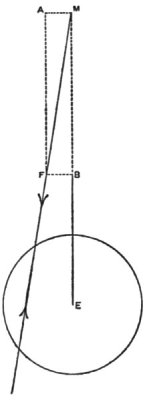 Fig. 2.
Another way in which we can illustrate the
retreat of the moon as the inevitable consequence
of tidal friction is shown in the adjoining figure, in
which the large body
E represents the earth,
and the small body M
the moon. We may for
simplicity regard the
moon as a point, and
as this attracts each
particle of the earth,
the total effect of the
moon on the earth may
be represented by a
single force. By the
law of equality of action
and reaction, the force
of the earth on the
moon is to be represented
by an equal and
opposite force. If there
were no tides then the
moon's force would of
course pass through the
earth's centre; but as the effect of the moon is to
slacken the earth's rotation, it follows that the total
force does not exactly pass through the line of the
earth's centre, but a little to one side, in order to
pull the opposite way to that in which the earth
is turning, and thus bring down its speed. We
may therefore decompose the earth's total force
on the moon into two parts, one of which tends
directly towards the earth's centre, while the other
acts tangentially to the moon's orbit. The central
force is of course the main guiding power which
keeps the moon in its path; but the incessant
tangential force constantly tends to send the moon
out further and further, and thus the growth of its
orbit can be accounted for.
We therefore conclude finally, that the tides are
making the day longer and sending the moon away
further. It is the development of the consequences
of these laws that specially demands our attention
in these lectures. We must have the courage to
look at the facts unflinchingly, and deduce from
them all the wondrous consequences they involve.
Their potency arises from a characteristic feature—they
are unintermitting. Most of the great
astronomical changes with which we are ordinarily
familiar are really periodic: they gradually increase
in one direction for years, for centuries, or
for untold ages; but then a change comes, and the
increase is changed into a decrease, so that after
the lapse of becoming periods the original state
of things is restored. Such periodic phenomena
abound in astronomy. There is the annual fluctuation
of the seasons; there is the eighteen or nineteen
year period of the moon; there is the great
period of the precession of the equinoxes, amounting
to twenty-six thousand years; and then there
is the stupendous Annus Magnus of hundreds of
thousands of years, during which the earth's orbit
itself breathes in and out in response to the attraction
of the planets. But these periodic phenomena,
however important they may be to us mere
creatures of a day, are insignificant in their effects
on the grand evolution through which the celestial
bodies are passing. The really potent agents in
fashioning the universe are those which, however
slow or feeble they may seem to be, are still
incessant in their action. The effect which a cause
shall be competent to produce depends not alone
upon the intensity of that cause, but also upon
the time during which it has been in operation.
From the phenomena of geology, as well as from
those of astronomy, we know that this earth and
the system to which it belongs has endured for
ages, not to be counted by scores of thousands of
years, or, as Prof. Tyndall has so well remarked,
“Not for six thousand years, nor for sixty thousand
years, nor six hundred thousand years, but for
æons of untold millions.” Those slender agents
which have devoted themselves unceasingly to
the accomplishment of a single task may in this
long lapse of time have accomplished results
of stupendous magnitude. In famed stalactite
caverns we are shown a colossal figure of crystal
extending from floor to roof, and the formation
of that column is accounted for when we see a
tiny drop falling from the roof above to the floor
beneath. A lifetime may not suffice for that falling
drop to add an appreciable increase to the stalactite
down which it trickles, or to the growing stalagmite
on which it falls; but when the operation has been
in progress for immense ages, it is capable of the
formation of the stately column. Here we have an
illustration of an influence which, though apparently
trivial, acquires colossal significance when adequate
time is afforded. It is phenomena of this kind
which the student of nature should most narrowly
watch, for they are the real architects of the
universe.
The tidal consequences which we have already
demonstrated are emphatically of this non-periodic
class—the day is always lengthening, the
moon is always retreating. To-day is longer than
yesterday; to-morrow will be longer than to-day.
It cannot be said that the change is a great one;
it is indeed too small to be appreciable even by
our most delicate observations. In one thousand
years the alteration in the length of a day is only
a small fraction of a second; but what may be a
very small matter in one thousand years can become
a very large one in many millions of years.
Thus it is that when we stretch our view through
immense vistas of time past, or when we look forward
through immeasurable ages of time to come,
the alteration in the length of the day will assume
the most startling proportions, and involve the
most momentous consequences.
Let us first look back. There was a time when
the day, instead of being the twenty-four hours we
now have, must have been only twenty-three hours,
How many millions of years ago that was I do
not pretend to say, nor is the point material for
our argument; suffice it to say, that assuming, as
geology assures us we may assume, the existence
of these æons of millions of years, there was once
a time when the day was not only one hour
shorter, but was even several hours less than it is
at present. Nor need we stop our retrospect at a
day of even twenty, or fifteen, or ten hours
long; we shall at once project our glance back to
an immeasurably remote epoch, at which the earth
was spinning round in a time only one sixth or
even less of the length of the present day. There
is here a reason for our retrospect to halt, for at
some eventful period, when the day was about
three or four hours long, the earth must have been
in a condition of a very critical kind.
It is well known that fearful accidents occasionally
happen where large grindstones are being
driven at a high speed. The velocity of rotation
becomes too great for the tenacity of the stone to
withstand the stress; a rupture takes place, the
stone flies in pieces, and huge fragments are
hurled around. For each particular grindstone
there is a certain special velocity depending upon
its actual materials and character, at which it would
inevitably fly in pieces. I have once before likened
our earth to a wheel; now let me liken it to a
grindstone. There is therefore a certain critical
velocity of rotation for the earth at which it would
be on the brink of rupture. We cannot exactly
say, in our ignorance of the internal constitution
of the earth, what length of day would be the
shortest possible for our earth to have consistently
with the preservation of its integrity; we may,
however, assume that it will be about three or four
hours, or perhaps a little less than three. The exact
amount, however, is not really very material to us;
it would be sufficient for our argument to assert
that there is a certain minimum length of day for
which the earth can hold together. In our retrospect,
therefore, through the abyss of time past our
view must be bounded by that state of the earth
when it is revolving in this critical period. With
what happened before that we shall not at present
concern ourselves. Thus we look back to a time at
the beginning of the present order of things, when
the day was only some three or four hours long.
Let us now look at the moon, and examine
where it must have been during these past ages.
As the moon is gradually getting further and further
from us at present, so, looking back into past
time, we find that the moon was nearer and nearer
to the earth the further back our view extends;
in fact, concentrating our attention solely on essential
features, we may say that the path of the
moon is a sort of spiral which winds round and
round the earth, gradually getting larger, though
with extreme slowness. Looking back we see this
spiral gradually coiling in and in, until in a retrospect
of millions of years, instead of its distance
from the earth being 240,000 miles, it must have
been much less. There was a time when the
moon was only 200,000 miles away; there was
a time many millions of years ago, when the moon
was only 100,000 miles away. Nor can we here
stop our retrospect; we must look further and
further back, and follow the moon's spiral path as
it creeps in and in towards the earth, until at last
it appears actually in contact with that great globe
of ours, from which it is now separated by a quarter
of a million of miles.
Surely the tides have thus led us to the knowledge
of an astounding epoch in our earth's past
history, when the earth is spinning round in a few
hours, and when the moon is, practically speaking,
in contact with it. Perhaps I should rather say,
that the materials of our present moon were in this
situation, for we would hardly be entitled to assume
that the moon then possessed the same globular
form in which we see it now. To form a just
apprehension of the true nature of both bodies at
this critical epoch, we must study their concurrent
history as it is disclosed to us by a totally different
line of reasoning.
Drop, then, for a moment all thought of tides,
and let us bring to our aid the laws of heat, which
will disclose certain facts in the ancient history
of the earth-moon system perhaps as astounding
as those to which the tides have conducted us.
In one respect we may compare these laws of heat
with the laws of the tides; they are both alike
non-periodic, their effects are cumulative from age
to age, and imagination can hardly even impose
a limit to the magnificence of the works they can
accomplish. Our argument from heat is founded
on a very simple matter. It is quite obvious that
a heated body tends to grow cold. I am not now
speaking of fires or of actual combustion whereby
heat is produced; I am speaking merely of such
heat as would be possessed by a red-hot poker
after being taken from the fire, or by an iron casting
after the metal has been run into the mould. In
such cases as this the general law holds good,
that the heated body tends to grow cold. The
cooling may be retarded no doubt if the passage
of heat from the body is impeded. We can, for
instance, retard the cooling of a teapot by the
well-known practice of putting a cosy upon it; but
the law remains that, slowly or quickly, the heated
body will tend to grow colder. It seems almost
puerile to insist with any emphasis on a point so
obvious as this, but yet I frequently find that
people do not readily apprehend all the gigantic
consequences that can flow from a principle so
simple. It is true that a poker cools when taken
from the fire; we also find that a gigantic casting
weighing many tons will grow gradually cold,
though it may require days to do so. The same
principle will extend to any object, no matter how
vast it may happen to be. Were that great casting
2000 miles in diameter, or were it 8000 miles in
diameter, it will still steadily part with its heat,
though no doubt the process of cooling becomes
greatly prolonged with an increase in the dimensions
of the heated body. The earth and the moon
cannot escape from the application of these simple
principles.
Let us first speak of the earth. There are
multitudes of volcanoes in action at the present
moment in various countries upon this earth. Now
whatever explanation may be given of the approximate
cause of the volcanic phenomena, there
can be no doubt that they indicate the existence
of heat in the interior of the earth. It may
possibly be, as some have urged, that the volcanoes
are merely vents for comparatively small masses
of subterranean molten matter; it may be, as
others more reasonably, in my opinion, believe, that
the whole interior of the earth is at the temperature
of incandescence, and that the eruptions of
volcanoes and the shocks of earthquakes are merely
consequences of the gradual shrinkage of the
external crust, as it continually strives to accommodate
itself to the lessening bulk of the fluid
interior. But whichever view we may adopt, it is
at least obvious that the earth is in part, at all
events, a heated body, and that the heat is not in
the nature of a combustion, generated and sustained
by the progress of chemical action. No doubt there
may be local phenomena of this description, but
by far the larger proportion of the earth's internal
heat seems merely the fervour of incandescence. It
is to be likened to the heat of the molten iron
which has been run into the sand, rather than to
the glowing coals in the furnace in which that iron
has been smelted.
There is one volcanic outbreak of such exceptional
interest in these modern times that I cannot
refrain from alluding to it. Doubtless every one
has heard of that marvellous eruption of Krakatoa,
which occurred on August 26th and 27th, 1883,
and gives a unique chapter in the history of
volcanic phenomena. Not alone was the eruption
of Krakatoa alarming in its more ordinary manifestations,
but it was unparalleled both in the
vehemence of the shock and in the distance to
which the effects of the great eruption were propagated.
I speak not now of the great waves of ocean
that inundated the coasts of Sumatra and Java,
and swept away thirty-six thousand people, nor do
I allude to the intense darkness which spread for
one hundred and eighty miles or more all round.
I shall just mention the three most important
phenomena, which demonstrate the energy which
still resides in the interior of our earth. Place a
terrestrial globe before you, and fix your attention
on the Straits of Sunda; think also of the great
atmospheric ocean some two or three hundred
miles deep which envelopes our earth. When a
pebble is tossed into a pond a beautiful series of
concentric ripples diverge from it; so when Krakatoa
burst up in that mighty catastrophe, a series
of gigantic waves were propagated through the
air; they embraced the whole globe, converged to
the antipodes of Krakatoa, thence again diverged,
and returned to the seat of the volcano; a second
time the mighty series of atmospheric ripples
spread to the antipodes, and a second time returned.
Seven times did that series of waves course over
our globe, and leave their traces on every self-recording
barometer that our earth possesses.
Thirty-six hours were occupied in the journey of
the great undulation from Krakatoa to its antipodes.
Perhaps even more striking was the extent
of our earth's surface over which the noise of the
great explosion spread. At Batavia, ninety-four
miles away, the concussions were simply deafening;
at Macassar, in Celebes, two steamers were
sent out to investigate the explosions which were
heard, little thinking that they came from Krakatoa,
nine hundred and sixty-nine miles away.
Alarming sounds were heard over the island of
Timor, one thousand three hundred and fifty-one
miles away from Krakatoa. Diego Garcia in the
Chogos islands is two thousand two hundred and
sixty-seven miles from Krakatoa, but the thunders
traversed even this distance, and were attributed
to some ship in distress, for which a search was
made. Most astounding of all, there is undoubted
evidence that the sound of the mighty explosion
was propagated across nearly the entire Indian
ocean, and was heard in the island of Rodriguez,
almost three thousand miles away. The immense
distance over which this sound journeyed
will be appreciated by the fact, that the noise did
not reach Rodriguez until four hours after it had
left Krakatoa. In fact, it would seem that if
Vesuvius were to explode with the same vehemence
as Krakatoa did, the thunders of the
explosion might penetrate so far as to be heard
in London.
There is another and more beautiful manifestation
of the world-wide significance of the
Krakatoa outbreak. The vast column of smoke
and ashes ascended twenty miles high in the
air, and commenced a series of voyages around
the equatorial regions of the earth. In three days
it crossed the Indian ocean, and was traversing
equatorial Africa; then came an Atlantic voyage;
and then it coursed over central America, before
a Pacific voyage brought it back to its point of
departure after thirteen days; then the dust started
again, and was traced around another similar
circuit, while it was even tracked for a considerable
time in placing the third girdle round the earth.
Strange blue suns and green moons and other
mysterious phenomena marked the progress of this
vast volcanic cloud. At last the cloud began to
lose its density, the dust spread more widely
over the tropics, became diffused through the
temperate regions, and then the whole earth was
able to participate in the glories of Krakatoa.
The marvellous sunsets in the autumn of 1883
are attributable to this cause; and thus once again
was brought before us the fact that the earth
still contains large stores of thermal energy.
Attempts are sometimes made to explain volcanic
phenomena on the supposition that they are
entirely of a local character, and that we are not
entitled to infer the incandescent nature of the
earth's interior from the fact that volcanic outbreaks
occasionally happen. For our present purpose
this point is immaterial, though I must say
it appears to me unreasonable to deny that the
interior of the earth is in a most highly heated
state. Every test we can apply shows us the
existence of internal heat. Setting aside the more
colossal phenomena of volcanic eruptions, we have
innumerable minor manifestations of its presence.
Are there not geysers and hot springs in many
parts of the earth? and have we not all over our
globe invariable testimony confirming the statement,
that the deeper we go down beneath its
surface the hotter does the temperature become?
Every miner is familiar with these facts; he knows
that the deeper are his shafts the warmer it is
down below, and the greater the necessity for providing
increased ventilation to keep the temperature
within a limit that shall be suitable for the
workmen. All these varied classes of phenomena
admit solely of one explanation, and that is, that
the interior of the earth contains vast stores of
incandescent heat.
We now apply to our earth the same reasoning
which we should employ on a poker taken from the
fire, or on a casting drawn from the foundry. Such
bodies will lose their heat by radiation and conduction.
The earth is therefore losing its heat. No doubt
the process is an extremely slow one. The mighty
reservoirs of internal heat are covered by vast
layers of rock, which are such excellent non-conductors
that they offer every possible impediment
to the leakage of heat from the interior to the
surface. We coat our steam-pipes over with non-conducting
material, and this can now be done so
successfully, that it is beginning to be found
economical to transmit steam for a very long
distance through properly protected pipes. But
no non-conducting material that we can manufacture
can be half so effective as the shell of rock
twenty miles or more in thickness, which secures
the heated interior of the earth from rapid loss
by radiation into space. Even were the earth's
surface solid copper or solid silver, both most
admirable conductors of heat, the cooling down
of this vast globe would be an extremely tardy
process; how much more tardy must it therefore
be when such exceedingly bad conductors as rocks
form the envelope? How imperfectly material
of this kind will transmit heat is strikingly illustrated
by the great blast iron furnaces which are
so vitally important in one of England's greatest
manufacturing industries. A glowing mass of coal
and iron ore and limestone is here urged to vivid
incandescence by a blast of air itself heated
to an intense temperature. The mighty heat thus
generated—sufficient as it is to detach the iron
from its close alliance with the earthy materials
and to render the metal out as a pure stream
rushing white-hot from the vent—is sufficiently
confined by a few feet of brick-work, one side of
which is therefore at the temperature of molten
iron, while the other is at a temperature not much
exceeding that of the air. We may liken the brick-work
of a blast furnace to the rocky covering of
the earth; in each case an exceedingly high temperature
on one side is compatible with a very
moderate temperature on the other.
Although the drainage of heat away from the
earth's interior to its surface, and its loss there by
radiation into space, is an extremely tardy process,
yet it is incessantly going on. We have here
again to note the ability for gigantic effect which
a small but continually operating cause may have,
provided it always tends in the same direction.
The earth is incessantly losing heat; and though
in a day, a week, or a year the loss may not be
very significant, yet when we come to deal with
periods of time that have to be reckoned by millions
of years, it may well be that the effect of a small
loss of heat per annum can, in the course of these
ages, reach unimagined dimensions. Suppose, for
instance, that the earth experienced a fall of temperature
in its interior which amounted to only one-thousandth
of a degree in a year. So minute a
quantity as this is imperceptible. Even in a century,
the loss of heat at this rate would be only the tenth
of a degree. There would be no possible way of
detecting it; the most careful thermometer could
not be relied on to tell us for a certainty that the
temperature of the hot waters of Bath had declined
the tenth of a degree; and I need hardly say, that
the fall of a tenth of a degree would signify nothing
in the lavas of Vesuvius, nor influence the thunders
of Krakatoa by one appreciable note. So far
as a human life or the life of the human race
is concerned, the decline of a tenth of a degree
per century in the earth's internal heat is absolutely
void of significance. I cannot, however,
impress upon you too strongly, that the mere few
thousands of years with which human history is
cognizant are an inappreciable moment in comparison
with those unmeasured millions of years
which geology opens out to us, or with those far
more majestic periods which the astronomer demands
for the events he has to describe.
An annual loss of even one-thousandth of a degree
will be capable of stupendous achievements when
supposed to operate during epochs of geological
magnitude. In fact, its effects would be so vast,
that it seems hardly credible that the present loss
of heat from the earth should be so great as to
amount to an abatement of one-thousandth of a
degree per annum, for that would mean, that in
a thousand years the earth's temperature would
decline by one degree, and in a million years the
decline would amount to a thousand degrees. At
all events, the illustration may suffice to show, that
the fact that we are not able to prove by our instruments
that the earth is cooling is no argument
whatever against the inevitable law, that the earth,
like every other heated body, must be tending
towards a lower temperature.
Without pretending to any numerical accuracy,
we can at all events give a qualitative if not a
quantitative analysis of the past history of our earth,
in so far as its changes of temperature are concerned.
A million years ago our earth doubtless contained
appreciably more heat than it does at present. I
speak not now, of course, of mere solar heat—of the
heat which gives us the vicissitudes of seasons; I
am only referring to the original hoard of internal
heat which is gradually waning. As therefore our
retrospect extends through millions and millions
of past ages, we see our earth ever growing warmer
and warmer the further and further we look back.
There was a time when those heated strata which
we have now to go deep down in mines to find
were considerably nearer the surface. At present,
were it not for the sun, the heat of the earth where
we stand would hardly be appreciably above the
temperature of infinite space—perhaps some 200
or 300 degrees below zero. But there must have
been a time when there was sufficient internal heat
to maintain the exterior at a warm and indeed at
a very hot temperature. Nor is there any bound
to our retrospect arising from the operation or
intervention of any other agent, so far as we know;
consequently the hotter and the hotter grows the
surface the further and the further we look back.
Nor can we stop until, at an antiquity so great that
I do not venture on any estimate of the date, we
discover that this earth must have consisted of glowing
hot material. Further and further we can look
back, and we see the rocks—or whatever other term
we choose to apply to the then ingredients of the
earth's crust—in a white-hot and even in a molten
condition. Thus our argument has led us to the
belief that time was when this now solid globe of
ours was a ball of white-hot fluid.
On the argument which I have here used there
are just two remarks which I particularly wish to
make. Note in the first place, that our reasoning
is founded on the fact that the earth is at present,
to some extent, heated. It matters not whether
this heat be much or little; our argument would
have been equally valid had the earth only contained
a single particle of its mass at a somewhat
higher temperature than the temperature
of space. I am, of course, not alluding in this to
heat which can be generated by combustion. The
other point to which I refer is to remove an objection
which may possibly be urged against this
line of reasoning. I have argued that because the
temperature is continually increasing as we look
backwards, that therefore a very great temperature
must once have prevailed. Without some explanation
this argument is not logically complete.
There is, it is well known, the old paradox of the
geometric series; you may add a farthing to a
halfpenny, and then a half-farthing, and then a
quarter-farthing, and then the eighth of a farthing,
followed by the sixteenth, and thirty-second, and
so on, halving the contribution each time. Now
no matter how long you continue this process, even
if you went on with it for ever, and thus made an
infinite number of contributions, you would never
accomplish the task of raising the original halfpenny
to the dignity of a penny. An infinite
number of quantities may therefore, as this illustration
shows, never succeed in attaining any considerable
dimensions. Our argument, however,
with regard to the increase of heat as we look
back is the very opposite of this. It is the essence
of a cooling body to lose heat more rapidly in
proportion as its temperature is greater. Thus
though the one-thousandth of a degree may be all
the fall of temperature that our earth now experiences
in a twelvemonth, yet in those glowing days
when the surface was heated to incandescence, the
loss of heat per annum must have been immensely
greater than it is now. It therefore follows that
the rate of gain of the earth's heat as we look
back must be of a different character to that of
the geometric series which I have just illustrated;
for each addition to the earth's heat, as we look
back from year to year, must grow greater and
greater, and therefore there is here no shelter
for a fallacy in the argument on which the existence
of high temperature of primeval times is
founded.
The reasoning that I have applied to our earth
may be applied in almost similar words to the
moon. It is true that we have not any knowledge
of the internal nature of the moon at present, nor
are we able to point to any active volcanic
phenomena at present in progress there in support
of the contention that the moon either has
now internal heat, or did once possess it. It is,
however, impossible to deny the evidence which
the lunar craters afford as to the past existence
of volcanic activity on our satellite. Heat, therefore,
there was once in the moon; and accordingly
we are enabled to conclude that, on a retrospect
through illimitable periods of time, we must find
the moon transformed from that cold and inert
body she now seems to a glowing and incandescent
mass of molten material. The earth therefore
and the moon in some remote ages—not alone
anterior to the existence of life, but anterior even
to the earliest periods of which geologists have
cognizance—must have been both globes of molten
materials which have consolidated into the rocks
of the present epoch.
We must now revert to the tidal history of the
earth-moon system. Did we not show that there
was a time when the earth and the moon—or
perhaps, I should say, the ingredients of the earth
and moon—were close together, were indeed in
actual contact? We have now learned, from a
wholly different line of reasoning, that in very
early ages both bodies were highly heated. Here
as elsewhere in this theory we can make little or
no attempt to give any chronology, or to harmonize
the different lines along which the course
of history has run. No one can form the slightest
idea as to what the temperature of the earth and of
the moon must have been in those primeval ages
when they were in contact. It is impossible, however,
to deny that they must both have been in
a very highly heated state; and everything we
know of the matter inclines us to the belief that
the temperature of the earth-moon system must
at this critical epoch have been one of glowing
incandescence and fusion. It is therefore quite
possible that these bodies—the moon especially—may
have then been not at all of the form we see
them now. It has been supposed, and there are
some grounds for the supposition, that at this initial
stage of earth-moon history the moon materials
did not form a globe, but were disposed in a ring
which surrounded the earth, the ring being in a
condition of rapid rotation. It was at a subsequent
period, according to this view, that the substances
in the ring gradually drew together, and then by
their mutual attractions formed a globe which ultimately
consolidated down into the compact moon
as we now see it. I must, however, specially draw
your attention to the clearly-marked line which
divides the facts which dynamics have taught us
from those notions which are to be regarded as
more or less conjectural. Interpreting the action
of the tides by the principles of dynamics, we are
assured that the moon was once—or rather the
materials of the moon—in the immediate vicinity
of the earth. There, however, dynamics leaves us,
and unfortunately withholds its accurate illumination
from the events which immediately preceded
that state of things.
The theory of tidal evolution which I am describing
in these lectures is mainly the work of
Professor George H. Darwin of Cambridge. Much
of the original parts of the theory of the tides was
due to Sir William Thomson, and I have also
mentioned how Professor Purser contributed an
important element to the dynamical theory. It
is, however, Darwin who has persistently deduced
from the theory all the various consequences which
can be legitimately drawn from it. Darwin, for
instance, pointed out that as the moon is receding
from us, it must, if we only look far enough back,
have been once in practical contact with the earth.
It is to Darwin also that we owe many of the
other parts of a fascinating theory, either in its
mathematical or astronomical aspect; but I must
take this opportunity of saying, that I do not
propose to make Professor Darwin or any of the
other mathematicians I have named responsible
for all that I shall say in these lectures. I must
be myself accountable for the way in which the
subject is being treated, as well as for many of
the illustrations used, and some of the deductions
I have drawn from the subject.
It is almost unavoidable for us to make a surmise
as to the cause by which the moon had come
into this remarkable position close to the earth at
the most critical epoch of earth-moon history.
With reference to this Professor Darwin has
offered an explanation, which seems so exceedingly
plausible that it is impossible to resist the notion
that it must be correct. I will ask you to think
of the earth not as a solid body covered largely
with ocean, but as a glowing globe of molten
material. In a globe of this kind it is possible for
great undulations to be set up. Here is a large vase
of water, and by displacing it I can cause the water
to undulate with a period which depends on the
size of the vessel; undulations can be set up in a
bucket of water, the period of these undulations
being dependent upon the dimensions of the bucket.
Similarly in a vast globe of molten material certain
undulations could be set up, and those undulations
would have a period depending upon the dimensions
of this vibrating mass. We may conjecture a
mode in which such vibrations could be originated.
Imagine a thin shell of rigid material which just
encases the globe; suppose this be divided into
four quarters, like the four quarters of an orange,
and that two of these opposite quarters be rejected,
leaving two quarters on the liquid. Now suppose
that these two quarters be suddenly pressed in, and
then be as suddenly removed—they will produce
depressions, of course, on the two opposite quarters,
while the uncompressed quarters will become
protuberant. In virtue of the mutual attractions
between the different particles of the mass, an
effort will be made to restore the globular form,
but this will of course rather overshoot the mark;
and therefore a series of undulations will be originated
by which two opposite quarters of the sphere
will alternately shrink in and become protuberant.
There will be a particular period to this oscillation.
For our globe it would appear to be somewhere
about an hour and a half or two hours; but there
is necessarily a good deal of uncertainty about this
point.
We have seen how in those primitive days the
earth was spinning around very rapidly; and I have
also stated that the earth might at this very
critical epoch of its history be compared with a
grindstone which is being driven so rapidly that
it is on the very brink of rupture. It is remarkable
to note, that a cause tending to precipitate
a rupture of the earth was at hand. The sun then
raised tides in the earth as it does at present.
When the earth revolved in a period of some four
hours or thereabouts, the high tides caused by the
sun succeeded each other at intervals of about two
hours. When I speak of tides in this respect,
of course I am not alluding to oceanic tides;
these were the days long before ocean existed, at
least in the liquid form. The tides I am speaking
about were raised in the fluids and materials which
then constituted the whole of the glowing earth;
those tides rose and fell under the throb produced
by the sun, just as truly as tides produced in an
ordinary ocean. But now note the significant coincidence
between the period of the throb produced
by the sun-raised tides, and that natural period of
vibration which belonged to our earth as a mass
of molten material. It therefore follows, that the
impulse given to the earth by the sun harmonized
in time with that period in which the earth itself
was disposed to oscillate. A well-known dynamical
principle here comes into play. You see a heavy
weight hanging by a string, and in my hand I
hold a little slip of wood no heavier than a common
pencil; ordinarily speaking, I might strike
that heavy weight with this slip of wood, and no
effect is produced; but if I take care to time the
little blows that I give so that they shall harmonize
with the vibrations which the weight is naturally
disposed to make, then the effect of many small
blows will be cumulative, so much so, that after a
short time the weight begins to respond to my
efforts, and now you see it has acquired a swing of
very considerable amplitude. In Professor Fitzgerald's
address to the British Association at Bath
last autumn, he gives an account of those astounding
experiments of Hertz, in which well-timed
electrical impulses broke down an air resistance,
and revealed to us ethereal vibrations which could
never have been made manifest except by the
principle we are here discussing. The ingenious
conjecture has been made, that when the earth was
thrown into tidal vibrations in those primeval days,
these slight vibrations, harmonizing as they did
with the natural period of the earth, gradually
acquired amplitude; the result being that the pulse
of each successive vibration increased at last to
such an extent that the earth separated under the
stress, and threw off a portion of those semi-fluid
materials of which it was composed. In process of
time these rejected portions contracted together,
and ultimately formed that moon we now see.
Such is the origin of the moon which the modern
theory of tidal evolution has presented to our
notice.
There are two great epochs in the evolution of
the earth-moon system—two critical epochs which
possess a unique dynamical significance; one of
these periods was early in the beginning, while the
other cannot arrive for countless ages yet to come.
I am aware that in discussing this matter I am
entering somewhat largely into mathematical principles;
I must only endeavour to state the matter
as succinctly as the subject will admit.
In an earlier part of this lecture I have explained
how, during all the development of the
earth-moon system, the quantity of moment of
momentum remains unaltered. The moment of
momentum of the earth's rotation added to the
moment of momentum of the moon's revolution
remains constant; if one of these quantities increase
the other must decrease, and the progress of
the evolution will have this result, that energy shall
be gradually lost in consequence of the friction
produced by the tides. The investigation is one
appropriate for mathematical formulæ, such as
those that can be found in Professor Darwin's
memoirs; but nature has in this instance dealt
kindly with us, for she has enabled an abstruse
mathematical principle to be dealt with in a singularly
clear and concise manner. We want to obtain
a definite view of the alteration in the energy of
the system which shall correspond to a small
change in the velocity of the earth's rotation, the
moon of course accommodating itself so that the
moment of momentum shall be preserved unaltered.
We can use for this purpose an angular
velocity which represents the excess of the earth's
rotation over the angular revolution of the moon;
it is, in fact, the apparent angular velocity with
which the moon appears to move round the
heavens. If we represent by N the angular
velocity of the earth, and by M the angular
velocity of the moon in its orbit round the earth,
the quantity we desire to express is N—M;
we shall call it the relative rotation. The mathematical
theorem which tells us what we want can
be enunciated in a concise manner as follows.
The alteration of the energy of the system may be
expressed by multiplying the relative rotation by the
change in the earth's angular velocity. This result
will explain many points to us in the theory, but
just at present I am only going to make a single
inference from it.
I must advert for a moment to the familiar
conception of a maximum or a minimum. If a
magnitude be increasing, that is, gradually growing
greater and greater, it has obviously not attained
a maximum so long as the growth is in progress.
Nor if the object be actually decreasing can it be
said to be at a maximum either; for then it was
greater a second ago than it is now, and therefore
it cannot be at a maximum at present. We may
illustrate this by the familiar example of a stone
thrown up into the air; at first it gradually rises,
being higher at each instant than it was previously,
until a culminating point is reached, when just for
a moment the stone is poised at the summit of its
path ere it commences its return to earth again.
In this case the maximum point is obtained when
the stone, having ceased to ascend, and not having
yet commenced to descend, is momentarily at rest.
The same principles apply to the determination
of a minimum. As long as the magnitude is declining
the minimum has not been reached; it is
only when the decline has ceased, and an increase
is on the point of setting in, that the minimum
can be said to be touched.
The earth-moon system contains at any moment
a certain store of energy, and to every conceivable
condition of the earth-moon system a certain
quantity of energy is appropriate. It is instructive
for us to study the different positions in which
the earth and the moon might lie, and to examine
the different quantities of energy which the system
will contain in each of those varied positions. It
is however to be understood that the different
cases all presuppose the same total moment of
momentum.
Among the different cases that can be imagined,
those will be of special interest in which the total
quantity of energy in the system is a maximum
or a minimum. We must for this purpose suppose
the system gradually to run through all conceivable
changes, with the earth and moon as near as
possible, and as far as possible, and in all intermediate
positions; we must also attribute to the
earth every variety in the velocity of its rotation
which is compatible with the preservation of the
moment of momentum. Beginning then with the
earth's velocity of rotation at its lowest, we may
suppose it gradually and continually increased, and,
as we have already seen, the change in the energy
of the system is to be expressed by multiplying
the relative rotation into the change of the earth's
angular velocity. It follows from the principles
we have already explained, that the maximum
or minimum energy is attained at the moment
when the alteration is zero. It therefore follows,
that the critical periods of the system will arise
when the relative rotation is zero, that is, when
the earth's rotation on its axis is performed with
a velocity equal to that with which the moon
revolves around the earth. This is truly a singular
condition of the earth-moon system; the moon in
such a case would revolve around the earth as
if the two bodies were bound together by rigid
bonds into what was practically a single solid
body. At the present moment no doubt to some
extent this condition is realized, because the moon
always turns the same face to the earth (a point on
which we shall have something to say later on); but
in the original condition of the earth-moon system,
the earth would also constantly direct the same
face to the moon, a condition of things which is
now very far from being realized.
It can be shown from the mathematical nature
of the problem that there are four states of the
earth-moon system in which this condition may
be realized, and which are also compatible with
the conservation of the moment of momentum.
We can express what this condition implies in a
somewhat more simple manner. Let us understand
by the day the period of the earth's rotation
on its axis, whatever that may be, and let us
understand by the month the period of revolution
of the moon around the earth, whatever value it
may have; then the condition of maximum or
minimum energy is attained when the day and the
month have become equal to each other. Of the
four occasions mathematically possible in which
the day and the month can be equal, there are
only two which at present need engage our attention—one
of these occurred near the beginning
of the earth and moon's history, the other remains
to be approached in the immeasurably remote
future. The two remaining solutions are futile,
being what the mathematician would describe as
imaginary.
There is a fundamental difference between the
dynamical conditions in these critical epochs—in
one of them the energy of the system has attained
a maximum value, and in the other the energy of
the system is at a minimum value. It is impossible
to over-estimate the significance of these two
states of the system.
I may recall the fundamental notion which every
one has learned in mechanics, as to the difference
between stable and unstable equilibrium. The
conceivable possibility of making an egg stand on
its end is a practical impossibility, because nature
does not like unstable equilibrium, and a body
departs therefrom on the least disturbance; on
the other hand, stable equilibrium is the position in
which nature tends to place everything. A log of
wood floating on a river might conceivably float
in a vertical position with its end up out of the
water, but you never could succeed in so balancing
it, because no matter how carefully you adjusted
the log, it would almost instantly turn over when
you left it free; on the other hand, when the log
floats naturally on the water it assumes a horizontal
position, to which, when momentarily displaced
therefrom, it will return if permitted to
do so. We have here an illustration of the contrast
between stable and unstable equilibrium.
It will be found generally that a body is in
equilibrium when its centre of gravity is at its
highest point or at its lowest point; there is,
however, this important difference, that when the
centre of gravity is highest the equilibrium is
unstable, and when the centre of gravity is lowest
the equilibrium is stable. The potential energy
of an egg poised on its end in unstable equilibrium
is greater than when it lies on its side
in stable equilibrium. In fact, energy must be
expended to raise the egg from the horizontal
position to the vertical; while, on the other hand,
work could conceivably be done by the egg when
it passes from the vertical position to the horizontal.
Speaking generally, we may say that the stable
position indicates low energy, while a redundancy
of that valuable agent is suggestive of instability.
We may apply similar principles to the consideration
of the earth-moon system. It is true
that we have here a series of dynamical phenomena,
while the illustrations I have given of
stable and unstable equilibrium relate only to
statical problems; but we can have dynamical stability
and dynamical instability, just as we can
have stable and unstable equilibrium. Dynamical
instability corresponds with the maximum of
energy, and dynamical stability to the minimum
of energy.
At that primitive epoch, when the energy of the
earth-moon system was a maximum, the condition
was one of dynamical instability; it was impossible
that it should last. But now mark how truly
critical an occurrence this must have been in the
history of the earth-moon system, for have I not
already explained that it is a necessary condition
of the progress of tidal evolution that the energy
of the system should be always declining? But
here our retrospect has conducted us back to a
most eventful crisis, in which the energy was a
maximum, and therefore cannot have been immediately
preceded by a state in which the energy
was greater still; it is therefore impossible for the
tidal evolution to have produced this state of
things; some other influence must have been in
operation at this beginning of the earth-moon
system.
Thus there can be hardly a doubt that immediately
preceding the critical epoch the moon
originated from the earth in the way we have
described. Note also that this condition, being
one of maximum energy, was necessarily of dynamical
instability, it could not last; the moon
must adopt either of two courses—it must tumble
back on the earth, or it must start outwards.
Now which course was the moon to adopt? The
case is analogous to that of an egg standing on
its end—it will inevitably tumble one way or
the other. Some infinitesimal cause will produce
a tendency towards one side, and to that side
accordingly the egg will fall. The earth-moon
system was similarly in an unstable state, an infinitesimal
cause might conceivably decide the fate
of the system. We are necessarily in ignorance
of what the determining cause might have been,
but the effect it produced is perfectly clear; the
moon did not again return to its mother earth, but
set out on that mighty career which is in progress
to-day.
Let it be noted that these critical epochs in
the earth-moon history arise when and only
when there is an absolute identity between the
length of the month and the length of the day.
It may be proper therefore that I should provide
a demonstration of the fact, that the identity
between these two periods must necessarily
have occurred at a very early period in the
evolution.
The law of Kepler, which asserts that the square
of the periodic time is proportioned to the cube
of the mean distance, is in its ordinary application
confined to a comparison between the revolutions
of the several planets about the sun. The periodic
time of each planet is connected with its average
distance by this law; but there is another application
of Kepler's law which gives us information
of the distance and the period of the moon in
former stages of the earth-moon history. Although
the actual path of the moon is of course
an ellipse, yet that ellipse is troubled, as is well
known, by many disturbing forces, and from this
cause alone the actual path of the moon is far
from being any of those simple curves with which
we are so well acquainted. Even were the earth
and the moon absolutely rigid particles, perturbations
would work all sorts of small changes in
the pliant curve. The phenomena of tidal evolution
impart an additional element of complexity into
the actual shape of the moon's path. We now see
that the ellipse is not merely subject to incessant
deflections of a periodic nature, it also undergoes
a gradual contraction as we look back through
time past; but we may, with all needful accuracy
for our present purpose, think of the path of the
moon as a circle, only we must attribute to that
circle a continuous contraction of its radius the
further and the further we look back. The alteration
in the radius will be even so slow, that the moon
will accomplish thousands of revolutions around
the earth without any appreciable alteration in
the average distance of the two bodies. We can
therefore think of the moon as revolving at every
epoch in a circle of special radius, and as accomplishing
that revolution in a special time. With
this understanding we can now apply Kepler's law
to the several stages of the moon's past history.
The periodic time of each revolution, and the mean
distance at which that revolution was performed,
will be always connected together by the formula
of Kepler. Thus to take an instance in the very
remote past. Let us suppose that the moon was
at one hundred and twenty thousand miles instead
of two hundred and forty thousand, that is, at
half its present distance. Applying the law of
Kepler, we see that the time of revolution must
then have been only about ten days instead of the
twenty-seven it is now. Still further, let us suppose
that the moon revolves in an orbit with one-tenth
of the diameter it has at present, then the
cube of 10 being 1000, and the square root of 1000
being 31.6, it follows that the month must have
been less than the thirty-first part of what it is
at present, that is, it must have been considerably
less than one of our present days. Thus you see the
month is growing shorter and shorter the further
we look back, the day is also growing shorter and
shorter; but still I think we can show that there
must have been a time when the month will have
been at least as short as the day. For let us take
the most extreme case in which the moon shall
have made the closest possible approximation to
the earth. Two globes in contact will have a
distance between their centres which is equal to
the sum of their radii. Take the earth as having
a radius of four thousand miles, and the moon a
radius of one thousand miles, the two centres must
at their shortest distance be five thousand miles
apart, that is, the moon must then be at the forty-eighth
part of its present distance from the earth.
Now the cube of 48 is 110,592, and the square root
of 110,592 is nearly 333, therefore the length of the
month will be one-three hundred and thirty-third
part of the duration of the month at present; in
other words, the moon must revolve around the
earth in a period of somewhat about two hours. It
seems impossible that the day can ever have been
as brief as this. We have therefore proved that, in
the course of its contracting duration, the moon
must have overtaken the contracting day, and that
therefore there must have been a time when the
moon was in the vicinity of the earth, and having
a day and month of equal period. Thus we have
shown that the critical condition of dynamical
instability must have occurred in the early period
of the earth-moon history, if the agents then in
operation were those which we now know. The
further development of the subject must be postponed
until the next lecture.