In the last chapter a short description has been
given of the ideas of the ancients as to the nature
of the earth and heavens. Before we pass to the
changes introduced by modern science, it will be
well to devote a short space to an examination of
ancient scientific ideas.
All science is really based upon a combination
of two methods, called respectively inductive and
deductive reasoning. The first of these consists in
gathering together the results of observation and
experiment, and, having put them all together, in
the formulation of universal laws. Having, for
example, long observed that all heavy things
tended to go towards the centre of the earth,
we might conclude that, since the stars remain up
in the sky, they can have no weight. The conclusion
would be wrong in this case, not because
the method is wrong, but because it is wrongly
applied. It is true that all heavy things tend to go
to the centre of the earth, but if they are being
whirled round like a stone in a sling the centrifugal
force will counteract this tendency. The first
part of the reasoning would be inductive, the second
deductive. All this reasoning consists, therefore, in
forming as complete an idea as possible respecting
the nature of a thing, and then concluding from
that idea what the thing will do or what its other
properties will be. In fact, you form correct ideas,
or “concepts,” as they are called, and reason from
them.
But the danger arises when you begin to reason
before you are sure of the nature of your concepts,
and this has been the great source of error, and it
was this error that all men of science so commonly
fell into all through ancient and modern times up
to the seventeenth century.
Of course, if it were possible by mere observation
to derive a complete knowledge of any objects, it
would be the simplest method. All that would be
necessary to do would be to reason correctly from
this knowledge. Unfortunately, however, it is not
possible to obtain knowledge of this kind in any
branch of science.
The ancient method resembled the action of one
who should contend that by observing and talking
to a man you could acquire such a knowledge of
his character as would infallibly enable you to
understand and predict all his actions, and to take
little trouble to see whether what he did verified
your predictions.
The only difference between the old methods and
the new is that in modern times men have learned
to give far more care to the formation of correct
ideas to start with, are much more cautious in
arguing from them, and keep testing them again
and again on every possible opportunity.
The constant insistence on the formation of clear
ideas and the practice of, as Lord Bacon called it,
“putting nature to the torture,” is the main cause
of the advance of physical science in modern times,
and the want of application of these principles
explains why so little progress is being made in
the so-called “humanitarian” studies, such as
philosophy, ethics, and politics.
The works of Aristotle are full of the fallacious
method of the old system. In his work on the
heavens he repeatedly argues that the heavenly
bodies must move in circles, because the circle is
the most perfect figure. He affects a perplexity as
to how a circle can at the same time be convex and
also its opposite, concave, and repeatedly entangles
his readers in similar mere word confusion.
Regarded as a man of science, he must be
placed, I think, in spite of his great genius,
below Archimedes, Hipparchus, and several other
ancient astronomers and physicists.
His errors lived after him and dominated the
thought of the middle ages, and for a long time
delayed the progress of science.
The other great writer on astronomy of ancient
times was Ptolemy of Alexandria.
His work was called the “Great Collection,”
and was what we should now term a compendium
of astronomy. Although based on a fundamental
error, it is a thoroughly scientific work. There
is none of the false philosophy in it that so much
disfigures the work of Aristotle. The reasons for
believing that the earth is at rest are interesting.
Ptolemy argues that if the earth were moving
round on its axis once in twenty-four hours a bird
that flew up from it would be left behind. At first
sight this argument seems very convincing, for it
appears impossible to conceive a body spinning at
the rate at which the earth is alleged to move, and
yet not leaving behind any bodies that become
detached from it.
On the other hand, the system which taught
that the sun and planets moved round the earth,
and which had been adopted largely on account of
its supposed simplicity, proved, on further examination,
to be exceedingly complicated. Each planet,
instead of moving simply and uniformly round the
earth in a circle, had to be supposed to move
uniformly in a circle round another point that
moved round the earth in a circle. This secondary
circle, in which the planet moved, was called an
epicycle. And even this more complicated view
failed to explain the facts.
A system which, like that of Aristotle and
Ptolemy, was based on deductions from concepts,
and which consisted rather of drawing conclusions
than of examining premises, was very well adapted
to mediæval thought, and formed the foundation
of astronomy and geography as taught by the
schoolmen.
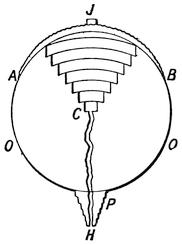
Fig. 20.
The poem of Dante accurately represents the
best scientific knowledge of his day. According
to his views, the centre of the earth was a fixed
point, such that all things
of a heavy nature tended
towards it. Thus the earth
and water collected round
it in the form of a ball.
He had no idea of the
attraction of one particle
of matter for another particle.
The only conception
he had of gravity
was of a force drawing all
heavy things to a certain
point, which thus became the point round which the
world was formed. The habitable part of the earth
was an island, with Jerusalem in the middle of
it J. Round this island was an ocean O. Under
the island, in the form of a hollow cone, was
hell, with its seven circles of torment, each circle
becoming smaller and smaller, till it got down
into the centre C. Heaven was at the opposite
side H of the earth to Jerusalem, and was
beyond the circles of the planets, in the primum
mobile. When Lucifer was expelled from heaven
after his rebellion against God, having become
of a nature to be attracted to the centre of the
earth, and no longer drawn heavenwards, he fell
from heaven, and impinged upon the earth just
at the antipodes of Jerusalem, with such violence
that he plunged right through it to the centre,
throwing up behind him a hill. On the summit
of this hill was the Garden of Eden, where our
first parents lived, and down the sides of the
hill was a spiral winding way which constituted
purgatory. Dante, having descended into hell, and
passed the centre, found his head immediately
turned round so as to point the other way up,
and, having ascended a tortuous path, came out
upon the hill of Purgatory. Having seen this, he
was conducted to the various spheres of the planets,
and in each sphere he became put into spiritual
communion with the spirits of the blessed who
were of the character represented by that sphere,
and he supposes that he was thus allowed to proceed
from sphere to sphere until he was permitted
to come into the presence of the Almighty, who
in the primum mobile presided over the celestial
hosts.
The astronomical descriptions given by Dante of
the rising and setting of the sun and moon and
planets are quite accurate, according to the system
of the world as conceived by him, and show not
only that he was a competent astronomer, but that
he probably possessed an astrolabe and some tables
of the motions of the heavenly bodies.
Our own poet Chaucer may also be credited
with accurate knowledge of the astronomy of his
day. His poems often mention the constellations,
and one of them is devoted to a description of
the astrolabe, an instrument somewhat like the
celestial globe which used to be employed in
schools.
But with the revival of learning in Europe
and the rise of freedom of thought, the old
theories were questioned in more than one
quarter.
It occurred to Copernicus, an ecclesiastic who
lived in the sixteenth century, to re-examine the
theory that had been started in ancient times,
and to consider what explanation of the appearance
of the heavenly bodies could be given on
the hypothesis put forward by Pythagoras, that
the earth moved round on its own axis, and also
round the sun.
It may appear rather curious that two theories so
different, one that the sun goes round the earth
and the other that the earth goes round the sun,
should each be capable of explaining the observed
appearances of those bodies. But it must be
remembered that motion is relative. If in a waltz
the gentleman goes round the lady, the lady
also goes round the gentleman. If you take
away the room in which they are turning, and
consider them as spinning round like two insects
in space, who is to say which of them is at rest
and which in motion? For motion is relative. I
can consider motion in a train from London to York.
As I leave London I get nearer to York, and
I move with respect to London and York. But if
both London and York were annihilated how should
I know that I was in motion at all? Or, again, if,
while I was at rest in the train at a station on the
way, instead of the train moving the whole earth
began to move in a southward direction, and the
train in some way were left stationary, then,
though the earth was moving, and the train was
at rest, yet, so far as I was concerned, the train
would appear to have started again on its journey
to York, at which place it would appear to arrive in
due time. The trees and hedges would fly by at
the proper rate, and who was to say whether the
train was in motion or the earth?
The theory of Copernicus, however, remained
but a theory. It was opposed to the evidence of
the senses, which certainly leads us to think that
the earth is at rest, and it was opposed also to
the ideas of some among the theologians who
thought that the Bible taught us that the earth was
so fast that it could not be moved. Therefore the
theory found but little favour. It was in fact
necessary before the question could be properly
considered on its merits that more should be
known about the laws of motion, and this was
the principal work of Galileo.
The merit of Galileo is not only to have placed
on a firm basis the study of mechanics, but to
have set himself definitely and consciously to
reverse the ancient methods of learning.
He discarded authority, basing all knowledge
upon reason, and protested against the theory
that the study of words could be any substitute
for the study of things.
Alluding to the mathematicians of his day, “This
sort of men,” says Galileo in a letter to the
astronomer Kepler, “fancied that philosophy was
to be studied like the ‘Æneid’ or ‘Odyssey,’ and
that the true reading of nature was to be detected
by the collating of texts.” And most of his life was
spent in fighting against preconceived ideas. It
was maintained that there could only be seven
planets, because God had ordered all things in
nature by sevens (“Dianoia Astronomica,” 1610);
and even the discoveries of the spots on the sun
and the mountains in the moon were discredited
on the ground that celestial bodies could have no
blemishes. “How great and common an error,”
writes Galileo, “appears to me the mistake of those
who persist in making their knowledge and
apprehension the measure of the knowledge and
apprehension of God, as if that alone were perfect
which they understand to be so. But ... nature
has other scales of perfection, which
we, being unable to comprehend, class among
imperfections.
“If one of our most celebrated architects had
had to distribute the vast multitude of fixed
stars over the great vault of heaven, I believe he
would have disposed them with beautiful arrangements
of squares, hexagons, and octagons; he
would have dispersed the larger ones among the
middle-sized or lesser, so as to correspond exactly
with each other; and then he would think he had
contrived admirable proportions; but God, on the
contrary, has shaken them out from His hand as
if by chance, and we, forsooth, must think that
He has scattered them up yonder without any
regularity, symmetry, or elegance.”
In one of Galileo’s “Dialogues” Simplicio says,
“That the cause that the parts of the earth move
downwards is notorious, and everyone knows that
it is gravity.” Salviati replies, “You are out, Master
Simplicio: you should say that everyone knows
that it is called gravity; I do not ask you for the
name, but for the nature, of the thing of which
nature neither you nor I know anything.”
Too often are we still inclined to put the name
for the thing, and to think when we use big words
such as art, empire, liberty, and the rights of
man, that we explain matters instead of obscuring
them. Not one man in a thousand who uses them
knows what he means; no two men agree as to
their signification.
The relativity of motion mentioned above was
very elegantly illustrated by Galileo. He called
attention to the fact that if an artist were making
a drawing with a pen while in a ship that was in
rapid passage through the water, the true line
drawn by the pen with regard to the surface of the
earth would be a long straight line with some small
dents or variations in it. Yet the very same line
traced by the pen upon a paper carried along in the
ship made up a drawing. Whether you saw a long
uneven line or a drawing in the path that the pen
had traced depended altogether on the point of
view with which you regarded its motion.
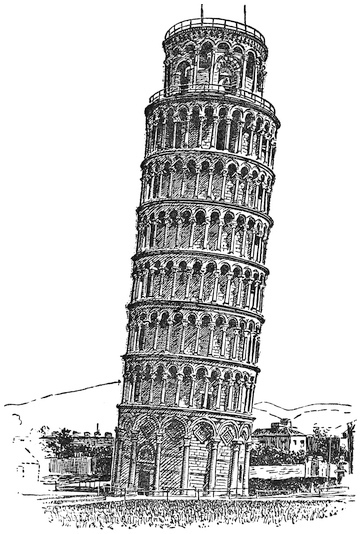
Fig. 21.
But the first great step in science which Galileo
made when quite a young professor at Pisa was the
refutation of Aristotle’s opinion that heavy bodies
fell to the earth faster than light ones. In the
presence of a number of professors he dropped
two balls, a large and a small one, from the
parapet of the leaning tower of Pisa. They fell to
the ground almost exactly in the same time. This
experiment is quite an easy one to try. One of the
simplest ways is as follows: Into any beam (the
lintel of a door will do), and about four inches apart,
drive three smooth pins so as to project each about a
quarter of an inch; they must not have any heads.
Take two unequal weights, say of 1 lb. and 3 lbs.
Anything will do, say a boot for one and pocket-knife
for the other; fasten loops of fine string to
them, put the loops over the centre peg of the
three, and pass the strings one over each of the
side pegs. Now of course if you hitch the loops off
the centre peg P the objects will be released together.
This can be done by making a loop at the end of
another piece of string, A, and putting it on to the
centre peg behind the other loops. If the string
be pulled of course the loop on it pulls the other
two loops off the central peg, and allows the boot
and the knife to drop.
The boot and the knife
should be hung so as to
be at the same height.
They will then fall to the
ground together. The
same experiment can be
tried by dropping two
objects from an upper
window, holding one in
each hand, and taking care to let them go together.
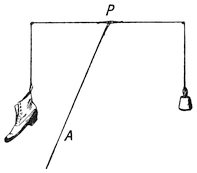
Fig. 22.
This result is very puzzling; one does not understand
it. It appears as though two unequal forces
produced the same effect. It is as though a strong
horse could run no faster than a weaker one.
The professors were so irritated at the result of
this experiment, and indeed at the general character
of young Professor Galileo’s attacks on the time-honoured
ideas of Aristotle, that they never rested
till they worried him out of his very poorly paid
chair at Pisa. He then took a professorship at
Padua.
Let us now examine this result and see why it is
that the ideas we should at first naturally form are
wrong, and that the heavy body will fall in exactly
the same time as the light one.
We may reason the matter in this way. The
heavy body has more force pulling on it; that is
true, but then, on the other hand there is more
matter which has got to be moved. If a crowd of
persons are rushing out of a building, the total
force of the crowd will be greater than the force of
one man, but the speed at which they can get out
will not be greater than the speed of one man; in
fact, each man in the crowd has only force enough
to move his own mass. And so it is with the
weights: each part of the body is occupied in moving
itself. If you add more to the body you only add
another part which has itself to move. A hundred
men by taking hands cannot run faster than one
man.
But, you will say, cannot a man run faster
than a child? Yes, because his impelling power
is greater in proportion to his weight than that
of a child.
If it were the fact that the attraction of gravity
due to the earth acted on some bodies with forces
greater in proportion to their masses than the
forces that acted on other bodies, then it is true
that those different bodies would fall in unequal
time. But it is an experimental fact that the
attractive force of gravity is always exactly proportional
to the mass of a body, and the resistance to
motion is also proportional to mass, hence the force
with which a body is moved by the earth’s attraction
is always proportional to the difficulty of moving
the body. This would not be the case with other
methods of setting a body in motion. If I kick a
small ball with all my might, I shall send it further
than a kick of equal strength would send a heavier
ball. Why? Because the impulse is the same in
each case, but the masses are different. But if
those balls are pulled by gravity, then, by the very
nature of the earth’s attraction (the reason of which
we cannot explain), the small ball receives a little
pull, and the big ball receives a big pull, the earth
exactly apportioning its pull in each case to the
mass of the body on which it has to act. It is to
this fact, that the earth pulls bodies with a strength
always in each case exactly proportional to their
masses, that is due the result that they fall in
equal times, each body having a pull given to it
proportional to its needs.
The error of the view of Aristotle was not only
demonstrated by Galileo by experiment, but was
also demonstrated by argument. In this argument
Galileo imitated the abstract methods of the
Aristotelians, and turned those methods against
themselves. For he said, “You” (the Aristotelians)
“say that a lighter body will fall more slowly than a
heavy one. Well, then, if you bind a light body on
to a heavy one by means of a string, and let them
fall together, the light body ought to hang behind,
and impede the heavy body, and thus the two
bodies together ought to fall more slowly than the
heavy body alone; this follows from your view:
but see the contradiction. For the two bodies tied
together constitute a heavier body than the heavy
body alone, and thus, on your own theory, ought
to fall more quickly than the heavy body alone.
Your theory, therefore, contradicts itself.”
The truth is that each body is occupied in moving
itself without troubling about moving its neighbour,
so that if you put any number of marbles into a
bag and let them drop they all go down individually,
as it were, and all in the time which a single marble
would take to fall. For any other result would be
a contradiction. If you cut a piece of bread in two,
and put the two halves together, and tie them
together with a thread, will the mere fact that they
are two pieces make each of them fall more slowly
than if they were one? Yet that is what you would
be bound to assert on the Aristotelian theory. Hold
an egg in your open hand and jump down from a
chair. The egg is not left behind; it falls with you.
Yet you are the heavier of the two, and on Aristotelian
principles you ought to leave the egg
behind you. It is true that when you jump down
a bank your straw hat will often come off, but that
is because the air offers more resistance to it than
the air offers to your body. It is the downward
rush through the air that causes your hat to be left
behind, just as wind will blow your hat off without
blowing you away. For since motion is relative, it
is all one whether you jump down through the air,
or the air rushes past you, as in a wind. If there
were no air, the hat would fall as fast as your
body.
This is easy to see if we have an airpump and
are thus enabled to pump out almost all the air
from a glass vessel. In that vessel so exhausted, a
feather and a coin will fall in equal times. If we
have not an airpump, we can try the experiment
in a more simple way. For let us put a feather
into a metal egg-cup and drop them together. The
cup will keep the air from the feather, and the
feather will not come out of the cup. Both will
fall to the ground together. But if the lighter body
fall more slowly, the feather ought to be left behind.
If, however, you tie some strings across a napkin
ring so as to make a sort of rough sieve, and put a
feather in it, and then drop the ring, then as the
ring falls the air can get through the bottom of the
ring and act on the feather, which will be left
floating as the ring falls.
Let us now go on to examine the second fallacy
that was derived from the Aristotelians, and that so
long impeded the advance of science, namely, that
the earth must be at rest.
The principal reason given for this was that if
bodies were thrown up from the earth they ought,
if the earth were in motion, to remain behind.
Now, if this were so, then it would follow that if a
person in a train which was moving rapidly threw
a ball vertically, that is perpendicularly, up into
the air, the ball, instead of coming back into his
hand, ought to hit the side of the carriage behind
him. The next time any of my readers travel by
train he can easily satisfy himself that this is not
so. But there are other ways of proving it. For
instance, if a little waggon running on rails has a
spring gun fixed in it in a perpendicular position,
so arranged that when the waggon comes to a
particular point on the rails a catch releases the
trigger and shoots a ball perpendicularly upwards,
it will be found that the ball, instead of going
upwards in a vertical line, is carried along over the
waggon, and the ball as it ascends and descends
keeps always above the waggon, just as a hawk
might hover over a running mouse, and finally falls
not behind the waggon, but into it.
So, again, if an article is dropped out of the
window of a train, it will not simply be left behind
as it falls, but while it falls it will also partake of
the motion of the train, and touch the ground, not
behind the point from which it was dropped, but
just underneath it.
The reason is, that when the ball is dropped or
thrown it acquires not only the motion given to it
by the throw, or by gravity, but it takes also the
motion of the train from which it is thrown. If
a ball is thrown from the hand, it derives its motion
from the motion of the hand, and if at the time of
throwing the person who does so is moving rapidly
along in a train, his hand has not only the outward
motion of the throw, but also the onward motion of
the train, and the ball therefore acquires both
motions simultaneously. Hence then it is not
correct reasoning to say, because a ball thrown up
vertically falls vertically back to the spot from
which it was thrown, that therefore the earth must
be at rest; the same result will happen whether
the earth is at rest or in motion. You can no
more tell whether the earth is at rest or in motion
from the behaviour of falling bodies than you can
tell whether a ship on the ocean is at rest or in
motion from the behaviour of bodies on it.
But you will say. Then why do we feel sea-sick
on a ship? The answer is, that that is because the
motion of the ship is not uniform. If the earth,
instead of turning round uniformly, were to rock to
and fro, everything on it would be flung about in
the wildest fashion. For as soon as the earth had
communicated its motion to a body which then
moved with the earth, if the earth’s motion were
reversed, the body would go on like a passenger in
a train on which the break is quickly applied, and
he would be shot up against the side of the room.
Nay, more, the houses would be shaken off their
foundations. Changes of motion are perceptible
so long as the change is going on. We are therefore
justified in inferring from the behaviour of
bodies on the earth, not that the earth is at rest,
but that it is either at rest, or
else, if it is in motion, that its
motion is uniform and not in
jerks or variable.
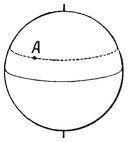
Fig. 23.
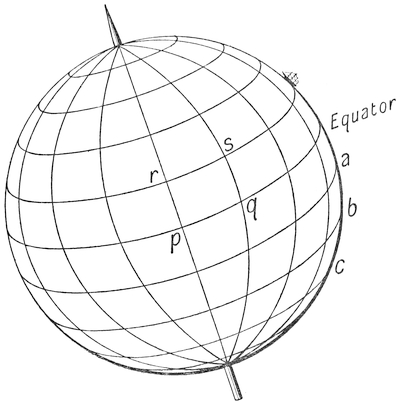
For if it were not so, consider
what would be happening around
us. The earth is about 8,000
miles in diameter, and a parallel
of latitude through London is therefore about
19,000 miles long, and this space is travelled in
twenty-four hours. So that London is spinning
through space at the rate of over 1,000 feet a
second, due to the earth’s rotary motion alone,
not to speak of the motion due to the earth’s
path round the sun. If a boy jumped up two and
a half feet into the air, he would take about half a
second to go up and come down, but if in jumping
he did not partake of the earth’s motion, he would
land more than 500 feet to the westward of the
point from which he jumped up, and if he did it in
a room, he would be dashed against the wall with a
force greater than he would experience from a drop
down from the top of Mont Blanc. He would be
not only killed, but dashed into an indistinguishable
mass. If the earth suddenly stood still, everything
on it would be shaken to pieces. It is bad
enough to have the concussion of a train going
thirty miles an hour when dashed against some
obstacle. But the concussion due to the earth’s
stoppage would be as of a train going about 800
miles an hour, which would smash up everything
and everybody.
Thus, then, the first effect of the new ideas
formulated by Galileo was to show that the Copernican
theory that the earth moved round on its
axis, and round the sun, was in agreement with
the laws of motion. In fact, he introduced quite
new ideas of force, and these ideas I must now
endeavour to explain.
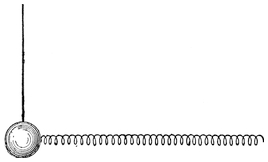
Let us consider what is meant by the word
“force.” If I press my hand against the table, I
exert force. The harder I press, the more force there
is. If I put a weight on a stand, the weight presses
the stand down with a force. If I squeeze a spring,
the spring tries to recover itself and exerts a certain
force. In all these cases force is considered as a
pressure. And I can measure the force by seeing
how much it will press things. If I take a spring,
and press it in an inch, it takes perhaps a force of
1 lb. It will take a force of 2 lbs. to press it in
another inch. Or again, if I pull it out an inch, it
takes a force of 1 lb. If I pull it out another inch,
it takes a force of 2 lbs. We thus always get into
the habit of conceiving forces as producing pressures
and being measured by pressures.
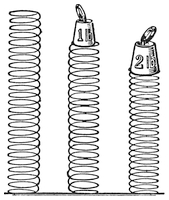
Fig. 24.
This is a perfectly legitimate way of looking at
the matter, just as the cook’s method of employing
a spring balance to weigh masses of meat is a perfectly
legitimate way of estimating
the forces acting
upon bodies at rest. But
when you come to consider
the laws of the pendulums
of clocks, to which all that I
am saying is a preparation,
then you have to deal with
bodies in motion. And for
this purpose a new idea of
force altogether is requisite.
We shall no longer speak of forces as producing
pressures. We shall treat them quite independently
of their pressing power. The sun exerts a force of
attraction on the earth, but it does not press upon
it. It exerts its force at a distance. Hence then
we want a new idea of “force.” This idea is to be
the following. We will consider that when a force
acts upon a body it endeavours to cause it to move;
in fact, it tries to impart motion to the body. We
may treat this motion as a sort of thing or property.
The longer the force acts on the body, the more
motion it imparts to it, provided the body is free to
receive that motion. So that we may say that the
test of the strength of the force is how much
motion it can give to a body of a given mass in a
given time. It does not matter how the force
acts. It may act by means of a string and pull it;
it may act by means of a stick and push it; it may act
by attraction and draw it; it may act by repulsion
and repel it; it may act as a sort of little spirit and
fly away with it. In all these cases it acts. The more
it acts, the more effect it has. In double the time it
produces double the motion. If the mass is big, it
takes more force to make the mass move; if the
mass of the body is small, it is moved more easily.
Therefore when we want to measure a force in this
way we do not press it against springs to see how
much it will press them in. What we do is to
cause it to act on bodies that are free to move and
see what motions it will produce in them. Of course
we can only do this with things that are free to
move. You cannot treat force in this way if you have
only a pair of scales; in that case you would have
to be content with simply measuring pressures. It
is important clearly to grasp this idea. If a body
has a certain mass, then the force acting on it is
measured by the amount of motion that will in a
given time be imparted to that mass, provided that
the mass is free to move. This is to be our definition
of force.
Therefore, by the action of an attraction or any
other force on a body free to move; motion is continually
being imparted to the body. Motion is, as
it were, poured into it, and therefore the body continually
moves faster and faster.
Here is a ball flying through the air. Let us
suppose that forces are acting on it. How can we
measure them? We cannot feel what pressures are
being exerted on it. The only thing we can do is
to watch its motions, and see how it flies. If it
goes more and more quickly, we say, “There is
propelling force acting on it”; if it begins to stop,
we say again, “There is retarding force acting on
it.” So long as it does not change its speed or
direction, we say, “There is no force acting on it.”
By this method, therefore, we tell whether a body
is being acted on by force, simply by observing
its speed or its change of speed. Merely to say a
body is moving does not tell us that force is acting
on it. All we know is that, if it is moving, force has
acted on it. It is only when we see it changing its
speed or direction, that is changing its motion, that
we say force is acting. Every change of motion,
either in direction or speed, must be the result of
force, and must be proportional to that force.
This is what we mean when we say motion is the
test and measure of force.
This most interesting way of looking at the
matter lies at the root of the whole theory of
mechanics. It is the foundation of the system which
the stupendous genius of Newton conceived in order
to explain the motion of the sun, moon, and stars.
Forces were treated by him as proportional to
the motions, and the motions proportional to the
forces, and with this idea he solved a part of the
riddle of the universe. Galileo had partly seen the
same thing, but he never saw it so clearly as
Newton. Great discoveries are only made by seeing
things clearly. What required the force of a genius
in one age to see in the next may be understood by
a child.
Hence then we say a force is that which in a given
time produces a given motion in a given mass which
is free to move.
You must have time for a force to act in; for
however great the force, in no time there can be
no motion. You must have mass for a force to
act on; no mass, no effect. You must have free
space for the mass to move in; no freedom to move,
no movement.
But what is this “mass”? We do not know;
it is a mystery. We call it “quantity of matter.”
In uniform substances it varies with size. Double
the volume, double the mass. Cut a cake in half,
each half has the same “mass.” But then is mass
“weight”? No, it is not. Weight is the action of
the earth’s attraction on matter. No earth to attract,
and you would have no weight, but you would still
have “mass.” What then is matter? Of that we
have no idea. The greatest minds are now at work
upon it. But mass is quantity of matter. Knock a
brick against your head, and you will know what
mass is. It is not the weight of the brick that gives
you a bump; it is the mass. Try to throw a ball
of lead, and you will know what mass is. Try
to push a heavy waggon, and you will know what
mass is. Weights, that is earth attractions on masses,
are proportional to the masses at the same place.
This, as we have seen, is known by experiment.
Therefore, when a force acts for a certain time
on a mass that is free to move, however small the
force and however small the time, that body will
move. When a baby in a temper stamps upon the
earth it makes the earth move—not much, it is true,
but still it moves; nay, more, in theory, not a fly
can jump into the air without moving the earth and
the whole solar system. Only, as you may imagine
they do not show it appreciably. Still, in theory
the motion is there.
Hence then there are two different ways of considering
and estimating forces, one suitable for
observations on bodies at rest, the other suitable
for observations of bodies that are free to move.
The force of course always tends to produce motion.
If, however, motion is impossible, then it develops
pressures which we can measure, and calculate,
and observe. If the body is free to move, then the
force produces motions which we can also measure,
calculate, and observe. And we can compare these
two sets of effects. We can say, “A force which,
acting on a ball of a mass of one pound, would produce
such and such motions, would if it acted on a
certain spring produce so much compression.”
The attraction of the earth on masses of matter
that are not free to move gives rise to forces which
are called weights. Thus the attraction of gravitation
on a mass of one pound produces a pressure
equal to a weight of one pound. Unfortunately the
same word “pound” is used to express both the
mass and the weight, and has come down to us from
days when the nature of mass was not very well
appreciated. But great care must be taken not to
confuse these two meanings.
But the earth’s attractions and all other forces
acting upon matter which is free to move give rise
to changes of motion. The word used for a change
of motion is “acceleration” or a quickening. “He
accelerated his pace,” we say. That is, he quickened
it; he added to his motion. So that force, acting
on mass during a time, produces acceleration.
From this, then, it follows that if a force continues
to act on a body the body keeps moving
quicker and quicker. When the force stops acting,
the motion already acquired goes on, but the
acceleration stops. That is to say, the body goes
on moving in a straight line uniformly at the pace
it had when the force stopped.
If, then, a body is exposed to the action of a force,
and held tight, what will happen? It will, of
course, remain fixed. Now let it go—it will then,
being a free body, begin to move. As long as the
force acts, the force keeps putting more and more
motion into the body, like pouring water into a
jug, the longer you pour the faster the motion
becomes. The body keeps all the motion it had,
and keeps adding all the motion it gains. It is like
a boy saving up his weekly pocket-money: he has
what he had, and he keeps adding to that. So if
in one second a motion is imparted of one foot a
second, then in another second a motion of one foot
a second more will be added, making together a
motion of two feet a second; in another second of
force action the motion will have been increased or
“accelerated” by another foot per second, and so
on. The speed will thus be always proportional to
the force and the time. If we write the letter V to
represent the motion, or speed, or velocity; F to
represent the acceleration or gain of motion; and
T to represent the time, then V = FT. Here V is
the velocity the body will have acquired at the end
of the time T, if free to move and submitted to a
force capable of producing an acceleration of F feet
per second in a unit of time.
V is the final velocity. The average velocity will
be 1/2 V, for it began with no velocity and increased
uniformly. How far will the body have fallen in
the interval? Manifestly we get that by multiplying
the time by the average velocity, that is
S = 1/2 VT, where V, as I said, is the final velocity,
but we found that V = FT. Hence by substitution
S = 1/2 FT × T = 1/2 FT².
It is to be carefully borne in mind that these
letters V, S, and T do not represent velocities,
spaces, and times, but merely represent arithmetical
numbers of units of velocities, spaces,
and times. Thus V represents V feet per second,
S represents S feet, and T represents T seconds.
And when we use the equation V = FT we do
not mean that by multiplying a force by a
time you can produce a velocity. If, for instance,
it be true that you can obtain the number of
inhabitants (H) in London by multiplying the
average number of persons (P) who live in a house
by the number of houses (N), this may be expressed
by the equation H = PN. But this does not
mean that by multiplying people into houses you
can produce inhabitants. H, P, and N are numbers
of units, and they are numbers only.
Therefore when a body is being acted on by an
accelerating force it tends to go faster and faster as
it proceeds, and therefore its velocity increases with
the time. But the space passed through increases
faster still, for as the time runs on not only does
the space passed through increase, but the rate of
passing also gets bigger. It goes on increasing at
an increasing rate. It is like a man who has an
increasing income and always goes on saving it.
His total mounts up not merely in proportion to the
time, but the very rate of increase also increases
with the time, so that the total increase is in proportion
to the time multiplied into the time, in
other words to the square of the time. So then, if
I let a body drop from rest under the action of any
force capable of producing an acceleration, the space
passed through will be as the square of the time.
Now let us see what the speed will be if the force
is gravity, that is the attraction of the earth.
Turning back to what was said about Galileo, it
will be remembered that he showed that all bodies,
big and small, light and heavy, fell to the earth at
the same speeds. What is that speed? Let us
denominate by G the number of feet per second of
increase of motion produced in a body by the earth’s
action during one second. Then the velocity at the
end of that second will be V = GT. The space
fallen through will be S = 1/2 GT².
What I want to know then is this: how far will a
body under the action of gravity fall in a second of
time?
This, of course, is a matter for measurement. If
we can get a machine to measure seconds, we shall
be able to do it; but inasmuch as falling bodies
begin by falling sixteen feet in the first second and
afterwards go on falling quicker and quicker, the
measurements are difficult. Galileo wanted to see
if he could make it easier to observe. He said to
himself, “If I can only water down the force of
gravity and make it weaker, so that the body will
move very slowly
under its action,
then the time of
falling will be
easier to observe.”
But how
to do it? This
is one of those
things the discovery
of which
at once marks
the inventor.
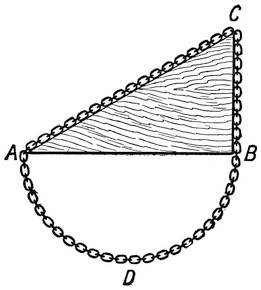
Fig. 25.
The idea of
Galileo was, instead
of letting the body drop vertically, to make
it roll slowly down an incline, for a body put upon
an incline is not urged down the incline with the
same force which tends to make it fall vertically.
Can any law be discovered tending to show what
the force is with which gravity tends to drag a mass
down an incline?
There is a simple one, and before Galileo’s time
it had been discovered by Stevinus, an engineer.
Stevinus’ solution was as follows. Suppose that
A B C is a wedge-shaped block of wood. Let a loop
of heavy chain be hung over it, and suppose that
there is a little pulley at C and no friction anywhere.
Then the chain will hang at rest. But the
lower part, from A to B, is symmetrical; that is to
say, it is even in shape on both sides. Hence, so far
as any pull it exerts is concerned, the half from
A to D will balance the other half from B to D.
Therefore, like weights in a scale, you may remove
both, and then the force of gravity acting down the
plane on the part A C will balance the force of
gravity acting vertically on the part C B. Now the
weight of any part of the chain, since it is uniform,
is proportional to its length. Hence, then, the
gravitational force down the plane of a piece
whose weight equals C A is equal to the gravitational
force vertically of a piece whose weight
equals C B. In other words, the force of gravity
acting down a plane is diminished in the ratio of
C B to C A.
But when a body falls vertically, then, as we
have seen, S = 1/2 GT², where S is the space it
will fall through, G the number of feet per second
of velocity that gravity, acting vertically on a body,
will produce in it in a second, and T the number of
seconds of time. If then, instead of falling vertically,
the body is to fall obliquely down a plane,
instead of G we must put as the accelerating force
G × (vertical height of the end of the plane)/(length of the plane).
To try the experiment, he took a beam of wood
thirty-six feet long with a groove in it. He inclined
it so that one end was one foot higher than the
other. Hence the acceleration down the plane was
1/36 G, where G is the vertical acceleration due to
gravity which he wanted to discover. Then he
measured the time a brass ball took to run down
the plane thirty-six feet long, and found it to be
nine seconds. Whence from the equation given
above 36 feet = 1/2 acceleration of gravity down the
plane × (9 seconds)². Whence it follows that
the acceleration of gravity down the plane is
(36 × 2)/(9)² feet per second.
But the slope of the plane is one thirty-sixth to
the vertical. Therefore the vertical acceleration
of gravity, i.e., the velocity which gravity would
induce in a vertical direction in a second, is equal
to thirty-six times that which it exercises down
the plane, i.e.,
36 × (36 × 2)/(9)²; and this equals 32 feet per second.
Though this method is ingenious, it possesses two
defects. One is the error produced by friction, the
other from failure to observe that the force of
gravity on the ball is not only exerted in getting it
down the plane, but also in rotating it, and for this
no allowance has been made. The allowance to be
made for rotation is complicated, and involves more
knowledge than Galileo possessed. Still the result
is approximately true.
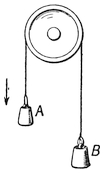
Fig. 26.
The next attempt to measure G, that is the
velocity that gravity will produce on a body in a
second of time, was made by Attwood, a Cambridge
professor. His idea was to weaken the force
of gravity and thus make the
action slow, not by making it act
obliquely, but by allowing it to act,
not on the whole, but only on a portion
of the mass to be moved. For
this purpose he hung two equal
weights over a very delicately constructed
pulley. Gravity, of course,
could not act on these, for any effect
it produced on one would be negatived by its effect
on the other. The weights would therefore remain
at rest. If, however, a small weight W, equal say
to a hundredth of the combined weight of the weights
A and B and W, were suddenly put on A, then it
would descend under an accelerating force equal to
a hundredth part of ordinary gravity. We should
then have
S (the space moved through by the weights) = 1/2 × G/100 × t².
With such a system, he found that in 7½ seconds
the weights moved through 9 feet. Whence he got
9 = 1/2 G/100 × (7½)².
From which
G = (2 × 9 × 100)/(7½)² = 32 feet per second nearly.
Thus by letting gravity only act on a hundredth
part of the total weight moved, namely A, B, and
W, he weakened its action 100 times, and thus
made the time of falling and the space fallen through
sufficiently large to be capable of measurement. To
sum up, when a body free to move is acted upon
by the force of gravity, its speed will increase in
proportion to the time it has been acted upon, and
the space it will pass through from rest is proportional
to the square of the time during which
the accelerating force has acted on it.
Gravity is, of course, not the only accelerating
force with which we are acquainted. If a spring
be suddenly allowed to act on a body and pull it,
the body begins to move, and its action is gradually
accelerated, just as though it were attracted, and
the acceleration of its motion will be proportional
to the time during which the accelerating force acts.
Similarly, if gunpowder be exploded in a gun-barrel,
and the force thus produced be allowed to act on a
bullet, the motion of the bullet is accelerated so
long as it is in the barrel. When the bullet leaves
the barrel it goes on with a uniform pace in a
straight line, which, however, by the earth’s attraction
is at once deflected into a curve, and altered
by the resistance of the air.
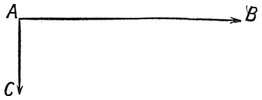
Fig. 27.
It has been already stated that motions may be
considered independently one of another, so that if
a body be exposed to two different forces the action
of these forces can be considered and calculated
each independently of the other. Let us take an
example of this law. We have seen if a body
is propelled forwards, and then the force acting
on it ceases, that
it proceeds on
with uniform unchanging
velocity,
and if nothing
impeded it,
or influenced it, it would go on in a straight line at
a uniform speed.
We have also seen that if a body is exposed to
the action of an accelerating force such as gravity
it constantly keeps being accelerated, it constantly
keeps gaining motion, and its speed becomes quicker
and quicker.
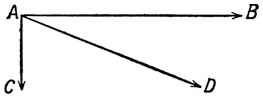
Fig. 28.
Let us suppose a body exposed to both of these
forces at the same time. Shoot it out of a cannon,
and let an accelerating force act on it, not in the
direction it is going, but in some other direction,
say at right angles. What will happen? In the
direction in which it is going, its speed will remain
uniform. In the direction in which the accelerating
force is acting, it will move faster and faster. Thus
along A B it will proceed uniformly. If it proceeded
uniformly also along A C (as it would do if a simple
force acted on it and then ceased to act), then as a
result it would go in the oblique line A D, the
obliquity being determined by the relative magnitude
of the forces acting on it. But how if it went
uniformly along A B, but at an accelerated pace
along A C? Then while in equal times the distances
along A B would be uniform the distances in the
same times along
A C would be
getting bigger
and bigger. It
would not describe
a straight line; it
would go in a curve. This is very interesting. Let
us take an example of it. Suppose we give a ball a
blow horizontally; as soon as it quits the bat it
would of course go on horizontally in a straight
line at a uniform speed; but now if I at the same
instant expose it to the accelerating force of gravity,
then, of course, while its horizontal movement will
go on uniformly, its downward drop will keep
increasing at a speed varying as the time. And
while the total distances horizontally will be uniform
in equal times, the total downward drop from A B
will be as the squares of the times. Here, then,
you have a point moving uniformly in a horizontal
direction, but as the squares of the times in a
vertical direction. It describes a curve. What
curve? Why, one whose distances go uniformly
one way, but increase as the squares the other way.
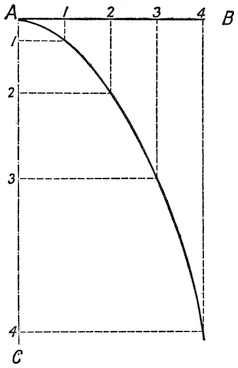
Fig. 29.
This interesting
curve is called a
parabola. With a
ball simply hit by
a bat, the motion is
so very fast that we
cannot see it well.
Cannot we make it
go slowly? Let us
remember what
Galileo did. He used
an inclined plane to
water down his force
of gravity. Let us
do the same. Let
us take an inclined
plane and throw on
it a ball horizontally. It will go in a curve. Its
speed is uniform horizontally, but is accelerated
downwards. If we desire to trace the curve it is
easy to do. We coat the ball with cloth and then
dip it in the inkpot. It will then describe a visible
parabola. If I tilt up the plane and make the
force of gravity big, the parabola is long and thin;
if I weaken down the force of gravity by making
the plane nearly horizontal, then it is wide and
flat.
One can also show this by a stream of peas or
shot. The little bullets go each with a uniform
velocity horizontally, and an accelerated force
downwards.
Instead of peas we can use water. A stream of
it rushing horizontally out of an orifice will soon
bend down into a parabola.
Thus then I have tried to show what force is
and how it is measured. I repeat again, when a
body is free to move, then, if no further force acts on
it, it will go on in a straight line at a uniform speed,
but if a force continues to act on it in any direction,
then that force produces in each unit of time a unit
of acceleration in the direction in which the force
acts, and the result is that the body goes on moving
towards the direction of acceleration at a constantly
increasing speed, and hence passing over spaces
that are greater and greater as the speed increases.
This is the notion of a “force.” In all that has
been said above it has been assumed that the
attraction of gravity on a body does not increase as
that body gets nearer to the earth. This is not
strictly true; in reality the attractive force of
gravity increases as the earth’s centre is approached.
But small distances through which the weights in
Attwood’s machine fall make no appreciable
difference, being as nothing compared to the
radius of earth. For practical purposes, therefore,
the force may be considered uniform on bodies that
are being moved within a few feet of the earth’s
surface. It is only when we have to consider the
motions of the planets that considerations of the
change of attractive force due to distance have to
be considered.
I am glad to say that the most tiresome, or rather
the most difficult, part of our inquiry is now over.
With the help of the notions already acquired, we
are now ready to get to the pendulum, and to show
how it came about that a boy who once in church
amused himself by watching the swinging of the
great lamps instead of attending to the service laid
the foundation of our modern methods of measuring
time.