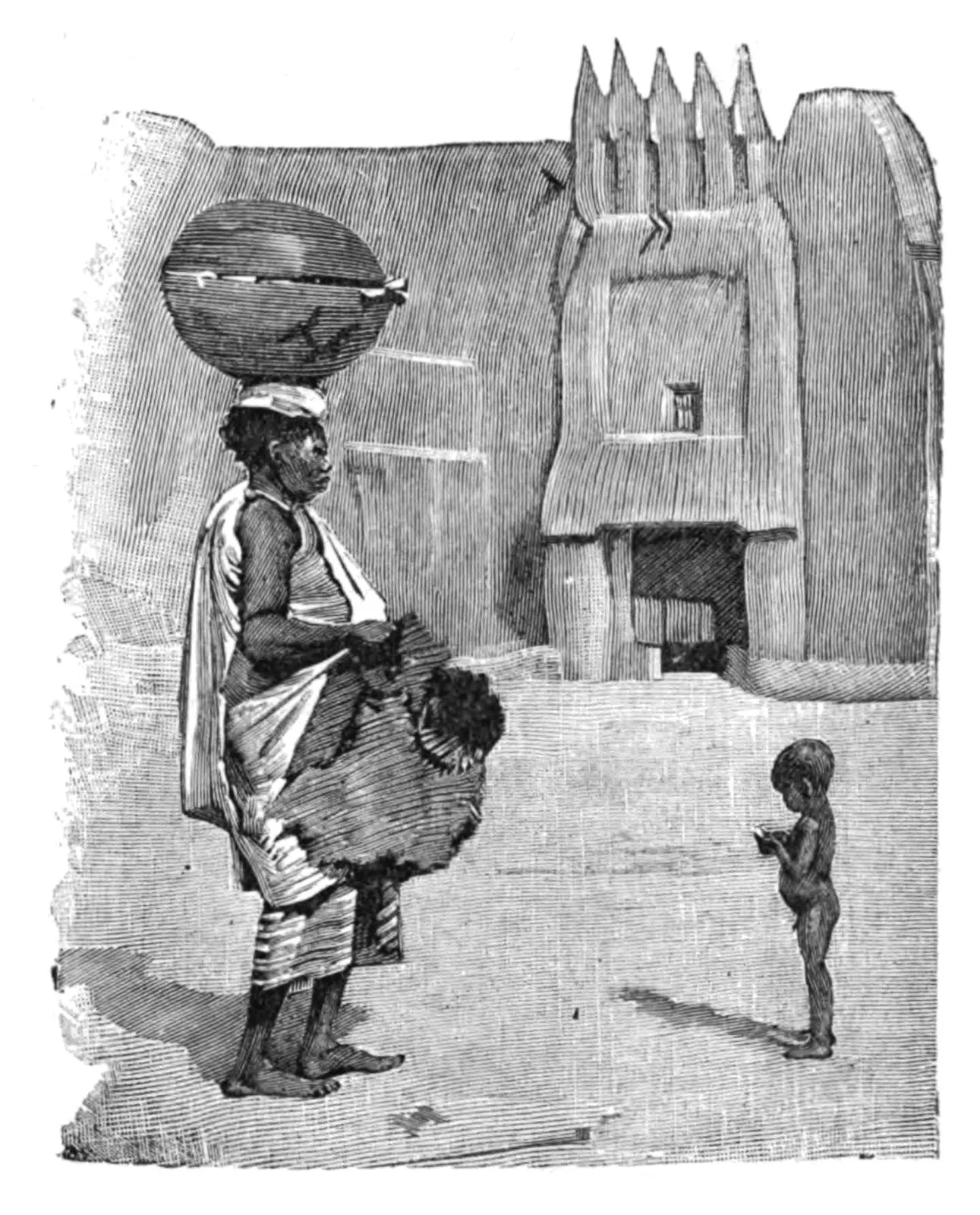
The journey from Paris to the Niger is scarcely so simple as
that from Nice to Algeria.
Having fallen asleep in a railway carriage on your departure
from Paris, you awake six weeks later on a canoe-barge upon
the Niger.
The steamer lands you at the entrance to the Senegal, in a
country which has belonged to France for centuries, and yet is
only known to the general public by its thermometrical mention,
inscribed between ‘bains ordinaires’ and ‘culture des vers à
soie’ at 40° centigrade as ‘the temperature of Senegal.’ These
rudimentary notions are not even accurate. Will you believe
that for months there you wear your greatcoat morning and
evening, the mean temperature registered at the local observatory
being 24°, not 40°?
From Dakar (the port of Senegal, and the finest harbour on
the west coast of Africa) you go by train to St. Louis, the
capital of the colony. Greeting to those one hundred and seventy
odd miles of iron road! They are the first laid by Europeans
in Negraic Africa, and date from 1882. Civilisation has stamped
other of its signs upon these virgin soils. In St. Louis and at
Rufisk (an important commercial town in Dakar Bay) you find
the streets lighted by electricity; and universal suffrage is
vigorously handled under the form of legislative elections, municipalities,
and general elections. Betting and horse-racing are
treated with equal vigour.
A small service of steamers starts regularly twice a week from
the quays of St. Louis for the Sudan. The management on
board is comfortable and dear; and you play poker in the saloon
just as on any big self-respecting steamer. For eight days you
watch the banks of the Senegal monotonously unfold; then comes
the morning when you moor on a broken bank at the foot of a
huge tree. This is Kayes, the port and actual capital of the
Sudan.
A pestilential corner, and the solution of the following difficult
problem: How to be at the same time a town in the middle of a
swamp and a swamp in the middle of a town. This anomalous
method of building a town makes you think for a moment that
you have arrived at the end of the world, but you recover your
self-possession on seeing the telegraph wires crossing the street
and on hearing the whistle of the locomotives. A railway in fact
continues the path from the Senegal to the Niger, and will one
day carry the traveller right up to Bammaku so easily that we
shall be able to reckon it a fortnight from Paris to the Niger.
At present the railway only extends 108 of the 341 miles that
separate Kayes from Bammaku. For the first 78 miles its track
(reduced to a three-foot way as are certain local lines in France) is
normal and open to commercial traffic. Its administration and
maintenance are in the hands of military engineers, and the
trains arrive at both ends with remarkable punctuality. Its only
mistake is in stopping at Bafoulaba, where the Bafing and the
Bakoy unite to form the Senegal. After that you have to content
yourself, for the present, with a décauville for the 130 miles
to Dioubaba.
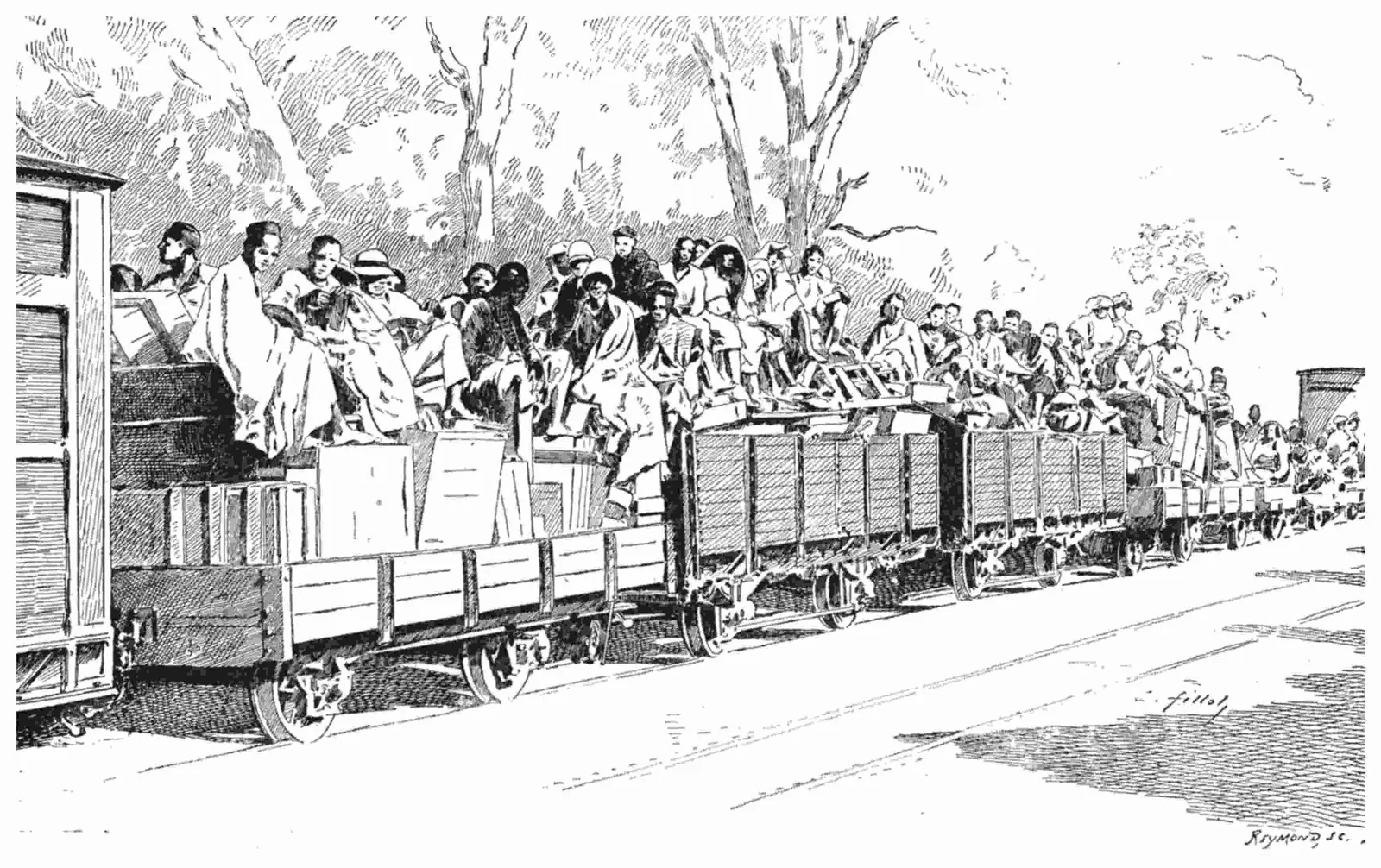
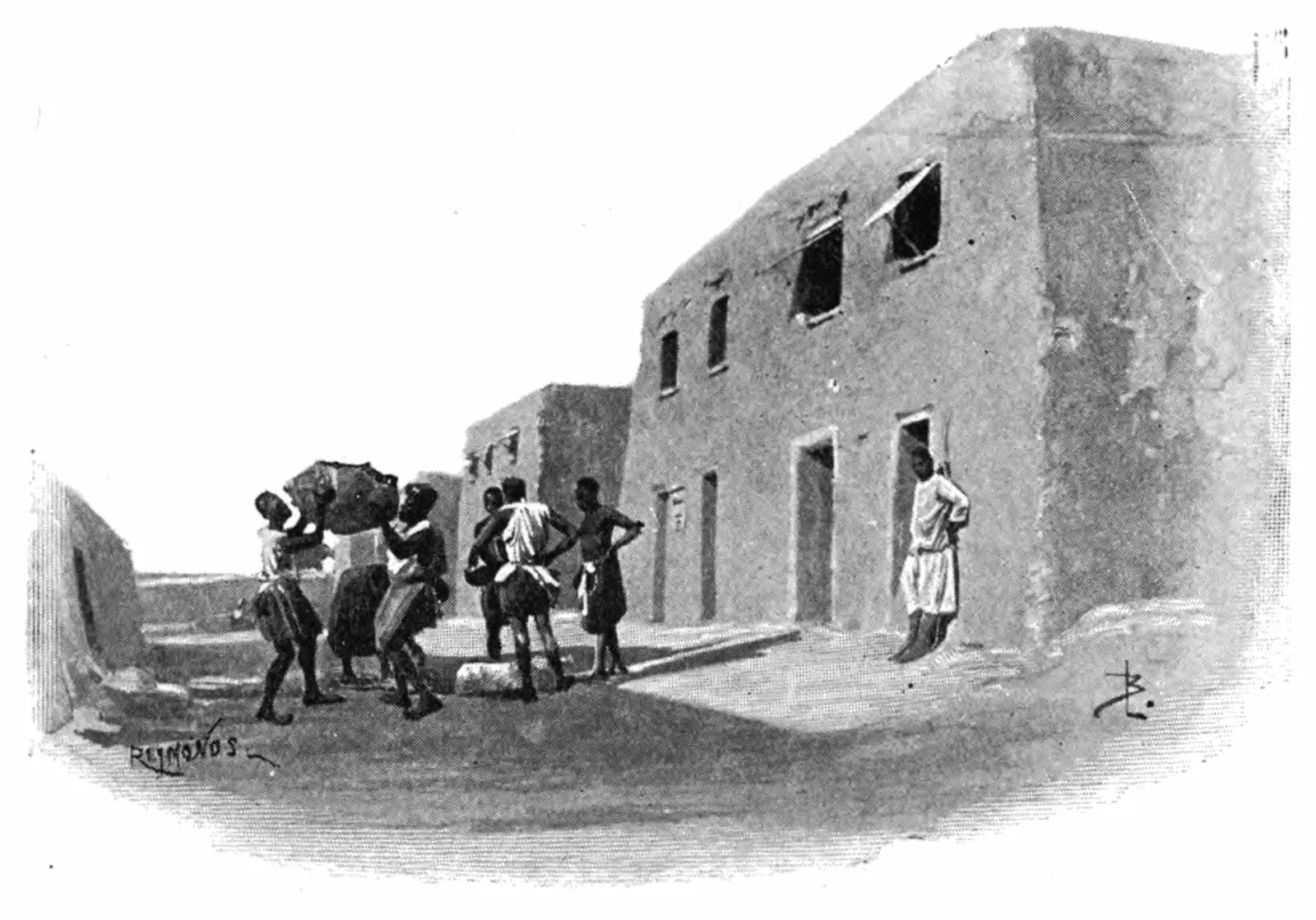
A TRAIN IN THE SUDAN: NATIVE PASSENGERS
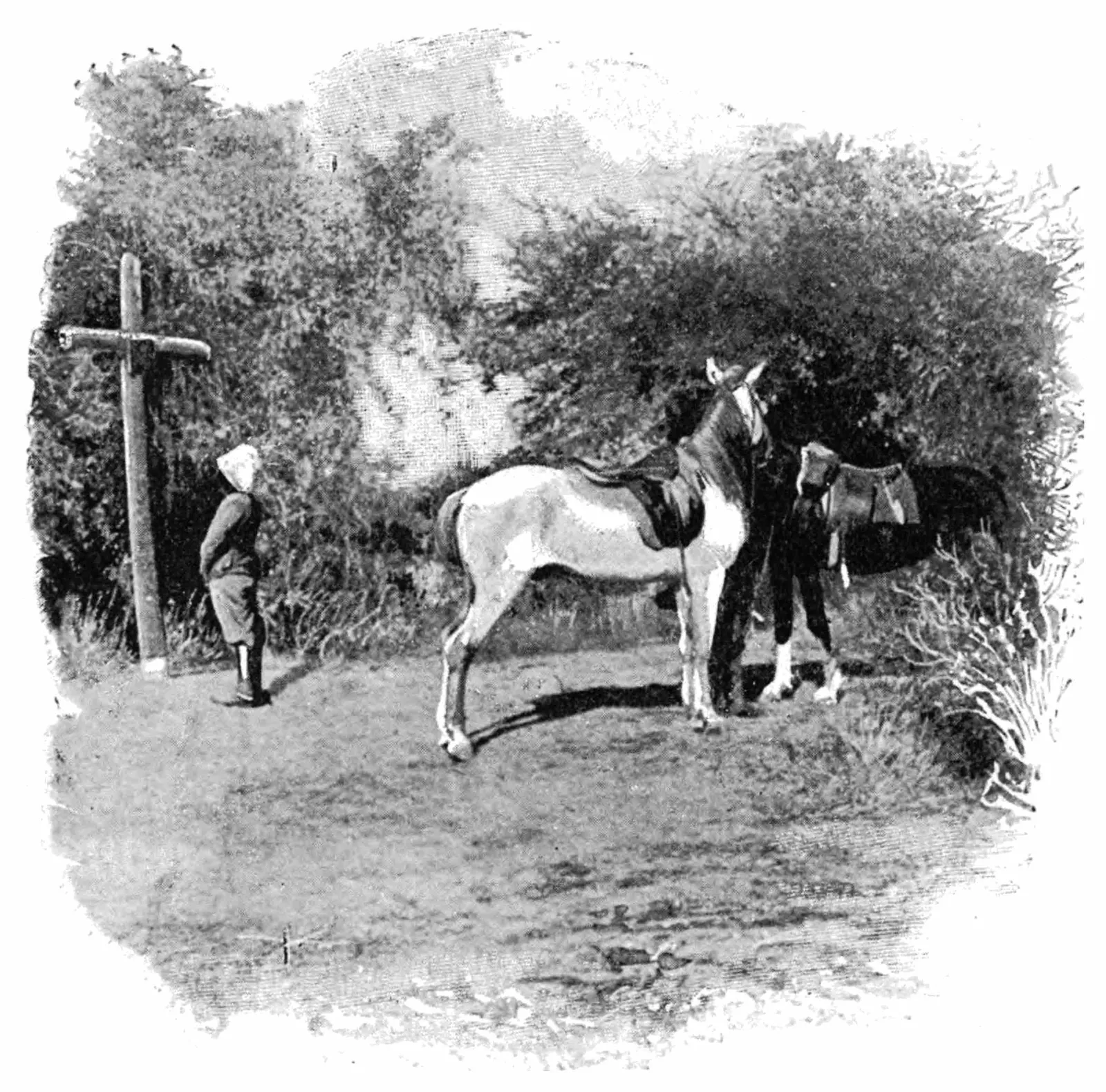
I found my caravan, which had gone on in front, awaiting me
at Dioubaba. I picked up luggage, porters, and horse there,
and a curious adventure in addition. I had stumbled upon a
white horse in the early part of my journey. I say stumbled,
for I should assuredly never have bought such a thing; the
colonial administration had kindly placed it at my disposal. A
white horse! What a predicament! Bad luck, as every one
knows, bad luck for the rest of the journey! How could I avert
such an evil omen? Providence obligingly came to my rescue by
one of those secret ways which are His.
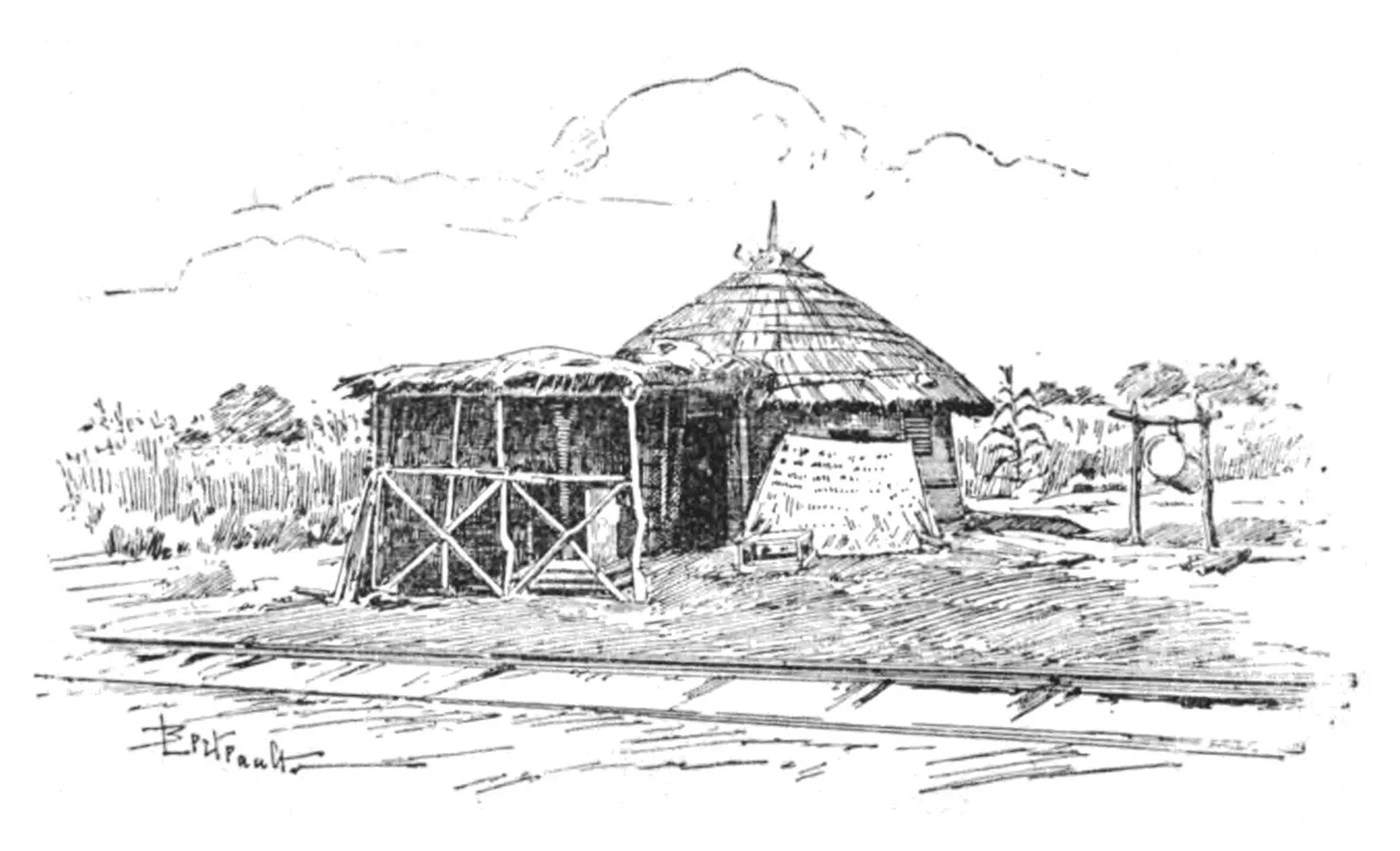
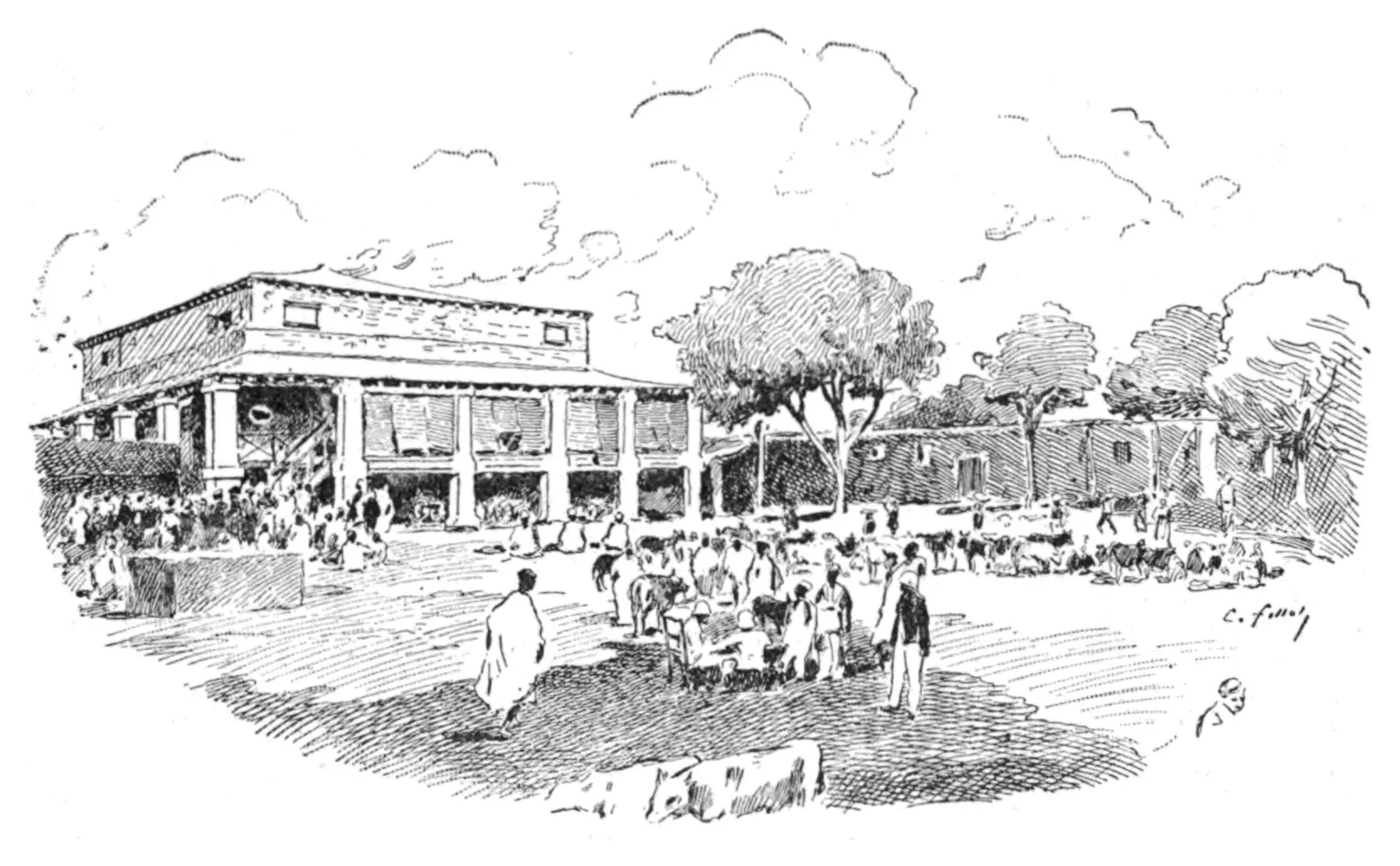
A RAILWAY STATION
I luckily noticed at Kayes that my saddle-cloth was missing,
and I tried all the shops (not a long business) without being able
to find another. In these countries the only thing you can find
that you want or can rely upon is—yourself. I had to fall
back upon one of those blankets they sell to the negro, and chose
one that was cheap and red, but soft to the horse’s back. He, the
horse, had come by luggage-van as far as Bafoulaba, but as the
décauville was unable to carry him further in that manner, I sent
him on by road to Dioubaba, whilst I made use of the little
railway. It is just as well to avoid twenty-eight miles of road on
horseback when you have some hundreds in prospect. It was
night when the miniature train entered the leafy vault at Dioubaba,
that serves as station and waiting-room. My people were
all asleep, and my horse peacefully grazing. Nothing abnormal
there, apparently. But at starting next morning, as I was about
to bestride my mount for the first time, what did I see?—A
scarlet horse! Imagine my joy! It was evidently the finger
of God that had thus transformed my steed,—aided by heat,
perspiration, and the negro blanket. Behold me now, full of
confidence for the rest of my journey.
The adventure did not end here, for in spite of repeated
groomings and washings it proved impossible to restore my
charger to his original colour. The dye, detestable for blankets,
is admirable for horses. My animal was the wonder of the natives
of all the villages we passed through. ‘Ah! these white men,’
they said, ‘they can even make scarlet horses!’
Enough of the horse! Let us now review my equipment.
First among them is my valet-de-chambre, butler, etc., etc., for
numerous functions accumulate in the Sudan under the modest
title of ‘garçon.’ He is a black, thick-lipped fellow, with a
European straw hat, a white vest with shiny leather buttons,
short breeches with narrow blue-and-white stripes, naked legs,
and feet ditto. One of the survivors of the Bonnier affair, in
which he figured under the title of ‘Captain Nigote’s servant.’
His master was the solitary officer who escaped from the Touaregs,
only to die shortly after my arrival. Splendid testimonials. The
doctor says he is ‘an excellent sick-nurse.’ I immediately engage
him upon that, with the idea that if I leave my bones in the
desert it will at least be with the conviction that they have been
well cared for. To sum him up: he is a well-balanced person, no
chatterbox, but dignified, as becomes a person of note.
There is nothing tragic nor historical about my cook. He is
my joy, except in those deadly moments when I rage with despair.
I engaged him rather hurriedly. ‘Can you cook?’ ‘Oh yes!’ he
replied, with the assurance of every good nigger when questioned
concerning his capabilities. If I had said, ‘Can you paint like
Raphael and Murillo?’ he would have answered ‘Oh yes,’ with
equal conviction. In reality he can whistle a few bars of the
Marseillaise tolerably well, and can boil water and eggs—hard. I
do all the rest.
The third and last person of my establishment is the groom.
A silent, bearded fellow, with Semitic profile. He leads the horse
up to me when we start, holds the stirrup, and disappears for
the rest of the journey, reappearing at the end of it to hold the
stirrup, and vanish again—with the animal. Never a word says
he to me, and never a word say I to him. I do not even know
his name: he is a riddle, an enigma. It would not surprise me to
learn that he is the nigger from Porte St. Denis, though I have
not yet heard the clock ticking in his stomach.
Around this trinity circle twenty-two natives, uniform as to
rarity of drapery, but very varied as to coiffure. Some have
hair like astrachan or door-mats; the heads of others are shaved
as bare as a lawyer’s chin; some have a tuft in the middle, others
again rejoice in a circular fringe like the beard of some old
sea-dog. Scarcely less variegated are the colours of their skins:
treacle black, charcoal black, dull prune, shiny prune, coffee
colour, Seine colour—a whole scale is well represented.
Place half a hundredweight of baskets and cases upon each
head, and you have a very complete sketch of the equipment
necessary for travel in the Sudan.
Having made use of various means of locomotion, since leaving
Paris, for accomplishing his journey with comfort and rapidity,
the traveller now finds himself face to face with the most primitive
of all—the road, I may add, the African road. That is to say,
something vague, that has nothing in common with its European
prototype but the name; something to which levelling, ballasting,
a firm soil, and even bridges are unknown. And it is only now
that the soul of the African traveller thrills and tastes of joy.
Another life is beginning for him, the true life, the only life—the
life of the bush.
What makes this life so intoxicating to all who experience it,
from the officer straight from the military academy down to the
private or marine-artilleryman fresh from a village school; from
the aristocrat of royal descent to the professor of rhetoric? It
captivates all alike; the ministerial quill-driver become colonial
official, the engineer, the artist, and the man of commerce who
superintends a factory.
Its charm cannot easily be explained to the sedentary; it
escapes analysis, being as subtle as it is penetrating.
Let me see. The food is indifferent, the water is indifferent,
the sleeping is indifferent, and your health is often in a precarious
state. Heat and fatigue are the only things superior in quality,
and yet your heart is filled to overflowing with contentment. As
it can hardly be their inconveniences that make the hours spent
in the bush so delightful, it must be the sensations that are
grafted on them, and the wonderful pictures accompanying them.
It is the mingling of the human with the free life of forests and
plains that have existed for thousands and thousands of years;
and the fact that you are contemplating that life with centuries
of civilisation beating in your veins. It is something, too, in the
manner in which these people express their thoughts. You are
accosted by giants who could crush you between their finger and
thumb, and who address you humbly, ‘Greet one of God’s poor.’
In another village an old skeleton of a chief totally ignores your
arrival, your presence, even your visit. You stand near enough to
touch his foot, and he continues impassively squatting and reading
his Koran, until you half expect to hear the whistling of a
lance through the air, to see the flash of a sabre, or hear the
cocking of an old musket. Then, again, some old negress stops
your horse, mumbling words that are unintelligible. She smiles
at you, and offers you a handful of sweet roots. To give her
pleasure, and because her wrinkled smile recalls the fact that such
poor old things took pity on René Caillié and Mungo Park (your
predecessors in this corner of Africa), and saved them from dying
of hunger, you accept her present of cold cooked roots. Her
joy is great, and by some small donation you double it. To
put the finishing touch to her pleasing contentment, you bite one
of her offerings and continue your way, absently munching the
sweet batatas, whose flavour so strangely recalls the marron glacé.
Memory is sent galloping in pursuit of visions of your native land,
and you recall the fact that it is snowing and hailing hard there,
while you have been gently cooking since daybreak.
And then life in the bush means flocks of guinea-fowls running
about in the thickets, and coveys of young partridges that
rise, careless of sportsmen, from under your horse’s very hoofs.
It means strange, intoxicating scents that suddenly envelop you,
and leave you as suddenly as they came; and a delirium of sunsets
passionately colouring a sky that was monotonously colourless
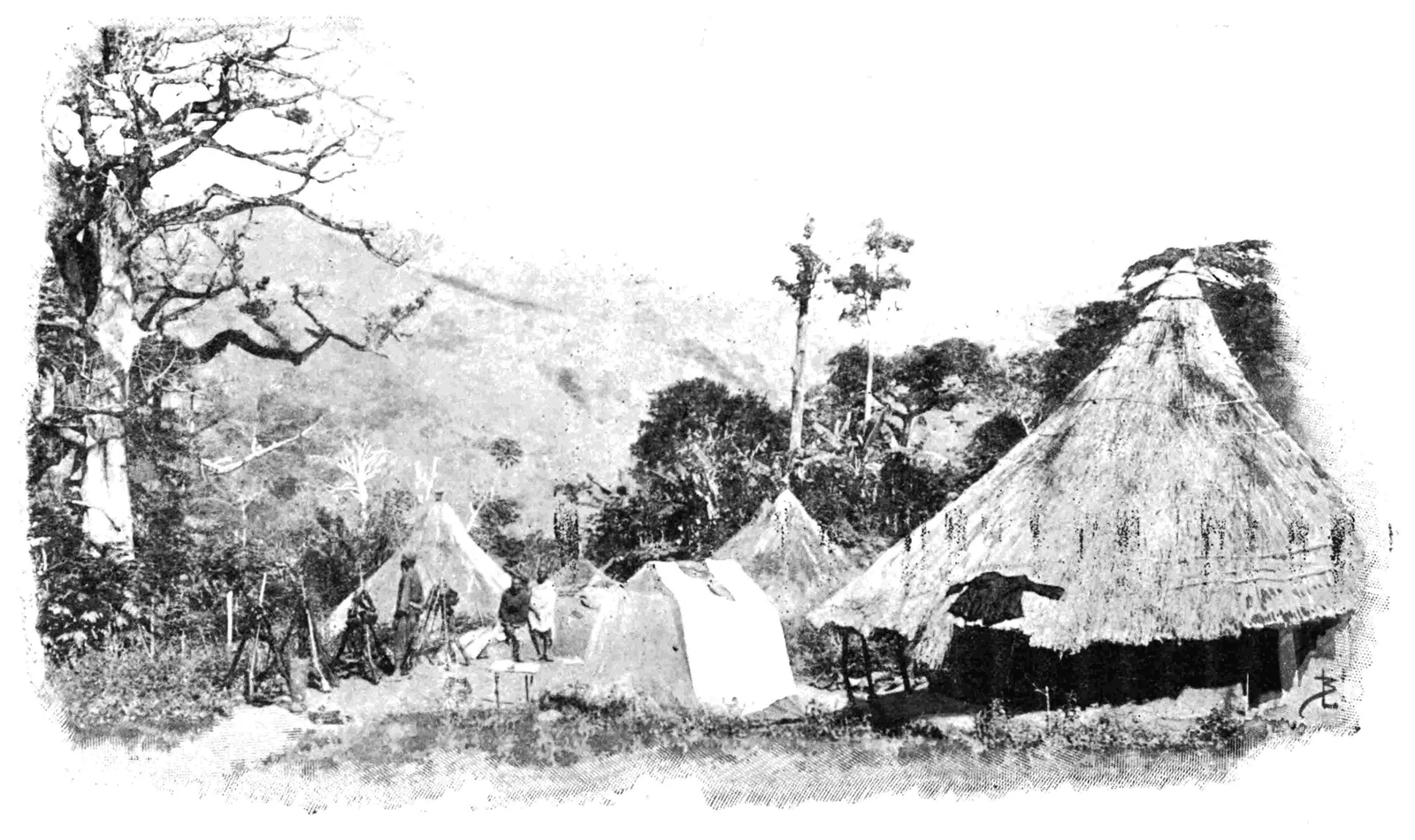
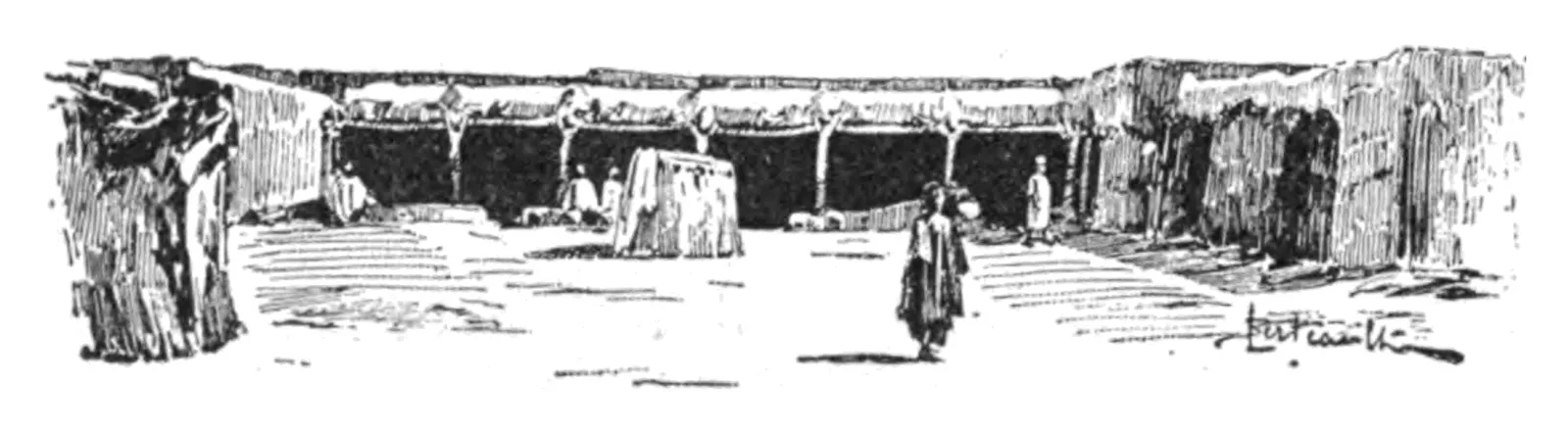
the moment before. And nights! One night we encamped
in the huts surrounding a village square, and my men lighted
huge fires in the open air. The gleams from their flames carved
a vault of red and gold upon the darkness, and under this arch a
fantastic ballet took place. The wings of bats, illuminated from
below, made streaks of light upon the night, like the trails of
falling stars, and were distantly encircled with satellites of fireflies.
But I can only give a tenth part, and that feebly, of the
unexpected sights and sensations I enjoyed. You cannot taste
life’s choicest morsels reclining in an arm-chair.
Dioubaba, the terminus of the décauville, is situated in the
heart of lovely mountain and river scenery. Its landscape would
realise a handsome income in Europe. The river Bakoy, hitherto
closely confined, here breaks into a rocky waterfall, some hundreds
of yards in length, full of rapids and foaming currents. The
horizon is bordered by mountain-tops, and the river-banks are
covered by gigantic trees festooned with garlands of long creepers.
A sergeant of the engineers acts as station-master, and a sapper
attends to the telegraph. They are perfectly happy, they say;
and are married, according to the custom of the country, of course,
to two gay little natives with charming ways. This society is
completed by Bibi, a young hippopotamus, lately captured, and
very tame. With a discretion, unlooked for in such an animal,
he spends the day in the Bakoy, so as not to interfere with his
friends’ occupations. They go to the bank when in want of
amusement and call ‘Bibi! Bibi!’ Bibi’s pink muzzle soon appears;
he looks round for them with his little black eyes, and, dripping
and wriggling, he runs up to be caressed.
The road from Dioubaba to Bammaku cuts from east to
west across the massive Foota Jallon range that separates the
basin of the Senegal from that of the Niger. It is full of pictures
recalling the Forest of Fontainebleau, and is so abundantly
watered that you fall asleep every night to the sound of some
gurgling cascade or waterfall. I know nothing more suggestive
than this road, the main artery of the Sudan. You see the
colonial life coming and going upon it from day to day; and it
also reflects the retrospective image of the life that rolled along
the great European highways before the days of coaches. Without
the highwaymen, however, for we have made enormous progress
since the pacification of the Sudan ten years ago. Then,
travellers encamped upon it with sentinels posted at night as if
they were in the country of an enemy. To-day it is as safe as the
Champs Elysées.
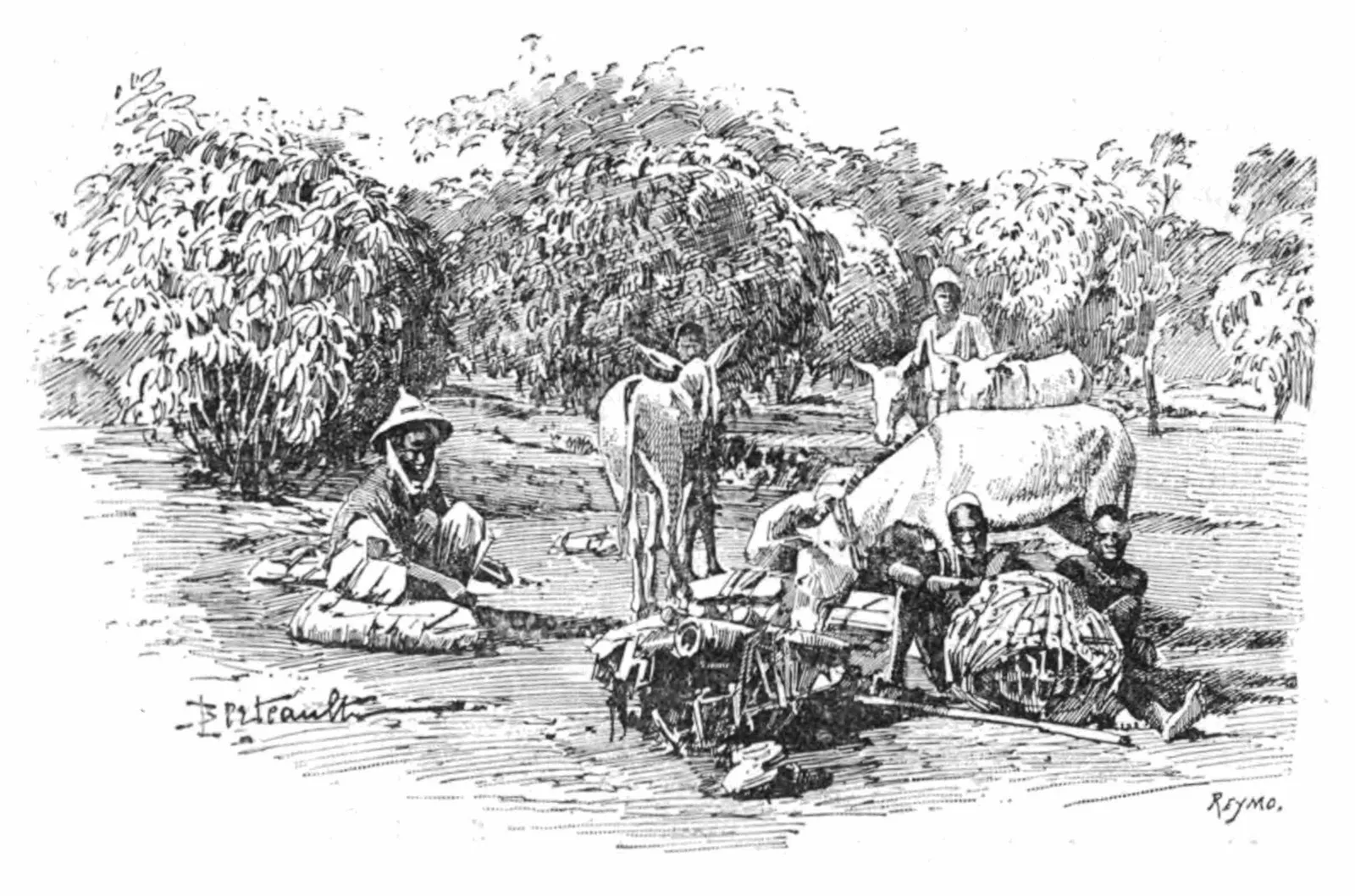
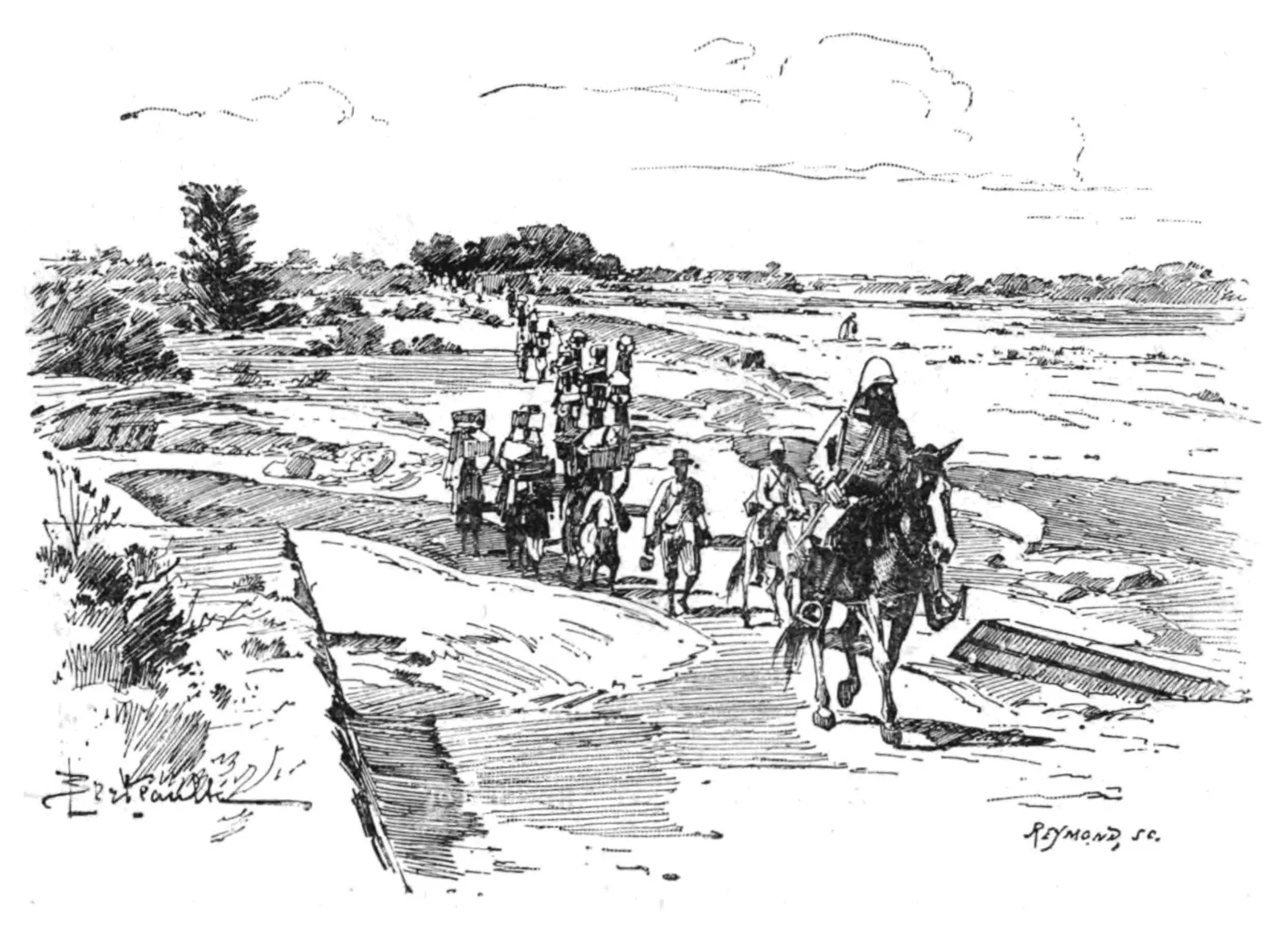
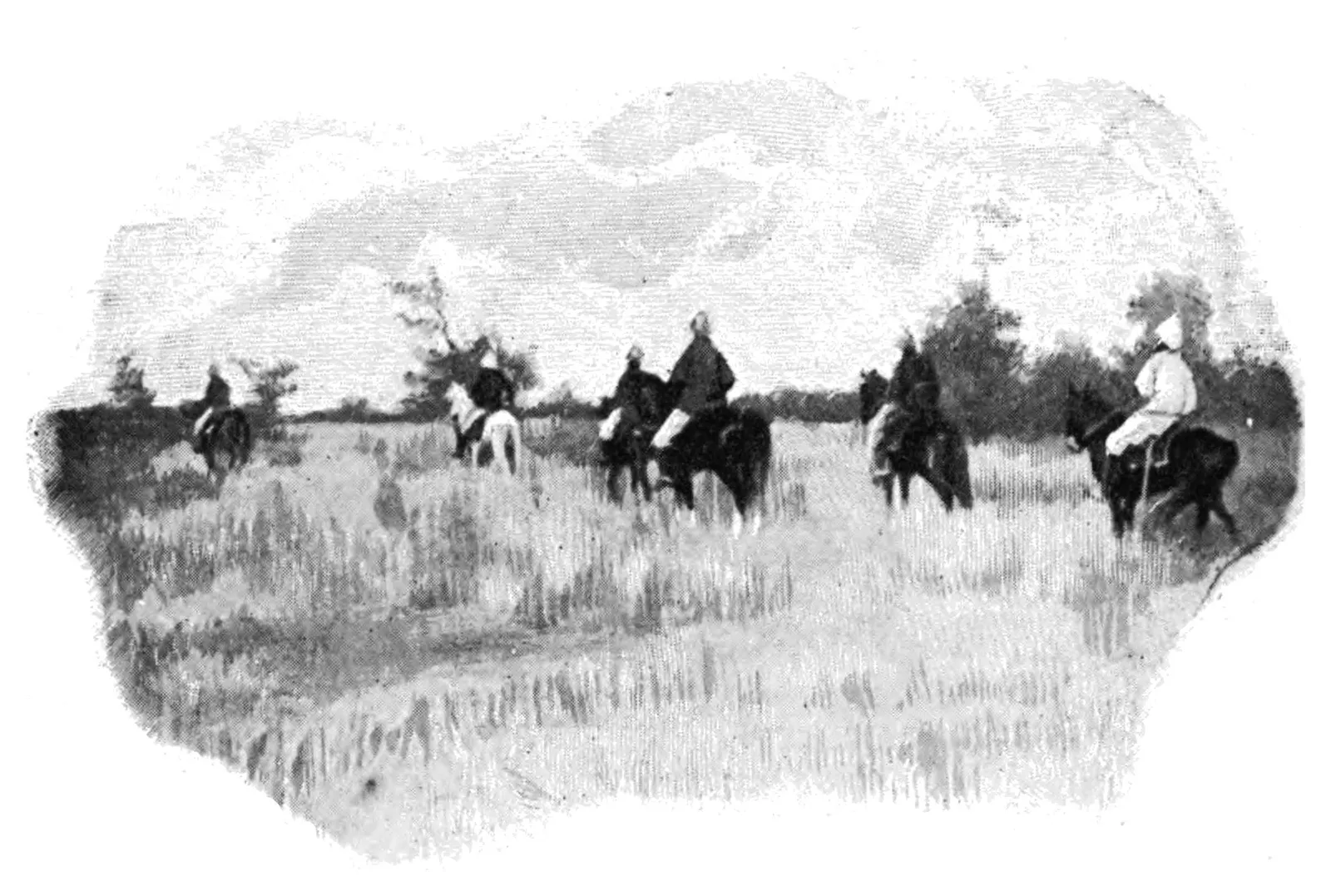
ON THE ROAD: DIOULAS HALTING
Not that vehicles are numerous, but people are, and animals.
They are principally parties of porters that you meet; some
travelling to their destination laden with cases, and bundles, and
sacks of millet; others returning, freed from their burdens,
dancing and capering along the road to the sound of flute or
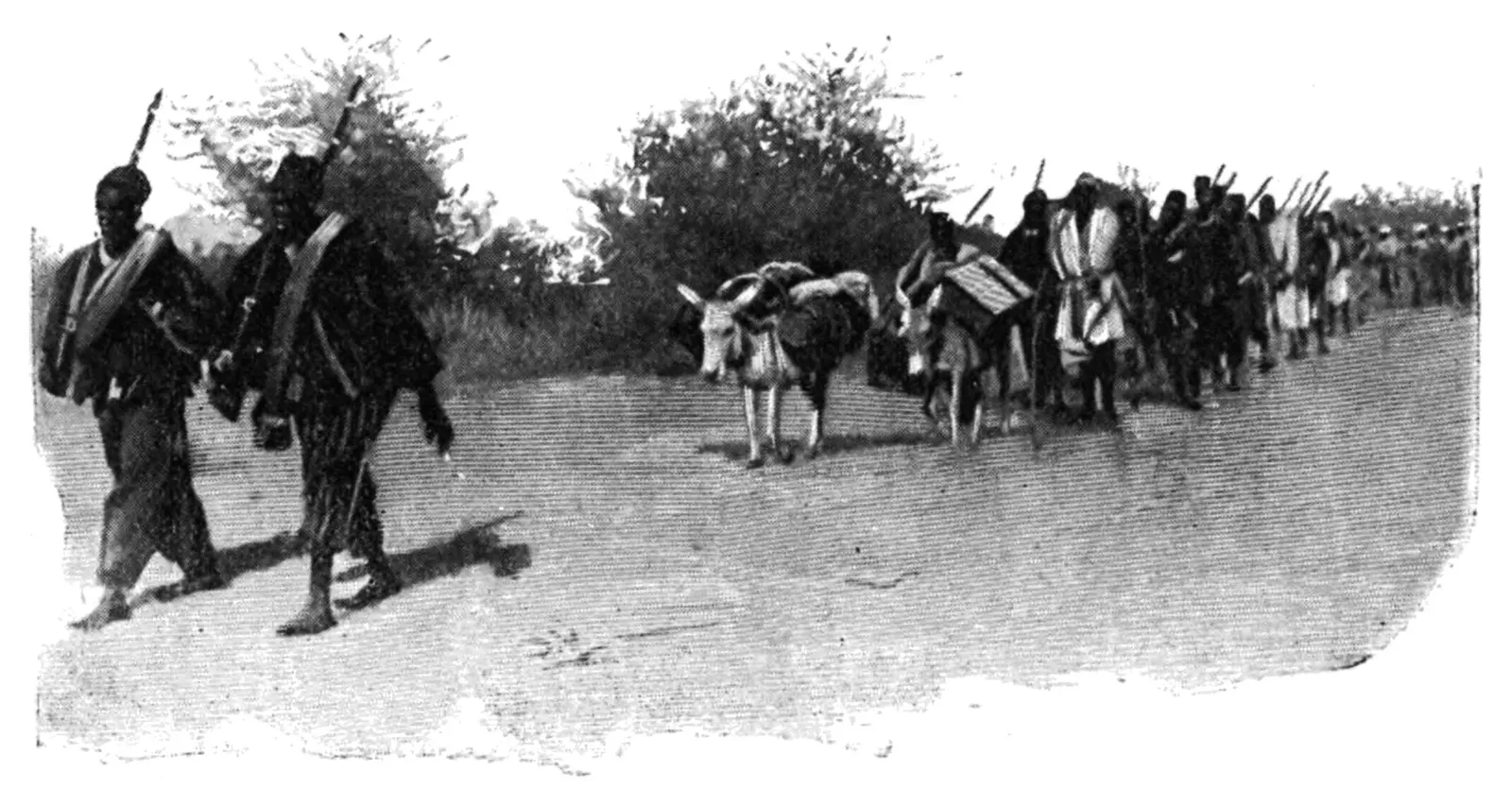
drum, joyous as children let loose from school. There are dioulas,
too, or native commercial travellers, with their servants or slaves
and their wives and children, all driving donkeys laden with salt
and pearls, etc.
ON THE ROAD: EUROPEANS TRAVELLING
A meeting between Europeans is particularly pleasant. You
exchange bows and a declension of names, and titles when you
have them; and a long talk ensues between two people who have
never seen each other in their lives before. News of the interior
is exchanged for news of Europe or the coast. You hear what is
passing in the countries to which you are going and in the
countries to which you are not going. You exchange a thousand
little services, and, above all, the time! For watches in these
climates develop the most fantastic manners, and the only thing
you can be sure of is that they will never tell you the time even
approximately. After this you turn your backs upon one another
with all the grace in the world, and each resumes his journey.
The Europeans you meet are mostly government officials,
officers, and privates. Some are returning to France for a holiday,
having fulfilled their year or eighteen months of service, while
others are newly arrived to take their vacant places. Sometimes
you pass a hand-ambulance from which the head of some unlucky
invalid emerges, and, if you are good-natured and furnished with
plenty of provisions, it is very easy to play the good Samaritan
on these occasions.
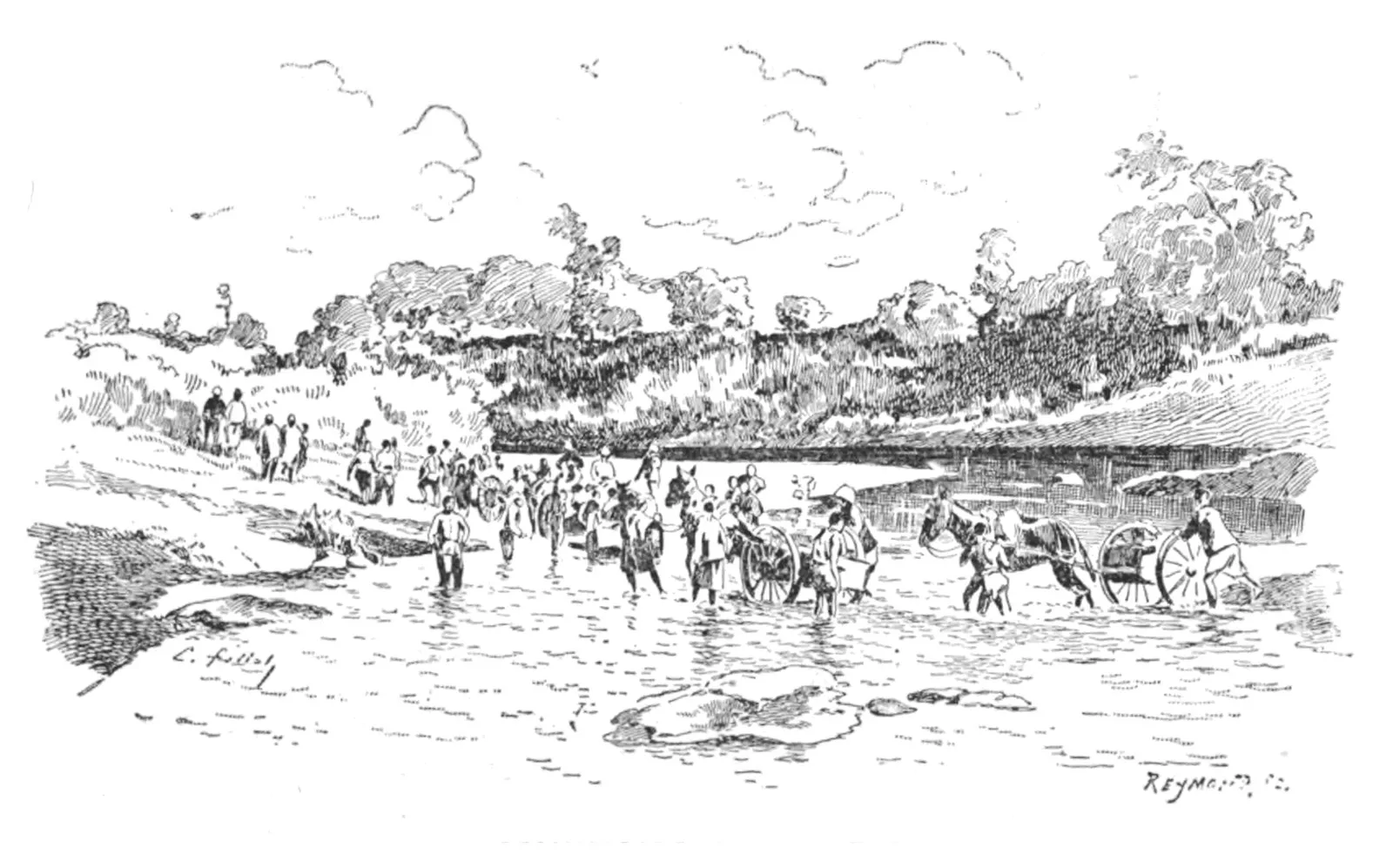
A COMMISSARIAT TRANSPORT
Unfortunately the man of commerce only furnishes the smallest
share of these encounters: and why? The answer is to be found
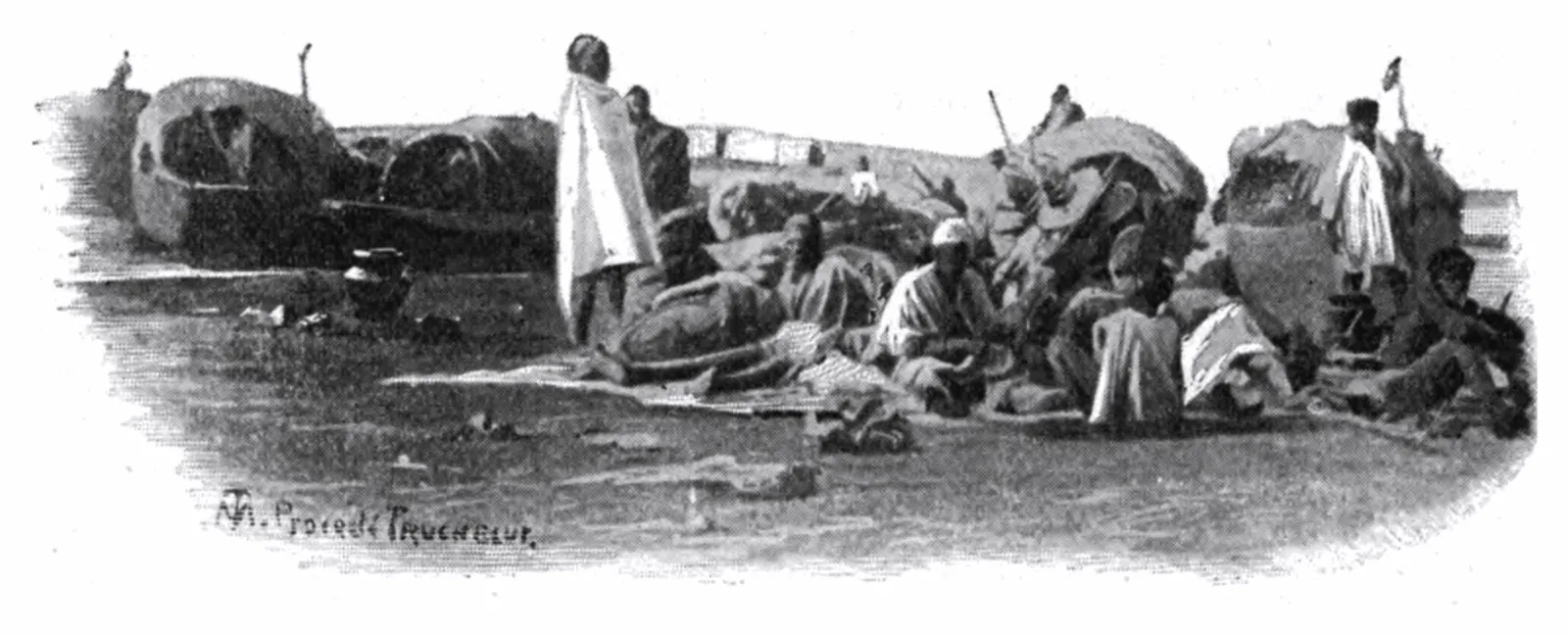
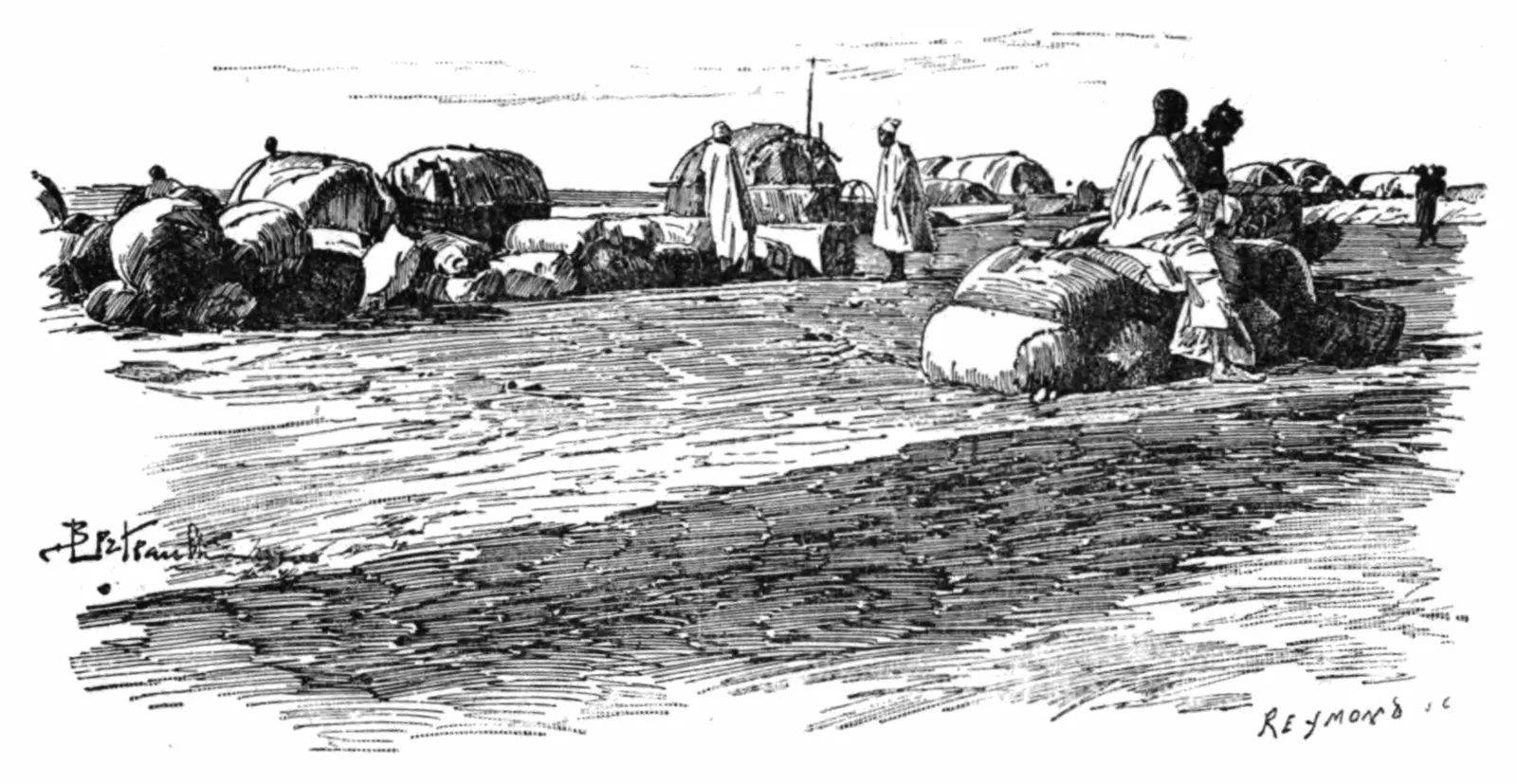
in the road itself and the troops of porters you are incessantly
meeting upon it, for the head of man is too limited a means of
transport to permit a very extensive traffic. Why not use vehicles
then? The account given above of the pseudo roads of the
Sudan will answer this question, for they exist only in name.
The commissariat department knows something of all this, for the
forts we have set up in our vast Nigerian possessions must be
victualled. Europeans, surrounded by black troops, live in them,
keeping the country in order, civilising it, organising it, and
preparing it for occupation. It is of course necessary to supply
these garrisons with European provisions, such as cases of wine,
great iron boxes of flour, coffee, sugar, barrels of salt meat, and arms,
ammunition, clothes, tools, etc. To carry these stores to the river
(the only easy means of transport) the commissariat possesses carts
which are set upon this pretence of a road; at what cost of time,
trouble, and money it would take volumes to tell. One meets
these transports from time to time, struggling with the chasms
and other asperities of the so-called roads. They are commanded
by artillery officers, and are always accompanied by a veterinary;
but I prefer to leave to your imagination the condition to which
the unhappy mules are reduced, even though they only do ten or
twelve miles a day. It is a terrible thing this victualling, its
shadow pursues you all along the road. Encampments are provided
every ten or twelve miles with straw huts for the men and
picket-lines for the animals. You can follow the progress of the
transports by the litter of rags, bits of paper and abandoned
carts they leave behind them. Two forts mark the road from
Badoumba to Kita. Neither is garrisoned, and both have fallen
a prey to the commissariat department. Their various outworks
and approaches are strewn with a litter of cases on which one
reads medicines, sugar, candles, oil, etc., and the names of the
places to which these stores are destined—Farannah, Siguiri, Segu,
or Timbuctoo. The forts themselves are filled from end to end with
squatting porters awaiting their share of burdens; and you hear,
in the snatches of conversation and the orders that are flying
about, of nothing but ‘cases’ and ‘transport.’ The impatience
with which Europeans and natives alike are awaiting the continuation
of the rail from Dioubaba to Bammaku becomes
suddenly comprehensible.
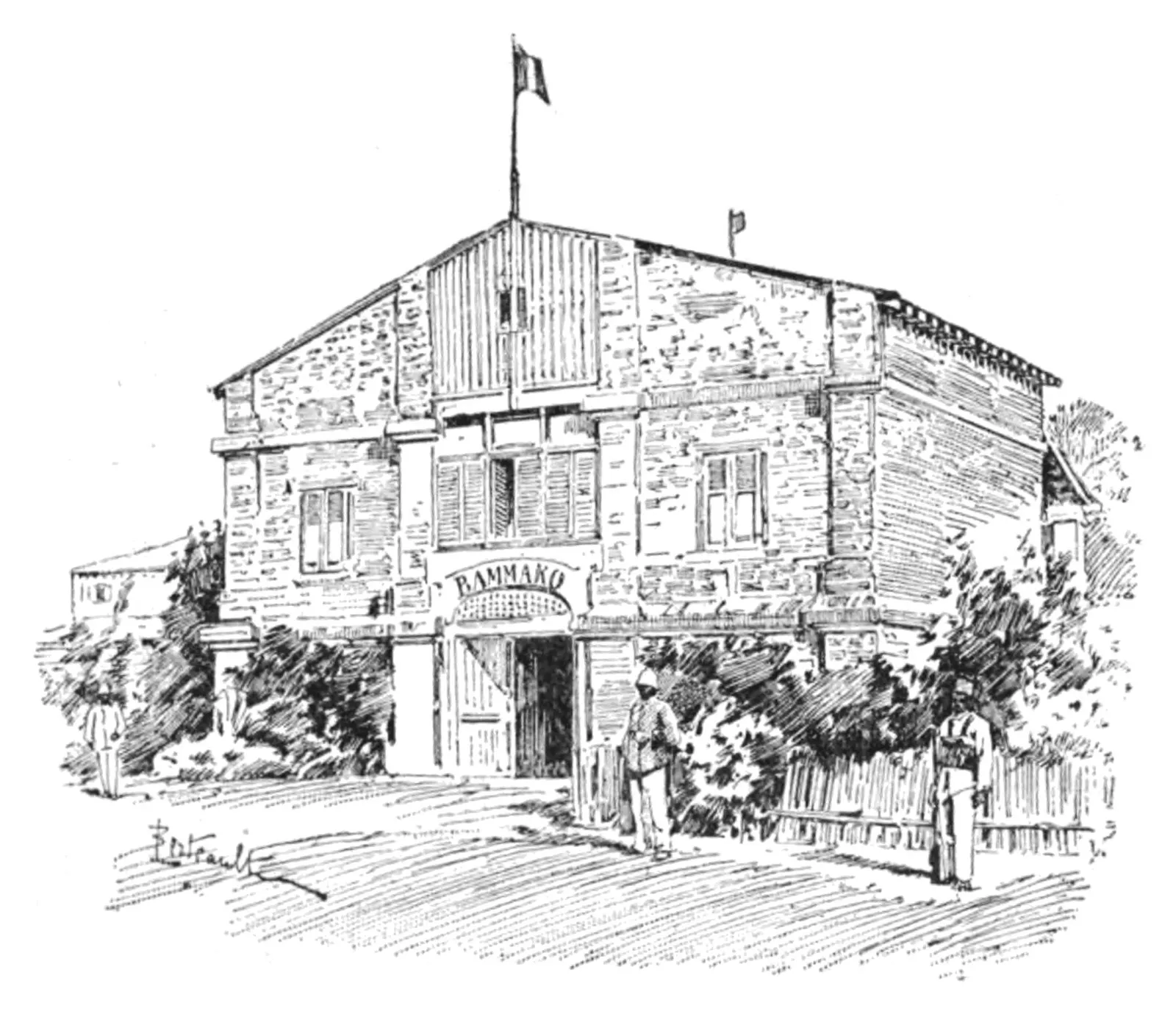
THE COMMISSARIAT: IN FORT BAMMAKU
At last beyond Kundu (a third fort, completely abandoned)
you reach the line of cleavage between the Senegal and Niger.
So far the country has been pleasantly varied, recalling somewhat
of Switzerland without giving an equal impression of
fertility; but in the next and last twenty-five miles of the
road springs and rivulets multiply at every step. Agriculture,
interspersed with charming glimpses of silvery water, spreads over
uninterrupted fields for the rest of the way. The villages cluster
closer together, and are more densely populated. In a delightful
valley of the great Kati mountains a stream tumbles along
between two rocky ledges, which start suddenly aside and spread
into a fan, to disappear upon the distant banks of the
Niger.
It was not without a certain amount of emotion that I
approached the great river, and for this reason. It was four
years now since I first started for the Niger and failed to reach
it! My then companion, Captain Faidherbe, was making his
third attempt to reach that serpent of Western Africa. In his
first he followed the Flatters Mission along the Southern
Nigerian route. In the second, starting from the frontier of
Portuguese Guinea, he was stopped by wars among the natives.
For the third time he started from Benty and the Mellacorée,
in the company of the painter Adrien Marie and myself, only
to be cut short by Samory’s troops at a distance of twenty-five
miles from its banks; and two years ago he died without
having seen the Niger.
The memory of his ill-fortune possessed me, and grew more
intense with every stage of the journey. I had an idea that
some of his ill-luck must pursue me. Assuredly I too shall
not see this Niger, I thought. And now at last, after doubling
the stages for the last five days (so great was my anxiety to
reach it), my horse begins to stumble down the steep and rocky
declivity that leads to the river. I dismount, and a fresh anxiety
seizes me. Suppose it is only another great disillusion to which
I am advancing?
The narrow path widens suddenly; its rocky sides are flung
right and left like the leaves of a door. ‘There is the Djoliba,’
says my historical servant, as calmly as if he were announcing
‘Dinner is served.’ It is an impressive spectacle from the height
of the road that still clings to the hill. A vast horizon lies at
my feet bathed in the splendours of a tropical sunset, and
down there, in a plain of gold and green and red, shines a silver
trail bordered by a line of darkness. There it is, a mere vapour,
the dream of a river in a valley of dreams, and the dark line is
the hills by which it flows, almost invisibly. ‘God is great’
as they say here. There is no disillusion, as is so often the
case in the realisation of the unknown. I can scarcely take my
eyes from the serenely majestic panorama that is spread before
me.
And now come what may! I remount my horse and urge
him to a gallop along the road, bordered by trees, that stretches
across the plain. A postern stops me, bearing a placard on which
is written in white letters on black, like the name of a railway
station: Bammaku.
CHAPTER II THE NIGER
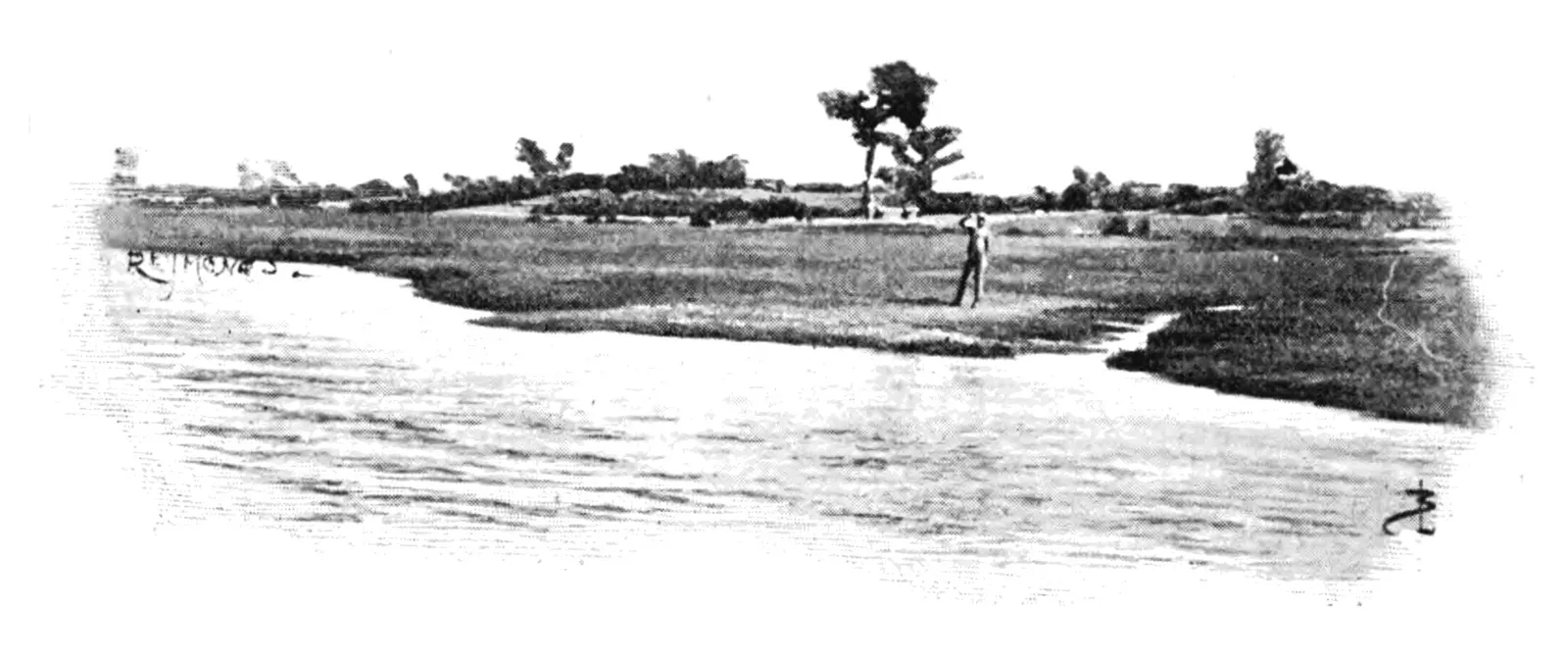
THE NIGER AT KOULIKORO
The Niger, with its vast and misty horizons, is more like an
inland ocean than a river. Borne along upon it, scarcely
seeing land, the traveller is carried away by those endless
dreams which haunt the infinitudes of the sea. Its waters
break upon its banks in the monotonously cadenced waves
of the Mediterranean shores; and when winds, grown to
violence in the desert, swell its waves into a great race, sea-sickness
will convince the most rebellious that the river Niger
is of kin to oceans.
Its shores, no less than its waves, resemble those of the
ocean. Only occasionally rising into cliffs, as at Koulikoro, they
more frequently call to mind our own Atlantic strands, being
formed, not of the white impalpable dust of the desert, but of
the true reddened shingle of the beach.
Like the oceans, the Niger possesses its sailors, not merely
occasional seamen, but whole populations, privileged to serve it
exclusively, living for it and by it alone. They are the Somnos
or Bosos, and are not the aboriginals of the Nigerian countries,
but were among the first of those great migrations of people
who saw Western Africa across the centuries. The history of
their origin is shrouded in a legend which the ancient among
them are very willing to impart.
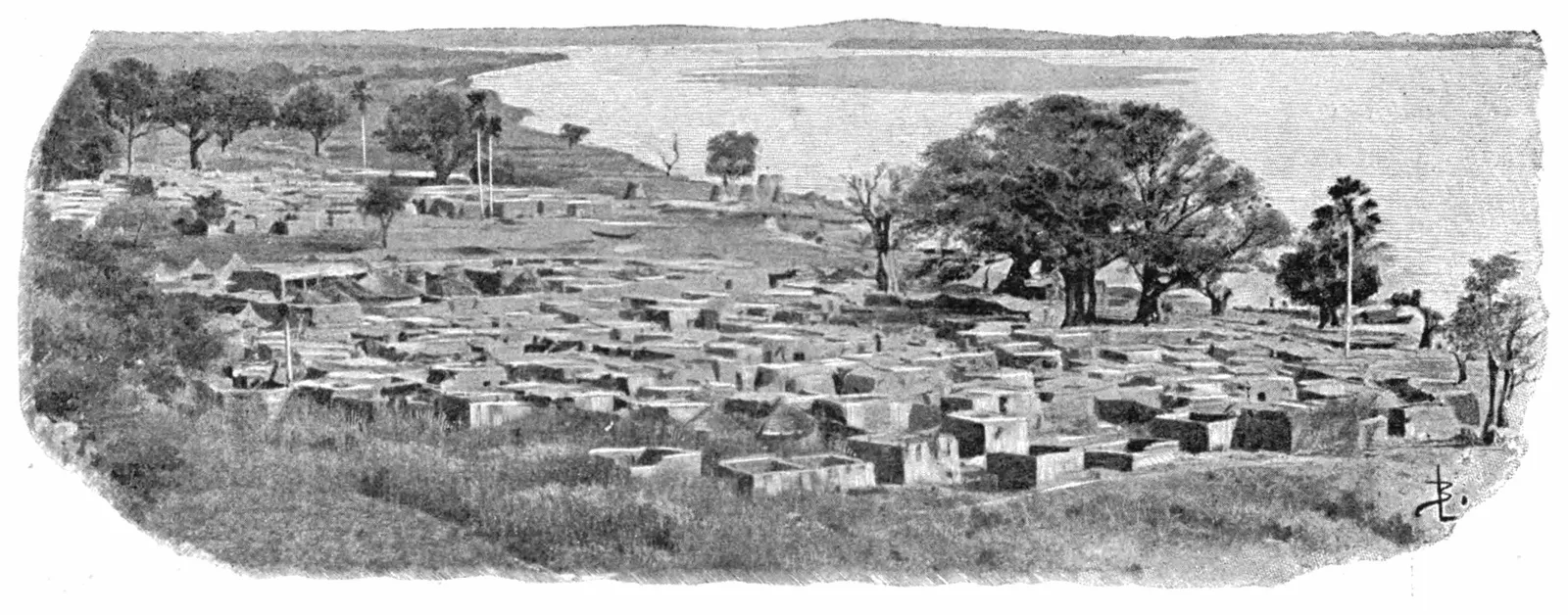
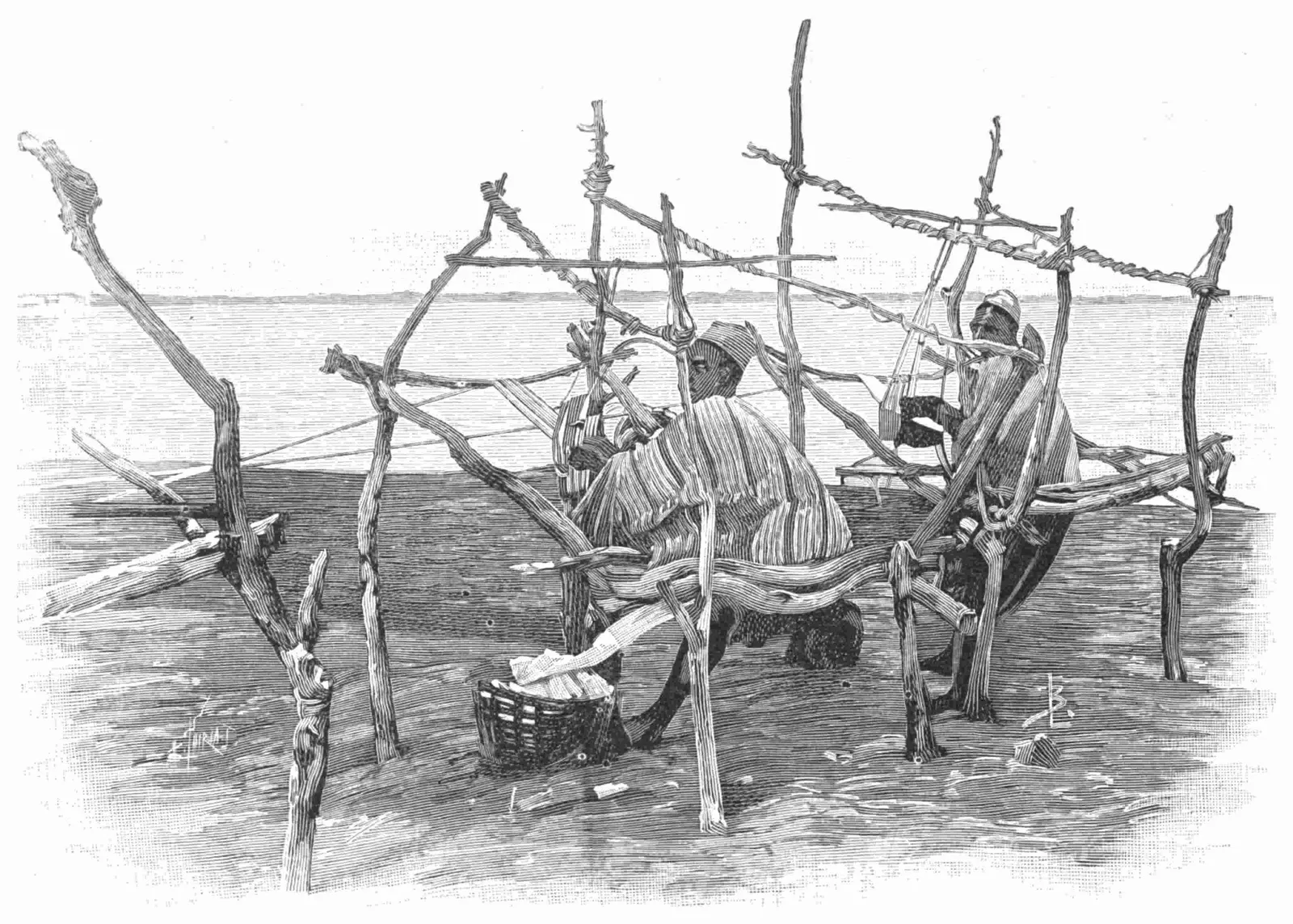
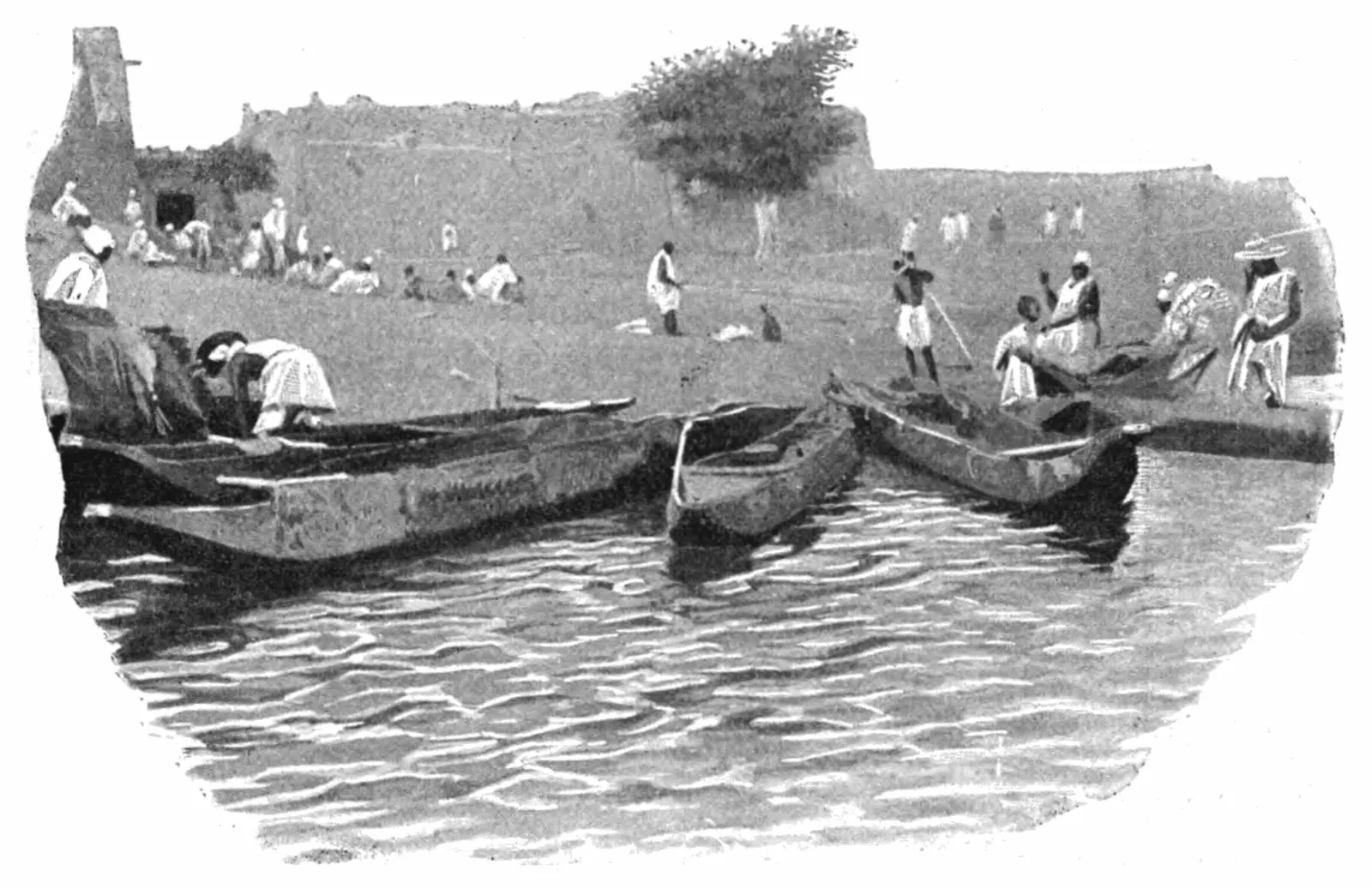
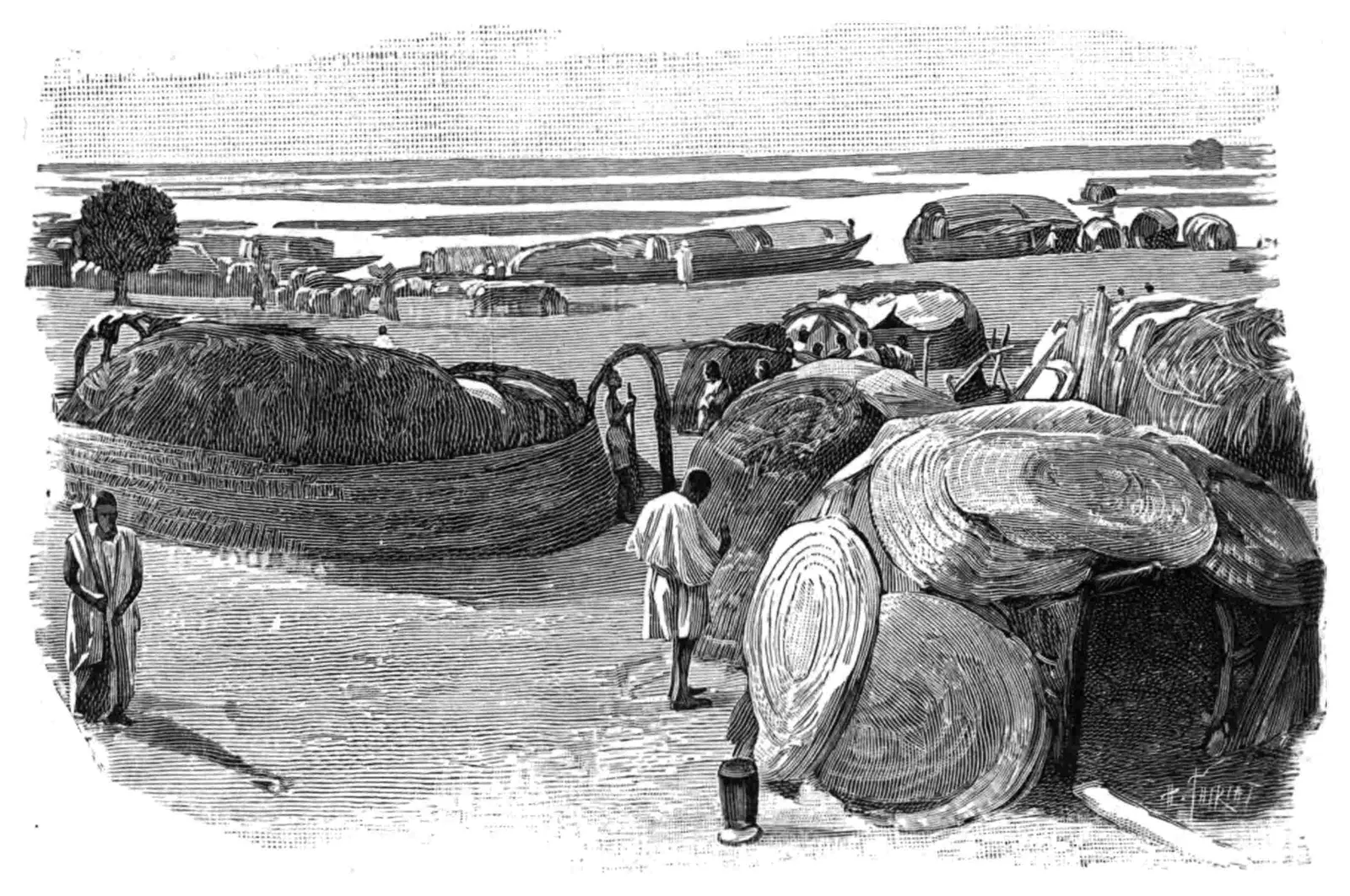
A FISHING-VILLAGE ON THE BANKS OF THE NIGER
‘Our ancestors,’ they say, ‘came from the great mountains
of the East.’ Do they mean the mountains of Ethiopia?
Could they have come from the hills surrounding the Upper
Nile? They have no idea. Nothing in their features recalls
the marked type of the
Eastern African, and
their skins are as black
to-day as those of
the natives of the
Sudan. The one thing their legend preserves for certain is, that
even in those early times they were a purely aquatic people.
They fished and navigated for the king of their country, being
bond-servants, apparently, to the crown. The Sudanese to this
day do not reckon them among the free tribes.
Thus they boated and fished upon their rivers, until one day
the king wished them to build him houses and bridges. This
was a task alien to their caste, the work of slaves according to
their ideas, and
therefore repugnant
to them.
In revenge they
offered their king
a present of
poisoned tortoise,
of which
he ate and died;
whereupon they
took flight in
their vessels, carrying all the boats with them, to ensure against
pursuit. They followed the course of river after river in their
flight until they arrived at the Niger, which, according to them,
flowed to the north.
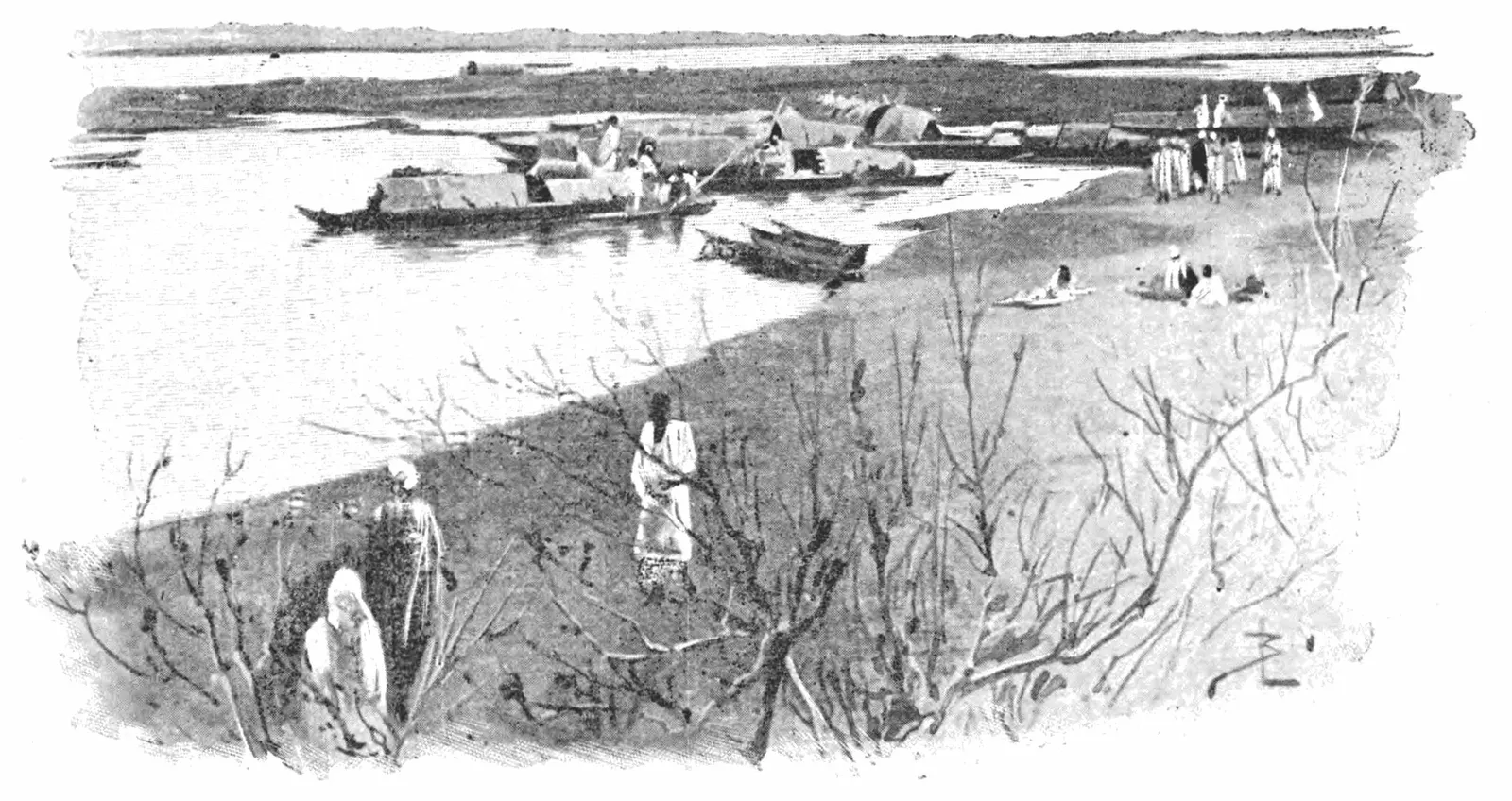
And there they live to this day, lining its streams and
tributaries with villages that recall the fishing-hamlets of our
own coasts. They form the sole population of these settlements
and occupy distinct quarters in the towns and cities, thus emphasising
the fact that the Bosos still belong exclusively to the
river. All this gave me a reflex affection for them which
increased with knowledge, gained by many days spent in the
midst of their lives. I have seen them set out to the capture
of their great prey (the alligator and sea-cow), looking, the black
Bosos in his black canoe, like a bronze group against the blinding
light. In the bow of the long, narrow, unsteady pirogue one
of their number stands upright in a fine attitude of attack,
whilst the other, crouching in the stern, noiselessly obeys the
directions of his companion. Silently, almost without movement,
they advance until the watchful eye in the bow discerns some
alligator asleep on the tide, or some great bearded fish dozing
betwixt wind and water. Then the nude silhouette in the bow
is strained by a beautiful movement of the free body, the right
arm is poised, and the harpoon flung, striking the great beast
unawares.
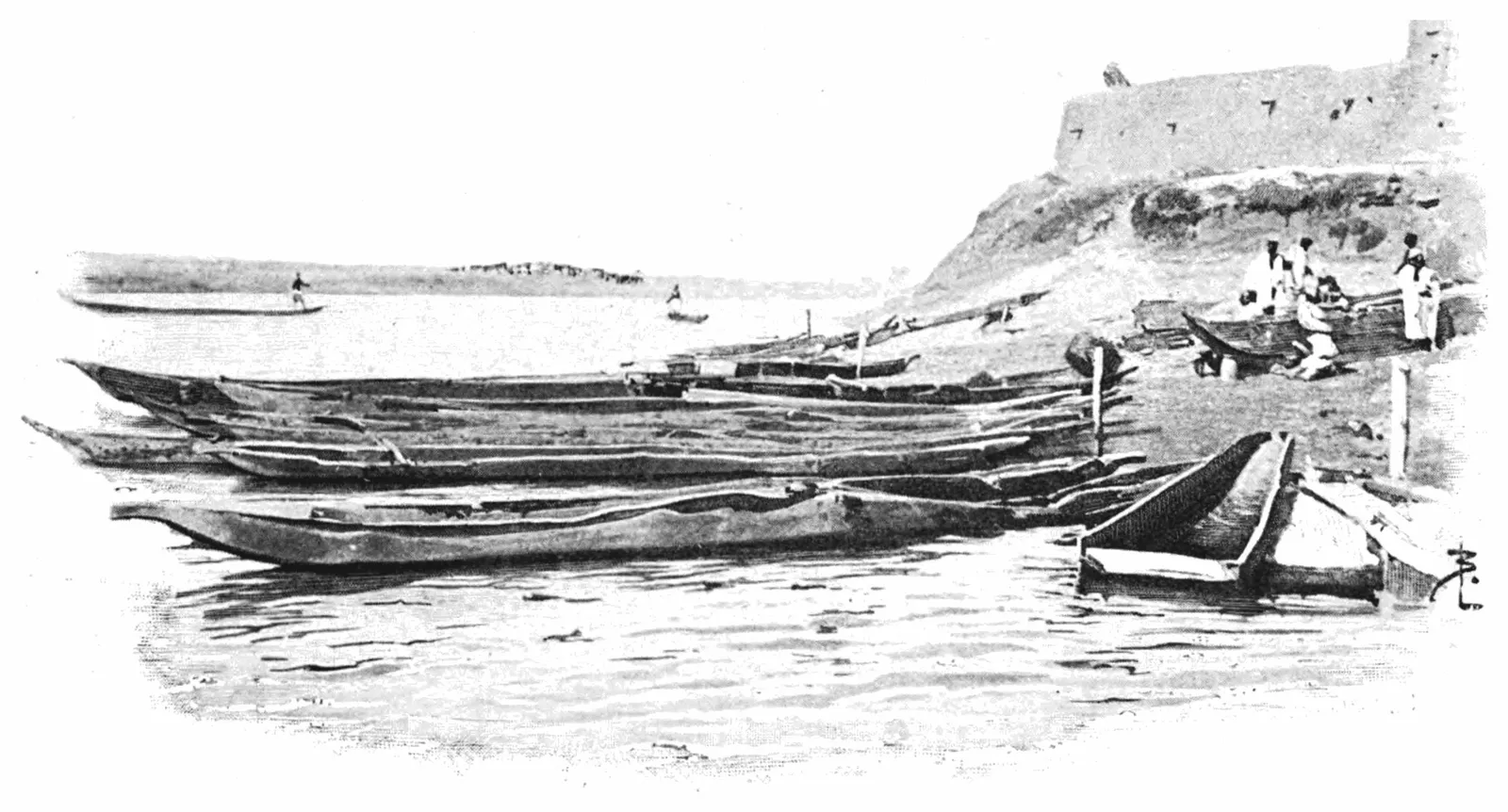
The Bosos is not only the fisherman, he is also the boatman
of the Niger, and I have seen him exert admirable physical
qualities in this latter capacity, yielding nothing in sobriety and
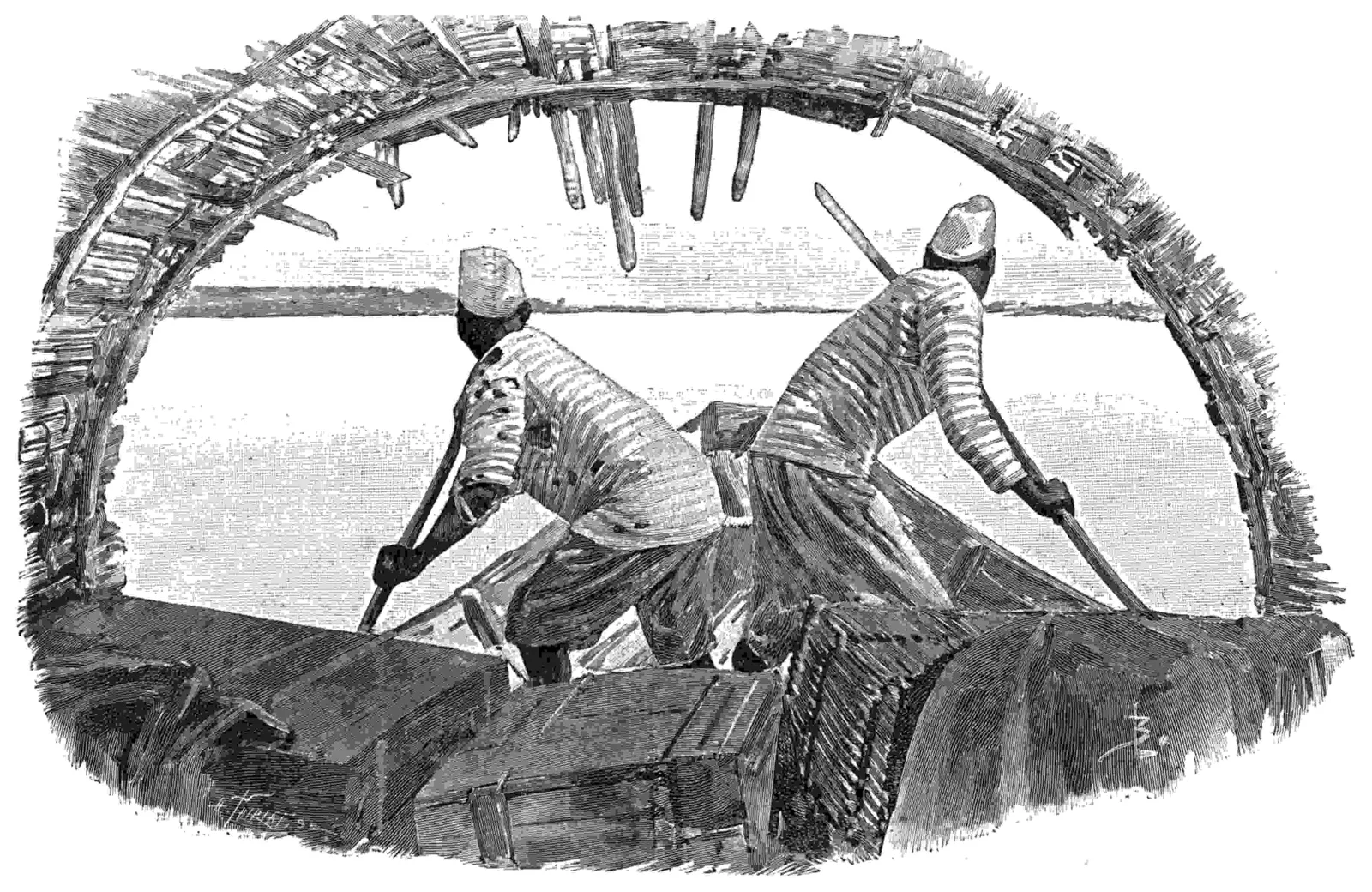
endurance to the ocean-going sailor. The six or eight men
forming the crew of my boat worked day and night, alternately
sitting to wield the paddle when the water was deep, and standing,
when the bottom could be felt, to ply the long bamboo
poles. This variation was the only relaxation they allowed
themselves besides a few moments for their meals. And what
meals they were! If I had permitted it, a few handfuls of
millet seed, neither cooked nor ground, but merely moistened
with water, would have amply satisfied them. Sometimes when
the moon was late in rising, or slumber proved too inviting,
one of their number would chant some monotonous and melancholy
refrain to which the singer improvised brief couplets which
were taken up in chorus by his comrades. Now and again they
would rouse themselves to greater exertions by their cry of
‘Tara (quickly), tara, Bosos!’ The six or seven days of our
journeying were only broken by some four or five hours of
indifferent repose, uncomfortably snatched at the bottom of the
boat, and disturbed by the continued paddling of their companions.
Could any men of our race furnish a like example of
endurance? The chatter and laughter were a little less perhaps
in the last few days, and they had recourse rather more frequently
to powdered tobacco (their only stimulant), which some
thrust up their nostrils and others into their mouths. These
were the only signs of unusual fatigue which they permitted to
appear. Nor were their exertions undertaken from any motives
of devotion, but for a man whom they had never seen until a
few moments before starting, and whom they knew they would
leave soon after reaching their destination. Moreover, my very
eagerness to press forward was unintelligible to them. Time
has neither value nor meaning for them; they do not even know
their own ages, and their life is merely a road, sometimes long,
sometimes short, but in any case leading nowhere.
For the first few days I had to discipline and threaten a
little, and, when warnings failed, to distribute a few blows. A
strict impartiality always determined these awards, and since a
rigid sense of justice is preserved in all primitive natures, they
bore me no ill-will for the chastisement. With the mark of
the blow still showing grey on their black shoulders, they would
seize the first and least pretext to shout with laughter, while
the boat slipped along with increased rapidity to the cry of
‘Tara, tara, Bosos!’
One more tribute I will pay them. Alone among them,
distant many days’ journey from the white man, and travelling
through an imperfectly conquered, sometimes openly hostile
country, never once did I feel that my safety was in any way
threatened. Was it entirely owing to the superiority of the
white man, a conviction of which becomes firmly impressed upon
one (in spite of natural modesty and philosophy) as one traces
one’s path through these virgin countries? Did not this sense
of security proceed as much from a contemplation of the attractive
manners daily displayed before my eyes, the litany of greetings
exchanged with the unknown occupants of the canoes we
met or overtook, and the good-nature and disinterestedness
evinced by all? Fishing Bosos would spontaneously offer my
men a share of their catch, a fine fish, or a portion of alligator.
Hardly slackening the pace to receive the gift, thanks would
still be flying when we had left the giver far behind. ‘Tara,
tara, Bosos!’
Is it surprising that the hours spent upon the vast dominions
of the Niger should seem pleasant to me? Is it not probable that
they will represent the happiest hours of my life as I watch my
staff of travel burning on my hearth? They will remain as the
souvenirs of a cruise into infinite space and liberty, as a brief
escape from the thousand fetters mankind has placed upon man
under the pretence of progress. Their memory is a vision of
a primeval existence ignorant of good and evil, living, without
effort and without laws, an upright and good life. It was, in
short, a flight from all the falseness and corruption that civilisation
has put into the heart of man, the realisation of the dream
which, though played with by many philosophies, has been accomplished
by none.
Ah, that delightful, that matchless cruise, which you, fortunate
possessors of fast, sumptuous, and elegant yachts, can never
enjoy!
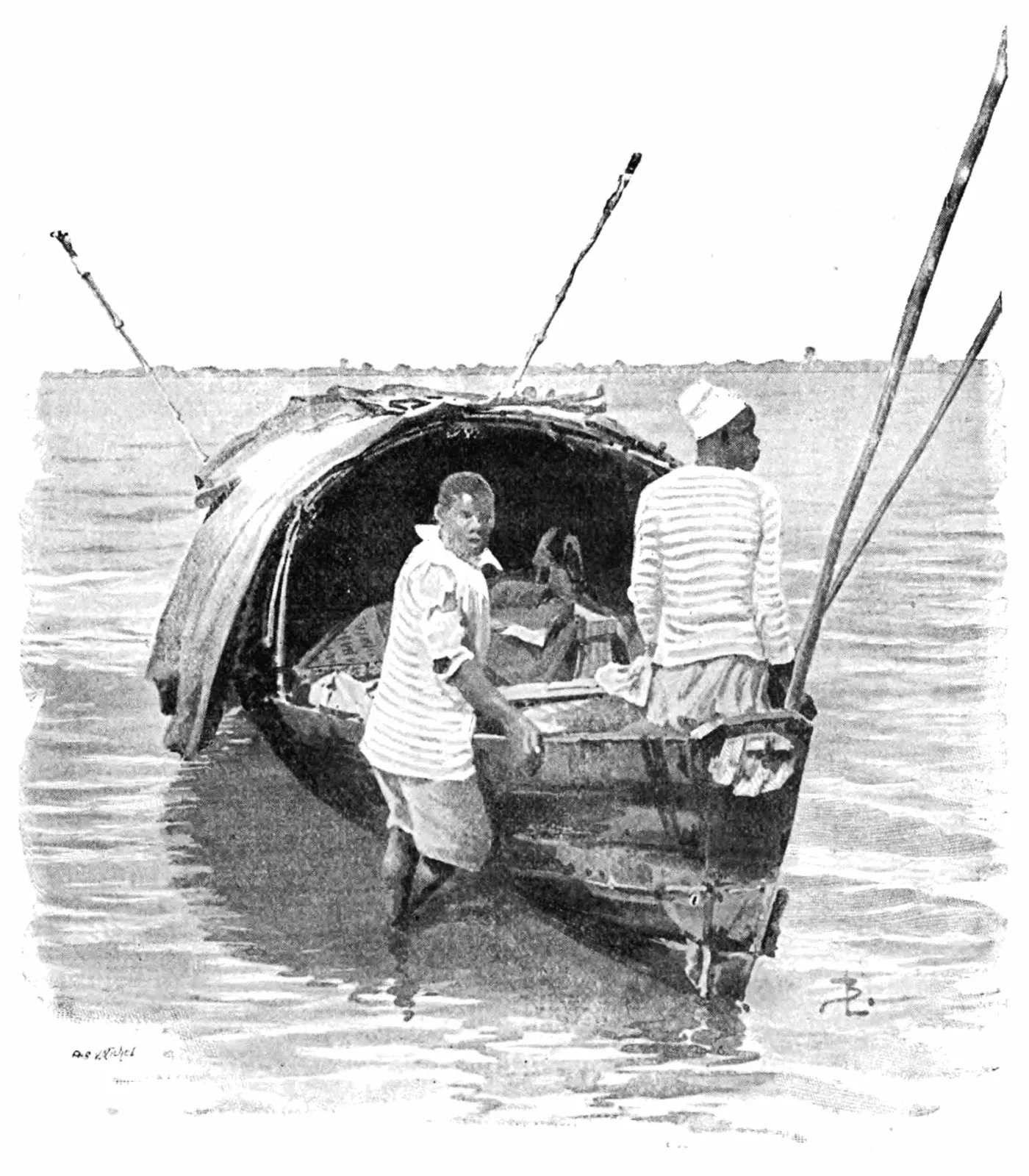
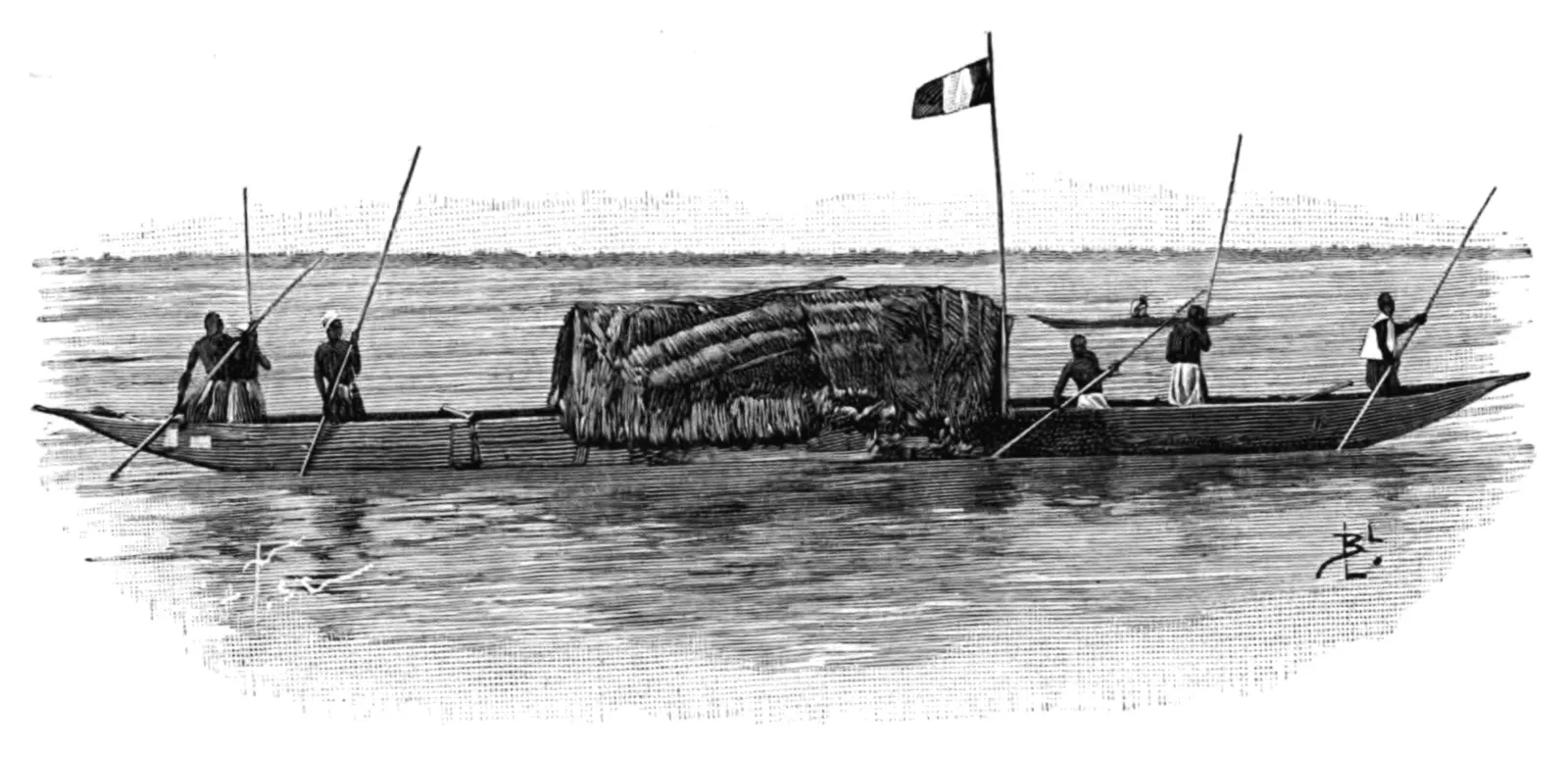
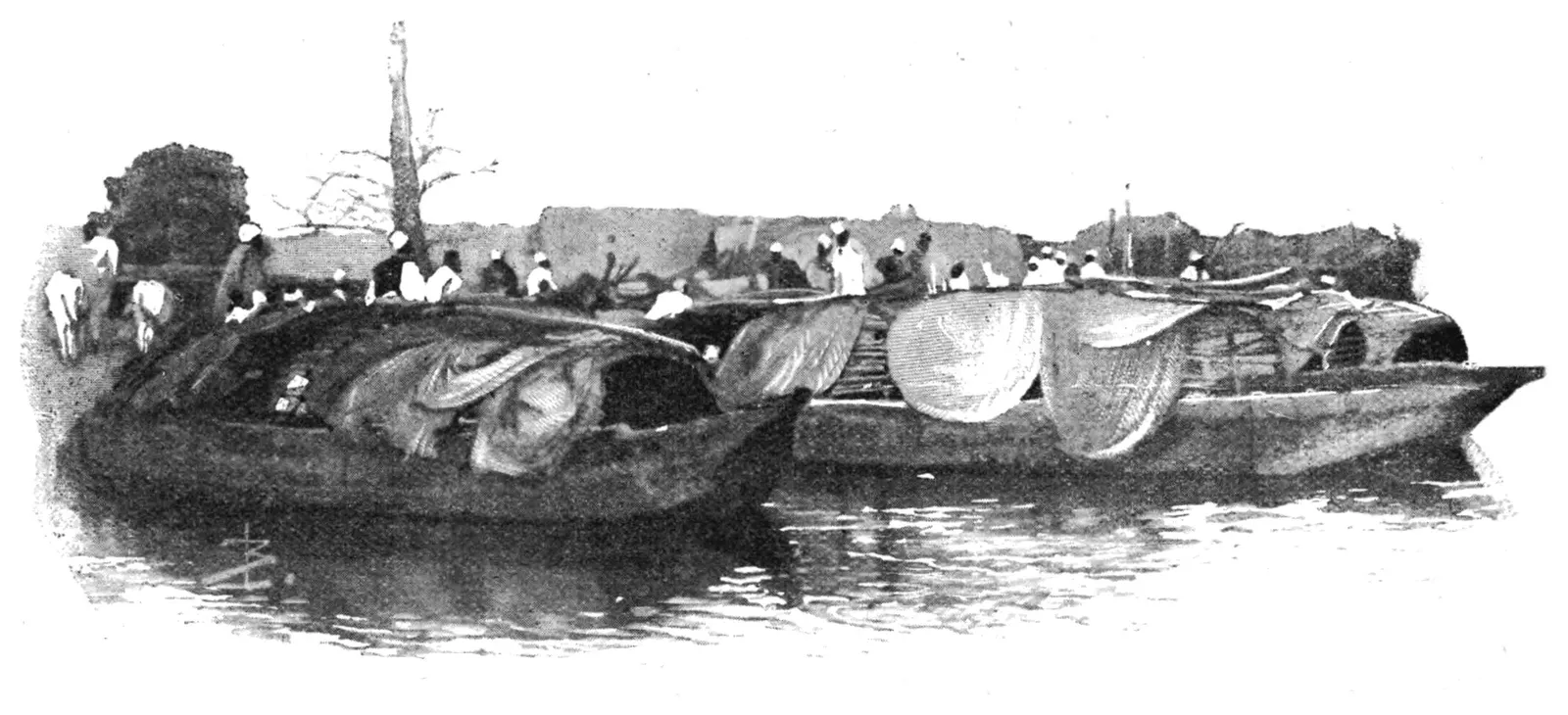
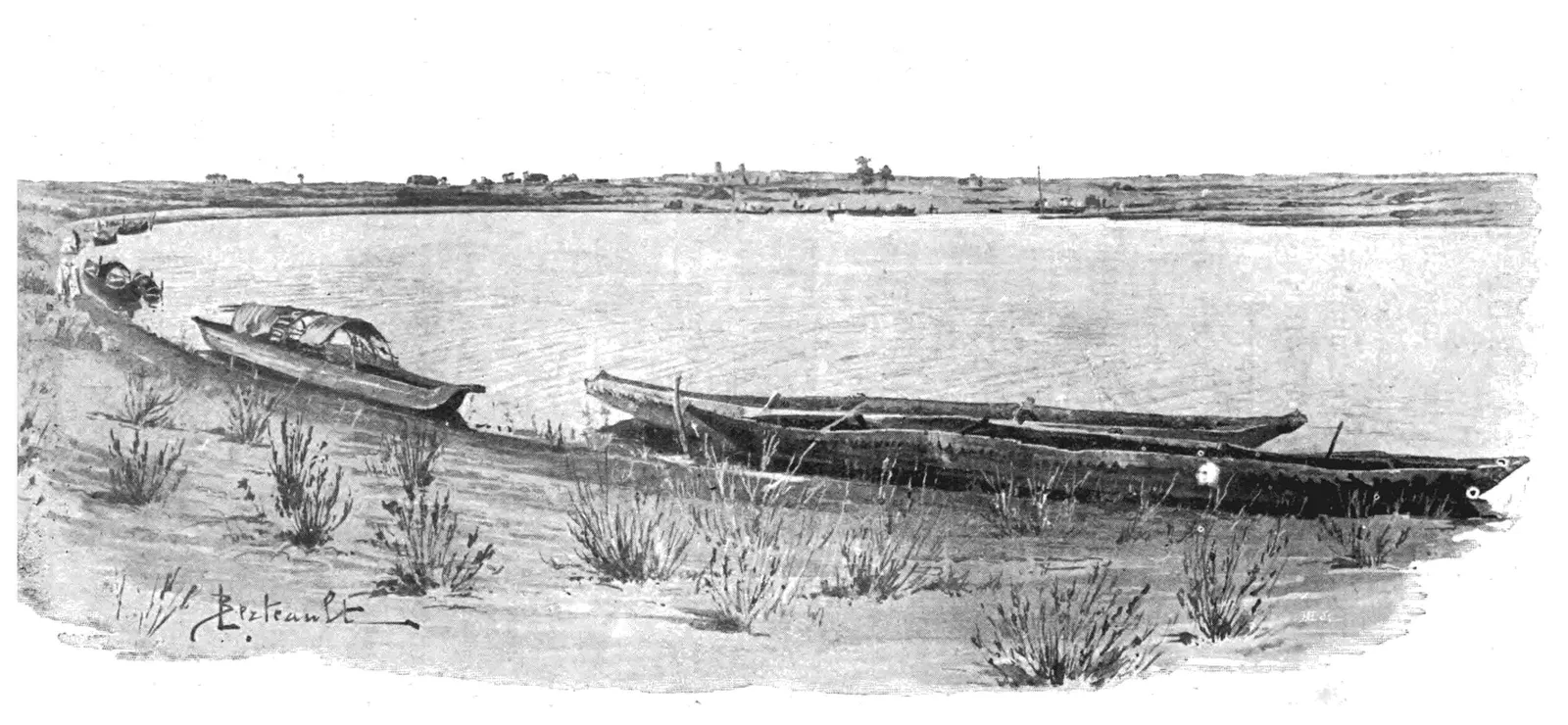
My yacht would have ill-supported any one of those adjectives,
for it was a whimsical mixture of European barge and aboriginal
canoe. It had borrowed from the former its breadth of beam
and its flat bottom, and from the latter its sharply pointed
extremities and its deplorable facility for springing a leak. A
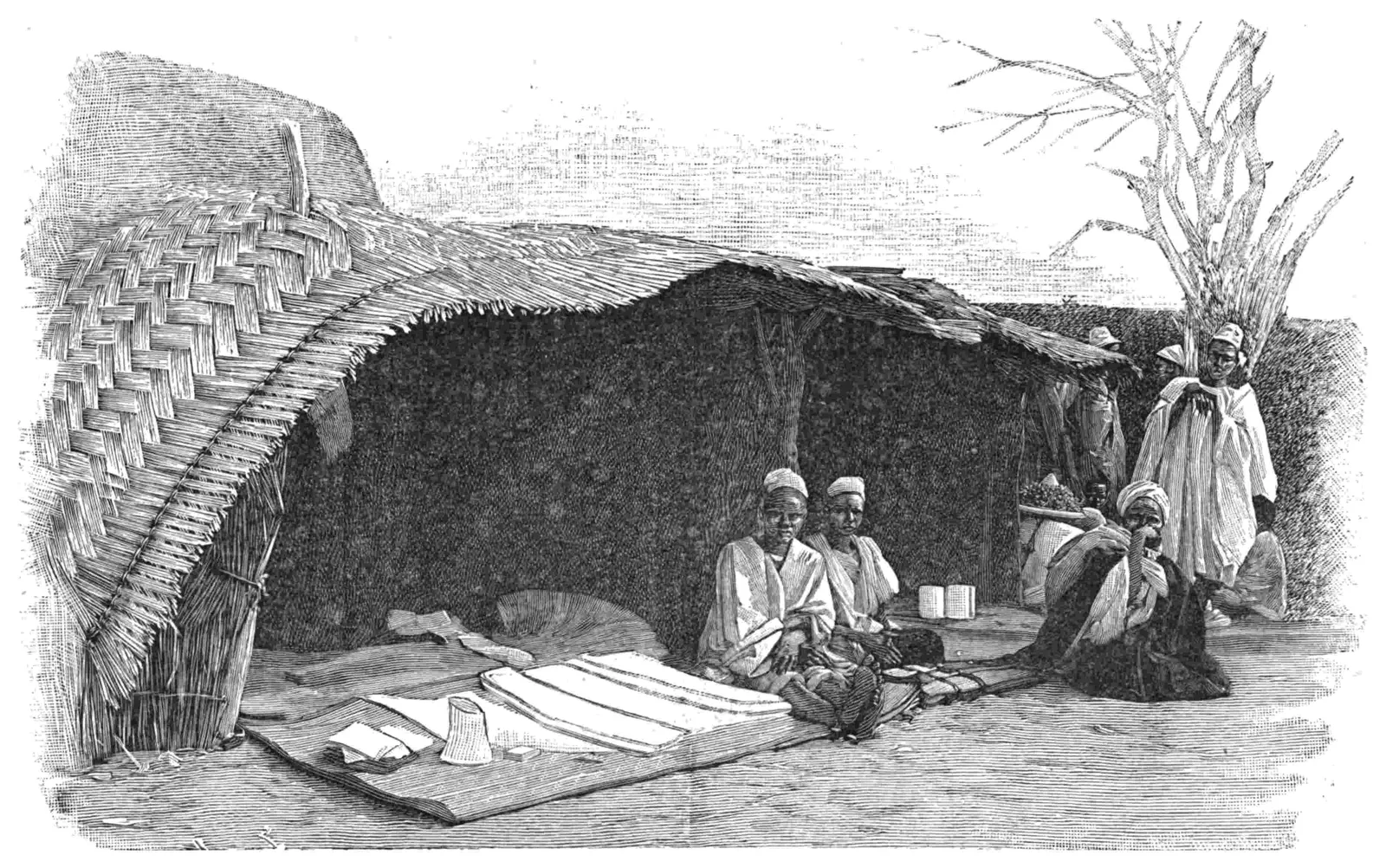
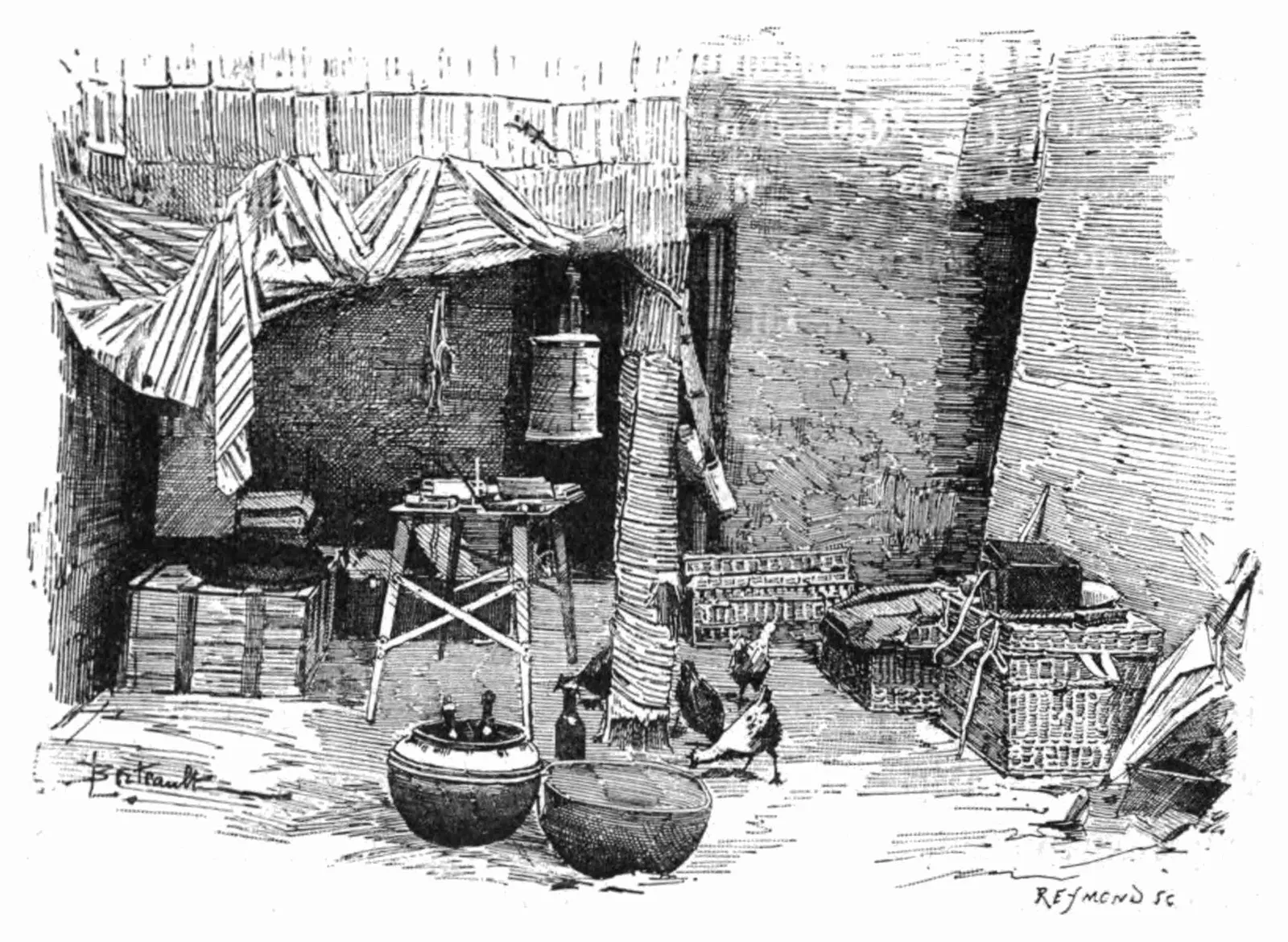
thatched hollow served me amidships as bedroom, dining-room,
study, and dressing-room. I enjoyed, moreover, an amphibious
existence, for the water unceasingly trickled through the flooring
into my apartment. A small folding bedstead was my only piece
of furniture. Table, cupboards, desk, washstand, and sideboard
were represented by different packages, wicker baskets, bottle-cases,
and portmanteaux. A long box filled with earth served as
kitchen and stove, and was placed fore and aft in accordance
with the direction of the wind. In the remaining very limited
spaces the seven or eight men who handled the boat were distributed,
together with two bleating sheep (representing our
meat-supply) and some clucking hens. The game brought
down by lucky shots, and the fish and other properties of
my men, were extra; and, in addition to all this, some place
had to be found for the kitchen fuel. For the benefit of
those who like figures and complicated problems, I will add that
my Noah’s ark measured twenty-six feet three by seven feet six in
the widest part.
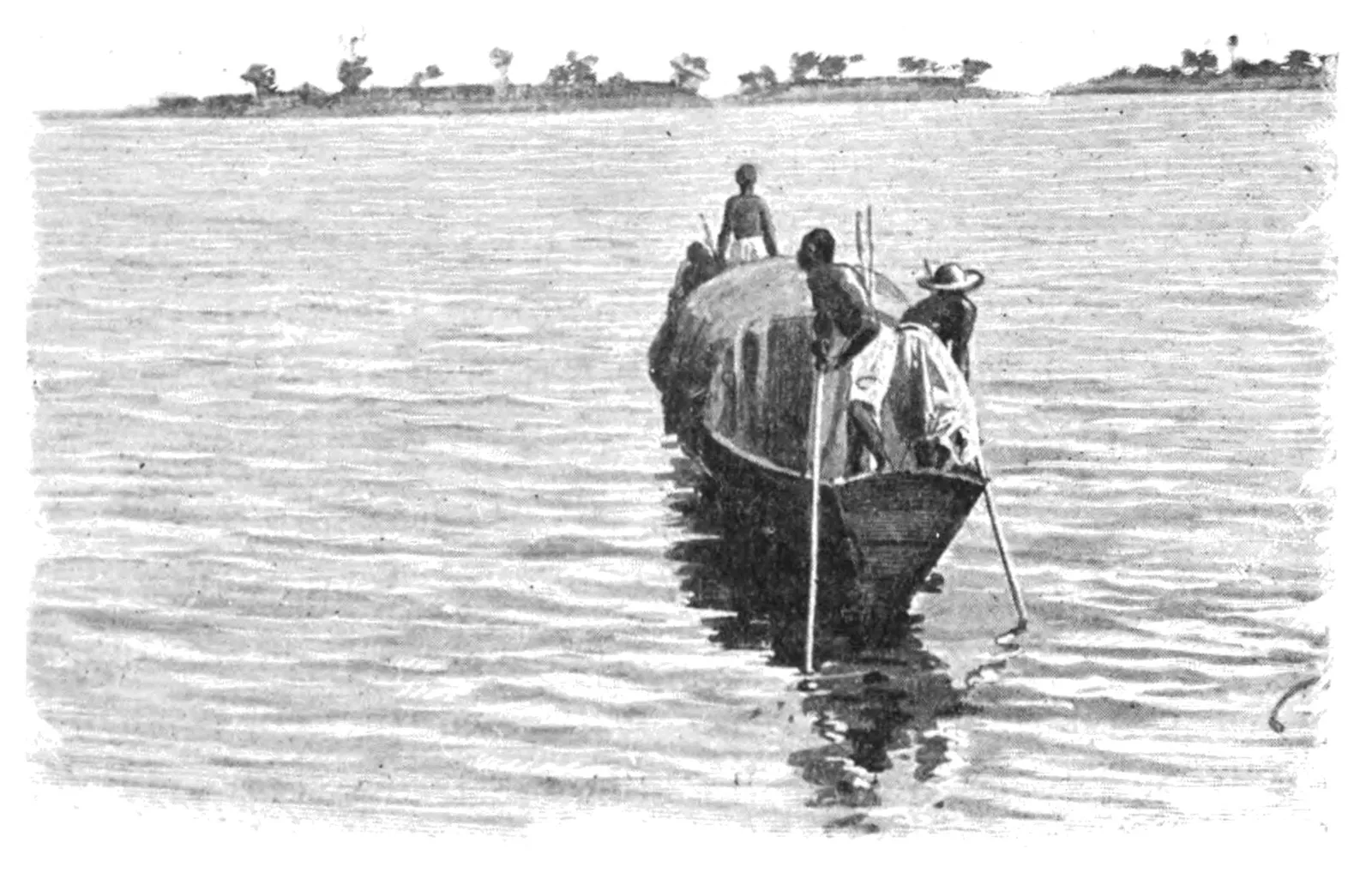
MY YACHT
Obviously it would have embarrassed me to give one of those
Trouville or Cannes fêtes to which my fellow-yachtsmen are
accustomed, but luckily the occasion never arose. Yet fêtes there
were, provided day and night by the Niger with a variety and
splendour that the richest merchant in sugar-plums could not
have equalled. Its waters were now blue as the Mediterranean,
now grey as the North Sea, and now again they were apparelled
in the green of the great ocean; while Venus Anadiomenes in
black sported upon
its banks. If these
latter were not smilingly
coiling their
tresses, it was only
because their hair
was short and
greased with butter.
Failing this poetic
occupation, they
were engaged in
alternately scrubbing
their cooking
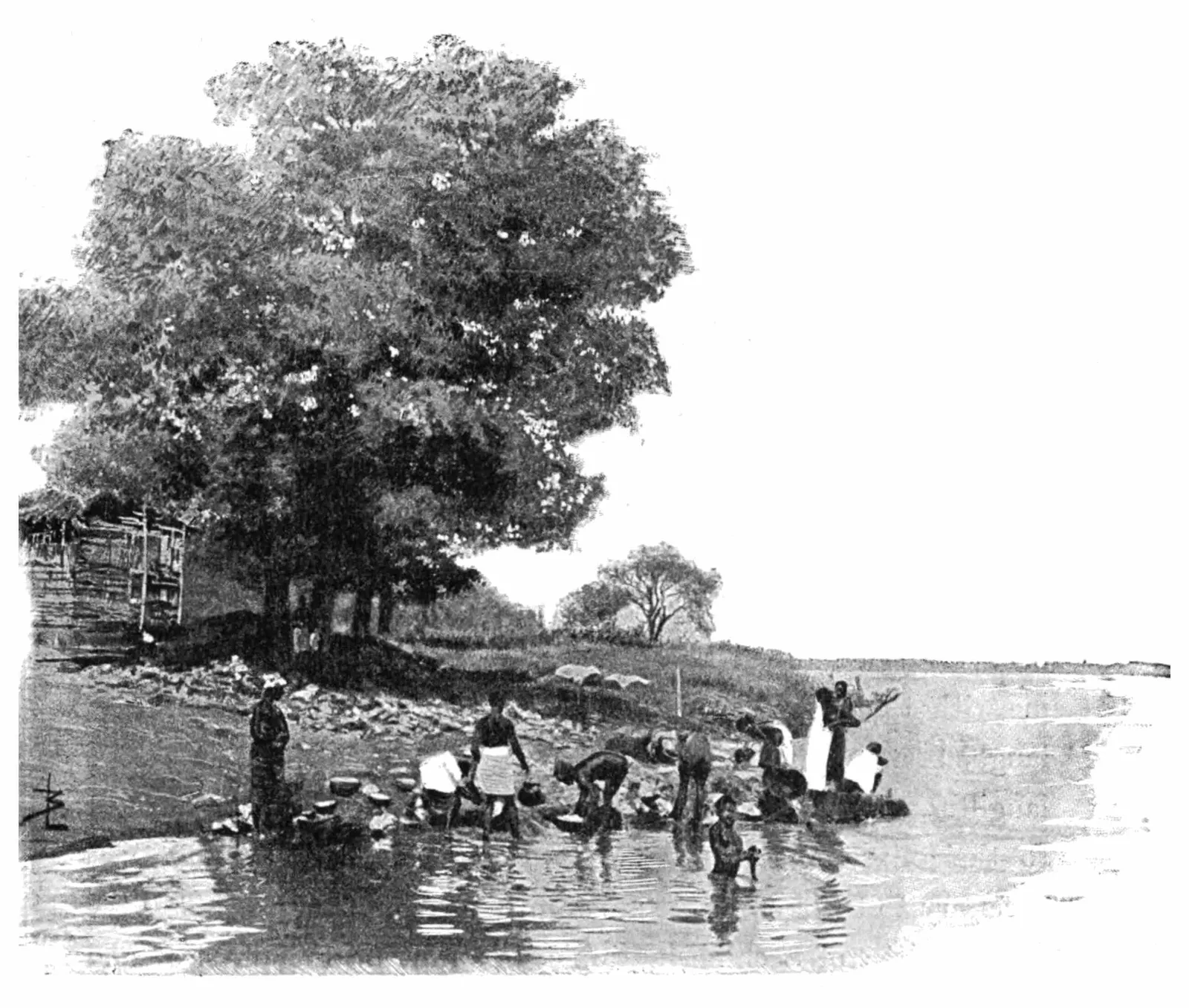
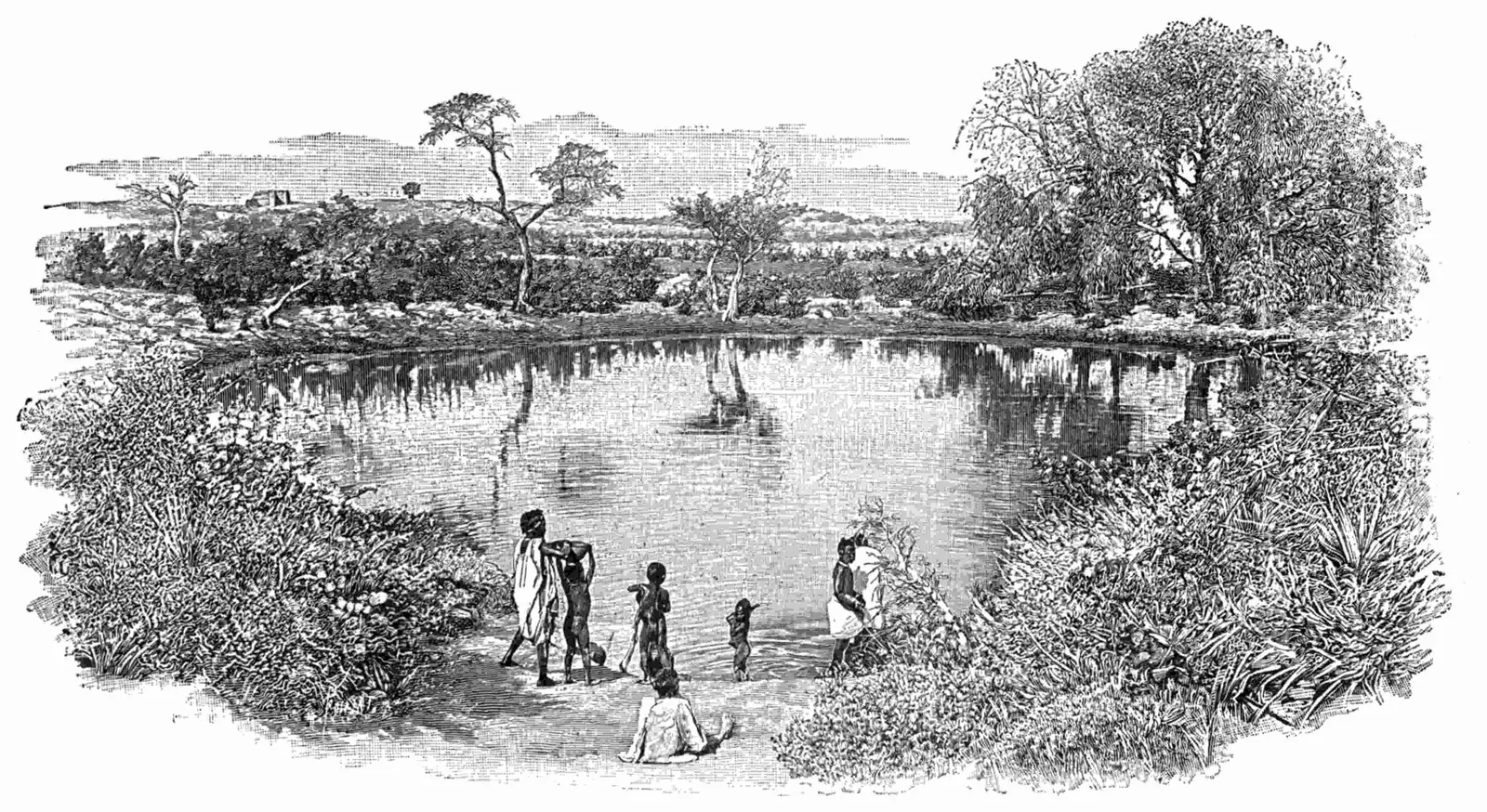
utensils and washing their children in the splashing wave. Art,
however, lost nothing by that, for, in their constantly changing
attitudes, their perfect nudity only served to call attention to
their marvellously sculptured torsos and their bronze skins,
touched into gold by the brightness of the sunshine.
ON THE BANKS OF THE NIGER: THE VENUS ANADIOMENES
Here and there upon the great strands were playing the strange
childish forms, with the great heads and stomachs balanced on the
slender limbs, of the negro babies. Drolly would they interrupt
their games and run close to the river-bank to watch the white
man pass, making him the while—a military salute! Nothing
more comical could be imagined than these little naked caricatures
with one arm stiffly raised at an angle. If I smiled, they gave me
back the same broad laugh the Venus Anadiomenes had tossed
me with their ‘Anissagai’ (Good day)—the same that my Bosos
laughed a minute after they had been struck. This gentle
laughter, with neither intellect nor malice in it, is always ready
to their lips, even in the most serious circumstances, and is as
necessary to their existence apparently as food or water. It is the
happy mirth of a childish people, ignorant of the physical and
moral torments from which the more perfect man results.
THE MILITARY SALUTE
The placid fisher with the line also greets us in military
fashion. This form of salutation seems to be the only thing
that our civilisation has brought them so far. Poor souls! when
the rest has followed they will have ceased to laugh.
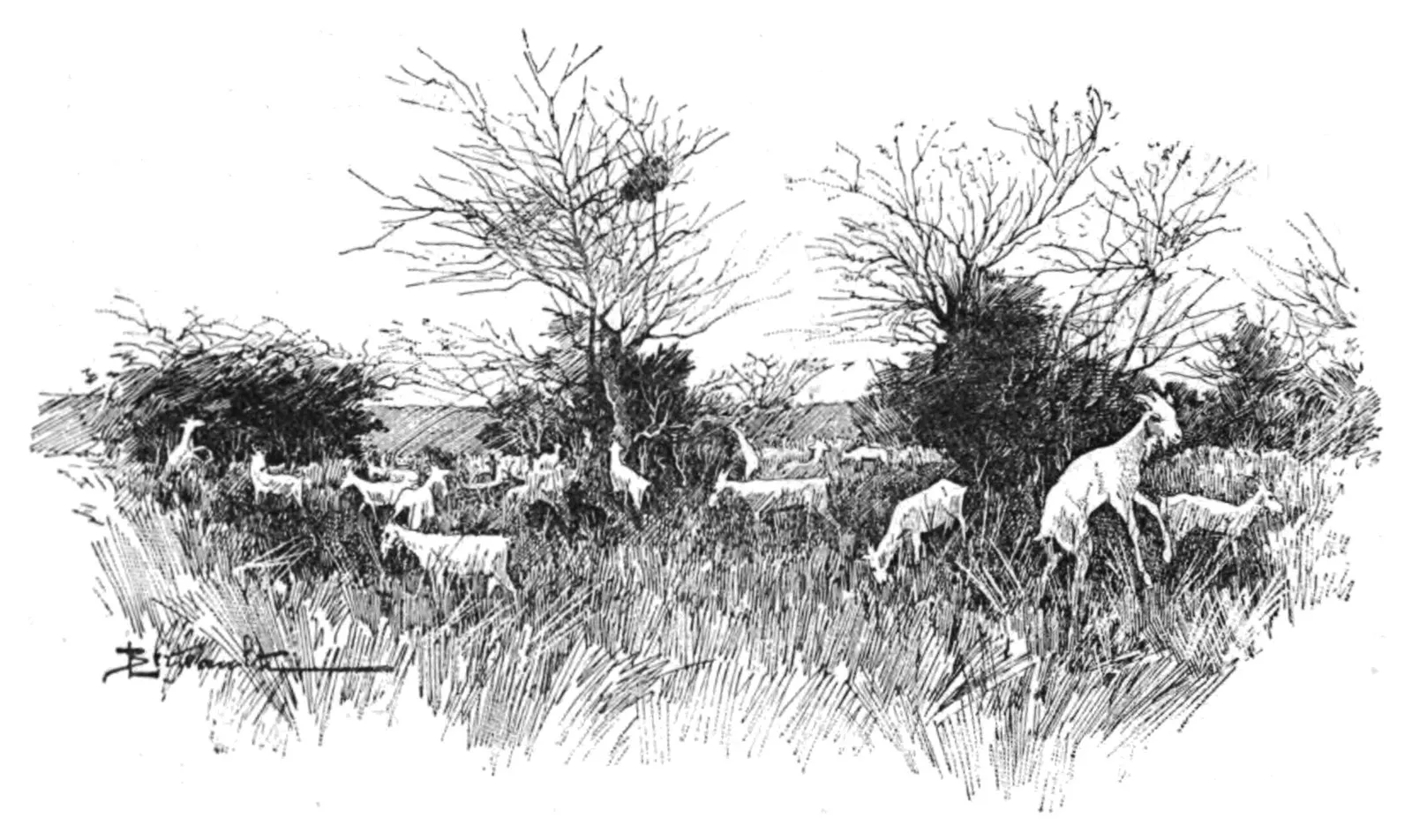
Between Segu and the regions bordering Timbuctoo I passed
wonderful herds of oxen, horses, goats, and sheep. Unlike the
stunted cattle and emaciated hacks of the countries of the Niger’s
source, these oxen had imposing humps, and the horses were on
the lines of Arabs. The sheep, too, were astonishing. Long
fleece replaced the close wool of the southern animal, and their
flocks were to be counted by such thousands of heads that I was
greeted at long distances by ovations of bleating.
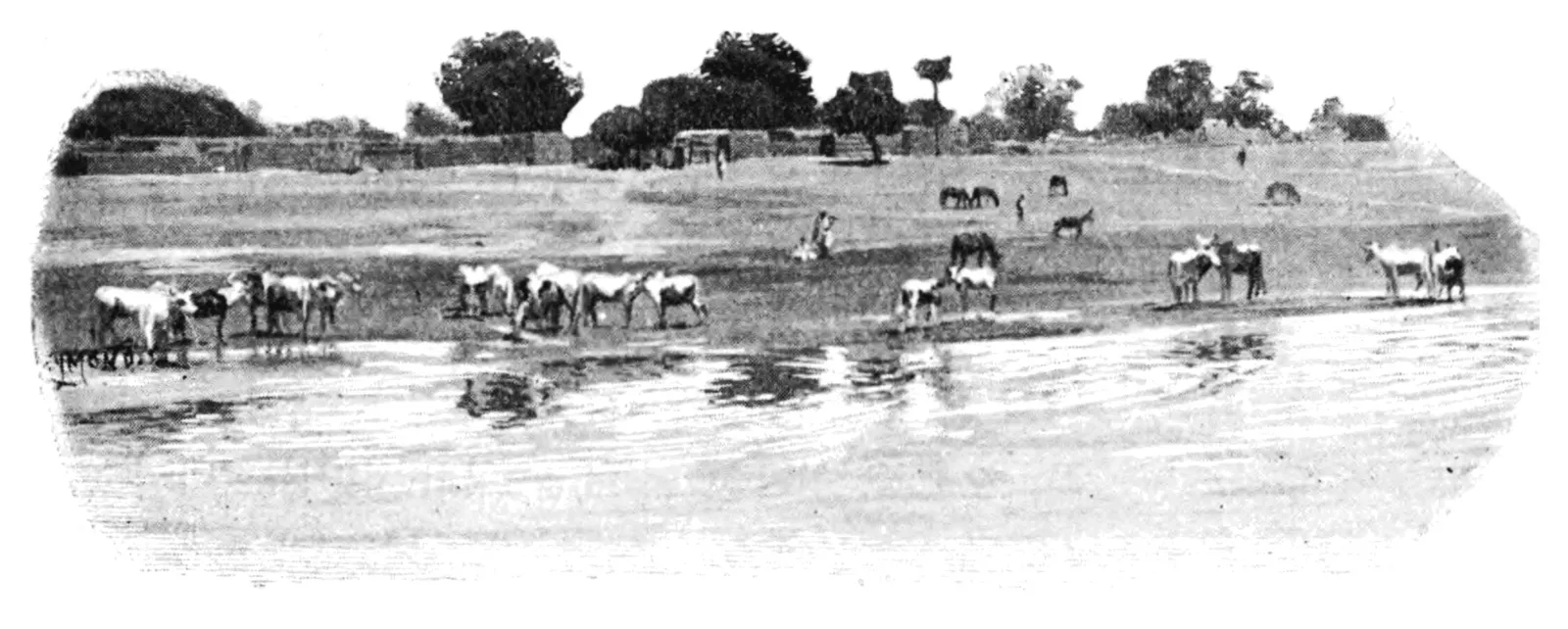
PASTURE ON THE SHORES OF THE NIGER
Travelling one day between Lake Debo and Sarafara, it was
given me to see quite another sort of herd. We were touching
upon a large plain bordered by a distant wood, when suddenly,
at sunset, four black lions appeared walking in Indian file.
They advanced with slow and solemn steps, pausing with heads
erect as the sound of our paddles reached them. After fixing
upon us a look that was half-displeased, half-disdainful, they
turned their backs upon us, and, still keeping the same order,
disappeared with unmoved slowness and solemnity in the wooded
green of the distance. The scene was so captivating that the
thought of my Winchester never entered my head. The gun
was always at hand, however, to spread a little perturbation
(impossible to effect more appreciable results) among the families
of hippopotami who, towards evening, thrust their pink muzzles out
of the water, and to annoy the numerous alligators who relaxed
in sunny slumbers throughout the day.
The feathered species did not get off so cheaply, however,
especially the wild ducks, whom, at my leisure, I would invite
to my table in the shape of roast or stew. The white ospreys,
the Niger’s favourite bird, were truly innumerable. They dappled
the banks, looking like flakes of precious snow, with silky reflections
made lustrous by the sun. The gracious outlines of their
slender forms, the supple necks and long slim legs, stood out
in such dainty visions from the green grass and grey banks that
one shot them remorsefully. Alas! their death-warrant is written
and attached to the base of their slender necks; for it is there,
and not on their heads, that the fragile plumes grow—delicate
emblems of themselves and of those alone who should be privileged
to wear them. From these plumes, in fact, are made those precious
parures which, mounted in jewelled clasps, place such a charming
point of pride upon the forehead of brunette and blonde alike.
The allurement of such a spoil, seen in imagination adorning
some cherished head, dispels all remorse, and hastens the fall of the
trigger.
The confidence of these charming birds is very great, for the
native, disdainful of its flesh and ignorant of the value of its
plumes, has never hunted it. They alight boldly in the midst of
the flocks of sheep that have such an inexplicable attraction for
them, and it is very quaint to see groups of two or three ospreys
surround each sheep, and with gravely measured steps follow its
browsing until the innocent ruminant looks like some captive surrounded
by its gaolers.
Other birds of valuable feather dart about the sands, such as
the marabou, metallic blackbirds, kingfishers in every shade of
wonderful azure, and flocks of guinea-fowls, flamingoes, and pelicans.
Sometimes, on approaching the sedgy banks, a strange rustling is
followed by a cloud of dust. It is caused by those tiny creatures,
scarcely bigger than crickets, the millet-eaters. I must not forget
to mention the trumpet-bird among my intimate friends—a large
black wader, whose note might easily be mistaken for the horn of
our tramways.
As infinitely varied as the colours of the kingfisher are the
scenes in which this medley of life unfolds. At Toulimandio
the shores are formed of high woods of wonderful verdure,
dark and deep as velvet, and the mountains seen in the distance
are the last ramifications of the Foota Jallon range. Were
it not for the unaccustomed proportions of the river and the
marvellous sun, there would be nothing specially tropical about
this country.
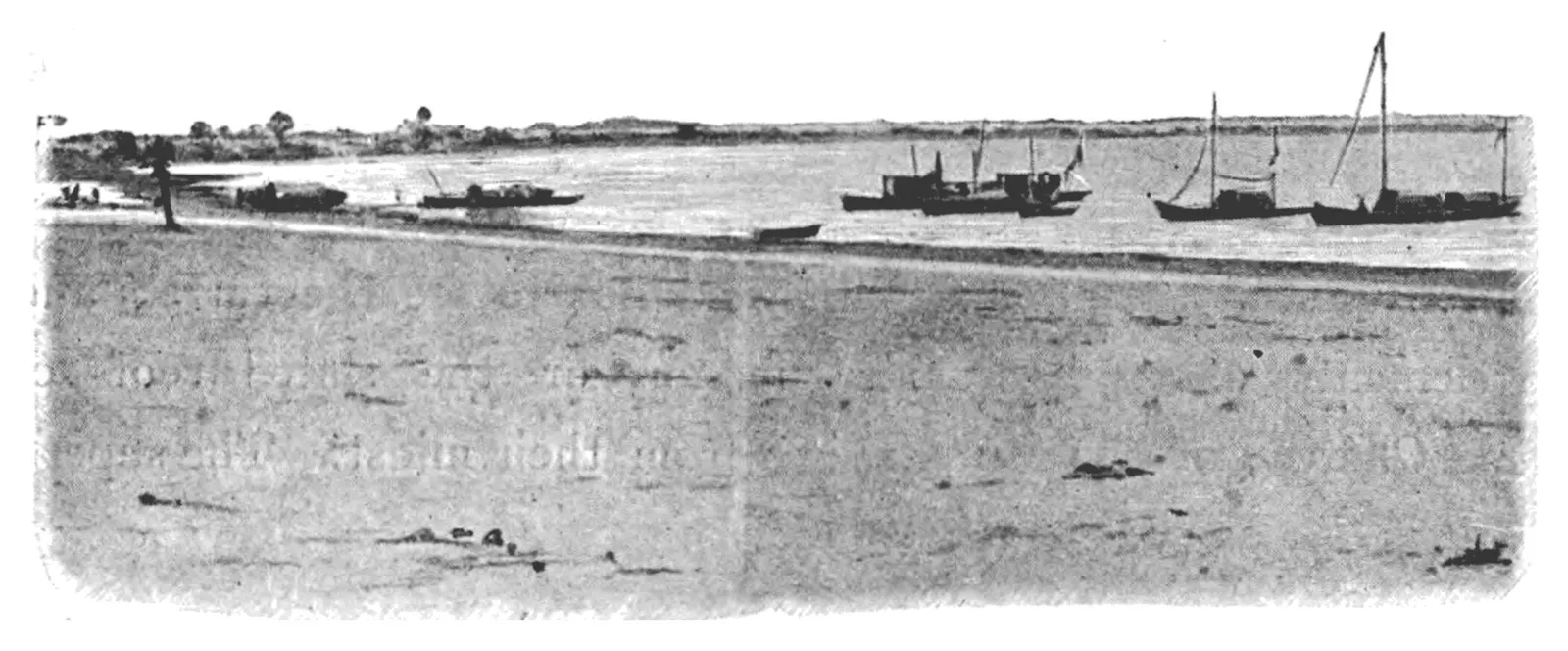
THE SHORES OF LAKE DEBO AT GOURAO: GUNBOAT STATION
Little by little the woods thin and the trees diminish in
height. The river-bed is strewn with trunks torn from the banks
by the floods, and many more hang disconsolately over the water,
certain victims to the approaching inundations.
At Nyamina, Segu, and Sansanding, the woods give place to
great plains of tillage and cattle-rearing, that spread further than
the eye can reach, and close upon them follows, with Lake Debo,
a maritime scene. This lake is a huge basin of water by the
side of the river, and, the two hillocks guarding its entrance
being passed, a veritable sea spreads before you. Water everywhere,
always, and for ever. Its shores are invisible, for no distant
mountains betray their boundaries, as is the case with the Swiss
lakes.
MOUNT ST. CHARLES, AT THE ENTRANCE TO LAKE DEBO
An equally unexpected vision awaits the traveller beyond
Lake Debo; and it is now a landscape from Normandy or
England that is disclosed to eyes stupefied by such an apparition
in the heart of tropical Africa. Great meadows of a moist,
intense green are bordered by park-like woods. So vivid is the
impression that you are disappointed not to see the turrets and
battlements of a Lancashire manor, or the slated roofs of
some Château of the Eure, rising from their midst. The superb
troops of humped cattle, large and sleek, scarcely dispel this
northern illusion.
All this changes after Sarafara, and it is now the tangle of a
tropical forest that defiles before my yacht, now some Eastern
scene that I have already witnessed in Egypt or Syria. Palm-trees,
slenderly erect, dominate a scanty vegetation containing
the melancholy green of the olive-trees of Palestine, and
thickets of low bushes that recall the fig-trees of Judæa.
MOUNT ST. HENRI
El Oual Hadj passed, bright green stretches of quite
another character appear, and the villages no longer crowd
together upon the bank, but are scattered out of sight, far
removed from the river-banks on account of the floods. The
only perceptible signs of life come from the fires of these villages,
that streak the sky with ribbons of smoke by day and tinge it
with red at night. You may travel miles and miles without
seeing a living thing, man or beast, upon the shores. An
atmosphere of secrecy hovers over the country: you suddenly
recall the fact that those mysterious Touaregs are still momentarily
its masters and oppressors, and you slip sixteen balls into
your Winchester.
Finally, on the borders of Timbuctoo the dunes of the
Sahara begin to oppose the sterility of their bare whiteness to the
river, increasing in number until the desert itself is behind them.
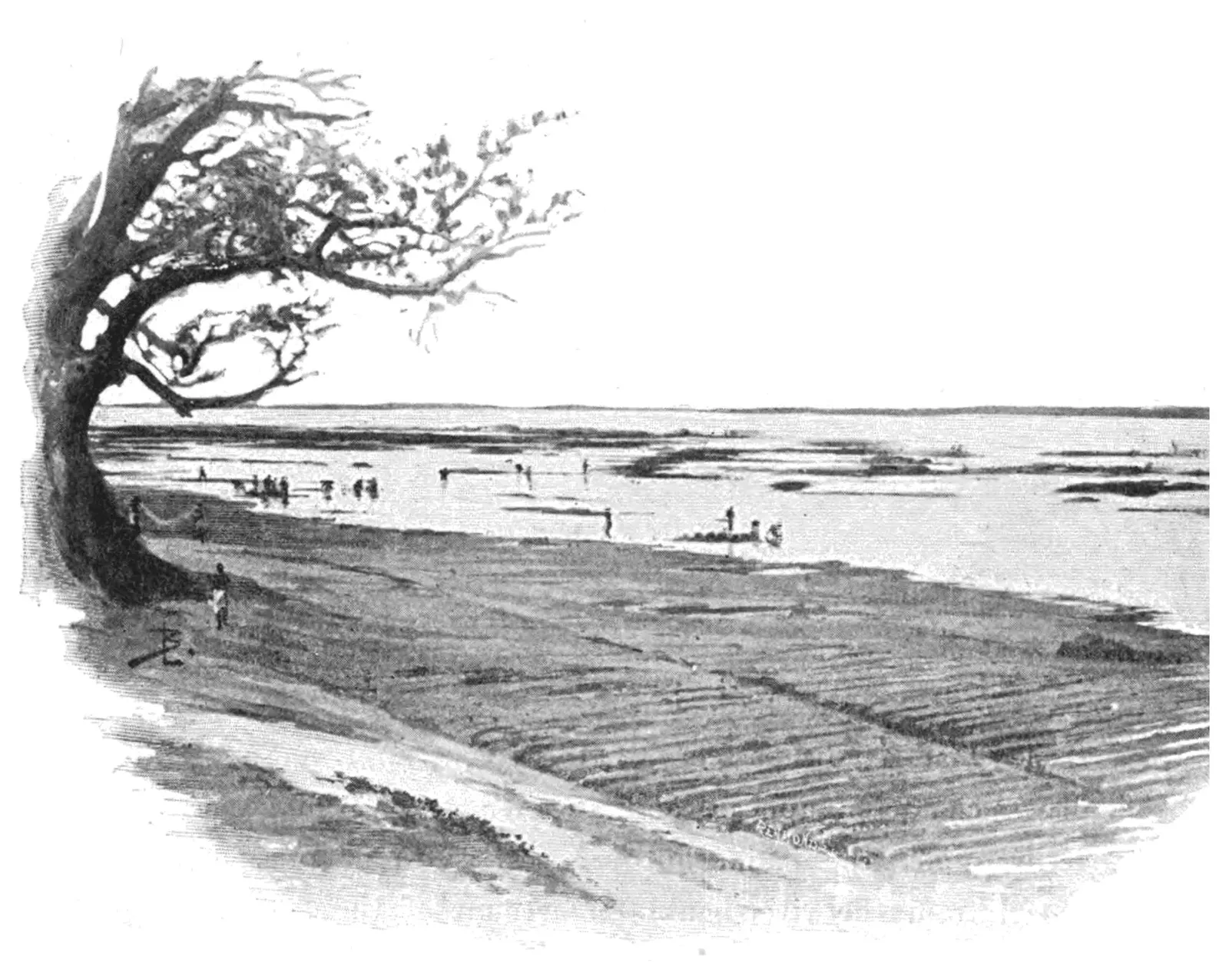
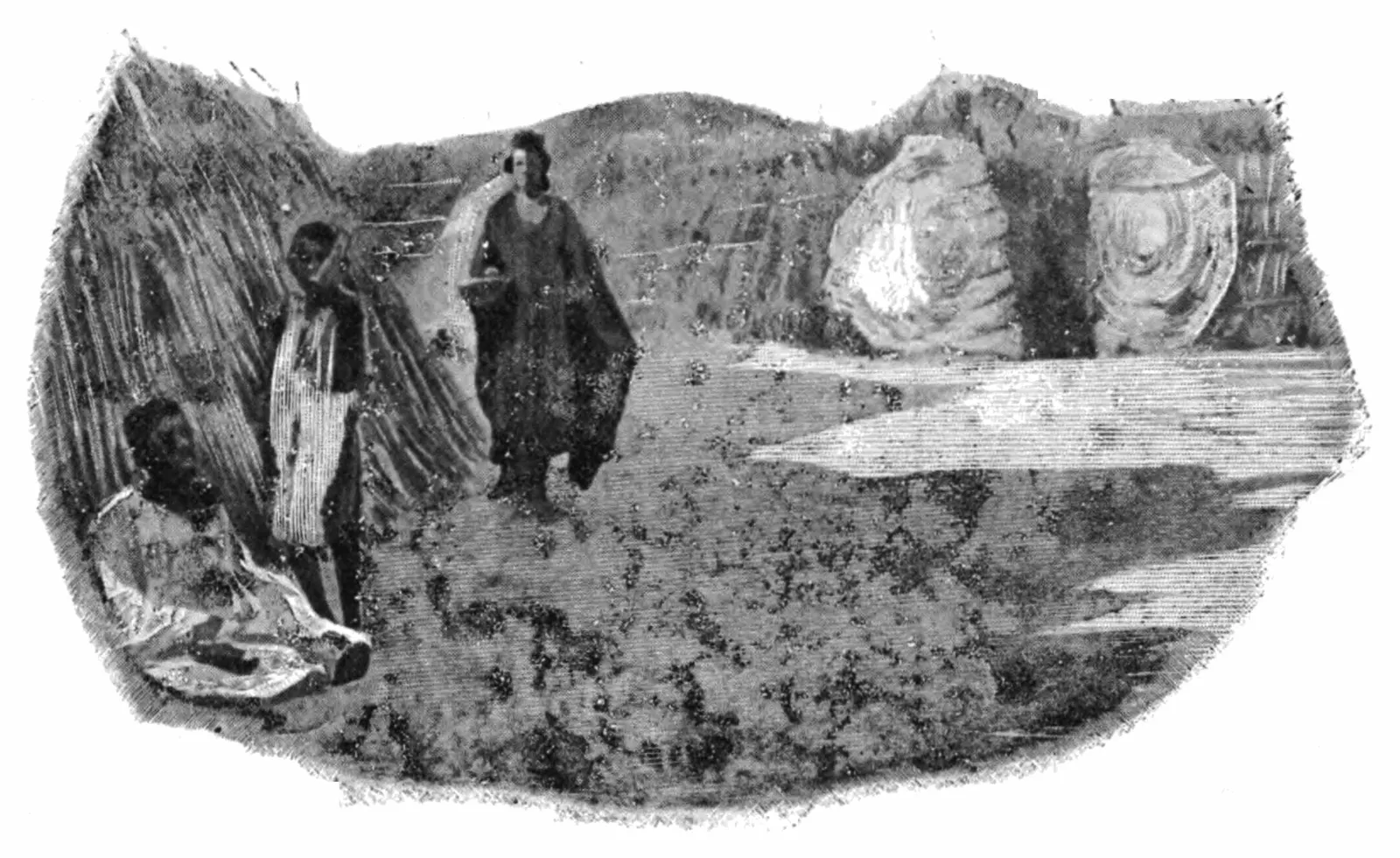
OYSTER-BEDS AT SEGU
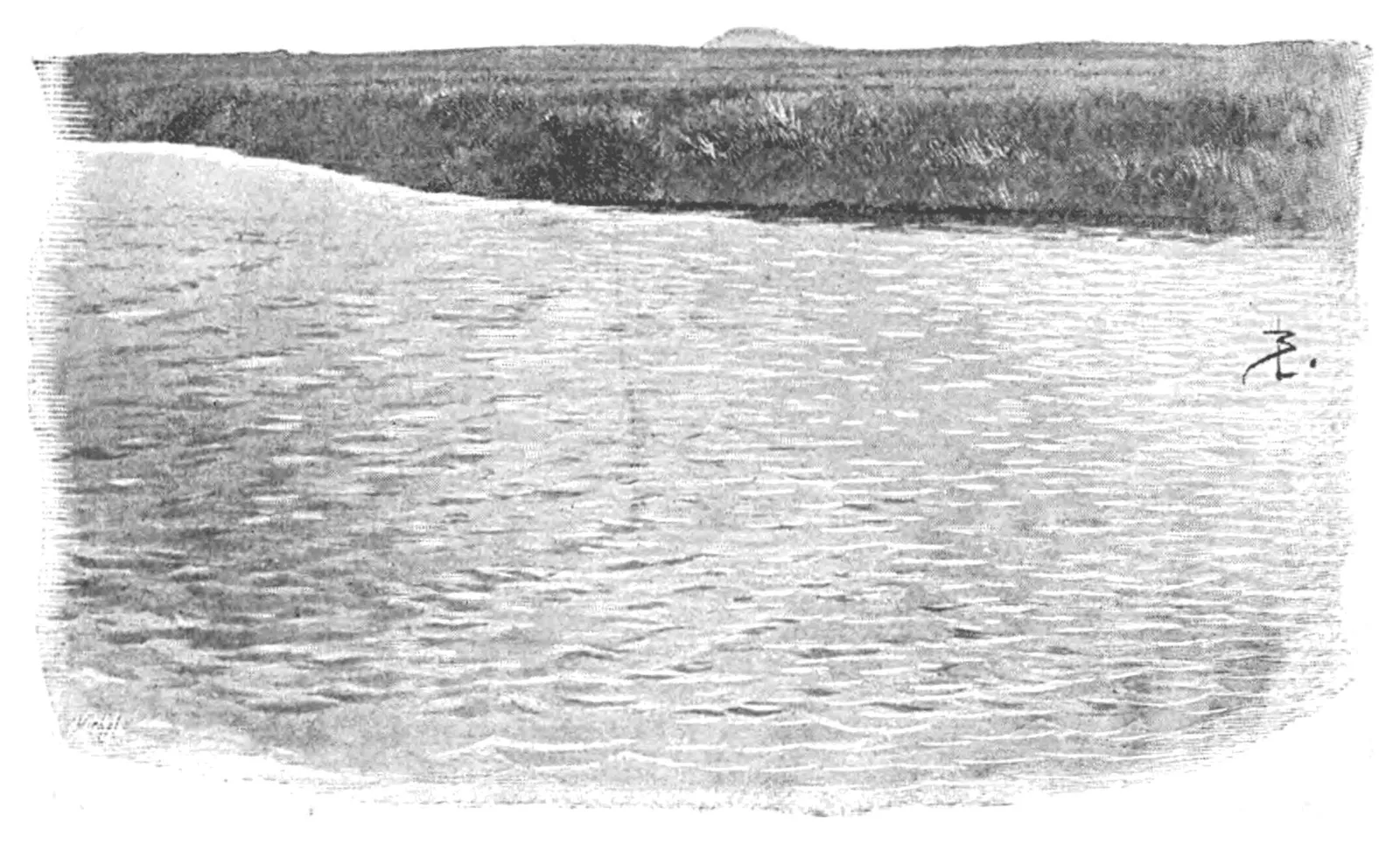
Varied as these scenes are, they possess a still further element
of change in the formidable
rising and falling of the river.
A scene known at the height
of the waters is unrecognisable
in the fall. Taking the
same route after some months’
interval, you seem to be following an entirely different river.
Where before you sailed in the midst of plains, you now pass
between banks some twenty-six feet high. There, where a vast
stretch of water gave the impression of a sea, you find a combination
of pools and sandbanks recalling the flat shores of the ocean
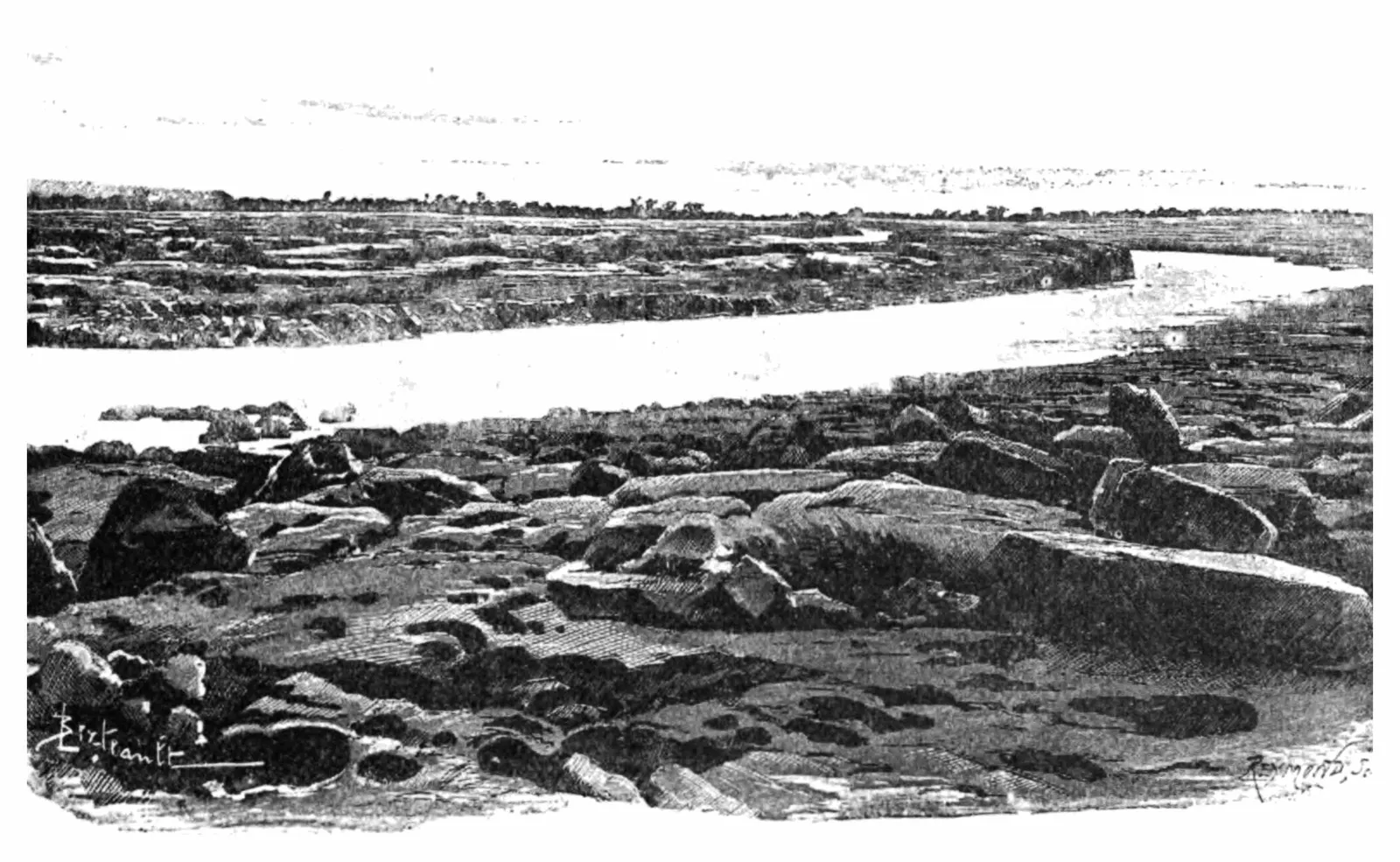
at low tide. At Timbuctoo it flows in swift and foaming
torrents, its sides and bed being encumbered with rocks. The
towns and villages, at which you had gone ashore to the nearest
houses, are now perched upon mounds encircled by vigorously
growing grass, and wearing the little airs of a Rhenish burg.
Fields of tobacco-plants and kitchen gardens flourish on the
uncovered banks, while before Segu the oyster-beds pierce the
surface of the water. This is in the fall.
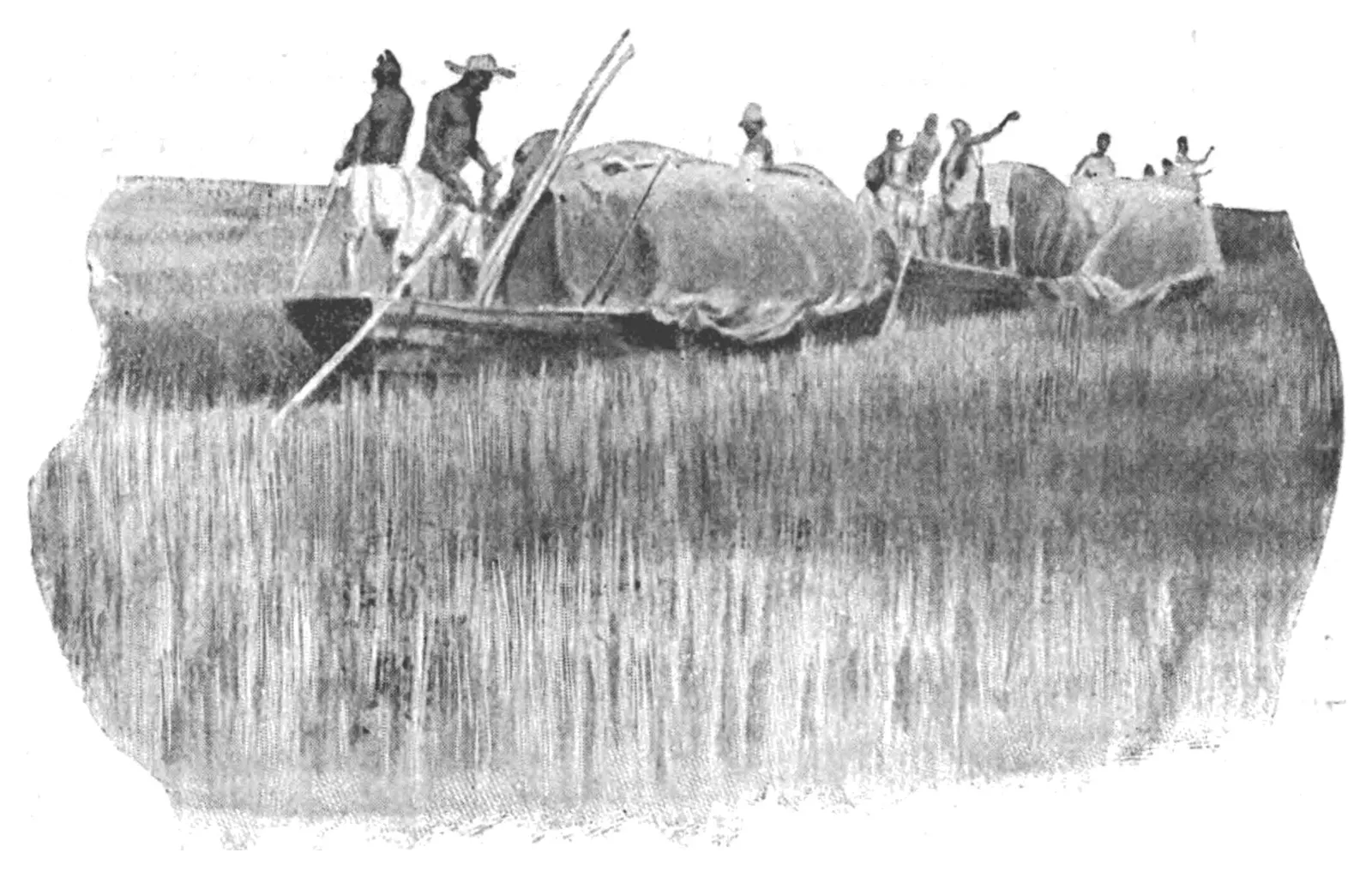
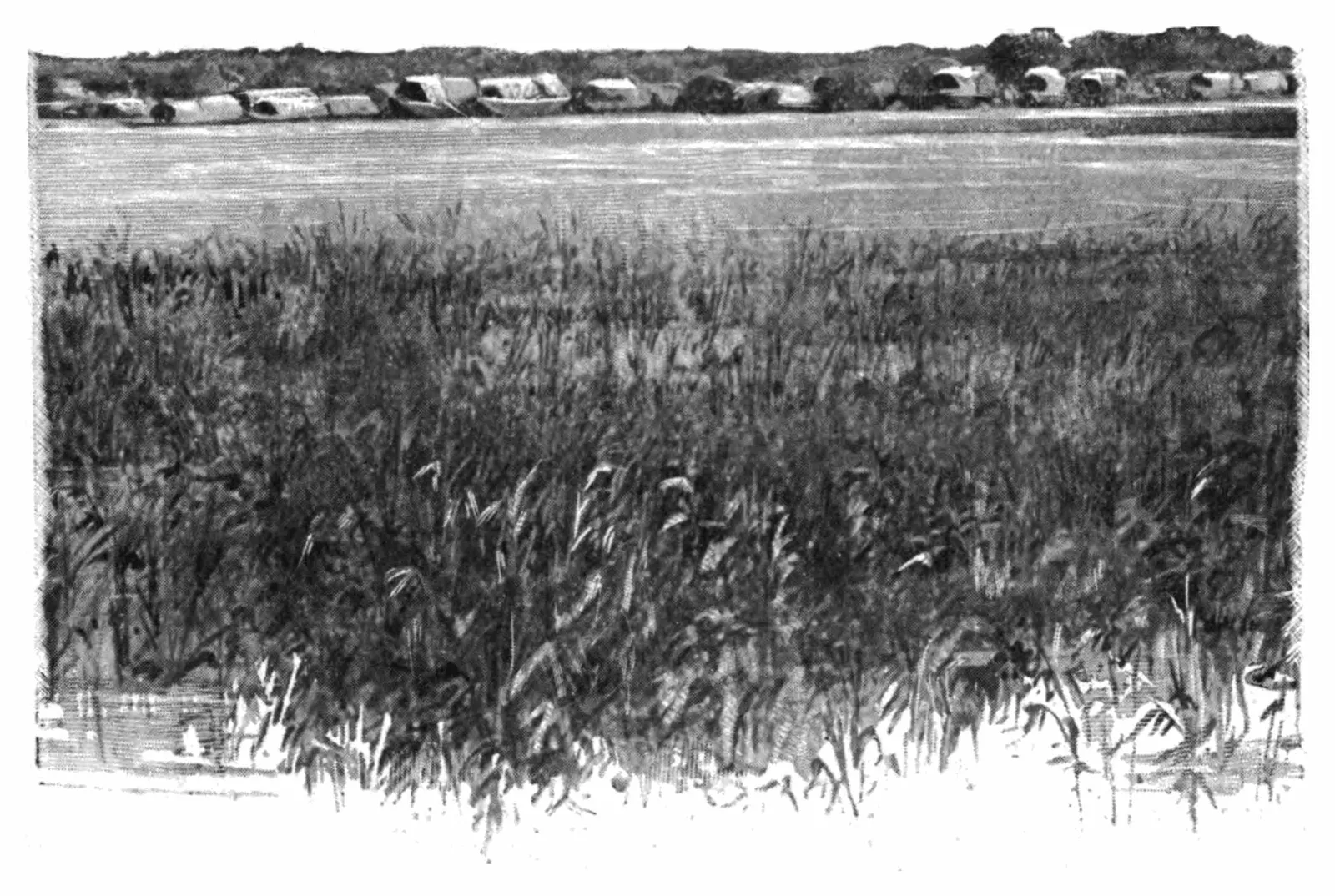
THROUGH THE SEA OF GRASS
All the effects of the rise originate from below Lake Debo,
at Mopti, where the river is joined by another as important as
itself, namely, the Bani. Towards December they have become
a vast mass of waters rushing to the north, and entire plains are
submerged to a considerable depth. On the right of Lake Debo
an immense region to which the little arm of Koli-Koli formerly
gave access, has now become a fief of the Niger. The greatest
surprise of all awaits the traveller here, for it is literally a sea
of grass. How does that strike you, my luxurious fellow-yachtsmen?
It is in truth a singular element, being neither
land nor water, but a strange mixture of both; without being
a marsh, however, for, the waters not being stagnant, the passing
breeze raises no fetid odour. From a depth of six to eight feet
the tall grasses emerge, thick and green, and wearing all the
appearance of a great field. One of our sheep was so deceived
by it that he threw himself overboard, thinking to arrive on
pasturage, but committed suicide instead.
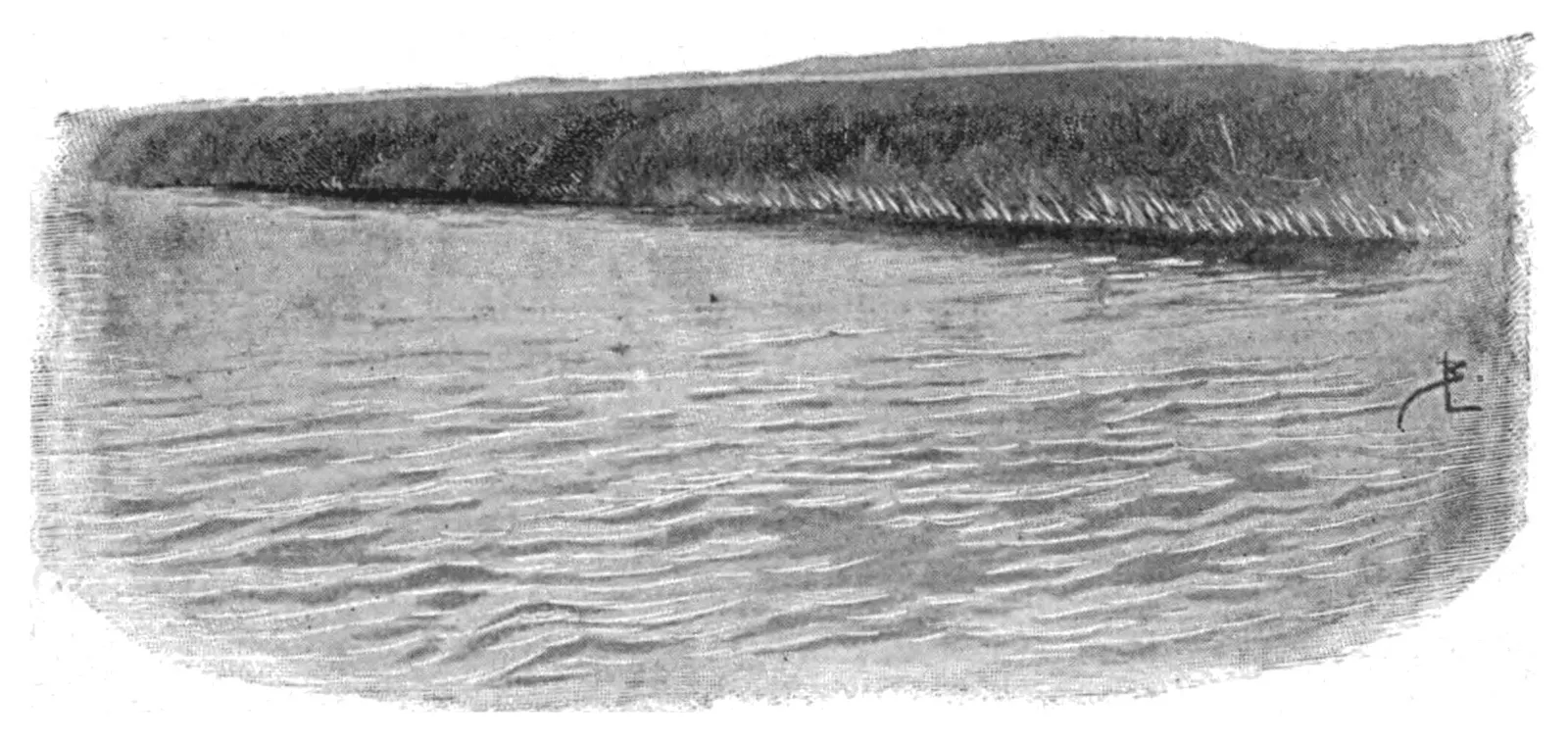
Between banks perfectly clear cut, though formed solely by
grass, winds that Koli-Koli which has brought hither and
spread afar all these waters. The boundaries of Lake Korienza
are no less sharply defined in this bizarre element.
In crossing this region my Bosos recommended the abandonment
of the easy, but infinitely capricious and winding, course of
the Koli-Koli. The journey, they say, will be greatly lessened
by cutting straight across this sea of green, a change of route
that suits me to perfection.
Paddling being no longer possible, the men, leaning heavily
on their bamboos, push the boat vigorously through the grass,
which, parting in front, closes together behind us with loud
rustling and crackling. We are no longer upon the water, but
seem, and it is a truly exotic sensation, to be sliding under a
tropical sun over grassy steppes streaked with watery paths.
This region of navigable grass is a world apart; the repeated
passage of canoes has worn away the green and traced ribbons of
water on its surface, in the same manner that the constant tread
of man and beast upon the earth destroys the grass and exposes
the bare soil. These paths, as conventionality would require of
them, are beautifully flowered. Placid water-lilies adorn their
surfaces with cups of white, mauve, and yellow, and they are
further encompassed by a strange tropical bindweed looking
like chaplets of floating onions. With this trivial, perhaps, but
certainly apt, comparison they possess another point of resemblance,
they are edible, and are greatly esteemed by the native in times
of dearth.
It would be ungrateful if among all these pictures, pale images
as they are of hours of enchantment, I forgot to include the
twilights and nights upon the Niger.
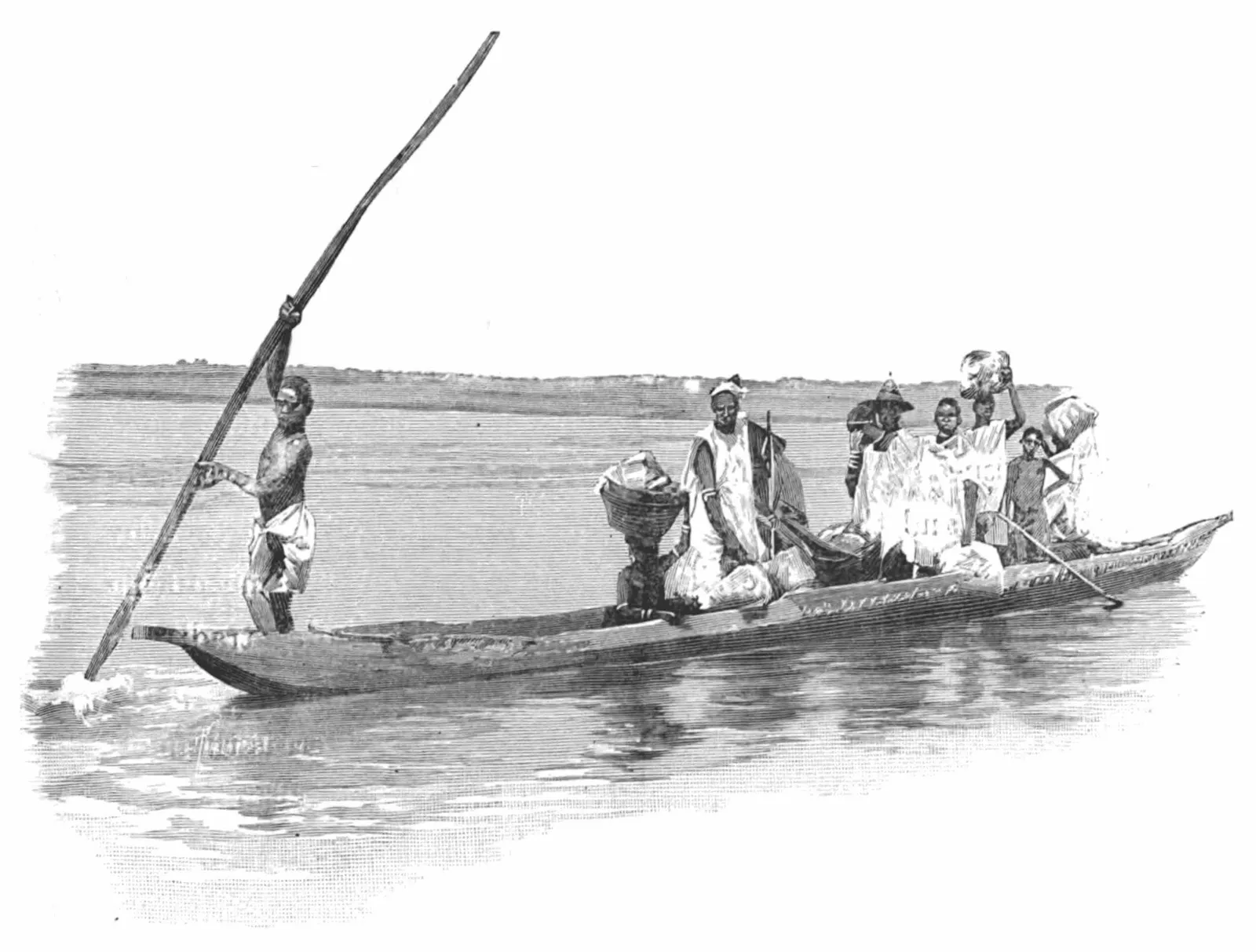
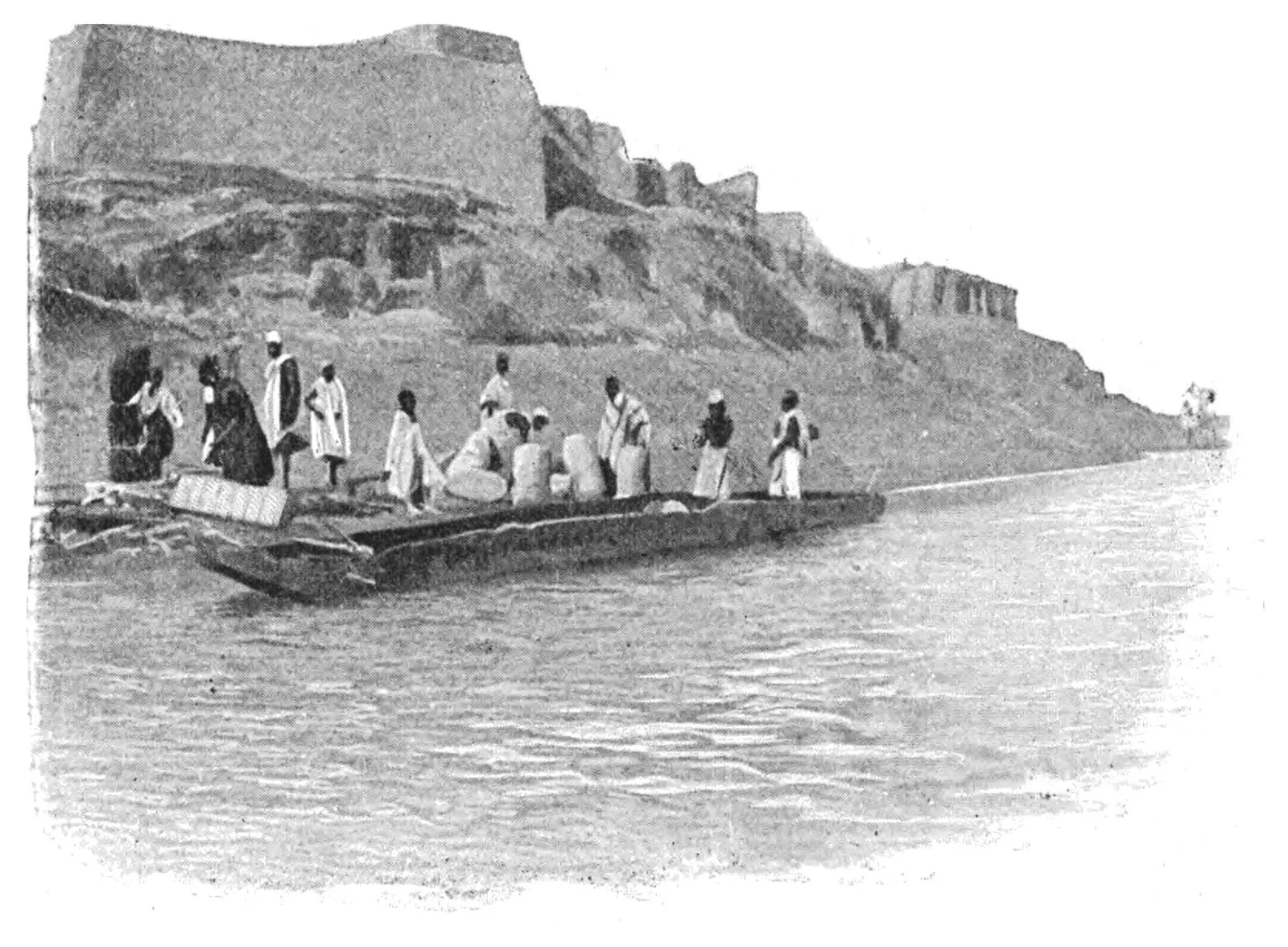
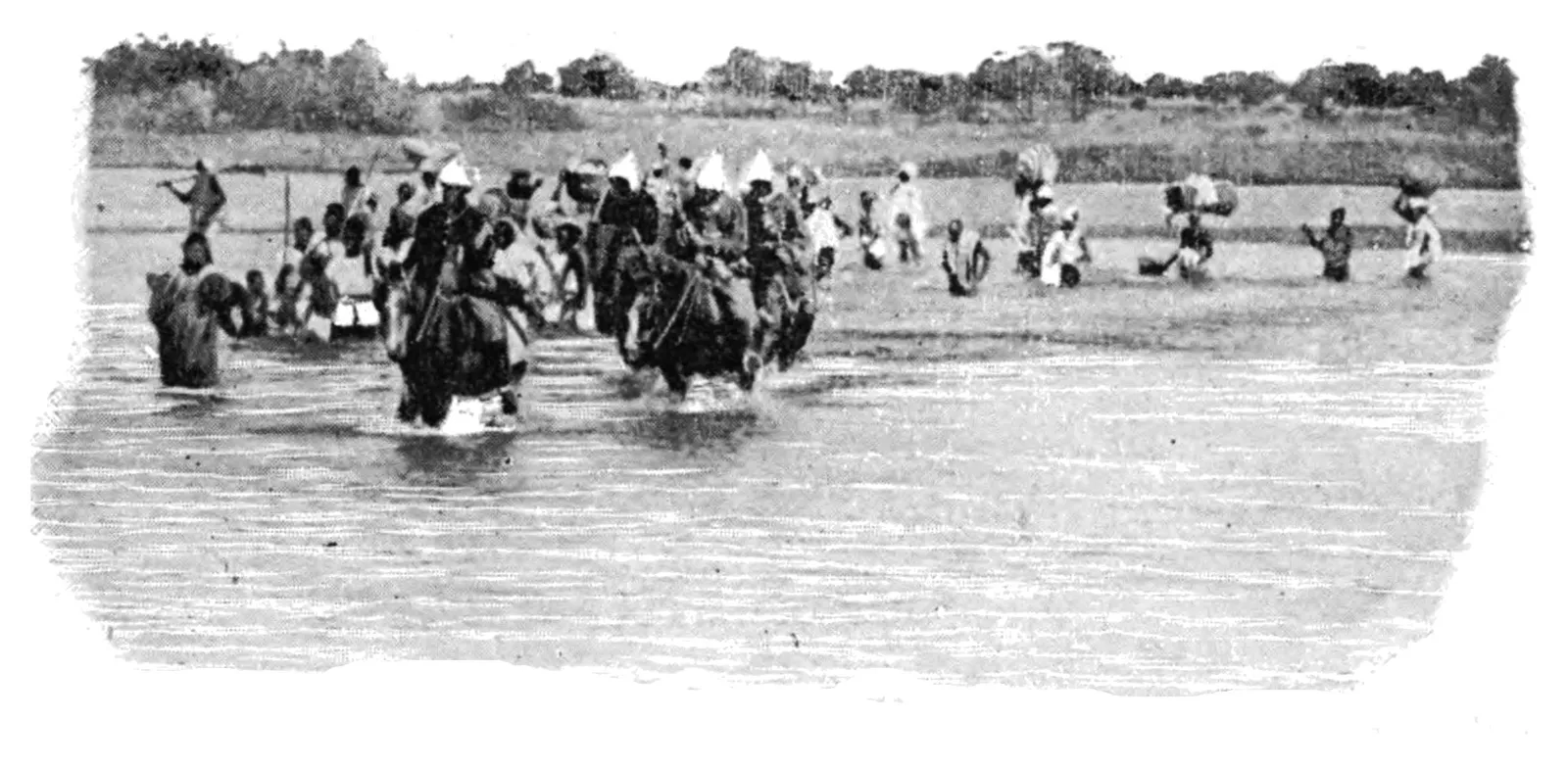
THE FERRY-BOAT
The moments of sunset upon the river are those
the greatest intensity of life. The canoes multiply
near the villages bringing the fruit of the field to buildings
to which the people will flock for to-morrow’s
market. The ferry-boat causes the river to resound
with gay chatter and laughter, the bleating of sheep, and
the clucking of frightened poultry. In the solitudes beyond
human habitation the timid hippopotamus, again become the
autocrat of the river, gambols grotesquely in the water, prudently
waiting until nightfall to come ashore and dine; and the
great trees on the bank are so whitened at this hour by the
sleeping ospreys that they seem to have been covered by a fall of
snow.
I now join a village and spread my table-cloth on some grassy
hillock close to the river-bank. Very animated and well attended
are my dinners. First the children come, consumed with curiosity
to see the white man, but a little apprehensive too. They advance
timidly, evidently feeling for me some of the fear which the negro
inspires in white children. A few lumps of sugar soon tame them,
however, and then, duly apprised, the chief and notabilities of the
village arrive. They salute me and offer (read ‘sell’) presents of
milk, eggs, and poultry, and, business being done, I detain them
with a little of those two precious commodities, tobacco and salt.
We light great fires as night falls, and they bring out their
little clay pipes, their snuff-boxes, or some kola nuts, and a long
gossip ensues. Absorbing landscape all day, night reveals to
me the soul and thoughts of the country, its history, and the why
of a thousand things the sight of which had puzzled me during
the day. Above everything, I enjoyed evoking oral traditions
concerning the first appearance of the white man in these parts.
Mungo Park, the first European to explore the Niger, is the most
vividly remembered. I frequently heard, between Nyamina and
Khabara, of Bonci-Ba (the great beard), a name given him by
the Nigerian tribes, but I could find no trace of our own René
Caillié even at Timbuctoo itself. Barth’s voyage, though not
accomplished in these regions, is well known by report of people
who saw him or heard him spoken of in Timbuctoo. The old
men, with wrinkled skins and white hair and eyebrows, were my
favourite historians. They could recall to me the past prosperity
and great commerce of the Valley of the Niger. They told me of
the desolating conquerors and disastrous wars of the present century;
of Cheikou Ahmadou, the fanatic Foulbe king, who changed
the prosperity of former days to misery. Timbuctoo was the
most frequent subject of my questions. It was the home of
their youthful memories, and they would speak of it enthusiastically,
and with laughter—much laughter—at the recollections
of their gay life there, the lively frolics which
sweetened their labours, and the especially vivid remembrance of
the bewitching beauty of the ladies of Timbuctoo.
GOING ASHORE IN THE EVENING
In the villages of the Bosos the Niger formed the basis of our
conversation. They would narrate to me the legends and the life
and being of the giant. On the margin of Lake Debo, they told
me, a treasure of gold was hidden in the hillock, which René Caillié
pompously christened ‘Mont St. Charles,’ and which they call
Mount Sorba. The treasure remains undiscovered to this day.
They often alluded to a very large town situated on a lake called
Guido. It was the centre of a powerful empire, which, with its
capital, has now entirely disappeared.
Finally, with so many other affinities to the great oceans, the
Niger could not decently lack its romances of pirates. They had
their nest at Sibi, a large village crowning a high mound on the
Black Niger. It was passed daily by numberless boats laden with
the produce of Massina and Farinanka. Kaid-Ali, the chief of
the pirates, was taken with the ingenious idea of stretching an iron
chain across the river, in order to prevent the escape of these
boats, which he pillaged at leisure.
These Bosos, living at a distance of eight hundred and seventy
miles from the coast, possess, as one might imagine, no idea of the
sea or of the part of outlet that it plays to the rivers. The
question of what becomes of the Niger beyond the regions they
know troubles them very little. I sometimes attempted, in the
course of conversation, to enlighten their minds on this point.
Having one day captured an unusually intelligent Bosos, I made
him enumerate all the towns he knew, or had heard of, down the
Niger. ‘Sarafara, Khabara, Gao,’ he came to a standstill. ‘Well!
and beyond them, what becomes of the river?’ ‘Beyond them,’
he reflected. ‘Oh! beyond them the fishes swallow it.’
When I found some village particularly rich in information and
the power of imparting it, I would stay over the following day in
order to renew the nocturnal chat, generally retiring to the river
at night on account of its beneficial freshness. In the distance,
beacon-like fires blazing on the brim of the great river would
indicate some native ball, and on approaching one could hear the
droning of tom-toms and the cadenced clapping of hands that
always accompany these functions. Elsewhere, grazing in the
now deserted fields, the noctambulating hippopotamus would
neigh us his serenades.
Great fires cover the banks in March. It is the black man’s
method of clearing and manuring his fields on the eve of seed-time.
He destroys the tall grasses and other parasites by these
means, and enriches his soil with their ashes. Thus magnificently
illuminated, we glide over the water to the sound of a great
crackling which is occasionally mingled with the cry of some wild
animal that the flames have surprised in its lair.
In this manner I wandered so much at my own sweet will that
even my Bosos, expert as they are, were obliged to confess themselves
bewildered at times. With all these pleasures spiced with
the apprehension of a sudden illness or unexpected attack, and
sustained by the thought of having some lines of the world’s
history at the end of my pen when Jenne and Timbuctoo should
be attained, am I not right in saying that the cruise of my
thatched yacht was a unique one?
CHAPTER III THE VALLEY OF THE NIGER
The ancient renown of Timbuctoo, its boasted commerce, and
its prestige as a rich and powerful metropolis, warrant the
assertion à priori that the regions surrounding this city of the
Niger must be remarkably fertile. It could hardly have usurped
such a reputation. History affords no parallel of an error continuing
to deceive the world through four or five centuries.
The geographer, sitting in his study between a modern map
of Africa and the works of El Bekri, Ca da Mosto, De Baros,
Léon the African, and other travellers, would reason thus: With
sand to the north-east and west of it the huge market of
Timbuctoo is situated on the threshold of the desert. Yet it
is not with sand that the wheels of such an enormous traffic are
greased. In order, therefore, that Timbuctoo should be enabled
to play the part attributed to it, we should expect to find a rich
extent of territory in the south, an isthmus of fertility, as it
were, jutting into the sea of sand. We should anticipate this
stretch of land to be large, since it has maintained a great
commerce for some centuries, and supplied such varied markets
as Morocco, Tuat, and Tripoli, as well as the various nomad
populations of the desert.
Do these fertile regions really possess the happy distinction
of being discoverable by mere force of logic, as certain stars
are by mathematical calculation?
The occupation of Timbuctoo has made it possible to
verify such surmises by opening up routes, accessible not only
to the explorer proper, who crosses the country worn by privation
and at the mercy of his guides, but available also for the
traveller who lingers to gather complete information at his ease.
This country lying to the south of Timbuctoo is the Sudan,
otherwise called the Valley and the Buckler of the Niger, a vast
region, traversed to an extent of nearly 2500 miles by one of
the largest rivers in the world.
Egypt was happily defined by Herodotus as being the
‘present of the Nile.’ What Herodotus said of Egypt we might
with equal truth say of the Sudan.
The Arabian conqueror Amru, who took possession of Egypt
in the seventh century, gives the following complete and accurate
description of it in a letter to his master the Khalif Omar.
‘O Prince of the Faithful! Picture unto thyself an arid
desert and a fruitful country, for such is Egypt. A beneficent
river flows majestically through its midst. The rise and fall of
its waters are as regular as the course of the sun and the moon.
At an appointed time all the springs of the universe come to pay
tribute to this king of rivers. They cause its waters to swell
and leave their bed, covering the surface of Egypt with a fruitful
mire, and when the waters cease to be necessary for the fertilisation
of the soil, the obedient river returns to the limits prescribed to
it by destiny, in order that the treasures it has hidden in the
bosom of the earth may be gathered. The people thus favoured
by Heaven sow seeds in the bowels of the earth, that they may
be brought to prosperity by the munificence of the Supreme
Being who causes harvests to ripen. The most abundant
harvests are succeeded by sudden sterility; and thus it is, O Prince
of the Faithful, that Egypt offers successively the images of an
arid and sandy desert, a liquid and silvery plain, a marsh of
black mire, a green, undulating meadow, and a field of golden
grain. Blessed for ever be the Creator of such marvels.’
What the Nile has done for Egypt, the Niger has accomplished
for the Sudan. In the course of a year we witness
the same striking and opposed pictures. The cultivation is as
facile as that of Egypt, and is due to the same regular rise and
fall of the river. But the Niger shows an even greater munificence
in its gifts than does its brother of Eastern Africa. For
thousands of years the labour of man has co-operated with the
beneficent work of the latter, and yet, flowing imbedded between
two mountain chains, it only carries fertility to some few
hundreds or thousands of feet; while the Niger, on the other
hand, owing to its immense plains, dispenses its benefits over
an extent of more than sixty miles without the intervening aid
of man.
The prestige of Timbuctoo in the past, and its boasted
commerce, are now explained by finding it as we do upon the
threshold of another Egypt, equally favoured by nature, but
infinitely greater in extent. Its only disadvantages consist in not
having been developed by four or five thousand years of civilisation,
and in not standing in the doorway of Europe as does the
Valley of the Nile.
THE VALLEY OF THE NIGER’S SOURCE
The Niger rises in the mountain chain which extends from the
country of Sulima in the north to Kono in the south, and spreads
to the Kissi country in the east. Contrary to the generally
accepted opinion, the range is not, geologically speaking, a
dependency of that Foota Jallon upheaval which is considered the
centre of a great movement whose subordinate branches were
pushed beyond the sources of the Niger. In reality, the range of
the Niger’s sources, or the Kouranko chain, forms the true centre
of the upheaval. Its altitudes, in the countries of Negaya and
Kono, attain to 3840 feet (sources of the Niger), and 4920 feet in
the south, while
the average elevation
of the Foota
Jallon is not more
than 2625 feet.
The principal
summits of the
Kouranko range
are: Mount
Bondi, Mount
Ma, Mount Keina,
Mount Konko-Kourawa,
the two
Kolas, the two
Soullous, Mount
Kokonante
(sources of the
Niger), Mount
Darou, the needles
of Kinki, the Songoula, the Banka, Fingui, Soofoa, Tinki,
Owaloo, Kora, and the Toumba (the four last are in the country
of Kono).
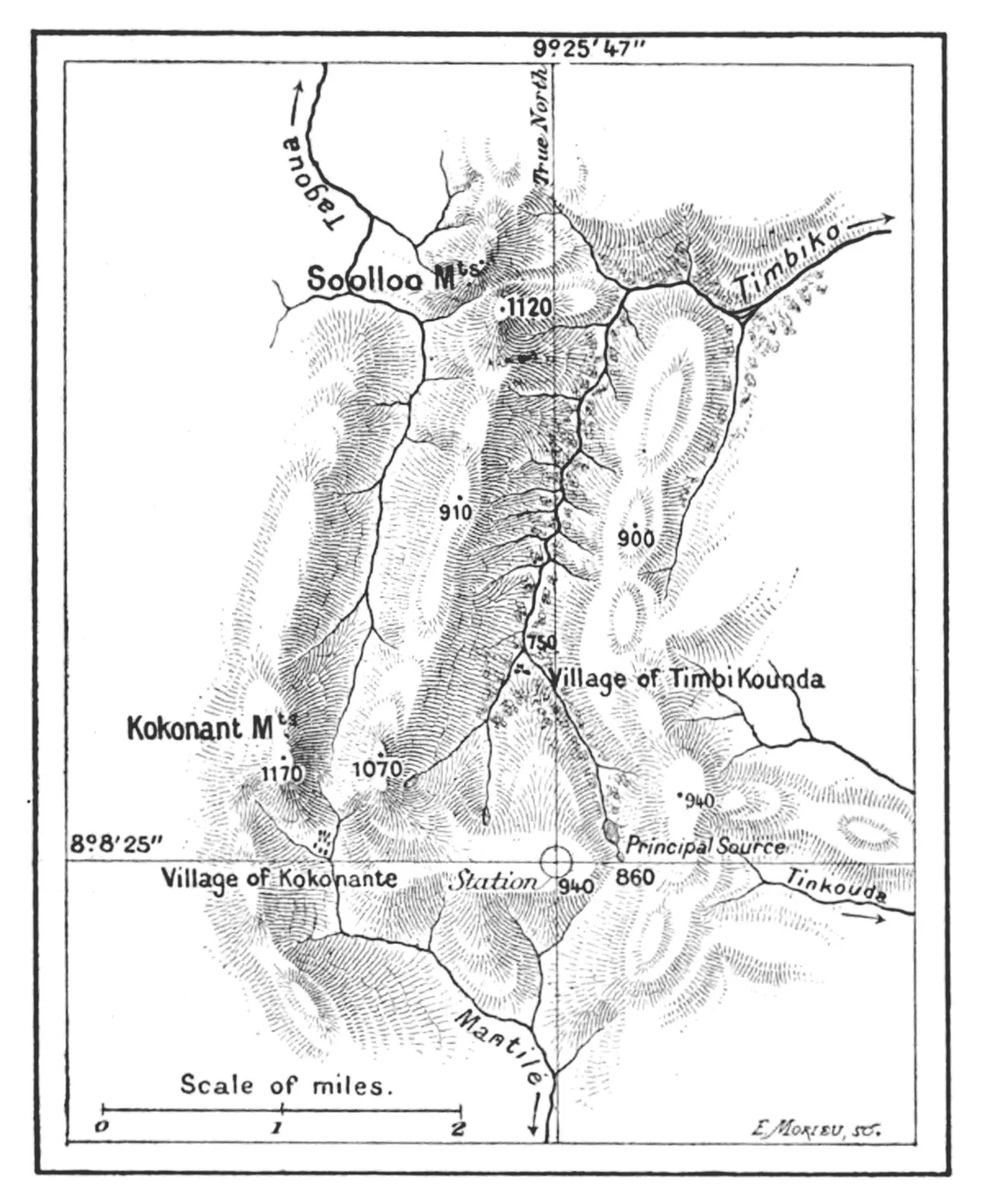
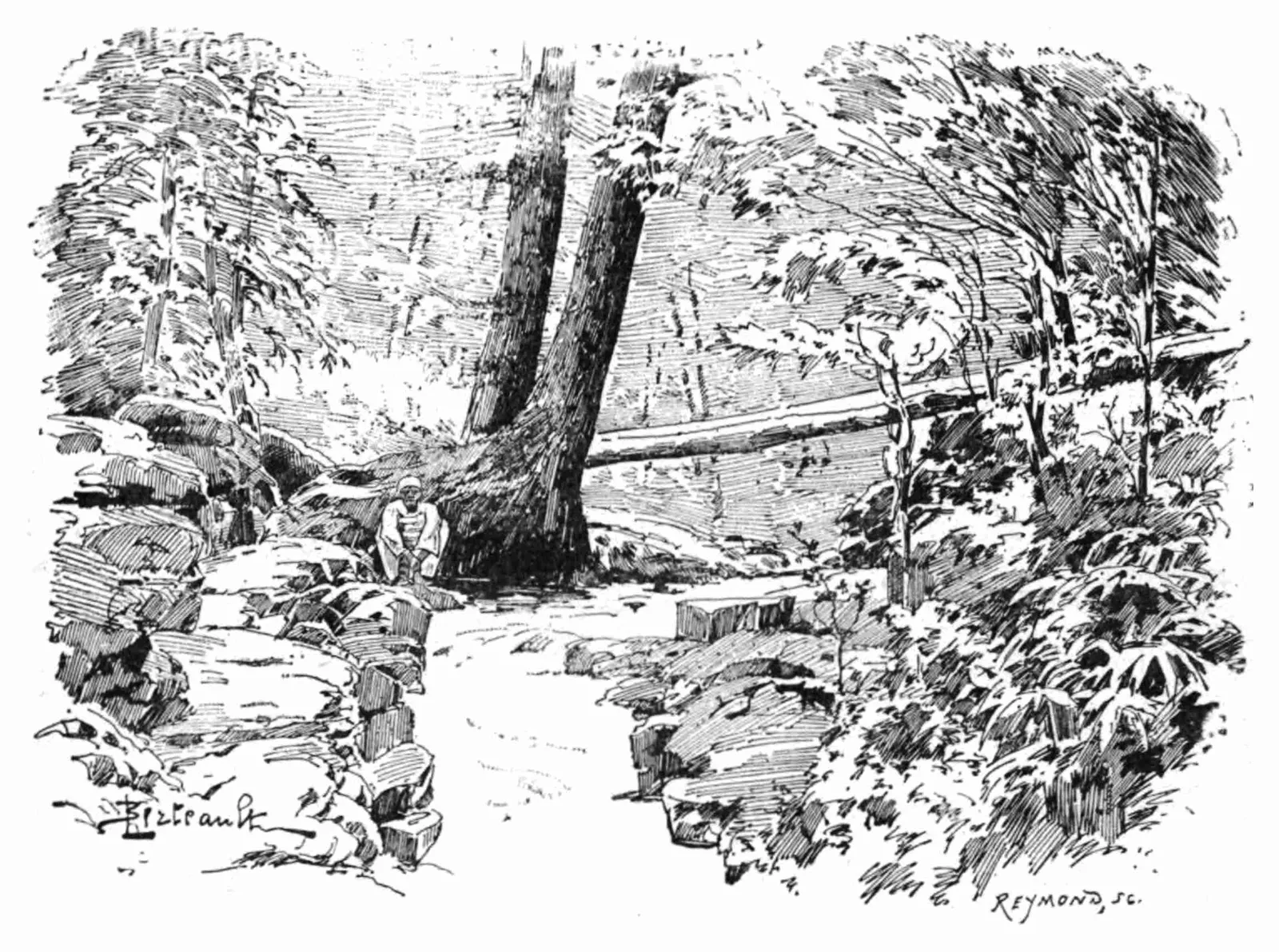
THE SOURCES OF THE NIGER TEMBI
In the Kissi country two rivers, the Paliko and the Tembi,
flow towards the north, pursue a parallel course, and, meeting at
Laya, unite in one bed to become the Niger or Joliba. The most
important of the two rivers is the Tembi, considered by the
natives as the Father of Joliba. It rises in a little hill to the
east of Mount Kokonante, and not far from the foot of Mount
Darou. The hill from which the Tembi flows is in no way
remarkable from a topographical point of view. Bare at its
summit, it is covered a little lower down with a vegetation which,
growing thicker as it descends towards the waterway of the
valley, proclaims the presence of water.
About a hundred feet from the summit of the hill is a little
basin, about three feet in diameter and a foot in depth, full of
clear water, and called by the natives Tembi-Kuntu, or Head of
Tembi. A hundred feet further down is another and larger basin,
which is not easily found on account of the thick vegetation, the
inextricable confusion of thorny canes, trees thrown down by
storms, tangles of creepers and tree ferns, in which it is hidden.
The water of this little creek flows through the wood, and
reappears 656 feet lower down in the valley. At this point the
Tembi is a mere rivulet; 875 yards from its source it has become,
at the village of Tembi-Kuntu, a gentle stream, increasing rapidly
in size and depth as it flows towards the north. At Nelia, eight
miles from the source, it is eighty feet wide, and at Farannah,
sixty-two miles from the source, it has attained a breadth of
nearly 328 feet.
The wood from which the Tembi springs is reputed sacred,
and is the subject of innumerable legends and superstitions.
Access to it is denied to the profane; terrible misfortunes overtake
any one uttering a word or touching anything there, and
warriors and all who have shed blood die on approaching this
spot. Its waters are believed to express the judgments of God.
If a man is accused of some crime which he denies he is forced
to drink of them, and if he is guilty his sin is proved by an
inflation of the stomach, followed by instant death.
THE TEMBI IN THE SACRED WOOD
The natives say that in the centre of the little creek of Tembi
is a rocky islet. This little island is the abode of the Spirit of
the Spring, and the mysterious retreat of the High Priest who
represents the deity to mortals. He takes up his residence there
by plunging into the water and approaching it invisibly. According
to the legend there is a golden dwelling at the bottom of the
lake, and his acolytes, the minor prophets, profess to have heard
the noise he makes in opening and shutting the doors of his supernatural
home. High priests and lesser priests unite in jealously
guarding the approaches to the spring, and the mystery they
make of it confers great distinction and authority upon them
throughout the country. The neighbouring kinglets refer to
them before undertaking a war or other act of importance, and
the common herd consult them on all occasions of weight.
The Spirit of the Spring, being eminently practical, will
only condescend to attend to them through the medium of
sacrifice.
These ceremonies are not very ferocious, merely oxen being
offered, and not human victims, as in neighbouring Dahomey.
The oxen, however, must be young, as the Spirit likes his meat
to be tender. The immolations do not take place at the spring,
but in the village of Nalia, where the priests live with their
wives and families. When the animal is slaughtered the best
portions are cut off, and naturally go to the ministers of the
Spirit and their families. The head and legs are left adhering
to the skin, which is then stuffed, sewn up, and thrown into the
river as it flows past the sacrificial spot. A few paces further
on the stream momentarily disappears through a subterranean
passage. The stuffed ox disappears with the Tembi, to reappear
later on, its head proudly erect, as, apparently overflowing with
life, it rears and plunges, appearing and disappearing with the
bubbling of the current. Every one then retires satisfied; the
Spirit of the Spring and his ministers pleased with the prospect
of some first-rate meals, and the people, who had defrayed the
costs, charmed by the gambols of their ox.
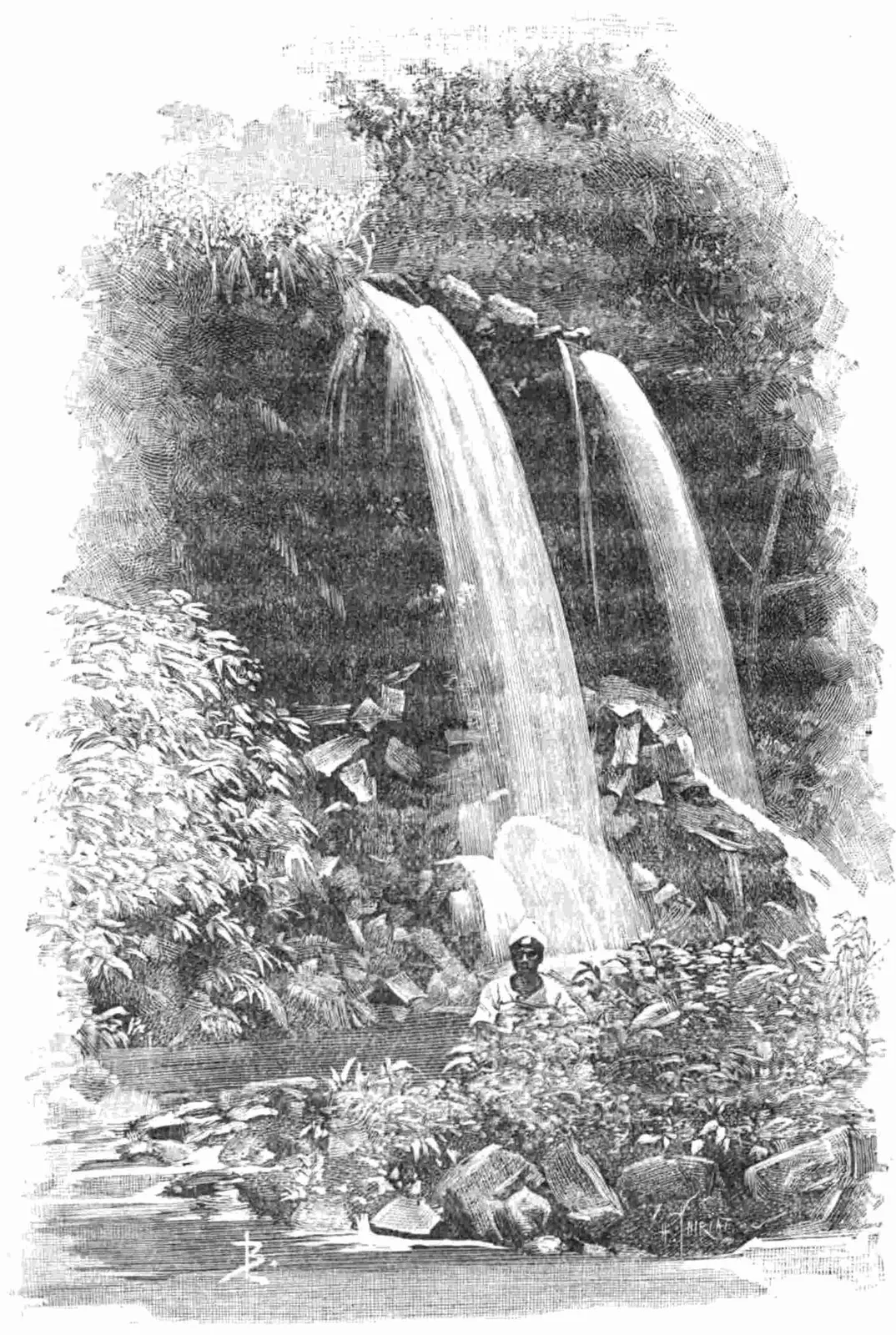
A WATERFALL IN THE VALLEY OF THE NIGER’S SOURCE
This Kissi region lies in the ninth latitude, where the last
ramifications of the Foota Jallon mountains join the first
buttresses of the Kong chain. The source of the Niger is to be
found there, and it is par excellence the land of heavy rainfalls.
From February to July the water falls from the skies in veritable
torrents. The gentle slopes of the mountain ranges are channelled
by innumerable cascades, rivulets, brooks, and rivers, that
carry off the heavenly overflow. It is not surprising, therefore,
that at Kouroussa, although the river has received only three
tributaries of importance, it has already acquired an imposing
bed. The further it advances, the larger and more numerous
become the waters by which it is swelled. These supplies cease
abruptly above Bammaku, and from there to Diafaraba the
river is almost solitary.
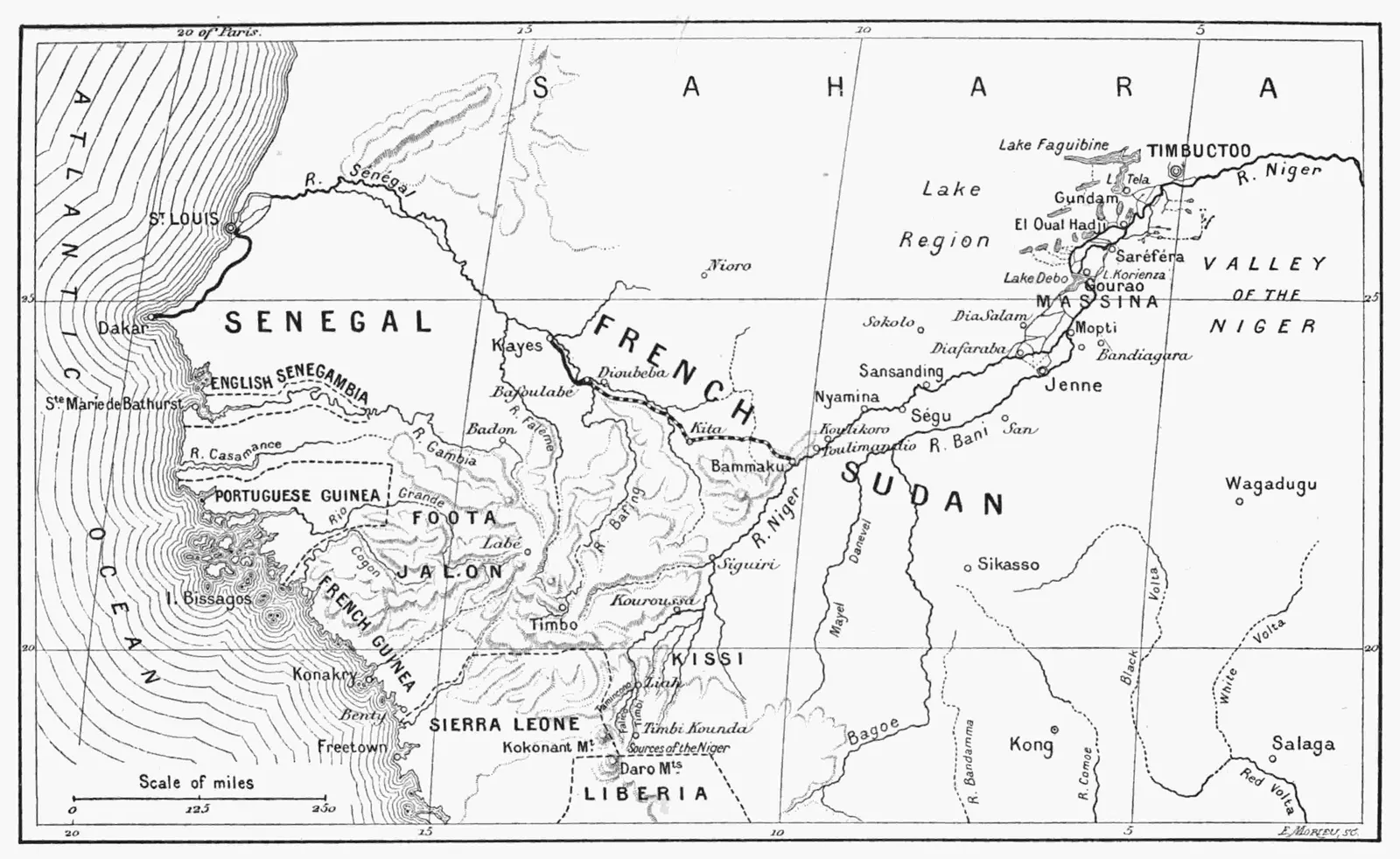
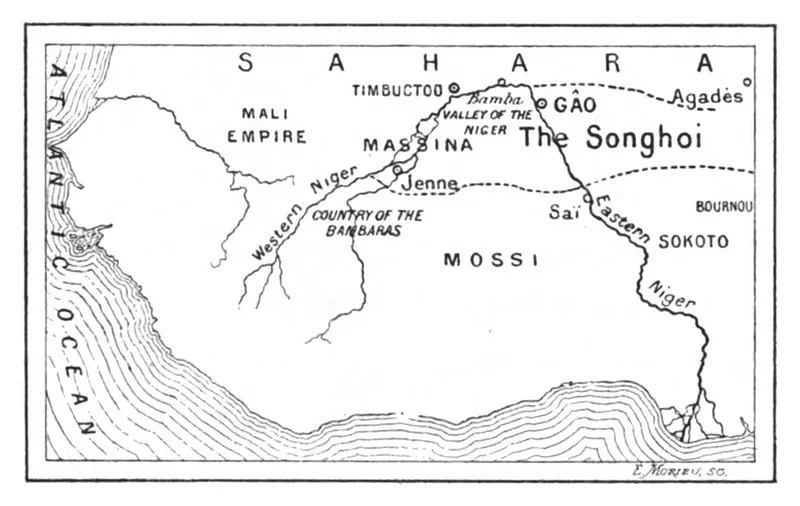
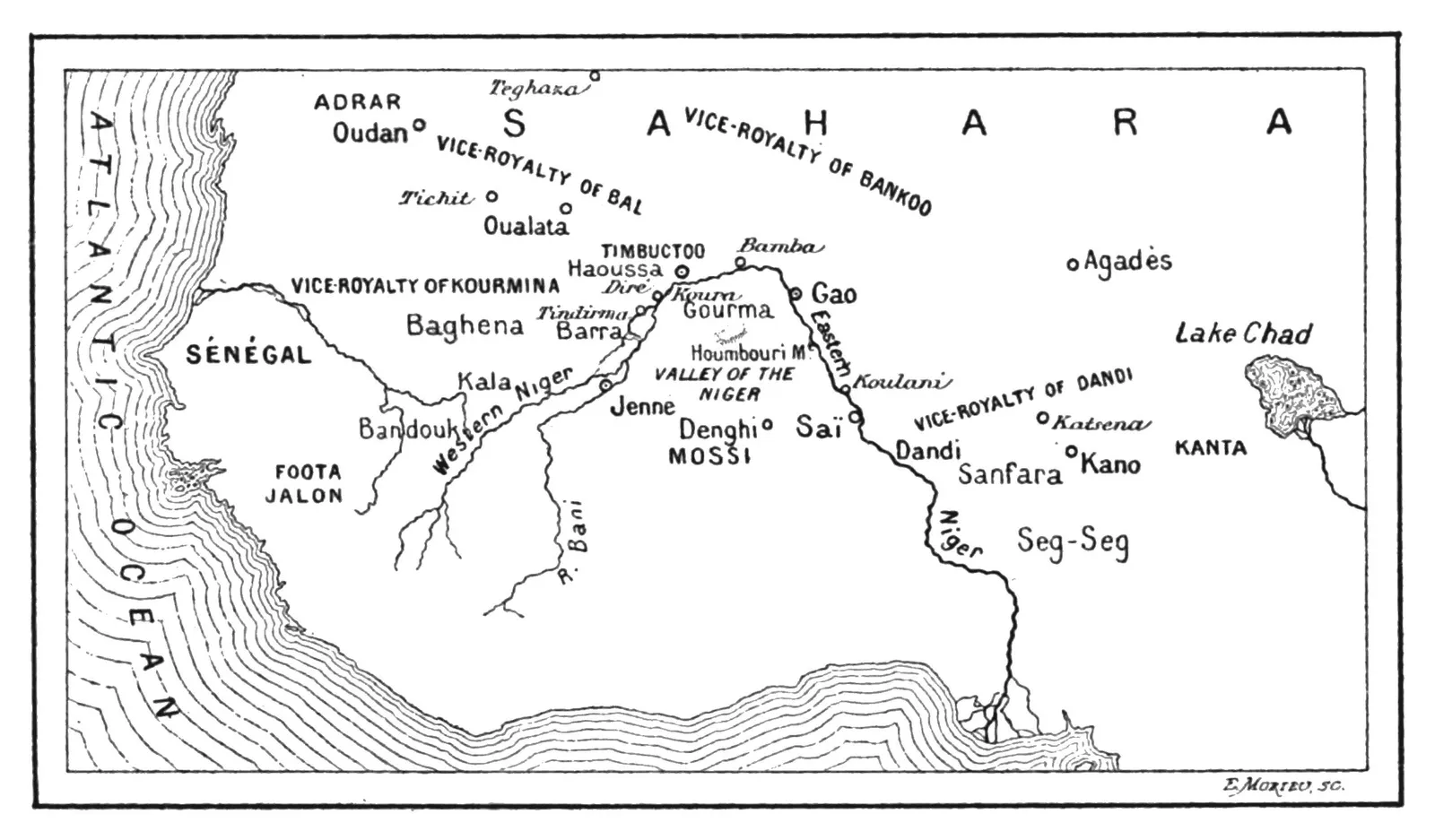
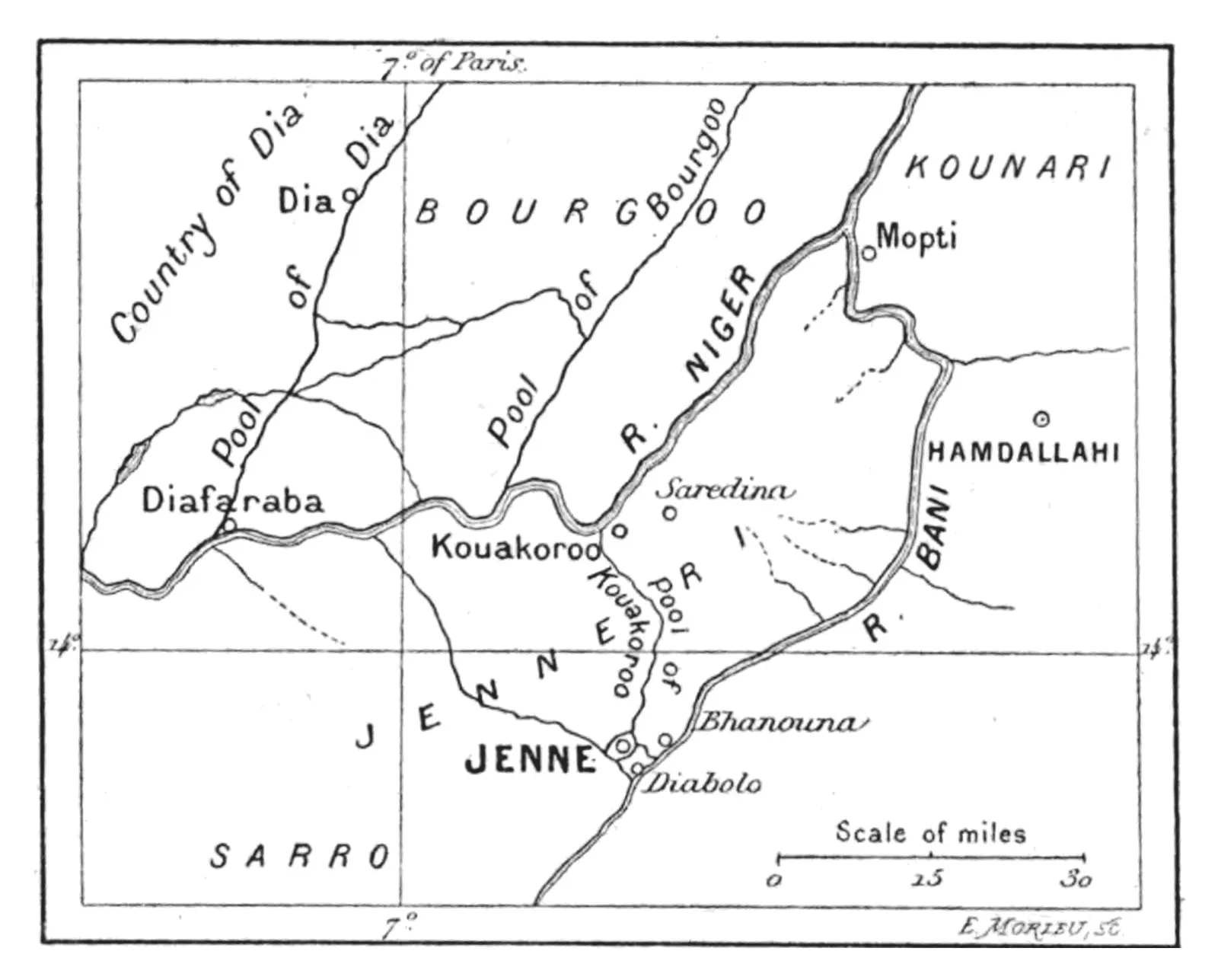
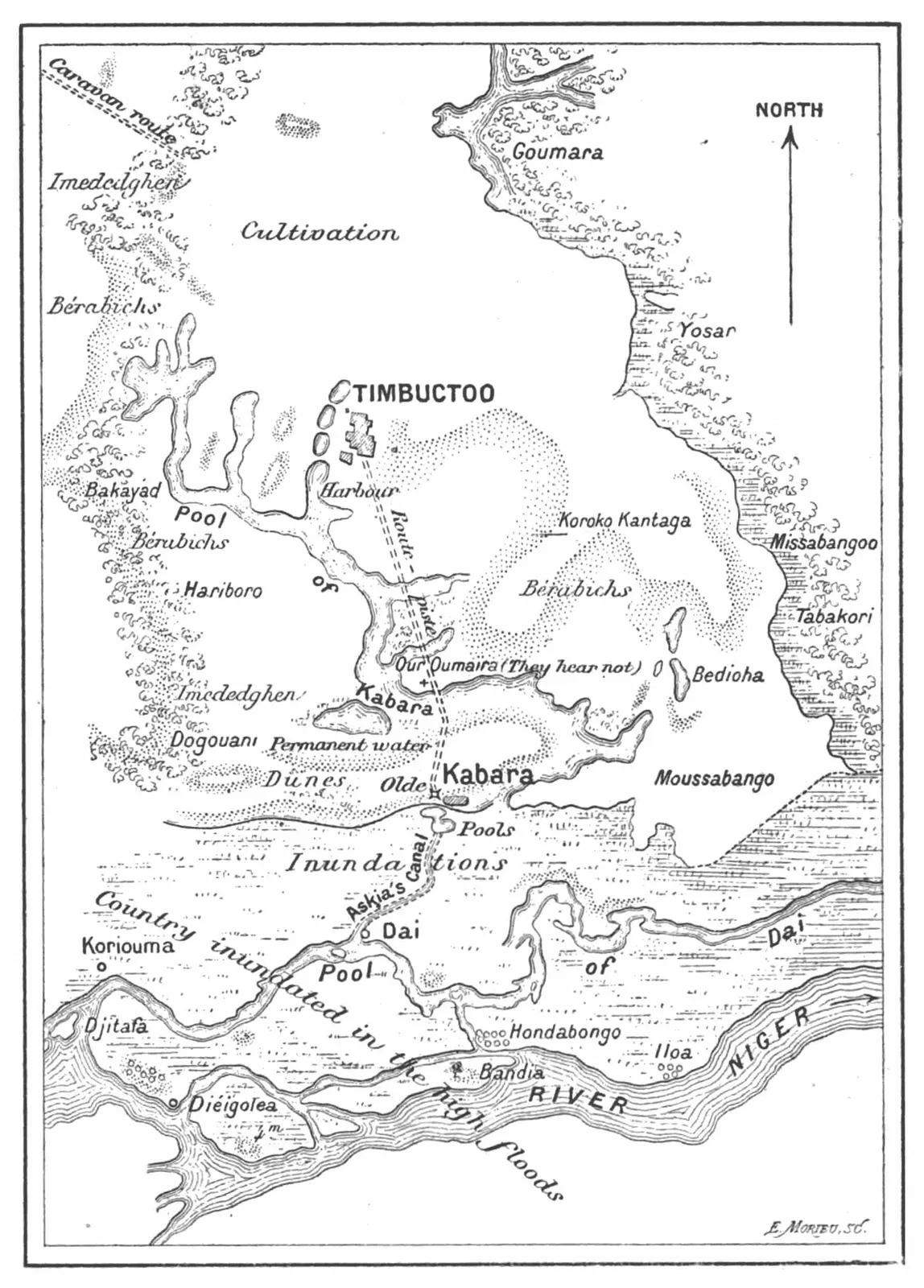
MAP OF THE NIGERIAN REGIONS AS FAR AS TIMBUCTOO
It is between Tembi-Kuntu and Diafaraba that we meet
with the first of a homogeneous series of naturally irrigated
zones. The left bank is narrow, and descends in a gentle slope
to the Niger, the Foota Jallon range closely bordering and not
quitting it until after Koulikoro. The right bank, however, is
free, and forms a large plain, which is splendidly watered by the
crowd of tributaries that run parallel to the great river.
The latter does not squander its miracles on this first zone,
which is already so richly dowered with precious waters that its
co-operation would be superfluous. These countries of the
Upper Niger are radiant. Tropical vegetation spreads over
them with the utmost prodigality, its orange, citron, kola, and
banana trees delighting the eyes of the European.
The Niger is accumulating its forces as it crosses this region,
and its inundations are unimportant, scarcely overflowing the
banks by half a mile. The giant is reserving his strength that
he may transform into opulent plains the immense stretches of
sand that await his coming from here to Diafaraba. The river
pauses for a moment below Bammaku, in front of the rocky
barrier of Sotouba, in order to gather up and concentrate, before
approaching the sand, the formidable mass of waters sent by
the heavens during the previous five months. Then in the
plenitude of its strength it rushes on towards the north, passing
Nyamina, Segu, and Sansanding on its way.
Having cleared Diafaraba, it arrives, towards September,
impetuous and swollen, at Mopti, where it is joined by a
monster tributary, the Bani, with a mass of waters as formidable
as its own. With such a reinforcement, the army of waters has
grown immense, infinite. Its bed is now too narrow, it stifles
between the banks. In front, behind, upon all sides, it seeks
outlets, hurling itself into the least depression, and invading the
smallest passage. And now takes place what I shall call the
intoxication of the Niger.
Happy intoxication! if such it be. The river flings itself
headlong over the entire low-lying region between Diafaraba
and Timbuctoo, covering it and swamping it, until a steppe of
barren sand becomes one of the most fertile spots in the
universe. It has for centuries drifted a beneficent vegetable mud
into these low-lying countries, effacing the sand and transforming
this region into a granary of plenty. We find there
not one delta, as in Egypt, but three.
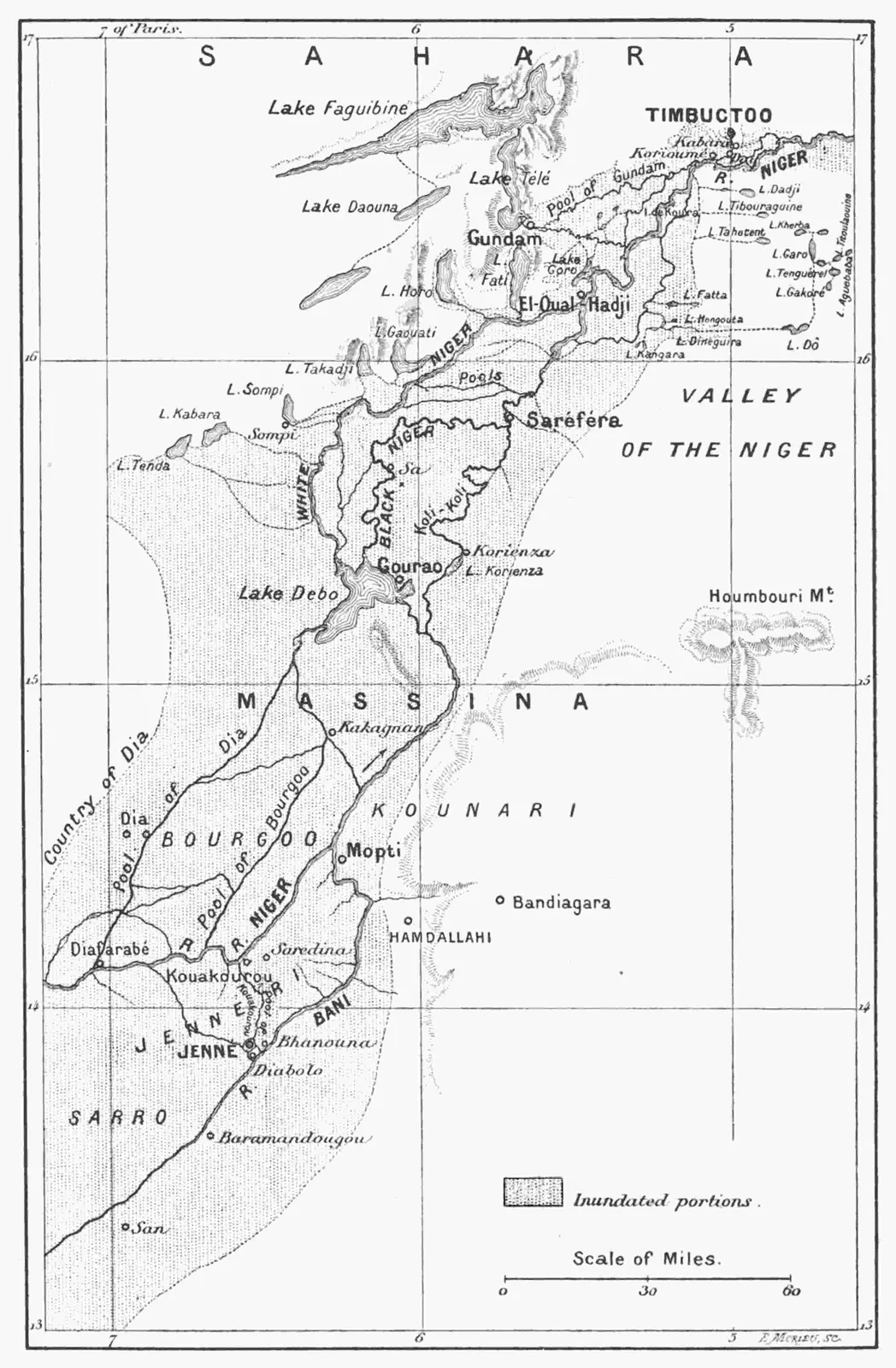
The first is from Diafaraba to the approaches of Lake Debo.
On its left bank, having found two auspicious outlets, the Niger
forms the pools of Diarka and Bourgoo. Its principal branch
runs in a parallel direction, and flows with its two arms into the
Debo. Its waters are still so abundant, in spite of this distribution
of its forces, that the three streams communicate with
one another by means of natural channels. The Bani connects
itself with the Niger in the same manner on the right bank.
Thus a most thorough and complete system of irrigation is
formed, to which man has not needed to put his hand; and
fertility is spread over thousands of square miles. The rise and
fall of these waters is as regular as those of the Nile, and an
infinitely greater distance is covered. At Mopti, for example,
you can calculate in September ninety miles from east to west
inundated to a depth of eight or nine feet.
The countries of Sana, Bourgoo, Massina, Jenneri, and Kunari
are situated in this delta.
The second extends from Lake Debo to El Oual Hadj. Here
the Niger again divides into three branches. The least important,
the Koli-Koli, rises south of Lake Debo; the Barra Issa or Black
Niger, and the Issa Ber or White Niger, north of the lake. The
Koli-Koli traverses Lake Korienza and joins the Black Niger
at Sarafara, the latter being in its turn united with the White
Niger near El Oual Hadj.
THE REGION OF THE THREE DELTAS
Like the Bani and the Niger, like the Niger and the pools
of Diarka and Bourgoo, these three branches communicate with
one another by means of winding channels, and we find everywhere
the same system of irrigation accompanied by the same
wonderful fertility. Nor is this all. On the left bank, at the
extreme limit of inundation, the river finds a new formula for its
gifts in an admirable series of lakes, twelve in number, and
separated by chains of hills. The following are the names of
eleven of them, counting from south-west to north-east: the
Kabara, Tenda, Sumpi, Takadji, Sanaki, Horo, Fati, Goro,
Dauna, Tela, and the Faguibine.
The floods fill these lakes by means of gullies more or less
wide. Those of the Fati, Horo, and Takadji are particularly
wide and open to commerce at any time of the year. Others are
clear for certain months (October to March), and are then
obstructed by weeds, not, however, to the extent of impeding
the passage of small canoes. The borders of these lakes, like
the banks of the river they rival in fertility, are alternately
flooded and left bare for a distance of some hundreds of yards.
The lakes of Tela, Faguibine, and Dauna form depressions to
a depth of thirty-three feet below the mean level of the Niger.
They are fed by means of gullies and subterranean infiltration.
At the height of the floods, by simply scraping the ground with
your hand, you can find water anywhere on the surface between
the river and the lakes.
This chaplet of lakes forms an ingenious system of reservoirs
for the formidable masses of water discharged by the Niger and
Bani united. They return a portion of their water by means of
gullies and channels as the floods subside. To the second delta
belong the countries of Guimbala, Farimanka, Aoussa-Kattawal,
Seno Krou-ku, Fituka, and Sobundu-Samba.
The third delta occupies the valley extending from El Oual
Hadj to Khabara, the port of Timbuctoo. After El Oual Hadj
the river pursues a solitary course to its mouth.
This zone of irrigation is formed in the following manner:—Numerous
natural channels connect the Tela and Faguibine
lakes with the left bank of the river, the most important of
them going by the name of the Pool of Gundam. On the right
bank a new series of lakes and the Pools of Guaki and Kuna
are scattered over the north-east of the valley. Unfortunately
these lakes are only known by name, but according to the latest
information they are twenty-three in number; among them are
the Kangara, Dinaguira, Doumba, Labou, Hongonta, Fatta,
Tahetant, Tibouraguina, Do, Gakora, Tengueral, Titoulawina,
Agwabada, Garo, Haribongo, Kherba, Tibouraghina, Dadji,
Fankora, and the Marmar.
This delta comprises Kissou, Killi, Surayamo, Aribinda, and
Gurma.
Retarded thus by innumerable and remote digressions, by
liberalities great and small, it is not until January that the
Niger reaches Timbuctoo. Driven back there by the sands
of the Sahara, it takes a sharp turn to the east, the dunes
closely following it on the left bank and preventing it from
spreading to its full width. On the right bank, however, the
country is once more favourable for inundations, and the Niger
makes its fertilising power manifest in channels and lakes which
irrigate the country by natural means and give this Bamba region
a widespread reputation for wealth.
The course of the river to the east is now suddenly arrested by
the granite range of Taosay. It forces a narrow passage for
a while, and then, wearied with struggling against these rocky
masses, it makes straight for the south. Here again the left
bank proves inhospitable, while the Niger continues its customary
marvellous transformations on the right. Its progress is so
greatly retarded here that it is not until the middle of July that
it arrives at Say with its full complement of water, and it finally
reaches the mouth in September. Nearly a year therefore has
it taken this immense mass of water from the regions of the
Upper Niger to reach, considerably lessened in bulk, the Atlantic
Ocean.
We have now seen that Nature has neglected nothing to make
these southern lands fit to maintain a commerce so important
as that of Timbuctoo. Cattle-rearing and agriculture attain to
an extreme degree of perfection, and one fondly pictures the
wealth that might be drawn from a country so marvellously
constructed.
CHAPTER IV THE TOWNS OF THE NIGER
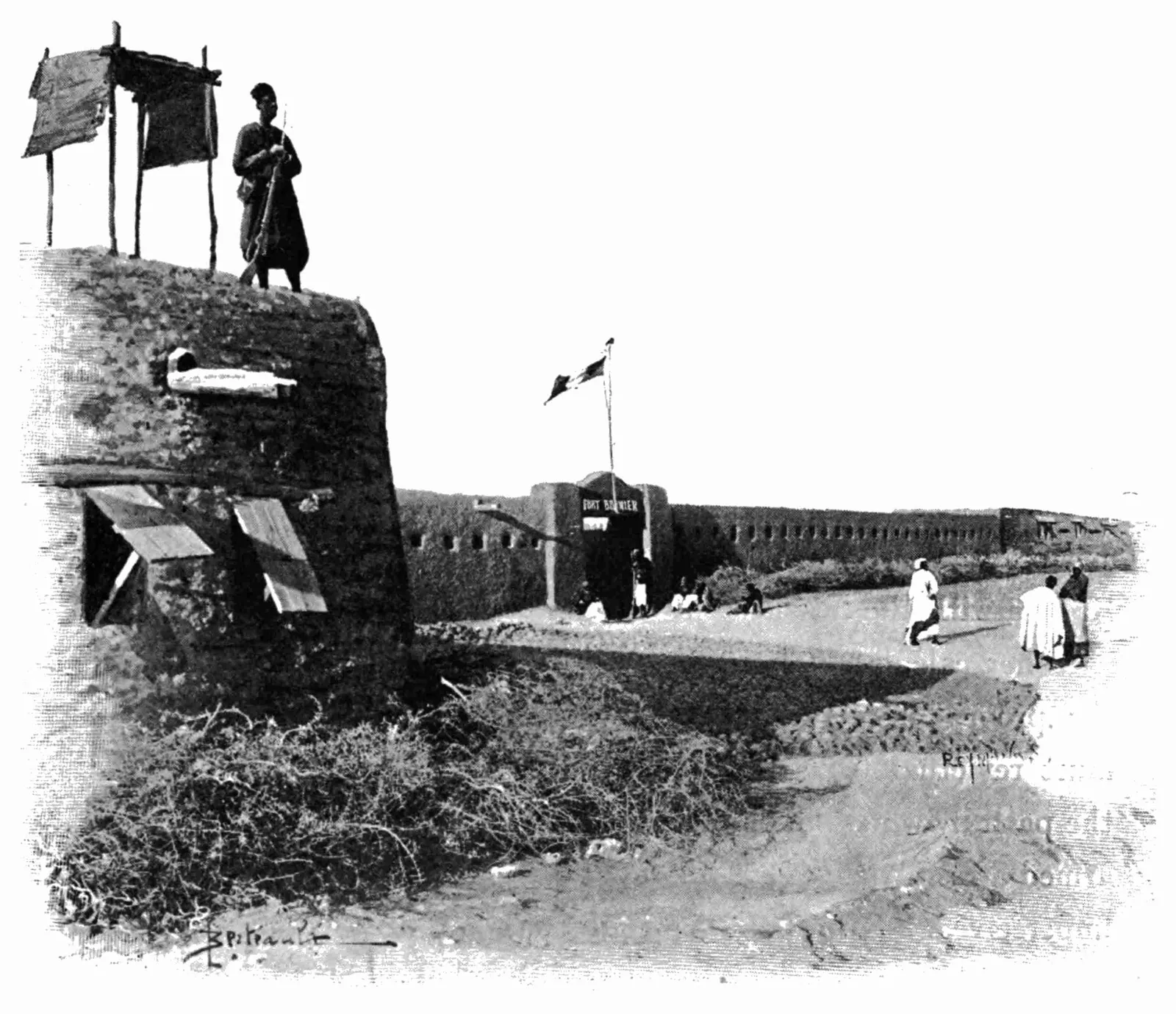
‘Prepare to receive cavalry!... Mar-r-r-ch!’ This command
uttered in a ringing voice, a clang of arms and a great
clatter of feet, were the first sounds I heard on awakening in
one of the casemates of Fort Bammaku. Somewhat bewildered,
I question my servant, who is squatting in the corner waiting
for me to open my eyes. ‘It is the soldiers being drilled,’ he
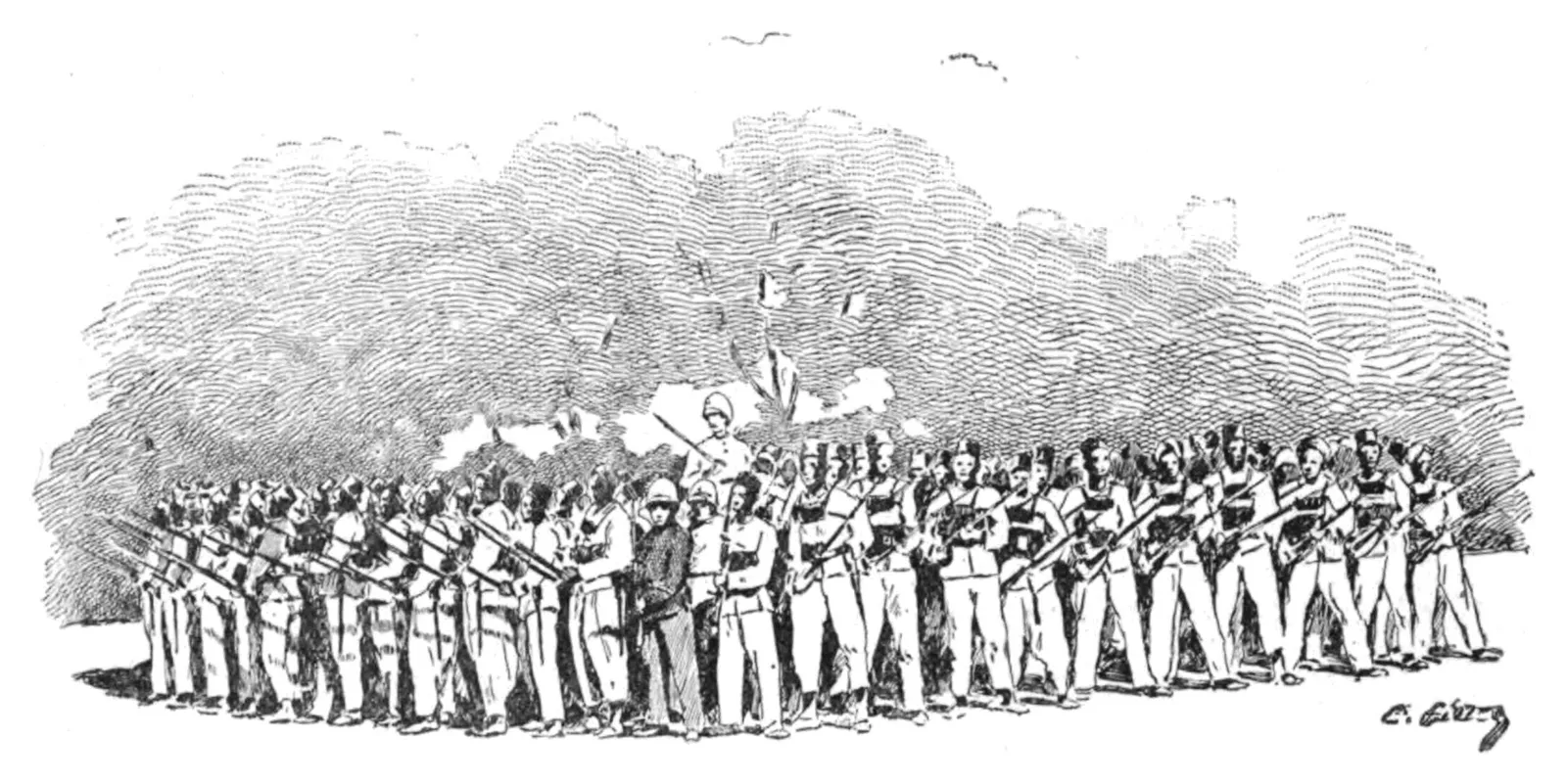
says, and, peeping through one of the loopholes, I see a square of
negroes, bristling with bayonets.
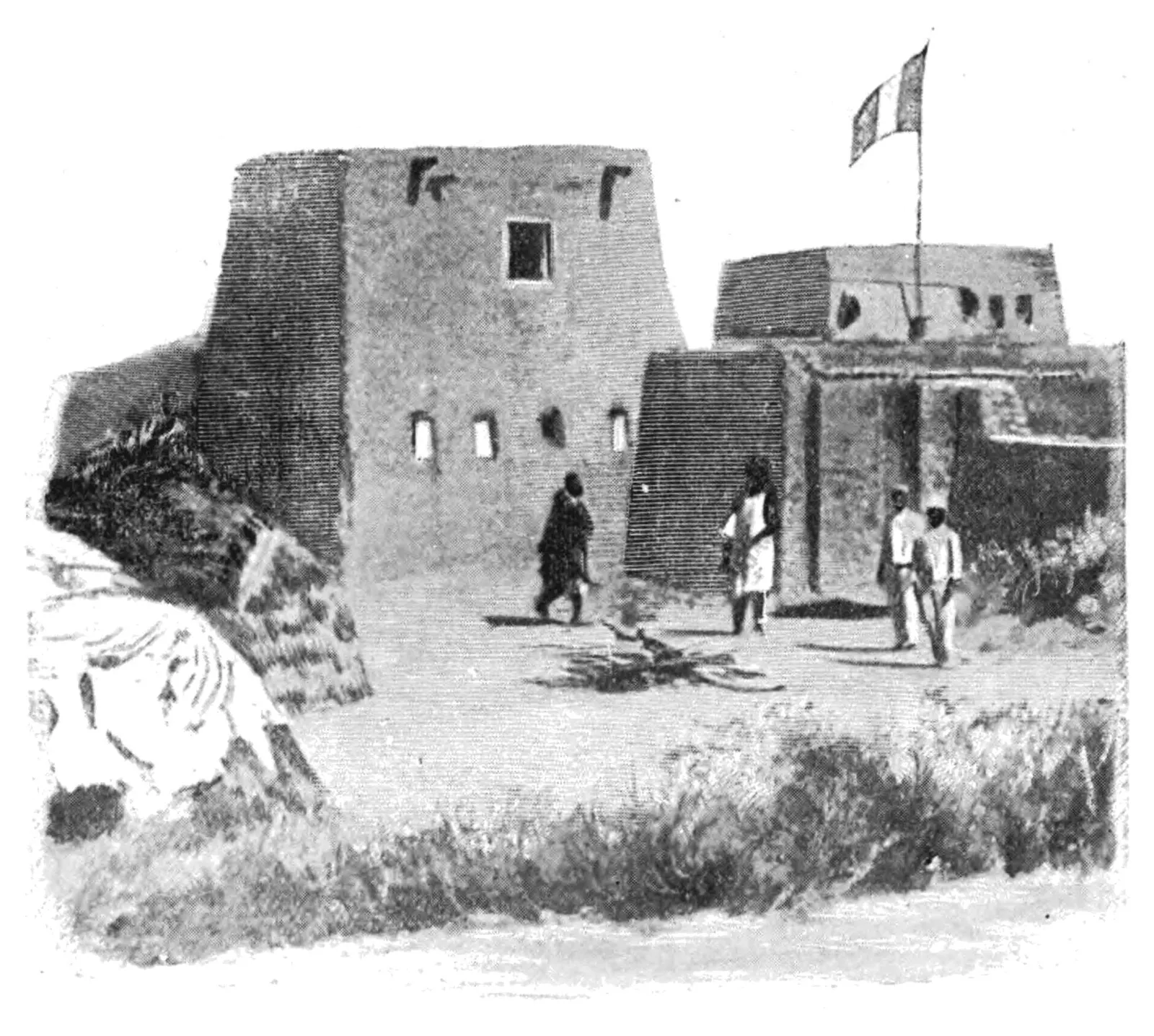
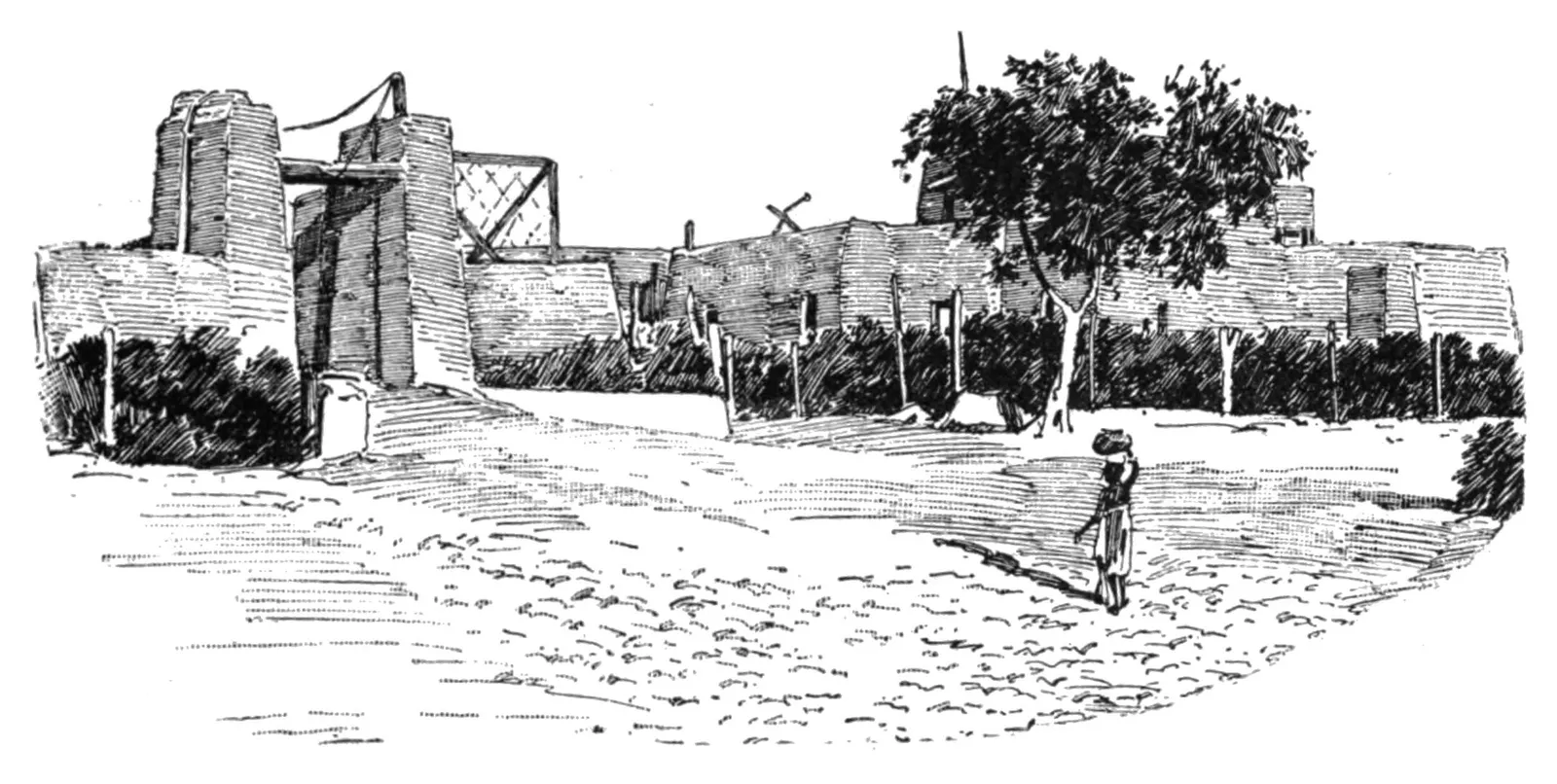
Bammaku is the first fort upon our route that contains
military apparatus and a garrison. The critical circumstances
under which it was built are curiously reflected in its structure.
It is simply a great rectangular wall with none of the ingenuity of
modern construction about it; but a superabundance of loopholes
everywhere—in the stables, the powder-magazines, the rooms,
and the kitchen. They had to build quickly in 1883 and content
themselves with the merely necessary; for Samory was still
terrorising the country when Colonel Borgnis-Desbordes planted
the first French flag upon the Niger. A little troop of infantry
intrenched in a neighbouring redoubt held the position while
the Chinese hastily raised these primitive fortifications; the
hordes of blacks multiplying the while, and Samory himself
coming to command this last and decisive engagement. As
ammunition was giving out, the Colonel and his staff joined in
the mêlée. Borgnis-Desbordes, running to repell the last assault,
said to his companions, ‘Better keep the last charge in your
revolvers, for when we have served the rest it will be time to
think of ourselves.’
If Bammaku is not yet a purely administrative centre, like
Bafoulaba, Badoumba, and Kita, it is not because this part of the
country needs a display of strength (it is no less peaceful than
that through which I have just passed), but because it is situated
in the very centre of our colony, and forms an important strategic
point from which it is easy to send reinforcements to any part
that may be momentarily threatened.
This precaution is wise. For do we really know how far we
are masters of this splendid country, which is many times larger
than France, and contains from ten to fifteen millions of people?
We have a fleet of two gunboats and some iron barges armed
with mitrailleuses, upon the Niger, commanded by a naval lieutenant
and a midshipman; the crew is black, as are all the troops garrisoning
the interior. Except the servers of the field-pieces, there is not
a single white private in the country. Officers and petty officers
alone are Europeans, and the respective numbers of blacks and
whites occupying the immense Sudan are: six hundred Europeans,
including officers, petty officers, doctors, veterinaries,
officials, and telegraph-clerks, and four million negroes enrolled
as foot-soldiers, cavalry, and transport-bearers.
When we realise that we have only occupied this country
for the last ten years, and that it is three or four times as large
as Algeria (which requires an army of 40,000 men to maintain
it), we find the necessary controlling force in the Sudan to be as
surprisingly as it is delightfully small.[1]
The town of Bammaku is situated between the fort and the
river, not immediately upon its banks but at a distance of a
quarter of a mile; that is to say, on the limits of inundation.
Its aspect is most charming, thanks to the initiative and intelligence
of the officers who have successively commanded it. They
have well taken to heart their rôle of civilising medium, and have
made (between its rows of white dwellings built of rammed clay)
roads, which they have bordered with trees that give a most
welcome shelter.
They have also laid out great squares where the superbly
tall cheese-tree spreads its parasol-like foliage. A large building
shelters the native market, and not far from it are two shops
containing European merchandise. A negro, armed with an
old sabre, acts the part of superintendent of police and looks
after the town property. This Europeanising does not displease
the natives in the least. Every year sees the town increase and
new roads constructed, while rapid strides are being made towards
regaining its ancient prosperity, which was destroyed by El Hadj
Omar and Samory out of sheer envy.
The great encompassing plain is no less enchanting to look
at. Partly inundated and partly irrigated by numerous rivulets,
there is no need to dilate upon its obvious fertility, and I pass
on to speak at greater length of the three kinds of tree which
grow so abundantly in the fields, bush, and rocky ledges of this
region.
The most interesting of the three is the karita or butter-tree,
and is best represented among our trees by the pear, the similarity
of their leaves being remarkable. The bark and trunk are rugged
like those of the chestnut-tree. Its branches develop in the form
of a dome, and should attain to great dimensions. A fully
developed karita is unfortunately a rare sight; for the natives
take no care (in their fields or elsewhere) to preserve this tree,
which they have neither to plant nor to cultivate, and whose fruit
can always be gathered to satiety. I know no tree in the whole
of Western Africa more valuable for the services it renders the
native or for those it will soon be called upon to render the
European.
It first attracted my attention at Dion at the close of a day’s
journey that had been prolonged until nightfall. When we finally
reached the village in which we had arranged to spend the night,
great was my surprise at inhaling an unmistakable odour of
chocolate. Some European has forestalled me, I thought, and
I made inquiries for him among the inhabitants. No, not another
white man in the place. Whence this delectable odour, then?
Guided by the perfume I presently found a large earthen pot confronting
me, in which a dark brown mass was boiling. This was
the karita, and they were boiling its nuts to obtain the butter
they yield, and it was thence the well-known fumes escaped.
This nut is enclosed in a flesh that resembles the peach in
taste, and is made into a sweetmeat by the natives. The nut is
shelled and set to dry and harden; in this state its red-brown
colour, aroma, and taste are completely analogous to our cocoa.
The Sudanese, though not yet initiated into the joys of chocolate,
make a very ingenious use of it, nevertheless. They obtain, by a
process similar to that of making cocoa-nut butter, a product of
the first necessity, vegetable butter; and throughout the whole of
the Sudan no other fatty substance is used, the great white
blocks of karita possessing the inestimable advantage of never
going bad.
The European will undoubtedly find a still more profitable
use for this tree later on, for on incision it yields a gutta-percha—a
product for which many industries are now anxiously seeking,
for its supply has diminished in proportion to the increase of
demand.
In the neighbourhood of the karita grows another curious
tree, the nata. After the butter-tree the flour-tree. This flour,
sold in all the markets of the region, is enclosed in large pods; it
is of a yellow colour and singularly rich in sugar, so much so that
I have seen it used by Europeans in the manufacture of confectionery
and pastry.
It would be difficult to say too much about the third tree
found in these parts, the cheese-tree. Not satisfied with providing
her negro with butter and pastry, Dame Nature has
benevolently adorned the branches of this tree with camenberts
and livarots. This tree (called baga or bamanbi by the
natives) also produces capsules, from which very fine and brilliant
filaments escape. So much do they resemble the precious threads
of the cocoon that the name of vegetable silk has been given
them. Nor is this the only Sudanese plant to furnish this
miracle: the follicle of a very abundant anemone is equally full of
a lustrous silk; while in the second delta of the Niger I have
frequently observed a large plant growing to about the height of
a man and bearing a pretty mauve blossom which is furnished in
the same manner.
THE ROCKY BARRIER AT SOTOUBA
The principal articles of commerce sent by Bammaku to
Timbuctoo are gold, kola nuts, karita, and arachides. It would
doubtless send cereals and other of its abundant products if the
river permitted of direct relations being established between the
two cities.
At a little distance down the Niger, however, its bed is encumbered
by the great barrier of Sotouba, forming one of the most
picturesque scenes in the Sudan. I visited it just at the fall of
the waters, and found that a formidable chaos of bitumen-coloured
rocks had been uncovered on the left bank, while a terribly swift
and foaming rapid extended as far as the eye could see upon the
right.
A WORKSHOP ON THE BANKS OF THE NIGER
The passage of Sotouba is only practicable at the height of
the waters when the rocks are covered and the river is one
enormous and very dangerous rapid. The current is so swift
that a canoe from Bammaku arrives at Toulimandio, a distance
of twenty-five miles, in three hours. At this latter place the
course of the river is more normal, and we have made a little
harbour from which travellers, bound for the north of the Sudan,
come and go.
It has no garrison, but merely possesses a dwelling of vaguely
European type, built of rammed clay and thatched after the
fashion of the native hut. A tricolour flag waves from its roof,
and under it live an artillery sergeant and a gunner, closely recalling
the two sappers of Dioubaba; only, instead of being occupied
with trains and playing at station-master, the artilleryman is
admiral and commander of the fleet of transport barges.
The two men live surrounded by monkeys, guinea-fowls, and
poultry, and their contentment rivals that of the comrades of
Bakoy. A youthful alligator supplies the place of the hippopotamus,
but does not display the same amiable desire to be
tamed. He would make a mouthful of the hand ill-advised
enough to attempt a caress; he has a strong chain attached to
him, and is fastened up like a dog. There is only one thing that
troubles these sons of the soil: they cannot understand why
the natives do not labour to obtain even greater profit from
the rich extents of fertility at their disposal. ‘They should send
the fools to France to be taught how to work,’ is their recommendation.
COTTON IN THE SUDANESE MARKETS
Some ten miles south of Toulimandio we have established a
shipyard on a pretty, rocky promontory of the Niger. Its name
is Koulikoro, and its neighbouring forests supply the wood from
which the barges are concocted. These boats are something
between a whaler and a canoe in shape, and officers, privates,
travellers, and stores circulate up and down the river upon them.
The director and workmen of the shipyard are all natives of
Senegal.
It is an amusingly primitive and exotic arsenal that is represented
upon the river-bank. The workshops are leafy vaults; and
benches, with forges, lathes, and pyramids of planks, lie scattered
round the feet of mighty trees. The forms of toiling carpenters,
blacksmiths, and sawyers mingle with those of their wives and
children washing and bathing in the stream. Horses and other
animals browse contentedly near, and the whole forms a delightful
babel of laughter, blows of the hammer, neighing, saw-grinding,
chatter, and bleating.
Further on, with Nyamina and Sansanding we reach the cotton
district. Large fields are consecrated to the cultivation of this
valuable plant, and it is here those beautiful fabrics known as
pagnes de Segu are made. They are patterned in deep indigo,
and are in great request in Senegal, in the markets of Timbuctoo,
and among the inhabitants of the coast, who greatly prefer them
to the European textiles.
Nyamina reposes gracefully at the far end of a little creek on
the left bank of the Niger. This town is as gay and animated as
possible, possessing, not one, but many markets in which the products
of this rich country of Sarro are exchanged. Not only is
there no fort nor garrison, there is not even a single European
here, the government of town and country being in the hands of
a native chief.
WEAVERS ON THE BANKS OF THE NIGER
Segu, on the contrary, distant two days’ journey on the right
river-bank, is strongly fortified; partly in its character of ancient
bulwark of the Toucouleur dominion and capital of El Hadj
Omar, and partly because it is the stronghold of the central valley
of the Niger. Seen from the river its appearance is very attractive,
with its massive gates and its walls zig-zagging like the folds
of a screen. At the far end a conglomeration of points produces
the illusion of a strong castle bristling with battlements. This
edifice was the fantastic creation of the town’s first governor, an
artillery officer, and it lodges the European staff, provision and
ammunition stores. Its architect was inspired by the bizarre and
vague efforts at adornment on the palaces of the kings of Segu.
The ornaments with which they sought to soften the high bare
walls which made their palaces look like prisons were, it appears,
imported by masons from Jenne. With these models before him,
the ingenuity of the artilleryman, combined with negraic masonry,
resulted in a very queer product indeed. Seen close, it resembles
a porcupine, or some large cathedral organ with a multitude of
pipes. Unfortunately the sun-dried bricks of which it is built are
inconsistency itself, and every rainy season sees the pilasters melt
away like sugar-plums. Alas! three times over, this curiosity
will not live to amuse our sons.
SEGU
The town is populous, busy, and lively, but its interior does
not fulfil the promise of its outward show. It is a pity that no
one has taken the trouble to make the vistas and squares that
give so much charm to Bammaku. The royal palace is its only
object of interest, and of that not much more than the walls
have been left standing. The interior has been destroyed
and altered to suit our tastes and necessities, and it was
but the carcase of Ahmadou’s (son of El Hadj Omar) palace
that furnished the artilleryman with a model for his amazing
monument. As for the abode of the famous negro conqueror,
a cabbage plot grows where his harem was wont to flaunt its
black beauty, and a post-office stands upon the site of his
treasury.
SEGU: THE ANCIENT PALACE OF AHMADOU TRANSFORMED INTO
A FORT (EXTERIOR)
THE FORT OF SEGU: VIEW OF THE INTERIOR
This post-office is the last and most northern of the fourteen
scattered about the Sudan. Hereafter we shall only find second-hand
ones—that is to say, a petty officer who ensures the departure
and delivery of letters in every occupied town. Once a fortnight
a French mail arrives and departs timed to reach Dakar the day
before the large steamers touch there. These mails, enclosed in
waterproof bags, cross the country by means of relays of porters
being carried in canoes on the Niger at the rate of thirty-five
miles a day.
ARRIVAL OF THE COURIER: SEGU
In addition the Sudan is provided with 1860 miles of telegraph
lines. Segu is their northern limit, and it would be tedious to
insist upon the value, from the point of view of security alone,
of these little threads to a young colony. Not less useful are they
as an instrument of public information, a gazette; a happy innovation
for countries where newspapers only arrive some months old.
Twenty words from France arrive daily in Senegal. This despatch,
consisting of a summary of the day’s events, is transmitted to
Kayes, and from there it is re-telegraphed from office to office
across the country. It is communicated by letter to places that
have no telegraph. These summaries are written out and attached
to the doors of offices and forts throughout the country, and by
their means the colonist lives in touch from day to day with
the mother-country.
Sansanding, twelve hours distant by the Niger from Segu, is
situated, like Nyamina, in a creek on the left bank. There is no
soldier or white man here either.
Besides protecting and governing, we instituted a new form of
rule for the Sudan. It was initiated by Colonel Archinard, one of
its most intelligent governors.
POSTAL CANOE ON THE NIGER
Amongst the wise reforms instituted in Senegal by Faidherbe,
the one that rendered most signal service was the establishment
of the School of Hostages at St. Louis. The sons of kings,
kinglets, and the great chiefs of Senegambia are educated there
on European lines. They are inoculated with modern culture
and ideas, and are taught to share the French hopes and ideals
for the future of these vast countries of the Sudan.
Arrived at manhood, the sons either assist their fathers in a
government to which they will succeed, or they enter the Senegalese
or Sudanese services, civil and military. Some are officers,
and others are utilised in the administration and telegraph offices,
while many fill the important post of interpreter.
BEARER OF AN URGENT MESSAGE
Mademba, son of a chief of Walo (of considerable authority
in matters of religion and politics), was educated in this manner.
He entered the telegraphic department somewhere about 1868, and
rendered devoted service for twenty years to the cause of French
occupation. He followed Colonel Borgnis-Desbordes and Colonel
Archinard in their respective expeditions up the Niger; and the
latter, wishing to reward his devotion, created for him a little kingdom
on the left bank of the river, with Sansanding as his capital.
This idea of governing the negroes of the Sudan by a Senegalese
negro educated in accordance with our ideas was a lucky hit. It
is a living and daily example
to these people, an encouragement
to them to receive the
education we offer. When we
remember with what modest
means we occupy the Sudan,
we recognise how inestimable
this moral force of education
must be.
When the commanders of
neighbouring forts have occasion
to collect provisions of
cereals, recruit tirailleurs, assemble
porters, or no matter
what, they can rely upon Mademba as they would upon a
European. Any white man passing through Sansanding, whatever
his position may be, receives the welcome of a friend. If you
appeal to his assistance, even after only having once seen him,
Mademba will perform the impossible in order to serve you.
ENTRANCE TO MADEMBA’s PALACE
Although a Mussulman himself, he so appreciates the benefits he
received from a European education, that he sends his sons to the
Christian school
of St. Louis, subscribes
to our
papers, and keeps
up with the news
and politics of
France. Colonial
movement more especially engages his attention, and he gives
it practical encouragement in his kingdom. He sends to Paris
for various seeds, and endeavours to introduce new growths into
the country. He has an experimental garden on the banks of
the Niger, and I have seen corn, and plum and peach trees, etc.,
trying to grow there. The natives have noticed all this, and
respect him accordingly. ‘Mademba is not a negro,’ they say,
‘he is a tou bab’ (European), not meaning by this that he
has renounced his race and colour, but to express their pride in
the fact that one of their number has raised himself to the level
of those white men whose culture is their perpetual astonishment.
The Europeans indorse this judgment and treat him in every
way as one of themselves. I need scarcely say that I passed
many interesting hours at the court of King—or, as the natives
say, Fama—Mademba. A most diverting mixture of European
and native customs obtains there. His house is built in a
succession of courts cut in battlements, and the whole is
enclosed with high walls after the fashion of native palaces.
It is at one and the same time a farm, barracks, country house,
and royal dwelling, just like the kingly palaces of Homer. In
the first court you pass through groups of horses, women,
sheep, children, and ducks and hens; in the second, clusters of
servants, armed or otherwise, are measuring rice and millet seed,
or selling barrels of salt, tobacco, and kola nuts. In Mademba’s
own apartments, amongst the skins spread about on the floor
for the accommodation of a native audience, were comfortable
arm-chairs, tables, books, pen and ink, lamps and candlesticks,
a thousand objects trifling in themselves but interesting enough
when found under a negro’s roof.
Mademba has retained the religion of his father, and most
of his subjects practise Islamism. Although discarding some of
its usages, he has preferred to preserve the custom of polygamy.
A COURTYARD IN MADEMBA’S PALACE
FAMA MADEMBA
Towards evening, as the mares and colts were brought in
from the fields under his vigilant eyes, I sat beside him with my
glass of water
perfumed with
some drops of
absinthe; and
melancholy were
the glances he
cast upon his own ‘undefiled tumbler.’ His retinue was
numerous, and he had too much tact to scandalise them by
drinking his water anything but neat, nor did he neglect
to prostrate himself in the prayer that every good Mussulman
must say at sunset. But no sooner did we find ourselves
tête-à-tête at dinner, waited on by familiar servants (Senegalese
like their master), than red wine and champagne from the
royal cellars filled both our tumblers, nor was a final glass of
Chartreuse forgotten. The repast was served in European
fashion, plates and knives being changed with each course, a
little luxury I had not always met with in the Sudan at the
tables of white people. In contrast to all this, the wardrobe
of the king retained its local colour. He wore a red fez and
a long mantle (like the priestly cope), dark green in colour and
heavily embroidered in gold. He wore, moreover, various decorations,
among which I noticed that of the legion of honour. I
will not deny that
he had something
of the stage monarch
about him and
might have come
out of a theatrical
wardrobe-shop, but
his appearance was
in no way inharmonious;
and how
ridiculous he would
have looked in
frock-coat and top-hat!
Having scoured
the country for so
many years, and
being by nature an
observer gifted with
a keen judgment,
Mademba was a
perfect treasure-house
of information. He had a complete knowledge of native
idioms, and could express himself in French with ease. He gave
me an account of the ancient splendour of Sansanding, and entered
into the reasons of its decadence, recounted his heroic resistance
against the Toucouleurs, and showed me how he was slowly
rebuilding his kingdom. The explanation of many things came
to me in this way: the speedy submission of the Sudan, and, above
all, its rapid pacification, and the security of completely isolated
Europeans, like the two artillerymen at Toulimandio.
Mademba sent for a chief of the town in order that I might
receive enlightenment at the fountain-head. He was an old
man, Bossissa by name, withered and whitened by age, whose
energies had all ebbed into his eyes. His grandfather was the
most powerful shipowner in Sansanding a hundred years ago;
the greater part of the canoes trading with Timbuctoo were his,
and his slaves were to be counted by hundreds. Mungo Park
was his guest in 1805, and his descendants have preserved
more than one reminiscence of the hardy explorer which shall be
recounted later on.
SANSANDING: CORNER OF THE MARKET
‘Thou hast seen our city in ruins,’ said Bossissa; ‘its houses
deserted and falling in pieces. Thou hast beheld our most unhappy
Mosque. And when thou shalt be returned into the
country of thy fathers, thou shalt say: I have seen Sansanding,
and it is a city in ruins, a city of nothingness. But yet thou
hast not seen our city, neither has the Fama beheld it. This
beard and these white hairs alone have seen it. And at that
time the city was cheerful and well built, containing many
markets. The people were full of contentment, and were
apparelled in the fine garments and rich clothing of Arabia
which were brought by our canoes from Timbuctoo, together
with many things both beautiful and pleasant. All this suffered
sudden change forty years ago. It was the will of God! Men
came from the south hungered and thirsting for blood, as the
hyena comes seeking corpses. El Hadj Omar was at their head.
From the west he brought them, saying unto them: “The Djoliba
takes its source in Mecca. To look upon it is to make a
pilgrimage unto the Holy City. All who bathe in it shall be
received in Paradise.” We were good Mussulmans here, but they
made war against us for the sake of our wealth. We fought
long, and conquered many times, but our city was taken from us
and set in ruins. Our people left their country. My friends
wished me to depart also, but I made answer, “I will rather
die where my father died.” A life of sadness began. The
Toucouleurs destroyed and pillaged; many of the inhabitants
had nothing left to them but their two ears. The fields were
no longer cultivated. The country returned to the bush, and
wild animals peopled it. Hyænas came to our very doors and
carried away our children in the twilight. Then the Frenchmen
came, and Segu was destroyed, and the Toucouleurs were swept
away, and joy returned to the country. Peace reigns among
us; he who does evil is of a certainty punished. Now that the
harvest is no longer stolen, the fields are once more cultivated.
We can travel without fear; a child, knowing its way, may
walk alone along the roads. Merchants sleep in safety in the
bush far from all habitations; while, formerly, we did not dare
to go beyond the town. When we met others stronger than
ourselves, they seized us and made us their slaves. The weak
village was at the mercy of the powerful. But to-day all are
equal and contented, and one may not do wrong unto another.
‘It is to the white man that we owe this; and dost thou still
ask why we are satisfied with their presence and wherefore we
rejoice in it? Dost thou not now understand why the country
submits unto thee and is peaceful?’
THE BOSOS IN THE BOW ABRUPTLY CEASED PLYING THEIR BAMBOO POLES
CHAPTER V JENNE
At the village of Kouakoru we abandoned the Niger for one of
those natural channels which carry fertility afar by their floods.
About twelve hours after we had left the main stream, to my
sudden astonishment, the Bosos in the bow abruptly ceased plying
their long bamboo poles. Sheltered as I was under my thatched
hollow, the horizon was completely hidden from me, and I could
see nothing but water and raised banks. Unable to understand
their sudden inaction, I prepared to blow them up. They turned
at my appeal in open-mouthed surprise, silently pointing to
some object that was invisible to me; then, with voices barely
audible from emotion, they murmured, ‘Jenne!’ They were
overwhelmed by the sight of an unknown town; they, who knew
great cities like Segu, Nyamina, and Sansanding! Here was
something that I had never seen before, either, and shall never
see again, namely, a negro surprised and affected, not by some
European invention, but by a spectacle of his own country. I
hastened forward, and stood astonished in my turn; for the first
time in these regions I was astounded by the work of man.
Curious and beautiful sights had not been wanting on my
journey, but there was always something lacking to the eye and
mind of a cultivated man, some trace of civilisation that should
evoke the genius of humanity; for, in spite of all that has been
said about the mutilations and sacrileges to which man has
subjected the great works of nature, one must confess to finding
these great works somewhat incomplete when one has seen
nothing else for a long time. The valley of the Loire, clothed
solely in its own virgin robe, is a beautiful sight, but set with
those precious stones called Amboise, Tours, Chambord, Chenonceaux,
it becomes marvellous.
Jenne is the jewel of the valley of the Niger.
Here is the picture engraved upon my memory as I sat
perched in the bow among my Bosos. A vast plain, infinitely
flat, without a touch of relief; no villages nor any other sign of
humanity, only now and again some trees at long intervals,
showing as dark spots upon the yellow-green expanse. In the
very midst of this solitude is a circle of water, and within it,
rising victorious (like the summit of the palm-tree amidst the
sands of the desert), is reared a long mass of high and regular
walls, erected on mounds as high, and nearly as steep, as themselves.
A forest of projections crowns them with terraced roofs,
palms, gable-ends, stairs, and dome-like trees; a whole smiling
life salutes me from the height of this little island.
It is sunset, and the violent contrast of tropical light and
shade intensifies the effect. It is an impressive scene at this
hour, and fully justifies the emotion of my Bosos. The high
mass of the town is dark against the sky and the bare immensity
of the plain that flames right and left of it; and Jenne stands
out without transition from the brilliance of land and sky. It
seems as if all there was of life had sought refuge on this
mountain isle which rises protectingly and majestically from the
distance.
As my boat approaches by the channel that branches at
right angles towards the heart of the town, the banks and walls
of the city emerge in greater proportions from the encircling
water. At their feet I can distinguish a harbour filled with large
boats that have nothing in common with the accustomed pirogue.
They are large and strange in form, like the city that shelters
them.
JENNE: A CORNER OF THE TOWN
When I have climbed the banks and entered the walls, my
surprise takes a definite form, and I am completely bewildered and
thrown out of reckoning by the novelty and strangeness of the
town’s interior. Surely the angel of Habakkuk has suddenly
transported me a thousand leagues away from the Sudan. For
it is not in the heart of a country of eternally similar huts
(childish in their simplicity and confusion) that I should look to
find a real town. Yes, a real town in the European sense of the
word; not one of those disorderly conglomerations of dwellings
which we call towns in this country. Here are true houses; not
primitive shelters crowned with roofs that are either flat or in the
shape of an inverted funnel. Streets too; not seed-plots of
buildings amongst which one wanders by paths that serpentine
more than the most serpentining serpent.
The idea suddenly occurs to me, perhaps this is Timbuctoo
after all. That would explain everything. But it is impossible;
the Bosos say we are still twelve days’ journey distant from there.
HOUSE IN JENNE
What is this town, then, with its wide, straight roads, its
houses of two stories (some with a sketch of a third) built in a
style that instantly arrests the eye? I am completely bewildered
by an apparition so absolutely unexpected in the midst of a
barbarous country. Where did this gathering of unknown life
come from? What is this civilisation, sufficiently assured to
possess a manner and style of its own? My thoughts naturally
turn to the culture of the Khalifs: the Arabian countries are
those nearest to the valley of the Niger, and Islamism is diffused
among them. But logically a creed should be accompanied by its
art, and there is nothing Arabic in this style. There is no trace
in any of the houses, old or new, of the cupola which is such a
characteristic commonplace of Egypt, Syria, and Algeria. These
buildings have as little in common with the airy palaces of Cairo
and Damascus as they have with the delicate and complicated
structures of Cordova, Granada, or Seville. This style is not
Byzantine, Roman, nor Greek; still less is it Gothic or Western.
All traces of European civilisation cease between the coast and
the Niger.
A STREET IN JENNE
At last I recall these majestically solid forms; and the memory
is wafted to me from the other extremity of Africa. Their
prototypes rise upon the banks of another great river, but no life
is associated with their image. They are dead cities, or
rather cities of the dead; for it is in the lifeless towns of the
Pharaohs and their hypogeums, it is in the ruins of ancient
Egypt in the valley of the Nile, that I have witnessed this art
before.
HOUSE IN JENNE
How came it here across the far-off centuries? How is it
it adorns a living town to-day? What is this hitherto unnoticed
Egyptian colony?
The key to this enigma must be found, and I interrupted my
journey, firmly resolved not to resume it before I had unravelled
the mystery. I succeeded in fathoming the riddle by means of
long talks with the chiefs, notabilities, and marabuts (learned
men and Mussulman priests) of the town. Arabic documents
supplemented oral traditions, and, above all, I had the good
fortune to find a complete copy of the Tarik é Soudan (long
coveted by Orientalists), the great chronicle of the countries of
the Niger. I completed and elucidated many of its pages by
means of the narratives transmitted from father to son; and,
little by little, the mystery unfolded. In the next chapter I
shall show how the beneficent influence of Egypt, mother of all
our western civilisation, penetrated the heart of the negro
country; and by what means a reflection of its culture spread
and survived unto our day, containing in its afterglow all the
glory and vivid charm of the tropical twilight.
A STREET IN JENNE
CHAPTER VI THE SONGHOIS
In travelling from the coast the European passes through successive
native tribes of Western Africa: Cérères, Ouolofs,
Khassonkas, Soussons and Bambaras, etc., all more or less
thick-lipped, woolly-headed, flat-nosed, and barbarous, and all
equally well known to the ethnographer.
But arrived at Jenne the traveller finds himself face to face
with an entirely new ethnographical entity, namely, the Songhois.
Most Europeans miscall them the Sonrhais, but the natives refuse
to recognise the word disfigured in this fashion. During the
whole forty years in which the interior of Africa has occupied
the attention of the world, the name has only appeared before
us once. Among ancient geographers Léon the African alone
has mentioned them, and that in a paragraph of—two
lines! Among moderns, the famous German traveller Barth
mentions them at greater length, but all his remarks are
wrongly based, for he reckons the Songhois among the aboriginals
of the Sudan, and places their cradle between Tindirma
and the Dira, to the south-west of Timbuctoo. Quite other is
the tradition of the Songhois themselves. They invariably told
me that they did not originate in the countries of the Niger,
and when questioned concerning the home of their fathers they
all gave the same reply. The right arm of the human document
was raised, flinging back the numerous white draperies that
serve as clothing, and a black hand pointed unhesitatingly in
the direction of the purple dawn. It was their unvarying response
in Jenne or elsewhere, and it was never the west, where Tindirma
and Dira lie, that they indicated, but always the east.
Once again was that great law of the migrations of peoples confirmed,
which draws the nations from the land of the rising to
that of the setting sun.
After the human documents I consulted the written, and
among all the historical manuscripts collected in my travels the
only one to refer to the origin of the Songhois is the Tarik.
It must be attentively read, too, for its most precious indications
are very concisely enclosed. ‘The first king of the
Songhois,’ it says, ‘was called Dialliaman. His name comes
from the Arabian Dia min al Jemen, signifying “He is come from
Yemen.” Dialliaman,’ the narrative continues, ‘quitted Yemen
in company with his brother. They travelled through the country
of God until destiny brought them to the land of Kokia.
‘Now Kokia was a town of the Songhois people situated on
the banks of a river, and was very ancient. It existed in the
time of the Pharaohs, and it is said that one of them, during
his dispute with Moses, sent thither for the magician whom he
opposed to the Prophet.
‘The two brothers reached the town in such a terrible state
of distress that their appearance was scarcely human; their skins
were cracked by the heat and dust of the desert, and they were
almost naked. The inhabitants questioned them concerning the
country of their origin, and their names have been forgotten in
the surname with which their reply provided them, “Dia min al
Jemen”—“Come from Yemen.” And Dialliaman the elder settled
in Kokia. Now the god of the Songhois was a fish who appeared
to them from the water at certain periods, wearing a golden
ring in his nose; and the people gathered together and worshipped
the fish, receiving its commands and prohibitions and
obeying its oracles.
‘Perceiving their error, Dialliaman hid in his heart a resolution
to kill the false deity, and God assisted him in his design.
‘One day he pierced the fish with a lance in the presence of
the people and killed it. Then the people proclaimed Dialliaman
king.’
We thus learn that the Songhois possessed, at a time which
we will determine later, a very ancient town called Kokia that
was situated near a river. Now where was this town? Barth
sought for it on his journey from Lake Chad to the Niger,
and placed it upon the banks of the Eastern Niger, though he
would assuredly never have found it there.
We will now appeal to oral tradition. With the Tarik in
my hand I questioned the Songhois concerning the whereabouts
of this city of Kokia. ‘The city of Kokia was far, very far away
in the east, beyond Gao,’ was their unanimous reply; and upon
two occasions the marabuts added, ‘It was a town in the country
of Misr.’ Now in the Sudan the country of Misr means Egypt,
the valley of the Nile, and the name comes from Misra, signifying
Cairo.
What river do we find in the map east of Gao? None, large
or small, but the Nile; and it is in Egypt alone that Kokia,
‘situated near a great river,’ could have existed. Moreover, this
will explain why the author said, to indicate the great antiquity
of the town, ‘it already existed in the time of the Pharaohs,’
and that ‘one of them sent thither for magicians to defeat
Moses.’ It would probably be a neighbouring and vassal country
to which they would apply for them.
Again, Yemen is not far from the valley of the Nile, and the
journey of Dialliaman from there to Kokia[2] is quite plausible.
The passage of the desert that separates the Nile from the Red
Sea would amply explain the condition in which he is depicted
to have arrived.
HOUSES IN JENNE
It now remains to be proved at what period and in what
manner the Songhois passed from the shores of the Nile to those
of the Niger. The reconstruction of their exodus is, unfortunately,
not so simple as the demonstration of their origin, but the following
version seems to be the most probable.
The emigrations must have begun towards the middle of the
seventh century, for Jenne was founded one hundred and fifty
years after the Hegira (about 765 of our era), and Jenne is the
extreme western point of their invasion. From a hundred to a
hundred and twenty years would be a sufficient length of time
to include the years of wandering and those of settlement and
occupation in the Songhoi countries.
The tranquillity of Egypt (which had lasted since the Roman
conquest) was rudely disturbed in the seventh century by the
lieutenants of the first Khalifs; and the country received a shock
that would fully justify such an exodus. The conquerors were
dazzled by the richness of these territories, as the letter sent by
Amru to the Khalif Omar amply proves. It was a magnificent
quarry to the starveling Arab, and the distress of the vanquished
must have been in proportion to the enthusiasm of the conquerors.
The Lower, Upper, and Middle Egypts were all overrun towards
the year 640. Possibly the Songhois suffered more than others
from this invasion. Perhaps they refused to receive Islamism.
My learned friends, the marabuts, being the official representatives
of Mohammedanism, would naturally not have admitted this
reason, and the historical manuscripts are dumb upon the subject.
Their compilers of three centuries ago were likewise marabuts,
and the silence of both is very likely to have been actuated by
the same motive. In any case, the habitual methods of the
conquering Arabs, their brutality and cupidity, would in themselves
sufficiently account for the flight of a people as peaceful
and industrious as the Songhois have remained to this day.
Was Dialliaman the promoter and leader of this emigration?
The character would harmonise with the picture the Tarik has
drawn of the adventurer who raised himself to the throne of a
country he had entered naked and hungry. His native land was
Yemen, the recent birthplace and centre of the Mohammedan
religion. He may have quarrelled with the early disciples of the
Prophet, or he may have quitted Arabia in order to escape the
violence of their propaganda. Finding himself once more face
to face with the fanatics in the country of his adoption, he
would naturally resolve upon a new exile to more remote
countries, and would depart, accompanied not merely by his
brother, but leading a whole people with him.
MAP OF THE SONGHOI EMIGRATION
However that may be, Dialliaman, the intrepid traveller and
adventurer that the chronicle shows him to be—Dialliaman, the
true Arab who changes his country as easily as his coat,—was in
every way fitted to be the leader of a people driven by cruel
conquest to seek a new home in a far-off land. The route taken
by the emigrants, keeping south of the Libyan desert, passing
by Agades and the north of Lake Chad, would meet the Niger
somewhere near Gao. They would naturally follow the outskirts
of the desert, as the line of less dense population would be that
least likely to impede their progress. In this manner they would
reach the Niger, in spite of the enormous tract of land to be
covered, in a comparatively short time. Several details favour
this theory. A language similar to that of the Songhois is
spoken at Agades, the people bordering the desert between the
Chad and the Niger are also Songhoi; and there is no doubt
that many more analogous ethnographical and linguistic traits
will be found to exist when the countries lying between Lake
Chad and the Nile are better known.
Finally, in the country of Bourrousu, near the city of Gao,[3]
local tradition preserves the arrival in these parts of an Egyptian
Pharaoh, who is probably none other than Dialliaman, or the
leader of the Songhoi emigration.
Before tracing the development of this new country of
the Songhois, I will enforce the arguments in favour of their
Egyptian origin by others no less decisive. The great name of
Barth, with whom I am in opposition, seems to compel this
digression.
The narratives of the famous traveller serve to confirm these
very suppositions, for he is continually finding Egyptian traces
in the Songhoi countries and in their countries alone. He observes,
in fact, that ‘the Songhois seemed to have received their civilisation
from Egypt and to have maintained very close relations
with her, as many very interesting details show.’ After that,
what would not his conclusions have been if he had visited Jenne
itself and seen the character of her architecture; or if he had
gained his facts from the intelligence and science of the Songhois
themselves instead of relying upon the information of the Kountas,
his hosts at Timbuctoo, who were strangers of comparatively
recent date in the country?
He recognised the influence of Egypt, but not in its direct
relation, and he believed its civilisation had been received through
the medium of the Mohammedan religion! Now, at the date of
the appearance of Islamism in the Sudan (which was towards
the eleventh century) the civilisation of the Pharaohs had been
dethroned for nearly four hundred years by that of the Khalifs.
It is hardly possible that the apostles of a new and essentially
exclusive cult would have imported and established the manners
of ancient Egypt in preference to those of contemporary and
Arabian Egypt, which was at that time at the height of its
prosperity. It follows therefore that the direct relation with
Egypt must have been instituted prior to the appearance of
Islamism. The strength of the connection, in spite of the enormous
distance which separates the valley of the Nile from that of
the Niger, plainly indicates a direct relation. The current that
flowed so persistently and strongly between Egypt and the Sudan
up to the sixteenth century represents something more than
a merely commercial interest; it reveals the route of an exodus.
The influence and commerce of Morocco and Algeria in the
Sudan (countries comparatively near) were for a long time overpowered
by distant Egypt. We find undeniable proofs of this
among the ancient geographers. Ibn Batouta, a Moor, who
visited the countries of the Niger in 1352, relates that at Oualata
‘the greater part of the inhabitants wore the beautiful costumes
of Egypt.’ Now Oualata is only two months’ journey distant
from Morocco, while the valley of the Nile is at a distance of at least
eight months. Again, to destroy the powerful and traditional
bias of Egypt towards the Niger and establish the preponderance
of the northern countries of Africa would require no less than a
Moorish occupation in 1592.
The Songhois themselves furnish further proof that they were
originally strangers in the country. Their speech is totally
different from the numerous Sudanese dialects, and its roots are
those of the languages of the Nile. Moreover, their physical type
owns nothing in common with that of the West African negro.
In the most mixed group of negroes a Songhois may be identified
at the first glance; his skin is as black as theirs, certainly, but
nothing in his mask conforms to their well-known characteristics.
The nose of the Songhois is straight and long, pointed rather than
flat; the lips are comparatively thin, and the mouth wide rather
than prominent and broad; while the eyes are deeply set and
straight in their orbit. A cursory glance shows that the profile
resembles that of the European, and one is struck by the remarkable
intelligence of their physiognomy and expression. In addition,
they are tall, well-made, and slender.
These peculiarities are still more noticeable among children
between six and ten years of age. Their skins are less profoundly
black than are those of other infant negroes, and the
regularity of their features is even more remarkable than in
the adult. Many a time I have been arrested by the sight of a
group of children in Jenne and charmed by their rare beauty.
They seemed to be deeply bronzed children of the race of Shem
rather than of Ham. In short, the Songhois recalls the Nubian
rather than the West African negro, and I have studied both at
leisure. Ethnography, then, assists us in determining the point
of departure of the emigration from the valley of the Nile.
It is to the south of the island of Philæ that we find a
similar race, and there also has ancient Egypt left indelible
traces. On the left bank of the river she has set up a magnificent
series of her most characteristic monuments, and it is small
wonder that its inhabitants should be so strongly imbued with
them that they preserved the vision to the furthest point of their
wanderings.
This point was Gao, as we have already seen. Quitting a
country of such numerous waters as Nubia, the emigrants would
naturally, before settling, seek a situation that would recall the
land of their birth in its external conformation; less from
pious memories, perhaps (patriotism is always the latest virtue
acquired by a race), than from a desire to continue to live according
to their customs and special aptitudes. For a great distance
their route would appear singularly unpropitious, for much sand
and little water was not what they wanted, and they would not
settle in any quantities between the Nile and the Niger.
THE EARLY SONGHOI EMPIRE
But at Gao they would find a river which would recall the
shores they had left, and whose rise and fall fertilised the country
in the same manner. Here they could resume their accustomed
methods of labour and cultivation; and, like Barth, they would
doubtless be charmed by the beautiful vegetation, containing the
date, tamarind, and sycamore trees of their mother-country.
And so they fixed their capital at Gao, where they could think
for the first time
of definite repose,
and where their
hope of a new
home was realised.
Half the valley
of the Niger they
made their own,
finding only a
feeble and patient
aboriginal population there, which has almost disappeared to-day.
These people, the Habais, are so timid that they arm themselves
with bows and arrows to work in fields which are surrounded by
their own villages, and then prefer running away to using their
weapons. Occupation was therefore an easy matter to the Songhois.
They founded Jenne, their most western territory, in 765, and made
it the market of their empire. We may conclude their dominion to
have attained its normal and present boundaries towards the end
of the eighth century. These limits comprise the countries from
the east of Gao to Lake Chad, and that portion of the valley of
the Niger below Jenne and Say. The Sahara bounds them in the
north, the empire of the Mali in the west, and the countries
of the Bambaras, the Mossi, and the Sokoti in the south; while
the vague regions between Agades and Lake Chad limit them
in the east.
We will now take a rapid survey of the history of the
Songhois and the considerable place their empire held in the
Sudan during a period of nearly a thousand years. It comprised
three dynasties, the Dia, the Sunni, and the Askia, and was not
without its hours of glory.
The prefix of the Dia was borrowed from Dialliaman,
but the Sudanese annals are silent concerning their employment
of the six hundred years that contained their reigns
(700 to 1335); and we only know that they numbered thirty
in all.[4]
In the reign of Dia Soboï the Songhoi kingdom experienced
its first crisis, becoming the vassal of its neighbour of the west, the
Mali empire, then at the height of its glory. In addition to this
an army of the Mossi crossed the valley to pillage Timbuctoo,
and succeeded in separating Jenne from the main body of the
empire (1329).
Dia Soboï’s two sons, Ali Kolon and Suliman Naré, were taken
to the court of Kounkour-Moussa. ‘For it was, and is still, the
custom in the Sudan for a monarch to be served by the children
of his vassals,’ says the Tarik. ‘Some were permitted to return
to their native countries after a certain time, but others lived in
bondage to the end of their days.’ The young Songhoi princes
were detained for a long period at the court of Kounkour-Moussa,
but Ali Kolon travelled through the kingdom of the Mali from
time to time under the pretext of increasing its revenues and
augmenting its commerce. He was an intelligent youth, full of
prudence, reflection, and enlightenment. By prolonging each
journey a little further he learned to know the roads of the
country, and, above all, those leading towards Songhoi. At last
he determined in his heart to return to his native land, and
for this purpose he collected stores of arms and provisions, which
he concealed along the route he intended to take. Having
confided his plan to his brother, they began to train their horses,
feeding them well and accustoming them to endure great fatigue.
One day they took their departure. When the news of their
flight came to the king’s ears he commanded them to be pursued
and killed; but although they were overtaken, they defended
themselves so well that they were enabled to reach the country
of the Songhois.
Ali Kolon was proclaimed king and given the name of ‘Sunni,
the Liberator.’
Such is the history of the founder of the second dynasty, which
lasted from 1355 to 1492, and counted eighteen kings.[5]
Freed by Ali Kolon from the dominion of the Mali, the
Songhois resumed the peaceable existence they seemed to have
led in the preceding centuries.
JENNE: A CORNER OF THE TOWN
The history of the Songhois takes a wider range with Sunni
Ali (1464 to 1493). They now overflow their early boundaries
and develop an empire of an extent never before witnessed in
western Africa.
Sunni Ali is pre-eminently the soldier; the true negro soldier,
who marches from conquest to conquest absorbing all the populations
in war, and so absorbed in it himself that he has no
time to create and organise his conquests in durable form. He
is an old soldier solely occupied with plunder and prisoners and
the levying of tribute. Nevertheless, while fighting from east to
west during twenty years, he is unconsciously laying the foundations
of Songhoi greatness; and the ground being thus prepared,
it is not long before an organiser appears who speedily raises the
glory and prosperity of the empire to their greatest height.
The career of Ali the Conqueror started in masterly fashion
with the conquest of Timbuctoo in 1469. It is somewhat surprising
that we have not met this name earlier in the history
of the most civilised race of the Sudan; but it was not founded
by them, and had never before been counted among their possessions.
So complete was the annexation of this famous city
that it obtained its supreme grandeur at the precise moment of
the Songhois’ pre-eminence and declined with their fall.
Jenne, having emancipated itself at the time the Mali and
the Mossi were signalising their victories over the last of the
Dias, was reduced to obedience after a long siege. Sunni Ali
followed up the conquest by attacking the kingdoms of the
Mossi and the Hombouri in the centre of the valley, and the
Teska Kouboura and Kanta in the east. His chief and most
prolonged effort, however, was directed to the west, and concentrated
upon the destruction of that Mali empire which had
threatened his nation in former days. He subdued nearly the
whole of the left bank of the western Niger in this manner,
taking little Haoussa (south of Timbuctoo) and Barra (country
of Gundam at Lake Debo); destroying Guiddio, a large town
on Lake Debo, and fighting against the Senhadiata, the Foulbes,
and the people of Diarka. Returning to Gao from one of these
expeditions, he was drowned in a small tributary of the Niger to
the south of Timbuctoo.
‘He only suffered two reverses,’ relates the chronicle, ‘one at
Duoneo (Douentza?) and the other in Barkou (Bourgoo). He
surpassed all the kings, his predecessors, in the numbers and valour
of his soldiery. His conquests were many, and his renown
extended from the rising to the setting of the sun. If it is
the will of God, he will be long spoken of.’ The Sudanese
writers do, in fact, speak much of Ali the Conqueror, but it is
in an unexpected fashion. They heap the most violent epithets
upon him and cover him with insults. ‘An impious monarch
and horrible tyrant,’ says one. ‘A great oppressor and destroyer
of towns, with a hard and unjust heart,’ says another. ‘A
sanguinary despot who slaughtered so many thousands of people
that God alone knows their number; he was cruel to the pious
and wise, he humiliated them and put them to death,’ exclaims
a third.
As a matter of fact, he was neither better nor worse than his
successors, nor any other Sudanese prince. War has always a
particularly brutal and detestable aspect in negro countries. The
impartiality of history has no concern with these accumulations of
abuse; they merely represent the personal venom of his chroniclers.
These were the marabuts who represented literature and the
sciences, and were the vicegerents of Islam; it was this latter
capacity that dictated their judgments. The incident is interesting
for its revelation of the bitter and revengeful feelings which
at this period actuated the Mohammedan religion towards outside
affairs, even those of the past. It had not attained to great
power at this time, and its roots were by no means established
in the country. Later on, having acquired a stronger growth,
we shall find it still pursuing this rôle and becoming the prime
factor in considerable and calamitous events. The great grievance
cherished against the conqueror by the marabuts was his
very lukewarm religiousness. ‘He took great liberties with the
faith,’ relates the Tarik. ‘He was wont to delay until nightfall
or even till next morning the five prayers which every good
Mussulman should say between the rising and the setting of the
sun. By degrees he contented himself with merely mentioning
their names, and finally he still further simplified these negligences
into a single invocation of the name of God, adding, “You all
know my prayers, let each take therefrom what concerns him.”’
The origin of this scepticism is explained in a little work by
El Moucheïli, a very learned man of Tlemcen, of whom I shall
have occasion to speak later on. He affords us a glimpse of the
customs of the period, and shows us the position of Islamism in
this country towards the close of the fifteenth century. The
higher classes alone, it appears, had rallied to the religion of
Mahomet, and that without any great conviction. Idolatry was
not prohibited in the court itself, and, seeing that the monarch
showed himself scarcely a Mohammedan even in name, his retinue
would naturally follow his example. The people openly continued
to practise witchcraft and the worship of fetiches, whose temples
remained standing even in Gao and Jenne.
‘God had directed us,’ says another extract, ‘towards a country
whose inhabitants called themselves Mussulmans, and who were so
on the surface. They attended the great service of Friday and
the week-day call to the five prayers, but we had little confidence
in their marabuts.... The manners of this country are very
singular. We find a people here who pretend to know the science
of occult things, and base this knowledge upon a study of lines
traced upon the sand, on the position of the stars, the cries of
birds and their flight, etc. They profess to write charms which will
increase profits, excite love, and oppose ruin; which will put their
enemies to flight in battle and preserve themselves from the sword
and the poison of arrows: and many other things that sorcerers
practise in incantations.
JENNE: THE FISHING PORT
‘The mother of Sunni Ali came from the country of Farou
(Sokato), a nation of infidels who adored images of wood and
stone. They had faith in these idols and consulted them. When
good or evil befell them, they ascribed it to the idols being
favourable or unfavourable. The worship of these false gods is
directed by priests, who are guided in their turn by soothsayers
and magicians who give consultations.
‘Sunni Ali passed his youth and grew to manhood there, and
his mind was naturally influenced by these idolatries and customs.
Nevertheless, he decided in favour of Mohammedanism when he
became king, although its usages were barely known to him. He
would add after the name of the Prophet, Let him be praised:
and after the holy name of Allah he would say, May the
prayer and salvation of God be with him. But the reverse is
what he should have said. For a time he fasted during the
month of Ramadan, and made offerings and sacrifices in the
mosques; but after a while he returned to idols and soothsayers,
he sought guidance in practices of witchcraft, and honoured trees
and stones with sacrifices and offerings, asking of them the fulfilment
of his desires.
‘At last, neither he nor his companions were ever seen (even on
Friday) in the cathedral mosque, or in any of the others, and from
fear of him the thousands of men and women dwelling in his house
neither fasted nor prayed during Ramadan. He did not know the
Fatiha (the first sûra) by heart, nor any other sûra of the Koran.
Habitually careless in his prayers, he neither bowed nor prostrated
himself during their recitation. He had relations with
women that are unrecognised by marriage, or any other contract
permitted by Islamism. If a woman pleased him he took her to
his palace regardless of her husband or her family. He also
allowed Mussulmans to be pillaged and slain, and he put to death
many theologians and learned men of law.’
The last clause is true, but Moucheïli omits to add that Sunni
Ali only ill-treated certain marabuts, and those, not because they
were Mussulmans and priests, but because they had interfered in
politics and conspired against him on account of his scepticism.
In spite of his enemies among the caste, he invariably honoured
the holy men who made religion and piety alone their study;
‘always keeping an accurate record of their numbers,’ says the
Tarik, ‘he paid homage to their merits and made them large
presents.’ This generosity shows the tolerant spirit which is
characteristic of the Songhoi people.
I will only dwell upon one more side of his character, the
violence and frenzy of his wrath. It flamed into a fury upon
the least provocation, and in its transport he would order the
death of any one of his retinue, even of the one who was
useful and devoted to him and whom he most cherished.
The excess of his rage was only equalled by the promptness of
his remorse. His servants were aware of this, and, when the
condemned person was one whom Sunni Ali would afterwards
regret, they would merely keep him out of sight until the moment
of repentance arrived. The king would be filled with joy upon
these occasions to find that the fulfilment of his commands had
been delayed.
Among those whose existence was often separated from
Paradise by a mere thread was Mohammed ben Abou Bakr,
a native of Touroud. It is not easy to establish the exact
number of times he was condemned to death, but he was Sunni’s
right hand, his best general and his wisest minister. ‘A great
heart, gifted with a great generosity which God had given him
by nature.’
A HOUSE IN JENNE
The death of Sunni Ali gave this man food for reflection.
He naturally did not care to continue the same precarious
existence under the son, Sunni Barro, which he had enjoyed under
the father. His personal influence being considerable, he determined
to seize the crown.
‘As soon as his preparations were complete, therefore, he
placed himself at the head of his partisans and attacked Sunni
Barro at Dangha. His army was defeated and he was obliged
to take refuge in Gao. Reassembling his forces, however, the
adventurer tried his fortunes a second time. The struggle which
ensued was a long and desperate one, both armies being all but
annihilated, but Sunni Barro was finally obliged to fly from the
country never to return to it, and Mohammed ben Abou Bakr
ascended the throne in 1494.
‘The news being announced to the daughters of Sunni Ali,
they exclaimed ‘Askia!’ which signifies ‘It is not he,’ or
‘Usurper.’ This being repeated to him, Mohammed ordained
that no other surname should be given him, and Askia Mohammed
he accordingly became.’
We have thus arrived at the third and last Songhoi dynasty,
which reigned from 1494 to 1591.
Askia Mohammed showed considerable political ability from
the very moment of his accession. He adopted an entirely new attitude
towards religion, and a few months after his accession there
was not a more devout Mussulman throughout all Songhois than
the late friend and companion of the ‘miserable infidel.’ He
insisted that Islamism should be held in honour throughout the
country, and instead of the former soothsayers his retinue now
consisted of marabuts. He showered gifts upon them and took
their advice in everything.
They, in return, hastened to legitimise his usurpation, authorised
him to take possession of the Conqueror’s treasure, and assisted
him in despoiling the dignitaries of the former’s rule. They
demonstrated in council that Sunni Ali had been the most
abominable of infidels, and, in consequence, the war undertaken
by Askia against his descendant was a necessary war, an excellent
war—in short, a holy war.
The pious biographers exult over him, they represent him
as ‘a brilliant light shining after great darkness; a saviour
who drew the servants of God from idolatry and the country
from ruin. The Defender of the Faithful, who scattered joy,
gifts, and alms around him.’
As soon as his authority was well established he placed
the reins of government in the hands of his brother Omar, and
proceeded to still further legitimise himself by a gorgeous pilgrimage
to Mecca and Cairo (1497).
‘He made a pilgrimage to the house of God, accompanied
by a thousand foot-soldiers and five hundred horse, and carrying
with him three hundred thousand mitkals of gold from the treasure
of Sunni Ali. He scattered this treasure in the holy places, at
the tomb of the Prophet in Medina, and at the sacred mosque at
Mecca. In the latter town he bought gardens and established a
charitable institute for the people of the Sudan. This place is
well known in Mecca, and cost five thousand mitkals.
‘He rendered homage to the Khalif Abassid Motewekkel in
Egypt, praying to be made his deputy in the Sudan in general
and in Songhois in particular. The Abassid consented, requiring
the king of Songhois to abdicate for three days and to place the
power in his hands. On the fourth day Motewekkel solemnly
proclaimed Askia Mohammed the representative of the sultan
in the Sudan. He accompanied this by placing a green fez
and white turban upon his head and returning him his sabre.’
This pilgrimage had another and still more important effect
upon his reign and his people, for he assiduously entertained the
theologians and learned men of Cairo while there. He evinced
a great interest in many subjects, and displayed much anxiety to
receive their counsel upon the best and most enlightened manner
of life and government. He deferred especially to Essoyouti,
a scholar whose name is celebrated in Arabian literature to this
day. Askia opened a correspondence with him on his return to
Songhois, and always submitted his most important reforms to
the savant, never neglecting to follow his advice concerning them.
It was at Cairo, undoubtedly, that he acquired those notions of
government which his organising genius applied to the erection
of a fabric so solid and durable that it lasted to the end of his
dynasty. Thus once again we find Egypt exercising a civilising
influence upon the Sudan.
VIEW OF JENNE
Having won the sonorous title of ‘Emir Askia el Hadj (the
pilgrim) Mohamman’ by this long voyage, he earned, as the immediate
result of it, the more valuable title of Askia the Great.
He resumed the reins of government on his return, making his
brother Omar his generalissimo. The position of neither was
an easy one, for Sunni Ali’s unorganised conquests had to be
consolidated—almost, in fact, renewed; and hardly a year of his
reign is unmarked by some expedition.
The first was against the Mossi in 1449. This kingdom,
situated to the south of Songhois, had pursued a very turbulent
and aggressive policy, and advancing its boundaries throughout
the north of the valley (Gourma) had penetrated as far as
Oualata. The Tarik describes their suppression by Askia in the
following words:—
‘The Emir sent an ambassador to the king of Mossi demanding
his conversion to Islamism. The monarch replied, saying he
must take counsel with his ancestors who were in the other world;
and for this purpose he retired to the temple of his idols, accompanied
by his court and the ambassador, the latter being curious
to see how the dead were communicated with.
‘After the performance of the usual ceremonies of these
heathen, an old man appeared, before whom they prostrated
themselves, delivering the Emir’s message. “I will never consent
to your doing this thing,” was the reply. “You must fight against
the Songhois until you have exterminated either the enemy or
yourselves.” Then said the king to the ambassador, “Return
to your master and say to him that nothing but war can be
between him and me.” When all the people had quitted the
temple, the ambassador spoke to the being who had appeared in
the form of an old man, and said, “In the name of the all-powerful
God, what art thou?” “I am Satan,” was the response,
“and I have led these people astray that they might perish in
their infidelity.” The ambassador related all that had passed to
the Emir, and a holy war was declared. The arms of Askia were
victorious, and he destroyed their fields and villages, making men,
women, and children his prisoners, and compelling them to be
converted.’
After the south, the west; and it now became necessary to
destroy the kingdom of the Mali, a twelve years’ task (1501-1513).
Zalna, the capital, was taken, and so thoroughly destroyed that it
is now impossible to identify the situation of this once important
town. This success was followed up by a savage war upon the
provinces, the towns, and the races of the Mali.
The struggle was a desperate one on both sides, and the final
supremacy was dearly bought, as the following anecdote will show:
‘The Emir lost such great quantities of his best soldiers in Mali
that his brother Omar wept, saying, “The Songhois will be exterminated.”
But Askia replied, “On the contrary, these conquered
nations will make our lives easier, for they will become a part of us,
and will assist us in our enterprises.” And in this manner he
drove the sadness out of his brother’s mind.’
Having thus reduced the west, Askia turned his attention to
the east, and reorganised that portion of his empire lying in
the neighbourhood of Lake Chad (1514-1519). Agades had
asserted its independence at the instigation of the Berbers, and
he was obliged to reconquer it, as Sunni Ali had formerly subdued
Jenne. He also subjugated the kingdoms of Katsina, Kano,
Zegzey, and Sanfara.
THE SONGHOI ORGANISATION
His empire now extended from the salt-mines of Thegazza in
the north to Bandouk, or the country of Bammaku, in the south,
and from Lake Chad in the east to the shores of the Atlantic
in the west. ‘It was a six-months’ journey to cross this formidable
empire,’ says a contemporary.
And yet the reign of Askia the Great is not so remarkable
for its conquests as for the wise method of government he established
in the country, and the pains he took to closely incorporate
the new territories with the Songhoi empire.
Unlike Sunni Ali, he was not content with simply demanding
tribute, but destroyed all the old systems, and reconstructed
them, giving their administration into the hands of his own
functionaries. Thus the empire was not merely temporarily but
actually enlarged, and that for a prolonged period. It is
said that his will was as well carried out in the furthest
extremities of his kingdom as in Songhois, or even in the royal
palace itself.
Four viceroys were created, who controlled the governors of
the provinces, military chiefs, judges, and the collection of taxes.
The first was the viceroyalty of Dandi (with a capital of the
same name), which commanded Lake Chad; the second, that of
Bankou, governed the country between Timbuctoo and Gao in
the north; the third was the viceroyalty of Bal or Balma, and
administered the whole of the north-west from Timbuctoo and
Gambara to Thegazza, and included the control of the king of
the Touaregs; whilst the fourth and most important was that
of Kourmina (capital Tindirma) and comprised the government
of Baghena (Mali), Barra (capital Sâ), Dirma (capital Dira), and
Massina.
The great governments of Bandouk, Kala (Sansanding), and
Hombouri had no viceroy.
The highest officers of state were either chosen from the
royal family or married to its princesses, as were the principal
military chiefs and marabuts.
The administration thus formed a dynastic aristocracy of the
greatest importance to national unity.
Another innovation, which assisted Askia to effect his numerous
conquests and ensure the peace and prosperity of the country,
was the creation of a standing army.
Sunni Ali had completely disorganised the Songhois by compelling
all the available population to prosecute his wars. Askia,
on the other hand, ‘divided his people into subjects and soldiers.’
It was this trained soldiery that made the conquest of the improvised
and inexperienced bands of his enemies so easy. He formed
a large body of cavalry, armed with spears and mounted on
powerful horses brought from barbarous states. The bellicose
Touaregs were also formed into auxiliary squadrons.
The numerous infantry were armed with bows and poisoned
arrows; the great chiefs went to battle in cuirasses and iron
helmets, while the less important had shields only. When the
new territories had so greatly increased that the Songhois soldiers
no longer sufficed to maintain them, Askia recruited new troops
from the conquered populations, thus fulfilling the reassuring
prospects with which he had comforted Omar during the sanguinary
Mali campaign.
The division of the population into civil and military classes
permitted the productive and trading elements to pursue their
occupations undisturbed. Commerce developed amazingly, its
transactions being favoured and assisted by excellent measures
guaranteeing regularity and honesty. A unification of weights
and measures was decreed, and all falsifications were severely
punished, every market of importance being placed under the
surveillance of an inspector. Jenne was the centre of the internal
commerce, Timbuctoo monopolised relations with the west and
north-west (Morocco and Tuat principally), and Gao those with
the east and north-east (Egypt and Tripoli).
The Niger constituted the principal commercial route, for the
greater part of the transactions were carried on by water. European
merchandise penetrated in large quantities to the centre
of the black world, and were in such request, that the supply
scarcely kept pace with the demand.
In the train of the merchants came the learned strangers who
flocked to the Sudan upon hearing that they would be particularly
well received. They came from Morocco, Tuat, Algeria,
and Cairo. Science and letters received a sudden impetus, and
were not long in producing Sudanese writers of the greatest
interest; whose manuscripts, in fact, furnish me with all these
details, and of whom I shall speak at greater length when we
have reached Timbuctoo.
Among his numerous innovations Askia naturally did not
neglect religion. It had, after himself, an official and supreme
representative (exclusively ecclesiastic) in the person of a Sheik-ul-Islam,
whose residence was at Timbuctoo. The king had seen
a similar authority side by side with the Khalif Abassid in
Egypt; and he adopted this religious institution, together with
the attire and manner of living of the Arabian ruler. He formed
the etiquette of his court upon that of the Khalif’s, keeping
himself strictly invisible to the vulgar eye. ‘Askia el Hadj did
not care to be seen,’ reports the Tarik, ‘and he persuaded his
brother Omar to follow his example in this. “Expose not thyself
to perish of the evil eye,” he said to him.’ He compelled the
women of the towns to lead the life of the Eastern harem, and
forbade that any (married or single) should show themselves
unveiled, making his own family set the example. People
approaching the king in audience covered their heads with dust:
he never spoke directly to assemblies nor to the people, but
always dealt with them through the medium of a herald. Upon
the occasions of his going out, his cortège was preceded by
musicians, drums, and trumpets, and he rode in solitary state,
with his suite at a respectful distance behind. Servants
marched surrounding his horse, and holding by turns to his
saddle; they were called foot companions, and their head-man
was the ‘master of the road.’ Viceroys had a right to a similar
but more modest display. Only one drum was allowed to precede
them, and their musicians were to keep silence when in sight of
a town in which the king was residing. In short, the royal
negro, like other white usurpers, made the greater parade of the
power and state of majesty the less right he had to it. But all
this is insignificant in view of the really great qualities possessed
by this ruler of the Songhois.
A wonderful impulse was imparted to this country in the sixteenth
century, and a marvellous civilisation appeared in the very
heart of the black continent. This civilisation was not imposed
by circumstances and force, as is so often the case, even in our own
countries, but was spontaneously desired, evoked, and propagated
by a man of the negro races. Unfortunately, its fairest promises
were never fulfilled, owing, not so much to the native successors,
as to the civilised (some say white) peoples who ruthlessly
destroyed all this good seed, and caused the tares of barbarism
to sprout anew.
After thirty-five years of responsibilities nobly discharged, the
faculties of Askia the Great began to decline. His numerous sons
(he had a hundred) now longed to be quit of him, and finally the
eldest, Askia Moussa, revolted and deposed his father at Gao, 1529.
All that Moussa and his successors were called upon to do was
to live in the solid edifice erected by the founder of their dynasty.
I will only relate, therefore, those particulars of their reigns which
will enable us to form some idea of the character, manners, and
customs of these people at this time.
Moussa’s first care was to moderate the ambition of his
brothers by having a certain number of them put to death.
Some offered armed resistance, notably Bala, his father’s favourite
son. ‘Being forced to give himself up, Bala replied to the
intercession of the king’s son on his behalf, “My child, it is
necessary that I should die; for these three things I would never
consent to do—give Moussa the title of Askia, throw dust upon
my head in his presence, nor ride behind him in processions.”
Moussa commanded an exceedingly deep hole to be dug, in which
Bala and one of his cousins were placed; it was then filled with
water, and the two young men were drowned.’ These singular
family manners furnished the restored and consolidated Islam with
an occasion to, very laudably and courageously, assert its authority.
The Sheik-ul-Islam interposed as mediator between Moussa and
his brothers, and vindicated his position in the following manner.
He took his place beside Moussa, turning his face away from him.
‘Dost thou dare to turn thy back upon me?’ asked Moussa; and
the Sheik replied, ‘I cannot look upon the face of him that has
deposed the Emir of the true believers.’ On another occasion
a mere marabut delivered himself of the following: ‘We enjoyed
prosperity and repose in the reign of thy father, the happy, the
good; and we made prayers that God might accord him victory
and a long life. We asked ourselves, Has he a son who shall be
the hope of Islam? and we answered, Yes; so we offered prayers
for thee as well as for thy father. Thou hast deceived our hopes,
but we do not cease our prayers, only instead of invoking God in
thy favour we pray against thee.’
Finding themselves in the process of decimation, the brothers
of Moussa assassinated him, and a nephew of Askia the Great
reigned under the title of Askia Bankouri (1533). He, also, made
haste to remove a certain number of his uncle’s sons, and even
showed an increased cruelty towards the great and unhappy old
man himself. Moussa had at least left Askia to live quietly in
the royal palace of Gao, but Bankouri relegated him to the little
island of Kankaka, to the west of that town, ‘where the frogs
leaped around him,’ says the chronicle.
A CORNER IN JENNE
Bankouri appears to have wielded the power with great
magnificence. His court was brilliant, for he liked to be surrounded
by all his dignitaries, who wore gorgeous garments.
Music was held in high esteem, and a chorus of singing slaves was
established.
He was deposed in 1537 by the viceroy of Dandi, whom he
had imprudently threatened, and Askia Ismael was proclaimed
king. The motives that decided the latter to accept the crown
were as varied as they were remarkable.
‘I accepted the honour for three reasons,’ he declared: ‘to
rescue my father from his distressful condition, to enable my
sisters to resume the veil that Bankouri had obliged them to
relinquish, and to pacify Yan Mara, one of the hundred hen
ostriches who was wont to throw herself into a frenzy whenever
she saw Bankouri.’
The Tarik does not tell us if Yan Mara recovered her
happiness after this, but we learn with pleasure that Askia the
Great returned to his palace of Gao, and died in peace there in
1538. Ismael was the first of the Askia to die on his throne
(1540), and he was succeeded by his brother, Askia Ishak. He,
like his predecessors, had very strong family feelings, and put an
end to a good many of his relations. He is reported to have
destroyed one of them by means of a spell. Arbinda, his sister’s
son, caused him much anxiety. He was a remarkable man, of such
astonishing valour, that he was greatly desired as a successor to
Ishak. The latter confided his fears to a man versed in the occult
sciences, and begged his assistance. The magician filled a vase
with water and pronounced several invocations, after which he
called ‘Arbinda! Arbinda! come hither!’ Then there rose out
of the water a puppet greatly resembling Arbinda, and the
magician put chains upon its feet and struck it with a spear,
saying, ‘Go!’ and the puppet disappeared. Soon afterwards it
was found that Arbinda had died at the moment the image was
struck by the magician.
The four last Askias to reign over the whole empire were
Askia Daoud, 1549-1581; Askia El Hadj II., 1581-1586; Askia
Mohamman Ban, 1586-1587; and Askia Ishak II., 1587-1591.
These, like their predecessors, undertook a certain number of
expeditions (almost all fortunate ones), not so much to make new
conquests as to preserve the old ones. They had no need to
enlarge their magnificent heritage, as we can well understand, but
they did not even make an effort to improve it, nor to encourage
the progress instituted by the first of their race. If, on the one
hand, they were not guilty of any retrogressive movement, as
little can any wise innovation be attributed to them.
Fratricidal struggles, family ferocities, and a perpetual fear of
rivalry, were their dominant pre-occupations, always including
debauch. ‘They changed the fear of God into infidelities. Abandoned
to the practice of forbidden things, they covered themselves
with sin in the open day. They drank intoxicating liquids, and
committed acts contrary to nature. Adultery was their most
common vice; it would seem that they did not even consider it
reprehensible, and neither rank nor services were any obstacle to
them. Some even committed this sin with their own sisters.’
In spite of receiving no care from its rulers, the powerful
machinery created and set in
motion by Askia the Great still
endured, so well had it been
planned and so solidly was it
built. For nearly a quarter of
a century its prosperity suffered
no decrease. The empire was so
firmly constructed that it would
have lasted intact until the race of
Askia had produced a sovereign
worthy of its founder and well
fitted to continue his work.
But now the invading Moor
appears, and the Songhoi empire
passes out of sight, to become a
Moorish colony, which is to say that the terrible Arabian race is
about to accomplish one of its worst pieces of work in the Sudan.
CHAPTER VII THE MOORS IN THE SUDAN
The prosperity of the Sudan, and its wealth and commerce, were
known far and wide in the sixteenth century. Caravans returning
along the coasts proclaimed its splendours in their camel loads of
gold, ivory, hides, musk, and the spoils of the ostrich. The
Portuguese (always the first traders of Europe), endeavoured at this
time to enter into relations with these countries of the Niger,
whose magnificence had become a proverb. ‘As tar cures the gall
of a camel, so poverty finds its unfailing remedy in the Sudan,’
was the saying of northern Africa.
So many attractions gathered together under one sky could
not fail to rouse the attention, and by-and-by the cupidity, of
neighbouring territories. Chief among these was naturally that
country nearest to the Sudan, Morocco. From the first their
avarice assumed a harshly definite character, for the people of
Morocco had not, and never did have, any desire to colonise and
develop a commerce, nor even to institute a religious propaganda.
They looked upon the Sudan in the light of a gold-mine, and
their first aspirations, like their ultimate efforts, were concentrated
upon the mere drainage of this precious metal. This covetousness
of theirs was also the source of a new danger to the Sudan, as it
became the means of jeopardising its salt-supply.
The interior of the Sudan lacks this most necessary of
products, and salt represented, and always will represent, their
principal article of commerce. It was the true gold of the
Sudanese, their most precious commodity, and they obtained it
from the mines of Thegazza, which were situated in the heart of
the desert. These mines were nearer to Morocco than to the
countries of the Niger, but Thegazza, as we have seen, was
the property of the Songhois, and possessed its representative
Emir.
Hostilities commenced towards the middle of the sixteenth
century. In 1545 Mouley Mohammed El Kebir, the sultan of
Morocco, sent an embassy to the king of the Songhois, claiming
the mines of Thegazza, under the pretext that they were situated
on his frontiers. Askia Ishak I. admitted neither the pretext nor
the argument, and emphasised his denial of the claim by an army
of Touaregs whom he despatched to pillage Draa, a town on
the frontiers of Morocco, a plain intimation that he was strong
enough to defend his own, and was quite prepared to do so should
the sultan be inclined to dispute his rights.
This firm attitude gained a twenty-years respite for the
Sudan, and the question was not reopened until a later reign.
It then assumed a new form under Mouley Abdallah, who, instead
of claiming Thegazza itself, demanded a rent for the use of the
mines. The Sudan was under the rule at this time of Askia
Daoud, who did not entertain the question of tribute, but sent a
very conciliatory message to the sultan, accompanied by a present
of ten thousand mitkals of gold (150,000 francs). The sultan
was so overcome by the magnificence of this gift that he made
no further demands (1547).
The fatal moment approached, however, with the accession of
the Sultan El Mansour. A reform, of great importance under
the circumstances, had been instituted by his predecessor, who
had greatly increased the efficiency of the army by supplying it
with firearms, cannon, etc.
From the beginning of his reign El Mansour had especially
occupied himself with the Sudan. He sent an embassy in 1583,
ostensibly charged with magnificent gifts, but in reality commissioned
to reconnoitre the roads and principal towns of Songhois,
and make a study of its army. Askia El Hadj II. received the
embassy at Gao, and returned it laden with gifts of still greater
splendour than those it had brought. This was fuel to the flames,
and, too impatient to waste any time in making preparations, El
Mansour set twenty thousand men on the road to Timbuctoo.
The route, traversing desert after desert, was a long one, and in
no way fitted to accommodate an unexpected army. Hunger and
thirst very soon forced the invaders to retreat, and the sultan had
to content himself with posting a body of two hundred musketeers
at Thegazza. Thereupon the Sudanese abandoned the place and
its mines for others recently discovered at Taoudenni, which
for the future supplied them with the precious produce.
El Mansour now had more salt than he knew what to do
with, but no gold, and the Sudan continued to occupy his
thoughts. A new king reigning in Songhois, he resuscitated the
ancient pretext of tribute, and demanded a mitkal of gold for
every load of salt entering the Sudan. Askia Ishak II. refused
point blank, and, by way of expressing his whole thought, accompanied
the refusal by a gift of swords and javelins. He should
have gone still further, and followed the example of Ishak I. by
sending a force of Touaregs to show themselves upon the Moorish
frontier. As it was, El Mansour took the initiative.
Having convoked a grand council of his most experienced
advisers at Marrakesh, he explained his plans to them in the
following words: ‘I have resolved to attack the Sudan. It
is an exceedingly rich country, and will furnish us with large
taxes, and we shall thus be enabled to give greater importance
to the Mohammedan armies.’
The sultan having thus, as a contemporary Moorish historian
expresses it, ‘emptied his quiver and purged his liver of its bile,’
did not find his assembly particularly enthusiastic upon the
subject. ‘Prince,’ they said, ‘there is an immense desert between
our country and the Sudan, which is devoid of water and vegetation,
and so hard to traverse that the very birds lose their
way there.’ ‘If these are all your objections,’ replied El Mansour,
‘I see no reason why they should hinder my resolution. You
speak of dangerous deserts and perilous solitudes. But do we
not see, from day to day, feeble merchants, poor in resource,
penetrating these regions, and passing through them on foot, on
horse or camel, in groups or solitary? Cannot I do what these
caravans accomplish? I, who am in every way better equipped
than they? The conquest itself will be an easy one, for these
Sudanese know neither powder nor cannon, nor are they
acquainted with the muskets of terrifying sound. They are
only armed with spears and sabres, and what can they avail
against us? Why should we make war against the Turk, who
gives much trouble and little profit, when the Sudan would
be an easy conquest, and is richer than the whole of northern
Africa?’ The councillors allowed themselves to be persuaded
by this eloquence, saying, ‘Lord, God has inspired you with the
truth, and we have no longer anything to say against it. So true
is it that the minds of princes are the princes of minds.’
El Mansour took immense pains to organise an army, not
great in numbers, but carefully selected. From among his nomadic
soldiers and auxiliaries he chose the bravest and most devoted
men, providing them with strong camels and thoroughbred horses.
In this manner he collected an army of three thousand musketeers
and a thousand combatants (half cavalry and half foot) with
side-arms. The supreme command was intrusted to the Pasha
Djonder, with ten subordinate chiefs (or kaids), and the expedition
left Morocco towards the end of the year 1590.
It entered the Sudan from the west, near the region of the
lakes south of Timbuctoo, and its fortunate arrival on the banks
of the Niger was considered in the light of its first victory, and
was celebrated by a great festival of rejoicing. It now turned
towards Gao, the capital, and when Ishak II. heard of the arrival
of the Moors he assembled an army of thirty thousand foot and
twelve thousand horse, and opposed them to the invaders. The
battle took place in February 1591 at Toundibi, not far from
Timbuctoo.
El Mansour had not made a wrong estimate of the perfections
of his armament. The Songhois were routed almost without a
blow being struck, ‘in the twinkling of an eye,’ it is said. The
sudden shock of smoke, noise, and the hail of balls so terrified
them, that many, thinking nothing could preserve them from such
miracles, did not even attempt to fly. They were found upon
their shields with legs crossed, waiting for the conquerors, and
they allowed themselves to be killed without making any movement
in self-defence. The Moors pitilessly slew the demoralised
crowd, not even sparing those who cried, ‘We are Mussulmans;
we are your brothers in religion.’
The panic lasted as it had reigned during the battle, and
spread throughout the entire country. Ishak, who had gone to
battle full of confidence, surrounded by magicians and sorcerers,
took to his heels at the beginning of the action, and made no
attempt to resist, even in the capital itself. On receiving a command
to evacuate it the monarch sought refuge with the crowd,
flying to Bornou in the south-east, without attempting the chance
of a second battle.
Djonder entered Gao without striking a blow, and Ishak
hastened to make overtures of peace, acquiescing in the demand
of annual tribute, and offering a present of a hundred thousand
mitkals of gold, and one hundred slaves in addition.
The pasha, judging these terms acceptable, transmitted them
to the sultan with a convoy of gold and slaves, and then turned
his steps to Timbuctoo, taking it without opposition, and settling
there to await the reply of his master.
El Mansour, however, would not hear of limiting himself to
his original claims. The success which he had so clearly foreseen
intoxicated him. ‘He received so much gold-dust, musk, slaves,
ebony, and other valuable objects,’ says the chronicle, ‘that the
envious are troubled and all spectators are stupefied. He now
pays his functionaries in pure metal of good weight.’ From which
it would appear that he had not been above falsifying his coinage.
‘There were fourteen thousand smiths in his palace employed in
making the gold into coins, while other portions of the treasure
were converted into necklaces and jewels, and the name of El
Dékébi (the Golden) was given to the sultan.’
Great public rejoicings continued at Marrakesh during three
days, and deputations came from all parts to offer congratulations.
Poets wrote verses to celebrate El Mansour’s glory, inviting ‘the
birds of happiness to sing unceasingly in his honour,’ and calling
him ‘the root of glory to which all attach themselves.’ The
triumph of the white over the negro race was recorded in the
following picturesque language: ‘The army of the day hath
fallen upon the army of night, and the whiteness of the one hath
destroyed the blackness of the other.’
It was not without reason that the Moors exulted over the
conquest. ‘They found that the Sudan,’ says the Tarik, ‘rivalled
the countries most favoured by God, in the abundance, prosperity,
security, and health of all its territories, and all these benefits
resulted from the blessed reign of the Emir of the true believers,
Askia El Hadj. But from this time everything was altered;
security became fear, prosperity was changed into ruin, health
into sickness and anguish, and men began to fight and pillage
among themselves.’
Dissatisfied with the moderation of Djonder, El Mansour
removed him from the supreme command and instantly despatched
another pasha, named Mahmoud, to the south. He was instructed
to pursue Askia Ishak to the death, and make the Sudan a
Moorish province. On reaching Timbuctoo, Mahmoud garrisoned
it and departed with the army in search of the king of the Songhois.
The latter, hearing that his terms were rejected by the sultan,
took up arms afresh; but the disaster of Bamba was as complete
as that of the first encounter, and Ishak was forced to retreat
further into the south.
In these circumstances (already sufficiently critical), the Songhois
enfeebled themselves still further by internal dissensions. Half
the army proclaimed Askia Kaghou king, and Askia Ishak was too
demoralised to make any effort to regain the supremacy. He disappeared
from the scene in a manner that, if not heroic, was at least
tragic. ‘Having resolved to yield the power to his rival, he gathered
together the officers of that part of the army which had remained
faithful to him, and collecting all the insignia of royalty, they
burned them in a place called Tera. The king and his officers then
took leave of one another, weeping and begging mutual forgiveness;
and this was the last time they saw each other.’ Ishak shortly
afterwards died, obscure and abandoned, at Gourma (1592).
The pasha now proceeded to a conquest and pacification which
have become legendary. The usurper, Askia Kaghou, having given
himself up, he and his retinue were crushed (by order of the pasha),
by the fall of the house in which they were imprisoned. Eighty-three
members of the royal house suffered death in various ways,
some being beheaded, while others were drowned or crucified.
Timbuctoo, which had rebelled against the harsh treatment
of the garrison, was cruelly punished. Two of its chief personages
were mutilated by having their hands and feet cut off, and were
then left to die. Many were massacred, and all the learned men,
those marabuts who had been the pride of the great city, were
imprisoned or taken to Morocco, from whence very few returned.
With the fall of the Songhois many of their conquered provinces
revolted, pillaging and destroying in the south and east of
the empire. Half the kingdom fell a prey to anarchy. Foulbes,
Touaregs and Bambaras distinguished themselves in this capacity.
Moorish columns, aided by the kaids, overran Baghena, Diarka,
Jenne, and the countries of the Upper Niger, ravaging as they
went.
At the same time, the pasha Mahmoud was similarly occupied
in the other extremity of the kingdom, in Hombouri and Dandi,
where a few Songhois had taken refuge with Askia Noé.
In 1595 the conquest was complete, and the Moors, realising
that the Niger was the key to the Sudan, fortified its course from
east to west, garrisoning Jenne, Tindirma, Timbuctoo, Bamba,
Gao, and Koulani in the extreme south-east. Each of these forts
was placed under the command of a kaid.
The governor of the colony took the title of pasha. He was
nominated by the sultan, sent from Morocco, and exercised the civil
power only. The chief command of the troops devolved upon a
kaid, and there was also a hakim, or kahia, who filled the offices
of treasurer and prime minister. The sultan further instituted
two emirs, who were comptrollers for the crown, and resided, the
one at Timbuctoo, and the other at Jenne. These two towns,
with Gao, were the great centres of occupation, Jenne and Gao
finally ceding the position of capital to Timbuctoo. The latter
town, situated on the high-road to Morocco, was the residence of
the governor; the greater part of the troops were quartered in
it, while reinforcements arrived at and expeditions started from
there.
This represents the Moorish side of the colony, but it still
preserved a native one. Mahmoud, after establishing the prestige
of the conquerors by the cruelties we have just witnessed,
soon realised that the administration of the country would be
impossible if he destroyed the whole of its organisation. Some
members of the royal family had joined him since the invasion, and
he distinguished one among them, Askia Soleiman, by making
him king under his tutelage, and giving him a residence at Timbuctoo.
Askia the Great’s distribution of the country into viceroyalties
and governments was preserved, the pasha retaining the
nomination to these posts. Touaregs, Foulbes, Songhois, and
feudatories were recruited to form auxiliary troops, and when the
musketeers departed on an expedition they were accompanied by
native contingents, commanded by their king, or viceroy, under
the orders of the kaid.
For twenty years the constitution worked pretty well; then, in
consequence of events that occurred at Morocco, disintegration set
in. El Mansour died from poisoning in 1604. His successors,
occupied with palace intrigues and intestinal struggles, took no
further heed of the Sudan than to look for its convoys of gold,
and interested themselves little, if at all, in what went on there.
In 1613 the governor of the Sudan was no longer nominated
from Morocco, but was chosen by the troops from among their
kaids. Up to now the soldiers had been periodically reinforced.
In 1605 twenty-three thousand Moors had been sent to the Niger,
but these supplies gradually dwindled, and ceased altogether in
1620. The sultan only manifested his care and attention when
some embezzlement was brought to his notice, or when the transports
of gold did not equal his expectations; and on these
occasions he would give orders to hang and drown a certain
number of persons interested. For the rest, he left the colony to
disentangle its affairs as it best could, which it occasionally accomplished
by tying them into tighter knots than before. The kaids
deposed one another and disputed the title of pasha among themselves,
settling their rivalries by force of arms. The pasha of
to-day beheaded or imprisoned the pasha of yesterday. In a
period of thirty years, 1620 to 1650, twenty governors may be
counted. Some enjoyed the power for a mere six or eight months,
and later on their reigns are to be counted by weeks and days,
some by a day only, and occasionally there was no pasha at all.
In spite of the disputes concerning this ephemeral and generally
tragic dignity, its prestige as a position was still enforced among
the natives, and any revolt always found the Moors united
against it.
A STREET IN JENNE
It was not long, however, before this solidarity was shaken.
The garrisons mutinied, and offered battle to the troops of the
pasha; rivalries spread among the soldiers, as they had among their
chiefs. They divided into parties, of Fez, Marrakesh, and, in the
south, Moors. These different elements were not existing on
their arrival in the Sudan, but had grown up in the various
garrisons and the jealousies that arose among them. Little by
little they gained independence and formed small governments,
ruling the neighbouring countries. The governor of Timbuctoo
retained the title of pasha, but it became a purely nominal one,
and his authority was only recognised in his own region. The
single remaining tie between the colony and Morocco was the
tribute to the sultan, and that was paid as irregularly as
possible.
In the eighteenth century the independence of the Sudan was
complete; the name ‘Moor’ had even ceased to distinguish the
masters of the country. The former conquerors had intermarried
with the Songhois, and had increased and multiplied abundantly,
their descendants being called Roumas, after El Mansour’s
musketeers, who had made such a terrible impression on their
first appearance in the Sudan. The native organisation, Askia’s
viceroys and koïs, had disappeared, and many territories had
asserted their independence under the government of local chiefs.
The Roumas retained principally those banks of the Niger on
which their forefathers had settled. Each group only concerned
itself with its own region, and had no relations, beyond occasionally
hostile ones, with neighbouring groups. Profiting by all this,
two elements of confusion established themselves and augmented
the general anarchy, viz. the Touaregs and the Foulbes.
The Touaregs were the first to exploit the situation. They
crossed the river, exchanging their position in the sands of the
Sahara for the opulent plains in the north of the valley. In
1770 they had taken Gao from the Roumas, and Timbuctoo in
1800. The constant rivalries of their distinct tribal divisions
delayed the organisation of their conquests. It was not so, however,
with the Foulbes.
Contrary to the opinion that obtains among the Europeans of
the Sudan and Senegal, and is accepted to this day by the
numerous books of travel, the Foulbes did not enter the Sudan
from the east. Neither did they come by the valley of the Nile,
as some, identifying them with the Fellahs, believe: there is no
connection between them. It was from the west, from the Adrar,
the land of sand extending to the north of Senegal, that they
arrived. The Tarik clearly says, ‘The Foulbes are nations of the
land of Tischitt.’ They are connected with the white race, as
are the Touaregs, and like them are pastoral nomads.
The Foulbes were probably forced back towards the Sudan
when the Moors, driven out from Spain, invaded Adrar. This
exodus towards the east was not an emigration, nor an invasion,
nor a conquest. It was for these shepherds and their flocks a
mere changing of pasture. A great number of them settled
amid the fertility of Massina, and it is there that we see a powerfully
organised empire arise in 1813.
JENNE
Cheikou Ahmadou, its founder, not only ousted the Roumas,
but made war upon the Touaregs and captured Timbuctoo from
them, accomplishing all this in the space of twenty years.
He had been a petty chief reigning in the country of
Noukouna (Massina) under the name of Ahmadou Lobo. He
spread about the report that he was of the family of the Prophet,
one of his ancestors having married a daughter of Mahomet; and
he was, like all the Foulbes, a fanatically zealous Mussulman. In
Africa, in the countries of the Niger and the Nile, fanaticism can
be carried to all lengths, and his zeal was, in fact, the origin of
his fortunes. His history is sufficiently curious; for us, practical
masters of the Sudan, it is full of instruction.
An Arabian work, found at Timbuctoo, revealed his history
to me. It was a little pamphlet of propaganda, written and
disseminated by an influential marabut at the instigation of
Cheikou Ahmadou. The author pompously addresses himself to
the whole of Africa; ‘to the sultans of Morocco, Tunis, and
Algiers, to the Andalusians’ (a Moorish tribe which had sought
shelter in western Africa after their expulsion from Spain), ‘to
the populations living near the great salt sea (Atlantic), and to
all people who are followers of Islam.
‘The twelfth of the regenerating Khalifs, he after whom the
Mahdi comes, is born. He is the Sheik, the Emir of the Faithful,
Ahmadou ben Mohammed, who is risen to restore the faith of
the Lord and to do battle for God in the Sudan.’
After this, it is necessary to prove that our friend is the
twelfth Khalif. ‘If I am asked for the proof of this,’ says the
devout marabut, ‘I reply, the proof is to be found in the Fatassi,
a history of our country written by that learned man of law,
Mahmoud Koutou (or Koti).’
The author, under the pretence of quotation, now proceeds to
very neatly relate his client to all the most celebrated Songhoi
princes, and even to Askia the Great. He thus serves a double
purpose, shedding upon the unknown the prestige of a popular
sovereign’s glory, and securing the sympathy, if not the concurrence,
of the Songhois populations. He dilates at great length
upon the renown, goodness, and wisdom of the great Askia,
details his pilgrimage to Mecca, announcing that he became
Khalif, but adding that he was only the eleventh of those Khalifs
whose coming had been foretold by Mahomet.
So far he is accurate enough and fairly approximates to history,
but after this we enter the region of fable, the mythical facts of
interested trickery. After recalling the fact that Askia conversed
with and became the friend of Essoyouti at Cairo, the author of
the pamphlet makes the famous sheik deliver himself of the
following prophecy. ‘After thee,’ he announced to the king of
the Songhois, ‘the Sudan shall behold a twelfth Khalif, who will
not be of thy family, Askia. A holy man shall arise, a priest shall
he be and learned, an active man and an observer of the law, and
he shall be called Ahmadou ben Mohammed, of the tribe of the
Ulemas of Sonkor, and shall manifest himself in the island of Sibre-Massina.
He shall inherit the Khalifat from thee, and shall have
abundance of smiles, moral beauty, and victory, and he shall be
established in all his designs. Thy greatness shall be surpassed by
his, for he will have studied the sciences, while thou knowest only
justice, prayer, and the elements of the faith. Such shall be the
twelfth Khalif announced by Mahomet.’
No one but Askia would have persisted in the face of such very
unpleasant predictions, but (according to the pamphlet) the great
king desires to know more concerning the successor who is to have
no connection with his family but is to surpass him in glory.
‘Will this new Khalif find the faith prospering?’ he asks.
‘No,’ the oracular sheik replies. ‘He will find religion destroyed,
but Ahmadou shall be as a spark among dry grass. God shall
give him the victory over infidels, and will prosper all who aid him.
Those who see this Khalif and follow him shall be blessed as were
the followers of Mahomet, and all who render obedience unto
him shall be as those who obeyed the Prophet.’
It can scarcely be necessary to explain that this prophecy is
not to be found in the Fatassi, but was invented to assist the
cause of Cheikou Ahmadou and the Foulbes. It is as well,
however, to bring the document to light, as it was probably in the
same manner that the Mahdi of the Egyptian Sudan was accredited
fourteen years ago. It was thus we recently saw El Hadj
Omar and Samory rise, and it will undoubtedly be in the cause of
religious fanaticism that the country will be roused to revolt
against our dominion in the future.
Our Sudanese possessions are peopled with divers races
owning so little in common with one another, that it would always
be possible to bring one tribe to reason with the assistance of
another, on the condition that the religious influence, which alone
could subdue the jealousies and dissensions of these different
nations and unite them in a dangerous whole, must be at once
and totally crushed.
Cheikou Ahmadou died in 1844, and was succeeded by his son
Ahmadou Cheikou. Even during the lifetime of its founder this
hastily constructed empire had shown signs of failing, for the
Foulbes, rapacious and cruel to co-religionists and infidels alike,
were kept constantly defending their supremacy. So great was
their unpopularity that the inhabitants of Timbuctoo did not
hesitate to call a third element to their assistance, and introduced
the Berber tribe of Kountas from the south of Tunis into the
valley of the Niger.
In addition to this, a rival dynasty was already dawning in the
regions of the Upper Niger and Senegal. It was founded by a
member of the Toucouleurs, a tribe of negro and Foulbe half-breeds.
Of insignificant origin, the son of a marabut, he too traded
on a reputation for holiness. He made a pilgrimage to Mecca,
and called himself El Hadj Omar. Like Cheikou Ahmadou, he
put the whole of the southern Sudan to fire and sword under the
pretext of a divine mission against the infidels—‘the infidels’ being
all those who were unwilling to submit to his authority. Having
pillaged and destroyed the south, he turned to the north and
west, to attack the Foulbe empire and their new king, Ahmadou
Ahmadou. A great battle took place at Sofara, which resulted
in a victory to El Hadj Omar, and decided the supremacy of the
valley of the Niger. Sorely wounded, Ahmadou Ahmadou, with
a few faithful spirits, took flight in canoes, hoping to reach
Timbuctoo.
Learning the direction taken by the fugitives, the king of the
Toucouleurs commanded him to be pursued and taken alive. The
wounded man would have offered some resistance on being overtaken,
but the last of the faithful fled across the fields leaving
Ahmadou alone, face to face with El Hadj Omar’s people. On
hearing the order that had been given to them, Ahmadou Ahmadou
replied, ‘I will not return to Omar. I will never see him in this
world again.’ He returned to the canoe, and taking his valuables
from it he placed them upon the ground. Putting on a white
garment he knelt and made salaam, then, having finished his
prayer, he turned to the Toucouleurs and said, ‘I will never be
Omar’s prisoner. Fulfil now my last request, and do that which
is pleasing to God. Kill me, and all these things will I give to
you in recompence, and you shall say to Omar he died of his
wounds.’
Thus was the tale of the death of the last king of the Foulbes
told me at Jenne. El Hadj Omar vowed undying hatred against
Ahmadou’s family and slew eight of its members, two of Ahmadou’s
nephews alone succeeding in saving themselves. One of these
two, Ahmadou Abdoulay, retreating to the east of the valley,
became a small chief, and founded a dynasty that rules the little
country of Fiou to this day.
JENNE
The Foulbe dynasty was particularly distinguished, from one
point of view, by its detestation of Europeans. It was at the
instigation of Cheikou Ahmadou that Major Laing was killed on
leaving Timbuctoo. Later, in 1834, Ahmadou persistently sought
the death of Barth, who gives a very full account of the dangers
he escaped, and of how it was to El Backay, the Kounta sheik,
that he owed his life. This hatred was again manifested quite
recently. In 1891 a lieutenant of the marines, M. Spitzer, sent as
ambassador to Ahmadou Abdoulay, was very nearly assassinated
in the capital one night; it was entirely owing to the swiftness
of his horse that he escaped. This kinglet, alarmed by our unceasing
progress, has since humbly implored pardon and paid
tribute.
The death of Ahmadou Ahmadou was speedily followed by
that of his conqueror. El Hadj Omar was scarcely installed in
the capital of his foe before he was attacked by an army of
Foulbes, accompanied by a reinforcement of Kountas. The
Toucouleur held out for several months, but the town was finally
captured. He succeeded in escaping to the neighbouring mountains
of Bandiagara, and there he learned in his turn to know
all the desolation of defeat which had been suffered by Ahmadou
Ahmadou. His death, not so heroic as that of his victim, came
about in the following manner. Being pursued by his enemies
he sought refuge in a cave, which they surrounded and blew up
with gunpowder, and El Hadj Omar perished in its ruins
(1863).
The Toucouleurs, under the government of Tidiani, a nephew
of the late king, still remained masters of the north of the valley.
Tidiani was succeeded by his son, who was opposed by his brothers
in a series of civil wars which terminated in 1877, leaving Ahmadou
sole ruler.
A new prophet entered the scenes about this time, he too
massacring and pillaging in the name of God. He was
Samory, that scourge of the valley and of the left bank of the
Niger.
But little by little, under the directions of General Borgnis-Desbordes,
our forts advanced towards the great river, and we
were installed upon its banks at Bammaku in 1883. Our gunners
made us known in the north while our columns pursued Samory
in the south. Colonel Archinard continued our march along the
course of the Niger, and the capture of Segu marked the termination
of the Toucouleur dominion in 1892. We reached Jenne in
1893, and before the end of the same year the tricolour flag waved
over Timbuctoo.
These few pages of history, and the fresh information they
contain, are not necessary only to explain Jenne and its Egyptian
architecture, they have another claim on our attention.
They serve to show that we have taken possession of the
Sudan at an exceptionally favourable moment as far as ease
of conquest is concerned. But they also show that we
arrived after two hundred years of its worst misfortunes, and
at a time singularly unpropitious to the prosperity of the
country.
The Moors were the first cause of the work of disintegration,
which steadily increased during the two centuries of
their reign, to reach its maximum in the present day. The
history of this disruption is a tissue of accumulated misery and
desolation.
We find the country in a most abnormal political and
economical position, a position which is general, not localised
and partial. From north, east, and south Touaregs, Foulbes,
Toucouleurs and Kountas have flung their starveling herds into this
promised land. They appear in the light of some monstrous
association eager to destroy the happy privileges nature showered
upon these rich territories, and labouring to annihilate the
benefits of an ancient civilisation in the triumph of their
native barbarism. And all this in the name of the one God!
Cheikou Ahmadou, El Hadj Omar, and Samory were not the
only devastating prophets. I have pruned numerous other
fanatic and sanguinary meteors from these pages who account
for a lesser share of the great sum of evil.
During all this time agriculture was interrupted and commerce
destroyed. The river was deserted of its canoes, and the traffic of
the caravan became impossible. The markets were empty, the
population decimated by slavery and famine, and entire countries
were depopulated by emigration.
The negro race is so prolific, however, thanks to polygamy,
and the earth is so fertile, thanks to the inundations of the Niger,
that all these evils will be repaired in a few years owing to the
peace and organisation we have introduced in the country.
CHAPTER VIII JENNE—YESTERDAY AND TO-DAY
During the miseries of the three centuries following upon the
Moorish conquest Gao disappeared. The Touaregs swept through
it, and left behind them a mere fraction of the grandeur and
civilisation, the customs and ancestral traditions, of the Songhoi
capital. Barth was fortunate in finding even the site of the city
remaining. A massive tower (such as we see at Timbuctoo),
representing both the ruin of the grand mosque and the tomb of
Mohammed Askia, was, with the exception of a few native huts,
all that he found there.
Jenne, most happily, has reached us nearly intact. So complete
is this town that we can trace the thoughts and life of the
Songhoi people in it better than we could ever have done at Gao.
By what miracle has it been preserved? By none, but simply by
the exceptionally privileged position of the town and its surrounding
country. The land here marvellously resembles that of
Egypt, and the emigrants were evidently struck by the similarity,
realising that their peculiar qualities would best thrive in this
place.
What more could they ask than this vast plain, periodically
inundated by the united rise of the Niger and its confluent the
Bani. The Kouakouru, a curious and important channel, connects
these rivers with Jenne. From July to November the stream
flows from the Bani to the Niger, for the four succeeding months
it flows from the Niger to the Bani, and during the rest of the
year it has no current at all. This alternation has been remarked
by the natives, and recorded in the following naïve observation:
‘Our country is watered by two great rivers that marry at Mopti.
The Bani is the male, and the Niger is the female element. At
first the Bani fills
the Niger, but
some time afterwards
the Niger,
grown great, returns
its fulness
to the Bani.’
MAP OF JENNERI
The scientific
explanation of
this phenomenon
is simple. The
Niger and the
Bani pursue an
almost parallel course, and are enlarged at the same period
of the year by the same rains. The course of the Niger is
impeded, however, by great natural dams, and it has in addition
to fill the Pools of Dia and Bourgoo, while that of the
Bani is free, and augments no reservoirs. Inasmuch as the
waters of the Niger are more considerable, the two rivers do
not overflow at the same time of the year. The Bani rises first,
and as it encounters no obstacle, and suffers no diminution, it can
by means of the Kouakouru, transfer its superabundance to the
Niger. The larger river attains its fullest height later on, and it
is then the Niger that flows into its diminished confluent. The
immense plain is flooded from September to October, and during
this period the waters of the Bani are at their highest. This is
not the case with the Niger, but its mass is nevertheless greatly
augmented, and forms a barrier against the rapid currents of the
Bani at Mopti. The level of the latter, owing to this dam of
water, begins to rise. The Pool of Kouakouru and the various
channels rise also, and the surrounding country, owing to the
absence of protective dykes, is flooded. At this period the
appearance of the region closely resembles that of the valley of
the Nile in times of inundation. The villages of the Songhoi
agriculturist emerge from the sheet of water like those of the
Fellahs. They are built of the same light grey clay upon mounds
more or less artificial, and are interspersed with the same feathery
tufts of palm-trees. The roads and the banks of river, channels,
and pools have entirely disappeared, canoes being the only means
of communication remaining to the villagers. The great plain
has become a great sea strewn with grey islands crested with
green.
The waters subside in November, and rice (the principal cereal
of this region), having been planted in the first rains, is then
harvested. The soil being moist and easily worked, a second
harvest of millet or maize is prepared. The wonderful fertility of
the ground is such that two closely consecutive harvests may be
obtained from it.
‘Fortune has showered its gifts upon Jenneri,’ says the old
chronicle; ‘its markets are held every day of the week, and its
populations are very numerous. Its seven thousand villages are
so near to one another that the chief of Jenne has no need of
messengers. If he wishes to send a command to Lake Debo, for
instance, it is cried from the gate of the town, and repeated from
village to village, by which means it reaches its destination almost
instantly.’
The meeting of many channels in this golden land severs an
island from the plain, and that island is Jenne.
Was it chance, or was it intention resulting from inquiry, that
drew the first Songhois to establish here the frontier town of
their empire? It matters very little; inspiration or choice was
equally remarkable.
THE ISLAND AND TOWN OF JENNE
The position was impregnable. If it were attacked in the fall
of the rivers, when its girdle of waters was fordable in parts, its
banks (from twenty to sixteen feet high), crowned by a ten-foot
wall, still presented an inaccessible front. In the floods the enemy
would have required special apparatus and instruments of war
which were unknown in those days. To starve it into capitulation
would have been the work of at least two years; and it would
have needed a formidable army to blockade both land and water,
for Jenne is defended by its channels, pools, and floods as much as
by its walls.
Its inhabitants do not forget to tell you that Jenne, alone
among all the cities of the Sudan, was never taken, destroyed,
nor pillaged. The Tarik confirms this assertion. When Gao
and the rest of the Songhoi empire became the tributaries and
vassals of the powerful kingdom of the Mali, Jenne and its people
remained independent. ‘There were many battles, nearly a
hundred, and the people of Jenne were always victorious. After
the last defeat the Malinkas said, “We will come again”; but in
this year (1664) in which I write, the hundredth battle has not
been fought, and the Malinkas have not returned.’
Proud of its wealth and conscious of its power, was it at the
height of the Mali supremacy that Jenne broke loose from the
links binding it to the decadent Songhoi empire, and asserted its
independence? Most probably it was, inasmuch as, somewhere
about that time (fourteenth century), the army of Mossi took
Timbuctoo, and separated Jenne completely and effectively from
the rest of the empire. When Sunni Ali restored the power of
the Songhois, his longest and most obstinately opposed campaign
was directed against these people. He invested the town, and,
according to some, he devoted seven years, seven months, and
seven days to the siege; others allow only four years. However
that may be, his entire army was collected in the country for so
long a period that his soldiers turned farmers. Jenne being
suddenly threatened with famine, the chief of the town proposed
peace, and Sunni Ali, wearied out on his side, hastened to accord
the most honourable terms. So far from humiliating it in the
day of its capitulation, he seated his former enemy on his right
hand, married his mother, and, most important of all as far as we
are concerned, he respected the town.
Thus returned to the bosom of the Songhoi empire, Jenne
supported her lot with resignation. In the Moorish conquest she
compounded with the victors, as she did later with the Foulbes,
and again a hundred years after with the Toucouleurs. She would
have spontaneously opened her gates to Colonel Archinard had it
not been for Alpha Moussa, the commander of the Toucouleur
garrison.
Jenne possesses another advantage in its insular position, from
an archæological point of view. The town, being built in a
comparatively limited space, could not invite the settlement of
foreign elements in any numbers sufficient to influence her appearance
and customs. In another situation the city would have
enlarged into suburbs, which, being incorporated with the town,
would, by degrees, have modified its earlier aspect, as was
evidently the case at Gao. But Jenne in her island has remained
as completely herself as if she had been enclosed in a tower of
ivory.
We know that the palaces and temples of the Pharaohs were
raised by blows of the lash, and the fathers of the Songhois probably
laboured under them. The builders of these edifices were
themselves content with modest earthen dwellings; and if the
construction of houses in the new country had been a matter of
quarrying and shaping blocks of stone, they would have been
satisfied with the primitive native hut, and I should not have seen
a city of the Pharaohs existing to this day. Fortunately the
Songhois discovered a suitable material for the building of their
town, which was neither the granite nor sandstone of Egyptian
monuments, but was merely a clay, plentifully found in the island
and its neighbourhood. Humble as it was, to these new-comers
it must have been inestimably precious, since it replaced that mud
which the negro is obliged to solidify by mixing with gravel,
manure, or any filth that comes to hand before he can build with
it. It was not the wretched banco that makes Segu so unhealthy
when the deluges of the winter season soak into the infected
sponges that represent its houses, but was a good stiff clay, solid,
resisting, and wholesome.
BRICK-MAKING
They were enabled to make regular bricks from it, flat, long,
and rounded at the ends like those of ancient Egypt. Except in
the Songhoi countries, the negro does not proceed thus, but is
content to fashion his banco into irregular balls as he uses them.
These bricks, being baked by the fierce Sudanese sun, are set in
the walls with mortar, and finally receive a special rough-casting.
Dwellings thus constructed are of great durability, and have all
the appearance of being cut from one enormous block of stone.
They defy the heaviest tornadoes of rain and wind in an astonishing
manner, and with some repairing, which consists entirely of
renewed rough-casting, they last for centuries.
These clay bricks are admirably suited to the massive and
simple lines of Egyptian architecture, and the Songhois could
build on as large a scale with them as could the Pharaohs with
their great blocks of stone. Owing to their being enabled to work
quickly and easily with this clay, the town could be begun and
completed while the memory of their native country was still
vividly before them.
Above all, the houses of Jenne display that essential characteristic
of Egyptian art—the pyramidal form, which represented
solidity to those ancient architects. The walls of the oldest
constructions have a slight inward inclination, and possess no
windows, or only the roughest sketch of them. Light and air
enter through openings cut in the ceiling or roof. In all the
negro habitations the roofs are rounded to carry off the terrible
deluges of winter, but here they are flat, like those of the valley of
the Nile, where rain is scarce. The Songhois knew no more how
to construct an arch than did the Egyptians. The summits of
their dwellings are ornamented by those triangular battlements
which may be seen on the palaces of Rameses Meiamoun. The
pylon, which is another characteristic of Egyptian architecture,
gives access to the dwellings of Jenne, and forms, too, a motive of
decoration, the façades of the houses being adorned with great
buttresses of pylonic form. You would suppose these buttresses
were intended to give additional support to the edifice, but interrogation
of the local architects convinces you that they are merely
ornamental adjuncts. Moreover, they are only to be found in the
houses of the wealthy, though the poorer dwellings are no less
solidly constructed. On certain buildings two of these pylons are
united at their summit by a projecting plinth, recalling the ancient
propylon. In short, the effect of the whole, its harmonious proportions,
the symmetrical distribution of its ornamental motives,
and its massiveness, unmistakably proclaim the art of Egypt.
If we refer to the antique bas-reliefs which reproduce the
principal features of the ancient Egyptian habitations, and to the
works of the orientalists, we shall find they agree in every particular
with the buildings of Jenne. ‘The private houses were
simple, and were not constructed of stone nor granite, as were the
temples and palaces, but of rough bricks. The walls were
plastered within and without, and enclosed a suite of rooms which
were not uniformly disposed, but were divided according to the
taste of the proprietor. They consisted of a ground floor and a
second floor surmounted by a terrace. The approaches to the
wealthiest houses were adorned with pylons and obelisks. The
summits and angles of the clay walls were finished by a kind of
framework of reeds held together by transverse bands. The roof
was flat, and formed by placing planks across the length and
breadth of the house; branches and rushes were strewn upon them,
and the whole was covered by a thin layer of earth reduced to the
consistency of mud. This covering slightly projected from all
sides of the wall.’
The same methods of construction are pursued in the buildings
of Jenne; all these details are to be found, with others that are
veritably stupefying when seen in the heart of a negro country. A
system of baked pipes is established in every dwelling to carry
away the household water, and latrines, with perfectly constructed
drainage, are established on all the terraces.
The survival, through all those ages, of this method of building
is due, not only to the fact that the town has never been destroyed,
but also to the great durability of the houses. I was shown some
which were three or four hundred years old, their age being proved
by the fact that their ground floors were about three feet below
the level of the street outside. Centuries of layers have raised
these roads as they have those of Jerusalem, which stands to-day
fourteen or sixteen feet above its original level. Successive
generations always possessed, therefore, some models of ancient
times, and their types have been handed down to the present day.
The great pent-houses with which some are supplied form their
chief digression. This addition to the principal doors was provoked
by the torrents of rain which threatened to flood the
ground floors. They are massively designed, somewhat resembling
the mantles of our ancient fireplaces, and are in nowise out of
harmony with the façades. One or two courts are arranged inside
the dwellings, and the few openings for air and light in the latter
are embellished with slabs of terra-cotta, ornamentally designed,
and set in the walls. The Moors, who installed themselves at
Jenne after the conquest, introduced the use of windows with
wooden shutters in the Arabian style, the only growth of their
art they succeeded in engrafting. Moreover, these windows were
not manufactured in Jenne, but were imported whole from
Timbuctoo.
The Egyptian originality of the town must have been greatly
jeopardised by the Moorish arrival, for the new-comers, impregnated
as they were with Arabian art, would assuredly attempt
other innovations. Thanks to its precious clay, however, Jenne
remained unspoiled, for this substance did not lend itself to the
construction of little columns and colonnades, and Moorish arcades,
nor was it suitable for arabesques and all that slenderness of detail
that have caused Fez and Marrakesh to resemble Cairo and Algiers.
Some adaptations would doubtless be attempted, but they would
crumble away in the first rains, and thus the city has remained
faithful to its ancient traditions, preserving through twelve centuries
indubitable proofs of its origin.
Although private houses are numerous, the type of monumental
edifice is lacking. It did exist, however. The domicile of
the governor of Jenne was of much greater dimensions than those
of the ordinary dwelling; his rank, and the custom of maintaining
a numerous retinue, would require it. His house, which was called
the Madou, would have supplied us with the missing example of
the Songhoi palace, but unfortunately in the eleventh century an
event occurred which swept away this monument. ‘The town
remained pagan,’ reports the Tarik and popular tradition, ‘until
the fifth century of the Hegira (1050). At that period it followed
the example of its chief Koumbourou, and adopted Islamism. The
chief convoked all the ulemas of the country, and more than four
thousand obeyed the summons. Koumbourou, having shaved his
head in their presence and announced his conversion, asked the
ulemas to address the following prayer to God in favour of the
town: That any person who should arrive there, having quitted
his country from poverty and an inability to live in it, should
receive from God such abundant and easy means of life that
he should forget his native land. That Jenne should become
a great centre of commerce, and that its inhabitants should
be overwhelmed with wealth.’ This the ulemas did, and
the prosperity of the town is a proof that God heard their
prayers.
‘On becoming a Mussulman Koumbourou destroyed his palace
and built a mosque upon its site. He lived to see its completion,
but it was his successor who surrounded it with walls.’
The zeal of the neophyte has thus robbed us of the sight
of an ancient Songhoi palace. The fact is the more lamentable
that the various Sudanese chronicles give no compensating description
of the building. The temple that was built to the
new God somewhat attenuates these regrets, however, for the
grand mosque of Jenne was long famous in the valley of the
Niger, being considered more beautiful than the Kasbah of
Mecca itself.
It was an enormous block, rigidly square, its sides measuring
one hundred and eighty-three feet long by thirty-nine feet high.
Besides the usual pylonic adornments, three groups of buttresses
were distributed on each façade. Every group was composed of
three deep ridges, possessing a projection of nine feet at the base,
which diminished as they rose. The first of these groups was
thirty-two feet from the angles of the building, and they were
separated from one another by an interval of about twenty-six
feet. The walls were crowned with triangular battlements
separated by the terminating ridges of the buttresses, which were
of similar form, but greater in height. The building was oriented
with each façade towards one of the cardinal points, but the sides
were not absolutely uniform with one another.
The north and south façades displayed two rows of windows.[6]
The north gave admission to the faithful through two doors, the
south through one only. The eastern (which was the sacred side,
that looked towards Mecca), was uninterrupted by either door or
window, and its surface
was only broken
by pylonic adornments
and the three
groups of buttresses.
The western side was
also without a door.
PLAN OF THE OLD MOSQUE
The double rows
of windows might lead
one to suppose that
the interior of the
edifice was composed
of two stories. It
was nothing of the
kind; they lighted a
closed gallery which ran round the square. Opposite the sacred
eastern side was a row of nine triforiums.[7] Their dimensions were
analogous to those of the gallery which formed the veritable
body and sanctuary of the edifice. The interior was softly gloomy,
its only light being admitted through some openings in the high
ceiling, by reflections grudgingly let in by the two passages, by
some windows in the great gallery, and by the two doors opening
on to the court of the mosque. This latter occupied a wide space
in front of the ninth triforium, and measured one hundred and
fifty feet long, by sixty-five wide.
In the centre of the building, between the seventh and ninth
triforiums, rose a quadrangular tower, of which two sides measured
twenty-six feet at the base. Steps were cut in it, and it opened
on to the terraced roof by means of an edicule, from which a
marabut called the faithful to the five daily prayers. Another of
these edicules was placed in the centre of the eastern side.
A low wall ran round the building at a distance of sixteen
feet from it, widening respectfully to sixty-five feet before the
sacred façade, and forming there a spacious parade. This was
the holy ground in which the venerated marabuts, together with
the scholars and people of importance, reposed in their last sleep.
It was their Pantheon, and this chosen cemetery harmonised with
the high wall that looked towards the Kasbah. With its ridged
buttresses alternating with pylons, and with no doors nor windows
to break its uniform grandeur by a note of life, this eastern
façade gave a very forcible impression of a mausoleum.
The mosque was built on rising ground in the south of the
town. A great excavation at its feet provided the materials for
its construction, and served to further separate it from the town,
so that it stood out from the surrounding fortifications and
houses, soaring above them like a castle.
Is it necessary to refer once more to the Egyptian atavism
revealed in its massive dimensions, in the plan and symmetry of
its construction? Is it not better to dwell upon the fact that the
only materials employed by its architects were clay and wood, and
yet, in spite of that, their work lasted eight centuries?
It still survived sixty years ago, and would have lasted many
centuries longer if Cheikou Ahmadou, the great Foulbe conqueror,
had not commanded its destruction in 1830.
THE OLD MOSQUE RESTORED
For a long time this command remained inexplicable to me.
How came a prince, a well-known fanatic, to destroy a mosque?
‘Because there were so many mosques,’ said one. ‘Because it
claimed to be more beautiful than that of Mecca,’ said another,
with greater probability. Priestly amour-propre caused them to
conceal the true reason, and it was a priestly jealousy that revealed
it to me.
I was holding a séance of human documents one day, and
among its members were three marabuts; two of them were
natives of Jenne, and the third was from Segu. In this religious
society I did not fail to return to the question of the destruction
of the mosque. Quite in vain; the two natives reiterated the
same imbecile reasons I had already heard, while the third sat
silent, obstinately studying his sandals.
It did not occur to me that there had been any special significance
in this attitude, until I saw him mysteriously reappear very
early next morning. After rapidly examining my dwelling upon
all sides, he entered, and closing the door, he assumed the attitude
of the evening before, saying, ‘You asked us why Cheikou
Ahmadou destroyed the old mosque. I know the reason, but the
history of it is unpleasant to Jenne, and the marabuts naturally
do not care to repeat it. That is why I did not tell it to you
yesterday. I will do so now, and you shall go to them, saying, Is
this true?’
Which I did; and the two marabuts confirmed the story, pretending
to have learned it in the interval.
Part of Cheikou Ahmadou’s youth had been spent in Jenne.
He was sent there by his parents to acquire learning from the
numerous marabuts and scholars of the place. As his family was
neither rich nor powerful, the young man was forced to lead the
life of a poor student, and the alms of wealthy merchants were his
sole support. The town was prosperous, and the Sudan was
enjoying its last years of comparative tranquillity. Plenty of
amusements went on in Jenne, and strangers lived a joyous life
there, thanks to the laxity that prevailed in manners and matters
of religion.
Young Ahmadou, who, like most of the Foulbes, was austere
both from necessity and a rigid faith—Ahmadou, who was destined
to take the title of Emir of the True Believers, conceived a great
horror of all this depravity. The special quarters of the corruption
were none other than the precincts of the old mosque. The
centre of debauch was just opposite that sacred eastern wall which
should have recalled the image of the Kasbah to the minds of the
faithful, and dances were held there to the sounds of tom-tom
and bafalon. Owing to its numerous foreign elements, the town
could supply the whole repertoire of the lascivious dances of the
Sudan. The neighbouring huts sold an intoxicating drink (a
kind of beer called dolo), which was naturally forbidden to
Mohammedans. An evening thus begun often terminated in low
houses erected close to the west wall of the mosque, and even
more frequently the dancers sauntered about the galleries of the
mosque itself. Already full of ambitious plans, Cheikou Ahmadou
swore to put an end to these scandals on the day that God should
put the power in his hands.
Twenty-five years later, having destroyed the power of the
Roumas and taken Timbuctoo and Jenne, he kept his word. He
also forbade idolatrous strangers to enter the town, as he considered
them the first cause of the corruption. In order to still
further punish Jenne, he founded a new capital on the right bank
of the Bani, calling it El-Lamdou-Lillahi (To the praise of God),
the Hamdallai of to-day. Finally, to purify the quarter in which
the dancing and drinking had taken place, he built the new
mosque, which, simple, bare, and commonplace, marks the spot
to this day. When it was completed he ordained his son and
successor, Ahmadou Cheikou, his grand Iman, and then—he
commanded the destruction of the old mosque (1830).
All that now remains of it is a heap of ruins, surrounded and
preserved by their enclosing walls. The interior of the edifice
has disappeared, the triforiums, the ceiling, the galleries, and the
two towers are totally effaced. The great walls offered more
resistance to the destroyers, and are only partially broken through.
With the assistance of these, and the memories of the old men,
my work of reconstruction was easy enough. The rows of
windows are fairly distinguishable, so are the indented lines of the
terrace and the positions of the great buttresses. Guided by
these indications it was not difficult to trace the walls of the
triforiums, the minarets, and the extent of the court. The only
consolation left for its destruction lies in the fact that it is now
possible to verify the great antiquity of the monument. This is
easily done by a method resembling that of the woodman, who
determines the age of a tree by the concentric circles of its trunk.
From the great walls of the façade, whose normal thickness
was three feet, I removed a layer of rough-casting not less than
thirty-five inches thick. According to the old houses, the masons
allowed about four inches a century, which would take us back
to the eleventh century, and this date would correspond with that
given by the Tarik.
THE RUINS OF THE OLD MOSQUE
The venerated tombs were the only things respected by
Cheikou Ahmadou, and they now form a cemetery, or rather a
charnel-house, in which I spent many hours of research. I had
no idea that I was in a place of tombs and corpses the first time
I saw it. The surface of the earth was pierced here and there by
terra-cotta pipes similar to those employed in the household
drainage of the town. Here, planted vertically in the soil, you
would take them for the chimneys of troglodyte dwellings. But
on looking down these supposed chimneys you find them full of
earth; they are connected with subterranean dwellings, however,
for this is the abode of the dead, and these pipes mark their tombs.
THE CEMETERY IN THE MIDST OF THE RUINS
In some places the earth had fallen through, and I could
distinguish piles of skeletons that were only separated from one
another by thin layers of earth. The dead sleep so closely to one
another that in a short time there will be more human dust than
earth in this little place. One seldom sees the living in this spot,
but there is life here, of a sort, that is very intense and active, and
is produced by the dead lying below the red tubes.
Eagles and crows, hovering overhead, swoop suddenly down
upon the dogs and rats that dig up the tombs. Legions of
red and yellow lizards frisk unconcernedly about in this world
of worms and insects. Goats and their kids make pretty spots of
white and red against the sombre tones of the ruined walls. They
too find a living in this dead heap; the grass must be savoury here,
and they can enjoy such delightful climbs among these ruins.
But the kings of the place are the enormous iguanas—green, and
large as crocodiles; the daintiest morsels of the charnel-house are
for them, and they have traced long passages from drain to drain.
They find many a feast there—corpses, and worms that they snap
up with their long double tongues, rats, lizards, scorpions, and
others. The ground is littered with the remains of its inhabitants:
tibias and shoulder-blades here, femurs there, with occasional
shreds of intestines. There are no skulls. Is it possible that the
animals consider as inferior that part which man values most?
All this is not in the least sad or gloomy. At the foot of the
ruins, from town, market, and crowd, mount the great sounds of
life. The sun pours its floods of intense light and gaiety upon
this double death; upon those mounds where the works of God
and the works of man are done with, and are crumbling away
together.
‘Jenne is one of the greatest commercial towns of Islam. The
salt of Thegazza and the gold of Boundou are sought there, and
its inhabitants have acquired great riches. Good fortune is in its
soil, and on account of this blessed city men come to Timbuctoo
from all parts.’
So says an old Sudanese chronicle of the sixteenth century.
How did such a commercial centre come about? and why at
Jenne rather than any other town? The reason is to be found in
the wealth and configuration of this part of the Sudan.
VIEW OF THE INTERIOR OF JENNE AND THE OLD MOSQUE
The wonderful fertility of the soil yields, as we know, a profusion
of exchangeable produce, and the hydrographic system,
which gives such exceptional irrigation to agriculture, also offers
means of transport which is all that could be desired. These
great advantages are not peculiar to Jenne, however, but are
common to all the towns above and below her. Moreover, if her
insular position was an excellent one from point of view of
security, it was a serious drawback where communication was
concerned. Segu and Sansanding on one side, and Mopti,
Korienza, Sa, and Sarafara on the other, possessed the advantage
of being situated on the Niger itself; yet Jenne was the town
that attained the greatest celebrity. She not only ranked above
Timbuctoo, but took her place among the great commercial centres
of Islam. And why?
Because, among all the towns of the Niger, Jenne alone was a
Songhoi city. Because her inhabitants bore within them the
germs of the great Egyptian civilisation. Because, from the midst
of the gloom of barbarity which covered the whole of the valley,
Jenne stood out as the luminous point in which the cultured man
appeared. Because this culture gave Jenne conceptions, and the
means for executing them, that were unknown to her rivals.
In place of the primitive barter between village and village,
and market and market, she created a true commerce. Her inhabitants
formulated ‘business firms,’ in the European sense of
the word, which were provided with a routine and staff similar to
our own. They established representatives in important centres
and opened branches at Timbuctoo. They sent out travelling
agents who received so much per cent. on the business they accomplished,
and were, in fact, no other than our ‘commercial
travellers.’ The staff was composed of relatives and slaves, or free
men who were obliged to earn their living. Among their numbers
there were occasionally, as with us, certain indelicate members
who disappeared with the merchandise that had been intrusted
to them.
Thus organised, Jenne drains the whole of the Sudan in
general, and the south of the valley in particular, through the
medium of the markets of Baramandougou, San, and Bla. The
ground floors of its large houses serve as spacious bonded warehouses
by means of which their merchandise is not exposed to the
rain and numerous parasites, as is the negro’s. These storehouses
are filled with cereals, great sacks of rice and millet, jars full
of honey, blocks of karita covered with leaves and bound with
rushes, arachides, spices, onions, cakes of indigo, baskets of kola nuts,
neta flour, monkey-bread (the fruit of the baobab), and
bars of a wonderful iron brought from Karaguana (a country
near Mossi), packets of ostrich feathers, ivory, virgin gold, civet
musk; lead from the mountains of Hombouri and marble bracelets
from the same place (ornaments greatly affected by the inhabitants
of Nigerian countries); antimony, used by the negresses
to darken the orbits of their eyes and increase their brilliancy—the
blonde among them (for there are fair negresses) using it
to darken their complexions; native fabrics, fine linen and
woollen textiles, long white lengths of stuff from which the
ample garments of these people are made, pagnes de Segu for
the women, and superb large draperies artistically patterned in
yellow, black, copper-colour, and blue. I must not forget to
mention another kind of merchandise, warehoused in the same
place and as much in demand as any of the preceding, namely,
slaves.
There is no specialisation of trade. Every one sells everything:
textiles, human flesh, cereals, metals, and spices. These
merchants do not carry on their real trade in the market—they
merely send thither agents provided with a small stock; their
true business is done in the penumbra of their large Egyptian
dwellings.
With this abundance of products, the means of assembling,
and shops to shelter them, there still remains the problem of
transport. It was Jenne that taught the Sudanese the art of
commercial navigation. Its boats could be compared with the
aboriginal pirogue as little as the town could with a native city
or its houses with the native huts. The negro’s canoe is a mere
sketch of a boat, hollowed out from the trunk of a tree, and at
the mercy of the least of the Niger’s breezes. It can only carry
the smallest of cargoes, and, in order not to capsize it, the occupants
are obliged to sit motionless as a Buddha in a Hindu temple
or practise the agility of a Japanese equilibrist.
BUILDING A LARGE BOAT
But the people of Jenne built regular vessels that were large
and steady. The framework or body is not formed of regular
planks adjusted and nailed to the keel, as one would expect,
but is made of irregular blocks of Kaïcedra ebony or cedar-wood.
These blocks are pierced with holes, then juxtaposed like
pieces of Mosaic, and held together by
strong hempen cords; the recipe apparently being: Take holes
and surround them with rope and wood. They are finally made
sufficiently water-tight by means of straw, tow, and clay; this
method of construction imparting to them an elasticity that is
highly desirable in view of the frequent groundings encountered
on the sandbanks of the river.
Not being limited to the size of a tree-trunk, the Songhois
construct boats measuring between fifty-eight and sixty-five feet
long by ten broad, and able to carry from twenty to thirty tons.
To convey the same weight by land would necessitate a caravan
of a thousand porters, or two hundred camels or three hundred
bullocks. Instead of any one of these costly methods, a single
vessel, with from six to ten boatmen, is all that is required,
which clearly proves the superiority of Jenne to the surrounding
country.
Its great merchants have their own boats devoted exclusively
to transport. The less wealthy have fleets of regular fly-boats at
their disposal, which carry merchandise and passengers at a fixed
tariff. Bars of iron, blocks of karita, jars, anything, in short,
that water cannot damage, are stored in the hold, and upon these
are piled sacks of cereals and the more delicate merchandise. A
compact mass is thus obtained which forms the deck, and upon
this the passengers lie or squat, protected by an awning from the
sun. A space is left in the middle of the hold for baling out and
cooking purposes. These fly-boats travel all day, and only stop
at sunset for the evening meal; when there is a moon the journey
is resumed as soon as it rises. For a consideration of 1500 cowries
(2 frs. 50 c.) you can go to Timbuctoo (a twenty days’ journey),
or for three francs you can send thither a hundredweight of
goods.
Other towns, such as Sansanding, Korienza, and Sarafara,
learned how to construct these large boats, which, wherever they
may have been built, are invariably called ‘Jenne boats.’ Little
by little an active commercial movement was diffused among the
labyrinths of the Niger. But Jenne still retained her position
as metropolis, owing partly to the superiority of her inventive
resources, and partly to her isolation, which protected her from
the sudden cataclysms and destructions to which the other cities
were subject.
By means of her numerous fleets, her more civilised manners,
progress and architecture spread throughout the western valley,
even penetrating to Timbuctoo and the Kong country. After
leaving Bammaku I found adaptations of her architecture everywhere:
in the façades of the royal dwellings of Segu and in the
town gates. All the mosques, though of more modest proportions,
are built in the style of the old mosque at Jenne.
JENNE: A CORNER OF THE QUAY
The sole point of contact between these vast regions and the
Songhoi world, Jenne had morally dominated them long before
they were actually conquered by the kings of her race. With
this supremacy augmented by her fabulous wealth, it is small
wonder that she was enabled to hold her own in ‘nearly a hundred
battles’ against the Mali kings, who were practically the masters
of the valley. Her work of civilisation continued uninterruptedly
through centuries. Slowly she prepared the Western Sudan for
that sudden and brilliant flight revealed by history in the great
century of the Askias (1500-1600).
This civilising rôle would be a title in itself to a place in the
memories of mankind, but she possessed another of equal importance:
she could claim to be the foundress of Timbuctoo.
Her commercial attention must have been fixed from the first
upon that inestimable commodity which the Sudan lacked, viz.
salt. The caravans bringing it from the Thegazza mines returned
by the interior, instead of diverging to the east towards the river.
Their precious burden would thus be rapidly diffused among the
wealthier towns (notably Oualata), and but a costly fraction of it
would reach the banks of the Niger.
Jenne would therefore take especial pains to assure a regular
salt-market from which she could provide herself with large
quantities at a fair price. This would naturally lead her to the
discovery of the admirable geographical position of Timbuctoo,
which was situated at the very doors of the Mali people and on
the confines of her frontier. Caravans could go there direct from
the mines, and the merchandise be secured at first hand; Jenne’s
great vessels, her most valuable auxiliaries, would now enter upon
the scene, and the new market would thus be established.
Timbuctoo (as we shall see later) could hardly be said to
exist until the merchants of Jenne settled there, and brought all
that the wealth of the Sudan could offer to the indigent starvelings
of the desert in exchange for their loads of salt. The traders
of Morocco and Tuat followed in her train, and in this way
Jenne, although she did not actually create, undoubtedly founded
Timbuctoo, for she was the means of transforming the poor
hamlet into a great commercial centre of universal renown.
The Sudanese express this idea in their saying: ‘Jenne and
Timbuctoo are two halves of the same city.’ It is, in fact, a
portion of Jenne that lies out there on the threshold of the
desert; her great merchants have homes and agents in the town,
and during several months of the year they personally direct
operations there. But in spite of this, the parts played in the
Sudanese commerce by these two halves are in no way homogeneous.
Jenne’s is the active, preponderating, and most interesting
share; she represents the producer, the great merchant who
settles in the centre of a country to utilise all its powers and
resources. The character of Timbuctoo, on the other hand, is
passive; she is the counting-house, the branch, a mere dépôt.
Her inhabitants are brokers, intermediaries, and innkeepers, and
she has always been inferior to Jenne both in wealth and commercial
importance. This is why the old chronicle speaks of
Jenne, and not Timbuctoo, as being one of the most considerable
towns of Islam, adding, ‘It is on account of the blessed city of
Jenne that men come to Timbuctoo from all sides.’
How comes it, then, that Timbuctoo has acquired notoriety
all over the world while Jenne has remained comparatively
unknown? The distinct characters of the two towns will explain
this injustice. The caravans of North Africa, Morocco, Tuat,
and Tripoli, which made the renown of Timbuctoo, never went
beyond that city, and knew nothing of the Western Sudan.
They had no need to prolong their journey into the south so
long as Timbuctoo offered in great quantities all the merchandise
they had come to seek. Even if it had occurred to the more
enlightened among them that they would obtain these goods at
cheaper rates in the country of their production, the paths thither
were encumbered by considerable difficulties.
Nature, in creating, at the immediate south of Timbuctoo, a
land that was a network of tributaries and channels and was
periodically submerged, had closed the doors of the Sudan
against the caravans of northern Africa. Their camels, admirably
adapted to the passage of the desert, would have been
totally useless in such a country, and would soon have perished
from the excessive moisture. The north, therefore (at that time
Europe’s sole source of information concerning the interior),
totally ignored the Sudan proper; they only knew, and could
only know, Timbuctoo. This crushing preponderance is far from
obtaining in the Sudan, however, where the name of Jenne is
known to every one, while Timbuctoo is frequently ignored.
The renown of the Songhoi town extends to the Kong country
in the south, and to the Atlantic Ocean in the west. She sends
merchandise to the sea-coast; and when the first Europeans
trading between Banin and Cape Palmas asked where the gold
and produce offered them for sale came from, the natives
answered ‘from Jenne.’ Her name was thus given to the Gulf
of Guinea, and, indirectly, to an English coin, the guinea, so
called because the first pieces were struck from gold coming
from there.
THE CHIEF OF THE TOWN OF JENNE
Of all the great cities of the Niger, Jenne was the one to
suffer least from the long period of anarchy that the history of
the Sudan has revealed to us. Signs of violence are not visible
at first sight as they are at Nyamina and Sansanding. It was,
nevertheless, cruelly used under the Toucouleur dominion. ‘We
suffered nothing but vexation and pillage,’ an old chief told me.
‘El Hadj Omar was a brigand, and his sons and generals have
carried on his trade. Little by little the town has been emptied
of its original inhabitants. Thou wilt find more of the people
of Jenne in the surrounding country than in the city itself. It
was time for the French to come. Colonel Archinard has done very
wisely. When he came before our walls he respected the merchant
quarter, and bombarded only that Toucouleur citadel which is
now your fort.
‘I will not disguise from thee that, in spite of all we suffered
from the Toucouleurs, the arrival of your people was disagreeable
to us. The Toucouleurs
were at least
Mussulmans, and we
were afraid of the
dominion of the
Christian. We had
been told of many
misdeeds committed
by you. But now
we are very satisfied.
You allow us to
make our prayers,
and you do not
despoil us as the
Toucouleurs did, nor
do you force impious
practices upon
us, and make us eat
and drink unclean
things, as we were
told you would.
When you have collected
the tax you do not demand more, and you pay for all
you want. We can resume our trades in safety and with greater
profit, for the three tolls we had to pay upon the Niger before
reaching Timbuctoo have been removed. This is why the former
inhabitants are returning to us from all sides.’
MARKET IN THE STREETS
PRECINCTS OF THE DWELLINGS OF THE GREAT MERCHANTS
In fact, during my stay there many old houses became reinhabited
and new ones were built, and these latter afforded me
the opportunity of observing those Songhoi methods of construction
which had been brought from so far, and were so different
from those I had hitherto noticed among the negroes. The
general physiognomy of the town is not less striking. Its
thresholds are no longer encumbered by sleepers and idlers, nor
are its streets obstructed by loafers, as is the custom elsewhere.
A bright energy and an unusual gaiety and elasticity of movement
are astir in the town from early morning. The people
hurry busily about, driving donkeys and carrying burdens, and all
are working to attain some end. I must admit that all this
energy is only relative. In Paris or London I should call it
indolence, but in the Black Continent, under a blazing sun, it does
not do to be too particular. The precincts of the great merchant
dwellings are particularly busy, their doors being literally besieged.
A crowd of clients, in the Roman and commercial sense of the
word, are awaiting their turn of audience. Some fill the streets
with a sound of noisy discussion,
while others, preoccupied by
their affairs, meditatively
crack
and peel
kola nuts. Here and there in front of the eastern rampart, where
the bank slopes gently to the commercial gate, slaves load and unload
the vessels which are incessantly coming and going. At the
four cross-roads you see low straw huts (the improvised stalls of
the itinerant vendor) looking conspicuously out of harmony with
the large houses. A few women keep a stall before their door;
sometimes they leave their goods with piles of cowries beside them
indicating the prices, while they themselves are busy about the
house. Thus, instead of confining her trade to the market-place,
as is the case in other towns, Jenne cries ‘Commerce! commerce!’
at every step of the way.
THE COMMERCIAL HARBOUR
SHOPS OF ITINERANT MERCHANTS
The market does not present the accustomed haphazard
appearance of its negro counterpart, with merchandise strewn
about here, there, and everywhere. It occupies a large square in
the centre of the town, and is regularly intersected with paths
for the buyers and raised places for the sellers. Rows of shops
border three of its sides, and the fourth opens upon the Mosque,
as if in reminder that honesty and good faith should preside
over all its transactions. Sitting surrounded by calabashes and
potteries, the women sell vegetables, milk, fish, animal butter (salt
or fresh), karita, spices, soap, and faggots of wood. There are
three erections formed by square posts in the centre of the market-place,
with a shop between every two posts, in which men
sell the choicer goods—native and European textiles principally,
with salt, kola nuts, slippers, boxes of matches, mirrors, pearls,
knives, etc. The money-changer is stationed here also, with his
black face showing out from between little mountains of cowries.
For native gold (in rings like the moneys of the Pharaohs) and
silver coins, varying from five-franc pieces to fifty centimes, he
gives and takes hundreds and thousands of these little shells.
Our gold pieces are not rated, because—well, because they are
not very well known there just yet.
WOMEN SELLING IN THE STREETS
THE GREAT MARKET OF JENNE
The butchers’ shops are the most characteristic and picturesque
of all. Dead shrubs, retaining only their principal branches, are
planted before the posts, and the joints of meat are suspended
from them, while live sheep await their turn of cutlets and chops.
Primitive furnaces are established in their near neighbourhood,
upon which you may roast your purchase free of charge, if you buy
your fuel from the wood-seller next door. It is just like a
London grill-room; but instead of the heavy atmosphere and
gloom peculiar to the taverns of that city, there is the vast sky
for ceiling, the brilliant sun for light, the bright and beautiful
decoration of an ancient Egyptian town for background, and a
crowd of people clothed in the white draperies of the Songhois
for surroundings.
THE MONEY-CHANGER
Islamism and Arabian civilisation have been superimposed and
so firmly planted in these countries that a great many Egyptian
manners and customs have disappeared. The embalming of the
dead bodies of their celebrities (one of the most marked characteristics
of the peoples of the Nile) is no longer practised. The
Mohammedan religion considered the practice impious, but the
custom survived among the Songhois for a long time, nevertheless.
The old chronicles tell us concerning Ali the Conqueror: ‘The
king being dead, his children caused him to be opened and the
entrails were taken out and replaced by honey, in order that the
body should not become corrupt.’ Unfortunately their documents
do not shed as much light upon other subjects. Nothing
recalls the ancient hieroglyphic or demotic characters. It is true
that thin pieces of a very smooth wood are used instead of paper
(which is expensive), to teach writing to the school-children. The
Pharaohic scribes were wont to employ the same materials, in order
to economise the more costly papyrus. The Arabic writing has
entirely obliterated the other, as it has in Egypt, and, for that
matter, as the Koran and Arabian jurist have effaced the native
judicial customs.
THE BUTCHER
But you have only to enter their houses, and penetrate their
private life, to find in manners and customs many very characteristic
indications of their origin. Their oral traditions,
their chronicles, and their dwellings all betray their Nilotic
fatherland. The Songhois resemble a palimpsest on which the
first manuscript is dimly decipherable. Fragments are, and
always will be, missing, but the omissions are those which it is
easy to supply.
Among the favourite divinities of ancient Egypt, the crocodile
was especially dear to the priests of Thebes and Crocodilopolis, and
the cult is still to be found at Jenne under a form naturally
attenuated. The town and its environs are frequented by
enormous green iguanas very similar to crocodiles. In Senegal
and elsewhere the natives hunt this saurian for the sake of its flesh,
which is very fine and delicate—so I am told. The people of
Jenne, on the other hand, consider it sacred, and to kill it is to
commit sacrilege. ‘The Koran does not forbid its meat,’ replied
the marabuts to whom I reported this custom of the negroes, ‘but
we venerate the iguanas because our fathers did so.’
CORNER OF THE MARKET
The dove, the oracular bird of the temple of Ammon, enjoys
similar privileges at Jenne; nests and food are arranged for them
in the houses, and they are never by any chance put upon the
spit. The respect paid to the dove by these people is known of
in Nigerian countries other than Songhoi, where they are called
‘birds of Jenne.’
JENNE: THE HAIRDRESSER
The same ready sweetness of disposition that has already been
ascribed to the Egyptian races forms the psychological basis of the
Songhoi character. The chronicler of the Tarik, a man of the
Sudan but not of this race, has been struck by this. ‘The
characteristics of its inhabitants,’ he says, ‘are sympathy, kindness,
and generosity.’ They gave me an impression of that goodness
and spirit of charity with which the old Egyptian papyri are so
strongly imbued. The following was the happy altruism of the
old Jenne merchant who said to me (explaining the system of
their commission agents): ‘We trust our merchandise to people
who have no goods; they sell it for us throughout the country,
and part of the profit is theirs. If they have the will they
can become merchants in their turn.’ And he concluded, ‘It is
a disgrace to beg here, for among us it is possible for every one
to earn a living. However poor he may be, a man has but to
work to become rich.’
We will now pass to more commonplace comparisons. Contrary
to Oriental and Arab usage, but conformably with ancient
Egyptian custom, it is the men among the Songhois who weave
the textiles, and not the women. The latter do the spinning and
dyeing. Moreover, the Nigerian negro knows only one colour, the
blue of his indigo, but the Songhoi uses black, yellow, and copper-red
vegetable dyes. The ornamental motives employed are
severely symmetrical, the most frequently used being that alternation
of dark and light squares so often found in the hangings and
draperies of the Egyptian frescoes. Among their finer tissues one
deserves special attention; it is a luxurious stuff, used for shawls or
turbans, and woven with an uneven surface resembling our honey-combed
towelling.
Among the artisans we can trace vestiges of a division into
companies. Masons and blacksmiths alike are furnished by certain
families, the trades descending from father to son. Both occupations
recognise the supreme authority of one of their number,
who takes his place among those personages of the town who
deliberate and control public affairs. Masonry is man’s work
here, while in the negro countries it is the women who build the
houses.
While Senegalese and Sudanese lean towards blue as the prevailing
tint of their garments, the Songhois show a preference for
white, like the Nubians; and rice, not millet, is their staple food.
Their kuss-kuss is not taken from calabashes, but is served in cups
of baked clay similar in every point to those in the scenes of
repast depicted upon the Egyptian tombs. The various forms of
their numerous potteries also recall the antique specimens of the
same land; and they have real wooden bedsteads instead of the
lump of earth, covered with skins, that serves the negro as a
place of repose....
JENNE: THE BARBER
The last day at Jenne! I have been employed since morning
in receiving processions of the friends I have slowly gained among
her inhabitants. Oh! very
slowly. Our first acquaintance
was not made without
much hesitation, suspicion even. They could not understand
this European, the first they had ever seen, who was neither
soldier nor trader. My incessant and entirely unexpected questions
bewildered them. They looked at one another and laughed
as the interpreter transmitted them, and were obviously thinking,
‘What absurd idea has the white man got into his head?
What has all this got to do with him?’ Then, hearing that their
most learned marabut was reading the Tarik to me, and that I
gathered marabuts about me and blacked sheets of paper as I
listened to them, they began to classify me accordingly and called
me the ‘marabut-toubab’ (the white marabut), and the nick-name
soon became popular. By-and-by I became a subject of much
salutation in my walks abroad. The men greeted me in Arabian
fashion, with the right hand placed first to the forehead and
then to the heart; the women with a gracious movement of
the left hand similar to the military salute. I did not deceive
myself, however; these demonstrations merely expressed much
compassion and indulgence for a harmless lunatic, an inoffensive
imbecile, ‘the man with the questions.’ But when I could speak
with some knowledge of their ancestors, their epopee, and their
little anecdotes: ‘Iho, iho’ (ah, ah!), they triumphantly exclaimed,
‘thou wilt write a Tarik for the whites about the blacks!’ After
this they lent me their books willingly enough, and opened their
doors to me, even introducing me to the women’s apartments.
Thus the monomaniac became, bit by bit, more than a mere
acquaintance, and an indulgent contempt was exchanged for a
real affection. Their farewell visits (entirely unexpected) revealed
this to me, and I discovered that I too had a feeling for some of
them which was more than sympathy. They all brought some
offering, a small souvenir, a few provisions, and little notes in
Arabic, representing letters of introduction. Kindly wishes for
the journey were mingled with affectionate questions: ‘Would I
come and see them again?’ ‘Should we talk together once more
of Dialliaman, the impious Sunni Ali, and the unhappy old age of
Askia the Great?’ In order to justify my reputation of ‘marabut-toubab,’
I said to them: ‘Yes, we shall all meet again. Not here,
but in a country where there are neither blacks nor whites, in the
land of Allah, where you will be white like me.’ Whereat we all
laughed together for the last time.
Towards the end of the afternoon, as the hour of the prayer
that must be said at sunset approaches, they all withdraw, and I
go up to the terrace of my house. From that height the town,
the island, and the three channels that join to sever Jenne from
the mainland, look as though drawn upon a map. After having
pressed the hands of its friendly inhabitants, I wish to take a
last look at this country which has so impressed itself upon my
imagination.
The plain is scattered with white dots like daisies, but they are
moving daisies, all possessed by the same motive and all drawn
towards the town as to the sun. On the banks of the river the
white dots collect in groups; they are the people hastening to
their houses at the close of day, and waiting for the canoe ferry-boat
to take them over the water. Dark spots now appear in the
distance making for the same point; they are troops of horses
returning from pasture. They wait for no ferry-boat, but precipitate
themselves into the water that separates them from their
stables. Finding no one waiting for them at the gates, they
gallop through the town, joyously chasing, kicking, and nibbling
each other. The streets are filled with a delightful uproar, cries,
laughter, and swirling movements of voluminous white draperies
as the foot-passengers start aside from the frolicsome animals.
When the latter have had their play out, they go peaceably home
in search of the masters who have given themselves no trouble to
look for their beasts.
All sounds gradually die away in the town. A marabut has
climbed to the terrace of the great mosque, and cries, ‘God is
great!’ The surrounding terraces are peopled with white forms,
which stand out against the summits of the palm-trees and the
green of the baobab. Their backs are turned to the purple
splendours of the dying light, for their faces look towards the
already darkened east, which is lighted for them by that eternal
light in which Mecca is to be found.
The silence is harshly broken by a brazen sound; it is the bugle
from the fort sounding the call for rations....
The plain is now a vast desert, phantasmagorically illuminated.
Above, the sky flames into every imaginable colour, and the
channels, scarcely visible a moment ago, blaze into a reflection
of the ardour of the sky, while the rows of ospreys upon their
banks look like necklaces of pink pearls. Then all the enchantment
is overwhelmed in the sudden darkness of a tropical night.
Farewell, my friends, whose lips are murmuring prayers unknown
to mine! Farewell, strange island! Farewell, mother of
Timbuctoo, thou Egyptian Jenne to whom I owe the unimaginable
joy of having lived, at the end of the nineteenth century, in
a city of the Pharaohs!
CHAPTER IX FROM JENNE TO TIMBUCTOO
Re-installed in my yacht-canoe, I followed the accustomed path
of the Niger in order to reach Timbuctoo. I hastened towards
the mysterious city, hoping to find the sequel to that epoch of
civilisation of which Jenne had accounted for the first half. I
longed to raise completely the veil which has hidden the Sudan
from us for so long, and caused us to look upon that country as
the last refuge of barbarity, which was in reality an offshoot of
the great Egyptian tree, the father of all western civilisation.
Tara, tara, Bosos! give way, my brave fellows! What a life
that was during those seven days! We journeyed day and night,
and I did not get two hours’ consecutive sleep the whole time. To
find one’s way across the three deltas lying between Jenne and
Timbuctoo is no easy task. I was obliged to navigate my little
craft with compass in one hand and chart in the other, like a
captain crossing the ocean. An ocean this country veritably is in
January. When the floods are at their height, it becomes a
region of navigable verdure, a labyrinth which extends a bewildering
network of meandering tributaries, creeks, and channels along
the course of the river. My imperfect chart and hastily recruited,
inexperienced crew demanded an untiring vigilance. No moon!
and the vague light of the stars only served to assist our
digressions. One night in particular has left behind it the memory
of an agonising nightmare. I was in the neighbourhood of El
Oual Hadj, where two branches of the Niger, joining in one bed,
form a small archipelago by their union. Entering this seed-plot
of islands in the pitch darkness, I wandered about and up and
down to such good purpose, that it was daylight before I succeeded
in getting clear of them. The entire night was spent in wandering
backwards and forwards in utter darkness. Every moment I
thought I had at last found an opening, only to be confronted by
another island. I seemed imprisoned in a labyrinth.... You
know the anecdote of the tipsy man who guided his staggering
steps by means of the railing of a monument, and ended by thinking
he had been locked up? Allowing for an absence of wine
and the presence of a great deal too much water, my sensations
were precisely similar.
A COMMERCIAL FLEET UPON THE NIGER
In seven days’ time we had cleared the region of the deltas, an
actual distance of three geographical degrees; but, what with its
bends and windings, we had made at least 311 miles of it. In the
course of these miles I had watched landscapes from Normandy
and scenes from Syria unfold before my moving dwelling. I had
seen the ports of Korienza, Sarafara, and Dara-Salam, which unite
with Jenne in supplying the markets of Timbuctoo, and I had
passed, and met, many of those delightful ‘Jenne boats.’ They were
sometimes solitary, sometimes in fleets of ten or fourteen, according
to the old-time custom, when numbers were their only protection
against the pirates of the Niger. I enjoyed a picturesque
glimpse of one of these little fleets one evening. The boats were
anchored in the shelter of a small creek, and the crews were camping
out round the great fires they had lighted on the banks; they
reminded me of the Phœnicians trading and living thus upon the
shores of the Mediterranean.
Only two fortifications are set up on our route, viz. Sarafara
and El Oual Hadj, both being so entirely different from any I had
seen before that they deserve mention. It is only a year since we
set foot in this region (lately the scene of Touareg pillage and
exploitation), and it is easily understood that these posts (being
valuable strategic points) are not simple centres of surveillance and
administration, but have retained the character of forts. The
gleam of bayonets is visible at some distance, and look-outs are
posted on high places to keep watch on the horizon.
The military aspect of El Oual Hadj is particularly marked.
It is a pioneers’ outpost, and was entirely constructed by a half-company
of Sudanese tirailleurs. On an artificial hillock, in a
clearing in the midst of palm-trees, two rows of sheds are set up.
The trees which were cut down to make the glade formed the sole
materials used for their construction. One row contains the
whites, officers and petty officers, and the other the blacks. The
embankment is surrounded by a palisade, clumps of dead thorn
are scattered about its slopes, while iron wires are stretched
across to guard against surprise. It has no walls or loopholes, its
very rough-and-ready intention being merely to guard against
surprise, and to permit the discharge of volleys of firing. Do you
care to know what the fort has cost the nation? The formidable
sum of forty-nine francs fifteen centimes, inclusive of an admirable
mirador, from which the look-out signals suspicious arrivals by
water or land.
At some hundreds of feet from these fortifications, a solitary
hillock rises from the banks of the river. It is obviously an artificial
eminence, and here and there are found scattered about the
bricks and stones which so puzzled Captain Philippe, the constructor
of El Oual Hadj. The natives, upon being questioned,
yield the information that several similar mounds are to be
found on the left bank of the river, and a legend affirms that
they were the dwellings, now fallen into ruins, of the chiefs
of old.
THE FORT OF EL OUAL HADJ
This is not my opinion. I believe them to represent the
tombs, and not the palaces, of these same chiefs. El Bekri, an
Arab who visited this country towards the middle of the eleventh
century, describes their funerals in these words: ‘Upon the death
of a king these negroes construct a great wooden dome, which they
set up in the place appointed to be his grave. They then arrange
the body on a couch covered with stuffs and cushions, and set it
inside the dome. Beside the dead they place his ornaments, arms,
and the plates and cups from which he had eaten and drunken
during his lifetime. Different kinds of food and beverages are
also placed there, and they enclose with the monarch several of
his cooks and the concoctors of royal drinks. The whole being
covered with mats and cloths, the people assemble and throw
earth upon the tomb until it forms a large hillock. These
negroes sacrifice victims to their dead, and bring them intoxicating
drinks as offerings.’
Unfortunately, I was not able to ascertain if these mounds still
enclosed their ghastly remains. But better times are coming; and
when the Touaregs are once more relegated to their real home, the
desert, I hope that among the commanders of El Oual Hadj one
will be found of a sufficiently enterprising turn of mind to claim
its secret from the little mound.
After Sarafara, in addition to its varied pictures, the river
offers the further interest of the enaction of one of Nature’s
dramas—the struggle between the Niger and the Sahara, the
battle of life against death. The rebuffs the giant river offers to
the sand are plainly visible. The blows he has given are marked
by patches of green meadows, stretches of cultivation, rice-fields
and trees; those he has received shine and quiver in sandy whiteness
under the brilliant sun. Across the vegetation the enemy
traces now and again a path which dies abruptly on approaching
the river-banks. The spectator is warned; the dominion of the
waters is about to cease and the kingdom of the desert is at
hand.
The Niger weakens as it draws nearer to Timbuctoo, and instead
of pursuing its triumphant progress towards the north it
gradually diverges to the east. The sands redouble their attack.
Upon the left bank their masses grow in size and increase in
numbers; and they follow the giant watchfully, approaching as
they see his powers fail.
The last act of the drama takes place near Timbuctoo, where
the Niger, finally resolved to yield the north to the desert, turns
abruptly to the east and retires in the direction of Lake Chad.
It is not a flight but a retreat, and he withdraws with all the
honours of war, detaching a great arm to protect his rear. This
arm, the Pool of Dai, offers a last resistance to the dunes. So
valiantly does it defend the retreat of the river that we find it
advancing into the midst of the sand, and its waters appear under
the walls of Timbuctoo itself.
The kingdom of the sands is now our goal, for the famous
town stands at its very gates. The river may pursue the dawn;
we will part from him here and direct our steps towards the Pool
of Dai. This month of January marks the highest moment of
flood, and the waters carry their weeds right up to the foot of the
dunes. A vast yellow-green expanse spreads to the distant fringe
of trees that indicate terra firma. This border is abruptly broken
as we advance, and a sandhill larger and whiter than any we have
seen before is unmasked, dominating the horizon and arrogantly
proclaiming the victory of the desert. It has reason to be proud,
for directly behind it lies Timbuctoo.
THE ARRIVAL AT KABARA
Kabara, however, the landing-place and fort of Timbuctoo, is
not there, but further away upon the horizon, where that round
dark mass emerges. We make for it in a direct line, abandoning
the pool to cut straight across the navigable green. As my boat
advances, another sandy height appears beside the distant mass,
and slowly defines itself into a square mass of walls. At one
extremity a flag is floating (the fort, doubtless), and at the
other, clearly cut against the sky, spread the sinister arms of a
tall black cross. Below this strange apparition square earthen
houses and round straw huts cover the sloping banks. It is
Kabara.
THE QUAYS OF KABARA
We have now reached a basin of water in which a fleet of
‘Jenne boats’ are lying at anchor. The buzz of humanity rises
from its large quay, and all the amusing bustle of a harbour reigns
there. In miniature certainly. The port of Timbuctoo is a mere
toy in comparison with Havre or Marseilles, but the first impression
is the same.
We are no sooner disembarked than my attention is arrested
by two things which stay by me until my departure, viz. the sand
and the Touaregs. The sand, because you have no sooner set
your foot on shore than you flounder about in it as if it were
a mire, and it pursues you everywhere, in the country, in the
streets, and in the houses.
The Touaregs are impressed upon you, because, though you
never see them, everything recalls them. You notice the unaccustomed
luxury of sentinels posted about the approaches to the
fort, and that its usual garrison of infantry is supplemented by
cavalry and several cannon. All are still on the alert, although a
year has expired since our occupation. The stern lesson of the
Bonnier disaster has been taken to heart, a lesson which has
been recently enforced by the not less tragic episode of the
massacre of the midshipman Aube, at a place some few miles
distant from the fort. His gunboat was anchored at the foot of
the green mound, and, being attacked by the veiled men of the
desert, he allowed a rash pursuit of them to draw him into the
midst of the sands. The foolhardy young man and his nineteen
companions now lie on the crest of the hill under the great cross
which stretches its arms towards the serenity of the sky.
KABARA: THE GRAVES OF THE AUBE EXPEDITION
Kabara, like Segu and Sansanding, suffered cruelly under the
prolonged anarchy which reigned in the valley of the Niger, and her
misery was further aggravated by the exactions of the Touaregs.
The town is in ruins, but for all that the dominant impression is
not one of poverty. The wretchedness of the town itself is overpowered
by the life and movement it encloses. The quays are
astir with lively bustle, and encumbered with bales, jars, and sacks
in the process of loading or unloading. Boatmen and passengers
economically camp out in parties everywhere.
ON THE QUAYS OF KABARA
Through the streets stream a perpetual coming and going of
dock-labourers, donkeys and camels, convoys arriving from Timbuctoo
in search of merchandise, and nomads from the desert
bringing their cattle in exchange for fresh provisions. These
two figures may help to give precision to the details: with
twelve hundred settled inhabitants, the town contains a floating
population of a thousand strangers.
Kabara is not the only port of Timbuctoo. She shares the
honour with two others, being herself only able to play the part
during a limited period (November to March) of each year. When
the waters are at their maximum (in January) they encroach upon
and follow the course of two depressions at the extremity of the
dune of Kabara, passing behind it and penetrating some six or
eight miles into the midst of the sands. One of these branches,
the smallest, turns to the west and is navigable. It is called the
Pool of Kabara, and they say that in years of unusual inundation
(such as in 1894) large boats of thirty tons can go, by its means,
right up to the gates of the town. Otherwise their cargoes have
to be considerably lightened, but, for six weeks or so, canoe lighters
ply regularly between Kabara and Timbuctoo by means of this
pool.
The level of the Niger being considerably lowered in April, the
great plain of navigable grass dries up and becomes a stretch of
cultivation which reaches to the quays of Kabara; and the town,
ceasing to be a harbour, becomes an agricultural centre.
From April to June the great boats stop at Dai, two and a
half miles from Kabara, and canoes carry the cargoes between the
two places by means of a small canal. Later on, in July, the
vessels are stopped at Koriouma-Djitafa, situated upon the Niger
itself at a distance of six miles from Kabara.
Timbuctoo has therefore three ports, the inconvenience of
which did not fail to attract the attention of Askia the Great
when he concentrated his fleet at Kabara. He it was who cut the
canal from Dai to Kabara, and at that time it probably assured
the permanent circulation of lighters and made Kabara the sole
port, Dai and Koriouma being relegated to the position of mere
places of trans-shipment. The canal has silted up now, however,
and is useless at the fall of the river.
THE FORT OF KABARA
Timbuctoo is only separated from Kabara by five miles of overland
route, and I could have reached the mysterious town a few
hours after landing at its port. But I was in need of rest to
restore my mental balance before I could quietly, sanely, and fully
enjoy the sight of the town that I had travelled all these miles to
behold. To see Timbuctoo! I had dreamed of it as a schoolboy,
and now my dream was about to be realised. I determined to be
epicurean, and rush into no rash gluttony. They tell me I can
see the town from the height of the fort, but I will not go. I wish
to taste the first impression in its entirety, without destroying its
bloom by a bird’s-eye view.
One afternoon I bestride a first-rate mule, a regular walking
arm-chair, and my traps augment the humps of several camels.
Three o’clock. A bugle sounds, and the town shakes off its drowsiness.
A medley of people, donkeys and camels, stream towards
the little parade in front of the fort, while from it emerges a
picket of twenty tirailleurs with rifles on their shoulders.
THE CONVOY
It is the hour of departure for the daily convoy. These few
five miles of road are not to be traversed at will, as are the three
hundred separating Kayes from the Niger. We are obliged to
travel under escort here, for, short as it is, the road is not safe.
You divine the reason? Touaregs—always. Only ten days ago
these brigands attacked some solitary travellers, and duly pillaged
and killed them.
‘To the front for the Sahara!’ The crowd for Timbuctoo
advances. Each one carries or drives something. Children worry
unfortunate little asses, which are so loaded that only their ears
are visible, and they look for all the world like walking bundles.
Men armed with spears and guns accompany the camels, and
women, placidly smoking their long pipes, are perched upon
small donkeys, with their screaming progeny on the crupper.
The whole thing has less the effect of a caravan than of the
emigration of an armed people carrying the very uttermost of
their household goods with them.
THE DWARF FOREST
The borders of the desert were a surprise to me, for I had
fully expected to find them a sudden expanse of bare, shining
sand. Nature’s moods are not so abrupt, however; she prepares
a transition. We are in the midst of hot, soft sand certainly,
but it is not bare. Only the road, or rather track, is of the
expected shining whiteness. The rest is covered with a peculiar
vegetation which is neither wood nor thicket. It is a dwarf forest
containing a rickety growth of scrubby palms, mimosas, and gum
acacias. They are a pale, dusty colour, an anæmic green, with
such trivial branches and leaves that the shade they give is
anæmic too, the phantom shade of a phantom forest.
The watercourse which we meet and meet again, and yet a
third time, is equally unexpected. Water in the desert! It is
the Pool of Kabara on its devious way to Timbuctoo. God be
praised, they have not yet made a bridge across it. Imagine the
Sahara with bridges! The water cuts straight across the track,
and escort and escorted have to ford it, to the great joy of the
spectator.
FORDING THE STREAM ON THE WAY TO TIMBUCTOO
The water is fully breast high. The tirailleurs carefully
remove their uniforms, and the men take off their ample draperies;
so do the women, but they imperturbably retain their pipes.
They carry their most precious possessions, arms, clothes, and
goods, on their heads. It is now the turn of the animals, and
the donkeys make the most ridiculous scenes. As soon as the
water has so shallowed that swimming is unnecessary, they sit
down in it, apparently bent on suicide. Indescribable barbarities
now take place. Men, women, and children fling themselves upon
an unfortunate animal. One seizes it by the ears, another by
the legs, and a great many by the tail (the lever par excellence
on these occasions). The animal calmly allows itself to be drawn
to the bank, while its zealous rescuers charge into the absent-minded,
and cause many an involuntary bath.
I pictured a party of Touaregs arriving in the midst of this
hubbub. Right and left of the track the undulating ground and
scrubby thicket could well mask a surprise, and equally well cover
a retreat, the attack being once made.
‘OUR’ OUMAIRA’
The road half-way between Kabara and Timbuctoo bears a
sinister reputation. The natives have given it the tragic name
‘Our’ Oumaira’ (They hear not), meaning that neither at Timbuctoo
nor Kabara can the cries of the victims be heard. The
place has bitter memories for us also. A cross, sister to the one
that gloomily dominates Kabara, is set up in one of these valleys.
A little leather placard is nailed to it, bearing the following
inscription:—
OUR OUMAIRA·ON N’ENTEND PAS
ICI
périrent en attaquant une armée de
Touaregs et d’Arabes
AUBE Léon enseigne de Vaisseau
LE DANTEC 2e Mtre de Timonerie
et les laptôts fidèles Isaac N’Diaye
Cantara Taraouéré Diakounta Soumaré
et quinze autres encore partis de Kabara
Tombouctou entendit, accourut
LES VENGEA AUSSITOT
After reading this inscription one casts suspicious glances right
and left into the undulating and woody landscape. A little
prudence is decidedly advisable. This preoccupation is so increased
by the uproar of the picturesque medley of people crowding round
the escort like chickens round a hen, that the thought of the
approaching vision of the town is forgotten.
At a given moment, however, the mass gathered round the
escort opens out, the track rises to climb a bare dune, and when
we have followed it to the top—Timbuctoo is spread before
our eyes.
DISTANT VIEW OF TIMBUCTOO
CHAPTER X TIMBUCTOO [8]
An immense and brilliant sky, and an immense and brilliant
stretch of land, with the grand outlines of a town uniting the
two. A dark silhouette, large and long, an image of grandeur in
immensity,—thus appeared the Queen of the Sudan.
Across the space everything looks simple and severe; the
forest is dwarfed out of sight, and nothing diminishes the vast
landscape, which is lighted by the throbbing glare of the veritable
sun of the desert.
Truly she is enthroned upon the horizon with the majesty of
a queen. She is indeed the city of imagination, the Timbuctoo
of European legend.
Her sandy approaches are strewn with bones and carcasses that
have been disinterred by wild beasts, the remains of the camels,
horses, and donkeys that have fallen down and died in the last
stages of the journey. The cities of the East are invariably
encircled by their bones, and the roads across the desert are lined
by their bodies.
The details of the distant shape grow clearer by degrees. The
illusion of walls, produced by the distinctness with which the town
stands out from the white sand, disappears, and three towers,
placed at regular intervals, dominate the mass. The terraces of
square houses are now distinguishable, giving an appearance of
depth to the outlined mass, and renewing the first impression of
grandeur.
A STREET AT THE ENTRANCE TO THE TOWN
Whether you approach from the banks of the Niger, from the
shores of the Atlantic, by the Moroccan and Arawan routes, or
from the coasts of the Mediterranean by Tripoli or Ghadames, the
town presents the same outlines: fine, long and deep, and evoking
the same impression of grandeur in immensity.
We have entered the town, and, as behind the scenes of a
theatre, behold! all the grandeur has suddenly disappeared.
It is another scene now, equally impressive, but on account
of its tragic character rather than its beauty. Instead of finding
the compact and well-ordered city which was promised us by the
exterior, we enter a town that seems to have recently passed
through the successive dramas of siege, capture, and destruction.
The foreground, to which the play of sun and shadow had
given the distant effect of city ramparts, proves to be a mass of
deserted houses. The roofs have fallen in, the doors are gone,
the walls are broken and crumbling, and have become mere heaps
of ruin. Piles of earth, bricks, and bits of wood are scattered over
the open spaces which were once the paths leading to these defunct
dwellings.
Beyond these ruins behold the market, or rather one of the
markets. This is the largest of them, I am told, and I begin to
hope that the sinister impression left by the entrance to the town
will now be removed.
The place is spacious, certainly, but is this the great market
of Timbuctoo? These women with little baskets, little calabashes,
and little round mats, selling insignificant little things, red,
green, white, drab, and black, spices and vegetables, for infinitely
little sums of cowries, just as in any, no matter what, little
market in no matter what little town of the Sudan. Is this the
universal commerce of Timbuctoo? Why, if I only recall the
market of Jenne, this is the most miserable in the world. And
I, who thought to find here a pendant to the great fairs of yesterday
or those of Nijni Novgorod of to-day! I, who expected to
see heaps and heaps of the produce of Arabian Africa, Negraic
Africa, and Europe!
TIMBUCTOO: THE GREAT MARKET
Instead of obliterating the image of these ruins, this spectacle
bites it in more deeply. What is passing here? what has passed
here? I ask myself in disconcerted bewilderment. The houses
round the market-place have the appearance of being able to
stand, certainly, and are even inhabited, but, O my beautiful
dwellings of Jenne, how far away you seem! Where are your
imposing forms and harmonious outlines? You would appear
monumental now. Here are merely houses of a kind, things
without character, height, or style. Just four walls and a flat
roof. If this mediocrity were only pleasingly clean! But their
unburnt bricks are worn, crumbling, and cracked, under the combined
effects of rain, wind, and sun. Any attempt to keep
them repaired was given up long ago. They seem to have been
deserted for years and inhabited again quite recently. The
bizarre appearance of their enclosing walls seems to confirm this
hypothesis, for the breaches in them have been hastily stopped
with carelessly adjusted mats, bundles of straw, and fagots of
brushwood.
The further we advance the more the misery increases, and all
traces of the majestic exterior disappear. Only the sky is the
same, brilliant and immense.
A LARGE HOUSE
Let us follow the road that buries itself in the heart of the
town. The buildings bordering it are rather higher here; they
even have an additional story. But indulgent as I am inclined to
be, I cannot deny that they also are threatened with ruin, and
that neglect is written on their walls in cracks and crevices.
Their second stories are still further advanced in disintegration,
and the bars of the little Moorish windows have fallen away.
Only the doors and thresholds show any sign of care and habitation.
The former are curious, being very massive, garnished
with a profusion of enormous-headed nails, and bound with iron
like a safe. They are all carefully shut, too, contrary to the
custom of negro countries.
Beyond this road (a comparatively sound spot), the leprous
patches reappear, and vague bits of ground (the sites of houses
which have been deserted or destroyed), mingle with poor
hovels enclosed by a heterogeneous collection of brushwood,
mats, and walls. The general wretchedness is occasionally varied
by groups of straw huts with fences of matting. They are
clusters of nomad Foulbe dwellings in the midst of the débris
of the town.
In spite of certain vague imaginings, I had not expected to
find an Athens, Rome, or Cairo here; but straw huts! not many
of them, certainly, but—in the very heart of the town.
THE STRAW HUTS, WITH STRAW ENCLOSURES
Here and there I pass a few healthy islands of tall houses with
studded doors close shut; then, more ruins. One of the latter
arrests my attention. Although it is a lamentable wreck, with
ceiling and roof hanging from a lacework of walls, its great size
indicates some dwelling of importance. A public building perhaps.
Who lived here? It proved to be no ordinary house,
for the man who dwelt there was known all over Europe, all
over the world, and the Queen of England corresponded with
him. A man whom the learned and the explorers of every
country held in pious memory, Barth’s host and protector, Sheik
el Backay, lived here. Its crumbling walls have no other roof than
the sky. The family of one of his servants vegetates in a little
corner of the courtyard, into which some seedlings of the cotton-plant
have thrust their way. This is all that remains of the once
brilliant life that held sway there.
From one extremity of the town to the other the same story is
repeated of roads ill and dying. You sink in their sands as if you
were in the midst of the desert. A city in deliquescence, such is
the town which the sun had shown from afar as so majestically
great.
TIMBUCTOO: A STREET
Have I been the sport of a mirage? The spectacle was so
unexpected and absorbing that I had hitherto paid no heed to
the life and movement stirring among these ruins, and had not
noticed their contrast with the fading town. But tall blue-and-white
forms are energetically stirring about the city, and
strings of heavily laden camels, donkeys, and porters encumber
the roads. I scarcely notice that all the idioms of the
Sahara, Sudan, and elsewhere, from the Mediterranean and
the Atlantic to Lake Chad, are to be heard here. I do not
distinguish, under white turban or red fez, all the different
types of the negro races,—Arab, Berber, Songhoi, Mossi,
Bambara, Toucouleur, Malinka, among the blacks; and Foulbes,
Moors, Touaregs, and Tripolitans among the whites. This
human amalgam is miserably clad, and their untidy, ragged,
and dirty coats are so completely in harmony with their background,
that one confounds them with the ruins. The obstinately
closed doors would lead you to imagine that all these passers-by
are strangers to the town.
TIMBUCTOO: A CORNER OF THE TOWN
The impression is so profound that sight and judgment are
deceived, overthrown. It is not only the illusion of the distant
view, the vanished mirage, which embitters the deception, it is the
destruction of all that glamour which surrounded the name of
Timbuctoo in the mind of the European. The disillusion is
complete, for I know that the town has not been besieged,
pillaged, bombarded, nor destroyed since it was occupied by our
troops. Our flag was planted there some months back without
a shot being fired. The town is precisely what it was before we
entered her.
And this is the great Timbuctoo, the metropolis of the Sudan
and the Sahara, with its boasted wealth and commerce. This is
Timbuctoo the holy, the learned, that light of the Niger, of which
it was written, ‘We shall one day correct the texts of our Greek
and Latin classics by the manuscripts which are preserved there.’
And I have not even seen one of the open-air schools which were
so numerous at Jenne.
These ruins, this rubbish, this wreck of a town, is this the
secret of Timbuctoo the Mysterious?
You can imagine my perplexity when it became time to think
of a lodging. My first thought was naturally to settle in the
road and pitch my tent in one of its empty spaces,—at a respectful
and prudent distance from these falling houses, be it understood.
My servant, however, an old Senegalese tirailleur, who had fought
against Samory, and who was afraid of nothing, set out in quest of
an abode while I continued to explore the town. ‘I have found a
house,’ he cried on his return, and radiantly led me towards one
that was in every respect as deliquescent as the rest.
To my great surprise, however, the inside did not harmonise
with its exterior. It was no palace, but it was fresh and clean,
and in good condition, truly regal in contrast with the outside
sights. I decided upon it at once, and found the habitation comprised
two rooms, a vestibule, and an ante-room to a court, which
was about as large as a couple of linen sheets. Three rooms (the
apartments proper) opened from these. A passage led to a court
of vague locality somewhere at the back, and a little staircase gave
access to the roof. The whole was let for twenty-five francs a
month.
The camels grunting at the door were immediately unloaded,
and I contemplated my traps with emotion. A moment ago I
thought there was not a whole thing in Timbuctoo,—in the world
even. The sight of my packages dispelled this nightmare. In a
regular fever I insisted upon unpacking them myself. I set up the
camp-bedstead, my table and folding-chair, my pots and pans, my
tub and my toothbrush, and then I contemplated them all with a
childish joy, not unmixed with tears, for all these things were not
cracked, crumbling, and falling into ruins.
Next morning I sent round the letters of recommendation provided
by my friends in Jenne. The little pieces of paper were
filled with warm words, and very soon rows of slippers on the
threshold of my dwelling announced the presence of numerous
visitors within. My house was filled with welcoming presents,
eggs, dates, ostrich plumes, hens, chickens, and sheep. I was
compelled to sacrifice the latter, as pasturage was not included in
the twenty-five francs a month, but the poultry were installed
in the court at the back. For the first time in my life I had a
poultry-yard, and I experienced all the deliciously childish and
countrified sensations of ‘fetching the eggs myself.’
I responded to the graciousness of my new friends with stuffs,
Mussulman chaplets, tea, sugar, and perfumes. The letters of
introduction had instructed them concerning the object of my
visit, and having learned wisdom from my experience at Jenne, I
hastened to explain my purpose still further. They were assiduous
in their attentions, and constantly brought me new visitors, whose
acquaintance they thought might be useful to me. A charming
life now began for me in the house I had entered with so much
distrust.
MY COURTYARD AT TIMBUCTOO
In the penumbra of the little court, which was partly covered
by a verandah, and still further defended by a large awning
against the ardour of the Saharian sun, I held meetings night
and morning. My visitors sat crouched upon their heels, while
I occupied the solitary chair, with a little table and some blank
paper before me. The picture recalled certain glimpses of the
Mosque University of El Azhar at Cairo. It was a class, in fact,
with the proportions reversed, the professors being the many and
the pupil the one. The deliberate and picturesque phraseology
of the Oriental flowed on unceasingly, recitations being succeeded
by readings from the old chronicles of Timbuctoo.
There was nothing pedantic nor affected about our gatherings;
each member related his memories at random, and passed from
subject to subject with every imaginable ease. Tea, coffee,
cigarettes, and kola nuts circulated at intervals. The neighbours’
pigeons and ‘my hens’ made an occasional irruption, but
with discretion. Chaffinches with red throats and tails, and the
lively little lizards who shared the apartments with me, joined
the party. They frolicked in our midst with the utmost effrontery.
The lizards ran about all over my guests, and the birds flew round
them, fluttering and singing incessantly. No one but myself
took any notice of them, however, so accustomed is Timbuctoo
to their numbers and caprices.
For several days I did not stir out of my house; my life was
so full I had no leisure to do so. Yet so pleasantly active and
varied was it that I was content to remain in, and gradually,
without having set foot in the street, a new Timbuctoo was built
up before me. The wretched spectacle which had greeted me on
my arrival, and which I had believed ineffaceable, disappeared bit
by bit. A secret had clearly hovered over Timbuctoo the Mysterious.
I had the eyes that saw; and at last the image of the
great city, the wealthy Timbuctoo of the legends, was restored
to me.
CHAPTER XI TIMBUCTOO ACROSS THE CENTURIES
In order to understand Jenne, we referred to the history of the
countries east of the Niger, and found there a vein of Egyptian
civilisation; the origin of Timbuctoo, however, must be sought
in a different direction, for her past is connected with the Arabian
civilisation of northern Africa.
This same northern Africa was the world of the Berbers, and
included all those white people whom we have known under the
names of Touaregs in the Sahara, Kabyles in Algeria, Moors in
Morocco and Senegal, and Foulbes in their infiltrations into the
Sudan. Misled by their previous condition, we erroneously
believed them to have been nomads from all eternity; but, like
the Jews, circumstances alone caused them to adopt a wandering
life, and in reality they represent the autochthonous populations
of Mediterranean Africa, of Morocco, Algeria, Tunis, and Tripoli.
Ibn Chaldoun, their great historian, observes: ‘All northern
Africa, as far as the country of the blacks, has been inhabited by
Berber races since an epoch of which we know neither its anterior
events nor its commencement.’ These races lived on the coasts
of Africa, and cultivated the beautiful valleys of Tell long before
the arrival of the Phœnician and Roman colonists. Carthage and
Rome set the Berbers in motion by crowding and pressing them
back into the interior, and they it was who transformed them
into a nomadic people.
MOORS IN THE NEIGHBOURHOOD OF TIMBUCTOO
Originally the Berbers of Morocco, that is to say the Moors,
were the last to suffer. The ancient colonisation, most intense
in Algeria and Tunis, was less direct in its effects on Morocco,
which was not entirely divested of its inhabitants by the arrival
of the colonists. Half its population, following the coasts of the
Atlantic, wandered towards the country of the blacks, while the
other half maintained themselves side by side with the new-comers.
This portion remained fairly stationary and compact
until the Arabian invasion. Moors and Arabs then combined
to conquer Spain, where for three centuries they enjoyed the
hospitality offered them by Europe. It is well known what
valuable services their polished manners and beautiful art, their
cultured literature and advanced industries, rendered to the cause
of Western renaissance.
MOORISH WOMEN
What became of these brilliant people, we ask, when they
were driven out of Spain? Returning to Morocco to find their
ancient patrimony in the hands of the Arabs, and being forced
to prolong their exodus into the south, they followed the Atlantic
coasts and the negro countries and became nomads in their turn.
These Spanish Moors, wandering about the great lakes on the
left bank of the Niger in the neighbourhood of Oualata and
Timbuctoo, carried with them a name which leaves us in no doubt
as to their origin. They are called Andalusians to this day.
As we shall see later, these Moors, at the epoch of their
return, became one of the prime factors in Timbuctoo’s greatness.
The wonderful architects and the sumptuous possessors of
the palaces and mosques of Seville, Granada, and Cordova dwell
to-day in leathern tents, and the sands of the Sahara are their
only place of prayer. The vicissitudes of nomadic life have sadly
deteriorated them from the exalted civilisation to which they had
attained. Herds of goats and humped oxen, flocks of sheep, and
a few horses and books, form their sole wealth. The delicate
ornamentation of leather, their embroidered wallets, cushions,
and gun-cases, with some jewellery work, are all that recall the
characteristic manner of the art they introduced into Europe.
MOORISH ENCAMPMENT
Let us now see what became of the Berbers of Algeria and
Tunis, countries in which the action of the Ancients was more
brutal. A small number, thrown back beyond the Atlas Mountains,
found a land capable of maintaining them in the mountains
and valleys of Kabyle, and there they have remained, stationary
and impregnable, through all these centuries.
SCHOOL IN A MOORISH ENCAMPMENT
The greater part of them must have taken the roads of the
Sahara, at that time in the possession of the black races. Its
vast sands were more habitable and fertile then than they are
now, for it was the inexperience of these new-comers, their
excessive clearings, and the ravages of their herds, which diminished
the already parsimonious gifts of Nature to the desert.
This exile forced a new existence upon them which, little by
little, transformed the whole race; the place, and everything they
found there, obliging them to adopt a special life, manners, and
even costume. We have called this portion of the Berber people
Touaregs, a name of Arabian origin, which they completely ignore,
only recognising the titles of Aoulemidens, Tenguaragifs, Taddamakets,
Hoggars, Azers, and Airs, the patronymics of their
principal tribes.
The rearing of horses, oxen, and goats is their chief industry,
the milk and flesh of these animals furnishing, with the addition
of dates, their principal nourishment. Agriculture is scarcely
possible under a sky from which the rain does not fall for six or
eight consecutive years.
MOORISH FLOCKS IN THE NEIGHBOURHOOD OF TIMBUCTOO
Owing to their eyes not being accustomed to the terrible glare
of this desert, nor their lungs to its sand-storms, they adopted
a head-dress of two veils. One, the nicab, is rolled round the
temples, hanging down in front to protect their eyes; the other,
the litham, reaches from the nostrils to the edge of their clothing,
completely covering the lower part of the face. Hygiene was
obviously the only motive of this mysterious accoutrement, which
set the savants seeking all manner of far-fetched origins with
which to endow these Touaregs. This is proved not only by
their own statements, but also by the sobriquet ‘mouths for
flies,’ which they give to all who do not wear this costume. The
veils are never removed, even at meal-times, and the garb has
become so much a part of them that ‘any one being deprived
of it is unrecognisable to his friends and relatives. If one of
their number is killed in battle and divested of his veil, no one
can identify him until it has been restored to its place.’ And
this in spite of the fact that the bridge of the nose and the eyes
alone are visible.
TOUAREG WITH ‘NICAB’ AND ‘LITHAM’
The scarcity of water and their speedy exhaustion of the scanty
pasturage of the desert kept them perpetually on the march.
With this constant movement any aggregation of their life was
impossible; every
social and political
organisation disappeared,
and they
gradually lost all
notion of law and
authority. Like
the Jews, and all
people thrown out
of their natural
paths, their souls
and brains became
steeped in vice, and
it was not long
before they had
become the mere
prey of their instincts.
Their
nomadic life soon
reduced them to the level of vagabonds, thieves, and brigands,
and the only law they recognised was the right of the strongest.
Theft was their natural industry—a branch of education, in fact—and
they augmented the meagreness of their herds by extorting
ransoms from some of their neighbours and completely despoiling
others. Travellers and merchants were their principal victims, but
when these failed they robbed and killed each other; for, so far
from their tribes being united, they were divided by the most
bitter and persistent hatreds.
They adopted a vague form of Islamism which they reduced to
a belief in talismans. Since no morality, Mohammedan or otherwise,
found foothold among them, they soon became characterised
by the worst vices, only retaining the one quality of physical
endurance. Thieves and murderers when in sufficient numbers,
they are the most obsequious of beggars when convinced of their
weakness, and are, in either case, absolutely faithless. A Sudanese
proverb says, ‘The word of a Touareg, like water fallen on the sand,
is never to be found again.’ They have nobles, serfs, and slaves
among them, but nobility none; if you wish to find any quality
other than vanity and pride, you must look for it among their
negro slaves. Neither age nor womanhood inspires them with
either pity or respect. Bloodthirsty and cruel as they are, they
do not even possess that unlimited courage which forms the
redeeming characteristic of the condottieri. Their valour is displayed
at night during the sleep of their victims or adversaries.
Ruse is their principal weapon, even though they never show themselves
without a spear in their hand, a sword at their side, and a
poignard attached to the left arm. The Sudanese have bestowed
upon them three epithets which epitomise their psychology:
‘Thieves, Hyænas, and the Abandoned of God.’
Yet it is to these people, who have become the most useless
and nefarious on the face of the earth, that Timbuctoo owes its
origin.
TOUAREGS AND THEIR FLOCKS
Towards the fifth century of the Hegira (1100 of our era) a
Touareg tribe, the Maksara,[9] established its herds between the
town of Arawan in the Sahara and the little village of Amtagh,[10]
situated on the banks of the Niger.
During the summer and dry season they pastured their flocks
on the shores of the river, returning to the desert for the winter
floods. In one of their many wanderings they noticed an oasis in
the midst of the sands, formed by an overflow of the Niger. It
was a narrow depression, having somewhat the appearance of a
river, and must have been fairly deep, since the hippopotamus
found his way there, and was a place in which the Touaregs could
always be sure of finding some vegetation, as well as abundant and
excellent water.
The situation was an admirable one for man and beast,
and, with the palm-trees which reared their elegant forms there,
did not lack a certain charm of aspect. They established a
fixed camp on this spot in order to prevent its occupation by
others during their absence. They cut down bushes of thorny
mimosa from the neighbouring thickets, and formed, according
to their custom, a sanié or enclosure, to keep out the wild
animals of the desert—lions, panthers, and hyænas. Straw huts
were built behind this shelter, in which the Touaregs placed
their provisions and other cumbersome properties. They left
some Bailas, or slaves, there, who kept guard under the superintendence
of an old woman called ‘Tomboutou’ (The mother
with the large navel).
The sobriquet became popular in the country, and contributed
to the speedy renown of the advantages of their encampment.
‘Travellers paused there,’ says the Tarik é Sudan. ‘The populations
increased by the power and will of God, and the people
began to build themselves fixed dwellings. Caravans coming from
the north and east (Algeria and Tripoli) on their way to the
Mali kingdom delayed at the camp to renew their stores. A
market was soon formed; a high enclosure of matting was substituted
for the barrier of dead thorns, and it became a meeting-place
for people travelling by canoe or camel.’
A POOL AT THE GATES OF TIMBUCTOO
The place did not deserve the name of town, however, until
the merchants of Jenne (which had been a city for some three
hundred years) settled there. The tradition which I have just
mentioned concerning the origin of the town was confirmed in
Timbuctoo. ‘The Touaregs are the fathers of the town,’ my
friends told me. ‘When thou wert little, what didst thou call her
who nourished thee at her breast? Thou calledst her mother,
didst thou not? Well, Jenne is the mother of Timbuctoo, for
it was she who made it live and grow; and it was she who, by
bringing hither her merchandise, caused it to become a great
place of commerce.’
The merchants of Jenne taught Timbuctoo to build houses
of baked brick, and to replace the sanié of mats by a low earthen
wall. They also built a mosque, afterwards the Cathedral Mosque
of Ghingaraber; and a wealthy woman, a native of Sokolo,
erected a second temple, which became later the University
Mosque of Sankoré. Thus enlarged, Timbuctoo entered into
competition with Oualata.[11] The latter town was the great
cosmopolitan market of western Africa in the twelfth century.
‘It was with Oualata that the caravans traded, and it was there
the most pious, learned, and wealthy men lived. They went
thither from all countries and all tribes, from Egypt, Fezzara,
Soussa, Tuat, Tafilalet, Ghadames, Ouargla, and Fez.’ This
active and intelligent population, which was strongly imbued
with the Arabian civilisation, could not fail to make acquaintance
with Timbuctoo and the many advantages of its position.
The numerous conquests of the Mali kings, however, which disturbed
western Africa in the thirteenth century, diverted the
caravans little by little from Oualata. Its merchants and scholars
emigrated to the new city, and were supplemented there by a
fraction of the great Moorish tribe of Senhadia. By the fourteenth
century Oualata had become entirely eclipsed, and the
splendours of Timbuctoo had grown from her ruins.
The Touaregs, who still pursued the wandering life of the
desert, contented themselves with nominating a governor of the
town who levied taxes in their name. They augmented their
demand in proportion to the increasing prosperity of the town,
until inhabitants and caravans alike were forced to pay veritable
ransoms. Becoming, not unnaturally, weary of this, the people
invited Kounkour-Moussa, whose kingdom of Mali was then at its
height, to take possession of the town. He, being just returned
from the conquest of the Songhois and a pilgrimage to Mecca,
entered Timbuctoo in 1330. He presented the Cathedral Mosque
with a minaret of pyramidal form, built himself a palace, and
installed a governor there upon his departure. The dominion of
the Malinkas did not open very happily, however. The cupidity
of the people of Mossi had already been excited by the renown of
Timbuctoo, and their sultan now appeared before its gates at the
head of a large army. The new masters of the town took flight,
while the enemy pillaged and burned. When the Sultan of Mossi
and his army withdrew, laden with spoils, the people of Mali
repossessed themselves of Timbuctoo, and remained its masters for
a hundred years (1337-1434).
The young city arose once more from its ruins, and Timbuctoo
expanded as the kingdom of Mali declined. ‘The original masters
of the town did not fail to take advantage of the deterioration of
their rivals. The Maksara Touaregs pillaged the outskirts of the
town, and the Malinkas were afraid to offer any resistance. Akil,
the chief of the Touaregs, sent a message to them at last, saying,
‘If you cannot defend Timbuctoo, cease to occupy it.’ Whereupon
the people of Mali retired.’
The nomads now reigned for forty years, committing the
grossest excesses. They proved themselves tyrants and oppressors,
accumulating exactions, hunting people from their dwellings, and
violating the women; and for the second time the town was
forced to seek a new master.
Oumar, its governor, having been wronged by his own people
(the Touaregs), secretly resolved upon revenge. With this
intention he sent a messenger to Sunni Ali, giving information
concerning Akil and the Touaregs, exposing their weakness, and
promising to deliver up the town. The messenger took Oumar’s
sandals with him as a guarantee of good faith. Sunni Ali, who
was at that time (middle of the fifteenth century) laying the
foundations of the Songhoi empire, accepted the invitation. At
the appearance of his cavalry on the river-bank opposite the dune
of Amtagh, Akil resolved on flight. He departed, followed by
his people and a great number of the learned men of Sankoré, to
seek refuge in Oualata. Sunni Ali was furious at the exodus of
marabuts, and suspecting the remainder of being the friends and
accomplices of the Touaregs, he heaped every imaginable ill-treatment
upon them. Did he show himself equally cruel towards
the remainder of the inhabitants? In spite of the old chronicles,
I do not believe he did, for the reasons I have given in the history
of the Songhois.
The year 1496, the year of the capture of Timbuctoo by Sunni
Ali, is an important one in the history of that city. For the
future she forms part of the Songhoi empire, steadily keeping pace
with the progress of the latter, until she becomes Timbuctoo the
Great, the city of universal renown, the fabled Queen of the
Sudan.
More than a century of tranquillity now lies before her, the
century of Askia the Great. Owing to his wise creation of a
standing army, his great era of war had no disturbing influence
upon the Sudan. The well-regulated and powerful organisation
which, with their viceroys and governors, he bestowed upon the
conquered territories, soon brought them under control.
The immense kingdom of the Songhois now extended over the
desert from Thegazza to Agades, and the conquered Touaregs
renounced their brigandage to become docile auxiliaries in the
hands of Askia. The routes of the desert were perfectly secure,
and the caravans came and went with an activity hitherto
unknown.
This security, spreading north and south of Timbuctoo, was
not the only element of her prosperity, but was seconded
by the organisation and inspection of her markets, the unification
of weights and measures, and the stern suppression of all
falsifications. Timbuctoo, more than any other town in the
Sudan, profited by the measures and victories of Askia the
Great.
The city had now doubled its extent. Its houses were well
built, and arranged in orderly streets. The ancient mosques had
been restored and new ones built. A great emigration of
Songhois reinforced the Jennereans, counterbalancing the Arabian
and Berber elements, which had hitherto predominated. The
dialects of Jenne and Gao became its current speech, Arabic
remaining the medium of communication with strangers and the
language of science. The university of Sankoré was at the height
of its prosperity, the fame of its professors being known not only
in the black countries but throughout Arabian Africa itself.
Learned strangers flocked hither from Morocco, Tunis, and Egypt.
The civilisation of Arabia clasped hands with the civilisation of
Egypt, and from their union resulted the apogee of Timbuctoo
(1494-1591).
Such was her splendour that our imaginations are still dazzled
by its reflections, three centuries after the setting of her star. So
great was her glory that, in spite of all the vicissitudes she has
suffered, her vitality is not yet extinguished.
The decadence of Timbuctoo began with the Moorish conquest
in 1591. The powerful links forged by Askia the Great being
once snapped, the whole of western Africa was shaken. While
the last of the Askias was fighting for national independence on
the eastern shores of the Niger, Jenne revolted in the west, her
example being followed by the Touaregs, Foulbes, and Malinkas.
The north and south were thrown into confusion, and Timbuctoo,
their intermediary, seeing her commerce mutilated, rebelled in her
turn. She was brutally repressed by the conquerors, and the
flower of her scholars exiled to Morocco (1594). A terrible
dearth, provoked by the lack of rain, visited the town, and her
inhabitants were reduced to ‘eating the corpses of animals,
and even of men.’ This was followed by the pestilence in
1618.
When the Sudan had once more regained tranquillity,
Timbuctoo, by reason of her proximity to the Moorish frontier,
had become the capital of her conquerors. The rivalries of the
Roumas reigned within her walls, their pashas disputing the
supreme power, and their troops settling their differences in the
streets, The town was the constant scene of some panic, and
from the moment the disorganisation of the Moorish colony
became evident, her decline was rapid.
Without, the Touaregs and other nomadic tribes rose again in
revolt. The Roumas were still strong enough to repress them,
but one can imagine the disastrous effect these riots had upon the
trade of the town. Within, the rivalries of the Moorish chiefs
grew more and more bitter. The competitors for the title of
Pasha pillaged and otherwise ill-treated the inhabitants of the
town. The population divided, and took sides with this, that, or
the other aspirant. Barricades were raised, fighting went on in
the streets, and the poor pillaged the wealthy. In 1716 one of
these revolutions lasted four months. No one went to market
during all that time, ‘and the grass began to grow there.’ At
another time (1735) one of the rivals seized Kabara, and prevented
the vessels unloading their merchandise and despatching it
to Timbuctoo.
It is not surprising, therefore, that the town was depopulated,
and that the caravans grew fewer and further between. Touaregs,
Berbers, and Foulbes added to the general confusion. They began
by disturbing the outskirts of the town, and it became necessary to
place patrols on the road to Kabara in order to protect the
merchants trading with Timbuctoo. The resistance of the
Roumas grew slowly weaker, and in 1770 the veiled men had
become strong enough to invest the town for three months. The
Roumas, incapable of enforcing peace, bought it. ‘They paid the
Touaregs a tribute of eighteen of the best horses of the town,
twelve hundred garments, and seven thousand mitkals of
gold.’
The nomads spread freely over the banks and valley of the
Niger, pillaging the vessels making for Kabara, and thus injuring,
even at a distance, the trade of Timbuctoo.
PANORAMA OF TIMBUCTOO
In the beginning of the nineteenth century the city had
relapsed into the same state as that preceding its conquest by
Sunni Ali. The Roumas had become the mere representatives of
the Touaregs, governing and imposing taxes in their name. Straw
huts increased in numbers, and the new quarters at the north of
the city, which had been built in the time of Askia, were completely
deserted, the houses falling into ruins. As its decline
became more accentuated the town diminished in extent until it
had shrunk to its dimensions of the sixteenth century.
Timbuctoo was re-delivered from the hands of the Touaregs in
1827. Cheikou Ahmadou, the Foulbean leader, made successful
war against the nomads, and took possession of the town. But the
Touaregs, grown aggressive, wearied out his successor, who agreed,
for the sake of peace, to pay them a third of the taxes levied upon
the city. This understanding lasted until El Hadj Omar destroyed
the power of the Foulbes in 1861.
The most critical period of her history now opened for
Timbuctoo. The roads of the Sudan and desert alike had never
been less safe, nor had her commerce ever encountered such
difficulties, all security having disappeared in the town itself.
If Timbuctoo was now without a master, she was in the possession
of a thousand tyrants. Touaregs, Tenguaragifs and Irregenaten
divided her among themselves and adorned her with the
tragic and sordid attire which now clothes the Queen of the
Sudan.
That time has been described to me in the following words:
‘Thou hast seen those veiled men in sombre garments, with chest
and back covered with red and yellow talismans as though by
cuirasses. When they come to us now they are modest, but before
the French arrived they walked insolently through the streets,
carrying iron spears. Every year we paid them tribute in gold or
kind, corn, salt, garments, and turbans, etc. Their chiefs with
their retinues were well lodged when they came here. The caravans
bound for this town paid them toll in the desert, and they
exacted toll upon the river also, from the fleets going to Kabara.
This did not suffice
them; these were
the least of our
evils. From one
end of the year
to the other they
treated us as captives
of war, as
slaves. They were
constantly arriving
in groups and
dispersing through
the town. All
doors were closed
as soon as they
appeared, but they
beat upon the
doors, and thou
canst see the
traces of the heavy
blows from their
lances everywhere.
We were forced
to open to them,
and without paying the least attention to the master of the
house or his family, they would install themselves in the best
rooms, taking all the cushions and couches, insolently demanding
food and drink, and insisting upon having sugar, honey, and meat.
On departing to rejoin their camp the only acknowledgment they
made was to steal something from the house and spit upon their
host.
‘If they alighted upon some man too poor to satisfy their
exactions, they vented their ill-humour by destroying his belongings,
and any attempt at resistance was met by their raised spear.
If they arrived at midnight, accommodation must be found and a
repast prepared for them.
‘They took possession of anything that pleased them in the
markets. All the shops and sellers of stuffs and garments had
people posted about the town to give notice of their appearance,
and every one barricaded their doors. They robbed the passers-by
in the streets. If they met a man wearing a beautifully
embroidered robe or a new garment, or even only a clean one,
they instantly despoiled him of it. They snatched the golden
ornaments, coral necklaces, and adornments of glass beads from
the women, and plundered children and slaves in the same
manner.
‘The schools were formerly held in front of the houses of the
masters, and our children played in the streets as in other parts of
the Sudan. But the Touaregs used to seize them and carry them
off, and only restored them to us upon the payment of heavy
ransoms. If a man whom they suspected of being rich had hidden
all his valuables, they would leave some small thing behind on
quitting his house, and then would return in numbers, crying out
that they had been robbed, and the man would be forced to pay
an indemnity.’
These narratives would be interrupted by sundry resigned
‘Imsh Allah!’ (May God’s will be done). ‘But why did you not
unite against your enemies?’ I asked them. ‘Oh, if we resisted
them it was still worse. One day some Touaregs met a young
man returning from the market with some meat he had bought.
They took his purchase from him, and when the young man resisted,
the Abandoned of God killed him with their spears. All
for a piece of meat! At another time a woman who was alone in
a house was ill-treated by one of them. Her cries attracted her
brother, who mortally wounded the Touareg in his wrath. The
avenger immediately fled and sought refuge in Sarafara, but he
was forced to return, and the veiled men cut his throat as they
would a sheep’s.
‘We could not prevail against them, because we are merchants
and not fighters. And if we had subdued them in the town they
would still have remained our masters, because they controlled the
routes of the caravans and the road to Kabara. They could have
ruined us and left us to die of hunger whenever they liked.
‘Strangers sometimes gave these hyænas a lesson. Four or five
years ago a caravan from the south, composed of three hundred of
the men of Mossi, was staying in the town. One of them, wearing
a beautiful new turban, encountered a Touareg, who snatched
it from his head and ran away. But the people of Mossi are
active and brave, and this man gave chase to the thief and overpowered
him. Other Touaregs, however, came up and rescued
their companion.
‘The man of Mossi ran to the chief of the caravan, who said,
“Beat the alarum of the people of Mossi upon the tom-toms.”
His people, armed with spears and bows and arrows, came running
to answer the summons. Their chief distributed honey-dolo, and
they set out to find the Touaregs. The principal personages of
Timbuctoo sought to prevent the conflict. “No!” replied the
chief, “we are strangers here and your sacred guests. We have
been injured, and we will avenge ourselves or die.” The kaid of
the town offered to give them a similar turban. “No,” said the
chief of the Mossi, “it is the Touaregs who have stolen it,
and it is they who must make amends.” They were only to be
appeased on hearing that the Touaregs had prudently quitted the
town.’
A THOROUGHFARE IN TIMBUCTOO
Such was the existence of Timbuctoo during the last thirty-five
years. One can imagine the disastrous results such a state of
affairs was bound to produce in the long-run. Finding themselves
thus molested, the strangers who ventured there gradually lessened
in numbers. Weary of living in a constant state of alarm, and of
submitting to exactions to which they saw no end, the people
began to emigrate. The strangers who had settled in the city
returned to their native country. Natives who had relations in
the neighbouring countries joined them there. The deserted
houses cracked, their walls crumbled and fell to pieces, forming
the unexpected and inexplicable heaps of ruins which greeted
me on my arrival.
The poorest and wealthiest alone remained faithful to the city.
The first, living in straw huts, possessed nothing, and consequently
had nothing to lose. The second, the opulent merchants, could,
owing to their great fortunes, manage to endure these annoyances,
and the emigration of the smaller traders, moreover, permitted
them to augment their business, and therefore their profits.
No one ever gets accustomed to pillage and ill-treatment however,
whatever the compensations may be; and to avoid being
robbed in the open street, and seeing their houses turned upside
down, the inhabitants adopted a new manner of living. They
transformed their garments and dwellings, and ceasing to be
Timbuctoo the Great, they became Timbuctoo the Mysterious.
Instead of the imposing white turbans of the natives and the
beautiful dark ones (made of shining tissues) of the Moors, the
people cover their heads with unappetising rags, or cheap caps.
Shabby old shoes are substituted for the yellow Turkish slippers
of the women and the silk embroidered, soft, red leather boots of
the men. The caftans and the ample garments of dazzling whiteness,
the beautifully embroidered vestments, the fringed and
ornamented Dissas (thrown over the shoulder as the toreador wears
his cloak), have all disappeared. They wear instead old scanty
clothes, whose dirtiness, being their sole adornment, offers no
temptation to the Touaregs. In place of the long cane, ornamented
with leather or chased iron, on which the Sudanese loves
to support his fine form, they use a plain stick of a cheap white
wood. Their one idea being to avoid any sign of affluence which
might attract the attention of their oppressors.
On the few occasions of their going out, the women attire
themselves in the coarsest stuffs, and take off all their gold and
amber ornaments, and the slaves, before going to fetch water at
the town gates, hide their modest jewellery. The children are
kept inside the courts, and the schoolmaster holds his classes within
his house.
SUDANESE WEARING THE ‘DISSA’
The houses are disguised like their owners, and, to escape the
visits of the veiled men, all appearance of wealth and prosperity is
avoided. I will not assert that they are voluntarily defaced, but
time and weather are allowed to work their will upon them
unhindered. The tornadoes of winter have been permitted to
wash away the rough-casting and expose the baked bricks of the
façades; the walls of their terraces have crumbled, and the little
Moorish windows fallen away. In front of the houses, the banks
of earth (tim-tims) on which the well-to-do were wont to pass
their hours of leisure have entirely disappeared.
By these means the town very soon acquired a tumble-down
and battered appearance. Everything seems to be falling into the
streets, except the doors—those obstinately closed doors that had
so astonished me on my arrival. They are the objects of the most
studied care, and are set up regardless of cost. Heavy planks of a
very hard wood are brought from a distance for this purpose, and
are adorned with armour like any gentleman of Agincourt. Thus
barricaded, the inhabitants, under cover of a simulated misery,
live the silent life of the cloisters. They have given up grinding
their kuss-kuss in the great wooden mortars common to the
Sudan, and now crush the grain between two stones and pound
it without noise, for the sound of the heavy pestle would inevitably
attract some marauding Touareg in search of a meal.
If a knocking on the door is heard, the whole household, hastily
concealing its valuables, assumes the silence of death. The
unfamiliar visitor has to loudly recite his names, his recommendations,
and the purpose of his visit. If his discourse is judged satisfactory,
and it is decided to show some sign of life, there are still
questions to be asked and answered before the door is finally
opened.
TIMBUCTOO: A CORNER OF THE TOWN
The same mystery naturally attends all business transactions;
a moment must be snatched when all Touaregs are known to be at
some distance, otherwise it is necessary to wait until nightfall.
I was initiated into the secret of Timbuctoo, and her disastrous
appearance was explained to me. With my narrators for guides I
explored the same streets and houses that I had seen on my
arrival. The armoured doors were opened for me, and there lay
revealed all that these tumble-down old places concealed. I was
seized with admiration both for the splendour of Timbuctoo’s past
and her ingenuity and tenacity of to-day.
A CARAVAN
CHAPTER XII THE COMMERCE AND LIFE OF TIMBUCTOO
‘Timbuctoo is the meeting-place of all who travel by camel or
canoe.’
This simple dictum of an old Sudanese chronicle excellently
expresses the commercial greatness of the city; the ‘canoe’
representing
the
south of
Timbuctoo
(the
Sudan),
and the
‘camel’ indicating
the Sahara
and the
whole of
northern
Africa, Morocco, Algeria, Tuat, Tunis, Tripoli, and, finally,
Europe.
An intermediary of exchange between north and south having
become essential, Timbuctoo supplies the part, and serves to unite
the Berber and Arab with the Negraic world. This task is
marvellously facilitated by her unique situation. Placed as she
is at the outlet of a labyrinth of tributaries, creeks, and channels,
at the point where the Niger bends abruptly from the western to
its eastern course, she offers an easy point of concentration to
north and south. Here the Sudan can assemble her many
different products, and satisfy all her clients of the north at
the same time. Timbuctoo is like a port with bonded docks
situated on the coast of an opulent continent, with a sea of
sand stretching before her upon which the fleets of the desert
come and go.
The commerce of the desert and the organisation of its
caravans were established by the Moorish and Arabian tribes
who dwelt on the
confines of the desert.
The country
in which they
pitched their tents
permits of no cultivation,
but favours
the rearing
of innumerable
camels, and the
nomads offer the
native merchants
the hire of these
useful animals[12] in exchange for cereals and clothing.
On account of its proximity and its former conquest of the
city, Morocco has become the principal client of Timbuctoo,
Tendouf, Souara, Marrakesh, Fez, and Tafilalet being the points
of departure of its caravans. Algeria is only of secondary importance,
as its relations with the city are indirect, being established
by means of Tuat; in the same manner Tunis and Tripoli trade
through Ghadames. The caravans from the coast are chiefly
laden with European stuffs, the principal fabric being the indigo
blue cotton called Guinea, which is imported all over Africa.
It is worth from fourteen to twenty-five francs the length in
Timbuctoo, and only seven in Senegal. White calico is also in
great request, and a few silks are numbered among the more
luxurious textiles. In a general way the odd medley of patterns
and colours which are in such demand upon the coast are despised
in Nigerian Africa, their place being taken by more sober designs
of Arabian character.
Other articles of commerce are firearms, gunpowder, cutlery,
paper (sold on the Niger at twenty-five or thirty centimes
a sheet), scissors, needles, mirrors, silk, and seed pearls (for
embroidery), amber, coral, large pearls for necklaces, spices
(principally cloves), sugar, tea, coffee, perfumes, tobacco from
Tuat, teapots, cups, snuff-boxes, dates, carpets, fez, burnouses,
caftans, etc.
The camels are only partly loaded on starting, for half-way the
caravans complete their freights with that unique article, salt. I
have laid stress upon the primary importance of this product in
former chapters, and it only remains for me to show how it is
procured.
The long depression in the western Sahara bearing the name
of El Djouf is a vast mine of rock salt. We have seen that the
supply first came out of Thegazza, and that these mines were
abandoned in the sixteenth century for those of Taoudenni,
situated nearer Timbuctoo.
A BLOCK OF SALT
Little accustomed as they are to smiling pastures, Taoudenni,
according to the people of the desert, is one of the dreariest spots
on the face of the earth, possessing neither trees nor vegetation,
while the little
water that is to be
found there is salt.
Shade, and water fit
to drink, must be
sought at the wells of
Oued Teli, distant a
day’s journey. Not
even earth for the construction
of dwellings
is to be found, houses
and mosques being
built of rock salt and
roofed with camel
skins. The inhabitants
of the town
subsist upon the dates
the caravans bring on
their way to Timbuctoo, and the cereals and other provisions they
leave behind on their return.
Under a thin covering of sand the mineral is found in clearly
marked layers. It is dug out in large lumps by slaves, and
trimmed down to blocks (about 3 ft. 7 in. by 1 ft. 3 in.), looking
like bars of red or grey-veined marble, and which, as they come
out of the mine, are stamped with the trade-marks of the
different contractors. They are worth from two to six francs,
according to their quality, and a camel can carry four or five at
a time.
Before entering the Negraic countries they undergo a regular
toilet at Timbuctoo, where they are embellished with geometrical
designs in black paint, and the name of some venerated chief
is written on them in Arabic characters. Sidi Yaia, the patron
of Timbuctoo, Abd’ el Kader, the great Algerian chief, Cheikou
Ahmadou, El Hadj Omar, etc., are honoured in this fashion.
Thus ornamented, they are bound round with thongs of raw
leather, which are arranged to hold the fragments together in
cases of fracture. The fact that the manufacture of these
thongs occupies an entire branch of business from one end of
the year to another will give some idea of the importance of
her salt trade to Timbuctoo.
The densest and whitest blocks are the most in demand,
those veined with red being of an inferior quality. Their price
in Timbuctoo varies according to the greater or less security
of the Sudanese routes. ‘There was a time,’ said the old men,
‘when these blocks cost only from five to ten francs’; but during
my sojourn there thirty or forty francs more nearly represented
the price paid for them. An exporter from Jenne and Sansanding
will purchase five hundred blocks at a time. Bought at
thirty francs, for example, and worth forty-five at Sarafara and
double at Jenne, they represent about seventy or eighty francs
apiece at San or Sansanding, increasing in value at the same
rate until they reach Mossi and the regions of Lake Chad.
With such voyages in prospect the advantage these bars of
salt possess over our powdered substance is sufficiently obvious.
Hard as stone, and proof against injury from moisture, they do
not suffer from the loss and theft to which our sacks of salt are
peculiarly liable. The seller retails them in small pieces proportioned
to the demand. They often serve the traveller as a
means of barter, for the Sudanese who declines to sell his
provisions for cowries, silver, or even gold, will never refuse
a small lump of salt.
RETAILING SALT
Having completed its freight at Taoudenni, and paid one
or several tolls to the Touaregs, the caravan reaches Timbuctoo,
if it has not been entirely pillaged by the way. It does not
enter the town, which would be seriously encumbered by its
multitude of camels, but encamps before the northern walls
in the Abaradiou, or caravan suburb. This quarter consists of
groups of straw cabins surrounded by thorny fences, which
recall the early settlement of Touaregs that gave birth to the
city of Timbuctoo.
The merchants accompanying the caravans lodge in the
town, but the camel-drivers find shelter in the Abaradiou. The
camels are watered at large pools lying near, and are pastured
on the neighbouring dunes, where the sober-minded animals
find the camel-grass and other miserable and thorny vegetation
which form their chief delicacies.
As one would suppose, the number and importance of the
caravans vary in direct relation with the security of the Sahara
on the one side and the prosperity of the Sudan on the
other. The large caravans include from six hundred to a
thousand camels and from three to five hundred men, their
freight representing from six hundred thousand to a million
francs’-worth of goods. They generally arrive from December
to January and from July to August. Smaller caravans of
sixty or a hundred camels are arriving all the year round, the
town annually receiving about fifty or sixty thousand camels.
In the year following our occupation (evidently an abnormal
one) the official returns only stated fourteen thousand camels.
THE PORT OF TIMBUCTOO
Like the burdens of the camels, the cargoes of the fleets
comprise two distinct parts. One portion, destined for Timbuctoo
and the towns and nomadic tribes of the Sahara, consists
principally of matters of alimentation, such as millet, rice,
karita, manioc, arachides, honey, kola nuts, neta and baobab
flour, monkey-bread, tamarinds, onions and tobacco (cheaper and
inferior to that of Tuat), dried fish, and in addition, soap, iron,
antimony, cotton, straw hats, potteries, and calabashes. The
other is specially allotted to Morocco, Tuat, and Ghadames,
and comprises gold, ivory, ostrich plumes, raw leather, wax,
incense, civet musk, indigo, gum, etc., and includes a few
slaves.
The different methods of northern and southern transport being
now explained, the commerce of Timbuctoo appears in all its
simplicity. The camels transfer their burdens to the canoes, and
the vessels confide their cargoes to the camels, Timbuctoo being
the place of trans-shipment. The city is merely a temporary
dépôt, situated between the borders of the desert and the
copiously watered valleys of the south, and is so completely a
town of warehouses and docks that none of its merchants
possesses either camel or boat. What part, then, do its people
play if they are neither exporters nor importers? They are
brokers, contractors, and landlords. ‘The guest is a present from
God,’ says an Arabian maxim much in vogue in Timbuctoo, where
there are no caravansaries. The inhabitant offers gratuitous
board and lodging to the stranger merchant for the first three
days, and interprets the noble precept in a disinterested and
elevated manner. There is a perfectly straightforward understanding
that at parting on the fourth day the guest shall hire
one of his host’s houses (some own as many as ten or fifteen) for
the remainder of his stay. These dwellings are similar to the one
I occupied, and are large enough to serve as warehouse as well as
habitation. Moreover, the part of diatigui or landlord does not
end there; he is expected
to instruct the stranger on
the current prices, the
abundance or scarcity of the product he has come to buy or
sell, the standing of any client who may offer himself, and
also to assist his guest in making his purchases, the price of
lodging thus including the benefits of brokerage.
UNLOADING CAMELS
I too made use of my landlord according to custom, asking
him to advise me in the choice of tradespeople, and appealing
to him in all my business transactions. I requested him to conduct
me about the town as though I were some merchant of
Mossi or Tafilalet, and he led me through the markets and
showed me the interior of those crumbling wrecks of houses which
had so deceived me on my arrival. To my great surprise I found
well-provided shops under these ruins, stored with the most varied
fabrics from all parts of Europe and the Sudan, and containing
every description of native product. We pursued the same
dilapidated road I had followed on the first day. Under the low
roof of a hut, open to the four winds, we found a tailor and his nine
workmen, whose needles were flying through blue-and-white stuffs,
while an old greybeard in spectacles read verses of the Koran to
them through his nose. Some were making pantaloons and the
ample robes of the Sudan, while others were ornamenting them
with elaborate Moorish embroideries. These embroidered robes
(Timbuctoo’s chief industry) were notorious at the time of the
Sudan’s greatest prosperity, and her workshops could barely keep
pace with the demand for them. They were exported to Morocco,
Bammaku, and Gao, and cost from three to four thousand francs
apiece. They are marvels of taste and delicate workmanship,
with roses and arabesques on the back and front, embroidered
in shining silken threads that stand out in brilliant whiteness
from the raw silk of the fabric.
Shoemakers formerly employed a similar art upon the wonderful
leather of the country, the true marocco, fine, supple, and
light, which is made into boots embellished with green and
yellow embroideries, and into slippers, cushions, and bindings.
We directed our steps towards a cracked and dilapidated house,
whose upper story had fallen into fragments. It was the abode
of a great merchant, and before its closed and barricaded door
my guide recited the accustomed discourse; in spite of the several
months of our occupation, the old habits of precaution have not
entirely disappeared. Having passed the second armoured door,
we found ourselves in a courtyard shaded by a large verandah,
whose arched galleries ran round its four sides, like the patio of
Spanish houses. Out in the streets the heat was terrific, but this
court was agreeably cool, with no trace of the external misery and
ruin. Everything was marvellously clean and well kept, and after
the Lasciate ogni speranza of the exterior it seemed a paradise.
THE GARDENS OF TIMBUCTOO
Carpets and cushions were scattered about under the galleries,
for this court is the reception-room, and it is here that all business
is transacted. A panther skin was offered me for seat, and we
were served with tea and sugar and the delicious dates of Tuat.
After that we visited the shop, which ran across the entire house,
and in which sacks of millet were heaped upon sacks of rice, and
blocks of salt were to be counted by the hundreds. Bales of dates
lay side by side with packets of ostrich feathers and elephant
tusks. This house, outwardly a ruin, contained about fifty
thousand francs’-worth of merchandise.
Side by side with these unofficial are the official brokers or
taifa, who specialise in certain products, such as salt, gold,
cattle and textiles. They go from house to house, offering
their services, showing samples, and explaining prices. On asking
the number of the specialists, I am told, ‘There are about
three hundred who carry on the profession from father to son,
but all, even the women and children, are brokers in Timbuctoo.’
If he is provided with the necessary capital, and sees the
moment to be propitious, the native of Timbuctoo is not above
speculating on his own account, and his operations are very
similar to those of our Bourse. At certain periods of the year,
when the great caravans are expected, the rich merchants buy
up all the chief articles of commerce, salt, cereals and textiles,
thus causing an artificial rise in price, which they maintain until
their agent signals the approach of caravan or fleet. They also
buy large quantities of karita, kola nuts, onions, and other
stores, which are sold by children and slaves in the markets
and streets.
Falsification and fraud, as well as speculation, have long
been known and practised in Timbuctoo. An old writing of
the time of Askia the Great devotes several pages to the denunciation
of false weights and measures, the admixture of copper
with virgin gold, the aëration of meat, and the baptism of
milk, etc.
It is sufficiently obvious that the great firms of Morocco,
Tuat, and Ghadames would, like Jenne and Sansanding, seek to
relieve themselves of the onerous intervention of the native
broker. All these towns, in fact, possessed property in Timbuctoo,
and their representative, a relative or confidential slave,
was installed there, the heads of the firm paying an annual
visit in order to verify accounts and control the inventory.
Occasionally the merchants of north and south would establish
themselves in the city, returning to their native country as soon
as their fortunes were made. All these people bought and sold
directly from the caravan.
TRADERS FROM THE COUNTRY OF MOSSI
The Arabian traders formerly constituted the most numerous,
enterprising, and richest element of the city. They introduced
a system of banking, and the traveller could procure from them
letters of credit for the whole of northern Africa. They also
gave credit to the dioulas, or travelling negro merchant. All
this required considerable courage, for there are no police in the
Sudan, and two or three years had often elapsed before they
saw their debtors again. Frequently they never reappeared at
all, owing not so much to intentional dishonesty, as to the
numerous wars and the frequent insecurity of the different
routes. The quarters occupied by the Arabs were called the
Baghinde, and the population, natives of Morocco, Tuat, and
Tripoli, formerly numbered about three hundred. They formed
a colony which was known by the name of ‘the community of
white men,’ and was analogous to the European colonies of
Eastern cities. They had a deputy at their head, occupying
a similar position to our consul, who was called ‘head of the
whites,’ and who was always a member of the town council.
On our entry into Timbuctoo, our officers found the ‘head of
the whites’ to be a Tripolitan named Milad. He was a man of
exceptional intelligence, and having had intercourse with Europeans
in his own country, he was enabled, by his advice and other
good offices, to give material assistance to our occupation.
STREET IN THE ARABIAN QUARTER
Like the native population, this Arabian colony fell to pieces
under the unbearable tyranny of the Touaregs; but for all that
it would be a mistake to suppose that Timbuctoo was ever a
very populous city. I should calculate the town to have possessed
a population of only forty or fifty thousand inhabitants,
even at the time of its greatest splendour. The absence and
impracticability of any local industry explains a figure so inconsiderable
when compared with other great places of Mussulman
commerce, such as Cairo and Damascus, but sufficiently important
when we realise that the entire population lived by, and was
occupied with, commerce alone.
Seen in this light, the following figures will not be surprising.
In January 1895 the statistics show a turnover of 460,000 francs,
and at the time these figures were stated to me those who computed
them assured me that they hardly represented a third of
the actual sum. No serious effort has ever been made to obtain
an accurate knowledge of such things. The captain of the port
of Timbuctoo has not even an interpreter at his service. One
has to be satisfied with the voluntary declarations made by the
merchants to the military authorities and the native police superintendents
of Kabara and Timbuctoo. Even less than his European
confrère does the African merchant like to let the whole
world into the secrets of his affairs.
GOLD MERCHANTS
It is necessary to mention the markets that since our occupation
have been established by the timid or intractable upon the
Lower Niger. Two of these markets, viz. Keirago and Bamba,
now possess a traffic and population almost as important as those
of Timbuctoo itself. All these causes of fluctuation must be
taken into account before we can accurately estimate the capabilities
of Timbuctoo. I believe it will not be long before the
city will increase her annual commerce by twenty millions, that
is to say, double the amount computed in 1893 for the entire
colony of the French Congo.
Not only was Timbuctoo the great commercial centre, it also
represented a city of pleasure to the whole of western Africa,
and especially to the Arabs.
I talked at Senegal with one of those Moorish traders who
form a very active and wealthy colony at St. Louis. Being en
route for Timbuctoo, I naturally did not forget to ask him what
he knew, or rather had heard, of the city, for he had never
visited it. ‘Ah! you are going to Timbuctoo!’ he cried, with
sparkling eyes. ‘Oh! at Timbuctoo there are ladies, very many
and very beautiful!’ To his mind the city seemed to represent
a gallant life rather than business. After gold, ivory, and ostrich
feathers, the principal attractions of Timbuctoo for the people
of the north are undoubtedly the easy manners prevailing in the
Sudan. This is also confirmed by ancient geographers.
Léon the African contents himself with saying, ‘The inhabitants
of Timbuctoo have gay natures, and dancing goes on every
evening until an advanced hour.’ He was writing for the
Vatican, which may explain his reserve. Ibn Batouta is more
explicit. He observes on his arrival in the Sudan that ‘these
people have very singular manners. The men are not in the
least jealous concerning their women-folk. The latter are not
at all embarrassed in the presence of a man; and although they
are very devout in their prayers, they go about with unveiled
faces. They have friends and companions among the men, and
the men on their side have friends among the women. Thus it
often happens that a man, on returning home, finds his wife entertaining
a friend. Having received permission from the kaid of
Oualata to visit him, I presented myself at his house one day,
and found him with a woman who was young and beautiful. I
was about to retire upon seeing her, when, without showing the
least shame, she went into fits of laughter at my embarrassment.
“Do not go,” said the kaid. “It is only a good friend of mine.”
I was thunderstruck at seeing a jurisconsult, a scholar, and a man
who had made a pilgrimage to Mecca, behaving in such a manner.
I learned later that he had applied to the sultan for permission to
make the pilgrimage that same year in company with his good
friend! Upon another occasion I visited a man, and found him
seated on a rug while his wife occupied a chair and was conversing
with a man who was sitting beside her. “Who is that
woman?” I asked. “She is my wife,” he replied. “And who is
the man sitting beside her?” “That is a friend of hers.” “How
can you suffer such a thing?” I indignantly asked; “you who
have lived in our countries of the north, and know the rules of
the Koran.” “With us,” he replied, “women have friendships that
are in every way honourable, and no suspicion is ever aroused, for
our women are not like those of your country.” I was so disgusted
by his folly that I instantly quitted his house, and have
never set foot in it again.’
It was towards 1350 that Ibn Batouta was so scandalised by
the manners of Oualata, and history has shown us that Timbuctoo
was developed by the immigration thither of the people of the
former town. Merchants and scholars would naturally import
their manners as well as their commerce, wealth, and science.
In a chapter entitled, ‘All that I found of evil in the conduct
of the blacks,’ the same author continues, ‘The slaves, male and
female, and the young girls, appear in the streets quite nude. I
saw a great number thus even in the month of Ramadan. It
is the custom for all great personages to break their fast with
the sultan, and for this purpose they send parties of twenty or
more young slaves to carry the provisions to the palace. They
appear before the sultan quite nude, and his own daughters do the
same. The evening before Ramadan I saw several slaves with food
leave the palace accompanied by two of the sultan’s daughters,
and they likewise wore no clothes.’
Ibn Batouta was a highly cultured man, as pious as he was
learned, and deeply imbued with the veiled manners of Islam.
Such customs could but shock and move to wrath a mind thus
educated, but their effect upon the vulgar, the merchants and their
clerks and camel-drivers, would probably be different. Bred in the
Arabian world, in which men and women lived absolutely separate
lives, and in which the latter disguise not only their form but even
their features under heavy draperies, the spectacle of such manners
must have been to them both novel and curious. They would not
experience the repulsion of the learned Ibn Batouta, but would mix
with this life and enjoy the new customs that in their own
countries would raise a blush to their cheeks. Timbuctoo would
soon be surrounded by a halo in their minds as being, upon
earth, one little corner of the paradise promised by Mahomet.
Askia the Great, having observed the Mohammedan practices of
Egypt, attempted several reforms. The women were compelled to
drape themselves from head to foot and adopt the life of the harem.
He also established a ‘body of men charged to exercise a constant
surveillance, and to arrest and imprison any man found talking to
a strange woman after nightfall.’ These measures fell into disuse
under the sons of the great king, and the manners of the country
relapsed into their accustomed freedom.
Ibn Batouta’s description of Timbuctoo being amply sufficient,
I prefer to speak of the women of the city, that is to say, those of
its aristocratic families. By reason of continual intermarriage
with the Berber and Arab races, their features have become more
regular and considerably refined. Although they are black in
colour they approximate more to the Aryan type than the Negraic;
the flatness of the nose and mouth is much less noticeable, and the
whole face is pleasantly lighted by wonderful eyes, whose gentle,
intelligent glance seems to enfold you.
A LADY OF TIMBUCTOO
These natural charms are supplemented by the arts of coquetry.
Their foreheads are charmingly adorned with bands of pearls and
sequins, and the most accomplished hairdressers arrange their
tresses in wonderful top-knots interspersed with ornaments of
golden filagree. Ear-rings of the same precious metal dangle from
their ears, and necklaces of gold, coral, or amber are wound round
their throats; they also embellish their nails with henna and
darken their eyes with antimony. Above all, they know how to
drape themselves tastefully in the various kinds of stuff which
are to be found in Timbuctoo—European, Arabian, and native
fabrics.
Unlike her negro sister, the woman of Timbuctoo plays the
part of great lady. She transfers the household work and the care
of her children to slaves, contenting herself with seeing that her
orders are carried out. She employs her time in reading and
playing upon the violin (whose sole string is made of camel’s hair),
visiting her friends and—smoking pipes, for no one is perfect.
Over and above these mondaines, Timbuctoo possesses her
demi-mondaines, who imitate the former in all things. The following
is an account of fashionable life given me by one of its
members:—
‘Business here allows of plenty of leisure; we have to wait until
certain articles have arrived, or until others have diminished or
risen in price. The stranger merchant, in order to amuse
himself, gathers his friends together at mid-day, or in the
evening by preference, and offers them a repast. They eat
fat sheep, pigeons, kuss-kuss, dates, kola nuts, wheaten biscuits,
and honey-cakes. They drink tea, and sometimes coffee.
Marabuts (to whom some present has been made beforehand)
are invited, and delight the assembly with their old-world
histories. Each guest also tells some tale of his native country,
and it is by these means we know so well, not only what is passing
in Morocco, Tuat, and Tripoli, but all that is going on in Europe
and France also. These little fêtes have become less frequent in
the present time of misfortune. Formerly one used to receive an
invitation nearly every day. Many Arabs from the north lived in
Timbuctoo then, and one might have built houses of lumps of
sugar, such great quantities of it were brought here by the caravans.
The people of Ghadames, Tunis, and Fez liked to
live well. They taught their slaves the art of preparing
very elaborate and varied dishes, pastries, and sweets;
so much incense was burned and such great
quantities of attar of roses were
sprinkled about the houses that
you were seized with
headache on the
doorstep.
A BAKEHOUSE IN THE STREET
‘The most
costly fêtes were
those given to the
women. The people
of Jenne, Sansanding,
and Bammaku
rivalled the Arabs,
but the people of
Tuat were the most
extravagant. On the other hand, the Mossi did not squander
their money in this fashion, but left the town as soon as their
business was concluded.
‘Those who had mistresses gave feasts which lasted many
hours, much intoxicating liquid was consumed, and the men became
as drunk as the idolatrous Bambaras. Musicians were sent for,
dancing began and was prolonged through the night. Men
would spend two or three hundred gold pieces in disputing a
mistress with a rival. A merchant of Sansanding is said to have
made his lady a present of five hundred blocks of salt. This
man lived near the mosque, and having passed the night in
feasting he wished to sleep during the day, and had the audacity
to say to the muezzin who calls the faithful to the five daily
prayers, “I am very tired, your voice will disturb me. If I do
not hear you throughout the day, I will make a rich offering to
the mosque.”
‘Many people who only came to stay a few weeks would prolong
their visit for months and years, detained either by the
agreeable life of the town or some passion; and many who arrived
with a fortune returned home ruined.’
CHAPTER XIII THE UNIVERSITY OF SANKORÉ
The Queen of the Sudan would have been adorned with an
imperfect diadem if the crowning glory of Art had been wanting.
Insuperable objections prevented her possession of monuments.
Neither wood nor stone existed in her neighbourhood, not even
plaster was at her disposal, and the priceless clay of Jenne is not
to be found on the threshold of the desert. These facts are
sufficient excuse for my not giving a long account of the architecture
of the great mosques of Timbuctoo (Gingharaber and
Sankoré) and the oratory of Sidi Yaia. The dimensions of these
buildings greatly exceed those of the ordinary dwellings; but a
mere collection of walls, more or less high, long and thick, can
scarcely be called a work of art, and nothing in these temples
recalls the happy decorative harmony of the old mosque of Jenne.
In a distant view of the city, their three minarets, looking like
abbreviated pyramids, represent their only interest.[13]
Unable, therefore, to develop the sensuous arts, Timbuctoo
reserved all her strength for the intellectual, and here her
dominion was supreme. The city became the religious, scientific,
and literary centre of the Nigerian regions. ‘Salt comes from
the north, gold from the south, and silver from the country of
the white men, but the word of God and the treasures of wisdom
are only to be found in Timbuctoo,’ says an old Sudanese
proverb.
It would perhaps be an exaggeration to put the school of
Timbuctoo on a level with those of Syria, Spain, Morocco, and,
above all, Egypt; for I must admit that I have not found among
her libraries any work equal in literary glory to those masterpieces
of the Arabian language and intellect—the Hariri, the
Hamadani, or the Bedouin Kaisadas. For all that, Timbuctoo
was not merely the great intellectual nucleus of the Sudan, that
is to say, of the negroes—she was also one of the great scientific
centres of Islam itself, her university being the younger sister of
those of Cairo, Cordova, Fez, and Damascus. Her collection of
ancient manuscripts leaves us in no doubt upon the point, and
permits us to reconstruct this side of her past in its smallest
details.
It is in Eastern Africa that the origin of the intellectual
glory of Timbuctoo must be sought, and it is to the Moors
that it must be attributed. We know that this fraction of the
Berber peoples adopted the religion of their Arabian conquerors,
and it was through the Moorish tribes who ranged along the
Atlantic coast that Islamism penetrated to the country of the
blacks in the ninth century. Wherever the Mussulman religion
found foothold it was invariably followed by the language of
the Koran and the Arabian sciences. The holy book contained,
or should contain, everything needful for a disciple of Mahomet.
It gave laws to man and regulated his faith, whether religious
or philosophical. The Koran was a code in which everything
was decreed—so much so, indeed, that to elucidate it was to
teach religion, philosophy, and law. Grammar and literature
were also founded on it, for they were taught on the lines of
the language employed by the editor of the holy book and
illustrated by examples taken from it.
Thus the Arabian language and culture spread over the
frontiers of the negro countries. Oualata, ‘where the holiest
and most learned men resided,’ became its bulwark; and upon
the emigration of her people to Timbuctoo, the latter town
became the palladium of the faith. The Moorish poets and
scholars of Spain brought with them the harvests of Grenada
and Cordova. The caravans from the north spread abroad
the progress of Fez, Marrakesh, and Tunis; and the annual
pilgrimage to Mecca and Medina proved the means of disseminating
the many advantages of Cairo. Timbuctoo, more than any
other town, was enabled to profit by the conquests of Arabian
intellect and to collect and arrange large libraries. Market of
merchandise as she was, she also became the storehouse of the
Arabian language and science, spreading them afar with her
textiles and salt.
The confusion of tongues prevailing in the metropolis of
the Sudan necessitated a common language, and Songhois,
Foulbes, Toucouleurs, Touaregs, Bambaras, Mossi, Haoussankas,
Malinkas, etc., all used Arabic as the vehicle of a
mutual comprehension.
An entire class of the population was devoted to the study
of letters, being called fakirs or sheiks by the old manuscripts,
and marabuts by the Sudanese of to-day. The first
term carries the meaning of jurist, ‘those who know the law,’
and is interesting, as it proves that the scientific movement
originated from the study of the judicial principles contained
in the Koran. The name sheik or marabut is preferable for
present use, as it signifies both priest and doctor, and therefore
better expresses the dual character of the Sudanese scholar.
The marabut is a man who, by his devotion to Islam and
his application of the duties indicated by the Koran, by his
profound knowledge of the holy writ, his learning and the
dignity of his personal life, sets an example to all true
believers. He belongs in general to a family which, so to
speak, makes a profession of devotion and science; this twofold
reputation descends from father to son, and is sustained by
pilgrimages to the holy places and sojourns in the great
Arabian universities. We possess the biographies of several
hundreds of these learned men, and all are related to one
another in a more or less direct line. A cerebral refinement
was thus produced among a certain proportion of the negraic
population which has had surprising results, as we shall see
later, and which gives the categorical lie to the theorists who
insist upon the inferiority of the black races.
These pious and cultured families of Timbuctoo lived
within the precincts of the mosque of Sankoré, and formed a
locality analogous to the Quartier Latin of Paris. They were
held in great esteem by both dignitaries and people. ‘The
learned Ahmed (father to Ahmed Baba the writer) was
attacked by a dangerous illness. In order to render homage
to the merits and piety of this holy man, the sultan went
every evening to pass several hours by his bed of suffering, continuing
this assiduity until the pious sheik was completely
recovered.’ For a long time a portion of the taxes (the diaka
or tenth) was reserved for these marabuts. The Songhoi kings
pensioned the most celebrated, and they received many gifts,
especially in the month of Ramadan. They were intrusted
with the education of children, and, to ensure them the tranquillity
so necessary to the man of thought and letters, their
affairs were managed and their properties cultivated by their
slaves.
Each marabut followed his special vocation. Some confined
themselves to the study of religion and the service of God and
the mosque, others practised law, becoming magistrates or kadi,
and a great number consecrated their lives to the art of
teaching. It was not unusual to see two, or even all three, of
these professions united in one person, and the study of books
and the art of writing them were pursued by all.
THE MOSQUE OF SANKORÉ
Having already described the rich metropolis and the city
of pleasure, we will now, with the aid of the marabuts who
consecrated themselves to God, resuscitate that Holy City of
which the Tarik proudly says, ‘Never has Timbuctoo been
sullied by the worship of idols nor by rendering homage to
any other deity than the merciful God. It is the dwelling-place
of wise men, the servants of the Most High, and the perpetual
habitation of saints and ascetics.’
The marabuts, under the direction of the Sheik-ul-Islam
and the imans, called the faithful to prayers, held public readings
of the sacred writings, and preached during the month of
Ramadan, the great Mussulman fast. Some, like the recluses
of the Thebaïd, withdrew from the world and fasted incessantly.
They passed entire nights in prayer in the mosque, and were
full of care and pity for orphans. Others—but let us rather
admire the perfect picture given in the original.
‘The very learned and pious sheik, Abou Abdallah, had no
property, all his goods went to succour the poor and unhappy, and
he bought slaves that he might give them their liberty. His
house had no door, every one entered unannounced, and men
came to see him from all parts and at all hours, especially on
Sundays after the two o’clock prayer. Moors and Arabs flocked
to him in crowds as soon as they learned his virtues.’
We might be reading the life of some Christian saint; and
numerous miracles are not lacking to complete the resemblance.
The following was accomplished by a marabut who lived somewhere
about the year 1330: ‘The fakir El Hadj, grandfather of
the Kadi Abderrahman, was living in Bankou when the king of
Mali attacked that town. The people gathered round him before
going to battle, and he instructed them to eat of a certain herb.
With the exception of one man, all did as they were directed.
Then said El Hadj, “Go forth to battle, and the arrows of the
enemy shall have no power to hurt you.” They all returned safe
and victorious, with the exception of the man who would not eat,
and he had died in the contest.’ A no less extraordinary incident
happened to the great-great-grandfather of the celebrated writer
Ahmed Baba. ‘Being in Medina (Arabia), he asked permission to
visit the tomb of the Prophet. This grace being denied to him, he
sat down upon the threshold and recited the litanies of God’s
elect. The door immediately opened of its own accord, and the
priests, amazed by this marvel, humiliated themselves before him
and kissed his hands.’
The life of Sidi Yaia, the patron of Timbuctoo, is particularly
full of miracles. One day, as he was holding an open-air reading
of the Koran, a cloud appeared overhead and rain fell. The rain
being followed by a clap of thunder, his disciples arose to seek
shelter. ‘Remain in your places,’ said Sidi Yaia, ‘it will not
rain upon this spot.’ And thus it happened. The following
anecdote is equally remarkable: ‘His female slaves wished to
cook a fish, and for a whole day they submitted it to the action of
the fire without result. The women were astounded, but Sidi
Yaia, overhearing their talk, said to them, “As I went to pray
in the mosque this morning my foot touched something moist; it
was probably your fish, for that which my body has touched fire
has no power to burn!”’
Miracles being so plentiful, it will surprise no one to learn
that the marabuts were on equally familiar terms with prophecies
and visions. The departure from Marrakesh of the Moorish army
which was to conquer the Sudan was announced on the same day
to the people of Timbuctoo by the fakir Abderrahman.
‘After reciting the morning prayer,’ says the Tarik, ‘he invoked
the name of Allah three times, and said, “This year thou shalt
hear many things, the like of which thou hast never heard, and
thou shalt see many things, the like of which thou hast never
seen!”’
In the early part of Sidi Yaia’s life, Mahomet was wont to
appear to him every night, but as he grew older these visits became
less frequent, until finally the Prophet only appeared to him once
a year. When asked the reason of this remissness, Sidi Yaia
replied, ‘The only reason which occurs to me is, that formerly I
paid no attention to trade, and now I devote a good deal of
time to it.’ ‘But why do you do so?’ ‘Because I have no
wish to be dependent on others,’ answered the saint.
Mohammed Neddo, who governed Timbuctoo in the name of
the Touaregs shortly before its conquest by Sunni Ali, was on
very intimate terms with Sidi Yaia. Towards the end of his life
it was shown to Neddo in a dream that though the sun had set
the moon had not risen. This portentous vision was imparted to
his friend, who said, ‘Art thou afraid to learn the meaning of
this dream?’ ‘I am not afraid,’ was the reply. ‘It signifies, then,
that I shall die very soon, and that you will die shortly after.’
Neddo was overcome with sadness. ‘Art thou afraid?’ asked Sidi
Yaia. ‘This sadness is not caused by fear of death,’ answered
Neddo, ‘but by the great love I bear for my little children.’
‘Confide them to God,’ said the prophet. Sidi Yaia died shortly
after this, and Neddo soon followed him, and was buried by the
side of his friend in the mosque he had built.
The marks of divine favour by which Allah distinguished his
marabuts from other believers were even manifested after death.
A certain sheik had given instructions that only one of his
disciples should be permitted to prepare his funeral toilet. When
the time came the disciple found a lighted taper by the side of the
corpse. He commanded that it should be extinguished and the
grave-clothes brought. When the winding-sheet was spread over
the body it immediately gave forth such a marvellous light that
the whole chamber was illuminated by it.
The old chronicles relate a thousand incidents as remarkable in
every way as those I have just quoted. A learned doctor of
Timbuctoo was justified in saying, ‘The holy men of this city were
not surpassed in piety by the companions of the Prophet.’ These
pious individuals were called Oualiou, and men of evil life, who
found their last moments full of the fear of the Lord, requested
that they might be buried near these saints, in order that the
departed should intercede for them with the Most High. Pilgrimages
were made to their houses and their gardens. Miracles were
asked for, and granted, because—well, because there is no
reason why they should not be granted when asked for by true
believers.
North, south, east, and west of the town, upon the crests of
the dunes, are built the little chapels which mark their graves and
form a rampart of sanctity round the city. Wishing to visit
these dunes, in memory of the charming tales which had grown
out of the dust of those who slept there, my servant and I sallied
forth one morning, with Winchesters duly charged in readiness for
the Touaregs. Scarcely a dozen of these edicules are still standing
under the sickly shade cast by a few of the consumptive trees of
the desert. We found an old man before one of them, a marabut
of the present who had come to visit his brothers of the past.
He had opened the door of one of the little chapels, and its
interior showed a small clay mound covered with pieces of a
coarse stuff. Sitting on the threshold, the old man quavered a
few verses from the Koran.
THE TOMBS SURROUNDING TIMBUCTOO
It was the only sound we heard, and he was the only living
being we met in the white furnace of the sands, the vast field
of death which surrounds the city. At every step the foot knocked
against some skull, tibia, or even an entire skeleton, the remains
of bygone generations, and of corpses confided yesterday to the
inconstant sands, and disinterred to-day by the wild beasts of
the desert. The sternness and sterility of the desert, and the
accumulated death encircling me, recalled the vision of the Valley
of Jehoshaphat spreading before the walls of Jerusalem the Holy,
whose soil, like this, produces only an efflorescence of death.
The marabuts, who devoted themselves to the study of law,
administered justice according to the precepts of the Koran and
the decisions contained in the most important works of the
Arabian jurists. They also made inventories of property, determining
its succession, and generally filling the position of lawyer.
The scholars of Timbuctoo yielded in nothing to the saints
and their miracles. During their sojourns in the foreign universities
of Fez, Tunis, and Cairo, ‘they astounded the most
learned men of Islam by their erudition.’ That these negroes
were on a level with the Arabian savants is proved by the fact
that they were installed as professors in Morocco and Egypt. In
contrast to this we find that the Arabs were not always equal to
the requirements of Sankoré. ‘A celebrated jurist of Hedjaz
(Arabia), arriving in Timbuctoo with the intention of teaching,
found the town full of Sudanese scholars. Observing them to be
his superiors in knowledge, he withdrew to Fez, where he succeeded
in obtaining employment.’
The profession of teaching was absolutely free, its only qualification
consisting of a sufficiently large audience. If one may
believe their biographies, these masters were of rare merit, full
of kindliness and goodwill towards their pupils, and keenly alive
to the responsibilities of their position. They would refuse the
exalted and lucrative post of iman in order to continue their
profession. One of them ‘multiplied obstacles to avoid being
made Grand Kadi.’
The following is a description of the daily occupations of
Mohammed ben Abou Bakr, one of the most respected scholars
of his day: ‘He gave lectures on different subjects from early
morning until ten o’clock. After returning home for prayer he
went to the kadi to settle the affairs of his clients and act as
mediator between disputants. He recited the mid-day prayer in
public, and taught in his own house until three o’clock; he then
said the prayer of asr, and went out to teach in a different
place until dusk, and after sunset he gave a final lecture in the
mosque.’
TOMB OF A SAINT
Here is the portrait of a professor of whom it was written,
‘The Sudan did not possess another as learned and pious.’ He
was endowed with every imaginable gift, and was, in fact, none
other than Sidi Yaia himself, the patron of Timbuctoo; and we
shall see him under the triple aspect of saint, kadi, and scholar:—
‘He was gifted with a calm intelligence which was only
equalled by his infallible memory. His science was universal,
his whole personality commanded respect and obedience, and
many men owned no other rule of conduct than the precepts
which fell from his lips. People came in crowds to ask his
blessing, bringing with them gifts of considerable value. He
received all these visitors with great modesty, and invariably
gave their presents away to others. On being elected kadi he
abolished many of the abuses and corrupt practices of the tribunal,
and was a model of equity in the eyes of all true believers. The
pressing duties of magistracy in no way abated his ardour for
teaching, and by his eloquence he charmed all who listened to
him. What clearness of explanation! How sure and easy a
guide was his method! Such an intellect was surely created to
revolutionise!’ Sidi Yaia, in fact, resuscitated the sciences in the
negro countries, and instructed many young men who afterwards
distinguished themselves in letters. His life was as long as it was
useful; he lived to the age of eighty-seven (1373-1462), and was
employed in teaching during fifty of those years.
It would be superfluous to insist that these learned men must
have possessed marvellous libraries, for their catalogues are mentioned
by the Sudanese authors. Religious, judicial, and grammatical
works occupy the first place. They consist of collections
of traditions concerning the Prophet, such as the Sahih of Bokhari,
the Djana of Essoyouti, the Sahih of Moslem, and the Sogra, in
which the author says that, having been transported to Paradise,
he saw Abraham engaged in teaching little children and setting
them copies to write. The Alfyga is a grammatical treatise, and
the Chemail of Termedi contains a description of the qualities
of the Prophet, his private life and policy. Finally, works on
law are represented by the doctrines of the sect of Iman Malek,
including the numerous commentaries to which they gave birth,
the abridgment of Sidi Khalil, the Risala of Abou-Zaid of
Kairwan, etc.
Poetry and works of imagination are not lacking, nor compositions
of a kind peculiar to Arabian literature; such as the
Hariri and Hamadani. I found a copy of the Choice of
Marvels, composed at Mossul by the learned Abu Abdallah ben
Abderrahim of Grenada in the year 1160. The historical and
geographical works of Morocco, Tunis, and Egypt were well known
in Timbuctoo (Ibn Batouta being often quoted), and the pure
sciences were represented by books on astronomy and medicine.
In short, the libraries of Timbuctoo may be said to have included
almost the whole of Arabian literature.
Amongst other trades, the city made a speciality of manuscripts.
‘Books sell very well there,’ said Léon the African,
‘and a greater profit is to be made out of them than out of any
other merchandise.’ The learned doctors were, to use an expression
which may appear strange when applied to negroes, bibliophiles.
In the best sense of the word, be it understood; they had
no mania for collecting uncut books and bindings, but were true
lovers of books. We see them ‘searching with a real passion for
volumes they did not possess,’ and making copies when they were
too poor to buy what they wanted. They would in this manner
collect from seven hundred to two thousand volumes; and in
marked contrast to the miserly book-lovers of our day, these
bibliophiles experienced a real joy in sharing their most precious
manuscripts with others. ‘Abou Bakr loved the friends of science,
and paid them every sort of attention. He would lend them his
most cherished books and never ask for them back again, however
rare they might be. He lavished his entire library in this manner
(may Allah reward him!); the student who came to his door to
borrow was never denied, and this is the more remarkable, as
he was passionately devoted to books, and would only obtain
his reward in heaven.’
The libraries of Timbuctoo were sadly reduced by the pillage
of the Foulbes and Toucouleurs. At the present time the marabuts
and kadis are best provided, but every wealthy inhabitant
prides himself upon the possession of a few books. He does not
often read them, it is true, but he likes to show them, which, to
him, is almost as good.
In spite of this I found it very difficult to procure any books
in the early part of my stay. They were afraid I should practise
the nefarious customs of the Toucouleurs and Foulbes. After I
had gained some credit among them, a few solitary pages were
lent to me, and when they saw that I treated them tenderly and
faithfully returned them, they decided to trust me with whole
volumes. I never succeeded in inducing any of them to sell me a
book, however much I offered for it, and had to content myself
with copying all that seemed interesting to me. One man told
me the history of a unique volume which he had parted with to
a merchant from the south, and had regretted ever since. He had
received forty gros of gold for it, which, at the rate of ten francs a
gros, represents a respectable sum for a book, even in France.
From the masters we will turn to the pupils. These flocked to
the city from all sides, from the desert, Morocco, and all parts of
the Sudan. Jenne and the secondary intellectual circles, such as
Tindirma, Dia, Sa, Korienza, etc., served as preparatory schools
for Timbuctoo. The sons of the Songhoi kings quitted the palaces
of Gao, and the children of the Touaregs deserted their great tents
to receive an education at the University of Sankoré. The Tarik
mentions this interesting fact: ‘One of the Askia, Mohammed
Bankouri, collected an army with which to dispute the supreme
power with a king proclaimed at Gao. Pausing at Timbuctoo,
and having conversed with the Grand Kadi, he requested him to
write a letter to his rival, saying that he, Bankouri, renounced
the throne that he might follow the life of a student in this city
of books.’ Side by side with princes and sons of chieftains
came poor wretches, eager for knowledge, who were supported by
the dignitaries of the town, and by those merchants who liked to
play the rôle of Mæcenas.
A SCHOOL AT JENNE
The student or Taliba arrives armed with the groundwork of
instruction; some small marabut of his native country having
taught him to read and write. It is a picture one constantly sees
in the Sudan. In the shade before the schoolmaster’s house, a
collection of children are gathered together in the coolest corner.
Arranged in circles and sitting on their heels, they repeat verses of
the Koran in chorus, following the inflections, marking the pauses,
and imitating the tone indicated to them. They learn to form
the Arabic characters by copying a page of the holy book on the
wooden tablets which take the place of the too costly paper. From
time to time the tablet is washed and set in the sun to dry, after
which it is again ready for use.
Reading and writing being accomplished, the master delivers
a grammatical and exegetical explanation of the text. He either
takes the words one by one, or grouped in sentences, and discourses
on the rules of syntax, explains the meaning of the
passage, and adds some religious or historical reflections. When
the entire Koran has been gone through, the parents, who have
offered weekly presents of cowries or in kind, make a final and
more extensive present to the professor, and invite him to a little
fête given to their friends and acquaintances.
A SCHOOL IN THE STREET
The young man is now prepared for the reading of works of
greater importance of another kind. I say ‘reading’ designedly,
for Arabian instructions consist less of lessons ex professo than
of the explanation of books.
Thus prepared, the Taliba sets out for Timbuctoo, and there
he usually studies under several masters, each of whom makes a
speciality of elucidating some particular work. He goes from
one to another, according to their merits or the dictates of his
own fancy. The lessons are given under the arcades of the mosque
of Sankoré, or in the court or gardens of the teacher’s house.
The branches of instruction were many and various. The
theologians commented upon and analysed the great sacred
books, and taught rhetoric, logic, eloquence, and diction in order
to prepare the student to spread abroad the words of God and
maintain controversies. The jurist expounded the law according
to the Malekite dogmas, and the stylists taught the art of writing
‘in ornamental terms.’ Others professed grammar, prosody, philology,
astronomy, and ethnography; and others again were ‘very
versed in the traditions, biographies, annals, and histories of mankind.’
Mathematics do not appear to have formed a special
course; and as for medicine, the grossest empiricism was mingled
with the hygienic principles of the therapeutic Arab. A certain
sheik is shown curing a toothache ‘with a little earth from his
garden,’ and, worse than that, ‘a great personage having been
attacked by leprosy, doctors came from all parts of Africa to prescribe
for him. One of them said, “He can only be cured by
eating the heart of a young man.” The emir instantly ordered
one to be killed, but it did no good, and the great personage died
of his disease.’
A SCHOOLMASTER
These studies were exceedingly long. ‘We were three years
over the explanation of the Teshil of the Iman Malek before we
acquired a thorough mastery of the subtleties of the Arabian
language,’ says a writer of Timbuctoo. Physical education, on
the other hand, was grossly neglected. Even in the time of Sunni
Ali the children were forbidden to play or practise bodily exercises.
When the learned men, pursued by the tyrant, were obliged to
quit Timbuctoo, ‘they did not know how to mount a camel, and
fell miserably to the ground.’
The students, having completed their education, receive a
diploma or licence to teach. They are now marabuts in their
turn, and all the liberal careers of the Sudan are open to them.
They can enter the mosques and become imans or preachers
in some small town, or they can aspire to the position of kadi, or
assistant-kadi, in their own country. Some adopt the careers
of their masters and found fresh families of sheiks.
Rich merchants often take one of these young men into their
household, where he plays a part analogous to that formerly
occupied by the chaplain in European families. He occupies
himself with the education of the children, reads aloud to the
head of the family, and writes his letters. He also gives his
opinion on matters of hygiene and morality, superintends the
merchant’s charities, and tells him amusing stories. Other Talibas
gain a livelihood by giving lessons in the Arabian language and
writing to the negro strangers passing through Timbuctoo. A
great number fill the office of public scribe, and undertake the
correspondence of different merchants; they also copy books, for
which they are paid from fifteen to one hundred francs, according
to the importance of the work.
Thieves and hypocrites may also be counted among their
numbers. These exploit the credulous and cultivate superstition
among the people, reducing Islamism to the level of the fetich-worship
and the practice of magic, brought from Egypt by the
ancestors of the Songhois. They will prepare noxious potions for
a consideration, and hold somnambulistic consultations. They foretell
the failure or success of a journey or enterprise, manufacture
talismans, and profess to cast spells. The traffic of talismans or
gris-gris is particularly lucrative, their principal clients being
Touaregs and negroes. These gris-gris consist of prayers or
invocations, written on a morsel of stuff and sewn up in a leathern
bag. They are suspended from the walls of houses to keep away
demons and djinns, and to serve as a protection against enemies.
Certain rigmaroles read on a Monday or a Friday will protect
travellers on their journeys. I have even discovered a ‘recipe
for driving away locusts.’ Here it is: ‘Any one desiring this,
should write upon four sheets of paper the prayer I have composed,
and place one in each corner of his field. He must then
take a yellow and a red locust and pronounce the first verse of
my prayer seven times, after which he must say, “O Locust,
if thou and thy companions do not quit this field, thou shalt be
charged with the abominable sin of him who hath relations with
mother and daughter.”’
A learned man of great celebrity, El Moucheïli, wrote a book
on these charlatans, entitled, ‘Advice to honest people against
allowing themselves to be duped by pretended marabuts.’
A SEWING-SCHOOL IN THE SUDAN
CHAPTER XIV POLITICS AND LITERATURE
Not content with being priests, magistrates, and scholars, the
marabuts farther extended their influence over the domains of
politics and literature.
We have shown great and small hastening to the dwellings
of these learned men to seek counsel and consolation from their
holiness and wisdom, and in this manner the marabuts accustomed
themselves to giving advice without always waiting to be asked
for it. These pious and wise men ‘remonstrated, sometimes
severely, with people of all classes, even princes.’ Kadi El Akib,
for example, ‘possessed a mixture of firmness and independence
which raised him above all prejudices; he expressed his opinion
to the sultan with the same frankness he employed to his humblest
subject. When he observed anything in his sovereign’s conduct
that was reproved by the Law of the Prophet’ (nota bene, it is
always possible to find a text in the Law of the Prophet which
will command or forbid anything, no matter what), he would
resign his post and retire to his house.’ Thus the marabuts
glided into the dangerous path of politics.
Their intrusion into the political world soon led to their being
regarded with grave suspicion, and finally caused their fall. As
we have seen, the soldierly fist of Sunni Ali weighed heavily upon
those who opposed him.
The marabuts regained their lost ground, however, under the
Askias. The founder of the dynasty, whether from conviction or
expediency, showed himself their ardent and untiring friend,
and we have seen them lending devoted support to the usurper
in return, and legitimising with sacred texts his assumption of the
throne. They were kept constantly about his person, and he
consulted them in everything, even asking their advice in matters
of war. He appealed to them in all legal affairs, and treated them,
in short, as his ministers. A pamphlet of the period, found in a
library at Timbuctoo, describes the part played by the marabuts.
Its author is not a Sudanese, but is one of those Arabian doctors
who travelled about the Sudan in the reign of the famous monarch,
and whose description is unfortunately still wanting. The very
original character of El Moucheïli may serve to fill the blank,
perhaps.
Born in Tlemcen in Algeria, ‘he combined a remarkable intelligence,’
says his biographer, ‘with a passion for study, and was
distinguished as much by his piety as his erudition.’ Of a bold
and enterprising disposition, and filled with zeal for the Koran, he
devoted all his knowledge and energies to the cause of fanaticism.
Having gained considerable influence with the Assembly of Notables
during his sojourn in the confederation of Tuat, he urged them to
a persecution of the Jews. Not content with degrading and
depriving these people of their privileges, he incited the populace
to massacre them and destroy their synagogues. The Grand Kadi
of the Republic highly disapproved of this violence, and the
ulemas of Fez, Tunis, and Tlemcen were consulted on the question.
Two of them defended El Moucheïli, and one of them drew up a
long memorial on the legitimacy of intolerance, addressing the
hero of Tuat in the following words: ‘All honour to our brother
the zealous doctor, who alone had courage in these times of corruption
to proclaim his faith in open day, to resist abuses, and to
arouse lukewarm souls to the true religion. It is a glory to
him to have opposed with such energy the enterprises of the
Jews (whom may God crush with His scorn!). He only has been
found sufficiently faithful to awaken the people whom worldly
interest has made deaf to the voice of the Prophet.’ On the
reception of this letter El Moucheïli announced the triumph of
his opinions to his partisans and commanded the destruction of
the synagogue. He put a price upon the Jews, and paid seven
mitkals (ninety francs) a head for them out of his own purse.
The massacre which followed obliged him to quit the country
and seek refuge in the heart of the Sudan, where he found shelter
and a position in the court of Askia the Great.
The Songhoi king asked him seven questions on the subject of
the reforms then occupying his mind, viz. the regulation of commercial
transactions, the suppression of fraud, the establishment
of the tax on land, the tithe upon newly conquered countries, the
question of inheritance, and the measures to be taken to ensure
morality and good manners among the Sudanese.
The pamphlet in my possession contains these questions and
the answers made to them by the Arabian sheik, which are treated
as carrying all the force of law. El Moucheïli counsels, among
other things, the creation of inspectors of markets and manners,
and the verification of weights and measures. Besides these
excellent reforms, he suggested the adoption of measures which
are in every way regrettable, bearing as they do the imprint of
the severity and intolerance of which he had given ample evidence
in his campaign against the Jews of Tuat. He advocated the most
stringent regulations, generally accompanied by a death penalty,
and always based upon the most judicial and religious arguments.
This excessive zeal and the great influence El Moucheïli
exercised over the Sudan (he is still an authority there) leads
us to a subject upon which hitherto we have not had occasion to
touch, but which, nevertheless, is of considerable importance, viz.
the psychology of the Mussulman negro.
THE GRAND MOSQUE OF TIMBUCTOO
The character of the Sudanese in general, and the Songhoi in
particular, is essentially based upon a foundation of goodness and
docility, and they lack the elements necessary to produce
the savage sectarian so common to the north of
Africa and Asia. The Sudanese generally adopted
the religion of Mahomet out of pure snobbishness, because their
conquerors professed it, and it reflected some prestige upon them
and gave them a claim to consideration. Once under European
rule, therefore, there would be no impediment to their conversion
to Christianity. Left to themselves, they form the type of the
tolerant Mussulman. Five centuries after the introduction of
Islamism into the Sudan we still find the fetichist’s temple standing
side by side with the mosque, even in great centres like Jenne,
where the idolatrous altars were not destroyed until 1475. Among
the numerous biographies of the saints I have never seen the
intolerance of these pious individuals boasted of nor even mentioned.
In a general way, the tepid fervour of the populace is
tainted by the naïve scepticism displayed by Sunni Ali in the
very typical incidents I have already described. They seldom
observe the fast of Ramadan in all its rigour, and I have mentioned
the consumption of intoxicating liquids once or twice before.
Circumcision and the daily prayers constitute, in fact, their
principal observances of the Mohammedan religion.
Contemporary history of the Sudan has, however, revealed
frequent fanatical explosions and numerous holy wars. The
curious biography of El Moucheïli has disclosed one of the causes
of these disturbances, namely, the influence of the Arabian Mussulman,
which at the present moment principally makes itself felt
by the propaganda of the sect of the Snoussi. Another fruitful
cause is to be found in the pilgrimages to Mecca. It is, therefore,
through direct, or indirect, contact with the foreign Mussulman
of the white races that the Sudanese is transformed into
a sectarian, and it is from this contact that we must preserve
him in order to maintain peace in the Nigerian countries.
Finally, and most characteristically, it is not the pure-bred negro
among the populations of the Sudan who allows himself to be led
into holy wars, but it is those people in whose veins the blood of
the white races flows, the Foulbes of Berber origin, and the Toucouleurs,
who are a mixture of the Foulbe and the negro of Mali.
Among the Sudanese marabuts noted as the ministers of Askia
the Great, Mohaman Koti, or Koutou, deserves special notice.
With him we shall have occasion to speak of the literary productions
of the Sudan, for among the Nigerian writers worthy of
attention he is the first in date.
According to some he was a Malinka, according to others a
Songhoi born at Karamiou. His education, begun at Tindirma,
was completed at Timbuctoo, and he became the most esteemed
and even tyrannical counsellor of the great king. His authority
originated in the following manner. Askia one day distributed
some dried dates among his retinue, and Koti, newly arrived at
the court, was somehow overlooked. Shortly afterwards the
learned doctor assembled his pupils and dispensed fresh dates
among them. This miracle—for the Sudan does not produce
dates—having reached the ears of the king, he immediately discerned
that Koti was marked with the divine seal. From that
moment Askia gave him all his confidence, and bestowed so much
wealth upon him that he was free to devote himself entirely to
literature.
The Sudanese doctors were enabled to add the works of their
own authors to the books of Bagdad, Cairo, and Grenada, which
formed the foundations of their libraries. These writings were
almost invariably of a serious kind, scholastic and judicial treatises,
and the greater part of their productions are entirely without
interest to us. A fraction of it, on the other hand, is of the
highest importance, and contains those historical works which shed
so much light upon the obscure past of these vast regions.
Under the title of the Fatassi, Koti edited a history of the
kingdoms of Ganata, Songhoi, and Timbuctoo, from their origins
to the year 1554 (950 of the Hegira). In spite of the most persistent
research, I have not been able to procure more than
fragments of this important work. Every one knows all about it,
but no one possesses it; it is the phantom book of the Sudan.
Koti was born in 1460, and as he survived Askia the Great
by fourteen years, and was connected with all the public affairs,
his account of this brilliant epoch of the Sudan would be of
inestimable value. The fragments we have discovered amply prove
this, and their extreme interest greatly augments our regrets.
‘Perhaps you will find a complete copy at Dia or Korienza,’ they
told me. But all I could discover was one of the descendants of
the historian, named Ahmadou Sansarif, who exercised the functions
of kadi at Timbuctoo. He was very well informed, and
revised the manuscripts which had been copied for me, and these
are the facts he imparted concerning the great work of his
progenitor:—
‘The Fatassi has never been so well known as the other histories
of the Sudan because it dealt with the concerns of many peoples
and many men. Families, since grown rich and powerful, and the
chiefs of various countries, were shown with very humble origins,
sometimes being the offspring of slaves. The book caused great
annoyance to many people on this account, and those interested
bought all the copies they could procure and destroyed them.
The original manuscript, however, had been transmitted to our
family. One of my great-aunts, living in Tindirmah, had inherited
it, and guarded it jealously. To avoid unpleasantness, and at the
same time preserve the book from destruction, she had it placed
in a wooden box and buried under a hillock close to her house.
My aunt was a widow, and among other charms she possessed the
gift of conversation. Her house was the centre of frequent gatherings,
and when she was asked, “What is this mound in your garden?”
she always replied, “It is Ahmadou Koti, my venerable ancestor,
who is buried there.” Her friends never failed to say a short
prayer over the mound, for Koti had left a great reputation for
piety and wisdom behind him. A Foulbe succeeded in becoming
so intimate with my aunt that she imparted her secret to him.
He immediately quitted Tindirma and went to his king, Cheikou
Ahmadou, to reveal to him the existence of a complete copy of
the Fatassi. Shortly afterwards the king sent a troop of soldiers
to dig up the mound and discover its precious treasure; but as
they were returning to Hamdallai the bearer of the priceless
volume capsized his canoe, and the book was lost to the world
for ever.’
We have seen that, in order to legitimise his holy war and his
conquests, Cheikou Ahmadou gave himself out to be the twelfth
Khalif, and rested the pretension upon an obvious fabrication professing
to be taken from the Fatassi. Is it not likely that the
Foulbes organised the persecution of the book with the intention
of destroying the proofs of their king’s trickery?
The political influence of the marabuts steadily increased under
the successors of Askia the Great, and we have shown them
remonstrating with the unnatural sons of the unhappy old man.
The turn taken by their authority is interesting and unexpected,
for it represents what we to-day call ‘public opinion,’ and we are
about to see the Songhoi kings showing themselves singularly
susceptible to its influence.
‘The king, Askia Moussa,’ relates the Tarik, ‘having been
defeated in the countries of Lake Chad and obliged to take to
flight with his army, said to his generalissimo, “In spite of all the
anguish of defeat, it is less painful to me to endure than is the
thought of what will pass in Timbuctoo when the news of my
disaster reaches there. The agitators will gather together behind
the mosque of Sankoré and say, Young men, have you heard
what is passing in Kanta? The king has been forced to fly lest
he and his army should perish. They whom he has fought would
annihilate him!—I can hear them as plainly as though I were
there.”’
Other anecdotes show us the marabuts treating the royal
authority with a freedom which savours of insolence. The
sovereigns, on the other hand, display a great lack of spirit, and by
the sixteenth century the pious scholars have become a politically
dangerous and turbulent element.
BEHIND THE MOSQUE OF SANKORÉ
It was this which brought upon them the Moorish exile; their
conquerors, although Mussulmans, soon saw that the mosque constituted
their sole danger. It was undoubtedly at the instigation
of the marabuts that Timbuctoo revolted against the foreign
garrison, and the pasha Mahmoud employed a soldier’s method
(that is to say, a radical one) of quelling these priests. He arrested
a great number of them, with their families, and despoiled them of
their wealth, which had become considerable. A certain proportion
were massacred, and the rest, after five months’ imprisonment,
were exiled to Morocco (1594).
Their misfortunes surpassed those endured by their ancestors
under Sunni Ali, for they were dragged in chains through the
desert and incarcerated at Marrakesh. Though they had abused
their power in the days of prosperity, they did not succumb to
the blows of adversity. So far from humiliating themselves before
their merciless conquerors, the firm and haughty demeanour they
maintained excites our admiration. One of them, finding death to
be near, charged his companions to deliver a sealed letter to the
sultan, which contained these words: ‘Thou art the oppressor and
I am the oppressed, but oppressor and oppressed alike shall stand
before the Eternal Judge.’
However regrettable this exile may be from its consequences
to the Sudan, it does not lack great historical interest. It is the
touchstone which enables us to test the eulogies concerning
Sudanese science and learning contained in the native documents,
for we now see the scholars of Sankoré confronted by the highest
developments of Arabian civilisation. How will they stand the
ordeal? The test proves entirely to their advantage.
Among the exiles was a learned doctor, Ahmed Baba by name,
born in 1556 at Arawan, of Senhadjan[14] Berber parentage. In
spite of his youth, he enjoyed a considerable reputation in Timbuctoo
at the time of the Moorish conquest, and his brethren
gave him the title of ‘The Unique Pearl of his Time.’ His renown
increased in Morocco and became universal, spreading from Marrakesh
to Bougie, Tunis, and even to Tripoli. The Arabs of the
north called this negro ‘very learned and very magnanimous,’ and
his gaolers found him ‘a fount of erudition.’ At the request of
the Moorish scholars the doors of his prison were opened a year
after his arrival (1596). All the believers were greatly pleased
with his release, and he was conducted in triumph from his prison
to the principal mosque of Marrakesh. A great many of the
learned men urged him to open a course of instruction. His
first thought was to refuse, but overcome by their persistence he
accepted a post in the Mosque of the Kerifs and taught rhetoric,
law, and theology. An extraordinary number of pupils attended
his lectures, and questions of the gravest importance were submitted
to him by the magistracy, his decision always being treated
as final. With a modesty worthy of his learning, he said concerning
these decisions: ‘I carefully examined from every point of
view the questions asked me, and having little confidence in my
own judgment I entreated the assistance of God, and the Lord
graciously enlightened me.’
The ancient histories of Morocco relate many other interesting
details, and the author of the Bedzl el Mouasaha reports the following
utterance of Ahmed Baba: ‘Of all my friends I had the fewest
books, and yet when your soldiers despoiled me they took 1600
volumes.’ The Nozhel el Hadj gives the following instance of the
courage and pride of the negro sheik: ‘After he was set at
liberty Ahmed Baba presented himself at the palace of El Mansour,
and the sultan gave audience to him from behind a curtain.
“God has declared in the Koran,” said the sheik, “that no human
being can communicate with Him hidden behind a veil. If it is
your wish to speak to me, come forth from behind that curtain.”
When El Mansour raised the curtain and approached him, Ahmed
Baba continued, “What need had you to sack my house, steal my
books, and put me into chains to bring me to Morocco? By
means of those chains I fell from my camel and broke my leg.”
“We wished to establish unity in the Mussulman world,” replied
the sultan, “and since you were one of the most distinguished
representatives of Islam in your country, we expected your submission
to be followed by that of your fellow-citizens.” “If that
is so, why did you not seek to establish this unity amongst the
Turks of Tlemcen and other places nearer to you?” “Because
the Prophet says, Leave the Turks in peace so long as they do not
interfere with thee.” “That was true at one time,” responded
Ahmed Baba, “but since then Iba Abbas has said, Leave not
the Turks in peace even though they should not interfere with
thee.” El Mansour, being unable to reply to this, put an end
to the audience.’
Although apparently free, Ahmed Baba was detained in
Morocco for twelve years; the sultan had only released him on
that condition, fearing the effect of his influence on his fellow-citizens.
It was not until after the death of El Mansour that
permission was obtained from his son for the learned man to return
to the Sudan. Ahmed Baba then set out for the country to
which he had so ardently desired to return, and of which he
never spoke without tears in his eyes. The following verses were
written by him in his exile:—
‘O thou who goest to Gao, turn aside from thy path to breathe
my name in Timbuctoo. Bear thither the greeting of an exile
who sighs for the soil on which his friends and family reside.
Console my near and dear ones for the deaths of their lords, who
have been entombed.’
The principal marabuts of Marrakesh formed him a guard of
honour at his departure, and, at the moment of farewell, one of
them seized Ahmed Baba by the hand and saluted him with the
following sûra from the holy book: ‘Certainly he who has made
the Koran for thee shall lead thee back to thy point of departure’—a
customary address to a traveller in wishing him a safe return.
On hearing these words, the sheik abruptly withdrew his hand,
exclaiming, ‘May God never bring me back to this meeting, nor
make me return to this country!’
He reach Timbuctoo in safety, and died in 1627.[15] A man
of great learning and a prolific writer, the names of twenty of his
books have been handed down to us. Except for an astronomical
treatise, written in verse, and some commentaries on the holy texts,
his books are chiefly elucidations of the law and the sciences he professed,
and prove that he was above everything a jurist. Two of
his works alone possess general interest; they have been preserved,
happily, and I was enabled to bring copies of them away with me.
One is entitled the Miraz, and is a little book upon the different
negraic peoples, written by Ahmed Baba in exile, with a view to
making the Sudanese populations known to the Moors. The
other is El Ibtihadj, a large biographical dictionary of the Mussulman
doctors of the Malekite sect; in it Ahmed Baba carried on
the famous work of Ibn Ferhoun, and made it a continuation of
the latter’s Dibadje. The learned biographer added to it the lives
of all the scholars whom Ibn Ferhoun had not mentioned. Ahmed
Baba completed his book in 1596, and it had such a great success
in both northern and negraic Africa that the author was obliged
to publish a popular edition containing the principal biographies
only.[16]
It is partly owing to the Ibtihadj that it has been possible to
reconstruct the intellectual past of Timbuctoo, and for this reason
the name of Ahmed Baba deserves to be held in pious memory by
our savants, as it is by those of the Arabian countries of Northern
Africa. To this day his name represents to the latter every effort
made by the Sudan to attain the intellectual level of the Mussulman
world; so much so, in fact, that any Sudanese work of
unknown parentage is attributed to him.
The family of Ahmed Baba is not yet extinct, and I found
some of his descendants living near the mosque of Sankoré in a
house of considerable size, which had been, I was told, the home of
their ancestor. One of his great-great-grandchildren, Ahmadou
Baba Boubakar, is kadi, and enjoys a considerable reputation for
learning; the other, Oumaro Baba, lives by making copies of
books, which he executes in a very beautiful handwriting. The
family religiously preserve a chair which had belonged to their
glorious progenitor, to whom it had been presented by his
liberator, the Sultan El Zidan. A curious family tradition is connected
with this venerated piece of furniture. On the occasion
of the marriage of a member of the family, the bridegroom is
permitted to seat himself in this chair on the day of his nuptials.
It is hoped, they told me, that some of the great qualities of
the illustrious sheik will fall upon the husband and his descendants.
That sixteenth century, which we saw end so disastrously for
the marabuts, formed the apogee of Timbuctoo’s scientific and
literary grandeur. The wholesale arrest and exportation of her
scholars proved a fatal blow to the university of Sankoré. The
decline of learning, as of everything else, set in with the Moorish
occupation, and yet the greatest work of all the literature of the
Sudan was produced in the first days of its twilight, namely,
that Tarik é Soudan (the History of the Sudan) which we have
so often had occasion to mention.
The Orientalists have long been on the watch for this precious
book, whose existence had been signalled to them from Tripoli,
Algeria, and Morocco, and which had been unanimously attributed
to Ahmed Baba.
ORATORY OF SIDI YAIA
The explorer Barth, who was the first to reveal some of its
fragments, confirmed this error. How could a man so well informed
on Arabian subjects be so completely deceived? The very
extracts collected by him refute this paternity, for they cite Ahmed
Baba as an authority. But the learned German is not to be
embarrassed by such a trifle. ‘It is the custom of these Arabs,’
he observes, ‘to quote themselves.’
If he had read the entire book with more attention, he would
have seen that the date—year, month, and day—of Ahmed Baba’s
death is mentioned by the author, and that elsewhere he gives a
very circumstantial account of himself and his belongings. His
name is Abderrahman (ben Abdallah, ben Amran, ben Amar) Sadi
el Timbucti, and he was born at Timbuctoo (the ‘object of
his affections’), of one of those families in which science and piety
are transmitted as a patrimony. In mentioning the death of an
illustrious professor, he observes that he, Abderrahman, was his
pupil; and from this we may gather that his youth was spent in
study. He arrived at the age of manhood somewhere between
1625 and 1635, at a time when the power of the pashas of
Timbuctoo was on the wane. The Moors had intermarried with
the native populations, and, instead of persecuting the sheiks as
formerly, they protected them, and made use of them when they
were in need of intelligent and devoted men. We can see with
what consideration a learned man like Abderrahman Sadi was
treated; and the account of his journey to Massina and the regions
of the Upper Niger shows the high reputation he enjoyed, not only
in Timbuctoo, but in all the countries which shared the intellectual
life of that city. Wherever he went he was received with joy,
covered with marks of respect, and overwhelmed with presents.
In 1631 he was nominated iman of the mosque of Jenne.
Deprived later of the honour by the kadi of the town, ‘a man
who rejoiced in exactions and injustice,’ he returned to Timbuctoo,
where society consoled him for his mortification by the most heartfelt
marks of sympathy. He relates that when he visited the
kadi of this city, ‘he arose from his seat as soon as he saw me,
and, taking me by the hand, he seated me upon the chair he had
just vacated.’
Abderrahman Sadi lived sometimes at Timbuctoo and sometimes
at Jenne, being employed on negotiations and missions by
the pashas, and engaged as secretary to one of their number. He
also occupied his time in giving lectures and holding conferences,
and, above all, he undertook the great historical work which
embraced all the countries of the Niger. Thanks to his voyages,
his official functions, and his personal position, he had access to
all existing documents, so many of which have disappeared in the
toil and tumults of centuries. This work, to which he consecrated
the last years of his life, is inestimably precious.
The Tarik é Soudan is conceived upon a perfectly clear and
logical plan, according to the most correct rules of literary composition.
Nothing is lacking, not even a preface, which I will quote
because it shows, among other things, the very clear, perhaps exaggerated,
estimate the author had of the decadence of the empire:
‘Praise be to God whom the weight of a pearl upon the earth
does not escape. May prayer and salvation be with the Master
of the first and last, our Lord Mohammed. We know that our
ancestors took pleasure in mentioning the companions of the
Prophet and the saints, the sheiks and eminent kings of their
country, with their lives, their edifices, and the great events of their
reigns. They have told us all that they have seen, or heard, of
the times extending behind us.
‘As for the present time, no one is to be found to take an
interest in these things or follow the path traced by their
ancestors. Witnessing the decline of this science (history), so
precious on account of the instruction it offers to mankind, I have
implored the assistance of God in writing down all that I have
read, seen, or heard concerning the kings of the Sudan and the
Songhoi people, and in relating their history and the events connected
with their expeditions of war. I shall speak of Timbuctoo
and of its foundation, of the princes who have wielded the power
of that city, I shall mention the learned and pious men who dwelt
therein, and I shall continue this history to the close of the
dominion of the sultans of Morocco.’
After this prelude he opens his history at the earliest date
known to him, and notices the origin of the Songhoi kingdom,
the founding of Jenne and Timbuctoo, and of the empires of
Ganata and Mali. He rapidly and clearly familiarises the reader
with the principal towns and peoples which are to figure in his
narrative, and he enters fully into his subject with Sunni Ali.
We are taken as far as the year 1653, and given an excellent
idea of Foulbes, Touaregs, Mossi, and Ouolofs by the way. He
dilates upon Morocco and the kingdom of Massina, adds a series
of biographies of saints and scholars, and appends his own curriculum
vitæ.
He does not consider his work ended with the task he set
himself to do, however, and the historian takes up the pen of
the annalist. ‘What shall happen hereafter I will relate in the
same manner as that which is past, for as long as I shall be
alive,’ says the last page of the Tarik. An appendix enumerates
all the events until 1656, which we may take to have been the
year of his death.
Such is the plan of the important work which served as my
charming and picturesque guide through the Sudan. It forms,
with the exception of the holy writings, the favourite volume
of the negro, and is known to the furthest extremity of western
Africa, from the shores of the Niger to the borders of Lake
Chad. Barth discovered fragments of it at Gando, and I heard
it spoken of in Senegal. I found an excellent copy in Jenne,
and had a duplicate made from it, which was corrected from
an example at Timbuctoo, so that we possess the book in as
complete a form as possible.[17]
Its style is very simple and clear, entirely lacking those
literary artifices so much in vogue among the Arabs; and the
author displays an unusual conscientiousness, never hesitating
to give both versions of a doubtful event. His biography of
the great infidel, Sunni Ali, shows him to be sufficiently impartial,
and his book is above everything remarkable for the
admirable philosophy (Islamic, be it understood) pervading it.
It is a work of elevated morals, and is particularly adapted to
exercise a happy influence upon the negraic mind; for Abderrahman
is not content with a mere narration of events—he
explains them, and that without having recourse to the convenient
fatalism of the Mussulman who says of a calamitous
event, ‘It was written.’ He accounts for incidents as being
the reward of God when they are fortunate, and as the punishment
of such-and-such a crime when they are disastrous.
Severe towards all infractions of the divine law by kings and
humble alike, and sternly stigmatising all cruelty, he relates
every good action with obvious pleasure, and exalts all forms
of courage, especially the civic. The whole book is a collection
of active morals, and is one of the most charming of its kind,
for fables, marvels, and miracles are agreeably intermingled
with real events.
I will remark farther that the Tarik is to this day the
Hozier of the Sudan. In addition to the attractions to be
found in its pages, it contains a charm which entirely escapes
the Sudanese, and which we alone are privileged to taste, viz.
the naïveté, good-nature, and delicious sincerity which pervade
the book. Like Homer, Abderrahman sometimes wanders astray,
pen in hand. Side by side with the gravest events he mentions
that ‘a white crow appeared from the 22nd of Rebia to the
28th of Djoumada, on which day the children caught and killed
it.’ Elsewhere in the narratives of his voyage to Massina, one
of his hosts gave him his daughter in marriage. He was fifty
years of age at the time, and in possession of several other
wives. Not content with imparting the event to posterity, he
adds, ‘My union with Fatima was concluded on the twelfth day
of Moharrem, 1645, but the marriage was not consummated
until Friday the sixteenth.’ I believe he would have given us
his washing-bills if the use of body linen had been familiar
to the Sudanese. His book admirably reflects the life and mind
of the Sudan of yesterday. One enjoys from its pages the
delicate repasts offered by Homer, Herodotus, and Froissard,
and it is for this reason I have called the Tarik the chef-d’œuvre
of Sudanese literature.
I found and brought away from Timbuctoo other historical
works composed at later date, upon the model of the Tarik.
One of them is called the Diwan el Moulouk, fi Salatin es
Sudan (Divan of Kings, a book on the Sultans of the Sudan),
and narrates the events occurring between 1656 and 1747; the
name of the author is unknown. Another book, on the contrary,
has no title, but is known to us by the name of its
author, Mouley Rhassoun. He resumes the Diwan from the
last date given in its pages and carries it up to the year 1769,
so that we are well instructed up to the beginning of the nineteenth
century. Other documents
and oral traditions permit us to
reconstruct the order of dates
and events, and, in its broad outlines at least, the whole of the
Sudanese past is known to us.
A SUDANESE SCENE: A READING IN THE STREET
Although these two books are precious for their historical
value, they entirely lack the literary merits which charm us in
the Tarik. Intellectual decadence has made rapid strides since
the eighteenth century, and the author of the Diwan states in
his first pages:
‘The men of my generation have arrived at the point where
their intellects possess nothing. As for the old men, those who
know the deeds of their ancestors are few and far between, and
those possessing any intelligence at all are equally rare. When
I question them concerning what is passing in the town, they
are incapable of making a response of any interest.’
His narrative reveals the fact that he himself was betrayed
into the errors he deplores. His style is full of faults, the pages
are encumbered with repetitions, and the interest of the narrative
gradually declines. The work of Mouley Rhassoun is still more
feeble, consisting entirely of dry records and obituary notices.
‘Why did they not write more books and abandon records?’
was the question I asked the marabuts at Timbuctoo. ‘We
have no men among us clever enough to do so,’ they answered.
‘Nor can we devote ourselves exclusively to science; we cannot
buy books nor travel to complete our learning in Cairo, Fez,
or elsewhere, for to-day we are the poorest people in the country.
Formerly the people noted the most uninteresting things; they
counted the number of days on which rain fell in winter; they
mentioned that such-and-such a person was going to marry so-and-so.
For Ahmed Baba had taught the importance of the
science of facts and dates.[18] When the town was rich and every
one sought to please the marabuts, they were well clothed and
fed, they could give themselves to meditation and read books
and write them. But for the last hundred years there have been
nothing but wars and ruin. We have only known peace since
the arrival of the French. We marabuts have to run about
right and left to procure a livelihood, the education of children
brings us in so little. Sometimes we are asked to write talismans
and to copy books, but that does not give us sufficient to
live upon. Many are obliged to devote themselves to commerce;
and, absorbed by the care of not dying of hunger, how can they
find time to write?’
I have shown the town of yesterday, Timbuctoo the great,
under all its aspects.
Let us now allow our imaginations to be carried back to the
days of its splendour. Let us picture the caravans of Morocco,
Tuat, and Tripoli travelling for weeks and months across that
immensity of sands ‘where the very birds lose themselves.’ The
sun blazes fiercely in the flaming sky, the skin cracks, and the
lips are parched. All the water to be had is warm and impure,
and even then cannot be procured in sufficient quantities. A
scaly viper occasionally crosses the route, and at long intervals
the swift flight of an antelope is seen.
For days and months nothing rejoices the eye save the
deceitful vision of the mirage, until Taoudenni, the great halting-place,
the city of salt, has been reached.
One morning three little black spots show upon the burning
horizon. The camels cease to grumble, they roar; and, as the
three minarets grow clearer, Timbuctoo displays her majestic
form. Behold her gardens, her palm-trees, and her gleaming
waters! The town is three times as large as it is to-day, the
streets are fresh and blue under the shade of the great trees, and
they seethe with the life of its fifty thousand inhabitants.
In place of the solitude, abandonment, and misery of to-day,
it presents the traveller with a satiety of everything desirable.
With abundance of water and shade, it represents the saving
help of the word of God, the charm of the word of man, the
wealth of gold and ivory, the sweetness of honey and a profusion
of smiles.... I have been told that men went temporarily mad
upon seeing it for the first time.
Can we not understand how it was that the men of Tripoli,
Tunis, Algeria, and Fez, having experienced its pleasures for one
day only, have celebrated the splendours of Timbuctoo to their
last hour, and how it was that their narratives, reaching Europe,
gave birth to the legend of the fabulous city?
CHAPTER XV EUROPE AND TIMBUCTOO — LETTER I — LETTER II
All who have studied the remarkable genius of Colbert proclaim
his ideas to have been greatly in advance of his century. It
will not surprise us, therefore, to find his name among the first of
those who attempted to open the gates of Timbuctoo to Europe.
The great minister acquired a very clear apprehension of the
value of the Sudan from a report made by André Bruc, governor
of the African colonies, and he conceived the notion of reaching
Timbuctoo by way of Senegal. This plan, which received the
approbation of Louis XIV., was precisely that followed by Faidherbe
forty years ago, continued by Borgnis-Desbordes and
Archinard, and finally completed in the last days of 1894.
We shall see later on how Lieutenant Boiteux took possession
of Timbuctoo in the name of France, and how the tricolour
was hoisted in the town for the first time by one of his sailors.
Now, if ever, we might say, ‘It was written,’—for the first European
to see Timbuctoo was also a Frenchman and a sailor, Paul Imbert,
who was born on the sands of Olonne. I must add that his
journey thither was purely involuntary. He was shipwrecked on
the coast of Morocco, captured by the Arabs, and sold as a slave to
a Portuguese renegade in the service of the sultan. His master,
sent on a mission by the Moorish government, took the old sailor
with him to Timbuctoo in 1670. Paul Imbert contrived to send
news of his misfortunes to Europe, but died in captivity before it
was possible to effect his release.
The third name connected with Timbuctoo is that of Mungo
Park. Starting from Gambia, he succeeded in reaching the Niger
at Segu, and was the first European to see the great river of
Western Africa (1795). He published a most attractive account
of the Niger, which is doubled in value by the solid information
of the writer. His book was the point of departure for numerous
explorations into this portion of Africa in the early part of the
present century, and is still well worth reading. The Sudan is
shown at a relatively normal period, and the picture is drawn by
an interesting and competent pen.
The giant river exercised the same fascination upon Mungo
Park which was experienced by myself, and which I have attempted
to describe, and he soon returned to it with the intention of
descending the river to its mouth (1805). He was accompanied
by forty Europeans—thirty-five English soldiers, four carpenters,
and an artist named Scott. This little troop, considerably lessened
in number by fever, reached the Niger at Bammaku. I found
very vivid recollections of Mungo Park below this town. He
had been well provided with merchandise, and had displayed a
generosity in dealing with the people which had deeply impressed
itself on their memories. They naturally do not speak of him by
his real name, which could have no meaning for them, and would
have been difficult to remember; but like all the early Europeans
who ventured into those parts, he was given a picturesque
sobriquet, and called Bonciba-tigui, ‘the man with the large
beard’ (literally: batigui, owner; bonci, beard; ba, large).
The natives also spoke of him at Samba-Marcalla, a charming
little town built under large and beautiful trees, upon the left
bank of the Niger, between Nyamina and Segu. The traveller
spent several days here, tempted doubtless by his warm reception
and the blue shade in which the quiet life of its inhabitants was
passed. In acknowledgment of their hospitality Park presented
the mosque with a Chinese vase, with which to adorn the summit
of its minaret, and this ornament was still to be seen in 1888.
One day, the gunboats having dropped anchor before Samba-Marcalla,
their commanders, MM. Hourst and Davout, induced the
inhabitants to exchange the vase for another, and the traveller’s
gift was brought to France and placed in the Colonial Office.
Learning further that one of the companions of ‘the man with
the great beard’ had died at Samba-Marcalla, our officers had the
grave of the Englishman pointed out to them, and their gunners
forged a fine iron cross, which marks the resting-place of the
unknown to this day. It bears the following inscription:—
TO THE MEMORY
OF ONE OF THE COMPANIONS OF
MUNGO PARK
WHO WAS BURIED HERE The Niger Fleet. November 1888.
According to a tradition transmitted to the inhabitants of
Samba-Marcalla, Mungo Park’s companions were at this time
reduced to seven.
Permission to enter Segu being refused him, the explorer went
on to Sansanding. He met with a better reception there, and
was the guest of Kounta-Mamadi, the richest merchant of the
town, and grandfather of the present chief, who told me that
Park had been greatly liked by the inhabitants. He had sold
them merchandise and made little presents to the children; a saw
which had been given by him to his host has been carefully
preserved by the family.
Having journeyed hitherto by land, Mungo Park embarked
upon the Niger at Sansanding in a large, flat-bottomed boat he
had had constructed; and from there, ignorant of which of the
many possible routes he had taken to reach Timbuctoo, I found it
difficult to trace him. He was spoken of at Kabara, but he had
not been able to reach that port on account of the hostilities of
the Touaregs, who attacked him at Koriouma.
CROSS RAISED TO ONE OF THE COMPANIONS OF MUNGO PARK
Mungo Park was therefore obliged to turn his back upon
Timbuctoo, and Barth found traces of him at Bamba, Bourroum,
and Gao. The appearance of the white man with the great beard
and his large boat has become a legend on the shores of the
Eastern Niger, and the end of the courageous explorer is well
known. His boat was smashed upon the rocks of the Boussa
rapids, at a comparatively short distance from the mouth of the
Niger, and the brave Scotsman and his four or five remaining
companions were drowned.
The soldiers and considerable sums of money placed at Mungo
Park’s disposal prove how much the Nigerian countries interested
England at this time. She made repeated efforts to penetrate
Western Africa between 1810 and 1825, the most remarkable
being conducted by Major Laing, aide-de-camp to the governor
of Sierra Leone. This young officer also succeeded in making his
way to the Niger, reaching it at Falaba. He, too, was a Scotsman,
as powerfully constituted and well informed as his compatriot,
and was looked upon by England as a second Mungo
Park. His government provided him with large resources, and
the mission of attaining Timbuctoo was confided to him in
1825.
His first voyage having familiarised him with the negraic
countries, Laing preferred to take the northern route in his
second, and traverse the Arabian and Berber countries. Starting
from Tripoli, he passed through Ghadames, Tuat, Oualata, and
Arawan, was attacked in the desert by the Touaregs, and reached
Timbuctoo in August 1828.
I have collected fresh details concerning his stay there and his
death. Although they are somewhat at variance with the
generally accepted account, I do not hesitate to vouch for them,
as they came from an excellent source. They were communicated
to me by the most learned man in Timbuctoo, the alamany, or
religious chief of the town, and grand iman of the great mosque of
Ghingaraber. He was an old man, bent with age and almost
blind, but of still reliable intelligence and well versed in the
traditions of the town. He had obtained his facts from his uncle,
Alpha Saidou, who was grand kadi and judge of Timbuctoo at the
time of the Scotsman’s stay there, and was therefore in a position
to be well informed.
Laing, who was known under the name of El Rais, the chief
(given him, doubtless, on account of his rank as major), presented
himself as an envoy from the English government to the chief of
the town, Osman-Alcaidi ben Alcaidi Boubakar. According to
custom, the latter offered him one of his houses as a dwelling,
which, thanks to the alamany, whose uncle Saidou had also lived
in it, I was enabled to see. The family being extinct in the direct
line, the house became, according to custom, the property of the
chief of the town.
LAING’S HOUSE
It is situated in a little square near the great market and the
mosque of Ghingaraber, and is surrounded by the usual shabby,
dilapidated houses and straw huts with straw enclosures. On
one side of the square an oblong mound of masonry represents the
tomb of some saint, or Oualiou. The house appears to have
been one story high, and of good size, but I found it in the
process of demolition.[19] The façade was destroyed, and the first
floor, by falling in, had warned its inhabitants that it was time
to begin repairs. The masons were clearing away the ruins,
leaving the thick walls of the ground floor standing ready for
rebuilding, and the square was encumbered with bricks drying
in the sun.
The Touaregs having extorted a ransom, but not pillaged him,
Laing arrived with considerable baggage, and was able to make
the usual presents to the chief of the town. He explained that
he had been sent by his government to see the commerce and
life of the city, that the white people wished to make acquaintance
with the inhabitants of countries unknown to them, and
establish friendly relations which could only result in good to both
sides. Such a task had often been confided to him before. The
second day after his arrival he was to be seen exploring the
town, taking notes, drawing great lines (plans?) upon paper,
and questioning the passers-by.
The chief of the town entered into relations with him, and
visited him pretty frequently; but the other inhabitants, great and
small, maintained a marked reserve. His questions had excited
great suspicion; and he seems to have committed the error of not
taking all and sundry into his confidence, and elaborately explaining
his presence and business to them. ‘He did not know how to
gain the confidence of the people,’ the old alamany told me. ‘He
did not talk to them and amuse them. If he had done so, he
would have had friends in the town, and they would have warned
him of what was being plotted against him. Now, every one is
aware that you are neither soldier nor merchant, and we all know
that you want to see everything and hear everything and read our
books, not to do us harm, but to tell the white people the history
of the blacks. Every one comes to you, your house is far from
the fort, and you live alone with your servant. Well, if any
one conspired against you, certainly I, or one of those who know
you, would warn you.’
The people were afraid of Laing and his notes and questions,
and the surname of El Rais doubtless added to their fears. The
unhappy man did nothing to offend or shock the inhabitants,
and no one had any reproach to bring against him, but all
unanimously agreed that the suspicion of his being a spy had
finally roused the hostility of the people. This was evidently
the real cause of his death, and not, as was supposed, the fact
of his being a Christian.
Some days before his departure Laing determined to visit
Kabara, and persisted in riding there after nightfall, in spite of
the warnings of his host as to the insecurity of the road. This
last imprudence seems to have been decisive. ‘He is undoubtedly
a spy,’ thought the inhabitants, and, urged by the populace, the
notables of the town planned the murder of the stranger. His
host, the chief of the town, was charged with his arrest. Being
asked by Laing (who had decided to return by Arawan) to procure
him a guide, Osman-Alcaidi sent for the chief of the Berabichs,
a Moorish tribe encamped in the neighbourhood. To this
man, Sidi Mohammed Habeida (grandfather of the present chief),
the Alcaidi confided the anxieties of the town, and requested
him to dispose of the European, body and goods.
The witnesses are unanimously agreed upon this point, the
Berabichs did not kill Laing upon their own initiative, nor
because he was a Christian, but at the formal request of the
chief of Timbuctoo. This new version is evidently the true
one; for if in certain cases interest may compel them to disguise
the truth, it would clearly have been to the interest of the natives,
in this instance, to put all the responsibility of the murder upon
the shoulders of the Berabichs, and not charge themselves with it.
Mohammed Habeida made no difficulty about accepting a
part which did no violence to the pillaging instincts of his
tribe, and Laing left Timbuctoo under his guidance. For two
days they travelled together towards Arawan, and the unfortunate
man was killed at dawn on the third day.
Laing’s visit and the circumstances accompanying it are still
vividly impressed upon the memories of the inhabitants; for, at
the instance of England I believe, the Sultan of Morocco made
an inquiry at Timbuctoo concerning his death. At that time
the authorities naturally did not care to assume the responsibility
of the deed, and would certainly shift it on to the backs
of the Berabichs. In this way the version which made Laing
a victim of the fanaticism of the desert was accepted.
One of his last letters announced that he had collected
numerous manuscripts on the subject of Timbuctoo, and these
precious documents naturally occupied the mind of the scientists
and explorers a good deal. René Caillié made inquiries concerning
them, and reported that they had been dispersed among
the inhabitants of the desert. Barth raised the question twenty-five
years later, and was told that not one remained. Lenz, on the
contrary, believes that the papers and effects are still preserved
in Arawan. Since our installation in Timbuctoo, the military
authorities have made several attempts to discover the fate of
these letters from envoys sent by the chief of the Berabichs.
M. Josse, the Arabian interpreter, was especially persevering,
but in vain; the Berabichs insisted that nothing remained in
their possession. For my part, I made the acquaintance, during
my stay, of an agent of the Mossi, with whom I was at pains
to be on excellent terms, and who rendered me many little
services. One evening I sent for him, and, with air of great
mystery, offered him a large sum of money if he would find
the papers of El Rais and bring them to me. I assured him
that no one in the town, European or native, should know anything
about it; but in spite of all my diplomacy, I was no more
successful than the rest. Some time afterwards he assured me
that the tribe possessed neither papers nor anything else belonging
to the traveller. Knowing the keen distrust of these people,
however, and the fear of punishment they still entertain (in spite
of repeated assurances), and, knowing too, the great respect with
which all written matter is regarded in these countries, I do not
think all hope need be abandoned.
If the first explorer to reach Timbuctoo was an Englishman,
the first to come back from it was a Frenchman—René Caillié, to
wit. As was proved by the Grand Prix of 10,000 francs offered
by the Geographical Society of Paris to the first visitor from
Timbuctoo, the interest to Europe consisted in the return.
Behold the perversity of things, or, if you will, the ways of
Providence. Mungo Park and Laing departed accompanied by
the good wishes and encouragement of their countrymen, well
provided with money, merchandise, and escort—and failed.
Success was reserved for a humble and solitary man of ridiculously
small means who had been contemptuously repulsed by the representatives
of his country, and who had scarcely a friend to press
his hand at parting.
‘I was born,’ says René Caillié, ‘in 1800 at Mauzé, in the
department of the two Sèvres, of poor parents, whom I had the
misfortune to lose in my childhood. I was apprenticed to a trade
as soon as I could read and write, but it was not long before I
wearied of it, thanks to the books of travel which I read in all my
leisure moments. I borrowed geographical works; and the maps
of Africa, in which I saw deserts and unknown regions marked,
excited my keenest interest. Finally, the interest became a passion
to which I sacrificed everything.’
He started for Senegal at the age of sixteen with a fortune of
sixty francs in his pocket. Of the two vessels starting on the same
day for the same port, he had the good luck to choose the one which
arrived safely; the other, the Medusa, made a notable shipwreck.
He disembarked at St. Louis (1816), where nothing was being
talked of but the English expeditions into the interior. He made
an attempt to join one of these, but a French officer dissuaded
him and sent him to Guadeloupe, where he obtained a small
employment which kept him at Pointe à Pitre for six months. The
narratives of Mungo Park having fallen into his hands, he returned
to Senegal at the end of that time, more absorbed in Africa
than ever.
This brings us to the year 1818, and the English have in no
wise relaxed their efforts to penetrate the interior. The expedition
of Major Grey was just succeeding to that of Majors Peddie and
Campbell, and René Caillié attached himself to it ‘without
appointment or engagement of any kind,’ happy in only being
allowed to start. The Europeans were all mounted, but he had
to make the journey on foot; and if he did not share the comforts
of his companions, he certainly had his part of the dangers and
sickness, for on his return he was obliged to go back to France to
recruit his health.
These hardships proved no discouragement, however, and he
returned to Senegal in a small sloop in 1824. He entered into
trade upon his arrival, and his business prospered; but this was
not what he had come for. It was not a fortune that he wanted;
as he says himself, ‘Timbuctoo had become the one object of my
thoughts, the aim of all my efforts, and I was determined to reach
it or die in the attempt.’
He neglected nothing to ensure the success of this great enterprise.
Realising that a knowledge of Arabic and the forms of
the Mohammedan religion was essential, he submitted to a second
and severer trial. Leaving his business, and attiring himself in
Moorish dress, he went to the Braknas Moors with the request
that he might live with their tribe and be converted to Islamism.
He suffered many annoyances and much ill-treatment, but he
learned to talk, read, and write Arabic, and was initiated into the
mysteries of the Koran and the Mussulman prayers. He then
returned to St. Louis to find the means of putting into execution
his plan of reaching Timbuctoo and travelling across Africa to
Egypt, under the guise of a merchant and pilgrim to Mecca.
His real hardships were to begin now; for, instead of being
encouraged in his purpose and congratulated upon the task he had
achieved, he was received with cold sarcasm at St. Louis. Instead
of the 6000 francs he asked for to buy the necessary merchandise,
the governor of Senegal allowed him soldier’s rations that he
might not die of hunger, and found him employment with a
salary of fifty francs a month. ‘The fatigue and privations I
endured had perhaps entitled me to expect something better,’ is
his sole comment.
A new governor, Baron Roger, arriving in Senegal, Caillié’s
hopes revived, and for the second time he related his sojourn
among the Moors and explained his plans. This is how he tells
the story of his attempt:—
‘M. Roger pooh-poohed my project, and refused me any
pecuniary aid. This would have been a thunderbolt to any one
else, but it only had the effect of more deeply rooting my determination.
I had the courage to return to the charge, and he was
then good enough to promise me a certain sum upon my return
from Timbuctoo.... Upon my return from Timbuctoo! And
if I died on the way? This idea, terrible to a man who would
leave a much-loved sister without help or resources, determined
my reply. I refused every arrangement, deciding that if I
died, I would at least leave the friend of my childhood one
incontestable possession—the merit of having done everything by
myself.’
While France refused him 6000 francs, England was spending
eighteen million francs in attempting to penetrate from the western
coast of Africa. Caillié now turned to the English colony of
Sierra Leone, and at once aroused the interest of the governor,
General Charles Turner. He obtained, instead of the ridiculous
employment offered to him by a Frenchman, the direction of an
indigo factory and a salary of 3600 francs. He would probably
have succeeded in getting the 6000 francs for his voyage, but the
governor objected—very reasonably from an Englishman’s point of
view—that Major Laing was already en route for Timbuctoo, and
he could not have a hand in depriving him of the glory of being
there first.
Caillié succeeded in saving 2000 francs, however, and was no
longer affected by the refusal. Having resumed the Moorish
costume, he converted his savings into merchandise, and set out
upon his journey (1827).
His stock of goods being too small to permit of his giving
himself out to be a trader, as he had first intended, he invented a
new pretext. ‘Born in Egypt,’ he told every one, ‘I was taken
as a child and made to serve in the French army, which was
then in Egypt. I was brought as a slave to France, and my
master took me with him to Senegal to assist him in his business.
He was so pleased with my services that he gave me my liberty,
and now that I am free to go where I will, I naturally desire to
return to Egypt to find my parents, and resume the Mussulman
religion.’ Thanks to his knowledge of Arabic and the prayers of
the Mussulman cult, the fable of his origin was everywhere
accepted, and his journey was made comparatively easy. He
entered Timbuctoo on the 20th of April 1828, having passed
by the Foota Jallon, reached the Niger at Kankan, traversed
the Bambara kingdom of Segu, and paused at Jenne by the
way.
As Caillié was taken for the man he pretended to be, I found
it exceedingly difficult to follow his track. All inquiries at Jenne
were fruitless, and I feared they would be equally so at Timbuctoo,
for poor Arabian travellers arrive there all the year round, and he
had only stayed fourteen days in the city. The name of his host,
however, Sidi Abdallah Chabir, one of the most important
merchants of his time, was perfectly well remembered. One of
his wives had died only within the last few years, and his son
but shortly before my arrival. I saw the house in which Caillié
had lodged, and the old alamany revived some memories of the
explorer himself.
The latter had not failed to impart the history of his Egyptian
origin, his misfortunes, and his slavery in France, and I was thus
enabled to trace him. The old alamany repeated to me (with
some variations) the fable mentioned above as concerning a
traveller lodged by Sidi Abdallah. The worthy merchant, an
Arab fond of remarkable stories, had been greatly struck by this
tale, and, being a pious man into the bargain, he had been deeply
touched by the religious zeal of the young Egyptian. From all
this Sidi Abdallah had concocted a narrative which he delighted
to impart to his friends, and which he accompanied by improving
reflections on the tenacity of the Mussulman faith. The history
was so often repeated in Timbuctoo that the Grand Kadi, Alpha
Saidou, noted it down as one of the curious episodes of his time.
He edited his history under the direction of Sidi Abdallah, and
blackened four sheets of paper with it. Although the old
alamany had inherited a portion of his uncle’s books and papers,
this curious manuscript was not among them, he assured me. I
requested him to make inquiries of the other inheritors of the
kadi, and was then told that the papers had been burnt in a
recent fire. This explanation does not appear to merit any great
amount of belief, and one day somebody will doubtless be more
fortunate than myself. The history was probably embellished
with imprecations on the Christians, and they were therefore not
over anxious to communicate it to me.
CAILLIÉ’S HOUSE
The house pointed out to me as having been lived in by the
Egyptian was situated near the market, and in the same street as
the one Laing had occupied. His dwelling, more fortunate than
Laing’s, is still standing in a very good state
of preservation—in the interior, be it
understood. It is a large house,
plainly indicating the importance of the man who showed the
poor traveller such gracious hospitality. Sidi Abdallah did not live
in it himself, but used it as a warehouse. It is now occupied by
one of the principal merchants of Timbuctoo, a Moor, like Sidi
Abdallah, and he too has converted it into a shop. I, therefore,
saw the dwelling under much the same aspect it must have
worn to René Caillié.
I found, surrounding the two spacious courts, ‘the little, long,
narrow and windowless rooms, serving indifferently as shop or
bedroom,’ in one of which René Caillié lodged, and in which
‘he suffocated day and night.’ The interior was encumbered with
packages and sacks of all kinds, principally bales of ostrich feathers
and ivory. Lances thrust into the floor showed that the men of
the Desert occupied those suffocating rooms at the moment. The
real proprietor of the house, Mohammed El Bakir, had just
received his annual caravan from Tendouf, a Moorish town on
the borders of the Sahara. His relations had great troops of
camels over there, and they were enabled to continue their commerce
in spite of the insecurity of the desert routes, for they
belonged to a family of marabuts possessing great influence in the
Sahara. I was on excellent terms with Mohammed El Bakir,
and he it was who furnished me with some notion of the present
state of the commerce of Timbuctoo. He was acquainted with
Europeans, having traded with them at Mogador, where it was his
custom to buy large quantities of our produce. I was surprised,
nevertheless, when he asked me for news of Paris (he pronounced
it Parisse). He said he had long known the name of the town, for
the rich Moorish Jew who bought his ostrich plumes lived there.
His curiosity had been excited by the marvels described to him by
a Moor who had visited the city during the exhibition, and he
wished to know if he had not been the dupe of a too lively
imagination. I reassured him, of course, and told him the true
history of René Caillié. To risk one’s life and sacrifice one’s
interests for the simple satisfaction of seeing a new town or
country was incomprehensible to him, but he understood, nevertheless,
that in our eyes his house was the most interesting thing
in Timbuctoo, and I profited by that to advise him to keep it in
very particular repair.
Whether it was the considerable sacrifices made by the English
Government for Laing, or whether it was owing to the great confidence
the public had in this brilliant officer, I do not know,
but the English have always expressed great contempt for René
Caillié’s success. Their disdain developed into injustice, and they
disputed his journey, his book, and his sojourn in Timbuctoo,
professing themselves completely edified when, twenty-five years
later, the truth of Caillié’s statements was confirmed by a
German.
The English Government made a fresh effort to reach the
Sudan in 1850. Richardson was equipped at Tripoli with the
same munificence that had been allowed to Mungo Park and
Laing, and intrusted with the mission of reaching Lake Chad.
At the request of Prussia, two Germans were added to the party,
one of whom was Doctor Barth.
All his companions having died one after the other, Barth
was left to fulfil the mission alone. After exploring the basin of
Lake Chad, and discovering the Benue, he pursued the Bournou
and Sokoto route, passed Say, crossed the valley of the Niger
from south to north, and arrived at Timbuctoo on August 29th,
1853.
His journey was greatly facilitated by his position as English
ambassador, and by the rich presents with which he was enabled
to sustain the part. His position at Timbuctoo, however, was
extremely critical. There are people still living in the city who
remember seeing Barth, or rather Abdel Kerim (‘the servant of
the Lord’), as he called himself, and I gathered some interesting
details from them.
The explorer had counted upon staying at Timbuctoo with a
sheikh named El Backay, whose importance had been boasted of
and greatly exaggerated to him, and which he in turn exaggerated
to Europe. The Backays belonged to the tribe of Kountas.
These Berbers, strongly infused with negro blood, were, two
centuries ago, still settled to the south of Timbuctoo, in the
neighbourhood of Kairwan. From there they emigrated to the
desert, spread along the route from Tunis to the Sudan, and
settled in Saharian Adrar, a rocky plateau to the north-east of
Timbuctoo, near the town of Mabruk. They have since drawn
nearer the Niger, and are now to be found in the valley east of
Timbuctoo, on both sides of the river.
The Backays were a family of marabuts and scholars, not
warriors, and none of them ever had the ‘opportunity of mounting
the throne,’ as Barth has affirmed. They were content to mount
the pulpit, and their learning and wisdom have been famous in the
desert for over a hundred years. The first to be mentioned in the
history of Timbuctoo was Sidi Moktar el Kabir, a man pious to
asceticism, in whose eyes smoking was an impurity. He wrote a
book entitled Taraïfa Koubra (The Great Taraïfa), which is still
in the possession of the Kountas, and would be a desirable book to
procure, for it contains several historical notices, I am told.
The fame of his wisdom was the cause of his being called to
Timbuctoo in the early part of the present century. The last of
the Roumas were living on exceedingly bad terms with the
Touaregs, and Sidi Moktar, on being invited to adjust their
disputes, settled the tribute to be paid to the veiled men, and the
terms to be observed by them in return. He acted as mediator in
other circumstances, and his fame and the number of his pupils
steadily increased. On his death (1811) every one said, ‘He was a
saint’; a little chapel was built upon his grave, and pilgrimages
were made to his tomb, which still stands on the dunes east of
Timbuctoo.
His son, Sidi Mohammed, maintained the family reputation,
and died in 1826, leaving several children, the eldest of whom was
called Sidi Moktar. The latter also played the part of peacemaker
which had been so well sustained by his grandfather.
When the Foulbes took possession of Timbuctoo, the populace
appealed to him to intercede for them with Cheikou Ahmadou.
He succeeded in satisfying both parties so well that the town
offered him a large dwelling, the Foulbe king overwhelmed him
with gifts and attentions, and he definitely quitted Adrar for
Timbuctoo. He was consulted in all disputes between Moors and
Touaregs, all controversies between the town and its nomadic
neighbours were submitted to his judgment, and he became the
recognised arbitrator of these countries. He had no public
function, and filled no official post, but was merely a great
marabut, enjoying universal consideration, receiving numerous
presents from pious people, giving excellent lectures, and followed
by many pupils from the Sudan and desert. He, too, was a man
of the pen, and composed a history of the Kounta Touaregs and
other desert tribes, which he called the Taraïfa Sochora, or Little
Taraïfa.
On his death in 1847, his son Ahmadi, the child of a slave,
succeeded to this honourable and lucrative post, but was ousted by
his uncle. The disputes between the two rivals irritated the
Foulbe king, who was full of reverence for the defunct, and
greatly diminished the prestige of the family in Timbuctoo.
Now, the ambitious uncle was none other than Sheik El Backay,
who, having finally got the better of his nephew, endeavoured to
restore the family reputation and make himself famous by travelling
in the neighbouring countries. He was sojourning in Gundam
when the explorer reached Timbuctoo in 1853.
Barth was evidently under the impression that El Backay
occupied some commanding position in Timbuctoo. This is the
only possible explanation of the attitude he adopted upon his
arrival, and his singular want of tact which led to so many
disagreeables. Contrary to custom, he visited neither the chief
of the town nor the authorities, but contented himself with
settling in one of the sheik’s houses and awaiting his return there.
The town was offended by this want of respect, and so much
hostility was displayed that the European was warned not to
venture out. This state of affairs lasted a month, and all Barth
saw of Timbuctoo was the view of the town he enjoyed from the
roof of his house.
Instead of improving, the situation became more critical with
the return of El Backay. In 1853 Timbuctoo formed, as we
know, a part of the Foulbe empire, and the local authorities had
hastened to send a message to Hamdallai, the residence of
Ahmadou Ahmadou, to inform him of the arrival of the traveller.
Greatly affronted that an ambassador should go to Timbuctoo
without offering him homage or the customary presents, without
asking permission to enter one of his towns, nor even informing
him of his presence, the king sent an order that the stranger
should be taken and brought to him. The arrival of this
command, with a troop of soldiery charged to execute it,
coincided, happily for Barth, with the return of the sheik.
El Backay, greatly flattered by receiving an ambassador,
seeing all the lost prestige he could recover, and delighted to play
a trick upon the government which had crossed his ambition,
formally and very courageously took Barth under his protection.
‘The stranger is in my hand. You must cut it off before you can
take him,’ was
the haughty response
he made
to the envoys.
The whole of
Timbuctoo was
confounded by
this incident.
The authorities
made many vain
attempts to induce
El Backay
to reconsider his
decision, and it
was finally determined
to attack
protector and
protected, and
carry away the
latter by force. The two then quitted the town together, and
took refuge in a neighbouring camp. Backay was compelled to
call the worst enemies of the city to his assistance, and it was to
the Touaregs that Barth owed his escape from the fate of Laing
and his safe return to Europe.
PLAN OF TIMBUCTOO
From the day of his arrival to the hour of his departure, the
explorer lived in Timbuctoo like a prisoner. He was confined
to one house with his own and his host’s servants perpetually
on guard. He was unable to explore the town or even take an
hour’s walk in its streets, and all he saw of them were the few
he passed through as, surrounded by an escort, he left the city
to take refuge in the desert from the hostility of the populace.
He only knew Timbuctoo through the eyes of his servants and
other people of that class, and that is why this portion of his
book is so deceptive and, in spite of its length, vague and empty.
It consists of copious details of his anxieties, his hopes and fears
for his life; and its few interesting passages are swamped in an
ocean of tiresome details, according to the method of German
scholars. Instead of showing us some new aspect of the Mysterious
City, he rails at his servants like a peevish housewife and
entertains us again and again with the health of his camels.
René Caillié saw, questioned, and observed an astonishing amount
during his fourteen days’ stay in Timbuctoo, and gathered an
incomparably richer harvest than did Barth in his sojourn of a
month. On comparing the two accounts, one sees that Barth’s
utterances are mere amplifications of the facts acquired by his
predecessor.
After this we are somewhat surprised to see Barth, from his
height of Doctor, treating René Caillié as an ‘altogether incapable
man’;[20] and surprise turns to stupefaction when he assumes that
‘no one has been as well able as himself to represent the town
and its inhabitants in their true aspect.’[21] It is another example
of the old saying, that one may have great learning and little
wit. René Caillié has given us far more than we could expect
from a man who only knew how to read and write, a poor fellow
who had not enough to eat most of his days, and was tormented
by scurvy; while Barth on the contrary did not, in Timbuctoo
at least, fulfil the promise of his great reputation.
He had his excuses however; circumstances prevented his
seeing more of the town than its roofs, and deprived him of
any knowledge of its inhabitants. Public feeling was against
him. El Backay was in revolt against the authorities of the
town and its Foulbe king, and both he and his guest were
avoided by the people. Barth lived in the society of a stranger
sheik and his brothers, the chiefs of the Touaregs, Foulbes,
Berabichs, and other people of the desert, who were equally
strangers to the town. This explains how it was that he was
unable to procure any of the literary works of the city, and
remained ignorant of the real author of the Tarik in a town in
which it was known to all. He had to be content with extracts,
hastily copied from an example at Gando, from which he composed
his historical chapter (the only new thing in his book);
and he so completely confuses the history of the Songhoi with
that of Timbuctoo that, in his hands, the amusing and picturesque
Chronicle of the Sudan becomes something unutterably flat and
tiresome. We surely had a right to expect something better
from the accredited scholar who was so exacting towards one
who had been educated in an elementary school.
We have seen that El Backay’s house to-day is a mere heap
of ruins; this is not the case, however, with the one next door,
which his hospitality offered to Barth. This dwelling remains
exactly as it was described by the explorer, and it is to be hoped
that it will be as carefully preserved as that of René Caillié.
Timbuctoo has none too many relics of the Europeans, and,
everything considered, there is no need to look harshly on the
memory of Barth. His surly disposition and his infatuation
must have caused him disagreeables enough in his lifetime, and
Europeans at Timbuctoo remember with gratitude that he was
the first to follow the course of the eastern Niger to Say, and
to clear up the vast geographical regions surrounding Lake
Chad.
BARTH’S HOUSE
I also found traces of Barth in his character of ambassador.
On his return to Europe he set before the English a scheme of
penetration in the direction of Timbuctoo which was based upon
an exaggerated notion of the authority of El Backay. The
shorter routes, those of Algeria and Senegal, being in the possession
of France, he advocated reaching the city by way of the
Niger, starting from its mouth. He laid great stress upon the
value of El Backay’s support to an English enterprise, a view
which was the more readily accepted by the Government as the
progress France was making in Southern Algeria was causing
them much anxiety.
The capture of Timbuctoo gave some curious documents into
our hands. They have not been edited, and we give them in
their entirety, for they display English plans and methods without
any need of commentary.
Letter from Lord Clarendon to Sheik el Backay.
Praise be to God! May He be glorified!
On the part of Clarendon, Minister to the Queen and Government
of England, to the greatly honoured and very noble Sheik,
the learned among scholars who shines by his intelligence, Sidi
Mohamed El Backay, ben Sidi Mohamed, ben Sidi Moktar El
Kounti; to whom we address our thanks and the expression of our
consideration. May God reward him! So be it!
Salutation be with you.
May God accord you His mercy and blessing with the purest
of His graces!
I would have you know that the Queen of England has heard the
report of Doctor Barth (named Abdel Kerim among the Arabs), who
visited you at her command, in your country, to renew the friendship
existing between you and us, and to make you known to her. Barth
has made known to us the goodwill with which you received him
and which can never be forgotten. You have protected him from
a faithless people who were unable to distinguish good from evil
(may God reward you for the good actions His law recommended to
you!). He has informed us of your strength and courage, and we
have felt great joy thereat.
The letters you sent by him have arrived. We have read them
and well understand what they contain. It has been a great pleasure
to us. The hopes of the English Government have been understood
by you. What we wish is to open the eyes of the Arabs of the
south to commerce and all appertaining to it, and we are now aware
that you have looked upon our mission with pleasure and have
accepted our friendship with joy.
We have given you our word that the friendship binding us shall
not diminish through the centuries, and that all that the Arabs require
of us we will do, without increase or diminishment. We will assist
them in all that they are unable to perform, and as our government
is very powerful we will protect your people who turn to us, above
all with the aid of your Lordship, who have long shown your power
and your friendship for us.
The Queen experienced great joy when she knew the benefits with
which you loaded Abdel Kerim, who was enabled to return in peace
owing to your reception and the honours with which you surrounded
him, and she sends you presents of products manufactured in
England.
These presents have been packed in cases and sent to the Consul-general
of Tripoli, who will send them on to you. God grant that
they may arrive safely and in good condition, and that they may
please and rejoice you.
We request and recommend you to say to the chief of the Aoulemidens
and the chief of the Tademekkats, that the Queen of England
has received the letters sent by them to her through Abdel Kerim.
We have all been pleased by them. She begs you to say to these
chiefs that she salutes them and sends them a poignard and a sabre,
the poignard for one, and the sabre for the other. You will easily
recognise these objects, for the name of the recipient is written upon
each.
To conclude this letter, we wish to say to you that our joy would
be great to see one of your people, above all a child of your own
house, whose visit would honour us. We wish to show him our power,
our manufactures, and many other things.
May God prolong your life and preserve you to live.
Your friend,
Clarendon, Minister of the English Government.
London, the fifteenth day of April 1859.
VIEW TAKEN FROM THE TERRACE OF BARTH’S HOUSE
Letter from the English Consul at Tripoli to El Backay.
Praise be to the one God! May God grant His blessing to him
after whom there was no longer a Prophet (otherwise Mahomet)!
To our friend the noble Lord, the very high, very learned, very
complete Sidi Ahmed Backay.
May our greeting reach him with the expression of our consideration.
You will find in this letter an epistle from the minister Clarendon,
with a translation in Arabic. It is written in reply to the letter
received by you.
When you have read this letter you will know that the English Government
has sent a steamer up the river that flows out of your country, and has
recommended those on board to make every effort to reach you. Watch
for them. We desire to unite ourselves in friendship with the people of
your country, and make ourselves known to you, above all at Timbuctoo
where you live. We ask God to assist us in this task because it will
result in great good to your country and to us also.
The son of your sister, Sidi Mohamed, and the people of his
retinue are well. He is with me at this moment, awaiting the
presents the Government is sending him, and the writings which
seal the friendship existing between you and us.
Our Government has already given Sidi Mohamed the choice
between several things. They would send a boat to take him to
them, or they would reward him here and return him to you, or he
could stay with me till the end of the winter and the beginning of
the spring, when a boat could take him to England. Sidi Mohamed
decides to return from here, and this is also preferred by my Government,
for we fear the effect of the cold of our climate upon his health.
This cold is very great, etc.
(Signature illegible.)
The boat mentioned never did reach Timbuctoo, nor did El
Backay visit England and see its manufactures. Lord Clarendon’s
‘great joy’ was of short duration, and his hopes resulted in
nothing.
After the departure of Barth, his protector had no leisure to
give to the plans which had been sketched between them; he was
entirely occupied in taking care of himself. The generous attitude
which had popularised him with Europe had greatly complicated
his position in Timbuctoo. His very strained relations with the
Foulbe authorities, and the suspicion with which the inhabitants
regarded a protégé of the Touaregs obliged him to maintain a
good deal of reserve.
The most critical period of the Sudan was now approaching,
and the Toucouleur invasion was spreading from south to north.
El Hadj Omar had marched from victory to victory, and was now
menacing the Foulbe empire (1860). Ahmadou Ahmadou naïvely
sought to avert the peril by opposing a man of religion to one
who, to justify his massacres, posed as a reformer, and Sheik
El Backay reappeared on the scenes. He was exhorted to intervene
as mediator between the kingdom and the new Prophet, but,
remembering the former harshness of the Foulbe monarch, he
at first refused. Afterwards, however, he addressed a message of
peace to El Hadj, which he accompanied with several presents.
For all reply the conquering Toucouleur ironically invited the
sheik to hasten with his homage, to which El Backay responded
by a satire in verse on the false Prophet. Ahmadou Ahmadou
had perished meanwhile, and the Toucouleurs were installed in
his capital of Hamdallai. One of their columns, entering Timbuctoo
under the command of Alpha Omar, pillaged the town
and sacked the house of El Backay.
After a while the sheik decided to return from the desert,
in which he had sought shelter, and at his instigation Touaregs
and Kountas joined the fray. Alpha Omar’s column was surprised
by night and totally destroyed, and the conquerors, reinforced
by Foulbes, besieged El Hadj Omar in Hamdallai. The Toucouleur
peril was averted, but dissension now spread among the
troops, and El Backay quitted Timbuctoo to establish peace.
Before reaching Hamdallai, however, he fell ill at a little village,
on the right bank of the Niger, called Saradina, and died there
eight days afterwards (1864).
Abbidin, who was his favourite son, according to Barth,
attempted to assume his father’s position at Timbuctoo, but in
vain, for neither Touaregs nor inhabitants would have anything
to do with him. He then attempted a political rôle in the
countries of the Deltas, and finally relapsed into brigandage;
pillaging and terrorising the shores of the Black and White Niger,
under the pretext of fighting the Touaregs. He was killed by
the latter as he was making a pilgrimage to his father’s tomb
in 1890.
Such was the history of the Backays up to the moment of
our arrival in Timbuctoo. It is the story of the decline of a great
and noble family of the desert. I will mention one more somewhat
remarkable episode. Barth awoke at Berlin one morning
under the impression that he must write to General Faidherbe,
the governor of Senegal, and recommend the Backays to him in
case one or other of them should require assistance. He sent the
letter, and at the precise moment of its arrival in St. Louis, Oulad
Backay had been arrested as a spy, and was on the point of being
condemned to death by a court-martial. Faidherbe naturally
acquitted the prisoner, and thus Barth’s and England’s debt was
repaid.
Two of the sheik’s sons, namely, Baba Ahmed and Bai, were
still living when we entered Timbuctoo. They had returned to
the Saharian Adrar, the cradle of their family, and settled at
Tached-Ait (the mountain of stone), a ten days’ journey from
Timbuctoo. All traces of the influence their forefathers exercised
over the Touaregs had disappeared, and they were living on
exceedingly bad terms with their neighbours, the Touaregs of Air.
Ahmed, grandson of the sheik, lives at Gourbo on the Niger,
and seems to wish to restore the prestige of the family. He
addressed a letter to the French authorities, asking if they were
disposed to ratify the good relations established by Barth. He
was answered in the affirmative, but his situation is so precarious
that he will scarcely be of much use to us. A solitary Backay,
Ahmadi-Alouata, occupies a modest position in Timbuctoo, and
is on the best of terms with the authorities.
CHAPTER XVI THE FRENCH CONQUEST
Up to the last moment England endeavoured to put her hand
upon the commerce of Timbuctoo. Failing in her efforts from
Tripoli and the Niger’s mouth, she attempted to secure a footing
by way of Morocco, and was installed towards 1890 at Cape Juby.
It was then too late. Our columns and posts had been slowly
advancing by the Senegal route advocated by Colbert, and in
1893 Colonel Archinard took Jenne, the last halting-place but
one. The following year we were at Timbuctoo, and Cape Juby
was evacuated.
Whatever may have been said at the time, the occupation
of Timbuctoo was not only necessary, but had to be effected
with the least possible delay. No one can complain now that
we have not made known the history of these people and their
country. The prosperity of the Sudan is so closely connected
with that of its principal market, that if the general anarchy had
been prolonged in Timbuctoo all the sacrifices of human life and
money we had made on her threshold would have remained sterile.
The sooner an end was put to the ruinous dominion of the
Touaregs the better would it be. What would have become of
the town if the French occupation had been prevented? We can
easily picture the scene: the Touaregs would assemble and unite
with Kountas, Foulbes, and Moors, as they did thirty years ago
against the Toucouleurs at the instigation of El Backay. The
routes from Morocco, Tuat, and Tripoli would have left the
Sudan (that enormous country which we occupy with such modest
means) open to foreign intrigues, to the introduction of arms and
ammunition, and to fanatics led by some inspired marabut, to a
second El Hadj Omar returned from Mecca, or to some Mahdi
come from Tuat. The result of long years of struggle and effort
would be destroyed in a few months, our patient work of regeneration
and pacification would be hopelessly compromised, and the
flames of revolt which would break out in Timbuctoo would rapidly
spread to Algeria. The seat of so many perils, the key to all
the routes of the Sahara and Sudan, must be in our hands as
soon as possible.
These dangers were dissipated by the promptitude of our
march on Timbuctoo. All homage to Colonel Archinard, who
knew so well the country and people with whom he had to deal.
By his alacrity the colony was spared fresh convulsions and the
capital great sacrifices. No sooner was Jenne taken, than, with
remarkable intuition, he traced the plan of the succeeding campaign.
A forced march was to be made on Timbuctoo to prevent
any concentration of the nomads, one column traversing the
countries on the left bank of the Niger, another advancing by
means of the river as the gunboats cleared the passage. Such
were the tactics pursued at the end of 1894. Colonel Bonnier
conducted one of the columns, Colonel Jouffre the second, while
Lieutenant Boiteux commanded the flotilla. Unfortunately
Colonel Archinard was not there to conduct the campaign; had
he been, the unfortunate episodes which marred its execution
would probably have been averted.
I am now going to show the taking of Timbuctoo in a new
light, as it appeared to the inhabitants. They related it to me
as the old Sudanese chroniclers, whose art is unhappily lost, might
have done.
From the beginning of November 1894 vague rumours were
afloat in Timbuctoo, reports of a mustering of troops at Segu.
The country being quiet on their side, the inhabitants conjectured
it to be some expedition preparing for the north. Three weeks
passed without any news, and then suddenly events took shape.
A merchant, who arrived from the south, announced that the
gunboats had reached Sarafara and were preparing to start for
Kabara. They had taken on board, as pilots, two of the leading
merchants of Timbuctoo, who were in exile at Sarafara, having
been ruined by the Touaregs. The next day news came of the
arrival of the flotilla at Koriouma.
A body of Tenguaragif Touaregs were in Timbuctoo, and they
summoned Hamdia, the chief of the town, and ordered him to
have the tabala (war drum) sounded, and to command the people
to take up arms. The excitement was great, the population
being divided between fear of the French and terror of the
Touaregs; some of the notables remonstrated with Hamdia, and
the Kountas alone showed any courage. However, all those who
had not hidden themselves in time had to set out in company
with the veiled men. This small army, of which the Touaregs
formed the cavalry, was armed with lances and javelins, and a few
rifles belonging chiefly to the Kountas.
As this army was marching to Kabara on the morning of
December 5th, the flotilla had left Koriouma, and was ascending
the Pool to Dai. There Commandant Boiteux and some Laptots
(black sailors) disembarked in a lighter to reconnoitre the route to
Kabara, and gather sufficient information to acquaint the two
columns with the situation when they should arrive. But an
incident occurred which upset their intended plans, and hastened
the capture of Timbuctoo in an unforeseen manner.
The approach of the lighter having been signalled at Kabara,
the Touaregs and Timbuctooans assembled on the banks, silent
and immovable. When the lighter appeared in sight a cloud of
lances and javelins greeted it, the Kountas discharged their guns,
and a general uproar took place. Only one shot carried, wounding
a laptot; the rest had time to escape the javelins by crouching
at the bottom of the boat. They replied with a volley which
wounded several, killed one, and put all to flight, the Touaregs to
the desert, and the Timbuctooans back to their city.
A few hours later the gunboats and lighters anchored in the
harbour of Kabara.
At Timbuctoo the authorities held council during the night.
‘What is to be done’? asked Hamdia, the chief.
‘Listen to my words and thought,’ replied the kadi. ‘You
must write a letter to the commander, and say, “It is not we who
are responsible for what has happened at Kabara but the Touaregs,
whom we fear. We, the people of Timbuctoo, are not
opposed to your arrival here, for you hold the countries from
which we draw our commerce and alimentation. We place ourselves
in your hands.” This is my advice.’
‘I am afraid to do that,’ replied Hamdia. ‘The Touaregs
insulted me this morning by saying that we had written to the
white men asking them to come. They know that some of our
people are on their side.’
‘The Touaregs do us nothing but harm: why listen to them?’
replied the kadi. ‘We had better send a letter to Kabara.’
‘But the road is guarded. Our messengers would be taken
and killed.’
‘You can get to Kabara by other than the main route.’
‘So be it,’ said Hamdia finally. ‘Let us do as you say.’
The kadi drew up the letter, and wrote to the commander as
follows:—
GENERAL VIEW OF FORT BONNIER
‘We would have you to know that what took place this
morning was done without our sanction. We only took part
under compulsion from the Touaregs, and we fled as soon as we
could. Our united resolution was this. When, a month ago, we
learnt of the arrival of your troops at Segu, some Arab merchants
counselled us to write to our former master, the Sultan of
Morocco, and ask him what we were to do if the white men came.
The messengers set out for Fez with a caravan. The route is
long, and they have not yet returned. We are women. We do
not fight.’
Two messengers, who were bribed with a hundred yards of
white linen to go to Kabara, immediately set out. Before sunrise
they returned. One of the Timbuctooans, who accompanied the
gunboats, had read and translated the kadi’s letter to the white
man’s interpreter, and then written the following answer in the
commandant’s name:—
‘I know that all the mounted men and those armed with
lances were Touaregs, but those who had guns were natives of
Timbuctoo. Why did you attack us before you knew what we
wished? It is not thus you should receive people with whose
intentions you are not acquainted. Ours were for your good.
But what is past is past; to-morrow send some of your chiefs for
a palaver.’
Early in the morning of the next day the Touaregs returned to
Timbuctoo. They were questioned by one of the notables, Alpha
Saidou, the chief of the Ghingaraber quarter.
‘We pay you taxes, therefore you ought to defend us. Here
are the white men. What do you intend doing?’
‘Do as you like,’ they replied. ‘The Tenguaragifs are not the
only masters here. Other tribes share the tax with us, and our
people ought not to be the only ones to be slaughtered. Besides,
we have just learned that a column is coming from the west, the
Gundam quarter, where our flocks and wives are. We want to
protect them, and we are going.’
The Touaregs having left the town, the chiefs and notables
assembled in the mosque of Sidi Yaia after the sunset prayer.
They decided to accede to the commandant’s wish, and two delegates
were chosen. The letter which accredited them repeated that they
were merchants and not combatants, and that if the commandant
would wait for the sultan’s answer all would be well; but if not, he
was at liberty to do just what he pleased; he would not be opposed
by the people. However, the delegates came back; one, a Tripolitan
chosen by the Arab merchants, would not do. The commandant,
would not treat with a stranger, but only with the natives. He
was replaced by an influential marabut, Mohaman Kouti, the
other delegate being Alpha Saidou. From that time negotiations
opened very amicably with Kabara, the delegates frankly explaining
the situation and announcing the exodus of the Touaregs. The
commandant received them courteously, told them that two
armies were following him up, and demanded that a treaty of
peace should be signed by the chief and authorities of the town
placing the country under the protectorate of France. But no
one in Timbuctoo dared give his signature. The town was dismayed,
every one feared the return of the Touaregs, knowing that
in that case his signature would cost him his head.
According to a local legend, the Niger has an exceptionally
high and early rise in those years when some remarkable event,
generally sinister, is to take place, such as war, epidemic, or famine.
For thirty years no one remembered to have seen so much water
in the pool that winds from Kabara to Timbuctoo. M. Boiteux
decided to hasten the negotiations, and arrived at Timbuctoo, by
means of the pool of Kabara, with two lighters armed with revolving
guns, borrowed from the gunboats.
And thus it was that Timbuctoo, a town nearly eight hundred
miles from the sea—a town of the Sahara, moreover,—was taken
by sailors, thus equalling the feat of Jourdan’s Hussars, who took
possession of the Dutch fleet among the ice of the Zuyder Zee.
It was December 15th. The evening before, the two delegates
had been sent back to Timbuctoo to prepare it for the events
which were to follow. During the night, the lighters, manned by
eighteen men, had crossed the sands without hindrance, and were
before Timbuctoo by the morning. On hearing this, some forty
of the besieged, Foulbes and Kountas mostly, took up arms; but
the authorities compelled them to put them down, threatening
to stir up the mob against them if they did not. The chiefs then
proceeded to the banks of the pool, taking with them gifts of
welcome. ‘Are you bringing me the treaty of peace I demanded?’
asked Commandant Boiteux. ‘No,’ the chief replied, ‘for we only
heard of your arrival last night.’ ‘Then I cannot accept your
gifts,’ said M. Boiteux, ‘and I have nothing further to say to you.
You know my wish; I made it known to your two envoys.’
As the deputation retired one of the guns was landed and
planted on a neighbouring dune, which was rapidly transformed
into a redoubt; the other was left on board the lighter, to cover
any eventual retreat.
The presence of the little troop, and, above all, the two cannon
(whose terrible power was known to them), reassured the authorities
as to the return of the Touaregs, and gave them courage for a
final resolution. They assembled their notables and marabuts at
the mosque, and, the three o’clock prayer having been recited,
Kouati, the most influential marabut, stood up and said, ‘What
have you all to say?’
‘But what have you to say?’ the assembly replied.
‘I? Oh, I am not one of the authorities.’
‘Certainly. But you are a marabut, you have the word of
God. Speak! speak!’
‘This is my thought,’ Kouati then said. ‘All those who will
not make peace will be responsible in the Judgment Day for the
souls of those who get killed.’
‘We will do as you counsel us.’
‘I am not the only marabut in Timbuctoo,’ Kouati objected.
‘Question my brethren.’
‘What Mohaman Kouati says is true,’ opined the brethren.
‘It is well,’ concluded Kouati. ‘I am going to make peace
with the French.’
And then he went to the lighters with Alpha Saidou, who
had accompanied him to Kabara, and said to the commandant,
‘We ask for peace. We will accept it, and do all you wish.
Henceforth we are with you.’
‘Your decision gives me much pleasure,’ M. Boiteux assured
them. ‘We do not like making war, we prefer peace. It was the
Toucouleurs who first fired at Jenne; had it not been for that, we
should not have fired a shot. In future, you have nothing to fear.
Sign the treaty by which you recognise the French as masters of
the town, and I, on my side, will sign one which will place you
under our protection.’
The next morning, the two treaties having been exchanged
in the presence of the chiefs and marabuts, they implored the
commandant to enter and occupy the town, explaining their fear
of reprisals from the Touaregs, and assuring him that henceforth
he could in all things count upon them. They loyally informed
him that the besieged had taken up arms, and they undertook to
keep them under surveillance, and to acquaint him with all that
went on inside and outside the city.
M. Boiteux requested them to show him the highest point of
the city, and there he selected a large house. One of the guns
was hoisted on to the terrace, and the surrounding walls were
temporarily put into a state of defence. This improvised fortlet
was at the north of the town, where a real fort, occupied by a
squadron of Spahis, now stands. At the south of the town
another house was transformed in the same manner, and the
second gun was placed there, while the handful of Europeans
and Laptots were stationed in between, and some fifty men,
armed with guns furnished by the town, were posted as sentinels.
In the meantime the Touaregs had plotted with, and been
joined by, some Kountas. On December 21st they attacked the
flotilla reserve station at Kabara. It was on this occasion the
sad episode occurred which cost Midshipman Aube his life. At
the moment he was dying at Our’ Oumaira, the sentinels at
Timbuctoo, having heard rifle-shots, had given the alarm. The
only two horses in the town were brought out, Commandant
Boiteux mounted one, another European the other, and, accompanied
by the little garrison and the fifty natives, they set off in
all haste to Kabara. They routed the Touaregs,
who fled, leaving fifteen of their number dead.
ENTRANCE TO FORT BONNIER
The enemy mustered again in the night, and
were seen in the day-time passing the town. Being
greeted with shot, they dispersed, some to block the
road to Kabara on the south,
while others installed themselves
to the north of the city. The
next night they sent a letter to the kadi couched in the following
terms: ‘People of Timbuctoo, are you for us, or for the white
men?’ The messenger was sent back with no other answer than
having seen the letter torn in pieces and spat upon. At the
same time, an inhabitant of the city arrived who had been made
prisoner by the Touaregs, and had escaped under cover of the
darkness. He told the Timbuctooans that at a council of the
Touaregs, N’-Gouna, chief of the Tenguaragifs, had proposed
marching on Timbuctoo, but had been opposed by the chiefs of
the Kalintassars.
The commandant was immediately warned, and the alarm
given to the inhabitants, who feared an attack in the dark,
according to the usual custom of the veiled men. Every one
was armed; even the strangers of Mossi, who had been recently
exploited by the Touaregs, seized their bows and arrows. They
were posted east and west, while the two fortlets guarded north
and south.
As day broke they could see bands passing from east to west,
but not daring to approach when they saw the muster. The
divisions among the Touaregs increased; the Kalintassars, who
had not wished to attack Timbuctoo, returned to their homes,
and only the Tenguaragifs remained, and they seized the road to
Kabara with the intention of starving the town.
They calculated well. About January 6th the garrison found
the provisions were running short. Whatever happened, they
must revictual from Kabara. The commandant resolved to use
the path by which he had come; so, in the night, the two lighters,
armed afresh with the revolving guns and a few men, glided out
unperceived. However, they could not get back before daylight,
and the Touaregs, having discovered them, assembled in a mass on
the shores where the banks of the pool narrowed. As they were
preparing to fling their javelins, the guns were unmasked, and a
charge of grape-shot saluted them. The Touaregs had not
noticed the departure of the lighters, and thinking that reinforcements
had arrived, they fled to the interior westward of the town,
and the road to Timbuctoo was free.
Four days later, January 10th, the first column, under
command of Colonel Bonnier, entered the town, and thus ended
the extraordinary adventure of the marines in Timbuctoo.
I have transcribed, word for word, the naïve account given me
by those ebony and bronze men who were either the chief actors
or chief spectators in this action. My one care has been to
simplify their narrative and avoid any embellishments, yet I doubt
if, in modern times, there has been any event as improbable. The
gravity of heroic drama is mingled with the fun of an operetta,
buffoonery wrestles with the sublime. Not even the unhealthy
imagination of Edgar Poe ever conceived anything more fantastic.
FORT PHILIPPE
It is so preposterous on the face of it. Nineteen men, seven
of whom are Europeans and the remainder Senegalese negroes, set
out to bring to terms a town of 8000 inhabitants, and are asked
to take possession of it. And this town is no African Lauderneau:
it is Timbuctoo the Great, known as a mysterious, fanatical,
inaccessible city. Events follow in crescendo. The population
sides with its masters of to-day against those of yesterday. One
day they are ‘women,’ the next they are heroes ready to die in
defence of their conquerors, and, what is more, they prove it!
These Touaregs, whom formerly they had not dared to look in the
face, they now fight in the open country. And, more astonishing
still, they beat them! This dishevelled epopee, this mingling of
cavalry and artillery with naval combats and pictures of siege,
does not last for one or several days, it is prolonged for a month.
In fact, one is surprised not to see the green-eyed Pallas Athene,
or the white-armed Venus, appearing in the plain of Timbuctoo to
protect the combatants and inflame them with warlike ardour,
while Apollo of the silver bow brings the others to confusion with
his arrows. But no, this is no fable; it has all been lived in our
notoriously prosaic nineteenth century. Why should such a
glorious and amusing quip be followed by so sinister an epilogue?
The actors are the first column and those same Touaregs
whom just now we left to the west of Timbuctoo. The story has
been written by M. Raille, one of the garrison officers in
Timbuctoo, who collected the facts from the survivors.
The morning after their entry into Timbuctoo, Colonel
Bonnier, without further delay, ordered the fifth company and a
platoon of the eleventh to set out and reconnoitre, that they
might rid the neighbourhood of the nomads infesting it, and
avenge, if possible, the massacre of Midshipman Aube.
At five o’clock in the morning, leaving the rest of the troops
under the command of Captain Philippe, the colonel started with
the little column. He was accompanied by Commander Hugueny,
Captains Regad, Livrelli, Tassard, Sensaric, and Nigote, Lieutenants
Garnier and Bouverst, Sub-lieutenant Sarda, Doctor
Colonel Gallas, the veterinary Lenoir, and interpreter Acklouck.
It was the 14th of January 1894. At two o’clock in the
afternoon Colonel Bonnier learnt that the Touaregs were distant
only a mile or two in front of the column. They continued
marching until eight in the evening, and then they saw some
flocks and a few armed men. After giving chase to the stragglers,
they encamped at a place called Taconbao, which had just been
evacuated by the Touaregs. Every one was satisfied and
cheerful.
They encamped, as nearly as possible, in the form of a square,
the men of the fifth company occupying the north, and those of
the eleventh company the south side. Every one slept rolled up
in his blanket with his arms piled near. On the other two sides
the captured flocks were picketed. The prisoners were installed in
the middle of the camp, while the staff formed a group in the
middle of the square towards the east side, where the colonel’s
quarters were.
Until midnight the officers of the staff were awake, and
laughing and joking, having spent the evening gaily. At last
every one slept. It was a magnificent night, and the brilliant light
of the moon illuminated everything, until she set towards four
o’clock in the morning. At half-past four only the sentinels, of
whom there were six, were awake. The colonel himself gave the
orders to have them placed at a short distance from the camp.
Suddenly, in the midst of the silence and darkness, two reports of
firearms resounded through the camp, and the cry ‘To arms!’
was repeated everywhere. Immediately every one was up, hurriedly
seeking his arms. Alas! it was too late!
The Touaregs, some of whom had been seen straggling round
the camp the evening before, had assembled during the night.
Their cavalry, accompanied by running footmen and favoured by
the darkness, flung themselves on to the French camp in a furious
and irresistible charge. In the twinkling of an eye they had
capsized the piled weapons and swarmed into the camp before any
one had had time to defend himself.
It was night indeed, and the frightful scene which ensued cannot
be depicted. It was a furious onslaught, an indescribable tumult.
Above everything sounded the warcries of the enemy, who were
striking and killing on all sides with lances, assegais, sabres,
poignards, tomahawks, etc. A few rifle-shots mingled with the
clamour of distress, and that was all.
Our tirailleurs succumbed to this human avalanche. In a few
minutes it was all over.
Three Europeans, an officer and two non-commissioned officers
(Captain Nigote, Sergeant-Major Baretti,and Sergeant Lalire) and
a handful of men succeeded in forcing a passage and reaching
some bushes near the encampment. Captain Nigote collected the
fugitives in the midst of these unprecedented perils and difficulties,
and conducted them to the convoy which had been left behind.
There they were able to reform.
Eighty-two of our men and two guides were missing. Nine
officers, including the colonel, three non-commissioned officers (of
whom two were Europeans), eight corporals, and sixty native
tirailleurs, had fallen before the enemy.
As far as the survivors could judge in the darkness and tumult,
they had been attacked by about two hundred horsemen and
between two and three hundred foot-soldiers.
Twenty-five days afterwards, the second column, commanded
by Colonel Jouffre, arrived at Taconbao and collected the skeletons
of the thirteen Europeans, bringing them back to Timbuctoo.
They were buried behind an enclosure of dead thorns at the foot
of the fort which was being built to the south of the town. The
last solemn honours were rendered them before the whole garrison
and the assembled population, and modest mounds of sun-dried
bricks and simple black crosses were placed over the graves of
these unfortunate heroes. Then Colonel Jouffre turned his
thoughts to vengeance. He soon ascertained that the Tenguaragifs
had settled between the Lakes Faguibine and Fati, not far
from Gundam. They were surprised by night in their encampments,
and our tirailleurs and Spahis slew a great number of them.
According to a saying of their own country, they paid the ransom
of blood.
COLONEL BONNIER’S TOMB AT TIMBUCTOO
Since we have avenged our dead, as the customs of the desert
require, and since we possess the country and the markets from
which the Touaregs draw their supplies, their different tribes have
offered their submission. I will not affirm that this submission is
complete and definite. It will still be necessary from time to
time to show them that their nefarious dominion is at an end, and
that they have found their master.
Timbuctoo remained unwaveringly faithful through all these
vicissitudes, true to the word given on the first day, ‘We are for
you henceforth,’ and it is easy to see that this allegiance will never
be withdrawn.
After waiting for it a year, the town received the sultan’s
reply. The sovereign of Fez wrote as follows:—
‘Praise be unto the one God.
‘May blessings and salutations be upon our Lord Mahomet, upon
his family, and upon his companions.
‘Greeting to the chief of the town and the notables. May God
accord you His favours, accompanied by His blessings and His
mercy.
‘I have paid great attention to the help and protection you ask
of me. I am greatly distressed. I should have responded to your
appeal and given you good support, but the great distance between
us compels me to be cautious. Your neighbours must come to your
assistance.
‘I will march upon the French and drive them away from you,
but you must first send me proofs of your dependency on my high
government and my kingdom. If you possess writings emanating
from your ancestors (those generous ones who are already in the
Land of the Blessed), manifest and serious documents, send them
to me. With their help I will deliver you from everything by the
power and grace of the Most High God, who suffices unto the
afflicted and who comforts those who suffer, for He is All-powerful.
‘Salutation.
‘Moulay El Hassan.’
And so faded their last and fondest illusions. As soon as
received, his majesty’s letter was put into the hands of the
commandant of Timbuctoo, who delicately placed it in the
archives.
Two large forts have replaced the improvised fortifications,
and their guns command every side of the town. Under their
protection the inhabitants are reviving. The long nightmare
of the Touaregs is being slowly dispelled, they are beginning to
repair and rebuild their houses, to leave the doors ajar, and to
resume their beautifully embroidered robes.
A HOUSE: TYPICAL OF TIMBUCTOO RESTORED
The town begins to show signs of European occupation. A
great, herculean negro plays the part of policeman, and promenades
the streets with a sabre at his side. An enterprising
merchant, Gaston Mery, has recently established a counting-house,
and he carries on an excellent business in the large and
comfortable house he has built there. Cardinal Lavigerie’s White
Fathers have arrived, led by Father Hacquard (a man well known
in Algeria), and, thanks to them, the town is already endowed
with a church (Our Lady of Timbuctoo) and a school.
Such are the first days of the new era upon which Timbuctoo
has entered, and from which she will emerge more famous than
ever; for she possesses one thing which can never be destroyed,
and which ensures her perpetual greatness—her unique geographical
position on the threshold of the Sudan between the
eastern and western Niger, two arms which embrace the whole
of western Africa.
THE POLICEMAN AT TIMBUCTOO
I see Timbuctoo throwing aside her rags in the distant future,
and raising the form bent by misfortunes. The sandy pool of
Kabara will have been cleared and deepened, and the Niger
will have brought its abundant waters to the gates of the town.
It will be an easy task then to carry an arm to north and
east, and the town will be embraced by a girdle of cultivation.
Her gardens, her wealth of verdure, and her palm-trees will be
restored to her, and, threaded by shady walks, she will become
a pleasant and active cosmopolitan city, a point of union between
the black and white worlds.
The Sahara will be conquered; an iron chain will be put
about its sands, the links of which will be railways; freights
will circulate between Algiers and Timbuctoo with the speed
of lightning; and the fleets of the Mediterranean will unite with
those of the Niger. Touaregs, Kountas, and all unproductive
nomads will be thrown back upon the desert, their first home,
where they will form an efficient police force, which will protect
the routes of the Sahara.
I picture the city become a centre of European civilisation
and science, as it was formerly of Mussulman culture. The
reputation of her scholars will again spread from Lake Chad to
the mountains of Kong and the shores of the Atlantic, and
Timbuctoo will once more be the wealthy and cultured Queen
of the Sudan which her distant view now so deceitfully promises
her to be.
FOOTNOTES
[1] This is how our conquest has been organised:—The Sudan is divided into regions,
the regions into circles, and these again into posts. The first are five in number.
The government resides provisionally in the first region, that of Kayes (though logically
the centre of the colony should be at Bammaku). Its circles are those of Nioro,
Kita, Bafoulaba, and its posts, Selibaba and Gumbu. Other European centres are:
Medina, Dinguirai, Dioubaba, and Badoumba. Second, the southern region. Centre:
Bissandugu (ancient capital of Samory). Circles: Siguiri, Farannah, Erimakono,
Kissidugu. Posts: Kankan, Beyla, Kerwana, Kuroussa. Third, the eastern region
on the left bank of the river and to the right across the valley of the Niger. Centre:
Bammaku. Circle: Bougouni. Posts: Koulikoro and Toulimandio. Fourth, the
north-east region on both sides of the river. Centre: Segu. Circles: Jenne, Sokolo,
Bandiagara. Posts: Mopti and Gourao on Lake Debo, headquarters of the flotilla.
Fifth, the northern region comprising the lakes of the north valley. Centre:
Timbuctoo. Circles: Gundam and Sarafara. Post: El Oual Hadj. A superior
officer is at the head of each region; captains administer the circles; and officers of
different grades command the posts.
[2] It would probably be necessary, in order to identify Kokia with a town of the
Nile valley, to find one built upon an island like the two principal Songhois towns,
Jenne and Gao. The Tarik mentions a town of the same name existing in the sixteenth
century south of Gao, but it can have no connection with the Kokia at present
under discussion. The name was probably given to it by the Songhois in memory
of their first home; if indeed the town really had this name, and it is not an error
of the copyists.
[3] Gao is also called Kou-Kou, Gogo, Garo, and Gago.
[4] A record of their names is immaterial, but I append it, thinking to please the
orientalists, who will thus be enabled to read them for the first time as they are pronounced
by the Songhois.
Dialliaman’s successors were: Dia Arkaï, Dia Atkaï, Dia Akkaï, Dia Akkou,
Dia Alfaï, Dia Biagoumaï, Dia Bi, Dia Kira, Dia Aum Karawaï, Dia Aum Sumaïam,
Dia Aum Danka, Dia Kiobogo, Dia Koukouraï, Dia Kenken; these were idolaters.
The sixteenth king, reigning towards the year 1000 of our era, was converted to
Islamism in 1010, and since then all the Songhoi princes have been Mussulmans.
The list of names continues without incident up to Dia Soboï: Dia Koussaï Daria,
Dia Hin Koronou Goudam, Dia Bia Koni Kimi, Dia Binta Say, Dia Bia Kaïna
Kamba, Dia Kaïna Siniobo, Dia Tip, Dialliaman Diago, Dia Ali Korr, Dia Berr
Faloco, Dia Siboi, Dia Dourou, Dia Kabaro, Dia Bissi Baro, Dia Bada.
[5] Sunni Alikolon, Sunni Suliman Naré, Sunni Ibrahim Kobia, Sunni Osman
Kanava, Sunni Barkaïna Ankabi, Sunni Moussa, Sunni Boukari Dianka, Sunni
Boukar Dalla Bougoumba, Sunni Marikin, Sunni Mohammed Daon, Sunni Mohammed
Kokia, Sunni Mohammed Barro, Sunni Maré Kollighimon, Sunni Maré Arcouna,
Sunni Maré Ardhan, Sunni Suliman Dami, Sunni Ali, and Sunni Barro (or Boukari
Dao).
[6] The windows form squares of nineteen inches at a three-foot interval. The first
row is sixteen feet from the ground, and the second twenty-four feet or thereabouts.
[7] Each triforium formed a gallery of little less than six feet six inches wide by
thirty-two feet high. The walls of this part were rather more than two feet thick,
while the walls of the gallery were about four feet thick.
[8] The native pronunciation is more nearly represented by the orthography
Tomboutou.
[9] The Markassighi of to-day, settled to the east of Timbuctoo, and forming part of
the Tenguaragif family.
[10] The Hamtagal of to-day, to the south-west of Timbuctoo.
[11] Called Ganata and Gana by the Arabs in the ancient texts, and Birou by the
Songhois.
[12] The hire of a camel plying between Morocco and Timbuctoo costs from
forty to fifty francs, and merchants usually employ from thirty to forty of these
animals.
[13] The King of Mali erected a palace at Timbuctoo in the fourteenth century. But
palaces have a precarious existence in the Sudan, and by the sixteenth century it
had disappeared. Its ruins, forming a compact hillock in the west of the town, are
now used as a slaughter-house.
[14] This tribe of Senhadja spread very freely over the south-west of Africa, and it is
from them that Senegal takes its name.
[15] He was buried beside his father, Sidi Ahmed, whose tomb is still to be seen to
the north of Timbuctoo.
[16] A copy of this book is to be found among the manuscripts of the Bibliothèque
Nationale, Fonds Orscela, No. 4628. It was found in Algeria by M. Cherbonneau,
who has published some very interesting extracts.
[17] M. Houdas, the eminent Professor of the Oriental School of Languages, is
preparing a complete translation.
[18] The following encounter took place between the chief of chiefs Omar and a
Jew who brought him a document in which the Prophet commanded the exemption
from taxation of the people of Khaibar (a Jewish town in Arabia). This document
was accompanied by the testimony of the companions of the Prophet, Ali Ibn Abm
Thaleb among others. These documents were brought to the chief of chiefs, and
caused great astonishment to all people. They were shown to Aben Bekr, a prudent
man and endowed with a wonderful memory. He reflected a moment, then said, ‘All
this is a lie.’ ‘How so?’ they asked him. ‘I find the evidence of Mo’awai in this
document,’ he replied, ‘and Mo’awai did not embrace Islamism until the year of the
capture of Khaibar. I also see the testimony of Sá’ad ben Mo’adh, and he died on
the day of Bani-Karaide before the capture of Khaibar.’ This incident greatly amused
the people.
The above anecdote is related by Ahmed Baba in the beginning of his Ibtihadj.
[19] I procured from its destroyers a little wooden Moorish window belonging to the
upper story, in which the traveller lived during his stay. I brought away the poor
relic, which is in every way worthy of a place in the Greenwich Hospital by the side
of the mementoes of the Franklin Polar expedition.
Printed by T. and A. Constable, Printers to Her Majesty
at the Edinburgh University Press
Transcriber’s Notes.
Evident typographical and punctuation errors have been corrected silently. Inconsistent spelling/hyphenation has been normalised.
The usage of "iman" (imam) is the author’s.
An unresolved anomaly in the index (punctuation and page number sequence) has been left as printed. See El Backay, his house.
A Half-title page has been discarded.
End of page footnotes have been sequentially numbered and relocated to the end of the text.
To improve text flow, illustrations have been relocated between paragraphs.
Page number links in the List of Illustrations may no longer be relevant, but will link to the image location.
Cover art created for this eBook is granted to the public domain.