From his high window he could see where the Thames,
once upon a time, was crossed by Charing Cross Bridge.
But not on that winter afternoon. The bridge was a
shadow in a murk. It did not cross the Thames. There
was no Thames. It was suspended in a void which it
did not span; there was no reason to cross, because the
other side had gone. The bridge ended midway in
space. It was but a spectral relic, the ghost of something
already half forgotten above a dim gulf into which
London was dissolving in the twilight and silence at
the end of an epoch. For the twilight did not seem
merely of a day at the end of another year, but the
useless residue, in which no more could be accomplished,
of a period of human history, long and remarkable,
that had all but closed.
He wondered whether he would ever cross that bridge
again, outward bound. What, a broken bridge? And
is there any escape from your own time, even though its
end seems so close that you feel you could take one
step and be over in the new era? No. There is nothing
to do but to put up with the disappearance of the
everlasting hills and safe landmarks, and grope about
in this fog at the latter end of things, like everybody
else. The bridge that day went but halfway across.
Once it carried men over to France. It was not wanted
for that now. The rocket which he heard burst above
it to announce the long-desired arrival of a lovely dove
was welcomed four years ago; and the dove either did
not stay long or else it had turned into a crow.
A postman burst in with a parcel, and went, leaving
the door open. Another book! He cut the string, in
his right as guardian of literature in that newspaper
office. The volume disclosed had a colored wrapper
with the seductive picture of a perfect little lady smiling
so fatuously that St. Anthony would have laughed miserably
at the temptation. Again a novel! He dropped
it on the heap behind him—a detritus of beautiful fiction
piled in a slope against the wall, a deposit of a variety
of glad eyes and simpers. What a market for green
gooseberries this world must be! That deposit slithered
over a wider area whenever the energetic editor in the
next room was trampling to and fro in another attack
on the Prime Minister. Then some of it had to be
kicked back. But kicking never made that deposit of
literature better or different, any more than it did the
Premier. Only the cleansing junk-shop man with his
periodical cart for the removal of refuse ever did that.
And the same trouble sprouted again next day. Trouble
generally does. A literary editor, he thought, might be
better employed peddling bootlaces, for all the traffic
he has with literature; yet it was plain that if he began
to edit bootlaces instead, then most likely people would
take to wearing buttoned boots, or even jemimas. For,
in spite of the Sermon on the Mount, crystal-gazing,
spiritualism, Plato, wireless telegraphy, Buddha, and
Old Moore’s Almanac, there is no telling what the
world will be doing next. The barbarian of ancient
Europe who trusted to his reading of the entrails of
a fowl when looking for the hidden truth was quite as
reasonable as the editor in the next room frowning
at the signs of the times through his spectacles. Moreover,
at the moment, the editor was not doing even
that. He was on a journey to interview the proprietor,
to learn whether he should continue to hold up a lamp
in a dark and naughty world, or blow it out. Oil costs
money.
The open door let in a draught, and with the draught
blew in a figure which might have been a poet, but was
certainly not an advertising agent. It was a bundle of
clothes which looked as though it had been abandoned
under the seat of a railway carriage and had crawled
out because nobody had troubled to remove it. But
its face was still new. It had diffident eyes and a grayish
beard. Most likely it was another poet. The lines
of that thin face had come of contemplating the glory
of the world, and had been deepened by lack of bread.
The figure hesitated, knowing that it ought to have
remained where it had been thrown. It did not speak.
It took off a matured cloth cap and offered for sale some
Christmas cards. It had a difficulty in getting them out
of its pocket, because one sleeve of its jacket was
limp, being empty. But the literary editor was patient;
for this visitor had a rare and attractive virtue. He
was modest; more modest even than the veiled ladies
who brought secret information from Poland, or an
editor with a new idea. He seemed uncertain of his
rights, unlike the publisher who had called because his
important work had been overlooked, and the politician
who was cruelly wronged because the reward he had
earned in bolting his principles had gone elsewhere.
What had purified this human wreck? He seemed to
be unaware of what in justice should be done to him,
and was in enjoyable relief from the reviewer who could
have handled the job so much better than the fool who
did, the inventor of the machine for converting offal into
prime cuts, and the superior mystic who knew it long
before Einstein. In what school had he learned to
be a gentleman?
The man of letters examined the Christmas cards, and
read on most of them, “Love One Another.” This spiritual
injunction was made authoritative with realistic
sprays of mistletoe.
“Where,” asked the literary editor, rising and pointing
to the place where his visitor’s right arm used to
be—“where did you stop your packet?”
The visitor became very embarrassed. “Well,” he
said, in doubt—“well, if you were a nice lady, I’d say
it was cut off by a German on the Somme, if you understand
me. But it was an army mule at Arras. It bit
me. And heroes ain’t bitten by their own mules. Not
in war, sir. Not for home consumption, as you might
say.”
“But there must be accidents in war.”
The visitor rubbed his nose briskly with a dark white
handkerchief. “No, sir. Believe me, no. I saw a pal
o’ mine drowned in a mud hole, but he had to be killed
in action, being a gunner, for his friends’ sake, like.
In war, heroes are either shot through the heart at the
moment of victory or else they gets their arms in slings.
Don’t you believe nothing else.”
“You’ve come to the wrong office. Everybody here
knows that mules are ugly brutes, and never rise to
Christian feelings even when war ennobles them.”
“Not at all, if I may say so. You don’t understand,
sir. If I tell people that our mules kicked the enemy,
that’s all right. But if I tell ’em one of our gun mules
bit me, why, I don’t know but what they’d think the
artful patriotic swine saw through me, if you know
what I mean. Got to be careful. Besides, that’s nothing
now.”
“What, nothing to lose your arm?”
The shabby figure stared over the literary table to
the shadow of the bridge beyond. He spoke with the
quiet confidence of a man whose rich uncle had unexpectedly
left a fortune to him. “Nothing at all, sir.
I’ve found God. I’ve found God.” Then he looked at
the journalist. “Do you believe in God? You don’t
begin to live until you do.”
The journalist rose in alarm. Not in all his life
had another fellow creature asked him whether he
believed in God. In that office it was assumed that the
name of God should never be used except rhetorically.
“Of all the swindling rogues! You talk to me like
that, after telling me you’d have lied, if I’d been an
old woman!”
“Sorry, sir, but you were not an old lady, so I give
it to you straight. I give people what they can take,
just to make the world go around, you understand.
What does it matter? People who can’t see the light—well,
you can’t blame ’em.”
“So you think there’s a chance I may see it? I
wish I knew how to tell whether you are only another
hypocrite or not. Here, I’m living in darkness, too,
but I’ll buy your stock of cards if you’ll tell me whether
you’d have mentioned God to me if I’d been a nice old
lady. What about it?”
“Not a word about God to the old lady, sir. Not a
word. On my oath. And for the same reason. She
wouldn’t have known what I meant. She wouldn’t understand
that a hero nearly lost his life in a righteous war
through the bite of an allied bastard, if you understand
me, sir, but if I said I’d found God she’d take it for
granted I was all right, like herself. Why get her mixed
up, the old dear?”
“So you’re all right, are you?” said the envious man
of letters, mournfully, who had no God to whom he
could give a name. He pointed to the vision of the
dissolution of London in the murk. “How do you feel
about being at the fag end of everything in that?”
The peddler looked puzzled. “Me? Do you mean
the fog? What’s that to do with me?” He had accepted
a coin, and now he eyed it on his palm and graciously
spat upon it before putting it in his pocket. He sidled
to the door, and from there he said: “Gov’nor, I’ll tell
you something. Do you know what we’re told?...”
But the oracle was not revealed, for the fellow turned
as though he knew of an interrupter outside, closed the
door respectfully, and was gone.
The eye of the bookman wandered to the bridge again.
Where did it go to now? That was a rum fellow who
had just gone. Had he really seen a light which could
shine clear through the fog and confusion of the earth?
But what was the good of trying to see such a light
because another man said it was there? Besides, to distinguish
between shell shock and God wanted a bit
of doing nowadays. Damn that bridge! Why wasn’t
it blotted out altogether? What was the good of half
of it? It used to go to France. Now it projected over
a bottomless gulf of time, and was lost midway. It
was broken. Where were the fellows who once crossed
it? Now they could never get back. It ought not to be
looked at. One’s thoughts got on to it, fell into the
emptiness beyond, and were lost. Yet it was hard to
keep the eyes from it. The printer’s proofs were the
same dust and ashes as ever. No light or humor in
them except the places where the compositor had happily
blundered. And there the blessed relic still floated
in the outer fog, an instant road for vagrant thoughts.
And odd visitors, like poets with messages from a world
not this or from no world at all, or like the armless
man with his seasonable message to love one another,
kept blowing in with the cold draught when the careless
door was ajar. Perhaps a ghostly traffic moved on that
spectral relic. That bridge should be either abolished
or adventured upon again. What was the good of sitting
and staring at it, while fiction not fit for dogs accumulated
against the wall behind? Life was standing
still.
At that very instant some of the fiction shot fanwise
abruptly over the floor. Was the editor back in the next
room? Literary editors might be at the dead end of
things, but was life? He went to interview his chief.
But the great man—all editors are that, naturally—was
not at his desk. He stood at the window, looking
out, though not as if he saw anything there worth having.
He turned to his assistant, and began to unwind his
muffler.
“Well?”
“Not at all,” said the editor, cheerfully, “by no
means. We blow out the lamp of our vestal, and the
chaste darling is to be sold as a slave.”
They stood regarding each other.
“What about us?”
The editor smiled and poked his finger at the bridge
in the fog. “We get a move on. Out into the snow, my
child, out into the snow.”
CHAPTER II
The letter, there could be no doubt, was addressed
to me. This fact, apparently so doubtful, I was careful
to verify at once. And so far as English can be plain
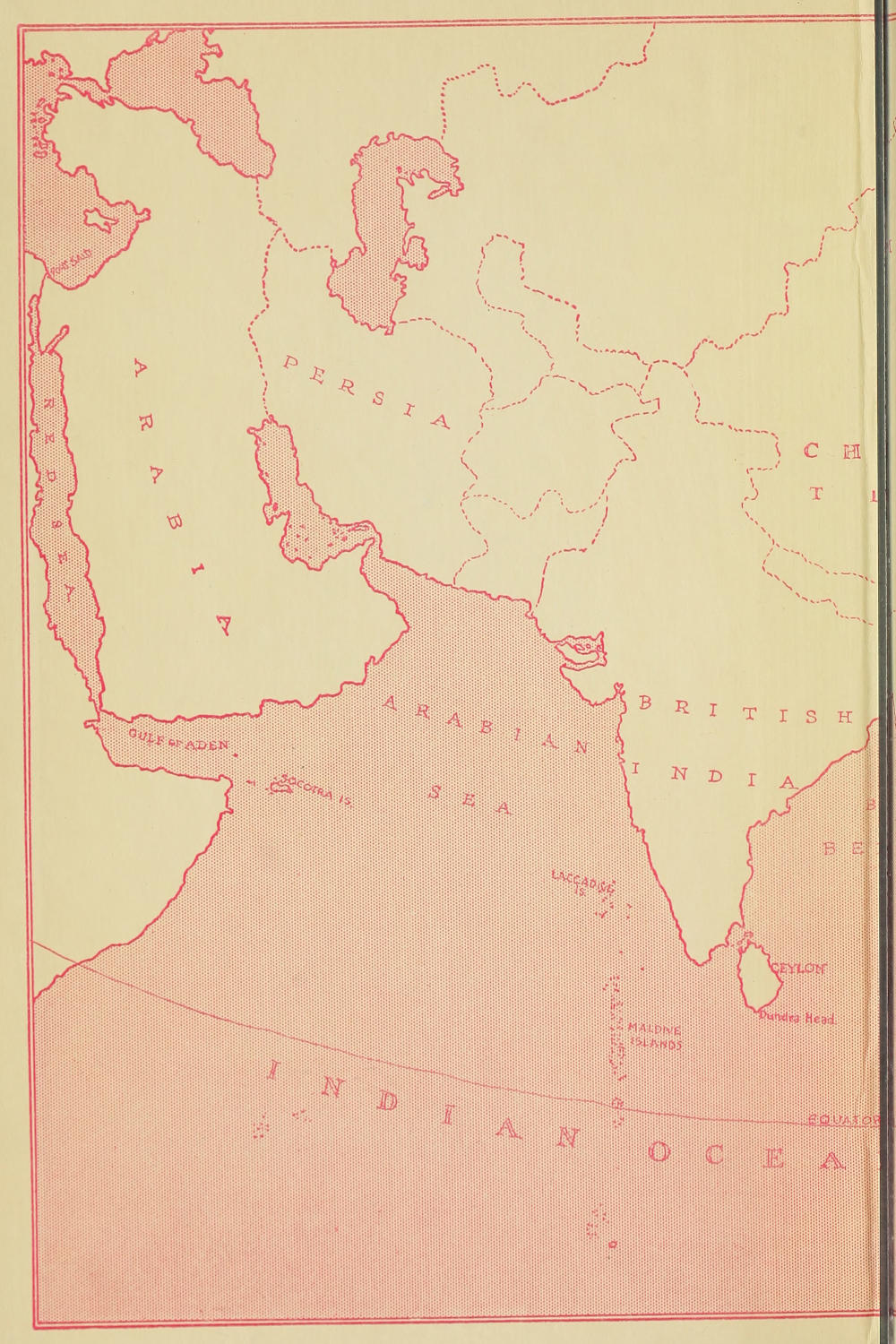
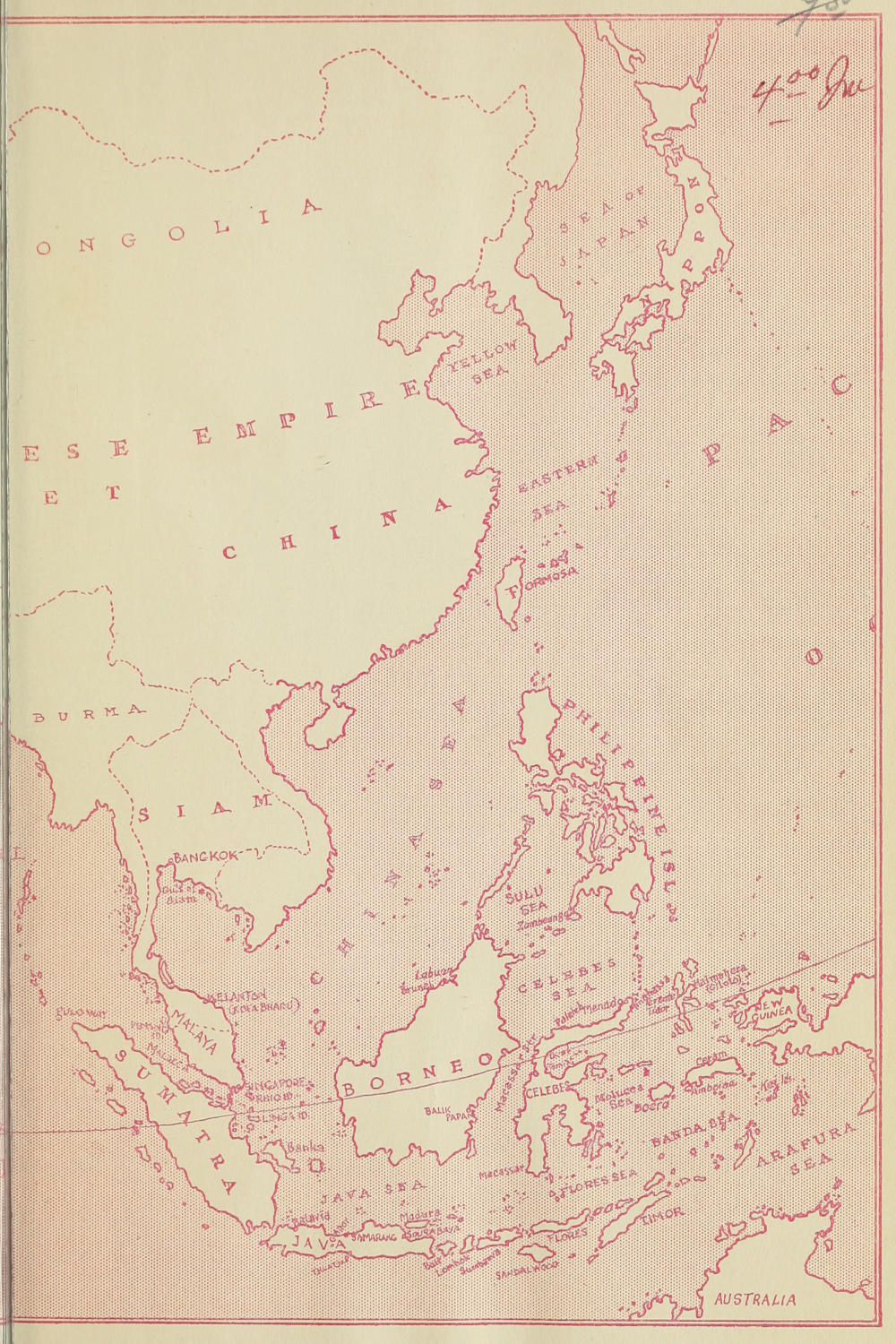
it told me to go to the Moluccas. Nor was its purpose
merely abusive and figurative, as would be the letter
of a friend. The letter was typewritten on a commercial
form; it was direct and curt; it gave telephone and reference
numbers in case I wished to answer back. The
letter advised me to pack up, and the place it told me to
go to lies—as anyone may see who uses a magnifying
glass—between Celebes and New Guinea. But it would
take more than a business letter, however formal, to
compel us into a belief that we are to travel to a place
with a name which can be spelled out only with a strong
glass. You experiment with such news on your friends.
They will not contradict you; they will be too polite.
They will merely stare for an instant, and perhaps nod
as though they saw good reason for hoping that you
would soon get over this little trouble. Curious things
happen to people after war, of course, but time works
wonders. That was how they took it from me. It was
no good trying to persuade them that this sudden revelation
which had come to me by post, this wild dream
disguised as a business letter (in exactly the silly way
of a dream), suggested anything more than the need of
rest and quiet in a room with primrose walls and windows
opening south.
Of course. What else could a man expect of the
straightforward, practical minds of his friends? In
my best moments I myself laughed at the letter. Though
I admit that I played with the pleasing dream the letter
had aroused. I used the lens on the chart secretly.
I stopped work now and then to think it over. I asked
one or two sailors whether they knew the Moluccas;
but they appeared to wish to avoid such a subject, as
though this sort of talk was childish. Nevertheless, it
became plain that so extraordinary a portent as that
letter could not be treated lightly. Sometimes, when
alone—for it was natural that I did not wish the puerile
act to be witnessed in such earnest days of reconstruction
as these—I took down the Malay Archipelago. Then I
found, despite the urgency of our times, it was natural
to drop at once on the very place where Wallace becomes,
for a man of science, almost lyrical from his
boat over the sea meadows of Amboina. And yet that
chanting prose passage appeared to settle it. By artificial
light in an English winter it was ridiculous. When
we know the world to be what it is, who is going to find
faith in an open boat afloat in a transparency where
sponges and corals are on the floor, and fishes as bright
as parrots dart among fronds in the sunlight far below
the keel?
It was no good. Ternate and Banda faded away
toward the days of Henry the Navigator. The Portuguese,
English, Dutch, and Spanish navigators of the
sixteenth and seventeenth centuries knew how to find
them; but not one of my friends who, for whatever privileged
reason, might advise me to go to Hades or anywhere,
could also readily separate the Moluccas from the
Pleiades. The Spice Islands are forgotten. So I was
unable to take that business instruction seriously. Wallace,
with his outburst over his sea meadows, canceled
the letter for me. The mirage dissolved, in the way of
dreams that are fair—dissolved reluctantly, like one’s
faith in a Golden Age—vanished! What to us in Europe
are islands poised in a visionary sea, a sea vast and mute,
Paradise set in Eternity? Well, we know what they are.
Beauty of that kind is merely a stock of sensational
stuff, which is safe and easy for the use of hearty novelists
and short-story writers who require, to make their
books move at all, pirates, trepang, beach-combers,
copra, head-hunters, schooners full of rice, and similar
matter which easily takes coal-tar dyes in the rapid output
of bright and lusty fudge. Otherwise they do not
exist. Nor did the conquest of space, as it is called, by
flying and wireless telegraphy, give me any heart. Those
wonders of human progress brought such islands no
nearer to me than they were to Plymouth in Drake’s
time. Do we imagine we are gods, and may order the
world to be re-created superiorly to a geometrical
design of petrol tanks and telephone stations? We forget
that gods would never do anything of the kind. The
gods may be, and perhaps are, anything we choose to
make them, but they should be allowed more sense than
that. Are we able, with all our aids to progress, to
conjure apparitions like those sea meadows any nearer
to us? They are where they were, if ever they were
anywhere. They are in the same world as the Hesperides.
We see them only in idleness, as we see mankind
at peace, and the star again over Bethlehem. No
flying machine will ever reach the Hesperides. You will
never, even in the quiet of midnight when hopefully listening
in, hear a whisper from that seclusion. How it is
some lucky men become assured, and sometimes quite
suddenly and without the aid of wireless, the encyclopedias,
or any help of ours, of such islands, of such
sanctuary from the deadening uproar of error and folly,
and so are immune from fogs of every kind, the lessons
of the war, the gravest of political disclosures, revolutions,
signs of the times, mysticism, and anything the
public seems urgently to want, is a wonder to me; but
there are such men, and I wish I knew whether they are
really mad, or whether their bright serenity is only
madness when compared with our practical cynicism and
our sane motives of enlightened self-interest.
Yet even we ourselves at times—and there is no serene
brightness of madness about us—are startled now and
then by a hint of easy escape, as though an unknown
door somewhere had opened on light and music which
we do not know. Where did that come from? The door
closes before we can be sure so curious a light and
strange a sound were more than our own hope deceiving
itself. And dreary experience has taught us that it is
wasting time to look for that door. Either it does
not exist or we cannot find it. So that letter was a
release, though in a way far inferior to the momentary
escape of celestial music. It pretended there was a
door. I could fancy a decision had been made in my
favor in that invisible sphere where our circumstances
are devised, those little incidents which move us this way
and that without our ever knowing why. And other
hints continued to drop through my letter box, all at
the same angle of incidence. The last one was more
than a hint. It named a ship, a place of embarkation,
and a day. The day was not far off, either.
This began to make me feel acutely nervous. There
could be hardly a doubt that I myself was designated.
But could I really accept this mysterious decree? I
could not, and I did not. Man never accepts his fate.
He has a faith, which nothing ever shakes, that his habits
are stronger than destiny. He believes that from the
fortress of his daily routine, within which he feels secure,
the urgent messengers from the gods will recoil, baffled.
Nevertheless, I felt certain by now that one of those
dangerous messengers had assaulted my citadel again,
so I arranged about me a few mascots, for luck. If
that messenger forced his way in, then I was ready for
him.
A final imperative knock came at last. No doubt
about it. It was on the very day, I noticed, which fate
had indicated. Others in that room stood up at the
sound, and looked at me. I could see they knew for
whom the messenger had come. Apparently the hour
had struck. My routine had fallen down. It was a
cab-driver who had knocked. And not till I saw some of
my mascots, which were traveling bags, already on his
chariot, did I look back at my porch and understand
that that cab was to take me over the first stage to the
Moluccas. Was I exalted at that moment? I shall not
say. But what the deuce, I said to myself, as I climbed
into the cab, do the blessed sponges of the Pacific matter
to me? Have the presiding gods, I silently exclaimed,
ever heard me complain about my pleasing suburb?
What have I done? But the cabman had a face like the
shutter of an empty house. He was clearly in the conspiracy
to get me out of it. He drove on.
CHAPTER III
The lethargy of soul is proof against all the facts we
do not care to look at. No immortal soldier ever accepted
the nature of his destiny in France till the moment
when he saw his pal drop. And therefore I still thought
there was a chance that this cab was a misdirection. I
had been mistaken for another man. But promptly to
the minute I was left at Euston. Still, Euston was real
enough to be not at all ominous. There can be nothing
in all this world less fay than the London and North
Western Railway and its officials. There is little in them
to make anyone suspect the subtle and transforming art
of what is faery. So I fell asleep in moderate confidence,
and the wheels went around.
I don’t know how long they had been revolving, with
many a jolt and bump through the night, but I woke
with a conviction of the need that day to give attention
to those old volumes in the cupboard ... if the mice
were really nesting there, as I was told.... Where was
I? Odd! I could see through a window the dark waste
of a railway siding. By the look of it this was the dead
end of all railway tracks. Beyond this no man could
go. The dawn had barely glanced at it, because, I
suppose, it was not going to spoil good sunshine on such
a place as that. It was littered with old newspapers
with dates that would be in the week before last. Nothing
else could be seen, except a wall the color of soot,
which was high enough to screen us from all that was
lovely and of good report. Now, I thought, my misdirection
has been discovered. Here I am, shoved into
a celestial pigeonhole for lost souls, till there is time
to find my right label and post me back to my old
volumes. It was then that a familiar appeared, in a
gold-braided uniform, and whispered craftily that this
was Birkenhead. How I got there I don’t know.
Outside it was drizzling. I was dubious about that,
for I have noticed that an ominous sign that I have been
uprooted and am drifting again is that I am in a strange
place and that it is raining there.
A man came out of a dank wall and begged for the
privilege of carrying my two heavy bags. He could
only have been evolved by the progressive lines of a
highly complex civilization. His mouth was a little
open, and perhaps it had not been shut since his last
meal, some days before. It was open and waiting for
the next, and to save time in coughing. As he was the
only visible agent in the strange scheme which had got
me to Birkenhead, I invited him to try the luggage. At
the word, he took off the belt of his trousers. Why his
trousers remained in their place is known only to the
powers which were getting me to the Moluccas because,
so far as I could see, the man had no stomach; which
was lucky for him, as it turned out, because he explained
that his average fortune was seven shillings a week, and
that, take it by and large, Ypres was as good as the
commercial facilities of that fine port. We halved the
weight, and trudged off. I saw no signs anywhere of the
Far East. All the streets were alike; yet this fellow
with me, who never looked up, but stared at the pavement
and breathed hard, seemed to have prior advice as to
what to do with me. He knew; for, turning a corner,
I saw above dingy roofs a tall funnel of a ship. It was
the color of a genuine sky, though its top was black,
like the sky we had. From the mainmast head of that
hidden steamer the blue peter was flying. “Your ship,”
coughed the wraith shambling beside me. I was sure
he knew. The whole affair was foreordained.
Carefully observe what happened next! That ship
had a name out of the Iliad. I had never seen her before.
The way to her was cumbered with packages
marked for Singapore, and places beyond which we
forget after we leave school. Nor could I make out
what she was like, from the quay. She was a mass in
which white boats were mixed, and a length of black
wall, a blue smokestack, two men looking down from a
rail, a flag, some round windows with brass rims, a
shout or two, a roar that stopped when some cases
checked in midair and swung on a pack-thread; a height
topped by brown derricks and ventilators. She could
not be seen. There was no beginning to her and no end.
I went through a door in the upper works of the structure,
expecting to be thrown out. That place was nothing
to do with me. I could see and smell that. But a man
whose smile indicated that he had known me all my
life met me in a passage, knew my name, and invited me
to follow him. What else could I do? I followed in
resignation. He took me to a room. It had been prepared
for me. He went to a drawer and handed me
some letters whose senders clearly knew where next I
would be found. “If you want anything,” he said,
“touch that button”; and vanished.
Thereupon I surrendered. I sat on the couch and
wondered who I was, why all this had happened, how
long it would last, what I should do about it, and
whether any man since the world began ever knew for
certain why and by what means his affairs were shaped
for him. I found no answer to this, though the ship
hooted once in an insistent way. I took no notice of
that till, looking through my round window, I noticed
that the shed just outside—a shed which, after all, represented
England—was stealing away from me. The shed
disappeared. Nothing could be seen then but two ropes,
and they were blithely dancing a hornpipe over some
hidden joy.
I went outside to see what made them so gay. But
the sky was still drizzling. Those dancing ropes were
aware of something hidden from me, and I determined
to find it. Our ship, which I have reported was a hero
of the Iliad, was athwart a great rectangle of water
and in the midst of her peers. They stood about her—and
here I will declare that though a ship is named
after a warrior in a bronze helmet I am not going to call
her him—she was, then, in the midst of her peers:
Shires, Clans, White Stars, Halls, and her family Blue
Funnels. It seemed to me she knew her family tradition
and her worth. There was such a stateliness about her,
so easy a dignity, and her commands were so peremptory
and haughty, that it was clear she had the idea that
nothing afloat could deny her house flag.
By the Bar Lightship some steamers we passed were
making a fuss about the weather. But our Trojan took
no notice of it. I will even confess that off the Isle of
Man roast pork was conspicuous on the lunch card, and
that I knew of no reason why it should not be. With the
dark obstinacy of its northern character the spring pursued
us south. The northwest wind was bleak and
sullen. The sun hid his face. We were alone in the
Western ocean on the second day. We had the wind
and the desolation to ourselves, except for a dozen lesser
black-back gulls which were following us because, perhaps,
those waters were the same as all the seas of the
north, and so it did not matter to them where they were.
The surge mourned aloud, sometimes rising to a concluding
and despairing diapason. The blue jeans of the
sailors busy on the exposed parts of the ship quivered
violently in the perishing cold. Once, I remembered,
some dauntless men pulled galleys westward through
the Pillars for the first time, and then turned northward
toward the top of the world. How did they find in that
ocean the spirit to maintain a determined course? I do
not know. They must have been good men, and hard
sailors. I will never believe that the thought of more
and easier shekels kept them facing the gloom of those
sweeping ranges of water and the bitter heartless wind.
It is a lie that men are never moved except by the hope
of gain. It is a miserable lie of the money-changers,
and it is time to kick their tables outside once more.
Why, fellows even as stout as those earliest navigators
must have seen in dismay that their gods to whom they
had sacrificed would be helpless in seas that were beyond
all known things, where they could guess they had entered
the realm of the powers of darkness, and that
the warmth of human and friendly hearts would go to
leeward with the spindrift, and hope could be abandoned.
It was while I was seeing this so plainly that a
youth in uniform caught hold of a stanchion and flung
himself into the wind toward me. He handed me a
familiar yellow telegram. It was from home, praying
a good voyage for us. The sightless message had just
been picked out of that gale and that sky. I glanced
beyond the telegraph messenger, and wondered if he had
left his bicycle round the corner.
The English spring gave up the hunt just beyond
Finisterre. The sun, glad of the chance, came out to
look at us, and made a habit of a magnificent appearance
each day at the due hour. We found another wind.
It allowed me to loaf on the exposed forecastle head,
watch the flying fish glance away from the noisy snow
of our bow wash, and listen to the lookout, standing
at the stem, answer the bridge when its bell gave the
ship’s hour. But Ternate seemed no nearer than it did
at Birkenhead. It was still an incredible fable, a jest
by an old traveler which he tries on the foolish. All
the East I had seen so far was no more than three Chinamen
squatting on their hams on our after deck, chanting
together while one punched a hole in a paint keg and
the others admired it; that, and a smell of curry. Anyhow,
it was a strong smell of curry.
One morning the lookout signaled land. It was a thin
shadow over the port bow. There was no other cloud
in the sky. That shadow grew in height, darkened, and
closed in on us. Then the shadow of Africa approached
our other beam. Toward evening we passed between
the Pillars. We may have been no nearer to the
Moluccas, but we had escaped from the darkness of
the north. That was certain at sunset, when we might
have sailed off the waters of earth and were elevated
to a sea where there were no soundings, and logs would
be profane. We were not alone there. A felucca was
in the vacancy between us and the phantom of a high
coast. Our own yellow masts were columns of light.
The foam at the bows was flushed with hues never seen
in water. And ahead of us, that sea we were to enter was
the smooth expanse of an unknown and lustrous element.
It was brighter than the sky. From the lower
wall of a vault of saffron a purple veil dropped to the
rim of a vast mirror. I do not know what was hidden
by that veil. It was a dusky curtain circling the brightness
and its folds rested on the mirror. Down on a
hatch below me some of our fellows started a gramophone
with a fox trot.
CHAPTER IV
We had seen the shadow of Crete in the north, and the
next noon our ship was somewhere off the Nile. Despite
its antiquity the sky was still in its first bloom, and the
sea was its perfect reflection. It was easy to feel older
than the sky and the sea, for our ship was solitary in
the very waters where, out of the traffic in ideas and
commodities between Knossos and Memphis, had grown
the Athens of Pericles, and Rome and Paris, London
and New York. If there is anything to be said of that
awful thought, perhaps it would never do to say it
here. It may be altogether too late in the day to
brood with fond and kindling eye upon the cradle of
that particular deep which rocked our childhood into
the beginnings of Chicago and Manchester. Let us say
nothing about it.
The next sunrise it was the skipper himself who called
me. This was a genuinely surprising event. His white
figure was even startling, for to me then he had become
a senior master mariner in a service so august as our
blue funnel, the house flag of which is, I suspect, east of
Suez, more potent than the emblems of not a few proud
states. The honor was unusual enough to cause me
to strike my forehead against the opened port as I sat up
respectfully. Our master has been at sea for forty
years, so his appearance of weariness and of ironic
understanding may mean that his experience of men has
been extensive, or it may mean nothing. “We are entering
Egypt,” was all he said, while his lean hands rested
on the edge of the bunk; he then turned away as if he
supposed this sort of thing would never end. But possibly
he had been up all night.
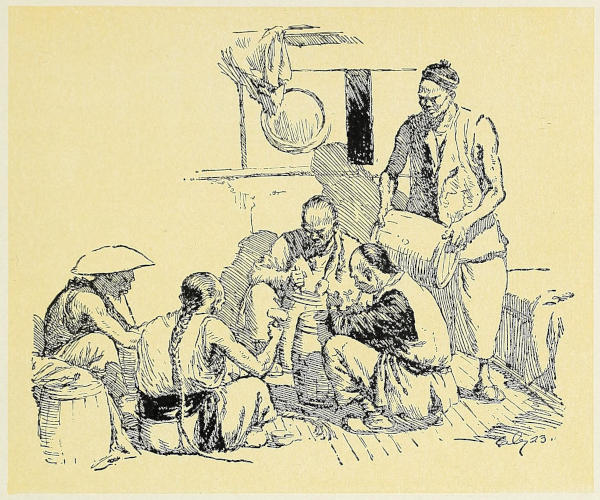
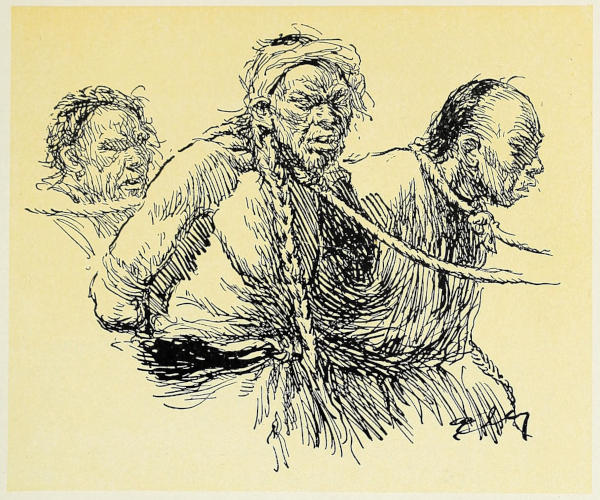
A Group of Chinese Firemen
There was an apparition of a city over the sea ahead
of us. It was so delicate that the primrose of sunrise,
deepened in inclosed and quiet waters, might in that
place have conspired to produce a mirage of one’s
bright expectations. That was the gate to all that romantic
folk with a meaning eager but scarcely articulate
call the Orient. Yet which of us is not romantic when
we see it for the first time? I watched that gate
heighten and become material as our ship insensibly
approached it, till I could read on the seaward brow of
this entrance to romance the famous legends, “Topman’s
Tea” and “Macgregor’s Whisky.” Port Said, you soon
discover, is just like that.
If it is anything at all it is more West than East.
A somber flotilla of barges manned by a multitude of
dark fiends was waiting for us, and our ship hardly had
way off her before she became Tophet with coal dust,
unholy activity, and frightful jubilation. It is the privilege
of civilized men to give their appetites and repulsions
the sanction of reason with its logic, and therefore
I did not accept Port Said because I did not like it. It
is certainly not the Orient, and I hoped it was not even
its gate. Its address and its manners are as abrupt and
threatening as is the Stock Exchange to a timid stranger
who has misadventured within its sacred precincts. I
went ashore, but soon returned to the ship, for I fancied
that our Chinamen might be closer to a simple heart than
the oblique calculation of that port.
For what are the significant things in travel? Let
travelers candidly own up. He is a wise traveler who
has few doubts about that, and such a man would be
silent, of course, being wise. Who would believe him if
he spoke? There was, for example, the French mail
steamer close to us at Port Said, homeward bound.
Her saloon passengers, the ultimate Parisian reflection
of the grandeur that was Rome, surveyed in aloof
elegance and in static hauteur the barbaric coarseness of
Port Said. But for a chance hint I would most certainly
have saluted, as is the Anglo-Saxon habit, the refinement
and pride of the folk on the Frenchman’s promenade
deck as the very luster—which is so hard to attain—of
Western civilization’s most exquisite stuff. But
my glance drew away to the Frenchman’s forward deck,
and there I saw something which tumbled down my
hitherto unquestioned convictions about those qualities
which make, as we should put it, the right folk. That
deck was loaded with passengers from Cambodia and
Cochin China, people of quite another culture—or of
no culture. They did not seem to be travelers by deliberation
or decision, like ourselves. It was easy to
guess they had merely obeyed, like little children, the
stern directing finger of fate. They showed no curiosity
in us, or in Port Said. They were as still, and as
watchful or as indifferent, as delightful images. They
stayed where they had been placed. Yet if the French
ladies were beautiful, then what shall we say of those
little figures? By what means, by what habitual, tranquil,
and happy thoughts, did they attain without wish
or effort to a countenance which made the refinement
and haughty demeanor of the first-class passengers
above them identical with the barbaric challenge and
insolence of Port Said? It did not surprise me that for
our exhibition of Western enterprise and energy those
children of another clime had but shy and mild astonishment.
One of them, who might have been an attractive
piece of craftsmanship in ivory and ebony, did give
to the busy and heated scene the faintest of smiles. A
doubt as to what made him smile blurred for me later
the enduring testimony to Western skill and activity in
the Suez Canal, and even the still more remarkable
evidence of our energy at Kantara, a wilderness of
abandoned railways and earthworks, with square miles
of abandoned airdromes and rusting and sand-blown
wreckage, where Anglo-Saxon genius for scientific organization,
and British wealth, had built the camp and
engines for the last conquest of the Holy Land. It is
most disquieting to get a hint that the established way of
life of one’s kin may be foolish after all, and that there
are other ways.
Why should a Cambodian smile have so haunted me
that my hope and endurance in travel were not rewarded
with the satisfaction I had a right to expect, when
witnessing the marvels in foreign lands created there by
the superior culture of my dominant race? Did I go
to sea for that? Nothing like it. And next morning,
when I looked out from my cabin port, there still was
the mere canal. Beyond it was the desert, and over
that gray and vacant plain was an announcement of the
coming sun. The sky was empty, like the desert. Nothing
unusual was expected, evidently. But it was only
with the first half-awakened glance that I guessed it
was the common sun which was to come. In another
instant I was aware that that hushed and obscure land
was humbly awaiting its lord. The majestic presence
suddenly blazed, and ascended to overlook his dominion.
A terrifying spectacle! It would have frightened even
a poet in the mood to hail the beneficence of one of
man’s earliest gods. The glances of that celestial incandescence
were as direct as white blades.
In the south, to which we were headed, a high range
of Africa’s stark limestone crags stood over a burnished
sea. The sun looked straight at them. And just above
them, parted from their yellow metallic sheen by a
narrow band of sky, was the full globe of the declining
moon; and the moon herself was no more distant and no
more spectral than earth’s bright rocks beneath her. It
was not surprising that that scene was motionless and
constant. There was no wind, there was no air, or all
would have vanished like a vision of what has departed.
Those luminous bergs shone like copper. Their markings
were as clear and fine as the far landscape of a
newly risen harvest moon. Suez was not far away, and
its lilac shadows were as unearthly as the desert. But
there was substance alongside our ship. Some villas
were immediately below, arbored in tamarisk and cassia.
A few trees in that green mass were in crimson flower.
I could smell the burning ashore of aromatic wood. A
child in a cerise gown stood under a tree, but she was
so still that, like the polished water, like the hills of
brass and the city built of tinted shades, she might have
been the deceit of an enchantment.
A tugboat rounded a point, shattered the glass of the
sea, and the child, released from the spell, moved from
under the tree. Men in our ship were shouting. Mail
bags for Singapore, Hongkong, Shanghai, and other
places as well defined were thrown aboard. Life began
to circulate. These men gave no attention to dead hills
and the tyrant in the heavens. I am prepared to believe
they would have been incredulous concerning any
town about there built of lilac shadows. Our ship
rounded away into the Gulf of Suez, the northern corner
of the Red Sea.
CHAPTER V
We are aware—though we hardly dare to whisper our
knowledge—that even our street at home will, at rare
times, give us the sensational idea that we really do not
know it. Can it exist in a dimension beyond our common
experience? We think we glimpse it occasionally
on another plane. This sense, luckily, is but fleeting.
We could not support a continued apprehension of a
state of being so remarkable. We come down to our
beans and bacon, and are even glad to answer the bell
to that and the coffee. Well, it is more remarkable of
the Gulf of Suez that it permits no certain return to
common sense. The coast of Africa, and its Asian
opposite, remained within a few miles of our ship all
day, as pellucid as things in a vacuum, but as unapproachable
as what is abstract and unworldly—the
memory of a dead land, though as plain as the noonday
sun. There can be no shores in other seas anything
like the coast of that gulf. The panorama of heights
silently opened and went astern, monotonous, brilliant,
and fascinating. In all those long miles there was not a
tree, not a shrub, not a cloud, not a habitation. The
sky was silver, the sea was pewter, and the high bergs
were of graven gold or bronze. The chart informed us
of Moses’ well, and of Badiat Ettih, or the Wilderness
of the Wanderings, and Mount Sinai. “Moses, sir,”
said the bo’sun to me, “he had enough rock for his
tablets, but that was a hot job he had getting them down.”
But since those early days and tribulations the land has
been left to mankind but as a reminder of things gone.
Nobody to-day ever lands on those beaches, on those arid
islands. How could they? That we could see the contortions
of the exposed strata, and the dark stains thrown
by the sun from yellow bowlders on immaculate sands,
was nothing. We see, in the same way, the clear magnification
of another planet through a glass, but that
is as near as we can get to it. There were numerous
small islands between us and the shore. They were
always glowing satellites of bare ore, without surf,
fixed in a sea of lava, and blanched by the direct and
ceaseless blaze in the heavens. Unshielded by air and
cloud from that fire, they perished long ago.
Our smoke rose straight over the ship’s funnel, then
curled forward, showering grits. If the hand was placed
carelessly on a piece of exposed metal work one knew it.
Our bo’sun, who has no expression but a disapproving
stare, who never sleeps, who has the frame of a gorilla,
and whose long hairy arms, bowed inward and pendent
as he walks the deck, are clearly made for balance and
dreadful prehensility, admitted to me that it was
“warm.” Yes. The sprightly fourth engineer appeared
from below as I loafed along an alleyway which had
the fierce radiation of a nether corridor, and he drooped
on the engine-room grating with the air of a fainting
girl; he did not call it warm, but that is what he meant.
Night came, and the cabin had to be faced. The
hour was made as late as possible, but it came. Reading
was not easy. It would not have been easy then for
a young novelist to enjoy the press cuttings assuring him
of those original features of his work which distinguished
it from that of Thomas Hardy. But the cabin
made it no easier to do nothing, for how can one lie
sleepless in a bunk and merely look at time standing
still because the thermometer has frightened it? Beside
me was a book the skipper had lent to me, with a
hearty commendation of its merits. “Facts,” he had said
to me significantly, looking at me very hard. “Facts,
my dear sir!”
So it looked. It looked like nothing but facts. Who
wants them? What are they for? And the coarse red
cover of the book betrayed its assurance in its uncontaminated
usefulness. A copy of it will never be found
in any boudoir. (This is probably the first reference to
it by a critic.) I lifted the weighty thing, took another
look at my watch—no hope!—summoned so much of my
will as had not melted, and began.
When I awoke the sun was pouring heat again. The
decks were being drenched. But my cabin light was
burning foolishly and the book was beside me. If
already you know something of that special sort of
literature which is published exclusively for use in the
chart houses of ships, you will understand. And you
will know, too, where R. L. Stevenson got much of the
actuality which in places lights the ships and islands of
The Wrecker and The Ebb Tide into startling distinction.
The pilotage directions for the Pacific were volumes into
which Stevenson must have often pushed off, like a
happy boy in a boat, to lose himself in that bright
wilderness. Yes, and if only the writers of other kinds
of books but knew their work as well, could keep as
close to the matter in hand, and could show their knowledge,
or admit their want of it, with the brief candor
and unconscious modesty of the compilers of the works
published for mariners by a Mr. Potter, of the Minories,
London! I hope that some day I may be able to enter
Mr. Potter’s shop, where books are published in so unlikely
a place as Aldgate, which is Whitechapel way, and
press Mr. Potter’s hand in silent gratitude, for I am
sure there is no phenomenon in nature, not even an
exhibition of human gratitude, which would astonish
him, or move him indeed to anything more than a perfectly
just comment in words not exceeding two syllables
each.
I will make no secret of the book which put away the
heat for me, and abolished time—for I do not remember
looking at the time after 1.30 A.M., when I was still
far from sleep, and had been reading steadily for hours.
Yet this book no more resembled a best-seller than a
chronometer resembles the lovely object out of a prize
packet. Its name is The Red Sea and Gulf of Aden
Pilot—the seventh edition, we may gladly learn of so
respectable an exhibition of prose. Its price, I noticed,
proved that the truth—or as near to the truth as one
should expect to attain—is no more, is really no more,
than the price of more doubtful commodities. And let
us remember that it is all very well for wise pilots in
other and darker seas to assume they may teach young
voyagers the right ways in the deceptive and fog-bound
coasts of philosophy. Philosophy? That is easy. We
may make our charts, then, according to inspiration or
desire. But when it comes to advising a mariner where
he may venture with a valuable ship, according to her
draught, then it is essential that words should be chosen
with care, and the student warned to note with unusual
caution every qualitative parenthesis. There can be no
casual and friendly agreement to differ about the truth
when the question concerned is a coral reef in five
fathoms and a ship drawing thirty feet. One must be
able to assure a sailor either that his ship can do it, or
he must be told that he may not try. Yet with what
confidence each of us will venture to pilot others in
the more dangerous, the more alluring, and the supremely
frustrating elements of morality and æsthetics!
My bed book made no attempt to beguile me. It
opened with the simple statement that its purpose was
to give “Directions for the navigation of the Suez Canal,
the Gulf of Suez, and the central track for steam vessels
through the Red Sea, Strait of Bab-el-Mandeb, and the
Gulf of Aden; also descriptions of the Gulf of Akaba,
the African and Arabian shores of the Red Sea, the
Gulf of Aden, and the southeastern coast of Arabia to
Ras-al-Hadd, the coast of Africa from Siyan to Ras
Asir, including the Gulf of Tajura, then to Ras Hafun,
Abd-al-Kuri, the Brothers, and Socotra Island.”
And Socotra Island! We know the South Pole better
than that island, although from prehistoric times every
maker of specifics has depended on Socotran aloes.
After this simple avowal the book informs its reader
that “all its bearings are true, and in degrees measured
clockwise from 0° to 360°.” Dare we ever ask for more
than that? Here was a book which actually declared
that its bearings were true and were not magnetic. No
work could be more frank. It relied entirely on its
reader being a man of honor, of common sense, of skill
in his craft, and of a desire so simple that his only care
was the safety of the lives and the property of others.
Yet such is the force of habit, which sends us to a book
to look, not for the life we know, but for the glory of
its falsification, that at first I was inclined to put the
captain’s volume aside and trust to boredom and the
whirring of the electric fan to send me to sleep. But
something prevented that.
Here I was, in these very waters; and their uninhabited
islands, beaches, and reefs, which had been passing us
all that day, were altogether too insistent. These
Arabian and African gulfs have more coral to the square
mile than any other seas in the world, so, although
their shores, during all a day’s run, may be rainless
and dead, the waters are more alive than the most fertile
of earth’s fields. Sometimes, when listlessly gazing
overside, one was shocked by the sight of a monstrous
shape dim in the fathoms. And one evening when the
very waves, as though subdued by the heat, moved
languidly in hyaline mounds, several black fins began
to score their polish. A few dark bodies then partly
emerged, gliding and progressing in long, leisurely
arcs. As soon as those dolphins saw us they woke up.
They began leaping eagerly toward us in the direction
of our bows, as though the sight of our ship had overjoyed
them. They behaved deliriously, like excited
children released from school at that moment. Now, we
were used to a small family of these creatures so greeting
us. They would amuse themselves for ten minutes
by revolving round one another immediately before the
ship’s stem, weaving intricate evolutions in the clear
water so close to our iron nose that one looked for them
to be sheared apart. They were so plain that it was
easy to see the crescent-shaped valve of the nose, or
blowhole, open whenever a head cleared the water. But
the exhibition this evening was phenomenal. Thousands
of them—yes, thousands, for I will imitate the Pilot—as
though they had had word of us, appeared at once,
throwing themselves in parabolas toward us, and when
alongside breaching straight up, perhaps because their
usual curved leap did not take them high enough, and
they intended at all costs to get a view of our amusing
deck. The level sun signaled from the varnish of their
bodies. One of these little whales moved for some time
below me, turning up an eye now and then in the way
of a swimmer who converses with his friend in the
boat. He rolled over lazily, went down, and dissolved
in the mystery under us. When I looked up the sea was
vacant. Dolphins might never have been created.
This sea was so plainly the setting for legend and
fable. Crusoe and Sinbad both would be at home here.
I should guess, however, from what we saw of the coast
and the islands, that this was more the world of Sinbad
than of any level-headed adventurer. Djinns might be
looked for in those desolate gorges into which we had
glimpses. It would be wrong to pretend that the Pilot
ever mentioned such things by name, but now and then
I suspected in the text fair substitutes for such infernal
and maleficent powers. The Pilot would check the
reader going easily through its pages with an unexpected
caution: “The coast from Ras Mingi northwards to Ras
Jibeh, a distance of 330 miles, is mainly inhabited by
the Jemeba tribe, who generally have a bad character.”
But the faithful Pilot would allow no harsh judgment
on the Jemebas. We ourselves might develop a similar
bearing toward visitors who appeared to be unduly prosperous
if we were as poor as the Jemebas, had no boats,
and had to “depend on inflated sheepskins” for our
“fishing operations.” Of certain channels we were
advised not to attempt them “unless the sun is astern of
the ship and a good lookout is kept.” The reefs in this
sea do not behave like reefs. They are numberless, but
they are rarely marked by so much as a ripple; and
that, I can vouch, is true. Their fatal presence may be
revealed on a lucky day by a change in the color of the
water. For those seamen who are not fortunate when
watching for the water to change color the Pilot gives
advice on what may happen when boats must be beached
and help sought. The beach “was formerly inhabited,
and remains of dwellings are still to be seen.”
CHAPTER VI
I was leaning on the rail of the bridge with the master,
watching the brown scum, peculiar to the Red Sea, pass
alongside with its not really pleasant smell, for it hints
that the very deep itself is stagnant and decomposing;
and I was foolish enough to tell him that to me the bearings
of his excellent book of sailing directions were not
only true, but magnetic. He half turned to me sharply,
considered this remark and myself for a moment, and
then made the noise of impatience in his throat. It was
at the hour when we were passing into the Red Sea
proper. The Ashrafi Islands were abeam, with Shadwán
Island, the greatest of the group, the very picture in
little of what this earth will be when its ichor will all
have evaporated. Behind the barrier of outer islands is
a labyrinth of reefs and coral patches where the signs of
danger may be mistaken for the usual mirage, or an innocent
and fortuitous shadow may have the obvious face
of a genuine reef and thus scare a ship away on a
safer course till she runs full upon the real and unannounced
rocks. I mentioned to our captain that
his book occasionally whispered of a few inexplicable
tents to be seen on these uninhabited islands.
“Oh, tents! That’s right. A man I know got aground
here,” he said, “and in half an hour his ship was surrounded
by little boats. He never saw the coming of
them. There they were. A year or two before the war
a steamer got aground here one night, and at daybreak
she was boarded by a big mob. The crew were stripped
of their clothes. The Arabs were in a hurry to get the
chief engineer’s ring, so they cut his finger off. Then
they tried to shift a copper steam pipe. Steam was still
on, and they took an ax to it. The engineer told me it
did his finger a lot of good when the Arabs got down
to the steam. The pressure was all right.”
Even a deep-water channel of the Red Sea may commit
the crime which some think worse than murder—the
betrayal and mockery of a confiding trust, of a simple
faith in the pledged word, of repose in the moral order
of things. A steamer, the Avocet, where the chart, the
Admiralty chart, and Mr. Potter’s Pilot allowed her master
to rest on the comforting knowledge of deep water,
struck a rock. “Naturally the Court of Enquiry,” commented
my captain, bitterly, “as much as told that man
he was a liar about that rock.” Our own master exhibited
the sort of displeasure which good craftsmen
reserve for theorists and experts—the learned men who
would debate such a subject as the Red Sea in the Law
Courts of London. But even then he did not begrudge
them a fair word. “But they didn’t suspend his certificate.”
They sent a gunboat from Aden to search for
the rock. The gunboat cruised and dragged for it for
three weeks, but the rock had gone. “Got tired,” suggested
my captain, “of waiting for another ship, I suppose.
Went down below for a rest. The gunboat said
there was no rock. And there you are, sir. That proved
the Avocet’s skipper was a liar. Couldn’t be plainer.
Ten months later another ship found it, though she
wasn’t looking for it. It don’t do for a sailor to say
a thing isn’t there because he can’t see it and has never
heard of it before. Give it a margin.”
The Red Sea, I suppose, will never be a popular resort.
No pleasure, as it is commonly defined, may be
found where the shade temperature may rise to 110°,
where rain rarely falls, where there is either no wind or
a malicious stern wind, where the inclosing shores have
no rivers, but only beaches of radiant sand and precipices
of glowing metal, and where you are not likely to
meet any folk except an occasional tribe with a bad reputation
and so poor that it goes fishing on inflated sheepskins.
At the lower end of that sea there are a few
ports, used mainly by the pilgrims to the holy places
Mecca and Medina. And indeed the Pilot does not
attempt any attractive testimony. Even of such a choice
subject as a small island secluded within an unfrequented
gulf it is but terse, even exasperatingly brief. It
will merely report of it that it “produces no vegetables,
except two or three date palms and a few pumpkins.
There are a few jackals, gazelles, and wild asses here.
Cephalopods are abundant in the surrounding waters,
and sperm whales are common.”
But is not that enough? Could you get that at Monte
Carlo? What more could a traveler wish for as he
looks overside at such a coast? What more does he
deserve in a world which has become patterned with
airdromes and oil tanks? These coasts are no more
placable and are little better known than they were to the
early navigators. There are large and even populous
islands which great ships must pass almost every day
that are still as they were when the insatiable curiosity
of Marco Polo drew him to so many first views of the
earth’s entertaining wonders. For there on our starboard
beam, immense on a sea which moved in smooth
mounds so languidly that the surface of the waters might
have been filmed with silk, rose the battlements of
Socotra. I think the last we heard from that island was
dated 1848. Yet, the Pilot informs us, “it is said to
enjoy a remarkably temperate and cool climate.” Its
capital, Tamrida, is less frequently visited by Christians
than Mecca. It should be worth a visit, if one had
the heart for it. The town is “pleasantly situated” and
its people are mixed of Arab, Indian, Negro, and Portuguese
blood. The natives have an unwritten language
peculiar to themselves. But we are kept out of so
attractive an island because, for one thing, though it is
a British possession, both monsoons appear unfeeling
about that important fact concerning a land which has
no harbors and no safe holding-ground for ships; in
addition there is the “unfavorable character of its
natives.” Is it then surprising that the literature made
by tourists in these seas is mainly devoted to arabesques
of places like Port Said? A day in Socotra would be
worth a year with the Pyramids. And, as it happened,
the southwest monsoon was waiting for us. When we
had cleared the easterly point of the island it caught us,
filled our decks, smashed the crockery, and at night
set the mast-heads describing arcs amid the stars.
CHAPTER VII — FOOTNOTES
June 5.—To look down a lane in our village you
might suppose that literature was about as likely there
as the harpsichord. The narrow pathway (when two
of us meet in it we must go sideways) is of wood, and
it has white walls and a roof of steel. There are doors
all along its length, and it ends at a ladder descending to
the afterdeck. The doors are generally open in a
friendly way, as though we had no doubt about our
neighbors. Some of these doors give on comfortable
little sanctuaries in white and mahogany, with blue and
orange bunk curtains, electric lamps, and settles on
which—should you call on a friend when he is off duty—you
may hear enough to keep your own improving
knowledge modest and dumb.
There are sections of surprising warmth in that steel
passage. You feel no astonishment, therefore, when
you come to other doors which do not admit to mahogany
and bright curtains, but to the noises and dark
business of the pit; you may see, down below, little figures
most intent on whatever duties have to be performed
about eternal fires and boilers.
Therefore literature? No, nor flower boxes. Besides,
this ship and its men are as good as some books, and
better than others. In the early days of the voyage I
felt no desire to read. Yet one night the initial interest
in the novelty of my new home wavered. There was
no sound but the creaking of a piece of unseen gear and
the monody of the waters. There was nothing to do,
and the last word had been said. That was the time
when a book would have helped. But I knew it would
be useless to look for aid to the kind of books which go
to sea. I recalled other voyages and their chance
volumes. Easy reading! Yet to take to sea what has
the comical name of “light literature,” because that is
the stuff to read there, is an insult to one’s circumstances,
where ignorance and light-mindedness are ever in
jeopardy and may be severely handled. Anyhow, I do
know that the sea converts that kind of confectionery
into sodden, dismal, and unappetizing stuff.
There was nothing for it but patience. Mine had been
rather a hurried departure, and, except a few geographical
and other reference works, I had nothing
with me but a Malay grammar, and so far the grammar
had too easily repulsed my polite and insinuating advances
upon it. Our ship is an extensive and busy place,
managed in a way which shows an exclusive attention
for the job, and so I did not betray my interest in literature
till one day I saw a cadet with a likely volume. It
turned out to be the Iliad, in Derby’s translation. I was
so impressed that I mentioned this curious adventure to
the captain.
He thought nothing of it. “Our ship has plenty of
books—part of our gear. Come with me.” He showed
me a bookcase for the boys—I had passed the place
where it stood scores of times and would never have
guessed so much was secreted there. Excepting for
some transient volumes of fiction, changed whenever the
ship is home again, the books in that case would have
shown a country parsonage to have an horizon strangely
beyond the parochial confines.
There was the Odyssey, the Oxford Book of English
Verse, Milton, Wordsworth, Tennyson, Know Your
Own Ship, Lubbock’s China Clippers, Green’s Short
History, a history of China, Japanese and Malay grammars,
volumes on engineering and navigation. Ball’s
Wonders of the Heavens, the Oxford Dictionary,
Wallace’s Malay Archipelago, books on sea birds, books
on marine zoölogy, books enough to keep one hunting
along their backs for something else unexpected and
good. And in this very place where I had imagined that
I was cut off from letters, the captain, casually at breakfast
one morning, gave a frank judgment on a recent
novel, and his reasons for his opinion were so sparkling
and original that I saw at once what is the matter with the
professional reviewing of books. In the place where I
had guessed that letters were nothing, the significance
of the popular reading is such that it would break the
heart of a sensational novelist to see it, and might drive
him to seek his meat in the more useful mysteries of
crochet work.
June 6.—The southwest monsoon has broken. The
heat and languor of the Red Sea are being washed from
us by the Gulf of Arabia. The decks have been wet
and lively to-day. The ship is rolled by quick and
abrupt waves heaping along our starboard side. The
waters recoil from our bulk, and the sun shining through
their translucent summits gives the tumult brief pyramids
of beryl. There are acres of noisy snow, and clouds
of apple-green foundered deep within inclines of dark
glass. Spectra are constant over the forward deck,
where the spray towers between us and the sun, and
drives inboard. After a nasty lurch I hear more crockery
smash below. One of the other two passengers, the
young Scots farmer who has left his Ayrshire oats to see
whether rubber trees are better, and who had fancied
at the first trial that he was a proved sailor, now seems
to miss the placidity of his cows. He groans. At first
I was a little doubtful about myself, but bluffed the Gulf
of Arabia into supposing that it was a mistake to take
me for a longshoreman; yet for a mysterious reason, so
uncertain is the soul and its uninvited thoughts, I have
had “Tipperary” running through my head all this day—music,
one would think, which had nothing to do with
monsoons; and thoughts of Paris, and the look of the
English soldiers of the Mons retreat I met long ago.
Why? How are we made? For here I am, with nothing
to remind me of Crépy-en-Valois, climbing companion
ladders where ascent and descent are checked
at times by an invisible force, which holds me firm to
the reality of a ship at sea. And yet “Tipperary,” that
fond and foolish air, will not leave me. I wish I had
the clew to this. After sunset, in a brief wild light, it
was a test of the firmness of the mind to be on deck.
The clouds, the sea, the horizon, were a great world
displaced. The universe with its stars swayed giddily
at bonds that threatened to burst at any moment, and
away then we should have gone into space. It is darksome
to see very heaven itself behaving as though it
were working loose from its eternal laws. An anarchic
firmament?
June 7.—Bracing myself last night in my cot, from
which the ship tried to eject me, I read Kidd’s Science
of Power. The captain had commended it to me, saying
it was one of the best books he had ever read. Now,
would it have been possible before 1914 for a book
which describes the theory of mankind’s inborn and unalterable
nature as blasphemous nonsense, and condemns
civilization based on force, to win so handsome a
tribute from such a tough character as our skipper?
Kidd declares that it is the psychic condition of a people
which matters, and that their outlook on life can be
changed in a generation. He says the collective emotion
can be charged for war or for peace. That our
captain, who had his share of war, should have been
moved by such an idea, need not surprise us to-day.
Kidd’s theory is proved by our skipper’s own eagerness
in this new hope. But the prophets and all the artists
who have never served in the House of Rimmon have
always held that faith, and have worked in its light.
Otherwise they would have cursed God and then have
cleared out of this world by a short cut. All the material
manifestations of our civilization, which are thought to
be from everlasting to everlasting, are nothing but the
reflections of our commonest thoughts, and may be
changed like lantern slides. The better world will be
here as soon as we really want it. It depends on how
we look at things. I recall a school anniversary, and
a brigadier as the central light to shine on assembled
youth. He advised the boys to take no notice of the
talk about the brotherhood of man; man always had
been a fighting animal; war was a fine training for
our most manly qualities; with God’s help we had to
prepare for the next war, which was sure to come; all
this peace nonsense was eye-wash. It was plain that
brigadier felt he was the very man to scrawl upon
the virgin minds of children, as indeed our applause
assured him he was. But suppose we pose the problem
of the education of boys on the same plane of intelligence,
though from another angle. Let us imagine the
governors of that school had invited a painted lady to
address the boys, and that she had assured them that
they should laugh at this nonsense of the virtue of man,
for man is a lecherous animal and concupiscence brings
out all his lusty qualities, and therefore they should
prepare for riotous nights because all the talk of honor
and a fastidious mind is just eye-wash. What would
careful parents think of that? But would the outrage
be worse than the brigadier’s?
We have four cadets, and they make the best-looking
group of our company. They move about lightly in
shorts and singlets as though they were enjoying life
in a delightful world. I stand where I can see them
unobserved. They reconcile me to great statesmen,
brigadiers, Bottomley, and the strong silent men. It is
dreadful to think that soon they may lose their jolly
life and become serious lumber in the councils of the
world, and very highly respected.
June 8.—Rain came like the collapse of the sky at six
o’clock this morning. Numerous waterfalls roared from
the upper works as the ship rolled. The weather cleared
at breakfast time, and immense clouds walled the sea,
vague and still, and inclosed us in a glittering clammy
heat. Perhaps it was the heat that did it, but certainly
the ship’s master revealed himself in another character.
Our captain has the bearing and the look of a scholarly
cleric. He is an elderly man, with a lean, grave face,
though his gray eyes, when they meet yours, have a
playful interrogatory irony. Luckily he is clean shaven,
so that I may admire a mouth and chin which would
become a prelate. His thin nose points downward in
gentle deprecation. A few men, under the bo’sun, were
at some job this morning on the captain’s bridge, where
we have our few staterooms. The bo’sun is a short
fellow, with the build of a higher anthropoid. If he
began to strangle me I should not resist. I should commend
my soul to God. I have not seen him bend iron
bars in those paws of his, but I am sure that if a straight
bar ever displeases him he will put a crook in it. And
he knows his job. He is always waddling about rapidly,
glancing right and left with scowling dissatisfaction.
There he was this morning on our bridge, where I was
enjoying early morning at sea in the tropics while trying
to keep clear of the men at work. Our captain stood
near me, indifferent to my existence, and apparently
oblivious even of the ship and its place in the sun. The
bo’sun, growling in his throat, and lifting in indication
a brown and hairy paw, was keeping the men active
and silent. I don’t know what happened. But the captain
turned; he regarded for several seconds in silent
disfavor the bo’sun, the men, and their job; then there
was a sudden blast from him which made all the figures
of those seamen appear to wilt and bend as in a cruel
wind. The captain did not raise his voice, but with that
deep and sonorous tone which in the peroration from a
pulpit shakes the secret fastnesses of wicked souls he
stated how things looked to him in similes and with other
decorations that increased the heat and my perspiration
till I looked around for the nearest ladder out of it.
June 9.—I met the chief engineer in an alleyway of
the main deck. We stopped to yarn, for we have become
no more intimate yet than is possible across the
mess-room table. One of his Chinese firemen squeezed
past us as we were talking, and the chief’s eyes followed
him. Then he chuckled. “I found that man below last
week with a bit of spun yarn round his throat. He was
pretending suicide, and kept up the joke to amuse me.
The Chink said, ‘Me all same Jesus Clist.’ I told him he
was wrong. Christ did not commit suicide. Christ was
topside man, not a devil. That Chink was quite surprised.
He shook his head. I could see he did not believe
me. Nothing that I explained to him convinced
him that Jesus was not a devil. ‘Clist no devil? Velly
good.’” The fellow smiled bitterly and shook his head
at the joke. It took me some minutes to get at his idea,
and from what I could make out that Chink thought it
was incredible we should go to any trouble about a
good man. Good spirits would do us no harm. People
only kow-tow to devils they are afraid of.
June 10.—We are nearing the Laccadives. A dragonfly
passed over the ship on the wind. The wind is southwest,
and the nearest land in that direction is Africa,
over one thousand miles away. Some day a sailor who
has a taste for natural history will give us the records
of his voyages, and his notes may surprise the ornithologists,
at least. Our men caught a merlin in the
Red Sea, which was quite friendly, and took its own time
to depart when it was released. Another day, while in
the same waters, I was looking at a group of Chinese,
firemen sprawled on the after hatch and was wondering
where in England a chance group of workers could be
found to match those models, when a ray of colored light
flashed over them and focused on a davit. It was an unfamiliar
bird, and I began to stalk it with binoculars
while it changed its perches about the poop, till it was
made out to be a bee-eater. Then I found the chief mate
was behind me, intent also with his binoculars. We had
some bickering about it. He said the bird was a roller;
but I told him he should stick to his chipping hammer
and leave the birds to better men. He said he would
soon show me who was the better man, and escorted me
the length of the ship to his cabin, where he produced
a bird book, which was a log of several long voyages to
the Far East. Like so many sailors to-day he is versed
in several matters which we landsmen think are certainly
not the business of sailors at all. He has been
keeping a log of the land birds which he has recognized
at sea, and his record suggested what an excellent book
a sailor, who is also a naturalist, may write for us
some day.
This sailor had observed for himself, what naturalists
know well enough, that the gulls are not sea birds at
all in the sense that are albatrosses and petrels, and
the frigate and bo’sun birds of the tropics. When you
see gulls, then land is near, though dirty weather may
hide it. The herring gulls, kittiwakes, and black-backs
never follow a ship to blue water. When, outward
bound, land dissolves astern, then they, too, leave you.
You may meet their fellows again off Ushant or Finisterre
if your ship passes not too far from the land; but
should you be well to the westward, then the ship’s next
visitors will be land birds when approaching Gibraltar.
Several pairs of noddies kept about the ship at the
lower end of the Red Sea, and not because of anything
we could give them except our society. They did
not beg astern, like hungry gulls, for scraps, but wheeled
about the bows, or maneuvered close abeam like
swallows at play. As a fact, I think they were tired and
wanted to rest. Once or twice they alighted on our
bulwarks and went through some astonishing aërial
acrobatics while their tiny webbed feet sought the awkward
perch.
After sundown one actually tried to alight on my head,
while I stood in the dusk on the captain’s bridge watching
its evolutions. It swerved and stooped so unexpectedly
that I ducked, as one used to at the sound of
a shell going over. But soon it alighted behind me, and
it made no more fuss about being picked up than though
it were a rag. It was only a little sick, but got over
that, and settled down on the palm of my hand. A group
of shipmates were overworking a gramophone below on
a hatch, where lamps made the deck bright. Down went
the noddy and I to them. Our visitor cocked an eye
at the gramophone and took quiet stock of the men who
came round to stroke it. It accepted us all as quietly
as though it had known us for years, and this was
the usual routine. It heard its mate later, or else
our musical records were not to its taste, for it shook
itself disconsolately, waddled a little, and projected itself
into the night.
Last night the surgeon brought to my cabin another
visitor. It was a petrel, about the size of a blackbird,
and of a uniform dark chocolate color. We judged it
was uncommon, and there was a brief hint of chloroform,
which was immediately dismissed, for our captain
might have objected to any modern version of the
Ancient Mariner’s crime on his ship, even in the name
of science. We enjoyed our guest in life till it was
pleased to leave us.[1]
June 11.—The south end of Ceylon was in sight
twenty miles distant on the port bow at 2 P.M. I did
not notice any spicy breeze, but the water had changed
to an olive green. The coast was dim as we drew
abreast of Dondra Head, but the white stalk of its beacon
was distinct and the pulsing light of the combers. We
seem to have been at sea for an age. The exposed forecastle
with its rusty gear, where I feel most at home,
has become friendly and comforting. You are secluded
there. You are elevated from the sea and outside the
ship. The great red links of the cable, the ochraceous
stains on the plates, the squat black winches like
crouched and faithful familiars, the rush and gurgle of
fountains in the hawse pipes when the ship’s head dips,
the glow of the deck and the rails, like the grateful
warmth of a living body, and the ancient smell, as if
you could sniff the antiquity of the sea and the sweat
of a deathless ship on a voyage beyond the counting of
mere days, give me a deeper conviction of immortality
than all the eager arguments from welcome surmises. I
am in eternity. There is no time. There is no death.
This is not only the Indian Ocean. Those leisurely
white caps diminishing to infinity, the serene heaven,
the silence except for the sonority of the waters, are
Bideford Bay, too, on a summer long past, and the Gulf
Stream on a voyage which ended I forget when, and
what Magellan saw in the Pacific, and is the Channel on
our first passage across, and they are the lure and hope
of all the voyagers who ever stood at a ship’s head and
looked to the unknown. They are all the seas under the
sun, and I am not myself, but the yearning eyes of Man.
To-day, when so disembodied and universal, leaning on
the rail over the stem, both the confident interrogation
and the answer to the mystery of the world, a little flying
fish appeared in the heaving glass beneath me, was
bewildered by our approaching mass, and got up too
late. He emerged from a wave at the wrong angle, and
the water and draught flung him against our iron.
[1] Later, Mr. Moulton, of the Raffles Museum at Singapore, showed
me a rarity, one of the six specimens taken of Swinhoe’s fork-tailed
petrel. Our little friend of the Indian Ocean was at once recognized
and named, and his visit to our liner added something new to our
knowledge of his kind, for it was unknown that he was likely to be
found so far to the westward.
CHAPTER VIII
The voyage down the Red Sea and across the Indian
Ocean was hot and long enough for me to forget where
I was going and why I was there. I let the idea of The
Islands blow to leeward. I had no use for it. I saw I
might as well expect to reach the Hesperides. As a
legend, The Islands were more thin and indistinct, more
remote, less verifiable, than when my steamer, against
the cruel hostility of an English spring, backed into
the Mersey and stood out to sea. The legend each day
retired farther, like good fortune when pursued. That
delicate line of the horizon was inviolable. It could
not be passed. For Magellan and Drake it was all very
well to pursue such ideas. Their ships were different.
Mine was a high confusion of white boats, black ventilators
with blue throats, indeterminate shapes, ladders
coming out of nothing and leading nowhere, a cerulean
factory stack, and yellow derrick standards holding out
stiff arms above a black central structure which appeared
to have no beginning and no end. My ship was
too big and complicated for me to be reassured by the
scientific design which held it together.
And there was the master of our ship. He had grown
gray in the East. He knew China and Japan, Java,
Sumatra, and Macassar. But he shook his head over
Tidore and Timore Laut, as though I were talking to him
of a Perfect System or of lost Atlantis. He admitted
he had heard of such places. But naturally! We all
have heard, as Raleigh once heard, of the City of Gold.
Yet where is it? Should we waste the time of a practical
seaman on his own navigating bridge with idle talk of
it? Raleigh, as we know, found his city. And what
was it? Monkeys and trees. My questions to the
captain about The Islands, I can see now, were like an
eager display of little green apples to a seaman of long
experience. My last question he did not even answer.
He could not answer it. A cloud, which had quickly
made midnight of the morning ahead of us, burst over
the ship. She vanished in hissing smoke. My voice
was drowned in the roar of waterspouts and the blaring
of the siren. Presently she began to take shape again,
and through the thinning downpour we could see the
figure of the lookout at her head. She fell also most
curiously silent as the black squall passed astern with
a white foot to its curtain. The captain began to answer
me when my last question was twenty minutes old. He
took off his oilskins. “You talk,” he said, “as if you
were on the Underground Railway. Those Islands”—he
waved his arm eastward where there was still only
a haze—“you couldn’t see them in a lifetime. Not in
two lives. Some are great countries, and some are
three cocoanuts, and the ocean is full of them. They
are like stars in the sky. There’s thousands of them.
Now just look at that!”
The now translucent murk of the storm over our starboard
bow remained opaque in one place. Part of the
weather there had a pyramidal form and was darker.
The weather lifted, but this obscurity remained on the
sea. The sun colored and shaped it as we drew near
and what had appeared to be a denser mass of the
storm was revealed as a forest falling straight out of a
cloud to the surf. The summit of the forest was in
the sky, and the combers of the Indian Ocean swung
into caverns overshadowed by trees at its base. “That
is the first of them,” said the captain. “There’s Pulo
Way.”
I at once abandoned all my stock of notions about the
Malay Archipelago. It was useless. I had only that
morning found on the chart, for the first time, the island
of Way. It was an idle speck lost beside the magnitude
of Sumatra. One might have expected to pass Way
without seeing it, or perhaps suppose it was a barrel
adrift. Yet for twenty minutes we were steaming beside
this oceanic dot whose summit was in heaven. Deep
ravines and valleys unfolded in it. The wall of its
jungle stood along its water line, or just at the back of
an occasional strip of golden beach. I could see but one
house, and that was near the eastern end of it, among
some cocoanuts. Perhaps it was the illusion of a house.
But there was no sign of humanity. Perhaps Way, too,
was a mirage. It had suddenly appeared on the empty
ocean, born out of a storm. Now it was passing astern,
silent and unreal, apparently no more approachable,
this first of the Malay Islands, than any other of those
bright dreams which we cherish when young, but which
pass, and are lost. To starboard all day among the
changing continents of cloud one towering shape of dark
vapor persisted. Our skipper said that that was a
mountain top in Sumatra; but you know what sailors
are. Once a nipa palm drifted close to us. It looked
much more substantial than Pulo Way, or than any distant
Sumatran summit.
At dinner that night the open rounds of our saloon
ports were disks of fathomless violet. When I looked
up from the yellow glow of the table lamp to those dim
circles I thought we were being steadily watched by the
enigmatic eyes of a mystery, lovely but awful, and so
lost much of the talk. The captain and the chief
engineer were in solemn dispute. It is in such adventitious
trifles, casual and valueless, that one gets the best
things in travel. Now and then the violet changed to a
vivid and quivering green light. But there was no
thunder. The mystery did not speak.
We came to the coffee. Our captain, taking up his
white cap from his bench, a sign that he has had enough
of us, leaned back and severely reprimanded the chief.
The chief, who is a young man, happens to be an insoluble
agnostic. He is quietly and obstinately confident
in his denial of everything but experience. Our elderly
captain has voyaged long enough to learn, I suppose,
that though what men call hard facts must be treated
with respect and caution, yet one can never be quite
sure. “Look at my charts, my Admiralty charts, covered
all over with experience. Do I trust them? No, sir.
I reckon they haven’t got everything down on the
charts.” You should know that we were discussing
whether, when a man dies, he then chiefly lives, or
whether, as the engineer put it, “he goes to the bottom,
through the ash chute.”
Our captain said he didn’t know. But he was just as
sure that no thumb-polluted, condemned, dog-eared,
fuliginous pocket book of formulas used by engineers
had got it down in plain figures; or some words of a
similar import. “I don’t know. You don’t. Nobody
knows.”
The engineer looked at the misty electric fan and
made bread pills. His face suggested he had heard all
this from his youth up; that he knew baffled controversialists
invariably escaped from the last corner in such
cloudy and sentimental muslin, like an angry woman
who is in the wrong, but is pretty. Our chief would no
more accept a Christian statement than he would believe
the proffered pearl of a Levantine peddler was of
great price. But he is a polite young man. He rarely
does more than smile faintly at the case you put, as he
would at the pearl. He refers you instead to Darwin,
or Huxley, or Andrew Lang, or the Golden Bough. He
has read widely within his favorite province. He goes
over every statement separately, with a fine gauge, to
see whether it will fit accurately into his system. If it
does not, then away it goes. The captain had risen
slowly over us, lean, tall, and sardonic, and with no sign
that he was suppressing himself except that I discovered
I was now more interested in his hard gray eyes than
in the violet eyes of the tropic night. The chief at this
moment referred the captain to one of those Victorian
iconoclasts whose books load cupboards and chests in
his own cabin. The captain instantly recommended him
to a more Rabelaisian diet. In this contest of characters
it was curious to note the difference between the well-read
logician and the man of a literary temperament.
The captain has not read the Golden Bough, and, I suppose,
never will. But his candid simplicity, nevertheless,
had foreknowledge of much that the engineer had
to tell him, and was unsatisfied. He still insisted on the
need and even the common sense of—as he called it—“a
margin to play with.” “After all, what do you
clever fellows know? God himself is hidden in what
you don’t know. There’s plenty of room. Nobody can
tell how much there is beyond the half dozen pebbles
you’ve picked up on the beach.”
“Nobody,” said the chief—“nobody has ever come
back to tell us, anyhow. They go, and they don’t come
back to us.”
“Well, why the hell should they?” demanded the
tall figure at the door, turning its head over its shoulder.
“Why should they? Who would understand ’em if they
did? Would you? What they would tell you would
be outside your experience and all wrong, of course.”
The chief fingered his napkin ring, stared into
vacancy, as if talking to such a man, especially when the
man was the ship’s captain, was useless, and he would
waste no more time. Lightning glimmered at the ports.
The steward upset a plate of fruit. While his eye
watched a rolling orange the captain continued: “There’s
more sense in some comic songs than in a lot of your
deductions from experience. What have you experienced?
About enough to warn a nipper against playing
with fire.” Then he disappeared in the alleyway. The
chief said nothing. With well-disciplined weariness he
adjusted his napkin ring to a design in the tablecloth.
He then looked at me fixedly—but I gave no sign of partisanship—and
finished his coffee.
On deck there was only a vibration, and irrelevant
sections of our security that were revealed faintly golden
in darkness. Our captain stood by himself, a white
wraith at the end of the bridge; and even in his ghostliness
I could see he was not in need of further communication
from any foolish shipmate. But his cheroot
smelled friendly. The young officers and engineers of
the deck below were clasping one another luxuriously
while waltzing to the gramophone. Some of them had
abandoned all the dress they did not want. The mask
of a Chinaman appeared in the night near me, detached
and bodiless, regarded me for an instant with profound
melancholy, and then dissolved. I went below to my
own seclusion.
A long voyage is chiefly weather and gossip. It gives
a traveler the impression of being irrelevant and aimless.
The men keep busy about the ship because there
is nothing else to do. A sullen word, the least significant
of unfriendly gestures, are noted with the reproach
that is fixed on an adverse set of the current; it is so
gratuitously alien in its opposition. Travel is delightful
in the morning, with a young sun giving the sparkling
sense that all is new and for the first time, and that
shadows are, after all, but a sport of happy light. By
the afternoon that freshness has gone, and one suspects
the ship is uselessly rocking without progress, fixed
in the clutch of some sleeping but eternal power which
has forgotten, or does not know, that men do not live forever.
One would then destroy Time, the tyrant, and with
his own scythe, if suddenly he turned into an alleyway
bearing his damnable glass. And when, after dinner,
there is no longer any excuse for staying in the saloon,
when it is three bells, and the boys have got tired of
giving the gramophone on the hatch jazz stuff to rotate,
and you can see the spark by the rail amidships where
the chief’s pipe accompanies him while he gazes into the
night and contemplates finality and futility—then, then,
one has to face the ghosts from other times and of vanished
scenes which gather in one’s cabin at that hour,
confident that it is their place also, and that the man
they know is sure to come. And he comes. Hail, the
ghosts of the middle watch! You never signed the
articles. You were not seen coming aboard. You never
appear on deck. The voyage has nothing to do with
you. Only one man knows that you haunt us. But are
you the reality, or is the ship?
CHAPTER IX
We are in the Strait of Malacca. I have a fine confused
romantic feeling this morning, like that of a
child just before the curtain rises on the “Forty
Thieves.” My memory is a splendid muddle of the
long drama which opened when Vasco da Gama rounded
Good Hope, reached Calicut, and found the way to
Cathay; and of d’Albuquerque, St. Francis Xavier, Camoens,
sultans, massacres, sieges, Drake, Cornelius de
Houtman, Sir Stamford Raffles, and the various East
India companies, some honorable and some foreign.
According to the Malay Annals, Malacca must have
been a sleepless city. The Malays themselves, without
the expert assistance of the Portuguese, knew how to
find amusement. There was the prince who played at
Malacca with the son of the prime minister till the
prince stabbed his playmate, who had knocked off the
royal hat. It was a serious matter in Malacca to knock
off a superior hat, or to have a beautiful daughter whom
you would not sell to the Sultan. One sultan, finding a
rival at the house of his own pretty lady, bestowed a quid
of betel on one of his young men. The youngster knew.
He krised the rival. The head of the house of the
murdered man took a violent interest in this, so the
Sultan, in the cause of peace, sent the obedient young
assassin to his discontented subordinate chief, naturally
expecting a pardon to follow such an act of unnecessary
courtesy; but the chief split the murderer’s head with an
elephant goad. “The court was thronged with foreign
adventurers ... mahouts with Indian names, Afghan
bravos, Tamil merchants ready to bribe even the Prime
Minister.” Could d’Albuquerque improve on that?
Certainly not; though he did his best.
What, then, could I be expected to make of it, with
the purple silhouettes of the Dindings a few miles to
port against the clearing sky of morning? It is better,
with such annals to go upon, to leave the fine confused
feeling of high romance where it is, for all the noble
muddle of the world is romantic; we have amassed
enough to last us to the end. Jarra island was ahead,
an inky cone against a wall of thunder. The sea was
livid. Our men were busy rigging gear to the derricks;
we are nearing port, and I must pack up to-day. Yet
those Annals so accorded with that lustrous sea and
ominous sky inclosed by the Malay Peninsula and Sumatra,
as though the scenery were left when the actors
departed, that I felt we were only just a little too late for
the play, and remained on deck from sunrise to sunset
in case a late caravel should pass; but all had gone,
and we were alone. When the sun went and my vigil was
over, he left with us a glow that was so like day that I
thought it might last till he came again. But chiefly that
radiance was absorbed in the level apple-green water of
soundings that expanded toward Sumatra as far as where
a loom of storm was a high cobalt barrier. Ahead of us,
toward Malacca, there was a haze, suffused with a light
of rose in which the islands were lower embers. After
all, sultans and Portuguese adventurers, even with the
aid of Camoens, were insignificant beneath the tremendous
drama of that sky of the tropics when night invaded
day.
Before the next day broke in the Strait of Malacca it
looked as though the east was now barred from us by
the enormous battalions of tempest. They were camped
about the horizon, a sleeping but ghastly host, waiting
for day to announce the assault and for the wind to lead
them. The sea was stilled, as though appalled by the
look of the sky. But no wind came with the sun. The
dark impending threat did not break on us. Its smoke
and waiting thunder became a purple wall on which the
sooty streamers were changed to orange and pearl.
Here we were, approaching Singapore.
We might have reached the peaceful end of the sea,
or perhaps its tranquil beginning, for that delicate surface
might never have been broken by any violence. It
was inclosed by a circle of islands, some of them high
and solid, with deep reflections in the glass, and others
but black tracings of minute trees afloat, growing miraculously
upright out of the tenuous horizon. A launch
turned a point and projected itself at us. Two black
lines diverged from its stem widely over a pallid tide.
At its head stood the statue of a Malay in a sarong, holding
a boat hook, and the statue became alive as the
launch disappeared under our side where a Jacob’s ladder
was hanging. And next, a pair of hairy freckled
hands appeared at our bulwarks, and pulled up a man in
a suit and helmet incredibly white. He had a sandy
beard. He looked up at our bridge and nodded to it
while brushing his hands together to rid them of our
ship’s grit, an act which had the air of a polite visitor’s
absent-minded disapproval. He went by a group of us,
this pilot, as though he had been meeting us like this
every morning for years, and was rather tired of it, these
hot days, but hoped we were all right. We came alongside
a quay. The Trojan touched land in tentative and
friendly way, as though to assure herself that she was
really there.
To leave the sea and to land at Singapore is as serious
a matter as taking a man out of a long seclusion and
releasing him from a closed vehicle in Piccadilly Circus.
Molten light poured over the swift kaleidoscopic movements
of a street where the first thing I saw was a large
cart drawn by a small white bull with an excusable
hump; his eyes were full of flies. The sun had struck
down the long ears of the animal. But no sooner did
I note the flies than the bull vanished, or became a
Chinaman running silently in front of an austere European
lady who was perched high on a pair of noiseless
wheels. Then a Chinaman began to run silently in
front of me, while I sat behind him much too high on
a pair of noiseless wheels, watching the dark patch of
sweat expand on the back of his shirt; anyhow, I must
suppose it was I who sat there. We nearly knocked over
a yellow lady in black-satin trousers and a blue jacket
who was smoking a cigarette. Next, so far as I remember,
there were a great many masters of ships and perhaps
as many cocktails. We came to a spacious black-and-white
palace with a myriad propellers revolving on
its ceiling—no wonder I was dizzy—and a string quartette
regulated our hunger with dance music while a
regiment of immaculate Celestial acolytes accurately
guessed our wants. I remember, that night, a confusion
of narrow alleys, where hanging lanterns disclosed endless
and aimless torrents of brown bodies. There were
the rank smells of abundant life in heat and ferment,
and cries and voices without meaning. Above grotesque
cornices were the shapes of monstrous leaves blacking
out areas of stars. All this, when I found a bedroom, I
tried to resolve into an orderly pattern; but there can
be no ordering of the upburst and overflow of life at
its source. I gave it up, and watched instead some
lizards running after one another upside down on the
white ceiling, while they made a noise like intermittent
loud hissing.
CHAPTER X
He had skimmed about Singapore in a jinrickshaw
all the morning. He wanted to find Mr. Kow Watt Loon.
That Chinaman was as elusive as the glamour of the
East. And he was not used to ’rickshaws. He was sure
he looked a lazy fool when being dragged about in the
heat on a high perch and a pair of silent wheels by a
sweating fellow creature. It had been nearly a week
before he could summon the courage to travel in a little
cart drawn by another man. It made him feel like the
hated subject of a revolutionary cartoonist’s satire.
He could not find Mr. Kow Watt Loon, who kept a
pawnshop somewhere in Singapore, so he had been
told, where Kelanton sarongs of silk were to be found
occasionally, rare krises, and silverware from the Linga
Islands. Not that Mr. Loon would be sure to sell those
things if his shop were found and if he had them, for
he was reported to be suspicious and morose; an embarrassing
shopkeeper who would forget all his English
and decline to sell to you if he misliked your appearance.
But Mr. Loon could not be found; and a city near the
equator is much more extensive, relatively, than a city
with a wholesome climate. Singapore’s streets in their
heavy and slumbering heat seemed to his despairing eye
prolonged to an impossible distance. Oh, Heaven!
Where was this Mr. Loon?
This coolie was the third experiment that morning
with a ’rickshaw. Young Bennett from London, in his
quest of the romance of the East, watched below him
the old man’s back muscles playing under the glistening
drab skin. He ought to tell the old fellow to walk—to
stop. It was too hot for this game. Besides, the
coolie didn’t know where to go, though he pretended he
did; no doubt he was merely running about. They always
did that. The first, picked up near Raffles Place,
was a bronze giant, a wonderful youngster, whose hat
was a round straw thatch with a pinnacle. As soon as he
was spoken to he made cheerful noises of understanding,
lifted his shafts in confident play, took a strange side
turning promptly (how lucky—this fellow knew!), loped
off swiftly, and they were completely lost in ten minutes,
though Bennett did not know that at the time.
His coolie loped along swiftly but leisurely. That running
figure and its style would have inspired the poets
of old Athens, but in the romantic East it was only a
blob of life. The sun and the easy gait infected the
passenger with a haughty languor. The coolie’s pale-blue
cotton shorts and shirt became dark and limp with
sweat; but the fellow ran on, deliberately, unerringly,
taking unlikely byways into queer seclusions where
brown life poured in noisy streams. Evidently this fellow
knew where to go.... But did he? Or did he just
run on? Where the devil were they? Brente! Stop!
As cheerful as ever, sweating but fresh, that coolie did
not appear to know where he was, and evidently his glad
smile would be unchanged even in death. He was an
imbecile.
The second coolie, who had stopped to be entertained
by the language thrown at the first, was a lean and
elderly man, and big veins corded his arms in a mesh.
His torso was bare. He ran his ’rickshaw elsewhere,
occasionally looking back over his shoulder doubtfully
at his fare. He was shy of any street in which he saw
the khaki uniform of a Malay or a Sikh. That journey
came to nothing in a strange market place in the middle
of a horrible smell. The coolie walked to a curb; there
he gently rested his shafts, turned and shook his head
dolefully, and held out his hand for largess.
Another hour wasted! It was blazing noon, and a
row of Chinamen were squatting in the shade, eating
slops from basins with two sticks. They did not even
look up. The naked children at play did not appear
to see him. Nobody in Singapore knew anything, and
did not care what happened to anybody. He had never
seen this part of the city before. Was it Singapore?
It might have been the grotesque country of a dream,
all these people inimical shadows who did not even
glance at their victim, and he the only live man, caught
in an enchantment, lost and imprisoned in an illusion
where the face of things had a meaning which he could
not guess, though it was important for him. The man
from London wiped the perspiration from his hands and
looked round. A high wall was opposite, with a gateway,
and crouched on the top of the wall, on either
side of the opening, were two big bulls in pink stone.
In the shadow on the pavement beneath were heaps of
colored rags, fast asleep. Was that a temple to Siva?
It was then that the third ’rickshaw man entered the
dream, stopped and looked at Bennett as though he
knew at once the man for whom he was seeking, and
drew near seductively. This figure of evil, its face
pock-marked, had only a rag about its loins and his
’rickshaw was a self-supporting wreck. Well, it would
serve to escape from those pink bulls and that unmoving
smell. By luck, too, they might pass into a part of
the city he recognized, and then he would be released
from the spell and wake up. But he went farther, and
saw nothing that he knew. He was abandoned under
some cocoanuts, and outside the city, by the look of it.
The road was empty, except for a bullock cart at a
standstill. A haze of little flies quivered about the
sleepy heads of the two animals, and the shadows under
their bellies were black. The dark folk, Klings and
Malays, who padded by occasionally, were probably in
another world. They were certainly not in his. He
could not speak with them. The heat was so still and
heavy that he felt he could not move in it, especially as
he did not know which way to take.
“Can I help you? Are you looking for anyone about
here, sir?” The voice was so like Oxford that it
exorcized the spectral East completely; for a moment
it steadied his bewilderment in the midst of what was
quick, but was alien and enigmatic. He was too surprised
to answer at once, but in the shade of those
palms stared at a young fellow who was so attractively
dressed in neat and unctuous white, with a flourishing
black silk bow to a collar not in the least stained, though
the heat was many hours old, that Bennett felt mean
and soiled in the regard of that friendly curiosity.
Bennett explained. He was lost. He had been unable
to make the ’rickshaw men understand. What he wanted
now was the Europe Hotel.
“Some distance, the Europe. This is the Ayer Laut
Estate. Sorry, but our cars are out. Would you come
with me? Then we can telephone to your hotel.”
They went off through somber avenues of sleeping
trees. Their trunks were scored with pale scars and
under the wounds were stuck small glass cups. His
companion said nothing, but strode briskly forward.
The crepuscular aisles were deserted, though Bennett
noticed that he and his companion were not alone in that
silent and shadowy plantation. But what were the
figures he could see in the distance he did not know.
They might have been Dryads, those slender and motionless
forms in robes of scarlet, orange, and emerald, who
were intent on some ritual among the trees. They were
retired into the twilight quiet of the aisles, and seemed
unaware of the intruding Englishmen. But Bennett was
startled by one of those figures. It had been hidden
by the gray column of a tree near the path. As he
went by it raised its head, with its piled black hair and
a gold comb diminishing its dark and delicate face,
which had a gold stud in the bold curve of a nostril.
Her drowsy eyes looked at him, but he remembered only
the spot of gold in her nose, and the astonishing orange
of the silk wound round her lithe figure.
They came to a house in a shrubbery of crotons, and
ascended a flight of wooden steps to a veranda. A
Malay was there, crouched in the portico; but he might
have been inanimate. His gaze was fixed beyond them.
And the house was deserted. Their footsteps made an
embarrassing din on the boards. Bennett with his brisk
friend, who seemed to know exactly what to do, went
to an upper room, open to the air on three sides, and
overlooking everywhere the green roof of the plantation.
The skin of a tiger was on the floor. Its head grinned
toward the door in shabby and fatuous defiance. Dusty
native weapons were disorderly on the wooden partition
at the back. There was a picture of Salisbury Cathedral
hanging next to a photograph of a dead elephant with a
man nursing a gun sitting on its head.
“Wait a minute,” said the young fellow in white, and
went to the most noticeable object in the dingy and neglected
apartment, a bright telephone instrument. He
leaned against the wall in superior and casual attention
with the receiver to his ear. While waiting like
that, suddenly and brusquely he spoke to Bennett.
“I say, sorry, what’s your name?” Then he turned
in a tired way to the instrument, murmured softly and
allusively to the wall for a few seconds, and came away.
“That’s all right. The car will be here presently. I
must go. But you wait here. Whisky and soda on that
sideboard. Make yourself at home”; and he was gone.
Bennett sat down. Singapore was an unexpected sort
of place. He felt imprisoned now in the silence. Nothing
moved. There was no sound but once, when a wasp
as big as a bird bolted in heavily, blundered and
hummed among the wooden rafters, and went again
so straight and suddenly that Bennett thought something
in the overhead shadows had flung it out. He began
to feel bitter about that romance of the East. Sometimes
it seemed lost in a brooding quiet, or else it
stirred into episodic and irrelevant activity directed to
God knew what. He put his sun helmet on the floor,
wiped his brow, and regretted the childish folly which
had sent him to look for what perhaps did not exist on
earth. What did people mean by romance? What
was it? How could it be found in ’rickshaws and rubber
plantations? He could not get the hang of Singapore.
Ships, temples to all the gods, cocoanuts, and men and
women of so many different colors that they could not
talk to one another. And who was that fellow who had
just gone out? How did he come into the picture? It
was a life which went on outside his own, and he could
not follow it. Didn’t even know that fellow’s name.
He might have been created among those trees just to
let a Londoner know that the East, though it pretended
never to observe him, yet wanted him to understand
that he was making a fool of himself in a place not his.
He might as well have some of that drink.
The siphon made so immense a noise that he thought
the invisible watchers must hear it and send another
messenger to mock him politely. He began to drink
gratefully.
“Mix me one,” grumbled a deep voice.
He almost dropped the glass, and looked round in
a little panic. He could not see anybody. A lounge
chair with its back to him stood by the veranda at the
far end of the room. He went to it. An old man, with
a mass of riotous white hair and a white beard stained
brown about the lips, reclined there at full length. His
eyes were shut. His open shirt showed gray hair on
his ribs.
“Did you speak?” asked Bennett.
“Of course,” said the man, without opening his eyes.
“You heard me. I want a drink.”
Bennett brought it. The old man sat up sideways in
his chair with surprising swiftness, opened his eyes at
the glass in sullen criticism, and emptied it at once. He
sat looking at the tumbler thoughtfully, while Bennett
stood by, hoping that the car would arrive soon. Then
the bearded figure looked up at him and surveyed him
with dark disapproving eyes.
“Who are you?”
Bennett felt very modest. “Oh—nobody—just out
from London. I found this estate by chance—got lost,
you know. A good friend here, whose name I don’t
know, has telephoned for a car.”
“Well, Mr. Nobody, sit down. No. Get me another
drink. Put more whisky in it.”
Bennett was meekly obedient.
“Now you can sit down. Go on. Sit down.”
Bennett felt that the heat of the day was much worse
as he took a near chair. The stranger flung up his glass
again with the suggestion that the liquid must fall into
a hollow, held the tumbler away from him, turned it
about reflectively, put it on the floor, and lay back,
closing his eyes. He sighed. His feet were bare, except
for a pair of crimson slippers which hung loosely from
his toes. Bennett listened through five minutes of tense
silence for sounds of an approaching car. The figure
reclining on the chair then opened its querulous eyes,
raised its head, and spoke.
“My name’s Hopkins. Ever heard of me, Mr. Nobody?”
“No, sir. I’m afraid not. I’m only just out, you see.”
Mr. Hopkins chuckled in his beard. “Then don’t stop
unless you want to.”
“Never heard of me,” mumbled Mr. Hopkins, several
times. “Never heard of me.”
This old fellow, thought Bennett, is not in his right
mind, and here I am, told to wait till somebody comes
for me, though I’m not sure that they know I’m here.
How can I keep this graybeard amused? He’s a truculent
old ruffian. Bennett looked out over the treetops in
the sun. The crowns of some palms were individual
above the mass of green. They were lifeless. A bird
or something was calling, “Raup, Raup.” What could
he talk about to an old reprobate like that?
“What ship did you come out in?” asked Mr. Hopkins,
playing with the end of his beard.
“The Trojan.” The young man relapsed at once into
a bankrupt memory.
Hopkins stared at him fixedly, as though waiting.
“Well, is that all? But I suppose it is. You came out,
and here you are. That’s how it’s done. Not in my
time, though. Not when I was alive.”
“Have you been here long, sir?”
“Me? I’ve been here too long. Seen too much for
some of them. I’m old Hopkins—but what’s the good
of talking to you? You just came, and here you are.”
Mr. Hopkins rubbed his bare ribs plaintively. “The
ships I knew couldn’t just come and go.” He leaned
forward with one of his sly chuckles, and looked round
furtively while secretly enjoying a recollection. “I was
in the Nellie Bligh.” He nodded his head at Bennett,
and watched for the full effect of his news.
Bennett smiled awkwardly, but nodded back to his
companion appreciatively. It was better to keep him
in a good humor.
“Yes. You don’t know what ships are like, not you
fellers. Nor men. No Billy Ringbolts now.” Mr. Hopkins
began to shake in silent laughter over something
that had occurred to him.
“Oh, I don’t know, Mr. Hopkins. I’ve heard about
the clippers, and Whampoa, and Java Head. But I
never saw a sailing ship during all the voyage out. Not
one. And yet I know the East India Dock Road, too.”
Mr. Hopkins looked startled for a moment. “Poplar,”
he mumbled. “You say you know the Dock Road! And
not a sailing ship.” His beard about his mouth continued
to move, as though he were talking to himself.
“The Nellie Bligh came out from Poplar,” mused
Mr. Hopkins. “So did I. But not in her. She found
me in Java because—well, because I was there.” The
old man looked very artful and amused.
“She picked me up at Sourabaya. She was in the
coolie trade to the Chinca Islands then, and her skipper
was a Chilean. She was going to China to take in coolies.
Ever heard of the trade? You were paid for what you
delivered. So it was no good taking in just enough to
fill the ship. Some died.”
Bennett smiled politely at this little joke. “Some
died, did they?”
“The Nellie,” went on Mr. Hopkins, “was not the ship
to choose if you knew of a better. I didn’t. She was
all Dago, but there are worse things. We got up to
China—are you listening?—I say we got out all right.
She found her own way, though she nearly finished up
on Borneo. The wind fell and she was set inshore on
a current.... What a damn noise those big wasps
make! There’s another just come in.... Did you hear
of a man named Smollet in London? I’m told he’s often
in the papers, very important, and gives a lot to the missionaries.
So he ought. Buying off his dad below, I
suppose. His dad was in the coolie trade. I know. I
didn’t do so bad, myself. But the missionaries get nothing
out of me. I wouldn’t worry over a few Chinks more
or less. They’re not human. We took in three hundred
on the Nellie. One of ’em looked at me as he came
aboard. After that I went to have a look at the hatch
gratings—I wanted to see whether they were sound and
handy.”
Mr. Hopkins sank back languorously on his long chair,
closed his eyes, and lapsed into silence. His long bony
hands were folded limply on his bare chest. Somewhere
outside, a bell sunk in the depths of the foliage began
to toll. The silly story was finished, Bennett thought.
There was a smell which reminded him of incense. Mr.
Hopkins’s cane chair creaked. Where was that car, to
get him out of this?
The old man began to drawl again. He spoke with
his eyes shut, as though wearily confessing his sins.
He looked like a dying man, too, Bennett thought, for
his white beard hung from cheek bones that were projecting
eaves, and the skin of his long hooked nose was
so white over the sharp bridge that a touch might have
broken it. His eyes were pits, with white bushes overhanging
their shadows. One of his slippers fell to the
boards. “It was lucky we sighted the Pelew Islands.
Our old man might have passed muster for a sailor with
a fair wind and plenty of room. If ever he knew where
he was he must have guessed it. But he was the
admiral of the Pacific in good weather. Three days after
we sighted the Pelews, near eight bells in the morning,
the Nellie was doing so well that I wasn’t so sorry as I
had been that I’d left Java when I had to. I’d forgotten
we had any Chinamen aboard. Just as eight bells was
being struck there was a howl below, like a man knifed.
Then I heard a rush and I looked down. The Chinks
were swarming for the deck. They hung on the ladder
like bees and were armed with boards they’d stripped
from below. The first of ’em was scrambling over the
coaming close to me. I lifted him clean by his pigtail
and dropped him on the others.” The old man smiled
in his sleep. “We made those hatch gratings fast, somehow.
We got the Chinks booked. Wolves would have
looked prettier. Their faces were turned up and they
were howling at us. Then a pistol went off. That Dago
in his gold lace had come at last. He was trembling
and whimpering, and firing pistols into those faces. It
made the noise worse. The Chinks began to leap and
scream.” Mr. Hopkins paused and rubbed the hair
about his mouth slowly.
“As one jumped a shot caught fire to his shirt, and it
was funny to see the way he tore the burning rag off
his arm. But it wasn’t so funny when I saw that chap
pushing through the crowd, blowing on the rag to keep
it alight. I half guessed his game and grabbed a pistol
for a go at him. He dropped, but another Chink
snatched the burning rag from his hand and got away
with it.” Mr. Hopkins opened his eyes in a smile.
“Wanted to light his pipe, eh?”
A motor horn sounded in the grounds. Then a Malay
appeared. “Tuan Bennett. Motor pergi Europe.”
“Thank you, Mr. Hopkins,” said young Bennett, rising
slowly, for he feared it might be polite to wait for
the end of the story, supposing it were not ended.
“Good-morning.” Mr. Hopkins did not speak. He was
staring into the rafters.
The quick journey to the hotel gave Bennett the impression
that it had been in hiding just round the corner
all the time. What he had seen and heard that day
might have been the recollections, unreasonable, unrelated,
and prolonged to no end, which are jumbled
in the mind when one wakes up and sees in surprise the
familiar objects of the plain morning. “Another day
wasted,” thought Bennett. “I don’t spend one more
hour of it looking for romance. I doubt whether the
East has got any. All gone before I got here.” He
thought he would bathe, and then sit on the veranda;
waste the rest of the day looking at the world till dinnertime.
He sat in that corridor, a long shady vista of
wicker chairs and marble-topped tables, where men and
women of his own kind, as much apart from the East
as he was himself, gossiped idly as though waiting for
the hour when they could escape. Apologetic Chinamen
in white uniforms were gliding about like ghosts, ministering
to weary guests. The broad thoroughfare outside
moved in silent eddies of jinrickshaws and motor-cars.
Bennett was amused by a Chinaman in goggles so fat
that he filled the perch of his ’rickshaw, sitting there
with his short legs wide apart and a child like a solemn
idol on one knee. The little coolie who drew them was
trotting along limply with his mouth wide open. A
group of Klings stalked by, figures with long black hair
and smooth faces, each in a stiff cocoon of frail colored
cloth. Were they men or women? A gigantic Sikh
domineered with the traffic at the corner. Across the
road, fringing the turf of the esplanade, flat-topped trees
were in crimson bloom, a line of gigantic flambeaux.
Through their columns he could see the roadstead, a
plain of burnished pewter to which were fixed the black
shapes of a few ships, a barque, some sampans, coasting
steamers like toys, high-pooped junks, all distinct
and remarkable, even when they were far out toward
the indigo islands beyond. The sun was setting. Immense
purple clouds piled from the horizon like the
vapors of a planet which had burst, smoke too heavy
for any wind to disperse and shot with the glow of
exposed internal fires. They were high enough to kindle
the sky. The sky was burning. Lightning was exploding
in the summits of the clouds. The ships and the sea
were suddenly caught, too, and the surprised faces of
the watchers on that veranda reflected the glow of a vast
catastrophe. The fires died. The islands congealed to
cold iron. The only light was the quivering opalescence
of the storm in high clouds. A group of Chinamen went
by, shadows carrying lanterns, beating a tom-tom and
shrilling on curdling instruments.
Bennett, almost fearful without knowing why, looked
round at the guests assembling. They reassured him.
The electric fans were spinning above them. They were
drinking cocktails. He thought he would go and dress,
but then saw a man signaling to him, and recognized
his nameless young friend of the morning. Beside him
was a lady whose little head, in a shadow, seemed lively
and detached above a rosy cloud of gauzy silk upon
which fell the light of a glow-lamp. Bennett went over.
Another man was at that table, but Bennett did not look
at him.
“Well, you got your car all right?”
“Yes. You helped me out of that trouble nicely.”
His friend laughed, and turned to the lady to explain
the fun of it. “Found him on our plantation, near the
Kling compound, looking for the Europe.” Bennett
smiled shyly, and the lady glanced at him with tired
and faintly insolent eyes. “Why ever was he doing
that?” she asked, indifferently, looking away across the
room.
Bennett said, with an attempt at humor, that he was
looking for the romance of the Orient. The lady did
not appear to hear him. She began a conversation in
a low tone with her companion. Bennett was about to
leave, with an excuse, when he felt his arm nudged,
and saw Mr. Hopkins beside him in the next chair,
severe and correct in evening dress, his white beard and
hair scrupulously groomed. “Hullo, Mr. Nobody!” he
rumbled. “Strictly proper and comfortable here, cocktails
and all. Have one.” He plunged a bell, and
when the Chinese apparition appeared, merely looked
at it. The apparition vanished, but almost at once returned
with two little glasses containing a golden liquor
in which were scarlet cherries on match sticks.
“I didn’t finish that story. You were in a hurry to
get away, but you can’t go now.” Mr. Hopkins pushed
over a cocktail, holding away a finger on which was a
remarkable topaz. “Men who just come out, and here
they are! But you can tell Poplar about the Nellie
Bligh, when you get back. They may wonder where she
went. And you can say I said so. Hopkins—there’s
been lots of Hopkinses, perhaps even in my family.”
The old fellow had an interval of private mirth. The
young man opposite, and the lady in rosy silk, were
conversing in oblivious animation. “Wasn’t that Chinaman
just getting away with a burning rag when you ran
out? I couldn’t stop him. And the Dago, who was a
fool, thought we had finished with the mutiny. But he
soon knew better. He knew when he saw some smoke
coming up by the fore hatch. Of course, Chinks are
almost reasonable creatures. Almost reasonable, Mr.
Nobody. We couldn’t let them roast, could we? Of
course not. Not if we wanted to put the fire out. Our
Dago had the puzzle of his life before him. The Chinks
were below us again, clamoring to be let out and pointing
back at the fire. They thought they’d got the right
argument that time. And that Dago was going to do it,
too, and save his ship, I suppose, with hundreds of
murderous maniacs round him. Not when I was there,
though. Not when I had a gun. Let ’em roast. There’s
lots of Chinks, but only one Mr. Hopkins, and the Pelews
were only three days back. I don’t think, Mr. Nobody,
you’ve ever seen anything like it. But by the time we
had the boats provisioned and away all was quiet again,
except for the flames. We made the Pelews. Anyhow,
my boat did. I never heard what became of the other
two.”
The lady in rose laughed prettily. Bennett, shocked,
stared at her instantly, but she was not looking at Mr.
Hopkins. The other pair had a joke between them.
“Well, come along, you two. Dinner!” Mr. Hopkins
rose, a tall patriarch, a venerable image of disillusioned
wisdom. The young man rose, too, and moved
his chair to allow the lady a path to the dining room.
He turned with a polite smile to Bennett. “Let me
hear when you’ve found any romance in the East. But
don’t come looking for it on our plantation. We haven’t
got any there.”
CHAPTER XI
One morning I escaped from the heat and the bewildering
life of Singapore into a shaded office. Its
windows opened south and east to a glowing panorama
of ships, clouds, and islands. The long traffic of that
office with the Orient had settled into a tradition of
intent ease which seemed the same as cool leisure. A
mounted telescope projected from an open window
toward the anchorage. A man stood there with straddled
legs, watching a ship coming in. He left the telescope
and came to me, and talked familiarly, dabbing his forehead
with a handkerchief, of America, England, China,
and Japan; he spoke even of Java. But when I mentioned
such places as Lombok, Flones, Flores, and
Gilolo, he picked up a massive shell which was keeping
a pile of papers in one place and examined it as though
he hoped to divine from it what I wanted to know. The
shell did not help him. Only one thing became certain:
the Moluccas were as far from Singapore as that city
is from New York. It was easier to get to New York.
I discovered at Singapore that to talk there of Timor
and Halmaheira was as profitless as asking a policeman
at Charing Cross the way to the Faroes. It would be
tactless and inconsiderate to embarrass the friendly
fellow with such a question.
I was shown, through the office telescope, a Dutch
steamer at anchor in the roads. She was bound, so I
gathered, for Java and the outer blue. She would be
away for months, and she might go, according to fate
and local cocoanuts, to some of the islands I had named.
Why not board her and see what happened? There is
much to be said, when traveling, for keeping a mind as
open and doubtful as to where you are going as that of
a great diplomatist when negotiating a peace treaty;
and more still for not caring. I boarded that Dutchman,
the Savoe, went into an empty cabin, and waited. Her
windlass began at once to labor with the anchor, as
though she had been waiting for me. The picture of
distant Singapore began to revolve across my cabin
port. That settled it. Now it was certain I should have
to take whatever came.
There was an instant in this transition from one world
to another when I was alarmed by the notion—it was on
the second day out and I had just waked up—that I
was the sport of a bedevilment and was being mocked.
My dream of the clanging of furnace doors and of a
roaring in dark tunnels changed to a Chinese boy in a
bright light, who stood silently beside me with tea and
a pleasing but crafty smile. Where the deuce was this?
The roaring continued; the deck was being holystoned
above. Beyond my cabin port-light the world was one
I had never seen before.
For the first time since that fateful year when Europe
developed a mania for frantic speed, aërial torpedoes,
delirious bankruptcy, and stentorian broadcasting, I
could feel a distinct lessening of humanity’s vibrations.
My own pulse showed signs of becoming normal. We
were threading the Rhio and Linga islands, and the
Dutch captain put his head in the cabin to inform me
that we were crossing the line. I knew it, by instinct.
But which line did he mean? Anyone could guess that
we were in another place. Certainly we had already
crossed some line or other. You could read that in
both the sea and the sky. They were greatly changed.
It was surprising they tolerated our steamer at all; but
perhaps we had blundered unobserved across this line.
The light of that morning might have been shining undimmed
since things began. There was something terrifying
in its exalted and innocent splendor. Even the
islands were but tinted vapors, and whether they were
in the sea or in the air it was not easy to say. The
isle of Banka, great as were its mountains, certainly was
not in the sea. The sea was material. It was a floor of
turquoise toward Banka. But that island had light
beneath it. It was translated above the plain of turquoise,
and I imagined that under the bulk of its hills
and under the thin peninsula of miniature black trees
which was prolonged from the foot of a mountain over
the sea, unsupported, fragile, and miraculous, I could
peer far into profound nothing. But Banka must have
been land, a great island, for over it was a dense and
involved region of genuine cloud, bright enough to be
no more than the congealed and undiffused sunlight
of ages.
This Sea Was Plainly the Setting for Legend
and Fable
Now I know quite well, for I have seen ships before
and understand their purpose, that amid all that unearthly
light and color my Dutch captain was going to
look for copra, gums, rattans, nutmegs, mace, cloves,
and cinnamon. He looked like the man to find them,
too. He was small, but hard, heavy, and quick. His
eyes were pale blue, but I guessed his temper was quite
another dye, and not in the least pale. He was not
the sort of man to whom one might romantically suggest
that those islands had nothing in them but beauty, and
nothing under them but immaterial hues—not, anyhow,
while there was so much evidence of wicked reefs almost
alongside the empty ship which he hoped to load with
copra and such, at the current rates, before he turned
about.
Yet at times during a long voyage with him I was
inclined to suspect that even he did not know where he
was. By what could he judge? For myself, I lost count
of the days in a tranquil immensity of light. We would
swelter at an anchorage, taking in from an islet Heaven
only knows what except mosquitoes which could bite
through indiarubber. My cabin having become filled
with flies like devils, and moths like jewels, the Savoe
would leave again suddenly and for no apparent reason.
But what did that matter? She was sure to find another
island on any course. They were like the stars in the
sky; and three huts in an otherwise abandoned raft of
cocoanuts were sufficient to induce our captain to stand in
and lower a boat.
Where were we then? I got out of the habit of asking
that. If I were given my bearings at all it was by chance,
as on the night when our chief officer, after what sounded
to me like a distressing altercation with our captain (at
dinner, too!), but may have been nothing but the most
friendly Dutch, turned to me and began a recital. I
stopped the soup and listened carefully. He was reciting
in English, which made the original poem the more
remarkable, Kipling’s ballad of the Mary Gloucester.
The recital ended. “An’ now, Mister Tomlinsohn, you
will wonder why I do this.” The Dutch seaman gazed
at me earnestly, though not with greater earnestness
than I gazed at him, for he had remembered every word
of the poem, and more. “It is yoost because we are
by the Paternosters, where he drop his wife.” Could
hospitality go further? Is there an English or an American
literary critic, not to mention a mere sailor, who
could do that? In the wide world, not one.
By such chance aids I would learn where in the world
I was. There was no other way. All without warning
one day our steamer, our placid and practical Dutch
steamer, steered toward what I could see plainly enough
was the sack and ruin of Mount Zion. We were approaching
a celestial war. Battlements were tumbled and
in flames, smoke rolled from those streets of jasper, and
the banners of its defeated hosts were sinking to final
confusion and the last night. A native ship was flying
from there. Its urgent sails were spread like wings
too big for its body; perhaps it was bearing away
survivors. Nothing else was in sight.
We never reached that city. The Savoe was next at
anchor in a little bay. She was encircled by the gloom
of a forest which was older than Memphis. I asked no
questions, but went ashore and entered that forest, wherever
it was and whatever its name. Nothing was there.
The trees were real, I suppose, though they gave no
more sign of life than prehistoric monoliths. A slight
noiseless rain and myself had the forest to ourselves.
No doubt rain there was always adding to the gloom;
the rain might have been only the gentle precipitation
of the silence. While peering into the shadows which
deepened into a hollow, some lower branches crashed
and an orang-utan swung out to look at me. (Ah yes;
though I hardly believed it myself, even at the time,
so you need not trouble to believe it at all.) We stared
at each other for about five seconds, and then he lurched
off in an explosion of breaking boughs. That settled
it. I was in Borneo.
CHAPTER XII
There was Java. Under some mountains so distant
and of so delicate a color that they were only a deeper
stain of the sky were spread the flat buildings of Tanjong
Priok. To my surprise, I discovered the Savoe had a
crowd of passengers for Java. Where those Malays had
been hiding themselves I forgot to ask in my surprise,
for they did not in the least bear themselves like a
subject race. I saw at once why the English administrators
of Malaya delight in these folk—learn their language
and live with them if that luck can be associated
with duty, as the bibliography of the Malay Peninsula
plainly shows. One group of these people was especially
attractive. Its central figure was an elderly man,
perhaps an orang kaya, or a chief of some kind, in a
tartan sarong, a tunic, and the little white cap of one who
has been to Mecca. From the way he stood he might
have been the captain. His was a natural and unaffected
dignity which showed that stature is of no consequence.
He was a small man. His complexion was a light bronze,
and his high cheek ridges and a slightly flattened nose
were comely with those proud but gracious eyes set apart
in wide intelligence. His women were with him, some attendants,
and a school of children. They spread themselves
across the upper deck like a rainbow, for the
bright scarf over the head of each woman was a different
wonder. One girl I thought was an elder daughter. She
seemed on easy terms with her father. Her scarf was
blue silk in which gilt crescents were sprinkled. The
numerous buttons of her jacket were English sovereigns.
Her feet and arms were bare, except for silver bangles,
and her pose would have attracted the attention of any
lady in musical comedy who was supposed to learn that
the tradition of a duchess is different. As with one
hand she held a younger child, whose head in a yellow
silk scarf peeped out nervously and wonderingly from
behind her, this Malay girl would touch her father; I
think she must have been amusing him with jokes about
the dominant white race that was so active about them.
Her sly but constant smiles were bright with an array
of gold-plated teeth. But only once or twice did her
father answer her with a faintly ironic grimace, as he
listened to her and watched the busy officials who had
boarded us. The Malays, one hears, do not work, if they
can avoid it. They leave work to the whites and Chinese.
Yet on that moral problem I suspect the old orang kaya
would have had an entertaining word or two. Life to
him would be subtle and varied, and he would be a little
apart from it, and he would have a rich variety of names
for its finer shades.
I regretted I could not seek his opinion about Java,
a land that was a serious disappointment to me some time
before I reached it. The gorgeous East obviously could
not be, and ought not to be, so gorgeous as Java’s holiday
posters, which are in the style of the loudest Swiss art.
“Come to Java!” Well, perhaps not. Not while the
East Indies are so spacious and have so many other islands;
not if Java is like its posters. Why should the
East call itself mysterious when it advertises itself with
the particularity of a Special Motor Supplement? I felt
I ought to keep away from Java. I thought I would
prefer to leave it to those who enjoy traveling round
the earth in eighty days, and who see all the wonders of
it from the deck of a twin-screw composite restaurant
and tennis court. The fact that some important people
feel, even while at sea, the mind growing slack when
withdrawn from the resources of the bridge table and
the golf course, is probably at the bottom of the world’s
more violent forms of Bolshevism. But Java stood in
the way of my coasting steamer, which had to call at
every port, and at some places which are not ports but
merely wish they were, along the north coast of it.
This hindrance had to be endured for the privilege of
seeing the outer islands, those unimportant beaches which
will have no posters of their own, for which we should
thank God and fevers, for some time to come.
Our first Javan port, Tanjong Priok, is the harbor
for Batavia. And here the mosquitoes came aboard in
hosts so ravenous that they tried to bite their way into
the cabins, and so stuck to the new paint. I abandoned
the ship. Java may be a perfectly healthy island, and
malaria there—as one is led to infer—as rare and inconsequential
as falling upstairs; but the ship’s new paint
scared me. It broke down my resolution not to see Java,
and I fled ashore. Even the hotels which sell picture
post cards, and offer the Javanese equivalents of the art
products one pays for at Zurich and leaves behind, might
prove a shade better than such mosquitoes.
There is a railway from Tanjong Priok to Batavia.
Black monkeys dwell one side of the line, and gray on
the other. The black monkeys never leave their palms
to cross the metals to mix with the grays in the opposite
palms. The grays observe carefully the same etiquette.
The guide book has no doubt about this, and some one
on the ship is bound to give you the same advice with
such particularity that its truth cannot be questioned by
the polite. By the time you have persuaded the customs
officer that you have no explosives in your luggage,
that your face and its photograph in the passport
really do approximate, and have got the man from the
hotel at Weltevreden to understand that you intend to
go up by train and not in an automobile already wrecked,
the monkeys are forgotten. Yet not by everybody. My
train had not gone far when a Dutch traveler drew my
attention again to the curiosity. “You see? There
are black monkeys on that side. Here are gray. They
do not meet. No. They do not cross the railway, not
each of them. Yes.” I was going to ask him whether
they would forfeit the government subsidy if they broke
the contract and spoiled the story; but the Dutchman
looked so kindly, and so plainly wished to save a foreigner
from boredom, that the question would have been
a rank crime. I nodded, and looked first at the black
tribe, and then at the gray, to show him that his good
nature was not wasted on me.
The hotels in the Dutch East Indies, in spite of an
occasional Russian String Quartette which plays hotel
music at dinner if the lights do not fail, cannot help
letting you know that home is very distant. They can do
this without the aid of the banyan trees, the natives
in their bright sarongs and jackets, and the dead weight
of the heat. Your bedroom is isolated from the central
public rooms by shrubberies. You live there literally
a cloistered life with lizards and flies. The notions
entertained by Malays of time and space are purely
relative and are easily disarranged; and so even when
you ring for a servant you may still remain lonely,
with the lizards, and your finger firm but hopeless on
the electric button. You may watch the hawks poised
in the upper blue, or the fight between a hunting spider
and a mantis in a corner of the veranda. Nothing else
is likely to happen. And it is hard to tell one Malay
servant from another, where they all recline on flagstones
in the shade, listening in beautiful patience to
the appealing bells and watching the grasshoppers.
When not asleep Malays will observe nature for hours
without moving. But it would be wrong, for it would
increase the weight of the heat, to get angry with them.
They are but children living in eternity; and how can
time be wasted by those who possess all of it?
Yet though one’s annoyance quickly evaporates, the
tropical sweat which it has caused does not. It is then
that the happy nature of the Eastern bath may be learned.
At first that dank recess behind the bedroom, where
there is nothing but some toads, an earthenware cistern,
and a brass dipper, is puzzling, as well as repellent.
How does one manage it? Newcomers have been known
to climb into the earthenware tub, and at once upset
themselves, with the water, on the flags. That is not
the way to do it. While the toads sit up to watch, you
spill waterfalls over your body from the dipper. The
water is tepid, but occasionally it is almost possible to
believe that it has shocked you a little way toward an
active existence. And after this pretense in Batavia,
what is there to do? A man might be thought eccentric
if he stood watching the Javanese ladies up to their
waists in yellow canal ooze, washing the household linen
while gossiping with the bronze figures of men who are
posed near them on bamboo rafts. Yet they make a
picture which is worth attention, for it is heartening
to learn that the human form may be as good as that.
There is, too, the Portuguese cannon, an antiquity from
the days of the early navigators, which these ladies
keep polished through sitting upon it when prayerfully
desiring a child; but its interest is soon exhausted. They
never sit there while being watched. For that reason,
and to make the shy practice of this ancient religious
rite as obscure as possible, the gun is secreted near
some unlikely sheds, with a screen of plaited rushes
round it. It is framed with paper flowers, and it has
a little altar for the burning of incense at its butt.
Strange, that faith in a phallic shape should still be
able to overcome all the superior prejudices acquired
from Brahma, Buddha, Mecca, and even from Jerusalem!
For it is said that European ladies know where
to find this instrument of generative magic, and to trust
its power; which, if true, is much more astonishing in
our cautious days of limited families than even the survival
of a simple faith all the way from the dateless
silence in which sleeps Palæolithic man.
There is the observance of another rite in the Dutch
East Indies that is less worthy of respect but is no less
remarkable; and watch it you must. It is called the
Rice Table. It is impossible to practice this rite in
secret. It takes more room than an old cannon; and
the simple faith which holds to its ultimate beneficence
before all the derisive unbelievers in a public dining
room must be as strong as death and nearly as fatal.
I never got quite hardened enough to sit at dinner unperturbed
beside another man while he steadily overcame
a Rice Table. Before he had more than half
vanquished his array of dishes I felt it better to creep
silently away, leaving my own dinner unfinished; for
who could tell what divine wrath might not be loosed in
a time of food shortage if a human creature were detected
buried up to the neck in boiled rice and spiced
comestibles, and still was burrowing into it deeper
with every mouthful? Heaven may be tried too much,
and a Rice Table is the kind of dinner which might
cause astonishment at the distance of the Milky Way.
It is not a meal, but a buffalo wallow. I said buried
up to the neck. I should not like to do violence to a
figure of speech. I must insist on the neck—the nape
of it; that is all of a man’s features which are exposed
when he is bowed in the act of eating his Rice Table.
It is proper when relating the incidents of travel to be
strictly accurate.
The first time I witnessed a man performing at this
meal his campaign was well forward before I noticed
anything was strange, because it happened that, at the
time, my knowledge of Malay was being firmly disputed
by a Malay waiter. I got at length within a few degrees
of my own course, and then saw that the man opposite,
before whom was a high mound of boiled rice, was
not attended by one servant, but by a long queue of
servants, and that each was bearing a salver, and that
each was waiting for the moment when he could take
another step forward in the congested procession. They
moved up to the diner, shuffle by shuffle. As far as
he could—and that Dutchman was as deft and businesslike
as a letter-sorter on St. Valentine’s day—he selected
portions of food from the long vista of salvers and placed
them with his rice. It would be mere vanity to pretend
that my knowledge of natural history is wide enough
to unravel everything the hotel kitchen had mystified
for that Dutchman, but fish was just recognizable, and
chicken, eggs, nuts, prawns, seaweed, and bamboo
shoots. All these, and more, either went direct into the
mound of rice, or were deposited in satellitic vesicles
arranged in orbits round the solar plate. Then the
diner pulled his mustache upward, adjusted his spectacles,
and briskly mixed the central mound into a discolored
muck, frowning shrewdly as he did it, while
the Malays looked on with faces subdued to resignation.
Before it was possible to wonder what he intended to do
with it all his face plunged and the back of his neck
stared entranced at the ceiling. I don’t know when he
came up. My own escape into the hot night was before
that.
A fitful display of ruby and emerald light, in which
the shapes of palm trees wavered, attracted me outside,
for it was faintly reminiscent of the bright illustrations
to youth’s nicely expurgated edition of the
Thousand and One Nights. It proved to be only a
cinematograph show. In the open air, while limelight
changed the surrounding foliage into a fantasy, and
noiseless bats as big as ravens made the shadows startling,
a mild Javanese crowd sat watching the history of
“Faithless Wives,” and other pleasing pictorial narratives
of Anglo-Saxon fraud, infidelity, treachery, silliness,
and robbery under arms, with comic interludes as
unmistakenly funny as the brick which hits the policeman
on the head. What the Orientals thought of us,
while getting privy knowledge at long last of white
society on its usual behavior from these frank confessions
by our leading cinema artists, they did not disclose.
They silently drifted home to their bamboo
shelters. But if the magic lantern with such vital and
unquestioned revelation of our curious conduct when we
are comfortably at home does not accomplish more than
all the propaganda of Moscow in encouraging the Orient
to suppose that white folk ought to be treated with contempt,
then there is nothing in common sense. There
is a pallid rumor—it can be as pallid as a nervous child
who has dreamed of a ghost—of a rising of the East
against the West. If there is anything behind it, then
blame the cinematograph. Our best representative artists
are showing the East that its revolt would be merely
a duty owed to decency, a sort of righteous war to end
inanity.
CHAPTER XIII
The trains of Java move only by day. The island
is of great length, and in some areas its surface is subject
without warning to dissolution by flood or earthquake.
I was uncertain whether I ought to return to
the ship and face the mosquitoes, or risk the failure of
a locomotive to coincide with my ship at the other end of
the land. When in doubt, the risk should be put into
the future. The longer the shot, the more likely Fate
may miss us. For a time, however, after I boarded a
train at Batavia, this indolent reasoning seemed to have
a catch in it. Java appeared to be of slight interest in
the initial stage of the journey; and of the four or
more languages which are common in the island I had
but a faint knowledge of one, and even that amount of
knowledge was denied me by those who spoke it. As for
the Dutch tongue, the animated conversations of my
fellow passengers exiled me as far as a foreigner ever
feels his distance from home. Yet how many of our
experiences are desolating simply because of our way of
looking at them? I remember one day when my Javan
train was stopped in a jungle. Floods had washed away
lengths of the track ahead of us. That day began to
fall toward the quick sunset of the tropics, but the train
remained as still as the giant leaves which hung over us.
Scarlet dragonflies were hawking about a pool below
my window, and above the pool, high in a tangle of
leaves, an ape, who appeared to suppose he was securely
ambushed, eyed us in imbecile curiosity. Were we to
be buried all night there? I could not learn. I tried
to find out, but, though possibly my acquaintance with
Malay could lead to a railway accident, it will never
be able to discuss it.
Then the rain began again with a steady force which
made me fear for other sections of that line, and for
the coincidence of a future train with my ship. The
other end of the island was very far. But I had only
enough words to secure coffee and food. I could learn
nothing. An elderly and severe Dutch lady was sitting
near me. She had been reading closely a large volume—probably
of affairs concerning the Seventh Day Adventists—since
the morning, with hardly a lift of her
face. The long halt, the continued rain, the gloomy
forest in which we stood without hope, the night we
should probably spend in it, were nothing to her. She
read on, as though she had secured for her own eye
alone a veritable judgment or two from the yet unpublished
Decrees of Doom. Compared with her countenance,
that unknown forest darkening to absolute night
in the rain was a May-time pleasaunce. Anyhow, I
could easily presume that she had no more ability to
communicate with me than with a Hottentot. A native
brought me food, was paid, and went away. The lady
then put down her book, frowned at me over the top of
her glasses, and remarked with slow distinction: “You
have paid far too much for that. Let me see your
change.” (Mechanically and meekly I displayed some
insignificant coins.) “So. Far too much you have
paid. It is not useful. It also makes it very bad for
other travelers.”
My embarrassed eyes fell before the direct attack
of her steel spectacles, and I glanced apologetically at
her book. It was the Swiss Family Robinson, in a
primitive English edition which resembled a veritable
fragment of a London home I have not seen since I was
a child, and shall never see again.
It is as easy as cheating the innocence of a wondering
babe to get credence at home for tales of travel when
they are of tigers, men with tails, cannibal dwarfs, head-hunters,
islands where the women are so lovely that it
would be wicked to give the latitude and longitude, and
South Sea adventures more sensational than could be
devised by a select committee of desperate theatrical
managers. But who would accept stories of surprises by
the plain truth? Yet it is fair to claim that even the
Robinson family on its obliging island never had a
more incredible adventure than my own with the Dutch
lady in the equatorial forest.
I left Batavia for Sourabaya without regret, but with
no hope, except that my ship would be at Sourabaya to
take me away. The orchestras which played negro
music to Dutchmen eating messes of rice, the cinema
drama which made one ashamed of belonging to a better
race, the advertisement posters that might have been
continuations of the hoardings of Ostend, had shattered
another dream. I settled down to regard its bright
fragments in patience and resignation. Yet too soon!
For there may be more delightful islands in the world
than Java, but the evidence for them will have to be
very well assembled. The likeness of some scenes in
Java to the colored pictures of the Garden of Eden in
an illustrated Bible of Victorian days is ridiculous.
You suspect, as I did the monkeys beside the Tanjong
Priok railway, that those fair prospects are artfully
arranged by a clever government for the delectation of
the credulous. But there are too many of them. They
continue uninterrupted in fortuitous variety. Not far
from Batavia a high serration of mountains appeared
in the distance, so very blue in that bright day that it
was easy to believe a scene-shifter was at work upon the
background for the staging of a lavish tropical romance.
Soon we began to wind among the heights and to cross
dramatic ravines. Very cleverly done it was, too. I
liked that brown child dressed only in a hat as big as
a parasol, who sat on the back of a buffalo, resting one
elbow on his living couch while watching our train go
by. That was a cunning touch. Just beyond him was
a group of amber houses, of bamboo thatched with palm
fronds. They were, as you have guessed, screened by
the green pennants of plantains, and were shadowed by
cocoanut palms; and—as they would, of course, in such
a composition—they stood on the brow of a hill which
descended in steps of radiant emerald, in terraces of
young rice, to a plain so far below us that the river
there was only a silver wire threading checker-work too
distinct and vivid to be anything but the masterpiece of
an imaginative decorator. Beyond that plain one saw
then the full artful value of the blue crags of the
volcanic range with which the picture began.
He Had Skimmed about Singapore in a
Jinrickshaw All the Morning
The orchards of Kent and California are not more
assiduously cultivated than is most of the island of
Java. The Javanese agriculturalists, ever since they had
a civilized government—and that was early in the
Christian era—have had to make their fields meet the
extortions of so many conquerors before they dared to
call any rice their own that now they deserve the glowing
testimonial of all directors of empire and great
business affairs. Their training has been long and thorough.
Hindu, Mohammedan, and European each has
taught them the full penalty for Adam’s fall; and so the
habit of very early rising, and of a long day in the
sun, with but a meager expectation of any reward, give
them the right aspect of sound and reliable workers.
You cannot rise at an hour in the interior of Java,
unless you never sleep, which will get you on the road
sooner than the country folk going to market. My first
shock with a motor-car in the mountains of central Java
came through just avoiding, long before dawn, a man
carrying several thirty-foot bamboo poles. It was so
early that I thought he must be an Oriental student of
William Cobbet, or a corresponding member of one of
the American colleges which make one better than one’s
fellow at a nominal charge. In keeping his poles out
of the wind screen we nearly ran down some silent
children, discovered instantly by the headlight, who
were carrying trays of fruit. This made us careful;
but only just in time, for we had then to move cautiously
in a road full of the sudden ghosts of dumb folk who
were getting about the business of the day which had
not yet called them. I never saw people of the Malay
race in any other island who were nearly so finely
trained as the Javanese land workers. There could not
have been a better demonstration of the value of learning
one’s place in life early—say not less than ten generations
back. With plenty of time and few interruptions
it is clearly possible for a superior caste to evolve
a race of skilled workers who will do everything and yet
expect nothing. These people have terraced the hill-slopes
of Java with padi fields till the gradient is past
human skill. Vast landscapes that once were dark with
jungle are now spectacular gardens. The decorative
terraces, the sawahs, bearing growing crops, have caught
the hills in what appears to be a bright and infinite mesh.
Nothing can be lost on those hills now, nothing of their
immense fertility, not a drop of rain. Elaborate irrigation
works deflect and address myriads of natural rills
to fill with water the hollow steps of the slopes, which
shine with rice. The rills grow from threads to docile
streams, descending disciplined courses from high altitudes
to the main rivers in the plains. Humanity has
nothing to learn from the ant. Its patient industry must
astonish the angels.
Through such scenery my train meandered all one
day, as though consciously it intended to make me apologize
to Java. There was fun to be got even in guessing
from the color or form of the distant crops their nature—rice
that was just planted, was a month old, was just
grown, was in the ear, was sere stubble; and yams,
cassava, tea, coffee, rubber, teak, sugar, tobacco, pulse.
The country folk themselves, conscious of their ornate
setting, were dressed for the part. A group of these
women, moving in a musical comedy, would give a
manager complete assurance in the matter of his box-office
receipts. They are so modest and polite that they
never stare at a stranger; though with such figures, eyes,
and coloring, I doubt whether he would object greatly
if they did. Their manners are perfect, except that most
of them chew betel nut and casually make railway platforms
and footpaths startling with red maculations.
It is distressing to see a beautiful woman laugh, when
her opened mouth looks as though a savage blow had
just wounded it.
The railroads of Java are a novelty in inconsequential
idling, and they have so many surprises that are not
in the schedules and the guide books that I became the
less anxious about my ship—there are other ships—and
forgave the posters of Batavia. Javanese trains should
not be hurried. That would spoil their sauntering. I
began to regret there were other islands of Indonesia to
which I was bound. In the midst of huts and foliage
which pretended to be real the train would come to a
standstill. What was the name of this village which
no one applauded? The old sport of hunting for the
name of a strange railway station acquired a new zest;
but as a rule I could find only the Malay word for a
famous soap. To add to my bewilderment everybody
there was looking at my train, which clearly was the
real event. We had an audience of people so decorative
that they must have been attired in our honor. A
diminutive brown lady in a yellow wrapper, with elaborate
combs in her hair, held up to my window a tray
with fruit, chocolate, and less well authenticated sweetmeats,
and a small selection of the novels of Miss Dell;
and by her dawdling smile I judged that she had sold
Miss Dell’s romances to Englishmen before ever my
train was there.
CHAPTER XIV
The moist heat of Java’s plains and seaports, even
when the interest of a place is just a little more remarkable
than the temperature, soon turns one to thoughts
of escape, in the bare hope that Java somewhere in its
garden has a bower which has not the peculiar virtue
of a vapor bath. “Why, if you go to Garut,” I was
told in a voice which suggested a wonder that I was
not required to believe without Thomas’s proof, “you
will want a blanket at night!”
I had never heard of Garut, but one place is as good
as another to a traveler who is rewarded by whatever
he can get. I found Garut in the mountains of central
Java, somewhere behind Tjilatjap. There was no
trouble in finding it. Everybody seemed to know it.
But I shall remember Garut as I remember Sfax, Taormina,
Chartres, Tlemçen, and other odd corners of the
earth, some without even a name on the map, where
we arrived by chance and disconsolate, and from which
we departed with something in our memory, forgotten
till then, that had been lighted briefly by what may
have been a ray of moonshine. Can such an experience
be communicated? But how shall a man define his
faith?
Yet there Garut is—or there it was, for I am not
going to assert the existence of any spot on earth that
was, for all I know, revealed to me briefly by lunar
means—there Garut is for me at least, high on a ridge
above a confusion of tracks through rice and tobacco
plantations. The bearings of the place as I saw it can
be only vague, and are probably wrong. The women
of its campongs cast down their eyes as you approach,
the children run into their huts, and the men raise their
big hats of grass politely. It is secluded within ranges
of dark peaks, but its own fields are bright and have
the warm smell of new earth. From a grove of bamboos
which fringes the highest ledge of a vast amphitheater
terraced with steps of rice you look out into space and
down to an inclosed plain. The plain is remote enough
to be the ceremonious setting for the drama of a greater
race of beings; men would be insignificant there. But
the stage is empty; only the cicadas and frogs fill that
immense arena with their songs just before the day
goes. The ridge of the opposite side of the theater dissolves
in rainstorms and is reformed momentarily by
lightning.
The night was cold. I had to get up to find that
blanket. It was still colder before dawn, when a
knocking at my door warned me that I had arranged
to go to a village called Jiporai, where it was said I
could find a horse and so could ride to some mysterious
height where there were hot springs in a forest. That
folly was of my doing—it came of my easy compliance
to a foolish suggestion made when my mood, induced
by Garut and wine, was inclusive and grateful. Nor
would it be any use, I found, to ignore that knocking.
The native outside was going to keep it up. In the
bleak small hours my need for a horse had vanished.
I did not feel it. I did not want a horse.
Yet there it was; and out of the village of Jiporai the
track mounted quickly, while from the saddle of a stout
pony—he was as petulant as myself over this preposterously
early excursion—I looked at the darkness which
filled the amphitheater of mountains; it was a starless
lake of night. We were only just above the level of
that expanse of chilling shadow, and its depth, straight
down from where the pony’s feet clattered the stones on
the edge of it, was unseen and unknown. But I stopped
him when the sun came. He turned his head, too, with
his ears cocked eastward. We both watched. The
great space below us quickly filled with light. We
could see to the bottom of it. Without a movement,
rider and horse were at once placed by the dawn at a
dizzy height, on an aërial path.
The pony snorted and shook his head. It was morning,
it was warm, and suddenly the earth began to exhale
odors. We went through a flimsy campong, with relics
of totems over its huts, and shy women with babies
straddled on their hips pretended they could not see us.
The men were in the padi fields beyond. We came upon
some of these workers making coffee and cooking rice
under a thatch propped on four poles. They accepted
us as though they had always known us, and I may have
had a better breakfast than that at some time or other,
but I don’t remember it.
We had to pass through a deep ravine remarkable
with the fronds of immense ferns arched from its rocks.
There was an outlook at times over steep places, where
distant lower Java was framed in immediate tree-ferns,
grotesque leaves, and orchids. We passed up to a
grassy plateau, which might have been an English ducal
park. The flowers there were of another climate—raspberry,
brambles, the yellow heads of composite plants,
and labiate herbs. In a hollow of a forest beyond there
were forbidding and incrusted recesses where the foliage
was veiled in bursts of steam. But we did not pause
by those caldrons of boiling mud. The smell of sulphur
is not good. Those pools were not designed for the
rustic wonder of travelers, nor even to admonish them
of what follows after sin. I do not know for what they
were designed, but a few years ago, so I was told, they
boiled over and obliterated forty of the villages where
the people are so good-natured.
So we learn that the rich and beautiful island of Java
is not, after all, a creation especially intended to support
the flamboyant posters of Batavia. Sometimes
it does things on its own account. It was even with a
degree of pleasure, later, that I learned I should not
be allowed to leave Sourabaya without a visit to the
port’s medical officer. It broke the spell of the Garden
of Eden to find that that corner of it is infected by the
plague, and that anyone emerging from the garden is
suspect of subtle evil. But what attraction would there
be in a snakeless Paradise?
CHAPTER XV
When a scholarly English traveler I met at Batavia
found in me no warm regard for the ancient Buddhist
tope at Borobudor, and only a loose wish to see it before
I died, he adjusted his monocle to get me into a sharper
focus. I tried to meet his sudden critical interest with
an aspect hastily mustered of original intelligence, but
I could see my reputation had perished. He was disappointed.
An unfortunate sign now showed in me that
he had hitherto overlooked. I should have to make a
fight for this, or it would end in my seeing the famous
curiosity.
The archæologist was severe, and spoke slowly, like
one who knows the truth. “Remember, you have come
many thousands of miles. It is probably the only chance
in your life to see one of the most remarkable temples
in the world.”
“But I don’t want to distort my brief span by trying
to cram every experience into it. I know I can be happy
without Borobudor.”
“Eh? Pardon me. But this relic is unique.”
“So am I, sir; so are you. We are even older than
that old tope by about seven hundred years. Besides,
I have seen its portraits, and they fill me with despair.”
His monocle dropped from his raised eyebrow.
“Despair? It’s a wonderful mass. It’s an amazing pile.
I do not understand so incurious a man. You astonish
me. Everybody sees it who comes to Java. Despair?
Why, dammit, think of the industry, think of the devotion
of those people who converted the rocks of a hilltop
into a huge temple!”
“I have thought of it. That’s what disheartens me.
It is horrible. Those stones with their carvings commemorate
calm and settled error....”
The archæologist held up his right hand and waved it
gently in the way a policeman stops the traffic. I
stopped.
“Excuse me. If they erred, what is that to us? It
is their art which matters, not its cause. And even its
cause—such devotion to their faith, carried to its topmost
pinnacle, crowning a hill with the proof of man’s
yearning mind, deserves more than your flippant indifference.
Borobudor was a temple to God.”
“That’s the trouble with it. That’s the nearest to
God we ever get. If I went, I know I should only
have it rubbed in that we seem unable to receive a
simple lesson in wisdom without at once beginning to
elaborate it into a system to justify what we want to do.
Why, if Buddha were to come to Java, Borobudor is
probably the one place he would be careful to avoid!”
“Sir, you have no reverence for your fellows. Those
sincere stones celebrate faith.”
“What of that? Have you ever had to jump for it
when faith dropped one of its sincere bombs? Those
fervid stones embarrass me like fetiches and patriotic
songs.”
“I’ve never heard anything like it. You can’t mean
what you say. I won’t listen to you. Here is man
struggling upward through the ages, and he reaches
something so wonderful as Borobudor, and you talk as
though it were a symptom of a disease. Monstrous!
Why ever do you travel, sir?”
“I don’t know, but I prefer to enjoy it, if I can.”
“But how can you enjoy it if you miss the most important
things in travel? What do you learn?”
“The confirmation of my prejudices, I suppose. What
else could I learn?”
“Ah, the war has destroyed respect and worship in
you younger men. You want to begin everything again,
but you cannot, you cannot. Borobudor is there, and
it is too strong for you. You think you can forget it,
but it won’t let you.”
“Why was that temple ever dug out of the jungle to
which it belonged? A fixed tangle of dark and incurable
thoughts!”
“I cannot discuss this with you, sir. There is nothing
else like Borobudor in the world.”
“This poor world is overloaded with Borobudors.
We struggle beneath them, yet nothing will satisfy you
but you must dig out another from the forest which had
fortunately hidden it. There it is, to distress any
wretched traveler who passes it with the idea that man
will never escape from himself. Borobudor is a
nightmare.”
Shortly after this interview I was on my way to the
ruins. It was not by intention. My affairs drifted that
way, somehow, perhaps because the roads of the world
are clandestine with their memory of the past, and so we
move in the old direction of humanity without ever
knowing why. The archæologist was right. The Borobudors
are too strong for us. There is no escape.
But we entered a region of Java where it was raining—where
it had rained, apparently, for a period approaching
forty days. Gray clouds were close to us.
If we saw a mountain it had the appearance of the severe
personification of the Creator at the Flood presiding
over the drowning of the earth. The hurrying rivers
were alarming. Their yellow floods were above the
lower branches of the forests. The toy hamlets, which
had looked so delightful in the sun, stood in shadow and
inundation, with the water up to the veranda ladders,
and from their perches on those ladders the dejected
natives watched the rain still falling. Then the railway
track dissolved ahead of us and we had to wait
till another was made. So we were very late in reaching
Jokyacarta, and it began to appear as though the rain
would wash away the Buddhist temple, so far as I was
concerned. Jokyacarta is an old native capital of Java,
and the place where the last rebellion of the island broke
out against the Dutch, in 1825. It must have been a
good rebellion. It lasted for five years. Though I was
not anxious to see historic relics, I was at least curious
to see the Javanese in an ancient center of their culture,
because their mild and docile demeanor elsewhere no
more suggested rebellion than do the timid orphans of a
charity school.
In the hotel at night I argued myself into a corner.
What about visiting this temple, and doing what all
travelers do? At length I surrendered. It was clear I
could not dispute with everybody who asked me what
I thought of Borobudor—for it would come to that; it
would be assumed that I had seen it and was awed—so
I ordered a conveyance for the morning. The temple
was thirty miles distant. I had better get it over.
In the morning, before my very door, the folk of
Jokyacarta were going to market. They were gossiping,
and looking this way and that, as casual as though
all days were holidays and obsessions of the human
mind had never been perpetuated in monumental stone
and enduring empires. Nothing was dark in that throng.
It was as varied as a garden and as engaging as birds
on a June morning. I joined it. It is pleasant to go to
market, for markets are places where people live and
where even small change is more important than lost
and awful fortunes. A motor-car stood at my door and
its driver salaamed, but I gave him good morning and
passed on.
Jokyacarta, even to my inexperienced eye, was an
important city, for its people seemed unaware of the
urgency of the outer world. They were going their own
way. The walls of the Sultan’s palace, about which
even the great trees are trimmed and subdued to the
shape of the Royal Umbrella, the Javanese sign of right
and might, are said to inclose the ten thousand people
of his court. It was easy to believe it of such walls,
for they were prolonged beyond the extent of a merely
ordinary interest in walls, beyond a modern indifference
to the prerogatives of divine right, and beyond a simple
wayfarer’s knowledge of the requirements of a thousand
wives and concubines. Such walls will arise, of
course, out of an intricate compost of Brahma, Buddha,
and Mohammed, when the many laboring rice-growers
of a country are industrious, tolerant, and credulous.
Something like it can be done almost anywhere. Other
nations have made an ornate muddle not so vastly inferior
out of the worship of the steam engine and the
cotton jenny. Those portentous gates and buildings,
and whispers of an elaborate royal ritual within so
overwhelming and anciently traditional as to appear insane
to an uninstructed stranger, were confidently supposed
to be inducements to me to enter. Yet, no. I
could see no hope there; and I was traveling on the bare
chance of finding plain daylight. I did hear that in
all affairs of state in Jokyacarta to-day a Dutchman
sits potent but unobtrusive, and that thus the impressive
display of divine right is almost sterilized of its divinity;
yet for all I could hear, that Dutchman might
represent only another kind of righteous power, and, as
compulsion of any kind will almost certainly rouse resistance
in my wicked heart and I did not want to excite
evil on a pleasant day, I turned aside.
How faithful and bounteous a spring of original life—common
humanity everywhere! It is like rain and
grass and the sun. To read the history of Java from
the Hindu to the Dutch would lead a distant student to
imagine that its people must have had every spark and
airy bubble compressed out by the strong governments
of fifteen centuries, and that there is left but a flat and
doleful residue of homogeneous obedience. But some
joy will remain after the strongest governance has done
its best. That market place, though at least as old as
sultanic prejudice in concubines, and vastly more ancient
than the Prophet’s victories in Java, might only
that morning have come into bloom. Its leisurely throng
had forgotten that the military roads of their island
garden are built of their bones. They have risen again.
You may look for their conquerors in the old library
of the museum at Batavia, if you so much as remember
their names; but the unimportant victims of great triumphs,
secure with a secret which is hidden from
mogulship no matter what its cavalry and batteries,
looked as though they, after all, were the favorites of
the sun. I don’t know what the positive evidence for
immortality may be. I have never seen it. I don’t know
how it can be proved that we are the sons and daughters
of God. But when I remember the sergeant who called
to his men toiling through the mud and wire where
the shells were falling, “Come on, you! Do you want
to live forever?” and when I recall, as I must when
most fearful for the meek at heart, the smiling forbearance
of another man when he looked at the error and
hate that were to extinguish his good will, then I think
there must be a light that can never go out.
That was an assurance worth going to market to get.
It was procurable at any stall in Jokyacarta. What you
bought was wrapped up in it. It was certain these people
could do very well without the aid of sultans, priests,
or governors, whose assistance, somehow, they had survived,
so far. What promise of Java’s development
could be better than the figures and poise of those girls
who were selling their batik to a Chinaman? They were
there when the Hindus came, they had survived every
conquest, and there they were still, with eternity in which
to have their own way if Chinamen were obdurate. Their
gestures and pose proved them to be of an ancient and
noble line. The great dove-colored bull beside them,
his nose and ears of black velvet and his eyes tranquil
with drowsy pride, had come with them all the way from
the past. That market place, with its craftsmen and
women, could light the fire of humanity again on the
abandoned hearths of a bare continent.
I was already settled with this comfortable thought in
the train for Sourabaya next day when an official from
my hotel, whose anxious face was peering into every
coach, presently found me. There had been a mistake.
I had not paid for my motor-car to Borobudor. It had
waited for me all day. Borobudor?
CHAPTER XVI
July 1.—The hotel omnibus which met me at Sourabaya
station last night was like a processional car. The
horse’s harness was covered with bells, and I jingled
off like an Oriental bride. When I woke this morning
and moved, a lizard flicked from sight behind a wall
mirror. It was just as though the wall had cracked in
a ghostly way. There was no crack when I looked
again. On the floor an army of ants was doing to
death a large caterpillar. The giant heaved and threw
the mites, but he was doomed. The unhurried resolution
and certitude of his enemies shocked me. I felt like
God on his dais watching a victory, and was half inclined
to abolish the lot—drop a boot on the tragic drama like
a comet. It was so obtuse and loutish an affair. But
what could I do? My comet would only have worsened
the distressing mess. I was glad I was not God; I
felt no responsibility. A hot day; and the streets of
Sourabaya sprawl into infinity. As usual, the most
interesting quarter of this East Indian city is the Chinese.
The shops of the narrow streets by the canal, and the
canal, the Kali Maas, with its gaudy sampans, are pleasing
with curious stratagems and devices. I might have
bought one porcelain bowl, of a blue which conquered
me, but a gramophone in that shop was revolving Flowery
Land music, and I was hypnotized. The bowl was
remembered again only when I had wandered off. It
was too hot to go back. Besides, the bowl was probably
fraudulent. I met a Mohammedan funeral. Behind it
was an Arab on a bicycle. He wore a red fez, white
linen jacket, zebraic shirt and tie, cerise pantaloons,
brown boots, and his purple socks were racked taut with
suspenders. I found a big store with many English
books. Yet I noticed the usual distinction made there
between Dutch and English travelers. The Dutch, in
translation, get the best of everything of ours. There,
amid the coffee berries, rice, tennis shoes, tinned tripe,
and white shirts, was a great assortment of our literature;
but it was unapproachable in its Dutch guise.
For me there was only tinned tripe. I will not mention
titles and names, but I went through hundreds of books
in English, hoping for the best, with the ready guilders
in my willing hand. A bald-headed man might as well
have searched the rows of bottles and pots in a hairdresser’s
shop devoted to the ladies. But it was possible
in that shop for a connoisseur to find exactly what he
wanted in a display of the choicest brands of English
tennis racquets.
July 2.—There was something odd in the look of my
Dutch steamer this morning when I boarded her off
Sourabaya. I had not noticed it before. It was not
her suggestion of indolence. Even a liner which carries
important people and the mails on long voyages
to the great ports of the world may appear to one who
visits her as if she were thoroughly tired after her exertions,
and did not intend to move for a long time. It
was not the Savoe’s languor which was remarkable.
One might expect lassitude in a torrid roadstead of
Java. But her design suggests that she expects no
weather but halcyon; yet her boats are broad and
shallow scows, with diagonal strakes for greater
strength, and are fended all around the gunwales by
stout rope. If the mother ship does not expect to meet
even a gale, it is certain her boats are meant for handy
work on seas which in shallow waters will break into a
dangerous surf. Their davits and falls are clearly designed
to get the boats out and away quickly and often;
and that is certainly very unusual in the boats of a
steamship.
Her sailors are working—if closely watched one
could almost swear they are working—at tasks which
do not appear to be relevant. Their cotton trousers
have attractive floral patterns, and their neat muslin
bodices are very ladylike. Their millinery, as another
sparkling Parisian outrage in Oxford Street, would
have all the attraction of originality. They are Malays,
of Java and Celebes. The Savoe is bound for more
beaches than I have counted, and she may deviate and
add as many more as pleases the captain. They are
scattered between the Java Sea and New Guinea, and
some of them are places which are not named on the
common maps. For that reason I had supposed I should
be the only passenger. I was wrong. Some prahus
approached us. Each had two triangular sails, set
upside down to my eyes, for the base of the triangle was
uppermost. These open boats flew with great wings,
and their narrow bodies rocked in a startling way; the
men who handled them had little to learn. In fact,
the chief officer told me they were Madurese and the
grandsons of pirates. They flew alongside with our
passengers. The first out was a perambulator. A Bugis
woman followed with her child. No athlete could board
a lively motor-bus with more grace than that Malay
mother launched from her prancing craft to our gangway.
She was followed by a tangle of humanity, Malays,
Arabs, and Chinese, in costumes as noticeable as
those of the actors in an inexplicable allegory. Among
them was a lady who was neither Bugis nor Dutch, but
something of each, who wore what might have been
bed drapery with a design of pomegranates and parrots,
a turban, and a black gauze mantelet. There was also
an Englishman with a monocle. There was a Hadji
in his white cap, wearing gold-rimmed spectacles, a
maroon sarong or skirt, and a khaki tunic.
We sailed; and the background for just such an extravagant
and willful romance as would accord with our
company has been provided all day by the mountainous
coast of East Java, the sun, and the clouds. There was
plaintive music from the queer soliloquizing instruments
enjoyed by our native passengers, who are berthed
on a lower deck, which has open sides, and was light and
even fresh till the passengers had occupied it for a
few hours. By then banana skins and the chewing of
betel nut made that deck a horror to our chief mate,
who, being Dutch, is a sailor with a noticeable strain of
the housewife. But Malays are used to floors of earth,
or else to floors of bamboo with the earth a few feet
below. Decks to them are to recline upon and to spit
upon.
I am bound to confess that the perambulator, and the
swarm of brown children whose voices reach my cabin
on the boat deck, are contrary to my idea of what is
right in a voyage in strange seas. What have perambulators
to do with the Flores Sea and the Macassar
Strait? What has a bicycle—for a bicycle swings from
an awning beam over a Chinese peddler, who sprawls
on a mat on the after hatch—what business has a bicycle
with pearl fishing or with manuk dewata, the “bird of
the gods”?
There is something else, too. There is the incessant
and valiant crowing of many cocks. But when I reproached
the mate because my voyage was being made
between a nursery and a farmyard he said: “But you
do not know. We are in a world by itself. You shall
see.” And to begin with a trifle I discovered that the
poultry is all game-cocks, and that matches might be
arranged on the ship—but would not be allowed by the
captain—at any time. For the Dutch, having put down
head-hunting among most of the islands, and piracy
altogether, considered it wise to leave some outlets to
the pugnacity of the islanders, and to their passion
for gambling. Piracy, of course, was merely gambling
by speculators of temerity, skill, and enterprise; and it
was only the armed steam launch that eradicated it from
the complex reefs and shallows of these difficult seas;
and that means, of course, that it was ended but last
week. Something, then, had to be allowed to these
leisured but mettlesome men, and so cock-fighting and
gambling were left for their indulgence, as compensations
for the loss of the more desperate pastimes.
There was something even worse than the perambulators
and the chewing of betel. I found the signs of
another passenger in my cabin, though I had been
promised I should have it to myself. There was a
sun helmet in the other bunk, and very foreign baggage
on the floor. I am sociable, I hope; but never when
I am alone. This was too much. With the sun helmet
was a book; Conrad’s Rescue, in English. I flung out,
churlish because there was not time to change into another
ship and go elsewhere. Later in the day I went
to the cabin to get my binoculars, and found there my
cabin mate. He is a gentle Dutchman, and is genuinely
sorry to intrude. I assured him that I was desolated
because my tenancy of the cabin must annoy him.
He sent for drinks and professed his love for all that is
English. This must be sincere, for he declared he had
read Paradise Lost in both English and Dutch; and
he mentioned Conrad with his hands upraised because
words completely failed him. He used to live at
Bromley in Kent, and his wife was at school at Bideford
in Devon. I remained there with him, and forgot why
I wanted the binoculars.
July 3.—At sunrise to-day my Chinese boy brought
me coffee, and handed me my pipe as though it were
a scepter. I looked out of the cabin window to see
where we were. I put down the coffee at once, where
nothing could hold it, and it spread on the floor. This
was excusable. Our ship was approaching the narrow
strait between the islands of Lombok and Baly. If
there had been no reward for overcoming the doldrums
of a long voyage but the first light of day caught and
bewildered by the forests and clouds of Agung and
Ringani, the Peak of Baly and the Peak of Lombok,
volcanoes which regard each other, supernal and terrible,
over remote celestial kingdoms of cloud, then
those small islands between the Java Sea and the Indian
Ocean would have been enough. It was the kind of
reward which comes to a traveler when the gods forget
that he is often discontented and unworthy.
We anchored off Ampenan, a village in a bay on
Lombok’s west side. There was a beach of black volcanic
sand, a heavy surf, a line of palms so still they
might have been cast in metal, and behind them heights
that were merely blue shapes. In the clear green deeps
alongside sharks were lazily and patiently patrolling
for anything that might happen. They had nothing else
to do, and so considered the Savoe was as good as any
other waiting-place. Then—but how they came there
I never saw—we were besieged by canoes, which would
have looked unsafe on a pool, weighted with daring
paddlers who were ready to face any wave while they
had an inch of freeboard and boys to bail out the wash
with bent palm leaves. I did not see what business the
Savoe conducted at Ampenan. I was much too dazzled
by gyrating canoeists who balanced themselves on rocking
bamboos by their toes over leisurely sharks.
July 4.—We have lost the Englishman with his monocle.
Heaven knows what he proposes to do in Lombok.
We have added a Malay rajah and his ladies to our
company. He is a wizened old man, barefooted, in
sarong and jacket and a little turban. Even a voyager
among these islands for the first time would not mistake
that old man for merely another native. Once, at a
mere hint from him, men had died. His mouth and eyes
still are those of a man whose whims, if fantastic, have
not always been futile. His wife is dressed like an
old-fashioned suburban lady on the Sabbath, but she
has added a barbaric tiara in pearls and trinkets which
suggests that she will revert to a Dyak custom after
divine service is over.
Our lower deck is a campong, or native village, with
a population even larger than the usual hamlet of huts.
That deck is occupied from the stem to the stern. There
are Arab and Chinese quarters, from which women are
absent. But the Malays are one big family, unpartitioned.
They are asleep on their mats, or they sit in
groups, men and women, gambling with cards. There
are messes of rice in great pots, strings of fish, melons,
red earthenware jars of water, and queer smells. Cabbages
and maize hang from the beams. The cocks crow,
the parrots screech, and the children squat and stare
like infant Buddhas at the ship’s gear, and at myself
when I pass. I hear there is never any trouble here
through the ladies. Each man knows the other has a
knife. Besides, as a ship’s officer put it to me, “There
is no trouble, because they have not the morality of
Europeans.”
July 5.—I have been trying to teach myself, with
Mr. Potter’s East Indian pilotage books and the charts
to assist me, where I am going. But I have given up the
task. I shall take what comes. It is clear this voyage
will occupy two months, and yet we are not likely to be
out of sight of land on a single day. We shall go
north and south, and east and west, but with a general
easterly bias. I abandoned my attempt to trace the
course of our voyage when it developed into a ravel
which had the equator entangled in it thrice in twenty-four
hours. That was too much. But I did get a vague
idea, from the large-scale charts, of the extent of Indonesia.
It would want the Atlantic Ocean to give it elbow
room. There are 3,000 miles between Acheen Head,
Sumatra, and New Guinea; and half as many between
the Philippines and Melville Island, North Australia.
Within those marks it is a pleasure to read the beautiful
names of the seas—the Java Sea, the Flores Sea, the
Banda Sea, the Arafura Sea, the Molucca Sea, and the
Sea of Celebes. The islands dot the spaces like the stars
in a chart of the heavens. And here I am, among the
constellations. We passed the first item of the Spermode
group two hours after lunch, and the captain thereupon
went to the bridge, in mauve pajamas and a cigar;
Dutch ships have their own customs. But all our officers
are most friendly souls, and one imagines they are
speaking English excellently until, among themselves,
they show how much more familiar they are with their
own language. They are able and versatile seamen, for
this ship has to look after herself, in the way ships did
in the past. She has her own company of cargo coolies,
and her own shipping office, because our officers must
buy and sell cargo, ship and stow, book passengers and
inspect them for trouble of every kind, appraise trade
opportunities for the use of headquarters in Batavia,
and publish the news of the world on distant coasts.
Our chief mate is even a good ethnologist. One should
be that when one’s duties are among the subtle possibilities
of Malay, Papuan, Polynesian, Arab, Chinese,
Japanese, and whites who are even more difficult and
dangerous to label. It is sunset, and we are approaching
Macassar.
CHAPTER XVII
A ship should have light when making Macassar.
The Spermode Islands dot the sea about the southwest
end of Celebes, and though the blue film of the waters
there seems just tangible enough to float such fairy-like
islands, yet it is best to con them by day, and from a
wide berth. So your ship will approach Macassar
either not much before sunrise or while a memory of the
vanished day with a brief exaltation holds away the
night. The approach to its harbor, when the sun is near
the horizon, especially if there is a stillness before or
after rain during the wet monsoon, would make you believe,
looking ahead from the ship’s bow, that “the
storms all weathered and the ocean crost,” you were
nearing that “favored isle, where billows never roar,
and brighter seasons smile.” For there is no end to
the illusions of travel—indeed, they are the best of it,
and part of the fun is in seeing them break. Half an
hour of the beatific! What more should we expect? It
is an experience long enough for the good of any mortal
traveler. At the end of that time you are alongside a
modern wharf and the bunker coal. Macassar is properly
proud of its modern facilities, as they are called.
Luckily it is easy to escape from them.
The city, though old, with all the history of the Malay
islands from the sixteenth century in its streets, native,
Portuguese, Dutch, and English, has still behind it a
land of which we know hardly more than we know of
the future of true religion. Macassar is, in fact, only
a market place on a beach where gather the traders
and ships from hundreds of islands about it. With the
exception of Singapore—a very much greater place—Macassar
is, I think, the most interesting town in the
East Indies. You soon get tired of Batavia and Sourabaya,
sporadic cities where the distances, which would
be very little in a temperate climate, in Java are almost
impassable gulfs of heat and dust. And even native
inland cities, where the Javanese are still listlessly protecting
the relics of their traditions and their native
crafts that have not yet been foundered in the flood
of shoddy from Western civilization, soon weary a
traveler. He sees with his own unaccustomed eyes that
often what the natives pretend is their traditional craft
was made by machinery in the likeness of the original
at Manchester or Dresden. But tourists do not see
Macassar. It is aside from their track. There is no
need for Macassar to deceive chance visitors, and to
deceive its regular visitors, the traders, requires careful
thought and takes all its time.
It has its own atmosphere, which is largely, though
not altogether, caused by the fish which is spread out in
half-acres to dry in the sun near the waterside. Its
heat, too, is not a smothering weight, but is bearable.
You can get about on foot. The natives are a lively
and sturdy tribe—its men were active and resourceful
pirates in the past—and so the byways of Macassar are
attractive with figures which make drab and meager a
visitor’s memory of his prosperous industrial city of
the hard north. And the Chinese are established in
Macassar. But then they are everywhere. There is not
an island in the archipelago without its Chinese trader;
probably an honest one, too. You cannot help liking
the Chinese. Talk of the tenacity, the artless and audacious,
enterprise, the courage, resourcefulness, delicacy
in humbugging, and the other qualities of the Anglo-Saxon
which have made him what he is—all that would
tax a Chinaman’s polite resolution to keep his smile
well hidden. He was like that when a child ten thousand
years ago. He sits in front of his shop in Macassar
to-day—an open shop, without windows or door—where
there are great paper lanterns pendent, and a
red banner with letters of gold. He smokes his opium
pipe. He wears short black trousers and a blue jacket
and a little black cap, and sees Heaven knows what
ancient dream through his horn spectacles. His face
is tranquil and benevolent. His tiny daughter with her
long black pigtail and fringe, an incredibly animated
ivory doll dressed in miniature cotton trousers, and
his little son with a clean-shaven poll and dressed in
nothing at all, play with dice at his feet. He can
never be beaten or outlived. He is unconquerable and
deathless. He has forgotten more than our culture has
had the time to acquire. He is such a friendly soul, too,
if you are sufficiently cautious when accepting him. He
has his own theater in Macassar; a safely fascinating
place once you have subdued the magic of its orchestra.
And his temples! There is in Macassar one which will
draw you every day you are in the port. You will
find yourself outside it again, lost in the attempt to
unravel its involuted fantasy, and without knowing you
were going to it, though it is in a back street. To stay
a season in that back street of Macassar, in one of the
Chinese houses opposite the temple, would be greater
fun than to explore every tomb in Egypt. Nobody
appears to see you in that street. Not any of the strange
eyes which pass look at yours. You might not be there.
And all the doors in that street are shut to you, spiritually
and in fact.
Well, not all. Perhaps not every day. A door there
opened to me one evening. It was not my fault. I
was taken by an Englishman who knew that Chinaman,
and who introduced me as a man from Limehouse. The
result was astonishing. I had to refuse all that beer
and brandy, and, instead, desired orangeade. It was
good orangeade. It was wonderful orangeade. I remember
that night now only as a bright but distorted
dream in which move the shadowy figures of a fable of
Cathay. But an hour came when I knew, at least, that
I must leave my friends; and in the street, alone, and
in the Macassar dark, I assembled my intelligence,
which told me that my Chinese friend, in expansive hospitality,
had vastly improved my innocent drink with
cognac. How was I to manage the gangplank of the
Savoe? That had to be faced. Anyhow, I argued to
myself, you can sleep at the foot of it. But at the foot
of the precarious inclined plane, in the light of a ship’s
lantern, stood a little child, the daughter of a Dutch
passenger, who was just waiting for a man like me to
come along. Her mother ordered me to carry her
daughter aboard. Now how did I do it, and without
a fault? I wish I knew.
CHAPTER XVIII
When the morning is very young and the light has
but little heat in it, Macassar’s native dock, with its
quays of coral rock, and a gathering of schooners and
canoes, is almost merrily absurd with a fabulous beauty
and a suggestion of wild and secret adventure. The little
schooners are gypsies for color, their names are stars
and flowers—Bintang this and Buroh that—their brailed
sails are sheets of light, and their reflections on the
languid water, which is an uncertain blue mirror, are
slowly dissolving flakes of lightning and rainbow. The
Malays sit on their decks, cooking breakfast. There is
a smell of dry fish, copra, and wood smoke. They
look so frail, those little antique models, with their
tripod masts, their sweeps, and low bows and upstanding
galleried sterns. But it happens that once I saw
one driving in the dangerous currents, a breeze chasing
her from the Indian Ocean, in the channel between the
islands of Sumbawa and Lombok, and the impulse was
to cheer.
When it is better to find some shade you can turn
into Macassar’s main street, its bazaar, and then discover,
looking into the bags, boxes, casks, and baskets,
for how few of the commodities in this part of the world
you have even a name. Some stuff it is possible to
guess at, though who eats desiccated frogs and dried
cuttlefish? But most of it is mummified and enigmatic.
The irregular buildings have roofs of red tiles which
cast a good shade from widely projecting eaves. They
are of timber and stone, lime-washed in blues and yellows,
and if you chance to look up out of the stream of
dark humanity you see dim figures in upper balconies
who are watching the street below, as grave and still as
decorative images.
A stranger might hesitate about entering the great
market on the outskirts of the town. The crowd there
is so active, so alien, so intent on its private affairs, that
some courage seems necessary for pushing into it. But
the Malays are the politest people on earth. You will
be hardly conscious that you are seen. There will be no
importunity to buy; and if you understand bazaar
Malay, any stallkeeper will cheerfully lose customers
to explain to you what his wares are and what has to
be done with them; what, for example, the name of
that curious fish is, where and how it can be caught, and
what to do when preparing it for the pot so that it may
nourish and not cause death with convulsions. After
a time, too, you will not be startled by what on the
floor looks like the evidence of a recent bloody affray.
Here, as elsewhere in Indonesia, the people chew areca
nut, and those sanguinary blotches are only the spittle
of a multitude. Presently you will get almost used to
it. In any case, the Malays, men and women, will go
on smearing sireh leaves with a little lime, put in some
areca nut, and some rose petals or other aromatic herb,
leisurely chew their packets, and change the sensitive
mouths of their youth into the semblance of an accident.
No port in the Indies has much to show that is more
interesting than its fish market. That is but fair. Not
many visitors may find entrance to its best clubs, or
may know the joy, even at long last, of meeting its
superior people. But we all may go to the fish market.
The choice fruits of the tropics, and its solid vegetables,
may suggest that home is, after all, only about the
third or fourth turning round the corner. But the fish!
What crude and vulgar creatures cod and halibut would
look in the company gathered from the submarine gardens
of the tropics! Nothing is vulgar there, nothing
crude; though there are many creatures which look
terrifying, or instantaneous, or unnamably wicked, or
are shaped and enameled in a way which suggests that
they escaped at midnight from the designs in the Chinese
temple or an Oriental jeweler’s workshop.
To learn what hardly credible living things may come
from the reefs and atolls, it is better to go to the fish
market in the early morning. That the fishermen dare
to handle such objects is surprising. Often enough one
would as soon experiment with the unknown mechanism
of a bomb. Even the fishermen regard a number of
these creatures as of the devil, for some of the spines,
gill covers, and skins are as venomous as an adder’s
fangs; and the sea serpents, those brightly colored ribbons
common enough among the waves, and all as
deadly as cobras, cause a surprising number of deaths
to those whose business is with fish net and traps. One
morning in Macassar’s fish market there was a man
who seemed to have supposed that the fish he had
caught was too awful or too bulky to allow him to
bring in more than the head, as a trophy. He showed
me that head. It was as big and heavy as a mastiff’s.
It had the same expression of sullen interest and ready
hostility, but with larger teeth. It was olive green in
color, with yellow spots. Its name its captor did not
know. He had not seen one before. He knew only that
it was ikan—fish. After all, it was just as well to
inform a stranger that what he saw was ikan kapala—the
head of a fish. It was not a case for mere
guesswork.
There were cuttlefish that day looking like opalescent
lamps in which the light was hardly yet extinct; and the
crabs might have been an astrologer’s imaginative effort
at Cancer. The perch, of course, were a host, and more
varied than tulips because they differed so in size and
color. One of them is famous in these waters, a superb
fellow in scarlet, ikan merah. The common fish were
mackerel, the bonito the most noticeable, for it is often
of the size and rotundity of a small pig. There were
young sharks, and several species of rays and skates,
a few of them too big for one man to lift. The coryphene
was there, the dolphin of sailors, which expires
prismatically; though that fellow must be witnessed
when just caught, for a mere description of his display
when dying would never be believed. In the market
place the coryphene is remarkable only for its suggestion
of immense speed, and the vicious upturned lower jaw
and teeth designed to take the flying fish as they drop
back into the sea after a flight which was not swift
enough to carry them from pursuing calamity. Many
of the creatures were unknown to me, and I fancy some
might have surprised an ichthyologist.
Yet each morning the display in Macassar’s fish
market is differently ordered. The program is never
repeated. I could never think of it as a market place,
or that I was looking at mere provender. It was manifest
the sea was still experimenting with life and was
in no hurry. It was dissatisfied with its work each day
as soon as the designs were finished, and so threw them
out to us as waste. Then it began on other effects.
That place in Macassar, therefore, was hardly a market.
It was less that than the studio of an artist resembles
Billingsgate. Macassar was merely getting daily what
the rich and vast workshop outside considered was not
quite what it meant to do. And that workshop has, of
course, plenty of time and light in which to satisfy
itself. The sun and the warm seas have all eternity in
which to play with life, to shape and color it to the
likeness of whatever perfection was once hinted. The
Italian jeweler of the Renaissance never approached the
easy opulence, the merry variety of ideas, and the wild
ornamentation, which can be seen any bright morning
on the slabs of that fish market of Celebes. There I
saw the ocean’s last hilarious but puzzling jokes. Fun
was being poked at us—derision made of our own dull
and monotonous efforts at creation.
But when you look out from Macassar’s beach to the
place where those wild forms and vivid dyes are native,
they are the less surprising. Anything might happen
out there. Out by the Spermode Islands it is not the
sea. It is a blue radiance, as still as the ecstasy of an
intense passion, and the areas of coral rock betray in
blinding incandescence what secret energy is at work.
CHAPTER XIX
The warehouse and office of the shipping firm at
Macassar whose principal acts as British consul assure
a wanderer from home that his affairs may be there
considered of consequence. I noticed that office with
approval before I knew it was under my flag. It appeared
to be a solid structure of the Portuguese occupation,
and its calm was cloistral. Along the hot street
it cooled the sidewalk with a roofed colonnade. The
white columns, in that sun, were shafts of light, and
under them the open doors of the warehouse admitted
to warm gloom and the smell of spices. I stepped into
the shadows, where I could just make out old beams
and a vista of bales, and snuffed it up. I thought
this must be the smell of Macassar. Perhaps smelling
it is as good a way of getting the history of a place as
any other. When I called there for my letters, respectfully
waiting for attention in the light of an upper
story where clerks in white linen were silent over great
leather volumes, presently I found a difficulty in raising
my voice above a whisper in that immemorial hush.
A clerk approached, listened to me, and vanished without
a word. Not important enough to be noticed? But
presently I saw him beckoning, in a side aisle, like a
grave priest to an initiate, and I followed him past a
motionless guardian of the sanctuary—that figure might
have been a statue, or it might have been only the Malay
equivalent of a hall porter—to an inner room, and he
left me. I was alone there, with a matured table on which
documents were orderly, and two chairs. I sank into
the leathern deep of one, and looked at Chinese almanacs
on the wall. I like Chinese almanacs. They are always
decorated with figures of Chinese girls in embroidered
tunics and trousers. Every one of these girls has a
black fringe, and her expression beyond doubt is exactly
what would lead Chinese soldiers to adorn their dugouts
with national almanacs. That is what interests me; I
try to find the angle where a Chinaman would stand to
admire something different from what I see at mine.
There were two large maps of Celebes, and they made
that great island greater, than ever with blank spaces
which had no names. On a sideboard were many samples
of mace, gums, and tortoise shell. There was a
chart of the East Indies, and advertisements of ships and
their sailing dates. I could have been contented there
for a long time. The feeling came over me that I should
like to sit at that table and play with ships and produce.
But when the proprietor entered it was certain that there
was a game at which I should be badly beaten. There
could be no doubt he knew more about it. He knew
more of a good many things; but his bearing gave me
the easy notion that his valuable time was for me to
spend as I chose. He appeared to understand Europe
better than most Europeans, and though it would have
been easy for me to have disagreed with him about
Mr. Lloyd George, I did not care to do so. I had not
brought the Welsh mountains with me and did not feel
equal to going back for them. There were my letters;
and outside afterward it occurred to me, when I remembered
what is so often written of British consuls,
that occasionally there may be bad travelers as well as
unfortunate consuls.
That night, in a ship so still and quiet that it surprised
me to find I could switch on the cabin light, I
read in my bunk Wallace’s story of his visit to Maros.
It is a passage I know well. The naturalist so clearly
was surprised by Maros, and could not forget it. Maros
is about thirty miles behind Macassar, and here veritably
I was in Macassar; yet a peep at Maros was no
easier than though I were still at home. Indeed, it
seemed more distant than ever, as though time and
not distance separated us. But in London I was unaware
of the meaning of thirty miles in Celebes.
When I opened my eyes again it was daylight, and the
consul’s clerk stood by my bunk, regarding me in respectful
sadness, as though I were a hero lying in state.
When he saw I was awake, then his hat, which he held
against his breast, began to revolve in his hands. He
apologized. But would I care to go to Maros? The
consul’s motor-car was beside the ship.
We went. The consul’s clerk had never seen Maros.
Too busy! And on Saturdays and Sundays there were
swimming and tennis. We passed a swamp overgrown
with the plumes of nipa palms, and nearly ran over an
eagle while watching the water for alligators. The great
bird got up from under the bonnet as the brakes ground
our wheels on the dust. Our way led us over flat country.
There were many buffaloes in the rice fields; they
were more noticeable than usual because so many of
them were albinos. The villagers were husking cocoanuts,
or were out cutting acres of rice stalk by stalk with
little knives. Ahead of us, eastward, was a high blue
rampart to the plain, and in an hour it was right over
us.
This wall was broken but unscalable, soaring immediately
from the plain to a height perhaps of a
thousand feet. It was an array of pinnacles so long and
sharp, chasms so abrupt, clefts so narrowly cut, and all
clothed with shrub even when the face appeared to be
perpendicular, that it was the most freakish landscape I
have seen, and was as surprising as though in a retired
spot Nature were amusing herself with some miraculous
fun of her ordinary media. Here and there was a bare
surface of pale limestone rock, with massive coagulations
and stalactites, like the keep of a castle in Gothic
legend. The rock appeared to be as cellular as sponge;
a fact, perhaps, which accounted for the vegetation
clinging to the steeps. Presently the wall stopped us.
A precipice was on one hand, and on the other an incline
of water pouring smoothly over domes of rock.
Where the water came from could not be seen. The
green crags towered round it, ascending from shadow
into upper sunlight. The water came over the hummocks
as clear and still as glass, only occasionally giving
a burst of foam. Now, in the East Indies a traveler
cannot help remarking how poor that region is in butterflies
compared with tropical America. Perhaps in insect
life the Amazon country is the richest in the world. One
sees more butterflies in greater variety of species in a
Brazilian forest clearing in an hour than would be seen
in Java in a week. But the inclosing walls and tiny
beaches of this strange watercourse of Celebes were
distracting with swift and brilliant insects. They were
at rest like flowers on the dry rocks of the stream, or
were jostling one another for moisture on the damp
sand at the margin, or were soaring like birds athwart
the cliffs.
We were told there was a path by which we could
reach some upper falls, and we found it, though occasionally
it left us without guidance in a dark cave, or
on a bowlder with the water heaping past, or waist deep
in the herbs of an inclosure to which there seemed no
way out. The sky was but a narrow road of blue above
us. In one smooth pool on the opposite side a party of
natives were bathing, but so dim was the water under the
overhanging cliff that even their bright Malay dresses
were indistinct. Some of these people came over to us
and conducted us to a shelf from which we watched the
water shooting through an upper chasm in a smooth
vitreous weight. We appeared to be at the bottom of
a profound cleft in the earth. The sun was high enough
now to spill day over us. The shaft was full of light.
The natives were sociable, sitting near to watch us,
though only rarely did they make a shy comment.
They appeared to consider us as of greater interest than
anything in their strange land. My odd occupation, the
collecting of diptera, compelled them at last out of
their shyness. They helped. What they thought of it
I cannot say, but presently a party of their children
came to me with a present. It was a flying lizard, and
from their jolly smiles I have a suspicion that the joke
was against me.
CHAPTER XX
Whether I looked at the grotesque shape of Celebes
on the chart, or leaned on the ship’s rail to watch the unfolding
of its coast, I could hardly believe it. The
map shows the island as a bundle of peninsulas tied in
the middle and flung anyhow on the ocean. There
Celebes sprawls, with none of its long limbs straightened
out. It lies between Borneo and New Guinea,
and is akin to neither. For that matter, it is like no
other island in any of the seas. It is big enough to be
noticeable—its area is greater than that of Java—yet
few people seem to have heard of it.
I suppose we all know Borneo. That island is sufficiently
familiar to cause mirth in any London music
hall by the mention of its name. As for New Guinea,
so many sensational books are now appearing about it
that our nerves no longer respond. But Celebes has been
overlooked; and that, when you come to think of it,
is not at all a surprising fate to befall what is entirely
and freely original. It has received less critical attention
than Laputa. We are much less certain about it
than we are of such evident things as the subconscious
self.
The fact that the old and famous port of Macassar
stands at its southwest corner makes no difference.
Macassar is not Celebes. Probably few of the natives
of Macassar know that their city is Celebesian. There
is a steam tram, which it is polite to call a railroad,
that goes out of Macassar for about sixty miles, nobody
knows why and few people know where. If I had met
a dinosaur I should not have been more startled than
when that train accosted me while sauntering one day
outside Macassar. I had never been warned of it.
Its snorting was unnatural. Heaven knows where the
Macassarenes stable it when the queer creature comes
home at night. Macassar is merely a convenient meeting
place for traders to sort out the gums, spices, copra,
tortoise shell, mother-o’-pearl, and bird skins which
have been collected in the multitude of islands east of
Java.
Celebes must have bewildered the early navigators
with its odd and infolded shape. They could rarely
have been sure whether they were still there, or had
found another island. The very appearance of its
shores, you would think, ought to have prompted in
some modern explorer that feeling which drives the
curious to wander mystified till they discover the center
of a maze. I know how it worked on me. Yet there do
not appear to have been any famous journeys through
the island. I kept my own foolish impulse under
prudent control; yet one day, when leaning with a
young Dutch naval officer on the rail of our trading
steamer, both of us staring at Celebes, he became suddenly
mad or ecstatic, though he was a shy and quiet
man, with pale hair and questioning blue eyes.
“Let us land,” he cried aloud; “let us go there!” He
pointed to a dark inlet in which nothing had happened,
by the look of it, since it was made, except perhaps
some trifling piracy and murder. “Let us walk on from
there till we come to the other sea!”
That was it. A lovely, seductive, and most likely
a deadly coast. You couldn’t keep the eyes off it. If,
growing limp and weary with the heat and the uneventful
day and a sea which appeared to have lapsed into the
notion that we had at last reached the Age of Gold
and that the lion and the lamb were reconciled and
sentimental, you went to your cabin to read, you never
stayed there more than ten minutes while the ship was
cruising along Celebes; before ten minutes were up
you were on deck again. Why pretend we don’t know
what song the sirens sang? We know quite well. We
have heard it more than once. But the song looks so
idiotic when we set it down literally. We are forced,
therefore, to make an academic mystery of it, a method
which preserves for our edification in idleness so many
of the classic topics which help bookmen to a bare
living. God forbid that I should deprive them of an
item of it. I will omit a transcript of the sirens’ song
for that reason, and also because it would cause Ulysses,
Mungo Park, and many others, including the Dutch
naval officer and myself, to look so embarrassed. Why
do we ever listen to the sirens’ enticement? Well, why
do men put feathers in their hats and go to war? Why
do some of us love wearing regalia and making secret
signs? Why are men abstemious when there is wine
about, and smugglers when there isn’t? And above all,
what is it we find in Beethoven or in Christobal?
Nothing that can be quoted on the Stock Exchange;
nothing which can be stated explicitly without arousing
mirth in our enemies and indignation in our friends; for
it would involve the whole mystery of the arts and the
philosophic reduction of beauty to its elements. Nevertheless,
Ulysses did well when he tied himself to a mast.
I tie myself to a mast, as it were, while Celebes is in
sight. Our ship all day moves past a tumult of crenellated
ridges, heights often so sharp and aberrant that
how the forest stands upon them is a mystery. Those
hills are unexplored. Dense jungle darkens them from
the clouds to the shore. Celebes is upon the equator.
But the heat on the ship is only as though halcyon
weather were giving a trifle too much to the sun. Our
steamer sometimes threads the channels of the skirting
islands whose shores, like those of the mainland, are
gloomed by forest. Areas of the coast become thin and
ghostly when diaphanous vapors are caught on the
crags. The bright gauze then spreads and settles below.
There is no wind. We draw abeam of an occasional
beach, a thread of gold between the cobalt sea and the
somber forest. No man ever lands there. The sea is
empty. There is nothing living in sight but the frigate
birds, black shapes high over the water with long
angular pinions outspread and motionless, soaring and
circling in the slow leisure of timeless spirits. There
is nothing else at sea except the purple shadows of
clouds and the stippling of beryl where the coral is
only just submerged. Once Drake passed this way;
but it looks as though nobody has been here since.
Our steamer idles along, apparently without a purpose,
as in a frivolous escape from scheduled and consequential
duties. We are acquitted and released from
all that makes men feel serious, active, and important.
At sunset one day the sea was a fathomless mirror
because the hulls of cumulous clouds had sunk in it
beneath the inverted violet peaks of Celebes. Celebes
floated athwart two heavens. Over Borneo, where the
sun vanished, the basaltic horizon clouds were the broken
ramparts of a world wrecked and lost. The fires of the
final calamity were nearly out. Only from the base of
that wall did the last day of earth burst in one thin
explosion of scarlet. It spread no distance. Night
quenched it at once. I stood at the ship’s rail, watching
the place where the forlorn hope had failed.
“Mr. Tomlinsohn,” said a voice beside me, “will you
have a gin and bitter?” It was our chief engineer. He
comes from Amsterdam.
CHAPTER XXI
Our sailors are Malays. My first impression of them
was that they were languid and ladylike seamen. No
doubt the captain had been unable to get white men
for the voyage. He was forced to do what was possible
with mariners whose headdress is neat and pleasing
millinery, and who sometimes wear attractive lace
bodices. One man I saw hauling on a rope, whose
jowl itself was as threatening as a bare knife, wore a
blouse with an elegant design in birds and flowers. His
trousers, which were more or less white, had lavender
stripes. But make no mistake about it. There would
be fewer lives lost when a ship comes to trouble if white
seamen knew how to lower boats and get them away
as expeditiously as our Malays. When we see a grove of
cocoanuts we stand in. I hear no orders. Our men
appear to be loafing. The master is on the bridge. The
chief mate is on the forecastle head. The leadsman is in
the chains. The leadsman chants, and the bright apple-green
water of a reef with its fringe of snow insensibly
approaches. And I am still listening to the echoes from
the hills of our roaring cable when, as if our boats
were sentient and behaved like retriever dogs, they are
already away and making for the beach. For our men
get plenty of practice. In the Gulf of Tomino alone we
called at about fifteen little places in one day, anchored,
and got the boats out.
It would be useless to name these beaches. They are
known only to the Dutchmen of the K.P.M. (It is easier
to write those letters than to say Koninklijke Paketvaart
Maatshappij.) These steamers serve all the Malay
Islands. They touch at places where there is nothing to
mark land but a tree or two upright on universal glass,
lost under vast and radiant clouds. What is the use of
naming such spots? One sunrise our siren blared when
we were idling along Celebes. Another anchorage! I
was going to the upper deck and overtook the captain.
Where were we? At Paleleh!
But what and where is Paleleh? I had never heard of
it. On the map before me now it is not even marked.
Yet surely it should be there; I am certain that once I
saw it. Why does the map so casually doubt me? I
must have been there, and it ought to be fairly easy to
recognize the place again. There was a narrow gulf
going deeply into the land, and in the pallor of dawn
the moon’s ghost had stopped rolling when on the verge
of a declivity. As it was, it was hanging only just above
the water. An islet was at the entrance of the bay, on
a floor of silver. Every tree on it was plain, but as
though seen in a dream. The sun came up over a
tumbled sea of acute hills, and to them we headed. His
rays struck down profound chasms toward us. Over the
starboard bow was an immense dark wall, with a
threshold of chrysolite athwart the mirror of the bay.
That vague band of greenish light at the foot of the
wall began to crystallize, and the crystals became the
fronds of cocoanut palms. Set within the groves of
that beach were the huts of Paleleh.
There cannot be any doubt about it. My map is at
fault. I landed at Paleleh, and I remember a shop kept
by a Chinaman—on consideration, however, that is not
evidence. The shops in all these places are kept by
Chinamen. Nor can I pretend that the fact that nothing
was happening at Paleleh proves anything. Nothing
has got its work cut out to prove Anything. Yet I must
insist that the arrival of our steamer caused little interest,
even among the children. I thought the folk of
Paleleh had passed out of time, and so knew all. They
had been through every experience. Their sun announced
itself every day to them in just that way above
mountain forests; its light fell in great rays from upper
embrasures. Their sea was always of the same colors.
Men sometimes came to them from the other world and
then went again. An astonishing butterfly was hovering
over the scarlet blossoms of a shrub by the foreshore; a
group of children by the shrub, no less surprising with
their colors, were as indifferent to the creature as though
they knew all the wonders of Paradise. Our own Malays
were wading up to their middles from beach to boats
and back again, carrying bags of copra, till the hot air
was loaded with the oily smell of it.
I sat on a beam at the end of a jetty, waiting for the
steamer to warn me to board her again. Near me a
canoe was anchored by a large stone and a cable of
rattan. I could see her thin cable oblique in a transparency
to where her anchor rested in three fathoms; and
it was then I noticed that the water in the shadow of
the canoe was a wavering and translucent sapphire. Is
it likely that I could have invented such a color as
that? The sea might not have been below my feet; only
occasional ripples betrayed the division between air
and water. A shoal of little fish glanced in electric
flashes amid the branches of a bush of coral, and a
larger fish, black and gold like a tiger, hovered over
them. Pipe fishes ran their long snouts along the surface.
A sea snake, banded yellow and black, threaded
the submarine garden and serpentined into a hole in
some rocks. A score of Paleleh people were sprawled
on the old timbers of the wharf. They had nothing
to talk about and nothing to do. They could have
taken no less notice of me if I had been invisible. I
certainly got the feeling myself that there was no reason
in such a place why a steamer should ever sound a
warning, or that, if it did, one should ever heed it.
CHAPTER XXII
Before this book is done I shall have to speak of
Maguire; and it had better be here while there is nothing
else to do. Borneo is on one side of us and Celebes
on the other, and I don’t know which the Savoe will
visit next, for both are at the same distance, and she
appears to be heading for neither.
I had heard of Maguire in the most unlikely places.
His name would slip into a conversation early and
naturally, but, so far as I could see, without occasion.
It might have been waiting about, in the air, in the
shadows, ready to take any excuse for prolonging its
mortality. “Once when I was with Maguire ...” It
was always supposed that I must know him. There was
never a prelude, no hint of a face or a figure. Everybody
ought to know Maguire, I had to suppose, or else
lose the richness of the stories about him. But I had
never met Maguire, and nothing that I was told of
him made me feel that in him something rare had
eluded me. For nothing was ever said which made
him plain. Yet this man had so impressed himself
upon those who knew him that they could not pass a few
odd days with a stranger in a coasting steamer or a
government rest-house without thinking of him.
When two or three travelers somehow got round to
Maguire again, by candle light after dinner in a rest-house,
I then began to watch the shadows alter as the
silent Malays troubled the darkness beyond us, or gaze
into thatch, searching for the rustling lizards I could
hear but could not make out. It was not much good
listening to what was said about that man. I knew it
would be no more than hints, with all the clews left
out for me. They seemed to think it was unnecessary
to say more.
What was curious was their note of respect. They
were not respectful men. Respect out here for an absent
wayfarer is certainly strange. The climate and customs
of this coast and forest do little to put us in a good
light. But even so, I could not glimpse Maguire as
a reality. He was an amusing myth, if anything at
all. Besides, nobody is expected to take quite seriously
much that he is likely to hear in the ships and the
coastal towns from Singapore to Zamboanga by way of
Borneo. One hears many odd tales, but their chief
virtue is that usually one has plenty of time for them.
Maguire was like the stories one heard of adventures
on unfrequented distant islands, of queer native customs,
of accidents in grotesque circumstances which
could have reached their perfection of monstrous form
only after long usage and polishing in the cabins of
many ships and in many random hostels. Perhaps once
there had been a man named Maguire, and a few words
about him were still being passed round because they
could not be stopped, and because nobody really knew
whether he was alive or dead, and did not care.
One day a chance companion I found in a village
on the coast of Borneo, after mentioning the now
familiar legend, said he was going to see Maguire that
afternoon. Would I come? The Irishman was staying
in the place.
Was that an invitation to add an aspect of veracity to
an unsubstantial story? Of course! It was supposed
that I would forget it—have something else to do that
afternoon; for out East there is rarely a need to see in
these invitations more than idle politeness, because conversation,
too, in this moist heat, becomes slack and
aimless, and therefore easily friendly. So I was greatly
surprised, when comfortably reading, to see my friend
stroll in and affect reproach that I was not dressed like
himself, for an immediate visit to the substance of this
familiar legend.
I had to go. There was a large native house built on
stilts above the ground, with the usual groups of cocoanut
and betel palms about it. We saw an elderly Malay,
a lean and dignified figure—a datoh, or chief, I understood—who
met us at the foot of a ladder which led
up to the door of a great hut. Within the shadow of
that door some figures watched us, which we knew were
women by the brightness of their dress. Near the chief
were several little children staring at us, all of them
naked but one tiny girl, who wore a silver leaf pendent
from a silver chain round her hips. My friend and the
chief conversed apart.
I was told at last that Maguire was not there. “He
has been here,” the datoh says, “but he has gone again,
and nobody knows where.”
Nobody knew where! Of course not. I looked at
the chief, who nodded seriously, and half turned and
waved an arm toward the forest. I stared solemnly at
an indigo range of hills set far back in the dark unexplored
land beyond that clearing, and nodded as
sagely as the datoh. The Malay smiled sardonically.
There came a long interval in which I heard no more
about him. In fact, we had something else to think
about at that time. It was near the beginning of the
rainy season—much too near for me, for with yet another
chance companion I was at last traversing the
forests of the inland mountains. I was not happy about
it, for the country was new to me; new to most white
men, in fact, for where we were it was unsurveyed. And
my companion, who was leading our little party, confessed
to difficulties in a way which convinced me that
if I did not take charge of an expedition which was no
affair of mine, then it might finish up in a ludicrous and
unfortunate way, and that it stood a good chance of
finishing in such a way even if I did.
I believe the Malays with us divined what was in my
mind. We were standing in perplexity and extreme discomfort
in a jungle track which had been made by the
beasts, listening there to my companion’s confession of
despair through being at fault in his quest. The natives
must have known what opinion I was forming, because
when I looked up they were watching me closely and
were paying no attention to the other white man. Some
show of resolution and indifference in adversity—which
I did not feel in the least—certainly had to be given this
business of two Europeans. With a fine display of
the use of compass and chart a point was fixed upon,
and we took another route.
We camped for the night. There were sandflies, a
mug of coffee, and nothing to eat. It would certainly
rain. Our wet clothes were blotched with blood because
of leech bites. I cursed that night the folly of my impulse
to a new experience. I had found an adventure
now, without doubt. “If we could only meet Maguire,”
groaned my despairing companion. That was the only
bit of fun of the day.
We continued our journey next morning through a
forest and up a shrouded declivity, which was so gloomy
and fantastic that I could not help glancing apprehensively
into its silent and heated shadows. But we saw
nothing, of course, except the tracks of animals. We
plowed up to the knees through horrible bogs and then
stopped to disconnect from our bodies the leeches which
we had picked up in them. We paused for a rest by
a clear stream in the woods, across which the trail we
were to follow went up still more into the shades. Our
men stood about, their packs on the ground, picking off
the beastly worms from their brown limbs. The columns
of great trees inclosed us in a wreckage of vines.
The trunks mounted into a silent darkness. These
tropical forests are not so friendly as English woods.
I was waiting for my companion to own up to a disposition
to start again, and was gazing up the track we
were to follow, when two terriers appeared. They were
not native dogs. They were much too independent and
truculent for that. They stopped when they saw us,
cocked their ears, barked, and looked back to somebody.
A slight but lively figure appeared, making long, energetic
strides over the forest litter. Its face was hidden
by the broad brim of a felt hat. It wore a neat khaki
tunic, riding breeches, and puttees. It was a soldierly
figure in that dress, with a rifle under its arm. “Why,
there’s Maguire!” exclaimed my surprised companion to
himself.
The figure stopped a few paces off and surveyed our
most unbusiness-like outfit. It did not seem to notice
me at all. But I knew at a glance who now would
take over our little affair. This man, Maguire, was
going to take charge of us,—that is to say, if he lived.
The translucent pallor of his shrunken and hairless face
was ghastly. The eyes were alive, however. They
were restless, abrupt, and intent. Their instant bright
regard seemed to penetrate. I was impressed, but a
little repelled also, for somehow the pallor and the
intensity of force suggested by this slender figure gave
a hint of coldness and cruelty.
“Been sick?” he was asked.
“Fever, and nothing but durians to eat for a fortnight.”
While the two of them were talking, I undid one of
the packs and got out a bottle of whisky.
“If you’ve lived on durians for a fortnight, what
about a drop of this?”
Our new friend stared at the bottle, then smiled a
slow and beautiful smile. “This saves my life,” he
said.
Maguire decided for us. I did not hear what the
decision was, and did not trouble to find out. I was far
from sure that I should like the man, but I was quite
sure that his was the only word worth having in that
place. One only had to look at him. I should go where
he led. He and his rifle started off with decision enough,
quickening our pace, somehow giving more activity to
the Malays and inspiring my despondent companion
with an ardor from Heaven knows what source. I put
away my chart. We forded unknown rivers continually,
waded through swamps, climbed hills, and swung
down through the jungle on the other side; and all at
a pace and without a rest which would have caused some
of us to complain bitterly a few hours before. Our
leader never looked back and never stopped. He expected
us to manage difficulties in his own way. If a
man with fever, who had starved for a fortnight, could
go like that on a mouthful of whisky, I wondered what
he could do when he was at his best.
He shot a wild pig, and got us to a small hut at last,
where, with the right kind of fire, which had been impossible
in the dank forest, we had what must have been
the most enjoyable dinner ever spread on a floor. That
hut was on the slope of a clearing, in a narrow valley,
and below us a river was turbulent over rocks with the
first impulse of the rains. We sat on a log, he and I,
looking across and yawning, and watching vast storm
clouds gather about the sunset. A respect, at least,
began to form for that strange man, perhaps because
he gave a comfortable feeling of security where there
had been none before. His speech was ironical, yet in
such short, quick sentences that the unwary might have
thought the man was a simpleton. For a very brief
time I myself thought so, till I got from him a shaft
which was no accident, but was aimed to hit me where
I felt it. But Maguire did not smile, though I laughed
aloud. He had my bearings before I had got his. Did
he know London? He smiled.
“You can keep your great cities,” he said. He was
whittling a stick, and held it away from him while he
shut one eye to scrutinize its straightness. “One day in
Singapore, when I have to go, is enough for me,” he
remarked. “It’s better here.”
“Why, what’s the matter with the cities? I’ve been
wishing lately I was back in one.”
“I guess you have been. You would. But I never
do. This is all right for me. I know what things are
here.”
“We know what they are in the cities, I suppose.”
Across the river, a mile away, as it fell dark a local
storm thundered and flashed.
“Another sector catching it to-night,” said the man
in the dark beside me.
“What’s the game?” I asked. “A local raid?”
Maguire chuckled. Then he said: “The Somme told
me all I wanted to know of Europe—that and the
Vimy Ridge and some odd corners. If you smart city
people arrange a show like that again, don’t worry
about me. I shall be fine here with the orang-utans.”
My now invisible partner said more, which would
have been allusive except for the easy derision which his
fun did not sufficiently moderate. I got the idea that I
was included in his mockery. Then he began to chant
softly a very indecorous song, a specialty of the Australian
soldiers when they felt most hilarious on the
march. I knew it and joined in. Maguire thereupon
broke loose, and together we bawled the offensive words
at the mute desolation of central Borneo, just as once
they had been shouted in defiance of the nightmare in
France.
For some time after that he took care of us, and what
otherwise would have been a region where men like
myself most likely would have died, he turned into an
attractive and adventurous prospect. The Malays,
wherever we met them, greeted our leader as though he
were good fortune. Certainly we never found a difficulty—though
sometimes I thought they were insuperable—which
did not vanish as soon as Maguire went
to it.
I lost count of the days, and often could not have
guessed within a score of miles of our place on the
map. That did not matter. It is something like a
miracle that another human soul, without knowing what
it is doing, should change the look of the world to us,
turn a steaming forest full of unknown dangers into
an exhilarating pleasure, and make even the loathsome
leeches, hunger, and the thought of fever only the
jokes of the place.
The rains, rather before they were due, began in
almost continual seriousness. We had to plunge into
and half swim some of the streams. The leeches increased
by myriads. Darkness settled down on the hills,
penetrated, like something palpable, into the everlasting
woods, and remained there, a settled gloom. We were
never dry. Maguire was working round to the hut by
the river where we had spent the first night with him.
But something had gone wrong with that country.
The hills had become morasses and the low ground was
water. The jungle was flooded for miles. But Maguire
was concerned about a Chinaman he had left in that hut,
and he was going to reach it. To me it seemed impossible.
We were thwarted at every approach. And
it still rained, as though the solid earth were doomed and
there would never be dry land any more. Maguire at
first was comical at any new check, with eloquent outbursts
against Chinamen and their entire uselessness and
inconsequence. Let the beggar die. Then we would
turn back as if he had abandoned his quest. Soon,
though, we found he was only trying another device.
At length the man became silent and serious. We
had no more of his fun; and for twenty hours he and
I alone toiled through that inferno of water, mud, and
trees, in a menacing silence and twilight of the earth.
That fellow’s energy and his tireless and intense mind
took me along, indifferent to anything that could happen
now, as though his body and spirit were sufficient for
two men, for any number of men.
Within an hour of night we came to a vantage above
our hut, and that river, once so low and picturesque,
was now a swollen power destroying the country. It
had no confines. It was driving irresistibly through the
jungle of the lower slopes, carrying acres of trees with
it. Its deep roar shook the soul. A patch of land near
us, which yet was unsubmerged, was alive with pigs
and deer.
Our hut, though it had been high above the river,
now had the water around its walls. A hundred yards
of eddying but quieter river separated us from it. Beyond
it again our canoe was tugging violently at its
tether, which was attached to a tree. In a few minutes
its nose would be pulled under. And the Chinaman was
sitting on the roof of the hut. When he saw us he
raised a melancholy howl.
Maguire undid his puttees, took off his boots, waded
in, and off he went. It was lunacy, and I could not help
him. I could not help myself, after almost a day in
that forest. The swimmer passed the hut and reached
the canoe. He got in, cut its mooring rattan, and presently
had the Chinaman off the roof and beside me.
The man sprawled at our feet, shivering and moaning.
Maguire kicked him and loudly demanded to know
why he had no food cooked. Had he been smoking
opium all the time, to let the river rise like that? He
could take his money and go. The Irishman pushed off
again, called out that there was a rifle and map in the
hut and he must get them. When he reached the miserable
structure I saw that entrance to it was impossible;
the water had almost reached the eaves of the thatch.
But a figure in the last light of that day appeared on the
ridge of the thatch and began hacking it desperately,
casting the palm leaves into the stream; and presently
it lowered itself through the hole it had made and disappeared
within.
I watched for the silhouette of Maguire to reappear
on the ridge of that precarious vantage in the waters.
The Chinaman beside me continued to moan, and in
frantic desperation I could have kicked him myself. It
grew darker. The hut suddenly went oblique and continued
slowly to decrease. Maguire’s head appeared
above it like a black chimney pot. He began to chant
aloud his ribald song. Then the flimsy structure flattened
on the water, flattened and spread, with the Irishman
in the midst of the vague rubbish, and hurried downstream,
missed a headland of trees, tossed in the waves
of a cataract, and all I could see of it went on and
vanished at a place where some giant bamboos were
stretching and rocking on the flood like slender rushes.
CHAPTER XXIII
July 12.—We are at Amurang, a village on the northwest
coast of Celebes. It is only a line of palms and
huts under the hills, but it serves to remind us that the
world is inhabited. Our siren blared, and we waited
for Amurang to bring to us its wealth. There is a huddle
of dugout canoes with double outriggers by our side,
most of them peddlers with fish and fruit for our native
passengers. We idle and watch this invasion of spacious
emptiness by a little happy life.
There were added some interesting figures to our
saloon company at Macassar, and my position at table
has again changed. Now I am sentenced to the bottom;
but I have been at the top, and the last change assures me
that the Dutch officers have accepted me as one of the
ship’s company. Opposite to me now is a fragile young
lady in white muslin with a pink sash. She is, I am told,
a native of Minahasa, with no European admixture.
Her crown of black hair dwindles her pale face, which
is flattened, like the Malay, though it has no more
color than would be cast by a soft, transparent shadow.
Her lips are full and purplish, her nose broad, and her
large eyes, widely separated, are as apprehensive and
limpid as a deer’s. The chief officer tells me that a
century ago her people were cannibals. She compares
in graciousness and refinement most favorably with the
best Europeans, and her occasional embarrassment during
dinner when yet another hearty Dutch mess of pottage
appears at her elbow is very funny, and a pleasant
comment on our civilized habits. I like the way she
recoils from a dish of oily meat. One would as soon
offer it to a butterfly. She speaks French, as well as
Malay and Dutch; but I do not intend to expose my
Parisian accent to the regard of a daughter of cannibals,
for I know what it would look like. I have not
spoken to her; and to-day she left us. The farewells
here are no concern of mine, so I do not stand at the
gangway. To my agreeable surprise, the Minahasa
nymph, who had never looked at me, floated across the
deck to bid God-speed to the torpid and solitary Englishman,
offering me a tiny hand in a way that would have
honored a king. We need not stand in awe, perhaps, of
the gap in time between a savage and the daughter of a
hundred earls. And there is with us now another native
lady, not quite the same, but I hear she is most deplorably
rich. This must be so because her ears are
weighted with diamonds as large as bottle stoppers;
and she wears more rings than I should have thought
the fingers of two hands could accommodate. She is
middle-aged, haughty, and coffee-colored, and her
elaborate European dress of silk gives her massive
figure the shapeless bulk of a costumed elephant. Her
bare brown arms with their freckles, like indelible
stains, are heavier still with gold bangles. She was
announced as Miss Evans, but she does not speak Cymry.
What would not one give to learn her family history?
What Welsh pirate—they were so often and so successfully
Welsh—who retired to Java long ago for reasons
that were sufficient, enriched her people by linking them
to the men of Harlech?
July 13.—This virgin coast of Celebes, which again
since Amurang has appeared to be a ghostly conjuration
near us, yet not to be verified, has suddenly become
solid, humane, and close, and is called Menado. This
is the chief port of Minahasa, the northeastern limb of
Celebes, and Menado lightly sustains the beautiful name
of its province. There is nothing so good on the coast
of Java. Mountains surround Menado’s noble bay; and
beyond the business quarters of the town, which of
course are no better than commerce usually makes of
its quarters, the broad roads, shaded by kanary and
cassia trees, are bordered by shrubberies in which villas,
mostly of timber in the native style, float hull deep in
a tumble of leaves and flowers.
It is politic to get lost when you are ashore at a
place for the first time, and it was not long before I
had to disentangle myself from a native village in which
I fancied I was invading screened affairs. Then I found
myself lonely on a steep bank of black sand, where in
places trees overshadowed the sea. Along the foreshore
was a tide line of sea litter, husks of cocoanuts, carapaces
of crabs, dried sea-urchins, strayed timbers, and a
fragment of a ship’s board on which were the last two
letters of her name. A drove of lean and grizzled swine
were nosing there. A few catamarans were made fast
above the tide to volcanic bowlders. Only the smell of
decaying sea wrack was familiar on that beach. While
I was sitting on the gunwale of a dugout canoe, over
which was a dark canopy of leaves, assured that I could
hear nothing of Charing Cross, and wondering why I
had not remembered earlier that such beaches may be
found if one is both willful and lucky, a voice asked
me whether Celebes pleased me. That figure in white
had come down behind me unannounced by sand that
was as dark and noiseless as midnight. He was a Dutch
official, and he had seen London in my hat. (That hat!)
Did I know Lake Tondano? No, but I had heard of it.
Then would I honor him by going thither in his car?
The Dutch are friendly souls, though not often so informal
and enterprising as that. I assured him that I
would convey my warm approval of Holland to Whitehall.
The rest of Celebes may be waiting for its explorers,
yet soon it was clear that Minahasa is not only comely
even in Indonesia, but that it would be remarkable
among earth’s showiest attractions. Our car mounted,
was besieged by flamboyant foliage, was released to vast
prospects where a misty lower brightness that was the
sea invaded a far vague plain inclosed by mountains;
there were dark islands in the sea. We passed through
forests to the shrilling of cicadas. When we rose to the
coolness of the plateau of Tondano the villages suggested
that they had been designed to excite the wonder
of strangers. The houses were in the style of the Malay
hut, but were larger and were built of solid timber on
stone foundations. There was evidence everywhere
that the folk here were refined and gentle. Along the
ledge of every veranda were porcelain flower pots—not
vile petrol tins, as everywhere else in the East, which
make even orchids look like molting birds of paradise
in cheap cages. Roses, dahlias, sunflowers, and crotons
with colored and variegated foliage were neatly displayed
under plantations of areca and sugar palms,
and the plantains. The cattle resembled the deer-like
creatures of the Channel Islands at home. The plain
about the great lake was planted with rice and maize.
In one hamlet, where the Protestant church was a surprise
with its air of placid content and irrevocable
decision, the brown nippers were just coming out of
school. No procession of young virgins taking the
Hampstead air under the eye of a mistress who would
stand no nonsense could have improved on the sedate
superiority of those girls of Minahasa, bareheaded,
barefooted, in white muslin, with prodigious plaited
tails of black hair tied with black bows. They carried
books in their hands, and they seemed well aware that
they were of the best people and must walk home in
just that way. They did not look at us, but talked to
one another discreetly, and my own feeling certainly
was that I belonged to a cheaper suburb.
My Dutch companion noticed my astonishment and
chuckled. I learned that no more than a century ago
this part of Celebes was inhabited by savages who lived
in village communities placed higher on stilts than
usual, for they desired to have a chance, if surprised by
head-hunters. And all of them were collectors of heads.
It was a local pastime, for as they did no work, they
had to amuse themselves somehow. Each village had
its own dialect, and cannibalism was then a righteous
act, conferring virtue and turning men into heroes, as
warfare does to-day. The Dutch, who followed the Portuguese
into northern Celebes, woke after a hundred
years of sleep to the fact that the natives of this part of
Celebes were rather different from the other islanders;
that they were more active, more intelligent, more
comely, and that they were not, by comparison, uncleanly
in their ways. So encouraged, the Dutch presented
these savages with a few coffee beans and some
instruction. To grow coffee it was necessary for the
head-hunters to descend from their stilted homes; and
to sell the crop in Tondano meant the making of roads.
With their homes on the ground, and easy paths between
the hostile villages, the hunting of heads became much
too serious for a pastime, and it was given up. The
present village of Tondano would be an ornament in a
petted baronial estate in Sussex, but originally it was
built on piles in the great lake. The Dutch officials,
however, preferred to meet these people where you were
not likely to drop through the floor into deep water just
when you were getting the better of an argument with
some fine fellows dressed in a few shells. They persuaded
the villagers of the propriety of rebuilding
Tondano some miles away from the unhealthy lake.
And that was where I found it, with its children leaving
their schoolhouse and carrying their books with
such conscious grace. Why is it we are told with even
furious emphasis that it is impossible to alter human
nature? Is that emphasis really a symptom of fear?
Do our brigadiers really worry because they dread that
they may be cured of head-hunting? Do our social
parasites secretly fear that they may be cured of greed?
July 14.—At sunset we passed through the Sangi
Islands, eyries for the pirates of Sulu a few years ago.
Our course is east; we have entered the Molucca Passage.
I remained on deck, kept there by a mere name. After
Magellan died in the Philippines the survivors of that
most remarkable of voyages came south to the Moluccas,
the “Islands of the Kings,” and sheltered at Ternate.
Ternate is a word, as Milton knew, like Samarkand and
Cathay. To the Elizabethan it meant the splendor at the
world’s end and the most a sailor could do. At midnight
I had the deck to myself, and there I stayed till
daylight. The bo’sun-birds, which are said to be the
restless souls of dead mariners, mourned around us in
the dark. Now and then one of them would pass like a
wraith through the beam of light in our foretop. The
unseen surge chanted quietly of what men had done
and of what men had forgotten. Our ship, I began
to feel, was at the end of time, was at the verge of all
the seas, and she herself was but the shadow of a
memory drifting under strange stars in a quest for
what man will never find again.
CHAPTER XXIV
One day the chief engineer of the Savoe was feeding
his parrots. He has a noisy display of them on the boat
deck. When I spoke to him he turned on me abruptly
and peered intently at my face for a clew, perhaps, to
what he thought was an English joke. “You cannot stay
at Ternate,” he said, doubtfully. I explained that this
was easy. One merely left the ship and did not return.
It was not possible, the chief replied. And then I
learned that the island might vanish at any moment.
It was only a volcano. And while it remained above
the sea I should be without electric light, intellectual resources,
gin, himself, and news of the world. There was
nothing at Ternate but barbarians and nether fires. I
told him that barbarians would be a nice change and
that I had a morbid interest in the infernal.
“All right,” he said, bitterly, “when we find you
again you will ’ave fezzers in your ’air.” He pantomimed
with his fingers, to represent quills upright on
his brow. He turned to his parrots and refused to converse
any more with an ungrateful fool.
But how could anyone approach the Spice Islands at
sunrise and not wish to call that his journey’s end?
Leave the ship and possibly the world? If Ternate was
not the place for which I had been looking, then it was
the phantom of it; and in any case it was my duty to
stay, if only to dispel an illusion, and then return to
become a cenobite who had proved this alluring world
to be a dream from which nothing should be expected.
We stood toward Gilolo, as it is named on the English
maps, though it should be called Halmaheira. That
greater and more distant island of the Moluccas was
only a definite shadow of lilac. Behind it were monstrous
billows of vapor that could have rolled from a
fire which had been immense, but was extinct. The
volumes of smoke, and that sea of tarnished silver, had
been stilled. Nothing had moved there since the last
of the old navigators sailed westward. Close to us
soared the two imperative heads of Ternate and Tidore.
Whether the fires of Ternate were alight, or whether the
dawn had merely kindled a cloud at its summit, it
was hard to say. Some native craft were about, but I
thought they were abandoned, for they did not move,
but remained in one place between sea and sky, held
fast by their reflections, perhaps.
We passed the small island of Hiera, a rounded lump
of forest, and drew abeam of Ternate. At first it seemed
merely the perfect and typical cone of a volcano, but
soon its summit was seen as a more irregular and complex
crater, with embrasures, and the northern side of it
reddish with precipitous ash. An old lava flow wound
down in black hummocks through the verdure and ran
into the sea. Ternate, excepting along its narrow selvedge
of plantations, seemed more a place for birds than
for men. Its high inclined upper forest was recessed
into many dark ravines. Its bare head was in an upper
light beyond the attainment of man. Some smoke was
constant there, and, we imagined, some reflections; but
all was so remote that fancy could do much as it liked
with the summit of Ternate, which was not quite of this
world. We opened the village, and came alongside a
jetty in deep water, where the bottom could be seen in
the way we should see fields if the air was a tinted and
pulsing lens. I stood on the old planks of that jetty,
with the lucky barbaric figures about me—Malays, of
course, but these men were more inclined to laughter
and energetic talk than the natives to the westward. The
hair of some of them was waved, and there were even a
few frizzy mops; New Guinea is next door to Ternate.
Between the planks I could see the tide under our
feet, but if a swarm of fish had not passed below like
blue arrows and like globes of yellow light, the water
would not have been there. Crimson lories were
perched on the rail of the jetty and on the shoulders of
the barbarians. There was an unusual liveliness and
sparkle in the air. I knew perfectly well my ship would
have to leave without me.
In a lane out of the village, which led up the first
slope of the mountain, I found the pasangrahan, or
rest-house, in a shrubbery of hibiscus. A Malay lady
called her boys, and they showed me to a large cool
room, and behaved as though they expected and hoped
that I should never leave them again. I sat in the shade
of a veranda, looked out at some cocoanut palms overhanging
our garden in a blaze of still light, and lit a
pipe. My steamer’s siren abruptly warned her loiterers.
She was off.
I struck another match. Some one laughed in the
next garden. What else would anyone do in a place
which appeared to be all gardens in peace in the glow
of no ordinary day? Then my ship gave her salute of
farewell. Water would be between her and the jetty. I
was marooned.
What is luck when we find it? It depends on ourselves,
I suppose. It is only a way of looking at things.
Luck is not there if we cannot see it; and even if we have
no doubt that at last we are looking at it, our exclamation
of pleasure, should we be indiscreet enough
to make it, may only prove to our saddened friends that
we are in reality no wiser than their privy guess.
It was long past noon, and by the look of the rest-house,
and the empty lane beyond the garden, and the
prospect of the slope of the mountain, Ternate was
abandoned. There was not a sound. Nothing moved;
not a bird, not a frond. The fronds might have been
of enameled metal. Perhaps everybody had departed
in the steamer and the island was mine. I felt, as did
Robinson Crusoe, that I must go out and make an inventory
of my fortune. The lane led up toward the impending
declivity, but as though that ascent were far
too steep it turned lazily northward among the easy
groves parallel to the beach. There were many smells.
One had to stop and try them again. Once it was frangipani,
and once it was vanilla, and once it was cloves.
There was a somber plantation of small and unfamiliar
trees. They had glossy leaves and a fruit like green
plums; but their fragrance, which was only a faint and
occasional air, was familiar. My memory was slow,
and I wondered why it was I knew the smell of trees I
had never seen before. On one tree a number of the
green plums had opened at the bottom, and disclosed
within each was a heart overlain with a scarlet filigree.
In that twilight the opened fruit were as bright as glow
lamps. What are the Spice Islands for but nutmegs?
The great breadfruit tree with its extravagant leaves,
the slight and delicate areca palm under the crowns of
stalwart cocoanuts, and the translucent emerald pennants
of the plantain, may all some day get the verses
they demand. But not here. When I looked at them
that afternoon I felt in the mood for singing them, yet
singing is another matter. To feel impelled to sing in
praise, though that is a mind commendable in a man,
may result in notes having but slight harmonic relevance
to the genius of the impulse, a sad truth which poets
often regret to observe is known to their critics. Sometimes
I saw a house, looking in its frailty within an
arbor but the afterthought of a lotus-eater who wanted
a thatch for his sleeping-mat; a ladder led from the
ground to its door, which was open to show that only
dark silence inhabited it. The trees gave the lane a
kind of greenish dusk. There was no sea and the
mountain was invisible. Occasionally the path crossed
the dried bed of a torrent, and by the water-worn bowlders
of such a miniature ravine I turned off through
a plantation of palms to find the sea. By the look of
it that grove was eternal. It had no end. The gray
aisles of inclined trunks gave only an illusion of space.
I could not surprise the columns into granting any deep
vista. They closed round me as I passed, though I
did not see them move and could not hear them. But
suddenly they opened, and left me in the sun on a beach
of black sand.
Even the sea was asleep in the heat. It was only
breathing. There across the water of a narrow strait
soared the peak and forests of the neighboring isle of
Tidore. Tidore’s sharp crater reached as high as a
white cloud. I stood in an effort to understand this
apparition. But what could mortal man make of it?
Besides, it was all as surprising as that brief but unexpected
revelation of the earth’s virtue which shines at
times just before the sun goes. But this brightness of
the Moluccas did not fade, though I watched it for I
forget how long. Tidore remained, a wall of forest diminishing
to the sky, seemingly true and close to me,
but with that denying strip of sea between us. As for
my own island, there were the cocoanuts behind me, and
one melancholy bird calling in them. The beach on
one hand disappeared among some mangroves, which
were wading in the sea. On the other hand, beyond a
spit, was a canoe with a stem like the neck of a swan,
a frail black shape on a shining tide, and in it the naked
moving figures of three fishermen appeared legendary.
I attempted to reach the little cape, to look round the
corner, but a swamp turned me inland again and
brought me to an impassable region of mangroves, an
aqueous wood holding only shadows, where grisly stems
projected from the sludge like the elbows and knees of
the drowned. The mud of a near pool erupted into
life and a crocodile raised its head to regard me. Moreover,
night was not far off.
It was comforting to find the lane again, where now
the islanders were strolling leisurely home. The
women balanced pots on their heads, the men carried
fish. Lights began to appear in the shacks. At supper
that night perhaps I might have eaten less daging babi
if the Dutch missionary who occupied the rest-house with
me had not displayed so speculative a mind in philosophy
and had not indulged me with stories of neighboring
islands which would have been improbable from
any man but a scholarly missionary. Roast pig, however,
when it is eaten late and thoughtlessly with
philosophy, metaphysics, and anthropology, is a revengeful
beast, and I woke with a sweating sense of a calamity
that approached. What was it? Where was it? I
could not see even the mosquito curtains, and my electric
torch proved false. I listened for whatever was coming.
Nothing came; but my bed, which appeared to have
the same dread as myself, trembled on its own account.
I supposed then that the missionary might be walking
heavily in the next room.
CHAPTER XXV — FOOTNOTES
In the early morning, which did not come too soon,
I found the missionary out by the beach. He told me my
bed had been frightened because the island itself had
moved. Indeed, some nervous people left their beds
long before sunrise to watch flames at the crater. The
missionary threw up his chin to look at the summit.
That was as peaceful then as a chalk down. He suggested
that trouble was coming. There were signs, he
said, that the present outlines of sea and land about
there were disapproved by whatever artist was surveying
them. The resolve was accumulating for a more
comfortable adjustment, and some folk, living somewhere
about the line of volcanoes running through
Sumatra, Java, the Sundas, the Moluccas, the Philippines,
and up to Japan, would presently know that they
had to pay for the relaying of the earth’s floor thereabouts.[2]
This missionary, himself resigned to the will
of God, had seen it happen in the past, but he complained
that he would prefer not to be a witness if our
basement were withdrawn suddenly because another
place required it as a first floor. Just off the pier on
which we stood a Malay in a canoe was straining at a
cast net so full of a sort of little herring that it seemed
to be as heavy as a load of silver.
After breakfast, as rain threatened, my Christian
friend presented me, as an unexpected treat, with a
various donation of the kind of magazine which is currently
popular in England. He told me that he is in
the habit of sharpening his knowledge of English upon
them. I glanced at them, but wondered what he could
mean. I had thought his knowledge of our language was
different from magazine English, which it would be unfair
to teach to Papuans. There was nothing else to do,
so I toiled steadily, as a sort of propitiatory penance for
my leisure on a tropical beach, through number after
number, in a fatuous effort to discover why and how
they were made. What first drew me to this quest was
the discovery that quite a number of the stories oddly
concerned the South Seas and the Malay Islands. For
some reason well known to the wholesale milliners who
trimmed those pages the Orient and the South Seas are
the decorations favored by those who enjoy popular
magazines. On the whole, perhaps a Malay or a Solomon
Islander, when imagining the marvels of London
and Manchester for the wonder of his neighbors, might
conceive something stranger than those English yarns
about the oceanic dots of the tropics; yet it is proper
for us to bear in mind that at home we are supposed to
be not as unaware as Solomon Islanders. We ought to
know more about them than they know about us. And,
anyhow, there is no escape from the fact that English is
our language, and that we ought to use it to better
purpose than do the less fortunate their feathers, shells,
and glass beads. There can be no excuse for our untutored
abandon with the words which once were ordered
into “Macbeth” and “Endymion.” When we see our
fellows, nearly five hundred years after their renaissance,
when Athens and Rome and a New World together
called them out of darkness into light, using to-day
their heritage as though it were no better than the
wash in which may be floated the delectable oddments for
the trough, then it is certain that Malay fishermen,
chanting traditional songs at their paddles, know better
what to do with their life and letters. In one magazine
an Englishwoman wrote about a ship as though the
English had never seen a ship since the Mary Rose
foundered; a Papuan, before he had got over his excitement,
and before fully recovering his speech, might
make the same display over an airplane. In another
magazine there was a tale of Borneo. Its writer was
moved to describe for us the forest of that great island,
and from him I learned that “the aged and unprofitable
jungle monarchs—like elderly bigoted ministers of a
past decade—must give way to the eternal advances of
the younger generation. Henceforth there would be no
shackling, clogging weeds, no more overcrowding, nothing
but clear-cut, regularly planted yielders of latex.”
True, we know that kind of writing is always possible,
and comes up anywhere when the ground is neglected
among the brickbats and the old meat tins on the outer
marches of our culture. What is original about it now
is that we should display it for sale, as though it were
a gardener’s triumph. And how well it symbolizes the
happy mind of the civilized man as he contemplates in
confidence the superiority of his state! He has never
seen the forest of Borneo; but he does know the beauty
of motor tires. He has never seen the dismal rows of
mean Para rubber trees, exiled and regimented, and does
not know that a close and long association with such a
plantation would be excuse enough for an outburst of
crime on the part of a gentle and sensitive gorilla. He
recognizes motor tires at a glance, but he has never
stood alone in the silence of the Bornean forest, and so
is unaware that in kanary and gum-dammar trees there
is a somber and Gothic majesty which man has never
attained except in those cathedrals he has now forgotten
how to build, and that about the capitals and pediments
of those columns a wealth of ferns and epiphytes
is so airily poised and startling in that spectral light that
a watcher is inclined to wonder whether he should trespass
further. Unprofitable and clogging weeds! No
wonder we have forgotten how to build cathedrals and
to compose symphonies when rubber plantations are
taken to symbolize the conquest of mind over matter!
Is modern man degenerating into a noisy and destructive
urchin who will use the whole planet as once the Vandals
did Rome? Certainly his behavior is becoming alarming,
and his confident guffaws under the eternal stars
must warn them that life below has taken another awkward
turn. Yet it is idle to complain. Science has put
the tools into his hands which he for himself could never
have discovered, and it looks as though he will maim
himself and all else with them, unless some one brings
a light and a mirror before it is too late, and persuades
him to take a long and steady look at himself.
I crept into the room of my benefactor, the missionary,
and left with him the incubus of that printed matter.
It was sufficient to sink the Moluccas. It would justify
any earthquake. I wanted it to be where I should not
be reminded of what it represented, and departed to the
evening beach to forget it. The rain had cleared. The
sky was ready for the sunset. The Malay women, in
colors which would make Monte Carlo seem like an outing
of Calvinists, were gossiping in the streets of the
village. The Chinese shopkeepers sat by their doors,
smoking and watching their children at play. The
fishermen were on the beach, slowly making fast their
boats. There was a smell of drying sea-pulse, but no
head-hunters and no noticeable murderers; and I was the
deplorable and only representative of the whole tribe of
beach-combers. The sea, that deceptive sea of tide-rips
and reefs, was as radiant and benign as though it had
confessed its sins, and peace was now in its ancient heart
and not sharks. Gilolo and Tidore were built of lapis-lazuli,
but Ternate was of olivine, and about its head
were clouds which, after various dyes, became bright
gold after sunset, and reflected about us briefly the aura
of a day we had lost. Lights appeared in the deeps of
the shadow of earth, and stars in the sky. The beach of
Ternate, at sunrise and sunset, changed thus every day.
I never saw it repeat itself. Why should it, with all
those colors? That light, and those islands, cleared the
last doubt, the last stain of misgiving left by the
memories of Europe, that our own star might be one
now omitted from the regard of Heaven. It still had the
full celestial benefit.
[2] Not till I returned to Singapore did I learn that it was Japan
which had to pay.
CHAPTER XXVI
I learned one morning during my stay that the
people of Ternate had been considering me, and had
concluded that I must be there because I wanted pearls.
Pearls were brought to me. Patient figures would squat
for hours on the veranda, waiting for my return, and
would then approach in disarming politeness with small
packets on outspread palms. These contained globules
of many shades, some of them attractive. But I was as
well satisfied in looking at them as if I had possessed
them. Could I have done more than admire them if
I had bought the lot. My knowledge of Malay, however,
is insufficient for me to convey to pearl merchants my
oddities in æsthetics and the ethics of property, and so
they left me, most reluctantly, and I believe under the
impression that I am an extremely knowing purchaser
of pearls, and one it is hard to deceive. Then the
merchants of Ternate, finding that I had rejected their
entire stock of pearls, tried me with some gems and
stones of these volcanic islands which were more interesting
than the pearls, but very poor relatives, nevertheless,
of tourmaline, jacinth, rock crystal, peridot, and
such. These failed. Then to my veranda came coins
of the old Dutch East India Company, and even some
ancient Portuguese silver, and two eighteenth-century
Dutch glass tumblers. I held an audience with curios
every morning after breakfast, and was startled once
to find in a packet containing shells two of Queen Victoria’s
sovereigns. The last time I saw sovereigns was
in Paris in 1914, and then they were mine. I touched
those relics reverently, to the great approval of their
owner, who thought at last he had found me at home.
In a week I supposed I had seen all Ternate’s jewels
and oddities outside the old palace of the last sultan
(who is now safely sequestered in Java), but one
morning a box was placed at my feet, and a cus-cus
was released. I saw at once I did not require a cus-cus,
but encouraged the keeper of it with money to let the
little creature play about. No evidence could have
assured me with greater certainty that I was nearly as
far from Singapore as I was from home. That zoölogical
freak belongs to a region sundered from Asia by an
oceanic gulf nearly as profound as its age in time.
I enjoyed those morning audiences. My visitors were
modest in all but the value they put upon their wares,
and even that they estimated with such humble grace,
and urged it so softly, and with such an engaging appeal
from innocent eyes, and they were so attractively dressed,
and took gratefully my refusal as though it were full
acceptance, that I felt it would be easy to have them as
neighbors for the rest of my life.
These people of Ternate might be explained by an
ethnologist; yet if he did it nobody but other ethnologists
would understand him, and probably they would
deny all he said. The people of my island are, of
course, of the Malay race. But what is that race? The
Javanese of Jokyacarta and the Dyaks of Borneo are of
the same race, though you would never guess it unless
you were told. You could not be expected to guess it,
for early Hindu migrations to Java, and other causes,
have reduced most of the resemblance to the brownness
of skins. There is often something effeminate and
timid about the look of a man of Java, but you would
never forget to treat a Dyak with the courtesy due from
one gentleman to another gentleman who happened to be
well armed and to have a look of cool independence
about him. Once I saw a European strike a Javanese,
calmly, accurately, and with contumely, and then stride
on slowly as though nothing had happened. If he had
so behaved to a Dyak he would have become an unsightly
object on the instant. There is certainly a Malay type,
to be recognized throughout the islands. That Malay is
less than most whites in stature, but his figure and
bearing are attractive. His complexion varies a little,
but it is usually bronze. His hair is straight and
black, his smooth face is slightly flattened, and his
high cheek bones diminish his chin and jaws to delicacy.
His nose is small, with prominent nostrils, and his lips
are boldly curved and full. He looks better with his
mouth shut, for he chews betel and his teeth are black.
His dark eyes are grave and watchful. His beauty, in
fact, is not generally admired. But that is a matter of
taste. I myself found it a pleasure to look upon him
and his family, for it was clear that in spite of his
apparent indolence he has solved the problem of existence
more happily than his betters. He appears to
enjoy every hour of the day, and to find very little
to worry him. He is not eager to work; yet, why be
eager for that, when the primal curse rests lightly?
Some fishing and a little time in the padi field set
him free to enjoy contemplation and gossip, both of
which he loves. But, for the fun of it, he will suffer
any hardship in adventure. He is serious in converse
and softly spoken. He does not like brusque and
ardently curious people with loud voices. It is better,
though, not to misread his gravity, for he is an observant
man and his humor is dry. He does not
meekly tolerate conduct which violates his own code
of manners, for he has the mind of an aristocrat and
assumes that his worth will not be questioned. I was
told that he is quick to appraise the social standing of
his visitors, but he always cleverly disguised whatever
views he had about me. A carrier of my pack in the
wilds, though there he allowed himself but the bare
luxury of a cloth about his loins, would stand and
converse with the simple dignity of a gentleman who had
no illusions left. But he never complained. It might
be late, our direction uncertain, our night’s shelter
unknown, and our food unfit for a good Mohammedan.
But he would merely express a bare opinion, while
disengaging with a big toe the leeches which clung to
the other leg. Neither did he praise me. He would
pick up his pack, the matter decided, in the manner of a
man who could go on forever in good company, and
there would not be another word from him. Yes, it
would be easy and even pleasant to throw in one’s lot
with the Malays. A Malay hamlet is a much more
attractive result of human effort, and it shelters a happier
people, even though it is not far beyond the stage
of the lake-dwellings of the Neolithics than Birmingham.
Somewhere into our calculations at home for the
enjoyment of what sunshine we are likely to get, a few
alien and sinister factors have crept, and have deflected
our figures and poisoned our sum.
Where the Malays came from is still in dispute. They
are bold seafarers, and words of their language are
found, it is said, in Madagascar and Polynesia. It is
now believed that there is an affinity between them and
the Polynesians. But nobody who has seen a little of
the Malay Archipelago could doubt that it is a vast
region for the fusion of races as magnetic as is now
the American continent. The playground of the schoolhouse
of Ternate, where little girls chattered among
cycads and hibiscus, has received marked contributions
from China, Arabia, Papua, and Europe. A passing
ethnologist, his glance over the shrubs alighting on some
quaint and lively little cinnamon-tinted fairy in white,
would want all his skill to tell him whether her demure
nose and mouth were from the East or West, though her
hair and eyes might be slyly of the Orient. Ternate,
of course, though now it is forgotten, and though it was
never any more extensive than its present six miles by
eight, was for centuries as attractive as a perfumed gem
in these seas. Have you read the eulogy of it in The
World Circumnavigated by Sir Francis Drake? It was
not surprising, therefore, when looking into that school
garden, to find reasons to admire the potency of Bagdad,
Peking, Lisbon, the South Seas, and Amsterdam.
The market place, too, if you were out early enough,
was even better, though there the influences were less
marked, for the Malay was dominant.
The market is held in a small maze of narrow alleys
down by a corner of the beach. The fish is landed
directly into it. Some of the alleys, those where the
women sit on the ground before their garden wares, are
sheltered from the sun with white awnings. A group of
Malay women, when dressed for everybody’s eyes, make
a finer display than any summer border in full bloom.
Flowers, even masses of larkspur, roses, marigolds,
peonies, and hollyhocks, could never equal that market
place of Ternate, for flowers never turn their heads,
and do not smile with such art. The women of Ternate
sit in rows facing each other, and the pathway is
carpeted between them with plantain leaves. The avenue
under the awning is pellucid with filtered light, but
patterns of glowing day fall through apertures to emphasize
oranges, green and scarlet chillis, mangosteens,
and egg fruit. Vagrant light glitters from moving
combs and bracelets of gold, and on some vivid dresses
is like a shout of triumph in the distance. These good
people placidly accept their visitors. Their manners
are perfect. One is at one’s ease. A native of Gilolo
who had brought over his tobacco in a canoe one morning,
pulled out several copious handfuls, wrapped them
deftly in a square of banana leaf, and for a few trivial
coins gave me sufficient potent stuff to make all a
hardened forecastle crowd wonder—after one pipeful
each—whether smoking is not the worst of follies. And
that man of Gilolo was another sort of Malay, with
wavy hair; but then the Papuans in that market place
with their huge frizzy mops, faces almost black, and
open and constant smiles, showed, like the cus-cus, that
Ternate is on the border line of another region, far
from the Malay Peninsula.
My friend the missionary, who has spent most of his
life among the islands, confused the ethnological problem
still more that night with a story of one island he
knows, which I should like to see, but never shall. It
was not far from me then, and yet more difficult of
access than Spitzbergen is from Edinburgh. He called
it Makisar. It is to the south of the Moluccas, an
isolated lump in the direction of Australia. The Dutch
sent a garrison of a hundred of their countrymen and
their wives to Makisar some time in the seventeenth
century, built a stockade for them, left them, and
forgot them. There the descendants of the garrison are
to-day, still in the stockade. To that island, about that
time or somewhat later, came some English folk named
Francis and Coffin, and a Dutch family named Joosten
from Macassar. They, too, went into the stockade,
which had no traffic with the islanders. The stockaded
part of Makisar to-day is peopled with men and women
with light eyes and skins and fair hair, who are European
in appearance, but who have no word of Dutch or English,
though their names are out of the Church registers
of the West of England and Holland.
CHAPTER XXVII
July 16.—The Jalan Pantai, or the seashore road,
of Ternate, has an affinity with that prelude to the day
when the risen sun has still to surmount the high land
of Halmaheira across the sea; or so you think till you
are sauntering there when the sun has fallen behind the
volcano at the back of you. The truth is, that path is
so responsive to light that morning is there before its
hour, and day remains when the sun has gone. This
morning the path by the beach was as elated as though
with good tidings which a stranger like myself could
not be expected to understand. I did not know the
reason for its joy, but I could share it. It was high
water. The sea itself could have been the dawn. A
sailing canoe, with prow and stern so shaped that the
craft was like a black swan with a head at each end of
its long body, was flying in the brightness between us
and that land which lay athwart the east. Tamarinds
and other trees made a dark roof to the path, but the
light came low and level through their colonnade. One
tree had strewn the road with white corollas, the size
of goblets, and their stamens were long tassels of white
silk tipped with pink. Careless bounty! By the jetty
was a stall for the fishermen, with coffee, fried cakes
of fish, pineapples, and mangosteens; some cockatoos
and lories sat on the branch of a tamarind beside it.
The high peak of Tidore was the first to see the sun, and
signaled the news to us from a cloud. From the end
of the pier I thought I could see through the water even
to the little stones lying on the sea floor in five fathoms.
Corals and sea-growths were darkly grouped about the
greenish pallor of tracks in that garden. The coral was
tall and branched, or was in rounded beds. Its shapes
wavered and pulsed in the unseen movements of the
crystal. It dilated and diminished in areas of olive
green, orange, crimson, and gray. It appeared to be
not much below the surface of the glass, but bonitos like
torpedoes of blue light glanced over it in midspace and
changed the illusion, and other fish, like oscillating
silver coins, like tinted glow lamps intermittently
charged, like swooping black and yellow butterflies, like
the petals of flowers quivering in a zephyr, deepened
and extended the sight. Their vivid forms would appear
suddenly where there had been nothing, and then, like
apparitions, become absorbed in their element. The
heat of the day, which had come, was unnoticed.
July 17.—The surgeon of the garrison took me over
with him to Tidore in his motor-launch. He had some
cases of yaws and dysentery to attend to there. I was
reminded that this paradise, in spite of its shining aspect,
is only one degree north of the line. Tidore once
was the rival sultanate to Ternate’s; both little islands,
in their day, competed for the rule over many greater
neighboring islands, though I believe that Ternate was
in the end the more successful. Portuguese, Spanish,
Dutch, and English intrigues in turn encouraged those
natives’ claims which promised most profit at the time
to civilized impartiality. About the east side of Ternate
there are several decaying forts, and many derelict
cannon, of the sixteenth and seventeenth centuries. The
more cut-purse maxims of a hustling commercial college
probably are but transcriptions of the mottoes on the
cannon butts of those lively traders of the past who
wanted spice, and invoked the aid of God’s blessed gunpowder
to get it.
As we neared Tidore the islands and coasts changed
their outlines, and Ternate disappeared, for the village
of Tidore is on the east side of its island. There
were the usual beaches of black sand of a volcanic
island, and the shore was littered with bowlders of
weathered lava. From the landing place a spacious
white terrace, with an occasional cannon by its balustrade,
rose as though to a palace secret in the foliage
above. We had that terrace to ourselves, however, a
fact which seemed queer to me, and mounted it till we
came to mounds of grass and shrubs and half-hidden
walls. The palace has been overthrown. In that high
sunny place there was no sultan, but only a silent
sprite of a bird, which moved about the tangle of vines,
watching us, as though wondering what men could want
there. The village by the shore is almost derelict, and
the esplanade, so remarkably broad with its white walls
resplendent at noon, and the palm fronds above it, is
but a memory of an importance almost hidden now
under grass. Not even Dutch ships visit Tidore to-day.
There are stone houses, and radiant white arches and
pillars framed in creepers, and other hints of Spain
when Spanish adventurers had no doubt all the seas
were theirs. But Tidore on my day was abandoned to
a brilliant light; we arrived after it had lost its interest
and was beyond the verge of a living world.
July 19.—The padre showed me some graves of English
seamen in the cemetery to-day, but their stones
were illegible. The Chinese cemetery is next door,
with its curious quarter-moon tombs on rising ground,
and that, too, of the Malays, where the little gravestones
are overgrown with shrubs. But I had discovered these
places early in my stay on the island. The frangipani,
which in the Malay islands is the “grave flower,” is
freely planted, and so many other shrubs are in bloom
that this little corner of island is a good hunting ground
for insects; and, of course, it is not frequented by the
natives. I may loiter there unobserved. The Chinese
and the Malay burial places show that these people
somehow have resolved the fact of death into their view
of the earth, and they make no fuss about it. They
don’t invite it, but when it comes they take it quietly,
and their graves are as if they had no doubt the dead
know best what to do with themselves. But the Christian
cemetery is a loud and desperate effort to deny the
fact. One curious structure there incloses the grave of
a man named Laurens. It has a roof and an upper
story. By the tomb is a map of Palestine and a series
of biblical pictures. The walls of the inclosure are
decorated with a host of framed texts, mainly of promises
to the righteous, as though Laurens was prepared
against the Last Day, and was ready to present God
with a bundle of I O U’s. Surmounting the texts is
the crest of a cavalry regiment, and so many other
symbolical figures are scattered about that on the Resurrection
Day Laurens should have no difficulty in establishing
his merits, even if the entries made by the
Recording Angel are inadequate. And so that Laurens
shall make no simple but disastrous mistake when he
gets up, a hand is stenciled where he will see it at once,
with its dexter finger pointing to the sky.
The padre has spent most of his life among the islands
east of Borneo and Java, but appears to be doubtful
that he has saved many souls, so I did not pursue like a
mean actuary the tender subject of missionary enterprise.
He thought that missionaries merely imposed a
form upon what remained essentially the same thing.
The islanders still believe, when matters are urgent,
whether they go to the church or the mosque, that the
spirits are more potent than the prophets. If they go
through the form of Christian marriage it is only to
propitiate another doubtful element. They marry still
by the process of lari-bini, to run with a wife; or of
kawin-minta, to buy a wife. In the first there is a
pretense of taking a girl by force from unwilling parents,
and then a formal forgiveness and a payment. Or the
consent of the parents is at once given and the price is
paid. They may come to the missionary after that, to
make things right all round. In the Kei Islands a
marriage contract is made on a piece of wood, on which
symbols may show that the bridegroom owes four gongs,
two guns, and three drums, for the girl. He then enters
the home of his wife’s parents and serves until the
credit marks on the marriage contract correspond with
the symbols on the other side of the stick. The padre
told me that recently he baptized the black children of
an Englishwoman who lives on Halmaheira. But these
mysterious “English,” whenever I have come across an
example, might be Arabs or Tamils just as easily. And
they always speak a Port Said variety of cockney, when
they know the language at all. Their names, however,
are solidly British.
July 24.—Crossed over to Halmaheira to-day, and
landed at the village of Gilolo, at its northwest corner.
This extensive island appears to be covered with forest
from the water line to the mountain tops. It is still
unexplored and almost uninhabited. We landed by a
mangrove swamp. The tide was out, and as it will
take more than one day to explore so much mountainous
jungle, I sat on a stump and watched the surface of
the glistening mud. It was riddled with the burrows
of little crabs. Some were vermilion, others were white,
and one sort was violet with legs of pale blue. They
seemed to have had disturbing news; perhaps it was an
election, perhaps the Gilolo exchange had fallen, but
that flat of mud was a scene of hysterical activity. Each
alert crab, whatever his color, was a morsel of irrepressible
curiosity and could not keep indoors, but must
hear all the news, and so sat at the mouth of his burrow,
or crept away from it to eavesdrop on his neighbors.
He moved with an air of such studied and circumventing
cunning that he might have been the secret agent of an
embassy or a trust; but at the first haughty gesture of
a neighbor’s claw—now then, none of that; keep away
there, quite far off, please—fear shot him home. When
our little motor-boat was returning to Ternate, a run
of six hours, we got caught in opposing tide-rips and
currents that had heaped in the intricate channels of
the islands, and occasionally I wondered whether her
engine would stand it. We gyrated at times in a light-headed
and sickening way, and the Malay who steered
us (good man!) had all he could do to keep us from
being swamped. It was a relief to get under the shelter
of Ternate, where we picked up an abandoned sailing
prahu and took her in tow.
CHAPTER XXVIII
But for the durian, the spell of Ternate might not
have been broken. I should have lost count of days
and nights. I might have imagined that I had been
cast upon a place beyond time and storms and was
living on another plane. There is much to be said for
the lotus. It is a benign gift. What happens when we
neglect it is seen in the anxious and haggard aspect
of morally superior communities. But the durian is
different. I did not know that, however, when I mentioned
it to my companion, the padre, as a famous Malay
fruit I had not experienced. Nor did his answer forewarn
me. He became alert and eager at once. He confessed
he was greedy when he saw a durian. He said
grandly that it was the king of fruits. Other men, I
remembered, have been as extravagant over the durian.
What is it Russel Wallace told us? “Its consistence
and flavor are indescribable. A rich butter-like custard
highly flavored with almonds gives the best general
idea of it, but intermingled with it come wafts of flavor
that call to mind cream-cheese, onion sauce, brown
sherry, and other incongruities ... rich ... glutinous
... perfect ... a new sensation, worth a voyage
to the East to experience.”
What a fruit! The padre assured me most earnestly
that he would get me a durian. I must eat one, and
my soul would be made gracious. However, he must
have forgotten it. No durian came. Then late one
afternoon I returned from an attempt upon the mountain,
and was light-hearted after losing myself in a
forest above the clouds which refused to let me pass.
I had seen crimson lories flying in solitude like pigeons.
A great bird-winged butterfly, one of the gold-and-emerald
ornithoptera which till that day had never been
more than a colored flash in the distance, that afternoon
paused overhead, planed down to a flower which was
near my face, and pulsed its vivid body so near that I
could see the quivering of its antennæ. We may call
mind the aim of life, if that flatters us, but the tense life
which vibrated that superb creature evidently was obeying
a command which we have never heard. No sooner
had it gone than a swallow-tail even larger, a very folio
butterfly in black, crimson, and primrose, alighted on the
same white trumpet, weighted down the pendulous and
swinging flower, and danced to its movements. Overhead
an eagle was poised, surveying the mountain seaward.
He knew I was watching him. His bright eye
kept meeting mine severely. The sea was even more
remote below us than some of the clouds. I got back
to the veranda of the rest-house, tired but pleased, and
was going to my door, but stopped.... What was
that? I forgot the crimson lories. My memory had
gone straight back to an old German dugout with its
decaying horrors. I thought I must have been mistaken,
but advanced cautiously. Nothing could be there, I told
myself, that was like the trenches of the Flers line.
Confidence returned; the suggestion had gone. Then
the ghost passed me again, invisible, dreadful, and I
clutched the table, looking round. At first I could
determine nothing, but presently on a wall bracket I
saw resting a green and spinous object as large as a
football, and tiptoed to smell it.
It was!
The padre appeared, but was not dismayed. Instead,
he called a native with a knife to open the durian. The
man performed this on the green porcupine most expertly
from one end, disclosing soft and creamy contents.
I tried to forget the smell, took a portion, and,
as they used to say in France, went over the top in daylight.
But I knew at once this was my last durian.
Facing the foe, I fell. That indelicate odor, and the
flavor of a sherry custard into which garlic had been
slipped, overshadowed Ternate for some hours afterward.
The smell shamelessly wandered about, and the
taste of the garlic remained after the sherry was forgotten.
Only sleep interposed to stop my bewilderment
over what Russel Wallace could have meant by it.
And in the morning there was something else to think
about. With the Assistant Resident, a young Dutchman
who talked like a boy from an English public school
because that indeed was what he was, I was to attempt
the crater of the volcano. It was two hours before
dawn. Sirius was blazing over Gilolo. We wished to
be well up the slope before the sun was there. But our
two Malay porters had another opinion about the need
for an early start, and Sirius was paling into a sky of
rose and madder before we got away. Our men, father
and son, were not so interested in that mountain as the
other two in the party. The father was the guide, and
carried a parang, a bright Malay weapon of such weight
and balance that it is good for either agriculture or
homicide. Not one of our party knew the mountain
above the upper forest, and only the guide and myself
had been as far as the forest; for Ternate, even official
Ternate, though its interest in its crater is acute, yet
is satisfied with a distant prospect from the beach. This
oceanic volcano is 5,200 feet high at present, and in
the sun which is usual to the island the summit may be
said to look out of sight. Why go? One need not.
But if one goes, the beginning is made in elation.
The gardens of spices and the cocoanut groves are traversed
with ease. The gardens are cool and scented.
The ascent is gradual. You feel that such a journey
could be continued forever and that any material refreshment
would profane it. But suddenly and
brusquely the slope is not gradual. It is quite otherwise.
For a few minutes, while a fierce light beats upon you—no
more nutmeg trees—and the ground is rough which
rises within a foot or so of the nose, you suppose that
this interlude is only a playful gesture by the mountain.
It wishes to test your devotion. In this it succeeds.
When you pause, the thumping of the heart is like the
pulse of the silence. The perspiration drips from the
fingers. You are surprised and a little dashed. Every
mirthful thought has deserted and gone home. When
the uplands are surveyed to see if they are any nearer,
sweat runs into the eyes. And they are not any nearer.
The slope is immediate, continuous, tractless, and tropical,
and the summit has vanished behind that overhanging
forest which has yet to be reached. This playful
little gesture of the mountain seems to be its normal
attitude, and requires some thought.
So our party discovered, this morning. With what
enterprise the Dutchman strode ahead, energetically
kicking pebbles backward at me! He was as frolicsome
as a goat. He leaped from root to root where they
were tangled in the shady path like cables. I followed
meekly, wondering how long I should last. I hoped his
ebullience would be cooled presently. The sun came
up; but we were still deep in the plantations. My companion
appeared to have decided that the British should
see what a little nation could do; and it had clearly
dawned on me that, though my flag may have braved
the battle and the breeze for a respectworthy period, I
should disgrace it in a race to the crater against Holland.
While I was still valiantly holding out, determined
to go on or drop dead on the track, I saw my friend
stop, take off his helmet, and gaze into it reflectively.
He did not move when I reached him. That was a good
chance to show him the attractive character of the sugar
canes growing beside us, their plumes surmounting staffs
which were of chocolate circled regularly with thin
bangles of gold. If one stood in a certain way, I
assured him, the chocolate had a purplish bloom. But
my friend wiped his face and gazed at me with an
expression of abject pathos.
We turned aside, while recovering, to a small cluster
of native huts. They were built on a narrow step of the
slope, from which we looked out over treetops to the
place where the village we had left was a smudge on a
long serpentining coast. Under a thatch apart were several
shrines to the spirits of the sea and land, and in
one of them was a good model of a sailing canoe, beside
which was placed a little rice to prosper somebody’s
voyage. But only the chickens were about; we saw no
spirits of the sea or land, and not even a solid husbandman.
The sun was now above the trees, apparently crystallizing
the foliage into rigidity with its straight glare.
We continued our upward toil. The sun was on our
backs. Above a half acre of scratched earth, in which
were hasty pineapples, tobacco, and cassava, the track
vanished completely at a point where an earthquake
had flattened three huts. That clearing was grown over
with labiate herbs and a kind of raspberry. Above it
the cliff of the forest regarded the huts and the advancing
wayfarers with such impassive aloofness, as though
man were a late and unimportant curiosity on the earth,
that I myself thought it might be as well to erect a
shrine to whatever hamadryads haunt tropical groves.
But my Dutchman, though he affably agreed, did not
appear to get more than a misty notion of the idea, so we
continued the ascent.
Our guide disappeared in a canebrake. We stooped
and followed him, and at last were crawling astern
of the sound of the Malay’s busy knife. This original
progress began in amusement; at least it was a relief
from the sun; but I could not help noticing, in about
two minutes, that a spiky tunnel, in which the air is
like steam, has its disadvantages. Then we had to
stop and wait on our hands and knees, for we could
not hear our guide. Suddenly his parang broke loose
again somewhere on my left, and as suddenly ceased.
The guide’s face, after a long silence, pushed aside
the stems near us—how native to the wilderness is a
Malay’s face when morosely it just peeps out of jungle
grass!—and he told us he was lost. It had seemed to
me that it might be so, for his knife strokes had had a
wild and erratic ring, as though the obstinate vegetation
were being punished. We crawled back, therefore,
in the reverse order, and the elegant young Dutchman
reverted to his native language, as that, probably, was
better equipped for expressing the results of the brittle
but resistant nature of the herbage on the knees. The
guide, though, was a good man. The world is wide,
his manner led us to infer, and the day is young—why
not get lost? He turned on the mountain again with a
quiet energy altogether different from his early display.
For the first time I began to suspect that we might reach
the summit.
He went to the gigantic grass again, struck it with
his knife, and thus sank into it. We stooped in slow
pursuit of him; sometimes crawled, were whipped in
the face by elastic stems, were stilettoed and bayoneted.
I learned, being so near to the earth, why grains and
spores turned at once into such a high tumult, for
what was under my hands was warm and humid, and I
should not have been surprised to feel it stir at my
touch. We continued to move carefully on hands and
knees, but, excepting that we were going up, I had no
sense of our direction; only a tangle of dark ribbons
could be seen overhead. Why was I enjoying it, as I
withdrew another broken dagger from my trousers,
wiped the sweat from my face on my sleeve, and looked
at the blood on my hands? I don’t know. Perhaps some
of the energy which jetted upward in that mass of hard
green fountains was charging me. The smell was
strange, and it may have been the original smell of
earth; we may have been close to a young and salutary
body. I had an idea that if I crawled long enough
there I might overtake some lost time. It was while
bravely continuing with this fortifying thought that we
emerged, and found ourselves in an open space, with
the jungle at hand. But before toiling up to attack that
louring palisade we thought we ought to pause and
recover uprightness, so we disposed our gear about us,
reclined on a fallen tree, and contemplated the way we
had come. The Malays crouched below us. They are
very good at contemplation. They can maintain it,
all day if necessary, without a movement. Our log was
situated well on the way to the clouds. It might have
been a seat on the edge of a darker cloud. The log was
hot and dry, being nearer to the sun. I was idle-minded—I
felt that I had been excused from what was
necessarily occupying the attention of envious men,
who were now a long way below me. The way we spent
time here was no matter, because it was unlimited and
unmeasured. The corrugations of the log were lanes
and alleys for an industrious population of ants, and
I watched them with the calm abstraction of an immortal
who was far too great to understand the reason
for so much activity and resolute enterprise that apparently
got the tiny laborers nowhere, except into trouble
now and then. But they appeared to like it. They did
not know they were ants. With what industry and courage
they carried particles up and over the ridges of the
log, which were mountain ranges to them, determined
to get their burdens somewhere, however high their
mountains! They took no notice of the contemplating
gods above them, and very little of the commotions
and earthquakes the gods made on the log with idle
fingers. Probably that log was too immense for them
to know, so how could they understand that it was only
one log of a forest in a small island which, to the knowledge
of the immortals, was insignificant among many
islands of a vast globe? No doubt most of them got
their particles safely home by evening. Success, success!
A little way down the incline, upright on the verge
of space, were two areca palms, but far more distinguished
and remarkable shapes than ever before I had
seen those trees. They framed a far vision of Gilolo
and cloudland. It was not easy to say at once which
was island and which was vapor. But then, even the
minor projecting sprays and fronds about us there
seemed strangely posed and of more than the usual
significance. The bee which alighted on a labiate flower
at my feet was not related to anything I knew. I was
invading his world, which seemed to have been warned
of intruders and was curiously intent and quiet. Nothing
moved there but the bee, and perhaps he had not
yet heard news of the invasion. Immediately below the
black figures of the areca palms the eastern coast of
Ternate and the sea reminded me of the indentations of
a chart on which the ocean was symbolized with the
usual color. It was not easy to believe that our mountain
top was based on anything more substantial than
a tinted presentment of earth.
Gathered from the Submarine Gardens
of the Tropics
The Dutchman overcame the spell and the silence with
a shout, and we rose to face the rest of the upward journey,
which was only half done. A little climb brought
us to the woods, and there we worked at first along the
edge of a ravine the bottom of which was in night. We
entered by a wilderness of bamboos, and the crackling
of the dry parchments of their spathes under our feet
made an uproar which startled me, for it announced
us to every dryad on the mountain. And there is no
arguing with bamboo piping. If the pipes are stacked
in any abundance in your way, then you must find a
path round them or go back. The forest grew darker
as we worked toward the head of the chasm. It was
dank and elfish. The light was suspect. The shapes of
the trunks and boughs were gnome-like. The way along
the edge of the ravine was difficult with wreckage which
looked like fallen trunks, but the shapes collapsed at a
touch. They were only a treacherous semblance. The
profusion and variety of the ferns, the queer tricks of
parasitic growth—one decadent climber, its air roots no
more than a spider-webbing, studded a tree with fleshy
disks like green dollars—and an occasional view on the
stem or the under side of a leaf of a shield-bug as brilliant
as a black-and-scarlet flower, ought to have kept
us from going farther, but the intelligent curiosity of
adventurers always moves them on from what they see
is good to what they know nothing about.
The slope often rose so steeply that the angle seemed
unsafe for so heavy a load of forest. When we looked
upward the trees might have been falling on us at a
noiseless speed. We were always on the point of being
overwhelmed. It was an act of faith when a projection
was grasped for support, because you imagined the vast
overhanging weight would at once begin to revolve with
the extra burden. That sense of insecurity made the
shock the greater when a bough gave way. But we did
not fall far; the next tree below checked us and flung
us against another tree, and that one threw us to the
ground. Luckily it was much cooler up there. A full
view of the sky was infrequent, even when we looked
back. When we looked down, during a pause to recover
breath, instead of the contorted tentacles of aged roots
ridden by fungi and moss reaching toward our faces
and the columns leaning out of the shades, there was
an upper show, in a light which was as fixed and
greenish as a rare fluid that no wind could stir, of giant
leaves even more fantastic than the succuba of roots;
banners of wild plantain, pendent epiphytes, and the
crowns of tree ferns which suggested, in that light, that
we were lost in time and not in space, and had worked
backward to the Mesozoic epoch.
From the beach of the island, looking toward the
summit, above the forest one sees what appears to be
grassland. It seems from below as smooth as the English
South Downs. We got out of the forest at last
into this very upper region, and found the grass. I
had been looking forward to the experience of tramping
over bare downs at such an elevation above a tropical
sea. But that smooth grass was elephant stuff ten feet
high, and for another half hour we could not see more
than a yard about us. Then our way began to descend,
so that when we crawled from the tunnel we had cut
we were in a great bare depression of the mountain,
which from below would not have seemed to be more
than a dimple. To the bottom of this we had to make
our way, with but one brief peep ahead of the terminal
cone to encourage us. The cone was certainly much
nearer, but surprisingly more distant than I had expected
to find it from that vantage; and our outlook
was more restricted than we should have found it in
most of the byways of the village below. The ground
of that basin, and up the farther slope of it, was broken
and thinly grown over with coarse grass. But I must
confess that I ceased to pay much attention to the details
of our circumstances, for I had the feeling which, I
suppose, used to trouble those who could hear, as they
approached him, the grumblings in the very belly of
Moloch. We were very much by ourselves, and the
god, although as yet his face was hidden from us, was
immense and powerful. Now we knew it. We smelled
him now and then. His breath was of the Pit. I began
to have premonitions of what was the security of the
tenure of those spice gardens down below. We toiled
up to the top of the ridge which veiled the face of the
god.
At last, there he was. He was black and naked, and
smoke was drifting from his head. And he was still
some distance away, apart, elevated, and awful in the
serene blue. It was clear that Milton had wrongly
reported his expulsion from heaven. He still dwelt
there. In fact, he had it to himself. He was solitary
in the sky, monstrous and fuliginous under his lovely
canopy, with a desolate court about him, and a footstool
of blackened ruin from which the angels had fled.
Before we could mount to his throne we had to make
another long descent, as it were an act of obeisance;
and as the Dutchman, who had become very humble,
advanced deferentially over the cinders and clinker, I
could see plainly that, though we might hope to be
ignored, divine compassion in this spot was as absent
as the supernal choir. Our only luck would be to find
the god asleep.
This, too, was the worst stage of the journey. We
were compelled to forget our outward prospects. We
had to keep our eyes searching for likely foothold in
the tumult of the knives and ax-blades of the slag. A
slip in that chaos of spiked and edged metal would have
been ugly. A few minutes of the exercise made us
pause. There was not a sound. The buzzing of an
invisible fly was remarkable. During the pause I
noticed in surprise that our exertions had taken us but
a little distance; the journey to the bottom of the descent
and up the final slope had been prodigiously lengthened
since we had discovered what a walk there was like.
The two Malays, I observed, were seated on the top of
the ridge we had left, and were again in contemplation.
They were not fools. They had no desire to look into
the gape of a volcano. Their curiosity was already
satisfied. Around us on the litter of broken metal were
scattered numberless great bowlders that had acquired
a horrid iridescence and some flowers of sulphur on
cooling; they were the bombs which the god throws
about when he is playful. But at the moment all sound
had ceased except the murmur of that unseen fly, who
kept with me for company; and the only movement was
the quivering of the air over the heated stones, for the
sun was magnificent.
By the time we reached the edge of the crater every
ten yards had grown to a mile, and we were in the tired
mood to be insulting, even if challenged by Cerberus.
There was no sign, however, that our approach had been
noticed. We were free to gaze into the open mouth of
the god. He was fast asleep, and breathing so gently
that his gusts of vapor were slight and unalarming. Our
own foothold was more disconcerting than the crater.
It was not easy to find a standing place that was clear
of communication with the nether fires. Vents and fissures
everywhere were exhaling hot mephitic gases, and
when I thought I had found a corner, by a huge bomb,
which gave me a space exempt where I might be at ease,
a fumarole presently became active under my feet and
sent up strong sulphurous blasts. The rocks about me
were bright with the lichens of Avernus, lurid incrustations
of chemicals which showed more than anything
else the kind of garden we were in.
The crater itself was halved by a wall, and the half
within our view—we did not visit the other half—was
a precipitous hollow the bottom of which seemed choked
with rocks; but as to that I offer no definite opinion, for
I did not climb down far enough to satisfy a scientific
conscience, but only a conscience which is amenable to
desire. Those stained cliffs were not usual. The crags
were calcined red and black, and they were blotched
with sulphur and verdigris. There were occasional bursts
of steam. That gape was loaded and charged. The desire
to play adventurously inside such a muzzle vanished
at the sight of it. When the natives of Ternate prudently
assemble their canoes at signs more violent than usual,
and even abandon their nutmeg groves, they are not
showing timidity, for on the summit I got the impression
that in the belly of the island there was a power latent
which could lift it bodily from the sea.
But where was the sea? As soon as we turned from
the crater and looked outward we forgot the nether
fires. There was no sea, however. There was no sky.
There was only a gulf of light which was blue to infinity.
We were central in space. We looked southward for
the cluster of the Moluccas, but in that blue vacancy the
islands and the clouds were all immaterial; the isles
of Motir, Makian, and distant Batchian were mere conjectures,
though in that clear and tranquil light I imagined
I could see as far as Paradise and the solution of
sorrow. But what is an island when the clouds float
below it? There we saw Motir, the nearest of those
suppositions of land, a frail and pallid wraith which did
not move from its place in the blue, but was constant
in the midst of the traveling islands of cloud. Some
of them, in appearance, passed under it. Gilolo had
sunk profoundly. It was only a lower abstraction of
bays and promontories. Beyond it the glimmering sapphire
was the Pacific. Our near neighbor, Tidore, and
the lower slopes of our own island, were occasionally
revealed; we had immediately below us at times a far
but vivid memory of the green world we left one fine
morning. But that memory would dissolve under lambent
white ranges of cloud, and again we were marooned
on a raft of burnt rocks translated to the neighborhood
of the sun. The clouds of the trade-wind were much
more substantial than Gilolo. They approached us as
lunar continents, resplendent and majestic, moved down
rapidly on our meager upper foothold as though to
sweep us along, but divided below us and surged past in
shining ranges while our raft in midway space felt
anchored to but the slenderest hope.
It was with reluctance that we began our return. We
had a surmise that we should like to continue forever
in that upper light where what was mundane was reduced
to faint symbols and abstractions, but doubted the value
of our intuition. We had but little faith that we could
maintain ourselves in that rare light, in that serene expanse;
and perhaps we were right. We are not ready
for it yet. We plunged downward rapidly, once we were
over the slag heaps, and were soon in the gloom of the
forest. The forest seemed more secure, its darkness
more homely, its troll-like shapes more in accord with
the heart of man, than a luminous vision of eternity.
I do not know how long it took us to descend. We
fell automatically. Fatigue flung us, at times, long distances
which did not seem to bring us any nearer to
home. The never-ending jolts in weariness destroyed
thought, and reduced the mind to a heavy enduring
lump. My personal lump acquired a measure of intelligence
again when at last some inconstant sparks in
the air took my attention, and I found they were fireflies
in a Chinese graveyard. We were nearing sea-level.
Then music approached, and lanterns, and a wedding
party passed by, with tom-toms, pipes, and dance. My
friend, the Dutch missionary, stood near. “I’ve been
praying for you,” he remarked, grimly. He was thinking
of the nether fires. But he did not know that perhaps
it was his very prayer which had saved me from
the danger of a transcendental mirage of sublimity.
CHAPTER XXIX
August 6.—A cloudless morning in the Java Sea,
and the dry monsoon from the southeast is fresh and
strong. In the southwest, at seven o’clock, the suggestion
of the mountains of the island of Baly was high in
the sky, but no land was under that celestial range. At
noon our steamer was passing down the Allas Strait,
with the peak of Lombok to starboard, a dark cone resting
on a wide kingdom of cloud, and from under the
cloud the verdure of the island descended to the sea.
Close to our port side were the tumbled uplands of
the island of Sumbawa. Sumbawa, like all the islands
of the Lesser Sundas to the east of Lombok—Flores,
Sandalwood, and Timor—is under the subjection of a
dry wind from Australia, and its bare pale hills and
bright grasslands are remarkable after the coasts loaded
with forests of the other islands of Indonesia. Lombok,
on the starboard side of the ship, is a much darker
green, and has no open uplands. It is a quite different
personality from Sumbawa, its neighbor.
August 7.—This morning I woke in my bunk thinking
a Malay was running amok. The frightful lamentations
of his suffering victims brought me up at a bound.
I peeped out, but could see only a line of palms individual
against the screen of a morning mist. The chief
officer then paused at my cabin door, but he was calm.
He always is. That noise? We are at Ampenan. We
shall take here three hundred pigs for Singapore. The
horrific wailings then broke out afresh. The chief officer
smiled, and compressed his nose with his fingers
significantly as he went for’ard.
There are already on this ship hundreds of cockatoos
and lories from New Guinea and the Moluccas—the
speculations of Chinamen, I believe. Among the many
kinds of lories is a crimson bird with green and gold
markings, but named by ornithologists, with unfailing
reason, the Garrulous. If a Malay does run amok
among us now, the cries of the stricken will be unheard
in this maniacal din. Though I should not blame the
pigs. I think, on the whole, it would serve us right.
Each pig is stuffed into a crate of cane, of his own shape
and almost of his size, and the crates are stacked into
living barricades with alleyways between. To walk
through one of those alleyways—supposing you are indifferent
to wet muck, heat, and smells—is to arouse the
cries of the hopeless sufferers in Purgatory. The pigs
scream at you. They call down a murrain upon you.
You feel shamed by those intent little eyes. But one
cried and cried. Its leg was broken.
August 8.—We have been crawling since early morning
under the coast of Baly, with Gunong Agdeng itself,
9,500 feet, looking down at us. The stark and calcined
cone is deeply scored; but the sawahs, or cultivated
terraces, reach so far up the mountain’s slopes that they
appeared to the eye to be parallel markings on impossible
declivities. At one place on the shore a Hindu
temple was distinct, just above the surf. Baly, of
course, has been faithful to Brahma. The Mohammedan
conquerors of Java appear to have left the hot and
resentful natives of Baly, the island next door, to their
ancient evil ways; and doubtless the soldiers of the
Prophet were wise, as since then the Dutch have discovered.
The Balinese, one may guess, regarded Mohammed
as Orangemen do the Pope, and it happens, too,
that the men of Baly are famous as makers and users of
the kris. The hilts of all their choicest weapons are
carved into the scowl of the Hindu war god. The Balinese
are fanatical, as we say of an enemy when his
obstinate bravery becomes a nuisance, and at times during
their affairs with the Dutch a whole community has
chosen to die, flinging itself on the bayonets and bullets.
In 1906 the Dutch were at war with a rajah of the
island, who came out with all his court in a sortie, not
with the intention of fighting, but of dying to escape
dishonor. Brahma does not seem to encourage Falstaffs.
It was only in 1908 that this island was brought under
the direct rule of the Netherlands. We landed at Buleleng,
on the north of it, in a surfboat, and Baly soon
made us regret that we had not gone there earlier and
now had not long to stay. The island is extravagantly
fertile, and after seeing so many other Malay islands
the people of Baly, though of the Malay race, appear
foreign. Their campongs are different. The hamlets
are hidden within walls of mud, and the huts are small
and squalid. There are many pigs about, and fetishes
dangle everywhere from trees and the thatches of the
homes. The people are taller than most Malays, lighter
in color, upright and independent in their bearing, and
good-looking. The women are bare to the waist. They
have a very beautiful ox, the domesticated variety of the
canteng, a biscuit-colored beast with white stockings,
a creature with an action which compels one to watch
it as it strides past. There are shrines and temples,
or the remains of temples, everywhere along the roads,
but to me they were only the manifestations of a congested
aberration of reason. At Sangsit there is a remarkable
example, built, like all I saw, of a red stone
which somehow was in accord with the malignant masks
that leer from its carvings. These temples are roofless.
There is an outer portal at Sangsit, and beyond it a
courtyard with its walls and stone columns crawling and
convulsed with figures of demons peering from a tangle
of leaves, flowers, and intricate symbols; other portals
within lead to more secluded courtyards, and all of
them are piled with stonework so tortured that one recoils,
as though from the pointless intensity of a
maniac’s heated and frenzied labors. When once the
human intelligence gets away on an interesting bypath
in seclusion it soon makes the dark and startling mysteries
of the beehive and the anthill look like plain daylight.
The “coal sacks” of the Milky Way, as we call
those areas of unplumbed night, are not so awful and
admonishing as the lightless deeps of the human mind.
August 9.—We are anchored off Sourabaya again,
and we are perplexed by a problem in morals. The
chief officer, who flatters me with his innocent assumption
that all Englishmen quite easily find their way about
in morals, supposes that I can help him to unriddle this
difficulty. Many of our crew have deserted; but, as
the mate gravely explained, his best men are loyal.
Our mate, whom I respect and admire as an excellent
seaman and citizen of the world, then conducted me to
a portion of the forward shelter deck where our men
are berthed. There, I was surprised to observe, presiding
over trays and baskets of stewed fish and red pepper,
matches, sweetmeats, cigarettes, and fruit, were twelve
dark but comely vestals, their shiny black hair maintained
in gracious coils with gold ornaments. Their
sarongs would have been envied at a Chelsea Arts ball;
their muslin jackets were frail designs in white mist.
Their bangles and rings were worth many guilders.
They lifted their eyes to us—or, to be accurate, to the
chief officer, who is a tall and handsome young man,
with the badge of authority—and were as demure, timid,
and appealing as gazelles.
“What must I do, Mr. Tomlinsohn? Do I want
zhese women here? No. I will not have it. I do not
like it. Do zhey zell matches? Yes, and no. I know
zhose matches. But if I pack zhem off, I lose my ozzer
crew. Do I shut my eye?”
His proper distress was manifest. He must keep good
order in the ship. That is his duty. But he must see
the ship is worked out of harbor to-morrow or the day
after. That also is his duty. I assured him that certainly
this was a matter which only our captain could
decide. The captain would know what ought to be
done, for not only is he an experienced navigator, but
a member of the Dutch Reformed Church, I am
neither.
August 13.—The captain has had several new orders
daily, and for nearly a week we have moved about the
north coast of Java—Sourabaya, Samarang, Pekalongan,
and Bawean. But Bawean is not Java; it is a lump
of isolated forest in the sea between Java and Borneo.
Its natives have a good reputation in Singapore as servants
and chauffeurs, and we went there to get some;
they are also famous for their brand of sleeping-mat, a
fact which was of no interest to me till I saw some of
those mats, when at once I coveted them. They are certainly
a loving tribute to Hypnos.
At Sourabaya we sweltered for days while waiting
for cargo, which was on the quay, but which we did not
get. A fleet of steamers was waiting for sugar. The
go-downs of Sourabaya were full of sugar; but the
ships sail light, nevertheless. The follies of Europe
blight even the crops in far tropical islands. I have
seen the price of copra drop on a beach of Celebes at
the bare rumor of another French movement in the
Ruhr. We left that copra on the beach. The natives
could not accept the price, and were frankly puzzled
that their labors should have been wasted, and that now
they were unable to give our captain their orders for
hardware and cottons, which would have gone to Europe.
From this distance, Europe does appear indecipherable.
Paris and London might be, from their
behavior, provincial villages. Europeans cannot see
yet that steam and the telegraph have made one undivided
ball of this planet. Careless makers of mischief
throwing stones from the Quai d’Orsay may smash windows
in the Pacific. That we should love our neighbors
as ourselves is too much to expect of men who, just as
compelled by dark thoughts as the masons of the temples
of Baly, are elaborating gases for choking their fellows.
When I read in the East Indies the last telegrams and
wireless messages from Europe, and see the direct consequences
on Malay beaches, my feelings are the same
as when I looked at the leers and grimaces of that stonework
celebrating the travail of Baly’s pagan soul. O
little town of Bethlehem!
August 15.—Singapore was in view in a heat haze
at 7 A.M. I was wondering what now I should do and
to whom I could go. That array of vague buildings,
and the crowded shipping of the anchorage, had no place
for me. Everybody else on the ship was energetic and
determined and knew precisely what he must do, and
was getting ready for it. Now, I did meet at Singapore,
when first I was there, a principal of an English line of
ships who kept about him in the tropics, by some miracle,
the coolness and divine certainty of an ancient British
university; and somehow, by prescience, by hints, by
cunning stratagems, he made the temperature of that
city lower for me than it was for others. If only I could
find him when I landed! But he did not know I was
coming. Our ship had not got way off her when I
saw one tug detach itself from the rest of the indeterminate
shipping, and I thought it was making for us.
We anchored; and that tug had to back a bit and then
come ahead again on the stream while our gangway
was lowered for health officers, our ship’s agent, and
customs men. And there was my friend sitting in a
wicker chair in the fore part of that tug like a god,
cool, directive, with the gift of tongues, knowing all.
And yet it is wondered why half the tonnage of the
world is under the Red Ensign! His foot was on the
gangway as soon as it was fast. The Dutch officers were
very annoyed. Even their own agent had not arrived!
Would not my friend wait a little? Wait? He calmly
stepped aboard, stayed there till he saw all my belongings
were in the right order, and steamed ashore with me
to breakfast—which was laid—before the other passengers
had done more than wipe their hot brows in a
prefatory way.
CHAPTER XXX
That romantic seaport town of the Orient made him
uneasy. He wanted to get away from it. Yet how it
had attracted him once—but that was when it was only
a fine name on the map of the coast where the Indian
Ocean meets the China Sea. Its upheaval of life startled
him with a hint that it was without mind and did not
know its power and what it was doing. This life seemed
to have no intelligence; it was driven by blind impulse,
even to its own destruction. Humanity would go on,
without knowing why, and without getting anywhere,
till its momentum failed.
He would have to get away from the place. If Christ
himself were there he would have to pull a jinrickshaw
till he dropped, or sweat from sunrise to dark in an
evil barge, even if he were lucky enough to escape one
of those many diseases with a course as certain, in that
climate, as a spark in tinder. He would have no name,
though he had God’s last word to men. He would be
only a bubble on that broad tide, and when he went
out, who would notice it on such a flood?
But questions about human life in the East might
just as well be addressed to the silent jungle at the back
of the town. That was fecund, coarse, and rank. No
way was to be found through it. It climbed for air
and light and clung to its neighbors, glued itself to them
and choked them or was choked, coiled in strong sappy
lengths, was full of thorns and poisons, though sometimes
it had a beautiful blossom and a sweet smell.
The seaport was like the jungle. Its people flowing in
dense streams incessantly through its streets were moved
by powers without more purpose or conscience than the
unseen causes of the jungle and the coral reefs. These
Chinese were not men and women, but conflicting torrents.
And the white people only appeared to be different.
But they were not. They were fewer, and so
more noticeable. They were drifting on the same casual
flood. They kept themselves cleaner and safer by superior
cunning; but they were going the same way, with
the same barbarous indifference. Duty was whatever
was most pleasant. Beauty was as far as the sunrise and
sunset. Conscience was a funny prohibition of freedom.
He would have regretted that he had left England, only
he began to see that the Orient, London, and the jungle
were all driven by the same unknown causes to an undesigned
end. Human life had come to the earth just as
fungus comes at a certain incidence of moisture and
warmth, and as it would slough when the right focus
faded. All these movements of life would slow and stop
as unreasonably as they began and continued, and
nobody would ever know why.
Some of the men he met there enjoyed it. They
preferred life without any restrictions. They quoted
Kipling—they were always quoting Kipling. You were
broadminded if you did as you pleased. Places like
Malay Street were in the nature of things in the tropics,
like hibiscus blossoms and fevers. It was no good
expecting tabernacle notions to be helpful in that
climate. Nothing mattered in life except to see that you
did not get stung through carelessness when taking the
honey.
He would have to get out of it. He boarded a little
coasting steamer, and then learned she was bound for
Siam. Anywhere would do. Bangkok would be another
heaving pool of men, but there would be an
interval of the sea between, which would take some time
to cross. He had thought, when he left London, that
he was escaping the shadow of the war, which was the
shadow of humanity without a head; but either that
shadow was everywhere or else it was indistinguishable
from his own. She was an old, neat, and homely little
steamer. The Brunei could have been lowered into the
hold of a liner. She might have been a token out of
the past of what had been good and solid. Yet her character
would have been plain only to a sailor or an experienced
traveler, because her lower deck was a tumult
of Malay and Chinese passengers and her crew of natives,
and parrots, and shouting Chinese stevedores, and
cargo hurtling through the air on hooks and slings.
There were four other saloon passengers—English
planters and traders. One shared his cabin. That fellow
was already occupying it, grunting as he stripped
himself, “to get into something dry.” The cabin smelled
of his acrid body. “I’ve been ringing for that damn
Chinese steward for ten minutes. Seen him about? I
want a drink.... But I know what it is. They’re trying
to hold me off. I’ll have it, though; I’ll have that
drink and another. Bible Brown can’t stop me.”
“Who’s he?”
“Don’t you know him? He’s the skipper. The only
man out here who thanks God at table with his head
bowed over tinned food. It’s a fact.” His cabin mate
chuckled while his head struggled with his shirt. “And
he’s against the booze and the ladies. But I ain’t. Not
in this God-forsaken world. How does he live?” His
cabin mate dropped his heavy bulk suddenly on the
settee and began to pull off his drawers.
So he left that small place to his chance companion.
The collars, hair brushes, cigar boxes, boots, and clothes
of that big, prompt, perspiring fellow were scattered
over both bunks, the hooks, and the floor. Just forward
of the cabin a little man in uniform was leaning over the
rail, and in a mild voice was calling some advice to the
lower deck. Then the little man turned wearily and
absently, but saw him and surveyed him with friendly
eyes for a moment in a detachment which seemed to put
centuries between them.
“Good morning. Are you Mr. Royden? I’ve a
parcel for you. Come with me.” The little man led
young Royden to a door over the top of which was the
word “Captain.” The uproar of the anchorage remained
outside that cabin; it might have been an insulated
compartment. Over a table by the forward
bulkhead, between two port windows looking ahead, was
a card with a bright floral design round the text, “Lo, I
am with you alway.” A pair of spectacles rested on
a large Bible, which lay beside a blotting-pad covered
with shipping documents.
“We shall be leaving in an hour, Mr. Royden. I
hope you will be comfortable aboard. She’s very small,
this ship, and bad when she rolls, but she’ll stand anything.”
The captain looked up at his tall young passenger,
and touched his arm in a reassuring way; he
seemed tired and gray, as if he were holding on to a
task of which now he knew the best and worst. His
clipped and grizzled mustache and square chin checked
an easy presumption on his good nature which might
have been encouraged by his kindly brown eyes.
“If you want any books to read, there you are,”
said the captain. He nodded to a small glass-fronted
cupboard. Royden took one step and glanced at the
books with interest. Then he shook his head. He
would not have shown a smile about it, only when he
turned the captain met his look with whimsical amusement.
“I thought not,” said Bible Brown. “Yet I don’t
know how I should have lived without them, out here,
out here.” The captain talked of politics, of the war,
and of the affairs of the big town just outside, as
though these were matters he had certainly heard about,
were matters which experience teaches a man he should
expect to meet in this world, and may take his notice for
a moment from the real concerns of life. So Royden
had been in the war, in France? Yes? He gazed at
his passenger thoughtfully for a second, but asked no
questions. Royden felt a little indignant. That had
been the most awful thing in history; and he had seen
it. But this cold little man, with his Bible, thought nothing
of human life. That didn’t worry him. He didn’t
care what became of it.
Macassar Is a Convenient Meeting Place
for Traders
All that day they were passing the land, close in.
That coast must have been the same when the earliest
travelers saw it. Man had made no impression on it.
It had defeated his feverish activities with a tougher and
more abundant growth. The gloom of its forests looked
like a sullen defiance. It would give no quarter. The
turmoil of humanity at the big seaport from which they
had sailed that morning appeared to have less significance
than ever. This jungle, with the least chance,
would push that swarm of men and women into the sea
again. The day died in flames behind the forest, a
dread spectacle of wrath, as in a final effort, soon
surrendered, to light an earth abandoned to dark
savagery. Let it go.
The Brunei was in ultimate night, carrying her own
frail glints, apparently nowhither. There was nothing
in sight. The stars were hidden. There was only
the melancholy chant of the surge, the song of the bodiless
memory of an earth which had passed. On the
lower deck, just showing in the feeble glow of a few
lamps hanging from the beams, was what appeared to
be a cargo of bundles of colored rags. The native
passengers were compliant. Not a sound came from
there. Beneath the nearest of the lamps a little child
lay asleep on its back beside a shapeless heap of crimson
cloth. With its ivory skin it looked as though it
were dead, in that light. Its tiny face expressed repose
and entire confidence. One arm was stretched out, as
though it had reached for something it wanted before
it died, but the hand was empty and the forgetful fingers
were half closed over the palm. On the deck above, the
three planters, round a table, were sitting in their
pajamas, drinking. They were not talking. They appeared
to have surrendered to everything, after trying
to escape together under the one light in night for company
and refuge. They did not look at him.
Royden remembered that the captain had told him
he might go up to the bridge whenever he felt like it.
He fumbled in the gloom forward of the deck house for
the handrail of the ladder to the bridge, and felt his
way up. For a moment he thought nobody was there,
that the ship had been left to go where she pleased. Then
he saw the head of a Malay, just the head in the darkness,
apparently self-luminous, suspended, and with its
eyes cast downward, as though steadfastly contemplating
the invisible body it had left. In another moment Royden
saw the head was bent over the binnacle. Then he
heard a mild voice, as though it came from the sea
beyond the ship, “Here I am.” The captain was at
the extremity of the starboard side of the bridge. The
little man was only a shadow even when Royden stood
next to him. He was leaning his arms on the rail,
looking ahead. Neither spoke for some time. Nothing
was to be seen ahead. There was no light and no sea.
“I suppose,” said Bible Brown, presently, “the other
passengers below are drinking.”
“Yes. Well, some are sleeping.”
The captain made no comment. Royden said, after a
pause: “You must get a curious view of us. You see
an odd habit or two of ours, for a few days, and then
you see us no more.”
Still the captain was silent. When he spoke, he said:
“You are mostly alike. You are simple enough. I
know you.”
Royden was slightly startled. The old fellow had
never seen him before. But he smiled to himself when
he thought that these cranks, too, were all alike.
“You are all alike,” continued the captain. “I see
you once—once or twice—and not again. You cannot
help yourselves.... Sometimes I wish I could help
you, but there is no time. You all know where you
are going, and you are gone too quickly.”
The complete assurance of the old fellow! But what
did he care for humanity, after all?
“You are going to Bangkok, Mr. Royden, aren’t
you?” asked the captain. “Some voyages ago I had
a passenger for there. Young like you, but a girl, a
child. She had come out from England. She was a
little different from the rest of you. I thought she
looked like my own daughter. Couldn’t make out what
she was going to do in a place like that—an innocent
girl of about twenty. She asked me some funny questions
about Bangkok. I could see she was frightened.
Then it came out. A native prince had sent her money,
and there she was, going to marry him. Do you know
what that means? Well, I told her. Told her how
many wives he had already. She cried. She didn’t
know till then. But do you think I could help her?
No, Mr. Royden. She had taken the money, and spent
it, and there she was. She said she was forced to do
it now. It was her duty. I had to leave her at Bangkok.
She was bound to go, she said.... Poor little soul!”
They both stared ahead. There it was entirely dark.
The sound of the surge, to Royden, was like the droning
of his own thoughts. All were drifting. Nobody really
knew where he was going, nor why. Not even Bible
Brown.
“I can’t make out, Captain,” he said, “how you find
your way in a darkness like this.”
“Find my way? This darkness is nothing. It is a
fine night. I know my course. There is the compass.
The darkness is nothing. I keep my course. To-morrow
we shall be off Tumpat. I know where I am.”
CHAPTER XXXI
After our little coasting steamer had worked clear
of the noisy bewilderment of Singapore’s crowded harbor
the reality of the East dissolved. The East again
was only a silent presentiment. For several days I saw
to port the somber hills of Johore, Pahang, and Trengganu,
and behind them each day the sun disappeared in
an appalling splendor of thunder and flames. But those
hills by the China Sea and the wrack of day above
them were in the same world; one was no nearer to me
than the other. The weather was heated and calm,
and the sea was glazed, for the monsoon was northeast.
I was bound for Bangkok. Yet Malaya was implicit in
that magnificent dread to port at dayfall; though how
could I enter it? How does one reach the sunset clouds?
I had come to see that land, but I had given it up. I
was going to Bangkok instead. Singapore is not Malaya—it
is more Chinese than anything else; nor Penang;
nor even Malacca. You may drift about from one anchorage
to another in the China Sea and the Bay of
Bengal—voyage along both sides of that strip of Asia
which reaches down to the equator and is called the
Malay Peninsula; or travel leisurely in a railway coach
for days past inland stations with pleasing native names,
or career for weeks over excellent roads, through miles
of rubber plantations, jungle, tin-mining districts, old
Malay hamlets, and modern Chinese compounds, and
feel all the time that you will never enter Malaya. I
had tried every device in an effort to glimpse it, but it
had eluded me; and soon I must go home. We ought
to have more sense, of course, than to try to touch a
dream, or to reach that place which exists but in the
glamour of a name.
The agent of our steamer at one sleepy coastal station,
when I asked him whether it was possible to travel inland
away from the usual roads, shook his head. He did not
know. He thought not. It was wild and uncertain.
Nobody ever did it. He had been there nine years
and had not been more than ten miles inland. That
overseer of cargoes and manifests looked toward the
hills, and I thought for a moment that his glance was
half regretful. “No,” he said; “I shall never know what
is behind them. I’m too busy. And when I’m finished
here I shall go, please God, straight to Dorking. Do
you know Dorking in Surrey? That’s where my hills
are.”
And his, I think, is the experience of nearly all the
exiles from Europe on that coast. Those men are not
really incurious. Their youthful ardor, the zest for
adventure which carried them out, has been subdued.
Commerce caught them on the way, and imprisoned and
disciplined them. They have not seen and will never see
more than the cocoanut and rubber plantations, estate
inventories, poker at the club, tin mines, and coastal go-downs
and cargo manifests, of their fate. They do not
talk with the natives, but with commercial travelers.
The extent of London and New York and their unquestioned
control is terrifying. Our maps give no indication
of it. They seem to have men everywhere in bondage,
and you find the chains are as despairingly stout
and reliable on a Siamese beach as they are where fixed
to their awful staples in Threadneedle and Wall streets.
So Bangkok, another great city, was the best that
I could do. Nobody could help me to anything better.
I was free to regard distantly from my steamer the home
of the Sakai, the hills where the little forest people use
poisoned darts and blow-pipes, and where, in fact, life
is still unaware that it is nearly five hundred years since
Vasco da Gama rounded Good Hope. I was now no
nearer to those hills than if they were in another planet.
There was nothing for it but to remain contented as a
happy tourist, and not to ask for too much. A week’s
journey inland from most of those roadsteads by the
mouths of rivers—called kualas on the local map—would
get me to where the Malay folk were living in
the way which was traditional before the coming of the
English, even before the coming of the Portuguese. But
if any sedentary person supposes that it is easy to break
through the spell of the settled highways of this world
then he had better try it. Only good luck will get one
through; and I should like to hear how to arrange for
the advent of that angel. In another two days we were
due in Bangkok. There I should see fantastic temples,
smell stale drainage, buy pictures of the place at the
hotel office, drink and gossip with cynical exiles to kill
the evenings, and then be more than glad to embark
again. To feel the spirit of enterprise moving you is
not enough; a door must be found, and the key to it.
Malaya, however, was closed to me, as in fact it is
to all but a few government officials, prospectors, and
men who are indifferent to prudence, time, space, and
the neat virtues.
A young fellow passenger, to whom I had not yet
spoken, that evening at dinner said something to the
captain which I did not hear, and the captain thereupon
turned to regard him in mild surprise and amusement.
“Are you through,” the captain said with a
wise smile. “I hope you will like it, but I think not.”
An elderly planter next to me chuckled. The young man
began to hum a tune, as though he did not hear.
“How will you do it?” said the planter.
“Oh, on an elephant, or walk it, if it comes to that,
or take a prahu. I don’t know. But I’m going.”
“And you call that a holiday?” said the planter,
smiling bitterly.
“No, I call it a lark,” said the young man.
“I wouldn’t do it for a tenth share in the ship,” the
captain assured me.
“Do what?” I asked, in suspicious curiosity.
“Why, make my own way to Ulu Kelantan, to where
that river rises, somewhere among the rhinoceroses over
there.” The skipper pointed at the night beyond the
open ports of the tiny saloon.
After that dinner I forgot my excursion to Bangkok.
I did not want it. The young man assured me that he
would not obstinately disapprove of my society, and
that he thought I could furnish myself with what was
needed for the trip up country at a place he called Kota
Bharu. We should land next morning near there, at
Tumpat. It was fortunate for me that night that those
places were not on my map and that I could not prove
my new friend did not know what he was talking about,
for otherwise I might still have been prudent and continued
in comfort and boredom my voyage up the Gulf
of Siam.
CHAPTER XXXII
We landed next morning at Tumpat, thus far justifying
faith, for nothing noteworthy was visible from our
anchorage. Tumpat is on the present main channel of
the delta of the Kelantan, a river which changes its
mind about its channels now and then; and from Tumpat
crossed the river to Kota Bharu, the capital of the native
state of Kelantan, where its Sultan resides. To have
such a name, and a Sultan, and to be placed on the shore
of the China Sea in such a light, should be enough for
any town. From what I could see of it, one might do
well at Kota Bharu. It has a rest-house, a rambling and
capacious building of timber, where I thought it would
be easy to stay for so long that one might forget to go.
Near my bedroom wild bees had a home behind a beam,
and I could sit and watch a living brown fresco moving
its pattern on the planks of the wall. Next door to the
bees was a colony of wasps. No courtesies were exchanged.
The bees never went to the wasps, though the
wasps occasionally came to look at the bees, but never
stayed long, for the disapproval of the bees was instant,
though they did not appear to resent some little tricks I
played on them. While watching the bees one afternoon
a chichak, a small gecko who lives on the walls
and ceilings of every house and attends to the flies and
moths, slid out of a crack about a yard from the bees.
He seemed astonished by so great a number of flies, and
lifted himself on his hands to get a better view of them.
He was obviously puzzled, and instead of his usual
lightning dash he made a slow and careful approach to
within a few inches of a bunch of the bees. Then he remained
as still as the graining of the wood, till a bee
happened to walk toward him. He fled back to his crack
like the flick of a whip.
My friend I had found in the ship, whose name may
be Smith, told me, however, that this was no time to
watch flies. I must go to a Chinese shop and buy frying
pans and provender, while he went to the Sultan’s prime
minister, or chancellor, or caliph, to obtain a mandate
which would require the local chiefs to regard us
friendly-wise.
That afternoon, by invitation, we saw a bull-fight,
at which the Sultan and his court were present. The
Malays of Kelantan, their disposition being entirely
happy, delight in the fighting of bulls, buffaloes, rams,
cocks, and fish. The Sultan, it was whispered, keeps
registers of all the fighting animals in the state, is regularly
informed of their condition, and arranges the
tournaments. This was one. It was a sparkling festival.
But for those fighting bulls, I should never have seen
so many of the ladies of Kota Bharu. The massed
colors of their silk sarongs and head scarfs were emphatic
and influential. Each bull seemed to be hidden
within the ambush of a rainbow; from his happy
seclusion he sent out his distracting shrill challenges.
They were humped cattle, small but athletic, with brass
or silver guards to the points of their horns. Their
hoofs were polished. Their coats played like satin with
the light. They were haughty. To the caresses which
would have won the coldest rajah they were massively
indifferent. They appeared to know that their part in
the show was not love, and to sternly reject it. The
favorite was a little black animal. He was quiet, even
sleepy. He submitted to the shampooing of his coat
and the massaging of his limbs with the proud nonchalance
of a popular champion. Children might play
with him, and they did. And while the children played,
the bookmakers gave the picture a familiar touch of
Epsom Downs. Malays are dour and irreclaimable
gamblers, and I found that to share this human failing
no knowledge of the vernacular is necessary. The betting
was two to one on the champion.
The two bulls for the first round were led by their
men into a large inclosure. There for a space they were
fondled in opposite corners, while, so far as I could
see, good advice was whispered earnestly into their ears.
The guards to their horns were removed, and a man from
each went over to inspect the sharp horns of the other
animal, probably for poison. Then a gong droned, and
the comely gladiators were marched to face each other
at a distance of about fifty yards. The gong crashed, and
the crowd raised the shrill and fearful Malay war cry.
Each bull exploded in a cloud of dust.
The Fighters Stood with Horns Interlocked,
Waiting for Each Other to Move
I felt at that moment a spasm of apprehensive indignation
at the cruelty of it; but the bulls understood each
other. It was all right. Anyhow, one bull understood
the other. The little champion appeared to be outmatched.
He kept carefully his front on feet as nimble
as a cat’s, but was pushed about the field. I felt I
could only wait for his end. There were sharp convulsive
onsets, or the fighters stood with horns interlocked,
waiting for each other to move. But I noticed
each time that it was the big aggressive fellow who
moved first. Once the two fighters separated—gazed
round calmly at us while their flanks heaved—ignored
each other—showed clearly that this was fun and that
they had had enough of it. But the war cry aroused
them, and the cry rose an octave when they met in the
shock of another charge. The champion stumbled at
the impact. His opponent instantly became distinctly
savage and more active, and the bookmakers thereupon
raced round the inclosure, offering three to one on the
champion, which I thought was ridiculous logic. The
champion was bleeding at the shoulder. He was tired
and was in retreat. Once or twice now, when their horns
were mingled and they stood with their muzzles to the
ground for a breathing space, like statues, watching
each other, I thought I observed that the little fellow
experimented with his challenger. He appeared to test
him with a modest feint or two. Yet this only inflamed
to fury his enemy, who drove him backward again
straddle-legged over a dozen yards or so.
This happened once too often. At the end of one of
these retreats the little champion played some caper.
I do not know what. I could not see it. It was instantaneous.
But there the big bull was, on his ribs,
and his enemy’s armed front was prodding his belly, daring
him to move. The beaten bull, lately so aggressive,
did not move. Once he raised his head, and if there
was not in his eyes a pathetic appeal to let him off,
then I do not know that expression. The champion understood
it, like the gentleman he was. He turned away
his head, as though he had forgotten something, and on
the instant the defeated gladiator was on his feet and
trotting away briskly to his corner.
CHAPTER XXXIII
With our possessions assembled into six small packs
roped in rubber sheets, next morning at daybreak Smith
and I took train for Rantau Panjang, a village on the
right bank of the Golok River, twenty miles from its
mouth—this is mentioned just in case there should be
any curiosity to discover exactly where we were. The
Golok is the division between Malaya and Siam. At
that little village the headman, on reading our mandate,
found three men for us without parley. And the chief
of police, who happened to be an Englishman, was so
alarmed by the inadequacy of our preparations and the
puerility of our plans that he forced on me also a rifle
and ammunition. I understood from him that I might
be required to shoot a tiger or a seladang at any moment.
“But don’t shoot an elephant,” he admonished me, “unless
you must.” I assured him that I would resist every
temptation to harm a wild elephant unnecessarily.
Thereupon we marched off. The policeman shook his
head over us in mirthful pessimism.
It was ten in the morning; and the spaciousness of the
bare and brazen prospect to which then we set our faces
under that sun was a matter for firm courage. I could
have played tennis with the rifle at the start. In less
than an hour it was a worse evil than many tigers, for we
had to cross some miles of padi fields and open land,
all of it hard and rough in the dry season, with the loam
of the furrows and ridges as unaccommodating as
granite. We marched toward a line of blue hills, but
the shelter of their woods seemed at a distance no
effort could measure. Smith was ahead of me, so I
could watch the dark stains begin on his khaki tunic,
and spread till their boundaries merged and the back
of his jacket was uniform again with sweat. When he
turned to me now and then I saw he was suffering, for
he was of a stout and hemispherical habit of body. Yet
certainly this was better than all the motor-cars and
steamers, for at least we hardly knew where we were
going, and had no idea where we should be that night.
A spot named Nipong was mentioned; but by looking,
first at the chart, and then at Smith, I judged that Nipong
was best considered as a fond dream. We came to a
swamp, then managed to scramble over a small tree
prone across a stream (a rifle is useless as a balancing
pole), and the track became a tunnel in a forest immediately
it left the far end of the fallen trunk.
Nothing could be guessed of that path except that it
would get more illegible the farther it beguiled us from
the things that were familiar and understood. It would
please itself, though perhaps not Smith, who was a
little sketchy in his geography. He, indeed, appeared
to be sure only that there was a lot of jungle to be
traversed before we reached Nipong, where folk lived;
and we were going to rely on Malay hospitality for
shelter for the night. So I wondered in these circumstances
what had gone amiss with me, because it is odd
to feel tired, yet sure you can light-heartedly continue
till the best man of the party has had enough of it.
I felt I had known the Malay jungle all my life. This
place had no incubus. It was still the first day there,
and not even noon. I would not have used that rifle on
any polite tiger, and it occurred to me from the look of
the place that the animals there would be friendly. Besides,
the Malay who had chosen to march near to me
had rolled his sarong into a loin cloth. But for that he
was naked. He was a middle-aged man, slender and
tough, and his figure appeared to be so proper to that
murky place where fragments of sunlight had sunk
down the deep silence to rest on improbable and immovable
leaves on the floor, that I knew I should be
lucky if the two of us were designed to go on like that
till we emerged from the other side of it, where the
Bay of Bengal would stop us at a beach. I liked the
mild but critical eye of that fellow. He did not look
at me, but there could be no doubt he was appraising,
by a standard we should find difficult to meet, the two
white men who were with him, and I am bound to say
I desired that that barbarian should not view me in any
miserable, inadequate, thin, faded, apologetic loin rag
of civilization. I did not want my culture to shame
me. I will swear that fellow was a sound judge, whose
verdict might be guessed only in the aloofness of his contempt.
When the police inspector that morning had
pointed to the far hills, and peered at us sardonically
as we turned to go there, I was a little dubious of my
sanity. Why was I asking for trouble? But something
had happened to me in the meantime. I would
have repudiated my past if I could have done so, denied
St. Paul, pretended I had never heard of a doctor
of literature (what on earth is that?), and swopped all
the noble heritage of two thousand years of London for
a couple of bananas, only there can be no escape from
what we are. I wished then that Mr. Santayana had
been with us. I would have given even the bananas for
a sly peep at my barbaric Malay as he viewed in that
wild our more blanched and tenuous refinement. I
wonder to what it really amounts? An accidental ray
through the roof of that forest had dropped on it, and
you could hardly tell Ancoats from Oxford; yet the
Malay’s quick and questioning glance had been not only
revealing, but pleasing to me. There are other worlds,
but we so seldom glimpse them.
We came to the sandy shore of a larger stream. It
flowed swiftly and silently out of the darkness on one
side of us and into the shades on the other. There was
no bridge. Quite naturally I looked for it, because it
is our right to cross a river by a bridge, and to find an
inn on the other side of it. Our Malays did not pause.
They walked straight in, somehow kept their feet with
the water near their shoulders, climbed the opposite
bank, and vanished within the foliage without looking
round. It began to occur to me that I was expected to
get wet, and I followed the natives with but the briefest
hesitation. We are so used to the provision of bridges
and things that at first it appears to be an oversight
on the part of nature, and an affront to our dignity, to
have to wet the shirt. Something was broken in my
mind during that pause. On the other side, as I went up
the sandy slope with heavier boots, I saw a footprint
not made by our party. A tiger had been there before
us. Crossing that little stream took me into a quite
different region, where the usual counters of thought
were not current. We use the supports of our civilization
without knowing they are there, and even suppose
we are supporting ourselves. Profound philosophers
will do this, unaware that without the favor of the rude
tinkers, tailors, and candlestick-makers beneath them
their minds would give way, would sprawl in a most uncultured
and helpless manner next to an earth even
ruder and more intractable than a revolutionary tinker,
and that they would perish long before they could raise
a few coarse oats for sustenance. I followed my Malay,
as though I had not gone over a boundary which parted
me from all that hitherto had kept my feet. What my
civilization had given me, I realized, was altogether
inadequate and counterfeit. Even my rifle was fraudulent.
A philosopher’s finest thought cannot move with
the infernal subtlety of a tiger.
A little later another stream ran athwart our way.
There was no wading over that. It was wide and swift,
and moved with a silent power that betrayed its depth.
There was no passage over it but by a fallen tree. The
huge butt of the tree was on our side, and descended in
a nasty curve to the center of the river, which in
places swirled over the partly submerged hole. I knew
I could not do it. “Buaya,” warned my Malay, and
trotted over without a fault. And crocodiles, too?
Smith essayed the pass ahead of me, but he began to
treat his foothold too punctiliously just when his daring
courage should have entered recklessly both his feet;
paused, and made to look back; tried to go forward
again; and fell. I was at that moment on a greasy
length of it, waving the rifle about helplessly and trying
not to judge how many more seconds I should last.
Smith bumped off, but snatched at a projection and hung
on desperately. The current carried his legs downstream.
The Malays had disappeared ahead and what could
I do? I cried savagely to him that if he let go he would
have to die. I knew that he was almost at an extremity
with fatigue, but at the shout he became lively, grabbed
a better hold, and at last was aboard again, panting. I
have no idea how I got over.
A tropical rain-forest is an experience which goes
far to alter your conception of the quality of life. Life
does not seem to be a tender plant. In the north, on
the exposed ridges and sandy barrens of the world, life
might be a patient but timid invader, grateful for the
stoniest comfort, doing its best against the adverse verdict
of fate, and perishing meekly in adversity. In
a jungle of equatorial rains the earth itself is alive, and
there is no death, and not even change. There are no
seasons. Life is visibly as dominant a fact in the
universe as great Orion in a winter sky. It is immortal.
It is even terrifying in its heedless and unscrupulous
arrogance, as triumphant as the blazing sun, and has no
doubt that God has justified its ways. You may live
with it, if you can. It has no other terms. This Malay
forest varied in character. Where the ground was high
it was more open, yet more dim; the trees were greater,
and their buttressed trunks rose like the pillars of a
cathedral whose roof was night. But on swampy
ground, where day could in some diffused sort reach
the earth, we could not step aside from the track. A
lower riot of foliage was caught between the masts of
the forests, spinous, tough, and exuberant. Bare cables
were looped and pendent from above, roots meandered
over the earth like flat walls and like the rounded bodies
of dead reptiles of interminable length. Climbing
palms, the rattans, lifted green feathers into every space,
and their barbed and flexible ropes frustrated every
pass. Epiphytes and ferns were posed on all the
knots and protuberances of the masts and spars, and
one fern, the elk’s horn, projected its masses of palmated
green antlers in such abundance that it was more remarkable
than the hosts on which it was parasitic.
There was no sound. I paused to watch some colored
flies hovering in a lath of sunlight, and their murmuring
might have been the audible energy of the tense
and still uprush of life about me. It was while alone,
watching those insects, that I was surprised by my Malay
coming back to me. He was evidently bothered by a
difficulty. He told me that the other tuan was ill, was
lying down in the path, and could not move.
Poor Smith was indeed on his back. He had propped
his head on his helmet, and he confessed that this heat
and fatigue were outside his specification. He was
finished. He could not go another step. While kneeling
beside him, pointing out that he was yet too young to
give himself as food for ants, I noticed that my breeches
were bloody and had to touch the leeches off my legs
with my pipe. This was our introduction to those indefatigable
creatures. The revulsion was mental, not
physical. It is a shock to see the worms feeding on
you before their time. Such haste is unseemly and not
by the rules. I glanced at Smith, and then saw a group
of them attached to his belly. He had not noticed them.
How soon he was up! How well he stepped out! Even
leeches can have their good points.
The day was slanting fast toward sunset, but there
was no sign of any end to the forest. I found myself the
leading file, and so discovered that when one reaches a
queer place in the woods, some resolution is required to
take it ahead of the others. For once I came out of the
trees suddenly and unannounced, and found below me
an extensive and forbidding inclosure in the jungle, a
level lake of pale reeds round which the gloomy wall
of the forest rose, as though to keep private and secluded
what was there. The afternoon, sure of its privacy, was
asleep within that secret bay in the darkness of the
woods. Even Adam must have had some hesitances in
the far and unfamiliar corners of his garden. The grass
in this corner of the forest rose several feet above my
head, and I parted it to find a way, remembering the
while tales of the seladang, the bison who weighs a ton,
does not wait to be insulted, but takes the initiative,
and can reverse like a cat. But only the afternoon was
asleep in that recess. Then the forest began again.
Within an hour of sunset, when even the Malays
looked as though they had had enough of it, we came
upon a wide clearing. The hills of indigo, which had
been far from us in the morning, were now near. They
were part of the forest. That open sandy space was
loosely grown over with shrubs that were touched with
the colors of flowers whose scents stirred only when
we blundered past, as though nothing moved in that
place except when man disturbed it. Its peace seemed
as settled as eternal truth. I could look upon the pale
bare stretches there of the sands of old floods as if this
were not only another country, but I had entered another
existence. Tired? I felt I could drop. But why are
some moments and some scenes of such nameless significance
that, though all is strange, we feel there is no
need to ask what is truth? The Golok River was near
us. It might have been an upper reach of the river of
life. It was of crystal and beryl. The façade of the
Siamese forest opposite was of gracious pilasters of
palms, with cornices and capitals of plumes; the roof
was domed. The clouds of evening were of rose.
But Smith was done. No more of it. The Malays,
he said, were deceiving us. This was Nipong. “There,”
he said, pointing, “is a house. I can see the plantains
from here.” Our men stood by disconsolate. They said
nothing. But when I went to inspect this house something
loathly stirred within the rank herbage on its floor;
for it had no roof and most of its walls of palm matting
had gone. We got going again. And it was almost dark
when, for the first time in that long march, we came to
betel and cocoanut palms (no doubt of it now) and
presently to the huts. There was a fair cluster of them,
all raised on stilts with clear spaces under them, and
the paths between lumbered with the bulky black shapes
of buffaloes. The beasts gave one sullen stare at us,
and lumbered off with about as much sense of direction
as runaway lorries. I thought they would carry the
houses off their props and that we should be left shelterless
after all. But, anyhow, the eruption brought out a
frowning and elderly little man, who stood at a distance
while he read the Sultan’s letter.
He took us home. It was a larger house than the
rest, with an unusual length of irregular ladder to its
veranda. A corner of its bamboo floor was given to us,
and a group of children became intent on our business
of unpacking. The chief showed us the river, where we
could bathe. When I returned from it the day had gone,
and I sat cross-legged with the Malays, dressed like
them in sarong and baju, and feeling that I would have
gone twice the distance for such a night. The heavy
shadows of that old barn-like structure were hardly disturbed
by a little brass oil lamp. Some men of the
village gathered to gossip, and the women and children
vanished I don’t know where, but I could hear their
voices somewhere in the rafters. Brass dishes were
placed between us on the floor, with fruits and nuts, lansats,
rambutans, mangosteens, and a kernel which tasted
like walnut. One felt quite at home with these people.
They spoke in low voices. They asked modestly about
the outer world, but said nothing in criticism. Perhaps
they believed us. Smith fell asleep, and I lay on a mat
which the chief spread for me, and pretended to sleep,
but was listening, smelling the whiffs which came up
through the flooring of old durian shards, looking at
the gossiping heads of the chief and his cronies and
at the grotesque shapes on the wall, whether antlers and
horns or shadows I did not know, and at a star or two
showing through the cracks in the wall. When I woke,
the day was entering the hut in splinters, but all my
friends were motionless bundles about me.
CHAPTER XXXIV
It is as pleasant to travel afoot in the tropics, so
long as you keep intact the curiosity of a newcomer and
do not expect life to be buoyant near towns, as it is in
Devonshire; though one ought not to stroll off into the
deep end of the unhelpful wilderness, like Smith, if
the vital organs are lardaceous. To walk is the only
way to learn where you are. Yet perhaps it does not
get done so easily as this paragraph. Trifles that would
be disregarded at home may become perilous where the
sun can be an evil-doer. An extra risk should be looked
at before it is taken; and fretfulness when all goes
awry is as bad as ptomaine poisoning, though its effects
are not so quickly obvious. Shelter and food on numerous
occasions will be worse than sketchy, yet as to that
it should improve the morals of a civilized man to
realize how narrow is the division between his precious
life and what comes after it. That division between
here and hereafter in a tropical wild is so thin that you
might see clean through it if what is behind it were
not so dark. I set out into the woods without a mosquito
curtain, because those who had never been so far advised
me that I should not want it. No fever there, naturally.
There never is. Yet later I used good measures of quinine
and aspirin on natives who looked as sad as malaria
usually makes a victim. And one despondent exile to
whom I spoke of this replied simply, “I don’t know why
some of ’em make such a devil of a fuss about West
Africa, when there’s this place.” The mosquito net
should have been an essential part of the kit. We slept
in native huts, where any lurking anopheles are almost
sure to be infected. Besides the mosquitoes, there are
the little extras. A bug of some kind—the jungle bugs
are of many kinds—stung me the first night, and left a
weal which was not as large as a hot cheese plate, but
felt like it. That reminder I retained for about a week.
The little things count, most decidedly. We had floundered,
one day, through the mud and ordure where a
herd of wild elephants had rested during the heat; then
we spent some hours in a canoe, and a bare foot, though
I did not know it, was exposed to the sun. The consequent
blisters, which became confluent, were alarming
if I looked at them too long.
Then there are the leeches. An injection of the determined
character of these shameless little parasites
would carry a broken-spirited man to fortune against
all the laws of the land, unless the gun of an indignant
victim stopped him. The leeches are after blood, and
they get it, if a body comes their way. They confess
only to salt or tobacco juice, once they have attached
themselves. A traveler, his mind occupied, may feel
nothing when some leeches take hold of him, but later
he is sure to note the nasty crimson mess he is in. They
are small creatures, at the most not more than an inch
and a half in length, and not thicker than twine before
they have fed. Their color is almost black or dark
olive, sometimes with yellow markings. Wherever the
woods are moist these patient creatures sit on their behinds,
on the ground, on the foliage, and wait. At the
first tremor betokening an approaching wayfarer, man
or beast, they stretch out eagerly and rotate in the air for
a grip. Should you stand still and watch the track
you will see them converging frantically for your boots,
all overjoyed by the lucky chance that you are waiting
for them and fearful of being late. They never miss
such a chance. There are no sluggards among the leeches.
And you cannot always be ready to fence with them.
If they reach a boot heel they keep up their pace; they
do not stop to congratulate themselves with a partial success,
but mount desperately till they find a loophole
in the clothes—a pinhole seems enough—and the instant
they touch flesh they are fast to it. On one occasion
I picked a leech off my sleeve just as it had arrived
(from Heaven knows where) and it became part of a
finger at once. They are as tough as rubber piping;
no good treading on them; that helps them to a landing.
In some places their numbers make a traveler furiously
indignant, and but for the fact that they go off duty at
sundown a night in the forest might become a very long
sleep. Puttees do not sufficiently protect when on the
march. It is necessary to carry carbolic soap, and after
wading through a stream to give the wet puttees so
generous a rubbing with it that the movements of walking
convert the soap into a pungent lather. I liked to
see that pretty lacework of soap suds round my ankles.
It certainly disheartened the industrious little wretches.
On the chart the place was called Gemang—the usual
tiny circle on the map with a name beside it to show that
men had congregated on that spot of earth. But in fact
it was only a large communal dwelling, a raft of boughs,
raised on stilts ten feet off the ground and reached by a
ladder. Round three sides of the raft were cabins. One
was given to us. This dwelling, like all of its kind, was
of some substance; the main beams and props were of
fairly heavy boles, and the superstructure of bamboo.
The walls were of flattened bamboo worked into matting,
and the roof was thatched with palm leaves. All was
bound together with rattan. There was no iron in it.
Smith felt he would like a rest before going over the
divide between the Golok and Kelantan rivers. We
stayed at Gemang for a day. The novelty of our position
sustained me, for the people were good natured and
went quietly about their business, the women husking
rice in a wooden trough with pounders, while the
children chased away the chickens. I don’t know what
the men did except that they crouched by us and talked,
though sometimes one would take out a monkey to
climb for cocoanuts. When the monkey was not climbing
for our refreshment it was chasing the cats headlong
over the thatch for its own, which in Malaya is sensational
activity.
I felt that night that I should be glad to go in
the morning. There were many ants. A spider like a
mouse ran out of my mat when I unrolled it. Other
things were flying and crawling. It was an old and
harboring place. Each bamboo of the floor under me
had its separate reminder on my body; and beneath
them a buffalo had taken refuge. When he rose to
change his uneasy couch, then I too rose several inches.
The buffalo smell was adulterated with that of durian—a
quaint mixture. One side of our cabin was open, and
so, when not watching the black patterns of leaves
against the stars, I could look at the heads of the gossips
round the tripod flesh-pot, with its inconstant flames.
There had been a whisper of a supernatural creature in
this community, of which I took the usual notice of a
tired skeptic. During the night, however, I did hear
inhuman howls and gibbering and some thumping, and
put it down, not to a revelation of the supernatural, but
to the monkey, which was a robust creature. In the
morning, from the cabin opposite, the head of a man
on his belly poked out from the interior darkness, and
his mouth slavered. The sacred creature was an idiot,
and we learned that he had been there for twenty years
and had never come out of his hut. It was a pleasure to
pack up and go.
CHAPTER XXXV
The forest changed our thoughts as soon as we were
in it. We began to climb southwest of the Golok Valley
through a tunnel in the jungle. It was a day—somewhere,
anyhow, it was day, though hardly there, for the
valley was deep and the morning was early. The woods
might not have been there. They looked unbegotten.
The trunks were contorted and askew. They reclined
in a watery light, wet and rotting, and rocks like unplumbed
reefs in a submarine deep had to be climbed.
One would not expect to hear a sound there, and in
fact there was no sound in that twilight unreality. I
stopped to listen. There was but a noise in my head,
which I tried to shake out. But this delay left me far
in the rear. Then I could not hear even our party, and
so could not reach them. They might have floated upward
to the surface out of it. As I crawled on along the
interminable floor, looking for signs of them, I had a
distinct inclination to glance backward over my shoulder
to see if anything were following me. But what could
have been following me?
By noon we were near the height of the divide, and
paused for a rest. A stream was beside us, unwinding
slowly past hindering trees whose roots were like outcrops
of weathered rock. The water was black, like
the roots, till I noticed spectral fish, vividly dyed, suspended
low down among the buttresses of what could
have been a column of basalt. The water was really
clear. Yet the fish could have been an illusion, so unlikely
were their circumstances; but I was too tired for
any verification. One becomes weary to the point of
moribundity on rough ground in a forest of the equatorial
rains. You don’t care any more.
By the time the day is mellow you have tripped in
fatigue too often to bother about anything that matters.
Nothing matters. Another stream has to be waded just
when you had hoped you would arrive at camp almost
dry. There is a pause to pick off the leeches. When
you try to see whether there are any attached to your
person where direct vision is difficult and in part impossible,
you slip in the mud. Impatiently you step
out. The leeches you can’t see may stay where they are,
and be damned to them. Anyhow, the last stream
washed off the mud. Then a quagmire made by elephants
is reached, and the muck is returned to you, and
more also. Out of the bog you mount a steep bank,
feeling you could move no faster if the elephants were
charging it, and slip; as you fall you grasp desperately
at a rattan full of thorns, which gives way. Then there
are more leeches to pick off.
Some hours before sunset we descended to an upper
reach of the Kelantan River, and came to a hut occupied
by two white men. The one who met us wore a
beard, but not much else except a pipe, for his trousers
were useless for their purpose, and his singlet hung from
one shoulder. I understood he was prospecting for gold.
I hoped that his cheerfulness was more than mere
ignorance of his fate, for his alabaster pallor suggested
that long exposure to a moist heat had drained the
virtue from his flesh. His companion, an older man,
then briskly approached. But he was dressed so neatly
that perhaps he respected the society of the trees. His
bearing reminded me that through mud and leeches a
stranger could not see me at my best. He stood regarding
our small party as though it were a dog on a
parade ground; I fancied there was still something remaining
of the sergeant major about him and that recently
he had been sardonic with duffers. He was nursing
a Winchester rifle as if it were a delicate child. He
surveyed us steadily for so long that I wondered what
he would say when he spoke. But he only remarked,
“My God!” I dare say we were, too.
This man Ryan showed us where to bathe, and told
us what not to do with our wounds, though his manner
implied that probably we would be fools, nevertheless.
Then he listened to the story of our wanderings without
a comment; he merely asked at times what could have
been supposed was an irrelevant question, though he
made no use of the answer. When our jejune recital
was over he looked a little pensive and whimsical for
a moment, then rose to place about the platform where
we were reclining some dishes of hot food and basins
of coffee. We looked out to the river. It was deeply
below us, in a narrow passage, gliding over shelves of
granite. The forest was a somber wall on the other
bank. Above those personal trees some hills were
monstrous and salient, for the sun had just gone down
behind them. Ryan pointed at the hills with his knife.
“Only seladang and Sekai over there.”
With a friend beside me whose profile was like Ryan’s
I should regard the immediate possibilities of any quite
primal savagery with equanimity. The thought of it was
even pleasant. We were going over there, too, in the
morning. The light in the clouds beyond those hills was
that of dread and wonder. A wind, an eddy from a
distant thunderstorm, brought the scent of a tree in
flower from the forest behind us, and carried away the
heavy heat down to the river. The coffee had a flavor
notably good. That was the way coffee ought to taste.
A dog sat next to me, waiting for scraps. As I spoke
to him I saw a leech uncoil from inside his nose and
elongate and retract. One must accept such things along
with sunsets and sonatas, but they do seem like insults
to truth and beauty. The leech, for his part, might
ask what did we suppose men and dogs were for, in a
world of good leeches. The dog took no notice of his
familiar, for he had no fingers to take hold of the thing;
the dog was philosophically resigned. But the leech,
by jerking out of sight like a piece of tense elastic released,
proved to me at once that fingers were of no use
against him. Ryan said the worm had had a lodging in
the dog’s nostril for a month, and that it declined to be
ejected. Yet it was not easy for the coffee and food to
maintain its flavor with that before me, so I got a pair
of forceps; and Ryan, with exclamations of vicious
joy, presently executed the leech on the platform, beside
the tin of biscuits. If you regard this sort of outrage
boldly and steadily, the light in the sky remains
almost unimpaired. The world is what we think it is;
most accommodatingly, it changes with our moods. It is
not always easy, therefore, to maintain a good light in
the sky.
Our light failed. The opposite hills merged into the
night, though arcs of them shaped again when lightning
momentarily expanded in the clouds beyond. We could
hear the river below, as though the thin remainder of
time were rapidly running out, and we were being left
stranded on a high solitude in eternity. Ryan’s quiet
voice made eternity most homely. His presence on the
Plutonian shore, should we have the luck to meet him
there, will instantly cause the awful thought of the lord
of that domain to be of less moment. Some irreverent
plot against Doom may even begin then to rehabilitate
the humbled soul of man. Ryan seemed to have learned,
in No Man’s Land in France, a few artful underplots
against the august front of eternity itself, and I found
myself chuckling at its somber presentment, now and
then. When a victim regards even his own extinction
as a bit of a joke, can he be extinguished? Even the
local cattle of some Malay settlers who lived near appeared
to be aware of the nature of our hut. I heard,
in the dark, grunts and blunderings near us, snorts and
hard breathing. What was this? Well, the animals
came around like that every night, confound them! No
good sending the dog against them. The brutes came
back, as close as they could. They came for society and
safety. The tigers never approached his place at night.
CHAPTER XXXVI
It is all very well, but one must pay for blundering
carelessly through the hindrances which discourage
most men from the central hills of Malaya. Yet a reward
for being thus fatigued and sickened comes early
every morning in the forest. The light of dawn might
be—perhaps it is—merely the tranquillity and assurance
of one’s own spirit. What of that? The soaring
palms, the green jib-sails of the giant arums, the pale
shafts and lofty domes of the great trees, shine as though
the radiance were theirs. Insects glance over the new
blossoms in the clearing like vagrant prismatic rays.
But the hills have gone. They have not returned with
the morning. Where they were dominant last, sunset is
but brilliant vacuity, which is regarded with astonishment,
for hills certainly were there, and a river below
them. And there the river still glides, past the wall of
the forest opposite, in long inclines of flawless crystal
and breaks of foam, over its shelves of granite; though
now it is soundless because all the world is murmuring.
But where are the hills? Where they rose opposite,
standing over the valley in abrupt and gigantic shapes,
is only a glimmering pallor, the luminous depth of
emptiness, which thins upward into the blue of the sky.
While surprise still stares at the place from which the
hills have vanished, a fragment of the distant forest
appears in midair, a miraculous satellite of earth, its
tiny trees distinct in the upper blue. That translated
wood grows downward as the jungle mist clears, till
a shoulder of a dissolved hill has reformed.
Ryan cried breakfast, and by the time the pipes were
lit all the hills had come back and the ecstatic dog was
strangling a snake under the hut. Then we began to load
a canoe—we waded in, guided it down clear canals
between the rocks, brought it in to a steeply shelving
beach, and packed it with pots and pans, a bag of mangosteens,
and the provender for a long journey; enough
to sink it to about an inch of freeboard when we had
embarked, with two Malays, and Ryan’s Chinaman to
cook for us.
The river seemed much swifter now we were committed
to it, and it poured just under my elbow. The
forest, too, mounted over us to an astonishing height.
We were in a narrow chasm. The upper Kelantan is
often in anger among so many thwarting hills. The
hills crowded in round us and sometimes gave the river
the semblance of a narrow lake. Precipices of trees
prevented a landing, our way ahead was closed by one
bold mountain, and other heights stood over our retreat.
Yet somehow our Malays always got us out of it.
They stood up, one at the stem, one aft, each with a
bamboo, and just when we were charging into the trees
they shouted and poled us round a surprising corner.
Or the canoe grounded in some snarling rapids—tilted
and began to fill—and we all climbed out to persuade
her upward against the stream; the stream lay in ambush
behind rocks, sprang at us as we approached, and
tried to wrench the long narrow craft out of our hands.
It was while doing this against one barricade of granite
hummocks that some monkeys hooted at us, and the
Malays jovially answered them, sharply clapping their
hands. The panic-stricken monkeys fled, plunged desperately
from tree to tree, became frantic and crashed
the boughs when we increased our yells.
More than water flowed through that chasm. The
sun filled it with a sluggish tide of burning air. When
the stream narrowed and we moved under the foliage
it was like going into the shadow and coolness of a cave.
Fruits, legumes like scimitars, pale green globes, and
clusters of yellow balls hung in the shade, and were
often seen with only just time to duck the head. There
were lenticular banks of bleached sand in midstream,
for this was the dry season, and stranded on them the
bare skeletons of trees, like the towering bones of dinosaurs.
On the damp margins of those sandbanks clusters
of butterflies quivered their petals like beds of
stalkless flowers strangely agitated; when we splashed
near they planed over the mirror, with an image below
each, or shot up the green wall of the forest. Sometimes
we passed a rakit going downstream, a raft of bamboos,
with its man and wife and family as still as images.
Once another canoe passed us going up, with several
gaudy Malay youths showing off as noisy paddlers.
They smiled at us and had a comparison to make between
our load and theirs; their load might have been
Cleopatra, a dark little lady in orange and emerald silk,
gold ornaments in her black hair, and haughtily unconscious,
even in that place, that we were present. Myriads
of dragonflies and nymphs interlaced the sunlight
just over the stream, as though the crystal air were being
flawed by the heat. They settled on the edges of the
canoe, transitory decorations, with wings like flinders of
quartz and hard bodies enameled in ruby and turquoise.
From behind one mountain, late in the day, a vivid
cloud appeared, and the tops of the trees showed a
strange uneasiness. A flock of hornbills, which had
been quiet and unseen on the high roof where a tree
was in fruit—except for chance obliquities you might
suppose the forest was untenanted—suddenly mounted
in an uproar, as though exploded from their tree, soared
so swiftly and disorderly that they might have been in
the power of a mad spiral of wind, and were gone.
Ryan began to show activity. He consulted his chart.
He energized the Malays. He ordered us to leap out
and help over the bad places. He looked at the sky.
But there was no need to look at it. Its shadow rested
on us. The trees suddenly shouted and turned white,
and then vanished in falling water. It was then that
the canoe jammed in some rocks; which made no difference
to us, though we stood up to our middles when
clearing her. In any case the river was warmer than
the rain and did not smite so hard.
We landed at a beach and a hut at last, the place for
which Ryan had been making to escape the downpour,
but only when the worst of the storm was over. It was
near a strange natural tower of white marble, which
must have risen five hundred feet sheer from a little
plain. There was a forest on its flat summit, and aprons
of foliage hung wherever it had a narrow shelf. As we
worked round it and looked up, its mass seemed to
be hollowed with caverns. When a stone was flung at
a dark window in a lower story a cloud of bats unsettled,
like thick black dust.
There we left the river and camped; and in three more
marches got to a hut of Ryan’s in the heart of the hills,
near a corner where Siam, Kelantan, and Perak were
immediate on the map, but I could see no difference in
the jungle. That land was a congestion of steep hills,
with torrents circling their bases. Here and there in it
a clearing let in the direct sunlight to mortals, who
else moved in a lower confused murk lost to the sight
of Heaven. On the way to the hut, Smith, whose indifference
to all but his own suffering occasionally led
him into more trouble, ignored the presence of some
inquisitive wasps, which hovered about his head in the
woods while he was reducing his misery with a long
drink. He flapped a hand insultingly at one of them,
though they looked as big as one-pounder shells, and
made the same sort of noise in flight. In that instant I
saw we stood close to their fort, from which the first
wave of the attack, having got the signal, was coming
over the top. I fled. Ryan had already gone. But
Smith did not seem to know that we yelled to him because
time was short. It was the wasps who really impressed
that on him, and then he came faster than I
should have thought he could, and brought them with
him. The enemy had made up their minds, however,
that only Smith had insulted them. They ignored Ryan
and myself, though we used violence to keep them off
our friend. For barely ten seconds, with those heroic
insects coming at us like projectiles to repair their
honor, the affair was grave, for we could retreat no more
with the thorny rattans about us, and the only obvious
track led back past the nest. But the attack was called
off, in the moment of victory for the wasps, just as I
struck another off Smith’s neck. They could have killed
us, but they let us off, with the exception of the bayonets
remaining in various parts of Smith’s body and even
in his scalp. There was no doubt about the venom of
those stings; Smith was really a casualty.
The day was almost done when we reached the hut,
and at the moment of arrival it looked to me the flimsiest
vantage that man had ever built amid the powers of
darkness. It had no walls. It was only a thatch raised
on poles, with a floor of rough boughs about a yard
above the earth. It was open to the jungle, which
pressed round it and stood over it, so that, at such an
hour, it seemed lost at a fathomless crepuscular depth,
where the light and sounds of a world of men could
never reach. A noble fire of aromatic timber burned at
one end of it; Ryan said the smell of it helped to keep
the beasts away. The Chinaman who had been left to
watch the place smiled at this. He shook his head.
Last night, he explained, an elephant, he come. He
come there. The Chinaman pointed to the margin of a
stream beside the hut, where certainly something large
had rioted among the shrubs. He come, he stop. No
good. He make noise. The Chinaman curled an arm
above his head in the semblance of a trunk, and imitated
a cornet. I go. The man pointed to the thatch. Yet
the elephant, it seems, though he argued loudly about
it all night, could not make up his mind to cast the
sticks and grass of which the hut was made back into
the forest; and at daybreak the Chinaman thought of
some festal crackers he had secreted in a box, got down
bravely, lit one, and threw the serpentining firework at
the elephant, which fled.
As the man finished his tale the cicadas began theirs.
They did that every evening. When from our place by
the stream we could see the declining sun glance for
the last time on the top story of the forest, where there
was a break in the tangle, it was as though his straight
beam, like a plectrum, struck the silent life of the place
into an immediate chorus. The solitude woke. The
cicadas and crickets shrilled, whirred, made the sound
of a wind through wires, the sound of cutlery being
ground, of circular saws singing through logs, the humming
of dynamos. It all came suddenly, and I thought
I could hear at last the very note of the high tension of
life there. Yet it put me apart. I heard, but the
triumphant chorus was not for me. My own life was not
at that terrific pitch and confidence. That sound antedated
the chant of the priests before the Ark, the Eroica
Symphony, and the National Anthem. It may even be
heard, some day, by some survivors of humanity, as
their Last Post.
The song ended when night came. Life had made its
sign. It was there. It would sing again in the morning.
All dark Malaya contracted down to Ryan’s hut. Only
that was left, except some wavering patches of gold
which our fire threw on unseen trees. That Chinaman
was a good cook; and those nights when we sat in
undress, listening to Ryan, and sometimes to a call in
the outer dark, caused me to wonder what had become
of all my other evenings of the past, when these certainly
would be remembered. But my easy confidence went
when at last each of us took his place on the logs, for
sleep, having made up the fire. Sleep was not easy.
One listened. There was no sound. Yet that was the
worst of it. When would the sound come? What would
make it?
It was two in the morning, and I rested on my elbow
and looked out. A thin filtering of moonlight was making
the aisles spectral. The trees, it seemed to me, had
stopped in an advance on us just as I looked at them.
And what was that shape over there? Was it of the
moon, or of the firelight? No, the fire was going out. I
got up and put on some logs. Shadows jumped from
rafter to rafter overhead as the flames changed. The
head of the hornbill which was being smoked turned
round on its cord in the sparks. All our fellows were
asleep. The forest was asleep; or else listening. Then,
far off, there was a sound, half snarl, half moan. When
I looked out even the trees seemed to be attentive to
that call. There was a long silence, and then it came
again. It was nearer. It was insultingly confident. I
had never heard a tiger in his own place before, and I
lost the feeling that man is the noblest work of God;
even if he is, perhaps tigers do not know it.
CHAPTER XXXVII
Alongside Ryan’s hut the stream spread out into a
pool with a floor of white sand. It had a canopy of
leaves. A few rods of sunlight, almost solid in their
bright distinction in that shade, rested obliquely on the
bottom, firm in the smooth current. And the interior of
the hut, that outpost of man, with its heartening reminders
of the cunning and knowledge which maintained
Ryan so far from his fellows, interested me more, I fear,
than could any library. I liked to read the labels on his
gallipots, and the names of his books. There were a
jar of Epsom salts, and another of carbolic lotion; a
bottle of iodine; tins of cabin biscuits; a few photos;
surveying instruments; a cheap alarm clock; books on
mining and geology; and some whisky bottles, empty.
Big black carpenter bees had burrowed in the rafters,
and their bolting holes could have been made by mice.
Companies of wasps, of a size to fear nothing, gathered
round the edges of these holes, gathering sawdust; but
I noticed the wasps showed the bee great respect when
his ugly head appeared from within. They went, and
did not stay to say farewell.
“If you meet a rhinoceros,” said Ryan as we started
out one morning, “don’t take any notice of him. Walk
by him. He’s a nervous old gentleman and doesn’t like
to be looked at.” My friend’s rifle was of the modern
kind which will tumble an elephant, but he never used
it except for pigs and deer. We waded up the stream
for a time, and then entered the woods, the dog buoyantly
scouting ahead. Once, when he came back to us,
he was a different sort of dog. It was the habit of
that white man’s mongrel to murder any too inquisitive
native dog. That, no doubt, was merely his snobbery.
He would attack an elephant, so Ryan said, and had
killed a hamadryad, the most deadly snake in Asia,
evidence which may show that there is no natural association
between intelligence and courage. But by the
look of him at that moment he would have fled from a
rabbit, for his tail was clamped underneath, he was
trembling, and he looked abject enough as he slunk
against Ryan’s feet. Ryan posed his rifle and went
ahead warily. Presently he stopped, and stood looking
at a hollow where the dry rushes were flattened. That
was where a tiger had slept. To the dog the smell of
the place was so distressing that he whimpered. In daylight,
to me, it was of little more interest than the couch
of a deer, for although I would not at night have
wandered beyond the range of the firelight, after sunrise
one usually has the feeling—usually, but not
always—that the time and the place are man’s. The
Malays, I noticed, never went alone into the woods, so
my feeling of security may have been only the presumption
of ignorance.
Ryan told me nothing that morning of the mark of
his excursion, and I did not ask him. It was sufficient
to be with him. We crawled under thorns, but did not
escape every hook, and sometimes then I lost my leader
and was compelled to be watchful of his track. That
was not really difficult, though once or twice I was surprised
to find how near a man may be to panic without
knowing its silly livid face is at his elbow. One mountain
stream, cascading down a varnished slide of rock
where the wet ferns were constantly nodding, gathered
into a font, and the drink we had there from goblets of
twisted arum leaves reminded me that at home we rarely
know what it is to eat and drink. The drops of water
left on the waxy surface of my leaf were like globules
of silver. Ryan brought out a bag of mangosteens.
This fruit is nearly as large as a cricket ball, and about
the color of it, when the ball is new. It is opened by
pressing its thin rind, and the sections of translucent
white pulp within have a flavor rather like the strawberry’s.
The Heavy Shadows Were Hardly Disturbed
by a Little Oil Lamp
While we ate them Ryan noticed a near tree, which
the Sakai had scored to get poison for their darts. An
ashy gum had exuded and hardened at each scar on the
rough and grayish bark, but it was impossible to see
the leaves of the tree, which were far out of sight. My
companion had met these people, who are simple and
harmless folk, elusive nomads who never leave the
forest, and are very rarely seen even by those Malays
whose clearings are on river banks within the forest.
It was almost as unlikely that we should see them there,
though they might have been watching us at that moment,
as in Kota Bharu. Even the greater creatures of the
woods move noiselessly, are never more than shadows,
something briefly suspected without apparent reason,
unless they choose otherwise. But for the insects, and
an occasional bird, that nocturnal stillness might be
thought untenanted. The leopard here is usually black,
and in such a place he need not be even an apparition.
If you look at a section of the tangle on which some light
is falling there is such a confusion of shapes, all imperfect
and unrelated, and so great a contrast between
surfaces brilliantly reflecting the sun and hollows from
which night never goes, that the eye grows weary with
the problem, and refuses to see anything but an insoluble
riddle. An elephant might be standing there
and you would not know it.
And the heat itself of noon will dull curiosity in anything
that is not near and clearly visible. You are content
with the accidents of the moment, as when a large
dipterous fly, as I thought it, of a bright metallic green,
kept returning to the sweetish pip of a mangosteen at my
feet. I caught it, and discovered with a pain that it
was a bee. But who would have thought a fly of that age
was a bee? Large predatory flies were hawking
about, and did not invite handling. There were
infrequent butterflies. Yet the expectation, natural
enough after those ridiculous tours of museums, and
the gorgeously colored plates of life’s variety in the
tropics, that you will be even more gratified than by a
perambulation of a zoölogical gardens, will be gravely
disappointed in the equatorial forest itself. There the
creatures watch you, but they are unseen. The occasions
when you see them are momentous. Ryan told me that
in his hut one evening, just as he was beginning to eat,
he heard a pig munching nuts some distance across the
stream, and went over. A big boar was making so
eager an uproar at his feast that Ryan had no trouble
in shooting him for the dogs, and left the carcass to be
cut up in the morning. In the morning it had almost
gone. Ryan was annoyed with the tiger, and decided to
punish him the next evening.
“You know,” said Ryan, “I was a sniper in France,
so I’ve had all the big-game hunting I want. If the
tigers will leave me alone and not steal my dogs’ meat,
fine. There’s room here for all of us. But they must
kill their own pigs. That’s fair, ain’t it? Why, he’d
only left enough to disappoint my dogs. Well, I
couldn’t find that tiger that evening. Somehow, though,
I knew he was about. The place smelled like it. I
thought, well, he’s behind that bush and if he goes
that way I’ve got him, and if he goes that way I’ve got
him, and I waited. Nothing doing. Then I had a funny
feeling run up my neck, and I gave a peep over my
shoulder. There he was, sitting looking at me, ten
feet away—I measured it afterward. Squatting and
looking at me. Wondering what in hell I was doing, I
suppose. Well ... I felt bitched. Don’t shoot,
camarade. The best thing, I thought, is to slew round
the gun slow, so I began. Like this. No quicker. That
was when he went. He just went, sir. They can move.”
Ryan smiled reminiscently. Somewhere in the forest
a bird continued his song in three notes, as though an
idle urchin were learning to whistle and could not get
it right, but was persevering. “One thing,” continued
Ryan, as he rose and began to gather his kit, “you can
always see a tiger here if you want to. Keep quiet for
a long time, and then begin to tap a tree. He strolls up.
I don’t know why, but perhaps he wants to know who the
devil has got the nerve.”
We began a long and breathless ascent, at first
through a tiresome undergrowth, then through more open
timber, and presently came to an opening in the foliage
on the brow of a hill, like a high window of the woods.
We stood, and neither of us spoke for a long time.
Malaya was below us in the afternoon light, an ocean
of looming forest, its billows arrested, mute, and held
as though by a secret conjuration the instant we
appeared. “You and I,” said Ryan at last, “are the
first white men to see that.”
CHAPTER XXXVIII
It was time to leave Ryan, and make across country
to the Golok. The men had made fast the loads. All
was ready. I looked round that narrow well in the
trees, into which the sun had just poured the morning,
and wondered why I was going. What was there for
me at Charing Cross? Ryan made no comment when
we left him, except to express urgently a desire that I
would secure for him, as soon as I got to London, Bottomley’s
silk hat. “If it’s gone,” he said, “Lloyd
George’s hymn-book will do.”
I will confess that when near sunset, a few days later,
we came out by the Golok the sight of that river was
beneficial. The day had been tiring. We were not far
from Nipong, where we had stayed on our first night
up country. Yet I had often felt during the journey
that we were getting on too fast, especially when we were
in the neighborhood of the campongs, the little communities
of Malays. Sometimes we saw a new homestead,
and a patch where the jungle had been only recently
cleared. The burnt stumps of the smaller trees
studded the earth, and the greater beams were still as
they fell, too big to be moved, and amid all that wreckage
a Malay pioneer had planted his first crop of dry
rice; the slender blades of young rice were curiously
emerald in what otherwise was a reminder of a sultry
wood near Ypres. There would be a heavy barricade
round it to keep out the beasts; yet it was usual, when
walking through it, to see the tracks of the smaller
creatures of the forest—for they were very noticeable in
the new soft earth—especially the lace-like design made
by the tiny hoofs of pelandok, the diminutive mouse-deer.
And how friendly to us those husbandmen always
were! They did what they could to make our pause
longer and to keep the gossip alive. They sent their
monkeys up palms to fetch green cocoanuts for drink,
and brought baskets of mangosteens, lansats, and rambutans.
It was our folly to hurry away from such
people, from such peace in life, from such good manners.
If the place which gave us shelter that night by the
Golok had a real name I do not know it, but I could
easily adjust a new one to it. Smith had cheered me
with words of what he called a forest checking station,
an establishment of the Sultan’s foresters. We found
it in open ground above the Golok; and there the local
headman visited us, and promised Smith a prahu for the
morning to take us downstream to Rantau Panjang, and
boatmen, too, if they could be got. In the meantime,
though its outward prospect was worth some days of heat
and fatigue, yet the hut inside did not suggest that we
should have new bodies by the morning. Bats had
chosen one corner, and of course the best corner, for
their droppings. The rest of the poles which made
the floor were young and old, new and rotten, large and
small, and some were raised and some depressed.
Some were firm when they took our weight, and others
groaned and sank. The earth was ten feet below, and
there many frogs were honking and krexing differing
tunes and with varied pitch. That meant swamp, and
in fact the place looked too much like mosquitoes. I
thought we had better build a fire under it, and smoke
it out, and was cherishing an awkward armful of cocoanut
shards and sticks when the first buffalo bull
appeared. My sticks suddenly lost their value. This
buffalo was not the usual inert bulk of black rubber. He
moved under the stress of excitement. His eyes had
an alert and inquiring glance, and his horns were yard-arms.
I thought I had better get up the ladder. When
on the middle rung another buffalo bull appeared on
the other side of the house, and as the two met rather
instantly at the foot of the ladder I finished the rest
of the rungs in a stride. It was easy at the time. Then
Smith and I had a good view of it, spoiled by an alarming
doubt that if the two explosive tons below us touched
our props then our shelter was done for. It astonished
me that pensive buffaloes could show such passionate
energy, and the shocks of the charges were chilling with
clash and dull drumming. Which would die first? Then
a child appeared, a morsel of brown innocence without
even a clout of self-consciousness. He approached the
battleground and severely reprimanded the bulls. They
stopped, and were obviously embarrassed, with their
lowered heads caught in the very act of misdemeanor.
They could not deny they had been fighting. The child
struck the flank of the first buffalo with a light wand
and told him what he was. The bull turned and
shambled off meekly.
This episode took us well toward the dark. I got
down to the floor, and on my back prepared to wait for
morning. I began by counting the hours—there were
exactly eleven hours to 6 A.M., or half a day less one
hour. To make sure that this was so I counted again,
but found, unluckily, the same number, less the seconds
which the calculation required to work out. The chorus
of frogs now was like an iron-foundry; then it fell to
one blacksmith shaping one horseshoe. The shoe got
finished, and then the shipwrights began to rivet another
plate to a ship. With the electric torch I found that
twenty minutes had gone, and tried lying on the right
side. This movement showed me that the door had
swung open and that my head would be the first thing
a buffalo would tread upon when entering the hut after
climbing our ladder. The darkness outside, somehow,
seemed very queer. That door was shut, so far as it
could be lifted bodily to fit the opening. The wait
for daylight was resumed. Smith, somewhere else on the
floor, groaned unseen, and the boughs heaved as he
changed his position. I wished I had made that fire
underneath, because light wings were now brushing my
face, and the mosquito who sang at one ear was as instantaneous
as Gabriel’s awakening clarion. There must
have been clouds of them. I experimented with my
head under the cover, yet that, after ten minutes—ten
more minutes gone—nearly suffocated me. Besides, it
left my feet exposed, and the light wings were brushing
them.
A storm began, though at a great distance, and something
with large, leathery, winnowing pinions began flying
in the hut; and therefore when a plank became
alarmingly alive under me as Smith turned over again
I sat up in desperation and struck at those silent but
draughty pinions, though I hit nothing. It was time
to try the other side. Midnight! We were getting on.
Six hours to go. Possibly I slept, though creatures
kept touching my face or crawling over my feet; but I
was instantly awake when the hut filled with fire. The
storm had come. The lightning, bursting a blue glare
through the open timbers of the hut, made me think we
were within the ribs of an immense skeleton.
The next day did come. I was there when it came,
and in its light that hut appeared to be simple and
ordinary. It was not bewitched, or else its unclean
spirits went at cock-crow. Our packs were where we
left them on the floor. Our tin mugs, standing yet on
an old packing case, were ridiculously trite. This was
mockery. The job of making a fire and some coffee
was a matter for whistling. There was only coffee and
hard biscuits, but I wish breakfast could be always like
that. The Golok, however, had risen at least six feet
in the night, and rafts of timber overturned in the storm
were traveling fast on its yellow current. The sun was
not yet above the hills, and so the woods were miraculously
bright and revealed.
The prahu was a long and narrow dugout canoe,
with a Malay at each end handling dexterously a long
bamboo. They poled us into the stream, and the
flood caught us and added us to the wreckage of the
storm. We fled toward the sea. At least we had the
assurance that we should encounter no rapids on the
Golok. We merely rotated in eddies with the forest
high on both banks, accompanied by floating trees whose
submerged foliage was as dangerous as reefs. For
the first half hour, therefore, my interest was fixed to
the level of the Golok where the base of the forest was
awash, so as to be sure that when the canoe at last turned
over I should know of the nearest port. This, I soon
saw, was an interest too concentrated for a day which
was already hot, but was only beginning, for the Malays
in charge of us were as apprehensive of signs and ripples
and the topmost twigs which nodded on the water
line above wholly foundered snags, as are spiritualists
to messages from a hidden world. I relaxed. There
was nothing to do but to wait for Rantau Panjang.
The jungle on one bank was in Siam, and on the
other in Malaya. It had an aspect of grace. The
green plumes of the climbing palms were fortuitous
over the stream, and from the cornices of the woods
lianas were knotted and often trailed in the water. There
were, as usual, very few flowers to be seen, and a rare
spray in blossom was notable. The Golok serpentined
so flamboyantly that you could suppose the young sun
was playing hide and seek behind the forest and was
trying to surprise us from different regions of the sky.
There were attractive white sandy beaches within bays
of the timber, and long spits which projected into the
stream like thresholds to the woods. The forest was
opulent and elegant, and I remembered, in contrast,
the savage majesty of some aspects of the forest of the
Amazon. The Golok was a river beside which one
could live, but one never felt that of the Rio Jaci
Parana of the Brazils. It was not yet noon, but cramp
and the heat drove us to estimate the distance we still
had to go and the hours we must remain exposed to the
sun on a mirror reflecting his dazzling light. He had
been staring straight at us now for some time. There
was no escape; a change from a thwart to the bottom
of the canoe really took one no appreciable further
distance from him. The weight of a tropical day is
ponderable. It must be seriously upborne. The skin
pricks wherever the sweat breaks at another pore, till
all the pores are flowing conduits. One merely sinks
the mind, and endures. We passed a beach to which
a party of young Malays had made fast a rakit. They
were squatting under the shadow of a shrub while a
little fire burned beneath a cooking pot. An eddy
caught us and whirled us away, and that picture of
men in the woods, sudden and illusory, vanished.
The heat relented three hours after midday, but
vast inky clouds began to tower. The evening storm
was coming, and our nice calculations, based on time
and the direction of the upper wind, as to whether or not
we should arrive dry, gave us no comfort. In a malarial
country rain may release the fever lurking in the blood.
But we left the clouds behind us, with the sun behind
the clouds. The upper rim of the mountain of threatening
nimbus had a broad coast of opal, and
this became shot with the colors of the rainbow,
while presently, from the summit of the mass, a great
fan of emerald light projected. A greenish tinge to a
belt in a clear sky is not unusual, but vivid emerald was
so strange a phenomenon that when Smith saw it he said
he did not like it, as though it were evil.
The woods became interrupted with the cocoanut
and betel palms of habitations, and women with water-pots
stood in the evening light to watch us pass. Children
waited on the banks while the buffaloes wallowed in the
shallows. When the prahu touched at Rantau Panjang,
and I stepped ashore and stretched, it was with the
usual sense that I had earned this feeling of well-being.
The evenings of Kelantan arouse no desire for the peace
of the Better Land. This earth can be a good place.
CHAPTER XXXIX
We got out to the coast again at last, and so cheaply,
too, for our foolish intrusion into the wild against which
society protects us, that I had the feeling that we had
either stolen about unobserved, or that the evil genius
of the place had craftily slipped the punishment into
our pocket, and that we might find it when we thought
the episode was closed. When, some weeks before, I
first saw Kota Bharu I had thought it a pleasingly barbarous
place; but then, coming on it out of the wilderness,
I saw that it was an outpost of London and Peking.
Even the primitive altar in a field, which looked pagan
enough when I noticed it on the outward journey, now
seemed not so distantly related to St. Paul’s. We were
all right again, with familiar things about us.
Next morning we boarded a little coasting steamer for
Singapore. She was neat and bright, my cabin was
hung with chintz having a pattern of rosebuds, and the
saloon table was as well ordered as that of a good
hotel. The captain, the kind man, listened to the tale
of our fun up country, and then said: “You’d like some
news from home. Here’s the papers by the last mail.”
Most certainly, secure within chintz curtains again,
and with poisoned feet already less inflamed, we wanted
news of England. The smiling little sailor re-entered
with a week’s bound numbers of the Daily Photograph.
I opened the volume.
It had better be confessed. I was anxious to see the
news of England, yet the first sight of leeches hanging
to my body did not give me a worse shock than that
opened page. News from England! O my country!
Those blood-sucking worms, those jungle bugs which
raised weals, the warnings of fever, the dark forests
and the cataracts, the night call of the tiger—if all
that were savagery, then what was the word for this?
Now the natives we had met, even the peasants far inland,
were certainly not barbarians. One learns to
respect and to like the Malays. They are a quiet, well-mannered,
humorous, and hospitable people; and so I
felt I should be disinclined to expose these pictorial
representations of contemporary English life to a Malay
gentleman, especially the pictures showing our ladies
playing tennis (useless to explain to a Malay that such a
popular picture is got by holding the camera close to
the ground when the lady kicks) and that page full of
bathers and dancers, who might remind him of the scandalous
days when the house of the rajah caused so
much talk in the village. From that newspaper, at a
distance from home where it was impossible to get the
counterpoise, you might have supposed that England,
despairing of her wreckage, was abandoned to vulgar
inanities.
In the forest, on some anxious nights when sleep
would not come, I had been sustained by the comforting
memory of Waterloo Bridge at midnight, and a nook
in Surrey, and some corners of Devonshire; in this
world things like that, it was strangely certain, did exist,
and they were heartening. But by the China Sea I felt
a sudden despair for England as I turned those pages,
and saw the home life reflected only in such pictures,
unqualified anywhere by a word that was not addressed
to the mentally deficient. To open those popular sheets
seemed to let fly an insane and fatuous blare. There
was no sense in the packet. It was only a silly noise.
Without a single humorous or serious comment to correct
them, those photographs and idiotic paragraphs gave me
the first real scare I had had in nearly six months’ travel
among the Malay Islands. It was a very subdued
adventurer who handed the volume of a week’s news
of home back to the nice captain; for it was unpleasant
to realize that, though out of the jungle, there was
that to go back to.
I had become used to the Malays. I had learned to
understand, in a measure, their ways of living and of
looking at life. They have solved successfully the
problem of accommodating themselves to their circumstances.
They are a happy folk. You rarely see an
anxious face among them, and never a hungry child.
They are not required to regard, as are Christians, the
problem of reconstructing their society because they
have dismantled it in a grand and protracted mania.
They need no old-age pension. Their future is secure,
if they will but give a brief time yearly to rice fields,
cocoanuts, and fishing nets. But I felt, even with the
assurance about me of those rosebud curtains, and the
knowledge that the Red Ensign was overhead, a sudden
black doubt that I understood my own people, which
was a curious accident to happen so far off as the China
Sea merely through glancing at some illustrated daily
papers from London.
CHAPTER XL
September 10.—I suppose I am as interested in
Singapore as in any place I have ever seen. It is,
sometimes, a fearful interest. Singapore seethes with
human life, and can be as fascinating and repellent
as an exposed formicarium where the urgent streaming
of instinctive protoplasm, even if you are a naturalist,
can be worse than the silence of the Sphinx. In the
name of God, why is it, what is it doing? You get the
idea that even the rank smells of Singapore are of its
fecundity. Such odors are beyond merely ordinary
carelessness. The gush of its life is from no failing
source. It spurts and eddies in lusty brown swashes
unceasingly through every street and alley. That tide
is never low; it is always rising higher. China need
not be a military nation; she merely overflows into
neighboring lands. Yet perhaps humanity anywhere
in the mass will not bear looking at for long. It is
dominant on earth, but its movements are as unreasonable
and incalculable as seismic convulsions. The mob
of any great city flattens and nullifies reason, even in
reasonable men. The movements of the herd are more
infectious than plague, and can be as ruinous; for the
instinct to self-preservation, so easily moved by fear,
may be the same as social suicide, and may wreck all
that fine minds have accomplished. Of an evening,
though, quiet within the bungalow of some English
friends which overlooks the city’s delightful botanical
gardens—a house where I have been sheltered, often to
my embarrassment, as though my desires in Singapore’s
broad and undirected flood of human bodies were of
importance—this dread of the inscrutable mass movements
of humanity was lessened. After all, fine minds,
I could see, have a persistence which is as natural as
the instinctive movements of the herd. The lady of the
house somehow maintained in that alien place the repose
of an English garden, and the young men, occupied by
the problems of wide commercial and administrative
affairs, appeared to me to be as apart from the trend
of mankind’s instinctive movements as though they were
not quite of that stock. (Another dream, evoked by the
evening’s peace and well-being?) After a bewildering
day of mine in the alleys at the back of the city where
the enigmatic stream of humanity give no sign of its
destiny, except the temples to Dragons and to Siva, to
Buddha and Mohammed, in that cool bungalow one
young man would talk of the English poets, of the
studies of Orientalists, and of Amiens cathedral, as
though a unanimous folly of all mankind that should
presently rise to founder the whole achievement of industrious
human hands would still leave high and immune
those peaks from which a few men have surmised
a day not yet come. And his companion, whose habit
it was after dinner to get into Malay dress, appeared to
be even unaware that his fellows are liable to destructive
manias—though he himself counted as a survivor
of the first affair at Gheluvelt. As a Malay official, he
is now, apparently, forgetful of Europe; he was silent
when we talked of the West; but when the forests were
mentioned, and the language and lore of the Malay
peasants, and the annals of this corner of Asia, you
might have supposed that he was aware of nothing but
the jungle and the bazaars. Yet common humanity remains
as unconscious of the thoughts of fine minds as it
is of the eccentricities of the earth’s polar axes—those
little wabbles which are supposed to give this planet its
alternating glacial and genial periods.
September 11.—Sailed for London at four o’clock
this afternoon. The Patroclus has even a nursery, which
reminds me that this will be my first long voyage in a
big passenger ship. I was taken to my cabin—passing
a barber’s shop on my journey—and afterward I had
to stop in an alleyway to think out the route before I
knew how to return to my own address in this community.
I did find it, after taking several false turnings—for
I was determined not to ask a steward to
take me home—and was sitting there nursing the conviction
that in such a town one could drop overboard
and it would never be known, when a stiff little man
came in and looked at me as if he were determined to
be able to swear to me when the charge was at last
formulated. He did not have to admit he was the
master of that ship. I could see he was. And now it
seems to me that, with the nursery and the laundry, I
am under a comprehensive eye.
It Was a Larger House Than the Rest, with
an Unusual Length of Irregular Ladder to Its Veranda
September 13.—Yesterday at Kuala Lumpor, to
which I motored while the ship was at Port Swettenham,
I entered an editorial office, and stood unannounced
over an old friend, now an exile, while he corrected his
proofs. He flung up petulantly a blue-penciled sheet at
me, because no doubt mine was only the shadow of
another coolie. His astonishment and unbelief on his
discovery that I refused to take it suggested that the
boundary between belief and doubt can never be drawn
in this world. I felt almost sorry that I could not
fade away before his staring and questioning eyes, and
so convince him of the mysterious dimension. But there
is never much in a miracle, when it is explained.
In the next dawn we approached Penang. The day,
which was still behind the heights of the mainland, was
announced in old rose and gold. A little of that light
had just touched Penang Island ahead of us; that was
a faint augury of coast, with but one blue-and-white
building on a hill awake and bright, though the yellow
eye of its lighthouse on the sea level still watched us in
the night. A junk appeared to be in midair. There
was a smell of spice.
September 15.—Pulo Way in sight, some distance
to port. This time it is the last of the Malay Islands.
Farewell, the East Indies!
CHAPTER XLI
It was not pleasant to be on deck that night, and the
promenaders and gossipers had abandoned it. Spume
was shooting inboard. The deck chairs huddled in the
nook amidships were empty. One chair left the pack
and began a stealthy move toward the ship’s side. The
darkness surging past was of immense weight, and at
times it seemed to rise above its bounds and to burst.
Somewhere forward a loosened wind screen was giving a
startling imitation of gunfire. He went to look overside,
but it was like staring at fate. Nothing could be seen.
His hands had touched the clammy canvas of a life
belt in its rack, and as he wiped them with his handkerchief
he glanced at the belt. An amusing little object!
A fat lot of magic in that hopeful circle of life!
He descended to his cabin, and then the noisy world
stood still again, muffled and quiet, under the glow-lamps.
Yet he did not find it easy to read. At times
a mass of water exploded on the forward deck, and
then his safe and muffled world trembled. His mind
left his book. Amiel’s intimate Journal became foreign,
and dropped to the blanket. He listened to sounds
that were like the echoes of distant battle, to forlorn
and nameless alarms and warnings, to sudden fierce
shouting far away in another world, to despairing and
dying cries. Well, all of it was in another world, anyhow.
Outer night and its sounds had nothing to do with
him. Men who knew what to do were doing it. The
movements of the ship were like those of a great living
creature. In its long leisurely breathing its body rose
and fell. The faint tremor of the turbines was of the
will which repressed an astonishing vitality and strength.
He began reading again....
A lurch of the ship woke him. It was four o’clock.
For a moment he wondered whether something had
happened in the world beyond him, or whether he had
been dreaming. But the big creature was still breathing
in a deep and leisurely way. Now and then, though,
it growled and shook itself, for the wind seemed worse
and the noises more challenging. He turned out the
lights; and when next he woke it was because the sun
had risen high enough to shine through his port window,
and the steward had rattled the teacup when placing the
morning tray where he could reach it without leaving his
bunk.
“Fine morning, sir,” said the steward.
“A bad night, wasn’t it, steward?”
“Oh, nothing out of the way, sir.”
The jolly passenger, who knew the sea and so was
always loud and hearty with the quartermasters, who
saw to it that everybody had an interest in the sweepstake
for the day’s run, and pulled the ladies’ chairs
briskly about for them, and fed the gramophone, met
him in the corridor as he was going to the bathroom.
The jolly man danced a little greeting in his dressing-gown.
“Dirty work last night,” said the dancer, beaming.
“Thought that even I might be a bit sick early this
morning. Does one good, though, to feel the sea. The
old thing actually rolled. Didn’t know she could.”
The breakfast bugle brought the passengers assembling
about the head of the saloon companion. There
were some jokes about breakfast. The ladies were
greeted with mock surprise. They were asked whether
they were quite sure they wanted any. It was better
to go easy after a wild night. That was the jolly man’s
voice, followed by his own laughter, the first to follow
his own jokes.
The lady from Hongkong complained at breakfast
that her steward had forgotten to close her port window
last night. “I had to get up and shut it myself. Quite
suddenly the wind was terrible, and do you know, my
window was open. I might have got an awful chill. So
careless. Now, on the P. & O.—” She had traveled
widely, the lady from Hongkong, by all the principal
lines, and she would never travel by this one any more,
you know. Didn’t the bacon taste the least bit queer?
Did he think there was any advantage to be got out of
the French exchange? If so, she would leave the ship
at Marseilles and stay in the Riviera. Steward, some
more bacon, well done! “Somebody told me,” she
went on, “that the ship lurched frightfully once last
night. I always said it would, if ever it met really
bad weather.”
He trusted she would take no harm from the accident
of the open window, and found himself speculating,
while listening politely but without attention to her
complaining voice, whether there was not a more profound
difference between some human creatures, say
between a man like Amiel and the lady from Hongkong,
than there was between himself and one of the lower
animals. The passengers at the captain’s table laughed
aloud at a joke secret to themselves. The captain was
not with them that morning. One of the men there turned
and called over to the next table: “I say, Mrs. Taft
here says she was just climbing out to shut her window
when the ship suddenly rolled last night, and her husband
says—”
“Hadn’t you better let him say it?” asked the young
botanist from Java.
“There!” exclaimed the lady beside him. “Now we
shan’t hear it. It’s too bad of you.”
The sun was warm on the promenade deck. Two
children, while a sad ayah watched them, were boisterous
with cigarette tins in which rattled a few coins.
The convalescent naval surgeon regarded the noisy
children with malignity and exclaimed: “Not because
I hate them, but because I’m sure their father has put
spurious coins in those boxes, I’d like to chuck ’em both
overboard. It doesn’t sound like good money.”
“Surely, Doctor, you can’t mean you’d cast children
into the sea for being playful?” said a lady, leaning
from her chair toward him with a smile inviting him to
say more. But the doctor merely mumbled and went
on reading the memoirs of Benvenuto Cellini.
At the after end of the deck the captain, waving his
hands backward in good-natured deprecation toward
a group of passengers, was making as brief as possible
his usual morning round. But he stopped when he met
the direct look of the naval officer, bent down with his
hands resting on the arms of the surgeon’s chair, and
said something which was inaudible. All the reader of
Amiel in the next chair could hear was, “Oh, about
four. What with that and an S O S call, I had one
hour’s sleep last night.” He stroked his nose and
walked briskly away.
The reader of Amiel looked seaward. So there had
been a call for help! But how impossible it seemed.
The very ship appeared to be enjoying that sea. She
was playful, rearing a little at times, and throwing
dazzling, snow-like clouds. The children jumped and
clapped their hands when a flight of spray leaped higher
than usual. The very waves were chanting. They were
running heavily past, with brilliant crests. Not far
from the bows the ghost of a rainbow stood in an invisible
mist above the riot of waters; it would fade,
yet glow again, an intangible vision that was constant
and motionless in that boisterous world, as though it
were a symbol of the imperishable virtue of beauty.
The radiant clouds moved in the leisure of eternity.
On the horizon, under one of them, like a model fixed
to the clear rim of the world, was a barque under all
sails. He felt that dread and mischance could never
persist in the light of that morning. There were no
shadows. He had never felt better in his life. All was
well. He closed the covers on Amiel’s so often melancholy
conclusions, and watched a sailor at work who
whistled, while busy about the falls of a davit. Near
the sailor was the life-belt rack, where he had stood
the night before. But the rack was empty.
He flung his book on his chair, stood and filled his
pipe, and went up to the boat deck. The prospect was
wider there, and he wanted to see as much of this beautiful
world as he could. He paused up there to watch
a quartermaster chalking the deck for quoits; there
was to be a tournament that afternoon.
“Nasty night, last night, wasn’t it?” he said to the
sailor. He meant nothing particular by that. As a
fact, he had almost forgotten the night before. But
one always talks of the weather to a sailor; and one
ought to be polite to these fellows.
“Yes, sir, it was.”
“I could tell that, in my cabin.”
“I expect you could, sir.”
“Wasn’t there an S O S call? I think I heard some
one mention it?”
“Very likely. We did stand by.” The sailor stood
up, straightened his back, and jerked his thumb seaward.
“One of our chaps went overside. Young Bob—but
you wouldn’t know him—”
“Went overside? Not drowned?”
“What would you expect, sir, on such a night? The
ship put about. The passengers complain of a draught.
We got out a boat. Cruised about for an hour. Nothing.”
The sailor turned and gazed aft, then bent down
again and went on chalking for quoits.
CHAPTER XLII
Something had happened. I switched on the reading
lamp at the head of the bunk and looked at my watch.
Four in the morning! I could have sworn that the noise
which had roused me was the herald of eclipse and
overthrow. But had I heard anything? My cabin appeared
to be a private seclusion in the hush at the end
of time and chance. Had the ship stopped? There
was no movement. She might have been in harbor.
Yet when I rested against the bulkhead I could hear the
many tiny mysterious voices speaking everywhere in the
ship: twitters, ticks and tacks, rumbles—a clang, a
guggle—a purring and a humming, but all reduced and
far. She was going slow. Just as I switched off the
light the monstrous sound came again, a long shuddering
bellow.
Fog! Well, we were nearing home and it was meet
that I should have an early notice that I had come to
the end of the islands, the beaches, and the forests. As
for islands, I had seen as many as would make an
archipelago of myths, islands suitable for all the fables.
Only a few days ago I came out on deck at sunrise by
chance, and we were steaming by Giardino, and Etna
was over us. That was the very hour to pass through
the Strait of Messina. We went close to Stromboli,
which was vexed with heavy gusts of smoke, and the
Lipari Islands were strung out beyond in the Mediterranean
weather of the legends. Ah, what a chance man
had in that sea, once he had got beyond the worst of
his fears and his stone implements! And at least five
times in the long story of his life there, after he learned
to make bronze, he seemed well on the way to an intellectual
light that was equal to the sunshine at his
porch. To look at those lambent shores above that
plain of malachite was to see the clear invitation to
him. How could he remain in darkness? There were
the very colors and the radiance to transmute the muddy
residue of his mind. Yet each time that he was near to
full achievement his house fell on him; perhaps because
he met the eye of Jove with arrogance, and perhaps because
his pride had made him careless. The sunset of
that day when we passed through the Tyrrhenian Sea was
like a pæan to the renown of man; and so all we latter-day
witnesses of Heaven’s tribute to man’s long effort
retired to the saloon, where there was a concert; and
an elderly Scotch passenger, to whom probably not a
secret of the visible universe is unrevealed, and not
many of the secrets of God, sang to us something about
the banks of Loch Lomond; or rather, he stated the
case for the low road, and for the high, spectacles on
the end of his nose, face slightly lifted to keep them
there and to get a good sight of his notebook, as though
this were evidence and we were in a police court.
There was the siren again! Evidently there was some
distance still to go to the everlasting light. It was shuddering
and bellowing when the prompt little steward
came in with the morning tea just after six. That
moment when the tray is put beside you, and the lamp
is doused because now you can see by the light of another
day, always seemed to me to be of miraculous and
pleasant significance, as though not one of us can be
forgotten, but in our due time, out of the fog of the
vast and impersonal world not us, will come the knock
at our door (come in!) just as if, after all our doubting
derision, the hairs of the head of each of us really had
been numbered.
We ought to have been off Ushant, but from the deck
there was no telling where we were. The air was bleak,
the decks were wet, and there was no horizon. I climbed
to the captain’s bridge—by command, brought by the
captain’s messenger; nothing less could induce me to
venture there—and the master’s gray parrot, on seeing
me, gave his confusing imitation of the bo’sun’s pipe,
and then in a gruff voice condemned my eyes because
I am a farmer and no sailor. The fog had thinned
a little to weatherward, but in the east it lay in banks
and gave a vista of many horizons, and all of them
false. One looked that way, and got the impression that
Europe was mislaid. Yet, no; the master said that during
the night he received three cross-bearings by wireless,
and that, in spite of my dubiety, we were in
soundings and fifty miles south of the Lizard. We
should be off Portland in the early afternoon.
There was a rumor, when we were at lunch, that the
Start was in sight. But a retired naval surgeon was
telling me about Peking at that moment. I am not
sure that I listened attentively to the news that England
was in view. I did not get up. Then presently
it struck me that something had happened of more interest
to me even than the nearness of Devon. I mean
the fact that I did not get up to see it. This so
puzzled me that I attended in but a polite way to the
doctor’s further words on China. What had happened?
Look here—I admonished myself—when you’ve been
nearing this particular island on other voyages you’ve
stayed on deck till near sunrise so that you might see
the first English light. What’s the matter now? You
know you don’t want this lunch.
It was clear that I was returning on this voyage a man
who was, in some way, different from the earlier traveler,
and I am not sure that I liked this new character;
but I will say for him that he himself was genuinely
puzzled about it, and that he had no other feeling; in
fact, he had no feeling at all, except that he was deeply
and comfortably glad to be near home again. What,
then, I exclaimed to myself, is not England home?
What’s the difference?
You may be talking with a friend in a house where
the mirrors are queerly placed, and you know your surprise
when you see the reflection of some one you think
you know, and which a steadier glance tells you is indeed
an aspect of yourself you have not seen before. I caught
now a glimpse of a man who did not want to go up and
look at the Start. I could make nothing of him. I had
a sight, as it were, of but the back of his head. He
said diffidently that all he wanted was to see a familiar
gate again, and the forms of the shrubs about it, and
those who would most certainly have that gate open
before he reached it. He explained that that gate happened
to be in England, and not in Ternate; a distinction,
I warned him, that was outrageous. No, he said.
It would have been outrageous ten years ago, but that
he was not responsible for what had come into those
years. The world had been turning round and going on.
Our little star was now in a different region of the sky.
He was merely carried with it and must accept the new
phenomena whether he liked them or not. Ternate
might be home; and he quoted from one of his odd
books: “Why should I be lonely? Is not our planet
in the Milky Way?”
This new mark in his life so disturbed him that he
felt he dare not reveal it to the English doctor who was
returning home after some years in China and Japan.
When both of them reached the deck the Start was far
astern and was all but dissolved in a murk. In overcoats
and wraps the passengers watched the approach of the
ship to Portland; a gray sky and a forbidding coast
which enlarged its gloom and made its frown more ominous
till Portland hung over the ship, as though it were
a giant that was not really very interested in the morsel
of life that had crept to its feet. We gazed at it in
silence. “Is that the prison on the top of it?” presently
asked the naval surgeon. “Come into the smoke room
out of it,” said he. “Will it never change? That is
what it looked like when I lolloped under it in a
destroyer, hunting for periscopes. Where’s that
steward?”
This was more than I could stand. I knew what the
doctor meant. But at times we want more than a mere
fellowship in a murk. Were we still only at the end of
an era? Had the new day not yet come?
We got under way again, and night fell on the coast
and sank at last over all the waters. Leaning on the
bulwarks and gazing landward, I could just make out
a deeper shadow athwart the seas of night, formless
under the faint glimmer in the meridian. It had no
bounds. It was immense and intangible. Looking at
it, I felt an awakening of understanding. I felt the inward
glow of a new and deep desire. I cannot tell
you what that shadow was, for, though transcendently
it was there, it was dim and mysterious, almost beyond
vision; England! That shadow was the indenture on
the very stars of an old grandeur, the memory impressed
on night itself, blurred but indelible, of an ancient renown.
It was the emanation of an idea too great for us
to know; the dimmering through the gloom to me in my
isolation and misgiving of wonderful things almost forgotten,
of the dreams and exaltations of splendid youth,
of the fidelity of comrades, of noble achievements, of
our long-past intimate sorrows, of precious things unspoken
but understood, of our dead. No. Not even
old night could hide that presence. It was indefinable,
majestic, severe, and still. And it may have been
resigned and communing, its age-long work done, in
the fall of a darkness which it knew to be ultimate. Or
it may have been retired within the night, dominant on
its seas, making no sign, knowing the supreme test of
all its labors was at hand, vigilant but composed, waiting
for another morning to dawn in the hearts of men,
when there should be light to build the City of God.