“Someone has to stay home to give Colonel
Flesher that Jersey calf,” said Mr. Meadows.
“Since we are the only men around the place,
it looks as if you’re elected.”
“O.K. I’ll stay. I don’t mind,” Jim answered
cheerfully, if not too accurately. He did mind very
much.
“I’m sure everything will be safe with you,” continued
Mr. Meadows as he climbed in the car.
“Oh, I’ll take care of things,” said Jim nonchalantly.
He watched the car drive off. His father, mother
and sister Jean were all going into town for the
afternoon while he stayed at home alone. He felt
rather proud that his father had called him a man,
but that didn’t make up for the disappointment of not
going with them. He went over to sit on the edge of
the front porch, where he forlornly kicked his heels
[2]
against the lattice work. It was a beautiful spring
day with a warm sun shining, but Jim was in no
mood to appreciate the wonders of nature. His small
brown face looked very mournful as he sat there
feeling sorry for himself. Something exciting was
certain to happen in town, and he would miss it. He
wondered how long the family had been gone now.
Jumping up, he ran inside the house and returned
with a large gold watch.
“Quarter past one,” he said aloud. Doubtfully, he
held the watch to his ear.
“Ticktock, ticktock,” came the answer.
It seemed impossible that it was only a quarter
past one; it would be almost four hours before the
family returned. Although it was a form of treason
to doubt that watch, Jim peered through the kitchen
door to compare it with the kitchen clock. The watch
was right. It promised to be a long dismal afternoon.
To pass away the time he polished the gold case
with his big red bandanna. The watch was his most
prized possession; his father had given it to him
on his twelfth birthday, almost eight months before.
He wore it only on special occasions or when he was
feeling sad, like today. Carefully he unscrewed the
back and looked at the shiny works. The balance
wheel was going back and forth quietly and faithfully.
Jim polished the inside of the back cover and
reread the inscription for the hundredth time. “To
James Meadows from Elizabeth, June 7, 1884.”
Over sixty years ago his grandmother had given that
watch to his grandfather and it was still bright and
shiny, and kept perfect time.
[3]
“I wish it would run a little faster this afternoon
though,” said Jim, as he placed the watch in his
overall watch pocket.
Feeling a tiny bit more cheerful, he walked
toward the orchard fence. A gentle breeze was blowing
toward him, bringing the delicate scent of apple
blossoms. He leaned on the fence, inhaling deeply
and gazing at the riot of blossoms in the orchard.
When it is spring in southern Missouri, one must
have a very deep sorrow to remain downhearted
long. Jim, being young and normally very healthy,
was recovering his spirits rapidly. He wrinkled his
short nose and after inhaling the odor of apple
blossoms again, decided that he would go closer to
the trees. Now that no one was about he might even
break off a sprig of blossoms. Having a healthy fear
of appearing a sissy, he would never think of doing
such a thing if his sister Jean were present. Flowers
were for girls as far as he was concerned.
[4]
He was halfway across the orchard when he remembered
the bull. The big red bull was Mr. Meadows’
pride and joy but Jim’s pet abomination. He
was afraid of it and very reasonably so, as it was a
mean-tempered animal. Feeling rather panicky, Jim
turned to hurry back toward the gate. It was too
late. Unnoticed, the bull had slipped behind him and
was now blocking the way. The big animal was
standing very quietly, looking straight at Jim. There
was a wicked look in the bloodshot eyes that indicated
plainly that he had no intention of remaining
quiet long.
With a sinking sensation in his stomach, Jim
looked around frantically, trying to figure which
fence was the closest. It was rather a tossup as to
distance. Choosing the fence bordering the road as
being the easiest to climb, he began backing cautiously
toward it, keeping his eyes on the hostile
bull.
As Jim made up his mind which way to move, so
did the bull. He snorted several times, pawed the
ground ferociously, lowered his head and charged
toward the boy. The powerful feet dug into the soft
ground as the big body gathered speed in a ponderous
rush. Jim knew he would never make the fence
in time. He was frightened, but not too frightened
to think. Once the huge bull was up to top speed he
couldn’t change direction quickly. As the thundering
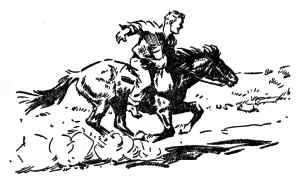
feet drew dangerously close, the boy darted
quickly to the right and ducked behind the nearest
apple tree. The bull swerved and roared by like an
avalanche.
[5]
Jim was safe for a moment, but he knew he would
not have long to wait until the bull charged again.
The animal had turned around and was pawing and
snorting. Reluctantly Jim gave up all ideas of reaching
the fence. He grabbed the lowest branch of the
apple tree and swung his stocky body upward. He
was just in time, for the bull rushed underneath him
like an express train.
Giving a whistle of relief, the boy climbed higher.
Finding what appeared to be a comfortable perch,
he settled down to consider the situation. Apparently
he would simply just have to sit there and hope the
bull would forget him. The bull decided to play a
waiting game too. He pawed and snorted for a time
and then calmed down. Although he grazed quietly,
he showed no signs of leaving the vicinity. Just as
Jim would begin to grow hopeful, the animal would
lift his head and gaze balefully up into the tree. This
began to appear very one-sided to Jim after a few
minutes. While the bull could amble around at his
ease, the most Jim could move was a few inches.
What had appeared a comfortable seat began to
grow very irksome.
[6]
He shifted around trying to find a soft spot. It
was impossible. One spot was as bad as another.
There was a limit as to how long one could sit comfortably
in an apple tree. Now Jim grew really sorry
for himself. How he wished he could have gone into
town with his family. That was the most exciting
event of the week. First they took the cream to the
Springdale Creamery, where he could walk around
inhaling the clean smell of steam and butter. It was
fascinating to watch the huge revolving churns. He
supposed today would be one of those times when
Mr. Slemak would offer everyone a drink of cold
buttermilk.
The grocery store was fun too. Probably Jean was
sampling the cookies now. When his father paid the
grocery bill there was always a bag of candy for
both him and Jean. He hoped Mr. Higgins wouldn’t
forget him just because he wasn’t along. Jim sighed
miserably. Instead of smelling the odor of newly
ground coffee, here he was up in a tree smelling
apple blossoms. The scent which was so wonderful
before was getting rather tiresome now.
“What a mess!” he said to himself. He looked
down at the bull, his anger mounting. “Go away, you
big dope!”
[7]
That did no good either. Jim remained uncomfortably
in the tree. To make matters worse, bees
began to buzz around entirely too close to his head.
Holding on to the tree with one hand and swatting
at bees with the other was not pleasant exercise.
Suddenly he remembered he hadn’t closed the orchard
gate behind him. If the bull did wander away,
he would be perverse enough to head straight for the
gate. The yard gate was open too, so the way onto
the road was clear. Once he was out on the road
there was no telling where the animal might stray.
Now Jim was torn between hoping the bull would
go away and wanting him to stay. Either way, he
decided he was in a pickle. His parents would either
come home to find him trapped in the apple tree or
else would find the bull loose and strayed to parts
unknown.
The thought of Colonel Flesher came like a ray of
light. The stock buyer was supposed to arrive about
three o’clock. If the bull were still standing guard
beneath the tree, the colonel could come to the rescue
and all would be well. Jim shifted his perch slightly
and hoped the stock buyer would arrive soon. It
seemed as if he had been in the tree for hours. He
reached in his pocket but his hand found nothing.
With a horrible sinking feeling he realized his precious
watch was gone. It must have bounced out of
his pocket while he was racing for the tree. With an
effort he kept back the tears. He looked back along
his recent path, hoping to catch the glint of gold.
There was nothing in sight but the new green grass.
If the bull had trampled on it during his mad rush,
the watch was probably broken and buried in the
soft earth. Completely dejected now, Jim sat in the
tree and mourned. It was certainly a heartbreaking
day.
[8]
He was so deep in his misery that he did not notice
a strange cavalcade coming over the hill until the
creaking of wagon wheels and the neighing of a horse
caused him to look up in surprise. The procession,
which was nearing the yard gate, was so unusual
and interesting that Jim forgot his woes and stared
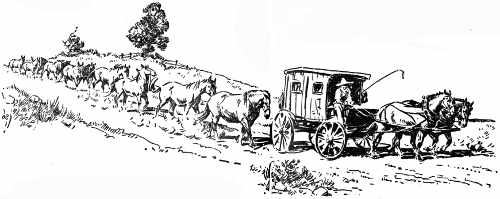
in excited curiosity. First there was the oddest
wagon he had ever seen. It was a large wagon with
a sort of house built on the chassis. The house had a
flat roof which stuck out in front and overhung the
driver’s seat, and the board sides contained two
small windows. Initially Jim thought it was a ranch
chuck wagon, for he had been reading Western
stories; but then he changed his mind and decided it
was more like a circus wagon or like the wagons he
had seen in the movies used by traveling road troupes
in the old days.
[9]
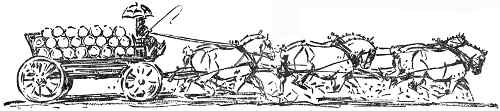
Seated on the high driver’s seat was an old man in
a sombrero, whistling cheerfully and clucking to a
team of huge black horses. The team was ambling
along slowly, drawing the wagon with effortless ease.
But what attracted Jim’s gaze most was the procession
following the wagon. Strung out behind were
at least twenty horses of all sizes and colors—big
gray Percherons, medium-sized brown horses, sorrels,
some dark bays, light grays and a few whites.
Jim looked at each horse in turn until finally he
came to the last in the string—a lean little mouse-colored
horse whose small body contrasted oddly
with the other broad-rumped work horses.
[10]
The fascinating cavalcade drew still nearer until
it reached the gate. The driver gave a slight tug on
one rein and the wagon started turning. Jim was so
interested and delighted that he almost lost his seat
in the tree. The strange wagon and all those horses
were coming in their yard! Almost doubting his eyes,
he saw the vehicle progress down the lane and come
to a halt, the long string of horses bunching up behind
the wagon until they too finally stopped. The
old man climbed down from his high perch and
looked around inquisitively. Seeing no one in the
yard he started toward the house.
“There’s nobody home but me,” shouted Jim
loudly.
[11]
The stranger turned around to look toward the
orchard, and Jim got his first good view of the visitor.
He was a tall stringy individual with a long
gray handle-bar mustache that drooped from his
upper lip and hid much of the lower part of his face.
He was obviously a very old man, but there was nothing
old about his movements nor the way his bright
eyes searched in the direction from which the voice
had come. He looked puzzled, for all he could see was
apple blossoms.
“And where are you?” he asked.
“I’m up here in a tree,” said Jim, poking his black
thatched head as far through its frame of apple
blossoms as he dared. “The bull won’t let me climb
down.”
“Treed are you?” asked the man, laughing at
what Jim didn’t think was a funny situation. “Just
how mean is that bull?”
“Dad handles him without any trouble,” replied
Jim. “Once in a while he has to hit him on the nose
with a stick.”
“Be with you in a minute.” The stranger hunted
around until he found a big piece of wood for a
club.
The bull decided he wasn’t quite so ferocious when
he saw a determined man approaching with a sizable
club. He gave a few disgruntled snorts and then ambled
off to the far end of the orchard. Thankfully
Jim climbed down from his uncomfortable haven.
[12]
“Thanks, Mister,” he said with feeling. “Now I’ve
got to find my watch.”
He hurried back along the path of his recent flight
from the bull, searching the ground anxiously. About
thirty feet from the tree he found his watch, lying
bright and shining in the sun. He picked it up and
held it to his ear. It was ticking away merrily. With
a huge sigh of relief, Jim put the watch in his pocket.
“You really got me out of a mess,” he said, as they
walked toward the gate. “I was trapped in that tree,
the orchard gate was open, and my watch was lying
on the ground.”
“That looks like a pretty good watch to be carrying
around in your overalls.”
“It’s about the best watch in the world I guess,”
said Jim proudly. “I don’t usually carry it every
day.”
“Now you can do me a good turn,” said the
stranger as they went out of the gate, fastening it
this time. “I’d like to water my horses.”
“Sure, bring them over to the tank.”
Jim pumped more water into the big cement tank
while the man led his horses over to drink. First
he watered the team he was driving and then started
with the string of horses behind the wagon.
“How come you’ve got so many horses?” asked
Jim, his curiosity getting the better of his manners.
[13]
“I’m a horse trader. Not many traveling horse
traders left any more. I usually have a lot more
horses than these, but I sold fourteen yesterday.”
“Gee,” said Jim, “it must be a lot of fun to have
so many horses.”
“It is if you like horses. It’s a lot of work too. Most
people find two or three too much to take care of the
way they should.”
“Do you live in that wagon?” asked Jim.
“All but about three months of the year,” replied
the horse trader. “Now let me ask a question. When’s
your pa going to be home?”
“About five o’clock, I ’spect,” Jim informed him.
He looked at his watch. It was not quite three. He
hadn’t been in that tree nearly so long as he had
thought.
“Think your pa will want to trade or buy any
horses?”
“I don’t think so,” replied Jim. “We’ve got two
teams that are pretty good.”
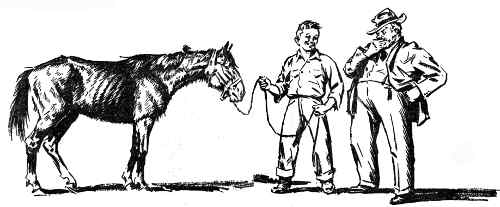
The old man led the last horse to the trough for a
drink. It was the small brown horse that Jim had
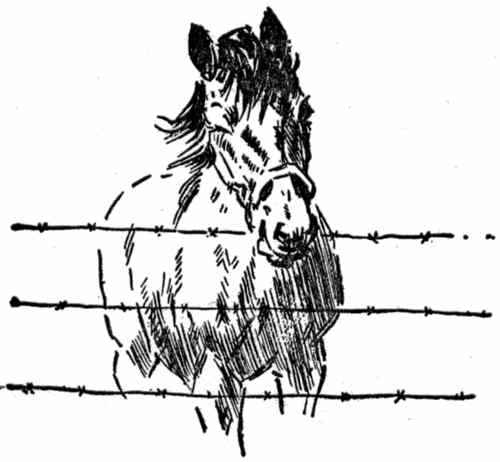
noticed at the end of the string. It wasn’t an impressive
horse at all. It was very thin, the hip bones making
big bumps as if they were trying to push their
way through the poor horse’s hide. There was an
ugly, partially healed sore on his back, and he limped
[14]
slightly on his right foreleg. His coat was a shaggy
lusterless gray-brown. It was hard to tell what either
the tail or mane was like as both were so matted with
cockleburs and bits of weed. Lastly, the little horse
didn’t hold his head as he should, but kept it cocked
to one side as if he were looking at something very
odd and interesting. To most horse fanciers this odd
position of the head would have been the crowning
defect of the long list, but it was just this feature
that attracted Jim. The pony seemed to be looking
at him quizzically. As Jim looked closer he was certain
he saw a twinkle in the horse’s eye as if the
animal were trying to share some sort of joke with
him.
Jim stopped pumping water and moved closer to
the little horse. He was so painfully thin and that
sore looked so tender that Jim felt a surge of sympathy.
He wished the horse could stay there and rest.
The object of Jim’s compassion lifted his muzzle
from the trough, shook his head, and snorted until
he had blown the water from his nostrils. Then he
looked squarely at the boy and winked. This time
Jim was certain the horse grinned too. It was very
plain what the pony meant. He seemed to say:
“Thanks for the water and your kindness. I’m rather
deceiving in appearance and am in much better
shape than most people would think.”
[15]
Walking around to look at the horse from the
other side, Jim spied a mark on the pony’s left
shoulder. It was an H lying on its side like this:
“That’s a brand, isn’t it?” asked the boy excitedly.
“Yep. I reckon that is the lazy-H brand.”
“Where did he get it?”
“Well, this is a Western mustang. The man I
bought him from said a carload of cow ponies was
shipped in from Texas a couple of years ago. He
picked up this feller at the sale.”
“A real Texas mustang,” said Jim, reverently.
“He’s a bit small even for a Western cow pony,”
said the trader, sitting down on the edge of the water
tank. “In fact there’s a lot of things about this horse
that are different from most mustangs.”
“What?”
“Well,” drawled the old man, filling his pipe, “I’m
in no hurry to get up on that jolting seat again. Just
set here awhile and I’ll tell you a little about Western
horses, specially this one.”
“Swell,” said Jim enthusiastically. “Can I hold the
horse?”
[16]
The old man passed over the halter rope and Jim
sat happily on the well platform holding on to the
end of the tether. The horse looked at both of them
for a moment and then calmly started to crop the
grass.
“Western horses usually run pretty wild for three
years or so,” began the old man. “Then they’re
broken for riding. They break Western horses quick
and rough and most of them buck every time they’re
saddled. A ranch horse is worked only four or five
months a year and then only three or four days a
week. Most of them, except the favorites, never get
to know a man real well and so usually they don’t
show much affection.” He paused to relight his corn-cob
pipe. Reflectively he gazed on the glowing coal
and drew on the pipe stem noisily while Jim waited
impatiently.
“This little feller is different. Plenty of spirit, but
about as gentle a horse as I’ve ever seen. Gentle,
that is, if he likes you. In the five days I’ve had him
I can tell he’d develop a real likin’ for anybody that
treated him at all reasonable.”
“I’ll bet he would,” agreed Jim, looking at the
horse.
“He’s a good horse, but I don’t know just what I’ll
do with him. He’s not a work horse—too small for
heavy work. He’s really a saddle horse and people
in these parts don’t go much for saddle horses unless
they’re rich people. Then they want something
fancy like a Kentucky saddle horse. But I felt sorry
for this critter and I bought him.”
[17]
“Felt sorry for him? Why?” asked Jim with
great interest.
“He was bein’ mistreated. You can’t be a horse
trader for fifty years without becomin’ real fond of
horses. It gets you mad to see anyone treat an animal
mean. So I picked up this pony mainly to get him
away from the skunk that owned him. Look how thin
the horse is. Why I’d bet money he hasn’t had a
feedin’ of grain in the two years that man had him.
Of course, these Westerns are tough. They run wild
all winter and find feed where other breeds would
starve. But this pony was turned out in a field where
there wasn’t enough grass. Nothing to eat except
straw. That strawstack was all the shelter he had
too. You can tell from that long shaggy hair that he
was out all winter. It will take a lot of curryin’ and
plenty of oats to get that coat in shape.”
“You mean he was out in the snow and everything?”
asked Jim.
“The snow isn’t so bad. He’s probably used to that.
But when horses run loose in the winter out West,
they don’t have nothin’ else to do but hunt for feed.
This horse has been rode all winter too. See those
saddle galls?” said the trader, pointing. “They’re
recent. A horse can’t do much work on a diet of straw
and then stay outside in the cold to boot. He needs a
layer of fat to keep him warm.”
[18]
“How did he get those saddle sores?” inquired
Jim.
“Been saddled wrong.”
“They look awful sore.”
“They were, but they’re healing now that I’m
givin’ them a little attention. If nobody rides him for
a while, they’ll clear up all right.”
“He’s lame too,” pointed out Jim.
“Yep, nail in his foot. The owner just pulled the
nail out—nothin’ else. I was sort of takin’ a chance
buyin’ the horse at all. He might have developed
lockjaw. Once a horse gets lockjaw you might as well
shoot him. But I pared out the hoof, soaked his foot
in a lysol solution, and worked some iodine into the
puncture. I’ve given him a couple of treatments since
and he’s out of danger now. In a week you’d never
know he’d stepped on a nail.”
The long story of the mustang’s mistreatment and
ills had aroused Jim’s sympathy. He looked at the
horse with even greater interest than before. Several
times the little horse raised his head and appeared
to give the boy a good-natured nod. The fact
that the pony was still gentle and apparently in high
good humor after all he had been through particularly
appealed to the boy.
[19]
“How much would you sell that horse for?” he
asked impulsively.
“Well, I reckon he’s worth about forty dollars,”
said the old trader appraisingly.
“Gee,” said Jim sorrowfully. “I guess he’s worth
that all right but I only got three bucks.”
“I’m afraid three dollars would be a mite too
cheap,” said the man laughing. “I know he looks like
three dollars now, but he’ll shape up. Feed him properly
and take care of him and you’d be surprised at
the improvement. I haven’t had time to work on his
coat or tail but a few weeks would do a lot.”
“How old is he?”
“Six years, I figure. He’s a good sound horse. You
take a good look and you’ll see that he has his better
points.”
It was true. On closer inspection the first bad impression
began to fade. The pony had a short barrel,
straight unblemished legs, and a deep chest. Aside
from their extreme thinness, his hind quarters were
well proportioned. Both eyes were bright, clear and
alert.
“He sure looks like a good horse to me,” said Jim
truthfully. He knew nothing about the finer points
of horses, but the little mustang appealed to him. He
liked the horse and that settled the matter. Naturally
he was a fine animal.
[20]
“He is a good horse. No fancy gaited animal but
just a good sturdy ridin’ horse. Some of these days
I’ll find someone who’ll appreciate him and take good
care of him.”
“I’d appreciate him,” thought Jim enviously.
“And I’d take awfully good care of him.”
Apparently the horse read Jim’s thoughts, for he
raised his head, cocked it even farther to one side,
and stared straight at the boy. It was a friendly
look that clearly said, “Yes, I know, Jim; we’d be
good friends.”
Sorrowfully the boy watched the old trader tie
the mustang to the end of the string and then climb
up on his wagon. How he would like to own that
horse. A real mustang with a brand. He and that
pony certainly could have fun together.
The wagon turned around and started down the
lane. Jim felt as sad and lonely as if his best friend
were departing forever. If only he could have gone to
town. Then he would not have seen the little mustang
and wanted him so. He pulled out his watch.
Three-thirty. Time had passed rapidly enough while
he was looking at the mustang. Now it would drag
again. Suddenly he looked at the watch as if he were
seeing it for the first time. His grandfather’s watch—his
most prized possession. He couldn’t possibly
part with it. He raised his eyes and saw the mustang
going out the gate. Headlong he ran after the
wagon.
[21]
“Hey, Mister! Wait a minute please!”
The horse trader heard the frantic cry and pulled
his team to a halt. He looked down inquiringly as
Jimmy rushed up beside him.
“Would you trade that mustang for my watch?”
Jim asked in a rush of words, as though afraid
that if he hesitated he would lose his nerve.
“Well, I might now,” answered the old man.
“What kind of a watch is it?”
“Here it is,” said Jim, pulling out his precious
watch. He stood on tiptoe to hand it up to the trader.
The old man examined the watch carefully while
Jim watched nervously. The trader held the watch
to his ear, removed the back and inspected the shiny
works.
“Look, son,” he said finally, “this is your watch,
isn’t it? Not your father’s?”
“It’s mine, really mine,” said Jim in desperate
eagerness to be believed. “It was given to me on my
birthday.”
“How about it? Would your father and mother
be mad if you traded it for a horse?”
[22]
“I don’t see why. It’s my watch,” protested Jim.
The thought made him a little uneasy. He wondered
if they would care. His resolution began to waver.
Then he looked at the mustang and his doubts vanished.
How he’d like to have that horse!
“Well,” drawled the old man slowly, “I got my
doubts about how this is goin’ to set with your pa.
But I know you want the horse more than you do the
watch. It wouldn’t be an uneven trade either. This
is a good watch but not an awful expensive one.”
“Then I can have the horse?” asked Jim in eager
anticipation.
“If you’re sure that’s what you want. I hate to
be the cause of any trouble though. Tell you what
I’ll do. I’ll be back by here in about three, four
months. You tell your father that. My name’s Ned
Evarts—Old Ned Evarts. In fifty years of horse
tradin’ no one has ever accused me of tellin’ a lie.
When I come back I’ll still have the watch. If you’re
not satisfied with the horse, we’ll trade back.”
“That sounds fair,” said Jim judiciously.
The trader reached inside the wagon and pulled
out a bridle.
“Here’s the bridle I got with the horse,” he said,
climbing down from the wagon. “You’ll need a bridle,
so I’ll throw that in. Now the horse has on a rope
halter. It doesn’t look like much but it’s sturdy. You
can have that too if you want.”
“Thanks, Mister,” said Jim, beginning to be overwhelmed
by all his new property.
[23]
“Now I’ll tell you something,” said the old man.
“There is such a thing as an honest horse trader even
if people don’t think so. A trader that deals square
will tell a man about any defects that he knows of
inside the horse. About his wind, whether he has the
heaves, and things like that. Anything that shows
outside the horse, it’s up to the buyer to see. If he
can’t tell what he’s buyin’, it’s his tough luck.”
“This horse looks all right to me,” said Jim, stoutly
defending his new property.
“He is,” said the trader. “Since you’re a young
feller and haven’t had much experience tradin’, I’d
tell you if anything was wrong. This mustang hasn’t
any defects we haven’t already talked about. There’s
that saddle sore, the lame foreleg, he’s pretty lean,
and his coat needs a lot of work. Other than that he’s
sound. Now I want you to take notice of the way he
holds his head. It’s kinda cockeyed. Now lots of folks
would look at him and figure him to be a mean horse.
He isn’t. That horse isn’t a bit mean; he’s been mistreated
and he’s a little worried about whom to trust.
You be good to him and he’ll be as gentle as can be.”
“He’ll like me,” said Jim confidently.
[24]
“I think he will. One other thing—that mustang
is a smart critter. Horses are like people; some are
just naturally dumb and others are smart. I’ve been
handling the animals so long I’ve kinda got a sixth
sense about ’em. Now this little feller is one of the
smartest I’ve ever run across.”
Evarts untied the mustang from the end of the
string and handed the rope to Jim.
“Well, he’s your horse. Good luck.”
“Good-by,” said Jim as the trader climbed back
on the wagon. “That’s a good watch too.”
Jim watched the wagon, with its trailing string of
horses, move off down the road. He felt a twinge of
pain as he thought of his beloved watch slowly moving
into the distance. Then he felt a tug on the rope
he held. The horse was looking at him quizzically.
“No, I’m not sorry I traded,” said Jim, as if in
answer to a question. “But I’m going to miss that
watch. I know what I’m going to do. I’ll call you
‘Ticktock’ after my watch.”