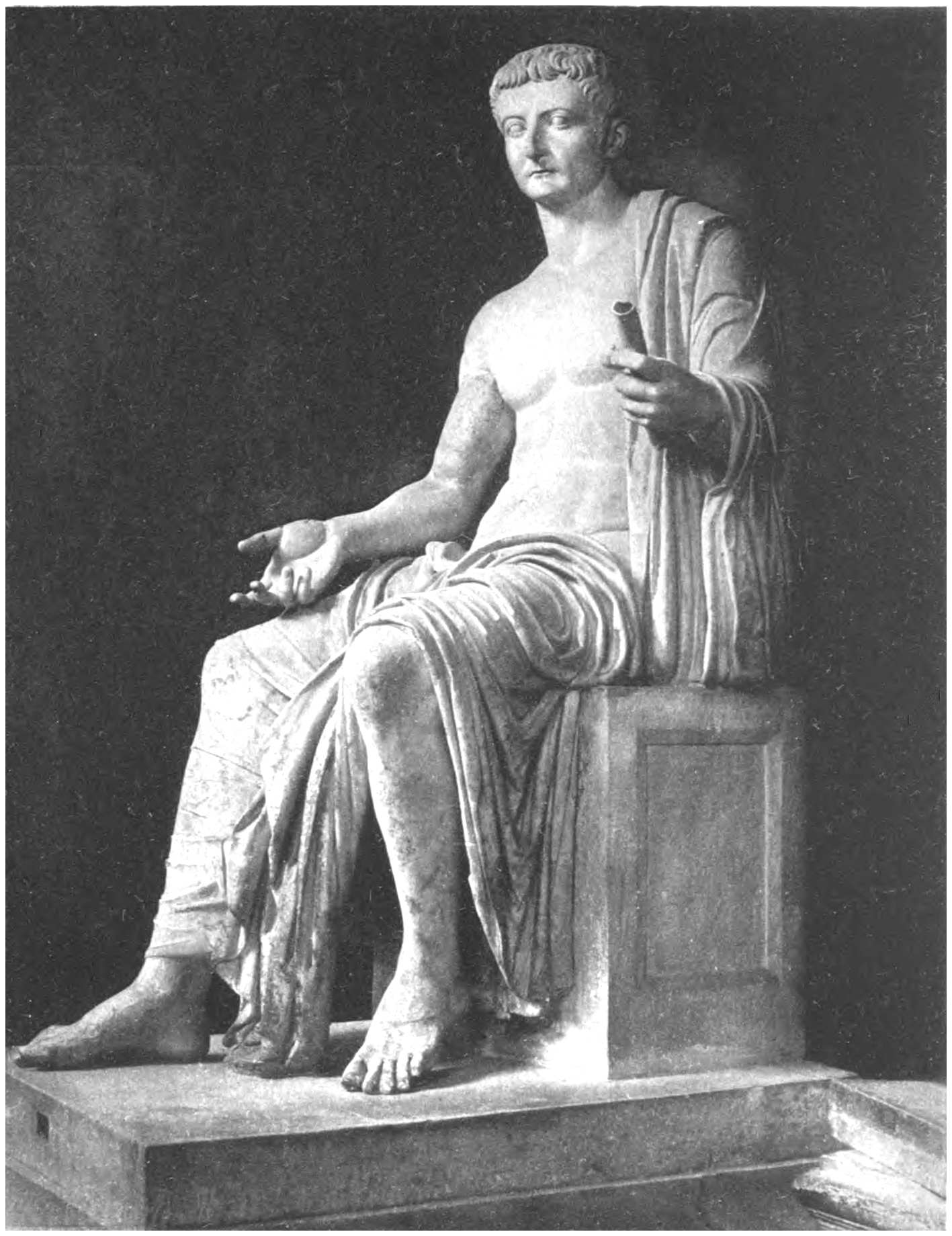
Introduction — I The Expansion of Rome and the Equestrian Order
Used as we are to the terminology and conditions
of hereditary monarchy and territorial sovereignty,
we find it hard to appreciate, or even to express
in terms of modern politics the difficulties which
beset the statesmen of Rome at the death of Augustus;
and we are further tempted to read into the story
of that critical period ideas, which were only conceivable
after the crisis was over; we can hardly avoid
seeing those days in the light of subsequent events,
or speaking of them in language which involves
anachronism. Our information is principally derived
from historians, who wrote a century and a
half after the death of Julius Cæsar, when the Government
of the Emperor and the Senate was established;
but the position of the Emperor of those days was not
the position of Augustus, and the Senate of Trajan
was not the Senate of Tiberius. The experienced
officials who formed the majority of the Senate
of the Flavian Emperors were no longer the hereditary
oligarchy by whose capacity Rome had been
brought to be first among the city states of the world,
but which was unequal to the task of organizing the
Roman empire. The change had, however, escaped
observation, and the warmest admirers of the Senate
of the Republic were men whose position had been
won for them by the Emperors. Between the death
of Augustus and the death of Vespasian we have but
few contemporary historians; we have no letters
of Cicero to throw light on the inner life of the statesmen
of those days; there were private records,
private letters, and private biographies; we can
gather their tone from the extracts that have been
preserved for us, but we have no opportunity of comparing
them or checking them. Velleius Paterculus
is the only contemporary historian of the reign of
Tiberius, a portion of whose work still exists unabridged;
and his narrative stops just at the period
when we require most light—at the conspiracy of
Sejanus—where there is also a gap in the annals of
Tacitus. From the books of the New Testament we
may infer much as to how the Empire appeared at
a comparatively early period to the inhabitants of
Greater Rome, much also from Josephus, a little
from Philo, but we cannot re-people the Rome of
Tiberius, as we can re-people the Rome of Augustus
and the Rome of Cicero. Two facts stand clear to
us from the pages of Tacitus, and in a less degree
from those of Suetonius, that the Imperial Family
was divided, that the old Roman princely houses
never forgave the Empire, and that there was a
Republican reaction in opinion at the centre of the
Empire. History has repeated itself; just as the
Curia of to-day cannot forgive the monarchy which
represents the unity of Italy, so the Curia of the first
century of the Christian era was irreconcilable to
the monarchical constitution which represented the
unity of the Empire. The Roman princes who wrote
the memoirs of their houses for the edification of their
children, and the delectation of their friends never
inquired into the authority of a story derogatory to
the Emperors, and the one Emperor, who was never
spared was Tiberius; it is no exaggeration to say
that the madness of Caligula, and the monstrous
freaks of Nero are dealt with tenderly by the writers
of the silver age, if we compare the accounts of these
with the deliberate malignity which attends on every
word and action of Tiberius; and yet common sense
tells us that only a very able man could have succeeded
Augustus without breaking up his work.
At the death of Augustus it was still possible that there
would be no second Emperor; at the death of Tiberius
the Roman Emperor had become an institution, the
pivot upon which the whole machinery of civilized
existence turned throughout the world. Hence the
peculiar bitterness against Tiberius; the Curia felt
that in his reign their last chance had gone, and more
than this, that he had been in some sense a traitor to
his own caste. Neither the Julian nor the Octavian
families had been among the foremost houses of Rome,
till the genius of the first Cæsar raised them from their
comparative obscurity; but many of the most important
events in the history of Rome, no less than
her buildings, her roads, her aqueducts, and many
of her public monuments, were associated with the
Claudian stock, and the Livian, with which it was
inter-married, was only less distinguished. Augustus
had been tolerated, for his services to the State could
not be disregarded, but some day Augustus would
die; he did die; his power fell into the hands of the
most prominent representative of the old Roman
nobility; the opportunity for a restoration of the
narrow oligarchy of the Republic came, and it passed
away for ever. Two years after the death of Tiberius
his lunatic successor was stabbed by a soldier whom
he had insulted; the State was left a few days without
a head, and the Curia was so inanimate that it could
neither restore its own rule, nor provide a new Emperor;
it had to accept apparently at the dictation
of the soldiers in the Prætorian barracks a man of
letters who had hitherto been the laughing stock of
the Imperial family.
The contemporary history of the years during which
the Roman Empire took organic form is written in
terms which tend to disguise the real significance
of the change; our attention is attracted almost
exclusively to the internal politics of the city of Rome;
it is withdrawn from the politics of the Empire;
the long struggle which ended by giving the whole
civilized world one system of Government, which
welded together in orderly association Italians,
Greeks, Syrians, Africans, Egyptians, Spaniards,
Gauls, Germans, and even Britons, is represented
to us as being little more than a constitutional revolution
inside the city; we see the external pressure,
which forced a revised constitution upon the Roman
oligarchy, but we only see it dimly; no Roman
historian has been at the pains to trace out the process
by which the civil administration of the Roman
Empire was developed—surely no less wonderful an
achievement than the conquests of the Roman
generals. We have seen other conquerors, and more
brilliant feats of arms than any Roman general
achieved, but we have not seen any other nation impress
its language and its law upon the populations of
so wide an area or so permanently. Alexander did
much, but the effects of the conquests of Rome have
been more lasting than those of the conquests of
Alexander; except in Asia there is not a civilized
people in the world which does not somewhere or
other bear the impress of Rome, or cannot trace the
pedigree of its religion and its law back to the Italian
city. This great destiny was concealed from the
makers of the Empire, but the immediate possibility,
the consolidation of the conquests of Rome,
and the permanent establishment of order over the
whole area which drains into the Mediterranean was
present to their minds; unfortunately the makers
of the Empire have been mostly silent, and the only
voices which have reached our ears are those of men
who could only grasp the great idea intermittently,
if at all, or who were annoyed by its insistence.
Under Augustus for the first time the Empire became
conscious, Virgil and Horace spoke in terms of the
larger conception, but the grip of the Roman oligarchy
has never relaxed its hold upon the imagination
of educated men.
Conquest did not involve in ancient times any
responsibility towards the conquered; war was
believed to be, and was, a profitable investment;
as Rome pushed her conquests, the organization
which she gave to the conquered peoples was one
which suited her own purposes, she did not consult
their convenience, external pressure alone forced her
to modify the conditions of conquest which were
universally accepted by the ancient world; very
gradually and very reluctantly she broke down the
barriers which surrounded the city state of antiquity,
and admitted first her immediate neighbours, and
lastly the whole of Italy to some sort of constitutional
communion with her. For a long time war had been
forced upon Rome, the invasions of the Gauls, the
domination of Carthage in the Mediterranean, the
invasion of Pyrrhus, the invasion of Hannibal, and
lastly the invasion of the Cimbrians and Teutons
involved her in a succession of defensive wars; the
city itself could not find a sufficient supply of
soldiers, and the price which Rome had to pay for
being allowed to recruit over Italy was the partial
incorporation of the Italians in the State. Wars of
defence were accompanied and followed by wars of
aggression; success encouraged speculation; after
the happy issue of the second war with Carthage the
Roman oligarchy began seriously to turn its attention
to the Eastern Mediterranean, and another century
found it entering upon the heritage of Alexander.
This is the turning point of Roman history; from
this time onwards a new conception occupied the
minds of ambitious Romans; alongside of the ideal
of the city State there existed the ideal of an extended
Empire, of a world-wide organization, of something
more permanent than conquest; alongside of the
men who dreamed of Platonic republics in which perfect
justice would be realized, there grew up men who
formed a yet grander and no less civilized ambition.
Pompey triumphed over Mithridates wearing a robe
which had been worn by Alexander; Augustus used
a head of Alexander for his signet ring; it was by the
example of Alexander that Cleopatra seduced Mark
Antony.
Alexander was no vulgar adventurer; he solved
a problem which had hitherto baffled the most highly
civilized race of the ancient world; he combined the
city state of the Greeks with the Imperial organization
of the Persians; and though, when the Romans
came into close contact with Alexander’s Empire it
had fallen into fragments, each fragment preserved
the impress of the great whole, and Roman generals
could converse at Pergamus, at Antioch, or at Alexandria,
with men trained to administer states in
terms of the wider conceptions derived from Alexander
and possibly through him from Aristotle; at the
same time many men accustomed to deal with financial
problems on a large scale passed into the service
of the Roman conquerors as slaves or honoured
dependants.
While the possibility of a beneficent organization
of the conquests of Rome was thus presented to one
order of mind, to another the same events introduced
another set of ideas; while some Romans studied
Alexander in the vestiges of his work, others entered
into the full possession of the Greek historians and
philosophers; the ideals of the Greek city state were
replanted in a virgin soil, and the Romans for the first
time began to theorise about their own Constitution.
The men who were taken captive by Plato and Demosthenes
did not see that Rome had long outgrown the
conditions under which the theories of these men
were applicable to her political life. The true liberal
policy was the policy of Alexander, the false liberal
policy unintentionally gave a new lease of life to the
blind selfishness of the narrow oligarchy which had
governed Rome. The daggers which struck down
Cæsar were aimed by admirers of Verres no less than
by students of Plato; and Cicero’s effusions over the
merits of the tyrannicides were effectively stopped
by the unforeseen but necessary emergence of Mark
Antony, a tyrant of the conventional type.
From the moment when a year’s office as Consul
or Prætor in the city of Rome was followed by a term
of practically irresponsible government in a dependency,
the Civic Constitution was doomed; the magistracies
of Rome were now of minor importance compared
with the career to which they opened the way;
it was impossible any longer to discuss the politics
of Rome in terms of the politics of Athens or Plato’s
Republic with any practical advantage, and indeed
without inviting anarchy; but it was highly convenient
to the hereditary aristocracy of Rome and
its adherents that it should pose as representing the
principles of Harmodius and Aristogiton; it found
a clever man of letters and a skilled advocate, who
had his own reasons for falling in with this conception,
and who perpetuated it long after the facts had
demonstrated its hollowness even to himself. Cicero
as a politician is alternately a tragic and a comic figure;
he is comic because he lived complacently in a world
of his own imagining, which seldom lost its hold on
his imagination, in spite of the rudest shocks, for it
satisfied the promptings of his child-like vanity;
he is tragic because he had his moments of seeing the
realities clearly, and because combined with his vanity
there was a genuine admiration for fine conduct,
which led him to face danger manfully in his old age,
and in some sense invite the death of a political
martyr; he is yet further tragic, because he became
the father of an equally blind posterity of politicians,
who wasted their energies in spoiling the work of
men of greater enlightenment; it is perhaps due to
Cicero, more than to any other man, that the city of
Rome has persistently filled a larger space than that
of the Roman Empire in the works of subsequent
historians.
In an expanding community the actual facts of the
administration are seldom in exact correspondence
with the forms; apparent rigidity, real elasticity,
enable business to be carried on in accordance with
the claims of new social factors without any sense of
insecurity. The Roman, like the Englishman, preferred
making new laws to repealing old ones; and
when he made a fresh departure, he was at pains to
represent it as a development of something by which
it had been preceded; in both cases this profound
respect for the historical aspect of law has been the
foundation of national greatness; it has been extended
beyond the races in which it originated, and
in the case of England, as in that of Rome, has resulted
in an exceptionally successful government
of alien communities; laws and customs which are
sanctified by immemorial usage appeal to the sympathy
of the Englishman and command his respect; it was
the same with the Roman. England has had her
periods of aberration when she has given way to the
proselytizing tendencies of sections of her population,
but the broad lines of her policy in dealing with subject
nationalities have followed the principle of accepting
the existing conditions; in the same way Rome
accepted the laws and customs of the Eastern Mediterranean
and of Western Europe; she supplied a
common law for her Empire, which applied where
the local law had no application; its excellence was
such that it became predominant, but she did
not insist on remodelling every community over
which she held supreme power in terms of her own
constitution. This respect for antiquity and adherence
to established forms has resulted in a misrepresentation
of some of the facts of Roman constitutional
development, and especially of those which
concern the development of the Empire, which is in
the highest degree embarrassing to the student of
the period in which the change took place. There
was a time when the constitution of Rome and her
political history differed little from that of any other
city state of antiquity, but it would not be easy to
state when that period began or ended; of one thing
we may be quite certain, viz., that after the destruction
of Carthage and the completion of the first great
period of conquest in the Eastern Mediterranean in
145 B.C., the political life of the city of Rome was no
longer comparable to that of any other city state;
the forms remained, and the faith in the forms remained,
but the substance was gone. There is for
instance no term so misleading as one which was
seldom out of the mouth of Cicero, “the Roman
people”; there unquestionably was a time when the
Roman people was an organized part of the Roman
constitution, when it voted in an orderly fashion
according to a property qualification for the election
of certain magistrates, and the ratification of certain
laws; when it voted according to a residential organization
for the election of other magistrates, and to
pass other laws; but the forms of popular government
were maintained long after the reality of popular
government had departed. It suited the convenience
of noble agitators, such as the Gracchi, to see in the
rabble of the streets the Comitia Tributa, it was
equally convenient to the princely houses to dignify
their own private arrangements with the forms of
an election in the Comitia Centuriata, it was particularly
pleasing to the middle class Roman to share in
the spoils of the Empire by exacting direct or indirect
payment for his vote, and so the forms were maintained;
an outward deference to them answered
everybody’s purpose, but the real political power and
the real political struggles lay outside and beyond them.
The Roman people, as a body of civilians, could riot,
as the raw material of the Roman army it could strike,
it was necessary to keep it in good humour, and to
allow it to regard itself as an organized part of the constitution,
as a body of free and independent electors;
but to accept its own estimate of itself as an important
factor in the politics of the Empire is to misread
history; popular Government in any sense which
would commend itself to the intelligence of an Englishman
of to-day, or of an Athenian who listened to
Demosthenes, did not and could not exist in the Rome
which had begun to control the destinies of the
Mediterranean; it was a legal fiction which it was
convenient to maintain, the attempt to make it once
again a reality resulted in the revolutionary excesses
which preceded the Empire.
The real government of Rome was in the hands
of the Senate, an assembly of nobles and capitalists,
who shared between themselves the profits of the
Roman conquests. Like all such assemblies, the
senators had their good times and their bad; between
the second and the third wars with Carthage they so
conducted themselves as to impress the imagination
of the civilized world; the successes of their armies,
their fidelity to engagements, their comparative
moderation in conquest, were the wonder of men;
admiration for these qualities tempted Judas Maccabæus
to engage their assistance in checking the
aggressions of the Greek rulers of Antioch; their
mediation was invited by the chieftains of Gaul; it
was recognized as an honour to them to be called
friends of the Roman people, and the honour was
attended by practical advantages. Success was followed
by intoxication, and the time came when the
sense of responsibility was lost in the secure accumulation
of riches, and when the unscrupulous venality
of the Senate became a by-word. Then the power
of Rome seemed to be tumbling to decay; Jugurtha
defied her in Africa, Mithridates in Asia, Spain
threatened to organize itself against her under a
Roman general, the Cimbrians and Teutons swarmed
over her borders, her Italian allies made war upon
her, she could with difficulty suppress an organized
revolt of her rural slaves, at home she was at the mercy
of the savage mob in her streets; out of this confusion
she emerged victorious, and greater than before.
The reason is a simple one; during her period
of good behaviour Rome had become the financial
capital of the world; she was indispensable, and when
she could no longer help herself, others were ready
to help her. Left to itself the Roman Senate would
have brought ruin on the Roman Empire in the first
half of the century preceding the Christian era; but
it was not left to itself; its incompetence involved
the ruin of too many other interests. We have the
story of the Roman generals in full, but nobody has
yet written the story of the Roman bankers; we are
accustomed to think of the Romans as soldiers and
lawyers, we forget that they were also shrewd financiers;
with the Romans, as with ourselves, commerce
usually preceded the flag; the soldier completed the
work begun by the capitalist. We are told that the
first war with Mithridates began with a massacre
of 80,000 Roman citizens in Asia Minor; the figures
are probably exaggerated, but they are not questioned
by any Roman historians; it did not appear improbable
to them that the Roman residents in Asia
should have been so numerous at that comparatively
early date; and though part of the country was
already a Roman province, and we may assume that
the popular fury was largely directed against collectors
of taxes, even the rich towns of Asia Minor can hardly
have acquired the services of so large a body of revenue
officials.
The political genius of a nation is shown by nothing
so much as the success with which it supplements
the deficiencies of its formal constitution by informal
but recognized agencies. Rome was provided with
a machinery for collecting and distributing her
domestic revenue; she had a treasury and a staff
of clerks, but she had no separate civil service for
the Empire; the constitution of a city state did not
admit of such a thing, and the collection of the revenue
of a province was left to semi-private agencies, its
taxes being farmed. At fixed periods the right of
collecting the taxes assigned to the public treasury
from the provinces was sold by public auction; the
purchaser paid a lump sum to the treasury, and made
the best of his bargain in the provinces; the speculation
was an exceedingly profitable one, but its profits
threatened to disappear owing to excessive competition
among the farmers of taxes; in order to eliminate
competition the farmers of taxes formed themselves
into a close corporation, the taxes were bought in
the name of an individual, but in fact by an association.
Alongside of the Senate there thus gradually grew
an organized body which formed the permanent
civil executive of the provinces, the body which was
known as the Equestrian Order. As in our own
history, so in Roman history, the value of terms
alters from period to period, almost from year to
year; it would therefore be rash to declare that at
any one period every titular Roman knight was an
active member of the Financial Corporation which
farmed the taxes, or that the collection of revenue
was the sole business of the corporation as a whole,
or of its individual members. Again, that differentiation
of functions in the case of the individual,
or the association, which is to us almost a law of
existence, was unknown to the ancients, or worked
on lines of division not readily comprehensible to
ourselves; there was, for instance, nothing absurd
to Roman conceptions in sending out an advocate
like Cicero to govern a frontier province, and placing
him on active service in command of an army, for
civil, military, and judicial functions of the highest
responsibility were exercised simultaneously or successively
by the same individual as a matter of course.
But though it is difficult to draw fixed lines, there is
quite sufficient evidence to warrant us in asserting
that the Equestrian Order held a recognized position
in the State, that it practically formed the Civil
Service of the provinces, that its interests were repeatedly
opposed to those of the Senate, that it
roughly represented Greater Rome, as opposed to
the city of Rome, that through all the disturbances
of the Civil Wars it kept the machinery of Government
outside Italy in working order, that it was
the channel through which the leading provincials
gradually passed into the Civil Administration, and
that eventually the Imperial Executive was built
up on the foundation, not of the Senate, but of
the Equestrian Order, and the Imperial Household.
The origin of the Equestrian Order is to be found
in the Servian Constitution; we may not altogether
believe in the Servian Constitution, which, as it is
presented to us in the pages of Livy, looks like the
clever guess of an antiquarian who was familiar with
the Constitution provided for Athens by Cleisthenes,
but we have no difficulty in believing that there was
a time, when every citizen possessed of a certain
amount of property was obliged to keep a horse for
the service of the State, and was expected to take the
field as a cavalry man; or that he was allowed certain
distinctions of dress, and other privileges indicating
public consideration; it is also easy to imagine the
process by which the yeomanry force so constituted
was replaced by more efficient cavalry soldiers, and
the military significance of the Equestrian Order
disappeared, while the name remained; of the intermediate
steps which followed we have no detailed
account; in theory every Roman citizen possessing
more than a definite amount of property was entitled
to be enrolled in the list of the Equestrian Order by
the Censor, and if his property reached a yet higher
value to be similarly called to the Senate, but the
practice must have been different; not every man
became a senator or a knight, who had the necessary
property qualification, though demonstrated want
of means might be a disqualification, and entail a
loss of position when the Censor was rigorous, or
when an excuse was wanted for reducing the numbers
of the Senate or the Order, or setting aside an
undesirable personality. The time came when two
political careers were open to the ambitious Roman;
he could become a candidate for Public Office, and
under the forms of public election eventually gain
admission to the Senate through the Quæstorship,
or he could be enrolled on the lists of the Equestrian
Order. In the first case he might eventually become
Prætor, Consul, and then Viceroy of a Province; in
the second he became a member of the great financial
corporation which supplied the Civil Service of the
Empire; in the first case he might command armies
and figure prominently before the eyes of men; in
the second he might make a large fortune, but would
not enjoy some of the sweets of power which attract
ambitious men.
The relative positions are fairly comparable to those
of an English member of Parliament, and an English
clerk in a Public Department in the days before the
Reform Bill; a young Englishman of good position
could be nominated in those days by an influential
friend either to a seat in the House of Commons, or
to a subordinate place in one of the Executive Departments;
in the former case he might ultimately
become Prime Minister, in the latter Permanent Head
of his department. In the one case he would be widely
known and possibly respected; in the latter he might
do work of the highest public utility, and never be
heard of outside official circles.
To be successful in a senatorial career was an expensive
and arduous process; it was necessary to
pay a heavy initiatory fee in the form of direct and
indirect bribery to the electors; it was then necessary
to force a way into the inner circle, which distributed
the honours and emoluments; a new man
could only do so by showing that he had a very strong
force of public opinion behind him, and that he could
make himself felt; admission to the Equestrian
Order was less costly, and there was less risk; in
consequence the career was deliberately chosen by
large numbers of Romans, whose wealth and family
connections might have tempted them to enter the
ranks of the Senate; further, admission to the
Equestrian Order was less jealously guarded; it
probably had its hierarchy, and its inner circle like
all similar organizations; and the summons of the
Censor was possibly a mere formality, the nominations
made by him having been previously determined
by others; but it was much easier for an Italian,
and eventually for a Provincial to become a Roman
Knight than a Roman Senator. A Provincial, who
had once secured the status of a Roman citizen, could
secure the further dignity of a Roman Knight by
processes which we may surmise, but cannot definitely
prescribe; once a Roman Knight, he might look
forward to a share in the financial administration of
the provinces during the reign of the Senate, and to a
Governorship under the Emperors.
It would be a mistake to assume that all Roman
Knights were members of the Civil Service, that is
to say, that they all belonged to the hierarchy which
farmed the taxes and managed other business necessarily
connected therewith; there were doubtless
many Equestrians whose dignity was chiefly titular;
others who as private financiers and contractors only
were connected with the Order, but the continued
allusions to the status of “Eques Romanus,” which
multiply as the Empire takes shape, forbid us to believe
that this was in all cases a purely honorary
dignity, which could be assumed by any wealthy man
on application to the Censor. Were there no other
evidence, the fact that we find the Equestrian Order
ranged formally against the Senate at the beginning
of the great constitutional struggle which ended in
the Empire, shows that we have to do with no haphazard
collection of wealthy individuals, distinguished
from their fellow-citizens by an honorary precedence.
Cicero made his first triumphant appearance as a
public man at Rome, when he conducted the case
against Verres; whatever may have been the misconduct
of Verres, and it was undoubtedly very serious,
the action against him was not promoted by pure
philanthropy; the case was a test case, it was part
of a campaign directed against the provincial administration
of the Senate by the Equestrian Order, whose
interests were imperilled by rapacious Viceroys.
The only check upon the proceedings of a Roman
Proconsul lay in the possibility of bringing an action
against him for improper exactions; in the purer
days of the Senatorial administration such an action
when instituted by the provincials might be successful,
and the possibility of its success might be a deterrent,
because though the offending Senator was in such a
case tried by his peers, those peers, even if influenced
by no higher motive, were interested in preventing
the exhaustion of a province; any one of them might
succeed to the wasted estate; the Proconsul who
succeeded a Verres was not likely to make much
out of his office, for he found the estate stripped.
As the Senate became reckless, having found fresh
and apparently inexhaustible pastures in the East,
scant attention was paid to the complaints of provincials
till their cause was taken up by the Equestrian
Order.
The Roman Proconsul was supreme Judge and
supreme executive authority in his province; he
imposed, sanctioned, and sometimes encouraged
public works, such as roads, harbours and buildings;
he regulated the mutual relations of the different
independent communities within the area over which
his authority extended; he had ample opportunities
for indirect and direct extortion, but he did not
collect the taxes; the collection of revenue was in the
hands of the farmers of the taxes, that is to say, as
time went on, of the Equestrian Order. A divergency
of interests soon declared itself: if the Proconsul
harried the province unmercifully, the tax
gatherer found little or no revenue to collect, and
could not reimburse himself. The Proconsul had
the unfair advantage, that cases between the collectors
of revenue and the provincials were tried in his court;
thus the farmers of the taxes found that they had
an interest in promoting appeals to Rome, and in
aiding the provincials to bring actions for extortion
against the provincial Governors at the end of their
term of office. So long as the Senate acted equitably
no great harm was done, but as soon as the Senate
was found invariably to acquit its own members,
the Equestrian Order became ranged formally
against it, and pressed for reforms; it succeeded for
a time in getting these case tried before a court
composed entirely of its own members; Sulla the
reactionary gave back the jurisdiction to the Senate.
One consequence of the trial of Verres was the establishment
of a mixed court composed partly of Senators,
partly of Equestrians. The net result was that the
Equestrian Order formed an organized party, commanding
enormous financial resources, in sympathy
with the provinces, and more thoroughly conversant
with the details of provincial business than the Senate.
Thus eventually the Equestrian Order came to represent
the party of the Empire, as opposed to the
Senate which was the party of the ancient oligarchy
of the city; for with the internal politics of the city
the Order was only concerned so far as they affected
or were affected by the standing quarrel between
itself and the Senate. There were men of high moral
standards at Rome both in the Senate and in the
Order, who wished to deal justly with the provinces;
but they were few. Either party left to itself would
have plundered the provincials unmercifully; circumstance
ruled that the selfishness of the Equestrians
should be enlightened, that of the Senate unenlightened,
while financial relations with men of
business in the provinces, with skilled Greeks and
Jews, taught the Order sounder views of political
economy than were open to the average Senator.
However oppressive the methods of the Equestrian
Order might appear when judged by modern standards,
they commended themselves to the favour of
antiquity; the Roman Civil Service worked better
than its predecessors, otherwise there would have
been no Roman Empire. The ultimate collector of
taxes is never a popular character, and the Roman
Publicans enjoyed to the full the unpopularity which
has been the fate of their brethren at all times, and
in all places; but the revenues of the provinces were
collected by the Roman Knights with less friction,
and less capriciously, than by the representatives
of Perseus of Macedon, or Mithridates, or Antiochus;
and in their own interests the Equestrian Order
discountenanced other extortioners, whether high-placed
officials or private adventurers. When the
Civil Wars came the Order was interested in finding a
counterpoise to the Senate, and eventually in arresting
the progress of anarchy. Cæsar backed by the
Order could confidently face the Senate and Pompeius;
similarly his nephew having once gained its confidence
was a match for the spendthrift Marcus Antonius.
The Cæsars and the Order were of one mind in putting
an end to the Senatorial misgovernment of the provinces,
therefore Greater Rome recognized its champions
in the Cæsars, and supported the organization
of which they were the head without stopping to
inquire whether the officials whom they employed
were Freedmen or of the purest Roman nobility.
In order not to form a mistaken conception of the
process by which the Roman Empire was built up,
it is important to bear in mind that the term “province”
only gradually acquired the territorial significance
with which it is now inseparably associated.
Any responsibility outside the city of Rome and the
domain governed directly by the annually elected
magistrates of the city might be called “a province.”
The “province” at one time assigned to Pompeius
was the duty of repressing piracy throughout the
Mediterranean. The territorial aspect of a “province”
was in fact accidental. The first territorial
provinces, Sicily, Sardinia, and Corsica, happened
to be islands, and a natural limitation was thus fixed
to the responsibilities of the Roman Governors, whose
duty was to maintain the Roman interests in Sicily
and the other islands against the aggressions of
Carthage; the result was the unification of Sicily,
and the realization of a political condition closely
resembling though not absolutely identical with
the modern conception of a province. As the dominions
of Alexander successively passed into the
hands of the Senate, it was convenient to use previously
existing boundaries for the delimitation
of the several spheres of influence for which the
Roman Proconsuls were responsible, and thus a territorial
significance increasingly attached to the words
province and provincial. Similarly modern usage
perverts the significance of the word “provincial” as
applied to the inhabitants of those cities which passed
under the protectorate of Rome. There was not quite
the same quality of disparagement in the ancient use
of the words as in the modern. The units of the Roman
Empire were not originally territories, but individual
cities, then, as the conquests of the Roman Generals
extended to peoples not living under the city organization
of the Greeks, Italians and Phœnicians, tribes
or nationalities. Rome was first the universal peacemaker;
only at a later time and by a gradual process
did she become the universal ruler, and the centre
of a hierarchy of officials. Such centralization of the
details of Government as we are now familiar with
was never realized by the Roman Empire; the inhabitants
of the great cities of the East did not consider
themselves “provincial” in our sense of the word.
II The Roman People
The official style of the Roman Government was
that of the Senate and the Roman people. It is
not easy to form an estimate of what constituted the
Roman people at any particular date. In these
days of individual freedom and independence the
term people has a definite meaning; we know that
for political purposes the English people means every
registered voter, and that the process by which
any resident within the limits of His Majesty’s dominions
can acquire a vote are comparatively simple for
white men; but citizenship was not so simple a
matter in ancient times, and antiquarian research
fails in some measure to enlighten us, because the
Romans had a habit of keeping the old names and
the old forms long after their original significance
and the powers implied had passed to new institutions
or suffered complete change.
The very phrase the Senate and the Roman people
is deeply significant, for it excludes the Senate from
the people. Whatever may have been the original
meaning of the word “Populus,” it was clearly something
distinct from the Senate, which was not representative
of the people, but another power. The
fusion between the two powers was in fact never
completed till the predominance of the Imperial
Hierarchy practically eliminated the Senate. There
was a time in the history of the Republic when this
fusion seemed to be approaching completion, and when
the Senate moved in the direction of becoming a
representative body; but the Roman conquests threw
such preponderating influence into the hands of the
Senate, that the constitutional position which had
been slowly won for the “people” became nominal
rather than real. The oligarchy of Rome was never
in the Republican period disestablished as the oligarchies
of many Greek cities were disestablished.
The Roman historians have preserved for us a
constitution based on property qualifications, which
might tempt us to imagine that there was a time when
a Government with something approaching to a
democratic organization controlled the destinies of
Rome. It is possible that there was a time when the
Roman people was divided into classes according to
their assessed property, and when each class voted
separately; but it is exceedingly improbable that even
in that golden age of liberty there was anything approaching
to free and independent elections as we
understand them.
The independence of the individual has always been
tempered by the necessity of belonging to some form
of organization. In these days a man belongs to a
party, or a trades union or an association, and sacrifices
a portion of his independence to the advantages
gained by sharing in the strength of an organized
coherent body; in ancient times even a modified
independence of this kind was not possible, and in
early times at Rome a man was expected to vote for
his patron through thick and thin. To us it would
appear that a man lost personal dignity by following
blindly the fortunes of a greater man than himself;
to a Roman it would seem that the individual had
no personal dignity, if he were not recognizably
attached to a patron.
Individual independence is only possible in a very
highly civilized society. Men may be technically
equal in the eyes of the law long before they are so
practically; even in modern England it has been
found necessary to form associations whose members
are bound to mutual assistance in defending or
instituting some actions-at-law. The difference between
ancient and modern society, and indeed between
modern society before and after the French Revolution,
lies in this, that the modern association is
most commonly one of equal individuals for certain
definite purposes, while the ancient association was
one of inferiors of various degrees with a superior
for all purposes. It would be rash to attempt to
define too closely, but the general statement that in
ancient Roman society there was no such thing as a
free and independent individual, except among the
wealthiest or otherwise most powerful, is near the
truth. Numberless conditions unknown to modern
society contributed to produce the same result;
among them the following may be mentioned.
Residence as a means of acquiring political status
was not recognized by the ancients; a man might
reside in the same town all his life, and his children
might succeed him, but neither he nor they could
buy or sell, plead in the law courts, intermarry with
the citizens, acquire real property, or in fact enjoy any
of the benefits of civilized society, without making
special arrangements; the resident was an alien
until the authorities of the town in which he dwelt
had conferred upon him a political status. Towns
such as Rome and Athens, which admitted resident
aliens comparatively readily to a modified form of
citizenship, expanded more quickly than other towns,
and the history of the expansion of Rome is from this
point of view the history of the processes by which
she gradually admitted the stranger within her gates,
and then the stranger without her walls to the privileges
of citizenship.
The privileges of a citizen according to ancient
ideas were separated into two classes: they were
private and public; to the first class belonged the
rights of buying and selling, intermarrying, making
valid contracts, and acquiring by various tenures
real property; to the second the right of voting in
all or some elections, and, as the climax, of standing
for some or all magistracies. The various degrees
of citizenship might be conceded to individuals or to
communities; Rome might admit all full citizens of
Arpinum to all or some of the rights of Roman citizenship,
and vice versâ, or similarly favour an individual
citizen of Arpinum. Long before an alien community
or individual received the benefits of citizenship
business relations might be necessary, and in order
to get over the difficulty of conducting business with
persons who had no legal status, it was customary
for aliens to form private relations with full citizens
through whom their business was conducted; and
here again the alien might be a whole community
or a single individual. At Rome the citizen who
thus took charge of an alien’s business was called his
patron, and the alien was called a client. The principal
service rendered by the patron was to appear
on his client’s behalf in those law courts to which the
client had otherwise no access; the case was dealt
with as the patron’s case by a convenient legal fiction.
The service rendered by the client was not definitely
prescribed in this case; it could not be, for he was
unknown to the Roman law; but we have no reason
to suspect the Roman patrons of not exacting a satisfactory
equivalent for their services. The same men
who were clients at Rome would be patrons in their
own towns, and transact business for their Roman
friend at Ephesus or Alexandria in return for his
services at Rome. In the same way aliens resident at
Rome, who for various reasons were unable or unwilling
to acquire rights of citizenship, enrolled themselves
among the clients of a patron. The system
added enormously to the wealth and influence of the
powerful men at Rome; for much in the same way
that the status of citizen in its various degrees was
personal and transmitted by descent, only to be revoked
by a solemn process, so the relation of patron
and client was personal and heritable on both sides.
This combination of personal with business relationships
is one of the peculiarities that make ancient
society so difficult for us to understand.
Even after an alien had acquired the rights of
citizenship the tie between his family and the patron’s
family would continue. It would not be easy to prove
that it was strictly obligatory in the eye of the law,
but it was recognized by sentiment, and ingratitude
on the part of the client, or neglect on the part of the
patron, were severely punished by the unwritten law,
and in certain cases by the written law.
Thus one form of the relation of patron and client
arose out of the difficulties of intercourse between
communities and individuals for business purposes
in a state of society which regarded citizenship as a
special personal qualification, and not as an incident
of residence.
A second form was the relation between a Roman
noble and his freeborn dependants in various degrees.
Such a city as Rome was not comparable to a modern
city in many particulars; even after the definite
establishment of the Empire when it had approached
the modern conception, there were still survivals
from a previous state of things. It would not, for
instance, occur to a wealthy citizen of London to
start from his residence in Park Lane with a pack
of hounds, and all the other paraphernalia of a hunting
expedition, in order to impress his fellow-citizens
with a sense of his importance as a territorial magnate;
such a thing was possible at Rome even in the reign
of Domitian, or there would be no point in one of
Martial’s epigrams. The heads of the great Roman
families were not originally rich men who conducted
their business in Rome, and possessed houses in the
country to which they went to enjoy sport and the
amenities of Nature; they were originally territorial
magnates, whose importance was due to the fact that
they were such; it was a later development which made
them approach to the position of our great commercial
princes in London. The ancient city community
was not a thing enclosed within walls; it extended
over a considerable area. The land outside the city
walls might be held under some form of communal
tenure and subdivided into small plots, but it might
also be occupied by large holders in positions analogous
to our conceptions of a tenant-in-chief, whose subtenants
were free citizens with full civic rights in the
eye of the law, but who were also in many respects
vassals. Dionysius has a statement of the relations
between patron and client which may be inaccurate
in the letter, but which in its spirit at once suggests
the feudal system. It is inevitable in certain stages
of social development that the small man should
associate himself in some way or other with the big
man, in order to be able to render effective the rights
which the law gives him. The Roman noble took
charge of his client’s interests in the law courts, the
client voted as his patron directed at the polling
booths. The free and independent electors who
swarmed in from the country to give their votes
were pledged to support the candidates and measures
recommended to them by their patrons; had they
failed to do so, they would have been thought deficient
in a Roman virtue.
There was a third relationship of patron and client
which was fairly strictly defined by law; when a
man emancipated a slave, the relations between them
were changed from those of master and slave to those
of patron and client. The slave did not always
receive full citizenship on emancipation, but all
through the various degrees by which he passed
from the servile status to that of full citizen, he and
his descendants continued in the position of client
to the original manumittor and his descendants;
the relationship was so close that the property of an
intestate freedman went to his patron or his patron’s
representatives. The legal statements on this subject
are somewhat obscure, but enough remains to
show that the connection was recognized by the law
as a close one, and that there were rights on both sides;
the relationship was not purely a matter of personal
choice nor readily dissoluble.
All these three ways in which the relation of patron and
client might be created tended even in the purest days
of the Roman Republic to make an election a struggle
between big families and groups of big families rather
than a political struggle in which each elector formed
an opinion upon a question of policy and gave his
vote independently. The Senate, that is to say,
the assembly of heads of houses, divided into parties
or groups, and each head of a house could bring so
many electors to vote at the polling booths with
tolerable certainty. The ultimate political unit for
practical purposes was not the individual but the
group formed by a patron and his clients, who in their
different degrees voted as the patron directed.
A free Government controlled by an electorate,
in which each individual elector votes according to
his own judgment, is a dream of political theorists.
It may have existed for a short time in some of the
small city states of antiquity, but in practice the
individual elector is too lazy to exert his own judgment;
he votes, if it is made worth his while to vote,
either by the pressure of some extra constitutional association
to which he belongs, or by direct bribery, or
by the more insidious indirect bribery of party leaders
who promise pecuniary or sentimental satisfaction.
In political life the letter of the statute book is
always in process of modification by custom and
convenience. No state which is expanding can
hope to keep the letter of its constitution up to
date; the changes are too rapid, too subtle. Constitution
makers are thus commonly disappointed
in the results of their labours, partly because they
are not in possession of all the facts, and partly because
the conditions have changed even in the time required
to frame a constitution. At Rome the letter of the
constitution was but slightly changed during the
two centuries preceding the Empire; there were
the same magistrates, the same Senate, the same
electoral and legislative bodies, very nearly the same
methods of voting, and the same qualifications of an
elector, but the working of the constitution changed;
the admission of large numbers of fresh citizens
expanding the mass of voters beyond manageable
numbers, the changed responsibilities of the magistrates,
the widened career open to successful politicians
rendered the old terminology almost meaningless in
reference to the actual working of the constitution.
There was a time when the extra constitutional
organization of the electors was entirely in the hands
of the great families; this arrangement broke down
gradually before the influx of new citizens; direct
bribery took its place alongside of personal influence.
Up to the year 180 B.C. Rome had pursued a policy
in relation to her allies which, judged by the standards
of antiquity, was liberal; she admitted her immediate
neighbours to a modified form of citizenship, she
gave the citizens of certain towns the right of voting
in some of the Roman elections, and she even gave
those citizens of these towns who had held the
highest offices in their own towns, the right of standing
for the magistracies at Rome; she pursued a
policy of expansion; at that date her policy changed;
she began to check the admission to citizenship, which
was afterwards only wrung from her by war, till the
city constitution was all but lost in the building of
the Empire.
On the one hand, the great families discovered
that they had entered upon the possession of a magnificent
property, which they were not disposed to
share with an indefinite number of partners; on
the other hand, they felt that owing to the influx
of numbers they had lost their grip of the electorate,
for the men who came to vote from outlying towns
were often sheep without a shepherd. It proved,
however, impossible to keep the electorate restricted.
Rome herself could not supply the armies necessary
to carry on the career of conquest upon which she
had embarked; she was forced to depend upon allies
to supply the men whom she organized, and she was
forced in various ways to pay the price. One form of
payment was the citizenship, which enabled the
Samnite or other Italian soldier to come to Rome
for the elections, and extort extra payment for his
military services; whether he was feasted, or amused,
or actually paid for his vote, he shared with his
Roman fellow-soldier in the spoil of the provinces
which he had helped to conquer. Every fresh concession
of citizenship rendered the electorate more
unwieldy, till the Roman people of whose favours
Cicero so often boasts had become little better than a
mob.
While the Roman Electorate was thus outgrowing
all possible organization, and the constitution of a
city state was breaking down in every direction
under the weight of burdens which it was not constructed
to carry, the minds of liberal statesmen at
Rome were unhappily occupied largely with city
constitutions. The enlightened circle of the Roman
nobility, which was represented by such men as
Scipio Æmilianus, studied the Greek political writers
rather than the events which were going on around
them, and were tempted to see in the creation of a
really democratic constitution the remedy for the
disorders which were only too obvious. They were
liberal in one sense, but it was in terms of the city
state, which no longer existed.
We have had an analogous process in our own
history. The expansion of England for a long time
escaped the notice of men, who, frightened by the
French Revolution, were concerned in demonstrating
the incomparable merit of representative government,
and of establishing the fact that the English
constitution had always contained in it the democratic
principle. One of these men rewrote for us the
history of Greece in terms of the praise of democracy;
another proclaimed the merits of liberty and representative
government; a whole school of historians
is interested in showing the popular share in such
events as the extortion of Magna Charta from an
unwilling King, and in the constitution of the Parliament
summoned in the King’s name by Simon de
Montfort; as the result of the labours of these and
other men our attention was drawn for many years
exclusively to problems of domestic government;
the far greater problem, the relations of England to
her colonies and dependencies, and the necessary
modifications in her internal constitution, escaped
notice.
At Rome the first important act of the new Liberal
school was the attempted agrarian legislation of
Tiberius Gracchus; Rome was to deal with her
conquered territory in the terms of a city state;
conquered land was public land; in such states it
had always belonged to the whole people, and had
been shared between them; Rome had neglected
this salutary arrangement; her public land had
passed into the possession of the wealthy few; it must
be resumed, and redivided. The proposal was about
as practical as an attempt to restore all the common
lands to the English peasantry would be at present;
it failed; the originator was assassinated.
Ten years later his brother proposed further liberal
schemes; he was less of a dreamer; he looked forward
rather than back; he saw that Rome must provide
for her time-expired soldiers, and must give non-Roman
Italians who had fought under her standards
a larger share in her conquests; but he was before
his time, and was in his turn assassinated; a similar
fate befell a leader from the ranks of the Conservative
nobility, a Livius Drusus, who a few years later
advanced the same political programme. The expansion
of Rome to include Italy had thus become
part of the policy of a definite party at Rome; but
this party was not always a popular party, for the
men who idled about the streets of Rome, living on the
profits of citizenship, were no more disposed than the
great families to add to the number of the partners.
During the second century before the Christian
era, the forms of popular government were maintained
at Rome ready to become more than forms when an
organization was also ready to use them. The most
important effect of the political work of the Gracchi
was to breathe fresh life into the popular assembly;
but this was no sooner done than the constitution
proved to be unworkable; then followed a period
of anarchy in Rome itself, which lasted for seventy
years; during this period one party, the party of
Greater Rome, steadily grew, and eventually left
the constitution so modified that the local politics
of the capital no longer had a predominant weight
in the Empire. The first great step towards this
end was made in the period during which C. Marius
had an overpowering influence in Roman politics.
Marius is represented to us by the historians from an
unfriendly point of view; it is not easy to get at the
real man through the mass of legend which obscures
his real story. We see him a capable general who
reorganized the Roman Army; we also see him
incapable as a politician; he figures as the rough
brutal demagogue whose violence stands in unpleasing
contrast to the suave manners of Sulla;
but whatever he may have been personally he represented
definite political tendencies. The Marian party
survived Marius, and found its most distinguished
representative in the great Cæsar, who was a nephew
of Marius.
A significant fact about Marius is that he was not
a Roman; he came from the small town of Arpinum.
Technically he was a Roman citizen, for Arpinum
was a community which had enjoyed for nearly a
century the privileges of Roman citizenship; but
his connexion with Rome was not the connexion
of a Cornelius or an Æmilius. He was one of the many
men from Italian towns who used their Roman
citizenship to push a career at Rome; Cicero, also
from Arpinum, and Pompeius from Picenum are well-known
examples of the same class of men.
Each of these three men failed as a politician at
Rome, and in much the same way each of them
transferred to the wide arena of Roman politics the
limitations imposed by the traditions of a small city
state. Marius could not manage the Electorate
nor the Senate; Pompeius could not manage the
Senate; Cicero saw in Rome a magnified Arpinum.
Of the three, Marius, in spite of the clumsiness which
defeated his own purposes, had grasped the one
political idea which was to conquer all others in the
end; he saw that the men who fought in the armies
of the Empire must have a share in the government
of the Empire; he contributed to this end, perhaps
unconsciously, by his reorganization of the Army.
The reforms of Marius in military organization were
in the first place technical, and unfortunately we
cannot assign the several details to their responsible
authors. We do not know exactly what was done by
Marius himself, what by his successors; but we do
know that his administration marks the period at
which the Roman Army took the form of a professional
standing army as distinct from a militia.
The change had been long in progress, military
necessities had imposed it; occasional service had
been practically replaced by continuous service.
Marius substituted in fact, if not in every form, a
military organization in the army for a civil organization;
the change was forced upon the Roman by
the dangerous invasions from the north which had
found the Government unprepared. Marius dispersed
the invaders; he stood forth as the saviour
not only of Rome, but of Italy, and he was able to
reorganize the army in terms not of the Roman
constitution but of military necessities. The Roman
Armies at this date were not recruited exclusively
or even in the greater proportion from Rome herself;
not only was each legion supported by auxiliaries,
such as cavalry and light armed skirmishers, drawn
from non-Italian territories, but the legion itself was
recruited from the allies in Italy as well as from
Rome, and the balance of military strength was against
the capital.
The State at once found itself confronted with a
difficult problem: what was to be done with the
professional soldiers when their time of service had
expired? Men who had served for a term of years
found their previous employments closed to them.
Alongside with the expansion of the Empire went the
depression of Italian agriculture; the food supplies
of the capital were increasingly drawn from Sicily,
Africa and Sardinia; soldiers who had been free
agricultural labourers found their places taken by
the captives whom they had themselves reduced to
slavery. The remedy that suggested itself was to
assign lands to the soldiers; they could either be
sent to form military colonies in conquered territory,
or be provided with land in Italy confiscated on various
pretexts, or simply taken without further excuse.
This remedy was not in all respects successful. Men
who had become used to the excitements of war and
the pleasures of looting, did not settle down readily
to the drudgery of farming; some parted with their
farms, others in cases where the farm had been one
appropriated by the State, allowed the proprietor
who had been defrauded to retain possession on condition
of paying a rent; some of these men re-enlisted,
others went to swell the mob of the capital and enjoy
its amusements. The Roman people of Cicero’s days
largely consisted of men drawn from many parts of
Italy, who had been, or still were, soldiers, and who
had no objection to being bribed to give their votes;
if they had any political convictions they were Italian
rather than Roman; if they resisted any further
extension of the privileges of citizenship it was from
interested motives, and not because they loved the
Conservative party in the Senate. As Rome was
the only place in which votes could be given, the
tendency was for all Italians possessing the status of
Roman citizens to drift into Rome, if they had no
occupations to detain them elsewhere. Men who
aspired to be political leaders had to win the favour
of this increasing multitude.
The Roman people so constituted had no particular
affection for Rome, and none for the Senate of Rome
as a body; its affections were centred on those who
could promote its own interests, on those who were
lavish in providing it with amusements and distributing
doles, on generals who promised large
rewards to their soldiers, on orators who flattered
the vanity of the mob; if it had any genuine political
sympathies they were with the Army, and with Italy
rather than with the hierarchy at Rome. The
greatness of the Roman statesmen lies in this, that
though nominally the magistrates were elected and
laws passed by this rabble, and the whole administration
lay at its mercy, outside Italy the Roman
Government steadily grew in strength; the love
of order and faith in law were so deeply implanted
in the Roman character that the administration
was not shattered by years of apparent anarchy, in
which the constitution seemed to have fallen into
abeyance, and the fate of the civilized world to depend
upon the caprices of a mob or the loyalty of soldiers
to their leaders. The Roman resembled the Englishman
in being able to make the best of a bad government
or no government; disorder called his reserve
of moral strength into action; the executive was
always superior to the constitution; however unruly
the city, the Roman citizen in the provinces preserved
the qualities which had made Rome the
ruling power in the Mediterranean.
The character of the Roman people having changed,
the mass of citizens being no longer Romans and
nothing else, the ruling classes at Rome did their
best to organize the numbers who filled the streets.
All the methods by which elections may be controlled
were resorted to: political clubs were formed, the great
families looked up their clients, some of them provided
themselves with armed bands of retainers, bribery
was systematic and constant; but all efforts to introduce
order into the unwieldy body of the Roman
people alike failed. It is possible that if the popular
assembly had had no further voice in public affairs
than to elect magistrates, a way might have been
found out of the difficulty; but the mob was not only
the electorate, it was also the legislative body, or
rather a legislative body. It could not only pass laws,
but it could prevent through its representatives, the
tribunes, any laws being passed, or any business being
conducted. The rule of the Roman people under
these conditions was simply authorized anarchy,
and the deeply lamented fall of the Republic with
which school histories are apt to close, was the restoration
of order. In fact just at the time when the
history of Rome became the history of the civilized
world, there was no longer any political meaning
in the term “the Roman People”; it was a survival
from previous conditions. The attempt to call to life
the forms of popular government resulted, as it was
bound to result, not in government, but in anarchy.
III The Senate
If the Roman people acquired a political significance
in the later days of the Republic only
to show that it was an unmanageable part of the
constitution, the Roman Senate had always been
an organized power. Had it pursued the comparatively
liberal policy which prevailed in its councils
immediately after the second Punic War, the Empire
would probably have come, but it might have come
without the intervening period of revolution; this,
however, was not to be; the temptations of wealth
and power were too strong. While, however, we
are at liberty to condemn the Senate as it is revealed
to us by the transactions with Jugurtha and other
scandalous incidents, we must not forget that the
same body which failed so deplorably at one period
of its career produced the men by whom the Empire
was made. It was the embodiment of all that was
politically good in the Roman character, as well as
of much that was evil; its faults were the faults
inherent to a close corporation of nobles enjoying
vast responsibilities which it did not altogether comprehend;
its virtues have impressed themselves upon
subsequent history.
A peculiarity of the Roman constitution in the
later centuries of the Republic is that it was practically
unworkable even as a city government, unless
everybody was agreed to exercise forbearance, and
not to push constitutional powers to their legitimate
extremes. Two chief magistrates were elected every
year, each of whom could neutralize the work of the
other; all public business could be stopped at a
moment’s notice on religious grounds; the magistrates
elected by the popular assembly could impose
their veto upon the action of all other magistrates.
As long as the Senatorial families worked together,
and abandoned their mutual differences in the presence
of external pressure, the popular element in
the constitution could be disregarded; but when the
Senate became divided against itself, or when individual
Senators chose to ignore the traditional
checks by which the whole body was enabled to work
in the interests of the order rather than of the individuals
composing the order, it was possible to
paralyze the Government without departing from the
strict letter of the constitution.
The Senate was a strictly aristocratical body,
practically a co-optative body, for every five years the
Censor, himself a Senator, revised the list of the
Senate. It was in his power to remove members,
who had in various ways disgraced themselves, or
who had fallen below the property qualification
demanded of a Senator; he could summon new
members, and though, after Sulla had passed a decree
to that effect, he was bound to summon all men who
had held the elective office of Quæstor, so long as
the Senate was united, it could control the elections,
and take care that no undesirable politician should
in this way effect his admission to the order. This
quality of an Aristocratical Order still hung about
the Senate in the early days of the Empire; it was
felt even then to be a public misfortune that a Senatorial
family should be unequal to maintaining its
position, and such families were occasionally subsidised
by the Emperors.
The Senate was chiefly composed of men who belonged
to an aristocracy by birth, and it admitted
new men very unwillingly; a Marius with the power
of the Army behind him could force his way into the
Senate; a useful advocate like Cicero, or general
like Pompeius, could be summoned to its ranks,
but such men were unwelcome; they were accepted
as a disagreeable necessity; all three learned at different
times by bitter experience, that they were, at the
best, tolerated.
An indication of the aristocratic nature of the Senate
is afforded by the fact that Senators were forbidden
to engage in trade, a prohibition which however
they contrived to evade.
The school of writers which is interested in representing
all forms of government, which have been
successful as democratic, has done its best both in
ancient and modern times to minimise the aristocratic
character of the Roman Senate no less than its legislative
supremacy; but the whole tone of Roman
history is against them. A Roman Senator was
distinctly a nobleman. Inside the Senate rank went
by office; those Senators who had held the higher
offices took precedence of others according to dignity
of office; those families were most highly honoured
who could show the greatest number of dignitaries
among their ancestors, but the qualification of birth
co-existed with rank, derived from office or a long
ancestry of office holders. Long after the distinction
between patrician and plebeian had ceased to have any
meaning except in reference to certain priesthoods
and religious ceremonies, the distinction between
patrician and plebeian families was remembered, and
occasionally reasserted itself practically; and it was
some time before the official rank of Senator conferred
by an Emperor was respected unless the recipient
was entitled to Senatorial rank by descent. Among
the few acts of the early Emperors which win the
respect of contemporary historians, purgations of
the Senate are included. Julius Cæsar tried to
make the Senate a council of the Empire by enrolling
in it non-Italians; but he was before his time, and his
astute successor acted in a contrary spirit.
During all the constitutional changes of the last
centuries of the Republic, the position of the Roman
Senate remained unchanged in two particulars:
it was the fountain head of Roman religion and of
Roman law, and though the former might be held
to be of transitory importance, the latter was undeniably
permanent in its effects.
The Roman Senate did not alone make law, though
it alone through the Prætors interpreted law. As
a legislative body it shared its functions with the
popular assemblies; its decrees were rather administrative
than legislative, but it has never been rivalled,
except, perhaps, by the English judges, in its power
of expanding the application of existing laws and
creating a legal system. This peculiarity of the
Roman mind, its conservatism combined with a
capacity for readjustment, gave us the Roman Empire;
without it the Roman conquests would have
gone for nothing. The Greek, far quicker witted
than the Roman, was ready to change his laws at
a moment’s notice. It was to him an open question
whether his state should be democratic or oligarchic;
the question could be settled according to convenience,
by voting or by force; a new constitution could be
framed to suit new emergencies. The Roman mind
worked differently; with the Roman the new had,
if possible, to be read into the old. The Roman did
not become a constitution maker till he had passed
under Greek influence, and he was remarkably unsuccessful
in the task. He soon abandoned it, but
he never failed in his casuistry; there was no conceivable
adjustment of human relations which the
Roman jurisconsult could not refer back to the
Twelve Tables; he never troubled himself as to what
was to the advantage of the greatest number, or as
to the precise definition of justice; he simply took
his law, his precedents, his authorised interpretations,
and worked the new circumstances into line with
the old forms.
Till the Greek influence modified Roman habits the
education of the young Roman noblemen was largely
legal; while the Greek youth was discussing morality
speculatively, the Roman youth was being instructed
in the application of law. He sat at the feet of some
Mucius Scævola, and heard his solutions of knotty
entanglements; the oratory in which he was trained
was not the florid rhetoric, which may be addressed
successfully to a mob, but forensic oratory addressed
to trained intelligence.
With the legal temperament, the Roman combined
the religious temperament, the habit of looking to
authority rather than to speculation as a guide for
his actions. The Sibylline books continued to be
consulted in form, if not in fact, on occasions of emergency,
long after the cultivated Roman had become
familiar with the rationalistic speculations of the
Greeks and the mathematicians.
The Senate might under these influences have easily
degenerated into a futile subservience to stereotyped
forms and habits which would have rendered expansion
impossible; it might have opposed a Chinese
rigidity to necessary innovations; but the destinies of
Rome had ordained that from the beginning the
principle of modification should exist alongside with a
strong conservative tendency. It may be left to the
antiquaries to decide exactly how much truth survives
in the legends which form the chief part of early
Roman history, but even if it were not demonstrable
that the population of Rome was a composite population
at a very early time, the fact would remain that
the Romans themselves believed it to be composed
of three elements: they believed that Latins, Sabines
and Etruscans had been welded together under the
Kings, and that the titular distinction between
patrician and plebeian families survived from a further
process of incorporation of aliens; thus there was
ancient authority for innovation in such an important
matter as the admission of new citizens. Athens
was in this respect more conservative than Rome;
the citizens of the most democratic state of the ancient
world boasted of their pure native descent, while the
conservative Roman found in his history a continuous
process of immigration to the hills by the Tiber,
repeated coalition, continued absorption.
While the Roman Senate was in one aspect a body
of trained lawyers, in another it was a body of priests.
The evolution of the priesthood as a separate profession
is a comparatively modern process. In the
history of Rome we see the first step in the process,
the changes by which the men appointed to maintain
the state religion or to conduct the ceremonial observances
paid to particular gods became elected
officials, after having been the representatives of
certain families upon whom those obligations rested.
The duties of religion which had previously been family
duties became state duties; but this change did not relieve
the Senate of its charge of the national religion.
Just as the Senator was an expert in law, so he was an
expert in ritual; he did not discuss questions of faith,
but he decided points of ceremonial. Though the Colleges
of Pontiffs and Augurs were not in the later
days of the Republic necessarily drawn from the
Senators, and though for a short period a restricted
form of public election was applied to the former,
practically the Senatorial families held these offices
in their own hands, and the power which they thus
wielded could only be taken from them by the expedient
of combining in the person of the chief of the State
the functions of chief Pontifex and chief Augur.
Any public business could be suspended by the declaration
of a Pontifex or Augur, that it was contrary to
established ritual, or that the gods had by means of
recognized signs and omens signified the occasion
to be unfavourable.
The Senate was also an assembly of heads of families;
when a Roman youth of Senatorial descent came of
age, his father presented him to the Senate. Though
inside his family the father was omnipotent, the
Senate decided what actually was the family law;
and in this respect the Senate dealt with the family,
not with the individual. If the head of the family
failed to rule his family properly, and thereby occasioned
scandal, he might be marked by the Censor
and degraded from his rank. In the family were
included many persons whom we consider to be
outside the family; slaves, freedmen and certain
clients had rights as well as duties; the father of a
family who contravened the regulations of the Senate
in his relations with such persons caused a scandal,
no less than in irregular relations with his wife or
children. We are frequently surprised in reading
the history of the early Emperors by the freedom
with which they appeal to the Senate for commiseration
in their private misfortunes, by their habit
of assuming that the Senate is interested in their
family affairs, but in this they were only acting as
any other Senator would act. The point of view
may be well illustrated from the procedure in divorce;
divorce was a purely family affair with the Romans;
a wife guilty of misconduct was divorced by her
husband without any appeal to a law court. With
ourselves a man is at liberty to apply for a divorce;
if under certain circumstances he does not do so, we
may admire his forbearance or despise his laxity,
but there is no constituted authority which can force
him to start an action; whereas a Roman Senator
who permitted flagrantly scandalous conduct on the
part of his wife could be, and sometimes was, degraded
by the Censor, the good order of the State being
imperilled by the irregularities in his family; cruelty
to slaves or neglect of freedmen and clients were in
the same way matters that came under the observation
of the Senate, and of the Emperors as the leaders
of the Senate.
These characteristics of the Roman Senate, that it
was broadly speaking an assembly of lawyers, priests
and heads of families, of which any individual might
and often did combine all three functions in his own
person, were most strongly marked in the period
during which it commanded the respect of Polybius
and Judas Maccabæus; the policy of Augustus was
to restore these characteristics; they were partly in
abeyance during the period of the greatest prosperity
of the Republic, when the attention of the individual
Senator of Rome was irresistibly drawn to the administration
of her conquered territories, and to the
regulation of her relations with potentates on the
confines of her Empire.
At the beginning of the first century before the
Christian era, the Senate was divided into parties
evolved by the new responsibilities, and the changes
in opinion caused by the influx of Greek ideals. The
most important problem was the administration
of the provinces, but along with it there had to be
considered the organization of the internal constitution
of the city itself. Thus there were two groups
of reformers, those who were chiefly concerned in
the adjustment of the relations between the city and
the Empire, and those who were more actively interested
in the reorganization of her local constitution.
The questions which presented themselves to the
individual Senator were three in number: first,
were the provinces to be governed rigorously as conquered
territories, or were they to be admitted to a
share in their own government and the government
of the Empire? secondly, if they were to be governed
by Rome and for Rome, was the administration to
continue to be exclusively in the hands of the Senate?
thirdly, whatever might be Rome’s relations with
her provinces, was it not necessary to give reality
to those germs of popular government which existed
in the Roman constitution, and to make the Senate
directly or indirectly an elected assembly of notable
men?
Thus a Senator might be Conservative with reference
to the provinces, but liberal with reference to
the city, or he might hold that the Senate must be
the centre of government, and yet be capable of such
internal reforms as to make it the best protector
of provincial interests; or he might say that the rule
of the Senate was good for the city, but unworkable
in the provinces.
Outside the Senate there was the Equestrian Order
representing both the Civil Administration of the
Empire, and non-Roman as well as Roman financiers,
supporting any man or group in the Senate which
seemed favourable to its interests; there was also the
body of Roman citizens partly composed of men who
were still bound by various ties to individual
members of the Senate, and partly of men who had
served in the Roman armies, and supported the policy
of distinguished generals by whom they were organized
and in various ways paid for their help.
A peculiar quality of the Roman Senate was the
romantic affection with which it was regarded by
its members and adherents; it was no mere house
of representatives; it was a dynasty. Men not
only in Rome, but in the provinces, tolerated its
scandalous misgovernment after the third Punic
War, as men have tolerated the government of a bad
King without losing their faith in monarchy and their
affection for the institution. Hard-headed politicians
may see in the suicide of Cato at Utica nothing but
contemptible weakness; to them the Roman Senate
is only one of many political organizations; but
Cato’s act was otherwise regarded in antiquity. To
find a parallel we have to search among those adherents
of the Stuart Dynasty in England and Scotland,
to whom the cause for which they fought was not
merely a political cause, but a religion. We do not
condemn men who committed political suicide after
1715, and abstained from public affairs, or even left
their country; we feel that, for men believing as they
did, no other course was open; it was precisely in this
light that the death of Cato appeared to his contemporaries.
The resistance of the Senate to the various reforms
pressed upon it from 131 B.C. onwards has been represented
as simply a resistance of vested interests;
that it was so in some measure even at first, and
increasingly so as time went on, is indisputably true,
but Cato did not kill himself as a martyr to the cause
of vested interests. The Senatorial position was that
of a monarch by divine right; the Senate could not
accept reforms in deference to external pressure
without in a measure abdicating; it was in itself
both Church and Crown; it could no more make
terms with a Gracchus or a Livius Drusus than could
Charles I. with a Pym or a Cromwell.
This point has been largely concealed from us by
the Greek influences under which the history of
Rome has been written; we are tempted to think of
the Roman Senate as of the Athenian Boulé, as of
an Upper House, whose powers and privileges could
be curtailed or prescribed at the will of a popular
assembly; but to concede that point was to concede
everything. The bad faith of the Roman Senate,
its desperate expedients to maintain its position alike
against the rising power of the Army, the organization
of the Equestrians, the body of Roman citizens, or
the reformers within its ranks, become in a measure
respectable when we reflect that the Senate believed
itself to rule by divine right.
Similarly faith in the detestation of monarchy
ascribed to the Senate is the result, in some measure,
of giving undue weight to Greek prejudices, and to
the words of men who were unconsciously enthralled
by them.
The Senate so arranged matters that no member
of the oligarchy should acquire a preponderant
position, and disturb the equality which in theory
prevailed between individual Senators; hence various
enactments as to the intervals between holding the
Consulate twice over, the limited period of a provincial
appointment and the disbanding of a Consul’s
army outside Rome. In the decadence of the Senate
piracy was not quelled in the Mediterranean, and
inadequate provision was made to repel the Teutonic
invasion from the North, because the immense
power wielded by the man to whom either of these
enterprises was entrusted threatened to overbalance
the constitution. The Senate felt, and rightly felt,
that its greatness had been achieved by the relatively
unselfish co-operation of its members; when the
sentiment, which had rendered that unselfish co-operation
possible, had given way before the immense
opportunities offered by provincial governorships
and the successful command of Roman armies, the
Senate endeavoured to restore the effects of that
sentiment by insisting more and more strongly upon
regulations which tended to equality; but this was
something different from the Greek antipathy to
the tyrant. Equality between its members was a
fundamental theory of the Senate, but it had so little
antipathy to monarchy as to provide for the rule of
one man in the event of great dangers. The Dictatorship,
so long as it lasted, was an absolute monarchy;
to the Greek a Dictator was the negation of civil
order; hence in a Greek town the assumption of
the supreme power by one man, however great the
emergency, was a revolutionary proceeding; at
Rome the appointment of a Dictator was a recognized
constitutional expedient.
Thus the divine right of the Senate did not exclude
the possibility of making one of their own number
supreme executive magistrate; and monarchy was
abhorrent to the Senator, not because it was a thing
contrary to nature, as some Greek philosophers held,
but because it disturbed the balance of the Senatorial
constitution.
By laying undue stress on the Senatorial objection
to the rule of one man, writers of the school of Cicero
have concealed the real position of an orthodox
Roman Senator. Cæsar was hated by the old Senatorial
party, less because he was in fact King than
because he had changed the constitution of the
Senate, and endeavoured to make it a council of the
Empire by inviting provincials to its ranks.
There is this essential difference between the suicide
of Cato and the subsequent suicide of Brutus:
the former was a legitimist, to whom the defeat of
his cause meant the destruction of all that was holy,
the final collapse of law and order and religion;
the latter, if an honest man at all, was a fanatical
doctrinaire who had been disappointed in his expectation
of regenerating society; Cato died because
he could not live under the new conditions, Brutus
partly because he was disgusted with his failure,
partly because he preferred death by his own hand
to death at the hands of the ruffians of Antonius.
The conservative Senator objected to a King, it is
true, but he objected no less and perhaps even more
to such a reconstitution of the Senate as commended
itself to Cicero and other reformers, who wished to
remodel the political arrangements of Rome in terms
of the Athenian Constitution or of some less extravagant
ideal republic than that imagined by Plato.
While the Senate contained a party of irreconcilables
whom we may call the Legitimists, it also contained
a party who believed in the possibility of a genuine
reform, and adaptation of the Senatorial constitution
to the needs of the Empire; there was a liberal
tradition as well as a conservative tradition inside
the Senate; the men who had gradually broken
down the barriers between Patrician and Plebeian
in the early days of the Republic, and who had gone
some distance in admitting the allies to a place in the
constitution, had been succeeded by the men who
had recognized the claims of the Equestrian order,
and saw that some equitable distribution of the rewards
of victory among the rank and file of the army
was necessary to the well being of the State. The
names of the men who took the lead in forcing reforms
upon the Senate are Senatorial names, Glaucia,
Fimbria, Saturninus, Livius Drusus, Cinna, no less
than the Gracchi were Senators; and though they
were ill advised in mistaking the Roman mob for a
constitutional party, they were not demagogues in
the sense that Danton was a demagogue; they
belonged to the body which they wished to reform;
their methods were injudicious, as was proved by
the result, but it is not easy to see what other methods
were open to them. After Cicero had pledged himself
to the cause of the Conservative party in the Senate,
he spoke of these men and other men who had proposed
and passed measures of reform in terms of unmeasured
reprobation, but we are no more bound
to accept his condemnation as historically accurate
than we are at liberty to accept the current terminology
of political abuse in our own day as indicating
anything more than the malignity of the speaker.
Even the moderate reformer is stigmatized as a
demagogue by those who object to his reforms.
Had Marius been as capable a politician as he was
a general, it is possible that the reform party in the
Senate might have brought about a gradual transition
from the rule of the Senate to the inevitable
monarchy, but the incapacity of Marius gave the
reins to violence, and brought on the proscription
of Cinna to be followed by the reaction and yet more
violent proscription of Sulla.
Constitutional reform failed, but the breed of
constitutional reformers was not extinguished even
by the second proscription. Sulla had recognized
this party, and had adopted two of its projects of
reform; he had, in a measure, unified Italy, and he
had provided for a quasi-representative constitution
of the Senate by ordaining that men who had held
the elective office of Quæstor should after their term
of office pass into the Senatorial ranks; this did not
exclude other means of admission to the Senate,
but it partly broke down the exclusive system of
co-optation through the Censor, and it gave a
capable and pushing man from an Italian municipality,
such as Cicero, a better chance of attaining
the highest position at Rome.
The party of moderate reform was divided into two
sections, the section which recognized the Empire,
and the section which thought in the first place of
the city; the former became the mainstay of Cæsar,
the latter soon ceased to have any practical weight
except in literature. When the great crisis came,
it ranged itself for the most part with the Pompeians;
but the former section was not able to accept
Cæsar’s radical reforms, and became after his death
anti-Cæsarian, till after being frightened by the
extravagance of Antonius and the brigandage of
Sextus Pompeius, it was won over by the moderate
and cautious policy of Octavian. These were the
men who fought beside Brutus and Cassius, and joined
Lucius Antonius in the Perusine war, but when they
saw that the choice was between anarchy and Octavian,
gave their adhesion finally to his cause; the
reign of Augustus bears the impress of their influence
throughout. Among them were two men of note,
Livius Drusus, father of Livia and grandfather of
Tiberius, and Tiberius Nero, the father of the future
Emperor.
The reign of Augustus did not finally conclude
the reign of the Senate, but it removed from practical
politics the party who could not see beyond the city
State, and it definitely concluded the pretensions
of the rabble of the streets to act in the capacity of
the Roman people. It was only gradually that the
Senate became an advisory council to the Emperors,
recruited from the distinguished officials of the
Empire, or from the legal profession; it retained
for a long time its hereditary and domestic character.
It might have been anticipated that there would
be a clear division of functions between the officials
of Greater Rome and of the city itself, that the Emperor
with his staff would manage the concerns
of the Empire, and the Senate would govern the city;
but it was long before the Government of the city
sank to the position of an ordinary municipal Government.
The division of the provinces into Senatorial
and Imperial ultimately broke down, and was indeed
from the beginning formal rather than real; it was
a compromise by which the old nobility was conciliated,
but the honours conceded to the old aristocracy
became more and more titular as time went on;
the Roman Senate could not step down, and it refused
to accept the position of the city Council of Rome,
or even of the Council of Italy. It was never formally
disestablished, but it was eventually crowded
out, though it was still sufficiently self-conscious,
when Tacitus and the younger Pliny were writing,
to resent the predominance of the Imperial Household,
and to worship the traditions of an omnipotence
which it believed to have been the realization of those
dreams of liberty so dear to the Greek philosophers.
So long as Rome continued to be the centre of the
administration of the Empire, the Senate of Rome
was always something more than a municipal council,
and the name of the body which had once governed
the Empire was always dignified by associations
which could attach to no other assembly.
IV Slavery
The politician of to-day is as incapable of imagining
a wholesome state of society in which slavery
is a recognized and universal institution, as he
is of believing that any political constitution can be
really good without representative government.
The Romans, however, contrived to civilize the world,
so far as it was accessible to them, without representative
government and with slavery. Slavery is,
in fact, a necessary condition in the evolution of
civilized society, and was an important factor in the
evolution of the Roman Empire. Teuton and Celt,
no less than Greek or Roman or Phœnician, equally
used and doubtless equally abused the institution;
no race can claim to have been at all periods of its
history free from the curse.
In order to arrive at a fair conception of slavery
as it existed in antiquity, it is necessary to clear our
minds once for all of prepossessions created by the
conditions of slavery in America or other countries,
where the slave and the slave owner have been distinguished
by such marked racial differences as exist
between the white man and the coloured man, between
the highly civilized man and the savage. Even in
the department of negro slavery, as practised in
America, there are two sides to the question, and
Tom Cringle’s Log must be set against Uncle Tom’s
Cabin. Mr. T. Booker Washington, an American
negro who has done perhaps more for the emancipated
black men than any living man, himself born a
slave, refuses to join in the wholesale condemnation
of American slave owners; to him the mischief of the
institution lay less in its injurious effects upon the
negro than upon the white man, who despised wholesome
industry, and tended to become useless rather
than cruel.
The political student has to approach the subject
without prejudice, and investigate all the consequences
and accompaniments of slavery, not only some of
them. It is further necessary in dealing with such
a question to discount the antipathy to pain and
discomfort which is so marked a feature of modern
life. Granted that under certain circumstances
slavery resulted in a vast amount of hideous suffering,
still slavery was not the only condition in ancient life,
or mediaeval life, or even modern life, that has resulted
in suffering. Wherever a man finds himself in an
irresponsible position towards a number of his fellow
creatures, wherever a society or the rulers of a
society live in terror of any section of that society
whether slave or free, there is always the probability
of great cruelty. If all the pain and sorrows of humanity
from the beginning of time until now could be
reckoned up and estimated, and assigned to their
various causes, it is questionable whether slavery
would show the blackest record.
Antiquity has left us some notorious instances
of cruelty to domestic slaves, and the stories of a few
sensational cases have been preserved; but even the
English domestic servant in Christian London in
the nineteenth century is exposed to cruelty, and if
the records of our law courts survive, posterity on
the evidence of a few exceptional cases will be able
to pass a stern sentence upon English men and women
of today. Could we estimate all the pains of all the
operatives in modern England, all the lives that are
shortened, or rendered intolerable by disordered
health, could we arrive at a clear understanding of
all that is suffered by puddlers in iron foundries, by
stokers on our great ships, by men and women employed
in lead works, in brick works, in chemical
works, in numberless other dangerous industries,
we might well pause before condemning slavery as
the one social condition predominantly productive
of human suffering. True, the modern operative
is free, but free to do or to be what? The chain is
there; it is only a different kind of chain.
When St. Paul travelled from Puteoli to Rome, he
passed through a country in which a form of slavery
was universal, which is commonly held to have been
the cruellest known to Italy; he passed by the barracks
of the agricultural slaves, and the conditions of travelling
were such as to give him every opportunity
of making observations; he lived certainly for two
years after this date, and possibly much longer, but
he nowhere lifts up his voice against slavery in general,
or even this particular form of slavery. Not long
before St. Paul made this journey, it had been necessary
to inspect the slave barracks in the same part of
Italy, because free men had acquired the habit of
adopting servitude in order to escape military service.
In fact that picture of antique slavery which
represents it as a scene of whippings and tortures,
of rapes and murders, of humiliating or disgusting
services exacted by one man from another, and as the
exclusive condition under which such things occur,
is a false picture.
The importance of slavery as a factor in the life
of the ancients does not in fact depend so much upon
its moral influence upon individuals as upon its
political consequences, which were many and far-reaching
in their effects.
The condition of slavery in the ancient world did
not in itself involve the same measure of personal
degradation with which it is associated in these days;
it was only one of many inequalities recognized by
society. If a slave could not appear in the law courts
of Rome, no more could the resident alien, however
rich, however noble in the city from which he came;
if the slave could not hold real property, no more could
the sons of his master; if he could under certain
conditions only acquire personal property, his master’s
son was similarly disqualified; the ceremony by which
each acquired freedom was the same; neither could
make a will, nor work entirely for his own profit;
both were included in the family; the domestic
disqualifications under which the slave lived were
common to him and the children of the house; the
political disqualifications he shared with the free
citizens of any community not expressly recognized
under treaty by the inhabitants of the community
in which he lived. Ancient society never contemplated
individual independence as the fundamental
condition of human existence; it was based on
the contrary theory, that individual independence
was the exception, and the privilege of the few;
only gradually, and as the consequence of established
law and habitual order rendering personal security
possible for the mean man without the intervention
of a powerful protector, did the modern conception
of the rights and obligations of the individual
human being grow up; and in its perfect development
the conception has only very recently been
realized.
The slave and his master might be, and commonly
were, members of the same race; if they were of
different races, the slave might be a more highly
civilized man than his master, better educated, more
capable in many respects; there were hordes of slaves
drawn from less civilized races, and even from savage
races, and the work which fell to their share tended
to be menial or arduous according to their unfitness
for work demanding previous training; but the fact
that the slave was by no means universally of an inferior
type of humanity to his owner, and frequently
quite the reverse, put slavery as an institution on
a totally different footing from that which it has
held in modern times.
Again, if the slave had to suffer from political
disqualifications, he had corresponding immunities;
for one thing, he was exempt from military service.
One very important consequence of this aspect of
slavery was the restriction of the field from which
recruits could be drawn for armies; it would perhaps
be an exaggeration to say that the whole of the industrial
population of antiquity was not available for
military purposes, but the statement is somewhere
near the truth; and from this followed a further
consequence, which eventually helped to break up
the Empire, viz., that the armies were increasingly
recruited from the populations on the confines of the
Empire, and ceased to be Italian. First Gaul, Spain
and Illyria, and Thrace, then the Teutons from Central
Europe, sent free recruits to the Roman armies, till
the time came when the less civilized military element
threw off the traditions of the civil government,
and society returned to the conditions which had
prevailed before the Roman Empire inaugurated
the reign of peace. Agricultural slavery in Italy
is sometimes said to have been the cause of the depletion
of the Roman armies; ancient authors complain
that the hardy breed of peasants from the central
hills of Italy disappeared, and that, because their place
had been taken by slaves, the recruiting grounds were
barren of the right kind of population. The real state
of the case was the reverse: the Roman wars had exhausted
the Roman free population, which was then
replaced by slaves. Between the end of the second
Punic War and Cæsar’s campaigns in Gaul, Rome
had been continuously draining Italy of her free
population; it was inevitable that the sons of the
small farmer should be replaced by slaves, and that
eventually small farms should be merged in large
holdings, and that the slave barrack should stand
alone where the scattered homesteads of the peasant
proprietor had adorned the landscape.
Two forms of slavery in antiquity have almost
monopolized the attention of most writers on the
subject—domestic slavery and agricultural slavery;
both lend themselves to sensational treatment;
but along with these there was industrial slavery
in all its forms; where we have free artisans, antiquity
had slaves; and it is questionable whether the slaves
employed by a great manufacturing firm in antiquity
were less well off than the mill hands of a Lancashire
town of today; in many industries they were possibly
better off than the class of operatives who are
“sweated” in East London; the slave of antiquity
was at least provided with the necessaries of life by
his employer. It is true that the slave operative
could be bought and sold and even mortgaged; he
could be bequeathed by will, but these mischances
commonly happened to him collectively, and no more
affected him individually than a change of owners
affects the men working in an English manufactory;
indeed, the slave had an advantage over the free
artisan; he was part of the capital, his value was
relatively greater, he occupied the place now taken
by the machinery. A body of well trained, well
organized slaves stood in much the same relation
to capital in ancient times as the plant of a manufactory
to the modern capitalist; and a new owner
would no more have thought of disbanding or disabling
the slaves employed in a publishing establishment,
or brick works, than a modern owner would
break up the machines in a cotton mill which he had
acquired. When we read of the enormous number
of slaves owned by some ancient millionaire, we must
not think of butlers and grooms and footmen, but of
clerks and “hands”; where we now say that such
and such a capitalist employs so many thousand men,
the ancients said that he owned so many thousand
slaves.
The slave could earn money for himself, and we
can see through the minute regulations of the codes
as to the conditions under which he could earn and
hold money, a recognition of the fact that a man’s
free labour is generally more effective than his forced
labour; the slave’s opportunity of earning put him,
as we should now say, upon piece work; he earned
so much for his master, so much for himself; his
master gave him the advantages of organization,
of capital, of a commercial reputation, and for these
he paid in a proportion fixed from time to time by
legislation, keeping the remainder of his earnings;
that he paid more highly for these advantages than
the present value of money, and the general security
of society would render equitable, is quite true;
but then the whole scale of interest on capital was
far higher than it is now. The slave who traded,
as he often did, with his master’s capital, paid less
for its use than the interest which would have been
demanded of a stranger. We must not think of the
“peculium,” the slave’s private earnings, as we may
think of the purse accumulated by a modern domestic
servant from gratuities and other sources of private
revenue, but as a real wage earned even by a slave.
The regulations which still bound the enfranchized
slave to his master in the new relation of patron
seem at first sight harsh, the liberty in reference to
the former master remaining incomplete, but their
aspect changes when we reflect that they rendered
manumission more easy, and that the slave’s opportunities
of earning money both before and after
manumission were made for him by his connexion
with his master. The proprietor of a large business
might have every feeling of kindliness and consideration
for a trusted slave, who managed some department
of that business, but he might think twice
before rewarding him with his liberty, if that act
involved not only the loss of the slave’s services, but
the creation of a commercial competitor.
Much has been written in condemnation of Roman
agricultural slavery, and justly so, if the agricultural
slave was dealt with in the spirit of the elder Cato;
but here again we must be careful to distinguish.
The ergastula, the slave barracks, did not account
for all the agricultural slaves, and in the later days
of Augustus the ergastula were preferred by free
men to military service; nor can the system of the
ergastula have been as rigorous in practice as in
theory; the two great servile insurrections which
proved so serious a danger to Rome could not have
assumed such alarming dimensions, had not the
slaves who organized them been in possession of
means of communication. Nor must it be forgotten
that there were many slaves who would now be convicts,
many who had been sold into slavery from a
conquered country, never having known any other
condition of life. The ancients did not often make
the mistake of setting a delicately nurtured man to
hard menial labour, for his value in that capacity
was small; similarly the increasing difficulty of finding
slaves after Rome ceased to extend her conquests
increased the value even of navvies, and their condition
was improved by the exigencies of sound
economy; even a Cato, when slaves were dear, took
care not to wear them out before their time. Though
a slave was not protected except by public opinion
against his master, who might beat and even kill
him, he was protected against all other men, who
could not injure him without incurring damages
for wanton destruction of another man’s property.
There were cruel savage men among the ancients
as there are among the moderns, but on the whole
the servile condition does not seem to have been
abused. Roman masters and even mistresses occasionally
beat their slaves, but vapulation was a constant
feature of human existence till a very few years
ago even in Europe. Shakespeare’s masters frequently
strike their servants; that worthy though
foolish citizen, M. Jourdain, after frequent threats
and much aggravation, slapped his maidservant on
the face; the use of the stick is not an exclusive
prerogative of the slave owner.
The more domestic of the Latin authors, such as
Cicero and Horace, do not give us a disagreeable
picture of slavery; the relations between slaves and
masters in their day seem to have been in every respect
as pleasant as those between employers and servants
in these days; and the taunt of servile origin so
frequent in the Classics amounts to little more than
the taunt of connexion with trade so common in
some circles in the eighteenth and early nineteenth
centuries. In fact the frequency of this disparagement
tends to prove that it was easy to rise from the
servile condition to positions of great wealth, and
even political influence. The two vulgar rich men in
the Satyricon of Petronius, Trimalchio and Habinna,
had both been slaves; and the latter is made to say
that he had become a slave voluntarily, as that was
the easiest method of becoming a Roman citizen;
this may be wilful exaggeration on the part of Petronius
for a satirical purpose; but it would have no
point if it did not carry a certain element of truth.
Pallas and his brother Felix, the freedmen of the
Emperor Claudius, were, the former practically
Prime Minister, the latter Procurator of Judæa;
numerous similar instances show that a man might
have been a slave and yet rise to high office; the
intermediate step seems generally to have been
through the Equestrian Order—in one of its aspects,
as we have seen, the financial department of the
Civil Service.
This introduces us to another feature of slavery as
practised in antiquity, viz. its cosmopolitan influence,
which was at work in every class of society, but in
the highest class most of all; nothing else so effectually
broke down the barrier between the Greek and the
Roman, between the Eastern and Western half of
the Mediterranean, between North and South.
War in ancient times had many of the aspects of
a speculation, and among the profits of war the sale
of captives was reckoned; the conquered had no
rights against the conqueror except under special
terms. When the victim was a civilized State, the
free men who were thus sold into slavery had the
opportunity of buying back their own freedom;
they practically paid a ransom; the transaction was
a rough and ready and efficacious method of exacting
an indemnity. There would be a certain proportion
who could not pay the indemnity, and these became
slaves, but in their new status they were not wasted
on unprofitable occupations; the philosopher, the
physician, the accountant, the merchant, continued
their various occupations in the service of their
master, and if they proved their efficiency rapidly
passed through the stage of slavery to that of freedmen.
Of the twenty famous schoolmasters whom Suetonius
honours with short biographies, three only
were certainly not freedmen, Orbilius, the teacher
of Horace, Pomponius Marcellus, and a certain
Valerius Probus, who hailed from Beyrout, and must
have been himself free, whatever his parentage, as
he began life with the endeavour to get a centurion’s
commission; fifteen were certainly freedmen, and
two probably. Their nationalities are strangely
varied; three were certainly Italians, three others
possibly, two were Syrians, if we so class Probus, three
Gauls, one Spaniard, one Illyrian, six certainly Greek,
and one probably. Of the three Gauls, one, M.
Antonius Gnipho, gave lessons first in the house of
Julius Cæsar during the latter’s boyhood; he was a
man of exceptional intellectual brilliance and generous
character. Suetonius does not state that Gnipho
actually taught Cæsar, though the inference suggests
itself, and in any case the youthful Cæsar must have
known him, and have received impressions, if not
information, which may have influenced the future
conqueror of Gaul. These men were for the most
part highly respected and made large professional
incomes; they taught either in houses of their own,
or by special arrangement in the houses of their
patrons; one of them, M. Verrius Flaccus, taught on
these terms the grandchildren of Augustus, who paid
him a handsome annual stipend on condition that
he only admitted such pupils to his classes as were
approved of by his employer; he had previously
taught independently; a statue was erected to his
memory at Præneste; this indicates that in spite
of his servile origin he was held in high honour.
Horace must have known Verrius Flaccus, even if
he were not actually a relative, and Horace’s allusion
to the persuasive schoolmasters, who coax children
to learn the elements by giving them biscuits, suggests
a well known trait of this Verrius Flaccus, who was
the first schoolmaster to offer prizes, “some ancient
book handsome or scarce,” says Suetonius. It is
interesting to note that the most fashionable of these
schoolmasters, and the one who made the largest
fortune, was a man who, in the opinion of the Emperors
Tiberius and Claudius, both good judges, was totally
unfit to be entrusted with the charge of youth;
while the one of whom it is recorded that in his old
age he sank into extreme poverty is Horace’s old
friend, the freeborn Italian Orbilius. This man also
was honoured with a statue.
The proportion of men of servile origin in this one
profession was very large, if we may infer that the
short list given by Suetonius of its leaders indicates
conditions which prevailed through the rank and file;
nor was it held in special disrepute. Tacitus mentions
a schoolmaster not included in this list who became
a Senator; another, M. Pomponius Marcellus, was
admitted to the inner council of Tiberius, and anticipated
the “supra grammaticam” episode of a much
later age; he reproved the Emperor for a solecism
in the wording of a decree, telling him, “You can give
the citizenship to men, Cæsar, but not to a word.”
Men who had been freeborn in their native countries,
but had passed into servitude by fortune of war,
found new and wider careers open to them in the
service of their conquerors; they obtained access
to the masters of the world, and were able to direct
their thoughts to new channels, and directly influence
their policy; they were further able to push the fortunes
of their relatives and connexions at home;
for as freedmen, and even as slaves, they were not
cut off from correspondence with the countries which
they had left.
Their influence, great as it was in breaking down
the intellectual barriers between Rome and her allies
and subjects, and in forming the conception of a
world-wide empire, was even greater in the world
of finance. Even the great Cæsar failed to throw
open the Roman Senate to the civilized world, and
admission to that body continued to be jealously
guarded, in spite of occasional exceptions, till the
Senate had been practically superseded by the Imperial
Household; but admission to the Equestrian
Order was a relatively easy matter; no sanctity
attached to the Order, no historic glamour; and a
skilled financier found his way into its ranks with
comparative ease. Roman bankers such as Cicero’s
friend Atticus, needed the assistance of clever Jews
and Greeks, for Roman money was invested privately
as well as publicly in all parts of the Empire; municipal
securities, then as now, were a favourite investment;
cities and colonies were in the habit of borrowing
money for local improvements; the knowledge
possessed by men, who had been acquainted with
the local and personal conditions was a valuable
commodity; and any Roman, who aspired to play
a great part in the financial world, drew into his
service men from all parts of the Empire; these
men were not infrequently rewarded by admission
to the Equestrian Order; some of them were free
men, the majority were slaves to begin with. The
process was so common that the term “Libertus”
is used much in the same way as we employ the terms
“agent,” or “man of business.” Not the least important
consequence of the system was the admission
of the Jews to a share in the control of administration;
“they of Cæsar’s Household” were not domestic
servants, but financial secretaries of considerable
importance.
Slavery has been reproached with being responsible
for the horrors of the arena, and a general indifference
to the sanctity of human life; but this love of spectacular
bloodshed, this indifference to the sufferings
and death of human beings and animals, is by no means
an exclusive feature of societies in which slavery is
an accepted institution. Bull fights are being extended
at the present day from Spain to France;
bull baiting, bear baiting, badger baiting, prize
fighting, cock fighting, were accepted amusements
in England till the beginning of the present century,
some of them are not unknown to our contemporaries;
nor is it easy to distinguish that delight in the sufferings
of condemned criminals, or in the encounters
between trained combatants, which filled the Roman
amphitheatres, from the excitement which drew
crowds to look on at the merciless tortures and executions
of the period of the Reformation, and led the
fashionable friends of Madame de Sevignê to watch
a woman being burned alive. So far were gladiatorial
combats from being one of the hardships
imposed by slavery, that we have repeated references
in the early Imperial period to the misconduct of
Roman knights, and even Senators, who exhibited
themselves in the arena. A skilled gladiator risked
his life, as does a skilled toreador, and he enjoyed
the same measure of popular favour; there were
statues of gladiators as well as of schoolmasters.
The tendency of the Empire was to break down
the barriers between the free man and the slave;
as political power ceased to be the privilege of a caste,
and became the reward of recognized merit bestowed
by the head of the administration, the importance
of free descent was diminished; the spiteful remarks
about freedmen and servile origin, which we occasionally
find in the Latin authors, were suggested
by the improved position of slaves and freedmen;
they represent the impotent malice of a caste, which
saw that the sceptre was departing from between
its knees; the distinction was long preserved by
literature, for the boys of the Roman Empire, like
the boys of England, were brought up on the works
of the great Athenians, who spoke of the slave as the
slave was spoken of when the free citizens in the
most liberal of Greek States were really an aristocracy
of birth entrusted with the conduct of affairs among
a population by which they were far outnumbered,
and which included many men as wealthy as the freeborn
citizens, and no less enlightened.
It was largely through slavery that men of letters,
men of science, architects, engineers, sailors, and even
soldiers, found their way from all parts of the world
into the executive services of the Empire. Rome
had become cosmopolitan without being aware of
the fact, long before the genius of Cæsar finally
started her on an admittedly cosmopolitan career.
In spite of the pleasant personal relations which
often prevailed between slaves and their owners,
emancipation on a large scale was not regarded with
favour, the statesmen who on different occasions
of emergency released slaves in large numbers in
order to fill up vacancies in the army were spoken
of reproachfully; the step was always felt to be a
desperate one.
The reason, however, of the objection to such
emancipations was less fear of the slaves, or dislike,
than the interference which it involved with industrial
pursuits; it amounted to a wholesale confiscation
of property; an analogous process at the present
day would be summarily to impress large bodies of
operatives; this would bring many industrial communities
to a standstill. Similarly when at a later
period we find restrictions imposed upon the custom
of emancipating slaves by testament, this may well
have become a means of throwing the responsibility
of maintaining superfluous slaves upon the public
dole fund, and of exempting the heir from the necessity
of supporting them. Emancipation does not
seem to have been regarded as an unmixed blessing.
We have the well known case of Cicero’s secretary
Tiro; Tiro was a slave, but he was his master’s friend;
the relations between them were of a most affectionate
nature; Cicero’s letters to him are full of anxious
inquiries after his health, of demands that he shall
run no risk of over fatigue; that he shall take the
best medical advice; and yet it was only late in his
life that Cicero bestowed liberty on Tiro. The letters
in which Cicero’s relatives, and especially his son,
congratulate Tiro on his elevation, show that, slave
though he was, he was no less respected than loved.
That such relations were common we may infer from
the statement made by Paterculus, that in the proscription
of B.C. 43 the fidelity of sons to their fathers
was least; the merit of wives stood first, of freedmen
second, of slaves third.
The institution of slavery did not demoralize the
ancients in the same way that negro slavery is said
to have demoralized the Americans, or coloured
slavery in general to demoralize white men; it was
a totally different institution.
In this, as in all other details of ancient history,
the memory of the bad, the exceptional, the sensational,
is preserved; the normal conditions are
forgotten; and as it is much easier to declaim than
to inquire, the essential but unobtrusive features of
any particular institution escape notice. On the
whole, the action of slavery in ancient times was
beneficial to civilization, and the eventual dismemberment
of the Empire was not due chiefly to the
existence of slavery. The races who broke up the
Empire themselves recognized slavery, and it was
long before agricultural slavery disappeared even from
England.
I The Death of Augustus
In the hottest weather of the year 14 A.D., a hush
fell upon the streets of old Rome, as the news
rapidly circulated that her foremost citizen was dead,
and that the man whose name had spelled peace and
prosperity for the whole civilized world was no longer
at the head of affairs. Few men were still living
who could remember any rule but his; for forty-five
years he had controlled without serious opposition
the destinies of an Empire which stretched from the
Euphrates to the English Channel; the men who
had taken an active part in the events before the
reins of government dropped into his skilful hands
were now but few, and if they ever spoke of the days
which immediately preceded his reign, it was to contrast
fourteen years of anarchy with nearly half a
century of order. Here and there in the palaces of
the few old Roman families that had survived the
revolutions of the middle of the last century the
good old times were bewailed, when the spoils of
the world were distributed between the members
of a few princely houses theoretically associated in
administering the affairs of only one Italian town,
and bitter epigrams were circulated at the expense
of the monarch who posed as the first man of a free
city; but the vast body of the population had long
forgotten the days of a liberty in whose privileges
they had never shared, while they had suffered
from its concomitant licence; the streets were no
longer the scene of furious fights between the retainers
of great noblemen, the citizens regularly received
their supplies of corn, holidays were frequent and the
amusements of the public provided for on a liberal
scale; the Prince himself had been the foremost to
enjoy all that delighted the hearts of his fellow citizens.
As the fierceness of the hot Italian sun diminished,
and the streets began to fill, the praises of the dead
man passed from mouth to mouth; one would remember
the humility with which he had pressed
the claims of his chosen candidates for public office,
and the courtesy with which he had asked for a vote;
another would recall him studiously fulfilling the
sacred duty of a patron, and pleading in the Forum
on behalf of a humble client; yet another would
describe him standing at his own door once a year
dressed in white begging for alms to bestow on the
needy; others would speak of the modesty of his
household, the model of an ancient Roman family
where Livia his consort herself superintended the
weaving of her maids; nor would the gayer sort
forget his interest in the shows of the circus, or fail
to tell stories of his modest bets, and somewhat liberal
jokes; the scholar would speak of his simple entertainments
in which the poet and the historian shared in
the conversation on terms of equality with their host;
those of more serious mind would dwell on his scrupulous
attention to the ordinances of religion, his
restoration of temples and shrines and their various
cults; while the tender-hearted would deplore his
private sorrows, the premature deaths that had
snatched away his grandsons, the scandals that had
bereft his home of his daughter and granddaughter;
nor would they fail to bewail the fact that the only
possible successor to his heritage and his power was
an alien in blood.
As the days wore on the symptoms of the public
sorrow increased, and the authorities began to fear
that the order of the funeral might be marred by
some such frantic outburst as had attended the
obsequies of the first great Cæsar, whose body had
been seized by an excited mob and burned in the public
market place; regulations were issued to ensure
such order as the Prince himself would have commanded,
and to prevent the licences into which an
orgy of sorrow might degenerate. Day by day was
reported the slow progress of the procession from
the small country house in Campania in which he
had died to the gates of the city; here the body had
been guarded and carried by soldiers, there by the
knights, the second order in the State, and lastly
the Senators themselves were waiting to receive it,
and conduct it on the final stage of its journey into
Rome.
The day came at length when the long train of
mourners filed through the narrow streets, at its
head the ivory bier draped in purple, behind it the
effigy of the dead man, and a stately series of similar
effigies leading back through the great Cæsar himself
to mythical Æneas and Anchises and the goddess
Venus; there were no deep-voiced bells, no dull
minute guns to express and intensify the public
sorrow, but the silence was broken by the shrieks
of dishevelled women and the monotonous blare of
hoarse trumpets. After the images came the chief
mourner, a tall and stately man with bowed head,
the Commander-in-chief of the Roman armies, descended
from the noblest blood of ancient Rome;
behind him walked members of the family, high
officials, statesmen, senators, the representatives of
kings and cities. Principalities and powers were all
assembled to do honour to the dead. The heat of
the season had rendered it necessary to conduct the
ceremony by night, and the flare of torches fell
fitfully on the procession and on the faces of the
spectators. At length the tedious ritual was completed,
the wine, the oil and the spices were thrown
on the pyre, thrice was the dead man called by name,
and the silence was broken by no answer; the chief
mourner applied the torch with averted face, the
crackling flames rose to the sky, the soldiers ran
round the burning pile, an eagle sped heavenwards
through the smoke; when the fire had at length
died down, and wine had been sprinkled on the
ashes, a cry arose of Farewell, and yet again Farewell;
then the mourners departed to their homes, and the
Roman people dispersed to magnify the events of
the last few hours, and to remember portents: stars
had fallen from their places in the sky, the earth
had been shaken, rivers had reversed their course,
the kindly rain had been turned into blood, and even
small domestic catastrophes were now known to have
had their significance; a Senator had seen the soul
of the deceased rise to heaven from the midst of the
flames, and the credulous were comforted by reflecting
that the Genius of Augustus still watched over the
destinies of the Roman people.
Meanwhile in the palaces of the Senators one
question of supreme interest was debated: What was
to be the new order of things? and, indeed, was
there to be a new order?
It was fortunate for the destinies of civilized humanity
that a successor was ready at hand to take
up the reins of government which had dropped from
the tired hands of Augustus, and that the question
of succession was not left to be settled by debate in
the Senate, or the result of a civil war. Tiberius
was on the spot; he had been for all practical purposes
his stepfather’s colleague for ten years; he
was acting Commander-in-chief of the Roman armies;
he was of ripe age and ripe experience; his personal
knowledge of the Empire was almost co-extensive
with its limits; he does not seem to have visited
Africa or Egypt, but he had served or commanded
armies, and conducted negotiations over the whole
area between the sources of the Euphrates and the
North Sea. There was no living Roman with equal
knowledge of affairs, or of superior rank; his succession
was inevitable, if there was to be a successor
to Augustus.
The life of Tiberius is from every point of view
profoundly interesting; it began in the middle of
the great revolution which eventually substituted
the rule of one man for the rule of the Senate, and
which left the city of Rome the capital rather than
the mistress of an Empire; it ended after nearly
fourscore years, during which the constitution of
that Empire was so firmly established that the incapacity
of individual rulers, and the mutual rivalries
of aspirants to the chief power, though sometimes
resulting in civil war, failed to shake its stability;
it coincided with a great step in the forward march
of civilization which has left its impress upon all
subsequent history. If the political events which
occurred during the life of Tiberius are of supreme
interest, his personal history is no less attractive
to the student of character, and of the strange vicissitudes
which may occur in the life of a human being;
not the least of the many contradictions in this life
is the fact that the man, who is called by the great
German historian, Mommsen, “the ablest of the
Roman Emperors,” should have become the recognized
type of all that is most evil in a ruler, and left
a name which is seldom mentioned without an expression
of detestation.
II Parents and Childhood of Tiberius
The connexion of the Claudian clan with Rome
was referred by the Roman historians to the
very beginnings of her history; they had no doubt
of the antiquity of the event; it was only debated
whether this Sabine stock was received into the community
on the Tiber at the suggestion of Titus Tatius,
the consort of Romulus, or four years after the expulsion
of the Kings. The headquarters of the Claudians
were the region round Tusculum, in which town its
chiefs had a fortress; their domain gave its name to
one of the later electoral divisions of the Roman territory.
From the beginning the Claudian stock was
credited with an unusual measure of aristocratic pride
and public spirit; the legends said that one Claudius
caused by his intemperance the secession of the plebs
to the Mons Sacer, and that the unbridled lust of another
brought about the downfall of the Decemvirate;
we are on firmer ground in attributing to the Appius
Claudius who was Censor in B.C. 312 the inception, if
not the completion, of two works of great public
utility, the Appian Aqueduct, and the even more
famous Appian Way, the great South Road, the first
link in the chain of highways which bound the Empire
together. Appius Claudius the Censor had two sons,
who took the additional names of the Handsome and
the Strong; the descendants of both were to do good
service to their country; a Claudius Pulcher fought
the Carthaginians in Sicily, a Claudius Nero defeated
Hasdrubal at the battle of the Metaurus. The Censor
is further credited with having been the earliest
Roman writer in prose and verse. Intellectual and
administrative eminence was thus ascribed to the
Claudians, also a touch of arrogance extending to
relations in which arrogance was out of place; for it
was Appius Claudius Pulcher the Admiral who, when
the unwonted abstemiousness of the Sacred Chickens
portended disaster, threw them into the sea, and was
deservedly rewarded by a defeat.
Both the leading Claudian families were united in
the person of the Emperor; his father was a Nero,
his mother was a Pulcher, for though her father belonged
legally to the Livian Gens, he had been adopted
from the Claudian. The family enumerated among its
distinctions thirty-three consulships, five dictatorships,
seven censorships, six triumphs, and two ovations.
In the last century and a half of the Republic the
Neronic branch was less distinguished than that of
Pulcher; no records survive of the immediate ancestors
of the Emperor on the father’s side, and no
Claudius Nero appears in the consular list after
204 B.C. When Horace wished to remind the Romans
of their debt to the Neros, he had to go back to the
battle of the Metaurus. The family had become so
obscure that the genuine descent of the Emperor
from the conqueror of Hasdrubal has been questioned;
but it was not questioned by his contemporaries, who
would have been only too glad to add the reproach
of an obscure ancestry to the other indignities which
they fastened upon him. It would be in accordance
with the pride, and even rectitude of conduct, ascribed
to the Claudians, that this branch of the family preferred
comparative poverty to taking part in the
scrambles for office, and interested intrigues, which
marked the decadence of the Senate; and that its
successive chiefs chose the dignified life of a Roman
noble of the old-fashioned type, concentrating their
energies rather upon the management of their
ancestral domains than upon pushing themselves into
the inner circle of Senators who sped to exploit the
Roman conquests.
Tiberius Claudius Nero, the father of the Emperor,
appears first in the party of Cæsar; he was already
a quæstor, and while holding that office commanded
the fleet which besieged Alexandria, and rescued
Cæsar from the insurrection of the Alexandrians;
he was rewarded by being made a Pontifex, and
entrusted with the establishment of colonies in Gaul,
at Narbonne and Arles among other places. This
was work which required considerable tact; it was
not always easy to satisfy both the veterans who
formed the colony and the population whom they
displaced. Cæsar was not in the habit of employing
incompetent agents, and the selection of Tiberius
Nero for this work is an evidence of his capacity.
After the assassination of Cæsar he became a warm
partisan of the Liberators; he is even said to have
proposed in the Senate that the Tyrannicides should
be rewarded, when others thought that an amnesty
was sufficient for their deserts. It is not clear
whether he was Prætor at this time or shortly afterwards,
but he certainly held that office when Lucius
Antonius and Fulvia making a diversion against
Octavian at Præneste; before the fall of Præneste
he had slipped away to Campania, and endeavoured
to form an army from the proprietors in that district
who were threatened with the confiscation of their
land for the benefit of Octavian’s soldiers; in this
enterprise he was unsuccessful, and had to flee for
his life to Sicily, where he took refuge for a short
time with Sextus Pompeius.
As we afterwards find Tiberius Nero in the closest
association with Octavian under circumstances which,
judged by our standards of conduct, are discreditable,
it is advisable to stop to consider whether a man
could with any measure of consistency serve under
Cæsar, and then join hands with his murderers;
on the solution of this question depends the claim
of Tiberius to be considered an honourable man;
for in this relation we can measure him by standards
which are applicable to ancient and modern life alike.
Velleius Paterculus, the historian to whom we
owe a conception of the early days of the Empire
different from that suggested by Cicero and Tacitus,
was hereditarily associated with the family of Tiberius
Nero; his grandfather was his most intimate friend;
he calls Tiberius Nero a man of generous spirit, and
strongly inclined to learning. A man of this nature
would be attracted to Cæsar by a similarity of character
and tastes. The ambition of Cæsar was a
generous ambition; he was one of those born organizers
to whom muddling is a painful and personal
annoyance; he valued power for no vulgar reason,
but because it gave him the opportunity of realizing
his conception of a well ordered world. Endowed
with an enormous intellectual ability, inexhaustible
physical vitality, an irresistible personal charm,
Cæsar attracted to himself all the men who really
meant work. Cicero himself very nearly succumbed,
and would have done so entirely had his uneasy
vanity allowed him to work in a subordinate position.
There is a limit to the incompetence of constituted
authorities; a time comes when all earnest men in a
State, whose public business has gradually been
monopolized by respectable incompetents, look eagerly
for a deliverer; such men do not welcome the noisy
reformer, or the narrow doctrinaire, and so long as
these alone present themselves, the earnest men hold
back, but as soon as the really capable hard-working
man appears, they give him their confidence, and pass
naturally into his service. Cæsar’s campaigns in
Gaul enabled him to select his men; at first the
fashionable young men of Rome hurried to his standards
attracted by the prospect of a pleasant picnic
in charming country with an agreeable climate;
no serious danger was anticipated, and there was a
pleasing prospect of loot. The behaviour of these
gentlemen, when it was realized that the advance
of Ariovistus meant serious business, supplies the
one comic interlude in Cæsar’s commentaries. During
the nine years which Cæsar gave to the conquest
of Gaul, the earnest workers found their leader;
the intercourse between Cæsar’s camp and the capital
was constant; men learned to contrast the vigorous
administration of the Governor of the two Gauls
with the imbecility of the Senate; it was not foreseen
that the contrast would result in the absorption of
the powers of government by this one man. When
the time came at which Cæsar had either to abandon
all his work or force the Senate to give him a continuance
of office, his fellow workers were naturally
disposed to give him their continued support. Men
who had learned what good work was, and had had
their share in it, were inclined to hope for the best;
there were many self-seekers, doubtless, but it was
possible to follow the fortunes of Cæsar under the
influence of the highest motives. The man who had
done such magnificent work in the two Gauls might
be trusted to reorganize the Government. The
reaction came, when the continuance of opposition
at Rome forced Cæsar to become an autocrat; his
work was only half done when he had beaten the
Senatorial armies in Macedonia, in Egypt, in Africa,
in Spain, in Asia Minor; he had further to clear
away all the obstructions, get rid of all customs and
precedents by which the machinery of the administration
was impeded; it was root and branch work;
and Cæsar was impatient; he attacked everything at
once; no ties of affection, no sentimental associations
were spared, no prejudices; he saw everything in the
clear light of reason; he knew what was best for the
Empire, and he was determined to have his own way.
To Cæsar the Senate was the embodiment of obstruction
and incompetence; he did not propose
to repeat the mistake of Sulla and give it a new lease
of power, for his contempt for the Senators was unbounded;
but the Senate had a name; it could not
be disbanded; the better course seemed to be to
swamp the Senate of Rome in the Senate of the
Empire, to make it almost a titular body. He enlarged
its numbers, added to it distinguished provincials,
his personal adherents among the noblemen
of Gaul. The figures that are given us may not be
absolutely trustworthy, but there can be no doubt
that the Senate was increased to a number which
destroyed its capacity for united action. By this
measure Cæsar alienated the affection and destroyed
the confidence of the liberal members of the old
aristocracy; they had been prepared to pay a heavy
price for good government; they were at one with
Cæsar in recognizing the expansion of Rome, but
they had not anticipated a time when a Julius Florus
or Cornelius Gallus would not only be dignified with
Roman names, but would have the same social rank
as a Claudian or Sempronian. So determined was
Cæsar to convince the Senate that its day was over,
that in transacting business with it he neglected
even the ordinary courtesies, and received its deputations
without rising from his seat. The dagger
of Brutus was the result.
In some respects the assassination of Cæsar was
fortunate for his reputation; there was no widespread
conspiracy; his government had been of so short a
duration that the disaffected men had no time to
find one another out; their victim had never realized
that there was a formidable opposition, and he fell
before his qualities of clemency and moderation were
put to the severest test, which tries the virtue and
capacity of a successful reformer. The men who
murdered him were his chosen friends and servants,
many of them were either holding or were awaiting
their turn for holding important provincial appointments.
The conspiracy was not organized; no provision
was made for carrying on the Government
after the keystone of the fabric had been removed;
it was enough to kill the tyrant. In one respect
the conspirators had correctly estimated the result;
there were men who, bound to Cæsar by various ties,
would not take an active part in any conspiracy
against his person, but who, if once that obstacle
to the restoration of the Senatorial Government
were removed, would declare their detestation of
autocracy, and assist in remodelling the State. Tiberius
Nero was one of these; Cicero was another,
and there were many others who, during the last
four years, had been ill at ease in the attempt to
reconcile their personal affection for Cæsar and
confidence in his ability with their conception of
what constituted political righteousness. Unfortunately
for these men, they were but few in number;
within three months’ time it had become clear that
neither the Army, nor the provincials, nor the subordinate
officials had any objection to an autocrat;
the myth of the Senate had been replaced by the
myth of Cæsar; the only question was who would
become the centre of the cult.
Two men considered themselves most likely to
attract to themselves the passionate adoration with
which the soldiers of Cæsar had regarded their
general; they were his trusted lieutenants, Marcus
Lepidus and Marcus Antonius, the former a Proconsul
in command of an army, the latter Cæsar’s
colleague in the Consulship at the time of his death,
and his intimate friend; Cæsar’s widow placed all
her husband’s papers in his hands. Antonius had
the advantage of being constitutional head of the
Government, and as soon as it was clear that the
popular feeling at Rome was strongly adverse to the
Liberators, he procured a decree from the frightened
Senate sanctioning all Cæsar’s arrangements. Any
other course would in fact have produced intolerable
confusion. The most important consequence of this
measure was that the Liberators were put into positions
of great power and influence by the voice of the
man they had killed, and were protected from the
consequences of their own imprudence. Cicero threw
aside his literary work and rushed to Rome, to assist
in the restoration of the Republic, and to revive the
party of Pompeius. Antonius, however, had no
intention of letting the reins of Government slip
from his grasp; being possessed of the dead Cæsar’s
papers, he was able to produce at his pleasure decrees
which the constitutional party had already sanctioned
by anticipation, and the partisans of the dead man
were bound to support. Moderation was no part of the
character of Antonius; he prepared himself to enjoy
thoroughly the wealth which was poured into his
hands; with Cæsar’s soldiers at his back, he felt that
he could do what he pleased. An unexpected event
shook his self-confidence, and revived the prospects of
the constitutional party by dividing the Cæsarians.
The young Octavian crossed from Apollonia and
landed at Brundisium.
Cæsar had left no direct descendants except an
illegitimate son by Cleopatra, but he had distinguished
his great-nephew Octavius by such indications
of his confidence and affection as a Roman would
bestow upon his destined heir. The year before his
death he had taken the young man with him to Spain,
on the expedition against the sons of Pompeius,
which ended in their defeat at Munda; he had
attached him closely to his person, shared his tent
with him, conducted all his business in his presence,
had in fact begun his political apprenticeship. Apparently
Cæsar came to the conclusion that his nephew’s
education was inadequate, and on the return from
Spain he sent him to Apollonia on the Illyrian coast,
a Greek town of considerable commercial importance,
which was the seat of a University largely frequented
by Roman students. So far Cæsar had not taken the
final step of adopting Octavius, but he did so by his will.
Octavius was at this time little over eighteen years
of age; his mother and stepfather were alive, both
of them devoted to his interests, but nobody seems
as yet to have thought of him as a possible factor
in the politics of the future.
By removing him to Apollonia his uncle had to
some extent withdrawn him from political life, and
the Liberators had forgotten his existence. He was
of weakly health, and had shown no particular aptitude
for military pursuits. Antonius thought him
of such small importance, that he disregarded those
portions of Cæsar’s will which referred to him, and
actually seized the private treasure which had been
bequeathed to him.
Friends and relatives were alike urgent that Octavian
should either remain where he was, or delay his
journey to Italy till he was assured of the support of
an Army. The young man wisely relied on his own
judgment; he was Cæsar’s heir and adopted son,
but Cæsar could only bequeath to him his private
inheritance; it was not in his power to transfer the
reins of Government; the nature of the conspiracy
against Cæsar and its extent was still unknown;
Antonius and other leading Cæsarians had been spared,
it was clear that no proscription of the adherents of
Cæsar had been contemplated, or, if contemplated,
it had been abandoned. If Octavian were marked
out for slaughter, he was already doomed; nothing
could save him but the affection of Cæsar’s veterans;
they were all in Italy, and there was as yet no evidence
that they were prepared to transfer their allegiance
to so distant a relative of their late commander.
To appear with an army would be to invite attack, and
Octavian knew his own limitations better than anybody
else; he knew that he was no general, and he
had not as yet a general in whom he could trust. By
appearing in Italy simply as a private person engaged
in an ordinary matter of private business, the formal
succession to an inheritance, he disarmed prejudice.
If Antonius wished to put him out of the way, he
could do so in any case. On the other hand, by appearing
simply as a defrauded heir, he might attract
popular sympathy; Cæsar’s will had already proved
to be a political force; and the Constitutional party
might be glad of a counterpoise to Antonius.
Such considerations may well have influenced
Octavian in the adoption of the important step which
he took contrary to advice. It is even possible that
he contemplated nothing more than the assertion
of his undeniable right; and that the consequences
of his daring step took him by surprise. It is certain
that he had no sooner landed at Brundisium than he
found himself a power; the soldiers flocked to meet
him, and his march to Rome was a triumphal progress.
The events of the next three years are difficult to
disentangle; to the actors they must have been
perplexing in the extreme. The factor which had
been omitted from the calculations of all the leaders
was the character of the army, which Cæsar had
created. As fast as Cæsar made way in Gaul he
enlisted the Gauls in his service; his legions were
in the end less Italian than Gallic; to the Gauls the
abstraction called the Roman Senate had no more
significance than the House of Commons to Sikhs and
Gurkhas; they had not got beyond, or not fallen
behind, the conceptions of personal fidelity to a chieftain
which are developed by the clan system. Not
only was it natural to them to transfer their fidelity
from the person of a father to that of his son and
successor, but such personal ties were their strongest
political passion. They would obey Antonius and
even Lepidus as Cæsar’s friends and trusted subordinates,
but their affection for Cæsar’s heir was
of a different character; to avenge their dead commander,
to put his son in his rights, were to them
matters of the first importance; as for the Roman
Constitution and theoretical Republics, they neither
cared about them nor understood them. At first
Octavian did not grasp the situation; his temperament
was legal and formal; his first preoccupation
was to assert his legal rights against Antonius, and
in order to do this effectively, he had no objection
to using such help as might be given him by Cicero
and the Constitutional party, who for their part
proposed to use against him Antonius and then put
him out of the way. The first serious operation in
the field showed Octavian his mistake; the Senate
sent him with the Consuls to relieve Decimus Brutus,
brother of Marcus Brutus, who was being besieged
by the Cæsarians under Antonius at Mutina; both
Consuls, old Cæsarians, were killed, and the soldiers
insisted on bringing Octavian back to Rome and
making him Consul; it was not long before they also
insisted on a reconciliation between the Cæsarian
leaders, compelling Antonius, Lepidus, and Octavian
to work together and unite in the task of punishing
the enemies of Cæsar. The proscription was partly
the work of the army; so far as it was a punishment
of the enemies of Cæsar, Octavian was an accomplice,
though an unwilling accomplice; Antonius and
Lepidus both took advantage of it to satisfy old grudges
and make large confiscations. Meanwhile the general
disorganization invited any man who found himself
in command of troops, or was otherwise favourably
circumstanced, to fish in troubled waters; Cicero’s son-in-law
Dolabella, the dissolute little gentleman who
was “tied to a sword,” was not the only man who
saw an opportunity of doing something to his own
advantage. Adventures of this kind disturbed the
world for a few months, but after Brutus and Cassius
had been beaten near Philippi a fairly definite division
declared itself; the world was again divided between
Cæsarians and Pompeians, and the chief Pompeian
leader was Sextus Pompeius. Antonius had gone
off to the East to meet Cleopatra and his fate on the
Cydnus. Lepidus, though in command of an army
and Governor of Africa, was a negligible quantity,
destined to suffer a very remarkable disillusionment
as soon as he ventured to assert himself in an independent
position.
Few men have ever been so fortunate as Octavian
in the mistakes of their adversaries, and few have
ever turned them to such good advantage.
East and West alike were taught to adore the
memory of the great Cæsar by the incompetence of
the men who proposed to succeed to his power; under
his sway the commercial cities of Asia Minor had
thriven; Cassius plundered them in the name of
the Senate, Dolabella on his own responsibility,
Antonius as the successor of Cæsar; Italy had no
sooner begun to look forward to relief from civil war
on the departure of Antonius than the Constitutional
party allied itself with Lucius Antonius and Fulvia,
the brother and wife of Marcus Antonius, to impede
the settlement. Tiberius Nero was among those
who joined the new movement. Relieved of the
presence of Antonius, who in spite of all his faults
was a general of ability, the Pompeians hoped to be
able to crush Octavian, who was no general; the
proscription had left very bitter feelings; Octavian
had so far had no opportunity of indicating his pacific
inclinations; he had had to do what his soldiers
required of him; Antonius was obviously a self-indulgent
adventurer, with whose fortunes no self-respecting
man could ally himself; Fulvia was a
virago, and Lucius Antonius no less greedy than his
brother, though less amiable; still it seemed that
these latter with their adherents embodied the Republican
principle; and the remnants of the Constitutional
party joined them. Incompetent generalship
allowed their forces to be locked up in Perusia, and
after a siege of three months the soldiers of Octavian
glutted their vengeance upon the enemies of Cæsar;
the terror that was inspired served its purpose in
two ways: there were no more conspiracies in Italy,
and Octavian made up his mind never again to be the
slave of his own army.
Tiberius Nero either escaped from Perusia before
the town was completely invested, or had started on
a special mission to Campania with the object of
creating a diversion in Southern Italy. He still held
the office of Prætor though his legal term had expired,
and thus invested his enterprise with a legal and constitutional
aspect. The territory of Capua had been
confiscated by Rome after the second Punic War, the
penalty of the destructive friendship which that city
had conferred on Hannibal; the Senate of those days
had appropriated the land to its own purposes; the
redivision of this land had been part of the programme
of the popular party from the days of the Gracchi,
and their heirs the Cæsarians now proposed to assign
it to Octavian’s veterans. Tiberius Nero took up
the cause of the proprietors, who were threatened
with expropriation, thus adopting the old Senatorial
standpoint; he doubtless expected to find that the
Campanians, to whom the existing conditions, sanctioned
as they were by the precedents of a century
and a half, caused no grievance, would flock to his
standards; but he met with languid support from
the beginning, and the fall of Perusia with the subsequent
atrocities destroyed every prospect of success;
the Campanians preferred a peaceful spoliation to the
chances of war. Tiberius Nero was obliged to fly
for his life; accompanied by his wife, his eldest son
barely two years of age, and only one attendant,
he made his way to Naples. Here a romantic incident
took place. C. Velleius Paterculus, the grandfather
of the historian, had been associated with Tiberius
Nero in all his enterprises; he had been his friend
all his life; he had served under him as Chief Engineer
at Alexandria, and in his subsequent campaigns; it
is not clear whether he had been the sole companion
of the flight from Campania, but in any case he rejoined
his friend at Naples; but Naples was no safe
refuge; Octavian was pressing southwards; it was
necessary to cross to Sicily; when it proved to be
difficult to provide for the escape of the whole party,
the old man committed suicide rather than be an
impediment to his friend.
Tiberius Nero had suffered two disappointments:
he had been disappointed in Cæsar; he had been
disappointed in the attempt to form a constitutional
party in opposition to Cæsar’s heir; a third and
severer disappointment awaited him in Sicily.
Of the two sons of Pompeius, the elder had been
killed in Spain at or after the battle of Munda; the
younger, Sextus, had escaped, and adopted the life
of a corsair in the Mediterranean; during the confusion
which reigned in Italy after the death of Cæsar
he had escaped notice, and had been able to get together
a formidable fleet of pirates; he had seized
Sicily, and now hoped to be able to secure the restitution
of his father’s property by imposing terms on
Rome, for he controlled the food supply of the capital.
The proscription had sent him many valuable allies,
and the anti-Cæsarian party began to look to him to
take his father’s place as their leader. Sextus, however,
was no politician; he was a mere marauder;
the corsairs whom his father had dispersed reassembled
from the bays and islands of the Mediterranean, and
joined in an organized system of brigandage; the
subordinates of Sextus were adventurers of the type
which has been the perennial curse of the inland sea,
repeatedly stamped out, and ever ready to reassert
itself till the advent of steam power made such operations
too dangerous. It was not the policy of Sextus,
but circumstances beyond his control, which elevated
him from being a leader of bandits to the position
of an umpire between parties in the threatened break
up of the Empire. Outlaws and broken men of all
kinds gathered to his headquarters, and the grave
Senators of Rome found themselves strangely out
of place in this assemblage of cut-throats and their
mistresses. Tiberius Nero was among the last to
arrive; he attempted to assume the position of a
Roman official, and to exact the respect due to one
before whom the prætorian fasces were carried.
Sextus, however, was by no means inclined to put
himself under the orders of men of respectability;
still less so the Greek corsairs, who looked forward
to unlimited plunder under his flag.
When Octavian arrived in due course he temporized;
his advisers saw that for the time being nothing
could be done; the Cæsarians had no fleet; on the
other hand, Sextus was glad to disembarrass himself
of the Roman notables; and the result was that the
victims of the proscription were pardoned and received
into the Cæsarian ranks. This was the first
occasion on which Octavian was able to manifest
his moderation, and to begin his career of conquest
by diplomacy. Sextus was recognized, admitted
to a share in the dismembered Empire; there was
no alternative; Rome was relieved from the danger
of starvation, and Octavian was left free to deal with
the veterans and the consolidation of Italy.
Tiberius Nero was not among those who accepted
the amnesty; he again fled, this time to Corinth,
which was associated with his family by ancient ties
of patronage. He became a wanderer, a hunted
man; romantic adventures are assigned to the
months of danger and hardship which followed;
he even sought the protection of Antonius; at length
he too made terms with Octavian and returned to
Rome, where a further disappointment awaited
him; his young wife attracted the notice of Octavian;
she accepted his attentions, and shortly afterwards
an amicable divorce and re-marriage were arranged.
Six months later Livia bore a second son, who was
sent to her first husband by Octavian, and acknowledged
by him as his own. The families lived on
terms of intimacy, and when Tiberius Nero died five
years later, both his sons passed under the care of
their mother and Octavian, whose family now consisted
of his own daughter Julia by a previous wife,
Scribonia, and his two stepsons. Julia was a little over
a year younger than Tiberius the future Emperor.
So far there had been nothing discreditable in the
life of Tiberius Nero, and it was never attacked even
by the bitterest enemies of his son. He followed
the fortunes of Cæsar, so did many men who saw in
Cæsar the only hope of a reformed constitution; he
was frightened by Cæsar’s root and branch reforms,
so were many moderate men; he saw in Cæsar the
tyrant, and applauded the men who cut him down,
so did Cicero and many honourable men; in the
confusion that ensued he steadily clung to any
power that seemed to make for the restoration of
the Republic; in this he may have been mistaken,
but was not dishonourable; he eventually made
terms with the one party which promised a restoration
of order—no other policy was open to a wise and prudent
man; he surrendered his wife to the conqueror;
at this point we withdraw our approval; we think
of Cæsar, who refused to put away his wife at the
bidding of Sulla, and our inclination is to see in the
action of Tiberius Nero contemptible weakness.
Apart, however, from the fact that marriages of
convenience and divorces of convenience were of
frequent occurrence among the members of the
princely houses of Rome at this period, the personal
conditions in this case may have been such as to render
the divorce in question as little disgraceful to the injured
husband as such an event can be. There is
nothing contrary to probability in assuming that
Tiberius Nero at the time of his marriage to Livia
was an elderly, if not an old man; his intimate friend
Velleius Paterculus was certainly an old man when
he killed himself at Naples. The father of Livia
had been a political and possibly personal friend
of Tiberius Nero; he fought on the losing side at
the battle of Philippi, and was among those who killed
themselves after their cause seemed to be irreparably
lost; immediately afterwards Tiberius Nero married
Livia, who, if she was eighty-six at the time of her
death in A.D. 29, can have been little more than fourteen
at the time of her first marriage. According to
Paterculus the historian, the Emperor Tiberius was
less than two years old when his parents fled to
Naples after the fall of Perusia in B.C. 40; this places
the marriage somewhere in 43 B.C., or at the latest
very early in 42 B.C. We have no mention of brothers
or other relatives of Livia in her later life; it would
seem that her father’s death left her alone and friendless;
it is a possible conjecture that Tiberius Nero
married the daughter of an old friend, partly in order
to save her life and fortune. The disparity of age
must have been great in any case, and Livia must
have accepted the marriage as the only way out of
a position of great peril. It is in accordance with
all that we know of Livia that she should have conducted
herself with the strictest propriety as a Roman
matron, though the youthful wife of an elderly or
aged husband; and it is more than probable that he
became strongly attached to her, even though her
feeling towards him was dutiful rather than affectionate.
When she met Octavian, she met a man
but little older than herself, who fell passionately
in love with her; of their mutual attachment there
can be no doubt; it lasted through the whole of their
life together, and on his deathbed Augustus bade her
never to forget their union. Under these circumstances
what was the best thing that Tiberius Nero
could do to secure the happiness of the child whom
he had taken to his home, and who now wished to
leave him? By the custom of his time and race
no disgrace attached to a divorce in itself; the Romans
had no conception of a holy estate of matrimony
indissoluble except under scandalous circumstances;
it was better that Livia should be transferred peaceably
to the man of her choice than that her good name
should suffer. Tiberius Nero accepted the inevitable,
not necessarily because Octavian could have compelled,
but because Livia had given to her young lover the
affections which she had never been able to give to
her elderly protector.
Tiberius Nero died in B.C. 33; his eldest son was
then only nine years old, but had already been sufficiently
well trained to be able to recite the customary
oration as chief mourner at his father’s funeral;
both he and his brother are said to have been exceptionally
well educated. We may imagine the solitary
father with his strong love of learning, the victim
of so many disappointments, finding some alleviation
to his sorrows in bringing up his boys in the strictest
traditions of an old Roman house.
III Octavian
To the student of even the clearest narrative
of the events which followed the assassination
of Cæsar, the impression conveyed is one of absolute
chaos; officials are appointed and removed, decrees
passed and rescinded, provinces assigned and redistributed,
leaders combine and separate only to combine
again; it is difficult to distinguish any guiding
principle, any organized force, by which order might
be restored. War and spoliation seem to be universal
and continuous, and the direction of the march of
events to be subject to the caprices of a licentious
soldiery, led by rapacious adventurers, who can keep
hold of their troops only by extravagant largess and
promises of plunder. Licensed brigandage rules
the world. And yet this turmoil was immediately
succeeded, and in part accompanied by such prosperity
as the civilized world had not yet known; trade
flourished in spite of piracy, great public improvements
were designed and completed, young men
went to universities, travellers passed from one end
of the Empire to the other.
The exact date of the journey which Horace took
from Rome to Brundisium in attendance upon Mæcenas
is still a subject of dispute among scholars,
but it certainly cannot be placed later than the battle
of Actium, and is generally assigned to a time before
Sextus Pompeius had been driven from Sicily;
neither Italy nor the world were at peace, and Italy
had recently been the scene of civil war. There
is, however, nothing in the description of this journey
to suggest a ruined or disordered country; before
Horace caught up the suite of his patron he travelled
by the ordinary conveyances along the road or the
canal to the South; the misadventures of his journey
are only such as happen to travellers in a well ordered
country in times of the profoundest peace. The
ordinary routine of life can have been but little disturbed
by the marchings and counter-marchings of
armies; and the habits of order must have been
too firmly established to be much shaken by the
apparent anarchy at the capital.
In one respect the accounts of these times are
necessarily misleading; as our information comes
from Rome and Rome alone, we forget the enormous
area over which the transactions took place. We
should not to-day be surprised to find France prosperous
when war was raging in Italy; we should not
expect Spain to be affected by occurrences in the
Balkan Peninsula, or Egypt to be ruined by marauders
in Asia Minor; and we can even imagine a war in
Lombardy which would leave Calabria undisturbed.
Roman history gives us all the military operations
of all the countries in Europe South of the Alps and
West of the Rhine, and of all the East that is washed
by the Mediterranean, as the history of one state,
and we forget that large though the armies were which
disputed the Empire of the world, they fought over
a very large area, and that the greater part of the
Empire was only for short periods or indirectly
affected. Even inside Italy the fighting was carried
on at a distance from the capital; the scenes of
actual war were Lombardy or Northern Tuscany or
again the coast opposite Sicily; the marching
of the troops along the great roads did not disturb
the country between the scenes of operations. In
all periods of social disturbance the attention is drawn
so exclusively to the sensational events, that the continuance
of the ordinary routine alongside of the
confusion escapes notice. A community which has
long been settled parts unwillingly with its fixed
habits; it is only very long periods of war that leave
their mark permanently on a country. Perpetual
disorder and perpetual invasions prevent progress,
but even such violent outbreaks of disorder as the
early years of the French Revolution may be followed
by a speedy recovery.
Julius Cæsar did not hold absolute power for more
than four years; during those years he had time to
remove obstructions, but not to build; his death
did not involve a general collapse of the Government;
the permanent officials continued in their places,
the ordinary routine of public and private business
remained much as before. The real danger which
threatened society was the domination of the army
under the command of a licentious adventurer such
as Antonius, or the breaking up of the Empire and
its distribution among similar leaders. That this
did not happen is due chiefly to the personal qualities
of one man, and that man a youth, who at the present
day would be just leaving school to begin his career
at the University.
It is possible to overrate as well as to underrate
Octavian, to ascribe to him much that he could not
possibly have done, as well as to refuse to him the
credit due for what he actually performed.
In contrast with the achievements of his adoptive
father, Octavian stands out in history as the great
civilian; he hardly ever fought a successful battle;
even his personal courage was suspected, but he succeeded
where a long line of predecessors had failed
and his success was in part due to the fact that he
was not a soldier; he was never tempted to conquer
for the sake of conquest, or to enter on campaigns
in order that he might win glory; he was entirely
free from the weaknesses of a Napoleon.
The precocity of the young Romans of the great
families continually astonishes us, but Octavian
would indeed be a marvel if, alone and unaided, he
had placed himself among the four competitors for
universal dominion at the age of twenty. Had he
really been the son of Cæsar, and not a comparatively
distant relative, had Cæsar himself been a constitutional
monarch, and the monarchy an institution
sanctioned by long precedent, his succession would
not have surprised us; dynasties are upheld in spite
of the youth or feebleness of the successor to the
dynasty; but in this case there was no recognized
dynasty, no prejudice outside the army in favour
of the dynast, and the heir could not expect to inherit
anything from his predecessor except his private
property. This was his own view of his own position;
he claimed no more.
Octavian was probably no less surprised than the
Liberators or Cicero by his own popularity; the
depth of the affection and admiration inspired by
the great Cæsar was not at once comprehended by
his contemporaries; they did not realize that he had
become a myth in his lifetime, and on his death a
god; the strength of the sentiments which he had
evoked escaped the notice of the constructors of
Utopian Republics and devotees of the rule of the
Sacred Senate. Here was a new cult, and even a
new incarnation of divinity. So little did Octavian
understand the real foundations of his popularity
that on his first arrival in Italy he made overtures
to Cicero and the Constitutional party, to the men
who approved of his adoptive father’s murder; so
little did they understand the hold which he had upon
the affection of the soldiers that they prepared to use
him for their own purposes and then throw him
over; they wanted a piece to play against Antonius,
Octavian wanted power to force Antonius to disgorge
his inheritance. His first important step was a
masterly one. Upon Cæsar’s heir devolved the duty
of paying Cæsar’s bequests to the Roman people, and
expending money upon the great shows in honour
of the dead hero. Antonius refused to surrender
the treasures which he had seized. Octavian, whose
natural father had been a very rich man, sold all his
private property, sold all Cæsar’s property that had
escaped Antonius, persuaded two of his relatives
to forego their own share of the inheritance, and
fulfilled the obligations imposed by the will. The
contrast between him and Antonius was thus emphasized;
Antonius had seized, confiscated, squandered
upon his personal pleasures; Octavian gave,
and paid for the pleasures of the people. It was
this characteristic of Octavian, his indifference to
personal display and personal luxury, that was one
source of his strength throughout life; nobody
could be more magnificent or spend more lavishly
when such a course was required by the public interest,
but in his personal expenditure he was rigidly economical.
No Roman or provincial ever felt that his
property was held in jeopardy, because Octavian
needed money for his private pleasures. The ruler
himself set the example of that moderation in expenditure
which Horace so repeatedly commends to
his contemporaries.
The moderation of Octavian recommended him to
the financiers, and he at once found a valuable friend
in the person of C. Cilnius Mæcenas. The Roman
historians, in accordance with their invariable custom,
ignore this great permanent official; they have no eyes
for any man who has not held the great magistracies
of the Republic, and the share of Mæcenas in building
up the power of Octavian occupies but a small place
in their writings; it is in fact only as a patron of
literary men that Mæcenas is widely known, and the
superficial observer might be tempted to infer that
Mæcenas was a private friend of Octavian, whose
influence was due solely to the Emperor’s favour.
We know when Mæcenas died, but we do not know
when he was born; his death occurred twenty-two
years before that of Octavian, and as there is no indication
that the event was considered premature,
we are justified in assuming that he was so much
older than Octavian as to have had considerable experience
of affairs, and a sufficiently recognized position,
when the younger man was seen to be a possible
successor to the great Cæsar. Mæcenas was a prominent
member of the Equestrian Order, of the body
which had been supported in its struggles for recognition
against the Senate by the Marian party, and
by Cæsar himself; its interests coincided with those
of the whole body of permanent salaried officials,
who owed their appointments to Cæsar; the collection
of the revenue of the Empire was in its hands;
of the candidates for power, the one who secured
the confidence of the Equestrians was the most likely
to be successful. We do not know what had been
the previous connexion between Octavian and Mæcenas,
but we do no violence to probability by assuming
that Mæcenas was known to Cæsar, and had
enjoyed a measure of his confidence, that he belonged
to the inner circle of financiers whom Cæsar must
have repeatedly consulted, and that he had frequent
opportunities for forming an opinion as to the capacity
of the young Octavian.
In any case, and however the connexion was
brought about, the man who formed the alliance
between Octavian and Mæcenas acted more wisely
than Octavian had acted when he placed himself at
the feet of Cicero. By himself Octavian might have
appeared to be a risky speculation to the orderly
men who were gradually attracted to his party;
backed by the great financier he was safe; the clients
of Cæsar in all parts of the Empire were provided
with a guarantee which encouraged them to transfer
to the nephew the allegiance which they had previously
given to the uncle. Octavian’s merit lies in
the fact that he was able to use the wisdom of this
cautious adviser and submit to his diplomacy; his
head was not turned by the popular declarations
in his favour. He is frequently reproached with
a lack of initiative, with a cynical indifference to
the higher morality, with a cool calculation of his
own interests, and of his own interests to the exclusion
of all others; but to judge thus is to fall into the
common error of condemning a man on his success;
there is a natural tendency to ascribe to every man
who eventually succeeds a deliberate intention of
success from the commencement, and the careful
working out of a preconceived plan. Royalists after
the Restoration in England could only see in Cromwell
a crafty plotter, who had proposed to himself the
usurpation of the throne. It is assumed that the
power of the men who rise to great positions was at
the beginning the same that it was at the end, and
that in the first stages of their career they could
have refused to do things of which they disapproved.
When Octavian made overtures to Cicero and called
him his “father,” he was in earnest, and acted according
to his own inclinations, but he took a false step
from which he was forced to recede; he quickly
learned that he commanded sympathy as the avenger
of his father’s murderer, that on those terms he was
the darling of the fierce legionaries; he also learned
that the Constitutional Party, to whom his temperament
inclined him, regarded him as a necessary evil,
and that his “father” proposed to use him and then
remove him; after the publication of the Second
Philippic, in which Cæsar was denounced no less
savagely than Antonius, Octavian could no longer
keep on terms of friendship with Cicero; he would
have been treated as a renegade by his own soldiers;
he had not even the alternative of retiring into private
life; he was too dangerous to both parties alike;
had he rejected the devotion of the legions, the daggers
of the Constitutionalists or of the emissaries of Antonius
would have struck him down; nominally
a leader, he was really a hunted beast. The soldiers
forced him into alliance with Antonius, the soldiers
forced him to marry the daughter of the tigress
Fulvia, the combination of ferocity drove him to his
share in the proscription. To Antonius the proscription
was a means of filling his ever leaky purse;
to Fulvia, the sister of Clodius, it was a vengeance,
she had an old score to settle with Cicero, to the
soldiers it was the merited punishment of the murderers
of Cæsar; Octavian could not hold back; he,
however, did the best thing that was permitted by
the circumstances, as soon as Antonius departed for
the East he let the pursuit of the proscribed lapse;
he broke with Fulvia and sent back her daughter;
he proved singularly placable to those who wished
to make terms with him.
At this period Octavian can hardly have designed
the universal dominion to which he afterwards
succeeded; it was enough to enjoy comparative
security in Italy, and to be recognized as the chief
agent in restoring safety to the peninsula; none of
his military operations were aggressive, and he preferred
diplomacy to war; he was content to let
Antonius carry off the richest part of the Empire;
he was content to make terms with Sextus Pompeius,
and allow him to take his share of the provinces,
provided the commercial interests of Rome were
respected, and the corn ships allowed to find their
way into the harbour. He required time to deal
with the most difficult of tasks, the reabsorption of
Cæsar’s veterans in the civilian population; in order
that Octavian might be personally safe, it was
necessary gradually to break up the army which had
dictated to him, and replace it by one of which he
would be master.
This operation must have required consummate
skill and coolness; the financial problem alone must
have been serious; it was, however, rendered much
easier by the departure of Antonius to the East; to
the Roman soldiers, as to ourselves for many centuries,
the East was the El Dorado, and service or even
settlement in Italy presented small attractions to
the legionary compared with service on the Euphrates;
the gold which had tempted Crassus still glittered
in the imagination of the centurions. Octavian and
his advisers were glad to see the more restless spirits
stream after Antonius, it lightened their burden.
Meanwhile Octavian had the good fortune to find
a War Minister of rare genius and unexampled personal
devotion; if the career of Octavian is marvellous,
that of his friend Agrippa is no less so; the two men
were of the same age; they were fellow students
at Apollonia when the death of Cæsar summoned
Octavian to Rome; they had already laid the foundations
of a friendship which is among the most noteworthy
in history.
Agrippa as a military genius has received scant
consideration; but the man must have been a genius,
who at the age of twenty-seven made a navy for Rome
and re-organized an army, and who further contrived
to place that army on a footing, which restored it to
its proper position of subordination to the civil administration.
All Agrippa’s projects bear witness
to the mind of a daring planner and a consummate
master of detail. It was necessary to build and train
a fleet in the face of the opposition of Sextus Pompeius,
who held the command of the sea; Agrippa at once
bethought himself of an inland lake in which his
ships could be built and then manœuvred; when
the work of preparation was complete he cut a channel
into the Mediterranean, and sailed out to attack
and defeat his enemy. In preparation for the subsequent
operations against Antonius at Actium, he
was not misled by the example of the naval experts
of the day; he saw that rapidity of manœuvring
was more important in a man-of-war than size and
weight, and instead of competing with the ship
builders of Alexandria, constructed a large number
of light galleys, and manned them with skilled crews.
The one great building for which Agrippa was
responsible survives to our time, and still testifies
to the originality of his genius; the dome of the
Pantheon is remarkable even now; in its own day
it was unexampled.
Agrippa was even greater in his moral qualities,
in the self-restraint, or perhaps absence of a morbid
ambition, which forbade him to become a rival to
the man whose superiority he had elected to recognize.
In the later days of the Republic a man could
hardly become a great general without threatening
the balance of the constitution; the death of Cæsar
brought into prominence ambitious soldiers; it
seemed that it was enough to be a successful leader
of troops in order to enter upon the enjoyment of
all things that ambitious men most covet; but to
this kind of ambition Agrippa was superior; if he
had a conscious ambition over and above the satisfaction
of doing his work well, it was to make
Octavian.
His example was most valuable to the fortunes of
the Empire; his character impressed itself upon the
young men at a later time, upon the youthful Tiberius
his son-in-law among others. Henceforth the old
loyalty to the Republic which restored victorious
consuls to their proper place in civil life, when their
wars were finished, was replaced by the loyalty of
the army to a possibly civilian Imperator, whose
military work was delegated to subordinate commanders;
it was possible for a man to command an army
without feeling that he lost dignity by submitting to
the control of the head of the State.
If Octavian is to be admired for learning in a few
years the trade of a statesman, Agrippa is no less
to be admired for the celerity with which he acquired
the detailed knowledge of a naval and military commander;
both young men started with a rare power
of submitting themselves to the guidance of men of
experience; the eventual result was a combination
of administrative ability, which was able to use other
men without impairing its own supremacy.
After Sextus Pompeius had disappeared, and Lepidus
had found himself in the unenviable position of
a general without an army, and a provincial governor
without a province, the delimitation of authority
which followed may well have seemed to the sharers
in power to be final.
Octavian took what was practically in later days
the Western Empire, Antonius the Eastern. The
marriage of Octavian’s sister with Antonius was held
to render hostilities between them impossible; and
there are few modern potentates who would not be
content with the share which fell to Octavian; to be
supreme ruler of France, Spain, Italy, the large
islands of the Mediterranean, and the Western portion
of the North Coast of Africa, would have satisfied
Francis I. or Charles V. Nor were the Spain and
Gaul of those days relatively in such a state of barbarism
that the ruler of Italy could think of them as
semi-savage frontier colonies. Parts of Spain were
still imperfectly civilized, but the relation which they
bore to the more settled regions was little different
from that held by the Celtic fringes of our own islands
till comparatively late in our history. Gaul was
more united than the France of Louis XI., and no
more subject to internal disturbances. Gaul, in fact,
began almost from the time of Cæsar’s conquests
to advance to a dominant position in the Empire;
she supplied soldiers, statesmen, and rhetoricians to
Italy; the balance of power gradually inclined to the
country, which had not been exhausted by successive
wars, and whose population was relatively homogeneous;
the time was to come when the Emperors
would be Gallic rather than Italian. The Gauls
quickly assimilated Roman culture and Roman
discipline; two of the greatest writers of the Augustan
age, Virgil and Livy, one of an earlier date, Catullus,
were natives of Cis-Alpine Gaul, if not Celtic in their
nationality; Cornelius Gallus, a Transalpine Gaul,
was not only estimated at a high value among the
poets of his day, but was the first Viceroy appointed
to Egypt by Octavian. In fact, though it may have
appeared to the men of the day that Antonius had
taken to himself the best share of the Empire, and
left Octavian a valueless appanage, the sequel proved
that the latter had the best of the bargain; the central
part of his dominions was the longest organized
and the best organized, while the outlying territories
had no time-honoured reputation to set against the
extension of Roman civilization; they had everything
to gain by closer incorporation with the Empire;
they even accepted its language, whereas the Eastern
Empire never ceased to be Greek.
The personal qualities of Antonius brought about
the union of the Empire; so long as he served under
the direction of the great Cæsar he passed for a politician
and administrator, no less than for a dashing
general; deprived of his great model, he quickly
showed himself to be nothing but a greedy soldier.
The East learned by successive bitter experiences
what it lost in Cæsar; first came little Dolabella to
harry Syria, then Cassius and even Brutus extorted all
that they could lay their hands on in the rich cities
of the Levant and Asia Minor; then came Antonius
with further fines and confiscations; there was a
general sense of relief when Cleopatra carried him
off to Alexandria, only however to prompt him to
fresh extortions.
The alliance of Antony and Cleopatra was the salvation
of the Roman Empire; it frightened the
West into union, and its failure brought about the
final submission of the East. This was no mere
question of rivalry between two eminent Roman
statesmen; it was a turning point in civilization;
the issue was once again whether the Mediterranean
was to be governed on Oriental or Western lines.
The halo of not particularly edifying romance which
shines round the figure of Cleopatra averts the attention
from the statesman-like qualities which she really
possessed; her residence in Rome in the capacity
of Cæsar’s mistress was not a glorious episode in the
career of the Egyptian Queen, but it taught her, as
a similar experience had taught Juba, the weakness
of Rome from an Oriental point of view. Cleopatra
saw that Rome wanted a despot; on the death of
her admirer she went back to Egypt to wait on events;
when Antonius appeared in the East, she proposed
to annex Italy through Antonius, as Cæsar had
through herself annexed Egypt; but, like many
others, she had misjudged the man; Antonius was no
Cæsar; and though Cleopatra could form magnificent
schemes of ambition, she lacked the self-control necessary
to carry them out; unfortunately for herself,
in the attempt to annex Antonius she fell violently
in love with him, and statesmanship became a secondary
consideration; she could not deny herself the
companionship of her lover; he, too, more than once
forgot all the duties of a soldier in his impatience to
return to her arms. Their plans for extended conquests
in the East were foiled by their maladministration;
and even a temporary success proved in
its results worse than a series of defeats; for Antonius
celebrated his victory over the Parthians by parodying
at Alexandria the solemn ritual of a triumph at Rome.
This event, more even than a fleeting descent of Antonius
at a previous date upon the coast of Iapygia
in conjunction with Sextus Pompeius, consolidated
the power of Octavian; he became no longer the
leader of a party, but the representative of Latin
civilization. Nor is it contrary to probability that
the luxurious excesses of the Court at Alexandria,
at Smyrna, at Samos, frightened the Greek cities, and
that frequent emissaries gave Octavian good reason
for supposing that the Greek cities were ready to
throw themselves into his hands; Cæsar had never
acted in the spirit of a Greek tyrant, but the type was
abundantly manifested in Antonius. Octavian waited
till he was ready; he then produced a document,
the will of Antonius, which clearly informed the
Roman people of the destiny prepared for them,
and when the right moment came, allowed a dispute
about his claims over certain cities to end in a
declaration of war.
The battle of Actium was the result, and the victory
was followed by what was practically a triumphant
progress of Octavian round the Mediterranean; the
Roman Empire was one again, the unity of civilization
was complete. Henceforth the wars of the
Empire were conducted on its frontiers, and though
they occasionally resulted in an extension of territory,
their primary object was self-defence, the maintenance
of the ring fence of the “civilized world.” The
short war of the Succession, which followed on the
death of Nero, hardly disturbed the peace of Gaul
and Italy.
The extraordinary success of the man, who at the
age of two and thirty was recognized as the supreme
arbiter of the civilized world, tempts us, as it tempted
his contemporaries, to look for qualities in him beyond
the reach of an ordinary man; some who
have looked for these qualities and failed to discover
them have gone in the opposite direction, and speak
of him with scant respect.
Whether Octavian or any other man who has occupied
a similar position was a person whose example
could be safely recommended to our children, is a
less interesting question than that relation between
his personal qualities and the needs of the time,
which placed him at the head of affairs. The Senate
of Rome had failed to produce a great civilian, and
a great civilian was precisely what was needed by
Greater Rome. The men who, from the time that
the problem of the administration of the Empire had
begun to make itself felt, had held the chief power
successively, were soldiers in the first place, and only
in the second, if at all, civil administrators: Marius,
Sulla, Pompeius, Cæsar himself imposed their will
upon Rome, because they had the legions behind
them; relying upon the force of organized armies,
they were tempted to overlook all the other forces
by which society is held together. An army is so
convincing, so obvious, that men who can organize
an army may well be excused in their blindness to
the existence of any other power. Cæsar was the
most enlightened of generals, and had a clearer
appreciation of civilian problems than his predecessors,
but even Cæsar relied ultimately upon the appeal
to force; holding, as he believed, the strongest weapon
in his hands, he prepared to change and reconstruct
society as appeared most reasonable to his clear
scientific intelligence; confident in the integrity
of his purposes, he believed that he had only to demonstrate
his common sense and benevolence in order
to secure adhesion to all his reforms; he did not weigh
public opinion; he did not study the currents of
prepossession and conviction; wishing well to all
men, he never waited to consider whether his actions
might wound the self-esteem of any man; he chose
his subordinates without inquiry into their private
opinions; it was enough for him to have ascertained
that they possessed the qualities essential in his
opinion to good administration. In one sense
the clemency of Cæsar was never tested; had he
lived another ten years, and been forced to realize
the nature of the opposition which was excited by
his reforms, he, like Cromwell, might have been forced
to supersede the civil organization by a purely military
organization; like Napoleon, he might have been
compelled to protect his person and his Government
by an army of spies, and meet plots by counterplots;
but the opposition declared itself only to be final;
the first intimation of its existence to Cæsar was his
own death. Had Octavian needed so striking a lesson,
he would have learned from this event that civil power
resting on military predominance is no more secure
than civil power conferred by a popular vote; but
he did not need the lesson; his whole temperament
was civilian, and the successive humiliations through
which the army led him strengthened his dislike
to the army; for the army forced him to the alliance
with Antonius, in whom he rightly saw his private
enemy; the army forced him to marry the daughter
of Fulvia the tigress; the army forced the proscription
upon him; the army compelled him to
deeds of savage cruelty at Perusia; the army forced
him to hand over his sister to the embraces of Antonius;
he felt that he could not be a free agent
so long as the army was the dominant factor in politics.
His ideal was not the magnificent stride of the conqueror
from continent to continent. Other young
men, finding several thousand veterans ready to follow
them, might have been tempted to a career of conquest;
not so Octavian; circumstances compelled him
to temporize with the army, and to use the army, but
he naturally preferred the city to the camp, and the
Forum to the field. Year by year, and even month
by month, he advanced in the favour of the capitalists
and constitutionalists, who dreaded nothing so much
as a perpetual cock fight of generals. All over the
Empire a new ideal had been steadily growing, the
conception of war as a permanent condition of society
had been replaced by the conception of peace. In
the East for two centuries the internecine wars between
city States had disappeared; the Macedonian
Empire, though broken up and divided, had established
permanent umpires; society was united over
larger areas; in the West, after the elimination of
the discordant Phœnician factor, Rome had held
the same position of supreme umpire; great cities
had grown up: Smyrna, Ephesus, Antioch, Alexandria
in the East, Rome in the West, for whose populations
the orderly progress of commerce was a necessity
of life; war had ceased to be the only or the most
profitable investment; other than military careers
were attractive to the ambitious. Octavian presented
the combination of qualities which the world wanted;
he could command the allegiance of armies without
being intoxicated by the possession of that form of
power; he respected the civilian, and had the power
to protect him. But Octavian did not carry his dislike
of military domination to the point of extravagance;
he was no intemperate advocate of peace principles;
he did not make the mistake of allowing his army
to become inefficient; he knew that a well ordered
army was a necessary instrument of sound civil
Government; he knew that unless the chief of the
State demonstrably enjoyed the support of an efficient
army his reign would be short; but he took care
that no successful officer should be tempted to play
the part of an Antonius, or dream that it was in his
power to become a second Cæsar. He had the good
fortune to find first in his friend Agrippa, and subsequently
in his two stepsons Tiberius and Drusus,
able generals, who abstained from interfering with
the civil administration. Not the least of the remarkable
powers of Octavian was his power of commanding
willing service from equals and even from
superiors, and his recognition of the men who would
be useful to him. As the heir of his father and great-uncle,
he inherited not only money but connexions;
his father had been an Equestrian, who was cut off
in the first stages of a more enterprising political
career; he had been Governor of Macedonia; the
extent of the connexions of Cæsar needs no demonstration.
The head of a great Roman House was in
a sense the head of a permanent corporation; he
could alienate or retain those individuals, families
or cities, both with within and outside of the technical
limits of the Empire, who had been used to conduct
their private or public business through the agency
of his House. The use to which he turned an hereditary
advantage of this kind depended on his personal
qualities; Octavian had the qualities which breed
confidence; self-controlled, industrious, courteous,
faithful to obligations even where they were not
self-imposed, he quickly showed the adherents of the
House that there was no breach in the continuity
of the Cæsarian succession. Antonius had similar
advantages, but he dissipated or squandered them;
men learned that his favour was to be won, or its
continuance to be secured by gross flattery, and subservience
to his caprices; he demanded derogatory
services; the Consular Plancus thought to secure
his favour at Alexandria by flopping about at a
masquerade in the unwieldy and farcical dress of a
marine deity; such an act would have disgusted
Octavian; it would have shocked him to see a man of
rank doing anything inconsistent with his dignity.
A natural instinct for what is dignified is a valuable
attribute in a ruler, and a punctilious insistence on
ceremonial observances is better than an absence of
etiquette; but mere ceremony is apt to degenerate
into observances which injure the self esteem of those
concerned, and to substitute exaggerated forms of
respect for the reality. Octavian grasped the true
meaning of dignified behaviour; it was not the person
of the ruler but the business in hand which was
respected; frivolity was not an insult to his person,
but to the work in which he was engaged.
Men who were in earnest about anything found
that they were in sympathy with Octavian; he could
relax, and be charming in his relaxation, but with
him, as with all great rulers, the line was rigidly
drawn between business and amusement. He could
even pardon a refusal to comply with his request
for a personal favour; he invited Horace to leave
the service of Mæcenas and become his private secretary;
the poet refused, but did not in consequence
lose the esteem of the Emperor.
Naturally attracted by what was dignified, Octavian
was keenly alive to the prestige of the Senate; Cæsar
had found in that body an active impediment to necessary
reforms; he broke down the barriers of sanctity
by which it was surrounded; he treated it with no
more respect than Claudius Pulcher had shown to
the sacred chickens; he destroyed its organization
and overrode its decrees; he admitted aliens to its
honours. Antonius was equally reckless in his
contempt of Senatorial prerogatives; but the men
of rank and position who successively made terms
with Octavian found that they were treated with
respect, that there was nothing derogatory in working
with him; and while a bitter experience had taught
them that there was no other alternative, the pain
of submission was alleviated by the personal consideration
shown to men who had suffered shipwreck.
Octavian was the mediator between the new and the
old; his practical sagacity inclined him to make
the best of the new; his personal sympathies equally
inclined him to deal tenderly with the old. Good
counsellors, hereditary connexions, the affection
of the veterans, would not have put Octavian permanently
at the head of affairs, had he not possessed
those qualities which enabled him to make the best
of these advantages. He had not the dash, the
brilliance, the consummate intellectual ability of
his uncle; he could not have done his uncle’s work;
but when that work had once been done, he was
supremely fitted to rebuild on the new foundations;
because he was in many respects inferior to his uncle,
he was more truly representative of his time; he
was no prodigy; he did not thunder and lighten
and turn the universe upside down; he made the
best of the world as he found it, and that best was
so very good that his work lasted.
IV Augustus
In the year 27 B.C., four years after the battle of
Actium, the power of Octavian was so firmly
established, his services to the civilized world were
so obviously unique, that there was a general desire
to express by some honourable addition to his title a
recognition of those services. After much discussion
the Senate fixed upon the adjective “Augustus”
as the only epithet which would adequately define
the position in which Octavian stood in relation to
Rome and the Empire. This epithet is deeply significant;
the modern habit of using it as a name has
destroyed its significance; even in antiquity the
necessity of distinguishing between the different
members of the Cæsarian dynasty led to its occasional
use by historians in place of the name of Cæsar, but
the ancients never lost sight of its meaning, as the
modern is apt to do; they were as conscious of using
a title for a name when they spoke of Augustus, as
we are when we use the phrases “His Majesty” or
“His Highness,” in speaking of royal personages.
Various alternatives had been suggested, and been
rejected either as deficient in dignity, as having been
used before, or as being applicable to Rome alone
and not to the whole Empire; the man who hit
upon the word which satisfied public opinion, both
in Rome and the provinces, was, strangely enough,
no other than that Plancus, whose undignified floppings
had amused Cleopatra and the Eunuchs of her
Court. The etymology of the word may be held to
be still uncertain, but the associations which it suggested
to the ancients are indisputable; it was used
of things or places, and especially the latter, marked
out by the gods as the abodes of divinity or
particularly connected with their service; the association
of ideas was somewhat similar to that
implied in our own use of the word “consecrated”;
but a place which was “augustus” was rather
more than “consecrated”; it was not merely devoted
to the service of the deities, but the gods
themselves had signified their will that it should be
so; its transference to a man was a declaration that
the gods had selected him as their instrument; it
did not ascribe divinity to the man, but it asserted
that the man was entitled to the respect due to one
who was specially under the protection of the gods;
he was not a god, but the divine will was manifested
in him. The distinction, though clear, is too subtle
for the ordinary human intelligence, and the use of
the epithet and its Greek equivalent rapidly led to
an actual worship of the man, which, though discountenanced
in Italy, was permitted, and eventually
encouraged in the provinces. Such a thing appears
to us impossible; we are even shocked at its impiety;
for us there has been one Incarnation, and one only;
we can more readily transfer ourselves to the mental
condition of those who made their gods in the likeness
of men than of those who in men saw gods. While some
of us do not shrink from the irreverence of attributing
to tables and chairs and hats and bits of deal supernatural
powers, and from believing them to be
channels of communication between ourselves and
the spiritual world, we shrink from declaring, what
surely should be simpler and more reverent, that
certain human beings have been elected by the Deity
to declare His will to men, that to treat them with
insufficient respect is to rebel against the divine will,
and that to worship them is to worship the Deity who
is pleased to permit a portion of His Divine essence
to reside in them. So far have we travelled from
the conception of godship prevalent among the
ancients, and even among our subjects in India at
the present day, that it is hardly possible to present
the views of the contemporaries of Augustus without
using language suspected of irreverence. That
danger, however, must be faced, if we would understand
one of the forces which helped to bind the Roman
Empire together, for though the idea of assigning
Divine honours to a man is repugnant to us, to the
ancients it was natural.
At all times and in all countries it is difficult to
define the current convictions of human beings as
to non-human or supra-human agencies; we always
find a minority who reflect and study and discuss,
a majority who tremble; if we pay attention only to
the enlightened men of any particular period, we find
a certain resemblance in their speculations, a similar
tendency to distinguish between superstition and
religion, a disinclination to ascribe to the divine
agencies vulgar and petty interference with human
concerns; on the other hand, if we fix our attention
upon the voiceless multitude, we find no distinction
between religion and superstition, and a strong inclination
to see even in trivial occurrences an intervention
of the divinity. We cannot gather from
Plato or Cicero the religious faith of the majority
of the active men of their day; still less can we infer
it from the mythologies of the poets. Polytheism
had no dogmatic faith; it did not ask a man to state
what he believed; it took note of what he did. Deference
to accepted forms of worship was expected;
men paid a mutual respect to one another’s observances;
all methods of conciliating the favour of the
gods were good; the dangerous man was the man
of no observances; there was no knowing what
wrath he might bring down upon the community.
Many of the ancients developed eclectic tendencies
in the matter of religion; the temper of Herodotus
was a common one among the enlightened, and the
inclination to see points of resemblance in various
cults rather than to emphasize differences. Germanicus
was travelling from shrine to shrine in the
East when he caught the fever which killed him;
Apuleius at a later date travelled widely with a view
to being initiated into the different mysteries. The
conception that there was One God and One God
only who ought to be worshipped, and that acts of
adoration to other divinities, or powers in which
divinity was recognized, constituted an act of treason
to Him, was an impossible conception to the ancients;
in spite of the unitarian tendencies, which we may
detect even in Hesiod, and which became increasingly
prevalent among the speculative philosophers, a
deity was local rather than universal; it would have
been dangerous to attempt to substitute the worship
of Pallas Athene at Ephesus for that of Artemis, to
remove Jupiter Capitolinus at Rome and put Melkarth
in his place; but no Ephesian thought the Athenian
wrong in worshipping Pallas, no Roman saw a dangerous
heresy in the cult of Melkarth at Tyre or Carthage.
The association between religion and morality
was only slowly established; the god was not better
than the man; he was stronger than the man;
thus mere power unaccompanied by moral excellence
had a divine character even in a man. To us the Incarnate
God is necessarily the perfection of moral
excellence; to the ancients the manifestation of
power was in itself an indication of the divine favour;
and similarly in the case of his worshippers, provided
the priest did not infringe the regulations of the prescribed
ritual in preparing for or conducting an act of
worship; his moral character was a matter of indifference;
he might bring down the divine wrath upon the
community by paring his nails at the wrong time, just
as much as by the infringement of social obligations,
or by personal debauchery; ritual and not morality
was the province of religion.
In the didactic work of Hesiod, the Farm and the
Calendar, which was used by the Greeks much as we
use a catechism, minute and trivial points of cleanliness
and decency rank with perjury and violence;
to neglect the former, to commit the latter, alike involved
the displeasure of the immortals. The Italians
were enslaved by minute ritual even more than the
Greeks; they were more superstitious; the worship
of the Lares and of the ancestors, the faith in fortune,
the dread of the unlucky, survived among cultivated
Italians to a late period. Italy is still profoundly
superstitious; men who have shaken off the authority
of the Church still dread the evil eye, and witchcraft
of a peculiar kind is still firmly believed in by the
peasants of central Italy; the strega is still a power
in the villages of the Bolognese.
The ancients had nothing to set against the ascription
of Divine powers to a man, though for the enlightened
it was possible to distinguish between
ceremonial acts whose purpose was to propitiate the
Divinity behind the man, and the worship of the
man himself as a divine being; nor did death
terminate the power of the favoured individual; the
spirit was even more powerful when released from
the accidents of humanity. Among the Italians
faith in the power of the dead, and a considerable
dread of their continued interference in the concerns
of the living, was a lively faith, and exemplified in
many curious ways; and thus the worship of Augustus,
which was officially recognized only in the provinces
during his lifetime, was extended to Italy after
his death. This worship was not an exclusive worship;
it did not destroy or even impair the cults of other
divinities; it was only another god added to the
celestial hierarchy, another saint canonized; but
this particular worship was alone in being universal
throughout the Empire and officially sanctioned; in
Gaul it was imposed.
It is particularly worthy of attention that the care
of the worship of Augustus was assigned to freedmen;
the Augustales, whose duty it was in each town to
maintain the cult, were to be “libertini”; in Rome
the Prætor Peregrinus, the foreigner’s judge, presided
over its feasts, and it was associated with the worship
of the Lares of the Compitalia, that is to say, with the
oratories in the streets at which the slaves paid their
devotions. Men of all nationalities driven together
as slaves in the great cities, far from their native
gods, found a common cult and a common protector
in Augustus. It was not long before the worship
of Augustus became indistinguishable from the
worship of the Empire, and each successive Emperor
received divine honours, as manifesting that abstraction;
to deny the divinity of the Emperor, to
refuse to spill a little wine, or cast a few grains of
incense in his honour, was to rebel against the civil
organization accepted by mankind; it was as difficult
to evade the obligation as for an English soldier
to refuse to drink to the health of his sovereign.
The Jews alone protested, and for a long while their
protest was accepted; they did not pray to the Emperor,
but they prayed for him.
Augustus met his worshippers halfway; his own
temperament was profoundly religious, as religion
was understood by his contemporaries; he substituted
the divine right of the Emperor for the divine right
of the Senate; he was not a madman like Caligula,
jealous of other divinities; on the contrary, he made
every effort to restore cults which were being abandoned,
and to revive both public and private observances.
If he did not believe in his own divinity in
the sense which the words would convey to us, he
was equally removed from the robust scepticism of
Vespasian, who remarked in his last moments:
“Bah! I feel I am turning into a god!” His attitude
towards his own divinity was a reverential one; it
did not encourage him to set human laws at defiance,
and flagrantly override the rights of other men; on
the contrary he practised a studied humility, and
seemed to feel that if he was himself a god, it was
incumbent upon him to see that due respect was paid
to other members of the same fraternity; in dealing
with men he anticipated the Popes in assuming the
attitude of the “Servus Servorum Dei.” There was
no deliberate imposture, no conscious pose. When
Cromwell enumerated to an unruly assembly the
successive events in his career which had placed him
at the head of affairs, and claimed that they bore
witness to a special Providence, he expressed in the
language of his time and country the same association
of ideas which convinced Octavian that there was
something supernatural in the chain of events, in
the unbroken success, which had given him power
far greater than Cromwell’s. There was no arrogance
in the claim; there was humility; he ascribed to
powers not his own a series of successes in which a
less reverently minded man would have seen nothing
but the evidence of his own surpassing ability. It
was not merely political astuteness which led him
to act in everything as an ordinary citizen, to vote,
to ask for votes, to live without magnificence or
ostentatious expenditure; such conduct was the
result partly of personal inclination, partly of a sense
of the infinite smallness of such things as marble
columns and silken raiment, costly banquets and
trains of servants in comparison with the greatness
of the destiny imposed upon him. If at the great
shows in the circus he sat on the platform on which
were placed the statues of the gods, he did not thereby
assert equality with them, but claimed their protection
and bore witness to the favour which they
bestowed not only on him, but on the people whose
destinies he guided with their approbation and in
virtue of the powers which they had granted. In
the pages of Tacitus and Suetonius we may detect a
certain flavour of approbation when these historians
tell us that Tiberius or other Emperors refused divine
honours or limited them, and we might be tempted
to infer from this that the assumption of divinity
by the Emperors was contrary to the feeling of the
times; but both Tacitus and Suetonius wrote more
than a century after Octavian had been declared
“Augustus,” and in their days the unitarian faith
of the Jews had begun generally to influence the
educated classes at Rome; Horace could jest lightly
at the Jewish Sabbath; in the time of Suetonius,
if it was not observed as a day of rest all over the
Empire, as Josephus boasts, it was certainly a well
known institution.
It might be urged that whatever the religious
attitude of Augustus in other respects, he cannot
have believed in his descent from the goddess Venus,
and that Virgil’s great poem in all that concerns
Æneas and Anchises is conscious imposture. To
argue in this way is again to misinterpret polytheism.
The faith in Fauns and Satyrs is not absolutely extinct
in Italy even today; the survival of such a faith
suggested the plot of Hawthorne’s exquisite romance,
Transformation. Charles Leland discovered traces
of it in Tuscany and Umbria.
The ancients had not arrived at our modern accuracy
of definition with regard to the divine and
the human, the natural and the supernatural; even
the most enlightened contemporary of Augustus
might hold a faith as to mixed marriages between
gods and men not dissimilar to that held by many
orthodox Protestants as to miracles—they might
believe that such things did not happen in their own
day, but that they had happened. In the curious
classification of events affecting the lives of the
Emperors adopted by Suetonius a place is always
assigned for portents. Xiphilinus, the Christian
who epitomized Dio Cassius, apologises for the long
lists of portents in his author, and for having cut out
the more trivial of these occurrences, but he leaves
a large number. Faith in portents is in fact always
at hand, and even in these critical days readily springs
to life at a favourable opportunity. With the ancients
it was universal; in those days, as in our own, men
preferred sensation to evidence, and the critical
faculty, even when developed, had no very satisfactory
apparatus which could be applied. As a rule, the
significance of portents was seen after the event which
they portended. Then, as now, nurses and mothers
recalled remarkable circumstances which had attended
the birth and education of children who afterwards
became distinguished; and there are few men distinguished
or obscure who have not at some period
of their lives encountered strange coincidences, or
suffered unusual experiences, which, interpreted by
the light of subsequent events, may be held to have
been fraught with mystery. There is no reasonable
doubt that the entrance of Octavian into Rome when
he returned to claim his uncle’s inheritance was
attended by some unusual disposition of the sun’s
rays, possibly a solar halo in which only one of the
mock suns was clearly visible, that the event attracted
notice at the time, and that it inclined men to believe
that the fortunate youth was reserved for a remarkable
destiny—an anticipation which led to its own fulfilment.
Virgil may well have been in earnest when
he hailed the procession of the star of Cæsar and
worked up convenient fragments of legends into the
Æneid; even if he had occasional misgivings, his
inclination was to believe, and to hope that his glorious
web was woven in threads of fact.
Faith in his divine ancestry, faith in his divine
mission did not enervate Augustus, nor render him
unpractical; he treated his power as a sacred trust,
and used all the resources of a cool intellect and
industrious temperament to further the interests
which he believed to have been committed to his
charge. We are told that in his later years he liked
to believe that there was something superhuman in
his glance, and was pleased when men were unable
to look him in the face—a weakness which was
encouraged by studious flatterers. If this is true,
we may well believe that, like many other men and
women, he was insensibly influenced by the attitude
of those around him, and dropped into the place
assigned for him by the universal opinion.
In any case, Augustus, whether in public or private,
did nothing to jar upon the prejudices of those who
were prepared to believe in his divine mission. He
led such a life as has since been led by many of the
better Popes, and at least one English statesman.
Gossip, always busy with the supposed amatory
proclivities of great men, has not spared him in this
respect, but even if there were any foundation for
the idle stories which have been handed down, the
ancients would not have been scandalized; the
somewhat coarse pleasantries which have also been
attributed to him would have scarcely attracted
attention in his own day.
By his peculiar personality Augustus was able to
stamp upon the Roman Empire a character which
has never left it—he made it a religion as well as a
state; and it was due to his work, and to his sense
of the sacredness of his work, that there are still men
living even in England who cannot feel happy in the
regulation of what they believe to be their most
important concerns, unless they are assured that
their actions are in accordance with the dictates of
the authority from across the mountains, which is
resident in Rome.
It is a curious fact that many of those men and
women whose personal appearance was felt by their
own contemporaries to be in the highest degree awe-inspiring
were small: Napoleon was small, Louis XIV
was small, among Queens Elizabeth was small, and
Her late Majesty Victoria unusually small. Augustus
was no exception—he was short, slight, and halted
perceptibly in his gait; but these personal disadvantages
did not detract from his dignity. If we compare
the portrait of Julius Cæsar in the British Museum
with the bust of the young Augustus, or the head
of the magnificent statue of the Emperor found in
Livia’s villa near the Prima Porta, we are struck by
a remarkable difference. It is possible to bring the
face of Cæsar to life again; we can recall the dark
and liquid eyes, and set the strongly marked muscles
of the face in motion; we would hardly be astonished
were the lips to open, and we can anticipate the clear
even enunciation of the words to which they would
give utterance. But with the portraits of Augustus
it is otherwise; they are strangely inscrutable. The
bust known as the young Augustus is the portrait
of a boy, or at the oldest of a lad of sixteen. It must
have been modelled at a time when the future even
of Julius Cæsar was not assured. The artist may
have flattered, but that particular form of flattery
can hardly have been designed; the habit of thoughtfulness
is seldom expressed to the same degree in the
features of boys and young men. Similarly in the
older portrait there is an aloofness; it is the face of a
man who would always tempt a careful observer to
wish to know more about him, and who would always
elude curiosity. The next Emperor who was canonized
was Claudius. Of him, too, we have many
authentic portraits; even in the most idealized we
can see something of the man whose apotheosis
gave Seneca the materials for a merry jest. It is the
face of a man who was perpetually puzzled, whereas
the face of Augustus is the countenance of one who
perpetually puzzled other men.
The great work of establishing the Roman Empire
was not the work of a charlatan or a criminal, in both
of which characters Augustus has been represented.
It was the work of a man who shared many of the
crude beliefs of his own time and unconsciously used
them for his own purposes, and those purposes were
not self regarding. An Antonius could squander
great gifts in the pursuit of what earthly happiness
is afforded by dissolute excesses—he could allow his
soldiers to perish of hunger and disease while he
hastened to the embraces of an accomplished courtesan;
he could shamelessly desert loyal veterans at the
bidding of a licentious woman, and seek salvation in
the wake of her purple sails; such was the hero
whom Augustus annihilated, such the conception of
responsibility which he replaced by a devotion to
duty which has rarely been equalled and never
surpassed.
The reign of Augustus was monotonous, his policy
unadventurous. If these are defects, we are at least
at liberty to prefer them to the excellences of those
more brilliant reigns and more adventurous rulers
who succeeded in dazzling the world, but failed to lay
the foundations for a long era of prosperity. The
career of Napoleon is more startling than that of
Augustus, his military record incomparable with the
simple successes of the earlier Emperor, but Napoleon
left France with a diminished frontier, and Augustus
left Italy the undoubted mistress of the civilized world.
V Education of Tiberius
Though the apparent results of a careful
education are often disappointing, the impressions
received in early childhood are permanent
in their effects. The man who has been brought up
in a particular atmosphere retains the influence
through life, even though his acts may seem to be
in strong contrast with his training; the son of a
Quaker family may break with all the traditions of
the Society of Friends in his maturity, but he is never
quite the same as a man who has not been under the
rigid family discipline of that estimable sect. A man
may throw off all the bonds imposed by the severe
domestic arrangements of a Scotch Elder, he may elect
to bring up his own children on liberal lines, and
banish the shorter Catechism from his household,
but he cannot shake off the consciousness of another
kind of life which was forced upon him by his early
experiences. In the case of Tiberius we can trace to
the very end of his life the influences to which his
youth and early manhood were subjected. There
was no break with early traditions; the aspect of
details changed, the estimate of their relative mutual
importance was modified, but the spirit with which
they were approached was always the same.
The antiquaries have much to tell us of the material
arrangements of a Roman house, but we are not so
well informed by them as to its occupants. There
is a disposition to ascribe all that was good in Roman
family life to an indeterminate period anterior to that
progressive decay of good manners and good morals
which, according to our authorities, was the distinguishing
feature of the Empire. Exceptional instances
of extravagance are quoted as texts for the supposed
rule, the humorous or declamatory exaggerations of
satirists are treated as if they were the evidence of
sober witnesses, and the spirit which works behind
the whole of Roman history is dealt with as of no
account in comparison with the letter of promiscuous
citations.
If we wish to revive the ideas which were associated
by the Romans with their princely houses, we must
think rather of such Roman palaces as are described
by Mr. Marion Crawford in his Italian Romances;
we must add to this conception something of a
mediæval court, something too of the great mercantile
house of the Renascence. So far as the family was
concerned which inhabited such a house as Pompeius
built for himself in the Carinæ, it was often composed
of many generations, and of persons connected by
various degrees of affinity; it was a patriarchal
establishment, at whose head stood the eldest man
of full age descended in the line of primogeniture
from the founder—it was not merely the home of a
man and his wife and their children. Nor again was
the house only a place of residence: it was a place of
business, and the business was of many kinds—some
of it was political, some financial, some legal, some
industrial. In private as in public life at Rome there
was not that strict differentiation of functions, and
fine division of labour and responsibility, which comparatively
recent experiences have caused our contemporaries
to regard as a law of existence.
The Roman Empire was not built upon the foundations
afforded by the assembly of the Tribes, or the
assembly of the Centuries, or even by the Senate
itself, but upon the surpassing ability of the great
families and the suitability of their organization for
the work which fell into their hands. Collectively
as the Senate they exhibited similar ability during
a period which was long enough to fix the reputation
of Rome, but this period was both preceded and
followed by times in which the work of individual
houses was supremely effective. The Imperial household
differed in nothing but the greater extent of
its responsibilities from other households. Augustus
was not the only Roman noble who lived upon the
Palatine Hill, and his establishment was ostentatiously
modest; many of his contemporaries lived in finer
palaces, and exhibited greater magnificence in private,
but the moderation of Augustus was only relative,
and his house was able to find room at different times
for two successive commanders-in-chief, Agrippa and
Tiberius, with their families and dependents. If
Roman history was presented to young Romans in
a form which drew their attention largely to such
purely constitutional questions as the quarrels between
the Patricians and Plebeians, it did not omit the
legends of the great houses. The Senatorial dynasty
had its heroic mythology; Horatius who kept the
bridge, Cincinnatus who left his plough to command
the army, the Fabians who all died in one day for
their country, Curtius who leapt into the gulf, occupied
in the imagination of Roman boys much the same
place as King Alfred and his cakes occupy in the mind
of the English boy. Every funeral of a member of
one of the great families paraded before the eyes of
Rome the effigies of men associated with stirring
events in the history of the city, and filled their ears
with the stories of great deeds. So far as the Romans
knew their own history, they knew it in connexion
with the names of the great houses, with whom
indeed it was so closely associated that it was considered
somewhat scandalous in the reign of Tiberius that a
man who did not belong to one of these houses should
take upon himself to write and publish a history.
For many years a comparatively small group of
families at Rome managed the affairs of an area
which has since found work for the statesmen and
administrators of several kingdoms. Collectively
they worked through the Senate and constitutional
officials, individually through the system of clientele
which was expanded from a domestic institution to
a world-embracing system. Communities, as well
as private persons, put themselves in connexion with
great families at Rome, who were pledged to watch
their interests; over and above the public official
connexion with the Senate there was the private
non-official connexion with individual senatorial
families. Slaves and freedmen gathered from all
parts of the civilized world strengthened and extended
the family connexions. The sons of minor potentates
were sent to reside with Roman noblemen, and receive
a Roman education; capable adventurers such as
the Herod family scented out the strong men of Rome
and allied themselves to their fortunes. The minute
subdivision of ancient society even after the creation
of the Roman Provinces continued the patronage
system beyond the time at which it might seem to
have been naturally extinguished. Sicily might be
a Roman Province, but individual Sicilian cities might
still feel the need of a permanent advocate at Rome.
The Roman Governor changed from year to year,
but the dynasty of an Æmilian or a Claudian was
perpetual.
Thus in one of its aspects, and not its least important
aspect, a Roman family was a community in itself,
with many and far-reaching interests; the capacity
of its chief personage was a matter of importance to
a very large number of men and women; his failure
involved the ruin of a hierarchy of relatives and
dependents. Even in the earlier and simpler days
of Rome the sons of the family were carefully trained
to represent the family in the Forum and the Senate,
to manage its estates, to conduct its financial relations
and the extension of the family connexions, to hold
office, to command armies. Greek culture added to the
conception of obligation to the family, obligation to the
state; Greek and Roman ideals alike forbade the young
Roman noble to neglect himself. Even his deportment,
his manners, his gestures were serious matters;
he could not afford to be ungainly, or to express
himself awkwardly. If a son proved to be physically
or morally incapable of receiving the required training,
Roman sentiment was not shocked by his supersession
or removal. We have a curious illustration of this
in the story of the Emperor Claudius. He was the
younger brother of Germanicus, the son of Drusus,
the grandson of Livia. In the ordinary course of
events he would have been introduced to public life
like his brother, but he was awkward, he rolled in his
gait, his tongue was too large for his mouth, he
stammered and sputtered, his family, and even his
mother, were ashamed of him, he was kept in the
background, and practically pensioned off. He was,
however, a serious student, a linguist, or at any rate
a philologist; as Emperor he planned and carried
out works of great public utility; he was an extensive
writer, an industrious worker. He may have been
of feeble character, easily led by favourites and women,
but his reign was by no means a disastrous one. No
ancient writer, however, protests against the prejudice,
which deprived Claudius of all opportunities of
advancement, till a supposed freak of the soldiers
made him Emperor; they unanimously accept with
approval the verdict of Augustus, that he was unfitted
by his personal defects for public life. Similarly the
youngest son of Agrippa and Julia, the youngest
grandson of Augustus himself, was removed from
Rome, and sequestered in an island “on account of
his intractability”; but though his subsequent fate
is one of the many counts in the process against the
reputation of Tiberius, no fault is found with Augustus
for thus eliminating a member of his family who did
not prove amenable to discipline.
Duty to the family, duty to the State, or it might be
first duty to the State, then duty to the family, were
impressed upon the young Roman noble as the conditions
of his existence; he lived, like the heir-apparent
to a throne, in a court which forced upon him the
traditions and observances which the maintenance
of the court demanded. If the father neglected his
children, and evaded the responsibility of training
them, there were numerous other persons ready and
willing to undertake his work. The presiding genius
of a Roman family was not infrequently an aged lady,
or a trusted freedman, deeply imbued with the
importance of the house and the sanctity of its
traditions.
For the first nine years of his life Tiberius lived
with his father—a man serious, fond of learning, full
of the republican tradition. It is not impossible that,
in spite of the association with Octavian through
Livia, the house was to some extent a meeting place
of the remnant of the Republican party. We at
least know that one of these men made the young
Tiberius his heir, and adopted him by his will; he
seems to have been allowed to take the succession, but
had to refuse the adoption, because his benefactor
was anti-Cæsarian. The elder Tiberius, not being
engaged in public business, would have plenty of time
to give to his children, and Roman children in a Roman
family of the old-fashioned type were much with
their parents. We are told that Tiberius was very
carefully educated; at his father’s death he was
already sufficiently well advanced in recitation to
pronounce the customary eulogy at his funeral. Up
to this time everything in his surroundings would tend
to encourage a naturally severe temperament; it can
hardly have been a cheerful home, this house of the
lost cause. The affections of the boy expanded
themselves upon his brother Drusus, his junior by
more than two years, to whom his attachment was
deep and lasting.
On the death of their father the two boys were
transferred to the care of their mother and stepfather,
who was now their guardian. Tiberius was old
enough to resent such an arrangement, but there
is no evidence that he did so; he accepted his stepfather
loyally, and Octavian himself was scrupulously
careful of the interests of his stepsons. Diplomatic
divorces and re-marriages were of such common
occurrence in the Roman houses at this period that
no slight was felt or intended, and as a rule the divorced
parties maintained friendly relations. Octavia, the
sister of Octavian, was neglected and eventually
repudiated by Antonius, but she nevertheless took
good care of his children by a former marriage, the
children of the tigress Fulvia.
Scribonia, the divorced wife of Octavian, continued
to be on sufficiently friendly terms with his family
to watch over her daughter Julia, not altogether to
the latter’s advantage, and eventually accompanied
her into exile. Where marriage was treated entirely
as a business arrangement, there was no room for
wounded feelings, and children were not tempted to
feel themselves aggrieved by a change of parents,
or to cherish resentment. When a wife was repudiated
on account of infidelity, and therefore
disgraced, there was room for ill-feeling, but not
otherwise.
As Octavian at a later date set up a school in his
own house for the benefit of his grandchildren and
the children of friends, it is not improbable that a
somewhat similar arrangement was adopted for the
young Neros; the course of grammar, the course
of rhetoric, the course of philosophy would be duly
followed out. Except in the far greater attention
paid to elocution, the formal education will have
differed little from that of an Eton boy in the middle
of the nineteenth century. Both Roman and English
boy learned Greek, and the Roman boy had the
advantage of learning it as a spoken language;
neither had a systematic instruction in mathematics,
though the Roman had the advantage of being
drilled in keeping accounts. But far more valuable
than the formal instruction was the informal education
given by the circumstances of the family. The
Romans kept early hours, and it was customary for
the children to dine in the same room with their
parents, though at different tables. Octavian, partly
from choice, partly from necessity imposed upon
him by weak health, was not given to large entertainments.
His table was a simple one, old-fashioned
observances were rigorously maintained, but the
company was choice. The children could sit and
listen while the conversation was being conducted
by Horace and Virgil; all the latest inventions, all
the newest literature, everything that did not pertain
to secret diplomacy, was discussed at that table. There
was Mæcenas with his charming manners and casual
dress; Agrippa, somewhat silent as a rule, but
animated enough when the roof of the Pantheon or
the model of a light galley had to be described to
an appreciative audience; there too was Cornelius
Gallus, the brilliant gentleman and poet, betraying
by his passionate vivacity his Gallic origin; Varius
too would be there ready to recite his last heroic
poem. After dinner there would be amusements,
sometimes games of chance for small stakes, sometimes
recitations; or the last fashionable preacher, some
Greek or Greek-speaking Jew, would discourse of
virtue to the admiration of Livia and the ladies.
Chieftains from Gaul and Spain, Princes from the East
or Africa, wealthy citizens from Antioch or Alexandria
or the cities of Asia Minor, were all to be met at
that simple table, wondering at the exiguity of the
repast, but none the less impressed by the personality
of their host. The opportunity was a rare one for
a youth who was bent on self-improvement, and it
was not neglected by Tiberius or his brother.
Along with them was brought up Julia, the spoiled
child of the family, and cousin Marcellus with his
two sisters, the children of Octavia, whose other
daughter, Antonia, was to be the wife of Drusus, and
the lifelong friend of Tiberius, perhaps the most
beautiful of Roman women.
There could be no better preparation for a life
devoted to the public service than this household,
in which power only served to increase the sense of
responsibility, in which the routine of every day
was a routine of duty, and the command of the
resources of the civilized world did not add a dish
to the table, a garment to the wardrobe, or a superfluous
slave to the servants’ hall.
The atmosphere of the household of Augustus
is not to be found in the scandalous gossip occasionally
repeated by Suetonius or Tacitus, but in the works
of Horace and Virgil; both poets repeatedly insist
on the merits of simplicity, not because they were
commissioned to do so, but because their own personal
tastes and habits fell into line with those of the master
of the civilized world.
The education of a young Roman was not confined
to his home; he accompanied his father to war when
he was old enough, and on peaceful expeditions at all
times, where a great train did not involve inconvenience.
Tiberius was probably still too young
to attend Octavian on his Eastern tour after the
battle of Actium, but when he was only seventeen
he accompanied him to Spain, and there took his first
lessons in the field, just as Octavian himself had
previously been trained under Cæsar. A Roman
was considered to be of age when he was sixteen, and
he was quickly tested by being called upon to undertake
minor responsibilities. In all departments of
public life Tiberius had the advantage of the example
and precept of the best authorities. The staff of
Agrippa, and perhaps Agrippa himself, were ready
to instruct him in the latest developments of the art
of war; for finance and diplomacy he could go to
Mæcenas. Octavian was a practised and careful
orator; no one of these men could afford to slumber
on his laurels; they were all hard at work modifying
the old, organizing the new. The secrets of the
Empire so frequently alluded to by Tacitus were
not so very mysterious; hard work, discretion, tact,
public spirit, formed the bulk of them. The time
for intriguing came after the apprenticeship of
Tiberius was finished, and the intriguers were not
the men who had taught him his business.
Of the personal influences to which Tiberius was
submitted in his youth the one best known to us
is that of Horace, who incidentally throws a light
upon his character as a young man. In the year
21 B.C. Augustus made a progress to the East, visiting
notable cities on the way, and regulating their affairs.
The chief object of the tour was, however, to settle
the Eastern frontier of the Empire. Syria was to
Rome what the North-West Provinces of India are
to England; Herod and Aretas of Arabia with the
princes of Armenia played the part of the Ameer of
Afghanistan; they were the buffer states between
Roman civilization and the aggressive powers of
Central Asia. Their fidelity was by no means beyond
suspicion, and from the mountains of Armenia,
all along the west of the Euphrates down to the
borders of Egypt, continuous intriguing prevailed,
every ambitious kinglet making use of one or the
other of the great powers to strengthen his position
against his rivals. The strongest of these chieftains
were the rulers of Armenia and Herod the Idumæan;
the former were unquestionably treacherous, and
their proximity to the Parthians rendered them
peculiarly liable to wavering; the latter played skilfully
for his own hand. So long as Rome was strong,
Herod was her obedient servant, but if Rome showed
signs of weakness, Herod had no scruples against
making friends with a stronger power in order to
further his own ends.
Since Cæsar had conquered Pharnaces, the son of
Mithridates, by his mere apparition, the prestige of
Rome in the East had been considerably damaged.
The expeditions of Antonius against the Parthians
had been unsuccessful, and a serious catastrophe
had only been averted by the valour of his lieutenant,
Ventidius Bassus, a former mule-driver; by submitting
Herod to the demands of Cleopatra’s cupidity, he had
to some extent alienated the Idumæan, and encouraged
him to distrust Roman politicians. Now that the
Spanish war was over and the Western half of the
Empire in good order, Augustus wisely determined
to study his Eastern questions on the spot, and make
such a demonstration of power as would determine
the judgment of waverers in favour of Rome. The
plan of operations was to send an army through
Asia Minor into Armenia, and thence if necessary
along the Tigris into Parthia, while the possible allies
of the Parthians in Syria were to be overawed simultaneously
by the presence of the Emperor. The
command of the army destined for Armenia was
given to Tiberius, now twenty-one years of age. Both
operations were successful; there was not much
fighting, but the Parthians saw that Rome was in
earnest, and made terms, sending back the standards
which had been taken from Crassus some thirty years
before; the Roman party in Armenia was strengthened
by a change of rulers, and Tiberius returned in
triumph. His first essay in war and diplomacy was
successful.
Tiberius had taken with him a staff of secretaries,
or literary companions, with whom Horace was in
correspondence, the chief of whom seems to have
been Julius Florus, a Romanized Gaul. From the
tone of Horace’s letters to these young men we learn
much of the future Emperor. It would seem that
Tiberius had formed the idea of surrounding himself
with what Horace on one occasion humorously calls
“a gang” of earnestly minded young men. Their
characteristics may be inferred from the following
letter:—
“I am very anxious to know, Julius Florus, the
quarter of the world in which Claudius the stepson
of Augustus is campaigning. Are you in Thrace,
or on the Bosphorus, or the rich plains and hills
of Asia? What works is the studious company
a-building? I should like to know this too. Who is
undertaking to write the history of Augustus? Who
is going to give immortality to his wars and peaceful
exploits? What is Titius writing, Titius whom all
Romans will sing, who has not been afraid to tap
the Pindaric sources, and has ventured to turn away
from commonplace pools and streams? Is he well?
Does he think of me? Does he labour with the aid
of the Muse to fit the Theban metres to Latin strings,
or does he rage and bluster in tragedy? Tell me what
Celsus is doing? Warn him against plagiary, tell
him to beware of the fate of the daw in borrowed
plumes. And what are your own ventures? What
are the thyme beds about which you lightly hover?
You have no mean ability, you are polished, refined,
and will win the first prize as an advocate in private
or public suits, or as a poet of the lighter kind. But
if you could give up the chilling pursuit of business,
you would go where inspired wisdom would lead you.
This is the work and interest which should be sped
by us all, whether small or great, if we wish to live in
peace with our country and ourselves. You must also
tell me this when you write, mind you do, how are
you getting on with Munatius? Does the badly
patched fellowship join and split again to no purpose?
And are your independent spirits galled either by
hot-headedness or misunderstanding? Wherever you
both may happen to be, you who should not break
the bond of brotherhood, I shall be very glad indeed
to see you back again.”
Here is another letter to Celsus, the young gentleman
who made somewhat too free use of the poems
in the Palatine Library:—
“I beg you, Muse, to convey my compliments
to Celsus Albinovanus, the companion and secretary
of Nero. If he asks what I am doing, tell him that
though I threaten all kinds of fine things, I am neither
living properly nor pleasantly; not because my vines
have been smashed by the hail, or my olives parched
with the heat, or my cattle sick on the outlying
lands, but because, more ill at ease in mind than
body, I refuse to hear or learn anything that is
good for an invalid, am annoyed with my faithful
physicians, furious with my friends, because they
try to deliver me from my deadly laziness; I am
bent on what is bad for me, I avoid what I know
to be good for me; I am fickle enough to be in love
with Tibur at Rome, with Rome at Tibur. After
this ask him how he is, how he manages his business
and himself, how he gets on with his young chief
and the company. If he says ‘well,’ first congratulate
him, and then don’t forget to whisper just this
little bit of advice into his ear, ‘Our treatment of
you, Celsus, will depend upon the way you treat
your own good fortune.’”
Other letters to Bullatius, to Albius, to Municius,
to Secius, to Lollius are much in the same strain.
Though these young men were not demonstrably
included in the inner circle of the friends of Tiberius,
they belonged to the same social rank; in all
there is the same playfulness, in all good advice is
conveyed in tactful form. In Lollius Horace seems
to have felt a special interest; he too was a companion
to some notable person, probably Drusus. Horace
gives Lollius many practical directions, somewhat in
the style of Polonius, as to his behaviour to his patron,
Lollius being of an independent spirit, and irascible.
Horace is particularly fond of impressing upon his
young friends the duty of “living for themselves,”
of considering wealth, fame, and even public usefulness,
as of less importance than a good conscience.
The moral earnestness of Horace is often underrated,
as the moral earnestness of R. L. Stevenson is underrated,
and of many other writers whose teaching
has not run in the grooves prescribed by the professional
preachers of their day. Horace had no
love for the worthy gentlemen who improved the
occasion after dining with Augustus; the red eyes
of Crispinus affected him as the red nose of Stiggins
affected Dickens; he had equally little patience
with those men who labelled themselves Stoic or
Epicurean or Cyrenaic, and professed to live according
to the authorized manuals of the sects; the pretentiousness
of the professors of virtue and the
proselytising Jews disgusted him, as similar manifestations
are wont to disgust humorous men at
all ages and in all places, but these men have had
their revenge in the solemnity with which for nearly
two thousand years they have deplored his levity.
Few men, however, have lived more consistently
with their professions than Horace, and the world
would be none the worse if his example were less
unfrequently followed. The friendship of Mæcenas,
a genuine personal affection, and not a mere literary
or convivial sympathy, gave Horace many opportunities
of enriching himself, or at least of parading his
power; it was something to be the friend of the
second or third man in the Roman Empire. But
Horace studiously resisted every temptation to make
use of this friendship; he would not even allow
himself to be made the recognised channel of introduction
for his literary friends. The time came
when Augustus wished to transfer him to his own
household—the letter is still extant in which the
offer was made, and the greater opportunities
hinted at—but Horace would not hear of such an
advancement. It speaks well for Augustus that
he was not offended by the refusal. From Mæcenas
Horace accepted a moderate independence, sufficient
for his needs, but a small gift to come from one of
the richest men of his day. He was grateful, but
he refused to sell his soul, and we still have the letter
in which he bids Mæcenas take back his bounty,
if it is to involve obligations which the poet cannot
meet without injury to his health, or undue disturbance
of his comfort. He adds with characteristic
humour and strict justice, “but if you take back
the Sabine Farm, you must restore to me the youth
and vigour I enjoyed when I first entered your
service.”
Men who cannot distinguish an official ode written
to order and the forms imposed by such conditions
from the genuine effusions of a literary artist are
fond of accusing Horace of excessive adulation, but
there is no adulation in offering unpalatable advice,
or in pointing out to a patron that he is exceeding
his prerogative. Instances may be found in the
Odes, as well as in the Epistles, of not altogether
complimentary exhortation. The truth was that
Augustus was surprisingly the right man in the
right place, and the compliments paid to him by
Horace and Virgil and other literary contemporaries,
though expressed in a liberal style, were not in spirit
other than the occasion demanded. Epitaphs and
dedications have a language of their own—Italy is
more given to hyperbolical compliment than England—but
the men who declared their admiration of
Augustus, however extravagantly to our ears, had
sound reason for admiring and wishing others to
admire a very capable man surrounded by capable
advisers and seconded by able lieutenants.
It is not probable that the first book of the letters
of Horace was published in the lifetime of the poet,
for they are often too intimate for publication.
Lollius would not be likely to give the world the
benefit of his castigation, or Mæcenas to allow contemporaries
to enjoy the protest against his thoughtless
insistence on the poet’s company. The collection
was most probably made after the death of the writer,
and the dedicatory letter placed at the beginning
may equally well have referred to some other publication.
Horace is not the only facile writer of verse
who has occasionally amused himself with writing
to his friends in metre, and the sting of some things
which he wished to say was to some extent dulled by
the adoption of a metrical form. We may take it
that in the first book of the Epistles, if nowhere else,
we have the genuine Horace writing without respect
of persons, and without regard to the public. A
peculiar interest therefore attaches to the one short
letter in the collection which is written to Tiberius
himself; it is a letter of introduction.
“Septimius I presume has some special information
as to the esteem in which you hold me, Claudius;
for in begging and prayerfully compelling me to try
to say a good word for him, and introduce him as
worthy of the intellect and family of that sound
reader Nero, in asserting that I enjoy the privileges
of an intimate friend, he sees and knows my power
better than I do myself. I certainly gave a good
many reasons for being let off with an excuse, but
I was afraid of being thought to have falsely pretended
incompetence, and to be given to disguising my real
influence, and reserving it for my own sole use. So,
in dread of the disgrace of a greater obloquy, I have
entered for the prize awarded to impudence. If,
however, you do not disapprove of my breach of good
manners, committed at the request of a friend, enroll
him in your ‘gang,’ and believe him to be staunch
and good.”
Knowing as we do from other sources how strongly
Horace objected to turning a private friendship to
account, and how specially careful he was in the
matter of introductions, we can see through this
letter a real intimacy with Tiberius; the apology of
Horace is addressed rather to his own conscience
than to the recipient of the letter. We need not
infer that Tiberius was particularly difficult of approach.
The qualities which were to render Septimius
acceptable to Tiberius are worth notice; he would
be in sympathy with a man whose standard of reading,
or—for the phrase is ambiguous—choice of pursuit
was dignified, he would be staunch, he would be
good. Good is the epithet which Horace applies to
Tiberius himself in writing to Julius Florus—“Florus
faithful friend to the brilliant and good Nero”; he
uses the same epithet in the Odes in speaking of
a former mistress—“I am not what I was under
the reign of good Cinara.” Without pressing the
sense of the word too closely, it can hardly have been
applied to an ungenial man, such as Tiberius is
represented to have been, and may have afterwards
become. The future Emperor had a weary road
to travel before he became, if he ever did become,
what the elder Pliny says that he was, “a most dismal
man.”
Thus at the outset of his administrative career
we find Tiberius in excellent company; it is pleasant
to think that he may on some occasion have made
an expedition to Tibur or the Sabine Farm, like
Torquatus or Mæcenas, and spent an evening with
the genial poet, drinking old wine laid down in the
consulship of Manlius, watching the wood fire
crackling on the hearth, enjoying the jokes of the
pert slaves, or perhaps listening while his host sang
to his own accompaniment words which the world
has not yet forgotten. We may be sure that there
were rejoicings when the “company” returned from
Asia Minor, that the kid was duly sacrificed, and
that if Tiberius himself was not present, Florus and
Celsus, and let us hope Munatius told the story of
their adventures to the kindly ears of their middle-aged
friend.
VI The Family of Augustus
The principle of the transmission of the chief
power by heredity was never recognized
as a fundamental part of the constitution of the
Roman Empire, though the natural tendency is to
allow a son to take his father’s place, and the necessities
of ancestor worship made the succession
of a real son or an adopted son agreeable to Roman
feeling. Neither Cæsar nor Augustus ever had
legitimate sons; Tiberius had a son, but he died
before his father; Caligula was childless; the ambition
of an unscrupulous woman deprived the son
of Claudius of the succession and his life; Nero
was childless, and in him the Cæsarean strain ended.
Circumstances were adverse to the hereditary principle.
Short dynasties, such as those of the Flavians,
the Antonines, and the Constantines, appear from
time to time, but the ordinary method of peaceful
succession was the nomination and adoption of a
successor or successors by the reigning Emperor.
For many years Augustus himself avoided the
definite establishment of his own position as even a
life tenancy. His office of Imperator was renewed
every ten years; the Tribunician power was granted
to him afresh every year in form, though not in
fact; the Censorian office was taken up every five years;
he did not become Pontifex Maximus till eighteen
years after the battle of Actium; the only office
which he held without a break—that of Princeps
Senatus—was not considered to be an office at all,
the dignity of the first man in the Senate being
constitutionally purely of respect. Under these
circumstances it would be strange if the historians
were correct in assuming that the chief preoccupation
of his life was in providing for a successor of his
own blood. Tacitus, who is full of the dynastic
question, informs us, with his customary inconsistency,
that Augustus himself at the end of his life
mentioned three men not connected with the Cæsarean
race as possible candidates for the succession, which
he could hardly have done had he accepted the
hereditary principle, seeing that the Cæsarean stock
was by no means extinct.
For a short time the vision of hereditary succession
probably attracted the imagination of Augustus, and
certainly always occupied the attention of members
of his family; but the early deaths of two of his
grandsons and the insubordination of a third quickly
dispelled the attractive vision.
The acquiescence of other Roman families in the
Cæsarean rule was bought partly by admission to
a share in the administration, partly by the very
fact that the dynastic ideal was not forced in such
a manner as to preclude all possibility of a change
in the form of government, and a reversion to the
happy days of the Senatorial oligarchy. Opposition
was further disarmed by intermarriages with the
houses least likely to submit contentedly to the
domination of one family; both stocks of the
Claudians, the Antonians, the Domitians, the Æmilians,
the Junians, and others were thus united with
the Julians in the lifetime of Augustus or his successor.
The consular lists for the reign of Augustus recall
the names of the noblest Roman families, and though
the old city offices had now become titular rather
than effective, men still liked sitting in Curule chairs,
and taking the lead in the pageantry which survived
the reality of power; the process by which administrative
functions gradually passed from the old
offices to the new hierarchy was a slow one, and an
ambitious young man might still think he had
embarked on a career when he had been dignified
with the lowest of the old magistracies. The new
men were employed less in Italy than in the imperial
provinces, where indeed it was important that
the officials should be attached to the person of the
Emperor rather than to the abstraction called the
Senate and the people of Rome. Neither Augustus
nor Tiberius were afraid to entrust the really effective
powers of Prefect of the City of Rome to members
of the old aristocracy.
But if Augustus himself was less interested in the
dynastic question than the historians represent, the
ladies of his family were by no means equally indifferent;
their feuds were shared in by their ladies
and freedmen, and the apparently peaceful home
of the suave and unconscious Augustus was a raging
battlefield, in which the weapons of calumny and
innuendo were freely hurled, and the external forms
of politeness concealed a state of civil war. Wily
Greeks and Jews or other Orientals used to palace
intrigues found a field for their special talents in the
households of Livia or Julia; holding the confidential
positions of physicians, preachers, tutors, and astrologers,
they transferred to the Palatine the atmosphere
of the Courts of the Ptolemies or Herod. Under
this subtle influence mere drawing-room conspiracies
sometimes took a serious complexion; young men
were impelled by their female relatives to dangerous
courses, secret information sped from Roman boudoirs
to the palaces of Syria and Armenia.
Livia herself was a skilled intriguer, and though
Dio puts into her mouth a ponderous curtain lecture
on the subject of clemency, addressed to Augustus,
her inclinations were more monarchical than those
of her husband. The very substantial compliments
which passed between her and Herod of Judæa are
not likely to have been exceptional in their character,
nor is that wily potentate likely to have been
the only man of his class who discovered that her
fingers touched the springs of government. Though
by the letters of the law Roman women were in an
almost servile position, though they were liable to
be divorced and remarried to suit the convenience of
their families, methods were found of evading the
law, and divorces which tended to further aggrandisement
were not unpopular with their apparent victims.
By a variety of legal fictions women could hold
separate estates, and were often immensely rich
independently of their husbands. The wives of
provincial governors were notorious for their rapacity,
and took full advantage of the weakness of uxorious
husbands.
Livia spinning the toga of Augustus with her maids
or weighing out the allowances of the slaves, was a
pleasing picture for the contemplation of her husband
and the Romans, but the head of the thrifty housekeeper
had room for other than domestic details,
and her name was whispered with awe by many
who could not have appreciated her homely virtues,
and had good reason for suspecting her of very
different occupations.
Owing to the early marriages of the Romans a
family quickly became patriarchal; some of these
marriages, it is true, were mere contracts, children
being sometimes married to secure dowries or successions,
or ratify family alliances, almost before they
were out of the nursery. Owing again to divorces
and remarriages the various degrees of affinity between
the members of a group of families are very difficult
to trace; adoption adds complications, which are
further increased by the paucity of Roman names,
especially as women generally retained the feminine
form of their father’s names after marriage, and
sisters were often indistinguishable.
Five chief families were united in the household
of Augustus: the Julian—of this the heads were the
Emperor himself and his sister Octavia; the Claudian,
represented by Livia and her two sons, Tiberius and
Drusus; the Vipsanian, represented by Agrippa; the
Claudian Marcellan by Octavia’s three elder children;
the Antonian by her two younger children. The
heads between whom all matrimonial transactions
were arranged were Augustus, Livia, Octavia, and
Agrippa. Of these four Agrippa was to the two
ladies the unwelcome but inevitable intruder; Livia
was disposed to push the Claudians, Octavia the
Julians, whom she represented equally with her
brother the Emperor. These four high contracting
parties were about the same age, Octavia being
somewhat the older of the four. If there was to be
a dynasty, and if the succession was to follow the
strict line of heredity, Julia, the one child of Augustus,
was obviously the great matrimonial prize. Matters in
her case were somewhat complicated by the existence
of her mother, Scribonia, an affectionate but easy-going
lady, who seems to have abstained from active
interference in her daughter’s affairs till she accompanied
her into exile many years later. There was
another heiress in the family of the same age as
Julia, namely Vipsania, the daughter of the despised
but necessary Agrippa. She was the granddaughter
of Pomponius Atticus, the very wealthy banker
and friend of Cicero. Agrippa had married her
mother when his fortunes were still at a low ebb,
and when it was desirable to conciliate the Equestrian
Order to the advancement of Octavian and his
friends. Agrippa owed his position entirely to his
great ability, and his single-hearted unselfish devotion
to the fortunes of Augustus. Nobody had ever
heard of the Vipsanian family till he rose to eminence,
and the Claudian and Julian ladies were contemptuous
of its degrading associations. We do not know
whether Pomponia died or was put away, but in
the year B.C. 25 Julia, being of the age of fourteen,
was declared marriageable, and a pleasing atmosphere
of matrimonial intrigue filled the house on the Palatine.
To consolidate the fortunes of Agrippa—a really
formidable rival, if he chose to declare himself—with
those of Augustus, the right thing to do was to marry
Julia to Agrippa, but Livia wanted her for Tiberius.
A compromise was hit upon; Tiberius was left out
in the cold, Julia was married to young Marcellus,
Octavia’s son, her first cousin, now a lad of eighteen,
and in order to associate Agrippa with the Julian
blood he was given the lad’s sister Marcella.
That Augustus can have seriously intended Marcellus
at this time to be heir to anything but his
private fortune is impossible; so long as Agrippa
lived there was no other possible successor to the
Imperial power, and the story that Agrippa went
off to the East to keep out of the way of the favours
shown to the young Marcellus is absurd. Agrippa
was wanted in the East, and the information that
he acquired there led to the subsequent Eastern
progress of Augustus and Tiberius four years later.
When Augustus was so seriously ill in B.C. 23 as to
contemplate the possibility of his death, he sent for
Agrippa and gave him his ring, thus making him
his successor so far as it was possible to do so; on
this we are told that Marcellus showed such bitter
disappointment that Agrippa again went to the East,
and for the same reason. A few months later Marcellus
died, and Virgil’s touching allusion to the
event in the sixth Æneid is probably the only authority
for the assumption that the wise Augustus proposed
to set aside the tried and faithful Agrippa, the actual
second person in the Empire, in favour of an untried
youth. Such an assumption involves a contradiction
of the whole policy of Augustus. Whatever his
weaknesses, whatever his failures in prevision, the
one thing he dreaded was the recrudescence of the
wars of adventurers. Steadily through his reign he
worked in the direction of giving permanence to
order, and of quietly eliminating all elements likely
to endanger order. He can hardly have been so
blind as not to see that the reign of Marcellus was
only possible by the sufferance of Agrippa, or to
ignore the fact that Livia would work for the elevation
of her sons after his own death.
The premature death of Marcellus threw all the
matrimonial schemes again into the melting-pot.
His marriage had been a marriage only in name,
and had left no offspring. For two years nothing
was done, but when the whole Imperial party moved
to the East in B.C. 21 marriage was again in the air.
There was a sojourn, accompanied with much festivity,
at Samos, where Agrippa met the rest of the
family. His marriage with Marcella had proved
childless, his union with the Julian stock had failed;
Julia herself seems to have shown signs of an inclination
for Tiberius, but such a union would have
strengthened the Claudians too much, and Tiberius
himself was attracted, if by anybody, by the daughter
of Agrippa. Augustus took matters into his own
hands; he persuaded his sister to allow her daughter
to be divorced, and married his own daughter to
his faithful friend Agrippa, a man at least twenty
years older than herself. The line of succession
was to be through the children of Agrippa and grandchildren
of Augustus; Livia, and Octavia were left
out in the cold. The former consoled herself by interchanging
amenities with the husband of Mariamne
on the Phœnician coast, and both ladies pleased
themselves later on with a double marriage project,
which to some extent restored the balance; Tiberius
married Vipsania, and his brother Drusus the very
beautiful younger Antonia. The dates of these
two marriages are not determinable, but as Tiberius
was the father of only one child, in B.C. 12, when
Agrippa died, his marriage at any rate was probably
a late one, when he was about thirty years of age.
There is reason for believing that this at least was
a love match.
Julia proved to be a fertile mother, she brought
five grandchildren to the founders of the Empire
and if the succession was to depend on the principle
of heredity, it was secured, for both the ruling powers
were interested in transmitting the succession in the
Julian line, and three of the children were sons.
Augustus was delighted; the philoprogenitive
passion broke out in him; he insisted that Julia and
her husband should live in his house; he provided
instructors for the children; he seldom went out
unless accompanied by them, and they rode round
his litter when he went into the country. The boys
he adopted, buying them of their father by the ancient
rude ceremony, and the two elder ones were henceforth
known as Caius and Lucius Cæsar. Livia was more
than ever in need of such consolations as could be
won by intriguing with Oriental potentates. It
seemed that the Claudians were definitely relegated
to a subordinate position, and the young Cæsars
began to pay increased attention to the mythology
of the Æneid and the story of their mystic descent
from the goddess Venus. A marriage between the
son of Drusus Nero, afterwards known as Germanicus,
and Agrippina, the daughter of Julia and Agrippa,
was the sole bright spot in the dynastic fortune of
the Claudians.
Destiny, however, had not exhausted her possibilities.
In 12 B.C. Agrippa died. In the following
year Octavia died, and Livia was free to carry out
her favourite matrimonial project; the widowed
Julia was married to Tiberius, who divorced his wife,
Vipsania, to make room for her. This was the first
tragedy in the life of Tiberius, destined to bring upon
him not only terrible immediate sorrows, but a whole
train of calamity, which pursued him to the end of his
days. We are told of many Roman nobles that they
divorced their wives. Tiberius is the only Roman
of whom we are told that he bitterly regretted the
wife from whom he had been separated.
We do not know by whom this tragedy was brought
about, but we do know that, so far as dynastic pretensions
were concerned, Tiberius was the last person
to be influenced by such a consideration. Whatever
ambitions his mother may have formed for her sons,
both of them, now men in the prime of life, enjoyed
the confidence of Augustus because they had
hitherto shown themselves superior to vulgar ambition.
Both were by this time experienced generals,
for though the command of Tiberius in Armenia
may have been nominal rather than real, both he
and his brother had conducted a series of campaigns
in the difficult regions to the north of the Balkan
Peninsula, in the Alpine valleys, and on the frontier
of the Rhine. Tiberius had further shown himself
a skilled civilian; he had been entrusted not only
with the different Republican magistracies, but he
had been made chairman of several of those commissions
by which the real administrative work was
done; he had presided over a very important commission
for regulating the corn supply of Rome, and
over another for inquiring into the condition of the
agricultural slave barracks, whose owners were
accused of kidnapping travellers, and offering shelter
to freemen who preferred such a life to military
service. After the death of Agrippa he was unquestionably
the second person in the Empire, for
Mæcenas had no hold on the armies, and Tiberius
held this position, not as the stepson of Augustus, but
as a representative of the oldest and most highly
honoured family in Rome, and as the reward of
distinguished public services at home and in the field.
Caius, the eldest son of Julia, cannot at this time
have been more than nine years old; it would be
some years before he could take any effective part
in public business. Augustus, always in weak health,
had to provide for the contingency of his own death,
and it must be borne in mind that, quite apart from
the comparatively ignoble ambition of founding a
dynasty, a sense of duty would impel Augustus to
obviate as far as he could the disturbance of a disputed
succession. Augustus prided himself upon his position
as a pacificator; his reign was a reign of peace, its
wars were frontier wars; to allow the apple of discord
to drop into the centre of this realm of peace
was to destroy his own work.
But was it necessary that Tiberius should marry
the widowed Julia? Was the match capable of being
represented to him as a necessity of state, as a duty
so imperative as to override all questions of private
inclination?
Certainly it was so, though the public grounds were
essentially of a private and personal nature.
The two hostile forces in the Imperial House were
Livia and Julia, the former the embodiment of the
stern virtues of the Roman matron, personified
rectitude and humility in her outward demeanour,
inwardly unscrupulous and domineering, free from
the more amiable but less dignified weaknesses of
a woman, incapable of being led away by the love
of admiration, icily regular, intemperate only in her
pursuit of the greater ambitions, unmoral rather
than immoral, she shunned attracting public notice,
preferred the enjoyment of power to the demonstration
of power, but was none the less keenly jealous of any
encroachment on her domain. It is curious how
little we hear of her; the poets do not mention her,
gossip did not concern itself with her name; it is only
from one or two casual references in Josephus, and a
few incidents recorded by Tacitus, that we divine the
activity of this force behind the throne. Portraits of
Livia survive; her high nose is to be seen behind
that of Augustus on the coinage; there are busts, and
at least one statue. The countenance is that of a very
handsome woman and a very dignified woman, but
not of a woman who could laugh readily, the mouth
looks as if it could smile to order, but not spontaneously.
We may surmise that her virtues were of such an
obvious type as to constitute a standing provocation
to the wicked, that she was one of those women who
are more dangerous to sound morality than a bad
example, and against whose standards it is impossible
not to rebel secretly if not openly; this is especially
the case when it is suspected that behind the genuine
inclination to correctness in smaller matters lurk
the real deadly sins of the soul, hardness, avarice,
lust of power. The story that she was blind to the
infidelities of Augustus, and even provided the opportunities,
may not be true; the infidelities may be, and
probably are, as chimerical as the connivance; but
even such a myth may be allowed to indicate the type
of character.
Pitted against this calm, correct, implacable woman
we have the spoiled child Julia, bent upon enjoying
herself to the full, adventurous, audacious, both in
deed and word. When her father reproved her for
riotous living she is said to have replied that, though
he might choose to forget that he was Cæsar, she did
not propose to forget that she was Cæsar’s daughter,
and doubtless the pert sally, accompanied by some
laughing gesture, smoothed away the gravity of
the outraged Emperor. For a Roman princess at
this resplendent time of Rome’s fortunes three lives
were open: she might live as Julia’s aunt Octavia
lived, or her first cousin the younger Antonia, in
comparative retirement, abstaining from intermeddling
with affairs of state, the centre of a refined
and possibly literary circle, caring for the domestic
interests of those whom she loved, or to whom she
was bound by duty; or she might live as Livia lived,
darkly intriguing behind the scenes, corresponding
with “native” princes, plotting and counter-plotting
among the Roman families, or again she might
fling herself into the riotous amusements of the
gilded youth of Rome, the young gentlemen for
whom Ovid wrote his treatises on gallantry.
Gambling and betting were as well known diversions
in Roman society as in our own; great ladies
made their books upon the circus. Cards were
not yet invented, but dice were common. Wealthy
young provincials, the sons of great but not ennobled
capitalists, were as ready then as now to
pay for admission to the highest social circles by
dealing leniently with fair ladies whose affairs were
involved by debts of honour, and some of them
lost their heads and hearts over the business. Masquerading
in the unlighted Roman streets after
respectable people had gone to their early beds was
not an infrequent amusement, and even ladies
anticipated at Rome the licence of the Mohawk and
Tityre Tu of Queen Anne’s reign in London. Antony
and Cleopatra amused themselves thus at Alexandria,
to the terror and annoyance of respectable middle
class men; the joke of thus playing pranks upon
inoffensive persons of humble rank under the protection
of a slight disguise is not obvious, but it has
at all times presented attractions for a certain order
of mind. As for Julia, we are told that her revels
were conducted even on the sacred Rostra, the public
platform of the government of the world. Her
cynical defence of her immoralities is said to have
been even more outrageous than her conduct. But
for all this Julia did not forget that she was Cæsar’s
daughter, and was determined not to submit more
than was inevitable to the domination of the woman
who was not her mother, but was Cæsar’s wife.
At the death of Agrippa, Julia, though already
the mother of four children, and shortly to become
the mother of a fifth, was only twenty-seven years of
age. During the time of her married life she and
Tiberius had been much absent from Rome; they
had probably met very little since they were brought
up together as children in the house of Augustus.
Agrippa may have been an indulgent husband,
willing to condone the more innocent levities of his
young wife; or Tiberius, remembering his agreeable
playfellow, now titularly his mother-in-law, may
have chosen to disregard the scandalous whispers
which reached his ears from time to time.
On her husband’s death Julia found herself in an
awkward position; it is true that her father was
her friend, but her father’s wife was her enemy,
an enemy whose mysterious influence she had good
reason to dread, and whose ambition was menaced
by the existence of Julia’s own children, already the
darlings of their grandfather. Again it is not improbable
that she cherished a purely feminine grudge
against Vipsania, who had carried off her handsome
playfellow, and was additionally piqued by the happiness
which Tiberius had found in his marriage.
The personal beauty of Tiberius was remarkable;
his accomplishments no less so. He was unusually
tall, broad shouldered, well shaped, and well proportioned
from head to foot, of great physical strength;
he belonged to the fair ruddy type of Italian, and
carried a profusion of golden hair, which grew low
down on the back of his neck, a family peculiarity,
his eyes were exceptionally large, and he was credited
with the power of seeing in the dark when first
awakened; as he habitually carried his head in a
bent position, it is possible that he suffered from
some visual defect; he was naturally silent, and a
slow talker; he had the reputation of being deeply
learned, and indeed versed in occult mysteries, such
a man as would attract the curiosity of a woman, and
challenge her love of conquest by his intellectual, no
less than by his physical, qualities. The few existing
portraits of Tiberius fully bear out the descriptions
given by Paterculus and Suetonius. The so-called
bust of Tiberius in the British Museum is not a
portrait of him, and was simply so named because
it happened to have been found at Capri.
Personal inclination, no less than policy, would
have suggested to Julia that here was the natural
protector of herself and children, and there was
the additional inducement of delivering a checkmate
to Livia by falling in with what had been her favourite
scheme. With Tiberius as the stepfather and guardian
of the children of Agrippa, there was nothing to be
feared from the death of Augustus; Livia’s own
son would be in a position to defeat any machinations
against the heirs of the Julian race, and it was well
known that whatever obligations Tiberius took upon
himself, Tiberius would honourably fulfil.
The arguments for the divorce and remarriage
were, from the Roman point of view, strong; it was not
a question of personal convenience or of advancing
personal interests, the object was to maintain the
peace of the Roman world. Had Tiberius taken
the advice of Mæcenas, it would probably have been
to the following effect:—“It is true that you are to
be trusted, that no pledge is needed from you to
ensure the security of the daughter and grandchildren
of Augustus, your whole life shows that you have
made your stepfather’s interests your own; but
you are not the only person concerned. The two
boys will be exposed to every temptation as they
grow up; their mother is a fascinating lady, but her
best friends can hardly claim for her that she is equal
to the task of bringing up a family whose responsibilities
will be great. If you do not marry her,
somebody else will; it would be a serious risk to
expose any possible candidate to the temptations
of such a position, to introduce a new claimant to
the family honours into the family circle. Julia
needs a protector, a husband of her own age; she is
said to have a strong personal attachment to yourself,
and under your guidance it is not likely that she
will repeat pardonable indiscretions, to which perhaps
she was driven by want of real sympathy with her
previous elderly husband. You say that you and
your present wife are devoted to one another.
Granted; but you are both called upon by a destiny,
which you cannot evade, to sacrifice yourselves to
the good of the State.” And Horace too would have
argued much in the same strain; he would have
sympathized more delicately with the feelings of a
united couple rudely torn asunder, but with his
shrewd common sense he would have shown that
there was no alternative but a retirement into private
life, a course which would have amounted to abandoning
the post of duty.
The person, however, who most strongly influenced
Tiberius in his fatal decision was possibly Vipsania
herself. From both parents she inherited businesslike
qualities, cool common sense. Neither of them
is credited with having been sentimental at any
period of his or her career, and though Tiberius was
devoted to her, it is quite possible that she herself
regarded her marriage dispassionately as an excellent
business arrangement, and that, while she fulfilled
all the duties of a wife with scrupulous observance,
she was prepared to be equally careful of the interests
and honour of any husband with whom she was
provided by the higher powers of the family council.
She had abundant precedent for taking such a line,
and Asinius Gallus, the aspirant proposed to her,
was in every way a desirable match. She may have
been really indifferent, and have wounded Tiberius
by her cool acquiescence in the new arrangement;
or again, on this side too there may have been a great
renunciation, and the unhappy woman, partly terrified
by obscure menaces from Livia, partly persuaded by
the kindly urgency of Augustus, may have affected
an indifference which she did not feel, and deliberately
wounded the man whom she loved for his own good,
as she was led to believe. If Vipsania thus hurt the
sensitive Tiberius, and shook his faith in his previous
happiness, there was Julia ready to heal the wound;
was he not the man whom she had always really
loved? Her first and second marriages had been
no real marriages: she and Marcellus had been mere
children, and as for Agrippa, worthy man though he
was, he could not feel with a wife so much younger
than himself; he had always preferred the society
of men who talked of bridges and aqueducts, or
planned campaigns against the Sarmatians, to his
wife and children; he had been good according to
his lights, but it had been a dull life, and she had
been driven to find relief in foolish though innocent
dissipations by which her good name had suffered,
and which she now sincerely regretted. If Tiberius
would but take pity on her forlorn condition, and
do his best to love his old playfellow, she for her
part could conceive no greater happiness than to
be the partner of his joys and sorrows; she loved
him, she had always loved him, and the careless
indifference of years had not weakened her attachment.
Whatever the arguments and allurements by
which Tiberius was induced to take the fatal step, he
unquestionably did so. At first he lived happily with
Julia; they had one son, who died in infancy; and
then his official duties took the husband from his
home; he was placed in charge of a harassing campaign
against a mobile enemy in difficult country
along the south of the Danube and in Dalmatia,
while his brother Drusus was similarly engaged in
frontier wars along the Rhine.
At this time a serious misfortune fell upon Tiberius;
he lost his brother.
Drusus had conducted a foray into the Black
Forest region, which had not been altogether successful.
On his return he either fell from his horse or
caught some serious fever—both stories are given—and
was seen to be in such danger that Augustus,
who was then at Lyons, at once sent for Tiberius
from Dalmatia. Tiberius hastened to his brother’s
bedside. The elder Pliny tells us that on this occasion
he achieved a record speed, travelling 200 Roman
miles within twenty-four hours. He was in time to
close his brother’s eyes, but that was all. Augustus
decided that Drusus should be buried at Rome, and
Tiberius marched the whole way on foot at the head
of the funeral procession from Lyons to the capital.
As soon as the ceremonies were over, he returned to
continue his brother’s work on the eastern bank
of the Rhine, and after two years’ absence was recalled.
Mæcenas had died in B.C. 8, and Augustus
felt the need of a confidential adviser. Tiberius on
his return was invested with the tribunician power,
an elevation which, in the opinion of his contemporaries,
finally marked him out as the successor of
Augustus.
The history of the tribunate, in spite of the many
references to the office, is not particularly clear. It
seems that the first tribunes were originally the
official mouthpieces of that part of the population
of Rome whom we should now call “Outlanders.”
After the “Outlanders,” or plebeians, had become
for all practical purposes fused into the general body
of Roman citizens, the tribunes ranked practically
among the other magistrates; they enjoyed the
special prerogative of being sacrosanct, their persons
were inviolable, and thus during their term of office
they were nominally above the laws, a privilege
which, however, did not prevent their assassination.
They had the power of introducing legislation, and
of vetoing legislation, and it is perhaps this power
which was constitutionally most important to the
early Emperors. Further, they had powers of
summary jurisdiction, and constituted a supreme court
of appeal in cases in which the life of a Roman citizen
was in danger; when St. Paul “appealed unto
Cæsar,” it was to the tribune that he appealed. The
office was hallowed by sentiment, and though as
Consul and Censor and Commander-in-chief the
Emperor might seem to hold in his hands all the
reasonable means of making his power effective,
unless he were also Tribune, his actions could be
vetoed; thus Augustus was more than usually wise
in absorbing the sanctity and the functions of the
Tribune into his own person, and he could show no
greater proof of his confidence in Tiberius than by
thus giving him the power of constitutional opposition
and investing his person with inviolability; but, to
the astonishment of the Roman world, Tiberius
had hardly received this mark of confidence before
he summarily left Rome and retired to Rhodes.
VII The First Retirement of Tiberius
The flight of Tiberius to Rhodes, and his determination
to abandon his public career just at
the moment when his position as second man in the
State was established on a sure foundation, have
naturally excited the wonder of modern no less
than of contemporary writers. An English historian,
equally learned and delightful, speaks of the event
as the freak of a moody and irritable man, and declares
that such conduct summarily disposes of the claim
which has been advanced for Tiberius of having been
an astute statesman. His contemporaries, who are
followed by the grave Tacitus and the garrulous
Suetonius, found an easier explanation; to them
the motive for retirement was simply the wish to
indulge in licentious excesses too hideous for the
starched morality and glaring daylight of Rome;
but the same unfriendly or careless writers allow
that he was probably disgusted by the wanton conduct
of Julia, adding that he was also jealous of the
advancement of his stepsons, the young Cæsars,
now respectively fourteen and nine years of age.
That Julia had forfeited all claims not only to affection,
but even to respect, is an undisputed fact. Soon
after his marriage Tiberius had been obliged to take
the field, and his wars had been waged in localities
not likely to be attractive to a lady who lived in the
gallant circles of the poet Ovid. War upon the
Illyrian or German frontier did not involve complete
absence from home, and the Roman generals were
in the habit of returning from their campaigns to
the capital when the winter weather made it impossible
to take the field. We do not know whether
Tiberius followed this custom, or whether he took
a more rigorous view of his duties and spent the
winter season in winter quarters, but he was certainly
much away from home. Some disillusionment as to
the depth of Julia’s affection for him, annoying
domestic difficulties caused by the ill-advised indulgence
of her children by their grandfather, may well
have contributed already to make him feel more at
home in the camp than in the splendid house in the
Carinæ. Julia too may have had her own disappointments;
the playfellow of her youth turned out to
be another “Colonel Grave Airs,” no less absorbed
in military matters than Agrippa, inclined to spend
his leisure in the society of a learned and serious
circle, and averse to dissipating his time by passing
long hours at the great public pageants in which
the Romans delighted. So far there had been nothing
worse than an amicable estrangement between husband
and wife. Julia went her own way, chose
her own friends, and lived the life which pleased her
best. Tiberius in the same way pursued the studies
which were agreeable to him, and made the best of
a maimed life. Doubtless he recognized that his
private happiness had been wrecked, but there was
still duty, and if he could not meet Vipsania in the
street without emotion, he at least gave the scandalmongers
of the city no opportunity.
But when Tiberius returned from Gaul in B.C. 7
to become practically the colleague of Augustus, he
found the state of affairs in his home such as no
self-respecting man could tolerate, and there was
this additional sting in the wound to his honour,
that the very office which had just been bestowed
upon him was capable of being represented as the price
paid for unworthy toleration and wilful blindness.
Rome was ringing with the exploits of Julia, with
stories of her drunkenness in the public streets, with
the names and number of her gallants. The two
men who were most concerned in her misconduct,
as being the two men upon whom it brought the
deepest disgrace, her father and her husband, were
the two men who alone seemed to be ignorant of the
state of affairs. The ignorance of the father might
be excused, he had no motive, except a not unworthy
paternal weakness, for closing his eyes to what was
going on, but the husband, so the gossips said,
had been prompted by his ambition to accept an
already damaged article, for Julia’s irregularities
were not of recent date, and actuated by the same
unworthy motive he had allowed his house to become
a mere brothel: the proofs were only too obvious.
That such a chain of reasoning was inconsistent with
itself in ascribing both ignorance and full knowledge to
Augustus did not concern the gossips. Tiberius had
been bribed to be blind, and all the world could see
what a magnificent bribe he had extorted.
The best men, the kindest men, the justest men,
and the most earnest men make the worst mistakes
in dealing with a certain type of woman. Many a
woman who has brought disgrace upon her family
and ruin upon herself has urged with some justice
that if her husband or her father or her brother had
been less kind, less blind, less just, but more understanding,
she would not have been betrayed into
disastrous misconduct. Often and often the question
has been asked, “You must have seen what was going
on; why did you not stop me?” and as often the
answer has been, “I admit I ought to have seen,
perhaps I did see, but I could not believe you capable
of doing what appearances should have told me that
you were doing.”
The higher a man’s ideal of women, the less willing
he is to ascribe to any particular woman the wantonness
of lust; the more charitable his estimate of the
strength of some temptation, the less stern his condemnation,
and the greater his readiness to accept
excuses for levity; the higher the range of his own
ambitions, and the wider the area of his own interests,
the less capable he is of imagining how large small
slights and imperfect sympathy may appear to a being
cast in a narrower mould. Many a man by acquiescing
in a discovered want of sympathy between himself
and his wife has wounded her pride and provoked
her to acts of self-assertion. What was part of his life
was perhaps the whole of hers, and in the end he has
been astounded at the disproportion of the punishment
which she has inflicted. Without any conscious
refusal to see things as they really were, any conscious
deference to the susceptibilities of Augustus, Tiberius
may well have been slow to believe in the case against
Julia, whose good nature and frankness might weigh
against her want of seriousness.
When, however, Tiberius came to live permanently
at Rome, the facts could no longer be concealed from
him, though they were possibly still concealed from
Augustus. He could repudiate Julia, but that would
have caused a public scandal, and have wounded a
man in his most sensitive spot whom he had always
known as his truest friend; he could not, however,
continue to live with her, that would justify the
charge of guilty connivance, and expose him to
countless humiliations; further, there was always
the sting of the price at which his forbearance up
to the present moment seemed to have been bought.
The course which Tiberius actually took was an
heroic one. True he might have ignored the susceptibilities
of Augustus, have repudiated his daughter,
and in the case of resistance have used his now established
power to force the Emperor into private
life; he might have held that he was justified in so
doing, that he had been wilfully deceived, and that
his pretended friend had deliberately used him for
his own purposes. But if ever he was tempted to
conduct so violent, and yet under the supposed
circumstances so justifiable, he put away the temptation;
he decided that if there was to be a retirement,
he was himself the right man to retire. This
course had the further attraction that it put a
summary end to that ugly suspicion of corrupt
connivance.
Tiberius matured his plan secretly. Nobody outside
his family knew that he had definitely left Rome till
he was already sailing down the coast of Italy. A
fast galley was sent after him, with letters imploring
him to return, and not to desert the Emperor in his
old age; it overtook him before he had passed the
Straits of Messina, but the messengers were abruptly
dismissed. No further attempt was made to recall
him till after he had arrived at Rhodes, his ultimate
destination, though he seems to have lingered on
his way, and to have spent some time at Athens,
long enough to enable him to be the first Roman
who sent a chariot to compete at the Olympic games.
It was not long before the real cause of his departure
became known to Augustus. Julia’s extravagant
conduct was so notorious that it could no longer be
concealed from her father. Livia is credited with
having engineered the ultimate discovery, and even
aided and abetted the grievous misconduct with
ulterior motives. Augustus, in the name of Tiberius,
wrote a bill of divorcement, and banished his daughter
to the island of Pandateria off the coast of Campania.
The list of corespondents was a long one. Julius
Antonius, the son of Marcus Antonius, and stepson of
Octavia, was among them; he committed suicide on
the discovery of the scandal. After him Paterculus
mentions Quintius Crispinus, Appius Claudius, Sempronius
Gracchus, Scipio, a relative of Julia through
her mother, “and other men of less reputation of
both orders.” It was a comprehensive list, and inclines
us to suspect that Tacitus is right in saying that
something more alarming than mere adultery had
taken place, and that Julia had allowed herself to be
involved in a plot against her husband and father.
It is curious that Paterculus should confine the list
of nameless admirers to members of the Senatorial
and Equestrian Orders. If Julia had been merely
a licentious woman, we should expect to find slaves
and gladiators among the company of her lovers.
Amorous intrigues in the atmosphere of Rome were
apt to end in more dangerous conspiracies, and
though the self-esteem of the pious and patriarchal
Augustus must have been deeply wounded by his
daughter’s guilt, the punishment of exile awarded
to her, and of death to her gallants, strikes us as
disproportionate. It is most probable that there
really was a conspiracy in which Julia allowed herself
to be used, prompted by a desire to settle up accounts
with that veteran intriguer Livia, and that this was
the concluding scene of the first act in the long drama
of the feud between the Julians and Claudians in the
Imperial household.
Tiberius behaved on this occasion with dignity
and generosity. He wrote to Augustus deprecating
extreme severity to Julia, and begging that she
might be allowed to retain for her own use any
gifts that he had made to her. Such gifts will not
have been inconsiderable, for Tiberius must have
been a very rich man; it required a large fortune
to inhabit the famous palace of Pompeius, and on
his return to Rome Tiberius lived in the no less
splendid villa of Mæcenas on the Esquiline.
On withdrawing from public affairs Tiberius decided
to live as a private citizen; this he had every right to
do. His motive in selecting Rhodes for his place
of residence has to do with features in his intellectual
inclinations upon which we have not as yet
touched. The silly story that Tiberius elected to
reside in Rhodes because he could there enjoy unlimited
debauchery may be at once dismissed on the
ground of inherent absurdity. A man who wishes
to conceal his vices does not select a university town,
a great commercial town, the house of call for the
mercantile service of the world, the spot visited by
all officials on their way back to and from the capital,
an island where everybody knows everybody else’s
business, as the scene of his loathsome excesses; and
Rhodes was all these things. Possibly an advantage
enjoyed by Rhodes in being free from the direct
control of a Roman Proconsul rendered it desirable
as a place of residence for a man in the position of
Tiberius, who wished to avoid friction with the Roman
authorities. Most of the famous cities on the Greek
mainland were now in a decayed condition; Corinth
alone retained something of its mercantile importance,
Athens had become an agreeable place of residence
as well as a university town; but the cities on the
coast of Asia Minor, Smyrna and Ephesus, and the
islands off the coast, Samos and Rhodes, flourished
as they had never flourished before. The corn ships
from Alexandria frequently touched at Rhodes; she
lay in the path between Antioch and Rome, and
had become the meeting place between East and
West. This gave a special character to her university.
Athens was purely Greek, but Rhodes was both
Oriental and Greek.
Rhodes, though largely despoiled of its trees, is still
among the most agreeable of the Greek islands,
and in the days of its luxuriance was particularly
beautiful. Tiberius shared that taste for islands
which inspires the day dreams of many of our own
contemporaries. Men only learn by experience that
the secluded charms of a sea-girt residence are balanced
by its inconvenience; but the inconvenience of
restricted and precarious supplies would not be felt
at Rhodes, the island being large enough to be self-dependent,
besides being the calling place of shipping:
thus Tiberius could look forward to a life spent in
the pursuit of congenial and serious studies, in delightful
scenery, and in the full stream of the world’s
traffic.
The studies which especially attracted Tiberius
were then called mathematical—we should now
call them scientific—but neither was the science of
the ancients our science, nor their mathematics our
mathematics. The special branch of science which
interested Tiberius was astronomy; but astronomy
in his time was merged in astrology, and with astrology
were associated other supposed means of predicting
the future, that vain preoccupation of mankind.
Great skill in judicial astrology was attributed by
the ancients to Tiberius, and it is not likely that he
escaped the intellectual contagions of his age; but
we must be cautious in refusing to concede the possession
of a truly scientific temperament to men of
his age, or of much later ages, solely because they
were credited by their contemporaries with sharing
in what we now believe to be frivolous superstitions.
Nearly a century after the death of Tiberius,
Apuleius, the compiler and in part author of the
famous Golden Ass, was accused before a Roman
Proconsul of magic, and of having bewitched the
somewhat elderly lady who had become his wife;
his defence is still extant. There are many interesting
points in it, not the least interesting being the inclusion
of Moses in a list of eminent magicians; but the most
striking features of the apology are the contemptuous
way in which Apuleius deals with the current superstitions
as to magic, and the indications that he was
pursuing research on lines which would now be
recognized as scientific—“You say I use mirrors;
certainly I do; so did Archimedes. I am studying
their influence on light and heat. You say that I
have collected strange fishes; yes, I am interested in
comparing the structure of their skeletons.” It is
strange how old are modern superstitions. Among
the charges against Apuleius was one of hypnotism,
based upon the fact that a boy had been seen to fall
senseless in his presence. Apuleius had no difficulty
in proving that the boy was an epileptic. Hypnotism
is still uncanny to the non-scientific world.
Tiberius could not study astronomy or any other
branch of science in his own day without being suspected
of magic and divination; the things were almost
mutually convertible terms, but the ancients had made
considerable advances in the direction of the applied
sciences, and had found out many working hypotheses,
which were strictly scientific so far as the
then sources of information allowed, even though
further researches have proved them to be untenable.
We should do injustice to Tiberius if we believed,
as his contemporaries were ready to believe, that
he spent his time at Rhodes in casting the horoscopes
of himself and all other persons in whose destiny
he had reason to be interested; but at the same time
we must admit that the dividing line between science
and pure charlatanry scarcely existed in those days,
and that men such as Simon Magus and Elymas the
Sorcerer frequently mistook the nature of their own
proficiencies. Along with much sound astronomical
knowledge, and with many equally sound results
of experimental research, the East sent through
various channels to the West a strange farrago of
religion and so-called magical arts in which the
esoteric learning of the Magicians, the Chaldeans,
the Jews, the Greeks, the Egyptians, and even the
Brahmins, was monstrously mixed up with popular
superstitions and wilful imposture. The strong common
sense which Tiberius exhibited in his public
actions at a later time forbids us to believe that he
lost his head at this period in hazardous and illusory
speculations. We know that he took his place as an
ordinary citizen of a free Greek town, and joined in
the debates of its assembly, that he attended the
lectures of the professors, and that his chosen associate
was Thrasyllus, “a mathematician.” There is a
pleasant story to the effect that Tiberius once went
to a schoolmaster at Rhodes who called himself
Diogenes, and was used to lecture on Sabbath days,
asking for the honour of a special audience. Diogenes
did not even admit him, but sent a verbal message
by a dirty little slave boy, bidding him come back
on the seventh day. Tiberius took no notice of the
rudeness at the time, but when, after he had become
Emperor, he was told that Diogenes was waiting
outside his door at Rome in order to convey his congratulations,
he sent out to tell him to come back
in seven years.
For some time Tiberius lived contentedly in his
retreat; he was visited by all men of any distinction,
who were passing on their way between Rome and
the East; he maintained a friendly correspondence
with Augustus, and doubtless concluded that he was
at liberty to do what Horace had so repeatedly urged
upon his friends, “to live to himself.” But this life
of moral introspection and scientific investigation
was not allowed to last; Tiberius was rudely waked
out of his dream, and learned that men who have
once held a great position in the world cannot abdicate.
Sinister influences were at work; not only
did his own life seem to be in danger, but there were
signs that the government of Augustus was itself
in peril.
VIII The Return of Tiberius
During the first five years of his residence
at Rhodes, Tiberius, though he abstained
from public business, was still the second person in
the Empire, and still protected by the awe-inspiring
atmosphere which hung round a Roman Tribune.
He was, indeed, obliged to reside in the interior of
the island in order to avoid the interruption caused
by throngs of unwelcome visitors, who were anxious
to pay their court to the great personage. Suetonius
has two stories of his residence at Rhodes, which
show him in no unamiable light. Tiberius once,
in drawing up his programme for the day, had happened
to say that he proposed to visit all the sick
persons in the city. Zealous attendants immediately
went out, and ordered all the invalids of the town
to be taken into a public portico, and arranged according
to the nature of their maladies. Tiberius was
taken by surprise and considerably embarrassed,
but recovered himself, spoke to each one, and apologized
for the mistake individually, even to the humblest.
On one occasion only he used his official
position; when he was attending a disputation at the
University the wrangling one day became so fierce
that a heated professor made a violent personal attack
upon Tiberius, as unfairly supporting his opponent.
Tiberius quietly withdrew, and returned in official
splendour with his train, summoned the intemperate
professor in due legal form, and sent him to prison
to meditate upon the enormity of provoking a breach
of the Roman peace.
At the end of the five years Tiberius might well
think that he could return to Rome without being
suspected of a wish to exercise political influence, so
plainly had he shown his indifference to public life.
He had left his son at Rome, and there were others
to whom he was attached; there were the three
children of his brother Drusus, with their charming
mother Antonia; and in spite of their awkward
mutual relations, he had a genuine affection for
Augustus. The family entanglements had been
straightened out; Julia was in exile; the young
Cæsars were beginning to take their part in public
affairs. Surely their stepfather could live in dignified
retirement at Rome, ready to advise and help, when
counsel and assistance were demanded of him, but
otherwise unmolested and unobserved.
This, however, was not to be. Augustus himself
had acquiesced in the departure of Tiberius, if not
before, certainly after the revelation of the intemperance
of Julia, and was not improbably touched by
the consideration which Tiberius had shown for his
personal difficulties in the matter. But Livia had
been bitterly disappointed; all her schemes had come
to nothing just at the moment when the victory
seemed to have been won, and her son had been
declared heir-apparent, as far as the constitutional
forms of Rome permitted. Consequently when
Tiberius wrote, expressing an intention of returning
to Rome and his wish to see his relatives, further
declaring his determination to acquiesce in whatever
arrangements Augustus might be disposed to make
for the advancement of the young Cæsars, and pointing
to his voluntary retirement as irrefutable evidence
of the fact that he wished to stand out of their way,
he received an exceedingly unamiable answer, and
was told that he need not concern himself about the
affairs of relatives, whom he had been so very ready
to abandon. We are not told whether this letter was
written by Livia or by Augustus; but it was surely
written at the instance of Livia. No man was more
willing to forgive and to forget than the Emperor;
his whole life had been a record of successful conciliation
of declared enemies; both by policy and inclination
he was averse to the maintenance of personal
feuds. Livia, too, may have seen in the stiffness
of Tiberius a reason for advancing the young Cæsars,
over whom, as more pliable, she hoped to secure influence.
This letter changed the position of Tiberius. His
retirement was no longer voluntary; he had become
an exile, and the difficulties of his situation were only
slightly modified by the concession of “a free legation,”
a nominal office frequently bestowed upon men of
wealth and distinction, who wished to travel with
the advantages attached to an official position.
Tiberius, in fact, had to learn that there are responsibilities
and positions which render abdication impossible;
that having once been acting Commander-in-Chief
and Prime Minister, he must always be a
political personage, a force to be reckoned with;
and if this fact was not apparent to him, it was very
apparent to the advisers of the young Cæsars, and the
worshippers of the rising sun.
During the absence of Tiberius these young men
had been carefully put through the training, which
had been successful in the case of the stepsons of
Augustus. Caius, the elder, was now nineteen
years of age, Lucius two or three years younger;
there was a third brother, Agrippa, born after his
father’s death, and still a child, showing signs of intractability.
Like Tiberius and Drusus, they were
sent to learn the organization of the Empire and
the administration of the Roman Legions. Lucius
went to Gaul, on his way to Spain; Caius was sent
to the East, and like Tiberius was entrusted with the
management of the difficult concerns of the Parthian
frontier; he was provided with an adviser in the
person of Marcus Lollius.
The habit of scientific veracity is unknown to the
Roman historians; any fact is good enough for them,
provided it makes good copy, and can be dealt with
in a picturesque sentence or neat epigram. They
pay little attention to the consecutive order of events,
are not always careful to distinguish between persons
of the same name, and are rather attracted than
otherwise by an opportunity of attributing contradictory
qualities to the same person; the time
at which a thing was done is of little importance
to them, the person by whom it was done of equally
little; a good story is to them a good story, and
nothing more; if its effect is increased by hanging
it on the name of a well known man, they seldom
stop to inquire whether he can be justly implicated
in the events narrated; consequently it is always
agreeable to find their statements corroborated by
undesigned coincidences. Paterculus and Suetonius
agree in telling us that the last two years of the life
of Tiberius at Rhodes were made a burden to him
by the sinister influence of Marcus Lollius, but they
leave us in some doubt as to who this Marcus Lollius
really was, whether he was the same man who was
Consul in B.C. 21, and Commander-in-chief in Northern
Gaul in B.C. 16, whether the Consul and the
General were two different persons, and whether the
adviser of Caius Cæsar was not the Consul but his
son.
The poet Horace addressed one of his odes and two
of his epistles to a Lollius. It has been generally
assumed, on the ground of a misunderstood allusion,
that the ode was written for the father, and the two
letters for the son; comparison of the three shows
that they must have been written to the same person,
and that that person could not have been Consul
in B.C. 21. Letters and ode alike contain advice
which Horace could not have addressed even to a
man his equal in rank and of his own age without
a risk of putting a summary end to any friendship
that might have existed between them, still less to
a Consular, and possibly a senior. Horace tells us
definitely that he was forty-four years of age in the
year when Lollius and Lepidus were consuls; the
family of Lollius had been hitherto undistinguished;
the name appears on no previous occasion in the consular
lists, nor had the man himself done anything
to suggest him as a fit recipient of premature honours.
The legal age for admission to the Consulship was
forty-three, and though the law was frequently
broken in times of revolution, or in favour of candidates
of the Imperial House, Augustus, whose policy
was to restore the old as far as it was not incompatible
with the new, was not likely to break the law in
favour of a man who was not inevitable. It is not
likely that Lollius the Consul was one of those young
men who were rapidly pushed through the routine
of office, because they had claims which could not
be disregarded, or because it was necessary to conciliate
their families. Horace could not have written,
as he did write, to the man who was Consul in B.C. 21.
The second of the two letters included in the collection
was certainly written in B.C. 21; the date is
fixed by an allusion to the fact that Augustus was
at the time away demanding the restoration of the
Eagles from the Parthians. The person to whom it
was addressed was about to become the companion
of some young man of distinction, probably Drusus,
for Tiberius was at this time absent with Augustus,
and on his return passed under the tutelage of Agrippa,
so far as he was not in the hands of Augustus himself.
The advice which Horace gives could not be applicable
to a man old enough to be Consul, and therefore
not in a subordinate position to his charge; but it
is strictly applicable to a young man who was to be
the companion of another young man, his superior
in rank or position. Everything in the letter indicates
the youth of Lollius; he was to share in the
athletic amusements of his friend; the temptations,
which he is to resist, are the temptations of a young
man. The advice given is excellent, and might be
profitably studied by any young man of the present
day, who happens to find himself in a similar situation;
some of it is distinctly personal, and tells
us what kind of a young man this Lollius was.
Horace begins by addressing him as “liberrime
Lolli,” “most independent Lollius,” and indicates
that one of his dangers is undue sensitiveness to the
imputation of servility. He concludes with some
general advice not specially applicable to the particular
occasion: “In the midst of all you will read the works
of learned men, and strictly enquire of them how
you may be able to live your life in comfort, whether
you are always to be harassed and excited by a sense
of poverty, excessive anxiety, and the expectation
of but moderate affluence, whether virtue is acquired
by learning or given by nature, what dispels care,
what puts you on good terms with yourself, what
calms and purifies, honour or the pleasures of gain,
or the side road, and the path of the unobserved.”
We should be at liberty to infer from this that the
good qualities of Lollius were balanced by an irritable
ambition and a love of money.
The other epistle to Lollius, though he is addressed
with mock solemnity in the first line as “most mighty
Lollius,” is clearly written to a boy: “while you are
spouting Homer at Rome I have read him over
again at Præneste.” The recitation of the Homeric
poems was an early step in the educational course
of the Romans, and preceded the technical course
in rhetoric. At the end of the letter Horace says:
“Now is the time, boy, to drink in the words of
wisdom with a clean heart; present yourself now
to the higher influences.” Horace begins with
drawing moral lessons from the Homer which he has
been reading, and then passes on to general advice:
“Don’t wait to enter on the path of virtue, don’t
put off your moral discipline, or the time will go by,”
“The man who is a slave to cupidity or anxiety cannot
enjoy anything,” “Despise sensual pleasures; sensual
pleasure is bought with pain and carries a curse,”
“The greedy man is always a poor man; fix a limit
to your desires,” “The Sicilian tyrants never discovered
a worse torture than envy,” “Anger is a short fit of
madness; control your temper, it must be slave or
despot; bridle it, bind it with chains.”
These might seem to be mere general moralizings,
applicable to anybody, but we have already had
some of them in the previous letter, and they occur
again in the ode addressed to Lollius.
“Lest you should happen to think that the words
which I fit to music will perish, I would have you
to remember that though Homer stands first, other
poets are not unknown. Many heroes have lived
and died besides those commemorated by Homer,
but their names are lost and their deeds forgotten,
because they never found their inspired bard; therefore
I will not permit your many virtues, Lollius,
to pass unmentioned in my pages. You have an
acute intellect, which preserves its balance whether
things go well or ill. The man who punishes dishonest
avarice, abstaining from money the universal
tempter, and is Consul not for one year only, but
whenever the good and honest prefer honour to
bribes, flings away the gifts of corruption with lofty
countenance, and victoriously carries his arms through
opposing squadrons. It is not the man with large
possessions that you will rightly call happy; he
more correctly claims the name who knows how to
use the gifts of the gods wisely, and can bear the
hardships of poverty and dreads wickedness worse
than death; such an one has no fear of dying for
the friends he loves or his fatherland.” Even if we
admit that the rendering of the tenth and eleventh
stanzas of this ode is beset with difficulties, there is
no question about the last two with their praise of
poverty.
The allusion to the Consulship has tempted commentators
to infer that the ode was addressed to
Lollius, the father, but it is just as likely, and on other
accounts more likely, that the complimentary allusion
was made to the son. “Your father is Consul this
year; you will be Consul for many years if you abstain
from certain temptations.”
In fact, all three poems seem to have been written
at about the same time, viz., in the Consulship of the
elder Lollius, B.C. 21, whose son was still a boy when
he served under Augustus in Spain, his service
simply amounting to being present in his father’s
company during the campaign.
The situation, in short, seems to have been that
Horace was attracted, as other middle-aged men
have been attracted, by a spirited, clever, and athletic
lad, who seemed to have a great future before him,
but whose character was spoiled by three serious
defects—a violent temper, restless ambition, cupidity.
The attraction was sufficiently mutual to allow Horace
to give good advice, which he was careful to present
in a complimentary form, but without success, for
Paterculus, speaking of the Lollius who was general
in Northern Gaul in B.C. 16, and suffered a severe
defeat, losing the Eagle of the Fifth Legion, describes
him as having been “on all occasions more greedy of
money than of acting properly, steeped in vice though
a consummate dissembler.” A page or two later he
speaks of the misdeeds and death of Marcus Lollius,
when acting as adviser of Caius Cæsar in the East.
Lollius may have had an old grudge against Tiberius;
he was still a boy when Tiberius, then at the age of
seventeen, accompanied Augustus to the Cantabrian
War, at which Lollius was also present, and he may
already have shown indications of the ungovernable
temper which drew forth the monitions of Horace.
Then in B.C. 21 he was appointed companion to Drusus,
the brother of Tiberius. His abilities rapidly attracted
attention; he won the favour of Augustus, and was
given a command on the German frontier. He was
unsuccessful and was superseded; the war was entrusted
to Drusus and Tiberius. After this we do
not hear of Lollius in any public capacity till he was
made the adviser of Caius Cæsar. It is again not
improbable that he attributed his disgrace to the
representations of the two Neros, of whom Tiberius
was now the sole survivor. The retirement of
Tiberius again gave him an opportunity; he again
won the favour of Augustus, and went out to the
East with Caius, prepared to indulge his grudge
against Tiberius. Suetonius definitely tells us that
when Caius arrived in the East Tiberius went to
visit him at Samos, and found him ill disposed to
himself, owing to the representations of his companion
and adviser, Marcus Lollius; that this situation
lasted for two years; that representations were even
made to Augustus to the effect that Tiberius was
tampering with the fidelity of the centurions in the
army of Caius; that Tiberius, on being informed of
this, wrote and begged that a guard might be sent
to observe his actions; that he gave up his customary
military exercises, and adopted the dress of a Greek
civilian; that he became day by day increasingly
an object of contempt and hatred, so that the people
of Nîmes threw down his statues, and a man ventured
to say at a banquet, in the presence of Caius, that
he would undertake to start for Rhodes at once and
bring back the exile’s head. Tiberius found his
position one of actual peril, and again wrote begging
to be allowed to return to Rome. He did not obtain
this permission till Caius had been consulted on the
subject, as Augustus had undertaken to take no step
without his consent. Happily Lollius had by this
time lost his influence, and Caius raised no objection.
Paterculus supplies a link in the chain of events.
Lollius, either seeing an opportunity for getting rid
of both Caius and Tiberius, and making himself
master in the East, or simply in the endeavour to
raise suspicions against the latter, had opened a
correspondence with the young King of the Parthians,
who betrayed it to Caius, with whom he had celebrated
a series of entertainments on the river Euphrates,
closely resembling those held by Napoleon
and the Czar Alexander on the Vistula many centuries
later. Lollius died a few days after the disclosure.
Paterculus, who was at that time a tribune of soldiers
in the army of Caius, did not know whether his
death was accidental or self inflicted; he only knew
that everybody was delighted, as they were no less
grieved by the death of another of the friends of
Horace, Censorinus, “a man,” says Paterculus, “born
to win the favour of mankind.”
It is characteristic of Suetonius to inform us not
that Lollius was dead, but that he had lost favour
with Caius, when the latter permitted the return
of Tiberius to Rome.
It would seem curious that the contempt and dislike
in which Tiberius was held for a short time at Rhodes
should have been felt so far away as Nîmes, in the
South of France. Suetonius, in mentioning the fact,
evidently wishes to imply that this contempt of
Tiberius was co-extensive with the Empire; but
the strangeness of the fact disappears when we remember
that Lucius Cæsar was at this time in the
South of France on his way to Spain, and supplies
a further link in the chain of evidence which goes
to prove the animus of the children of Julia against
their stepfather; they were only too ready to listen
to the suggestions of a Marcus Lollius and others
who proposed to build their fortunes upon the insecure
foundation of the favour of these spoiled
grandchildren of the great Augustus.
Tiberius returned to Rome in A.D. 2, the year
in which Lucius Cæsar died suddenly at Marseilles.
He did not propose to return to public life; he gave
up his palace in the heart of Rome in the Carinæ,
and transferred his establishment to the villa and
gardens which Mæcenas had laid out on the Esquiline
hill outside the walls. He formally introduced his
son Drusus to public life by presenting him in the
Forum, but himself abstained from any but private
business. Meanwhile Caius Cæsar had gone again
to Armenia, where he was severely wounded by a
native at a conference to which he had entrusted
himself with insufficient precaution. The wound
was not immediately fatal, but proved disabling
both to mind and body. The young man had been
captivated by Oriental luxury, and found flatterers
to support him in a design of remaining permanently
“in the most distant corner of the world.” He was,
however, persuaded to return to Rome, and died
on his way back in a Lycian town.
Fate had decided that Tiberius should not evade
his responsibilities. He had firmly resisted every
attempt made by Augustus to seduce him from
his retirement after his return to Rome, but the death
of Caius left him no option. Both privately and in
the Senate publicly Tiberius protested without avail;
it was not a case of “nolo episcopari”; he genuinely
preferred a private position, and was, in fact, more
in sympathy with the old Republican ideals than with
the new dynasty. But the public safety demanded
the presence of a man of experience at the head of
affairs, ready to take over the succession; and it
is in language suitable to this demand that Paterculus
describes the joy of the population of Rome
when it was known that Tiberius had been adopted
by Augustus, and again made a colleague in the
tribunician power. “Then again there shone for
parents confidence in the future of their children;
husbands could feel secure in their marriages, masters
in their property; all men could look for safety, rest,
peace, calm.”
The style of Paterculus, that of a military man,
who has done his best to repair deficiencies in his early
education by taking lessons in the art of writing in
later life, is so artificial as to impair his credit, but
on this occasion his choice of language is strictly
correct. The young Cæsars had not been a success;
of all the possible heirs to Augustus who died young,
they alone are not credited with superior virtues.
We are not told of them that if they had lived they
would have restored the Republic and checked the
flood of adulation. They inherited the petulance
of Julia, her impatience of restraint, and while the
youth of Tiberius and Drusus had been spent in an
atmosphere of insecurity at a time when the power
of Augustus himself was not firmly established, the
children of Julia had come into a world which had
forgotten the civil wars, into a court without the
traditions of an ancient dynasty, which saw its models
in the seraglio of a Herod or Phraates, and laughed
at the republican simplicity of the home of Augustus.
The intemperance of Julia was repeated in the
next generation; her eldest daughter, married to a
L. Æmilius Paulus, followed in her footsteps, and was
likewise banished to an island in A.D. 2. The remaining
daughter, Agrippina, was married to Germanicus, the
son of Drusus and nephew to Tiberius; she was the
mother of Caligula and a grandmother of Nero.
The years between the restitution of Tiberius
and the death of Augustus were chiefly spent by the
former in campaigns in Germany and Dalmatia,
the history of which will be treated separately with
greater convenience. It is worth while at this
juncture, when Augustus and Tiberius were to settle
down to work together for ten years, to investigate
the relations between them. Was there on either
side jealousy or mistrust? Did Augustus foresee
the tyranny of Tiberius, as those who believe in the
tyranny would have us believe?
One of the many great literary losses which the
world has suffered is the loss of the letters of Augustus.
Not only have we lost these letters, but we have also
lost the private notes of Tiberius kept by him for the
benefit of his successor, and burned by Caligula;
the only fragments that we possess of the correspondence
of Augustus certainly do not favour the view
that there was any mistrust or want of sympathy
between the two men.
The fragments as they stand in Suetonius are as
follows.
The first was written in reply to a letter of Tiberius,
complaining of the violence of language used by one
Æmilius Ælianus, a native of Cordova, against the
Emperor, and probably belongs to the period of the
Cantabrian campaign, when Tiberius was still young.
“Do not give way, my dear Tiberius, in this matter
to the feelings natural to your time of life; do not be
too ready to be indignant that there should be any
one to speak evil of me; it is enough if we secure this,
that nobody shall be able to do us any harm.”
Then we have two purely domestic letters: “I
dined, dear Tiberius, with the same party; Vinicius
and the elder Silius were added to the company.
During dinner we played a family game both yesterday
and to-day, for we threw dice, and whoever threw
‘the dog,’ or six, paid a shilling into the pool for
every dice thrown, which was taken by the player
who threw ‘Venus.’”
“We spent the holidays pleasantly enough, my
dear Tiberius, for we played all day and every day,
and made the dice market pretty hot. Your brother
carried on with plenty of shouting; on the whole,
however, he did not lose much, but recovered his
losses contrary to all expectation. I lost about £170
on my own account, but because I had been prodigally
liberal in my play, as I usually am; for if I had exacted
all the winnings that I passed over, or had kept
in my own pocket all that I gave anybody, I should
have won nearly £420. However, I like it best as it
is, for my charity will exalt me to eternal glory.”
Again a familiar scrap: “Not even a Jew, my
dear Tiberius, preserves his sabbath fast so carefully
as I did to-day, for it was not till after the first hour
of the night that I at last chewed a couple of mouthfuls
in the bath, before I began to be perfumed.”
The following letter probably belongs to the period
after the return of Tiberius, and was written on some
occasion when he was starting on a second campaign
It is written with occasional quite unnecessary slips
into Greek, which have been mangled in places by
the transcribers, so as to be unintelligible: “Goodbye,
most amiable Tiberius, and farewell to me and
mine ... best of generals. Yes, most amiable,
and as I hope for happiness, most brave man, and
most illustrious general, farewell. The scheme of
your summer operations! Well, I, my dear Tiberius,
in the midst of many difficulties and considering the
slackness of our military friends, do not think I could
have managed matters with greater foresight than
you have done. The men who were with you, in
fact, all admit that the well known line could be
applied to you: ‘One man saved the state for us
by his wakefulness.’ Whenever anything happens
which requires my closer thought, if ever I am very
much put out, I swear to you I miss my dear Tiberius,
and that verse of Homer’s occurs to me ‘when he
follows....’ When I hear and read that you are
getting thin under the continuance of your labours,
may I be confounded if my body is not all one shudder,
and I implore you to spare yourself, lest, if we hear
that you are in bad health, your mother and I may
expire, and the Roman people be in jeopardy of losing
its imperial position. It does not matter a bit whether
I myself am ill or well, if you are not well. I implore
the gods to preserve you to us, and to give you your
health now and always, if they do not utterly hate
the Roman people.”
There is nothing insincere in the tone of this letter;
it is as natural as a letter can be, incoherent in places,
but always tender.
In fact, whatever misunderstandings arose between
Tiberius and Augustus were due to the misconduct
of Julia, or the silly plots and counterplots of Livia
and the other ladies of the family, who by their
domestic jealousies opened the way to the machinations
of men of the type of Marcus Lollius. The
friendship of the two men passed through the severest
possible test, and it survived the test. Augustus
may have thought Tiberius too scrupulous in the
matter of Julia, and that the second place in the
Empire was worth a little conjugal blindness, and
even if he did not take that line, there were plenty
of men and women ready to suggest it to him. But
the sequel proved that Tiberius had been right, and he
contrived in the end to assert his independence without
being involved in a bitter personal quarrel with
Augustus. Nor must too much stress be laid upon such
chance utterances as the often quoted “O my Roman
people, in what slow jaws you will be chewed!”
We do not know the context, and this may very well
have been no more than a piece of good-humoured
personal banter, suggested by the well-known slowness
of speech which was characteristic of Tiberius.
Though Augustus was on good terms with Tiberius,
the children of Julia were not; they were more
Julian than the head of the Julian race; they noted
everything that could be interpreted to his discredit;
they recorded every hasty word, every ill-advised
speech, and as the years went on their malignity
increased, till in the person of Agrippina it amounted
to a monomania. But we must pause to study
Tiberius as a general.
IX The Campaigns of Tiberius
With the battle of Actium the wars of Rome
against nations equally civilized with herself
came to an end; henceforth the rulers of the world
were only called upon to round off the ring fence of
their domains, and establish scientific frontiers. The
Empire which is so often spoken of as the establishment
of a military despotism was, in fact, absolutely
the reverse; the power wielded by Marius, by Sulla,
by Pompeius, by Cæsar, by Antonius, had this character,
for it depended upon the military capacity
of these generals; they were soldiers in the first
place, and owed their predominance in the civil
government to their own sharp swords and the
fidelity of the men who had followed their standards.
Till the Roman was sole umpire in the circle of the
Mediterranean, war was in every respect a profitable
investment, and a military career was the readiest
path to political supremacy; not only did a Roman
general return laden with spoil, rich beyond the
dreams of avarice, but his conquests appealed to the
imagination of his countrymen; everybody might
be proud of generals and armies who had beaten
the successors of Alexander; but when military
operations were transferred to the frontiers, when
the enemies to be subdued were poor and half civilized,
when there were no longer gorgeous robes, graceful
statues, piles of treasure to be exhibited in the triumphal
procession of the victorious general, war
lost its prestige; and the steady progress of the
civilian administration is, in fact, the special feature
of the reigns of the Cæsars. Augustus was no soldier;
Tiberius never commanded an army after his succession;
the expedition of Caligula to the shore of the
English Channel was a madman’s freak; Claudius
had but little share in the conquest of Britain; Nero’s
morbid vanity preferred the triumphs of the stage to
those of the camp. A state in which the military
element is predominant does not put up with rulers
such as these.
The Romans in the reign of Augustus were, so far
as military matters are concerned, and indeed, in
most other respects, very much in our own position
at the present day. Just as we thoughtlessly and
unjustly estimate the exploits of our soldiers in the
Soudan, on the North-West frontier of India, on the
West Coast of Africa, and even in South Africa,
rather cheaply, and disparage their achievements
in comparison with those of Marlborough and Wellington,
so the contemporaries of Augustus looked
back with regret to the heroes of the Punic Wars
and the conquerors of Greece; they did not realize
that the work which was to be done in their own time
was far more difficult than the work which had been
done. We too forget that to win the Battle of Waterloo
was a trifle compared with the operations which led
up to the victory of Omdurman, and the double
march into the Transvaal. The exploits of Wellington
in the Peninsula were splendid, impeded as they were
by opposition from England; but in the conquest
of South Africa England has grappled with far more
serious difficulties, and her generals have shown themselves
at least as resourceful as Wellington.
The generals of the Augustan age are hardly
known to us. Few class Agrippa with the leading
generals of the world, but the man who for the first
time organized the navy of the Roman Empire, who
maintained the organization of the army on such a
footing that the enormous frontier was never without
its defenders, who was himself never beaten in the
field, and who trained a succession of capable officers
to follow in his footsteps, was no mean general.
Similarly Tiberius and his brother, along with many
capable subordinates, waged successful campaigns
under conditions of peculiar difficulty for many years;
but we never think of them as great soldiers, because
their exploits did not stir the imagination of their
contemporaries.
Vast though the Roman Empire was, its vulnerable
frontiers were of relatively small extent in the reign
of Augustus; there was a weak place at the sources
of the Tigris and Euphrates; the Upper Nile had its
Soudanese difficulty then as now, but the whole of
the North Coast of Africa was protected by the desert,
and the Mauretanian tribes were not numerous enough
really to imperil the strip of civilization along the
Mediterranean. Spain was all Roman and nearly
all civilized, so was Gaul; but between the mouths
of the Rhine and the Bosphorus there was a vast
unsettled region, reaching down in one place to a
point within ten days’ journey of Rome itself, and
along an unbroken line of many hundred miles,
threatening the cities of Macedonia and Greece.
The problem before Augustus and his generals was
to form a frontier which should permanently secure
Gaul, Italy, and the Balkan Peninsula from the
adventurous races of central and East Central Europe.
The weakest point in the chain of defence was
the Northern corner of the Adriatic, and the increasing
prosperity of the great plains of the Po
after they had become a Roman province naturally
attracted the attention of the semi-civilized tribes
who lived in the hills along the Dalmatian coast.
Not only was there danger from the East, but the
valley of the Adige formed a gateway through which
Central Europe could pour its restless multitudes
upon the Cis-Alpine Province. The geographical
configuration of the regions south of the plains of
the Eastern Danube has always impeded their progress,
and to this very day a patch of backward
nationalities remains there in close proximity to the
most elaborately civilized states of Europe.
The other weak spot was the course of the Rhine,
and especially the country below the Drakensberg;
that noble river for many miles from the Lake of
Constance formed a natural defence against the
Germanic hordes, but on reaching the flat land
below Cologne it spread into marshes and split into
smaller channels, in which flotillas of boats could be
prepared without attracting notice, as was necessarily
the case where the river ran in a single stream.
In fact it was practically found that in places the
Rhine was no barrier, and that the tribes on its
Eastern bank must be rolled back from the river,
if Gaul was to enjoy her new prosperity in peace.
It was in the defence of these two weak spots that
Tiberius was to fight his chief campaigns. In both
regions security demanded that the operations should
be conducted far beyond the frontier, in country
difficult at the present day, and tenfold more difficult
then, when extensive forests and marshes were
added to the impediments offered by ravines and
mountains.
It is not easy to estimate the degree of civilization
reached by the Pannonians and Dalmatians or the
Germanic tribes, when they made war upon the
Roman legions. To the ancients all men living under
tribal or national institutions were barbarians; they
restricted the honour of civilization to those whose
political constitution was based upon the city, and
though the Græco-Roman city organization practically
covered the two peninsulas, which we call
Greece and Italy, it did not elsewhere extend far
inland; the outer fringe of cities was in close contact
with populations living under a clan system, whose
chiefs or kings adopted many of the luxuries and
some of the institutions of their neighbours; behind
these again were less advanced nations and less
civilized rulers, gradually merging into real barbarism.
The Gallic chieftains had already been in
frequent communication with Rome for a century
before Cæsar conquered Gaul, and the influence
of the Roman traders upon the general standard
of civilization was perceptible in his time even among
the German tribes nearest to the Rhine. Arminius
had had a Roman education, Maroboduus was brought
up by Augustus, adopted the Roman military system
and welcomed refugees who could train his troops;
Latin was already spoken by the Dalmatian tribes
when they were eventually conquered by Tiberius.
Though the greater part of Central Europe was under
forest the valleys were cultivated, as they were in
Britain at the time of Cæsar’s invasions, but the
forest was always near enough to receive fugitives,
and to give cover to an attacking party. There
were no large aggregations of human beings in towns,
but there were areas sufficiently thickly populated,
and their population was sufficiently well organized
to bring formidable armies into the field, whose
operations were skilfully conducted. The men were
no more savages than the Boers are savages; their
civilization was a different civilization from the
Græco-Roman, but it was a civilization. The occurrences
of the Highland Line were anticipated
in the foothills of the Alps; sometimes there was
a mere cattle-lifting raid, when a predecessor of Rob
Roy swooped down upon the farms round Mantua
or Cremona, sometimes a combination of clans under
a capable chieftain waged a formidable war, whose
object was less plunder than the preservation of their
independence; sometimes the pressure of real savagery
from behind urged the more civilized races
forward till the ultimate wave fell upon the Roman
frontier.
Far in the East round the mouths of the Danube
the predecessors of the Cossacks on their little horses
kept the Roman outposts in a state of terror. Ovid
tells us how they swooped down upon the labourers
in the fields round the camp at Tomi, how their
arrows fell into its very centre, how they galloped
round its walls, picked up some unfortunate straggler,
and were off with him before pursuit could be organized.
Reading such a description as this we realize
the true significance of the two Roman walls in England,
and the wall from the Main to the Danube in
Germany. They were not defences against systematic
war; they were too long to be defended against
an organized invasion, but they effectually prevented
raiding. Cattle cannot be lifted over a wall twelve
feet high. The difference between our frontier
wars and the Roman frontier wars lies in the proximity
of the Roman frontiers to the heart of the Empire;
but in spite of the perpetual imminence of the danger,
the Romans did not pay a sufficient tribute of gratitude
to the generals who secured their safety, and
were inclined to underestimate their services.
Even such a clear-sighted historian as Merivale,
in speaking of the military operations of Tiberius
and Drusus in Germany, adopts the attitude of Tacitus,
and disparages the cautious policy of Augustus,
which discouraged schemes of boundless conquest
in Central Europe. Tacitus wrote, when Trajan
was engaged in rectifying the frontier of the Lower
Danube, new dangers threatened the Empire and
new measures seemed advisable. The men of his day
might be pardoned for thinking that they were called
upon to do what Augustus had unwisely left undone.
Possibly they were right, but they omitted from their
calculations a fact which was of the first importance,
and of itself imposed prudence. The fighting strength
of the Empire was not adequate for a policy of indefinite
expansion at the end of the reign of Augustus,
nor even in its middle period. It was difficult to
steer between the two extremes. Augustus had seen
the evils of a rampant military policy in the careers
of his uncle and Antonius; he had known what it
was to be the puppet of his own soldiers; he had
fought in the Civil Wars, and he rightly inferred
that there could be no settled government so long
as the sword outbalanced the gown. Quite apart
from any personal ambition or mean motive, he shrank
from creating fresh military heroes, who might be
tempted to overthrow the carefully balanced fabric
of the State, and renew the Marian and Sullan episodes,
or the hateful reign of the Triumvirate in which he
had himself taken an unwilling part. On the other
hand, a certain strength was necessary to police the
Empire and guard its frontiers. In the encouragement
which he gave to civilians in the public service,
in the revival of commerce, and the abundance of
employment secured by the internal peace of the
Empire, Augustus cut off his supply of recruits;
the army no longer competed favourably with other
employments, and year by year the number of homeless
and ruined men, to whom military service had
opened an opportunity, was reduced. Men were
too precious to be lightly ventured on interminable
expeditions in the Hercynian forest, where the elk,
and possibly even the mammoth, still tested the
ingenuity of the hunter.
At the age of seventeen Tiberius accompanied
Augustus and Agrippa to Spain, where a campaign
was conducted in the mountainous regions occupied
by the Cantabrians. Augustus soon fell ill and returned
home, but Tiberius remained to take his first
lessons in war under the able and ingenious Agrippa.
The Romans wisely flung their young men into active
life at a very early age, and those who had it in them
to learn, had every opportunity of learning. Four
years later Tiberius, barely of age to manage his own
affairs according to our ideas, was put in command
of the expedition which penetrated Armenia, and
awed the Parthians into a surrender of the captured
standards. We are not told that there was any
serious fighting on this occasion; the triumph was
one of diplomacy rather than of arms, and the expedition
itself took the form of an armed demonstration
strong enough to determine the course of the
negotiations rather than of a campaign. Doubtless
Tiberius was attended by capable advisers in addition
to those splendid centurions, the link between the
commissioned and non-commissioned officers, who
formed the backbone of the Roman armies; but in
any case the experience was a valuable one. It was
necessary that the army should be conducted through
a difficult and mountainous country, far from its
base; any negligence, any want of foresight, might
have brought on a disaster which, even if only temporary,
would have spoiled the effect contemplated,
and weakened the Roman Plenipotentiaries. The
expedition was a better training than even a long
course of autumn manœuvres, and Tiberius returned
from it with a full knowledge of military
problems.
The extraordinary indifference of the historians
Paterculus and Suetonius to chronology, and their
absolutely casual use of such connectives as “hereupon,”
“soon afterwards,” and the like, makes it
difficult to be certain of the real sequence of events.
It is, however, certain that Tiberius was Governor
of Transalpine Gaul for a year at some period between
B.C. 20 and B.C. 16, that he was harassed
during the term of his Governorship by sporadic
invasions of German tribes, and was able to measure
their importance as affecting the peace of his Province,
and form plans for permanently checking them.
He came to the conclusion that the whole middle
and eastern Alpine region was a centre of disturbance,
and that it could not be dealt with alone, seeing
that the tribes who lived on the Dalmatian coast
and at the sources of the Save were always ready
to create a diversion when the Roman armies were
occupied in the valleys to the south or north-west
of the Alps. Cæsar had more than once been called
back from the conquest of Gaul to deal with the
Pirustæ in the same quarter.
In B.C. 16 the ill-omened Marcus Lollius sustained
a serious defeat at the hands of the German tribes,
while Gaul itself had been rendered unquiet by
the exactions of Licinus, himself a Gaul employed
by Augustus as Governor in the Southern Province.
Augustus himself went to Gaul to set straight the
civilian administration, Agrippa was sent to the
Illyrian regions, Drusus to the passes leading from
Lombardy to the Upper Rhine, while Tiberius took
charge of an expedition directed upon the same
region from Basle by the Lake of Constance. This
was the first of the great combined movements
originated by Tiberius; their conception, but even
more their success, mark him out as a general of
genius. Given a mobile enemy able to live on the
country, and provided with an interminable area
at his rear into which he can retreat, the only hope
of dealing with him successfully is to cut off his
retreat. This was the strategy of Tiberius.
The army of Agrippa in Illyria protected the rear
of Drusus, who was able to drive the Alpine tribes
back through the passes to the Northern face of the
Alps, where they found the army of Tiberius ready
for them. The victory was so complete that the
very names of these tribes disappear from history;
squeezed between two Roman armies they were
doubtless exterminated. Horace wrote an official ode
on the occasion, comparing Drusus to a young eagle
or lion; and in a complimentary ode to Augustus on
another occasion, compared the charge of Tiberius
to the impetuous floods of the Aufidus, his native
river. The northern slopes of the Western Alps
were now secured to Rome; there was no longer
any danger of Gallic intrigues stimulated by the restless
Helvetii, but the work was by no means done.
Augustus seems to have remained for some time in
Gaul studying its social conditions, Agrippa remained
in the Illyrian district, Drusus was sent to the lower
Rhine, and Tiberius, as far as we can gather, remained
at Rome.
Profiting by the experience gained in the recent
war, Drusus determined to repeat the strategy of
Tiberius, and again to hem in an elusive enemy
between two Roman armies; he himself marched
up the Lippe, making a point on the Weser, somewhere
near Paderborn, his objective, and at the same
time he sent a flotilla down the Rhine, with instructions
to ascend the mouth of the Weser, and thus cut
off the flight of the Germans. The first attempt
failed, the fleet being dispersed by storms; it was
reserved for Tiberius himself to succeed at a later
date in this combined movement. In the following
year Drusus advanced to the Weser, and on his return
established a permanent outpost at Aliso, fifty miles
up the Lippe; this was the period of the death of
Agrippa, whose command in Pannonia was taken
over by Tiberius. We know but little of the operations
of Tiberius in Pannonia at this time, except
that they were successful, and that the ring of Roman
provinces was now completed along the East coast
of the Adriatic, uniting Greece and Macedonia with
Italy.
In B.C. 10 Augustus returned to Gaul; Drusus
consecrated a temple in his honour at Lyons, and the
worship of the Roman Empire personified in Augustus
was officially substituted for the Druidical religion,
in whose priesthood Augustus saw the irreconcilable
enemy of Rome. After this ceremony Drusus again
crossed the Rhine and penetrated as far as the Elbe;
on his return he met with the accident which caused
his death, and elicited that touching illustration
of affection on the part of Tiberius, to which reference
has already been made.
Tiberius took up his brother’s work on the Rhine
and remained there for two years; he has disappointed
the historians by doing nothing sensational,
but when at the end of the two years Augustus
called him back to Rome to take the place of Imperial
Colleague, he left the Roman frontier extended, and
the German terror pushed back from the immediate
vicinity of the river. He had created a Roman party
among the German chiefs, as Cæsar had created a
Roman party among the Gallic chiefs; partly as hostages,
partly as friends, the young German nobles
were tempted to Rome to learn her civilization
and form estimates of her weakness; the Eastern
bank of the river was sufficiently Romanized to tempt
Varus to treat it fifteen years later as a Roman province.
Tiberius did more than this: he began that
policy which was eventually to substitute for the
magnificent conception of the all-embracing Roman
Empire the map of Europe; he transferred 40,000
Germans to the left bank of the Rhine; they accepted
the lands assigned to them, coupled with the obligation
to service in the armies of their conquerors.
It was a perilous policy, but no one could have foreseen
its results in the distant future, and even if its
tendencies had been suspected at the time, the pressing
needs of the Empire would have silenced the voice
of a too clear-sighted critic. The Empire was short
of soldiers; men evaded military service by all possible
means. Even the dreaded slavery of the ergastula
seemed to them less terrible than the army; pay could
not be found to make the soldier’s career sufficiently
attractive, now that the chances of loot and liberal
donatives were of the smallest. The finances of the
Empire were straitened; Augustus had had difficulty
in adding a death duty of five per cent. to his
resources. The suggestion of Tiberius must have
seemed a stroke of genius: to protect the frontiers
by civilizing the enemies of the Empire, to find a cheap
supply of soldiers by imposing military service on
the hardy Germans, gradually to relieve the manufacturer
and the merchant of the burden of finding
men and taxes; no words could praise too highly
the man who had suggested a means by which these
desirable objects could be secured. We ourselves
are treading in the same path; we congratulate
ourselves on the wisdom which made English soldiers
of Highland clansmen and Irish rapparees, which
has arrayed against Russia the tribes of the North-West
frontier, which fights the barbarians of Central
Africa with the trained barbarians of its coasts;
but we too shall have to pay the price which the
Roman paid, if we neglect the military training
of the centre of the Empire, and allow its population
to expand unexercised in arms, incapable of fighting.
If ever the day comes when the Sikhs and Goorkhas
or even our own children beyond the seas learn by
experience that preponderant force is in their own
hands, and that the breed of fighting men is not ready
for action in Great Britain, the Empire of England
will be broken up, as the Empire of Rome was broken
up; not by any sudden cataclysm, but by the gradual
intrusion of the less civilized and less trained components
of the Empire upon the central administration.
The end of the government of Tiberius upon the
Rhine was also the beginning of his retirement;
his resumption of public work was almost immediately
followed by a fresh outbreak in the Pannonian region,
and then came a terrible disaster to the Roman arms
in the district of the Rhine. Of the campaigns which
followed we fortunately have a fairly clear account
given us by an eyewitness, Paterculus.
Unfortunately the only work from the pen of Paterculus
that has come down to our times, perhaps the
only work that he completed, is a short epitome of
Roman history from the beginning to A.D. 30, which
seems to have been written as an introduction to a
work of considerable detail dealing with the campaigns
in which the author and the relatives of his friend
Marcus Vinicius, to whom the work is dedicated,
took part. Paterculus belonged to the class of professional
soldiers and administrators whom the Empire
called into being, or to whom at least it gave
a position which they had not hitherto enjoyed. In
his eyes the Empire was good, and its rulers were
good; and while he is profuse in his admiration of
the heroes of the old Republic, and can pay as high a
tribute to Cicero as to any supporter of the Empire,
he is no less commendatory of the men who were
brought to the front by the new order of things.
He does not single out Tiberius as alone worthy of
praise; such men as Marcus Lepidus, the son of the
triumvir, and others who were in a position to excite
the jealousy of a suspicious tyrant, enjoy a full share
of his somewhat exuberant laudation. We may admit
that Paterculus was uncritical without accusing
him of deliberate dishonesty; he was a successful
man; he was in the swim; he had no reason for
nicely adjusting praise and censure to meet the merits
of the men with whom he worked; he was not a
frequenter of the Legitimist drawing rooms, but an
active capable official, bluff, hearty, with an unfortunate
propensity to consider himself a stylist. His
grandfather was, as we have seen, an intimate friend
and fellow soldier of the father of Tiberius; his father
was also a soldier; he himself followed the family
profession; he served under Caius Cæsar in Armenia,
under Agrippa in Pannonia, under Tiberius both in
Germany and Pannonia; he was honoured with
civil magistracies at Rome, and eventually became a
Senator; his brother was similarly successful. His
value to us lies in the fact that he was an eyewitness
of the events which he describes, and we may be sure
that the few details which he thought worthy of
mention in his rapid summary are actual facts. M.
Vinicius was Consul in A.D. 30, and the honour
enjoyed by his friend prompted Paterculus to write
and dedicate this little work. In the following year
the events took place which brought about the fall
of Sejanus, whom Paterculus praises highly; possibly
he was one of those upon whom the wrath of the
Senate fell; in any case we hear nothing more of
him, and his proposed work was never written, or
never published; he died, or at any rate ceased to
speak, before the reign of terror which accompanied
the fall of Sejanus had cast its shadow upon Tiberius,
before the reigns of Caligula and Nero had made it
possible to believe every evil of a Roman Emperor,
before the novelty of the Empire had worn off;
there was no reason for adopting any but an
optimistic tone.
Tiberius left Rome for Germany in A.D. 4; war
had been going on there for three years, the Roman
general being then a Marcus Vinicius, grandfather
of the Consul to whom Paterculus dedicated his book.
Paterculus accompanied Tiberius, and was generally
with him during the nine years of his campaigns;
he seems to have been a member of the headquarters
staff, succeeding his father as commander of the
cavalry. He says: “For nine years in succession,
either as cavalry commander or staff officer, I was a
spectator of his most heavenly operations, and assisted
him in the measure permitted by my own mediocrity.”
The epithet strikes us as exuberant, but it
is frequently used by Paterculus, and not reserved for
Tiberius; he employs it in speaking of the eloquence
of Cicero. The historian tells us of the incidents of
the journey through the most populous regions of
Italy and the provinces of Gaul; he describes the joy
with which the inhabitants welcomed their former
governor, while the soldiers pressed to seize his
hand, and shouted, “Do we really see you, General?
Have we got you safe again? I served with you in
Armenia, I in Rhætia, I was rewarded by you in
Vindelicia, I in Pannonia, I in Germany.”
The first year’s campaign extended to the Weser,
and was continued to the month of December;
Tiberius then returned to Rome, leaving his soldiers
in winter quarters near the sources of the Lippe.
He was back again early in the following spring,
and in this year successfully completed the operation
in which Drusus had failed, on a more extended scale;
he made the Elbe, not the Weser, his objective, and
sent round a fleet to meet his troops with fresh supplies.
Paterculus attributes the success of this enterprise
not only to the good fortune and diligence of
the Commander-in-Chief, but to his careful study
of the seasons. On this occasion the Romans first
came across the Lombards, “a race whose courage
surpassed even German ferocity”; they seem to
have been settled on the East of the Elbe in the
region of Magdeburg. Paterculus has a doubtless true
story of an elderly German who asked to be allowed
to see Tiberius, and on receiving permission paddled
across the Elbe; after having stared at him for some
time he touched his hand, and declaring that he had
now beheld the gods, bewailed the folly of his young
men who insisted on fighting with their superiors;
he then returned to his boat, and departed across the
Elbe, still keeping his eyes on the group of Roman
officers. There is nothing improbable in this story;
savages are particularly impressed by size, and the
stately form of Tiberius, glorious in such a uniform
as we see on the Augustus of the Prima Porta, may
well have appeared superhuman to the uncultured
Lombard.
The practical results of the campaign were to convince
Tiberius that an eastward extension of the
Roman frontier was alike impracticable and undesirable;
the problem was to find a defensible line of
outposts near the Rhine and overawe the tribes who
lived beyond it; but before Tiberius had time to
rectify the frontier he was called off to deal with a far
more serious war nearer Italy.
Maroboduus, the King of the Marcomanni, settled
his followers in the neighbourhood of Vienna, having
formed the idea of creating a great military power
in Germany; it was the first conception of a German
Empire, for many tribes were to be united in the
confederacy by which the aggressions of Rome were
to be stopped, and the tide of invasion possibly turned
in the opposite direction. This man, a Suevian by
birth, had been a hostage, and was brought up under
the care of Augustus at Rome; in this case, as in
several others, the policy of educating a native prince,
so that he might bring his people under Roman
civilization, proved to be of doubtful advantage.
Maroboduus applied the lessons which he learned
at Rome to resisting the extension of the Empire.
He got together a force of 70,000 foot and 4,000
cavalry, drilled them carefully in the Roman fashion,
and fixed upon Bohemia as the suitable centre of
his Empire. He did not attack the Romans, that
was not his first object; he wished to civilize Germany
and create a counterpoise to Rome. Tiberius saw
that this could not be permitted; the proposed
German Empire was too near the turbulent Pannonian
region for safety; it was necessary to nip the
nascent civilization of Central Europe in the bud. In
order finally to break the power of Maroboduus,
Tiberius decided to carry out another of those vast
combined operations in which he had already twice
succeeded. He sent Sentius Saturninus with one
army to march from the Rhine through the Hercynian
forest to the Danube, while he himself brought up
another army from Cis-Alpine Gaul through the
Julian Alps. The operation was so admirably planned
and its details so well considered, that the two armies
found themselves each within five days of their meeting
point, when a fresh outbreak of Pannonia and
Dalmatia threatened Tiberius in the rear, and compelled
him to take his army back to another scene
of war. Though this great operation failed in one
way, it seems to have succeeded in another; it effectually
cowed Maroboduus, who did not intervene,
as might have been anticipated, in the Pannonian
troubles, while it shook the confidence of the Germans
in their self-appointed Emperor; we find him at a
later time a fugitive living under the protection of
Rome.
The precision with which Tiberius was able to
time the arrival of the army of Saturninus indicates
a greater knowledge of the geography of the districts
north of the Alps, and a less savage condition of those
regions, than the statements of Cæsar would lead
us to imagine possible. We can hardly take literally
the statement of Paterculus that Sentius was told
to cut through the Hercynian forest; such work
may have been necessary on the watershed of the
Neckar and the Danube, or, if, as is most probable,
the advance was made by a more northerly route,
between the Main and the Danube, but when once
in the basin of the Danube, the Roman soldiers
must have found their way fairly open, and they must
further have found sufficient supplies of food. The
central uplands of Germany were then as now covered
with forests and more thickly covered, but there
must have been known tracks along which an army
could be led. In the southern basin of the Upper
Danube, after the conquest of the Vindelici, a Roman
military colony had been founded at Augsburg,
indicating that measures were rapidly taken to sweep
the rich country north of the Alps into the net of
the Empire. Everywhere the traders, whose chief
business was slave hunting, pushed in advance of
the Roman armies, and Tiberius was thus able to
get sufficiently accurate information to launch an
army upon the country north of Vienna from the
north-west, timed to meet his own advance from
the south-east. The conception was a daring one,
and the accuracy with which it was carried out would
be admirable even today. To render such elaborate
strategy successful a commander must not only
be able to plan accurately, but he must be able to
depend on the obedience of his subordinates and
possess their absolute confidence.
The rising in Pannonia was of a very serious nature.
During the interval of seventeen years since Tiberius
had last waged war in that direction the country
had become so far Romanized as to have adopted
to a large extent the language of its conquerors;
garrisons of veterans had been established, and the
war began with a general slaughter of these, of resident
Roman citizens and of travelling merchants. The
province of Macedonia was invaded and devastated.
At Rome panic prevailed; Augustus publicly declared
that the enemy was within ten days’ march
of the city; levies were held, veterans were called
back to the colours, and men and women alike were
compelled to enfranchise a certain proportion of their
slaves according to the amount of their assessed property,
that they might be enrolled in the armies.
Paterculus was put in command of the reinforcements
that were sent to Tiberius from Rome.
The war lasted for three years, and was eventually
ended partly by diplomacy, partly by the patient
strategy of Tiberius. Great pitched battles were
impossible in that difficult country, and the strategy
of the enemy did not permit them. Tiberius kept
dividing the forces of his opponents, cutting off the
supplies of the isolated detachments, and conquered
them in detail. Paterculus particularly admires
his prudence in breaking up his own forces after
finding that the numbers, on which others were disposed
to rely, were too unwieldy to be effective;
he spread his winter quarters over the country, and
himself spent the cold season at Siscia, high up in
the hills near the sources of the Save.
Paterculus does not give us a consecutive account
of the campaigns, but he mentions a few personal
details with reference to Tiberius, both on this campaign
and on the subsequent one in Germany after
the Varian disaster, which are worth quoting.
“During the whole of the war in Germany and
Pannonia, no one of us or of those above or below our
rank was ever ill without finding that his health and
safety were attended to by the care of Cæsar, in such
a way that his mind seemed to be so free from the
weight of all its other burdens as to be concentrated
on this task alone. For those who desired it there
was a composite vehicle ready, his litter assigned
to the general benefit, whose advantages I experienced
along with others; physicians, food, all the apparatus
of a bath, carried for this purpose alone, were ready
for every invalid; home and servants alone were
wanting, but nothing was missing which they could
supply or need. I will add a fact which everybody
who was present at that time will recognize at once
along with other things which I have related; he
alone always rode, always dined sitting along with
his guests during the greater part of the summer
campaigns; he was indulgent to breaches of discipline,
provided there was no bad example; he
frequently advised, sometimes reproved, very rarely
punished, and took a middle course, being blind to
most faults, checking others.”
This is the first mention of a field hospital, reserved,
apparently, for the use of the staff and their attendants.
Other Roman generals took an elaborate bath
establishment with them on their campaigns for their
own use: Tiberius utilized it only for the sickness
of others. Other generals travelled in carts or
on a litter: Tiberius always rode. He took his
meals like an active man in a sitting posture, not
lying at full length after the customary Roman
fashion.
Suetonius declares that in the German wars Tiberius
proved to be a martinet, and mentions the case of an
officer who was severely punished for sending his freedmen
to hunt on the opposite side of the Rhine contrary
to orders. Tiberius would indeed have been a bad
general if he had neglected to punish a gross violation
of discipline, which by revealing the presence of his
force might spoil a carefully devised operation. Similarly
Suetonius sees excessive severity in the strictness
with which Tiberius cut down the transport of officers.
Those better versed in the difficulties of warfare will
be inclined to take a different view. There were
fashionable and luxurious officers then as now, whom
it was essential to keep in order. Doubtless some
one of these cherished his grievance and left it recorded
in his memoirs to be added to the evidence compiled
by the historians of a later age.
A mysterious transaction with the Pannonian chief
Bato, who was spared after the surrender because
he had allowed Tiberius and his troops to slip through
an encircling force on one occasion, suggests that
diplomacy was employed, as well as arms, in bringing
about the surrender of the Pannonians, though it is
possible that Tiberius accompanied an act of kindness
with an ironical reference to an occasion on which he
had outwitted Bato.
The Pannonian war was barely concluded before
Tiberius was called off to the Rhine; he left his
nephew Germanicus to finish his work east of the
Adriatic, and hurried to the scene of his former
victories in Germany. Quintilius Varus, the Governor
of the Southern German Marches, had been
enticed into a trap by the German patriot Arminius,
and slain along with two legions, the greater part
of a third, and their complement of cavalry and
light-armed troops. Arminius, like Maroboduus, had
been educated at Rome; he was even a Roman
citizen and a member of the Equestrian Order;
he too had measured the weakness of Rome, and was
only waiting for a favourable opportunity to strike.
The rising was organized on a great scale; the Gauls
who lived in the country round Vienne were tampered
with, the object being to check the advance
of a Roman army across the Alps. Fortunately they
were only half-hearted in the cause, and were easily
suppressed by Tiberius on his way northwards.
More serious were the movements on the lower Rhine.
The great camp which had been fortified originally
by Drusus at Aliso on the Lippe was invested, and a
general rising of the tribes who had been settled on
the west bank of the Rhine was only prevented by
the decision of Lucius Asprenas, who without waiting
for the arrival of Tiberius marched two legions down
the river. The garrison of Aliso succeeded in cutting
its way through the enemy.
In assigning to Varus the command of the Rhine
Augustus had been premature. Varus was a civilian
rather than a soldier, and his mission was to consolidate
the Rhine frontier by the arts of peace, and by
bringing the comparatively uncivilized Germans to
recognize the blessings of Roman law. It is more
than probable that even as a civil administrator he
was not particularly upright; he had previously
been Governor of Syria, and, according to Paterculus,
enjoyed the reputation of having found that
province rich and left it poor. He had repressed
the military ardour of his subordinates, adopting
a policy of conciliation, and deliberately closing his
eyes to the necessity of armed interference when
events showed that it was advisable. His ruling
passion was love of money; in other respects he was
inactive both in mind and body, a man of preconceived
ideas, such a man as has on other occasions
and in other places invited disaster. Arminius
fooled him to the top of his bent, the Germans invited
him to settle their quarrels according to the honoured
forms of Roman law; he was gradually enticed
with his force further and further away from the
frontier; the summer operations took the form of
a judge’s circuit. Meanwhile the German forces
gradually closed in behind his rear. Varus was deaf
to the remonstrances of his officers and to the information
given him by a German rival of Arminius.
At last when the pedantic Governor had been successfully
lured into a hopeless position Arminius struck.
The Roman soldiers, having no confidence in their
leader, were completely demoralized; they were
slaughtered literally like sheep, sacrificed to the
gods of the Germans. The commander of the
Roman cavalry basely deserted the infantry and
tried to secure his own safety, but was cut down
with all his force before he could reach the Rhine.
Varus himself committed suicide; his example is
said to have been followed by some Roman youths,
who, having been taken prisoners, dashed out their
brains with their own fetters.
The situation, however, was not so grave as it might
have been. Arminius sent the head of Varus to
Maroboduus, but that chieftain, either from want
of confidence or from jealousy of a rival, took the
Roman side, and transmitted the relic with a friendly
message to Augustus.
It is not incumbent upon us to believe that after
this disaster the aged Emperor acquired a habit of
dashing his head against the wall, and crying, “Varus,
Varus, give me back my legions!” but that the
calamity was a sufficient one to disturb his equanimity
seriously is self-evident. Soldiers had been found
only with great difficulty for the Pannonian war, as
we have seen; the recall of veterans to the standards
was always considered a desperate measure, and still
more desperate was the employment of slaves as
soldiers; the absolute destruction of two whole
legions and six cohorts along with their cavalry
meant a loss of 17,300 men, as large a force as the
permanent garrison of Italy. It imposed upon
Tiberius the necessity of husbanding his men, even if
he had not been naturally disposed to circumspection,
for nearly a tenth part of the whole Roman army
had been wiped out.
Tiberius quickly avenged the army of Varus; he
swept through the country, leaving devastation behind
him, but he failed to capture the ringleaders of the
revolt. During this campaign, in which he was
soon joined by Germanicus, he abandoned his ordinary
policy of acting entirely on his own initiative and
without consultation with his staff; he carefully
explained to them the reason of all his movements.
In fact, he now set to work to educate his successors,
for he saw that other duties would shortly prevent
his personal activity in the field.
Both Augustus and Tiberius have been reproached
with an unadventurous policy on the German frontier.
Augustus discouraged the distant expeditions of
Drusus into the heart of Germany, and Tiberius was
to be accused of jealousy in the near future in similarly
restraining the ardour of Germanicus, but those
who lightly make these charges overlook the difficulties
of the problem. The conquest of the basin
of the Mediterranean had been a conquest of civilized
peoples, who knew when they were beaten, and who
once having accepted the arbitrament of the Roman
arms found acquiescence in the Roman domination
the best security for civilization. But the conquest
of Central Europe was another matter; in one sense
there was nothing to be gained by it. When Tiberius
met his fleet upon the Elbe, he had traversed many
miles of that desolate flat of Northern Europe which
has only been gradually reclaimed from the wilderness
and rendered fertile by the patient labour of many
centuries. There was no trade. There were, so far
as he knew, no minerals, there was nothing to invite
settlers in the endless marshes, and to an Italian
the climate was detestable. If, on the other hand,
he turned his attention to the hill country, there was
the same absence of attractions; even if the valleys
were cultivated they were too far off, and the climate
was too severe to enable them to compete with the
more accessible territory of Gaul; the mineral treasures
of the hills were as yet undiscovered, and even
if they had been discovered, they were practically
inaccessible. It seemed wiser, and more immediately
practicable, to limit the expansion of the Empire to
the lines suggested by the Danube and the Rhine, and
to spread such a terror of the Roman name beyond
those limits as would secure the settlers on the outlying
lands from attack. This policy was partly
realized; it was not fully realized, and the German
frontier remained the running sore of the Roman
Empire till the Empire itself became German, and even
then fresh hordes were to push on from Central Asia.
Nor was the Empire absolutely at peace within itself;
there were still sporadic outbreaks to be dealt with
even in Gaul and Spain, still African tribes threatening
Mauretania and Egypt, still the ever-watchful Parthian
in the East. Augustus rightly considered that the
expansion of the Empire was ended, and that the time
for purposeless conquests had gone by.
With the German campaign Tiberius ended his
career as a general. Twenty years of his life had been
spent in the field, and though his name is associated
with no dazzling victories, it is equally free from any
suspicion of failure. Had he suffered even minor
reverses, his critics would not have failed to make
the most of them; but there is not a suggestion of
anything of the kind, and the silence of less friendly
historians supports the opinion which Paterculus
held of his leader’s merits. Of the two brothers
Drusus was the more dashing soldier, as he was the
more generally attractive man, but Tiberius was the
greater general; and his services to the Empire were
none the less solid because in comparison with the
brilliant feats of Cæsar they were inconspicuous.
Perhaps we should have formed a higher opinion
of the value of Tiberius in the field had he too been
able to leave his commentaries; but, alas! his exploits
are concealed in an almost impenetrable night along
with those of the brave men who lived before Agamemnon.
His three great combined movements,
that by which the Vindelici were conquered behind
the Alps, the ferocious Longobardi frightened on the
Elbe, and Maroboduus cowed in Bohemia, anticipated
similar great operations of Napoleon.
X The Last Years of Augustus
Twenty-nine years after the battle of Actium
the Senate, by the voice of one of the noblest
of their order, Marcus Valerius Messala, hailed
Augustus as the “Father of his Country.” The now
aged Emperor burst into tears, and declaring that he
had reached the summit of his ambition, prayed to
the gods that they would allow him, so long as life
lasted, to continue to be worthy of the confidence
thus expressed by his countrymen. The title had
perhaps been somewhat soiled by use; Cicero had
arrogated it to himself after that exhibition of consummate
statesmanship which quelled the conspiracy
of Catiline, but it was none the less a tribute to the
singleness of purpose with which Augustus had
devoted himself to the welfare of the vast Empire
committed to his care. In the press of daily business
and vexatious details Augustus may often have
failed to perceive how general was the recognition
of his services to the State, and we can pardon the
display of uncontrolled emotion which interrupted
his customary calm on receiving this solemn assurance
that his labours had not been in vain.
As a matter of fact at this time, and for the rest
of his life, Augustus had no enemies save those of his
own household. There was no political opposition
to the Emperor; small conspiracies such as those
of Murena and Cæpio there had been, the work of
hot-headed youths who wished to emulate the example
of Brutus, and there were, as we have seen, intrigues
in the Emperor’s own family. As Suetonius mentions
among the plots directed against Augustus one in
which Lucius Æmilius Paullus, the husband of the
younger Julia was concerned, we are at liberty to
suspect that in her case, as in her mother’s, it was
thought better to punish a graver offence as a case
of domestic misconduct. It was on this occasion
that the poet Ovid learned that there is a limit to
the liberties which a man of fashion can allow himself,
and was forced to withdraw from his butterfly existence
at Rome to the mosquito-haunted swamps at
the mouth of the Danube, where he wrote poems
more worthy of his dignity than any he had previously
composed.
The power of the Emperor was based largely on
his patronage. The Empire had been divided between
the Emperor and the Senate; those provinces in
which it was necessary to maintain a standing and
mobilized army, in which swift action, continuous
authority, and unity of purpose were imperatively
necessary, were governed by Augustus as a private
estate; their highest official was a “Procurator,”
“a manager”; they comprised two districts in the
west and north of Spain, the whole of Gaul, the
Germanic frontier, the Balkan, Cilicia, Cœlesyria
Phenicia, Cyprus and Egypt; the Senate retained
the old settled provinces, Eastern Spain, Sardinia,
Sicily, Northern Africa, the district round Cyrene,
the west of Asia Minor, and Achaia. Thus the
Emperor’s direct patronage was large, but even in
the Senatorial Provinces he could intervene with
superior powers, and the liberty which the Senate
enjoyed of appointing their Governors, was nominal
rather than real, for the Senate itself was increasingly
composed of men who had owed their advancement
to the Emperor, or expected further promotion from
his hands.
Senatorial Governorships tended to become merely
honorary, and the wealthy or noble men, who held
courts for limited periods in Sicily or Asia had little
more actual responsibility or power than an English
Viceroy in Ireland. Further, those parts of the
Empire in which active work was to be done, or in
which the administration really tested capacity,
and was rewarded with further promotions, were
precisely those parts in which the Emperor was
exclusive patron.
We naturally wonder at the business capacity of
a man who carried on the Government of dominions
so extensive and so various; and the work would
indeed have been beyond the grasp of any single
individual had not Augustus continued the old Roman
policy of letting well alone. The Roman Empire
at this period was largely decentralized; cities,
tribes, nationalities governed themselves according
to their previous laws and customs; no ancient
polity was destroyed or remodelled unless it proved
to be out of sympathy with the general order; the
details of local administration were attended to on
the spot in accordance with local usage, by the local
officials and magistrates. If the ancient constitution
of a town broke down, the Roman was ready with
his sacred model, the double chief magistrate and
the Senate, a model which was faithfully copied
in all the Roman military colonies, but so long as
men could govern themselves, the Romans were
content to allow them to do so; they were not at
this time afflicted with a pedantic passion for uniformity.
Thus the Emperor was relieved of the
mass of detail under which he would otherwise have
sunk. In his choice of men Augustus preferred
officials who either as non-Romans, such as Licinus
and Cornelius Gallus, or by reason of comparatively
mean extraction felt their dependence upon his favour.
When he found a representative of the ancient nobility
who could be trusted, such as Marcus Lepidus, the
son of the former triumvir, he placed power in his
hands; such men served to balance the pretensions
of the new officials, but he was careful not to revive
the organization of the oligarchy. One danger,
however, escaped the prevision of the acute Augustus:
he did not see until it was too late the effect of his
pretensions to a divine ancestry upon his own family.
As years went on, and the representatives of the Julian
stock were to be found chiefly in the men and women
of the third generation, as the great poem of Virgil
was more and more widely known, the faith in the
sanctity of the posterity of Anchises assumed inconvenient
dimensions, and the tendency to press
this faith was largely helped by the presence in the
Imperial Household of representatives of ancient
dynasties. East and West alike sent young men to
Rome, in whom the traditions of exalted lineage were
lively and unbroken, who did not need the evidence
of portents and the testimony of poets to assure them
that they were set apart from the rest of mankind.
These youths were the playmates of the grandchildren
and great-grandchildren of Augustus; their influence
stimulated the dynastic ambition of such men as
Caius Cæsar, and his nephew and namesake the future
Emperor Caligula; the young princes, as they considered
themselves, were impatient of the constitutional
forms of Rome, and the restraints upon the
monarchy; they despised families whose progenitors
had not come over with Æneas. Fate had not been
kind to the Julian dynasty, and when Tiberius
returned to Rome from the Rhine in A.D. 12, his
adoption and investiture with the Proconsular Power
seemed to extinguish the hopes of its representatives.
The direct descendants of Augustus now living
were his daughter Julia, disgraced and in exile, her
daughter Julia similarly disgraced and in exile,
Agrippa Postumus, the intractable, a young man
about twenty-four years of age, who either now, or
a little later, enjoyed, like his mother and sister, the
amenities of life on an island; the only descendant
in the third generation who had not been thus disgraced
and banished was Agrippina, the younger
daughter of Julia.
Nobody took the Julian legend more seriously
than this lady, and her children enjoyed a double
stream of the sacred blood, for she had married
Germanicus, the son of Drusus and Antonia the
beautiful, who was own niece to Augustus. Germanicus
was now twenty-seven years of age; he had been
through the Pannonian campaign, and was left by
Tiberius in command of the army on the Lower Rhine.
Tiberius seems to have had more confidence in him
than in his own son Drusus, and Germanicus had so
far shown himself worthy of that confidence; he
was blessed with a numerous family, of whom Agrippina
was inordinately proud; she was the mother
of the great-grandchildren of Augustus, a Nero, a
Drusus, a Caius, another Agrippina, a Drusilla, and
a Julia Livilla, who eventually married the friend
of Paterculus, Marcus Vinicius. Julia her sister
had only borne two daughters before retiring to her
island.
Agrippina was not a mere lady of fashion; she
accompanied her husband on his campaigns, and
exhibited all the traditional virtues of a Roman matron
before the enraptured eyes of the legionaries; she
dressed up her youngest boy, Caius, in the full uniform
of a Roman soldier, and got him the nickname of
Caligula—Little Gaiters—in the camp.
The Claudian stock was represented by Drusus,
the son of Tiberius, a man slightly younger than
Germanicus, whose sister he married, thus further
interweaving the two lines; also by Germanicus
himself and his brother Claudius, the unfortunate
sputterer, of whom his own mother was ashamed,
and whose family were united in a desire to keep
him out of sight.
In order further to knit up the dynastic web,
Augustus adopted Tiberius, who in his turn adopted
both his own nephew Germanicus and his stepson
Agrippa Postumus. It is not improbable that the
dynastic pretensions of this young man, stimulated
by the example of his sister Agrippina, were the real
cause of his enforced retreat, that he did not acquiesce
willingly in his grandfather’s arrangements, and that
the watchful Livia knew how to turn his insubordination
to advantage. Augustus showed disturbing
signs of a weakness in his direction in spite of his
intractability.
Tiberius at the time of his adoption was fifty-four
years of age; he was a father and a grandfather;
he was the active ruler of the Empire, but with what
appears to us a strange scrupulosity he at once
abandoned his own house, and went to live in his
adoptive father’s. He treated all his property, according
to the strict letter of the Roman law, as his father’s
property; he neither manumitted slaves nor performed
any act which could not properly be performed
by a man who was still “in his father’s hand.”
During the last two years of the life of Augustus
Tiberius seldom left him; the old man was in feeble
health, but he continued to travel in Italy, and had
just presided at some games held in his honour at
Naples, when his customary weakness assumed an
alarming aspect. Tiberius had been summoned to
Illyricum, whence news had arrived of serious discontent
among the troops. He returned in haste
to receive the last words of the dying Emperor, and
to give him a final evidence of that affection which,
in spite of the severe strains to which it had been
subjected, had never failed. Augustus died as he
had lived, with dignity and calm; he even retained
to the last a dash of humour, and bade his friends
applaud him, as he left the stage of life, if they were
satisfied with his performance. His last words were
a request to Livia never to forget their married life.
The performance had been a good one, and we should
be churlish to withhold our applause.
XI The Accession of Tiberius
All the accounts of the accession of Tiberius
agree in one statement; the evidence is
unanimous that he was exceedingly unwilling to
occupy the position which Augustus had occupied,
and to continue the Empire in the form which it
had assumed under his predecessor.
Tiberius was now fifty-six years of age; for ten
years he had to all intents and purposes shared the
first place in the Empire with Augustus; he had
enjoyed his full confidence, none of the things which
attract ambitious men had been refused to him.
His character was without stain or reproach; the
amours which are attributed to Julius Cæsar, and
even to the saintly Augustus, are not attributed to
him. The idle story that he went to Rhodes to
indulge in odious vices was the fabrication of a later
age, and was, as we have seen, absurd in itself. He
had been a faithful and loving husband to his first
wife, Vipsania; the licence of Julia had disgusted
him; after his divorce from her he never thought
of a fresh marriage, though still a young man. On
his campaigns he had shown himself to be simple,
and indeed severe, in his personal habits. A story
was indeed prevalent that he was given to strong
drink, but there is no evidence in its favour except
a couple of wildly improbable stories preserved by
Suetonius, and a punning nickname given him by the
soldiers, who called him Biberius Caldius Mero. The
nicknames given by private soldiers and schoolboys
to officers and schoolmasters are not evidence, though
they sometimes promote, as in this case, the circulation
of fictitious stories. The exceptional health which
Tiberius is said to have enjoyed to an advanced age
does not favour the idea that he was intemperate,
and indeed we are told that from the age of thirty
onwards he prescribed a regimen for himself without
consulting his medical advisers, which was remarkably
successful. He was free from the tyranny of
the lusts of the flesh, he was equally free from avarice,
a point repeatedly insisted on by hostile historians;
power in itself and by itself had no attraction for
him; he had already on one occasion brusquely rejected
it. Thus he was able to consider the question of
the succession dispassionately. His personal inclination
was rather in the direction of retirement and a
private life, and if his judgment was biassed, the
disturbing element was a contempt for rather than
a love of power.
At the death of Augustus, Tiberius was actually
in possession of two forms of authority legally conveyed
to him by the Senate in constitutional form,
which enabled him to carry on the government:
he had the tribunician power, which made him
superior to all the civil magistrates; he had the proconsular
power, which put him at the head of the
executive in all the provinces, and especially at the
head of the army. In the first character he was
the protector of Roman citizens throughout the
world; in the second he was master of the provincials.
Thus there was no occasion for any plotting on the
part of Livia, no premature assumption of responsibility
on the part of Tiberius in setting the guard and
giving the password when Augustus had breathed
his last; these duties necessarily devolved upon
him, and he was in fact at the time on active service.
He was not Princeps, nor Pontifex Maximus, nor
had he the censorial power. Of these three the last
two were executive offices belonging to the old Republic;
the former was an honorary dignity recognised
by the forms of the Republic, which had
acquired a new meaning during the long tenure
of Augustus. It was this dignity, along with all
which it now involved, that Tiberius only reluctantly
and after resisting considerable pressure eventually
accepted. It had become associated with the monarchical
principle, and the permanent continuance of
the monarchy Tiberius wished to avoid.
The position which he adopted was a reasonable
one. Augustus was an exceptional man; he had
been called to power under exceptional circumstances;
the reign of one man had been inevitable at the end
of the civil wars; the right man had been found, a
social regeneration had followed; the monarchy, an
exceptional expedient, had done its work; there was
now the material for creating a stable government
on the old lines. The vices of the old Senatorial
administration had been purged away; the Senate
itself had assumed a different character—it was no
longer a narrow oligarchy, it was a council of the
Empire; no single man could hope to repeat the
success of Augustus. In a multitude of counsellors
there is wisdom; the restored Senate working through
the new officials would be more likely to carry on the
continuity of government than an hereditary or
quasi-hereditary monarchy, in which so much depended
on the character of an individual, and which
was perpetually disturbed by palace plots and conspiracies
for the succession.
The life of Tiberius himself had been embittered,
his domestic happiness destroyed, by the intrigues
of a family which had adopted the habits of an Oriental
Court. It might well appear to him, arguing from
his own experience, that misgovernment by the
Senate was a less probable eventuality than misgovernment
by the irresponsible members of a
monarchical dynasty listening to the unwholesome
suggestions of favourites and parasites, and intriguers
of all nations.
The funeral of Augustus was hardly over when
an event occurred calculated to disgust Tiberius
with the dynastic principle, if he had not already
strongly disliked it.
The youngest son of Julia, Agrippa Postumus,
had, as we have already recorded, been banished
to the Island of Planasia off the coast of Campania,
and detained in captivity. He was the last of the
grandsons of Augustus. At this time he was about
twenty-six years of age, and would in the ordinary
course of events have held appointments and been
pushed forward like his brothers. This had not
been done. The historians agree in ascribing to
him a stubborn disinclination to study, and an
evil temper; he was put out of the way as Claudius
was put out of the way; but he continued to be to
some extent the centre of Julian plots, and it was
believed that, in spite of his bad manners, Augustus
was personally attached to him. It is possible that
his name had been used in the plots with which
his sister, the younger Julia, and her husband, L.
Æmilius Paulus, had been concerned; or that he
had taken up his mother’s quarrel with Tiberius,
and had disturbed the serenity of the Imperial household.
Although he had been thus set aside, Augustus
had been sufficiently anxious about his welfare to
request Tiberius to adopt him, when he himself
adopted Tiberius. Whatever may have been the
real temper and the real pretensions of the young
man, one thing is certain: immediately after the
death of Augustus he was put to death upon his
island, and the centurion on guard reported to Tiberius
that his orders had been obeyed.
Tiberius at once denied that he had given any
orders, and added that he would report the matter
to the Senate. No report was ever made, and Tacitus
tells us that Tiberius was over-persuaded by C.
Sallustius Crispus, who had succeeded Mæcenas
as confidential and unofficial adviser to the Cæsarian
family. Crispus is said to have urged that any public
inquiry into the matter would have created too
much scandal. Tiberius was not the man to be
deterred from doing what he considered a public
duty by any consideration of what he might himself
suffer, but there was another person whose good
name was likely to be damaged, and whose responsibility
for what had occurred it would be awkward
to demonstrate; that person was his mother, Livia.
Tiberius himself had no motive for committing
such a crime; only the perverse inconsistency of
a Roman historian could be capable of attributing
to the same man reluctance to accept power, and
complicity in a crime whose object was to secure
the undisturbed enjoyment of that power. Whoever
was responsible for the death of Agrippa Postumus,
Tiberius certainly was not; but Livia, the friend
of Herod, whose life had been spent in pushing the
fortunes of the Claudians, was not a woman to be
frightened by the murder of an inconvenient aspirant.
If anything had been wanting to convince Tiberius
of the evils likely to attend the perpetuation of the
dynasty, this event was in itself enough to determine
him in his dislike to an institution capable of producing
such horrors, and under circumstances so
wounding to his personal pride. A crime had been
foisted on him in such a way that he could not prove
his innocence without making himself the accuser
of his mother.
The Senate, however, insisted that Tiberius should
take the whole burden of the government upon
himself. His suggestion that the responsibility
should be divided was met with derision; there
was no way out of the difficulty but to accept
the trust, and to work it in the spirit most likely
to lead to the development of his own views. The
Senate was, in fact, wiser than Tiberius; those of its
members who took an active share in the government
knew that whatever might be the views of the few
remaining Legitimist families, the monarchy was
essential to the Empire, and that the Imperial House
could not break with the traditions of half a century.
Cæsar’s heir did not merely inherit property, he
inherited the conduct of an organization whose
branches extended all over the world, and this even
as a private person; nor again was it easy to define
his relation to those provinces, and especially Egypt,
which had been administered by the late Emperor
as private estates. Countless officials had learned to
look to the Emperor as the source of patronage. A
slow change was possible, but an abrupt change
would have been a revolution, and would have
disturbed the sense of security in all quarters of the
Empire. The succession of Tiberius had been tacitly
accepted as an accomplished fact in every part of the
world for the last ten years. The intrigues in the
Imperial family were distressing, and doubtless
painful to those immediately concerned, but they
had not affected the general prosperity, nor stirred
the imagination of such men as hope to fish in troubled
waters. Germanicus, the only practical candidate
for the chief place, was notoriously loyal to the existing
state of affairs, and had never shown any disposition
to disturb arrangements made by Augustus. In
the end Tiberius gave way, and accepted what the
Senate offered him “until,” as he said, “I come to
the time of life at which it may seem just to you to
grant some rest to my old age.”
These words are in themselves a protest against
dynastic assumptions; the power which Tiberius
was to receive he would hold as associated with an
office separable from his person; he was not to be
once a king, always a king, ruling in virtue of mythology
and portents.
Tiberius was equally careful to distinguish between
complimentary tributes which had been paid to
Augustus and official designations. He would not
be called “Father of his country,” he would not even
use the title “Augustus” as a name, though he was
legally entitled to do so; he only used it in corresponding
with foreign kings and potentates. Still
less would he allow himself to be worshipped, and
strictly forbade his statue to be erected in a temple
except as an ornament. Nor again would he place
the title of Imperator before his name, as Augustus
had done, thereby making it personal and inseparable;
he used it simply as a statement that he held a particular
office. From the first he objected to the
exaggerated language of obsequious persons, and
demanded to be addressed as Dominus by his slaves,
Imperator by soldiers, Princeps by the rest of the
world. A Senator who flung himself at his feet and
endeavoured to grasp his knees with an oriental
exuberance of subservience suffered a rude fall, as
Tiberius instinctively jumped back out of his reach.
In a like spirit he checked the adulation which the
Senate were prepared to heap upon Livia, and
discouraged every attempt to invest her with the
dangerous attributes of an Empress Dowager.
Similarly he distinguished between occasions on
which he acted in a public or private capacity. Unless
officially presiding, he attended the law courts like
any other Senator, listening to the evidence, and
offering his opinion like the rest; he, in fact, lost no
opportunity of showing that he held his position
to be a purely official one, and while he encouraged
the worship of Augustus, he refused to be included
in the cult.
At a later period Tiberius, in speaking to the Senators,
declared that he regarded himself as their servant;
his constitutional theory was that the Senate was
the fountain of authority, the Emperor its first
executive officer and adviser, but certainly not its
master. This theory of the mutual relations of
Emperor and Senate broke down, because one man,
if he is capable at all, is always more capable than
a number of equally capable men working together
as a council: he can act more quickly, and his relations
with suitors and suppliants are simpler. If a capable
man is assisted by a council, the general lines of policy
are his, and not those of the council, whose advice
practically amounts to little more than valuable
suggestions on points of detail. The dream of professors
and political pedants that a country is best
governed by a debating society of selected wiseacres
has a never-ending fascination, but it is a mere dream,
and as soon as the ostensible government degenerates
into a debating society the real work of governing
is done by other agencies; the alternative is anarchy.
The Senate for its part was studiously averse at
first to accepting any greater measure of responsibility
than had fallen to its share under Augustus; its
leading members were used to a certain routine of
business. Augustus had introduced a kind of Cabinet
system, the ordinary business of the Senate being
conducted by a small committee on which the Senators
served in some kind of rotation; full meetings of
the whole body were rare; the committee were
in constant attendance upon the Emperor. Nobody
had any wish to abandon this system, and to impose
the necessity of frequent attendance upon all members
of the Senate; at the same time, it was well to be
sufficiently in evidence to secure a share in promotions
and appointments. Hostility to the existing arrangements
existed, but it was confined to some old families
who were nearly powerless, and who found a safety
valve for their discontent in pasquinades, and the
compilation of bitter memoirs, in which every rumour,
every scandal unfavourable to the existing government
was carefully recorded.
Tiberius had so little of the dynast about him,
so little of the jealousy of the usurper, that he employed
in positions of trust the men who were generally
believed to have been designated as possible aspirants
to the Imperial power by Augustus. Marcus Lepidus
held one office after another under Tiberius, not
merely ornamental offices, but those which involved
active work; C. Asinius Gallus, the second husband
of Vipsania, similarly took a leading part in the
counsels of the Senate, and was entrusted with
various dignities; his mysterious fate three years
before the death of Tiberius will occupy us later on;
L. Arruntius similarly lived in dignity and affluence
till he committed suicide shortly before Tiberius
died, having become involved in highly discreditable,
but not political, transactions; another, Gnæus
Piso, was the centre of a strange conspiracy six years
later than this. Of him too we shall speak in greater
detail; it is enough for our present purpose to record
that he was holding an important Governorship
six years after the accession of Tiberius.
The same historian who tells us nearly all that is
known of the lives of these men, and who fixes the
dates of their deaths, also informs us that they were
the objects of the suspicion of Tiberius, that their
lives were rendered miserable by him, and that
they all, with the exception of Lepidus, “soon”
came to a bad end. Allowing that six years is a
term to which the word “soon” can be applied, we
may admit that Gnæus Piso soon came to a bad end;
we shall see later on who was responsible for his
afflictions. Lepidus lived to a good old age, and died
a natural death not long before Tiberius himself; and
though the ends both of Asinius Gallus and Arruntius
were miserable, they did not occur “soon,” periods
of twenty years and upwards not being usually so
described.
The facts relating to these men are an excellent
illustration of the reckless inconsistency of statement
which is indulged in by Tacitus. Fortunately, the
historian prided himself upon his impartiality, and
does not suppress facts which happen to be in contradiction
with his main contention. Stripped of its
comments and insinuations, as also of its rhetoric,
his narrative gives a favourable picture of Tiberius
and his reign, but Tacitus possessed such a mastery
of innuendo that his statements of facts are forgotten,
while his comments are remembered.
It is, unfortunately, not the custom of modern
scholars to read the Latin stylists for the purpose
of acquiring information, or in large masses; and
while they are minutely perpending the significance
of isolated phrases, or enumerating instances of
unusual grammatical constructions, they forget that
any other interest attaches to the works upon which
their industry is expended. The stylist and grammarian
alike find so much material for their own
special industries in Tacitus that his claims as a
historian are forgotten, and in fact he is not a
historian; he is a bitter pamphleteer of consummate
ability; his affectation of impartiality is a well-considered
pose, whose insincerity becomes manifest
as soon as we study the effect produced by his writing
upon the minds of his readers. When we have read
the first six books of the Annals, we are left with
a very strong impression of horror; we seem to have
waded through seas of misery, and to have assisted
at the ruin of the Roman Empire. In the midst of
the gloomy scene stalks the gaunt figure of Tiberius,
equally terrifying in anger or in silence; his very
virtues are more horrible than the vices of other
people, for there is no knowing what hideous wickedness
they were assumed to conceal.
The question may reasonably be asked, why should
Tacitus have directed his bitterness especially against
Tiberius? Surely Nero or even Claudius would
have been a better target for his venomed sentences.
But to begin with, there was no object in further
damaging the reputation of an Emperor universally
acknowledged to be a villain or a fool. So far as
Caligula, Claudius, and Nero were concerned, judgment
had been passed in the sense in which Tacitus
wished it to be passed, but there were numerous
documents in evidence of the fact that Tiberius
had been a good Emperor, and that Greater Rome,
if not the City of Rome, had prospered under his rule.
Tacitus was interested in proving that till the
reigns of Nerva and Trajan there never had been
a good Emperor. Augustus was beyond the reach
of attack; that reputation could not be damaged
by malignant epigrams, but the end of the reign of
Tiberius had been involved in a strange catastrophe,
whose unquestioned horrors would lend credibility
to misrepresentations of the events by which it had
been preceded, and when Tacitus wrote, the Senate
had just emerged from a similar, or apparently
similar, persecution at the hands of Domitian; in
fact, the Tiberius of Tacitus was not Tiberius at
all, but Domitian. The curse of the reign of Domitian
had been attacks upon the lives and property of
eminent men, conducted by paid informers. There
was some evidence that the system of rewarding
informers had first been extensively used in the
reign of Tiberius, and Tacitus believed that he
could find abundant material for drawing up a
strong indictment against the practice of employing
informers in the records of the reign of Tiberius. We
shall see how far he was justified in his confidence.
But it was not enough to damage a system, it was
also necessary to annihilate the man; and here too
Tacitus had found the instrument which he required;
he had access to certain memoirs written by the
younger Agrippina, the daughter of Agrippina,
the wife of Germanicus. He tells us of a fact which
he mentions:—“This is not recorded by any of
the historians, but I found it in the memoirs of the
daughter of Agrippina, who was the mother of the
Emperor Nero, and handed down to posterity her
own life and the misfortunes of her family.” There
is not much in the life of the mother of Nero and
sister of Caligula which would incline us to suspect
her memoirs of being a liquid fount of veracity, but
there is a great deal which would tempt us to suspect
her of a bitter animosity against the memory of
Tiberius and all members of the Claudian stock
not closely related to herself.
It is not proposed to examine in detail every innuendo
made by Tacitus in the course of his indictment
against Tiberius, though from time to time it will
be entertaining to expose glaring instances of misrepresentation
or deliberately malicious inference;
but one example of the methods employed by Tacitus
may be profitably given as an illustration of the way
in which he wrote what has passed for sober history.
In A.D. 25, eleven years after the accession of
Tiberius, a deputation arrived from further Spain
with the request that leave might be given to build
a shrine in honour of Tiberius and his mother, as
had been done in Asia. “On this occasion Cæsar,
who was at other times also firm in rejecting honours
of this kind, and thought some answer should be
given to those who accused him by public rumour
of ambitious inclinations, made a speech to the
following effect:—‘I know, Conscript Fathers, that
many have noted a want of consistency in my conduct,
because on a recent occasion I failed to oppose the
cities of Asia when preferring an identical petition.
Therefore I will at once declare my defence of my
former silence, and of the line which I propose to
adopt in the future. Whereas the sainted Augustus
did not forbid a temple to be built to himself and the
city of Rome at Pergamus, I, for whom all his acts
and words are like a law, followed a precedent,
already sanctioned, the more readily because veneration
of the Senate was united with the devotion
to be paid to myself. However, although there may
be an excuse for a solitary acceptance of such honours,
it would be presumptuous and arrogant in me to
consent to being worshipped in divine form all
over the provinces; and indeed the honour paid to
Augustus will disappear if it is made cheap by promiscuous
flattery of this kind. I both protest to
you, Conscript Fathers, and I wish posterity to be
mindful, that I am a man, and hold purely human
responsibilities, and that I have enough, if I worthily
hold the first position in the State; posterity will
give enough, and more than enough, to my memory if
men believe me to have been worthy of my ancestors,
careful of your concerns, firm in danger, and not
fearful of contracting unpopularity in defence of
the public welfare. So shall I have temples in your
minds, so the finest and most lasting statues. For
those memorials which are built of stone are despised
as mere tombs if the judgment of posterity proves
adverse. Therefore I implore the allies, the citizens,
and the gods themselves, the latter to grant me to
the end of my life a calm intelligence and understanding
of human and divine law; the former,
that whenever I may leave the stage, they may
pursue my deeds and the fame of my name with
praise and kindly memories.’ And he persisted
afterwards, even in private conversation, in his
contempt of such adoration of himself. This some
interpreted as moderation, many as a sign of mistrust
of himself, some as an indication of a degenerate
spirit; for, said they, the best of men aim at the
highest honours; thus among the Greeks Hercules
and Liber, among ourselves Quirinus, had been added
to the number of the gods. Augustus had done
better in setting his hopes higher. Princes have
everything else in this life; the one thing they
should compass with avidity is a lasting memory
of themselves. For the contempt of fame means
the contempt of virtue.”
It is impossible not to admire the consummate
art with which the effect of a really noble statement
of Tiberius is wiped away, and the picture of a man
devoid of sound ambition substituted. The ingenuity
with which Tacitus puts in the mouths of presumed
contemporaries his own perversion of the facts,
and concludes his chapter with a concise damnation,
is equally admirable. To us there is, however,
something tragic in the fact that subsequent events
and the arts of a supreme master of style were to
rob Tiberius even of the modest fame for which
he prayed.
Tiberius had hardly settled down to business
when the threatened mutiny of the legions in the
Illyrian quarter broke out, accompanied by an even
more serious disturbance among the armies of the
Rhine. These events throw much light on the
condition of the Roman army at the time, and upon
the characters of Agrippina and Germanicus. The
latter, though a far more formidable rival than
Agrippa Postumus, had been invested with Proconsular
power at the request of Tiberius on his
accession. Previously he had only been a legate,
a lieutenant-general in command of the troops on
the German frontier; he was now Governor of Gaul
as well. It is not customary, for usurpers who have
recently mounted rickety thrones to add to the
powers of those whose rivalry they have good reason
to anticipate. The Proconsulate of Gaul had on
a well-known occasion been the stepping-stone to
the Empire. Tiberius clearly had no mistrust of
the loyalty of Germanicus, and at this period could
afford to smile at the restless impetuosity of Agrippina,
pattern of matrons.
XII The Mutinies in Pannonia and on the Rhine
We have seen that when Augustus died Tiberius
was on his way to Illyria, because the temper
of the three legions who garrisoned the recently
conquered districts towards the Danube had given
cause for anxiety. The death of one Emperor and
the accession of another occasioned a relaxation of
discipline, both events, in accordance with Roman
custom, being observed by a suspension of ordinary
business.
The Pannonian army had been reinforced largely
from Rome itself; it had been necessary to revive
in a stringent form the obligation to military service,
and even to impress slaves. Among the men thus
unwillingly driven into the ranks were several used
to the clubs and street factions of the capital, quick-witted,
ready-tongued, of the class that are known
to our own soldiers and sailors as “lawyers.”
Service in these regions had no mitigations, there
was little or no loot, and since serious operations had
ceased, little excitement; the long holiday and cessation
of the ordinary routine gave the camp agitators
their opportunity. Three legions were concerned,
the eighth, the ninth, and the fifteenth. The first
open act of mutiny was an attempt to combine all
three in one. This failed, owing to the mutual
jealousies of the legions, neither of the three being
willing to be enrolled under the name of one of the
others, and a compromise was effected by uniting
the legions locally, but retaining their separate
organization. The rapid and dramatic account of
Tacitus, in which only the most picturesque incidents
are recorded and grouped together for effect, conceals
the fact that this was a very serious step, for the
legions were not quartered together, and must have
marched some distance in order to unite. This event,
which Tacitus places at the beginning of his summary,
can only have taken place after the officers had
lost the control of their men, unless we are to credit
these officers, who knew that there was much disaffection,
and had already reported it to Rome,
with such blind folly as to have united troops ready
to mutiny.
The speech which Tacitus puts into the mouth
of one Percennius, the arch agitator, a private who
had been accustomed to lead a claque in the Roman
theatres, and was well versed in the arts by which
factions are organized, gives a clear summary of
the grievances of the Roman soldier of the period,
but will not be intelligible without a little previous
explanation.
First comes the question of discharge. A Roman
citizen was constitutionally liable to be called out
for service between the ages of eighteen and forty-six,
but it was held that sixteen years of service, whether
continuous or intermittent, exempted a man from
further duty. The difficulty of finding recruits had
caused the claim to exemption to be ignored, and
as the army had become increasingly professional,
losing its character of a militia, the men themselves,
for lack of other occupation, had helped the authorities
to expand the period of service. In order further
to swell the numbers of the army, the Romans had
anticipated the “garrison” service recently introduced
into the English army. Time-expired men were
enrolled in companies outside the organization of
the legion; they were called flagmen (vexillarii);
they could not be called upon to march in a campaign,
but they formed a kind of permanent garrison in the
countries in which they were employed; they were
not a “reserve,” for they could not be called back
to the colours, but they relieved the regular soldiers
of duties, for which there was a dearth of men;
they were also employed as engineers, for we find
some of them in the course of this mutiny detached
to build roads and bridges near Nauportus.
There was also a grievance of pay. Cæsar had
increased the pay of the legionary, and fixed it at
nine aurei a year; that is to say, ten asses a day.
When this arrangement was made one silver denarius
was the equivalent of ten copper asses, and the pay
of the Roman soldier was assumed to be one denarius,
practically a shilling a day; but since Cæsar’s time
the silver denarius had appreciated, and was now
worth sixteen asses: the soldiers, however, were
still paid ten asses, and not sixteen. Another grievance
lay in the fact that the household troops, prætorian
guards, who formed the garrison of Italy, received
double pay.
The exactions and cruelty of the centurions formed
another grievance. The position of the centurion
in the Roman army is not quite analogous to anything
in our own army, for though there was a distinction
between the commissioned and the non-commissioned
officer, and the centurion belonged in many respects
to the latter class, he had many responsibilities
which we, rightly or wrongly, reserve for commissioned
officers. The centurion was selected from
the ranks, but he commanded a company; he was
a sergeant with the duties of a captain, and when
he was promoted to the rank of “primipilaris” was
so much of a commissioned officer as to be admitted
to councils of war. Cæsar had paid especial attention
to the centurions, he never misses an opportunity
of praising individual centurions in his commentaries,
and distinguished service as a centurion opened the
way to the highest military and even civil positions.
Ventidius Bassus, who had commanded the armies
of Antonius in Syria, and had been granted a triumph,
began life as a mule-driver, and passed through the
rank of centurion to that of General. Before the
end of the century a former centurion was to be
Emperor. Pontius Pilate, Governor of Judæa, is
said to have been a centurion. One of the arts by
which the early Emperors kept their hold on the
army was the recognition of capable centurions.
But though the centurion was in a better position
than the English non-commissioned officer, he still
had duties which we should consider beneath the
dignity of a captain.
With the aid of this short introduction the speech
of Percennius should be intelligible without further
explanation; it is not probable that we have the
genuine speech, but a summary of the soldiers’
grievances put into the mouth of their spokesman.
“Why do we obey like slaves a handful of centurions,
and still fewer tribunes? When are we to
venture to demand our rights if we do not now
approach the new and still tottering Emperor with
either entreaties or force? It is through our own
fault, through our own want of spirit, that we have
gone on for so many years putting up with thirty
or forty years’ service, old men as we are, and most
of us crippled with wounds. Even after our discharge
there is no end to our service; we camp under the
flags and suffer the same burdens under another
name. And if any man does happen to get out
of all these dangers and difficulties with his life, he
is dragged off to distant lands, where he is given
under the name of a farm a morass or a precipice.
The service itself is severe, and poorly paid; body
and soul are valued at ten asses a day! Out of this
we have to find clothes, arms, tents, buy off the
centurions, yes, and pay for our own discharge.1
The stick, the wounds, the bitter winter, the summer
marches, the cruelties of war, or the barrenness of
peace are everlasting. We shall never get any
comfort till the service is entered on fixed conditions,
a denarius a day for pay, sixteen years for a discharge;
and we are not to be kept on under the flags, but
stay in our camps and get our pension in cash.
Do the prætorians face greater dangers than we do?
But they get two denarii a day, and return to their
homes after sixteen years. We don’t have to patrol
the city at night, but we do have to live among
savages and look at the enemy out of our very
quarters.”
1 “Vacationes munerum.” The translation in the text is the
accepted one, but the phrase may simply mean “leave.” The custom
of feeing the sergeant for this purpose has not been unknown
in the English army.
This statement of the grievances of the private
soldier may not represent the actual words of Percennius,
but it is strangely familiar. Protracted
service is not at present included among the grievances
of the English soldier, but we have already taken one
step in a direction which may lead to its inclusion.
The Roman Empire shirked the recruiting difficulty,
and in the end brought down upon itself countless
disasters. If the English Empire follows the same
path, it will find itself some day at the same destination.
The conditions are strangely similar. By the institution
of slavery the whole body of operatives throughout
the Roman Empire was exempted from military
service, the recruiting ground was artificially restricted.
We have no artificial restriction in the
English Empire, but the operatives have been allowed
gradually to withdraw themselves from even the
limited obligation to military service imposed by the
ancient regulations of the militia, and they have
further been allowed to assume that whatever may
happen to other people they are not to be conscious
of the burden of taxation; they are practically as
free from military service and taxation as the slaves
of antiquity.
When these mutinies were eventually suppressed
Tiberius found himself unable to confirm the grant
of a discharge after sixteen years’ service, and was
obliged to fix it at twenty years; he said that the
Empire could not stand the change, and deplored,
in strangely modern language, the breakdown of
the “voluntary system.” The statesmen of his time
could not touch the institution of slavery; the
demand for a conscription of slaves would have
been resisted on every ground of public expediency;
there would have been an outcry against interference
with private property. We have no institution
which forbids us to make soldiers of our intelligent
working-men; they can be invited and encouraged
to take their share in bearing the burden of defence.
The statesman who discovers the best means of bringing
them into the recruiting field will have solved the
most pressing difficulty of the English Empire.
The result of the orations of Percennius was a
general insubordination. Junius Blæsus, who was
commander-in-chief, persuaded the excited men with
some difficulty to send an orderly deputation to
Tiberius to present their grievances, and the soldiers
cleverly included his son in the deputation. For a
time there was quiet, but the news of the mutiny
reached Nauportus, where the “flagmen” were
employed in engineering, and they immediately
threw off all discipline, plundered the neighbouring
villages, and even Nauportus itself. Laden with
their booty, they marched to the headquarters of
the mutinied legions, but they had not forgotten
previously to pay off old scores, they had derided
and beaten their centurions, they had seized the
commander of their camp, a rigorous martinet
who had himself risen from the ranks, piled burdens
upon him, and driven him at the head of their column,
asking him how he liked it. Blæsus met them
with firmness, and arrested the ringleaders, but
their appeals to their former fellow soldiers renewed
the revolt, the prison was opened, all the prisoners
were released, and a man named Vibulenus mounted
the shoulders of his comrades, and, standing in front
of the tribunal of Blæsus, made an impassioned
oration. Addressing the mutineers, he cried: “You
have certainly restored these innocent and miserable
men to life and light, but who will give my brother
back his life? Who will give me back my brother?
He was sent to you from the German army on our
common concerns, but last night this man, by the
hands of those prize-fighters whom he keeps and
arms to the ruin of the soldiers, cut his throat. Tell
me, Blæsus, where you threw the body. Our
enemies even do not grudge us burial. When I have
sated my grief with tears and kisses, bid me then
to be butchered too, so long as my friends here are
allowed to bury those who have been slain for no
crime, but because they thought of the good of the
legions.”
This pathetic speech naturally redoubled the excitement,
and the prize-fighters of Blæsus were seized
and bound along with the rest of his slaves, and were
likely to have suffered rough treatment, when it
was discovered that Vibulenus never had a brother.
The wrath of the soldiers was then turned upon the
centurions; most of them got off and hid themselves,
but one was killed whom the soldiers used to call
“Give us another,” because it had been his habit
to break his vinestick over the shoulders of his men,
and then ask for another, and yet another. The
centurions, however, were not all unpopular, and
a division of opinion between the eighth and fifteenth
legions about a centurion whom the former wished
to kill, but the latter to protect, would have ended
in a fight, had not the ninth legion intervened.
Though Vibulenus never had a brother, his speech
shows that the mutiny was concerted with the legions
on the Rhine.
In due time Drusus, the son of Tiberius, arrived
from Rome with picked guards, including a detachment
of the Germans, who then formed the bodyguard
of the Emperor. Ælius Sejanus accompanied
him as adviser, though Drusus, being of the age of
seven and twenty, could hardly have been considered
a youth. He read a letter from Tiberius empowering
him to remedy such grievances as could be remedied
on the spot, but referring the solution of permanent
difficulties to the Senate. Tiberius as Imperator
had practically unlimited powers over the army, but
either he had not by this time formally accepted the
office of Imperator, or he held that such questions
as increase of pay and reduction of the years of service
were not purely military questions, and must be
referred to the civil authority.
The soldiers had listened quietly to Drusus till the
reference to the Senate was mentioned; they then
again burst into uproar, protesting, with a semblance
of reason, that the Senate was only dragged in when
it was a question of favours or rewards, the generals
imposed punishments and ordered severe labours
on their own responsibility. The aged Gnæus
Lentulus, an experienced public servant, who had
accompanied Drusus, and who was held to influence
him in the direction of severity, was nearly killed;
stones were thrown at Drusus himself, who with his
escort and attendants escaped with difficulty into the
permanent camp.
Fortunately that night there was an eclipse, and
at the same time stormy weather set in. The excitable
superstitious soldiers were frightened by the portent;
Drusus skilfully took advantage of their wavering
resolution, and by means of clever agents set the
individual soldiers against one another, and inspired
mutual distrust between the three legions. There
was a sudden and violent revulsion of feeling, the
ringleaders Percennius and Vibulenus were killed,
order was restored, and Drusus returned to Rome.
It was left to Tiberius and the Senate to redress the
grievances.
The mutiny was a serious one, not so well organized
as the simultaneous mutiny on the Rhine, and not
so ambitious in its aims; but the facts as given us
ascribe a strange childishness to the Roman legionary.
The story of the eclipse is hard to swallow, but there
is other evidence to the superstitious character of
the legionary; his commanders owed their authority
largely to a certain religious awe with which they
were surrounded; the standards were worshipped,
and the Roman soldier, afraid of little else, was
supremely afraid of breaking his military oath.
The mutiny on the Rhine was of a more serious
character; not only was the number of legions
implicated far larger, more than double that of the
Pannonian legions, but the ambition of the mutineers
was not confined to obtaining a redress of grievances;
they proposed to annex the Empire. “The State
is in our hands,” they said; “it is increased by our
victories; the Emperor takes his title from his armies.”
A vision of plundering Gaul, marching upon Rome,
and setting up an Emperor of their own, floated
before the eyes of the ringleaders. On the Rhine,
as in Pannonia, the agitation was engineered by
the recruits, chiefly enfranchized slaves recently
drawn from the capital. The men who had fought
under Drusus and Tiberius were hardly conscious
of their own grievances; military discipline had
numbed their intelligence; they knew of nothing
else, and they were well content to exchange the
peaceful but laborious routine of the camp for the
hardships of campaigns among the forests and
morasses of Germany, where the enemy was less
terrible than the gloom of primeval trees and the
treachery of bogs and estuaries. They were, however,
only too willing to listen when cleverer men than
themselves told them they had grievances. The
fidelity of the most loyal troops and of the most
trusted servants can seldom long resist the voice
of the tempter, who deplores the injustice with
which they are treated. The idlers of Rome, swept
into the ranks from the street corners and the open
air amusements of the great city, awoke from dreams
of plunder and licence to the stern realities of the
centurion’s stick and the heavy fatigue of a Roman
camp. They had no fighting, but they had drill,
and digging and building in plenty; few of them
had ever before done an honest stroke of work. To
the veterans, life on the frontier had become somewhat
dull, and though they would quickly have discovered
the worthlessness of their new associates on active
service, they could not resist the fascinations of jokes
and stories and songs picked up from the professional
buffoons of the Roman theatres.
There were two armies on the Rhine frontier:
the Lower Army, under Aulus Cæcina, quartered
between the region of the Lippe and the neighbourhood
of Cologne, the Upper Army, under Silius, about
the gorge of the Rhine. The mutiny broke out in
the Lower Army; the Upper Army waited to see
the result before moving on its own account. Germanicus,
as proconsul, was at the time conducting
the census of Gaul in the regions of the Meuse and
Moselle. Fortunately, the lower army was divided;
it was composed of four legions, the twenty-first,
the fifth, the first, and the twentieth; the two former
began the mutiny. Cæcina was with them when it
broke out.
The scenes of the Pannonian mutiny were repeated.
Centurions were beaten and killed, Cæcina was
powerless to interpose, and in fact seems at first to
have lost his head. He surrendered to the soldiers
a centurion who had taken refuge at his tribunal.
Another centurion at the same time fought his way
through the mob; he was Cassius Chærea, destined
some twenty years later to rid Rome of Caligula.
Rejecting the authority of their officers, the mutineers
took the whole organization of the camp into their
own hands; there was no suspension of discipline,
but perfect order, a fact which increased the gravity
of the situation as indicating a settled purpose and
skilled ringleaders.
Germanicus left his civil duties to repress the
mutineers if possible. He was received sullenly in
the camp. Some of the men, seizing his hand under
the pretext of kissing it, pressed his fingers into
their mouths that he might feel the absence of their
teeth; others pointed at their limbs bent with old
age.
Germanicus on this occasion, as at the few other
times when we get a fair view of him, showed himself
a man of courage, resource, and strict uprightness.
Before addressing the mutineers, he insisted that
they should group themselves in the customary
divisions, company by company, battalion by battalion,
hoping thus to restore the habit of obedience, but he
was disappointed. His first question as to the causes
of the mutiny raised a storm. Men stripped to
show the scars of wounds, the weals raised by the
centurions’ sticks; eager protests were shouted against
the prices paid for discharges, the smallness of the
pay; the different labours of the camp were mentioned
in detail, the digging of fortifications, the collection
of fodder, timber, firewood. The most serious outcry
was that of the veterans demanding immediate
discharge; the immediate payment of the legacy
of Augustus was also demanded, and then voices
were heard offering to follow Germanicus if he
would claim the Empire.
Germanicus at once jumped from his seat and left
the tribunal. The soldiers endeavoured to force
him back, whereupon he drew his sword and
threatened to drive it into his own heart; a wag of
the camp offered him his own sword with the observation
that it was sharper. Germanicus was hurried
off by his friends into his tent, and a consultation
was held. Seeing that the fidelity of the Upper Army
was insecure, the danger was such that Germanicus
decided to yield; a letter was drawn up in the name
of the Emperor granting a full discharge to men
who had served for twenty years; men who had
served for sixteen years were to be put on the reserve
of “flagmen” for another four years; the legacy
of Augustus was to be paid and doubled.
The soldiers demanded an immediate fulfilment
of the terms of the letter, and the tribunes at once
set to work to draw up the discharges in authorized
form; the payment of the legacies was to be deferred
till the winter. This, however, did not satisfy the
soldiers of the fifth and twenty-first legions, who
insisted on immediate payment, which was met by
the private resources of Germanicus and his friends.
The first and twentieth then asserted their own
claims, and were marched back to their quarters
near Cologne, under Cæcina, carrying the treasure
chests of their commander-in-chief between the
standards. Germanicus then went to the upper
army and renewed the military oath of the second,
thirteenth, and seventeenth legions without any
opposition; the fourteenth legion showed signs of
wavering, and was at once offered the discharges
and the money.
The beginnings of a mutiny among the “flagmen”
who were settled on the Lippe were summarily
repressed by the prefect of the camp, who illegally
but wisely executed two of the ringleaders.
Germanicus returned from the Upper Army to
Cologne, where the recently mutinous legions were
quartered, and there received the deputation who
had arrived from Rome with the answer to his report.
The soldiers, without waiting to hear the message
of the deputation, assumed that it was unfavourable,
and again broke out into mutiny; they attacked
and insulted Plancus, who had come from Rome
at the head of the deputation, and he was with difficulty
rescued by Germanicus, and sent away under
an escort of Gallic cavalry.
The advisers of Germanicus, possibly members
of the deputation, then accused him of too great
leniency and of imprudence. It would have been
much better for him to have secured his personal
safety and that of his wife and child by remaining
with the Upper Army, which was faithful; and
they urged him to send Agrippina and the boy to
the Gauls at Trêves.
Agrippina protested that she would not retire,
the granddaughter of Augustus was not going to
run away from legionaries, she said. The affectionate
remonstrances of her husband, however, prevailed,
and she started; but when she was seen leaving
the camp with an insignificant escort, taking with
her “Little Gaiters,” the pet of the soldiers, and
when it was understood that she was seeking shelter
with foreigners, the temper of the men suddenly
changed; they stopped her flight, they implored
Germanicus to let her stay. He skilfully seized the
opportunity, and addressed them in words which
were so successful in reanimating their lost loyalty
that he ventured in conclusion to bid them, as a
pledge of their renewed fidelity, to set apart the
innocent from the guilty, and vindicate their military
honour. The revulsion of feeling was so complete
that a rough form of trial was at once instituted.
The commander of the first legion presided; each
soldier was placed before him on a platform in turn,
and acquitted or condemned to instant death by
the shouts of his companions.
Germanicus then wrote to Cæcina, who was
further down the Rhine with the other two mutinous
legions, and said that he was coming to punish them,
unless they previously punished themselves. Cæcina
communicated the tenour of the letter privately to
soldiers whom he trusted, and the camp was purged
of its delinquents before the arrival of Germanicus.
The method was rough, a somewhat indiscriminate
massacre, but it was effective.
The troops, now anxious to clear themselves and
to appease the spirits of their slaughtered brethren
by sending the enemy to join them in the world
of ghosts, were led across the Rhine, and a series
of campaigns kept them too fully occupied to mutiny
for several years.
Tiberius confirmed the concessions made by Germanicus,
and granted them to all the mutinous
armies alike, both in Pannonia and on the Rhine,
but he adopted twenty years as the fixed period for
service in the future. Excessive length of service
had probably been confined to or felt as a grievance
only in the armies in these comparatively wild
regions. There was no lack of recruits for service
in Syria or parts of the world where life was agreeable,
and there was not the same wastage in the settled
parts of the Empire; but central Europe possessed
no attractions for the Roman soldier, and desperate
expedients had been necessary to keep up the strength
of the legions. A mutiny was also threatened in
Spain, but it was nipped in the bud by the firmness
and tact of Marcus Lepidus, whom we know as one
of the possible aspirants to the Empire.
The campaigns which followed extended over
five years; they were in every respect a repetition
of previous campaigns in the same regions. The
Roman soldiers occasionally got into difficulties
through ignorance of the country, and especially of
the tides; but, in spite of some severe reverses, they
more than held their own against the Germans;
these latter indeed began to quarrel among themselves.
The differences between Arminius and members of
his family were taken advantage of by Germanicus;
further differences seemed likely to declare themselves
between Arminius and Maroboduus. Tiberius
returned to his previous policy. Germany had been
sufficiently exhausted; the Rhine with a line of
outposts must be the frontier. Germanicus was
recalled and given the more coveted position of
proconsul of the Eastern frontier. Drusus, the
son of Tiberius, took his place in Germany.
The authorities consulted by Tacitus, among which
are included the memoirs of the younger Agrippina,
who was born soon after the mutiny somewhere
near Cologne, ascribed the recall of Germanicus to
the jealousy of Tiberius. The inconsistency which
is involved in giving larger powers and greater
responsibility to a dangerous rival does not strike
them. There was every precedent for dreading
the influence of high official position in the East
upon the mind of an ambitious proconsul. Sulla
had marched upon Rome from the East; the power
of Pompeius was founded upon his victories over
Mithridates and the pirates; Antonius had been
tempted by his power in the East to grasp at universal
dominion; even the young Caius Cæsar had succumbed
to Oriental fascinations. Had Tiberius really been
in dread of Germanicus, he would have kept him
in comparative insignificance at Rome; he certainly
would not have put the wealth, the resources, and
the armies of the East at his disposal.
It was, however, exceedingly desirable to get
Agrippina away from the armies on the Rhine,
and Germanicus himself at the time of the mutiny
seems already to have had misgivings as to her
influence, for when the soldiers demanded that
she and Caligula should return to the camp, he
granted their demand so far as the boy was concerned,
but found an excuse of an interesting and domestic
nature for removing his wife to a distance. She
did not return to the army till the mutiny was
finally suppressed, but before the expected event had
happened. Even Tacitus admits on more than one
occasion that Agrippina was a lady of somewhat
excitable temperament, and the virtues to which
she laid ostentatious claim, and which were universally
ascribed to her, are not incompatible with a restless
ambition. She was a devoted wife, and even as a
widow maintained a reputation for “impenetrable”
chastity. She was the very pink and pattern of
Roman matrons, but there was nothing in this
to prevent her from attempting to push the fortunes
of her husband and children in ways of which the
former disapproved. In the last year of the Rhine
campaigns of Germanicus she temporarily took
command during her husband’s absence. Owing
to a reverse which had just been sustained the
authorities at headquarters proposed to destroy the
bridge across the Rhine, a measure which would
have cut off the retreat of the Roman legions as
effectively as it would have prevented an invasion
of Germans. Agrippina resisted this pusillanimous
counsel; she did more, she took up her position at
the end of the bridge and praised and thanked the
legions as they returned. Nobody can fail to admire
the womanly kindness which impelled her to clothe
the ragged soldiers and poultice the wounded, but
we may pardon Tiberius for complaining that she
had forgotten her position when she inspected the
companies and stood by the standards, and for seeing
something more than an exaggerated maternal
pride in the dress of Caligula and the wish that he
should be called Cæsar, a something more than
mere kindness in her freehanded gifts to the private
soldiers.
Agrippina was not an intriguer, she was too
boisterous, too self-confident for intrigue; but she
was none the less dangerous: a woman of rights,
conjugal rights, maternal rights, ancestral rights;
an injured woman, the daughter of an injured mother,
a woman whose virtues it is pleasantest to contemplate
when exhibited in the bosom of another man’s family.
Tiberius did not take her sufficiently seriously;
on the whole he seems to have been amused by her,
only taking action when action was imperatively
necessary. He did not take sufficiently into account
the power for mischief which a good-hearted wrong-headed
woman of this description may become when
her grievances have been taken up by others, and
when more subtle intriguers have seen in her a
useful tool.
It was soon after this exhibition of amazonian
propensities that Germanicus was recalled, and
doubtless with his own consent. The sequel indicates
that his health had suffered in the arduous campaigns
on the frontier, and he probably welcomed the exchange
to a warmer climate. Tiberius, in recalling
him, said that some opportunity of conquest must be
left for Drusus, a remark which has been interpreted
as an indication of jealousy on Drusus’ behalf; but
it can also be interpreted as a humorous compliment
to Germanicus himself. There was no occasion to
remind him of the claims of Drusus, for the two
cousins were united by a strong friendship, as we are
informed by the same authorities who envelop us in
an atmosphere of hatred, jealousy, envy, and malice.
The political importance of the mutiny on the
Rhine was very great; it showed that fifty years
of settled government had not done away with the
military danger, and that the civil government
was still at the mercy of the armies. Tiberius
was less than ever inclined to reverse the policy of
Augustus, and extend the State at the expense of
exaggerating the importance of the soldiers, more
than ever disposed to employ diplomacy rather than
force. We shall find him as time goes on almost as
averse to war as the great Elizabeth, and equally in
danger of pursuing peaceful methods too long. He
also found it necessary to revise his conception of
the possible Imperial constitution, and to accept the
hereditary principle as inevitable. The Emperor was
not to be above and outside the State; he was to
be hereditary stadtholder; but to this extent the
dynastic tendency must be accepted, and not the
least of the responsibilities of the reigning Emperor
was to be the provision for an orderly succession and
a capable successor. Hence we shall find Tiberius
following the example of Augustus in training members
of his family for the burden of public duty,
and in ensuring the order of precedence by successive
adoptions. It was solely owing to the loyalty and
fine ambition of Germanicus that the mutiny had
not resulted in a civil war.
In theory hereditary succession to official responsibilities
is demonstrably absurd, but in practice there
is nothing so satisfactory as a dynasty. The mutual
jealousies and intrigues of aspirants are far more
dangerous to a State than the incompetence of the
temporary ruler, and the qualification of birth,
though theoretically ridiculous, has the merit of
being a qualification that everybody can understand.
In the states imagined by philosophers and radical
politicians the eminent virtues of eminent men are
always so conspicuous that meritorious “Amurath
to Amurath succeeds” by the will of the people without
break or intermission and in obedience to a law of
nature, for, given fair play, the capable and trustworthy
men must always find themselves at the top
of the society which is blessed with their presence;
but in the states which unlearned men know of there
is no agreement of opinion as to what constitutes
capacity or trustworthiness or political virtue, and
in a general scramble for power the least scrupulous
has at least an equal chance with the most virtuous.
The dynast is in fact a social necessity, and the larger
the area of the State which is governed in his name,
the more necessary his existence. Society is most
secure when the highest position is reserved for
those who possess an indisputable qualification. Men
may argue about the particular compound of meritorious
characteristics which they wish to see exemplified
in their ruler, and in the search for the perfect
man find anarchy, but the qualification of birth is
not a thing exposed to many varieties of opinion.
Better on the whole the incapable or the overcapable
dynast than an uncertain successor.
Tiberius, by modifying his prejudices on the dynastic
question, averted a catastrophe, which fell upon the
Roman Empire as soon as the line of the Cæsars
was extinguished in the person of Nero. Then the
armies of Spain set up one Emperor, and the armies
of Gaul another, and the armies of Syria a third;
for two years a reversion to anarchy seemed inevitable.
The perpetual intrigues of jealous ladies ambitious
for their sons or husbands did not contribute to the
pleasures of existence in the Imperial households, but
they were less evil than the disruption of the Empire
or the emergence of military adventurers. Tiberius
sacrificed his domestic comfort to the interests of
the State; he did not know that he was at the same
time sacrificing his posthumous reputation; he did
not divine the existence of the memoirs of Agrippina.
XIII Tacitus and Tiberius
To tell the story of the reign of Tiberius by
minutely tracking Tacitus through his manifold
inconsistencies and clever insinuations, though
entertaining to the investigator, would prove wearisome
to the reader; but a somewhat careful examination
of the Emperor’s methods of Government during
the first year of his administration will spare us
lengthy explanations in dealing with subsequent
events.
Tacitus and Suetonius alike seem to have collected
their information from three chief sources, private
memoirs, popular rumours, in which are to be
included pasquinades and the topical songs of actors,
and the official record of the transactions of the Senate.
The first two sources of information are obviously
not of a trustworthy character; memoirs are not to
be relied on even in these days of rapid transmission
of news and wide publicity. An historian who should
essay to compile the biography of a public man of
today, even from the daily and weekly journals
which are filled with personal gossip about those upon
whom the attention of the public is fixed, would find
such a mass of contradictions to deal with that he
would abandon his task in despair; and yet the matter
thus afforded to his inspection is day by day subject
to correction. Memoirs written by an irresponsible
person in his private study are even more likely to
contain perversions of fact, to omit, to exaggerate,
to represent exclusively the personal bias of the writer.
It is hardly necessary to add that loose anecdotes
and the buffooneries of actors do not constitute
evidence; it is, indeed, difficult to understand how
Suetonius, a presumably grave schoolmaster, could
quote snatches of popular songs as serious history,
and repeat the filthy gossip of the Roman streets.
But the evidence of public documents such as the
record of the transactions of the Senate is unimpeachable;
and this evidence, whenever Tacitus gives it
us, is invariably such as to compel us to believe that
Tiberius was a wise and moderate ruler.
So overwhelming is this evidence, that the very
creators of the monstrous figure, which passes for
that of Tiberius, had serious misgivings; whenever
they examined the public records, they found the
lustful, rapacious, bloodthirsty tyrant of their imaginations
acting on the strictest lines of constitutional
government. How were they to reconcile their
creation with acknowledged and indeed indisputable
facts? It seemed to them that there was a simple
way out of the difficulty, namely, to ascribe to the
monster the yet further monstrosity of deep dissimulation.
The fascination of the style of Tacitus
is such that this astounding solution of the difficulty
has been all but universally accepted; but even if
we accept it, we have to ask ourselves whether profound
dissimulation of this kind is not a quality to
be desired in a ruler rather than the reverse; whether
in fact the general sum of wickedness in the world
would not be diminished almost to vanishing point,
were we to accept as a rule of life the duty of acting
virtuously from motives of profound dissimulation
up to the age of seventy, in order that we may enjoy
unbridled licentiousness and cruelty for the remainder
of our lives. This is the practical result of believing
that Tiberius never did a good action except from
motives of profound dissimulation. We shall find
ourselves, when we come to the events of the year
A.D. 30, faced with an insoluble problem, which even
the discovery of the missing book of Tacitus might
fail to clear for us; but the only solution of that
problem which has as yet been offered to us is contrary
to the known laws of human nature. Men do not
of forethought and design practise virtue for seventy
years in order that they may indulge in vice at a time
of life when they are oftenest incapable of taking
exercise except in a bath-chair.
The fable of the dissimulation of Tiberius grew
out of two facts, his naturally reserved nature, and
the mysterious tragedy which clouded the last seven
years of his life. Of the nature of that tragedy, and
of the question whether he was not more sinned
against than sinning, it will be more convenient to
speak when we reach it in the order of events; but
of the personal characteristics which tempted men
to ascribe to him numerous unamiable qualities,
and which gave credence to the cruel insinuations
of his private enemies, it is not inconvenient to speak
at the present moment.
The silent man is always terrible, and Tiberius
was a silent man; even when he spoke, he spoke
slowly; his prepared speeches were uttered with
deliberation, and it was not always easy to follow their
meaning; he was in fact apt to speak above the heads
of his audience, and to ascribe to them knowledge
and trains of thought which they did not share with
himself. His obscurity was the more alarming
because it seemed to be premeditated, for when he
was unexpectedly stirred by some strong emotion,
his words were rapid enough and clear enough and
incisive enough to make such of his hearers as had
reason to dread his displeasure feel very uncomfortable.
Given time for preparation, he studied the
statesman’s art of non-committal oratory; he felt
his responsibilities, and was so anxious to avoid
injudicious expressions as to be sometimes unintelligible.
The contrast between this studied reticence and
his occasional vigorous invective, or biting sarcasm,
was so marked as to suggest perpetually smouldering
fires. Sometimes his sense of humour tempted him
to an unseemly display, as when the citizens of Troy
sent a belated deputation to condole with him on
the death of his son, and he returned the compliment
by expressing his sympathy with their grief at the
loss of an eminent fellow-citizen—Hector. He was
contemptuous of the arts by which popularity is
gained; conscious of rectitude of purpose, and of a
generally benevolent temper towards his immediate
attendants and the people of Rome, he never pretended
to take pleasure in things for which he had no taste
in order to win favour. Simple in his tastes, inexpensive
in his pleasures, he reserved his money for
great emergencies, and forbore to squander it upon
those sumptuous shows in which the Roman crowds
delighted. It was this severity of temperament in
Tiberius which Augustus endeavoured unsuccessfully
to modify, himself a man naturally disposed to
bask in the popular favour and genuinely enjoying
the lighter side of life. We shall have to record
pleasing instances of the benevolent and wise liberality
of Tiberius on occasions of great distress, but the
common herd is more ready to bestow its affections
upon those who share its everyday amusements than
upon those who provide relief for its exceptional
tribulations; indeed, the man who abstains from
the pleasures of others, inevitably, though unwillingly
and unconsciously, assumes the position of a censor
of morals, for the man who cannot enjoy with others
is often unjustly credited, even in private life, with
a veiled contempt for the lovers of innocent diversions.
Again, seeing events from a point of view which commanded
a large horizon, Tiberius did not feel the sting
of words or actions which appeared to less large
natures necessarily unendurable, and when he forbore
to express resentment his silence was construed as
an indication not of indifference, but of politic self-restraint.
Men do not readily inflict humiliation on
themselves by imputing to an enemy unconsciousness
of their malice or contempt for its smallness;
it is more satisfactory to believe that the wound has
been felt, and that the victim is brooding over his
revenge. The reserve of Tiberius was the more
imposing because his personal appearance was in
itself awe-inspiring; the tall, gaunt old man, with
his large eyes, his thin lips, his bush of hair, his stooping
shoulders, and, as his age increased, his fiery
complexion, was a figure calculated to inspire terror,
when the revelation of some unexpected meanness,
some more than ordinarily unjust interpretation of
his actions called forth one of those rare bursts of
passion and scorching vituperation. But a man
may thus terrify without possessing any propensity
to cruelty; mere native superiority is terrifying,
and the more so when its possessor is one whose
powers are vague and believed to be unlimited.
Tiberius is not the only statesman who has underestimated
the damaging effects of unpopularity;
within certain limits a statesman cannot afford to
be unpopular, and impairs his own usefulness if he
raises an irrational prejudice against himself. There
are times and occasions when it is the duty of a statesman
to face public opinion, and to persist in an unpopular
policy, but it is never the duty of a statesman
to excite personal animosity; in so far as a public
man stirs unnecessary animosities he is a failure,
for it is only a rare combination of circumstances
that reveals to a community the real worth of a man
who has the unfortunate knack of making himself
disliked. On the other hand, the worthlessness of
many a man who has achieved great popularity by
the unconscious flattery of the weaknesses of his
fellow citizens, has often escaped notice, because the
events by which alone he could be tested never happened
to occur in his lifetime, or during his tenure of
power.
Conscious of the strictest rectitude of purpose,
contemptuous of the judgment of the crowd, equally
contemptuous of the small aims and narrow outlook
of even the more cultivated Roman Senators, shrewd,
practical and intellectual, but not emotional or sentimental,
impatient of weakness, intolerant of smallness,
Tiberius was not a man to attract sympathy,
or to be appreciated beyond the narrow circle of a
few intimates, who understood his real aspirations.
Augustus was a less noble man and a less intellectual
man, but he was able to do work that Tiberius could
never have done, because he was more in touch with
the men through whom he had to work; where
Augustus was guided by a subtle and unconscious
sympathy, Tiberius practised the lessons drawn
from observation and reason. The result was in
most cases the same, but with this difference, that
Tiberius ignored those things which are incapable
of rational analysis and mathematical expression,
Augustus understood them; while Tiberius refused
to allow altars to be built in his honour, his sturdy
common sense not permitting him to see anything
supernatural in his position, Augustus, with a truer
instinct, allowed himself to be canonized in his lifetime.
Tiberius offended a popular sentiment by his rejection
of divine honours; Augustus by his acceptance added
not only to his own security, but to the strength
of the Empire.
An examination of the political transactions of
Tiberius for the year 15 A.D., and of the account
which Tacitus gives of them, forms at once a good
introduction to the study of subsequent events, and
sets in a clear light the policy of the Emperor, the
tendencies of the Senate, and the character of the
impartiality claimed for himself by the historian.
Augustus had been dead for four months when the
Senate met on the first of January to exchange compliments
with the Emperor, and to inaugurate the policy
of the coming year; the formal business of installing
the officials in their chairs was gone through on this
occasion, and all the ceremonies handed down from
the Republican times were scrupulously observed.
In addition to the routine business, the Senate
offered a compliment to Tiberius; they wished him
to accept and adopt permanently the title of “Father
of his Country,” which they had given to Augustus.
Tiberius refused it. Suetonius has preserved a few
lines of the speech in which he intimated his refusal:
“If, however, you shall at any time find reason to
mistrust my character, or my devotion to yourselves—and
I pray heaven that death may save me from such
a change in your opinion of me before it comes to
pass—this title will add nothing to my fame, while it
will convict you either of precipitation in conferring
it upon me now, or of levity in forming a contrary
opinion hereafter.” The concluding sentence suggests
a possible touch of irony, but it does not give any
ground for the assumption that Tiberius foresaw his
own unpopularity, or was conscious of being unworthy
of the honour, as is suggested by Suetonius. Tiberius
despised the empty compliment; possibly he was
irritated by the offer, but the tyrant who would
think it worth his while to deprecate a compliment
of this kind, because he was conscious of his unworthiness,
or deliberately proposed to make himself
unworthy, is rare in the annals of tyranny.
The Senate then wished to proceed to a ceremony
which was not merely ceremonial, but of deep political
significance. Cæsar during his short reign had prevailed
on the Senate to take an oath individually
that they would ratify all his transactions. It was
by virtue of this proceeding that Antonius made
his snatch at supreme power. After the murder of
the Dictator the Senate was still pledged to the ratification
of his acts, and Antonius being in possession
of the papers of Cæsar was able to produce Cæsar’s
authority for whatever measures he wished to carry
and whatever appointments he wished to make.
Augustus had reintroduced the same system, and it
had been the custom during his reign to renew the
oath on the first day of each official year. The
Senate’s position was thus reduced from that of a
legislative and executive body to that of a purely
consultative body; the forms of voting, the forms
of the appointment of magistrates might be maintained,
senators might be free to express their opinions
on questions of policy, or to raise questions and direct
the attention of the Emperor to matters requiring
his attention, but they were pledged in advance to
accept his decision. It is a work of supererogation
to enumerate the different magistracies which were
combined in the one person of the Emperor, for so
long as the Senators took this oath, he was above
all magistracies; no power was left to the Senate
except that of formally ratifying his decrees. Much
the same effect has been secured in English politics
by the stringent rules of party Government: members
of Parliament do not take an oath to register
the decrees of the leaders or leader of their party,
but the practical result is the same; whatever may
be said in the House of Commons, however violent
the debates, the conclusion is foregone, so soon as the
Government of the day has declared its intentions;
practically no Bill can be introduced without its consent,
no discussion held except with its connivance;
the majority is pledged to vote as its leaders direct,
and the march into the division lobbies is a tedious
and superfluous ceremony, an antiquated and exasperating
formality. Political purists may deplore
such a state of things, but as a practical expedient
it is supremely useful. No country was ever yet
governed by an undisciplined debating society;
the form of discipline may vary, but the discipline
must be there.
Tiberius, however, wished to be a constitutional
ruler, and to restore to the Senate its independence;
he refused to allow it to swear in advance to ratify
his transactions. Here again we have a few lines
of his speech: “I shall always be like myself, and I
shall never change my character so long as I am of
sound mind; but for the sake of the precedent the
Senate must be cautious not to bind itself to the
transactions of any being who might be changed
by some misadventure.”
The comment of Tacitus is simply: “He did not,
however, gain credit for a constitutional policy in
this way. For he had revived the ‘Lex Majestatis,’
etc., etc.”
Deferring for a moment the consideration of the
“Lex Majestatis,” which was the special bugbear of
Tacitus, we may remark that either he did not realize
the significance of the act by which Tiberius formally
emancipated the Senate from his own control, in
which case we attach little value to his opinions as
a constitutional historian, or that he did see, but
preferred to ignore, in which case we may dismiss
his claim for impartiality. It is quite possible that
he states correctly the opinion of some contemporaries
of Tiberius, who frequently misunderstood a moderation
for which they were not prepared, and who had
so long acquiesced in the policy of Augustus that any
other was beyond their comprehension; but Tacitus
was not bound to a similar dullness, and still less are
we bound to share his blindness. The act was one
of the first political importance, and no modern
historian would dismiss a similar action of a prominent
statesman with a comment of seven words. We shall
see that in this as in other similar measures, Tiberius
was unsuccessful in his attempt to restore the Senatorial
Government, but we cannot without gross
injustice refuse him credit for making the attempt.
The next statement, “For he had revived the ‘Lex
Majestatis,’ etc.,” is simply a lie, for the words would
naturally be held to imply that the law in question
had fallen into abeyance, and was now recalled to
activity. Tacitus himself tells us in the very next
sentence, that Augustus had extended the application
of this law from deeds to libellous writings; nor was
the “revival” of this application anything that we
should understand as a revival. The Prætors, on
entering office each year, made an official announcement
of the sense in which they proposed to interpret
the laws during their term of office, and of any modifications
which were to be introduced in their procedure.
Pompeius Macro, who was one of the
Prætors for the year A.D. 15, asked Tiberius whether
cases under the “Lex Majestatis” were to be heard.
Tiberius replied that the laws must be enforced; he
neither made a new law nor revived an old one, nor
announced a fresh interpretation of a previous law;
he simply announced that the previous practice
should be continued, and this in the customary
routine of business; it was the duty of Macro the
Prætor, not of Tiberius the Princeps, to announce
any proposed change in procedure. Tacitus may
be right in assuming that it was in the power of
Tiberius at this moment to take the sting out of the
actions under the “Lex Majestatis,” and that he would
have been wise in doing so, but he has totally misrepresented
the facts in stating that Tiberius revived
the operation of this law.
The history of the “Lex Majestatis” is not absolutely
clear, but it is certain that comparatively early
in the Republican period the laws provided for the
punishment of a Roman citizen who by his acts
diminished the majesty of the Republic: cowardice
in the field, premature surrender, dishonourable
breaches of faith by which the dignity of the State
was impaired, were deeds punishable under this law.
Its operation was extended under Augustus to words
and actions tending to lower the dignity of private
citizens and of the head of the State in whom the
majesty of the Republic was centred and personified;
to publish disrespectful or libellous statements about
the Emperor, to plot against his life, to acquiesce
in depreciatory criticism of his actions, were all things
which could be brought under the “Lex Majestatis”;
it dealt with treason, constructive treason, and ordinary
libel. The penalties were severe, but the peculiar
aggravation lay in the fact that the informer was
rewarded. Similar laws are not unknown to modern
States, and are not held to be necessarily detrimental
to the body politic; at the same time, they are capable
of being abused, and under the rule of Caligula, Nero
and Domitian, the “Lex Majestatis” proved to be
an engine of tyranny; informers drove a profitable
trade, and the confiscations made under the law
proved a source of revenue to these spendthrift
princes. There is, however, no evidence that the
grievance had been felt in the reign of Augustus, and
Tiberius is hardly to be blamed for not annulling
ancient legislation within six months of his accession,
which had as yet caused little inconvenience. If
there had been abuses, the remedy lay in the administration
rather than in the repeal of the law.
Tacitus had at his disposal the whole body of the
transactions of the Senate; if a good case was to be
made out against the manner in which the “Lex
Majestatis” was worked under Tiberius, all the
material was before him; had there been serious
abuses, the evidence was accessible. He, however,
produces only three cases in the year 15 A.D., which
he introduces with the following flourish: “It will
be worth while to relate the charges which it was
endeavoured to bring against Falanius and Rubrius,
equestrians of no particular distinction, so that it
may be seen from what beginnings this deadly bane
started, with what artful management on the part
of Tiberius it crept on, was then repressed, lastly
blazed up, and carried everything before it.” Falanius
was accused on two charges: he had enrolled a
notoriously disreputable actor among the worshippers
of Augustus; he had sold a statue of Augustus along
with the garden in which it stood. Rubrius was
accused of perjury after swearing by the name of
Augustus. The charges were dismissed. Tiberius
said that Cassius the actor had been included by
Livia herself among the actors appointed to give
a performance in honour of Augustus; that there
was no reason for distinguishing between a statue
of Augustus and statues of other gods, which were
habitually included in the sale of houses and gardens;
that Augustus had not been deified in order that his
worship should lead to the ruin of the citizens; and
as to oaths taken in his name, they must be treated
like oaths taken in the name of Jupiter. He added
with characteristic irony: “The gods can protect
their own dignity.” These remarks contained in a
letter addressed to the Consuls, as soon as the facts
came to the Emperor’s ears, stopped the prosecution.
The accusers were foolish enough, but it is not easy
to see where Tiberius is guilty of encouraging informers
in these cases.
The third case was more complicated. Granius
Marcellus, the Governor of Bithynia, was accused by
two different men at once of two different crimes:
his subordinate, Cæpio Crispinus, charged him with
extortion in the government of his province; Hispo,
a professional informer, according to Tacitus, accused
him of defamation of the character of Tiberius, of
placing his own statue higher than that of the Cæsars,
of cutting the head off a statue of Augustus and replacing
it by one of Tiberius. Marcellus was acquitted
of the charges brought by Hispo, which came under
the “Lex Majestatis”; the charge of extortion was
referred to the court appointed to hear such causes.
Here again there is absolutely no evidence that
Tiberius was inclined to press charges under the
“Lex Majestatis”; the evidence is all in the contrary
direction, but Tacitus, with an absolutely diabolical
ingenuity, contrives to give his story the necessary
twist. “Hispo pretended that Marcellus had made
libellous speeches about Tiberius, a charge which
it was impossible to escape, since the accuser picked
out all the most abominable things in the character
of the Emperor, and imputed the statement of them
to the defendant. For because they were true charges
they were believed to have been uttered.” And yet
it was precisely on these charges that the man was
acquitted. Tacitus, however, succeeded in stating
that Tiberius was a man of abominable moral character,
that everybody knew it, and in further suggesting
that the statements were made in a court of justice
with the acquiescence of the audience. It is not
likely that the speech of Hispo was preserved, even
if the case went so far as to allow him to make one,
but the influence of the senatorial record in favour
of Tiberius had to be dispelled, and is cleverly dispelled
by the suggestion that the calumnies against
Tiberius received a quasi-official sanction in the law
court; if they were listened to, their truth was so
obvious that nobody protested. After recounting
the points in Hispo’s indictment, Tacitus continues:
“Thereupon he (Tiberius) lost his temper to such an
extent, that breaking his usual silence he declared
that he would give his opinion on that case openly
and on his oath, in order that the other senators
might be obliged to do the same.” Tacitus would
like us to think that the display of indignation was
caused by the charge of defamation, but there were
two other and better reasons for wrath. In the first
place, extortionate proceedings in the provinces
always stirred the wrath of Tiberius; Bithynia was a
Senatorial Province; the Senate were still apt to deal
leniently with one of their own order, and Tiberius
may have detected indications that they were likely
to take this line; in the second place, to couple a
charge of extortion with a charge of defamation of
the Emperor was a bit of sharp practice; the informer
hoped to get his reward under the “Lex Majestatis,”
because he believed that the man would be condemned
on the charge of extortion, and that the prejudice
thus created against him would secure his condemnation
on both charges. It was an abominable trick,
and Tiberius saw through it.
The conclusion of the narrative of Tacitus is no
less ingenious; he says: “There even then remained
some traces of expiring liberty. Therefore Gnæus
Piso said, ‘In what place will you give your opinion,
Cæsar? If first, I shall have something to follow;
if last, I am afraid I may inadvertently differ from
you.’ Thoroughly alarmed by these words, and
penitent because of the imprudence of his outburst,
he allowed the accused to be acquitted of the charges
of ‘Majestas.’ The case of extortion was referred
to the assessors.”
As these are the only three cases tried under the
law of “Majestas” in the first twelve months of the
reign of Tiberius, we must admit that he marched
very slowly to that tragic wickedness to which Tacitus
refers, and by means of an art which is so artful, as
to be to our eyes absolutely invisible.
It is further to be remembered that there was
formal documentary evidence of the charges, and of
their subsequent dismissal, but no evidence can have
been forthcoming as to the Emperor’s burst of temper,
or the acquiescence of the audience in the supposed
revelation of his wickedness except tradition and
private memoirs. The remark of Gnæus Piso was
to the point, but it is evidence of the weakness of the
Senate, not of the tyranny of Tiberius.
Tiberius having thus summarily quashed three
cases under the “Lex Majestatis,” and sent a senatorial
oppressor of a province to be dealt with by the
constitutional court, may have offended those surviving
heirs of the old senatorial tradition to whom
the restoration of the Senate implied the restoration
of the abuses of the senatorial administration, but
he had done nothing tyrannical. The narrative of
Tacitus proceeds, however, as if Tiberius had waded
knee deep in blood, and triumphed in the perversion
of justice: “Not satiated with the processes in the
Senate he used to attend the courts, sitting at the end
of the tribunal, in order not to remove the Prætor
from his official seat.” There is no question about
the fact; Augustus used in the same unofficial
fashion to attend the courts and watch the administration
of justice, acting in this respect like any other
Senator, but the skilful use of the words “not satiated”
gives a sinister significance to an innocent statement.
The administration of justice was not above suspicion
in the Roman Law Courts, and the presence
of Tiberius among the jury secured a fair hearing.
As Tacitus himself says, “Many decisions were given
in his presence contrary to the bribes and solicitations
of influential men,” and then follows the customary
Tacitean comment, “But while the interests
of truth were being looked after liberty was corrupted.”
If liberty means the sacred right of senatorial juries
and powerful men to secure maladministration of
justice by means of bribes and private influence,
we can hardly blame Tiberius for “corrupting”
such liberty, and may be excused for not seeing any
excessive adulation in the remarks which Paterculus
makes in reference to the same procedure,
“Confidence in the Courts of Law was restored.”
“With what dignity does he (Tiberius) attentively
listen to cases as a senator and juryman, not as
Princeps and Cæsar!”
By insisting on an impartial administration of
justice, Tiberius made enemies among those who were
interested in the contrary practice, and there is no
doubt that many a senator relieved his feelings by
recording instances of such tyranny in his private
diary. It is all a question of point of view; our point
of view does not allow us to stigmatize a man as a
tyrant who steadily worked for the purity of the
law courts.
The next recorded transaction in the Senate was
of a different nature; the excessive weight of a road
and aqueduct had caused a subsidence of the foundations
of a Senator’s house, and he had applied to the
Senate for compensation; the officials of the Treasury
resisted the claim, but Tiberius ordered the value
of the house to be paid to the owner. Then follows
the inevitable comment: “For he was fond of distributing
money in honourable ways, a virtue which
he long retained, when he was abandoning all others.”
Even this remark is, however, not sufficiently damaging
for Tacitus, and he carefully provides that his
next statement should be calculated to appeal to a
well-known weakness. Propertius Celer asked to be
allowed to retire from the Senatorial Order on account
of insufficiency of means. Tiberius, on ascertaining
that his poverty was inherited, bestowed on him a
million sestertii (about £8,500). So far so good;
no senator could object to this, but something follows:
“When others attempted to get the same relief he
ordered them to prove their case to the Senate, harsh
even in those things which he did in due form, through
his excessive love of strict procedure. For this reason
the rest preferred silence and poverty to confession
and gratuities.” We shall have to record later on a
particularly impudent attempt on the part of an
indigent Senator to extort money for the relief of
his necessities, and shall find that Tiberius had good
reason for insisting that men who claimed the assistance
of the Senate should give a full account of their
means and of the causes of their poverty; but it is
easy to see that the severity of Tiberius would not be
popular with the Senate, and that a prejudice could
be created against him by giving an example of his
strictness in this matter early in his reign. Paterculus,
more just than Tacitus, praises Tiberius for
the discrimination with which he assisted impoverished
Senators.
In the same year there were heavy floods in the
Tiber; the lower regions of the city were inundated,
many buildings fell, many lives were lost. Asinius
Gallus, the second husband of Vipsania, moved that
the Sibylline books should be consulted. We are
not surprised to hear that Tiberius rejected the motion
“on religious no less than practical grounds.” It is
an interesting illustration of the curious development
of the Italian intellect that these same men who could
seriously propose in their solemn assembly to consult
the Roman Mother Shipton in a case of this kind
should form a bold engineering scheme for dealing
with the difficulty. It was suggested, after a committee
had reported, that the tributaries which
brought the floods into the Tiber should be diverted.
The scheme was abandoned, as deputations from the
inhabitants of the valleys through which these rivers
flowed pointed out that they would suffer serious
loss if it were carried out. There were also religious
obstacles; these rivers were worshipped, and Tiber
himself might object to the proposed diminution
of his glorious stream.
We then have a fragment of administration dismissed
by Tacitus in a couple of lines without comment.
The provinces of Achaia and Macedonia
begged to be relieved of the expense of the Senatorial
Government and transferred to the Imperial provinces;
both of these provinces had suffered in consequence
of the Pannonian war. The Imperial administration
was less expensive than that of the
Senate, not necessarily because the Senatorial Government
was corrupt, but because the honours paid
to the Senatorial viceroys and their trains were expensive;
there was the difference between maintaining
a court and paying an official. Adverse
comment was in this case impossible, because when
Tacitus was writing, the process of removing the
distinction between Senatorial and Imperial provinces
was in progress. Trajan would hardly have
approved of a reactionary comment, such as Tacitus
might have been tempted to make. These provinces
were restored to the Senate by Claudius.
This notice is followed by a statement and comment
in the best Tacitean style: “Drusus (the son of
Tiberius) presided at the gladiatorial shows which
he had offered in the names of himself and his brother
Germanicus, although too easily pleased with cheap
bloodshed, a thing which was full of danger to the
commonalty, and which his father is said to have
reproved. Different reasons were assigned for the
Emperor’s own absence from the shows; some said
that he disliked a crowd, others alleged his dismal
nature and his fear of comparisons, for Augustus
had taken part in these events with affability. I
should be unwilling to believe that an opportunity
was deliberately given to his son of demonstrating
his cruelty and exciting unpopularity, though that
was also said.”
The connection of thought is not quite obvious,
for if the gladiatorial shows were popular, and
they certainly were popular, how could Drusus
incur unpopularity by presiding? There is unhappily
no evidence that the populace of Rome ever objected
to bloodshed in the arena, and the president at these
shows would be more likely to make himself disliked
by checking than by permitting or encouraging the
slaughter. Nor again is it easy to see the force of
the phrase, “although too easily pleased with cheap
bloodshed,” unless there is a reference implied to the
pleasure which Drusus was said to have taken in
the executions of the mutineers in Pannonia, an inexpensive
pleasure compared with that afforded
by the fights of trained gladiators; the word
“although” suggests that Drusus could get his
bloodshed more cheaply than by giving gladiatorial
shows.
Again, if Drusus was wrong in patronizing these
shows, how could Tiberius also be wrong in refusing
to be present? As a matter of fact, one of the many
points in the character of Tiberius which commands
our respect is his aversion to the disgusting spectacles
of all kinds in which the Roman people delighted.
But considerations of this kind did not weigh with
Tacitus; he was not interested in being consistent;
he found in the memoirs adverse interpretations of
the conduct of Tiberius, and he impartially repeated
them, though they were in contradiction with his
previous condemnation of Drusus.
A riot in the theatre was the next event of importance.
We shall have on a later occasion to discuss
the position of the theatres at some length. It is
enough to record that on the present occasion opinions
were given in the Senate to the effect that the Prætors
should be allowed to flog actors. A tribune interposed
his veto according to an old constitutional
practice, and was roundly abused by Asinius Gallus
for doing so. “Tiberius preserved silence, for he
conceded to the Senate such phantoms of liberty.”
However, the veto of the tribune was allowed, “because
the sainted Augustus had once declared that
actors were exempt from the rods, and it was a matter
of conscience with Tiberius not to infringe his utterances.”
The further proceedings in the Senate on
this occasion throw a curious light on the manners
of the time. It was decreed that Senators should
not enter the houses of the pantomimists, that the
Equestrians should not attend them when they went
out, that they should not give performances except
in the theatre, and that the Prætors should have
power to punish the extravagance of the spectators
with banishment.
Then the Spaniards were allowed to build a temple
to Augustus at Tarragona, thus setting an example
to all the provinces. The people of Tarragona had
not hitherto been fortunate in their worship of
Augustus; they had set up an altar to him in his
lifetime, and soon afterwards announced to him
radiantly that a palm had grown from it. “It is
easy to see that you do not often sacrifice,” the old
man had remarked.
Petitions were presented against the tax of one per
cent. on auctions. Tiberius declared in an edict
that the military chest depended on that source of
income, and added that the burden of the army
was too great for the State unless the soldiers served
for twenty years; thus the reduction to sixteen years
demanded by the mutineers was set aside.
The two concluding chapters of the first book of
the Annals are also remarkable in their unfairness
or want of perspicacity; and yet the grievances suggested
by them have been alluded to again and again
by historians of repute without criticism and as real
grievances, for it is the melancholy fate of most students
of Tacitus to lose all sense of consistency.
“Poppæus Sabinus was continued in the governorship
of Moesia, Achaia and Macedonia being added
to the province. This too was one of the ways of
Tiberius, to prolong the periods of office and to keep
most of the officials in command of the same armies
or at the head of the same jurisdictions to the ends
of their lives. Various reasons are given. Some said
that through mere distaste for fresh exertion he
treated appointments once made as eternal, others
that he was envious and wanted few to enjoy power;
some think that selections were a matter of serious
anxiety to him because he was cunning; he had
little regard for eminent virtues, and again he disliked
vices; he feared danger to himself from worthy
men, public disgrace from bad men. At length he
went so far in this kind of dilatoriness that he
assigned provinces to some men, whom he did not
intend to leave the city.”
The frequent change of Governors, Generals, and
other officials had been the curse of the Republican
Government. Again and again it had been necessary,
when serious work was to be done, to lengthen the
limited terms of office allowed by the old senatorial
constitution; the old arrangements had not been
made in the interests of the provincials or the administration
of public business, but so that the members
of the oligarchy at Rome might share and share
alike in the plunder of the conquered countries, and
that no single one of them should acquire sufficient
money or power to set himself above the laws. When
the old arrangements were rigorously carried out,
no Roman Governor had more than a transitory
glance of the province which he occupied; he himself
and the train by which he was attended devoted
their energies to making as much as they could in
the short time at their disposal; the evil had been
pointed out again and again; and as Tacitus has
himself told us, the burden even of the reformed
senatorial government was such that two impoverished
provinces begged to be relieved of it. The
policy of Tiberius was the only sound one for the
provinces, and the sole objection to it was an objection
which he, if he had been a suspicious ruler, might
have felt to be a strong one. There was a danger
that the men who stayed in their provinces long
enough to feel their strength might be tempted to
set up an independent government. This danger
Tiberius preferred to risk, and that he did so acquits
him of the charge conveyed in the insinuation that
he was jealous of the enjoyment of power by a number
of persons. Eventually, as we shall see later on, he
made the Governors of provinces Secretaries of State
for the countries which they governed; they did
not leave Rome, but were the channels through which
the business of the provinces was conducted at Rome.
The language which Tacitus here uses is not the
language of an experienced official working under
Trajan with the records of a century of the Empire
behind him, but the language of a reactionary of
the reign of Tiberius. The breed of Romans who
could see nothing in greater Rome but a field for
plundering in the name of governing never quite
died out; even in Trajan’s reign there were probably
more aspirants than offices, and many discontented
men, who thought that there were not sufficient
opportunities of promotion. Tiberius certainly was
careful in his selection of the great officials, but his
caution was in the interests of the unhappy provincials.
There were doubtless many noble Romans
in his day who believed themselves to be possessed
of the eminent virtues necessary to a provincial
governor, but who somehow failed to secure promotion.
Tacitus on this occasion, as on many others, skilfully
substitutes contemporary comment for contemporary
evidence. All that he really tells us is that
some of the contemporaries of Tiberius disliked his
policy; what he wishes to tell us is that the government
of Tiberius was radically bad, and that his
contemporaries were right in saying so.
The last chapter deals with the elections of the
Consuls, a subject which Tacitus professes to find
obscure. The reality of election by the Comitia
Centuriata had already been abolished; it had become
a mere form, and nobody noticed its abolition;
Augustus practically appointed the Consuls; Tiberius
seems to have wished the Senate to elect them, but
found that there were practical difficulties. After
mentioning various ways in which Tiberius secured
the election of his own candidates, Tacitus says:
“Generally he discoursed to the effect that those men
only were candidates whose names he had given
to the Consuls, but that others were at liberty to
stand if they had confidence in their own influence
or deserts. This was plausible enough in words, but
meaningless or insidious in fact, and the more it
was involved in the appearance of liberty, likely to
break out into the more deadly slavery.”
This imposing malediction ends the book. As a
matter of fact the Consular Office was by this time
purely ornamental.
XIV The Case of Scribonius Libo
Enough has been said in the previous chapter
to show the bias under which Tacitus wrote,
and the dexterity with which he substituted inferences
and insinuations for evidence. It must, however, be
conceded to Tacitus that the operation of the “Lex
Majestatis” was attended by many and serious evils;
for those evils Tiberius and the men of his time were
not responsible. The period was one of transition
in most departments of social organization, and
especially in all matters connected with the administration
of justice. Under the Republic every head
of a great family was in theory, and even in practice,
a skilled lawyer; there was no legal profession.
The Prætors who presided in the law courts were not
specially trained judges; any Senator might become
a Prætor, and preside in one of the law courts for
his year of office; similarly any Senator might be
called upon to take his place as a juryman, and give
his verdict after listening to the evidence and the
speeches of counsel. In course of time the Equestrian
Order shared this duty with Senators.
Similarly there was no such thing as a professional
advocate; every Senator was bound to plead on
behalf of his own clients, and no Senator could
recover fees as an advocate; indeed, advocates were
strictly forbidden to ask for fees. The relation between
the advocate and his client was held to be a
personal one, not professional. The word client still
in use reminds us of this relation; we have lost the
corresponding word “patron,” which Tacitus and
Suetonius employ precisely in the technical sense
of advocate. Such a system could not be maintained
under the increased complexity of life caused by
the expansion of Rome, and the professional advocate
was inevitably evolved; “patrons” who were noticeably
successful in winning their cases naturally attracted
“clients”; and hence we have even in the
Republican period men occupying positions not easily
distinguishable from those of our own barristers,
and in virtue of various legal fictions actually making
large fortunes by the exercise of their profession.
Cicero and Hortensius were eminent examples of
the non-professional and yet professional advocate.
The fact that there was no organized and officially
recognized body of men to plead in the law courts
caused little inconvenience in private cases. A man
who defended the interests of a friend, or brought
an action in his name, was not in an invidious position,
even though by well known evasions of the law he
received a consideration for his friendly services.
Again so long as the senatorial constitution existed,
the prosecution of offenders against the State was
an honourable public duty, and young men took
their first step in a political career by conducting
a State prosecution or defending the delinquent.
Such prosecutions were political rather than legal;
they were episodes in a never-ending party struggle;
they resembled the impeachments and attainders of
our own parliamentary history. The introduction
of the monarch into the Roman Constitution created
a state of affairs for which the Constitution had not
provided; the position of the head of the Government
was not defined; it was only gradually and by
a slow process of development that his person and
his good name were protected from attack. We do
not possess the text of the Julian laws passed in the
reign of Augustus, whose object was in part to protect
the first person in the State, and to make offences
against his person and reputation offences against
the majesty of the State; but we know enough of
their nature to be certain that Augustus with all
his wisdom found an unhappy solution of a real
difficulty. The Roman Republic was not provided
with a Public Prosecutor, nor with law officers of
the Crown, nor could Augustus be provided with
such protectors; he could neither through his agents
nor in person bring actions against offenders under the
“Lex Majestatis,” for in such a case the verdict was
a foregone conclusion. In order, therefore, that
such cases should be spontaneously brought before
the courts, it was enacted that the prosecutor, if
successful, should receive all or part of the fine. Men
were thus tempted not only to get up cases, but to
provide that the evidence should lead to a confiscation
of the goods of the defendant; the greater the penalty,
the greater the reward of the prosecutor. Speculations
in promoting conspiracy and then informing
were the natural result. It is easy at this distance
of time to condemn the system, and easier still to
forget the long growth of habits and prescriptions
which have rendered trials for treason and constructive
treason and for libelling the Sovereign almost
obsolete in our own country. In our happy ignorance
of the conditions which made such processes possible
and necessary we may be tempted to ask with surprise
why Tiberius, if he were really a wise and moderate
man, did not abolish or amend the “Lex Majestatis.”
The hostile writers Tacitus and Suetonius
tell us repeatedly that Tiberius never made use of
this law, or of any law, as a means of filling his treasury.
The examples of prosecutions under this law
given by Tacitus almost without exception, and invariably
up to A.D. 30, show Tiberius moderating
the zeal of the prosecutors, and lightening the sentences
pronounced by the Senate; in fact, the abuses
of the law are perpetrated by the prosecutors and the
Senate, not by Tiberius; and the Emperor may
reasonably have held that as it was always in his
power to check the abuses of the law, its amendment,
a matter of great difficulty, might be left to time,
and that in accordance with Roman custom the desired
result would be achieved better by an accumulation
of precedents than by a formal enactment.
The case of Scribonius Libo is interesting, less as
affecting the character of Tiberius than as throwing
a light upon the manners of the time. Tacitus does
not provide us with the formal indictment, nor with
the evidence; he is pleased to think that the case
affords a remarkable illustration of the horrors of
the “Lex Majestatis,” and omits or insinuates at
discretion. The case as represented by him seems
to have been rather trivial, and more trivial to us
than to the Romans of that time, because we no longer
believe, or believe that we no longer believe in magic.
Drusus Scribonius Libo was a relative, though
not a very near relative, to members of the Julian
house. Scribonia, his great-great-aunt, was the first
real wife of Augustus and the mother of Julia; he
was therefore a distant cousin to Agrippina and her
brothers. His grandmother, the niece of this Scribonia,
was wife to Sextus Pompeius, and thus the young
man was a descendant of the great Pompeius. Tacitus
speaks of him as a young man at the time of the prosecution,
but this epithet is used by the Roman writers
technically of men between the ages of seventeen
and forty-six, and is therefore applied to men past
their callow youth, such as Germanicus and Drusus;
and as Libo had been Prætor, he was certainly old
enough to manage his own affairs. Libo, according
to Tacitus, fell into the hands of a Senator named
Firmius Catus, who encouraged him in vicious courses
and lent him money, in order to become fully possessed
of his secrets. This same treacherous adviser
stimulated his ambition, and reminded him of the
splendour of his ancestry; he urged him to listen to
the promises of Chaldæans, to consult the mysterious
rites of magians and interpreters of dreams. When
Firmius had sufficiently implicated his victim in
doubtful proceedings, he asked for an interview
with Tiberius, using an Equestrian, Flaccus Vescularius,
a very intimate friend of the Emperor’s, as
intermediary. Tiberius refused the interview, saying,
according to Tacitus, that he could get any
further information through Flaccus. “Meanwhile”
he made Libo prætor, frequently invited him to
dinner, discovered no irritation either by look or
word, and “preferred to know all his deeds and words,
although he could have stopped them.”
In other words, the folly of Libo having been
brought to the notice of Tiberius, he paid no very
serious attention, and endeavoured to demonstrate
the error of his ways by admitting him to familiar
intercourse, for vague though the historian’s “meanwhile”
may be taken to be, there is no improbability
in assuming that the first experiment of Catus was
foiled by the Emperor’s common sense.
The next stage in the proceedings was more exciting.
Libo endeavoured to bribe one Junius to
call up the spirits of the dead by means of incantations.
This person, probably a professional necromancer,
gave information to Fulcinius Trio, a professional
prosecutor so far as such a thing existed at the time.
“The ability of Trio was well known among the accusers
of those days, and his eager love of notoriety.”
Trio did not allow the grass to grow under his feet;
he held a “plump juicy offender” in his hands, and
was determined to make the best of him; he went
to the consuls and demanded a hearing before the
Senate. Libo, for his part, was not idle; on hearing
of his peril he put on mourning and, accompanied
by ladies of rank, visited the palaces of the great,
implored his family connexions, demanded the aid
of their voices to encounter his danger; but all
refused; their excuses were different, but fear was
the real reason for all. Fear of what? Tacitus
leaves us to infer that Tiberius was the object of dread,
but even if we allow that the historian was correct
in assigning fear as the motive of abstention from
assisting Libo, there was another possible cause of
fear. The black art was no laughing matter to the
men and women of those days, and a fashionable
gentleman, who was suddenly discovered to have
been engaged in an attempt to raise the dead, was an
awe-inspiring object in spite of his train of aristocratic
ladies.
On the day of the meeting of the Senate Libo was
carried in a litter to the doors, either pretending illness
or worn out with anxiety and vexation; he leaned
on his brother, and appealed to Tiberius by word and
gesture, who for his part preserved the immobility
proper to his position. In due time the Emperor
read the declarations aloud and the names of their
authors, in such a way as not to indicate his own
opinion. By this time Trio was not the only accuser;
Catus was there, Fonteius Agrippa and Vibius Serenus,
Senators of repute, all anxiously offering information,
and wrangling between themselves as to which of
them was to have the honour of making the speech
for the prosecution. Libo had no defender. At last
Vibius was allowed to state the charges; there
seemed to be little reason for alarm in them. Among
other things Libo had asked his diviners whether
he should have enough money to cover the Appian
Way with coin from Rome to Brindisi.
But in spite of such abundant evidence of folly,
the audience were horror stricken when a book was
produced, written in Libo’s own hand, in which the
names of the Emperor and leading Senators were
found with strange and occult marks appended.
This gentleman, who wanted to converse with the
dead, was, if a fool, a dangerous fool. It was decided
to question his slaves; but as they could not legally
bear evidence against their master, it was necessary
to transfer them to another owner, and a remand
was granted in order that this might be done. This
skilful evasion of the law of evidence is attributed
by Tacitus to the cunning inventiveness of Tiberius;
but it is not probable that the Romans had waited
so long to discover a solution of a frequently recurring
difficulty. Libo went home, entrusting his last
entreaties to the Emperor to the care of a relative.
A guard was set round his house; the soldiers were
even heard and seen in the outer hall. Libo ordered
himself a magnificent dinner, but even in the midst
of the sumptuous repast his craven spirit gave way;
he handed a sword to his slaves and implored them
to kill him. In the confusion that ensued the lights
were overturned, and the miserable man succeeded
in taking his own life in the funereal darkness. As
soon as his death was made known the soldiers
departed.
In spite of the suicide of the delinquent the case
was continued on the following day; but Tiberius
took an oath that he would have asked for the culprit’s
life, even though proved guilty, had he not anticipated
the sentence. Libo’s goods were divided between
his accusers, and extraordinary prætorships
were given to such of them as were of senatorial
rank. Various Senators then proposed measures
indicating their opinion that the case had been a very
grave one. Libo’s image was no longer to be included
among the family busts; no Scribonius was ever
again to be called Drusus; a public thanksgiving
was to be held; gifts were to be offered to Jupiter,
Mars and Concord; the day on which Libo killed
himself was to be a holiday for ever. Decrees of
the Senate were also passed, expelling “mathematicians”
and magians from Italy; two of their number
were summarily executed.
Tacitus stigmatizes all these proposals, so strangely
disproportionate to the event as it appears to us, as
acts of adulation to Tiberius; but after all Tiberius
was not the only person concerned, nor indeed chiefly
concerned. There is no evidence of a plot against
Tiberius more than against the other Senators, whose
names were included in the mysterious notebook.
As a matter of fact, on this occasion as on many
subsequent occasions, the Senators lost their heads;
they, and not Tiberius, were responsible for the
excesses of the sentence and the subsequent transactions.
The fear of magic was strong upon them,
as their subsequent action in driving the practisers
of magic arts from Italy demonstrates. They did
not succeed in doing so, and similar equally futile
senatorial decrees recur again and again. These
solemn rulers of the world behaved like little children
in their terror of the black art; they believed in
incantations, divinations, signs and wonders, spells
and imprecations far more strongly than they did
in the precepts of the Stoic and the Epicurean. Here
and there we find one of the ancients superior to
the prevailing superstitions, but only here and there;
and in the Roman palaces, no less than at the court
of Louis XIV., the plotter and the poisoner were
hand in hand with the crafty charlatans, or self-deceived
miracle workers, who haunted the private
apartments of men and women of rank.
Tiberius could not have resisted the panic of the
Senate on this occasion, even if he had had the opportunity;
we shall find magic a couple of years later
playing an important part in a more notable prosecution.
Libo was evidently a profligate fool, and not likely
to have been implicated in a serious plot; but it is
not impertinent to ask where Tacitus got his detailed
information; the case is hardly mentioned by other
authors. The scene of the suicide is graphic, the
authority whom Tacitus uses is clearly in sympathy
with Libo. Now Libo was, as we have seen, related
to the Julians, and it is at least probable that a
version of the story was supplied by a correspondent
to Agrippina, who was at the time in Germany, and
so became incorporated in the memoirs which she
handed down to her daughter, who again used it in
the memoirs which Tacitus tells us that he saw.
The two “mathematicians” who were summarily
punished suffered different penalties: Pituarius was
thrown from the Tarpeian rock, Marcius was proceeded
against “in the manner of our forefathers”;
the trumpet was sounded, calling the centuries to
the Campus Martius, the unhappy man was then
bound to a stake, and beaten with rods till he was dead,
after which his head was cut off; these privileges
he enjoyed as being a Roman citizen infected with a
foreign superstition. It is to be hoped that he really
was a charlatan, and not a genuine man of science,
who paid the common penalty for being in advance
of his age.
XV Germanicus and Piso
The death of Germanicus occupies a larger space
in the annals of Tacitus than the actual
importance of the event would seem to require. The
space given to the transactions in the East by which
it was preceded, and the trial of Piso by which it was
followed, amounts to nearly a sixth part of the books
dealing with the reign of Tiberius; or perhaps it
would be more correct to say that the aspects of the
premature death of Germanicus, which were really
important, receive small attention in comparison
with those which were less important.
The death of Germanicus opened the way to the
long series of plots which rendered the life of Tiberius
intolerable, and eventually overwhelmed him in the
disastrous events of the year 30 A.D. When Germanicus
started for the East in the year 18 A.D.,
he was the destined successor of Tiberius, with a
possible coadjutor in the person of his first cousin
Drusus, the two men being legally brothers by the
process of adoption. If Tiberius had any personal
preference, he unquestionably inclined to Germanicus,
to whom he showed every mark of favour, and whose
political training he was now completing by sending
him to study the Oriental difficulties of the Empire.
Drusus at the same time was promoted to his brother’s
former position in the West, the still disturbed provinces
on the frontiers of the Rhine and Danube
being entrusted to his care. Had both these men lived,
there would have been no Sejanus, and probably
no Caligula. Tiberius himself would have permanently
enjoyed for ever the excellent reputation which
he won during the first sixteen years of his reign,
but an unkind destiny willed it otherwise.
There was no reason why Tiberius should dislike
Germanicus, to whose father, as we have seen, he was
attached by an affection remarkable even between
brothers, and Germanicus himself had on an occasion,
which strongly tested his loyalty, shown that it could
stand the test. All the authorities, Paterculus
included, speak highly of Germanicus; he was an
able general and a lovable man. Drusus was a less
attractive character, somewhat rough, severe and
passionate, but whatever his weaknesses, he had the
merit of being attached to his cousin and nominal
elder brother; there is no trace of any jealousy
between the two men, and their unity was further
cemented by the fact that the sister of Germanicus
was the wife of Drusus.
While the three representative men of the Imperial
family were thus in harmony, and lived on terms
of mutual trust and helpfulness, the case was different
with the women. Livia, the widow of Augustus,
and Agrippina, the daughter of Julia, were separated
by ancient hatreds and fresh causes of offence. If
the whole private diary and correspondence of Agrippina
had been preserved to us, we should probably
be in a position to compare Livia with Madame de
Maintenon, as she is exhibited to us in the lively
letters of that sturdy little hater, Charlotte Elizabeth,
Duchess of Orleans, for the memoirs of Agrippina,
filtered through her daughter’s editing, and the mind
of a man of letters indicate no want of a proper animosity,
no desire to bury old grudges.
Livia did not acquiesce willingly in her diminished
glories as dowager; if she had proposed to herself—and
there is every reason to suppose that she did so
propose—to continue to be the power behind the throne
in her son’s reign, as in her husband’s, she was disappointed.
While studiously paying every sign of respect
to his mother as his mother, and even stretching
points in her favour, Tiberius refused to acknowledge
her as a politician; such honours as might decorously
be paid to the widow of Augustus, such consolations
of her affliction as expressions of public sympathy
could afford, he readily sanctioned, but he no less
resolutely drew the line at the point at which complimentary
and consolatory decrees seemed to involve
the recognition of a governing Empress Dowager.
Few things can have been more distasteful to Livia
than the reversion to the Senatorial Constitution
attempted by Tiberius. She could no longer inspire
“transactions of Cæsar,” to which the Senate was
pledged in anticipation, nor was Tiberius inclined to let
the foreign policy of Rome slip out of his own hands
into that of the Jews and Greeks who enjoyed the
confidence of the august lady. A king of Cappadocia,
of whom Tiberius disapproved, accepted an invitation
from Livia to come to Rome and depend on her influence
to win the favour of her son. The result
was so disappointing that the aged monarch died
of distress of mind; his kingdom was turned into
a province. Tiberius would stand no tampering
with “native” princes. Nor was Livia allowed to
put herself above the laws at Rome. A lady named
Urgulania, who was a friend of hers, incurred debts,
and was proceeded against in the court of the Prætor
Urbanus. She took refuge with Livia, who urged
her son to defend the lady’s cause. Tiberius undertook
to do so, but by very deliberate walking, and
exceptional graciousness to the friends whom he
encountered on the way, contrived to arrive too late.
Urgulania lost her case, and Livia had to pay her
friend’s debt. The Prætor in this case was Lucius
Piso. Shortly afterwards this same Urgulania refused
to give her evidence in a court of law, and
required the officials to take it in her own house,
a privilege which belonged to the Vestal virgins.
Urgulania was not a Vestal virgin “emerita,” determined
to retain the advantages of her previous
position with the help of Livia, for we find her later
on sending a dagger as a significant hint to a scandalous
grandson.
Tiberius was certainly in a very difficult position
with regard to his mother. His natural sense of
decorum, and possibly his natural affection, made
him shrink from the very appearance of treating
her with disrespect; but her domineering tendency,
encouraged by years of unquestioned sway during
her husband’s lifetime, tempted her to exaggerate the
real claims which she had upon his dutiful affection;
nor were the ladies of her household backward in
regretting the change of circumstances, and in pointing
out how different things had been in the lifetime of
the sainted Augustus. Delicate as they were in any
case, the relations between mother and son were
rendered still more susceptible to disagreeable incidents
by the presence of the aggrieved Agrippina, to whom
mother and son alike were detestable usurpers, enjoying
as the result of their nefarious intrigues the
inalienable rights of the true Julians. Thus both
the belligerent parties were opposed to Tiberius;
his mother because he prevented her from continuing
to enjoy a power which she had long exercised, his
daughter-in-law, stepdaughter and niece, because
in her opinion he usurped a power which she ought
to have enjoyed, and because she had learned to regard
her mother as a saint martyred by the agency of her
stepfather in the cause of the Julian dynasty. There
was no reason why Livia should like Drusus better
than Germanicus; both her grandsons were alike
leagued with her undutiful son to keep the shadow
of petticoats off the Senate House.
Tiberius made his arrangements without taking
the ladies into consideration. There was one member
of the family whom he may have been glad to please,
the beautiful Antonia, the widow of his brother
Drusus and the mother of Germanicus. It is to
the credit of this lady that her name is never mentioned
in the list of intriguers; she escapes both
praise and censure, though her persistent determination
to live in retirement as a widow might have
attracted the attention of those who found so much
to admire in the “impenetrable chastity” of Agrippina.
Perhaps the fortress of her virtue was less frequently
assailed by those storms, assaults, blockades, and
circumvallations which, we may presume, rendered
the epithet no hyperbole in the case of her daughter-in-law.
The affairs of the East needed a comprehensive
survey. Achaia and Macedonia had recently passed
into the Emperor’s hands; the Senatorial Government
had been defective in Bithynia; several of the Greek
cities on the Ægæan had suffered severely in a disastrous
earthquake; Cappadocia was being organized
as a province; there were dynastic troubles in
Armenia; the Parthians were showing signs of restlessness;
the native princes on the Syrian frontier
were also unsettled by questions of succession; Judæa
was more than usually unquiet. Germanicus was
therefore despatched to the East with proconsular
powers, which gave him an authority higher than
that of all proconsuls or governors in their own
provinces, and with a commission to settle all differences
on the spot according to his own judgment.
So large a share of power had never been entrusted
to any one except Augustus and Pompeius. On a
previous occasion when the same services were required,
Augustus had himself visited the East and
conducted the business in person, but he was then a
younger man than Tiberius was now, and he was able
to leave behind him in the person of Mæcenas a more
experienced, or at least more trustworthy, statesman
than any who were within reach of Tiberius. Drusus,
though a good soldier, had not shown statesmanlike
qualities.
At the same time a new Governor was required
for Syria, the richest of the Imperial Provinces, for
its capital, Antioch, was the second city of the Empire,
the emporium where East met West. To this post
Tiberius appointed Gnæus Piso. Gnæus Piso belonged
to a family which had long maintained its
opposition to the Cæsars, although the last wife of
Julius Cæsar, Calpurnia, had been a daughter of
the house. Republican ideals were still cherished
in this, one of the most ancient and noble of Roman
families. The efforts of Tiberius to restore the Senate
had not had a happy influence upon the two leading
members of this house; one brother, Lucius, threatened
to retire from public business altogether, disgusted
with the obsequiousness of the Senate; the
other, Gnæus, had distinguished himself by an aggressive
outspokenness which threatened to breed
unnecessary difficulties. Lucius was the Prætor who
had refused to allow Urgulania to avoid paying her
just debts, and for this reason it is improbable that
Gnæus was in the confidence of Livia. He had
rendered himself undesirable at Rome, but Tiberius
had no doubt of his integrity, and thought that if
he were honourably withdrawn for a time from the
centre of affairs, public business would march more
smoothly. Tiberius in fact was beginning to learn
that it was not altogether wise to revive the pretensions
of the old families.
Unfortunately Tiberius did not foresee the possibility
of friction between Germanicus and Piso;
still less did he take into account the results of the
juxtaposition of two such explosive fireships as Agrippina
and Plancina the wife of Piso; and he forgot
that Plancina was among the devoted friends of
Livia, who had a long-standing personal interest
in the affairs of Syria and its adjacent principalities.
It was the scene of her first diplomatic triumphs, the
place where she had cemented by the interchange
of presents a friendship with that worthy pater-familias
Herod the Great, whose posterity shared
with Jerusalem the honour of being a meeting point
of the intrigues of the Jews of all nations.
The story of the events which followed is so obviously
coloured by the partisanship of the chief actors
that much of it must be far from the truth. It is
not, for instance, easy to believe that Piso, having
no authority outside his own province, would follow
Germanicus to Athens, where Germanicus had
authority, and take a pleasure in reversing his compliments
to the Athenians. There is no inherent
improbability in the action ascribed to Piso inside
his own province, where he practically refused to
recognize the proconsular power of Germanicus,
but he could hardly with safety have followed the
footsteps of Germanicus eastwards, loudly proclaiming
his insubordination in places where he had no
more right to express an opinion than a private
citizen; had he done so, a swift Liburnian galley
would have brought his letters of recall. Idle stories
of this kind probably took their origin at a later
period, and were communicated with mistaken zeal
to Agrippina by her sympathizing friends.
At first all went well with Germanicus, and his
commission bore the appearance of a holiday progress.
He met his brother Drusus at Nicopolis, the city
which had been built to commemorate the victory
off the promontory of Actium, and they celebrated
the glorious event in company; he then went to
Athens, and up the Ægæan into the Euxine, redressing
grievances and visiting holy places. In the
course of the tour Agrippina’s youngest daughter
Julia was born at Lesbos, destined afterwards to
marry M. Vinicius, the friend of Paterculus. On
the return journey southwards Germanicus met
the convoy of Piso at Rhodes on its way to Syria,
where, the historian tells us, that Germanicus, though
well aware of the persecution of Piso, saved his ship
from destruction in a storm. Germanicus made
his way from thence to Armenia and the frontiers
of the Empire, where he conducted his negotiations
with success. Meanwhile Piso hurried on his way
to Syria, and at once began to make favour with the
army and the residents. His indulgences to the
troops were such that the soldiers called him “father
of the legions”; while Plancina, to the horror of
Agrippina, forgetting the limitations of her sex, took
part in drills and parades.
The first overt act of insubordination on the part
of Piso was a neglect to forward some cohorts to
Germanicus in Armenia. On the return of Germanicus
he met Piso, and an attempt to adjust their mutual
differences was rendered ineffective by the mischievous
offices of friends. Germanicus himself was inclined
to take a lenient view, but he was influenced by the
suggestions of those who told him exaggerated stories
about Piso and his sons and Plancina. A private conference
was held, but the two men left it open enemies.
After this Piso publicly resented all honours paid to
Germanicus, and Plancina was particularly annoyed
because her somewhat lucrative protégé Vonones,
a former aspirant to the Parthian crown, was removed
by Germanicus at the request of the Parthians to a
safer distance from the frontier.
Germanicus finding that the best part of his work
was accomplished, and that life in Syria was not
pleasant, made a tour in Egypt, going up the Nile
as far as Elephantine and Syene, then the limit of
Roman rule. It is pleasing to find him visiting the
same sights that attract the modern traveller, over
whom he had an advantage in that the priests were
able to read the inscriptions for him.
In visiting Egypt, Germanicus inadvertently broke
a decree of Augustus, which forbade any Roman
Senator or Equestrian to enter that private domain
of the Emperor without special permission. Tiberius
had written to bring this to his notice, but the letter
arrived too late.
On returning from his holiday tour in Egypt,
Germanicus found that all his arrangements in
Syria had been reversed by Piso, his disposition of
the legions had been changed, and his formal alliances
with the cities modified. Stormy scenes followed,
and Piso decided to leave Syria, so says our narrative;
but the more probable order of events is that Piso
was ordered by Germanicus to withdraw, and was
at Seleucia on his way home when news reached him
of the illness of Germanicus. We are not told the
nature of this illness. Agrippina and possibly Germanicus
himself jumped to the conclusion that poison
and spells were the cause of the sickness. Horrible
things were found in the house; fragments of human
remains embedded in the floors and walls; bits of
parchment covered with spells; leaden tablets inscribed
with the name of Germanicus, and other mystic
apparatus with which it was customary to consign
the spirit of an enemy to the shades. The illness
seems to have been a lingering one. Piso hovered
off the coast, approaching or withdrawing as the
symptoms were declared to be better or worse. In
the end Germanicus died. Agrippina and her friends
were so fully persuaded that he had been the victim
of poison or witchcraft, that they exposed his body
naked in the market place at Antioch, confident that
the flames of the funeral pyre would fail to devour
his heart, for it was well known that the heart of a
man who had been poisoned was incombustible. When
the ceremony was over, Agrippina gathered up the
ashes and started with her youngest children for Rome.
Meanwhile the Senators and other officials who
had been in the train of Germanicus treated the
Province of Syria as though it were vacant, and
appointed Gnæus Sentius, one of their number,
Governor in the place of Piso. There was no time
to send to Rome for orders. Germanicus had cashiered
Piso, but had died before appointing his successor,
and it was necessary that there should be some one
in authority, in case Piso returned and attempted
to resume the government of Syria.
Piso had travelled on his homeward journey as
far as Cos, when the news of the death of Germanicus
reached him. He made thanksgiving offerings to
the gods, and Plancina, who had recently lost a sister,
threw off her mourning. Consultations were held
as to the best course to pursue. Marcus Piso, the
younger of his two sons, urged his father to return
to Rome. So far he had done nothing unpardonable,
but an attempt to resume the government of the
province meant nothing less than civil war. Other
and less prudent friends advised Piso not to recognize
the appointment of Sentius, and to rely on his popularity
with the legions. Tacitus puts into the mouth
of these advisers the following astounding statement,
which he probably found in those memoirs of Agrippina
which are not evidence: “You have the complicity
of Livia, the favour of Cæsar though hidden,
and none mourn more loudly for Germanicus than
those who are best pleased at his death.”
Piso and Plancina proved to have miscalculated
the affection of the legions, and an attempt to recover
Syria by force was defeated by Sentius, who gave the
unhappy candidate for power ships and a safe conduct
to Rome.
Agrippina meanwhile had traversed the seas and
arrived at Brundisium with the vase containing
her husband’s ashes early in the year 20 A.D. The
illness and death of Germanicus had excited much
feeling in the city and Italy, though we are not
bound to believe in the dark suggestions of the historian
that the populace had assumed the complicity
of Tiberius in his nephew’s death. The widow made
the best of her affliction, and contrived to give the
procession to the Mausoleum of Augustus, in which
her husband’s ashes were deposited, the aspect of
a public demonstration in favour of the Julian race.
Neither Tiberius himself, nor Livia, nor even the
mother of Germanicus, were present at this ceremony.
Doubtless they had sufficient reasons, but
their absence unfortunately favoured the credulity
of those who at a later time listened to the lamentations
of Agrippina, and her passionate assertions
that her husband had been done to death with the
connivance of his own kith and kin.
Piso returned slowly to Rome. He sent his son
ahead with letters to Tiberius, in which he represented
himself as the aggrieved party, and accused
Germanicus of debauchery and arrogance; he sought
on his way an interview with Drusus, who had returned
to Illyria after his brother’s funeral. Drusus
received him coldly, and dismissed him with words
so politic that they were thought to have been suggested
by a cooler head. The day after he arrived
in Rome, Fulcinius Trio, the prosecutor of Scribonius
Libo, took the first formal steps in a process against
him.
The story of this famous trial is so narrated by
Tacitus as to convey the impression that there was
a serious miscarriage of justice, and that the oppressors
of Germanicus were protected by the influence of
Livia and Tiberius; but, as usual, the narrative,
wherever it depends upon accessible documentary
evidence, does not support such a view of the case.
Accusers and accused alike pressed Tiberius to
hear the case himself, knowing “that he was impervious
to the influence of rumour,” and fearing the
excitability of a large court. Tiberius, after hearing
the evidence, referred the whole case to the Senate.
Five of the most respected men in Rome refused to
act as counsel for the defence. Among the three
who did eventually defend Piso was Marcus Lepidus,
whom we have already seen in possession of the full
confidence of the Emperor. On the day of the trial
Tiberius opened the proceedings in the Senate;
he said that Piso had been a trusted officer and friend
of Augustus, that he had himself assigned him as an
assistant to Germanicus in the administration of
the East with the authority of the Senate. It was
the duty of the court to decide without prejudice
whether he had exasperated the young man by insubordination
and opposition and rejoiced over his
death, or had killed him with malice and aforethought,
“for if the subordinate officer exceeded
the limits of his office, if he refused to pay proper
respect to his superior, and rejoiced over his death,
and my sorrow, I shall hate him, and shall exclude
him from my house, and punish his enmity as a
private matter, not with the power I hold as Princeps.
But if it is discovered that a crime in bringing about
the death of any man requires punishment, then
do you confer upon the children of Germanicus and
us his relatives our proper consolation. And at the
same time you must carefully consider this point,
whether Piso handled the armies in an insubordinate
and seditious fashion, whether he tampered disloyally
with the affections of the soldiers, whether he attempted
to recover the province by force of arms, or have
the accusers exaggerated these charges? I may say
that I have good reason to be annoyed with their
exercise of partisanship. For was it proper to strip
the body, to expose it to the eager scrutiny of the eyes
of the vulgar, and even to allow statements to spread
among foreigners that he had been poisoned, if this
was still uncertain and a subject of inquiry? I mourn
for the loss of my son, and always shall mourn, but
I do not prevent the accused from advancing every
fact by which his innocence may be supported, or
his guilt extenuated if there was any provocation
on the part of Germanicus; and I implore you not
to take accusations for proved facts, because the case
touches me nearly personally. I beg those who
have been led by the ties of kindred or faithful friendship
to act as counsel for the defendant, to help him
in his danger as far as their eloquence and diligence
allows; and I invite the prosecution to similar efforts
and similar firmness. In one point only we raise
Germanicus above the law, viz., in trying the case
in the Senate House rather than in the forum, before
the Senate and not before a jury. Let everything
else be handled with a like moderation. I would
have no one pay regard to the tears of Drusus and
my own sorrow, nor to any fictitious charges made
against us.”
Such a speech was doubtless disappointing to
Agrippina, who had already in her own mind condemned
Piso and the amazonian Plancina without
benefit of clergy; she knew Germanicus had been
poisoned, and bewitched; she knew how it had all
been done by means of a celebrated poisoner named
Martina, who had been fetched from the East to give
evidence, and had died mysteriously at Brundisium
on the way. Had not the poison been found after
her death tied up in her hair? What further evidence
was wanting? And why did the woman
die so conveniently for the purposes of those who
wished to shield the enemies of Germanicus? The
poor lady had troubles enough, left a widow with a
family of six young children, marked out for the
enmity of a malignant and all powerful grandmother-in-law,
but her inclination to regard herself as the
victim of persistent ill-usage is not evidence; and
though her contemporaries would have had no
difficulty in believing in the effects of witchcraft,
the case against Piso is rendered weak to us by the
introduction of this element; and the more so that
the prosecution was not able to prove the use of
poison, or even to suggest a favourable opportunity
for its administration.
As the case proceeded it became quite clear that
the charge of poisoning could not be sustained, but
that Piso had been guilty of serious political offences.
Meanwhile there was considerable agitation among
the people, to whom the sensational side of the trial
alone appealed, and who threatened violence if the
murderer of Germanicus escaped by the votes of the
Senate. This at least we are told by Tacitus, though
here again it is more than probable that the public
excitement existed chiefly in the imagination of
Agrippina, who always saw herself playing the part
of injured heroine to a sympathetic audience of the
Roman people. Riots were not dreaded at Rome
since the police of the city had been organized and
the Prætorian guards placed in barracks.
As the case became exclusively political, Plancina
naturally dropped out of it; “machinations of Livia,”
shrieked Agrippina, and Tacitus has repeated the
shriek.
The case had an abrupt and tragic termination.
Piso, seeing that the hostile evidence steadily accumulated,
and that Tiberius preserved an absolutely
impartial and judicial attitude, killed himself, leaving
a letter to Tiberius, from which the following extract
has been preserved: “Crushed by a conspiracy of
my private enemies, and the hatefulness of a false
accusation, inasmuch as no opportunity is left for
the truth and the establishment of my innocence,
I call heaven to witness, Cæsar, that I have lived
loyally to you, and dutifully to your mother; and
I implore you to take charge of my children, of whom
Gnæus Piso was certainly not concerned in my fortunes
whatever may have been their character,
for he spent the whole time at Rome, and Marcus
Piso dissuaded me from returning to Syria. And I
wish that I had rather given way to the counsels
of my young son than he to those of his aged father.
I beg the more earnestly that his innocence may
not pay the penalty of my perversity. I beg for
the safety of my unhappy son in the name of forty-five
years of loyal duty, of a consulship shared with
yourself, of the confidence placed in me by Augustus,
of the friendship with yourself, and as a last request.”
He made no mention of his wife in this dying petition.
Tiberius exempted Marcus Piso from any complicity
in the charges brought against his father, and also
spoke on behalf of Plancina. A two days’ inquiry
was held into her conduct, but to the disgust of
Agrippina she was acquitted. Her escape was attributed
to the influence of Livia.
The Senate passed severe sentences upon the
sons of Piso, which Tiberius, as usual, considerably
modified. Honours and rewards were bestowed on
the accusers, but Tiberius, in promising Fulcinius
Trio office later on, significantly hinted that he was
in danger of spoiling his eloquence by excessive
violence. It had been in the power of Tiberius to
confiscate the property of Piso, but he bestowed it
upon his son Marcus. Tacitus comments in characteristic
fashion—“Superior to the temptation of
money, as I have often recorded, and the more readily
appeased at that time through an uneasy conscience
about the acquittal of Plancina.”
There certainly does not seem to have been any
miscarriage of justice, for even if Piso was sincere in
his protestations of innocence, and really was innocent
of the technical offence of waging civil war, his case
was never concluded, and he was never condemned.
It pleased Agrippina and her friends, and it pleased
the sensation mongers of the capital, to see in the
case not a political trial, but a demand for vengeance
on the murderers of Germanicus. In this demand
they were disappointed, for Plancina, the supposed
culprit, escaped altogether, Piso died uncondemned
by his own hand, and whatsoever punishment fell
upon his two sons was inflicted on them as the sons
of a man who had been disloyal to the State, not as
the sons of the murderer of Germanicus. It was
therefore superfluous on the part of two Senators
to propose that altars should be erected to Vengeance,
and of another that thanks should be returned to
certain members of the Imperial family because
Germanicus had been avenged.
There is, in fact, absolutely no evidence that Germanicus
was murdered, while there is abundant
evidence that the relations between him and Piso,
both personal and political, were exceedingly unsatisfactory,
and that Piso was so injudicious as to endeavour
to set aside his authority. Piso was by many years
the older man of the two, he had had long experience
of public affairs, had enjoyed the confidence of
Augustus, and acquiesced very unwillingly in the
arrangements which put Germanicus, a much younger
man, over his head. It is quite possible that he had
private instructions from Tiberius to give Germanicus
the benefit of his experience in friendly fashion, and
that he interpreted these instructions wrongly,
believing them to amount to a declaration of his
own independence of Germanicus, and he would
be the more ready to believe this because he was
touchy on the subject of his own dignity; but that
he actually carried authority to thwart and annoy
Germanicus is as improbable as that he had instructions
to poison him. Tiberius was guilty of a mistake
in not anticipating the friction that would necessarily
arise between an older man and a younger man when
the former was placed in subordination to somewhat
indefinite powers wielded by the latter. If the two
men had been left to settle their differences alone,
there would probably have been little trouble, for
Germanicus began with courtesy and forbearance,
but the ladies insisted on taking an active part in the
quarrel. Agrippina saw Livia written large all over
Plancina, with whom she had doubtless enjoyed
several preliminary skirmishes at Rome; and Plancina
met her on her own field and fought her
with her own weapons, for, reprehensible though
Plancina’s military performances appeared in the
eyes of a pattern Roman matron, Agrippina had
herself set the fashion in Germany. The atmosphere
of the East was a particularly unwholesome one for
two ladies thus mutually breathing out threatenings
and slaughters, and listening to tales depreciatory
of one another. The East swarmed with sorcerers
and necromancers, and supple intriguers of all kinds
used to the internecine feuds of the ladies who lived
in the palaces of their princes.
The most unfortunate result of the death of Germanicus
was that it left Agrippina an embittered
and vindictive woman. Even her husband had
occasionally deprecated the violence of her temper.
Time did nothing to cure her grievances, indeed the
legend of her many sorrows seemed to grow steadily
as the events receded into the distance, and she
handed her quarrel on to her children with its vitality
undiminished.
One possible solution of the part played by Piso,
and of the difficulty of reconciling it with his last
protestation of innocence, is that Plancina was actually
in the confidence of Livia, from whom she held such
a commission as Livia could give her to make arrangements
desired by her patroness. The Oriental princes
had learned to rely on secret influence rather than
on open negotiations with Tiberius and the Senate;
the stern impartiality of the Emperor drove them
to subterranean manœuvres, and Livia was by no
means disinclined to let it be understood that her
influence was paramount. Thus while Piso as
Governor of Syria was the properly constituted
representative of Tiberius, his wife was the accredited
plenipotentiary of the power behind the throne.
The charges against Plancina were really charges
against Livia, and the case which was hushed up
was the case which would have exposed the unauthorized
political intrigues of the Empress Dowager.
Tiberius could either allow his mother’s interference
with State affairs to be a subject of public inquiry,
or he could allow Plancina to be tried on the frivolous
charge of poisoning with the certainty that she
would escape conviction. He preferred the less
heroic course, with the result that both he and his
mother were credited with having been concerned
in a criminal conspiracy against a near relative.
The tradition repeated by Tacitus, that Piso was
in possession of documents which would have established
his innocence by demonstrating the complicity
of Tiberius and Livia, and that he refrained
from producing them on being assured of his safety
by Sejanus, is not incompatible with this view of
the case. Tiberius would certainly not have been
involved, but instructions given by Livia to Plancina
may very well have existed, and have led to those
reversals of the policy of Germanicus which produced
the ultimate quarrel. On this assumption the suicide
of Piso becomes intelligible, he could not defend
his grave political misconduct without exposing the
still graver misconduct of the Empress Dowager,
and when he saw that no other means of escape was
open to him, he took a course which, to the Romans,
did not seem to be devoid of heroism. Tiberius may
have been weak in not dismissing his mother to
an island, but he was certainly not responsible for
the death of Piso, or concerned in a plot to poison
Germanicus.
XVI Tiberius and the Senate
Drusus, the son of Tiberius, died in A.D. 23,
under circumstances which it will be more
convenient to consider at a later period. From this
event Tacitus dates the perversion of Tiberius, forgetting
that he has already ascribed to him every
unamiable quality except avarice. After enumerating
the various legions, and recording their distribution,
Tacitus says: “I hope I am not wrong in believing
that it is relevant to review the other departments
of State as well, to say how they were managed up
to that time, since this year marked the beginning
of a change for the worse in the Emperor’s administration.
Now first, public business and the most
important concerns of private men were dealt with
before the Senate, and the chief men were allowed
to make speeches, and he checked them himself,
where they slipped into flattery; and he used to
confer office by taking into consideration nobility
of descent, brilliance in the field, distinguished service
at home, so that it was agreed that there were no
men with higher claims. Consuls and Prætors
enjoyed their proper dignity, the lesser magistrates
also were in the full exercise of their powers, and
the laws, with the exception of the “Lex Majestatis,”
were well administered. Moreover, the corn supply
and tribute, and the rest of the public revenues,
were managed by associations of Roman knights.
Cæsar entrusted the management of his own affairs
to the most distinguished men, to some who were
unknown, on hearing of their reputation; and
when once he had adopted a man he retained him
indefinitely, for most of his officers grew old in
the same departments. The commonalty certainly
suffered from a dear market, but the Prince was
not responsible for that; indeed, he met the failure
of crops, or the difficulties of navigation, as far as
expense and care could help him. And he took
measures that the Provinces should not be disturbed
by fresh burdens, and that they should be able to
endure the old ones exempt from the avarice or
cruelty of officials. There was no such thing as
personal outrages or confiscations of property. The
estates of Cæsar were few in Italy, his establishments
of slaves were modest, his household confined to
a few freedmen; and if ever he was at variance
with a private person, he resorted to the ordinary
processes of law, the ordinary courts. All this he
kept up until things were changed by the death
of Drusus, not indeed graciously, but with a repellent
manner, so that he was generally an object of terror.”
These words, except for the last sentence, differ
but little from those employed by Paterculus in
enumerating the blessings enjoyed by the Roman
people under the sway of Tiberius, though Paterculus
does not limit the good administration of the Emperor
to the period which ended with the death of Drusus.
It is indeed difficult, when we read the record
of the actual transactions of the Senate, to form
any other opinion than that advanced by Tacitus
in the foregoing summary; even in the case of
the “Lex Majestatis” it is the Senate, not Tiberius,
who show a tendency to abuse the powers which
it conferred, and the rare occasions on which the
Emperor himself allows an accusation under this
law to be pressed are those on which the strictest
republican virtue would have demanded its application,
viz., when the misconduct of a provincial governor
had impaired the dignity of the State. It is true that
this extension of the operation of the “Lex Majestatis”
had not been familiar to the Republic, and that
the provincials had been held to be protected sufficiently
by the laws against extortion, but it might
reasonably be held that a Roman magistrate disgraced
his country no less by maladministration in the
Provinces than by cowardice in the field, or a disgraceful
treaty. In fact, this probably was the real
grievance which caused the Senatorial Annalists,
whose diaries were read by Tacitus, to fill their
memoirs with bitter animadversions on the abuse
of the “Lex Majestatis,” and the professional advocates
who were a terror to delinquent Senators. Incapable
or corrupt governors, who might have escaped
punishment on some technical plea, if they had
been accused formally of extortion, were now confronted
with a fuller examination into their conduct
under the vaguer charge of having impaired the
dignity of the State. Tiberius constituted himself
the guardian of the dignity of the State; it was his
duty to do so. In upholding the purity of the administration,
he was upholding the Empire, but
he was also declaring an emphatic negative to the
theory that the Roman Senate was at liberty to
deal as it pleased with its Provinces. The restoration
of the Senate, begun in some degree by Augustus
and continued by Tiberius, was attended by this
inconvenience, that it revived the pretensions of
the survivors of the Oligarchy, and though the
majority of the Senate were distinguished rather
by an inclination to hand over all their responsibilities
to the Emperor than by an uncompromising attitude
towards his government, there were a minority
who were disgusted because fuller advantage was
not taken of the opportunities afforded, and because
the liberal policy of the Emperor brought them
little nearer to the cherished abuses of the old oligarchical
government.
When we reflect that the first six books of the
Annals of Tacitus cover a period of twenty-three
years, and that he had access to the Senatorial
archives no less than to private memoirs, we are
astonished at the meagreness of his information.
If we remove from these books all that refers to the
campaigns in Germany, Thrace, and Africa, all that
is concerned with the death of Germanicus, all that
has to do with the personal history of the Imperial
family, singularly little remains to tell us how the
Senate administered the Provinces which had been
left to its care, and the two great questions in which
statesmen are profoundly interested, the questions
of Revenue and Defence, are hardly touched upon.
For this there are two reasons, apart from the
fact that Tacitus was an incompetent historian;
one is that Tacitus avowedly interested himself
only in recording events which seemed to him striking
illustrations of good or bad behaviour, history to
him being merely a primer of morals and a collection
of examples; the other is that very little business
actually was transacted before the Senate.
We may take as an example the case of Cappadocia.
This country was annexed by Germanicus, its native
rulers were deposed, and it passed from the status
of an allied kingdom to that of a province. It might
be anticipated that we should have a record of discussions
in the Senate as to the terms upon which
this new Province was to be added to the Empire,
as to whether it was to be Imperial or Senatorial,
as to its probable cost and revenue; but we have
nothing of the kind, we have not even the innuendo
of a grievance based on the fact that Tiberius fixed
its tribute at half the usual amount, and treated it
as an Imperial Province from the outset. Similarly
the Government of Achaia passed into the hands
of the Emperor at the request of the Province itself,
without any debate in the Senate, so far as we
are informed by Tacitus. Africa was a Senatorial
Province; the moment that trouble between the
Roman inhabitants and a native prince declared
itself, the Senate practically threw the whole responsibility
on Tiberius by asking him to nominate a
Governor. With all its pretensions, and in spite of
all the encouragement given to it by Tiberius to
assume the position of an advisory council to the
Emperor, if not of a representative assembly of the
Empire, the Senate reverted more and more to its
old position of a domestic council representing the
best families at Rome and attending to little beyond
their interests.
It was fortunate for the Empire that Tiberius
failed in his attempt to restore the Senate, for no
tyranny can be worse than that of the direct government
of dependencies by an irresponsible debating
society, divided into parties more or less organized,
which intrigue abroad to further their interests at
home, and the Senate itself showed a sounder political
insight than the Emperor in refusing to assume
responsibilities for which it was eminently unfit.
If, however, the greater political questions are
passed over by Tacitus, some of the minor subjects
with which the Senate dealt are not uninteresting;
it retained the position of guardian of the public
morals, or at the least of the morals of those families
of whom it was composed or whose members were
employed in the government of the city and Empire.
Adultery under the Julian laws passed by Augustus
was not a sin but a crime, and we accordingly have
some cases in which Roman ladies of high rank
are arraigned before the Senate along with their
paramours.
The number of these cases is not great, and in comparison
with similar cases in our own divorce courts
remarkably small, from which we may conclude
either that the Senate was a lenient censor of morals,
or that the standard of morality was high; it is further
possible that the Senate was only called upon to
intervene when the family of the culprit had failed
in its duty.
Actors seem to have been a source of trouble to
the fathers of the city, but it is not altogether certain
in what the “licence” of actors consisted. At first
sight it might appear that they were guilty merely
of a laxity of morals which is not uncommonly attributed,
with or without justice, to the theatrical
profession, and that the decrees prohibiting Senators
and Equestrians from public and private intercourse
with actors were directed against purely private
scandals; but there is also evidence that the stage
occupied to some extent the position of the modern
press, and that the licence of the actors consisted
in public and private derision of eminent men, and
in the exhibition of caricatures, which if not dangerous
to public order, were at least offensive. The fragments
of references made on the stage to Tiberius, preserved
by Suetonius, are sufficient to indicate a freedom of
criticism which in our own day would be considered
intolerable. Our own habits allow our public men
to be caricatured weekly in the comic papers in a
manner which is not found equally acceptable in
Germany, but lenient though we are in such matters,
even Englishmen have failed to tolerate the caricatures
of eminent statesmen on the stage, and “the Happy
Land,” in which three Cabinet Ministers appeared
under their own names, and in a very successful
counterfeit presentment of their persons, was modified
by the then Lord Chamberlain.
The laughter which greets a successful cartoon in
Punch, and the prompt recognition which greets a
happy allusion to current events, do little to shake
a government or to disturb public order, but when the
representatives of law and order are held up to ridicule
by the unmistakeable gestures of a skilled actor
in a large theatre, not only is the effectiveness of
ridicule enormously increased, but the conflicting
sympathies of the spectators provoke an immediate
riot. We have seen that among the business transacted
by Tiberius and the Senate in the first year
of his reign was the discussion of a proposal to restore
to the Prætors the right of beating actors, which
had been withdrawn from them by Augustus. The
reason for this proposal was an increase of turbulence
in the theatres, which had resulted in the deaths
of several of the spectators, the murder of some
soldiers and a centurion, and even of the commander
of a prætorian cohort, who had endeavoured to
check the abuse of magistrates from the stage, and
the consequent disturbance in the audience. An
Italian audience was quick to catch even an undesigned
allusion to current events, and allusion by gesture
never failed to meet with its response; thus the actors
became in a way the mouthpieces of public opinion,
and the despotism of the ruling powers was tempered
by epigrams in flesh and blood, if not in actual words;
parties were formed, distinguished actors were supported
by men of rank, not merely from admiration
of their professional skill, but because they were in
some sense a political power. In the year 23 A.D.
Tiberius found himself obliged to draw the attention
of the Senate to the continued insolence of the actors,
and a decree was passed by which they were banished
from Italy. The particular form of dramatic exhibition
which called down this severity was that known
as the Atellan farce, which had long been used for
the purposes of political satire by educated men. It
had been originally a performance in the Oscan
dialect; then what we should call “topical songs”
had been introduced in Latin. There had been a
period during which the Atellan plays had been
considered eminently respectable, and men of rank
had taken part in them without losing dignity;
but either the character of the performance had
degenerated, or the sentence of expulsion was less
general than the words of Tacitus would imply, and
was restricted to men whom we should not consider
professional actors, and who had adopted this way
of expressing their criticisms of the government.
These performances were given both in public
and in private houses. The former might well be
restrained as leading to riots; the objection to the
latter was undoubtedly the open ridicule of the
government; for the Atellan farce, which was
originally chiefly spoken, had adopted the procedure
of the mimics who acted entirely in dumb show,
and it is not difficult to imagine the roars of laughter
which would greet the appearance of Tiberius himself
and other eminent personages upon the private stages
of the Roman nobility.
In penalizing actors Tiberius in fact checked the
liberty of the press, and destroyed whatever popularity
he had hitherto enjoyed. The Romans were passionately
devoted to acting, and never forgave the man
who discountenanced their favourite amusement.
There was no readier road to popularity at Rome
than an exhibition of actors or gladiators. Cæsar
and Augustus had both encouraged the taste, and
in the later Republican days profusion in giving
treats of this kind had been a necessary step in the
ladder by which political eminence was reached.
The wisdom of Tiberius in thus checking the
expression of popular feeling may be open to question,
for we are not in a position to judge how far the
passions excited by the actors constituted a real
danger to public order, but the line which he took
with reference to another kind of legislation is indisputably
wise.
Sumptuary laws are a well-known weakness of
governments. We are by no means rid of them
yet, as is testified by the importance of the temperance
party in England. The Pagans of Greece and Italy
were no less eager than the Christians of the Middle
Ages, or the Puritans of the Reformation, to prescribe
for men how they should dress, or how they should
eat, and the history of the Roman Senate offers
many instances of attempts to enforce moderation
of living by stringent laws. The Senate of Tiberius
had not forgotten its old traditions; in the year
16 A.D. the subject of increasing luxury had been
discussed in the Senate, and the Emperor had evaded
action by stating that the matter would be attended
to when the period of the Censorship came round.
Apparently nothing was done, for in the year 22 A.D.
the Ædiles drew the attention of the Senate to the
continued and indeed increasing expenditure upon
silken robes, household plate, and the pleasures
of the table; new laws were demanded, and vigour
in administering the old laws. Even on the evidence
of Tacitus Tiberius himself was moderate in his
household expenditure; Suetonius indeed reproaches
him with niggardliness in this matter, saying that
he would serve up the remainder of a feast at a second
day’s entertainment with the observation “that
the part had the same qualities as the whole.” His
personal example was entirely in the direction of
temperate living, and it was from no want of sympathy
with the worthy aspirations of the Senate that he
refused to legislate in the matter. Tacitus has
preserved for us the letter which he addressed to
the Senate on the subject; it is a document sufficiently
remarkable to be given in full.
“Although, Conscript Fathers, it is perhaps more
expedient that on all other occasions I should be
asked in your presence my opinion of what is good
for the State, and reply in the same way, still on the
present occasion it was better that my eyes should
be withdrawn, for if you should openly note the
faces of anxiety of those who were involved in the
charge of infamous luxury, I should myself see them,
and as it were catch them in the act. If indeed
our energetic Ædiles had taken counsel with me
beforehand, I am inclined to think that I should
have advised them to abstain from interfering with
vices so firmly rooted, so vigorous, rather than make
it publicly manifest that we are too weak to contend
with these abuses. Well—they have done their duty
as I should wish other magistrates also to do theirs;
I could neither be silent with honour, nor was it
expedient that I should be the first to speak, seeing
that I am neither Ædile, nor Prætor, nor Consul.
Something more, something higher is demanded
of the Prince, and whereas each individual earns the
reward of his own good actions, upon the Prince alone
is visited the odium incurred by the bad actions of all.
“Now what shall I first try to check and to cut
down to the ancient measures? The boundless extent
of country estates? The numbers of native and alien
slaves? The weight of gold and silver plate? The
marvellous bronzes and pictures? The rich materials
common to male and female dress? Or again those
peculiarly feminine forms of luxury owing to which
our money is transferred to foreign and even hostile
races for the sake of mere stones? I am perfectly
well aware that these are things with which fault
is found at dinner parties and social entertainments,
and that there is a cry for interference; but when
a law is passed, penalties are assigned, and those same
guardians of the public virtue will not then fail to
clamour that the State is being turned upside down,
that any magnificent man is threatened with ruin,
that every one is liable to prosecution. And yet it
is only by severe remedies that long-standing diseases
of the body can be checked, and the fever of the mind
at once corrupt and corrupting can only be quenched
by remedies no less violent than the lusts with which
it burns. All the laws which were discovered by
our ancestors, all those that were passed by the
sainted Augustus, have added confidence to luxury,
the former because they have been forgotten, the
latter, which is much worse, because they have been
abrogated by contempt. For should a man wish
to do a thing which has not yet been forbidden, he
would be in fear of a prohibition, but if he transgresses
a known prohibition, there is no longer any fear, or any
sense of shame. Now why did frugal living at one
time prevail? Because every man imposed restraint
on himself, because we were then the citizens of a
single city; there was not even temptation for us
when our dominion was confined to Italy. It was
through our foreign victories that we learned to
waste the property of others, by our civil wars to
waste our own. And what a small thing it is to
which our attention is called by the Ædiles! What a
trifle if it is compared with our other responsibilities!
Yes, nobody bethinks himself that Italy is dependent
upon external resources, that the sustenance of the
Roman people is exposed every day to the uncertainties
of the winds and waves!
“And should the resources of the Provinces fail to
come to the rescue of our landowners, and slaves,
and farms, our own forests, forsooth, our own estates
will protect us! This is the anxiety, Conscript
Fathers, which falls upon the shoulders of the Prince,
and if he refuses to attend to this, the State will
be dragged down to perdition. For those other
difficulties a remedy can be found in our own conduct;
may a sense of honour improve ourselves, necessity
restrain the poor, satiety the rich. Or if any one
of the magistrates holds out a prospect of so much
industry, such rigour as to be able to contend with
these abuses, I both commend him, and admit that
I am thereby relieved of part of my burden. But
if they are willing enough to demonstrate abuses,
and then, when they have obtained the credit of
this action, stir animosities, and hand them over
to me, believe me, Conscript Fathers, that I too
have no taste for unpopularity; tasks involving
serious, and generally unjust, unpopularity I will
undertake for the good of the State. I rightly protest
against being required to incur trivial and useless
causes of offence likely to be profitable neither to
myself nor to you.”
The language of Tacitus leaves it uncertain as to
whether these words are the actual letter of Tiberius,
or only an epitome of the real letter; but the sense,
if not the form, is clearly the Emperor’s own. In
his view of the inefficiency of sumptuary legislation
Tiberius was far in advance of his time; no law
can in these matters do for the individual what
he refuses to do for himself. Indirectly Tiberius
reproaches the Senate for their individual complicity
in the offences against which legislation was demanded;
he also reproaches those zealous magistrates,
the Ædiles, whose business it was to look after the
markets and repress extravagant expenditure, for
their previous neglect of duty; he also points out
that there was an abundance of laws to meet the
offence, and an equally abundant neglect of those
laws. The constitutional position which Tiberius
takes up is also noteworthy; it was not for him to
anticipate the action of the ordinary magistrates;
on the other hand, the greater cares of the Empire
are his, and these domestic concerns can be left to
those officials whom the constitution provided for
the purpose.
Throughout the letter we detect a profound contempt
for the Senate, as being a body ever ready
to talk, but never ready to act, and we are therefore
prepared to believe that there is some truth in the
story which tells us that Tiberius seldom left the
Senate House without exclaiming, “Men made for
slavery!” We also see that Tiberius was sensitive
to public opinion, and was not prepared to face
unpopularity except with good reason. The implied
warning against the folly of passing laws which it
is impossible to enforce shows sound statesmanship;
the vice of clamouring for fresh laws in order to
check offences which have been already provided
for by old ones, and of invoking the aid of legislation
in matters where good example and sound conduct
on the part of individuals are more effective, is a
vice which has survived the Roman Senate.
The result of the debate was fresh energy on the
part of the Ædiles, but Tacitus says that it was not
until the reign of Vespasian that there was any
marked improvement, that Emperor being himself
averse to luxury. As, however, Tiberius was no
less distinguished by plainness of living, it is more
probable that the effect was produced by a general
equalizing of fortunes among the well-to-do.
While Tiberius thus refused to take upon himself
the responsibilities of the Senate in domestic matters,
he was equally little inclined to allow them to throw
upon him the burden of administering their own
Provinces, and carefully referred deputations from
the Senatorial Provinces to the Consuls; he punished
a private servant of his own who had the management
of his estates in Asia, a Senatorial Province, for attempting
to exercise powers other than those of the
business agent of a private person.
We may remark that the care of feeding the city,
which we should have expected to be in the department
of the Senate, was really in the hands of the
Emperor, who held Egypt in his own exclusive
management for that special purpose; nor was
Tiberius a sufficiently enlightened economist not
to attempt to control the price of corn.
Another subject which from time to time still
taxed the energies of the Senate was the prevalence
of alien rites, and especially of all forms of magic
and divination.
It has been held that the Senate and people of
Rome were particularly free from religious intolerance;
their behaviour in this matter has been favourably
contrasted with that of Christian governments,
and there are many who believe that the Romans
never interfered with religious observances till they
adopted an attitude of exceptional malignity towards
the professors of Christianity. Such a view does
not, however, correctly represent the facts of the
case. Comparatively early in its history the Roman
Senate had proceeded with considerable severity
against those who were infected with that strange
hysterical epidemic which spread over Europe under
the guise of the worship of Bacchus, and in the year
19 A.D. we find the Senate passing decrees to repress
Egyptian and Jewish religious rites. According
to Suetonius the devotees were ordered to burn
their vestments and other religious furniture, while
he and Tacitus agree in telling us that four thousand
freedmen “infected with that superstition” who
were of fitting age for military service were sent
off to Sardinia to check brigandage there, “and
if they should perish in the unwholesome climate,
it was not a serious loss.” “The rest,” according
to Tacitus, “were to withdraw from Italy unless
they abandoned their profane observances before
a fixed date.” The language of Tacitus does not
distinguish between Jew and Egyptian so far as
religion was concerned, for though he mentions
both races, he only alludes to one superstition.
The persecution of Jews on religious grounds is
thus anterior to Christianity, and the persecutions
were not confined to Jews and Egyptians; Chaldæans
were included, and as we have already seen, after
the case of feather-headed Scribonius Libo Magians
and “mathematicians” were also expelled from
Italy.
In these persecutions Tiberius is not directly
responsible, he left the matter in the hands of the
Senate. Sardinia was a Senatorial Province, and
he apparently saw no reason for interference. Italy
was not, however, swept clear of “mathematicians”
and other persons under the ban of the Senate, with
whom in fact the head of the executive was probably
in private sympathy, for Thrasyllus the “mathematician”
had been his constant attendant since the
days of the retirement at Rhodes. Decrees for the
expulsion of these undesirables recur under subsequent
Emperors.
The subject is a complicated one, and the more
complicated to us because men so diverse according to
our conceptions are included in the same ban. We
do not know much of the Chaldæans and Magians,
but we know something of the Jews, and we are
surprised to find them classed with Egyptians and
subjected to the same penalties as Chaldæans, Magians
and “mathematicians,” and we further ask ourselves
why the Senate, which countenanced the worship
of the Great Mother and other alien deities, assumed
an attitude of intolerance towards the Jews.
The attitude of the Jews towards other religions
was essentially different from that of the priests
of Cybele or any other Pagan divinity. Jupiter or
Mars or Vesta could tolerate the temples of other
Gods, and the respect paid to other Gods—it was
of the essence of polytheism to multiply divinities—but
the Jew declared that there was only one God;
his God was not one of many Gods, but the only
God, and the worship of other Gods was wrong and
monstrous. Thus to the Roman Senate the observances
of the Jews were actually “profane”; they
involved hostility to existing religions, and toleration
of the Jews was therefore impossible for the orthodox
Pagan. Again, it is important to remember that
the Jews at this period were not shut up in ghettos,
and visibly separated from the rest of the community;
whatever differences in dress and customs distinguished
them from other inhabitants of the cities
in which they dwelt were not peculiar to them;
the Syrian, the Egyptian, the Gaul, men of many
other nationalities wore their distinctive dress and
practised their national religions in every populous
city of the Empire. The Jews might for convenience
live in the neighbourhood of a synagogue, and thus
give portions of the cities which they inhabited
the aspect of a Jewish quarter; but such separate
residence was not enforced upon them; they
moved freely among the people; many of them were
in positions of trust, their princes, the Herods,
were on intimate terms with the Imperial family,
and their young men took part in the diversions
of the Roman youth; among them were ardent
proselytisers, their peculiar doctrines were well
known to the educated, and though Horace might
laugh at their credulity, his sneer indicates how well
they were known. The unhappy four thousand
young men who were sent to Sardinia were either
freedmen or the sons of freedmen, a fact which shows
that they, or their fathers, had been the trusted
servants of Romans. But the Jews were no more
homogeneous then than now; if they had their
Rothschilds, they had also their Jews of mean streets,
their “vagabond Jews, exorcists”; and if the great
financier was the trusted friend of an Emperor,
the small moneylender of the slums was as much
detested in ancient Rome as he is in modern London.
There were Jews who were deservedly respected
for their great intellectual ability, for the purity
of their lives, for the dignity of their religion; but
there were also Jews whose disreputable callings
and mean habits involved at least a section of their
race in such contempt as to lead Tacitus to contemplate
with satisfaction their extinction in the fever-haunted
swamps of Sardinia. We should, however,
be on our guard against attributing to the contemporaries
of Tiberius the same degree of animosity against
the Jews which was felt by the contemporaries of
Trajan; for, in spite of the sweeping decrees of the
Senate, the Jews steadily advanced in importance,
and the anti-Semitic sentiment of Tacitus was evoked
not only by the disreputable section of the chosen
people, but also by the men who, as members of
the Imperial household, had a large share in the
administration of the State.
Again, we should be mistaken if we attributed
to the whole Jewish race distributed throughout
the civilized world the same sentiments which prevailed
among the bigoted Jews of Jerusalem. Even
at Jerusalem, where the introduction of the Roman
standards invariably produced a riot, the priests
of the Temple accepted the offerings made by the
different Roman generals who passed by or occupied
the Sacred City; and the omission of a Gentile
commander to show this form of respect to the
one God was somewhat inconsistently resented. At
Alexandria especially free intercourse with men who
represented the wisdom of the Egyptians and the
Greeks modified the conceptions of orthodox but
not bigoted Jews, and the spirituality of Judaism
steadily tended to prevail over its ceremonial exclusiveness.
Learned Jews enjoyed as wide reputations
as other learned men, and were in communication
with learned Greeks; Tiberius himself is said to
have nicknamed Apion the Greek, to whose anti-judaic
treatise Josephus replied, “the rattle of the universe.”
But while on the one hand a reformed and spiritualized
Judaism was tending to become the effective
religion of the Empire, the debased Judaism was
joining hands with the other demoralizing superstitions
of the East. No one who has read the Acts
of the Apostles and the Epistles of St. Paul attentively
can deny that if there were spiritually-minded Jews
like the great Apostle, there were also Jews who
practised exorcisms and divination, and who studied
“curious books.” We know little of the peculiar
tenets of the Chaldæans and the Magians, equally
little of the Egyptians, except as worshippers of
Isis, but we know that fortune-telling and witchcraft
were practised by them, no less than dignified inquiries
into the laws of nature, so far as their imperfect
means of observation permitted. The dividing line
between Thrasyllus the “mathematician,” the friend
of Tiberius, and those men whom foolish Libo consulted,
would have been difficult to draw, science
was not to be clear of superstition for many ages,
but there were respectable astrologers, genuine,
though perhaps mistaken, searchers after truth,
alongside of the disreputable charlatans who interpreted
dreams and told fortunes and held sway
over the dissolute imaginations of needy profligates
by means of conjuring tricks and skilfully organized
conspiracies with numerous confederates. Even the
purest of Jewish sects—if indeed they can be called
a sect—the Essenians, laid stress upon their powers
of predicting events by means of the stars.
Polytheism was in fact tolerant so long as an
enemy had not declared himself; it was no sooner
conscious of an enemy than it persecuted, and the
persecution was no less a persecution because it was
prompted by mixed motives. There may have been
good reason for mistrusting the influence of the
diviners upon persons of weak mind, for suspecting
them of helping to bring about the accomplishment
of their predictions by the use of poisons, and of
prompting plots in whose success they had a personal
interest; but it was also inevitable that the emergence
of a new religious attitude should alarm, and that
its professors should be subject to attack. In times
of popular excitement the monotheists were persecuted
by the enlightened rationalists no less than by the
orthodox polytheists, and many motives over and
above religious intolerance contributed to sharpen
the laws against the Jew and the diviner. Not the
least of these was the dread of poison, a very lively
terror even in modern times, till the accumulations
of chemical and medical knowledge restricted the
sphere of operations of mysterious drugs; and there
may well have been some foundation for the superstitious
dread of secret poisoning by which many
of the ancients were affected. Not only was the
charlatan ready to magnify his own powers, and
to ascribe to his spells and incantations deaths from
purely natural causes, but the older civilizations
of the East had doubtless preserved many secrets
of pharmacy which were skilfully used by adepts
to impress the imagination of the vulgar.
At this very day the medicine men and women,
the Papaloi and Mamaloi of the Black Republic of
Hayti, exert a power above the laws by their knowledge
and use of poisons, from which even the educated
white man cannot escape. Before we condemn the
Roman Senate for its intolerance of magicians and
its superstitious dread of their powers, we must
place ourselves in their position, limit ourselves to
their knowledge; and again we must be modest
enough to remember that we still consider it necessary
to protect the ignorant dupe from the fortune-teller,
that the law is not unfrequently called into action
in such cases, and that the clients of the spiritualist
and diviner of to-day are to be found in all classes,
and not exclusively among the poor and ignorant.
While the Senate thus endeavoured to repress
alien worships, it continued to protect the sanctity
of its own ritual; vestal virgins were appointed in
due form, though with increasing difficulty, as the
solemn form of marriage necessary for the proper
parentage of a vestal had fallen into disfavour. Considerable
interest attached to the case of a Senator
named Servius Maluginensis, who had a claim to
the Proconsulship of Asia, and wished to evade the
restrictions which were imposed on him by the
fact that he was Flamen Dialis, sublimest priest of
Jupiter. The ancient ritual forbade the Flamen
Dialis to leave the city for more than a day and a
night in succession, and Servius therefore attempted
to prove that the ritual was obsolete, and that exceptions
had been allowed. The Senate discussed the
case with due solemnity, and then referred it to
Tiberius, who in his turn remitted it to the College
of Pontiffs. Their decision was against Servius,
and the Province of Asia fell to the Senator next
on the roll.
A question of even greater importance, partly
religious in its character, required the decision of
the Senate. Numerous Greek towns, chiefly situated
in the islands of the Ægean and along the coasts
of Asia Minor, had abused the rights of Sanctuary
attached to some of their temples. Not only were the
rights of property imperilled by the ready shelter
given to runaway slaves, but the concourse of unruly
ruffians assembled in these insular Alsatias threatened
to disturb the public peace. A sanctuary, if conveniently
situated, might easily assume the character
of a nest of pirates; the Greek genius for brigandage
has always been as remarkable as the Greek gift for
preaching morality. An attempt to suppress the
sanctuaries led to protests, and deputations from
the towns concerned pleaded their cause before the
Senate. The arguments used in defence of the
sanctuaries are interesting, because they show a
sense of continuity of government from the times
of Alexander to those of Tiberius. The claims were
partly based on mythological grounds, but more
effectively on recognitions granted by Alexander,
and afterwards by Roman Proconsuls. The maintenance
of the sanctuaries was regarded as an
honourable distinction, and this aspect of the claims
was pressed rather than the material advantages.
The abuse, however, was too alarming to be
tolerated. One temple alone, that of Æsculapius
at Pergamus, which from other evidence seems to
have assumed the character of a school of medicine,
retained its privileges; the others were dismissed
with honourable compliments, and it was ordered
that a copy of the Senatorial decree should be inscribed
on brass, and placed in a conspicuous position
in the temples concerned. Subsequently other
sanctuaries were similarly dealt with. The credit
of thus dealing with a serious abuse is ascribed by
Suetonius to Tiberius, and it is possible that, though
the actual decision was made in the Senate, because
the towns involved were in a Senatorial Province,
the initiative came from the Emperor himself. If
Tiberius was thus severe in correcting a time-honoured
abuse, he had been no less liberal in remitting taxation
and furnishing relief to numerous cities in the same
part of the world, which had suffered severely from
an earthquake. In fact, though he was careful to
observe the constitutional forms, he kept a watchful
eye upon the Senatorial administration, and supplied
the necessary stimulation for its corporate conscience.
Reference has already been made to the practice
of supplementing the resources of impoverished
Senators, and to the severity with which Tiberius
treated such cases. The Senate was only too willing
to vote public money to provide pensions for its
members. Tiberius recognized the obligation, but
he insisted that the beneficiary should make out
a good case, and be able to demonstrate that his
distress was due to misfortune, not to thriftlessness.
The case of Hortalus, grandson of Cicero’s rival,
Hortensius, affords an illustration both of the severity
of Tiberius and of the curiously domestic character
of the Senate.
In the year 16 A.D. Hortalus rose in his place in
the Senate, having posted his four sons at the door,
where they could be seen by all; he then spoke as
follows, fixing his eyes alternately on the statue
of Hortensius standing among the orators, and
that of Augustus:—“It was not by my own will,
but at the suggestion of the Prince, that I begot
and acknowledged these children, whose number
and tender years you behold; and indeed my ancestors
had deserved that I should have successors.
For I, who owing to the revolutionary times could
neither inherit the ancestral property of my house,
nor earn money, nor win the affections of the people,
nor train myself in eloquence, should have had
enough if my poverty had neither shamed nor burdened
others. At the command of the Emperor
I married a wife. Behold the stock and progeny
of all those consuls and dictators. I do not say this
to disparage anybody else, but to win your compassion.
The offices that you confer, Cæsar, will be at your
service while you reign; meanwhile defend the great-grandchildren
of Quintus Hortensius, the children
fostered by the sainted Augustus, from want.” In
spite of the mendacity of this statement—for on the
father’s side, at any rate, the family of Hortensius
could only claim the credit of two consulships and
no dictatorships—the appeal was heard with favour
by the Senate, till Tiberius intervened with these
words:—“If all the poverty-stricken begin to come
here and demand money for their children, the
applicants will never be satiated, and the public
purse will run dry. And indeed it was certainly
never contemplated by our ancestors when they
allowed Senators to leave the matter in hand, and
move amendments for the public benefit, that we
should endeavour to increase our private fortunes
in this place in such a manner as to render the Senate
and the Princes unpopular, whether they granted
or refused the largess. This is not a humble request;
it is an impudent demand, unseasonable, and unprecedented,
to rise when the Senate are assembled for
the discussion of other matters, and do violence to
the kindness of the Senate by urging the number
and age of one’s children, and to pass on the same
violence to me, and as it were break open the treasury,
which we shall have to supplement by injustice, if
we exhaust it in courting popularity. Money was
given to you, Hortalus, by the sainted Augustus,
but without previous application, and certainly not
on the terms that once given it should be always
given. Industry will slacken, indolence will gain
strength, if men’s hopes and fears are not to depend
on themselves, if all are confidently to look for resources
from outside, useless to themselves and a
burden to us.” Tiberius was clearly in the right,
but the authorities whom Tacitus consulted evidently
thought that Hortalus had been hardly used, for
the narrative is continued:—“Although these and
similar words were listened to with favour by those
whose custom it is to praise all that falls from the lips
of Princes, honourable and dishonourable alike, the
majority received them in silence or with subdued
murmurs. And Tiberius perceived this, and after
a short silence said that he had given Hortalus his
answer. However, if the Senate thought well, he
would give each of his children of the male sex two
hundred thousand sesterces (about £3,000). The
rest expressed their thanks. Hortalus was silent,
either from consternation or because he retained
something of his ancestral nobility even in his indigence.
Nor did Tiberius show him any further
compassion, although the family of Hortensius fell
into disgraceful poverty.”
The gift made by Tiberius was private and personal;
he did not make use of the public money for a purpose
of which he had expressed strong disapproval. The
incident is chiefly interesting as indicating that, in
spite of the rude shocks given to the Senatorial
system by Julius Cæsar, the body had recovered
its evil tradition of assuming that it was at liberty
to use the public purse to meet the private necessities
of its members. Hortalus was clearly a well-known
spendthrift.
The Senate, in fact, tended to become more and
more a high court of justice, in which its members
and high officials were tried by their peers, the cases
being either political or such private cases as had by
long tradition fallen to the Senate as the guardian
of the morality of the privileged orders. It was
tenacious of its privileges, careless of its wider responsibilities.
Tiberius treated it with formal respect, and
did his best to make it worthy of its opportunities;
if he could have avoided interfering with its administration
of its own provinces, he would have done so,
but he was not prepared to submit the provincials
to misgovernment in order to maintain the prestige
of the Senate, and the misgovernment of Proconsuls
was by no means a thing of the past. Tiberius, like
Augustus, supplied himself with an inner Council
of the Senate, and it is possible that on most occasions
this inner Council represented the whole body; but
he did not restrict himself to Senatorial Counsellors,
and we are told that, in dealing with provincial
questions, he was always careful to provide himself
with the expert evidence of men who knew the
localities concerned.
Though the Senate could not shake itself free from
the traditions of its existence, and always represented
the great families of the City of Rome rather than
Italy or the Empire, except in so far as it provided
the personnel of the Supreme Court of Appeal, it was
curiously indifferent to municipal matters. The city
was policed by the Prefect of the city, an official
appointed by the Emperor, who held office for long
periods, and it was guarded by troops commanded
by the Emperor. The rank of Senator eventually
became little more than an honourable distinction,
though from time to time the body possessed sufficient
coherence to bid for the power which it had lost,
and even for short periods to wield it. The distinction
between Senatorial and Imperial Provinces did not
last long, the Imperial administration proving better
suited to the needs of the Empire.
Many writers infected with the spirit of the nineteenth
century have advanced the opinion that the
Roman Empire collapsed because the Romans never
hit upon representative government. It is curious
that Augustus very nearly effected this supreme
achievement. He at one time proposed to hold
simultaneous elections of the Roman magistrates in
all the cities of Italy; the names of the candidates
were to be posted up, the votes were to be collected
in ballot boxes, which were to be sent to Rome sealed
up, and afterwards counted in the city itself. This
scheme happily came to nothing, for the strength
of the Roman Empire lay in its respect for local
government. The Provincial Governors were the
supreme umpires in their Provinces, but they did
not concern themselves with the details of local
administration; the constitutions of Athens, and
even Sparta, continued to work even after these
towns were included in the Province of Achaia,
and similarly throughout the Empire original institutions
were left to do their previous work. As we
have seen, the Governors of Provinces did not even
control the organization by which the Imperial taxes
were collected. The local life of the Empire was
strong; Antioch and Alexandria, even the new
cities of Gaul, bowed reluctantly to Rome, and in
course of time the position of the Patriarch of Rome
was not to be that of Primate of Christianity till
many a battle had been fought, and in fact the Popes
never succeeded to the full heritage of the Emperors.
The Empire was the bond of union and the peacemaker
between an infinite number of self-governing
units, it provided a supreme arbitrator, a Supreme
Court of Appeal. The Empire, in fact, was peace;
it was not a system of local as well as universal administration.
The introduction of representative
government, the substitution of an Elective Parliament
at Rome for the Senate, would have killed
the vigorous local governments, and would not
have improved the administration of the Empire.
Under such rulers as Augustus and Tiberius, the
Flavians and the Antonines, the organization of
the Roman Empire probably reached the limits of
perfectibility; it would not have been improved by
collecting deputies from all parts of the world, and
expecting them to be responsible for the executive.
Representative institutions have not prevented
official corruption or no less deadly incompetence,
nor has the absence of really free parliaments impeded
the advance of some modern nations; those diseases
of the body politic from which the Roman Empire
is held to have suffered in a special degree, corruption
and official formalism, have not been unknown in
communities blessed with Houses of Representatives
duly elected and accredited. A multitude of counsellors
neither protects an Empire from corruption
nor ensures wisdom in the conduct of its affairs,
while the conscience of any corporate body is
notoriously duller than that of each individual of
which it is composed. The Roman Emperors were
wise in respecting local institutions, and in not
imposing a strict system of centralization, for it is
unfortunately impossible to retrace our steps, and
when once the local life has been killed, it cannot be
revived. Decentralization as a matter of mechanical
convenience is possible after the central authority
has drawn to itself all the prestige of political life, but
this is purely administrative decentralization; when
once the central government has absorbed the vitality
of local political life, it cannot give back that which
it has taken away. It was good for the Empire that
the Senate should not exclusively attract the ambition
of capable men from the Provinces, and on the
other hand that the energies of the Emperors should
be distributed over a wide area. The Emperors had no
time for universal tyranny, and the extravagancies
of Caligula, Nero, and Domitian were scarcely felt
outside Rome itself; they certainly did nothing to
shake the foundations of that fabric which had
been so wisely laid by the first two Emperors.
XVII Sejanus
One of the most trusted public servants of
Augustus was a Roman Equestrian named
Seius Strabo; he hailed from an Italian, or rather
a Tuscan, city, his family having been long settled
at Vulsinii, and was thus exposed at Rome to the
reproach of being a “new man.” Seius Strabo was
content with administrative work, and did not aspire
to high senatorial rank. Augustus made him commander
of the Prætorian cohorts which formed
the garrison of Italy, and afterwards entrusted him
with the most important office in his gift, for he
made him Governor of Egypt, that valuable appanage
of the Roman Emperors upon which the corn supply
of the capital depended. Seius married into the
Junian gens, the gens of Brutus the Liberator, and
his son could in consequence claim affinity through
his mother with the most honourable Roman houses.
This son was adopted by a member of the Ælian
gens, and thus became known as Ælius Sejanus.
He married a daughter of Apicius the Epicure, a
very wealthy man, but notorious rather than distinguished.
The young Sejanus enjoyed the confidence of
Augustus as his father had done. He succeeded
him in command of the Prætorians, and was
made adviser to Caius Cæsar when he went to the
East. In this capacity he did his best to counteract
the mischievous counsels of Marcus Lollius, and
won the gratitude of Tiberius, which he soon improved
into a personal friendship. As Sejanus was made
his father’s colleague in B.C. 14, soon afterwards
succeeding him in the sole command of the Prætorian
guards, he cannot have been much younger than
Tiberius, for he would hardly have been associated
with his father before he was twenty years of age,
and in that case Tiberius would have been his senior
by only eight years. Even if we assume that Sejanus
became his father’s colleague at the age of sixteen,
an age at which young Romans commonly first
entered on active service, he would still be only twelve
years younger than Tiberius; but it is very improbable
that so young a man would have been entrusted
with the command of the Prætorians. The question
is of some importance, for the language of the historians,
perhaps unintentionally, conveys the impression
that Sejanus was a comparatively youthful
favourite of the Emperor’s, who owed his advancement
to a blind partiality, whereas his acquaintance with
Tiberius had been almost lifelong, even if we assume
that he was little more than a boy when he first
commanded the Prætorian guards. It is far more
probable that there were only three or four years
between the two men, and that the relations between
Sejanus and Tiberius were comparable to those
between Augustus and Agrippa.
Paterculus, who admired Sejanus, is curiously
apologetic about the obscurity of his family. He
suggests that it was not so obscure as was generally
supposed, and again that obscurity of descent is
no bar to admission to the public service; he quotes
very ancient examples, and the more modern ones
of Marius, Cicero, and Asinius Pollio.
In fact the Revolution, which had broken the
political power of the old Roman aristocracy, had
been succeeded by a reaction in favour of great names
and exalted lineages, which would have given the
Senate a new lease of power had that body been
capable of effective work. The History of Livy,
the Fasti of Ovid, the later books of the Æneid,
had all combined to throw a glamour over the great
Roman families, and the new world of capable officials
recruited from Italy and other parts of the Empire
found itself despised at Rome by the futile descendants
of legendary ancestors. We are told that the Emperor
Caligula was ashamed of his grandfather, Marcus
Agrippa, and was offended if reminded of his descent
from the ignoble Vipsanian stock. Tiberius himself
was evidently inclined to be a formalist in matters
affecting the aristocracy, and though he drew his
trusted servants from all classes and races, the deference
which he paid to the Senate and the old constitutional
magistrates, along with his careful observance
of the old legal ritual, tended to foster aristocratic
pretensions.
To the memoir-writing Senators Sejanus was an
upstart, and in spite of the recent precedents of
Agrippa and Mæcenas and other capable colleagues
of Augustus, the strict aristocracy could see nothing
but evil in the “new man.” On the other hand, a
large party in the Senate, representatives of the new
hierarchy of officials, accepted Sejanus, as Agrippa
had been accepted; they followed the lead of Tiberius,
and after the death of Drusus in A.D. 23 were prepared
to treat Sejanus as the second person in the Empire.
If Senators of ancient descent were disgusted at
the position held by Sejanus, the family of the Emperor
were even more so. Drusus, a hot-tempered man,
is said on one occasion to have struck him, an incident
which may well have occurred when Drusus was a
little boy or petulant youth, and been turned to
good account by sensation-loving writers of memoirs.
Agrippina could not contain herself in the presence
of this new oppressor of the children of Germanicus,
the great-grandchildren of the sainted Augustus,
and so forth. These poor innocents were, in her
excited imagination, the victims of the ambitions of
Sejanus; that they were not from the moment of
their birth of an age to be entrusted with the conduct
of affairs did not enter into her considerations.
Drusus died after an illness of some duration.
Dio tells us that his constitution had been impaired
by intemperance and other excesses, and there is
other evidence that he had been a man of pleasure
as well as a man of business. A speech of his is
recorded to the effect that as long as he paid proper
attention to his public duties he was at liberty to
enjoy his leisure as he pleased. He did not share
his father’s taste for literary pursuits or scientific
research; but Dio informs us that Tiberius was
really attached to his son, and insinuations to the
contrary are probably derived from tainted sources,
from the private diaries of those to whom it was an
axiom that Tiberius hated those whom he was in
duty bound to love, and loved those only whom
he ought to have hated. Even Tacitus, however
unintentionally, supplies evidence that Tiberius was
much shaken by his son’s death, for though he tells
us that Tiberius did not allow the illness or death
of Drusus to interfere with the discharge of his
public duties—a piece of stoical conduct quite in
accordance with the character of time-honoured
Roman models—he also tells us that the Emperor
spoke at the time of resigning his office to the Consuls
or some other. According to Tacitus, the Emperor
also addressed a long speech to the Senate, in which
he deplored the extreme old age of Livia, and his
own declining years still unprovided with grandchildren.
This latter statement was not correct,
for Drusus had left a son, a second Tiberius, unless
indeed we are to assume that the Emperor did not
think he was at liberty to count a descendant who
was still too young to be introduced to the Senate.
We are further told that Tiberius then begged that
the children of Germanicus, “the one consolation
of his present misfortune,” might be brought into
the Senate house, that the Consuls went out, and
after encouraging the lads, placed them in front of
the Emperor. He took them by the hand, and said:
“Conscript Fathers, I entrusted these orphans to
the care of their uncle, and begged him, although
he had children of his own, to cherish them as he
would cherish his own blood, and own them, and
educate them for himself and posterity. Now that
Drusus has been taken from us, I address my petition
to you, and I implore you, in the presence of our
gods and our country, to adopt, to guide the great-grandchildren
of Augustus, descendants of such a
splendid stock, and to fulfil your duty and my own.
These worthy counsellors, Nero and Drusus, will be
your parents. You have been born in such a position
that your good or bad conduct is a matter of public
concern.”
The funeral of Drusus was conducted with unusual
pomp; the whole line of the Julians back to Æneas
appeared in effigy in the procession, all the Alban
kings, Romulus, the Sabine nobility, Attus Clausus,
and the rest of the famous Claudians. The magnificence
of the Imperial family in both branches
was thus emphasized.
The death of Drusus, in fact, left Tiberius in much
the same position as Augustus had been left by the
death of Caius Cæsar. Neither the Claudian nor
the Julian lines were represented by men of an age
to lead the State. It is true that the brother of
Germanicus, the future Emperor Claudius, was of
mature age and in full enjoyment of such faculties
as he possessed, but he had long been consigned to
a private life, apparently with his own consent.
The men who had worked with Tiberius all his life,
Marcus Lepidus, Asinius Gallus, Lucius Piso, the
Prefect of the city, and others, were now of very
advanced age. Sejanus was the only administrator
who held a position at all comparable to that which
Tiberius had held during the later years of Augustus,
but there was this important difference; Tiberius,
apart from his personal merits and long experience,
had been the representative of the old Roman aristocracy;
his succession did no violence to the prejudices
of the restored Senate. Sejanus, on the other hand,
was a new man; if he represented any particular
party, it was the Equestrians, the old enemies of
senatorial pretensions; his exaltation was a victory
of the officials over the survivors of the hereditary
aristocracy.
The services which Sejanus had done to the State
were not of that brilliant character which would
seem to justify his promotion; he had not distinguished
himself by conspicuous military service
on the frontiers, though his uncle, Junius Blæsus,
had dealt successfully with the mutineers early in
the reign of Tiberius, and had more recently earned
a triumph by a series of successful campaigns in
northern Africa, and Sejanus may have enjoyed
a reflected glory from these achievements. It is
true that there may be a conspiracy of silence as
to his exploits, but even Paterculus, his admirer,
has nothing definite to record, and praises him in
general terms only as the capable assistant of Tiberius.
It is probable that his merits were those of a good
organizer, merits which would be known to those
who were working at the centre of affairs, and would
be appreciated by Tiberius himself at their true
value, but would escape general attention, for the
waywardness of human judgement is such that years
of patient faithful and laborious devotion to the
public service often fail to secure recognition, and
a moment of victory weighs more in the public
opinion than many hours spent in organizing the
forces by which that victory is obtained.
The one great work of Sejanus has, quite undeservedly,
involved his name in obloquy. He organized
the Prætorian guards, and collected that portion
of them who were on duty at Rome in barracks.
The Prætorian guards constituted the home army
of Italy; they were not only the bodyguard of the
Emperor. Indeed, it seems that in the time of
Augustus the Emperor’s bodyguard was a selected
troop of Germans, the Swiss guards of the Pope
being thus curiously anticipated by the first Emperor.
The organization of the Prætorians was slightly
different from that of the rest of the army; they
were divided not into legions—or, as we should say,
regiments—of about 6,000 men, but into cohorts (the
cohort, or battalion, ordinarily consisted of 600 men,
but a Prætorian cohort numbered 1,000). In other
words, the home army was divided into units available
by their size for garrison purposes. These men
received higher pay and better allowances than the
legionaries, and were, in fact, the pick of the service.
Everything was done that could be done to attach
them to the person of the Emperor and to distinguish
them from the rest of the army.
The mutinies in Pannonia and on the Rhine had
indicated a weak spot in the organization of the
Empire. How if the mutineers had been successful,
if Germanicus had not resisted their wish to make
him Emperor? They would have marched upon
Rome. It was clearly necessary that Italy should
be provided with a sufficient force to defend the
seat of government from its own armies and to
demonstrate the inevitable failure of any attempt from
the Provinces to overturn the civil power. It was
probably considerations of this nature which impelled
Tiberius to give careful attention to the organization
of the Prætorians, and he doubtless considered himself
fortunate in being able to entrust this important
work to a capable officer of whose fidelity he was
well assured.
The absence of barracks had proved a source of
disorder; the Prætorians had been scattered in
lodgings throughout the city and other towns. Not
only was their discipline thus rendered a matter of
difficulty, but their sense of corporate unity was
impaired, and the language used of them inclines
us to the supposition that so far from being an
adequate police force, they were not infrequently
themselves the source of disturbances in the streets.
In order to correct these abuses, Sejanus built a large
camp just outside the walls of Rome; it occupied
the site of the well-known Pincian gardens. The
force thus organized numbered twelve thousand men—three
so-called Urban cohorts, nine Prætorian. The
men were carefully chosen from the regions adjacent
to the city, or from the ancient Latin colonies; care
was taken to give them a specially Italian character.
The distinction between Urban and Prætorian
cohorts, coupled with the statement of Suetonius
that Tiberius placed garrisons throughout Italy,
while there is no mention in Tacitus of any legion
told off to the Italian service, suggests that the camp
of the Prætorians at Rome only accommodated those
cohorts which were on duty at the capital. It was
the headquarters of the whole force, but was not
habitually occupied by the whole force. It seems
to have been felt that even the Prætorians were not
strong enough by themselves to defend Italy in case
of emergency, for there was a further provision in
the shape of an arrangement with Cotys, the King
of Thrace, by which he was bound to keep a force
ready, if called upon, to defend northern Italy at
the dangerous corner of the Adriatic. Sejanus
undoubtedly showed capacity as organizing commander-in-chief
in Italy, and Tiberius felt deeply the
need for this assistance. He knew that the defence
of the Empire was inadequate; he knew that the
revenue appropriated to that defence was also inadequate,
and it was for this reason that he habitually
prided himself upon solving difficulties with the
frontier princes by diplomacy rather than by an
appeal to arms. He was thus prepared to be grateful
to a man who could find a means of increasing the
efficiency of the home forces without adding to their
numbers. Tiberius had, in fact, serious misgivings
as to the quality of the troops. Addressing the
Senate early in A.D. 23, he told them that the supply
of voluntary soldiers was short, and that where the
numbers were adequate the morale of the men was
unsatisfactory, because the recruits were generally
impoverished and homeless men. Apparently, compulsory
service, except in the case of special agreements
with recently conquered territories, such as the
Thracian kings, had been allowed to fall into abeyance,
and Tiberius talked of visiting the Provinces in order
to revive the compulsory levies. It is not uninteresting
to note that the organizers of the Roman
Empire had to meet some of our own difficulties.
Men would not enlist who had anything better to
do; they had, as we have seen, the further artificial
difficulty that they could not draw soldiers from the
working classes, who were slaves.
Tacitus and his authorities, keeping their eyes
fixed as usual upon Rome, do not tell us what arrangements
were made for the rest of Italy, but it is not
probable that the use of the barrack system was
confined to the capital; the same cause will have
everywhere been followed by the same results, and
have demanded the same remedy. The innovation
was an important one, for though the legions on
active service, or in disturbed districts or imperfectly
subjugated countries, lived in permanent camps,
and though the military colonies in Italy had had
something of the same character, a permanent standing
army with permanent barracks was a new thing.
The arrangement at first met with universal approval.
The towns were relieved of the presence of
disorderly soldiers in the streets, and on the occasion
of a riot the soldiers could be depended on to act
together and preserve order; they were not united
by various ties of familiarity with the rioters.
The fact that a new force had been created which
could be used to coerce the Government escaped
notice at first, and Sejanus was held to be a public
benefactor.
He further achieved some measure of popularity
by his energy and skill in stopping the spread of
a conflagration which originated in the theatre of
Pompeius, and the grateful Senate voted that his
statue, magnificently gilded, should be set up in
the place where he had saved the lives of the citizens.
When Drusus died Tiberius was sixty-five years
of age. Nothing had occurred to shake his confidence
in Sejanus. At home and abroad the Government
seemed to be strong and settled, and the Emperor felt
that he was at liberty to withdraw himself from any
but the most urgent public business. Tacitus and the
authorities whom he followed accused Tiberius, with
their customary animosity, of mere hypocrisy when
he talked of abdicating; they forgot that he had
once before retired from public life, and only been
brought back to it with difficulty, and that, in accepting
the cares of the Empire, he had expressed a hope
that the Senate would one day allow him a period
of rest in his old age. From this time he, in fact,
began tentatively to absent himself from Rome and
to avoid public functions. Eventually, in A.D. 26,
he finally withdrew to the island of Capreæ, and though
he sometimes approached the city, never entered it
again. Meanwhile Sejanus acted as his Regent at
Rome.
We are now approaching the great tragedy of the
reign of Tiberius, a tragedy whose details will never
be made clear unless some happy investigator in
the libraries of a monastery or the sands of Egypt
should recover for us the missing books and chapters of
Tacitus, and other authors whose works we have lost.
Though after the death of Drusus Tiberius appeared
less frequently in public, he still conducted business
in the Senate, and even after he had definitely withdrawn
from Rome occasionally appeared in the
vicinity of the city. In the year 27 A.D. a temporary
wooden theatre, constructed by a speculator at Fidenæ,
not far outside the walls of Rome, collapsed, involving
in its ruins no less than twenty-five thousand persons.
This disaster was almost immediately followed by a
fire on the Cælian Hill, a crowded quarter of Rome.
On both occasions the Emperor gave lavish assistance
from his private purse, and promoted measures likely
to prevent the recurrence of such catastrophes. He
continued to transact the business which appertained
to what we should call the Foreign Office of the
Empire, and on all important occasions communicated
with the Senate by letter, showing in such communications,
at least up to the year 31 A.D., no abatement
of his former ability; but he did, in fact, withdraw
his attention from the details of government, and
allowed the conduct of the legal processes in the Senate
to pass into the hands of Sejanus.
Sejanus, so far as we can learn from our authorities,
took advantage of the increasing aversion of the
Emperor from public affairs to take his place, to
promote his own favourites, and gradually to occupy
even in the eyes of the Prætorians that position
which really belonged to Tiberius. It is possible that
his procedure in the Senate was more autocratic than
that of the Emperor.
The situation was complicated by the continuance
of the domestic rivalries of the Imperial household,
which, on the death of the aged Livia in 29 A.D., broke
out into a series of horrors whose exact nature cannot
from want of evidence be determined, though it may
be surmised.
The opposition to Sejanus was twofold: there
was what may be called the constitutional and personal
opposition of a large party in the Senate, who refused
to submit to the domination of a new man, and there
was the private opposition of members of the Imperial
family, Tiberius being almost alone in his appreciation
of the good qualities of his subordinate. Thus the
sources of our information are discredited from the
outset. The memoirs of Agrippina are coloured by
her mother’s long-standing feud with the Emperor
and all whom he trusted, and the memoirs of Senators
are equally likely to be coloured by detestation of
the upstart. It is perhaps for this reason that the
annals of the seven years succeeding the death of
Drusus are more than usually filled with senatorial
prosecutions and suggestions of unfairness. It is
indeed possible that Sejanus took some pains to remove
political adversaries by encouraging prosecutions
against them, but, except in one instance, there is
no sufficient evidence of perversion of the forms of
justice, and as a rule the hostile comment amounts
to little more than an affirmation of the maxims that
a Senator could do no wrong, that he was always
innocent if he committed suicide, and that somehow
Tiberius or Sejanus, or both, were responsible for
the act of cowardice which terminated his dishonoured
existence.
In comparison with the greater interests of the
Empire, the squalid scandals which ended in the fall
of Sejanus may seem undignified; but they have their
interest also, not only in the obloquy with which
they have covered the name of the “ablest of Roman
Emperors,” but in the disparagement which through
them has attached to the Empire itself. The fall of
Sejanus was, in fact, the fall of Tiberius, and the sinister
events with which it was accompanied have cast their
shadow upon the whole subsequent history of the
Emperors. A fashion was then set, and a tone was
adopted, which has influenced historians for all time.
The lives of the Cæsars in the pages of Suetonius are
little better than a Newgate calendar; the various
works of Tacitus are little better than a continued
jeremiad, in which nobody is good except men unconnected
with the administration, the Germans,
and the historian’s father-in-law. For this peculiar
attitude there was certainly no sufficient reason up
to 23 A.D., and in the subsequent events till the
accession of Caligula even the bitterly hostile evidence
indicates that the Emperor was more sinned against
than sinning.
The story as it has been handed down to us, so far
as it can be collected from fragmentary documents,
is to the following effect. Sejanus formed designs
upon the succession at a comparatively early period;
after the death of Germanicus one man alone, Drusus,
stood between him and the object of his ambition.
In order to compass the destruction of Drusus,
Sejanus, a man certainly past fifty years of age, if
not close upon sixty, laid siege to Livilla, the wife
of Drusus, the sister of Germanicus. Successful in
his assaults upon her not impenetrable chastity, he
divorced his wife Apicata, and joined with Livilla
and a favourite freedman of Drusus in a conspiracy.
Drusus, according to the story, did not die a natural
death; he was poisoned by Sejanus through the
instrumentality of his favourite Lygdus. The way
to the succession now lay clear, for the son of Drusus
was still a child, and the eldest sons of Germanicus
were little older; moreover, it was supposed that
Tiberius disliked the family of Germanicus. To the
disappointment of Sejanus, Tiberius showed an
inclination to favour this family, and though he
sharply reproved the Senate for attempting to confer
premature honours upon them, he introduced them
to the Senate, and as they advanced in years treated
them as his probable successors along with his own
grandson.
Sejanus then, we are told, by means of secret
emissaries worked upon the excitable temperament
of Agrippina in the hope that she would involve herself
and her family in ruin by committing some unpardonable
offence against Tiberius. In this he was eventually
successful, though so long as Tiberius continued
to live at Rome the violence of Agrippina was met
by somewhat amused contempt. Thus it is recorded
that on one occasion Agrippina, goaded by the agents
of Sejanus, burst in upon Tiberius when he was
sacrificing in presence of the statue of Augustus.
The scene is brought home to us if we imagine that
the famous statue of the Prima Porta found on the
site of Livia’s villa was the statue in question. A
friend, and indeed cousin, of Agrippina’s, one Claudia
Pulchra, had been accused of unchastity and of
magical performances directed against the Emperor
himself. It was suggested to Agrippina that she
was the person really attacked, and being “always
violent,” as Tacitus says, she went straight to the
Emperor, and, in allusion to the solemn occupation
in which she found him engaged, declared that “a
man had no right to offer victims to the sainted
Augustus and at the same time persecute his posterity.
The divine spirit had not passed into dumb images,
but his real presentment, born of his divine blood,
understood the inconsistency, and mourned.” She
went on to describe the attack upon Claudia as an
attack upon herself. Tiberius for once was provoked
to a retort, and, quoting a Greek poet, said, “Your
only injury, daughter, is that you are not Queen.”
This scene in the calm presence of the statue of
Augustus was followed by another. Cousin Claudia
was found guilty of the offence with which she was
charged; but Agrippina persisted in her grievances.
She fell into ill-health; Tiberius visited her; she
received him at first in silence, then burst into floods
of tears. She bewailed her loneliness, and begged
him to find her a husband; she was still young,
she said; marriage alone would relieve her from
the contumelious position in which she found herself;
there were plenty of men in the State who would
not disdain to welcome the wife and children of
Germanicus.
Tiberius left her on this occasion without uttering
a word. Then it was suggested to the aggrieved
lady by the emissaries of Sejanus that her life was
in danger, that poison was being prepared for her,
that she should refuse to dine with the Emperor.
In consequence, on the next occasion on which
she partook of a meal with the head of the family
she passed all the dishes, till Tiberius, noting her
want of appetite, picked up a particularly fine apple
and handed it to her with much praise of its merits;
the unhappy lady at once passed the fruit to the slave
who stood behind her. Tiberius merely turned to
his mother and remarked that it would not be strange
if he dealt severely with a woman who accused him
of poisoning. This speech led to diverse horrid
surmises, but was obviously without any serious
purpose, as Agrippina lived unmolested for another
five years.
Tacitus tells us that he quoted these details directly
from the memoirs of the younger Agrippina, who
was possibly present on the last of the three occasions.
After Tiberius had retired to Capreæ the conspirators
Sejanus and Livilla were able, we are told,
to control the correspondence which was sent to
him from the capital. Imprudent remarks made
by Agrippina and her sons were carefully reported
to him; the provocation which had occasioned them
was not reported. The old man was induced to see
in the conduct of his great-nephews a repetition
of the excesses which had ruined Caius and Lucius
Cæsar at the same age. Sejanus fomented discord
between the brothers. Drusus the elder was given
the office of Prefect of the city; he was encouraged
to fear the jealousy of his brother, who was his
mother’s favourite. After the death of the aged
Livia, Agrippina and her son Nero acted in such a
way as to give an opportunity to their enemies; they
courted popular favour, and their friends openly
advised them to take refuge with the armies on the
Rhine, or to take sanctuary with the Senate and
invoke the protection of the Roman people. Meanwhile
Sejanus had in A.D. 25 formally begged Tiberius
to confer upon him the hand of Livilla, the widow
of his son Drusus. Tacitus gives what profess to be
extracts from the letter which he addressed to the
Emperor on the subject, and from the reply which he
received. They are to the following effect. Sejanus is
represented to have said that “he had become so habituated
to the kindness of Augustus, and then by
many proofs to that of Tiberius, as to address his
hopes and prayers to the ears of the Princes as soon as
to the gods. He had never asked for brilliant office,
he preferred to share with the common soldiers the
toils of guarding the Emperor. Still he had obtained
what he thought most honourable, he was thought
worthy of association with Cæsar. On this his hopes
were founded. And as he heard that Augustus
had once taken into consideration the claims of
Roman knights when he was thinking about placing
his daughter, so he begged Tiberius, if a husband
were sought for Livilla, to remember a friend who
would be content with the mere honour of relationship.
He did not wish to be relieved of the duties which
had been imposed upon him; he thought it sufficient
that the family should be strengthened against
the malicious persecutions of Agrippina, and that
for the sake of the children. For himself the life
which he had already lived with such a Prince would
be much and more than enough.”
The genuineness of this document is certainly
open to suspicion. It is notorious that Tiberius
particularly disliked any form of address or exaggerated
respect which put him on a level with the gods;
nor could Sejanus have openly alluded to the extravagances
of Agrippina without running the risk
of incurring a smart rebuff, unless indeed he were
already on such familiar terms with the Emperor
that his previous humiliation of himself was unnecessary.
The document has probably passed
through the crucible of Agrippina’s memoirs. The
reply attributed to Tiberius, though not beyond
suspicion, has a more genuine note, and resembles
other speeches and documents of the same author
in its general character. The Emperor began with
commending the loyal affection of Sejanus, and,
after demanding time for full consideration, added
that whereas other men have to think only of what
is conducive to their own interests, Princes must
think before all things of their reputation; and
therefore he did not reply, as it was simple to do, that
Livilla could decide for herself whether she would
take another husband in succession to Drusus or
would continue to live in the same house, that she
had her mother and grandmother, her nearer advisers.
He would deal more plainly. In the first place,
there was the question of the animosity of Agrippina,
which would be far more violent if the marriage
of Livilla set the house of the Cæsars at variance.
Even as things were, the rivalries of the women
occasionally broke out, and his grandchildren were
the victims of these discords. What if the rivalry
were rendered more intense by such a marriage?
“For you are mistaken, Sejanus, if you think that
you will remain in the same rank, and that Livilla,
who has been the wife of Caius Cæsar and then of
Drusus, will be content to grow old with a mere
Roman knight. Even though I should permit it,
do you think that it would be allowed by those who
have seen her brother, her father, and our ancestors
in the very highest offices? You indeed are willing
to stay in your present station; but those magistrates
and nobles who break through to me against your
will, and consult with me on every question, say
without any concealment that you have already
long ago passed beyond the highest Equestrian
dignity, and gone far in advance of the friendship
which my father showed you, and in consequence
of their envy of you I too am blamed. But you say
Augustus thought about conferring his daughter’s
hand on a Roman knight. Surely we have no reason
to be surprised that when Augustus was distracted
by every kind of anxiety, and foresaw that the man
whom he should raise above others by such a match
was immeasurably exalted, he did discuss the claims
of Gaius Proculeius and some others of noted tranquillity
of life, and in no way concerned with the
business of the State. And if we are affected by
the hesitation of Augustus, how much stronger
an argument is the fact that he did place her with
Marcus Agrippa and then with myself? In consideration
of our friendship, I have not thought it right
to conceal these considerations; however, I will not
stand in the way of what you and Livilla propose.
I will omit for the present to refer to some plans
that I have formed, and to tell you the ties by which
I propose to associate you with myself. I will only
disclose this, that there is no position so lofty that
it is not deserved by your virtues and your disposition
towards myself; and when the opportunity comes,
I will speak openly in the Senate, or in a public
address.”
Even in this letter there are suspicious passages.
Tiberius could hardly have spoken of the magistrates
who broke into him against the will of Sejanus
without an admission of weakness, which is almost
incredible, unless we are to assume that he wished
to snub Sejanus, an assumption, however, which
is not supported by the conclusion of the letter.
Nor was this letter a public document, preserved in
the public records; if preserved at all, it was among
the family papers.
One important hint we get from this letter: its
writer or editor ranges Livilla and her child in
opposition to Agrippina and her children, and saw
in the possible marriage with Sejanus a strengthening
of the children of Drusus against the children of
Germanicus. A similar protection had been given
thirty-six years previously to the children of Julia,
when Tiberius was made their stepfather. Livilla
never married Sejanus, but her attempt to marry
him supplies a clue to the labyrinth of plots in the
Imperial household. If the principle of heredity was
to be recognized, the heirs to the throne were Livilla’s
son, the younger Tiberius, and Agrippina’s sons,
the former representing the Claudians, the latter
the Julians, and the situation was repeated which
had existed when Tiberius and his brother had
represented the Claudians, Caius and Lucius Cæsar
the Julians.
Livilla, anxious for the safety of her son and eager
to promote his interests, endeavoured to fasten
herself to the strongest man in the State, who would
unquestionably on the decease of Tiberius be in
possession of the controlling military power.
According to the accepted story, there was a guilty
connexion between Sejanus and Livilla before the
death of her husband, and Sejanus had divorced
his wife at the request of his paramour; the two
together had poisoned Drusus.
All cases of poisoning are inherently suspect, and
it is by no means incredible that Drusus was not
really poisoned, and that the guilty intimacy of
Livilla with Sejanus previous to the death of her
husband was surmised at a later period when her
subsequent conduct had given colour to such a story.
According to the narrative supplied to us, Sejanus
cannot have been under fifty when this intimacy
began, and was probably nearer sixty; Livilla cannot
have been less than five and thirty. If the story is
true, they were certainly a mature couple of lovers.
It is at least as probable that on the death of Drusus
Livilla endeavoured to enlist Sejanus in the cause of
her son, and was prepared to marry him, he being only
too ready to strengthen his position by such a match,
as that Livilla had allowed a violent passion for a
sexagenarian to tempt her into infidelity to her
husband and actual crime. Again, Sejanus himself
is never accused of plotting against Tiberius; had
his heart been set upon the throne, he would not
have waited for the Emperor’s death, whom in the
ordinary course of nature he was not likely to survive
long. At the period when the Emperor finally
retired to Capreæ, and when he was moving from
one villa to another in Campania, the roof of a grotto
in which the party were dining suddenly fell in.
Sejanus protected the Emperor’s person at the risk
of his own life. Had he been impatient for the
succession, he would have contrived that a happy
accident should open the way to the realization of
his ambition.
So far as the records go, we are at liberty to believe
that Sejanus made friends with the two probable
successors and their supporters in the Imperial family,
the elder of whom was Drusus the son of Germanicus;
the younger, Tiberius the grandson of the Emperor.
By so doing he incurred the enmity of Agrippina
and her younger son Nero. He was restrained by
no scruples of policy, no ties of kindred, from driving
the latter to desperation, and doubtless had many
private insults to avenge. He possibly considered
it his duty to the Emperor to protect him against
the consequences of a pardonable weakness, which
Agrippina had hitherto abused, and believed himself
to be doing a signal service by eliminating from
the Imperial circle such a dangerous conspirator;
and he was, unfortunately for himself, so unwise
as to use other than straightforward means to secure
his ends. Meanwhile, as we have seen, he practically
held the regency, he promoted and rewarded at
will; he held a court at Rome, and it was generally
understood that honours and emoluments were to
be obtained exclusively by courting Sejanus. Some
of the Senate fell in gladly with the new order, the
majority secretly opposed it, and many were bitterly
hostile, though restrained from showing their hostility
by fear of Tiberius or respect for his long services.
In the year 29 A.D., soon after the death of the
aged Livia, a letter came to the Senate from Tiberius
charging Agrippina and her son with various offences,
and demanding that they should be formally accused
and the matter then referred to himself. At this
point there is a gap in the Annals of Tacitus. We
do not know what the steps were in the process, or
what evidence was brought against the guilty. We
gather from other sources that Agrippina was banished
to the island of Pandateria, and her son to another
island, in which he killed himself after a considerable
interval, possibly at the suggestion of his guards.
Agrippina disappears from history ‘semper atrox,’ for
on her way into exile she was so abusive that the
centurion in charge of the party was obliged to impose
restraint by force, and in the struggle which ensued
the lady lost an eye. The historians are silent as
to the previous damage suffered by the centurion.
Nor did she abandon her contumacious attitude on
arriving at Pandateria. It was necessary to feed
her by force, and, in spite of the well-intentioned
efforts of her attendants, she is said to have succeeded
two years later in dying of starvation. Agrippina
was not a woman of any real strength of character;
had she honestly revered her husband’s memory,
and followed his example, she would not have continued
the Julian feud and handed it down to two
more generations. It is impossible not to feel some
respect for so stout and so reckless a hater, and
nobody has ever disputed her claim to certain domestic
virtues which were lamentably absent from other
ladies of her family, and were certainly sufficiently
advertised by herself and her admirers; but in her
maternal solicitude she was more pushing than
wise, and the evil of her example influenced her
children more than the good. The mother of
Caligula, the grandmother of Nero, was certainly
not fortunate in the traditions which she transmitted
to her posterity, and if Nero really did poison his
half-brother Britannicus, with the connivance of his
mother, the cup may be said to have been mixed by
his grandmother.
The disgrace of Agrippina and her son Nero brought
on the stormy stage of the family politics Antonia
the mother of Germanicus. This aged and refined
lady had carefully abstained from meddling in the
feuds which disturbed the Imperial household. She
was now left in charge of the younger children of
Germanicus, of the future Emperor Caligula and
his sisters. Alarmed by the increasing power of the
adverse faction, she began to study the course of
public events; she heard that Sejanus was taking
advantage of the Emperor’s retirement to tamper
with the fidelity of the Prætorians; dark hints reached
her ears as to the means by which Agrippina and her
son had been entrapped, she feared some yet more
terrible catastrophe, and having collected her information,
she succeeded in getting it transmitted
to Tiberius. The Emperor’s confidence in his trusted
friend and servant was shaken; he followed up the
evidence, and came to the conclusion that Antonia
was right. Suetonius quotes an extract from a
private diary of Tiberius, in which he says that he
punished Sejanus because he had persecuted the
children of Germanicus. There is no reason to
doubt the honesty of this statement, though the
events which followed have rendered it suspect.
The blow must have been a severe one. Not only
had Tiberius been disappointed in a friend, but it
was not even certain that he could resume the reins
of power and punish the offender if he wished. It
is the behaviour of Tiberius at this period which
has justifiably gained him credit for proficiency in
dissimulation. He did not at once strike; he first
of all tested the temper of the Senate by writing
coolly on the subject of Sejanus, and sometimes
expressing disapproval of his actions, but yet not in
such a way as to declare a breach with him. Careful
experiments proved that Sejanus had no real hold
on the Senate. In the same way means were found
of testing the Prætorian guards, and it was satisfactorily
ascertained that they obeyed Sejanus simply
as the Emperor’s lieutenant. Tiberius took into
his confidence Macro, the Commander of the cohorts
on guard at Capreæ and in the neighbourhood, and
agreed upon a plan of operations with him. Macro
went to Rome with letters to the Senate and Sejanus;
the attendance of the latter at a meeting of the Senate
was particularly requested, it was hinted that unexampled
honours were in store for him. When
Sejanus went to the Senate House, Macro went to the
camp of the Prætorians. The proceedings in the
Senate House were purposely protracted. A very
long letter was read from Tiberius, the purport of
which was for some time uncertain. Gradually it
became evident that it was directed against Sejanus,
and it concluded with a demand for his arrest. Meanwhile
Macro had presented his credentials to the
Prætorian guards; Sejanus was superseded, and
Macro appointed Prefect in his place; the soldiers
proceeded to renew their oath of fidelity to the Emperor,
coupled with that of obedience to their new
commander. By the time when the ceremony was
over, the Senate had risen, and the body of Sejanus
was being dragged about the streets.
No sooner had it become apparent that Sejanus
was disgraced and no longer enjoyed the favour of
the Emperor than the long smouldering hostility
to the upstart broke out into a blaze of fury. Tiberius
was given no time for repentance or consideration;
the fallen favourite was judged and executed on the
spot; his two children were similarly condemned
and executed; his friends were sought out and
assassinated. For some hours, if not for some days,
there was a veritable reign of terror at Rome, whose
horrors the Emperor in his distant retirement did
not at first surmise, and when informed was powerless
to check.
This was the end of the careful restoration of the
Senate planned by Augustus and fostered by Tiberius,
an outbreak of violence which recalled the days
of the Gracchi and the proscriptions. Tiberius did
not long remain inactive; order was restored, and
judicial prosecutions took the place of unlicensed
murders. To the Emperor himself the change to
law and order brought but little comfort, rather
a deeper depth of despair. The whole story of the
plots of Livilla and Sejanus, as it was then believed,
was revealed. Apicata, the divorced wife of Sejanus,
gave possibly tainted evidence of the machinations
by which the death of Drusus, the son of Tiberius,
had been brought about. Tiberius found that he
had been the accomplice of the murderer of his own
son, and that in banishing Agrippina and Nero
he had played into the hands of that unnatural
son and brother the other Drusus. Many of his
old and intimate friends were implicated with Sejanus;
there had been a conspiracy of silence, if not an active
partisanship, and it was difficult to determine the
degrees of guilt. In spite of so many years of public
service and of single-hearted devotion to the interests
of others, Tiberius found that at the age of seventy-two
he stood alone in the world, hated and mistrusted
by all.
After the first shock, the vigour of the old man
returned; he checked the indiscriminate persecution
of the friends of Sejanus, and he did his best to secure
for them a fair trial. The Empire itself was not
shaken by the blow, the effects of which did not
extend beyond the city of Rome and Italy; but it
must have been a grievous wound to his sensitive
nature to discover that his oldest friends did not
trust him, and that even such a tried associate as
Asinius Gallus followed the example of the many
weak-minded men who preferred suicide to facing
an inquiry into their conduct. Prosecutions in
connection with the Sejanus conspiracy seem to have
continued for four years, but the order of events
is not quite certain. It is not probable that Tiberius
gave orders three years after the event to
execute all the prisoners together without further
hearing.
As Tiberius himself has generally been credited
with responsibility for the disasters which accompanied
the fall of Sejanus, it is as well to insist upon the
evidence of Dio, who expressly says that Sejanus
and his children were condemned by the Senate,
and that Tiberius had only demanded his arrest.
It had been found necessary on a previous occasion
to check the tendency of the Senate to order immediate
executions of persons whom they had condemned,
and Tiberius had passed a decree that an interval of
ten days was always to elapse between condemnation
in capital offences and execution, in order that he
might be communicated with, and have an opportunity
of revising the sentence. The violence with
which the adherents of Sejanus were persecuted
was really a piece of political vengeance; it was
a revival of the old quarrel between the Senatorial
and Equestrian parties. In spite of the favour of
Tiberius the Senatorial party had not gained upon
the Equestrians; in fact, as the business of the
Empire increased, the power of the Equestrians
had increased with it. Sejanus was only one of
many capable administrators whose activity and
efficiency was in disagreeable contrast with Senatorial
incapacity; the outbreak in which he lost his life
was neither concerted nor foreseen. An opportunity
occurred for indulging an animosity which had
hitherto found its expression in private diaries and
drawing-room conspiracies. The way of violence
once opened, self-preservation enforced a continuance
in that evil path. After the first blow had
been struck, root and branch work was inevitable.
Sejanus was to leave no avengers behind him.
Contrasted with this furious punishment of a
political enemy and his adherents is the curious
patience of the Senate at a later date in submitting
to the excesses of a Caligula or a Nero. Only seven
years later Caligula succeeded his great-uncle. He
apparently lost his reason soon after he ascended
the throne; he persecuted the Senate in every
possible way, he confiscated money, he dishonoured
nobly born women, he fined and executed, he even
poured contempt, for he made his horse Consul, and
having sent for the trembling Senators in the middle
of the night, had them conducted to a dark room,
where they were relieved to find that nothing worse
awaited them than the performance of a pas seul by
the Emperor. Caligula was eventually assassinated,
but not by the Senate, who punished his murderer;
they had submitted to his caprices for more than
two years. Nero, though sane, was scarcely less
extravagant in his treatment of the leading men
at Rome, but, as has been before observed, both
Caligula and Nero are spoken of with less abhorrence
than Tiberius.
It would seem that the Senators paid rather a
heavy price for their outbreak, and that a reign of
spies and informers actually did set in after the first
disturbances, which followed the fall of Sejanus,
had been quelled. If Tiberius became suspicious, if
he became apprehensive for his personal safety, if he no
longer interfered to stop trivial charges and prevent
unjust confiscations, if the liberty of allusive libel
was cut short, the Senate had given him very good
reason for mistrusting them individually and collectively.
At the same time the aristocratic party were
smarting under a defeat; they had murdered Sejanus
and his posterity, and cut off the greater number
of his friends, but they had not succeeded in changing
the constitution of the Empire, nor had they shaken
the power of the Emperor, who mounted guard over
them with his cohorts of Prætorians at the gates of
Rome. The city itself was more or less under martial
law, for the part which the populace had taken
in hunting down the adherents of Sejanus had been
a vivid reminder of previous disastrous events in
the history of the capital. The very insecurity of
the succession—for Caligula was barely of age, and
not in good health, while the young Tiberius was
little more than a child—impelled the aged Emperor
to keep a tight hand upon the public order, lest
his death, an event probably near at hand, should
involve the State in civil war. Of those members of
the Imperial family who had known Augustus,
Antonia and her son Claudius alone survived; the
former had always abstained from interference in
politics, and the latter was considered to be disqualified
from appearance in any public capacity. Nor had
any of the numerous marriages of the daughters and
granddaughters of the immediate successors of
Augustus brought into the world any man of such
striking ability that he seemed worthy to govern.
A strange destiny pursued Tiberius; he could
not retire, he could not shake off that servitude
which was imposed upon him by the needs of the
Roman people. As he had been compelled to return
from Rhodes and share the burden of Augustus, so
now he was compelled, if not to return from Capreæ,
yet to feel that upon him, and upon him alone, still
rested the responsibility for preserving the peace
of the civilized world.
Meanwhile the diaries were steadily written up;
every case of apparent persecution was faithfully
recorded. Nor were the obscenities scribbled on
the walls or slily hinted at by the popular actors
omitted from the record, and of such there was a
plentiful supply, for though Tiberius had never
been popular, and though his appearance in the
streets of Rome had terrified rather than pleased,
the commonalty was insulted by his absence. Undisguised
contempt for the applause of the multitude
stirs a bitterer hatred than active oppression, for
so strange are the freaks of vanity that there are
a large number of human beings who are happier
in being harried and driven than in not attracting
notice.
XVIII The Retirement at Capreæ
The life of a public man at Rome was conducted
on lines which must have rendered the
transaction even of private business a matter of
difficulty, and must have caused serious inconvenience
to one upon whom the burden fell of conducting
the correspondence of the whole Empire. The
Emperor, equally with other men of eminence, was
expected to live largely in public; his day began
with the dawn, when the crowd of private clients
and public courtiers assembled to greet him in the
hall of his house; the procession to the Senate House
or the Forum followed, when the great man was
expected to recognize acquaintances whom he met,
and even to submit to being kissed by them, a practice
which Tiberius had the courage to forbid in his own
case. After the business of the Curia or the Courts
was finished, the same solemn procession restored
the Emperor to his house. A respite was allowed
in the noonday heat; then followed the visits of
friends, and the great meal of the day, which might
be in itself of the nature of a public function, and an
occasion for the informal transaction of business;
after a short period of relaxation the secretaries came,
and letters were written till late into the night. On
the numerous occasions on which there was a public
holiday the Emperor was expected to take part in
the shows and processions, and a holiday for others
was a hard day’s work for the chief of the State.
To escape unnecessary inroads upon his time, and to
secure for himself a fair portion of leisure, Tiberius
decided to live away from Rome, where it seemed to
him that his presence was no longer indispensable.
The state of his health also suggested retirement.
In spite of a somewhat strict self-imposed regimen,
Tiberius seems to have suffered from a form of eczema,
which disfigured his countenance, and practically
made it impossible for him to appear in public. The
Romans were particularly sensitive on the subject
of their personal appearance, and the Roman mob
was by no means considerate of the feelings of those
who were afflicted with any deformity. The tall
figure of the Emperor was now bowed with age,
his once handsome face disfigured with blotches
and sores and the unguents used as palliatives of a
malady probably aggravated by the pestilential and
dusty air of the crowded city. Under these untoward
circumstances Tiberius did what any other man
would have done who was suffering as he suffered:
he looked for some spot healthily situated not far
from Rome, close enough to the great lines of communication
to enable him to correspond freely with
all parts of the world, but sufficiently removed from
the beaten track to relieve him of the throng of
unwelcome and importunate visitors. After trying
various country houses in Campania he fixed upon
the island of Capreæ as the ideal residence. Those
who have seen the island have no hesitation in commending
the Emperor’s taste.
Apart from its inaccessibility and the beauty of
its surroundings, Capreæ had this further attraction
for Tiberius, that its elevated rocks afforded ideal
opportunities for the prosecution of his favourite
pursuit, for the Emperor was, as we have seen, an
astronomer. It would be rash to affirm that Tiberius
in his astronomical research was free from the taint
of superstition with which that branch of natural
science was at that time infected, and indeed the
fact that he is said to have built twelve villas on the
island, which he named after the twelve planets,
and inhabited at different periods, suggests that
he was a believer in the influences of the stars, or
possibly had a superstitious faith that places thus
dedicated would be more favourable to his observations
at different seasons of the year. It is, however,
significant of the character of the intellect of Tiberius
that he fastened upon the one branch of science
which even in those days was tolerably exact, for
though the real nature of the movements of the
heavenly bodies was unknown to the ancients, their
observations were accurate so far as they went;
eclipses and occultations could be predicted with a
near approach to accuracy, and though the vulgar
were still terrified by the temporary disappearances
of the sun or moon, to the educated such events
were, though mysterious, part of the orderly laws
by which the universe seemed to be governed.
Tiberius himself was believed to be an adept in
astrology, and stories of his prescience have been
handed down, based not improbably upon really
successful calculations, by which the future movements
of the planets were foretold. One of these
stories is palpably absurd. It is said that Tiberius
predicted the future reign of Galba by quoting
a Greek verse to the effect that he too would
have a share of the Empire, but the story is also
told of Augustus, and under circumstances which
involve no power of prediction, but simply a promise
made by a kindly potentate to an attractive child
in the presence of his parents.
The companions whom Tiberius took to share his
retirement were such men as a man with literary and
scientific tastes would naturally select; his old friend
and companion Thrasyllus the “mathematician”
was one; there were also professors of literature;
for the purposes of public business a small staff of
Equestrians and freedmen. The few Senators who
were invited to attend were private friends, a fact
which caused displeasure in high circles at Rome,
where it was not understood, or if understood was
resented, that one object of the Emperor’s retirement
was to avoid the distractions of an official court and
the trammels of etiquette.
We may dismiss once and for all as unfounded,
and indeed absurd, the stories of unmentionable
obscenities and hideous cruelties practised by the
Emperor upon his lonely island. No man after
reaching the age of sixty-eight could suddenly fling
himself into such an orgy of lust as is described by
Suetonius, and then live for nine years, the thing
is a physical impossibility. Again, Tiberius, though
always stern, had never been cruel. Instances of
his humanity are not wanting during his residence
at Capreæ; he again gave lavish assistance to the
sufferers from a fire on the Aventine, and was at
considerable pains to relieve the distress of poor
debtors, though the measures which he adopted
were not such as would commend themselves to
rigid political economists.
Again, as has been observed in an earlier portion
of this narrative, up to the time of the retirement
to Capreæ Tiberius is known to us only as an absolutely
chaste man, as chaste as Agrippina herself.
There is no record, no insinuation even, of the presence
of sensual favourites in his camp or at his Court;
he is not even accused of that politic amorousness
which is ascribed to the sainted Augustus, or of
the warmer amours which invest the life of the
great Julius Cæsar with an atmosphere of romance.
That a man close on seventy should suddenly change
his habits is incredible, unless we are to assume
the existence of a hideous form of senile dementia,
whose victim is to be pitied rather than condemned.
There are such cases, but the patients are most
commonly those who have continuously led impure
lives, not those who have been distinguished by
self-restraint. We may be asked, how then did
such stories originate? It is impossible to track
these falsehoods back to their source; a reason
for one of them may, however, be suggested. Among
the scandals of Capreæ was said to be the presence
of a large number of young people of both sexes who
were sacrificed to the Emperor’s lusts; they were
of the noblest blood of Rome, a fact which was
supposed to have constituted their chief attraction.
Now the two grandchildren of Tiberius were quite
young when the Emperor went to Capreæ. Owing
to his position he was guardian to many other such
children, and it would have been entirely in accordance
with Roman practice to educate all these young
children together. We know that the suite which
accompanied the Emperor contained professional
teachers. For the sinister interpretation put upon
the arrangement we have only to recall the ineffable
prurience of the Italian imagination in ancient
times. There are works of art, there are fragments
of literature, there are household ornaments dating
from this period, and earlier periods and later periods,
which are simply indescribable in modern language.
The mystery of the Emperor’s seclusion was in itself
enough to set the foul tongues wagging and to stimulate
the impure inventiveness of the brothel-keepers
in the capital; and there were men of rank, and
possibly women, only too glad to note down in their
diaries evidence collected from the mouths of slaves
and other dependents. Similarly with the stories
of cruelty. The disturbed condition of political life
after the fall of Sejanus created an atmosphere of
terror. Tiberius had always been dreaded, and
the sensation-mongers could find ready credence
for tales of atrocities, for which there was no such
obvious contradiction as would have existed had
Tiberius been spending his days in the full sight
of his countrymen. These tales were believed because
everybody wished to believe them, and because there
was no evidence to the contrary. Because nothing
was seen, anything was imagined.
Similarly in the sensational narrative of judicial
murders and vexatious prosecutions with which
Tacitus adorns his account of the last seven years
of Tiberius, the record is so imperfect, the animus
is so clear, that we may excusably suspend our judgment.
In none of these cases are we given the full
evidence against the prisoner; in all everything is
told us that can be urged against the judge. It
was further the practice of the historians of the time
to attribute to Tiberius himself acts which were
done by his agents even when he had certainly not
ordered the act in question. Suetonius, for instance,
states that Tiberius knocked out the eye of the obstreperous
Agrippina—he has the grace to add “by
the agency of a centurion,” but the story is told in
such a way that the odium rests upon the Emperor,
and not upon the participants in an undignified
scuffle. Similarly there is a ghastly tale of the
death of Drusus, the son of Agrippina, by starvation,
a process which is said to have lasted for two or
three years, during which every word uttered by
the prisoner, every groan, was faithfully reported
to Tiberius; it is even represented that the miserable
man in the extremity of his anguish devoured his
cushions. That an official report was forwarded
to Tiberius at regular intervals of the conduct of
this prisoner of State is what we should naturally
expect, nor is it impossible that an overzealous gaoler
abounded in details, nor again is it impossible that
Agrippina the younger, the sister of the prisoner,
left an exceedingly harrowing, though improbable,
story in her memoirs.
It is worthy of note that the elder Agrippina and
her son Nero were not recalled from their respective
islands after the fall of Sejanus. Seclusion in an
island did not of itself involve any serious degree of
suffering, and we have mention of occasions on
which Tiberius selected for his exiles islands which
were healthy or otherwise attractive. The exiles
were, in fact, simply removed to places from which
they could no longer disturb the public peace. Though
it had transpired that Agrippina and Nero were
to some extent the victims of Drusus and Sejanus,
they had shown themselves inclined to be dangerous,
and the situation with regard to the succession was
now such as to demand exceptional precautions.
In his dealings with Agrippina, Tiberius surprises
us by his forbearance rather than by his
severity.
As we do not know the exact nature of the conspiracy
of Sejanus, so we do not know the exact
degree of guilt of the younger Drusus. Since he
was treated with exceptional rigour we may surmise
that he was implicated in a plot to depose the Emperor
and enter at once upon the coveted succession. After
his death Tiberius wrote a letter to the Senate giving
a full account of his misdemeanours, an act which
is represented to have been scandalous, but was
probably necessary. It must be remembered that
Sejanus was disgraced because of his practices against
Agrippina and Nero; he was immediately killed
by the Senate. After his death a deeper plot, and
indeed a series of plots, was revealed.
An attempt was made to implicate Caligula in
the guilt of these dark transactions, but unsuccessfully.
It was on this occasion that Tiberius wrote
that despairing cry to the Senate in which Tacitus
savagely triumphs—“If I know what I am to write
to you, Conscript Fathers, or how I am to write to
you, or what indeed I should not write to you at
such a time, may the gods and goddesses drag me
even into greater depths than those into which I
feel that I am sinking day by day.”
In spite of the perplexities that assailed him, Tiberius
did not relax his hold upon Greater Rome. Encouraged
by rumours of the Emperor’s failure, the
Parthians began to intrigue to reverse the order
established on the Eastern frontier of the Empire,
but they quickly learned that Tiberius, though
aged and beaten upon, had not forgotten his diplomacy
and still knew where to find, and how to choose, an
able officer who could effectually quell any attempt
to trifle with the dignity of the Roman name. The
general appointed to settle affairs in the East was
Lucius Vitellius, whose son was one day to enjoy a
short and very inglorious career as Roman Emperor.
During the last three years of the Emperor’s life
Caligula rapidly advanced in his favour. He was
formally adopted, and was continually named as
the Emperor’s heir along with the young Tiberius.
The adviser and friend of Caligula at this time
was the Jewish prince Agrippa, the half-brother of
Herodias, the incestuous wife of Herod Antipas,
and grandson of Herod the Great. The election
of Caligula as successor to Tiberius is a somewhat
puzzling circumstance. Tacitus says that he always
showed signs of insanity, but at the same time credits
him with great astuteness in winning the old man’s
favour. It is more probable, from other accounts,
that the madness of Caligula was the result of an
illness to which he fell a victim almost immediately
after his succession, for that he was technically mad
is undeniable. We have a curious picture of him
from the pen of Philo the Jew, who arrived from
Alexandria with a deputation of Jews to protest
against being required to worship Caligula exclusively
as a god. The envoys found Caligula superintending
the building of one of his palaces at Baiæ. They
were introduced to the half-finished edifice, where
the Emperor was hurrying from one room to another,
feverishly running up and down stairs. He suddenly
observed his visitors, and remarking, “So you are
those atheists,” vanished; presently he reappeared,
and after saying “Why don’t you eat pork?” finally
disappeared. It is not likely that Tiberius would
have entrusted the fate of the civilized world to a
man whose intellect was so obviously disturbed. If,
however, we ask who had an interest in the succession
of Caligula, the answer is, Agrippa, who, according
to Josephus, had found men to finance him in order
that he might push his fortunes at Rome. In this
he had been somewhat imprudent, and an impatient
remark he made to Caligula was reported to Tiberius,
who put him under guard for the rest of his reign;
on the death of Tiberius he exchanged captivity for
the throne of Herod the Great. There is a story
that Tiberius, being in doubt as to whether he should
nominate his own grandson, the younger Tiberius,
or his adopted son Caligula, consulted his diviners,
who told him to appoint the one of the two children
who should first enter the room after both had been
summoned; the Emperor fell in with the suggestion,
and the parties interested then contrived that Caligula
should be the first to arrive.
The historians do not allow Tiberius even to die in
peace. We are told that when he became aware that
his health was failing, he was nervously anxious
to conceal the fact; he left Capreæ and took up his
quarters in the villa of Lucullus on the mainland
opposite the island. Having discovered that his
physician had surreptitiously felt his pulse, he ordered
a better dinner than usual, and ostentatiously enjoyed
himself, but the effort was too much for him; he
fainted, and a report was immediately spread through
the household that he was dead. Caligula was
receiving the congratulations of all, and was proceeding
to act as Emperor, when there was a rumour
that the old man had recovered. At the suggestion of
Macro, orders were at once given to smother him
beneath a pile of mattresses. The story is finely
sensational, but it is to be hoped that it is not true.
Whatever was the exact nature of his end, Tiberius
died in the seventy-eighth year of his life, and the
twenty-third of his reign, having lived through such
vicissitudes of fortune, and such a continuity of hard
work, as have rarely fallen to the lot of any human
being; but far stranger than the events of his life
is the horrible reputation that has attached to the
memory of the man who held that in all things
princes were bound to consider their good name.
Even if we accept the sensational stories which
have accumulated round the retirement at Capreæ,
we have still to recognize a life of sixty-eight years
unstained by vice or crime, and chiefly spent in the
laborious execution of the highest public duties.
As a general, as a statesman, Tiberius stands, if not
in the first rank, then at the very top of the second,
and he deserves this additional credit, that public
life was distasteful to him, power had no attraction
for him, and had he been at liberty to choose for
himself he would have lived in seclusion, a student
of literature and natural science. We see in him,
in fact, the best type of Roman, the best example
of that peculiar character by which Rome rose to
be mistress of the world. It was not the cleverness
of the Romans, nor their military skill, that gave
them the mastery, the Greeks were far cleverer,
and Hannibal was greater than any Roman general,
it was their strong sense of public duty, their passion
for legality, their love of order, their tenacity in
prosecuting large schemes, their self-restraint, their
honour, which enabled them to succeed where Greek
and Phœnician had failed before them, and where
Gaul and Teuton were to fail after them. All these
qualities are strongly represented in Tiberius; he
is the ideal Roman Senator, the realization of those
legendary types which formed the imagination of
Roman children. It is not Cicero, the fluent orator,
the versatile man of letters and agreeable gentleman,
who represents the true Roman, nor Cato the bigot,
nor Cæsar the man of genius: it is the dogged,
dutiful, and just Tiberius, not over enthusiastic,
not brilliant, devoid of personal fascination, awful
rather than amiable, but wise enough and temperate
enough and strong enough to do the work which
was set before him.
Why then this perpetual stream of calumny,
which has filtered down practically unchecked for
nearly two thousand years? The immediate causes
have been demonstrated in the foregoing pages;
the subsequent causes Tiberius shares with the Roman
Empire, of which he was in some sense an incarnation.
It has been the custom of some Christian writers
since the period of the Reformation to oppose Christianity
to the Roman Empire; there is no trace of
any such opposition in the earliest Christian writings.
Neither the Gospels nor the Acts of the Apostles,
nor the letters of St. Paul, nor those ascribed to the
friends and contemporaries of Jesus of Nazareth,
nor even the writings of the early Fathers, show the
faintest indication of dissatisfaction with the Empire
as such. The evidence, in fact, is in the contrary
direction. But the later expounders of Christianity
required a contrast, and it was an easy feat of rhetoric
to collect all that is discreditable from the mass of
Roman records and to compare it disadvantageously
with the pure teaching of the Gospel. Tiberius
himself had in this aspect the misfortune to be the
contemporary of the founder of Christianity, and in
the idle tales of Suetonius and the studied malignity
of Tacitus an opportunity was found for starting
the contrast from the very commencement. This
particular antithesis is so convenient that the wickedness
of Tiberius has almost assumed the dignity of an
“articulus fidei,” and to dispute it is to tread the
perilous path of the heresiarch.
Let us hope that the prescience of Tiberius as he
watched the sun setting over the Mediterranean
from the cliffs of Capreæ did not enable him to
contemplate the long roll of centuries during which
his name would be held in execration by the posterity
of those for whom he had laboured, and on continents
far beyond his ken, or to anticipate that savage howl
of “Tiberius to the Tiber” with which the graceless
populace of Rome greeted his funeral, or the still
more cruel repetition of its echo from one generation
to another.
The Imperial Family. — INDEX
There are five chief lines of descent—
From Caius Julius Cæsar through his great-nephew and
adopted son Octavianus, known after B.C. 27 as Augustus.
From Caius Julius Cæsar through his great-niece Octavia,
sister to Augustus.
From Marcus Antonius through his children by his second
wife, Octavia.
From Tiberius Claudius Nero through his two sons by Livia,
the second wife of Augustus.
From Marcus Vipsanius Agrippa through his children by
Julia I, the daughter of Augustus.
CAIUS JULIUS CÆSAR OCTAVIANUS AUGUSTUS
married
I. A daughter of Marcus Antonius and Fulvia, whom he
almost immediately repudiated.
II. Scribonia, related by marriage to the family of Pompeius,
issue one daughter, Julia I.
III. Livia, no issue; but by her previous husband, Tiberius
Claudius Nero, Livia had two sons, Tiberius and
Drusus I.
OCTAVIA
married
I. Marcus Marcellus I, issue Marcus Marcellus II, and two
daughters, Marcella I, Marcella II.
Marcus Marcellus II married Julia I, and died without
issue, “tu Marcellus eris.”
Marcella I married first Agrippa, no issue, and then
Julius Antonius, son of Marcus Antonius, by
his first wife, Fulvia.
Marcella II, her marriage is not mentioned.
II. Marcus Antonius, issue two daughters, Antonia I,
Antonia II.
Antonia I married L. Domitius Abenobarbus, and
thus became one of the grandmothers of the
Emperor Nero.
Antonia II married Drusus I, issue Germanicus,
Claudius, who succeeded Caligula as Emperor,
Livilla. Germanicus married Agrippina I,
Claudius eventually married Agrippina II.
Livilla married Drusus II, the son of Tiberius.
MARCUS ANTONIUS
His blood ran in the family through his two daughters, Antonia
I and Antonia II; his sons by his first wife, Fulvia, did not
marry into the Julian or Claudian families; one of them was
put to death as a paramour of Julia I.
TIBERIUS CLAUDIUS NERO
married Livia, issue two sons, Tiberius the Emperor
and Drusus I.
Tiberius married first Vipsania, daughter of Agrippa by his first
wife, Pomponia, who was daughter of Pomponius Atticus,
the banker, and friend of Cicero, issue one son, Drusus II,
married Livilla, issue one son, Tiberius, murdered by
Caligula.
Secondly, Julia I, daughter of Augustus, no issue.
Drusus I married Antonia II, issue Germanicus, Claudius, Livilla.
Germanicus married Agrippina I, daughter of Julia I, granddaughter
of Augustus and M. Vipsanius Agrippa; issue
Nero I, Drusus III, Caius (Caligula) Agrippina II, Drusilla,
Julia Livilla who married M. Vinicius, the friend of Paterculus.
These are the six children whose claims to represent the true
Julian stock were so vehemently asserted by their mother,
Agrippina I. They derived their Julian blood from Octavia,
through their grandmother Antonia II, on the father’s side,
and from Augustus through their grandmother, Julia I, on
the mother’s side.
MARCUS VIPSANIUS AGRIPPA
married
I. Pomponia, issue Vipsania the first wife of Tiberius, she
was thus the mother of Drusus II; after her divorce
from Tiberius she married Caius Asinius Gallus.
II. Marcella I, sister to “tu Marcellus eris,” daughter of
Octavia by her first husband, no issue; after her
divorce she married Julius Antonius.
III. Julia I, daughter of Augustus, and his only child; issue
Caius Cæsar, Lucius Cæsar, Julia II, Agrippina I,
Agrippa Postumus; on the death of Agrippa,
Julia I married Tiberius, she was afterwards divorced
and banished on account of misconduct, which appears
to have been political, at least as much as it
was adulterous.
Caius Cæsar died without issue.
Lucius Cæsar died without issue.
(After being regarded as the probable
heirs of Augustus.)
Julia II married an Æmilius Paullus, but was
banished like her mother for similar reasons.
Agrippina I married Germanicus.
Agrippa Postumus, the intractable, was banished
by Augustus, and put out of the way at the
accession of Tiberius; by whose orders is
not definitely certain.
Through Agrippina the obscure Agrippa was the grandfather of
one Emperor, Caligula, and the great grandfather of another,
Nero.
A
Achaia demands to be transferred to Imperial provinces, 313, 336, 357
Butler & Tanner, The Selwood Printing Works, Frome, and London.
Transcriber’s Notes
Punctuation, hyphenation, and spelling were made
consistent when a predominant preference was found
in the original book; otherwise they were not changed.
Simple typographical errors were corrected; unbalanced
quotation marks were remedied when the change was
obvious, and otherwise left unbalanced.
The index was not checked for proper alphabetization
or correct page references.
A larger version of the Frontispiece may be seen by right-clicking it
and selecting an option to view it separately, or by double-tapping and/or
stretching it.
Page 75: “de Sevignê” currently is spelled “de Sévigné”.
Page 392: The two sentences beginning with “How if the
mutineers” were printed that way.