When lightning strikes the earth, it makes straight for
metals. Their perfect conducting powers place them
in the first rank of conductors, and the innumerable
cases of lightning with which they are associated
have gained them a certain celebrity in the annals of
thunder.
We know, indeed, the preference of the spark for
metals; we know it nurses a veritable passion for nails,
wire, bell-pulls, that it dotes on rain-spouts, leaden
pipes, and telegraph wires, that it is very feminine in
its adoration of jewels, which it sublimates sometimes
with a truly fantastic dexterity.
Now and then lightning deviates from its path,
and performs acrobatic feats, elfin capers to reach the
objects it covets. On April 24, 1842, it struck the
church of Brexton, springing on the cross of the steeple
at first and running down the stem, but, arrived at
the masonry which supported it, broke it into pieces;
then with one bound it fell upon a second conductor,
whose support was also broken. Finally, it struck a
third conductor much lower down.
The fluid often searches for metals hidden beneath
non-conductors, which it breaks or pierces. It avoids
the mattress to pursue the iron of the bed, glances off
the windows to glide over the curtain-rods, or the lead
of the sash. It has been seen to penetrate thick walls
to reach the iron safes hidden behind them.
We have already mentioned the case of the woman
who, without having been killed, had her ear-ring split.
Well, we have a certain number of similar examples to
that.
On June 1, 1809, in a boarding-school for young
ladies, at Bordeaux, a gold chain, worn by one of the
young ladies, was melted by the lightning, which left a
black indented line in its place, which, however, soon
passed off. The lady was struck, but recovered consciousness
within a few hours, being none the worse.
Her slender chain, worn in three rows round her
neck, had been cut into five pieces. Some of the fragments
showed signs of fusion, and had been carried to
a distance.
Other examples, in which the consequences were
more dramatic, will show ladies the dangers of a love
of adornment.
On September 21, 1901, during a violent
thunderstorm which burst over the region of Narbonne,
a fireball fell in the domain of Castelou.
A young girl of fourteen was fatally struck by the
meteor. The gold chain which she wore round her
throat was completely evaporated. There was not a
trace of it to be found.
It is not unusual to see gold chains broken, melted,
partially or completely, in the pocket which had held
them.
Thus, lightning melted a watch and chain into a
single lump in the pocket of a man killed on board a
passenger boat.
Bracelets, hairpins, and even precious stones are
sometimes very strangely altered.
As for watches, without speaking of the magnetization
observed after a violent electrical discharge, it has
been remarked that the movement became slower. In
some cases they stopped short, and marked the exact
instant when the lightning stopped them.
When the ship Eagle was struck by lightning, none
of the passengers were injured, but all their watches
stopped at the moment the shock took place.
At other times there are peculiarities in the works
which are absolutely inexplicable. The following observation,
related by Biot, is a curious case in point.
A young man was slightly struck by lightning in
the street of Grenelle-Saint-Germain. His watch was
in no wise hurt outside, but, although it was only a
quarter-past eleven, the hands pointed to a quarter to
five.
Convinced that it was in need of repair, the young
man placed it on his table, intending to take it to the
watchmaker; but next day, thinking he would wind it
up to make sure of the extent of the damage, he saw,
to his amazement, the hands moved and kept regular
time.
In some instances the case of the watch is seriously
injured, while the works are none the worse.
A man wore a watch with a double cap attached to
a gold chain. The chain was broken, some of the links
soldered together. The cap had been perforated, and
the gold spilt in his pocket. The watch itself had not
been altered.
But if lightning sometimes stops the works of
watches, it also produces the contrary effect.
Beyer relates that a flash of lightning, having entered
a room and broken the corner of a glass, set a watch
going which had been stopped for a long time.
I find the following note amongst my papers:
"M. Coulvier-Gravier, director of the meteoric observatory
of the palace of Luxembourg, told me yesterday
that on Sunday, April 8, at 9.35 in the evening, a
watch (wound up), which had stopped a week previously,
went on at the moment lightning struck the
lightning conductor on the Luxembourg above these
rooms."
Often enough the case is badly injured: the polish
is rubbed off the metal, it is melted, bored through,
and even dented, without any trace of fusion.
A case of the latter is rare. Here is an example,
however.
In the month of June, 1853, a man from Aigremont
having been killed by lightning, his silver watch was
found in his watch-pocket completely smashed.
Indeed, one of the most common effects of lightning
on watches is the magnetization to which the various
pieces of steel are subjected. We have a considerable
number of records concerning these magnetic properties.
In one case the balance had its poles so well pointed
that, when placed on a raft, it served as a compass.
We may observe, by the way, that clocks and
chronometers are sometimes as much injured also by the
spark. It often gives an energetic twist to the needles,
or to the spring for regulating the strokes, or it even
melts the wheel-works, either partially or completely.
It is difficult to form any idea of the various
operations of lightning; here it hurls itself down like
a fiery torrent, there it makes itself so tiny that it can
pass through the smallest apertures.
Does it not even slip under women's corsets, melting
the busks and the little knobs which serve to hook them.
It even attacks the various metal articles which
set off our garments, even to the shoe-buckles,
buttons, etc.
Keys are, as a rule, very ill-treated by the fire of
heaven: they are twisted, flattened, melted or soldered
to the ring from which they hang.
On May 12, 1890, a man living at Troyes returned
to his house while a violent storm was raging. The
moment he put his key into the lock, the white gleam
of a dazzling flash of lightning surrounded him, the
ring holding his keys was broken in his hand, and they
were scattered on the threshold.
At times, too, scissors, needles, etc., are snatched
out of the hands of the workers, and carried some
distance off when they are not reduced to vapour.
At Saint-Dizier (Haute-Marne) in July, 1886,
lightning fell on the workshop of M. Penon, a chain-maker.
Five or six workmen were finishing their work
or getting ready to leave.
Entering by the window near which M. Penon—who
was absent at the time—usually worked, the fluid grazed
the bellows which were opposite, and caught up a piece
of it, which one would have thought was cut off with
a knife. Turning to the left, and passing behind a
chain-maker, who felt a violent shock, it passed to a
heap of chains which it did not damage much. All
the links in a chain of about a metre long were, however,
soldered together; the whole chain seemed to be
galvanized, and the soldering was not easily broken by
hand. Pieces of iron which had been cut and prepared
for the manufacture, were found twisted and soldered
together in the same way. Finally the lightning
snatched the iron hoops from a tub, and, returning the
same way, broke a piece of wood from a board, so as to
go through the lower part of a partition, the masonry
of which was carried away for a length of fifty centimetres.
Very often lightning rivals the most skilful cabinet-makers:
iron or copper nails are pulled out of a piece
of furniture with a most amazing skill, without doing
any harm to the material they kept in place. Ordinarily
they are thrown far away. Here are two examples of
this curious phenomenon:—
On September 23, 1824, lightning penetrated a
house at Campbeltown; the copper nails in the chairs
were pulled out very precisely, without the stuff being
spoiled. Some were conveyed to the corner of a box
standing at the opposite end of the room, others were
so solidly fixed in the partitions, that it was only with
great difficulty that they were pulled out (Howar).
At another time, close to Marseilles, lightning slipped
into a drawing-room, one might say, like a robber,
one evening, and pilfered all the nails out of a couch
covered with satin. Then it departed by the chimney
through which it had entered. As for the nails, they
were found, two years afterwards, under a tile!
Locks, screws, door-knobs are frequently pulled out
by the fluid.
Sometimes metal objects of much larger size, such
as forks or agricultural instruments, share the same
fate. Violently torn out of the hands of their owners,
they start upon an aerial voyage, borne on the incandescent
wings of the wrathful lightning.
Workers in the fields have often been warned of the
dangers to which they expose themselves beneath a
thundery sky, by carrying their implements with the
point in the air. Each year the same accidents occur
in precisely similar circumstances.
The electric fluid, invited by the metal point which
acts like a little lightning conductor, darts from the
clouds upon this centre of attraction, and runs into the
ordinary reservoir by the intermedial body of the man,
who plays the rôle of conductor.
Two labourers were spreading manure in a field,
when a storm came on. It was at the beginning of
May, 1901. Obliged to give up work, they were
thinking of returning home. Each carried an American
fork over his shoulder. They had come within 150
metres of the village, when a formidable burst of
flame took place over their heads. Instantly the two
labourers fell, never to rise again.
In 1903 I made notes of several cases of this kind,
from which I shall quote the two following:—
On June 2, a labourer from the hamlet of Pair,
commune of Taintrux (Vosges), aged forty, was
sharpening a scythe in an orchard close to his house.
Suddenly a terrific clap of thunder was heard, and the
unfortunate man fell down stone dead.
On the following day, in the same region, at
Uzemain, not far from Epinal, a young man, twenty-eight
years of age, went to get grass in the country.
All at once he was struck by lightning, and his horse,
which he was holding by the bridle, as well. The
poor fellow had been guilty of the imprudence of
putting his scythe on the cart with its point in the air.
On May 27, in the Vosges, the lightning fell on
a labourer, Cyrille Bégin, who was driving a cart to
which were yoked four horses. The unhappy man was
struck, as well as two of the horses.
Some authorities have attributed a doubly preservative
influence to umbrellas. The first is undoubtedly
to shelter us from the rain; the second, more doubtful,
is the gift of preserving us to a certain extent from
the strokes of the terrible meteor. Silk, having the
property of a veritable repulsion to lightning, one
might really believe that umbrellas, whose covers are
often made of this fabric, are protectors against the
fire of heaven. But the records which we possess are
not conclusive; if, now and then, the discharge becomes
distributed by means of the ribs, it also very often
happens that it runs along the metal parts of the
handle to whatever pieces of metal may be on the
person, finally striking the soil through the human
body.
On July 13, 1884, in the province of Liége, a man
and a woman sheltering under the same umbrella were
struck by lightning. The man was killed instantly.
His garments were in tatters, and the soles torn from
his shoes. His pipe was thrown twenty yards away,
as well as the artificial flowers in his companion's hat.
The latter, who was carrying the umbrella, was
stunned.
At a season when, as a rule, thunder is not dreaded—December
9, 1884, to wit—two men, who were
walking on either side of a schoolboy holding an
umbrella, were killed by lightning. The child was
merely thrown down, and got off with a few trifling
wounds.
In each of these cases, the person who carried the
umbrella suffered less from the electric discharge, but
did not escape altogether, nevertheless. It may be
remarked, also, that the chief victims were just under
the points of the frame, and that in all probability the
electricity passed through these points.
The fusion of metals is one of the lightning's most
ordinary performances; it has occurred at times in
considerable quantities.
On April 2, 1807, a fulminant discharge struck
the windmill at Great Marton, in Lancashire. A
thick iron chain, used for hoisting up the corn, must
have been, if not actually melted, at any rate considerably
softened. Indeed, the links were dragged
downwards by the weight of the lower part, and meeting,
became soldered in such a way that, after the
stroke of lightning, the chain was a veritable bar
of iron.
How, one asks, can this truly formidable fusion
take place during the swift passage of the electric
spark, which disappears, it may well be said, "with
lightning speed."
What magic force gives the fiery bolt from the
sky the power to transform the atmosphere into a
veritable forge, in which kilos of metal are melted in
the thousandth part of a second!
Great leaden pipes melt like a lump of sugar in
a glass of water, letting the contents escape.
In Paris, June 19, 1903, lightning broke tempestuously
into a kitchen, and, melting the gaspipes, set
fire to the place.
On another occasion, the meteor breaking into the
workshop of a locksmith, files and other tools hanging
from a rack on the wall were soldered to the nails
with which the iron ferrules of their handles came in
contact, and were with difficulty pulled apart.
A house at Dorking, Sussex, received a visit from
lightning on July 16, 1750. Nails, bolts, and divers
small objects were soldered together in groups of six,
seven, eight, or ten, just as if they had been thrown
into a crucible.
"Money melts, leaving the purse uninjured," says
Seneca. "The sword-blade liquifies, while the scabbard
remains intact. The iron in the javelin runs down the
handle, which is none the worse."
We could add other examples, quite as unheard of,
as those enumerated by the preceptor of Nero.
A hat-wire melted into nothing, though the paper
in which it was wrapped was not burnt.
Knives and forks were melted without the least
injury being done to the linen which enveloped them,
by the presence of the fluid.
These proceedings give proof of exquisitely delicate
feelings; it is a pity the lightning does not always
behave in the same way.
Wires, and particularly bell-wires, make the most
agreeable playthings for the lightning, judging from
the frequency with which they are struck.
Sometimes, in the middle of a fearful thunderstorm,
the doorbell is violently rung; the porter rushes to
open the door for the impatient visitor, only to receive
a shock of lightning by way of salvo. The mysterious
hand which pulled the bell is already far away; but
it has left its impress on the bell, and the guiding
ray follows the metal wire in all its windings, passing
through holes no bigger than the head of a pin. The
wires are often melted into globules, and scattered
around in all directions.
The Abbé Richard has seen globules from a bell-wire
fall into coffee cups, and become embedded in the
porcelain, without the latter being any the worse.
Metal wires supporting espaliers and vines are often
compromising to the safety of their neighbourhood,
especially when they are against a house.
Without renouncing the succulent peach, or the
golden chasselas grapes, propped on espaliers, we ought
to see that they are so arranged that they do not act
as lightning-conductors to our habitation.
In August, 1868, in a farm amongst the mountains
near Lyons, lightning fell at a distance of about fifteen
metres from a dwelling where there were four people;
the meteor, conducted by the wire supporting a vine
on a trellis, followed it into the house, and knocked
the four people down.
One could almost believe that lightning takes a
certain pleasure in looking at its diaphanous and
fugitive form in the mirrors hung as ornaments in
our drawing-rooms.
In 1889, a very coquettish flash of lightning rushed
to a mirror, breaking more than ten openings in the
gilt frame. Then it evaporated the gilding, spreading
it over the surface of the glass, while on the silvered
back the evaporation of this latter metal produced the
most beautiful electric traceries.
Sometimes the tinfoil or pieces of melted glass are
thrown to a great distance; and at times the fusion
of the glass is so complete that the débris hangs down
like little stalactites.
As for the gilding of the frames, it is often carefully
removed by the lightning to a distance, and
applied to the gilding of objects which were never
intended to receive this style of decoration.
It is just the same with the gilding on clocks,
cornices, church ornaments, etc.
There are innumerable examples coming under this
category. Here are a few:—
On March 15, at Naples, lightning flashed through
the rooms of Lord Tylney, who was holding a reception
that evening. More than five hundred were present;
without any person being injured, the lightning took
the gilding clean off cornices, curtain-poles, couches,
and door-posts; then it shook its booty in a fine gold
dust over the guests and the floor.
On June 4, 1797, lightning struck the steeple
of Philippshofen in Bohemia, and went off with the
gold of the clock, to gild the lead in the chapel
window.
In 1761, it went into the church of the Academical
College in Vienna, and took the gold from the cornice
of one of the altar pillars to put it on a silver vase.
It seems difficult for lightning to resist the attraction
of gildings. It was reported that when a house in
the Rue Plumet in Paris was struck in 1767, among
several frames hanging in a room, the spark only
touched one which was gilt. None of the others were
struck.
In spite of this extraordinarily independent behaviour,
lightning has not so much liberty of action as
we might be tempted to believe; it obeys certain laws
which are not yet defined, and its gestures, although
apparently wild and capricious, are not the result of
fortuitous circumstances. To allude to it as chance
may serve as a refuge from ignorance, but it does not,
any more than we can, explain the extraordinary
phenomena.
Why are certain organic or non-organic bodies
visited repeatedly by lightning? We need not have
recourse to magic to explain.
It is simply because they serve as favourable conductors
for the fluid. One of the best-known examples
of this kind is that of the church of Antrasme. It was
struck by lightning in 1752. It melted the gold of the
picture frames adorning the sanctuary, blackened the
edges of the niches in which the images stood, scorched
the pewter vases enclosed in a press in the sacristy;
then, lastly, it made two very neat holes at the end of
a side chapel, by which it took its departure. The
traces of this disaster were removed with all haste, but
twelve years later, on June 20, 1764, the lightning
returned to the charge. It penetrated the church for
the second time, but the most remarkable fact is, that
it worked havoc similar to that done on its first visit.
Again the sacred picture-frames were despoiled of their
gilding, the niches of the saints blackened, the pewter
vases scorched, and the two holes in the chapel reopened.
What demon guided the lightning in these
scenes of pillage? The end of the story gives us
the clue. Soon after the catastrophe the use of the
lightning-conductor became general throughout the
whole world. The church was put under the protection
of a rod of iron, after the principles of Franklin,
and ever since lightning allows the faithful to pray
in peace within the sanctuary, and has never returned
to profane the church at Antrasme.
Such incidents are of fairly frequent occurrence;
they give us a chance of understanding the supposed
preferences of lightning.
In the last chapter we shall see curious cases of
"galvanoplasty," of the nature of the following:
amongst others, that of a piece of gold in a purse,
which was silvered over with silver taken out of another
part of the purse, through the leather of the compartment.
What a trick of prestidigitation! On our music-hall
stages this turn would have a great success.
But our last word has not been said about lightning.
Just a few more.
One of the most curious effects produced on metals,
is the magnetic polarity communicated to objects in
steel and iron, no matter what they be. We have
already quoted a remarkable case, that of the ascending
lightning.
A tailor was slightly touched by the spark; the day
after the accident he found his needles were magnetized:
they clung closely to each other as they were taken out
of the case.
Another case of magnetization has been recorded,
where certain objects, which were struck by lightning,
had power to raise three times their own weight.
This magnetization is almost always temporary.
Examples are known, however, where objects preserved
the magnetic powers that they acquired in the moment
of the shock. And one can understand the terror
inspired by lightning in uncultured minds, when, after
the passing of the meteor, they see common things
suddenly animated by a fantastic vitality, fine needles
attract and raise very much larger bodies than themselves,
and impart a feverish agitation to any pieces of
steel or iron that may be placed near them.
What a lively impression these curious phenomena
must have made on the minds of men in the days when
sorcery was in fashion, and when lightning was, according
to the belief then popular, at the service of heaven
and hell! But, nowadays, sorcery is fallen into disuse;
the magnetization of metal bodies, even when the
result of lightning, is something too well known to be
attributed to any connection with Satan.
And yet the gambols of electricity are truly extraordinary.
In the month of June, 1873, the electric fluid
penetrated into a butcher's shop, quite calmly followed
the iron bars from which the quarters of meat were
hanging. From one of the hooks a whole ox was
suspended. All at once the skinned carcase was galvanized
by the electric current, and during several
instants it was seen convulsed by the most frightful
contortions.
Again, on June 28, 1879, a concierge in the Avenue
de Clichy was sweeping his courtyard when the lightning
broke at one metre above his head. The poor
man escaped with the fright. The fluid ran up the
leaden pipes and entered a room, where it broke the
mirrors and a clock, injured the ceiling, and got off by
breaking the panes in the window. On the upper
storey it got into a lodging occupied by two old women,
where it caused the following damage: one of the
women was holding a bowl of milk, the bottom of the
bowl was cracked and the milk spilled on the floor;
some money which was in a wooden bowl disappeared
and could not be found. The clock was stopped at
half-past six, the pendulum unhooked; and a hole
made in a glass globe the size of a five-shilling piece.
Finally, a woman in bed on the same landing saw
the bed split in two by the lightning, which disappeared
in the wall. None of these persons were
injured.
As a general rule, indeed, when lightning breaks
into houses, although it often does a great deal of
harm, it almost always spares the people who may be
there. One is safer there than anywhere else.
Sometimes the walls are pierced or merely hollowed.
This perforation of the walls is one of the most common
effects of the meteor on buildings.
The thickness of the perforated walls is very
variable.
At the Castle of Clermont, in Beauvaisis, there was
a formidable old wall, built in the time of the Romans,
so tradition has it, which was ten feet thick, and the
cement was as hard as stone, so that it was almost
impossible to break it. "One day," says Nollet, "a
flash of lightning struck it, and instantly a hole, two
feet deep and equally wide, was made in it, the débris
being thrown more than fifty feet away."
On June 17, 1883, at Louvemont (Haute-Marne),
the wall of a bakehouse, fifty-five centimetres wide,
was broken in by lightning.
The church at Lugdivan was struck by lightning in
1761. Two furrows like those made by a plough were
to be seen on the wall.
One of the most dreadful acts of which lightning is
capable is that of hurling considerable masses of stone
and rock, broken or intact, to great distances. We
have numerous examples of this terrible phenomenon.
Here are a few:—
On August 23, 1853, thunder burst over the belfry
of Maison-Ponthieu. The explosion scattered the
slates and beams of the roof, and shot a stone,
measuring thirty-five centimetres, to a distance of
twenty metres. Rough stones, weighing more than
forty pounds, were torn up and thrown almost horizontally
as far as an opposite wall thirty feet away.
At Fuzie-en-Fetlar, in Scotland, towards the end of
the eighteenth century, lightning broke, in about two
seconds at most, a mica-schist rock of one hundred and
fifty feet long, by ten broad, and in some parts four feet
thick; this it split into great pieces. One, measuring
twenty-six feet long by ten broad, and four in thickness,
fell on the ground twenty centimetres off. Enormous
stones are thrown, at times, in different directions.
In 1762 lightning struck the belfry of Breag Church
in Cornwall, broke the stone pinnacle of the edifice, and
threw one of the stones, weighing at least a hundred-weight
and a half, on the roof of the apsis, in a
southerly direction, fifty-five metres away.
In a northerly direction another huge stone was
found at 365 metres or so from the belfry; and a third,
still larger, to the south-east of the church.
In certain cases the lightning unites a fantastic skill
with this excessive brutality. For instance, a wall has
been removed intact without being broken in any part.
Here is a record of one such extraordinary occurrence:—
On August 6, 1809, at Swinton, near Manchester,
during a deluge of rain, the lightning all at once filled
a brick building, in which coal was stored, full of
pestilential, sulphureous vapour. Above it was a
cistern half full. Suddenly the edifice, the walls of
which measured thirty centimetres in thickness, were
torn out of the ground, the foundations being sixty
centimetres deep, and was transported in an upright
position to a distance of ten metres.
The weight of this mass, so oddly and so rapidly
moved by lightning, was estimated at ten thousand
kilograms.
In many cases, on the contrary, the subtle fluid has
pulverized a hard stone on the spot and reduced it to
powder.
Tiles and slates are very often torn off the roofs:
the lightning makes them fly through the air. Sometimes
it is content to perforate them with a multitude
of little holes.
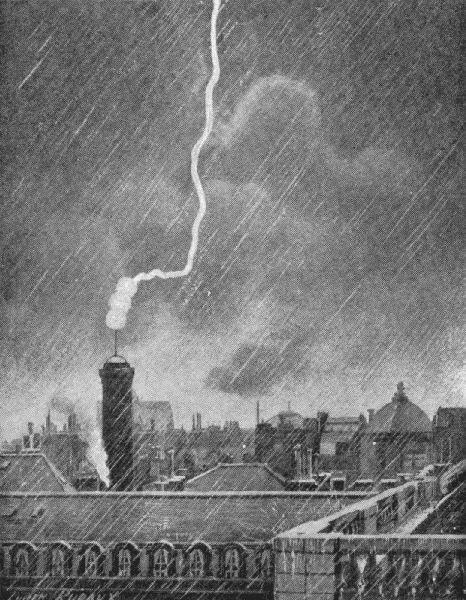
As for chimneys, they are generally very ill-treated
by the meteor. The blows of which they are victims
are to be accounted for easily, for they offer perfect
powers of conducting to the fulminant matter, firstly,
because of their prominence on the summit of the
building, especially when they are surmounted by a
vane. Again, the flue is often in cast-iron, and if it is
bricked it is supported by bars of iron. The surface
of the interior is covered with a layer of soot, an
excellent conductor, and a stove-pipe often opens into
it. Then, too, the hearth and its surroundings are
more or less made of metal. Finally, the column of
smoke and of hot, damp air rising into the air, shows
the lightning the way.
The latter often accepts this invitation, and very
frequently gets into a house by the chimney, where
everything seems ready for its reception.
Rafters and doors are sometimes bored through with
one or two holes by the spark, and split or furrowed
more or less deeply. A curious fact is that it is rare
to find the slightest trace of combustion round them.
In the month of August, 1887, lightning struck the
belfry of the church at Abrest (Allier), carrying off
part of the roof.
It destroyed the walls of the porch, and in both
sides of the swing doors bored two holes, each as big as
a pigeon's egg, and as symmetrically as if they had
been made by the hand of man.
The cleavage of beams is amongst the most extraordinary
injuries to be observed on woodwork. Lightning
works with wrought wood just as it does when the
tree is in full sap: it reduces it to rags, and follows the
direction of the fibres.
With what crimes lightning is charged! When it is a
question of robbing a house, it spares nothing in its way.
The window-panes fly in pieces, and sometimes are
thrown a long way off. Often they are melted and
disappear totally.
In July, 1783, at Campo Sampiero Castello (Padua),
lightning struck a building full of hay; the windows
had glass in them, and the panes were melted without
the hay catching fire!
A still more astonishing phenomenon is that of the
total disappearance of the glass panes, observed at the
Castle of Upsal, on August 24, 1760. Lightning visited
this edifice and then took flight, carrying off sixteen
panes out of a window. Not the smallest fragment of
them was ever found.
Perhaps, as often happens, terrific heat was
generated, and the glass evaporated.
If we follow the track of lightning through rooms,
very singular effects may be seen on the furniture.
Chests of drawers and wardrobes are gutted, and the
contents pulled out and strewn about the room. In
the middle of August, 1887, a house at Francines, near
Limoges, was struck by lightning. It fell in a room
where the master of the house was in bed. He felt a
terrific shock, and saw his eiderdown pierced through
and through by the perfidious fluid, and a chest of
drawers with all its contents broken. Continuing on
its way, the lightning demolished the door and entered
another room.
A man who was asleep in it was killed. His wife
by his side and his little girl felt nothing, but a pillow
on which one of them had her head was thrown to a
distance. Finally, the meteor went through the floor,
broke a large clock on the ground floor, setting fire to
everything on its way.
On June 1, 1903, a fulminant ray fell on the
church of Cussy-la-Colonne (Côte d'Or). To start, it
turned the clock tower upside down, broke a clock,
then opened a cupboard in the sacristy in which there
were various articles, and broke them all.
In April, 1886, lightning did great damage in
the church at Montredon (Tarn). It demolished the
steeple to an extent of three metres, several bells, and
carried the enormous iron bar which supported them a
long way off. The roof of the church was burst in and
the tiles were pulverized in several places by the falling
masonry. In the interior a bench was broken, an
image of Christ reduced to powder, and a metal image
of St. Peter twisted.
We may remark, by the way, that churches are
very often struck by lightning, doubtless owing to the
height of the steeple above the edifice.
We have innumerable notes about ruined steeples,
turrets knocked off, the plundering of priestly objects.
Sculptures and pictures adorning the sanctuary are
often destroyed, and the altar itself shattered. Cases
of priests struck while officiating are not uncommon.
As for the faithful killed while at church, they may be
counted by the hundred.
Without wishing to call lightning a miscreant or
an infidel, one is obliged to confess it fails in respect
for holy places.
However, the quips and cranks of lightning observed
in dwellings are no less varied and curious.
Here are some remarkable accounts:—
One night during a terrible thunderstorm, lightning
came down the chimney of a room where two
people were asleep. The husband awoke with a start
and, believing the house to be on fire, groped his way
to the mantelpiece to get a candle, but was stopped by
a heap of rubbish. Everything, in fact, of which the
chimney had once consisted was heaped up in the
middle of the room. The mantelshelf, violently torn
off, had been partly melted, the clock had had the door
of the case pulled off, and all the window-panes were
broken. On the lower storey, another clock was similarly
demolished, the floor was torn up and the tiles thrown
with such force against the ceiling that there were
splinters sticking all over it.
In the month of April, 1866, at Bure (Luxembourg),
the thunder, which had been rumbling for some time,
suddenly crashed down all at once about midnight with
the most appalling violence, so that the ground seemed
to tremble and the houses rock on their foundations.
All the inhabitants, aroused in terror; instinctively
several of them sprang out of bed, thinking that their
dwellings must be annihilated. Every one had the
presentiment of disaster, which was only too real: the
fluid had just struck the house of a poor workman, and
left a scene of frightful destruction behind it.
The roof had been carried off, the chimney destroyed,
the windows reduced, so to speak, to atoms,
the principal door smashed and hurled to a distance;
of the furniture there was nothing left but shapeless
wreckage. But what was most extraordinary is, that
this catastrophe only cost the life of one person, while
all that were in the house might well have been
killed.
Three children, sleeping in an upper storey, found
themselves thrown outside the house without knowing
how they got there, but safe and sound, though the
bed was broken to pieces. The father and mother
were asleep on the ground floor, with two little
children, one of whom was at the breast. This latter
was flung out of his cradle and thrown against the
wall, without being hurt.
At this moment the mother sprang out of bed to
succour those dear to her, but while the poor woman
was in the act of lighting a candle, the lightning struck
her lifeless on the floor. The husband, who was in the
bed with another child, only felt a severe shaking. The
lightning, having accomplished its work of destruction,
finally broke an opening in the lower part of the wall,
went into the stable adjoining the house, and there
killed the only cow that was in it.
In the month of August, 1868, at Liége, Rue du
Calvaire, at the point where the mountain of St.
Laurent is highest, lightning first of all struck two
earthenware chimney-pots which were higher than the
roofs. One of these pots was thrown to the ground
and broken, the other disappeared. Then the electric
spark ripped off a great part of the roof. All the tiles
were scattered round the house. A young servant
slept in a garret under the roof; the lightning penetrated
into the garret through a little hole in the wall
just above the head of the maid's bed; the latter was
flung into the middle of the room without the slightest
bruise, though the wood of the bed was bored through
in two places.
From there, the spark going through the wall again,
went down to the ground floor, following the gutter
pipe, which it broke. It re-entered the house by making
a little hole in the wall, pulled off the plaster which
was round two nails holding up a mirror, broke part
of the frame; again left the room, entered a little room
adjoining where six people were sleeping—the father,
the mother, and four young children; pierced the wall
to enter a locksmith's, scattered all the tools, tore out
a drawer, broke it into a thousand pieces, and threw
the contents on the floor, broke all the panes of glass;
again went through the wall, went to a hutch with a
rabbit in it, killed the animal, and at last went into
the garden, where it dug a double trench several feet
long.
The house was occupied by two families of ten
persons, none of whom were struck. Terrified by the
report they rose instantly; the smell of smoke filling
all the rooms told them of the danger they had just
escaped.
On another occasion one sees the woodwork of the
chimney burnt, as well as a press, a looking-glass, and
a clock badly injured by the lightning; which before
retiring, and by way of being a good joke, turns a felt
hat upside down, and unscrews the andirons.
Examples of this kind are very numerous. We
constantly speak of the caprices of the lightning, but
what name could one give to anything so burlesque or
incomprehensible as the following:—
In the month of July, 1896, lightning fell in the
village of Boulens, on a cottage almost covered with
thatch. Entering through the chimney, which it destroyed,
it first threw down a rack, pulling out the hinge
which held it up, and making in the place of the said
hinge a hole right through the wall. Afterwards it
lifted a pot and the lid from the hearth over to the
middle of the floor, tearing up some tiles as it went.
It broke the latch of the hall door, as well as the key
which was in the lock; this latter was found afterwards
in a wooden shoe which was under the sideboard. Two
canes that were beside the mantelpiece, were laid on
the said mantelpiece as if placed there by hand.
A meat chopper and a copper basin used for ladling
water out of a pail, and attached to either end of the
stove, were likewise thrown into the middle of the
room. But the oddest part was that these two articles
were fastened together, the twine which served to hang
up the chopper being rolled round the handle of the
basin. Finally, the flash divided, and zigzagged off, one
part carrying off a piece of the oak jamb of the hall
door, the other part piercing a hole above the stove in
a mud wall. Through this it threw fragments of laths
and mortar into a window eleven metres off, near which
two people were sleeping.
This little dance, in which so many and various
articles took part, does not lack piquancy!
This is how lightning joins in the National Fête
of France!
On July 14, 1884, in the village of Tourettes
(Vaucluse), lightning struck a house, carrying off a
corner of the roof. It knocked off the lower part of
the roof, and broke through a wall at least fifty centimetres
thick.
In a press built half into the wall, and in which
there were about fifteen bottles containing various
kinds of liqueur, only one bottle of spirits was broken,
and this was done in such a manner that no trace could
ever be found either of the glass or the liquid.
From thence it sprang to the pictures hanging
above the head of a little girl of five, who was sound
asleep. Three pictures were torn from their frames,
engravings and mirrors were ground to powder, but
the child was not hurt. Then the electric current
made an opening in the ceiling, which was about forty-five
centimetres thick, broke a great many tiles as it
left the house, but soon returned by way of the chimney,
three parts of which it demolished. Then it explored
the kitchen on the ground floor, where there were three
men by a fire. One, standing up, was thrown violently
against the opposite wall; another was hurled against
the door; the third, seated, was raised from his chair
to a height of at least fifty centimetres, and then
dropped. To crown all, the spark tore away half the
butt-end of a gun, and carried it into the next room,
where there were eleven people who got off with
nothing worse than the fright. Then going up the
chimney, it exploded at a height of 1·50 metre, throwing
bits of plaster and of the pothanger in all directions.
What frantic and almost childlike fury!
Yet somewhere else the very brother of this ray
may caress the little head of a sleeping child, and not
do it the slightest harm; may scoop a hole in the little
cot, and then depart quietly without giving any further
cause for talk. Or this same lightning, terrible and
ungovernable at times, will snatch something out of
a person's hand with so much dexterity, one might
almost say delicacy, that one would hardly dare to
reproach him with his lack of ceremony.
At Perpignan on August 31, 1895, lightning fell
on the mountains of Nyer, near Olette. Twenty-five
out of a flock of sheep were struck. The shepherd was
enveloped by a flash, yet escaped, but the knife he was
holding in his hand disappeared—and likewise his
dog.
Another time it fell on a house at Beaumont (Puy-de-Dôme),
flashed through every part of it, blew up the
stone staircase, and did considerable damage. It grazed
a woman who was sitting with a cup in her hand, but
she was not hurt, though the cup was rudely torn out
of her hands.
In July, 1886, a labourer was in the act of mowing,
when lightning coming on unawares, stole his scythe
and threw it 10 metres away. The man was not in the
least hurt.
The following example is truly amazing from this
point of view.
A woman was busy milking a cow, when suddenly
she saw a tongue of fire shoot into the stable and round
it, pass between a cow and the wall at a place where
there was not more than 30 or 35 centimetres of space,
and finally go out of the door without leaving any
marks, or hurting any living thing.
Very often lightning contents itself with making a
frightful hubbub, and breaking any china or glass it
may come across.
In July, 1886, thunder burst over a house at
Langres. It was at breakfast-time. The fluid came
down the chimney, which it swept thoroughly, came
near the table, ran between the legs of an astounded
guest, and then knocked a hole as big as a shilling
in the neck of a bottle which was being filled at the
pump. Then it took itself off to the courtyard, which
it swept clean, and disappeared without hurting any
of the witnesses of this strange phenomenon.
On August 3, 1898, two women were in the dining-room
of their house at Confolens, when lightning broke
a pane of glass in the window, and passing within a
few metres of them, went through the kitchen, and disappeared
through the wall, after having broken several
cooking utensils and the mantelpiece into atoms.
At Port-de-Bouc, on August 21, 1900, lightning
struck the custom house, went into the room of one of
the officials, and cut clean in two a china vase, which
was on the mantelpiece, without separating the pieces.
Several days later, on August 26, the mysterious
fluid came to disturb the peaceful repast of two honest
labourers. Having taken refuge from the storm in a
hut, they had set out their provisions for breakfast.
All at once the thunderstorm burst into the humble
dining-room, snatched up the bread, cheese, etc., overturned
the bottles and other articles, covered everything
with straw, as if by a violent gust of wind. The
labourers felt nothing but stupefaction.
Was not it a veritable farce?
In another place it bursts open a cupboard, throwing
the door away, and damaging the crockery in the
most systematic fashion: it breaks the first plate, leaves
the second intact, cracks the next, spares the fourth,
and so on to the bottom of the pile. Then its task
finished, it becomes quite diminutive, like some little
gnome out of a fairy story, and flees through the keyhole,
but without making the key spring out of the
lock.
On August 19, 1866, at Chaumont, lightning, having
played havoc in a house in various ways, espied a pile
of plates in a cupboard, china and earthenware plates
being mixed, it broke all the china ones, leaving the
others untouched.
Why this preference? The lightning does not
explain. It is for us to find out.
On May 31, 1903, at Tillieu-sous-Aire (Eure),
during a thunderstorm, a number of china plates were
filled with a kind of sticky water. The earthenware
plates beside them were not even wet. I received a
little flask of this water sent me by the parish priest,
but analysis revealed nothing unusual.
The following case gives a formal denial to the
ancient prejudice which attributes a cabalistic influence
to the number thirteen.
There were thirteen people in the dining-room of a
house at Langonar while the thunder rumbled outside.
Suddenly a flash of lightning struck a plate in the
middle of the table, threw dishes, glasses, plates, knives,
and forks in all directions—in a word, cleared the table,
not forgetting the tablecloth.
None of the thirteen guests were touched.
It sometimes happens, indeed, that glasses or bottles
are altogether or partly melted. Boyle gives a very
curious instance of the kind.
Two large drinking glasses were side by side on a
table. They were exactly alike. Lightning seemed to
pass between them, yet neither was broken; one was
slightly distorted, however, and the other so much bent
by an instantaneous softening that it could hardly stand.
When firearms are struck by lightning, their injuries
are often of the most varied kind. Sometimes
the wood, particularly of the butt-end, is split, or
broken to pieces, the metal parts torn out, or thrown
right away.
On July 27, 1721, the meteor struck a sentry-box
at Fort Nicolai, Breslau, and pierced the top to get
at the sentry and his gun. The barrel was blackened;
the butt-end broken and thrown to a distance. The
shot had been discharged and pierced the roof of the
sentry-box.
The man got off with a few scratches.
However, firearms when carried by men appear to
attract the lightning. Soldiers are often enough struck
when in the exercise of their calling, when they are
carrying arms.
But, curiously enough, many cases are known in
which lightning has struck a loaded gun, melting the
bullet and part of the barrel, without setting fire to
the powder.
Thus, at Prefling, lightning penetrated the room
of a gamekeeper, yet none of the many firearms
hanging up went off. The wall was damaged between
each rifle. One was standing in a corner of the room;
the wall was injured on a level with the lower end, and
above it a hole was to be seen in the woodwork.
On June 1, 1761, near Nimburg, lightning burst
into the house of a horse-keeper, where it struck a
loaded carbine leaning against a wall on the ground
floor. The muzzle was slightly melted by the spark,
which ran along the barrel to the trigger, and which
it soldered together in parts. There were five bullets
melted and soldered together in the magazine and the
wads much scorched. However, incredible as it may
seem, there was no explosion.
In another case the lightning went the whole length
of a rifle, both inside and outside, leaving a direct line
of fusion, and yet, incredible though it may seem, no
shot was fired though the fusion reached the powder.
These phenomena appear quite extraordinary, and
altogether incompatible with the usual theory of the
combustibleness of gunpowder. To what cause can the
invulnerability of the explosive matter be due?
Doubtless to the quickness of the lightning, which
does not leave the powder time enough to ignite.
Powder magazines are frequently struck by lightning,
and this subject is one of very great interest; they
are not always blown up, in spite of the vast quantities
of explosive materials which they contain.
Here are some examples which go to prove this
statement:—
On November 5, 1755, lightning fell near Rouen
on the Maromme powder magazine, and split one of
the beams of the roof. Two barrels of powder were
reduced to atoms without exploding. The magazine
contained eight hundred of these barrels.
Can it be that man's thunder can repulse that of
Jupiter?
Not always, as numerous examples prove the contrary.
The following observations are extracted from
a collection of similar facts:—
Lightning struck the tower of St. Nazaire, Brecia,
on August 18, 1769. It stood above an underground
magazine containing a million kilogrammes of powder
belonging to the Republic of Venice. The whole
edifice was blown up, the stones falling in showers.
Part of the town was thrown down; three thousand
people perishing.
At four o'clock in the afternoon of October 6,
1856, lightning penetrated the vaults of the church
of St Jean, at Rhodes, setting fire to an enormous
quantity of powder. Four or five thousand people
lost their lives in the catastrophe.
The power of lightning is immeasurable. Well, it
sometimes enjoys itself after the following manner:—
In 1899 it lit a candle which had just been put
out. The person who held it was not struck, but the
shock sent him to sleep for four days; then he awoke,
only to go mad, and then slept for seven consecutive
days.
At Harbourg it put out all the lights at a ball;
the room was plunged in darkness, and filled with thick
and fetid vapour.
Many a time, too, has a fire, burning brightly in
a grate, been suddenly extinguished by lightning; and
the same thing has happened with pottery and tile-making
furnaces. As a rule, it is extremely difficult to
re-light candles or fires thus extinguished. In some
instances it takes on itself to light the gas.
On August 3, 1876, near the Observatory in
Paris, Rue Leclerc, towards the corner of the Boulevard
Saint Jacques, a gas jet was lit by lightning.
The latter was twenty centimetres from a long gutter,
and was in the gap, so to speak, of an electric circuit
formed by it and the damp wall communicating with
the ground. A violent explosion took place at the
moment the gas caught alight, the gas meter, on the
wall two metres above it, was dislodged, when a second
explosion was heard. The thunderclap was truly
terrific, and immediately followed the lightning flash.
The chronometer in the meteorological bureau in the
Observatory was stopped suddenly. The keeper of
the square of the Luxembourg saw a ball of red fire
explode with great violence, and scatter in all directions.
The plate belonging to the Pères was, according to
M. de Fonvielle, broken to a thousand pieces, and the
outer part of an iron bar was volatilized. There were
no deaths or injuries to record, although several people
were thrown down by the shock.
Sometimes great disasters are indirectly caused by
lightning. Thus in July, 1903, it set fire to an old
house at Muda, Paluzzo. Under other circumstances,
the accident might have been insignificant. But,
fanned by a violent wind, the flames increased, and,
approaching nearer and nearer, burned a hundred
houses, or in other words, the whole village.
A similar catastrophe took place at the village of
Ochres, in Dauphine, on August 27, 1900. Lightning
set fire to twenty thatched cottages, which, out of
thirty-two composing the village, were in ashes within
less than an hour. Three persons were burnt alive,
and four others seriously injured.
On August 25, 1881, lightning struck the village
of Saint Innocent, at three o'clock in the morning.
Seven houses were totally burnt, and three women
perished in the flames.
A fire caused by lightning burst out on June 24,
1872, at Perrigny, near Pontailler (Côte d'Or). Seventeen
houses were burnt, and seventy-eight people found
themselves homeless. Sometimes these disasters attain
terrifying proportions.
During an awful thunderstorm, the electric spark
set fire to eighteen parishes in Belgium; ruin spread
over an area of 160 kilometres.
But could anything be more dreadful than the fate
of certain ships that have been struck by lightning?
Here is the case of one which was literally cut in
two.
On August 3, 1862, the ship Moses, on her passage
from Ibraila to Queenstown, was overtaken in sight of
Malta by a violent thunderstorm. Towards midnight
lightning struck the mainmast, and then downwards
along it to the hold, cutting the vessel in two. She
filled immediately. Crew and passengers were lost.
Captain Pearson was on the bridge, and had just
time to catch a floating spar, which supported him
during seventeen hours. The ship sank in three
minutes.
At the commencement of last century, the ship Royal
Charlotte being in Diamond Harbour, on the Hoogley,
was struck by lightning and blown into a thousand
pieces, through the explosion of her powder magazine.
The report was heard a great distance off, and the
shock was felt for miles around.
The form and position of the masts exposes them
particularly to the attacks of the dread meteor. Several
examples are known of sailors being struck by the
electric current while aloft in the rigging, and even
being thrown from there into the sea.
On August 26, 1900, the steamer Numidie, sailing
from Bone, was struck by lightning. The fluid fell on
the mizzen-mast, and went down the standing jib,
to which the second officer was clinging. The unfortunate
man had had both his hands paralyzed and
fallen; but if he had fallen on the outside of the
draille, death would have been inevitable.
The Rodney was under weigh before Syracuse when
it was struck. This was on December 7, 1838. The
top-gallant-mast went first; it weighed eight hundred
pounds, and such was the violence of the stroke that it
was instantly reduced to shavings, which hung the
whole length of the vessel, like rubbish in a carpenter's
shop. The topmast was very much damaged and
shattered here and there. As for the mainmast, with
its ironwork weighing more than a ton, it was wrecked
for a length of some seventeen metres.
At times the masts are split from top to bottom,
broken or cut transversely in fragments, and flung to a
distance. Sometimes they are planed, like the beams
and trees of which we have already spoken.
The Blake was struck by lightning in 1812. The
top-gallant-mast was in green pine, which was split into
long fibres in every direction, like branches of a tree.
It is not unusual for lightning to creep into the
heart of a mast and do it all kinds of injuries,
without in any way hurting the outside; in a word,
there may be single or double furrows, longitudinal or
zigzag, sometimes curved, and of varying depth. Sometimes
also, the electric current, far more powerful than
the blast of the wind, seizes the rigging and carries it
off. This phenomenon was observed on the Clenker,
December 31, 1828; the topmast and sails were torn
off and thrown into the water. Neither are the sails
spared by the terrible meteor; they are torn, riddled
with holes, or set on fire. But as a rule the yards are
spared.
One of the most frightful effects of thunder on
ships is fire, which it drives from one part of the vessel
to another. Under ordinary circumstances it is usually
local, and easily extinguished; but when it seizes on
various parts of the ship at once, as when struck by
lightning, then destruction becomes inevitable.
In 1793 the King George from Bombay was sailing
up the river at Canton, when an electric spark, followed
by a violent clap of thunder, grazed the mizzen-mast,
and disappeared in the hold, after killing seven men.
Seven hours later it was discovered with consternation
that the hold, full of an inflammable cargo, was on
fire. It spread rapidly over the whole ship, which it
burned to the water's edge.
The ship Bayfield from Liverpool was struck by
lightning November 25, 1845. Instantly the deck was
seen covered with globes of fire and large sparks, which
set fire to the vessel. As it threatened the powder-magazine,
the captain decided to abandon the ship.
A rush was made for the boats, but as only thirty
pounds of bread could be saved, many perished of
hunger and thirst.
Often, indeed, the explosion of the powder-magazine
makes the catastrophe even more terrible. Thus, in
1798, the English vessel the Resistance, was blown up
in the Straits of Malacca. Only two or three of the
crew were saved.
But lightning plays more tricks with the compass
than with anything else when it visits a ship. The
vibrating, quivering, magnetic needle is often paralyzed
by the electric current; sometimes its poles are reversed,
or the points, disturbed by the passage of the
spark, deviate, and no longer responding to the magnetic
pole, mislead and move hither and thither.
Sometimes they even lose all their magnetic properties.
These changes in the compass often lead to disastrous
consequences. Many cases are known of ships being
steered to destruction through the deviation of the
compass. Arago tells of a Genoese ship which, about
the year 1808, sailing for Marseilles, was struck a little
way off Algiers. The needles of the compasses all
made half a revolution, although the instruments did
not appear to be injured, and the vessel was wrecked
on the coast when the pilot believed he could round
the cape to the north. This may account for the total
disappearance of certain ships.
Some ships, like certain individuals and certain
trees, appear in particular to attract the electric fluid.
We have many records of vessels struck several times
in the course of a single electric storm. Here are
a few:—
On August 1, 1750, the Malacca was struck repeatedly.
In 1848, the Competitor was struck twice within an
hour.
At the beginning of December, 1770, between
Mahon and Malta, the ship of a Russian admiral was
struck three times in a single night.
On January 5, 1830, in the Straits of Corfu, the
Madagascar received five destructive discharges in two
hours.
We could add many others to this list. But
enough. And yet we have not said the last word on
the subject. We have to discuss the interchange of
sympathetic currents, and those which are the reverse,
taking place between the electricity of the skies and
that of the telegraph.
Lightning often comes incognito to visit the earth's
surface, or even the depths of the ocean. These little
excursions to our terrestrial dominions usually pass
unperceived; however, in certain cases the telegraph
wires commit the indiscretion of revealing them.
On the other hand, we know that the wires entrusted
with carrying our thoughts round the world,
are almost inconceivably sensitive. Without being conscious
of the fact, they are in correspondence with
the sun, 149 millions of kilometres away, and any
agitation on the surface of this luminary may cause
them indescribable agitation, as we witnessed at the
close of the year 1903.
During the formidable magnetic tempest of the
31st October, telegraphic and telephonic communication
were interrupted in many parts of the world.
In fact, the phenomenon was observed all over the
surface of the globe. From nine o'clock in the morning,
till four in the afternoon, the old world and the
new were strangers to one another. Not a word nor
a thought crossed the ocean; the submarine cables
were paralyzed on account of solar disturbances. In
France, communication between the principal towns
and the frontiers was interrupted. During this time
the sun was in a condition of violent agitation, and
its surface vibrated with intense heat. In such times
the subtle fluid profits by the confusion to glide noiselessly
along the paths which are open to it. But he
does not always wait for these favourable opportunities.
Let a thunder-cloud pass over the telegraph wires,
either noiselessly or hurling petards in all directions,
the line will be affected. The fluid imprisoned in the
sky will act by induction on the electricity of the wires
which will result in the vibration of the latter, accompanied
sometimes by a flash of lightning. These
phenomena may cause grave accidents to the telegraph
clerks, unless they are on their guard against the
treachery of the lightning. These mute discharges
happen frequently, but the spark strikes the telegraph
wires often, too, as well as the apparatus in the office.
All sorts of accidents result from these repeated
attacks.
We know, for instance, how the birds fall victims
to the lightning when they alight on the telegraph
wires after a thunderstorm; they are often found dead
hanging by their claws.
But the fluid acts on man also, through the medium
of the wires.
Thus, on April 13, 1863, a telegraph clerk was
engaged with several other employees repairing some
telegraph wires in the station at Pontarlier, when
all at once they felt, at the knee-joints more particularly,
a violent shock which made them bend their
legs as if they had been struck with a stick; one of
them was even thrown down. No doubt the fluid
reached the wires, which in those remote parts was in
charge of the clerks.
On September 8, 1848, during a violent thunderstorm,
two telegraph poles were thrown down at
Zara in Dalmatia. Two hours later, as they were
being set up again, a couple of artillerymen, having
seized the wire, felt slight electric shocks, then suddenly
found themselves flat on the ground. Both had their
hands burnt; one indeed, gave no sign of life; the
other, in trying to raise himself up, fell back as soon
as his arm came in contact with that of one of his
comrades, who ran to his assistance on hearing him cry
for help. The latter thrown down in turn, felt his
nerves tingle, and giddiness seize him, with singing
in his ears. When his arm was uncovered, there
was a superficial burn just on the spot where he had
been touched.
On May 9, 1867, lightning fell on the road
from Bastogne to Houffalize (Luxembourg), attracted
by the telegraph wire, which it destroyed for about
a kilometre. At a certain part, and over a length
of about twenty metres, the wire was cut in small
pieces, three or four centimetres long, which were
scattered over the ground, and were as black and as
fragile as charcoal. The poles which supported them,
and several poplars planted on the same side of the
road, were more or less damaged.
It has been observed that trees planted on the same
side as a telegraph line were sometimes blasted on a
level with the wires. It is the same with houses
near the copper threads along which human thoughts
take wing. Thus, at Chateauneuf-Martignes, on
August 25, 1900, lightning destroyed the telegraph
poles on the outskirts of the railway-station. A severe
shock, like an electrical discharge, was felt at the same
moment by two people who were in bed, not far from
where the wire was fixed in the wall of the house,
which was a very low one. The same phenomenon
had been felt there already.
In the railway-stations, as well as in the telegraph
and telephone offices, curious results of the spark
passing at a certain distance, or even in the immediate
neighbourhood, are sometimes observed.
On May 17, 1852, towards five o'clock, the
sky looking overcast, the station-master at Havre
warned his colleague at Beuzeville that it would be
well to put his apparatus in connection with the
ground. Beuzeville is twenty-five kilometres away
from Havre, and at the former station the weather
then did not look at all threatening. But clouds soon
piled up, driven before a violent wind. Suddenly
three awful peals of thunder succeeded each other in
quick succession. With the last, lightning struck a
farm about a kilometre from the station, and at the
same moment a globe of fire of a reddish brown, and
apparently about the size of a small bomb-shell, rose
as if out of a clump of trees. It glided through the
air like an aerolite, and leaving behind it a train of
light. At a hundred metres or so from the station,
it alighted like a bird on the telegraph wires, then
disappeared with the rapidity of lightning, leaving
no trace of its passage, either on the wires or the
station. But at Beuzeville several interesting phenomena
were observed. Firstly, the needles turned
rapidly, with a grating noise like that of a turnspit
suddenly running down, or like a grindstone sharpening
iron, which emits sparks. A great number, indeed,
flew out of the apparatus. One of the needles, that
on the Rouen side, went out of order; all the screws
on that part of the instrument were unscrewed, and on
the copper dial near the axis of the needle, there was
a hole through which one could pass a grain of corn.
The instruments at Havre were unaffected. The
needle remained as usual, also the dial, screws, and
so on.
One of our correspondents has sent me the following
very interesting communication:—
"On June 26, 1901, having rung up at the
central telephone-office at St. Pierre, Martinique, a
harsh noise was heard, which was almost immediately
succeeded by the appearance of a ball of fire, having
an apparent diameter of twenty centimetres, and the
brilliancy of an electric light of twenty candle power.
This voluminous globe followed the telephone wire
towards the instrument. Arrived near the receiver,
it burst with a terrific explosion. The witness of this
phenomenon felt a severe shock, and dizziness. Recovered
from his stupefaction, he noted the following
facts: the telephone apparatus was completely burnt,
the relay of Morse's installation was slightly damaged.
The electrical tension must have been enormous,
for the wire of the bobbins was, to a great extent,
melted."
This latter effect, however, occurs very frequently.
Not only does the lightning melt and break the
telegraph wires, but it injures the poles which support
them.
These are sometimes broken, split, thrown down,
burst, or splintered, sometimes into threads or shavings.
Poles which have been blasted are often to be seen
alternating with others which are uninjured. Thus,
on the line from Philadelphia to New York, during
a great storm, every alternate pole up to eight was
broken or thrown down; the odd numbers were
uninjured. We have mentioned a similar case already.
There are several accounts, too, of lightning in
pursuit of trains.
On June 1, 1903, travellers by train from Carhaix
to Morlaix, between Sorignac and Le Cloistre, saw
lightning follow the train over a course of six kilometres,
breaking or splitting several telegraph poles.
This feat has been observed more than once. The
train is escorted by lightning flashes which succeed each
other almost without cessation, and the travellers seem
to be whirled through an ocean of flame.
Lightning rarely strikes the carriages; only on one
occasion did it actually wreck one, by breaking a wheel.
The mutilated coach, however, continued to hobble
along until the injury was discovered.
Generally the fluid is content to wander about the
rails, to the great terror of the passengers who witness
this display of rather alarming magic. It spreads itself
over masses of iron, as for instance the roofs and
balconies in Paris, without striking any particular point.
The danger would be greater to a cyclist on a
road. In the suburbs of Brussels, on July 2, 1904, a
cyclist named Jean Ollivier, aged twenty-one years, was
riding during a violent storm, when suddenly he was
struck and killed on the spot.
We shall end this description of the whims and
caprices of lightning by a notice of the blasting of
a German military balloon. It happened in June,
1902. The aeronaut, whose car was steered by a sub-lieutenant,
was held captive, and soared at a height of
about 500 metres above the fortifications at Lechfeld,
near Ingolstadt. All at once the aerial skiff was
touched by an electric spark, caught fire, and began
to descend, slowly at first, then swiftly. The aeronaut
had the good luck to get off with a broken thigh. The
five assistants, who worked the windlass and the telephone,
also received shocks transmitted through the
metal wires of the cable. They fell unconscious, but
were quickly restored. This phenomenon, which is
excessively rare, fittingly closes this odd collection of
stories, fantastically illustrated by lightning.
A communication from Berlin also mentions that
the captive balloon of the battalion of aeronauts was
struck by lightning on the exercise ground at Senne.
Two under-officers and a private were wounded by the
explosion.