“Barbara, the flummery’s sour!”
Samuel pushed back his dish and dropped his spoon.
“Aye, dad, a bit sour; I’m sorry.”
“A bit sour!” exclaimed the husband, “a bit sour! tut, more’n a bit
sour, whatever!”
Barbara looked at him, the corners of her sweet old mouth trembling,
“Father, I’m sorry; I thought it was better nor usual.”
“Better nor usual! Ye’re full of fancies, Barbara, a-runnin’ round
nursin’ other folks, an takin’ other folks’ troubles, all except your
own. Yesterday ye made broth for the servant-men, an’ it was every bit
meat; broth like that’ll ruin my pocket, an’ anyhow we arn’t providin’
for gentlemen’s families.”
“Aye, father dear, but for a long while they’ve had nothin’ but barefoot
porridge, an’ there was a little extra meat in the house, an’ I
thought——”
“An’ ye thought! Ye needn’t think, mother. Such thinkin’ as ye do is
ruinin’ my prospects.”
“Dad dear, I’ll not do it again if ye say no.”
“I did not say ’no,’ I said yesterday ye gave the men an all-meat broth
an’ it was no holiday.”
The old man’s voice grew petulantly angry, the childlike appeal of his
wife’s eyes, the trembling lips, her gentle sweetness, irritated him.
“Very well, dear.”
“Mother, they’ve milk on the farm, which is more’n they’d have in their
own homes; if they lived at home they’d be scramblin’ with their
children to suck herrin’-bones. Stirabout with plenty of milk is good
for any man, an’ it’s especially good for a workin’ man; they have all
the stirabout they can eat here, an’ some kind of meat-broth an’ tart
every day.”
“Very well, dear, I’ll see that it doesn’t happen again.”
“Aye, an’ mother, I found one of the tubs of butter in the dairy
touched; there was most a half a pound of butter taken out. Do ye know
who took it?”
“Dad, I took it for Mrs. Powell the carpenter, who’s ill.”
“For Mrs. Powell the carpenter! An’ then how are we goin’ to pay the
landlord, think ye, if ye go takin’ the butter to sick people?”
“She’s very sick, father, an’ they’re very poor, an’ I thought it would
be such a nice to her just now, and she did relish it so.”
“Relish it! Aye, soon ye’ll be distributin’ the sheep to the neighbours.
An’, mother, I found some broken crockery in the garden out by the
corner of the hedge. It looked most as if it had been hidden there; do
ye know anythin’ about it?”
“Aye, I know somethin’ about it.”
“An’ what do ye know?”
“Father, that I shall not be tellin’ ye, whatever.”
“Not be tellin’ me! not be tellin’ me?” he exclaimed hotly. “Tut,
Barbara, what’s come over ye?”
“No, father, not be tellin’ ye,” answered Barbara, with gentle
deliberateness.
“Indeed, we’ll see. Maggie, Maggie,” shouted Samuel, “Maggie, come
here!”
Maggie came hurrying to the door, anxiety in every feature of her face.
“Maggie Morgan, what do ye——” began Samuel.
“Father, that will do,” interrupted Barbara; “Maggie, ye may go.”
The girl turned and went; speechless, Samuel regarded his wife.
“Father,” she continued gently, “I broke it an’ I hid it. I was—mixin’
oat-cake in the bowl an’ the bowl was on my knee, an’ suddenly it
slipped an’ fell on to the flaggin’s an’ broke. Then I hid it
’cause,”—the quiet voice faltered,—”’cause—why ’cause, of course,
father, I thought ye’d be troubled over it if ye saw it, an’ ye’d not
miss it if ye didn’t.”
“Alack, mother!” There was genuine astonishment in the husband’s
exclamation. “Barbara! to think we’d be livin’ together forty-five years
an’ ye deceivin’ me at the last like this. I’ve just one thing the more
to say to ye. There’s no cause for makin’ a duck-pond out’n the kitchen
floor an’ if——”
“But, father,” interrupted Barbara, wiping her eyes with her apron,
“father dear, the lads was just foolin’ a little an’ they spilt a bit
of water on the flaggin’s, an’ before Maggie could mop it up ye came
in.”
“Tell them an’ such as them to go live with the pigs!” And Samuel,
pushing back his chair, rose hastily to his feet, and left the room.
“Father, father dear!” called Barbara.
There was no answer, and she was alone.
“Oh, father, if ye but loved me as ye used to! There were never any
words then. Oh, lad, lad!”
There was no reproach, no bitterness in her voice, only longing; she
loved him so, and their time at best was short, and she couldn’t manage
to please him in anything. And perhaps this was their one chance—a few
years at best, perhaps a few weeks, and it might be only days. She cried
patiently as if she had lost something irrecoverable, an ideal, a hope,
a child. Their past, the past of their youth, lay before her now, in its
human romance and young love, like something perished; and, wistful, she
dwelt in its memories, on its common human beauty. Suddenly she ceased
crying.
“Aye, but I lied to him an’ I never did before, indeed. I was afraid
Maggie’d lose her place if he knew she broke it; an’ to think that I hid
the pieces from him! Oh, Sammie, Sammie! I’m deservin’ what’s come
to-day, deservin’ it,” she concluded with satisfaction, “for sinnin’ so
against conscience.”
She sat up straight in her chair as if to receive punishment.
“An’ I’m more blessed than most. Samuel’s a good man an’ well
respected—no man better respected. He’s honest in his dealin’s, he’s
more generous than some to his men. There was Eilir’s little lad he paid
the doctor’s bill for, an’ Morgan’s old mother he buried an’——”
Barbara was sitting very straight in her chair now, with one wrinkled
hand spread before her, telling off on its fingers Samuel’s good deeds;
her eyes shone joyously, there were so many, and in their numbering she
forgot a sore heart, a cap askew, a kerchief wet over the bosom, and a
wrinkled apron. “An’ there was old Silvan he’d partly fed an’ clothed
these ten years, an’ an old crot no one would do anything for, an’
Sammie helped her, too. An’ there was the dress he brought me from the
fair, an’ the gold-rimmed spectacles from Liverpool, an’ the beautiful
linen for caps, better nor any one else in the valley has. An’ he’s done
everythin’ for the children, an’ one of them’s fine a scholar as any in
Wales, which is sayin’ much. Aye, he’s a good man, an’ I’m a wicked
woman to be dreamin’ so; but oh, lad, lad dear,” she ended lamely, “if
ye’d only love me as ye used to!”
Samuel went out on to the farm with irritable thoughts, indignant
against extravagances which he laid to Barbara, and which meant a
slender purse even in their old age. He was willing to admit that she
was a good woman, aye, a more than ordinarily good woman, but where she
fell short, he thought, was in managing. Yes, he had prospered a little;
for an instant he had an uncomfortable sense of owing this prosperity
in part to the efforts of some one besides himself. But there was this
constant leakage, and again his mind flamed up over the broth and the
broken pottery. It was the woman’s business to see to it that no
ha’penny was wasted; he failed to recall a certain rusted spade, some
moulded straps, and a snapped fill in the year’s calendar. And then, at
last, manlike, in the midst of the work out on the farm, he not only
washed his lungs with the keen mountain air, but he washed his mind of
the whole difficulty, straightway forgetting it.
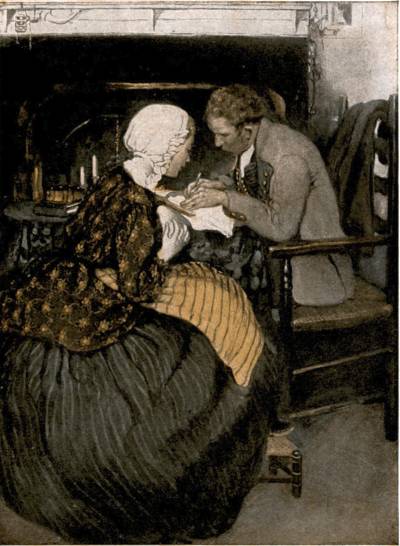
When once more he entered the house for his tea, he found Barbara in the
kitchen knitting before the fire—knitting socks for him. There was no
trace of what had passed, no trace of her care, her grief. Her cap was
fresh and tied with new ribbons, her kerchief was folded neatly over her
shoulders, her apron clear white and starched, and out from beneath the
short skirt peeped two brass-toed shoes bright-eyed as mice. Samuel did
not know how quaint and sweet she looked. But then, why should he? she
had been always just so. He took her, all of her, for granted,—the bit
of red in her old cheeks, red that matched the bright cap-ribbons; the
soft white hair, the tender eyes, the kind tired mouth, the little
figure dainty as the sweet alyssum in their garden—in short, there was
nothing to be remarked upon; he simply took her for granted as he had
done always, or as, for example, one takes the fresh air till one is in
prison, or the sky till one goes blind, or love till it is gone.
The tea and bread and butter were on the table. Barbara poured out his
cup, put in the sugar, the top of the cream, and passed the cup to him
as he sat toasting his feet before the fire. Then she handed him the
bread.
“Well, father,” she said, patting him on the shoulder, “did ye have a
successful afternoon?”
“Aye, Barbara,” he answered, “fine.”
Without touching the tea, she took up her knitting.
“Are the lambs comin’, dear?”
“Aye, mother, they’re most as big as yearlin’s now. Are ye not goin’ to
take tea?”
“No, I’ve a bit distress, no more’n I have often.”
“Have ye tried the peppermint?”
“Aye, but it’s no good. Did Eilir say what the shearin’ ’d be?”
“He did; it’ll be heavier nor usual. It’ll make a big shipment this
year.”
“Good, father, we’ll be takin’ a trip to the lad’s college yet, what
with the lambs comin’ fine, the wool heavy, the calves double the
number they were last year. Father, do ye think the boy’d be ashamed of
his old mam?”
“Ashamed? He’s no lad of mine if he is. Well, mother, if it’s all really
comin’ as well as it seems to be, we’ll be takin’ that trip to see the
boy.”
“Oh, father dear, ’twould be grand, what I’ve dreamed of these many,
many years!” Barbara dropped her knitting and clasped her hands in
childlike abandonment of pleasure.
“Tut, mam,” added Samuel, his face lengthening, “it’s not absolutely
certain, what with waste in the kitchen, the breakin’ of crockery, an’
the men eatin’ themselves out’n house an’ home, it’s no tellin’. It
might be an extravagance, but we’ll see.”
“But, father!” exclaimed Barbara impulsively, and stopped.
“Well, mam, maybe it’ll be; maybe we’ll see the boy an’ see him a great
man in his college, aye, a most successful man, as good’s the best.”
“Oh, dearie, to think we’ll be seein’ him—perhaps. But, dad, do ye
think he’ll forget he’s my boy?”
“Why should he? Mother, if we’re goin’ it’ll be in six weeks.”
“Aye, but father,”—Barbara paused, her head reflectively to one
side,—”there’s the shoes. I’ll have to be havin’ shoes; these clogs’ll
not do for the lad’s college.”
“No matter, mother,” replied Samuel, thrusting his hands into his
pockets with boyish energy, “we’ll have proper shoes for ye an’ we’ll go
first to Liverpool for a travellin’ suit for ye an’ a proper bonnet for
me an’——”
“Listen to what ye are sayin’—a bonnet for ye!” And Barbara laughed
merrily.
“Dear me!” laughed Samuel, slapping his knee, “I mean a proper bonnet
for ye an’ for me a proper suit of clothes. Aye, we’ll afford it all
if the lambs keep comin’.”
“Dearie, it’ll be most too much happiness, the boy, the trip, an all the
clothes. I’ll be takin’ him some socks an’——” Barbara gasped and
touched her side with her hand.
“What ails ye, mother?”
“It’s just a stitch in my side.” Samuel did not notice that Barbara had
turned white up to the very edges of her cap. “An’ what’ll ye be takin’
him, dearie?”
“Dear, dear, I’ll bring him a—a—well, mother, what’ll I take him? He’s
such a great man ’twouldn’t do to fetch him a cheese or eggs or a fowl,
now would it?”
“That’s so, father,” replied Barbara reflectively. “Aye, he’s a great
man an’ ’twouldn’t do, whatever. I have it, dad, we’ll be buyin’ him
books in Liverpool.”
“Good, so we will, mam, as many books as we can afford.” And Samuel
thrust his hands still further into his pockets, pursed out his lips,
spread his legs apart, and contemplated the fire earnestly. “Aye,
mother, books is the very thing; the lad’ll be more’n pleased to have
them an’ to think I thought of them.”
“Aye, that’s so, dearie.”
“Well, I’ll be goin’ now; we’ll have to be makin’ haste to have all done
in six weeks, an’ we’ll go, mother, we’ll go if we can afford it.”
Samuel strode out of the room; he was over seventy, but he walked with
youthful elation; indeed, in some marked fashion, despite white hair,
wrinkled skin, and limbs that were beginning to bend with years, he was
still a boy.
Barbara looked after him, sighing wistfully as he left the room. “It
seems a bit like bein’ young once more, a bit like old times.” She
caught her side again. “This stitch is worse than common. Aye, dearie, I
was unjust to ye the mornin’, an’ I’m a bad old woman.”
When Samuel came in for supper, he found Barbara lying down. Nothing was
the matter, she assured him, “just a stitch worse than common, aye, an’
they’d be goin’ to Liverpool the same.” But as the night wore on it grew
worse still, and by morning she was a very sick woman, suffering what
even his man’s eyes could see was intense pain. The old cheeks had
shrunk in the night, the face blanched to an ashen gray; only the eyes
remained unchanged and shone sweetly and serenely upon him.
The physician was sent for, and while one of the men was fetching him,
Samuel told Barbara at least fifty times that she would “be better the
morrow,” and each time Barbara, too weak for speech, nodded as much as
to say that she certainly would be. When the doctor came he saw her
extremity and sent Samuel and Maggie from the room. A quick examination
followed.
“Samuel,” said the doctor, stepping into the kitchen, “Barbara is a very
sick woman.”
“Aye, sir, but she’ll be better the morrow.”
“No, Samuel, not to-morrow.”
“Not to-morrow, sir? Then next day?”
“No, man, nor the next day.”
“But, sir, Barbara’s never ill.”
“She can never get well here.”
“Not the week, sir?”
“Samuel, ye do not understand. Barbara will never be well here.“
“Och!”
“She’s dying, man; there’s nothing to do for her that could be done out
of Liverpool.”
“Liverpool,” said Samuel.
His thoughts seemed to be somewhere in the back of his mind,
inaccessible, walled up from contact with the reality of what he heard
and saw. He appeared unable to grasp what had happened, what was coming.
Surely he was walking in a dream, and every minute there was the chance,
so he thought, that he might awake from it. What was this that had come
upon him in a night? Certainly not the reality, for with that he had
been living for years—that was life. Barbara was dying; the words rang
oddly in his ears without reaching his mind. Some stranger was speaking
with him; he did not understand. Barbara was dying; no, not Barbara,
somebody else; other people did die. Barbara, was dying; not his
Barbara, not the mother of his children, the wife of his fireside, his
companion during a lifetime. Somebody was dying; no, not his Barbara
but somebody else; just give him time to think. Barbara was dying—could
it be his Barbara?
“Dyin’?” asked Samuel aloud, “Barbara dyin’?” He repeated the words as
if questioning and testing them.
“Aye, man,” replied the doctor sharply, “she’s dying; she’s caught
herself lifting something. With an operation there might be some chance;
but there’s none here in this place, only in Liverpool.”
“Aye, Liverpool,” answered Samuel, “we’re goin’ to Liverpool soon.”
The doctor glanced at him keenly; before this he had seen childishness
with some shock of grief take a sudden, unrelinquishing hold on old age.
“Well,” continued Samuel, still as if talking to himself or to some one
outside the room, “we’ll go now; aye, we’ll take the chance.”
“But, man,” replied the doctor, “it’ll cost more money than ye spend in
two years.”
“No matter, sir, we’ll sell the sheep, if need be. Aye, dearie,” he
added gently, “we’ll take the chance.”
“There’s no time to spare, then,” said the doctor looking at his watch.
“Aye,” replied Samuel, “we’ll be ready.”
“Then be sharp about it,” said the doctor, alert for the one chance of
life.
“Aye, sir”; and Samuel went into the room where Barbara lay.
He looked down upon her lying in bed; he could see that her strength was
slipping, slipping away. He dropped on his knees beside her. He patted
her hand, he smoothed her forehead.
“Mother!” he called.
Her eyes smiled confidingly, reassuringly up at him.
“Och, mother, I never thought of this!”
There came a feeble answering pat from her hand.
“Mother, we’re goin’ to Liverpool; aye, dear, they’re goin’ to make ye
well.”
Barbara moaned, and her eyes brimmed with tears.
“Father dear,” she whispered, “let me—oh! Sammie—let me die—here.”
“Tut, mam, ye’re not goin’ to die—aye, they’ll be makin’ ye well in
Liverpool.”
“Dad dear,” she plead, “let me—die—here.”
“But, mam,” argued Samuel, “the lad’ll be there waitin’ for us—an’—an’
to see ye,” he ended weakly.
“Sammie, Sammie,” she begged, “let me die here—not—away—from—home;
the lad—will—understand.”
“Barbara, there’s a chance for ye to get well; will ye not take it for
me, dearie—aye, will ye not do it for me, Barbara, for my sake?”
The big eyes that had looked into his without anger, without
selfishness, through all the circumstances of life, smiled now with
sudden sweetness. The hand lying in his hand tightened, her lips
trembled.
“Aye, Sammie, lad, I will.”
“Dearie, Barbara, my Barbara!” he exclaimed, struggling to control
himself. “Oh, mam, I do love ye so, an’ I’ve not been good to ye!”
“Sammie, not been good to me? but ye have been, lad, an’ I’m a bad old
woman an’ before I leave the house——”
“Mam dear, ye’re not to say such things. I’ve found fault with ye an’
neglected ye, but ye do know I love ye?”
“Aye, lad dear, I know—ye—love me but I’m a bad—old—woman, an’ I
must tell ye before—I—leave the house——”
“Tut, mother, mother, ye’re not to say such things. I’ll do for ye now,
oh! I will. Mam, I’d never thought of this.”
“But lad,” she persisted, “I’m a bad old woman an’——”
“Tut, dearie, no, no,” he silenced her. “We’ve just a little while an’ I
must see about some things. I’ll call Maggie an’ she’ll have ye all
ready, dear.”
Preparations were soon made, and when Maggie had her mistress wrapped
up for the journey, Samuel and the doctor hastened into the room. It was
evident that Barbara’s strength was ebbing more and more rapidly away.
After she was lying on the stretcher she reached out a hand to Maggie.
“Goodbye, my dear,” she faltered; “be—a—good—girl.”
“Och, mistress, please let me tell——”
“No, Maggie, no, not—a—word,” she answered. Then suddenly Barbara
cried out, “Sammie!” the first terror of death in her voice.
“There, there, mam dear; aye, dearie, I’m here.”
“Oh, Sammie, to die—away—from home,—aye, once—over—the threshold,”
she murmured.
For an instant her eyes tried to smile into his, then consciousness
slipped away, and a wing swept over them,—they fluttered and they
closed. The doctor’s stern “No matter, she will recover in the air,”
checked the sobs of Maggie; and so they bore her, still and white, over
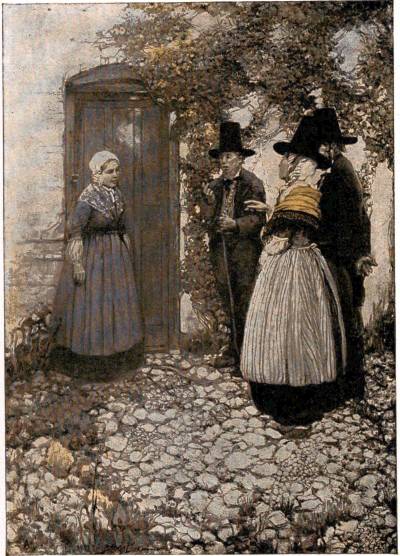
the threshold of her home, past the farm-servants, to the carriage.
Fields, hills, buildings flashed by, seeming with their shadows and
forms to flick the windows of the railway coach. The doctor and Samuel
sat side by side, and opposite on the long seat lay Barbara, quiet and
semi-conscious. The half-day’s journey to Liverpool stretched out
interminably, even now the most of it had been covered. Samuel was
thinking, thinking, thinking, as he had never thought before, and the
discipline of these thoughts was biting into him like acid. There were
lines graven on his face which years alone could never write there. Aye,
to learn a lesson like this in a few hours which should be learned
through a lifetime,—to learn it thus in one last brief discipline! Oh,
Barbara, Barbara, what had he done for her, what had he been to her? And
now if—the thought strangled him—where, where was she going?
Then came to him the years when he might not be able to tell her any
more how he regretted the selfishness of weeks and months, aye, of half
a century. Even now the separation had begun; she was too weak to listen
to him, he could not tell her, and in a few hours the one chance might
be gone. Already, as she lay there hovering between life and death, she
was no longer his in the old substantial way, but merely a hostage,
fragile, ethereal, of a past life. If he had loved her every hour of
those days that seemed so lastingly secure, if he had tried in every
way—all the little ways—to show her how tenderly, how deeply he really
loved her, the years would have been too short. And to-day, at the
best, there was the one chance growing less certain every minute; there
were but a few years at the most when he might try to make her know what
she was to him.
Then, with a revulsion of feeling, the little commonplace joys dear to
them both crowded in upon him; he felt benumbed in their midst,
helplessly conscious that the heart of them all was slipping, slipping
away. The road of their life flowed swiftly behind him, receding
ribbonlike, as the hills and trees and fields passed the coach-window,
into indistinguishable distance. Their tea-time with its happy quiet,
their greeting at night, their rest side by side, their goodbye in the
morning, Barbara’s caps, Barbara’s knitting, the shining eyes, the
smile—each daily commonplace thing a part of his very being. He had a
sickening sense of having the roots of existence torn out.
With a pang came the thought of that other trip to Liverpool they had
planned to take. What would the boy say now? And he must know how that
mother-life had been wasted, neglected. And the books they were going to
bring the lad, and the socks Barbara had made, and the shoes that were
to delight her, and the new clothes for both, and the bonnet over which
they had laughed so merrily—the agony of these simple things,
remembered, ate at his thoughts like fire. They were so little; he had
never known before what they meant, or he had forgotten; now, surely,
they could not be taken from him. Samuel’s mind prostrated itself in
petition to that Inexorable in whose power lay these little joys, his,
his only, of account only to him, sacred to him only, that he might be
allowed to keep them.
His face was gray with the battle of these hours when the doctor spoke,
telling him that they were almost in Liverpool and must move quickly.
Their voices aroused Barbara; her eyes sought Sammie’s and smiled
faithfully into them.
“Dearie!” he said, leaning forward with such an expression that Barbara,
if she saw it clearly, could never doubt his love again.
“Lad!” she whispered in reply.
But Samuel’s eyes shrank when he saw the ambulance at the station,
waiting. The doctor was going in it with Barbara. Oh! this cut, cut, as
that knife would cut Barbara. Already they were being separated. They
were taking her out of the train, away from him, and he was looking
around the great station blindly, when he felt a strong grip on his arm
and heard the word, “Father!” Nothing else seemed clear after that, and
the way, the long way, rumbling through those streets, was like a narrow
lane in the night. Barbara was in the streets, alone, without him, or
she was already at that place where lay the one chance for him.
“There, father,” the lad was comforting him, “there’s no better place
for her; you did just right.”
Samuel sobbed convulsively, tears rolling out of his eyes unnoticed, his
hands clenching the chair.
“Father, father, don’t; we shall know soon.”
But the old face over which he leaned paid no heed to what was said; nor
did Samuel hear the quick entrance into the room and the whispered
words.
“Father, do you hear? Mother’s safe.”
Then Samuel rose to his feet, started forward, and swayed uncertainly.
The lad took his arm.
“Father,” he said, “mother’s very weak, and we must be careful; we can
see her only a minute, that is all, the doctor says.”
When they entered, Barbara lay on the bed, smiling. The nurse stepped
outside; ah! she had seen so many, many moments like this, and yet her
heart ached for the old man coming through the door, coming through to
take into his arms the few precious years that were left.
“Mother!” he said simply.
“Sammie dear!” she answered, her heart shining in her eyes.
Then she espied the lad standing behind his father.
Samuel watched their greeting, his lips twitching. “Lad, lad,” he cried,
unable to withhold the words, “I’ve not been good to mam.”
A flush overspread Barbara’s face.
“Tut, Sammie dear, ye never——” she commenced indignantly.
“Be still, mother, I’m goin’ to say it now; ye know I’ve not been good
to ye. Lad,” he continued, turning to him, “when ye marry, as ye will,
don’t think any way is too little to show her that ye love her.”
“Tut, tut, Sammie dear,” insisted Barbara, “ye are good to me, an’ I
lied to ye an’——”
“It’s time to leave,” said the nurse, coming in.
“But I’m going to have one word more,” Barbara replied, the life
springing into her eyes with this gentle defiance. “Sammie, Sammie
dear,” she called as the two men were urged through the door, “I lied
about the bowl—I didn’t break it but I did hide it. Maggie broke it,
an’ I was afraid she’d lose her place, so I hid it. Father, did ye
hear?”
“There!” said the nurse, shutting the door.