By Major Casserly. Fully Illustrated.
Demy 8vo. 12s. 6d. net
ALONE IN WEST AFRICA
By Mary Gaunt. 15s. net
CHINA REVOLUTIONISED
By J. S. Thompson. 12s. 6d. net
NEW ZEALAND
By Dr Max Herz. 12s. 6d. net
THE DIARY OF A SOLDIER OF FORTUNE
By Stanley Portal Hyatt. 12s. 6d. net
OFF THE MAIN TRACK
By Stanley Portal Hyatt. 12s. 6d. net
WITH THE LOST LEGION IN NEW ZEALAND
By Colonel G. Hamilton-Browne
(“Maori Browne”). 12s. 6d. net
A LOST LEGIONARY IN SOUTH AFRICA
By Colonel G. Hamilton-Browne
(“Maori Browne”). 12s. 6d.
MY BOHEMIAN DAYS IN PARIS
By Julius M. Price. 10s. 6d. net
WITH GUN AND GUIDE IN N.B. COLUMBIA
By T. Martindale. 10s. 6d. net
SIAM
By Pierre Loti. 7s. 6d. net
A GATEWAY IN THE WALL OF KANO.
The wall, which is made of mud, is 40 feet in thickness, 50 feet high,
and 7 miles in circumference.
Photo by the Author.
THROUGH
UNKNOWN NIGERIA
BY
JOHN R. RAPHAEL LATE TRAVEL EDITOR OF “THE AFRICAN WORLD”
ILLUSTRATED FROM PHOTOGRAPHS BY THE AUTHOR
LONDON
T. WERNER LAURIE LTD. 8 ESSEX STREET, STRAND
PREFACE
Nigeria is in process of change, in some places
rapid change. Since this book has been written
Southern and Northern Nigeria have been amalgamated
administratively. The two colonies, or
protectorates, whichever title be preferred, are being
unified. The public service have been fused.
What were the Lagos Government Railway, the
Baro-Kano Railway and the Bauchi Light Railway
recently received the comprehensive designation of
Nigerian Railways. The volume was in too
advanced a condition for the alterations to be made;
and perhaps use of the old names will give a better
idea of the efforts to open up the youngest dependency
brought under the Crown.
Linking rich Southern Nigeria with her Northern
sister provides money for railway and other development,
which is to be pushed on vigorously. Many
of the conditions of the country must necessarily
alter. The locomotive is to whistle through regions
where few white men have trod. Wild areas are to
be penetrated by trains. Naturally the character of
the inhabitants will be affected: no doubt many
superstitious rites and, incidentally, cruelty and inhumanity
in social customs be dispelled. Pagans
will catch the passing fashions, or an imitation, and
clothe, or at least cover, themselves.
These and other material benedictions are sure
to radiate from the emblems of civilisation. Let us
hope we shall not also be the means of dispensing
many of the blessings taken by Europeans to the
Coast towns of West Africa in former centuries and
in evidence to-day by the moral and physical degeneration
of adult natives, as well as by children
saturated with hereditary disease.
Contact with aborigines may be a very fine thing
for them. Let care be taken that their second state
is not worse than the first. That is likely to be
avoided if the policy followed by Sir George
Taubman Goldie and Sir Frederick Lugard with the
Fulani and the Hausa population of Northern
Nigeria be scrupulously continued: that of encouraging
and fostering all which is good in tribal life,
repressing only those features which violate the
principles of human existence.
No attempt has been made in the following pages
at an historical survey or at a deep examination of
the difficult problems that confront the administration.
There are a number of books in which both
subjects are treated excellently. Recent ones
occurring to mind are Lady Lugard’s, “A Tropical
Dependency”; Colonel Mockler-Ferryman’s,
“British Nigeria”; Captain Orr’s, “The Making
of Northern Nigeria”; Mr E. D. Morel’s, “Nigeria:
Its People and Problems”; and the several publications
of Major Tremearne.
This volume is no more than impressions taken
from a quiver of them gained in the course of a rather
long visit, part of it through country not well known.
Most chapters were written during the journey,
either at the close of a day’s trek or whilst detained
at various spots.
My obligations are manifold for the courtesy,
kindness and assistance shown in various quarters.
If all to whom I feel indebted were stated several
pages would be required.
I cannot, however, allow the volume to go to
Press without again tendering thanks to my former
Editor and present friend, Mr Leo. Weinthal, of
The African World, for the opportunity given to
carry out the expedition and for allowing me to
incorporate in these pages matter printed in his
paper; Sir Walter Egerton and Sir Hesketh Bell,
ex-Governors respectively of Southern and Northern
Nigeria, for the letters of introduction which proved
an open sesame to the good-will of the high officials
administrating each colony; Mr F. Seton James,
C.M.G., and Mr A. G. Boyle, C.M.G., both of whom
in the course of my stay were in turn Acting Governors
of Southern Nigeria; Mr F. W. Waller, Acting
General Manager, Lagos Government Railway;
Mr Charles L. Temple, C.M.G., Acting Governor
of Northern Nigeria; Captain G. C. Kelly, temporarily
in command of the 1st Battalion Northern
Nigeria Regiment; Captain C. F. S. Maclaverty, in
charge of the Battery; Mr C. Maclean, Agent of
the Niger Company at Zungeru; Mr E. M. Bland,
Deputy Director of Railways, Northern Nigeria;
Mr Joseph E. Trigge, Managing Director of the
Niger Company; the late Mr Walter Watts, its
Agent General; Mr Robert Lenthall, also Agent
General of same Company; Mr W. P. Byrd, and
Captain J. J. Brocklebank, D.S.O., of Kano, and
also my native friends of that city, Adamu Ch’Kardi
and Suly; Mr F. Beckles Gall, Resident at
Naragutu; Mr F. D. Bourke, Manager of Naragutu
Tin Mine; Mr S. E. M. Stobart, Resident
at Bukuru; Mr T. H. Driver, Manager
of the Anglo-Continental Mines; Mr A. C.
Francis, Acting Resident at Zaria; Major E. M.
Baker, temporarily in command of the 2nd Battalion
Northern Nigeria Regiment; Mr W. H.
Hibbert, of Lokoja; Mr Bertram D. Byfield, Cantonment
Magistrate there; and Mr A. E. Price, of
Burutu. Although not strictly within the scope of
this book, I add Mr J. B. McDowell, Managing
Director of the British and Colonial Kinematograph
Company, who gave special care and attention to the
apparatus and material which enabled me to bring
back unique moving pictures of people in whose
country no instrument of the kind had ever been
taken.
J. R. R.
CONTENTS
PAGE
CHAPTER I OUTWARD BOUND
Call of the Coast—Mal-de-mer—Coasters afloat—From 78°
to 90°—The Kru sailor—His civilised degeneration—Laundryman’s
discipline—A dangerous stretch—The
skipper—From ship to train
CHAPTER IV ZUNGERU—THE CAPITAL OF THE PROTECTORATE—(continued)
Native settlement—Rents and Treasury—A model prison—Northern
Nigeria Constabulary—Mails paid time-work—Sport
at the door—Up-country and Coast natives—Selection
of Zungeru—The future Capital
Everybody his own porter—Religion and missions—Divining
water—Carriages patchy in parts—Native passengers—In
the track of the slave-raider—Engine sustenance—Kaduna
Bridge—A tight-rope performance—Close
cultivation—“The lazy negro”—Two civilisations—At
Kano
An Empire builder—The country and population—Hausa
tribes—Moslem and Pagan—Sartorial distinctions—Ruling
through natives—Election of their own rulers—Lugard’s
peaceful persuasion—A modern Earl of
Warwick—The genius of Taubman Goldie and Lugard—Native
administration—Residents—Taxation—Law
Courts
The London and Kano Trading Company—The Captain
intervenes—Army, Civil Service, Commerce—Discarding
appearances—Contrast of mansions—The pleasure of
business—“Traders” and others
The founder—Hunter and prophet, too—The city wall—Warfare
and slave hunts—Provocation and defiance to
the British—The Emir’s challenge—March on the city—First
check—Renewed attempt—Entry—A new ruler
A cosmopolitan rendezvous—Arab merchants—The desert
route and the iron-horse—War and commerce—Local
industries—Arts and crafts—Skilled workers—Camels,
cattle, sheep, horses—Pitiful brute suffering—An appeal
Wives of the upper-class—Women and the mosques—Polygamy—Its
difficulties in the home-circle—How to
maintain peace—Hints on management of the feminine
character—A domestic diplomat—Slavery—The former
and the present position—Status of a slave
Zaria and other stations—The two gauges—Through new
country—Second-hand rails—A new post for Sir
Frederick Lugard—A relic of tribal warfare—Sport for
the gun—A derailment—Blend of tongues—Smart
re-railing work
Engaging carriers—How to facilitate getting away—Hausa
horse coupers and political economy—Bullock transport—Donkey
carriage—The man who belies a fable
Heavyweight and overweight—The white barred—Collective
displeasure—Getting off—A doki boy—Tin-mine pilgrims—A
scion of royalty—The rest-house—Village elders—Acrobatic
horsemanship—The carriers—Headman Hanza—Over
the edge of the Pagan belt
Stopped by a stream—A volunteer—Amadu the carrier—Sun
heat—Across the river—“Kow abinshi”—The doki
boy’s experiment—The climate and granite—Domestic
details on trek—A chilling downpour—Mark Tapleys—Sun
and warmth—Hanza’s command—A dignified
procession
Native feminality and the cavalry spirit—Scarcity and
economy—A house of straw—Carriers, professional and
other—Diversified panorama—Parting with the first
carriers
Man proposes—A narrow river barrier—Travellers this side
of the stream; beds, the other side—Pagan cultivation—A
postal description—Headmen and Headmen—Gotum
Karo
Jos and St Peter’s—A wet and dry object—Fashion in
stationery—Smoking and writing materials—The cost
of money—Coin in transit—Tin-mine labourers and food—Inception
of European transport—Linguistic stimulus
and aptitude—Donkey caravans—The animals’ acumen—Double-distilled
philosophy
Philosophers’ test—At the back of white men’s minds—Human
calculations—Blows to plans—Oje leaves—The
servant problem—Short, severe rations—Doki boy Kolo—A
Pagan pony—Its performances—Injury to insult—Human
and equine elements
The changed seasons—End of the rainy season—Bush fires—Rolling
downs and kopjes—A 25-miles march without
food or drink—Return journey commenced—Ascent
of the escarpment, 2,200 feet—A Hausa and Pagan
affray—An ugly situation
Information and advice in West Africa—Different men,
different manners—Ritz by comparison—A Samaritan by
the way—Dried streams—Primitive transport—A visitor
from Rhodesia—Omitting anti-fever precautions
Character of carriers—The only blow given—Native grooms’
monetary transactions—Material for a cause célèbre—Dispensing
justice on the road—Headman Dan Sokoto—Dan’s
sharp practices—A long march
Hausa and Pagan—Distinction of dress—Deeper divisions—The
price of peace in former days—Public highway—Revenge
and brotherhood—Scope of an Assistant
Resident
Bukuru Residency—Bukuru town—Its ingenious defences—Traps
for an attacking force—The blacksmith—Musical
instruments—Pagan orchestras—A royal male Pavlova—The
Court band—A King’s reward—Pagan homesteads—The
sleeping apartment—Farming—Incentives
to obtain, money—Enhancing nature’s charms—Male
and female decorations—Bareback and bitless horsemanship—Races—Care
of horses—The hunt—Sign language
Direct rule—Cases in a Resident’s Court—Wife and
“another man”—Trial by ordeal—Modification of that
method—Kidnapping for slaves—“The liberty of the
subject”—Extenuating circumstances and even-handed
justice—Benefits that are not welcomed—The
joy of fighting—Graduated taxation—How to express
numerals to people who have no such terms—Two tax
collectors—First lessons in administration
Fashions—A wedding-ring warning—The former way with
undesirables—Succession to a Chief ship—Marriage—Dowries—A
perpetual leap-year—Widows—Burial
usages—Cannibalism—Eating those who die from
natural causes—Etiquette of the practice—A credit and
debit account
British-trained troops—Little-known Mr Atkins—Swearing-in
recruits—Hausa and Pagan oaths—Native priests on
active service—Number of wives allowed—Artillery on
men’s heads—Gun drill—Dipping for toroes—Mounted
infantry—Signalling tuition—Teaching the band—Inculcating
self-reliance—The military classification of white
civilians
Baro port—A Selfridge-Whiteley 400 miles up the Niger—London
frock-coats in West Central Africa—Fretwork
and ladies’ garments—An untutored eye and its guide—The
rat a table delicacy—Oje’s local patriotism—Baro
and Jebba; hygienic problems—A superfluous
hospital
First stage down the Niger—Lokoja’s past—The discovery
of the brothers Lander—Previous theories—McGregor
Laird’s enterprise—Eighty per cent. mortality—The 1841
expedition—Richardson, Barth and Overweg—Laird’s
second endeavour—The House of Commons scuttle
policy—Its reversal—First Fulani battle—Imperial
control—Commerce of Lokoja—Vessels at the beach—Loading
boats—Freedom of contract
A cosmopolitan town—A Baron Haussman—The Cantonment
Magistrate—Some of his duties—Expenditure and
economy—King Abigah—A plea for generosity—The
hospitals—A black Bishop’s legacy—The missionary
question—Critics and the converse
Rise and fall—A tideless stream—Comfort afloat—The uncertain
river—Nasaru the Pilot—Altered channels—When
aground—Breakdown of machinery and smart repair—Tropical
scenery—The crocodiles’ rest—Riverside
villages—Where money is ignored—Estimation for old
bottles and tins—Harmattan fog—An island trading
station—Hazard and skill to maintain a time-table
Call of the Coast—Mal-de-mer—Coasters afloat—From 78° to
90°—The Kru sailor—His civilised degeneration—Laundryman’s
discipline—A dangerous stretch—The skipper—From
ship to train.
What induces that mysterious, elusive “call to the
Coast” to which few who have been to West Africa
remain unresponsive? None deny its existence,
even those who remain unaffected. Yet no conclusive
answer has been given for a strange,
fascinating attraction to revisit a part of the world
which is regarded as uninviting. The “call”
cannot be one of mere novelty, for it is only men
and women who have lived in West Africa—perhaps
suffered there—who are impelled to return, in spite
of its drawbacks and talked-of risks, some real, some
unduly and unnecessarily magnified.
Whether I felt the “call” strongly, overpoweringly,
or merely preferred the country as a change
to England has been tested. Not long ago my
Editor enquired was I willing for a journey to
Egypt, with its splendid climate and the charm of
looking on the land of Bible stories; he asked
whether I cared for a trip through East Africa, with
the delightful flora and fauna of a new colony.
Neither attracted me. The mention of each created
no eagerness. But when, one Wednesday afternoon,
he called me into his room and spoke of West
Africa I was all agog.
“You will be there in the rainy season,” he
warned.
“I know, though I should prefer another period
of the year; but do not ask anybody else if you
wish me to go.”
“All right. When would you be ready to start?”
“From London next Tuesday if you urgently
desire, but I should like a little longer, to fulfil a
special engagement.”
The conversation took place at 2.30 p.m. By
5.30 the following afternoon everything had been
settled.
Another prospective journey in West Africa filled
me with delight, and no more blithesome soul stepped
on the Elder Dempster liner Akabo the morning
she left the Princes’ Quay at Liverpool.
A smooth course through the Irish Sea takes us
next morning round Land’s End and across the
mouth of the English Channel, which is in anything
but a friendly mood; and, as usual on the second
day out, the chronicler promptly goes into involuntary
retirement. In previous similar experiences
he had not troubled the ship’s doctor, but on the
present occasion a slight trouble not yielding to the
applications from his own medicine-case, he thinks it
well to utilise skilled, professional treatment.
As promptly as if he were carrying out a three-guinea
visit, Dr Hanington appears. A British
Columbian with an exceedingly rapid delivery of
words, before you have finished your explanation,
not a look at tongue nor a touch at the pulse, he has
darted out of the cabin and almost instantaneously
returns, holding a tube of gelatine in the left hand
and a tumbler of water in the other. You cannot
gulp down drug and liquid and splutter or stammer
your thanks in time for them to catch the swiftly
disappearing doctor, who whilst you have been
employed in the operation of swallowing has ejaculated,
with a delightful Irish brogue, “That will put
you right. You will be skipping about the deck
to-morrow.”
Three times that day Dr Hanington came unsolicited
to see the patient, the two later visits
extending to interviews with conversations. They
were of the bright, cheery kind, such as, “The
Channel is always beastly. I am usually sick there
myself. We shall be through the Bay to-morrow
noon. It will be smoother than this choppy water”—a
glance through the glass of the porthole—“and
then you will be running along the promenade
deck.” That seems a far-distant vision to the
helpless victim of grievous mal-de-mer, though its
manifestation is limited to intense headache.
Meanwhile prompt attention is forthcoming from
the berth steward, W. Harrison. The measure of
your suffering is indexed by your feed. The first
morning of being down Harrison enters the cabin
and asks tenderly, “What can I get you for breakfast,
sir?” holding out a menu-card. “Don’t show
me that” is the shuddering reply. The sight
certainly the thought, of it provokes an internal
protest against food. “My stomach no fit for
chop,” as the natives down the Coast would say.
Anglise: “I cannot possibly eat.”
Midday Harrison appears in an enquiring
attitude, “No, thank you; not now.”
The evening brings him again. The situation is
slightly on the mend, for a few grapes are requested
and a large bunch is sent in by the chief steward,
Mr James Toner. Next morning there is a brighter
outlook. Life appears worth living. Dry biscuits
and grapes are readily asked for. The doctor
makes a call, which is repeated a few hours later,
and each time he insists, in his quick manner of
expression, that the still-stricken patient is appreciably
nearing the stage of tearing about the deck.
Lunch-time the menu-card, which Harrison on
his calls has evidently been holding behind him, out
of sight, no longer creates the former revulsion, and
a little cold meat, mashed potatoes and biscuits are
selected. The fulfilment of the doctor’s prophecy
still, however, feels a long way off, but he urges the
powers of the sea, the fresh air and the breeze,
adding that “the close breathing in a cabin gives as
much trouble as the rolling waves.”
Two efforts were made to dress. They had to be
abandoned. The prone position was the only one
endurable. An hour or two and a third endeavour.
Very laboured was each stage of the toilet. There
were strong indications that internal influences would
prevail. Fortunately the perpendicular balance was
maintained until the last touch had been given, and
then a washed-out looking object crawled upstairs
and huddled itself in a deck chair. Dr Hanington’s
declaration was not as far removed from justification,
after all, for the fresh air proved wonderfully
recuperative, and by the following morning the
patient was, like Richard, himself again. It was the
shortest of his many terms of mal-de-mer, the
limited span entirely due to the excellent doctor
of the Akabo.
Now there is opportunity to look at one’s surroundings.
We have not many trippers aboard.
Half-a-dozen for the Canary Islands. The rest are
Coasters, the term given to men employed in West
Africa, either in the Government service or in
commercial concerns. Some are going out for the
first time; others have served many years and are
returning after the home leave which is given at
the close of every twelve months, eighteen months,
or two years, according to the agreement. Government
men are allowed four months in England, on
full pay, for every twelve spent in West Africa.
It sounds pleasant and easy, but, although marvels
have been wrought in the health statistics by the
discoveries of Manson, Ross and Boyce on the
transmission of malarial fever; and the splendid
medical staff in the colonies, with the hospital
Sisters, have multiplied many times the chances of
life, still, under the best conditions the climate must
remain a trying one, and an unduly long sojourn in
it is likely to undermine the constitution of the
strongest.
Contact with another civilisation, or years passed
in places where there is none, has not made coarse
the tender chord of sentiment in these outward-bound
Coasters. Look in at their cabins and you
will frequently discover the framed photograph of
a female figure and perhaps the voyager in front
of it, bent, writing. Possibly the original in some
English home is similarly occupied towards this
direction.
It must not be assumed, however, that people
whose days are spent in West Africa have a more
serious view of life than the rest of mankind. As
a body, they are a happy, light-hearted community,
with the colonial spirit of good-fellowship. No
fears of the unhealthiness of the climate affect them.
If fever or worse is to come, time enough when it
puts in an appearance. They are not men to meet
trouble half-way. Part of the battle in warding off
climatic disease is not to think of it. They act on
that principle. Whether as Government officials or
those associated with mining or commerce, nearly
all are physically above the corresponding class in
Europe.
One quickly realises why the men are the few
chosen from the many called. They have been
selected with care. There is no place for wasters
in West Africa, either from the health or the business
aspect. A few may get there. They are soon
found out. In recruiting their staffs the trading
firms select those likely to justify the expense of
being sent. The salary to be earned as an “agent”—manager
of a store—attracts persons who have
not the opportunities in England which present
themselves in West Africa. There are drawbacks,
but the recompense is not small for a man who can
make his way. Everybody must weigh the pros
and cons for himself.
A sharp change of temperature occurs as we pass
Cape Verde, nine days out. A little beyond this
point is the great Gambia River, which comes out
heated by the scorching winds of the Sahara Desert,
and at the mouth of the river there are also flowing
up towards us warm currents from the south. It
is not uncommon for hardy voyagers to be weakened
and temporarily knocked over by the sudden rise of
temperature. These are the figures we experience:
Thursday 10 a.m. 72° off Cape Blanco.
Friday 10 a.m. 78° approaching Cape Verde.
Saturday 10 a.m. 82°.
Saturday 4.40 p.m. 86° in a well-ventilated cabin with an
electrical fan running.
Saturday 4.40 p.m. 90° on deck of the ship at full speed,
under a stout awning.
At Sierra Leone—eleven days from Liverpool—the
ship’s company is augmented by a number of
Kru sailors, who proceed to a spring-cleaning with
a zest and enjoyment unmistakable.
The Kruman is the seaman of West Africa. His
villages are on the seashore. He is put in the
water and made to swim from babyhood. He can
be seen coming to a ship, on rough, rolling waves,
in a frail canoe crudely cut or burnt out from the
trunk of a soft-wood tree. A couple of small boys
will paddle such a canoe two or three miles out to
sea. At certain parts of the Coast the lads dive
for coppers thrown from an anchored vessel, and
do it as unconcernedly as though they were in a
calm river instead of a place frequented by sharks.
Yet no fatalities are known, which is probably due
to the noise the youngsters make. Should a shark
be espied hovering near, several of the boys will
even swim towards it, shouting, yelling, and splashing,
and the brute, who is a coward, slips away.
At Axim, Gold Coast, three days beyond Sierra
Leone, a further complement of Krumen are
shipped. Each batch is of a different tribe. That
from Sierra Leone consists of Nana Krus; at Axim
they have come from the Beri-Beri country, on the
French Grain Coast. Some years ago they clandestinely
left French territory, where they were
compelled to labour on public works, and founded
a small settlement near Axim, for the purpose of
serving on British ships. At one time the French
prevented shipment from their own shore unless at
a tax per man, but now there is no objection to
enlistment at recognised ports of entry. Krus who
have made homes in the British sphere prefer to
remain there.
Considerable difference is noticeable between the
two tribes mentioned. The Nanas are greatly
inferior in physique and stamina. The degeneration
is due to evils resulting from the
“civilisation” to be found in certain districts of
Sierra Leone. The Beri-Beris, who have been freer
from these influences, are a much better type. In
a set period, fifteen of the latter will do more work,
with less effort, than can be carried out by twenty-five
of the former in the same time.
Each body of Krus is under its own Headman,
who will be either a village Chief or appointed by
the Captain of the ship. The Headman can usually
be relied upon to keep his folks up to the mark.
He receives instructions from the officers as to what
is required. They leave him to have it done, and,
as a rule, it is sure to be done well. The Headman
is given tea and other small luxuries, in addition to
the usual rations of rice and fish, and he is allowed
to bring a small boy, usually his son, to assist him
in cooking.
At Sierra Leone there has also come on board the
black laundryman and his “boys,” who deal with
passengers’ linen. It is not turned out in the
finished style of a first-class establishment in
England, but what is lacking in other respects is
made up by very liberal starching. A couple of
collars feel they could support an anchor.
The laundryman frequently walks round with a
broom. The article is not for professional use in
connection with the tub; the handle is utilised for
gentle persuasion and is applied to the cranium of
the delinquent who needs stimulus or correction.
When applied, the thwack can be heard many yards
distant and is only rivalled in sound by the ship’s
siren. A thin skull would be crushed by such a
blow. The “boy” who receives one shakes it off
as nothing, and sometimes gets a succession of
them for laughing at the first. There is “Home
Rule all round” for the various black departments
of the vessel, and he is a wise man who
does not attempt to interfere with local customs
and usage.
The night after leaving Sierra Leone we are
passing the Kru Coast, Liberia, probably the most
uncertain and dangerous four hundred miles stretch
along West Africa, because of the outlying rocks
and reefs and the irregular insetting currents.
Except at Monrovia, Grand Bassa and Cape
Palmas, and even there the lights are of minor
power, no illuminations or beacons mark the dangers.
Often without warning the currents set towards the
land. No precautions on the ship are considered
superfluous. The deep-sea lead is cast at not
longer intervals than every four hours, and anybody
who owing to the heat has made his bed on deck
and is awake may see the figure of the Captain
frequently flit from his cabin during the night to join
the officer on watch on the bridge.
When we are in calmer waters and the dark night
has shut out surroundings and made us feel we are
a little world to ourselves, we are now and again
reminded of the vigilance maintained for our safety,
as the look-out sings to the officer of the watch,
“Light on the starboard bow, sir,” and you see,
miles away on your right front, a small gleaming
lamp which tells of another ship on these trackless
areas. And if the officer of the watch is in light
mood you may hear him humming the doggerel of
the “rule of the road” at sea:
“If all three lights I see ahead, I port my helm and show my red,
For green to green and red to red are perfect safety, ‘Go ahead.’
But if to starboard red appear, it is my duty to keep clear.
To act as judgment says is proper, port or starboard, back or stop her.
But when in danger or in doubt I always keep a good look-out.
In danger with no room to turn, I ease her, stop her, or go astern.”
Skippers of these West African liners become
well known to the voyagers who pass backwards and
forwards at regular intervals, and it is my good
fortune to sail with one of the most popular of them.
The manner Captain Pooley is regarded by travellers
may be gauged from the fact that three on this
journey are making the third voyage designedly on
his ship and another had altered the date of starting
by a fortnight to again be with him.
Twenty years along the West Coast of Africa and
among its native population has not dulled the
sympathy of Captain Pooley towards that race. All
that can possibly be done for the deck passengers,
taken on at the various ports, is effected. Canvas
awnings are put up to protect the men “and especially
the women and babies,” as he explains, from
the downpours of the wet season.
The skipper is a storehouse of stories about the
Krumen. He tells a tale related by a fellow
Captain against himself. He was carrying two
white, Rotterdam hogs to the Oil Rivers and noticed
one of his Kru sailors seated on the ground, gazing
into the pen where the animals were kept. Placing
his hand on the Kruman’s woolly pate, he said,
“Hullo, my frien’, you look your brudder, eh?”
Turning his face upwards the Kruman answered,
“Massa Capin, he no be my brudder,” adding, with
a twinkle, “he be white.”
Secondee, Cape Coast and Accra are the further
ports at which stops are made, and at 7 a.m. on the
sixteenth day from leaving Liverpool we are at
anchor about four miles off Lagos, the capital of
Southern Nigeria. Passengers going up-country
tranship to a branch steamer of about eight hundred
tons which takes them over the sand-bar, which the
liner cannot pass, and across the large lagoon,
depositing them at Iddo Wharf, the railway terminus.
CHAPTER II FROM THE COAST BY TRAIN—THE WEST AFRICAN PULLMAN
Iddo Wharf—Strange sights and thoughts—Umbrellas—“Niggers”—Train
luxuries—Liquor permits—The iron-horse
at the Niger—Ferry and bridge—Budget details.
Passing the length of the lagoon—a mile wide at
its broadest point—leaving the town of Lagos, with
its busy wharves and crowded streets, on his right,
less than an hour’s steaming from the Roads and the
traveller is at Iddo Wharf. The train is drawn up
near the water, and passengers walk a few steps
from marine to land locomotion.
Strange sights appear to the traveller as he
stands at Iddo Wharf. The strangest—or the
strangest thought—of all is that there should be a
train running in West Africa on which there is every
reasonable comfort and luxury, and that this train
should be in existence—the first of its kind in this
part of the world—a few months after the extension
of the line had been opened. First, however, a
word or two on the surroundings at the terminus.
The train leaves at 9 p.m. on whatever day the
ocean ship arrives. The vessel is due in the morning,
but people have not the inconvenience of
loafing about a strange town for hours. The boat
train is an ark, available all day as a resting-place
for the sole of the foot. All its resources for meals
can at once be utilised.
By nightfall most of the luggage will have been
stowed in the vans. A few late arrivals, perhaps
persons who have not come by the ship, will be
having their belongings attended to. Black wharf
labourers, who have been working late and are
going home, put their umbrellas on the ground in
order to give a hand in packing the vans. These
labourers, whose attire is usually like that of the
Wandering Minstrel in “The Mikado,” “a thing of
shreds and patches,” almost to a man carry an
umbrella as they go home o’ nights—bless you! not
for protection against rain, but as an article of
adornment. It is as much a matter of course with
them as the clay pipe and the cloth cap are with
their counterpart in Great Britain. Different
countries, different customs.
Nearly all the other officials at Iddo Wharf are
also indigenous West Africans—clerks, inspectors,
foremen, porters. There are as many grades and
degrees of education among any one Coast people
as there are with our folks in Europe. Were this
fact always recognised and remembered, perhaps a
little more tact might be exercised by individuals
who regard all black men as “niggers” and suit
their actions to the word. I stand as no apologist
for the smatteringly-educated native, who dressed
in uniform takes up an attitude truculent and offensive
towards white men. It is British policy and
systems of education which are responsible.
There is also at Iddo Wharf at least one first-class,
white railway official on duty to attend to any
matter requiring his attention.
The train usually consists of eight coaches, some
of them fifty feet long, and therefore easy running
at the fairly high speed over certain portions of the
line. Meals are served en route, and every attention
is received from the inspector of restaurant
cars, who was formerly a chief steward in the Elder
Dempster fleet. In the course of the journey I
witnessed his solicitude, and that of the European
head guard, Cyril Richards, for passengers who
were not well and unable to take the table meals.
The inspector, whose name I regret to have mislaid,
had light food brought instead, the charge for which
was, in instances, less than a quarter that of the
regular menu. Perhaps the action does not appear
surprising, but it means a deal in a country where
a man feels weak and knows he has little margin of
strength to withstand the effect of the climate.[1]
The term sleeping saloon means provision of
bed, blankets, and linen. Couches are fitted for
rest during the day. Electric light is in all compartments,
which are provided with electrically-driven
fans and have mosquito-proof windows.
Shower baths are another luxury for which there is
no extra payment. No doubt it all sounds prosaic
enough to the trotter across the European continent.
Let him “pad the hoof” in the tropics, or so much
as be in an ordinary West African train for several
days where he is entirely “on his own,” with a
temperature ranging from 90 degrees to 112 degrees
in the shade, or with the Harmattan winds bringing
scorching dust into his ears, nostrils and the
pores of his skin, covering every mouthful before
it can enter that avenue. Should he have experienced
these things, have a memory, and is
inclined to gratitude, then he will take off his hat
to the Administration of the Lagos Government
Railway, if he does not go so far as to be Biblically
impelled and rise up and call the work of their
hands blessed.
The traveller wakes for early morning tea to find
himself traversing the palm belt. There is a continuous
line of the tall, thin, bare trunks, surmounted
by the graceful, drooping palms beneath which
cluster the kernels which are the main wealth of
Southern Nigeria. Palm kernels and palm oil are
to Southern Nigeria what coal is to England.
There are rumours that that mineral has been
located on the lower Niger. Possibly I may be
able to say something on the subject as I come down
the river on the return journey.
Running through at night, several features of
interest are unseen, prominent among them the
exceptionally pretty view towards the Sacred Hill
at Olokemeji and Ibadan, the largest town in West
Africa, though not nearly so frequently spoken of
as the much smaller ones of Zaria, Bida, Sokoto
and Kano. Each has had the advertisement
of war.
A short stop for water—not the first—is made at
6.45 a.m. at Oshogbo, 187 miles from Lagos, and
still one of the hopes of the British Cotton Growing
Association. Little more than an hour later the
line enters Northern Nigeria. At Offa, the station
over the frontier, permits have to be shown to take
wines or spirits into the Mohamedan land, even for
personal consumption. We are now 1,500 feet
above sea level.
Jebba, 306 miles, is reached at noon, and here
one of the stiff difficulties of railway construction
which faced the engineers can be seen. The Niger
must be crossed. The easiest way of doing so is
from the south mainland to a large island, thence to
the north mainland. The south channel is 1,100
feet broad, the north one rather less. The latter has
been bridged; the former is still under that operation,
which will not be finished for two years, making
three in all.
The length across the river is the least of the
obstacles to be solved. Heavy rises and falls of the
water—in a month it may alter from 15 feet to 50 feet—made
the work not only hard and hazardous, but
impossible at certain periods of the year. But with
hundreds of miles of rail completed south and
north last November, it would have been an
exasperating position to have to wait a further
two and a half years for through connection. A
civil engineer will tell you that nothing on earth
is impossible. It is only a matter of money and
time.
Well, the same train which carries you from
Lagos to its destination at Minna, 161 miles beyond
Jebba, covers its course without the traveller having
to leave his carriage. The train goes over the
Niger by means of a ferry. That, however, is itself
a difficult subject by reason of the varying height
of the river. The question at issue was how to
transport weights, too heavy to be safely lifted, from
a fixed level to an alternating one.
The carriages are run to the head of an inclined
plane and a wire rope fastened to each coach, the
other end encircling a winding drum. Another rope
bound to the further end of the carriage draws it on
the slope of the plane, and the winding machine lets
it down. The plane carries the carriages to a trolly
bridge resting on the river, and rising and falling
with it. The trolly bridge fits to a steam ferry which
bears four carriages, so that the entire train is taken
over in two journeys. At Jebba Island the reverse
process is followed, and a freight engine being
coupled up the train proceeds over the north channel
bridge and thus onwards.
Kooty-Wenji should be made by daylight, and
there a halt is made till next morning, as the line
has not yet been ballasted, and is therefore not safe
to be used at night.
At 6 a.m. the train is again on the move, and in
less than an hour-and-a-half we draw up at Zungeru,
430 miles from Lagos. The course has been
covered in thirty-six hours. A week later the boat
train attained a record by doing the journey in
twenty-four hours.
I am making a short stay at Zungeru; but perhaps
it will make a better connected narrative if a
few additional railway particulars are given now.
Midday the train leaves for Minna, which is its
destination. A journey straight ahead can be made
by ordinary train to Kano, 282 miles from Zungeru.
The traveller for the tin fields in the Bauchi and
the Nassarawa Provinces will alight at Zaria, 90
miles south of Kano. From Zaria, the Bauchi Light
Railway will in seven hours take him the 88½ miles
to Rahama railhead.
Appended are the through fares by the boat train,
including sleeping accommodation and attendance:
£
s.
d.
Lagos to
Ibadan
3
0
6
””
Zungeru
6
7
3
””
Zaria
8
12
4
””
Rahama
9
14
7
””
Kano
9
14
10
First-class passengers by the boat train are
allowed the following weight of luggage, excess of
which is placed at heavier rates:
2
cwts.
free.
20
”
at
7s.
2d.
per cwt.
to Zungeru.
20
”
at
9s.
3d.
””
to Zaria.
20
”
at
9s.
11d.
””
to Kano.
Additional
20
”
at
10s.
6d.
””
to Zungeru.
”
20
”
at
13s.
6d.
””
to Zaria.
”
20
”
at
14s.
6d.
””
to Kano.
Meals are charged: early morning tea, 6d.;
breakfast, 2s.; lunch, 3s.; afternoon tea, 1s.;
dinner, 4s. 6d.
Doubtless very mundane details, but useful to the
man who desires to know before setting forth from
Europe how he is to fare financially in small matters.
CHAPTER III ZUNGERU—THE CAPITAL OF THE PROTECTORATE
A garden-city Capital—“Ikey” square—Autocracy thorough—Circumscribed
accommodation and doubled-up quarters—Young
administrators—Strict, stern, severe economy—The
Governor’s “Palace”—Job-lot furniture—His Excellency’s
1s.-an-hour, Bank-Holiday motor-car—Pooh-Bah Cantonment
magistrate.
I expected to find Zungeru a town more or less
roughly divided into official, business and residential
quarters, with clearly-defined and named roads and
thoroughfares. The Capital of Northern Nigeria—the
administrative headquarters—is, however, a city
in a garden; and a very small city at that, probably
the smallest in existence, much smaller than Monrovia,
the Capital of the Republic of Liberia.
Still, power is seated at Zungeru—power strong,
clear, absolute. The Governor of Northern Nigeria
is given fuller authority over the people and the
country than is in the hands of the Kaiser of
Germany or the Czar of Russia. Without giving
a reason he can decide questions of life and death;
cancel a lease held by European or native; deny
entry of or expel white or black; make law by simply
issuing a Proclamation. He has not even a nominated
Legislative Council, as in Crown Colonies.
The form of government for natives in Northern
Nigeria will be dealt with in a separate chapter.
Zungeru consists of a few bungalows dotted
irregularly amidst trees in open grass and bush
country. The roads, made by the Public Works
Department, are very good: gravel, 10 to 30 feet
wide and excellent for cyclists. The thoroughfares
are all unnamed. You do not say that you
live at such-and-such a house in such-and-such a
road, or avenue, or street, but that your address is
number one, two, or three, or any other number, as
the case may be, Zungeru.
One point must not be included in this generalisation.
Leaving out the Secretariat, five of the
principal Government buildings face the same
centre, and are designated by the natives Aiki—pronounced
Ikey—Square. Aiki is the Hausa word
for work, and the name therefore means “the place
where the work is done.” Gratifying to the persons
whose hours are spent there.
Certainly there is an official quarter, but it comprises
the whole of the town, with the exception of
the Niger Company’s store, and the native village,
which is a recent creation. Midway between the
two points are the native clerks’ houses. Distinct
from all the places stated are the military lines and
the police barracks. That, in outline, is the story
of Zungeru to-day.
It is ten years old, and previous to the advent of
the British, in 1901, was scarcely a “geographical
expression,” for few maps gave the place. The
population is made up of seventy officials, two
hundred native officials, and four white members of
the staff of the Niger Company and the Bank of
Nigeria.
The extension of the Lagos Railway from Jebba
to Kano via Zungeru last January has brought the
last-named within two days of the sea, instead of
between three and four weeks, according to the
state of the rivers. But the character of Zungeru
is unchanged, and is likely to remain so. There is
no prospect within sight of its becoming a city
or even a town, as understood in Europe. More
passengers may pass up and down the line, for commercial
or other reasons, than formally travelled
through, and a number of individuals may consider
it necessary to come to Zungeru to see Government
officials about mining matters—though the total of
these is not likely to be large, as the Government
Inspector of Mines, who advises the Governor, is
located at Naraguta—but there is nothing at present
to indicate an appreciable influx of population to
Zungeru.
Let there be no mistake about the accommodation
in Zungeru. It is extremely limited. If anybody
thinks to arrive by train and “roll off” to an hotel
he will be grievously disappointed. Only in one
town of Southern and Northern Nigeria—territory
333,300 square miles in extent—is there an hotel.
That is at Lagos. Men come without previous
notice or inquiry to Zungeru and expect provision
to be made in the way of board and lodging. It
simply cannot be done. Bungalows are few and
nearly all are overcrowded, from Government
House down. The Chief Secretary to the Government,
the Chief Justice, the Attorney-General, the
Commandant, the Treasurer, the Director of Public
Works, the Principal Medical Officer, the Chief
Transport Officer, the Inspector-General of Police,
and the Commissioner of Police alone have separate
housing, very circumscribed. The rest of the
Government staff are “doubled-up,” i.e., two men
to every three-roomed bungalow. As matters
stand, there are not sufficient bungalows to go
round even on this plan. It is not uncommon for
an official to be moved from one to another as a
man returns to duty, just finding room where somebody
is going on vacation.
Four rest-houses are provided for visitors staying
temporarily. The structures are rather primitive,
of dried mud walls and thatched roofs. The
stranger within the gates must bring all his daily
requirements with him: bed, table, chair, cooking
utensils, groceries, etc. Fresh meat can be bought
in the native market at certain hours of the day.
Happy in the enjoyment of hospitality at a large
private house, I felt quite a twinge of unworthiness
at going to interview at one of these rest-houses a
President of Chamber of Mines, Colonel Judd, who
in England probably dines at the Carlton, the Ritz,
or the Midland Grand, and who, even in Northern
Nigeria, wearing a bush shirt, was still spruce, with
a gold-rimmed monocle. A dozen people would
have been glad to pay him the compliment of an
invitation as guest, but there was simply no room in
Zungeru where he could be placed. Colonel Judd
was the least concerned of anybody. He expressed
himself as quite content, and told me, as we both
sat on the arm-rests of the single deck-chair available,
that he had had to put up with much worse
places in the course of his journey and that I would
be fortunate to get as good in the areas I shall
shortly cross.
These four rest-houses are frequently all occupied
to the fullest extent. The advent of a stranger,
perhaps bent on business with a Government
department, creates a painful situation.
Everything in Zungeru has been done on the
lowest price scale, which is perhaps not the cheapest.
From the first, Northern Nigeria has been short of
funds. The Imperial grant-in-aid was kept down
to a minimum, and that minimum much less than
it should be in justice to the men who serve here at
great risk to life and health. Not a penny has been
spent that could be avoided. With the exception
of the railway bungalows, which are of brick, but
for which rich Southern Nigeria paid, all the others
are of wood which has been exposed to a wasting
climate for ten years. Several are in a dilapidated
condition. They are occupied by men holding high
posts whose work is essential to the administration,
the finances, and the peace of the country; yet we
make them live in dwellings—there are none other—which
are a daily challenge to health and provocation
to disease. This is not economy; it is
gambling with men’s lives for the sake of a miserable
few shillings capital outlay. Sanitary housing—houses
of the proper material and with ample air
and protection against the insect and accompanying
pests of the land—is second only to good food in
keeping “fit.” It is high time the necessary
measures were carried out.
Excuses have been made for the situation. The
future of Zungeru is uncertain as the Capital of the
Protectorate. I will deal with that as a separate
question. On the ground that the Capital may
eventually be located elsewhere, the word went
forth five years ago that no further building was to
take place beyond what was absolutely necessary.
It is only what is absolutely necessary that I
advocate.
The high invaliding and death-rate which
formerly obtained amongst officials in Northern
Nigeria is to be attributed to the bad housing to
which they have been subjected. The rate has
lowered greatly. But too strong a deduction should
not be drawn from the latest figures. An unhealthy
station may enjoy long immunity. Tropical illnesses
will not always arrange their appearance in
the arbitrary terms of twelve months. To facilitate
statistical argument, they more frequently rise and
fall in a cycle of years. Let the proper steps be
taken in Zungeru before the old high percentage of
mortality reasserts itself.
Northern Nigeria is a country of and for young
men.
The Postmaster-General strikes you as a fair-haired
boy of twenty-two. He tells you, with pride,
he is “much older than that.” He is thirty-two.
The Acting Chief Justice is no “potent, grave, and
reverend seigneur,” but is of an age when in
England he would probably be fulfilling the rôle of
“devil” to a leader in the High Court. The cool,
clear-headed, and obviously capable officer temporarily
in command of the 1st Battalion (1,314 men)
Northern Nigeria Regiment, Captain G. C. Kelly,
would, elsewhere, in these days of slow promotion,
be lucky to have got his company. His colleague
in charge of the battery of four light guns, Captain
C. F. S. Maclaverty, could not hope to discharge
anything like that responsibility at home. The
Deputy Director of Railways, under the famous
John Eaglesome, might pass as a youth who had
not long finished his articles.
Those at the head of affairs are not much older
in years. I do not venture to ask the Acting
Governor his age, and there is no “Who’s Who”
within reach, but I should judge Mr C. L. Temple,
C.M.G., to be on this side of forty; and the next in
rank, the Acting Chief Secretary, Mr H. S. Goldsmith,
who recently temporarily carried out the
duties of the highest position—with absolute rule
over a territory containing 10,000,000 inhabitants—is,
I learn from a friend, thirty-eight.
He started thirteen years ago, when Northern
Nigeria was taken over by the Crown from the
Niger Company. He began, as there was urgent
demand for getting the administrative machinery
into working order, in a very junior post in the Protectorate.
In the course of his first year he had to
give help wherever it was most pressing, going from
one office to another: Stores, Transport, Treasury,
and the Marine Department. All his willingness
and eagerness were not wasted. Although seemingly
unnoticed at the time, it marked out the kind
of officer Sir Frederick Lugard wanted. In the
last birthday honours list Herbert Symond Goldsmith,
Acting Chief Secretary to the Government of
Northern Nigeria, received a C.M.G.
Yes, the country has still opportunities for the
man who is ready and keen. But it is not the place
where “the lotus life” can be lived. The tradition
of plenty of work and responsibility which Lugard
established still obtains. Government office hours
end at 2 p.m., with an hour’s interval from nine to
ten for breakfast. But they start early, and you
may be startled at first at finding that an appointment
for which you asked has been fixed for 7 a.m.
The time for official hours does not mean that it
is a case of “down tools” as the clock points. I
have found the Chief Secretary still hard at his
duties at 5.30 in the afternoon, and one Sunday
morning, when I went to see Captain Kelly at his
bungalow, I learnt that he was closely engaged at
the Brigade Office on a defence scheme.
The Secretariat has only a few constituting the
personnel, nothing like the number one might look
for at the Capital of such a large and well-populated
territory. In Northern Nigeria the Government is
greatly decentralised. Wide discretion is left to the
Residents, who in some distant and not easily
accessible places, such as Bornu and Sokoto, occupy
the position of well-nigh sovereign kinglets. Further,
actual and daily rule is left to the hereditary
Emirs of the Provinces, subject to the advice and
guidance, when necessary, of the Residents.
Another cause of the limited staff at the Secretariat
is that in Northern Nigeria strict, stern,
severe economy remains the order of the hour.
There is evidence of it all round. The Secretariat
is a poor building indeed. Bare brick whitewashed
walls and cement floor crumbling in places, and
in others worn into holes. Not a roll-top desk or
anything approaching it in the place. Old, plain
wooden tables, and, at the farther edge of each,
roughly-made pigeon-holes. By way of contrast,
the tables are of a light colour and the pigeon-holes
have at some time or other been given a single daub
of green paint, now faded. The Chief Secretary’s
room is just like the others. His table is covered
by a bit of threadbare green baize which a messenger
at Whitehall would not think fit to wipe his boots
upon and for which no Hausa trader would give a
handful of cowries.
At present occupied by the Acting Governor, Mr
Temple—whose wife shares his “plain living”—the
Governor’s “Palace” is a mean shanty. A seven-roomed,
wooden bungalow, it has stood “the battle
and the breeze” for nine years and shows signs of
the ordeal in all directions. It looks as though it
could be easily shaken to bits. The dining-room is
walled with boards which once received a single
dash of brown staining. This apartment, however,
is luxurious compared with the Governor’s office
adjoining, the plank partition of which has not its
ugliness improved by a sparse covering of green
paint, of the quality used in England on the garden
fences of thirty-pounds-a-year houses. Nor does
His Excellency recline on soft velvets or plush
cushions, as might be expected of the ruler of Emirs
and Kings who turn out in splendour. As I talked
with him he sat in a plain chair, the hardness of the
seat of which was somewhat relieved by an old
horse-blanket folded.
The furniture at Government House is of the
same nondescript character. It might have been
picked up in job lots at public auction rooms. In
order that I might take a group photograph six
chairs were brought into the grounds from the
drawing-room and I noticed that the six were made
up of three different styles. Before the picture
could be composed I had to do a temporary repair
to one of the chairs.
The motor-car in which he gets about Zungeru,
and which is used for traversing distant roads the
railway does not cover, is an old shambling machine
making as much noise as a traction engine. The
motor-cabs of Europe, and even the vehicles of the
London General Omnibus Company are smart and
ultra-fashionable by comparison. I should say that
a suburban shopkeeper would scorn to hire it at a
shilling per hour on a Bank Holiday to take his
family round Battersea Park or Hampstead Heath.
Well-to-do natives in Lagos use better.
These latter things are not written in any mere
fault-finding, jeering spirit. They are set out in
heartfelt admiration of the manner in which unnecessary
hardships are cheerfully accepted by the
members of the Government of the Northern
Nigeria Protectorate, from the highest to the
humblest. Millions have been spent on the country,
but the money has gone in building railways,
facilitating commerce, bettering the material opportunities
of the native population and assuring them
protection that they may pursue their ways in peace.
The question may fairly be asked whether the time
has not come when something should be done for
the men who have put this policy into actual operation.
John Bull stands to gain a great deal by the
acquisition of Northern Nigeria. I am sure he
would willingly acquiesce in more liberality on the
part of those who act for him.
A figure which pervades Zungeru at every turn is
the Cantonment Magistrate. The Governor is a
commanding person, of whom everyone, from the
visiting Sultans and Emirs to resident and travelling
Europeans, stand much in awe. But the Governor
is on a pedestal away from the general, daily run
of affairs. Excepting on special occasions, when
Government House is opened to hospitality, or an
audience is sought, the ordinary individual does not
come in contact with the Governor.
The Chief Secretary, as the leading member of
the administrative staff, is pretty prominent, yet
unless a matter is of importance he will not personally
appear on the scene, though his name or
signature will be used.
But the Cantonment Magistrate! You cannot
get away from his authority. His functions seem
interminable. He is a dozen individuals rolled into
one. He is a veritable “Pooh-Bah” without, as it
was darkly hinted to me, the emoluments of that
Gilbertian creation.
Here are some of the parts carried out by
the Cantonment Magistrate of Zungeru, formerly
Captain, now Mr, J. Radcliff:
He is President of the Cantonment Court, and
tries small cases at law.
He is Coroner within the area of the Cantonment.
He is an ex-officio Commissioner of the
Supreme Court.
He is the Public Trustee, being charged with
administration of the estates of all deceased
Europeans.
He is the Borough, or Town Council, for to
him falls the levying of rates on all houses
in the Cantonment, excepting those occupied
by Government officials.
He is Public Treasurer, as keeper of the
Cantonment Fund.
He is Registrar General, for he must keep a
register of all residents.
He is the local London County Council, as he
regulates all streets and buildings. You
may not cut down a tree without the
permission of the Cantonment Magistrate.
He is the Highways Committee of the local
London County Council; he constructs
the roads.
He is the Local Government Board, for the
work of the public department in England
in the matter of sanitation is at Zungeru
discharged by the Cantonment Magistrate.
He bears another duty of the L.C.C., in issuing
licences to domestic servants, who are all
males.
He does what is performed over post-office
counters in England at certain times, for
he gives a licence to keep a dog.
He supervises the native quarter of Zungeru.
He is the outside Master of Ceremonies of
Government House, as he arranges communications
and interviews between the
local native notables and the Governor.
See the Cantonment Magistrate in his own court.
Note the side glance of scepticism, scorn, and
unbelief as a voluble female pours out her tale of
woe. It is just the glance of the stipendiary on the
bench at home. Looking at the lady, one would
be driven to the conclusion that, after all, human
nature is pretty much the same the world over, and
that there is no great difference between Bridget or
Mary Ann in England and Amina, Fatima, or
Rekia in Zungeru.
Every Wednesday morning the local native
Council consult with the Cantonment Magistrate.
I chanced to be at his office as the four of them and
the Chief came up. They salaamed by kneeling
and bending their heads to the ground, and then
arose and followed the Englishman into the building.
Conversation ranged over several subjects.
The C.M. lightly reminded the Chief that rents of
market pitches were not being collected with that
regularity, thoroughness, and completeness which
the Governor liked. The Chief responded that
people complained of little business, but that he
would see to the arrears forthwith, and he improved
the occasion by pointing out to the C.M. that certain
parts of the market needed repair and money spent
on improvements. The C.M. answered that it
would be the first thing to be put in hand as soon
as the arrears were received.
The talk branched into another channel. The
Chief proceeded to say that he had been somewhat
troubled in mind of late. The slightest trace
of a questioning smile came on the visage of
the Cantonment Magistrate. The Chief continued
that it was so long since he had paid his respects
to the Acting Governor that he was commencing to
feel quite uneasy. His Excellency might consider
him indifferent to politeness and his obligations.
The Cantonment Magistrate gravely told him to
sleep well at nights on that score, as the Acting
Governor was thoroughly aware of the Chiefs
loyalty. All the same, the C.M. would ascertain
His Excellency’s convenience for the audience and
would promptly inform the Chief.
Then the visitor asked about the health of the
Acting Governor. The C.M. gave satisfactory
assurances on that point. The next enquiry was
as to the well-being of Mrs Temple. The C.M.
rendered an equally gratifying report, and diplomatically
remarked that she was looking forward to
the pleasure of meeting the Chief, at which his face
showed that he rejoiced exceedingly.
With similar ceremony to that at the commencement
of the visit it ended.
CHAPTER IV ZUNGERU—THE CAPITAL OF THE PROTECTORATE—( continued )
Native settlement—Rents and Treasury—A model prison—Northern
Nigeria Constabulary—Mails paid time-work—Sport
at the door—Up-country and Coast natives—Selection
of Zungeru—The future Capital.
The only European trading establishment in
Zungeru is the store of the Niger Company. It
adjoins the Cantonment. With a white population
composed entirely of Government officials, all of
whom bring their main requirements for a twelve-month’s
term, it cannot be said there is room for
another firm. The store is a great convenience,
as men frequently miscalculate what they will need,
or occasionally run out of some article of diet or
clothing. The store is comprehensive, and stock
is kept of provisions, hardware, men’s wardrobes,
and wines.
During one of my purchases over the counter a
man who had been up-country for a considerable
period, and whose attire was much the worse for
what it had undergone, came in to be equipped for
a visit to comparatively fashionable Lagos. He
was fitted literally from head to foot, if not in Bond
Street style, at least in striking contrast to what would
pass muster in the bush districts.
The store stands in a compound wherein grow
trees bearing paw-paws, limes, oranges, mangoes,
cactus and rubber shrubs.
A mile or so from the Cantonment is the native
town, which shows in miniature the principle on which
the government of the country is carried on, that
of ruling the natives through and by natives. At
Zungeru a native settlement came as a sequence
to the selection of the place as the administrative
headquarters. The people were given plots 100
feet by 50 feet. The town has been designed on
thoroughly sanitary lines and wells were sunk. A
market, with iron roof and concrete floor, is in the
centre of the town. For a pitch in it two shillings
and sixpence per month is paid. Another market
has been put up with thatch-covered stalls, and here
ninepence per month is the due.
These market dues go entirely to the native
Treasury, which has to render a strict account to the
Cantonment Magistrate, and are used for the upkeep
and improvement of the native town and for payment
of native officials who are appointed by the
Chief, including the market and the Alkali’s court
officials and the town police.
First-class plots for houses are rented at sixteen
shillings a quarter, second-class plots eight shillings
a quarter. Half the rent goes to the Government
and half to the native Treasury.
Reverting to the direct British administration,
Zungeru possesses a model prison, where the
inmates have humane treatment without being made
so comfortable that they welcome a sojourn within
its walls as a place where the tasks are light
and regular food is in larger quantities than they
would get “on their own.” The prison, which is
used for convicts sent from various parts of the
country to serve long sentences, is controlled by
Captain A. E. Johnson, D.S.O., who is also
Inspector-General of the Northern Nigeria Police.
He is making good use of his hobby as a skilled
amateur gardener. Prison labour has been used to
lay out a rubber plantation of 100 acres, started 3½
years ago and added to annually. It promises to
yield good results.
He has also had fruit trees set along the left bank
of the Dago: orange, lime, mango, guava, banana,
covering 30 acres, all of which are doing well; and
these at the proper stage will give Zungeru and
surrounding districts the luxury of fresh fruit
supplies. It may be asked why the step has been
left to the Director of Prisons to utilise suitable
soil. The answer is that with an 8 months’ severe
drought in 12, the necessary watering could never
be done by private and paid labour at a remunerative
sum.
The interior organisation of the gaol is equally
estimable. Whilst a number of prisoners are put
to road-making, railway construction—they made
the first five miles from Zungeru to Minna—the best
behaved are taught trades. There are five workshops—detached
structures of brick, put up by
delinquents—where carpentry, blacksmithing, tailoring,
boot and slipper making, and grass mats
(coloured and used as window and door screens) are
turned out.
In the blacksmith’s section curios are made. I
saw a pair of native stirrups produced from old
aluminium water bottles. Used cartridge cases are
converted into various articles; they are hammered
into one piece and a fancy plate shaped from it.
The plan in all these trades is for a long-term man
of commendable conduct to be taught a trade, and
he teaches others. The system makes honest
labour of more monetary value than malpractices to
the discharged convict.
The Emirs and Chiefs throughout the Protectorate
raise and maintain their own native police,
but there is also a force under the central Government,
termed the Northern Nigeria Police. It was
started in 1900 by Sir Frederick Lugard, with 50
men selected from the Royal Niger Company Constabulary.
It now consists of an Inspector-General,
the aforesaid Captain A. E. Johnson, a Deputy
Inspector-General, 4 Commissioners, 14 Assistant
Commissioners, and 838 non-commissioned officers
and men, the training being on modified military
lines. The Sergeant-Major of the Zungeru detachment
is the best-looking negro I had met to the time
of visiting the town, and his intelligence is equal to
his position. Several times I asked the Commissioner,
Captain F. A. E. Godwin, to alter the position of
the body paraded to be photographed. In every
instance the request was transmitted to the Sergeant-Major,
who promptly gave the proper order in
military terms, never once failing to bring the 40
men into the required situation.
The force is recruited chiefly from ex-soldiers of
the West African Frontier Force. Among the
representative races the proportions are: Hausas, 60
per cent.; Yorubas, 30 per cent.; the remainder is
comprised principally of Daka-Keri, Kukuruku, and
Bauchi Pagans. For night duty the constables
carry tell-tale clocks with dials for pricking at certain
hours, and there are similar clocks in fixed spots
where they must also register. The rank and file
live together in lines, each man having his separate
house. There are no bachelors in the Zungeru
detachment.
The 1st battalion of the Northern Nigeria
Regiment and 4 guns of the artillery are quartered
at Zungeru. The training and efficiency of the
troops are dealt with separately in Chapter XXXIII.
The Postmaster-General of Northern Nigeria,
Mr H. M. Woolloy, is located at Zungeru. Mail
services are by rail or river, where practicable.
In many instances, however, runners have to be
employed. Where possible, they are mounted on
Bornu ponies. The runners are specially selected
and work by contract; the faster they travel the more
their pay. This is found more expeditious than
providing relays. Thus the road from Zungeru to
Sokoto is really a 17 days’ journey. It is covered
by the mail runners, afoot, each carrying a 40 lb. to
50 lb. bag, in 11 days. The postal and telegraph
services were originally designed solely for administrative
and strategical purposes and were not calculated
to prove revenue-producing until a remote
period. In spite of this, whilst the income in 1901
was £842, last year the value of the work performed
amounted to over £20,000, obtained with an
expenditure of £16,000. Apart from the Naraguta
and the Kano telegraphs, none north of Zungeru
can be regarded as of any commercial value.
The little white community of Zungeru try to
make life pass pleasantly. The Games Club provides
for tennis and golf, and there are similar associations
for angling, polo, and races. A horse costs about
£8. Sport with the gun abounds, though it must
not be indulged within 3 miles of the Cantonment,
or, figuratively, the hand of the C.M. would be on
your shoulder.
Anybody may walk beyond the limit and easily
find plenty of warthog, hartebeest and winged game,
and sometimes bigger prizes. These occasionally
visit the Cantonment. The other evening a large
leopard stood looking contemptuously at the bungalow
in which I am staying but elected not to
jump the low palings. Had he, no doubt the C.M.
would have taken a merciful view of the use of a
couple of rifles which were cocked and ready. Nearly
every evening at the same distance there is a vocal
performance by a company of hyænas.
There is an extremely pleasant aspect in Zungeru,
typical of Northern Nigeria, of the respect and good
feeling shown by the coloured population to the
white, and reciprocated. I say “coloured” instead
of “native,” for there are a fair number of
“foreigners” from the Gold Coast and from Sierra
Leone, imported for routine clerical work. The
native Moslems invariably salute a European. The
form of salute is generally that of removing sandals,
followed by a low bow. The Gold Coast and Sierra
Leone clerks are affected by the environment and
custom. They scarcely ever fail to raise their hats
and utter a “Good morning” or “Good afternoon,
sir.” In the Coast towns the prototypes of these
young men are too frequently gratuitously arrogant
and needlessly insolent towards an Englishman.
Problem: Why is the up-country native in all British
West African colonies, be he Moslem or Pagan, in
nearly every case a gentleman by nature, whilst the
output of the Government and missionary schools,
with the possible exception of Catholics, too often
a creature who makes himself hateful to white men?
The theme could be enlarged by analysis of
the proportion contributed by the clerk class in
Europeanised towns to the criminal calendar.
Elementary education on English lines in West
Africa is certainly not a success, decidedly not in the
aspect of honesty and morals.
Does the respectful salutation of the Moslem to
the English mark the subserviency of one to the
other? Emphatically, no. It is a token of respect
towards a race standing in the position of a Protectorate
Power, exercising its position in the interest
of the inhabitants and safeguarding their traditions,
their customs, their religion.
Now, a few words on a question which has been
discussed in West Africa and, to a certain extent,
in England, namely, the selection of Zungeru as
the administrative headquarters and its future. Sir
Frederick Lugard has been criticised for the choice,
though, considering what he did in and for the
country with the means at his disposal, I marvel at
any nature hardy enough to comment in an adverse
sense. Still, I suppose the former High Commissioner
would be one of the last to complain of his
actions being scrutinised. I can write without
subjecting myself to the suggestion of personal
influence, for I have never met Sir Frederick Lugard.
I merely speak as one who for several years has been
a close student of West African affairs, who has had
the advantage of looking at matters on the spot, and
who for a long period wrote publicly on military
operations. I make bold to assert that all the complaints
on the selection of Zungeru are made by
persons who do not study what the conditions were
in 1902 when Jebba was discarded.
Let any reader take a map of Northern Nigeria
and argue out the question for himself. Zungeru
was decided upon, not, I should say, solely because
it was in a central position, but on the strategic
ground that it occupied a point extreme north of the
territory then actually controlled, with an excellent
administrative base from which movements of troops
and political officers could be directed. It was also
comparatively easy of access from the south.
No man was less ready than Sir Frederick Lugard
to fussily interfere with the petty acts of subordinates.
One of his primary principles was that of delegation
and personal responsibility. But in the critical years
between 1900 and 1907 the presence of the High
Commissioner was continually essential in the
Provinces northwards of Zungeru, and in those days
of bush trekking, when covering 100 miles would be
calculated at little less than a week, being as much
“on the spot” as possible was a weighty consideration.
The Sultans and Emirs to be visited or to be
installed would regard nobody in the same light as
they would the High Commissioner, whose name and
fame had spread through the land. What Kitchener
was and Wingate is in the Sudan, Lugard has been
to Northern Nigeria.
Take a map and consider the situation in 1902.
The Provinces of Sokoto, Kano, Bauchi, Nassarawa,
Kantagora (although the town of that name had been
taken), and the walled city of Zaria, and the large
town of Bida, were all either actually or passively
hostile. One of 3 courses: They would have to be
brought into line with the rest of Northern Nigeria
or there was the alternative of maintaining a large
standing army or of retiring south. Zungeru was
the best pivot on which to turn wherever attention
might be required. Why, it has been asked, select
a place which was not easily accessible in the dry
season and a low river? No other spot presented
even the qualities of Zungeru. It was within 10
miles of the navigable part of the Kaduna River—with
which it was connected by a steam tramway—and
through the town itself there ran a stream of
pure water all months of the year. The climate has
proved to be as healthy as at any other station.
Sooner or later, however, a decision must be taken
whether Zungeru is to be retained as Capital. On
it being now the most suitable spot I do not feel
qualified to give an opinion. But Lokoja and
Jebba, which have each been spoken of as the
“natural Capital” may be dismissed. Both have
been tried. Kano has also been referred to in the
same connection, so put forward for the glamour of
its name and the prominent place it has become
in recent history, as well as for its commercial
importance.
The very qualities cited operate against the
central authority being established in or near Kano.
A largely populated centre is not the best situation
for a government. The local powers-that-be are
unfairly dwarfed and the neighbouring population
likely to exercise an undue influence on the
executive. Possibly, London is an example of these
drawbacks. On the one hand, the L.C.C., bearing
in mind the interests and area it represents, is overshadowed
by its towering legislative big brother at
Westminster. On the other hand, an outdoor
demonstration of large dimensions in the metropolis
has more influence on the Cabinet than a similar
gathering five times the size in Lancashire, Dublin,
or Glasgow. South Africa has shown wisdom by
not locating the Parliament at Johannesburg.
The Bauchi Highlands have been brought forward
as the coolest, best temperature for a new
Capital. Much water will flow down the Niger
before any such scheme is practicable. At present
the main obstacle to Bauchi is lack of transport.
When a railway makes it like Zungeru, within a few
days of Lagos, instead of two or three weeks, then
Bauchi will come within the sphere of practical
politics. Lastly, the administrative headquarters of
Northern Nigeria may, in the near future, be of less
importance than it has been, for by the union with
Southern Nigeria, the seat of the Lieutenant-Governor
of each—assuming that be the form
adopted—will obviously fulfil quite a secondary
rôle. And to me it seems inevitable that Lagos will
become the capital of United Nigeria.
CHAPTER V ZUNGERU TO KANO
Everybody his own porter—Religion and missions—Divining
water—Carriages patchy in parts—Native passengers—In
the track of the slave-raider—Engine sustenance—Kaduna
Bridge—A tight-rope performance—Close cultivation—“The
lazy negro”—Two civilisations—At Kano.
“The line is the thing,” to modify Hamlet’s phrase.
To get the track into working order at the earliest
possible day, that is the object of all concerned in
the construction of a railway, once it has been
started. You must have rails laid, locomotives,
carriages. All subsidiary matters can be improvised
provisionally. It is not necessary to wait until “the
last button on the soldiers’ leggings” has been fixed.
Thus, on the section from Zungeru to Kano a
number of things remain to be done before there is
the completeness which is seen south of the Niger.
To anybody with whom time is a consideration,
a railway, instead of the old method along the cart-road
of 282 miles to Kano, is an unspeakable boon.
Some novel travelling features appear on Zungeru
Station. There has not been sufficient time to enrol
a full staff and therefore one must make one’s own
arrangements for getting heavy packages into or
from the train. First-class passengers can enjoy the
unusual experience of obtaining from the Stationmaster
partly printed labels, writing on them the
destination, then hunting for a glue-pot and themselves
affixing the labels. It is a case of every man
his own porter. We are not at a fashionable resort,
and all who have to do the job undertake it in a
laughing spirit.
Directly the train moves off you realise you are
on your own resources. Private, or even official,
hospitality cannot extend to a train where everybody
is expected to look after himself in all things for
nearly half a week. A 50-foot coach is partitioned
into four divisions, all quite bare. In a division—you
may be fortunate in having two—you must rig up
your little home: a sitting and dining-room by day;
a sleeping apartment at night. Each end of the
coach has a stove, where the cooks can prepare
meals.
Minna—38 miles—is reached in two hours, and
here the night is spent. In the hot weather passengers
put their camp-beds on the open platform,
arranging them under the projecting roof if rain
threatens.
Arrival of the train at Minna marks a busy time,
for the line upwards from Baro joining, passengers
who have come by the river route are waiting to
continue the journey northwards, or others may have
come down from that direction.
Amidst all the bustle of people coming and going,
of the excitement of sorting baggage for carriers,
of piles of bales and boxes being moved, of loud
whistling of locomotives and of shunting engines, I
saw a white-robed figure go on his knees, turn his
face to the east and bend his head in devotion. It
was a Mohamedan silently offering up evening
prayer. Religious duty was louder to him than the
babel resounding around. He was not ashamed to
speak with his Maker in sight of the multitude.
Yet there are worthy folks at home who seek to
send missionaries to these people to teach them to
worship the same God but in a different way. Why
is the money and the energy expended on such
missions—which are practically hopeless in Mohamedan
countries like this—not deflected to the better
purpose of mitigating the vice, the crime and the
preventable poverty in the great cities of the United
Kingdom, where the triple evils stalk abroad in the
daylight, unabashed, unashamed.
At Minna Station one must see Mr A. Newport,
the stalwart traffic inspector. I say one “must,”
because the first time travelling over the line there
are enquiries which have to be satisfied. For instance,
change of train is made for the journey continued
early next morning. Further, it may not have
occurred to a traveller, even thinking out all requirements
to the most minute detail, that wood for a fire
on the train to cook food would be necessary.
Finally, one’s filter may not be within easy access
and condensed water be needed for preparing the
evening meal.
In all these, and perhaps other instances, Mr
Newport is of incalculable aid and value. Whatever
the multitude of matters pressing upon him
for immediate attention, he always seems willing to
accept one more without impatience or irritation.
But if everybody going through Minna leaves all
these things to be supplied by Mr Newport, it is
likely that he will not have a sufficiency of them
to satisfy everybody’s expectations. Maxim and
moral: When travelling in Nigeria never depend on
supplying from another’s provisions that which you
have wilfully neglected to provide for yourself.
At Minna Station one may also meet Mr E. H.
Biffen, Traffic Superintendent of the Baro-Kano
Railway, uniformly genial and courteous, and ever
ready to do all in his power to help a traveller; and
on the platform there will probably be Mr J. Oldfield,
Traffic Assistant, who seconds the manner of
his chief.
On waking up at Minna Station one realises more
fully than on the previous afternoon what it is to be
on one’s own resources for bodily needs. Sufficient
condensed water had been economised for breakfast,
but, in a tropical country above all, some kind of
wash, at least once a day is almost as necessary for
comfort as food, and for preference the operation is
performed on getting out of bed.
Just at 6 o’clock, as I was wondering, after an
hour’s cogitation, what was to be done in a distinctly
uncomfortable predicament, mental relief came.
Looking out of the window I saw my native servant—for
the time being maid-of-all work, cook, steward,
and general factotum—Oje, trudging along towards
the stationary train with a pail on his head, and by
the manner of balancing the utensil it was clear that
it contained water. Without being told, Oje had
set out and discovered water.
How did he come to divine its presence in a place
where he had not previously been and of which he
had never heard? I asked him. He said he saw a
footpath from the railway and sagely concluded it
must lead somewhere. That somewhere, he deduced,
was likely to be a native village. A village
was sure to be near a stream or other water. He
would go and investigate.
I do not mean that Oje argued all these points in
their logical sequence, after the manner of a Sherlock
Holmes; instinct told him at once.
The water had come from a shallow, stagnant,
well-nigh dried-up water course. It looked yellow,
and on being shaken took the consistency of thick
soup. Still, it was water, and for that relief much
thanks.
Oje—poor, friendless Oje, hundreds of miles from
home and parents—had more prescience than his
master—employer is a word I would sooner use—more
prescience than any white man on the train.
A chapter could easily be written of Oje. He
deserves it, is worthy of it. He is always helpful,
frequently a pleasant companion to speak with, and
occasionally a comfort to talk to in the silent evenings
when flying insects make writing impossible,
in spite of his limited vocabulary of even pidgeon
English. His devotion is staunch and unmistakable.
I shall remember Oje with many kindly
sentiments when thousands of miles of sea and land
separate us, and when, perhaps, I am tramping
through the lands of another continent.
The prospect of an unwashed state happily past,
as the train spins along one can heartily enjoy the
free-and-easy existence, as one sits on a camp chair
and, facing the open door of the “saloon,” tries to
catch the breeze stimulated by the running train. It
seems more enjoyable than the luxury of the boat
express. Your pail containing water may leak; no
matter, you must effect a repair on the spot, and
that is done by drawing a rag into the hole. You
discover that you have no bread for breakfast and
that none was to be bought at Minna Station; no
matter, a tin of biscuits from your food boxes will
serve instead. You find out that the firm who made
up the food boxes have omitted the sugar; no
matter, some other passenger will help you out.
Whatever your petty troubles, they are lost sight of
in the feeling that you are in your own little compartment,
within its walls living in your own way,
distant from the stilted and artificial manners which
clog life at home.
The celerity with which the Baro-Kano Railway
was constructed—its junction with the Lagos
Railway is at Minna—and the instant and remarkable
success it has proved have caused an “over-running
of the constable” in the provision of rolling
stock. You may notice that the first-class coaches
are patched up in parts. As a matter of fact, I
believe that a number were to have been broken up,
having been discarded by home lines, but the call
for accommodation was so pressing that as many as
could be made serviceable were again put on the
rails. So you see the result of two or three
worn-out carriages being made into a single sound
one; sides and floor, with some doors from other
carriages screwed on to form a complete article.
The demand on the part of third-class passengers—of
course, all natives—was much greater. It was
not merely a case of the construction of the finished
track outstripping the supply of carriages; the
number of passengers carried had exceeded the
utmost expectations. It was estimated that the total
receipts for the last financial year, 1911-12, April to
March, would amount to £10,000, but they totalled
£46,000. It is clear that on this line, as in the case
of most in the United Kingdom, the third-class
passenger is to be the stand-by of income for human
freight. Apart from the fact that there are few
Europeans in the country—I should say less than
700 to a native population of 10,000,000—averaging
the 255 miles between Minna and Kano, the respective
proportions are: first-class, seven Europeans;
second-class, two or three Europeans; third class,
150 natives.
The supply of ordinary third-class coaches was
utterly insufficient. Every type of truck has had to
be used in addition, or the passengers left. All
canvas sheetings obtainable for roof coverings did
not suffice, and as native travellers clamoured to be
carried in any way so long as only they were carried,
low side trucks were put on, and then high ones,
containing coalite and other goods in transit on which
the passengers wished to sit.
It should be borne in mind that these people have
always been in the habit of moving from one place
to another—these Hausa traders—and they quickly
grasped the advantage and the comfort of riding in
trains at a low charge instead of tramping along bush
paths or caravan roads. By means of using the
railway they could do as much business in one day,
with less marching, as they formerly did in a
month.
And how these people enjoy the train ride! No
party of school-children on their one-day-a-year
excursion more so. See them crowded as the proverbial
sardines, laughing, joking, happy, with legs
dangling over the sides of the goods trucks. When
Lugard projected, Girouard put in hand, and Eaglesome
carried out the railway from Baro to Kano
they builded better than they knew.
The track between Zungeru to Minna takes a
gentle rise; the latter is 500 feet higher than the
former. The country traversed is wooded and
fertile, but depopulated, the effect of the cruel slave-raiding
descents from the north, which devastated
districts, leaving, as evidence of the visitation, burnt-down
villages, the inhabitants all either dragged off
to slavery or put to the sword on the spot. The
land sunk into disuse and desolation.
British power has stopped it for ever, at least, as
long as British power is supreme. But decades must
pass before tillers are again on the soil. When they
are the wide acres of Northern Nigeria will give
agricultural produce on a scale that will bring great
prosperity to the Protectorate and render it of value
to territories beyond its borders, exporting perhaps
foodstuffs, and certainly those essential oils for
which manufacturers in Europe are searching the
tropics.
Immediately after leaving Minna, in the first six
miles the rise is 300 feet. The track then becomes
fairly level, frequently crossing tributaries of the
Kaduna River, the largest of which is the Kogin
Serekin Pawa. From this the line follows the
valley of the Kugo River, climbing 30 miles to the
Zaria Plateau, which is touched at Bakin Kasua, 70
miles south of Zaria City and 19 before reaching the
Kaduna. Then a drop of approximately 400 feet to
Kaduna Station.
Over certain parts of the track, where temporary
work has quite recently been superseded by that of
a lasting character which has not yet hardened and
settled, the train proceeds very gingerly, for it is
heavily laden and must needs be hauled with caution
and knowledge.
Most of the stations consist of a bank of gravel,
levelled as a platform would be, with a 10 feet by 12
feet corrugated iron box, which holds telegraph instruments—the
eyes and ears for safe conduct of the
line—and is also the Stationmaster’s office. Two or
three huts near by are the domiciles of the staff, comprising
a telegraphist, a pointsman, and a labourer,
all natives. A pointsman is necessary, as, although
the line is a single track, every station has a
loop for trains passing each other. At stations of
a very minor type the Stationmaster is also
telegraphist.
At intervals the engine halts for sustenance. A
tank is set up, sometimes quite in bush country but
always near streams which are never completely
dried up, and water forced into the tank by a hand-pump
worked by “boys,” who live in huts near by.
The railway engineers have made small dams across
the streams as safeguards for supply.
Every three or four miles are gangs of eight to
ten “boys,” who live in a small settlement of their
own, and, under a headman, pay attention to the
track, supervised by a European platelayer, who
has charge of 25 to 30 miles of line.
There is unmistakable evidence of approaching
Kaduna. The line broadens out to four tracks and
there are other adjuncts of a locomotive depôt.
Kaduna has also the importance of being the headquarters
of the Director of Railways. In the
absence on vacation of Mr Eaglesome, I spent
the evening—the train stays overnight—with the
Deputy Director, youthful Mr E. M. Bland,
referred to in the Zungeru chapter.
Among the entertainments in the way of sightseeing
and instruction which he gave me was a walk
across the adjacent Kaduna River railway bridge.
I was lured on unsuspectingly and, I am sure,
innocently on the part of Mr Bland. He never
guessed—nor will he know until he sees these lines
in print—of the ordeal it was to the visitor. The
Kaduna Bridge is 660 feet long. The rails are fixed
to sleepers the spaces between which are open to the
river below.
In the middle of the track is a narrow sheeting of
iron and along this Blondin-like tight-rope strode
the Deputy Director, I tremulously following.
Had I half an idea that he intended going beyond
the first few inches I would either have invented
some excuse for turning back or have boldly asked
to be excused on the score of a sudden headache or
something of the kind. I certainly expected every
minute that this exasperatingly cruel guide would
stop. When we reached midway across I wondered
why on earth he was continuing the walk. Only
that I did not trust myself to turn round on the
narrow pathway I would have returned forthwith.
Mr Bland never ceased to speak of points of
interest left and right, throwing a directing finger
first in one direction and then in another, I more or
less mechanically answering in monosyllables, the
slippery, heavy nails in my boots striking the narrow
metal pathway ominously, and, scarcely lifting my
eyes from it all the time, I thought of people I knew
in England, conjuring up what they would say to
my having come to my end by falling through into
the waters beneath Kaduna Bridge, instead of
going under by the more heroic malarial fever.
Once Mr Bland, indicating a notable landmark,
turned round to make the matter clearer, and on my
quickly replying with a “Yes,” as though I saw and
understood everything—earnestly praying he would
get over the bridge at the earliest possible moment—he
remarked that I was looking the wrong way
and that the object to which he referred was half-a-mile
off the opposite side of the bridge.
At last we were across, and I glanced around to
discover a boat by which we could row or paddle
back. Before I could gain breath to utter a word
out spake Mr Bland. He said how sorry he was
that he could not indulge in canoeing, as he did at
home—he is a Canadian—as there was no craft of
any kind for miles.
Then we must go back over that few-inches-wide
iron path! Why were engineers so madly stupid
as to place such an ordeal under the uncertain feet
of an enquiring journalist? However, there was no
alternative. A repeated 660 feet of mental tribulation
and we were safe on the other bank.
Immediately I developed a wonderful power of
conversation and comment on all the Deputy
Director had told me during those horrible perambulations
from bank to bank. In my exuberance
of spirits I felt I wanted to slap him on the back.
Oh, yes, I now saw quite distinctly and with eagerness
the concrete piers on which the temporary
bridge was laid for construction purposes, and a
little higher up the river I recognised, visually, the
ford used in the old days of the caravan road from
the north.
Kaduna is left at 5.45 a.m., and 13 miles further
on is Rigachikun, remembered as the former point of
departure from the train for the tin fields. It was
from Rigachikun the Government made a 12 feet
wide roading for transport to the fields.
A further higher altitude is reached at Dumbi, 12
miles south of the station of that name. The native
village is 6 miles nearer the station. From Dumbi
there is again a descent. The land is open, with
trees in some parts singly and occasionally in
clusters, but never in the jungle density which flanks
most of the line of another West African railway,
the one from Secondee to Coomassie. The park-like
appearance of this Province of Northern
Nigeria makes the view indistinguishable from
English scenery. The fields are in a bright, in fact
brilliant, green from the overnight rain; the tall,
waving grass brushes the carriages as they roll past.
Sheep and herds of cattle are on the pasture land.
One crowd of them merely gaze at the passing train;
another batch, more apprehensive, scamper away.
Their colours contrast with the uniformity of the
green ground: brown, black, and a drove of about
30 all white. So the landscape continues until Zaria
is reached. Here is a branch line—the Bauchi
Light Railway—to the tin fields. To that I shall
return for the Bauchi Plateau trek.
Proceeding northwards, after half-an-hour’s stop
at Zaria, 25 miles further on, for the third time since
leaving Minna, there is a rise to over 2,400 feet above
sea-level, at Anchou, and from here all the rivers
and their tributaries flow into Lake Chad, those
previously passed going to the Gulf of Guinea.
Twelve miles south of Kano, which is 90 from
Zaria, the Shallawa River—a broad, sandy stream—is
spanned by the largest bridge on the Baro-Kano
Railway. From Anchou there is a gradual fall,
amounting to 700 feet, to Kano.
As one approaches the 50 miles radius from Kano
City one sees evidence of close cultivation of the
soil which marks that Province of Northern Nigeria.
The land is flat, open, and in parts fairly well
wooded. There appears to be no barren waste
soil within sight. Plots, varying in size, are clearly
marked off and separated by 2 feet high straw fences,
close-growing grass of the same height, or neatly-trimmed
bushes. The fields are green—freshened
by recent light rains—and occasionally the bright
colour merges into a fainter tint, whilst tracts are
yellow with the ripened crops shortly to be harvested.
As the eye is cast across the level plains, now and
again backgrounded by hills and small mountains,
the scene might be taken for one in an English
agricultural county. The illusion would the more
readily be accepted, for the circular clumps in the
fields might easily pass as small haystacks. They
are native houses, and a fuller understanding of the
situation is grasped as the busy figures hoeing the
furrows look up and it is seen that they have black
skins.
Are these busy groups of men industriously
winning produce from the soil the “lazy negroes”
in whom we—new-comers to the land—are to inculcate
“the dignity of labour”? Can it be that we
have as little to teach them in that respect as in
several others?
The scenes of sowing, planting, reaping, gathering,
are repeated in various forms as the train rolls
on until, there in the distance, is a greyish line which
must be the walls of famed Kano City. The engine
heads straight for the wall, as though it would
impatiently break down whatever should stand in
the way of modern ideas of advancement; but as we
draw nearer it would seem wiser councils prevail,
and, bearing to the right, we swing past the city
walls, showing that by tact, sympathy, imagination,
and judgment the two civilisations can exist side
by side.
Speed is being reduced, but a couple more miles
are to be covered, and as we go slowly a clearer
view of the stout encircling wall is discerned. First
to relieve its evenness is the Dan Agundi Gate, and
near that opening—between it and the railway—is
the discarded mission house, where a few months
ago poor Fox died. Next we pass the Nassarawa
Gate, then the Mata Gate, and a few yards further on
the train pulls up at the spot where Kano Station
is to be built.
CHAPTER VI ARRIVAL AT KANO
Plans and expectations—Small water-famine—The handy man—Change
of quarters—Ants as sauce—Niger Company.
It is well perhaps that things should not go too
smoothly. It is well, probably, that though matters
are thought out and plans made in advance they
should crumble by no fault of the maker. It is as
well, no doubt, that suffering the slings and arrows
of outrageous fortune should befall one who until
arriving in Kano had had a pleasure trip, not made
less pleasurable by unremitting work, the joy of the
journey enhanced rather than lessened by a few
minor discomforts.
I had imagined that the previous enjoyment
would be multiplied many fold at Kano, famous
Kano. Everything possible had been done to prevent
mishaps. The house had been engaged. It
was one of those the Government has put up for
travellers passing through. True it was a circular
hut of mud and straw, but, I was told, two French
officers were occupying a similar dwelling, so it was
as good as I had any warrant to expect. The train
by which I was to arrive had been notified to the
quarter that had a right to know. Nothing seemed
omitted from the preliminary arrangements.
No more forlorn figure landed on a foreign shore
than the writer of these lines presented, to himself at
least, as he stood on the ground known as Kano
Station. He knew only a single person in Kano,
and, for what appeared justifiable cause, he would
not humble himself by sending a message to that
individual. No porters are at Kano, and there the
fresh arrival stood, helpless to move, with a couple
of dozen heavy boxes. He had not the slightest
idea of the situation of the hut in which he was to
live, and nobody present could inform him. It was
a pretty predicament. Of course, there was a cause
for the embarrassing situation, but it need not be
explained.
An hour passed, and then someone saw who had
a heart. As on several occasions in the course of
this journey aid came from a Baro-Kano Railway
man. Mr A. W. Brayscher, Traffic Assistant, the
officer in charge of Kano terminus, came up and
asked if he could be of service. Having told him,
minus details, how badly stranded I was, he offered
a mud and straw hut similar to the adjacent one in
which he lived, belonging to the railway and used
by engine-drivers. It was eagerly accepted and
the impedimenta promptly transferred under its
roof. Here I thought to settle down for a week,
and, at all events, to be conscious of a spirit of
independence.
But my troubles were not ended. Food now
became a consideration. For that water was necessary.
Where was it to be obtained? I learned, at
a well “over there,” the locality indicated being a
field half-a-mile away. If, my reader, you desire to
be satisfied with, if not thankful for, the high charges
of your British Municipality or Metropolitan Water
Board, come to a place like Kano and prove what
it is to be compelled to go out and find a well sunk
in a spot unrevealed until you are actually at it.
The humour (?) of the situation is the richer by your
being conscious that you have been warned that the
quality of the liquid is suspect.
Be the water whatever it might, it must be had.
One has not necessarily to get desperate in order to
have that frame of mind. One has only to be
hungry and very thirsty, the thirst accompanied by
a headache which produces a positive craving for a
cup of tea.
It had become dark. Still, the blessed water
must be got. I could not send Oje half-a-mile
across strange grass country, with no sign of a path.
The hurricane lamp had been lit, and I was about to
start off with the faithful lad in search of the well
when up walked Mr Brayscher holding out two pint
bottles of water which had been boiled and filtered.
Heaven knows whether I should have found the
well, for the moon was not up, and there appeared
to be nobody to act as guide. The search could
now be deferred to morning.
I never had to attempt the task. Another dweller
in a hut near by was Mr W. J. Marsh, who was a
passenger on the ship by which I came out, but with
whom I did not come into contact on board and
who was practically a stranger, though he was in
the saloon at a little entertainment on the voyage in
which I took part. Hearing I had arrived in Kano,
and knowing the water trouble, he very thoughtfully
sent four pint bottles of the precious liquid, boiled
and filtered. Mr Marsh, like Mr Brayscher, is on
the Baro-Kano Railway. He is a First Grade
Foreman of Works, and is rated as a Second-Class
Officer. Be his class what it may, I am proud to
mention W. J. Marsh as a friend indeed.
As a matter of fact my indebtedness did not end
with the indispensable water for breakfast. A week
or so later the exceedingly intricate and delicate
mechanism working the shutter of an expensive
camera got out of order. After long and unsuccessful
efforts to make it work the thing was given into
the hands of Mr Marsh. I admit I had small hopes
of his being able to accomplish anything. Had the
matter been one of drawing an iron bolt or straightening
the axle of a locomotive I would have been
more trustful, but the elaborate springs of a photographic
shutter resemble the interior of a Geneva
watch.
However, the handy man at Kano Station, after
a wrestle lasting not quite an hour with the fragile
springs, sent the camera back in perfect working
order. It was also the most natural thing in the
world, when my Browning automatic pistol jammed,
to call in Mr Marsh, who put it right in the proverbial
jiffy.
The wealth of six pint bottles of filtered water,
though seriously diminished after two meals, made
the water question less urgent, and, therefore, I
sallied forth the morning after arriving to buy a few
utensils which had not been included in the domestic
purchases down country. The walk brought me
acquaintance with my greatest benefactor during the
stay at Kano.
Entering the Niger Company’s store to obtain the
articles required, Mr Byrd, the Kano Agent—Manager
he would be called in England—enquired
if I was who I happened to be, and on my admitting
the fact he said that the District Agent at Zaria, Mr
Wilks (whom I saw there, but who I did not know
intended taking the step), had wired him of my
coming up, but that the telegram had only just been
delivered, though handed in 24 hours earlier 90
miles away. It was subsequently ascertained that
the native post office messenger had received the
telegram for delivery in due time but had put it
in his robe pocket and taken it home, judging that
next day, on the way to his duties, would do just as
well for the addressee. Mr Byrd, learning where I
was living, offered the use of an unoccupied house
in his compound. It was like the railway hut, made
of mud and straw but had the great advantage of a
cement, instead of an earth, floor. Although consisting
of a single room, it was quite a mansion in
its way. The change of quarters was speedily
made and I at once settled down to write.
“You always speak well of the Niger Company,”
was the remark made by a man I met in the train.
Certainly, I do. I have the best of reasons for
doing so, for while journeying in these parts I have
invariably received the utmost courtesy and aid
from all members of the staff. This is evidently
done on principle, for the few shillings spent at the
stores must be of the smallest consequence. Nor
can the attention be given me just because I happen
to be Special Correspondent for a London journal.
I have heard of similar help being rendered to other
travellers who have passed over ground where the
Niger Company are established. I have heard of
it at Bassa, in the south of the Protectorate; I have
heard of it at Yola, in the east; and I gladly testify
to a large measure of appreciation in the
north.
The superiority of my new residence over my
former habitation was soon manifest. Whereas the
white ants in my first resting-place were to be
numbered in hundreds of thousands—at a modest
computation—in the second they were a mere matter
of hundreds, and with a hard floor the rendezvous
they formed there could be swept clear periodically,
which is not practicable where the floor of a hut is
soft ground and the ants come upwards. In the
new residence they descended from the walls and
from above only. From the latter direction they
dropped into the hot meals but seemed to make no
difference to the flavour of the food. The best way
was to look away from the table; then one could not
be positive that ants accompanied the food in its
transfer from platter to palate.
Still, the house is really comfortable. A mud
wall encloses a verandah, level with the ground,
round the house. The roof, of dried grass, is
double. Between the lower and the upper ones a
clear space provides excellent ventilation without
interfering with the rainproof qualities.
CHAPTER VII FASHIONS, GOVERNMENT, ADMINISTRATION
An Empire builder—The country and population—Hausa tribes—Moslem
and Pagan—Sartorial distinctions—Ruling through
natives—Election of their own rulers—Lugard’s peaceful
persuasion—A modern Earl of Warwick—The genius of
Taubman Goldie and Lugard—Native administration—Residents—Taxation—Law
Courts.
When the British Government assumed control of
the territories over which the Royal Niger Company
had held its charter for governing and trading those
lands were divided into the Protectorate of Southern
Nigeria—since amalgamated with the Colony of
Lagos—and the Protectorate of Northern Nigeria.
Together they extended nearly half-a-million square
miles. That has been the tangible contribution of
the Royal Niger Company to the British possessions.
Sir George Taubman Goldie, founder and head-and-front
of the Company for a number of years,
deserves the title of Empire builder, if ever man did.
Northern Nigeria is 255,700 square miles, with
an estimated native population of 9,269,000. This
population may be divided into Mohamedans and
Pagans. The former are frequently spoken of as
Hausas, although the term comprises the Fulani,
the pure Hausa, the Beri-Beri, the Bornu, the
Borgu, the Nupé, the Yoruba and others.
Apart from religion there is a marked sartorial
distinction. Moslems when not at some heavy,
laborious task usually display garments of ample
size. Men above the poorest ranks wear flowing
robes and trousers as close as a knickerbocker below
the knee, above it very wide, the waist part sufficiently
so to accommodate at least three persons if
it were not folded and held in position by a broad
strip of cloth. The women, who ignore foot covering
of any kind, use cloths and wraps from the
shoulders to within a few inches of the ankle.
Costume among Pagans varies from a loin-cloth
for men who live on the belt of their area which
adjoins Hausa country, where they have become
what is called Hausaised to this extent, to the stage
where ladies and gentlemen are in the simple condition
of the guest at Hans Breitman’s party.
Kano is the centre, the focus of the Moslem
population.
A few brief words on the government of the Hausa
Provinces. As stated in Chapter IV, we rule by
and through the natives, leaving to them the selection
who shall be their Kings—known as Emirs—subject
to the approval of the Governor of the
Protectorate. Although a Protectorate has been
declared for a considerable period, previous to the
assumption of power by the Crown a large part of
the country was occupied only in name. The
endeavour of Sir Frederick Lugard, the first
Governor, was to bring those areas under influence
without the use of troops if possible. No civilian
could be more a man of peace than this ex-soldier.
In one of his memoranda to the political officials he
wrote: “Capable officers can do much more by
getting in touch with the people than can be effected
by a series of punitive expeditions and bloodshed.”
THE RIGHT HON. SIR GEORGE TAUBMAN GOLDIE.
Founder of Nigeria.
[From the Painting by Herkomer.
He acted on that principle himself. When eventually
he had sufficient troops to impose his will
he always held them back until amicable counsel,
reasoning and argument became hopeless. Wherever
an Emir, no matter what his former record,
promised to rule his people fairly, justly, and not to
war upon or raid tribes for slaves or other plunder,
he was confirmed in his position and promised the
moral and, if necessary, the material support of the
suzerain Power.
Where Emirs persistently and defiantly continued
evil practices they were deposed. When that had
to be done Sir Frederick moved rapidly. He was
up and down and across the country at remarkable
speed and with marvellous energy, trekking all the
time and covering wonderful distances in the hottest
periods of the year, playing the part of the famous
Earl of Warwick, unmaking and making Kings as
he went along. Whenever the ruler had to be
dethroned Sir Frederick called on the Chiefs of the
people to select and elect the successor, whom he
then ceremoniously installed, he representing the
Great White King beyond the seas. Of the several
thus put on thrones, I do not think a single one has
had to be removed.
Even when military operations were imperative,
it might appear astonishing how quickly the inhabitants
acquiesced in the new order of things. That
is to be largely attributed to the fact that in the old
days of tribal warfare or raids the fruits of the fighting
were gathered by the caste above, by the Emirs and
their satellites and parasites; the commonalty had
to be content with the husks. The readiness with
which dwellers accepted the new Heads was to a
great extent also due to the perception that the
British hand was not to be on them but against the
methods of an Emir whose weakness, and the consequent
harshness of his hangers-on, pressed hardly
on his own subjects.
Sir Frederick Lugard always made that clear,
just as he endeavoured to obtain from the leading
folks promises to amend crooked ways. In his first
annual report to the Colonial Office he said: “I am
anxious to prove to these people (the Fulani) that
we have no hostility to them and only insist on good
government and justice; and I am anxious to utilise,
if possible, their wonderful intelligence, for they are
born rulers and incomparably above the negroid
races in ability.”
It is to the genius first of Taubman Goldie then
to that of Lugard that the faculty of the Moslem
population of Northern Nigeria to govern has been
utilised to the admirable extent in existence to-day.
The former recognised and gave scope to the faculty
in the time of the Royal Niger Company, when he
was practically if not actually supreme ruler of as
much of the country as control could be exercised
over; the latter, on becoming Governor at the
advent of the Crown, continued on, and extended,
the same line. The result is that we have over
hundreds of square miles a capable, efficient—one
may say, in their own way a talented and gifted—civil
service composed of natives of all grades who
are doing duties which no number of Europeans
could effect so well. Internal administration, maintenance
of order, appointment of judges, punishment
of criminals, assessment and collection of taxes
are well carried out in the Hausa States by the
Emirs of the various provinces and the men they
select for the work, carried out in accordance with
local tradition and still not violating the cardinal
ideas of justice and humanity.
There are, therefore, more than 250,000 square
miles, a population much over 9,000,000, many of
whom were first-class fighting men in the shape of
formidable cavalry, and 424 Englishmen officials.
Most of these are in the political department and
termed Residents. They advise the Emirs on
matters which need assistance and they generally
supervise, seeing that the Government is continued
without those mischiefs and tragedies which stained
the old rule of the Fulani, but interfering as little
as can be in the routine of internal affairs.
In a narrative of this kind no more than an outline
can be rendered of the singular system of native
government. It is also referred to in Chapter XIII
as I observed it in being.
I hope this part of the subject is not dwelt on
unduly—it seems to me an intensely interesting
study—by explaining how taxes are assessed, collected
and allocated. The matter is stated pithily
in the last annual report by the Governor of the
Protectorate, then Sir Hesketh Bell, and his words,
which cannot be bettered, are quoted. Possibly the
statement does not make quite clear that the British
official who fixes the assessment does so in conjunction
with a representative of the Emir of the
Province.
“In Sokoto Province each village is assessed,
after careful inquiries made on the spot by a British
official as to the resources of the inhabitants, at a
lump sum, and the apportionment of the amount
payable by the individual is left to the village Head
and his Council. They are directed to assess the
individual in accordance with his wealth from
whatever source it may be obtained. In Bassa
the individual is assessed at a fixed and universal
rate per capita.”
These two systems represent the extremes of
divergence which occur in methods of assessment
and are each suited to the conditions existing in the
Provinces where applied, which differ in a corresponding
manner. In Bassa the village Heads could
not apportion the tax proportionately amongst the
individuals, whilst in Sokoto the native would disapprove
of a system which compelled the poor to pay
as much as the rich.
“The total amount of the taxes paid by a native
unit are divided into four parts. Two of these form
the Government share and are paid into the general
revenue. The other two are paid into the Beit-el-Mal
(native treasury). One is earmarked for the
payment of fixed emoluments individually to the
Emir, his councillors, his police, his official messengers,
the officials told off by him to look after
roads, buildings, sanitation, and public works generally,
and to the payment of the native Judges
(Alkalis). Also to defray the cost of public works
such as markets, gaols, etc., road-making, well-making,
of education, and of the subsistence of
persons who according to Moslem tenets should
receive State aid. Also towards establishing a
reserve fund, in case at any time, owing to the failure
of crops, it should be necessary to remit a portion
of the taxes.
“The remaining fourth share is divided among
the district and village Heads in proportion to the
amounts of rents and taxes for the collection of
which each is responsible. In some Provinces the
district Heads have been placed on fixed salaries,
notably Bornu, but it has not yet been decided as to
whether this system should be adopted generally.
“The organisation described in the preceding
paragraphs has not been entirely elaborated in the
Pagan districts, but in every case efforts are being
made, and in many with considerable success, to
establish a common fund, administered on the lines
described.
“Generally speaking, it has been found expedient
to pay the native officials on a generous scale, and it
must be said in justice to them that a marked
improvement in his work has followed in every case
where an official has been granted an assured
income. The funds administered by the Beit-el-Mal
throughout the Protectorate amounted to over
£200,000 during the year under review.”
Typical Distribution of Funds allocated to Native Treasuries,
taking Kano as an Example, a Territory of 28,600 Square
Miles and with a Population of 3,500,000.
£
Salaries, Central Administrations
6556
Salaries, District Administrations
20910
Salaries, Village Administrations
13940
Judicial
2760
Police
1769
Prisons
1438
Public Works Department
4836
Treasury
540
Education
1240
Land Survey
600
Hospitals and Sanitation
1024
Special Grants for Economic Development
500
Charity and Entertaining
500
Miscellaneous Contingencies
1000
Balances and Reserves
12027
£69640
From the same source I also take the constitution
of the native law Courts:
“The effect of the payment of the native Judges
deserves special notice. The improved position
and growing efficiency of the native Judiciary has
now been established. In former days the Judges
had no fixed stipends and depended for their livelihood
on the generosity of the reigning Emir, or on
the fees collected through orders from their own
Courts. In such circumstances it could hardly be
expected that the Courts would be efficient or free
from bribery and corruption. It is now generally
conceded that the former weakness of the native
Courts was caused rather by a radically bad system
than by any real lack of men who could, if properly
supported, efficiently administer justice.
“In Kano and Katsena a measure has been
adopted which it is hoped it will be found possible
to extend elsewhere. In these two Emirates the
Courts do not execute their own judgments. The
Court informs the Head of the district in which it
is situated that an order has been given, and should
this entail the payment of a judgment debt, the Beit-el-Mal
is also informed by the Court. The district
Head is responsible for the execution of the order,
for the collection of any amount due and for its
payment into the Beit-el-Mal. By this means a
complete check on both the Judiciary and the
Executive is established.
“At the present time in the Northern Provinces
almost every district has a salaried Alkali’s Court
with considerable but limited powers. Minutes of
every case tried in the district Courts are submitted
monthly to the chief native Judges at the various
Capitals of the Province. Serious cases are referred
to the Courts in the Capitals of the Emirates....
Crimes of violence and robbery, which in the early
years of the Protectorate were so regrettably
numerous, have almost disappeared since the native
Courts, with their corollary, native police (dogari),
have been given a free hand.”
In Kano Province last year the Alkalis’ Courts
tried 20,740 cases, of which 1,267 were criminal
indictments and 19,473 civil actions. I grieve to
think that the last category includes no less than
9,020 instances of the disturbance of connubial bliss
under the heading of “Matrimonial.” It is pleasant
to learn that few of the assault cases were of a serious
kind and still more gratifying to know that violence
to women forms a small proportion.
An analysis shows that only ·07 of the population
committed acts which brought the perpetrators
within the law, whilst grave crime is so small in
quantity that there is not a European nation which
would gain by comparison with Kano Province,
Northern Nigeria.
CHAPTER VIII KANO PROVINCE AND CITY—BRITISH TRADE PROSPECTS
Town and country—Officials and traders—Belgravia and
Bermondsey—A housekeeping budget—European stores—Buying
and selling—A Syrian in the fold.
The Province of Kano extends 28,600 square miles
and has a population of 3,500,000 souls. Kano City
and the settlement near it are, however, spoken
of as Kano. Kano City accommodates a native
population of more than 30,000 inhabitants. Outside
the city there are an English official quarter
and a few European stores. The latter are, roughly,
two miles from the native city, and the official
quarter is a corresponding stretch further on. Each
centre is separate, distinct, isolated. Between the
stores and the native city there is, however, constant
communication, much coming and going for business
purposes. Between the official quarter and the
stores there is scarcely anything more than the most
limited exchange of messages, verbal or written,
stiff, formal and frigid.
There is not so much difference in London
between Belgravia and Bermondsey as there is in
Kano between the official and the traders’ quarter.
In London efforts are made to minimise and soften
the extremes of existence, while at Kano, if there are
extremes, the policy pursued has the effect of hardening,
accentuating, emphasising them. Why this
spirit should be necessary in Kano I do not know.
It does not exist in Lagos or Zungeru.
I leave this part of the subject with the remark
that I can say very little about the official quarter,
as there was never any cause for me to enter it
beyond a few yards when I had to go to the Post
Office to despatch cables, for two visits to the Residency
and one to the Treasury to obtain change of
money. The place is no doubt comfortable enough.
Reports say that it lacks little in that respect. But
in Mandarin-like attempts to set up a caste apart
from all other men, it reminds one of the Forbidden
City of Pekin. Yet these matters are insignificant—I
hope I ruffle nobody’s sense of dignity by saying
so—compared with the interest, the attraction, the
fascination, and the importance of Kano City and
its inhabitants.
First, however, some reference to the European
stores which have been started at Kano. They
belong respectively to the Niger Company, Lagos
Stores, the Tin Areas of Nigeria, the French Company,
and a Syrian trader. The latter has a house
and does not live in a hut in the native quarter, as
do nearly all his compatriots in West Africa. He
approaches a great deal more than they to the
European manner of carrying on business. Messrs
John Holt have a site, but building has not been
started.
All the stores adjoin one another. They are
within a few feet of the railway. The sites were
selected by Sir Hesketh Bell during his term as
Governor. His policy of facilitating commerce in
every colony of which he has had charge is recognised
by merchants at home, and has been publicly
acknowledged repeatedly. The Niger Company
and the French Company do what is termed a
canteen business—i.e., that of retailing tinned provisions,
etc.—as well as dry goods, whilst the other
firms confine themselves to the heavier class of
articles, though a few of the former class are also
disposed of over the counter. There is not sufficient
demand to maintain even a single little store for
Europeans. The number of white people, officials
and traders, does not exceed 30, and all bring their
requirements, except fresh food, for the term of
service.
The stores started only a few months ago, when
the railway was completed. They are not in working
order and he is wise in his generation who does
not rely on them. My stay in Kano has been longer
than planned, with the result that for a week I had
no bread; hard, thick biscuits—euphemistically called
cabin bread—having to be a substitute. They were
eaten with tea for which neither milk nor sugar was
obtainable. Subsequently I learnt that I could buy
fresh cow’s milk from native farmers at 3d. a pint
bottle. When the flour had been consumed, I again
flourished on cabin bread.
On a supply of flour coming up—sold at 4s. 6d.
for a 7 lb. tin—the always willing and useful Oje
declared that he “fit to make bread,” and quite a
palatable quality he produced.
Fresh food retailed in Kano City is at low
figures, though prices have greatly advanced
recently. A chicken, furnishing a meal sufficient
for two persons, is bought for 5d.; a guinea-fowl,
larger than the chicken, costs 3d. or 4d. A duck is
to be had at a corresponding figure. Eggs are
purchased at 10 a penny. Sweet potatoes—long,
thin, circular—are not disposed of by weight, but are
retailed at sight; and fivepennyworth lasts four
meals. Onions—larger than turnips, some of them
scaling 1½ lbs.—minus the strong flavour of the
English variety—cost 4 a penny. By going two or
three miles to the farms where they are grown,
sufficient to fill an apple-barrel can be secured for
6d. A leg of mutton—flesh that is dearer than beef—sells
at 5d., and is more than enough for four
diners.
Man does not live by meat alone, and anybody
coming here should bear in mind that he is entering
a new country, from the European standpoint, where,
although foodstuffs are raised, the population has
quite a different standard of feeding from his; where
railway communication has been merely a matter of
months; that things which he probably considers
necessary for his existence are just beginning to be
sold and that they are of less importance and value
to the firms selling them than other articles, which
therefore are naturally given preference; and,
further, that the articles referred to and others of the
same character are occasionally sold out at the great
port of Lagos. I had trouble there to buy two tins
of sugar. Estimate, then, the position in Kano,
distance of a week by railway.
With the exception of the Lagos Stores, all the
establishments at Kano are in temporary buildings.
The Niger Company has houses of mud and straw
and one of corrugated iron. The Tin Areas Company
has corrugated iron and also mud houses;
whilst the French Company and the Syrian trader
have confined themselves to the latter material.
Each store stands in a compound. A section is 300
feet long by 100 feet wide. The Niger Company
has four sections, the French Company four, the
Tin Areas two, Lagos Stores two, the Syrian one.
The buildings, of course, only cover a small portion
of the ground occupied.
I have stated that the chief business of the stores
is to buy, not sell. There are great quantities of
native produce for which eager markets in your part
of the world wait, and though a good profit should
show between the prices here and those in Europe,
there is strong competition in purchasing, and everyone
will be able to gauge its effect on the vendors,
who are keen and alert. They have sharpened the
hereditary instinct in the course of generations.
Therefore, it can be seen that it is no easy, certain
course to sit down and deal for merchandise brought
in. The principal articles are hides, skins (goats’
and sheep), ground-nuts, gutta percha, beeswax, and
ostrich feathers. I am only touching on articles
brought out of Kano City in large quantities to the
neighbouring stores, not to those on sale at the
market there.
Sheep and goats’ skins and ground-nuts form the
main items in the former category. The skins are
tanned and dyed red, yellow, and green. The
dyeing process is kept secret, but I know that the
ashes of dung burnt in open ovens near the entrances
to Kano City—such spots being by no means
attractive in an olfactory sense—I know that such
ashes are used, and that the bright red colour much
in favour is obtained from juice of the holcus.
I am unable to say at what price the skins are
purchased. One cannot put such questions to
buyers who, obviously, are averse from disclosing
information which would be useful to rivals, but I
believe the figure to be well under to slightly above
1s. each. The sound quality skins easily fetch 6s.
or 7s. each in Europe. They are used for satchels,
purses, bookbinding, and, within the last few years,
slippers and boots have been made from them.
It is safe to state that the purchases of all the
other stores together do not approach those of the
Niger Company. One can see quite a string of
dealers, accompanied by servants carrying skins on
their heads, processions of camels and bullocks
bearing large bales of skins, and hundreds of donkeys
panniered with ground-nuts making their way to the
compound of that Company.
It is no reflection on the men in charge of the
other stores to say that they have a very difficult
task indeed in competing with the Niger Company.
In the first place, it is known, and was well known
before its present competitors were heard of. Ask
anybody in Kano of the Bature Company—the
White Company—and, if he can, he will direct you
to the Niger Company’s store. European firms
may comment as they will, the Niger Company
is liked by the population. “In the days of the
Company’s rule,” I was told in the southern part of
the Protectorate, “we paid no taxes.” That is not
accurate, but it is believed, which is just as good as
if it were. People, therefore, who have skins to sell
naturally first think of the Niger Company, and as
it has a name for fair dealing, undoubtedly a heavy
preponderance is taken there. Everything is paid
for by cash, on the spot.
But the Company depends not on its name alone.
An elaborate organisation exists by which native
merchants who are vendors are introduced by brokers—a
better analogy is that of an outside clerk to a
stockbroker—who help a transaction through. Some
Arab and native local merchants have already established
a branch in England, where skins and
feathers are sent direct. To these men the Niger
Company acts as forwarding agent, sending goods
over the railway to Baro, thence by the river route
to the sea for shipment.
Although the general canteen business of the
stores—apart from the trade to Europeans—is small
at present, it should extend. In Kano and the
immediately surrounding districts there must be
50,000 to 60,000 inhabitants. Nearly all have some
money to spend. The trade with these people will
probably not be done in a direct manner, but by
native retailers, who know their own folk best and
with whom, as dealers, Europeans cannot compete.
The trade, I think, will be a small wholesale one.
What can be done in that way is already clear
from the six months’ work of the Syrian previously
referred to. In the six months he has been up here
he has done business to the amount of £4,000 in
English calico and beads. Doubtless the gentleman
will be surprised to find that these figures are known
to me. They have been obtained in no underhand
manner.
No wonder he is about to open a place at Manchester
to be used as a forwarding depôt. Though
this Syrian, Farris George, is not to be compared to
the large firms, his record demonstrates the field of
trade that can be cultivated in Nigeria. A few years
ago he landed at Lagos and commenced trading in
a street market in the smallest manner. Steadily
he did more and more; was joined from time to time
by members of his family; and eventually he became
well-to-do. When, as the phrase goes, the railway
opened up Kano to outside commerce, George was
quickly on the spot, and he has improved his opportunities
all the time. Although when the stores get
into their stride his total will appear insignificant,
I shall be surprised if he has not secured quite a
respectable proportion of the whole, an amount not
to be despised and very difficult indeed to lower.
CHAPTER IX A GENTLEMAN ADVENTURER
The London and Kano Trading Company—The Captain intervenes—Army,
Civil Service, Commerce—Discarding appearances—Contrast
of mansions—The pleasure of business—“Traders”
and others.
Although there is a law that no non-native of
Nigeria may live permanently in Kano City, the
London and Kano Trading Company has a large
establishment there. That is because the firm took
the step long before the present regulation was
promulgated, or probably thought of.
The London and Kano Trading Company was
started in 1903 by Mr Loder Donisthorpe and Mr
White. Both were in the Northern Nigeria Government
service, and they were so taken with the idea—and,
I think I may add, with the prospect of
making a fortune—that, not staying to finish their
12 months’ term of duty, they resigned and commenced
the new concern. But though chances
were plentiful enough, the handicaps to utilising
them formed a serious drawback, so serious that, at
least once, abandonment of the enterprise was contemplated,
or, at all events, considered.
Within the last year two events occurred which
placed the L. and K. T. C. in an entirely superior
position. One was the completion of the railway,
which, forming a junction at Minna, connects Kano
with the port of Lagos and with Baro, thus linking
up the river route. The second occurrence was the
advent of Captain J. J. Brocklebank on the directorate
of the L. and K. T. C. That event proved the
turning-point in the career of the concern.
Yet, it took place quite by chance, almost accidentally.
Having acquired an interest in the
company, he came to Northern Nigeria—not for the
first time—for a short visit of 4 months, intending
to dabble in the work and have some big game
shooting; but, captivated by the first, he threw in
his lot with the company and now largely directs its
operations, which have since proceeded at express
speed and have become greatly enlarged.
No more interesting or romantic figure—certainly
among the Europeans—is to be found within 100
miles of Kano. Educated at Eton and Cambridge,
Captain Brocklebank commenced soldiering by
going on active service in the South African war, as
a subaltern of the 8th Imperial Yeomanry, from
which he was gazetted in 1900 Second Lieutenant
in the King’s Dragoon Guards and soon afterwards
won the D.S.O. Seeing little chance of adventure
with that regiment, he got seconded to serve with
the Mounted Infantry of the Northern Nigeria Regiment,
and in 1908 was promoted Captain in his own
corps. The same year, at his request, he was transferred
to the Political Branch of the Northern
Nigeria Government, but in 1911 he resigned from
that and from the Army, electing for leisure, travel
and sport. The London and Kano Trading Company
meeting him before he could formulate a
scheme of jaunts, there he is. It is rumoured that
he has a personal income which would enable him
to pass life luxuriously and without effort. He
evidently prefers to be in Kano.
He dresses with studied neglect. Sundays and
week-days I have seen him in the same suit of
clothes, which are not even of the style generally
worn here in the bush country. They are made of
tweed and are faded to the verge of shabbiness.
The ends of the coat sleeves are usually covered
by the turned-up cuffs of his shirt. Instead of
riding boots, he wears low-cut shoes, like dancing
pumps—of course, of dull leather. A first-rate
horseman, he is never seen mounted; he goes hither
and thither in a pair-horse buggy, the only horse-drawn
vehicle in or about Kano. Colonials in hot
climates have their hair cut close, but his would
almost do for a Bohemian actor, musician, or artist.
He is the only man I have seen for hundreds of miles
who wears a beard that is more than stubble. Yet
no one would mistake him for anything but what he
is, a gentleman—gentleman from boyhood. Thinking
of him, it strikes one as childish to painfully
labour the point that the managers of the stores are
merely “traders,” as distinct and distant from the
very superior persons who are not. Technically
correct, the term trader is understood in these parts
to apply to natives who sit in open places or who are
peddlers.
Captain Brocklebank will occasionally say something
stronger than a big D but always with the
slight drawl which marks his intonation, never raising
his voice, and with the smile which shows he is
not angry. I have never seen him look so serious
and solemn as he did when I was taking his photograph.
He speaks Hausa colloquially and will
frequently make the natives laugh by his waggisms
in that tongue. I have heard him switch off his
conversation with an Arab merchant to discuss
matters with a French officer who could talk only
in his own language. He would probably strike
you as being languid and indifferent, but no Arab
merchant is more alert, mentally, to the turns in a
business transaction, and I happen to know that
there are few, if any, individuals who look further
ahead in a commercial survey. He appears to take
things easily, and never hustles; but no day’s work
ever overlaps another.
A man who in England is spick and span, keeps
his high-power motor and dwells in a large town
house and a country mansion, at Kano his domicile
is a more or less dilapidated mud dwelling where
white ants cause pieces from what must be called
the ceiling to drop continually on the mosquito
curtains over the camp-bed. The combined sitting
and dining-room is, I warrant, not nearly as comfortable
as the stable for his hunters in England. The
“wine cellar” is a shelf in the mud wall furnished
with one decanter and three other bottles. The
wines are for his friends. He does not take any.
As we sat in this hovel, comparatively speaking,
smoking cigarettes over a cup of tea, Captain
Brocklebank leaned back in his folding chair and
remarked laughingly, “I really don’t know why I
am here.”
“Nor does anybody else,” was my rejoinder. “I
assume because you like it.”
“Yes, that’s the explanation, I suppose.”
“But how came you to give up the Army, and
then the interesting occupation of the political
branch of the Northern Nigerian Government?”
“Well, there did not seem much in humdrum
soldiering. I might have reached command of my
regiment, but there appeared to be nothing beyond.
And with all its engrossing interest, the civil department
in Northern Nigeria was a little monotonous.”
“You wanted greater freedom?”
“Not quite that—opportunities for initiative. I
felt that I wished to do something, to be going
ahead, and going by my own efforts.”
“Being your own master, as the phrase is?”
“Yes and no. I had not the slightest ground
for complaint of any kind against the policy I was
a humble unit in helping to carry on, nor against
my colleagues, with whom I have always been on
the best of terms. I simply wanted to do something
fresh, and chance brought me here.”
“Neither you nor your present associates regret
the connection?”
The reply was a smile, followed by “I think not.”
“Are you likely to remain?”
“Oh, certainly, unless there is an unexpected
upheaval.”
“That was not your original plan?”
“Quite so. I commenced by nibbling; now I
have my teeth fairly locked in a grip of the things;
and I have no inclination to lose them. I am
going on.”
In a compound near by Captain Brocklebank had
20 horses; his personal property. I asked whether
they were kept for pleasure or for business purposes,
and the answer was “For either, or rather for both.”
The cost of feeding such a stud by one who bought
his guinea-corn in the fat period of the year is small.
If his friends wish to borrow a horse for a day or
so they can have it. If there is enquiry for something
the London and Kano Company have not
but which is worth getting, Captain Brocklebank
sends half-a-dozen mounted messengers in as many
directions to try and secure it. If anybody desires
to purchase a horse he is pretty sure to see one at
his figure among the batch; and if anyone desires
to sell, then the Captain is ever a buyer. An
animal more or less makes little odds.
The acquisition of a man of this kind by the
London and Kano Company is of value beyond
words. Well-to-do and helping the concern with
“the sinews of war,” he can assist in a commercial
fight at every step. He has already reaped
largely in the new sphere opened by the railway.
Greatly liked by both the official element and the
representatives of the merchants, he can probably
do business easier than one of less ingratiating
manners, and, being a principal in the firm, he can
promptly say yea or nay to a proposition of any
magnitude. A man of his education, means, family
connection, and social status is surely the equal,
to say the least of it, of anybody else in Kano
Province, which shows still more clearly the absurdity
of looking down on the commercial class as
something beneath notice, or only to be noticed in
curt, frigid form and sternly ignored in every other
way.
CHAPTER X KANO CITY
The founder—Hunter and prophet, too—The city wall—Warfare
and slave hunts—Provocation and defiance to the British—The
Emir’s challenge—March on the city—First check—Renewed
attempt—Entry—A new ruler.
Kano City seen from a distance of a couple of miles
presents no special features to the eye. It is
practically indistinguishable from the surrounding
country, which is flat and sparsely wooded. Fields
of tall guinea-corn and clusters of trees screen the
houses of the town. In their midst, however, two
oblong hills, side by side, with flat tops, stand
against the sky-line. That to the left, looking westward,
is named Goron Dutsi, and the one to the
right Dalla. On this hill the founder of the city is
said to have lived more than 1,000 years ago. He,
Berbushay, legend credits with having killed an
elephant single-handed with his spear and carried
the carcase on his head to a spot near his house.
The place where the burden was put down became
Kano, and Berbushay was its first Chief. He was
not so ambitious as the rulers of the Balkan States
to-day and did not aspire to the kingly title. That
was assumed by one David, forerunner of the several
conquerors of Kano. His success had been foretold
a generation earlier by Berbushay, who apparently
besides being a mighty hunter was also a bit of a
prophet.
Nearer approach to Kano discloses an encircling
wall, with tall date-palm trees standing sentinel-like.
A closer examination shows the wall to have a thickness
of 40 feet at its lowest part, and to run to a
height of 50 feet. The top has half-circles, at the
backs of which bow-and-arrow men could shoot with
ease, and elsewhere this opportunity for defence is
varied by mud compartments—as hard as stone—fashioned
into the top of the wall where men could
stand and use muskets through loopholes in the
solid wall. A deep ditch lies in front of the wall,
which has thirteen gates for entrance. The road to
each gate narrows, with heavy, low side walls,
so that an attacking party would be crowded into a
small space, allowing few to press forward together.
Several of the gates were further protected by the
wall turning at an angle outwards, allowing missiles
to be poured on the flank of an advance party.
Inside this Kano, less than eleven years ago, a
slave market flourished, although the country was
then a British Protectorate, and out of these gates
there issued forth from time to time the then Emir
and his thousands of mounted spearmen, setting out
on slave-hunting expeditions, cheered by the loud-sounding
drums and trumpets, and encouraged by
the cries of the women-folk, who yelled to their lords
to bear themselves well. So the Emir’s following
rode on, raiding tracts of territory, carrying off the
women and children, slaughtering male adults with
never a second thought. When the dwellers in a
village had wind of the coming onslaught and hid
themselves, the raiders burnt the houses and crops
to the ground, leaving the people to perish by
exposure and starvation. Thus was the land being
depopulated. In 50 years it had been decreased to
less than a fifth.
In 1900 organised raids on a large scale, to keep
up the supply of slaves, were brazenly carried on by
the Emir of Bida and the Emir of Kontagora, almost
within sight of the British administrative headquarters—then
at Jebba—where the High Commissioner,
Sir Frederick Lugard, sat impotent. It
was as much as he could do to maintain his hold on
the Provinces occupied, for the large contingent of
troops—1,200—he had to supply for the Ashanti
War had left Northern Nigeria helpless to stop the
murder, plunder, and slave-hunting that was taking
place from the north.
With the return of the native soldiers the subsidiary
Emirs were dealt with separately, but Kano,
the political centre, the strong place of Hausaland,
stood out defiantly. Sir Frederick Lugard tried
persuasion, for he realised that his resources were
not on a scale to tackle the great fortress city of
Kano unless at much risk.
The wall ran to a circumference of just over 11
miles, and the town had means of maintaining those
within it indefinitely. Herds of cattle and sheep,
and wide grazing grounds for raising more, acres on
which were grown corn and wheat, gave a supply
of food far in excess of requirements and made a
siege, even were an army available for an investment,
a futile proceeding.
Could Sir Frederick but bring the Emir to a
peaceful frame of mind tremendous dangers would
be avoided. But the Emir treated all overtures with
contumely or open defiance and provocation. Still,
the High Commissioner cultivated patience. An
unsuccessful attack on Kano would be immediately
followed by a rising of the most powerful Moslem
Provinces. Some who had made their submission
were suspect, and others were merely waiting to see
whether Kano, to which their eyes were turned, and
on which their hopes rested, would be able to defy
the new Power which had established itself in the
southern Provinces.
An event took place which brought the situation
to a climax. The Magasi—Viceroy—of Keffi
murdered a British Resident with his own hands and
fled to Kano. The Emir challenged the High
Commissioner, not only by giving the murderer
refuge but by providing him with a house and
according him the place of honour on the Emir’s
right hand in royal and public processions.
That was in 1902, and if there were any remaining
doubts of the sentiments of the Emir they were swept
away by his organising an expedition and marching
at the head of it to attack the British garrison at
Zaria, only 90 miles to the south, in November of
the same year. Perhaps fortunately for us, the
Emir and his armies turned back, on word reaching
him that the Emir of Katsena refused to be drawn
into the enterprise. But possibly others might,
especially if they saw the now defiant, truculent Emir
of Kano not only flouting the High Commissioner
but actually taking steps to overrun a Province in
which his representatives had been accepted and
over which the British flag flew. Unless the whole
country was to remain in a condition of ferment,
unrest and apprehension, clearly there was only one
course for the High Commissioner, and that was to
strike, if he could. He determined to make the
attempt.
As many troops as could be collected—as could
be spared from other parts—were assembled at
Zaria. They were exclusively Protectorate soldiers,
for quickness in delivering the blow was a great
factor towards the chance of success. The force
was made up of 550 infantry, 101 mounted infantry,
71 artillerymen with 475 mm. guns and 4 Maxims,
and the following Europeans: 24 officers, 2 doctors,
12 non-commissioned officers. Colonel Morland,
D.S.O., was in command.
On the night of February 2 the column camped
at the Shallawa River, 6 miles from Kano and next
morning advanced on Kano, leaving the carriers in
a zariba guarded by 2 officers and 75 men.
First an attempt was made to blow in the
Dukawayia Gate, but it was so constructed that the
guns could not be placed where their projectiles
would strike. Then the guns were turned on the
mud wall, in the endeavour to break it down or make
a breach. The shells had absolutely no effect.
Though of mud, the great thickness of the wall,
baked by the sun’s rays to the hardness of stone,
remained intact.
The position was not a comforting one, in fact it
was distinctly bad, for unless the city was taken,
and taken quickly, the besiegers were likely to find
themselves in the position of being besieged or of
retiring, with Kano immensely enhanced in prestige
by having driven off the English. The result would
undoubtedly have been a general rebellion over the
entire northern Provinces of the Protectorate, and
possibly in the southern ones as well. Colonel
Morland saw the impossibility of carrying the Dukawayia
Gate and at the same time was impressed
with the necessity of fulfilling Sir Frederick Lugard’s
plan. The town must be taken.
Although several of the gates had been built in
the manner of the Dukawayia, the mounted infantry,
which was commanded by Major Porter, reconnoitered
and discovered a gate, the Kukabuga,
where a gun could be trained without the gunners
being under fire from the walls. A move was made
to that point, the gate quickly breached, and a
storming party, led by Lieutenants Dyer and
Gascoyne and Sergeant Lefanu, rushed through.
On a broad, open space a short distance ahead a
large body of horsemen carrying spears were preparing
to charge. A gun which was at the heels of
the leading troops was quickly brought into action
and a single shell discharged into the mass of
horsemen scattered them. They never re-formed.
The enemy manning the wall were easily driven off.
As Colonel Morland’s column moved into the city
the defenders broke up and all real resistance had
ended. There was some slight fighting on entry
being made into the Emir’s Palace. That was all.
The Emir had gone to Sokoto previous to the
arrival of the British, taking 2,000 mounted fighting
men with him. The force he had left to defend the
city now streamed out with the intention of joining
him. They were directed to surrender their arms,
and, not doing so, Colonel Morland ordered them
to be broken up, which was done by the mounted
infantry.
Colonel Morland and his staff took up quarters
in the Emir’s Palace, and so readily was the new
order of things accepted by the inhabitants that a
few hours later British officers were strolling about
the streets, unattended, sightseeing. The very next
day the market resumed most of its activities, and
within three days from the entry was again in full
swing, with a notable omission: the slave section
had disappeared. The Headmen of the people were
invited by Sir Frederick Lugard to elect the new
Emir. Selection fell on the Wombai, the deposed
Emir’s brother, who had counselled him to submit
to the British. He is on the throne to-day.
SIR FREDERICK LUGARD, D.S.O.
First Governor of Northern Nigeria and now Governor-General of
Nigerias Southern and Northern.
[Photo by Elliott & Fry.
CHAPTER XI KANO CITY—( continued )
Houses and rents—From 1s. 6d. to £5 a year—Mud mansions—No.
1 Kano—When to build and repair—Advice on building—A
contract and a surprise.
The residential parts of Kano are made up of
irregular square mud houses, most of them with
slightly domed flat roofs. That is the prevailing
form of architecture. There are some round ones
having thatched tops and a few made altogether
from that material. They belong to the poor. The
style is not favoured by reason of the danger from
fire. The Emir allows the more flimsy product on
an understanding that it be replaced by mud as soon
as the worldly prospects of the dwellers warrant the
improvement.
There is no private landlordism—or rather,
according to the law, there is supposed to be none—in
Kano. The State, in the person of the Emir,
owns the ground. It is not his individually; it
belongs to the people; he regulates occupation.
A ground rent is fixed according to the space
covered by the compound—which may contain
several buildings—at the fraction of a penny per
square foot annually. This does not work out at
an extravagant sum according to our ideas. You
can, as a native of Northern Nigeria—none others
are allowed to be occupiers—obtain a house if it be
vacant or ground to build one at a rental of 1s. 6d.
a year. These dwellings are not exactly palatial
mansions.
The scale of rents rises by a few pence to 3s. 6d.,
at which quite a desirable residence may be secured.
My very good friend Adamu Ch’Kardi, a man
greatly respected by all classes, from the Emir to
the beggars in the streets, pays 3s. 6d. a year, and
as 34 persons live in his house and its annexe, and
as Adamu is not a person to be content with piggish
surroundings, the house will be estimated as pretty
large. Those who desire to keep up greater style
have full opportunity. Rents go as high as £1 a
year or even £2, £3, £4, or £5, which is the scale
for a palace with a large surrounding garden. The
Prime Minister occupies a house of the kind in the
corresponding Belgrave Square of Kano.
Though there are 30,000 inhabitants, streets are
not named, but each house has a number. I do not
know the top numerals; all my observations and
investigations were made without official local assistance.
Adamu’s house is 4,032, and I have seen
6,249. So, whilst in the Cantonment at Zungeru
you may live up to number 8 Zungeru—if I remember
rightly that is the highest—here your address
might be 6,242 Kano. I happened to pass number
1 and took a photograph of it. It struck me as
distinctive—no. 1 Kano. But there was nothing
distinctive about the house. The occupier’s 9 olive
branches came outside for the picture, but neither
is that quantity of youngsters distinctive for a proud
father in these parts.
HOUSES IN KANO CITY.
The cheapest type of house. Rent, 1/6 a year.
A detached dwelling. Rent, 1/9 a year. (See page 93.)
The population is to some extent a floating one.
Many persons stay in Kano a matter of weeks or
months, then journey eastwards or north for a
similar period, alternating from Kano to the centres
of commerce in the interior of Africa and on the
shore of the Mediterranean. Certain of the Arab
merchants keep their own houses in Kano. Others
are boarded and lodged for a stipulated amount.
The more general arrangement is for a man to be
put up at no settled sum. He agrees to pay his
host 1s. from each £5 worth of goods sold, and the
host helps the guest by making enquiries respecting
requirements in quarters where he will have better
and more intimate knowledge than the stranger
within the gates.
The mud habitation is characteristic of Hausaland.
Persons in Europe may think of them as
thin, weak structures, run up in a few hours and
liable to be blown to bits by a strong wind. Nothing
of the sort. A mud house which you folks at
home would look upon as a mere hut, properly
made may be the ideal form of domicile, away
from the perfectly-constructed stone bungalow with
scientific ventilation—punkahs, air-fans, etc., etc.—and
electric light. And I am not at all sure that I
do not prefer the mud dwelling. The principal
advantage of the former is that a continuous draught
clears winged insects, an exasperating torment when
writing continuously. In the course of the last few
weeks, days and nights have been passed in four
mud houses each of which differed from the others.
Two of them were as comfortable as one could wish
to be, much more so than the ordinary house in
England during the extremes of summer or winter.
But the mud house, as I have said, must be
properly built. There is a right and a wrong way,
as in most things. They know the correct way in
Kano. The time to erect your mud house is at the
end of the wet season, when there is an abundance
of water in the ponds and lakes of the city and the
ground is soft, for you can obtain ample material
gratis. But it must not be taken from the street;
fields are set apart for the purpose, and there people
draw supplies.
Bit by bit the walls are raised, the outcome of each
day’s work being plastered by hand into that of the
preceding ones, and before the last layer has been
laid on, the whole will be still susceptible to thumb
pressure. Completed, the building is left to dry
in the undiluted blaze of the burning African sun,
which bakes all into the hardness of brick.
The wet season certainly puts mud houses to
severe trial, and those of the jerry-built order sometimes
succumb. Even the strongest, having walls
two or three feet thick, have to be repaired and
patched after continuous rain—as it rains in
Northern Nigeria—and the time for general exterior
overhauling is also at the close of the wet
season, if the threatened habitation will stand so
long.
Mud houses are quite common for Europeans
near Kano City; in fact, with the exception of brick
bungalows in the official element quarter, all whites
have that type of dwelling. Part of this chapter
has been written in one of recent erection which had
not gone through the months of hardening process.
It looked substantial enough, with its 24-inch stout
walls, circular, from a distance resembling a Martello
tower. One might have believed it to be proof
against any soaking. Five hours of much less than
the standard tornado had caused a steady run of
mud to drop with ominous sound on various parts
of the floor. The wooden gutters that projected
horizontally had been undermined and fallen, and
the top of the wall on which they had rested was
being steadily and in rather liquid form deposited
around me. Still, the very centre of the room was,
so far, clear of direct descent; and splashes of dirt,
though persistently maintained, are a mere nothing
in this country. Presently the owner of the house
came in to warn me that I had better stop writing
and move my bedding and boxes into his store. In
his opinion it was not unlikely the walls would
collapse. As he did not seem quite certain on the
point I said I would chance it and remain. A
journalist who desires to send an expected contribution
to his paper must not be over-particular about
falling walls around him. Nothing on this earth is
so important to his mind as the thought that he must
not miss the mail. So I rattled on.
HOUSE IN KANO CITY.
Rent, 2/6 a year.
NO. 1 KANO.
The houses in the City are numbered to facilitate taxation. (See page 93.)
Presently one of my boys ran in dripping, his face—as
much as a black skin can be—pale. He
gasped, “Massa, the wall he be fit for fall!” and
at the same moment the friend who had placed
the house at my disposal came and begged me in
emphatic language not to make a fool of myself and
to clear at once. I did, for the next worst thing to
not doing his duty to his paper is for a Special Correspondent
to get killed in trying to do it extra well.
Sure enough, seen from outside, the thick wall had
cracked from top to earth and the perpendicular had
distinctly shifted from its original alignment.
The larger houses, in or out of Kano City, are
not home-made. There is a recognised trade of
builders. If you are ordering a house do not fix
the price by contract. You will probably be able,
especially if you pride yourself on your astuteness,
to beat the builder’s estimate down to almost any
figure you care to push it, but refrain from reflecting
afterwards that you are an exceedingly clever fellow
who has prevented somebody from making a fair
profit, which you have saved for yourself. The
builder will make the profit he calculated from the
first. Your house, or rather you, will be the loser.
It is infinitely better to pay the contractor so
much a day, or per week, as long as he and his
assistants are building. He will certainly keep the
job going as long as he can; it may run into months
where days would easily cover from start to finish,
but if you keep visiting the busy bees you can be
satisfied that more and more is being added to the
house, and when you feel content that it suffices for
your purpose you cry out, “Hold! Enough!”
Should you, however, decide for a contract payment,
be careful that it is comprehensive. Contracts
are not sealed, signed, and settled portentous
documents. They are verbal and made in the
presence of an interpreter. What wonder that
where Europeans are concerned misunderstandings
arise, and naturally nobody is more surprised at
them than the bland, ingenuous builder. He made
sure everything was so perfectly clear.
I knew a European who contracted to have a
house built, of course outside the city. He would
leave no backway to any individual to get the
better of him, so he carefully stipulated for every
detail, and emphasised them all. He went to bed
content that he had made a good bargain. No other
Englishman, he was sure, had concluded so cute an
agreement.
The walls grew, and as they did—the requisite
thickness never lessening—his complacency rose in
corresponding degree. The agreed height was
reached, and the builder asked for payment.
“Pay you!” cried the indignant recipient of the
request; “certainly not; not until the job is
finished.”
“It is finished,” was the polite retort.
“Finished! How can it be finished with no roof?
Put on the cement roof I said I wanted and you
can have your money.”
“Oh,” explained the builder through the interpreter,
“the cement roof is another man’s work.
Putting on a roof is never understood to be in our
agreement. It is quite separate.”
The householder withheld payment, and on the
dispute coming before the Resident’s Court—the
tribunal which tries cases in which a white is complainant
or defendant—the decision, based on local
custom, was that the builder was right and that the
other must pay.
CHAPTER XII KANO MARKET
A cosmopolitan rendezvous—Arab merchants—The desert route
and the iron-horse—War and commerce—Local industries—Arts
and crafts—Skilled workers—Camels, cattle, sheep,
horses—Pitiful brute suffering—An appeal.
Kano market is famed throughout Africa. To it
pilgrims of commerce come east, north and a
hundred and more directions between these points
of the compass. It is said to be the largest market
in the world, but a man who has also been to Timbuktu
tells me that it is four times the size of Kano
and has four times as many people frequenting it.
Kano, however, need not bury its diminished head.
If there be another Richmond in the field Kano
shall not feel ashamed.
Various calculations have been made of the number
of persons who congregate there on the busiest
days of the week; 7,000, 8,000 have been figures
given. I put it higher and estimate the crowds at
10,000 to 12,000 and one who probably knows Kano
in this respect better than any other individual
agrees with my rough-and-ready census.
What African cosmopolitan crowds they are!
Not merely Fulanis, Hausas and Nupés, but
Turegs—who gave the French so much trouble—Ansim
men, Arabs from every part of North Africa
on the Mediterranean—Tripoli, Morocco and Tunis—Arabs
of every degree of colour, coal black to
skins as white and clear as that of an English girl.
Fine-looking men most of them, and finely
clothed: turbans of cambric and turbans of gold-like
embroidered cloth. Vests—resembling an army
officer’s mess jacket—also of embroidered cloth, the
edges set with valuable lace of rare make and
exquisite quality. Beneath the full robe of white,
blue or other colour, trousers on which fancy work
of many designs have been wrought. Each of these
garments costs a matter of sovereigns. I have
handled vests for which the owners paid £7 each.
See these gaily-bedecked Arab magnates
mounted. The native saddle with curved-up back
displays the skill of yet another craftsman; saddle
cloth of brilliant and varied hues—scarlet to yellow—girth
straps picked out with designs woven in
silver. Bridle and head-collar hidden behind tassels
and hanging cords bearing more tints than the rainbow
when the sun shines brilliantly after a summer
shower. The running, horse-attendant completes
the picture of men of affluence who omit nothing the
absence of which would detract from their rank and
dignity.
No Zaki salute—on the knees and with head to
the ground—comes from these men. Meeting you
when they are mounted, they may—one in a 100—raise
the right hand from the elbow—tantamount to
taking off the hat in Continental Europe—or, passing
you on foot, they may, in the same proportion,
render a slight token of military salute. As a rule
they give no sign beyond a side scrutiny, as one
does at an unusual visitor from another country
They convey to you that they know too much of the
world to look upon you—you and each of you—as a
great leader, a chief, a Zaki.
They are not as the Moslem who has never been
out of Hausaland and who knows you only by the
prowess and governing ability of your countrymen
there. These cosmopolitan Arabs appraise differently.
They tell you, by looks, that chance has
given you the upper hand. So be it. They care
not. Let them go on with their trading and they
are utterly cold as to who rules. There is no
common, fellow-feeling between these men and those
among whom they move. No feeling of patriotism
unites them. There is a link, however, stronger,
more potent, one that would draw as a magnet
millions of Moslems in Africa and beyond. It is
their religion. Let us beware.
You may not like these Arab merchants from the
north and from the east. You may regard them as
prepared to trade in anything for gain. You may
believe them to have been the moving spirit of
the former slave-hunting days. But they are picturesque,
and if you are not satiated with sightseeing
you must turn and look at them.
These Arabs, who are principally from Morocco,
from Algeria and from Tripoli, bring European
goods—wools, cloths, beads, scents—and take back
chiefly skins and ostrich feathers. They formerly
came, and some still do, by camel caravan from the
north, traversing the sandy wastes of the Sahara.
The journey occupies 6 months in the wet season
and 4 months in the dry.
EX-SERGT.-MAJOR DOWDU.
A Beri-Beri from Bornu.
AN ARAB MERCHANT
Who trades from the shores of the Mediterranean to Kano.
(See page 101.)
It was inevitable that the extension of the railway
from Lagos would draw the life out of the desert
route. This process of travel is dying of inanition.
It might still have lasted years, for trading was to
be done en route and people naturally conservative
in habit do not readily change their methods. But
the Morocco trouble and the Tripoli war have given
the desert route the happy despatch. It is already
practically dead. Healthy commerce and warfare
cannot exist together, and the desert route has been
abandoned by the majority of the Arab traders.
They are coming and going by the sea service
from Europe to Lagos or Forcados and thence
either by train all the way from the former port or
from the latter one by boat up the Niger to Baro
and then by rail to Kano. These plans have been
accompanied by other advantages, for the continental
goods previously brought by the Arabs
from the Mediterranean ports have to a considerable
extent been replaced by British manufactures.
Moreover, several of the Arab merchants are
establishing branches in Manchester and Liverpool.
If they can obtain in England the articles wanted
the men will not incur the expense of going to the
Continent to buy.
The Arabs from North and from Central Africa
form a very small proportion of the crowds in Kano
market. How are these crowds to be described?
Not at all, unless at tabulated length. Buyers and
sellers come in from districts 100 miles away and
intermediately. There are markets and markets,
near and far, large and small, and Kano is the hub,
the receiving and the distributing centre of them
all. Sokoto, Katsina, and their surrounding districts
send horses and cattle. Villages near weave
cloth, plait straw into mats, basins and a dozen other
forms, and place the article in Kano market. Kano
itself and a wide radius around supply hides and
skins, and Kano tans and dyes them. It is the
combined Lancashire and London of West Central
Africa; manufactures and the centre of exchange.
But there are no large factories. Tanning, dyeing,
weaving, the basket industry, leather work, all and
much else are done by individual families or by men
employing half-a-dozen employees.
Do not conclude that Kano market is only for
big transactions. You can buy anything there,
from flocks and herds to native-grown cotton,
ginned or unginned, or less than a handful of
ground-nuts—known in English fruit shops as
monkey-nuts—for a few cowries, of which 280 are
the local rate of exchange for a penny.
Arts and crafts flourish in Kano market. Yes,
arts and crafts essentially. Note the skill of the
fancy leather worker: satchels of many kinds; long,
flat purses wherein a double compartment slips
perpendicularly into another—a favourite form of
keeping money or documents—slippers and covered
sandals of brightly-dyed leather carrying devices in
still brighter contrast; cushion covers looking as
though a dozen chess-boards had been interwoven;
large and small bags; whips and many other articles
fancily formed of leather, and strips of it decorate
spurs and anything where art or ornament can be
used with effect. Nothing is more noticeable than
the riding boots reaching above the knees and
bearing in front brilliant figuring fit for a Claude
Duval.
There is the wood carver, handling a small,
crude blade and fashioning on calabashes, large and
small, curves and lines and flowers, symmetrically
shaped and arranged, and selling the whole thing,
according to the size of the vessel, for 1d., 2d., 3d.,
or 4d.
In the blacksmith’s shop only implements of
utility are being produced, principally the hoe,
which, used by hand, takes the place of our plough
in forming a furrow for planting. It consists of a
short handle—about 18 to 24 inches—and a small
shovel blade set at right angle at the end.
Although not made in the market, there you may
see knives and swords of diverse quality, always
encased in a leather sheath. The knives, which are
of the dagger type, are mostly worn for show. A
common way of carrying is at the elbow, the lower
part of wearer’s arm passing through a broad ring
of leather. Swords nowadays are not regarded as
to be drawn for offensive or defensive purposes.
But every gentleman of quality wears one. And in
Hausaland a gentleman of quality may be a man of
poverty with his robe in rags. For ordinary walks
abroad the sword will be held by a length of lamp
wick or several strips of discoloured linen passing
over the shoulder. On State occasions—for processions
of the Emir—the sling will be wool, plaited
to thick tubular form, the ends finished by large
tassels. Green, yellow, red are the colours of
slings, some combining the three.
These swords are remarkable evidence of the
ability of the metal workers. The blades are occasionally
made from high quality steel previously
used in a similar capacity, but most have been iron
which bound packing-cases, and to this iron is
added odd bits of other iron—nails or whatever of
the kind comes to hand—the whole welded by hand
hammering.
It is astonishing to take some of these swords and,
placing the point in the ground, bend them to a
half-circle, so finely tempered has the metal been
brought by the simple process. The handles are
dulled and set with pieces of brass cut from used
cartridge-cases and fitted artistically. The leather
scabbards are also daintily picked out with small
corners of the same metal alternating with polished
tin. The swords range in price from 1s. 6d. to 35s.
A number of used cartridge cases will be hammer-beaten
by hand into one sheet which is made into
a fairly deep dish to hold food or the takings at a
stall.
The locksmith’s stall has ordinary shaped padlocks
of iron, copied from European patterns and
commonplace in make and finish. At this stall I
bought a couple of native-made padlocks—all that
were in stock—very rough in shape but, I think,
quite unique in form. Each was an oblong box,
and at an end a screw, having a ring top, was wound.
When the screw was inserted and turned to the left
it went along the threads, closed the bolt and came
out: it was the key. When the screw was again
inserted and turned righthandwards it released the
bolt and returned.
Native-grown cotton can be seen being drawn into
thread by hand, and although, as just stated, most
of the straw work—flat, dish-shape and baskets with
covers, like a lady’s house receptacle for needles,
cotton, thimbles, etc.—is done in the outlying
villages, men and women are also practising the
industry in the market.
Guinea corn is another feature of the market,
though little is to be seen. Sales of large quantities
mostly take place with the article stored. Outlying
markets, however, send supplies to Kano, where
at present more than 10 times the quantity available
would be bought as food for labourers on the
tin fields.
The Government at Zungeru has recognised the
situation, and a few days ago I met by chance my
old friend, Mr J. E. Selander, lately Engineer-in-Charge
of Construction of the Jebba-Zungeru
section of the railway, who since August, when the
line was handed over as completed, has been
detailed to make a survey for motor roads in various
parts of Kano Province.
Most valuable of all would be one from Katsina,
about 120 miles north-west of Kano. Katsina is a
great centre for horses, cattle and grain produce.
Motor roads would be practicable for 9 months
in the year, and impossible only during the heavy
rains. The country is flat, with no necessity for
bridging. Cost of labour should be low, about 1d.
a day per man, and when the road was finished
motor lorries could be run in conjunction with the
train service from Kano. Transportation from
railhead to many of the tin fields could be made easy
for mechanical means.
Just off the centre of the market is an Alkali’s
Court, placed there specially to adjudicate on
quarrels arising on the spot. Persons get to loggerheads
over some deal. There is no long-drawn
wrangle and subsequent exchange of solicitors’
letters followed by briefing of counsel. The parties
and their overlooking witnesses, with the evidence
fresh and red-hot, simply step across to the Alkali’s
Court and he judges and settles the dispute out of
hand. It is justice whilst you wait.
We turn to the cattle section of the market.
There are camels, bullocks, sheep, donkeys and
goats. Horses stand in an adjoining street. Few
camels are bought and sold. Ansim, near Lake
Chad, seems to be the country for that business;
£7 each is the average price at Kano. A bullock
fat for the butcher is worth £4, whilst his brother to
be used for transport, in nearly every case with
panniers, will realise from 35s. to 45s. The price
of sheep has a longer scale, comparatively, than any
other animal. The value is from 3s. 6d. to 18s.
each. Goats are sold from 3s. to 4s. 6d. each.
A donkey figures at an average of 30s., which
is double the price of a few years ago, due to
the demand for transport to and from the
tin fields.
A horse, or rather pony, useful for riding is worth
£5. An animal of corresponding kind in England
would change owners for from £15 to £25. A polo
pony should be obtained in Kano for something
between £8 and £12. The English figure is £40
to £60. Kano is not a horse-breeding district.
Sokoto and Katsina are the principal districts
whence they come. Kano is the chief market for
that stock.
The horses are generally small, I should say, from
13½ hands to 15 hands. One of 17 hands towers
over nearly all it will pass in the course of a month.
The animals have not the stamina of the British
horse and are slower. They are entire. An experiment
was made to have 17 geldings in the
mounted infantry, but the animals proved dull and
spiritless and were discarded as useless.
Horses are unshod and mercifully their tails are
not cut short, for flies around Kano are a perpetual
torment to man and beast. The rest-house (!) in
which I was sentenced to live, but to which I did
not go, would have been a torture in that respect.
It stood in a field near where herds of cattle passed
accompanied by swarms of winged insects. An
ideal place, truly, to put anybody who was writing
hours daily. Knowing what I now do of Kano ways,
it is just what might have been looked for from one
quarter.
The bit used by natives is similar to that seen in
North Africa and other Arab towns. The pace of
the horse is checked by the rein bearing on the bit,
as a person would press a lever, the action causing
the bit to press on the palate, and as the iron bar
has two prongs which rise as the rein is tightened,
the result is extremely painful. At times blood will
trickle from the animals’ mouths, the palate having
been pierced by the prongs on the bit bar. It is
right to say that this bleeding will occasionally be
caused by champing and not by misuse.
Horses ridden by natives are, as a rule, never
thoroughly groomed. They are given a rub down
about once a week. I have heard that once a year
represents a nearer estimate on the period when the
operation is performed.
Of course, horses belonging to Englishmen have
the pattern bit in use at home, and the doki boy—as
the groom is styled, doki being horse in Hausa
language—is soon initiated into the use of curry-comb
and brush. The weekly cost of having a
horse is small: 3s. for guinea corn and 3s. 6d. the
doki boy’s wages.
The pain from the native bit is nothing to the
unutterable suffering endured by camels and donkeys
engaged in bringing loads to Kano City and
taking them thence to places around. It is too
terrible for words to express adequately one’s sense
of shame and anger that such a state of things
should exist. I am given to understand that the
folks at the Residency are so frightfully busy, but
I do wish the Resident would find a few minutes to
make representations to the Emir. I am certain an
immediate improvement could be brought about and
probably a permanently better condition effected in
the course of a few months.
Camels have large patches of flesh raw and
open and on these places the wooden saddle holding
heavy packages will rest. At times the
blood can be seen running from under it, as fresh
skin is rubbed off. When the load remains on the
beast for a long journey the heat of the body will
dry the liquid part and a sore forms which becomes
glued to the load. When this is taken off strips
of flesh are torn away and into these exposed
parts stinging and other flies cluster in swarms. As
the animals have the packs removed from their
backs the cries and groans go to one’s heart. It is
awful.
One of the worst sights I saw was that of a camel
with flesh exposed and festering for about 6 inches
long and 2 inches wide between the eyes and the
nostrils, and the whole of this skin-bare flesh was
practically covered with flies, which the beast was
unable to shake off, as it was tied to a string of other
camels. A pennyworth of shea butter mixed with
minesam would have kept the insects away effectively.
I do most earnestly plead to the British
Resident at Kano to have such distressing occurrences
remedied.
A man from Lagos up at Kano was with me
when a file of camels were approaching their
destination. He rubbed his hands gleefully. “This
is quite Eastern,” he exclaimed, as the animals
swung along towards us.
Presently they were halted and made to go down
and then was commenced the unloading. The
beasts wailed piteously.
The visitor asked me, “Why do they make this
painful, crying noise?”
I said nothing, clenching my teeth.
As the loads were removed and the bleeding flesh
exposed my friend said, “Good God! This is
terrible. Now I am sorry I came.” He turned
away. The sight was more than he could bear.
The poor, patient little donkeys also suffer
shockingly. No notice is taken by most natives of
sore backs and flanks when placing loads pannier
fashion, so heavy that a donkey may have difficulty
to walk, and when standing puts its legs wider apart
to prevent the topheaviness overbalancing.
Oh! how I wish the King and Queen, with their
solicitude for all sufferers, human and animal, would
go to Kano. If they saw one thousandth part of
what I witnessed I am certain a new era would open
for the silent victims of the brute creation in this
part of the world.
A more pleasant topic is that of the people of
Kano.
CHAPTER XIII KANO MARKET AND CITY
Deference to the Englishman—A sagacious policy—Administration
of justice—An Alkali’s judgment—The native Treasury—Kano
municipality—Money matters.
Reference has been made to the Arab merchants.
They, however, constitute only a small number of
the multitude who frequent the market and the
adjoining streets. You will see them at their stalls
or continually passing along in the afternoon, the
thoroughfares crowded with them: Fulanis, Hausas,
Nupés, Beri-Beris, male and female, many carrying
in hands or on head cotton goods, native and
imported, for sale. It is a busy multitude and few
there are not intent on business.
The men are tall and bear themselves well, in
turban and robe wide and ample, of blue or plain
white or white figured with green or whatever may
be the decorative colour. Respectful, nearly every
one of them. They invariably give the salute which
is regarded as due to the Englishman in Northern
Nigeria: removal of sandals and kneeling on the
ground, though, of course, where persons are thickly
gathered only the semblance of the compliment can
be performed.
Where instead of the turban a kind of white fez
is worn, as is frequently the case with young men, it
is lifted in courteous salute. An Englishman may
well feel proud whilst walking in the streets of Kano,
not because his vanity is ministered to by the
repeated deference, but that he may reflect and
remember the courageous pioneers of only a dozen
years ago who with resources improvised in the
country won the land for Great Britain and placed
the name of Englishmen highest in the land.
Going through the streets the white man is gazed
at as an unusual sight, but the people did not look at
me with more interest than I at them, wondering how
we, a mere handful, overthrew their rulers and the
large armies of mounted, trained fighting-men and
captured their strong towns. However, one need
not wonder long. Knowledge of contemporary
events gives the answer. Still more to admire—for,
after all, conquering is only a feat of arms—is the
sagacity which produced the policy in full operation
to-day, that of the people ruled by those whom they
have selected, and rulers and people thoroughly
co-operating with the governing Power in administering
the affairs of the country. History furnishes
no example where that has been done with anything
like the same material in a similar period.
A peculiar thing struck me in connection with
this general salutation. In Zungeru, esteeming the
excellent feeling shown by the native population to
the English, I was told I would find it still better in
Kano. That is just what I did not find. In Kano
City, yes, and, to an extent, at the despised British
traders’ stores, but the nearer one goes to the Residency
quarter the less general is the salute given
an Englishman. Apparently, estimating from such
signs and tokens, he is respected most in the native
area. Strange, this.
Not alone the city but the entire Province of
Kano is ruled by the Emir, who appoints native
Judges, and from him subsidiary Chiefs and
village Headmen, through Chiefs of districts, take
instructions and render reports. We rule through
the native rulers, the leaders of the people. A very
brief survey of its operation in Kano City may not
be out of place.
The entire administration of justice has been
placed in native hands, except where a European
is involved. The Alkali, as the Judge is called,
decides cases civil and criminal, framing his
decisions on custom and usage based on the Koranic
law. That, purged as it has been of corruption and
inhumanity, is approved by the population, who are
overwhelmingly Mohamedan, as being right and
just, much more than would any application of
English forms and methods. The Alkali is paid a
fixed salary from the public Treasury and no longer,
as formerly, has a share of the monetary penalties
exacted.
Moreover, although acting under the general
administration of the Emir, the Alkali is irremovable,
as Judges are in England. These features of a
regularly-paid, ample salary and fixity of office give
the Alkali—and other Alkalis as well—an independence
of judgment uninfluenced by temptation of
bribery. The Governor can, of course, remove an
Alkali, and though there is no formal appeal from
an Alkali’s Court, which at Kano is empowered to
deliver death sentence in a case of murder, all the
decisions can be altered by the Resident or revised
by the English Chief Justice attached to the
Governor’s headquarter staff.
AN ENTRANCE TO THE COURTYARD OF THE EMIR’S PALACE.
THE PRINCIPAL MOSQUE.
Judicial and administrative functions are separate.
The Alkali decides punishment and the Emir’s
officers carry it out, just as in England, though
Nigeria practice is the outcome of native usage.
A single decision of the Alkali is selected as an
example. A young constable complained that his
wife—who looked his senior by several years—entrusted
with some cattle for sale had appropriated
the proceeds and transferred her affections to another
married man with whom she had dissipated the
money claimed by her rightful lord. The woman
admitted the action but put in as defence that what
she had sold had been purchased with her own
earnings and was her individual belonging. She
proved that to the Alkali, who thereupon dismissed
the charge of theft but held that if the woman did
not promptly return to her husband the new domestic
partner she had taken unto herself must monetarily
recompense the original one for the loss of connubial
felicity and to the extent of the wedding portion he
paid for the angel on the hearth, minus a proportion
for the years of married life.
The Married Women’s Property Act may not be
embodied in clauses and sections; statutes of Parliament
are not codified and docketed; jurisprudence
is not packed in dusty volumes, one contradicting
another; but the principles of justice and common-sense,
blended with the outlook of the people
on what is right and proper and fair, mark the
judgments of the men set up to decide among
them.
Assessment and collection of taxes have been
explained in Chapter VII. I went to the Beit-el-Mal
and saw the accumulated revenue in boxes
holding copper and nickel penny coins, bags of
guinea corn—taxes paid in kind—neatly piled and
stored to be sold at suitable opportunity—and boxes
containing silver coins, which were interned in an
inner chamber, locked and dark.
Hanging up ready for inspection at any moment
by those empowered to examine were satchels in
which had been put counterfoil receipts, all numbered
and in regulated order, and suspended near
was the book specifying what should be in the building
and the general total. The descriptions were
written in Hausa, but with Roman characters and
figures. The intelligent Fulani and Hausa people
have been trained by British officials to modify their
former system to this extent.
I was also formally invited by the Resident to
accompany the Acting Governor of the Protectorate
on his visit to the native prison and on that occasion
peeped round the corner inside for a few seconds.
Though I believe the prison is excellently kept, I
should have liked to have gone more privately
when there would have been opportunity for asking
questions.
Quite a different place, outside the city, which I
should also have been glad to look over was the
school for Mallamai (Mohamedan scholars) and
Chief’s sons at Nassarawa. But for some reason the
aid to general investigation at Kano, which I had a
right to expect, was proffered in such a way that
nobody with self-respect could use it, and having to
set about seeing things by other means, so much
time was occupied that the Nassarawa school was
one of the places which had to be cut from the programme.
The establishment is based on the lines
of that at Bo, Sierra Leone, which was copied from
the one in French Senegal.
Besides the central, native Government, Kano
City has also a rough form of municipality. It is
divided into wards, each under a Wardmaster,
responsible to the Emir. The streets are kept
scrupulously clean from refuse. That must be
placed in stated spots and is removed daily.
As a matter of fact, there is little. The people
waste nothing that can by any possibility be utilised.
Cattle are killed in the open market by the Mohamedan
priest, and nearly every part goes to a useful
purpose: some of the internals are made into strings
for musical instruments and from the bones praying
beads and other articles are fashioned. Small
portions of offal thrown in the appointed places are
disputed for by ownerless dogs who wander about
and by vultures.
Do not shudder at the word vulture and conjure
up scenes of battle and men dead and dying. The
vulture is quite a useful institution here. In the
compound where I live two will perform the office
of minor scavengers. So much are the birds
esteemed that you kill one at a penalty of £5.
Even the clearings where cattle stand is removed
by arrangement with the city authorities by persons
who buy it either to use in the preparation of cloth
dyes or for field manure.
To persons going up to Kano—or, for the matter
of that, to any part of Northern Nigeria—small
money will be a considerable convenience and
probably saving. No gold coins circulate although
legal tender. A two-shilling piece is rare. If a
shilling is given in the market-place for a purchase,
more likely than not that the stallkeeper will have
to ask several of his neighbours to change it. The
threepenny bit and pennies and halfpennies are
best for one’s exchequer. The “dash”—i.e., tip—is
not the disease it has grown to be in Sierra Leone
and Lagos, but tangible recognition of little services
rendered is not wasted at Kano, any more than it is
elsewhere. Visitors may, however, be reminded that
a “dash” is not looked for in Northern Nigeria to
the extent it is in Coast towns.
For everyday transactions nothing equals the
threepenny bit for convenience. It is preferred by
sellers. A good supply should be brought up from
the bank at Lagos or Forcados. I am now in
possession of my second £10 worth. Persons must
not rely on obtaining the coin to any extent here nor
on the way.
Of £25 drawn from the Bank of British West
Africa at Zaria, no threepenny bits could be spared
for that amount, £50 being the minimum with which
they were given and then only to the extent of 2½
per cent. of the sum drawn. I could be given no
more than £1 in sixpences, the remaining £24 was
in shillings. Both the Manager, Mr Fenn, and the
Cashier, Mr Cameron, are always willing to accommodate
clients as much as possible, but request for
smallest money and for nickel pieces are so many
that a scale of proportions has to regulate drawings.
A STREET IN KANO.
DOCTOR’S SHOP IN THE MARKET.
CHAPTER XIV SOME ASPECTS OF SOCIAL LIFE
Wives of the upper-class—Women and the mosques—Polygamy—Its
difficulties in the home-circle—How to maintain peace—Hints
on management of the feminine character—A
domestic diplomat—Slavery—The former and the present
position—Status of a slave.
Wives of men not well-to-do have stalls in public
places, peddle or trade by travelling fairly long
distances. When the women are their own capitalists
the money earned is by no means handed over
to the husband. He, too, must work and pay
towards the housekeeping. Women of the Hausa
and kindred tribes have decided wills of their own.
The profits from their trading go to maintain aged
relatives or to obtain for themselves cloths and other
articles of adornment which the husband’s wages
will not procure.
Wives of what may be styled the upper-class do
not trade. Nor do they perform housework. That
is done by hired servants or by domestic slaves.
These wives are not kept in seclusion, but they
seldom go out of the compound adjoining the
husband’s house except on Fridays—the Mohamedan
Sabbath—and then only to visit intimate female
friends.
Although many women have affixed to the head,
suspended round the neck or attached to the arm
little leather cases containing selections from the
Koran, unless advanced in years, they do not attend
a mosque for prayers. Their religious worship is
fulfilled at home. Why only elderly ladies at the
mosque? Because, say the Mallamai—teachers;
literally, wise men—presence of the younger
feminine element would be likely to deflect the
thoughts of the male portion of the congregation
from the sacred purpose for which they go to a
mosque.
Polygamy is general, as with all Mohamedans.
Among the native friends made in the course of the
journey I count Abigah one of the most illuminating
on domestic problems. Abigah’s father, also that
name, is King of Lokoja. Abigah junior speaks
English fluently. For 12 years he was an attentive
pupil at the Church Missionary Society school at
Lokoja, becoming a teacher there in secular subjects.
Outside the school strong pressure was put
upon him by an official then high in the public
service of the Protectorate to forswear Mohamedanism.
Immediate reward and alluring prospects
were offered. The young man was firm. He would
not, as he expressed himself to me, “be false to the
faith of my people.” He is now at full manhood,
and, like all his brothers, has been sent by the
father to learn the world in the best manner of
tuition, namely, by having to earn a livelihood away
from home.
A HAUSA BELLE.
HAUSA WOMAN TRADER.
Her clothes are silk and her rings silver.
Abigah junior has two wives. Now, there are
tribes much lower in the scale of civilisation than
the Mohamedans of Northern Nigeria when the
more wives a man has the prouder each of them is
to be one, as the larger the number the greater the
husband’s importance. They are not reciprocally
jealous. It is different with the Fulani, the Hausa,
the Beri-Beri and cognate folk. A man has to be
both tactful and firm to maintain peace in the
domestic circle. Abigah told me he determined to
start with that object in view, and therefore directly
he put on double matrimonial harness he informed
his spouses, in kindly but decisive tones, “Remember,
there must be no wrangling. If either of you
want to quarrel, quarrel with me.” His admonition
has been effective.
In the higher castes wives do not sit at meals with
the husband, though in some cases they cook for
him. It would not be considered dignified for him
to be seen by them eating. The food is carried to
him by a male servant. Where wives are on
good terms together the husband’s cooking is done
co-operatively. When strained relations make that
course impracticable, wives take in turns culinary
duty two or three days each.
“Never,” Abigah warned me, “tell one she is a
better cook than the other in the hearing of that
other.”
“Why?” I innocently asked.
“Because,” he replied, “there is nothing so likely
to make a woman bad-tempered and spiteful to her
own sex than being inferentially belittled by praise
of someone she knows well.”
At times Abigah has to leave on business for
weeks. He takes one wife. I enquired, “But is
there no rivalry as to which shall be with you?”
“Oh, yes,” he exclaimed, “and I manage it in
this way. For several days previous to going I am
very soothing to the one to be left, reminding her
she is to go next and promising to bring her a
present of a fine piece of cloth.”
“You keep your promise?”
“Certainly.”
“Does the wife who has been your companion
regard your company as preferable to a length of
cloth?”
“Well,” said Abigah, confidentially, “I give her
a little present, too; something small, so as to
make matters as nearly equal as possible to both.
Never,” he added, advising as though I were about
to plunge into polygamy, “let any wife believe you
like another better. Make each think she is the
one.” A domestic diplomat is Abigah.
Reference has just been made to domestic slaves.
As the subject may not be fully understood at
home a short explanation is offered. Under British
suzerainty the capture of any person as a slave, as
well as sale, exchange or gift of a slave have been
prohibited; and all children born of slave parents
after the promulgation of that declaration were to
be free. It may be asked by worthy individuals at
home, who only England know, why Great Britain
should assent to the status of slavery in any shape
or degree?
The answer is, first, that in Northern Nigeria
slavery was a recognised and integral part of the
social organism, and had an enactment been put
into effect that all slaves were forthwith at liberty
to discard control there would have been crowds of
workless, loafing gangs roaming over the country,
a misery to themselves and a danger to peaceable,
industrious inhabitants. Secondly, such an enactment
would have brought to ruin many rich
and middle-class families whose herds, farms, and
businesses were carried on by slaves.
That would inevitably have created an uprising
which local troops would not have resisted. Even
had England herself found money to remunerate
owners, the first-mentioned peril would have occurred
and the entire basis of society and commerce
thrown out of gear.
What the British Governors did, in addition to
what has been stated, was to get the Emirs to agree
that any slave might claim his freedom by payment
to the master. The roads, the railway and other
public works then being put in hand by means of
the grant-in-aid from Imperial funds enabled a
slave by exertion of his muscle to gain the wherewithal
for complete independence.
The method was a simple one. He would go to
an Alkali’s Court and make his desire known. The
Alkali gave a certificate which enabled the man to
move without restraint and at the same time intimated
the position to the department under which
the man wished to serve. The department deducted
in weekly amounts from the man’s earnings the
recoupment to his former master, which was remitted
through the Alkali.
The fact should not be overlooked that domestic
slavery—i.e., slaves born in a household and remaining
there with parents—is a very different thing to
the barbarous raiding, with its attendant bloodshed,
which was in full swing previous to British influence
making itself felt.
Even in the earlier period a man could be
prosecuted for ill-treating a slave, who by law was
entitled to food, housing, care in sickness and release
from all control for several days in the year. That
the practice of domestic slavery did not bear hardly
is shown by the large number who voluntarily
remained, notwithstanding the facilities for independent
employment. There is generally mutual
trust and confidence between master and domestic
slaves. It is not unusual for the former to supply
the latter with goods for trading and to send him
or her on a journey of several days’ duration. On
returning and handing over the takings the slave
will be given a proportion of the profits. Were
slavery the servitude which some folks view it,
nothing would be easier than the oppressed to
go off with sufficient endowment of the master’s
property to give a sound start in an unreined career.
CHAPTER XV THE MISSIONARY QUESTION
Missions and Moslems—Strong comments—Bearings of the
situation—Present practice—The British solemn promise—The
alternative.
I should have preferred passing over the question
of religion in connection with politics, but the matter
is of supreme importance in Nigeria and therefore
I shall not mince words in dealing with the subject.
An English friend in Nigeria has sent me a copy
of the Birmingham Weekly Post in which a letter
appeared from a missionary, stating, apropos of the
prohibition of conversionist activity among the
Moslems of Kano Province:
“... It will now be generally known that the
Government have shown themselves in their true
colours, and not only England but the whole
Christian world will now see that the English
Government in Africa, Egypt and West Africa
especially is distinctly anti-Christian and pro-Mohamedan.
In all the large towns in Northern
Nigeria schools are to be opened by the
Government, in which Mohamedanism is to be
taught and fostered. We hear, too, that in Bauchi
the Pagan tribes are being put under Mohamedan
Emirs, which practically means that the Government
intend to force Mohamedanism on the Pagans and
compel their law Courts to be based on Mohamedan
law.”
My friend has asked me to write him what I think
of the communication. As I have no time for
private correspondence I sent a postcard saying, as
comment on the missionary testimony, “The 9th
Commandment.” It is distressing to find a gentleman
who is a teacher of religion and an exponent of
ethics delivering himself of half-truths mixed with
facts in a way to give an entirely wrong impression.[2]
Let the public at home understand the situation
in all its bearings. Mohamedanism may sit lightly
on a section of the population, but once allow the
idea to take root with the inhabitants that this faith of
theirs is being menaced and you produce the cohesive
influence which will bind the population together in
a resisting, very likely an aggressive, mass. Now
the Government does no more than leave the people
and their religion alone.
There is perfect freedom of thought and practice.
The native clerks and artisans from Sierra Leone,
the Gold Coast and Lagos who are Christians can,
and do, have their churches and chapels and worship
as they please. To admit active propagandist
methods in such a Moslem centre as Kano would be
tantamount to waving a lighted torch in a magazine.
Do not speak of its being done tactfully and
without ruffling the susceptibilities of a population
ever suspicious of interference with its national
faith, the faith on which its laws are based. Picture
the result of projecting among such a population a
fanatic of the type of some missionaries. No doubt
their intentions are good enough. These intentions
put into practice at Kano would pave the way to
making it correspond to a place the way to which,
a proverb says, is also paved with good intentions.
Further, a solemn promise would be violated by
allowing missionaries in Kano against the expressed
wish of the native rulers, who are opposed to the
intrusion on the ground that it would be a danger
to peace. When Sir Frederick Lugard formally
extended the authority of Great Britain over the
territory he pledged his word that no interference
should ensue to the religion of the people.
It shows a total absence of knowledge of local
circumstances to argue that there is no interference
by allowing missionaries to come in, the native being
free to listen or not, as he desired. The native of
Northern Nigeria looks upon every Englishman as
above himself, as one to whom he must listen and
obey. A missionary would be regarded by many in
the same light, but the strain on the loyalty of others—of
the great majority of the leaders and thinkers—would
be too great. They would likely resent it
with as much fanaticism as that which the missionary
advocate shows in his epistolary fighting, with this
difference, we should realise in their case that the
sword was a more practical protest than the pen.
Of course, if the British nation is prepared to
impose missionaries on its Moslem fellow-subjects
of Kano against the advice of every disinterested
native and European whose word is worth anything—opinion
I found unanimous, even among devout
Churchmen—then do so; but count the cost. You
will need a considerable force of white troops
permanently stationed in a distant tropical land
where preservation of health is a serious thought for
each European living there. You must have the
little army in a country where at present it is not
necessary to maintain a single white soldier, except
for a term as instructor to native troops. If the
British public are prepared for all this and the
attendant danger, to please those who agree with the
gentleman whose letter was published, by all means
do it. But count the cost.
There are a number of other aspects of life in and
around Kano upon which a great deal could be
written, but a message is to hand stating that the
long-expected transport carriers from Rahama to the
Bauchi Plateau will be ready by the time I arrive at
the former spot.
“ZAKI! ZAKI!”
Natives giving the usual salutation to a white man.
RESPECT TO THE AGED IS SHOWN BY REMOVING
THE SHOES AND CURTSEYING.
I must not, however, close this chapter without
short acknowledgment of assistance I have received
here from two men among several others. If I were
to mention at every place the courtesy and aid
received I should have to tabulate a list and give the
names of almost all with whom I came into repeated
contact. At Kano, however, the early difficulties in
being in a position to acquire full information were
as unexpected as they have been exceptional. The
task has been fulfilled, thanks in particular to Mr.
W. P. Byrd, Agent of the Niger Company, and
Captain J. J. Brocklebank, of the London and Kano
Trading Company. The facilities for moving about
which they gave me, especially Mr. Byrd in that
respect, and the channels of information which I was
enabled to reach by the help of both allowed me to
carry out my duty almost as well as if I had gone forth
arrayed in local, exalted patronage. My indebtedness
for much interesting knowledge is also due to
my excellent native friends, Adamu Ch’Kardi, of
Kano, and to Suly, of Fuggi, the adjoining village.
With sincere regret I take leave of them and of others
whom I frequently met.
CHAPTER XVI THE BAUCHI LIGHT RAILWAY
Zaria and other stations—The two gauges—Through new
country—Second-hand rails—A new post for Sir Frederick
Lugard—A relic of tribal warfare—Sport for the gun—A
derailment—Blend of tongues—Smart re-railing work.
Going down the railway from Kano the traveller
opens his eyes widely at Zaria Station. At Kano
there is no platform and no station. Time had not
been sufficient to build either. Passengers climb
into the train from the rails. For 90 miles southwards—to
Zaria—the same conditions exist, with
this difference, that there are not so many people
to see the engine and carriages and their human
freight as at the terminus. At Kano a small corrugated
iron shed for the telegraph instruments, a
mud house for the office, and a board indicating the
place are all that mark the spot. You thoroughly
realise you are in a country only recently opened.
But, arriving at Zaria, instead of a single track
there are seven wide gauge—3 feet 6 inches—four
narrow gauge—2 feet 6 inches—tracks and commodious
engine sheds, a large building being put up
to warehouse the increasing quantities of tin which
the Government expects from the tin fields.
White railway officials hurry hither and thither
with an air of bustle, hustle and business, and, most
striking of all at first sight, a station with an upper
story for the administration staff. As you look
nearer you notice that the roof is merely of iron and
that the ornamented woodwork appears somewhat
crude in its first coating of green paint. But, coming
from where there are none of these adjuncts, the
general appearance of Zaria Station is imposing,
and, although tiny by comparison, the thought
occurs of Euston, Paddington or Waterloo. Men
coming upwards from the Coast may not be impressed
by these things, for they have recently been where
larger dimensions rule.
Bound for Bauchi, at Zaria Station the traveller
takes the first turning to the right, literally so, as he
walks from one side to the other of the island
platform for the continuation of his journey. But
the continued progress is not quite so promptly
accomplished as may be imagined from this
description.
The boat train from Lagos, which should leave on
the previous Friday evening, is due at Zaria 11 a.m.
on Tuesdays. The traveller must wait till next
morning, as it is not possible to transfer luggage,
etc., from the boat train to the one going to the foot
of the Bauchi Plateau in time to reach that destination
the same day, and, as the Bauchi line is fresh
and unballasted, the service cannot safely be carried
on during darkness. The night is therefore spent
in a rest-house, for which a charge of 2s. is made.
Next morning at 7 a.m., the train starts from Zaria
Station for Rahama, turning eastwards and forming
an angle to the main line.
I will not work myself into a state of uncontrollable
excitement and frenzy over the Bauchi Light
Railway having been laid down a narrower gauge
than the line of which it is a branch, nor will I belch
forth fire and fury, in the shape of epithets of
stupidity and ignorance, against whoever decided on
the gauge. I will content myself with saying that
it would have been better to have had the uniform
gauge and thus avoid the delay and expense of
breaking bulk on transfer. The line was laid down
at a time of emergency and was largely an experiment,
for then the exact direction of the main tin
deposits had not been determined. The prime
object was to have rail transport for the tin as
quickly as possible and for as long a distance as the
£200,000 given by the Home Government would
cover.
There is no need to weep and wail and tear one’s
hair about the thing, for it is merely temporary.
Embankment and bridges have been built to take
the wider gauge and the rolling stock is easily convertible
to use on that measurement.
You in England, as many do here, may laugh at
this little line, which needs a day to traverse 88¼
miles, sometimes not doing it in that period. You
may call it ironically, as people do here, the Bauchi
Express or the Bauchi Flyer, but I must admit I
was never so thrilled at any mechanical means of
traction, never so impressed by any trial trip of a
gigantic ocean liner, never so moved by participating
in the initial run of a train at home embodying
some new feature intended to make the public
admire, I was never so thrilled by any one of such
many departures in which I have taken part as I
was when the train started round the iron curve
from Zaria for Rahama.
One must indeed possess a dulled imagination
not to have one’s feelings stirred by contemplation
of this line running through quite new country
where it seems but yesterday a white man had
scarcely trod. Who can go over this line and omit
to think of John Eaglesome and his staff for having
given them in the course of a few months means of
transportation on a course where everybody is feverishly
eager to get to his destination at the earliest
possible moment, for nowhere more than in mineral
prospecting is time, every minute of it, money.
You may rate me too ecstatic. But trek 90 miles
along unmade paths in the extreme hot season
or in the excessively wet season. Then say what
you would give for a railway lift from starting-point
to finish.
The first 14½ miles of rails are second-hand.
They are taken from the old tramway which ran
from Barijuko, on the Kaduna River, to Zungeru
previous to the advent of the Lagos Railway. The
remaining 5½ miles of rails of the tramway are being
used for the trollies which take the refuse from
Zungeru every morning. The old tramway station
is re-erected as the central market shed in Zungeru
native village. That is the way they administer
in Northern Nigeria. Nothing is wasted. Lugard
had left when that was done, but his spirit and
methods remained. Complaints are heard in England
of extravagance and wastefulness by public
departments. I wonder whether the appointment
of Sir Frederick Lugard to control the spending
departments in London would effect a remedy.
Passengers on the Bauchi Light Railway have a
plain van with a sliding door the height of the coach.
A van serves for two men, who must bring chairs
and, in case of the train being detained overnight en
route, beds, and also make their own arrangements
for cooking. The demand for accommodation frequently
exceeds the supply; and that men be not
delayed, the traffic staff provides a similar van but
one usually used for goods. Such a van will not
have the cooling, protecting matchboard under the
iron roof, and persons using a van of that kind
should therefore remember that a helmet, or at least
some headcovering, is a wise provision against sun
troubles.
Vans have a small compartment at each end for
native servants, but there are no stoves. Should,
however, there be a delay during the journey,
passengers’ cooks get out and kindle a fire on or
near the track. That is the chance for a hot meal.
There are seven stations: Awai, Soba, Duchi-n-Wai
(for the Berrida and neighbouring tin mines), Karre,
Kudara (for the Wassaku Concessions), Worroko
and Rahama.
The first 10 miles passed are open, flat country,
having slight bush, with sections here and there
under cultivation for guinea corn. Near Awai, 17
miles from Zaria, can be seen the remains of a walled
town. The wall, now quite thin, has been worn
away by the weather to a few feet in height, broken
and irregular at top, and within it thick trees of
many years’ growth and wild grass demonstrate that
where thousands of souls lived and where their
children might be dwelling to-day has been destroyed
utterly, the dead fruit of fierce tribal warfare. A
few straw, circular huts belong to recent comers
who are tilling bits of the desolate city.
At 10 o’clock, whilst at Soba Station, word came
that the heavy rain of the night had caused a washout
of the line some miles ahead. Questions were
asked whether we should have to tramp the remaining
distance to Rahama. “Oh, no; it would only
mean a stay of about four hours.”
Now, you folks at home, delayed at a tiny village
station would probably exhaust the interest of the
place in a few minutes and relieve the tedium of
waiting by gloomy maledictions or settle down to
fitful and impatient reading. Not so out here. We
are all philosophers at such trifles. We know that
a day’s set programme may at any moment be
completely upset by the elements. One of the
passengers, Mr D. Bannerman, of the Northern
Nigeria (Bauchi) Tin Mines, complacently unlocked
his gun case, shouldered a rifle and, accompanied
by a little party, sallied forth in the bush to look for
sport and perchance bring something fresh back for
the dinner pot, arranging with the engine-driver that
a long loud whistle should notify that telegraphic
word had come that that washout was near being
remedied. Mr Bannerman was back well before a
start was made, at 2.45.
Thirty-five miles from Zaria the Duchi-n-Wai hills
loom in front, only the tips of them, above the dark
green of trees, now much closer, which on both sides
have closed in the view to a mile or so. They
soon give way left and right to fields less freely
timbered, with an occasional acre bearing guinea
corn.
It had been clear when we left Soba that the
journey could not be completed that day, so on
reaching Duchi-n-Wai, at 4.15, a stop was made for
the night. Cooks cut wood for fires from trees near
and commenced preparations for dinner.
With two camp-beds up and mosquito curtains
there is not much room for other furniture in a van.
Folding chairs and tables are therefore brought and
put on the rails, and along the side of the train they
are ranged, each with its hurricane lamp amidst
plates and dishes.
The native servants make their fires the other
side of the train, sit round them and join together
in song, sleeping on the ground, in the open, which
they prefer to inside the carriages.
Six o’clock next morning another start was made.
At Bibin, between the 60 and 61 miles’ boards,
high, rocky hills are within a few hundred yards of
the line. As the engine stops for water and you
glance backwards, it looks as though the train had
entered a very narrow opening. In front is a similar
view. Going out of this gorge there is again grassy
plains studded with trees.
We had left Kudara Station, 66 miles from Zaria,
and were thinking of an easy, plain spin for the rest
of the journey, when occurred a sudden severe jolting,
the more pronounced as the sleepers are of
metal and not covered by gravel: we were derailed.
There was just a semblance of panic among some
of the passengers and one rather excitedly jumped
from the train. We had been going round a curve
and doing it slowly, at 6 miles an hour, so there was
not much danger of being upset. The train was
quickly stopped. The driver gave the double
whistle which is a distress signal and tells all who
know railway language that there is a mishap.
It happened that near by was the hut of Mr
Robert Brown, Bridging Foreman, who had gone in
to read a letter from his wife, in England, which
the train had dropped a few minutes earlier. Running
out and seeing what had occurred he had a
trolly put on the line and sent word to the temporary
workshed at Kudara Station for hydraulic jacks and
other implements. The double whistle had also
brought hurrying to the spot Richard Brown, driver
of a ballast train a quarter-of-a-mile away. Never
have I seen men work with more energy than these
two and the driver of the train, J. Swainson, did on
that tropically hot morning. Swainson had ordinary
jacks on the engine, and a start was made with them.
Of the seven coaches, three had been derailed, each
26 feet long and weighing about 8 tons.
Everyone who has duties keeping him in this
country speaks some Hausa. It is especially necessary
for persons who are in constant direction of
natives. A large gang at work on construction—for
the line is not nearly finished, and is only open
unofficially for the convenience and assistance of
transport to and from the tin fields—had been
summoned and Robert Brown disclosed his
linguistic acquirement as his men ran to and fro at
his orders.
But there are some words for which the Hausa
tongue has no equivalent, and these words have
become incorporated in their pristine freshness into
local vocabularies. Thus, it sounded amusing to
hear, “Kow jack; Muzza muzza.” (“Bring the
jack, quickly, quickly.”) Sharply also were called
the orders to “Kow crowbar,” “Kow slewing bar”
and “Kow” half-a-dozen other things given their
English names.
By the exertions of the two Browns and Swainson
(who had all along been obliging in every way he
could to the passengers) the three derailed coaches
were lifted back on the rails, and in an hour-and-a-half
from the time of the accident the train was again
running. As it moved off we gave a hearty cheer
for the Browns and for Swainson.
No further incidents marked the trip.
At 88 miles the train glides round a headland,
and a little in front there are several straw huts and
a crowd of figures—there have been scarcely any at
the intermediate stations—diminutive in the distance
but distinct, white-robed, indicating that that is
Rahama; and in a few minutes the train pulls up in
a shallow cutting which is the present railhead.
You climb up from the track by steps cut into the
clayey earth, and shortly after rain it is all a chance
whether you maintain your balance whilst making
the ascent. Having got to the higher ground you
are at the jumping-off point for trekking.
THE RELIGION OF THE MOHAMEDAN FORBIDS
THE USE OF SOAP, AS IT CONTAINS FAT.
Shaving is therefore done with the aid of water only.
SPECIMEN OF THE BARBER’S ART.
CHAPTER XVII AT RAHAMA RAILHEAD
Engaging carriers—How to facilitate getting away—Hausa
horse coupers and political economy—Bullock transport—Donkey
carriage—The man who belies a fable.
At Rahama one says good-bye to the railway.
Henceforth locomotion must be of the animal or the
human kind. The whole of the transport onwards
is in the hands of the Niger Company, and everybody
who desires to progress must go there.
Perhaps I should not say “must.” All are free
to make their own arrangements, but it will be found
impossible to engage carriers direct, for every man-Jack
available is constantly employed by the Niger
Company, who could do with hundreds, if not thousands,
more. Had the Company, or someone else,
not organised transport there would have been such
scramble and chaos in the endeavour to get carriers
for the tin fields that the Government would have
been compelled to itself organise the service, for the
confusion would have been intolerable. As matters
are, everything goes much easier and is a great deal
more reliable than if carriers were hired casually.
The Niger Company is sharply, even bitterly,
criticised for the time occupied in goods reaching
consignees in the tin fields’ area. The fact should be
remembered and counted as an element of consideration
that not only is the country new but that the
tin-mining industry has come unexpectedly and with
a rush and no public or private concern in the land
which is actively involved can cope with the mountain
of requirements which have arisen. Railways,
roads—where there were not so much as bush paths—and
transfer of thousands of men from one occupation
to another are not evolved in a day, or a year,
by the mere want of them. They cannot be produced
by a Governor’s proclamation, the most potent
document in Northern Nigeria. They take time;
and attempts to do things too hastily, regardless of
special local difficulties, mean courting a complete
breakdown.
Decidedly it would not do for men to come to railhead
and bid against one another for carriers. That
would mean the individual with the longest purse
would always be first, and the cost to everyone would
be more than it is. If the Niger Company at
Rahama is advised well in advance of a person’s
wants he is seldom, if ever, kept waiting. Goods
cannot be forwarded at once. A man and his
immediate belongings are. Of course, people must
not expect 300 carriers apiece. The plan is to
allow sufficient for personal requirements—I think
30 carriers to an individual is the present limit—and
an ample margin beyond. Engaging and taking
away a large number of carriers might be a trick to
keep other persons back.
Above everything, I am informed, is it necessary
to let the officer in charge at Rahama know as long
as possible in advance. Whilst I was there a man
who had not given previous notice of his requirements
offered to pay more than anybody else, and
was willing to put the money down on the spot, if
he could be immediately supplied with carriers. His
offer was declined. The transport officer acted on
the principle of the Company, that having taken in
hand persons’ needs it was morally bound to comply
with them, as though there had been a contract. It
seems to me that the work at Rahama is regulated
by a sense of responsibility and fairness.
In obtaining a pony for trekking there is a broader
choice. It can be bought from or through the Niger
Company or purchased direct from a dealer in
Rahama Town, near by. I should not advise the
latter way. The horse dealer here is not far removed
in instinct from his counterpart in England. He
takes stock of his client and acts accordingly. “He
savvy plenty he be Bako Bature”—“He recognises
that the buyer is a stranger white man,” as a Hausa
interpreter expressed the situation to me—and therefore
fair game. Although the horse merchant has not
been a deep or diligent student of the works of Adam
Smith and John Stuart Mill, and probably cannot
read or write a word in any language, he estimates
to a nicety the extreme doctrine of political economy,
and nobody knows better how to hold the market
and shape his bargains after that preliminary.
A horse for which £12 is asked in Rahama Town
can be bought through the Niger Company for
£8, 10s. I will not give my own experience as it
might be thought I was favoured. I will relate two
cases of fellow-passengers which came under my
notice, as each showed me his mount for an opinion.
One went direct to a Rahama dealer and paid £8, 5s.
for an object on four legs, which, poor beast, seemed
inured against the persuasion of reins or whip
Another passenger had from the Niger Company a
black Katsena pony—next to the Pagan horse, the
best type for trekking in a country of broken roads
and stone-stepping spruits—at £8.
One must not expect at Rahama a fiery, untamed,
prancing Arab. Untamed, possibly yes; more
probably, utterly broken in spirit and with a mouth as
firm as granite. No novice need fear getting on top,
and if he does roll off there is not far to fall, for the
average height appears to be from 12 to 14 hands.
Should a horse be wanted for settled use in the
country it ought to be obtained at Zaria or Kano,
the latter greatly for preference.
A further word of advice. Bring saddle and
bridle from England. Any for sale here are immediately
snapped up. Owing to the competition a man
will likely have to pay more for an English bridle
and saddle falling to pieces than the cost of a new
one at home plus the expense of carriage out.
The Niger Company bullock transport for the
tin fields keeps 150 animals going, worked when
necessary in teams of 16. Thirty oxen will draw
12 two-wheeled carts of half-a-ton carrying capacity
at an average speed of 10 to 12 miles a day. The
men who drive were taken over from the old cart
transport between Zungeru and Kano, instituted by
Sir Frederick Lugard previous to the railway being
laid. The training on the road was done by drivers
from India, many of whom had passed through the
military transport service there, to which no doubt is
to be traced some of the words used. The bullocks
shamble off hearing “Tashi!” the Hausa word for
“Start!” and stop at the sound of “Halt!”
Besides bullock carts and wagons, donkeys are
also used in the dry season for the tin fields’ work,
not in traction but in pannier style. They are
cheaper than human carriers. A donkey will take
the load of two of them, and one man—the owner of
the animals hired—looks after three. The donkeys
have not to be supplied with provender. They fend
for themselves on the march, feeding on the dry
stalk of the guinea corn—in some cases an inch in
diameter—after the ear has been garnered.
The Rahama branch of the Niger Company is in
charge of Mr Percy Garrard, who had Government
experience in South Africa, East Africa and India.
His post is far from being an enviable one, especially
on the arrival of a train, when perhaps several
men who have given no notice of their coming want
to be horsed, equipped with carriers and away in a
twinkling. Though his position is one where many
of us would turn savagely on folks harassing us to
death, or at least to distraction, Mr Garrard does
nothing of the sort. He just does the best he can
for everybody, giving precedence for those for whom
he has prepared and fitting up the others as quickly
as he is able. He works rapidly, as he must or he
would be overwhelmed by the continuous stream of
matters claiming attention.
He is one of the most remarkable individuals to
be met with in Northern Nigeria. Not alone that
he is incessantly occupied, doing things at lightning
speed and yet never becomes flurried nor loses his
temper, it seems incredible that the whole of the
transport work at Rahama is directed by him with
only one European to assist in the multifarious duties,
which commence at high pressure at 6 a.m., and
continue at an equal rate throughout the day.
Nobody has so many pressing requests from
impatient travellers. Everybody who arrives from
the Coast of course wants carriers at once, probably
needs a horse, and, more likely than not, wishes to
take with him more packages than there are carriers
to bear them.
All these desires are urged on Mr Garrard, and,
naturally, each person believes his own business to
be more urgent than that of anybody else. The
wonderful thing is that Garrard not only tries to
please everyone, but, notwithstanding the tragic fate
of he who in fable attempted a similar result, Garrard
succeeds, although it is seldom possible to do all that
is asked. He has an infinite capacity for what is
known as getting on with people. All speak well of
him; in fact, that is putting the position too mildly;
they speak of him enthusiastically. A couple of
men who were out for their second year and had been
through Rahama four times said to me, “If you write
a book on your travels you should include Garrard’s
photograph. We would cut out the picture and
carry it with us, and whenever we happened to be
annoyed at not having forwarded things we wanted,
whilst we were miles away in the bush, we could
look at Garrard’s portrait and that would give us
pleasurable recollections and tone down anger at the
delay.”
The offices and stores of the Company are corrugated
iron sheets, not fixed together to form a wall,
but merely touching one another, leaning on bamboo
frames and covered by a dried-grass roof. The
whole thing is taken to pieces and carried forward
as the railway line advances and is put together at
each new railhead.
Rahama is also the clearing centre outwards. To
it, from different districts, comes tin, which is sent
by the Bauchi Light Railway to Zaria, then transferred
to the Baro-Kano Line and taken to Baro,
where it is carried down the River Niger and
shipped to England.
CHAPTER XVIII ON TREK—RAHAMA TO JUGA
Heavyweight and overweight—The white barred—Collective
displeasure—Getting off—A doki boy—Tin-mine pilgrims—A
scion of royalty—The rest-house—Village elders—Acrobatic
horsemanship—The carriers—Headman Hanza—Over the
edge of the Pagan belt.
Be sure no package exceeds 60 lbs. That is the
first thing to govern preparation for the trek. If
parcels are heavier carriers may refuse to take
them. Do not talk about “making” the men do
so. You who have had experience with carriers
on the Coast, in other parts of Africa, or in the Far
East, must not think of putting into operation
methods which obtain there. You will find that the
natives here are entirely different, have different
ideas, and require different handling. You must
begin learning knowledge of carriers and other labour
afresh. That is not the product of my own philosophy.
The words were said by a man who had been
mining all over the world and whose years of observation
probably doubled those of anybody now
actively engaged in Northern Nigeria. The carrier
here is, however, one of the best fellows on the face
of the globe. He needs to be understood. That
accomplished, you can get him to do anything in
reason. Such is my conclusion and testimony. I
am referring to men who are carriers from choice, not
to those taken from other occupation, more or less
against their wish.
Though it is essential your loads shall not exceed
60 lbs. each, to avoid opening and redistributing the
contents of trunks in the open ground there is no
reason to inconvenience yourself by placing more in
boxes than you desire. The golden rule is not to
have any above the specified standard. Below it
does not mean increase in the number of carriers.
The procedure at Rahama is this. All packages are
set in a line. Mr Garrard looks at each and quickly
weighs them up mentally, testing by lifting. A load
of, say, 20 lbs. is placed with another or more and all
securely tied to equalise every load to about 60 lbs.
The carriers do their own roping, according to the
individual manner of bearing a package, which is on
the head.
For the first day an early start is out of the question.
A number of little things have to be done which
cannot be effected in advance. Nor should a long
stretch be decided upon for the initial stopping-place.
The men like a near one in order that they may settle
down and become accustomed to their loads before
the journey is entered upon in real earnest. You will
lose nothing in the end by humouring these feelings
of the carriers. Give way to them in small things,
which do not matter, and you will be able to have
your way in larger ones that do matter.
My packages were paraded in the way prescribed,
and the carriers stood behind them ready for Mr
Garrard’s directions. Just then I walked up, and as
soon as it was seen that I was to accompany the party
two of the men showed restiveness and said they did
not wish to go. Now, I do not think I am a very
fearsome-looking personage, and I failed to understand
why a glance at me at once deterred otherwise
willing workers. It was subsequently elicited that
the two men had previously marched with a European
who had hurried, harried and bullied them, and
whilst they were quite ready to take any load and
go anywhere, they desired to do it only with their
fellows. When a party of that kind travels the men
usually do very short distances in the preliminary
part and select their own stopping-places, generally
near a market that suits them, but whatever time be
lost by these deviations they are sure to make
it up and to arrive at a destination at the stipulated
hour. They merely like to do things in their own
way.
Mr Garrard simply dismissed the gang and called
up the next in waiting. All these carriers working
for the Niger Company receive a fixed wage, with
additions for the journeys carried out. I asked
whether any reprimand or punishment would be
given to the two refractory carriers. Mr Garrard
replied, not by him. The gang would be put last of
those in waiting and might not be sent out that day.
The members of it would, therefore, lose their
“extra,” and those of them who were willing would
be sure to lead the couple of recalcitrant ones to a
suitable place and there administer the measure of
their displeasure at being baulked of the earnings.
The fresh carriers were soon apportioned their
loads and streamed away towards Gidan Gombo, the
first stopping-place, 11 miles. They left at 11 a.m.
The caravan consists of 20 carriers and a Headman,
two doki boys and three boys for domestic service.
The last department is made up of a steward, a cook
and a small boy as general help.
I did not ride out until 4 p.m., staying to write
and send off African World despatches, as after
leaving Rahama I would not be near a post office
for at least nine days. Kogini Rahama—Rahama
Brook—a narrow river, had a bridge made of rails
and sleepers thrown across it by the railway survey
people, but it had met the fate of many bridges at
this season; it had been broken by the storms and
floods. Mr Garrard has an arrangement with the
owner of a canoe to take across any traveller and
his carriers at a charge of 2s.
A few hours previous to my starting heavy rain
had fallen, and the first miles were over ground so
slippery for the horse that I found it quicker to walk.
Where the road was firm I rode hard, in the endeavour
to get to Gidan Gombo before dark. Mr
Garrard’s own doki boy, who was to bring a parcel
back, came with me, and however quickly I rode he
remained running in front, carrying a rather heavy
writing satchel all the time. (Doki is the Hausa
word for horse, and all servants, no matter their age,
are styled boys.) Among those for whom I shall
take away a very kindly feeling, and also one of
admiration, is the best type of doki boy.
The portions of greasy road were so long that,
following the brief twilight of the tropics, though
darkness had set in by 7 o’clock I was still jogging
along. The doki boy, however, knew the route, and
there was no drawback except that of going over
strange ground with no moon. About a quarter-of-an-hour
later there was the unpleasant sound under
these circumstances of breaking water ahead.
Nobody had passed us for some time. During the
day it is easy to learn if a stream across the high road
is fordable. Persons coming from the direction
on the tramp have evidently crossed the water, but
at night, after a recent downfall, streams which might
have been walked over on stones prior to the deluge
are impassable.
I was nearing the place and debating in mind
whether to chance trying to go over—there seemed
no alternative, unless I was either to ride back and
so put twenty miles on the journey, or stay at the
spot all night—when a light swung ahead. A little
party from the rest-house had brought a lantern to
obviate the difficulty of crossing and by its light
stepping-stones were clearly visible. The rest-house
was only a mile further on, and into the compound
I passed at 7.40.
An example of willingness on the part of good
carriers was furnished. One had been overtaken by
a mounted messenger when nearly half-way with an
order to return. He was bearing a steel trunk not
less than 60 lbs., and awkward to hold. It contained
papers which should have been shown at Rahama.
The man turned back, set out again, and although
walking alone and going over the same ground on
which I found it not easy to keep a horse up, and
the latter part over which the pony went at a fair
pace, still the carrier, who only had two hours’ start,
came in at 8 o’clock, with no more stimulus than 1s.
given at Rahama.
The rest-house compound at Gidan Gombo had
within it quite an assemblage of natives who were
tramping to Naraguta district attracted by the expectation
of employment at the tin fields. Not labourers—they
sleep in villages—but Coast mechanics and
similar workmen and interpreters. In a rest-house
compound are a number of smaller mud huts for the
carriers, and in these shelters coloured men pass the
night. There was a lad among them said to be son
of the former Emir of Kano. If so, the scion of
royalty had been much reduced in position. He—who
whether the story be true or not was evidently
of a superior caste—had been servant to Captain
Maclaverty, of Zungeru, and was walking to Naraguta
with a friend of the family—an interpreter—to
enter the service of an Englishman there.
These rest-houses are put up by the Government.
But for them one must perforce carry a tent or go
to a native village, not an ideal place in which to
sleep, from the health or any other point of view.
The rest-house usually consists of a fairly stout circular
mud wall, round which is a lower one, the
intervening space covered by the sloping roof and
forming a verandah. Rest-houses are in charge of
the Headman of an adjacent village. He collects,
for the Government, 2s. per night from each occupant,
the payment including a supply of wood and
water. If required, he has to sell for himself, at
fixed rates, fowls and guinea corn for horses.
It is quite a little ceremony at some places where
the Headman, accompanied by one or two village
elders, pays his respects to the white visitor by
coming to the rest-house, and there on knees saluting,
by bowing the head and exclaiming several
times, “Zaki! Zaki! Zaki!”—literally “Lion”—corresponding
to “Sir” or “Your Honour” or
“Your Lordship.” The visitor gravely replies
“Agaisheka!” (“Hail to you!”) and then proceeds
to business by stating his requirements in the matter
of supplies and asking how much he has to pay.
After the evening meal prepared by his servants in
a cook-house in the compound, bed is the usual
order of procedure.
The start next morning was at 6.30. I did not
accompany the carriers but turned back to look for
a Swan fountain pen jerked out of my pocket the
previous afternoon and immensely valued not so
much for its great convenience on a journey of this
kind, when writing must be done at odd moments
anywhere, but still more prized at being the gift
from former colleagues. Nearly an hour’s search
along the road failed to discover the article, so the
forlorn hope was abandoned, and I turned round to
overtake the carriers.[3] They would be, of course,
about two hours in advance.
I had long repassed Gidan Gombo and, relying
on the horse’s reputation for being sure-footed, was
galloping him along a ridge on the road, each side
cut into a ditch by further heavy rains of the early
morning, when, a slip to the right, he involuntarily
bent his head and over it I went, as cleanly as if I
had been an acrobat. As is my practice when dismounting
in this manner, I retained hold of the
reins, but it was well the doki knew his manners
and pulled up, for the bridle came off completely.
A mud bath and a few slight bruises constituted the
casualties, for the pony did not even go on his knees.
He looked rather forlorn standing in the road with
naked head, and as I went up to replace the bit he
appeared to say, with a half-apologetic, sorrowful
air, “Well, upon my soul! Who would have
thought it?”
The sun had come out strongly, removing the
dampness and leaving a caking of earth and mud on
breeches and shirt as I cantered along to Gussum,
14 miles from Gidan Gombo, reaching it some time
after the carriers.
Everybody having now settled down to their
work, I decided on a 5 a.m. start for next morning,
but at that hour the night rain was still falling, and
you will seldom induce carriers to step out into a
storm. If one comes whilst they are on the march
they sturdily go on. A wetting from above is the
most severe minor discomfort a native can suffer.
It was 7 o’clock before the air had cleared, and
we set forth. The Naraguta pilgrims continued
towards their goal along the road that has been
made southwards, whereas we, after going back
a few hundred yards, left the road and struck south-east.
It was the first day I had ridden with the carriers,
and within a couple of hours, without having spoken
to any, I seemed to be on good terms with each.
A more buoyant, light-spirited, smiling set nobody
would wish to march with. One, Amadu, had suspended
round his neck a kind of shepherd’s pipe
roughly fashioned of wood, which, with a line of
airholes along it, yielded shrill tunes. We set out
with this pipe sounding a cheery note that stimulated
all of us more for the day’s work.
Another leading figure of the party is the Headman
Hanza, a fine type of Hausa, the kind of man
whom nature has indicated should be above his
fellows. His control of the men is thorough yet
easy, and exercised with an entire absence of anger
or high words. When he has to speak to any of
them reprovingly, which is only called for when
getting them to make more haste for the early
morning assembly, it is never done by shouting. A
few words in a deliberate, slow tone are all that is
necessary. His articulation through a perfect set of
teeth is so clear that a stranger to his language could
catch every syllable.
It is on the Bauchi Light Railway that the Pagan
belt of land is first touched, but there they are a
very mild variety, a kind of Hausa-Pagan, the two
having largely mingled and intermarried. Along
the route we are now crossing there is a nearer
approach to the real article, but nothing approaching
the wild tribes on the further stages on the
plateau. Men and women in the Gussum-Juga
direction wear scarcely any clothing—males, a
narrow loin-cloth; females, a bunch of leaves in
front and another at the back—and keep themselves
rather apart from the other population. The men
turn from their work in the fields to bow to the white
men. The Hausa villages and Fulani farms are
not far from the dwelling-places of their aforetime
prey, for slaves, and sworn enemies. Cultivation
of the land, though not general, is fairly frequent.
Pagan villages, instead of always being made in
rocky heights where they were safe from the raiding
Fulani horsemen, are now seen pitched lower, and
not infrequently in the valleys. The British power
ensures them protection and peace. Raiding for
slaves is over, in these parts.
From Rahama the ascent to the plateau of Bauchi
Province is an imperceptible slope. After leaving
Gussum towards Juga there is a gentle down-grade
for half the distance, carrying and concentrating rain
from the hills and mountains, and in the course of
a few hours making dry river beds and shallow
streams into rushing, dangerous waters. This we
experienced.
CHAPTER XIX RAHAMA TO JUGA—( continued )
Stopped by a stream—A volunteer—Amadu the carrier—Sun heat—Across
the river—“Kow abinshi”—The doki boy’s
experiment—The climate and granite—Domestic details on
trek—A chilling downpour—Mark Tapleys—Sun and warmth—Hanza’s
command—A dignified procession.
Half-a-dozen men who had come from the opposite
direction, and who were some distance to the right,
shouted in a warning tone as we passed, “Rau”
(“Water”). The reason we soon understood. A
few minutes later we were at the edge of a steep
bank below which a swift, swirling river was being
impelled from rapids quite near. The sound of
the torrent as it fell on the rocks made one feel
utterly insignificant, a mere twig if within such force
and power.
It was clear that the water was not to be crossed
lightly, and the first thing was to ascertain whether
the depth was above a man’s shoulders. Under
the direction of Hanza several of the carriers threw
aside their loin-cloths and waded in. Almost at
once they were off their feet, swimming, splashing,
laughing, shouting with joy at the cool bath. The
bends of the bank enabled them to get back without
distress. Evidently, however, the river was impassable,
for some of the carriers could not swim,
and even if all could the question of taking over
heavy loads had to be solved.
Hanza considered the best course would be to
send the horses across and to instruct one of the
doki boys to ride to a village a few miles distant and
bring a man who had a boat. The “boat” I subsequently
found out was a large calabash ball with a
stake through it, the upper part grasped by a
passenger who sat on the calabash. This floated
whilst the voyager was carried along by the stream; if
he were able, paddling with feet until he was across,
and if he had not confidence to do that then carried
by the current until a turn of the bank on the other
side intercepted him. Such a “boat” was lying
near. When discovered, the question of conveying
boxes over remained a difficulty.
The horses were unsaddled; taken to a point
where it was calculated the current would not bear
them past the part on the opposite bank where they
could get out of the water, and swum across. We
saw one of the doki boys mount and ride away.
There was nothing for it but to sit down and wait.
We had arrived at 10.20, and after an hour’s delay
and no sign of the doki boy, Hanza told me that one
of the carriers thought he knew where the bed of
the river rose somewhat, and had volunteered, if I
would consent, to try and carry the loads across
one by one. Glancing at the strongly-running
stream, I said I would first prefer to see the man
go over unencumbered. Hanza answered that the
test was whether the man could keep on his feet
bearing a load against the pressure of water. I
appreciated the argument and looked along the line
of packages for something easy. In order to cover
the ground as quickly as possible I travel lightly.
It seemed rather hard to decide what, if a sacrifice
had to be made, should go. The photographic
equipment was the lightest, but that was the most
precious, more precious than the food. Scanning
the boxes, I selected a case containing a tin of
kerosene as being the article the loss of which would
cause least inconvenience. Hoisting it on his head,
Amadu—for he was the volunteer—went down the
bank and entered the water.
Gingerly he stepped out, for the current went
hard and the ridge along which he walked was not
too broad. Fortunately it curved leftwards, so he
was able to give ground to some degree to the
pressure of water on his right. But as he went
deeper his efforts, it was distinctly visible, were
more severe, and by the time he was in the middle
of the stream—at its widest point—I had become
very anxious. The river was up to his shoulders
and beating across him ominously.
He went on, with the eyes of all his fellows
following him intently. My gaze fixed intently on
the now slowly-moving figure, which seemed to be
struggling to maintain its upright position. I saw
he was treading into deeper water. It was washing
round his ears, and in a moment more had reached
to the top of them. Still he pushed forward, and
as the level of his eyes was reached and he painfully
struggled on, his arms stiffened in the endeavour to
raise the heavy load pressing on his head, and to
bring his face above water to breathe. I could
stand the sight no longer, and, breaking the spell
of silence, shouted “Adja kasa! Adja kasa!”
(“Throw it down! Throw it down!”)
Amadu either could not hear or would not heed.
He stopped, and not once but thrice or more he
tried to bring his face above the water. No, it
could not be done there. Would he wear out his
remaining strength and drop? A score of pairs of
arms must have involuntarily twitched in the desire
to help the brave carrier whose endurance was at
breaking-point. His feet felt their way by inches,
and whilst I stood, both sick and fascinated, more
of his head seemed to show, and, sure enough, he
was on the upward slope, and in a few moments
again stood still, now his mouth and nostrils above
water, and drew several long breaths.
Lifting the load two or three times in playful
manner, as a signal to his comrades that he was all
right, he strode on into the shallower flow and
putting the box down on the bank scrambled up.
I gave a volley of hand-clapping as vigorous and
hearty as I ever rendered to actor or singer, and the
carriers also broke out into loud “Ah’s” in token
of admiration. Without waiting for a question from
Hanza, I told him that I would not think of consenting
to any further experiment of the sort. The
risk was far too much for the man, without a
thought of the safety of the things he was willing
to carry over.
Amadu swam back, and all stretched themselves
at ease to await the boat. Ground-nuts bought at
a small village earlier in the morning were roasted
and eaten by the happy, light-hearted carriers. A
fire was easily made by gathering leaves. Notwithstanding
the downpour of the night, the sun had
dried them to tinder.
So powerful were the sun’s rays that my chest,
exposed for the coolness, was as though a strong
mustard plaster had been administered. When the
blistering and peeling process ensued I had some
bad five minutes. My arms, the skin now quite dark
and hardened by three months’ daily exposure on
horseback to wind and sun, also blistered. The
camera, of polished teak and with brass binding,
specially made for the tropics, gave a tendency to
stiffness of the joints due to warping, but the excellence
of the wood and workmanship stood the test
without impairing the apparatus for usefulness. A
closed tin of butter, protected in a thick wooden
box, melted and percolated through. I afterwards
learnt that the temperature had been 139 degrees.
So fresh is the atmosphere on the Bauchi Plateau
that although I had given up my horse to another
at half-past eight, and had, therefore, tramped with
the carriers for two hours, I was not in the least
fatigued, in spite of the heat.
At 1.15 the doki boy was seen coming back. He
was accompanied by three villagers who called that
there was an easy ford a little higher up. Pointing,
they made towards it, and Hanza and a couple of
men went to verify the information. Pushing our
way through grass higher than the tallest among
us, we came to a clearance a few hundred yards
above the falls where the stream had narrowed considerably,
and here the villagers demonstrated by
wading to the middle breast-high and holding up
their arms. The carriers were brought round, and
by 1.45 we were over, I going pick-a-back. And
very cool and comforting the muddy water felt as it
made its way between the leather riding leggings
and through the laced boots.
It then transpired there were two further streams
near by to be got over. The next was a little
deeper than the place just crossed, but presented no
serious bar.
The third, however, though not so deep as the
first, was quite as broad, about 300 feet, and proved
to be only just fordable. Some of the carriers
would not venture with loads, which were, therefore,
taken over by a few making double journeys,
and I sailed across “flying-angel” fashion, the
sturdy Amadu being the craft. Instead of the
water going deeper by degrees, almost at once
the furthest point down was touched and lasted
half-way. Balanced aloft, it was not too pleasant
feeling the moving foundation gently and tentatively
feeling his foothold, suddenly immersed to
the chin, and to be conscious of a fairly hard current
washing over your knees. However, nothing worse
than a ducking was possible, and that was avoided.
When all the traps had been gathered it was 2.30,
and Hanza enquired whether I would stay for the
night at a village near by or go on to Badiko, which
was three hours’ march. Personally, I would have
preferred pushing on, but the men had been out 7½
hours in great heat, had not stopped at any place
where they could get a meal, and had three high
stream crossings, so after a little consideration I
elected to stay at the village overnight.
There were notes of gratification at the announcement,
and at once we struck inwards, passing, left
and right, a plantation set with yams; then between
guinea-corn 10 feet high, the stems bending and
providing a shaded avenue; ground-nuts just in
leaf, set at right-angles to the path and growing on
ridges, the furrows as neatly weeded as any kitchen
garden in England.
As we went across the open fields Hanza called
to some people in the distance “Kow abinshi”
(“Bring food”), and the cry was gladly repeated by
the carriers—“Kow abinshi, Kow abinshi.” The
hearers proceeded to carry out the request and to
obtain the articles necessary for a little business,
which to the Hausa women is second nature.
The tiny village into which we stepped was surrounded
by guinea-corn taller than I had seen anywhere.
The stems were 12 feet from the ground,
completely hiding the mud houses. A roomy,
circular one, not arranged by the Government—for
the place is off the main bush track—but one
belonging to the Headman of the village, a Fulani,
was placed at my disposal. He brought fowls,
a pumpkin, and had yams dug up. The inclusive
charge for the house as well was 4s. He explained
that no guinea-corn could be spared for the horses,
so the doki boys were sent to cut grass.
Next morning came the villagers who had shown
the river crossing. They were given 6d. each. As
I came out of the house the second doki boy
appeared. He wanted a “dash” for having swum
his horse across the river the previous day. I asked
him for what he thought I paid him wages; he
shrugged his shoulders and smiled. Then I said
that any “dash” I might give him would be at the
end, not the beginning of his services, when I knew
how he had done his work. Again a broad smile.
Finally, I told the gentleman that the next time he
asked for a “dash” I would discharge him instantly.
A bow, and a “To, Zaki”—(“Very good, sir”)—was
the acknowledgment. The “To”—pronounced
“Taw”—was repeated by the circle of carriers who
had come, doubtless at his invitation, to see the
result of the doki boy’s experiment with the new
master. It had failed.
To get to Juga that day was not within the range
of trekking at this season, so Badiko, where I had
calculated to be more than 40 hours earlier, was
selected for the day’s halt. The village Headman
led the way from the village—the name of which I
gathered phonetically as Lafee Sala—through a
maze of growing guinea-corn to open country. At
the edge of the plantation, land formerly cultivated
had reverted to a wild state.
Traversing a few miles of bush country, we pass
hills of rock, showing, with uneven tops, one line
behind another. Occasionally 15 feet boulders are
at the side of the path, rolled down from the mountains,
cut and severed by perpetual rain wearing
away this hardest of granite until it breaks and
tumbles below. Mountains hundreds of feet high
have huge slabs resting on the solid hill. Intense
heat has expanded, and sharp cold the same day has
contracted, the rock, splitting it into slabs and dome-shaped
crags. All around, on the rocky hill and
over the earthy soil, there are the grass, trees, and
the low bush of Northern Nigeria, with patches here
and there of guinea-corn, sweet potatoes, ground-nuts
and yams. The entire acreage is cultivatable.
Small Hausa villages are passed. At one, native-grown
cotton is being drawn into thread by the
naked fingers. Badiko is reached at 9.45 a.m. and
a stop made until the following morning. Water
and wood are brought by a little maiden and her
small brother, both bearing the necessaries on their
heads in the orthodox fashion.
The first hour or so at a rest-house are occupied
by attending to the domestic details, when one has
to superintend them oneself. The cook receives
his instructions for the day and perhaps is sent to
market for articles not provided by the village
Headman. The horse must be looked after. It
is a sound precaution to always have him fed within
sight; otherwise the doki boy will take the “chop”
for his own larder and the pony be in the plight
of the “poor little dog” in the nursery rhyme of
Mother Hubbard. The amount of guinea-corn I
give out is 2 lbs. before starting in the early morning,
2 lbs. on arrival at the day’s destination, and
4 lbs. about 5.30 p.m. after watering, with plenty of
dry cut grass. Two lbs. can be gauged as two double
handsful. A full day with the pen will find you
quite ready for bed at 7 o’clock.
I fixed 5 as the hour for starting next morning.
Four o’clock is my favourite time to commence
trekking, 3.30 is still better; but, for either, a clearly-seen
roadway or a full moon is required, and as at
this period the nights are quite dark and we are
mostly on bush paths, it is desirable not to set out
until at least the approach of daybreak. The early
start enables 18 miles, which is as much as carriers
will cover, except in emergency, to be done by 9
or 10 o’clock; allows marching in the coolest hours,
and gives a full day for work.
It is remarkable how a reliable Headman, without
watch, moon, or sun, will wake up and rouse his
men at any hour. But if I can avoid doing so I
never rely entirely upon anybody. My watch had
been rather erratic and was not quite sure at the
end of a day whether to be 20 minutes fast or 20
minutes slow. It refrained from registering the
happy mean. In order to run no risk of being
late next morning, the night at Badiko I put it on
an hour, there being, of course, no clock to check
by. I had not met a European since leaving
Rahama. As might have been expected, it was
eventually discovered that before the alteration the
watch had been 20 minutes ahead of meridian time,
so instead of rising at 4 o’clock as intended, I turned
out at 2.30 a.m. and within an hour had finished
breakfast. When the fact became clear that I had
anticipated the time of assembly, I sat down to an
hour-and-a-half of writing by a hurricane lamp. At
4.45, not waiting for Hanza’s whistle, I sounded
my own. He, however, was ready; repeated the
sound; and we sallied out just as a thin streak of
dawn appeared across the eastward sky.
As the sun rose we wound round great hills of
rock, circular, oblong, pointed, and flat topped, the
liquid deposit of past ages now gneissose and
hegmatite. Here and there the face had been
washed by recent floods to a brightness which in
the distance looked like a mirror of running water.
At 7.45 a halt was made in the market-place of
Magama village for the carriers to have breakfast.
Ground-nuts, maize, and milk made up the meal,
Hanza having a rather superior course of milk
mixed with powdered millet and taken from a
calabash by a wooden spoon. When they had
finished eating every man washed his mouth and
teeth at a stream, and one good-looking young
Hausa completed his toilet by placing antimony on
his eyelids. Another had utilised a few spare
minutes by bringing needle and cotton and mending
a garment: scarcely an indication of “the lazy
black.”
At 8.30 Hanza’s whistle caused the loads to be
hoisted and five minutes later the chilling wind gave
sign of rain, which presently came in torrents. Mr
F. G. Graham, in charge of Lucky Chance Polchi
Mine, hearing I was in the neighbouring village
and noting signs of the coming downpour, had
ridden out and left an invitation with the head of the
little column for me to shelter at his house, near by.
At the path leading to the haven of hospitality Mr
Graham’s servant waited to direct me. But what
the carriers, my own servants, and the doki boys
had to endure without any protection was quite good
enough for me, in oilskin and mounted, so, with a
message of thanks to Mr Graham, I went on with
the men, who were being drenched.
I am sure I would not have been happier in the
dry house eating a welcome second breakfast, for
the heavier the rain beat on them the merrier the
carriers became, shouting and singing. In spite of
the discomfort they would not be downhearted. At
each gust of wind, enough to shiver them, they
shouted the louder. Amadu’s musical pipe was
brought into vigorous use, and when from sheer
lack of breath it slackened for his lungs to be
replenished, the men broke into a chorus, the
notable part of which seemed to me to be a series
of hurrahs. It made one’s heart glad to be with a
party determined not to be cast down by trying
circumstances. Somehow, although it is known
not to generally last long, tropical rain in the day-time
is usually distinctly depressing. I suppose the
feeling is induced by the sudden fall in temperature.
Little more than half-an-hour and the rain had
ceased; the sun shone, and soon we were all dry
again.
Meantime, there was evidence we had entered
the tin country, not merely where it was being
prospected, but where it was in being. A board
announced “Nigeria Tin Corporation,” and as we
went along men, singly and in twos and threes, were
met carrying shovels. Further certainty we were
nearing the goal was a piece of wood on low posts
notifying “Juga, 5½ miles.” That was probably
fixed before distances were understood and when a
few miles understated made no difference to anybody.
Passing the board we entered the nearest resemblance
to African forest hitherto touched. Trees
were more thickly clustered and bordered closer to
the path, which led to the long narrow valley of
South Juga, the Juga Hills towering to the left.
From a rise in the ground, we saw below a village
and small market. Hanza halted his command,
took from his head the pail he had used inverted to
keep off the rain, and replaced his turban and a
long robe. Telling the men to maintain even
distance between each other, and, seeing that I was
close behind him, he gave the word to go forward
and we did, with quite an appearance of dignity. It
was pleasant to see this esprit-de-corps and pride
in a leader, and responded to by men who might be
supposed to belong to the casual labourer class. As
though we were a regiment of regulars, we went
through the village, and in less than half-a-mile
more swung round the path into the compound of
houses which are the administrative headquarters of
the Juga properties. In the middle and at the sides
were flower beds of zinnias, red, pink, yellow, and
white, and another bed of large sunflowers. The
fair face of an English girl would have made one
fancy oneself at home again.
A BRIDGE WHICH IS SWEPT AWAY BY THE STREAM
DURING THE WET SEASON AND REGULARLY REPLACED.
CHAPTER XX JUGA TO NARAGUTA
Native feminality and the cavalry spirit—Scarcity and economy—A
house of straw—Carriers, professional and other—Diversified
panorama—Parting with the first carriers.
The journey between Juga and Naraguta, 35 miles,
is mapped into three stages of a day each. I wished
to push through in two days. Headman Hanza
was for the easier form of covering the ground, but
on the intimation being conveyed to him that the
quicker programme must be carried out and that the
night would be passed at Toro he at once acquiesced,
with “To, Zaki,” and we moved off.
Passing through the native village of Juga, where
the carriers had put up for the last few days, it was
clear that, true to their reputation, they had improved
the occasion by ingratiating themselves into
the good graces of the ladies, and many were the
partings verbally exchanged as we marched away.
Pre-eminent in receiving these attentions was my
first doki boy—a gambling thriftless rascal—for the
reason, I suppose, that the cavalry spirit always has
a charm for the other sex.
Seven-and-a-half miles out, at the market-place
of Kadaura, the carriers halted for their first meal.
I also had arranged the plan of having breakfast en
route instead of disposing of that necessity before
starting, as is my usual practice. Perhaps there is
some pleasure in an open-air table, but it does not
facilitate one hurrying. Nearly half-an-hour elapsed
before Oje and his assistant presented the porridge.
They were not to blame. The ground was wet from
the overnight rain, and still more so the twigs
collected for a fire. Oje was equal to the drawback,
which he overcame by pouring kerosene over the
wood, a method not to be encouraged in a part of
the country where a tank of the oil which can be
purchased in England for 2s. 8d. costs 18s. 6d. and
in some places is not to be obtained at any price.
Living in a land where there is scarcity of certain
essentials, habits of economy become imperative.
The country traversed resembles that previously
described, with the exception that the path draws
further from the mountains.
Toro was reached at midday. The Government
rest-house is on the slope of a low hill, and on riding
up to the building I found it occupied by an
official engaged in telegraph construction. He was
good enough to offer to share with me the one-roomed
dwelling, but as I wished to have a few
hours’ work I thought better to pitch my tent
elsewhere.
There was a rest-house 3 or 4 miles further on.
To have gone there would not have materially saved
time on the journey. I therefore elected to have a
house at the bottom of the hill, a house belonging
to the village Headman which was kept, so he
informed me with many bows, for distinguished
visitors. It was of straw throughout, and as I
looked at the flimsy structure I bethought the
mud walls of recent residences as quite mansions.
There was a kind of entrance-hall, also of straw,
which gave an extra apartment. The floor was
ordinary earth. It had not been hardened in any
way.
As the boxes were about to be taken in up rode
Mr F. L. Bensusan, of Juga Mine, who had overtaken
me on the road and from whom I had parted
a few minutes earlier when he was to turn off to
Tilde Fulani. Seeing me returning down the hill
he cantered forward to ascertain what was amiss.
He remarked that the house was all right in the
absence of two visitations: one was a strong wind,
which would throw it down, and the other rain,
which would come through the roof on the bed.
I replied I intended to slumber in the hope
neither would come and I trusted that that night
would be different from all other nights of late.
He, however, insisted on lending me his waterproof
ground-sheet, which he rigged up as a second roof,
sloping one side so that the rain would run off to the
side of the bed instead of weighing down the sheet,
water and all, on to the occupant.
We had tea and biscuits and then he instructed his
steward boy to tell his carriers to go on to Tilde
Fulani and he would follow. The steward boy took
the instruction and returned with the message that
“The carriers say they no fit.[4] They fit stay at
Toro and go Tilde Fulani to-morrow.”
“No fit!” exclaimed Mr Bensusan; “you go and
bring me the carrier who say he no fit.”
There is usually a ringleader and spokesman in
these little mutinies.
The answer which came back turned pressure
from an individual. “The carriers say,” reported
the steward boy, “no one say he no fit. They all
say they no fit!”
“Oh, do they,” observed Mr Bensusan; and he
put on his helmet to go and make his recalcitrant
servants toe the line. I followed to support his
action.
“Who say he no fit to go for Tilde Fulani?”
demanded Mr Bensusan, as he faced the half-dozen
men. No words; only scowls.
“You take up your load, and you, and you, and
you,” was the order given along the line. The men
did, and they had not gone 500 yards when they
were laughing among themselves as though nothing
had happened. The essay had failed, as did the
one on me in the village of Lafee Sala. Doubtless
the men reflected, at least they had tried.
These men were not professional carriers, men
who had taken to the calling from choice. They
were labourers on the mine called upon for the
special service. As a rule the labourer does not
accept kindly the work of a carrier, and the carrier
can seldom be prevailed upon to keep to any other
occupation.
Soon after daybreak next morning Hanza’s
whistle and Amadu’s musical pipe roused the
carriers, who had been sleeping in the scattered
huts, near my own, on the small tableland of grass
on which the village stood.
For the last time in this stage of trekking they
headed their loads and we were off towards Naraguta.
There are no fresh features of the country, which,
however, is rather more open and flat. The tall hills
on the left are of irregular height, and towards
Naraguta they bend inwards to the path to a point
where the way, after a short climb, is through a
gorge. That leads to another broad expanse of
country, also edged by a series of unconnected hills
which in their turn bend inwards. Swerving round
the end of them one rides on to the sub plateau
which contains Naraguta.
A wide panorama is unfolded, circled by hills
clearly and sharply defined against the sky background,
and beyond these hills, showing between
them, are others, fainter by the blue haze covering
them as though it were gauze, giving the effect of
what artists term “distance.”
Across this panorama of verdure there are, perhaps
three or four miles away, clusters of little
brown circular objects, which look as though they
were mushrooms on the plain. A telescope or
field-glasses would disclose them as mud huts,
the settlement of natives drawn to Naraguta for
employment of one kind or another, whilst further
evidence of human occupation is a squarely-cornered
bungalow, nearly as small as the huts but
distinct.
This sub plateau, slightly sloping to the middle,
where runs the Deleme River, and fringed by hills
which rise gradually, is covered with green. So
are the hills. They give a dozen or more tints as
the grass is fresh or dry and as the sun shines
directly or as its rays are modified in varying degrees
by passing clouds that render patches of shade and
contrasting brightness.
The atmosphere is clear and affords full vision
all round the plateau, and a picture so long round
that the clouds in some parts are quite different to
those in others. It can be seen, as we survey the
scene, that whilst in one district against the hills
there is a clear sky, adjoining that area rain is
evidently falling. A ride of about three miles with
all this enchanting scenery and we are near the
centre of the plateau.
It was within half-an-hour of completing our
journey that the weather, which had behaved splendidly,
altered. The rainstorm which had been
witnessed from afar was coming towards us and in
a few minutes the poor carriers were cold and
dripping. They had to stand through the downpour
whilst I went forward to find the correct one
of several paths, and when I came back to lead them
to the bungalow placed at my disposal by Mr Frank
D. Bourke, Manager of Naraguta Tin Mine, none
felt more miserable at their condition than I.
Probably the dullness of spirits we all felt was
due not so much to the rain as to the knowledge
that we had reached the place where we were to
part company, as my stay at Naraguta would be long
enough not to justify retaining 20 carriers. All
through the marches we had been on such excellent
terms with each other that severance of association
was welcomed by neither side. However, it had
to be.
The rain had ceased and the men stood in line in
front of the bungalow. I thanked them for the way
they had worked and handed to each a tangible
token of recognition. They gave the equivalent to
a cheer several times as they went across the compound
towards Jos village, Hanza staying to the last
and repeatedly turning to wave a farewell.
Man proposes—A narrow river barrier—Travellers this side of
the stream; beds, the other side—Pagan cultivation—A
postal description—Headmen and Headmen—Gotum Karo.
This narrative may be made easier to follow if
explanation is given of the outline of movement.
That is based, not on a series of consecutive
marches, but of making Naraguta a centre of operations
and working from there in two directions, of
a few days each, until the final trek is entered upon,
which is to be across and off the Bauchi Plateau,
then over it again and back to railhead.
He is wise who travelling at this period of the
year—October—does not make sure in the morning
where he will sleep that night. Man proposes;
a set of unexpected circumstances disposes. I
formed this plan. To leave Naraguta at 11 a.m.;
lunch at Gurum—a bad 10 miles of road—afterwards
covering the seven miles to Bugi.
Gurum was reached in an hour-and-a-half. I set
out for Bugi with, as guide, Mr Leighton, of Gurum
Camp, which is the headquarters in Nigeria of the
Anglo-Continental Mines.
A five miles’ ride through pleasant, open, bush
country took us to the Gurum River ford. Though
a narrow crossing, the merest glance showed that
visual bearings must be taken before entering the
water. The morning’s downpour had deepened
and quickened the current, which swirled and
rushed in a menacing manner, as to say, “I forbid
anybody touching me whilst in my present mood.”
One of the Gurum Camp doki boys who frequently
acts as guide across the stream declared himself
“No fit” to try and get over. He declined to step
from the bank.
We turned off the path to try another point, near
the rapids, about half-a-mile away. That was at
once seen to be utterly impossible. Not only had
the water risen considerably; the surface showed
that it covered holes and rocks, and in the shallow
sections were flat granite faces so polished by the
running water that it was evident no horse or man
could maintain foothold. Going over at that point
or at the ford was out of the question. But there
was this difficulty to turning back and staying the
night at Gurum: the camp-beds were doubtless on
the other side. They had been sent by carriers in
advance of our start and as we had not overtaken
the men they must have got over. It was easy to
conjecture where; it must have been by a narrow
bridge of tree-trunks much higher up, over which
horses could not be taken and where the river did
not allow them to be swum or otherwise led.
Gurum Camp has a name for hospitality to persons
on trek, but, like most places, it possesses no
spare sleeping equipment. What was to be done?
Our hope rested in the trust that we were earlier
than the carriers, whose way was along a path
near the other side of the ford. How we devoutly
wished they had not struck a different direction!
Still, they were not likely to look for us and we
might not see them, hidden by the long grass.
Standing at the edge of the river, we therefore took
turns in shouting and sounding a whistle. The
performance had become a trifle monotonous and
trying when we were gladdened by the sight of the
loads moving along our front a few hundred yards
distant. The whistle drew attention, and on the
men coming to the brink of the river they were made
to understand that they were to return to Gurum
Camp, and we also retraced our course.
Next morning, little rain having fallen during the
night, I determined to again try the ford of the
Gurum River. The stream had greatly abated and
the doki boy now quite “fit” to lead the way over.
The necessity for a guide may be explained by the
fact that although the crossing is a narrow one it is
hazardous to go over without a competent guide
after a storm, as the action of the water, pouring
along, frequently works deep holes in the bed, and
a horse stumbling into one might readily break a
leg. Should the guide step over such a cavity he
could swim away. Taking a zigzag line, with the
water up to the horses’ girths we went across.
A little way past there is a patch of cultivation
by Pagans who live up in the neighbouring hills.
It is a good example of their skilled agriculture.
Yams, sweet potatoes and ground-nuts are planted
on ridges of earth straight, wavy and forked shaped;
and on low circular mounds enclosed by a six-inch
higher layer of soil to keep the rain from running
off the ground.
Another system of miniature irrigation practised
on the patch is that of rings of earth, about three feet
in diameter on the top of which—three inches wide—ground-nuts
grow, the cup-like interior retaining
rain. Narrow, shallow ditches intersect the field
and are instrumental in fertilising it.
The lines between the early-growing crops are
scrupulously weeded. Notwithstanding continuous
alternating showers and sunshine, there was not a
blade of parasitical growth. I estimated the Hausas
of Kano Province to be scrupulously clean farmers,
unexcelled until I came to this Pagan country. Yet
the people, who are also workers in metal and have
a love of music, are, I suppose, to be ruled outside
civilisation because they wear practically no clothes.
How horrible! Wait until they learn the graces of
the silk hat and the unnaturally tight-lacing, then
they will be our brothers and sisters, especially if
they do the proper thing religiously. Now they
have their ju-jus, their harmless superstitions.
How awful! I hope we on the continents of Europe
and America have no ju-jus.
Having returned to Naraguta the next short
journey was to Fedderi, for the purpose of seeing
the tin-mining there. Fedderi is 24 miles south-east,
two days’ trek. It is postally described as
“near Naraguta.”
There are Headmen and Headmen; I mean of
working gangs or carriers, not village Headmen.
Many of the former are thoroughly reliable; some,
speaking a few words of English, I fear cannot be
given that character. They mislead both sides
between whom they are a link of conversation, the
white man and the labourers or carriers.
Hearing I wished to visit the tin-winning operations
at Fedderi, Mr S. A. Molyneux, the Manager,
offered the use as carriers of his labourers who were
bringing tin for transport. They presented themselves,
in charge of a Headman named Gotum
Karo. He at once favourably impressed me as
having thorough control over his men, who promptly
moved as he ordered. Instead of allowing them to
pick up and, as is sometimes done, to an extent
scramble in selecting their respective loads, he
partly lifted each to try its weight and sharply told
off a carrier for the duty. I subsequently heard that
Gotum Karo had been in the Northern Nigeria
Regiment. He had evidently taken away with his
service the facility of giving the word of command.
I soon discovered he had also acquired some of the
evil cunning of “the old soldier.”
As the labourers stood in line, the packages laid
in front of them, Gotum Karo advanced towards me
and proceeded to several salaams and “Zaki”
repeatedly. Becoming impatient to get on the
road, I interrupted the salutations by asking
severely what he was seeking and why he did not
move off. He came to the point immediately.
“They,” he said, pointing over his shoulder to the
labourers, “want chop money,” i.e., money for food
allowance.
Oh, that was it. During the performance of Mr
Gotum Karo’s prolonged politeness I had become
suspicious and therefore was not taken unawares.
Knowing that Mr Molyneux would not have sent
his men without the wherewithal for sustenance, I
answered, “Tell them they will have no chop
money from me. If they no fit to carry loads, you
take them back to Bombature (the important white
man) Molyneux.” After a pause I added, “Any
dash (tip) I give be at Fedderi.”
Gotum Karo did not deliver the message. He
simply told the men to lift the boxes and to march.
This little omission of his involuntarily disclosed
that the scheme to obtain money was his own idea,
not theirs. He would have had the lion’s share;
probably all.
But Gotum Karo had imbibed the British characteristic
of not knowing when he was beaten, though
his application of the doctrine was not to be admired.
When we had arrived at the rest-house at Tilde
Fulani, where the night was to be spent, Gotum
came and spun a story of having lost 12s. and of the
labourers owing him money. I cut him short by
enquiring what he expected me to do, and he then
put the request into the form of “Lend me 2s.”
until the following day, when he would recover his
debts and pay. This style of a loan is a common
manner of extortion, as it is realised that the white
man will not ask for a shilling or so due to him.
The fellow declared—a palpable untruth—he had
had no food for 24 hours. I gave him 6d. and told
him that if he did not clear out of the house I would
kick him through a doorway, indicating the one.
He retired.
It may be matter for wonder that such tricks
should be tried on persons who are practically, if not
actually, guests of the delinquent’s employer. Yet
they are frequently, probably with knowledge of the
reluctance on the part of a visitor to complain.
CHAPTER XXII THE NIGER COMPANY’S JOS CENTRE
Jos and St Peter’s—A wet and dry object—Fashion in stationery—Smoking
and writing materials—The cost of money—Coin
in transit—Tin-mine labourers and food—Inception of
European transport—Linguistic stimulus and aptitude—Donkey
caravans—The animals’ acumen—Double-distilled
philosophy.
Four miles from Naraguta is Jos. You have
never heard of Jos? Were you however distantly
connected with the tin fields Jos would loom very
large in your thoughts. Comparing very small
things with great ones, you can no more go to Naraguta
and avoid Jos than anyone would think of going
to Rome and not visiting St Peter’s. At Jos is the
store of the Niger Company. Similar places, or
rather places resembling it, can be found in other
parts of Northern Nigeria, but Jos is essentially the
store for the tin fields, albeit most of the mines are
several days’ journey. The nearest store in one
direction is Zaria, about four days away, and on the
opposite side a small one at Jemma, about five days
distant.
Many things have been said about this Niger
Company’s store at Jos. Some of them were stated
to me before I went out from England. They were
to the effect that there would be no need to carry
things on the voyage or to buy them on the Coast
as “everything” could be obtained at Jos. When
I reached what may be termed the Jos radius several
men told me that the Jos store contained “nothing,”
or that it only contained those things which I should
not need. Put in practically the exact way uttered,
the matter was presented that whatever was asked
for at Jos would sure not to be in stock. Now, as
in most extreme assertions, the truth was found
between the two.
I was rather a pitiful-looking object on reaching
Naraguta. My boots were literally falling to pieces.
They had showed signs of distress weeks earlier,
and I had tried to buy a suitable pair both at Kano
and at Zaria. Kano had no such article for sale,
and the only pair to be purchased at Zaria was at
least 5 sizes too large. Oje had tried his hand at
keeping the soles from parting from the uppers, by
driving nails, extracted from small packing-cases,
through the top of the welts. Faithful Oje! He
had mended my brown bush-shirt, worn and torn
to rags by pushing through thick growth; and, as
long as they would hold together, he had sewn my
tattered socks. He still “fit,” as he told me, to keep
going at the boots. But they had been too severely
tried. Riding across streams that reached to the
knees, soaking the boots, and the next minute into
a blazing sun had as effectually disintegrated the
parts as a hydraulicing jet performs similar office on
soil and tin. Had readers seen me in the condition
at home I am sure they would have compassionately
dropped a copper in my hand.
At Jos I was shod in a twinkling. Among further
requirements, one was as far off from boots as a
fountain pen, and that I also obtained. The pen
cost no more than 6s. and has been in continual
use. But there were a number of things between
the two which I was unable to obtain. The Jos
store, like every other institution on the tin fields,
has been unable to cope with the demands made
upon it. The demands have grown at a greater
ratio than supplies could be forwarded.
The store is an immense convenience. No matter
how well equipped a man’s belongings may be when
he brings out the hundred-and-one things necessary
for a fairly-long residence in a new country where
food is only obtainable in limited quantities, it is
certain that he will have made some miscalculation
of needs. Thus Jos sets the fashion in many
things.
There is a shortage of stationery, and you receive
envelopes made by your correspondents in the
country: crude and awkward and very inartistic, but
the best that can be done under the circumstances.
Suddenly comes along an ordinary envelope, and
then, whoever sends you a letter, you will find using
this identical kind of envelope. The Jos store has
had a stock of stationery!
So with smoking requisites. There have been
times when men have had no alternative between
either using the Contrabanda cigarettes sent out for
natives and sold in boxes at 1s. 9d. a 100 or smoking
nothing at all. Then, day after day, whoever you
meet has between his lips a Three Castle cigarette,
or it may be a Gold Flake cigarette, or, perchance,
a State Express. Everybody is sporting the same
brand, whatever it be. Answer why: Jos has
received a consignment.
It is peculiar how shortage of articles affects
different people. Unto me, who had come from
England to learn all about the country, were brought
many complaints and expostulations.
“Is it not bad,” said one, “that I can buy no
flour?”
“What do you think?” remarks another. “I can
get no biscuits.”
“Here none of us can buy a cigarette anywhere,”
is the agonised wail of a third. And so on, almost
indefinitely.
To each and all I replied that I felt I was a greater
sufferer than any. To every tale of woe, I represented
my own plight and endeavoured, I must admit
unsuccessfully, to play the martyr by setting forth
the pathetic tale that “I cannot obtain either ink
or paper.”
The Finance Department is specially interesting.
There is no bank nearer than Zaria, and were it not
for this Finance Department of the Niger Company
the mines would have to keep very large sums of
money for the labourers’ wages. It is not a banking
business; money is only paid on demand. Of
course, there has been a preliminary arrangement
between the mining concern and the Niger Company
in London by which the former guarantees to
meet the cheques presented to the latter up to a
stipulated sum.
That arrangement having been settled, the mine
manager sends to Jos—maybe a distance of four
miles, maybe a five days’ journey—for the money
with which to pay his labourers weekly, presenting
a cheque for the amount. The money is charged
at a rateage according to where the cheque may be
payable. Supposing it is drawn on the bank at
Zaria, then 1½ per cent. is the rate; if it be drawn
on the bank at Lokoja, which is further away, 2½
per cent. is charged.
Why this difference? In England we are not
charged a larger rate for a cheque drawn on a bank at
Newcastle than we do for one drawn on Birmingham.
No; but in England transport charges do not enter
into the question as finely as they do in Northern
Nigeria. It all relates to the cost of getting up
specie, which works out on the river at the rate of
1d. per £200 per mile; and, of course, land carriage
adds to the expense. Cost of transport regulates
the price of everything in the country, even of
money.
Specie is made up into boxes, each containing
£300, weighing 80 lbs. This is in silver coins, gold
having practically no circulation in the country. A
mine manager makes his personal provision for
taking the money from the Finance Department to
his own place. The usual plan is for the manager
or one of his principal assistants, carrying firearms,
to travel with his own carriers, who bear the money
on their heads.
The Niger Company’s plan differs. A European
accompanies the specie and has as a guard for it
four dogarie, i.e., policemen belonging to one of the
native rulers. Then, besides each carrier bearing
a load, there is another between each of them as a
relief. So if any of the men fall out his relief takes
the load, which prevents the gang stopping or a
box passing from the direct view of the European.
When long journeys are undertaken stops must be
made sometimes overnight, but the method of working
is to get the men over the ground as quickly as
can be done with as few stops as possible.
Although the Finance Department was established
for the mines it is of very great service to
anybody travelling through the country who may
require cash. All that is necessary is a telegram
from the bank where the traveller has a deposit to the
Niger Company’s Finance Department authorising
payment of the sum asked for. And a feature of
the department is the patience and courtesy of the
one in charge, Mr E. B. Simmonds, in dealing with
the many matters, occasionally novel ones, which
come before him from men strange to the country.
Another Niger Company department at Jos,
separate from the others, is that of Transport.
Than transport no matter is of greater importance
to the mines. Everything depends upon it. By
“everything” is meant the primary items of food and
machinery, on which all else rests. Even were the
soil capable of being cultivated to an extent which
would yield food for the labourers brought from
other parts of the Protectorate, at least some years
would have to pass before the process was in operation.
Food must, therefore, be imported from the
districts where it is grown.
It has been said there is not sufficient food in the
country to satisfy the requirements of the 12,000 or
so labourers on the mines. As, with insignificant
exceptions, these labourers are all natives of
Northern Nigeria, and no foodstuff to speak of
crosses the border inwards, it is obvious that previous
to coming on the tin fields they must have eaten
indigenous products. I am sure that any difficulty
in obtaining sufficient labour is largely, if not wholly,
a question of food supply, and that supply cannot
flow unless there are efficient channels for its
passage: transport.
There is the general problem of labour on the
mines and the rate of payment by the owning companies,
but consideration of that aspect of the
question does not come within the scope of this
chapter, which is to deal wholly with the matter of
supply. The same means, on the return journey,
are employed to take the tin towards its destination.
Transport from railhead at Rahama and also at the
terminus of the trunk line at Kano is wholly in the
hands of the Niger Company, except in the case of
one or two mines that have partially made their own
arrangements.
To survey the situation thoroughly it is necessary
to hark back to the time when the railway was being
pushed up as extensions of the Lagos line and had
only reached Rigachikun, 585 miles from the sea.
That marked the old route to the Bauchi Plateau
tin fields. From that point a road was made. As
the line was laid further up, Zaria, 622 miles, was
touched. That had all along been recognised as
the most suitable place for direct access to the foot
of the Plateau, in the direction where the main tin
deposits had been located. There was, however,
about 100 miles between the railway and the foot of
the Plateau, to the south-west of the line.
At this time the Niger Company was doing all
transport to and from the mines. Twelve to 14
days were occupied on the Rigachikun road, and a
fair proportion of goods was sent up and tin brought
down along the Loko-Keffi route, on the opposite
side of the Plateau, for shipment on the Benue
River, thence down the Niger to the sea. But in
looking into this important matter of road transport,
perhaps it will be best to start at the inception.
It began between five and six years ago, when
the Niger Company commenced regular prospecting
for tin. Before that time the only whites up-country
were the Government officials, and as they were few
and far between there was no call for transport, even
of the primitive and limited kind in operation to-day.
The Niger Company’s prospecting camps needed
supplies, both of food for the squads of natives
employed and of material for the engineers, as well
as edibles for their tables. So small caravans of
carriers were sent up to the camps. The route was
then what is known as the Loko-Keffi one; that is
to say, from the sea by river to Loko, from which
point the overland line was taken to Keffi, almost
due east.
At that time the amount despatched, inwards
and outwards, was probably 5 tons monthly. Now
by rail to Rahama, and from there distributed via
the Niger Company’s Jos centre, it must average
500 tons monthly, with about 14 tons still going over
the old Loko-Keffi route.
As the various tin-mine companies were formed
and proceeded with their operations, transport
became a first-value consideration. You have only
to plant yourself in a virgin country and depend
upon outside supplies for sustenance to realise that.
Folks in England, with everything brought to their
doors—parcel post and carrying agencies playing
the part of universal provider—can scarcely appreciate
what it means to have a single slender source
of supply, and that necessarily an uncertain one.
Try the real simple life under these conditions, not
a few hours from the railway or navigable river, but
five to seven days’ journey. Then you will understand
how much gratitude you can feel towards
people whom you are glad to pay at their own figure
for what they bring; and you are also sure to discover
what a wealth of strong language you can employ
without an effort when you are disappointed in such
small items as kerosene, or flour for bread-making.
You may afterwards wonder at your linguistic aptitude,
you who at home never uttered an expletive
under normal annoyances and disappointments; yet
in most instances the tongue accomplishment
comes in the easiest and most natural manner
possible. I marvel at my own deficiency in that
respect.
It was the Niger Company’s organisation which
supplied the indispensable adjunct of lines of
communication to the various mining camps. The
Company had all the human machinery working.
There was none other, and therefore the system
which was wanted and that available adjusted themselves
accordingly. It only had to be expanded.
True, the expansion could not be made on a scale
commensurate with the needs of the hour. But
what would have occurred had that organisation not
been available? Each camp would have had to
make its own transport arrangements. That would
have resulted in confusion, if not chaos. The competition
for labour has been bad enough. Imagine
what it would have meant for the mining concerns
to have scrambled for carriers as well, whose services
were in more urgent demand than ordinary
labourers.
I am no special pleader for the Niger Company,
but I do consider it due to that body to state that
the tin-mining industry would have been in a much
more backward state had the Company not taken
the part it has in the development of the fields. I
have been told that if the Niger Company had not—in
the matter of transport and its Finance Department—somebody
else would. Possibly. That
does not alter the principle of merit being given
where earned. Were I not here writing these
despatches probably someone else would; and there
is no doubt scores would be glad to do it. Yet
surely that would be a poor argument against awarding
any reward there might be due to the individual
who did the work.
So, too, it has been said that the Niger Company
was actuated by self-interest; that it was not philanthropic.
Who is, in business? If the Niger
Company has profited by its enterprise it deserved
to. It at the same time helped—or, at all events,
enabled—others to thrive. I am free to admit that
occasionally it has among the employees a member
whose manner leaves something to be desired. Any
more than elsewhere, there is no monopoly of boorishness
and rudeness by any class in Northern
Nigeria. It is quite the exception, though here and
there are bad examples. I found it in the case of
a mining engineer whom I met on horseback—an
awfully important personage whose silly pomposity
made me laugh, where he looked for my being
impressed—and, whisper it not in Gath, I have even
come across one or two Government officials whom
you would not recognise for gentlemen, though they
would have you think they were far from the
common clay. Yea, in a certain place, no doubt
taking their cue from the head of it, there is a small
collection of such freaks, with a few men among
them who must not be so labelled.
The Niger Company looms so large in the
acquisition and in the industry of the country that,
like the Government at home, it is a big object at
which to have a shy; and, I cannot avoid thinking,
blamed at times as unreasonably as is the London
Cabinet whatever its political complexion.
I have said the road and bush transport began on
a regular scale between five and six years ago. Then
it was confined to human head carriage. After a
while donkeys were tried on a small scale, and their
use has been extended during the dry seasons. Two
years ago 10 two-wheeled bullock transport carts
were put on to connect Loko and Keffi, and since
then others, and also four-wheeled wagons, with
teams of 8 and 16 oxen, have been working between
Rahama and Jos.
A few camels were formerly employed, but not
continued, as the animals are not obtained without
difficulty in Nigeria; the nearest market for them
on anything but a small scale is over the French
border, though some are still utilised for transport
from Kano to the Ninghi district. Now, I hear, the
long-expected motor lorries have arrived at Baro
and are to be running on the road in the course
of the next few weeks. I am informed that Mr
Kendall, the Niger Company’s chief transport officer
at Jos, is considering whether bullocks, which need
extreme care to keep in a condition, cannot be superseded
by horses. In no part of Nigeria are they
used in any other way than for riding, with the
exception of a pair Captain Brocklebank has trained
to draw a buggy at Kano.
The relative values of the given forms of transport
are: Head carriage, one man bears a 60-lb.
load; a donkey takes a 120-lb. load; each bullock
in a two-wheeled cart draws a 500-lb. load; one
camel bears a 420-lb. load; one motor lorry carries
a 4,400-lb. load.
Donkeys are not bought outright. The animals
and their owners are hired. Each man has three
donkeys under his personal supervision on the
march. These quadrupeds are generally spoken of
as a synonym for stupidity. In Nigeria they
develop acumen which puts the human controller
in a quandary where he perceives a divided duty.
The load, placed pannier fashion, is not tied on.
Its weight keeps it in position. But the four-footed
bearer will take into his head to ease the task by
walking close against a tree in a way that throws
the entire load to the ground.
The donkey owner has to catch the erring beast,
which, light-hearted at its sudden buoyant condition,
has likely run on ahead. Brought back after
a chase, the man has then to lift the 120 lbs. to the
original position. You may be sure that in the
meantime the companion pair of donkeys have
improved the shining hour by roaming around,
usually in opposite directions; or, if they do go
together, it will probably be back on the path along
which they came. The combined trio performance
may be coincidental; it may be arrant conspiracy.
Whatever it be, the donkey owner and the white
man in charge of a caravan numbering hundreds of
the patient little brutes must be endowed with a
large and double-distilled philosophic temperament
not to exhibit loss of a calm exterior.
I must bear testimony to a measure that is being
taken to add to the comfort of the human transport
carriers. The Niger Company is forming at eight-mile
stages rest camps of huts, with caretakers and
women to cook the carriers’ food. The carriers
will thus be able to rely on having meals, and
a day’s march not arbitrarily fixed by the position of
villages from one another.
A few words on recruiting for carriers. The
labour is obtained in the open markets. Men from
the mines are not accepted knowingly, so as to avoid
dislocating local conditions. Gangs who have been
working on a mine and who present themselves at
Jos must bring from the manager under whom they
served his permission to enter the Niger Company’s
service before they are enrolled. Forty labourers
and Headmen who had been on the Bisichi mine
applied and were declined for the reason indicated.
Remembering how strong is the demand for carriers,
this is “playing the game” as it should be played,
and it deserves recognition.
CHAPTER XXIII MINES—MEDICAL
Tin-mining—First Exclusive Prospecting Licence—Early tin-winning—Mr
Law’s work—Health and economics—Feminine
nursing—The medical service.
Although Jos is chiefly known for the Niger Company’s
trading store and Finance Department, there
are two other phases which should not be omitted.
They are the Company’s Mining Department and
the headquarters of the medical officer, who is supposed
to be engaged by most, if not all, the mines,
whereas he is really the officer of only a few. The
Mining Department, is, to an extent, explained by
its title. There may, however, be people in England
who are not acquainted with the part the Niger
Company has taken in development of the tin fields,
and it is for these persons that this short story is
given; not in any tone of exaltation, simply an
unvarnished tale with tone and shade to present
what seems to me a true picture. Nothing like a
complete history of the movement is being rendered;
merely a thin outline for better understanding
of how the position of to-day has been reached.
In 1901 Mr Walter Watts, Agent-General—a
West African title corresponding to General
Manager—of the Niger Company asked Sir
Frederick Lugard, High Commissioner—Governor—of
Northern Nigeria for a concession to send prospectors
for tin. The High Commissioner refused,
on the ground that there was no mining law to
regulate the situation. The position was altered
the following year by the promulgation of the
Mining Proclamation, and on Sir Frederick returning
from furlough in England Mr Watts followed
him to Jebba and obtained the first issued Exclusive
Prospecting Licence, which related to 1,000 square
miles with Badiko as centre. The same day Mr
George Macdonald was granted a similar E.P.L.
for 3,000 square miles surrounding that ground.
On receipt of information from Mr Watts that he
had secured a Licence, the London office of the
Niger Company despatched Mr G. Nicolaus to test
the existence of tin. He located the Deleme River
deposits at Tildi Fulani as a payable portion. Mr
Nicolaus was on the tin areas only a few weeks, but
his reports led the Niger Company to send Mr H.
W. Laws to ascertain definitely whether the areas
were of commercial value.
In 1902 Mr Macdonald commissioned Mr Probis
to test the land the former had acquired. The
resultant report on the prospects generally induced
Macdonald not to proceed with the work.
The investigations of both Nicolaus and Probis
were confined to the north of the Plateau.
Meanwhile, in the early part of 1902 Mr, now Sir,
William Wallace, then in the service of the Niger
Company as Political Agent, accompanied the
expedition against the Emir of Bauchi. At the
close of operations, by means of messengers he
obtained about a quarter-of-a-hundredweight specimens
of tin from the Deleme River, at Naraguta,
which is six days’ journey from the place whence
Mr Wallace had sent his emissaries. That, apparently,
was the first tin obtained by a European in
Northern Nigeria, although about the same time
Mr George Macdonald led a prospecting party into
Bauchi territory and brought back tin.
Mr Laws arrived towards the end of 1903 and
formed his principal camp between the present
Naraguta Mine and Naraguta Extended, in fact
where Naraguta village now stands. His expeditions
practically discovered the configuration of the
Plateau and located tin at Jos, in the neighbourhood
of Bukuru and at N’Gell. At the close of 1905 Mr
Laws took out plant and commenced systematic tin-winning
at Naraguta.
Having discovered ore, the next question to be
decided was what should be done with the acquisition?
Whilst the Niger Company had every wish
and interest to see the tin fields, and the country
generally, grow and flourish, it had no desire—so I
gather—to add to its commercial responsibilities
that of mining on a large scale. It preferred that
should be done by people who could concentrate on
that form of activity.
There was, however, this difficulty, that scarcely
any outside attention was given to the subject. No
notice seemed to be taken of what was being done.
The Company was, therefore, faced with the alternative
of itself working the mineral deposits or
abandoning them. The latter course would have
been a criminal one—speaking in a figurative sense—against
the shareholders, to whom the discoveries
belonged, and steps were taken for Mr Laws to
demonstrate what was in the ground; in other words,
for the mining staff to indefinitely work the centres
where tin had been found in payable conditions.
Still, scant notice was taken by outside bodies, notwithstanding
the results. In March, 1907, Lord
Scarbrough, Chairman of the Niger Company,
told the shareholders that during the previous 15
months 240 tons of tin oxide, of £30,000 value,
had been obtained from the Naraguta property, and
the following year a corresponding amount was won.
It was effected without machinery, by the antiquated
methods of ground sluicing and calabashing.
Not until 1910 did the possibilities of the tin fields
attract the consideration which has since given them
so much prominence. At this point the wider question
is left for future treatment, as I do not purpose
now writing a full account of the short history of
tin-mining in Northern Nigeria.
The policy of the Niger Company appears to
have been only to develop a mine until other people
saw the thing “good enough” to take up. That is
the rôle of its mining staff, which have headquarters
at Jos, quite distinct and some little distance from
the trading store. I believe that all the earlier
properties have been disposed of, but the further
potentialities of the country are still being tested in
various directions.
It may be asked why the Niger Company gives
to second parties, even by sale, the opportunity of
making a profit which it might itself reap. Whilst
I am no more empowered than any other investigator
to speak for the Company, I should say that
the reason is the one stated above. No doubt the
Company is only on the threshold of the advance to
be made in trading development—trading in agricultural,
sylvan, and other produce—in Southern and
Northern Nigeria, and to do that adequately is, to
use an inelegant but expressive term, to bite off as
much as it can chew. The fact should be remembered
that it gains by everyone’s prosperity.
On surrendering the Charter, the Government
agreed to give the Company half of its 5 per cent.
royalty on the export of all minerals. Besides the
river and road transport, prosperous communities,
white and black, mean increased trade for the stores,
for although there are a number of such new
arrivals in Northern Nigeria the Niger Company
maintains an incalculably premier position.
Present regulations for mining are explained in
the next chapter.
The health of every white man on a mine in
Northern Nigeria is a serious matter for each owning
company. Flesh and blood is not as cheap as
in some parts of industrial Britain; it cannot be
replaced at a day’s notice and to an illimitable
extent. A man, whether he be manager or in any
intermediate grade to the most junior rank, is
brought out at no little expense. If he becomes
altogether incapacitated at an early stage of his
service the persons in whose engagement he is lose
what the double journey costs, for he will probably
not have rendered sufficient work to recoup them;
whilst if he goes temporarily on the sick list as long
as he remains there he, of course, is not earning
anything for the firm which has paid his expenses.
Men of use in Northern Nigeria are therefore
valuable, as horses are where it costs money to
replace them, though perhaps in the same place
there is so great a supply of human animals that
their living or dying is of no economic consequence.
The question is put at its lowest commercial basis
so that the importance of health may be seen from
every point of view, and in setting the position in
that light I rely on my meaning not being misinterpreted
to read that men in the service of mines are
only rated as horses. I desire to show that a mine—or,
for the matter of that, any other employing concern—in
most cases loses by the breakdown of a
member of the staff. Here the mines’ employees
are alone being dealt with.
Were the tin fields camps clustered in one or two
small areas the problem would be easy of solution.
They are not. They are scattered over the country,
in some instances more than a week’s journey by
road from one another. Special medical provision
for the mining staff is therefore not an easy programme
to carry out unless a fairly large number
of doctors were appointed, and at present the
quantity of men who might require their attention
is too few to justify that course. There are the
Government medical officers, but they are stationed
where they can be of most use to officials, and that
may be 30 miles or more from a mine camp.
Under all these circumstances some of the mining
companies, and the Niger Company as the only
European trading firm in that part of the country,
decided to provide special medical facilities for their
employees in the Bauchi tin fields region. There
are two doctors: Dr Watson, who is stationed near
Juga, and Dr Arthur Emlyn, who is at Jos, regarded
as the headquarters and within range of more mines
than any other situation would be.
I have looked over the hospital at Jos. Previous
to it being built patients were accommodated in tents
and in small but comfortable huts. The hospital was
put up by Dr Emlyn, and, except for two weeks
when he was ill and his assistant, Dr Watson, supervised
the native workmen, the whole scheme was
effected by the former, who combined the parts of
builder, nurse, housekeeper, and medical attendant.
I find that during the two years the hospital has been
in existence there have been 65 European patients,
of whom two have died. The official records show
that one was in hospital two days and the other two-and-a-half
hours. The cases may therefore be
regarded as having reached a critical stage before
coming to the hospital. I have not had time to
obtain the total visits of European out-patients,
nor of natives, which far exceed those of the whites.
Strengthening the medical service in Northern
Nigeria is a measure which should be well pondered
over by the Government at Zungeru. The value
of a hospital can be gauged from what is done by
the establishment at the Capital of the Protectorate.
The necessity of a hospital is not to be estimated
by the fatal cases which come under its roof. An
overwhelming majority of sickness among whites is
that of fever. The great chance of a cure is taking
the indisposition in time and nursing, and no
nursing on this earth equals the nursing of a
sympathetic woman. A nurse of the best kind is
the nearest picture we can imagine of one of God’s
angels. The light, feminine movement; the exquisite
solicitude for suffering; the sisterly soothing
influence on a pain-racked brain; the gentle, yet not
tiresome, attention to unexpressed wants, all these
seem almost divine qualities which appeal to even
my dull, unimaginative mind. They impress me,
who had never needed them; they are qualities not
possessed by one man in two millions; they are qualities
to be found in several places in West Africa;
they have counted in many recoveries to health.
The Zungeru hospital is spoken of as a sanatorium.
That is because men go there when early
symptoms of malaria declare themselves, and frequently
after a few days’ treatment—which may be
described as rest, change, and the inestimable
frequent medical examination and attendant nursing—the
aforetime invalid returns to his duties
thoroughly well. There must have been hundreds
of lives saved by hospital treatment in West Africa,
lives which would have been lost but for prompt
entry into a hospital.
Those of us who have seen men stricken with
fever in some out-of-the-way spot in the bush, lying
on a camp-bed in a mud hut many miles from the
reach of a doctor, ourselves doing in a rough way
all the nursing we could, we know what a relief it
would have been to welcome the appearance of a
skilled man versed in the art of healing.
In Nigeria, North and South, most of the Government
medical officers are as splendid fellows as you
would wish to meet. In Southern Nigeria some of
the cherished personal friendships I have made in
the course of journeys are among that profession; and
in Northern Nigeria if I have not come in contact
with so many they have been sufficient to show that
the same spirit prevails. I gladly remember two who
went out of their way to render me acts of kindness:
Dr Johnson, of Zaria, and Dr Costello, of Naraguta.
CHAPTER XXIV A MURDER TRIAL
Mining licences and leases—The Government Inspector of Mines—Nine
years without doors—Two Residents—Poisoned arrow
welcome—A murder trial.
Previous to leaving the subject of the tin fields it is
appropriate a few words are said on the Government
administration of that territory controlled from
Naragutu.
Leave to prospect in the area known as the tin
fields has been suspended, pending a regular
survey of the properties pegged out, and as the
suspension is temporary, and, moreover, does not
apply to other parts of Northern Nigeria, it may
not be out of place if the conditions under which
minerals can be sought are stated.
The first requisite for anybody who wishes to
go prospecting is to obtain permission from the
Governor or whoever may be acting for him. If
not received before arriving in the country, it can
be asked for at Zungeru, the Capital of the Protectorate,
or at Lokoja. The former is on the railway
journey and the latter on the river route, which are
the only avenues by which one can enter. In order
not to entail delay of waiting at either place, permission
is also to be obtained at Naraguta, after the
application has been forwarded to Zungeru from
Lokoja, which would be done by telegraph if not
made previous to the applicant’s arrival there.
The Governor’s assent is given in the form of a
general prospecting right. That costs £5, and the
applicant must show he has available locally not
less than £100. That done, he has to get a permit
from the Resident in each Province where he seeks
to prospect. The Resident only withholds a permit
if the district is in an unsettled state.
An Exclusive Prospecting Licence comes next.
The cost is £5 per square mile, and the prospector
must have satisfied the Crown Agents that he
possesses £500 in money for every square mile
applied for. Whilst he holds the Exclusive Prospecting
Licence he has the sole right to have a
mining lease of the ground. Before, however, it is
taken out, he must submit plans, which have to be
passed by the Government Inspector of Mines and
the Advisory Committee associated with him, which
consists of three or four Government officials, who
have power to co-opt non-officials.
Everything being in order and satisfactory, the
applicant is granted an Exclusive Prospecting
Lease. Following the Exclusive Prospecting
Lease comes a Mining Lease. For that he must
show he has at command £10 for every acre applied
for. A lease is given for any period up to 21
years.
It is incumbent on a man coming out for a company
that he shall have a properly-executed Power
of Attorney. That is stipulated so as to fix direct
responsibility and to avoid disavowal by the man’s
principals of steps he might take in their name.
Anybody holding an Exclusive Prospecting
Licence cannot sell or transfer it without the
consent of the Governor. Should he, the Licence
can be cancelled. The object of this measure is to
prevent hawking or peddling of Licences and is an
endeavour to protect the public against persons who
might try to exploit uncertain or valueless land.
Whilst, of course, there is a Mines Department
at Zungeru—really a section of the Secretariat that
specially deals with mining matters—the office of
the Government Inspector of Mines, Mr E. A.
Langslow-Cock, at Naraguta. A few facts of the
duties he has to perform will not be out of place
here. Upon him is focussed most, if not all, dissatisfaction
at the mining law and impatience that
things are not done or decisions given. Langslow-Cock
is too good an official, too loyal a subordinate,
to even suggest or infer that he should not be
blamed for what he has to carry out or for that at
which he must hold his hand. If people blame him
let them, he seems to say mentally. His temperament
enables him to receive the slings and arrows
of criticism with equanimity, and his personal
popularity stops marksmen from dipping the points
of their shafts into bitterness.
The work of the office has been said to be in a
state of chaos. A greater misapplication of words
could scarcely be used. If statements of that kind
are not completely denied there usually is a suspicion
that there is some ground for the indictment. As the
term is understood, I say there is none. With
the staff the Government Inspector of Mines has,
the duties have been expeditiously and well performed.
With the exception of the railways, where
it is a question of safety of life, there is hardly a
department of the public service not undermanned.
Until this year the Protectorate has been allowed an
Imperial grant-in-aid. Whether on that account or
for any other, expenditure on salaries has, in most
cases, been kept as low as possible—in many
instances much lower than they should be—and too
few men in receipt of them for the extent of country
occupied. This does not apply specifically to the
Government Inspector of Mines staff, but generally.
Naraguta is the centre of administration for the
Central, formerly the Bauchi, Province. Naraguta
bulks so largely in men’s minds that some persons
who have not seen the place regard it as a small
town. Nothing of the kind. Except for the
scattered houses and offices, all but two of mud,
for the half-dozen or so English officials, there is
nothing, beyond the alluvial tin operations a few
miles round and the native village which has
sprung up in consequence, to mark the country from
the virgin land it was 10 years ago.
“The office of the Government Inspector of
Mines” sounds imposing. That building Mr
Langslow-Cock had to have put up by his native
servants. No windows or doors are fitted to the
mud structure; only openings. I have seen him
drawing a Government map whilst rain came
through the roof, dropping at the side of the table
at which he worked.
The Resident, Mr F. Beckles Gall, has the
luxury of a three-roomed stone bungalow. He
deserves it. For nine months, when stationed here,
which included the wet season of 1911, his
dwelling consisted of two circular mud huts, both
having merely holes in the walls for light and
ventilation, and through them the rain swept night
and day. I learnt by chance conversation that his
present abode is the first with doors he has lived
in for 8 years.
The Naraguta Resident has the attributes which
help to make the best form of administrator in a
high position: the qualities of open-mindedness, a
capacity for taking any amount of trouble in order
to fully understand every view-point of a question,
and, not least, a sympathetic temperament which
inclines him to help people instead of baffling them
or putting difficulties in their way in an effort to
enhance his own importance.
I think the Government are fortunate in having
at Naraguta a man of the type of Mr Beckles Gall,
for however indifferent a Resident may be to
irritating or causing resentment among people who
are not in his coterie, the Government at Zungeru,
certainly the Colonial Office at home have no wish
to see the resultant friction, bad feeling, and public
comments in England. It is bad enough for a
person to plume himself on being superior to all
mankind; it is infinitely worse to parade belief of
that superiority and to try and enforce it by contemptuous
acts to those who, though not within his
circle, by reason of his position must communicate
with him from time to time. The supercilious
attitude which I saw to an offensive extent towards
non-officials at another place—I cannot help concluding,
bearing seeds of possible mischief in the
event of trouble with the natives—is altogether
absent at Naraguta.
Besides being the chief centre of the mines
administration away from Zungeru, Naraguta is the
headquarters of the Hill Division, which is that
section of the political service which deals with the
Pagan tribes of the Province. The department is
in charge of Mr C. L. Migeod, who in the course
of his service has had two horses killed under him
by poisoned arrows aimed at the rider. Those
occurrences did not take place whilst hostile
measures were being taken against the wild people
of the hills. That is a step which every Governor
of the Protectorate has frowned upon. Political
officers are expected to allay, not aggravate, any
resentment natives may feel towards the white
man’s presence and to get recalcitrant tribes round
to a spirit of sweet reasonableness and an accommodating
manner without necessitating the use of
troops. Mr Migeod was endeavouring to carry out
this policy, and whilst riding up a hill to a village
on the top for the purpose of more fully explaining
a message he had sent pointing out how nice it
would be for the villagers to pay taxes, he received
the welcome stated. He was a passenger on the
ship by which I left England, but though we spoke
freely on board he mentioned no word of what is
now related. I only heard of the matter when I
came to live in the district.
In a subsequent chapter the method and manner
of ruling these Pagan tribes is explained. They,
unlike the Fulani, the Hausa and cognate people,
have no corporate life.
A single instance is rendered to show the spirit
which animates the Government of Northern Nigeria
in dealing with the inhabitants of the country.
A native was charged with murdering another
and the case came before the Resident at Naraguta
for trial. The prisoner, who had been brought in
from some distance, was taciturn, but pleaded
“Guilty,” that is to say, he declared, “I did kill
him.” He repeated the phrase, but would say
nothing more. He remained obstinately silent
when pressed why he did it. The witnesses could
explain no cause. The only reason they knew
was that the prisoner and the man killed had
quarrelled. Mr Gall did not forthwith sentence the
prisoner to death. He reflected that no individual
takes the life of another unless there is a strong
motive, and he remembered that the poor wretch on
the ground in front of his table was, after all, like
the rest of us, a human being, though black and
friendless.
Although prompt justice is generally esteemed in
Northern Nigeria, Mr Gall put the case back and
sent one of his native political officers to make
enquiries in the district where the crime took place.
Those enquiries showed the prisoner to have been
provoked and wronged to such an extent that
instead of being sent for execution he was given a
month’s imprisonment.
I learnt these particulars, not from Mr Gall, but
since I have left him, and from a non-Government
man, who, as is the way in this country, had not
been sufficiently interested in the incident to be able
to tell me what was the provocation. “I have my
own business to attend to and cannot bother about
such details, like you journalists who want to know
all of everything; in fact, it was Gall’s splendid
fairness to the poor devil that made me notice the
thing at all. And good luck to you for putting it
down.” So spoke my informant.
CHAPTER XXV TROUBLES OF THE TREK
Philosophers’ test—At the back of white men’s minds—Human
calculations—Blows to plans—Oje leaves—The servant
problem—Short, severe rations—Doki boy Kolo—A Pagan
pony—Its performances—Injury to insult—Human and
equine elements.
If anybody endowed with an unflinching philosophic
spirit wishes to have that spirit tried to the utmost,
if anyone desires to test whether his heart will break
at unexpected, unavoidable, exasperating delays
and disappointments, then let him come to Northern
Nigeria under such conditions and limitations as I
and endeavour to carry out a time-table of moving
through the country. Nobody I had met in England
seemed to have any idea of the difficulties, each
appearing small in itself, yet, accumulating, presenting
an absolute bar to progression, a bar that no
will could overcome.
A Governor, Resident or other high official in the
public service is able to bend the resources of each
district to his requirements. Rightly so, for matters
of high importance may depend on the celerity of
his movements. A Director of a large company or
a member of a mine staff finds everything arranged.
Horses and servants, previously provided, meet him
at railhead and an ample supply of food boxes
is sure to be included in his equipment by those
who made the arrangements on this side. The
sooner a good-salaried man gets to his task the
quicker his employers are likely to turn dead outlay
into a living profit.
But in the case of the journalist whom nobody
knows, a stranger within the gates, nobody’s child,
perhaps misled by well-meaning folks in England
who, in full belief, assured him there would be no
special trouble in getting about; one who has to
work out one’s own salvation almost from stage to
stage. Him, my readers, bear with in his efforts,
wearing efforts, more wearing than any physical
exertion, bear with him in delays which to you may
seem inexplicable. You in that other part of the
globe, away from this West Africa where transport
and movement are distant from railroad or river, you
can go from place to place by probably half-a-dozen
alternatives should one fail.
Here there is no alternative; you must wait. You
must depend on yourself absolutely. A man whose
property you visit may give you some help to get
on the way; it were unreasonable to look for anybody
to do more.
Here as in other parts of the globe one must not
expect too much just because one is a journalist.
The journalist may at considerable outlay go to a
country for the purpose of making the work of the
men there known to the larger world outside. The
men may care nothing for that knowledge being
propagated nor for the opinions and judgments of
the larger world—in which case, if I dare say so,
they are foolish and make a gigantic mistake—or
they may live in a little world of their own which
takes count of little beyond. Their all-in-all is
bound up in the place where their lives are spent,
and nothing else matters. A visitor from abroad
may be more an object of curiosity than of interest.
In the course of pilgrimages through lands as
Special Correspondent for the African World I have
met some peculiar characters but never, I think,
more—or as peculiar—as in Northern Nigeria.
Certainly they are the exceptions. I make no complaint
personally. These reflections are simply put
down as observations on the workings of minds so
unusual that they must be noted. There are frequent
speculations as to what is at the back of the
black man’s mind. I have occasionally wondered
what moulds ideas in some white men’s minds in
Northern Nigeria.
What has been stated can be read in connection
with my own situation. That situation was
this. I had settled to leave Naraguta on November
4 for the southward trek to Jemma. Everything
had been arranged to the utmost detail. It
was to be the last chapter, though not the last stage,
of this portion of the journey and, bearing in thought
former delays, I was firmly determined nothing
should detain me a day. So much for human
calculations.
The start was to be on a Monday. On the
previous Friday morning I found myself without
house-boys. Two of the three had gone for causes
which need not be intruded here, and Oje was manfully
going through the daily task single-handed
pending the arrival of assistance. Friday morning
Oje announced his wish to leave “for 10 days.” It
was not the labour he had to do which prompted the
step; in fact, he had asked to continue alone. The
story he gave—I am convinced the true one—was
that a man who owed him £4, 16s. was at Zaria—at
least 3 days’ journey for him, though he used
the railway—and he desired to go and claim the
money. No persuasion or sternness could induce
him to stay. I offered to give him the £4, 16s.
He was worth that and more. No use. Go he
would. He knew the serious trouble he would give
me and said he was sorry, but nothing could alter
his attitude. It was one of those strange aberrations
of the native from down country which defy reading
by the white man, however experienced; for between
the lad and myself there was a strong attachment.
Evidence of it had occurred unmistakably a few days
earlier.
He wanted to leave next day, by which time, he
explained, he would find me a cook. When I saw
it was hopeless to make him remain, in order to show
independence I told him he could go at once. He
did, notwithstanding he thought he might be forfeiting
several sovereigns I was keeping for him.
Although I knew it was not easy to obtain house-boys
at short notice at Naraguta, I hoped to, and
whether I did or not, I was set on starting Monday
morning. It was a serious position to go without at
least one, but I would be deterred by no inconvenience—to
use a moderate expression—taking my
chance of picking some up en route. So much for
human calculations.
Next day occurred a much more severe blow to
the plans. One pony which had not been very well
became seriously ill and the other suddenly went
quite lame. It was clear to even my limited
veterinary knowledge that neither could be taken
out for more than a week. To obtain fresh ones in
the required time at Naraguta was out of the
question. I was for walking. A man to whom I
mentioned this spoke of it as “downright madness
under the conditions.” He said I would be meeting
disaster and that I ought to regard myself as
fortunate if I were as much as carried back.
Moreover, the servant difficulty was not easily
adjusted. The first applicants were obviously to
be shunned at any cost. Their presence would
prove a great deal more trouble than their absence.
For three days I was completely without house-help
of any kind. For those three days, with the anxiety
on my hands of a horse becoming weaker and
weaker, in spite of all done for the poor animal,
I had nothing to eat beyond hard, thick, dry
cabin biscuits and a cup of tea morning and another
in the evening. This was the only time I could
spare from writing to make up a fire. There
was a single deviation from the diet. It was a
morning when I had been invited to breakfast. I
had to walk nearly two miles in the heat and glare
of 9 a.m. without the preliminary morning tea. My
host, Mr F. Beckles Gall, the Resident at Naraguta,
one of the kindest of men, will on seeing these
lines in print learn to his surprise in what a plight
was his guest of that morning.
It may be asked whether I could not avoid so
much discomfort and prevent such risks in a country
where food is a prime consideration for health.
The answer is that I had gone up under the impression
that anything could be bought near, whereas
transport of supplies was not then in the more
advanced state to which it has since been brought,
and although fresh meat and poultry are for sale
in the public market, there are some things a white
cannot do; one is to go to market. You might as
lief see a Duchess on knees cleaning her doorstep
in Belgrave Square.
There were, possibly, several men within a radius
of five miles—which here corresponds to the distance
of a short street in England—who would have had
me at their table had they known. But one does
not care to run about with all one’s small worries.
There is so much done by some people for a stranger
that he does not wish to put their goodness at undue
strain.
Yes, in Naraguta, which away from a town is
regarded as rather a large centre, I have endured—I
will not say suffered, for I do not make a suffering
or a trouble of it—I have undergone more hardships
in the matter of food than anywhere in the whole
course of this journey. My inconveniences are
given in detail as a signal to others, though probably
they will not be subject to the same limitations.
Expansion of purchasable supplies is likely to be
full.
Oje returned Sunday afternoon, very tired, downcast
and contrite. He had been overcome by a
kind of home-sickness and at Rahama turned from
his purpose. He begged hard to be taken back. I
subsequently learnt, not from him, that although
money was in his pocket, he had had no food for
two days. Water had been his only sustenance.
Still without house-boys, I rejoiced at seeing him,
though sorry for the hard time he had evidently
experienced. My liking for Oje was too strong to
be destroyed even by the way he had acted. I was
convinced he had been led to it by somebody who
hoped to victimise him.
But it would not do to let him see forgiveness
could be had on request, so I sternly told him I
would not have him again.
He stayed near for the remainder of the day,
sometimes sitting on the ground at the side of the
bungalow, always looking wistfully when I went
outside. Once, as I sat writing, he came into the
room and commenced to make the bed ready for
the night, as he had done for so many months, but
I ordered him out and declared he was never to
think of doing anything for me again, though I
almost broke down before the sentence was finished.
He went out with tears trickling. That night he
slept in one of the outhouses and directly I opened
my door at 5.30 next morning he was waiting and
commenced “I beg, sir-r.”
I told him to come back at 10 o’clock. He
elected to remain on the spot. Another boy was
engaged as steward and then poor little Oje was
reinstalled a step lower, as cook.
The horse difficulty remained. On Tuesday the
one that had been growing weaker died. I must
not overlook the attention it received all through
from doki boy Kolo, not the one originally in my
service but a Beri-Beri. Kolo is not handsome to
gaze upon—he has one eye, a phenomenally long
mouth and wears a short pig-tail falling from the
crown to the side of his head—but I liked him from
the first meeting.
It was clear I must obtain horses if my stay was
not to be prolonged to a length driving me to
lunacy. But no Glendower can conjure them up
at Naraguta within a fortnight of the great Hausa
festival known as the Salah. However, if I did not
try I certainly would not succeed, and, making
efforts and my wants known in all directions,
at last a Hausa dealer brought a strong-looking
pony he had purchased from Pagans. It
stood about 12 hands and, all being well, was just
the kind of beast for trekking. The dealer rode him
a short distance, and, although not taking kindly to
bit or saddle, he seemed all right. I then walked,
trotted and cantered him, and a friend having done
likewise and pronounced him passable except for a
defect in the shape of his legs, I bought the animal
for £5.
The same evening the pony broke his tether and
wildly tore about the compound seeking who of his
kind he might fight and bite. For 20 minutes he
was pursued by half-a-dozen doki boys, whom he
repeatedly evaded by sharp turns and wheels to the
left or right. Eventually wary tactics were adopted.
The pony was quietly allowed to approach another
horse and, as the Pagan beast stood for a moment,
one of the doki boys threw his arms over the neck
and the others closing in, the runaway was held
captive, in spite of frantic plunging, backing and
kicking.
Kolo held him whilst ropes were being sought,
and maintained the charge when the pony recommenced
the contest by biting a gash in Kolo’s leg,
from which the blood came freely. At last the beast
was put in a doki house, both fore and hind legs
hobbled, a stout rope round his neck and tied to the
roof, but of sufficient length to allow lying down.
The entrance was crossed with heavy beams and
the barricade made complete by a large iron wheelbarrow
against it. A peace-offering, in the form of
a heap of cut grass, was placed on the ground to
keep the rioter quiet during the night. He rejected
all these overtures and frequently signified his
protest at the restraint imposed by attempting to
break away, but that had been too carefully provided
against.
I had thought during the performance that I
would give him as much galloping as he wished for,
and more, next morning.
At 10 a.m. the little brute was led to the bungalow.
He was in anything but an angelic mood. Ears set
back, a spiteful look in his eyes, seemingly spoiling
for a fight, he seemed generally typical of the wild
people who had bred him. I calculated that all
this vicious energy would be fully expended in the
couple of miles’ gallop to and up the hill on which
the post office stands. The pony had other
plans.
It was a long business getting him to take the
bit, which was only done after the beast had been
tied to a post by a halter round his neck. The two
doki boys had all they could do before the bridle
was in position. The saddle was then put on and
the halter taken off.
But the pony by no means entered into the spirit
of what was intended. He jumped about and
swung round, never giving chance of a foot being
placed in the stirrup. At last the doki boys had to
hold his head firmly, and a moment afterwards I was
up and they let go to give a clear course. Instead
of starting off like a flash, as I expected, he not
merely reared but threw himself backward, his full
length on the ground.
Taken unawares, I was not in time to check the
movement and fell sideways, as fortunately only the
extreme end of the boots were in the stirrups. To
add injury to insult he attempted to roll on me—I
had by chance fallen a little too widely—and then
he jumped up and made off madly.
This part of the programme I heard of afterwards,
as the fall stunned me. A thick, pith helmet—the
gift of a friend in London—had been providentially
strapped under the chin, and therefore remaining in
position had thus prevented my cranium coming
into direct contact with the stony ground. Had
it, the more or less valuable contents thereof would
probably have been deranged by concussion of the
brain or some similar pleasantry.
When after a minute or so of unconsciousness I
came to, the delinquent was being held near by.
He did not appear to be the least ashamed of his
handiwork. At first I could not get up and assumed
some bone had been broken, especially as assistance
to rise gave such pain that I asked to be left.
Presently I was able unhelped to change from
the horizontal to the perpendicular position and
at once proceeded to take stock by feeling the
ribs and shoulder-blade for fracture. All were
intact.
Then about the mail, for I was taking to the post
things written for the African World Annual and
this was the latest day for forwarding them. The
sport of a further try with the Pagan pony involved
too great a risk of missing the mail, so I had another
horse, which I had on hire, brought out, saddled
and reached the post office just before the bags were
closed.
Next day it was clear I had been hurt more than
I thought. The pain in the side had increased and
any movement such as sneezing caused the agony
as of internal knives cutting. The following day
the signs having intensified, with added pain when
in the prone position, I made an appointment to see
Dr Costello, the Government medical officer. He
promptly diagnosed the symptoms as contusion of
the muscles. I was not able to ride and he, with
the usual care given to each individual case, offered
the use of his own hammock for the trek.
That is a mode of progression few use if they can
avoid. With a squad of bearers not trained to work
together, the discomfort on a journey of length has
to be experienced to be realised. Moreover, lying
down was bad enough in bed; in a jolting hammock
it would be impossible.
However, I still determined to leave on the
appointed day of the following Wednesday, though
I had to walk. Annoyance at the continual delays
was felt to be more risk to health than trekking in
the tropics on foot over a bad path.
But a difficulty much harder to remove than
absence of horses presented itself. The great,
national festival of the Salah—the Hausa Christmas,
as it is termed locally—was approaching and
carriers would not move from their homes and miss
the two days’ jollification. No reasonable remuneration
would entice them. Though I were prepared
to go without the necessary couple of horses, the
indispensable carriers would not be forthcoming.
There was, therefore, absolutely no alternative to
possessing my soul in patience as best I might until
the human and equine elements shaped into propitious
form.
The Salah over, the Pagan pony having been
disposed of—thereby hangs another story, which
cannot be told now—having been promised hire of
a second horse, and the carriers been engaged, I am
leaving to-morrow morning southwards.
CHAPTER XXVI INCIDENTS ON TREK
The changed seasons—End of the rainy season—Bush fires—Rolling
downs and kopjes—A 25-miles march without
food or drink—Return journey commenced—Ascent of the
escarpment, 2,200 feet—A Hausa and Pagan affray—An ugly
situation.
Leaving Naraguta and making direct south, about
four miles along an excellent broad road, Jos is
reached, past which one takes either a branch, still
wide, road or a path which can scarcely be termed
a bush one, for the character of the country is
changing. There are granite boulders of moderate
size. The merely undulating plains with small hills
correspond to the impressions one has gained from
the descriptions of Transvaal scenery, with its
expansive veldt and kopjes around.
Travelling is no longer amidst torrential downpour
and flooding tornadoes. The rains have
ceased. No more will fall for at least three months,
probably four. The rains ended with the advent
of the October new moon. They stopped almost
as automatically as the municipal turncock checks
the supply from the main to the household pipes in
English towns. A storm came and, continuing
during the evening preceding the new moon, a bet
was made at 8 o’clock that the fall of water would
last over the astronomical change, which was to
occur between 1 and 3 a.m. The man who backed
the affirmative lost. The shower ceased at 11 p.m.
The roads just here are new, smooth and hard.
Bridges of earth and wood, easily swept away by the
swollen, rushing streams of the wet season, have
been rebuilt, and therefore there is no wading
across rivers of doubtful depth with deep holes in
the bed or large rocks under water.
No need to watch for the sign of a storm. The
sky is generally clear, blue flecked by a little white.
The surrounding land is altering its appearance.
The universal green, hitherto freshened by the
rains, has largely become russet, with fields of light
yellow grass. This dry, long grass has already
provided the running ground for bush fires, too
frequently started by a lighted object thrown
thoughtlessly among quick-burning material. You
can see these bush fires at night, sharp and distinct
against the blackness around. They may be small
and easily beaten out by the natives using sticks.
Sometimes the fire will extend to a half-mile front.
Then it must proceed until a large river or other
barren space gives it no passage and it dies away.
At the end of the rains, the European will clear the
space round his house for hundreds of feet. So
will the careful native. Should he have neglected,
his dwelling may be smouldering in a flash; and
whether from the bush or by internal cause, when a
fire lays hold of a village scores of families are
homeless in a few minutes.
These bush fires of Northern Nigeria are not,
however, of that wild, devouring character seen in
Canada and Australia, where the fierce roar can be
heard a mile away and where everything staying
within the line of advance must be destroyed
entirely. Though here there is the sharp unpleasant
crackle and uncomfortable heat as the
flames roll onwards, the grass is not very high and
being comparatively sparse does not give the fire
that firm grasp which makes it invincible to subdue.
Over the blackened ground where it has run,
within a few hours you will notice new blades of
grass sprouting, so wonderfully ready to respond to
nature is this soil, poor though it is judged by the
soil more to the north, the west and the east.
There are other signs of the changed season.
The harmattan haze hangs on the hills, and presently
will come those dust storms which in no slight
degree make themselves felt however you may try
to protect yourself in a dwelling of any kind.
There is little cultivation along the route we are
passing. Dwarf guinea-corn, about four feet in
height, and similar millets nearly constitute the
whole. There are a few flowers bearing rich
yellow petals which easily transport one’s fancy to
English counties. The impression is emphasised
by rolling downs, which remind you of Sussex
scenery.
I have a wholesome fear of tiring readers with
overmuch detail of travel and therefore pass over
with a few words the several days’ trek to Jemma,
with one march of 25 miles in a severely hot
temperature, mostly on foot, lasting from morning
to evening, with not so much as a drink of water
or a biscuit to eat, and entailing a descent of more
than 2,200 feet from the Bauchi Plateau to Nassarawa
Province. I take up the story where my
little caravan, emerging from a long lane through
high grass, dipped into a plain backed by high
hills.
A pleasant little episode marked the entry to the
plain. Passing a circular mud house a white man
came out of it and seeing me in doubt as to the
direction to be taken spontaneously asked, “Can I
be of assistance to you?” and then probably
noticing the betravelled condition I presented,
offered refreshment. As the day’s journey was
practically ended the invitation was declined, but it
was a kindly spirit that prompted it, a spirit general
among the best type of Northern Nigeria Government
Officers. The individual in this case was
Captain F. P. Soper, Assistant Commissioner of
Police in charge of the Jemma district.
My stay at Jemma was not long enough to go to
the head-hunters’ village four miles across the
valley, though I should have greatly liked to have
made their acquaintance. There was, however, a
great deal of ground still to be covered, so after two
clear days at Jemma, the return journey was commenced.
(The various Pagan tribes visited in the
course of the several treks are dealt with together
in Chapters XXIX to XXXII, instead of referring
to them here and there, piecemeal.)
Though for several reasons I should have
preferred to have gone by the old caravan route
westward to Loko and thence along the Benue
River, or by the lower road northwards, considerations
led to the decision to go back on the line by
which I had come.
That, of course, entailed ascending the escarpment,
some 2,200 feet. Plans were arranged
accordingly. It was done on the second day’s
trek, and instead of a march of 25 miles, as when
I came down it, one of 18 was fixed. The weather
was very hot, which was also taken into consideration.
The decision was made to leave Karshi rest-house
at 4 a.m., and though the sun does not rise
until a little past 5 o’clock, a broad pathway clearly
showed the way to the carriers.
Getting up at 3 o’clock, by 4 o’clock breakfast
had been finished, the table, chairs and the beds
made into their usual loads, and we were off a few
minutes earlier than the appointed time.
The idea governing the programme was to reach
the mountain path to the Plateau at daybreak and
then cover it in the cool hours of the morning,
instead of doing so under a fierce glare, the heat
intensified by reflection from the high rocks that
seemed on touch to be burning, which was the
experience on the outward journey.
The ascent to the Plateau proved much less
trying than the descent had been. True, in the
latter case the hardest part was done under the most
severe heat of the day and an extra seven miles had
been put on the span, whilst on the return tramp
the worst section was left behind before the sun
had put forth full power, and cold tea, kept so in a
special flask, gave relief to a parched throat and
produced a general refreshed feeling. Still, not
until 12.30 was the rest-house at Hos reached and
the loads put down for another day.
Temperature on the Plateau was in marked
contrast to that felt in the lower ground of Nassarawa
Province. On the higher altitude cool air and
strong breezes temper the beat rays. Instead of
being charged with moisture, the atmosphere is dry,
rarefied.
At one part of the march I was walking, to ease
the horse and for a change of movement to myself,
when an incident occurred which might have produced
an unpleasant result to each side in the
quarrel.
The carriers were ahead, out of sight, for, notwithstanding
their 60 lbs. load on the head, they
will swing along on an even path at 3½ miles an
hour in dry weather and 3 miles an hour over wet
ground, soon outdistancing a horse that is not
trotting. With me there was only one of the doki
boys. We were passing along a winding path
flanked with a long hill on the left and high grass
on the right. The noise of shouting in front
reached us, which at first I thought came from some
ju-ju celebration or other jollification at one of the
Pagan centres. A bend of the path showed a
crowd of men struggling and the angry voices
conveyed unmistakably that passions were roused.
Running forward I saw a Hausa man on the
ground being dragged by half-a-dozen Pagans
towards their compound and houses at the side of
the path, whilst eight or ten Hausa men were
trying to prevent it. At the moment more Pagans,
who had evidently been summoned to the scene,
were hurrying up, spears in hand, though not
poised ready for thrusting. I pushed my way into
the middle of the struggling mass and motioned
the Pagans to release their hold on the Hausa,
which they did immediately. He then attempted
to rise, but I promptly and none too gently pushed
him down, so that adjudication could be done
without giving either side the impression of favouring
the other. It was better the relative positions
remain.
The Hausa was one of a party, under a Headman,
taking loads across country. I demanded
from the Headman the reason for the disturbance.
He attempted to represent the Pagans as the
aggressors, but his story was easily sifted and the
truth ascertained. As I expected, the Hausa was
in the wrong. Some of the labourer class frequently
adopt towards Pagans insolence and a sneering
manner they would not dare unless for the knowledge
that the British have forbidden violence and
the use of weapons to vent a grievance, under any
conditions. In the present case, the Pagans,
noticing the Hausas approaching, had gone out with
ground-nuts to sell. The man on the ground had
taken a handful, eaten nearly half, and then given
the remainder back, refusing to pay the penny due,
on the plea that the nuts were not good. He had
further exasperated these simple people by grinning
at them as he proceeded to go away with his
fellows. They thereupon seized, and were dragging,
him into their village.
I said the Hausa man must pay the penny. He
asserted he did not have one. I asked the Headman
if any of the party would pay for him, and the
answer given was that none had money—a palpable
falsehood. Then, I announced, the blanket—a
highly-valued article for use at night—belonging to
the one who had eaten the nuts would be torn up.
I put it on the ground, placed a foot determinedly
on the edge and gripped the thing as though to
rend it. I had mentally decided that, if the penny
was not forthcoming at the last second, sooner than
destroy the rug I would give the penny; but
obviously it was infinitely better that the fellow or
another of the gang paid. Just as a tug was made
at the blanket the man on the ground cried “Baboo”
(“Do not do it”), and asked the Headman to hand
over a penny for him. The coin was offered to me,
but I directed it be given to the Pagan.
I told the man to get up and ordered the Headman
to lead the gang away at once, warning him
against any additional provocation at villages on the
way. I stayed 15 minutes to see that the Hausas
got well on the road without trouble; then mounted,
waved a farewell to the Pagans, who were mightily
pleased at the settlement, and rode off.
The question may occur: What plan would have
been followed had either party to the dispute
resisted the intervention? To tell the truth, I did
not have a thought on that aspect until an hour or
so later. Only then, whilst jogging along on horseback,
the humour of the situation presented itself.
What I should have done in the event of the Hausas
or Pagans showing hostility I really do not know.
As a matter of fact, the advent of the white man
was welcomed by both sides: the Hausas at once
realised that their brother would not be speared
and the Pagans instinctively appreciated that justice
was to be done. What would have befallen the
man they were dragging into the compound is uncertain.
Probably killed, and so would those of
his gang who participated in the scuffle. A few
years ago no Hausa dare venture within many days’
journey of this Hos-Karshi bush-path. The British
authorities have made the Pagans understand that
any attack on people passing along the main track
will be severely punished, at the same time
promising that their villages shall not be entered
by any strangers unless they are messengers from
a Resident. Warnings and cautions to that effect
are issued to all who go through the area.
A few days’ later I saw the Resident at Bukuru
and told him what had taken place. He approved.
A further 16 miles on the following day took me
to Bukuru, whence, after the night’s rest, I struck
at right-angles off the main path for South Bukuru.
CHAPTER XXVII INCIDENTS ON TREK—( continued )
Information and advice in West Africa—Different men, different
manners—Ritz by comparison—A Samaritan by the way—Dried
streams—Primitive transport—A visitor from
Rhodesia—Omitting anti-fever precautions.
The last stage of these months of trekking presented
one of those questions of distances which different
persons solve in various ways. The start was from
Jos and the destination Rahama, 48 miles. The
journey could not be divided into three stretches of
about 15 miles each, if for no other reason than that
I was not to leave Jos until 4 p.m., in order that
I might transmit from mind to paper the impressions
and reflections collected, get them in the post, and
thus be clear to gather more as I went along. It
was plain, therefore, that, to cover the ground within
three days, on one day a long march must be made,
as the position of rest-houses did not allow more
equal averaging.
Which day did not matter much. It was largely
a case of personal preference, and I mention the
subject to show how men’s advice differ as to what
you should do in West Africa. There is seldom
lack of advice and information, on ship or ashore.
The only element doubtful is whether the advice is
reliable.
In Northern Nigeria—these parts, at least—that
does not apply. Opinions, however, vary. One
man counselled an entire rearrangement of the programme
in the sense of leaving Jos very early in the
morning, doing 23 miles that day, 15 the next, and
winding up with an easy 10. Another urged me not
to overdo things, and rather to make a four days’
time-table than to court being knocked up by too
much exertion in the hot season. It is well to
respect experience; nevertheless, some things must
be decided by the individual affected. It may be
he should avoid risks, and it may be that risks which
ought not to be invited at an earlier period, when a
breakdown in health would be a serious derangement
of plans, should not have the same influence
as a deterrent towards the end, when the main
portion of the work has been done.
I elected to act on my own devices, to put the
longest march to the last, and I determined to get
through by Sunday. The governing motive in not
being later was the desire not to delay at Rahama.
Only one train a week was scheduled, and as
I did not know which day it left, or the hour,
by reaching railhead on Sunday the chagrin would
be avoided of arriving a few hours after the train
had gone.
It was seven o’clock and dark by the time we
had done the nine miles from Jos to Gurum. The
carriers had been told that the stay for the night
would be at the rest-house there, but, instead, they
made for the Anglo-Continental Mines Camp, which
is about ten minutes’ walk from the rest-house. On
seeing the mistake which had been made, I hung
back out of sight and sent the steward boy, who
could speak a little English, to the camp to enquire
the way to the rest-house. I did not wish to intrude,
which I thought would seem to be if I appeared
uninvited and unexpectedly when the evening meal
was due.
The steward boy returned with a message that
“The white man want you.” I knew who the white
man would be, so the steward boy was sent back, as
though I had not understood, with the reiterated
request to know what path led to the rest-house.
After a few minutes there came from the lighted
bungalow and through the darkness “the white
man.” It was Mr T. H. Driver, one of the most
lovable characters on the tin fields. He had been
ill and could not walk without trouble, though he
had the aid of a stick; yet he must undergo the effort
to invite almost a stranger to food and better
shelter for the night than the rest-house afforded.
He then had swept out an unused shed, with
cement floor, brick walls, and iron roof. It seemed
a Ritz Hotel in luxury by comparison with another
place of recent memory. In the shed my camp-bed
was put up and to it I retired with thankfulness after
dinner with Mr Driver and his staff.
You may assume that there was nothing more in
this than ordinary politeness, and that anybody
would act similarly. I should like to be able to say
so. You may think I make too much of common
courtesies and small hospitalities. Travel across a
country such as this and you will appreciate them,
the more by contrast. I suppose a great deal
depends on character and temperament, otherwise
there is no understanding the difference which marks
men.
Not long ago I was located in a mud hut which
was clean and roomy and in which I was quite
happy. The second night I was informed it was
wanted for someone else—a junior member of the
staff of the concern—and although there was plenty
of accommodation for either him or me in other
buildings on the ground, the quarter given me to
sleep in was of a kind that, in preference, I went to
the hovel where two of my native servants—the
horse boys—were passing the night, and had the
bed brought there.
Of course I could have had the place to myself,
but the boys were there first and had made a fire to
keep themselves warm during the cold hours. Had
I turned them out, they could not then have secured
further fuel, and to have gone into a cold hut from
a warm one, with their single blanket apiece, would
be dangerous to health.
You may not regard highly the Englishman who
puts another into the position stated, though it be
merely a passing traveller. I make no grievance
of the incident, unpleasant as the situation undoubtedly
was. When, therefore, a T. H. Driver appears
in the path, with his considerate heart, too much can
scarcely be said for him.
My own case is not the only one I have
witnessed. When passing through Gurum on a
previous occasion I saw a man being carried in an
invalid’s hammock towards Rahama. His health
had broken. He had been sent home and was too
ill to ride a horse. The bearers stopped a little way
from Mr Driver’s bungalow, and the sick man sat
under the shadow of some trees as a temporary
rest from the tiring hammock. I looked on as
Mr Driver went over. He exchanged a few words
with the man, who was a stranger, and then led
him across.
The miner had been a burly, strong fellow. Now
he was in a shattered state and could not stand
alone. With arm round the poor fellow’s waist and
as tender and gentle as if he had been a girl, Driver
helped him along with slow steps to his own bedroom
and bade him lie and rest there until the midday
intensity of the tropical sun had abated. And when
the invalid resumed his journey Driver had given
him a proper utensil for boiling water and thus
added to the stranger’s chance of retaining life whilst
in the bush. “Good luck! Drop me a line to say
how you are on reaching the Coast,” were Driver’s
parting words. They constitute a tactful paraphrase
of a request to know whether a man has lived to get
to the sea.
I was away from Gurum in the early morning,
and we easily arrived at Raffan Governor, 14 miles,
about the time people in England would be finishing
breakfast. There was thus a clear day for writing,
and the carriers would have a good rest, away from
the nocturnal attractions of a large village, for the
long march on the morrow.
The carriers were aware that on the last day
they had to do the longest—though, as regards the
ground, not the hardest—march since they had been
with me, and there was no trouble in parading them
early and getting away.
Since I previously came over this ground
the aspect has altered considerably. The rain-torn
roads, making them into ditches and ridges, have
been repaired and are now smooth enough to have
wheeled along them frail bassinettes. The surface
is as level as an ideal sand road. No one who had
not seen would think that it will be washed away to
a condition impassable for wheeled vehicles in a few
weeks of the rainy season.
The streams, some impassable after a short storm,
are in many cases now completely dried up. There
are a number which would not be recognised as
watercourses. Even rivers as broad as the Thames
at Windsor are sufficiently shallow to be crossed on
stepping-stones.
Other signs are to be noted. One sees that one
has returned to a caravan route. Instead of two or
three persons met during the day, the 20 feet wide
road has carriers—a file of 30 or small detachments
of a larger party—about every 100 yards.
But carriers, donkeys, and bullock wagons, they
all seem so primitive, the method so ancient. It
recalls the Biblical period. One thinks of mechanical
transport; if not the railway, which, with a
single train at its slowest, would whirl along in half-a-day
the load which thousands of carriers need six
times as long to transport, then of motor lorries, a
couple capable of doing in a day work that requires
150 men with head-loads three days. Such lorries
are due up a fortnight hence and will be the
first distinct step in utilising the latest product
of mechanical science to supersede the old, human
manner.
A pleasant companion for several miles was Mr
Speed, a grey-bearded veteran who had come to
Northern Nigeria to judge its value for ranching.
He has seen much of the world. Born in Australia,
and a few years ago associated with mines in
Rhodesia, he knows the whole gamut of colonial
life.
He is as enthusiastic over this country as man can
possibly be. He considers it admirable for cattle-raising
and for wheat production. Any question
of hazards to health he waves aside. He thinks
there is no reason why Englishmen should not settle
permanently on the land, as they have done elsewhere.
He argues that, by reasonable precautions,
danger from the sun’s rays can be avoided. He
says they are bad, if not so strong, in Rhodesia and
that there white women and children live and thrive,
though a few years ago it was declared to be fever-ridden
and impossible to any but the hard, inured
campaigner.
Why, he asks, should not the present health
conditions in the Chartered Company’s territory be
brought about in Northern Nigeria? He affirms
that, as far as he can tell from intense observation,
no cause exists to deter that consummation.
Mr Speed is one of those exceptional cases where
an individual ignores some of the prime safeguards
of two kinds against fever. In spite of the fact that
he is much older than is regarded as safe for men
to spend more than a fleeting visit to West Africa,
he tells me that he never has a net to protect him
from mosquitoes at night, as such an adjunct on his
bed would prevent him sleeping by impeding free
passage of air; and also that he does not use a filter,
merely taking care that drinking water is simply
boiled. That line of conduct with many men would
be tantamount to signing their death warrant.
CHAPTER XXVIII CLOSE OF THE TREK
Character of carriers—The only blow given—Native grooms’
monetary transactions—Material for a cause célèbre—Dispensing
justice on the road—Headman Dan Sokoto—Dan’s
sharp practices—A long march.
I left Mr Speed at the Gidden Gombo rest-house
in order that I might push on to railhead the
same day. The distance was only 10 miles and the
carriers quite fresh and fit at this stage. It is surprising
what difference a few miles additional to an
ordinary march will effect. Though my men would,
of course, have preferred to have stayed at Gidden
Gombo with Mr Speed’s carriers, they offered not
the slightest demur to going forward; and after
stretching themselves on the ground for about 20
minutes they rose willingly and headed their loads
with smiles.
There are shirkers and wasters and defaulters
among the Hausa carriers, as there are among bodies
of men of lighter colour skin; human nature does
not become perfect, whatever the externals; but
treated properly—by which is meant, with tact, firmness
when necessary, and consideration—my testimony
is that the Hausas are as good-tempered a
class as can be found anywhere, and always ready
to respond to whatever call is made upon their
endurance.
Do not conclude they are free from frailties and
failings found elsewhere. Justice is, however, the
talisman for ruling them, justice with self-control,
never allowing your temper to master you, be the
cause what it may.
This particular gang had been with me nearly four
weeks, and it is scarcely probable that in that period
there would not be among themselves cases of
quarrels brought to the white master for settlement
or an occasional act which needed some disciplinary
step.
Both were surprisingly few. Only on one
occasion was the strong measure taken of striking a
blow. The steward boy, Oje, during a temporary
halt on the road objected to a carrier sitting on a
box containing food, and as the man would not move
Oje attempted to draw the box from under him,
whereupon he slapped the boy’s face with such force
as to make him stagger. Oje responded by hitting
with a light cane, and then the carrier—a rather tall
fellow—advanced menacingly towards the lad. As
he did, I, who unknowing to them happened to be
standing by, stepped forward and with a single
sharp cut from a short riding whip recalled the
carrier to his senses.
A few words of admonition on the cowardice of a
big man striking a little one brought approving cries
from the gathered circle, and the man expressed
his regret on the spot. Later he spontaneously
apologised to Oje.
The two horse boys—Kolo and Mama—usually
the friends of a common fraternity, sometimes had
mutual monetary dealings. The outcome of a transaction
of that kind—the loan of 3d.—was a dispute.
The alleged debtor, Kolo, asserted he had paid.
Persisting in the declaration, Mama flew into such
a rage that, in his exasperation, he tore the other’s
robe. This was clearly wrong, so, to maintain good
order, I awarded Kolo 6d. from Mama’s wages,
subsequently, in order that Mama might not feel
embittered at the loss, taking care he should do a
special service with a reward of 9d.
After the reconciliation which followed the judgment,
and notwithstanding my reiteration of
Polonius’ advice to Laertes, rendered colloquially, a
week later a feud broke out between the same two
over the loan of a penny. The matter was brought
for my decision. To have gone into the question
would have incurred very much longer time than
could be spared, so, warning each disputant against
a resort to violence—threatening to have both
punished if they fought and to have the one who hit
first thoroughly flogged—I told them that, as the
trek would end in a couple of days, they must
take what would possibly be regarded as a local
cause célèbre to the court of the Alkali, the native
judge.
The Headman of the carriers, Dan Sokoto, was
quite a character, as most Headmen are. He was
a strong contrast to Headman Hanza, with whom
I first set out on trek. Still, I got to like Dan.
Rather under the height of most Hausamen and an
age that would be looked upon by them as old, he
was wiry and as alert as the youngest. He did not
wear a turban, like the stately Hanza, but affected
a white embroidered linen cap, conical shape,
cocked rakishly to incline to the right eye. His
goatee beard he would stroke whilst he smiled
benignly when the steward or the cook asked for the
money which Dan made a point of getting either as
a temporary personal accommodation or to buy for
them some extraordinary bargain of clothing or a
sleeping mat from any market we happened to be
passing. Dan was always ready with a reason why
the purchase was deferred and why he should in the
meantime retain the money.
His industry was to be admired. Whenever we
stopped, whether it be for a few minutes or as a rest
in the course of a long day’s march, out would come
his needle. He plied it incessantly either in making
himself nether garments or in fancy woolwork. At
both he acquitted himself well.
Dan started his service badly. I had engaged
20 carriers. Dan turned up with 22. Asked why
the requisite number was exceeded, he answered
that the loads were too heavy to be apportioned to
the lesser figure. As he had not seen them, it was
unmistakably an attempt to have more men under
him than I considered necessary. He would no
doubt have drawn an illicit commission from the
wages of the couple unwarrantably enrolled.
The superfluous couple were dismissed. Really,
made up into about 60-lb. loads, only 18 men would
have been wanted, but going away for a month from
the chance of refilling any vacancy, it was desirable
to have two spare men in case any of the others
fell ill. In order that all might do their share
as long as possible, the loads were arranged into
20 divisions.
At the close of the first day’s trek I called Dan
Sokoto and told him I did not at all relish the trick
he had tried and that if anything of the kind occurred
again I would send him back and appoint another
Headman.
The answer was characteristic. He did not
attempt to justify his conduct. He said he was
sorry for what he had done; that he hoped to
remain with me; that if I forgave him I would have
no further cause for complaint. Put in a more
blunt way, he meant, “I tried to get the better of
you; I failed. There is no necessity to make a
fuss about the thing; let it pass and allow me to
serve you.” So I regarded the matter.
Perhaps I should apologise for making this digression
from the narrative, but progression on trek
depends so much on one’s carriers that I thought
these glimpses into their personality and manners
might be of interest.
I have mentioned that a few miles added to a
normal march will occasionally mean much more
than the distance appears. Though the men went
on from Gidden Gombo buoyantly and light-heartedly,
after a couple of hours, with the sun’s
rays increasing in power, the pace fell off considerably.
The men held on bravely and were as good-tempered
as ever, but were unable to maintain the
rate, and by the time we had entered the last five
miles there were signs of distress among some. I
encouraged and stimulated them, referred to this
being the end of their present efforts; joked of the
“dash”—i.e., present—to be given when we
reached Rahama and of their having light work, or
none to do, the next day.
The heat and dust had become very trying, and
although the carriers could march easily in the early
mornings bearing their loads for 10 or 12 miles without
a stop over fairly rough roads, they were now
so done up on this last stretch that in the final
5 miles they had to rest three times.
It would have been easier for me to have cantered
on, but I felt it due to the excellent fellows with
whom I had been across and back over the Plateau
for so many days to stay with them; and so together
we at last reached Rahama; again saw a railway,
and found Mr Garrard, the local senior representative
of the Niger Company, as cheery as ever. The
men, each carrying at least 60 lbs. weight on his
head, had covered 26 miles in a typically torrid
temperature.
It was well the march had been maintained, as
the weekly train was to leave at 8 a.m. the following
morning.
CHAPTER XXIX TOWARDS THE PAGAN COUNTRY
Hausa and Pagan—Distinction of dress—Deeper divisions—The
price of peace in former days—Public highway—Revenge
and brotherhood—Scope of an Assistant Resident.
The inhabitants of Northern Nigeria may be
broadly classed as Hausa and Pagan. Each comprises
many tribes. The Hausa is generally
regarded as a Mohamedan, though no more so
than that everybody in England who does not
attend chapel, synagogue or meeting-house is to be
counted as Church of England.
The distinction between Hausa and Pagan is
easily seen in dress. Any Hausa worth the name
sports a flowing robe and wide linen trousers. A
well-to-do man’s garments of that kind will make
those of a British Jack-tar appear puny and of
spider proportions. Costume affected by the
Pagan sexes will be referred to presently.
A less visible but far deeper division between the
two is that formerly the Hausa people raided Pagan
tribes wherever it could be done, dragging prisoners
to slavery, killing the villagers unfit for it, burning
the houses, destroying the crops and food stored
for the lean months, and leaving any persons who
had escaped the raiding bands to death by exposure
and starvation. The price of peace to a Pagan
tribe was tribute, which usually took the form of
an annual quota of slaves. They were mostly
obtained by raiding other Pagan tribes, and, as an
area that was secure from raiding found a vent for
its energies and warlike skill by inter-fighting, the
whole countryside for hundreds of square miles was
in a continual ferment of bloodshed.
The advent of the British made a radical alteration.
When a Protectorate was proclaimed it was
announced that whilst the Pagan would be preserved
from being raided he was to allow free
passage through to the Hausa, for a few years
ago no Hausa dare enter these regions where the
Pagans were strong enough to resist attack.
Caravans which came near enough to the danger
zone were assailed or harassed by the wild men from
the hills.
With the inception of the new conditions, a public
path, corresponding to a highway in England, was
marked out, wherever possible away from the
Pagan villages, and it was proclaimed that any
peaceable stranger passing along who was murdered
would be avenged by the British. Although that
is enforced to some extent in the neighbourhood
of large centres of administration, it cannot be the
uniform rule over a vast territory where means of
locomotion are almost entirely confined to bush
and mountain tracks. Held in check by the
supreme authority, the fierce hatred and enmity of
Hausa and Pagan remain. You cannot eradicate
in less than a decade the memory of wrongs for
generations, nor at once replace with a spirit of
sweet and loving brotherhood the intense desire for
revenge. The feeling manifests itself around outlying
posts in minor ways. Murder is, however,
seldom resorted to.
Seven days’ marching has brought us to the
middle of the Bauchi Plateau, 4,000 feet above sea-level,
although the spot could have been reached
in four days by a more direct line from Rahama.
I speak of “The Pagans of the Plateau,” but the
term should be understood to comprise a number
off it. There are two reasons for the extension.
First, some tribes are spread from the Plateau to
the lower land, and, secondly, it is better that certain
of the customs and practices should not be precisely
located, for, notwithstanding they are known to the
higher British authorities, no Resident or other
official would wish them placed to his discredit by
people unaware how limited were his resources. It
is not realised at home that large tracts of the
country are no more than nominally occupied, and
it would be unreasonable to expect that close supervision
and control of social habits are to be effected
by an Assistant Resident responsible for a district
extending to anything between 5,000 square miles
and 10,000 square miles, where he is expected to
maintain peace between sections mutually yearning
to fight; where he exercises magisterial functions
and enforces sentence; where he has to collect
taxes from quarters none too willing to pay; and
where, to carry out these duties with force and
pressure additional to his own personality, he has
a garrison of 10 native policemen. If he failed to
do all these things he would be sharply called to
account by the Governor of Northern Nigeria; and
if in his zeal to do any of them he caused a rising
that needed troops to repress, then he would be
asked why he could not, like others, accomplish his
task without requiring the use of the military.
There are dozens to whom the description
applies. I shall presently show part of an Assistant
Resident’s functions in operation and an estimate
can then be formed of what these men do in
Britain’s name for the people placed in their charge.
Every one with whom I came in contact was
imbued with the desire to administer the principles
of humanity and justice between man and man, or
man and woman, and to do so in a common-sense
spirit.
This preamble is given so that readers may not
be unduly shocked at the introduction of cannibalism,
especially at the fact that the diet is indulged
in merrily in a British colony. Other customs are
given precedence.
CHAPTER XXX IN A PAGAN TOWN
Bukuru Residency—Bukuru town—Its ingenious defences—Traps
for an attacking force—The blacksmith—Musical instruments—Pagan
orchestras—A royal male Pavlova—The
Court band—A King’s reward—Pagan homesteads—The
sleeping apartment—Farming—Incentives to obtain money—Enhancing
nature’s charms—Male and female decorations—Bareback
and bitless horsemanship—Races—Care of
horses—The hunt—Sign language.
At Bukuru is the post of an Assistant Resident,
typical of several. Formerly no Hausa would dare
to penetrate so far into the Pagan country or within
a week’s march of this part. Now there is a Hausa
market established within sight of the highway, for
the convenience of caravans passing through.
About half-a-mile away is the Residency, a ramshackle
mud dwelling not nearly as good as a
farmer’s stable in England. Living in such places,
out of sight and out of mind of the public at home,
badly housed, these Residents are paid immeasurably
less than the value of the service they render the
nation. A few feet from the entrance, at the top
of a thin flagstaff planted in the ground, a Union
Jack flutters. It is the symbol of a power—accepted
by faith rather than by sight—strong enough to
enforce peace and to hold the scales evenly in
disputes brought to its representative.
Two miles from the Residency is the nearest
Pagan town, that of Bukuru. It is not situated,
as some are, in the mountains or on a high hill. It
spreads, roughly, six miles by two, on ground
slightly above the level of the surrounding country.
But the approach is impossible to traverse without
a guide. Nearly a mile before the first batch of
houses is reached you enter a narrow avenue of
cactus. Not the form of plant seen in English
public parks but strong trees clustered from the
ground to the crown with thick, hard leaves each
edged with a dozen or more prongs sharp enough to
tear a man’s clothes and his flesh to ribbons. These
cactus trees are planted so closely that, the branches
interweaving, you cannot see between them. The
top ones cross and intertwine, forming a tunnel 15
feet high.
It was a scheme of defence in the days when a
swarm of Hausa horsemen might swoop on a Pagan
town and overwhelm it. The cactus avenue is
planned on the principle of a maze. It winds,
twists, turns, has branching courses leading to blind
alleys where the sides are too close to allow a horse
to be turned: a perfect ambush. Other narrow
ways take you back to places you have passed in
coming inwards, the design having been to bring
the front sections of a hostile column of mounted
men, hurrying on, face-to-face with the middle or
the rear sections of the force, who would also be
impetuously pushing forward, anxious to be clear
of the trap in as short a time as possible.
Built against a rock to prevent rear attacks. (See page 251.)
The confusion produced is easily imagined. From
the side walls of cactus through which the Hausas
could not break, even with the weight of their
horses, the Pagans sent showers of poisoned
arrows, galloping on ponies from point to point as
the situation required.
Nearer to the town the cactus sides compress to
almost touch your elbows as you sit in the saddle;
and, making it still more difficult for hostile horsemen
who had managed to get so far to either go
on quickly or to retreat, the pathway slopes into
trench-form, sufficiently deep to reach to a horse’s
knees and with so little width that the animal cannot
stand with the forelegs side-by-side and therefore
must keep moving. An enemy forced to fight in
such quarters would be helpless.
No wonder those Pagans of the Plateau maintained
their towns inviolate against the raiding
Moslem tribes.
Having passed through the cactus maze we are
entering the town. The first house differs from the
others further on, not only in size, but in use. It
is about 15 feet in diameter and is the only place
of business in the town. It belongs to the blacksmith.
The spade-hoe, spear points, broad swords
and knives, the jointed bar which is placed on the
nose and under the chin of a horse, a small bell that
hangs from the pony’s neck, these are the manufactures.
All are of iron. The metal is obtained
by smelting ironstone, but customers must bring
their own charcoal, so scarce is fuel. Payment is
by accha, the native grain.
Everything else each Pagan produces for himself,
though there are exchanges, such as a man
who has aptitude for making musical instruments
swopping one to a neighbour good at, say, shaping
pipes.
Musical appurtenances range from a harp, 20
inches by 8 inches, made entirely of reeds, and
drums, to wind instruments of a score variety:
flutes, piccoloes and an article resembling an orange
which is hollowed, hardened and three holes bored
on top thus: . The bottom one is whistled
through, fingers placed on the smaller holes regulating
the sound.
Every village has its band and no orchestra is
without a drum. Tunes are beyond the comprehension
of white men, but undoubtedly the Pagan
learns on some distinct principle. Usually the
music is of a low, sing-song tune. A common
practice is for the performers to form a circle and
walk behind one another whilst playing, which
increases the monotony of the music.
I have, however, heard spirited, enlivening airs,
as at Fedderi, where the Chief, or King, of the
Jarawa tribe performed a skirt dance in honour of
my visit. Gathered round was “a large and appreciative
audience” of his own folks. The old Chief’s
everyday dress does not err in the direction of
excess, but, to constitute himself a royal male
Pavlova, he donned a Hausa robe, which was
kept at his hut exclusively for the purpose. The
musical accompaniment was “by special request”
rendered by the Court band, who wore their State
uniform. What that was can be seen from the
photograph facing this page. The dance proved
really entertaining, and, like the music, developed
on settled lines; it was not a mere inconsequent
throwing about of the limbs.
I gave each of the instrumentalists a threepenny bit
and the King a shilling. His Majesty was so
overjoyed at this munificence that I believe I could
have made a treaty of alliance, with any clauses I
liked, straightway. I mean a treaty in the domain
of diplomacy, not of matrimony. That has
been offered to me times out of number in West
Africa.
PAGAN FARMER USING HIS ONLY IMPLEMENT,
A SPADE-HOE.
THE KING OF THE JARAWA PAGANS DANCING
IN HONOUR OF THE AUTHOR’S VISIT.
The accompaniment is by his Court band, in State uniform. (See page 250.)
A few hundred feet beyond the blacksmith’s
establishment we are abreast of the first cluster of
houses. The scattered Pagan settlements are
called towns for want of a better title. They could
as well be spoken of as big villages. Bukuru is
one of the largest.
A single family, perhaps two, will have its own
plot of about a quarter-of-an-acre. This is enclosed
by a fence of cactus, not nearly so formidable as
the outer defences of the town; merely to prevent
marauding sheep, goats and dogs of neighbours
from enjoying themselves on the cultivated part of
the compound.
The ring-fence used to be stronger in days when
the lust of combat induced disputes between a
couple of men to result in an assault on the domicile
of one of them, though, if blood did not boil too
rapidly, the disputants usually agreed to fight out
their differences at a suitable spot away from the
dwellings, so that the friends of each party could
have a hand in the fun.
A Pagan homestead comprises a cluster of huts.
Whereas the Hausa house may consist of one room
screened by hanging mats into two or more compartments—though,
among the well-to-do in cities
such as Kano and Zaria the buildings have interior
walls making distinct rooms—the Pagan has a
separate hut for each part of his daily life. They
are small, circular, very neat, about six or eight feet
in diameter, of mud with a roof of the same material
lightly covered with thatch. One or more will be
the grain store, where the gathered crops are kept
and drawn upon for food whilst others are growing.
The supply is reached from the top, by tilting the
roof, which makes thieving less easy than if there
were a door. The solid wall also prevents insects
getting through. To safeguard the contents against
ants the grain huts are built on big stones and are
placed high enough for the fowls to take shelter
from storms and to go to roost at night.
Various members of a family have different huts
for sleeping; the younger children in one, grownups
in another, and possibly an aged parent of wife
or husband in a third. His spouses will be accommodated
either singly or in couples and the requisite
number of huts built.
In the centre of the cluster of huts meals are
prepared and the evening one eaten round a fire.
At many parts of the Pagan country wood is scarce.
Fuel consists of dried cattle-dung and sapless
cactus. A leaf or grass without moisture takes the
place of the English kitchenmaid’s paper for lighting
the fire. Flame is obtained by striking flint on
a bit of iron or focussing the sun’s rays by means
of a piece of glass, probably part of a broken bottle
dropped by some Hausa miles away and picked up
in the fields. Where a Hausa village, which always
means a market as well, is near, matches are being
introduced.
As the keen, evening air strikes chilly, the family
huddle round the fire, and, shortly after eating,
retirement to rest takes place. A 86° or higher
temperature when the sun is up falls in the dark
hours to 44° or less.
No lights are used in the houses. Lamps are
unknown. How, then, is warmth gained during the
cold night? People who wear no clothes by day
are not likely to don pyjamas or fancy bedgowns.
Civilisation has not touched them to the use of a
blanket, like the Hausas.
When sleeping huts are built a broad shelf of
mud is made to the wall. This is the couch of
repose. Under it a fire is lit, and, every crevice of
the doorway being closely covered, temperature
soon rises. There is no ventilation whatever, so
the smoke disposes of any mosquitoes and other
insects, though I should say that the carbonic thickness
of the atmosphere would alone effect the
purpose. The marvel is for any soul to emerge
alive. Asphyxiation seems certain. Yet I gathered
from the Pagans that they enjoy the hours in
comfort and tranquillity.
In the plot of ground in front of the huts small
vegetables are grown: a kind of kitchen-garden
and kept scrupulously clean. I have looked over
dozens of plots without finding a single weed in any.
The farm land is not in the towns. It may be
four to eight miles away. A man, riding a pony,
goes to his farm in the morning when the sun has
made its warmth felt and remains at work until
about 4 o’clock in the afternoon. The pony is not
tethered. A hobble-rope is put on two legs and
the animal allowed to wander. A bell attached to
the neck indicates its whereabouts to the owner,
who occasionally has to penetrate through grass
higher than himself to bring back the steed. The
heavier work of the field, such as hoeing, is done by
the farmer and his sons, whilst the ladies of the
household assist at sowing and reaping and alone
do the weeding. That arrangement applies both
in the farm land and the compound adjoining the
dwelling. But the feminine units are expected to
walk to their tasks. The wife on domestic duty
goes out with the food for her husband and for those
of his other wives and sons and daughters who are
with him on the farm.
The main crop is accha. There are also an
inferior kind of guinea-corn known as magaragara,
which grows about 4 feet high, douro, gwaza, doiya,
tamba, risga and tobacco, which is smoked in long
pipes by both men and women. In some parts the
ladies do not smoke; they chew tobacco. Bees are
kept in hives of mud, and though there are few
flowers, honey is obtained plentifully.
A pony is not possessed by every farmer, and at
first it is a strange sight that of a farmer walking
to or from his ground with a string of four or five
wives, the party in single file and absolutely no
clothing on any of them.
The Hausa is a skilled agriculturist, who has
nothing to learn in that respect from any white
race. He, however, is distanced considerably by
the Pagan, who tends his land cleaner. The soil is
much poorer than that of the Hausa country and
needs greater skill and effort for cultivation. At
present the Pagan raises only sufficient for his own
requirements, which besides the matter of food
remain small. When he and his womenkind yearn
for the gee-gaws of what is termed civilisation, and
he wants money to purchase them, then he will make
more use of the nearest Hausa market to transform
his corn or other produce into cash. So far, the
principal luxuries which attract most Pagans are
matches and cigarettes. In some places the people
are developing a taste for meat, for which, of course,
money must be earned. Though sheep, goats and,
in instances, cattle are bred, seldom are any killed
for food. They represent a man’s wealth and in
the owner’s view it would be rank heresy against
political economy to consume them.
There is a large open space—three or four acres—in
Bukuru town. Nobody farms the ground,
nor is it used for individual purpose. There the
people foregather for public celebrations, which
take place at least twice a year. Events that
prompt these assemblies are gleaning of the farm
crops and other agricultural periods in the calendar.
Then it is that the fashions of Bukuru can be seen
in all their glory.
Clothing does not enter into the pageantry.
Paint is the agent employed to enhance nature’s
charms. Earth and tree-bark are ground into a
red paste and with it the fair young dames cover
between the ankle to below the knee, where a
narrow white colouring marks the limit of the
decoration. Only this; nothing more.
Men dab the red paint on chest and nose and
also use it on their ponies. More attention is
bestowed on the animals than the owners give
themselves. The hindquarters are painted red on
which, at equal distances, white circles the size of
a five-shilling piece are superimposed. The breast
of the horse may likewise be embellished with red
pigment, and on its face brass ornaments or a band
of the same metal across the forehead are fixed for
festive parades.
No stirrup or saddle is used, though on show
days a piece of goatskin is put on the horse’s back
as a decoration, not for utility or comfort. Nor is
a bit utilised. A light iron, jointed, across the nose
and another under the jaw are connected by a ring
on the left-hand side of the head. To that ring a
single grass rope is joined, passing under the
animal’s neck and held in the hand of the rider. By
that means a horse is pulled up and partly guided.
Its movements left and right are regulated by the
rider’s feet in the inner side of the forelegs.
The equestrian will perhaps have a plait of straw
encircling his head or possibly wear a hat of the
same material. Besides half-a-dozen spears in his
hand, he will likely carry a long knife or sword in
a brass sheath hanging from his waist. A grass bag
in the left side, suspended from the right shoulder,
provides a receptacle for trophies of the chase or
any other article, such as a pipe.
At the public assemblies at the open spaces
everybody who has a horse brings it. The men
ride in line and in file, throwing themselves into
various attitudes to amuse the crowd.
Short races take place across the 1,000 yards or
so of ground. There is no settled plan for the
contest. One of a group challenges another, and
at once off they dash, most likely accompanied by
a third or fourth who heard the summons. On
pulling up the chances are there will be pushing,
either as a joke or in the course of a dispute as to
which has won. Then spears are flourished and a
thrust is almost a certainty, though seldom is there
more damage than a slight flesh wound. The day
winds up with a general carouse, in which the local-made
beer has a leading rôle.
Bukuru men are excellent horsemasters. The
appearance and condition of the animals are better
than those belonging to Hausas elsewhere and are
equal to any except the very best kept by Englishmen.
Horses belonging to others which were lame
or would not thrive have been taken by the Bukuru
people, who returned the animals in first-class health
and fettle. They will not disclose the details of
their methods. One includes hot water drunk by
the horse and another is that of salt and other
ingredients made into a ball which the animal is
forced to swallow.
The Pagan hunt is a mild performance. It takes
place in the dry season. The high grass is burnt
and the flames beaten out when sufficient space has
been cleared. Some distance from the clearance
the grass is again fired, whilst the huntsmen, waiting
on their ponies for the rats and lizards which dart
out, spear the vermin. A few small, bush deer are
obtained in the same way. A free fight is not an
uncommon wind-up to the hunt.
The folks of Bukuru are people of few words,
signs being largely used instead of speaking,
though, estimating from the number of wives
acquired in some quarters, I should say that the
language of love must be an extremely easy dialect.
To express “No” in the sense of there being
none, the right forefinger is brought past, touching,
the lips, at which the slightest semblance to a
whistling sound is made.
“I do not know,” such as the answer to where
a person is for whom the questioned individual has
regard, is replied to by raising the shoulders.
“I do not know and I do not care” is conveyed
by the open hands and the forearm at right-angle
to the upper limb.
Answer respecting the age of anyone not the
person questioned is made by the fist held vertically
at a distance from the ground, indicating the height
of the individual, from which illustration the age has
to be gauged. The people have no sense of calculation
beyond four or five years.
A gift or anything given in payment is usually
received without word or sign. Should it be
sufficiently liberal to impel stronger feeling the
equivalent of “Thank you” will probably be
uttered. Should the recipient be stimulated to
add emphasis he will say “Mr feng”—the first
word pronounced Mer—translated, “I rejoice,”
and with the elbows of bent arms strike the ribs
repeatedly.
The figures in the photographs which exemplify
the sign language were placed at my disposal by
the kindness of Mr E. Evans, one of the two men
of the Sudan United Mission station in Bukuru.
The natives were in his service, which accounts for
wearing so much clothing and also, possibly, for
their rather fleshy appearance. The Pagan working
in the fields is lean, wiry, active, yet strong and
healthy.
BUKURU PAGAN SIGN LANGUAGE.
(1) “No.” (2) Indicating a person’s age. (3) “Don’t know and don’t
care.” (4) “Don’t know.” (5) Gratitude. (6) Large numbers expressed
by beating the fists together. (See page 257.)
What is to be said of this mission station planted
in the heart of the country of wild tribes? Medical
attendance is given, and it was pathetic to see the
look of appeal by women, children and men who
came for wounds and ulcerous parts to be washed.
Several young natives had been trained to the use
of the antiseptic syringe and dressing and they
carried out that part of the treatment after a case
had been looked at by one of the white men.
In this humanitarian course the mission is doing
angel’s work, though I cannot refrain from wondering
if it was necessary to go so far afield for needful
patients. As to the religious aspect, I cannot
understand why this out-of-the-way part of the world
was sought to spiritualise the heathen whilst so
many of that description abound in Great Britain.
CHAPTER XXXI ADMINISTERING JUSTICE AND TAXATION
Direct rule—Cases in a Resident’s Court—Wife and “another
man”—Trial by ordeal—Modification of that method—Kidnapping
for slaves—“The liberty of the subject”—Extenuating
circumstances and even-handed justice—Benefits
that are not welcomed—The joy of fighting—Graduated
taxation—How to express numerals to people
who have no such terms—Two tax collectors—First lessons
in administration.
Possessing no corporate existence or regular system
of government the Pagans must therefore be ruled
in a direct way by the British. The authority and
influence of their Kings and Chiefs vary and is
seldom strong and capable of being exercised in
accordance with equity and humanitarian principles.
Where in touch, the Residents are endeavouring to
stimulate them to accept responsibility, but it must
necessarily be a slow process, as the men shirk incurring
unpopularity and dislike among their own
people by discharging unpleasant tasks. At present
the main thing is to prevent fighting, which until
recently was the usual manner of settling a dispute,
either between individuals or ’twixt tribe and tribe.
Tribal warfare had become a recognised part of
existence. Quarrels had engendered aloofness to
such an extent that to-day there are villages 15 miles
apart which do not understand each other’s dialect.
The British have endeavoured to impress on the
Pagan that any quarrel which cannot be composed
amicably must be brought to the nearest Resident,
who acts the part not merely of Judge but also that
of friendly adviser.
Whilst at Bukuru I spent two mornings in the
Court held by the Resident, Mr S. E. M. Stobart—he
has the rank of Assistant Resident—and what
was seen will perhaps give an idea of one portion
of the excellent work performed by the British
political officers in these all but unknown areas of
Northern Nigeria.
The first case was that of an elderly Pagan who
complained that a young wife of his had gone to the
house of “another man,” who struck him when he
went to interview and claim the lady. Mr Stobart
sent one of his native staff to make enquiries. The
report put a fresh complexion on the story. True
the girl was living in the house of “another man”
and he had assaulted the veteran Benedick; but the
girl was his daughter and she had sought refuge
from the ill-usage of her husband. Mr Stobart told
the complainant that when he was satisfied the young
woman would be properly treated she would be
ordered to return; not until.
The next suit dealt with a plot of farming land
near Bukuru. Each of the two men claimed it. As
tribal convention tinged with a dozen local considerations
would be a determining factor guiding
a conclusion, the Resident had referred the question
to the sub-chiefs of the respective wards in which
the men lived. Previous to the advent of the
British, if a fight had not been desired the issue
would be tried by ordeal. At the direction of a
Chief, poison would be prepared by a medicine man
for both parties, which they would swallow, and the
one who survived or better resisted the effect of the
draught would be adjudged the award.
Trial by ordeal is now strictly prohibited, but
until the Pagan people have developed more intelligent
methods a substitute remains unbanned. This
consists of each party to a dispute providing a fowl,
which is given poison. The owner of the surviving
bird secures the verdict. It is a process not
encouraged by the British Residents, who strive to
make the leading men decide matters on their merits.
The two sub-chiefs had come to say they could
not agree—no doubt because neither was willing to
give decree against a person in his own section of
the village—and they thought trial by fowls would
be the best way of reaching a satisfactory conclusion.
Mr Stobart pointed out that when he had
to solve a difficult case he did not call for two fowls
and that sub-chiefs of such intelligence should be
able to rely on their own brains. He would not
sanction the use of fowls. They must themselves
judge and bring adjudication to him within three
days. They promised to have another try.
A young Pagan presented himself to the Resident
and stated he had been twice sold into slavery.
His story was that whilst working on his farm he
was seized by a Hausa, taken several days’ journey
and disposed of for two horses. The vendor explained
to his victim that he had to do it owing to
severe need and told the sufferer that if he escaped—giving
a scheme by which he might—and came
to the captor he would see that the captive got
home safely with at least part recompense for
what he would have endured. The unsophisticated
Pagan did escape and came back, whereupon he
was again made prisoner and sold for three horses.
A second time he escaped, and having learnt wisdom
he went to the Resident of his district, who
sent for the accused Hausa and committed him for
trial by a higher Court. If found guilty he would
forfeit the five horses to the injured party and be
liable to five years’ imprisonment.
Although slave-raiding on the scale practised a
few years ago is now impossible, kidnapping and
slave-dealing is by no means stamped out. One
plan is by various pretexts to induce individuals or
a family to journey to some place near the French
or the German frontier and sell them over either
border, where apparently the crime is not regarded
nearly so seriously as by the British authorities.
There had been a party of Hausas who caught
young fellows, sent them by go-betweens along routes
off the main track to confederates north of Sokoto,
by whom the captives were sold over the French
boundary. When the English authorities first
learnt part of the scheme they kept quite quiet until
the whole plan and those engaged in it were known.
Then, suddenly, descents were made simultaneously
at both ends and all the principals and their
subordinates arrested. Evidence was overwhelming.
The main offenders are serving five years’
hard labour.
A slave case of a different character came before
Mr Stobart whilst I was at Bukuru. In this instance
it was a Pagan who was charged with having in his
house, prisoner, a boy, son of a Fulani. The lad
had been in charge of a herd of travelling cattle
which instead of keeping together and on the move
whilst going through cultivated ground had been
allowed to stray among the Pagan’s accha crops.
To his remonstrances the youngster answered
defiantly. The farmer marched the boy off and
informed his father that the child would not be
given up until compensation for the damage was
forthcoming. The Fulani went to Mr Stobart, who
sent his police for all the parties and, having heard
what they had to say, delivered judgment, in effect,
as follows: The Pagan had done serious wrong
by interfering with the “liberty of the subject.”
Technically he had made the boy a slave and therefore
was liable to severe punishment, especially as
he should have known that redress was always
exacted for damaged crops. However, taking into
consideration the provocation, for every day he had
held the lad prisoner he must go to prison for 4,
making 16 in all. On the other hand, the Fulani
was responsible for not taking care that his cattle
were controlled in a way that would prevent them
damaging the crops of the Pagan and therefore the
order was for him to pay all the compensation
claimed.
A case which arose from a similar cause was that
of a Pagan having speared a Fulani in the leg.
Only a flesh wound had been inflicted. The
Fulani’s bullocks, passing the farm of the Pagan,
had eaten his growing guinea-corn. The sentence of
the Resident was that although the Pagan suffered
a grievance he had no right to take the remedy into
his own hands and would accordingly be fined
eight spears—all he possessed—whilst the Fulani,
who should have precluded his animals straying
off the path, must requite the complete damage
specified.
I gathered that Mr Stobart uniformly exacts full
compensation for damage by cattle to Pagans’ crops,
as, being only agriculturists, their crops are their
all-in-all. The award is made even when a Pagan
is punished for retaliating. Further, now that the
Fulani, the Hausa and similar tribes have right of
passage through Pagan country, not infrequently
going with herds of cattle, they must understand
that the property of the inhabitants has to be
scrupulously respected.
Another Pagan was charged with slightly spearing
in three places a Hausa living in the public
market recently opened near the highway path a few
miles from Bukuru. The Pagan, evidently excited
from indulgence in the native beer, had attempted
to pass through the Hausa’s house, and, the occupier
barring the way, declared he would go where
he pleased. On the Hausa advancing, the trespasser
struck him as stated. A hue and cry was
raised and the Pagan made off across the fields,
throwing away his spears to facilitate progress. I
saw the fugitive running, with a large, gladiator-like
sword unsheathed. As the pursuing crowd
was rounding him up he cast off the sword, was
arrested and at once taken before the Resident.
The case was heard patiently, the situation illustrated
by rough diagrams drawn on the earth floor,
as the Pagan asserted it was a “near cut” through
the house to his village. Mr Stobart asked what
he would say if a Hausa endeavoured to go into his
house without permission. The Pagan answered
that that was different. He was convicted without
extenuating circumstances of any provocation and
received the light sentence of 14 days’ imprisonment,
which merely meant being kept under restraint, not
sent a long journey to a prison. He would be set
to gardening work in the Residency compound.
But the four spears and the sword thrown away were
confiscated, as it was against orders for men to be
in the public market carrying such weapons; for
obvious reasons, though no notice is taken if the
people pass along the centre path and do not stop.
A Resident’s duties are by no means confined to
exercising judicial functions. He has to collect
taxes, which are no more popular among the wild
Pagans of Northern Nigeria than is the rule in
English cities. Most of the tribes never experienced
a requisition until recent days. Still, it is
desirable that, either as tribes or individuals, they
should pay. It is the most convincing lesson of the
power of the ruler. They have value for the impost.
Peace and security for life and property are maintained.
The Fulani and others are prohibited from
swooping down with armies of cavalry to raid the
country for slaves, and inter-tribal warfare among
the Pagans themselves is sternly forbidden. But,
sooth to say, these benefits are not welcomed. The
people do not thank us for them. They would
infinitely prefer to be without taxation and to take
their chance. They say that over very large tracts
of country, particularly on and around the Bauchi
Plateau, they were well able to take care of themselves
against Fulani, Hausa and the kind, who
would not venture in the area; whilst as to fighting
among themselves, why, it was that which made life
worth living.
Efforts of the Residents have been to persuade
unwilling tribes to accept the principle of taxation;
to get in the thin edge of the wedge, as it were.
Reasonable increase can be made as the British
control becomes firmer. Taxation of the Pagans
therefore ranges from a goat paid yearly by a village
of between 700 and 800 inhabitants to 2s. 6d.
annually per male adult of other villages.
A taxation census is taken where that can be done
without using troops. Only an approximate result
is obtained. The Resident goes to a village and
notes the compounds, asking how many men live in
each. The people cannot count nor express themselves
in numerals. They have names for figures
up to 10 but do not give them with confidence after
5. They may be able to speak of 6, 7, 8 or 9,
though not at all sure. At the figure of 10 they are,
as that simply means two 5’s. The fingers of one
hand keep the mind fresh up to the lower number.
As Mr Stobart goes through the villages of the
Bukuru division he collects at each village a small
bag of stones and uses them as denomination for
questions relating to figures. I saw an answer
given in that form as to the number of wives a man
had. Fortunately the bag of pebbles was ample
for the expression.
The same method is employed in conveying
details of taxation. One day I was in the circular
mud hut which Mr Stobart has as his Court and
office and some taxes were brought in from Bukuru
village. Village Chiefs are appointed for the collection,
so that by degrees they may learn simple
administration. They are given 10 per cent. of
the amount gathered. Recalcitrant individuals are
reported to the Resident, who takes measures to
make them do as their neighbours. The usual
method is to send a couple of native police early in
the morning to bring in the defaulters. They are
told that if payment be not forthcoming in a reasonable
period certain of their goods, such as a goat or
a horse, will be confiscated.
Bukuru village is taxed at 1s. per adult annually.
On the occasion referred to, the sections whose
payments the two Chiefs had brought should have
yielded £5. The amount counted on the ground,
in shillings, was £1, 10s. short. The couple of
worthy gatherers, who probably wondered why in
their mature years they should be afflicted with the
mental worries of revenue and finance, were made
to understand by means of 30 small stones that
there was that quantity of backsliders who must be
made to toe the monetary line or the names given
to the Resident. They went home, I believe
animated by the honest desire to do their best. But
this tax-gathering must be a sore trouble to the
Pagan village Chiefs, who formerly never knew the
need of money and who regarded wealth only as
represented by horses, sheep, goats or oxen.
In no instance is taxation oppressive, harsh or
even hard to pay. Corn is easily grown by the
Pagans, and the sale of a single sackful produces a
year’s tax on the highest scale. The establishment
of Hausa markets on the main caravan paths provide
places where the corn is sold easily. The
markets have been made possible by the British
declaration that neither Hausa nor Pagan shall
attack the other.
MR. S. E. M. STOBART,
THE RESIDENT AT BUKURU, AND HIS STAFF.
Fashions—A wedding-ring warning—The former way with
undesirables—Succession to a Chiefship—Marriage—Dowries—A
perpetual leap-year—Widows—Burial usages—Cannibalism—Eating
those who die from natural causes—Etiquette
of the practice—A credit and debit account.
In referring to social customs of the Pagans on
and just off the Bauchi Plateau it is desirable to
survey the subject comprehensively in order to avoid
repetition and overmuch detail. First, fashions.
Little can be said on that topic. Men in the outer
districts, who for some time have been more-or-less
in contact with the Hausa people, rejoice in a loin-cloth,
and, in a few instances, a short, loose shirt
which once was white, whilst the women wear a
large bunch of leaves in front and another at the
back. Towards and in the inner areas of the Pagan
country transition of male attire is abrupt to
nothingness.
As one travels through the country one sees that
the ladies of the various tribes exercise more gradation.
Change is not so sudden. The two fronds
of leaves give place to one, which is worn either
fore or aft, according to individual fancy. Further
on, a bunch of grass stalks, six inches long, secured
by a string round the body, hanging behind and
looking like a table crumb-brush, constitutes the
sole extraneous adornment to the female form
divine.
Then, presently, even so much is not used. In
some of these last areas, during the first few months
of married life the matron dons a thin plait of skin
or grass round the waist, as a kind of wedding-ring,
probably to warn all and sundry gallants that henceforth
they may not pay their court to her. In one
large village I saw some unmarried girls each
with a walking-out costume consisting of a small
bell, made by the native blacksmith, tied by a
string round the loins and suspended in front
tinkling.
The absence of any corporate government, civil
or military, among the Pagans makes getting into
touch with the people a slow and tedious process.
They never, like the Fulani and Hausa tribes,
had police, prisons and other adjuncts for ruling.
Questions that affected the community were decided
by public opinion. If there were persons who were
a danger or a nuisance, the villagers assembled and
settled what was to be done to the delinquents.
They might deny an indictment and be tried “by
ordeal”; or, waiving that test, the verdict would be
death or being despatched to the Hausa country and
sold for slaves. Pagan villages and hamlets which
paid annual tribute of slaves to the Fulani Emirites
disposed of their own desirables in that way, filling
up the quota by raiding other villages.
There are Pagan “Kings” and Chiefs, but their
authority in many instances is slight and always
confined to a limited area. The Burrum tribe—one
of the largest—comprises 26 large villages,
called towns, each with a separate and independent
Chief. The regulations for succession to a chiefship
are not uniform in all tribes. At Burrum
towns the eldest brother of a deceased Chief takes
his place; in the absence of eligible brothers, the
son of the defunct occupies the post. With the
Jarawas, the Headmen of a town elect a Chief from
the family of the last one. It is usually the eldest
brother. The Rukuba Chiefs, whose authority is
stronger than in most Pagan tribes, nominate their
successors, which is either a son or a brother,
according to preference.
Marriage is of extreme simplicity in most quarters.
The Teria folks, although so isolated in their lives
that no other village speaks their language, are not
alone in the manner of mating up. With them merely
a nominal dowry passes for a wife. But no woman
of theirs has more than two children, and as infantile
mortality runs its course the town is rapidly
becoming depopulated.
The word dowry is used, though among all the
tribes of Nigeria where the usage prevails it is
payment by the husband to the girl’s father or
guardian.
The Jarawas have no regular dowry system.
“Free love” is carried to the most extreme line and
no claim by a man to a woman is allowed. When,
however, a swain from another tribe comes wooing
his affinity in this one he has to pay a dowry of a
horse and five goats and then, in the event of
infidelity of his wife, he is held to have a claim
against his father-in-law.
The Rukubas do not understand chastity on the
part of unmarried girls. This tribe also has no
regular practice of dowry, which is quite formal:
perhaps either some beans, a hoe, two goats, pots,
or 10 calabashes. If a wife leaves her husband he
seeks out a discontented couple and pairs off with
the lady.
The Burrum population honour a rigid dowry
scheme, which consists of payment of a horse and
five goats. Marriage is not recognised until the
dowry has been paid. If a couple elect to go in
double domestic harness without that preliminary,
all children born to them can be claimed by the
woman’s father. Should a wife desert her husband
for another, he must pay the original consort the
counterpart of the dowry. Failure to do so, or
husband number 1 declining to accept the solatium,
children born to the couple are forfeit to the grass-widower.
Their value is apparent. The girls
would be a source of potential wealth to whoever
gave them in marriage, whilst the boys could be set
to work on the farm from an early age.
With the Angass tribe courting is a perpetual
leap-year, for the girl selects the husband and tells
her mother whom she has chosen. Of course,
Barkis must be willing, as the dowry is from 20 to
30 sheep. Provided the prospective bridegroom is
agreeable, he liquidates the dowry by instalments,
leaving about seven sheep to be paid when the girl
is to go to him. That is decided by her mother,
upon which the balance is handed over. There is
no special wedding ceremony. The marriage tie is
a loose one. If the girl does not find her husband
congenial she is free to leave him, but her parents
or the next husband refund the dowry. Until she
marries again she is at liberty to distribute her
qualities as a wife to whom she likes and to as many
as she pleases.
In this tribe no marriages are permitted among
blood relatives or even with those connected by
family.
GIRL OF THE JARAWA TRIBE.
The cuts on the face are made when she reaches the
age of puberty.
A PAGAN BEAUTY OF THE DASS TRIBE.
The incisions on the face are tribal marks.
On the demise of a father who has grown-up sons,
in most tribes his possessions pass to them. A
widow becomes the property of the eldest of any
sons the deceased husband may have had by another
wife. At times this works out that the widows are
divided up among the sons. It may be assumed
that the practice is a hardship on the head of the
household which takes in the widow. By no means.
The man who wishes to marry her has to pay dowry
to her guardian, and, in the meantime, or if she is
on his hands altogether, a woman is always welcomed
to help in the field or to relieve another from
cooking for that purpose. As a matter of fact,
unless quite aged, widows go off splendidly. They
are usually a thorough success. As was explained
to me on a previous journey by a Chief in another
country who offered a rather ancient matrimonial
gift from his own ample store, it is not always the
youngest who are the most tractable or industrious.
On the death of a widow having a young family
her property, i.e., the children, go to her husband’s
brother.
Burial usuages are marked by great diversity,
according to tribal tradition. The Teria tribe, in
this as in many observances, is distinct. Mourning
is notified by a rope round the loins. The dead are
sewn in grass mats. Cooked beans and mai—fat—are
buried with him. Ten days later gia—native
beer—is poured in the grave. Members of the
same family are buried in one grave. When an
interment takes place the remains of the preceding
occupants are taken out, the latest tenant put in and
the disinterred corpses—or what is left of them—placed
last. This must be quite an exhilarating and
healthful exercise. The top man cannot improve by
the repeated handling.
The Jarawa bury anywhere in the bush, a few
inches deep, the face of the dead covered with a
cloth. There is no regular cemetery.
A Burrum man of position is sewn in the skin
of his horse and buried behind his house. Individuals
of lesser rank are enclosed in goats’ skins and
put under ground at a place in the bush kept for
that use. The flesh of the animals whose integument
has formed the shroud, whether horse or goats,
are eaten at the feast which immediately follows the
funeral. If a man expresses a wish that his other
horses be killed at his death, that is done and the
hides buried with him.
The Narubunu tribe consists of four towns, or
villages: Buji, Gurrum, Gussum and Jengre. At
the last two there is a ceremonious washing of the
corpse by the subordinate members of the household
of the Madaiki. (It is a Hausa word meaning
the second man of the town.) Burial takes place in
a large hole in front of the entrance to the Chief’s
house, resembling a catacomb, which must make it
quite a cheerful residence. The corpse is laid on
a mat and carefully covered.
But a number of the tribes, more than are
assumed, eat their dead who die from natural
causes. Possibly you shudder at the thought of a
corpse which came to that stage by disease being
consumed for food. I admit it does not seem nice,
according to our tastes and ideas, but if I am ever
to be the dainty served up at a meal I greatly prefer
the cannibal company having the feast through my
having shuffled off this mortal coil more or less of
my own volition, so to speak—by fever or other
illness—rather than the diners should hasten the
consummation by means of spear or poisoned arrow.
If they enjoy the tit-bit, I am sure I shall not mind.
The trouble, in the event of any of my friends wishing
to make a pilgrimage to the sepulchre, would
be locating it.
None of these cannibal gentry ever hunted or
specifically killed human beings for food; certainly
not in recent times.
The causes which operated to make mortal
remains find their way to the cook-pot were that of
the vital spark having been quenched in fight; the
frame which held it put to death for an offence
against the community; or that it gave up life in the
ordinary way.
With tribal and inter-tribal wars forbidden and
exaction of the death penalty in the hands of the
supreme authority, menus in which human flesh
figures are now necessarily fewer.
In this eating of the dead there is a certain
etiquette. You will appreciate that the pleasure of
the palate must be tinged with some sadness, or at
least regret, in the knowledge that—assuming you
to be a cannibal—your meal is made from the man
who lived across the way or further up the path and
with whom you had been on visiting terms; whilst
obviously there must be some sentiment against
consuming one’s near relations.
Count is taken of these human traits, and a village
which indulges in cannibal luxury will exchange
bodies with another village. It occurred to me that
mortality would not invariably be equal between the
contracting villages and I asked whether a debit and
credit account was kept. The question was put
jokingly, as I expected the thing would be allowed
to work itself level, but I found a rough-and-ready
record was kept of the village exports. An
epidemic, such as smallpox, may yield quite a harvest
of material to the larder—whatever the disease
makes no difference to those who sit down to the
feast; they are not at all fanciful or capricious—and
so pile up the debt beyond chance of quittance
within a reasonable period. Therefore a settlement
is made at regular periods and the balance
defrayed by cows or goats.
The number of bodies is not alone computed.
You need not be an epicure in the business to understand
that a fully-developed individual who becomes
non est is, in a table sense, worth several ancient,
withered carcases. All this is calculated in the
settlement.
JARAWA PAGANS.
The marks are produced by the flesh being cut and charcoal placed
in the incision.
There is also a kind of payment in advance, to
facilitate the process of exchange. If a village
sends a corpse or two, the receiving parties hand
over any persons who are very old or extremely ill.
That saves the visitors, who have perhaps come
5 or 10 miles, a double journey. It is considerate and
courteous. Whether the tramp to their new abode
improves the health of the departing ones is another
question.
Some tribes are gallant enough not to eat women.
CHAPTER XXXIII SOLDIERS AND THEIR SPORTS
British-trained troops—Little-known Mr Atkins—Swearing-in
recruits—Hausa and Pagan oaths—Native priests on active
service—Number of wives allowed—Artillery on men’s
heads—Gun drill—Dipping for toroes—Mounted infantry—Signalling
tuition—Teaching the band—Inculcating self-reliance—The
military classification of white civilians.
Northern Nigeria is 255,700 square miles in
extent, more than twice the size of the United Kingdom
and Ireland. A few years ago nearly the whole
of Northern Nigeria, with its 10,000,000 inhabitants,
was more or less hostile: at the best, that portion
in British occupation no more than sullenly acquiescent
to the condition and quite “good enough”
to eject the white intruders at a suitable chance.
That stage has been passed, and, although a
considerable territory remains merely nominally
occupied, most of the country has been brought
within thorough control. Warlike tribes, spending
much of their lives in systematic exercise of arms
and periodically engaged in severe battles, have
been overthrown. They are now entirely engaged
in agriculture or trading. The land is pacified.
The position has been attained without employing
as much as a Corporal’s guard of white troops as a
separate unit. The wonder has been attained by
using natives, not as auxiliaries and in loosely-formed
bodies for merely scouting or outpost purposes,
but in properly disciplined and strictly
supervised regiments prepared to withstand the
shock of an onslaught from hordes of formidable
warriors. Not least remarkable has been the breaking
up in combat of large armies by comparatively
small numbers of Nigerian soldiers. The secret of
this superiority has been firmness, steadiness in
defence, daring in attack; qualities due to British
schooling and leading in the field.
The regular military force of Northern Nigeria
consists of the 1st and 2nd Battalions Northern
Nigeria Regiment, a battery of 6 guns and a
company of Mounted Infantry. The corps are
entirely unknown by sight in England. They have
taken no part in royal processions and a detachment
has never figured at the Military Tournament.
There are less than 1,000 whites in the whole of
Northern Nigeria, and only comparatively few have
seen the troops with which we have won the
country.
A widely-prevalent practice at home is to speak
of West Africa comprehensively, as one would of
Europe. There are greater differences between
peoples in the former regions, though of the same
race, than there are between the Scot and the Turk
or the Celt and the Circassian. Neither the West
India Regiment—one battalion of which is usually
quartered at Sierra Leone—nor the Gold Coast
Regiment are Northern Nigeria men, notwithstanding
that representatives of the first two sometimes
figure in London picture-shop windows as “Our
Army in West Africa.”
As stated in other chapters, the term Hausa is
no more distinctive as a class than is “English”
when it embraces the town-bred wastrel of the south
and the hefty, pure Highlander of the north.
Moreover, Mohamedanism as a faith sits as
lightly on large sections of Hausas as the tenets of
the Church of England do on many recruits in the
United Kingdom. But every regard is paid to
whatever scruple a Nigerian may have in the way
of sentimental denominationalism. Whether he
has any or none he is expected to be true to his oath
as a soldier.
On enrolment, therefore, the Mohamedan—orthodox
or nominal—is sworn on the Koran; the
Pagan on the bayonet. Holding the blade and
having expressed in his own tongue the declaration
of fealty to the King, he touches the bayonet with
his tongue and declares that, should he be false,
may it destroy him.
There is no separation in the regiment according
to faith. Companies and squads are composite.
That system has not given the slightest trouble or
difficulty. A “palaver” among them over divinity
matters has never occurred. A lay Mohamedan
does not seek to proselytise his fellow, and the
Pagan is not interested in the devotion of the other.
The best of comradeship prevails. If a fairly large
number of soldiers go on an expedition, Mallams—priests
and religious teachers—are detailed with
them for the Mohamedans, as Army Chaplains do
on active service with European troops; and if the
Mallam, who is under military law, does not attend
at the proper times to conduct prayers he must
answer for it in the orderly room.
This perspicacious measure was initiated by Sir
George Taubman Goldie, the founder of Nigeria,
in his advance against Kabba, in 1897, which was
the first time Hausas had been called upon to fight
people of their own religion. The presence of Mallams
counters any attempt to stir up a jehad or
to represent a campaign as due to endeavour of
the white man forcibly to convert the Mohamedan.
It also prevents that argument being used to undermine
allegiance of the troops.
Social usages are likewise interfered with as
little as possible. The main consideration is that
the men shall be made into thoroughly efficient
soldiers. That is what they are paid for, and
nothing is allowed to interfere. Beyond it their
own customs, approved by law, are permitted.
Otherwise there would be very poor material in the
ranks, for service is quite voluntary.
Marriage prevails practically without exception
among adults in West Africa. The Tommy Atkins
of Northern Nigeria, like his white comrade here,
must obtain permission to take unto himself a wife.
Should he do so without that preliminary she is not
“on the establishment,” in which case he must
provide for her living outside the barracks. If the
young fellow is well-behaved the Commanding
Officer gives permission for matrimony.
Of course there must be a limitation in number.
A Private is therefore allowed one wife; a Sergeant,
two, and a Sergeant-Major, three; with an additional
spouse to individuals in each rank on completion
of three years’ exemplary service. When
I heard of the regulation my early aspiration
for a military career recurred strongly. Forgetting
the question of race, I reflected that I might rise
to be a Sergeant-Major in the Northern Nigeria
Regiment.
The regiment has English officers, who are
attached for five years. They are assisted by non-commissioned
officers from home, locally styled
Colour-Sergeants, with a Sergeant-Major as senior.
They supervise the barrack-square drill and instruction,
which is given by the native non-commissioned
officers, who, as has been indicated,
can attain the rank of Sergeant-Major.
The guns are carried on the men’s heads. As a
faithful attendant at many Military Tournaments in
London I declare I never saw a smarter bit of work
of its kind, either by the best Royal Horse Artillery
battery or by picked men of the navy, than was
witnessed on the drill ground at Zungeru.
At a whistle signal from the battery commander,
Captain Maclaverty, the men advanced about 50
yards, with the guns, in pieces, on their heads. On
the signals, “Halt,” “Action Front,” the several
parts were put together and brought into action,
firing four rounds. The guns were then broken
up, the sections hoisted on the men’s heads and
retired to the original position. All this was done
with the rapidity and precision of bluejackets,
without the slightest flurry or confusion, and, from
beginning to end, carried out in well under a-minute-and-a-half.
I had taken a kinematograph apparatus from
England and secured moving pictures of the operations,
so there was the double test of time by watch
and the amount of film used.
The battery can, however, from the halt, walk a
distance, put the guns together and fire a round in
less than 30 seconds; in fact, anything longer is
considered bad. The movement specified is that of
firing case-shot to repel cavalry attack.
The projectiles used are: shrapnell shell, 12½ lbs.,
effective at 3,400 yards; double common shell, 18
lbs., effective at 2,000 yards; case, 15 lbs.
The white personnel of the four guns I saw at
Zungeru—the remaining two were at Sokoto—was
made up of a Captain in command assisted by a
Subaltern, and a Sergeant-Major, whose chief work
was that of Quartermaster-Sergeant. Further, there
were the native Sergeant-Major and other black
N.C.O.
Gun-carriers are enlisted for two years, and
actual gunners for six years. Re-enlistment is
allowed. The native Sergeant-Major has 15 years’
service. Though recruiting can be direct into the
battery, the artillerymen are drawn mainly from
the gun carriers.
All gun orders are given in English. Although
very few of the men understand the tongue, they
learn to recognise the meaning of the words of
command. Every officer must, however, pass a
colloquial test in Hausa. Recruits are put through
their early stages by the native non-commissioned
officers, who take most of the parade drilling. All
these native Sergeants and Corporals, and most of
the Bombardiers, are capable of commanding the
battery and of taking a series.
Do I labour detail too much in stating the
items of transportation? The process is as
follows:
The gun itself, weighing about 240 lbs., is borne
on slings, the poles of which rest on the heads of
four men.
The cradle, into which the gun fits and to which
are attached hydraulic buffers to take the recoil of
firing, weighing about 240 lbs., is carried in the
same way as the gun.
The trail, or carriage, which has a spade to assist
in checking the recoil, weighing about 240 lbs., is
transported as those stated above.
The two wheels are each carried by a man, who
has a 70 lb. load.
The axle, about 70 lbs., is a one-man load.
A box of spare parts and cleaning traps, about
70 lbs., is carried by one man.
There is also a Headman to superintend and
assist.
Similar guns were used in the capture of Kano,
in 1903, the great Hausa city with mud walls 40 feet
thick and 50 feet high. Against these walls, which
it was thought would be knocked to pieces by the
artillery, all ammunition was impotent. An entry
was at last effected by smashing one of the heavy
gates with a shell.
The sports in which the men of the regiment are
encouraged to indulge are mostly of British origin.
They are very keen on wrestling and tug-of-war
and greatly enjoy dipping for toroes. A toro is a
threepenny bit. A large basin of flour, in which a
number of toroes have been buried, is placed on a
table. At the side of the table is a pail of water.
Competitors, stripped to the waist and with hands
behind back, one by one dip their faces into the water
and then plunge them in the flour, attempting to pick
out a coin with the teeth. The crowd of sightseers at
the public display I saw at Zungeru shouted with delighted
amusement at the ludicrous appearance of each
contestant as his features emerged from the flour.
The favourite sport of the mounted infantry is
wrestling on horseback. That itself is pretty exhilarating.
A spice of added excitement is provided
by the mounts, which enter into the spirit of the
situation with zest, by darting at and attempting to
viciously bite one another.
I may explain that in their ordinary training the
men of the mounted infantry do not pass back
into the unmounted branch. The uniform somewhat
resembles that of the Sikh, and, though their arms
includes a lance, they are taught to fight as foot
soldiers as well.
Not least interesting is the moulding of the
signallers. Obviously it is of vital importance on
an expedition that detached parties, perhaps unexpectedly
surrounded by overwhelmingly superior
numbers whom they may be able to keep off
temporarily, shall be equipped with means for
making their position and plight known to the main
body.
Whether the men selected for signalling tuition
are Hausa or Pagan matters not. Scarcely any can
read, much less write, their mother tongue. That,
to say nothing of English, would be as Greek is to
the average recruit in Great Britain.
You will gather what pains and patience the
British N.C.O. exercises with his charges when it
is said that these Nigerians—some, wild men from
the hills and mountains; others, simple labourers
or farming hands previous to the equivalent of
“taking the King’s shilling”—can not alone signal
by flag, lamp and heliograph a message handed to
them in English but—it seems almost marvellous—receive
from any of the three instruments mentioned,
and write, such a message, not knowing in the least
what it means.
The explanation is simple. They learn that a
figure—for example, B—is sent by a particular
form of flag-waving, lamp-flashes or helio-rays.
Conversely, certain movements of flag or the other
instruments mean that the man receiving them has
to draw the character—i.e., letter—associated with
the sign; space between words, of course, being
recognised as well.
Imagine what it must be to teach that to simple
creatures who know no writing and can read none
and who never fingered a pencil until they entered
the signalling squad, for, as has been said, they have
not the least idea what meaning is conveyed by the
messages they despatch or receive.
The value of signalling was utilised for civil
purposes two years ago, when early in the tornado
season the telegraph connecting Zungeru with the
important centre of Minna, 38 miles distant, was
destroyed by storms. For 10 days, until the line
could be restored, communication between the two
places was uninterruptedly maintained by the
signalling section of the First battalion.
A message was flagged under my observation by
the Second battalion, at Lokoja. Beyond handing
the paper to the native Corporal, no white man
gave instructions or interfered in the slightest.
On page 290, photograph 1 shows the original
communication; photograph 2 is as the receiving
signaller wrote it. I asked Major Baker, temporarily
in command of the battalion, to use the words
employed, as I wished to have a kinematograph
illustration of the operation.
Then there are the bands, and excellent they are.
Both the Hausa tribes and the Pagan tribes have
a multiplicity of musical instruments on their native
heath, wind and even string. A detailed catalogue
would occupy space of an article as long as this.
But the military band of each battalion is quite in
the lines of English regiments.
Instruction? Well, the men are as innocent of
eye-understanding music as they are of caligraphy.
You might as well show them the signs of the zodiac
or the combination of any other astronomical constellation.
The English bandmaster teaches his
pupils through their ear. Heaven only knows how
he obtains the result from such raw material.
Listening to the band playing alternately popular
tunes and classical airs outside the officers’ mess in
the evenings, you would indeed wonder.
The titles of the pieces might naturally puzzle,
or at least confuse, the performers. They could
scarcely be expected to differentiate on an order
for Cavalleria Rusticana or one for Rule Britannia.
Therefore, the simple expedient is adopted of giving
the compositions numbers, which obviously are
much easier borne in mind. Thus, on the bandmaster
ordering, for instance, “One,” God Save the
King would be rendered; “Two,” Rule Britannia;
“Three,” A Life on the Ocean Wave; “Four,”
Hearts of Oak; and so on.
It is not found specially difficult to replace a fresh
tune to an old number. On one occasion you might
hear, in response to the order “Five,” selections
from The Bohemian Girl; a few months later the
same word of command would produce The Policeman’s
Holiday.
You should see the Drum-Major, who is a native.
He bears himself as though leading the Grenadiers,
the Coldstreams, the Scots or the Irish Guards.
His imposing staff is swung and twisted and twirled
in the air, and presently balanced horizontally as he
guides the front rank of the band wheeling, or he
holds it aloft as a sign for the files to counter-march.
He is quite conscious of his importance as regards
his own men, I assure you; yet he knows his work
so well that when Sergeant-Major Slaney, who had
been detailed from the Coldstream Guards for
Special Service instruction, told him how to take
the band round the ground for kinematograph purposes,
it was necessary to tell him only once.
That induces me to mention the admirable method
followed in handling the men. All words of command
by the whites, whether officers or non-commissioned
officers, are given in quiet, cool tones.
There is never any undue bustling in a manner to
make the men frightened or nervous. Nor are they
treated as automatons. Every opportunity is taken
to develop the intelligence of those capable of
exercising any. I noticed both at Zungeru and
Lokoja that whenever an officer wanted a section
to go through a movement he invariably gave the
order to the senior native non-commissioned officer
and allowed him to move the squad accordingly.
In this way these non-coms become self-reliant
and of immeasurably greater value in an emergency
on active service, where they may be thrown on their
own resources.
I witnessed a march of the Second battalion
through Lokoja, traversing the native quarter. It
was done for recruiting. How the drums and fifes
and bugles brought the young women to line up
on the route and gaze on the troops as they proudly
swept by! And there were the small boys, as yet
entirely minus clothing, trotting along to the martial
sounds.
For days some of the bigger lads hung about the
encampment of huts where the troops live, desirous
of enlisting as buglers but not venturing to enter
the trimly-kept compounds. At first they shrunk back
with awe as a white officer or non-commissioned
officer passed in or out. But as one of either class
smiled at the youngsters or patted them on the head
they gained courage and eventually several asked a
native soldier how they could enlist. The majority
of the youthful buglers are, however, sons of
soldiers or of ex-soldiers.
The military spirit has a large influence among the
civilian Hausa population. They classify all Europeans
in the country into practically two classes:
“Colour-Sergeant bature”—bature is Hausa
for white man—and “Bombature.” The latter is
equivalent to big white men—not in stature but
status—and the former is the mark of subordinate
rank. The “Colour-Sergeant bature” will be men
of the class of overseers on the mines or second-class
officials on the railway and others of corresponding
rating in commercial concerns, as
distinguished from their seniors. Occasionally there
is an individual between the two classifications.
He is provided for by the designation “Sergeant-Major
bature.”
In the estimate of the Hausas, there are no whites
to be ranked as Privates. All are regarded as in
some degree above themselves. It behoves Englishmen
who go to Nigeria to remember this and
to bear themselves accordingly. That does not
warrant arrogance but entails self-control.
PHOTOGRAPH I.
PHOTOGRAPH II.
BERI-BERI WOMAN WITH ARTISTIC HEADDRESS.
SWEARING IN A PAGAN AND A MOHAMEDAN FOR THE
NORTHERN NIGERIAN REGIMENT.
Prominence of Zaria—As a produce and trading centre—The
gold discoveries—Opposite deductions—Model, native town-planning—Various
taxes.
On the railway route from Lagos to Kano the
largest European trading centre produced by the
opening of the line is Zaria. Several factors have
contributed to making the place prominent and
important. Until Kano was subdued, in 1903,
Zaria was the foremost Hausa city which had submitted
to the British. Secondly, the idea of making
Zaria, instead of Zungeru, the administrative headquarters
of Northern Nigeria, and the steps taken
towards that object, which included building a suitable
house for the Governor and others for the
principal officials, mark Zaria as a Government
station of distinctiveness, for though the commodious
bungalows are not occupied by the class
originally intended the men there are a senior grade.
Thirdly, the junction of the Lagos-Kano trunk
line with the branch, Bauchi Light Railway, and the
fact that passengers from either to the other must
stay at Zaria at least one night necessitate the provision
of several rest-houses and has encouraged the
increase of European stores to cater for items supplementary
to the outfit and the “chop boxes” which
people take from England.
Fourthly, Zaria possesses several districts in
which produce is raised of the kind readily bought
by exporting firms, and the railway has enabled
natives who cultivate such material to bring it with
ease to a comparatively large purchasing centre.
The chief descriptions are shea-nuts, ground-nuts,
benniseed, and a little beeswax. There are also
hides and other skins.
Of the European Stores, the Niger Company, as
usual, was first in the field, opening in the middle of
1911. It was followed shortly afterwards by Lagos
Stores and the Tin Areas of Nigeria. These were
joined in time by John Walkden and Co., and
Paterson and Zochonis. Sites are now being built
upon by Ollivant and Co. and John Holt, whilst
plots are in the hands of the London and Kano
Trading Co., Pagenstecher and Co., Geiser and Co.,
and the French Company. Most of the establishments
buy produce as well as retail European goods.
No doubt in time Zaria will outgrow its present
condition beyond recognition, but I am by no means
sure that already the supply of stores is not well
in excess of the demand for several years, both for
selling to Europeans and for the purchase of native
produce. Even as matters stand, there is not
nearly enough to go round remuneratively, and,
though the amount is sure to increase, a long time
will pass before it is of sufficient quantity to warrant
the number of establishments which have been and
are being run up.
Moreover, Zaria is more likely to diminish, rather
than increase, in importance as a stage on the railway
when the gauge of the trunk and the branch
lines have been altered to uniform gauge—the work
will have started weeks previous to this being published—which
will avoid breaking bulk for transhipment
and will enable travellers to continue the
journey without change of carriage; the acceleration
providing a through service thus making unnecessary
the present enforced wait at Zaria.
The Niger Company is gathering the fruits of
having been the pioneer firm at Zaria. The mud
houses and sheds are being replaced by more permanent
structures. The retail store is of brick and
is 80 feet by 35 feet. There are also two iron
buildings with cement floors, one for warehousing
the trading goods and the other for keeping the
produce purchased. In addition an 80 feet long,
open shed is used for weighing produce bought and
to give shelter to the sellers whilst they wait their
turn. The large compound in which the buildings
stand is itself a public market on a small scale.
Natives foregather there, sit down as at a meeting-place,
and small traders assemble to sell food to the
people who dispose of their produce, which may
have been brought several days’ journey.
Although it is generally assumed that the gold
discoveries made are in Zaria Province, the only one
of which the finder says he is satisfied lies just over
the border, in the Niger Province. That belongs
to Mr L. H. L. Huddart, who has shown me specimens
from the ground which look enchanting.
Whether the mineral is to be won in payable quantity
is a question I am not prepared to answer. There
is Mr Huddart, who was first in that field and who
declares he is content with that on which he has
lighted; whilst, on the other hand, some of the
smartest mining men in the country have prospected
around the centre and have reported adversely. Of
course, both may be right.
Apart from this matter of gold, Mr Huddart
evidently believes in the country’s minerals, for a
couple of miles from the European cantonment at
Zaria he is putting up permanent buildings to be
used as offices and a laboratory at which he proposes
to carry on his profession as a consulting mining
engineer.
Zaria, the administrative headquarters of the
province of the same name, consists of three parts:
the native city—a large, walled town resembling
Kano—four miles from the railway, so that the
native life, under the Emir, may be as free as
practicable from disturbing influences; the Government
offices and officials’ bungalows; and the
European merchants’ stores.
The group of stores and the group of bungalows
are quite near each other and within a stone’s-throw
of the station.
A quarter-of-a-mile from these centres there is the
small sabon gari—i.e., native town—established for
the requirements of natives who draw supplies there
which they retail to the resident Europeans, in the
way of daily household requirements. The sabon
gari is also a great convenience to the large number
of natives who bring in produce to sell to the exporting
firms. Compared with Zaria City, this sabon
gari is of limited dimensions. It differs markedly
from Zaria City in having been laid out on Sir
Hesketh Bell’s plan for model native towns.
It is divided into rectangular blocks, or plots, 50
feet by 100 feet. The rent for a plot is 12s. or 16s. a
year. The main avenue is 100 feet wide, and other
roads have a breadth of 50 feet, whilst streets parallel
with the houses—which, of course, are of mud—are
15 feet across; 183 plots are occupied.
Rentals from plots are divided evenly between
the British administration and the Beit-el-Mal, but
dues from the market stalls go entirely to the Beit-el-Mal.
This institution—which is the Treasury for
native administration—is described in Chapter VII.
General taxation in Northern Nigeria in every
province is adjusted to local custom and usage.
Therein lies one of the secrets of our success in
governing the country, that the ways of the people
are interfered with as little as possible.
But the population must pay taxes. They have
always done so in one form or another. Whereas
formerly they had to render service, or its substitute,
for war or for slave-raiding and were squeezed in
actual taxation according to the requirements of
the Emir’s Chiefs and, in addition, any man who
prospered became an object of cupidity for the taxing
Chief, now everybody is rated on a general plan and
the amounts levied are decided upon in consultation
between the British and the native authorities.
Perhaps it will not be considered unduly out of place
if, as an example, the system in Zaria Province is
stated.
There is, first, the kurdin gidda, or house tax.
Every owner—lessee, as we should term him—pays
1s. 6d. annually for occupancy. The kurdin kassa,
or farm tax, is levied on every adult male farmer,
whether working on his own account or for somebody
else. The amount depends on the wealth of
the town and the facilities of the inhabitants for
earning money, such as proximity to trade routes and
a railway. The tax ranges from 3s. to 6s. annually.
The kurdin gari—tax of the town—is paid by adult
males who do not farm, whatever their work or occupation,
or if they have none. The actual sum paid
is fixed on the capacity of the payee to earn. The
average is about 3s. a year.
A special tax which has been in existence for
centuries is the kurdin karra, or tax on sugar, charged
on sugar-cane plots, at 4s. yearly, independently of
the size of the individual plot and of the number of
men working on it.
Native non-Moslems are levied for a hoe tax,
which is imposed only on adult male farmers, who
pay from 3d. to 3s. a year on the same principle as
that applied to the kurdin kassa.
As in every Hausa Province, all these taxes are
collected by the district Chief and paid into the Beit-el-Mal.
Fifty per cent. is taken by the British administration
and goes towards the cost of the supreme
Government. It is the price for protection from
aggressive wars by neighbouring peoples and for the
control of their own rulers against the extortions and
oppressive demands which past rulers exercised.
No part of the present taxation is taken out of the
country.
The 50 per cent. balance is divided roughly into
two. One of the two parts is for the Emir of Zaria
Province, who has a fixed civil list for his personal
expenditure and the expenses of his Court and for
the payment of native Judges and police and the
upkeep of a central prison; the other part is apportioned
among the town Chiefs of the Province, who
pay their subordinate officials a salary previously
decided on the proportion it shall bear from the
collected taxes. The salaries must not, however,
exceed the figure decided when each appointment
is made.
Of course, any attempt, detected, on the part of
the Chiefs or village Headmen who collect the taxes
to act in an irregular manner is dealt with severely.
The natives know they can appeal against injustice
to the British Resident. But the Residents do not
interfere between the native Chiefs and the population
unless some great principle is violated. By
utilising the machinery of social organisation, which
has existed for hundreds of years, for the purpose
of native government, a Civil Service has been
obtained of men who understand their own people in
a way no white could be expected to, and is obtained
at a fraction of the cost incurred in having the work
done by Englishmen, who could not carry it out
with a tithe of the efficiency.
The Government officials’ bungalows at Zaria are
the best in Northern Nigeria. Nearly all are of
brick. The roads are excellent. They were laid
out by the Public Works Department, with the
exception of the main trading road to Zaria native
city, which was made by the Emir with his own
people, directed by those of them who had been on
railway construction. The highway is 60 feet wide
and is planted both sides with trees, which give a
comforting shade.
Two groups of rest-houses are at Zaria. One is
within a few feet of the station, in charge of the railway
staff, and is very convenient for persons who
arrive by a main line train and leave the following
day by a branch line train, or vice-versâ; the other
group is used by the Resident for travellers who
may be staying a little longer.
It was to the latter group I went on my first stay;
and it would ill-befit me to omit mentioning the
courtesy shown at each visit. When here previously
the Resident, Captain Fremantle, was occupied
with preparations for moving into the native city
for one of the usual periodical visits, lasting a few
days; but the morning following my arrival he sent
his next-in-command, Mr M. P. Porch, to enquire
if I was comfortably quartered, and Mr Porch so
thoroughly carried out his mission as to spontaneously
ask whether I was short of any supplies, as,
if so, he would willingly send me some of his. Dr
Johnson, the medical officer, did not wait for the
formality of an application for condensed water—that
or the filtered variety is indispensable—but
offered the necessary authority to draw a daily
supply from the man in charge of the condenser.
Dr Johnson had sufficient thought and human feeling
to reflect that a new-comer might lack the
appliances to convert liquid poison into drinkable
stuff. He did not put across a polite note a pencil
scrawl, “Apply to the railway people,” whose place
is a mile away.
On reaching Zaria this time I find Captain
Fremantle, whom I had looked forward to meeting,
temporarily invalided to England, his place filled
for the time being by Mr A. C. Francis, who had
been described as one of the most delightful men in
the Northern Nigeria Government service. That
is just what I should say of him.
FIDDLE.
With strings and bow of horse-hair, rubbed with gum.
A HAUSA BOY
Playing a molah, a kind of banjo.
CHAPTER XXXV THE BARO-KANO RAILWAY
Emirs’ assent—Compensation for palm trees—A locomotive’s
food—Engine whistling preferred to Caruso—Official opening—Natives’
curiosity—A Mallam’s impressions—Horse v.
train.
Previous to taking my last railway journey in the
course of the present stay in Nigeria, it will not be
out of place to give a sketch of the building of the
Baro-Kano line. It starts, southwards, from Baro,
on the River Niger, to Kano, joining at Minna the
system running from Lagos. The portion of that
system in Northern Nigeria was constructed with
funds advanced from rich Southern Nigeria,
whereas the Baro to Minna portion was built from
the Northern Nigeria exchequer exclusively.
Although the line was imperative both for
strategic and commercial purposes, care was taken
not to ride roughshod over the susceptibilities of
the people nor to run full-tilt against any prejudices
of theirs. The Emirs through whose territory the
track passed were formally asked to signify assent,
which they readily gave. They are highly intelligent
men who, long ago having realised that British
ascendency was inevitable and permanent, saw
clearly that their own positions would be strengthened
by increased facilities of the paramount and protecting
Power to move troops should that be
necessary.
Every palm-kernel or other trade-value tree cut
down was paid for at five years’ purchase, assessed
at the rate of 10s. annually, the money handed to
the Chief of the area. This policy earned the
hearty good-will of the population directly affected.
The line passed through the county of three
Emirs: those of Bida, Zaria, and Kano. All displayed
the utmost cordiality and co-operation in the
construction. They directed and encouraged their
subjects to work in building the railway, though
labourers were paid personally and individually.
The Emir of Zaria evinced so much interest in
construction that he was in the habit of sitting on
the embankment, with his officers of State around,
watching the rails laid. He would repeatedly
enquire how much the locomotive ate, in the matter
of fuel—wood—and what quantity of water it drank.
He regarded it quite as a living creature. Above
everything, he loved to hear its voice, to listen to
its whistle and shriek. For his greater enjoyment,
the whistle would be kept going at its loudest for
several minutes at a stretch. That appealed to him
more than the finest tones of a Caruso or the
sweetest notes of a Melba or a Tetrazzini.
The Emirs were each invited to perform the
ceremony of opening the railway in his own
Province. In 1909 the Emir of Bida opened the
43 miles’ section from Baro to Badegi, Sir Percy
Girouard, then Governor of Northern Nigeria, being
present with his staff; early in 1911 the Emir of
Zaria opened the extension to 267 miles’ point,
Mr C. C. Temple, Acting Governor, attending;
and the lengthening to Kano was opened by the
Emir of that name. The Emirs were presented
with bronze spanners—a material more highly
valued than silver—with which they screwed up the
last fish-plate bolt.
For the first few months or so that weekly trains
were running to Kano, natives from the city and
the surrounding villages displayed curiosity concerning
the locomotive to the degree of assembling
in crowds on the track at the railhead—there is no
station yet—to gaze again and again at the engine.
Quite polite and giving no trouble to the officials,
they would examine it from every point of view,
some lying on the ground to look underneath the
phenomenal thing.
Last January, shortly after the railway started, a
treat was given to the pupils of the Government
schools at Nassarawa. The establishment is used
for instruction to the sons of Emirs and Chiefs and
to men for public duties, of whatever age, to equip
them better mentally for their tasks. The treat
consisted of an outing by train. One of the pupils,
a Mallam from Bornu, 70 years old, was with
difficulty persuaded to go into the truck. Covered
carriages had not arrived. Eventually he did and
was soon at his ease. He watched intently all that
took place during the trip and on returning was
asked cheerily by one of the young engineers what
he thought of it all. The old man thanked the
railway officials for so much education given in so
short a period, but in reply to the question he said
he could tell them only by writing a big book. One
pointed out that some of them might not live until
he had finished, in which event they would die
in ignorance of the knowledge sought from him.
Therefore he should speak at once.
After thinking, the Mallam replied that he might
tell them a few of his impressions in a long speech,
and was preparing to gird up his loins for the
operation. That prospect was not at all alluring to
the audience, so he was urged to give voice to the
one thing which impressed him most. He at once
answered, “The fact that the engine drank more
water than a thousand elephants!”
Some Chiefs from outlying districts were brought
in for a joy ride in trucks. When the initial uneasiness
at the novel form of movement had passed
off, they seemed to enjoy the thrill of being whirled
along at 20 miles an hour by no effort of theirs.
Asked whether the sensation was not better than
travelling in the saddle they replied, “Certainly
not, as the horse did not spit hot sparks at a man
on his back or behind him.”
A little after 6 a.m. the train by which I travelled
left Zaria for Baro, which is a two days’ journey.
The first night was spent at Minna, 155 miles from
Zaria. The line from Lagos and that from Baro
roughly form the apex of a triangle at Minna, with
the Niger, between Baro and Jebba, as the base.
Two years ago railhead from Baro was at Minna,
then a small, temporary station, really merely a
stopping-place. Now there are platforms 300 yards
long, and the station offices are of red brick, made
on the spot, with cement facings. The station is
lit by incandescent oil lamps, the oil forced up
30-feet standards. It is the only station which has
semaphore signals, three in each direction. There
are six tracks of the standard West African gauge—3
feet 6 inches—and a turn-table capable of
taking the largest vehicle on the railway, 50 feet.
One sees as many as 50 trucks, brought up or
down the line, waiting to be made up for their
several destinations. They contain cotton goods
from England, cement and machinery for the tin
mines, kola nuts from the Gold Coast Colony for
the great Mohamedan centres of Zaria and Kano.
Formerly the nuts were taken by head carriage.
After the first few stations from Minna towards
Baro permanent buildings are in existence: square,
brick buildings, with an annexe consisting of a roof
on pillars, used as a waiting-room for native passengers,
where they can go for protection from the rain.
I noticed, too, that the open trucks, which were all
that could be obtained for the unexpected dimensions
of the native traffic in the earlier months of
the opening of the line, are being converted into
covered carriages.
It is good to see on this Baro-Kano Railway, so
much used by native passengers, the provision made
for their reasonable comfort. They are regarded
as human beings, not merely freight. Their fares
contribute considerably to the revenue of the railway.
There were people in England, and plenty
in Nigeria who had not been through the district,
who saw in the scheme of the line from Baro to
Minna, running as it does parallel with the section
from Jebba to Minna, only an unnecessary competing
span with the latter stretch, just built, so they
said, to satisfy Sir Percy Girouard’s idea, he being
“out” to propound a scheme of construction in
accordance with his reputation as a railway builder.
Persons who formed so ungenerous a judgment
thought of merchandise alone; they took no note
of the inhabitants of the land. Such persons should
see the immense convenience the line is to the
native; to what an extent it has lightened his life,
in more ways than one, and then they would recognise
both its utility and necessity. This is stated
independently of considering the Baro-Minna
section in the general, broad policy of railway
development.
A gladsome sight at some of the stations south
of Minna was bananas brought by women for sale.
A bunch of 12 for a penny was the price, which my
boy, who made the purchases, told me was double
the charge he would pay if marketing for himself.
Still, I was eager enough to buy at the higher rate,
for I had had no fresh fruit, and, with the exception
of onions and potatoes, very few vegetables of the
same character for about six months.
The appearance of the fruit showed I was passing
into country where the cultivation and climate
differed from that lately seen. There were other
signs. Flat, open, grassy land, fairly wooded, but
not to the extent of marring the landscape view,
the general effect in several respects is to make
it indistinguishable in appearance from English
country. This effect is rather added to than otherwise
by an occasional sheet of water. But a characteristic
of the tropics is distinguishable in the
aristocratic-like palms, standing separately and much
higher than the other trees.
Near some villages along the railway are a few
small patches of tobacco growing, the long and
broad leaf drawing attention to the plant from the
surrounding greenery. There is a freshness of
verdure in these low-lying lands of more marked
kind than the higher, cooler, and drier reaches
yield. It is here and still further below in the
valleys of the Benue that cotton will be produced
if the plant is to be cultivated in any quantity in
Northern Nigeria.
The train was due at Baro on Saturday evening,
and my plan was to go straight on board a launch,
if one was available, leave in the early morning for
Lokoja, there to join the first mail stern-wheeler
for the sea. During Saturday afternoon a telegram
was handed me at a station, sent by Mr E. N.
Coleman, Transport Agent of the Niger Company
at Baro, who had been a fellow-traveller on the
voyage from England, containing an invitation to
the hospitality of the bungalow there for the night,
and stating that the launch was ready for continuing
the journey next day. It was quite dark when the
train drew into Baro.
CHAPTER XXXVI BARO ON THE NIGER
Baro port—A Selfridge-Whiteley 400 miles up the Niger—London
frock-coats in West Central Africa—Fretwork
and ladies’ garments—An untutored eye and its guide—The
rat a table delicacy—Oje’s local patriotism—Baro and
Jebba; hygienic problems—A superfluous hospital.
Up early the following morning, to make most of
the time before starting down the Niger, a quick
look round at once gave a view more like the general
pictures of West African towns seen along the
Coast than the plains and highlands recently left.
Small, square, and oblong houses, painted white
and with red roofs, surrounded by a horseshoe-shaped
hill 400 feet high, covered with green, bring
to mind some resemblance to Sierra Leone and
Monrovia, as seen from the sea at a distance.
Baro is 130 miles below Jebba, and was selected
by Sir Percy Girouard for the terminus of the railway.
The Niger is 1,000 feet across, divided into
two channels by an island about two miles long, on
which the native town is located. The south
channel—the one nearest the railway—is only 100
feet wide, and you can walk over it, on sand, at
lowest water.
Formerly Baro was an important produce-buying
station of the Niger Company, principally for shea-nuts
and ground-nuts. Since the opening of the
railway the place has become important as a transport
point for transference from the river stern-wheelers—run
in connection with the ocean liners—to
the train, for passengers and material bound for
the tin mines. Now an average of 5,000 packages
are handled weekly, ranging from personal baggage
to heavy parts of machinery.
There are a number of people, particularly those
going to the tin fields, who have little time to make
purchases in England and who cannot supply the
deficiencies when at the mouth of the Forcados
River, as there is direct transhipment from the ocean
ship to the stern-wheeler. Practically any requirement
can, however, be satisfied at Baro, where there
is always some interval between the arrival of the
stern-wheeler and the departure of the train. The
stay is long enough to make any outlays. The
store of the Niger Company was stocked as I had
not seen an establishment stocked for a long time,
not since I had been in Zungeru more than six
months earlier. There was everything actually on
sale needed for a man going to the mines or
prospecting. I walked up and down the building,
as big as a large drill hall, and noted light tools for
joiners and carpenters; oil stoves, useful for doing
cooking on the train when a carriage has no facilities
of that character; table and wall lamps; medicines,
including quinine; tinned and bottled fruits; table
necessaries and delicacies; liquids, from lemon
squash, lime juice and Wincarnis to champagne;
clocks and wristlet watches. I counted 6 brands
of cigars and 20 kinds of cigarettes, camp-beds, deck
chairs, men’s clothing, from soft felt and tweed hats
to boots of various sorts, even to sock suspenders.
Then, to my surprise, I saw black frock-coats,
just as the doctor or other professional man would
wear in England. Although second-hand, I was
staggered on learning that they are sold at 3s. 9d.!
Fancy being rigged out in a respectable frock-coat
400 miles up from the Coast in West Africa at a cost
of three shillings and ninepence! And, presumably,
this figure leaves a profit after payment of transit
from home.
And who wants to wear a black cloth frock-coat
in these sultry regions, where white linen is more
appropriate? I ask.
The answer is that there are two destinations for
the articles. Natives in the district who are well
off—such as a petty trader—buy and use them as
rain-coats. They enquire at the store for “a water,
black gown.”
The second destination to which a frock-coat goes
which may have graced the figure of a company
director, or even a member of the House of Lords,
is as a present to some native Chief in Southern
Nigeria, who will don it on State occasions, as the
Lord Mayor of London comes out resplendent in
his robes of office when an imposing ceremony is
afoot.
In this store there was an array of another garment
which my untutored eye took to be men’s
undervests having intricate fretwork at the neck
and on the short sleeves and under the fretwork
what I thought to be blue and pink blotting-paper.
On enquiring the correctness of my surmise, young
Mr Coleman, who was showing me round, said in
a rather loud tone, half-scornful at ignorance and
half-pitiful, “What! Men’s undervests! Why,
they are ladies’ chemises, with insertion. What
you call fretwork, as though it were wood carved,
is embroidery. Did anyone ever hear of embroidered
men’s undervests!” And he laughed. After
a pause he added, “Aren’t you married?” “No.”
His rejoinder was merely “Oh!” I learnt he was.
Naturally I wondered what female form was
decorated with such trappings and was told that the
belles from villages miles around were particularly
partial to this adornment, worn without anything
over it; whereas in more civilised lands—so Mr
Coleman informed me in a confidential, fatherly
way—a dress covered the artistic production.
I always try to understand a subject in all its
bearings, but you who may regard me as woefully
deficient in knowledge on this topic please bear in
mind that I have just come down from country
where fashions and styles and manners of dress are
much simpler and approximate—in fact, in many
cases have not even attained—to the Garden of
Eden stage.
The large number of rat-traps for sale led me to
enquire whether there was a plague of the rodents.
I was told No, but that the folks of the neighbourhood
esteemed the vermin as an article of diet,
properly cooked. The traps were used to secure
the delicacy. My boy Oje informs me his people—the
non-Moslem Yorubas of Ibadan—also enjoy
the dish of rat, but he made clear that they would
not demean themselves to eat the house variety, as
the Hausas at Baro do, instead catching the field
rat, “because he chop (feeds) on corn and be big
and good past the other.” Oje never misses an
opportunity to give reasons why his tribesmen and
tribeswomen are superior to all the coloured race.
He has a bump of local patriotism fully developed.
After looking over the excellent Railway Institute—a
great boon to the employees—closer examination
than had been practicable the previous evening
was given to the Niger Company bungalow for staff
quarters. It is built of cement blocks, with an
overhanging verandah of wood and a roof of tiles,
which has the immense advantage over iron or
tin in that rest is not disturbed at night during
the wet season, as, at the most, the rain merely
purrs on the tiles. Under them is a wooden ceiling,
giving coolness, and corresponding effect is obtained
on the hottest day by use of cement blocks for the
walls. The cement came out in barrels and the
blocks were made by a Cyclops hand machine on the
spot. When the railway authorities saw the bungalow
a similar block-making machine was immediately
ordered for their own purpose.
The whole bungalow is large and airy. It
contains eight bedrooms—the verandah is suitable
for sleeping during the highest temperature—and
downstairs there are a lounge for smoking and
reading, a dining-room, and a domestic store. All
the rooms have been made mosquito-proof.
HAUSA HOUSE-BUILDING WITH GRASS.
The Foundation.
THE FINISHED MANSION.
It is put up by two men in a couple of hours, including cutting
the grass.
Baro presents a peculiar hygienic problem. The
mortality formerly associated with Jebba baffled
doctors as to its cause. Baro, on the other hand,
used to be regarded as possessing peculiarly
unhealthy conditions in the marshy land along the
river shore. Yet, with the exception of the first
year of railway construction, cases of illness have
averaged few and are now lower than ever. So
much so that the hospital has been closed some time
as there were too few cases to keep the staff
employed. There are not many of that kind in
West Africa. This qualified immunity could probably
be traced to personal precautions. The lesson
should not be lost by new-comers to the country,
not necessarily new-comers to this part, as the same
principles apply all through West Africa.
There were other spots at Baro I should have
been glad to visit, but, being due at Lokoja—70
miles—the same night, at 11 a.m. I went aboard the
small steam-launch the Rattler and commenced
the 406 miles’ journey down the Niger.
CHAPTER XXXVII LOKOJA
First stage down the Niger—Lokoja’s past—The discovery of
the brothers Lander—Previous theories—McGregor Laird’s
enterprise—Eighty per cent. mortality—The 1841 expedition—Richardson,
Barth and Overweg—Laird’s second
endeavour—The House of Commons scuttle policy—Its
reversal—First Fulani battle—Imperial control—Commerce
of Lokoja—Vessels at the beach—Loading boats—Freedom
of contract.
“Steam at 10 o’clock, Cappy.” That was the order
given by Mr Coleman at Baro in the evening to the
skipper of the Rattler launch for the following
morning. “Cappy,” of course, was an abbreviation
of Captain. This commander was of the Nupé
tribe, and the craft in his charge was used by
Mr W. H. Hibbert, Divisional Agent of the Company,
for inspection tours of the stations in his
division. He had kindly sent it up from Lokoja to
save me waiting three or four days for a large stern-wheeler
coming down the Niger.
The wish, however, of several people that I
should see the places in which they were specially
concerned made the hour 11 a.m. when the
Rattler steamed away on the 70 miles’ run to
Lokoja.
The launch, propelled by a screw, was 75 feet
long, with a beam of 8½ feet, and 4½ feet deep,
drawing 2 feet 9 inches. The boat is used as a
habitation by Mr Hibbert for weeks together as he
travels up and down the main streams and tributary
creeks to visit the many stations of the Company
where produce is purchased by the men in charge
and European goods sold to the natives.
Just below Baro the Niger is 1,200 feet across,
as smooth as the Serpentine lake in Hyde Park.
The banks of the river are low, in some cases edged
with narrow strips of sand and in others completely
grass covered. As one steams down, the crowded
trees make a wall to within a quarter of a mile of
the bank, whilst in spots this thick wooding comes
to the edge of the water and continues along it.
Occasionally, in the background, are ranges of
hills, giving a higher and less regular sky line. Clear
and distinct on the sand beaches crocodiles can be
seen at intervals snoozing in the sun.
This broad river is not so easy for navigation as
it looks, for there are plenty of shallows and submerged
islands where our little craft might easily
run aground. “Cappy,” therefore, does not take
a direct line, but frequently has the boat in a
diagonal course, as though he were tacking against
the wind, giving directions by a slight move of the
hand to the sailor at the wheel.
Although no stop was made on the journey down,
it was quite dark half-an-hour before arriving
at Lokoja, where Mr A. Coombe, also a fellow-passenger
on the voyage from England and District
Agent of the Niger Company, was waiting on the
beach with a lamp to guide “Cappy” to his moorings
alongside the bank.
Lokoja has a past. Not in the sense applied to
Mrs Ebbsmith, but in the place it has occupied in
the record of West African exploration. The story,
even given briefly, may convey some notion of the
climatic deterrents on the one hand and, on the
other, how the British outlook on colonial expansion
has changed—completely reversed—and how that
policy was, it may be said, almost involuntarily
effected.
I do not propose, at least here, to take a literary
jaunt along the 2,500 years since the Niger River
was first mentioned by a writer, the worthy
Herodotus. I merely venture to sail lightly over
the 82 years that have elapsed since the course of
the waterway was discovered by the brothers
Lander. That is done by reason of the very
important trading position Lokoja occupies and
the dominating influence it has had in the political
advancement of the country.
The connection of Lokoja to the Niger is as
strong as London is to the Thames or Liverpool
to the Mersey, though the famous African town
does not correspond topographically to either, for
it is 337 miles from the sea.
That part of the Niger was unknown to whites
until the brothers Lander came down the stream in
a canoe from Boussa and, continuing, traced the
river to its outlet. Europeans had traded in the
delta for hundreds of years but did not suspect it
was the same stream Mungo Park and other
travellers had struck in the hinterland.
Two men had, however, formed theories concerning
the course of the Niger from Boussa. One,
Herr Reichard, argued in print, in 1808, that the
river took the line which was to a large extent eventually
proved, but he did not indicate accurately how
it was disposed at the mouth. The other, James
McQueen, issued in 1816 a small publication in
which he traced the direction of the Niger to the
sea; five years later he elaborated his views in a
volume, illustrating them by maps. As McQueen—a
merchant of the West Indies—had never been
in Africa, his conclusion was scorned. Nine years
afterwards he heard its accuracy verified, when
Richard and John Lander came out at the southernmost
arm of the mighty stream.
The news acquired by the Landers in 1830 that
the river was navigable from the delta, in 1832
induced two vessels propelled by steam to be fitted
out at Liverpool for trading up the river. The
expedition was financed and organised by the
pioneer of British commerce in this part of Nigeria,
McGregor Laird. The vessels together carried a
crew of 45, of whom, in a couple of years, the climate
killed 36. This heavy mortality shocked people at
home, and for some time the country was looked
upon as impossible for Europeans.
However, in 1841 another attempt was made,
though for a different purpose. Three steamers
went out from England, carrying 145 persons.
Their object was towards the abolition of slavery
solely by peaceful measures. The officers were all
drawn from the Royal Navy. The expedition, like
the former one, were absent two years, and although
the deaths were not so overwhelming in this case,
they were appalling: practically 33 per cent., for 49
succumbed. In the main design of the journey
nothing was effected. A piece of land was purchased
adjoining the river. The intention was to
work it as a model farm, using free labour. When
the ships turned homewards the plot of ground was
abandoned. It was, however, subsequently to be
one of the most-talked-of spots in Northern Nigeria.
Lokoja stands there.
In 1850 the British Government sent a small
expedition, consisting of Richardson, a German
named Barth, and another of the same nationality,
Overweg, to march from Tripoli southwards across
the desert and explore the eastern territory of what
is now Northern Nigeria. The trio broke up. Mr
Richardson died in Nigeria, and whilst Dr Overweg
went to report on the country in Lake Chad
district, Dr Barth reached Yola, on the Benue
River, 467 miles from where it forms a junction
with the Niger facing Lokoja. Barth advised the
Government that the Benue be utilised for trading
with the interior, Lander having demonstrated that
the double waterway communicated with the sea.
On the strength of Barth’s reports, and notwithstanding
the deplorable experience of the previous
parties, McGregor Laird in 1854 applied to the
Government for permission to explore and trade on
the Niger. His request was granted and he built
a steamer, the Pleiad, for the purpose. It carried
quite a mixed consignment, consisting of trading
goods; a zoologist, who was to pursue his own
branch of study; and several native missionaries
in the service of the Church Missionary Society.
Every health precaution was adopted, including
quinine daily; and, in striking contrast to former
results, after about five months every one of the
Europeans was brought back.
Laird’s expedition had proved so promising that
in January 1857 he offered, for a subsidy by the
Government, to place a steamer on the Niger and
maintain communication between the sea and about
400 miles up country. The proposal was adopted,
and a few trading centres were soon established
along the route. These, however, resulted in
friction with the natives, and, after a period of three
years, Laird’s death and other causes were followed
by abandonment of the centres and almost the complete
relinquishment of direct British interest in that
part of the territory.
Dr Baikie, R.N., who had been in charge of
Laird’s first expedition, on the second being
arranged was sent out as British Consul and took
up quarters on the river shore which had been
acquired for the 1841 model farm and which in
Baikie’s consulate was named Lokoja.
In 1868, in furtherance of the policy of the period
to reduce, not to extend, British influence, Baikie
was withdrawn, and the Niger territory, beyond a
few miles from the mouth of the river, cut from our
control. The ideas of the day had been expressed
by the House of Commons Resolution of 1865,
which directed that: “... the object of our policy
should be to encourage in the natives the exercise
of those qualities which may render it possible for
us more and more to transfer to them the administration
of all the Governments with a view to our
ultimate withdrawal from all [West Africa] except,
probably, Sierra Leone.”
Well, where pusillanimous Cabinets feared to go
unofficial enterprise boldly stepped, and, whether
the Home Government wished it or not, circumstances
so willed that the Union Jack came to be
eagerly planted on the Niger territories and subsequently
carried far into the interior, or the British
would have been hemmed in on the coast by other
Continental nations. The former attitude of general
withdrawal had in the course of a single generation
become utterly discredited. In 1886 the Niger
Company received its Charter, and from that time
the peace and prosperity of Northern Nigeria has
proceeded apace.
Lokoja was the administrative headquarters of
the Company. Here, in 1897, Sir George Taubman
Goldie—the Mr Goldie Taubman of those days—organised
the force to proceed to Kabba City, which
was the initial occasion Hausas were put to fight
against their co-religionists. The care and thought
these pioneers gave to the study of local feeling
and tendencies is shown by the appointment for the
first time of Mallams to accompany the troops, and,
like army chaplains, minister to their spiritual
requirements. That step prevented the enemy
from undermining the soldiers’ staunchness on the
subject most likely to touch their sentiment, and it
also counteracted the risk of a jehad being preached
on the ground that the white man sought forcibly
to convert the Mohamedans to his own faith.
It was from Lokoja that Sir George Taubman
Goldie set out the same year, and, with native
regiments which numbered all ranks between 500
and 600, defeated, in a two days’ battle, the Emir
of Bida’s army, estimated at from 10,000 to 15,000
first-class fighting men, including the famous Fulani
horsemen, who until that encounter had been looked
upon as invincible in war.
The Company’s Charter was taken over by the
Imperial authorities at the opening of 1900, and
Jebba, 200 miles higher up the river, shortly afterwards
made Government headquarters.
If Lokoja does not possess the former political
predominance, its business importance is more than
ever. The town may be said to occupy a strategic
commercial position. It stands, as has been stated,
at the confluence of the Benue and Niger rivers,
which here are together about two miles across.
The Benue flows into the Niger at an angle of
45 degrees and is navigable to Yola, 467 miles
distant. It runs through the Bassa country,
remarkably rich in agricultural and sylvan produce,
of which not a tithe has yet been tapped.
There are eight European firms in Lokoja,
namely, the Tin Areas of Nigeria, the British
Cotton Growing Association, the Niger Company,
Messrs Pagenstecher, John Holt, G. W. Christian,
J. D. Fairley, and the Bank of British West Africa.
The first five are buyers of produce as well as storekeepers,
whilst the remainder only engage in the
latter form of business. The exception to both
descriptions of business is, of course, the bank,
which does not go beyond its own sphere.
Kabba Province, in which Lokoja stands, is noted
for the rubber, palm-kernels, and shea-nuts cultivated
by the native farmers, with comparatively
little beeswax and a few hides. The Niger Company
is the largest buyer. Away from the headquarters,
at Burutu, it is the largest station of the
Company. In the sheds I saw tons and tons of
palm-kernels, shea-nuts, rubber, and other forest
products brought from the interior and exchanged
for British goods and for the small amount of
Continental articles which British manufacturers
cannot make; and there are also large cash transactions—in
fact, most of the purchases are paid
for in cash—of which only a small proportion is
expended on the spot.
This is not done at once, nor is it necessarily
carried out with the firm to whom the native farmer
or trader has sold the produce. He is not the man
quickly to launch into outlay. He is cool, careful,
calculating, and, having disposed of what he has to
sell, will sit down for two or three days to cogitate
on what he shall buy in the way of presents to
take to his folks at home. Having brought himself
to the mood of expenditure, he probably inspects
all the stores before deciding where he is
to bestow his patronage, which may be no more
than 5s.
A somewhat similar procedure is followed when
he is a seller. Each European firm will be tried
and the amount it will give for the produce ascertained
previous to one being selected. Time is no
object. If anybody fresh from England and not
conversant with native methods sought to inculcate
new ideas and method by refusing to pay the price
offered and declined a few days earlier for the native
produce, then that merchant would simply take it
away and probably never bring more to the same
place.
Lokoja has this difference from its Lancashire
prototype, Liverpool, that whereas the Mersey
and the Manchester ends of the Ship Canal
are the water termini of sea-borne merchandise,
Lokoja is a kind of clearing-house for general
distribution. To its beach are moored screw and
stern-wheelers, from 10 tons’ freight to the larger
ones of the “Naraguta” class, for freight of 600
tons; barges drawing 12 to 15 inches, for passing
up the broad though very shallow creeks of the
Niger and the Benue, carrying goods of English
make to the inhabitants of districts which can give
our home manufacturers those essential oils and
other products of the soil necessary for their
industries, and which they scour the world to
discover.
To other parts of the beach come and go native
canoes of infinite variety in shape and size, some
as long as vessels seen on European canals, and
decreasing by degrees until there is the plain
dug-out made from the trunk of a tree, in which
the perambulating trader, with wife and child, makes
his peregrinations perhaps 500 miles up the Benue,
buying and selling and exchanging at the stopping-places,
and at night sloping his mat on a pole fixed
horizontally, thus providing a house and shelter for
sleep. Lokoja is the great centre of them all.
It is also the Northern Divisional Headquarters
of the Niger Company, the division supervised by
Mr W. H. Hibbert, and comprising 6 districts,
with 30 trading stations and stores, reaching as far
as Ilorin in one direction and Jemma and Loko in
the other.
Loading or unloading the larger river boats is
worth describing. Word goes round the native town
when the operation is to take place and a great crowd
of all sorts and conditions foregather to take a hand.
There is no elaborate and intricate supervision to
ensure that each labourer shall prove himself worthy
of his wage. He is paid piecework in the most
direct, precise, and simple manner. The honorarium
is rendered at every load.
Suppose it is a case of loading fuel—wood—for
a stern-wheeler. The corps of workers assemble
where the material is stacked, are given baskets,
which, being filled, they hoist on their heads, and
half-run, half-walk, close on one another’s heels, in
a long, winding line to the boat.
As they pass along a plank from the shore to the
craft there stands on it a native clerk who hands to
every person payment. Wages are high at Lokoja,
compared with what they were when I was up at
Jebba three years ago. At Lokoja, as in some
parts of England, there is the cry of rise in the cost
of living. Consequently a few cowries no longer
suffice as an inducement for beach work. A journey
with a load to or from the boat is rewarded by a
tenth of a penny. Nickel coins of that denomination
are sent from England for currency in Nigeria.
The native name is nini, pronounced neenee.
Tenth of a penny is the minimum payment. Do
not conclude that these very casual labourers would
be content with whatever you cared to offer.
Nothing of the kind. The tenth is for a generally-agreed
distance between the points of taking a
load and discharging it. Should the points be wider
apart, two, three, or even four tenths must be disbursed
as each worker performs his, or her, task.
An amusing crowd it is that scampers along at
this work: men, women, and children of all ages
and sizes. The most complete freedom of contract
obtains. Everybody is free to enter and head a
basket, and anybody can give up when they please.
In hurrying over the narrow plank to the boat,
occasionally bearer and load will overbalance and
topple into the river, at which the noise of shouting
with which the work is carried on will be heightened
by loud laughter, whilst the fallen warrior collects
basket and contents from the running stream and
completes the task of depositing his charge at its
proper destination.
CHAPTER XXXVIII LOKOJA—( continued )
A cosmopolitan town—A Baron Haussman—The Cantonment
Magistrate—Some of his duties—Expenditure and economy—King
Abigah—A plea for generosity—The hospitals—A
black Bishop’s legacy—The missionary question—Critics and
the converse.
The commercial aspect of Lokoja has occupied the
main portion of the preceding chapter, but, of course,
a large business centre necessarily attracts other
adjuncts of life. The coloured population is 13,484,
of whom 11,680 are natives of Nigeria and 1,804
come from Coast towns. The 72 Europeans are
composed of 38 Government officials and 34 engaged
in the stores and missionary work.
Lokoja is a cosmopolitan town, in an African
sense. It is Lagos on a small scale. In it you can
see the West African of every kind to be met along
the Coast belt, from the educated type of the Coast
and portly mammies of Sierra Leone to the Mohamedans
of other countries.
There is thorough segregation. Lokoja proper
may be described not even as oblong but in the form
of a narrow strip—nail-like—parallel with the Niger.
At one end of the strip is the native quarter, forming
a kind of oval head to the nail-shaped town. A
wide thoroughfare—Camp Road—stretches about a
mile. At each side and sometimes a little way back
are the European stores, and at the further end—the
point—the Government offices and residential
bungalows, the barracks, and the hospital.
On the excellent principle of keeping European
commercial development separate from the purely
native administration of the country—so that the
former does not disorganise the latter—that is fixed
at Kabba. At Lokoja the political officer has the
rank only of Cantonment Magistrate, but the heavy
duties he performs, the hours I have seen him at his
tasks, their multifarious nature, and the way he has
of “getting on” with all kinds of people, all mark
Mr Bertram Byfield as among the best type of
official to be found in British colonies.
He is the Baron Haussman of Lokoja. He takes
as much pride in it as did the famous improver of
Paris in his own city or as a man might in the garden
to his house. Mr Byfield walks along Camp Road
and into the native quarter always alert to detect in
the course of his peregrinations what may be necessary
for public health or convenience. He seems
to regard himself as always on duty. In the course
of each of my walks with him he noted half-a-dozen
things to be done.
He has completely rearranged the market on the
plan of Sir Hesketh Bell’s model town-planning.
The streets are in straight lines and run sideways and
at right-angles to one another. To an eminence
high enough to be approached by a zigzag path he
has removed the Court house of the Alkali, in order
that cases may be heard clear of the turmoil of the
market-place. Cheaply-made bridges he has placed
across dykes, and so given a short and direct cut
between parts of the native quarter formerly connected
only by a long detour. Another phase of
his daily life is holding his Court for the trial of
offences which do not go on the “list” of the Alkali.
The first occasion I called on Mr Byfield he was
doing none of these more or less dignified acts, but
(also in pursuance of his duties), of all things in the
world, haggling over the price of old, disused kerosene
cans from the military people! Such is the
variety to which the qualities of capable officials in
Northern Nigeria have to be turned.
What has the Cantonment Magistrate—he really
should be a Resident—to do with cast-off kerosene
cans? you ask. This. Although there is a sort of
native Mayor and municipality—all appointed by
the C.M.—for the native quarter of the town, the
C.M. must see that they carry out his directions, for
he would be held answerable if a serious outbreak
of illness occurred. They needed the tins for
hygienic use. But, again, why haggle over 3d. more
or 3d. less per can? Because the strictest economy
is the order of the day in Nigeria, and if when the
accounts came to be overlooked the Governor saw
that the C.M. of Lokoja had paid more than somebody
elsewhere, His Excellency would demand the
reason why.
You may remark that the procedure is straining a
principle to pedantry, as the expenditure merely
transfers money from one public department to
another. Your assumption would be incorrect—at
all events, incomplete. The outlay on military
needs comes out of the general funds, raised by
Customs, and by further revenue on all classes of
the population, European as well as other; whereas
such local requirements as the cans are discharged
by direct native taxation. British administration
says that whilst it is fair and proper that indigenous
dwellers should pay taxes for increased advantages
to themselves, every care must be exercised that the
money of these people is laid out with scrupulous
economy.
A historic figure is Abigah, King of Lokoja, with
whose son I had the illuminating conversation on
domestic felicity detailed in Chapter XIV. Mr
Byfield kindly sent for the old man to meet me in
the market. I had, of course, known that the King
had been brought by Dr Barth to Europe and that
he had visited England and seen Woolwich Arsenal.
He told me that Dr Barth also took him to Berlin,
and introduced him to the Emperor William I. (then
simply King of Prussia), who, noticing Abigah’s
strong and healthy appearance, tapped him on the
chest and declared he was “a piece of black
mahogany.” Although more than 50 years have
passed, Abigah is still as active in walking as a
young fellow. He speaks English quite well, not
in the pidgeon manner.
I omitted to ask what the King’s means are. As
he must be over 70 years of age and has been
useful to England since Barth visited Lokoja, I
hope the Government of Nigeria will take care that
the old man’s latter days are not embittered by
poverty. This remark is made as I had heard up-country
he was badly off. I am sorry the matter
slipped my memory when speaking to Mr Byfield.
In maintaining our rule in Northern Nigeria we
depend so much on the cordial co-operation of the
native, natural leaders of the people that it would
be a great pity to jeopardise our good name for fair-dealing
towards those whose supreme functions we
have taken over by failing to be not only strictly
just but somewhat generous in a case where that
would be no more than discharging an obligation of
honour, for Abigah has always been a staunch friend
of the British.
At the other end of the town is the hospital, which
fills an exceptional place in a mental survey of
Nigeria. There are two routes from the Coast to
the interior. One is by the railway from Lagos,
the other the river route from Forcados. Along the
former line, besides the large hospital at Lagos,
there is a similar establishment at Zungeru, as well
as a smaller one at Ibadan, and, all being on the railway,
a patient living near the line is within easy
reach of any of them.
On the river route, and then beyond it from Baro
right up inland, there is no hospital approaching to
that of Lokoja in size, technical resources, and with
the unspeakable blessing of feminine nursing.
Do not, however, expect an institution the dimensions
of those in English cities. The term Lokoja
Hospital really means two hospitals—for Europeans
and for natives. The first is of wood, bungalow
shape, raised from the ground and resting on iron
pillars with stone foundations. There is accommodation
for 10 beds in wards made mosquito-proof,
as is also the nurses’ sitting-room.
Everything is done in a thorough, systematic way,
for which purpose a laboratory and an operating
room are provided. One of the patients came from
Forcados. When there he was ill. Not sufficiently
so to be invalided home but too low in health to
remain. So he had been sent the 337 miles up the
Niger to Lokoja Hospital to be nursed and was
about to be returned “as good as new.”
The staff consists of a senior medical officer, a
medical officer, four nurses, and two Sergeants of
the Royal Army Medical Corps, who are storekeeper
and dispenser.
The hospital for natives is several hundred yards
away. A brick building 90 feet long, it holds 35
beds, of which 2 (in a separate room) are for
women, though there are seldom in-patients of that
sex. The principal complaints which bring men
towards the end of the year are sciatica, lumbago,
and bronchitis. Malaria is always represented, but
the most common case is tape-worm, due to dirty
food. The operating-room and dispensary are in
buildings apart from the wards.
The two white doctors have as assistants here—all
natives—a wardmaster and three dressers, and
also as dressers one Corporal and three orderlies of
the Northern Nigeria Regiment.
In no part of Northern Nigeria is the native
population, in health or in sickness, more solicitously
watched than in Lokoja.
There are two further features of life in Lokoja
which should not be ignored. One is the military,
the other the missionary. The former is dealt with
in Chapter XXXIII; as to the latter, I make no pretence
about looking upon that aspect of European
influence, as a rule, with disfavour. In one case I
have criticised with perhaps extreme severity. All
the same, I hope I have the spirit of fairness, and
it is only bare fairness to say what is done by the
Church Missionary Society in Lokoja.
The compound in which the house stands presents
the gladsome sight of trees bearing oranges, guava,
mangoes and sweet cassava. The only other orange
tree in any part of the town is at the local headquarters
of the Public Works Department. Apart
from bananas, native cultivation of fruit in those
parts of Nigeria through which I have passed is
practically nil. But wherever there is a branch of
the Church Missionary Society there you will see
fruit trees. That is due to the late Bishop Crowther,
in whose day all missionaries in Nigeria were, like
himself, blacks. He insisted on every station showing
at least one fruit tree flourishing.
It has been said, times out of number, in Nigeria
and in many other lands, that the net result of even
secular missionary education in most instances spoils
the natives; that their innate reliable qualities are
destroyed, and only the rote, not the practice, of
ethics adopted instead. I merely express what is
stated by opponents of the movement, without confirming
or denying. But it is proper that the other
side of the question should be given at a place where
I had a better opportunity than anywhere else of
learning what was being done there. The station at
Lokoja is in charge of Archdeacon J. L. Macintyre.
The allegation of denationalising the native is
warmly repudiated, as is that of spoiling him by
unduly indulgent treatment and by overpaying those
who may be employed and thus making them discontented
for service with anybody else. I give a plain
statement of the educational scheme carried out at
Lokoja. No child is allowed to learn English till
he or she can read their own language, i.e., Nupé,
Yoruba, or Hausa. When passed in vernacular
reading, children enter Standard I. and begin to learn
English, though all the teaching is in the native
tongue. On emerging satisfactorily from Standard
IV., which is as far as is taught in the C.M.S.
schools, a boy of good character may be engaged as
a pupil teacher for three years. He is paid 7s. 6d.
a month during the first year, increasing to 10s. and
12s. 6d. monthly in the second and third years
respectively. A simple, native dress is provided.
The pupil teachers teach five hours a day in school
and receive two hours’ instruction out of school
hours. They are given quarters and shown how to
play cricket and football. At the end of the three
years’ course the boys are free to leave. The
majority go as clerks to Government offices or merchants’
stores, but some stay as assistant schoolmasters
at £1 a month, that amount rising annually
2s. 6d.
These details are set out for the reason stated
above, and, I am informed, far from young natives
being spoilt by the C.M.S., the grievance of the
officers of that body is that their efforts to retain and
conserve the simple habits of the country are frequently
nullified by the action of those who disseminate
the complaints.
Elsewhere I have been so severe a critic on the
lay issues of missionary work that the least I can
do, in the attempt not to be one-sided, is to pay a
tribute of reverence to those who labour in what
they regard as a sacred purpose. An example of
their self-sacrifice is Archdeacon Macintyre. When
with him he was in anything but robust health.
Really, he should go to Europe to recuperate. The
doctor urged that course, but Mr Macintyre was
trying his utmost to avoid peremptory invaliding
orders. A few days earlier he had got up from a
sharp and trying attack of malarial fever, and was
about to take a trip down the Niger, to be followed
by a week on an Elder-Dempster liner at anchor off
the mouth of the river, in the hope that the double
change would patch him up for the remainder of his
term. Twice he has had the dangerous blackwater
fever. Disagree as one may from the outlay and
the result of missionary efforts in West Africa, one
must admire and honour the spirit shown by the
noble men and women who give health and life for
the cause, sacrificing these precious possessions in
silent and obscure countries as freely as a soldier
dies in a blaze of glory and renown.
I had several talks with Mr Macintyre, who, of
course, had been made aware of my views on the
subject of his work. We discussed it unreservedly.
I said the position seemed to me that he was wearing
himself out to small attainment, when there were
so many heathens of our own colour, so much pain,
poverty and misery in the great cities of Britain.
Why, I asked, could not he and others look there
instead of perceptibly putting themselves into the
grave in malarious West Africa?
Mr Macintyre, whose age is probably about the
thirties, replied that there were plenty of regenerating
agencies in England if properly systemised and
organised. He had been a curate, he related, in a
poor district, and the various religious and philanthropic
bodies tumbled over each other there in discharging
their several tasks. There were more
than enough persons to do all that was called for in
England. There was no opportunity to break new
ground. In West Africa, however, a man could
feel he had fresh, untouched, unspoilt material to
work upon and consequently facilities for tangible
achievement; a man could be sure of doing something.
To do this something you see splendid fellows,
of whom J. L. Macintyre is a type, sacrificing strong
frames to a wasting condition, enfeebled and weak.
He is paying still higher, for I gather that he has
the happiness of a wife and a home in England. He
is here on what he looks upon as his duty. I repeat,
splendid. But, with much admiration and personal
esteem, I remain unconvinced.
Four clear days were spent at Lokoja. In no
corresponding period of the journey did I make
more friends; at no place experienced a greater
willingness to assist in obtaining information.
Nowhere did I receive more individual kindness in
the time; nowhere met better fellows. The four
days were strenuous ones, spent amidst a torrid,
damp atmosphere, but each hour was fully enjoyable
and I said au revoir with regret at parting.
CHAPTER XXXIX NAVIGATING THE NIGER
Rise and fall—A tideless stream—Comfort afloat—The uncertain
river—Nasaru the Pilot—Altered channels—When
aground—Breakdown of machinery and smart repair—Tropical
scenery—The crocodiles’ rest—Riverside villages—Where
money is ignored—Estimation for old bottles and tins—Harmattan
fog—An island trading station—Hazard and
skill to maintain a time-table.
The River Niger at Lokoja should not be likened
to the fickleness of a woman but to the quick alternating
of moods which distinguish that inexplicable
and unfathomable sex. In a July the river has been
less than 2 feet in depth, by an October it once rose
to more than 35 feet. The respective averages in
the two months are 3 feet 6 inches and 31 feet
3 inches.
Not an easy river to use for transport of heavy
material, as the fall is as rapid as the rise, and by
December it is generally below 8 feet, reduced in
January to little more than 6 feet. Until the railway,
which runs parallel to the river, starting at
Lagos, 120 miles from the mouth of the Niger, was
recently completed to the Bauchi Plateau, the river
was the highway for goods eastward, i.e., in a line
direct inland from the sea.
At Lokoja where, as previously explained, the
Niger is joined by the Benue, the former is three-quarters
of a mile wide and the latter more than a
mile. This two miles’ expanse has a number of
islands, most of which are submerged at the high-water
months, but, whatever the depth of the river,
their positions produce currents running side by
side in opposite directions.
The Niger is tideless, in expression of ebb and
flow; it is always running seawards. The rise and
fall of the water are reflections of the rainy and dry
seasons. But so long a distance have the floods to
travel from the higher lands and so many tributaries
empty themselves into the Niger and the Benue in
the upper reaches that the wet season of one year
does not make itself felt on the navigable parts of
the rivers until 12 months later.
The strength of the current, which varies from
three to seven miles an hour—always towards the
same quarter—and the height of the river considerably
modify the time-table of the larger vessels.
Lokoja to Forcados, 347 miles, in the high-water
season occupies two-and-a-half days. Forcados to
Lokoja, at the same time of the year, is a day more.
At low water you may calculate anything beyond
the periods given, but you should keep to calculating,
not form any conclusion, for the precise, or
even approximate, day and hour you reach your
destination are largely on the knees of chance, in
the matter of silted-in channels and quickly formed
sandbanks; and though the skill and alertness of
the native Pilot may evade these checks for a
long time, he is sure to be caught by them sooner or
later and the craft held up from an hour or so to a
question of days.
I left Lokoja at 8 a.m. aboard the stern-wheeler
Mungo Park, belonging to the Niger Company.
She is the latest passenger-cargo boat on the
service, carrying 220 tons on high water, drawing
5 feet, and 130 tons at low water, drawing about
4 feet. There is accommodation for eight saloon
passengers, whose quarters are on the upper
deck.
The vessel has electric light, electrically-operated
air fans, and the bedrooms are mosquito-proof. I
say bedrooms advisedly, not cabins, for the sleeping
apartments are large, roomy apartments, with iron
bedsteads which do not need the generally indispensable
protection from winged insects of enclosing
curtains. Every provision is here for comfort.
Though we have no ladies this journey, the skipper,
Captain W. H. Stephenson, has shown me, with
pride, that their well-being has not been overlooked,
for special accommodation has been furnished for
them.
To me this form of locomotion is ideal of its kind.
The barque is sufficiently large to give one the
impression of being on an ocean-going ship, whilst
the uniform smoothness of the stream sets the mind
at rest. I am not oppressed by the uneasiness which
ever haunts me on a liner and which prompts
anxious looks to discern if there are signs of the
wind freshening and enforcing a hasty retirement
and abstinence from food. Whatever befalls on the
Niger, there is no mal-de-mer. The most sensitive
internal organism will not be disturbed.
We are propelled by two paddles at the back
of the vessel and there are extra large balance
rudders for sharp movement of the craft. They are
frequently required at this season, as you shall
learn. Our average speed is 12 miles an hour.
Cargo is carried on the lower deck, where native
passengers also settle.
There is only one European in the crew, the
Captain. The other members are the Chief Engineer
and his two assistants, the Pilot, Bos’n, four
Quartermasters, and 22 deck hands. With the
exception of the Engineers and the Pilot, all are
river “boys” from the towns of Onitsha and Aboh
and river villages.
The Niger Company does four-fifths of the cargo
transport up and down the rivers—trading goods
up, produce down—making no preference in selection
between their own cargoes and those of firms
who are side-by-side competitors in trading at dozens
of places. The exception to this four-fifths division
of carrying is Messrs John Holt, who have their
own boats.
The first day the Mungo Park made 56 miles,
measured by the direct course of the river, to Idah.
It was not much to show for the full day’s steaming,
but the way had to be picked very warily. Though
the broad river was certified as between 6 feet and
7 feet deep, that did not mean all the way
across; it only specified the channel along which
such a boat as ours could travel. Nor was the
channel necessarily in the middle or the side of the
river; it might twist from the former to the latter, or
vice versâ; or it might take a zigzag course. As a
matter of fact, it described all these gyrations, with
variations made from parts of them. We tacked
and turned from bank to bank; then, perhaps, for
a few miles heading straight down stream, along the
middle of it, presently to revert to forming angles
and curves.
The guide to these evolutions is the Pilot. A
Nupé, clad in the long flowing robe of the Mohamedans,
capped by a white turban, Nasaru remains at
his post on the bridge from dawn to dusk. He
takes no rest or time off. He has his food where
he stands. His eyes are unvaryingly directed on
the surface of the stream, from which he reads the
changing position of the narrow channel. That is
the only line we can thread without being caught on
a submerged sandbank.
How Nasaru remains awake all these hot,
monotonous hours, scarcely moving, his gaze fixed on
an inappreciably altering, dull scene, is remarkable.
His principal movement is to raise his forearm at
right-angle from the elbow and extending the fingers
as signs to the man at the wheel which way to steer;
and, without looking down at the instrument, he
frequently uses the telegraph to the engine-room to
alter speed. The only occasions during the 14
hours’ run that Nasaru relinquishes duty is when
he drops on his knees for the Moslem prayers. He
does that on the bridge, at the spot where he stands
throughout the day.
It is imperative the river be watched so closely
and unremittingly, as during the low-water season
the channel along which safe travel can be made
changes continuously and the course up or back
may be quite impracticable on the return. This is
due to the sand washed down and the pressure of
the current wearing a channel where there is least
resistance from irregularity of the banks or any
other cause, throwing the displaced sand into the
previously-travelled channel. How requisite it is
to visually trace the course was proved on our
approaching a double channel, one each side of a
large sandbank, really big enough to be termed an
island.
The fee is twenty cowries, i.e., about one-fourteenth of a penny.
Nasaru did not like the look of the water. It did
not now appear to have the same depth as when
traversed on his previous journey. The vessel was
stopped, and he went off in a small boat to explore
the channel on the other side of the island. On
coming back from his soundings he directed the
Mungo Park through the new channel, which gave
5 feet and 6 feet of water, whereas we subsequently
learnt that the one he had stopped at bore only
3 feet 6 inches.
During the journey from Lokoja to Burutu three
times we have seen stern-wheelers fixed on a
sandbank. Each occasion, after he had peered
through his telescope, Captain Stephenson remarked,
with a chuckle of satisfaction, “Not one
of our Company’s.”
When a steamer of size goes aground there are
three courses to be followed. Perhaps only one or
two of them need be resorted to. The first is to
try to get off by means of the propelling engines.
If the vessel does not readily respond the engines
are stopped, as to keep them going in such a
position must cause the paddles to throw up sand,
which, settling round, still further embeds the craft.
The first attempt yielding no satisfaction, the
next step is to have the rowing-boat, slung at the
side, brought to the bows and the anchor put in it
and taken to deep water, dropped there, and a steel
hawser attached. The other end of the hawser is
led to a powerful windlass on the stern-wheeler, and
on heaving away—in landlubbers’ parlance, the
windlass working—the vessel usually comes from
her grounding. For this purpose a stern-wheeler
of the Mungo Park type carries three Trotman
anchors—respectively 10 cwts., 8 cwts., and 4 cwts.—besides
the ordinary patent anchor for general
use.
But should the vessel be so firmly fixed that she
cannot be moved off by either of the means stated,
then there is a third resource. At low water every
stern-wheeler tows a barge alongside. On the most
severe form of going aground the barge is piled with
cargo from the stern-wheeler, and, when sufficiently
lightened, that vessel is drawn into the navigable
channel by again heaving on the anchors. But
though the steamer has floated, the heavily laden
barge, which was alongside it, is now itself obviously
aground, so the cargo is once more transferred to
the stern-wheeler, the operation being carried out
by a roomy rowing boat, which may go backwards
and forwards scores of times on the errand. Thus
a couple of days are easily consumed. Less haste,
greater speed is an axiom of navigation on the Niger
for several months of the year.
Opposite the town of Onitsha, near where we
stopped for native passengers, there was a large
depression in the bed of the river, which a battleship
would not cover, holding 40 feet of water, but
no anchorage, as the bed was rock. Yet the other
side of the deep water gave no more than 2 feet,
except where the channel ran. It is easy enough to
wreck a vessel in these parts.
At the close of the second day, which accounted
for 90 miles, we stopped overnight at a point 10
miles below Onitsha and 146 miles from Lokoja.
A fog on the morning of the third day prevented
a start until 7.30, and later there was a breakdown
of machinery, which brought us to a complete standstill.
The mishap was not a slight one. A fracture
had occurred to the shaft on the circulating pump,
which forces water through the condenser to cool
steam that has passed through the cylinder. The
shaft was broken diagonally close to the flange.
The nearest marine engineering shops were at
Burutu, about 170 miles down the river. Had we
been compelled to send there and wait for mechanics
and new parts we should have had to remain helpless
three or four days.
The Chief Engineer informed Captain Stephenson
that he could repair and set the engines going
with the material at hand. All the Company’s large
boats carry a forge, anvil and general outfit of tools.
This Chief Engineer is a black, a Sierra Leonean,
trained by the Niger Company at the Burutu
workshops. He and his assistants were soon at
work.
The flange was filed out, neatly fitted on the
broken shaft by filing key-ways and securing the
flange in position by steel keys, forged there and
then, which held the shaft to the flange. I watched
all this, which was done with celerity, yet in a cool,
matter-of-fact way, as though it were all in the day’s
work.
At the commencement of the repair no statement
could be made as to how long it would take. At
the end of five hours’ close application the skipper
received the Chief Engineer’s report that he was
ready for the word to proceed, and, the engines
starting very gently at first, in a few minutes were
once more full speed ahead.
All the way down there has been a full range
of tropical landscape. At some places the forest
comes to the edge of the water and presents a
barrier to sight of what may be beyond. At other
sections of the route trees are not so crowded and
stand a few score feet back, whilst where they are
more scattered there is opportunity to notice the
arboricultural variety, in which the palm always
stands out distinctively against the sky background.
Where a stretch of sand lines the shore or there
is grass not shadowed or hidden by taller growths,
crocodiles are frequently seen at rest. They sprawl
on the sandbanks and seldom dive off unless the
stern-wheeler passes quite near. There are plenty
opportunities for a rifle-shot at the brutes, but he
who fires does so at a risk of being fined £5, for that
is the penalty the Government has fixed to deter
shooting from a boat.
The usual scenery of the bank is occasionally
broken by a trading station, usually consisting of
two or three corrugated iron sheds placed adjacent
to the beach but on rising ground which the flood-level
does not reach.
Standing quite alone, many miles from trading
stations, are the riverside villages, enveloped on
three sides by the forest. The architecture tells
that the Hausa country has been left. These lower-river
tribes build their oblong houses of bamboo,
placed vertically. On the approach of the stern-wheeler
numbers of the male inhabitants paddle off
in frail, dug-out canoes and plunge in the water
after anything pitched to them, as though there
were no crocodiles on the prowl. Bottles are the
articles most esteemed by the seekers of what they
can get from the passing boat. If a bottle and
money be thrown together, the swimmers will always
ignore the coin for the bottle. Next in value are
tin boxes of the kind which have held sardines or
biscuits.
Apart from this crowd in the water to pick up
unconsidered trifles, there is a turn out of villagers
for the purpose of yelling a greeting to some neighbour
who is among the crew. The exile will have
made a hoard of all the discarded bottles and tins
he could lay hands upon since the boat last passed,
and over they go to delight his kinsmen and
friends.
Captain Stephenson, in order to assist my having
a photograph of the scramble in the water, told his
personal steward boy to bring up some old bottles.
The lad appeared with two, saying they were all he
could find. He was sternly sent back and eventually
produced six, declaring he knew of no more
on board. Later the same afternoon, as we went
by another village the skipper pointed to his
steward boy perched on the deck where he imagined
he could not be seen, flinging bottles with both
hands, as quickly as he could pick them up from a
pile of not less than two dozen. They were his
collection on the voyage and now he was giving
them to the folks of his home.
That night we stabled at a point two hours’ steaming
below Aboh, having done 64 miles since the
morning. There was still a chance that, in the
absence of any but small mishaps—and not many of
them—we should complete the balance of 127 miles
to our destination on the morrow.
We started at the usual hour, 5.30 a.m., but at 7
o’clock there was an ominous check. A thick, harmattan,
dry fog compelled us to anchor. For what
period we should remain no one could say. It must
be until the air cleared. To go on would be madness,
sure misfortune. That was plain enough,
whatever remained obscured. Vision was very
deceptive; the nearest bank appeared to be half-a-mile
away, whereas it was less than 200 yards
distant.
An-hour-and-a-half, and the mist lifted, and again
we were under way. At places the depth of the
narrow channel on which we glided became so
reduced, nearly on the border line of safety, that
great care had to be exercised and slow speed
maintained for several stretches.
It is still broad, afternoon daylight as we pass
Gana-Gana, 35 miles from Forcados, and therefore
only 30 miles from Burutu, which is regarded as
practically the same; so we may still reach the latter
to-day.
Gana-Gana is the first trading station of the Niger
Company from the headquarters at Burutu. The
river is a-quarter-of-a-mile across. In mid-stream
is a small island on which the station has been made.
The manager’s house is a medium-size stern-wheeler
hauled up on the island, The lower part
of the boat is used as a store for bought produce;
the upper part remains little altered from when the
barque was afloat, the saloon merely modified to the
conveniences of living on land.
A screw steamer has also been drawn up, roofed
with corrugated iron and is used as living quarters
for the black staff. No one else remains on the
islet during the night.
In addition there are three corrugated iron sheds
for stores and another for trading goods. Produce
is brought by natives in canoes from both banks of
the river.
This placing of a trading station on an island was
of considerable advantage in the old days when
a general attack on a European store, firing the
building and murdering the occupants was a
periodical entertainment of inhabitants up the rivers.
The station being surrounded by water which had
to be crossed gave the defenders a chance, with the
use of rifles, to beat off an assault.
All the trading stations are kept busy from morning
to night, so there is little likelihood of anybody
in one experiencing monotony; but in former days
there was the additional exhilaration of always
having in mind the probable need of a sudden run
for firearms to keep at bay a howling mob of savages
bent on killing and plunder. By comparison, things
are quite tame nowadays.
Although the river, broad as it is, gives practically
nothing to spare in depth, we spin along in the effort
to reach Burutu to-night, but the channel occasionally
becomes so shallow that, unless we are to be
run aground after all, the engines have to be slowed;
for, whilst it is urgent to reach Burutu without stop,
as a mail liner leaves Forcados to-morrow morning
for England and we have light cargo for her, if we
go on a sandbank the whole scheme must be upset
and a week’s delay ensue. That means, instead of
the goods being directly transhipped, the labour
and extra expense of warehousing and handling
them three times instead of once. Therefore, notwithstanding
the brief twilight is passing and
darkness coming on, the engines continue their
regular sharp pulsation and the stern-wheels strike
the water with their pat-pat-pat sound, and no halt
is made as the night settles around, though we are
still some 20 miles from Burutu. Fortunately, the
moon is clear. Nasaru looks unflinchingly ahead.
He has been doing so for 12 hours, yet he shows
no sign of weariness and appears as visually alert
as he was at the start.
Should anything untoward occur to delay us, it
is the skipper who will be blamed. He is expected
to be in time for whatever is to be transferred from
his boat to the homeward-bound liner. If he does
not maintain that time-table he must give a good
reason why; it must be a very good reason. Still
worse is it for his reputation if he runs aground.
That may be no fault of his; still, he is judged from
results. There is nothing like being careful; an
excess of that quality, however, means that dovetailed
arrangements and schedules are put out of
gear. Whatever difficulties or obstacles come in
the path of a skipper of a large stern-wheeler on the
Niger—and many do—in thinking how to overcome
any one of them he can always murmur truthfully,
as did Desdemona, “I do perceive here a divided
duty.”
Steadily, yet with unrelaxed caution, paddling,
the miles between us and our goal are reduced one
by one, until, at nearly 10 o’clock, in the distance
there is a cluster of white specks, too bright to be
stars. As we move onwards it becomes plain they
are the electric lights on the wharf at Burutu. Half-an-hour
more and we are up to them and at anchor.
It seems we have suddenly sailed into a new
world, or, rather, into the old, strenuous, restless
world again. The long rows of large sheds, the
big arc lamps and the smaller ones together throwing
a glare half-way across the river, and the wide-funnel
ocean ships and others of lesser degree
clustered, all tell you are at a large shipping port
planted in West Africa.
Nearly everybody ashore has gone to bed, but
Captain Stephenson promptly reports his arrival to
Mr Price, the Burutu Agent of the Niger Company,
and word is brought back from him that the Mungo
Park is to leave at 6 a.m. for Forcados, so that
anybody who desires to land at Burutu must do so
before that hour next morning.
CHAPTER XL BURUTU
A port in a swamp—Training native engineers—A composite
village—Social grades—Medical provision—Mr John Burns
on a Nigerian river—Back to the sea.
Burutu, like Forcados, five miles lower down the
Niger, was a mere mangrove swamp, a forlorn no-man’s
land. It has been reclaimed by the Niger
Company for headquarters, and is now a bustling,
thriving spot, large enough to be termed, by comparison,
a small Glasgow in West Africa.
It has most of the characteristics of a port. On
the 3,000 feet frontage two ocean liners can lie
end-on—there is always one berthed—and seven of
the eight hatches simultaneously discharging or
loading; smaller craft—branch boats of 1,000 tons
to stern-wheelers and launches for river traffic—are
continuously bringing produce and passengers and
taking up country small goods, among which bags
of salt occupy an important place; whilst the coal
wharf knows no rest. Awaiting shipment are 7,000
casks of palm-oil. Recently there were 10,000.
Besides, there are three hulks converted from two
old sailing ships and a steamer. Two of the hulks
are used to warehouse bulk produce of palm-kernels
and shea-nuts; the third holds coal. But the
Company are building a new coal wharf of two tiers
to enable the coal ships to discharge cargo direct
into trucks.
Fifteen corrugated iron sheds, 90 feet by 30 feet,
give accommodation on the wharf for goods which
should not be left in the open, and also for the
extensive engineering and carpenters’ workshops,
under a white Superintendent Engineer, who has
with him three European fitters, a boiler-maker,
two shipwrights and a large body of skilled natives
from Coast towns. A couple of slipways take the
river craft for repair, from launches to steamers up
to 700 tons.
The coloured staff of fitters, blacksmiths, turners,
moulders, and the rest of them are men from Sierra
Leone, the Gold Coast, and Nigeria. They serve
apprenticeship in the Company’s engineering shops
for five years. If their conduct has been satisfactory
they will be graded as improvers. Next they
may be drafted on a river boat as third engineers,
rising to second or to chief engineer. Others may
start on shore, either in the workshops or as house-boys.
Should they wish it, and their behaviour be
good, they go on the river steamers, commencing as
stewards or deck hands and going through every
stage, as quartermasters, boatswains, and mates,
and rising to command the vessel, for, with the
exception of three, all the stern-wheelers and small
steamers are in the hands of black captains, and
thoroughly capable they are. It was with such a
“Cappy” I came from Baro to Lokoja.
Burutu does not consist of only a long line of
reclaimed beach and workshops abutting. There
is much more. Hundreds of labourers are employed—400
on the commercial beach alone—and for
them and others model villages have been laid out
and the forest cleared for some distance back; for,
previous to the Niger Company making Burutu its
principal centre, the trees crowded down to the
water edge, as they do at the opposite side of the
river and at the ends of the nearly two miles of
beach.
These villages have districts. You must not
expect, say, the native clerk from Sierra Leone,
the Gold Coast, or Lagos to have his residence
cheek-by-jowl with the Yoruba labourer or the
Ijaw river boys. Why should he not object? This
is not said in an ironical tone. Do we not have a
corresponding feeling? How shocked English
suburbia would be, to be sure, if their neat promenades
and well-laid-out boulevards were the resort
of men who gained a living with pick and shovel!
And who can say he enjoys huddling in train or
tram against a navvy with the clay on his clothes,
fresh from the exercise of his profession? The
black man, too, has steps in his social ladder. He,
too, has feelings, like all of us, whether he be the
Coast person with elementary education and sometimes
deservedly hated by the white; whether he
be the Mohamedan of the hinterland; whether he
be the Pagan of the uplands and the hills.
Therefore, the houses for colour men are in
separate groups, according to the class occupying
them. The labourers’ dwellings of bamboo walls
and palm leaves are being gradually replaced by
buildings bricked to about three feet at the sides and
continued with corrugated iron, the same material
for roof, and with cement floors. The ten senior
coloured clerks are given two large bungalows
divided into two rooms for each married couple, a
portion of the verandah walled off from the adjoining
family. The newer houses being erected will
include bathrooms and kitchens.
An isolation hospital for natives holds any case of
a contagious nature. To the hospital for Europeans
a dispensary is attached, and to it come daily between
50 and 60 of the black dwellers in Burutu, including
mammies and piccaninnies. Most of the male
patients’ ailments are simple knocks or cuts received
in the course of their work. The expenditure for all
this is borne by the Niger Company, as well as the
services of the Government doctor at Forcados, who
is at Burutu every day except Sunday and attends to
both Europeans and natives.
The European bungalows are made mosquito-proof.
In each of the messrooms is a large overhead
fan, electrically driven, and in the principal
rooms portable table fans kept going from the same
source. Even persons who live in a cold climate
will realise what a boon these fans are in a
quarter of the country where the heat is excessive
and is always associated with a damp enervating
atmosphere.
I suppose it is generally known that the Right
Hon. John Burns, now a Cabinet Minister, in his
younger years served a term, as an engineer, with
the Niger Company. The statement is frequently
made in West Africa that it took place at Burutu.
That is incorrect. In Mr Burns’s time Burutu was
a desolate mangrove swamp; the headquarters were
at Akassa, at the mouth of the River Nun, about
50 miles further along the Coast from Forcados.
Several renderings of a snake story have appeared
in English papers. An old number of The
Engineer’s Gazette, dated May 1893, has furnished
me with what is evidently the correct account. The
appended quotation is taken from a contribution by
John Parkin, who in the text describes himself as
“Superintendent of an engineering repairing shop.”
I gather that the period of which he has written was
1880 or thereabouts.
“My next adventure in the snake line was at
Akassa, while in charge of the engineering workshop
there. The shop was built between the river
and the jungle and the boiler fixed outside the
building and close to rank vegetation. One day,
after making my usual inspection of the boiler, I
was startled to see a large snake making tracks for
me. For the moment I was half-paralysed with
fear, but instantly recovering myself and deeming
prudence the better part of valour, I took to my heels.
I was soon arrested in my inglorious flight by
the derisive laughter of a fellow engineer, who, with
characteristic pluck and presence of mind, picked up
a shovel and chased the serpent that was chasing me,
and with one well-aimed blow cut it in two. That
daring engineer was John Burns, now of the L.C.C.
and M.P. for Battersea.
“That was not the only occasion on which Burns
showed his intrepidity. One day he and I were
returning from the Brass River, through the creeks,
in a steam launch. The propeller had only two
blades.... They worked loose and fell off. The
situation was alarming, as we were near a small
village inhabited by cannibals, whilst the creek was
teeming with sharks and reptiles. Fortunately the
creek was not deep, it being low tide. The bottom
was composed of soft, stinking mud and decayed
vegetable matter; so we had but faint hopes of finding
either of the blades. I proposed testing my skill
as a diver, but Burns wouldn’t hear of it. ‘No,’
said he, ‘you are married and I am single. If either
of us risks his life I’m the man’; and, immediately
stripping, he plunged in. To my delighted surprise
he found one blade, and we managed to fix it in the
boss and proceeded on our course, arriving at Akassa
in safety, though several hours late. We had been
a long time without food and were ravenously
hungry. Both of us did our duty at the table, but I
was not in it with Burns, who ate nearly the entire
leg of a goat.”
The launch of my very good friend, Mr Price, of
Burutu, took me from there the five miles to the sea,
and once more I steamed away from the land of
Nigeria, which, notwithstanding the privations and
hardships undergone, and the bad name the climate
is given, retains for me a continual attraction and
fascination to revisit.
FOOTNOTES
[1] I have since learned that what was done was quite in accordance
with the spirit of the instructions that are laid down from the boat train.
They are, in effect:—“We do not seek to make a profit, but we do wish
to have no complaints.”
[2] Since this was written I have met the writer of the letter on the
journey down the Niger. The matter was discussed and he told me the
letter was sent to a relative without intention of its subsequent appearance
in print. Publicity having been given to the assertions, I think it right
the above comment on them should be made, notwithstanding my
cordial relations with the writer.
[3] On discovering the loss the previous evening at the rest-house I sent a
note to Mr Garrard, by his doki boy, offering £1 reward to any individual
or body of men who found the pen. Next morning Mr Garrard
sent out a party of six, notifying that 10s. would be paid to he who recovered
the article. Although the night rain had displaced portions of the
road, one of the men brought back the pen, which was handed to me on
the return journey, some months later.
[4] Fit is used in pidgin English expressions to mean either willing,
desirous or able.
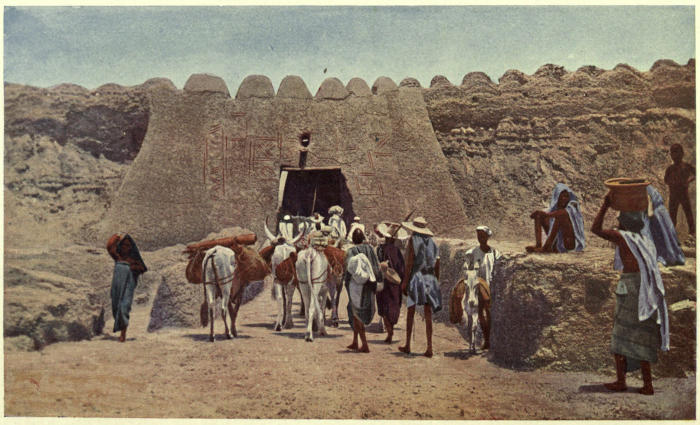
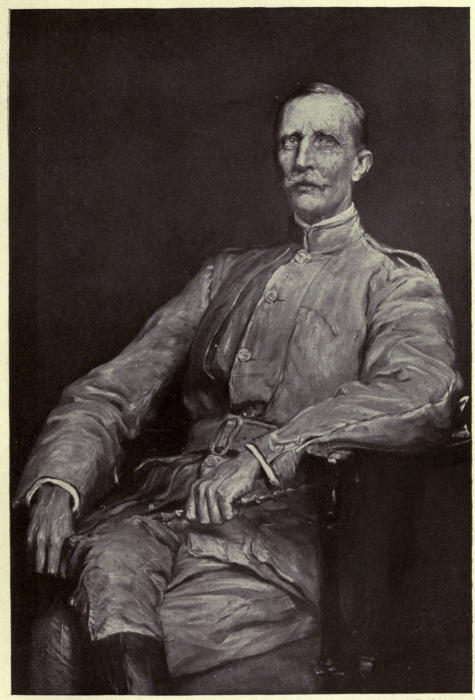
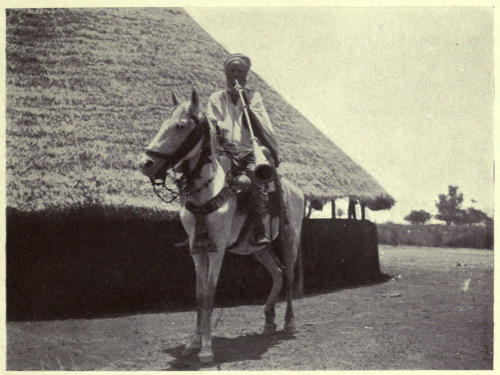
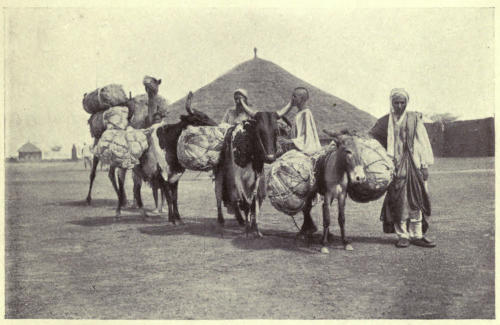
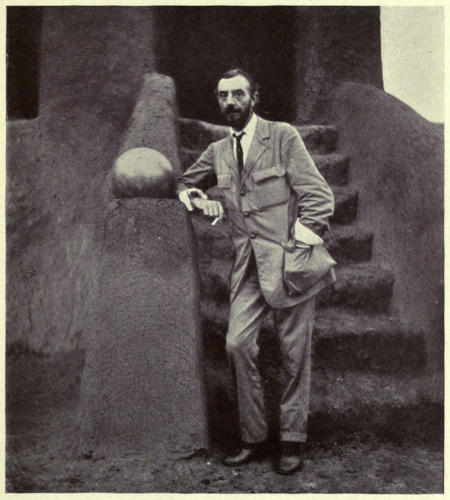
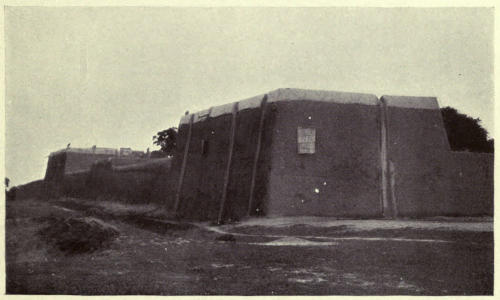
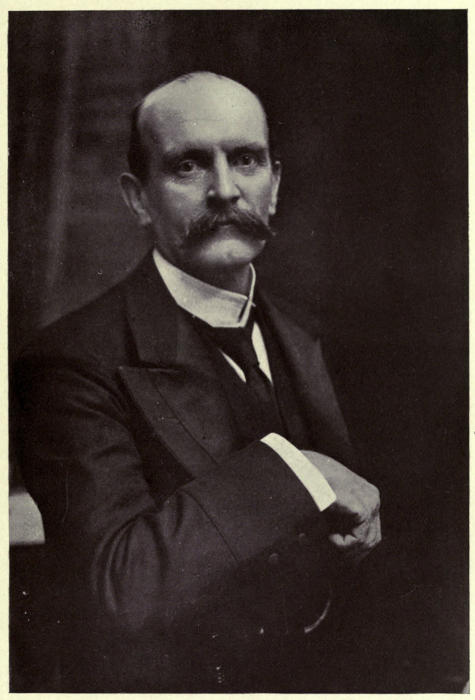
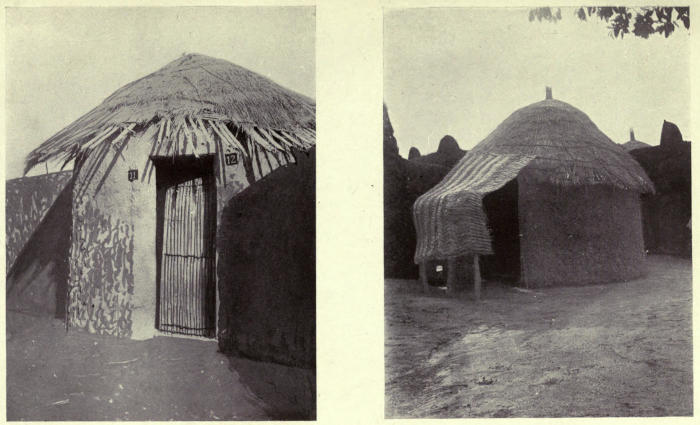
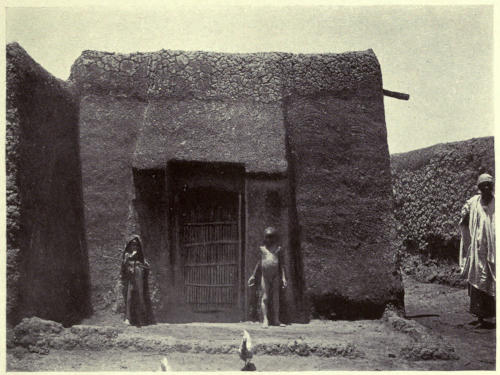
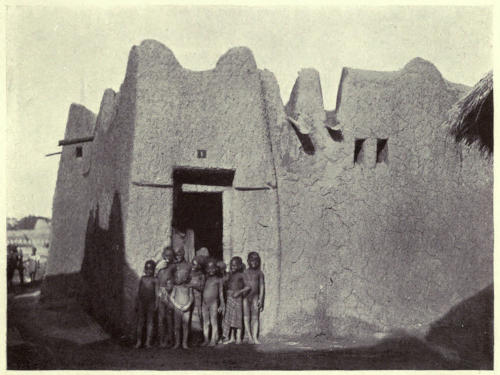
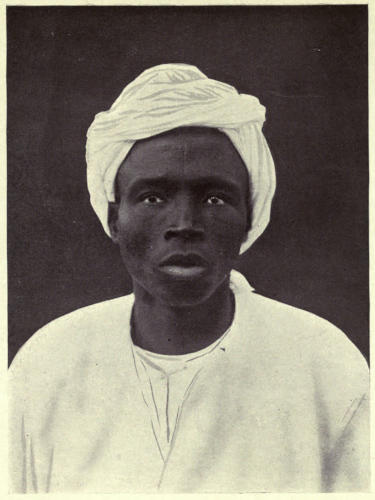
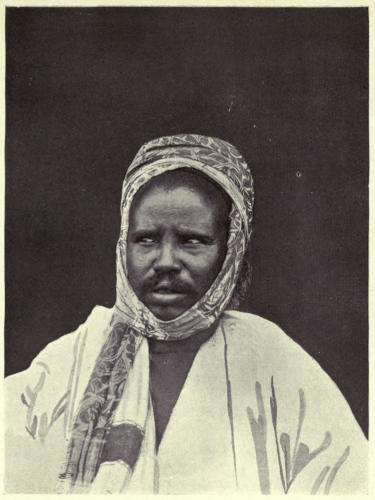
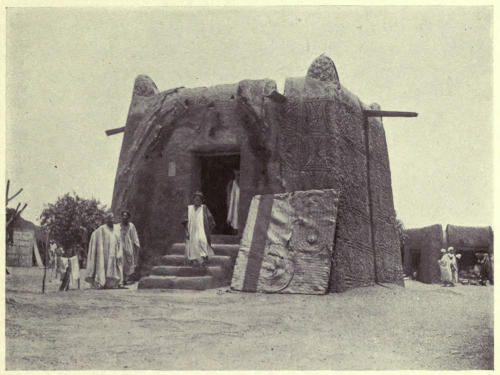
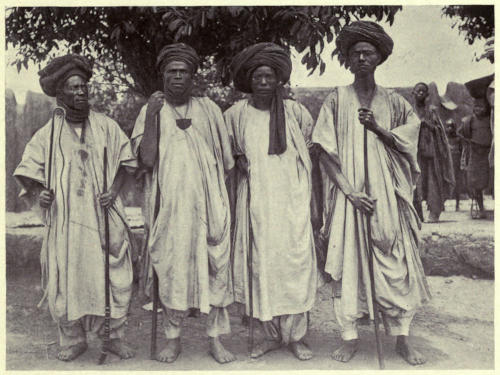
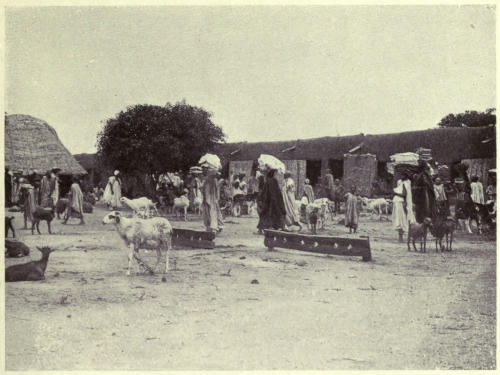
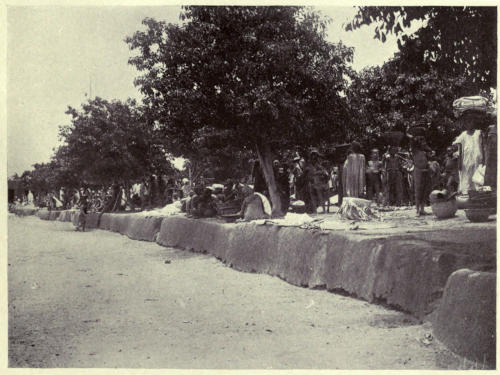
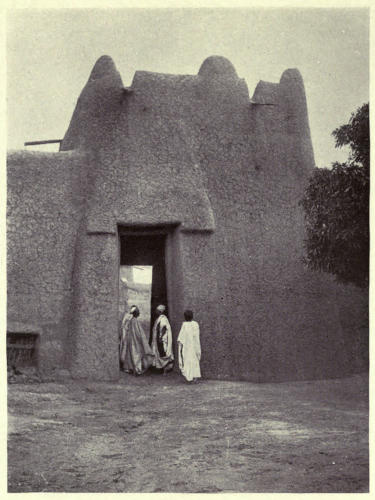
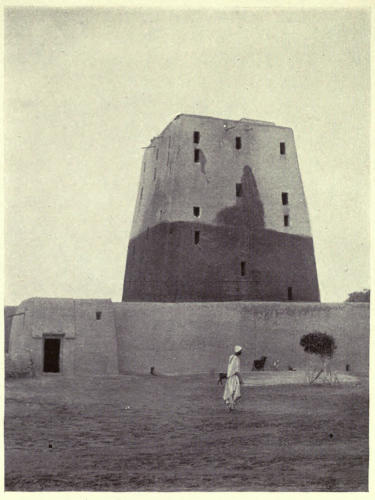
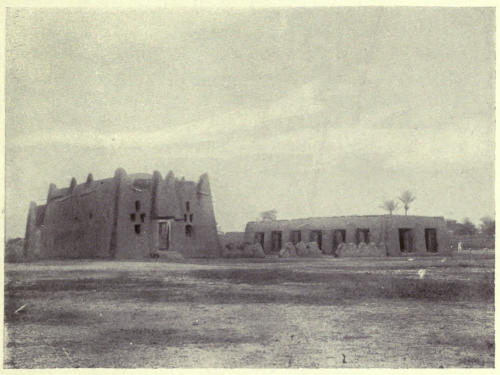
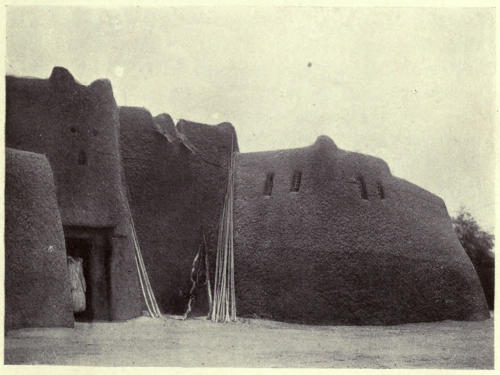
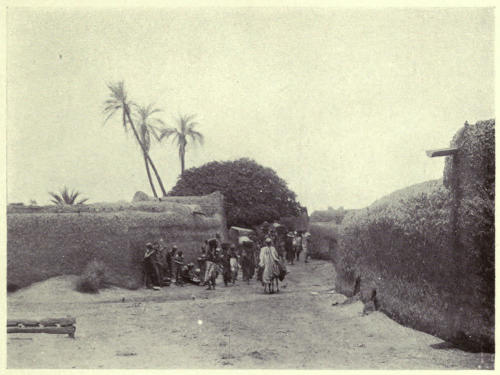
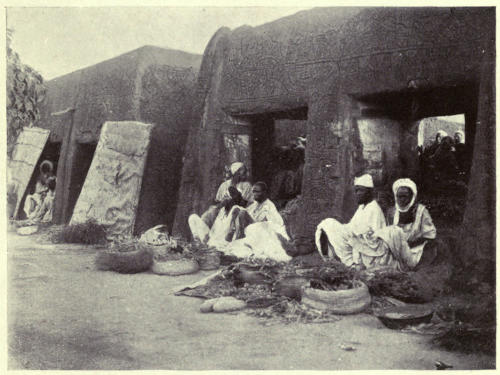
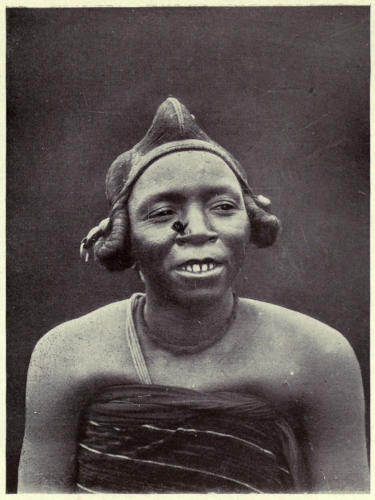
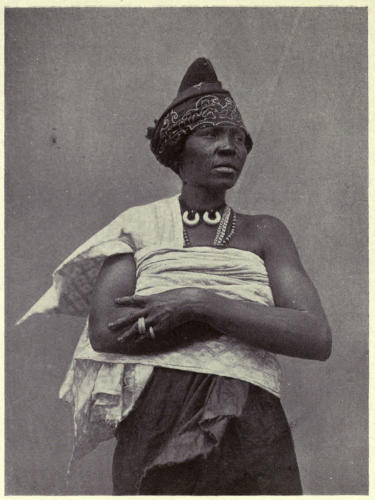
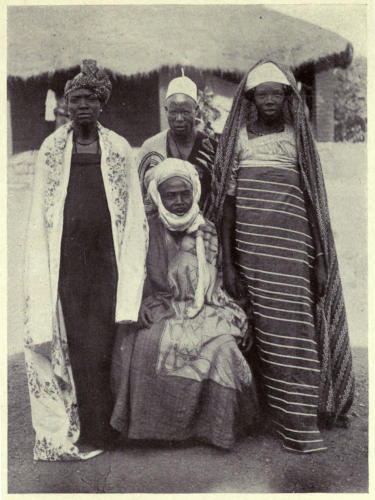
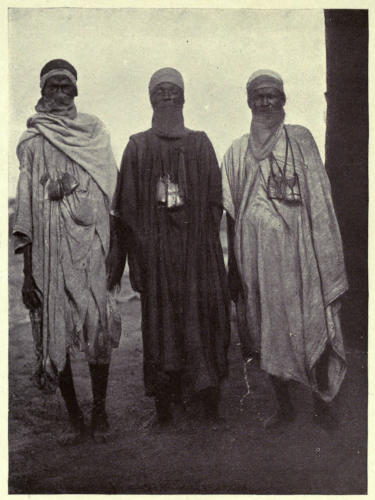
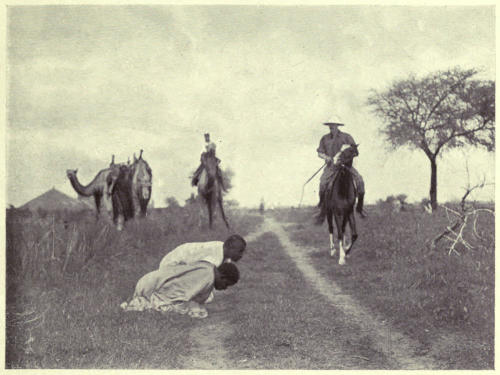
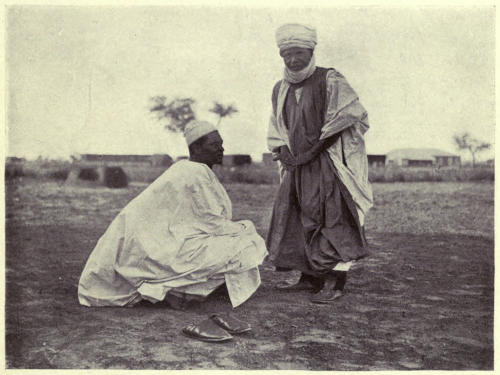
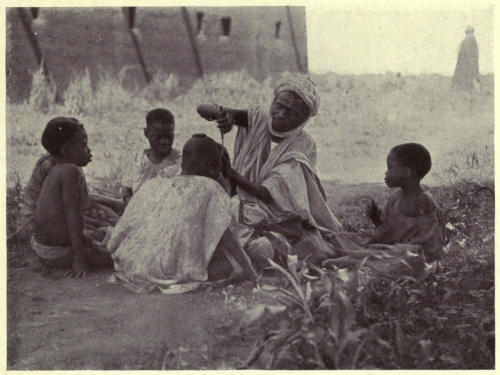
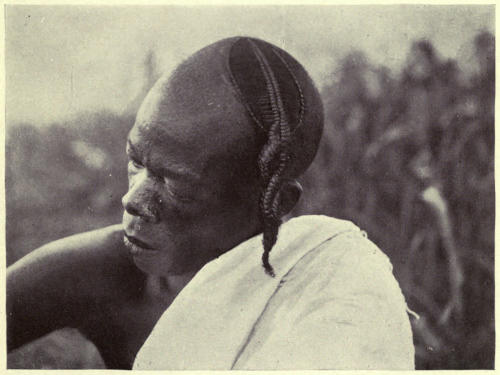
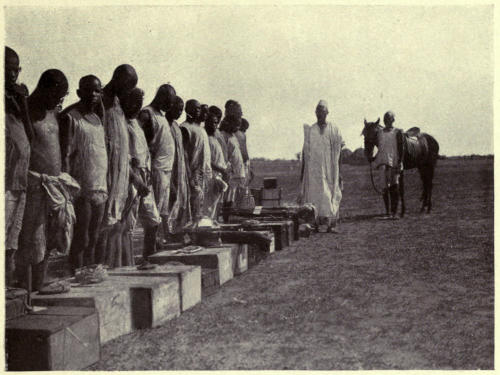
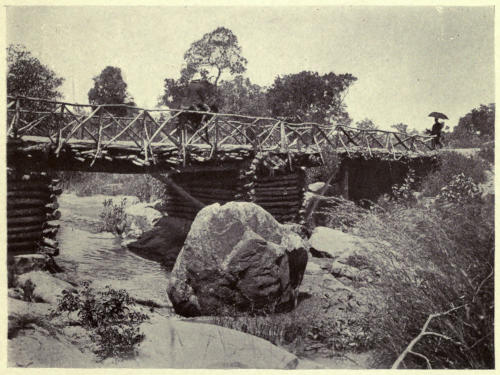
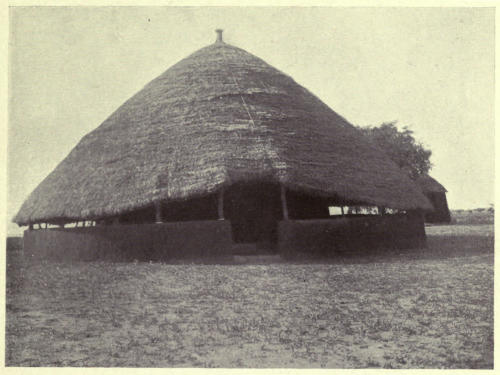
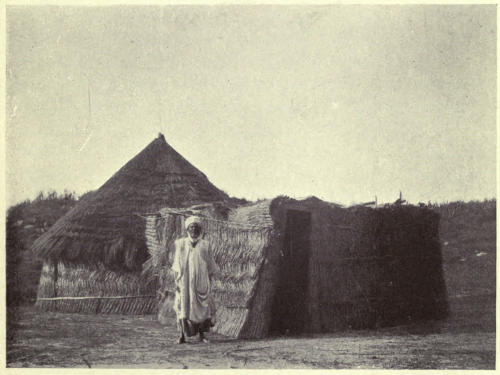
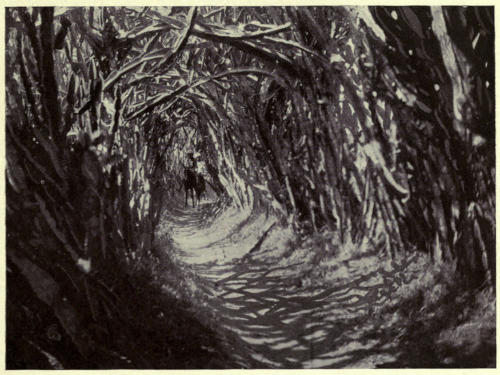
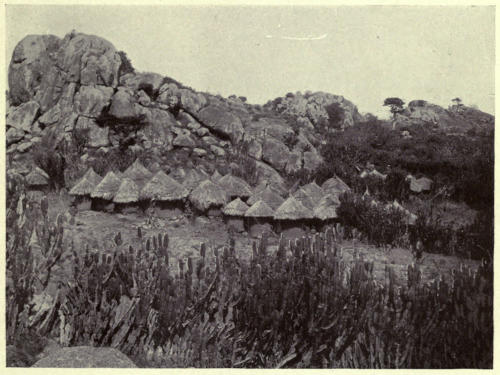
 . The bottom one is whistled
through, fingers placed on the smaller holes regulating
the sound.