THE MOON
Our attention is next engaged by the body which is
our nearest neighbour in space and our most faithful
attendant and useful servant. The moon is an orb
of 2,163 miles in diameter, which revolves round
our earth in a slightly elliptical orbit, at a mean
distance of about 240,000 miles. The face which
she turns to us is a trifle greater in area than the
Russian Empire, while her total surface is almost
exactly equal to the areas of North and South
America, islands excluded. Her volume is about
2⁄99
of that of the earth; her materials are, however,
much less dense than those of which our world is
composed, so that it would take about eighty-one
moons to balance the earth. One result of these
relations is that the force of gravity at the lunar surface
is only about one-sixth of that at the surface of
the earth, so that a twelve-stone man, if transported
to the moon, would weigh only two stone, and would
be capable of gigantic feats in the way of leaping
and lifting weights. The fact of the diminished
force of gravity is of importance in the consideration
of the question of lunar surfacing.
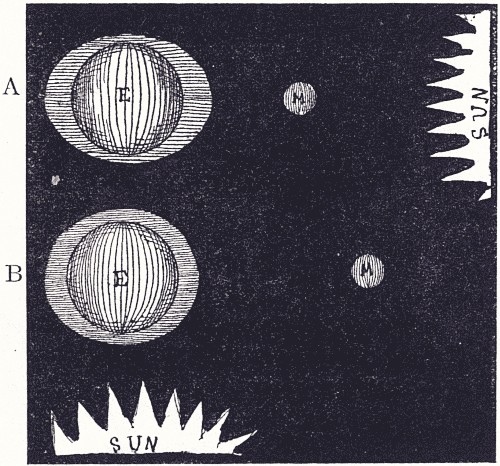
FIG. 21.—THE TIDES.
A, Spring Tide (New Moon); B, Neap Tide.
The most conspicuous service which our satellite
performs for us is that of raising the tides. The
complete statement of the manner in which she does
this would be too long for our pages; but the
general outline of it will be seen from the accompanying
rough diagram (Fig. 21), which, it
must be remembered, makes no attempt at representing
the scale either of the bodies concerned or
of their distances from one another, but simply
pictures their relations to one another at the times
of spring and neap tides. The moon (M in
Fig. 21, A) attracts the whole earth towards it.
Its attraction is greatest at the point nearest to it,
and therefore the water on the moonward side is
drawn up, as it were, into a heap, making high tide
on that side of the earth. But there is also high
tide at the opposite side, the reason being that the
solid body of the earth, which is nearer to the moon
than the water on the further side, is more strongly
attracted, and so leaves the water behind it. Thus
there are high tides at the two opposite sides of the
earth which lie in a straight line with the moon, and
corresponding low tides at the intermediate positions.
Tides are also produced by the attraction of the sun,
but his vastly greater distance causes his tide-producing
power to be much less than that of the moon.
His influence is seen in the difference between spring
and neap tides. Spring tides occur at new or full
moon (Fig. 21, A, case of new moon). At these
two periods the sun, moon, and earth, are all in one
straight line, and the pull of the sun is therefore
added to that of the moon to produce a spring tide.
At the first and third quarters the sun and moon are
at right angles to one another; their respective pulls
therefore, to some extent, neutralize each other, and
in consequence we have neap tide at these seasons.
PLATE XI.
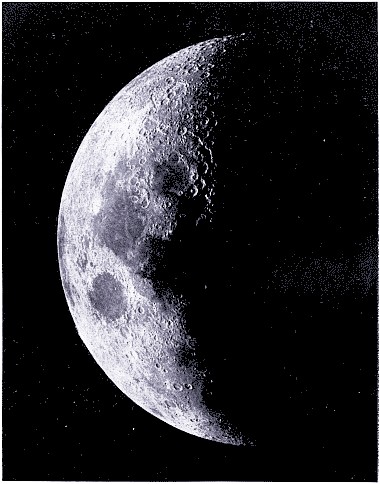
The Moon, April 5, 1900. Paris Observatory.
No one can fail to notice the beautiful set of
phases through which the moon passes every
month. A little after the almanac has announced
'new moon,' she begins to appear as a thin crescent
low down in the West, and setting shortly after the
sun. Night by night we can watch her moving
eastward among the stars, and showing more and
more of her illuminated surface, until at first quarter
half of her disc is bright. The reader must distinguish
this real eastward movement from the
apparent east to west movement due to the daily
rotation of the earth. Its reality can readily be
seen by noting the position of the moon relatively
to any bright star. It will be observed that if she
is a little west of the star on one night, she will
have moved to a position a little east of it by the
next. Still moving farther East, she reaches full,
and is opposite to the sun, rising when he sets, and
setting when he rises. After full, her light begins
to wane, till at third quarter the opposite half of her
disc is bright, and she is seen high in the heavens in
the early morning, a pale ghost of her evening
glories. Gradually she draws nearer to the sun,
thinning down to the crescent shape again until she
is lost once more in his radiance, only to re-emerge
and begin again the same cycle of change.
The time which the moon actually takes to complete
her journey round the earth is twenty-seven
days, seven hours, and forty-three minutes; and if
the earth were fixed in space, this period, which is
called the sidereal month, would be the actual time
from new moon to new moon. While the moon has
been making her revolution, however, the earth has
also been moving onwards in its journey round the
sun, so that the moon has a little further to travel in
order to reach the 'new moon' position again, and
the time between two new moons amounts to
twenty-nine days, twelve hours, forty-four minutes.
This period is called a lunar month, and is also the
synodic period of our satellite, a term which signifies
generally the period occupied by any planet or
satellite in getting back to the same position with
respect to the sun, as observed from the earth.
The fact that the moon shows phases signifies
that she shines only by reflected light; and it is
surprising to notice how little of the light that falls
upon her is really reflected by her. On an ordinarily
clear night most people would probably say that the
moon is much brighter than any terrestrial object
viewed in the daytime, when it also is lit by the sun,
as the moon is. Yet a very simple comparison will
show that this is not so. If the moon be compared
during the daytime with the clouds floating around
her, she will be seen to be certainly not brighter
than they, generally much less bright; indeed, even
an ordinary surface of sandstone will look as bright
as her disc. In fact, the reason of her great apparent
brightness at night is merely the contrast
between her and the dark background against which
she is seen; a fragment of our own world, put in
her place, would shine quite as brightly, perhaps
even more so. It is possibly rather difficult at first
to realize that our earth is shining to the moon and
to the other planets as they do to us, but anyone
who watches the moon for a few days after new will
find convincing evidence of the fact. Within the
arms of the thin crescent can be seen the whole
body of the lunar globe, shining with a dingy
coppery kind of light—'the ashen light,' as it is
called. People talk of this as 'the old moon in the
young moon's arms,' and weather-wise (or foolish)
individuals pronounce it to be a sign of bad weather.
It is, of course, nothing of the sort, for it can be seen
every month when the sky is reasonably clear; but
it is the sign that our world shines to the other
worlds of space as they do to her; for this dim light
upon the part of the moon unlit by the sun is simply
the light which our own world reflects from her
surface to the moon. In amount it is thirteen times
more than that which the moon gives to us, as the
earth presents to her satellite a disc thirteen times
as large as that exhibited by the latter.
The moon's function in causing eclipses of the
sun has already been briefly alluded to. In turn
she is herself eclipsed, by passing behind the earth
and into the long cone of shadow which our world
casts behind it into space (Fig. 19). It is obvious
that such eclipses can only happen when the moon
is full. A total eclipse of the moon, though by no
means so important as a solar eclipse, is yet a very
interesting and beautiful sight. The faint shadow
or penumbra is often scarcely perceptible as the
moon passes through it; but the passage of the
dark umbra over the various lunar formations can
be readily traced, and is most impressive. Cases of
'black eclipses' have been sometimes recorded, in
which the moon at totality has seemed actually to
disappear as though blotted out of the heavens;
but in general this is not the case. The lunar disc
still remains visible, shining with a dull coppery
light, something like the ashen light, but of a redder
tone. This is due to the fact that our earth is not,
like its satellite, a next to airless globe, but is possessed
of a pretty extensive atmosphere. By this
atmosphere those rays of the sun which would otherwise
have just passed the edge of the world are
caught and refracted so that they are directed upon
the face of the eclipsed moon, lighting it up feebly.
The redness of the light is due to that same atmospheric
absorption of the green and blue rays which
causes the body of the setting sun to seem red when
viewed through the dense layer of vapours near the
horizon. When the moon appears totally eclipsed
to us, the sun must appear totally eclipsed to an
observer stationed on the moon. A total solar
eclipse seen from the moon must present features
of interest differing to some extent from those which
the similar phenomenon exhibits to us. The duration
of totality will be much longer, and, in addition
to the usual display of prominences and corona,
there will be the strange and weird effect of the
black globe of our world becoming gradually
bordered with a rim of ruddy light as our atmosphere
catches and bends the solar rays inwards
upon the lunar surface.
In nine cases out of ten the moon will be the
first object to which the beginner turns his telescope,
and he will find in our satellite a never-failing source
of interest, and a sphere in which, by patient observation
and the practice of steadily recording what is
seen, he may not only amuse and instruct himself,
but actually do work that may become genuinely
useful in the furtherance of the science. The possession
of powerful instrumental means is not an
absolute essential here, for the comparative nearness
of the object brings it well within the reach of
moderate glasses. The writer well remembers the
keen feeling of delight with which he first discovered
that a very humble and commonplace telescope—nothing
more, in fact, than a small ordinary spy-glass
with an object-glass of about 1 inch in aperture—was
able to reveal many of the more prominent
features of lunar scenery; and the possessor of any
telescope, no matter whether its powers be great or
small, may be assured that there is enough work
awaiting him on the moon to occupy the spare time
of many years with one of the most enthralling of
studies. The view that is given by even the
smallest instrument is one of infinite variety and
beauty; and its interest is accentuated by the fact
that the moon is a sphere where practically every
detail is new and strange.
If the moon be crescent, or near one or other of
her quarters at the time of observation, the eye will
at once be caught by a multitude of circular, or
nearly circular depressions, more clearly marked the
nearer they are to the line of division between the
illuminated and unilluminated portions of the disc.
(This line is known as the Terminator, the circular
outline, fully illuminated, being called the Limb).
The margins of some of these depressions will be
seen actually to project like rings of light into the
darkness, while their interiors are filled with black
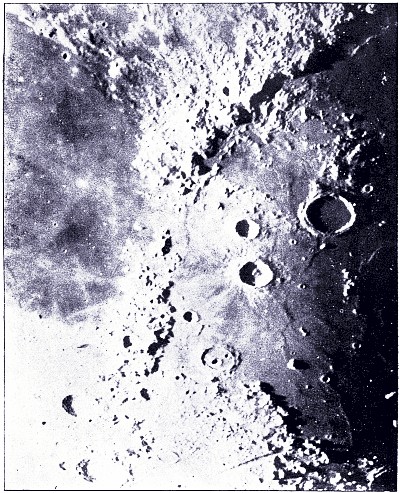
shadow (Plates XI., XIII., XV., and XVI.). At
one or two points long bright ridges will be seen,
extending for many miles across the surface, and
marking the line of one or other of the prominent
ranges of lunar mountains (Plates XI., XIII., XVI.,
XVII.); while the whole disc is mottled over with
patches of varied colour, ranging from dark grey up
to a brilliant yellow which, in some instances, nearly
approaches to white.
If observation be conducted at or near the full,
the conditions will be found to have entirely
changed. There are now very few ruggednesses
visible on the edge of the disc, which now presents
an almost smooth circular outline, nor are there any
shadows traceable on the surface. The circular depressions,
formerly so conspicuous, have now almost
entirely vanished, though the positions and outlines
of a few of them may still be traced by their contrast
in colour with the surrounding regions. The
observer's attention is now claimed by the extraordinary
brilliance and variety of the tones which
diversify the sphere, and particularly by the curious
systems of bright streaks radiating from certain well-marked
centres, one of which, the system originating
near Tycho, a prominent crater not very far from
the South Pole, is so conspicuous as to give the full
moon very much the appearance of a badly-peeled
orange (Plate XII.).
PLATE XII.
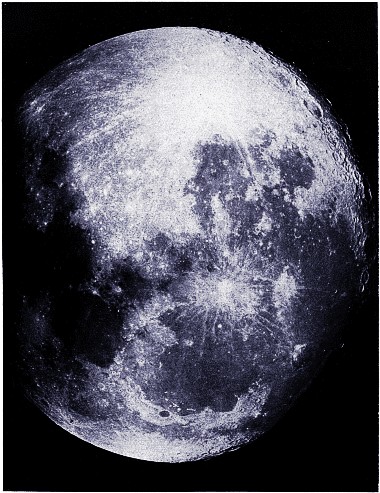
The Moon, November 13, 1902. Paris Observatory.
As soon as the moon has passed the full, the
ruggedness of its margin begins once more to
become apparent, but this time on the opposite
side; and the observer, if he have the patience to
work late at night or early in the morning, has the
opportunity of seeing again all the features which
he saw on the waxing moon, but this time with the
shadows thrown the reverse way—under evening
instead of under morning illumination. In fact the
character of any formation cannot be truly appreciated
until it has been carefully studied under
the setting as well as under the rising and meridian
sun.
We must now turn our attention to the various
types of formation which are to be found upon the
moon. These may be roughly summarized as
follows: (1) The great grey plains, commonly
known as Maria, or seas; (2) the circular or approximately
circular formations, known generally as
the lunar craters, but divided by astronomers into a
number of classes to which reference will be made
later; (3) the mountain ranges, corresponding with
more or less closeness to similar features on our own
globe; (4) the clefts or rills; (5) the systems of
bright rays, to which allusion has already been
made.
1. The Great Grey Plains.—These are, of
course, the most conspicuous features of the lunar
surface. A number of them can be easily seen with
the naked eye; and, so viewed, they unite with the
brighter portions to form that resemblance to a
human face—'the man in the moon'—with which
everyone is familiar. A field-glass or small telescope
brings out their boundaries with distinctness,
and suggests a likeness to our own terrestrial oceans
and seas. Hence the name Maria, which was applied
to them by the earlier astronomers, whose
telescopes were not of sufficient power to reveal
more than their broader outlines. But a comparatively
small aperture is sufficient to dispel the
idea that these plains have any right to the title of
'seas.' The smoothness which at first suggests
water proves to be only relative. They are smooth
compared with the brighter regions of the moon,
which are rugged beyond all terrestrial precedent;
but they would probably be considered no smoother
than the average of our own non-mountainous land
surfaces. A 2 or 2½-inch telescope will reveal the
fact that they are dotted over with numerous irregularities,
some of them very considerable. It is
indeed not common to find a crater of the largest
size associated with them; but, at the same time,
craters which on our earth would be considered
huge are by no means uncommon upon their surface,
and every increase of telescopic power reveals a
corresponding increase in the number of these
objects (Plates XIII., XV., XVII.).
PLATE XIII.
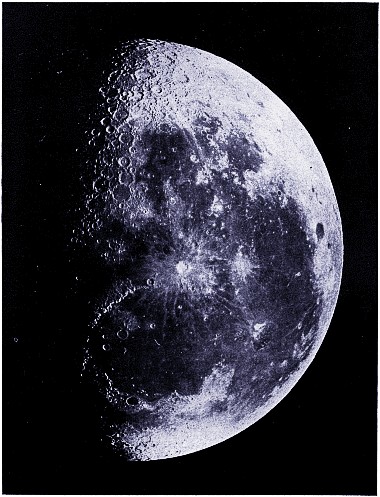
The Moon, September 12, 1903. Paris Observatory.
Further, the grey plains are characterized by
features of which instances may be seen with a very
small instrument, though the more delicate specimens
require considerable power—namely, the long
winding ridges which either run concentrically with
the margins of the plains, or cross their surface from
side to side. Of these the most notable is the great
serpentine ridge which traverses the Mare Serenitatis
in the north-west quadrant of the moon. As
it runs, approximately, in a north and south
direction, it is well placed for observation, and
even a low power will bring out a good deal of
remarkable detail in connection with it. It rises in
some places to a height of 700 or 800 feet (Neison),
and is well shown on many of the fine lunar photographs
now so common. Another point of interest
in connection with the Maria is the existence on
their borders of a number of large crater formations
which present the appearance of having had
their walls breached and ruined on the side next
the mare by the action of some obscure agency.
From consideration of these ruined craters, and of
the 'ghost craters,' not uncommon on the plains,
which present merely a faint outline, as though
almost entirely submerged, it has been suggested,
by Elger and others, that the Maria, as we see them
represent, not the beds of ancient seas, but the consolidated
crust of some fluid or viscous substance
such as lava, which has welled forth from vents
connected with the interior of the moon, overflowing
many of the smaller formations, and partially
destroying the walls of these larger craters. Notable
instances of these half-ruined formations will be found
in Fracastorius (Plate XIX., No. 78, and Plate XI.),
and Pitatus (Plate XIX., No. 63, and Plate XV.).
The grey plains vary in size from the vast Oceanus
Procellarum, nearly 2,000,000 square miles in area,
down to the Mare Humboldtianum, whose area of
42,000 square miles is less than that of England.
2. The Circular, or Approximately Circular
Formations.—These, the great distinguishing
feature of lunar scenery, have been classified according
to the characteristics, more or less marked, which
distinguish them from one another, as walled-plains,
mountain-rings, ring-plains, craters, crater-cones,
craterlets, crater-pits, and depressions. For general
purposes we may content ourselves with the single
title craters, using the more specific titles in outstanding
instances.
PLATE XIV.
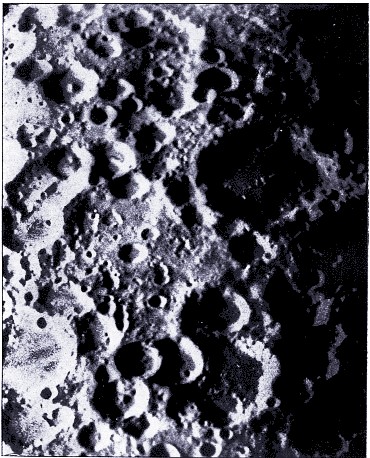
Region of Maginus: Overlapping Craters. Paris Observatory.
To these strange formations we have scarcely the
faintest analogy on earth. Their multitude will at
once strike even the most casual observer. Galileo
compared them to the 'eyes' in a peacock's tail, and
the comparison is not inapt, especially when the
moon is viewed with a small telescope and low
powers. In the Southern Hemisphere particularly,
they simply swarm to such an extent that the district
near the terminator presents much the appearance of
a honeycomb with very irregular cells, or a piece of
very porous pumice (Plate XIV.). Their vast size
is not less remarkable than their number. One of
the most conspicuous, for example, is the great
walled-plain Ptolemäus, which is well-placed for
observation near the centre of the visible hemisphere.
It measures 115 miles from side to side of
its great rampart, which, in at least one peak, towers
more than 9,000 feet above the floor of the plain
within. The area of this enormous enclosure is
about equal to the combined areas of Yorkshire,
Lancashire, and Westmorland—an extent so vast
that an observer stationed at its centre would see
no trace of the mountain-wall which bounds it, save
at one point towards the West, where the upper
part of the great 9,000-feet peak already referred to
would break the line of the horizon (Plate XIX.,
No. 111; Plate XIII.).
Nor is Ptolemäus by any means the largest of
these objects. Clavius, lying towards the South
Pole, measures no less than 142 miles from wall to
wall, and includes within its tremendous rampart an
area of at least 16,000 square miles. The great
wall which encloses this space, itself no mean range
of mountains, stands some 12,000 feet above the
surface of the plain within, while in one peak it rises
to a height of 17,000 feet. Clavius is remarkable
also for the number of smaller craters associated
with it. There are two conspicuous ones, one on
the north, one on the south side of its wall, each
about twenty-five miles in diameter, while the floor
is broken by a chain of four large craters and a
considerable number of smaller ones.
Though unfavourably placed for observation, there
is no lunar feature which can compare in grandeur
with Clavius when viewed either at sunrise or sunset.
At sunrise the great plain appears first as a
huge bay of black shadow, so large as distinctly to
blunt the southern horn of the moon to the naked
eye. As the sun climbs higher, a few bright points
appear within this bay of darkness—the summits of
the walls of the larger craters—these bright islands
gradually forming fine rings of light in the shadow
which still covers the floor of the great plain. In
the East some star-like points mark where the peaks
of the eastern wall are beginning to catch the dawn.
Then delicate streaks of light begin to stream across
the floor, and the dark mass of shadow divides itself
into long pointed shafts, which stretch across the
plain like the spires of some great cathedral. The
whole spectacle is so magnificent and strange that
no words can do justice to it; and once seen it will
not readily be forgotten. Even a small telescope
will enable the student to detect and draw the more
important features of this great formation; and for
those whose instruments are more powerful there is
practically no limit to the work that may be done on
Clavius, which has never been studied with the
minuteness that so great and interesting an object
deserves. (Clavius is No. 13, Plate XIX. See
also Plates XIII. and XV., and Fig. 22, the latter
a rough sketch with a 2⅝-inch refractor.)
From such gigantic forms as these, the craters
range downwards in an unbroken sequence through
striking objects such as Tycho and the grand
Copernicus, both distinguished for their systems of
bright rays, as well as for their massive and regular
ramparts, to tiny pits of black shadow, a few hundred
feet across, and with no visible walls, which tax the
powers of the very finest instruments. Schmidt's
great map lays down nearly 33,000 craters, and it is
quite certain that these are not nearly all which can
be seen even with a moderate-sized telescope.
PLATE XV.
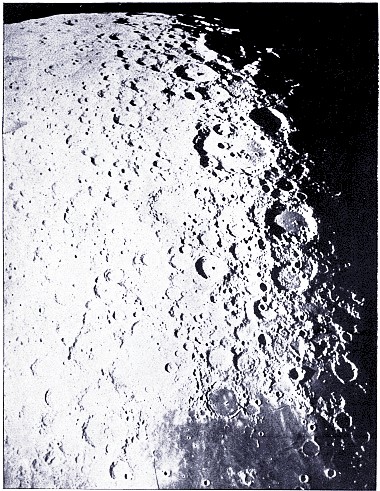
Clavius, Tycho, and Mare Nubium. Yerkes Observatory.
As to the cause which has resulted in this multitude
of circular forms, there is no definite consensus
of opinion. Volcanic action is the agency generally
invoked; but, even allowing for the diminished force
of gravity upon the moon, it is difficult to conceive
of volcanic action of such intensity as to have produced
some of the great walled-plains. Indeed,
Neison remarks that such formations are much more
akin to the smaller Maria, and bear but little resemblance
to true products of volcanic action. But it
seems difficult to tell where a division is to be made,
with any pretence to accuracy, between such forms
as might certainly be thus produced and those next
above them in size. The various classes of formation
shade one into the other by almost imperceptible
degrees.
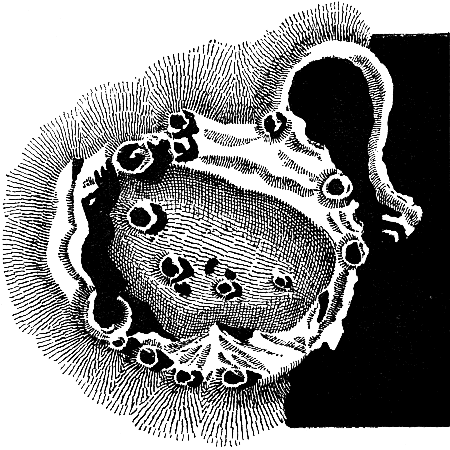
FIG. 22.
Clavius, June 7, 1889, 10 p.m., 2⅝ inch.
3. The Mountain Ranges.—These are comparatively
few in number, and are never of such
magnitude as to put them, like the craters, beyond
terrestrial standards of comparison. The most
conspicuous range is that known as the Lunar
Apennines, which runs in a north-west and south-east
direction for a distance of upwards of 400 miles
along the border of the Mare Imbrium, from which
its mass rises in a steep escarpment, towering in one
instance (Mount Huygens) to a height of more
than 18,000 feet. On the western side the range
slopes gradually away in a gentle declivity. The
spectacle presented by the Apennines about first
quarter is one of indescribable grandeur. The
shadows of the great peaks are cast for many miles
over the surface of the Mare Imbrium, magnificently
contrasting with the wild tract of hill-country behind,
in which rugged summits and winding valleys are
mingled in a scene of confusion which baffles all
attempt at delineation. Two other important ranges—the
Caucasus and the Alps—lie in close proximity
to the Apennines; the latter of the two notable for
the curious Alpine Valley which runs through it in a
straight line for upwards of eighty miles. This
wonderful chasm varies in breadth from about two
miles, at its narrowest neck, to about six at its
widest point. It is closely bordered, for a considerable
portion of its length, by almost vertical cliffs
thousands of feet in height, and under low magnifying
powers appears so regular as to suggest nothing
so much as the mark of a gigantic chisel, driven by
main force through the midst of the mountain mass.
The Alpine Valley is an easy object, and a power of
50 on a 2-inch telescope will show its main outlines
quite clearly. Indeed, the whole neighbourhood is
one which will well repay the student, some of the
finest of the lunar craters, such as Plato, Archimedes,
Autolycus, and Aristillus, lying in the immediate
vicinity (Plates XIII. and XVII.).
PLATE XVI.
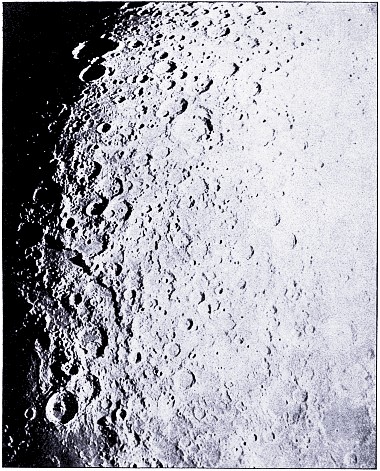
Region of Theophilus and Altai Mountains. Yerkes Observatory.
Among the other mountain-ranges may be
mentioned the Altai Mountains, in the south-west
quadrant (Plate XVI.), the Carpathians, close to
the great crater Copernicus, and the beautiful semicircle
of hills which borders the Sinus Iridum, or
Bay of Rainbows, to the east of the Alpine range.
This bay forms one of the loveliest of lunar landscapes,
and under certain conditions of illumination
its eastern cape, the Heraclides Promontory, presents
a curious resemblance, which I have only seen once
or twice, to the head of a girl with long floating hair—'the
moon-maiden.' The Leibnitz and Doerfel
Mountains, with other ranges whose summits appear
on the edge of the moon, are seldom to be seen to great
advantage, though they are sometimes very noticeably
projected upon the bright disc of the sun during
the progress of an eclipse.* They embrace some
of the loftiest lunar peaks reaching 26,000 feet in one of
or two instances, according to Schröter and Mädler.
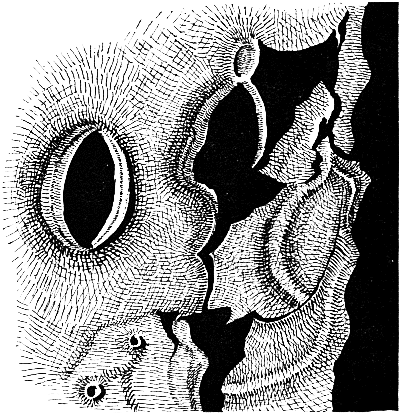
FIG. 23.
Aristarchus and Herodotus, February 20, 1891, 6.15 p.m., 3⅞
inch.
4. The Clefts or Rills.—In these, and in the
ray-systems, we again meet with features to which
a terrestrial parallel is absolutely lacking. Schröter
of Lilienthal was the first observer to detect the
existence of these strange chasms, and since his
time the number known has been constantly increasing,
till at present it runs to upwards of a
thousand. These objects range from comparatively
coarse features, such as the Herodotus Valley
(Fig. 23), and the well-known Ariadæus and
Hyginus clefts, down to the most delicate threads,
only to be seen under very favourable conditions,
and taxing the powers of the finest instruments.
They present all the appearance of cracks in a
shrinking surface, and this is the explanation of
their existence which at present seems to find most
favour. In some cases, such as that of the great
Sirsalis cleft, they extend to a length of 300 miles;
their breadth varies from half a mile, or less, to two
miles; their depth is very variously estimated,
Nasmyth putting it at ten miles, while Elger only
allows 100 to 400 yards. In a number of instances
they appear either to originate from a small crater,
or to pass through one or more craters in their
course. The student will quickly find out for himself
that they frequently affect the neighbourhood
of one or other of the mountain ranges (as, for
example, under the eastern face of the Apennines,
Plate XVII.), or of some great crater, such as
Archimedes. They are also frequently found
traversing the floor of a great walled-plain, and at
least forty have been detected in the interior of
Gassendi (Plate XIX., No. 90). Smaller instruments
are, of course, incompetent to reveal more
than a few of the larger and coarser of these strange
features. The Serpentine Valley of Herodotus, the
cleft crossing the floor of Petavius, and the Ariadæus
and Hyginus rills are among the most conspicuous,
and may all be seen with a 2½-inch telescope and a
power of 100.
PLATE XVII.
Apennines, Alps, and Caucasus. Paris Observatory.
5. The Systems of Bright Rays, radiating from
certain craters, remain the most enigmatic of the
features of lunar scenery. Many of these systems
have been traced and mapped, but we need only
mention the three principal—those connected with
Tycho, Copernicus, and Kepler, all shown on
Plate XII. The Tycho system is by far the most
noteworthy, and at once attracts the eye when
even the smallest telescope is directed towards
the full moon. The rays, which are of great
brilliancy, appear to start, not exactly from the
crater itself, but from a greyish area surrounding it,
and they radiate in all directions over the surface,
passing over, and almost completely masking in
their course some of the largest of the lunar craters.
Clavius, for example, and Maginus (Plate XIV.),
become at full almost unidentifiable from this cause,
though Neison's statement that 'not the slightest
trace of these great walled-plains, with their
extremely lofty and massive walls, can be detected
in full,' is certainly exaggerated. The rays are not
well seen save under a high sun—i.e., at or near full,
though some of them can still be faintly traced under
oblique illumination.
In ordinary telescopes, and to most eyes, the
Tycho rays appear to run on uninterruptedly for
enormous distances, one of them traversing almost
the whole breadth of the moon in a north-westerly
direction, and crossing the Mare Serenitatis, on
whose dark background it is conspicuous. Professor
W. H. Pickering, who has made a special
study of the subject under very favourable conditions,
maintains, however, that this appearance of
great length is an illusion, and that the Tycho rays
proper extend only for a short distance, being
reinforced at intervals by fresh rays issuing from
small craters on their track. The whole subject is
one which requires careful study with the best
optical means.
None of the other ray-systems are at all comparable
with that of Tycho, though those in connection
with Copernicus and Kepler are very striking. As
to the origin and nature of these strange features,
little is known. There are almost as many theories
as there are systems; but it cannot be said that
any particular view has commanded anything like
general acceptance. Nasmyth's well-known theory
was that they represented cracks in the lunar
surface, caused by internal pressure, through which
lava had welled forth and spread to a considerable
distance on either side of the original chasm.
Pickering suggests that they may be caused by
a deposit of white powder, pumice, perhaps, emitted
by the craters from which the rays originate.
Both ideas are ingenious, but both present grave
difficulties, and neither has commended itself to any
very great extent to observers, a remark which
applies to all other attempts at explanation.
Such are the main objects of interest upon the
visible hemisphere of our satellite. In observing
them, the beginner will do well, after the inevitable
preliminary debauch of moon-gazing, during which
he may be permitted to range over the whole surface
and observe anything and everything, not to attempt
an attack on too wide a field. Let him rather confine
his energies to the detailed study of one or two
particular formations, and to the delineation of all
their features within reach of his instrument under
all aspects and illuminations. By so doing he will
learn more of the actual condition of the lunar
surface than by any amount of general and
haphazard observation; and may, indeed, render
valuable service to the study of the moon.
Neither let him think that observations made with
a small telescope are now of no account, in view of
the number of large instruments employed, and of
the great photographic atlases which are at present
being constructed. It has to be remembered that
the famous map of Beer and Mädler was the result
of observations made with a 3¾-inch telescope, and
that Lohrmann used an instrument of only 4⅘ inches,
and sometimes one of 3¼. Anyone who has seen
the maps of these observers will not fail to have a
profound respect for the work that can be done with
very moderate means. Nor have even the beautiful
photographs of the Paris, Lick, and Yerkes
Observatories superseded as yet the work of the
human eye and hand. The best of the Yerkes
photographs, taken with a 40-inch refractor, are said
to show detail 'sufficiently minute to tax the powers
of a 6-inch telescope.' But this can be said only of
a very few photographs; and, generally speaking,
a good 3-inch glass will show more detail than
can be seen on any but a few exceptionally good
negatives.
In conducting his observations, the student should
be careful to outline his drawing on such a scale as
will permit of the easy inclusion of all the details
which he can see, otherwise the sketch will speedily
become so crowded as to be indistinct and valueless.
A scale of 1 inch to about 20 miles, corresponding
roughly to 100 inches to the moon's diameter,
will be found none too large in the case of formations
where much detail has to be inserted—that is
to say, in the case of the vast majority of lunar
objects. Further, only such a moderate amount of
surface should be selected for representation as can
be carefully and accurately sketched in a period of
not much over an hour at most; for, though the
lunar day is so much longer than our own, yet the
changes in aspect of the various formations due to
the increasing or diminishing height of the sun
become very apparent if observation be prolonged
unduly; and thus different portions of the sketch
represent different angles of illumination, and the
finished drawing, though true in each separate detail,
will be untrue as a whole.
Above all, care must be taken to set down only
what is seen with certainty, and nothing more. The
drawing may be good or bad, but it must be true.
A coarse or clumsy sketch which is truthful to the
facts seen is worth fifty beautiful works of art where
the artist has employed imagination or recollection
to eke out the meagre results of observation. The
astronomer's primary object is to record facts, not
to make pictures. If he is skilful in recording
what he sees, his sketch will be so much the more
truthful; but the facts must come first. Such
practical falsehoods as the insertion of uncertain
details, or the practice of drawing upon one's recollection
of the work of other observers, or of
altering portions of a sketch which do not please
the eye, are to be studiously avoided. The
observer's record of what he has seen should be
above suspicion. It may be imperfect; it should
never be false. Such cautions may seem superfluous,
but a small acquaintance with the subject of astronomical
drawing will show that they are not.
The want of a good lunar chart will speedily
make itself felt. Fortunately in these days it can
be easily supplied. The great photographic atlases
now appearing are, of course, for the luxurious; and
the elaborate maps of Beer and Mädler or Schmidt
are equally out of the question for beginners. The
smaller chart of the former observers is, however,
inexpensive and good, though a little crowded.
For a start there is still nothing much better than
Webb's reduction of Beer and Mädler's large chart,
published in 'Celestial Objects for Common Telescopes.'
It can also be obtained separately; but
requires to be backed before use. Mellor's chart
is also useful, and is published in a handy form,
mounted on mill-board. Those who wish charts
between these and the more elaborate ones will find
their wants met by such books as those of Neison or
Elger. Neison's volume contains a chart in twenty-two
sections on a scale of 2 feet to the moon's
diameter. It includes a great amount of detail, and
is accompanied by an elaborate description of all
the features delineated. Its chief drawbacks are the
fact that it was published thirty years ago, and that
it is an extremely awkward and clumsy volume to
handle, especially in the dim light of an observatory.
Elger's volume is, perhaps, for English students,
the handiest general guide to the moon. Its chart
is on a scale of 18 inches to the moon's diameter,
and is accompanied by a full description. With
either this or Webb's chart, the beginner will find
himself amply provided with material for many a
long and delightful evenings work.
PLATE XVIII.
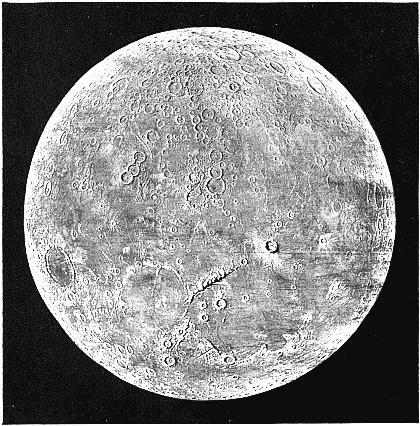
Chart of the Moon. Nasmyth and Carpenter.
PLATE XIX.
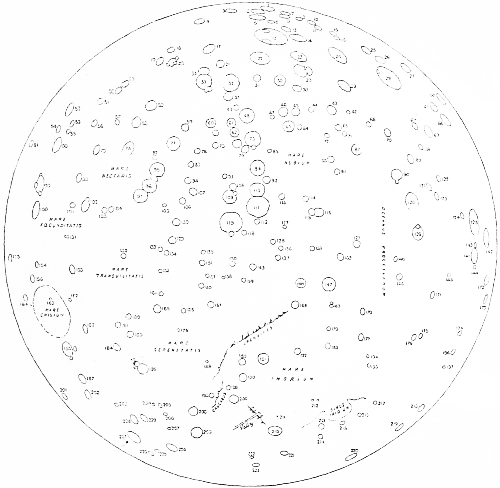
Key to Chart of Moon. Nasmyth and Carpenter.
The small chart which accompanies this chapter,
and which, with its key-map, I owe to the courtesy
of Mr. John Murray, the publisher of Messrs.
Nasmyth and Carpenter's volume on the moon, is
not in any sense meant as a substitute for those
already mentioned, but merely as an introduction
to some of the more prominent features of lunar
scenery. The list of 229 named and numbered
formations will be sufficient to occupy the student
for some time; and the essential particulars with
regard to a few of the more important formations are
added in as brief a form as possible (Appendix I.).
Before we leave our satellite, something must be
said as to the conditions prevailing on her surface.
The early astronomers who devoted attention to
lunar study were drawn on in their labours largely
by the hope of detecting resemblances to our own
earth, or even traces of human habitation. Schröter
and Gruithuisen imagined that they had discovered
not only indications of a lunar atmosphere, but also
evidence of change upon the surface, and traces of
the handiwork of lunarian inhabitants. Gruithuisen,
in particular, was confident that in due time it would
become possible to trace the cities and the works
of the Lunarians. Gradually these hopes have
receded into the distance. The existence of a lunar
atmosphere is, indeed, no longer positively denied
now, as it was a few years ago; but it is certain
that such atmosphere as may exist is of extreme
rarity, quite inadequate to support animal life as we
understand such a thing. Certain delicate changes
of colour which take place within some of the
craters—Plato for instance—have been referred to
vegetation; and Professor Pickering has intimated
his observation of something which he considers to
be the forming and melting of hoar-frost within
certain areas, Messier and a small crater near
Herodotus among others. But the observations at
best are very delicate and the inferences uncertain.
It cannot be denied that the moon may have an
atmosphere; but positive traces of its existence are
so faint that, even if their reality be admitted, very
little can be built upon them.
At the same time when the affirmation is made
that the moon is 'a world where there is no weather,
and where nothing ever happens,' the most careful
modern students of lunar matters would be the first
to question such a statement. Even supposing it
to be true that no concrete evidence of change upon
the lunar surface can be had, this would not
necessarily mean that no change takes place. The
moon has certainly never been studied to advantage
with any power exceeding 1,000, and the average
powers employed have been much less. Nasmyth
puts 300 as about the profitable limit, and 500
would be almost an outside estimate for anything
like regular work. But even assuming the use of
a power of 1,000, that means that the moon is seen
as large as though she were only 240 miles distant
from us. The reader can judge how entirely all
but the very largest features of our world would be
lost to sight at such a distance, and how changes
involving the destruction of large areas might take
place and the observer be none the wiser. When
it is remembered that even at this long range we
are viewing our object through a sea of troubled air
of which every tremor is magnified in proportion to
the telescopic power employed, until the finer details
are necessarily blurred and indistinct, it will be seen
that the case has been understated. Indeed it may
be questioned if the moon has ever been as well
seen as though it had been situated at a distance
of 500 miles from the earth. At such a distance
nothing short of the vastest cataclysms would be
visible; and it is therefore going quite beyond the
mark to assume that nothing ever happens on the
moon simply because we do not see it happening.
Moreover, the balance of evidence does appear to
be inclining, slightly perhaps, but still almost unquestionably,
towards the view that change does
occur upon the moon. Some of the observations
which seem to imply change may be explained on
other grounds; but there is a certain residuum
which appears to defy explanation, and it is very
noteworthy that while those who at once dismiss
the idea of lunar change are, generally speaking,
those who have made no special study of the
moon's surface, the contrary opinion is most strongly
maintained by eminent observers who have devoted
much time to our satellite with the best modern
instruments to aid them in their work.
The admission of the possibility of change does
not, however, imply anything like fitness for human
habitation. The moon, to use Beer and Mädler's
oft-quoted phrase, is 'no copy of the earth'; and
the conditions of her surface differ widely from
anything that we are acquainted with. The extreme
rarity of her atmosphere must render her, were
other conditions equally favourable, an ideal situation
for an observatory. From her surface the stars,
which are hidden from us in the daytime by the
diffused light in our air, would be visible at
broad noonday; while multitudes of the smaller
magnitudes which here require telescopic power
would there be plain to the unaided eye. The
lunar night would be lit by our own earth, a gigantic
moon, presenting a surface more than thirteen times
as large as that which the full moon offers us, and
hanging almost stationary in the heavens, while
exhibiting all the effects of rapid rotation upon its
own axis. Those appendages of the sun, which
only the spectroscope or the fleeting total eclipse
can reveal to us, the corona, the chromosphere, and
the prominences, would there be constantly visible.
Our astronomers who are painfully wrestling with
atmospheric disturbance, and are gradually being
driven from the plains to the summits of higher and
higher hills in search of suitable sites for the giant
telescopes of to-day, may well long for a world
where atmospheric disturbance must be unknown,
or at least a negligible quantity.


 . Finally, the name Urănus ('a' short)
prevailed, and has for long been in universal use.


