The expedition sent out to Patagonia under my charge by Mr. C. Arthur
Pearson owed its origin to the discoveries made in that country by
Dr. F. P. Moreno of certain remains of an animal, the Pampean Mylodon
or Giant Ground Sloth, long believed to belong to the category of extinct
prehistoric mammals. The marvellous state of preservation of the
remains found at Last Hope Inlet seemed to give some ground for
the supposition that the animal might possibly have survived to a
recent period. Professor Ray Lankester, the Director of the British
Museum of Natural History, in commenting upon the chance of the
Mylodon being still alive in some remote and unknown region of Patagonia,
said: "It is quite possible—I don't want to say more than that—that
he still exists in some of the mountainous regions of Patagonia."
These words from such an authority carried weight, and the question
assumed an importance that made it worth all practicable examination.
I have in the following pages put the whole case as clearly and as
definitely as lies in my power.
To begin with, I give the story of Dr. Moreno's discovery as he himself
told it to the Zoological Society, and the description of the remains
by Dr. A. Smith Woodward, LL.D., F.R.S.
In November 1897 I paid a visit to that part of the Patagonian
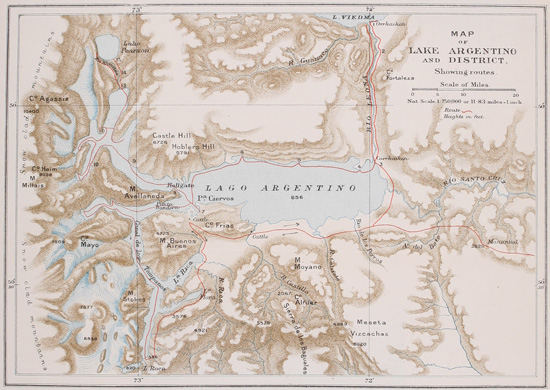
territory which adjoins the Cordillera of the Andes, between the 51st and
52nd degrees of South latitude, where certain surveyors, under my
direction, were carrying out the preliminary studies connected with the
boundary-line between Chile and Argentina; and in the course of this
expedition I reached Consuelo Cove, which lies in Last Hope Inlet. In
that spot, hung up on a tree, I found a piece of a dried skin, which attracted
my attention most strangely, as I could not determine to what class of
Mammalia it could belong, more especially because of the resemblance of
the small incrusted bones it contained to those of the Pampean Mylodon.
On inquiring whence it came, I was informed that it was only a fragment
of a large piece of skin which had been discovered two years before, by
some Argentine officers, in a cavern which existed in the neighbouring
heights. Immediately on receiving this news, I hastened to the spot,
guided by a sailor who had been present when the original discovery had
been made. As, at that moment, I had no means of making more than
a few hurried excavations, which gave no further traces of the discovery,
I left orders that the search should be continued after my departure; but
this once more also failed to give any ultimate results. Nothing could
be found but modern remains of small rodents, and these chiefly on or
near the surface of the ground. From the most careful inquiries which I
set on foot, it appeared that, when the first discovery was made, no bones
were found, the skin being half buried in the dust which had accumulated
from the gradual falling away of the roof of the cavern, composed of
Tertiary Conglomerate. It was only in the broad entrance to the cavern
that were found a few human bones, borne thence to the shore of the
Cove and afterwards broken up.
As already stated, the skin here presented to you formed but a small
part of a larger one. One small piece had been carried off by Dr. Otto
Nordenskjöld, and others by officers of the Chilian Navy, who later on
had visited the spot. The inhabitants of the locality looked upon it as
an interesting curiosity, some of them believing that it was the hide of a
cow incrusted with pebbles, and others asserting that it was the skin of a
large Seal belonging to a hitherto unknown species.
In Consuelo Cove, I embarked on board a small Argentine transport,
which had been placed at my disposal to carry out the study of the
western coast as far as Port Montt, in lat. 42°. At this latter place
I left the steamer, which then proceeded to make a series of surveys.
These lasted until her return to La Plata, at the latter end of July 1898,
when she brought back to me the fragment of skin in question.
This is an accurate and true version of the discovery of this skin,
which gave rise to the publication of Señor Ameghino's small pamphlet,[33]
in which he gave an account of the discovery of a living representative of
the "Gravigrades" of Argentina, distinguishing it by the name of
"Neomylodon listai".
I have an idea that Señor Ameghino never saw the skin itself, but
only some of the small incrusted bones, of which he had obtained possession.
The vague form in which he draws up his account compels me to
believe this suspicion to be true.
My opinion is that this skin belongs to a genuine Pampean Mylodon,
preserved under peculiar circumstances resembling those to which we owe
the skin and feathers of the Moa. I have always maintained that the
Pampean Edentates, now extinct, disappeared only in the epoch which is
called the "historical epoch" of our America. In the province of Buenos
Aires, buried chiefly in the humus, I have found remains of Panochthus,
and others of the same Mylodon from the seashore, all of which present
the same characteristic marks of preservation as the remains of human
beings discovered in the same spot. In this identical layer of the
sea-shore, close to the bones I have also found stones polished by
the hand of man, and flints cut like those found in the Pampean
formation. In 1884, in a cavern near to the Rio de los Patos, in the
Cordillera, I discovered some paintings in red ochre, one of which,
in my opinion, resembles the Glyptodon on account of the shape of the
carapace.
Ancient chroniclers inform us that the indigenous inhabitants recorded
the existence of a strange, ugly, huge hairy animal which had its abode in
the Cordillera to the south of lat. 37°. The Tehuelches and the Gennakens
have mentioned similar animals to me, of whose existence their
ancestors had transmitted the remembrance; and in the neighbourhood
of the Rio Negro, the aged cacique Sinchel, in 1875, pointed out to me
a cave, the supposed lair of one of these monsters, called "Ellengassen";
but I must add that none of the many Indians with whom I have conversed
in Patagonia have ever referred to the actual existence of animals
to which we can attribute the skin in question, nor even of any which
answer to the suppositions of Señor Ameghino according to Señor Lista.
It is but rarely that a few Otters (Lutra) are found in the lakes and
rivers of the Andes, as in the neighbourhood of Lake Argentino, in the
"Sierra de las Viscachas," and in the regions which I believe Señor Lista
visited, there are only a few scarce Chinchillas (Lagidium), which have a
colouring more dark greyish than those found to the north, and are in
every case separated from these by a large extent of country.
The Pampean Edentata have in former days certainly existed as far
south as the extreme limit of Patagonia. In 1874, in the bay of Santa
Cruz, I met with the remains of a pelvis of one of these animals in Pleistocene
deposits, and also remains of the mammals which are found in the
same formation, such as the Macrauchenia and Auchenia. It would not
be astonishing that the skin of one of these should have been preserved
so long, because of the favourable conditions of the spot in which it was
found.
The state of preservation of this piece of skin, at first sight, makes it
difficult for one to believe it to be of great antiquity; but this is by
no means an impossibility, if we consider the conditions of the cave in
which it was found, the atmosphere of which is not so damp as one might
at first imagine it to be, although it is situated in the woody regions near
to the glaciers and lakes. It is well to mention that in 1877, under
similar conditions, and in a much smaller cave, scarcely five metres from
the waters of Lake Argentino, situated sixty miles more to the north, I
discovered a mummified human body painted red, with the head still
covered in part with its short hair wonderfully preserved, and wrapped up
in a covering made of the skin of a Rhea, and holding in its arms a
large feather of the Condor, also painted red; this was all covered up
with a layer of grass and dust fallen from the roof of the cave. In
another cave in the neighbourhood I discovered a large trunk of a tree,
painted with figures in red, black, and yellow. The sides of the rock
close to the entrance of the cave were covered with figures, some representing
the human hand, others combinations of curved, straight, and
circular lines, painted white, red, yellow, and green. Now, this mummy,
which is preserved in the Museum of La Plata, does not belong to any of
the actual tribes of Patagonia. Its skull resembles rather one of those
more ancient races found in the cemeteries in the valley of the Rio Negro—a
most interesting fact, since they belong to types which have completely
disappeared from the Patagonian regions, and it is well known
that the actual Tehuelches may be considered to have been the last
indigenous races which reached the territory of Patagonia. Many a time
the Tehuelches have spoken to me of these caves as abodes of the evil
"spirits," and of the enigmatical painted figures they contained: some
attributed the latter to these same "spirits," others to men of other races,
of whom they have no recollection. In another cave, four hundred miles
farther to the north, in 1880, I discovered other human bodies, more or
less mummified and in good preservation, but of a different type, and
beside them some painted poles which served to hold up their small
tents, the use of which had already disappeared more than three centuries
ago; together with the upper part of the skull of a child perfectly
scooped out like a cup. And yet the historical Tehuelches, the same as
all the indigenous races in the southern extremity of South America, hold
their dead in great respect, and never use such drinking-vessels.
These proofs of the favourable conditions of the climate and of the
lands near to the Cordillera, which are revealed to us by the preservation
of objects undoubtedly dating from very remote epochs, strengthen my
opinion that this skin of a huge mammal, which has long since disappeared,
may well have been preserved till the present time.
I may add that a further careful search is now being made in the
earth forming the floor of the cave, and I hope in due time to have the
honour of communicating the results to this Society.
The problematical piece of skin discovered by Dr. Moreno measures
approximately 0.48 m. in the direction of the main lie of the hair, while
its maximum extent at right angles to this direction is about 0.55 m.
The fragment, however, is very irregular in shape; and it has become
much distorted in the process of drying, so that the anterior portion,
which is directed upwards in the drawing, is bent outwards at a considerable
angle to the main part of the specimen which will be claimed
to represent the back. The skin, as observed in transverse section,
presents a dried, felt-like aspect; but there is a frequent ruddiness, suggestive
of blood-stains, while the margin exhibits distinct indications of
freshly dried once-fluid matter, which Dr. Vaughan Harley has kindly
examined and pronounced to be serum. Its outer face is completely
covered with hair, except in the region marked C and above B, where this
covering seems to have been comparatively fine and may have been
accidentally removed. The inner face of the skin is only intact in a few
places, the specimen having contracted and perhaps been somewhat
abraded, so that a remarkable armour of small bony tubercles, irregularly
arranged and of variable size, is exposed over the greater part of it. At
one point there is an irregular rounded hole about 0.02 m. in diameter,
which might possibly have been caused by a bullet or a dagger, but in
any case was probably pierced when the skin was still fresh. Owing to
its direction, this hole is partly obscured by the overhanging hair.
The skin in its dried state varies in thickness in different parts. The
average thickness of the flattened portion, which must be referred to the
back, is shown by the cleanly-cut right margin of the specimen to be
0.01 m. This is slightly increased towards the posterior (lower) end of
the border, while above it the thickness becomes 0.015 m. The latter
thickness also seems to be attained in the much-shrivelled corner
marked C—a circumstance suggesting bilateral symmetry between at least
part of the two anterior outer angles of the specimen. The thinnest portion
preserved is the border above B; and the skin must also have been
comparatively thin in the region of the accidental notch to the left,
considerably below C.
The portion of skin above B is interesting not only from its relative
thinness, but also from the occurrence of an apparently natural rounded
concavity in the margin. This excavation, which measures 0.05 m. along
the curve, is marked by the remains of a thin flexible flap, which is
sharply bent outwards, and is covered with short hairs on its outer face.
It is especially suggestive of the base of an ear-conch; and if this appearance
be not deceptive, it is worthy of note that the dried skin hereabouts
and in the region which would have to be interpreted as cheek (C) is
much more wrinkled than elsewhere.
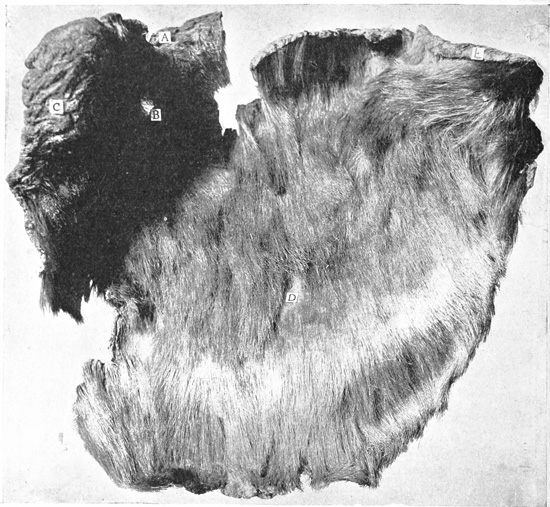
SKIN OF GRYPOTHERIUM, OUTER VIEW. ¼ nat. size.
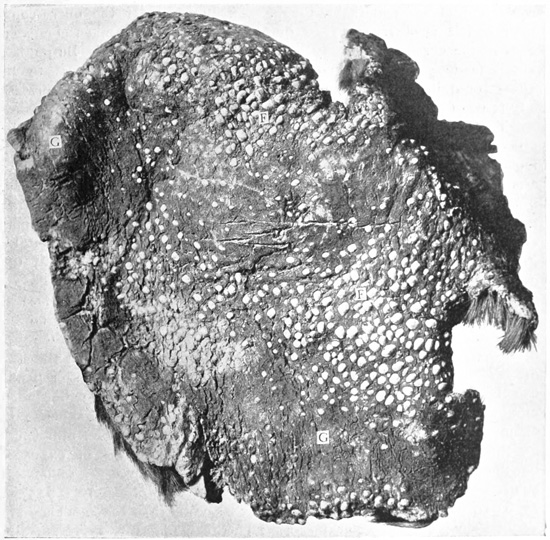
SKIN OF GRYPOTHERIUM, INNER VIEW. ¼ nat. size.
As already mentioned, the outer aspect of the skin is completely
covered with hair, which is very dense everywhere except on the left
anterior corner. Here it seems to have been removed by abrasion. A
small patch of hair has also clearly been pulled out near the gap in
the left border of the specimen; and close to the middle (where marked D)
there is a small hairless depression which may perhaps be interpreted as a
wound inflicted and healed during life. The hair is only of one kind,
without any trace of under-fur, and it is still very firmly implanted in the
skin, without signs of decay. Its arrangement seems to be quite regular,
there being no tendency towards its segregation into small groups or
bundles. It is of a uniform dirty yellowish or light yellowish-brown
colour, and, making due allowance for slight ruffling and distortion of the
specimen, it may be described as all lying in one direction, vertically
in the photograph, except at the two upturned anterior corners of
the specimen, where there is an inclination from the right and left
respectively towards the centre. The longest hairs, which usually measure
from 0.05 m. to 0.065 m. in length, are observed in the half of the
specimen in front of (above) the letter D. Those in the middle of
the extreme anterior (upper) border measure from 0.03 m. to 0.05 m. in
length, those at the hinder (lower) border about the same; while some of
the comparatively small and delicate hairs on the supposed cheek are not
longer than 0.01 m. The hairs are stiff, straight, or only very slightly
wavy, and all are remarkably tough. Examined under the microscope,
their cuticle is observed to be quite smooth, while the much-elongated
cells of the cortex are readily distinguishable. Mr. R. H. Burne has
kindly made some transverse sections, which prove the hairs to be
almost or quite cylindrical, and none of the specimens examined present
any trace of a medulla.
The dermal ossicles are very irregular in arrangement, but are to be
observed in every part of the specimen, even in the comparatively thin
region near the supposed ear. They form everywhere a very compact
armour, and some of them are quite closely pressed together; rarely,
indeed, there is a shallow groove crossing a specimen, possibly indicating
two components which were originally separate. As shown by every part
of the cut margin, and especially well in a small section prepared by
Prof. Charles Stewart, they are all confined to the lower half of the
dermis, never encroaching upon the upper portion in which the hair is
implanted. It is also to be observed that, where the inner surface of
the skin is intact, the ossicles are completely embedded and only faintly
visible through the dry tissue. The exposure of a considerable number
of them, as already mentioned, is due to the rupture and partial abrasion
of this surface. No tendency to arrangement in parallel lines or bands
can be detected; and large and small ossicles seem to be indiscriminately
mingled, although of course allowance must be made, in
examining sections and the abraded inner view of the skin, for differences
in the plane of adjoining sections and varying degrees of exposure
by the removal of the soft tissue. The largest ossicles are oblong in
shape when viewed from within, and measure approximately 0.015 m.
by 0.010 m.; but the majority are much smaller than these. They are
very variable and irregular in form; but their inner face is generally
convex, sometimes almost pyramidal, while the outer face of the few
which have been examined is slightly convex, more or less flattened,
without any trace of regular markings.
In microscopical structure the dermal ossicles are of much interest,
and I have examined both horizontal and vertical sections, one of the
former kindly prepared by Prof. Charles Stewart. The tissue is traversed
in all directions by a dense mass of interlacing bundles of connective-tissue
fibres, which exhibit an entirely irregular disposition, except quite
at the periphery of the ossicle. Here they are less dense, and are
arranged in such a manner as to form at least one darkened zone
concentric with the margin in the comparatively translucent border.
Occasionally, but not at all points, the fibres in this peripheral area
may be observed to radiate regularly outwards. Numerous small vascular
canals, frequently branching, are cut in various directions; and the
bony tissue, which is developed in every part of the ossicle, exhibits
abundant lacunæ. Nearly everywhere, except in the narrow peripheral
area just mentioned, it is easy to recognise the bony laminæ
arranged in Haversian systems round the canals; and most of the lacunæ
between these laminæ are excessively elongated, with very numerous
branching canaliculi, which extend at right angles to their longer axis.
Near the margin of the ossicle, especially in its more translucent parts, the
bone-lacunæ are less elongated, more irregular in shape, and apparently
not arranged in any definite order. There is no clear evidence of
bony laminæ concentric with the outer margin, though appearances
are sometimes suggestive of this arrangement. A vertical section of an
ossicle presents exactly the same features as the horizontal section now
described. It is thus evident that the vascular canals with their Haversian
systems of bone have no definite direction, but are disposed in an
entirely irregular manner.
Taking into consideration all characters, and making comparisons
with the aid of my friend Mr. W. E. de Winton, I am inclined to regard
the fragmentary specimen as the skin of the neck and shoulder-region
with part of the left cheek. The apparent bilateral symmetry between at
least part of the thickened anterior outer angles of the specimen has
already been noted; and if this observation be well founded, the middle line
of the back extends vertically down the middle of the photograph, p. 306.
If the rounded notch above B be the base of the external ear, as seems
probable, the thick wrinkled skin (C) with fine short hair still further to
the left must be the cheek. The ear and cheek on the right side have
been removed; but at the base of the outwardly-turned angle on this side
of the specimen there are the very long hairs which occupy a similar
position on the left. It thus seems possible to estimate the transverse
measurement between the ears as from 0.25 m. to 0.30 m., which corresponds
with a tentative estimate of the same distance in Mylodon robustus
based on a skull in the British Museum.
The skin now described differs from that of all known terrestrial
Mammalia, except certain Edentata, in the presence of a bony dermal
armour. There can therefore be little doubt that the specimen has been
rightly referred to a member of this typically South American order.
Even among the Edentates, however, the fragment now under consideration
is unique in one respect; for all the ossicles are buried deeply in the
lower half of the thickened dermis and the hairs are implanted in every
part of its upper half, whereas all the forms of bony armour hitherto
described in this order reach the outer surface of the dermis and are
merely invested with horny epidermis. This is the case, as is well known,
in the common existing Armadillos, in which the hair is only implanted
in the dermis between the separate parts of the armour. Even in the
unique and remarkable skin of an Armadillo from Northern Brazil,
described by Milne-Edwards under the name of Scleropleura bruneti[34]
the bony plates and tubercles are still covered only by epidermis, although
most of them are reduced to small nodules and might well have sunk
more deeply into the abnormally hairy skin. There is also reason to
believe that in the gigantic extinct Armadillos of the family Glyptodontidæ
the same arrangement of dermal structures prevailed; for one specimen
of Panochthus tuberculatus obtained by Dr. Moreno for the La Plata
Museum actually shows the dried horny epidermis in direct contact with
the underlying bone, and seems to prove that the numerous perforations
in the Glyptodont dermal armour were not for the implantation of hairs
(as once supposed), but for the passage of blood-vessels to the base of the
epidermal layer. Similarly, among the extinct Ground-Sloths of the
family Mylodontidæ dermal ossicles have been found with the remains of
Cœlodon[35] and various forms (perhaps different subgenera) of Mylodon;
but the only examples of this armour yet definitely described[36] exhibit a
conspicuously sculptured outer flattened face, and it thus seems clear that
Burmeister was correct in describing them as originally reaching the upper
surface of the dermis and only covered externally by a thickened epidermis.
It is, however, to be noted that Burmeister himself actually observed
armour of this kind covering only the lumbar region of the trunk. He
believed that the other parts of the animal were similarly armoured, because
he had found "the same ossicles" on the digits of the manus, where they
were "generally smaller and more spherical"; but he unfortunately omits
to make any explicit statement as to the presence or absence of the
characteristic external ornamentation on the latter.
The omission just mentioned is especially unfortunate, because on
careful comparison it is evident that the irregular disposition of the small
ossicles in the piece of skin now under consideration is most closely
paralleled in the dermal armour of the extinct Mylodon, as already
observed by Drs. Moreno and Ameghino. There is obviously no approach
in this specimen to the definite and symmetrical arrangement of the
armour such as is exhibited both by the existing Armadillos and the
extinct Glyptodonts. There are, then, two possibilities. Either the
dermal armour of Mylodon varied in different parts of the body, being
sculptured and covered only by epidermis in the lumbar region, while
less developed, not sculptured but completely buried in the dermis in the
comparatively flexible neck and shoulder region—in which case Dr. Moreno
may be correct in referring the problematical specimen to Mylodon; or
the dermal ossicles of this extinct genus may have been uniform throughout,
only differing in size and sparseness or compactness—in which case
Dr. Ameghino is justified in proposing to recognise a distinct genus,
Neomylodon.
To decide between these two possibilities, it is necessary to wait for
additional information concerning the anterior dorsal armour of Mylodon
as precise as that published by Burmeister in reference to the lumbar
shield. Meanwhile it must suffice to compare the microscopical structure
of the ossicles from the new skin with that of the small sculptured tubercles
of undoubted Mylodon. It must be remembered that the specimen has
been buried in the Pampa Formation for a long period, and that the
oxides of iron and manganese have infiltrated the margin of the bone,
rendering the structure of its outer border more conspicuous than that of
its central portion. It must also be noted that some of the manganese
has assumed its familiar "dendritic" aspect, in this respect presenting
appearances not due to original structure. The calcified interlacing fibres
of connective tissue are as abundant here as in the ossicle of the so-called
Neomylodon; but in a very wide peripheral area they exhibit a marked
radial disposition, nearly everywhere extending in bundles at right angles
to the border. Rather large vascular canals, infiltrated with the oxides
of iron and manganese, are observed in places, often bifurcated and usually
bordered by a transparent zone free from the connective-tissue fibres.
Well-developed bone-lacunæ are very abundant, many exhibiting short
branching canaliculi, and most of the others very irregular in shape,
evidently furnished with canaliculi which cannot be seen from lack of
infiltration. The lacunæ are never much elongated, and are not arranged
in distinctly differentiated Haversian systems in any part of the section;
while the only regular disposition of the bony laminæ is traceable near
the circumference, where the lacunæ are frequently arranged or clustered
in parallel zones concentric with the border. A vertical section of one
of the same specimens shows the connective-tissue fibres radiating outwards
towards the lateral margins, but not directly towards the upper
sculptured face. There are no bony laminæ clearly parallel with the
latter face, and at least one vascular canal in transverse section seems to
be the centre of a Haversian system.
The histological structure of the ossicles in the skin now under
consideration thus resembles that of the sculptured tubercles of Mylodon
in all essential features, but differs in two noteworthy respects. In the
ossicles of the so-called Neomylodon, as already described, the fibres of
connective tissue do not exhibit much definite radiation towards the lateral
margin; while the bony tissue at most points is disposed in definite
Haversian systems. There is thus enough discrepancy to justify the
suspicion that the new and the old specimens do not belong to the same
animal. In fact, so far as the differentiation of the dermal bone is concerned,
the so-called Neomylodon is precisely intermediate between Mylodon
and the existing Armadillo (Dasypus); sections of the scutes of the latter
animal, both in the Royal College of Surgeons and in the British Museum,
showing that in this genus nearly the whole of the osseous tissue is
arranged in Haversian systems, although abundant interlacing connective-tissue
fibres are still entangled in it, at least near the border.
If the characteristic dermal armature does not suffice for the definite
expression of an opinion as to the precise affinities of the specimen, a still
less satisfactory result can be expected from a comparison of the hair.
For, in the first place, no hair has hitherto been discovered in association
with the skeleton of any extinct Ground-Sloth; while, secondly, the hairy
covering of a mammal is perhaps that part of its organisation most readily
adapted to the immediate circumstances of its life. So far as their endo-skeleton
is concerned, the extinct Mylodonts and their allies are precisely
intermediate between the existing Sloths and Anteaters; they combine
"the head and dentition of the former with the structure of the vertebral
column, limbs, and tail of the latter."[37] It might therefore be supposed
that the hair of this extinct group would exhibit some of the peculiarities
of that in one or other of its nearest surviving relatives. The epidermal
covering of the piece of skin now described, however, entirely lacks the
under-fur which is so thick in the Sloths; while the structure of each
individual hair, with its smooth cuticle and lack of a medulla, is strikingly
different from that observed both in the Sloths and Anteaters, and identical
with that of the hair in the surviving Armadillos. The large hair in the
Sloths and Tamandua exhibits a conspicuously scaly cuticle; while that
of Myrmecophaga is remarkable for its very large medulla. All these
animals now live in the tropics, either in forests or swamps, whereas the
Patagonian animal must have existed under circumstances much like
those under which the Armadillos still survive. Hence the characters
of the hair of the so-called Neomylodon may be of no great importance in
determining the affinities of the animal, but may represent a special
adaptation to its immediate environment.
Finally, there is the question of the antiquity of the problematical
skin. On two occasions I have examined the mummified remains of the
extinct Mammoth and Rhinoceros from Siberia in the Imperial Academy
of Sciences at St. Petersburg; I have also carefully studied the remains
of the neck and legs of the Moa from a cavern in New Zealand, now in
the British Museum. Compared with these shrivelled and dried specimens,
the piece of skin from Patagonia has a remarkably fresh and modern
aspect; and I should unhesitatingly express the opinion that it belonged
to an animal killed shortly before Dr. Moreno recognised its interest, had
he not been able to give so circumstantial an account of its discovery and
strengthened his point of view by recording the occurrence of a human
mummy of an extinct race in another cavern in the same district. The
presence of an abundant covering of dried serum on one cut border of the
skin is alone suggestive of grave doubts as to the antiquity of the specimen;
but Dr. Vaughan Harley tells me that similar dried serum has
been observed several times among the remains of the Egyptian mummies,
and there seems thus to be no limit to the length of time for which it can
be preserved, provided it is removed from all contact with moisture. I
may add that I have searched in vain in the writings of Ramon Lista
(so far as they are represented in the Library of the Royal Geographical
Society) for some reference to the statement which the late traveller made
verbally to Dr. Ameghino; and as the piece of skin now described
certainly represents an animal almost gigantic in size compared with the
Old-World Pangolin, I fear it cannot be claimed to belong to Lista's
problematical quadruped, whatever that may prove to be.
The final result of these brief considerations is therefore rather disappointing.
There are difficulties in either of the two possible hypotheses.
We have a piece of skin quite large enough to have belonged to the
extinct Mylodon; but unfortunately it cannot be directly compared with
the dermal armour of that genus, because it seems to belong to the neck-region,
while the only dermal tubercles of a Mylodont hitherto definitely
made known are referable to the lumbar region. If it does belong to
Mylodon, as Dr. Moreno maintains, it implies either that this genus
survived in Patagonia to a comparatively recent date, or that the circumstances
of preservation were unique in the cavern where the specimen was
discovered. On the other hand, if it belongs to a distinct and existing
genus, as Dr. Ameghino maintains—and as most of the characters of the
specimen itself would at first sight suggest—it is indeed strange that so
large and remarkable a quadruped should have hitherto escaped detection
in a country which has been so frequently visited by scientific explorers.
[P.S.—At the reading of this paper Prof. Ray Lankester remarked
that he should regard the characters of the hair as specially important,
and would not be surprised if the problematical piece of skin proved to
belong to an unknown type of Armadillo. This possibility had occurred
to me, but I had hesitated to mention it on account of the considerable
discrepancy observable between the arrangement of the bony armour in
Neomylodon and that in the known Glyptodonts and the unique Brazilian
Armadillo (Scleropleura), which happen to exhibit an incompletely
developed (incipient or vestigial) shield. In each of the latter cases, the
armour is not subdivided into a compact mass of irregular ossicles, but
consists of well-separated elements which could only become continuous
by the addition of a considerable extent of bone round their margins, or
by the special development of smaller intervening ossicles.
Since the paper was read, I have had the privilege of studying Dr.
Einar Lönnberg's valuable description of the pieces of the problematical
skin mentioned by Dr. Moreno as having been taken to Upsala by Dr.
Otto Nordenskjöld.[38] It appears that with the skin was found the
epidermal sheath of a large unknown claw, which may have belonged to
the same animal. This specimen proves to be different from that of any
existing Sloth, Anteater, or Armadillo, and is considered by Dr. Lönnberg
to belong probably to the hind foot of a Mylodont, which did not walk
on the exterior, lateral surfaces of the toes to the same extent as Mylodon.
In a section of the skin provisionally ascribed to the leg, he observes that
the small ossicles are very irregular, and shows two instances in which two
are placed one above the other. In microscopical sections of the ossicles,
however, he does not find the distinct Haversian systems of bone so conspicuous
in my slides; and hence he fails to remark the differences
between the structure of the armour in Neomylodon and Mylodon, which
seem to me to be particularly noteworthy. His so-called "pigment
cellules" in Mylodon are the dendritic infiltrations of oxide of manganese
and stains of oxide of iron, to which I have made special reference. His
observations as to the absence of a medulla in the hair confirm my own;
but I have not seen any evidence of the suspected loss or disintegration
of the hair-cuticle. Finally, Dr. Lönnberg has boiled a piece of the skin,
thereby extracting glue, "which proves that the collagen and gelatinous
substances are perfectly preserved." The latter observation confirms the
evidence of the serum recorded above, and indicates that if the specimen
is "of any considerable age, it must have been very well protected against
moisture and bacteria."—A. S. W.]
Last February, when presenting to the Zoological Society an account
of the skin of a Ground-Sloth discovered in a cavern in Southern
Patagonia, Dr. Moreno mentioned that further excavations were being
made in the hope of finding other remains of the same animal. The
task referred to was undertaken by Dr. Rudolph Hauthal, geologist of the
La Plata Museum, who met with complete success.[40] He not only found
another piece of skin, but also various broken bones of more than one
individual of a large species of Ground-Sloth in a remarkably fresh state
of preservation. Moreover, he discovered teeth of an extinct horse and
portions of limb-bones of a large feline carnivore, in association with
these remains; he likewise met with traces of fire, which clearly occurred
in the same deposits as the so-called Neomylodon. All these remains
were found beneath the dry earth on the floor of an enormous chamber
which seemed to have been artificially enclosed by rude walls. In one
spot they were scattered through a thick deposit of excrement of some
gigantic herbivore, evidently the Ground-Sloth itself; in another spot
they were associated with an extensive accumulation of cut hay. Dr.
Hauthal and his colleagues, indeed, concluded that the cavern was an
old corral in which the Ground-Sloths had been kept and fed by man.
As the result of these explorations, Dr. Moreno has now the gratification
of exhibiting to the Society complete proof that the piece of skin
described on the former occasion belongs to a genuine Pampean Ground-Sloth,
not Mylodon itself, but a very closely related genus Grypotherium,
of which skulls are already known from Pampean deposits in the Province
of Buenos Aires.[41] The collection which we now have the privilege of
examining distinctly supports his contention that the large quadruped in
question belongs to an extinct fauna, though contemporary with man.
The discovery is thus unique in the history of palæontology, on account
of the remarkably fresh state of preservation of all the remains. Some of
the new specimens exhibit no indication whatever of having been buried.
Many of the bones retain their original whitish colour, apparently without
any loss of gelatine; while both these and other bones, which have
evidently been entombed in brownish dust, bear numerous remnants
not only of the dried periosteum, but also of shrivelled muscles, ligaments,
and cartilages. Very few of the bones are fossilised, in the ordinary sense
of the term.
An admirable brief description of this collection has already been published
(op. cit.) by Dr. Roth, who was the first to recognise the generic
identity of Neomylodon with Grypotherium. Some of the specimens, however,
are worthy of a more detailed examination; and Dr. Moreno
has kindly entrusted them to me for study in connection with the
collections in the British Museum and the Royal College of Surgeons.
The following notes, supplementing Dr. Roth's original memoir, are
the result of this further investigation.
Number of Individuals.
Among the fragmentary bones of the Ground-Sloth, it is easy to
recognise evidence of three individuals, which do not differ much in size.
There are three distinct examples of the occiput and fragments of the
dentigerous portion of three mandibles. It is also noteworthy that the
three malar bones preserved are all different in shape, while three
corresponding fragments of the acromial process of the scapula differ in
size. One portion of maxilla seems to represent a fourth individual,
being probably too small for either of the skulls to which the occiputs
belong. Finally, as Dr. Roth has pointed out, one shaft of a humerus,
which appears to be the bone of an adult, belongs to a much smaller
animal than is indicated by any other specimen in the collection.
Remains of three individuals are thus recognisable with certainty; two
others can probably be distinguished; while some of the fragments may
even belong to a sixth specimen. It must also be noted that other
portions of jaws are said to have been discovered by E. Nordenskjöld.[42]
Skull and Mandible.
The largest portion of cranium (No. 1) is not stained in any way, and
does not retain a trace of the material in which it was buried in any
hollow or crevice. It does not appear to have been damaged during
excavation, but exhibits fractures which were almost certainly made when
the animal was freshly killed. The cranial roof near the occipital region
is battered in four places, though the injuries do not affect the brain-case
itself; while the right occipital condyle is partly removed by a sharp,
clean cut. There can, indeed, be no doubt that the animal was killed
and cut to pieces by man.
This skull is evidently that of an adult animal, all the sutures in the
hinder region being closed. The inner wall of the temporal fossa is much
flattened, without any irregular convexities, but marked with the characteristic
reticulately-decussating, fine ridges of bone, and studded with
adherent patches of muscle-fibre. The upper border of the fossa is a
remarkably sharp edge, while the narrow flattened cranial roof is only
marked by a faint longitudinal median furrow and by a diminutive tuft of
fibre in a small median pit near the occipital edge.[43] The fractures
exhibit the very large cancellated chambers surrounding the brain-case
dorso-laterally; while a median longitudinal section shows both these
cells and others in the basi-sphenoid. The basi-cranial axis is nearly
straight, inclining a little upwards in front. The anterior condyloid
foramina piercing the basi-occipital are remarkably large, as usual; the
basi-sphenoid is very long and narrow, flattened mesially on its lower face,
but with one slight median prominence near its hinder end; the pre-sphenoid
forms a short acute rostrum, above which there are remains
of the vomer. The hinder ends of the pterygoids are shown to be
inflated with large cancellæ, but the sides of the base of the skull are
somewhat obscured by the dried soft parts. The mastoid process of the
periotic, with its articular facette for the stylohyal, seems to be rather
smaller than in Mylodon. The tympanic bone is preserved on the right
side, though wanting on the left. It is an irregular curved plate only
slightly bullate, but forming a complete floor to the tympanic cavity.
As usual in Edentata, it is not produced into an auditory meatus.
The right maxilla (No. 4) is in precisely the same state of preservation
as the specimen just described, and probably belongs to the same skull.
Its anterior margin is perfectly preserved, indicating that the facial
region is very short in front of the anterior end of the zygomatic
arch, which is pierced by a rather large suborbital canal. Its upper
border proves that the nasal region was raised into a slightly convex
dome; while its antero-superior angle is not rounded as in Mylodon, but
curves upwards and forwards and ends in a point as in Grypotherium. At
the oral border there are the shattered bases of four teeth.
A fragment of the nasal region (No. 13) may also have belonged
to the same skull, but its state of preservation is a little different from that
of the two specimens just described. It has clearly been buried in a
powdery deposit, which has stained it brown; but the enveloping dust
must have been extremely dry, for fragments of cartilage adhere to it,
as well preserved as in the nasal chamber of the cranium itself (No. 1).
It also bears traces of the integument.
Judging by the figures of the skull of Grypotherium published by
Reinhardt (loc. cit.), this specimen seems to have occupied an anterior
position in the nasal region. It is thus of great interest, because the
three known skulls of Grypotherium leave the precise nature of the
bony arcade separating the narial openings undecided. According
to Reinhardt, the nasal bones terminate as in Mylodon, and the arcade
is an element interposed between them and the premaxillæ. According
to Burmeister, the nasals themselves extend forwards and constitute
the greater part, if not the whole, of the problematical bar. The
fragment now under consideration is clearly in favour of the latter interpretation.
Its lower thickened end is a massive bone, not bilaterally
symmetrical, and not showing any trace of a median suture. Its inferior
face is irregular and roughened, and can scarcely be regarded as an
articular facette. Its upper portion consists of a pair of bones separated
by a very well-marked median longitudinal suture. These are
not thickened at their contracted upper end, where they have evidently
been broken, and are not quite bilaterally symmetrical. They doubtless
fuse at their lower end with the problematical azygous bone already
mentioned, but the arrangement is obscured by the enveloping soft parts.
A pair of bones, which may be regarded as nasals, thus extend forwards
in a narrow arch to a point just above the anterior end of the premaxillæ;
while the massive bone effecting a union between the two normal pairs
of elements is probably an ossification in the internasal septum. It is
interesting to note that there is an incipient trace of a similar forward
production of the nasals in the genus Scelidotherium; while there is
sometimes an ossification of the internasal septum in Megatherium.[44]
The three specimens now described, when placed approximately in
their natural positions, afford a very satisfactory idea of the form and
proportions of the skull when complete. The malar bone is the only
important part to be added; but unfortunately it is impossible to decide
which of the three specimens of this element in the collection belongs to
the individual now under consideration. As already mentioned, these
three bones are all different in the shape and proportions of the hinder
bifurcated end. They are all very fresh in appearance, but have been
stained reddish-brown by the earth in which they must have been buried.
The hinder portion of the second skull already mentioned (No. 2)
comprises the occiput and brain-case as far forward as the front of the
cerebral hemispheres. It is much battered and broken, and in quite as
fresh a state as the cranium already described, with a considerable investment
of dried soft parts on its base. It is only very slightly smaller than
No. 1, but is of interest as exhibiting some of the sutures, besides a
roundness and smoothness indicative of immaturity. The supraoccipital
is shown to be very large; a small median point of it enters the foramen
magnum, while the suture separating it from the parietals and squamosals
extends along the rounded lambdoidal ridge. The horizontally extended
suture between the squamosal and parietal on the inner wall of the
temporal fossa is seen in the position where Owen determined it to occur
in Mylodon.[45] Both tympanics are preserved, but they are more obscured
by soft parts than in No. 1.
To this cranium probably belongs a detached portion of the left side
of the facial region (No. 5), in a similar state of preservation and
slightly smaller than the maxilla (No. 4). The suture between the
frontal and the maxilla still persists, while the oral border is preserved
farther forward than in the last-mentioned specimen, showing a fragment
of the much-reduced premaxilla united with the maxilla by a jagged
suture.
The third imperfect occiput is about as large as the immature
specimen No. 2, but does not exhibit any features worthy of special
note.
The largest and most important portions of the mandible are Nos. 9
and 11, which evidently belong to the right and left rami of one and the
same jaw. They are much broken and are in the same fresh condition
as the skulls, with traces of the periosteum and even considerable
portions of the soft parts of the gum. The right ramus is preserved
sufficiently far forwards to show that there was no caniniform tooth in
front of the series of four ordinary molars. Judging by the extent of
the latter series, the specimen probably belongs to the same individual as
the skull No. 1.
Another portion of a mandibular ramus (No. 10) of the left side is
slightly smaller than the last and may well have belonged to the immature
individual No. 2. It is similarly quite fresh in appearance, and bears
the shrivelled remains of the gum. It is interesting as exhibiting the
two posterior molars slightly different in shape from those of the former
mandible. In this specimen the longer axis of the third molar is oblique,
whereas in No. 9 it is coincident with the axis of the mandible; while in
the former the fourth molar is not so long in proportion to its width as in
the latter. Such slight differences, however, cannot be regarded in the
Edentata as more than individual variations.
Brain-cavity and Cerebral Nerves.
By the kind permission of Dr. Moreno, the cranium No. 1 has
been vertically bisected to display the character of the cranial cavity
and the nerve-foramina. An instructive plaster-cast of the cavity
has thus been made by Mr. C. Barlow, the Formatore of the British
Museum.
The olfactory lobes are shown to have been well developed, projecting
a little in front of the cerebral hemispheres. These hemispheres
are together somewhat longer than broad, slightly broader behind
than in front, and a little constricted in the middle. They do not overlap
the cerebellum, which is relatively large. The origins of the nerves
are very imperfectly shown in the cast; only their exits from the cranial
cavity are clear. The most interesting are the optic and trigeminal nerves,
which pass out of the cranial cavity at first by a common exit, which is
soon subdivided by a bony partition into two canals, the former no less
than 0.08 m., the latter 0.045 m. in length. The fourth, seventh, eighth
and twelfth nerves are also recognisable on the cast; and one prominence
of plaster has filled the foramen lacerum posterius.
Compared with the brains of Mylodon and Scelidotherium, so far as
known from casts of the cranial cavity,[46] that of Grypotherium is observed
to be more elongated, with less divergent and prominent olfactory lobes,
less constricted cerebral hemispheres, and a larger cerebellum. In the
form and proportions of the cerebrum and cerebellum, it similarly differs
from Megatherium.[47] The cerebral hemispheres of the existing Cholœpus
didactylus and Bradypus tridactylus[48] are more tapering forward, and their
cerebellum is relatively smaller than in Grypotherium.
Auditory Ossicles.
The auditory ossicles were preserved in the tympanic cavities of both
skulls, Nos. 1 and 2, being retained by the dried soft parts. They were
detected by Prof. Charles Stewart, who kindly extracted them, with great
skill, from both sides of each skull. Comparing these ossicles with the fine
collection in the Royal College of Surgeons, they prove to be closely similar
to those of all the existing Sloths, but most nearly resembling those of
Cholœpus didactylus. The malleus is bent exactly as in the latter species,
and is of similar shape. As observed by Prof. Stewart, it is remarkable
in articulating with the incus not only by the head, but also by a diminutive
lower facet, which is in contact with a small facetted process on the
anterior arm of the incus. A feeble indication of the same secondary
articulation is also observable in Cholœpus; but it is curiously absent in
the second specimen of Grypotherium. The two divergent arms of the
incus are equal in length, as usual in the Sloths. The stapes is only
very slightly perforated in both specimens; while a small circular disc
firmly fixed to the incus represents the orbicular bone in the second skull.
The auditory ossicles of Grypotherium, therefore, are very different from
those of Myrmecophaga, in which the malleus is less sharply bent, the
incus has divergent arms of unequal length, and the stapes exhibits a large
perforation.[49]
Vertebræ and Limb-bones.
Nearly all the remains of vertebræ and limb-bones are in the same
state of preservation as the portions of skull and mandible already
described, with adherent cartilage and traces of muscles and ligaments.
With some of the ungual phalanges there are also well-preserved examples
of the epidermal sheath. As already remarked by Roth, the edges of
one sheath probably belonging to the fourth digit of the manus, are
quite sharp, and indicate that if the animal walked on its fore feet it
resembled Myrmecophaga in the peculiar twist of the manus.
All the specimens in this series seem to have been accurately determined
and sufficiently described by Roth. It is only necessary to
emphasise the fact that the two shafts of humerus with abraded, not
sharply broken, ends have a much more fossilised appearance than any
other specimen in the collection, and are deeply stained throughout by
ferruginous matter. The small shaft, No. 22, certainly seems to have
belonged to an adult animal, as remarked by Roth, and it was probably
much smaller than any individual indicated by the other remains.
Skin and Hair.
The new piece of skin, which is stated by Hauthal to have been
found in the deposit of excrement, is not quite so well preserved as the
original piece. It is much folded in an irregular manner; and the hair,
which is yellower than in the previous specimen, is preserved only in
patches on the outer face. It must have been stripped from the body of
the animal by man; but the only distinct marks of tools, which were
evidently made when the skin was fresh, are a few indents and small pits
on the outer face. The indents must have been made by oblique thrusts
of a stick, or a small, blunt, chisel-shaped instrument. The small pittings
are nearer the middle of the specimen and less conspicuous. A vacuity
in the skin seems to be due to accidental tearing or to a thrust after it
was dry: it may even have been caused by the fallen blocks of stone
found lying upon it.
The specimen, as preserved, measures about a metre across in one
direction by 93 centimetres in another direction. As already observed
by Roth, its irregular folding makes the determination of its position on
the trunk very difficult; but I am convinced that its state of preservation
is not sufficiently good to justify an attempt to unfold the skin by the
ordinary method of steaming. Taking all facts into consideration, Roth
seems to be correct in ascribing it to the right flank and the postero-superior
part of one of the limbs. It most probably belongs to the fore
limb, as Roth supposes; but there is no clear proof that it is not referable
to the hind-quarters.
The original situation of the piece of skin being thus determined, it is
interesting to observe the disposition of the ossicles in the lower layer.
Owing to abrasion, contraction, and partial disintegration, they are conspicuous
in most parts of the specimen. They are very irregular in shape
and size, and closely compacted together, as in the previous specimen.
It is, however, to be noted that in some parts there is a distinct tendency
to arrangement in regular, straight, parallel rows. The long axes of the
elongated ossicles are nearly always coincident with the direction of these
rows. They are especially well shown on the middle of the flank; and,
as might be expected, the rows are here disposed vertically, parallel with
the ribs.
In some parts of the skin the ossicles are exposed on their outer face;
but appearances render it almost certain that this exposure is due to the
disintegration and abrasion of the specimen. In one patch thus uncovered
by the removal of the soft parts, the ossicles are seen to form a closely
arranged, flattened pavement; and their outer face is much more conspicuously
marked by pittings than that of any ossicle extracted from the
first discovered piece of skin. In fact, as Roth remarks, the pitting is
here quite similar to that observable on many ossicles dug up in association
with the fossil skeletons of Mylodon; though it does not form so
regular a reticulate pattern as that of the dermal ossicles of Mylodon
in the British Museum figured on the former occasion.[50]
Another interesting feature of the new piece of skin consists in the
dwindling and even total absence of the ossicles towards the ventral
border. A section along the edge exhibits only two diminutive nodules
of bone in a length of 0.1 m.; while another similar section taken
vertically from the skin of the limb shows no trace of ossicles, except
perhaps two little specks. It must, however, be noted that the limb
was not entirely destitute of armour; for on the border the bones are as
well developed and conspicuous as on the middle of the flank. In the
newly-cut sections the skin has a translucent aspect, showing that it is
merely dried and not tanned in any way.
The hair on the new specimen varies in length from 0.07 m. or
0.10 m. to 0.15 m. or 0.22 m. It is thus longer than that of the
previous piece of skin. Masses of still longer hairs—some 0.30 m.
in length—were found detached among the excrement, and these are
also believed by Roth to belong to the same animal. His determination
is probably correct; for, when examined microscopically, these long
hairs are observed to have a perfectly smooth cuticle, while some transverse
sections (kindly made by Mr. R. H. Burne) demonstrate the complete
absence of a medulla, exactly as in the short hairs. The latter
feature proves that they cannot be referred either to the horse or to
the guanaco.
Excrement.
The large cylindrical pieces of excrement, which may be referred to
Grypotherium without any hesitation, have already been described and
figured by Dr. Roth. They consist of irregular discoids of herbaceous
matter closely pressed together, the largest measuring no less than 0.18 m.
in diameter. Mr. Spencer Moore has kindly examined them from the
botanist's point of view and reports that they are composed "in large
part apparently of grasses, as the haulms, leaf-sheaths, fragments of
leaves, &c., of these plants are frequent in the mass. A spikelet, almost
entire, of what seems to be a species of Poa, and the flowering glume of
another grass, probably avenaceous, have also been found. Besides these
there are at least two dicotyledonous plants, one herbaceous and the
other almost certainly so, the latter having a slender greatly sclerotised
stem. Unfortunately, as no leaves have hitherto been observed attached
to the fragments of stem, their affinities are altogether doubtful. There
are numerous silicious particles in the excrement, and there are many
pieces of the underground parts of the plants, suggesting that they have
been pulled out of the ground. A few pieces of stems are sharply cut,
not bruised or torn at the end." The latter fact is especially important
in connection with Dr. Hauthal's discovery of cut hay in the cavern,
and his theory that the Grypotherium was kept in captivity and fed
by man.
Generic and Specific Determination.
The fortunate discovery of all parts of the skull and dentition renders
the generic determination of this Ground-Sloth now quite certain. The
teeth show that it belongs to the family Mylodontidæ; the presence
of only four instead of five upper molars separates it from the genera
Mylodon, Lestodon, and Scelidotherium; the forward production of the
nasals and the ossification of part of the internarial septum place it
definitely in the allied genus Grypotherium, as originally diagnosed by
Reinhardt. The only question needing consideration is, whether the fragment
of cranium described by Owen in 1840 as the type of the genus
Glossotherium[51] is really identical with that subsequently described by
Reinhardt under the name of Grypotherium darwini, as now seems to be
commonly believed.
Darwin's original specimen, on which the genus Glossotherium of Owen
was founded, is preserved in the Museum of the Royal College of Surgeons.
It has thus been possible to compare it directly with the undoubted
cranium of Grypotherium from the Patagonian cavern. The specimen is
merely the left half of the hinder part of the cranium, and is therefore very
inadequate for discussion; but several features seem worthy of note. Compared
with the new skull No. 1, the fragment named Glossotherium has
(i.) the inner wall of the temporal fossa less flattened, (ii.) the digastric
fossa deeper in proportion to its width, (iii.) the hinder border of the inflated
pterygoid vertical, instead of sloping downwards and forwards, (iv.) a
much larger and deeper pit for the articulation of the stylohyal, and (v.) a
longer canal penetrating the base of the occipital condyle for the passage
of the hypoglossal nerve. In all these respects the so-called Glossotherium
agrees much more closely with the typical Mylodon; and Owen was probably
correct in 1842 when he expressed the opinion that the two are at
least generically identical.[52]
I am therefore of opinion that Grypotherium is the correct generic
name for the Ground-Sloth from the Patagonian cavern, while Glossotherium
must be relegated to the synonymy of Mylodon.
The specific determination of the new specimens is more difficult. As
remarked by Roth, only two species of Grypotherium seem to be already
known from the Pampa formation—G. darwini by three skulls[53] and
G. bonaerense solely by a maxilla.[54] The portions of skull and dentition
now under discussion indicate an animal much larger than G. bonaerense
(assuming the original maxilla to be that of an adult); while they are considerably
smaller than any known specimen of G. darwini. Moreover, the
nasal arcade now described is narrower and more concave on its outer face
than that of G. darwini, as already observed by Roth. It thus seems
very probable that the animal from the Patagonian cavern represents
a distinct species, which must bear the name of G. listai. This specific
name was given by Ameghino to a fragment of the first-discovered piece of
skin, and the curious argument which leads Roth to propose the substitution
of a new name for it does not affect its validity.
It may be added that Dr. Erland Nordenskjöld has recently compared
his specimens from the Patagonian cavern with the skull of Grypotherium
darwini at Copenhagen, and finds no specific difference.[55] No particulars
however, have yet been published.
Felis, sp.
A feline carnivore larger than the existing Jaguar (Felis onca), but
about the same size as an average Tiger (F. tigris), is represented in
the collection by the distal half of a right humerus (No. 44), a left fourth
metatarsal (No. 46), and the distal end of another metatarsal (No. 47).
These bones have evidently been buried in dust, but are in the same fresh
state of preservation as those of Grypotherium.
Careful comparison of these bones shows that they are undoubtedly
feline; and there is no difficulty in determining that they belong to Felis
rather than to the extinct Machærodus. A humerus of M. neogæus, from a
Brazilian cavern, now in the British Museum (No. 18972 b), is readily
distinguished from the new Patagonian humerus by the remarkable lateral
compression of its shaft and the much greater downward extension of its
prominent and sharp deltoid ridge. The humerus in all the large species
of Felis, on the other hand, only differs from the fossil now under discussion
in very small particulars. In fact, the humerus and metatarsals of
the existing Felis onca are essentially identical with the bones from the Patagonian
cavern, except that they are rather smaller. I am therefore
inclined to regard the newly discovered remains as indicating a comparatively
large variety of F. onca, which once lived in the temperate regions
of Patagonia, beyond the present range of this species. Such an occurrence
would be a precise parallel to that of the Cave-Lion in Europe. It
is well known that nearly all the remains of F. leo found in the Pleistocene
formations of the temperate parts of the Old World indicate animals
of somewhat larger size than any surviving in the warmer regions to which
the species is now confined.[56]
It may be noted that bones of the Jaguar of ordinary dimensions have
been recorded from the Pampa formation of the Province of Buenos
Aires.[57]
Arctotherium, sp.
With the bones of Felis just noticed, Roth provisionally associates
the imperfect distal end of a remarkably large right femur. He is
thus induced to suppose that the carnivore represented by the fragments
will prove to be a new genus and species of the Felidæ. He suggests
for it the name of Iemisch listai, on the assumption that it is the mysterious
quadruped which Ameghino states is known to the natives as the
Iemisch.
A comparison of the distal end of the femur in question with the femora
of Felidæ in the British Museum seems to prove conclusively that it
cannot be referred even to the same family. Its width across the condyles
is much greater, compared with its antero-posterior diameter, than that
observed in any feline. Moreover, the pit for the tendon of the popliteus
muscle below the external condyle is unusually deep. In both these
respects the bone closely resembles the distal end of the femur of a Bear.
I have been therefore led to compare it with the corresponding part of
the extinct Bear of the Pampean formation, Arctotherium.
Fortunately, the fine and nearly complete skeleton of Arctotherium
bonaerense in the Bravard Collection in the British Museum comprises
the right femur and enables direct comparison to be made. The
fragment lacks the inner condyle; but enough of the trochlea remains
to show its broad and gently-rounded form, with a wide and deep
intertrochlear notch, precisely as in Arctotherium. It has the same
development of the external condyle as in the latter, while the fossa for
the popliteal tendon is equally deep, only slightly differing in shape. In
fact, there is very little discrepancy, except in its smaller size; and species
of Arctotherium smaller than A. bonaerense are already known both from
the Pampa formation of Argentina[58] and the caverns of Brazil.[59]
The fragment just described has evidently been severed from the rest
of the bone by a sharp, clean cut made by man; and Dr. Hauthal is
quite certain that this was not done by one of his workmen during
excavation (op. cit. p. 59). At least one medium-sized species of
Arctotherium must therefore have survived until the human period in
Southern Patagonia.[60]
Onohippidium saldiasi.
A horse is represented in the collection by an upper molar, a fragment
of premaxilla with two incisors, an imperfect atlas and two well-preserved
hoofs apparently of a fœtus or perhaps of a newly-born animal.
Of these remains only the upper molar is capable of satisfactory determination.
This tooth is the second upper molar of the left side, and has been
exhaustively compared with corresponding teeth by Dr. Roth, who gives
a good series of figures. It is readily distinguished from the homologous
molar in the genus Equus by the peculiar form of its two inner columns—a
fact which I have been able to verify by the examination of an
extensive series of specimens, both recent and fossil, in the British
Museum. Further comparison, indeed, shows that it must be referred to
the extinct Pampean genus Onohippidium.[61] Roth assigns it, apparently
quite rightly, to the same species as a maxilla from the Pampean
formation of the Province of Buenos Aires, for which he proposes the
name of Onohippidium saldiasi.
Large Extinct Rodent.
The proximal end of the femur of a large rodent has already been
recognised by Roth, and compared with the extinct Megamys. It cannot
be more exactly determined.
Existing Species.
One imperfect fragment of pelvis and sacrum seems to belong to
a puma (Felis concolor) of rather large size; but it is not sufficient for
precise determination.
The small mandibular ramus of a musteline referred by Dr. Roth
to Mephitis suffocans, does not pertain to this genus and species.
Mr. Oldfield Thomas determines it to belong to the rare Lyncodon
patagonicus, which still lives in Patagonia and has not hitherto been found
fossil. A slightly larger extinct species of the same genus has been
described by Ameghino on the evidence of a skull from the Pampean
formation near Lujan, in the Province of Buenos Aires.[62]
A cranium, some vertebræ, and a tibia and fibula appear to represent
the existing Ctenomys magellanicus, as noted by Roth.
The remains of the Guanaco (Lama huanacos) do not present any
features worthy of special remark.
Man is represented by a diseased scapula and by two bone awls, which
are clearly made from the tibia of a species of Canis intermediate in
size between C. jubatus and C. magellanicus.
As the result of Dr. Roth's researches, supplemented by the additional
observations now recorded, it is evident that the majority of the mammalian
remains from the cavern near Last Hope Inlet belong to the
extinct fauna which occurs in the Pampean formation of more northern
regions. To this category are referable the genera Grypotherium, Onohippidium,
Megamys, and Arctotherium; also Macrauchenia, which is said to
have been discovered in the same deposit on the floor of the cave by
Dr. E. Nordenskjöld. The large Felis likewise probably belongs to the
same series. Remains of mammals of the existing fauna, on the other
hand, are comparatively few and insignificant, referable to the genera
Ctenomys, Cervus, Lama, Lyncodon, and Felis.
Although Dr. Hauthal's explorations were rather hurried and Dr.
Nordenskjöld's results have only been published hitherto in abstract,[63]
their account of the deposits on the floor of the cavern seem to confirm
the suspicion that the remains of these two faunas were introduced at two
successive periods. According to Hauthal, the remains of the Guanaco
were found along with fragmentary bones of Deer, shells of Mytilus chorus,
branches of trees, and dried leaves, in the superficial dust of the cavern
near the outer wall. The skin of Grypotherium and all the other remains
of this and the associated Pampean genera were discovered in the deeper
layer of excrement and cut hay between the mound and the inner wall of
the cavern. According to Nordenskjöld, three distinct strata can be
recognised on the floor of the cavern as follows:
A. A thin surface layer, containing ashes, shells, and bones of recent animals
broken by man.
B. A middle layer, containing numerous branches of trees and dried leaves, with
remains of Lama and the extinct horse, Onohippidium. Said to be probably
the stratum in which the original piece of skin was found.
C. A bottom layer, usually about a metre in thickness, without any traces of
branches or leaves, but only dried herbs. Remains of Grypotherium
numerous and confined to this stratum, associated with its excrement and
hair, also with remains of a large variety of Felis onca, Macrauchenia, and
Onohippidium.
It is unfortunate that the question of the contemporaneity of the
various bones cannot be tested by the ingenious method of chemical
analysis which has been applied with success to similar problems by
M. Adolphe Carnot in France. The French chemist has shown that when
bones are buried in ordinary sediments they undergo changes which
gradually cause the percentage of contained fluorine to increase. According
to him, the longer a bone has been buried, the greater is the percentage
of fluorine found in it on analysis. In one case[64] he examined the scapula of
a deer and a human tibia, discovered together in fluviatile sand near Billancourt
(Seine); he found that the former had seven or eight times its usual
percentage of fluorine, while the human bone did not differ in any respect
from the normal in this constituent. He therefore concluded that the
latter bone was not of the same age as the former, but had been introduced
comparatively recently by burial. In this and the other recorded
cases, however, it is to be observed that the sediment was of a uniform
character and admitted of free percolation of water. In the Patagonian
cavern, on the contrary, the bones occur partly in dust, partly in dried
herbage, partly in dried excrement, and partly in the burnt residue of the
same. Moreover, they must always have been subjected to intense dryness,
and the usual process of chemical alteration cannot have taken place.
Considering all circumstances, I think that, even without chemical
evidence, zoologists and geologists cannot fail now to agree with Dr.
Moreno and his colleagues of the La Plata Museum, that the remarkably
preserved Grypotherium from the Patagonian cavern belongs to the extinct
Pampean fauna of South America, and need not be searched for in the
unexplored wilds of that continent. If we accept the confirmatory
evidence afforded by Mr. Spencer Moore, we can also hardly refuse to
believe that this great Ground-Sloth was actually kept and fed by an
early race of man.
By Hesketh Prichard.
I now proceed to give the testimony of Dr. F. Ameghino, whose
brother Carlos was well acquainted with the country and who early
gave it as his opinion that the animal, which is named the Neomylodon
listai, was still living in Patagonia. In support of his opinion he
adduced tales which Carlos Ameghino had gathered from the Indians,
who roam the pampas, of a vast mysterious beast said by them to haunt
the distant lagoons and forests of the unexplored regions near the Andes.
These stories had, moreover, been confirmed in Dr. Ameghino's opinion by
the experience of the late well-known geographer and traveller, Señor
Ramon Lista, who verbally told both Dr. Ameghino and his brother that
he had seen and fired at a mysterious creature, which, however, disappeared
in the brushwood and could not afterwards be traced. He described it as
being covered with reddish-grey hair, and he believed it to be a pangolin
or scaly-anteater.[65] Taking all things into consideration, Dr. Ameghino
announced his conviction that the mysterious animal referred to was the last
representative of a group, long believed extinct, related to the Mylodon.
According to Dr. Ameghino the Indians had bestowed upon the
mysterious animal the name of Iemisch. Nothing would induce them to
penetrate into the supposed haunts of this monster. It was described as
amphibious, equally at home on land or in the water; in remote
mountain recesses it lurked in caves, or had its lairs by the shores of
lonely lagoons and rivers, or at times lay in wait among the lower passes
of the Cordillera. In habits it was nocturnal, and its strength so great
that it could seize a horse in its claws, and hold itself down to the
bottoms of the lakes! The head was supposed to be short and without
external ears, but showing enormous dog-teeth: the feet short and bear-like,
armed with formidable claws united by a swimming membrane; the
long tail, tapering and prehensile, the hair hard and of a uniform yellowish-brown.
In size it far exceeded any creature they knew of, its legs,
though short, being almost as great in girth as its body. It followed,
naturally that narratives of personal experiences and encounters with
this terrific animal were varied.
These data, it must be confessed, were bewildering. In fact, as described
by the Indians the Iemisch was scientifically absurd; but the Indian is
like a child in many ways and would naturally endow a creature he feared
with extraordinary attributes.
I will quote here an extract from Winwood Reade's "Savage Africa,"
one of the finest books of travel ever written.
"It must be laid down as a general principle that man can originate
nothing; that lies are always truths embellished, distorted, or turned
inside out. There are other facts beside those which lie on the surface,
and it is the duty of the traveller and the historian to sift and wash the
gold-grains of truth from the dirt of fable.... It is true that some of
the ancient myths have been sobered down to natural beings. The men
with dogs' heads of whom Herodotus speaks are the barking baboons
which I saw in Senegal: the men with their head under their shoulders,
their eyes in their breast, are the ill-formed negroes, whose shoulders are
shrugged up, and whose heads drop on their breasts: the mermaids of
the Arab tales are the sea-cows of the African rivers, which have feminine
dugs and a face almost human in expression: the huge serpent which
opposed the army of Regulus is now well known as the python: the
burning mountains which Hanno saw, and the sounds of the lutes which
were believed to proceed from the strife of the elements, are only caused
by the poor negroes burning the grass of their hill-tops: the music being
that of their flutes, as I have heard it often in those long and silent
African nights far away.
"Incredulity has now become so vulgar a folly, that one is almost
tempted, out of simple hatred for a fashion, to run into the opposite
extreme. However, I shall content myself with citing evidence respecting
certain unknown, fabulous and monstrous animals of Africa, without committing
myself to an opinion one way or the other; preserving only my
conviction that there is always a basis of truth to the most fantastic fables,
and that, by rejecting without inquiry that which appears incredible, one
throws away ore in which others might have found a jewel. A traveller
should believe nothing, for he will find himself so often deceived: and he
should disbelieve nothing, for he will see so many wonderful things;
he should doubt, he should investigate, and then, perhaps, he may
discover."
It was in this spirit that I set out for the interior of Patagonia.
Although the legends of the Indians were manifestly to a large extent
the result of imaginative exaggeration, yet I hoped to find a substratum
of fact below these fancies. After thorough examination, however, I am
obliged to say that I found none. The Indians not only never enter the
Cordillera but avoid the very neighbourhood of the mountains. The
rumours of the Iemisch and the stories concerning it, which, in print, had
assumed a fairly definite form, I found nebulous in the extreme when
investigated on the spot.
Finally, after much investigation I came to the conclusion that the
Indian legends in all probability refer to some large species of otter.
Musters, in his book "At Home with the Patagonians," makes mention of
an animal much feared by the tribe with whom he travelled, which they
called "water-tiger," and which they said lived in a rapid and deep river
near to Nahuel-huapi, a lake the name of which lends colour to the tale,
for it means Tigers' Island. Musters says he himself saw two ostriches,
that, being considered in too poor a condition to be worth taking to camp
for food, were left on the bank of the river referred to, torn and partly
devoured when on the following day he and his party revisited the spot.
Tracks of an animal were also plainly visible leading down into the
water.
Compare this with a story told me by Mr. Von Plaaten Hallermund.
He described the case of a mule which had fallen over a precipice in the
vicinity of the River Deseado. When on the following day the peones
climbed down to salve its cargo, they found the animal on the edge of
the water half eaten, and in its neighbourhood were tracks strange to
them. "Like those of a puma, yet not those of a puma," as they said.
The manager of Messrs. Braun and Blanchard's store at Santa Cruz
gave me a description of a skin brought in by Indians which, though not
a puma-skin, was quite as large as the skin of the common silver-grey
puma generally is. I myself saw a very large otter in the River Senguerr,
but unluckily had not my rifle with me, and although I returned as quickly
with it as I could, all trace of the otter had vanished.
Taking into consideration the amphibious nature attributed by the
Indians to the Iemisch, there seems to be little reason to doubt that the
real animal underlying the rumours of a mysterious monster is a sub-species
of the large Brazilian otter (Lutra brasiliensis).
To return to the possible survival of the Mylodon, as far as our travels
led us both north and south on the eastern side of the Cordillera, we
could discover no trace whatever either by hearsay or from the evidence
of our own experience to warrant the supposition that it continues to
exist to the present day. But there are hundreds of square miles of
dense forest still unexplored along the whole length of the Patagonian
Andes, and I do not undertake to declare positively that no such animal
exists in some unknown and hidden spot among their recesses.
Roughly speaking, there are many thousand square miles of snowy
summits, ravines, high plateaus and valleys in this region. The task of
finding a final answer to the Mylodon problem on the drag-net principle
of passing to and fro throughout the whole district would be so gigantic
and prolonged where the natural difficulties are great, as to be practically
impossible. Such an answer must be left to time and the slow process
of things. In the meanwhile I can merely state my own conviction that
the odds are very heavily against the chances of such a survival. The
probable habitat of the Mylodon would naturally be the forests. I
penetrated these in more than one direction, and one of the most
striking characteristics of the forests was the absence of animal life,
evidence of which grew less and less the farther we forced our way into
their depths. It is a matter of common knowledge that, where the larger
forms of life are to be found, there also a liberal catalogue of lesser
creatures co-exist. The conditions which favour the life of the greater
favour also the existence of the less. This is presumptive evidence only,
and though it has certainly influenced my own conclusions, I do not
wish to force it upon others. I have stated the case as fairly as I can,
and I leave my readers to form their own opinions.