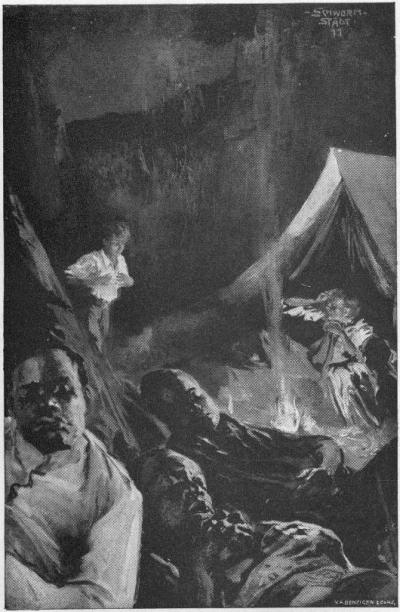
At last the sun rose and lighted up the
jungle, the scattered groves, and the forest.
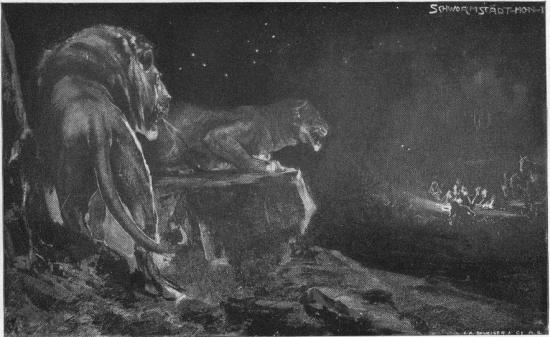
The lions disappeared with the first ray
of dawn. Stasch made Kali build a fire and
ordered Mea to take Nell’s things out of the
leather bag, in which they were packed, to dry
them and change the girl’s clothes as quickly
as possible. He took the rifle and carefully
went over the camp to see what ravages had
been made by the storm and the bloodthirsty
beasts.
Just behind the hedge, only the stakes of
which remained, lay the first horse, nearly half
devoured; some hundred feet further, a second,
hardly begun; and next to it the third, with its
stomach torn open and its head smashed in.
They all presented a terrible sight, for in their
open, glassy eyes could be seen their terror at
approaching death, and their wide-open jaws
displayed their strong teeth. The ground was
stamped down and the cavities formed pools of
blood. Stasch was so enraged that at the moment
he almost wished that the disheveled head
of one of the nocturnal robbers, tired out after
the feast, would appear behind one of the
bushes, so that he might send a bullet through
it. But he was obliged to postpone his revenge
at present, for he had other things to attend to.
The remaining horses had to be caught.
The boy supposed that like Saba, whose carcass
was nowhere to be seen, they might have
hidden somewhere in the woods. The hope that
the faithful fellow-sufferer had not fallen a
prey to the wild animals made Stasch feel so
happy that he took courage once more, and
the finding of the donkey naturally increased
his joy. It so happened that clever longears
had not even taken the trouble to run far
away. He had simply crept into a nook made
by the ant-hill and the large tree outside the
hedge, and there, with head and sides protected,
he had awaited events, in readiness at any moment
to repulse the attack by vigorously kicking
out his hind legs. But the lions had apparently
not noticed him, so when the sun rose
and the danger was over he felt the necessity
of lying down and taking a good rest after all
the tragical events of the night.
While circling the camp Stasch at last found
the impress of horses’ hoofs in the moistened
earth. The tracks pointed toward the woods
and then turned off toward the gorge. That
was fortunate, for it would not be difficult to
capture horses in the narrow pass. A little
further on in the grass was found a foot-chain,
which one of the horses had succeeded in breaking
off during its flight. This horse must have
run away so far that for the present he would
have to be considered lost. To offset this,
Stasch discovered the other two behind a low
rock, not in the ravine, but on its borders. One
of them was rolling on the ground, the other
grazing in the fresh green grass. Both looked
very tired, as though they had run a long distance.
But daylight had driven all fear from
their hearts, and they greeted Stasch by neighing
in a short, friendly way. The horse which
was rolling on the ground sprang to his feet,
which enabled the boy to see that he also had
succeeded in breaking loose from his foot-chains,
but fortunately he had preferred remaining
with his friend to running away aimlessly.
Stasch left both of them under the cliff and
advanced to the edge of the ravine to make
sure whether it were possible to continue the
journey. He now saw that the heavy downpour
had been so severe that the rain had run
off and the ground was nearly dry. And soon
his attention was attracted by a grayish-white
article, which had been caught in the vines overhanging
the opposite side of the cliff. This
proved to be the roof of the tent, which had
been blown off and caught on the bushes; it
had taken such a strong hold that the rain could
not wash it away. After all, the tent offered
a better shelter for Nell than the hut made of
branches of trees put together hastily, and
Stasch was much pleased at finding this article,
which he had thought was lost.
Now his joy increased when out of a higher
crevice in the cliff hidden by lianas Saba came
running toward him, holding in his teeth an
animal whose head and tail hung out of either
side of his jaws. The huge dog climbed down
in a minute and laid at Stasch’s feet a striped
hyena, with broken back and one foot bitten
off; then he began to wag his tail and to bark
cheerfully as if to say: “I must acknowledge
that I took to my heels before the lion, but
even you crouched like birds on the tree. And
besides, you see, I have not passed the night
without accomplishing something.”
And he was so proud of himself that Stasch
scarcely liked to make him leave the ill-smelling
carcass behind, instead of bringing it to Nell.
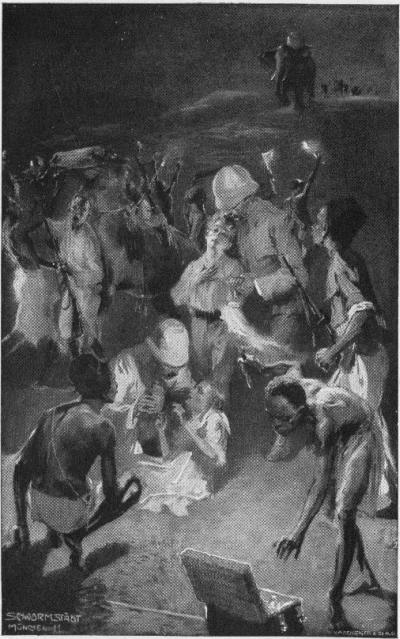
When they both returned they found a large
fire in the bivouac, water boiling in the pots,
and the meal being cooked. Nell had put on
dry clothing, but she looked so pale and ill that
Stasch was startled and took her hand, to make
sure whether or not she was feverish.
“Nell, what is the matter?” asked he.
“Nothing, Stasch; I am only very sleepy.”
“I believe it, after such a night! Thank
goodness, you have cold hands. Oh, what a
night that was! Of course you must be sleepy—I
am sleepy, too. But don’t you feel well?”
“I have a slight headache.”
Stasch laid his hand on her forehead. The
little head was cold like the hands, but that was
a sign of unusual exhaustion and weakness, and
so the boy sighed and said:
“You must now have something hot to eat,
and then you must lie down and sleep until
evening. At least the weather is good to-day,
and not likely to be as it was yesterday.”
But Nell gazed at him with terror.
“We surely are not going to spend the
night here?”
“Not here, for the mangled horses are lying
nearby; we will look for some other tree, or
else ride down into the gorge and build a better
fence than any in the world. You will sleep as
quietly as at Port Said.”
But she folded her tiny hands and with tears
in her eyes besought him to ride on at once, for
she said that in this awful place it would be
impossible for her to close her eyes and she
would surely get sick.
She begged so earnestly, and as she looked
into his eyes repeated over and over again,
“Stasch, please!” that at last he consented to do
as she wished.
“Then we will attempt to continue our journey
through the gorge,” said he, “for there it
is shady. Only promise to tell me when your
strength gives out or when you feel weak.”
“It will not come to that! You can bind
me to the saddle and I shall have a good sleep.”
“No. I shall ride on the same horse with
you. Kali and Mea will ride on the others, and
the donkey will carry the tent and the luggage.”
“Good! Good!”
“But as soon as breakfast is over you must
take a little nap. Besides, we can not start before
noon, as there are many things to be done.
The horses must be caught, the tent folded, and
the baggage repacked. We shall have to leave
some things behind, for we have only two
horses left. It will take a few hours to do all
these things, and in the meantime you will have
a good sleep and feel stronger. It is going to
be a very warm day, but under the tree it will
be shady.”
“And you—and Mea and Kali? I am so
ashamed to be the only one to sleep while you
all have so much anxiety——”
“Never mind; after a while we can sleep.
Don’t be worried on my account. When in
Port Said I frequently, during my examinations,
passed entire nights without sleep, but
of course my father did not know it. My
friends took no rest either. But what a man
can stand is of course out of the question for
a little fly like you. You have no idea how
badly you look to-day—as frail as glass. Your
eyes and hair are all that remain, and there is
nothing left of your face.”
Although he said this jokingly, in his heart
he was frightened, for in broad daylight Nell
really looked ill, and for the first time it occurred
to him that the poor child, if she continued
to look like this, not only might die, but
was sure to die. At this thought his knees
trembled, for he suddenly felt that in case of
her death he would have no reason to live or to
return to Port Said.
“For what would there be in life for me?”
he continually thought.
He turned away for a minute, so that Nell
should not see the look of sadness and fear in
his eyes, and then he went to the baggage,
which was piled up under the tree, took off
the cloth which covered the cartridge-case,
opened it, and began to search for something.
It was there, in a little glass phial, that he
kept the last quinine powder and guarded it
as the apple of his eye for a “dark hour”; that
is, in case Nell should take the fever. But now
it was almost certain that after such a night
the first attack would come on, and so he decided
to take precautions against it. This he
did with a heavy heart, thinking of what might
follow—and if he had not felt the impropriety
of a man and leader of a caravan weeping, he
would surely have dissolved into tears on parting
with his last powder.
In order to hide his emotion he assumed a
stern look, turned to the girl, and said:
“Nell, I want you to take the rest of the
quinine before you eat.”
“And if you get the fever?” she asked.
“Then I will shake myself. Take it, I say.”
She took it without further resistance; for
since he had shot the Sudanese she was a little
afraid of him, notwithstanding the attention
and kindness he showed her. Then they all sat
down to breakfast; and after the toils of the
night thoroughly enjoyed a plate of good soup.
Nell fell asleep as soon as the meal was finished
and slept some hours. Meanwhile Stasch,
Kali, and Mea prepared the caravan for the
journey, brought the top part of the tent from
the ravine, saddled the horses, put the pack on
the donkey, and hid under the roots of shrubs
everything they were unable to take with them.
They were almost overcome with sleep while
performing these duties, so Stasch arranged
that they should take turns in having a short
nap, fearing that otherwise they might go to
sleep during the journey.
It was about two o’clock when they set out
again. Stasch held Nell in front of him on
the saddle and Kali rode with Mea on the second
horse. They did not ride straight into the
gorge, but kept between its upper side and the
forest. The new jungle had grown considerably
during this last night of rain, but the
ground under the new grass was black and still
bore traces of fire. It was easy to surmise that
either Smain had passed that way with his
men, or that a fire, caused by lightning, had
swept over the dried jungle, and, having at last
struck the wet forest, had wound itself through
the rather narrow course between it and the
ravine. Therefore Stasch tried to see whether
traces of Smain’s encampment or imprints of
his horses’ hoofs could be found on this route,
and to his great joy he was convinced that nothing
of the kind was to be seen. Kali, who understood
such things, insisted that the fire must
have been driven there by the wind more than
ten days ago.
“That proves,” said Stasch, “that Smain is
already heaven knows where with his Mahdists—and
that we can not possibly fall into his
hands.”
He and Nell now began to look at the vegetation
with some curiosity, for they had never
been in a tropical forest before. They rode
along close to the edge, so as to be in the shade.
The ground was damp and soft, and covered
with dark green grass, moss, and ferns. Here
and there lay old rotten tree-trunks covered
with a carpet of beautiful orchids,[17] with cups
colored like variegated butterflies in the center
of their buds. Wherever the sun shone the
earth glittered with other strange tiny orchids,[18]
whose two petals, rising from a third petal, remind
one of the head of a small animal with
pointed ears. In many places the forest consisted
of the shrubs of wild jasmine,[19] forming
garlands of thin, pink-colored tendrils. The
wet paths and crevices were covered with ferns,
forming an impenetrable thicket. This underbrush
was low in some places, broad in others,
and sometimes it grew tall and was encircled
by a kind of safflower, which in that case
reached to the lowest branches of the tree, giving
an effect of fine green lace. In the interior
of the woods there were different kinds of trees.
Date and bread trees, fan palms, sycamores,
large varieties of groundsel, acacias, trees with
dark, shining, bright blood-red foliage grew
close together, stem to stem, with branches and
twigs from which yellow and purple flowers
shot forth like torches. In many places the
tree-trunks were completely hidden, being covered
from head to foot with creepers, which
swayed from one branch to the other, forming
the capital letters “W” and “M,” and resembling
festoons, curtains, or portières. India-rubber
lianas[20] nearly smothered the trees with
their thousands of tendrils, and turned them
into pyramids clothed in white flowers. Small
lianas wound themselves round the larger ones,
and the jungle was in some places so thickly
matted that it almost formed a barrier through
which neither human being nor animal could
penetrate. Only here and there, in places
where elephants, whose strength nothing can
withstand, had forced a passage, were there
gaps in the thicket, which looked like deep,
winding corridors. The song of the birds,
which make the European forests so charming,
was absolutely lacking. On the other hand,
there came from the tops of the trees the most
peculiar sounds, resembling at times the sharp
scraping of a saw, the hollow beating of pots
and pans, the chattering of storks, the squeaking
of an old rusty door, the clapping of hands,
the mewing of cats, and even the loud and animated
conversation of human beings. From
time to time a swarm of gray, green, or white
parrots or a multitude of colored pepper-eaters,
with their gliding, wave-like motion,
swung themselves in the trees. On the snow-white
background of the india-rubber vines
there sometimes crept like forest spirits
little monkeys in mourning, perfectly black,
with the exception of their white tails, white
stripes on their sides, and strange-looking
white whiskers encasing their coal-black
faces.
The children gazed with admiration and surprise
at the forest, which the eyes of a white
man had perhaps never seen before. Saba constantly
ran under the bushes and barked cheerfully.
Little Nell felt strengthened by the
quinine, her breakfast, and her sleep. Her
little face was fresh and somewhat rosy, and
her eyes had a happier expression. Every minute
she asked Stasch the names of the various
trees and birds, and he answered her as best he
could. At last she said that she would like
to get off the horse and pick quantities of
flowers.
But the boy smiled and said:
“The ‘siafus’ would eat you up in a minute.”
“What’s that—‘siafus’? Is that something
worse than a lion?”
“Worse and still not worse. They are ants
that bite fearfully. The branches are covered
with them, and they fall like a shower of fire
from the trees and alight on one’s back. They
crawl along the ground, too. If you should
try to get off your horse and go into the woods,
you would soon begin to hop about and scream
like a little monkey. One might more easily
protect one’s self from a lion. Sometimes they
come in large swarms, and then everything
gives way before them.”
“But you could surely prevent them doing
you any harm!”
“I? Why certainly I could.”
“How?”
“With fire or boiling water.”
“You always know how to defend yourself,”
she said, thoroughly convinced.
Stasch felt very much flattered at these
words, and so answered in a cheerful voice:
“If you only keep well you can rely on me
for the rest.”
“I have not even a headache now.”
“Thank heaven! Thank heaven!”
During this conversation they were riding
on the border of the forest, which was only divided
from the narrow pass by a hedge. The
sun was still high in the heavens, and its scorching
rays beat down on them, for the weather
was fine, and there was not a cloud above the
horizon. The horses were sweating profusely,
and Nell began to complain of the heat. And
so Stasch, seeing a suitable place, turned into
the gorge, the west side of which was now completely
shady. The water still left in the hollows
after the storm of the previous day was
now fairly cold. Over the heads of the little
wanderers there continually flew—from one
side of the gorge to the other—pepper-eaters
with purple heads, blue breasts, and yellow
wings, and the boy began to tell Nell what he
had read in books about their habits.
“You know,” he said, “there are pepper-eaters
which, in the brooding season, find a
cavity in a tree, and the female then carries
the eggs there and sets on them, and the male
closes the opening with clay so that only the
head of the female is visible, and not until the
young ones are hatched does he break the wall
of clay with his large beak and give the female
her liberty again.”
“And what does she have to eat all this
time?”
“The male feeds her. He flies about constantly
and brings her various kinds of berries.”
“And is she allowed to sleep?” asked Nell in
a sleepy voice.
Stasch smiled.
“If Mrs. Pepper-eater is as sleepy as you
are, then the male permits her to go to sleep.”
In the coolness of the gorge the girl was suddenly
overcome by drowsiness, for her nap that
morning had been too short, and she needed
more sleep. In fact, Stasch really had a great
mind to follow her example, but could not, because
he had to hold fast to her for fear she
might fall, and besides he was very uncomfortably
seated, riding astride on the broad, flat
saddle which Hatim and Seki Tamala had made
in Fashoda for the little girl. He hardly dared
move, and he guided the horse as slowly as
possible so as not to wake her up.
And she leaned back, laid her small head
on his shoulder, and fell sound asleep. But she
breathed so quietly and evenly that Stasch did
not regret having given her the last small
quinine powder. On hearing her deep breathing
he felt that for the present the danger of
fever was over, and he began to make the following
observations:
“The bed of the gorge leads continually up
hill, and just at this particular spot it is rather
steep. We have climbed higher and higher,
and the ground is much drier than below. We
must now search for a high and well-sheltered
place near a rapid stream, and settle down
there, give the little one a few weeks in which
to recover, and perhaps we shall be obliged to
wait until the ‘massika’[21] is over. Few girls
would have borne up under a tenth part of
these trials, and she must take a good rest.
After a night such as we have passed through
any other girl would have come right down with
the fever, but she—how soundly she sleeps!
Thank God!”
These thoughts encouraged him, but though
he spoke cheerfully to himself while gazing on
Nell’s head reposing on his shoulder, he was
also surprised at his emotions.
“It really is strange how fond I am of this
little one. I have always been fond of her, but
now I care more and more.”
And as he did not know how to account for
this he reflected as follows:
“This is probably due to the fact that we
have undergone so many dangers together, and
also because she happens to be in my care.”
While meditating thus he held the child very
carefully, with his right hand in her belt, so
that she could not fall out of the saddle.
They rode on slowly and silently, and Kali
whispered in Stasch’s ear these flattering
words:
“The Great Man kills Gebhr, kills lion, and
buffalo. Yah! Yah! The Great Man will kill
many lions. Plenty of meat! Plenty of meat!
Yah! Yah!”
“Kali,” asked Stasch softly, “do the Wa-himas
hunt lions, too?”
“Wa-hima afraid of lions, but Wa-hima dig
deep trenches, and if a lion falls into them during
the night, why then Wa-hima laughs.”
“What would you do then?”
“Wa-hima throw many spears until the lion
like a porcupine, then drag him out of the
trench and eat him. Lion good.” And, as was
his custom, he stroked his stomach.
This way of killing lions did not appeal
strongly to Stasch, so he began to question Kali
as to what other kind of game was to be found
in the land of the Wa-hima; and so they talked
more about antelopes, ostriches, giraffes, and
rhinoceroses until they heard the splashing of a
waterfall.
“What’s that?” cried Stasch. “In front of
us is a stream and a waterfall, too!”
Kali nodded his head as a sign that it was
really so.
For a time they rode on, quickening their
pace and listening intently to the rushing of
the water, which was heard more distinctly
every minute.
“A waterfall!” repeated Stasch, who was
much interested. But they had scarcely passed
through one or two bends in the gorge when
they suddenly perceived an insurmountable obstacle
lying across their path.
Nell, who had been lulled to sleep by the regular
motion of the horse, awoke at once.
“Are we stopping to put up here for the
night?” she asked.
“No; but look!” answered Stasch. “See, a
rock is lying across the gorge!”
“What can we do?”
“It is impossible to creep alongside of the
rock, for it is very narrow just here, and so
we must turn back a little way and try to climb
to the top and go around it; but as there are
still two hours before night-fall we have plenty
of time, and this will give the horses a chance
to get their wind. Do you hear the waterfall?”
“I hear it.”
“That’s where we’ll halt for the night.”
He then turned to Kali and ordered him to
climb up the side of the narrow pass to see
whether the bottom of the gorge was blocked
with more obstacles. As for Stasch, he began
to inspect the rock very carefully, and after a
while he exclaimed:
“It must have broken off and fallen down
here very recently. Do you see where it has
broken off, Nell? See how fresh the break is.
There is not even moss or in fact any other kind
of plant to be seen on it. I understand now—I
understand!”
And with his hand he pointed to a baobab-tree
growing on the side of the ravine,
its enormous roots hanging down over the
side of the cliff where the rock had broken
off.
“This root has forced its way through a
crevice between the wall and the rock and has
grown so long and so thick that it has split the
rock off. That seems strange, for stone is
harder than wood, but I do know that such
things happen in the mountains. A rock like
this, which has scarcely any hold, breaks off at
the least jar.”
“But what could have jarred it so?”
“That’s difficult to say. Perhaps a previous
storm, perhaps yesterday’s rain.”
Saba had remained behind the caravan, but
now he came running up, as if some one were
pulling him back by the tail, sniffed, squeezed
himself through the small passage between the
hedge and the fallen rock, and then immediately
began to back out, his hair standing on
end.
Stasch dismounted to see what had frightened
the dog.
“Stasch, don’t go,” begged Nell; “perhaps
there is a lion there.”
But the boy, who loved to boast of his wonderful
deeds, and who since the events of the
day before had been greatly enraged against
lions, answered:
“That’s great! A lion—by day!”
But before he had time to approach the passage
Kali’s voice was heard from above the
gorge.
“Bwana Kubwa! Bwana Kubwa!”
“What’s the matter?” cried Stasch.
In a moment the negro slid down the stalk
of a creeper. It could easily be seen from his
face that he was the bearer of some great news.
“An elephant!” he exclaimed.
“An elephant?”
“Yes,” answered the young negro, gesticulating
with his hands; “over there rushing
water and here cliffs. Elephant can not get
out. The Great Man kill elephant and Kali
eat him—oh, eat! eat!”
This thought made him so happy that he began
to jump around, to smack his lips and slap
his knees and to laugh like an idiot, at the same
time rolling his eyes and showing his white
teeth.
Stasch did not understand at first why Kali
said that the elephant could not escape from
the gorge, so to make sure of what had happened
he mounted his horse, and giving Nell
into Mea’s care, so that he could have both
hands free in case it were necessary to shoot, he
ordered Kali to mount behind him; then they
all turned back and began to look for a place
where they could climb up. On the way, Stasch
asked how the elephant could have got in there,
and from Kali’s answer he surmised what had
really happened.
Apparently the elephant had sought refuge
from the flames during the forest fire, and on
his way knocked against the rock, which, being
insecure, had fallen down and cut off all means
of his return. On running further he had come
to the end of the narrow pass and found himself
on the edge of the abyss, through which
the stream flowed, and was thus hemmed in.
After a short time they discovered a way out
of the gorge, but as it was rather steep, it was
necessary to dismount and lead the horses. As
the negro assured them that the stream was not
far off, they continued to walk on until they
reached the top. At last they came to a high
strip of land, which was bordered on the one
side by the stream and on the other by the ravine,
and then looking down into the depth,
they saw the elephant on the flat ground.
The huge animal lay on its stomach, and
Stasch was very much astonished that he did
not jump up when he caught sight of them,
for, as Saba made a dash for the edge of the
narrow pass and began to bark, the beast only
moved his enormous ears once, and raising his
trunk, immediately let it fall again.
The children held each other’s hands tight,
and looked at him a long while in silence, until
Kali said:
“He hunger, die.”
In fact, the elephant had become so thin that
the whole length of his backbone stood out like
a comb; his sides were hollow, and beneath his
hide, notwithstanding its thickness, his ribs
could be plainly seen, and it was easy to conjecture
that the reason he did not get up was
because his strength was exhausted.
The gorge, fairly broad at the entrance,
changed into a small pocket, closed in on both
sides by perpendicular cliffs, at the bottom of
which grew a few trees. These trees had been
broken off, their bark was torn off and not a
leaf remained. Nearly all the vines that had
overhung the cliffs had been eaten and the grass
throughout the entire pocket had been uprooted
and eaten, even to the very last blade.
After Stasch had taken in the whole situation
he began to narrate to Nell what he had
seen, but as he thought that the huge animal
was doomed to die, he spoke very softly, as if
afraid of darkening the last hours of his life.
“Yes, he is really dying of hunger. Probably
he has been a prisoner here for the last
two weeks, since the time when the forest fire
burned up the old jungle. He has eaten up
everything that was eatable, and now he is
being slowly tormented to death, for he can
see bread-fruit trees and acacias growing above
him, but is unable to reach them.”
And once more they looked down in silence
for a while at the elephant, who every now
and then turned his small, dying eyes toward
them, and each time a sound like a sob escaped
from his throat.
“Really,” the boy said, “it would be a mercy
to put an end to his suffering.”
At these words he raised the rifle to his shoulder,
but Nell caught him by the coat, and standing
right in front of him, used all her force to
drag him away from the edge of the ravine.
“Stasch, don’t do it! Give him something to
eat! He is so thin! I will not let you shoot
him! I will not, I will not!”
And stamping still more emphatically with
her foot, she continued to pull him away. He
looked at her in surprise, but on seeing tears in
her eyes, said:
“But, Nell——”
“I will not allow it. I will not let him be
killed! If you kill him, I shall get the fever!”
This threat sufficed to make Stasch abandon
his murderous intentions in regard to this elephant
and others as well. In fact, he remained
silent for a while, as he did not know what to
answer the child; then he said:
“Well, all right! All right! I tell you, it is
all right! Nell! let me go!”
And Nell at once embraced him and a smile
shone out of her tear-stained little eyes. Her
only care now was to give the elephant some
food as soon as possible. Kali and Mea were
very much surprised on hearing that “Bwana
Kubwa” was not only not going to shoot the
elephant, but that they must straightway pick
the fruit of the bread-tree, the pods of the
acacia, and various herbs, leaves and grass, as
much as they could collect. Gebhr’s double-bladed
Sudanese sword greatly aided Kali in
accomplishing this task, for without it the work
would have been by no means easy. But Nell
did not want to wait until they had finished,
and as soon as the first fruit fell from the
breadfruit tree she grasped it with both hands,
carried it to the gorge, and repeated quickly to
herself, as if afraid that any one else should get
there first:
“I! I! I!”
But Stasch had no thought of depriving her
of this pleasure; on the contrary, he took hold
of her belt, for fear that in her great excitement
she might fall over the edge of the cliff
together with her bread-fruit, and cried:
“Throw it down!”
The enormous fruit rolled over the steep
precipice and fell at the feet of the elephant,
who immediately put out his trunk, picked it
up and crunched it as if eager to swallow it at
once, and it disappeared instantly.
“He has eaten it up!” cried Nell, overjoyed.
“I should say so!” answered Stasch, laughingly.
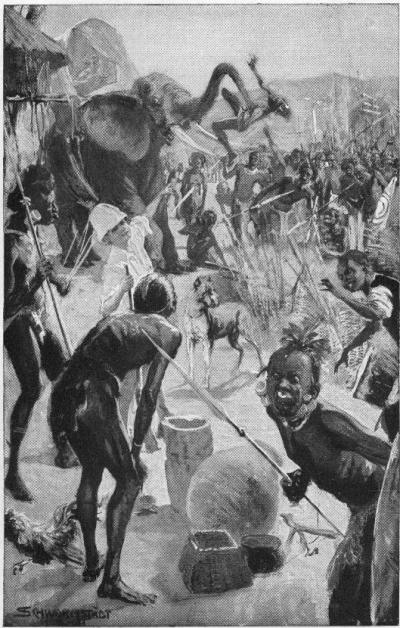
The elephant now put out his trunk toward
them, as if asking for more, and then could
be heard his “Hrrumff!”
“He wants more yet!”
“I should think he did!” replied Stasch.
A second fruit now disappeared like the first,
followed by a third, fourth—tenth; then in
rapid succession he ate acacia-pods, big bundles
of grass, and various kinds of leaves. Nell,
would not permit any one to replace her, and
when at last her little hands became tired, she
still pushed more food down to him with her
feet. The elephant continued eating, and it
was only now and then, between mouthfuls,
that he raised his trunk and gave forth a thundering
“Hrrumff,” to denote that he wanted
more, and, as Nell felt certain, to show his
gratitude.
At last Kali and Mea got tired of this work,
which they had performed very faithfully, and
they silently hoped that “Bwana Kubwa”
would fatten the elephant and kill him later.
At last “Bwana Kubwa” told them to stop, for
the sun had now sunk quite low and it was time
to begin the construction of the hedge. Luckily
it was not very difficult, for two sides of
the three-cornered strips of land were inaccessible,
so that only the third one needed to be
fenced in, and plenty of acacias with their
terrible thorns grew nearby.
Nell did not move an inch from the gorge,
and crouching on its edge, with her legs tightly
crossed, she informed Stasch, who was some
distance away, what the elephant was doing—and
her thin little voice continually rang
out:
“He is feeling around with his trunk!” or
“He is moving his ears. He has enormous
ears!”
Then at last: “Stasch! Stasch! He is getting
up! Oh!”
Stasch approached quickly and took Nell by
the hand. In truth, the elephant had really
gotten up, and only now could the children see
his enormous size. They had occasionally seen
large elephants being taken in ships through
the Suez Canal on their way from India to
Europe, but not one of them could compare
with this colossus in size, for he really looked
like a large slate-colored, four-footed rock.
He differed from those they had seen in having
enormous tusks five feet or more long, and, as
Nell had already said, fabulously large ears.
His front legs were very long, but comparatively
thin, which was probably due to his having
fasted so many days.
“Oh, what a Liliputian!” cried Stasch; “if
he were to take a good stretch and throw out
his trunk to its full length he could catch hold
of your little foot.”
But the giant neither thought of stretching
himself nor of catching any one by the foot.
With uncertain steps he advanced toward the
entrance to the gorge and looked for a while
down into the ravine, at the bottom of which
the waters whirled; then he turned toward the
side nearest the waterfall, sat down on his
stomach, put out his trunk into the water,
dipped it down deep, and began to drink.
“It was lucky for him,” said Stasch, “that he
could reach down into the water with his trunk.
Otherwise he would have died.”
The elephant drank so long that the girl became
alarmed.
“Stasch, will he not harm himself?” said she.
“I don’t know,” he answered smilingly; “but
as you have taken him under your special care
you should warn him now.”
And so Nell bent over the side and called:
“Enough, dear elephant, enough!”
And the “dear elephant,” as if he understood
what was meant, immediately stopped drinking,
and at once began to spray himself with
the water, first his legs, then his back, and lastly
his two sides.
In the meanwhile it began to get dark, and
so Stasch guided the little girl back to the
hedge, where supper was already awaiting
them.
Both children were in the best of humor—Nell,
because she had saved the elephant’s life,
and Stasch, because he saw her small eyes
gleaming like stars and her happy little face
looking fresher and healthier than it had
since their departure from Khartum. What
also added to the satisfaction of the boy was
that he had promised himself a quiet and good
night’s rest. The strip of land, inaccessible on
two sides, ensured them from attack from
those directions, and on the third side Kali and
Mea had erected such a high hedge out of
prickly acacias and branches of passiflora[22] that
there was no possibility of any beast of prey
being able to break through the barrier. Besides
the weather was fine, and soon after sunset
the sky was studded with stars. It was
very pleasant to be cooled off by being in the
proximity of the waterfall, and to breathe the
heavy fragrance of the jungle and the freshly
broken off branches.
“The ‘fly’ will not get the fever here!”
thought Stasch joyfully.
They began to talk about the elephant, for
Nell could speak of nothing else, and she continually
expressed her admiration for his huge
size, his trunk, and his tusks, which really were
enormous. At last she said:
“How wise he is, Stasch, isn’t he?”
“As wise as Solomon,” replied Stasch. “But
how did you find that out?”
“Because, when I asked him to stop drinking,
he immediately complied with my request.”
“If he had never taken lessons in the English
language before, and understands what you
said to him, then indeed it is quite remarkable.”
Nell perceived that Stasch was making fun
of her, so she fondled him like a little kitten,
and said:
“Say what you like, but I’m certain that he
is very wise, and that he can be readily tamed
at once.”
“Whether readily and at once I’m not sure,
but he can be tamed. The African elephant
is wilder than the Asiatic, but I believe
that Hannibal, for instance, used African
beasts.”
“Who was Hannibal?”
Stasch looked indulgently and pityingly at
her.
“Of course,” he said, “at your age you are
not expected to know—Hannibal was a great
leader of the Carthaginian army, which used
elephants in the war with the Romans, and as
Carthage was in Africa, he was obliged to use
African elephants.”
The conversation was interrupted by a tremendous
trumpeting of the elephant, which,
after having satisfied his hunger and thirst, began—either
from joy or longing to be free—to
signal with his trunk. Saba sat up and began
to bark, and Stasch said:
“See what you have done? Now he is calling
his friends. A nice story if a whole herd
were to approach.”
“He will tell the others that we were good
to him,” answered Nell hastily.
But Stasch, who really was not at all worried
(because he reckoned that, even if several were
to come along, the light of the fire would
frighten them away), laughed defiantly and
said:
“Well, well! But if elephants should appear,
you will not cry for fear; oh, no!—your eyes
would only perspire as they have done twice
before!”
And he began to imitate her:
“I’m not crying, only my eyes perspire so!”
When Nell saw that he was joking she concluded
that they were in no danger.
“If we tame him,” she said, “then my eyes
will not perspire any more, even if ten lions
should roar.”
“Why?”
“Because he will protect us.”
Stasch quieted Saba, who had continued to
bark in answer to the elephant’s trumpeting,
then thought a while and continued:
“But, Nell, there is one thing that you did
not think of. We shall not stay here forever;
we must ride on further. I do not say immediately—on
the contrary. This place is very
convenient and healthy, so I have decided to
remain here one week—perhaps two—for you
and I and in fact all of us need a good rest.
Well, all right! As long as we stay here we
will feed the elephant, although this is an enormous
task for us all. He is imprisoned, and
we can not take him with us. But how will this
end? We shall go away and he will stay here
and starve once more, until he succumbs. And
of course we will grieve even more than we
would now.”
Nell felt very sad, and for a time sat there
silently, apparently not knowing what answer
to make to these very sensible remarks, but
soon she raised her head, and pushing aside
the lock of hair which always fell over her
forehead into her eyes, she turned her eyes
confidently toward the boy.
“I know,” she said, “that you could get him
out of the gorge if you only wanted to.”
“Yes?”
But she put out a finger, touched Stasch’s
hand, and repeated:
“Yes! Yes! Yes!”
The small and clever little lady knew quite
well that the boy would be flattered by her
confidence in him and that from now on he
would earnestly consider how to release the
elephant.