Footnotes have been collected at the end of each chapter, and are
linked for ease of reference.
The fullpage and smaller illustrations have been moved to fall on the
nearest paragraph break. The “facing page” binding instructions have been
removed.
The table of contents indicates that the Index begins at p. 375. The index includes
an Appendix, prior to the actual tabulation of references.
The Index provides page references to both volumes of this account. In the browser
version, each page reference is linked to the correct volume in Project Gutenberg’s
repository. To use these links, you must use the HTML version of this text.
Minor errors, attributable to the printer, have been corrected. Please
see the transcriber’s note at the end of this text
for details regarding the handling of any textual issues encountered
during its preparation.
Any corrections are indicated using an underline
highlight. Placing the cursor over the correction will produce the
original text in a small popup.
Any corrections are indicated as hyperlinks, which will navigate the
reader to the corresponding entry in the corrections table in the
note at the end of the text.
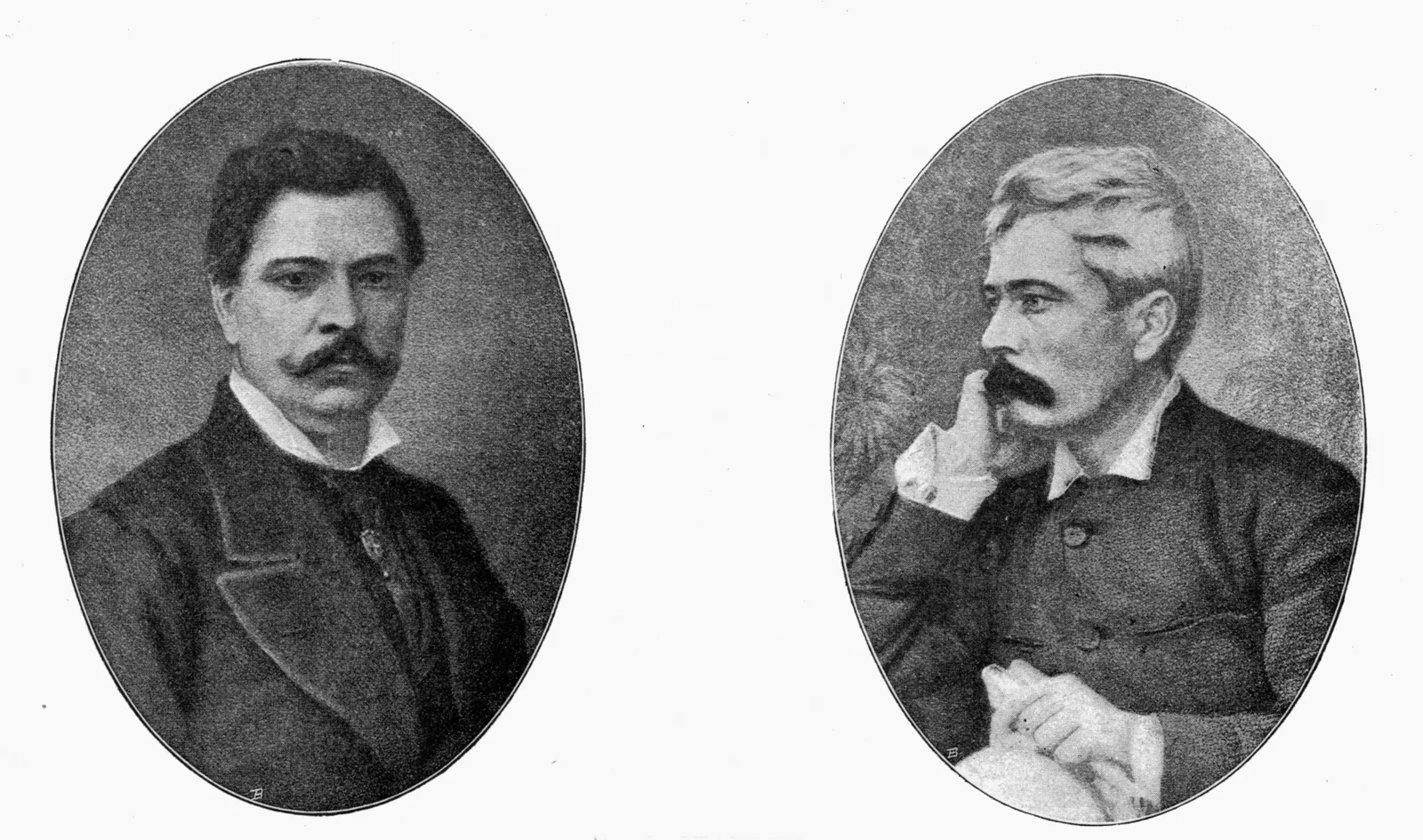
H. M. STANLEY.
TAKEN BEFORE HIS DEPARTURE, 1874. TAKEN ON HIS EMERGING FROM AFRICA, 1877.
THROUGH THE
DARK CONTINENT
OR
THE SOURCES OF THE NILE
AROUND THE GREAT LAKES OF EQUATORIAL AFRICA
AND DOWN THE LIVINGSTONE RIVER
TO THE ATLANTIC OCEAN
BY
HENRY M. STANLEY
AUTHOR OF “IN DARKEST AFRICA,” “HOW I FOUND LIVINGSTONE,”
“MY KALULU,” ETC.
MAP AND ILLUSTRATIONS
With a New Preface by the Author, written for this Edition.
VOL. II.
LONDON: GEORGE NEWNES, Limited
SOUTHAMPTON STREET, STRAND
1899
LONDON:
PRINTED BY WILLIAM CLOWES AND SONS, Limited,
STAMFORD STREET AND CHARING CROSS.
CONTENTS.
v
———●———
CHAPTER I.
PAGE
Ujiji, its scenery, residents, market, and vicinity—Arab rivals—The circumnavigation of the Tanganika—Commander Cameron and the outflowing Lukuga—The encroaching waters—The legend of the Lake—Evening
The Lady Alice afloat again—Her mate and crew—Anxiety on her behalf—-On hallowed ground—Unwelcome visitors: in the haunts of the Ruga-Ruga—The aborigines’ last retreat—A scene of blood—The robbers of the Lake, and their tutelary spirits—A geological problem: were there once two lakes?—Rising waters—The abode of the genii—A storm—Forest fires—At the mouth of Cameron’s “outlet”—The Lukuga creek
Back in camp—An epidemic of small-pox—Panic of desertion—Kalulu’s disloyalty—Livingstone’s lenience—Imaginary terrors—Hairdressing ad absurdum—Ruanga’s opinion of white men—A village sketch—The villagers of Uhombo—In puris naturalibus—A touch of human nature—On Livingstone’s traces—What is there in feathers?—The Manyema: their life and manners—Our ass astonishes the natives—Bloodless wars—Nicknames—A tribe with beards but no wives—The confluence of the Luama and the Livingstone
At a swinging pace—Tippu-Tib, the Arab trader—News of Cameron and his difficulties—The river that flows North for ever—In Dwarf-land, fighting the dwarfs—Tippu Tib’s conditions—Friends in council—Heads or tails—Kalulu’s accident at Nyangwé—Its residents and market—A muster of the Expedition
Tippu-Tib’s henchmen—In the primeval forest, a wilderness of trees—Primitive furniture—Our sufferings in the pagans’ forest—Tippu-Tib breaks down—A village blacksmith—Soko skulls; the missing link—Professor Huxley’s opinion thereof—The Livingstone—A day dream—The road to the ocean—Timid counsels—“The Wasambye!”—“Ooh-hu! ooh-hu!”—Successful diplomacy
“Mama, the Wasambye!”—The fight in the Ruiki—The lost found—Dangerous disobedience—In the nick of time—A savage captive—Music hath charms—In the haunts of Nature—A town of one street—Deserted villages—Organizing a hospital—An island wasted by lightning—“The people of the filed teeth”—Primitive salt-making—Hostages captured—At close quarters—Raining arrows—“Bo-bo, bo-bo, bo-bo-o-o-oh!”—A desperate affair and opportune reinforcements—Cutting the canoes adrift—Tippu-Tib deserts me—My appeal to the “sea children”—Christmas Day among the cannibals—“Victory or death!”
Farewell to Tippu-Tib—Attacked from both banks—The fat savage makes a bad shot at me—In the home of the elephants—Insect life—In covert—The Lowwa river—A storm on the river—New Year’s day—Bullets against spears—“Sennenneh!”—Tempting the female mind—The reward of a good deed—A river armada: crocodile boats—Betwixt cataracts and cannibals
Fighting betimes—Blazing a path—We take an island by storm—A desperate dilemma—Road-making under fire—A miraculous escape—A terrible march—Peace by stratagem—Below the Fifth Cataract—Our cannibal captives—Fighting the Wana-Rukura—The Wana-Rukura islanders—Approaching the Seventh Cataract—A deserted island—The Seventh Cataract of the Stanley Falls—The first of the Cataracts—Clear of the Stanley Falls
Again in open water—Frank Pocock feels the position—The Mburra or Yaryembi—A running fight—“Ya-Mariwa! Ya-Mariwa!”—Our tactics of capture—Monster spears—Growing weary of fighting for life—The power of laughter—Fish creeks—A wasp swarm of canoes—Another invincible armada—A village of ivory—Relics of cannibal feasts—The Wellé of Schweinfurth—Hunted to despair—Their “meat” escapes the cannibals—Wild nature—Among friendly natives—The Congo!
High art in tattooing—Suspicious friendliness—Friends or foes?—A treacherous attack—The fauna of the Livingstone—Among the “Houyhynyms”—The “Yaha-ha-has”—Frank’s courage and narrow escape—Our fight with the Bangala—The mirage on the river—The great tributary of the Livingstone—Among friends
Running the gauntlet—Kindly solitudes—Amina’s death—The humanizing effects of trade apparent—“The most plausible rogue of all Africa”—The king of Chumbiri; his hospitality, wives, possessions, and cunning—Making up a language—Pythons—The Ibari Nkutu or the Kwango—Treacherous guides—The Stanley Pool—Chief Itsi of Ntamo—We have to give up our big goat—River observations
The struggle with the river renewed—Passing the “Father”—In the “Cauldron”—Poor Kalulu!—Soudi’s strange adventures—At the “Whirlpool Narrows”—Lady Alice Rapids—Our escape from death—“Isles of Eden”—Thieves amongst us—The Inkisi Falls—The canoes dragged over the mountain—Trade along the Livingstone—Ulcers and entozoa—An artful compound
Glorious timber—Cutting canoes—Frank suffers from ulcers—The episode of the fetished axe—Rain-gauge readings—The rise of the river—“Goee-goees”—The Lady Alice breached for the first time—A painful discovery: Uledi’s theft—His trial and release—The burning of Shakespeare—The bees of Massassa—Local superstitions—Frank’s cheery character
Leaving Mowa—The whirling pools of Mowa—The Jason swept over the falls—The “Little Master” drowned—Too brave!—“Ah, Uledi, had you but saved him!”—The sympathy of the savages
Mutiny in the camp—Again among the cataracts—Frank’s body found—The fall of the Edwin Arnold river—Tired out!—Wholesale desertion—More cataracts—“Good-bye, my brother; nothing can save you!”—Rushing blindly on—Saved again!—The Jason found
Final warnings against theft—Humiliating a protectionist—Kindly tribes—Five of the Expedition abandoned to slavery for theft—Safeni goes mad from joy—Goaded to crime—Ali Kiboga’s adventures—The cataract of Isangila—Only five marches from white faces!—Staunch to the death—Rum—My appeal to Embomma—The forlorn hope—The “powerful man” insults us—Struggling on—“We are saved, thank God!”—“Enough now; fall to”—My letter of thanks—Approaching civilization—Amongst whites; Boma—The Atlantic Ocean
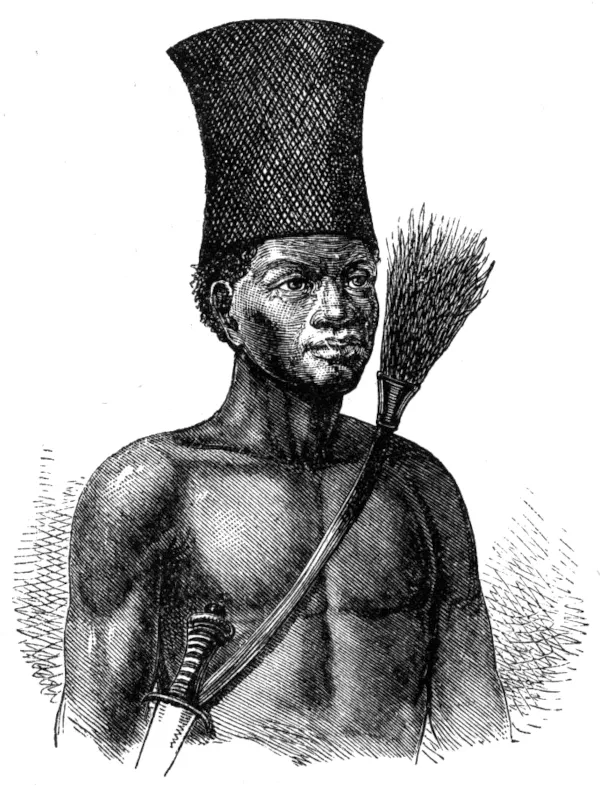
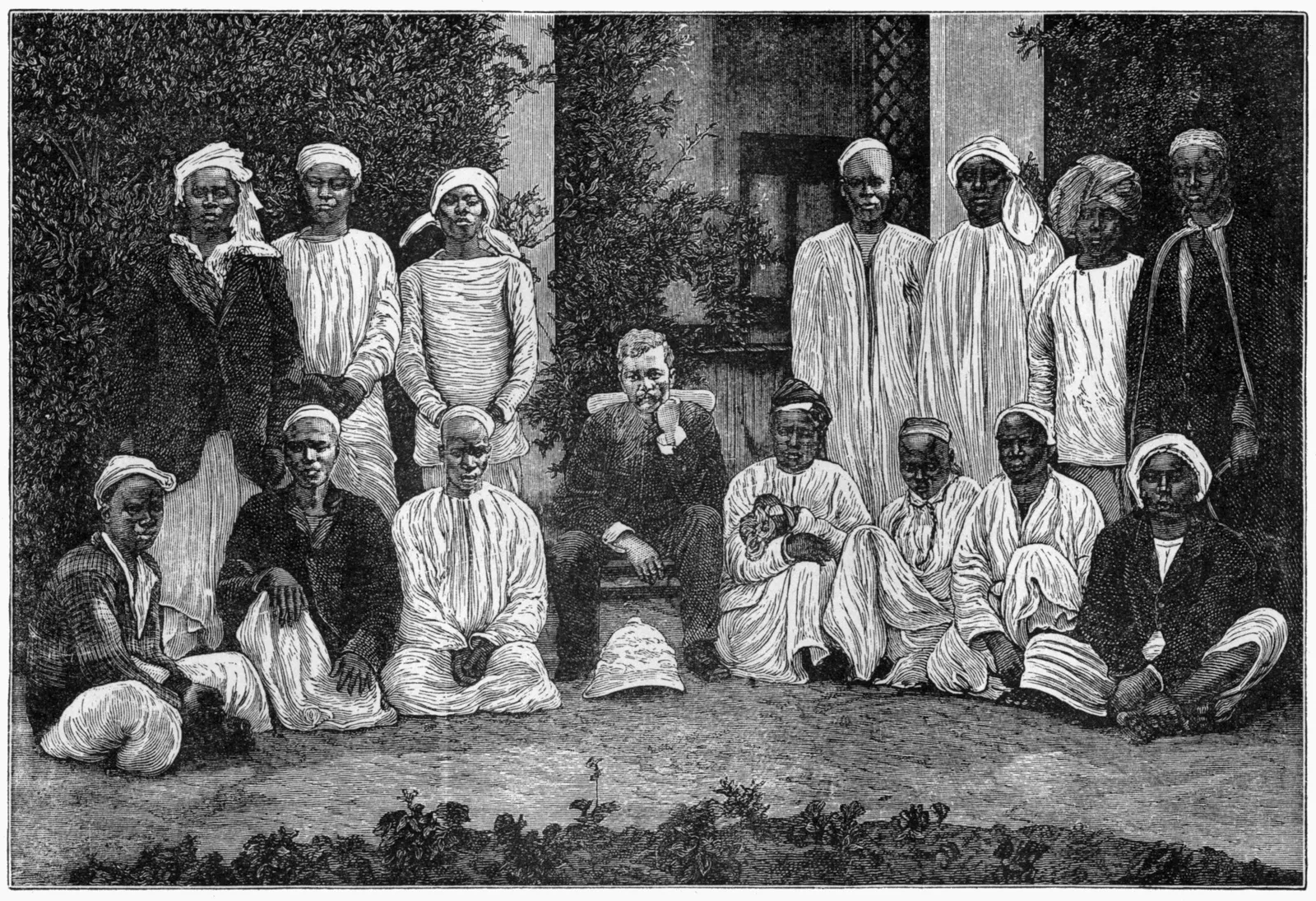
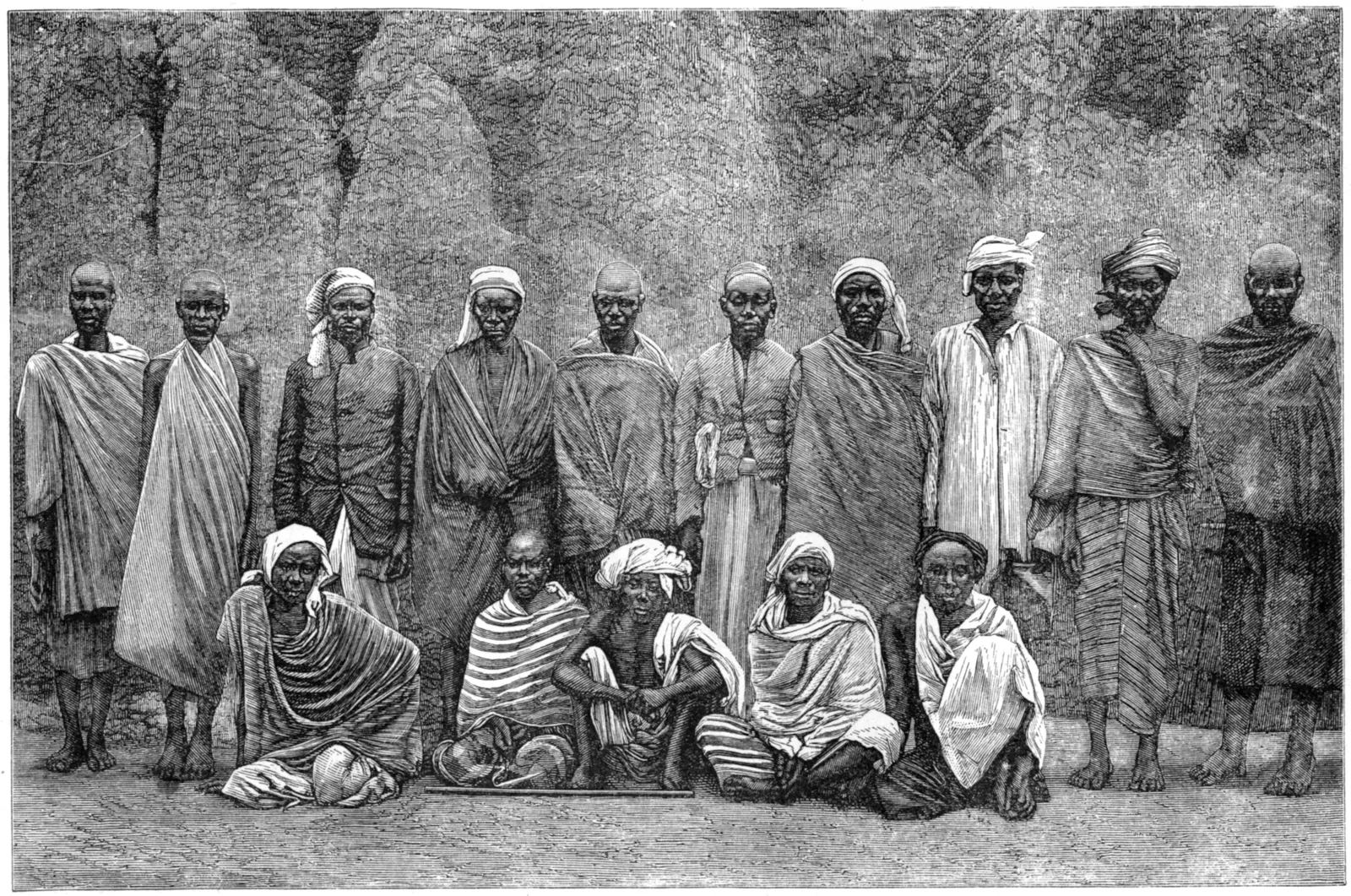
Group of Mr. Stanley’s followers at Kabinda, West Coast of Africa, just after crossing the “Dark Continent.” (From a photograph by Mr. Phillips, of Kabinda)
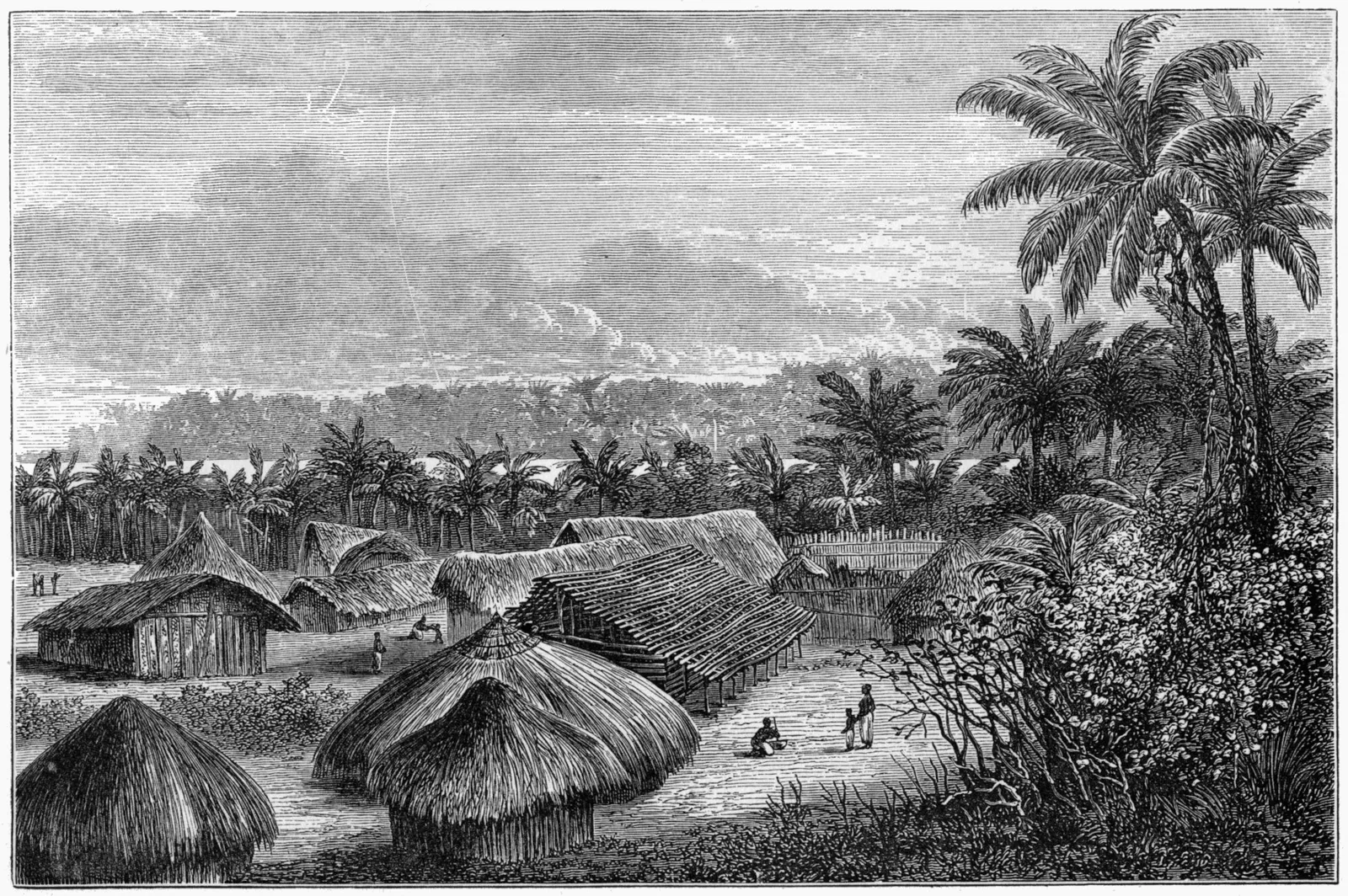
UJIJI, LOOKING NORTH FROM THE MARKET-PLACE. VIEWED FROM THE ROOF OF OUR TEMBÉ AT UJIJI.
(From a photograph by the Author.)
1THROUGH THE DARK CONTINENT.
——————
CHAPTER I.
Ujiji, its scenery, residents, markets, and vicinity—Arab rivals—The circumnavigation
of the Tanganika—Commander Cameron and the outflowing
Lukuga—The encroaching waters—The legend of the Lake—Evening.
June.—The best view of Ujiji is to be obtained from the
flat roof of one of the Arab tembés or houses. A photograph
which I took of the view north from my tembé, which fronted
the market-place, embraced the square and conical huts of
the Wangwana, Wanyamwezi, and Arab slaves, the Guinea
palms from the golden-coloured nuts of which the Wajiji
obtain the palm-oil, the banana and plantain groves, with
here and there a graceful papaw-tree rising amongst them, and,
beyond, the dark green woods which line the shore and are
preserved for shade by the fishermen.
South of the market-place are the tembés of the Arabs,
solid, spacious, flat-roofed structures, built of clay, with broad,
cool verandahs fronting the public roads. Palms and papaws,
pomegranates and plantains, raise graceful branch and frond
above them, in pleasing contrast to the grey-brown walls,
enclosures and houses.
The port of Ujiji is divided into two districts—Ugoy,
occupied by the Arabs, and Kawelé, inhabited by the
Wangwana, slaves, and natives. The market-place is in
Ugoy, in an open space which has been lately contracted
to about 1200 square yards. In 1871 it was nearly 3000
square yards. On the beach before the market-place are
drawn up the huge Arab canoes, which, purchased in Goma
on the western shore, have had their gunwales raised up with
heavy teak planking. The largest canoe, belonging to Sheikh
Abdullah bin Suliman, is 48 feet long, 9 feet in the beam,
and 5 feet high, with a poop for the Nakhuda (captain), and
a small forecastle.
2Sheikh Abdullah, by assuming the air of an opulent shipowner,
has offended the vanity of the governor, Muini Kheri,
who owns nine canoes. Abdullah christened his “big ship”
by some very proud name; the governor nicknamed it the
Lazy. The Arabs and Wajiji, by the way, all give names to
their canoes.
The hum and bustle of the market-place, filled with a
miscellaneous concourse of representatives from many tribes,
woke me up at early dawn. Curious to see the first marketplace
we had come to since leaving Kagehyi, I dressed myself
and sauntered amongst the buyers and sellers and idlers.
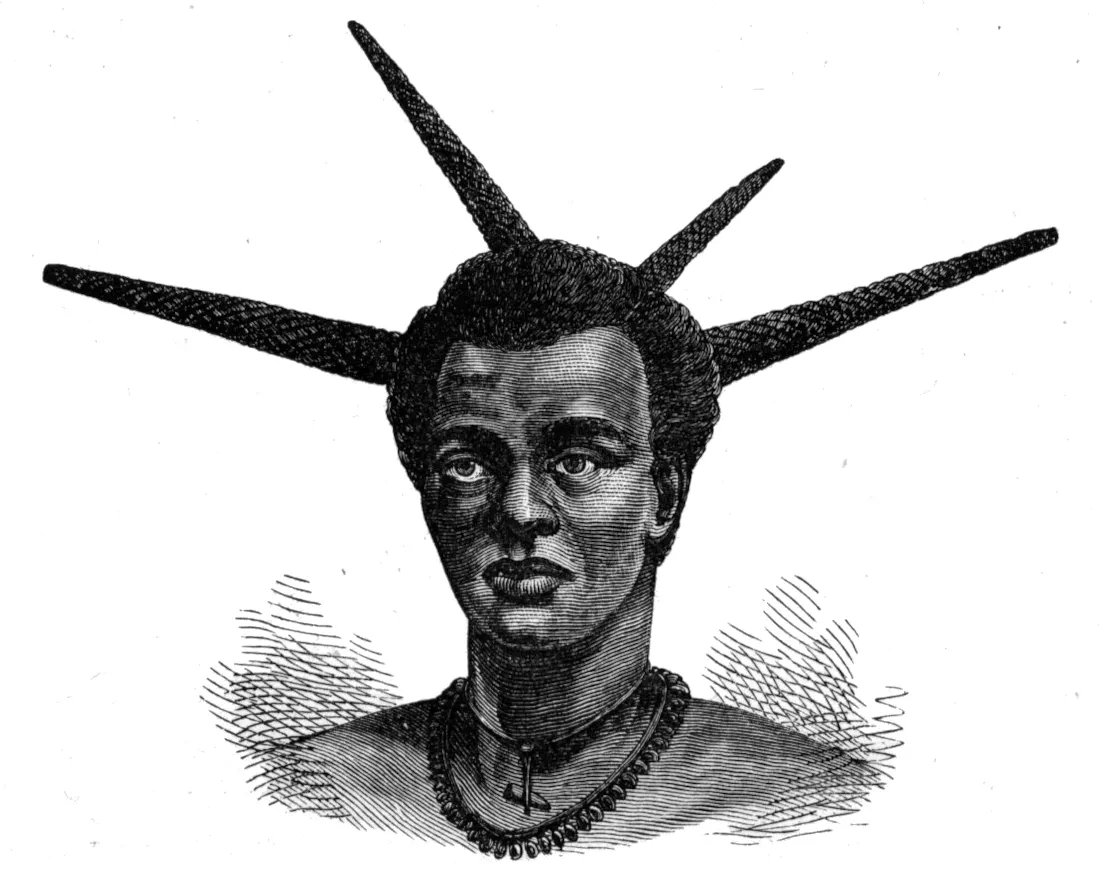
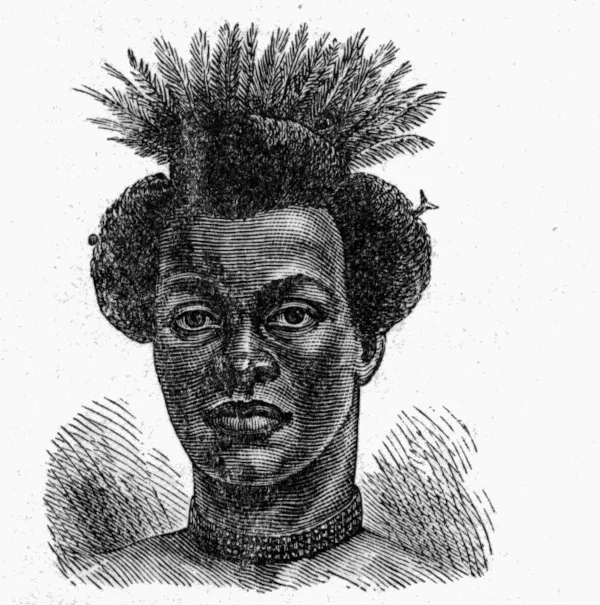
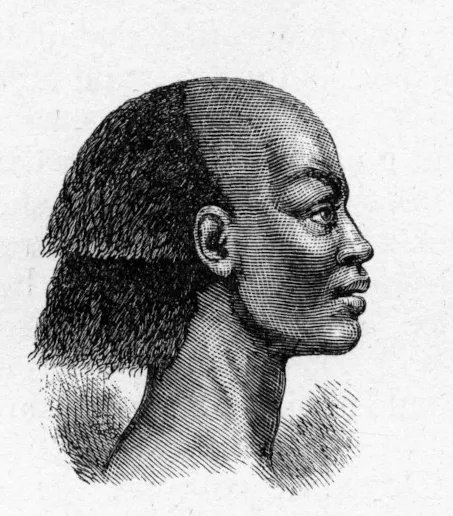
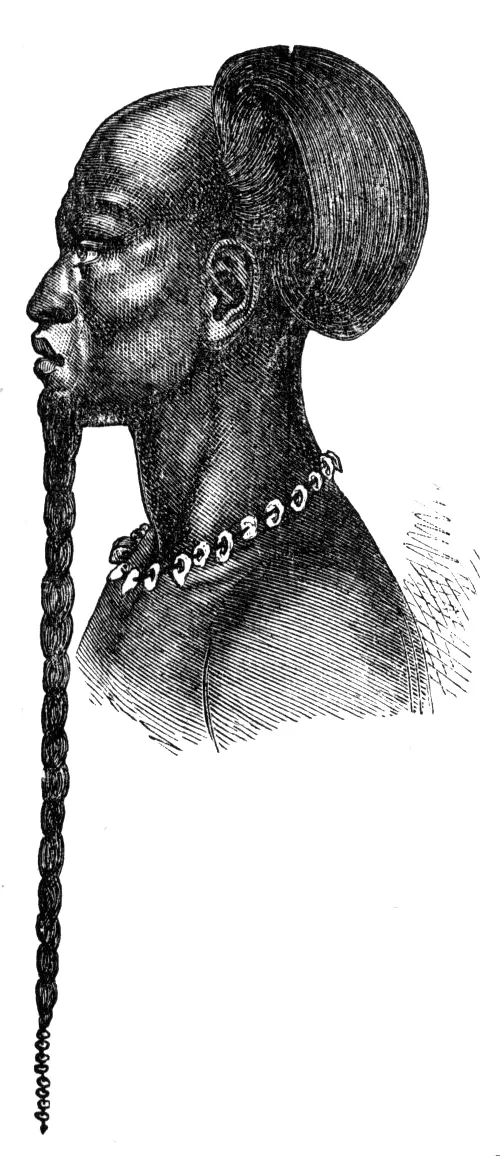
A NATIVE OF RUA WHO WAS A VISITOR AT UJIJI.
Here we behold all the wealth of the Tanganika shores.
The Wajiji, who are sharp, clever traders, having observed
that the Wangwana purchased their supplies of sweet
potatoes, yams, sugar-cane, ground-nuts, oil-nuts, palm-oil
and palm-wine, butter, and pombé, to retail them at enormous
profits to their countrymen, have raised their prices on
some things a hundred per cent. over what they were when
I was in Ujiji last. This has caused the Wangwana and
slaves to groan in spirit, for the Arabs are unable to dole out
to them rations in proportion to the prices now demanded.
The governor, supplied by the Mutwaré of the lake district
of Ujiji, will not interfere, though frequently implored to do
3so, and, consequently, there are frequent fights, when the
Wangwana rush on the natives with clubs, in much the same
manner as the apprentices of London used to rush to the
rescue or succour of one of their bands.
Except the Wajiji, who have become rich in cloths, the
rural natives retain the primitive dress worn by the
Wazinja, Wazongora, Wanyambu, Wanya-Ruanda, Kishakka,
Wanyoro, and Wanya-Nkori, Wasui, Watusi,
Wahha, Warundi, and Wazigé, namely, a dressed goat-skin
covering the loins, and hanging down to within six
inches above the knees, with long depending tags of the
same material. All these tribes are related to each other,
and their language shows only slight differences in dialect.
Moreover, many of those inhabiting the countries contiguous tocontiguous to
Unyamwezi and Uganda have lost those special
characteristics which distinguish the pure unmixed stock
from the less favoured and less refined types of Africans.
Uhha daily sends to the market of Ujiji its mtama, grain
(millet), sesamum, beans, fowls, goats, and broad-tailed sheep,
butter, and sometimes oxen; Urundi, its goats, sheep, oxen,
butter, palm-oil and palm-nuts, fowls, bananas, and plantains;
Uzigé—now and then only—its oxen and palm-oil;
Uvira, its iron, in wire of all sizes, bracelets, and anklets;
Ubwari, its cassava or manioc, dried, and enormous quantities
of grain, Dogara or whitebait, and dried fish; Uvinza, its
salt; Uguha, its goats and sheep, and grain, especially
Indian corn; rural Wajiji bring their buttermilk, ground-nuts,
sweet potatoes, tomatoes, bananas and plantains, yams,
beans, vetches, garden herbs, melons, cucumbers, sugar-cane,
palm-wine, palm-nuts, palm-oil, goats, sheep, bullocks, eggs,
fowls, and earthenware; the lake-coast Wajiji bring their
slaves, whitebait, fresh fish, ivory, baskets, nets, spears,
bows and arrows; the Wangwana and Arab slaves bring
slaves, fuel, ivory, wild fruit, eggs, rice, sugar-cane, and
honey from the Ukaranga forest.
The currency employed consists of cloths, blue “Kaniki,”
white sheeting “Merikani” from Massachusetts’ mills, striped
or barred prints, or checks, blue or red, from Manchester,
Muscat, or Cutch, and beads, principally “Sofi,” which are
like black-and-white clay-pipe stems broken into pieces half
an inch long. One piece is called a Masaro, and is the lowest
piece of currency that will purchase anything. The Sofi
beads are strung in strings of twenty Masaro, which is then
4called a Kheté, and is sufficient to purchase rations for two
days for a slave, but suffices the freeman or Mgwana but one
day. The red beads, called Sami-sami, the Mutunda, small
blue, brown, and white, will also readily be bartered in the
market for provisions, but a discount will be charged on
them, as the established and universal currency with all
classes of natives attending the market is the Sofi.
The prices at the market in 1876 were as follows :—
Sheeting cloths
of 4 yards long.
Ivory per lb.
1
1 goat
2
1 sheep
1½
12 fowls
1½
1 bullock
10
1 potful—equal to 3 gallons—of wine
2
1 ” ” ” of palm oil
4
60 lbs. of grain—Mtama
1
90 lbs. ” Indian corn
1
½-gal. potful of honey in the comb
1
1 slave boy between 10 and 13 years old
16
1 ” girl ” ” ”
50 to 80
1 ” ” ” 13 and 18 ”
80 to 200
1 ” woman ” 18 ” 30 ”
80 to 130
1 ” ” ” 30 ” 50 ”
10 to 40
1 ” boy ” 13 ” 18 ”
16 to 50
1 ” man ” 18 ” 50 ”
10 to 50
The country of Ujiji extends between the Liuché river,
along the Tanganika, north to the Mshala river, which gives
it a length of forty-five miles. The former river separates it
from Ukaranga on the south, while the latter river acts as a
boundary between it and Urundi. As Ujiji is said to border
upon Uguru, a district of Uhha, it may be said to have a
breadth of twenty miles. Thus the area of Ujiji is not
above nine hundred square miles. The Mtemi, or king, is
called Mgassa, who entertains a superstitious fear of the lake.
His residence is in a valley amongst the mountains bordering
upon Uguru, and he believes that in the hour he looks upon
the lake he dies. This superstitious fear may have some
connection with the Legend of the Lake, which I shall give
later.
I should estimate the population of the country to be
very fairly given at forty to the square mile, which will
make it 36,000 souls. The Liuché valley is comparatively
populous, and the port of Ujiji—consisting of Ugoy and
Kawelé districts—has alone a population of 3000. Kigoma
and Kasimbu are other districts patronised by Arabs and
Wangwana.
5The Wajiji are a brave tribe, and of very independent
spirit, but not quarrelsome. When the moderate fee
demanded by the Mutwaré of Ugoy, Kawelé, and Kasimbu
is paid, the stranger has the liberty of settling in any part
of the district, and as an excellent understanding exists
between the Mutwaré and the Arab governor, Muini Kheri,
there is no fear of ill-usage. The Mgwana or the Mjiji
applying to either of them is certain of receiving fair justice,
and graver cases are submitted to an international commission
of Arabs and Wajiji elders, because it is perfectly
understood by both parties that many moneyed interests
would be injured if open hostilities were commenced.
The Wajiji are the most expert canoemen of all the tribes
around the Tanganika. They have visited every country,
and seem to know each headland, creek, bay, and river.
Sometimes they meet with rough treatment, but they are as
a rule so clever, wide-awake, prudent, commercially politic,
and superior in tact, that only downright treachery can
entrap them to death. They have so many friends also that
they soon become informed of danger, and dangerous places
are tabooed.
The governor of the Arab colony of Ujiji, having been an
old friend, was, as may be supposed, courteous and hospitable
to me, and Mohammed bin Gharib, who was so good to
Livingstone between Marungu and Ujiji, as far as Manyema,
did his best to show me friendly attention. Such luxuries
as sweetmeats, wheaten bread, rice, and milk were supplied
so freely by Muini Kheri and Sheikh Mohammed that both
Frank and myself began to increase rapidly in weight.
Judging from their rotundity of body, it may fairly be
said that both the friends enjoy life. The governor is of
vast girth, and Mohammed weighs probably only two stone
less. The preceding governor, Mohammed bin Sali, was also
of ample circumference, from which I conclude that the
climate of Ujiji agrees with the Arab constitution. It
certainly did not suit mine while I was with Livingstone,
for I was punished with remittent and intermittent fever of
such severe type and virulence that in three months I was
reduced in weight to seven stone!
Muini Kheri’s whole wealth consists of about 120 slaves,
male and female, eighty guns, eighty frasilah of ivory, two
tembés, or houses, a wheat and rice field, nine canoes with
oars and sails, forty head of cattle, twenty goats, thirty bales
6of cloth, and twenty sacks of beads, 350 lbs. of brass wire,
and 200 lbs. of iron wire, all of which, appraised in the Ujiji
market, might perhaps realise 18,000 dollars. His friend
Mohammed is probably worth 3000 dollars only! Sultan bin
Kassim may estimate the value of his property at 10,000
dollars, Abdullah bin Suliman, the owner of the Great
Eastern of Lake Tanganika, at 15,000 dollars. Other
Arabs of Ujiji may be rated at from 100 to 3000 dollars.
Sheikh Mohammed bin Gharib is the owner of the finest
house. It is about 100 feet long by 25 feet in width and 14
feet in height. A broad verandah, 10 feet wide and 40 feet
long, runs along a portion of the front, and affords ample
space for the accommodation of his visitors on the luxurious
carpets. The building is constructed of sun-dried brick
plastered over neatly with clay. The great door is a credit
to his carpenter and his latticed windows are a marvel to
the primitive native trader from Uhha or Uvinza. The
courtyard behind the house contains the huts of the slaves,
kitchens, and cow-house.
By his Arab friends Sheikh Mohammed bin Gharib is
regarded as an enterprising man, a good friend, but too
liberal to his slaves, for which reason they say he is on the
verge of bankruptcy. He is so much in debt that he has no
credit at Zanzibar.
There is a good deal of jealousy between the Arabs of
Ujiji, which sometimes breaks out into bloodshed. When
Sayid bin Habib enters Ujiji trouble is not far off. The son
of Habib has a large number of slaves, and there are some
fiery souls amongst them, who resent the least disparagement
of their master. A bitter reproach is soon followed by a
vengeful blow, and then the retainers and the chiefs of the
Montagues and Capulets issue forth with clubs, spears, and
guns, and Ujiji is all in an uproar, not to be quieted until the
respective friends of the two rivals carry them bodily away
to their houses. On Arabs, Wangwana, and slaves alike I
saw the scars of feuds.
Abdullah bin Suliman and his partisans are settled in
Kasimbu, because Muini Kheri’s hot-headed young Arab
relations, Bana MakombéMakombé and Muini Hassan, are for ever
endangering the peace by their insolence. The feud began
by a slave of Abdullah’s having attempted to stab Bana
Makombé, because the haughty young Arab had spurned
him once with his foot. Only a few drops of the bluest
7blood from the aristocracy of Sa’adani were drawn in the
happily abortive attempt, but the aristocrats mustered in
force. The coast Arabs residing at Kigoma advanced
towards Ujiji with 300 guns, and called upon the governor
to arm, to avenge the blood that had been shed. The
governor, however, called upon the Mutwaré, and the Wajiji
swarmed by the hundreds to attack Abdullah bin Suliman.
Fortunately Abdullah was prudent, and met them with only
a few men. But though he mildly expostulated with them
that it was a drunken slave who was the cause, he was
condemned to lose his right hand, from which fate, however,
he was saved by the governor relenting and demanding
instead the head of the murderous slave.
It will be manifest, then, that the safety of a European
at Ujiji would be but precarious. Any of his people, inspired
by pombé or native wine, might, at any moment, in drunken
fury, mortally wound an Arab or Mswahili of the coast, the
result of which would be that the European would either
have to forfeit all his goods or his life, or decamp with his
people immediately to save himself.
Life in Ujiji begins soon after dawn, and, except on
moonlight nights, no one is abroad after sunset. With the
Arabs—to whom years are as days to Europeans—it is a
languid existence, mostly spent in gossip, the interchange
of dignified visits; ceremonies of prayer, an hour or two of
barter, and small household affairs.
There were no letters for either Frank or myself after
our seventeen months’ travels around and through the lake
regions. From Kagehyi, on Lake Victoria, I had despatched
messages to Sayid bin Salim, governor of Unyanyembé,
praying him to send all letters addressed to me to Muini
Kheri, governor of Ujiji, promising him a noble reward.
Not that I was sure that I should pass by Ujiji, but I knew
that, if I arrived at Nyangwé, I should be able to send a
force of twenty men to Muini Kheri for my letters. Though
Sayid bin Salim had over twelve months’ time to comply
with my moderate request, not a scrap or word of news or
greeting refreshed us after the long blank interval! Both
of us, having eagerly looked forward with certainty to
receiving a bagful of letters, were therefore much disappointed.
As I was about to circumnavigate the Tanganika with my
boat, and would probably be absent two or three months, I
thought there might still be a chance of obtaining them,
8before setting out westward, by despatching messengers to
Unyanyembé. Announcing my intentions to the governor,
I obtained a promise that he would collect other men, as he
and several Arabs at Ujiji were also anxious to communicate
with their friends. Manwa Sera therefore selected five of the
most trustworthy men, the Arabs also selected five of their
confidential slaves, and the ten men started for Unyanyembé
on the 3rd of June.[1]
1. My five trustworthy men arrived at Unyanyembé within fifteen days, but
from some cause they never returned to the Expedition. We halted at Ujiji
for seventy days after their departure, and when we turned our faces towards
Nyangwé, we had given up all hopes of hearing from civilisation.
Before departing on the voyage of circumnavigation of
Lake Tanganika, many affairs had to be provided for, such
as the well-being of the Expedition during my absence,
distribution of sufficient rations, provisioning for the cruise,
the engagement of guides, &c.
The two guides I obtained for the lake were Para, who
had accompanied Cameron in March and April 1874, and
Ruango, who accompanied Livingstone and myself in
December 1871 to the north end of Lake Tanganika.
The most interesting point connected with this lake was
its outlet. Before starting from Zanzibar, I had heard that
Cameron had discovered the outlet to Lake Tanganika in the
Lukuga river, which ran through Uguha to the west, and
was therefore an affluent of Livingstone’s great river.
In Commander Cameron’s book, vol. i. p. 305, the following
sentences, bearing upon what he personally saw of the
Lukuga, are found:
“In company with the chief, I went four or five miles down the river, until
navigation was rendered impossible, owing to the masses of floating vegetation.
Here the depth was 3 fathoms, breadth 600 yards, current 1½ knots, and
sufficiently strong to drive us well into the edge of the vegetation. I noticed
that the embouchures of some small streams flowing into the river were
unmistakably turned from the lake, and that the weed set in the same
direction. Wild date-palms grew thickly down the river.”
In opposition to this statement of Cameron’s was the
evidence taken by me at Ujiji.
Para, his guide, said that the white man could not have
seen the river flowing towards Rua, because it did not.
Ruango, the veteran guide, declared that he had crossed
it five times, that it was a small river flowing into the
Tanganika, and that if I found it to flow in a contrary
direction, he would return me all his hire.
9Natives from the Lukuga banks whom we found in Ujiji
asserted positively that there were two Lukugas, one flowing
into Lake Tanganika, the other into Rua.
Muini Kheri, governor of Ujiji, Mohammed bin Gharib,
Muini Hassan, Bana Makombé, and Wadi Safeni, all of whom
had travelled across this Lukuga river, also declared, in the
most positive manner, that during the many times they had
crossed the “Lukuga,” they either passed over it on dry
land or were ferried in canoes across the entrance, which
appeared to them only an arm of the lake; that until the
white man had come to Ujiji, they had never heard of an
outflowing river, nor did they believe there was one.
The positiveness of their manner and their testimony, so
utterly at variance with what Commander Cameron had stated,
inspired me with the resolution to explore the phenomenon
thoroughly, and to examine the entire coast minutely. At
the same time, a suspicion that there was no present outlet
to the Tanganika had crept into my mind, when I observed
that three palm-trees, which had stood in the market-place of
Ujiji in November 1871, were now about 100 feet in the lake,
and that the sand beach over which Livingstone and I took
our morning walks was over 200 feet in the lake.
I asked of Muini Kheri and Sheikh Mohammed if my
impressions were not correct about the palm-trees, and they
both replied readily in the affirmative. Muini Kheri said
also, as corroborative of the increase of the Tanganika, that
thirty years ago the Arabs were able to ford the channel
between Bangwé Island and the mainland; that they then
cultivated rice-fields three miles farther west than the present
beach; that every year the Tanganika encroaches upon their
shores and fields; and that they are compelled to move every
five years farther inland. In my photograph of Ujiji, an
inlet may be seen on a site which was dry land, occupied by
fishing-nets and pasture ground, in 1871.
I proceeded to Bangwé Island, before setting out on my
voyage, and sounded the channel separating it from the
mainland. Between a pebble-covered point of Bangwé and
the nearest tongue on the mainland, I dropped my lead
thirteen times. In mid-channel I found 18, 21, 23, 24, 25,
22, 23, 20, 19, and 17 feet.
The Wajiji lake-traders and fishermen have two interesting
legends respecting the origin of the Tanganika. Ruango, the
veteran guide, who showed Livingstone and myself the
10Rusizi river in 1871, and whose version is confirmed by Para,
the other guide, related the first as follows:—
“Years and years ago, where you see this great lake, was
a wide plain, inhabited by many tribes and nations, who
owned large herds of cattle and flocks of goats, just as you
see Uhha to-day.
“On this plain there was a very large town, fenced round
with poles strong and high. As was the custom in those
days, the people of the town surrounded their houses with
tall hedges of cane, enclosing courts, where their cattle and
goats were herded at night from the wild beasts and from
thieves. In one of these enclosures lived a man and his wife,
who possessed a deep well, from which water bubbled up and
supplied a beautiful little stream, at which the cattle of their
neighbours slaked their thirst.
“Strange to say, this well contained countless fish, which
supplied both the man and his wife with an abundant supply
for their wants; but as their possession of these treasures
depended upon the secrecy which they preserved respecting
them, no one outside their family circle knew anything of
them. A tradition was handed down for ages, through the
family, from father to son, that on the day they showed the
well to strangers, they would be ruined and destroyed.
“It happened, however, that the wife, unknown to her
husband, loved another man in the town, and by-and-by, her
passion increasing, she conveyed to him by stealth some of
the delicious fish from the wonderful well. The meat was so
good, and had such a novel flavour, that the lover urged her
to inform him whence and by what means she obtained it;
but the fear of dreadful consequences, should she betray the
secret of the well, constrained her to evade for a long time
his eager inquiries. But she could not retain the secret long,
and so, in spite of all her awe for the Muzimu of the well, and
her dread of her husband’s wrath, she at last promised to
disclose the mystery.
“Now one day the husband had to undertake a journey
to Uvinza, but before departure he strictly enjoined his wife
to look after his house and effects, and to remember to be
silent about the fountain, and by no means to admit strangers,
or to go a-gadding with her neighbours, while he was absent.
The wife of course promised to obey, but her husband had
been gone only a few hours when she went to her lover and
said, ‘My husband is gone away to Uvinza, and will not be
11back for many days. You have often asked me whence I
obtained that delicious meat we ate together. Come with
me, and I will show you.’
“Her lover gladly accompanied her, and they went into
the house, and the wife feasted him with Zogga (palm wine)
and Maramba (plantain wine), Ugali porridge made of Indian
corn, and palm-oil, seasoned with pepper—and an abundance
of fish meat.
“Then when they had eaten the man said, ‘We have
eaten and drunk, and we are now full. Now pray show me
whence you obtain this wondrous white meat that I have
eaten, and which is far sweeter than the flesh of kid or lamb
or fowl.’
“‘I will,’ said she, ‘because I have promised to you to
do so, and I love you dearly; but it is a great secret, and my
husband has strictly warned me not to show it to any human
being not related to the family. Therefore you, my love,
must not divulge the secret, or betray me, lest some great
evil happen to me and to us all.’
“‘Nay, have no fear of me; my mouth shall be closed,
and my tongue tied, lest danger should happen to the mistress
of my heart.’
“So they arose, and she took him to the enclosure,
jealously surrounded by a tall thick fence of mateté cane, and
taking hold of his hand she led the impatient lover within,
and showed him what appeared to be a circular pool of deep
clear water, which bubbled upward from the depths, and she
said—
“‘Behold! This is our wondrous fountain—is it not
beautiful?—and in this fountain are the fish.’
“The man had never seen such things in his life, for
there were no rivers in the neighbourhood except that which
was made by this fountain. His delight was very great, and
he sat for some time watching the fish leaping and chasing
each other, showing their white bellies and beautiful bright
sides, and coming up to the surface and diving swiftly down
to the bottom. He had never enjoyed such pleasure; but
when one of the boldest of the fish came near to where he
was sitting he suddenly put forth his hand to catch it. Ah,
that was the end of all!—for the Muzimu, the spirit, was
angry. And the world cracked asunder, the plain sank down,
and down and down—the bottom cannot now be reached by
our longest lines—and the fountain overflowed and filled the
12great gap that was made by the earthquake, and now what
do you see? The Tanganika! All the people of that great
plain perished, and all the houses and fields and gardens,
the herds of cattle and flocks of goats and sheep, were
swallowed in the waters.
“That is what our oldest men have told us about the
Tanganika. Whether it is true or not I cannot say.”
“And what became of the husband?” I asked.
“Oh, after he had finished his business in Uvinza, he
began his return journey, and suddenly he came to some
mountains he had never seen before, and from the top of the
mountains he looked down upon a great lake! So then he
knew that his wife had disclosed the secret fountain, and that
all had perished because of her sin.”
The other tradition imparted to me by the ancients of
Ujiji relates that many years ago—how long no one can tell—the
Luwegeri, a river flowing from the east to the lake
near Urimba, was met by the Lukuga flowing from the
westward, and the united waters filled the deep valley now
occupied by the Tanganika. Hence the Luwegeri is termed
“The mother of the Lukuga.”
Still another tradition relates that the Luwegeri flowed
through the plain by Uguha, and into the great river of Rua,
but that when the plain sank the Luwegeri flowed into the
profound gulf caused by the sudden subsidence of what had
once been a plain.
The Waguha have also their legend, which differs slightly
from that of the Wajiji. They say that at a very remote
period there was a small hill near Urungu, hollow within,
and very deep and full of water. This hill one day burst,
and the water spread over a great depression that was made,
and became the lake we now see.
I made many attempts to discover whether the Wajiji
knew why the lake was called Tanganika. They all replied
they did not know, unless it was because it was large, and
canoes could make long voyages on it. They did not call
small lakes Tanganika, but they call them Kitanga. The
lake of Usukuma would be called Tanganika, but the little
lakes in Uhha (Musunya) would be called Kitanga. Nika is
a word they could not explain the derivation of, but they
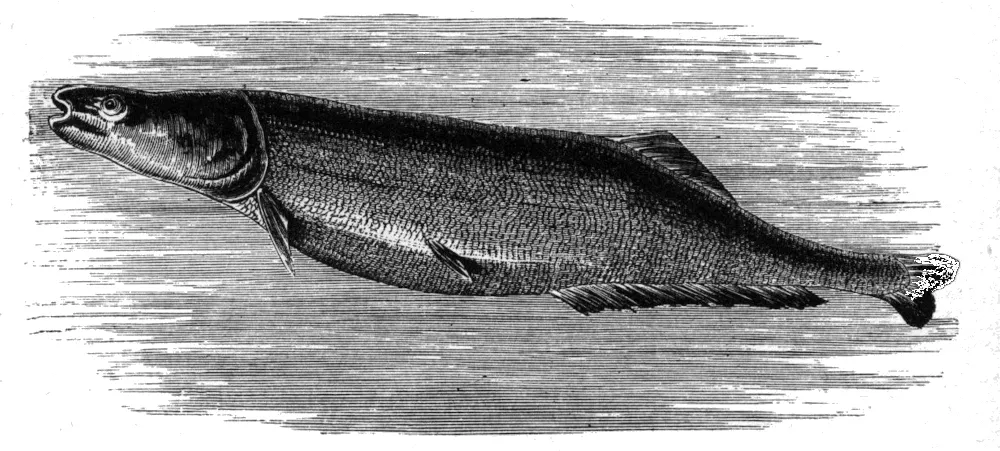
suggested that it might perhaps come from Nika, an electric
fish which was sometimes caught in the lake.
A rational definition of Nika I could not obtain until one
13day, while translating into their language English words, I
came to the word “plain,” for which I obtained nika as being
the term in Kijiji. As Africans are accustomed to describe
large bodies of water as being like plains, “it spreads out
like a plain,” I think that a satisfactory signification of
the term has finally been obtained in, “the plain-like lake.”
The people of Marungu call the lake Kimana, those of
Urungu call it Iemba, the Wakawendi call it Msaga, or, “the
tempestuous lake.”
Westward from Ujiji the lake spreads to a distance of
about thirty-five miles, where it is bounded by the lofty
mountain range of Goma, and it is when looking north-west
that one comprehends, as one follows that vague and indistinct
mountain line, ever paling as it recedes, the full magnificence
of this inland sea. The low island of Bangwé on the eastern
side terminates the bay of Ujiji, which rounds with a crescent
curve from the market-place towards it.
On very clear days the eyes may trace the eastern shore
to the south beyond the mouth of the Liuché, curving to
the Ulambola hills, and then rounding slightly eastward,
reappearing in the imposing mountain heights of Cape
Kabogo.
Very pleasant are the idle hours of evening at Ujiji,
watching the clouds of sunset banking themselves above dark
Goma, and observing the lurid effects of the brilliant red on
their gloomy masses and on the ever ruffled waves, tinging
with strange shades the gorgeous verdure of the eastern shore,
and the lofty mountain ridges which enfold the deep-lying lake.
To the ears are borne the sonorous moan and plaint of the
heavy waves, which, advancing from the south-west in serried
foam-capped lines, roll unceasingly upon the resounding
shore.
At this hour, too, the fuel-laden canoes from Ulambola
are hurrying homeward, with oar and sail. The cattle, lowing
to expectant calves, and the goats bleating for their kids, are
hurrying from the pastures in advance of the tiny herd-boys,
the asses’ feet clatter as they go, bearing their masters home
from Kigoma or Kasimbu, the loud hailing of native friends
announces the evening meal ready, and the spiral columns of
blue smoke ascend from many wood-fires, as we sit here to
observe the advance of the evening shades, and to take a
last look at the daylight, as it wanes and fades over the
shores of the Tanganika.
CHAPTER II.
14
The Lady Alice afloat again—Her mate and crew—Anxiety on her behalf—On
hallowed ground—Unwelcome visitors: in the haunts of the Ruga-Ruga—The
aborigines’ last retreat—A scene of blood—The robbers of the Lake,
and their tutelary spirits—A geological problem: were there once two
lakes?—Rising waters—The abode of the genii—A storm—Forest fires—At
the mouth of Cameron’s “outlet”—The Lukuga creek.
June 11.—The saucy English-built boat which had made
the acquaintance of all the bays and inlets of the Victoria
Nyanza, which had been borne on the shoulders of sturdy
men across the plains and through the ravines of Unyoro,
had halted on the verge of the cliff rising above Beatrice
Gulf, had thrust her bows among the papyrus of the
Alexandra Nile, ridden gaily over the dark lakes of
Karagwé, and crossed the inundated plains of Usagusi,
and the crocodile-haunted river of Uvinza, is at last afloat
upon the deep-blue waters of the Tanganika.
She is about to explore the mountain barriers which
enfold the lake, for the discovery of some gap which lets
out, or is supposed to let out, the surplus water of rivers
which, from a dim and remote period, have been pouring
into it from all sides.
She has a consort now, a lumbering, heavy, but staunch
mate, a canoe cut out from an enormous teak-tree which
once grew in some wooded gorge in the Goma mountains.
The canoe is called the Meofu, and is the property of Muini
Kheri, governor of Ujiji, who has kindly lent it to me. As
he is my friend, he says he will not charge me anything for
the loan. But the governor and I know each other pretty
well, and I know that when I return from the voyage, I shall
have to make him a present. In Oriental and African lands,
remuneration, hire, compensation, guerdon, and present are
terms nearly related to one another.
The boat and her consort are ready on the 11th of
June, 1876. The boat’s crew have been most carefully
15selected. They are all young, agile, faithful creatures.
Their names and ages are as follows: Uledi, the coxswain,
25 years; Saywa, his cousin, 17; Shumari, his
brother, 18; Murabo, 20; Mpwapwa, 22; Marzouk, 23;
Akida, 20; Mambu, 20; Wadi Baraka, 24; Zaidi Rufiji, 27;
Matiko, 19. Two supernumeraries are the boy gun-bearers,
Billali and Mabruki, 17 and 15 years respectively. After
eighteen months’ experience with them it has been decided
by all that these are the elect of the Expedition for boat-work,
though they are by no means the champions of the
march. But as they have only light loads, there has never
been reason to complain of them.
There is much handshaking, many cries of “Take care of
yourselves,” and then both boat and canoe hoist sail, turning
their heads along the coast to the south.
Kasimbu, two miles from Ugoy to Ujiji, sends forth her
Arab and slave inhabitants to cry out their farewells, and
half an hour afterwards we are at the mouth of the Liuché
river.
The reason why Arabs, Wajiji, and Wangwana have been
more than usually demonstrative is that they will not believe
that such a frail structure as our boat will be able to endure
the heavy waves of the Tanganika. They declared we should
all be drowned, but our Wangwana have ridiculed their fears,
and quoted her brilliant exploit round a lake twice the size
of the Tanganika, and so at last they had come to be satisfied
with a dismal “Well, you shall see!”
June 12.—During nearly the whole of the next day our
voyage to the south is along the forest-clad slopes of
Ulambola and the tawny plains of Ukaranga, until we
arrive at the mouth of the Malagarazi River. At 3 p.m.
we rowed up river, which at the mouth is about 600 yards
wide, and sends a turbid brown stream into the lake. When
a continuous south-west wind blows, its waters are known to
tinge the lake with its colour as far as Ujiji. The river soon
narrows to 200 yards, and about five miles up to 150 yards.
I sounded twice, and obtained over 50 feet each time. The
southern bank is very mountainous, but on the opposite side
stretches a plain until the detached ranges of Ukaranga
become massed, about five miles from the lake, and, running
easterly, form the northern bank of the river.
June 13.—On the 13th our voyage was along the bold
mountain spurs of Kawendi, forming a steep, rock-bound
16coast, indented at frequent intervals with calm, pool-like
bays, and their heights clothed with solemn woods.
At noon we were off Kabogo’s lofty headland, and
remembering that Dr. Livingstone had said that he could
find no bottom at 300 fathoms, I sounded a mile off shore,
and found 109 fathoms. At two miles off I found no depth
with 140 fathoms. I then fastened sixty fathoms more, but
at 1200 feet obtained no bottom.
About four miles south of dreaded Kabogo, on a narrow
strip of sand, we beached our boat and canoe far out of the
heavy surf, and then climbed the 2000 feet-high slopes in
search of game; but the grass was high, the jungle dense,
the slope steep and fatiguing, and we had to return without
sighting a single head.
June 14.—Next day we coasted along land familiar to
me from my journey with Livingstone to Unyanyembé, and
at 7 p.m. encamped at Urimba, about a mile south-west of
the river Luwajeri or Luwegeri.
June 15.—Having been so successful in January 1872, I
sallied out the next day over ground which I looked upon
with reverence. The exact place covered by our little tent,
only six feet square of land, was hallowed by associations of
an intercourse which will never, never be repeated. I recognised
the tree above which we hoisted our mighty crimson
and white banner to attract the lagging land caravan, the
plain where I had dropped the zebra, the exact spot where I
shot a fine fat goose for breakfast, the aspiring peak of
Kivanga, the weird looking mountains of Tongwé. I knew
my road here, and dwelt upon all its features, until the old
life seemed renewed, and all things seemed as before.
But I resumed my search. In an hour I am two miles
from camp, and in view of a herd of zebra. Billali becomes
feverish lest I should miss the game, and, like an honest,
faithful servant taking enormous interest in his master’s
success, lies down to hug the ground in piteous stillness. I
advance a few paces cautiously behind a scraggy acacia, and
in a few seconds two of the noble creatures are dead, and the
others are sweeping round a clump of hills, whimpering for
their lost companions. As we have now enough meat to last
us several days, I give them their liberty.
June 16.—The day is devoted to cutting the meat into
long strips and drying it over wooden grates, while each of
the forty men composing the lake exploring band seems
17profoundly impressed with the necessity of forestalling future
demands on his digestive organs by consuming injudicious
quantities there and then.
In the midst of this most innocent recreation there
stepped forth to our view some sinister objects—Ruga-Ruga!
As undesirable as wolves in a stern Siberian winter
to an unarmed party in a solitary sledge are the Ruga-Ruga
to peaceful travellers in an African forest or wilderness.
Whatever the accident that brought them, their very
presence suggested the possibility and probability of a
bloody struggle. They are bandits, wretches devoted to
plunder and murder, men whose hands are at all times ready
to be imbrued in blood.
They are representatives of that tribe which has desolated
and depopulated beautiful Kawendi from the Malagarazi
river down to the Rungwa. All alike—whether Arabs,
Wajiji, Wangwana, Wanyamwezi, or the aborigines of the
land—owe them an unpaid debt of vengeance for the blood
they have shed. It was not our special task, however, to
undertake the repayment, therefore neither by word nor look
did we betray any antipathy.
We gave them gifts of meat at their own request. The
tobacco gourd passed round in their polluted, crimeful hands,
and we grasped their hands in token of amity—and parted.
June 17.—On the 17th of June we continued our voyage
from Urimba towards Kungwé cape, one of the projecting
spurs from the Kungwé mountains, and in the evening
camped on Bongo Island, a few miles south-west from
Ndereh, the robbers’ village. We were visited in the night
by about sixty of them armed with muskets. Though it was
an unusual hour, and an unseasonable one for receiving
visitors, we avoided trouble, and by parting with cloth and
exhausting the powers of suavity, we happily avoided a
rupture with the wild and bloody men of Ndereh, and before
dawn stole away unperceived on our journey.
June 18.—The peaks of Kungwé are probably from 2500
to 3000 feet above the lake. They are not only interesting
from their singular appearance, but also as being a refuge for
the last remaining families of the aborigines of Kawendi.
On the topmost and most inaccessible heights dwells the
remnant of the once powerful nation which in old times—so
tradition relates—overran Uhha and Uvinza, and were a
terror to the Wakalaganza. They cultivate the slopes of
18their strongholds, which amply repay them for their labour.
Fuel is found in the gorges between the peaks, and means
of defence are at hand in the huge rocks which they have
piled up ready to repel the daring intruder. Their elders
retain the traditions of the race whence they sprang; and in
their charge are the Lares and Penates of old Kawendi—the
Muzimu. In the home of the eagles they find a precarious
existence, as a seed to reproduce another nation, or as a
short respite before complete extermination.
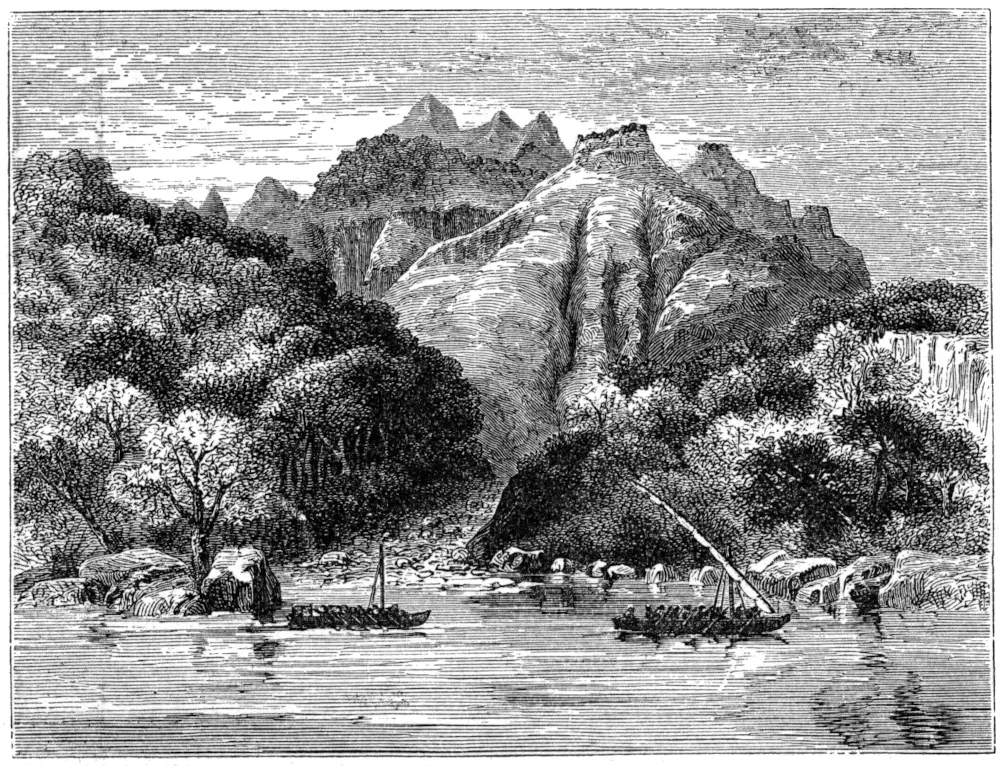
KUNGWÉ PEAKS. (From a sketch near the entrance to the Luwulungu torrent bed.)
The best view of this interesting clump of mountain
heights is to be had off the mouth of the torrent Luwulungu.
From Cape Kungwé south, the coast as far as Ulambula
consists of a lofty mountain front, pierced by several deep
and most picturesque inlets, gorges, ravines, and rifts.
Into these pours the Luwulungu, rushing along a steep,
stony bed, from the chasms and defiles overshadowed by
the tall peaks of Kungwé—and the Lubugwé, emptying its
waters into a pretty cove penetrating to the very heart of
the mountain wall. At an angle of 45° this mountain wall
rises up to the height of 2000 feet, clothed from base to
summit with the verdure of cane, wild grasses, and tall
19straight trees with silvery stems. Then next comes the
Kasuma inlet, and here, straight before our eyes, is seen
a river dropping, in a succession of falls, from the lofty
summit, into shadowy depths of branching tamarinds, acacias,
and teak. All is silent in the deep-bosomed cove except
the rhythmic waterfall, and the trees stand still, as though
fascinated by the music, and the grim heights frown a silent
approval; the pale blue arm of the lake rests expectant for
the moment when it shall receive the impetuous child of the
mountains which it sees leaping down to it from above, and
flashing so brightly at every great leap. Along the glorious,
green, steep headlands we wind in and out, cast a glance in
at Numbi’s pretty cove, and encamp for the night near the
bold cape of Ulambula.
June 19.—We resumed the voyage on the 19th, and,
shortly after leaving our camp in the neighbourhood of the
cape, saw a point of land connected by a narrow neck with
the mainland, under which were two natural arches, spanning
two channels. From the cape the mountain range gradually
recedes from the lake, until, near the Rugufu river, it again
approaches and finally forms the headlands of Buyramembé.
A little south of the cape the crest of a small and lately
submerged island was also seen. At noon I took observations
for latitude, at the north end of Kabogo, an island
lying parallel to the mainland at a distance of from 300 to
500 yards. On the shores, both of mainland and island,
flourishes the borassus palm. Kabogo was once densely
peopled, but the bandits of Ndereh, the scourge of Kawendi,
have caused them to emigrate to other districts to crave
protection from chiefs more powerful than their own.
About 2 P.M. we came in view of Kiwesa, which appeared
from the lake to be a very large village. But as we
approached its shores under sail, we were struck with the
silence which reigned around, and the sight of a large herd
of buffalo grazing near the village still more astonished us.
The guides declared that only five weeks before they had
stopped in it and traded with Ponda, the chief, and they
could give no reason why—as two boats under sail would
most likely attract the attention of the natives—the people of
Ponda did not appear on the shore.
We resolved to venture in to discover the cause. There
was a deathly silence around. Numbers of earthenware pots,
whole, and apparently but little used, were strewn about
20the beach and among the reeds flanking the path which led
to the village, besides stools, staffs, hand-brooms, gourds,
etc., etc. This was ominous. There was probably a trap or
a snare of some kind laid for us. We retreated therefore
hastily to the boat and canoe, and thirty men were armed.
Thus, better prepared against the wiles of savage men, we
advanced again cautiously towards the village.
As we were surmounting the high ground on which
the village was built, we saw a sight which froze the
blood—the body of a poor old man, in a decomposed state,
with a broad spear-wound in the back, and near it much
dried blood. He had probably been dead five or six days.
A few yards farther, we saw the decapitated corpse of
another man, and 10 feet from it, in a furrow or water
channel, the bodies of three men and a woman, one of
them dislimbed.
We arrived before the village. The defences were
broken down and burnt. About fifty huts still stood unharmed
by fire, but all the others were consumed. A few
scorched banana stalks stood as a witness of the fury of
the conflagration. But despite the black ruin and the
charred embers which so plentifully strewed the ground,
evidences were clear that flight had been hasty and compulsory,
for all the articles that constitute the furniture of
African families lay scattered in such numbers around us
that an African museum might have been completely
stocked. Stools, mats, spears, drinking-vessels, cooking-pots
of all sizes, walking-staffs, war-clubs, baskets, trenchers,
wooden basins, scoops, etc. There were also abundant proofs
that this ruin was recent; a few wood-rails still smoked, the
hearths were still warm, the dead were not putrefied. A
coal-black cat made a dash from one of the houses yet
standing, and the sudden motion startled us all in this
place of death and vengeance.
Ponda, the chief of this village, had no doubt given some
provocation to this unknown enemy. Para thought the
enemy must have been the robbers of Ndereh, for the
condition of the village bore signs of superior energy in
the attack. And yet it had been constructed with a view
to secure immunity from the fate which generally overtakes
weak communities in Africa in the neighbourhood of ferocious
and war-loving tribes. A wide ditch—in some parts 10 feet
deep—and a strong palisade, with an earthwork, surrounded
21the settlement. The lake was close by to supply water, the
country near it was open, and the sharpshooters’ nest-like
towers commanded a wide view. From some thirty bleached
skulls arranged before Ponda’s own house we argued that he
did not himself fail to proceed to the same extremes which
his enemies had now adopted to his utter ruin. It is the
same story throughout Africa.
We resumed our voyage for the mouth of the Rugufu
river. The shore between Kiwesa and the river is comparatively
low. The waves have so beaten and shaken the low
red bluffs and soft ferruginous clay that numerous landslips
are constantly occurring. The débris are then vigorously
pounded and crushed by the surf, and at length they are
spread out into a narrow line of beach at their base, over
which the spluttering waves surge up continuously.
The impression received at Ujiji, that the Tanganika is
rising, was confirmed whenever we neared low shores.
Especially was it the case at the Rugufu river, and Para
the guide, as we entered it, stood up and exclaimed:—
“Oh, mother, mother, mother, see ye now! When I
was with that other white man here, we camped on a strip
of land which is now buried in the water! The Tanganika
is indeed eating the land!”
The Rugufu oozes out from the midst of a broad bed of
papyrus and reeds between precipitous banks.
On leaving the river we coasted along the bluff, steeply
rising slopes of a mountain range which trends south-south-east
as far as the settlements of Ruhinga, Kafisya, Katavi,
and Kantamba.
Between the Rugufu and Buyramembé Point a stratum
of a very dark hornblende slate is visible, resting upon
gneiss in undulating, vertical, or diagonal lines; farther on
we come to a stratified quartzose and greenstone rock. On
the crest of this part of the range and its projecting spur is
a thin forest of poor trees. The soil too is poor, and much
mixed with shaly débris.
The mouth of the Gezeh river is a frequent haunt of
herds of buffaloes, and also, being a fine haven, of trading
canoes. Among the stories related of this place is one of a
wonderful escape of a party of Wajiji traders from the
bandits of Ndereh. The robbers stole into the camp while
the Wajiji were all asleep, but some of the canoemen,
awaking, punted their boats out of reach, and shouted to
22their comrades, who sprang into the water to avoid the fate
that would otherwise have certainly overtaken them all.
The settlements of Kafisya, and the others just mentioned,
have such an ill repute that I cannot imagine any necessity
inducing a traveller to cultivate the acquaintance of the
evil-conditioned people, unless, of course, he is so rich in
cloth and followers that waste of them is of little consequence
to him.
It is said that when they see the Wajiji trading canoes
pass by them, the robbers pray to the Muzimu of Katavi to
induce the Msaga—the tempestuous sea—to drive them
ashore. The Muzimu of Katavi is one of the most powerful
spirits along the shores of the Tanganika, according to
legendary lore. Though he is capable of much mischief, he
takes freaks of charity into his whimsical head, such as
gratuitously killing buffaloes and then informing the inhabitants
where the meat may be found; he is also said to
have a relentless animosity towards the bandits of Ndereh,
and frequently entraps them to their destruction. A conical
knoll is called, after this spirit, Katavi’s Hill.
Before the mouth of the Mkombé river there lies a low
submerged island, just west of south from Katavi. Only a
few shrubs and the heads of some tall cane were visible
above the surface of the water.
June 20.—From Gezeh to Igangwé Cove was a good
day’s journey against the south-easter which blew strongly
against us. Igangwé Cove penetrates about a mile deep
into the mountain folds. Though it was the season when
the grasses are becoming sere, and some of the trees lose
that vivid greenness of foliage which is their glory during
the rainy season, the aspect of the slopes had still a freshness
and beauty which, with the placid mirror-like cove, made a
picture worth preserving.
June 21.—A day’s journey south by east took us to the
village of Karema—the chief being Massi-Kamba, a sub-chief
of Kapufi, king of Fipa. It is situated in the angle of a bay
which begins at Igangwé Point and terminates in the weird
rock-piles of Mpimbwé Cape.
All that mass of looming upland from Igangwé to within
a few miles of Karema is included in the country of Kawendi
or, as it is sometimes called, Tongwé. South of that line
begins Fipa.
Arabs are beginning to establish themselves at Karema
23for trade, the Wa-fipa being more amenable to reason than
the “scattered and peeled” tribes of Tongwé.
Between Karema and Mpimbwé Cape lies a fine country
studded with coves and hills, square-topped and round.
Game is abundant and easy of approach. A buffalo and
a small red antelope were obtained by me here, the two
shots supplying the crews with abundance of meat.
Proceeding some eight miles south-west towards Mpimbwé,
we come to a narrow ridge rising about 600 feet above the
lake. Its shore is deeply indented, and the wash of waves
has bared enormous masses of granite.
At the south-western corner of this bay there is a neck
of low land which all but connects Mpimbwé ridge with the
mainland; only half a mile’s breadth of low land prevents
Mpimbwé being an island. Near Kipendi Point, which is
halfway between Mpimbwé ridge and Karema, there is a
tree in the lake which was pointed out to me as being not
many years ago on dry land. There is now 9 feet of water
around it!
Mpimbwé Cape offers a view similar to the rocks of Wezi,
only of a still more gigantic size and a ruder grandeur.
Their appearance betrays the effects of great waves which
have at one time swept over them, pouring their waters into
their recesses, cleansing by force every cranny and flaw of
their vegetable mould, and washing out of them every
particle of soil, until, one day, by some sudden convulsion
of nature, the lake subsided, leaving, a hundred feet above
its surface, these grey and naked masses of granite.
Any one who has seen on a rock-bound coast the war of
sea-wave against granite, basalt, and sandstone, will at once
recognize the effects visible at Mpimbwé. There lie piled up
rocks, hundreds of tons in weight, some of them appearing to
rest in such precarious positions that it seems as if the finger
of an infant would suffice to push them into the deep blue
lake. These, however, are not scored and grooved as are
those exposed to the eroding influences of ceaseless ocean
waves; they are cleanly fractured, with their external angles
only exhibiting a rough polish or roundness which I take to
be clear signs that at some remote time they were exposed
to waves of great power. Besides, the condition of the rocks
at the water-line confirms this theory.
Still, it is strange that the lake should have been rising
steadily ever since living men can remember, and that those
24rocks of Mpimbwé should bear witness to the lake’s subsidence.
June 25.—On the 25th of June, after coasting the western
side of this extraordinary range and proceeding south some
fifteen or sixteen miles, we arrived at Mkerengi Island, in the
bay of Kirando; the large island of Makokomo lying to west
of us a mile off. The natives of these parts are very amiable,
though extremely superstitious. At the north-west end of
Makokomo there is another lately submerged island. Close
to the south-west end is a group of inhabited islands, Kankamba
and Funeh being the largest and most fertile.
Kirando is situated among other large villages in what
appears to be a plain, hemmed in on the east by the continuation
of the mountain ridges which we lost sight of
when we left Karema Bay. The truncated cone of Chakavola
terminates the ridge of Mpimbwé, and lies north-east from
Mkerengi.
Continuing our voyage southerly along the coast between
the isles of Kankamba and its brothers and the shore of the
mainland, and passing a couple of creeks running deep inshore,
we came to Cape Muntuwa. From this cape to
Msamba Island, where we encamped, the lake is edged by
one successive series of gigantic blocks and crags of granite.
Rock rises above rock, and fragment above fragment. Here
towers a colossal mass the size of a two-storied house,
bearing upon it a similar mass perhaps entire, but more
probably split with a singularly clean and fresh fracture, and
there springs up from the surrounding chaos a columnar
block like a closed hand with outstretched fore-finger—but
everywhere there is the same huge disarray, ruin, and
confusion.
We had need to be cautious in sailing along the coast,
because for several hundred yards into the lake the rocky
masses, which the uneasy billows only exposed in glimpses,
rose nearly to the surface.
A suspicion flashed into my mind as these new features
revealed themselves that in remote times this part of the
lake—from Mpimbwé south—was a separate lake, and that
MpimbwéMpimbwé ridge was connected with some portion of the
western coast—probably the southern portion of Goma—for
while coasting from the extreme north end of lake Tanganika
down to Mpimbwé, I saw nothing resembling in character
this portion of the coast. In no part of all the eastern coast
25down to Mpimbwé is there anything to lead me to suppose
that the lake was ever higher than at present; but from
Mpimbwé to Msamba I see numerous traces that the lake
has been many yards higher than it is at present. All this
dreary ruin of wave-dismantled and polished rock was at one
time covered with water.
June 26.—On the 26th we camped at Mtosi, where
Livingstone, who calls it Motoshi, camped on the 23rd of
October, 1872. The chief’s name is Kokira. A beautiful
little bay leads from the lake to the miserable village where
he lives.
June 27.—We rested on Msamba Island for the evening
of the 27th. The islanders told us that there was a cave
about 60 yards in length on the mainland opposite, where
they sometimes hid in time of danger. For a small island
Msamba is densely populated, and every inch seems cultivated.
The islanders are clever manufacturers of a strong, coarse,
cotton cloth: cotton being abundant in Fipa. The Rukugu
river empties into Msamba Bay.
The irregular ridge which follows the coast between
Msamba Island and Wanpembé, our next journey, is remarkable
for a solitary columnar rock rising from 50 to 80 feet
high and about half a mile from Column Point. Rounding
Kantentieh Point, we have a view of three columnar rocks,
the central one being singularly like a mutilated Memnonium.
These columns are visible from a considerable distance north
or south.
Before reaching Wanpembé, Para, the guide, gathered a
peculiar kind of berry called owindi, from a low scrubby
tree, whose appearance was anything but promising for such
a fragrant production as he now showed to us. The odour
was not unlike that of lavender, and its strength was such
that all in the boat near him were benefited by its exquisite
perfume.
In the little cove close to Wanpembé, on the north side
of the point on which it is situate, the boat floated over the
submerged fence of a village, and her keel was 3 feet
above it.
We obtained abundance of provisions at this large
village, but as there were some Watuta strangers within
the palisades, our visit was not an agreeable one. However,
despite their insolence, the peace was not broken.
Minza, a neighbouring village, is also very large, and
26possesses a strong stockade, the base of it being embanked
with the earth excavated from the ditch.
There appears to be no diminution in the altitude of the
mountain ranges which lie along the entire east coast of the
Tanganika, or on the western side, as we have had the west
mountains plainly in view since leaving Mpimbwé. Now
and then we saw small streams issue into the lake, but met
no river of any importance, until we came to the Zinga, or
Mui-Zinga, as the Wajiji call it, which separates Fipa from
Urungu.
June 30.—On the 30th we were coasting along the base
of the mountain ranges of Urungu, and passing by Kalavera
Point came to a bay before which were two small grass-covered
islets. On a point of the mainland, nearly opposite
these, stands Kakungu village. This point is formed of a
grey shaly rock supporting a white clay, out of which the
Wajiji on their return homeward paint the bows of their
canoes. The scenery just beyond is bold and imposing.
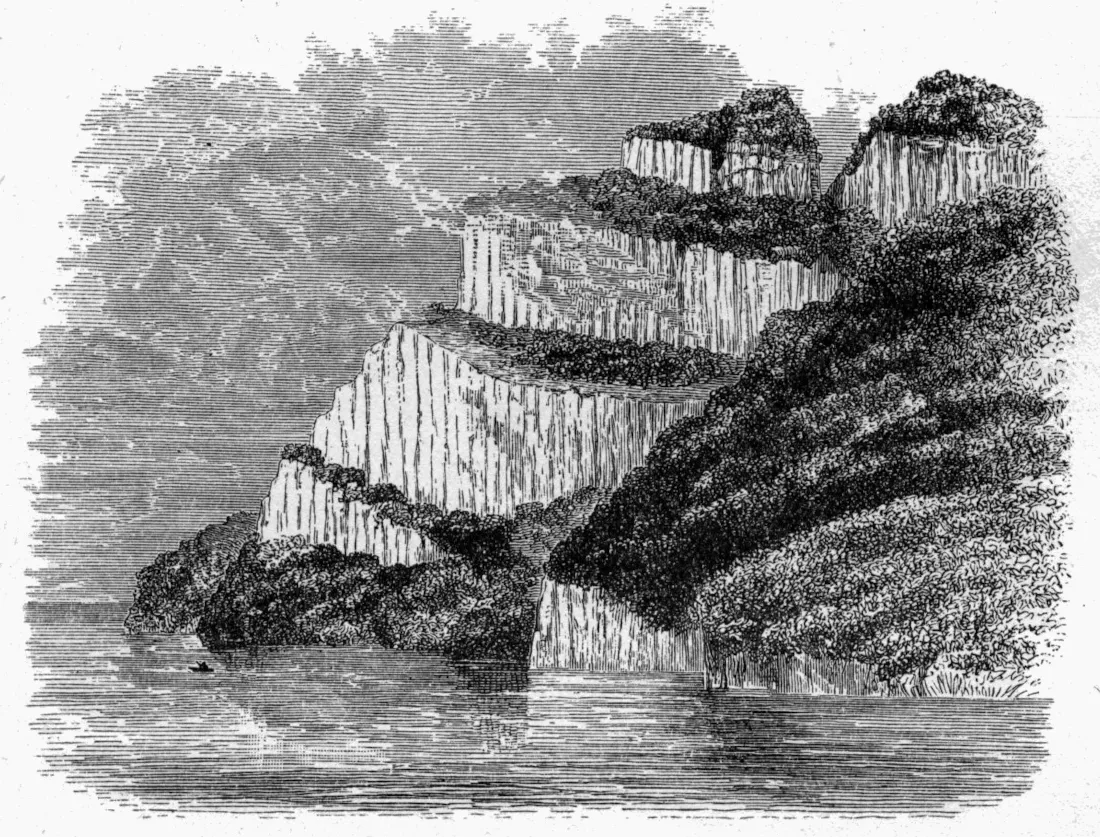
Kirungwé Point consists of perpendicular walls—from 50
to 200 feet high above the lake—of a fine reddish sandstone
with horizontal strata. Their peculiar appearance may be
imagined when the boat’s crew cried out:—
“Oh, mother, this is a fort! See, there are the windows,
and here is one of the gates.”
Kirungwé Point appears to be a lofty swelling ridge, cut
straight through to an unknown depth. There seems ground
for believing that this ridge was once a prolongation of the
plateau of Marungu, as the rocks are of the same material,
and both sides of the lake show similar results of a sudden
subsidence without disturbance of the strata.
South of Kirungwé, or Castle Point, there lies what
we may almost call an island, which the guides said a few
years ago was connected with the mainland. It is almost
entirely separated now. A village which once nestled
comfortably in the hollow between the rising ridges is
now half buried in water. The huts appeared ready to
collapse, for the water had already flooded them. This
village was called Ma-Zombé.
In the evening, as we prepared to encamp, four canoes,
of Ujiji, loaded with women and children, to the number of
sixty-four—slaves from the Rufuvu river and from Muriro’s—passed
by our camp.
The bay of Kawa, which we passed through next day,
27is very picturesque; woods clothe the slopes and heights,
and huts for the accommodation of the Muzimus, or spirits,
have been erected in several of the bends. Kawa river
empties into this bay.
July 2, 3.—During the 2nd and 3rd of July we rowed
close to the uninhabited shore, and at noon of the 3rd
arrived at the extreme south end of the lake—which we
ascertained to be 8° 47′ south latitude—in the district of
Ukituta. The little stream Kapata issues into the lake at
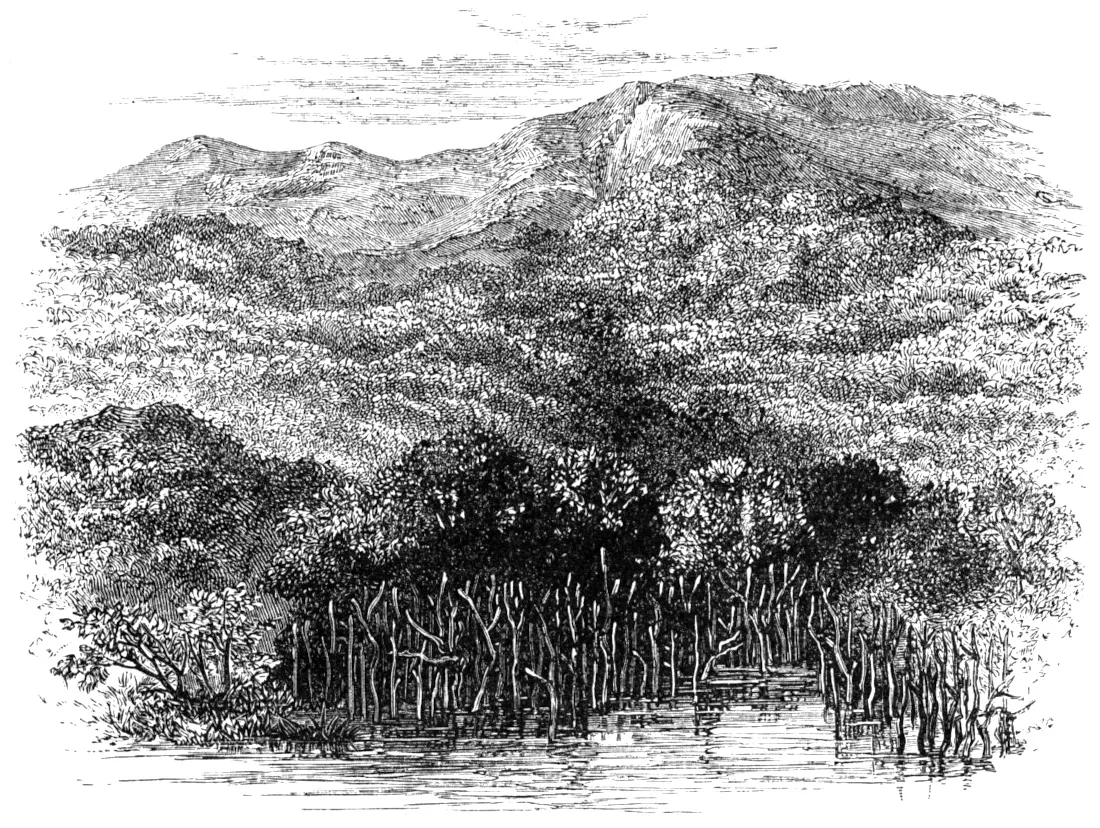
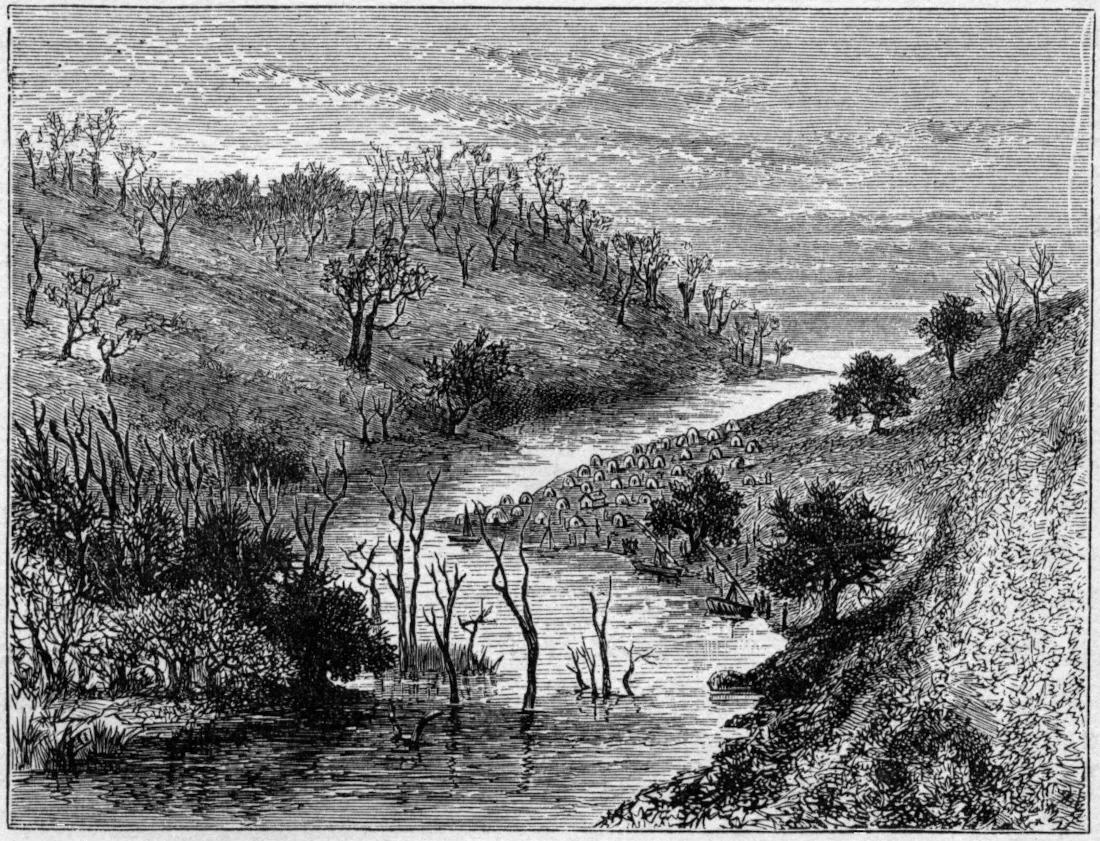
this end through a dense and dark grove, the dead trees
standing in front of the grove bearing witness to the
destructive action of the rising waters.
THE EXTREME SOUTHERN REACH OF LAKE TANGANIKA.
I scoured the country in search of game, but, though
tracks of buffalo were numerous, I failed to obtain a glimpse
of a single head. Safeni, who was the coxswain of the Meofu
canoe, accompanied me, and pointed out various points of
interest in connection with Livingstone, as we followed the
road which he had travelled over in his last fatal journey to
Lake Bemba. The myombo and borassus palm flourished on
the higher terraces.
July 4.—On the 4th, after rounding a point of a ridge—three
miles from the Kapata—which lay north, we turned
westward between Ntondwé Island and the mainland, and
28then passing by Murikwa Island, we reached, in two hours,
the southern termination of the western shore of the Tanganika,
whence may be seen the Wezi river tumbling down
from the plateau of Urungu.
The village of Mwangala, where we camped, was at first
hidden from our view by a dense line of water-cane, which
sheltered its small fishing-canoes from the storms of the lake.
One glance at the village fence informed us that here also
was evidence that the lake was rising. We asked the
natives if they did not think the water was gaining on them.
“Can you not see?” said they. “Another rain and we
shall have to break away from here, and build anew.”
“Where does the water of the lake go to?”
“It goes north, then it seems to come back upon us
stronger than ever.”
“But is there no river about here that goes towards
the west?”
“We never heard of any.”
That part of the western coast which extends from Mbeté
or Mombeté to the south, as far as the Rufuvu river, is
sacred ground in the lore of the ancients of Urungu. Each
crag and grove, each awful mountain brow and echoing
gorge, has its solemn associations of spirits. Vague and
indescribable beings, engendered by fear and intense superstition,
govern the scene. Any accident that may befall, any
untoward event or tragedy that may occur, before the
sanctuaries of these unreal powers, is carefully treasured
in the memories of the people with increased awe and dread
of the Spirits of the Rocks.
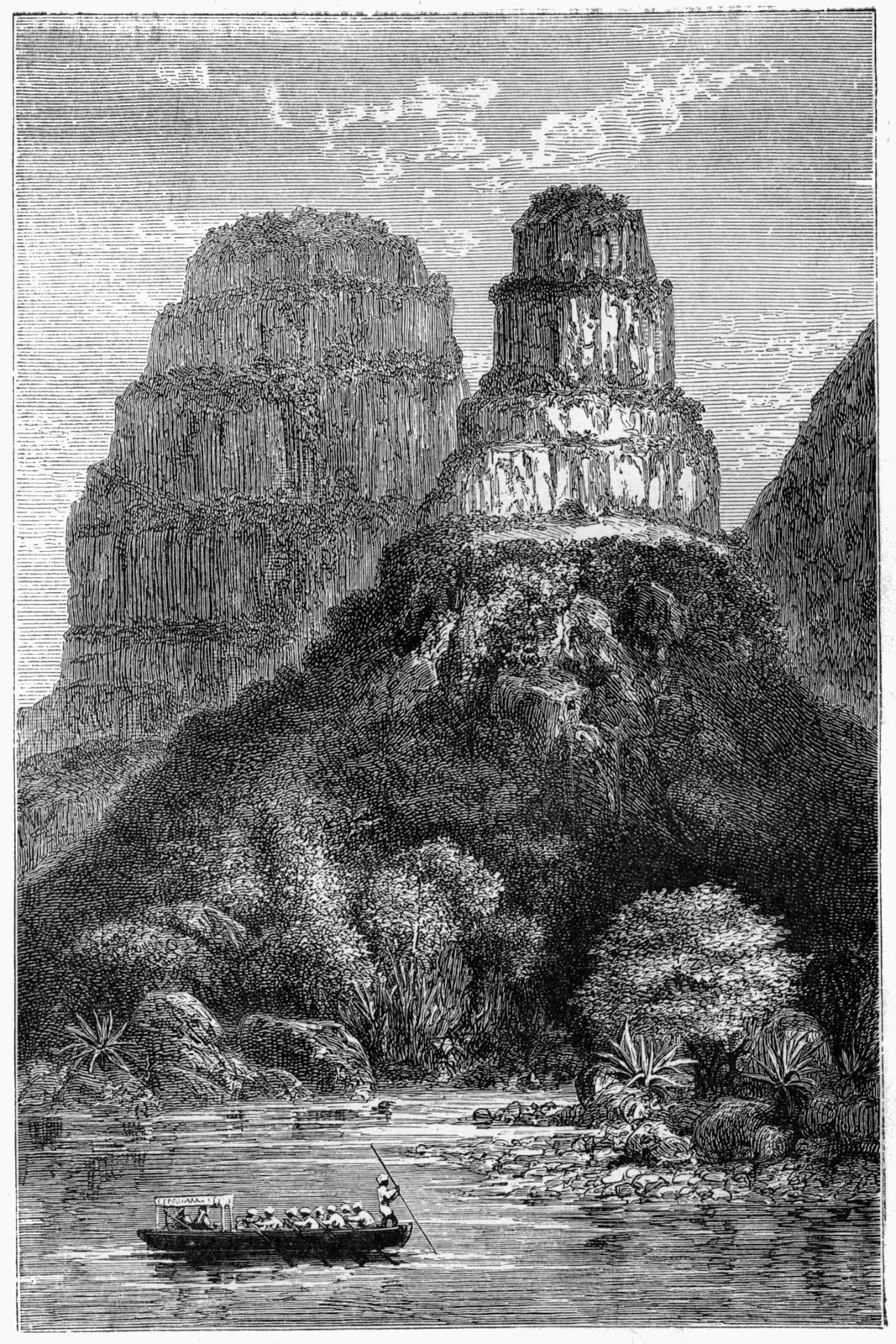
Such associations cling to the strange tabular mounts or
natural towers, called Mtombwa. The height of these is
about 1200 feet above the lake. They once formed parts of
the plateau of Urungu, though now separated from it by
the same agency which created the fathomless gulf of the
Tanganika.
Within a distance of two miles are three separate mounts,
which bear a resemblance to one another. The first is called
Mtombwa, the next Kateye, the third Kapembwa. Their
three spirits are also closely akin to one another, for they all
rule the wave and the wind, and dwell on summits. Kateye
is, I believe, the son of Kapembwa, the Jupiter, and
Mtombwa, the Juno, of Tanganika tradition.
THE “HIGH PLACES” OF THE SPIRIT MTOMBWA: VIEW OF MTOMBWA URUNGU.
As we row past close to their base, we look up to admire
29the cliffy heights rising in terraces one above another; each
terrace-ledge is marked by a thin line of scrubby bush.
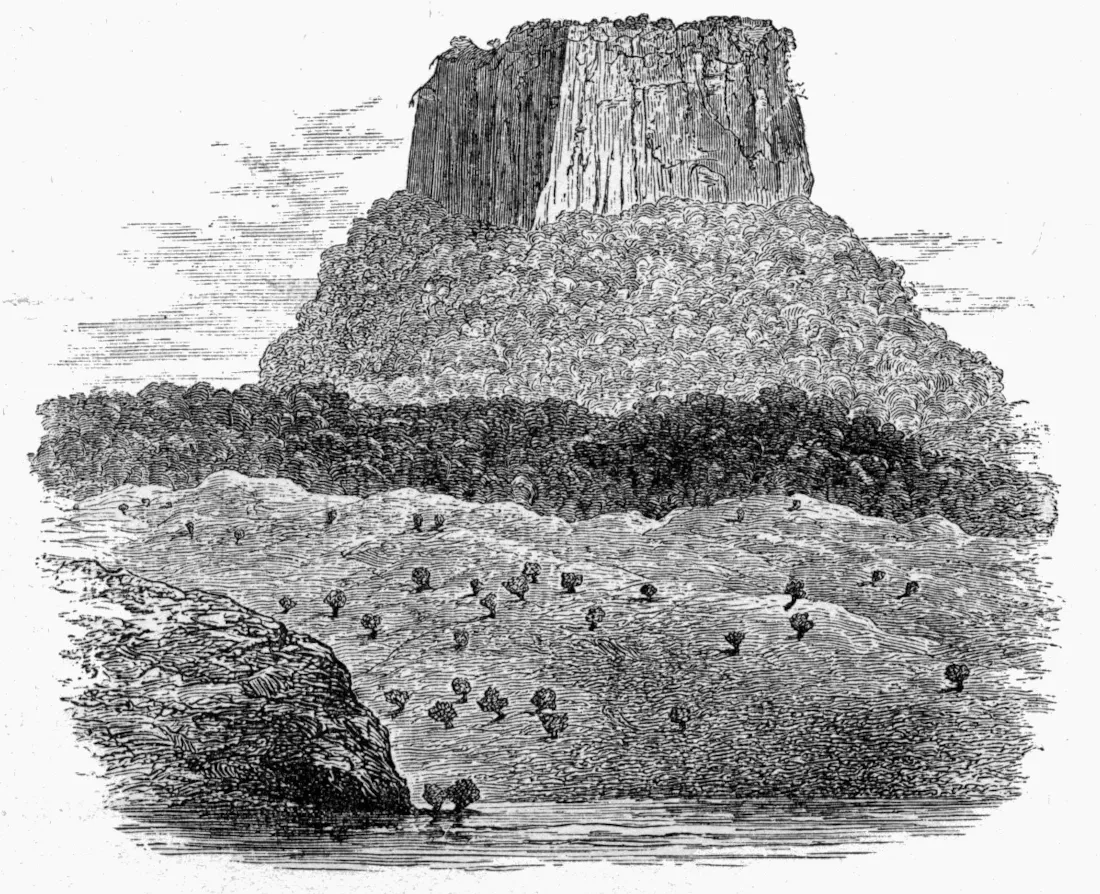
Beyond Kateye, the grey front of the paternal Kapembwa
looms up with an extraordinary height and massive
grandeur.
From Kapembwa to Polombwé Cape the plateau merges
in a cliff-crowned wall 1500 feet above the lake. The cliff
itself is probably 200 feet high, rising above a slope bristling
with great rocks half hidden by the verdure of trees, bush,
and grass. Yet the natives cultivate some part, and their
fields were seen far up the steep ascending slopes.
KAPEMBWA.
July 6.—On the 6th we left the neighbourhood of
Polombwé, at a place called Umisepa, and rowed round
into the Rufuvu river.
This river is about 400 yards wide, and retains that
width for about three miles—flowing with a current of a
knot an hour, and between lofty wood-clothed mountains—and
then broadens out into a lake-like expanse nearly a mile
wide. From the right or south bank of the river, a plain
slopes gradually to the grand cliffy walls of Kapembwa.
From here to Liendé village, where we camped, our course
lay east-south-east.
Here, as elsewhere, the water has encroached upon the
30soil, and has flooded a large portion of land formerly devoted
to tillage. It is a populous spot, indeed the most populous
we had seen since leaving Ujiji. Our reception by the
people was most cordial, and I was not sorry to become
acquainted with such gentle creatures. Not one angry word
or insolent look was exchanged, but they visited us with the
greatest confidence, and a lively interest for barter. We
obtained such abundance of provisions here that we might
have cruised for a month without having to call at any
native port.
The chief, Kiumeh, or Chiuma-Nanga, who lives at
Mkigusa village, was visited with all due ceremony, and
proved a most kindly old man. I gladly rewarded him for
his small presents of food, and separated from him with
feelings of attachment.
Livingstone, who was here in May 1867, writes of this
plain and river as follows:—
“We came to a village about 2′ west of the confluence. The village has a
meadow about four miles wide, in which buffaloes disport themselves, but they
are very wild, and hide in the gigantic grasses. The Lofu—or Lofubu (Rufuvu)—is
a quarter of a mile wide, but higher up 300 yards.”
Between the 6th of July, 1876, and May 1867, that is,
in nine years’ time, the river Rufuvu has encroached upon
the “meadow” which Livingstone saw by over a thousand
yards!
It is true the plain or meadow is very low, and that
2 feet or more of a rise would extend the river over half
a mile more of ground, but the proofs are gathering that the
lake has been steadily rising. What was meadow land in
the days when Livingstone made the acquaintance of the
people of Liendé is now clear water half covered with
growths of pale-blue lotus. The depth of the river in mid-channel
is 21 feet.
I should estimate the population of the plain from
Polombwé westward to where the river narrows between
the hills, a district of about eight square miles, as about
2000 souls. We heard of Wangwana and some Arabs
camping at a village called Kungwé higher up the river
on the left bank, but as we had no occasion for their
acquaintance we did not deem it necessary to go through the
form of visiting them.
July 7.—On the 7th, soon after quitting the Rufuvu
river, we had a rough experience of the worst Ma’anda “south-wester”—Para
31or Ruango, our guides, had ever
been in. The Meofu was soon disabled, for its rudder was
swept away, but being towed behind by a rope, it was
fortunately not lost, while our boat flew with double-reefed
lug over the wild waves like a seagull. The tempest sang in
our ears, and the waters hissed as they flew by us with great
high curling crests. But Kasawa Cape was still before us,
and no shelter could be obtained until we had rounded it.
We shook a reef out, lest we might be swamped, and the
increased force swept us over the topmost crests at such a
speed as made Para and Ruango set their teeth. The canoe
was out of sight; along the rock-bound shore thundered the
surf; the wind was rising into a hurricane, but Kasawa was
getting nearer to view, and we held on with all sail. In
fifteen minutes we were safe behind the grey bluffs of the
headland, in a little creek amid a heap of driftwood, and the
haunt of hippopotamus and crocodile. I sent a land party
back to hunt up news of the missing canoe, and by night
received the glad news that soon after they were disabled
they had managed to beach their boat without injury.
Between Kasawa and Kipimpi capes there are deep bays,
which I have taken the liberty of calling the Cameron Bays.[2]
A sterile and bleached country stretches on every hand
around these bays, and the general appearance of their
sterility is somewhat increased by the chalky character of
some of the low cliffs.
2. So called after Verney Lovett Cameron, Commander R.N., the first to
navigate the southern half of Lake Tanganika.
North of the river Rufuvu extends Uemba. Ruemba—the
country of the lake L’iemba—in the language of the
great Bisa tribe, which all speak, with slight differences of
dialect, in this region, signifies “lake.” Mapota River
separates Uemba from Marungu.
Between Kipimpi Cape and Kalambwé Cape, King Muriro,
or “Fire,” an immigrant from Unyamwezi, has, with the aid
of a colony of restless spirits, established a formidable village
called Akalunga, close to the lake. It is a resort for slavers,
for Muriro has numbers of slaves on hand to exchange for
powder and guns, and his people are always roving about on
the look-out for more.
From Kalambwé Cape northward the mountains loom
higher and steeper, the shore is indented with many narrow
inlets, vertical strata of greenstone being thus exposed, with
32thin forests crowning the loose soil which covers them. The
depressions between the hilltops are numerous and shallow,
consequently the drainage is quickly carried away in small
rills.
Beyond the Mapota the scenery becomes still bolder, and
the more imposing woods impart with their varied hues of
foliage and waving crowns a picturesqueness that since
leaving Fipa has been wanting in the landscape of the
stupendous and upspringing, terraced plateau wall of
Western Urungu, or in the uniform contours of Eastern
Urungu.
July 11.—At a camp near an inlet north of Kalambwé
Cape we set fire to some grass to have a more open view
of our surroundings. In an hour it had ascended the steep
slope, and was raging triumphantly on the summit. Three
nights after we saw it still burning about fifteen miles north
of the locality whence it had first started, like a crown of
glory on a mountain-top.
Observation of this fire, and many others, explains why,
in the midst of African uplands nourishing a dense forest,
we suddenly come across narrow, far-penetrating plains
covered with grass. They are, no doubt, so many tonguelike
extensions from some broader, grass-covered expanses
caused by fierce fires. Wherever the ground retains an
excessive quantity of moisture, grasses, with stalks as thick
as cane, spring up during three months’ rain to a height of
eight to ten, sometimes fifteen, feet. In May these grasses
become sere, and by June are as dry as tinder. The smallest
spark suffices to set them in a flame, and the noise of two
brigades of infantry fighting would hardly exceed the terrible
rack, crackle, and explosions made by the onrush of the
wind-swept element. It devours everything that stands
before it, and roasts the surface of the ground, leaving it
parched, blackened, and fissured.
Though the mountains of Marungu are steep, rugged,
and craggy, the district is surprisingly populous. Through
the chasms and great cañons with which the mountains are
sometimes cleft, we saw the summits of other high mountains,
fully 2500 feet above the lake, occupied by villages,
the inhabitants of which, from the inaccessibility of the
position they had selected, were evidently harassed by some
more powerful tribes to the westward.
The neighbourhood of Zongweh Cape is specially distinguished
33for its lofty cones and great mountain masses.
Mount Murumbi, 2000 feet above the lake, near Muri-Kiassi
Cape, is a striking feature of the coast of Marungu.
The wooded slopes and dense forest growths which fill
the gorges are haunts of what the Wangwana call “Soko,”
a distinctive title they have given either to gorillas or
chimpanzees. I heard the voices of several at Lunangwa
river, but as they were at a considerable distance from me,
I could not distinguish any great difference between the
noise they created and that which a number of villagers
might make while quarrelling.
The Rubuko, or Lofuko, a considerable river, divides
Marungu from Tembwé. On the south side of the river is
Mompara, or, for short, Para, remarkable as being the place
whereat Livingstone embarked in canoes, February 1869,
to proceed to Ujiji for the first time (‘Last Journals,’
vol. ii.):—
“14th February, 1869.—Arrived at Tanganika. Parra is the name of the
land at the confluence of the river Lofuko.”
The chief of the Para village is patronised by Jumah
Merikani, who, while he is absent in Rua collecting slaves
and ivory, entrusts his canoes to the chief’s charge, from
which it appears that the latter is a trustworthy man.
Formerly Sheikh Sayid bin Habib honoured him with the
same confidence.
Four hours’ sail brought us to the wooded headlands of
Tembwé, the most projecting of which is about twenty-five
miles from Makokomo Island, in the Bay of Kirando, on the
east coast of the lake.
Near this point is seen a lofty range, rising a few miles
from the lake in an irregular line of peaks, which, as it is
depressed towards the north, presents a more arid appearance,
and presently forms a range of a much lower altitude than
the mountains of Tongwé, Fipa, Urungu, or Marungu. This
continues—with gaps here and there for rivers to escape
through to the lake—until a little north of Kasengé Island,
where it rises again into the mountains of Goma, the highest
of all round Lake Tanganika.
At Kankindwa, which is in a little cove near Tembwé
Cape, a native told us that the Lukuga flowed out of the
lake to Rua; another denied that flatly, and a third said
that the Lukuga flowed out of the lake towards Rua, but
34that, meeting another river descending towards the
Tanganika, it was stopped, and the two rivers formed
a lake.
July 14.—As we sailed north from Tembwé and observed
the comparatively low altitude of the Uguha range, I began
to feel that it was, of all the countries we had seen, the most
likely to have a gap for the escape of the waters. It reminded
me of some parts of Usukuma, on Lake Victoria.
We explored the mouths of the Ruanda, Kasenga, Ruwye-ya,
Rutuku, and Kahanda rivers, and then from Mirembwé Cape
sailed for the Lukuga—the river that formed now the most
interesting object of our exploration.
MOUNT MURUMBI.
July 15.—On the evening of the 15th of July we made
the acquaintance of Kawe-Niangeh, the chief of the district
on the south bank of the Lukuga Creek near the mouth.
He remembered Cameron distinctly, described his person and
dress, and informed me that he had accompanied him to the
reeds which he said blocked the head of the creek. At the
time of his visit, he said—pointing at the same time to a
long line of breakers which marked three-fourths of the
broad entrance from the lake to the creek—there were two
spits of sand running from either side of the mouth, and
35there was a small fishing settlement on the one which
projected from our side. As they were now covered up,
he entertained a suspicion that Cameron had dropped some
powerful medicine, which had brought on this destruction!
If one white man had brought so much mischief, what might
not two white men do? “Why,” said he, “the whole
country will be inundated, and nothing will be left except
the tops of the great mountains!”
We laughed at this, and, eventually joking him out of
these ideas, succeeded in obtaining his guidance to explore
the creek, and in eliciting the following items, which I jotted
down in my journal the same evening:—
“July 15.—Opinion at the mouth of the Lukuga is much divided respecting
this river, or creek, or inlet, or whatever it may be. The information, when
compared with Cameron’s statement, is altogether incomprehensible. The old
men and chiefs say that formerly the Luwegeri met the Lukuga, and that the
meeting of the waters formed the lake. The result of this marriage of the
Lukuga from the west, and the Luwegeri from the east, is the Tanganika, and
a cordial understanding between the waters has been kept up until lately, when
it appears that the Lukuga has begun to be restive and wayward, for it sometimes
flows west, and sometimes east; or, in other words, the Lukuga during
the rainy season flows into the Tanganika, bearing with it an immense amount
of water, grass, wood, and other matter, but during the dry season, when the
south-east monsoon prevails, the Lukuga is borne west, lifting its head clear of
the dry ground and mud-banks, and flows down to the Kamalondo, near
Kalumbi’s country, under the name of Ruindi or Luindi. Until this rainy
season, or say March of this year, 1876, there stood a low bank of earth or mud,
several hundred yards long, between the Luindi and Lukuga, but this year’s
rainfall has united the two rivers, the Lukuga flowing over this by Miketo’s
country into Rua. Kamalondo is a river, and not a lake, being another name
for the Lualaba.
“When Cameron was here in 1874, there was a spit of dry sand lined with
grass or cane, projecting from the south side, and a similar one from the north
side, the two being separated by a narrow channel, but to-day both spits are
covered with a line of wild breakers. The spot where Cameron camped is no
longer tenable, but is exposed to the billows of the Tanganika, which at this
season are driven in by the south-east monsoon.
“Take it any way you please, such conflict of opinions among people who
ought to know what an outlet or an outflowing river is—many of them having
seen the Luapula flow out from Bemba lake, others having seen the Lualaba
plunge down from Mweru lake—makes it clear that there is either a crisis
approaching in nature or that it has lately taken place, or is occurring—one
cannot say which until the Lukuga is explored, and this work I propose to
begin to-morrow.”
Cameron says, on p. 304, in vol. i. of his ‘Across Africa’:—
“Its entrance was more than a mile across, but closed by a grass-grown
sandbank with the exception of a channel 300 or 400 yards wide, and across the
channel there is a sill where the surf breaks heavily at times, although there is
more than a fathom of water at its most shallow part.”
An inflowing river meeting the billows of the Tanganika
might be supposed to form a “surf,” or a sandy sill, it being
36only natural that there should be a conflict between the
opposing forces. To this struggle then must be attributed the
formation of the “sill of sand” which Cameron said ran across
the channel.
July 16.—On the 16th we sailed up the creek.
The mouth of the Lukuga, which was about 2500 yards
wide, narrowed after a mile to 800 yards, and after another
mile to 400 or 500 yards. Upon rounding the point of land
on which Mkampemba stands, and where there is a considerable
tract under tillage, I observed that the water changed its
colour to a reddish brown, owing to the ferruginous conglomerate
of which the low bluffs on either side are composed.
This was also a proof to me that there was no outflowing
river here. Clear water outflowing from the Tanganika,
only two miles from the lake, ought never to be so deeply
discoloured.
As we proceeded on, the chief told us to stop, and threw
a stick into the water, asking us to note how, despite the
ripple and wind from lakeward, the stick and the water-bubbles
persisted in struggling against them towards the
lake. His face was triumphant as he thought he had
completely proved one part of his statement, that water
came into the lake. It only remained now, as he thought,
to prove that water flowed out towards the west.
Wherever there were indentations in the bluffs that
banked it in, or a dip in the low grass-covered débris
beneath, a growth of Mateté or water-cane and papyrus
filled up these bits of still water, but mid-channel was clear
and maintained a breadth of open white water ranging from
90 to 450 yards.
Within an hour we arrived at the extremity of the open
water, which had gradually been narrowed in width, by the
increasing abundance of papyrus, from 250 yards to 40 yards.
We ceased rowing, and gently glided up to the barrier of
papyrus, which had now completely closed up the creek from
bank to bank, like a luxuriant field of tall Indian corn. We
sounded at the base of these reeds along a breadth of
40 yards, and obtained from 7 to 11 feet of water! With
a portable level I attempted to ascertain a current; the level
indicated none! Into a little pool, completely sheltered by
the broadside of the boat, we threw a chip or two, and some
sticks. In five minutes the chips had moved towards the
reeds about a foot! We then crushed our way through about
37twenty yards of the papyrus, and came to impassable mudbanks,
black as pitch, and seething with animal life.
Returning to the boat, I asked four men to stand close
together, and, mounting their shoulders with an oar for
support, I endeavoured with a glass to obtain a general view.
I saw a broad belt some 250 or 300 yards wide of a papyrus-grown
depression, lying east and west between gently sloping
banks, thinly covered with scrubby acacia. Here and there
were pools of open water, and beyond were a few trees
growing, as it seemed to me, right in the bed. I caused
some of my men to attempt to cross from one bank to the
other, but the muddy ooze was not sufficiently firm to bear
the weight of a man.
I then cut a disc of wood a foot in diameter, drove a
nail in, and folded cotton under its head. I then rove a
cord 5 feet in length through this, suspending to one end an
earthenware pot, with which I tried an experiment. Along
the hedge of papyrus I measured 1000 feet with a tape line,
both ends of the track marked by a broad riband of sheeting
tied to a papyrus reed. Then, proceeding to the eastern or
lake end of the track, I dropped the earthenware pot, which,
after filling, sank and drew the wooden disc level with the
water. I noted the chronometer instantly, while the boat
was rowed away from the scene. The wind from the lake
blew strong at the time.
The board floated from lakeward towards the papyrus
822 feet in one hour and forty seconds.
In the afternoon, wind calm and water tranquil, the disc
floated in the opposite direction, or towards the lake, 159 feet
in nineteen minutes and thirty seconds, which is at the rate
of about 600 feet in the hour.
This was of itself conclusive proof that there was no
current at this date (July 16, 1876). Still I was curious to
see the river flowing out. The next day, therefore, accompanied
by the chief and fifteen men of the Expedition, we
started overland along the banks of this rush- and mud-choked
depression for three or four miles. The trend of the several
streams we passed was from north-west to south-east—that
is, towards the lake. At Elwani village we came to the road
from Monyi’s, which is used by people proceeding to Unguvwa,
Luwelezi, or Marungu on the other side of the
Lukuga. Two men from the village accompanied us to the
Lukuga ford. When we reached the foot of the hill, we first
38came to the dry bed of the Kibamba. In the rainy season
this stream drains the eastern slopes of the Ki-yanja ridge
with a south-east trend. The grass-stalks, still lying down
from the force of the water, lay with their tops pointing
lakeward.
From the dry mud-bed of the Kibamba to the cane-grass-choked
bed of Lukuga was but a step. During the wet
season the Kibamba evidently overflowed broadly, and made
its way among the mateté of the Lukuga.
We tramped on along a path leading over prostrate reeds
and cane, and came at length to where the ground began
to be moist. The reeds on either side of it rose to the
height of 10 or 12 feet, their tops interlacing, and the stalks,
therefore, forming the sides of a narrow tunnel. The path
sank here and there into ditch-like hollows filled with cool
water from 9 inches to 3 feet deep, with transverse dykes of
mud raised above it at intervals.
Finally, after proceeding some two hundred yards, we
came to the centre of this reed-covered depression—called
by the natives “Mitwanzi”--and here the chief, trampling
a wider space among the reeds, pointed out in triumph water
indisputably flowing westward!
The water felt cold, but it was only 68° Fahr., or 7° cooler
than the Lukuga. I crossed over to the opposite or southern
bank, on the shoulders of two of my men. The bed was
uneven; sometimes the men rose until the water was barely
over their ankles, then again they sank to their hips. The
trees I had noticed from the open creek stood on a point
projecting from the southern bank across the Mitwanzi, but
they were now dead, as the former dry tract had become
quaggy. The name Lukuga clings to the bed until a few
miles west of Miketo’s, when it becomes known as the
Luindi, Ruindi, or Luimbi.
The Mitwanzi is still daily traversed without trouble by
men, women, and children.
We travelled another three miles along the Mitwanzi,
until we came to the southern end of the Ki-yanja ridge, for
it is through the gap between this and the Kihunga ridge,
which terminates on the south bank, that the Lukuga flows
toward the west. Even here it was but a trivial stream,
oozing and trickling through a cane-grass grove.
The most interesting object here was the rounded end of
the Ki-yanja ridge, sloping at an angle of 30°. As the
39highest point is probably between 600 and 1000 feet, there
has been some agency at work to wear down this gap
through the ferruginous conglomerate and soft sandstone—and
some agency stronger than this trivial stream smothered
in reeds, for it has no force or power.
We got back to Lumba Creek, where we had left our
boat and canoe, late at night. The next day was devoted to
sounding the creek from the Mitwanzi to the outer bar.
July 17.—The next morning I took a trip to the top of
the conical hill behind Mkampemba, a village of Kawe-Niangeh,
to lay out and take bearings.
I am of the opinion, after taking all things into consideration,
that Kahangwa Cape was, at a remote period, connected
with Kungwé Cape on the east coast—that the Lukuga was
the effluent of the lake as it stood then, that the lake was at
that period at a much higher altitude than it is at present,
that the northern half of the lake is of a later formation, and
that, owing to the subsidence of that portion, and the collapsing
of the barrier or the Kahangwa Cape and Kungwé Cape
ridge, the waters south emptied into that of the deep gulf
north, and left the channel of the Lukuga to be employed
as the bed of the affluents Kibamba and Lumba, or the
eastern slope of the Ki-yanja ridge, to feed the lake. But
now that the extension of the profound bed—created by
some great earthquake, which fractured and disparted the
plateau of Uhha, Urundi, Ubembé, Goma, &c.—is on the eve
of being filled up, the ancient affluent is about to resume its
old duties of conveying the surplus waters of the Tanganika
down into the valley of the Livingstone, and thence, along
its majestic winding course, to the Atlantic Ocean.
I say this after having circumnavigated the lake and
examined it most thoroughly. Underground caverns are
myths, the fables of Wangwana and superstitious natives.
The great deep lengthy cañon occupied by the fathomless
lake is not closed in by rocks of such a nature as to admit of
the theory of underground passages. It is rimmed by
mountains and hills—the least altitude is 600 feet, the
highest 4000 feet, above the lake. But to those seeking an
elucidation of the fact that an enormous fresh-water lake is
without an out-flowing river, are presented as rational
solutions the stream-worn gap in the conglomerate of the
ridges Kihunga and Liyanja, the wave-washed rocks and
boulders of Mpembwé and all along the eastern coast down
40to Urungu, the bare headlands of Tembwé, and the naked
steeps and cliffs of Kungwé and Karinzi. It is an undeniable
fact that if the evaporation from a body of water be greater
than the supply, that water must necessarily become saline
from the particles washed into it from salt-beds and salinas.
It is also as undeniable that, if the supply to a body of
water be greater than its evaporation, the quantity of the
water must be increased until the receptacle—whether pool,
pond, or lake—overflows and obtains an outlet.
UBUJWÉ AND UGUHA HEAD-DRESS.
UGUHA HEAD-DRESS.
In the instance of the Tanganika we have a fresh-water
lake, which—according to the evidence of native Arabs and
the observation of several travellers—is steadily rising. We
have also seen in the Lukuga the first symptoms of that
overflowing which must come. At present there are only a
few inches of mud-banks and a frail barrier of papyrus and
reeds to interpose between the waters of the lake and its
destiny, which it is now, year by year, steadily approaching.
When the Tanganika has risen 3 feet higher, there will be
no surf at the mouth of the Lukuga, no sill of sand, no
oozing mud-banks, no rush-covered old river course, but the
accumulated waters of over a hundred rivers will sweep
through the ancient gap with the force of a cataclysm,
bearing away on its flood all the deposits of organic débris at
present in the Lukuga Creek, down the steep incline to swell
the tribute due to the mighty Livingstone.
July 21.—On the 21st of July we sailed from the mouth
of the future outlet Lukuga by Cape Kahangwa, to the Arab
crossing-place near Kasengé Island.
41The Waguha, along whose country we had voyaged south
since leaving Tembwé, are an unusually ceremonious people.
They are the first specimens of those nations among whom
we are destined to travel
in our exploration of the
western regions.
A WOMAN OF UGUHA.
The art of the coiffeur
is better known
here than in any portion
of Africa east of
Lake Tanganika. The
“waterfall” and “back-hair”
styles are superb,
and the constructions
are fastened with carved
wooden or iron pins.
Full dress includes a
semicircle of finely
plaited hair over the
forehead painted red,
ears well ochred, the
rest of the hair drawn
up taut at the back of the head, overlaid and secured by a
cross-shaped flat board, or with a skeleton crown of iron; the
head is then covered with a neatly tasselled and plaited grass
cloth, like a lady’s breakfast-cap, to protect it from dust. In
order to protect such an elaborate construction from being
disordered, they carry a small
head-rest of wood stuck in the
girdle.
UHYEYA HEAD-DRESS.
Their mode of salutation is as
follows:—
A man appears before a party
seated: he bends, takes up a handful
of earth or sand with his right
hand, and throws a little into his
left—the left hand rubs the sand
or earth over the right elbow and
the right side of the stomach, while
the right hand performs the same
operation for the left parts of the body, the mouth
meanwhile uttering rapidly words of salutation. To his
inferiors, however, the new-comer slaps his hand several
42times, and after each slap lightly taps the region of his
heart.
Kasengé Island is a small island with a grassy cone rising
from its centre. It is well-cultivated, and grows papaws,
pomegranates, lemons, and sweet limes, having been favoured
for a long period by Arabs, when their intercourse with the
western regions was but beginning.
Between the lately severed promontory of Katenga, in
Goma, which is now a large island, and Mtowa, the southern
end of the bay, there is quite a cluster of islets, of which the
largest are Kirindi, Kivizi, and Kavala.
When we have passed the northern point of Katenga
Island we behold the Goma mountains in an apparently
unbroken range of vast height and excessive steepness, and
lengths of steep and cliffy slope. But as we sail on to the
northward, we observe that from Katenga we saw only the
profile or the shoulders of great lofty spurs. Behind almost
all of these are beautiful secluded inlets and bays, overshadowed
by black-bearded mountains, which give birth to
myriads of clear crystal streams. Deep chasms in their huge
fronts are filled with forests of enormous trees, out of which
the famous Goma canoes are cut. Through every gap in the
range roars and tumbles a clear cold stream, and piled up
behind are the loftiest alps of Goma. The eye cannot fail to
be struck with the contrast between the serene blue of the
sky, the gloom of the chasm, and the dark tops of the tree-crested
ranges. The margins of these calm havens are lined
with green water-cane and eschinomenæ, to which hundreds
of yellow-breasted birds have suspended their nests, where
the industrious little creatures may be seen in flocks together,
clinging belly upward, or flying up and down, ever chirping
their wheedling, persuasive song. On a firm bough extended
over the wave sits the glossy and sleek diver, contented,
sated with his finny prey; or, perched upon the tall branch
of some towering sycamore or teak, may be seen the white-collared
fish-eagle, uttering at intervals his weird shrill call
to his mate—a despairing, wailing cry. Presently, from
some distant tree, at a commanding height, is heard the
response, in the same doleful strain.
But from Katenga, as far as the Bald Mount, near
Mugolwé, the crests of the ridges are tawny and treeless.
From Tanga to Mdanga Cape, gaps and chasms, inlets and
bays, like those above described are numerous, and between
43Kabogo River and Missossi Mount there is a bay with five
separate streams, descending from heights of 2000 feet in
long silvery threads to the lake. The mountains seem
to be dissolving in tears, for through every ravine or cleft
or gap, chasm or rift, streams roll with impetuous course to
the lake. Wherever foothold is obtained on a square-browed
hill, terrace, or slope, cultivated fields and villages are seen,
while on either side of them the cliffs drop sheer to profound
depths.
The topmost height of Mount Missossi is about 3000 feet
above the lake. As the lake is very wide between Goma
and Ujiji—about forty miles—the waves rise very suddenly
and drive in long billowy ridges against the massive and
firm base of the mount, and when the south-easters prevail,
the gale has command of sixty miles of clear water from
Kabogo Cape. Navigation in canoes, while the wind is
rising, is very dangerous.
We left Kabogo River’s safe haven about 7 P.M., and at
nine were pulling by Missossi Mount, exposed to a rising
gale of great power about half a mile off a lee shore. To
avoid being swept on the rocks, which were all afoam, we
had to row direct eastward, and to handle both boat and
canoe very delicately to avoid foundering. For two hours
we laboured hard to get a mile to windward, and then,
hoisting sail, we flew northward, just grazing the dreadful
rocks of Mdanga Cape.
Nature, as already seen, has been in most frantic moods
along the western coast of the Tanganika, but in Goma,
where she has been most wanton, she has veiled herself with
a graceful luxuriance of vegetation. Where the mountains
are steepest and highest, and where their springs have
channelled deepest, there the pillared mvulé and meofu
flourish most and attain their greatest height, and in loving
fellowship they spread themselves up opposing slopes and
follow the course of the stream in broad belts one either side
down to the edge of the lake. Underneath their umbrageous
foliage grows a tropical density of bush and plant, meshed
and tangled, and of such variety that to class or specify them
would require the labour and lifetime of an accomplished
botanist.
As we look towards the lofty heights of Northern Goma
we observe that they have a grassy pastoral aspect. We
turn our eyes south to catch a farewell glimpse of those
44refreshing views which we had admired, and we see that
distance has already transformed them into a long blue hazy
outline.
We sailed all day within a stone’s-throw of the shore of
Goma, and in the evening put in at Kaganza, just north of
Kiringi Point.
July 25.—On the 25th, on leaving Kaganza, we bade
farewell to Goma, whose bare majestic front, as we continued
north, was terminated by the low rounded hills of Kavunweh,
and then, steering north-east, we skirted a low grassy land
whose highest ridge was only 200 feet above the lake. This
is the isthmus which connects the promontory of Ubwari and
Karamba with the mainland. It is seven miles across to the
gulf which separates Ubwari promontory from Ubembé and
Usansi.
Burton describes Ubwari thus:—
“It is the only island near the centre of the Tanganika, a long narrow lump
of rock, twenty to twenty-five geographical miles long, by four or five of
extreme breadth.”
Livingstone calls it in his ‘Last Journals’ the islet Mozima,
and in ‘How I Found Livingstone’ I called it the island
Muzimu.
The end of the isthmus is distinguished by two or three
palms, which served us as a landmark when we had voyaged
round into the gulf of the western side. It is also indented
with two or three deep bays.
Near Karamba Cape, south latitude 4° 29′, the land again
rises into a ridge about 1500 feet above the lake, and runs
north from the southern cape to Panza Point, a distance of
twenty-seven miles. Some very fine mountain scenes are
presented here also, but after stupendous Goma they appear
almost tame and commonplace.
Near the little round island of Muzimu, or the Spirit,
we made a very comfortable camp near a fine gravel beach.
The photograph of the Spirit Island given opposite suffices
for description.
The Wabwari are by no means a handsome race: nor
indeed are the Wavira, Wagoma, or Wabembé (cannibals);
but they are all industrious tribes, and the Wabwari, though
somewhat ready to take offence, are very much liked by all.
They cultivate an enormous quantity of cassava, or manioc,
and at this season the flat rocks were strewn with the sliced
root. Dried whitebait is another article of commerce, and
45bags of millet are exchanged with the Warundi on the other
side for palm-oil and butter, and with the Wajiji for cloth
and beads.
July 27.—On the 27th we rounded Panza Point, and
skirted the much-indented western side of Ubwari, until we
reached the extreme southern reach of Burton Gulf.[3] At
evening we camped in a tiny creek, near a grassy ridge,
undisturbed. In the morning I ascended the ridge, and
took bearings of Missossi Mount, Kiringi Cape, Karamba
Cape, and by aid of the palms on the isthmus was able to
identify the position. We rested until noon, and obtained
south latitude 4° 22′. As Panza Point, the north end of
Ubwari, is in south latitude 4° 2′, the length of Burton Gulf
is twenty miles, by from five to seven miles in width.
3. So named after Captain Richard Francis Burton, the commander of the
Burton and Speke Expedition, which first discovered Lake Tanganika.
THE SPIRIT ISLAND.
Then coasting along the south end of Burton Gulf, we
came to Masansi, which begins on the west side, and near
each large village lowered our sail and inquired the names
of the various rivers, villages, points, and countries. On
coming near a village on the west bank of the Kasansagara
river, we were forewarned of a rude reception. Approaching
nearer, we were warned away by the Wabembé, who are
most inimical to strangers. Wishing to test how far this
hostile spirit would proceed, we continued to advance upon
46the shore. From wild gesture, such as striking the ground
with their spears, beating the water, and frantic hopping up
and down, they took to throwing stones of such large size as
might well be termed dangerous missiles. Motioning a halt,
we calmly surveyed the natives, watched the rocks fly
through the air, and making deep pits in the water, as
though we were simply looking on at an entertainment
specially got up for our amusement. Not a word, gesture,
or movement on our part indicated either resentment or
pleasure, until the natives ceased their furious demonstrations.
Para was then told to inform them that we would have
nothing to say to such wild people, who at sight of strangers
showed such foolish fury.
We turned away without another word, resumed our
journey, and in an hour were abreast of Kiunyu, the village
of the chief Mahonga. We spoke to them: they mocked
us. We asked them if they would sell us some grain, but
they replied that they were not our slaves, and that they
had not sowed the land with grain to sell it to us. We
pulled away from them without another word. The silly
people cried out that we were running away, and at once
launched about a dozen canoes and followed us. Encouraged
by the infuriates and mockers on the shore, as also by our
pacific behaviour, they became excited to a dangerous state,
and gesticulated with their arrows and spears. Owing to
the ferocious spirit of the people, we had to seek a camp
among the reeds and papyrus in the delta of the Mtambara
river, where, though troubled with mosquitoes, we slept
undisturbed by the insensate ferocity of the Wabembé
cannibals.
July 28.—On the 28th we skirted the low land which lies
at the foot of the western mountains, and by noon had
arrived at the little cove in Masansi, near the Rubumba or
the Luvumba river, at which Livingstone and I terminated
our exploration of the northern shores of Lake Tanganika
in 1871. I had thus circumnavigated Lake Tanganika from
Ujiji up the eastern coast, along the northern head, and
down the western coast as far as Rubumba river in 1871,
and in June-July 1876 had sailed south from Ujiji along
the eastern coast to the extreme south end of the lake,
round each inlet of the south, and up the western coast to
Panza Point, in Ubwari, round the shores of Burton Gulf,
and to Rubumba river. The north end of the lake was
47located by Livingstone in south latitude 3° 18′; the extreme
south end I discovered to be in south latitude 8° 47′, which
gives it a length of 329 geographical miles. Its breadth
varies from ten to forty-five miles, averaging about twenty-eight
miles, and its superficial area covers a space of 9240
square miles.
July 29.—On the 29th we crossed over from our haven
near Muzimu Island, on the east side of Ubwari, to Kioga,
in Urundi, where we were welcomed by our old friend
Kinoza, the chief.
In mid-lake, I sounded, using a 3½-lb. sounding-lead with
1280 feet of cord, and found no bottom. I devoted an hour
to this work, and tried a second time a mile nearer the
Urundi coast, with the same results—no bottom. The strain
at such a great depth on the whip-cord was enormous, but
we met with no accident.
July 31.—On the 31st we arrived at Ujiji, after an
absence of fifty-one days, during which time we had sailed
without disaster or illness a distance of over 810 miles.
The entire coast line of the Tanganika is about 930 miles.
CHAPTER III.
48
Back in camp—An epidemic of small-pox—Panic of desertion—Kalulu’s disloyalty—Livingstone’s
lenience—Imaginary terrors—Hair dressing ad
absurdum—Ruanga’s opinion of white men—A village sketch—The villagers
of Uhombo—In puris naturalibus—A touch of human nature—On Livingstone’s
traces—What is there in feathers?—The Manyema: their life and
manners—Our ass astonishes the natives—Bloodless wars—Nicknames—A
tribe with beards but no wives—The confluence of the Luama and the
Livingstone.
Aug. 31.—The sky was of a stainless blue, and the slumbering
lake faithfully reflected its exquisite tint, for not a breath of
wind was astir to vex its surface. With groves of palms and
the evergreen fig-trees on either hand, and before us a fringe
of tall cane-grass along the shores all juicy with verdure, the
square tembés of Ugoy, and the conical cotes of Kawelé,
embowered by banana and plantain, we emerged into the
bay of Ujiji from the channel of Bangwé.
The cheery view of the port lent strength to our arms.
An animating boat-song was struck up, the sounds of which,
carried far on the shore, announced that a proud, joyous
crew was returning homeward.
Long-horned cattle are being driven to the water to
drink; asses are galloping about, braying furiously; goats
and sheep and dogs are wandering in the market-place—many
familiar scenes recur to us as we press forward to the
shore.
Our Wangwana hurry to the beach to welcome us.
The usual congratulations follow—hand-shakings, smiles, and
glad expressions. Frank, however, is pale and sickly; a
muffler is round his neck, and he wears a greatcoat. He
looks very different from the strong, hearty man to whom I
gave the charge of the camp during my absence. In a
few words he informs me of his sufferings from the fever
of Ujiji.
IN COUNCIL: THE COURTYARD OF OUR TEMBÉ AT UJIJI.
(From a photograph by the Author.)
“I am so glad you have come, sir. I was beginning to
feel very depressed. I have been down several times with
severe attacks of the horrible fever. Yesterday is the first
49time I got up after seven days’ weary illness, and people
are dying round me so fast that I was beginning to think I
must soon die too. Now I am all right, and shall soon get
strong again.”
The news, when told to me in detail, was grievous. Five
of our Wangwana were dead from small-pox; six others were
seriously ill from the same cause. Among the Arab slaves,
neither inoculated nor vaccinated, the mortality had been
excessive from this fearful pest.
At Rosako, the second camp from Bagamoyo, I had foreseen
some such event as this, and had vaccinated, as I had
thought, all hands; but it transpired, on inquiry now, that
there were several who had not responded to the call,
through some silly prejudice against it. Five of those
unvaccinated were dead, and five were ill, as also was one who
had received the vaccine. When I examined the medicine-chest,
I found the tubes broken and the lymph dried up.
The Arabs were dismayed at the pest and its dreadful
havoc among their families and slaves. Every house was
full of mourning and woe. There were no more agreeable
visits and social converse; each kept himself in strict seclusion,
fearful of being stricken with it. Khamis the Baluch
was dead, his house was closed, and his friends were sorrowing.
Mohammed bin Gharib had lost two children; Muini Kheri
was lamenting the deaths of three children. The mortality
was increasing: it was now from fifty to seventy-five daily
among a population of about three thousand. Bitter were
the complainings against the hot season and close atmosphere,
and fervent the prayers for rain!
Frank had been assiduous in his assistance to our friends.
He had elevated himself in their opinion by his devotion and
sympathy, until sickness had laid its heavy hand on him.
The Wangwana were now his sincere admirers, and the chiefs
were his friends. Formerly, while ignorant of the language,
he and they were, perhaps of necessity, mutually distant;
they now fraternised warmly.
Our messengers had not returned with our letters from
Unyanyembé, but, to escape the effects of the epidemic, it
was necessary to move and resume our journey westward.
The Wangwana were therefore ordered to prepare, and my
last letters were written; but, though I hoped to be ready
on the 17th to strike camp, I was attacked by a serious fever.
This delayed me until the evening of the 25th.
50When, on the morning of the 25th of August, the drum
and bugle announced that our travels were to be resumed, I
had cause to congratulate myself that I had foreseen that
many desertions would take place, and that I was prepared
in a measure for it by having discarded many superfluities.
But I was not prepared to hear that thirty-eight men had
deserted. Thirty-eight out of 170 was a serious reduction of
strength. I was also told by the chiefs of the Expedition,
who were almost beside themselves with fear, that this wholesale
desertion threatened an entire and complete dissolution
of our force, that many more would desert en route to
Kabogo, as the people were demoralized by the prospect of
being eaten by Manyema cannibals. As neither Frank nor I
relished the idea of being compelled to return to Zanzibar
before we had obtained a view of the Lualaba, I mustered as
many as would answer to their names; and out of these,
selecting such as appeared unstable and flighty, I secured
thirty-two, and surrounded our house with guards.
M’SEHAZY HAVEN AND CAMP, AT THE MOUTH OF M’SEHAZY RIVER.
After repairing the canoes and getting the boat ready,
those who did not bear a good character for firmness and
fidelity were conducted under guard to the transport canoes;
the firm and faithful, and those believed to be so, were
permitted to march on land with myself towards Kabogo
51Cape, or M’sehazy Creek, whence the crossing of the Tanganika
was to be effected. Out of the 132 men, of whom the
Expedition now consisted, only thirty were entrusted with
guns, as my faith in the stability of the Wangwana was
utterly destroyed, despite their protestations to the contrary.
I could afford to lose weak, fearful, and unworthy men; but
I could not afford to lose one gun. Though we had such a
show of strength left, I was only too conscious that there
were barely forty reliable and effective in a crisis, or in the
presence of danger; the rest were merely useful as bearers
of burdens, or porters.
When we resumed our journey the second day from
Ukaranga, three more were missing, which swelled the
number of desertions to forty-one, and reduced our force to
129. After we had crossed the Tanganika and arrived in
Uguha, two more disappeared, one of whom was young Kalulu,
whom I had taken to England and the United States, and
whom I had placed in an English school for eighteen months.
Induced to do so by the hope that I should secure their
attachment to the cause of the Expedition, I had purchased
from Sultan bin Kassim six bales of cloth at an enormous
price, £350, and had distributed them all among the people
gratuitously. This wholesale desertion at the very period
when their services were about to be most needed was my
reward! The desertion and faithless conduct of Kalulu did
not, as may be imagined, augment my hopes, or increase my
faith in the fidelity of my people. But it determined me to
recover some of the deserters. Francis Pocock and the
detective of the Expedition, the ever-faithful and gallant
Kachéché, were therefore sent back with a squad to Ujiji,
with instructions how to act; and one night Kachéché
pounced upon six fellows, who, after a hard and tough
resistance, were secured; and after his return to Uguha with
these he successfully recovered the runaway Kalulu on
Kasengé Island. These seven, along with a few others
arrested in the act of desertion, received merited punishments,
which put an end to misconduct and faithlessness, and
prevented the wreck of the Expedition.
It must not be supposed that I was more unfortunate
than other travellers; for to the faithlessness of his people
may be attributed principally the long wanderings of poor
Livingstone. Cameron also lost a great number at Unyanyembé,
as well as at Ujiji. Experience had taught me on
52my first journey to Central Africa that Wangwana would
desert at every opportunity, especially in the vicinity of the
Arab depots. It was to lessen these opportunities for desertion
that I had left the Unyanyembé road, and struck through
Ituru and Iramba; and though my losses in men were great
from famine, the ferocity of the natives, and sickness, they
did not amount to half of what they certainly would have
been had I touched at Unyanyembé. By adopting this route,
despite the calamities that we were subjected to for a short
season, I had gained time, and opened new countries, hitherto
unexplored.
Sept.—Desertion had also been checked by voyaging
Lake Victoria, instead of pursuing our journey by land, and
troubles with Rwoma and the king of Usui had also been
avoided. But when we received a check at the Muta Nzigé,
it became necessary to visit Ujiji, and the long-sought-for
opportunity to desert was thus presented to the disaffected,
and those who had enlisted only for the sake of the advance-money
given to them at Zanzibar. Among these cunning
ones was Msenna, the terror of Zanzibar and the coast. He
was renowned as a murderer, robber, and ruffian when he
took service with me. This man was among the deserters at
Ujiji.
Unless the traveller in Africa exerts himself to keep his
force intact, he cannot hope to perform satisfactory service.
If he relaxes his watchfulness, it is instantly taken advantage
of by the weak-minded and the indolent. Livingstone lost
at least six years of time, and finally his life, by permitting
his people to desert. If a follower left his service, he even
permitted him to remain in the same village with him,
without attempting to reclaim him, or to compel that service
which he had bound himself to render at Zanzibar. The
consequence of this excessive mildness was that he was left
at last with only seven men, out of nearly seventy. His
noble character has won from us a tribute of affection and
esteem, but it has had no lasting good effect on the African.
At the same time over-severity is as bad as over-gentleness
in dealing with these men. What is required is pure, simple
justice between man and man.
The general infidelity and instability of the Wangwana
arises, in great part, from their weak minds becoming a
prey to terror of imaginary dangers. Thus, the Johanna
men deserted Livingstone because they heard the terrible
53Mafitté were in the way; my runaways of Ujiji fled from
the danger of being eaten by the Manyema.
The slaves of Sungoro, the coast trader at Kagehyi,
Usukuma, informed my people that Lake Victoria spread
as far as the Salt Sea, that it had no end, and that the
people on its shores loved the flesh of man better than that
of goats. This foolish report made it a most difficult
matter to man the exploring boat, and over a hundred
swore by Allah that they knew nothing of rowing.
A similar scene took place when about to circumnavigate
the Tanganika, for the Arab slaves had spread such reports
of Muzimus, hobgoblins, fiery meteors, terrible spirits, such
as Kabogo, Katavi, Kateyé, and Wanpembé, that the teeth
of Wanyamwezi and Wangwana chattered with fright. But
no reports exercised such a terrible effect on their weak
minds as the report of the Manyema cannibals, none were so
greedily listened to, none more readily believed.
The path which traders and their caravans follow to
Manyema begins at Mtowa, in Uguha, and, continuing south
a few miles over a series of hills, descends into the plain of
the Rugumba river about halfway between the Lukuga river
and the traders’ crossing-place.
The conduct of the first natives to whom we were introduced
pleased us all. They showed themselves in a very
amiable light, sold their corn cheaply and without fuss,
behaved themselves decently and with propriety, though
their principal men, entertaining very strange ideas of the
white men, carefully concealed themselves from view, and
refused to be tempted to expose themselves within view or
hearing of us.
Their doubts of our character were reported to us by a
friendly young Arab as follows: “Kassanga, chief of
Ruanda, says, ‘How can the white men be good when they
come for no trade, whose feet one never sees, who always go
covered from head to foot with clothes? Do not tell me
they are good and friendly. There is something very
mysterious about them; perhaps wicked. Probably they
are magicians; at any rate, it is better to leave them alone
and to keep close until they are gone.’”
From Ruanda, where we halted only for a day, we began
in earnest the journey to Manyema, thankful that the
Tanganika was safely crossed, and that the Expedition had
lost no more of its strength.
54On the third day, after gradually ascending to a height
of 800 feet above the lake, across a series of low hilly ridges
and scantily wooded valleys, which abound with buffalo, we
reached the crest of a range which divides the tributaries of
the Lualaba from those of Lake Tanganika. This range also
serves as a boundary between Uguha and Ubujwé, a country
adjoining the former north-westerly. The western portion
of Uguha, and south-eastern Ubujwé, is remarkable for its
forests of fruit-trees, of which there are several varieties,
called the Masuku, Mbembu (or wood-apple), Singwé (wild
African damson), the Matonga (or nux-vomica), custard-apple,
&c. A large quantity of honey was also obtained.
Indeed, an army might subsist for many weeks in this forest
on the various luscious fruits it contains. Our people feasted
on them, as also on the honey and buffalo meat, which I was
fortunate in obtaining.
NATIVES OF UBUJWÉ.
Our acquaintance with the Wabujwé commenced at
Lambo, or Mulolwa’s, situated at the confluence of the
Rugumba with the Rubumba. In these people we first saw
the mild, amiable, unsophisticated innocence of this part of
Central Africa, and their behaviour was exactly the reverse
of the wild, ferocious, cannibalistic races the Arabs had
described to us.
From our experience of them, the natives of Rua, Uguha,
and Ubujwé appear to be the élite of the hair-dressed fashionables
of Africa. Hair-dressing is indeed carried to an absurd
perfection throughout all this region, and among the various
styles I have seen, some are surpassing in taste and neatness,
and almost pathetic from the carefulness with which poor
wild nature has done its best to decorate itself.
The Waguha and Wabujwé, among other characteristics,
are very partial to the arts of sculpture and turning. They
carve statues in wood, which they set up in their villages.
Their house doors often exhibit carvings resembling the
55human face; and the trees in the forest between the two
countries frequently present specimens of their ingenuity in
this art. Some have also been seen to wear wooden medals,
whereon a rough caricature of a man’s features was represented.
At every village in Ubujwé excellent wooden bowls
and basins of a very light wood (Rubiaceae), painted red, are
offered for sale.
Between Kwaniwa’s village, Lambo, and Kundi, we came
to a hot stream issuing from a spring, buried amid a mass of
spear-grass and dwarf papyrus. At the crossing the temperature
was 106° Fahr., about twenty yards above it was
115° Fahr. Those at Bath, in England, are from 117° to
120° Fahr.; at Ursprung, Baden, 153½° Fahr. These hot
springs at Kwaniwa’s contain considerable iron in solution,
judging from the ferruginous slime below and the ochreous
tint which rests on the plants and grass.
Beyond Kundi our journey lay across chains of hills, of a
conical or rounded form, which enclosed many basins or
valleys. While the Rugumba, or Rubumba, flows northwesterly
to the east of Kundi, as far as Kizambala on the
Luama river, we were daily, sometimes hourly, fording or
crossing the tributaries of the Luama.
A NATIVE OF UHYEYA.
Adjoining Ubujwé is Uhyeya, inhabited by a tribe who
are decidedly a scale lower in humanity than their ingenious
neighbours. What little merit they possess seems to have
been derived from commerce with the Wabujwé. The
Wahyeya are also partial to ochre,
black paints, and a composition of
black mud, which they mould into
the form of a plate, and attach to the
back part of the head. Their upper
teeth are filed, “out of regard to
custom,” they say, and not from any
taste for human flesh.
When questioned as to whether
it was their custom to eat of the flesh
of people slain in battle, they were
positive in their denial, and protested
great repugnance to such a diet,
though they eat the flesh of all animals except that of dogs.
Simple and dirt-loving as these poor people were, they
were admirable for the readiness with which they supplied
all our wants, voluntarily offering themselves, moreover,
56as guides to lead us to Uvinza, the next country we had to
traverse.
Uvinza now seems to be nothing more than a name of a
small district which occupies a small basin of some few
miles square. At a former
period it was very populous, as
the many ruined villages we
passed through proved. The
slave traders, when not manfully
resisted, leave broad traces
wherever they go.
ONE OF THE WAHYEYA OF UHOMBO (BACK VIEW).
Oct.—A very long march
from Kagongwé in Uvinza
brought us to the pleasant
basin of Uhombo, remarkable
for its fertility, its groves of
Guinea-palms, and its beauty.
This basin is about six miles
square, but within this space
there is scarcely a two-acre plot
of level ground to be seen. The whole forms a picture of
hill-tops, slopes, valleys, hollows, and intersecting ridges in
happy diversity. Myriads of cool, clear streams course
through, in time united by the Lubangi into a pretty little
river, flowing westerly to the Luama. It was the most
delightful spot that we had seen. As the people were
amiable, and disposed to trade, we had soon an abundance
of palm-butter for cooking, sugar-cane, fine goats and fat
chickens, sweet potatoes, beans, peas, nuts, and manioc,
millet and other grain for flour, ripe bananas for dessert,
plantain and palm wines for cheer, and an abundance of soft,
cool, clear water to drink!
Subsequently we had many such pleasant experiences;
but as it was the first, it deserves a more detailed
description.
Travellers from Africa have often written about African
villages, yet I am sure few of those at home have ever
comprehended the reality. I now propose to lay it before
them in this sketch of a village in the district of Uhombo.
The village consists of a number of low, conical grass huts,
ranged round a circular common, in the centre of which are
three or four fig-trees kept for the double purpose of supplying
shade to the community, and bark-cloth to the chief. The
57doorways to the huts are very low, scarcely 30 inches high.
The common fenced round by the grass huts shows plainly
the ochreous colour of the soil, and it is so well trodden that
not a grass blade thrives upon it.
On presenting myself in the common, I attracted out of
doors the owners and ordinary inhabitants of each hut, until
I found myself the centre of quite a promiscuous population
of naked men, women, children, and infants. Though I
had appeared here for the purpose of studying the people
of Uhombo, and making a treaty of friendship with the
chief, the villagers seemed to think I had come merely to
make a free exhibition of myself as some natural monstrosity.
I saw before me over a hundred beings of the most
degraded, unpresentable type it is possible to conceive, and
though I knew quite well that some thousands of years ago
the beginning of this wretched humanity and myself were
one and the same, a sneaking disinclination to believe it
possessed me strongly, and I would even now willingly
subscribe some small amount of silver money for him who
could but assist me to controvert the discreditable fact.
But common-sense tells me not to take into undue consideration
their squalor, their ugliness, or nakedness, but to
gauge their true position among the human race by taking
a view of the cultivated fields and gardens of Uhombo, and
I am compelled to admit that these debased specimens of
humanity only plant and sow such vegetables and grain as
I myself should cultivate were I compelled to provide for
my own sustenance. I see, too, that their huts, though of
grass, are almost as well made as the materials will permit,
and indeed I have often slept in worse. Speak with them in
their own dialect of the law of meum and tuum, and it will
soon appear that they are intelligent enough upon that point.
Moreover, the muscles, tissues, and fibres of their bodies,
and all the organs of sight, hearing, smell, or motion, are as
well developed as in us. Only in taste and judgment, based
upon larger experience, in the power of expression, in morals
and intellectual culture, are we superior.
I strive, therefore, to interest myself in my gross and
rudely-shaped brothers and sisters. Almost bursting into a
laugh at the absurdity, I turn towards an individual whose
age marks him out as one to whom respect is due, and say
to him after the common manner of greeting:
“My brother, sit you down by me on this mat, and let
58us be friendly and sociable”; and as I say it I thrust into
his wide open hand twenty cowries, the currency of the land.
One look at his hand as he extended it made me think I
could carve a better-looking hand out of a piece of rhinoceros
hide.
While speaking I look at his face, which is like an ugly
and extravagant mask, clumsily manufactured from some
strange, dark brown coarse material. The lips proved the
thickness of skin which nature had endowed him with, and
by the obstinacy with which they refused to meet each
other the form of the mouth was but ill-defined, though
capacious and garnished with its full complement of well-preserved
teeth.
His nose was so flat that I inquired in a perfectly
innocent manner as to the reason for such a feature.
“Ah,” said he, with a sly laugh, “it is the fault of my
mother, who, when I was young, bound me too tight to her
back.”
His hair had been compelled to obey the capricious
fashion of his country, and was therefore worked up into
furrows and ridges and central cones, bearing a curious
resemblance to the formation of the land around Uhombo.
I wonder if the art grew by perceiving nature’s fashion and
mould of his country?
Descending from the face, which, crude, large-featured,
rough-hewn as it was, bore witness to the possession of
much sly humour and a kindly disposition, my eyes
fastened on his naked body. Through the ochreous daubs
I detected strange freaks of pricking on it, circles and
squares and crosses, and traced with wonder the many
hard lines and puckers created by age, weather, ill-usage,
and rude keeping.
His feet were monstrous abortions, with soles as hard as
hoofs, and his legs as high up as the knees were plastered
with successive strata of dirt; his loin-cover or the queer
“girding tackle” need not be described. They were
absolutely appalling to good taste, and the most ragged
British beggar or Neapolitan lazzarone is sumptuously,
nay, regally, clothed in comparison to this “king” in
Uhombo.
If the old chief appeared so unprepossessing, how can
I paint without offence my humbler brothers and sisters
who stood round us? As I looked at the array of faces,
59I could only comment to myself—ugly—uglier—ugliest.
As I looked at their nude and filthy bodies, and the
enormous dugs which hung down the bosoms of the
women, and the general indecency of their nakedness,
I ejaculated “Fearful!” as the sum total of what I
might with propriety say, and what indeed is sufficiently
descriptive.
And what shall I say of the hideous and queer appendages
that they wear about their waists; the tags of monkey-skin
and bits of gorilla bone, goat horn, shells, strange tags to
stranger tackle? and of the things around their necks—brain
of mice, skin of viper, “adder’s fork, and blind worm’s
sting”? And how strangely they smell, all these queer
man-like creatures who stand regarding me! Not silently:
on the contrary, there is a loud interchange of comments
upon the white’s appearance, a manifestation of broad
interest to know whence I come, whither I am going, and
what is my business. And no sooner are the questions
asked than they are replied to by such as pretend to
know. The replies were followed by long-drawn ejaculations
of “Wa-a-a-antu!” (“Men!”) “Eha-a, and these
are men!”
Now imagine this! While we whites are loftily disputing
among ourselves as to whether the beings before us are
human, here were these creatures actually expressing strong
doubts as to whether we whites are men!
A dead silence prevailed for a short time, during which
all the females dropped their lower jaws far down, and then
cried out again “Wa-a-a-a-a-antu!” (“Men!”) The lower
jaws indeed dropped so low that, when, in a posture of
reflection, they put their hands up to their chins, it really
looked as if they had done so to lift the jaws up to their
proper place and to sustain them there. And in that
position they pondered upon the fact that there were men
“white all over” in this queer, queer world!
The open mouths gave one a chance to note the healthy
state and ruby colour of the tongues, palates, and gums, and,
above all, the admirable order and brilliant whiteness of each
set of teeth.
“Great events from trivial causes spring”—and while I
was trying to calculate how many Kubaba (measure of 2 lbs.)
of millet-seed would be requisite to fill all these Dutch-oven
mouths, and how many cowries would be required to pay for
60such a large quantity of millet, and wondering at the antics
of the juveniles of the population, whose uncontainable,
irrepressible wonder seemed to find its natural expression
in hopping on one leg, thrusting their right thumbs into
their mouths to repress the rising scream, and slapping the
hinder side of the thighs to express or give emphasis to what
was speechless—while thus engaged, and just thinking it was
time to depart, it happened that one of the youthful innocents
already described, more restless than his brothers, stumbled
across a long heavy pole which was leaning insecurely against
one of the trees. The pole fell, striking one of my men
severely on the head. And all at once there went up from
the women a genuine and unaffected cry of pity, and their
faces expressed so lively a sense of tender sympathy with the
wounded man, that my heart, keener than my eyes, saw
through the disguise of filth, nakedness, and ochre, the
human heart beating for another’s suffering, and I then
recognised and hailed them as indeed my own poor and
degraded sisters.
Under the new light which had dawned on me, I reflected
that I had done some wrong to my dusky relatives, and that
they might have been described less harshly, and introduced
to the world with less disdain.
Before I quitted the village, they made me still more
regret my former haughty feelings, for the chief and his
subjects loaded my men with bounties of bananas, chickens,
Indian corn, and malafu (palm-wine), and escorted me
respectfully far beyond the precincts of the village and their
fields, parting from me at last with the assurance that, should
I ever happen to return by their country, they would endeavour
to make my second visit to Uhombo much more
agreeable than my first had been.
Oct. 5.—On the 5th of October our march from Uhombo
brought us to the frontier village of Manyema, which is
called Riba-Riba. It is noteworthy as the starting-point of
another order of African architecture. The conical style of
hut is exchanged for the square hut with more gradually
sloping roof, wattled, and sometimes neatly plastered with
mud, especially those in Manyema. Here, too, the thin-bodied
and long-limbed goat, to which we had been accustomed,
gave place to the short-legged, large-bodied, and
capacious-uddered variety of Manyema. The grey parrots
with crimson tails here also first began to abound, and the
61hoarse growl of the fierce and shy “soko” (gorilla?) was
first heard.
From the day we cross the watershed that divides the
affluent of the Tanganika from the head waters of the
Luama, there is observed a gradual increase in the splendour
of nature. By slow degrees she exhibits to us, as we journey
westward, her rarest beauties, her wealth and all the profligacy
of her vegetation. In the forests of Miketo and on
the western slopes of the Goma mountains she scatters
with liberal hand her luxuries of fruits, and along the
banks of streams we see revealed the wild profusion of her
bounties.
As we increase the distance from the Tanganika, we find
the land disposed in graceful lines and curves: ridges heave
up, separating valley from valley, hills lift their heads in the
midst of the basins, and mountain-ranges, at greater distances
apart, bound wide prospects, wherein the lesser hill-chains,
albeit of dignified proportions, appear but as agreeable
diversities of scenery.
Over the whole, Nature has flung a robe of verdure of
the most fervid tints. She has bidden the mountains loose
their streamlets, has commanded the hills and ridges to
bloom, filled the valleys with vegetation breathing perfume,
for the rocks she has woven garlands of creepers, and the
stems of trees she has draped with moss; and sterility she
has banished from her domain.
Yet Nature has not produced a soft, velvety, smiling
England in the midst of Africa. Far from it. She is here
too robust and prolific. Her grasses are coarse, and wound
like knives and needles; her reeds are tough and tall as
bamboos; her creepers and convolvuli are of cable thickness
and length; her thorns are hooks of steel; her trees shoot
up to a height of a hundred feet. We find no pleasure in
straying in search of wild flowers, and game is left undisturbed,
because of the difficulty of moving about, for once
the main path is left we find ourselves over head amongst
thick, tough, unyielding, lacerating grass.
At Manyema, the beauty of Nature becomes terrible, and
in the expression of her powers she is awful. The language
of Swahili has words to paint her in every mood. English,
rich as it is, is found insufficient. In the former we have
the word Pori for a forest, an ordinary thickly wooded tract,
but for the forests of Manyema it has four special words,
62Mohuro, Mwitu, Mtambani, and Msitu. For Mohuro we
might employ the words jungly forest; for Mwitu, dense
woods; but for Msitu and Mtambani we have no single
equivalent, nor could we express their full meaning without
a series of epithets ending with “tangled jungle” or “impervious
underwood in the midst of a dense forest”—for
such is in reality the nature of a Manyema Msitu.
I am of opinion that Manyema owes its fertility to the
mountains west of the Tanganika, which by their altitude
suddenly cool and liquefy the vapours driven over their tops
by the south-east monsoon, for while Uguha west was robed
in green, its lake front was black with the ashes of burnt
grass.
We left Riba-Riba’s old chief, and his numerous progeny
of boys and girls, and his wonderful subjects, encamped on
their mountain-top, and journeyed on with rapid pace
through tall forests, and along the crests of wooded ridges,
down into the depths of gloomy dingles, and up again to
daylight into view of sweeping circles of bearded ridges and
solemn woods, to Ka-Bambarré.
Even though this place had no other associations, it
would be attractive and alluring for its innocent wildness;
but associated as it is with Livingstone’s sufferings, and that
self-sacrificing life he led here, I needed only to hear from
Mwana Ngoy, son of Mwana Kusu,[4] “Yes, this is the place
where the old white man stopped for many moons,” to make
up my mind to halt.
By this time the population of Ka-Bambarré, seeing their
chief in conversation with a white stranger, had drawn round
us under a palm-tree, and mats were spread for us to seat
ourselves.
“Did you know the old white man? Was he your
father?”
“He was not my father; but I knew him well.”
“Eh, do you hear that?” he asked his people. “He
says he knew him. Was he not a good man?”
“Yes; very good.”
“You say well. He was good to me, and he saved me
from the Arabs many a time. The Arabs are hard men, and
often he would step between them and me when they were
63hard on me. He was a good man, and my children were
fond of him. I hear he is dead?”
“Yes, he is dead.”
“Where has he gone to?”
“Above, my friend,” said I, pointing to the sky.
“Ah,” said he breathlessly, and looking up, “did he come
from above?”
“No, but good men like him go above when they die.”
We had many conversations about him. The sons showed
me the house he had lived in for a long time when prevented
from further wandering by the ulcers in his feet. In the
village his memory is cherished, and will be cherished for
ever.
It was strange what a sudden improvement in the
physiognomy of the native had occurred. In the district of
Uhombo we had seen a truly debased negro type. Here we
saw people of the Ethiopic negro type, worthy to rank next
the more refined Waganda. Mwana Ngoy himself was
nothing very remarkable. Age had deprived him of his
good looks; but there were about him some exceedingly
pretty women, with winsome ways about them that were
quite charming.
Mwana Ngoy, I suppose, is one of the vainest of vain men.
I fancy I can see him now strutting about his village with
his sceptral staff, an amplitude of grass cloth about him,
which when measured gives exactly twenty-four square
yards, drawn in double folds about his waist, all tags,
tassels, and fringes, and painted in various colours, bronze
and black and white and yellow, and on his head a plumy
head-dress.
What charms lurk in feathers! From the grand British
dowager down to Mwana-Ngoy of Ka-Bambarré, all admit
the fascination of feathers, whether plucked from ostriches or
barn-door fowl.
Mwana Ngoy’s plumes were the tribute of the village
chanticleers, and his vanity was so excited at the rustle of his
feathered crest that he protruded his stomach to such a
distance that his head was many degrees from the perpendicular.
Oct. 10.—On the 10th of October we arrived at Kizambala,
presided over by another chief, called Mwana Ngoy, a relative
to him of Ka-Bambarré.
Up to this date we had seen some twenty villages, and
64probably 4000 natives, of Manyema, and may therefore be
permitted some generalizations.
A YOUTH OF EAST MANYEMA.
A MANYEMA ADULT.
The Manyema, then, have several noteworthy peculiarities.
Their arms are a short sword scabbarded with wood, to which
are hung small brass and iron bells, a light, beautifully
balanced spear—probably, next to the spear of Uganda, the
most perfect in the world. Their shields were veritable
wooden doors. Their dress consisted of a narrow apron of
antelope skin or finely made grass cloth. They wore knobs,
cones, and patches of mud attached to their beards, back hair,
and behind the ears. Old Mwana Ngoy had rolled his beard
in a ball of dark mud: his children wore their hair in braids
with mud fringes. His drummer
had a great crescent-shaped patch
of mud at the back of the head.
At Kizambala, the natives had
horns and cones of mud on the
tops of their heads. Others, more
ambitious, covered the entire head
with a crown of mud.
A YOUNG WOMAN OF EAST MANYEMA.
The women, blessed with an
abundance of hair, manufactured
it with a stiffening of light cane
into a bonnet-shaped head-dress,
allowing the back hair to flow
down to the waist in masses of ringlets. They seemed to
do all the work of life, for at all hours they might be seen,
with their large wicker baskets behind them, setting out for
65the rivers or creeks to catch fish, or returning with their
fuel baskets strapped on across their foreheads.
A VILLAGE IN SOUTH-EAST MANYEMA.
Their villages consist of one or more streets from 100
to 150 feet wide, flanked by low square huts arranged in
tolerably straight lines, and generally situated on swells of
land, to secure rapid drainage. At the end of one of these
streets is the council and gossip house, overlooking the length
of the avenue. In the centre is a platform of tamped clay,
with a heavy tree trunk sunk into it, and in the wood have
been scooped out a number of troughs, so that several
women may pound grain at once. It is a substitute for
the village mill.
The houses are separated into two or more apartments,
and on account of the compact nature of the clay and tamped
floor are easily kept clean. The roofs are slimy with the
reek of smoke, as though they had been painted with coal-tar.
The household chattels or furniture are limited to food
baskets, earthenware pots, an assortment of wickerwork
dishes, the family shields, spears, knives, swords, and tools,
and the fish-baskets lying outside.
They are tolerably hospitable, and permit strangers the
free use of their dwellings. The bananas and plantains are
very luxuriant, while the Guinea palms supply the people
with oil and wine; the forests give them fuel, the rivers
fish, and the gardens cassava, ground-nuts, and Indian corn.
The chiefs enact strict laws, and, though possessed of but
little actual power either of wealth or retinue, exact the
utmost deference, and are exceedingly ceremonious, being
always followed by a drummer, who taps his drum with
masterly skill born of long and continued practice.
Oct. 11.—On the 11th we crossed the Luama river—a
stream 200 yards wide and 8 feet deep in the centre at the
ferry—called the Rugumba in Ubujwé. After uniting with
the Rubumba, it flows northward, and takes a wide sweep
round to clear the northern spurs of the Ka-Bambarré group
of mountains, and thence, meeting another stream from the
north-west near Uvira, flows west, bisecting the country of
Manyema. Below the ford, as far as the Lualaba, its current
is from three to six knots an hour, and about 5 feet deep,
flowing over a shaly bed.
On the western side of the Luama the women at once fled
upon the approach of our caravan—a certain sign that there
had been trouble between them and Arabs.
66Oct. 12.—On the 12th, following the Luama river, we
reached Wusumbiri. My predecessors, Livingstone and
Cameron, had, after crossing the stream, proceeded west,
but I preferred to follow the Luama to its junction with the
Lualaba, and thence to Nyangwé.
The Luama valley is about twenty miles wide, furrowed
with many watercourses; the soil is poor, abounding with
yellow quartz, but resting upon soft shale. The ridges are
formed of dykes of granite, which peep out frequently in
large masses from amongst the foliage of trees.
The people appeared to be very timid, but behaved
amiably. Over fifty followed us, and carried loads most
willingly. Three volunteered to follow us wherever we
should go, but we declined their offer.
Our riding-asses were the first ever seen in Manyema,
and effected a striking demonstration in our favour. They
obtained more admiration than even we Europeans. Hundreds
of natives ran up to us at each village in the greatest
excitement to behold the strange long-eared animals, and
followed us long distances from their homes to observe the
asses’ motions.
One ass, known by the name of Muscati, a high-spirited
animal from Arabia, possessed braying powers which almost
equalled the roar of a lion in volume, and really appeared to
enjoy immensely the admiration he excited. His asinine
soul took great delight in braying at the unsophisticated
Africans of the trans-Luama, for his bray sent them flying
in all directions. Scores of times during a day’s march we
were asked the name of the beast, and, having learnt it they
were never tired of talking about the “Mpunda.”
One must not rashly impute all the blame to the Arabs
and Wa-Swahili of the Zanzibar coast for their excesses in
Manyema, for the natives are also in a way to blame. Just
as the Saxon and Dane and Jute, invited by the Britons,
became their masters, so the Arabs, invited by the Manyema
to assist them against one another, have become their
tyrants.
Bribes were offered to us three times by Manyema chiefs
to assist them in destroying their neighbours, to whom they
are of near kin, and with whom they have almost daily
intimate relations. Our refusal of ivory and slaves appeared
to surprise the chiefs, and they expressed the opinion that
we white men were not as good as the Arabs, for—though it
67was true we did not rob them of their wives, ravish and steal
their daughters, enslave their sons, or despoil them of a single
article—the Arabs would have assisted them.
One of my men, who knew Manyema of old, said, “I
told you, master, what kind of people these were: they have
always got a little war on hand, and they only wait the
arrival of the Arabs to begin it. The quarrel is always with
their nearest relatives and friends, whom, however, for the
sake of the family alliances between them, they always take
care to warn. I was once with Mohammed bin Gharib
(Livingstone’s friend) when he undertook to fight a tribe
for Mwana Ngoy of Kizambala on the Luama. We were ten
hours firing away as fast as we could, but not a single soul
was wounded of either party!
“Mwana Ngoy, you must know, had told his friend
the hour Mohammed would begin, and his friend obligingly
left the field clear. Some of the boldest had amused themselves
by showing their heads, just to let us know that
they were there, but I assure you no one was hurt in the
least.
“Of late years it has not been so bloodless, because the
Arabs have learned their tricks. When they set out now,
they never tell their native confederate when they intend to
begin, because they don’t like to throw away their powder
for nothing. In this manner large numbers of slaves have
been captured and many men killed. After such an event,
both sides, those who have suffered and those who were the
cause and who bribed the Arabs to the war, fall to weeping
and abusing the Arabs violently, and with pathetic cries
bewail the murdered, but never think of accusing themselves.”
The above is the story of Wadi Safeni, the coxswain of
the boat on Lake Victoria.
One really does not know whether to pity or to despise
the natives of Manyema. Many are amiable enough to
deserve good and kind treatment, but others are hardly
human. They fly to the woods upon the approach of
strangers, leaving their granaries[5] of Indian corn, erected
like screens across the streets, or just outside the villages, in
68tempting view of hungry people. If the strangers follow
them into the woods to persuade them to return and sell
food, the purpose of the visit is mistaken, and they are
assailed from behind depths of bush and tall trees. They
are humble and liberal to the strong-armed Arab, savage and
murderous and cannibalistic to small bands, and every slain
man provides a banquet of meat for the forest-natives of
Manyema. Livingstone’s uniform gentle treatment of all
classes deserved a better return than to have his life attempted
four times. His patience finally exhausted, and his
life in danger, he gave the order to his men, “Fire upon
them; these men are wicked.”
5. These granaries consist of tall poles—like telegraph poles—planted at a
distance of about 10 feet from each other, to which are attached about a dozen
lines of lliane, or creepers, at intervals, from top to bottom. On these several
lines are suspended the maize, point downwards, by the shucks of the cob.
Their appearance suggests lofty screens built up of corn.
Nevertheless, the best-natured Arabs confess that the
present state of things is to some extent the result of the
excesses and high-handed conduct of Muini Dugumbi, who,
animated by greed for ivory and slaves, signalled his advent
in the country by shooting men as soon as seen in their
villages. Aware of the bad repute which Arabs had in
Manyema, I refused to be accompanied by any trader from
Ujiji, though some half-dozen earnestly entreated me to wait
for them. As far as Nyangwé all the members of our
Expedition had reason to rejoice in this decision, for we
were neither threatened nor molested in the least.
An internecine “war” in Manyema is exceedingly
comical. Old Riba-Riba, a patriarch of eighty or thereabouts,
who with his few villages guards the frontier on the
range separating Uhombo from Manyema, told me he was at
“war” with Mwana Buttu of Nyembu. The cause was the
murder of a young man of Riba-Riba’s by Mwana Buttu’s
people.
When the shocking affair became known there was great
excitement, much manifestation of anger, loud talk, sharpening
of broad-bladed spears, and industrious preparation of
stacks of fire-hardened wooden assegais and other deadly war
matériel. All things being ready, Riba-Riba’s people reluctantly
set off to fight Mwana Buttu’s villagers, not,
however, without first communicating their intentions
and publishing by criers a formal and fierce declaration
of war.
But Mwana Buttu is of a sterner nature than is common
in Manyema; consequently, to Riba-Riba’s surprise, he did
not abscond for fear of the invading host, but calmly arrayed
his warriors in order of battle on the opposite side of a
69stream, that he might take advantage of the enemy’s confusion
while crossing.
Riba-Riba’s warriors, on emerging from the depth of the
forest, perceived the foe palisaded behind their tall, door-like
shields, and immediately formed themselves in like order on
their own side of the stream. From this position they
opened on the enemy volleys of tongue abuse, which lasted
for hours; until at last both sides, fatigued with the wordy
encounter and hoarse with the prolonged vituperative
exercise, mutually consented to defer the battle until
next day.
The morrow dawned, and both sides, vigilantly active
after their night’s rest, reformed themselves in the same
positions which they had occupied on the previous day, and
resumed the wordy war with all its fierce gesture, and a
great clangour of wooden shields, until sunset, when both
parties retired from the field with no decisive advantage to
either side.
On the third day the wordy war was resumed, until both
tribes, exhausted from the bloodless conflict, mutually agreed
that they would postpone the war with spears to an indefinite
period. Meanwhile they have left off visiting. The affair
will only be settled by the arrival of some Arab mercenary,
who, for a consideration of five or six tusks of ivory, will
undertake, with a few explosions of that mischievous compound
called gunpowder, to send Mwana Buttu flying and
to “beat his back with his own shield,” thus avenging Riba-Riba.
Oct. 13.—On the 13th, after a march of thirteen miles
in a west-south-west direction, along a very crooked path,
we arrived at Kabungwé.
At this settlement we observed for the first time spears
all of wood, having their points sharp and hardened in fire,
and shafts 8 to 10 feet long. As each warrior possesses a
sheaf of these weapons, besides a vast wooden shield, he is
sufficiently armed against a native enemy, and might, by a
little boldness, become a dangerous foe to an Arab.
The currency throughout Manyema consists of cowries.
Six cowries formed the ration money of the Wangwana,
three cowries purchased a chicken, two procured ten maize
ears, one cowrie obtained the service of a native to grind the
grain, two cowries were a day’s hire for a porter; so that the
Wangwana and Wanyamwezi were enjoying both abundance
70and relief from labour while we were travelling through
Manyema.
At Kabungwé I was alarmed at an insufferable odour
that pervaded the air we breathed, for, whether in the house
or without, the atmosphere seemed loaded with an intolerable
stench. On enquiring of the natives whether there
was any dead animal putrefying in the neighbourhood, they
pointed to the firewood that was burning, and to a tree—a
species of laurel—as that which emitted the smell. Upon
examination I found it was indeed due to this strange wood,
which, however, only becomes offensive under the action
of fire.
Between Kabungwé and Mtuyu, our next camp, the
country is extremely populous. Were all the villages we
passed inhabited by brave men, a brigade of European troops
could not move without precaution. The people, however,
did not attempt to molest us, though an enormous number
came out to stare at us and our asses.
The natives are quick to adopt nicknames. In some
places the Arabs were known by the name of Mwana
Ngombé, “lords of cows”; in others, Wasambyé, or the
“uncircumcised,” because of their Wanyamwezi followers,
which last name has penetrated over an immense region.
Majwara, Frank Pocock’s servant, upon receiving the
present of a bride from Mtesa because he was the son of
Namujurilwa, the champion of Uganda, gave her the name
of Tuma-leo, or “sent-to-day.”
The Sarmeen of my first expedition received from his
comrades, for his detective qualities, the name of Kachéché,
or the “weasel.”
Lukoma, who accompanied us to Muta Nzigé, called
himself Mkanga, or “the one who looks behind.”
Sambuzi received the title of Mta-uza, or the “spoiler”;
and one of his subordinates was called Kiswaga, or “fleet-foot.”
Kalulu’s name was formerly Ndugu Mali, “brother of
money.”
Wadi Safeni had a young relative in the Expedition
entitled Akili Mali, or “one who is wise with his money.”
Mgongo-Tembo, or “elephant’s back”; Mambu, or
“noise”; Khamis, or “Thursday”; Juma, or “Friday”;
Muini Kheri, or “lord of fortune”; Muini Pembé, or “lord
of ivory”; and scores of others I might mention.
71In the same manner countries receive appellations distinctive
of peculiarities, such as—
Unya-Nyembé, land of hoes.
U-Yofu, land of elephants.
Unya-Mbewa, land of goats.
Unya-Nkondo, land of sheep.
Unya-Ngoma, land of drums.
U-Konongo, land of travellers.
Unya-Nguruwé, land of hogs.
U-Nguru, land of mountains.
U-Kusu, land of parrots.
U-Ganda, land of drums.
U-Lungu or U-Rungu, plain land.
Ma-Rungu, plateau land.
U-Kutu, land of ears (long ears?).
U-Karanga, land of ground-nuts.
U-Lua or U-Rua, land of lakes.
U-Emba, lake land.
U-Bwari, land of food.
Lakes also have names significative of native ideas, such
as the Tanganika, “the great lake spreading out like a
plain,” or “plain-like lake”; Niyanja Muta Nzigé, or “the
lake of dead locusts,” from, no doubt, the swarms of locusts
on the plains of Ankori, Unyoro, and Western Uganda, and
the salinas of Usongora, being swept into it by strong winds;
Niyanja, or Nianja Ukerewé, “the
great lake around Ukerewé.”
Mtuyu is the easternmost settlement
of the country of Uzura. On
arrival we perceived that all their
women were absent, and naturally
enquired what had become of them.them.
They replied, in pathetic strains,
“Oh, they are all dead, all cut off,
every one. It was the small-pox!”
We sympathised with them, of
course, because of such a terrible
loss, and attempted to express our
concern. But one of our enterprising
people, while endeavouring to search
out a good market for his cowries,
discovered several dozen of the
women in a wooded ravine!
KITETÉ THE CHIEF OF MPUNGU.
Skirting the range of hills which bounds the Luama
valley on the north, we marched to Mpungu, which is
fifteen miles west of Mtuyu. Kiteté, its chief, is remarkable
for a plaited beard twenty inches long,
decorated at the tips with a number of blue glass beads.
His hair was also trussed up on the crown of his head in
a shapely mass. His brother possessed a beard six inches
long; there were half-a-dozen others with beards of three
or four inches long. Kiteté’s symbol of royalty was a huge
72truncheon, or Hercules club, blackened and hardened by
fire. His village was neat, and the architecture of the huts
peculiar, as the picture at foot shows.
The Luama valley at Uzura at this season presents a
waving extent of grass-grown downs, and while crossing
over the higher swells of land, we enjoyed uninterrupted
views of thirty or forty miles to the west and south.
From Mpungu we travelled through an interesting
country (a distance of four miles), and suddenly from the
crest of a low ridge saw the confluence of the Luama with
the majestic Lualaba. The former appeared to have a
breadth of 400 yards at the mouth; the latter was about
1400 yards wide, a broad river of a pale grey colour, winding
slowly from south and by east.
We hailed its appearance with shouts of joy, and rested
on the spot to enjoy the view. Across the river, beyond a
tawny, grassy stretch towards the south-south-west, is Mount
Kijima; about 1000 feet above the valley, to the south-south-east,
across the Luama, runs the Luhye-ya ridge; from
its base the plain slopes to the swift Luama. In the bed of
the great river are two or three small islands, green with
the verdure of trees and sedge. I likened it even here to
the Mississippi, as it appears before the impetuous, full-volumed
Missouri pours its rusty-brown water into it.
A secret rapture filled my soul as I gazed upon the
majestic stream. The great mystery that for all these
centuries Nature had kept hidden away from the world of
science was waiting to be solved. For two hundred and
twenty miles I had followed one of the sources of the Livingstone
to the confluence, and now before me lay the superb
river itself! My task was to follow it to the Ocean.
NATIVE HOUSES AT MTUYU.
CHAPTER IV.
73
At a swinging pace—Tippu-Tib, the Arab trader—News of Cameron and his
difficulties—The river that flows north for ever—In Dwarf-land, fighting
the dwarfs—Tippu-Tib’s conditions—Friends in council—Heads or tails—Kalulu’s
accident at Nyangwé—Its residents and market—A muster of the
Expedition.
Oct.—We resumed our journey. The men, women, and
children joined in a grand chorus, while a stentor from
Unyamwezi attempted, in a loud and graphic strain, a
description of the joy he felt.
How quickly we marched! What a stride and what
verve there was in our movements! Faster, my friends,
faster! that you may boast to the Arabs at Nyangwé what
veterans you are!
There was no word uttered enjoining quicker speed, but
my people seemed intuitively to know my wish; even the
youthful gun-bearers vied with each other in an exhibition of
pedestrianism.
Over hill and dale we paced through Uzura, and about
noon entered the village of Mkwanga, eight miles north-north-west
of the confluence of the Luama and the Lualaba.
At Mkwanga we met two Wangwana, who informed us
that the Arabs at Mwana Mamba’s had just returned from an
expedition into the forest of Manyema, to avenge the murder
of an Arab called Mohammed bin Soud, and his caravan of
ten men, by Mwana Npunda and his people.
The next day we crossed the Lulindi—a small river
thirty-five yards wide, and fordable—and made a brilliant
march of eighteen miles north-west, across a broad and
uninhabited plain which separates Uzura from Mwana
Mamba’s district, Tubanda, where, having come by a “back
door,” and having travelled so quickly, we burst upon the
astonished Arabs before they were aware of our approach.
Contrary, moreover, to the custom of Arabs and Wangwana,
I had strictly prohibited the firing of musketry to announce
74our arrival; considering the drum and trumpet sufficient, and
less alarming.
Soon, however, the Arabs advanced—Sayid Mezrui,
Mohammed bin Sayid, Muini Hassan, and others, who conducted
us to the broad verandah of Mezrui’s tembé until
quarters could be prepared for us.
Last came the famous Hamed bin Mohammed, alias
Tippu-Tib, or, as it is variously pronounced by the natives,
Tipo-Tib, or Tibbu-Tib. He was a tall black-bearded man,
of negroid complexion, in the prime of life, straight, and
quick in his movements, a picture of energy and strength.
He had a fine intelligent face, with a nervous twitching of
the eyes, and gleaming white and perfectly-formed teeth.
He was attended by a large retinue of young Arabs, who
looked up to him as chief, and a score of Wangwana and
Wanyamwezi followers whom he had led over thousands of
miles through Africa.
With the air of a well-bred Arab, and almost courtier-like
in his manner, he welcomed me to Mwana Mamba’s village,
and his slaves being ready at hand with mat and bolster, he
reclined vis-à-vis, while a buzz of admiration of his style was
perceptible from the on-lookers. After regarding him for a
few minutes, I came to the conclusion that this Arab was a
remarkable man—the most remarkable man I had met among
Arabs, Wa-Swahili, and half-castes in Africa. He was neat
in his person, his clothes were of a spotless white, his fez-cap
brand new, his waist was encircled by a rich dowlé, his
dagger was splendid with silver filigree, and his tout ensemble
was that of an Arab gentleman in very comfortable circumstances.
The person above described was the Arab who had escorted
Cameron across the Lualaba as far as Utotera, south latitude
5°, and east longitude 25° 54′. Naturally, therefore, there
was no person at Nyangwé whose evidence was more valuable
than Tippu-Tib’s as to the direction that my predecessor
at Nyangwé had taken. The information he gave me was
sufficiently clear—and was, moreover, confirmed by Sayid
Mezrui and other Arabs—that the greatest problem of
African geography was left untouched at the exact spot
where Dr. Livingstone had felt himself unable to prosecute
his travels, and whence he had retraced his steps to
Ujiji never to return to Nyangwé.
This was momentous and all-important news to the Expedition.
75We had arrived at the critical point in our travels:
our destinies now awaited my final decision.
But first I was anxious to know why Cameron had declined
the journey. Sayid Mezrui said it was because he
could not obtain canoes, and because the natives in the
Mitamba or forest were exceedingly averse to strangers.
Tippu-Tib averred also that Cameron’s men decidedly opposed
following the river, as no one knew whither it went.
“In the same way I am told the old man Daoud Liviston”—David
Livingstone—“was prevented from going. The old
man tried hard to persuade the Arabs to lend him canoes,
but Muini Dugumbi refused, upon the ground that he would
be rushing to his death. Cameron also asked for canoes, and
offered high prices for them, but Dugumbi would not be
persuaded, as he declined to be held responsible by the
British Consul at Zanzibar for any accident that might
happen to him. Bombay, I believe, wished to go, but
Bilal was resolute in his objections to the river, and each
night intrigued with the Arabs to prevent his master. When
Cameron reached Imbarri at Kasongo’s, I offered to take him
for a sum of money as far as the Sankuru river, provided he
would give me a paper stating that I took him at his own
request, and releasing me from all responsibility in the event
of a conflict with the natives. He declined to go. I therefore,
at his own request, supplied him with guides to take
him to Juma Merikani, at Kasongo’s, in Rua, where he would
meet Portuguese traders. I have received word from Juma
Merikani that Cameron, after many months’ stay with him,
went on his way, escorted by a large number of Portuguese
traders, towards the western sea. That is all I know
about it.”
Out of this frank explanation, I had, therefore, elicited
the information that “want of canoes and hostility of the
savages,” reluctance of the Arabs to permit him to proceed
by the river from an officious regard for his safety, and the
“cowardice of his followers,” were the main causes that prevented
the gallant officer from following the river.
These were difficulties for me also to surmount in some
manner not yet intelligible. How was I to instil courage
into my followers, or sustain it, to obtain the assistance of
the Arabs to enable me to make a fair beginning, and afterwards
to purchase or make canoes?
“I suppose, Tippu-Tib,” I said, “having offered the other
76white man your assistance, you would have no objections to
offer it to me for the same sum?”
“I don’t know about that,” he replied, with a smile. “I
have not many people with me now. Many are at Imbarri,
others are trading in Manyema.”
“How many men have you with you?”
“Perhaps three hundred—or say two hundred and fifty.”
“That number would be a grand escort, amply sufficient,
if well managed, to ensure perfect protection.”
“Yes, united with your party, it would be a very strong
force, but how would it be when I returned alone? The
natives would say, seeing only my own little force, ‘These
people have been fighting—half of them are killed, because
they have no ivory with them; let us finish them!’ I know,
my friend, these savages very well, and I tell you that that
would be their way of thinking.”
“But, my friend,” said I, “think how it would be with
me, with all the continent before me, and only protected by
my little band!”
“Ah, yes! if you Wasungu” (white men) “are desirous
of throwing away your lives, it is no reason we Arabs should.
We travel little by little to get ivory and slaves, and are
years about it—it is now nine years since I left Zanzibar—but
you white men only look for rivers and lakes and mountains,
and you spend your lives for no reason, and to no
purpose. Look at that old man who died in Bisa! What
did he seek year after year, until he became so old that he
could not travel? He had no money, for he never gave any
of us anything, he bought no ivory or slaves, yet he travelled
farther than any of us, and for what?”
“I know I have no right to expect you to risk your life
for me. I only wish you to accompany me sixty days’
journey, then leave me to myself. If sixty days’ journey
is too far, half that distance will do; all I am anxious for is
my people. You know the Wangwana are easily swayed by
fear, but if they hear that Tippu-Tib has joined me, and is
about to accompany me, every man will have a lion’s
courage.”
“Well, I will think of it to-night, and hold a shauri with
my relatives and principal people, and to-morrow night we
will have another talk.”
The next evening, at about eight o’clock, Hamed bin
Mohammed, or Tippu-Tib, appeared with his cousin,
77Mohammed bin Sayid, and others, to confer upon the
important business broached the evening before, and, after
the usual courteous and ceremonious greetings, I was
requested to state my intentions.
“I would like to go down the river in canoes until I
reach the place where the river turns for good either to the
west or east.”
“How many days’ journey on land would that be?” asked
Tippu-Tib.
“I don’t know. Do you?”
“No; indeed, I was never in that direction; but I have
a man here who has reached farthest of all.”
“Where is he?”
“Speak, Abed, son of Jumah, what you know of this
river,” said Tippu-Tib.
The son of Jumah, thus urged by his superior, spoke and
said, “Yes, I know all about the river, El hamd ul illah!”
(“the thanks be to God”).
“In which direction does it flow, my friend?”
“It flows north.”
“And then?”
“It flows north.”
“And then?”
“Still north!”
“Come, my friend, speak; whither does it flow after
reaching the north?”
“Why, master,” replied he, with a bland smile of wonder
at my apparent lack of ready comprehension, “don’t I tell
you it flows north, and north, and north, and there is no end
to it? I think it reaches the salt sea, at least some of my
friends say so.”
“Well, in which direction is this salt sea?”
“Allah yallim!” (“God knows!”)
“I thought you said you knew all about the river?”
“I know it goes north!” said he decisively, and sharply.
“How do you know?”
“Because I followed Mtagamoyo to Usongora Meno, and,
crossing the Ugarowa,[6] near the Urindi, went with him to
the Lumami and to the dwarf country.”
6. The Ugarowa river is the Arab corruption of the word Lu-alowa, which
Livingstone called Lualaba.
“How many days is it from here to the dwarf
country?”
78“About nine months.”
“And is the dwarf country near the Ugarowa?”
“It is not far from it.”
“Could you point with your hand the direction of the
Ugarowa—near the dwarf country?”
“Yes, it is there,” pointing north by west, magnetic.
“What are the dwarfs like?—but tell us the story of
your journey with Mtagamoyo.”
After clearing his throat and arranging his cleanly white
dress, he gave me the account of his wanderings to the
unknown lands north, as follows:—
“Mtagamoyo is a man who knows not what fear is—Wallahi!
He is as bold as a lion. When he gave out to
the Arabs and Wangwana of Nyangwé that he was about to
proceed as far as possible to hunt up ivory, of course we all
felt that if any man could guide us to new ivory fields it
was Mtagamoyo. Many of the youngest Arabs prepared
themselves to follow him, and all of us mustering our armed
slaves, followed in his track.
“We first reached Uregga, a forest land, where there is
nothing but woods, and woods, and woods, for days, and
weeks, and months. There was no end to the woods. The
people lived surrounded by woods. Strangers were few
before they saw us, and we had shauri after shauri with
them. We passed along easily for a few days, and then
came trouble; we struck for the Ugarowa, and in about a
month we reached Usongora Meno, where we fought day
after day. They are fearful fellows and desperate. We lost
men every day. Every man of ours that was killed was
eaten. They were hiding behind such thick bushes that
we could not see them, and their arrows were poisoned.
“Then the Arabs held another shauri. Some were for
returning, for they had lost many men, but Mtagamoyo
would not listen. He said that the pagans should not drive
him away.
“Well, the end of the shauri was that we crossed the
Ugarowa, and went to Ukusu. Wallahi! the Wakusu were
worse than those of Usongora Meno, but Mtagamoyo heard
of a country called Unkengeri, where the natives were said
to be better. We pushed on, and arrived at Kima-Kima’s.
When we reached Kima-Kima’s, we possessed 290 guns;
we had lost twenty guns and any number of slaves on the
road.
79“Kima-Kima, who is on the Lumami, told us about the
land of the little men, where the ivory was so abundant that
we might get a tusk for a single cowrie. You know, master,
that when we Arabs hear of ivory being abundant there is no
holding us back. Oh! we started instantly, crossed the
Lumami, and came to the land of the Wakuna. Among the
Wakuna, who are big men themselves, we saw some six or
seven of the dwarfs; the queerest-looking creatures alive, just
a yard high, with long beards and large heads.
“The dwarfs asked us a lot of questions, where we came
from, where we were going, and what we wanted. They
seemed to be plucky little devils, though we laughed to see
them. They told us that in their country was so much ivory
that we had not enough men to carry it, but they were very
curious to know what we wanted with it. Did we eat it?
‘No.’ ‘What then?’ ‘We sell it to other men who make
charms of it.’ ‘Oh! What will you give us if we show the
ivory to you?’ ‘We will give you cowries and beads.’
‘Good, come along.’
“We travelled six days, and then we came to the border
village of their country. They would not allow us to
penetrate farther until they had seen their king and obtained
his consent. In the meantime they said we might trade
round about. We did trade. We purchased in two days
more ivory than the other countries could have supplied us
with in two weeks.
“On the third day the little people came back and told
us we might go and live in the king’s village. It was a
mere long street, you know, with houses, extending a long
distance on either side. They gave us a portion of the
village to live in. The king was kind, at least he appeared
so the first day; the next day he was not so kind, but he
sold us ivory in plenty. There was no lack of that. The
dwarfs came from all parts. Oh! it is a big country! and
everybody brought ivory, until we had about four hundred
tusks, big and little, as much as we could carry. We had
bought it with copper, beads, and cowries. No cloths, for
the dwarfs were all naked, king and all.
“They told us that eleven days’ journey south-west was
another country, where there was even more ivory than they
had, and four days beyond that again was a great lake,
where there were ships. The lake was near the country of
a king whom they called Ngombé.
80“We did not starve in the dwarf land the first ten days.
Bananas as long as my arm, and plantains as long as the
dwarfs were tall. One plantain was sufficient for a man for
one day.
“We thought, seeing that we had obtained as much ivory
as we were able to carry, that we had better return. We
told the king that we wanted to depart. To our surprise,
the king—he was no longer than my leg—said that we
should not be allowed to go. ‘Why?’ we asked. ‘Because
this is my country, and you are not to go away until I say.’
‘But we have finished our business, and we have had trade
sufficient; we don’t wish to buy any more.’ ‘You must buy
all I have got; I want more cowries;’ and he ground his
teeth, and he looked just like a wild monkey.
“Mtagamoyo laughed at him, for he was very funny, and
then told him that we would have to go away, because we
had many friends waiting for us. He said, ‘You shall not
go from my country.’
“We held another shauri, when it was agreed that if we
stayed longer we might get into trouble and lose our ivory,
and that it was better to leave within two days. But we
did not have to wait two days for the trouble! It came
even before we had finished our shauri. We heard a woman
scream loud. We rushed out, and met some Wangwana
running towards us, and among them a woman with a
dwarf’s arrow in her breast.
“‘What’s this, what’s this?’ we asked, and they cried
out, ‘The dwarfs shot this woman while she was drawing
water, and they are coming in immense numbers towards us
from all the other villages. It’s a war, prepare yourselves!’
“We were not a bit too soon: we had scarcely put on
our belts and seized our guns before the vicious wretches
were upon us, and shooting their reed arrows in clouds.
They screamed and yelled just like monkeys. Many of our
people fell dead instantly from the poison before we could
get together and fire on them. Mtagamoyo! he was everywhere
brandishing his two-handed sword, and cleaving them
as you would cleave a banana. The arrows passed through
his shirt in many places. There were many good fellows
like Mtagamoyo there, and they fought well; but it was of
no use. The dwarfs were firing from the top of the trees;
they crept through the tall grass close up to us, and shot
their arrows in our faces. Then Mtagamoyo, seeing it was
81getting hot work, shouted ‘Boma! Boma! Boma!’ (palisade),
and some hundreds of us cut down banana-trees, tore doors
out, and houses down, and formed a boma at each end of
the street, and then we were a little better off, for it was not
such rapid, random shooting; we fired more deliberately, and
after several hours drove them off.
“Do you think they gave us peace? Not a bit; a fresh
party came up and continued the fight. They were such
small things, we could not see them very well; had they
been tall men like us, we might have picked off hundreds of
them. We could not fight all the time, for some of us had
to sleep, so Mtagamoyo divided us into two parties, one
party to go to sleep, the other to watch the boma. All
night we heard the reed arrows flying past, or pattering on
the roofs or the boma fence; all night we heard their yells.
Once or twice they tried to storm the boma, but we had
twenty muskets at each end.
“Well, the fight lasted all that night, and all the next
day, and throughout the next night. And we could get no
water, until Mtagamoyo called out a hundred fellows, fifty
with muskets and fifty with big water-pots, to follow him.
Mtagamoyo was a lion; he held up a shield before him, and
looking around he just ran straight where the crowd was
thickest; and he seized two of the dwarfs, and we who
followed him caught several more, for they would not run
away until they saw what our design was, and then they
left the water clear. We filled our pots, and carried the
little Shaitans (devils) into the boma; and there we found
we had caught the king!
“We all argued that we should kill him, but Mtagamoyo
would not consent. ‘Kill the others,’ he said, and we cut
all their heads off instantly and tossed them outside. But
the king was not touched.
“Then the dwarfs stopped fighting; they came to us,
and cried ‘Sennené! Sennené!’ (‘Peace, peace’). We made
peace with them; and they said that if we gave them their
king we might go away unmolested. After a long shauri
we gave him up. But the war was worse than ever.
Thousands came towards us, and every man was as busy as
he could be shooting them. We fought all that day and
night, and then we saw that the powder would not last; we
had only two kegs left.
“So our chiefs then mustered us all together, and told us
82all that the only way was to rush out of the boma again and
catch them and kill them with our swords in the way that
Mtagamoyo had fought.
“After making everything ready we rushed out, and
every man, bending his head, made straight for them. It
was a race! When they saw us coming out with our broad
long swords, bright as glass, they ran away; but we followed
them like wolves for a couple of hours. Ah, we killed many,
very many, for they could not run as fast as we could.
“We then returned, packed up quickly, took up one half
of our ivory, and started for the forest. We travelled until
night, and then, quite tired out, we slept. Master, in the
middle of the night they were again on us! Arrows sounded
‘twit,’ ‘twit’ in all directions; some one was falling down
every minute. Our powder was fast going. At last we ran
away, throwing down everything except our guns and swords.
Now and then we could hear Mtagamoyo’s horn, and we
followed it. But nearly all were so weakened by hunger and
want of water that they burst their hearts running, and died.
Others lying down to rest found the little devils close to them
when too late, and were killed. Master, out of that great
number of people that left Nyangwé, Arabs, Wangwana, and
our slaves, only thirty returned alive, and I am one of
them.”
“What is your name, my friend?” I demanded.
“Bwana Abedi,” he replied.
“And you follow Tippu-Tib now, do you, or Mtagamoyo?”
“I follow Tippu-Tib,” he answered.
“Ah! good. Did you see anything else very wonderful
on your journey?”
“Oh yes! There are monstrous large boa-constrictors in
the forest of Uregga, suspended by their tails to the branches,
waiting for the passer-by or a stray antelope. The ants in
that forest are not to be despised. You cannot travel without
your body being covered with them, when they sting you
like wasps. The leopards are so numerous that you cannot
go very far without seeing one. Almost every native wears
a leopard-skin cap. The Sokos (gorillas) are in the woods,
and woe befall the man or woman met alone by them; for
they run up to you and seize your hands, and bite the fingers
off one by one, and as fast as they bite one off, they spit it
out. The Wasongora Meno and Waregga are cannibals, and
83unless the force is very strong, they never let strangers pass.
It is nothing but constant fighting. Only two years ago a
party armed with three hundred guns started north of
Usongora Meno; they only brought sixty guns back, and no
ivory. If one tries to go by the river, there are falls after
falls, which carry the people over and drown them. A party
of thirty men, in three canoes, went down the river half a
day’s journey from Nyangwé, when the old white man was
living there. They were all drowned, and that was the reason
he did not go on. Had he done so, he would have been
eaten, for what could he have done? Ah, no. Master, the
country is bad, and the Arabs have given it up beyond
Uregga. They will not try the journey into that country
again, after trying it three times and losing nearly five
hundred men altogether.”
“Your story is very interesting, Abedi,” said I; “some
of it, I think, is true, for the old white man said the same
thing to me when I was at Ujiji some four years ago.
However, I want to hear Tippu-Tib speak.”
During all the time that Abedi had related his wonderful
experiences, the other Arabs had been listening, profoundly
interested; but when I turned inquiringly to Tippu-Tib, he
motioned all to leave the room, except his cousin Mohammed
bin Sayid.
When we were alone, Tippu-Tib informed me that he had
been consulting with his friends and relatives, and that they
were opposed to his adventuring upon such a terrible journey;
but that, as he did not wish to see me disappointed in my
prospects, he had resolved to accompany me a distance of
sixty camps, each camp to be four hours’ march from the
other, for the sum of 5000 dollars, on the following conditions:—
1. That the journey should commence from Nyangwé in
any direction I choose, and on any day I mentioned.
2. That the journey should not occupy more time than
three months from the first day it was commenced.
3. That the rate of travel should be two marches to one
halt.
4. That if he accompanied me sixty marches—each march
of four hours’ duration—I should at the end of that distance
return with him back again to Nyangwé, for mutual protection
and support, unless we met traders from the west coast,
whom I might accompany to the western sea, provided I
84permitted two-thirds of my force to return with him to
Nyangwé.
5. That, exclusive of the 5000 dollars, I should provision
140 men during their absence from Mwana Mamba—going
and returning.
6. That if, after experience of the countries and the
natives, I found it was impracticable to continue the journey,
and decided upon returning before the sixty marches were
completed, I should not hold him responsible, but pay him
the sum of 5000 dollars without any deduction.
These terms I thought reasonable—all except article 4;
but though I endeavoured to modify the article, in order to
ensure full liberty to continue the journey alone if I thought
fit, Tippu-Tib said he would not undertake the journey alone,
from a distance of sixty camps to Mwana Mamba, even
though 50,000 dollars were promised him, because he was
assured he would never return to enjoy the money. He
would much prefer continuing with me down to the sea, for
a couple of thousand dollars more, to returning alone with
his 140 men for 50,000 dollars. He agreed, however, after a
little remonstrance, to permit the addition of article 7, which
was to the effect that if he, Tippu-Tib, abandoned the journey
through faint-heartedness, before the full complement of the
marches had been completed, he was to forfeit the whole sum
of 5000 dollars, and the return escort.
“There is no hurry about it,” said I. “You may change
your mind, and I may change mine. We will both take
twenty-four hours to consider it. To-morrow night the
agreement shall be drawn up ready for our seals, or else you
will be told that I am unable to agree to your conditions.”
The truth was that I had opened negotiations without
having consulted my people; and as our conversation had
been private, it remained for me to ascertain the opinion of
Frank, before my next encounter with Tippu-Tib.
At 6 P.M., a couple of saucers, filled with palm-oil and
fixed with cotton-wick, were lit. It was my after-dinner
hour, the time for pipes and coffee, which Frank was always
invited to share.
When he came in, the coffee-pot was boiling, and little
Mabruki was in waiting to pour out. The tobacco-pouch,
filled with the choicest production of Africa, that of Masansi
near Uvira, was ready. Mabruki poured out the coffee, and
retired, leaving us together.
85“Now Frank, my son,” I said, “sit down. I am about
to have a long and serious chat with you. Life and death—yours
as well as mine, and those of all the Expedition—hang
on the decision I make to-night.”
And then I reminded him of his friends at home, and
also of the dangers before him; of the sorrow his death
would cause, and also of the honours that would greet his
success; of the facility of returning to Zanzibar, and also of
the perilous obstacles in the way of advance—thus carefully
alternating the pro with the con., so as not to betray my own
inclinations. I reminded him of the hideous scenes we had
already been compelled to witness and to act in, pointing out
that other wicked tribes, no doubt, lay before us; but also
recalling to his memory how treachery, cunning, and savage
courage had been baulked by patience and promptitude; and
how we still possessed the power to punish those who
threatened us or murdered our friends. And I ended with
words something like these:—
“There is no doubt some truth in what the Arabs say
about the ferocity of these natives before us. Livingstone,
after fifteen thousand miles of travel, and a lifetime of
experience among Africans, would not have yielded the brave
struggle without strong reasons; Cameron, with his forty-five
Snider rifles, would never have turned away from such a
brilliant field if he had not sincerely thought that they were
insufficient to resist the persistent attacks of countless
thousands of wild men. But while we grant that there may
be a modicum of truth in what the Arabs say, it is in their
ignorant superstitious nature to exaggerate what they have
seen. A score of times have we proved them wrong. Yet
their reports have already made a strong impression on the
minds of the Wangwana and Wanyamwezi. They are already
trembling with fear, because they suspect that I am about to
attempt the cannibal lands beyond Nyangwé. On the day
that we propose to begin our journey, we shall have no
Expedition.
“On the other hand, I am confident that, if I am able to
leave Nyangwé with the Expedition intact, and to place a
breadth of wild country between our party and the Arab
depot, I shall be able to make men of them. There are good
stuff, heroic qualities, in them; but we must get free from
the Arabs, or they will be very soon demoralized. It is for
this purpose I am negotiating with Tippu-Tib. If I can
86arrange with him and leave Nyangwé without the dreadful
loss we experienced at Ujiji, I feel sure that I can inspire my
men to dare anything with me.
“The difficulty of transport, again, is enormous. We
cannot obtain canoes at Nyangwé. Livingstone could not.
Cameron failed. No doubt I shall fail. I shall not try to
obtain any. But we might buy up all the axes that we can
see between here and Nyangwé, and travelling overland on
this side the Lulaba, we might, before Tippu-Tib’s contract is
at an end, come across a tribe which would sell their canoes.
We have sufficient stores to last a long time, and I shall
purchase more at Nyangwé. If the natives will not sell, we
can make our own canoes, if we possess a sufficient number
of axes to set all hands at work.
“Now, what I wish you to tell me, Frank, is your opinion
as to what we ought to do.”
Frank’s answer was ready.
“I say, ‘Go on, sir.’”
“Think well, my dear fellow; don’t be hasty, life and
death hang on our decision. Don’t you think we could
explore to the east of Cameron’s road?”
“But there is nothing like this great river, sir.”
“What do you say to Lake Lincoln, Lake Kamolondo,
Lake Bemba, and all that part, down to the Zambezi?”
“Ah! that is a fine field, sir, and perhaps the natives
would not be so ferocious. Would they?”
“Yet, as you said just now, it would be nothing to the
great river, which for all these thousands of years has been
flowing steadily to the north through hundreds, perhaps thousands,
of miles, of which no one has ever heard a word!”
“Let us follow the river, sir.”
“Yet, my friend, think yet again. Look at all these
faithful fellows whose lives depend on our word; think of our
own, for we are yet young, and strong, and active. Why
should we throw them away for a barren honour, or if we
succeed, have every word we said doubted, and carped at, and
our motives misconstrued by malicious minds, who distort
everything to our injury?”
“Ah, true, sir. I was one of those who doubted that
you had ever found Livingstone. I don’t mind telling you
now. Until I came to Zanzibar, and saw your people, I did
not believe it, and there are hundreds in Rochester who
shared my opinion.”
87“And do you believe, Frank, that you are in Manyema
now?”
“I am obliged to, sir.”
“Are you not afraid, should you return to England, that
when men say you have never been to Africa, as no doubt
they will, you will come to disbelieve it yourself?”
“Ah no, sir,” he replied. “I can never forget Ituru;
the death of my brother in that wild land; the deaths of so
many Wangwana there; the great Lake; Uganda; our march
to Muta Nzigé; Rumanika; my life in Ujiji; the Tanganika;
and our march here.”
“But what do you think, Frank? Had we not better
explore north-east of here, until we reach Muta Nzigé,
circumnavigate that lake, and strike across to Uganda again,
and return to Zanzibar by way of Kagehyi?”
“That would be a fine job, sir, if we could do it.”
“Yet, if you think of it, Frank, this great river which
Livingstone first saw, and which broke his heart almost to
turn away from and leave a mystery, is a noble field too.
Fancy, by-and-by, after buying or building canoes, our
floating down the river day by day, either to the Nile or to
some vast lake in the far north, or to the Congo and the
Atlantic Ocean! Think what a benefit our journey will be
to Africa. Steamers from the mouth of the Congo to Lake
Bemba, and to all the great rivers which run into it!”
“I say, sir, let us toss up; best two out of three to
decide it.”
“Toss away. Here is a rupee.”
“Heads for the north and the Lualaba; tails for the
south and Katanga.”
Frank stood up, his face beaming. He tossed the rupee
high up. The coin dropped.
“What is it?” I asked.
“Tails, sir!” said Frank, with a face expressive of strong
disapproval.
“Toss again.”
He tossed again, and “tails” was again announced—and
six times running “tails” won.
We then tried straws—the short straws for the south,
the long straws for the river Lualaba—and again we were
disappointed, for Frank persisted in drawing out the short
straws, and in leaving the long straws in my hands.
“It is of no use, Frank. We’ll face our destiny, despite
88the rupee and straws. With your help, my dear fellow, I
will follow the river.”
“Mr. Stanley, have no fear of me. I shall stand by you.
The last words of my dear old father were, ‘Stick by your
master.’ And there is my hand, sir, you shall never have
cause to doubt me.”
“HEADS FOR THE NORTH AND THE LUALABA; TAILS FOR THE SOUTH AND KATANGA.”
“Good, I shall go on then. I will finish this contract
with Tippu-Tib, for the Wangwana, on seeing him accompany
us, will perhaps be willing to follow me. We may also
recruit others at Nyangwé. And then, if the natives will
allow peaceful passage through their countries, so much the
better. If not, our duty says, ‘Go on.’”
The next night Tippu-Tib and his friends visited me
again. The contract was written, and signed by the respective
parties and their witnesses. The Wangwana chiefs
were then called, and it was announced to them that Tippu-Tib,
with 140 guns and seventy Wanyamwezi spearmen,
would escort us a distance of sixty camps, when, if we found
the countries hostile to us, and no hopes of meeting other
traders, we should return with him to Nyangwé. If we met
Portuguese or Turkish traders, a portion of us would continue
the journey with them, and the remainder would return with
89Tippu-Tib to Nyangwé. This announcement was received
with satisfaction, and the chiefs said that, owing to Tippu-Tib’s
presence, no Arab at Nyangwé would dare to harbour a
runaway from the Expedition.
Cowries and beads were then counted out and given that
evening to Tippu-Tib, as ration money for ten days from
the day of his departure from Mwana Mamba.
Oct. 24.—The next morning, being the 24th of October,
the Expedition left Mwana Mamba in high spirits. The
good effect of the contract with Tippu-Tib had already
brought us recruits, for on the road I observed several
strange faces of men who, on our arrival at the first camp,
Marimbu, eleven miles north-west from Mwana Mamba,
appeared before my tent, and craved to be permitted to
follow us. They received an advance in cloth, and their
names were entered on the muster-list of the Expedition at
the same rate of pay as the other Wanyamwezi and Wangwana.
Oct. 25.—Through a fine rolling country, but depopulated,
with every mile marked by ruined villages, we marched
in a north-westerly direction, thirteen miles to Benangongo,
from Marimbu, and, on the 25th, arrived at Kankumba,
after a journey of twelve miles, crossing the Mshama stream
by the way.
From our camp at Kankumba we were pointed out
Nyangwé, and, as it was only five miles distant, some of the
people pretended to be able to see it. About one mile from
us was the marshy valley of the Kunda river, another
tributary of the Lualaba, which rises in Uzimba; to the east-north-east
of us, about eight miles off, rose some hilly cones,
spurs of the Manyema hills; on the west stretched a rolling
grassy land extending to the Lualaba.
The grass (genus Panicum) of Manyema is like other
things in this prolific land, of gigantic proportions, and
denser than the richest field of corn. The stalks are an inch
in diameter, and about 8 feet high. In fact, what I have
called “grassy land” is more like a waving country planted
with young bamboo.
Young Kalulu, who, since his recapture at the Uguha
port on Lake Tanganika, had been well behaved, and was in
high favour again, met with a serious and very remarkable
accident at Kankumba. A chief, called Mabruki the elder,
had retained a cartridge in his Snider, contrary to orders,
90and, leaving it carelessly on the stacked goods, a hurrying
Mgwana kicked it down with his foot, which caused it to
explode. Kalulu, who was reclining on his mat near a fire,
was wounded in no fewer than eight places, the bullet passing
through the outer part of his lower leg, the upper part of his
thigh, and, glancing over his right ribs, through the muscles
of his left arm. Though the accident had caused severe
wounds, there was no danger; and, by applying a little
arnica, lint, and bandages, we soon restored him to a hopeful
view of his case.
Oct. 27.—On the morning of the 27th we descended from
our camp at Kankumba to the banks of the Kunda, a river
about 40 yards wide, and 10 feet deep at the ferry. The
canoe-men were Wagenya or Wenya fishermen under the
protection of Sheikh Abed bin Salim, alias “Tanganika.”
A rapid march of four miles brought us to the outskirts
of Nyangwé, where we were met by Abed bin Salim, an old
man of sixty-five years of age, Mohammed bin Sayid, a
young Arab with a remarkably long nose and small eyes,
Sheikh Abed’s fundis or elephant hunters, and several
Wangwana, all dressed in spotless white shirts, crimson
fezzes, and sandals.
A CANOE OF THE WENYA OR WAGENYA FISHERMEN.
Sheikh Abed was pleased to monopolize me, by offering
me a house in his neighbourhood.
The manner that we entered Nyangwé appeared, from
subsequent conversation, to have struck Sheikh Abed, who,
from his long residence there, had witnessed the arrival and
departure of very many caravans. There was none of the
usual firing of guns and wild shouting and frenzied action;
and the order and steadiness of veterans, the close files of a
column which tolerably well understood by this time the
difference between discipline and lawlessness with its
stragglers and slovenly laggards, made a marked impression
upon the old Arab. Ever since the murder of Kaif Halleck
in Ituru, our sick had never been permitted to crawl to camp
91unaided and unprotected. The asses, four in number, and
supernumeraries were always at hand to convey those unable
to travel, while those only slightly indisposed were formed
into a separate company under Frank and six chiefs.
Another thing that surprised the Arab was the rapidity
of the journey from the Tanganika—338 miles in forty-three
days, inclusive of all halts. He said that the usual period
occupied by Arabs was between three and four months. Yet
the members of the Expedition were in admirable condition.
They had never enjoyed better health, and we had not one
sick person; the only one incapacitated from work was
Kalulu, and he had been accidentally wounded only the very
night before. Between the Tanganika and the Arab depot
of Nyangwé neither Frank nor I had suffered the slightest
indisposition.
Nyangwé is the extreme westernmost locality inhabited
by the Arab traders from Zanzibar. It stands in east longitude
26° 16′, south latitude 4° 15′, on the right or eastern
side of the Lualaba, on the verge of a high and reddish bank
rising some forty feet above the river, with clear open
country north along the river for a distance of three miles,
east some ten miles, south over seventy miles, or as far as
the confluence of the Luama with the Lualaba. The town
called Nyangwé is divided into two sections. The northern
section has for its centre the quarters of Muini Dugumbi,
the first Arab arrival here (in 1868); and around his house
are the commodious quarters of his friends, their families
and slaves—in all, perhaps, 300 houses. The southern
section is separated from its neighbour by a broad hollow,
cultivated and sown with rice for the Arabs. When the
Lualaba rises to its full amplitude, this hollow is flooded.
The chief house of the southern half of Nyangwé is the large
and well-built clay banda of Sheikh Abed bin Salim. In
close neighbourhood to this are the houses and huts of those
Arab Wagwana who prefer the company of Abed bin Salim
to Muini Dugumbi. Abed showed me his spacious courtyard,
wherein he jealously guards his harem of thirty fine,
comely, large-eyed women. He possesses two English hens
which came from India, and several chickens of mixed breed,
two dozen tame pigeons, and some guinea-fowls; in his
store-room were about sixty or seventy tusks, large and
small.
Between the two foreign chiefs of Nyangwé there is
92great jealousy. Each endeavours to be recognized by the
natives as being the most powerful. Dugumbi is an east
coast trader of Sa’adani, a half-caste, a vulgar, coarse-minded
old man of probably seventy years of age, with a negroid
nose and a negroid mind. Sheikh Abed is a tall, thin old
man, white-bearded, patriarchal in aspect, narrow-minded,
rather peevish and quick to take offence, a thorough believer
in witchcraft, and a fervid Muslim.
Close to Abed’s elbows of late years has been the long-nosed
young Arab Mohammed bin Sayid: superstitious
beyond measure, of enormous cunning and subtlety, a
pertinacious beggar, of keen trading instincts, but in all
matters outside trade as simple as a child. He offered,
for a consideration and on condition that I would read
the Arabic Koran, to take me up and convey me to any
part of Africa within a day. By such unblushing falsehoods
he has acquired considerable influence over the mind
of Sheik Abed. The latter told me that he was half
afraid of him, and that he believed Mohammed was an
extraordinary man. I asked the silly old Sheik if he had
lent him any ivory. No; but he was constantly being
asked for the loan of ten Frasilah (350 lbs.) of ivory, for
which he was promised fifteen Frasilah, or 525 lbs., within
six months.
Mohammed, during the very first day of my arrival, sent
one of his favourite slaves to ask first for a little writing-paper,
then for needles and thread, and, a couple of hours
afterwards, for white pepper and a bar of soap; in the
evening, for a pound or two of sugar and a little tea, and,
if I could spare it, he would be much obliged for some coffee.
The next day petitions, each very prettily worded—for
Mohammed is an accomplished reader of the Koran—came,
first for medicine, then for a couple of yards of red cloth,
then for a few yards of fine white sheeting, &c. I became
quite interested in him—for was he not a lovable, genial
character, as he sate there chewing betel-nut and tobacco
to excess, twinkling his little eyes with such malicious
humour in them that, while talking with him, I could
not withdraw mine from watching their quick flashes of
cunning, and surveying the long, thin nose with its impenetrable
mystery and classic lines? I fear Mohammed
did not love me, but my admiration was excessive for
Mohammed.
93“La il Allah—il Allah!” he was heard to say to Sheik
Abed, “that old white man Daoud never gave much to any
man; this white man gives nothing.” Certainly not,
Mohammed. My admiration is great for thee, my friend;
but thou liest so that I am disgusted with thee, and thou
hast such a sweet, plausible, villainous look in thy face, I
could punch thee heartily.
Oct. 28.—The next morning Muini (Lord) Dugumbi and
following came—a gang of veritable freebooters, chiefest of
whom was the famous Mtagamoyo—the butcher of women
and fusillader of children. Tippu-Tib, when I asked him a
few weeks after what he thought of Mtagamoyo, turned up
his nose and said, “He is brave, no doubt, but he is a man
whose heart is as big as the end of my little finger. He has
no feeling, he kills a native as though he were a serpent—it
matters not of what sex.”
This man is about forty-four years of age, of middle
stature and swarthy complexion, with a broad face, black
beard just greying, and thin-lipped. He spoke but little,
and that little courteously. He did not appear very
formidable, but he might be deadly nevertheless. The
Arabs of Nyangwé regard him as their best fighter.
Dugumbi the patriarch, or, as he is called by the natives,
Molemba-Lemba, had the rollicking look of a prosperous and
coarse-minded old man, who was perfectly satisfied with the
material aspect of his condition. He deals in humour of the
coarsest kind—a vain, frivolous old fellow, ignorant of everything
but the art of collecting ivory; who has contrived to
attach to himself a host of nameless half-castes of inordinate
pride, savage spirit, and immeasurable greed.
The Arabs of Nyangwé, when they first heard of the
arrival of Tippu-Tib at Imbarri from the south, were anxious
to count him as their fellow-settler; but Tippu-Tib had no
ambition to become the chief citizen of a place which could
boast of no better settlers than vain old Dugumbi, the
butcher Mtagamoyo, and silly Sheik Abed; he therefore
proceeded to Mwana Mamba’s, where he found better society
with Mohammed bin Sayid, Sayid bin Sultan, Msé Ani, and
Sayid bin Mohammed el Mezrui. Sayid bin Sultan, in
features, is a rough copy of Abdul Aziz, late Sultan of
Turkey.
One of the principal institutions at Nyangwé is the
Kituka, or the market, with the first of which I made
94acquaintance in 1871, in Ujiji and Urundi. One day it
is held in the open plaza in front of Sheik Abed’s house;
on the next day in Dugumbi’s section, half a mile from
the other; and on the third at the confluence of the Kunda
and the Lualaba; and so on in turn.
In this market everything becomes vendible and purchasable,
from an ordinary earthenware pot to a fine
handsome girl from Samba, Marera, or Ukusu. From
one thousand to three thousand natives of both sexes and
of all ages gather here from across the Lualaba and from
the Kunda banks, from the islands up the river and from
the villages of the Mitamba or forest. Nearly all are clad
in the fabrics of Manyema, fine grass cloths, which are
beautifully coloured and very durable. The articles sold
here for cowries, beads, copper and iron wire, and lambas,
or squares of palm cloth,[7] represent the productions of
Manyema. I went round the market and made out the
following list:—
Sweet potatoes.
Yams.
Maize.
Sesamum.
Millet.
Beans.
Cucumbers.
Melons.
Cassava.
Ground-nuts.
Bananas.
Sugar-cane.
Pepper (in berries).
Vegetables for broths.
Wild fruit.
Palm-butter.
Oil-palm nuts.
Pine-apples.
Honey.
Eggs.
Fowls.
Black pigs.
Goats.
Sheep.
Parrots.
Palm-wine (Malofu).
Pombé (beer).
Mussels and oysters from the river.
Fresh fish.
Dried fish.
Whitebait.
Snails (dried).
Salt.
White ants.
Grasshoppers.
Tobacco (dried leaf).
Pipes.
Fishing-nets.
Basket-work.
Cassava bread.
Cassava flour.
Copper bracelets.
Iron wire.
Iron knobs.
Hoes.
Spears.
Bows and arrows.
Hatchets.
Rattan-cane staves.
Stools.
Crockery.
Powdered camwood.
Grass cloths.
Grass mats.
Fuel.
Ivory.
Slaves.
7. Made from the fibre of the Raphia vinifera palm.
From this it will be perceived that the wants of Nyangwé
are very tolerably supplied. And how like any other marketplace
it was! with its noise and murmur of human voices.
The same rivalry in extolling their wares, the eager quick
action, the emphatic gesture, the inquisitive look, the facial
expressions of scorn and triumph, anxiety, joy, plausibility,
were all there. I discovered, too, the surprising fact that
the aborigines of Manyema possess just the same inordinate
95ideas in respect to their wares as London, Paris, and New
York shopkeepers. Perhaps the Manyema people are not
so voluble, but they compensate for lack of language by
gesture and action, which are unspeakably eloquent.
During this month of the year the Lualaba reached its
lowest level. Our boat, the Lady Alice, after almost being
re-built, was launched in the river, and with sounding-line
and sextant on board, my crew and I, eager to test the boat
on the grey-brown waters of the Great River, pushed off at
11 A.M. and rowed for an island opposite, 800 yards distant,
taking soundings as we went.
The following are the figures, noted down after each trial
with the lead, beginning thirty yards from shore, and ending
at the low brush-covered island opposite Nyangwé:—
18
23
24
15
19
24
24½
15
18
25
22
15½
18½
24½
23
14
20
25
22
13
20½
26
21
12
19
27
19
9
21
27½
17
9½
16
8
—-the total of which gives a mean of 18 feet 9 inches.
The easternmost island in mid-river is about 100 yards
across at its widest part, and between it and another island
is a distance of from 250 to 300 yards. From the second
island to the low shore opposite Nyangwé is about 250 yards,
and these channels have a slightly swifter flow than the main
river. The mean depth of the central channel was 12½ feet,
the westernmost 11 feet, and the entire width of clear water
flow was about 1300 yards. During the months of April,
May, and June, and the early part of July, the Lualaba is
full, and overspreads the low lands westward for nearly a
mile and a half. The Lualaba then may be said to be
from four thousand to five thousand yards wide opposite
Nyangwé.
The Arabs, wherever they settle throughout Africa,
endeavour to introduce the seeds of the vegetables and
fruit-trees which grow in their beloved island of Zanzibar.
At Unyanyembé, therefore, they have planted papaws, sweet
limes, mangoes, lemons, custard-apples, pomegranates, and
have sown wheat and rice in abundance. At Ujiji also they
have papaws, sweet limes, pomegranates, lemons, wheat, rice,
and onions. At Nyangwé, their fruit consists of pine-apples,
96papaws, and pomegranates. They have succeeded admirably
in their rice, both at Nyangwé, Kasongo’s, and Mwana
Mamba’s. Onions are a failure, the Arabs say, because of
a species of worm which destroys them. The banana (Musa
paradisaica) and plantain (Musa sapientum) are indigenous.
The Wagenya, as the Arabs call them, or Wenya—pronounced
Wainya—as they style themselves, are a
remarkable tribe of fishers, who inhabit both banks of
the Lualaba, from the confluence of the Kamalondo on
the left bank down to the sixth cataract of the Stanley
Falls, and on the right bank from the confluence of the
Luama down to Ubwiré or Usongora Meno.
The Wenya were the aborigines of Nyangwé, when the
advanced party of Muini Dugumbi appeared on the scene,
precursors of ruin, terror, and depopulation to the inhabitants
of 700 square miles of Manyema. Considering that the
fertile open tract of country between the Luama and
Nyangwé was exceedingly populous, as the ruins of scores
of villages testify, sixty inhabitants to the square mile
would not be too great a proportion. The river border,
then, of Manyema, from the Luama to Nyangwé, may be
said to have had a population of 42,000 souls, of which
there remain probably only 20,000. The others have been
deported, or massacred, or have fled to the islands or
emigrated down the river.
The Arabs and Wangwana have murdered also the word
Lualaba, or Lualowa. They have given us instead Ugalowa,
Ugarowa, which must be rejected, as I never heard a single
native west of the Tanganika use the term. It originated,
no doubt, from some slave of Uhiyau, or Nyassa, Bisa,
Unyamwezi, or other parts. Had an intelligent Arab heard
the name first, we should most probably have received something
nearer the correct word.
Manyema is variously pronounced as Mani-yema, Manuema,
Mani-wema, but the first is the most popular.
For the spelling of the name Tanga-nika, I still maintain
that that is the most correct, and that it is purer African
than Tanga-ny-ika. Neither Arab, Mgwana, nor aborigine
of the interior ever approached such a sound. It is pronounced
the same as Amerika, Afrika, Angel-ica, Freder-ica.
I have only heard one name throughout Africa resembling
that which I reject, and that was Ny-ika, king of Gambaragara,
pronounced Nye-ika.
97Nov. 2.—Tippu-Tib arrived at Nyangwé on the 2nd of
November, with a much larger force than I anticipated, for
he had nearly 700 people with him. However, he explained
that he was about to send some 300 of them to a country
called Tata, which lies to the east of Usongora Meno.
Nov. 4.—On the 4th of November the members of the
Expedition were mustered, and we ascertained that they
numbered 146,[8] and that we possessed the following arms—Sniders,
29; percussion-lock muskets, 32; Winchesters, 2;
double-barrelled guns, 2; revolvers, 10; axes, 68. Out of
this number of sixty-four guns, only forty were borne by
trustworthy men; the others were mere pagazis, who would
prefer becoming slaves to fighting for their freedom and lives.
At the same time they were valuable as porters, and faithful
to their allotted duties and their contract when not enticed
away by outside influences or fear. The enormous force that
Tippu-Tib brought to Nyangwé quite encouraged them, and
when I asked them if they were ready to make good their
promise to me at Zanzibar and Muta Nzigé lake, they replied
unanimously in the affirmative.
8. This number was finally increased by the addition of six stout young
fellows from Nyangwé, which made our total number of men, women, and
children (sons of the Wangwana, from Zanzibar), 154.
“Then to-night, my friends,” said I, “you will pack up
your goods, and to-morrow morning at the first hour let me
see you in line before my house ready to start.”
CHAPTER V.
98
Tippu-Tib’s henchmen—In the primeval forest, a wilderness of trees—Primitive
furniture—Our sufferings in the pagans’ forest—Tippu-Tib breaks down—A
village blacksmith—Soko skulls; the missing link—Professor Huxley’s
opinion thereon—The Livingstone—A day dream—The road to the ocean—Timid
counsels—“The Wasambye!”—“Ooh-hu! ooh-hu!”—Successful
diplomacy.
Nov. 5.—When, on the 5th of November, 1876, we had left
Nyangwé behind us, and had ascended an elevated grassy
ridge, we saw before us a black curving wall of forest, which,
beginning from the river bank, extended south-east, until
hills and distance made it indistinct.
I turned round to look at Nyangwé, which we were
leaving. How loveable and cheerful it appeared as it crowned
the shoulder of one of those lengthy grassy undulations overlooking
the grey-brown Livingstone! How bright and
warm appeared the plain-border of the river as the sun shone
over its wind-fanned waves of grass! Even the hill-cones of
Uzura and Western Manyema ranked in line between the
forest and the grassy plain, which were now purpling and
becoming like cloud-forms, seemed to me to have a more
friendly and brighter appearance than the cold blackness
of the dense forest which rose before us to the north!
What a forbidding aspect had the Dark Unknown which
confronted us! I could not comprehend in the least what lay
before us. Even the few names which I had heard from the
Arabs conveyed no definite impression to my understanding.
What were Tata, Meginna, Uregga, Usongora Meno and
such uncouth names to me? They conveyed no idea, and
signified no object; they were barren names of either countries,
villages, or peoples, involved in darkness, savagery, ignorance,
and fable.
Yet it is our destiny to move on, whatever direction it
may be that that narrow winding path, running among tall
grasses, and down into gullies and across small streams, takes
99us, until we penetrate that cold, dark, still horizon before us,
and emerge whithersoever the narrow path will permit us—a
distance of 240 hours’ travel.
The object of the desperate journey is to flash a torch of
light across the western half of the Dark Continent. For
from Nyangwé east, along the fourth parallel of south latitude,
are some 830 geographical miles, discovered, explored, and
surveyed, but westward to the Atlantic Ocean along the
same latitude are 956 miles—over 900 geographical miles of
which are absolutely unknown. Instead, however, of striking
direct west, we are about to travel north on the eastern side
of the river, to prevent it bending easterly to Muta Nzigé, or
Nilewards, unknown to us, and to ascertain, if the river
really runs westward, what affluents flow to it from the east;
and to deduce from their size and volume some idea of the
extent of country which they drain, and the locality of their
sources.
A thousand things may transpire to prevent the accomplishment
of our purpose: hunger, disease, and savage
hostility may crush us; perhaps, after all, the difficulties
may daunt us, but our hopes run high, and our purpose is
lofty; then in the name of God let us set on, and as He
pleases, so let Him rule our destinies!
After journeying a distance of nine miles and a half
north-east, over a rolling plain covered with grass, we arrived
at the villages of Nakasimbi; Tippu-Tib, with 700 people,
men, women, and children, occupying two villages, while our
Expedition occupied another overlooking a depression drained
by a sluggish affluent of the Kunda river.
Tippu-Tib is accompanied by about a dozen Arabs, young
or middle-aged, who have followed him in the hope of being
rewarded by him or myself at the end of a prosperous
journey.
Sheikh Hamed bin Mohammed, alias Tippu-Tib, alias
Mtipula, we know already. To-day he is bland and courteous,
enthusiastic, and sanguine that we shall succeed without
trouble. The next in importance to him is an Arab—full-bearded,
fine-featured, of a dark complexion, called Sheikh
Abdallah, alias Muini Kibwana—a name adopted solely for
Manyema. He is very ignorant, can neither read nor write,
but has a vast regard for those who have mastered the secrets
of literature, like Tippu-Tib. He is armed with a flintlock
Brummagem musket, for which he has considerable affection,
100because—according to him—it has saved his life many a
time. “It never lies.”
The next is Muini Ibrahim, a Mrima (coast) man, of
Arab descent, though ruder and unpolished. Americans
would have nothing much to do with him, because the
negroid evidences are so great that he would be classed as
a full-blooded negro. Yet he speaks Arabic well, and is a
fervid Muslim, but withal as superstitious as any primitive
African. He affects to be religious, and consequently is not
bloodthirsty, having some regard for the lives of human
beings, and for this receiving due praise from me. He is
also armed with a flintlock musket. Sheikh Abdallah and
he are bosom friends, and possess five or six female slaves
each, and from thirty to forty male slaves, likewise armed
with flintlocks.
Tippu-TibTippu-Tib’s Arab dependants, who dip their hands in the
same porridge and meat-dish with the independent Sheikh
Abdallah and Muini Ibrahim, consist of Muini Jumah (Master
Friday), a nervous, tall young man; Chéché (Weasel) a short,
light-complexioned young man of twenty-five years of age;
Bwana Abed bin Jumah, the author of the dwarf story, who
has consented to act as our guide; Muini Hamadi, a half-caste
man of sturdy form and resolute appearance; and six
or seven others of no special individuality or importance,
except as so many dependants of Tippu-Tib.
The 700 followers who follow our Expedition at present
consist of two parties; one party, composed of 300 men,
women, and children, and commanded by Bwana Shokka
(master of the axe), the confidential man of Tippu-Tib’s staff,
of great strength, tall and gaunt of person, and a renowned
traveller; a man of great tact, and worth a fortune to his
master, as he is exceedingly cool, speaks slowly, and by some
rare gift conciliates the savages (when not actually attacked
on the road), and makes them friends. In a few days he is
to part from us, striking north-easterly for some dozen
marches, the utmost reach of Arab intercourse.
The 400 who are to accompany us for a distance of sixty
camps consist of about 250 men—Arabs, half-castes, Wangwana,
100 Wanyamwezi, Ruga-Ruga—mostly armed with
spears and bows and arrows; others possess flintlocks. One
hundred men consist of Barua, Manyema, Bakusu, Ba-Samba,
and Utotera slaves; most of these slaves are armed with
flintlocks, the others with formidable spears and shields
101There are also about fifty youths, ranging from ten to
eighteen years of age, being trained by Tippu-Tib as gunbearers,
house servants, scouts, cooks, carpenters, house-builders,
blacksmiths, and leaders of trading parties. Meanwhile
such young fellows are useful to him; they are more
trustworthy than adults, because they look up to him as
their father; and know that if they left him they would
inevitably be captured by a less humane man. The remainder
of this motley force consists of women, twenty of whom
belong to the household of Tippu-Tib, all purchased with
ivory, guns, cloth, or beads. Thirty women are the properties
of the Arab dependants, chiefly half-castes and Wangwana,
following Tippu-Tib.
Two hundred and ten out of the 400 I have pledged to
support until they shall return to Nyangwé, at the same rate
of ration currency that may be distributed to the members of
our Expedition.
Nov. 6.—On the 6th of November we drew nearer to the
dreaded black and chill forest called Mitamba, and at last,
bidding farewell to sunshine and brightness, entered it.
We had made one mistake—we had not been up early
enough. Tippu-Tib’s heterogeneous column of all ages were
ahead of us, and its want of order and compactness became a
source of trouble to us in the rear.
We, accustomed to rapid marching, had to stand in our
places minutes at a time, waiting patiently for an advance
of a few yards, after which would come another halt, and
another short advance to be again halted. And all this time
the trees kept shedding their dew upon us like rain in great
round drops. Every leaf seemed weeping. Down the boles
and branches, creepers and vegetable cords, the moisture
trickled and fell on us. Overhead the wide-spreading
branches, in many interlaced strata, each branch heavy with
broad thick leaves, absolutely shut out the daylight. We
knew not whether it was a sunshiny day or a dull, foggy,
gloomy day; for we marched in a feeble solemn twilight,
such as you may experience in temperate climates an hour
after sunset. The path soon became a stiff clayey paste, and
at every step we splashed water over the legs of those in
front, and on either side of us.
To our right and left, to the height of about twenty feet,
towered the undergrowth, the lower world of vegetation.
The soil on which this thrives is a dark-brown vegetable
102humus, the débris of ages of rotting leaves and fallen branches,
a very forcing-bed of vegetable life, which, constantly fed
with moisture, illustrates in an astonishing degree the
prolific power of the warm moist shades of the tropics.
The stiff clay lying under this mould, being impervious,
retains the moisture which constantly supplies the millions
of tiny roots of herb, plant and bush. The innumerable
varieties of plants which spring up with such marvellous
rapidity, if exposed to the gale, would soon be laid prostrate.
But what rude blast can visit these imprisoned shades?
The tempest might roar without the leafy world, but in its
deep bosom there is absolute stillness. One has but to tug
at a sapling to know that the loose mould has no retentive
power, and that the sapling’s roots have not penetrated the
clays. Even the giants of the forest have not penetrated
very deeply, as one may see by the half-exposed roots; they
appear to retain their upright positions more by breadth of
base than by their grasp of earth.
Every few minutes we found ourselves descending into
ditches, with streams trending towards the Kunda river,
discharged out of leafy depths of date-palms, Amoma,
Carpodinæ, and Phrynia. Climbing out from these streams,
up their steep banks our faces were brushed by the broad
leaves of the Amomum, or the wild banana, ficus of various
kinds, and climbing, crawling, obstructing lengths of wild
vines.
Naturally our temper was not improved by this new
travelling. The dew dropped and pattered on us incessantly
until about 10 A.M. Our clothes were heavily saturated
with it. My white sun-helmet and puggaree appeared to be
weighted with lead. Being too heavy, and having no use
for it in the cool dank shades, I handed it to my gun-bearer,
for my clothes, gaiters, and boots, which creaked loudly with
the water that had penetrated them, were sufficient weight for
me to move with. Added to this vexation was the perspiration
which exuded from every pore, for the atmosphere was
stifling. The steam from the hot earth could be seen
ascending upward and settling like a grey cloud above our
heads. In the early morning it had been so dense that we
could scarcely distinguish the various trees by their leafage.
At 3 P.M. we had reached Mpotira, in the district of
Uzimba, Manyema, twenty-one miles and a half from the
Arab depot on the Lualaba.
103The poor boatmen did not arrive until evening, for the
boat sections—dreadful burdens—had to be driven like
blunted ploughs through the depths of foliage. The men
complained bitterly of fatigue, and for their sake we rested
at Mpotira.
The nature of the next two days’ experiences through
the forest may be gathered by reading the following portions
of entries in my journal:—
“November 8.—N. ½ W., nine miles to district of Karindi,
or Kionga, Uregga.
“We have had a fearful time of it to-day in these woods,
and Bwana Shokka, who has visited this region before,
declares with superior pride that what we have experienced
as yet is only a poor beginning to the weeks upon weeks
which we shall have to endure. Such crawling, scrambling,
tearing through the damp, dank jungles, and such height
and depth of woods!... Once we obtained a side-long
view from a tree on the crown of a hill, over the wild woods
on our left, which swept in irregular waves of branch and leaf
down to the valley of the Lualaba. Across the Lualaba, on
the western bank, we looked with wistful eyes on what
appeared to be green grassy plains. Ah, what a contrast to
that which we had to endure! It was a wild weird scene,
this outlook we obtained of the top of the leafy world!...
It was so dark sometimes in the woods that I could not see
the words, recording notes of the track, which I pencilled in
my note-book. At 3.30 P.M. we arrived in camp, quite worn
out with the struggle through the intermeshed bush, and
almost suffocated with the heavy atmosphere. Oh, for a
breath of mountain air!”
“November 9, 1876.—N. ½ W., ten and a half miles’
march to Kiussi, Uregga.
“Another difficult day’s work in the forest and jungle.
Our Expedition is no longer the compact column which was
my pride. It is utterly demoralized. Every man scrambles
as he best may through the woods; the path, being over a
clayey soil, is so slippery that every muscle is employed to
assist our progress. The toes grasp the path, the head bears
the load, the hand clears the obstructing bush, the elbow
puts aside the sapling. Yesterday the boatmen complained
so much that I organized all the chiefs into a pioneer party,
with axes to clear the path. Of course we could not make
a wide road. There were many prostrate giants fallen across
104the path, each with a mountain of twigs and branches,
compelling us to cut roads through the bush a long distance
to get round them. My boat-bearers are utterly wearied out.”
UREGGA HOUSE.
Nov. 10.—On the 10th we halted for a well-deserved rest.
We were now in Uregga—the forest country. Fenced round
by their seldom penetrated woods, the Waregga have hitherto
led lives as secluded as the troops of chimpanzees in their
forest. Their villages consist of long rows of houses, all
connected together in one block from 50 yards to 300 yards
in length. The doorways are square apertures in the walls,
only 2 feet square, and cut at about 18 inches above the
ground. Within, the long block is divided into several apartments
for the respective families. Like the Manyema
houses, the roofs glisten as though smeared with coal-tar.
There are shelves for fuel, and netting for swinging their
crockery; into the roof are thrust the various small knick-knacks
which such families need—the pipe, and bunch of
tobacco-leaves, the stick of dried snails, various mysterious
compounds wrapped in leaves of plants, pounded herbs, and
what not. Besides these we noted, as household treasures,
the skins of goats, mongoose or civet, weasel, wild cat,
monkey, and leopard, shells of land snails, very large and
prettily marked, and necklaces of the Achatina monetaria.
There is also quite a store of powdered camwood, besides
curiously carved bits of wood, supposed to be talismans
against harm, and handsome spoons, while over the door are
also horns of goats and small forest deer, and, occupying
conspicuous places, the gaudy war head-dress of feathers of
105the grey-bodied and crimson-tailed parrots, the drum, and
some heavy broad-bladed spears with ironwood staffs.
STOOL OF UREGGA.
SPOONS OF UREGGA.
UREGGA SPEAR.
CANE SETTEE.
In the “arts and sciences” of savage life, these exceedingly
primitive Africans, buried though they have been from
all intercourse with others, are superior in some points to
many tribes more favourably situated. For instance, until
the day I arrived at Kiussi
village, I had not observed
a settee. Yet in the depths
of this forest of Uregga
every family possessed a
neatly made water-cane settee, which would seat comfortably
three persons.
BENCH.
Another very useful article of furniture was the bench
4 or 5 feet long, cut out of a single log of the white soft
wood of one of the Rubiaceæ,
and significant as
showing a more sociable
spirit than that which
seems to govern Eastern
Africans, among whom the rule is, “Every man to his own
stool.”
Another noteworthy piece of furniture is the fork of a
tree, cut off where the branches begin to ramify. This, when
trimmed and peeled, is placed in an inverted position. The
branches, sometimes three or even four, serve as legs of a
singular back-rest.
The southern Waregga who border upon Uzimba and
Manyema say they came from the north some five or six
generations ago; that they found the forest in possession of
the Wavinza and Wazimba, and dispossessed them of the land.
They retain the names of their forefathers from six to ten
generations back. Sheikh Abdallah questioned the chief of
Kiussi in my presence of his forefathers, and he gave in
succession ten different names in answer to questions such as
these: “What is your name?” “Who was your father?” and
“Whose son was he?” “Then who was his father?”
All the adult males wear skull-caps of goat or monkey-skin,
except the chief and elders, whose heads were covered
106with the aristocratic leopard-skin, with the tail of the leopard
hanging down the back like a tassel.
AN AFRICAN FEZ OF LEOPARD-SKIN.
The women were weighted with massive
and bright iron rings. One of them, who
was probably a lady of importance, carried
at least 12 lbs. of iron and 5 lbs. of copper
rings on her arms and legs, besides a
dozen necklaces of the indigenous Achatina
monetaria.
From Kiussi, through the same dense
jungle and forest, with its oppressive atmosphere
and its soul-wearying impediments,
we made a journey of fourteen miles to
Mirimo. Four streams were crossed, all
trending westward to the Lualaba, the
two principal being the Rugunsi and
Rumuna rivers. Mirimo is a populous settlement, and its
people are good natured.
The boatmen did not arrive at all on this day, the
obstacles having been too great, but on the 12th, about noon,
they appeared, utterly disheartened at the delays which had
deprived them of their food and rest.
Nov. 13.—On the 13th we moved to Wanekamankua,
crossing en route the Kariba river and two small streams.
Nov. 14.—Our next march was to Wane-Mbeza, in Uregga,
eight miles in a north-westerly direction. We crossed the
Kipembwé, a river 40 yards wide, deep and swift, which
flows westward.
Uregga, it appears, occupies a broad belt of country lying
north-east and south-west. Its people know nothing of the
immediate settlements contiguous to them, and though within
twenty miles of the Lualaba, many adult males at Wane-Mbeza
had never seen it. They have been imprisoned now
for some five or six generations within their almost impenetrable
forest fastnesses, and the difficulty of travelling,
and the danger that would be incurred unless they united in
strong bands, are the causes of their knowing nothing of the
world outside, and the outside world knowing nothing of
them.
The Wangwana began at this place to murmur loudly,
while the boatmen, though assisted by a dozen supernumeraries,
and preceded by a gang of pioneers, were becoming
perfectly savage; but the poor fellows had certainly cause for
107discontent. I pitied them from my soul, yet I dared not
show too great a solicitude, lest they should have presumed
upon it, and requested me either to return to Nyangwé or to
burn my boat.
Even Tippu-Tib, whom I anxiously watched, as on him I
staked all my hopes and prospects, murmured. Sheikh
Abdallah was heard to growl ominously, and Bwana Ibrahim
was particularly severe in his remarks upon “the pagans’
forest.” The evil atmosphere created sickness in the Arab
escort, but all my people maintained their health, if not their
temper.
At this camp we parted from Bwana Shokka and his 300,
who were about to penetrate some eight or ten marches more
to the north-east to Tata country. I have a suspicion that
“Tata” is not a proper name, but that it simply signifies
“farther in.”
Nov. 15.—On the 15th we marched six miles and a half
to Wane-Kirumbu. From this village, which, like all the
villages that we had passed, crowned a hill, we obtained the
most extended view we had enjoyed since entering the forest.
Towards the north and north-east the outlook was over a
jumble of forest-clad hills separating narrow and deep valleys.
The view was indeed most depressing and portentous.
Our march, short as it was, was full of incidents. The
constant slush and reek which the heavy dews caused in the
forest through which we had travelled the last ten days had
worn my shoes out, and half of the march I travelled with
naked feet. I had then to draw out of my store my last pair
of shoes. Frank was already using his last pair. Yet we
were still in the very centre of the continent. What should
we do when all were gone? was a question which we asked of
each other often.
The faces of the people, Arabs, Wangwana, Wanyamwezi,
and the escort, were quite a study at this camp. All their
courage was oozing out, as day by day we plodded through
the doleful, dreary forest. We saw a python 10 feet long, a
green viper, and a monstrous puff-adder on this march,
besides scores of monkeys, of the white-necked or glossy
black species, as also the small grey, and the large howling
baboons. We heard also the “soko” or chimpanzee, and
saw one “nest” belonging to it in the fork of a tall bombax.
A lemur was also observed; its loud harsh cries made each
night hideous.
108The path presented myriapedes, black and brown, 6 inches
in length, while beetles were innumerable, and armies of the
deep brown “hot-water” ants compelled us to be cautious
how we stepped.
The difficulties of such travel as we had now commenced
may be imagined when a short march of six miles and a half
occupied the twenty-four men who were carrying the boat
sections an entire day, and so fatigued them that we had to
halt another day at Wane-Kirumbu, to recruit their exhausted
strength.
The terrible undergrowth that here engrossed all the
space under the shade of the pillared bombax and mast-like
mvulé was a miracle of vegetation. It consisted of ferns,
spear-grass, water-cane, and orchidaceous plants mixed with
wild vines, cable thicknesses of the Ficus elastica, and a
sprinkling of mimosas, acacias, tamarinds; llianes, palms of
various species, wild date, Raphia vinifera, the elais, the fan,
rattans, and a hundred other varieties, all struggling for
every inch of space, and swarming upward with a luxuriance
and density that only this extraordinary hothouse atmosphere
could nourish. We had certainly seen forests before, but this
scene was an epoch in our lives ever to be remembered for its
bitterness; the gloom enhanced the dismal misery of our
life; the slopping moisture, the unhealthy reeking atmosphere,
and the monotony of the scenes; nothing but the eternal
interlaced branches, the tall aspiring stems, rising from a
tangle through which we had to burrow and crawl like wild
animals, on hands and feet.
Nov. 16.—About 9 A.M. Tippu-Tib and the Arabs came
to my hut at Wane-Kirumbu. After a long preamble,
wherein he described the hardships of the march, Tippu-Tib
concluded by saying that he had come to announce his wish
that our contract should be dissolved!
In a moment it flashed on my mind that a crisis had
arrived. Was the Expedition to end here? I urged with
all my powers the necessity for keeping engagements so
deliberately entered into.
“It is of no use,” Tippu-Tib replied, “to have two
tongues. Look at it how you may, those sixty camps will
occupy us at the rate we are travelling over a year, and it
will take as much time to return. I never was in this forest
before, and I had no idea there was such a place in the world;
but the air is killing my people, it is insufferable. You will
109kill your own people if you go on. They are grumbling
every day more and more. This country was not made for
travel; it was made for vile pagans, monkeys, and wild
beasts. I cannot go farther.”
“Will Tippu-Tib then return to Nyangwé, and break his
word and bond? What will all the Arabs at Nyangwé,
Mwana Mamba, and Kasongo’s say when they hear that Tippu-Tib,
who was the first Arab to penetrate Rua, proceeded only
a few days with his friend, and then returned?”
“Show me a man’s work, and I will do it.”
“Well, look here, Tippu-Tib. The land on the west bank
of the Lualaba is more open than this, and the road that
Mtagamoyo took to go to the Lumami is on that side.
Though the land is more open, I hear that the people are
worse there than on this side. However, we are not Mtagamoyo,
and they may behave better with us. Let us try the
other side.
“Now, I will give you choice of two contracts. Accompany
me to the river, and wait while I transport my people
across, and I will give you 500 dollars; or accompany me
twenty marches farther along the west bank, and I will
give you 2600 dollars. At the end of that time, if you see
your way clear, I will engage you for another journey, until
I am quite satisfied that I can go no farther. Provisions will
be given your people until we part, and from that point back
to Nyangwé.”
For two hours I plied him with arguments, and at last,
when I was nearly exhausted, Tippu-Tib consented to accompany
me twenty marches farther, beginning from the
camp we were in. It was a fortunate thing indeed for me
that he agreed to this, as his return so close to Nyangwé
in the present dispirited condition of my people’s minds
would have undoubtedly ensured the destruction of all my
hopes.
The natives of Uregga are not liberally disposed. Wane-Kirumbu’s
chief was the first who consented to exchange
gifts with me. He presented me with a chicken and some
bananas, and I reciprocated the gift with five cowries, which
he accepted without a murmur. On witnessing this pleasing
and most uncommon trait of moderation, I presented him
with ten more, which appeared to him so bounteous that he
left my presence quite affected, indeed almost overcome by
his emotions of gratitude.
110The men of these forest communities of Uregga, upon
the decease of their wives, put on symbols of mourning,
namely, a thick daub of charcoal paste over the face, which
they retain for five “years”—two and a half European years.
Widows also mourn for their husbands a like period, with the
same disfigurement of features, but with the addition of
bands of sere leaf of the banana round the forehead. In
Uzimba and Manyema, of North Luama districts, the
mourning only lasts two native years, or one European year.
A FORGE AND SMITHY AT WANE-KIRUMBU, UREGGA.
At Wane-Kirumbu we found a large native forge and
smithy, where there were about a dozen smiths busily at
work. The iron ore is very pure. Here were the broad-bladed
spears of Southern Uregga, and equally broad knives
of all sizes, from the small waist knife, an inch and a half in
length, to the heavy Roman sword-like cleaver. The bellows
for the smelting furnace are four in number, double-handled,
and manned by four men, who, by a quick up and down
motion, supply a powerful blast, the noise of which is heard
nearly half a mile from the scene. The furnace consists of
tamped clay, raised into a mound about 4 feet high. A
hollow is then excavated in it, 2 feet in diameter and 2 feet
deep. From the middle of the slope four apertures are
excavated into the base of the furnace, into which are fitted
111funnel-shaped earthenware pipes to convey the blasts to the
fire. At the base of the mound a wide aperture for the
hearth is excavated, penetrating below the furnace. The
hearth receives the dross and slag.
Close by stood piled up mat-sacks of charcoal, with a
couple of boys ready to supply the fuel, and about two yards
off was a smaller smithy, where the iron was shaped into
hammers, axes, war-hatchets, spears, knives, swords, wire, iron
balls with spikes, leglets, armlets, and iron beads, &c. The
art of the blacksmith is of a high standard in these forests,
considering the loneliness of the inhabitants. The people
have much traditional lore, and it appears from the immunity
which they have enjoyed in these dismal retreats that,
from one generation to another, something has been communicated
and learned, showing that even the jungle man is a
progressive and an improvable animal.
Nov. 17.—On the 17th of November we crossed several
lofty hilly ridges, separated by appallingly gloomy ravines,
through which several clear streams flowed westward, and
after a march of eleven miles north-westerly through the
dank, dripping forests, arrived at Kampunzu, in the district
of Uvinza, where dwell the true aborigines of the forest
country.
Kampunzu village is about five hundred yards in length,
formed of one street thirty feet wide, flanked on each side by
a straight, symmetrical, and low block of houses, gable-roofed.
Several small villages in the neighbourhood are of the same
pattern.
The most singular feature of Kampunzu village were two
rows of skulls, ten feet apart, running along the entire length
of the village, imbedded about two inches deep in the ground,
the “cerebral hemispheres” uppermost, bleached, and glistening
white from weather. The skulls were 186 in number in
this one village. To me they appeared to be human, though
many had an extraordinary projection of the posterior lobes,
others of the parietal bones, and the frontal bones were
unusually low and retreating; yet the sutures and the
general aspect of the greatest number of them were so similar
to what I believed to be human, that it was with almost an
indifferent air that I asked my chiefs and Arabs what these
skulls were. They replied, “sokos”—chimpanzees (?).
“Sokos from the forest?”
“Certainly,” they all replied.
112“Bring the chief of Kampunzu to me immediately,” I
said, much interested now because of the wonderful reports
of them that Livingstone had given me, as also the natives of
Manyema.
The chief of Kampunzu—a tall, strongly-built man of
about thirty-five years of age—appeared, and I asked,
“My friend, what are those things with which you adorn
the street of your village?”
He replied, “Nyama” (meat).
“Nyama! Nyama of what?”
“Nyama of the forest.”
“Of the forest! What kind of thing is this Nyama of
the forest?”
“It is about the size of this boy,” pointing to Mabruki,
my gun-bearer, who was 4 feet 10 inches in height. “He
walks like a man, and goes about with a stick, with which he
beats the trees in the forest, and makes hideous noises. The
Nyama eat our bananas, and we hunt them, kill them, and eat
them.”
“Are they good eating?” I asked.
He laughed, and replied that they were very good.
“Would you eat one if you had one now?”
“Indeed I would. Shall a man refuse meat?”
“Well, look here. I have one hundred cowries here.
Take your men, and fetch one, and bring him to me alive or
dead. I only want his skin and head. You may have the
meat.”
Kampunzu’s chief, before he set out with his men,
brought me a portion of the skin of one, which probably
covered the back. The fur was dark grey, an inch long,
with the points inclined to white; a line of darker hair
marked the spine. This, he assured me, was a portion of the
skin of a “soko.” He also showed me a cap made out of it,
which I purchased.
The chief returned about evening unsuccessful from the
search. He wished us to remain two or three days that he
might set traps for the “sokos,” as they would be sure to
visit the bananas at night. Not being able to wait so many
days, I obtained for a few cowries the skull of a male and
another of a female.[9]
9. These two skulls were safely brought to England, and shown to Professor
Huxley, who has passed judgment upon them as follows:—
“Of the two skulls submitted to me for examination, the one is that of a
man probably somewhat under thirty years of age, and the other that of a
woman over fifty.
“The man’s skull exhibits all the characteristic peculiarities of the negro
type, including a well-marked, but not unusual, degree of prognathism. In the
female skull the only point worth notice is a somewhat unusual breadth of the
anterior nasal aperture in proportion to its height, indicating that the nostrils
may have been slightly farther apart, and the extremity of the nose a little
flatter than usual.
“In both skulls the cephalic index is 75. Nothing in these skulls justifies
the supposition that their original possessors differed in any sensible degree
from the ordinary African negro.”
Professor Huxley, by the above, startles me with the proof that Kampunzu’s
people were cannibals, for at least one half of the number of skulls seen by me
bore the mark of a hatchet, which had been driven into the head while the
victims were alive.
113In this village were also observed those carved benches
cut out of the Rubiaceæ already mentioned, backgammon
trays, and stools carved in the most admirable manner, all
being decorated around the
edges of the seats with brass
tacks and “soko teeth.”
BACKGAMMON TRAY.
Copper appeared to be
abundant with the Wavinza.
It was wound around their
spear-staffs, and encircled the
lower limbs and arms, the
handles of their knives, walking-staffs, and hung from their
necks in beads, and small shot-like balls of it were fastened
to their hair.
In addition to their short broad-bladed spears, the Wavinza
were armed with small but strong bows, the strings of which
were formed of strips of the rattan cane. The arrows are
about a foot in length, made of reeds, pointed, and smeared
with vegetable poison. The Wavinza do not employ iron
heads. It requires a peculiar skill for these weapons. The
Wanyamwezi bowmen were unable to shoot the arrows
farther than from fifty to seventy yards. An aboriginal,
smiling at their awkwardness, shot an arrow a distance of
200 yards. The natives boast that the slightest scratch is
sufficient to doom even an elephant, for it is by this means
they have been able to obtain ivory for Molembalemba
(Dugumbi of Nyangwé).
Blood-brotherhood being considered as a pledge of goodwill
and peace Frank Pocock and the chief went through the
ordeal, and we interchanged presents.
From this village a path leads to Meginna and Miango,
114near the Urindi river, on the south side of which the Arabs
say there is abundance of coal, “very black and shining.” A
path also leads north-east to Kirari, four hours’, and Makongo,
seven hours’ distance from Kampunzu. They also say that
a two months’ journey east-north-east (magnetic) would bring
us to open country, where there is abundance of cattle.
The women of Uregga wear only aprons 4 inches square,
of bark or grass cloth, fastened by cords of palm fibre. The
men wear skins of civet, or monkey, in front and rear, the
tails downwards. It may have been from a hasty glance of
a rapidly disappearing form of one of these people in the
wild woods that native travellers in the lake regions felt
persuaded that they had seen “men with tails.”
The ficus trees, which supply Uganda, Unyamwezi,
Ukonongo, Goma, and Uregga with bark cloth, register the
age of the respective settlements where they are found, and
may be said to be historical monuments of the people which
planted them. In Uddu-Uganda, especially in Southern
Uddu, I saw patriarchs which must have been four or five
hundred years old. If a cloth-producing ficus is 2 feet in
diameter, it may be regarded as a monument of antiquity;
one ten inches in diameter as over a hundred years old; one
six inches in diameter as over forty years. The oldest tree
of this species in Southern Uregga that I saw could not have
exceeded eighty years.
Nov. 19.—On the 19th a march of five miles through the
forest west from Kampunzu brought us to the Lualaba, in
south latitude 3° 35′, just forty-one geographical miles north
of the Arab depot Nyangwé. An afternoon observation for
longitude showed east longitude 25° 49′. The name Lualaba
terminates here. I mean to speak of it henceforth as the
Livingstone.
We found, when twenty miles from the river, that many
of the Waregga had never seen it, though they had heard of
it as the Lu-al-ow-wa. Had not Livingstone spoken of the
river at Nyangwé as the Lualaba, I should not have mentioned
the word except as a corruption by the Waguha of the Wenya
term Lu-al-ow-wa, but as the river changes its name each
time after receiving an affluent, it would be useless to
endeavour to retain so many names in the memory.
The Livingstone was 1200 yards wide from bank to bank
opposite the landing-place of Kampunzu. As there were no
people dwelling within a mile of the right bank, we prepared
115to encamp. My tent was pitched about thirty feet from the
river, on a grassy spot; Tippu-Tib and his Arabs were in the
bushes; while the 550 people of whom the Expedition consisted
began to prepare a site for their huts, by enlarging
the open space around the landing-place.
While my breakfast (for noon) was cooking, and my tent
was being drawn taut and made trim, a mat was spread on a
bit of short grass, soft as an English lawn, a few yards from
the water. Some sedgy reeds obstructed my view, and as I
wished while resting to watch the river gliding by, I had
them all cropped off short.
Frank and the Wangwana chiefs were putting the boat
sections together in the rear of the camp; I was busy
thinking, planning a score of things—what time it would
be best to cross the river, how we should commence our
acquaintance with the warlike tribes on the left bank, what
our future would be, how I should succeed in conveying our
large force across, and, in the event of a determined resistance,
what we should do, &c.
Gentle as a summer’s dream, the brown wave of the great
Livingstone flowed by; broad and deep. On the opposite
bank loomed darkly against the sky another forest, similar to
the one which had harrowed our souls. I obtained from my
seat a magnificent view of the river, flanked by black forests,
gliding along, with a serene grandeur and an unspeakable
majesty of silence about it that caused my heart to yearn
towards it.
“Downward it flows to the unknown! to night-black
clouds of mystery and fable, mayhap past the lands of the
anthropoids, the pigmies, and the blanket-eared men of
whom the gentle pagan king of Karagwé spoke, by leagues
upon leagues of unexplored lands, populous with scores of
tribes, of whom not a whisper has reached the people of
other continents; perhaps that fabulous being the dread
Macoco, of whom Bartolomeo Diaz, Cada Mosto, and Dapper
have written, is still represented by one who inherits his
ancient kingdom and power, and surrounded by barbarous
pomp. Something strange must surely lie in the vast space
occupied by total blankness on our maps, between Nyangwé
and ‘Tuckey’s Farthest!’”
“I seek a road to connect these two points. We have
laboured through the terrible forest, and manfully struggled
through the gloom. My people’s hearts have become faint.
116I seek a road. Why, here lies a broad watery avenue
cleaving the Unknown to some sea, like a path of light!
Here are woods all around, sufficient for a thousand fleets of
canoes. Why not build them?”
I sprang up; told the drummer to call to muster. The
people responded wearily to the call. Frank and the chiefs
appeared. The Arabs and their escort came also, until a
dense mass of expectant faces surrounded me. I turned to
them and said:—
“Arabs! sons of Unyamwezi! children of Zanzibar!
listen to words. We have seen the Mitamba of Uregga.
We have tasted its bitterness, and have groaned in spirit.
We seek a road. We seek something by which we may
travel. I seek a path that shall take me to the sea. I have
found it.”
“Ah! ah—h!” and murmurs and inquiring looks at one
another.
“Yes! El hamd ul Illah. I have found it. Regard this
mighty river. From the beginning it has flowed on thus,
as you see it flow to-day. It has flowed on in silence and
darkness. Whither? To the Salt Sea, as all rivers go!
By that Salt Sea, on which the great ships come and go
live my friends and your friends. Do they not?”
Cries of “Yes! yes!”
“Yet, my people, though this river is so great, so wide
and deep, no man has ever penetrated the distance lying
between this spot on which we stand and our white friends
who live by the Salt Sea. Why? Because it was left for
us to do.”
“Ah, no! no! no!” and desponding shakes of the head.
“Yes,” I continued, raising my voice; “I tell you, my
friends, it has been left from the beginning of time until
to-day for us to do. It is our work, and no other. It is the
voice of Fate! The One God has written that this year the
river shall be known throughout its length! We will have
no more Mitambas; we will have no more panting and
groaning by the wayside; we will have no more hideous
darkness; we will take to the river, and keep to the river.
To-day I shall launch my boat on that stream, and it shall
never leave it until I finish my work. I swear it.
“Now, you Wangwana! You, who have followed me
through Turu, and sailed around the great lakes with me;
you, who have followed me, like children following their
117father, through Unyoro, and down to Ujiji, and as far as
this wild, wild land, will you leave me here? Shall I and
my white brother go alone! Will you go back and tell my
friends that you left me in this wild spot, and cast me adrift
to die? Or will you, to whom I have been so kind, whom I
love as I would love my children, will you bind me, and take
me back by force? Speak, Arabs? Where are my young
men, with hearts of lions? Speak, Wangwana, and show me
those who dare follow me?”
Uledi, the coxswain, leaped upward, and then sprang
towards me, and kneeling grasped my knees, and said,
“Look on me, my master! I am one! I will follow you to
death!” “And I,” Kachéché cried; “and I, and I, and I,”
shouted the boat’s crew.
“It is well. I knew I had friends. You then who have
cast your lot with me stand on one side, and let me count
you.”
There were thirty-eight! Ninety-five stood still and said
nothing.
“I have enough. Even with you, my friends, I shall
reach the sea. But there is plenty of time. We have not
yet made our canoes. We have not yet parted with the
Arabs. We have yet a long distance to travel with Tippu-Tib.
We may meet with good people from whom we may
buy canoes. And by the time we part I am sure that the
ninety-five men now fearing to go with us will not leave
their brothers, and their master and his white brother, to go
down the river without them. Meantime I give you many
thanks, and shall not forget your names.
The assembly broke up, and each man proceeded about
his special duties. Tippu-Tib, Sheikh Abdallah, and Muini
Ibrahim sat on the mat, and commenced to try to persuade
me not to be so rash, and to abandon all idea of descending
the river. In my turn I requested them not to speak like
children, and, however they might think, not to disclose their
fears to the Wangwana; but rather to encourage them to do
their duty, and share the dangers with me, because the
responsibility was all my own, and the greatest share of
danger would be mine; and that I would be in front to
direct and guide and save, and for my own sake as well as
for their sake would be prudent.
In reply, they spoke of cataracts and cannibals, and warlike
tribes. They depreciated the spirit of the Wangwana,
118and declaimed against men who were once slaves; refused
to concede one virtue to them, either of fidelity, courage,
or gratitude, and predicted that the end would be death
to all.
“Speak no more, Tippu-Tib. You who have travelled
all your life among slaves have not yet learned that there
lies something good in the heart of every man that God
made. Men were not made all bad, as you say. For God
is good, and He made all men. I have studied my people; I
know them and their ways. It will be my task to draw the
good out of them while they are with me; and the only way
to do it is to be good to them, for good produces good. As
you value my friendship, and hope to receive money from
me, be silent. Speak not a word of fear to my people, and
when we part, I shall make known my name to you. To
you, and to all who are my friends, I shall be ‘the white man
with the open hand.’ But if not, then I shall be ‘Kiparamoto.’”
While I had been speaking, a small canoe with two men
was seen advancing from the opposite bank. One of the
interpreters was called, and told to speak to them quietly,
and to ask them to bring canoes to take us across.
“Ndugu, O ndugu” (“Brother, O brother”), the interpreter
hailed them, “we are friends; we wish to cross the
river. Bring your canoes and take us to the other side, and
we will give you plenty of shells and beads.”
“Who are you?”
“We are Warungwana” (Wangwana).
“Where from?”
“From Nyangwé.”
“Ah! you are Wasambye!” (the uncircumcised).
“No; we have a white man with us as chief, and he is
kind.”
“If he fills my canoe with shells, I will go and tell the
Wenya that you want to cross the river.”
“We cannot give so much as that, but we will give ten
shells for each man.”
“We want a thousand shells for each man, or you shall
never cross the river.”
“Ah, but, Ndugu, that is too much; come, we will give
you twenty shells for each.”
“Not for ten thousand, brother. We do not want you
to cross the river. Go back, Wasambye; you are bad!
119Wasambye are bad, bad, bad! The river is deep, Wasambye!
Go back, Wasambye; you are bad, bad! The river is deep,
Wasambye! You have not wings, Wasambye! Go back,
Wasambye!”
After saying which they sang the wildest, weirdest note
I ever heard, and sent it pealing across the river. “Ooh-hu,
ooh-hu-hu-hu!” In response we heard hundreds of voices
sing out a similar note—“Ooh-hu, ooh-hu-hu-hu!”
“That is a war-cry, master,” said the interpreter.
“Nonsense, don’t be foolish. What cause is there for
war?”
“These wild people do not need cause; they are simply
wild beasts.”
“I will prove to you before two hours you are wrong,” I
said.
By the time I had finished my breakfast the Lady Alice
was in the river, and a loud shout of applause greeted her
appearance on her natural element.
The boat’s crew, with Uledi as coxswain, and Tippu-Tib,
Sheikh Abdallah, Muini Ibrahim, Bwana Abed (the guide),
Muini Jumah, and two interpreters and myself as passengers,
entered the boat. We were rowed up the river for half an
hour, and then struck across to a small island in mid-stream.
With the aid of a glass I examined the shores, which from
our camp appeared to be dense forest. We saw that there
were about thirty canoes tied to the bank, and amongst the
trees I detected several houses. The bank was crowded with
human beings, who were observing our movements.
We re-entered our boat, and pulled straight across to the
left bank, then floated down slowly with the current, meantime
instructing the interpreters as to what they should say
to the Wenya.
When we came opposite, an interpreter requested them to
take a look at the white man who had come to visit their
country, who wished to make friends with them, who would
give them abundance of shells, and allow none of his men to
appropriate a single banana, or do violence to a single soul;
not a leaf would be taken, nor a twig burned, without being
paid for.
The natives, gazing curiously at me, promised after a
consultation, that if we made blood-brotherhood with them
there should be no trouble, and that for this purpose the
white chief, accompanied by ten men, should proceed early
120next morning to the island, where he would be met by the
chief of the Wenya and his ten men, and that after the
ceremony, all the canoes should cross and assist to carry our
people to their country.
Nov. 20.—After thanking them, we returned to camp,
highly elated with our success. At 4 A.M., however, the
boat secretly conveyed twenty men with Kachéché, who had
orders to hide in the brushwood, and, returning to camp at
7 A.M., conveyed Frank and ten men, who were to perform
the ceremony of brotherhood, to the island. On its return,
I entered the boat, and was rowed a short way up-stream
along the right bank, so that, in case of treachery, I might
be able to reach the island within four minutes to lend
assistance.
About 9 A.M. six canoes full of men were seen to paddle
to the island. We saw them arrive before it, and finally to
draw near. Earnestly and anxiously I gazed through my
glass at every movement. Other canoes were seen advancing
to the island. It was well, I thought, that Frank had his
reserve hidden so close at hand. A few seconds after the
latest arrivals had appeared on the scene, I saw great animation,
and almost at once those curious cries came pealing up
the river. There were animated shouts, and a swaying of
bodies, and, unable to wait longer, we dashed towards the
island, and the natives on seeing us approach paddled quickly
to their landing-place.
“Well, Frank. What was the matter?” I asked.
“I never saw such wretches in my life, sir. When that
last batch of canoes came, their behaviour, which was decent
before, changed. They surrounded us. Half of them remained
in the canoes; those on land began to abuse us
violently, handling their spears, and acting so furiously that
if we had not risen with our guns ready they would have
speared us as we were sitting down waiting to begin the
ceremony. But Kachéché, seeing their wild behaviour and
menacing gestures, advanced quietly from the brushwood
with his men, on seeing which they ran to their canoes, where
they held their spears ready to launch when you came.”
“Well, no harm has been done yet,” I replied; “so rest
where you are, while I take Kachéché and his men across to
their side, where a camp will be formed; because, if we delay
to-day crossing, we shall have half of the people starving by
to-morrow morning.”
121After embarking Kachéché, we steered for a point in the
woods above the native village, and, landing thirty men with
axes, proceeded to form a small camp, which might serve as
a nucleus until we should be enabled to transport the Expedition.
We then floated down river opposite the village,
and, with the aid of an interpreter, explained to them that
as we had already landed thirty men in their country, it
would be far better that they should assist us in the ferriage,
for which they might feel assured they would be well paid.
At the same time I tossed a small bag of beads to them. In
a few minutes they consented, and six canoes, with two men
in each, accompanied us to camp. The six canoes and the
boat conveyed eighty people safely to the left bank; and
then other canoes, animated by the good understanding that
seemed to prevail between us, advanced to assist, and by
night every soul associated with our Expedition was rejoicing
by genial camp-fires in the villages of the Wenya.
CHAPTER VI.
122
“Mama, the Wasambye!”—The fight in the Ruiki—The lost found—Dangerous
disobedience—In the nick of time—A savage captive—Music hath charms—In
the haunts of Nature—A town of one street—Deserted villages—Organising
a hospital—An island wasted by lightning—“The people of the
filed teeth”—Primitive salt-making—Hostages captured—At close quarters—Raining
arrows—“Bo-bo, bo-bo, bo-bo-o-o-oh!”—A desperate affair and
opportune reinforcements—Cutting the canoes adrift—Tippu-Tib deserts
me—My appeal to the “sea-children”—Christmas Day among the cannibals—“Victory
or death!”
Nov. 21.—We had hoped to pass our first day in the
Wenya land in kindly interchange of gifts, and engaging the
wild hearts of the natives by ostentatious liberality. But lo!
when we searched in the morning for the aborigines they
were gone!
Many a village stood in the neighbourhood of the main
landing, embowered in the thick shade of tamarind and
bombax, teak, iron-wood, and elais palm, but the inhabitants
were fled! Each village street had its two rows of bleached
trophies of eaten humanity, with an attempt at a ghastly
decoration similar to “rockery.” The canoes were all left at
the landing-place; the fruit of the banana and the plantain
hung on the stalks, and the crimson palm-nuts swayed in
clusters above our heads, but word was given to our people
that nothing should be touched on penalty of fearful
punishment.
It was absolutely necessary that our introduction to the
Wenya tribe should be heralded by peaceful intercourse. We
therefore rested, and sent people round about with shells to
purchase food for their respective messes. Only Kachéché
and Murabo, one of the boat-boys, succeeded in reaching an
inhabited village, but no sooner were they seen than they
had to run for their lives back to camp.
Leaving everything untouched, we departed from this
first village of the Wenya. My boat floated down river with
thirty-six people on board according to agreement, with
Frank, Tippu-Tib, and the land party following the riverbank,
123until we should arrive at a village where we might
purchase food.
From the villages below, at least from many, long before
we had floated abreast of them, rang out the strange war-cries,
“Ooh-hu-hu! Ooh-hu-hu!” and the natives decamped
into the bush, leaving everything they possessed in situ.
This was only to lure us to our destruction, for had we been
tempted to capture their goats and black pigs, they would
no doubt have rushed from the bushes on the unwary. We,
however, were not to be thus tempted to felony and our
destruction, and quietly floated down past them.
We then came abreast of a forest, uninhabited, and about
three miles in length, and after that sighted a plantation of
bananas. We could see the tops of the low gable-roofed
houses, but none of the natives descried us until we were
within a hundred yards of a large and wealthy village. Then
a little child, coming down the high banks to fetch water,
suddenly lifting her head, saw us close to the landing, and
screamed out, “Mama, the Wasambye! the Wasambye are
coming!”
At the name, which seemed to be a dreaded one—no
doubt because of Mtagamoyo and his uncircumcised Wanyamwezi—the
people, who, it seemed, were holding a market,
scattered immediately, the women screaming, “Wasambye!
Wasambye!” and the banana stalk and bushes shaking
violently, as everybody in a panic flew into the jungle, like
a herd of buffaloes stung to frenzy by a fly pest. By the
time we had glided down a few paces beyond the landing
there was a deathly silence.
We passed by three or four other villages, but the
inhabitants simply responded to our attempts at intercourse
by protruding their heads from the bushes and shouting
“Ooh-hu-hu! Ooh-hu-hu! Ooh-hu-hu!”
At 3 P.M. we came to the Ruiki river, which at the mouth
was about 100 yards wide, a black and sluggish stream, with
an average depth of about twelve feet. As the land division
would be unable to cross this stream without the aid of a
boat, we camped at a point between the right bank and the
left bank of the Livingstone, in east longitude 25° 33′ and
south latitude 3° 26′.
Nov. 23.—We halted on the 23rd of November, awaiting
the arrival of the land division, and meanwhile built a strong
camp. We saw several forms on the opposite side of the
124Ruiki, in the village of chief Kasongo, but they would not
deign to answer us, though our interpreter made frequent
attempts to induce them to converse. Our party was only
thirty-six in number, including myself, and we had but a few
bananas, which had been obtained at Kampunzu. Before we
could hope to purchase anything from the natives an intercourse
of some kind had to be opened. But the aborigines,
for some reason, persisted in their distrustful reserve. However,
we waited patiently for the land force until sunset, and
all night maintained a strict watch lest our boat should be
stolen.
Nov. 24th.—Early on the 24th, no news having as yet
arrived of our friends, I manned the boat and rowed some
ten miles up the Ruiki river, hoping to find them encamped
on the bank waiting for us. The general course of the river,
though very winding, was from south-west to north-east. A
few miles above its mouth it is filled with snags, and becomes
narrow, crooked, and swift, and of an inky colour, from a
particular tree, whose branches drop in dense masses into the
stream.
About 2 P.M. we began to return, and, after rowing hard
for about an hour and a half, were approaching our lonely
camp when we heard guns being fired rapidly. Unless as a
measure of defence there could be no earthly reason why the
men in the camp should fire their guns. We therefore urged
the crew to full speed, and in a short time were astonished to
see the mouth of the Ruiki blocked with canoes filled with
savages, launching spears and shooting arrows.
With a loud shout we dashed down the last straight
reach of the Ruiki, which attracted the attention of the
savages, who immediately turned and fled down stream,
uttering in harmonious but weird concord their strange
war-cries.
After first learning that no one was wounded, though
there were several sheaves of iron-headed and wooden spears,
besides reed arrows, in the camp, we inquired the cause of
the attack, and heard with astonishment that the people of
Kasongo’s had signalled to all the neighbouring villages that
the “Nwema” (white chief) was gone away, and had invited
them to arm and man their canoes to get meat before he
should return. About thirty canoes, manned by a great
number of savages, had entered the Ruiki, and, without
listening to warning, had persisted in advancing on the camp,
125until fired upon. They had been engaged only a few minutes
before I appeared.
Billali, the youth in charge of the heavy rifle, and my
factotum on hunting excursions, had shot a man, who lay
dead in the stream. When asked how he dared to use my
guns to shoot people, he replied with alarm, “I could not
help it, sir, indeed I could not. If I had waited but a little
minute, he would have killed me, for he was aiming with his
spear only a few feet off!”
WAR HATCHET OF UKUSU.
STOOL OF UKUSU.
Night came, but with it no tidings of the land party.
We listened all through the dark hours for the sound of
signal gun-shots, but none cheered us. In the early morning
I despatched Uledi, the coxswain, and five of the younger
boatmen, through the jungles, with a caution to observe the
villages, and by no means to risk an unequal contest with
people who would dog them through the bushes like leopards.
Uledi, with a calm smile, bade me rest assured: he was
confident he would soon find them. They set out, leaving
us alone to indulge in gloomy thoughts.
At 4 P.M. we heard the roar of a musket-shot through the
forest, and soon Uledi emerged from the jungle behind us,
his face all aglow with triumph, “They are coming, master,
close by,” he said.
True enough, the advance-guard appeared in a few
seconds, and presently the column, weary, haggard, sick and
low spirited. The people had been wandering. Having
found a road, they followed it, till they came upon a tribe,
who attacked them with arrows, and killed three of them.
They retaliated, and the advance-guard captured one of the
assailants, and asked what tribe he belonged to. “The
126Bakusu,” he had said, “and the great river is a long way east
of you.”
They compelled him to show the way, and after some
fifteen hours’ marching from the place of the fight, they had
met with gallant Uledi and his scouting party, and had
hurried after him.
Within four hours the boat had transported the entire
party to the left bank of the Ruiki. I was here compelled to
relax the rigour of the command that no one should appropriate
food without payment, for the suffering of the people
was excessive.
Nov. 26.—On the 26th, we floated down river to Nakanpemba,
the land division on this day keeping close to the
river, and though it was buried frequently in profound
depths of jungle, we were able to communicate with it
occasionally by means of drum-taps.
VIEW BETWEEN THE RUIKI AND NAKANPEMBA.
The river had widened gradually to 1700 yards, and was
studded with large tree-clad islands, both banks presenting
dense masses of tall woods and undergrowth.
Not a soul had been seen in any of the villages passed
through; now and then we heard screams of “Wasambye!
Wasambye!” and sometimes we heard voices crying out
something about Bwana Muhala, or Mtagamoyo, the notorious
land-pirate and kidnapper. Nakanpemba possessed also its
dreadful relics, arranged in ghastly lines along the streets—relics
127of many a feast, as Professor Huxley has now taught
us, on dead humanity.
The march through the jungles and forests, the scant fare,
fatigue, and consequent suffering, resulted in sickness. Smallpox
and dysentery attacked the land division. Thorns had
also penetrated the feet and wounded the legs of many of the
people, until dreadful ulcers had been formed, disabling them
from travel. In the course of two days’ journey we found
six abandoned canoes, which, though unsound, we appropriated
and repaired, and, lashing them together, formed a
floating hospital.
Four miles below Nakanpemba, as we were gliding down
at the rate of 1½ knot per hour, we heard the dull murmur of
rapids, and from the opposite bank eight canoes were seen to
dash swiftly down river, disappearing most mysteriously from
view. There being no necessity for us to seek acquaintance
with people who appeared to think it undesirable, we did not
attempt to disturb them, but, clinging to the left bank,
cautiously approached the rapids of Ukassa. These were
caused by a ledge of greenish shale, mixed with iron-stone
and pudding rock, projecting from the Ukassa hills on the
right bank.
The hospital was warned in-shore, while I dropped down
as near as possible to the rapids and there landed.
The land division was requested to encamp for the day
abreast the rapids while, selecting ten stout young fellows, in
addition to the boat’s crew, I proceeded to explore along the
river; but before departing, I gave the strictest orders to
Frank and Manwa Sera that upon no account should any one
be permitted to move from camp until I returned.
The rapids were parted by a couple of long rocky islets
running parallel and separated from each other and the
left bank by two narrow streams, which descended into a
quiet, creek-like portion of the river after a fall of 10 feet
within half a mile, but on the eastern side the river was of a
breadth of 800 yards, and descended with a furious whirl for
the distance of a mile and a half, where it was joined by the
quiet flowing creek on the left or western side.
We continued our inspection of the shore and river for
about two miles, where we very nearly fell into an ambuscade.
In a little creek, hidden by high overhanging banks,
densely clothed, were some forty or fifty small canoes, the
crews all seated, silent, and watching the river. We instantly
128retreated without disturbing their watchful attitude, and
hurried to camp.
On arriving at the boat I was alarmed at hearing that
Frank had permitted Manwa Sera, the chief, and five others,
to detach two of the hospital canoes, and to descend the
great rapids. As this was a suicidal act, I felt my blood
run cold, and then recollecting the ambuscade in the
creek, I lost no time in selecting fifty men and retracing
our steps.
When we reached the creek, we ascertained it to be empty.
I then offered high rewards to the first scout who sighted the
Wangwana, Uledi and Shumari, his brother, gave wild yells,
and dashed forward like antelopes through the jungle, Saywa
(their cousin) and Murabo hard after them. With startling
echoes some gun-shots soon rang through the forest. Away we
tore through the jungle in the direction of the sounds. We
came in sight of the river, and heard the rifles close to us.
In mid-stream were the five Wangwana riding on the keels
of the upset canoes, attacked by half-a-dozen native canoes.
Uledi and his comrades had without hesitation opened fire
upon them, and thus saved the doomed men. We soon had
the gratification of receiving them on shore, but four Snider
rifles were lost. The party, it appeared, had been swept into
a whirlpool, drawn down, and ejected out of it several feet
below the dreadful whirl. This disobedience to orders, which
had entailed on me such a loss of valuable rifles, when I was
already so weakly armed, on themselves such a narrow escape,
besides bringing us into collisioncollision with the natives, was
punished by well-merited reproaches—so keenly felt moreover
that Manwa Sera proceeded to Tippu-Tib’s camp, and
sent word to me that he would not serve me any longer, I
laughed, and returned word to him that I was sure he would.
To Frank I solemnly protested against such breach of duty,
as life or death now depended on the faithful execution of
instructions.
Tippu-Tib and the Arabs advanced to me for a shauri.
They wished to know whether I would not now abandon the
project of continuing down the river—now that things
appeared so gloomy, with rapids before us, natives hostile,
cannibalism rampant, small-pox raging, people dispirited, and
Manwa Sera sulky. “What prospects?” they asked, “lie
before us but terrors, and fatal collapse and ruin? Better
turn back in time.” I told them to be resigned until the
129morning. They returned to their camp, which was about
half a mile from the vicinity of the rapids.
Nov. 27.—Early next day the Wangwana were mustered.
They lifted the boat out of the water above their heads, and
cautiously conveyed her in about an hour below the rapids,
and launched her on the quiet waters of the creek. Then
a messenger was despatched to order Safeni to push the
four remaining canoes into the rapids. Within an hour the
rapids of Ukassa had been passed.
As there was abundance of time yet, it being only three
in the afternoon, and I burned to know whether any more
falls were below the rocky islets, I started down river with
twenty men in the four canoes to explore. In about an hour
we came to exceedingly swift rough water, much whirling
and eddying, but no rapids; then, satisfied that there was no
immediate prospect of meeting impediments to navigation,
we started on our return, and arrived at camp at sunset,
after an exceedingly eventful day.
Nov. 29.—On the 29th we moved down river four miles
to Mburri, on the left bank, which is opposite Vinarunga,
which is a large settlement of Wenya villages on the right
bank. From our camp compass bearings showed Ukassa or
Ussi Hills on right bank to be south-south-west (magnetic).
Just as we were retiring for the night, a canoe came down
river, and cautiously made its way towards the boat. Shumari,
the young brother of Uledi, who was on guard, waited until
it was well within shore, and then suddenly seized the canoe-man,
calling for assistance on the ever-ready boat’s crew.
The native was secured, and carried in before me; and when
lights were brought we saw he was an old man bent almost
double with age. His face was one of the most vicious my
memory can recall. I presented him with about a dozen
cowries, which he snatched from me as a surly dog might
bite at a piece of meat from a stranger’s hand. He was a
true savage, hardened by wildness, and too old to learn.
We put him back into his canoe, and set him adrift to find
his way home.
An hour later, another stranger was found in the camp.
He was also caught and brought to me. He was a lad of
sixteen or seventeen years of age, a facsimile in miniature of
the older savage. I smiled kindly, and conversed softly. I
presented him with a string of bright red beads, and filled
one of his hands with shells, and then I had him asked some
130questions. He replied to five, when he said he was tired, and
would answer no more. We set a guard over him for the
night, and in the morning permitted him to depart. I confessed
my impotence to charm the savage soul.
As we were about to leave camp, three canoes advanced
towards us from the Ukassa side of the river. Through our
interpreters we spoke to them mildly, requested to know
what offence we had committed, or whom we had harmed, to
inspire them with such mortal hatred of strangers. Would
they not make a bond of friendship with us? We had beads,
cloth, brass, copper, iron, with which to buy food, goats,
bananas, corn.
They listened attentively, and nodded their heads in
approval. They asked if we would beat our drum for their
amusement. Kadu, one of Mtesa’s pages, who was an expert
at the art, was called and commanded to entertain them after
the best Kiganda fashion. Kadu seized his drum-sticks and
drum, and after a few preliminary taps dashed out a volume
of sound that must have been listened to with unbounded
admiration by many hundreds of savages crouching in the
woods.
“Ah,” said the poor naked, mop-headed wretches, “it is
delightful!” and they clapped their hands gleefully—and
paddled away rapidly down river, steering for the right
bank.
Nov. 30.—On the 30th the journey was resumed. The
river ran with sharp bends, with many dangerous whirls,
and broad patches of foam on its face, and was narrow, not
above eight hundred yards in width, for a distance of three
miles and a half, when it suddenly widened to 1700 yards.
Two fine wooded islands stood in mid-stream. On the
northern side of a little tributary we camped at the market-place[
of Usako Ngongo, Ukassa Hills bearing south-south-west.
The southern end of the largest of the two islands,
Nionga, bore east by north from camp.
These market-places on the banks of the Livingstone, at
intervals of three or four miles, are central resorts of the
aborigines from either bank, and considered as neutral
ground, which no chief may claim, nor any individual assert
claims or tribute for its use. Many of them are wide grassy
spaces under the shade of mighty spreading trees, affording
admirable river scenes for an artist. In the background is
the deeply black forest, apparently impenetrable in its
131density; here and there a taller giant, having released
itself from acquaintance and familiarity, overlooks its
neighbours. Its branches are favoured by the white-collared
eagle and the screaming ibis. Here and there
rise the feathery and graceful fronds of the elais palm. In
the foreground flows the broad brown river.
STEW-POT OF THE WAHIKA.
In the morning, on market days, the grassy plots are
thronged. From the depths of the forest, and from isolated
clearings, from lonely islands, and from the open country of
the Bakusu, come together the aborigines with their baskets
of cassava, their mats of palm-fibre and sedge, their gourds
of palm-wine, their beans and maize, millet and sugar-cane,
crockery and the handiwork of their
artisans in copper and iron and
wood, the vermilion camwood, their
vegetables, and fruit of banana and
plantain, their tobacco and pipes
and bangles, their fish-nets and
baskets, fish, and a multitude of
things which their wants and tastes
have taught them to produce. All is animation and eager
chaffer, until noon, when the place becomes silent again and
untenanted, a prey to gloom and shade, where the hawk and
the eagle, the ibis, the grey parrot, and the monkey, may
fly and scream and howl, undisturbed.
Dec. 1.—On the 1st of December we floated down to the
market-place of Ukongeh, opposite Mitandeh Island, in south
latitude 3° 6′′.
On this day we found ourselves in the vicinity of a place,
of which a whisper had reached Livingstone on the 10th of
March, 1871, who, while at Nyangwé, busied himself in
noting down the reports of Wangwana and natives. Ukongeh
market-placeis the resort of the Wahika, whose chief,
Luapanya, was killed by Mohammed bin Gharib’s men.
Behind the Wahika villages, about ten miles, lies the territory
of the belligerent and cannibalistic Bakusu, an open
and palm-growing country. The Arabs, each time they
have attempted to penetrate Ukusu, have been repulsed with
slaughter. On the right bank, opposite Mitandeh Island, is
the territory of the Waziri.
By several islands of great beauty, and well-wooded with
all varieties of tropical trees, we floated down to the market-place
of Mivari, opposite the northern end of the island of
132Mitangi. Uvitera village is a mile south, and opposite it is
the settlement of Chabogwé.
The river here ran in two broad streams, each 1000 yards
wide, on either side of a series of islands remarkable for their
fertility. Where the islands are large, the mainland is but
thinly populated, though a dense population occupies the
country about two miles back from the river. On these
neutral market-places, the islander and the backwoods people
meet on equal terms for the purpose of bartering their various
productions.
Dec. 4.—On the 4th of December we halted, because of a
rain-storm, and also to forage for food, in which we were
only partially successful. No conflicts resulted, fortunately.
Dec. 5.—The next day, the river flowing a little east of
north, we came to Muriwa Creek, on the northern bank of
which was a remarkably long village, or rather a series
of villages, from fifty to a hundred yards apart, and a broad,
uniform street, thirty feet wide, and two miles in length!
Behind the village were the banana and the palm groves,
which supplied the inhabitants with fruit, wine, and oil.
This remarkable town was called Ikondu, and was
situated in south latitude 2° 53′. The huts were mere
double cages, made very elegantly of the Panicum grass
cane, 7 feet long by 5 feet wide and 6 feet high, separated,
as regards the main building, but connected by the roof, so
that the central apartments were common to both cages, and
in these the families meet and perform their household duties,
or receive their friends for social chat. Between each village
was the burial-place or vault of their preceding kings, roofed
over with the leaves of the Phrynium ramosissimum, which
appears to be as useful a plant for many reasons as the
banana to the Waganda. These cane cages are as cosy,
comfortable, and dry as ships’ cabins, as we found in the
tempests of rain that every alternate day now visited us.
The town of Ikondu was quite deserted, but food was
abundant; the wine-pots were attached to the palm-trees,
bananas were hanging in clusters, in the gardens were fine
large melons, luxuriant plantations of cassava, extensive plots
of ground-nuts, and great tracts of waving sugar-cane.
We were very much dispirited, however. This desertion
of their villages, without an attempt on the part of the
natives to make terms, or the least chance of communicating
with them, showed a stern contempt for the things of this
133life that approached the sublime. Whither had such a large
population fled? For assuredly the population must have
exceeded two thousand.
A HOUSE OF IKONDU.
We were dispirited for other reasons. The small-pox was
raging, dysentery had many victims, over fifty were infected
with the itch, some twenty suffered from ulcers, many complained
of chest-diseases, pneumonic fever, and pleurisis;
there was a case or two of typhoid fever, and others suffered
from prolapsus ani and umbilical pains; in short, there was
work enough in the stricken Expedition for a dozen physicians.
Every day we tossed two or three bodies into the deep
waters of the Livingstone. Frank and I endeavoured our
utmost to alleviate the misery, but when the long caravan
was entering camp I had many times to turn my face away
lest the tears should rise at sight of the miserable victims of
disease who reeled and staggered through the streets. Poor
creatures, what a life! wandering, ever wandering, in search
of graves.
At Ikondu, left high and dry by some mighty flood years
ago, there was a large condemned canoe with great holes in
its keel, and the traces of decay both at bow and stern, yet
it was capacious enough to carry sixty sick people, and by
fastening cables to it the boat might easily take it in tow.
I therefore called my carpenters, Uledi the coxswain, Saywa,
134his cousin, and Salaam Allah, and offered twelve yards of
cloth to each if they would repair it within two days. They
required twelve men and axes. The men were detailed, and
day and night the axes and hatchets were at work trimming
poles into narrow planking. The carpenters fitted the boards,
and secured them with wooden pins, and with the bruised
pulp of banana and bark cloth they caulked it. Then the
Wangwana were called to launch the monster, and we
presently had the satisfaction of seeing it float. It leaked
a good deal, but some of the sick were not so ailing but
that they might bale it sufficiently to keep themselves
afloat.
The success of the repairs which we had made in this
ancient craft proved to me that we possessed the means to
construct a flotilla of canoes of sufficient capacity to float the
entire Expedition. I resolved, therefore, should Tippu-Tib
still persist in his refusal to proceed with us, to bribe him to
stay with us until we should have constructed at least a
means of escape.
Dec. 6.—About noon of the next day, while we were
busy repairing the canoe, a native was found in the bushes
close to the town with a small bow and a quiver of miniature
arrows in his hand, and, it being a suspicious circumstance,
he was secured and brought to me. He was a most remarkable
specimen for a warrior, I thought, as I looked at the
trembling diminutive figure. He stood, when measured,
4 feet 6½ inches, round the chest 30 inches, and at the waist
24 inches. His head was large, his face decked with a
scraggy fringe of whiskers, and his complexion light chocolate.
As he was exceedingly bow-legged and thin-shanked, I at first
supposed him to be a miserable abortion cast out by some
tribe, and driven to wander through the forest, until he
mentioned the word “Watwa.” Recollecting that the Watwa
were well known to be dwarfs, I asked Bwana Abed, the
guide, if this man resembled those Watwa dwarfs Muhala’s
people had fought with. He replied that the Watwa he had
met were at least a head shorter, though the man might be a
member of some tribe related to those he had seen! His
complexion was similar, but the dwarfs west of Ukuna, in
the West Lumami country, had very long beards, and bushy
whiskers. His weapons were also the same—the short bow,
and tiny reed arrows, a foot long, with points smeared over
with a dark substance, with an odour resembling that of
135cantharides. Everybody seemed to be particularly careful,
as they examined the arrows, not to touch the points, and,
as many of them were folded in leaves, it appeared to me
that the native had some reason for this precaution. In
order to verify this opinion, I uncovered one of the leaf-guarded
points, and, taking hold of one of his arms, I gravely
pretended to be about to inoculate the muscle with the dark
substance on the arrow. His loud screams, visible terror,
and cries of “Mabi! Mabi!” (“Bad, Bad,”) with a persuasive
eloquence of gesture, left no doubt in my mind that the arrows
were poisoned.
But the native possessed the talent of pronunciation in an
eminent degree. For the first time I heard the native name
of the Livingstone, as known to the Manyema and Wenya,
pronounced as distinctly and deliberately as though Haji
Abdallah himself was endeavouring to convey to my interested
ears the true word Ru-a´r-ow-a, emphasizing the
ante-penultimate syllable. I requested several Wangwana,
Wanyamwezi, and Arabs to pronounce the word after him.
Only the principal Arabs were able to articulate distinctly
“Rua´rowa”; the black people transformed the word instantly
into “Lualawa.”
The ugly, prognathous-jawed creature, among other information
he gave us, related that just below Ikondu there was
an island called Maturu, whose people the “Kirembo-rembo”
(lightning) had completely destroyed.
He also told us that the chief of Ikondu, with all his
people, was on the opposite side; that from the wooded
bluffs fronting the Urindi river extended the powerful tribe
of the Wabwiré, or Wasongora Meno (“the people of the
filed teeth”).
Dec. 8.—On the 8th of December we moved down river
to Unya-N’singé, another large town, a mile in length, on
the north side of a creek, about thirty yards wide. On the
south side, on the summit of bluffs 125 feet high, was a
similar town called Kisui-cha-Uriko.
About four miles up the river from Unya-N’singé, the
Lira river entered the Livingstone. At the mouth it was
136300 yards wide and 30 feet deep, but two miles above it
narrowed to 250 yards of deep and tolerably clear water. A
hostile movement on the part of the natives, accompanied by
fierce demonstrations on shore, compelled us, however, to
relinquish the design of penetrating farther up, and to hurry
back to camp at Unya-N’singé.
We had not been long there before we heard the war-horns
sounding on the right bank, and about 4 P.M. we saw
eight large canoes coming up river along the islands in mid-stream,
and six along the left bank. On approaching the
camp they formed in line of battle near a small grassy island
about four hundred yards from us, and shouted to us to come
and meet them in mid-river. Our interpreters were told to
tell them that we had but one boat, and five canoes loaded
with sick people; and that as we had not come for the
purpose of fighting, we would not fight.
A jeering laugh greeted the announcement, and the next
minute the fourteen canoes dashed towards us with wild yells.
I disposed my people along the banks, and waited. When
they came within thirty yards, half of the men in each canoe
began to shoot their poisoned arrows, while the other half
continued to paddle in-shore. Just as they were about to
land, the command to fire was given to about thirty muskets,
and the savages fell back, retiring to the distance of about a
hundred and fifty yards, whence they maintained the fight.
Directing the people on shore to keep firing, I chose the
boat’s crew, including Tippu-Tib and Bwana Abdallah, and
dashed out into mid-stream. The savages appeared to be
delighted, for they yelled triumphantly as they came towards
us; only for a short time, however, for we were now only
some fifty yards from them and our guns were doing terrible
execution. In about a minute the fight was over, and our
wild foes were paddling down river; and we returned to our
camp, glad that this first affair with the Wasongora Meno
had terminated so quickly. Three of our people had been
struck by arrows, but a timely application of caustic neutralized
the poison, and, excepting swellings, nothing serious
occurred.
Unya-N’singé is in south latitude 2° 49′. Nearly opposite
it is Urangi, another series of small villages; while on the
north bank of the Lira River, at the confluence, is the village
of Uranja, and opposite to it is Kisui Kachamba. The town
of Meginna is said to be about twenty miles south-east
137(magnetic) from Unya-N’singé. All this portion is reported
to have been the scene of Muini Muhala’s exploits.
Dec. 9, 10, 11.—On the 9th and the 10th we halted,
waiting for the land division under Frank. On the morning
of the 11th, as our friends had not arrived, I set out in my
boat up river, and four miles above Unya-N’singé entered a
creek, about forty yards wide, where I discovered them
endeavouring to cross the stream. The boat was heartily
welcomed, and in a few hours all were safely across.
They had, it appeared, again gone astray, and had entered
Ukusu, where they were again obliged to fight. Four had
received grievous wounds, and one had been killed. Three
Wanyamwezi, moreover, had died of small-pox en route from
Ikondu.
This creek, like all the rest in the neighbourhood, was
half-choked with the Pistia stratiotes, which the aborigines
had enclosed with logs of wood, as a considerable quantity of
salt is obtained from these asparagus-like plants. When the
log-enclosed spaces are full, the plants are taken out, exposed
to the sun until they are withered, dried, and then burnt.
The ashes are collected in pots with punctured bottoms, and
the pots filled with water which is left to drip through into
shallow basins. After the evaporation by fire of this liquid,
a dark grey sediment of a nitrous flavour is left, which,
re-cleansed, produces salt.
At the head of this creek the land division reported a
hot-water spring, but I did not see it. On the bluffs, overhanging
the creek, the Rubiaceæ, bombax, red-wood, ironwood,
and stink-wood, with various palms, flourished.
The bed of the river consists of shale. Twenty yards
from the bank the river was about 12 feet deep; at 100 yards
I obtained 23 feet soundings. The bluffs exhibit at the
water-line horizontal strata of greenish shale; above, near the
summit, the rock is grey with age and weather.
Here we dismissed our dwarf to his home, with a handful
of shells and four necklaces of beads for his very intelligent
geographical knowledge and his civilized pronunciation. He
could not comprehend why we did not eat him; and though
we shook hands with him and smiled, and patted him on
the shoulder, I doubt whether he felt himself perfectly safe
until he had plunged out of sight into his native woods once
more.
Tibbu-Tib determined to journey on land, and Frank and
138Sheikh Abdallah were invited to the boat. Eight more
victims to small-pox were admitted into the hospital canoes,
among them being three young girls, the favourites of Tippu-Tib’s
harem. For the accommodation of the raving and
delirious sick, we constructed a shed over the hospital-canoe.
Before we moved from Unya-N’singé, we had thrown eight
corpses into the Livingstone.
Dec. 14.—On the 14th, gliding down river without an
effort on our part, we reached Kisui-Kachiambi, another large
town about a mile in length, and consisting of about three
hundred long houses—situated on the left bank, in south
latitude 2° 35′. Opposite Mutako the natives made a brilliant
and well-planned attack on us, by suddenly dashing upon us
from a creek; and had not the ferocious nature of the people
whom we daily encountered taught us to be prepared at all
times against assault, we might have suffered considerable
injury. Fortunately, only one man was slightly punctured
with a poisoned arrow, and an immediate and plentiful
application of nitrate of silver nullified all evil effects.
During our halt at Kisui-Kachiambi, two of the
favourite women of Tippu-Tib died of small-pox, and three
youths also fell victims; of the land division only one
perished.
Dec. 18.—On the 18th, after floating down a few miles,
we came to a broad channel which ran between the populous
island of Mpika and the left bank, and arriving at a market-green,
under the shade of fine old trees, halted for breakfast.
The aborigines of Mpika at once gathered opposite, blew
war-horns, and mustered a large party, preparing to attack
us with canoes. To prevent surprise from the forest while
the porridge for the sick was being cooked, I had placed
scouts on either side of each of the roads that penetrated
inland from the market green, at about a couple of hundred
yards’ distance from the camp. It happened that, while
drums were beating and horns were blowing on the island,
and everybody seemed mustering for a grand attack on us,
a party of ten people (among whom were three very fine-looking
women), who had been on a trading excursion to a
village inland, and were returning to their island home, had
been waiting to be ferried across from the market-place when
we occupied it. The scouts surrounded them, and, seeing
there was no escape, they came into the market-place. The
interpreters were called to calm their fears, and to tell them
139that we were simply travellers going down river, with no
intention of hurting anybody.
By means of these people we succeeded in checking
the warlike demonstrations of the islanders, and in finally
persuading them to make blood-brotherhood, after which we
invited canoes to come and receive their friends. As they
hesitated to do so, we embarked them in our own boat, and
conveyed them across to the island.
The news then spread quickly along the whole length of
the island that we were friends, and as we resumed our
journey, crowds from the shore cried out to us, “Mwendé
Kivuké-vuké.” (“Go in peace!”)
The crest of the island was about eighty feet above the
river, and was a marvel of vegetation, chiefly of plantain and
banana plantations. On our left rose the other bank, with
similar wooded heights, dipping occasionally into small creeks
and again rising into ridges, with slopes, though steep, clothed
with a perfect tangle of shrubs and plants.
After a descent of ten miles by this channel, we found
the river increased in width to 2000 yards. While rowing
down, close to the left bank, we were suddenly surprised by
hearing a cry from one of the guards of the hospital canoes,
and, turning round, saw an arrow fixed in his chest. The
next instant, looking towards the bank, we saw the forms of
many men in the jungle, and several arrows flew past my
head in extremely unpleasant proximity.
We sheered off instantly, and, pulling hard down stream,
came near the landing-place of an untenanted market-green.
Here we drew in-shore, and, sending out ten scouts to lie in
wait in the jungle, I mustered all the healthy men, about
thirty in number, and proceeded to construct a fence of
brushwood, inspired to unwonted activity by a knowledge of
our lonely, defenceless state.
Presently a shriek of agony from another of my men
rang out through the jungle, followed immediately by the
sharp crack of the scouts’ Sniders, which again was responded
to by an infernal din of war-horns and yells, while arrows
flew past us from all directions. Twenty more men were at
once sent into the jungle to assist the scouts, while, with
might and main, we laboured to surround our intended camp
with tall and dense hedges of brushwood, with sheltered
nooks for riflemen.
After an hour’s labour the camp was deemed sufficiently
140tenable, and the recall was sounded. The scouts retreated
on the run, shouting as they approached, “Prepare! prepare!
they are coming!”
About fifty yards of ground outside our camp had been
cleared, which, upon the retreat of the scouts who had been
keeping them in check, was soon filled by hundreds of
savages, who pressed upon us from all sides but the river,
in the full expectation that we were flying in fear. But
they were mistaken, for we were at bay, and desperate in
our resolve not to die without fighting. Accordingly, at
such close quarters the contest soon became terrific. Again
and again the savages hurled themselves upon our stockade,
launching spear after spear with deadly force into the camp,
to be each time repulsed. Sometimes the muzzles of our
guns almost touched their breasts. The shrieks, cries, shouts
of encouragement, the rattling volleys of musketry, the
booming war-horns, the yells and defiance of the combatants,
the groans and screams of the women and children in the
hospital camp, made together such a medley of hideous
noises as can never be effaced from my memory. For two
hours this desperate conflict lasted. More than once, some
of the Wangwana were about to abandon the struggle and
run to the canoes, but Uledi, the coxswain, and Frank
threatened them with clubbed muskets, and with the muzzles
of their rifles drove them back to the stockade. At dusk the
enemy retreated from the vicinity of the clearing; but the
hideous alarums produced from their ivory horns, and increased
by the echoes of the close forest, still continued; and
now and again a vengeful poison-laden arrow flew by with
an ominous whizz to quiver in the earth at our feet, or fall
harmlessly into the river behind us.
Sleep, under such circumstances, was out of the question;
yet there were many weak, despairing souls whom even the
fear of being eaten could not rouse to a sense of manliness
and the necessity for resistance. Aware of this, I entrusted
the task of keeping the people awake to Frank Pocock,
Sheikh Abdallah, and Wadi Rehani, the “treasurer” of
the Expedition, who were ordered to pour kettles of cold
water over their heads upon the least disposition to go to
sleep.
About 11 P.M. a dark form was seen creeping from the
bush on all fours towards our stockade. I moved quietly to
where vigilant Uledi was maintaining watch and ward, and
141whispered to him to take two men and endeavour to catch
him. Uledi willingly consented, and burrowed out through
a slight opening in the fence. The eyes of those in the
secret became fastened upon the dim shadows of the hostile
forms, so similar, it seemed to me, in their motions to a
crocodile which I had seen on a rock near Kisorya in Ukerewé,
as it endeavoured to deceive a large diver into the belief that
it was asleep while actually meditating its murder.
Soon we saw Uledi’s form leap upon that of the prostrate
savage and heard him call out for help, which was at once
given him by his two assistants; but an ominous rustling in
the bushes behind announced that the cunning enemy were
also on the alert, and as they rushed to the rescue, Uledi
snatched his captive’s spears, and with his two friends retreated
into the camp, while our guns again awoke the
echoes of the forest and the drowsy men in the camp to a
midnight action as brisk as it was short.
Twit, twit, fell the arrows once more in showers, piercing
the brush fence, perforating the foliage, or smartly tapping
the trunks and branches, while we, crouching down on the
ground, under the thick shadows of the brushwood, replied
with shot, slugs, and bullets, that swept the base of the
jungle.
Silence was soon again restored and the strict watch
renewed. From a distance the poisoned reeds still pattered
about us, but, protected by our snug stockade and lying
low in our covert, they were harmless, though they kept us
awake listening to the low whizz and reminding one another
that the foe was still near.
Dec. 19.—Morning dawned upon the strange scene. The
cooks proceeded to make fires, to cook some food, under the
shelter of the high banks, that we might break our long fasts.
Frank and I made a sufficient meal out of six roasted bananas
and a few cups of sugarless coffee.
After which, giving strict orders to Frank and Sheikh
Abdallah to be vigilant in my absence, the boat was manned,
and I was rowed to a distance of 500 yards from the camp
towards the right bank. There stopping to examine the
shores, I was surprised to see, only a quarter of a mile
below our camp, a large town, consisting, like those above,
of a series of villages, in a uniform line along the high bank,
while a perfect wealth of palm-trees and banana plantations
proved unquestionably the prosperity of the populous district.
142I recollected then that the intelligent dwarf already mentioned
had spoken of a powerful chief, whose district, called Vinya-Njara,
possessed so many men that it would be utterly
impossible to pass him.
My plans were soon made. It was necessary that we
should occupy the southernmost village in order to house
the sick, to obtain food for ourselves, and to keep up communication
with the land division when it should announce
its presence.
We rowed back to the camp, by this time the observed
of a thousand heads which projected from the jungle between
our camp and the first village. As nothing had been unpacked
from the boat and the hospital-canoes, and only the
defenders of the camp had disembarked, every soul was in a
few seconds seated in his place, and pulling swiftly over that
intervening quarter of a mile down to the landing of the
first village—targets, it is true, for several arrows for a short
time, but no one could stop to reply. Arriving at the
landing, two men were detailed off to each canoe and the
boat, and we rushed up the high and steep bank. The village
was empty, and, by cutting some trees down to block up
each end, became at once perfectly defensible.
We were not long left unmolested. The savages recovered
their wits, and strove desperately to dislodge us, but
at each end of the village, which was about three hundred
yards long, our muskets blazed incessantly. I also caused
three or four sharpshooters to ascend tall trees along the
river banks, which permitted them, though unseen, to overlook
the tall grasses and rear of the village, and to defend us
from fire. Meanwhile, for the first time for twenty-four
hours, the sick (seventy-two in number) were allotted one-fourth
of the village for themselves, as over one-half of them
were victims of the pest, of which three had died in the canoes
during the fearful hours of the previous night.
The combat lasted until noon, when, mustering twenty-five
men, we made a sally, and succeeded in clearing the
skirts of the village for the day. Uledi caught one of the
natives by the foot, and succeeded in conveying him within
the village, where he was secured as a most welcome prize,
through whom we might possibly, if opportunities offered,
bring this determined people to reason.
Then while the scouts deployed in a crescent form from
beyond the ends of the village into the forest, the rest of our
143force formed in line, and commenced to cut down all weeds
and grass within a distance of a hundred yards. This work
consumed three hours, after which the scouts were withdrawn,
and we rested half an hour for another scant meal of bananas.
Thus refreshed after our arduous toil, we set about building
marksmen’s nests at each end of the village 15 feet high,
which, manned with ten men each, commanded all approaches.
For our purpose there were a number of soft-wood logs,
already prepared in the village, and bark rope and cane-fibre
were abundant in every hut, for the inhabitants of Vinya-Njara
devoted themselves, among other occupations, to
fishing, and the manufacture of salt from the Pistia plants.
By evening our labours were nearly completed. During
the night there was a slight alarm, and now and then the
tapping on the roofs and the pattering among the leaves
informed us that our enemies were still about, but we did
not reply to them.
Dec. 20.—The next morning an assault was attempted,
for the enemy emerged from the bush on the run into the
clearing; but our arrangements seemed to surprise them,
for they retreated again almost immediately into the
gloomy obscurities of the jungle, where they maintained,
with indomitable spirit, horn-blowing and a terrific “bo-bo-boing.”
We had, it seems—though I have not had time to
mention it before—passed the tribes which emitted cries of
“Ooh-hu-hu, ooh-hu, ooh-hu-hu,” for ever since our arrival
at Vinya-Njara we had listened with varied feelings to the
remarkable war-strains of “Bo-bo, bo-bo, bo-bo-o-o-oh,”
uttered in tones so singular as to impress even my African
comrades with a sense of its eccentricity.
About noon a large flotilla of canoes was observed
ascending the river close to the left bank, manned by such
a dense mass of men that any number between five hundred
and eight hundred would be within the mark. We watched
them very carefully until they had ascended the river about
half a mile above us, when, taking advantage of the current,
they bore down towards us, blowing their war-horns, and
drumming vigorously. At the same moment, as though this
were a signal in concert with those on land, war-horns
responded from the forest, and I had scarcely time to order
every man to look out when the battle-tempest of arrows
broke upon us from the woods. But the twenty men in the
144nests at the corners of the village proved sufficient to resist
the attack from the forest side, Frank Pocock being in charge
of one, and Sheikh Abdallah of the other, while I, with
twenty men lining the bushes along the water line, defended
the river side.
This was a period when every man felt that he must
either fight or resign himself to the only other alternative,
that of being heaved a headless corpse into the river. Our
many successful struggles for a precarious existence had
begun to animate even the most cowardly with that pride
of life that superiority creates, and that feeling of invulnerability
that frequent lucky escapes foster. I was conscious,
as I cast my eyes about, that my followers were conspicuously
distinguishing themselves, and were at last emerging from
that low level of undeveloped manhood which is the general
state of men untried and inexperienced. With a number of
intelligent whites, that acquisition of courageous qualities
would have been assisted by natural good sense, and a few
months’ hard service such as we had undergone would have
sufficed to render them calm and steady in critical times;
but with such people as I had, who had long shown—with
the exception of a few—a wonderful inaptitude for steadiness,
the lesson had taken two years. These last few days on the
Livingstone river had been rapidly perfecting that compact
band for the yet more dangerous times and periods to come.
Therefore, though the notes of the war-horns were dreadful,
our foe numerous and pertinacious, and evidently accustomed
to victory, I failed to observe one man amongst my
people then fighting who did not seem desirous to excel even
Uledi, the coxswain.
The battle had continued half an hour with a desperate
energy, only qualified by our desperate state. Ammunition
we possessed in abundance, and we made use of it with
deadly effect, yet what might have become of us is doubtful,
had not the advanced-guard of Tippu-Tib and our land
division arrived at this critical juncture, causing dismay to
the savages in the forest, who announced the reinforcement
by war-horns to the savages in the canoes, many of whom
were, at the moment, making most strenuous efforts to effect
a landing. The river savages, upon hearing these signals,
withdrew, but as they were paddling away they proclaimed
their intention of preventing all escape, either up river or
down river, and expressed their enormous contempt for us
145by throwing water towards us with their paddles. We saw
all the canoes mysteriously disappear behind an island,
situated about 1600 yards off, and opposite to our camp.
It was a great pleasure to greet all our people once more,
though they were in a wretched plight. Bad food, and a
scarcity of even that during three days in the jungle,
constantly losing the road, wandering aimlessly about,
searching for thinly grown spots through which they might
creep more easily, had reduced their physical strength so
much that it was clear at a glance that several days must
elapse before they would be able to resume their journey.
When all had arrived, I called the forty defenders of the
camp together, and distributing cloth to each of them, told
them that as the enemy had taken their canoes behind the
island opposite, they very probably intended to resume the
fight; that it was, therefore, our duty to prevent that if
possible, by making a night expedition, and cutting the
canoes adrift, which would leave them under the necessity
of abandoning the project of attacking us; “besides,” said
I, “if we can do the job in a complete way, the enormous
loss of canoes will have such an effect on them that it will
clear our progress down river.”
Frank Pocock was requested to take his choice of crews
and man the four little canoes, which would carry about
twenty men, and, proceeding to the south end of the islet,
to spread his canoes across the mouth of the channel,
between the islet and the right bank, while I proceeded in
the boat to the north end of the islet, and, bearing down
the channel, sought out the enemy’s canoes and cut them
adrift, which floating down, were to be picked up by him.
It was a rainy, gusty night, and dark; but at 10 P.M.,
the hour of deepest sleep, we set out with muffled oars,
Frank to his appointed position, and I up river, along the
left bank, until, having ascended nearly opposite the lower
end of Mpika Island, we cut rapidly across river to the right
bank. Then, resting on our oars, we searched the bank
narrowly, until seeing a fire on the bank we rowed cautiously
in, and discovered eight large canoes, each tied by a short
cable of rattan to a stake, driven deep into the clay. Uledi,
Bwana Hamadi, and myself soon set these free, and giving
each a push successively far into the stream, waited a short
time, and then followed them in our boat. Four other
canoes were cut adrift a few hundred yards below. On
146 CANOE SCOOP. coming into the channel between the islet and the bank,
numerous bright fires informed us that the largest number
of the enemy was encamped on it, and that their canoes
must be fastened below the several camps.
We distinctly heard the murmur of voices,
and the coughing of shivering people, or
of those who indulged in the pernicious
bhang; but gliding under the shadows of
the tall banks and in the solemn blackness of the trees, we
were unperceived, and canoe after canoe, each with its
paddles and scoops within, was pushed into the swift stream,
SCOOPS.
which conveyed it down river to where we
felt assured Frank was ready with his
sharp and quick-eyed assistants. In this
manner thirty-six canoes, some of great
size, were sent adrift; and not being able
to discover more, we also followed them
noiselessly down stream, until we came to Frank’s canoes,
which were being borne down stream by the weight of so
many. However, casting the great stone anchor of the boat,
canoe after canoe was attached to us, and leaving twenty-six
in charge of Frank, we hoisted sail and rowed up stream,
with twelve canoes in tow. Arriving at camp, the canoes
were delivered in charge to the Wangwana, and then the
boat hastily returned to lend assistance to Frank, who made
his presence known to us by occasionally blowing the
trumpet. After relieving him of eight more canoes, he was
able almost to keep up with us to camp, where we all arrived
at 5 A.M., after a most successful night expedition.
Dec. 21.—At 9 A.M. the boat was manned again, and we
rowed to the scene of our midnight labours. The island was
all but abandoned! Only a few persons were left, and to
them, with the aid of our interpreters, we communicated our
terms, viz., that we would occupy Vinya-Njara, and retain
all the canoes unless they made peace. We also informed
them that we had one prisoner, who would be surrendered to
them if they availed themselves of our offer of peace; that
we had suffered heavily, and they had also suffered; that
war was an evil which wise men avoided; that if they came
with two canoes with their chiefs, two canoes with our chiefs
should meet them in mid-stream, and make blood-brotherhood;
and that on that condition some of their canoes should
be restored, and we would purchase the rest.
147They replied that what we had spoken was quite true,
but as their chiefs were some distance away in the woods
they must have time to communicate with them, but that
they would announce their decision next day. We then left
them, not, however, without throwing packets of shells
towards them, as an earnest of our wish to be friends, and
rowed to our camp at Vinya-Njara.
The forests for a distance of ten miles around Vinya-Njara
were clear of enemies. The friendly natives of Mpika
Island came down to our assistance in negotiating a peace
between us and the surly chiefs, who had all withdrawn into
the forests on the right bank.
Dec. 22.—On the 22nd of December, the ceremony of
blood-brotherhood having been formally concluded, in midriver,
between Safeni and the chief of Vinya-Njara, our
captive and fifteen canoes were returned, and twenty-three
canoes were retained by us for a satisfactory equivalent, and
thus our desperate struggle terminated. Our losses at Vinya-Njara
were four killed and thirteen wounded.
In the afternoon, Tippu-Tib, Sheikh Abdallah, and Muini
Ibrahim declared their intention of returning to Nyangwé by
another route, and with such firmness of tone that I renounced
the idea of attempting to persuade them to change their
decision. Indeed, the awful condition of the sick, the high
daily mortality, the constant attacks on us during each
journey, and the last terrible struggle with Vinya-Njara,
had produced such dismal impressions on the minds of the
escort that no amount of money would have bribed the
undisciplined people of Tippu-Tib to have entertained for a
moment the idea of continuing the journey.
Though eight marches were still wanting to complete the
twenty camps from Wané-Kirumbu, in Uregga, I felt that
their courage was exhausted. I therefore consented to
release Tippu-Tib from his engagement, on condition that
he used his influence with the people of the Expedition to
follow me. He consented to do so, and in consideration for
his services thus far and the calamities that his people had
undergone, I distributed the following gifts:—
To Tibbu-Tib, a draft for 2,600 dollars, 1 riding-ass, 1 trunk, 1 gold chain, 30 doti of fine cloth, 150 lbs. of beads, 16,300 shells, 1 revolver, 200 rounds of ammunition, 50 lbs. of brass wire.
” Sheikh Abdallah, 20 doti of cloth.
” Muini Ibrahim, 10 doti of cloth.
” Bwana Abed, the guide, 10 doti of cloth.
148 ” Bwana Hamadi, 5 doti of cloth.
” ” Cheché, 5 doti of cloth.
” ” Khamis, 5 doti of cloth.
” 50 of his principal men, 2 doti of cloth.
” 90 of his escort, 1 doti of cloth.
” each of the Wangwana chiefs, 2½ doti of cloth.
” each of the Wanyamwezi and Wangwana of the Expedition, 1½ doti of cloth.
” each woman and boy, 1 doti of cloth.
It was then announced that—inasmuch as my duty
compelled me to endeavour to do my utmost to trace the
great river to the sea, and as the chiefs and the principal men
of the Expedition were resolved to follow me wherever I
should lead them—on the fifth day from then we should
strike our camp, and form a new and separate camp, and that
on the sixth day we should embark, and begin our journey
down the river to the ocean—or to death.
Said I: “Into whichever sea this great river empties,
there shall we follow it. You have seen that I have saved
you a score of times, when everything looked black and
dismal for us. That care of you to which you owe your
safety hitherto, I shall maintain, until I have seen you safe
and sound in your own homes, and under your own palm-trees.
All I ask of you is, perfect trust in whatever I say.
On your lives depends my own; if I risk yours, I risk mine.
As a father looks after his children, I will look after you.
It is true we are not so strong as when the Wanyaturu
attacked us, or when we marched through Unyoro to Muta
Nzigé, but we are of the same band of men, and we are
still of the same spirit. Many of our party have already
died, but death is the end of all; and if they died earlier
than we, it was the will of God, and who shall rebel against
His will? It may be we shall meet a hundred wild tribes
yet, who, for the sake of eating us, will rush to meet and
fight us. We have no wish to molest them. We have
moneys with us, and are, therefore, not poor. If they fight
us, we must accept it as an evil, like disease, which we
cannot help. We shall continue to do our utmost to make
friends, and the river is wide and deep. If we fight, we
fight for our lives. It may be that we shall be distressed by
famine and want. It may be that we shall meet with many
more cataracts, or find ourselves before a great lake, whose
wild waves we cannot cross with these canoes; but we are
not children, we have heads, and arms, and are we not
always under the eye of God, who will do with us as He sees
149fit? Therefore, my children, make up your minds as I have
made up mine, that, as we are now in the very middle of
this continent, and it would be just as bad to return as to go
on, we shall continue our journey, that we shall toil on, and
on, by this river and no other, to the salt sea.”[10]
10. A poetical friend on hearing this address brought to my notice a remarkable
coincidence. In one of Tennyson’s poems, Ulysses addresses his followers
thus:—
“My mariners,
Souls that have toiled, and wrought, and thought with me,
That ever with a frolic welcome took
The thunder and the sunshine, and opposed
Free hearts, free foreheads: come, my friends,
’Tis not too late to seek a newer world.
Push off, and sitting well in order smite
The sounding furrows; for my purpose holds
To sail beyond the sunset until I die.
It may be that the gulfs will wash us down;
It may be we shall touch the happy isles
And see the great Achilles whom we knew.
Though much is taken, much abides; and tho’
We are not now that strength which in old days
Moved earth and heaven; that which we are, we are,
One equal temper of heroic hearts,
Made weak by time and fate, but strong in will
To strive, to seek, to find, and not to yield.”
A loud shout of applause greeted me as I concluded, and
Manwa Sera followed it up, and in a few spirited words said
that they were bound to let the Wanyamwezi see of what
stuff the sea children were made, and, turning to the Arabs,
he asked them to look at the black men who were about to
perform what they dreaded. Uledi, the coxswain, on behalf
of the boat-boys, said that I was their father, and though
every one else should refuse to move farther, Frank and I
might step into the boat, and he and his friends would dare
the long journey that very day!
There was ample work for us all before setting out on
our adventurous journey. Food had to be procured and
prepared for at least twenty days. Several of the canoes
required to be repaired, and all to be lashed in couples, to
prevent them from capsizing; and special arrangements
required to be made for the transport of three riding-asses,
which we had resolved upon taking with us, as a precaution
in the event of our being compelled to abandon the canoes
and to journey along the banks.
Dec. 25.—Christmas Day we passed most pleasantly and
happily, like men determined to enjoy life while it lasted.
In the morning we mustered all the men, and appointed
150them to their respective canoes. Names taken from those
British cruisers which had become familiar to the east coast
people were also given to them by the Zanzibaris, amid loud
laughter, except to half-a-dozen which Frank and I reserved
to bear such names as we selected for them.
1. The exploring boat, Lady Alice.
2. Ocean, commanded by Frank.
3. Livingstone.
4. Stanley.
5. Telegraph.
6. Herald.
7. Jason.
8. Argo.
9. Penguin.
10. Wolverine.
11. Fawn.
12. Glasgow (flag-ship, commanded by Manwa Sera).
13. London Town.
14. America.
15. Hart.
16. Daphne.
17. Lynx.
18. Nymph.
19. Vulture.
20. Shark.
21. Arab.
22. Mirambo.
23. Mtesa.
Canoe races were afterwards instituted between the
various vessels, and to the crews who excelled were awarded
gifts of cloth. The afternoon was celebrated by foot-races,
in which, for the sake of the prizes offered, the Arabs joined,
occasioning much amusement to the people. The great event
was the race between the famous Tippu-Tib and Francis
Pocock. The Arab prepared himself with unusual determination
to compete for the prize, a richly chased silver
goblet and cup, one of the presents bestowed on me before
leaving England. The course was 300 yards, from end to
end of the village street. Though Frank exerted himself to
the utmost, the sinews of the muscular Arab carried him
to the front at the finish by 15 yards. Then the little boys
of the Expedition competed with the little boys of the escort,
and finally ten young women were induced to attempt to
compete for a prize, and their presence on the racecourse
convulsed the hundreds assembled to witness the unusual
scene. Some were very ungainly and elephantine in their
movements, especially Muscati, the wife of the chief Safeni,
but others were most graceful of body and lithe of limb, and
raced with the swiftness of Atalanta. But the girl Khamisi
of Zanzibar was declared the winner.
A dance, by a hundred Wanyamwezi, adorned in all the
feathered glory and terror of war, with sounding drums and
melodious blasts from ivory horns, terminated the extraordinary
festivities.
Dec. 26.—On the 26th Tippu-Tib gave a banquet of rice
151and roasted sheep to the Expedition, and malofu, or palm-wine,
from Mpika Island, assisted to maintain the high
spirits and sanguine prospects of success with which these
cheery proceedings, festivities, and sports inspired us.
The next day at dawn we embarked all the men, women,
and children, 149 souls in all, and the riding-asses of the
Expedition, and, telling Tippu-Tib we should on the morrow
pull up stream and descend the river close to the village of
Vinya-Njara for a last farewell, we pulled across to the islet
near the right bank, where we constructed a rude camp for
the only night we should remain.
When I ascertained, after arrival, that every soul connected
with the Expedition was present, my heart was filled
with a sense of confidence and trust such as I had not
enjoyed since leaving Zanzibar.
In the evening, while sleep had fallen upon all save the
watchful sentries in charge of the boat and canoes, Frank and
I spent a serious time.
Frank was at heart as sanguine as I that we should
finally emerge somewhere, but, on account of the persistent
course of the great river towards the north, a little uneasiness
was evident in his remarks.
“Before we finally depart, sir,” said he, “do you really
believe, in your inmost soul, that we shall succeed? I ask
this because there are such odds against us—not that I for a
moment think it would be best to return, having proceeded
so far.”
“Believe? Yes, I do believe that we shall all emerge
into light again some time. It is true that our prospects are
as dark as this night. Even the Mississippi presented no
such obstacles to De Soto as this river will necessarily
present to us. Possibly its islands and its forests possessed
much of the same aspect, but here we are at an altitude of
sixteen hundred and fifty feet above the sea. What conclusions
can we arrive at? Either that this river penetrates
a great distance north of the Equator, and, taking a mighty
sweep round, descends into the Congo—this, by the way,
would lessen the chances of there being many cataracts in
the river;—or that we shall shortly see it in the neighbourhood
of the Equator, take a direct cut towards the Congo,
and precipitate itself, like our Colorado river, through a deep
cañon, or down great cataracts; or that it is either the Niger or
the Nile. I believe it will prove to be the Congo; if the Congo,
152then there must be many cataracts. Let us only hope that
the cataracts are all in a lump, close together.
“Any way, whether the Congo, the Niger, or the Nile, I
am prepared, otherwise I should not be so confident. Though
I love life as much as you do, or any other man does, yet on
the success of this effort I am about to stake my life, my all.
To prevent its sacrifice foolishly I have devised numerous
expedients with which to defy wild men, wild nature, and
unknown terrors. There is an enormous risk, but you know
the adage, ‘Nothing risked, nothing won.’
* * * * * * * *
“Now look at this, the latest chart which Europeans
have drawn of this region. It is a blank, perfectly white.
We will draw two curves just to illustrate what I mean.
One shows the river reaching the Equator and turning westward.
Supposing there are no cataracts, we ought to reach
‘Tuckey’s Furthest’ by the 15th of February; but if the
river takes that wider sweep from 2° north of the Equator, we
may hope to reach by the 15th of March, and, if we allow a
month for cataracts or rapids, we have a right to think that
we ought to see the ocean by either the middle or the end
of April, 1877.
“I assure you, Frank, this enormous void is about to be
filled up. Blank as it is, it has a singular fascination for me.
Never has white paper possessed such a charm for me as
this has, and I have already mentally peopled it, filled it
with most wonderful pictures of towns, villages, rivers, countries,
and tribes—all in the imagination—and I am burning to
see whether I am correct or not. Believe? I see us gliding
down by tower and town, and my mind will not permit a
shadow of doubt. Good-night, my boy! Good-night! and
may happy dreams of the sea, and ships, and pleasure, and
comfort, and success attend you in your sleep! To-morrow,
my lad, is the day we shall cry—‘Victory or death!’”
153
“TOWARDS THE UNKNOWN.”
CHAPTER VII.
Farewell to Tippu-Tib—Attacked from both banks—The fat savage takes a
bad shot at me—In the home of the elephants—Insect life—Under covert—The
Lowwa river—A storm on the river—New Year’s Day—Bullets
against spears—“Sennenneh!”—Tempting the female mind—The reward
of a good deed—A river armada: crocodile boats—Betwixt cataracts and
cannibals.
Dec. 28.—The crisis drew nigh when the 28th of December
dawned. A grey mist hung over the river, so dense that we
could not see even the palmy banks on which Vinya-Njara
was situated. It would have been suicidal to begin our
journey on such a gloomy morning. The people appeared as
cheerless and dismal as the foggy day. We cooked our
breakfasts in order to see if, by the time we had fortified the
soul by satisfying the cravings of the stomach, the river and
its shores might not have resumed their usual beautiful outlines,
and their striking contrasts of light and shadow.
Slowly the breeze wafted the dull and heavy mists away
until the sun appeared, and bit by bit the luxuriantly wooded
banks rose up solemn and sad. Finally the grey river was
seen, and at 9 A.M. its face gleamed with the brightness of a
mirror.
“Embark, my friends! Let us at once away! and a
happy voyage to us.”
The drum and trumpet proclaimed to Tippu-Tib’s expectant
ears that we were ascending the river. In half an hour
154we were pulling across to the left bank, and when we reached
it a mile above Vinya-Njara we rested on our oars. The strong
brown current soon bore us down within hearing of a deep
and melodious diapason of musical voices chanting the farewell
song. How beautiful it sounded to us as we approached
them! The dense jungle and forests seemed to be penetrated
with the vocal notes, and the river to bear them
tenderly towards us. Louder the sad notes swelled on our
ears, full of a pathetic and mournful meaning. With bated
breath we listened to the rich music which spoke to us unmistakably
of parting, of sundered friendship, a long, perhaps
eternal farewell. We came in view of them as, ranged along
the bank in picturesque costume, the sons of Unyamwezi sang
their last song. We waved our hands to them. Our hearts
were so full of grief that we could not speak. Steadily the
brown flood bore us by, and fainter and fainter came the
notes down the water, till finally they died away, leaving us
all alone in our loneliness.
But, looking up, I saw the gleaming portal to the Unknown:
wide open to us and away down, for miles and miles,
the river lay stretched with all the fascination of its mystery.
I stood up and looked at the people. How few they appeared,
to dare the region of fable and darkness! They were nearly
all sobbing. They were leaning forward, bowed, as it seemed,
with grief and heavy hearts.
“Sons of Zanzibar,” I shouted, “the Arabs and the
Wanyamwezi are looking at you. They are now telling one
another what brave fellows you are. Lift up your heads and
be men. What is there to fear? All the world is smiling
with joy. Here we are altogether like one family, with
hearts united, all strong with the purpose to reach our
homes. See this river; it is the road to Zanzibar. When
saw you a road so wide? When did you journey along a
path like this? Strike your paddles deep, cry out Bismillah!
and let us forward.”
Poor fellows! with what wan smiles they responded to
my words! How feebly they paddled! But the strong
flood was itself bearing us along, and the Vinya-Njara
villages were fast receding into distance.
Then I urged my boat’s crew, knowing that thus we
should tempt the canoes to quicker pace. Three or four
times Uledi, the coxswain, gallantly attempted to sing, in
order to invite a cheery chorus, but his voice soon died into
155such piteous hoarseness that the very ludicrousness of the
tones caused his young friends to smile even in the midst of
their grief.
We knew that the Vinya-Njara district was populous
from the numbers of natives that fought with us by land and
water, but we had no conception that it was so thickly populated
as the long row of villages we now saw indicated. I
counted fourteen separate villages, each with its respective
growth of elais palm and banana, and each separated from
the other by thick bush.
Every three or four miles after passing VinyaVinya-Njara, there
were small villages visible on either bank, but we met with
no disturbance, fortunately. At 5 P.M. we made for a small
village called Kali-Karero, and camped there, the natives
having retired peacefully. In half an hour they returned,
and the ceremony of brotherhood was entered upon, which insured
a peaceful night. The inhabitants of Rukura, opposite
us, also approached us with confidence, and an interchange
of small gifts served us as a healthy augury for the future.
Dec. 29.—On the morning of the 29th, accompanied by a
couple of natives in a small fishing-canoe, we descended the
river along the left bank, and, after about four miles, arrived
at the confluence of the Kasuku, a dark-water stream of a
hundred yards’ width at the mouth. Opposite the mouth, at
the southern end of Kaimba—a long wooded island on the
right bank, and a little above the confluence—stands the
important village of Kisanga-Sanga.
Below Kaimba Island and its neighbour, the Livingstone
assumes a breadth of 1800 yards. The banks are very
populous: the villages of the left bank comprise the district
of Luavala. We thought for some time we should be permitted
to pass by quietly, but soon the great wooden drums,
hollowed out of huge trees, thundered the signal along the
river that there were strangers. In order to lessen all
chances of a rupture between us, we sheered off to the
middle of the river, and quietly lay on our paddles. But
from both banks at once, in fierce concert, the natives, with
their heads gaily feathered, and armed with broad black
wooden shields and long spears, dashed out towards us.
Tippu-Tib before our departure had hired to me two
young men of Ukusu—cannibals—as interpreters. These
were now instructed to cry out the word “Sennenneh!”
(“Peace!”), and to say that we were friends.
156But they would not reply to our greeting, and in a bold
peremptory manner told us to return.
“But we are doing no harm, friends. It is the river
that takes us down, and the river will not stop, or go back.”
“This is our river.”
“Good. Tell it to take us back, and we will go.”
“If you do not go back, we will fight you.”
“No, don’t; we are friends.”
“We don’t want you for our friends; we will eat you.”
But we persisted in talking to them, and as their curiosity
was so great they persisted in listening, and the consequence
was that the current conveyed us near to the right bank;
and in such near neighbourhood to another district, that our
discourteous escort had to think of themselves, and began to
skurry hastily up river, leaving us unattacked.
WAR DRUMS OF THE TRIBES OF THE UPPER LIVINGSTONE.
The villages on the right bank also maintained a tremendous
drumming and blowing of war-horns, and their
wild men hurried up with menace towards us, urging their
sharp-prowed canoes so swiftly that they seemed to skim
over the water like flying-fish. Unlike the Luavala villagers,
they did not wait to be addressed, but as soon as they came
within fifty or sixty yards they shot out their spears, crying
out, “Meat! meat! Ah! ha! We shall have plenty of
meat! Bo-bo-bo-bo, Bo-bo-bo-bo-o o!”
Undoubtedly these must be relatives of the terrible “Bo-bo-bo’s”
above, we thought, as with one mind we rose to
157respond to this rabid man-eating tribe. Anger we had none
for them, it seemed to me so absurd to be angry with
people who looked upon one only as an epicure would regard
a fat capon. Sometimes also a faint suspicion came to my
mind that this was all but a part of a hideous dream. Why
was it that I should be haunted with the idea that there
were human beings who regarded me and my friends only
in the light of meat? Meat! We? Heavens! what an
atrocious idea!
“Meat! Ah! we shall have meat to day. Meat! meat!
meat!”
There was a fat-bodied wretch in a canoe, whom I allowed
to crawl within spear-throw of me; who, while he swayed
the spear with a vigour far from assuring to one who stood
within reach of it, leered with such a clever hideousness of
feature that I felt, if only within arm’s length of him, I
could have bestowed upon him a hearty thump on the back,
and cried out applaudingly, “Bravo, old boy! You do it
capitally!”
Yet not being able to reach him, I was rapidly being
fascinated by him. The rapid movements of the swaying
spear, the steady wide-mouthed grin, the big square teeth,
the head poised on one side with the confident pose of a
practised spear-thrower, the short brow and square face, hair
short and thick. Shall I ever forget him? It appeared to
me as if the spear partook of the same cruel inexorable look
as the grinning savage. Finally, I saw him draw his right
arm back, and his body incline backwards, with still that
same grin on his face, and I felt myself begin to count,
one, two, three, four—and whizz! The spear flew over
my back, and hissed as it pierced the water. The spell
was broken.
It was only five minutes’ work clearing the river. We
picked up several shields, and I gave orders that all shields
should be henceforth religiously preserved, for the idea had
entered my head that they would answer capitally as
bulwarks for our canoes. An hour after this we passed close
to the confluence of the Urindi—a stream 400 yards in width
at the mouth, and deep, with water of a light colour and
tolerably clear.
We continued down river along the right bank, and at
4 P.M. camped in a dense low jungle, the haunt of the
hippopotamus and elephant during the dry season. When
158the river is in flood, a much larger tract must be under
water.
The left bank was between seventy and eighty feet high;
and a point bearing from camp north-west was about one
hundred and fifty feet high.
The traveller’s first duty in lands infested by lions and
leopards, is to build a safe corral, kraal, or boma, for himself,
his oxen, horses, servants; and in lands infested like Usongora
Meno and Kasera—wherein we now were—by human
lions and leopards, the duty became still more imperative.
We drew our canoes, therefore, half-way upon the banks,
and our camp was in the midst of an impenetrable jungle.
On the high bluffs opposite was situated Vina-Kya. The
inhabitants at once manned their drums and canoes, and
advanced towards our camp. We could not help it. Here
we were camped in a low jungle. How could the most
captious, or the most cruel, of men find any cause or heart to
blame us for resting on this utterly uninhabitable spot? Yet
the savages of Vina-Kya did. Our interpreters were urged
to be eloquent. And indeed they were, if I may judge by
the gestures, which was the only language that was comprehensible
to me. I was affected with a strange, envious
admiration for those two young fellows, cannibals it is true,
but endowed, none the less, with a talent for making even
senseless limbs speak—and they appeared to have affected
the savages of Vina-Kya also. At any rate, the wild natures
relented for that day; but they promised to decapitate us
early in the morning, for the sake of a horrid barbecue they
intended to hold. We resolved not to wait for the entertainment.
Dec. 30.—At dawn we embarked, and descended about
two miles, close to the right bank, when, lo! the broad
mouth of the magnificent Lowwa, or Rowwa river burst
upon the view. It was over a thousand yards wide, and its
course by compass was from the south-east, or east-southeast
true. A sudden rainstorm compelled us to camp on the
north bank, and here we found ourselves under the shadows
of the primeval forest.
Judging from the height and size of these trees, I doubt
whether the right bank of the Livingstone at the mouth
of the Lowwa river was ever at any time inhabited. An
impenetrable undergrowth consisting of a heterogeneous
variety of ferns, young palms, date, doum, Raphia vinifera,
159and the Mucuna pruriens—the dread of the naked native
for the tenacity with which its stinging sharp-pointed bristles
attach themselves to the skin—masses of the capsicum plant,
a hundred species of clambering vines, caoutchouc creepers,
llianes, and endless lengths of rattan-cane intermeshed and
entangled, was jealously sheltered from sunlight by high,
over-arching, and interlacing branches of fine grey-stemmed
Rubiaceæ, camwood and bombax, teak, elais palms, ficus,
with thick fleshy leaves, and tall gum-trees. Such is the
home of the elephants which through this undergrowth have
trodden the only paths available. In the forks of trees were
seen large lumps, a spongy excrescence which fosters orchids
and tender ferns, and from many of the branches depended
the Usneæ moss in graceful and delicate fringes. Along the
brown clayey shores, wherever there is the slightest indentation
in the banks and still water, were to be found the
Cyperaceæ sedge, and in deeper recesses and shallow water
the papyrus.
In such cool, damp localities as the low banks near the
confluence of these two important streams, entomologists
might revel. The Myriapedes, with their lengthy sinuous
bodies of bright shiny chocolate or deep black colour, are
always one of the first species to attract one’s attention.
Next come the crowded lines of brown, black, or yellow ants,
and the termites, which, with an insatiable appetite for
destruction, are ever nibbling, gnawing, and prowling. If
the mantis does not arrest the eye next, it most assuredly
will be an unctuous earth caterpillar, with its polished and
flexible armour, suggestive of slime and nausea. The mantis
among insects is like the python among serpents. Its strange
figure, trance-like attitudes, and mysterious ways have in all
countries appealed to the imagination of the people. Though
sometimes five inches in length, its waist is only about
the thickness of its leg. Gaunt, weird, and mysterious in
its action, it is as much a wonder among insects as a
mastodon would be in a farmyard. The ladybird attracts
the careless eye, as it slowly wanders about, by its brilliant
red, spotted with black—but if I were to enter into details
of the insect life I saw within the area of a square foot, an
entire chapter might readily be filled. But to write upon
the natural wonders of the tropics seems nowadays almost
superfluous; it is so well understood that in these humid
shades the earth seethes with life, that in these undrained
160recesses the primitive laboratory of nature is located, for
disturbing which the unacclimatised will have to pay the
bitter penalty of malarial fever.
One hears much about the “silence of the forest,” but
the tropical forest is not silent to the keen observer. The
hum and murmur of hundreds of busy insect tribes make
populous the twilight shadows that reign under the primeval
growth. I hear the grinding of millions of mandibles, the
furious hiss of a tribe just alarmed or about to rush to battle,
millions of tiny wings rustling through the nether air, the
march of an insect tribe under the leaves, the startling leap
of an awakened mantis, the chirp of some eager and
garrulous cricket, the buzz of an ant-lion, the roar of a bullfrog.
Add to these the crackle of twigs, the fall of leaves,
the dropping of nut and berry, the occasional crash of a
branch, or the constant creaking and swaying of the forest
tops as the strong wind brushes them or the gentle breezes
awake them to whispers. Though one were blind and alone
in the midst of a real tropical forest, one’s sense of hearing
would be painfully alive to the fact that an incredible number
of minute industries, whose number one could never hope to
estimate, were active in the shades. Silence is impossible in
a tropical forest.
About ten o’clock, as we cowered in most miserable
condition under the rude, leafy shelters we had hastily thrown
up, the people of the wooded bluffs of Iryamba, opposite the
Lowwa confluence, came over to see what strange beings
were those who had preferred the secrecy of the uninhabited
grove to their own loud roystering society. Stock still we
sat cowering in our leafy coverts, but the mild reproachful
voice of Katembo, our cannibal interpreter, was heard labouring
in the interests of peace, brotherhood, and goodwill. The
rain pattered so incessantly that I could from my position
only faintly hear Katembo’s voice pleading, earnestly yet
mildly, with his unsophisticated brothers of Iryamba, but I
felt convinced from the angelic tones that they would act as
a sedative on any living creature except a rhinoceros or a
crocodile. The long-drawn bleating sound of the word “Sen-nen-neh,”
which I heard frequently uttered by Katembo,
I studied until I became quite as proficient in it as he
himself.
Peace was finally made between Katembo on the one
hand and the canoemen of Iryamba on the other, and they
161drew near to gaze at their leisure at one of the sallow white
men, who with great hollow eyes peered, from under the
vizor of his cap, on the well-fed bronze-skinned aborigines.
After selling us ten gigantic plantains, 13 inches long
and 3 inches in diameter, they informed us that we had
halted on the shore of Luru, or Lulu, in the uninhabited
portion of the territory of Wanpuma, a tribe which lived
inland; that the Lowwa came from the east, and was formed
of two rivers, called the Lulu from the north-east, and the
Lowwa from the south-east; that about a day’s journey up
the Lowwa river was a great cataract, which was “very
loud.”
The Livingstone, from the base of Iryamba bluffs on the
left bank to our camp on the right bank, a mile below the
confluence, was about two thousand yards in width. By
dead reckoning we ascertained the latitude to be south 1° 28′,
or 24 miles north of the Urindi affluent of the Livingstone,
95 miles north of the Lira, and 199 geographical miles north
of the mouth of the Luama affluent.
The relative rank of these four great tributaries may be
estimated by their width, at or near the confluence. The
Luama was 400 yards wide; the Lira 300 yards, but deep;
the Urindi, 500 yards; the Lowwa, 1000 yards. The parallel
of latitude in which the Lowwa mouth is situated is fifty
miles north of the extreme north end of Lake Tanganika.
From all I could gather by a comparison of names and the
relative authenticity of my informants, I am inclined to
believe that the sources of this last great river may be placed
near the south-west corner of Lake Muta-Nzigé; also, that
the Urindi’s head streams must approach the sources of the
Luanda, which joins the Rusizi, and flows into Lake Tanganika,
and that the Lira must drain the country west of Uvira.
The length of the Urindi river, which empties into the
Livingstone only fifteen miles south of the Lowwa, may be
estimated by a glance at the course of the Luama, which I
followed from its source to its confluence with the Lualaba.
In the same manner, the Lira’s course and length may be
judged.
The growing importance and volume of the tributaries
as we proceed north also proves a northern prolongation of
the mountain chain, which shuts in Tanganika on the west,
and probably a slight deflection to the eastward. It will be
observed also that while the Luama, the Lulindi, the Kunda,
162the Kariba, the Rumuna, the Kipembwé, the Lira, Urindi, and
Lowwa rivers all issue from the country east, within a length
of about two hundred miles of the Livingstone, we have only
discovered two comparatively small rivers, the Ruiki and the
Kasuku, issuing from the west side during the same course.
The nature of the eastern country may be judged after a
study of the chapter descriptive of our journey from Lake
Tanganika to the mouth of the Luama.
At 2 P.M. we left our camp in the forest of Luru, and
pulled across to the Iryamba side of the Livingstone. But
as soon as the rain had ceased, a strong breeze had risen,
which, when we were in mid-river, increased to a tempest
from the north, and created great heavy waves, which caused
the foundering of two of our canoes, the drowning of two
of our men, Farjalla Baraka and Nasib, and the loss of four
muskets and one sack of beads. Half-a-dozen other canoes
were in great danger for a time, but no more fatal accidents
occurred.
I feared lest this disaster might cause the people to rebel
and compel me to return, for it had shocked them greatly;
but I was cheered to hear them remark that the sudden loss
of their comrades had been ordained by fate, and that no
precautions would have availed to save them. But though
omens and auguries were delivered by the pessimists among
us, not one hazarded aloud the belief that we ought to
relinquish our projects; yet they were all evidently cowed
by our sudden misfortune.
Dec. 31.—On the 31st, the last day of the year 1876, we
resumed our voyage. The morning was beautiful, the sky
blue and clear, the tall forest still and dark, the river flowed
without a ripple, like a solid mass of polished silver. Everything
promised fair. But from the island below, the confluence
of the Lowwa and the Livingstone, the warning drum
sounded loudly over the river, and other drums soon echoed
the dull boom.
“Keep together, my men,” I cried, “there may be hot
work for us below.”
We resolved to keep in mid-stream, because both the
island and the left bank appeared to be extremely populous,
and to paddle slowly and steadily down river. The canoes
of the natives darted from either shore, and there seemed to
be every disposition made for a furious attack; but as we
drew near, we shouted out to them, “Friends, Sennenneh!
163Keep away from us. We shall not hurt you; but don’t lift
your spears, or we’ll fight.”
There was a moment’s hesitation, wherein spears were
clashed against shields, and some fierce words uttered, but
finally the canoes drew back, and as we continued to paddle,
the river with its stiff current soon bore us down rapidly
past the populous district and island.
Before we finally passed by the latter, we came to another
island which was uninhabited, and, after descending by a
narrow channel, we crossed the mouth of a stream about
twenty-five yards wide, flowing from the west side, in which
were several small canoes and some dozen fishermen, lifting
their nets from among the sedge.
At noon of this day we came to the southern end of an
uninhabited low and sandy island, where I ascertained the
latitude to be south 1° 20′ 30″. The altitude, above sea-level,
of the river at this place is 1729 feet.
South of this position we struck across to the right bank
again and discovered a small river 40 yards wide at the
mouth, nearly opposite which, about mid-stream, are five low
and bush-covered islets. After descending some five miles
we formed our camp in the woods on the right bank.
Jan. 1.—The beginning of the new year, 1877, commenced,
the first three hours after sunrise, with a delicious
journey past an uninhabited tract, when my mind, wearied
with daily solicitude, found repose in dwelling musingly upon
the deep slumber of Nature. Outwardly the forest was all
beauty, solemn peace, and soft dreamy rest, tempting one to
sentiment and mild melancholy. Though it was vain to
endeavour to penetrate with our eyes into the dense wall of
forest—black and impervious to the sunlight which almost
seemed to burn up the river—what could restrain the
imagination? These were my calm hours, periods when my
heart, oblivious of the dark and evil days we had passed,
resolutely closed itself against all dismal forebodings, and
revelled in the exquisite stillness of the uninhabited wilderness.
But soon after nine o’clock we discovered we were
approaching settlements, both on islands and on the banks,
and again the hoarse war-drums awaked the echoes of the
forest, boomed along the river, and quickened our pulses.
We descend in close order as before, and steadily pursue
our way. But, heading us off, about ten long canoes dart
164out from the shadow of palmy banks, and the wild crews
begin to chant their war-songs, and now and then, in
attitudes of bravado and defiance, raise spears and shields
aloft and bring them downward with sounding clash.
As we approached them we shouted out “Sen-nen-neh”—our
Sesame and Shibboleth, our watchword and countersign.
But they would not respond.
Hitherto they had called us Wasambye; we were now
called Wijiwa (people of the sun?); our guns were called
Katadzi, while before they were styled Kibongeh, or lightning.
Katembo was implored to be eloquent, mild of voice, pacific
in gesture.
They replied, “We shall eat Wajiwa meat to-day, Oho,
we shall eat Wajiwa meat!” and then an old chief gave some
word of command, and at once 100 paddles beat the water
into foam, and the canoes darted at us. But the contest was
short, and we were permitted to pursue our voyage.
The river, beyond these islands, expanded to a breadth of
3000 yards: the left bank being high, and the right low.
At noon we were in south latitude 1° 10′.
Five miles below, the river narrowed to about 2800
yards, and then we floated down past an uninhabited stretch,
the interval affording us rest, until, reaching the southern
end of a large island, we camped, lest we might be plunged
into hostilities once more.
Jan. 2.—The second of January was a lively day. We
first ran the gauntlet past Mirembuka, an exciting affair, and
next we were challenged by Mwana-Mara’s fierce sons, who
were soon joined by Mwana Vibondo’s people, and about
10.30 A.M. we had to repulse an attack made by the natives
of Lombo a Kiriro. We had fought for three hours almost
without a pause, for the Kewanjawa and Watomba tribe from
the left bank had joined in the savage mêlée, and had assisted
the tribes of the right bank. Then for an hour we had rest;
but after that we came to islands, which we afterwards discovered
were called Kibombo, and, finding the tribe of Amu
Nyam preparing for battle with animation, we took advantage
of one of the group to see if we could not negotiate a
peaceful passage before risking another fight. The latitude
of this island was south 0° 52′ 0″.
Katembo, our interpreter, and his friend, were despatched
in a canoe manned by eight men, halfway to the shore, to
speak fair and sweet words of peace to the Amu Nyam. No
165verbal answer was given to them, but they had to retreat in
a desperate hurry before a rapidly advancing crowd of canoes.
The Amu Nyams had evidently not had time to be undeceived
by their friends above, for they came up with a
dauntless bearing, as though accustomed to victory. Yet we
held out copper armlets and long strings of shells to them,
vociferously shouting out “Sen-nen-neh,” with appropriate and
plausible gestures. They laughed at us; and one fellow, who
had a mighty door-like shield painted black with soot, using
his long spear as an index finger, asked us—if Katembo spoke
correctly—if we thought we could disappoint them of so
much meat by the presents of a few shells and a little
copper.
Our canoes were lying broadside along the reedy island,
and as soon as the first spears were thrown, the Wangwana
received orders to reply to them with brass slugs, which
created such a panic that a couple of shots from each man
sufficed to drive them back in confusion. After a while they
recovered, and from a distance began to fly their poisoned
arrows; but the Sniders responded to them so effectually
that they finally desisted, and we were again free from our
meat-loving antagonists.
About 2 P.M. we dropped down river again a few miles,
and at 4.30 P.M. halted to camp at an old clearing on the
right bank. Had we dared, we might have continued our
journey by night, but prudence forbade the attempt, as
cataracts might have been more disastrous than cannibals.
Near sunset we were once more alarmed by finding
arrows dropping into the camp. Of course there was a
general rush to the guns; but, upon noting the direction
whence the arrows came, I ordered the people simply to go
on about their duties as though nothing had occurred,
while I sent twenty men in two canoes down the river
with instructions to advance upon the enemy from behind,
but by no means to fire unless they were overwhelmed in
numbers.
Just at dark our canoes came back with three prisoners
bound hand and foot. Except the poor dwarf at Ikondu up
river, I had not seen any human creatures so unlovable to look
at. There was no one feature about them that even extravagant
charity could indicate as elevating them into the category
of noble savages. I do not think I was prejudiced; I
examined their faces with eyes that up to that time had
166gazed into the eyes of over five hundred thousand black
men. They were intolerably ugly. I would not disturb
them, however, that evening, but releasing their feet, and
relaxing the bonds on their arms, appointed Katembo and
his friend to keep them company and feed them, and Wadi
Rehani to stimulate the keepers to be hospitable.
Jan. 3.—By the morning they were sociable, and replied
readily to our questions. They were of the Wanongi—an
inland tribe—but they had a small fishing village about an
hour’s journey below our camp called Katumbi. A powerful
tribe called the Mwana Ntaba occupied a country below
Katumbi, near some falls, which they warned us would be
our destruction. On the left side of the river, opposite the
Mwana Ntaba, were the Wavinza, south of a large river
called the Rumami, or Lumami. The great river on which
we had voyaged was known to them as the Lowwa.
As we stepped into our canoes we cut their bonds and
permitted the unlovable and unsympathetic creatures to
depart, a permission of which they availed themselves
gladly.
The banks were from 10 to 30 feet high, of a grey-brown
clay, and steep with old clearings, which were frequent at
this part until below Katumbi. Half an hour afterwards we
arrived at a channel which flowed in a sudden bend to the
north-east, and, following it, we found ourselves abreast of a
most populous shore, close to which we glided. Presently
several large canoes appeared from behind an island to our
right, and seemed to be hesitating as to whether they should
retreat or advance.
The “Open Sesame”—“Sen-nen-neh!”—was loudly
uttered by Katembo with his usual pathetic, bleating accent,
and to our joy the word was repeated by over a hundred
voices. “Sen-nen-neh! Sennenneh! Sennenneh!”—each
voice apparently vying with the other in loudness. The
river bore us down, and as they would not shorten the
distance, we thought it better to keep this condition of
things, lest the movement might be misconstrued, and we
might be precipitated into hostilities.
For half an hour we glided down in this manner, keeping
up a constant fire of smiling compliments and pathetic
Sennennehs. Indeed, we were discovering that there was
much virtue in a protracted and sentimental pronunciation
of Sen-nen-neh! The men of the Expedition, who had
167previously ridiculed with mocking Ba-a-a-a-as, the absurd
moan and plaintive accents of Sen-nen-neh, which Katembo
had employed, now admired him for his tact. The good
natives with whom we were now exchanging these suave,
bleating courtesies proved to us that the true shibboleth of
peace was to prolong each word with a quavering moan and
melancholic plaint.
We came to a banana grove of a delicious and luxuriant
greenness, which the shadowy black green of the antique
forest behind it only made more agreeable and pleasant.
Beyond this grove, the bank was lined by hundreds of men
and women, standing or sitting down, their eyes directed
towards our approaching flotilla.
“Sen-nen-neh!” was delivered with happy effect by one
of the boat-boys. A chorus of Sen-nen-nehs, long-drawn,
loud, and harmonious, quickly following the notes of the
last syllable, burst from the large assembly, until both banks
of the great river re-echoed it with all its indescribable and
ludicrous pathos.
The accents were peaceful, the bearing of the people and
the presence of the women were unmistakably pacific, so the
word was given to drop anchor.
The natives in the canoes, who had hitherto preceded
us, were invited to draw near, but they shrugged their
shoulders, and declined the responsibility of beginning any
intercourse with the strangers. We appealed to the concourse
on the banks, for we were not a hundred feet from
them. They burst out into a loud laughter, yet with nothing
of scorn or contempt in it, for we had been so long accustomed
to the subtle differences of passion that we were by
this time adepts in discovering the nicest shades of feeling
which wild humanity is capable of expressing. We held out
our hands to them with palms upturned, heads sentimentally
leaning on one side, and, with a captivating earnestness of
manner, begged them to regard us as friends, strangers far
from their homes, who had lost their way, but were endeavouring
to find it by going down the river.
The effect is manifest. A kind of convulsion of tenderness
appears to animate the entire host. Expressions of
pity break from them, and there is a quick interchange of
sympathetic opinions.
“Ah,” thought I, “how delighted Livingstone would
have been had he been here to regard this scene! Assuredly
168he would have been enraptured, and become more firmly impressed
than ever with the innocence and guilelessness of
true aborigines,” and I am forced to admit it is exceedingly
pleasant, but—I wait.
We hold up long necklaces of beads of various colours to
view: blue, red, white, yellow, and black.
“Ah-h-h,” sigh a great many, admiringly, and heads bend
towards heads in praise and delight of them.
“Come, my friends, let us talk. Bring one canoe here.
These to those who dare to approach us.” There is a short
moment of hesitation, and then some forms disappear, and
presently come out again bearing gourds, chickens, bananas,
and vegetables, &c., which they place carefully in a small
canoe. Two women step in and boldly paddle towards us,
while a deathly silence prevails among my people as well as
among the aborigines on the bank.
I observed one or two coquettish airs on the part of the
two women, but though my arm was getting tired with
holding out so long in one position those necklaces of glorious
beads, I dared not withdraw them, lest the fascination might
be broken. I felt myself a martyr in the cause of public
peace, and the sentiment made me bear up stoically.
“Boy,” I muttered, in an undertone, to Mabruki, my
gun-bearer, “when the canoe is alongside, seize it firmly and
do not let it escape.”
“Inshallah, my master.”
Nearer the canoe came, and with its approach my blandness
increased, and further I projected my arm with those
beads of tempting colours.
At last the canoe was paddled alongside. Mabruki
quietly grasped it. I then divided the beads into sets,
talking the while to Katembo—who translated for me—of
the happiness I felt at the sight of two such beautiful women
coming out to see the white chief, who was so good, and who
loved to talk to beautiful women. “There! these are for
you—and these are for you,” I said to the steerswoman and
her mate.
They clapped their hands in glee, and each woman held
out her presents in view of the shore people; and hearty
hand-claps from all testified to their grateful feelings.
The women then presented me with the gourds of malofu—palm-wine—the
chickens, bananas, potatoes, and cassava
they had brought, which were received by the boat’s crew
169and the interested members of the Expedition with such a
hearty clapping of hands that it sent the shore people into
convulsions of laughter. Mabruki was now told to withdraw
his hand, as the women were clinging to the boats themselves,
and peace was assured. Presently the great native
canoes drew near and alongside the boat, forming dense walls
of strange humanity on either side.
“Tell us, friends,” we asked, “why it is you are so friendly,
when those up the river are so wicked?”
Then a chief said, “Because yesterday some of our fishermen
were up the river on some islets near Kibombo Island,
opposite the Amu-Nyam villages; and when we heard the
war-drums of the Amu-Nyam we looked up, and saw your
canoes coming down. You stopped at Kibombo Island, and
we heard you speak to them, saying you were friends. But
the Amu-Nyam are bad; they eat people, we don’t. They
fight with us frequently, and whomsoever they catch they
eat. They fought with you, and while you were fighting
our fishermen came down and told us that the Wajiwa” (we)
“were coming; but they said that they heard the Wajiwa
say that they came as friends, and that they did not want to
fight. To-day we sent a canoe, with a woman and a boy up
the river, with plenty of provisions in it. If you had been
bad people, you would have taken that canoe. We were
behind the bushes of that island watching you; but you
said ‘Sen-nen-neh’ to them, and passed into the channel
between the island and our villages. Had you seized that
canoe, our drums would have sounded for war, and you
would have had to fight us, as you fought the Amu-Nyam.
We have left our spears on one of those islands. See, we
have nothing.”
It was true, as I had already seen, to my wonder and
admiration. Here, then, I had opportunities for noting what
thin barriers separated ferocity from amiability. Only a
couple of leagues above lived the cannibals of Amu-Nyam,
who had advanced towards us with evil and nauseous intentions;
but next to them was a tribe which detested the
unnatural custom of eating their own species, with whom we
had readily formed a pact of peace and goodwill!
They said their country was called Kankoré, the chief of
which was Sangarika, and that the village opposite to us was
Maringa; and that three miles below was Simba-Simba; that
their country was small, and only reached to the end of the
170islands; that after we had passed the islands we should come
to the territory of the Mwana Ntaba, with whom we should
have to fight; that the Mwana Ntaba people occupied the
country as far as the falls; that below the falls were several
islands inhabited by the Baswa, who were friends of the
Mwana Ntaba. It would be impossible, they said, to go over
the falls, as the river swept against a hill, and rolled over it,
and tumbled down, down, down, with whirl and uproar, and
we should inevitably get lost. It would be far better, they
said, for us to return.
The strange disposition to rechristen the great river with
the name of its last great affluent, was here again exemplified,
for the Kankoré tribe called the river at the falls the
Rumami, or Lumami, and it became known no more as the
Lowwa.
Other information we received was that the Watwa and
Waringa tribes lived on the other side of the Lumami. The
dwarfs, called Wakwanga, were said to be in a south-west
direction. The Wavinza occupied the tract between the
Lumami and the Lowwa opposite to us. The Bakutzi, or
Wakuti, live west across the Lumami, which agrees with
Abed the guide’s story. On the right bank are situate
Kankura, Mpassi, and Mburri; the chief of the last-mentioned
country being Mungamba. There is also a
tribe called the Ba-ama, whose chief, Subiri, trades in
dogs and shells. Dogs are considered by the Ba-ama
as greater delicacies than sheep and goats. But we
were specially instructed to beware of the Bakumu, a
powerful tribe of light-complexioned cannibals, who came
originally from the north-east, and who, armed with bows
and arrows, had conquered a considerable section of Uregga,
and had even crossed the great river. They would undoubtedly,
we were told, seek us out and massacre us all.
The Kankoré men were similar in dress and tattooing to
the Waregga, through whose forests we had passed. The
women wore bits of carved wood and necklaces of the
Achatina fossil shell around their necks, while iron rings,
brightly polished, were worn as armlets and leg ornaments.
Jan. 4.—Having obtained so much information from the
amiable Kankoré, we lifted our stone anchors and moved
gently down stream. Before each village we passed groups
of men and women seated on the banks, who gave a genial
response to our peaceful greeting.
171We were soon below the islands on our left, and from a
course north by west the river gradually swerved to north
by east, and the high banks on our right, which rose from
80 to 150 feet, towered above us, with grassy breaks here
and there agreeably relieving the sombre foliage of groves.
About 2 P.M., as we were proceeding quietly and listening
with all our ears for the terrible falls of which we had been
warned, our vessels being only about thirty yards from the
right bank, eight men with shields darted into view from
behind a bush-clump, and shouting their war-cries, launched
their wooden spears. Some of them struck and dinted the
boat deeply, others flew over it. We shoved off instantly,
and getting into mid-stream found that we had heedlessly
exposed ourselves to the watchful tribe of Mwana Ntaba,
who immediately sounded their great drums, and prepared
their numerous canoes for battle.
MWANA NTABA CANOE (THE “CROCODILE”).
Up to this time we had met with no canoes over fifty feet
long, except that antique century-old vessel which we had
repaired as a hospital for our small-pox patients; but those
which now issued from the banks and the shelter of bends in
the banks were monstrous. The natives were in full war-paint,
one half of their bodies being daubed white, the other
half red, with broad black bars, the tout ensemble being
unique and diabolical. There was a crocodilian aspect about
these lengthy vessels which was far from assuring, while the
fighting men, standing up alternately with the paddlers,
appeared to be animated with a most ferocious cat-o’-mountain
spirit. Horn-blasts which reverberated from bank
to bank, sonorous drums, and a chorus of loud yells, lent
a fierce éclat to the fight in which we were now about to be
engaged.
We formed line, and having arranged all our shields as
bulwarks for the non-combatants, awaited the first onset
with apparent calmness. One of the largest canoes, which
we afterwards found to be 85 feet 3 inches in length, rashly
172made the mistake of singling out the boat for its victim;
but we reserved our fire until it was within fifty feet of us,
and after pouring a volley into the crew, charged the canoe
with the boat, and the crew, unable to turn her round
sufficiently soon to escape, precipitated themselves into the
river and swam to their friends, while we made ourselves
masters of the Great Eastern of the Livingstone. We soon
exchanged two of our smaller canoes and manned the
monster with thirty men, and resumed our journey in
line, the boat in front acting as a guide. This early
disaster to the Mwana Ntaba caused them to hurry down
river, blowing their horns, and alarming with their drums
both shores of the river, until about forty canoes were
seen furiously dashing down stream, no doubt bent on
mischief.
At 4 P.M. we came opposite a river about 200 yards wide,
which I have called the Leopold River, in honour of his
Majesty Leopold II., King of the Belgians, and which the
natives called either the Kankora, Mikonju, or Munduku.
Perhaps the natives were misleading me, or perhaps they
really possessed a superfluity of names, but I think that
whatever name they give it should be mentioned in connection
with each stream.
Soon after passing by the confluence, the Livingstone,
which above had been 2500 yards wide, perceptibly contracted,
and turned sharply to the east-north-east, because
of a hill which rose on the left bank about 300 feet above the
river. Close to the elbow of the bend on the right bank we
passed by some white granite rocks, from one to six feet
above the water, and just below these we heard the roar of
the First Cataract of the Stanley Falls series.
But louder than the noise of the falls rose the piercing
yells of the savage Mwana Ntaba from both sides of the great
river. We now found ourselves confronted by the inevitable
necessity of putting into practice the resolution which we had
formed before setting out on the wild voyage—to conquer or
die. What should we do? Shall we turn and face the fierce
cannibals, who with hideous noise drown the solemn roar of
the cataract, or shall we cry out “Mambu Kwa Mungu”—“Our
fate is in the hands of God”—and risk the cataract
with its terrors!
Meanwhile, we are sliding smoothly to our destruction,
and a decision must therefore be arrived at instantly. God
173knows, I and my fellows would rather have it not to do,
because possibly it is only a choice of deaths, by cruel knives
or drowning. If we do not choose the knives, which are
already sharpened for our throats, death by drowning is
certain. So finding ourselves face to face with the inevitable,
we turn to the right bank upon the savages, who are in the
woods and on the water. We drop our anchors and begin
the fight, but after fifteen minutes of it find that we cannot
force them away. We then pull up anchors and ascend
stream again, until, arriving at the elbow above mentioned,
we strike across the river and divide our forces. Manwa
Sera is to take four canoes and to continue up stream a little
distance, and, while we occupy the attention of the savages
in front, is to lead his men through the woods and set upon
them in rear. At 5.30 P.M. we make the attempt, and keep
them in play for a few minutes, and on hearing a shot in
the woods dash at the shore, and under a shower of spears
and arrows effect a landing. From tree to tree the fight is
continued until sunset, when, having finally driven the
enemy off, we have earned peace for the night.
Until about 10 P.M. we are busy constructing an impenetrable
stockade or boma of brushwood, and then at length,
we lay our sorely fatigued bodies down to rest, without
comforts of any kind and without fires, but (I speak for
myself only) with a feeling of gratitude to Him who had
watched over us in our trouble, and a humble prayer that
His protection may be extended to us, for the terrible days
that may yet be to come.
CHAPTER VIII.
174
Fighting betimes—Blazing a path—We take an island by storm—A desperate
dilemma—Road-making under fire—A miraculous escape—A terrible
march—Peace by stratagem—Below the Fifth Cataract—Our cannibal
captives—Fighting the Wana-Rukura—The Wana-Rukura islanders—Approaching
the Seventh Cataract—A deserted island—The Seventh
Cataract of the Stanley Falls—The first of the cataracts—Clear of the
Stanley Falls.
Jan. 5.—At 4 A.M. of the 5th of January we were awake,
cooking betimes the food that was to strengthen us for
the task that lay before us, while the screaming lemur
and the soko still alarmed the dark forest with their weird
cries.
We were left undisturbed until 8 A.M. when the canoes of
the Mwana Ntaba were observed to cross over to the left
bank, and in response to their signals the forest behind our
camp was soon alive with wild men. Frank distributed
thirty rounds to each of the forty-three guns which now
remained to us. Including my own guns, we possessed only
forty-eight altogether, as Manwa Sera had lost four Sniders
in the Ukassa Rapid, and by the capsizing of the two canoes
in the tempest, which struck us as we crossed the Livingstone
below its confluence with the Lowwa, we had lost four
muskets. But more terrible for our enemies than Sniders
or muskets was the courage of despair that now nerved every
heart and kept cool and resolute every head.
By river the cannibals had but little chance of success,
and this the Mwana Ntaba after a very few rounds from our
guns discovered; they therefore allied themselves with the
Baswa tribe, which during the night had crossed over from
its islands, below the first falls. Until 10 A.M. we held our
own safely in the camp; but then breaking out of it, we
charged on the foe, and until 3 P.M. were incessantly at work.
Ten of our men received wounds, and two were killed. To
prevent them becoming food for the cannibals, we consigned
them to the swift brown flood of the Livingstone.
175The Mwana Ntaba and the Baswas at length retired, and
though we momentarily expected a visit from them each day,
for the next two or three days we were unmolested.
Jan. 6.—Early on the morning of the 6th I began to
explore the First Cataract of the Stanley Falls. I found a
small stream about two hundred yards wide, separated by a
lateral dyke of igneous rocks from the main stream, which
took the boat safely down for a couple of miles. Then presently
other dykes appeared, some mere low narrow ridges of
rock and others, much larger and producing tall trees, inhabited
by the Baswa tribe. Among these islets the left
stream rushed down in cascades or foamy sheets, over low
terraces, with a fall of from one foot to ten feet. The
Baswas, no doubt, have recently fled to these islets to seek
refuge from some powerful tribe situated inland west of the
river.
The main stream, 900 yards wide, rushed towards the
east-north-east, and, after a mile of rapids, tilted itself
against a hilly ridge that lay north and south, the crest
of which was probably 300 feet above the river. With my
glass, from the fork of a tree twenty feet above the ground,
I saw at once that a descent by the right side was an impossibility,
as the waves were enormous, and the slope so
great that the river’s face was all a foam; and that at the
base of the hilly ridge which obstructed its course the river
seemed piling itself into a watery bank, whence it escaped
into a scene of indescribable confusion down to the horror
of whirling pools, and a mad confluence of tumbling rushing
waters. It was now quite easy to understand why our
friends the Kankoré people, in attempting to illustrate the
scene at the First Cataract, placed one hand overlapping the
other—they meant to say that the water, driven with impetuosity
against the hill, rose up and overlapped the constant
flow from the steep slope.
I decided, therefore, to go down along the left stream,
overland, and to ascertain the best route, I took eight men
with me, leaving five men to guard the boat. Within two
hours we had explored the jungle, and “blazed” a path
below the falls—a distance of two miles.
Then returning to camp I sent Frank off with a detachment
of fifty men with axes, to clear the path, and a musket-armed
guard of fifteen men, to be stationed in the woods
parallel with the projected land route, and, leaving a guard
176of twenty men to protect the camp, I myself rowed up river
along the left bank, a distance of three miles. Within a
bend, a mile above our camp, I discovered a small black-water
river, about forty yards wide, issuing from the southwest,
which I named Black River, from the colour of its
water. Two miles above this, the affluent Lumami, which
Livingstone calls “Young’s River,” entered the great stream,
by a mouth 600 yards wide, between low banks densely
covered with trees. At noon I took an observation of the
sun—the declination of which being south gave me a clear
water horizon—and ascertained it to be south latitude 0°
32′ 0″.
Jan. 7.—By noon of the 7th, having descended with the
canoes as near as prudence would permit to the first fall of
the left stream, we were ready for hauling the canoes overland.
A road, fifteen feet in width, had been cut through
the tangle of rattan, palms, vines, creepers and brushwood,
tolerably straight except where great forest monarchs stood
untouched, and whatever brushwood had been cut from the
jungle had been laid across the road in thick piles. A rude
camp had also been constructed half-way on the river side of
the road, into which everything was conveyed. By 8 A.M.
we had hauled the canoes over one mile of ground.
Jan. 8.—The next day, while the people were still fresh,
we buckled on to the canoes and by 3 P.M. of the 8th had
passed the falls and rapids of the First Cataract, and were
afloat in a calm creek between Baswa Island and the left
bank!
Not wishing to stay in such a dangerous locality longer
than was absolutely necessary, we re-embarked, and descending
cautiously down the creek, came in a short time to the
great river, with every prospect of a good stretch of serene
water. But soon we heard the roar of another cataract, and
had to hug the left bank closely. Then we entered other
creeks, which wound lazily by jungle-covered islets, and
after two miles of meanderings among most dismal islands
and banks, emerged in view of the great river, with the
cataract’s roar sounding solemnly and terribly near. As it
was near evening, and our position was extremely unpleasant,
we resolved to encamp for the night at an island which lay
in mid-stream. Meanwhile, we heard drums and war-horns
sounding on the left bank, and though the islanders also
responded to them, of the two evils it was preferable to
177risk an encounter with the people of the island rather than
with those of the main, until we could discover our whereabouts.
We had no time for consultation, or even thought—the
current was swift, and the hoarse roar of the Second
Cataract was more sonorous than that of the first, thundering
into our affrighted ears that, if we were swept over, destruction,
sudden and utter, awaited us.
The islanders were hostilely alert and ready, but, spurred
on by our terror of the falls, we drove our vessels straight
on to the bank, about 500 feet above the falling water. In
fifteen minutes we had formed a rude camp, and enclosed it
by a slight brushwood fence, while the islanders, deserting
the island, crossed over to their howling, yelling friends on
the left bank. In a small village close to our camp we
found an old lady, of perhaps sixty-five years of age, who
was troubled with a large ulcer in her foot, and had therefore
been unable to escape. She was a very decent creature,
and we carried her to our camp, where, by dressing her foot
and paying her kind attentions, we succeeded in making her
very communicative. But Katembo could understand only
very few words of her speech, which proved to me that we
were rapidly approaching lands where no dialect that we
knew would be available.
We managed to learn, however, that the name of the
island was Cheandoah, or Kewandoah, of the Baswa tribe;
that the howling savages on the left bank were the renowned
Bukumu—cannibals, and most warlike; that the Bakumu
used bows and arrows, and were the tribe that had driven
the Baswa long ago to seek refuge on these islands. When
we asked her the name of the river she said Lumami was the
name of the left branch, and the Lowwa of the right branch.
She gave the word Kukeya as indicating the left bank, and
Ngyeyeh for the right bank. Waki-biano, she said, was the
name of the large island which we had passed when we saw
the villages of the Baswa below the first cataract. The words
Ubi, or Eybiteri, we understood her to employ for the Falls
as being utterly impassable.
Jan. 9.—During the morning of the 9th we explored the
island of Cheandoah, which was much longer than we at first
supposed. It was extremely populous, and contained five
villages. We discovered an abundance of spears here and
ironware of all kinds used by the natives, such as knives,
hammers, hatchets, tweezers, anvils of iron, or, in other
178words, inverted hammers, borers, hole-burners, fish-hooks,
darts, iron rods; all the spears possessed broad points, and
were the first of this style I had seen. Almost all the knives,
large and small, were encased A BASWA KNIFE.
in sheaths of wood
covered with goat-skin, and
ornamented with polished
iron bands. They varied
in size, from a butcher’s cleaver to a lady’s dirk, and belts of
undressed goatskin, of red buffalo or antelope hide, were
attached to them for suspension from the shoulders. There
were also seen here iron bells, like our cow and goat bells,
STYLE OF KNIVES. curiously carved whistles, fetishes or idols of wood, uncouth
and rudely cut figures of human beings, brightly painted in
vermilion, alternating with black; baskets made of palm fibre,
large wooden and dark clay pipes, iron rings for arms and legs,
numerous treasures of necklaces of the Achatina monetaria,
the black seeds of a species of plantain, and the crimson
berries of the Abrus precatorius; copper, iron, and wooden
pellets. BASWA BASKET AND COVER. The houses were all of the
gable-roofed pattern which we had
first noticed on the summit of the
hills on which Riba-Riba, Manyema,
is situate; the shields of the Baswa
were also after the same type.
The vegetation of the island
consisted of almost every variety
of plant and tree found in this
region, and the banana, plantain,
castor-oil, sugar-cane, cassava, and
maize flourished; nor must the
oil-palm be forgotten, for there
were great jars of its dark-red
butter in many houses.
The grand problem now before
me was how to steer clear of the
Bukumu savages of the left bank,
whose shouts and fierce yells came
pealing to our ears, and were heard
even above the roar and tremendous
crash of the cataract. As I travelled round the island, many
desperate ideas suggested themselves to me, and if I had been
followed by a hundred practised and daring men it might
179have been possible to have dragged the canoes the length of
the island past the first terrace of the cataract, and, after
dashing across to Ntunduru Island, to have dragged them
through its jungle and risked the falls by Asama Island; but
there were not thirty men in the entire Expedition capable
of listening to orders and implicitly obeying instructions.
THE DESPERATE SITUATION OF ZAIDI, AND HIS RESCUE BY ULEDI, THE COXSWAIN OF THE BOAT.
To the east of Cheandoah the right branch was again
forked by another island, and the whole face of the river was
wild beyond description, and the din of its furious waves
stunning; while the western branch, such was its force,
went rushing down a terrace, and then swept round in an
extensive whirlpool with a central depression quite eighteen
inches below the outer rim. We pushed a rotten and condemned
canoe above the fall, watched it shoot down like an
arrow, and circle round that terrible whirling pool, and the
next instant saw it drawn in by that dreadful suction, and
presently ejected stern foremost 30 yards below. Close to
the bank were nooks and basin-like formations in the trap
rocks, in which every now and again the water became
strongly agitated, and receding about twelve inches, would
heave upwards with a rushing and gurgling that was
awful.
Jan. 10.—There was only one way to resolve the problem,
and that was to meet the Bakumu and dare their worst, and
then to drag the canoes through the dense forest on the left
bank. Accordingly, we prepared for what we felt assured
would be a stubborn contest. At early dawn of the 10th of
January, with quick throbbing pulses, we stole up river for
about a mile, and then with desperate haste dashed across to
the shore, where we became immediately engaged. We
floated down to the bend just above the cataract, and there
secured our boats and canoes out of the influence of the
stream. Leaving Frank with eight musketeers and sixty
axes to form a stockade, I led thirty-six men in a line
through the bushes, and drove the united Baswa and Bakumu
backward to their villages, the first of which were situated a
mile from the river. Here a most determined stand was
made by them, for they had piled up heaps of brushwood,
and cut down great trees to form defences, leaving only a
few men in front. We crept through the jungle on the
south side and succeeded in forcing an entrance, and driving
them out. We had thus won peace for this day, and
retreated to our camp. We then divided the Expedition into
180two parties, or relays, one to work by night, the other by
day, after which I took a picked body of pioneers with axes
and guns and cut a narrow path three miles in length, which
brought us opposite Ntunduru Island, blazing the trees as a
guide, and forming rude camps at intervals of half a mile.
Material—dried palm branches and bundles of cane smeared
over with gum frankincense—was also brought from the
village to form lights for the working parties at night:
these were to be fastened at elevated positions on trees to
illuminate the jungle.
Jan. 11.—We were not further disturbed during this
day. In the evening Frank began his work with fifty axemen,
and ten men as scouts deployed in the bushes in front
of the working parties. Before dawn we were all awakened,
and, making a rush with the canoes, succeeded in safely
reaching our first camp by 9 A.M. with all canoes and
baggage. During the passage of the rear-guard the
Bakumu made their presence known to us by a startling
and sudden outburst of cries; but the scouts immediately
replied to them with their rifles, and maintained their
position until they were supported by the other armed
men, who were now led forward as on the day before. We
chased the savages two miles inland, to other villages which
we had not hitherto seen, and these also we compelled them
to abandon.
Jan. 12.—In the evening, Frank, who had enjoyed but
a short rest during the day, manfully set to work again, and
by dawn had prepared another three-quarters of a mile of
road. At 10 A.M. of the 12th, by another rush forward, we
were in our second camp. During this day also there was a
slight interchange of hostilities, but, being soon released
from the savages, the day party was able to prepare half
a mile of good road, which Frank during the night was able
to extend to a mile and a quarter. By 5 P.M. of the 13th
therefore we were safe in our third camp. Excepting
Kachéché and a few men detailed as sentries, we all rested
for this night, but in the morning, refreshed from our
labours, made the fourth and final rush, and thus, after
seventy-eight hours’ terrific exertion, succeeded in reaching
the welcome river and launching our canoes.
The Bakumu, utterly disheartened by their successive
punishments and bad success, left us alone to try our hands
at the river, which, though dangerous, promised greater
181progress than on land. The following two days’ accounts
of our journey are extracted from my journal:—
“January 14.—As soon as we reached the river we began to float the canoes
down a two-mile stretch of rapids to a camp opposite the south end of Ntunduru
Island. Six canoes were taken safely down by the gallant boat’s crew. The
seventh canoe was manned by Muscati, Uledi Muscati, and Zaidi, a chief.
Muscati, the steersman, lost his presence of mind, and soon upset his canoe in
a piece of bad water. Muscati and his friend Uledi swam down the furious
stream to Ntunduru Island, whence they were saved by the eighth canoe,
manned by stout-hearted Manwa Sera, and Uledi, the coxswain of the Lady
Alice; but poor Zaidi, the chief, paralysed by the roar of the stream, unfortunately
thought his safety was assured by clinging to his canoe, which was soon
swept past our new camp, in full view of those who had been deputed with
Frank to form it, to what seemed inevitable death. But a kindly Providence
(which he has since, himself gratefully acknowledged) saved him even on the
brink of eternity. The great fall at the north end of Ntunduru Island happens
to be disparted by a single pointed rock, and on this the canoe was driven, and,
borne down by the weight of the waters, was soon split in two, one side of
which got jammed below, and the other was tilted upward. To this the almost
drowned man clung, while perched on the rocky point, with his ankles washed
by the stream. To his left, as he faced up-stream, there was a stretch of 50
yards of falling water; to his right were nearly fifty yards of leaping brown
waves, while close behind him the water fell down sheer six to eight feet,
through a gap 10 yards wide, between the rocky point on which he was perched
and a rocky islet 30 yards long.
“When called to the scene by his weeping friends, from my labours upriver,
I could scarcely believe my eyes, or realise the strange chance which
placed him there, and, certainly, a more critical position than the poor fellow
was in cannot be imagined. The words ‘there is only a step between me and
the grave’ would have been very appropriate coming from him. But the
solitary man on that narrow-pointed rock, whose knees were sometimes washed
by rising waves, was apparently calmer than any of us; though we could
approach him within fifty yards he could not hear a word we said; he could
see us, and feel assured that we sympathised with him in his terrible position.
“We then, after collecting our faculties, began to prepare means to save
him. After sending men to collect rattans, we formed a cable, by which we
attempted to lower a small canoe, but the instant it seemed to reach him the
force of the current hurrying to the fall was so great that the cable snapped
like pack-thread, and the canoe swept by him like an arrow, and was engulfed,
shattered, split, and pounded into fragments. Then we endeavoured to toss
towards him poles tied to creepers, but the vagaries of the current and its
convulsive heaving made it impossible to reach him with them, while the man
dared not move a hand, but sat silent, watching our futile efforts, while the
conviction gradually settled on our minds that his doom, though protracted,
was certain.
“Then, after anxious deliberation with myself, I called for another canoe,
and lashed to the bow of it a cable consisting of three one-inch rattans twisted
together and strengthened by all the tent ropes. A similar cable was lashed to
the side, and a third was fastened to the stern, each of these cables being 90
yards in length. A shorter cable, 30 yards long, was lashed to the stern of the
canoe, which was to be guided within reach of him by a man in the canoe.
“Two volunteers were called for. No one would step forward. I offered
rewards. Still no one would respond. But when I began to speak to them,
asking them how they would like to be in such a position without a single
friend offering to assist in saving them, Uledi, the coxswain, came forward and
said, ‘Enough, master, I will go. Mambu Kwa Mungu’—‘My fate is in the
hands of God’—and immediately began preparing himself, by binding his loincloth
firmly about his waist. Then Marzouk, a boat-boy, said, ‘Since Uledi
goes, I will go too.’ Other boat-boys, young Shumari and Saywa, offered their
182services, but I checked them, and said, ‘You surely are not tired of me, are
you, that you all wish to die? If all my brave boat-boys are lost, what shall
we do?’
“Uledi and his friend Marzouk stepped into the canoe with the air of
gladiators, and we applauded them heartily, but enjoined on them to be careful.
Then I turned to the crowd on the shore who were manning the cables, and
bade them beware of the least carelessness, as the lives of the three young men
depended on their attention to the orders that would be given.
“The two young volunteers were requested to paddle across river, so that
the stern might be guided by those on shore. The bow and side cables were
slackened until the canoe was within twenty yards of the roaring falls, and
Uledi endeavoured to guide the cable to Zaidi, but the convulsive heaving of
the river swept the canoe instantly to one side, where it hovered over the steep
slope and brown waves of the left branch, from the swirl of which we were
compelled to draw it. Five times the attempt was made, but at last, the sixth
time, encouraged by the safety of the cables, we lowered the canoe until it was
within ten yards of Zaidi, and Uledi lifted the short cable and threw it over to
him and struck his arm. He had just time to grasp it before he was carried
over into the chasm below. For thirty seconds we saw nothing of him, and
thought him lost, when his head rose above the edge of the falling waters.
Instantly the word was given to ‘haul away,’ but at the first pull the bow and
side cables parted, and the canoe began to glide down the left branch with my
two boat-boys on board! The stern cable next parted, and, horrified at the
result, we stood muttering ‘La il Allah, il Allah,’ watching the canoe severed
from us drifting to certain destruction, when we suddenly observed it halted.
Zaidi in the chasm clinging to his cable was acting as a kedge-anchor, which
swept the canoe, against the rocky islet. Uledi and Marzouk sprang out of the
canoe, and leaning over assisted Zaidi out of the falls, and the three, working
with desperate energy, succeeded in securing the canoe on the islet.
“But though we hurrahed and were exceedingly rejoiced, their position was
still but a short reprieve from death. There were fifty yards of wild waves,
and a resistless rush of water, between them and safety, and to the right of
them was a fall 300 yards in width, and below was a mile of falls and rapids,
and great whirlpools, and waves rising like little hills in the middle of the
terrible stream, and below these were the fell cannibals of Wane-Mukwa and
Asama.
“How to reach the islet was a question which now perplexed me. We tied
a stone to about a hundred yards of whipcord, and after the twentieth attempt
they managed to catch it. To the end of the whipcord they tied the tent rope
which had parted before, and drawing it to our side we tied the stout rattan
creeper, which they drew across taut, and fastened to a rock, by which we
thought we had begun to bridge the stream. But night drawing nigh, we said
to them that we would defer further experiment until morning.
“Meantime the ninth canoe, whose steersman was a supernumerary of the
boat, had likewise got upset, and he out of six men was drowned, to our great
regret, but the canoe was saved. All other vessels were brought down safely,
but so long as my poor faithful Uledi and his friends are on the islet, and still
in the arms of death, the night finds us gloomy, sorrowing and anxious.
“January 15.—My first duty this morning was to send greetings to the
three brave lads on the islet, and to assure them that they should be saved
before they were many hours older. Thirty men with guns were sent to
protect thirty other men searching for rattans in the forest, and by nine o’clock
we possessed over sixty strong canes, besides other long climbers, and as fast as
we were able to twist them together they were drawn across by Uledi and his
friends. Besides, we sent light cables to be lashed round the waist of each
man, after which we felt trebly assured that all accidents were guarded against.
Then hailing them I motioned to Uledi to begin, while ten men seized the
cable, one end of which he had fastened round his waist. Uledi was seen to
lift his hands up to heaven, and waving his hand to us he leapt into the wild
flood, seizing the bridge cable as he fell into the depths. Soon he rose, hauling
himself hand over hand, the waves brushing his face, and sometimes rising
183over his head, until it seemed as if he scarcely would be able to breathe, but by
jerking his body occasionally upward with a desperate effort, he so managed to
survive the waves and to approach us, where a dozen willing hands were
stretched out to snatch the half-smothered man. Zaidi next followed, but after
the tremendous proofs he had given of his courage and tenacious hold we did
not much fear for his safety, and he also landed, to be warmly congratulated
for his double escape from death. Marzouk, the youngest, was the last, and
we held our breaths while the gallant boy was struggling out of the fierce
grasp of death. While yet midway the pressure of water was so great that he
lost his hold of two cables, at which the men screamed in terror lest he should
relax his hold altogether from despair, but I shouted harshly to him, ‘Pull
away, you fool. Be a man,’ at which with three hauls he approached within
reach of our willing hands, to be embraced and applauded by all. The cheers
we gave were so loud and hearty that the cannibal Wane-Mukwa must have
known, despite the roar of the waters, that we had passed through a great and
thrilling scene.”
At the northern end of Ntunduru Island four separate
branches rushing down from between Cheandoah and its
neighbours unite, and their united waters tumble into one
huge boiling, heaving cauldron, wherein mounds of water are
sometimes lifted upward, and are hurled down several feet
with tremendous uproar, along an island between Ntunduru
and Asama. The distance is only about a mile and a half,
and the breadth is but 500 yards, but it presents one of the
wildest water scenes conceivable.
To avoid this terrific locality, it was now necessary to cut
a road, nearly three miles in length, to the quiet creek flowing
between Asama Island and the left bank. Spurs from inland
like “hogs’ backs,” which projected into that boiling gulf,
compelled us to make detours, which, though they lengthened
our toil, rendered the transport of our vessels overland
much easier. Minute red ants covered every leaf of the
shrubby Asclepiadæ, and attacked the pioneers so furiously
that their backs were soon blistered, while my scalp smarted
as though wounded with a steel comb. A species of burr-bearing
and tall spear-grass, which covered what formerly
must have been inhabited ground, also tormented us. The
men, however, on approaching this ground, armed themselves
with heavy sticks, marched steadily in line, and beat down
the growth before them, thus forming a road 30 feet in
width. By night we were only a few hundred yards from
the creek.
Jan. 16, 17.—In order to prevent the cannibals of Asama
Island and the Wané-Mukwa from being aware of our purpose,
we returned to our camp opposite Ntunduru Island, and
during the 16th and 17th of January were employed in
dragging our canoes to the end of the road, perfectly screened
184from observation by the tall wild grass and shrubs. Though
fearfully tired after this steady strain on our energies, an
hour before dawn we rose, and, arming ourselves with poles,
crushed through the remaining 300 yards of grass by sunrise.
The people of Asama Island soon roused one another with
most heroic and stunning crashes on their huge drums,
and launched their war-canoes, of which they had a great
number, excellently built; but as our existence depended
upon our dash, twenty men only were reserved to guard the
road, while Frank and Manwa Sera, with the assistance of
every other healthy man, woman, and child, hauled the
canoes to the landing-place. Though the Asamas made but
little resistance to our embarking, they attacked us as soon
as we began to move with a frenzy which, had it not been so
perilous to our poor hunted selves, I might have heartily
applauded. I had recourse to a little strategy. Manwa
Sera was told to loiter behind with one-half of the canoes
and land his party on the island above, while I made a bold
push at the savages and landed below. We in the advance
at once charged on the war-canoes, shouting and drumming,
and making up in noise what we lacked in numbers, and
having descended a mile, suddenly made for the island at a
low landing-place, and while the savages were confused at
this manœuvre I detached twenty men and sent them up to
meet Manwa Sera and his party, and in a short time they
had captured two villages, with all the non-combatant
inhabitants, besides a large herd of goats and sheep. When
these were brought to the landing-place where the war-canoes
were still engaged with us, they were shown to the
warriors, and out of sheer surprise hostilities ceased, and the
war canoes retired to the left bank of the stream to consider
what they should do. Meantime Katembo was industrious
in making himself understood by the women, and we made
great progress in calming their fears, but we did not quite
succeed until I opened a bag of shells, and distributed a few
to each person with appropriate soothing tones. The Asamas
opposite, though still sullen in their canoes, were not disinterested
spectators of what was transpiring, and they were
soon communicating with their relatives and children, asking
what we were doing. While my people were busy surrounding
the landing-place with a brushwood fence, the negotiations for
peace and goodwill proceeded. At noon a canoe with two
men cautiously approached us, and while it was still hesitating
185to comply with our request to come alongside, one of
my boat-boys dexterously grasped it and brought it near,
while the word “Sennenneh” was loudly repeated. Into
this as a beginning we put six women, three children, and
some goats, and shoved it off towards the cannibal warriors,
who could scarcely believe their senses until the canoe was
safe in their hands. Then it seemed as though their
sullenness was conquered, for presently five men and a chief
approached, who likewise, receiving presents of shells and a
few pieces of cloth, entered zealously into the strangely
formed compact of peace, and sealed it by permitting
themselves to be inoculated with the blood of the Wangwana
in small incisions made in the arms. Every captive, every
goat and fowl was religiously surrendered, while shouts of
applause from both parties rent the air.
It could not be expected, of course, that they should feel
at once like old friends after the fury of the early morning,
but sunset found some dozens of men in our camp without
arms in their hands, responding as well as they were able to
our numerous queries about the geography of the country.
Our people also traversed the southern end of the island
with perfect confidence, and neither side had cause to regret
having become friends.
Human skulls ornamented the village streets of the
island, while a great many thigh-bones and ribs and
vertebræ lay piled at a garbage corner, bleached witnesses
of their hideous carnivorous tastes. Like the Waregga, the
Asama wore caps of lemur, monkey, otter, goat, red buffalo
and antelope skin, with long strips of fur or the tails dropped
behind. Palms, bananas, cassava, red pepper, maize, and
sugar-cane flourished; their houses were large, though not
so neat as those at Vinya-Njara. Fish-nets and baskets lay
scattered around in abundance, while great bundles of iron
and wooden spears proved that the Asamas were as warlike
as they were industrious.
The islanders were not ungrateful, for they supplied us,
by order of the chief, with sufficient bananas to settle our
canoes deeply in the water, which proved that, provided one
were well able to defend oneself, and were his superior in
force, even a cannibal could show that he was possessed of
human qualities.
Jan. 19.—On the 19th we resumed our voyage, gliding
down the stream that flowed between Asama Island and the
186left bank. The river’s course had continued a (magnetic)
north-north-easterly course ever since we had left the confluence
of the Leopold with the Livingstone, which caused
serious doubts in my mind for a time as to whether my
boiling-points might not be in error. It certainly caused
me to believe that Livingstone’s hypothesis is correct after
all, though the great river itself, by its vast magnitude,
breadth, and depth, was a decided protest against such a
proposition.
At the foot of the Fifth Cataract, which fell at the south
end of Asama Island, the altitude of the river was about
1630 feet above the ocean—after Kew corrections—and we
were in about south latitude 0° 23′ 0″, just 270 geographical
miles south of where the Nile was known to have an altitude
of 1525 feet above the sea. The river, at a stage where I
expected to see it at least incline to the west, ran due north-north-east.
Four soundings were obtained during the forenoon of the
19th: 33 feet, 40 feet, 47 feet, and 41 feet respectively,
where the left branch flowed at the rate of about two knots
an hour past Asama.
The left bank rose from the low swampy level to beautiful
bluffs, 60, 80, and 100 feet high, garnished with a magnificent
forest of tall trees, amid which were frequently seen
the Elais, wild date, and Hyphene palms.
North of Asama the river widened to the stately breadth
of 2000 yards. On the right were the Wané-Mpungu and
the Wané-Kipanga tribes, but I was told by one of the
Asama islanders that they were inland people of Uregga. I
have been struck with the similarity of some of these names
with those given me by Rumanika of Karagwé. For
instance, one of the native names—Mikonju—of the Leopold
River. Might not the man who gave us the information
have intended it for a tribe called Wakonju—people of
Ukonju—who, according to Rumanika, were cannibals, and
occupied a country west of Muta-Nzigé? The “Wané-Mpungu”
has a remarkable resemblance to the Mpundu,
described by the same authority.
In about south latitude 14′ we discovered a small river
40 yards wide at the mouth entering the Livingstone from
the left bank, nearly opposite Kyya Kamba Island.
In the afternoon we passed several old settlements, which
were probably abandoned because of the Wakumu, who are
187the great dread of this section on both banks. One of these
old settlements is called Kyyo Kaba. Just below on the
right bank, opposite Kanjebé Islands, is Aruko country, a
district of Uregga, and on the left is Wandeiwa, separated
from Kyyo Kaba by a small sluggish creek 20 yards wide.
We camped on the night of the 19th on the right bank
in what we believed to be a market-place. The green was
inviting, the trees were patriarchal, the forest at the hour
approaching sunset was lonely, and we flattered ourselves that
before the next sun was sufficiently high to cause the natives to
appear at the market-place, we should have departed. I also
flattered myself that I was tolerably well acquainted with
the arts of savages, but my astonishment was very great to
find myself but a novice after all, for in the morning one of
my people came to inform me, with a grave face, that we
were netted!
“Netted,” I said. “What do you mean?”
“True, master; there is a tall high net round the camp
from above to below, and the net is made of cord.”
“Ah, if there is a net, there must be men behind
waiting to spear the game.”
I called Manwa Sera, and gave him thirty men, ordering
him to pull up river half a mile or so, and after penetrating
into the woods behind our camp, to lie in wait near
some path which led to the market-place on which we were
encamped. After waiting an hour to give the men time, we
blew a loud blast on the horn as a signal, and sent four men
with shields to cut the net, while ten men with guns, and
thirty men with spears, stood by ready to observe what happened.
While the net was being cut, four or five heavy
spears came hurtling from the bushes. We fired at random
into the bushes, and made a rush forward, and saw several
forms run swiftly away from the vicinity of the camp.
Soon I heard a few of my men utter sharp screams, and saw
them hop away, with blood streaming from their feet, while
they cried, “Keep away from the path”; “Get away from
the road.”
Upon examining the paths we discovered that each
bristled with sharp-pointed splinters of the Pennisetum reed-cane,
which had pierced the men’s feet to the bone. However,
the ambuscade had been very successful, and had captured
eight of the Wané-Mpungu without an accident or the firing
of a shot. The savages were not unpleasant to look at,
188though the prejudices of our people made them declare that
they smelled the flesh of dead men when they caught hold of
their legs and upset them in the road! Each man’s upper
row of teeth was filed, and on their foreheads were two curved
rows of tattoo-marks; the temples were also punctured.
Katembo questioned them, and they confessed that they
lay in wait for man-meat. They informed us that the people
inland were Waregga, but that the Wakumu, coming from
the eastward, were constantly in the habit of fighting the
Waregga; that the Waregga were black, like the Wané-Mpungu,
but that the Bakumu were light-complexioned, like
a light-coloured native of Zanzibar whom they pointed to.
The captives also declared that their village was an hour’s
journey from the camp, that they ate old men and old
women, as well as every stranger captured in the woods.
Our three asses seemed to awe them greatly, and when one
of them was led up to the asses he begged so imploringly
that we would be merciful that we relented. We obtained
considerable amusement from them; but at 9 A.M. we
embarked them in our canoes to show us the falls, which
they said we should meet after four hours’ journey.
We struck across river to the left bank, which was high
and steep. An hour afterwards we saw rounded hills on
both banks approaching each other; but our guides said
there was no danger at Kabombo, as they were called. Still
hugging the left bank, we presently came to a curious
cavern in a smooth water-worn porphyry rock, which
penetrated about a hundred feet within. At first I thought
it to be the work of human hands, but examination of it
proved that in old times there had extended a ledge of this
porphyry rock nearly across river, and that this cavern had
been formed by whirling eddies. At the farther end there
are three modes of exit to the high ground above. Some
natives had scrawled fantastic designs, squares and cones,
on the smooth face of the rock, and, following their example,
I printed as high as I could reach the title of our Expedition
and date of discovery, which will no doubt be religiously
preserved by the natives as a memento of the white man and
his people who escaped being eaten while passing through
their country.
Two miles below we came to some rocky straits and the
ten islets of Kabombo. The current ran through these at
the rate of about five knots an hour, but, excepting a few
189eddies, there was nothing to render the passage difficult.
Down to this point the course of the great river had been
north-east, north-north-east, and east-north-east, but below
it sheered to north. On our right now began the large
country of Koruru, and on our left Yambarri.[11]
11. Colonel Long, of the Egyptian army, on his way to the Nyam-Nyam
country, in 1874, met with a tribe called the Yanbari, in about 5° north
latitude.
We descended rapidly for two miles down the river, here
about two thousand yards wide, after which the hoarse
murmur of falls was again heard. Our cannibal guides
warned us not to venture near the left bank, and, relying
on their information, we approached the Sixth Cataract along
the right bank, and camped not four hundred yards from an
island densely inhabited by a tribe of the Waregga called
Wana-Rukura.
CAVERN, NEAR KABOMBO ISLANDS.
We here released our cannibal guides, and surrendered
their weapons to them. They availed themselves of their
liberty by instantly running along the river bank up the
river. We were not long left unmolested in our jungle
camp, for while we were still engaged in constructing a
stockade, war-cries, horns, and drums announced the approach
of the ever-fierce aborigines; and in a short time we were
hotly engaged. In an hour we had driven them away.
Following them up rapidly a little distance we came to a
190large village, where we discovered three or four women well
advanced in years, and, in order to obtain information of the
country and its inhabitants, conveyed them to camp, where
we began to practise such arts of conciliation and kindness
as calm and soothe the fears of excited captives, and which had
been so successful up river.
We had hardly returned to camp before a larger force—the
inhabitants of the islands—appeared in head-dresses
of parrot-feathers, and skull-caps of civet, squirrel, goat, and
“soko,” and with a bold confidence born of ignorance made
a rush upon the stockade. The attack was promptly repelled,
and in turn we attacked, driving the savages back step
by step, and following them to a creek about fifty yards
wide, into which they sprang to swim to their island. Two
of the wounded warriors we caught and conveyed to our
camp, where their wounds were dressed, and other attentions
paid to them, which were much appreciated by them.
The pioneers were during the afternoon engaged in
cutting a broad road to the creek past the first fall, and by
sunset our canoes and boat were dragged out of the river
into the stockade, ready for transport overland.
Jan. 20.—The morning of the 20th was occupied in
hauling our vessels into the creek, which the flying Waregga
islanders had first shown to us, and, by desperate labour, the
whole Expedition was able to move from the right bank
across the creek to the island.
During the night the Wana-Rukura had abandoned the
large island at its northern end, and thus we were left
happily undisturbed in our occupation of it to obtain a few
hours’ deserved rest.
Jan. 23.—The Sixth Cataract is caused by a broad dyke
of greenish shale, projecting from the base of the tall bluffs
on the left bank of the river. Being of many thin strata,
the current has succeeded in quarrying frequent gaps through
it, one of which on the left side, where the current is greatest,
and the scene of raging waters wildest, is very deep and
wide. Nearer the right bank the cataract has more the
aspect of furious rapids; and a narrow branch has been
formed between the numerous Wana-Rukura islets and the
right bank, which drops over a dozen low terraces from
6 inches to 2 feet, and a series of shallow rapids for a distance
of six miles, when it has reached the level of the main river
below the Sixth Cataract. By noon of the 23rd we had
191succeeded in clearing this cataract without loss of life or
serious accident.
We were very patient with our captives, and succeeded
in inducing them to be communicative, but unhappily we
understood but little of what they so volubly imparted to us.
But what we did learn was interesting.
They had heard of Ruanda, and indicated for it an east-north-east
direction; and also of the Wakombeh, or Wabembé,
cannibals, who occupy the country between Goma and Uvira,
and most certainly a large tract north-north-west from Tanganika.
The Bakumu were the tribe that had first attacked
us, of which the four middle-aged females from the village of
Wati-Kytzya were representatives. They were much lighter-coloured
than the Wana-Rukura islanders. I feel convinced
that these Bakumu must be a branch of the Wanya-Ruanda,
for they have a great many of those facial Ethiopic characteristics
which elevate that great nation above the ordinary
negroid type. Ukumu is said to extend very far to the
east, and must therefore lie between Northern and Southern
Uregga. The king is said to be called Sarindi, and his
village was pointed out as being east. The negative
“Nangu,” which the women employed, is the same as that
used by the natives of Ruanda, Unyoro, Usongora, Uzongora,
Wanyambu, Watusi, and Wakerewé.
“Ubingi” signified rapid river with the Waregga,
Bakumu, and Baswa tribes; and “Chare-reh” means the
gentle flow of water. The word “Mavira” with the
Waregga is used to denote rocks; while the Bakumu, Baswa,
Southern Waregga, Wabwiré, and Wenya employ the word
“Matari.”
Two miles below the Sixth Cataract of the Stanley Falls
we came to a bit of bad water; but, after successfully
passing it, we halted an hour on the right bank to discharge
the captives who belonged to the Wana-Rukura tribe and
the Bakumu. The two wounded warriors had behaved very
patiently during their four days’ stay with us, and were
progressing favourably. Meanwhile we had employed every
leisure hour in endeavouring to master the rudiments of
their language, and I had obtained a list of nearly two
hundred words from them, with which, if the people below
spoke it, we might be able to communicate a little with
them.
At noon of January 20, we landed on the first island of
192the Wana-Rukura, and found the south latitude, by solar
observation, 0° 2′ 0″. Noon of the 23rd, having meanwhile
passed the Sixth Cataract, we found ourselves four miles
north of the Equator by observation.
Three miles below the rapids we passed a small river
about thirty yards wide entering the Livingstone between
high banks, and soon after the right and left bank, rising
up to hills, approached each other within seven hundred
yards, and there seemed to be every prospect of another
cataract. As we rushed through the straits, I dropped the
lead with twenty fathoms of line into the river, but found
no bottom, but I could not repeat the experiment, as the
rapidity of the current compelled me to be mindful of my
course, and everybody in the canoes was trusting to my
guidance.
At ten miles north of the Equator, below the straits, we
crossed to the left bank, and occupied the village of Utikera,
the sole inhabitant remaining being one very reserved old
man. Utikera is situated opposite the three rocky islands
of Mikuna. I suspect this settlement was abandoned because
of some war that had taken place between them and some
more powerful tribes down river, for according to all appearance
the people must have left several days previously.
Indeed the old man as much as indicated this, though we
were not certain that we understood him. The village was
large, and constructed after the pattern of those up-river
already described.
Jan. 24.—On the 24th we halted to repair the boat and
canoes, and the next day resumed our journey. The course
of the Livingstone from the Sixth Cataract to the straits
near Utikera had been north-north-west; it now ran north-west
by west, with a breadth of 2000 yards. We preferred
the right bank again, and soon entered a deep branch between
a long and exceedingly picturesque island and a low shore,
edged with mangrove brushwood. When about halfway,
we heard the hoarse rumble of rapids on the left branch,
but the right was undisturbed. The island we discovered to
be about ten miles in length, and soon after passing three
small islands the roar of the seventh and last cataract of
the Stanley Falls burst upon our ears with a tremendous
crash.
It was soon evident that the vicinity of the last fall was
as thickly peopled as any of the Stanley series, for the
193sonorous boom of the great war-drums was soon heard
mustering every stray and loitering fisherman from the
creeks, and every hunter from the woods that clothed the
bank, to the war. While I wondered at the senseless hate
and ferocity which appeared to animate these primitive
aborigines, we were compelled to adopt speedy measures
for defence and security; for these people, if confident in
numbers, do not require much time to snatch up their spears
and shields and rush to the fight. Accordingly, dropping
down as near to the first line of broken water as prudence
would permit me, we seized upon a position in the dense
forest, and, posting the riflemen in a crescent form in our
front, busied ourselves as usual with axes in heaping up a
high and dense wall of brushwood for our protection. By
the time this had been completed, the Wenya were on us
with a determined impetuosity that would have been fatal
to us had we been taken unprepared. Again and again they
tried to break through the concealed musketeers, but they
were utterly unable to pierce within view of our camp. The
loud notes of their war-horns, of which they seemed to
possess an unusual number, rang through the forest with
wailing notes, and the great drums at the numerous villages
which commanded the narrows through which the great river
precipitated itself, responded with energy to the signals
transmitted to them.
At sunset they abandoned the unavailing assault, and, to
guard against any nocturnal surprise, we piled up more
brushwood, and drew the boat and canoes out of the water
on land. I resolved to make a bold stroke early next
morning, and by appearing in front of their villages before
cockcrow, to occupy some place near the falls which would
enable Frank and a few of the chiefs to begin transporting
the vessels overland, and to continue the work even though
we might be actively engaged by the Wenya.
Jan. 25.—At 5 A.M. I led thirty-five men from the camp,
and after a desperate struggle through the tangled jungle
emerged near the place where the right bank swept round to
the straits, over and above which a large number of villages
were situated. A shallow branch, 40 yards wide, supplied
by thin streams of water that poured down a dyke of loose
rocks 20 feet high from the great river, separated the right
bank from the point occupied by the settlements. During
the wet months it was evident that this dyke must be
194washed by a furious cataract, and that the right branch is
then almost impassable, and it is for this reason probably
that the locality was chosen by the Wenya. At this season,
however, we crossed over to the inhabited island without
trouble, and resolved to guard the approach to this branch.
From our camp to this point there was not the slightest
danger to fear from the river; and Uledi and his boat-mates
were therefore signalled to bring the boat and canoes near
to the dyke.
THE SEVENTH CATARACT, STANLEY FALLS.
After waiting until 9 A.M. for the islanders to begin their
attack, I sent a few scouts through the brushwood to ascertain
what the Wenya were doing, and within an hour they
returned to say that nothing could be heard of them.
Moving forwards by the path, we discovered to our good
fortune that the people had abandoned the island apparently.
The extent of the villages proved them to be a populous
community, and the manner in which they were arranged
gave them an appearance resembling a town on the Upper
Nile. Each village, however, was distinct from the next,
though only short distances separated them, and each possessed
four or five streets 30 feet wide, running in parallel
lines, with cross alleys leading from one side of the village
to the other. The entire population of this town or cluster
of villages might be moderately estimated at 6000. On the
opposite side was another large community, whose inhabitants
manned every rock to gaze at us in perfect security,
195for, since they could not hurt us, we certainly entertained no
designs against them.
The Livingstone from the right bank across the island to
the left bank is about 1300 yards broad, of which width 40
yards is occupied by the right branch, 760 yards by the
island of the Wenya, 500 yards by the great river. Contracted
to this narrow space, between the rocky and perpendicular
bluffs of the island and the steep banks opposite,
the uproar, as may be imagined, is very great. As the calm
river, which is 1300 yards wide one mile above the falls,
becomes narrowed, the current quickens, and rushes with
resistless speed for a few hundred yards, and then falls about
10 feet into a boiling and tumultuous gulf, wherein are lines
of brown waves 6 feet high leaping with terrific bounds, and
hurling themselves against each other in dreadful fury.
PIKE, STANLEY FALLS.
Until I realized the extent of the volume that was here
precipitated, I could hardly believe that it was indeed a vast
river that was passing before me through this narrowed
channel. I have seen many waterfalls during my travels in
various parts of the world, but here was a stupendous river
flung in full volume over a waterfall only 500 yards across.
The river at the last cataract of the Stanley Falls does not
merely fall: it is precipitated downwards. The Ripon Falls
at the Victoria Lake outlet, compared to this swift descent
and furious on-rush, were languid. The Victoria Nile, as it
swept down the steep declivity of its bed towards Unyoro, is
very pretty, picturesque, even a sufficiently exciting scene;
but the Livingstone, with over ten times the volume of the
Victoria Nile, though only occupying the same breadth of
bed, conveys to the sense the character of irresistible force,
and unites great depth with a tumultuous rush.
196
FISH, SEVENTH CATARACT, STANLEY FALLS. 28 inches long; 16 inches round body; round snout; no teeth; broad tail; large scales; colour, pale brown.
A solar observation taken opposite the last of the Stanley
Falls proved the latitude to be north 0° 15′ 0″, or seventeen
miles north of the first broken water of the Sixth Cataract;
and a few miles below the falls, on the 28th of January, we
obtained north latitude 0° 20′ 0″. By boiling point I ascertained
that the declination was nearly 120 feet in these
twenty-two miles, the altitude above sea at the Seventh
Cataract being 1511 feet. As there are only seven miles
really occupied by the Sixth and Seventh Cataracts, the
intermediate fifteen miles being calm flowing water, we may
not be far wrong in giving the slope of the river at the two
falls a declination of 17 feet to the mile.
FISH, STANLEY FALLS. Fine scales; weight, 23 lbs.; thick broad snout; 26 small teeth in upper jaw, 23 teeth in lower jaw; broad tongue; head, 11 inches long.
197The rocky point of the left bank was formerly connected
with the rocky island of the Wenya by a ridge, which
appears to have fallen southward, judging from the diagonal
strata, but since that period the river has worn down this
obstruction, and the cataract is now about three hundred
yards south-east of the straits, pounding away at the ledge
with the whole of its force.
A glance at the sketch of the Seventh Cataract of the
Stanley Falls shows a line of tall poles planted below the
falls, which assist us not only to form some estimate of the
depth of the water, but also of the industry of the Wenya.
A space of about 300 yards, in the middle of the falls, is
unapproachable, but to a distance of 100 yards on each side,
by taking advantage of the rocks, the natives have been
enabled to fix upright heavy poles, 6 inches in diameter, to
each of which they attach enormous fish-baskets by means of
rattan-cane cables. There are probably sixty or seventy
baskets laid in the river on each side, every day; and though
some may be brought up empty, in general they seem to be
tolerably successful, for out of half-a-dozen baskets that my
boatmen brought up next day for examination twenty-eight
large fish were collected, one of which—a pike—was 40
inches long, 24 inches round the body, and weighed 17 lbs.
Higher up the river we had also been accustomed to see
piles of oysters and mussel-shells along the banks, especially
while passing the lands of the Upper Wenya, between
Rukombeh’s landing near Ukusu and the First Cataract of
Stanley Falls. These in some instances, might be taken as
the only remaining traces of departed generations of Wenya,
settled here when, through internecine troubles, they had
been ejected from some more favoured locality.
The Wenya of the Seventh Cataract struck me as being
not only more industrious than the aboriginal Baswas, but
also more inventive than any we had yet seen, for in their
villages we discovered square wooden chests, as large as an
ordinary portmanteau, wherein their treasures of beads and
berries, large oyster and mussel-shells, were preserved. The
paddles were beautiful specimens, made out of wood very
much resembling mahogany; a vast quantity of half-inch
cord made out of Hyphene palm and banana-fibre was also
discovered. In almost every house, also, there were one or
more ten-gallon earthenware jars filled with palm butter,
while ivory seemed to be a drug, for we found three large
198tusks entirely rotten and useless, besides numbers of ivory
war-horns, and ivory pestles for pounding cassava into flour.
PALM-OIL JAR AND PALM-WINE COOLER.
After building another camp above the creek-like branch
near the right bank, we availed
ourselves of some of the numerous
piles of poles which the
Wenya had cut for sinking in
the river to lay a roadway over
the rocks, from the level of the
great river down to the lower
level of the creek, and by night
the boat and canoes were in the
water and out of danger.
Jan. 27.—The next day,
while descending this creek, we
were attacked both from front
and rear, and almost the whole
of the afternoon we were occupied in defending a rude
camp we had hastily thrown up, while our non-combatants
lay sheltered by a high bank and our canoes. Towards
sunset the savages retired.
MOUTH OF DRUM.
WOODEN SIGNAL DRUM OF THE WENYA OR WAGENYA AND THE TRIBES ON THE LIVINGSTONE.
DRUMSTICKS, KNOBS BEING OF INDIA-RUBBER.
Jan. 28.—On the morning of the 28th we resumed our
labours with greater energy, and by 10 A.M. we were clear
199of the last of the Stanley Falls, thus closing a series of
desperate labours, which had occupied us from the 6th of
January, a period of twenty-two days, during the nights and
days of which we had been beset by the perverse cannibals
and insensate savages who have made the islands amid the
cataracts their fastnesses, and now—
“Our troubled thoughts to distant prospects leap,
Desirous still what flies us to o’ertake;
For hope is but the dream of those that wake.
But looking back we see the dreadful train
Of woes anew, which, were we to sustain,
We should refuse to tread the path again.”
CHAPTER IX.
200
Again in open water—Frank Pocock feels the position—The Mburra or
Yaryembi—A running fight—“Ya-Mariwa! Ya-Mariwa!”—Our tactics of
capture—Monster spears—Growing weary of fighting for life—The power
of laughter—Fish creeks—A wasp swarm of canoes—Another invincible
armada—A village of ivory—Relics of cannibal feasts—The Wellé of
Schweinfurth—Hunted to despair—Their meat escapes the cannibals—Wild
nature—Among friendly natives—The Congo!
Jan. 28.—We hastened away down river in a hurry, to
escape the noise of the cataracts which, for many days and
nights, had almost stunned us with their deafening sound.
The Livingstone now deflected to the west-north-west,
between hilly banks—
“Where highest woods, impenetrable
To star, or sunlight, spread their umbrage broad
And brown as evening.”
We are once again afloat upon a magnificent stream,
whose broad and grey-brown waters woo us with its
mystery. We are not a whit dejected after our terrible
experiences; we find our reward in being alive to look upon
wild nature, and a strange elasticity comes over us. The
boat-boys amuse me by singing their most animating song,
to which every member of our Expedition responds with
enthusiasm. The men, women, and children are roused to
maintain that reckless, exuberant spirit which assisted me to
drive through the cannibal region of the Stanley Falls, for
otherwise they might lose that dash and vigour on which
depends our success. They are apt, if permitted thinking-time,
to brood upon our situation, to become disquieted
and melancholy, to reflect on the fate of those who have
already been lost, and to anticipate a like dolorous ending
to their own lives.
I thought even Frank was half affected by the sudden
cessation of trouble, and the sight of the now broad tranquil
river to which we had been a stranger for some time; for
after the boat-boys had become hoarse from chanting, his
201voice was heard in a doleful and sad strain, of which the
words were as follows:—
“The home land, the fair land,
Refuge for all distressed,
Where pain and sin ne’er enter in,
But all is peace and rest.
The home land! I long to meet
Those who have gone before;
The weeping eyes and weary feet
Rest on that happy shore.
The home land, the bright land!
My eyes are filled with tears,
Remembering all the happy band,
Passed from my sight for years.
When will it dawn upon my soul?
When shall I meet that strand?
By night and day I watch and pray
For thee, dear, blest home land.”
I thought the voice trembled as the strain ended; and,
lest I should be affected also, by no means a desirable thing,
I said cheerily, “Frank, my dear fellow, you will make
everybody cry with such tunes as those; they are too
lachrymose altogether for our present state. The men are
so weak and excited that mournfulness will derange their
nerves, and make us all utterly unfit for the work before us.
Choose some heroic tune, whose notes will make us all feel
afire, and drive our canoes down stream as though we were
driven by steam.”
“All right, sir,” he replied with a bright, cheerful face, and
sang the following:—
“Brightly gleams our banner,
Pointing to the sky,
Waving wanderers onward
To their home on high.
Journeying o’er the desert
Gladly thus we pray,
And with hearts united
Take our heavenward way.”
“Ah, Frank, it is not the heavenward way you mean, is
it? I should think you would prefer the homeward way,
for that is the way I pray to be permitted to lead you.”
“How do you like this, sir?” he asked.
“My God, my Father, while I stray,
Far from my home, in life’s rough way,
O teach me from my heart to say,
Thy will be done.
202“Though dark my path, and sad my lot,
Let me be still and murmur not,
Or breathe the prayer divinely taught,
Thy will be done.
“What though in lonely grief I sigh
For friends beloved no longer nigh!
Submissive would I still reply,
Thy will be done.”
“Frank, you are thinking too much of the poor fellows
we have lately lost. It is of no use, my son; we have taken
the bit in our teeth, and must drive on—drive right through
to the sea. The time for regret and sorrow will come by and
by, but just now we are in the centre of Africa; savages
before you, savages behind you, savages on either side of you.
Onward, I say; onward to death, if it is to be. I will not
listen to regrets now. Sing, my dear Frank, your best
song.”
He responded by singing:—
“Onward, Christian soldiers,
Marching as to war,
With the cross of Jesus
Going on before!”
This was too much for me. I saw that he was in a serious
and religious vein of mind, and refrained therefore from
disturbing him further. The boat-boys now resumed their
barbarous but exhilarating chorus, and again the woods on
either side re-echoed with the stirring notes of our boat-song.
At 3 P.M. we arrived at a fine river, 300 yards wide at
the mouth, which flowed from the east-south-east, with low
wooded banks on either side. After proceeding a mile, we
discovered another branch of the same river, about 300 yards
wide, the two branches joining at about, two miles above.
Subsequently we received two names for it—the Mburra and
the Yaryembi—but I believe the Mburra is the correct title
for the joint river.
The great stream a mile below the confluence opened out
again into a breadth of 2000 yards, and was soon disparted
by the broad and fertile island of Ukioba into two branches
of equal breadth. We preferred the right branch, which had
a course north-west by north for about two miles, when it
again deflected to west-north-west. Much of the right bank
showed a horizontal substructure of sandstone, with about 10
feet of alluvium above it, and ranged from 20 to 100 feet in
203height, wooded throughout, except at market-greens and old
settlements.
We prepared to camp at one of these abandoned settlements,
but a neighbouring community at Usimbi advanced
to contest our right to remain on the soil of Koruru, and
obliged us to continue our journey. We then chose the lower
end of the Ukioba Island, nearly opposite Usimbi; but the
stupid aborigines could not understand this forbearance, and,
manning their canoes, called on the Wakioba to unite with
them in expelling us. This compelled us to defend ourselves,
which ended in the dispersion of the people of Koruru, and
the capture of one of their war-vessels and five men.
Their canoes differed from those above the Stanley Falls,
being capacious, flat-bottomed scows, dug out of a fragrant
gum-tree (probably of the genus Boswellia), which grows to
very large dimensions in the forests.
Jan. 29.—On the morning of the 29th we crossed the
river, and finding Usimbi abandoned, entered it. The
arrangement of the villages was the same as with the Wenya
at the Stanley Falls, possessing lateral and transverse streets
at right angles, and not consisting, as those on the Upper
Livingstone, of one long street. Each house also possessed a
court, neatly surrounded with a fence of upright logs.
Behind, or on the inland side, the village was protected by
two deep ditches, the earth from the excavations being
thrown inwards. In the middle of what seemed to be a
principal street was a rude wooden figure of a bearded man,
under a small conical-shaped roof, which was supported by
nine ivory tusks, raised upon a platform of tamped clay, and
carefully swept, showing that great care was bestowed upon
it. The people appear to have considerable faith in a whitewash
of cassava meal, with which they had sprinkled the
fences, posts, and lintels of doors, and the stems of the ficus,
planted for shade here and there in small plazas. Great
drums, 6 feet long, 3 feet deep, and 2 feet wide, resting on
broad and solid legs, and carved out of a single log also stood
in the plazas.
We released our captives, and then crying out “Bismillah!”
continued our voyage down river, which had a
breadth of 2500 yards below Ukioba Island. Both banks
were high, steep, and wooded. The right bank showed a
reddish and rippled sandstone up to a foot above the water-line
for a few miles below Usimbi. But the substructure
204afterwards changed to a greyish calcareous rock, with a perpendicular
face varying from 20 to 50 feet high. Numerous
creeks, 20 and 25 yards wide, emptied into the great river
from the right bank.
At noon, when approaching a large village, we were again
assaulted by the aborigines. We drove them back, and
obtained a peaceful passage past them, until 1 P.M. During
this interval I obtained an observation for latitude, and
ascertained we had reached north latitude 0° 22′ 29″.
From 1 P.M. we were engaged with a new tribe, which
possessed very large villages, and maintained a running fight
with us until 4 P.M., when, observing the large village of
Ituka below us, and several canoes cutting across river to
head us off, we resolved to make our
stand on the shore. Material for
constructing a boma was soon discovered
in the outlying houses of
the village, and by five o’clock we
were tolerably secure on the edge of
the steep banks—all obstructions
cleared away on the land side, and a
perfect view of the river front and
shore below us.
SHIELDS OF ITUKA PEOPLE.
The savages were hideously be-painted
for war, one-half of their
bodies being white, the other ochreous.
Their shields were oblong squares,
beautifully made of rattan-cane, light, tough, and to spears
and knives impenetrable. A square slab of ebony wood
with a cleat, and one long thin board placed lengthways,
and another crossways, sufficed to stiffen them. Shouting
their war-cries—“Ya-Mariwa! Ya-Mariwa!”—they rushed
on our boma fences like a herd of buffaloes several times,
in one of which charges Muftah Rufiji was killed, a broad
spear-blade sharp as a razor ripping nearly eight inches of
his abdomen open; another man received a wound from a
spear, which had glanced along his back. As the heavy
spears hurtled through the boma, or flew over it, very many
of us had extremely narrow escapes. Frank, for instance,
avoided one by giving his body a slight jerk on one side.
We, of course, had the advantage, being protected by doors,
roofs of houses, poles, brushwood, and our great Mwana-Ntaba
shields, which had been of invaluable use to us, and
205had often in the heat of fights saved us and made us almost
invulnerable.
From the Ruiki river up to this afternoon of January 29th
we had fought twenty-four times, and out of these struggles
we had obtained sixty-five door-like shields, which upon the
commencement of a fight on the river at all times had been
raised by the women, children, and non-combatants as bulwarks
before the riflemen, from behind which, cool and
confident, the forty-three guns were of more avail than
though there were 150 riflemen unprotected. The steersmen,
likewise protected, were enabled to steer their vessels with
the current while we were engaged in these running fights.
Against the spears and arrows the shields were impervious.
At sunset our antagonists retired, leaving us to dress our
wounds and bury our dead, and to prepare for the morrow by
distributing a new store of cartridges; and, after waiting
until 9 A.M. next day unattacked, we sailed out and embarked
once more.
Below Ituka the river was deflected to north-west by west
by a long ridge called Tugarambusa, from 300 to 500 feet
high, with perpendicular red cliffs for four miles, until
terminated by a point 300 feet high, the summit of which
was crowned with a fine forest. Beyond the point we were
sheltered by a sandstone bluff, and steep slopes covered by
beautiful ferns, and shrubby trees with blossoms like lilacs,
which exhaled a delightful fragrance. On the lower portions
of the banks, where landslips had occurred, we observed a
reddish sandstone capped by yellow clay.
After six miles of these high banks the river flowed west
by north half west, while the high banks already mentioned
became a ridge, running north-west, leaving a lower level at
its base extending to the river, which was highly populous
and cultivated.
Jan. 30.—About ten o’clock of the 30th another conflict
began, in the usual way, by a determined assault on us in
canoes. By charging under cover of our shields we captured
one canoe and eight men, and withdrew to a low grassy islet
opposite Yangambi, a settlement consisting of five populous
villages. We had discovered by this that nothing cowed the
natives so much as a capture, and as it was the most bloodless
mode of settling what might have been a protracted affair, I
had adopted it. Through our captives we were enabled to
negotiate for an unmolested passage, though it involved delay
206and an expenditure of lung force that was very trying; still,
as it ended satisfactorily in many ways, it was preferable to
continued fighting. It also increased our opportunities of
knowing who our antagonists were, and to begin an acquaintance
with these long-buried peoples.
We understood a captive to say that the river here was
called Izangi, that the settlements on the right bank were in
the country of Koruru, and that on the left bank still
extended the country of Yambarri, or Vambari.
When the natives observed us preparing to halt on the
grassy islet directly opposite their villages, with their unfortunate
friends in our power, they withdrew to their village
to consult. The distance between our grassy islet and the
right bank was only 500 yards, and as it was the eastern
bank the sun shone direct on them; enabling me, with the aid
of a field-glass, to perceive even the differences of feature
between one man and another.
Though hostilities had ceased, the drumming continued
with unabated fury; bass and kettle-drums gave cut a
thunderous sound, which must have been heard to an immense
distance. The high ridge, which was three miles
behind Yangambi, exhibited cultivated slopes and many
villages, which discharged their hundreds to the large council-circle
sitting down in view of us. Many of the aborigines
paraded up and down the banks for our benefit, holding up
to our view bright spear-blades, 6 feet in length and 6 inches
broad! the sight of which drew curious remarks from my
hard-pressed followers.
One, named Mpwapwa, cried out, “Oh, mother, those
fellows mean to split a man in two with such spears as those!”
Another said, “No, man, those are the spears from their idol
temples, for mere show; for were a man to be carved with
such a big spear, there would be nothing left of him.” But
Baraka, the humourist, opined they were intended to spit
children on. A chorus of war-cries sometimes broke out from
the immense concourse of people, wherein we could distinguish
very plainly the words “Ya, Mariwa!”
While all this was at its height, and as we were unable to
comprehend anything that the natives bawled out to us, we
placed our captives in their canoe, and, giving each a few
shells, motioned them to depart. As the warriors on the
bank saw their friends return, they all gathered round the
landing-place, and, as they landed, asked scores of questions,
207the replies to which elicited loud grunts of approval and
wonder. The drumming gradually ceased, the war-cries were
heard no more, the people left their processions to crowd
round their countrymen, and the enormous spear-blades no
longer flashed their brightness on us. We waited about an
hour, and, taking it for granted that after such a signal
instance of magnanimity they would not resume their hostile
demeanour, we quietly embarked, and glided down the river
unopposed.
Not desirous of risking another encounter this day, we
sought the shelter of a wooded island opposite an uninhabited
forest, and arranged ourselves in the wild woods with due
regard to safety. Yet we were not unobserved. Some stray
fishermen gave notice to the populous settlements below,
and a furious drumming at once began from each bank,
which was maintained without intermission until morning.
The river was gradually increasing in breadth; from
3000 yards it grew to 4000 yards wide. Islands also
were more numerous, with dense roofs of green foliage
upheld by the trunks of the tall patriarchs. We were
getting weary of fighting every day. The strain to which
we were exposed had been too long, the incessant, long-lasting
enmity shown to us was beginning to make us feel
baited, harassed, and bitter. Dared we but dash down by
night? Ah, but who could tell us what lay below! Whom
could we ask, when everything in the shape of man raised
his spear and screamed his rage at us as soon as we were
observed!
So we emerged out of the covert and forest shades of
the island with soured and embittered feelings. But we
would cling to the islands, and close our ears against their
infernal noise, and turn our eyes resolutely away from the
advancing cannibals until they came within spear-throw of
us, and then, why—we will fight again.
Jan. 31.—We did cling to the islands. An enormous
breadth of river—on our right and on our left—separated us
from either bank, but it was totally insufficient to win a free
passage. We must either sacrifice a few men or women or
children to their lust for human meat, or we must sacrifice a
few cartridges. Fourteen canoes already lying in wait below
Divari Island surprised us by their ferocious precipitancy,
but we preferred to lose the cartridges, and after delivering
over to them a sufficient number, we crossed the river again,
208lest there might be more canoes lying in wait, and followed
the right bank, where we had a short tussle with a few more
Wariwa canoes at Yavunga, which, fortunately for us, was
the last trouble we experienced on the 31st. The people
of Irendé and Uganja on the left bank had behaved as
boisterously as those of Yavunga, and had offended our ears
with bold demands for our flesh, and had even affected a
chase; but the defeated heroes of Yavunga advised them not
to be absurd.
About 10 A.M. we approached, after quite an interval of
peace—two hours!—another settlement on the right bank.
We sheered off again to the islands. The river was evidently
getting wider, and with its increased width the banks became
lower, and no longer showed those picturesque hills, tall,
wooded ridges, brown, red, or grey bluffs capped with the
forest marvels of the tropics, which had so often elicited our
admiration. Grassy islets alternated with wooded ones, and
these are the haunts of the salt-makers, who extract salt out
of the lye. Opposite a large palisaded village called
Mawembé, which was holding a market even then, we came
to a grassy islet, where were two women in a canoe. We
ceased paddling at once. Our blandishments were most
effectual on them. They laughed so loud that it appeared
as if the market people at Mawembé, 1500 yards from us,
must have heard them. Out of real sympathy we too
laughed—but whether they were victims of our blandishments
or we of theirs, would be difficult to tell. I had heard
of the power of negroes to laugh, but I had never realised
their powers so thoroughly as when these two women lay
back, opened their mouths, and gave forth those surprising
volumes of laughter that so perfectly captivated us. They
understood the value of beads, and we tossed ten necklaces
to them; but all we could understand from them was that
the great palisaded village was Mawembé and the country
Koruru.
The current finally swept us out of sight of them, and
three miles below we discovered another palisaded village,
for which we could obtain no name. Grassy islets vomited
smoke in dense clouds, but man was such an obnoxious
animal in these regions that we dared not seek his acquaintance.
At noon I obtained an altitude of the sun, and
ascertained that we had reached north latitude 0° 35′ 50″.
The right bank here rose again, high and steep, shadowed
209with a glorious forest, the islands were wooded to an intense
blackness, and between them flowed the river in broad bands
of silver. The left bank was so far off that we obtained no
view of it! In a recess amid palms and vines and patriarchal
trees, bound together by giant creepers of ficus and
serpent-like lengths of Calamus secundiflorus, we sheltered
our weary souls, and thought to do honour to the deity of
those lonesome woods, who had reserved this loneliness to
protect us in our outlawed state.
Feb. 1.—The sun came out above the forest, round and
large and bright, shooting broad gleams of light into the
island shades, and lighting up their gloom until they seemed
most envied retreats. Not for us, however. Destiny urged
us on. There were no retreats for us. Man refused us, and
the forest rejected us, for it had nothing to support us.
Almost straight the river flows—north-west half west.
The right bank, to which we again cling, is steep and high,
and crowned with solemn woods. At the water line is
yellow clay; above it, alluvium and vegetable mould, on
which a hundred varieties of tropical plants flourish. Presently
we are made aware that we are approaching settlements,
by a number of ditches excavated in the lower banks, at an
obtuse angle to the course of the river, which during the
flooding season will become filled by the full river and the
resort of numerous fish. We had observed this before.
The larger islands and banks ever since leaving the Stanley
Falls, exhibited proofs of that love of the natives for fish
which has stimulated them to undertake these laborious
excavations, often over a hundred yards in length, to plait
huge basket-traps and reedy fences at the mouths of creeks,
to manufacture coils of stout rope out of plantain and palm
(Hyphene) fibre, large cord nets, to plant great poles in the
middle of cataracts, and undeterred by its dangers, to risk
their lives daily in fish-catching.
About 8 P.M. we came in view of a market-place, near which
there were scores of small canoes. The men at once rushed
into them, and advanced all round us. We refrained a long
time, but finally, as they began to get brave by our
quiescence, and to launch their wooden spears, which they
proceeded to do unanimously as soon as somebody cried out
“Mutti”—sticks—we were obliged to reply to them with a
few shots, which compelled them to scamper away ahead of
us. Drums then awakened the whole country, and horns
210blew deafening blasts. Some canoes pertinaciously followed
us. We came about 10 A.M. to another market-green.
Here, too, warriors were ready, and the little canoes, like
wasps, hovered round us, and again we had recourse to our
weapons. The little canoes with loud threats disappeared
quickly down river: the land warriors rushed away into the
woods. We did not wish to hurry, because the faster we
proceeded the quicker we found we were involved in trouble.
We therefore loitered languidly: rest was so rare that it
became precious when we obtained it.
At noon I observed the sun, and found we were in north
latitude 0° 50′ 17″. We resumed our journey, rowing at a
steady though not a fast pace. We had descended the river
for about an hour when we came again in sight of those
waspish little canoes, and from the left bank, 3000 yards off,
canoes were seen heading across the river at a terrific pace,
while horns blew and drums beat. We heard shouts of
defiance, or threats, we knew not which—we had become
indifferent to the incessant noise and continued fury.
In these wild regions our mere presence excited the most
furious passions of hate and murder, just as in shallow waters
a deep vessel stirs up muddy sediments. It appeared to be
a necessity, then why should we regret it? Could a man
contend with the inevitable?
At 2 P.M., heralded by savage shouts from the wasp
swarm, which from some cause or other are unusually exultant,
we emerge out of the shelter of the deeply wooded
banks in presence of a vast affluent, nearly 2000 yards across
at the mouth. As soon as we have fairly entered its waters,
we see a great concourse of canoes hovering about some
islets, which stud the middle of the stream. The canoe-men,
standing up, give a loud shout as they discern us, and blow
their horns louder than ever. We pull briskly on to gain
the right bank, and come in view of the right branch of the
affluent, when, looking up stream, we see a sight that sends
the blood tingling through every nerve and fibre of the body,
arouses not only our most lively interest, but also our most
lively apprehensions—a flotilla of gigantic canoes bearing
down upon us, which both in size and numbers utterly
eclipse anything encountered hitherto! Instead of aiming
for the right bank, we form in line, and keep straight down
river, the boat taking position behind. Yet after a moment’s
reflection, as I note the numbers of the savages, and the
211daring manner of the pursuit, and the desire of our canoes
to abandon the steady compact line, I give the order
to drop anchor. Four of our canoes affect not to listen,
until I chase them, and threaten them with my guns.
This compelled them to return to the line, which is formed
of eleven double canoes, anchored 10 yards apart. The
boat moves up to the front, and takes position 50 yards
above them. The shields are next lifted by the non-combatants,
men, women, and children, in the bows, and along the
outer lines, as well as astern, and from behind these, the
muskets and rifles are aimed.
MONSTER CANOE.
We have sufficient time to take a view of the mighty
force bearing down on us, and to count the number of the
war-vessels which have been collected from the Livingstone
and its great affluent. There are fifty-four of them! A
monster canoe leads the way, with two rows of upstanding
paddles, forty men on a side, their bodies bending and
swaying in unison as with a swelling barbarous chorus they
drive her down towards us. In the bow, standing on what
appears to be a platform, are ten prime young warriors, their
heads gay with feathers of the parrot, crimson and grey: at
the stern, eight men, with long paddles, whose tops are
decorated with ivory balls, guide the monster vessel; and
dancing up and down from stem to stern are ten men, who
appear to be chiefs. All the paddles are headed with ivory
balls, every head bears a feather crown, every arm shows
gleaming white ivory armlets. From the bow of the canoe
streams a thick fringe of the long white fibre of the Hyphene
palm. The crashing sound of large drums, a hundred blasts
from ivory horns, and a thrilling chant from two thousand
human throats, do not tend to soothe our nerves or to
increase our confidence. However, it is “neck or nothing.”
We have no time to pray, or to take sentimental looks at
the savage world, or even to breathe a sad farewell to it. So
many other things have to be done speedily and well.
As the foremost canoe comes rushing down, and its
consorts on either side beating the water into foam, and
212raising their jets of water with their sharp prows, I turn to
take a last look at our people, and say to them:—
“Boys, be firm as iron; wait until you see the first spear,
and then take good aim. Don’t fire all at once. Keep
aiming until you are sure of your man. Don’t think of
running away, for only your guns can save you.”
Frank is with the Ocean on the right flank, and has a
choice crew, and a good bulwark of black wooden shields.
Manwa Sera has the London Town—which he has taken in
charge instead of the Glasgow—on the left flank, the sides of
the canoe bristling with guns, in the hands of tolerably steady
men.
The monster canoe aims straight for my boat, as though
it would run us down; but, when within fifty yards off,
swerves aside, and, when nearly opposite, the warriors above
the manned prow let fly their spears, and on either side
there is a noise of rushing bodies. But every sound is soon
lost in the ripping, crackling musketry. For five minutes
we are so absorbed in firing that we take no note of anything
else; but at the end of that time we are made aware
that the enemy is reforming about 200 yards above us.
Their bloodTheir blood is up now. It is a murderous world, and we
feel for the first time that we hate the filthy, vulturous
ghouls who inhabit it. We therefore lift our anchors, and
pursue them up-stream along the right bank, until rounding
a point we see their villages. We make straight for the
banks, and continue the fight in the village streets with
those who have landed, hunt them out into the woods, and
there only sound the retreat, having returned the daring
cannibals the compliment of a visit.
While mustering my people for re-embarkation, one of
the men came forward and said that in the principal village
there was a “Meskiti,” a “pembé”—a church, or temple, of
ivory—and that ivory was “as abundant as fuel.” In a few
moments I stood before the ivory temple, which was merely
a large circular roof supported by thirty-three tusks of ivory,
erected over an idol 4 feet high, painted with camwood dye,
a bright vermilion, with black eyes and beard and hair.
The figure was very rude, still it was an unmistakable
likeness of a man. The tusks being wanted by the Wangwana,
they received permission to convey them into the
canoes. One hundred other pieces of ivory were collected,
in the shape of log wedges, long ivory war-horns, ivory
213pestles to pound cassava into meal and herbs for spinach,
ivory armlets and balls, and ivory mallets to beat the fig-bark
into cloth.
THE FIGHT BELOW THE CONFLUENCE OF THE ARUWIMI AND THE LIVINGSTONE RIVERS.
The stores of beautifully carved paddles, 10 feet in
length, some of which were iron-pointed, the enormous
six-feet-long spears, which were designed more for ornament
than use, the splendid long knives, like Persian kummars,
and bright iron-mounted sheaths with broad belts of red
buffalo and antelope-hide, barbed spears, from the light
assegai to the heavy double-handed sword-spear, the
tweezers, hammers, prickers, hole-burners, hairpins, fishhooks,
arm and leg-rings of iron and copper, iron beads and
wrist-bands, iron bells, axes, war-hatchets, adzes, hoes,
dibbers, &c., proved the people on the banks of this river
to be clever, intelligent, and more advanced in the arts
than any hitherto observed since we commenced our
descent of the Livingstone. The architecture of their huts,
however, was the same, except the conical structure they
had erected over their idol. Their canoes were much larger
than those of the Mwana Ntaba, above the Stanley Falls,
which had crocodiles and lizards carved on them. Their
skull-caps of basket-work, leopard, civet, and monkey skins,
were similar to those that we had observed in Uregga.
Their shields were like those of the Wariwa. There were
various specimens of African wood-carving in great and
small idols, stools of ingenious pattern, double benches,
walking-staffs, spear-staffs, flutes, grain-mortars, mallets,
drums, clubs, troughs, scoops and canoe-balers, paddles,
porridge spoons, &c. Gourds also exhibited taste in
ornamentation. Their earthenware was very superior, their
pipes of an unusual pattern—in short, everything that is
of use to a well-found African village exhibited remarkable
intelligence and prosperity.
Evidences of cannibalism were numerous in the human
and “soko” skulls that grinned on many poles, and the
bones that were freely scattered in the neighbourhood, near
the village garbage heaps and the river banks, where one
might suppose hungry canoe-men to have enjoyed a cold
collation on an ancient matron’s arm. As the most positive
and downright evidence, in my opinion, of this hideous
practice, was the thin forearm of a person that was picked
up near a fire, with certain scorched ribs which might have
been tossed into the fire after being gnawed. It is true
214that it is but circumstantial evidence, yet we accepted them
as indubitable proofs. Besides, we had been taunted with
remarks that we would furnish them with meat supplies—for
the words meat and to-day have but slight dialectic
difference in many languages.
PADDLE OF THE ARUWIMI CANNIBALS.
We embarked in our canoes at 5 P.M., and descending the
affluent came to the confluence again, and then, hugging the
right bank, appeared before other villages; but after our
successful resistance to such a confederation of chiefs and
the combined strength of three or four different tribes, it
was not likely that one small settlement would risk an
encounter. We anchored about 50 yards from the shore.
Two old men advanced to the edge of the steep bank and
rattled pebbles, which were enclosed in basket-work, towards
us. We sat perfectly still for about five minutes regarding
them, and then we endeavoured to open a conversation with
them. We could understand but a few dozen words, which
we had managed to pick up. We understood them, however,
to say that the river where we had just had the fight
was called the Aruwimi, that the right branch of the great
river was called Irondo, and the left, Rinda; that the
district between the confluence of the Aruwimi and the
Livingstone was Isangi, in Koruru. The country on the
left bank was still Yambarri, or Vambari, but ahead, or
below Yambarri, were the Baonda and the Wakunga; on
the right bank, below them, were the Bemberri.
The direction of the Aruwimi was from east-north-east
magnetic, or north-east true. It emptied into the Livingstone
at a point three hundred and forty geographical miles
north of Nyangwé. Though comparatively shallow and
studded with islands, it is the most important affluent of
the Livingstone from the countries east. I have no
hesitation in pronouncing it to be the Wellé of Schweinfurth.
The report that he received from the natives, that
the Wellé at a long distance from the Monbuttu “widened
into a boundless expanse of water,” and that its general
direction was west or north of west, ought not to receive
greater credence than the report which the natives all along
215the Livingstone gave me, that the great river went “north,
ever north.” As we follow the Luama from its source to
the great river, and know the utmost reach north of the
Tanganika, and have touched more than once that central
elevated region in whose bosom are found the Lakes Albert
Muta-Nzigé, Alexandra, and Tanganika, we may be supposed
to have a rational idea of the eastern and western watershed
of the central regions. If we continue our suppositions,
which are founded upon a long study of the hydrographical
system of this region, we may suppose the Wellé to drain
the most extreme north-eastern corner of the Livingstone
basin, and, imitating the curve of the mighty river, to
maintain a north-westerly and westerly direction for a
degree, or perhaps two degrees, and then, skirting closely
the watershed that separates the basin of the Livingstone
from that of the south-western Nile, the Benué, and the
Shari basins, to meet some obstructing hill, and be deflected
south-west into the Livingstone. In the same manner as we
suppose the course of the Wellé to be, the Luama proceeds
north from Southern Goma to Umené, then west, through
Manyema to the Lualaba. The Urindi is reported to flow
in the same manner, but the best example of this curious
curve which belongs to the system of the Livingstone is the
great river itself, which maintains a northerly course for
over twelve degrees of latitude, a westerly course across
three degrees of longitude, and a south-westerly or a
diagonal course across ten degrees of longitude. The
largest southern influent of the Livingstone flows 1100
miles northward before it turns west and south-west. The
course of the Kwango and the Lumami are other evidences
to prove that this extraordinary curve is a characteristic of
the river system of the Livingstone and its feeders.
If other evidences were wanting to confirm this supposition,
I might point to the cannibalistic propensities of the
people, their superiority in the domestic arts of the African,
the weapons and shields, their idols, their peculiar canoes,
the stores of camwood, the prodigious height and girth of
trees, the character of the vegetation—which resembles what
the German traveller has written of the Monbuttu and Wellé
valley.
At the same time one must not forget that there is a
remarkable similarity between all the west coast tribes, from
Lake Chad to Loanda, which proves, in my opinion, the
216non-existence of those Mountains of the Moon which have
been drawn across Africa since Ptolemy’s time. Schweinfurth
crossed the watershed from the Nile side to the Wellé
while scarcely observing the difference of altitude. In the
same manner one might travel from Ituru to Unyanyembé
without observing that he had crossed the water-parting
that separates the extreme southern sources of the Nile
from the extreme sources of Lake Tanganika’s principal
affluent.
We felt it to be unwise to stay long in the vicinity of
such powerful, well-equipped, and warlike tribes. We therefore
lifted anchor, and began to descend the stream; but as
we turned away the savages lined the banks, beat their
drums, shouted their war-cries, and performed for our
edification the gymnastics of a true aboriginal fight. It
never entered their heads that they had given us provocation,
and had but lately charged us in mid-river with the
fell purpose of destroying every soul, that we had behaved
kindly to them, or that we had attempted, though ineffectually,
to make friends with them. Had their canoes
not fled up river, I verily believe that our turning away
would have been the signal for another attack on us.
This last of the twenty-eight desperate combats which
we had had with the insensate furies of savage-land began
to inspire us with a suspicion of everything bearing the
least semblance of man, and to infuse into our hearts
something of that feeling which possibly the hard-pressed
stag feels when, after distancing the hounds many times,
and having resorted to many stratagems to avoid them,
wearied and bathed with perspiration, he hears with terror
and trembling the hideous and startling yells of the ever-pursuing
pack. We also had laboured strenuously through
ranks upon ranks of savages, scattered over a score of
flotillas, had endured persistent attacks night and day
while straggling through them, had resorted to all modes
of defence, and yet at every curve of this fearful river the
yells of the savages broke loud on our ears, the snake-like
canoes darted forward impetuously to the attack, while the
drums, and horns, and shouts raised fierce and deafening
uproar. We were becoming exhausted. Yet we were still
only on the middle line of the continent! We were also
being weeded out by units and twos and threes. There
were not thirty in the entire Expedition that had not
217received a wound. To continue this fearful life was not
possible. Some day we should lie down, and offer our
throats like lambs to the cannibal butchers.
It was getting near sunset, and, looking round for a
suitable place to camp for the night, I observed that the
river since the accession of the Aruwimi had spread to an
immense width. Instead of consisting of a right and a left
branch, separated by a single line of islands, there were now
from three to six branches, separated from each other by
series of long islands, densely clothed with woods, their
ends overlapping one another. Common sense suggested
that where there was such breadth there could be no
cataracts. So, when almost inclined to despair, I pointed
out the island channels to the people, and told them that
Allah had provided means of escape. Near sunset we
sheered off towards the islands, entered a dark channel
about one hundred yards wide, and after an hour drew
our canoes alongside, and, having fastened them, prepared
to bivouac in the island forest.
Feb. 2.—Next day we clung to the channel; but as the
islands lay sometimes diagonally across the stream, we finally
emerged in view of the Bemberri, too late to return. Immediately
they called up their people to war, with a terrible
racket of drums; and about fifteen large canoes dashed out
to meet us. But after the Aruwimi flotilla this number was
contemptible; we drove them away, followed them to their
villages, and compelled them to seek shelter in the woods.
Then the word was given that every man should provide
himself with bananas and cassava. This was done, and we
re-embarked. Before, however, we could find another
opening amongst the islands, other villages discovered us,
and again a terrific dinning rose, which inspired even fishing-boys
to acts of ferocious valour. These we permitted to
exhibit for our benefit the utmost rage they were capable of,
except actually to throw their spears. Whenever they
threatened to launch their weapons, a furious demonstration
with our long oars was sufficient to send them skimming
away. They followed us three or four miles, sending out
every now and then wailing notes, which, from the frequent
recurrence of the word meat, we understood to be expressions
of regret that they were unable to secure the “meat”
which was running away from them.
Finally we discovered a channel flowing between a series
218of islands, which we gladly entered, and our young tormentors
turned back and left us to pursue our way alone. From
Bemberri the course of the great river varied from north-west
by north half north, north-north-west, north by west,
and north-west. I missed the latitude on February 2.
The following entries are from my note book:—
“Feb. 3.—General course of river from morning until noon, north-west. At
noon ascertained our latitude to be north of the equator 1° 29′ 1″.
“We endeavoured to do our best to avoid conflict with the savages, and this
required great judgment and constant watching of the channels. We happily
succeeded, though a little after noon it became extremely doubtful, for it seems
that we edged a little too much to the left bank in our eagerness to avoid all
channels that might take us to the right. The Barundu, of whom we heard
yesterday, sighted us, as we passed a gap between the islands, and instantly
manned eighteen large war-canoes. But as we had obtained a start of them we
pulled desperately down river among the islands, leading them a chase of eight
miles or so, when they returned.
“Livingstone called floating down the Lualaba a foolhardy feat. So it has
proved, indeed, and I pen these lines with half a feeling that they will never be
read by any man; still, as we persist in floating down according to our destiny,
I persist in writing, leaving events to an all-gracious Providence. Day and
night we are stunned with the dreadful drumming which announces our arrival
and presence on their waters. Either bank is equally powerful. To go from
the right bank to the left bank is like jumping from the frying-pan into the
fire. As we row down amongst these islands, between the savage countries on
either side of us, it may well be said that we are ‘running the gauntlet.’
“Feb. 4.—We had a glimpse of numerous villages between the island gaps,
but we pushed rapidly through, and at noon had attained to north latitude
1° 45′ 40″. The general course of the river since noon yesterday has been
north-north-west.
“Feb. 5.—At noon to-day we obtained by solar observation north latitude
1° 51′ 17″. General course of the river was north-north-west.
“Feb. 6.—A little before we sought our camp amid the islands, the river for
the first time deflected west. All this morning its course was from west half
south to west by north. Our observations at noon showed we had not made
quite a mile of northing, for our north latitude was 1° 51′ 59″. The Livingstone
is now from four to seven miles across from bank to bank. So far as we
can see through a glass, the banks are very low, from 6 to 10 feet high, capped
with woods. The islands are also densely wooded.
“We have had in this extraordinary journey by river all the terrors as well
as pleasures of river life. We now glide down narrow streams, between palmy
and spicy islands, whose sweet fragrance and vernal colour causes us to forget
at moments our dangerous life. We have before us the winding shores of
islands crowned with eternal spring-life and verdure. Teak and cotton-wood,
the hyphene, borassus, wild date, and Guinea oil-palms, the tall serpent-like
rattan, with its pretty, drooping feathery leaves; the bushy and many-rooted
mangrove, the towering gum, the shea-butter tree, the Ficus kotschyana, the
branchy Tamar indica, with an undergrowth of extraordinary variety. Along
the banks, especially wherever there is a quiet nook, thrive dense growths of
the Arundo phragmites grass, whose long, bright green leaves we hear rustle as
we glide by before the breeze blowing up river; here and there the Papyrus
antiquorum, or a specimen of the Edemone mirabilis, or Eschinomenæ. In the
calm tepid waters of the little creeks that wind in mazy curves between low
islands a wonderful variety of aquatic plants is discovered; various species of
Nymphæa, with white or lavender-coloured flowers, and, woven with their
slender stalks, the broad-leafed Vallisneria, and amongst them, modest and of
a pretty green, the rosette-shaped Pistia stratiotes. In thick hedges bordering
either side of the creeks are vigorous growths of ever-fresh-looking ferns.
219“In the undergrowth, where the giant trees are wanting, we find the
anomaanoma flourish best, their clusters of crimson fruit, growing at the base of the
stalk, serving me for a tartish dessert, and their grains, commonly called
“grains of paradise,” being sought after by the bhang smokers of my Expedition
to sweeten their breath and increase saliva. The leaves are always
of a fresh green, and give one a true idea of a tropical forest and moist, warm
climate. Not far off from these is the Phrynium ramosissimum, whose broad
and long fronds serve to thatch the natives’ huts and fishers’ sheds, or to fold
their cassava bread, or for platters and salt-baskets, or for storing the minnows
or whitebait for market. You may also see here the Strelitza vagina, or the
wild banana, or the violet-tree, and the oil-berry tree, the black ivory nut-tree,
which might be made a valuable article of commerce; the Semicarbus
anacardium, commonly called the marking-ink plant, the Encephastos Aldensteini,
the ginger plant, the dragon’s blood tree, various species of the Verbenaceæ,
such as the Vitex umbrosa, the physic nut-tree (Jatrophe purgans),
which is frequently associated with Muzimus, especially by Wakerewé and
Wajiji, and the brilliant bloom of a Loranthus or species of Liliaceæ in flower,
will not fail to be noted as one dreamily glides by these unknown islets, full
of treasures to bewitch a botanist, and wherein the enterprising merchant
might find profit.
“Some other pleasures we have are in watching a sunny bank, where we
may rest assured the crocodile lies dreaming of fish banquets, and whence he
will rise and plunge with a startling splash; or in watching the tricks of some
suspicious and watchful behemoth, whose roar has its volume redoubled as it
is reverberated from shore to shore in these eerie wilds.
Our terrors are numerous. First, the rocks and rapids, the plunging
cataract and whirling pool, which fortunately are passed, and which we pray
we shall not have to encounter again. Then the sudden storm, which now
blows each day up river, and, first wrinkling the face of the river, soon raises
heavy brown waves, like those of a lake, which, having already suffered from,
we are careful to avoid; but the greatest danger, an ever-recurring one, is that
which we have to encounter each time the wild howling cannibal aborigines
observe us. Indeed, the sense of security is short-lived, our pleasure evanescent;
but the sense of danger is always present, and pervades our minds
whether in our sleeping or our waking hours.
“Feb. 7.—Obtained no latitude. It has been a tempestuous day. Great
heavy swells rolled up river in our front, and the wind howled and shrieked
so through the dismal glades that we became quite gloomy. To add to our
troubles, our food is finished; we have no more, and to attempt to obtain
it will cost human life. Empty stomachs serve to render the prospects in
unknown and wild regions still darker. We have three asses with us; but
then my people have grown to look at them as fellow-members of the Expedition.
They say they will die first, but the faithful asses which have
accompanied us so far the people say shall not be touched. So far so good;
but what are we to do? Late at night the chiefs came to me and declared
they must have food to-morrow. I told them they should have it, that from
the first village we saw we should go and demand it.
“Feb. 8.—Thank God! An anxious day has terminated with tranquillity
to long-disturbed minds. We are camped on a small jungle-covered islet in
north latitude 1° 40′ 44″ by observation, and east longitude 21° 4′ by acct.
Opposite, at 500 yards’ distance, on the left bank, is the village of Rubunga,
in Nganza. On the right bank, at 1700 yards’ distance from us, is the large
town of Gunji.
“Our course yesterday was west by south, and to-day west-south-west.
We embarked at 7 A.M., and rowed past a very long wooded island, which lay
on our left. At 8 A.M., we began to observe on the right bank a long hilly
ridge, with cultivated slopes, and a dense population, which we later learned
was called Upoto—or Mbapoto, as one man called it. I solemnly addressed
my people, and, while telling them to prepare every weapon, gun, spear, axe,
and knife, reminded them that it was an awful thing to commence hostilities,
whether for food or anything else. They groaned in spirit, and asked me what
220they should do when their bowels yearned for something to satisfy its cravings;
and though there was an abundance of copper, brass, iron, shells, beads, and
cloth, nobody would sell even a small piece of cassava to them, or even look
at them without manifesting a thirst for their blood.
“I had prepared the brightest and most showy wares close by me, and
resolved to be as cunning and patient as a serpent in this intercourse. At
11 A.M. we sighted the village of Rubunga, and, giving instructions to Frank
not to approach nearer to me than a quarter of a mile with the canoes, we
rowed steadily down until within a few hundred yards of it, when we lay-to
on our oars. Presently three canoes advanced to meet us without the usual
savage demonstrations. Not even a drum was beaten, a horn blown, or a cry
uttered. This was promising. We tried the words ‘Sen-nen-neh!’ ‘Cha-re-reh!’
in soft, mild, melodious strains. They ran away. Things appeared
gloomy again. However, patience.patience.
“We had reserved one banana and a piece of cassava. We had our mouths
and our stomachs with us. An appropriate gesture with the banana to the
mouth, and a gentle fondling with a puckered stomach, would, we thought,
be a manner of expressing extreme want, eloquent enough to penetrate the
armoured body of a crocodile. We came opposite the village at 30 yards’
distance, and dropped our stone anchor, and I stood up with my ragged old
helmet pushed back far, that they might scrutinise my face, and the lines of
suasion be properly seen. With the banana in one hand, and a gleaming
armlet of copper and beads of various colours in the other, I began the
pantomime. I once knew an idiot in Brusa, Asia Minor, who entreated me for
a para in much the same dumb strain that I implored the assembled, hundreds
of Rubunga to relax that sullen sternness, that uncompromising aspect, that
savage front, and yield to the captivating influence of fair and honest barter.
I clashed the copper bracelets together, lovingly handled the bright gold-brown
of the shining armlet, exposed with all my best grace of manner long necklaces
of bright and clean Cypræa moneta, and allured their attention with beads of
the brightest colours. Nor were the polished folds of yellow brass wire omitted;
and again the banana was lifted to my open mouth. Then what suspense,
what patience, what a saint-like air of resignation! Ah, yes! but I think I
may be pardoned for all that degrading pantomime. I had a number of
hungry, half-wild children; and through a cannibal world we had ploughed
to reach these unsophisticated children of nature.
“We waited, and at length an old chief came down the high bank to the
lower landing near some rocks. Other elders of the people in head-dresses of
leopard and civet skin joined him soon, and then all sat down. The old chief
nodded with his head. We raised our anchor, and with two strokes of the
oars had run our boat ashore, and, snatching a string or two of cowries, I
sprang on land, followed by the coxswain Uledi, and in a second I had seized
the skinny hand of the old chief, and was pressing it hard for joy. Warm-hearted
Uledi, who the moment before was breathing furious hate of all savages,
and of the procrastinating old chief in particular, embraced him with a filial
warmth. Young Saywa, and Murabo, and Shumari, prompt as tinder upon all
occasions, grasped the lesser chiefs’ hands, and devoted themselves with smiles
and jovial frank bearing to conquer the last remnants of savage sullenness, and
succeeded so well that in an incredibly short time the blood-brotherhood
ceremony between the suddenly formed friends was solemnly entered into, and
the irrevocable pact of peace and goodwill had been accomplished!
“The old chief pointed with his finger to the face of Frank, which shone
white amongst the dusky bodies of his comrades, and I beckoned to him. The
canoes were all to anchor 100 yards off shore, but Frank was required to
respond to the chief of Rubunga’s wish for friendship. We distributed presents
to each native, and in return we received great bunches of mellow, ripe, and
green bananas, as well as of fish. It was agreed between us that we should
encamp on this little islet, on which we find ourselves to-night, with a feeling
as though we were approaching home.
“Before leaving the chief of Rubunga’s presence, I asked him the name of
the river, in a mongrel mixture of Ki-swahili, Kinyamwezi, Kijiji, Ki-regga, and
221Ki-Kusu. He understood after a while, and replied it was ‘Ibari.’ But after
he had quite comprehended the drift of the question, he replied in a sonorous
voice, ‘Ikutu ya Kongo!’
“There had really been no doubt in my mind since we had left the Stanley
Falls that the terrible river would prove eventually to be the river of Congoland,
but it was very agreeable to be told so.
“We have received food sufficient to last us for this day. The native
women require a longer time to muster courage to make the acquaintance of
the strangers, and have postponed their visit until to-morrow. A grand
market for our special benefit is to be held on this island. The drums of
Rubunga will be beaten to-morrow morning, not for war, but to summon the
aborigines to come forward with provisions to sell. In the meantime hunger
has been expelled, the gnawing emptiness has been banished, and our long-harassed
minds are at rest. May this happy friendship be the first of many
more!”
CHAPTER X.
222
High art in tattooing—Suspicious friendliness—Friends or foes?—A treacherous
attack—The fauna of the Livingstone—Among the “Houyhynyms”—The
“Yaha-ha-has”—Frank’s courage and narrow escape—Our fight with the
Bangala—The mirage on the river—The great tributary of the Livingstone—Among
friends.
Feb. 9.—While we rested on the jungle-covered islet opposite
Rubunga, we experienced that repose of spirits which only
the happy few who know neither care nor anxiety can enjoy.
For the first time for many weeks we had slept well. There
was no simulation in the cheerful morning greetings which
were passed from one man to another. That wide-eyed suspicious
look and the swift searching glance of distrust had
toned down, and an unreserved geniality pervaded the camp.
About 9 A.M. the first canoe arrived, and its occupants
received warm and hearty welcome. Soon others arrived,
while the big market-drum continued to hasten the natives
from both banks—from Rubunga and Urangi on the left,
and Gunji and Upoto on the right. In light, swift, elegant
canoes, of the caique pattern, the people brought fresh and
dried fish, snails, oysters, mussels, dried dogs’-meat, live
dogs and goats, bananas, plantains, robes of grass cloth, cassava
tubers, flour and bread of the consistence of sailor’s
“duff,” spears, knives, axes, hatchets, bells, iron bracelets
and girdles, in fact everything that is saleable or purchasable
on the shores of the Livingstone. The knives were singular
specimens of the African smith’s art, being principally of a
waving, sickle-shaped pattern, while the principal men
carried brass-handled weapons, 18 inches long, double-edged,
and rather wide-pointed, with two blood channels along the
centre of the broad blade, while near the hilt the blade was
pierced by two quarter-circular holes, while the top of the
haft was ornamented with the fur of the otter.
The aborigines dress their hair with an art peculiar to the
Warua and Waguha, which consists in wearing it in tufts on
the back of the head, and fastening it with elegantly shaped
223iron hairpins—a fashion which also obtains among many
kitchen maids in England. Tattooing is carried to excess,
every portion of the skin bearing punctured marks, from the
roots of the hair down to the knees. Their breasts are like
hieroglyphic parchment charts, marked with raised figures,
ledges, squares, circles, wavy lines, tuberose knots, rosettes,
and every conceivable design. No colouring substance had
been introduced into these incisions and punctures; the
cuticle had simply been tortured and irritated by the injection
of some irritants or air. Indeed, some of the glossy
tubercules, which contained air, were as large as hens’ eggs.
As many as six thin ledges marked the foreheads from
temple to temple, as many ran down each cheek, while from
lower eyelid to base of septum curved wavy lines; the chin
showed rosettes, the neck seemed goitrous with the large
vesicular protuberances, while the front parts of their bodies
afforded broad fields upon which the native artist had displayed
the exuberant fertility of his genius. To such an
extent is this fashion carried that the people are hideously
deformed, many of them having quite unnatural features
and necks.
KNIVES, RUBUNGA.
To add to the atrocious bad taste of these aborigines,
their necklaces consisted of human, gorilla, and crocodile
teeth, in such quantity in many cases that little or nothing
could be seen of the neck. A few possessed polished boars’
tusks, with the points made to meet from each side.
Blood-brotherhood was a beastly cannibalistic ceremony
with these people, yet much sought after, whether for the satisfaction
of their thirst for blood, or that it involved an interchange
of gifts, of which they must needs reap the most
benefit. After an incision was made in each arm, both
brothers bent their heads, and the aborigine was observed
to suck with the greatest fervour, whether for love of blood or
224excess of friendship it would be difficult to say. Having
discovered our liberality, they became arrant beggars, and
difficult to satisfy. Copper was despised, but brass wire was
gold—anything became purchasable with it except canoes.
The most curious objects we discovered at Rubunga were
four ancient Portuguese muskets, at the sight of which the
people of the Expedition raised a glad shout. These appeared
to them certain signs that we had not lost the road, that the
great river did really reach the sea, and that their master
was not deluding them when he told them that some day
they would see the sea.
In reply to our questions as to where they had obtained
them, they said from men in canoes from Bankaro, Bangaro,
Mangara, or, as the word finally settled down, from Mangala,
who came once a year to buy ivory. These traders were
black men, and they had never heard of white men or of
Arabs. One or two of their people had visited Mangala,
and from these great travellers I obtained the following list
of places—which geographers will do well to study—which
they had heard of as being down river:
Iringi.
Mpakiwana.
Ukataraka.
Marunja.
Ikonogo.
Bubeka.
Imemé.
Ikandawanda.
Mpungu (river entering from left bank).
Mangala.
Ibeko.
Iregweh.
Bateké.
Ikumu.
Irebu.
The nations reported to be below Rubunga were Bakongo,
Mberri, Wakomera, Wyyaka, Baurengeri, Mangala.
Feb. 10.—On the morning of the 10th of February
natives from down river appeared to escort us, and our
friends of Rubunga also despatched a canoe and five men to
introduce us to Urangi. In about two hours we arrived at
the very populous settlement of Urangi, consisting of several
villages almost joining one another.
In order that there should be no possible chance of a rupture,
we prepared to camp on a very long wooded island, on a
beautiful green thoroughly shaded by forest patriarchs. Our
appearance was the signal for a great number of the elegant
canoes of this region to approach us. These ranged in length
from 15 to 45 feet, and were manned by from one person to
twenty men, according to their size. Beautifully carved and
perfectly shaped, their crews, standing, and armed with powerful
225paddles of light wood, propelled them along at the rate
of six knots an hour. They were as different in form and
design from those monsters up river as the natives themselves
were. It was very curious to watch this transition
from one tribal peculiarity and custom to another. It
was evident that these tribes never traded with those above.
I doubt whether the people of Urangi and Rubunga are
cannibals, though we obtained proof sufficient that human
life is not a subject of concern with them, and the necklaces
of human teeth which they wore were by no means assuring—they
provoked morbid ideas.
We received a noisy and demonstrative welcome. They
pressed on us in great numbers, which, considering our late
eventful life, did not tend to promote that perfect feeling of
security which we had briefly tasted at Rubunga. Still we
bore it good-humouredly. If geniality, frankness, sociability
are the best weapons with which to treat savage man, we
showed ourselves adepts and practised professors of the art.
I did not observe the least shadow of a frown, sulkiness,
doubt, or suspicion on the face of any man, woman, or child
connected with the Expedition. As for Frank and myself,
our behaviour was characterized by an angelic benignity
worthy of canonization. I sat smiling in the midst of a
tattooed group, remarkable for their filed teeth and ugly
gashed bodies, and bearing in their hands fearfully dangerous-looking
naked knives or swords, with which the crowd
might have hacked me to pieces before I could have even
divined their intentions.
But presently murmurs were heard, and finally the camp
was in an uproar. One man complained of his mat being
stolen, another of his knife, another of his cloth, another of
his store of beads; three or four spears were next abstracted;
and finally, the thieving culminated in two guns being stolen.
Fortunately, however, the thieves were apprehended before
they had succeeded in effecting their escape. Then a new
order of things was determined upon. We fell back upon
the old rule of never forgetting that an unsophisticated
savage was not trustworthy, except when your eyes were on
him. We built a boma, and refused admission to the camp,
but a market was fixed in a special place without, where, the
natives were told, those who possessed articles for sale would
find purchasers. The chiefs agreed to this, and friendship
and fraternity were apparently as much in demand as before
226the little disturbance, since no one had been injured, and the
losses had been borne without reprisals.
DOUBLE IRON BELLS OF URANGI.
At 5 P.M. the great chief of Urangi made his presence
known by sounding his double iron gong. This gong consisted
of two long iron bell-shaped
instruments, connected
above by an iron
handle, which, when beaten
with a short stick with a
ball of indiarubber at the
end, produced very agreeable
musical sounds. He
received a kindly reception;
and though he manifested
no desire nor declared any
intention of reciprocating
our gift, he did not leave our camp dissatisfied with his
present. He loudly proclaimed to the assembly on the river
something to the effect that I was his brother; that peace
and goodwill should prevail, and that everybody should
behave, and “make plenty of trade.” But on his departure
his people became roguish and like wild children. Scores of
canoes flitted here and there, up and down, along the front
of the camp, which gave us opportunities of observing that
every person was tattooed in the most abominable manner;
that the coiffeur’s art was carried to perfection; that human
teeth were popular ornaments for the neck; that their own
teeth were filed; that brass wire to an astonishing quantity
had been brought to them by the Bangala; as they had
coils of it upon their arms and legs, and ruffs of it resting
on their shoulders; that while the men wore ample loin-coverings
of grass cloth, their women went naked; that
ivory was to be purchased here to any amount, and
that palm-wine had affected the heads of a great many.
We also discovered that Urangi possessed about a dozen
muskets.
From a friend of mine, who paid me much attention, I
ascertained that three hours from Urangi inland was a large
market-town, called Ngombé, whither the Barangi frequently
went with fish, dried and fresh, to purchase cassava, bananas,
ground nuts, and palm-oil; that palm-trees were as thick as
a forest inland; that on the right bank below Gunji are three
districts, Umangi, Ukeré, and Mpisa; that the river on the
227right side is known as Ukeré, while that which rolls by
Urangi is called Iringi.
At sunset our strange friends departed, and paddled across
river to their villages, very amiably disposed, if one might
judge from smiles and pleasant nods of the head. At 8 P.M.
a terrific drumming and some half a dozen musket-shots were
heard from the Urangi villages. We supposed them to be
dancing and enjoying their palm-wine, the delicious and
much-esteemed malofu. Sometimes we heard, amid a deathly
silence, also the voice of a man, who might be reading a
proclamation or delivering a lecture, for all we understood.
The voice was clearly audible, but the words were not.
Finally, about midnight I slept.
Feb. 11.—An hour before dawn we were alert, preparing
our morning meal, packing up, delivering instructions, and
observing other customs preparatory to starting the Expedition
anew on the voyage.
A little after sunrise our guides of Urangi, who had
shown us the way from Rubunga, appeared, according to
their promise to escort us to another tribe below. For their
good nature we gave an earnest of our liberal purpose. We
then embarked.
As we began to move from our camp we observed scores
of canoes approaching us from Urangi, across the wide branch
that separated our island from the villages. This was so
natural that we paid no attention to it, yet we thought a
greater number of men manned them than on the previous
day. But for ten minutes we glided down smoothly and
agreeably. Suddenly I heard a shot and a whistling of slugs
in the neighbourhood of the boat. I turned my head, and
observed the smoke of gunpowder drifting away from a native
canoe. Yet we could scarcely realise that our friends had so
soon become enemies, until one of my people cried out,
“Master, one of our men is killed. The people are firing at
us.” Simultaneously with the shot I observed our guides
had darted away in their canoe, and it dawned on my mind
that the whole was a preconcerted arrangement.
Anxious for the safety of the Expedition, I permitted my
canoes to float by me, and then formed them in line, the boat
in the rear, and thus we began the fight. The natives
advanced on us in gallant style, and after firing their heavily
charged guns withdrew rapidly again to reload, and in the
meantime the wooden assegais were launched with a marvellous
228dexterity, and the beautiful canoes skimmed about like
flying fish here and there with bewildering evolutions and
wonderful velocity and grace. Of course the shields were
raised like bulwarks around our flotilla, and the fire from
behind them was deadly; while though we in the boat were
conspicuous marks, we could not be touched owing to our
rapidity of fire. But they persistently followed us until the
natives of the district of Mpakiwana heard the firing and
rushed to the assault, and maintained it with a pertinacity
that made us almost despair. About noon we discovered a
channel leading among the islands, which we followed, soon
becoming involved once more among the mazy laybrinths of
the winding creeks.
Our course may be ascertained, if I state that a little
above Urangi we were in north latitude 1° 36′ 0″, and at
noon of the 11th, about twenty miles westward of the Urangi,
we obtained north latitude 1° 41′ 0″.1° 41′ 0″.
The islands are much more numerous below Rubunga, and
are marvels of vegetation, producing greater varieties of the
palm species than those above. Though gigantic trees of the
class already mentioned are as numerous, they are much more
shrouded by masses of palm-vegetation, vines, and creepers,
from the observation of the river voyager. As the banks
here rise only from 5 to 10 feet above the surface of the river,
they are subject to inundation when the river is in flood, and
in many parts there are swampy depressions, favourable to
dense growths of rattan and young palms. These low islands
are haunted by many pests. As we glided by them during
the day, we were subject to the attacks of vicious gad-flies
and the tsetsé, and at night mosquitoes were so abundant
that we obtained but little sleep. The murmur of the vast
multitude of these insects sounded during the night to our
half-waked senses like the noise of advancing savages, and
until the wee hours of the morning the continual flip-flap of
branches of the fig-tree, with which the worried mortals had
armed themselves, annoyed my drowsy ears.
We obtained just a glimpse of Ukatakura, or, as it is
sometimes called, Ukaturaka, as we hastened from one island
channel to another. We were followed by five or six
canoes for a distance of five miles, but we finally escaped
them.
Feb. 12.—The 12th of February was passed without
alarm; the islands were still increasing in number; the river
229was immensely wide, extending over seven miles. We
obtained once a distant view of a village on the right bank.
Low islands of alluvial sand, which shot forth rich crops of
the Arundo phragmites grass, Papyrus antiquorum, and many
other varieties of the Cyperaceæ, became more numerous.
These were the haunts of Marabu storks, Balearic cranes, the
short-legged Balæniceps Rex, flamingoes, spur-winged geese,
flocks of wild duck, divers, kingfishers, egrets, black as well
as white ibis, and snipe. Any number of birds for meat
might easily have been obtained, were it not that a single
shot would have entailed a combat with musket-armed men.
Our only hope of escape from this region was by avoiding
ferocious man.
On one of these islands we saw an elephant with a pair of
magnificent tusks, but he was as safe from us as though we
had been unarmed; and on a reedy island of considerable
length we saw a herd of red buffalo, which are smaller and
very different generally from the black buffalo of the eastern
half of the continent. But though we pined for meat, and
were accustomed, in countries where strangers are not hunted
for their lives, to devote much time to hunting, still we dared
not fire. The lives of many men—our own and the natives’—depended
on our forbearance.
The higher and more wooded islands swarm with baboons,
the Cynocephalus porcarius, the night-waking lemur, and
diminutive long-tailed monkeys. Once a beating of the
bushes caused me to look quickly up, and I had just a
glimpse of a large species of monkey of a bearded kind,
standing up; but the current was inexorable, and we were at
that time rowing rapidly, so that it was useless to hope to be
able to find him.
The channels swarmed with Amphibia—the hippopotamus,
crocodile, and monitor. Frequently at the lower end of
islands, spits of white gleaming sand were observed, with two
or three bloated and monstrous crocodiles basking on them,
while smaller ones, at a respectful distance from the sires,
imitated their lifelessness, until the splash of our oars caused
them, sires and young alike, to hurry waddling to their deep
homes.
A remarkable feature of the river was its immunity from
snags. A few gigantic trees, it is true, were seen stranded
on a gleaming islet of sand, but those dangerous obstacles of
navigation, so frequent in American rivers, are very rare on
230the Livingstone. This may be accounted for, perhaps, by the
fact that its bed is harder and more compact, and contains a
less tenacious alluvium than the river beds of North America.
Yet landslips are frequent, and the banks of islands exhibit
many prostrate forest monarchs; but by steering a few feet
beyond these our descent was never interrupted by any
obstructing branch or snag.
Feb. 13.—On the morning of the 13th we passed either
the mouth of a channel 500 yards wide, or a river—the
Sankuru (?)—to our left. We certainly thought it was a
mere island channel, until we became surprised at its great
length, and still more surprised when, turning round a bend,
we discovered ourselves in the presence of a large number of
villages. It was too late to return. The great war-drums
and horns thundered through the woods, and startled the
wild echoes of many a forested isle. With an intuitive
feeling that we should again “catch it,” and become soon
engaged in all the horrors of savage warfare, we prepared
with all the skill in our power to defend ourselves. The
women and children were told to lie down in the bottom of
the canoes, and the spearmen to “stand by shields” to protect
the riflemen. At this time we possessed only thirty-nine
guns—nineteen Sniders and twenty muskets—besides my
own rifles. When within 300 yards of the first settlement,
we sheered off into mid-river and paddled slowly down in close
line, the boat in the advance, with a vague sense that there
would be no rest for us until we either sank into the grave or
Providence should endow us with wings to enable us to
vanish from this fearful savage world.
The first war-cries that rang out as the beautiful but cruel
canoes skimmed towards us reminded me of the “Houyhynyms,”
for, to express correctly the neighing sounds of
the warriors of Marunja, their cry ought to be spelled
“Yaha-ha-ha.” But in tone it was marvellously like a
neighing chorus of several full-blooded stallions. Had I
not been able to ascertain the names of these tribes, I should
certainly have been justified in stating that after the “Ooh-hu-hus”
we encountered the “Bo-bo-bos,” and after a dire
experience with the fierce “Bo-bo-bos” we met the terrible
“Yaha-ha-has.” Any traveller who should succeed me
would be certain to remark upon the fidelity of the novel
classification.
For my part I must confess to having been charmed into
231a dangerous inactivity by the novelty of the human cries,
so much so that, before I was on the alert, there were three
canoes in front of me, and over the gunwales I saw nine
bright musket barrels aimed at me. As my position was in
the bow of the boat while leading the Expedition down river,
I soon became the target for a few more, as the swift gliding
canoes were propelled in a crescent form in our front. But,
as on several other occasions, I was saved, because my very
appearance startled them. Had I been a black man I should
have long before been slain; but even in the midst of a battle,
curiosity, stronger than hate or bloodthirstiness, arrested the
sinewy arm which drew the bow, and delayed the flying
spear. And now, while their thin flint hammers were at full
cock, and the fingers pressing the triggers of the deadly muskets,
the savages became absorbed in contemplating the silent
and still form of a kind of being which to them must have
appeared as strange as any unreal being the traditions of
their fathers had attempted to describe. “White!”
Of course the slightest movement on my part would
have been instantly followed by my death. Though it was
unpleasant to sit and feel oneself to be a target for so many
guns, yet it was the wisest plan. While I was the object of
curiosity to a large party, Frank was no less the centre of
attraction to a number of men that hovered on our left flank,
and our asses shared with us the honour of being wonders to
the aborigines. Katembo attempted to open a conversation
with them, and by surprising them with the question if they
were Marunja we obtained a knowledge as to whom we were
indebted for these unpleasant honours. And I believe it
was to Katembo that we owed the rupture of the charm of
curiosity, for five minutes afterwards, when we had descended
nearly two miles in silence below their villages, a
vicious black aborigine fired and killed Rehani, one of our
finest men. Instinctively the Wangwana raised their shields,
and, rowing up swiftly to meet them, to defend the people
like a hen her chickens, the boat opened its battery of small
arms to avenge the death of Rehani, and in thirty minutes
the seventy musket-armed canoes of the Marunja were retreating
to a more respectful distance. After following us
for five miles they abandoned the pursuit, and we happily
saw no more of them.
At noon we obtained an observation, north latitude
1° 28′ 0″, while at noon of the 12th we were in north latitude
2321° 36′ 0″. Our course among the islands had ranged
from west half north to west-south-west.
After we had escaped the Marunja, we crept from channel
to channel and creek to creek, which wound in and out
between island groves, until night, when we encamped, to
undergo the usual nightly tortures of the light-coloured
mosquitoes of the Livingstone.
We had discovered on several islands, since leaving
Urangi, small camps, consisting of, perhaps, a dozen small
grass huts or sheds, which had, no doubt, been the temporary
shelter erected by some trading tribe below, and, as we heard
from the aborigines of Rubunga the power of the Mangala
highly extolled, we came to the conclusion that upon
arriving in the Bangala’s country we should be freed from
all strife and danger.
Feb. 14.—During the forenoon of the 14th of February,
while anxiously looking out lest we should be taken by some
erratic channels in view of other villages, we arrived at the
end of an island, which, after some hesitation, we followed
along the right. Two islands were to the right of us, and
prevented us from observing the mainland. But after descending
two miles we came in full view of a small settlement
on the right bank. Too late to return, we crept along down
river, hugging the island as closely as possible, in order to
arrive at a channel before the natives should sight us. But,
alas! even in the midst of our prayers for deliverance, sharp
quick taps on a native kettledrum sent our blood bounding
to the heart, and we listened in agony for the response.
Presently one drum after another sounded the alarm, until
the Titanic drums of war thundered the call to arms.
In very despair, I sprang to my feet, and, addressing my
distressed and long-suffering followers, said, “It is of no use,
my friends, to hope to escape these bloody pagans. Those
drums mean war. Yet it is very possible these are the
Bangala, in which case, being traders, they will have heard
of the men by the sea, and a little present may satisfy the
chiefs. Now, while I take the sun you prepare your guns,
your powder and bullets, see that every shield is ready to
lift at once, as soon as you see or hear one gun-shot. It is
only in that way I can save you, for every pagan now, from
here to the sea, is armed with a gun, and they are black like
you, and they have a hundred guns to your one. If we
must die, we will die with guns in our hands like men.
233While I am speaking, and trying to make friendship with
them, let no one speak or move.”
We drew ashore at the little island, opposite the highest
village, and at noon I obtained my observation north latitude
1° 7′ 0″. Meanwhile savage madness was being heated by
the thunder of drums, canoes were mustering, guns were
being loaded, spears and broadswords were being sharpened,
all against us, merely because we were strangers, and afloat
on their waters. Yet we had the will and the means to
purchase amity. We were ready to submit to any tax,
imposition, or insolent demand for the privilege of a peaceful
passage. Except life, or one drop of our blood, we would
sacrifice anything.
Slowly and silently we withdrew from the shelter of the
island and began the descent of the stream. The boat took
position in front, Frank’s canoe, the Ocean, on the right,
Manwa Sera’s, London Town, to the left. Beyond Manwa
Sera’s canoe was the uninhabited island, the great length of
which had ensnared us, and hedged us in to the conflict.
From our right the enemy would appear with muskets and
spears, and an unquenchable ferocity, unless we could
mollify him.
We had left Observation Island about half a mile behind
us when the prows of many canoes were seen to emerge out
of the creek. I stood up and edged towards them, holding
a long piece of red cloth in one hand, and a coil of brass wire
in another. We rested on our oars, and the men quietly
placed their paddles in their canoes, and sat up, watchful,
but ready for contingencies. As we floated down, numbers
of canoes advanced.
I hailed the natives, who were the most brilliantly
decorated of any yet seen. At a distance they all appeared
to wear something like English University caps, though of a
white colour. There was a great deal of glitter and flash
of metal, shining brass, copper, and bright steel among
them.
The natives returned no answer to my hail; still I persisted,
with the same artfulness of manner that had been so
successful at Rubunga. I observed three or four canoes
approaching Frank’s vessel with a most suspicious air about
them, and several of their canoes menacing him, at which
Frank stood up and menaced them with his weapon. I
thought the act premature, and ordered him to sit down,
234and to look away from them. I again raised the crimson
cloth and wire, and by pantomime offered to give it to those
in front, whom I was previously addressing; but almost
immediately those natives who had threatened Frank fired
into my boat, wounding three of my young crew—Mambu,
Murabo, and Jaffari—and two more natives fired into
Frank’s canoe, wounding two—Hatib and Muftah. The
missiles fired into us were jagged pieces of iron and
copper ore precisely similar to those which the Ashantees
employed. After this murderous outrage there was no
effort made to secure peace. The shields were lifted, and
proved capital defences against the hail of slugs. Boat,
shields, and canoes were pitted, but only a few shields were
perforated.
The conflict began in earnest, and lasted so long that
ammunition had to be redistributed. We perceived that, as
the conflict continued, every village sent out its quota.
About two o’clock a canoe advanced with a swaggering air,
its crew evidently intoxicated, and fired at us when within
thirty yards. The boat instantly swept down to it and
captured it, but the crew sprang into the river, and, being
capital swimmers, were saved by a timely arrival of their
friends. At three o’clock I counted sixty-three opposed to
us. Some of the Bangala—which they disclosed themselves
by their peculiar cries, “Yaha-ha-ha, Ya Bangala!” “Ya
Bangala! Yaha-ha-ha!”—distinguished themselves by an
audacity and courage that, for our own sakes, I was glad to
see was not general. Especially one young chief, distinguished
by his head-dress of white goat-skin, and a short
mantle of the same material, and wreaths of thick brass wire
on neck, arms and legs, sufficient, indeed, to have protected
those parts from slugs, and proving him to be a man of
consequence. His canoe mates were ten in number; and his
steersman, by his adroitness and dexterity, managed the
canoe so well that after he and his mates had fired their
guns, he instantly presented its prow and only a thin line of
upright figures to our aim. Each time he dashed up to
deliver his fire all the canoes of his countrymen seemed
stimulated by his example to emulate him. And, allowing
five guns on an average to each of the sixty-three canoes,
there were 315 muskets opposed to our forty-four. Their
mistake was in supposing their slugs to have the same penetrative
effect and long range as our missiles had. Only a
235few of the boldest approached, after they had experienced
our fire, within a hundred yards. The young chief already
mentioned frequently charged to within fifty yards, and
delivered a smashing charge of missiles, almost all of which
were either too low or too high. Finally Manwa Sera
wounded him with a Snider bullet in the thigh. The brave
fellow coolly, and in presence of us all, took a piece of cloth
and deliberately bandaged it, and then calmly retreated
towards shore. The action was so noble and graceful that
orders were given to let him withdraw unmolested. After
his departure the firing became desultory, and at 5.30 P.M.
our antagonists retired, leaving us to attend to our wounded,
and to give three hearty cheers at our success. This was our
thirty-first fight on the terrible river—the last but one—and
certainly the most determined conflict that we had
endured.
My gossipy friend at Urangi had stated to me that the
Bangala, when they visited his country, were in the habit of
carrying things with a high hand, that they frequently indulged
in shooting in the most indiscriminate manner at
everything if angered, that they were very “hot”. But I
never expected they would have indulged their “hot-headedness”
at the expense of people who might be called relations
of those who had supplied them with guns and powder. It
is evident, however, to me that, enterprising as the Bangala
are, they have never ascended the Livingstone higher than
Upoto, otherwise they must certainly have been compelled
to measure their strength against the cannibals of the
Aruwimi.
The Bangala may be said to be the Ashantees of the
Livingstone River, though their country has comparatively
but a small populated river front. Their villages cover at
intervals—of a mile or half a mile—a line of ten miles.
They trade with Ikengo and Irebu down the river all the
ivory they have purchased from Upoto, Gunji, Mpisa, Ukeré,
Rubunga, Urangi, Mpakiwana, and Marunja. I observed
soon after the fight began that many canoes emerged out of
a river coming from a northerly direction. For a long period
the river of Bangala has appeared on West African maps as
the Bancaro river. The word Bangala, which may be pronounced
Bangara, Bankara, or Bankaro, signifies the people
of Mangala or Mangara, Mankara or Mankaro. I have simply
adopted the more popular term.
236Unquestionably the Bangala are a very superior tribe.
I regret very much the singular antipathy they entertain
towards strangers, which no doubt they will continue to
show until, like the Ashantees, they have been taught by
two or three sharp fights to lessen their pretensions to
make targets of aborigines and strangers. While the
Bangala are permitted to pass Ikengo to Irebu, the people
of Ikengo and Irebu are not privileged to ascend the river
beyond Bangala.
We continued our journey on this eventful day until an
hour after sunset, when we proceeded to establish a camp at
the head of a narrow tortuous channel, which lost itself amid
the clusters of small islets.
Feb. 15.—On the 15th, at noon, we reached north latitude
0° 58′ 0″. The strong winds which at this season blow
daily up river impeded our journey greatly. They generally
began at 8 A.M. and lasted until 3 P.M. When narrow
channels were open to us we were enabled to proceed without
interruption, but when exposed to broad open streams the
waves rose as high as 2 feet, and were a source of considerable
danger. Indeed, from the regularity and increased
force of the winds, I half suspected at the time that the
Livingstone emptied into some vast lake such as the Victoria
Nyanza. The mean temperature in the shade seldom exceeds
74° Fahr., and the climate, though not dry, was far more
agreeable than the clammy humidity characteristic of the
east coast. The difference between the heat in this elevated
region and that of the east coast was such that, while it was
dangerous to travel in the sun without a sun-umbrella near
the sea on the east coast, a light double-cotton cloth cap
saved me from feeling any inconvenience when standing up
in the boat under a bright glaring sun and cloudless sky.
While sitting down in the boat, a few minutes was sufficient
to convince me it was dangerous without an umbrella, even
here. While at work at the Stanley Falls the umbrella was
not used. The nights were uncomfortable without a blanket,
and sometimes even two were desirable.
The winds which prevail at this season of the year are
from the south-west, or south, which means from the temperate
latitude of the South Atlantic, and slightly chilled in their
passage over the western ranges. In the early morning the
thermometer was often as low as 64°. From 10 A.M. to 4 P.M.
it ranged from 75° to 85° Fahr. in the shade; from 4 P.M. to
237sunset it ranged from 72° to 80°. From the 12th January
until the 5th March we experienced no rain.
One remarkable fact connected with our life in this region
is, that though we endured more anxiety of mind and more
strain on the body, were subject to constant peril, and fared
harder (being compelled for weeks to subsist on green
bananas, cassava, and sugarless tea, and those frequently
in scanty quantities), we—Frank and I—enjoyed better
health on the Livingstone than at any other period of
the journey; but whether this unusual health might not
be attributed to having become more acclimatized is a
question.
The mirage on the Livingstone was often ludicrously
deceptive, playing on our fears at a most trying period, in
a manner which plunged us from a temporary enjoyment of
our immunity from attack into a state of suspicion and alarm,
which probably, in nine cases out of ten, arose out of the
exaggerated proportions given to a flock of pelicans or wild
geese, which to our nerves, then in a high state of tension,
appeared to be a very host of tall warriors. A young crocodile
basking on a sandy spit appeared to be as large as a
canoe, and an ancient and bleached tree a ship.
Feb. 17.—At noon of the 17th we had reached north
latitude 0° 18′ 41″, our course during the 16th and 17th
having been south-west, but a little before sunset the immense
river was gradually deflecting to south.
Since the 10th we had been unable to purchase food.
The natives had appeared to be so unapproachable, that again
the questions naturally arose in each mind, “Where shall we
obtain food?” “What shall we do?” “What will be the
end of all this?” “Whither, oh whither are we going?”
My poor people had been elevated to a high pitch of
exultation when they had first seen the four muskets at
Rubunga. They regarded them as the beginning of the end.
But now? “Ah, whither are we going on this cruel, cruel
river?”
Yet they bore the dire period with Spartan stoicism.
They were convinced that, had it been in my power, they
should never have suffered from scarcity. They had become
trained to rely on my judgment and discretion, and with a
child-like faith they trusted me. Knowing this but too well,
my anxiety to show myself worthy of their love and duty
was increased. I might delay procuring food for their safety,
238but human beings cannot live on air. But where should
I get it, when the mere sight of us put the natives into
a rage for murder? How was food to be obtained if the
sound of our voices was followed instantly with deadly
missiles?
I quote the following from my note-book:—
“Feb. 18, 1877.—For three days we have been permitted, through the
mercy of God, to descend this great river uninterrupted by savage clamour or
ferocity. Winds during two days seriously impeded us, and were a cause for
anxiety, but yesterday was fine and calm, and the river like a sheet of burnished
glass; we therefore made good progress. In the afternoon we encountered a
native trading expedition from Ikengo in three canoes, one of which was
manned by fifteen paddlers, clothed in robes of crimson blanket cloth. We
hailed them, but they refused to answer us. This sight makes me believe the
river must be pretty free of cataracts, and it may be that there are no more
than the Sundi cataract, and the Falls of Yellalla, reported by Tuckey in 1816,
otherwise I cannot account for the ascent of three trading vessels, and such
extensive possession of cloth and guns, so far up the river.
“Since the 10th February we have been unable to purchase food, or indeed
approach a settlement for any amicable purpose. The aborigines have been so
hostile, that even fishing-canoes have fired at us as though we were harmless
game. God alone knows how we shall prosper below. But let come what may,
I have purposed to attempt communicating with the natives to-morrow. A
violent death will be preferable to death by starvation.
“At 7 A.M. we were on the Equator again, and at noon I obtained an
observation which showed we were 0° 17′ 59″ south latitude, as our course has
been nearly straight south since yesterday 5 P.M.
“Feb. 19, 1877.—This morning we regarded each other as fated victims of
protracted famine, or the rage of savages, like those of Mangala. But as we
feared famine most, we resolved to confront the natives again. At 10 A.M.,
while we were descending the Livingstone along the left bank, we discovered
an enormous river, considerably over a thousand yards wide, with a strong
current, and deep, of the colour of black tea. This is the largest influent yet
discovered, and after joining the Livingstone it appeared to command the left
half to itself—it strangely refuses to amalgamate with the Livingstone, and the
divisional line between them is plainly marked by a zigzag ripple, as though
the two great streams contended with one another for the mastery. Even the
Aruwimi and the Lowwa united would not greatly exceed this giant influent.
Its strong current and black water contrast very strongly with the whitey-brown
Livingstone. On the upper side of the confluence is situate Ibonga, but
the natives, though not openly hostile, replied to us with the peculiar war-cries
‘Yaha-ha-ha!’
“We continued our journey, though grievously hungry, past Bwena and
Inguba, doing our utmost to induce the staring fishermen to communicate with
us, without any success. They became at once officiously busy with guns, and
dangerously active. We arrived at Ikengo, and as we were almost despairing,
we proceeded to a small island opposite this settlement and prepared to
encamp. Soon a canoe with seven men came dashing across, and we prepared
our moneys for exhibition. They unhesitatingly advanced, and ran their
canoe alongside us. We were rapturously joyful, and returned them a most
cordial welcome, as the act was a most auspicious sign of confidence. We were
liberal, and the natives fearlessly accepted our presents, and from this giving
of gifts we proceeded to seal this incipient friendship with our blood with all
due ceremony.
“After an hour’s stay with us they returned to communicate with their
countrymen, leaving one young fellow with us, which was another act of grace.
Soon from a village below Ikengo two more canoes came up with two chiefs,
who were extremely insolent and provoking, though after nearly two and a half
239years’ experience of African manners we were not to be put out of temper
because two drunken savages chose to be overbearing.
“It is strange, if we consider of what small things pride is born. The
European is proud of his pale colour, and almost all native Africans appear to
be proud because they are black. Pride arises most naturally from a full
stomach. Esau, while hungry, forgot his birthright and heritage, because of
weakened vitals. I forgot mine because my stomach had collapsed through
emptiness. The arrogance of the two chiefs of Ikengo was nourished by
a sense of fulness. I presume, were the contents of their stomachs analysed,
we should find them consist of undigested manioc, banana, with a copious
quantity of fluid. What virtues lie in these that they should be proud?
Their bodies were shrouded with a grass cloth, greasy and black from wear.
Their weapons were flintlocks loaded with three inches of powder and three of
slugs. Yet they were insufferably rude!
“By-and-by they cooled down. We got them to sit and talk, and we
laughed together, and were apparently the best of friends. Of all the things
which struck their fancy, my note-book, which they called ‘tara-tara,’ or
looking-glass, appeared to them to be the most wonderful. They believed it
possessed manifold virtues, and that it came from above. Would I, could I,
sell it to them? It would have found a ready sale. But as it contains records
of disaster by flood and fire, charts of rivers and creeks and islands, sketches
of men and manners, notes upon a thousand objects, I could not part with it
even for a tusk of ivory.ivory.
“They got angry and sulky again. It was like playing with and coaxing
spoiled children. We amused them in various ways, and they finally became
composed, and were conquered by good nature. With a generous scorn of
return gifts, they presented me with a gourdful of palm-wine. But I begged
so earnestly for food that they sent their canoes back, and, while they sat
down by my side, it devolved upon me until their return to fascinate and
charm them with benignant gestures and broken talk. About 3 P.M. provisions
came in basketfuls of cassava tubers, bananas, and long plantains, and the two
chiefs made me rich by their liberality, while the people began also to thaw
from that stupor into which impending famine had plunged them. At sunset
our two friends, with whom I had laboured with a zealot’s enthusiasm, retired,
each leaving a spear as a pledge with me that they would return to-morrow,
and renew our friendly intercourse, with canoe-loads of provisions.
“Feb. 20, 1877.—My two friends, drunk no longer, brought most liberal
supplies with them of cassava tubers, cassava loaves, flour, maize, plantains,
and bananas, and two small goats, besides two large gourdfuls of palm-wine,
and, what was better, they had induced their countrymen to respond to the
demand for food. We held a market on Mwangangala Island, at which there
was no scarcity of supplies; black pigs, goats, sheep, bananas, plantains,
cassava bread, flour, maize, sweet potatoes, yams, and fish being the principal
things brought for sale.
“The tall chief of Bwena and the chief of Inguba, influenced by the two
chiefs of Ikengo, also thawed, and announced their coming by sounding those
curious double bell-gongs, and blowing long horns of ivory, the notes of which
distance made quite harmonious. During the whole of this day life was most
enjoyable, intercourse unreservedly friendly, and though most of the people
were armed with guns there was no manifestation of the least desire to be
uncivil, rude, or hostile, which inspired us once more with a feeling of security
to which we had been strangers since leaving Urangi.
“From my friends I learned that the name of the great river above Bwena
is called Ikelemba. When I asked them which was the largest river, that
which flowed by Mangala, or that which came from the south-east, they replied
that though Ikelemba river was very large it was not equal to the ‘big river.’
“They also gave me the following bit of geography, which, though a little
inaccurate, is interesting:—
240
Left Bank.
Right Bank.
From Ikengo, in Nkonda, to
Ubangi
7
hours.
Ubangi to Irebu
1
day.
Float down by Irebu
3
days.
Thence to Ukweré
1
day.
” ” Nkoko Ngombé
1
”
” ” Butunu
1
”
” ” Usini
1
”
” ” Mpumba
7
hours.
” ” Nkunda
3
days.
” ” Bolobo
4
”
From Bolobo to
Mompurengi
7
hours.
Thence to Isangu
7
”
Isangu to Mankonno
4
hours.
” ” Chumbiri
4
”
” ” Misongo
4
”
” ” Nkunda
10
days.
” ” First Cataract
(Livingstone
Falls)
1
day.
“The Barumbé are a powerful tribe south-east of Ikengo, left bank. They
are probably a sub-tribe of Barua. Bunga is on the right bank. Ubangi is a
country which commences opposite Ikengo on the right bank and faces Irebu.
Not a single name, except Bankaro, can I recognize of all that is published on
Stanford’s library map of Africa which I possess. It is clear, then, that above
the cataract, which is said to be about thirty days from Ikengo, nothing was
ever known by Europeans. I wonder whether this cataract is the Sundi
cataract reported by Tuckey? The distance, which the natives give as 30 days,
may be but 15 days according to our rate of travel.
“Every weapon these natives possess is decorated with fine brass wire and
brass tacks. Their knives are beautiful weapons, of a bill-hook pattern, the
handles of which are also profusely decorated with an amount of brass-work
and skill that places them very high among the clever tribes. These knives
are carried in broad sheaths of red buffalo-hide, and are suspended by a belt of
the same material. Besides an antique flintlock musket, each warrior is armed
with from four to five light and long assegais, with staves being of the Curtisia
faginea, and a bill-hook sword. They are a finely-formed people, of a chocolate
brown, very partial to camwood powder and palm oil. Snuff is very freely
taken, and their tobacco is most pungent.
“Feb. 21.—This afternoon at 2 P.M. we continued our journey. Eight
canoes accompanied us some distance, and then parted from us, with many
demonstrations of friendship. The river flows from Ikengo south-westerly, the
flood of the Ikelemba retaining its dark colour, and spreading over a breadth
of 3000 yards; the Livingstone’s pure whitey-grey waters flow over a breadth
of about 5000 yards, in many broad channels.”
THE ATTACK OF THE SIXTY-THREE CANOES OF THE PIRATICAL BANGALA.
CHAPTER XI.
241
Running the gauntlet—Kindly solitudes—Amina’s death—The humanizing
effects of trade apparent—“The most plausible rogue of all Africa”—The
king of Chumbiri; his hospitality, wives, possessions, and cunning—Making
up a language—Pythons—The Ibari Nkutu or the Kwango—Treacherous
guides—The Stanley Pool—Chief Itsi of Ntamo—We have to
give up our big goat—River observations.
Feb. 22.—From the left bank we crossed to the right, on the
morning of the 22nd, and, clinging to the wooded shores of
Ubangi, had reached at noon south latitude 0° 51′ 13″. Two
hours later we came to where the great river contracted to a
breath of 3000 yards, flowing between two low rocky points,
both of which were populous, well cultivated, and rich with
banana plantations. Below these points the river slowly
widened again, and islands well wooded, as above river, rose
into view, until by their number they formed once more
intricate channels and winding creeks.
Desirous of testing the character of the natives, we pulled
across to the left bank, until, meeting with a small party of
fishermen, we were again driven by their ferocity to seek the
untravelled and unpopulated island wildernesses. It was
rather amusing than otherwise to observe the readiness of
the savages of Irebu to fire their guns at us. They appeared
to think that we were human waifs without parentage,
guardianship, or means of protection, for their audacity was
excessive. One canoe with only four men dashed down at us
from behind an island close to the left bank, and fired point-blank
from a distance of 100 yards. Another party ran
along a spit of sand and coolly waited our approach on their
knees, and, though we sheered off to a distance of 200 yards
from them, they poured a harmless volley of slugs towards
us, at which Baraka, the humourist, said that the pagans
caused us to “eat more iron than grain.”
Such frantic creatures, however, could not tempt us to
fight them. The river was wide enough, channels innumerable
afforded us means of escaping from their mad ferocity,
242and if poor purblind nature was so excessively arrogant,
Providence had kindly supplied us with crooked by-ways
and unfrequented paths of water which we might pursue
unmolested.
Feb. 23.—At noon of the 23rd we had reached 1° 22′ 15″
south latitude. Strong gales met us during each day. The
islands were innumerable, creeks and channels winding in
and out amongst the silent scenes. But though their general
appearance was much the same, almost uniform in outline
and size, the islands never became commonplace. Was it
from gratitude at the security they afforded us from the ruthless
people of these regions? I do not know, but every
bosky island into whose dark depths, shadowed by impervious
roofs of foliage, we gazed had about it something kindly and
prepossessing. Did we love them because, from being hunted
by our kind, and ostracized from communities of men, we
had come to regard them as our homes? I cannot tell, but
I shall ever and for ever remember them. Ah, had I but
space, how I would revel in descriptions of their treasures
and their delights! Even with their gad-flies and their
tsetsé, their mosquitoes and their ants, I love them. There
was no treachery or guile in their honest depths; the lurking
assassin feared their twilight gloom; the savage dared not
penetrate their shades without a feeling of horror; but to us
they were refuges in our distress, and their solitudes healed
our woes. How true the words, “Affliction cometh not out
of the dust, nor doth trouble spring out of the ground.” Innocence
and peace dwelt in the wilderness alone. Outside of
them glared the fierce-eyed savage, with malice and rage in
his heart, and deadly weapons in his hand.
To us, then, these untenanted islets, with their “breadths
of tropic shade, and palms in clusters,” seemed verily “knots
of paradise.” Like hunted beasts of the chase, we sought
the gloom and solitude of the wilds. Along the meandering
and embowered creeks, hugging the shadows of the o’erarching
woods, we sought for that safety which man refused us.
Feb. 24.—The great river grew sea-like in breadth below
Irebu on the morning of the 24th; indeed, it might have
been 100 miles in breadth for aught we knew, deep-buried as
we were among the islands. Yet there were broad and deep
channels on every side of us, as well as narrow creeks between
lengthy islands. The volume of water appeared exhaustless,
though distributed over such an enormous width. There
243was water sufficient to float the most powerful steamers
that float in the Mississippi. Here and there amongst
the verdured isles gleamed broad humps of white sand,
but on either side were streams several hundred yards
wide, with as much as three fathoms’ depth of water in
the channels.
At noon we reached south latitude 1° 37′ 22″. The
Mompurengi natives appeared on an island and expressed
their feelings by discharging two guns at us, which we did
not resent, but steadily held on our way. An hour afterwards
faithful Amina, wife of Kachéché, breathed her last, making
a most affecting end.
Being told by Kachéché that his poor wife was dying, I
drew my boat alongside of the canoe she was lying in. She
was quite sensible, but very weak. “Ah, master!” she
said, “I shall never see the sea again. Your child Amina is
dying. I have so wished to see the cocoanuts and the
mangoes; but no—Amina is dying—dying in a pagan land.
She will never see Zanzibar. The master has been good to
his children, and Amina remembers it. It is a bad world,
master, and you have lost your way in it. Good-bye, master;
do not forget poor little Amina!”
While floating down, we dressed Amina in her shroud,
and laid her tenderly out, and at sunset consigned her body
to the depths of the silent river.
Feb. 25.—The morning of the 25th saw us once again on
the broad stream floating down. We got a view of the
mainland to the right, and discovered it to be very low. We
hurried away into the island creeks, and floated down amongst
many reedy, grassy islets, the haunt of bold hippopotami,
one of which made a rush at a canoe with open mouth, but
contented himself fortunately with a paddle, which he
crunched into splinters.
At noon we had reached south latitude 1° 58′ 12″. About
4 P.M. we came to what appeared to be a river, 1500 yards
wide, issuing from north-north-east, while the course that
we had followed was from the north-east during the afternoon.
It was quite free from islets, and this made me suspect
it was a separate river. The main river was here about six
miles wide.
Feb. 26.—During our voyage on the 26th, the grassy
islets became more frequent, inhabited by the flamingo,
pelican, stork, whydahs, ibis, geese, ducks, &c. The saltmakers
244find a great source of wealth in the grasses; and
the smoke of their fires floated over the country in clouds.
At 10 A.M. the Levy Hills rose into view about two
miles beyond the river on the left bank, which as we neared
Kutumpuku approached the river, and formed a ridge. Instantly
the sight of the approaching hills suggested cataracts
and the memories of the terrific struggles we had undergone
in passing the Stanley Falls were then brought
vividly to our mind. What should we do with our sadly
weakened force, were we to experience the same horrible
scenes again?
At noon I took an observation and ascertained that we
were in south latitude 2° 23′ 14″. Edging off towards the
right bank, we came to a creek, which from the immense
number of those amphibious animals, I have called “Hippopotamus
Creek.” Grass-covered islets, innumerable to us as we
passed by them, were on either side. When about half-way
through this creek we encountered seven canoes, loaded with
men, about to proceed to their fishing haunts. Our sudden
meeting occasioned a panic among the natives, and as man
had hitherto been a dreaded object, it occasioned us also not
a little uneasiness. Fortunately, however, they retreated in
haste, uttering their fearful “Yaha-ha-has,” and we steadily
pursued our way down river, and about 3 P.M. emerged in
view of the united stream, 4000 yards wide, contracted by
the steep cultivated slopes of Bolobo on the left, and by
a beautiful high upland—which had gradually been lifting
from the level plains—on the right bank.
For a moment, as we issued in view of the stream, with
scores of native canoes passing backwards and forwards,
either fishing or proceeding to the grassy islets to their
fish-sheds and salt-making, we feared that we should have
another conflict; but though they looked at us wonderingly,
there was no demonstration of hostility. One man in a
canoe, in answer to our question, replied that the bold
heights 200 feet above the river, which swarmed with
villages, was Bolobo. Being so near the border of the
savage lands above, we thought it safer to wait yet one
more day before attempting further intercourse with them.
Feb. 27.—On the 27th, during the morning, we were
still among islets and waving branches, but towards the
afternoon the islets had disappeared, and we were in view
of a magnificent breadth of four miles of clear water. On
245our left the cultivated uplands of Bolobo had become elevated
into a line of wooded hills, and on our right the wall of the
brown grassy upland rose high and steep, broken against the
sky-line into cones.
Gradually the shores contracted, until at 3 P.M. the right
bank deflected to a south-east course, and finally shot out a
long rocky point, which to us, accustomed to an enormous
breadth of river, appeared as though it were the commencement
of a cataract. We approached it with the utmost
caution, but on arriving near it we discovered that the
mirage had exaggerated its length and height, for between
it and the left bank were at least 2500 yards of
deep water.
The time had now come when we could no longer sneak
amongst reedy islets, or wander in secret amongst wildernesses
of water; we must once more confront man. The
native, as we had ascertained opposite Bolobo, was not the
destructive infuriate of Irebu or Mompurengi, or the frantic
brute of Mangala and Marunja. He appeared to be toning
down into the MAN, and to understand that others of his
species inhabited this globe. At least, we hoped so. We
wished to test the accuracy of this belief, and now eagerly
searched for opportunities to exchange greetings, and to
claim kindred with him. As we had industriously collected
a copious vocabulary of African languages, we felt a certain
confidence that we had been sufficiently initiated into the
science of aboriginal language to be able to begin practising
it.
Behind the rocky point were three natives fishing for
minnows with hand-nets. We lay-to on our oars and
accosted them. They replied to us clearly and calmly.
There was none of that fierce fluster and bluster and wild
excitement that we had come to recognize as the preliminary
symptoms of a conflict. The word ndu—brother—was more
frequent. To our overtures of friendship there was a visible
inclination of assent; there was a manifest desire to accept
our conciliatory sentiments; for we received conciliatory
responses. Who could doubt a pacific conclusion to the
negotiations? Our tact and diplomacy had been educated
in a rough school of adversity. Once the attention of the
natives had been arrested, and their confidence obtained, we
had never failed to come to a friendly understanding.
They showed us a camping-place at the base of the brown
246grassy upland, in the midst of a thin grove of trees. They
readily subscribed to all the requirements of friendship,
blood-brotherhood, and an exchange of a few small gifts.
Two of them then crossed the river to Chumbiri, whose green
wooded slopes and fields, and villages and landing-place,
were visible, to tell the king of Chumbiri that peaceable
strangers desired friendship with him. They appeared to
have described us to him as most engaging people, and to
have obtained his cordial co-operation and sympathy in a
very short time, for soon three canoes appeared conveying
about forty men, under three of his sons, who bore to us the
royal spear, and several royal gifts, such as palm-wine, a
goat, bananas, and a chicken to us, and a hearty welcome
from the old king, their father, with the addition of a promise
that he would call himself the next day.
THE KING OF CHUMBIRI.
Feb. 28.—About 9 A.M. of the 28th the king of Chumbiri
appeared with éclat. Five canoes filled with musketeers
escorted him.
Though the sketch above is an admirable likeness of him,
it may be well also to append a verbal description. A small-eyed
man of about fifty or thereabout, with a well-formed
nose, but wide nostrils and thin lips, clean-shaved, or rather
clean-plucked, with a quiet yet sociable demeanour, ceremonious,
247and mild-voiced, with the instincts of a greedy
trader cropping out of him at all points, and cunning beyond
measure. The type of his curious hat may be seen on the
head of any Armenian priest. It was formed out of close-plaited
hyphene-palm fibre, sufficiently durable to outlast his
life, though he might live a century. From his left shoulder,
across his chest, was suspended the sword of the bill-hook
pattern, already described in the passages about Ikengo.
Above his shoulder stood upright the bristles of an elephant’s
tail. His hand was armed with a buffalo’s tail, made into a
fly-flapper, to whisk mosquitoes and gnats off the royal face.
To his wrist were attached the odds and ends which the
laws of superstition had enjoined upon him, such as charm-gourds,
charm-powders in bits of red and black flannel, and
a collection of wooden antiquities, besides a snuff-gourd and
a parcel of tobacco-leaves.
GREAT PIPE OF KING OF CHUMBIRI.
The king’s people were apparently very loyal and devoted
to him, and his sons showed remarkable submissiveness. The
little snuff-gourd was in constant requisition, and he took
immoderate quantities, inhaling a quarter of a tea-spoonful
at a time from the palm of his hand, to which he pressed his
poor nose until it seemed to be forced into his forehead.
Immediately after, one of his filially-affectionate children
would fill his long chibouque, which was 6 feet in length,
decorated with brass tacks and tassels of braided cloth. The
bowl was of iron, and large enough to contain half an ounce
of tobacco. He would then take two or three long-drawn
whiffs, until his cheeks were distended like two hemispheres,
and fumigate his charms thoroughly with the smoke. His
sons then relieved him of the pipe, at which he snapped his
fingers—and distended their cheeks into hemispherical protuberances
in like manner, and also in the same way fumigated
their little charms; and so the chibouque of peace and sociability
went the round of the circle, as though it was a council
of Sioux about to hold a pow-wow, and as the pipe passed
round there was an interchange of finger-snaps in a decorous,
grave, and ceremonious style.
248Our intercourse with the king was very friendly, and it
was apparent that we were mutually pleased. The only fault
that I, as a stranger, could find in him was an excessive
cunning, which approached to the sublime. He had evidently
cultivated fraud and duplicity as an art, yet he was
suave and wheedling. Could I complain? Never were
people so willing to be victimized. Had we been warned
that he would victimize us, I do not think that we should
have refused his friendship.
An invitation was extended to us to make his own village
our home. We were hungry; and no doubt we were approaching
cataracts. It would be welcome knowledge to
know what to expect below in that broad defile filled by the
great river; what peoples, countries, tribes, villages, rivers
we should see; if the tribes were amenable to reason in the
unknown country; if white men had ever been heard of;
if there were cataracts below, and if they were passable. We
accepted the invitation, and crossed the river, drums and
double bell-gongs sounding the peaceful advance of our flotilla
upon Chumbiri.
We were proud of our reception by the dames of Chumbiri.
Loyal and submissive to their king, they exhibited
kindly attentions to the strangers. We held a grand market,
and won the natives’ hearts by our liberality. Back rations
for several days were due to our people, and, filled with an
extravagant delight—even as Frank and I were—they expended
their ration moneys with a recklessness of consequences
which only the novelty of the situation explained.
We had arrived at port, and weather-beaten voyagers are
generally free with their moneys upon such occasions.
The dames at Chumbiri were worth seeing, even to us,
who were sated with the thousand curious things we had met
in our long travels. They were also pretty, of a rich brown
colour many of them, large-eyed, and finely formed, with a
graceful curve of shoulder I had not often observed. But
they were slaves of fashion. Six-tenths of the females wore
brass collars 2 inches in diameter; three-tenths had them 2½
inches in diameter; one-tenth were oppressed with collars 3
inches in diameter; which completely covered the neck, and
nearly reached the shoulder ends. Fancy the weight of
30 lbs. of brass, soldered permanently round the neck! Yet
these oppressed women were the favourite wives of Chumbiri!
And they rejoiced in their oppression!
249I believe that Chumbiri—who, as I said, was a keen and
enterprising trader, the first aboriginal African that might be
compared to a Parsee—as soon as he obtained any brass wire,
melted it and forged it into brass collars for his wives. That
the collars were not larger may be attributed, perhaps, to his
poverty. He boasted to me he possessed “four tens” of
wives, and each wife was collared permanently in thick brass.
I made a rough calculation, and I estimated that his wives
bore about their necks until death at least 800 lbs. of brass;
his daughters—he had six—120 lbs.; his favourite female
slaves about 200 lbs. Add 6 lbs. of brass wire to each wife
and daughter for arm and leg ornaments, and one is astonished
to discover that Chumbiri possesses a portable store of 1396
lbs. of brass.
ONE OF THE KING’S WIVES AT CHUMBIRI.
I asked of Chumbiri what he did with the brass on the
neck of a dead wife. Chumbiri smiled. Cunning rogue; he
regarded me benevolently, as though he loved me for the
searching question. Significantly he drew his finger across
his throat.
The warriors and young men are distinguished for a
characteristic style of hair-dressing, which belongs to Uyanzi
alone. It is arranged into four separate plaits, two of which
overhang the forehead like lovers’ curls. Another special
mark of Uyanzi are two tattooed lines over the forehead. In
whatever part of the lower Livingstone these peculiarities of
style may be seen, they are indubitably Wy-yanzi, or natives
of Uyanzi.
The country of Uyanzi embraces many small districts,
and extends along the left bank of the great river, from
250Bolobo, in south latitude 2° 23′ 14″, to the confluence of the
Ibari Nkutu, or river of Nkutu, and the Livingstone, in
3° 14′ south latitude. The principal districts are Bolobo,
Isangu, Chumbiri, Musevoka, Misongo, and Ibaka. Opposite
is the country of the Bateké, a wilder tribe than the Wy-yanzi,
some of the more eastern of whom are professed
cannibals. To the north is the cannibal tribe of the Wanfuninga,
of ferocious repute, and dreaded by the Wy-yanzi
and Bateké.
The language of Uyanzi seemed to us to be a mixture of
almost all Central African dialects. Our great stock of
native words in all dialects proved of immense use to me;
and in three days I discovered, after classifying and comparing
the words heard from the Wy-yanzi with other
African words, that I was tolerably proficient, at least for all
practical purposes, in the Kiyanzi dialect.
Mar. 7.—On the 7th March we parted from the friendly
king of Chumbiri, with an escort of forty-five men, in three
canoes under the leadership of his eldest son, who was
instructed by his father to accompany us as far as the pool,
now called Stanley Pool, because of an incident which will be
described hereafter.
For some reason we crossed the river, and camped on the
right bank, two miles below Chumbiri. At midnight the
Wy-yanzi awoke us all by the fervour with which they
implored their fetishes to guide us safely from camp to camp,
which they named. As they had been very successful in
charming away the rain with which we had been threatened
the evening before, our people were delighted to hear them
pray for success, having an implicit faith in them.
Just below our camp the river contracted to 2500 yards,
between two high hilly banks, and 400 to 600 feet high.
Mar. 8.—A violent rain-storm began at 8 A.M. of the 8th,
which lasted four hours. We then made a start, but after
an hour of our company the escort lagged behind, but told
us to continue our journey, as they would overtake us.
Though I strongly suspected that the Wy-yanzi intended to
abandon us, we could find no reasonable cause to doubt them,
and therefore proceeded without them until near sunset.
We camped in the midst of a dense jungly forest. About
an hour after, the camp was alarmed by the shrieks of a boy,
who was about to be attacked by a python, which vanished
in the woods when the people rushed to the rescue. The
251boy said he had hailed it at first, imagining it to be one of
his friends. In half an hour the python, or another one, was
discovered in a different part of the camp, about to embrace
a woman in its folds; but this time, after tremendous excitement,
the monster was despatched. It measured only 13
feet 6 inches in length, and 15 inches round the thickest part
of the body.
Mar. 9.—At early dawn we continued our journey along
the right bank, and about 7 A.M. discovered a rapid river
about two hundred and fifty yards wide, having two mouths,
to which I have given the name of Lawson River, after
Mr. Edward Levy Lawson. The water was of a very light
colour.
SON OF THE KING OF CHUMBIRI.
The water of the Ikelemba river, which enters the Livingstone
above Ikengo in about 12′ south latitude, did not
commingle with that of its great recipient until both had
flowed side by side in the same bed for about 130 miles, or
near Bolobo. Its strong-tea-coloured water had now quite
changed the complexion of the Livingstone; for, while above
Bolobo it had a clear whitey-grey colour, it was now of a
deep brown. The other tea-coloured rivers, such as the
Ruiki, Kasuku, and Black, above the Stanley Falls, had soon
become absorbed by the waters of the Livingstone.
252Below the last affluent the Livingstone narrowed to
1500 yards, and flowed with a perceptibly quickened current
through the deep chasm in the table-land, the slopes of which
were mostly uninhabited; but on the summit near the verge,
on either side, villages, banana plantations, and other signs
of population were visible.
I tossed my lead into the stream in this comparatively
narrow channel, and obtained at the first cast 158 feet; half
an hour afterwards I obtained 163; a third time, 79 feet.
On our left, in south latitude 3° 14′ 4″, we came to the
Ibari (river) Nkutu, issuing from east-north-east through a
deepening cleft in the table-land, and 450 yards wide at the
mouth, a powerful and deep river. There is no doubt that
this Ibari-Nkutu is the Coango or Kwango of the Portuguese,
the sources of which Livingstone crossed, on his way to
Loanda in 1854, and which takes its rise in the watershed
that separates the basin of the great river from that of the
Zambezi.
Six miles below the confluence of the Nkutu river with
the Livingstone we drew our vessels close to a large and
thick grove, to cook breakfast, and with a faint hope that in
the meantime our guides would appear. Fires were kindled,
and the women were attending to the porridge of cassava
flour for their husbands. Frank and I were hungrily awaiting
our cook’s voice to announce our meal ready, when, close
to us, several loud musket-shots startled us all, and six of
our men fell wounded. Though we were taken considerably
at a disadvantage, long habit had taught us how to defend
ourselves in a bush, and a desperate fight began, and lasted
an hour, ending in the retreat of the savages, but leaving us
with fourteen of our men wounded. This was our thirty-second
fight, and last.
After the wounded had been tended, and breakfast despatched,
we proceeded down river, and two miles below we
discovered the settlement to which our late antagonists
belonged. But we continued our journey until 2 P.M., when,
coming to a small island, we disembarked. At 4 P.M. our
long absent guides appeared, and, as they were disinclined to
halt, we followed them down river, until they stopped at a
large settlement called Mwana Ibaka, which occupied a low
semi-circular terrace at the base of tall hills. Imagining that
there was not the slightest fear of a rupture after being
heralded by our friends, we steered for the shore; but as we
253approached, the shore swarmed with hundreds of excited
men, with brass-banded muskets in their hands. Through
sheer surprise at the frantic savagery so suddenly displayed,
we floated down dangerously near the aiming men, before we
observed that our guides were making violent gestures for us
to move off. This recalled us to our senses, and we rowed
away before the fierce people had drawn trigger. Three
miles below we encamped on the right bank, and at sunset
our guides appeared, but halted on the left bank.
Mar. 10.—On the morning of the 10th, at 6 A.M., the
downward voyage was continued, between lofty and picturesque
shores, here bold and precipitous, there wooded
from base to summit—here great hill shoulders sloping
abruptly to the edge of the deep river, there retreating into
wooded valleys between opposing ridges. Our guides overtook
us, but they would hold no conversation with us, until,
arriving at the woods of NdandéNdandé-Njoko, at 10 A.M., they
changed their minds, crossed over to the right bank, and
halted for breakfast. We also stopped, and renewed our
intercourse with them, while they began vehemently to
excuse themselves from being the cause of Mwana Ibaka’s
outrageously wild conduct, and of not warning us of the
murderous community which had attacked us in the grove
the day previous, and which had caused us such a grievous
loss. We excused them gladly, and then took an opportunity
of promising more brass wire to them if they would accompany
us to the cataract; but our friends required it in
advance. But having already been paid at Chumbiri most
bounteously for services which they had as yet shown no
disposition to give, and as we felt assured they would not
fulfil any new engagement, we resolved to depend upon
ourselves.
When I came to reflect upon the manner we had been
treated above river by the cannibals who had netted us in at
the Sixth Cataract of the Stanley Falls, and the extraordinarily
cunning king of Chumbiri and his sons, I perceived
that the conduct of both had alike sprung from
contempt of people of whom they knew nothing. Though
I have seen five hundred African chiefs, it may not be amiss
to record here my firm belief that the mild-voiced king of
Chumbiri is the most plausible rogue of all Africa.
Near sunset we camped in a little cove below precipitous
red cliffs, which had contracted the river to 1000 yards in
254width. The upper parts of these cliffs consisted of hard grey
sandstone, overlying a soft red sandstone.
Mar. 11.—The 11th of March was passed without further
incident than the usual storm—south-wester—which blew
almost every day, and often made the river dangerous to
low-board river canoes. The river was very deep, and
flowed with a current of 3 knots an hour, and varied in
width from 1000 to 1400 yards, pent in by the steep but
wooded slopes of the hilly ridges that rose to the height of
600 feet above us. Red buffaloes and small antelope were
abundant on the right bank, but not even a shot dared we
fire, lest it might startle some frenzied savage to sound the
call to war, and so alarm the people at the cataract the
terrors of which we were constantly exaggerating in our
thoughts.
Mar. 12.—About 11 A.M. of the 12th, the river gradually
expanded from 1400 yards to 2500 yards, which admitted us
in view of a mighty breadth of river, which the men at once,
with happy appropriateness, termed “a pool.” Sandy islands
rose in front of us like a sea-beach, and on the right towered
a long row of cliffs, white and glistening, so like the cliffs of
Dover that Frank at once exclaimed that it was a bit of
England. The grassy table-land above the cliffs appeared as
green as a lawn, and so much reminded Frank of Kentish
Downs that he exclaimed enthusiastically, “I feel we are
nearing home.”
While taking an observation at noon of the position,
Frank, with my glass in his hand, ascended the highest part
of the large sandy dune that had been deposited by the
mighty river, and took a survey of its strange and sudden
expansion, and after he came back he said, “Why, I declare,
sir, this place is just like a pool; as broad as it is long.
There are mountains all round it, and it appears to me almost
circular.”[12]
12. Frank described the crater of an extinct volcano, which is six miles in
length and four miles wide, as described more in detail subsequently.
“Well, if it is a pool, we must distinguish it by some name.
Give me a suitable name for it, Frank.”
“Why not call it ‘Stanley Pool,’ and these cliffs ‘Dover
Cliffs’? For no traveller who may come here again will fail
to recognize the cliffs by that name.”
Subsequent events brought these words vividly to my
recollection, and in accordance with Frank’s suggestion I
255have named this lake-like expansion of the river from Dover
Cliffs to the first cataract of the Livingstone Falls—embracing
about thirty square miles—the Stanley Pool. The latitude
of the entrance from above to the pool was ascertained to be
4° 3′ south latitude.
The left shore is occupied by the populous settlements
of Nshasa, Nkunda, and Ntamo. The right is inhabited
by the wild Bateké, who are generally accused of being
cannibals.
Soon after we began our descent of the pool, skirting the
right shore, we observed a chalky mount, near which were
two or three columns of the same material. From a cove
just below emerged two or three Bateké canoes, the crews of
which, after collecting their faculties, consented to show us
the cataract, the noise of which, as they attempted to describe
it, elicited roars of laughter from the members of the
Expedition. This outburst of loud merriment conquered all
reluctance on the part of the Bateké to accompany us.
After winding in and out of many creeks which were very
shallow, we approached the village of Mankoneh, the chief of
the Bateké. His people during the daytime are generally
scattered over these sandy dunes of the Stanley Pool
attending to their nets and fish-snares, and to protect
themselves from the hot sun always take with them several
large mats to form sheds. Mankoneh, to our great delight,
was a bluff, hearty, genial soul, who expressed unbounded
pleasure at seeing us; he also volunteered to guide us to the
falls. He was curious to know how we proposed travelling
after arriving near them, for it was impossible, he said, to
descend the falls. By a ludicrous pantomime he led us to
understand that they were something very fearful.
A few hundred yards below his village the pool sharply
contracted, and the shore of Ntamo—a projecting point from
the crescent-shaped ridge beyond—appeared at a distance of
2000 yards. It was then that we heard for the first time
the low and sullen thunder of the first cataract of the Livingstone
Falls.
Slowly Mankoneh, in his canoe, glided down towards it,
and louder it grew on the ears, until when within one
hundred yards of the first line of broken water he pointed
forward, and warned us not to proceed farther. We made
for the shore, and found ourselves on a narrow ledge-like
terrace bristling with great blocks of granite, amidst a
256jungly tangle, which grew at the base of high hills. Here,
after a short busy period with axe and machete, we constructed
a rude camp. The only level spot was not six feet
square.
Mankoneh, the Bateké chief, pointed out to us the village
of Itsi, the chief of Ntamo, which is situate on the left bank,
in a line with the beginning of the first cataract, and spoke
of Itsi with great respect, as though he were very powerful.
About 5 P.M. a small canoe was observed to cross over
to our side from the left bank, a mile above the falls. The
canoe-men, through the representations of our hearty friend
Mankoneh, were soon induced to land in our camp to converse
with the white men, and before long we had succeeded
in making them feel quite at home with us. As they were
in a quiver of anxious desire to impart to the chief Itsi all
the wonderful things they had witnessed with us, they
departed about sunset, solemnly promising we should see the
famous Itsi of Ntamo next morning.
Lashing our canoes firmly lest an accident should happen
during the night, we turned to our rude huts to sleep in
peace. We were all very hungry, as we had been able to
purchase nothing from the natives since leaving Chumbiri
five days before, and we had been more than usually improvident,
having placed far too much reliance on the representations
so profusely made to us by the mild-voiced but
cunning king of Chumbiri. From very shame I refrain from
publishing the stores of goods with which I purchased the
glib promises of assistance from Chumbiri, not one of which
were realized.
Mar. 13.—Morning of the 13th of March found us, from
the early hours of dawn, anxiously waiting the arrival of Itsi
of Ntamo and the reappearance of Mankoneh. From our
camp we might easily with a glass note any movement on
the other bank. At 9 A.M.—Itsi evidently was not an early
riser—a large canoe and two consorts, laden with men, were
seen propelled up stream along the left bank, and a mile
above the landing-place to cross the river at a furious pace.
The rows of upright figures, with long paddles, bending their
bodies forward in unison, and their voices rising in a swelling
chorus to the sound of the steady beat of a large drum,
formed a pretty and inspiring sight. Arriving at the right
bank, with a perfect recklessness of the vicinity of the falls,
they dashed down towards our camp at the rate of six knots
257an hour. The large war-canoe, though not quite equal to
the monster of the Aruwimi in size, was a noble vessel, and
Itsi, who was seated in state “mid-ship,” with several grey-headed
elders near him, was conscious, when he saw our
admiration, that he had created a favourable impression.
She measured 85 feet 7 inches in length, 4 feet in width, and
was 3 feet 3 inches deep. Her crew consisted of sixty
paddlers and four steersmen, and she carried twenty-two
passengers, close-packed, besides, making a total of eighty-six
persons. The other two canoes carried ninety-two
persons altogether. We cordially invited Itsi and his
people to our camp, to which they willingly responded.
Some grass, fresh cut, in anticipation of the visit of our
honourable friends, had been strewn over a cleared space
close to the stream, and our best mats spread over it.
There were four or five grey-headed elders present, one
of whom was introduced as Itsi. He laughed heartily, and
it was not long before we were on a familiar footing. They
then broached the subject of blood-brotherhood. We were
willing, but they wished to defer the ceremony until they
had first shown their friendly feelings to us. Accordingly
the old man handed over to me ten loaves of cassava bread,
or cassava pudding, fifty tubers of cassava, three bunches of
bananas, a dozen sweet potatoes, some sugar-cane, three
fowls, and a diminutive goat. A young man of about
twenty-six years made Frank’s acquaintance by presenting
to him double the quantity I received. This liberality drew
my attention to him. His face was dotted with round spots
of soot-and-oil mixture. From his shoulders depended a
long cloth of check pattern, while over one shoulder was a
belt, to which was attached a queer medley of small gourds
containing snuff and various charms, which he called his
Inkisi. In return for the bounteous stores of provisions
given to Frank and myself, as they were cotton- or grass-cloth-wearing
people, we made up a bundle of cloths for each
of the principals, which they refused, to our surprise. We
then begged to know what they desired, that we might show
our appreciation of their kindness, and seal the bond of
brotherhood with our blood.
The young man now declared himself to be Itsi, the king
of Ntamo; the elder, who had previously been passed off for
the king, being only an ancient councillor.
It was a surprise, but not an unpleasant one, though
258there was nothing very regal or majestic about him, unless
one may so call his munificent bounty to Frank, as compared
to the old man’s to me. We finally prevailed upon Itsi to
inform us what gift would be pleasing to him.
He said, “I want only that big goat; if you give me
that, I shall want nothing more.”
The “big goat” which he so earnestly required was the
last of six couples I had purchased in Uregga for the purpose
of presentation to an eminent English lady, in accordance
with a promise I had made to her four years previously.
All the others had perished from heat apoplexy, sickness, and
want of proper care, which the terrible life we had led had
prevented us from supplying. This “big goat” and a lion-like
ram, gigantic specimens of the domestic animals of
Manyema and Uregga, were all that survived. They had
both become quite attached to us, and were valued companions
of a most eventful journey of 1100 miles. I refused
it, but offered to double the cloths. Whereupon Itsi sulked,
and prepared to depart, not, however, before hinting that
we should find it difficult to obtain food if he vetoed the
sale of provisions. We coaxed him back again to his seat,
and offered him one of the asses.
The possession of such a “gigantic” animal as an ass,
which was to him of all domestic animals a veritable
Titanosaurus, was a great temptation; but the shuddering
women, who feared being eaten by it, caused him to decline
the honour of the gift. He now offered three goats for what
appeared to him to be the “largest” goat in Africa, and
boasted of his goodness, and how his friendship would be
serviceable to me, whereas, if he parted in anger, why, we
should be entirely at his mercy. The goat was therefore
transferred to his canoe, and Itsi departed for Ntamo as
though he were in possession of a new wonder.
Our provisions were only sufficient to prove what
appetites we possessed, and not to assuage them: all
were consumed in a few minutes, and we were left with
only hopes of obtaining a little more on the next day.
Mar. 14.—On the 14th Itsi appeared with his war-canoe
at 9 A.M., bringing three goats and twenty loaves of cassava
bread and a few tubers, and an hour afterwards Nchuvira,
king of Nkunda, Mankoneh, chief of the Bateké fishermen
near the Stanley Pool, and the king of Nshasa, at the south-east
end of the Stanley Pool, arrived at our camp with
259several canoe crews. Each of the petty sovereigns of the
districts in our neighbourhood contributed a little, but
altogether we were only able to distribute to each person
2 lbs. of eatable provisions. Every chief was eager for a
present, with which he was gratified, and solemn covenants
of peace were entered into between the whites and the blacks.
The treaty with Itsi was exceedingly ceremonious, and involved
the exchange of charms. Itsi transferred to me, for
my protection through life, a small gourdful of a curious
powder, which had rather a saline taste, and I delivered over
to him, as the white man’s charm against all evil, a half-ounce
vial of magnesia; further, a small scratch in Frank’s
arm, and another in Itsi’s arm, supplied blood sufficient to
unite us in one and indivisible bond of fraternity. After
this we were left alone.
An observation by boiling-point, above the First Cataract
of the Livingstone Falls, disclosed to us an altitude of 1147
feet above the ocean. At Nyangwé the river was 2077 feet.
In 1235 miles therefore there had been only a reduction of
930 feet, divided as follows:—
Feet.
Distance in Miles.
Fall per Mile.
Nyangwé
2077
4 miles below seventh cataract, Stanley Falls
1511
327
20
inches.
Feet
566
4 miles below seventh cataract, Stanley Falls
1511
River at Ntamo, above first cataract, Livingstone Falls
1147
898
5
inches nearly.
Feet
364
River uninterrupted.
CHAPTER XII.
260
The struggle with the river renewed—Passing the “Father”—In the “Cauldron”—Poor
Kalulu!—Soudi’s strange adventures—At the “Whirlpool
Narrows”—Lady Alice Rapids—Our escape from death—“Isles of Eden”—Thieves
amongst us—The Inkisi Falls—The canoes dragged over the
mountain—Trade along the Livingstone—Ulcers and entozoa—An artful
compound.
Mar. 15.—The wide wild land which, by means of the
greatest river of Africa, we have pierced, is now about to be
presented in a milder aspect than that which has filled the
preceding pages with records of desperate conflicts and furious
onslaughts of savage men. The people no longer resist our
advance. Trade has tamed their natural ferocity, until they
no longer resent our approach with the fury of beasts of
prey.
It is the dread river itself of which we shall have now to
complain. It is no longer the stately stream whose mystic
beauty, noble grandeur, and gentle uninterrupted flow along
a course of nearly nine hundred miles, ever fascinated us,
despite the savagery of its peopled shores, but a furious river
rushing down a steep bed obstructed by reefs of lava, projected
barriers of rock, lines of immense boulders, winding in
crooked course through deep chasms, and dropping down over
terraces in a long series of falls, cataracts, and rapids. Our
frequent contests with the savages culminated in tragic
struggles with the mighty river as it rushed and roared
through the deep, yawning pass that leads from the broad
table-land down to the Atlantic Ocean.
Those voiceless and lone streams meandering between the
thousand isles of the Livingstone; those calm and silent
wildernesses of water over which we had poured our griefs
and wailed in our sorrow; those woody solitudes, where
nightly we had sought to soothe our fevered brows, into
whose depths we breathed our vows; that sea-like amplitude
of water which had proved our refuge in distress, weird in its
stillness, and solemn in its mystery, are now exchanged for
261the cliff-lined gorge, through which with inconceivable fury
the Livingstone sweeps with foaming billows into the broad
Congo, which, at a distance of only 155 geographical miles, is
nearly 1100 feet below the summit of the first fall.
Mar. 16.—On the 16th of March, having explored as far
as the Gordon-Bennett River, and obtained a clear idea of our
situation during the 15th, we began our labours with energy.
Goods, asses, women, and children, with the guard under
Frank, first moved overland to a temporary halting-place
near the confluence. Then manning the boat, I led the
canoe-men from point to point along the right bank, over the
first rapids. We had some skilful work to perform to avoid
being swept away by the velocity of the current; but whenever
we came to rocks we held the rattan hawsers in our
hands, and, allowing the stream to take them beyond these
dangerous points, brought them into the sheltered lee. Had
a hawser parted nothing could have saved the canoe or the
men in it, for at the confluence of the Gordon-Bennett with
the great river the entire river leaps headlong into an abyss
of waves and foam. Arriving in the Gordon-Bennett, we
transported the Expedition across, and then our labours ended
at 5 P.M. for the day.
Itsi of Ntamo had informed us there were only three
cataracts, which he called the “Child,” the “Mother,” and the
“Father.” The “Child” was a two hundred yards’ stretch of
broken water; and the “Mother,” consisting of half a mile of
dangerous rapids, we had succeeded in passing, and had
pushed beyond it by crossing the upper branch of the Gordon-Bennett,
which was an impetuous stream, 75 yards wide, with
big cataracts of its own higher up. But the “Father” is the
wildest stretch of river that I have ever seen. Take a strip
of sea blown over by a hurricane, four miles in length and
half a mile in breadth, and a pretty accurate conception of its
leaping waves may be obtained. Some of the troughs were
100 yards in length, and from one to the other the mad river
plunged. There was first a rush down into the bottom of an
immense trough, and then, by its sheer force, the enormous
volume would lift itself upward steeply until, gathering itself
into a ridge, it suddenly hurled itself 20 or 30 feet straight
upward, before rolling down into another trough. If I looked
up or down along this angry scene, every interval of 50 or
100 yards of it was marked by wave-towers—their collapse
into foam and spray, the mad clash of watery hills, bounding
262mounds and heaving billows, while the base of either bank,
consisting of a long line of piled boulders of massive size, was
buried in the tempestuous surf. The roar was tremendous
and deafening. I can only compare it to the thunder of an
express train through a rock tunnel. To speak to my
neighbour, I had to bawl in his ear.
The most powerful ocean steamer, going at full speed on
this portion of the river, would be as helpless as a cockle-boat.
I attempted three times, by watching some tree floated down
from above, to ascertain the rate of the wild current, by
observing the time it occupied in passing between two given
points, from which I estimate it to be about thirty miles an
hour!
Mar. 17.—On the 17th, after cutting brushwood and
laying it over a path of 800 yards in length, we crossed from
the upper branch of the Gordon-Bennett to the lower branch,
which was of equal breadth, but 20 feet below it. This
enabled us the next day to float down to the confluence of
the lower branch with the Livingstone. We could do no
more on this day; the people were fainting from lack of
food.
Mar. 18.—On the 18th, through the goodwill of Mankoneh,
the chief of the Bateké, we were enabled to trade
with the aborigines, a wild and degraded tribe, subsisting
principally on fish and cassava. A goat was not to be
obtained at any price, and for a chicken they demanded a
gun! Cassava, however, was abundant.
From the confluence we formed another brush-covered
road, and hauled the canoes over another 800 yards into a
creek, which enabled us to reach, on the 20th, a wide sand-bar
that blocked its passage into the great river. The sand-bar,
in its turn, enabled us to reach the now moderated
stream, below the influence of the roaring “Father,” and to
proceed by towing and punting half a mile below to an inlet
in the rocky shore.
Gampa, the young chief of this district, became very
friendly, and visited us each day with small gifts of cassava
bread, a few bananas, and a small gourd of palm-wine.
VIEW OF THE RIGHT BRANCH, FIRST CATARACT, OF THE LIVINGSTONE FALLS, FROM FOUR MILES BELOW JUEMBA ISLAND.
Mar. 21.—On the 21st and the two days following we
were engaged in hauling our vessels overland, a distance of
three-quarters of a mile, over a broad rocky point, into a
bay-like formation. Gampa and his people nerved us to
prosecute our labours by declaring that there was only one
263small cataract below. Full of hope, we halted on the 24th
to rest the wearied people, and in the meantime to trade for
food.
OVER ROCKY POINT CLOSE TO GAMPA’S.
Mar. 25.—The 25th saw us at work at dawn in a bad
piece of river, which is significantly styled the “Cauldron.”
Our best canoe, 75 feet long, 3 feet wide, by 21 inches deep,
the famous London Town, commanded by Manwa Sera, was
torn from the hands of fifty men, and swept away in the
early morning down to destruction. In the afternoon, the
Glasgow, parting her cables, was swept away, drawn nearly
into mid-river, returned up river half a mile, again drawn
into the depths, ejected into a bay near where Frank was
camped, and, to our great joy, finally recovered. Accidents
were numerous; the glazed trap rocks, washed by the
ever-rising tidal-like waves, were very slippery, occasioning
dangerous falls to the men. One man dislocated his shoulder,
another was bruised on the hips, and another had a severe
contusion of the head. Too careless of my safety in my
eagerness and anxiety, I fell down, feet first, into a chasm 30
feet deep between two enormous boulders, but fortunately
escaped with only a few rib bruises, though for a short time
I was half stunned.
Mar. 27.—On the 27th we happily succeeded in passing
the fearful Cauldron, but during our last efforts the Crocodile,
85 feet 3 inches long, was swept away into the centre of the
Cauldron, heaved upward, whirled round with quick gyrations,
264and finally shot into the bay north of Rocky Island,
where it was at last secured. The next day we dropped
down stream, and reached the western end of the bay above
Rocky Island Falls.
Leaving Frank Pocock as usual in charge of the camp and
goods, I mustered ninety men—most of the others being stiff
from wounds received in the fight at Mwana Ibaka and other
places—and proceeded, by making a wooden tramway with
sleepers and rollers, to pass Rocky Island Falls. Mpwapwa and
Shumari, of the boat’s crew, were sent to explore meanwhile,
for another inlet or recess in the right bank. By 2 P.M. we
were below the falls, and my two young men had returned,
reporting that a mile or so below there was a fine camp, with
a broad strip of sand lining a bay. This animated us to improve
the afternoon hours by attempting to reach it. The
seventeen canoes now left to us were manned according to their
capacity. As I was about to embark in my boat to lead the
way, I turned to the people to give my last instructions—which
were, to follow me, clinging to the right bank, and by
no means to venture into mid-river into the current. While
delivering my instructions, I observed Kalulu in the Crocodile,
which was made out of the Bassia Parkii tree, a hard heavy
wood, but admirable for canoes. When I asked him what he
wanted in the canoe, he replied, with a deprecating smile and
an expostulating tone, “I can pull, sir; see!” “Ah, very
well,” I answered.
The boat-boys took their seats, and, skirting closely the
cliffy shore, we rowed down stream, while I stood in the bow
of the boat, guiding the coxswain, Uledi, with my hand.
The river was not more than 450 yards wide; but one cast
of the sounding-lead close to the bank obtained a depth of
138 feet. The river was rapid, with certainly a 7-knot
current, with a smooth greasy surface, now and then an eddy,
a gurgle, and gentle heave, but not dangerous to people in
possession of their wits. In a very few moments we had
descended the mile stretch, and before us, 600 yards off, roared
the furious falls since distinguished by the name “Kalulu.”
AT WORK PASSING THE LOWER END OF THE FIRST CATARACT OF THE LIVINGSTONE FALLS, NEAR ROCKY ISLAND.
With a little effort we succeeded in rounding the point
and entering the bay above the falls, and reaching a pretty
camping-place on a sandy beach. The first, second, and
third canoes arrived soon after me, and I was beginning to
congratulate myself on having completed a good day’s work,
when to my horror I saw the Crocodile in mid-river far below
265the point which we had rounded, gliding with the speed of
an arrow towards the falls over the treacherous calm water.
Human strength availed nothing now, and we watched it in
agony, for I had three favourites in her—Kalulu, Mauredi,
and Ferajji; and of the others, two, Rehani Makua and Wadi
Jumah, were also very good men. It soon reached the island
which cleft the falls, and was swept down the left branch.
We saw it whirled round three or four times, then plunged
down into the depths, out of which the stern presently
emerged pointed upward, and we knew then that Kalulu and
his canoe-mates were no more.
DEATH OF KALULU.
Fast upon this terrible catastrophe, before we could begin
to bewail their loss, another canoe with two men in it darted
past the point, borne by irresistibly on the placid but swift
current to apparent, nay, almost certain destruction. I despatched
my boat’s crew up along the cliffs to warn the forgetful
people that in mid-stream was certain death, and shouted
out commands for the two men to strike for the left shore.
The steersman by a strange chance shot his canoe over the
falls, and, dexterously edging his canoe towards the left shore
a mile below, he and his companion contrived to spring
ashore and were saved. As we observed them clamber over
266the rocks to approach a point opposite us, and finally sit
down, regarding us in silence across the river, our pity and
love gushed strong towards them, but we could utter nothing
of it. The roar of the falls completely mocked and overpowered
the feeble human voice.
Before the boat’s crew could well reach the descending
canoes, the boulders being very large and offering great
obstacles to rapid progress, a third canoe—but a small and
light one—with only one man, the brave lad Soudi, who
escaped from the spears of the Wanyaturu assassins in 1875,
darted by, and cried out, as he perceived himself to be
drifting helplessly towards the falls, “La il Allah, il Allah”
(There is but one God), “I am lost, Master?” He was then
seen to address himself to what fate had in store for him.
We watched him for a few moments, and then saw him drop.
Out of the shadow of the fall he presently emerged, dropping
from terrace to terrace, precipitated down, then whirled round,
caught by great heavy waves, which whisked him to right
and left, and struck madly at him, and yet his canoe did not
sink, but he and it were swept behind the lower end of the
island, and then darkness fell upon the day of horror. Nine
men lost in one afternoon!
This last accident, I was told, was caused by the faithlessness
of the crew. One man, utterly unnerved by his fear of
the river, ran away and hid in the bushes; the two others
lost their hold of the tow-ropes, and thus their comrade was
carried into the swift centre.
Mar. 30.—On the 30th of March a messenger was
despatched to Frank to superintend the transport of the
goods overland to where I had arrived with the boat. The
natives continued to be very amiable, and food was abundant
and cheap. They visited our camp from morning to night,
bringing their produce from a great distance. They are a
very gentle and harmless tribe the Western Bateké, and
distinguishable by four cicatrices down each cheek. They
are also remarkable for their numerous bird-snares—bird
lime being furnished by the Ficus sycamorus—and traps.
About sunset a wide-spreading flock of large birds like
parrots passed north-east over our camp, occupying nearly
half an hour in passing. They were at too great an altitude
to be recognized. Lead-coloured water-snakes were very
numerous, the largest being about 7 feet in length and 2½
inches in diameter.
267Confined within the deep narrow valley of the river, the
hills rising to the height of about 800 feet above us, and
exposed to the continued uproar of the river, we became
almost stunned during our stay of the 31st.
April 1.—On the 1st of April we cleared the Kalulu
Falls, and camped on the right bank below them. Our two
absentees on the left side had followed us, and were signalling
frequently to us, but we were helpless. The next day
we descended a mile and a half of rapids, and in the passage
one more canoe was lost, which reduced our flotilla to thirteen
vessels.
About 2 P.M., to the general joy, appeared young Soudi
and our two absentees, who the day before had been signalling
us from the opposite side of the river!
Soudi’s adventures had been very strange. He had been
swept down over the upper and lower Kalulu Falls and the
intermediate rapids, and had been whirled round so often
that he became confused. “But clinging to my canoe,” he
said, “the wild river carried me down and down, and down
from place to place, sometimes near a rock, and sometimes
near the middle of the stream, until an hour after dark, when
I saw it was near a rock; I jumped out, and, catching my
canoe, drew it on shore. I had scarcely finished when my arms
were seized, and I was bound by two men, who hurried me
up to the top of the mountain, and then for an hour over the
high land, until we came to a village. They then pushed
me into a house, where they lit a fire, and when it was
bright they stripped me naked and examined me. Though
I pretended not to understand them, I knew enough to know
that they were proud of their prize. They spoke kindly to
me, and gave me plenty to eat; and while one of them slept,
the other watched sharp lest I should run away. In the
morning it was rumoured over the village that a handsome
slave was captured from a strange tribe, and many people
came to see me, one of whom had seen us at Ntamo and
recognized me. This man immediately charged the two men
with having stolen one of the white man’s men, and he drew
such a picture of you, master, with large eyes of fire and long
hair, who owned a gun that shot all day, that all the people
became frightened, and compelled the two men to take me
back to where they had found me. They at once returned me
my clothes, and brought me to the place near where I had
tied my canoe. They then released me, saying, ‘Go to your
268king; here is food for you; and do not tell him what we have
done to you; but tell him you met friends who saved you,
and it shall be well with us.’”
The other two men, seeking for means to cross the river,
met Soudi sitting by his canoe. The three became so encouraged
at one another’s presence that they resolved to cross
the river rather than endure further anxiety in a strange land.
Despair gave them courage, and though the river was rapid,
they succeeded in crossing a mile below the place they had
started from, without accident.
April 3.—On the 3rd of April we descended another mile
and a half of dangerous rapids, during which several accidents
occurred. One canoe was upset which contained fifty tusks
of ivory and a sack of beads. Four men had narrow escapes
from drowning, but Uledi, my coxswain, saved them.
I myself tumbled headlong into a small basin, and saved
myself with difficulty from being swept away by the receding
tide.
Our system of progress was to begin each day with Frank
leading the Expedition overland to a camp at the head of
some inlet, cove, or recess, near rapids or falls, where, with
the older men, women, and children, he constructed a camp;
the working party, consisting of the younger men, returning
to assist me with the canoes down to the new camp. Anxious
for the safety of the people, I superintended the river work
myself, and each day led the way in the boat. On approaching
rapids I selected three or four of the boat’s crew
(and always Uledi, the coxswain), and clambered along the
great rocks piled along the base of the steeply sloping hills,
until I had examined the scene. If the rapids or fall were
deemed impassable by water, I planned the shortest and
safest route across the projecting points, and then, mustering
the people, strewed a broad track with bushes, over which,
as soon as completed, we set to work to haul our vessels
beyond the dangerous water, when we lowered them into the
water, and pursued our way to camp, where Frank would be
ready to give me welcome, and such a meal as the country
afforded.
At Gamfwé’s the natives sold us abundance of bread, or
rolls of pudding, of cassava flour, maize, cassava leaves,
water-cresses, and a small Strychnos fruit and, for the first
time, lemons. Fowls were very dear, and a goat was too
expensive a luxury in our now rapidly impoverishing state.
269April 8.—On the 8th we descended from Gamfwé’s to
“Whirlpool Narrows,” opposite Umvilingya. When near
there we perceived that the eddy tides, which rushed up
river along the bank, required very delicate and skilful
manœuvring. I experimented on the boat first, and attempted
to haul her by cables round a rocky point from the
bay near Whirlpool Narrows. Twice they snapped ropes and
cables, and the second time the boat flew up river, borne on
the crests of brown waves, with only Uledi and two men in
her. Presently she wheeled into the bay, following the
course of the eddy, and Uledi brought her in-shore. The
third time we tried the operation with six cables of twisted
rattan, about 200 feet in length, with five men to each cable.
The rocks rose singly in precipitous masses 50 feet above the
river, and this extreme height increased the difficulty and
rendered footing precarious, for furious eddies of past pages
had drilled deep circular pits, like ovens, in them, 4, 6, even
10 feet deep. However, with the utmost patience we succeeded
in rounding these enormous blocks, and hauling the
boat against the uneasy eddy tide to where the river resumed
its natural downward flow. Below this, as I learned, were
some two miles of boisterous water; but mid-river, though
foaming in places, was not what we considered dangerous.
We therefore resolved to risk it in mid-stream, and the boat’s
crew, never backward when they knew what lay in front of
them, manned the boat, and in fifteen minutes we had taken
her into a small creek near Umvilingya’s landing, which ran up
river between a ridge of rocks and the right bank. This act
instilled courage into the canoe-men, and the boat-boys having
voluntered to act as steersmen, with Frank as leader, all
manned the canoes next morning, and succeeded in reaching
my camp in good time without accident, though one canoe
was taken within 200 yards of Round Island Falls, between
Isameh’s and Umvilingya’s.
At this place Frank and I treated ourselves to a pig,
which we purchased from the chief Umvilingya for four
cloths, we having been more than two weeks without meat.
April 10.—On the 10th, having, because of illness, entrusted
the boat to Manwa Sera and Uledi, they managed to
get her jammed between two rocks near the entrance to
Gavubu’s Cove, and, as the after-section was sunk for a time,
it appeared that the faithful craft would be lost here after
her long and wonderful journey. Springing from my bed
270upon hearing of the threatened calamity, I mustered twenty
active men and hastened to the scene, and soon, by inspiring
every man to do his best, we were able to lift her out of her
dangerous position, and take her to camp apparently uninjured.
April 11.—The lower end of Gavubu’s Cove was reached
on the 11th, and the next day by noon the land party and
canoes were taken safely to the lower end of Gamfwé’s Bay.
As our means were rapidly diminishing in this protracted
struggle we maintained against the natural obstacles to our
journey, we could only hope to reach the sea by resolute and
continual industry during every hour of daylight. I accordingly
instructed the canoe-men to be ready to follow me, as
soon as they should be informed by a messenger that the
boat had safely arrived in camp.
The commencement of “Lady Alice Rapids” was marked
by a broad fall, and an interruption to the rapidly rushing
river by a narrow ridgy islet of great rocks, which caused
the obstructed stream to toss its waters in lateral waves
against the centre, where they met waves from the right
bank, and overlapping formed a lengthy dyke of foaming
water.
Strong cane cables were lashed to the bow and stern, and
three men were detailed to each, while five men assisted me
in the boat. A month’s experience of this kind of work had
made us skilful and bold. But the rapids were more
powerful, the river was much more contracted, and the
impediments were greater than usual. On our right was an
upright wall of massive boulders terminating in a narrow
terrace 300 feet high; behind the terrace, at a little distance,
rose the rude hills to the height of 1200 feet above the river;
above the hills rolled the table-land. On our left, 400 yards
from the bouldery wall, rose a lengthy and stupendous cliff
line topped by a broad belt of forest, and at its base rose
three rocky islets, one below another, against which the river
dashed itself, disparting with a roaring surge.
We had scarcely ventured near the top of the rapids
when, by a careless slackening of the stern cable, the current
swept the boat from the hands of that portion of her crew
whose duty it was to lower her carefully and cautiously down
the fall, to the narrow line of ebb flood below the rocky
projection. Away into the centre of the angry, foaming,
billowy stream the boat darted, dragging one man into the
271maddened flood, to whom, despite our awful position, I was
able to lend a hand and lift into the boat.
“Oars, my boys, and be steady! Uledi, to the helm!”
were all the instructions I was able to shout, after which,
standing at the bow of the boat, I guided the coxswain with
my hand; for now, as we rode downwards furiously on the
crests of the proud waves, the human voice was weak against
the overwhelming thunder of the angry river. Oars were
only useful to assist the helm, for we were flying at a terrific
speed past the series of boulders which strangled the river.
Never did the rocks assume such hardness, such solemn
grimness and bigness, never were they invested with such
terrors and such grandeur of height, as while we were the
cruel sport and prey of the brown-black waves, which whirled
us round like a spinning top, swung us aside, almost engulfed
us in the rapidly subsiding troughs, and then hurled us upon
the white, rageful crests of others. Ah! with what feelings
we regarded this awful power which the great river had now
developed! How we cringed under its imperious, compelling,
and irresistible force! What lightning retrospects
we cast upon our past lives! How impotent we felt
before it!
“La il Allah, il Allah!” screamed young Mabruki. “We
are lost!—yes, we are lost!”
After two miles we were abreast of the bay, or indentation,
at which we had hoped to camp, but the strong river
mocked our efforts to gain it. The flood was resolved we
should taste the bitterness of death. A sudden rumbling
noise, like the deadened sound of an earthquake, caused us
to look below, and we saw the river heaved bodily upward,
as though a volcano was about to belch around us. Up to
the summit of this watery mound we were impelled; and
then, divining what was about to take place, I shouted out,
“Pull, men, for your lives!” A few frantic strokes drove us
to the lower side of the mound, and before it had finished
subsiding, and had begun its usual fatal circling, we were
precipitated over a small fall, and sweeping down towards
the inlet into which the Nkenké Cataract tumbled, below the
lowest lines of breakers of the Lady Alice Rapids. Once or
twice we were flung scornfully aside, and spun around contemptuously,
as though we were too insignificant to be
wrecked; then, availing ourselves of a calm moment, we
resumed our oars, and soon entering the ebb-tide, rowed up
272river and reached the sandy beach at the junction of the
Nkenké with the Livingstone. Arriving on shore, I despatched
Uledi and young Shumari to run to meet the
despairing people above, who had long before this been
alarmed by the boat-boys, whose carelessness had brought
about this accident, and by the sympathizing natives who
had seen us, as they reported, sink in the whirlpools. In
about an hour a straggling line of anxious souls appeared;
and all that love of life and living things, with the full sense
of the worth of living, returned to my heart, as my faithful
followers rushed up one after another with their exuberant
welcome to life which gushed out of them in gesture, feature,
and voice. And Frank, my amiable and trusty Frank, was
neither last nor least in his professions of love and sympathy,
and gratitude to Him who had saved us from a watery
grave.
The land party then returned with Frank to remove the
goods to our new camp, and by night my tent was pitched
within a hundred yards of the cataract mouth of the Nkenké.
We had four cataracts in view of us: the great river which
emptied itself into the bay-like expanse from the last line of
the Lady Alice Rapids; two miles below, the river fell again,
in a foamy line of waves; from the tall cliffs south of us
tumbled a river 400 feet into the great river; and on our
right, 100 yards off, the Nkenké rushed down steeply like an
enormous cascade from the height of 1000 feet. The noise
of the Nkenké torrent resembled the roar of an express train
over an iron bridge; that of Cataract River, taking its 400-feet
leap from the cliffs, was like the rumble of distant
thunder; the “Lady Alice’s” last line of breakers, and its
fuming and fretting flanks, was heard only as the swash of
waves against a ship’s prow when driven by a spanking
breeze against a cross sea; while the cataract below lent its
dull boom to swell the chorus of angry and falling rivers,
which filled our ears with their terrific uproar.
Very different was this scene of towering cliffs and lofty
mountain walls, which daily discharged the falling streams
from the vast uplands above and buried us within the
deafening chasm, to that glassy flow of the Livingstone by
the black eerie forests of Usongora Meno and Kasera, and
through the upper lands of the cannibal Wenya, where a
single tremulous wave was a rarity. We now, surrounded
by the daily terrors and hope-killing shocks of these
273apparently endless cataracts, and the loud boom of their
baleful fury, remembered, with regretful hearts, the Sabbath
stillness and dreamy serenity of those days. Beautiful was
it then to glide among the lazy creeks of the spicy and palm-growing
isles, where the broad-leafed Amomum vied in
greenness with the drooping fronds of the Phrynium, where
the myrrh and bdellium shrubs exhaled their fragrance side
by side with the wild cassia, where the capsicum with its
red-hot berries rose in embowering masses, and the Ipomœa’s
purple buds gemmed with colour the tall stem of some sturdy
tree. Environed by most dismal prospects, for ever dinned
by terrific sound, at all points confronted by the most hopeless
outlook, we think that an Eden which we have left
behind, and this a watery hell wherein we now are.
THE NKENKÉ RIVER ENTERING THE LIVINGSTONE BELOW THE LADY ALICE RAPIDS.
Though our involuntary descent of the Lady Alice Rapids
from Gamfwé’s Bay to Nkenké River Bay—a distance of
274three miles—occupied us but fifteen minutes, it was a work
of four days, viz. from the 13th to the 16th inclusive, to
lower the canoes by cables. Experience of the vast force of
the flood, and the brittleness of the rattan cables, had compelled
us to fasten eight cables to each canoe, and to detail
five men to each cable for the passage of the rapids. Yet,
with all our precautions, almost each hour was marked with
its special accident to man or canoe. One canoe, with a man
named Nubi in it, was torn from the hands of forty men,
swept down two miles, and sunk in the great whirlpool.
Nubi clung to his vessel, until taken down a second time,
when he and the canoe were ejected fifty yards apart, but
being an expert swimmer he regained it in the Nkenké basin,
and astride of its keel was circling round with the strong ebb
tide, when he was saved by the dashing Uledi and his young
brother Shumari.
While returning to my labours along the bouldery heap
which lined the narrow terrace opposite the islets, I observed
another canoe, which contained the chief Wadi Rehani and
two of my boat-bearers, Chiwonda and Muscati, drifting
down helplessly near the verge of some slack water. The
three men were confused, and benumbed with terror at the
roar and hissing of the rapids. Being comparatively close to
them, on the edge of a high crag, I suddenly shot out my
voice with the full power of my lungs, in sharp, quick accents
of command to paddle ashore, and the effect was wonderful.
It awoke them like soldiers to the call of duty, and after five
minutes’ energetic use of their paddles they were saved. I
have often been struck at the power of a quick, decisive tone.
It appears to have an electric effect, riding rough-shod over
all fears, indecision, and tremor, and, just as in this instance,
I had frequently up river, when the people were inclined to
get panic-stricken, or to despair, restored them to a sense of
duty by affecting the sharp-cutting, steel-like, and imperious
tone of voice, which seemed to be as much of a compelling
power as powder to a bullet. But it should be remembered
that a too frequent use of it spoils its effect.
“LADY ALICE” OVER THE FALLS.
April 18.—On the 18th we descended from Nkenké Bay
to a lengthy indentation behind two islands above Msumbula.
In shooting the rapids one canoe was wrecked, but fortunately
a large canoe which had been lost up river was
recovered by paying a small present to the amiable Bateké
fishermen. At this camp we discovered that our people were
275robbing me in the most shameless manner, and I was indebted
for this discovery to Frank, whose duty as camp-keeper
and leader of the land party gave him opportunities
for detecting the rapid diminution of our stores. A search
was instituted without warning, and a hundredweight or
two of purloined beads and shells were discovered. The
boldest thief, fearing punishment, absconded, and never
returned.
April 19, 21.—The next day, after Frank had transported
the goods and moved his party to a new camp, we descended
two miles of dangerous rapids and whirlpools, and on the
20th I led the way in my boat and proceeded a distance of
four miles, forming camp behind some small islets, near
which the river expanded to a width of about eight hundred
yards. By three in the afternoon the land party had also
arrived. On the 21st we dropped down, without difficulty, a
distance of two miles, and camped for the first time in
Babwendé territory.
Nsangu, a village of the Basessé, was opposite, crowning
with its palms and fields a hilly terrace, projected from the
mountain range, at whose richly wooded slopes or cliffy front,
based with a long line of great boulders, we each day looked
from the right bank of the river. The villagers sent a deputation
to us with palm-wine and a small gift of cassava
tubers. Upon asking them if there were any more cataracts
they replied that there was only one, and they exaggerated
it so much that the very report struck terror and dismay into,
our people. They described it as falling from a height
greater than the position on which their village was situated,
which drew exclamations of despair from my followers. I,
on the other hand, rather rejoiced at this, as I believed it
might be “Tuckey’s Cataract,” which seemed to be eternally
receding as we advanced. While the Bateké above had
constantly held out flattering prospects of “only one more”
cataract, I had believed that one to be Tuckey’s Cataract,
because map-makers have laid down a great navigable reach
of river between Tuckey’s upper cataract and the Yellala
Falls—hence our object in clinging to the river, despite all
obstacles, until that ever-receding cataract was reached.
The distance we had laboured through from the 16th of
March to the 21st of April inclusive, a period of thirty-seven
days, was only 34 miles! Since the Basessé fishermen, “who
ought to know” we said, declared there was only this
276tremendous cataract, with a fall of several hundred feet,
below us, we resolved to persevere until we had passed it.
April 22, 23.—During the 22nd and 23rd we descended
from opposite Nsangu, a distance of five miles, to below
Rocky Island Falls, and during the three following days we
were engaged in the descent of a six-mile stretch, which
enabled us to approach the “terrific” falls described by the
Basessé at Nsangu. Arriving at camp with my canoe party,
I instantly took my boat’s crew and explored the ground.
The “Falls” are called Inkisi, or the “Charm”; they have
no clear drop, but the river, being forced through a chasm
only 500 yards wide, is flanked by curling waves of destructive
fury, which meet in the centre, overlap, and strike each
other, while below is an absolute chaos of mad waters,
leaping waves, deep troughs, contending watery ridges,
tumbling and tossing for a distance of two miles. The
commencement of this gorge is a lengthy island which seems
to have been a portion or slice of the table-land fallen flat,
as it were, from a height of 1000 feet. More geologically
speaking, it is a mile-long fragment of the gneissic substructure
of the table-land which appears to have suddenly
subsided, retaining its original horizontal stratification. On
the sides, however, the heaps of ruin, thick slabs, and blocks
of trap rock bear witness to that sudden collapsing from
beneath which undoubtedly formed this chasm.
The natives above Inkisi descended from their breezy
homes on the table-land to visit the strangers. They were
burning to know what we intended to do to extricate ourselves
from the embarrassing position in which we found
ourselves before these falls. I had already explored the
ground personally twice over, and had planned a dozen ways
to get over the tremendous obstacle. I had also ascended
to the table-land to take a more general view of the
situation. Before replying to their questions, I asked
if there was another cataract below. “No,” said they,
“at least only a little one, which you can pass without
trouble.”
“Ah,” thought I to myself, “this great cataract then
must be Tuckey’s Cataract, and the ‘little one,’ I suppose,
was too contemptible an affair to be noticed, or perhaps it
was covered over by high water, for map-makers have a
clear, wide—three miles wide—stream to the falls of Yellala.
Good! I will haul my canoes up the mountain and pass
277over the table-land, as I must now cling to this river to the
end, having followed it so long.”
My resolution was soon communicated to my followers,
who looked perfectly blank at the proposition. The natives
heard me, and, seeing the silence and reluctance of the people,
they asked the cause, and I told them it was because I
intended to drag our vessels up the mountain.
“Up the mountain!” they repeated, turning their eyes
towards the towering height, which was shagged with trees
and bristling with crags and hill fragments, with an unspeakable
look of horror. They appeared to fancy the
world was coming to an end, or some unnatural commotion
would take place, for they stared at me with lengthened
faces. Then, without a word, they climbed the stiff ascent
of 1200 feet, and securing their black pigs, fowls, or goats
in their houses, spread the report far and wide that the
white man intended to fly his canoes over the mountains.
On the other hand, the amiable Basessé, on the left table-land
across the river, had gathered in hundreds on the cliffs
overlooking the Inkisi Falls, in expectation of seeing a
catastrophe, which certainly would have been worth seeing
had we been so suicidally inclined as to venture over the falls
in our canoes—for that undoubtedly was their idea. It was
strange with what poor wits the aborigines of these new and
exhumed regions credited us. These people believed we
should be guilty of this last freak of madness just as the
Wana Mpungu believed we should blindly stumble into their
game-nets, and the Wy-yanzi of Chumbiri believed that,
having been cheated out of 300 dollars’ worth of goods, we
should, upon the mere asking, be cheated again. Indeed, I
observe that, wherever I go, savage and civilized man alike
are too apt to despise each other at first, and that, when
finally awakened to some sense of consideration for each
other, they proceed to the other extreme, and invest one
another with more attributes than they really possess.
Having decided upon the project, it only remained to
make a road and to begin, but in order to obtain the
assistance of the aborigines, which I was anxious for in order
to relieve my people from much of the fatigue, the first day
all hands were mustered for road making. Our numerous
axes, which we had purchased in Manyema and in Uregga,
came into very efficient use now, for, by night, a bush-strewn
path 1500 yards in length had been constructed.
278April 26.—By 8 A.M. of the 26th our exploring-boat and
a small canoe were on the summit of the table-land at a new
camp we had formed. As the feat was performed without
ostentation and, it need not be told, without any unnatural
commotion or event—the pigs had not been frightened, the
fowls had not cackled uneasily, goats had not disappeared,
women had not given birth to monsters—the native chiefs
were in a state of agreeable wonder and complimentary
admiration of our industry suitable for the commencement
of negotiations, and after an hour’s “talk” and convivial
drinking of palm-wine they agreed, for a gift of forty cloths,
to bring six hundred men to assist us to haul up the monster
canoes we possessed, two or three of which were of heavy
teak, over 70 feet in length, and weighing over three tons.
A large number of my men were then detailed to cut rattan
canes as a substitute for ropes, and as many were brittle and
easily broken, this involved frequent delays. Six men under
Kachéché were also despatched overland to a distance of ten
miles to explore the river, and to prepare the natives for our
appearance.
April 28.—By the evening of the 28th all our vessels
were safe on the highest part of the table-land. Having
become satisfied that all was going well in camp, and that
Manwa Sera and his men were capable of superintending it,
with the aid of the natives, I resolved to take Frank and the
boat’s crew, women, and children, and goods of the Expedition,
to the frontier of Nzabi, and establish a camp near the
river, at a point where we should again resume our toil in the
deep defile through which the mighty river stormed along its
winding course.
The Babwendé natives were exceeding friendly, even
more so than the amiable Bateké. Gunpowder was abundant
with them, and every male capable of carrying a
gun possessed one, often more. Delft ware and British
crockery were also observed in their hands, such as plates,
mugs, shallow dishes, wash-basins, galvanized iron spoons,
Birmingham cutlery, and other articles of European manufacture
obtained through the native markets, which are held
in an open space between each district. For example, Nzabi
district holds a market on a Monday, and Babwendé from
Zinga, Mowa farther down, and Inkisi, and Basessé, from
across the river attend, as there is a ferry below Zinga, and
articles such as European salt, gunpowder, guns, cloth,
279crockery, glass, and iron ware, of which the currency consists,
are bartered for produce such as ground-nuts, palm-oil,
palm-nuts, palm-wine, cassava bread and tubers, yams,
maize, sugar-cane, beans, native earthenware, onions, lemons,
bananas, guavas, sweet limes, pine-apples, black pigs, goats,
fowls, eggs, ivory, and a few slaves, who are generally Batekéé
or Northern Basundi. On Tuesday the district above Inkisi
Falls holds its market, at which Mowa, Nzabi, and the
district above Inkisi attend. On Wednesday the Umvilingya,
Lemba, and Nsangu districts hold a market. On Thursday
most of the Babwendé cross the river over to Nsangu, and
the Basessé have the honour of holding a market on their
own soil. On Friday the market is again held at Nzabi, and
the series runs its course in the same order. Thus, without
trading caravans or commercial expeditions, the aborigines
of these districts are well supplied with almost all they
require without the trouble and danger of proceeding to the
coast. From district to district, market to market, and hand
to hand, European fabrics and wares are conveyed along
both sides of the rivers, and along the paths of traffic,
until finally the districts of Ntamo, Nkunda, and Nshasa
obtain them. These then man their large canoes and transfer
them to Ibaka, Misongo, Chumbiri, and Bolobo, and purchase
ivory, and now and then a slave, while Ibaka, Misongo,
Chumbiri, and Bolobo transport the European fabrics and
wares to Irebu, Mompurengi, Ubangi, and Ikengo, and
Ikengo conveys them to the fierce Bangala, and the Bangala
to the Marunja, Mpakiwana, Urangi, Rubunga in Nganza
Gunji, and finally to Upoto—the present ultimate reach of
anything arriving from the west coast. By this mode of
traffic a keg of powder landed at Funta, Ambriz, Ambrizette,
or Kinsembo, requires about five years to reach the Bangala.
The first musket was landed in Angola in about the latter
part of the fifteenth century, for Diogo Cão only discovered
the mouth of the Congo in 1485. It has taken 390 years for
four muskets to arrive at Rubunga in Nganza, 965 miles from
Point de Padrão, where Diogo Cão erected his memorial
column in honour of the discovery of the Congo.
We discovered cloth to be so abundant amongst the
Babwendé that it was against our conscience to purchase
even a fowl, for naturally the nearer we approached civilization
cloth became cheaper in value, until finally a fowl cost
four yards of our thick sheeting! Frank and I therefore
280lived upon the same provisions as our people. Our store of
sugar had run out in Uregga, our coffee was finished at Vinya
Njara, and at Inkisi Falls our tea, alas! alas! came to an end.
To guard against contingencies—for I thought it possible that,
however desperately we strove to proceed towards the Western
Ocean, we might have been compelled to return to Nyangwé—I
had left at Nyangwé, in charge of Abed bin Salem, three
tins of tea and a few other small things. At this juncture,
how we wished for them!
Yet we could have well parted with a large stock of tea,
coffee, and sugar in order to obtain a pair of shoes apiece.
Though I had kept one pair of worn-out shoes by me, my
last new pair had been put on in the jungles of doleful
Uregga, and now six weeks’ rough wear over the gritty iron
and clink-stone, trap, and granite blocks along the river had
ground through soles and uppers, until I began to feel
anxious. As for Frank, he had been wearing sandals made
out of my leather portmanteaus, and slippers out of our
gutta-percha pontoon; but climbing over the rocks and
rugged steeps wore them to tatters in such quick succession,
that it was with the utmost difficulty that I was enabled, by
appealing to the pride of the white man, to induce him to
persevere in the manufacture of sandals for his own use.
Frequently, on suddenly arriving in camp from my wearying
labours, I would discover him with naked feet, and would
reprove him for shamelessly exposing his white feet to the
vulgar gaze of the aborigines! In Europe this would not be
considered indelicate, but in barbarous Africa the feet should
be covered as much as the body; for there is a small modicum
of superiority shown even in clothing the feet. Not only on
moral grounds did I urge him to cover his feet, but also for
his own comfort and health; for the great cataract gorge and
table-land above it, besides abounding in ants, mosquitoes,
and vermin, are infested with three dangerous insects, which
prey upon the lower limbs of man—the “jigga” from Brazil,
the guinea-worm, and an entozoon, which, depositing its eggs
in the muscles, produces a number of short, fat worms and
severe tumours. I also discovered, from the examples in my
camp, that the least abrasion of the skin was likely, if not
covered, to result in an ulcer. My own person testified to
this, for an injury to the thumb of my left hand, injured by
a fall on the rocks at Gamfwé’s, had culminated in a painful
wound, which I daily cauterized; but though bathed, burned,
281plastered, and bandaged twice a day, I had been at this time
a sufferer for over a month.
At this period we were all extremely liable to disease, for
our system was impoverished. Four of my people suffered
from chronic dysentery and eight from large and painful
ulcers; the itch disease was rabid—about a dozen of the men
were fearful objects of its virulence, though they were not
incapacited from duty—and there were two victims of a low
fever which no medicine seemed to relieve.
In the absence of positive knowledge as to how long we
might be toiling in the cataracts, we were all compelled to be
extremely economical. Goat and pig meat were such luxuries
that we declined to think of them as being possible with our
means; tea, coffee, sugar, sardines, were fast receding into
the memory-land of past pleasures, and chickens had reached
such prices that they were rare in our camp. We possessed
one ram from far Uregga, and Mirambo, the black riding-ass—the
other two asses had died a few weeks before—but we
should have deserved the name of cannibals had we dared to
think of sacrificing the pets of the camp. Therefore—by the
will of the gods—contentment had to be found in boiled
“duff,” or cold cassava bread, ground-nuts, or pea-nuts, yams,
and green bananas. To make such strange food palatable
was an art that we possessed in a higher degree than our
poor comrades. They were supplied with the same materials
as we ourselves, but the preparation was different. My
dark followers simply dried their cassava, and then pounding
it made the meal into porridge. Ground-nuts they threw
into the ashes, and when sufficiently baked ate them like
hungry men.
For me such food was too crude: besides, my stomach,
called to sustain a brain and body strained to the utmost by
responsibilities, required that some civility should be shown
to it. Necessity roused my faculties, and a jaded stomach
goaded my inventive powers to a high pitch. I called my
faithful cook, told him to clean and wash mortar and pestle
for the preparation of a “high art” dish. Frank approached
also to receive instructions, so that, in my absence, he might
remind Marzouk, the cook, of each particular. First we
rinsed in clear cold brook-water from the ravines some choice
cassava or manioc tops, and these were placed in the water to
be bruised. Marzouk understood this part very well, and
soon pounded them to the consistence of a green porridge.
282To this I then added fifty shelled nuts of the Arachis hypogœa,
three small specimens of the Dioscorea alata boiled and sliced
cold, a tablespoonful of oil extracted from the Arachis
hypogœa, a tablespoonful of wine of the Elais Guineensis,
a little salt, and sufficient powdered capsicum. This imposing
and admirable mixture was pounded together, fried,
and brought into the tent, along with toasted cassava
pudding, hot and steaming, on the only Delft plate we
possessed. Within a few minutes our breakfast was spread
out on the medicine chest which served me for a table, and
at once a keen appetite was inspired by the grateful smell of
my artful compound. After invoking a short blessing, Frank
and I rejoiced our souls and stomachs with the savoury mess,
and flattered ourselves that, though British paupers and Sing-Sing
convicts might fare better perhaps, thankful content
crowned our hermit repast.
CHAPTER XIII.
283
Glorious timber—Cutting canoes—Frank suffers from ulcers—The episode of
the fetished axe—Rain-gauge readings—The rise of the river—“Goee-Goees”—The
Lady Alice breached for the first time—A painful discovery:
Uledi’s theft—His trial and release—The burning of Shakespeare—The
bees of Massassa—Local superstitions—Frank’s cheery character.
April 29.—On the morning of the 29th of April, after giving
the necessary instructions to Manwa Sera and his brother
chiefs, and obtaining the promise of the Babwendé elders
that they would do their utmost to help in transporting the
vessels over the three miles of ground between Inkisi Falls
and Nzabi, I led the caravan, loaded with the goods, down
to a cove at the upper end of Nzabi. After erecting a rude
camp, the more active men were directed to reascend the
table-land to their duty, and in the afternoon two men were
despatched to the old chief of Nzabi, desiring him to come
and visit me. Meanwhile I explored a thick forest of tall
trees, that flourished to an immense height along a narrow
terrace, and up the steep slopes of Nzabi. For though cliffs
were frequent on the left side of the river, a steep wooded
slope distinguished the right side, especially along the whole
front of Nzabi. As I wandered about among the gigantic
trees, the thought struck me that, while the working parties
and natives were hauling our vessels a distance of three miles
over the table-land, a new canoe might be built to replace
one of the nine which had been lost; but in order to obviate
any rupture with our new friends, I resolved to wait until
the next day, when the subject could be broached to the
king.
Meanwhile, with Uledi, the coxswain, young Shumari, his
brother, and their cousin Saywa, I went about, tape-line in
hand, surveying the glorious timber, and from my note-book
I take the following particulars, jotted down during the
ramble:—
“Three specimens of cotton-wood. The largest, close to
the cove, measured in girth 13 feet 6 inches; trunk unbranched
284for about 60 feet; its cotton used as tinder by the
Babwendé. Eight specimens of the Bassia Parkii—or Shea
butter-tree; bark rough, and 1½ inch thick; exudes a
yellowish-white sticky matter, which my boat-boys called
its “milk”: splendid timber, core dark and very hard;
outside wood from two to three inches deep and whiter,
easily worked; largest measured 12 feet round; height of
unbranched stem, 55 feet: others measured 10, 11·9, 10
and 10½ feet. Ten specimens of the Ficus Kotschyana—or
Mku, as Uledi called it; bark half an inch thick; largest,
13 feet in girth. Many specimens of African silver beech,
African ash, wild olive, Zygia sp., or Mkundi—largest,
24 feet circumferential measurement—acacia, catechu (?),
Grewia sp., Mkuma; good timber tree, for small canoes.
A glorious Tamarindus Indica, with amplitude of crown
branching far, and dense; 9 feet round. Several specimens
of Rubiaceæ and Sterculiaceæ, candleberry-tree, the Lophira
alata, Balsomodendrons, Landolphia florida (?), an india-rubber-producing
creeper in very large numbers. Proteas, several
Loranthaceæ, ivory button or nut-trees, wild betel, Anacardium
occidentale, or cashew-tree, cola-nut-tree, wild mango-tree,
Jatropha curcas (physic-nut tree), Kigelias, several
Acacia Arabicas near the river, within a few feet of the
cove, and other gums. Euphorbia antiquorum and E. Caput-Medusæ
on the craggy ground above the cove. Orchids upon
humus-covered granite fragments, and far aloft in the forks
of trees; as well as several species of ferns and aloes, and wild
pine-apples upon the rock-strewn slopes.”
Though there were a number of large and noble trees to
choose from, I fixed upon a species of Burseraceæ, Boswellia,
or gum-frankincense tree, 10 feet round at the base, and with
40 feet of branchless stem, which grew about a hundred
yards from our camp. We “blazed” very many of the
largest species with our hatchets, in order to discover the
most suitable for lightness and softness, with sufficient
strength, and the “ubani” or “lubani” as the Wangwana
called it was pronounced the best. I discovered that
the largest trees grew on the narrow terrace, which was from
one hundred to two hundred yards wide, and about forty feet
above the river; but this Boswellia grew about fifty yards
above the terrace on the slope; from this the slope rose to
the height of 1000 feet, at an angle of 45°, densely covered
along its whole length with magnificent timber.
285April 30.—The next day the chief came. He was a fine
genial old man, bald-headed and jovial-featured; and would
have made an admirable Uncle Tom. It was not long before
we perfectly understood each other. He gave me permission
to choose any of the largest trees in his country, and promised
to visit me each day while in the cove. Meanwhile,
as an earnest of his friendship, he begged my acceptance of
a gourdful of palm-wine, and some ripe plantains, guavas,
and papaws.
May 1.—On the 1st May, Uledi, with a cry of “Bismillah!”
at the first blow, struck his axe into the tree, and
two others chimed in, and in two hours, with a roaring crash
which made the deep gorge of the river return a thundering
echo, the ubani fell; but, alas! it fell across a gigantic
granite rock, about thirty feet square. And then began the
work of rolling the great tree by means of enormous levers,
with cables of ficus attached to the end, and the suspended
weight of fifteen people, and by noon, to the astonishment of
the natives, it was lengthways along the ground. I measured
out the log, 37 feet 5 inches; depth, 2 feet; breadth, 2 feet
8 inches, and out of this we carved the Stanley canoe, in
place of the unfortunate Stanley which had been irretrievably
lost on the 1st of April. In order to ensure both speed and
systematic work, each of the boat’s crew, who were now converted
into shipbuilders, was allotted 3½ feet as his share,
with a promise of reward proportionate to the skill and
energy which he displayed. It was refreshing to see, during
the whole time he was employed on it, how Uledi swung his
axe like a proficient workman who loved his work. He
never gave a half-hearted stroke, but drove his axe into the
tree with a vigour which was delightful to regard, eliciting
the admiration of the aborigines, who would stand round us
for hours wondering at the fact that there lived a man who
could thus lend every fibre of his body to mere work, and
was an enthusiast to duty. On the 8th the canoe was
finished, except for a few finishing touches, which were
entrusted to the chief carpenter of the Expedition, Salaam
Allah.
Having yet a few days to spare, we cut another huge
tree down—a teak—to replace the little Jason that Soudi
Turu had lost at Kalulu Falls, which occupied us until the
16th, with fifteen men employed. It measured, when completed,
45 feet long, 2 feet 2 inches beam, and 18 inches
286deep, and was flat-bottomed, after the model of the Wyyanzi
canoes.
THE NEW CANOES, THE “LIVINGSTONE” AND THE “STANLEY.”
May 15.—In the meantime Manwa Sera was steadily
advancing each day from 500 to 800 yards, according to the
nature of the ground, and by the evening of the 15th was in
our camp to receive a hearty meed of praise for the completion
of his task. It was singular, however, how quickly the
people became demoralized the moment I turned away. The
natives brought various complaints of robbery of fowls and
spoliation of cassava gardens against them, and one, Saburi
Rehani, was a prisoner in their hands, or, in other words, was
liable to be sold by them unless redeemed by me. I spent
an entire day in the negotiation of his freedom, but finally
he was purchased by me for 150 dollars’ worth of cloth,
which most wofully diminished my stock. Naturally this
excessive price paid for the release of a thief drew most
energetic threats from me should any crime of this nature be
repeated. But my men had borne themselves in the most
admirable manner since leaving Uguha, and, after crossing
through a furnace of fire side by side with me, it would have
been unnatural for me to have judged them very severely.
At the same time the evil-dispositioned were not to be
allowed to sacrifice the lives of their fellows either by slow
hunger or in violent conflicts for their sakes. Frequent
287redemptions of thieves from the hands of those they had
spoliated would at this period have ended in beggary and
starvation. It was therefore explained, for the fiftieth time,
that persons arrested by the natives while in the act of
stealing would be left in their hands.
May 16.—During the afternoon of the 16th we embarked
the goods, and the canoe-men, skirting the base of the rocky
line, descended one mile to Nzabi Creek, which proved a
calm haven, separated from the river by a rugged line of
massive blocks, and after we had entered by the narrow
entrance we obtained a view of the wide mouth of a ravine,
which was like a deep indentation in the mountain line.
From base to summit the table-land was wooded, and very
many noble bombax and straight-shafted teaks rose above
the grove in this happy and picturesque mountain fold.
After such a gigantic task as that of hauling the canoes
up 1200 feet of a steep slope, and over three miles of ground,
and then lowering them 1200 feet into the river again, the
people deserved a rest. In the meantime, as absolute idleness
would have been subversive of that energy which had
to characterize us during this period, we set to work cutting
down-a teak-tree, and for this job selected forty men, twenty
of whom were allotted to Frank for nightwork, and twenty I
reserved for a day party. The tree was 13 feet 3 inches in
circumference, and when prostrate we possessed a clear
branchless log 55 feet in length.
It was at this period that Frank began to be troubled
with a small pimple on each foot, and even then he neglected
the advice I persisted in giving him to protect them from
being tainted by the poisonous fœtor which flies extracted
from the exposed sores of the Wangwana. There was one
poor fellow in our camp named Feruzi who was now in the
seventh month of this virulent disease, and was a frightful
object. Both of his feet were almost in a state of mortification,
and the leg bones were attacked. That part of the
camp devoted to the victims of this ulcerous disease was
prudently avoided by the natives, many of whom bore the
scars of ancient ulcers. Safeni, my coxswain on the Victoria
Nyanza, and who was also the second in rank and influence
among the chiefs, adopted a very singular treatment, which
I must confess was also wonderfully successful. This medicine
consisted of a mixture of powder of copper and child’s
urine painted over the wound with a feather twice a day,
288over which he placed some fine cotton. In six weeks five
patients recovered completely. The Babwendé have recourse
to green herb poultices, and some of their medicines were
sold to us for the sick, but I failed to observe any improvement.
One kind, however, which was the powdered core of
some tree, appeared to have a soothing effect.
The old chief of Nzabi informed us, to our astonishment
that five falls were still below us, which he called Njari
Nseto, Njari Kwa Mowa, or river at Mowa, Njari Zinga, or
river opposite Zinga, Njari Mbelo, or Mbelo’s river, and
Njari Suki, or Suki’s river, the Babwendé term for river
being Njari.
May 18.—On the 18th five of our axes required to be
repaired, and Kachéché, who had some days before returned
from his explorations below, and confirmed the news given
to us by Nzabi’s chief, was sent above to the table-land to
seek a smithy. As a market-place is like a stock exchange
to the natives of this region, most of the blacksmiths were
absent, and Kachéché had proceeded for a long distance into
the interior, when he came across a tribe north of Nzabi,
armed with bows and arrows, and who were called Bizu-Nseké.
A few seconds’ acquaintance with them sufficed to
prove to Kachéché that he had overstepped the boundaries of
the peaceable, and accordingly he and his fellows fled for
their lives, not unquickened by flying arrows. When almost
in despair of discovering a native mechanic, he at last came
to a forge between Mowa and Nzabi, the owner of which
undertook the job of repairing the axes.
The blacksmith’s children were playing about close to the
anvil while he was at work, and it happened that a piece of
glowing hot iron to be welded to an axe flew off on being
struck and seared a child’s breast, whereupon the father got
into a fearful rage and beat the war-drum, which soon
mustered scores of his countrymen prepared for battle, but
as yet quite ignorant of the cause. Kachéché, however, was
a man of tact, and, knowing himself innocent, folded his
hands, and appealed to the good sense of the people. But
the angered father averred that the axe was fetish, and that
as Kachéché had brought the fetished instrument he was
guilty of malevolence, for only the property of an evilly
disposed person could have wrought such hurt to an innocent
child. While the argument was at its height the chief of
Nzabi happily appeared on his way home from Mowa market,
289and through his influence the affair was compromised by
Kachéché promising to pay fifteen cowries extra to the
blacksmith. Hearty laughing, a convivial drink all round of
palm-wine, hand-shakes, and many terrible stories of fetish
wonders dispelled the little black cloud.
May 22.—On the 22nd of May the magnificent teak
canoe Livingstone, perfectly complete, was launched with the
aid of one hundred happy and good-humoured natives, into
the Nzabi Creek, in presence of the Nzabi chief and his three
wives. In order to prove its capacity we embarked forty-six
people, which only brought its gunwales within six inches of
the water. Its measurements were 54 feet in length, 2 feet
4 inches deep, and 3 feet 2 inches wide. With the completion
of this third canoe, our flotilla now consisted of
twelve large canoes and one boat, the whole being of sufficient
capacity to transport the Expedition should we ever be
fortunate enough in arriving at that “Tuckey’s Cataract” of
which I was in search.
The rainy days of this season, which began at the change
of the fifth moon, were as follows:—
1877.
Feb. 24
Short shower.
1877.
” 19
Rain during night.
” 27
” ”
” 20
” ” ”
” 28
” ”
” 21
” ” ”
March 2
” ”
” 22
” ” ”
” 5
Severe ”
” 23
” ” ”
” 7
” ”
” 25
Severe ” ”
” 8
6 hours.
” 26
” ” ”
” 9
4 ”
” 27
” ” ”
April 3
From 2 to 6 hours’ showers during the early morning.
” 28
” ” ”
” 4
” 26
” ” ”
” 5
May 1
” ” morning.
” 6
” 3
” all day.
” 7
” 4
6 hours.
” 11
Long showers from the afternoon into the night.
” 10
5 ”
” 12
” 15
Noon.
” 13
” 16
Afternoon.
” 14
” 17
”
” 15
” 19
Night.
” 16
” 20
”
” 17
” 21
4 hours, forenoon.
” 18
Between the 15th of November and the 16th of January
I recorded thirty-two rainy days, the total rainfall being of
115 hours’ duration. Between the 16th of January and the
24th of February no rain fell, but between the 24th of
February and the 21st of May there was a total of thirty-nine
rainy days. This interval composed the later or greater
Masika, or monsoon.
290On the 26th of April I observed the River begin to rise,
but moving from Inkisi Falls to Nzabi Cove on April the
29th, I had better opportunities of testing the rate of the
rise while cutting out my canoe, viz. until the afternoon of
the 16th of May.
My notes regarding the rise were as follows:—
1877.
April
30
3
inches
May
1
3
”
”
2
4
”
”
3
4
”
”
4
4½
”
”
5
5
”
”
6
5¾
”
”
7
8
”
”
8
9
”
”
9
9
”
”
10
9½
”
”
11
10
”
”
12
11
”
”
13
13
”
”
14
13
”
”
15
12
”
”
16
11½
”
135¼
”
or 11 feet 3¾ inches within 17 days.
At Nzabi Creek the registered rise was as follows:—
During these storms of rain, the thunder-claps were
fully as loud as those on the Victoria Nyanza during the
rainy season of 1875, and the lightning fully as fierce, being
quivering, flaring pennants of flame, accompanied by bursting
shocks, in apparently such close proximity that we felt frequently
half stunned by the sound, and dazed by the coruscating
displays of the electric flame. The deep chasm in
which we were pent while the season was at its height
increased the sound and re-echoed it from side to side, until
each thunder-clap was protracted like a file-fire of artillery.
Our position at Nzabi Cove was by no means enviable or
desirable, though our experiences did not nearly realize all
291that we had anticipated. As we were encamped on a low
terrace, which was only 30 feet above the river when we first
arrived, we feared that, at a period when it was rising so
rapidly, a sudden increase of 20 or 30 feet was quite “on
the cards,” from what we remembered of the sudden creation
of rivers in Ugogo, where a few moments before, dry, sandy
water-courses were alone visible. The increasing fury of
the mighty stream, the deepening roar of the falls, the
formation of new rapids, the booming chorus of a score of
torrents precipitated in leaping columns from the summit of
the opposite cliffs a height of 400 feet into the river, the
continuous rain, the vivid flashes of lightning, and the loud
thunder which crackled and burst overhead with overwhelming
effect, sufficed to keep alive the anticipation of
terrors happily never realized.
May 23.—The chief of Nzabi received in return for his
fine trees and the cordial assistance and uniform kindness he
had extended to us, a gift of goods, which exceeded even his
hopes. The people were sufficiently rested after this agreeable
interlude to resume the dangerous passage of the
cataracts, and on the 23rd we made a movement down to
the west end of Nzabi Creek, and began hauling the canoes
over the rocky ridge which separated us from another small
creek lower down. The next day we were also clear of the
lower creek, and descended a mile, by which feat we had succeeded
in getting below the Nséto Falls.
May 25.—On the 25th, Frank Pocock, being too lame,
from his ulcers, to travel overland, the conduct of the canoe-party
was given to Manwa Sera and Chowpereh, and the care
of the boat to Uledi, the coxswain. Besides Frank, there were
thirteen persons afflicted with ulcerous sores, dysentery, and
general debility; upon whom, on account of their utter
inability to travel by land or climb over the rocks, the
humourist Baraka had bestowed, out of his fertile brain, the
sobriquet of Goee-Goee, a term quite untranslatable as
regards its descriptive humour, though “despairing, forlorn,
good-for-nothings” would be a tolerably fair equivalent.
With decent, sober Christian souls the party would have
been distinguished as the “sick list”; but Baraka was not a
Christian, but a reckless good-natured gamin, of Mohammedan
tendencies. Turning to Frank, he said to him, with a broad
grin, “Ah, ha! is our little master become a Goee-Goee too?
Inshallah! we shall all become Goee-Goees now, if our
292masters get on the list.” Frank laughingly assented, and
hobbled to the boat to take a seat.
VIEW FROM THE TABLE-LAND NEAR MOWA.
I led the active members of the Expedition and the
women and children up the mountain from the lower Nzabi
Creek, and, having well surmounted the table-land, struck
west from Nzabi to Mowa, a distance of three miles. The
plateau was a rolling country, and extremely picturesque
in the populated part which bordered the river, thickly
sprinkled with clusters of the guinea-palm and plantain
groves, under which nestled the elegant huts of the Babwendé.
This palm furnishes the natives with a delicious
wine, and also with a yellow butter, which may be turned
into a good burning oil, an unguent for the body, or an oil
for stewing their provisions, bananas, yams, or potatoes; or
served up with herbs, chicken, and chilies, for “palm-oil chop”;
or as an excellent sop, when hot, for their cassava pudding.
CUTTING OUT THE NEW “LIVINGSTONE” CANOE.
At the third mile we turned down a broad and steep
ravine, escorted by scores of gentle and kind people, and
descended to the debouchure of a mountain brook, which
empties into a deep bay-like indentation below the lower
Mowa Falls. As we approached the bottom the Mowa
became visible. It consists of a ledge of igneous rocks,
293pumice and ironstone, rising 20 feet or so above the water,
and though extending nearly three-fourths across, is pierced
by various narrow clefts which discharge as many streams into
the bay below. At the left side, between the end of the ledge
and the perpendicular cliffs of iron-tinted rock, the river
contracts, and in mighty waves leaps down with a terrific,
torrent-like rush, whirling pools, and heaving mounds.
From the debouchure of the brook by which we enter upon
the scene to the cliffs across is about 1800 yards; the ledge
of the Mowa rocks above it extends probably 800 yards,
while the river beyond occupied perhaps 500 yards. The
streams from the great river which falls into the bay
through the gaps of the ledge have a drop of 12 feet; the
great river itself has no decided fall, but, as already described,
is a mere rush, with the usual tempestuous scene.
We occupied a beautiful camping place above the Mowa,
on a long stretch of pure white river sand, under the shadow
of such an upright and high cliff that the sunshine did not
visit us until 9 A.M. I travelled up over the rocks until
I reached a point at the base of which the Upper Mowa
rapids broke out into waves, with intervals of unruffled
glassy slope, and here I stood for an hour, pondering unspeakable
things, as I listened to the moan and plaint of the
tortured river. Far away below me extended the great cleft
of the table-land, of savagely stern aspect, unmarked by
aught to relieve its awful lonely wildness, with mountain
lines on the right and on the left rising to 1500 feet, and
sheer, for half their height, from unknown depths of water.
The stately ranks of tall trees that had dignified the right
side of the river at Nzabi up to the summit of the table-land,
are exchanged from the Mowa down to Mpakambendi,
for clear rock walls of from 300 to 600 feet high, buttressed
by a thin line of boulders or splintered rock slabs of massive
size.
One of the boys announced the boat coming. It soon
appeared, Frank standing up in the bow, and Uledi, as usual,
at the helm; but as this was the first time Frank had played
the pioneer over cataracts, I observed he was a little confused—he
waved his hand too often, and thereby confused
the steersman—in consequence of which it was guided over
the very worst part of the rapids, and though we signalled
with cloth we were unheeded, and the boat, whose timbers
had never been fractured before, now plunged over a rock,
294which crashed a hole 6 inches in diameter in her stern, and
nearly sent Frank headlong over the bow. Naturally there
was a moment of excitement, but by dint of shouting, frantic
gestures, and energy on the part of the crew, the poor
wounded boat was brought towards shore, with her bow in
the air and her stern buried.
“Ah, Frank! Frank! Frank!” I cried, “my boat, my
poor boat, after so many thousands of miles, so many cataracts,
to receive such a blow as this on a contemptible bit of
rapids like the Upper Mowa!” I could have wept aloud;
but the leader of an Expedition has but little leisure for
tears, or sentiment, so I turned to repair her, and this, with
the aid of Frank, I was enabled to do most effectually in one
day.
May 27.—All the canoes arrived successfully during the
25th and 26th without accident. On the 27th, after first
conveying the goods of the Expedition and forming a new
camp, below the Lower and Greater Mowa Falls, on a projection
of terrace extending from the debouchure of the
Mowa Brook, which overhung the Mowa Cove, we dropped
our canoes down along the bank and through a cleft in the
ledge already described, and by 3 P.M. had passed the Great
Mowa Falls, and everybody was safe in camp.
An event occurred this day which I shall never forget. I
would gladly leave it out, but as the historian of the journey,
may not do so. It touches human nature, and reveals its
weakness, despite the possession of grand and noble, even
matchless, qualities. The incident relates to Uledi, the
coxswain of the Lady Alice, the best soldier, sailor, and
artisan, and the most faithful servant, of the Expedition.
Up to this date Uledi had saved thirteen persons from
drowning. Simply because I wished it he had risked his
own life to save the lives of others; and this heroic
obedience, though it did not really elevate him much above
the other first-class men of the Expedition, such as Manwa
Sera the chief, Safeni the councillor, Wadi Rehani the storekeeper,
and Kachéché the detective, had endeared him to
me above all the rest. Uledi was not a handsome man;
his face was marred by traces of the small-pox, and his
nostrils were a little too dilated for beauty; but “handsome
is that handsome does.” He was not a tall man; he was
short, and of compact frame; but every ounce of his
strength he devoted to my service. I never sought in him
295for the fine sentiments which elevate men into heroes; but
the rude man, with his untutored, half-savage nature, was
always at my service. He was a devotee to his duty, and
as such he was ennobled; he was affectionately obedient, as
such he was beloved; he had risked his life many times, for
creatures who would never have risked their own for his; as
such he was honoured. Yet—this ennobled, beloved and
honoured servant—ah! I regret to speak of him in such
terms—robbed me.
After we had all reached camp, the boy Majwara came
to me in the waning afternoon, and reported that in the
transport of goods from the Upper Mowa camp a sack of
beads had been ripped open, and a considerable quantity of
the beads abstracted.
Beads abstracted! at such a period, when every bead is
of more value to me than its bulk in gold or gems, when the
lives of so many people depend upon the strictest economy,
when I have punished myself by the most rigid abstinence
from meat in order to feed the people!
“Who was the thief, Majwara? Speak, and I will make
an example of him.”
He was not sure, but he thought it must be Uledi.
“Uledi! not Uledi the cox-swain?”
“Yes,” Majwara replied timidly.
Uledi was called, and while he was kept waiting Kachéché
was called and told in Uledi’s presence—while I watched his
face—to seize upon everything belonging to him and his
wife, and to produce everything before me unopened. Uledi
was asked to confess if he possessed any beads to which he
had no right. He replied: “None.” Kachéché was then
told to open his mat, and in the mat were discovered over
five pounds of the fine Sami Sami beads, sufficient for nearly
two days’ provisions for the whole Expedition! He was
placed under guard.
At sunset, after the Mowa natives had retired, the people
of the Expedition—men, women, and children—were mustered.
I addressed them seriously. For a long time, I said,
both Frank and I had seen it necessary to exercise the
strictest economy, and had sacrificed for the general good all
our rights and privileges of investing moneys from the
general store towards our own comfort, and had simply
considered ourselves in the light of stewards of the goods
for the public benefit. But it had been obvious to us for
296some time that the goods were rapidly diminishing during
their transit from camp to camp over the rocks and table-land,
and we had found it totally impossible to protect the
goods from peculation, or to animate the people with our own
fears that we should be reduced to starvation long before
reaching the sea at the present rate of consumption. Entreaties
we had perceived to be of no avail. There were
some amongst them, it appeared, who through greed were
resolved to cause everybody to suffer; yet if people died
through hunger there was not the slightest doubt but that
the dying would impute blame to us for having reduced them
to such straits. To prevent the calamity which would surely
follow absolute poverty, it was our duty to see that some
measures should be adopted to punish those who would
provoke such frightful suffering. A man had been found
that afternoon with a large stock of beads, which he had
filched from the general store—that man was Uledi. What
ought to be done with him?
After much urging, Manwa Sera, the chief, said that it
was a very hard case, seeing it was Uledi. Had it been any
of the Goee-Goees, men who had for months been tenderly
cared for, who had not toiled from morn to eve in the
cataracts, nor borne the fatigue and toil of the day; who
had never been distinguished for worth, but were always a
shiftless and cowardly set, he would have given his vote for
drowning him by hanging a great stone to his neck and
pitching him into the river; but as it happened to be Uledi,
he therefore proposed that he should receive a thorough
flogging, to deter others from repeating the crime. The
votes of the chiefs were in accord with Manwa Sera’s, and
three-fourths of the people cried out for “flogging.”
Then I turned to the boat’s crew, and said, “Now, you
boys, you who know Uledi so well, and have followed him
like children through a hundred rough scenes, speak, what
shall be done to him?”
Mpwapwa, whose duty was to watch the boat in camp,
and who was one of the most reliable and steady men, replied,
“Well, master, it is a hard question. Uledi is like our elder
brother, and to give our voice for punishing him would be
like asking you to punish ourselves. But the fathers of the
people have demanded that he shall be beaten, and I am only
like a boy among them. Yet, master, for our sakes beat him
only just a little. Mpwapwa has said.”
PASSING NSÉTO FALLS.
297“And you, Marzouk—Uledi’s companion on the rock
at the fourth cataract of the Stanley Falls—what do you
say?”
“Verily, master, Mpwapwa has spoken what my tongue
would have uttered, yet I would say, remember it is Uledi.”
“And you, Shumari, who are Uledi’s brother, what
punishment shall I mete to this thief who would starve
everybody, you and me?”
“Ah, dear master, your words are as lead. Spare him!
It is true Uledi has stolen, and he has done very wrong. He
is always stealing, and I have scolded him often for it. I
have never stolen. No man can accuse me of taking that
which did not belong to me, and I am but a boy, and Uledi
is my elder. But please, master, as the chiefs say he must
be flogged, give me half of it; and knowing it is for Uledi’s
sake I shall not feel it.”
“Now, Saywa, you are his cousin, what do you say?
Ought not Uledi to receive the severest punishment to
prevent others from stealing?”
“Will the master give his slave liberty to speak?”
“Yes, say all that is in your heart, Saywa.”
Young Saywa advanced, and kneeling, seized my feet
and embraced them, and then said:—
“The master is wise. All things that happen he writes
in a book. Each day there is something written. We, black
men, know nothing, neither have we any memory. What
we saw yesterday is to-day forgotten. Yet the master forgets
nothing. Perhaps if the master will look into his books he
may see something in it about Uledi. How Uledi behaved
on Lake Tanganika; how he rescued Zaidi from the cataract;
how he has saved many men whose names I cannot remember
from the river, Bill Alli, Mabruki, Kom-Kusi, and others;
how he worked harder on the canoes than any three men;
how he has been the first to listen to your voice always; how
he has been the father of the boat-boys, and many other
things. With Uledi, master, the boat-boys are good, and
ready; without him they are nothing. Uledi is Shumari’s
brother. If Uledi is bad, Shumari is good. Uledi is my
cousin. If, as the chiefs say, Uledi should be punished,
Shumari says he will take a half of the punishment; then
give Saywa the other half, and set Uledi free. Saywa has
spoken.”
“Very well,” I said. “Uledi, by the voice of the people,
298is condemned, but as Shumari and Saywa have promised to
take the punishment on themselves, Uledi is set free, and
Shumari and Saywa are pardoned.”
Uledi, upon being released, advanced and said, “Master,
it was not Uledi who stole. It was the devil which entered
into his heart. Uledi will be good in future, and if he
pleased his master before he will please his master much
more in time to come.”
May 28.—On the 28th the natives appeared in camp by
the hundred, to wonder, and barter, and be amused. Mowa
is divided into two districts, governed by four kings. The
brook, which empties into the cove, separates the two districts,
which united are not more than eight square miles. The
two principal chiefs are Manwana and Kintu.[13] Each vied
with the other in supplying Frank and myself with palm-wine,
cassava bread, and bananas, in the hope, of course, of
receiving munificent gifts in return, for the natives of this
region are too poor to make gratuitous gifts to the Mundelé
or merchant, as I was called, who is supposed to be a rich
man, and who ought by all natural laws to respond liberally
to their gifts. Yet the Babwendé are not illiberal, and my
people gave them great credit for hospitality. They invariably,
if any of the Wangwana passed them during their
drinking bouts, proffered a glassful of their wine and some
cassava bread.
13. It is rather singular that at such a vast distance from Uganda I should
find the name of the Lost Patriarch, so celebrated in the traditional history of
that country..
The Babwendé have one peculiarity which is rather
startling at first to a stranger. When, for instance, they
have visited the camp bringing with them small gifts of
wine and bread, and having seated themselves for a sociable
chat, they suddenly begin grinding their teeth, as though in
a mad rage! After a while we discovered that it was only a
habit of the Babwendé and the Bakongo.
Many of the Babwendé from below Nzabi, as far as
Manyanga, have been once in their lives to the sea, to the
ports of Kinsembo, Kinzau, Mkura, Mkunga, Mbala, and a
few had been to Embomma. They are consequently amiable,
and disposed to be civil to strangers, though very little is
required to stir them to fighting pitch, and to discharge their
heavily loaded guns at strangers or at one another. The theft
of the smallest article, or a squabble with a native, would
299be at once resented. Writing on paper, taking observations,
sketching or taking notes, or the performance of any act new
or curious to them, is sufficient to excite them to hostilities.
On the third day of our stay at Mowa, feeling quite
comfortable amongst the people, on account of their friendly
bearing, I began to write down in my note-book the terms
for articles in order to improve my already copious vocabulary
of native words. I had proceeded only a few minutes when
I observed a strange commotion amongst the people who had
been flocking about me, and presently they ran away. In a
short time we heard war-cries ringing loudly and shrilly over
the table-land. Two hours afterwards, a long line of warriors,
armed with muskets, were seen descending the table-land
and advancing towards our camp. There may have been
between five hundred and six hundred of them. We, on the
other hand, had made but few preparations except such as
would justify us replying to them in the event of the actual
commencement of hostilities. But I had made many firm
friends amongst them, and I firmly believed that I would be
able to avert an open rupture.
When they had assembled at about a hundred yards in
front of our camp, Safeni and I walked up towards them, and
sat down midway. Some half-dozen of the Mowa people
came near and the shauri began.
“What is the matter, my friends?” I asked. “Why do
you come with guns in your hands in such numbers, as
though you were coming to fight? Fight! Fight us, your
friends! Tut! this is some great mistake, surely.”
“Mundelé,” replied one of them, a tall fellow with a
mop-head which reminded me of Mwana Saramba, who had
accompanied me round Lake Victoria—“our people saw you
yesterday make marks on some tara-tara” (paper). “This
is very bad. Our country will waste, our goats will die, our
bananas will rot, and our women will dry up. What have
we done to you, that you should wish to kill us? We have
sold you food, and we have brought you wine, each day.
Your people are allowed to wander where they please,
without trouble. Why is the Mundelé so wicked? We
have gathered together to fight you, if you do not burn that
tara-tara now before our eyes. If you burn it we go away
and shall be friends as heretofore.”
I told them to rest there, and left Safeni in their hands
as a pledge that I should return. My tent was not fifty
300yards from the spot, but while going towards it my brain
was busy in devising some plan to foil this superstitious
madness. My note-book contained a vast number of valuable
notes; plans of falls, creeks, villages, sketches of localities,
ethnological and philological details, sufficient to fill
two octavo volumes—everything was of general interest to
the public. I could not sacrifice it to the childish caprice of
savages. As I was rummaging my book box, I came across
a volume of Shakespeare (Chandos Edition), much worn and
well thumbed, and which was of the same size as my field-book;
its cover was similar also, and it might be passed for
the note-book provided that no one remembered its appearance
too well. I took it to them.
“Is this the tara-tara, friends, that you wish burnt?”
“Yes, yes, that is it!”
“Well, take it, and burn it or keep it.”
“M—m. No, no, no. We will not touch it. It is
fetish. You must burn it.”
“I! Well, let it be so. I will do anything to please
my good friends of Mowa.”
We walked to the nearest fire. I breathed a regretful
farewell to my genial companion, which during many weary
hours of night had assisted to relieve my mind when oppressed
by almost intolerable woes, and then gravely consigned
the innocent Shakespeare to the flames, heaping the
brush-fuel over it with ceremonious care.
“Ah-h-h,” breathed the poor deluded natives, sighing
their relief. “The Mundelé is good—is very good. He
loves his Mowa friends. There is no trouble now, Mundelé.
The Mowa people are not bad.” And something approaching
to a cheer was shouted among them, which terminated the
episode of the Burning of Shakespeare.
The boat had been in a leaky condition ever since she
had received the shock at the Upper Mowa, and her constant
portage by the falls of the Livingstone, the constant change
from dry heat to wet, had almost ruined her, yet we persisted
in caulking and repairing her. Some of the natives, observing
my anxiety to render her water-tight, offered to bring me a
substance which, they said, would be effectual for the purpose.
In a few hours they had brought me a mixture of india-rubber
and palm-butter. We experimented with it instantly, but it
was a very poor substitute for pitch, and I expressed my
dissatisfaction with it.
THE CIRCUMNAVIGATORS OF THE VICTORIA NYANZA AND LAKE TANGANIKA, AND EXPLORERS OF THE ALEXANDRA NILE AND LIVINGSTONE (CONGO) RIVER.
301June 1.—Then a nephew of Manwana offered to show his
friend Kachéché something else which would be much better.
Accordingly, the next morning, at 10 A.M. of the 1st of June,
Kachéché and the native brought about thirty pounds of
bees-wax, a very dark substance, which, had it not been for
the diminutive bees which clung to it, might have been
mistaken for pitch. Subsequently I proceeded myself to the
source of the supply, and discovered about a hundredweight
of bees-wax attached to a lofty fragment of rock near
Massassa Falls. These bees are of a dark brown colour,
short and dumpy, about one-half the length of the ordinary
honey-bee. At several places between Massassa and Mowa
there were similar large secretions of wax on the cliffy
rocks.
Another valuable article of commerce besides the bees-wax
and india-rubber found here was the gum copal—not,
however, amongst the possessions of the natives. We were
first attracted to it at Kalulu Falls by the great quantities
discovered between the rocks. One man collected about fifty
pounds of it, under the impression that he would be able, on
reaching the coast, to sell it for a few pice. Poor fellow!
He had but little idea of what was in store for him and all of
us, before we should arrive at the sea. The appearance of
the substance proved that it had been long immersed in
water. My own opinion is that it is fossilized gum carried
down by the Livingstone river. On Cheandoah Island, a
cake 15 lbs. in weight was discovered, besides many small
pieces of two or three pounds’ weight, of the mellow red and
pale white variety.
The Babwendé are too rich in palm-oil to employ the
gum, frankincense, and myrrh, and the other resins of the
Burseraceæ, as the Waregga and natives of Karuru do, for
lights. Of india-rubber the Mowa possess large quantities,
as their wooded ravines and the right slopes of the great
river furnish them with inexhaustible supplies. One enterprising
fellow carried one load of it to sell to the Ba-Zombo,
but he received so little cloth for it that he repented of the
speculation.
The commercial enterprise of the Babwendé has never
recovered from the effects of the melancholy termination to
a great caravan which they despatched some years ago. A
disease which they say attacked the bowels broke out among
them, and but few returned to their native land. The
302Basundi, who live to the west-north-west of Mowa, seldom
venture near the verge of the Livingstone’s chasm, from
which the loud waters send up sometimes an appalling
volume of sound. Should the wind bear the noise of the
falls to their ears while at the zandu, or market, they place
their hands over their ears and immediately withdraw, or
should they by accident wander near the river, and from
some point observe it, they instantly veil their eyes and
hurry away.
One of the first customs obtaining among this tribe which
first attracts the traveller’s attention is that of mourning.
The heavily loaded muskets are announcing their grief at all
hours, and a statistician would find it an easy matter to
ascertain the death-rate of any of these districts, as well as
the sex and age of the deceased, by reckoning the number
of shots fired. Six announce a child’s death, ten that of a
woman, and fifteen that of a man, the fire being directed at
the bananas and palms, in the belief that the death was
either caused by bad bananas or through some fault in the
palm-juice.
In Mowa Cove are kept about a dozen small fishing
canoes, which are cut out of the soft and light Rubiaceæ.
For besides the cane-nets which are towing at the mouth of
the several narrow falls over the Mowa rock-ledge, each
night the Mowa fishermen enter their canoes with cord nets,
and ply about the little cove to catch the whitebait, which
they attract by torch-lights. Also, like sailing skippers
whistling for a breeze, the natives appear to think that
whistling charms the minnows, and all night long may be
heard the peculiar sounds.
A traveller in these regions, where the people are so
superstitious, is liable at any moment to be the object of
popular fury. Aneurism might strike down a person while
trading in his camp, or while standing carelessly upon a rock
he might fall and meet an instantaneous death; a disease like
cholera or typhus might attack a settlement, a fatal accident
with a gun cause loss of life, or apoplexy overtake a gormandizing
chief, but everything would be charged to the malevolent
influence of the traveller. Indeed, they are rather
partial to “wars,” it appears to me. An accident happened
to a Mowa man at the Zinga Falls, and the Zinga district
had at once to muster its warriors to resist an invasion from
Mowa. A Zinga chief named Ndala owed a Mowa elder
303twenty-five cloths, but the credit he had received for one
moon he extended to two, and at the end of two moons,
being still unable to pay, he was fiercely attacked by the
natives of Mowa.
June 2.—An exploration of the river as far as the Zinga
Falls—which is two miles below Mowa—made by Manwa
Sera, comforted us, for he reported that the river between
Mowa and Zinga was not so difficult as many parts we had
successfully passed, and that with a little caution no great
danger was to be apprehended. On the 2nd of June I proceeded
with him as far as Massassa Falls, along the summit
of the lofty precipices. At Massassa terminates the comparatively
narrow-walled channel, through which the river
tumbles uneasily from the Mowa Falls and the lower basin
down (by the Massassa Falls) into the Bolo-bolo—“quiet-quiet”—basin.
On account of the great width of the Mowa
basin, 1800 yards, the river rolls from above through its
500-yards-wide cleft in the ledge, streams along in a furious
billowy course for a mile, and at Massessé seems to slack its
current. Here the river, heaving upward, discharges a
portion of its volume backward along its flanks, which,
sweeping along the base of the Mowa cliffs, flows upstream
until it enters the Mowa Cove. Then, after darting into the
tongue-like cove like a tidal flow, it quickly subsides, and
retreating along the base of the Mowa ledge, after a circuit
of two miles, meets with the great falls and billowy rapids,
where there is a wild contention between the two opposing
currents. From Massessé the river resumes its rapid flow
downwards, ruffled at projections into waves, but generally
with an apparently calm face, though curling and gurgling
ominously, until, approaching Massassa Point, one mile below
Massessé, it drives against outstanding boulders, rises into
curling waves on either side, which meet in mid-river 200
yards below: crest strikes crest, wave meets wave, and
mutually overlap and wrestle, then subside, then heave
aloft again in deep-brown surge and sounding tops. A
half-mile length of wild waters rolls thus to Bolo-bolo basin,
where they are finally gathered into a tranquil pool—hence
the name.
While standing upon the summit of the high cliff-walls
which encircle the crater-like pool, the frantic Massassa
appears tame. Even wilder Zinga, one and a half miles
below, and Ingulufi below that, are reduced to mere whitey
304flakes of water. If we step down, however, close to them,
they become terrible enough to those purposing to try their
terrors in a canoe.
Half-way to the Zinga Falls from Massassa, in the middle
of the concave cliffs, falls the Edwin Arnold River, in a long
cascade-like descent from the height of the table-land, with
a sheer drop of 300 feet. While it rolls calmly above, this
river has a width of 50 yards, and an average depth of
3 feet.
As usual, Frank Pocock and I spent our evening together
in my tent. The ulcers by which he was afflicted had by this
time become most virulent. Though he doctored them assiduously,
he was unable to travel about in active superintendence
of the men; yet he was seldom idle. Bead-bags
required sewing, tents patching, and clothes becoming
tattered needed repairing, and while he was at work his
fine voice broke out into song, or some hymn such as he
was accustomed to sing in Rochester Church. Joyous and
light-hearted as a linnet, Frank indulged for ever in song,
and this night the crippled man sang his best, raising his
sweet voice in melody, lightening my heart, and for the time
dispelling my anxieties. In my troubles his face was my
cheer; his English voice recalled me to my aims, and out of
his brave bold heart he uttered, in my own language, words
of comfort to my thirsty ears. Thirty-four months had we
lived together, and hearty throughout had been his assistance,
and true had been his service. The servant had long ago
merged into the companion; the companion had soon become
a friend. At these nightly chats, when face looked into face,
and the true eyes beamed with friendly warmth, and the
kindly voice replied with animation, many were the airy
castles we built together, and many were the brilliant prospects
we hopefully sketched. Alas! alas!
THE MASSASSAMASSASSA FALLS, AND THE ENTRANCE INTO POCOCK BASIN, OR BOLOBOLO POOL.
CHAPTER XIV.
305
“I fruitless mourn to him who cannot hear,
And weep the more because I weep in vain.”
Gray.
Leaving Mowa—The whirling pools of Mowa—The Jason swept over the falls—The
“Little Master” drowned—Too brave!—“Ah, Uledi, had you but
saved him!”—The sympathy of the savages.
June 3.—The fatal 3rd of June found us refreshed after our
halt of seven days, and prepared to leave Mowa to proceed
to Zinga, there to establish a new camp above its great
cataract, while the canoes should be leisurely taken down
with such caution as circumstances demanded. Kachéché
and Wadi Rehani, the store-keeper, who, in the absence of
Frank, were deputed to look after the land party, mustered
their following at break of day, which consisted of such
invalids as were able to travel by land, the women and
children, and sixty men carrying the stores, tents, and
equipments of the Expedition.
Meanwhile, it was my duty to endeavour to reach Zinga—only
two miles off by river, while the circuitous route by
land was fully three miles—in advance of the land party, in
order to prepare the aborigines for the reception of the
Expedition. As I set out from Mowa Cove, Frank crawled
on hands and knees to a rock overlooking the river to watch
us depart, and the same feeling attracted Manwa Sera and
the natives to the spot. Clinging close to the rock-lined
shore, we rowed out of the cove, in full view of the river and
all its terrors. For three-fourths of a mile to our left the
river stormed down with long lines of brown billows.
Arriving at Massessé Point, or the neck of the walled
channel which separates Pocock Basin below from Mowa
Basin, the river relaxed its downward current, and discharged
fully a sixth of its volume to the right, which,
flowing against the sharp edges and projections of the Mowa
cliffs, raised many a line of low waves, and rolling towards
306us obliged us to hug the cliffs and take to our cables. But
the base of the cliffs in many places afforded no means of
foothold, and, after a long and patient attempt at passing
those sharp angles, we were compelled to abandon it and
endeavour to breast the strong current of the eddy with our
oars. While, however, there was a strong current running
against the base of the Mowa cliffs and washing its boulders,
there was also a slope towards the vicinity of the giant
billows discharged from the cataract; and though we strenuously
strove to keep midway between the cliffs and the
torrent-like career of the stream to the left, it became
evident to us that we were perceptibly approaching it. Then
a wild thought flashed across my mind that it would be
better to edge along with it than to contend against the
eddy with our heavy, leaky boat, and we permitted ourselves
to be carried near its vicinity with that intention; but on
nearing the rushing stream we observed in time that this
was madness, for a line of whirlpools constantly plays
between the eddy and the down stream, caused by the shock
of the opposing currents. The down stream is raised like a
ridge, its crest marked by ever-leaping waves, shedding a
great volume over its flanks, which comes rushing to meet
that which is ejected by the eddy. The meeting of these
two forces causes one to overlap the other, and in the conflict
one advances or recedes continually, and the baffled volumes
create vortices, around which are wheeling bodies of water of
great velocity, until the cavities are filled, when the whole
becomes replaced by watery masses rising like mounds.
Every minute in endless and rapid succession these scenes
transpire. Such a one commenced before our terrified eyes.
A whirlpool had ceased revolving for a brief moment, and in
its place there rose one of those mounds whose rising volumes
and horrid noise inspired the desire to flee the scene. Fearing
we should be unable to escape, I doffed coat, shoes, and belt,
and motioning to Uledi to keep off, I shouted to the boat’s
crew to do their best or die. Even had my actions not been
sufficiently significant of our dangerous position, the stunning
uproar would have informed them that we had been rash to
approach the terrible scene. Therefore, following the upheaved
and ejected waters, we retreated from the aqueous
mound, for in its sudden subsidence lay danger, but were
halted on the verge of the fatal pit which had now begun to
replace the mound, and which angrily yawned behind the
307stern of our boat. Desperately we rowed, happily maintaining
our position until a second convulsion occurred, by
the efflux of which we finally escaped.
The boat was by this time half full of water. Our repairs
were found to have been utterly insufficient, and we resolved
therefore upon returning to camp to renew the attempt in
the new Jason, as its swiftness would enable us to force our
way against the current of the eddy, and reach Massassa.
When we returned to Mowa it was ten o’clock, and the boat-boys
were fatigued with their desperate exertions, and,
probably unwilling to risk the terrors of the river without
fortifying themselves, had scattered to search for food. But,
unable to control my anxiety about the reception of the
Expedition by the Zinga chiefs, I concluded that, in the
absence of Frank, it would be unwise to delay appearing at
the new camp and secure their goodwill while we should be
engaged with the passage of the several falls.
I accordingly delivered my instructions to Manwa Sera,
who had always shown himself a trustworthy man, saying,
“When the boat’s crew have returned, give them that best
light canoe—the Jason; tie ropes along the sides, with
strong cables at each end. Tell them to keep close to the
Mowa side, and pick their way carefully down river, until
they come to Massassa. On arriving there Uledi will be able
to judge whether it can be passed in a canoe, or whether we
shall have to take the canoes over the rocks. Above all
things tell him to be careful, and not to play with the
river.”
Turning to Frank, I told him I should hurry to Zinga,
and after arranging with the chiefs would send him his
breakfast and hammock; and if I found the men still there I
would detail six to carry him; if the men were not there he
might, upon the arrival of the hammock, take the first men
he saw, and follow me overland.
It was high noon when I arrived at our new camp, which
was constructed on Zinga Point, about a hundred feet above
the great cataract. There were four kings present, and
hundreds of natives, all curious to view the Mundelé.
Though somewhat noisy in their greetings, we were soon on
an amicable footing, especially when a young fellow named
Lazala began to ask me if I were “Ingiliz, Francees, Dytche,
or Portigase.” Lazala further named many seaport towns he
had visited, and discharged his knowledge of the manners
308and customs of the whites by the sea with a refreshing
volubility. The great waves along the sea-beach he described
in a characteristic manner as being “Mputu, putu-putu,
just like the big waves of Zinga!” Whereupon a fast
and sure friendship was soon established, which was never
broken.
At 1 P.M. breakfast was despatched to Frank, through
Majwara, Benni, and Kassim, and men were sent with a net-hammock.
The Zinga kings and most of their people had ascended
to their homes above, on the plateau; and in my camp there
were about fourteen able-bodied men besides the sick and
women. And about three o’clock I took my seat on a high
rock above the falls, to watch for Uledi, as from the Zinga
Point, with a field-glass, I was enabled to view the river
across Bolo-bolo basin, both Massassa Falls and Massessé
Rapids, and nearly up to the Upper Mowa Falls. I was not
long in my position before I observed something long and
dark rolling and tumbling about in the fierce waves of
Massassa. It was a capsized canoe, and I detected the forms
of several men clinging to it!
I instantly despatched Kachéché, Wadi Rehani, and ten
men, with cane-ropes, to take position in the bight in Bolo-bolo,
near which I knew, by the direction of the waves, the
current would carry them before sweeping them down
towards Zinga. Meanwhile I watched the wrecked men as
they floated through the basin. I saw them struggling to
right the canoe. I saw them lift themselves on the keel, and
paddling for dear life towards shore, to avoid the terrible
cataract of Zinga. Finally, as they approached the land, I
saw them leap from the wreck into the river, and swim
ashore, and presently the unfortunate Jason, which they had
but a moment before abandoned, swept by me with the speed
of an arrow, and over the cataract, into the great waves and
the soundless depths of whirlpools, and so away out of
sight.
Bad news travels fast. Kachéché, breathless with haste
and livid with horror, announced that out of the eleven men
who had embarked in the canoe at Mowa, eight only were
saved.
“Three are lost!—and—one of them is the little master!”
“The little master, Kachéché?” I gasped. “Surely not
the little master?”
309“Yes, he is lost, master!”
“But how came he in the canoe?” I asked, turning to
Uledi and his dripping comrades, who had now come up, and
were still brown-faced with their late terrors. “Speak,
Uledi, how came he—a cripple—to venture into the
canoe?”
In response to many and searching questions I obtained
the following account.
As Uledi and his comrades were about to push off, Frank
had crawled up near the river and bade them stop and place
him in. Uledi expostulated with him, upon the ground that
I had not mentioned anything about taking him, and Manwa
Sera, in charge of the canoes, hurried up and coaxingly tried
to persuade him not to venture, as the river was bad; but he
repelled them with all a sick man’s impatience, and compelled
the crew to lift him into the canoe. The Jason, being swift
and well-manned, was propelled against the eddy with ease,
and in half an hour it was racing over the small rapids of
Massessé down river. As they approached Massassa, which
was only a mile below Massessé, the booming of the cataract
made Uledi anxious not to venture too near, until he had
viewed the falls, and for that purpose, with Frank’s permission,
he skirted the intermediate cliffs, until they came to
a little cove just above the Massassa, where the crew held on
to the rocks. Uledi soon climbed upward and proceeded to
the rocks overhanging the fall, where he was enabled to view
the extent of the danger at a glance. After only a few
minutes’ absence he returned to Frank, who was still seated
in the bottom of the canoe, and addressing him said:—
“Little master, it is impossible to shoot the falls, no
canoe or boat can do it and live.”
“Bah!” said Frank contemptuously, “did I not see as
we came down a strip of calm water on the left which by
striking across river we could easily reach?”
“But, master, this fall is not directly across river, it is
almost up and down (diagonally); the lower part on the left
being much farther than that which is on the right, and
which begins to break close by here. I tell you the truth,”
rejoined Uledi, as Frank shook his head sceptically, “little
master, I have looked at all the fall, and I can see no way by
water; it will be death to make the trial.”
“Well,” said Frank, “what shall we do?”
“We must send to the master,” replied Uledi, “and tell
310him that we have brought our canoe to Massassa. Meantime
we can tie up our canoe here until he comes.”
“And what is to become of me?” asked Frank.
“We will not be long before we are back with a kitanda”
(hammock), “and you will reach camp by night.”
“What, carry me about the country like a worthless
Goee-Goee,” he replied, “for all the natives to stare at me?
No, indeed! Anyhow, I must wait here all day without
food, eh?”
“It will not be long, master; in a quarter of an hour I
can reach camp, and in another half I can be back, bringing
food and hammock.”
“Oh, it’s all mighty fine,” replied Frank, his temper rising
at the idea of being carried, which he supposed would cause
him to be made a laughing-stock to everybody. “I don’t
believe this fall is as bad as you say it is. The noise is not
like that of the fall which we have passed, and I feel sure if
I went to look at it myself I would soon find a way.”
“Well, if you doubt me, send Mpwapwa and Shumari
and Marzouk to see, and if they say there is a road I will try
it if you command me.”
Then Frank despatched two of them to examine, and after
a few moments they returned, saying it was impassable by
water.
Frank laughed bitterly, and said, “I knew what you would
say. The Wangwana are always cowardly in the water; the
least little ripple has before this been magnified into a great
wave. If I had only four white men with me I would soon
show you whether we could pass it or not.”
Frank referred, no doubt, to his companions on the
Medway or Thames, as by profession he was a bargeman or
waterman, and being a capital swimmer had many a time
exhibited to the admiring people, especially at Nzabi creek,
his skill in the art of swimming and diving. At the death of
Kalulu he expressed great surprise that not one of the five
then lost had been saved, and declared his conviction that
Kalulu Falls would never have drowned him, upon which I
had described a whirlpool to him, and when, with an apparent
instinct for the water, he sought occasions to exhibit his
dexterity, I had cautioned him against being too venturesome,
and kept him to his land duties. The success of Nubi, who
was also a good swimmer, at the whirlpool of the Lady Alice
Rapids, confirmed him in his idea that a perfect swimmer ran
311no danger from them. At this moment he forgot all my
caution, and probably his high spirit had secretly despised it.
But he was also goading brave men to their and his own
destruction. His infirmity manifested itself in jeering at the
men for whom with me he had not sufficient adjectives at
command to describe their sterling worth; for he, as well as
I, was well aware of Uledi’s daring, and of his heroic exploit
at the Fifth Cataract of the Stanley Falls he was himself a
witness. Poor Frank, had some good angel but warned me
of this scene, how easily he had been saved!
“Little master,” said the coxswain gravely, stung to the
quick, “neither white men nor black men can go down this
river alive, and I do not think it right that you should say
we are afraid. As for me, I think you ought to know me
better. See! I hold out both hands, and all my fingers will
not count the number of lives I have saved on this river.
How then can you say, master, I show fear?”
“Well, if you do not, the others do,” retorted Frank.
“Neither are they nor am I afraid. We believe the river
to be impassable in a canoe. I have only to beckon to my
men, and they will follow me to death—and it is death to go
down this cataract. We are now ready to hear you command
us to go, and we want your promise that if anything happens,
and our master asks, ‘Why did you do it?’ that you will
bear the blame.”
“No, I will not order you. I will have nothing to do
with it. You are the chief in this canoe. If you like to go—go,
and I will say you are men, and not afraid of the water.
If not, stay, and I shall know it is because you are afraid.
It appears to me easy enough, and I can advise you. I
don’t see what could happen.”
Thus challenging the people to show their mettle, poor
Frank steadily hastened his fate.
Uledi then turned to the crew, and said, “Boys, our little
master is saying that we are afraid of death. I know there
is death in the cataract, but come, let us show him that black
men fear death as little as white men. What do you say?”
“A man can but die once.” “Who can contend with his
fate?” “Our fate is in the hands of God!” were the various
answers he received.
“Enough, take your seats,” Uledi said.
“You are men!” cried Frank, delighted at the idea of
soon reaching camp.
312“Bismillah” (“in the name of God”), “let go the rocks,
and shove off!” cried the coxswain.
“Bismillah!” echoed the crew, and they pushed away
from the friendly cove.
In a few seconds they had entered the river; and, in
obedience to Frank, Uledi steered his craft for the left side
of the river. But it soon became clear that they could not
reach it. There was a greasy slipperiness about the water
that was delusive, and it was irresistibly bearing them broadside
over the falls; and observing this, Uledi turned the
prow, and boldly bore down for the centre. Roused from his
seat by the increasing thunder of the fearful waters, Frank
rose to his feet, and looked over the heads of those in front,
and now the full danger of his situation seemed to burst on
him. But too late! They had reached the fall, and plunged
headlong amid the waves and spray. The angry waters rose
and leaped into their vessel, spun them round as though on
a pivot, and so down over the curling, dancing, leaping
crests they were borne, to the whirlpools which yawned
below. Ah! then came the moment of anguish, regret and
terror.
“Hold on to the canoe, my men; seize a rope, each one,”
said he, while tearing his flannel shirt away. Before he could
prepare himself, the canoe was drawn down into the abyss,
and the whirling, flying waters closed over all. When the
vacuum was filled, a great body of water was belched upwards,
and the canoe was disgorged into the bright sunlight,
with several gasping men clinging to it. When they had
drifted a little distance away from the scene, and had
collected their faculties, they found there were only eight
of them alive; and, alas for us who were left to bewail his
sudden doom! there was no white face among them. But
presently, close to them, another commotion, another heave
and belching of waters, and out of them the insensible form
of the “little master” appeared, and they heard a loud moan
from him. Then Uledi, forgetting his late escape from the
whirling pit, flung out his arms, and struck gallantly towards
him, but another pool sucked them both in, and the waves
closed over them before he could reach him; and for the
second time the brave coxswain emerged, faint and weary—but
Frank Pocock was seen no more.
“My brave, honest, kindly-natured Frank, have you left
me so? Oh, my long-tried friend, what fatal rashness! Ah,
313Uledi, had you but saved him, I should have made you a
rich man.”
“Our fate is in the hands of God, master,” replied he,
sadly and wearily.
Various were the opinions ventured upon the cause which
occasioned the loss of such an expert swimmer. Baraka, with
some reason, suggested that Frank’s instinctive impulse would
have been to swim upward, and that during his frantic
struggle towards the air he might have struck his head against
the canoe. Shumari was inclined to think that the bandages
on his feet might have impeded him; while Saywa thought
it must have been his heavy clothes which prevented the full
play of the limbs required in such a desperate situation.
All over Zinga, Mbelo, and Mowa the dismal tidings
spread rapidly. “The brother of the Mundelé is lost—lost
at Massassa,” they cried; and, inspired by pure sympathy,
they descended to Zinga, to hear how the fatal accident
occurred. Good, kindly Ndala—who came accompanied by
his wives, and with a true delicacy of feeling would not
permit the natives to throng about me, but drove them
outside the camp, where they might wonder and gossip
without disturbing us—old Monango, Kapata, and tall, good-natured
Itumba, and a few of the principal men, were alone
admitted.
After hearing the facts, Ndala informed me there was
no doubt that it was the “bad fetish” of Massassa people,
and he proposed that the four kings of Zinga and the three
kings of Mbelo should unite and completely destroy the
Massassa people for their diabolical act. Said they, “It is
not the first time an accident has happened at Massassa; for,
about two months ago, one of our men, while standing on the
rock, suddenly fell into the river, and was never seen again;
and one of Mowa’s people has also been lost there in the
same way.”
The suggestion that it was the fetish of Massassa which
had caused this sudden and sharp calamity was natural to the
superstitious and awed natives; but in a few words I
informed them that I blamed no man for it.
“Say, Mundelé,” asked Ndala suddenly, “where has your
white brother gone to?”
“Home.”
“Shall you not see him again?”
“I hope to.”
314“Where?”
“Above, I hope.”
“Ah! we have heard that the white people by the sea
came from above. Should you see him again, tell him that
Ndala is sorry, and that he is angry with Massassa for taking
him from you. We have heard from Mowa that he was a
good, kind man, and all Zinga shall mourn for him. Drink
the wine of our palms, Mundelé, and forget it. The Zinga
palms are known throughout the lands of the Babwendé, and
our markets are thronged with buyers. The Zinga wine
will comfort you, and you will not be troubled with your
sorrow.”
Sympathy, real and pure sympathy, was here offered after
their lights, which, though rude, was not unkind. The large
crowds without spoke together in low subdued tones, the
women gazed upon me with mild eyes, and their hands upon
their lips, as though sincerely affected by the tragic fate of
my companion.
The effect on the Wangwana was different. It had
stupefied them, benumbing their faculties of feeling, of hope,
and of action. From this date began that exhibition of
apathetic sullenness and lack of feeling for themselves, and
for their comrades, which distinguished their after-life in the
cataracts. The slightest illness would cause them to lean
against a rock, or crouch by the fire in the posture of despair.
They never opened their lips to request help or medicine,
and as they were inaccessible to solicitude for themselves,
they had none to bestow on others. After this fatal day I
could scarcely get a reply to my questions when anxious to
know what their ailments were. Familiarity with many
forms of disease, violent and painful deaths, and severe
accidents had finally deadened, almost obliterated, that lively
fear of death which they had formerly shown.
As I looked at the empty tent and the dejected, woe-stricken
servants, a choking sensation of unutterable grief
filled me. The sorrow-laden mind fondly recalled the lost
man’s inestimable qualities, his extraordinary gentleness, his
patient temper, his industry, cheerfulness, and his tender
friendship; it dwelt upon the pleasure of his society, his
general usefulness, his piety, and cheerful trust in our success
with which he had renewed our hope and courage; and each
new virtue that it remembered only served to intensify my
sorrow for his loss, and to suffuse my heart with pity and
315regret, that after the exhibition of so many admirable
qualities and such long faithful service he should depart this
life so abruptly, and without reward.
In Memoriam. FRANCIS JOHN POCOCK. Drowned June 3, 1877.
When curtained about by anxieties, and the gloom
created by the almost insurmountable obstacles we encountered,
his voice had ever made music in my soul.
When grieving for the hapless lives that were lost, he
consoled me. But now my friendly comforter and true-hearted
friend was gone! Ah, had some one but relieved
me from my cares, and satisfied me that my dark followers
would see their Zanjian homes again, I would that day have
gladly ended the struggle, and, crying out, “Who dies
earliest dies best,” have embarked in my boat and dropped
calmly over the cataracts into eternity.
316The moon rose high above the southern wall of the chasm.
Its white funereal light revealed in ghostly motion the scene
of death to which I owed the sundering of a long fellowship
and a firm-knit unity. Over the great Zinga Fall I sat for
hours upon a warm boulder, looking up river towards the
hateful Massassa, deluding myself with the vain hope that
by some chance he might have escaped out of the dreadful
whirlpool, picturing the horrible scene which an intense and
morbid imagination called up with such reality, that I half
fancied that the scene was being enacted, while I was helpless
to relieve.
How awful sounded the thunders of the many falls in the
silent and calm night! Between distant Mowa’s torrent-rush,
down to Ingulufi below, the Massessé, Massassa, and
Zinga filled the walled channel with their fury, while the
latter, only 30 yards from me, hissed and tore along with
restless plunge and gurgle, and roaring plunged, glistering
white, into a sea of billows.
Alas! alas! we never saw Frank more. Vain was the
hope that by some miracle he might have escaped, for eight
days afterwards a native arrived at Zinga from Kilanga, with
the statement that a fisherman, while skimming Kilanga
basin for whitebait, had been attracted by something
gleaming on the water, and, paddling his canoe towards it,
had been horrified to find it to be the upturned face of a
white man.
CHAPTER XV.
317
Mutiny in the camp—Again among the cataracts—Frank’s body found—The
fall of the Edwin Arnold River—Tired out!—Wholesale desertion—More
cataracts—“Good-bye, my brother, nothing can save you!”—Rushing
blindly on—Saved again!—The Jason found.
“June 4.—We are all so unnerved with the terrible accident
of yesterday that we are utterly unable to decide what is best
to do. We have a horror of the river now, and being far
apart—over eighty men being at Mowa—we are unable to
communicate with each other, for the journey overland to
Mowa is long and fatiguing. The natives of Zinga strongly
sympathize with me, which is a consolation in my affliction.
“June 5.—My troubles increase. A messenger came
this morning from Manwa Sera bearing the terrible news
that the people have mutinied and refuse to work. They say
they would prefer hoeing for the heathen to following me
longer, for they say that the end of all will be death. The
Mowa natives have also infected them with their silly superstitions,
by talking about the Spirits of the Falls, for it
appears that the late catastrophe has elicited a host of legends
in connection with Massassa. Had we sacrificed a goat to
the two falls, they say, the accident would never have
occurred! Though Muslims by profession, my people are
also heathen. But I have not myself recovered from the
shock, and I judge their feelings by my own, therefore it is
better they should rest where they are.
“June 9.—I left Zinga before dawn with Uledi and the
boat’s crew, travelling along the river, and took a closer view
of Massassa, and the cove where they had halted their canoe.
Poor, rash Frank! had he only crawled over the rocks a few
yards he would have realized the impossibility of safely
shooting the Massassa. The rocky projections, which raise
the curling waves in mid-river, are single blocks from 10 to
40 feet high piled one above another, lying at the base of a
steep cliff of Massassa. The cliff is of course impassable, as
it is from three hundred to four hundred feet high. The
318colossal size of the blocks is a serious impediment. The falls
we have had enough of, at least for the present. From
Massassa I proceeded to Mowa, and reasoned with the men.
They were extremely depressed, rueful of face, and apparently
sunk in despair. Only Manwa Sera, the chiefs, and
boat’s crew seemed alive to the fact that necessity compelled
us to move, before starvation overtook us. They would not
be convinced that it was best to struggle on. However, I
would even begin to battle with the falls once more; and
after a little persuasion I succeeded in inducing the boat’s
crew to man one of the canoes, and to take it to the cove
whither they had taken the unfortunate Jason, before they
had been rash enough to listen to a sick man’s impatience.
The feat was successful; the canoe was lashed to the rocks
and a guard of ten men set over it. This act seemed to
encourage the Wangwana to believe that there was no danger
after all as far, at any rate, as the cove. At sunset I reached
Zinga again, terribly fatigued.
“June 10.—The full story of the sufferings I have undergone
cannot be written, but is locked up in a breast that
feels the misery into which I am plunged neck-deep. Oh!
Frank, Frank, you are happy, my friend. Nothing can now
harrow your mind or fatigue your body. You are at rest for
ever and for ever. Would that I were also! While I was
absent yesterday from Zinga, a man lost to all feeling,
Saburi Rehani, proceeded to steal the cassava of the natives,
which of course raised their ire, and for a period things were
very gloomy this morning. However, a liberal payment of
cloth has quenched the sulkiness of the Zingaese, and Saburi
was punished. I have now three camps, one at Zinga, one
at Massassa, and the other at Mowa, and I was not able to
leave Zinga before noon because of Saburi’s robbery. The
boat’s crew took another canoe down to Massassa in the
afternoon, and at 5 P.M. I was obliged to clamber over the
mountains, walk round Pocock Pool, and down to Zinga
again, where I have just arrived, weak, fainting, and
miserable.
“June 11.—The body of Frank was found in Kilanga
basin three days ago by a native fisherman, as it was floating
about, but the horrified man would not touch it. The body
was on its back, the upper part nude, he having torn his
shirt away to swim. It is to be regretted that the body was
thus left to float a dishonoured spectacle; and Ndala, king
319of Zinga, also grieves that it was not brought ashore for
respectful burial.
“June 12.—Crossed again to Massassa, and four more
canoes have been brought to the cove, without accident.
“June 13 and 14.—Sick of a fever; but in the meantime
I am gratified to hear that Manwa Sera has been
successful in bringing all the canoes down to Massassa, and
that all the people have finally left Mowa.
FALL OF THE EDWIN ARNOLD RIVER INTO THE POCOCK BASIN.
“June 15.—At early dawn proceeded up the Zinga
mountain, skirted the Pocock Pool, crossed the Edwin
Arnold River, and descended to Massassa. A grove
covered the top of the cliff, and the axe-men were detailed
to cut down branches, which those without axes conveyed
to fill the deep pits between the several colossal blocks.
Others were employed in fixing two rows of piles in the
cove, sinking the ends between the boulders, which, when
filled with brush, might enable us to draw the canoes
upward.
“June 18.—The last three days have witnessed some
320hard work. To the astonishment of the aborigines, Massassa
Point has been covered from end to end, a distance of 600
yards, with brushwood, in some places 40 feet thick, and
three canoes have been hauled successfully past the falls,
and dropped into Pocock Basin. Leaving instructions with
Manwa Sera, I manned the canoes and proceeded to Zinga
by water. Mid-way, as we skirted the base of the lofty
cliffs, we came to a fine fall of the Edwin Arnold River,
300 feet deep. The cliff-walls are so perpendicular, and
the rush of water so great from the cascades above, that the
river drops on the boulders below fully thirty feet from the
cliffs base.
“June 19.—The canoes have all, thank Heaven! passed
the dread Massassa, and are safe at Zinga, about two hundred
yards above the Zinga Fall. I ventured into nearly the
middle of the Pocock Pool to-day, about seven hundred
yards below where Frank lost his life, and sounding I
obtained 55 fathoms, or 330 feet, of water; then rowing
steadily towards Edwin Arnold Fall, it slowly decreased to
35 feet, the lead striking hard against the submerged rocks.”
By the 17th I observed that the river had fallen 9 feet
since the third of the month, and that the Massassa was
much milder than on the fatal 3rd. Zinga is, however, just
as wild as at first, and it is evident that the channel of the
fall is much obstructed by boulders.
It is worthy of notice that each fall is known by the
natives of the opposing banks under different names.
“Zinga” is only employed by the Babwendé, who occupy
the table-land on the right side of the river; the Bassessé,
on the left side, call it “Bungu-Bungu.”
The fish-laws are very strict here. The people descend
to the Zinga Fall each day about 7 A.M., and at the same
time the Bassessé may be seen descending the opposite
mountain, for both sides of the fall have their respective
large boulders, amongst which the full swollen river rushes
impetuously in narrow foamy channels, where the nets are
placed. On the Zinga side, as many as thirty nets are placed,
but no man may lift a net until one of the kings, or one of
their sons, is present, and the half of the produce is equitably
divided among the kings Ndala, Mpako, and Monango, and
each king has his separate rock on which his share is laid.
If the Zinga folks have had a fortunate find in their nets,
they announce it by a loud shout to the Bassessé on the
321opposite side; and the Bassessé, on successful mornings, take
care to express their luck with equal spirit and animation.
The pike and cat-fish, the silurus, the water-snake and eel,
and the various fish found in the African lakes and rivers, I
find to be common to the Livingstone also.
Several of the boulders of the Zinga cataract are covered
by a species of Podostomaceæ, which while the river covers
them are green and fresh, resembling sea-weed, and affording
the natives a kind of spinach; when the river recedes, the
weed soon withers and becomes shrivelled up.
To-day, for the first time, I heard of the Kwango from a
man who has visited Embomma, which I believe to mean the
“place of the king” in the language of Babwendé, and to be
synonymous with Kwikuru in Unyamwezi, and Kibuga in
Uganda. They point it out as being west. They have a
curious idea in their heads that I must have come from some
place south of the Bakonga country, and floated down some
great body of water; and, lest their superstitious heads
should find something objectionable in my coming down the
great river, I have been very reticent.
They call the Livingstone the Bilumbu at Nzabi, which
may be interpreted “day.” At Zinga they call it Mwana
Kilunga, the “lord of the ocean.” Mputu, though signifying
sea, also means “the sea along the coast,” most probably the
surf. The Babwendé term for “river” is Njari.[14] A constant
companion of the Babwendé is the haversack net, made out
of the Hyphene palm fibre. I was reminded, as I looked at
each native bearing this net-pouch with him, of the traveller’s
satchel carried by tourists in Europe.
14. In the Bunda language a river is Mikoko, which would be spelt by the
Portuguese Micoco. I have a suspicion that there never was a king called
Micoco, that the natives meant Micoco, the great river. Hence the profound
mystery attached to his locality.
Along the cataracts in the Babwendé country there is no
game. The noise of gunpowder, more than its destructiveness,
has driven the game into the lands occupied by the
silent-weaponed tribes. But there is a species of small bush
antelope, and the coney, which is still hunted by the natives
with their dogs—animals of the normal pariah class.
“June 20.—As we began to lay brushwood along the
tracks this morning, by which we are to haul our canoes from
the Pocock Basin past the Zinga point into the basin below,
the people stirred about so languidly and sullenly that I
322asked what was the matter. One fellow, remarkable for
nothing but his great size and strength, turned round and
said sharply, ‘We are tired, and that’s what’s the matter,’
which opinion one-third did not hesitate to confirm. Such a
spirit being most serious in these days of scant food and hard
toil—men, like beasts of prey, being governed by the stomach—I
invited the people together to rehearse their grievances
and to describe their wrongs. They could say nothing,
except that they were tired and were not going to work
more. Death was in the river; a wearisome repetition of
frightful labour waited for them each day on the rocks; their
stomachs were hungry, they had no strength. Said I, ‘And
I have none, my friends, I assure you. I am as hungry as
any of you. I could get meat to make me strong, but it
would be robbing you. I am so tired and sorry that I could
lie down smiling and die. My white brother, who was lost
the other day, is far happier than I. If you all leave me, I
am safe, and there is no responsibility on me. I have my
boat, and it is in the river. The current is swift, the fall is
only a few yards off. My knife can cut the rope, and I shall
then go to sleep for ever. There are the beads; take them,
do what you will. While you stay with me, I follow this
river until I come to the point where it is known. If you
don’t stay with me, I still will cling to the river, and will die
in it.’ I walked away from them. One man, Safeni, the
coxswain at Bumbireh, on being asked by a disaffected body
of men what was best to be done, said, ‘Let us pack up and
be gone. We shall die anyhow, whether we stay here or
whether we travel.’ They were not long in following his
counsel, and filed up the steep ascent to the table-land,
thirty-one in number. One of the tent-boys came to
announce the fact. On ascertaining that the infection was
not general, I then resolved that they should not endanger
their own lives or the lives of the faithful, and called
Kachéché and Manwa Sera to follow and plead with them.
They overtook them five miles from here, but only received
a determined refusal to return, and persisted in continuing
their journey. Meanwhile the faithful are at work.
“June 21.—Despatched Kachéché and Manwa Sera again
early this morning to cut off the fugitives, to inform the
chiefs in advance that my people were not to be permitted to
pass them, but, if they persisted in going beyond them, to
lay hands on them and bind them until I could arrive on the
323scene. The chiefs seconded me so well that they beat their
war-drum, and the mock excitement was so great that the
mutineers were halted, and I learn by my two men that they
already regret having left their camp.
“June 22.—Again Kachéché and Manwa Sera returned
to the mutineers, who were fifteen miles away from here,
and, promising them pardon and complete absolution of the
offence, succeeded, with the aid of the friendly chiefs, in
inducing them to return, sadder and wiser men, to resume
their duties, and so to enable me to triumph over these
obstacles.
“June 23.—We commenced our work this morning,
assisted by 150 Zinga natives, and by 10 A.M. had succeeded
in drawing three canoes up the 200-foot steep to the level of
the rocky point. The fourth canoe was the new Livingstone,
which weighed about three tons. It was already 20 feet out
of the water, and we were quite confident we should be able
with 200 men to haul her up. But suddenly the rattan and
Ficus elastica cables snapped, and with the rapidity of lightning
the heavy boat darted down the steep slopes into the
depths. The chief carpenter of the Expedition, who had
superintended its construction, clung to it under the idea
that his single strength was sufficient to stay its rapid downward
descent, and he was dragged down into the river, and,
unable to swim, scrambled into the canoe. Uledi sprang
after the carpenter, as the men remembered that he could
not swim, and, reaching the canoe, cried out to him to jump
into the river and he would save him. ‘Ah, my brother,’
the unfortunate man replied, ‘I cannot swim.’ ‘Jump, man,
before it is too late! You are drifting towards the cataract!’
‘I am afraid.’ ‘Well, then, good-bye, my brother; nothing
can save you!’ said Uledi as he swam ashore, reaching it
only 50 feet above the cataract. A second more and the
great canoe, with Salaam Allah in it, was swept down over
the cataract, and was tossed up and down the huge waves
until finally a whirlpool received it. I reckoned fifty-four
during the time it was under water; then it rose high and
straight out of the depths, the man still in it. Again it was
sucked down, revolving as it disappeared, and in a few
seconds was ejected a second time, the man still in it. A
third time it was drawn in, and when it emerged again
Salaam Allah had disappeared. The fleet-footed natives and
the boat’s crew had started overland to Mbelo Ferry, and
324shouted out the warning cries to the ferrymen, who were at
once on the alert to save the canoe. After riding high on
the crests of the waves of the Ingulufi Rapids, the Livingstone
canoe entered the calmer waters of the crossing-place,
and, in view of all gathered to witness the scene, wheeled
round five times over the edge of a large whirlpool and
disappeared for ever! It is supposed that she was swept
against the submerged rocks beneath, and got jammed; for
though there is a stretch of a mile of quiet water below the
pool, nothing was seen of her up to sunset, five hours after
the catastrophe. Two of the new canoes are thus lost, and
another good man has perished. The Wangwana take this
fatal accident as another indication of the general doom
impending over us. They think the night of woe approaching,
and even now, as I write, by the camp-fires they are
counting up the lost and dead. Poor people! Poor me!
THE CHIEF CARPENTER CARRIED OVER ZINGA FALL.
“June 24.—We were five hours engaged in hauling the
Glasgow, our longest canoe, up a hill 200 feet, with over two
hundred men. Of the smaller canoes we ran up three. It
has been my policy to excite the people, with whatever tends
to keep them from brooding over our losses, with wine,
drums, and music, which I purchase liberally, because,
325though apparently extravagant at such a period, it is really
the most economical.
“I hear of a place called Kakongo below, where the
natives intend to fight me—for the glory of it, it seems, for
so far reports have all been in our favour. No native has
been injured by me wilfully, neither have I permitted injury
to be done them from any of my people. Strong in my
innocence, and assured that they shall have the first fire, it is
a matter of unconcern. If we do not fear terrible Nature in
this region, we certainly shall not step aside for the vaunts
or threats of savages.
“June 25.—At dawn of day we were up and began to
lower the boat and canoes into the basin below Zinga. By
night, thank God, all our flotilla was beyond the cataract.
The Zingaese say there are only the Ingulufi, Mbelo, and
Ntombo Mataka Falls—three more falls!—and the last, I
hope, will prove to be ‘Tuckey’s Cataract,’ with fair sailing
down to the Yellala Falls; and then, with bowed heads, we
will travel for the sea as only hungry men can travel.
“June 26.—I intrusted to Wadi Rehani and Kachéché
the task of taking the goods overland to Mbelo Falls, while I
passed the day at Zinga. A month ago we descended the
Upper Mowa Falls; it is still in sight of me, being only
three miles off. Three miles in thirty days, and four persons
drowned even in this short distance!
“June 27.—Again I led the way this morning, round
the Zinga basin, and approached the Ingulufi Rapids. We
sought a channel between a few scattered boulders which
stood close to shore and disparted the ever vexed river, and
having examined the stream, and finding it to be mere
rapids, without those fatal swirling vortices, dashed over the
waves into the Mbelo basin. Reaching camp, which was at
the top of a 300-foot cliff, we halted for a hermit’s lunch on
bananas, and, wishing to inspire once more that spirit which
was almost quenched by our late accidents, at 1 P.M. I
descended the cliff again by means of ladders of rattan-cane,
which for the last 30 feet enabled us to reach the water-line,
and embarked. Cautiously we moved along—ten men to
the cane-cables at bow and stern—and step by step, with a
prudence born of perfect knowledge of its dangers, we
approached the Mbelo Falls. It was almost another copy of
the Lady Alice Rapids: the river was just as confined; rocky
islets rose to the left of us; the cliffs towered upward,
326dwarfing us into mere minute atoms compared to the colossal
height of cliffy front and tree-clad slopes, which ran steep
from the cliffy verge to the level of the table-land. The
river roared as loudly, the white-brown waves were as
menacing, the massive rock-fragments hung toppling over
their bases. As we neared a great rock looming in front of
us in the water, we saw a channel between it and the shore;
and while our eyes were fixed upon that narrow thread-like
stream, with the dear hope that it would enable us to
triumph over the difficulty of Mbelo, the faithless stern-cable
parted, the river just then gave an uneasy heave,
which snapped the bow-cable, and again were we borne, on
the crests of the wild waves, into mid-channel; rocks,
boulders, and cliffs flying past us with incredible rapidity.
There were six men in the boat besides myself, and Uledi
was at the helm, calm, cool, and confident. Our feelings
are, however, different to those which filled us during a
similar period of danger. There are certain voices whispering,
‘What will be, will be,’ ‘One cannot escape the inevitable,’
and such like, so that the sense of danger is somewhat
blunted. Those lively fears which once oppressed us
we know no more. Nerve and soul have alike been deadened
by oft-seen woes, oft-felt strokes of misfortune. We have
wept so often we can weep no more: we have suffered so
much we cannot suffer more. Thus the ridgy waves which
pelt us, and their rude strength and giant force, awe us not.
The cliff-walls rising in solemn majesty up to the zenith, the
dark shaggy lines of trees, the fury of waters, the stern
rigidness of the stupendous heights, we reck not of. ‘What
is to be, will be.’ We are past the Mbelo Falls, and a
stream, brown-black and menacing, enters the main river
from behind the rock islets; we are whirled round twice by
the eddying pool, precipitated into a dancing, seething,
hissing cauldron, just as if the river was boiling over. A
sharp angular edge of mountain cliff, as though of a fortress,
is past, and away down stream we dart, racing amid noise
and waves and foam, when the cold grey cliffs drop sheer
down, and finally emerge in Nguru basin, borne on a
slackened current; and it is then we sigh, and murmur
‘Saved again!’ With nothing of triumph, nothing of the
flashing glitter of proud eyes, but subdued and grateful, we
seek the sandy beach of Kilanga.
“Leaving four men at Kilanga in charge of the boat, I
327crossed the little brook that divided the district of Kilanga
from Nguru, and proceeded to meet the terror-stricken multitude,
who could scarcely believe their eyes when they saw
me advancing towards them. I was like one risen from the
dead to them. ‘Yes, we shall reach the sea, please God!’
said they. ‘We see the hand of God, now. But you must
not tempt the wicked river any more, master. We shall do
it ourselves. Better far that we die than you. You shall
not go to the river again until we are beyond the falls.’
Poor dear souls, they made me forgive them all. How bitter
had my thoughts been lately; but this genuine expression of
love and devotion healed the sickened soul, and infused new
vigour into it, until I felt again that old belief that success
would finally reward us.”
* * * * * * * * * *
The above, faithfully transcribed from my note-book,
convey, more truly than any amount of after-written
descriptions, the full sense of the miserable scenes we
endured during that fatal month of June 1877. Four
days after my last narrow escape we succeeded, by patience,
great caution, and laborious toil, in escaping past the dread
Mbelo and reaching Kilanga, happily without further accident,
but not without incident; for amongst the lower rocks
of Nguru basin, left high and dry by the subsiding river, we
discovered the Jason, broken in half, the two portions being
about fifty feet apart; and midway between them was the
almost mummied body of Jumah, the guide, lying on its
face, with its arms outstretched. This Jumah was one of
the two drowned with Francis Pocock on the fatal 3rd of
June, and while Uledi and his comrades were wondering
what had become of the two Wangwana who had so suddenly
sunk out of sight, and endeavouring to right the canoe as
they drifted through the Pocock Basin, he must have been
clinging to one of the cables beneath it.
The last day of our stay at Mbelo was marked by the
death of the poor ram, which had accompanied us ever since
we left the cheerless gloom of the Uregga forests, by a fall
from the cliffs.cliffs.
CHAPTER XVI.
328
Final warnings against theft—Humiliating a protectionist—Kindly tribes—Five
of the Expedition abandoned to slavery for theft—Safeni goes mad
from joy—Goaded to crime—Ali Kiboga’s adventures—The cataract of
Isangila—Only five marches from white faces!—Staunch to the death—Rum—My
appeal to Embomma—The forlorn hope—The “powerful man”
insults us—Struggling on—“We are saved, thank God!”—“Enough now;
fall to”—My letter of thanks—Approaching civilization—Amongst whites—Boma—The
Atlantic Ocean.
July 6.—Strongly impressed with the knowledge that
nothing but a persevering, persistent, even impetuous advance
towards the sea could now save us from the pangs
of famine, we only halted two days at Kilanga. Therefore
on the 6th July the goods were transported to a distance of
two miles to Kinzoré, beyond the district Suki, or “Hair.”
Having ascertained that no rapids of a dangerous nature,
during the quick recession of the flood, troubled the narrow
and tortuous gap, Uledi was directed to lead the canoes past
Kinzoré and camp to Mpakambendi, which enabled us to
move forward next morning to join them without delay or
accident.
Mpakambendi terminates the narrow, walled chasm which
we had followed since leaving the Kalulu Falls, and in which
we had spent 117 days—that is, from 29th March to 6th
July. The distance from Mpakambendi to Ntamo along the
course of the river is only 95 geographical miles, and we
were 131 days effecting this journey! At Mpakambendi the
defile through which the river rushes opens to a greater
width, and the mountains slope away from it with a more
rounded contour, and only at intervals do they drop down
abrupt in cliffs. Consequently the river expands, and, being
less tortured by bouldery projections and cliffy narrows,
assumes somewhat of a milder aspect. This is due to the
change in the character of the rocks. Above, we had
horizontally stratified gneiss and sandstone with an irregular
coping of granite masses, and here and there a
protrusion of the darker trappean rocks. Below Mpakambendi,
329the river is disturbed by many protruded ledges of
the softer greenish shales, which have been so pounded and
battered by the river that we have merely rapids without
whirlpools and leaping waves to interrupt our descent. Every
other mile or so of the river shows symptoms of interruption,
and its surface is here marked by thin lines of low waves,
and there by foamy stretches.
From Mpakambendi to the rounded mount-shoulder on
which Nsenga is situate stretches about a mile and a half of
calm river, deep and majestic, and a long strip of land along
the right side affords admirable camping-places or sites for
fishing-stations.
The Wangwana still persisted in robbing the natives.
Two were here apprehended by them for stealing the fowls
and maltreating the women, and of course I had either to
redeem them or leave them in the hands of those whom they
had injured. We consented to redeem them, and paid so
largely that it left us nearly beggared and bankrupt. Again
a warning was given to them that such a course must end in
my abandoning them to their fate, for they must never
expect me to use force to release them from the hands of
the natives, or to adopt any retaliatory measures on behalf
of thieves.
Two poor souls succumbed to life’s trials and weariness
here—one of them from mortification supervening on ulcers;
the other of chronic dysentery. This latter disease worried
many of the people, and scant and poor food had reduced us
all to hideous bony frames.
The Western Babwendé, from Mpakambendi to the lands
of the Basundi are wilder in appearance than those farther
east, and many adopt the mop head, and bore the lobes of
their ears, like the Wasagara and Wagogo on the east side of
the continent. Some Bakongo and Bazombo natives of Congo
and Zombo were seen here as they were about to set off east
for a short trading trip. It appeared to me on regarding
their large eyes and russet-brown complexions that they
were results of miscegenation, probably descendants of the
old Portuguese and aborigines; at least, such was my impression,
but if it is an erroneous one, the Bakongo and
Bazombo are worthy of particular study for their good looks
and clear brown complexions. They are of lower stature than
the negro Babwendé, Basessé, and Bateké.
They did not seem to relish the idea of a white Mundelé
330in a country which had hitherto been their market, and they
shook their heads most solemnly, saying that the country
was about to be ruined, and that they had never known a
country but was injured by the presence of a white man.
Poor aboriginal conservatives! But where is the white
or the black, the yellow or the red man who does not
think himself happier with his old customs than with new?
The history of mankind proves how strong is the repugnance
to innovations. I questioned an old growler who was
rapidly beginning to win sympathizers among my Babwendé
friends by asking him in their presence where he obtained
his gun.
“From the Mputu” (coast), said he.
“Where did you obtain that fine cloth you wear?”
“From the Mputu.”
“And those beads, which certainly make you look handsome?”
He smiled. “From the Mputu.”
“And that fine brass wire by which you have succeeded
in showing the beauty of your clear brown skin?”
He was still more delighted. “From the Mputu; we
get everything from the Mputu.”
“And wine too?”
“Yes.”
“And rum?”
“Yes.”
“Have the white men been kind to you?”
“Ah, yes.”
“Now,” said I, turning to my Babwendé friends, “you
see this man has been made happy with a gun, and cloth,
and beads, wire, wine, and rum, and he says the white men
treat him well. Why should not the Babwendé be happier
by knowing the white men? Do you know why he talks so?
He wants to sell those fine things to the Babwendé himself,
for about double what he paid for them. Don’t you see?
You are wise men.”
The absurd aboriginal protectionist and conservative lost
his influence immediately, and it appeared as though the
Babwendé would start a caravan instantly for the coast.
But the immediate result of my commercial talk with them
was an invitation to join them in consuming a great gourdful
of fresh palm-wine.
July 10.—On the 10th of July we embarked the goods,
331and descended two miles below Mpakambendi, and reached
the foot of the Nsenga Mount. The next day we descended
in like manner two miles to the lofty mountain bluff of
Nsoroka, being frequently interrupted by the jagged shaly
dykes which rose here and there above the stream, and caused
rapids.
Two miles below Nsoroka we came to Lukalu, which is a
point projecting from the right bank just above the Mansau
Falls and Matunda Rapids, which we passed by a side-stream
without danger on the 13th. Between Matunda Rapids and
Mansau Falls, we were abreast of Kakongo, that warlike
district of which we had heard. But though they crossed
the river in great numbers, the men of Kakongo became fast
friends with us, and I was so successful with them that five
men volunteered to accompany me as far as the “Njali
Ntombo Mataka Falls,” of which we had heard as being
absolutely the “last fall.” “Tuckey’s Cataract,” no doubt,
I thought, for it was surely time that, if there was such a
fall, it ought to be seen.
Below Matunda Falls, in the district of Ngoyo, are a still
more amiable people than the Upper Babwendé, who share
the prevalent taste for boring their ears and noses. We held
a grand market at Ngoyo, at which bananas, pine-apples,
guavas, limes, onions, fish, cassava bread, ground-nuts, palm-butter,
earthenware pots, baskets, and nets, were exchanged
for cloth, beads, wire, guns, powder, and crockery.
July 16.—On the 16th, accompanied by our volunteer
guides, we embarked all hands, and raced down the rapid
river a distance of three miles to the great cataract, which
on the right side is called Ntombo Mataka, and on the left
Ngombi Falls, or Njali Ngombi. On the right side the fall
is about 15 feet, over terraces of lava and igneous rocks; on
the left it is a swift rush, as at Mowa, Ntamo, Zinga, Inkisi,
with a succession of leaping waves below it.
There was a large concourse of natives present, and all
were exceedingly well-behaved and gentle. Three chiefs,
after we had camped, advanced and offered their services,
which were at once engaged, and the next morning 409
natives conveyed the canoes and boat below the fall in
admirable style, though one small canoe was wrecked. They
expressed as much concern about the accident as though they
had been the authors of it, but I paid them even more
liberally than I had contracted for, and the utmost good
332feeling prevailed. Indeed, the chiefs were so grateful that
they offered to take the canoes themselves a distance of
three miles to the sand-beaches on the right bank opposite
Kinzalé Kigwala—and the offer was gladly accepted.
The Ntombo Mataka people I regarded as the politest
people I had encountered in Africa, and they certainly distinguished
themselves by a nobility of character that was as
rare as it was agreeable.
Arrived at the beautiful camping-place below the falls, I
proceeded in a canoe to a cluster of low rocky islets, to view
the cataract which we had so agreeably and pleasantly passed,
and it struck me at the time that this was the great cataract
described by Tuckey as being above that “Farthest,” which
has been printed on so many charts. The cataract has a
formidable appearance from the centre of the river as one
looks upward, and during the rainy season the whole of the
rocky dyke is covered with water, which would then give a
direct fall of 20 feet. The natives of Ntombo Mataka were
not aware of any more obstructions below of any importance.
About five miles north-north-east of this point is the large
and popular market-place of Manyanga, where the natives of
Ngoyo, Kakongo, Ntombo Mataka, Ngombi, Ilemba, Kingoma,
Kilanga, Kinzoré, Suki, Nguru, Mbelo, Zinga, Mowa,
and Nzabi, up river, meet the natives of Ndunga, Mbu,
Bakongo, and Bassessé.
July 19.—On 19th of July we cautiously descended three
miles to Mpangu, on the right bank. From the slope of the
table-land there is projected a line of lower hills, tawny with
sere and seeding grass, and gently sloping sides, smooth
shores marked by extensive lengths of sandbanks, and here
and there on the lower levels a cassava garden. But though
the river is much wider, the rapids are frequent, rocky
projections from the schistose rocks on the right breaking
the river’s surface, while along the centre sweeps the mighty
stream fiercely and hoarsely.
The schistose dykes which thus interrupt the river are
from a few hundred yards to a mile apart, and between
them, in the intermediate spaces, lie calm basins. Nor is the
left bank free from them, though all the force of the river
has been for ages mainly directed against it.
July 20.—We descended on the 20th to Mata river, on
both sides of which the natives were sulky, and disposed to
resent our approach, but no outbreak occurred to mar our
333peaceful progress to the sea. They would not, however,
part with food except at extravagant prices. They are
devoted to whitebait or minnow-catching, which they dry
on the rocks for sale in the markets, and here, all day long,
we found them, crouched behind the shelter of large rocky
fragments with their enormous hand-nets resting close by
them, whistling to the minnows. As soon as the shoal
advanced about them, they swam out in a body forming line
with their nets laid diagonally across in front of them to
meet the shoal; and then, returning to the shore, would
empty their “finds” on a large slab-like rock, amid boasts,
and jests, and rude excitement. At the same time the canoes
would be employed skirmishing in the deeper portions, and
the crews with the handle of their hand-nets laid under their
legs, paddling up and down with long silent strokes, would
thus secure large hauls.
By a daring rush down river we passed the rapids of
Ungufu-inchi, and, proceeding six miles along low sandy
shores, and alluvial folds between low hills, we came to the
rapids between Kilemba and Rubata, and were halted abreast
of the Rubata Cauldron, near the village of Kibonda, which
occupies the summit of a bluff opposite Elwala river on the
left bank.
The natives here are given up to the cultivation of
ground-nuts and cassava, and minnow-catching. Food was
therefore so scarce, and so unsuitable for the preservation of
working men’s strength, that our sick-list was alarmingly
increased. The Basundi are a most wretched, suspicious, and
degraded race, quarrelsome, and intensely disposed to be
affronted. I was unable to purchase anything more than a
few ground-nuts, because it involved such serious controversy
and chaffer as sickened the hungry stomach. The Wangwana
were surprised, after their recent experiences, to meet
people more extortionate than any they had yet seen, and
who abated nothing of the high demands they made. One
of them, unable to obtain food, proceeded to the cassava
gardens and coolly began to dig up a large stock of tubers,
and when warned off behaved very violently. The natives,
indisposed to brook this, closed round him, and, binding him
hand and foot, carried him to their village.
On hearing of it I despatched men to ascertain the truth,
and they brought the chief and some of his elders to camp
to obtain the price of his freedom. Unfortunately the price
334was so large—being four times the total value of all our
store—that, despite all our attempts to induce them to lower
their demands, we saw that the captive was doomed. One
of my chiefs suggested that we should lay hands on the
chief of Kibonda, and retain him until Hamadi, the captive,
was released; but this suggestion I positively refused to
entertain for one moment. We were too poor to buy his
freedom, and it would have been an injustice to employ
violence. He was therefore left in captivity.
July 24.—I hoped this would have stopped the Wangwana
from venturing to appropriate the property of such
determined aborigines; but on the 24th, after descending
3½ miles to Kalubu, another man was arrested for theft of
fowls and cloth. The case was submitted to the captains
and members of the Expedition, and it was explained to
them, that if the man’s liberty could be purchased, half of
the goods were at their disposal; but that if they determined
to fight for his release, they must give me warning, so that
I might move down river with those who preferred to be
guided by me. The captains unanimously condemned him
to captivity, and their decision was gravely delivered in
presence of all.
Just above Kalubu, on the right side of the river, a lofty
reddish cliff stands, which, upon examination, presents many
traces of igneous eruptions. From the elbow below it are
visible the remains of an old cataract, and lava is so abundant
that it gives quite a volcanic appearance to the scene.
A lofty ridge south of Kalubu strikes towards the north-north-east,
and formed a notable feature as we descended
from Mata river.
July 25.—Four miles farther down brought us, on the
25th, to a little cove above Itunzima Falls, where was
another furious display of the river, and a most dangerous
cataract. Crossing over to the left bank, we succeeded next
day in passing it, after a laborious toil of eight hours, and
camped in a beautiful bend below.
At this camp we first met natives who were acquainted
with the name Yellala, but they informed us that there were
several great rapids below Itunzima, upon which I finally
abandoned the search for “Tuckey’s Cataract,” and instead
of it strove to ascertain if any were acquainted with the
name of “Sangalla.” None of them had ever heard of it;
but they knew “Isangila,” which we were informed was
335about five days’ journey by water; but that no native
journeyed by river, it being too dangerous.
The Wangwana, weakened by scant fare and suffering
from pining vitals, were intensely affected when I announced
to them that we were not far from the sea. Indeed one
poor fellow—distinguished in the first volume as the coxswain
of the Lady Alice during the adventurous circumnavigation
of Lake Victoria—was so intoxicated with joy
that he became outrageous in his behaviour. Still I did not
suspect that this was madness, and when he advanced to me
and embraced my feet, saying, “Ah, master ! El hamd ul
Illah! We have reached the sea! We are home! we are
home! We shall no more be tormented by empty stomachs
and accursed savages! I am about to run all the way to the
sea, to tell your brothers you are coming!” the idea of his
lunacy was far from my mind. I attributed his tears and
wildness simply to excess of emotion and nervous excitement.
I replied to him soothingly; but he, seizing his parrot and
placing it on his shoulder, plunged into the woods. After a
few seconds’ reflection, it occurred to me that the man was a
lunatic, and I sent three men instantly to bring him back,
and to recover him by force if necessary; but after four
hours’ search they returned unsuccessful, and I never saw
the sage Safeni more. We probably might have been able
to recover him after several days’ search; but valuable as he
had been, and dear as he was, death by starvation threatened
us all, and we were compelled to haste—haste away from the
baleful region to kinder lands.
July 26.—On the 26th of July I obtained by observation
south latitude 5° 9′.
From the bend below Itunzima Falls we had a straight
stretch of four miles, on a river which recalled to our minds
reminiscences of the quiet-flowing stream below Chumbiri.
Clinging to the left, we had a glorious grey sandbank, backed
by growths of wild olive and a narrow belt of forest trees, in
which the tracks of game were numerous. The right bank
was similar, and dome-like hills rose conspicuous in a deep
fold of the retreating table-land.
We reached at the end of this course, on the left bank, a
small quiet river, 30 yards wide at the mouth, entering the
Livingstone between steep alluvial banks about 20 feet high.
The table-land had approached the river again, and formed
a high point opposite the place where the little river
336debouched, and, directly below it, roared and thundered
another cataract. A large island rose, high, rocky, and
steep, from the centre. To the right it was utterly impassable;
but after examining the rapids on the left, and
discovering that the main force of the stream was on the
other side, we raced down the waters with all hands on board
without accident.
July 28.—On the 28th we began our journey early, and
discovered that the river was still much obstructed, rapids
roaring at every short distance, and requiring caution and
vigilance. By noon however we had passed four series
without trouble. Above the islet line above Kilolo I found
we had reached south latitude 5° 19′.
There are but few natures among my own race, either in
Europe or America, who would not feel a curious pleasure in,
and envy me the opportunity of, exploring the beautiful and
endless solitudes of this region, were they but certain that
they would be sustained the while by nourishing food, and
be secure from fatal harm. For in all civilized countries that
I have travelled in, I have observed how very large a number
of people indulge this penchant for travel in such unfrequented
corners and nooks of wild woodland, glen, or heath as present
themselves near home. I myself was conscious that the
table-land on both sides of the Livingstone, with its lofty
ridges, which ran away north or south to some complicated
watershed, enclosing, no doubt, some awesome glens and
solemn ravines, or from whose tops I might gaze upon a
world of wild beauty never seen before, presented to me
opportunities of exploring such as few had ever possessed:
but, alas! all things were adverse to such pleasure; we
were, to use a Miltonian phrase, subject to the “hateful
siege of contraries.” The freshness and ardour of feeling
with which I had set out from the Indian Ocean had, by this
time, been quite worn away. Fevers had sapped the frame;
over-much trouble had strained the spirit; hunger had
debilitated the body, anxiety preyed upon the mind. My
people were groaning aloud; their sunken eyes and unfleshed
bodies were a living reproach to me; their vigour was now
gone, though their fidelity was unquestionable; their knees
were bent with weakness, and their backs were no longer
rigid with the vigour of youth, and life, and strength, and
fire of devotion. Hollow-eyed, sallow, and gaunt, unspeakably
miserable in aspect, we yielded at length to imperious
337nature, and had but one thought only—to trudge on for one
look more at the blue ocean.
CAMP AT KILOLO.
Rounding, after a long stretch of tolerably calm water,
a picturesque point, we view another long reach, and halfway
on the left bank we camp. Maddened by sharp pangs
of hunger, the people soon scatter about the district of
Kilolo. What occurs I know not. Likely enough the
wretched creatures, tormented by the insufferable insolence
of the aborigines, and goaded by a gnawing emptiness,
assisted themselves with the wanton recklessness of necessity,
and appropriated food unpaid for. While I am seated
among a crowd from the right bank, who have come across
the river to elate me with stories of white men whom they
have seen by the sea, and from whom I learn the news that
there are whites like myself at Embomma, I hear shots on
the cultivated uplands; and though I pretend to take no
interest in them, yet a bitter, restless instinct informs me
that those shots have reference to myself; and presently the
people return, some with streaming wounds from oxide of
copper pellets and iron fragments which have been fired at
them. Uledi comes also, bearing a mere skeleton on his
back, whom, with his usual daring, he has rescued from the
power of the men who would shortly have made a prisoner
of him; and he and the rest have all a horrible tale to tell.
338“Several men have been captured by the natives for stealing
cassava and beans.”
“Why did you do it?”
“We could not help it,” said one. “Master, we are dying
of hunger. We left our beads and moneys—all we had—on
the ground, and began to eat, and they began shooting.”
In a very short time, while they are yet speaking, a large
force of natives appears, lusty with life and hearty fare, and,
being angered, dare us, with loaded guns, to fight them. A
few of the men and chiefs hasten to their guns, and propose
to assume the defensive, but I restrain them, and send my
native friends from the right bank to talk to them; and,
after two hours’ patient entreaties, they relax their vindictiveness
and retire.
When I muster the people next morning, that we may
cross the river to Nsuki Kintomba, I discover that six men
have been wounded, and three, Ali Kiboga,[15] Matagera, and
Saburi Rehani, have been detained by the infuriated villagers.
It would have been merely half an hour’s quick work, not
only to have released the three captives, but to have obtained
such an abundance of food as to have saved us much subsequent
misery, but such an act would have been quite contrary
to the principles which had governed and guided the Expedition
in its travels from the eastern sea. Protection was only
to be given against a wanton assault on the camp and its
occupants; arms were only to be employed to resist savagery;
and though, upon considering the circumstances, few could
blame the hungry people from appropriating food, yet we
339had but sympathy to give them in their distress. Sad and
sorrowful, we turned away from them, abandoning them to
their dismal fate.
15. Some two or three months after we had left Loanda, Ali Kiboga escaped
from his captivity, and after a desperate journey, during which he must have
gone through marvellous adventures, succeeded in reaching Boma, whence he
was sent to Kabinda, thence by the Portuguese gunboat Tamega to San Paulo
de Loanda. After a short stay at Loanda, the United States corvette Essex,
Captain Schley, took him to Saint Helena, and thence, through the kindness of
the captain of one of Donald Currie’s Cape Line steamers, he was carried
gratuitously to Cape Town. Again the Samaritan act of assisting the needy
and distressed stranger was performed by the agent of the Union Steamship
Company’s line, who placed him on board the Kaffir, which was bound for
Zanzibar. It is well known that soon after leaving Table Bay the Kaffir was
wrecked. From the Cape Times, February 19, 1878, I clip the following, in
spite of its compliment to myself: “On the bow were some natives of Zanzibar.
Among them was the man who had gone through Africa with Stanley. This
man was supposed to have been drowned with four others. But early in the
morning he was found very snugly lying under a tent made of a blanket, with
a roaring fire before him. Of all the wrecked people that night there was no
one who had been more comfortable than Stanley’s Arab. The power of
resource and the genius of the master had evidently been imparted in some
degree to the man.”
The river between Kilolo and Nsuki Kintomba was about
fourteen hundred yards wide, and both banks were characterized
by calm little bays, formed by projected reefs of
schistose rock. Just above Nsuki Kintomba a range of
mountains runs north-west from some lofty conical hills which
front the stream. Below a pretty cove, overhung by a white
chalky cliff, in the centre of which there stood a tree-covered
islet, we occupied a camp near a high and broad tract of pure
white sand.
The inhabitants of the settlement on the right side were
unfriendly and they had little, save ground-nuts and cassava,
to sell. Whether embittered by the sterility of their country,
or suffering from some wrongs perpetrated by tribes near
Boma, they did not regard our advent to their country with
kindly eyes by any means. Indeed, since leaving Ntombo
Mataka we had observed a growing degradation of the
aborigines, who were vastly inferior in manners and physical
type to the Babwendé. They talked “largely,” but we had
been accustomed to that, and our sense of self-respect had
long ago become deadened. We obtained a little food—a
supply of ground-nuts and bitter cassava; otherwise we must
have died.
July 30.—On the 30th of July we continued our journey
along the right bank. We first passed several serrated schistose
reefs; and behind these we saw a deep creek-like cove—no
doubt the Covinda Cove of Tuckey.
Observing at Rock Bluffs Point that the river was ruffled
by rocks, we struck again to the left bank, and, following the
grove-clad bend, we saw a fine reach of river extending north-west
by north, with a breadth of about eighteen hundred
yards. Again we crossed the river to the right bank, and a
mile from Rock Bluffs Point came to some rapids which extended
across the river. We passed these easily, however,
and continued on our journey under the shelter of brown
stone bluffs, from fifty to eighty feet high. On the left side
of the river I observed a line of rock-islets close to the shore.
At the end of this long reach was a deep bend in the right
bank, through which a lazy creek oozed slowly into the
Livingstone. From this bend the great river ran south-south-west,
and the roar of a great cataract two miles below
340became fearfully audible, and up from it light clouds of mist,
and now and then spray showers, were thrown high into
view. Towering above it, on the left, was the precipitous
shoulder of a mountain ridge, the summit of which appeared
crescent-shaped as we approached it from above. Picking
our way towards it cautiously, close to projected reefy points,
behind which are the entrances to the recesses in the mountainous
bank already described, we arrived within fifty yards
of the cataract of Isangila, or Tuckey’s “Second Sangalla.”
We drew our boat and canoes into a sandy-edged basin
in the low rocky terrace, and proceeded to view the cataract
of Isangila. On the left rises the precipitous shoulder of a
mountain ridge, the highest summit of which may be 900
feet. On the right a naked and low rocky terrace is projected
from a grassy and gently sloping shelf a mile deep, above
which the table-land rises 1200 feet with steep slopes. The
rocky terrace appears to be covered by the river in the flood
season, but at this period it is contracted to a width of 500
yards. The fall is in the shape of a crescent, along which
arise at intervals rocky protuberances of an iron-rust colour,
seven in number, one of which, near the middle of the stream,
is large enough to be called an islet, being probably a hundred
yards in length. Near the right side there is a clear drop of
10 feet, and close below it another drop of 8 feet; on the left
side the river hurls itself against the base of the cliff, and
then swerves abruptly aside to a south-west-by-south direction;
it bounds down the steep descent in a succession of
high leaping billows, along a wild tempestuous stretch of a
mile and a half in length, disparted in its course by a lofty
island, below which it sweeps round into an ample sand-lined
basin on the left bank, south of the cataract. To study the
nature of the ground I proceeded to a point opposite this
basin, and observed the river continue in a westerly course
(magnetic). There are abundant traces of lava in the
neighbourhood of this cataract, and the cliffs opposite have
the appearance of rock subjected to the influence of a
fierce fire.
After about two hours’ stay here, the inhabitants of
Mwato Zingé, Mwato Wandu, and Mbinda visited us, and
we soon became on terms of sociable and friendly intercourse
with them; but, unfortunately, they possessed nothing
but ground-nuts, bitter cassava, and a few bananas. A
couple of goats were purchased at a ruinous price; a handful
341of ground-nuts cost a necklace of beads, while cowries
were worthless. Rum, gunpowder, and guns would have
purchased ample supplies; but such things required a railway
for transportation, and our own guns we could not part
with. One chief from the left bank above the cataract came
over with his little boy, a pure albino, with blue eyes, curly
white hair, and a red skin, of whom he appeared to be
very proud, as he said he was also a little Mundelé. The
old chief’s hands were bleached in the palms, and in various
parts of the body, proving the origin of the peculiar disease.
We received the good news that Embomma was only five
days’ journey, rated thus:—
From
Isangila
to
Inga
1 day.
”
Inga
”
Boondi
”
”
Boondi
”
Ntabo
”
”
Ntabo
”
Bibbi
”
”
Bibbi
”
Embomma
”
We heard also that there were three great cataracts below
Isangila, and “any number” of intermediate “Mputu-putu-putu”
rapids. The cataracts were Nsongo Yellala, a larger
one than either Isangila, Yellala, or Ngufu.
There was not the slightest doubt in my mind that the
Isangila cataract was the second Sangalla of Captain Tuckey
and Professor Smith, and that the Sanga Yellala of Tuckey
and the Sanga Jelalla of Smith was the Nsongo Yellala,
though I could not induce the natives to pronounce the
words as the members of the unfortunate Congo Expedition
of 1816 spelled them.[16]
16. I ascertained, upon studying carefully the accounts of the Congo
Expedition of 1816, that Professor Smith’s account in many respects is much
more reliable than Captain Tuckey’s. Professor Smith gives the river above
Isangila a general width of about one English mile, which is quite correct, and
at a place which the officers reached on the 8th September, 1816, he estimates
the width to be about half a Danish mile, which Captain Tuckey has unaccountably
extended to about four or five English miles, that is to say, from
6640 to 8800 yards! Captain Tuckey, according to Stanford’s Library Map of
1874, places the second Sangalla by dead reckoning in east longitude 14° 36′,
south latitude 4° 59′, which is very far from being its position. On July 28,
1877, I obtained south latitude 5° 19′ by observation. Captain Tuckey is,
however, more reliable in his orthography than the botanist of his Expedition.
Both gentlemen have unaccountably passed the largest fall, viz., Nsongo
Yellala, with but a mere word of mention.
As the object of the journey had now been attained, and
the great river of Livingstone had been connected with the
Congo of Tuckey, I saw no reason to follow it farther, or to
expend the little remaining vitality we possessed in toiling
through the last four cataracts.
342I announced, therefore, to the gallant but wearied Wangwana
that we should abandon the river and strike overland
for Embomma. The delight of the people manifested itself
in loud and fervid exclamations of gratitude to Allah!
Quadruple ration-money was also distributed to each man,
woman, and child; but owing to the excessive poverty of
the country, and the keen trading instincts and avaricious
spirit of the aborigines, little benefit did the long-enduring,
famine-stricken Wangwana derive from my liberality.
July 31.—Fancy knick-knacks, iron spears, knives, axes,
copper, brass wire, were then distributed to them, and I
emptied the medicine out of thirty vials; and my private
clothes-bags, blankets, waterproofs, every available article
of property that might be dispensed with, were also given
away, without distinction of rank or merit, to invest in
whatever eatables they could procure. The 31st of July
was consequently a busy day, devoted to bartering, but few
Wangwana were able to boast at evening that they had
obtained a tithe of the value of the articles they had sold,
and the character of the food actually purchased was altogether
unfit for people in such poor condition of body.
At sunset we lifted the brave boat, after her adventurous
journey across Africa, and carried her to the summit of some
rocks about five hundred yards north of the fall, to be abandoned
to her fate. Three years before, Messenger of
Teddington had commenced her construction; two years
previous to this date she was coasting the bluffs of Uzongora
on Lake Victoria; twelve months later she was
completing her last twenty miles of the circumnavigation of
Lake Tanganika, and on the 31st of July, 1877, after a
journey of nearly 7000 miles up and down broad Africa,
she was consigned to her resting-place above the Isangila
Cataract, to bleach and to rot to dust!
* * * * * * * *
Aug. 1.—A wayworn, feeble, and suffering column were
we when, on the 1st of August, we filed across the rocky
terrace of Isangila and sloping plain, and strode up the
ascent to the table-land. Nearly forty men filled the sick
list with dysentery, ulcers, and scurvy, and the victims of
the latter disease were steadily increasing. Yet withal I
smiled proudly when I saw the brave hearts cheerily respond
to my encouraging cries. A few, however, would not believe
that within five or six days they should see Europeans.
343They disdained to be considered so credulous, but at the
same time they granted that the “master” was quite right
to encourage his people with promises of speedy relief.
So we surmounted the table-land, but we could not
bribe the wretched natives to guide us to the next village.
“Mirambo,” the riding-ass, managed to reach half-way up
the table-land, but he also was too far exhausted through
the miserable attenuation which the poor grass of the western
region had wrought in his frame to struggle further. We
could only pat him on the neck and say, “Good-bye, old
boy; farewell, old hero! A bad world this for you and for
us. We must part at last.” The poor animal appeared to
know that we were leaving him, for he neighed after us—a
sickly, quavering neigh, that betrayed his excessive weakness.
When we last turned to look at him he was lying on
the path, but looking up the hill with pointed ears, as
though he were wondering why he was left alone, and
whither his human friends and companions by flood and
field were wandering.
After charging the chief of Mbinda to feed him with
cassava leaves and good grass from his fields, I led the
caravan over the serried levels of the lofty upland.
At the end of this district, about a mile from Mwato
Wandu, we appeared before a village whose inhabitants
permitted us to pass on for a little distance, when they
suddenly called out to us with expostulatory tones at an
almost shrieking pitch. The old chief, followed by about
fifty men, about forty of whom carried guns, hurried up to
me and sat down in the road.
In a composed and consequential tone he asked, “Know
you I am the king of this country?”
I answered mildly, “I knew it not, my brother.”
“I am the king, and how can you pass through my
country without paying me?”
“Speak, my friend; what is it the Mundelé can give
you?”
“Rum. I want a big bottle of rum, and then you can
pass on.”
“Rum?”
“Yes, rum, for I am the king of this country!”
“Rum!” I replied wonderingly.
“Rum; rum is good. I love rum,” he said, with a
villainous leer.
344Uledi, coming forward, impetuously asked, “What does
this old man want, master?”
“He wants rum, Uledi. Think of it!”
“There’s rum for him,” he said, irreverently slapping his
Majesty over the face, who, as the stool was not very firm,
fell over prostrate. Naturally this was an affront, and I
reproved Uledi for it. Yet it seemed that he had extricated
us from a difficult position by his audacity, for the old chief
and his people hurried off to their village, where there was
great excitement and perturbation, but we could not stay to
see the end.
Ever and anon, as we rose above the ridged swells, we
caught the glimpse of the wild river on whose bosom we had
so long floated. Still white and foaming, it rushed on
impetuously seaward through the sombre defile. Then we
descended into a deep ravine, and presently, with uneasy
throbbing hearts, we breasted a steep slope rough with rock,
and from its summit we looked abroad over a heaving,
desolate, and ungrateful land. The grass was tall and ripe,
and waved and rustled mournfully before the upland breezes.
Soon the road declined into a valley, and we were hid in a
deep fold, round which rose the upland, here to the west
shagged with a thin forest, to the north with ghastly sere
grass, out of which rose a few rocks, grey and sad. On our
left was furze, with scrub. At the bottom of this, sad and
desolate, ran a bright crystal brook. Up again to the
summit we strove to gain the crest of a ridge, and then, down
once more the tedious road wound in crooked curves to the
depth of another ravine, on the opposite side of which rose
sharply and steeply, to the wearying height of 1200 feet, the
range called Yangi-Yangi. At 11 A.M. we in the van had
gained the lofty summit, and fifteen minutes afterwards we
descried a settlement and its cluster of palms. An hour
afterwards we were camped on a bit of level plateau to the
south of the villages of Ndambi Mbongo.
The chiefs appeared, dressed in scarlet military coats of a
past epoch. We asked for food for beads. “Cannot.”
“For wire?” “We don’t want wire!” “For cowries?”
“Are we bushmen?” “For cloth?” “You must wait
three days for a market! If you have got rum you can
have plenty!!” Rum ! Heavens ! Over two years and
eight months ago we departed from the shores of the
Eastern Ocean, and they ask us for rum!
345Yet they were not insolent, but unfeeling; they were
not rude, but steely selfish. We conversed with them
sociably enough, and obtained encouragement. A strong
healthy man would reach Embomma in three days. Three
days! Only three days off from food—from comforts—luxuries
even! Ah me!
Aug. 2.—The next day, when morning was greying, we
lifted our weakened limbs for another march. And such a
march!—the path all thickly strewn with splinters of suet-coloured
quartz, which increased the fatigue and pain. The
old men and the three mothers, with their young infants
born at the cataracts of Massassa and Zinga, and another
near the market town of Manyanga, in the month of June,
suffered greatly. Then might be seen that affection for one
another which appealed to my sympathies, and endeared
them to me still more. Two of the younger men assisted
each of the old, and the husbands and fathers lifted their
infants on their shoulders and tenderly led their wives along.
Up and down the desolate and sad land wound the poor,
hungry caravan. Bleached whiteness of ripest grass, grey
rock-piles here and there, looming up solemn and sad in
their greyness, a thin grove of trees now and then visible
on the heights and in the hollows—such were the scenes
that with every uplift of a ridge or rising crest of a hill met
our hungry eyes. Eight miles our strength enabled us to
make, and then we camped in the middle of an uninhabited
valley, where we were supplied with water from the pools
which we discovered in the course of a dried-up stream.
Our march on the third day was a continuation of the
scenes of the day preceding until about ten o’clock, when
we arrived at the summit of a grassy and scrub-covered
ridge, which we followed until three in the afternoon. The
van then appeared before the miserable settlement of
Nsanda, or, as it is sometimes called, Banza (town) N’sanda
N’sanga. Marching through the one street of the first
village in melancholy and silent procession, voiceless as
sphinxes, we felt our way down into a deep gully, and
crawled up again to the level of the village site, and camped
about two hundred yards away. It was night before all had
arrived.
Aug. 4.—After we had erected our huts and lifted the
tent into its usual place, the chief of Nsanda appeared, a
youngish, slightly made man, much given to singing, being
346normally drunk from an excess of palm-wine. He was
kindly, sociable—laughed, giggled, and was amusing. Of
course he knew Embomma, had frequently visited there,
and carried thither large quantities of Nguba ground-nuts,
which he had sold for rum. We listened, as in duty bound,
with a melancholy interest. Then I suddenly asked him if
he would carry a makanda, or letter, to Embomma, and
allow three of my men to accompany him. He was too
great to proceed himself, but he would despatch two of his
young men the next day. His consent I obtained only after
four hours of earnest entreaty. It was finally decided that
I should write a letter, and the two young natives would be
ready next day. After my dinner—three fried bananas,
twenty roasted ground-nuts, and a cup of muddy water, my
usual fare now—by a lamp made out of a piece of rotten
sheeting steeped in a little palm-butter I wrote the following
letter:—
“Village of Nsanda, August 4, 1877.
“To any Gentleman who speaks English at Embomma.
“Dear Sir,
“I have arrived at this place from Zanzibar with
115 souls, men, women and children. We are now in a state
of imminent starvation. We can buy nothing from the
natives, for they laugh at our kinds of cloth, beads, and wire.
There are no provisions in the country that may be purchased,
except on market days, and starving people cannot afford to
wait for these markets. I, therefore, have made bold to
despatch three of my young men, natives of Zanzibar, with
a boy named Robert Feruzi, of the English Mission at
Zanzibar, with this letter craving relief from you. I do not
know you; but I am told there is an Englishman at Embomma,
and as you are a Christian and a gentleman, I beg
you not to disregard my request. The boy Robert will be
better able to describe our lone condition than I can tell you
in this letter. We are in a state of the greatest distress; but
if your supplies arrive in time, I may be able to reach Embomma
within four days. I want three hundred cloths, each
four yards long, of such quality as you trade with, which is
very different from that we have; but better than all would
ten or fifteen man-loads of rice or grain to fill their pinched
bellies immediately, as even with the cloths it would require
time to purchase food, and starving people cannot wait. The
347supplies must arrive within two days, or I may have a fearful
time of it among the dying. Of course I hold myself
responsible for any expense you may incur in this business.
What is wanted is immediate relief; and I pray you to use
your utmost energies to forward it at once. For myself, if
you have such little luxuries as tea, coffee, sugar, and biscuits
by you, such as one man can easily carry, I beg you on my
own behalf that you will send a small supply, and add to the
great debt of gratitude due to you upon the timely arrival of
the supplies for my people. Until that time I beg you to
believe me,
“Yours sincerely,
“H. M. Stanley,
“Commanding Anglo-American Expedition
for Exploration of Africa.
“P.S.—You may not know me by name I therefore add,
I am the person that discovered Livingstone in 1871.—H. M. S.”
I also wrote a letter in French, and another in Spanish
as a substitute for Portuguese, as I heard at Nsanda that there
was one Englishman, one Frenchman, and three Portuguese
at Embomma; but there were conflicting statements, some
saying that there was no Englishman, but a Dutchman.
However, I imagined I was sure to obtain provisions—for
most European merchants understand either English, French,
or Spanish.
The chiefs and boat’s crew were called to my tent. I
then told them that I had resolved to despatch four
messengers to the white men at Embomma, with letters
asking for food, and wished to know the names of those most
likely to travel quickly and through anything that interposed
to prevent them; for it might be possible that so small
a number of men might be subjected to delays and interruptions,
and that the guides might loiter on the way, and so
protract the journey until relief would arrive too late.
The response was not long coming, for Uledi sprang up
and said, “Oh, master, don’t talk more; I am ready now.
See, I will only buckle on my belt, and I shall start at once,
and nothing will stop me. I will follow on the track like a
leopard.”
“And I am one,” said Kachéché. “Leave us alone,
348master. If there are white men at Embomma, we will find
them out. We will walk, and walk, and when we cannot
walk we will crawl.”
“Leave off talking, men,” said Muini Pembé, “and allow
others to speak, won’t you? Hear me, my master. I am
your servant. I will outwalk the two. I will carry the
letter, and plant it before the eyes of the white men.”
“I will go too, sir,” said Robert.
“Good. It is just as I should wish it; but, Robert, you
cannot follow these three men. You will break down,
my boy.”
“Oh, we will carry him if he breaks down,” said Uledi.
“Won’t we, Kachéché?”
“Inshallah!” responded Kachéché decisively. “We
must have Robert along with us, otherwise the white men
won’t understand us.”
Aug. 5.—Early the next day the two guides appeared,
but the whole of the morning was wasted in endeavouring to
induce them to set off. Uledi waxed impatient, and buckled
on his accoutrements, drawing his belt so tight about his
waist that it was perfectly painful to watch him, and said,
“Give us the letters, master! we will not wait for the pagans.
Our people will be dead before we start. Regard them, will
you! They are sprawling about the camp without any life
in them. Goee—Go-ee—Go-ee.” Finally, at noon, the guides
and messengers departed in company.
Meanwhile a bale of cloth and a sack of beads were
distributed, and the strongest and youngest men despatched
abroad in all directions to forage for food. Late in the
afternoon they arrived in camp weakened and dispirited,
having, despite all efforts, obtained but a few bundles of the
miserable ground-nuts and sufficient sweet potatoes to give
three small ones to each person, though they had given
twenty times their value for each one. The heartless reply
of the spoiled aborigines was, “Wait for the zandu,” or
market, which was to be held in two days at Nsanda; for, as
amongst the Babwendé, each district has its respective days
for marketing. Still what we had obtained was a respite from
death; and, on the morning of the 5th, the people were prepared
to drag their weary limbs nearer to the expected relief.
Our route lay along the crest of a ridge, until we arrived
at a narrow alluvial valley, in which the chief village of the
Nsanda district is situate, amidst palms, ground-nut, and
349cassava gardens, and small patches of beans, peas, and sweet
potatoes. From this valley we ascended the grassy upland,
until we came to what we might call Southern Nsanda. We
had proceeded about two hundred yards beyond it when a
powerful man, followed by a large crowd, advanced toward
us, and, like him near Mwato Wandu, demanded to know
why we passed through without payment.
“Payment! Payment for what? Look at my people;
they are skin and bone. They are dying for want of food in
your country. Brother, stand off, or these men will be
smelling food for themselves, and I would not stop them.”
He became outrageous; he called for his gun; his
followers armed themselves. Observing matters getting
serious, I disposed as a precautionary measure twenty men as
skirmishers in front of the road and ten in rear, leaving the
goods and sick people in the centre. Word was then given
to the powerful man that they had better not shoot, for our
people were angry, and were very different from any they had
seen, and nothing could stop them if they began; and it was
possible they might eat every soul in Nsanda. I observed
that the last sentence had a potent effect; the angry demonstrations
were followed by a loud consultation; the loud
consultation subsided into whispers, and soon the “powerful
man” said “Enough,” and we advanced towards each other,
laughed, and shook hands heartily. At this juncture appeared
the chief of the central village, who had furnished us
with guides, and he, upon hearing of the intended injury to
the Mundelé, insisted upon the “powerful man” bringing
forth a gourd and jug and wash-basin full of palm-wine, and
sealing our friendship by a “drink all round;” which was
done, and I promised to send the “powerful man” a present
of a bottle of rum from Embomma.
At 3 P.M., after a march of twelve miles, the van of the
Expedition descended the slope of the high wood-covered ridge
of Ikungu, whence the populous valley of Mbinda lay revealed.
Halfway down the slope we camped, being in view of
eighteen villages. The entire population of Mbinda—the
valley, or basin, derives its name from the south-eastern ridge,
which is called Mbinda—I roughly estimated at being about
three thousand souls. Each of these villages bears a different
name, but the entire number is under three chiefs, who are
styled “kings,” and are extremely absurd in their pomposity.
The people are sufficiently amiable, but terribly extortionate
350and grasping, and so niggardly and close in trade that the
Wangwana became more and more weakened. Festishism is
carried to an extraordinary extent. Idols of wood, tolerably
well carved, are numerous, and the various ceremonies
practised by these people would fill a volume. Some hideous
and ghostly objects, with chalked bodies, wearing skirts of
palm-leaves or grass, hovered about at respectful distance,
and I was told by the chief of Nsanda that they had been
lately circumcised. Ground-nuts are the chief produce here,
as well as of all the region from Manyanga of the Babwendé,
because they are in demand by the merchants of Embomma.
By means of the markets held alternately in each district, the
ground-nuts are being brought from immense distances. But
while their cultivation retards exploration, it proves that the
natives are willing to devote themselves to any branch of
agriculture that may be profitable. In former days the slave
and the ivory-trade supported a vast portion of this region,
but perceiving that slaves are not now in demand, and ivory
not abundant enough to be profitable, the natives have
resorted to the cultivation of ground-nuts for the supply of
the Europeans at Embomma, palms for the sake of their
intoxicating juice, and only a few small patches of beans,
vetches, sweet potatoes, &c., for home consumption.
MBINDA CEMETERY.
Close to our camp was a cemetery of a village of Mbinda.
The grave-mounds were neat, and by their appearance I
should judge them to be not only the repositories of the dead,
but also the depositories of all the articles that had belonged
to the dead. Each grave was dressed out with the various
mugs, pitchers, wash-basins, teapots, kettles, glasses, gin,
351brandy, and beer bottles, besides iron skillets, kettles, tin
watering-pots, and buckets; and above the mound thus
curiously decorated were suspended to the branch of a tree
the various net haversacks of palm-fibre in which the deceased
had carried his ground-nuts, cassava bread, and eatables.
The various articles of property thus exhibited, especially
the useful articles, had all been purposely rendered useless,
otherwise I doubt if, with all their superstition, thieves could
have been restrained from appropriating them.
Aug. 6.—On the 6th we roused ourselves for a further
effort, and after filing through several villages separated from
each other by intervals of waste land, we arrived at 9 A.M.
near Banza Mbuko. Haggard, woe-begone invalids, with
bloated faces, but terribly angular bodies, we sought a quiet
spot a mile beyond the outermost village of the settlement.
Mbinda’s wooded ridge was in view, and Ikungu’s bearded
summits were fast receding into distance and obscurity.
Banza Mbuko seemed prosperous; the inhabitants appeared
to be well fed, but, as though we were denizens of another
world, nothing of warm sympathy could I detect in the face
of any one of all those that gazed on us. Ah! in what part
of all the Japhetic world would such a distressed and woful
band as we were then have been regarded with such hard,
steel-cold eyes? Yet not one word of reproach issued from
the starving people; they threw themselves upon the ground
with an indifference begotten of despair and misery. They
did not fret, nor bewail aloud the tortures of famine, nor
vent the anguish of their pinched bowels in cries, but with
stony resignation surrendered themselves to rest, under the
scant shade of some dwarf acacia or sparse bush. Now and
then I caught the wail of an infant, and the thin voice of a
starving mother, or the petulant remonstrance of an older
child; but the adults remained still and apparently lifeless,
each contracted within the exclusiveness of individual
suffering. The youths, companions of Uledi, and the chiefs,
sat in whispering groups, removed from the sick and grieving,
and darkly dotted the vicinity of the tent; the childless
women were also seen by twos and threes far apart, discussing,
no doubt, our prospects, for at this period this was the most
absorbing topic of the camp.
Suddenly the shrill voice of a little boy was heard saying,
“Oh! I see Uledi and Kachéché coming down the hill, and
there are plenty of men following them!”
352“What!—what!—what!” broke out eagerly from several
voices, and dark forms were seen springing up from amongst
the bleached grass, and from under the shade, and many eyes
were directed at the whitened hill-slope.
“Yes; it is true! it is true! La il Allah il Allah! Yes;
el hamd ul Illah! Yes, it is food! food! food at last! Ah,
that Uledi! he is a lion, truly! We are saved, thank God!”
Before many minutes, Uledi and Kachéché were seen
tearing through the grass, and approaching us with long
springing strides, holding a letter up to announce to us that
they had been successful. And the gallant fellows, hurrying
up, soon placed it in my hands, and in the hearing of all
who were gathered to hear the news I translated the
following letter:—
“Embomma,
“6.30 A.M.,
“English Factory.
“Boma, 6th August, 1877.
“H. M. Stanley, Esq.
“Dear Sir,
“Your welcome letter came to hand yesterday,
at 7 P.M. As soon as its contents were understood, we
immediately arranged to despatch to you such articles as you
requested, as much as our stock on hand would permit, and
other things that we deemed would be suitable in that
locality. You will see that we send fifty pieces of cloth,
each 24 yards long, and some sacks containing sundries for
yourself; several sacks of rice, sweet potatoes, also a few
bundles of fish, a bundle of tobacco, and one demijohn of
rum. The carriers are all paid, so that you need not trouble
yourself about them. That is all we need say about business.
We are exceedingly sorry to hear that you have arrived in
such piteous condition, but we send our warmest congratulations
to you, and hope that you will soon arrive in Boma
(this place is called Boma by us, though on the map it is
Em-bomma). Again hoping that you will soon arrive, and
that you are not suffering in health,
“Believe us to remain,
“Your sincere friends,
“Hatton & Cookson.
(Signed) “A. da Motta Veiga.
“J. W. Harrison.”
353Uledi and Kachéché then delivered their budget. Their
guides had accompanied them halfway, when they became
frightened by the menaces of some of the natives of Mbinda,
and deserted them. The four Wangwana, however, undertook
the journey alone, and, following a road for several
hours, they appeared at Bibbi after dark. The next day (the
5th), being told by the natives that Boma (to which Embomma
was now changed) was lower down river, and unable
to obtain guides, the brave fellows resolved upon following
the Congo along its banks. About an hour after sunset,
after a fatiguing march over many hills, they reached Boma,
and, asking a native for the house of the “Ingreza” (English),
were shown to the factory of Messrs. Hatton and Cookson,
which was superintended by a Portuguese gentleman, Mr.
A. da Motta Veiga, and Mr. John W. Harrison, of Liverpool.
Kachéché, who was a better narrator than Uledi, then related
that a short white man, wearing spectacles, opened the letter,
and, after reading awhile, asked which was Robert Feruzi,
who answered for himself in English, and, in answer to many
questions, gave a summary of our travels and adventures,
but not before the cooks were set to prepare an abundance of
food, which they sadly needed, after a fast of over thirty
hours.
By this time the procession of carriers from Messrs.
Hatton and Cookson’s factory had approached, and all eyes
were directed at the pompous old “capitan” and the relief
caravan behind him. Several of the Wangwana officiously
stepped forward to relieve the fatigued and perspiring men,
and with an extraordinary vigour tossed the provisions—rice,
fish, and tobacco bundles—on the ground, except the
demijohn of rum, which they called pombé, and handled
most carefully. The “capitan” was anxious about my
private stores, but the scene transpiring about the provisions
was so absorbingly interesting that I could pay no attention
as yet to them. While the captains of the messes were
ripping open the sacks and distributing the provisions in
equal quantities, Murabo, the boat-boy, struck up a glorious
loud-swelling chant of triumph and success, into which he
deftly, and with a poet’s licence, interpolated verses laudatory
of the white men of the second sea. The bard, extemporizing,
sang much about the great cataracts, cannibals, and pagans,
hunger, the wide wastes, great inland seas, and niggardly
tribes, and wound up by declaring that the journey was over,
354that we were even then smelling the breezes of the western
ocean, and his master’s brothers had redeemed them from the
“hell of hunger.” And at the end of each verse the voices,
rose high and clear to the chorus—
“Then sing, O friends, sing; the journey is ended;
Sing aloud, O friends, sing to this great sea.”
“Enough now; fall to,” said Manwa Sera, at which the
people nearly smothered him by their numbers. Into each
apron, bowl, and utensil held out, the several captains expeditiously
tossed full measures of rice and generous quantities
of sweet potatoes and portions of fish. The younger men and
women hobbled after water, and others set about gathering
fuel, and the camp was all animation, where but half an hour
previously all had been listless despair. Many people were
unable to wait for the food to be cooked, but ate the rice and
the fish raw. But when the provisions had all been distributed,
and the noggin of rum had been equitably poured
into each man’s cup, and the camp was in a state of genial
excitement, and groups of dark figures discussed with animation
the prospective food which the hospitable fires were fast
preparing, then I turned to my tent, accompanied by Uledi,
Kachéché, the capitan, and the tent-boys, who were, I
suppose, eager to witness my transports of delight.
With profound tenderness Kachéché handed to me the
mysterious bottles, watching my face the while with his
sharp detective eyes as I glanced at the labels, by which the
cunning rogue read my pleasure. Pale ale! Sherry! Port
wine! Champagne! Several loaves of bread, wheaten bread,
sufficient for a week. Two pots of butter. A packet of tea!
Coffee! White loaf-sugar! Sardines and salmon! Plum-pudding!
Currant, gooseberry, and raspberry jam!
The gracious God be praised for ever! The long war we
had maintained against famine and the siege of woe were
over, and my people and I rejoiced in plenty! It was only
an hour before we had been living on the recollections of the
few pea-nuts and green bananas we had consumed in the
morning, but now, in an instant, we were transported into
the presence of the luxuries of civilization. Never did gaunt
Africa appear so unworthy and so despicable before my eyes
as now, when imperial Europe rose before my delighted eyes
and showed her boundless treasures of life, and blessed me
with her stores.
355When we all felt refreshed, the cloth bales were opened,
and soon, instead of the venerable and tattered relics of
Manchester, Salem, and Nashua manufacture, which were
hastily consumed by the fire, the people were reclad with
white cloths and gay prints. The nakedness of want, the
bare ribs, the sharp protruding bones were thus covered; but
months must elapse before the hollow sunken cheeks and
haggard faces would again resume the healthy bronze colour
which distinguishes the well-fed African.
My condition of mind in the evening of the eventful day
which was signalized by the happy union which we had made
with the merchants of the west coast, may be guessed by the
following letter:—
“Banza Mbuko, August 6, 1877.
“Messrs. A. da Motta Veiga and J. W. Harrison,
Embomma, Congo River.
“Gentlemen,
“I have received your very welcome letter, but
better than all, and more welcome, your supplies. I am
unable to express just at present how grateful I feel. We
are all so overjoyed and confused with our emotions, at the
sight of the stores exposed to our hungry eyes—at the sight
of the rice, the fish, and the rum, and for me—wheaten
bread, butter, sardines, jam, peaches, grapes, beer (ye gods!
just think of it—three bottles pale ale!) besides tea and
sugar—that we cannot restrain ourselves from falling to and
enjoying this sudden bounteous store—and I beg you will
charge our apparent want of thankfulness to our greediness.
If we do not thank you sufficiently in words, rest assured we
feel what volumes could not describe.
“For the next twenty-four hours we shall be too busy
eating to think of anything else much; but I may say that
the people cry out joyfully, while their mouths are full of rice
and fish, ‘Verily, our master has found the sea, and his
brothers, but we did not believe him until he showed us the
rice and the pombé (rum). We did not believe there was
any end to the great river; but, God be praised for ever, we
shall see white people to-morrow, and our wars and troubles
will be over.’
“Dear Sirs—though strangers, I feel we shall be great
friends, and it will be the study of my lifetime to remember
my feelings of gratefulness, when I first caught sight of your
356supplies, and my poor faithful and brave people cried out,
‘Master, we are saved!—food is coming!’ The old and the
young—the men, the women, the children—lifted their
wearied and worn-out frames, and began to chant lustily an
extemporaneous song, in honour of the white people by the
great salt sea (the Atlantic) who had listened to their prayers.
I had to rush to my tent to hide the tears that would issue,
despite all my attempts at composure.
“Gentlemen, that the blessing of God may attend your
footsteps whithersoever you go is the very earnest prayer of
“Yours faithfully,
“Henry M. Stanley,
“Commanding Anglo-American Expedition.”
Aug. 7.—At the same hour on the morning of the 7th
that we resumed the march, Kachéché and Uledi were
despatched to Boma with the above letter. Then surmounting
a ridge, we beheld a grassy country barred with
seams of red clay in gullies, ravines, and slopes, the effects
of rain, dipping into basins with frequently broad masses of
plateau and great dyke-like ridges between, and in the distance
south-west of us a lofty, tree-clad hill-range, which we
were told we should have to climb before descending to
N’lamba N’lamba, where we proposed camping.
Half an hour’s march brought us to a market-place, where
a tragedy had been enacted a short time before the relief
caravan had passed it the day previous. Two thieves had
robbed a woman of salt, and, according to the local custom
which ordains the severest penalties for theft in the public
mart, the two felons had been immediately executed, and
their bodies laid close to the path to deter others evilly disposed
from committing like crimes.
At noon we surmounted the lofty range which we had
viewed near Banza Mbuko, and the aneroid indicated a
height of 1500 feet. A short distance from its base, on
two grassy hills, is situate N’lamba N’lamba, a settlement
comprising several villages, and as populous as Mbinda. The
houses and streets were very clean and neat; but, as of
old, the natives are devoted to idolatry, and their passion for
carving wooden idols was illustrated in every street we passed
through.
GROUP OF MR. STANLEY’S FOLLOWERS AT KABINDA, WEST COAST OF AFRICA, JUST AFTER CROSSING THE “DARK CONTINENT.” (From a photograph by Mr. Phillips, of Kabinda.)
Aug. 8.—On the 8th we made a short march of five
357miles to N’safu, over a sterile, bare, and hilly country,
but the highest ridge passed was not over 1100 feet above
the sea. Uledi and Kachéché returned at this place with
more cheer for us, and a note acknowledging my letter of
thanks.
In a postscript to this note, Mr. Motta Veiga prepared me
for a reception which was to meet me on the road halfway
between N’safu and Boma; it also contained the census of
the European population, as follows:—
“Perhaps you do not know that in Boma there are only eleven Portuguese,
one Frenchman, one Dutchman, one gentleman from St. Helena, and ourselves
(Messrs. Motta Veiga and J. W. Harrison), Messrs. Hatton and Cookson being
in Liverpool, and the two signatures above being names of those in charge of
the English factory here.”
Aug. 9.—On the 9th of August, 1877, the 999th day
from the date of our departure from Zanzibar, we prepared to
greet the van of civilization.
From the bare rocky ridges of N’safu there is a perceptible
decline to the Congo valley, and the country
becomes, in appearance, more sterile—a sparse population
dwelling in a mere skeleton village in the centre of bleakness.
Shingly rocks strewed the path and the waste, and
thin sere grass waved mournfully on level and spine, on
slope of ridge and crest of hill; in the hollows it was
somewhat thicker; in the bottoms it had a slight tinge
of green.
We had gradually descended some five hundred feet along
declining spurs when we saw a scattered string of hammocks
appearing, and gleams of startling whiteness, such as were
given by fine linen and twills.
A buzz of wonder rang along our column.
Proceeding a little farther, we stopped, and in a short
time I was face to face with four white—ay, truly white
men!
As I looked into their faces, I blushed to find that I was
wondering at their paleness. Poor pagan Africans—Rwoma
of Uzinja, and man-eating tribes of the Livingstone! The
whole secret of their wonder and curiosity flashed upon me
at once. What arrested the twanging bow and the deadly
trigger of the cannibals? What but the weird pallor of
myself and Frank! In the same manner the sight of the
pale faces of the Embomma merchants gave me the slightest
suspicion of an involuntary shiver. The pale colour, after so
358long gazing on rich, black and richer bronze, had something
of an unaccountable ghastliness. I could not divest myself
of the feeling that they must be sick; yet, as I compare their
complexions to what I now view, I should say they were olive,
sunburnt, dark.
Yet there was something very self-possessed about the
carriage of these white men. It was grand; a little self-pride
mixed with cordiality. I could not remember just then that
I had witnessed such bearing among any tribe throughout
Africa. They spoke well also; the words they uttered hit the
sense pat; without gesture, they were perfectly intelligible.
How strange! It was quite delightful to observe the slight
nods of the head; the intelligent facial movements were
admirably expressive. They were completely clothed, and
neat also; I ought to say immaculately clean. Jaunty straw
hats, coloured neck-ties, patent-leather boots, well-cut white
clothes, virtuously clean! I looked from them to my people,
and then I fear I felt almost like being grateful to the Creator
that I was not as black as they, and that these finely-dressed,
well-spoken whites claimed me as friend and kin. Yet I did
not dare to place myself upon an equality with them as yet;
the calm blue and grey eyes rather awed me, and the immaculate
purity of their clothes dazzled me. I was content
to suppose myself a kind of connecting link between the
white and the African for the time being. Possibly
familiarity would beget greater confidence.
They expressed themselves delighted to see me; congratulated
me with great warmth of feeling, and offered to
me the “Freedom of Boma!” We travelled together along
the path for a mile, and came to the frontier village of Boma,
or Embomma, where the “king” was at hand to do the
honours. My courteous friends had brought a hamper containing
luxuries. Hock and champagne appeared to be cheap
enough where but a few hours previous a cup of palm-wine
was as precious as nectar; rare dainties of Paris and London
abundant, though a short time ago we were stinted of even
ground-nuts. Nor were the Wangwana forgotten, for plenty
had also been prepared for them.
My friends who thus welcomed me amongst the descendants
of Japhet were Mr. A. da Motta Veiga, Senhores Luiz
Pinto Maroo, João Chaves, Henrique Germano Faro, and
Mr. J. F. Müller, of the Dutch factory. They had brought a
hammock with them, and eight sturdy, well-fed bearers.
359They insisted on my permitting them to lift me into the
hammock. I declined. They said it was a Portuguese
custom. To custom, therefore, I yielded, though it appeared
very effeminate.
THE RECUPERATED AND RECLAD EXPEDITION AS IT APPEARED AT ADMIRALTY HOUSE, SIMON’S TOWN, AFTER OUR ARRIVAL ON H.M.S. ‘INDUSTRY.’
It was a gradual slope through a valley, which soon
opened into a low alluvial plain, seamed here and there with
narrow gullies, and then over the heads of the tall grass as I
lay in the hammock I caught a glimpse of the tall square
box of a frame-house, with a steep roof, erected on rising
ground. It brought back a host of old recollections; for
everywhere on the frontiers of civilization in America one
may see the like. It approached nearer and larger to the
view, and presently the hammock was halted by whitewashed
palings, above which the square two-storied box rose on piles
with a strangeness that was almost weird. It was the residence
of those in charge of the English factory.
Looking from the house, my eyes rested on the river.
Ah! the hateful, murderous river, now so broad and proud
and majestically calm, as though it had not bereft me of a
friend, and of many faithful souls, and as though we had
never heard it rage and whiten with fury, and mock the
thunder. What a hypocritical river! But just below the
landing a steamer was ascending—the Kabinda, John Petherbridge,
master. How civilization was advancing on me!
Not a moment even to lie down and rest! Full-blooded,
eager, restless, and aggressive, it pressed on me, and claimed
me for its own, without allowing me even the time to cast
one retrospective glance at the horrors left behind. While
still overwhelmed by the thought, the people of the Expedition
appeared, pressing forward to admire and gaze wide-eyed
at the strange “big iron canoe,” driven by fire on their
river; for there were several Wanyamwezi, Waganda, and
east coast men who would not believe that there was anything
more wonderful than the Lady Alice.
Our life at Boma,[17] which lasted only from 11 A.M. of the
9th to noon of the 11th, passed too quickly away; but
throughout it was intensest pleasure and gaiety.
17. There were three little banquets given me at Boma, and I do believe
everybody toasted me, for which I felt very much obliged.
There are some half-dozen factories at Boma, engaging
the attention of about eighteen whites. The houses are all
constructed of wooden boards, with, as a rule, corrugated
zinc roofs. The residences line the river front; the Dutch,
360French, and Portuguese factories being west of an isolated
high square-browed hill, which, by-the-bye, is a capital site
for a fortlet; and the English factory being a few hundred
yards above it. Each factory requires an ample courtyard
for its business, which consists in the barter of cotton fabrics,
glass-ware, crockery, iron-ware, gin, rum, gums and gunpowder,
for palm-oil, ground-nuts, and ivory. The merchants
contrive to exist as comfortably as their means will allow.
Some of them plant fruits and garden vegetables, and cultivate
grape-vines. Pine-apples, guavas and limes may be
obtained from the market, which is held on alternate days
a short distance behind the European settlement.
Though Boma is comparatively ancient, and Europeans
have had commercial connections with this district and the
people for over a century, yet Captain Tuckey’s description
of the people, written in 1816—their ceremonies and modes
of life, their suspicion of strangers and intolerance, their greed
for rum and indolence, the scarcity of food—is as correct as
though written to-day. The name “Boma,” however, has
usurped that of “Lombee,” which Captain Tuckey knew;
the banza of Embomma being a little distance inland. In
his day it was a village of about one hundred huts, in which
was held the market of the banza, or king’s town.
The view inland is dreary, bleak, and unpromising, consisting
of grassy hills, and of a broken country, its only boast
the sturdy baobab, which relieves the nakedness of the land.
But—fresh from the hungry wilderness and the land of selfish
men, from the storm and stress of the cataracts, the solemn
rock defiles of the Livingstone, and the bleak table-land—I
heeded it not. The glowing warm life of Western
civilization, the hospitable civilities and gracious kindnesses
which the merchants of Boma showered on myself and
people, were as dews of Paradise, grateful, soothing, and
refreshing.
Aug. 11.—On the 11th, at noon, after a last little banquet
and songs, hearty cheers, innumerable toasts, and fervid claspings
of friendly hands, we embarked. An hour before sunset
the “big iron canoe,” after a descent of about thirty-five
miles, hauled in-shore, on the right bank, and made fast to
the pier of another of Hatton and Cookson’s factories at Ponta
da Lenha, or Wooded Point. Two or three other Portuguese
factories are in close neighbourhood to it, lightening the
gloom of the background of black mangrove and forest.
1. Wife of Murabo.
4. Half caste of Gambaragara, whom Wadi Rehani married.
7. Wife of Manwa Sera.
10. Wife of Muscati.
2. ” Robert.
5. Zaidi’s wife.
8. ” Chowpereh.
11. ” Chiwonda.
3. ” Mana Koko.
6. Wife of Wadi Baraka.
9. ” Muini Pembé.
12. ” Multa.
361After a very agreeable night with our hospitable English
host, the Kabinda was again under way.
The puissant river below Boma reminded me of the
scenes above Uyanzi; the colour of the water, the numerous
islands, and the enormous breadth recalled those days when
we had sought the liquid wildernesses of the Livingstone, to
avoid incessant conflicts with the human beasts of prey
in the midst of Primitive Africa, and at the sight my
eyes filled with tears at the thought that I could not
recall my lost friends, and bid them share the rapturous
joy that now filled the hearts of all those who had endured
and survived.
A few hours later and we were gliding through the broad
portal into the Ocean, the blue domain of civilization!
Turning to take a farewell glance at the mighty River on
whose brown bosom we had endured so greatly, I saw it approach,
awed and humbled, the threshold of the watery
immensity, to whose immeasurable volume and illimitable
expanse, awful as had been its power, and terrible as had
been its fury, its flood was but a drop. And I felt my heart
suffused with purest gratitude to Him whose hand had protected
us, and who had enabled us to pierce the Dark Continent
from east to west, and to trace its mightiest River to
its Ocean bourne.
362
AT REST: MY QUARTERS AT KABINDA BY THE SEA. (From a photograph by Mr. Phillips.)]
CONCLUSION.
Kabinda—San Paulo de Loanda—Simon’s Bay—Cape Town—Natal—Zanzibar—Joy
of the returned—The martyrs to geography—Reverie—Laus Deo!
Aug. 12-20.—After steaming northward from the mouth of
the Congo for a few hours, we entered the fine bay of
Kabinda, on the southern shores of which the native town
of that name in the country of Ngoyo is situate. On the
southern point of the bay stands a third factory of the enterprising
firm of Messrs. Hatton and Cookson, under the
immediate charge of their principal agent, Mr. John Phillips.
A glance at the annexed photograph will sufficiently show
the prosperous appearance of the establishment, and the
comfortable houses that have been constructed. The Expedition
received a cordial welcome from Messrs. Phillips, Wills,
Price, and Jones, and I was housed in a cottage surrounded
by gardens and overlooking the glorious sea, while the people
were located in a large shed fronting the bay.
The next morning, when I proceeded to greet the people,
I discovered that one of the Wangwana had died at sunrise;
and when I examined the condition of the other sufferers it
became apparent that there was to be yet no rest for me,
and that to save life I should have to be assiduous and
watchful. But for this, I should have surrendered myself to
the joys of life, without a thought for myself or for others,
363and no doubt I should have suffered in the same degree
as the Wangwana from the effects of the sudden relaxation
from care, trouble, or necessity for further effort. There
were also other claims on my energies: I had to write my
despatches to the journals, and to re-establish those bonds of
friendship and sympathetic communion that had been severed
by the lapse of dark years and long months of silence. My
poor people, however, had no such incentives to rouse themselves
from the stupor of indifference, as fatal to them as the
cold to a benighted man in a snowy wilderness. Housed
together in a comfortable, barrack-like building, with every
convenience provided for them, and supplied with food,
raiment, fuel, water, and an excess of luxuries, nothing
remained for them to do; and the consequence was, that the
abrupt dead-stop to all action and movement overwhelmed
them, and plunged them into a state of torpid brooding from
which it was difficult to arouse them.
EXPEDITION AT KABINDA. (From a photograph by Mr. Phillips.)]
The words of the poet—
“What’s won is done: Joy’s soul lies in the doing”—
or, as Longfellow has it—
“The reward is in the doing.
And the rapture of pursuing
Is the prize”—
recurred to me, as explaining why it was that the people
abandoned themselves to the dangerous melancholy created
364by inactivity. I was charmed by it myself; the senses were
fast relapsing into a drowsy state, that appeared to be akin
to the drowsiness of delirium. No novel or romance interested
me, though Mr. Phillips’s cottage possessed a complete
library of fiction and light reading. Dickens seemed
rubbish, and the finest poems flat. Frequently, even at
meals, I found myself subsiding into sleep, though I struggled
against it heroically; wine had no charm for me; conversation
fatigued me. Yet the love of society, and what was
due to my friendly hosts, acted as a wholesome restraint and
a healthy stimulant; but what had the poor, untutored black
strangers, whose homes were on the east side of the continent,
to rouse them and to stimulate them into life?
“Do you wish to see Zanzibar, boys?” I asked.
“Ah, it is far. Nay, speak not, master. We shall never
see it,” they replied.
“But you will die if you go on in this way. Wake up—shake
yourselves—show yourselves to be men.”
“Can a man contend with God? Who fears death?
Let us die undisturbed, and be at rest for ever,” they
answered.
Brave, faithful, loyal souls! They were, poor fellows,
surrendering themselves to the benumbing influences of a
listlessness and fatal indifference to life! Four of them died
in consequence of this strange malady at Loanda, three more
on board H.M.S. Industry, and one woman breathed her last
the day after we arrived at Zanzibar. But in their sad
death, they had one consolation, in the words which they
kept constantly repeating to themselves—
“We have brought our master to the great sea, and he
has seen his white brothers, La il Allah, il Allah!—There is
no God but God!” they said—and died.
It is not without an overwhelming sense of grief, a
choking in the throat and swimming eyes, that I write of
those days, for my memory is still busy with the worth and
virtues of the dead. In a thousand fields of incident, adventure,
and bitter trials they had proved their staunch heroism
and their fortitude; they had lived and endured nobly. I
remember the enthusiasm with which they responded to my
appeals; I remember their bold bearing during the darkest
days; I remember the Spartan pluck, the indomitable
courage with which they suffered in the days of our
adversity. Their voices again loyally answer me, and
365again I hear them address each other upon the necessity
of standing by the “master.” Their boat-song, which contained
sentiments similar to the following:—
The pale-faced stranger, lonely here,
In cities afar, where his name is dear,
Your Arab truth and strength shall show;
He trusts in us; row, Arabs, row”—
despite all the sounds which now surround me, still charms
my listening ear.
Aug. 21-Sept. 27.—The Expedition, after a stay of eight
days at Kabinda, was kindly taken on board the Portuguese
gunboat Tamega, Commander José Marquez, to San Paulo
de Loanda. The Portuguese officers distinguished themselves
by a superb banquet, and an exhibition of extraordinary
courtesy towards myself and great sympathy
towards my followers. Two gentlemen, Major Serpa Pinto
and Senhor José Avelino Fernandez, who were on board,
extended their hospitalities so far as to persuade me to
accompany them to their residence in the capital of Angola.
To house the 114 Wangwana who accompanied me was a
great task on the liberality of these gentlemen, but the
Portuguese Governor-General of Angola nobly released them
and myself from all obligations, and all the expenses incurred
by us from the 21st of August to the 27th of September
were borne by the colony. One of the first acts of Governor-General
Albuquerque was to despatch his aide-de-camp with
offers of assistance, money, and a gunboat to convey me to
Lisbon, which received, as it deserved, my warmest thanks.
The Portuguese Commodore gave a banquet to the Portuguese
explorers, Major Serpa Pinto, Commander Brito Capello,
and Lieutenant Roberto Ivens, who were about setting out
for the exploration of the Kunené or Nourse river, as far as
Bihé, thence to Lake Nyassa and Mozambique, and upon the
festive occasion they honoured me. The Board of Works at
Loanda also banqueted us royally; as also did Mr. Michael
Tobin, the banker, while Mr. Robert Newton was unceasing
in his hospitalities.
The Government hospital at Loanda was open to the sick
strangers; Doctor Lopez and his assistants daily visited the
sick ward of our residence, and a trained nurse was detailed
to attend the suffering. Pure Samaritanism animated the
enthusiastic Senhor Capello, and free unselfish charity inspired
366my friend Avelino Fernandez to watch and tend the
ailing, desponding, and exhausted travellers.
With a generosity unequalled, Serpa Pinto distributed a
large sum of money among them, that they might be enabled
to suit their sick cravings as they pleased in the markets.
Nor must the English officers of the Royal Navy be
forgotten for their chivalrous kindness. I shall ever remember
Captain Maxwell Heron, of H.M.S. Seagull, and
Captain D. Hopkins, British Consul, as my friends; and so
also Captain John Childs Purvis, of H.M.S. Danae, who,
when I was wondering whether I should be compelled to lead
the Wangwana across the continent to their homes, solved
my doubts and anxieties by offering the Expedition a passage
to Cape Town in H.M.S. Industry, Commander R. C. Dyer.
The offer of the Portuguese Governor-General to convey me
in a gunboat to Lisbon, and the regular arrivals of the
Portuguese mail steamers, were very tempting, but the
condition of my followers was such that I found it impossible
to leave them. I resolved therefore to accompany them to
the Cape of Good Hope.
The cordial civilities that were accorded to us at Loanda
were succeeded by equally courteous treatment on board the
Industry. Her officers, Captain Dyer, Assistant-Surgeon
William Brown, and Paymaster Edwin Sandys, assisted me
to the utmost of their ability in alleviating the sufferings of
the sick and reviving the vigour of the desponding. But
the accomplished surgeon found his patients most difficult
cases. The flame of life flickered and spluttered, and to fan
it into brightness required in most of the cases patience and
tact more than medicine. Yet there was a little improvement
in them, though they were still heavy-eyed.
Oct. 21-Nov. 6.—Upon arriving at Simon’s Bay, Cape of
Good Hope, on the 21st of October, I was agreeably surprised
by a most genial letter, signed by Commodore Francis
William Sullivan, who invited me to the Admiralty House
as his guest, and from whom during the entire period of our
stay at the Cape we met with the most hearty courtesy and
hospitality. He had also made preparations for transporting
the Expedition to Zanzibar, when a telegram from the Lords
of the British Admiralty was received, authorizing him to
provide for the transmission of my followers to their homes,
an act of gracious kindness for which I have recorded elsewhere
my most sincere thanks.
367Had we been able to accept all the invitations that were
showered upon us by the kind-hearted colonists of South
Africa, from Cape Town to Natal, it is possible we might
still be enjoying our holiday at that remote end of Africa,
but her Majesty’s ship could not be delayed for our pleasure
and gratification. But during the time she was refitting,
the authorities of Cape Town and Stellenbosch, through the
influence of Lady Frere, Commodore Sullivan, and Captain
Mills, Colonial Secretary, exerted themselves so zealously to
gratify and honour us, that I attribute a large share of the
recovery in health of my followers to the cordial and unmistakable
heartiness of the hospitalities they there enjoyed.
Here the Wangwana saw for the first time the “fire-carriage,”
and, accompanied by Commodore Sullivan, the Dean of Cape
Town and several of the leading residents of the Cape, the
Expedition was whirled to Stellenbosch at the rate of thirty
miles an hour, which, of all the wonders they had viewed,
seemed to them the most signal example of the wonderful
enterprise and superior intelligence of the European. Lady
Frere and Commodore Sullivan devised several entertainments
for the Wangwana; and the “Great Lady,” as they
called Lady Frere, presented men, women, and children with
many useful souvenirs of their visit to the Governor’s palace.
The Prime Minister, Mr. Molteno, in the name of the colony,
re-clothed them with comfortable “jerseys,” which were
suitable and necessary in the cold and raw climate. A
special evening was devoted to them at the theatre, at which
the acrobats received thunderous applause, the most hearty
that was probably ever accorded them. Nor must I forget
the credit due to the journalists of the metropolis of Cape
Colony, who with unanimous cordiality tendered me and
mine honours such as are worthy of being treasured. But
there was one illustrious figure absent from the festive
occasions to which his presence would have given éclat—I
mean Sir Bartle Frere. I should have been glad to have
thanked him for the kindness he has uniformly shown to me,
and for his chivalrous defence of me while absent, and to
have shown my followers the sterling friend of that pious
hero whose bones many of them assisted to carry from the
distant camp on Lake Bemba to the Indian Ocean.
I ought not to omit describing a little episode that
occurred soon after our arrival in Simon’s Bay. For the
first three days after landing at Simon’s Town, blustering
368gales prevented me from returning to the ship. The people
thereupon became anxious, and wondered whether this distant
port was to terminate my connection with them. On returning
to the ship, therefore, I found them even more
melancholy than when I had left them. I asked the reason.
“You will return to Ulyah” (Europe), “of course, now.”
“Why?”
“Oh, do we not see that you have met your friends,
and all these days we have felt that you will shortly
leave us?”
“Who told you so?” I asked, smiling at the bitterness
visible in their faces.
“Our hearts; and they are very heavy.”
“Ah! And would it please you if I accompanied you to
Zanzibar?”
“Why should you ask, master? Are you not our
father?”
“Well, it takes a long time to teach you to rely upon
the promise of your father. I have told you, over and
over again, that nothing shall cause me to break my promise
to you that I would take you home. You have been true
to me, and I shall be true to you. If we can get no ship
to take us, I will walk the entire distance with you until I
can show you to your friends at Zanzibar.”
“Now we are grateful, master.”
I observed no sad faces after this day, and Captain Dyer
and his officers noticed how they visibly improved and
brightened up from this time.
On the 6th of November H.M.S. Industry was equipped
and ready for her voyage to Zanzibar. To the last moment
the gallant commodore was consistent in his kindness, and
the blue-jackets of the Active cheered us heartily as we
steered out of Simon’s Bay. On the twelfth of the month
the Industry dropped anchor in the harbour of Natal to coal,
and until the fourteenth the Natal press and the mayor of
the city of D’Urban contributed generously to the courtesies
and genial memories we retain of the rising and prosperous
states of South Africa.
Fourteen days afterwards the palmy island of Zanzibar
rose into sight, and in the afternoon we were bearing straight
for port.
As I looked on the Wangwana, and saw the pleasure
which now filled every soul, I felt myself amply rewarded
369for sacrificing several months to see them home. The sick
had, all but one, recovered, and they had improved so much
in appearance that few, ignorant of what they had been,
could have supposed that these were the living skeletons that
had reeled from sheer weakness through Boma.
The only patient who had baffled our endeavours to
restore her to health was the woman Muscati, unfortunate
Safeni’s wife. Singular to relate, she lived to be embraced
by her father, and the next morning died in his arms,
surrounded by her relatives and friends. But all the others
were blessed with redundant health—robust, bright, and
happy.
And now the well-known bays and inlets, and spicy
shores and red-tinted bluffs of Mbwenni, enraptured them.
Again they saw what they had often despaired of seeing:
the rising ridge of Wilezu, at the foot of which they knew
were their homes and their tiny gardens; the well-known
features of Shangani and Melindi; the tall square mass of
the Sultan’s palace. Each outline, each house, from the
Sandy Point to their own Ngambu, each well-remembered
bold swell of land, with its glories of palm and mango-tree,
was to them replete with associations of bygone
times.
The captain did not detain them on board. The boats
were all lowered at once, and they crowded the gangway and
ladder. I watched the first boat-load.
To those on the beach it was a surprise to see so many
white-shirted, turbaned men making for shore from an
English man-of-war. Were they slaves—or what? No;
slaves they could not be, for they were too well dressed.
Yet what could they be?
The boat-keel kissed the beach, and the impatient fellows
leaped out and upwards, and danced in ecstasy on the
sands of their island; they then kneeled down, bowed their
faces to the dear soil, and cried out, with emotion, their
thanks to Allah! To the full they now taste the sweetness
of the return home. The glad tidings ring out along
the beach, “It is Bwana Stanley’s expedition that has
returned.”
Then came bounding toward them their friends, acquaintancesacquaintances,
countrymen, demanding ever so many questions, all
burning to know all about it. Where had they been? How
came they to be on board the man-of-war? What had they
370seen? Who was dead? Where is So-and-so? You have
gone beyond Nyangwé to the other sea? Mashallah!
The boats come and go.
More of the returned braves land, jump and frisk about,
shake hands, embrace firmly and closely; they literally leap
into each other’s arms, and there are many wet eyes there,
for some terrible tales are told of death, disaster, and woe by
the most voluble of the narrators, who seem to think it incumbent
on them to tell all the news at once. The minor
details, which are a thousand and a thousand, shall be told
to-morrow and the next day, and the next, and for days and
years to come.
The ship was soon emptied of her strange passengers.
Captain Sullivan, of the London, came on board, and congratulated
me on my safe arrival, and then I went on shore
to my friend Mr. Augustus Sparhawk’s house. We will pass
over whatever may have transpired among the reunited
friends, relatives, acquaintances, &c., but I will give substantially
what Mabruki, a stout, bright-eyed lad, the Nestor of
the youths during the expedition, related of his experiences
the next day.
“Well, Mabruki, tell me, did you see your mother?”
Mabruki, knowing I have a lively curiosity to know all about
the meeting, because he had been sometimes inclined to
despair of seeing poor old “mamma” again, relaxes the
severe tightness of his face, and out of his eyes there
pushes such a flood of light as shows him to be brimful of
happiness, and he hastens to answer, with a slight bob of
the head—
“Yes, master.”
“Is she quite well? How does she look? What did she
say when she saw her son such a great strong lad? Come,
tell me all about it.”
“I will tell you—but ah! she is old now. She did not
know me at first, because I burst open the door of our
house, and I was one of the foremost to land, and I ran
all the way from the boat to the house. She was sitting
talking with a friend. When the door opened she cried out,
‘Who?’
“‘Mi-mi, ma-ma. It is I, mother. It is I—Mabruki,
mother. It is I, returned from the continent.’
“‘What! Mabruki, my son!’
“‘Verily it is I, mother.’
371“She could scarcely believe I had returned, for she had
heard no news. But soon all the women round about gathered
together near the door, while the house was full, to hear the
news; and they were all crying and laughing and talking so
fast, which they kept up far into the night. She is very
proud of me, master. When the dinner was ready over
twenty sat down to share with us. ‘Oh!’ they all said,
‘you are a man indeed, now that you have been farther than
any Arab has ever been.’”
Four days of grace I permitted myself to procure the
thousands of rupees required to pay off the people for their
services. Messages had also been sent to the relatives of
the dead, requesting them to appear at Mr. Sparhawk’s,
prepared to make their claims good by the mouths of three
witnesses.
On the fifth morning the people—men, women, and
children—of the Anglo-American Expedition, attended by
hundreds of friends, who crowded the street and the capacious
rooms of the Bertram Agency, began to receive their well-earned
dues.
The women, thirteen in number, who had borne the
fatigues of the long, long journey, who had transformed the
stern camp in the depths of the wilds into something resembling
a village in their own island, who had encouraged
their husbands to continue in their fidelity despite all adversity,
were all rewarded.
The children of the chiefs who had accompanied us from
Zanzibar to the Atlantic, and who, by their childish, careless
prattle, had often soothed me in mid-Africa, and had often
caused me to forget my responsibilities for the time, were
not forgotten. Neither were the tiny infants—ushered into
the world amid the dismal and tragic scenes of the cataract
lands, and who, with their eyes wide open with wonder, now
crowed and crooned at the gathering of happy men and
elated women about them—omitted in this final account and
reckoning.
The second pay-day was devoted to hearing the claims
for wages due to the faithful dead. Poor faithful souls!
With an ardour and a fidelity unexpected, and an immeasurable
confidence, they had followed me to the very death.
True, negro nature had often asserted itself, but it was after
all but human nature. They had never boasted that they
were heroes, but they exhibited truly heroic stuff while
372coping with the varied terrors of the hitherto untrodden and
apparently endless wilds of broad Africa.
The female relatives filed in. With each name of the
dead, old griefs were remembered. The poignant sorrow I
felt—as the fallen were named after each successive conflict
in those dark days never to be forgotten by me—was revived.
Sad and subdued were the faces of those I saw, as sad and
subdued as my own feelings. With such sympathies between
us we soon arrived at a satisfactory understanding.
Each woman was paid without much explanation required—one
witness was sufficient. There were men, however, who
were put to great shifts. They appeared to have no identity.
None of my own people would vouch for the relationship;
no respectable man knew them. Several claimed money
upon the ground that they were acquaintances; that they
had been slaves under one master, and had become freemen
together on their master’s death. Parents and true brothers
were not difficult to identify. The settlement of the claims
lasted five days, and then—the Anglo-American Expedition
was no more.
Dec. 13.—On the 13th of December the British India
Steam Navigation Company’s steamer Pachumba sailed from
Zanzibar for Aden, on board which Mr. William Mackinnon
had ordered a state room for me. My followers through
Africa had all left their homes early that they might be
certain to arrive in time to witness my departure. They
were there now, every one of them arrayed in the picturesque
dress of their countrymen. The fulness of the snowy dish-dasheh
and the amplitude of the turban gave a certain
dignity to their forms, and each sported a light cane. Upon
inquiring I ascertained that several had already purchased
handsome little properties—houses and gardens—with their
wages, proving that the long journey had brought, with its
pains and rough experience, a good deal of thrift and
wisdom.
When I was about to step into the boat, the brave,
faithful fellows rushed before me and shot the boat into the
sea, and then lifted me up on their heads and carried me
through the surf into the boat.
We shook hands twenty times twenty, I think, and then
at last the boat started.
I saw them consult together, and presently saw them run
down the beach and seize a great twenty-ton lighter, which
373they soon manned and rowed after me. They followed me
thus to the steamer, and a deputation of them came on
board, headed by the famous Uledi, the coxswain; Kachéché,
the chief detective; Robert, my indispensable factotum;
Zaidi, the chief, and Wadi Rehani, the storekeeper, to inform
me that they still considered me as their master, and that
they would not leave Zanzibar until they received a letter
from me announcing my safe arrival in my own country. I
had, they said, taken them round all Africa to bring them
back to their homes, and they must know that I had reached
my own land before they would go to seek new adventures
on the continent, and—simple, generous souls!—that if
I wanted their help to reach my country they would
help me!
They were sweet and sad moments, those of parting.
What a long, long and true friendship was here sundered!
Through what strange vicissitudes of life had they not
followed me! What wild and varied scenes had we not seen
together! What a noble fidelity these untutored souls had
exhibited! The chiefs were those who had followed me to
Ujiji in 1871; they had been witnesses of the joy of Livingstone
at the sight of me; they were the men to whom I
entrusted the safeguard of Livingstone on his last and fatal
journey, who had mourned by his corpse at Muilala, and
borne the illustrious dead to the Indian Ocean.
And in a flood of sudden recollection, all the stormy
period here ended rushed in upon my mind; the whole
panorama of danger and tempest through which these gallant
fellows had so staunchly stood by me—these gallant fellows
now parting from me. Rapidly, as in some apocalyptic
vision, every scene of strife with Man and Nature through
which these poor men and women had borne me company,
and solaced me by the simple sympathy of common suffering,
came hurrying across my memory; for each face before me
was associated with some adventure or some peril, reminded
me of some triumph or of some loss. What a wild, weird
retrospect it was, that mind’s flash over the troubled past!
So like a troublous dream!
And for years and years to come, in many homes in
Zanzibar, there will be told the great story of our journey,
and the actors in it will be heroes among their kith and kin.
For me, too, they are heroes, these poor ignorant children of
Africa, for, from the first deadly struggle in savage Ituru to
374the last staggering rush into Embomma, they had rallied to
my voice like veterans, and in the hour of need they had
never failed me. And thus, aided by their willing hands
and by their loyal hearts, the Expedition had been successful,
and the three great problems of the Dark Continent’s
geography had been fairly solved.
Laus Deo!
APPENDIX.
375
SIMPLE RULES FOR PRONOUNCING AFRICAN WORDS.
The letter u,
—inning or ending a word, is sounded like oo, or the French ou, thus: Uchungu—Ouchungou, or Oochungoo.
— ” a,
whether at the commencement, middle, or termination of a word, sounds like ah, thus: Asama, or Ahsahmah.
— ” e,
either commencing or terminating a word, as in the Yoruba word éwuré, sounds like ehwureh.
” — i,
when beginning a word, as in the Kinyamwezi term ifisi, sounds like i in the English words if, is, it, in, ill; when it terminates the word, i has the shortened sound of ee; thus, ifisi, with a phonetical exactitude, would be spelled ifeesee.
The consonant M used as a prefix, as in Mtu, has a shortened sound of Um.
The South African colonists, I observe, invariably spell this abbreviated sound
as Um, as in Umtata, Umgeni, Umzila, which travellers in Equatorial Africa
would spell Mtata, Mgeni, Mzila.
The prefix Ki, as in Ki-Swahili or Ki-Sagara, denotes language of Swahili or
Sagara. The prefix U represents country; Wa, a plural, denoting people; M,
singular, for a person, thus:—
U—Sagara.
Country of Sagara.
Wa—Sagara.
People of Sagara.
M—Sagara.
A person of Sagara.
Ki—Sagara.
Language of Sagara, or after the custom, manner, or style of Sagara, as English stands in like manner for anything relating to England.
376
English.
Ki-Swahili.
Ki-Sagara.
Ki-Gogo.
Ki-Nyamwezi.
Ki-Sukuma.
Ki-Nyambu.
Ki-Ganda.
One
moyyi
mwe
limonga
solo
limo
nyimo
emu
Two
mbiri
wawiri
megeteh
biri
iwiri
ziviri
mbiri
Three
tato
watato
madato
tato
idato
sato
sato
Four
ena
ena
maena
ena
ena
nyineh
nya
Five
tano
tano
mahano
tano
tano
nysano
tano
Six
seta
seta
tandato
mkaga
tandato
mkaga
mkaga
Seven
saba
mfungati
mpungata
musamvu
mpungati
musamvu
musamvu
Eight
nani
minana
mnani
mnaneh
nani
mnana
mnana
Nine
kenda
kenda
mikenda
sienda
kenda
mwenda
mwenda
Ten
kumi
kumi
kumi
ikumi
ikumi
chumi
kumi
Eleven
kumi na moyyi
kumi na mwe
kumi na monga
kumi na imwe
kumi na limo
. .
kumi n’emu
Twelve
kumi na mbiri
kumi na awiri
kumi na megeteh
kumi na wiri
kumi ne wiri
. .
kumi n’mbiri
Thirteen
kumi na tato
kumi na watato
kumi na madato
kumi na sato
kumi ne idato
. .
kumi na sato
Fourteen
kumi na ena
kumi na ena
kumi na maena
kumi na ind
kumi na ena
. .
kumi na n’ya
Fifteen
kumi na tano
kumi na tano
kumi na mahano
kumi ni tano
kumi ni tano
. .
kumi na tano
Sixteen
kumi na seta
kumi na seta
kumi na tandato
kumi na mukaga
kumi na tandato
. .
kumi na mkaga
Seventeen
kumi na saba
kumi na fungati
kumi na mpungata
kumi na musamvu
kumi na mpungati
. .
kumi na musamvu
Eighteen
kumi na nani
kumi na minana
kumi na mnana
kumi na mnaneh
kumi ni nani
. .
kumi na mnana
Nineteen
kumi na kenda
kumi na kenda
kumi na kenda
kumi na sienda
kumi na kenda
. .
kumi na mwenda
Twenty
makumi-mawiri
mirongo-nawiri
makumi-megeteh
makumi-awiri
makumi-awiri
machumi-nawiri
kumi na wiri
Thirty
makumi-matato
mirongo-midato
kumi megeteh na monga
makumi-asato
makumi-adato
. .
kumi asato
Forty
makumi-maena
mirongo-maena
kumi megeteh na megeteh
makumi-aena
makumi aena
. .
kumi aana
Fifty
makumi-matano
mirongo-mitano
kumi megeteh na madata
makumi-atano
makumi atano
. .
kumi atano
Sixty
makumi-seta
mirongo-seta
makumi-tandato
makumi-mkaga
makumi atandato
. .
n’kaga
Seventy
makumi-saba
mirongo-fungati
makumi-mpungata
makumi-musamu
pungati
. .
samvu
Eighty
makumi-manani
mirongo-minana
makumi-mnana
makumi-munaneh
na minani
. .
kinana
Ninety
makumi-kenda
mirongo-kenda
makumi-n’kenda
makumi-sienda
na kenda
. .
kenda
Hundred
mia
mirongo-kumi
igana
igana
igana
igana
kikumi
Man
mtu
mutu
muntu
muntu
munhu
muntu
muntu
Woman
mwana-mke
mdereh
mchekuru
mukima
kima
mukazi
m’kazi
Cow
n’gombe
n’gombe
n’gombe
n’gombe
n’gombe
ente
n’te
Dog
m’bwa
suku
dibwa
m’bwa
m’bwa
m’bwa
m’bwa
Goat
m’buzi
mpeneh
mpeneh
m’buzi
m’buri
m’buzi
n’buzi
Sheep
kondoe
nhoro
n’koro
kolo
n’holo
ntama
n’diga
Foot
m’gu
wyu
kigereh
lugeri
lugeri
kirengi
kigeri
Finger
kidori
kidori
kahla
liala
liala
rukumu
n’garu
Head
kichwa
mutwi
litwe
itwe
m’twe
mutwe
m’twe
Stool
kiti
ligoda
kigoda
iteweh
isumbi
ntewi
n’tewi
Box
b’weta
..
mtundu
iweta
iweta
terekero
bweta
Canoe
m’tumbwi
..
..
bwato
wato
amato
ryato
Paddle
kafi
..
..
msaha
ngyehi
ngassi
n’kassi
Tree
m’ti
mutti
biki
mutti
m’ti
mutti
mutti
House
niumba
niumba
n’ganda
numba
numba
enshu
myu
Arrow
m’shari
muvi
n’songa
wambi
songa
mwambi
kasari
Gourd
kibuyu
nhungu
toma
sikondo
suha
kisisi
kitta
Knife
kisu
magi
mwereh
keri
lushu
mwiyu
kambi
Bow
uta or mpindi
uta
pindi
utta
uta
uta
mtego
Spear
m’kuki
mgoha
mgoha
sumo
kima
ichumo
fumo
Chicken
kuku
nguku
nguku
koko
ngoko
enguku
n’koko
Pool
ziwa
didimazi
irambo
iziwa
irambo
kesero
kidiwa
Small Lake
kiziwa
..
..
..
..
..
kiyanja-anja
Large Lake
ziwa
ziwa
..
irambo
niyanza
niyanja
nyanja ngazi
River
m’toni
m’korongo
mongo
mongo
mongo
hamuga
mug-ga
Water
maji
maji
marenga
minzi
minzi
madzi
mazi
377Fire
moto
moto
moto
muriro
moto
muriro
muriro
Air
baridi
mbeho
mbeho
mtaka
mbeho
rugoiye
mpewo
Smoke
moshi
mosi
liosh
lionsi
liochi
moshi
mukka
Sun
jiwa
jiwa
izuwa
iziowa
rimi
enzuwa
njiwa
Moon
mwezi
mrengi
mrengi
mwezi
mwezi
hwezi
mwezi
Stars
niota
nirezi
ntondwa
sonda
sonda
..
m’yenyi
Sky
wingu
vundeh
vundeh
irundi
irundeh
vireh
bireh
Rain
mvuhha
mvula
tonya
mvula
mbula
enzura
nkuva
Lion
simba
simba
simba
simba
simba
ntari
porogoma
Leopard
chuwi
chuwi
nsuwi
ngwi
suwi
engo
ngo
Hyena
fisi
visi
biti
ifisi
iviti
mpisi
mpisi
Fish
sumaki
somba
chomba
somba
somba
nswi
chakulira
Meat
nyama
nyama
nyama
nama
nama
ehnyama
nyama
Bird
ndegeh
ndegeh
ndegeh
noni
noni
kihungu
nyonni
Country
in-chi
kirunga
hasi
siaro
chalo
itaka
ikaro
Mountain
mlima
kigongo
itunda
itunda
itunda
arusosyi
rusosyi
Hill
kirima
kirima
kigongo
vigongo
vigongo
kavanga
kusosyi
Plain
bondeh,
. .
. .
. .
. .
. .
. .
or m’buga
ruanja
nika
miwondeh
mbuga
ruweyah
rusenyi
Food
chakula
ugali
uhemba
ugali
ugali
vyakulya
mer-reh
Stick
fimbo
m’hando
mranga
muranga
mlanga
n’koni
muggo
Cloth
n’guo
suke
mwenda
mwenda
mwenda
mwenda
rugoyi
Potatoes
viazzi
mhoka
niumbu
kafu
numbu
vijumba
rumondeh
Banana
n’dizi
n’howo
matokeh
matokeh
madogeh
kitokeh
tokeh
Salt
chumvi
munyu
munyu
mwenu
munu
munyu
munyu
Flour
oonga
usagi
usagi
ufuma
usu
usu
nsano
Farm
shamba
mugunda
mlegeheh
migunda
m’gunda
dimiro
rusuko
Road
injia
njia
njira
n’zira
n’zira
muhanda
kuvo
Stone
jiweh
dibwé
dibwé
igwé
iweh
ivareh
jinja
Island
kisiwa
. .
. .
. .
. .
kizinga
kisinga
Eye
gicho
gicho
diso
diso
diso
riso
diso
Nose
pua
pua
mpula
nindo
nindo
nindo
nindo
Mouth
kinwa
lulaka
kinwa
mulomo
m’lomo
amunwa
kamwa
Teeth
jino
meno
meno
lino
lino
hamyeno
dinyo
Lips
m’domo
mulomo
m’lomo
mulomo
iromo
minwa
mumwa
Ears
muskio
gutwi
makutu
matwi
matwi
matwi
kutu
Hair
n’yuweri
n’weri
muwiri
misasi
uvwiri
hysokeh
ruviri
Tongue
urimi
lulimi
lulimi
lulimi
ulimi
harurimi
dlimi
Hand
m’kono
ganja
muoko
kuoko
kono
akibatu
kibatu
Hide
ngozi
kwaru
nchingo
ndiri
diri
ruhu
diva
Leaf
jani
jani
mahanzi
mawasi
maswa
ikivavi
karagara
Day
mchana
hamisi
kinguru
siku
siku
musana
misana
Night
usiku
kiro
kiro
ufuku
uziku
chiro
kiro
Walk
kutembea
kudowara
kudowala
kwiumba
kwiumba
kuvunga
kuchara
Run
kukimbia
kutijia
kumaaka
kwiruka
kupera
kwiruka
kuduna
Jump
kuruka
kujumha
. .
kuguluka
kuguluka
yaguruka
kuvuka
Sleep
kulala
kugona
kugona
kulala
kulala
kuviyama
kwevaka
Dream
ku-otta
njozi
nalota
nalotera
nalotera
narosereh
kulota
Darkness
jiza
finji
kutitu
lizima
giti
kwagwiteh
kizi-kiza
Thanks
kushukuru
. .
. .
. .
. .
nepanzi
twiyanzi
Father
baba
baba
tata
tata
bava
tata
kitangi
Mother
mama
mye-yi
ya ya
mayu
mayu
maweh
n’yabo
Brother
ndugu
ndugu
ndugu
ndugu
ndugu
mrumuna
mganda
Dead
kufa
usira
sakapa
kufwa
kufwa
akavireh
afudeh
No
akuna
kuduhu
kuliza
wengo
kuduhu
nangu
nedda
Yes
ndio
mboga
vivyo
kwa-kwené
osheneh
mpaho
botyo
Good day
yambo
mbukwa
mbukwa
uhoro
mwadira, or
usivireji, or
utyano
. .
. .
. .
. .
angaruka
mirembe
. .
These seven columns are original, collected by myself.
LONDON: PRINTED BY WILLIAM CLOWES AND SONS, LIMITED, STAMFORD STREET
AND CHARING CROSS.
Transcriber’s Note
In the list of full-page illustrations, #16 appears facing page 358, not page 356. This
has been corrected.
Minor lapses in punctuation in the Index have been corrected. However, Where the sequence
of pages in an entry are out of numerical order, no changes were made.
In the Index entry for ‘Physical Geography’, the reader is directed to a topic ‘Channels’,
which does not exist. Likewise, there is no obvious referrent for the topic ‘Rise and
Fall of Rivers’.
There are several references in the index to ‘Jumah’, but only a entry for ‘Juma Merikani’,
an Arab trader, who in Volume 1 is called ‘Jumah Merikani’, but in Volume 2, ‘Juma’. The
ferences for ‘Juma’ in Volume 2 seems to confuse the two. The reference to p. 75 refers
to Juma(h) Merikano, but the reference to p. 327 refers to Abed bin Jumah (perhaps Jumah’s
son), a guide who died with Frank Pocock at Livingtone Falls.
At 219.2, a tropical fruit called ‘anoma’ is described. This may be ‘annona’
(or ‘anona’), though the fruit is described as ‘clusters of crimson’, which does not
seem to jibe with current images of the species.
The index entry for ‘Mtongoleh’ refers the reader to the topic ‘Titles’, which does
not exist. There is no index topic (per se) for ‘Palm-wine’; however, there is
a reference to ‘Zogga’ (palm-wine).
The Index entry ‘Camps’ refers to ‘Itinerary’ in the Appendix preceding the Index
itself, presumably the dated table entitled ‘Positions of the following Places’.
The page reference (ii., pp. 693-6) regarding the trade prospects in Nyangwé is incorrect. It was most
likely intended to be pp. 93-6, and has been corrected.
Tnere are a number of discrepancies in the Index references, where the index topics are spelled differently
than in the text itself: Igenku/Igenko, Isangalla/Isangila, Kpumpi/Kipimpi, Lukugu/Lukuga, Lumani/Lumami,
Alambola/Ulambola, Usongoro/Usongora, Uhamba/Uhumba, Rumami/Rumani, Ruweru/Rweru, Shiza/Shizu, Monangeh/Monangah.
To avoid confusion, these have been corrected.
Other errors deemed most likely to be the printer’s have been corrected, and
are noted here. The references are to the page and line in the original.