Footnotes have been collected at the end of each chapter, and are
linked for ease of reference.
Minor errors, attributable to the printer, have been corrected. Please
see the transcriber’s note at the end of this text
for details regarding the handling of any textual issues encountered
during its preparation.
Any corrections are indicated using an underline
highlight. Placing the cursor over the correction will produce the
original text in a small popup.
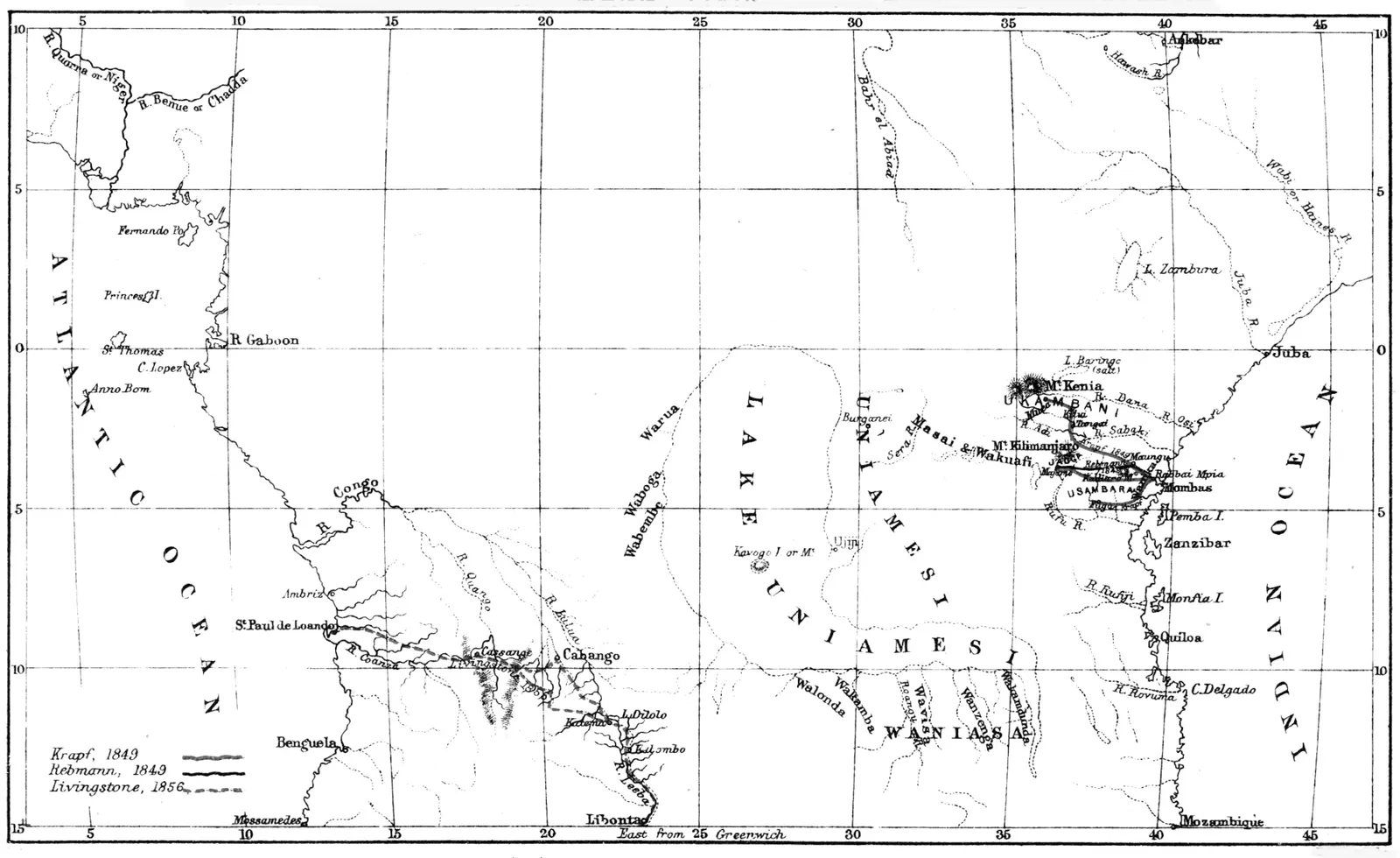
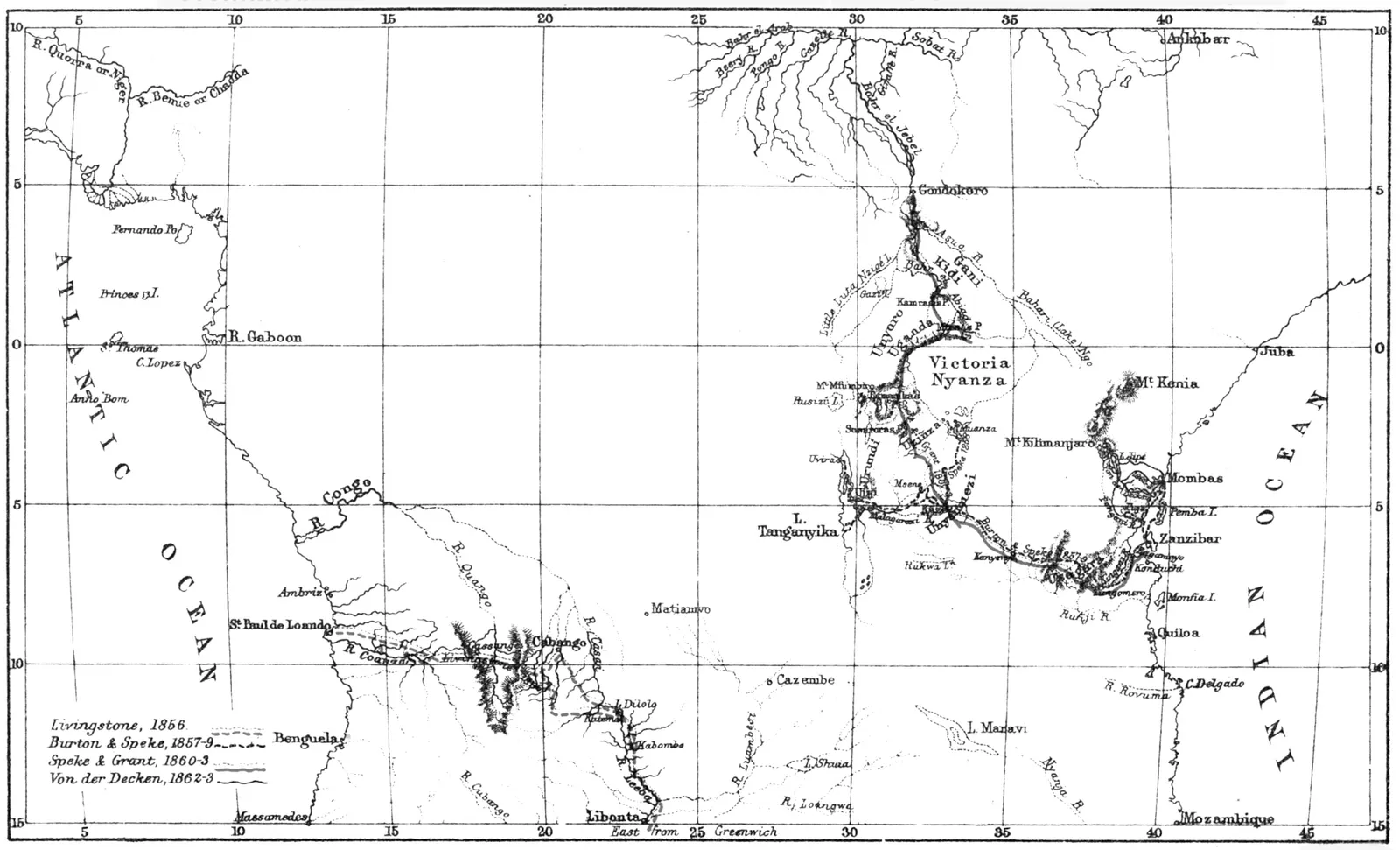
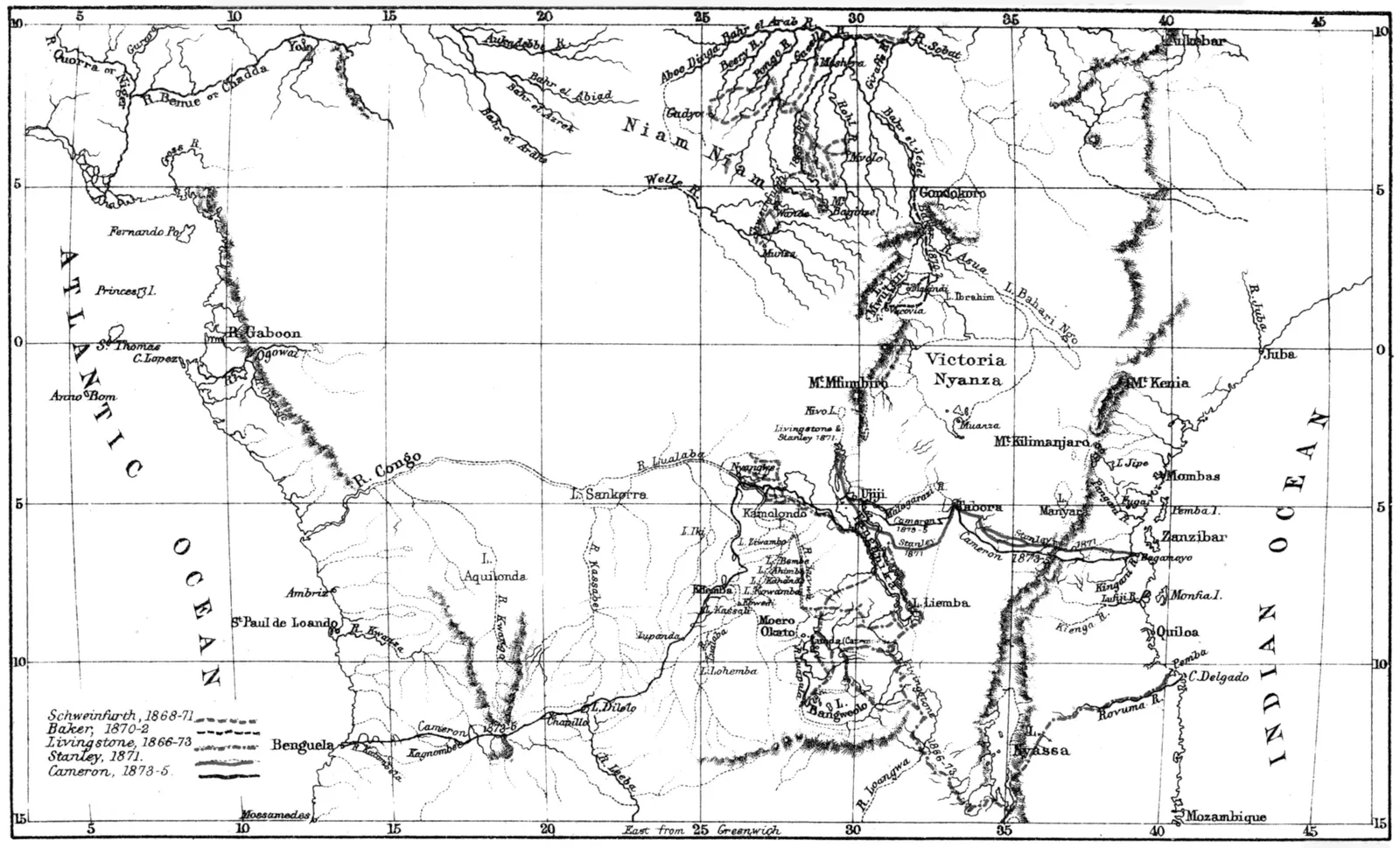
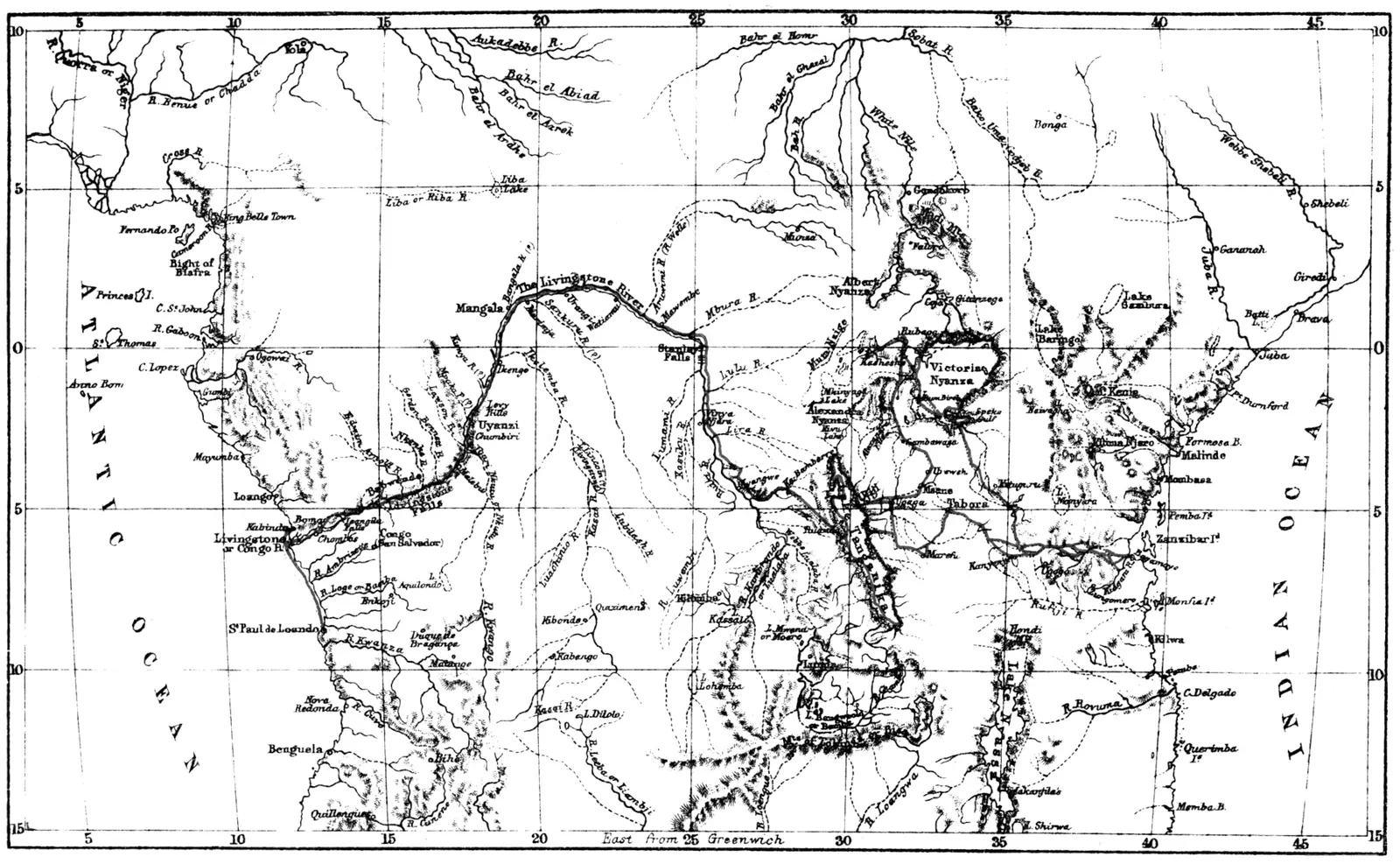
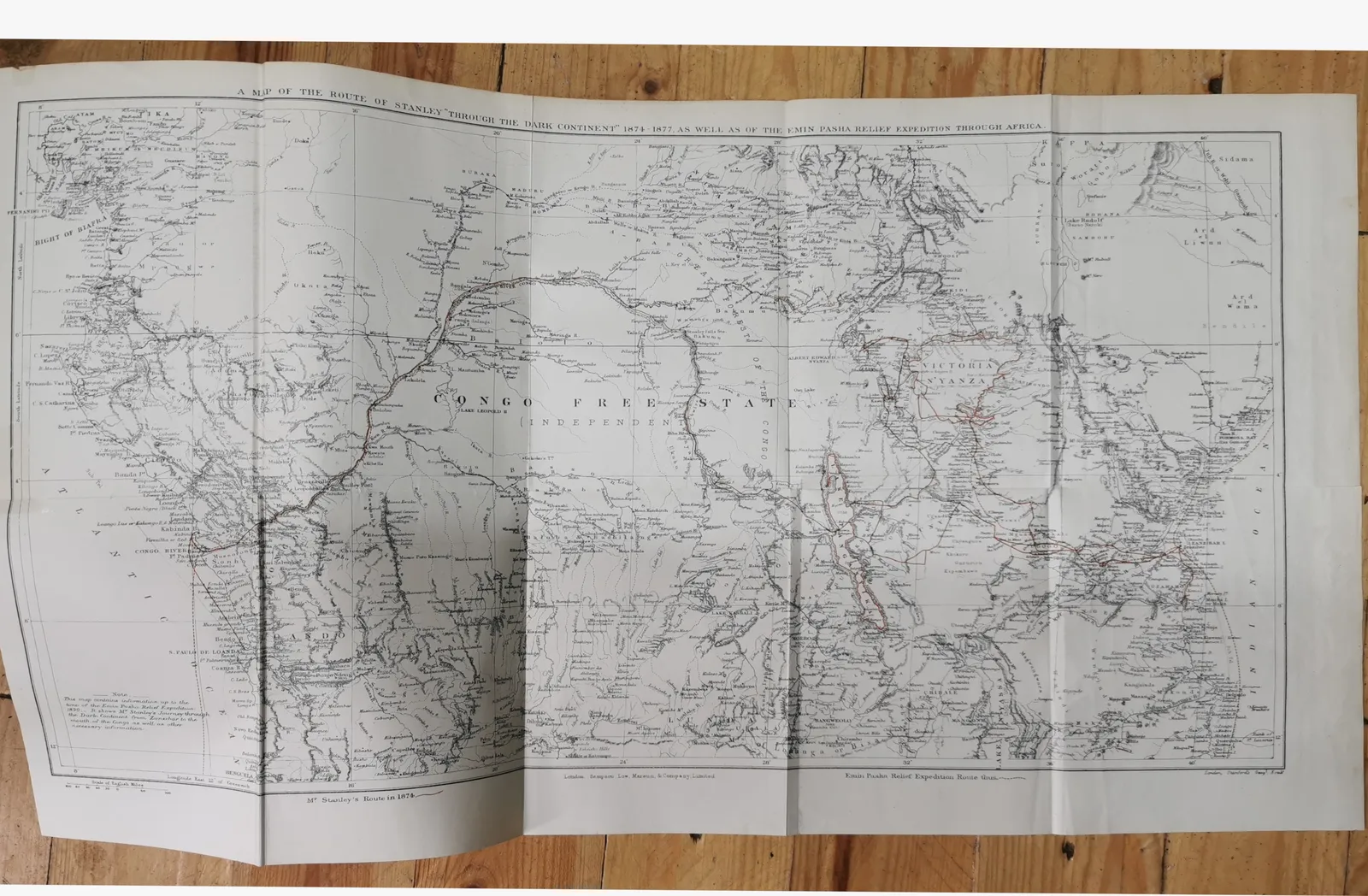
A large foldout map at p. 49 has been photographed and the image ‘flattened’.
The photo cab be viewed by clicking on that image.
The photo can be viewed by clicking on the New original cover art included with this eBook is granted to the public domain.
Any corrections are indicated as hyperlinks, which will navigate the
reader to the corresponding entry in the corrections table in the
note at the end of the text.
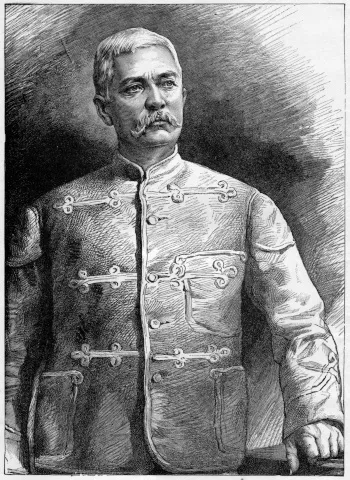
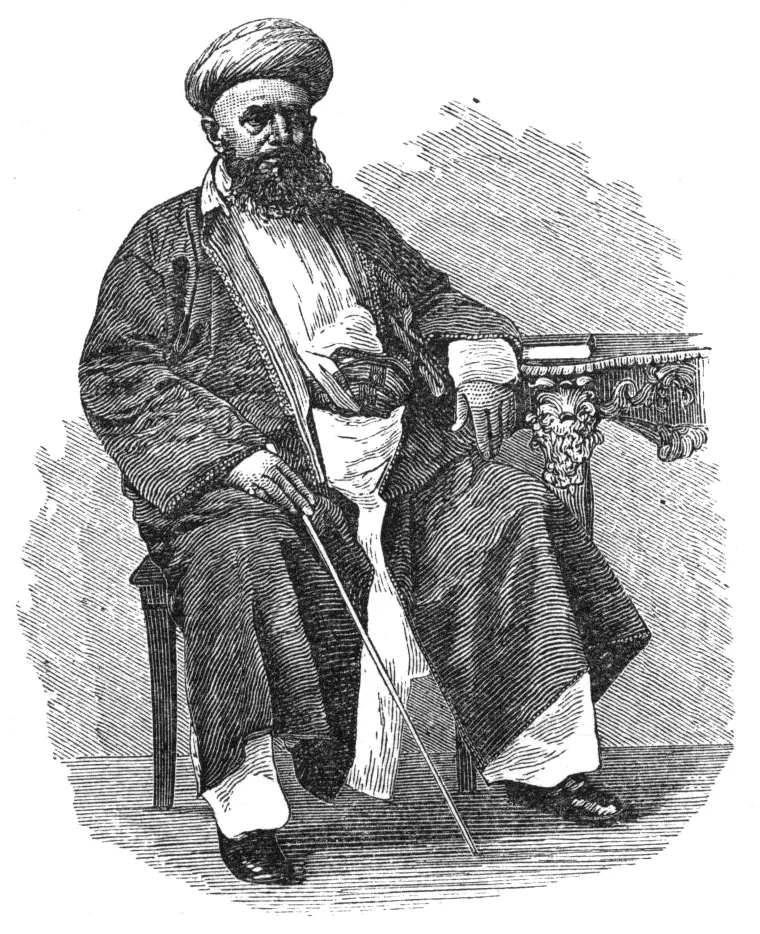
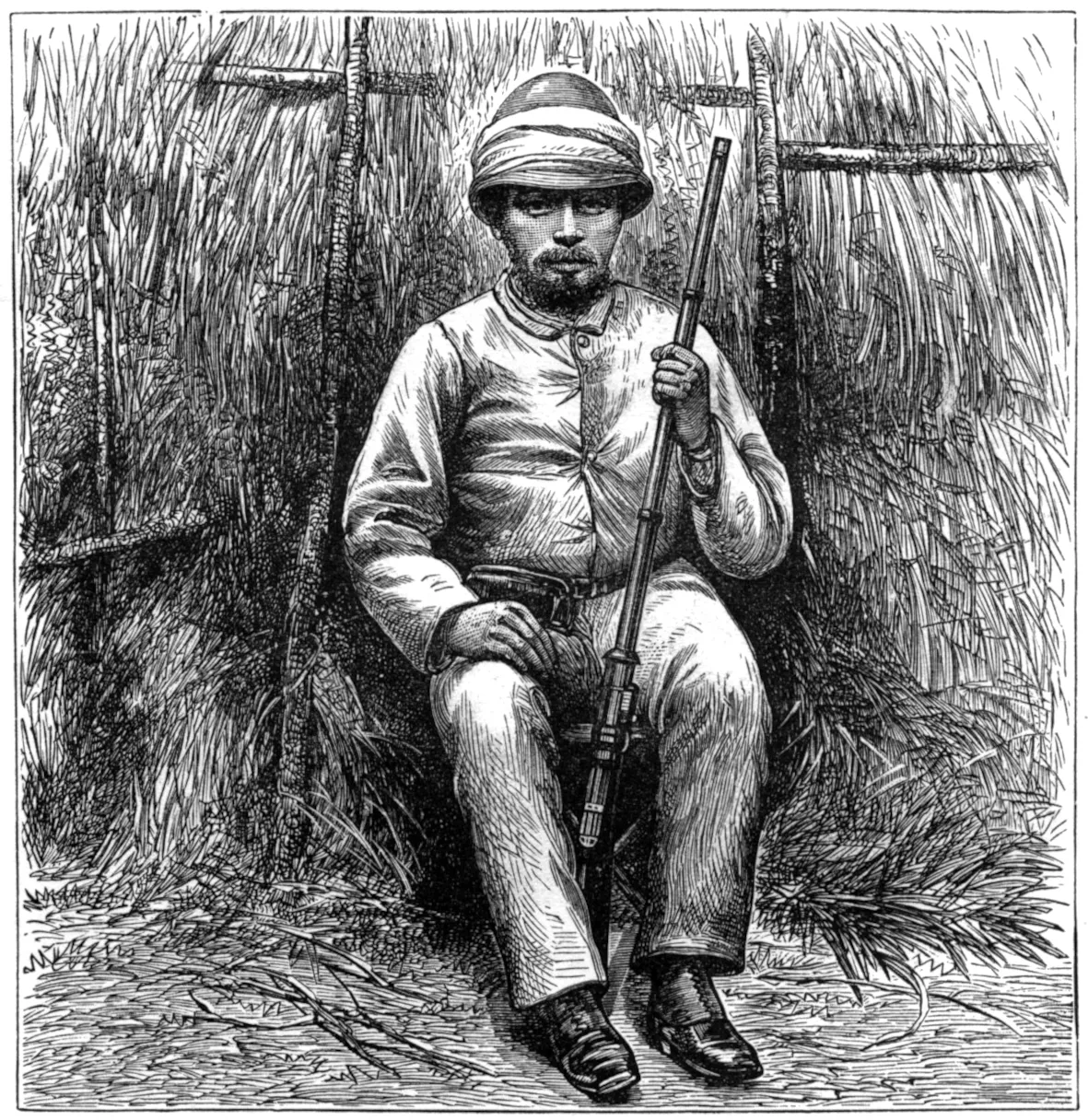
After Walery.] Frontispiece. H. M. STANLEY.
THROUGH THE
DARK CONTINENT
OR
THE SOURCES OF THE NILE
AROUND THE GREAT LAKES OF EQUATORIAL AFRICA
AND DOWN THE LIVINGSTONE RIVER
TO THE ATLANTIC OCEAN
BY
HENRY M. STANLEY
AUTHOR OF “IN DARKEST AFRICA,” “HOW I FOUND LIVINGSTONE,”
“MY KALULU,” ETC.
MAP AND ILLUSTRATIONS
With a New Preface by the Author, written for this Edition.
VOL. I.
LONDON: GEORGE NEWNES, Limited
SOUTHAMPTON STREET, STRAND
1899
IRE-ISSUE
BY ARRANGEMENT WITH MESSRS. SAMPSON LOW,
MARSTON AND COMPANY, LTD.
Dedication.
THE HEARTY ENCOURAGEMENT AND LIBERAL MEANS WHICH ENABLED ME
TO PERFORM THE MISSION ENTRUSTED TO ME,
OF EXPLORING THE DARK CONTINENT OF AFRICA AND SOLVING MANY INTERESTING
GEOGRAPHICAL PROBLEMS,
AND TO FITTINGLY REWARD THE FAITHFUL SURVIVORS,
INDUCE ME TO MAKE PUBLIC MY DEEP PERSONAL ACKNOWLEDGMENTS,
BY DEDICATING THIS WORK, WHICH RECORDS ITS RESULTS, TO THE
PROMOTERS OF THE ENTERPRISE,
Mr. J. M. LEVY AND Mr. EDWARD L. LAWSON,
Proprietors of the ‘Daily Telegraph,’
AND
Mr. JAMES GORDON BENNETT,
Proprietor of the ‘New York Herald,’
AND IN CONSEQUENCE OF THE GREAT AND CONSTANT INTEREST MANIFESTED
BY HIM IN THE SUCCESS OF THE UNDERTAKING, I MUST
BE PERMITTED TO ADD THE NAME OF
Mr. EDWIN ARNOLD, C.S.I., AND F.R.G.S.
WITHOUT THE PATRONAGE, FULL CONFIDENCE, AND CORDIAL SYMPATHY OF
THESE GENTLEMEN I SHOULD HAVE BEEN UNABLE TO ACCOMPLISH
THE TASK NOW HAPPILY COMPLETED.
H. M. STANLEY.
ORIGINAL PREFACE.
vii
Before these volumes pass irrevocably out of the Author’s
hands, I take this, the last, opportunity of addressing my
readers. In the first place, I have to express my most
humble thanks to Divine Providence for the gracious protection
vouchsafed to myself and my surviving followers
during our late perilous labours in Africa.
In the second place, I have to convey to many friends
my thanks for their welcome services and graceful congratulations,
notably to Messrs. Motta Viega and J. W.
Harrison, the gentlemen of Boma who, by their timely
supplies of food, electrified the Expedition into new life;
to the sympathizing society of Loanda, who did their best
to spoil us with flattering kindness; to the kindly community
of the Cape of Good Hope, who so royally entertained
the homeward-bound strangers; to the directorates
of the B. I. S. N. and the P. and O. Companies, and
especially to Mr. W. Mackinnon of the former, and Mr. H.
Bayley and Captain Thomas H. Black of the latter, for
their generous assistance both on my setting out and on
my returning; to the British Admiralty, and, personally,
to Captain Purvis, senior officer on the West Coast Station,
for placing at my disposal H.M.S. Industry, and to Commodore
Sullivan, for continuing the great favour from the
Cape to Zanzibar; to the officers and sailors of H.M.S.
Industry, for the great patience and kindness which they
showed to the wearied Africans; and to my friends at
Zanzibar, especially to Mr. A. Sparhawk, for their kindly
welcome and cordial help.
In the next place, to the illustrious individuals and
Societies who have intimated to me their appreciation of
the services I have been enabled to render to Science, I
have to convey the very respectful expression of my sense
of the honours thus conferred upon me—to his Majesty
viiiKing Humbert of Italy, for the portrait of himself, enriched
with the splendid compliment of his personal approbation
of my services,[1] which with the gold medal received from
his royal father, King Victor Emanuel, will for ever be
treasured with pride—to H.R.H. the Prince of Wales, for
the distinguished honour shown me by his personal recognition
of my work—to H.H. the Khedive of Egypt, for the
high distinction of the Grand Commandership of the Order
of the Medjidie, with the Star and Collar—to the Royal
Geographical Society of London for its hearty public reception
of me on my return, and for the highly valued diploma
of an Honorary Corresponding Member subsequently received—to
the Geographical Societies and Chambers of Commerce
of Paris, Italy, and Marseilles, for the great honour of the
Medals awarded to me[2]—to the Geographical Societies of
Antwerp, Berlin, Bordeaux, Bremen, Hamburg, Lyons,
Marseilles, Montpellier, and Vienna, and to the Society
of Arts of London, for the privilege of Honorary Membership
to which I have been admitted—to the very numerous
distinguished gentlemen who have lent the influence of their
authority in the worlds of Science, Letters, and Society to
the public favour so liberally extended to me—to all these
do I wish to convey my keen appreciation of the honours
and favours of which I have been the recipient. And for
yet another honour I have to express my thanks—one which
I may be pardoned for regarding as more precious, perhaps,
than even all the rest. The Government of the United
States has crowned my success with its official approval, and
the unanimous vote of thanks passed in both Houses of the
Legislature has made me proud for life of the Expedition
and its achievements.
Alas! that to share this pride and these honours there
are left to me none of those gallant young Englishmen who
started from this country to cross the Dark Continent, and
who endeared themselves to me by their fidelity and affection:
ixalas! that to enjoy the exceeding pleasure of rest
among friends, after months of fighting for dear life among
cannibals and cataracts, there are left so few of those brave
Africans to whom, as the willing hands and the loyal hearts
of the Expedition, so much of its success was due.
That the rule of my conduct in Africa has not been
understood by all, I know to my bitter cost; but with my
conscience at ease, and the simple record of my daily actions,
which I now publish, to speak for me, this misunderstanding
on the part of a few presents itself to me only as one more
harsh experience of life. And those who read my book will
know that I have indeed had “a sharp apprehension and
keen intelligence” of many such experiences.
With reference to the illustrations, I should mention that
I carried a photographic apparatus with me across the
Continent, and so long as my dry plates held out I never
lost an opportunity of obtaining a good view, and when my
plates were used up I found the reflection of the scenes on
the ground glass of my camera an invaluable aid to my
unpractised pencil.
In conclusion, I have to thank Mr. Phil. Robinson, the
author of ‘In my Indian Garden,’ for assisting me in the
revision of my work. My acknowledgments are also due
to Lieut. S. Schofield Sugden, R.N., for the perseverance and
enthusiasm with which he recalculated all my observations,
making even the irksome compilations of maps a pleasant
task. In their drawing and engraving work, Mr. E. Weller
and Mr. E. Stanford, and in the intelligent reproduction of
my pictures, Mr. J. D. Cooper, have earned my thanks, and
in no less a degree Messrs. William Clowes and Sons, for the
care and despatch with which these volumes have been prepared
for the public.
H. M. S.
London, Nov. 15, 1879.
PREFACE TO THE EDITION OF 1899.
xi
‘Through the Dark Continent’ was first published in
June, 1878, and now that, after an interval of twenty years,
another fully illustrated edition is to be issued, it has been
thought desirable by the publishers that I should employ
the opportunity of reviewing a few of the amazing changes
that have taken place in the regions described in the book.
Public speakers, I observe, when they have occasion to
refer to the remarkable progress made of late years in
Equatorial Africa, vaguely date it as having begun some
twenty-five or thirty years ago. In reality, however, the
first glimmerings of the dawn only appeared in the latter
part of 1875, which was soon after the publication of my
appeal for missionaries to Uganda. Although the appeal
was almost immediately responded to by the Church Missionary
Society, and a sum of £24,000 was collected, the
missionaries did not leave England until April, 1876, and it
was the 30th June, 1877, before two of the band landed in
Uganda.
These two pioneer missionaries, and a third, who had
been left behind at the south end of Lake Victoria, were,
with myself, the sole Europeans in all Equatorial Africa on
that date. I happened to be then about two hundred miles
from the west coast, laboriously working my way down the
cataracts of the Congo, to put the finishing touch to my
exploration of the course of that river, while over two
thousand miles eastward of me my two fellow-countrymen
were preparing for the great work of converting Uganda
to Christianity.
But, after all, the arrival of the missionaries, though an
important event, and one that has had large consequences,
was but a sign of the dawn. Scepticism as to any good
resulting from the bold missionary venture was very general
xiiin England, and the publications of the C. M. Society prove
that, for some years afterwards, no great hope of success was
entertained, and, as if to add to the public disbelief in the
efficacy of missionary effort among negro pagans, there came,
almost simultaneously with my return from Africa early in
the following year, the sad news that two out of the three
missionaries had been massacred. Thus, at the beginning of
that year, 1878, the surviving missionary in Uganda was
the sole white man in all the regions bordering the African
equator.
The publication of this book in the following June
excited unusual, indeed, I may truly say extraordinary,
interest throughout Europe. It was translated into many
languages, and the aggregate sales were prodigious. In this
country, in France, Germany, Belgium, and Italy, it was
discussed from every point of view. It led to much controversy,
personal and general, but the British public did
not take kindly to the suggestions for immediate action in
Africa contained in it. England lost the opportunity of
selecting unquestioned her field for enterprise, and so long
was she indifferent to the Continent, and the splendid
possibilities that awaited her, that Equatorial Africa was
well-nigh closed to her altogether.
It happened that there was one person on the Continent
who manifested much more than an abstract interest in
Africa, and had, indeed, solicited my services for the development
of the Dark Continent—within a few minutes of
my return to Europe—but had generously admitted that
the people in whose interest I had made my explorations
should have the first claim on them. This person was King
Leopold II., whose wonderful character and extraordinary
ability were then unknown to the world. No Englishman
living, not even the geographical expert, paid such close
attention to my letters in the Daily Telegraph, my book
and speeches on African subjects, as did the King, and no
man shared my zeal and hopes for Africa as did His Majesty.
I waited from January to November, 1878, to see if on this
side of the Channel any serious notice was likely to be taken
of my suggestions; but finding public feeling impossible to
be aroused here, I then crossed the Channel, and accepted
the post of chief agent to the Comité des Etudes du Haut
Congo, of which King Leopold was President.
xiiiAs an illustration of the general indifference in this
country to what had been written and spoken about Africa
during 1878, I quote what took place between two members
of the Royal Geographical Council and myself on a certain
date of June of that year.
These two gentlemen called at my rooms, and, seeing my
original map of the Congo hanging up, one of them, after a
perusal of some of the notes written along the course, turned
to me and asked—
“How long do you think it will be before a white man
revisits Stanley Falls?”
“Two or three years, I suppose,” I replied.
“Two or three years!” he exclaimed. “I expected you
were going to say fifty years.”
“Fifty years!” I cried. “Why, I will venture to wager
that, before twenty years are over, there will not be a
hundred square mile tract left to be explored in the entire
Continent.”
“Oh, come,” said the other gentleman, “that is too
sanguine a view altogether. I will take your bet—shall we
say £10?—and book it.”
We booked it there and then. The twenty years have
lately expired, but though I cannot claim to have won the
wager, it must be admitted that my hasty prediction has
closely approached fact.
About the same time, Sir Rutherford Alcock, then President
of the Royal Geographical Society, remarked, in his
Annual Address, that I had told him that, with money
enough, Africa could not only be explored, but civilised and
converted into orderly states. It did not seem to me that
there was anything surprising in that, but to Sir Rutherford
it appeared worthy of public notice. It is of value here only
as an indication of the general ignorance that then prevailed
in all circles as regards Africa.
Seven years later, after seeing the establishment of one
of the African states that promised to be civilised some day,
I was introduced by a Canon of Westminster Abbey to a
well-known Bishop as one who had “done good work on the
Congo.”
“Oh, indeed!” said his Lordship, smilingly, “how very
interesting; but,” he added, hesitatingly, “I am really not
sure that I know where the Congo is.”
xivAs may be imagined, I was a picture of wide-eyed
surprise. For every newspaper in the country had been
for months daily publishing something or other about the
Congo Conference, and I thought that surely one of the
princes of the Church must have caught sight of the name;
but such had been the Bishop’s culpable inattention to great
events in Africa, that the name even had not attracted his
notice.
Resuming my proper subject, I became chief agent on
the Congo. Every now and then during the six years that
I occupied that position, directing the advance into the
Congo basin, reports of our doings frequently reached
England in one form or another, and still the trend of
events seemed unperceived there, though there was considerable
stir in Germany, France, Portugal, and Belgium.
Neither, apparently, were the actions of the Germans on
the borders of Cape Colony in 1883-84 of a character to
excite alarm, suspicion, or even intelligent alertness in the
British mind. Lord Derby was not in the least disturbed
by the curious inquisitive tone of Bismarck’s despatches
relating to South Africa, and Lord Granville failed to comprehend
the drift of Bismarck’s anxiety about the German
settlement at Angra Pequena, or that the presence of a
German warship in South African waters signified anything.
When it was too late, however, to prevent the seizure of
a large territory neighbouring Cape Colony, the British
rubbed their eyes, and found that a European Power, which
might make itself unpleasant some day to our South African
colonists, had wilfully planted itself in close proximity to
the Boer states, with which we had already more than once
grave misunderstandings. It was then inferred that a
similar move, a little further inland, by either the Boers
or Germans, would perpetually confine British South Africa
to within the narrow limits of Cape Colony, and a suspicious
manœuvre of a German ship of war in Eastern South Africa
confirmed the British Government that longer delay would
be disastrous to British interests, and the Warren Expedition,
which secured to us Bechuanaland, and an open way to
the Zambesi, was the result. But before the Berlin Conference
of 1884-5 was held, Germany had become the owner
of important possessions at various places in Occidental
Africa, and was projecting other surprises of a similar kind.
xvDuring the sittings of the Conference, which had met to
decide the future of the Congo, the words and acts of the
assembled Plenipotentiaries received due attention from
every journal of importance in the United Kingdom, but
they did not appear to impress the public mind as
closely affecting British interests. Yet much was happening
that, had the warning which was sounded occasionally
by experts been taken properly to heart, the significance
of the Conference would have been easily recognised.
On the Continent, however, the diplomatic discussions
had a most stimulating effect. The people of every state
now studied their African maps with a different purpose
from the acquisition of mere geographical knowledge.
Societies, miscalled “commercial, geographical, or scientific,”
sprang into existence like mushrooms throughout
France, Germany, Italy, Belgium, and Sweden, and in a
short time numerous expeditions, disguised by innocent
titles, were prepared for Africa.
Within two days after the signing of the General Act
of the Conference, the German Emperor proclaimed a protectorate
in East Africa over countries whose names were even
unknown until the appearance of this book. Our Foreign
Secretary was in such dread of Prince Bismarck that he not
only acquiesced in this bold act, but obsequiously hastened
to instruct our representative at Zanzibar to use his undeniable
influence in promoting German interests, and lessen his
zeal for our own.
To-day, living as we do under a powerful Unionist
Government, which has just triumphed over the Mahdi’s
successor, and recovered nearly all that the Government of
that period had lost, these events may appear incredible,
but 1884-85 was a singularly disastrous period for British
prestige. The aged statesman who then presided over
England’s affairs was fast declining in power and ability;
but as his influence still continued supreme, the nation was
powerless to avert the blunders and misfortunes that so
repeatedly shocked us. However, not to dwell upon this
painful subject, let me say that when Lord Granville
signified to Prince Bismarck that England would oppose
no obstacles to German designs in Africa, it naturally
followed that the Prince would interpret this as meaning
that England would surrender all claims to territory that
xvithe Germans might think desirable, and accordingly the
East African Protectorate expanded in a marvellously brief
time from the coast to the Tanganika, and threatened to
absorb the whole of East Africa from Mozambique to the
Gulf of Aden. Though priority of discovery and exploration
may not under all circumstances constitute a full title to
territory, it is certainly aggrieving to find another nation
rudely thrusting itself into the field and forcibly seizing
upon it.
Fortunately, however, a Company had been formed in
1885 to take over a small concession obtained by Mr.
H. H. Johnston at Taveta in East Africa, and as the
Germans encroached upon it, Lord Rosebery, who had
become Foreign Secretary, took the opportunity of making
a firm protest against it, which served to arrest the wholesale
absorption that had been meditated, and gave the
necessary time for a fuller development of the British
project. A delimitation of territory was determined upon to
define that which was claimed by Great Britain, Germany,
and Zanzibar, and meanwhile the operations of the British
Company were suspended to avoid a clashing of interests, and
through Lord Rosebery’s protest the Germans likewise agreed
to prevent their agents from making any new acquisitions in
the debatable zone.
In November, 1886, an understanding was arrived at
which recognised the sovereignty of Zanzibar as existing
over Zanzibar and Pemba, and the smaller islands, within a
radius of twelve sea miles of them, as also over those of
Lamu and Mafia, and a strip of the mainland ten sea miles
in depth.
East Africa was delimited into two spheres of influence,
divided by the mouth of the Umbe River, the northern base
of Kilimanjaro Mountain, and thence by a line stretching to
the eastern shore of the Victoria Nyanza at the 1st degree of
south latitude.
On the 25th May, 1887, the Sultan of Zanzibar signed a
fifty years’ concession of all his rights remaining to him,
after the lease he had given to Germany on the 4th
December previous, to the British East African Association.
In April of the following year the Association, having through
its agents concluded treaties with the native tribes to a
distance of two hundred miles inland, became the Imperial
xviiBritish East African Company with the nominal capital of
£2,000,000, for the purpose of administering the Zanzibar
Concession, acquiring territory, and to undertake trading
operations.
Meantime, early in 1887, four months previous to the
formation of the British East African Association, I had
started on my fourth expedition into the Dark Continent,
with the object of carrying relief to Emin Pasha, to whom
had been entrusted the government of the Egyptian provinces
near the Equator, by the late General Gordon. Few
persons at the time knew that Emin Pasha was only another
name for a Dr. Edouard Schnitzer, and that he was a
German Israelite by birth. The fund for the relief was
contributed to equally by the Egyptian Government and
Sir William Mackinnon’s personal friends.
The story of the march to Emin’s relief and his arrival at
the Zanzibar coast with my expedition, has been related in
detail in ‘Darkest Africa,’ and there is no necessity to give
even a summary of it here.
During the journey through the Aruwimi Forest and
thence to Zanzibar, we were able to add considerably to our
knowledge of the Equatorial regions. That of the great
forest itself, with its pigmies and cannibals, was no mean
addition, but our march eastward led to the discovery of
the snowy range called Ruwenzori, the interesting Semliki
Valley and its river, which by following upward brought us
in view of the Albert Edward Nyanza, and enabled me to
identify it as the lake I had first seen in January, 1876.
The topography of the intra-lake region became also much
better known; and a little later the outline of the Victoria
Nyanza received enlargement by the finding of an unknown
south-western bay of important dimensions.
These discoveries were, however, unimportant compared
to the effects following our return home and the publication
of our experiences. The Brussels Conference of 1890 was
preparing to sit, and it was not difficult to impress the
Plenipotentiaries with the immediate necessities of the Dark
Continent, such as railways, prohibition of importing fire-arms,
the suppression of slave-raiding, etc., etc. On the
Congo State authorities our revelations had a still more
marked effect. Preparations were then commenced to deal
with the slave-raiders of the Congo, and the despatch of
xviiiVankherkhovin’s Expedition to the Upper Welle, that of
Captain Stairs to Katanga, and for the definite construction
of the railway to Stanley Pool. The spirit of annexation
was once more roused, and there was what might be called a
race for the possession of the undelimited region west of
Lake Victoria. The British East African Company’s troops
were pushed into Uganda, and the expeditions under Mr.
Jackson, Captain Lugard, Major Eric Smith, and Mr. Piggott,
performed excellent service in their various explorations.
One of the most important effects of this renewed furore
was the conclusion in July of a Treaty between Great Britain
and Germany, which nullified the efforts of Emin Pasha and
of Dr. Peters to seize upon Uganda and the lake regions
west of it. The German Government agreed to surrender
all the territory it occupied or claimed north of the British
sphere, and the protectorate of Witu and the coast up to
Kismayu was transferred to England. This Treaty not only
extended the British possessions to the Abyssinian frontier,
thus excluding any European competitor for influence on the
Upper Nile, but established a British Protectorate over the
Sultanate of Zanzibar. In return for the claims surrendered
by Germany, England ceded Heligoland, and for the sum of
£200,000 Germany received the sovereignty and revenue of
the African coast between the Rovuma and the Umbe Rivers.
From the following list of African explorers who have
crossed Africa since this book was issued, it will be recognised
at a glance how rapid has been the increase of
geographical knowledge:—
1.
Serpa Pinto
From
Benguella to Durban
1877-1879.
2.
Herman von Wissman
”
Mossamedes to Quilimane
1881-1882.
3.
Arnot the Missionary
”
Durban to Benguella
1881-1884.
4.
Capello and Ivens
”
Mossamedes to Quilimane
1884-1885.
5.
Gleerup
”
Banana Pt. to Bagamoyo
1883-1886.
6.
Dr. Lenz
”
Banana Pt. to Quilimane
1885-1887.
7.
Herman von Wissman
”
Banana Pt. to Quilimane (2nd journey)
1886-1887.
8.
Mons. Trivier
”
Loango to Quilimane
1888-1889.
9.
Stanley’s second journey
”
Banana Pt. to Bagamoyo
1887-1889.
10.
Dr. Johnston
”
Benguella to Zambezi Mouth
1891-1892.
11.
Count von Gotzen
”
Pangani to Banana Pt.
1893-1894.
12.
M. Moray
”
Bagamoyo to Banana Pt.
1892-1895.
13.
E. I. Glave
”
Zambezi Mouth to Lower Congo
1893-1895.
14.
Mons. Miot
”
Zambezi Mouth to Lower Congo
1893-1896.
15.
Mons. Versepuy
”
Bagamoyo to Kabinda
1895-1896.
16.
M. Descamps et Chargois
”
Zambezi Mouth to Kabinda
1893-1896.
17.
M. Foa
”
Zambezi Mouth to Banana
1896-1898.
18.
Mr. Lloyd
”
Mombasa to Banana
1897-1898.
xixWhile previous to the book, since the beginning of the
century, there had only been three trans-African explorations:—
1.
Livingstone
From
St. Paul da Loanda to Quilimane
1854-1856.
2.
Lieut. Cameron, R.N.
”
Bagamoyo to Benguella
1873-1875.
3.
Stanley’s first journey
”
Bagamoyo to Mouth of the Congo
1874-1877.
With regard to the numerous other expeditions which
took place since 1878, there is no space for mention, but
Joseph Thomson’s travels, viâ Nyassa, to the Tanganika, and
his brilliant journey through Masai Land; Count Teleki
and Von Hohnel’s travels in Eastern Africa, which resulted
in the discovery of Lakes Rudolf and Stephanie; Captain
Bottego’s journey through Somali Land, and Dr. Donaldson
Smith’s exploration of Somali and Galla Lands were of the
first importance. It has, however, required the services of
some hundreds of travellers since 1878 to fill up the sum of
our present knowledge of the Continent.
In 1878 there was not one European-built boat in all
Equatorial Africa. By 1881 there were five, but by
December 31st, 1898, there were seventy-two steamers and
one hundred and sixty-four steel boats or barges, while there
is a very large addition to the African flotillas either on its
way, or in process of construction. It may be imagined
how much these vessels have expedited exploration when I
say that out of the seventeen trans-African explorers no less
than thirteen of them were transported with their followers
and effects some hundreds of miles on their way.
Even as late as 1890 the construction of railways in
Equatorial Africa had not been begun, though years of
zealous efforts had been made by myself and others to
induce capitalists to undertake them, knowing as we did
that they were the best instruments that civilisation could
employ for the moral, material, and social elevation of the
dark peoples. But just as it took years upon years of
publications and speeches to dissipate the unreasoning
terror of Africa in the European mind, it required years
of preaching and encouraging to induce railway constructors
to try Africa as the theatre of their operations. Soon after
the conclusion of the Emin Expedition the Congo Railway
was commenced, and to-day it is fully employed in traffic,
and the 500-franc shares are worth 1700 francs per share,
xxwhich may be taken as a proof that the shareholders’ faith
has been munificently rewarded. By the latest news from
East Africa we learn that two hundred and forty miles
of the Mombasa and Nyanza Railway have been laid,
and it is predicted that by May next the locomotive will
reach the half-way point to Lake Victoria. In German East
Africa thirty miles of railway have been in operation for
some time, but there are serious railway projects under consideration,
and, it may be, an attempt will shortly be made
at construction on an important scale. Meantime, however,
the coloured troops are being employed in making a road
suitable for wheeled traffic between the port of Dar-es-Salaam
and Ujiji, viâ Kilossa and Tabora, and thus far
mules have been used with great success.
But though there are not yet five hundred miles of railway
open for traffic in Equatorial Africa, considerable extensions
are under construction, or being meditated. The British
East Africa Railway will, of course, be continued as far as
Lake Victoria, as Parliament has provided the necessary
money. The Congo State having successfully completed the
railway connecting the lower with the upper river, is
carrying out surveys for other railways on the Upper Congo.
The Zambezi will also in a short time be connected by rail
with Lake Nyassa, and we learn that the Bulawayo Railway
is to be extended to the Tanganika Lake. My predictions
in regard to Africa have so singularly approached realisation
thus far that I am tempted on a safer prophecy, which is,
that by 1918, there will be five thousand miles of iron roads
where there are now not five hundred.
When my letters, calling attention to the spiritual and
material needs of Africa, used to appear in the columns of
the Daily Telegraph in 1874-77, there was neither mission,
school, church, nor any legitimate trade started in the
regions near the African Equator. But since 1877 wonderful
changes in this respect have taken place. The statistics
we have received from the Uganda Protectorate alone tell
a remarkable tale of progress. According to these there
have been 372 churches and missions established, at which
there are 97,575 Christian converts. About 100 Europeans
are living in the Protectorate, and the first official report
(for 1897) announced that trade to the value of £30,000
had been begun. It will be remembered, perhaps, that
xxiit was for long a debatable question whether we should
retain Uganda or abandon it.
The country of which the first few chapters of this book
treat is now mainly German East Africa. What a change has
come over it! No one could have foreseen or dreamed at the
time of my march through it that Germany could ever have
become the controller of its destiny. I dreamed visions of the
future often in the wilds, such as that described in Chapter X.,
but I saw no Teuton in my dreams. However, it may be all
for the best that Germany has annexed it, and England owes
too much to Germany for waking her out of her somnolence
to begrudge what Bismarck obtained so boldly. The white
population of this colony at the end of last year numbered
922, of whom 678 are Germans, and the trade amounted in
value to £600,000. It will, no doubt, be a long time before
the Arab coast towns undergo any external change, but
within their character and scenes are altogether altered.
German militarism, which as we know is of the strictest
kind, bears no resemblance to Arab supineness and neglect
or to Arab customs. The small boys have taken kindly to
the dominant spirit, and practise the forms in vogue among
the military. There are custom-houses at every port, and
permits for travel and sport inland can only be obtained
through the goodwill of the Governor. The drastic measures
of Von Wissman have long ago suppressed the slave-trade,
and the slave-market is now only a memory.
The coast towns are connected by telegraph with each
other, and there is cable communication, viâ Zanzibar, with
Europe. Ujiji, the port on Lake Tanganika where I met
Livingstone in 1871, possesses now quite a civilised appearance.
Its Government buildings are of stone and two-storied,
and a long wide street, shaded by mangoes and other fruit
trees, runs through the centre of the town. German capital,
to the value of £697,000, has been invested in tobacco,
coffee, cocoa, tea, cardamom, and vanilla plantations; and I
am glad to learn that the Game Laws are strict and
effective.
The change in Equatorial Africa is nowhere more conspicuous
than in that part described in Chapters XXI.-XXXIV.
It may be imagined from the fact that a Brussels
statistician has collected the titles of 3800 printed works
which have been published since 1878 and refer to this
xxiipart, and in his chronological table he records forty-eight
separate explorations of the region.
The progress of trade in the Congo basin can be best
represented by the following brief table of imports and
exports:—
Years.
Imports.
Exports.
Total.
£
£
£
1893
367,004
300,592
667,596
1894
447,789
441,268
889,057
1895
427,434
485,426
912,860
1896
609,111
603,645
1,212,756
1897
887,258
698,284
1,585,542
The average value of the annual exports during each
of the five preceding years (1888-92) amounted to only
£207,921.
From the inception of the Congo State in 1879 to the
year 1890 the King of the Belgians personally defrayed all
the expenditure; but on July 3rd, 1890, the Belgian
Government came to His Majesty’s assistance with a lump
sum of £200,000, and an annual subsidy, to last ten years,
of £80,000 per annum. This amount, with the King’s
personal subsidy, was for some years later the main support
of the State; but in 1898 the revenue from all sources is
estimated to amount to £590,608, while the expenditure is
£99,477 in excess.
This excess of expenditure some unkindly critics in this
country attribute to extravagance, ambition, and what not;
but the King justifies his policy by comparing himself to one
who had come to a great but wholly undeveloped estate,
which was bound to remain unproductive unless a liberal
expenditure was incurred for such improvements as would
expose its resources and make all parts of it accessible.
Now what the Congo State was in 1879 can best be seen
by Chapters XXIV.-XXIX. To the ordinary white man
it was what may well be termed impenetrable, except at
constant peril of his life. It was ravaged by cannibals,
fierce warlike tribes, and slave-raiders, and destructive
influences of every kind tended to maintain its humanity
in an eternal struggle for life and liberty. There were no
xxiiiroads, or means by which the country could be explored.
Every tribe barred the ingress of the traveller; and its
frontiers on all sides lay exposed to any white stranger who
took the trouble to plant a flag; and finally it was made
incumbent on every Power owning African possessions to
make its occupation effective. Such primary necessities
of the State involved large and endless expenses, and few
men other than King Leopold would have so long sustained
the great undertaking from his private purse. From 1879
to 1890 His Majesty spent about £900,000, and since then
the total expenditure of the State has been nearly
£3,000,000. To meet this His Majesty’s subsidies, amounting
to £360,000, the aid from Belgium, £200,000, the
Belgian annual subsidies, £720,000, customs duties and
taxes, £1,900,000, make a total revenue of £3,180,000, and
prove a deficit of £720,000.
As an offset against the deficit, the State possesses nineteen
steamers and forty steel barges of the value of £100,000;
Government establishments, which we may estimate at
£500,000; arms, ammunition, goods, coal, and lumber, at
£100,000; investments in the railway, telegraph, and commercial
societies, and plantations, to the value of about
£400,000—the whole of which aggregate £1,100,000. To
these, which may be rightly taken as assets of the State,
should be added the increment of the land which at present
in some places sells at £80 the hectare, for factories and
commercial purposes at £4 the hectare, and for agriculture
at 8s. the hectare. If the State were offered for sale the
value of the land made accessible to market by railway and
steam communication would have to be considered. Beyond
what has been specified as the State assets, consideration
must be given to the now assured growth of the revenue.
To-day, exclusive of the subsidies, it amounts to £470,602.
When the State reaps the results of its generous aid to the
planters of coffee, tea, cocoa, etc., to the railway, now
completed, and to the commercial companies, who are now
not restricted in their transport of goods and produce, there
must necessarily be a material increase each year in the
revenue. From all of which summary it does not appear to
me that the position of the State is financially unsound;
indeed, I am inclined to think it to be otherwise.
His Majesty’s policy has been to start the State on lines
xxivthat must end in prosperity, without regard to personal
labour or personal cost, and by his munificent pecuniary
advances to the railway, commercial societies, planters,
timber merchants, and agriculturists, the result has been
that capital to the amount of several millions sterling has
gravitated to the Congo. Personally, he may never recover
a penny of the £900,000 he devoted to the creation of the
State, but to that he is indifferent. Whatever surplus the
revenue may furnish will certainly be devoted to assist new
enterprises, new railways, increase of shipping, telegraph
lines—to anything, in short, that promises expansion of the
resources of the State, and enhances the value of the legacy
he proposes to bequeath to the people of whom he is King
and loyal servant.
An honourable friend of mine has lately delivered a
lecture before the Statistical Society with a view to prove
that the Congo State was financially a failure. It would be
useless, in this place, to do more than present the balance
sheet of four African territories, and ask him and those who
agree with him to give it a fair consideration.
Name of State
Years.
Receipts.
Expenditure.
Deficits.
or Territory.
£
£
£
1891
182,197
182,197
—
1892
192,035
189,279
—
1893
266,580
217,627
—
1894
310,181
295,342
—
1895
324,650
294,837
—
Congo State
1896
414,396
329,452
—
1897
374,770
405,675
30,905
1898
590,602
690,079
99,477
The first year
}
(estimated)
}
798,660
786,918
—
of the railway.
1899
British East Africa
1897
32,670
134,346
101,676
German East Africa
1897
218,495
298,260
79,765
German Cameroons
1897
58,328
69,170
10,842
The Uganda Protectorate, having been established but
lately, would naturally present a still more unsatisfactory
balance sheet than any of the four territories above mentioned,
but it is not derogatory to either British or German
Africa that their deficits are so large, for the Congo, during
the state of undevelopment, had absolutely no receipts at
all, except King Leopold’s subsidy, to meet the expenditure.
xxvThere is no necessity to labour this matter, but I think it is
sufficiently proved that my honourable friend has been mistaken
in his views about the financial condition of the Congo
State.
As a fitting conclusion to this preface, I here append a
table which will exhibit at a glance the advance of Equatorial
Africa during the last twenty years.
State or Territory.
White Popul- ation.
Miles of Rail- way.
No. of Missions, Schools or Churches.
No. of Christian Converts.
Value of Imports and Exports.
Revenues, including Subsidies.
Congo State
1,678
250
67
10,000
1,585,542
590,602
Uganda Protectorate
100
..
372
97,575
28,400
142,000
British E. Africa
101
237
6
600
218,800
102,670
British Cent. Africa
300
..
55
5,000
116,264
30,000
French Congo
300
..
25
2,500
452,282
123,622
German E. Africa
922
30
15
2,500
638,000
218,495
German Cameroons
253
..
5
900
465,000
58,328
Totals
3,651
517
545
119,075
3,504,288
1,265,717
Remarkable as has been the progress of the above territories
hitherto, my most sincere wish is that there may be
still greater acceleration of it during the next twenty years.
HENRY M. STANLEY.
January 1st, 1899.
CONTENTS.
xxvii
EXPLANATION.
PAGE
Part I.—My new mission—The Daily Telegraph—“Yes; Bennett”—The Lady Alice—My European staff—Disappointed applicants and thoughtful friends—My departure for Africa. Part II.—The Sources of the Nile—Herodotus on the Nile—Burton on the Nile basin—Lake Tanganika—Lake Victoria—Speke, Grant, and Cameron—The Livingstone River—The work before me
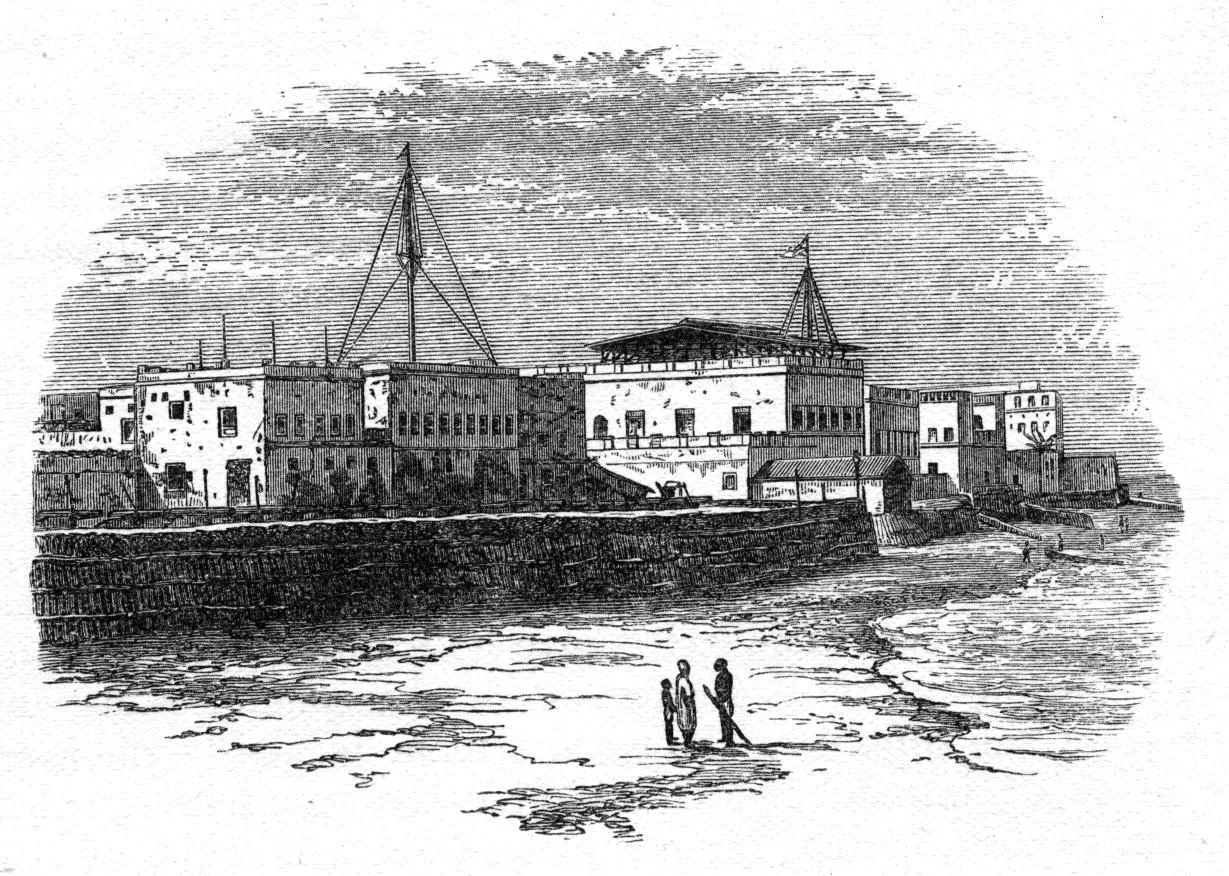
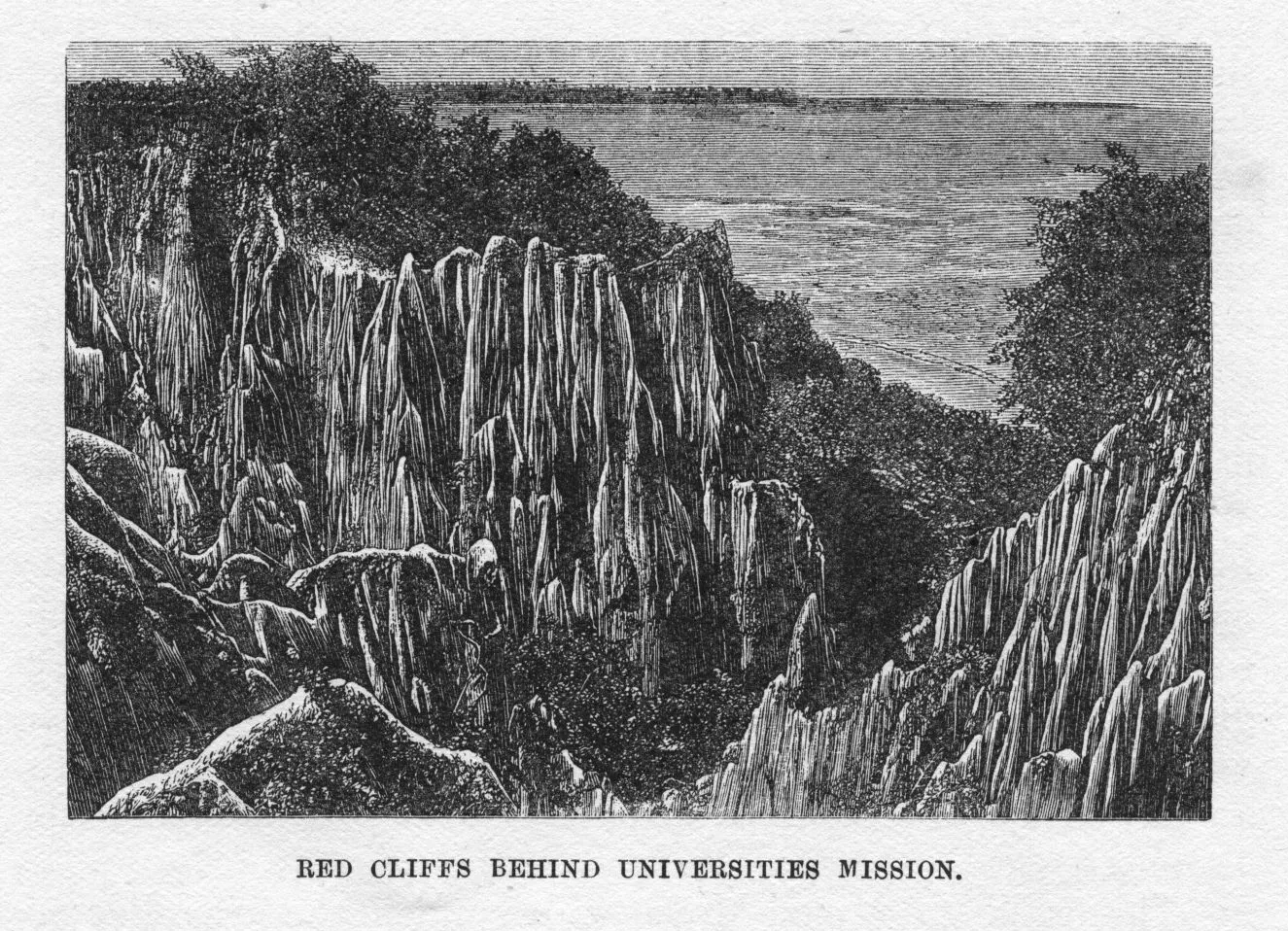
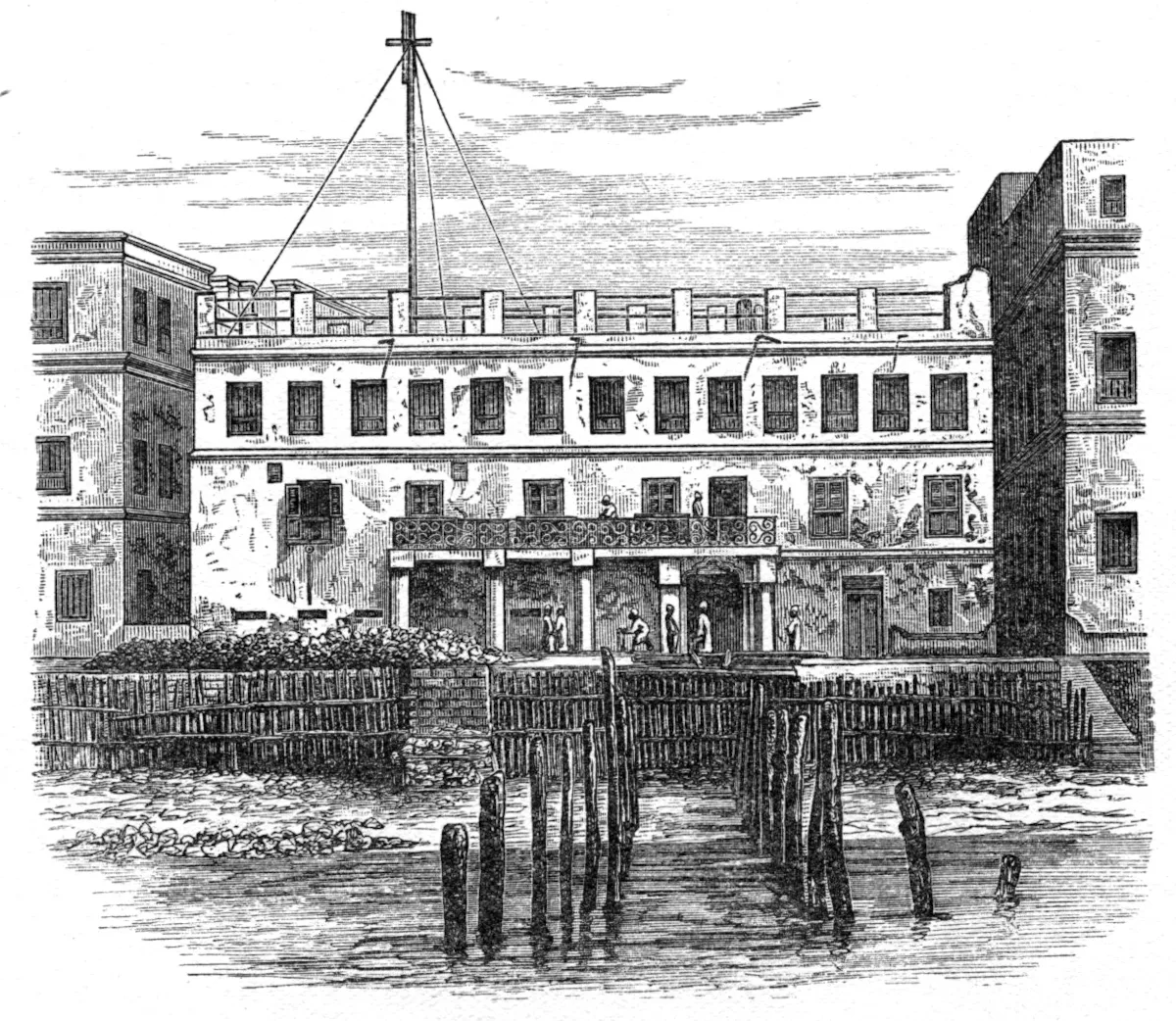
Arrival at Zanzibar Island—Life at Zanzibar—The town of Zanzibar, its roadstead and buildings—The One Cocoa-nut Tree and the red cliffs—Selection and purchase of goods for the journey—Residence of Prince Barghash—Busy mornings—Pleasant rides and quiet evenings
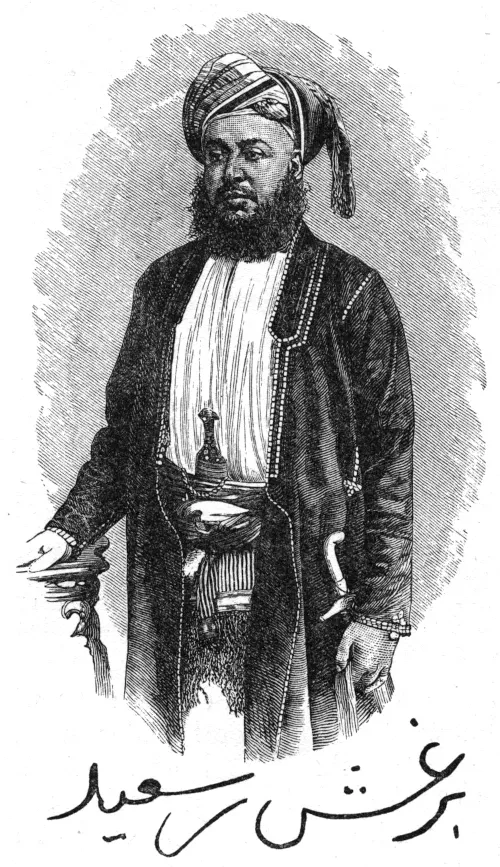
Seyyid Barghash—His prohibition of slavery, character, and reforms—Treaty with British Government by Sir Bartle Frere—Tramways the need of Africa—Arabs in the interior—Arabs in Zanzibar—Mtuma or Mgwana?—The Wangwana, their vices and virtues—A Mgwana’s highest ambition—The Wanyamwezi “the coming race”
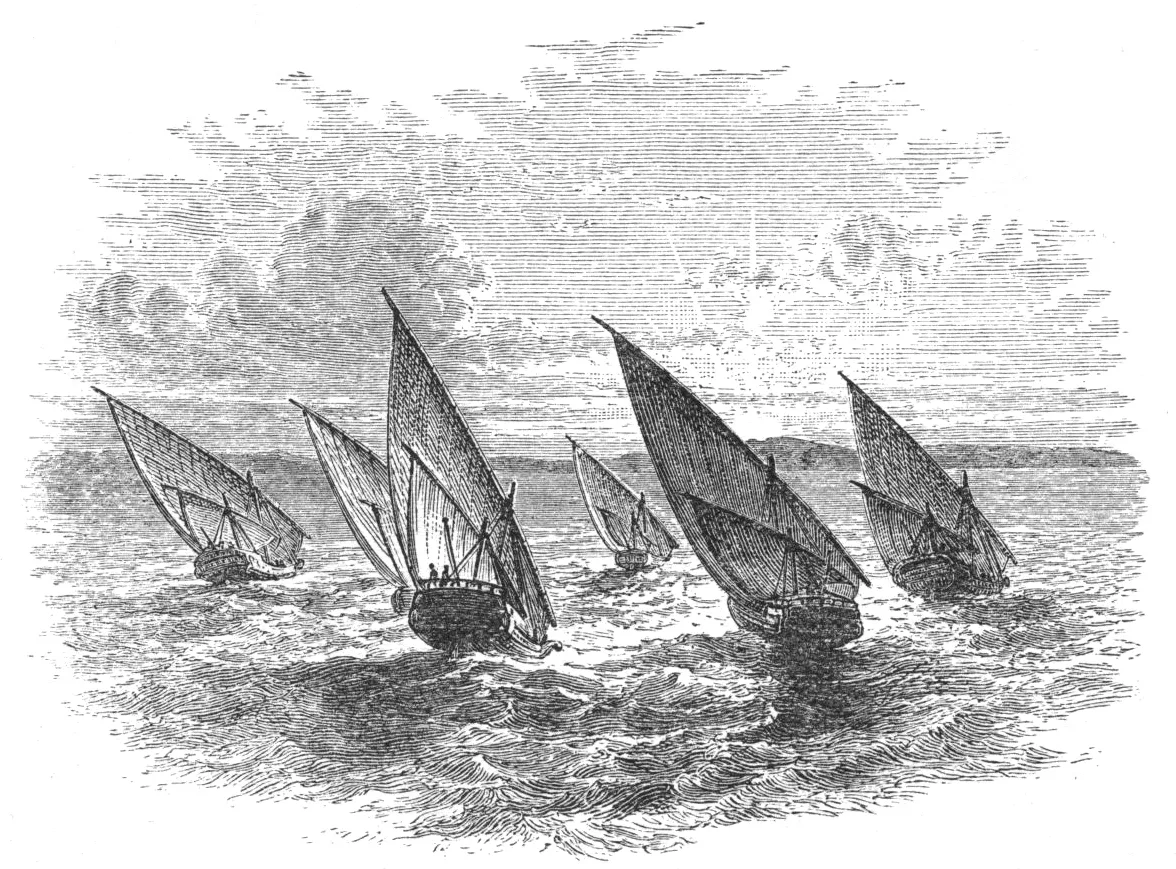
Organization of the Expedition—The shauri—“Poli-poli”—Msenna’s successful imposture—Black sheep in the flock—The Lady Alice remodelled—Sewing a British flag—Tarya Topan, the millionaire—Signing the covenants—“On the word of a white man”—Saying good-bye—Loading the dhows—Vale!—Towards the Dark Continent
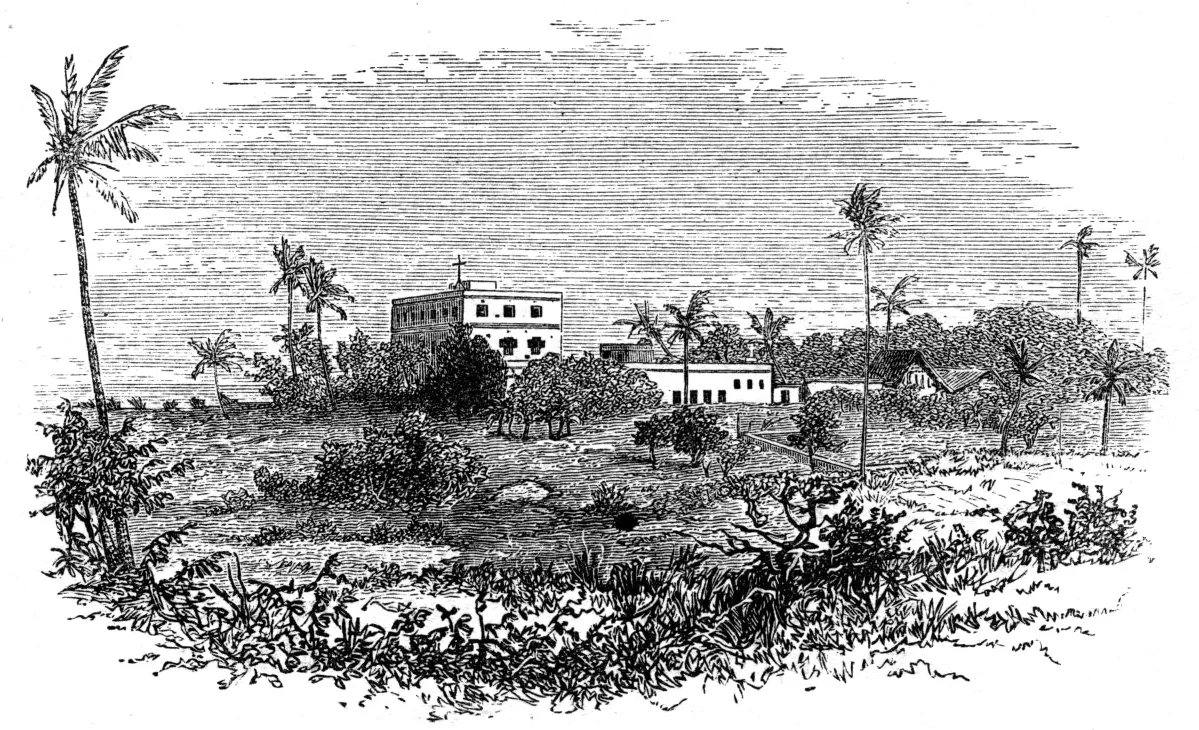
Bagamoyo—Taming the dark brother—Bagamoyo in a ferment—An exciting scene—The disturbance quelled—The Universities Mission, its origin, history, decline and present condition—The Rev. Edward Steere—Notre Dame de Bagamoyo—Westward ho!—In marching order—Sub Jove fervido—Crossing the Kingani—The stolen women
On the march—Congorido to Rubuti—The hunting-grounds of Kitangeh—Shooting zebra—“Jack’s” first prize—Interviewed by lions—Geology of Mpwapwa—Dudoma—“The flood-gates of heaven” opened—Dismal reflections—The Salina—A conspiracy discovered—Desertions—The path lost—Starvation and deaths—Trouble imminent—Grain huts plundered—Situation deplorable—Sickness in the camp—Edward Pocock taken ill—His death and funeral
From Chiwyu to Vinyata—Kaif Halleck murdered—The magic doctor—Giving away the heart—Deeds of blood—“The white men are only women”—A three days’ fight—Punishment of the Wanyaturu—The ubiquitous Mirambo—The plain of the Luwamberri—In a land of plenty—Through the open country—“I have seen the lake. Sir, and it is grand!”—Welcomed at Kagehyi
A burzah held—Paying off recruits—Kagehyi becomes a great trading centre—A Central African “toper”—Prince Kaduma—Hopes of assistance from him relinquished—The boat ready for sea—No volunteers—Selecting my crew—The start for the circumnavigation of Lake Victoria
Afloat on the lake—We catch a guide—Saramba’s terror—The Shimeeyu—Pyramid Point—The island of Ukerewé—In the haunts of crocodiles—Shizu Island—The hippopotami—Ururi—The headlands of Goshi—Bridge Islands—Volcanoes—U-go-weh—The inebriates of Ugamba—Treachery at Maheta—Primitive man—The art of pleasing—A night at Uvuma—Mobbed by Wavuma—Barmecide fare—Message from Mtesa—“In the Kabaka’s name”—Camp on Soweh Island
An extraordinary monarch—I am examined—African “chaff”—Mtesa, Emperor of Uganda—Description of Mtesa—A naval review—Arrival at the Imperial capital—Mtesa’s palace—Fascination of the country—I meet a white man—Col. Linant de Bellefonds—The process of conversion—A grand mission field—A pleasant day with Col. de Bellefonds—Starting for my camp
Parting with Colonel Linant—Magassa’s vanity and disloyalty—The sailors’ island—Jumba’s Cove—Uganda—Dumo—The Alexandra Nile—Lupassi Point—In danger at Mkongo—Alone with Nature—Insect life—Dreams of a happier future—A dark secret—Murabo and the fish—Alice Island—A night never to be forgotten—The treachery of Bumbireh—Saved!—Refuge Island—Wiru—“Go and die in the Nyanza!”—Back in camp—Sad news
Barker’s illness and death—Other deaths—Traitors in the camp—Rest!—Sickness—Rwoma blocks our passage by land—Magassa fails us by water—A serious dilemma—Lukongeh comes to the rescue—History of Ukerewé—Educated amphibians—Leaving Kagehyi with half the Expedition—The foundering canoes—All saved—Ito conciliates us—Arrival at Refuge Island with half the Expedition—I return for the rest—A murderous outbreak in camp—Final departure from Kagehyi—All encamped on Refuge Island—We ally ourselves with Komeh—A dance of kings—Mahyiga Island (in the Bumbireh group)—Interviewed by Iroba canoes—Our friendship scorned—The king of Bumbireh a hostage—The massacre of the Kytawa chief and his crew—The punishment of the murderers—Its salutary effect upon their neighbours—We arrive in Uganda
We find Mtesa at war—“Jack’s Mount”—Meeting with Mtesa—The Waganda army in camp and on the march—The imperial harem—In sight of the enemy—The Waganda fleet—Preliminary skirmishing—The causeway—The massacre of Mtesa’s peace party—“What do you know of angels?”—Mtesa’s education proceeds in the intervals of war—Translating the Bible—Jesus or Mohammed?—Mtesa’s decision—The royal proselyte
The war-drum beaten—The wizards play their part—In full war-paint—Bullets against spears—The Wavuma baulked—Mtesa’s fury—Victory or the stake!—Hard fighting—The captive chief: a struggle between the pagan and the Christian—A floating mystery—“Return, O spirit! the war is ended!”—The camp on fire: a race for life
The legend of the Blameless Priest—The heroes of Uganda: Chwa; Kimera, the giant; Nakivingi; Kibaga, the flying warrior; Ma’anda; Wakinguru, the champion; Kamanya, the conqueror of the Wakedi; Suna, the cruel; his massacre of the Wasoga; Namujurilwa, the Achilles of Uganda; Setuba and his lions; Kasindula the hero, peasant, and premier—Mtesa the mild-eyed
The ladies of Mtesa’s family—Sambuzi ordered to take me to Muta Nzigé—My last evening with Mtesa—En route for Muta Nzigé—Sambuzi suffers from the “big head”—We come to an understanding—The white people of Gambaragara—War music—Through a deserted country—Sinister auguries—A cowards’ council of war—Panic in the camp—Sambuzi announces his intention of deserting me—The flight when none pursued—The “Spoiler” eaten up—Mtesa tries to persuade me to return—At Kafurro
Kafurro and its magnates—Lake Windermere—Rumanika, the gentle king of Karagwé—His country—The Ingezi—Among the mosquitoes—Ihema Island—The triple cones of Ufumbiro—Double-horned rhinoceros—The hot springs of Mtagata—The Geographical Society of Karagwé—The philosophy of noses—Rumanika’s thesauron—Some new facts about the rhinoceros and elephant—Uhimba—Paganus, var. esuriens—Retrospect
The twin rivers—Mankorongo baulked of his loot—Poor Bull! True to the death—Msenna breaks out again—The Terror of Africa appears on the scene—Mars at peace—“Dig potatoes, potatoes, potatoes”—Mirambo, the bandit chief, and I make blood-brotherhood—Little kings with “big heads”—Practical conversion of the chief of Ubagwé—The Watuta, the Ishmaelites of Africa—Their history—African nomenclature—From Msené across the Malagarazi to Ujiji—Sad memories
LIST OF ILLUSTRATIONS. — FULL-PAGE ILLUSTRATIONS. — SMALLER ILLUSTRATIONS. — MAPS. — EXPLANATION. Part I. — EXPLANATION. Part II. — THE SOURCES OF THE NILE. — Lake Tanganika. — Lake Victoria — Lake Tanganika Again. — Livingstone’s Great River.
xxxi
NO.
PAGE
1.
H. M. Stanley. (After Walery)
Frontispiece
2.
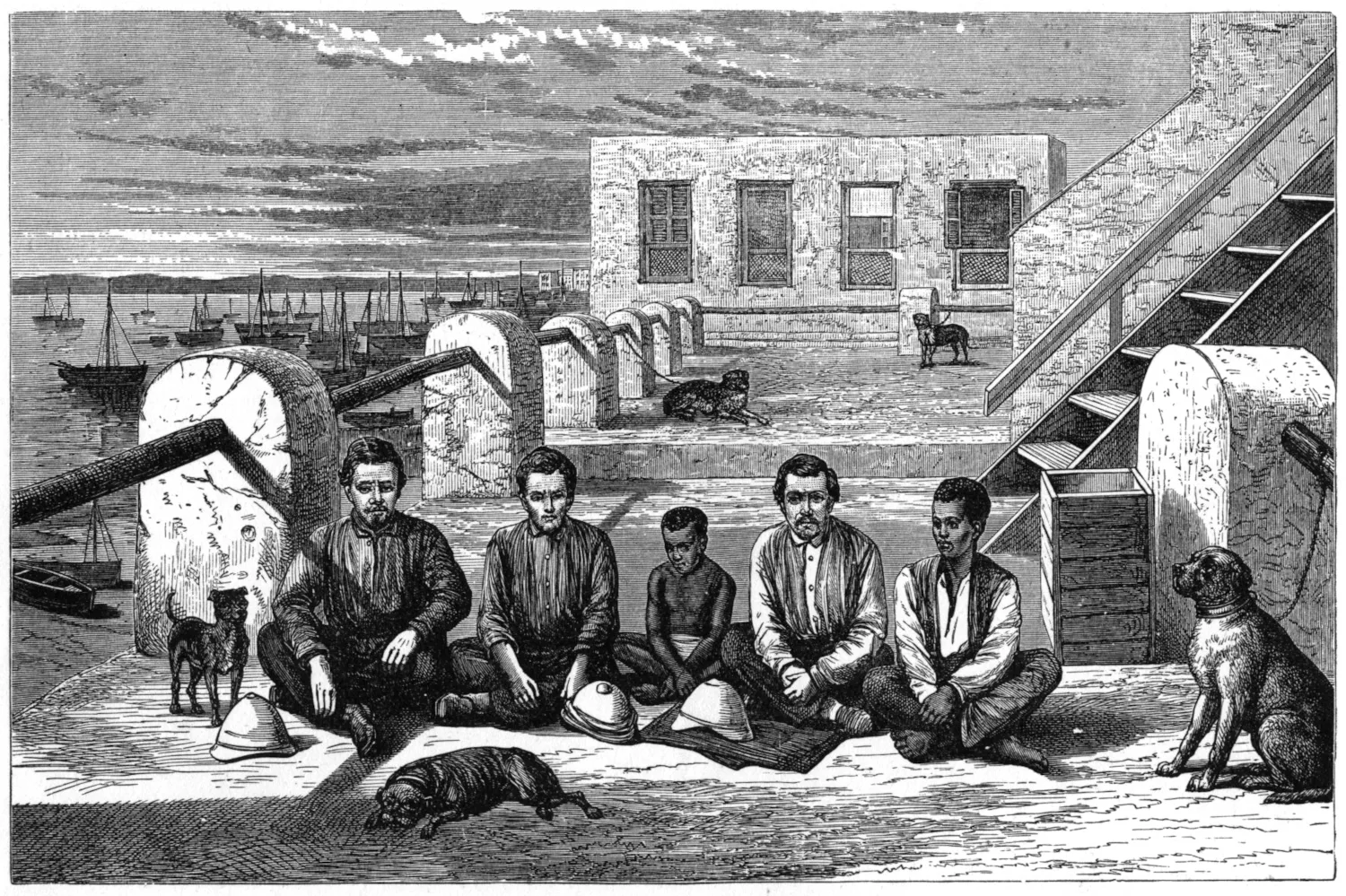
View from the Roof of Mr. Augustus Sparhawk’s House. (From a photograph)
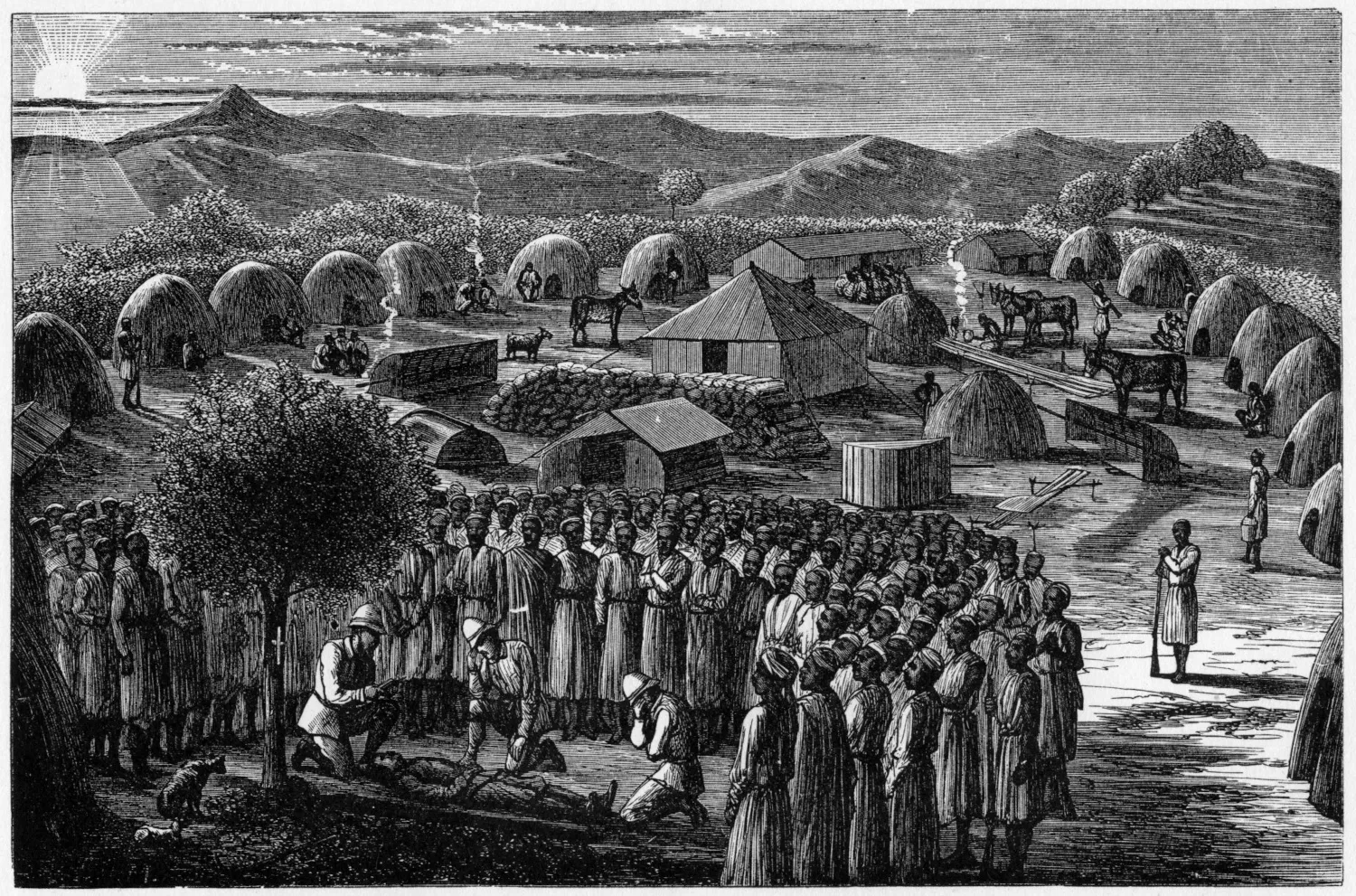
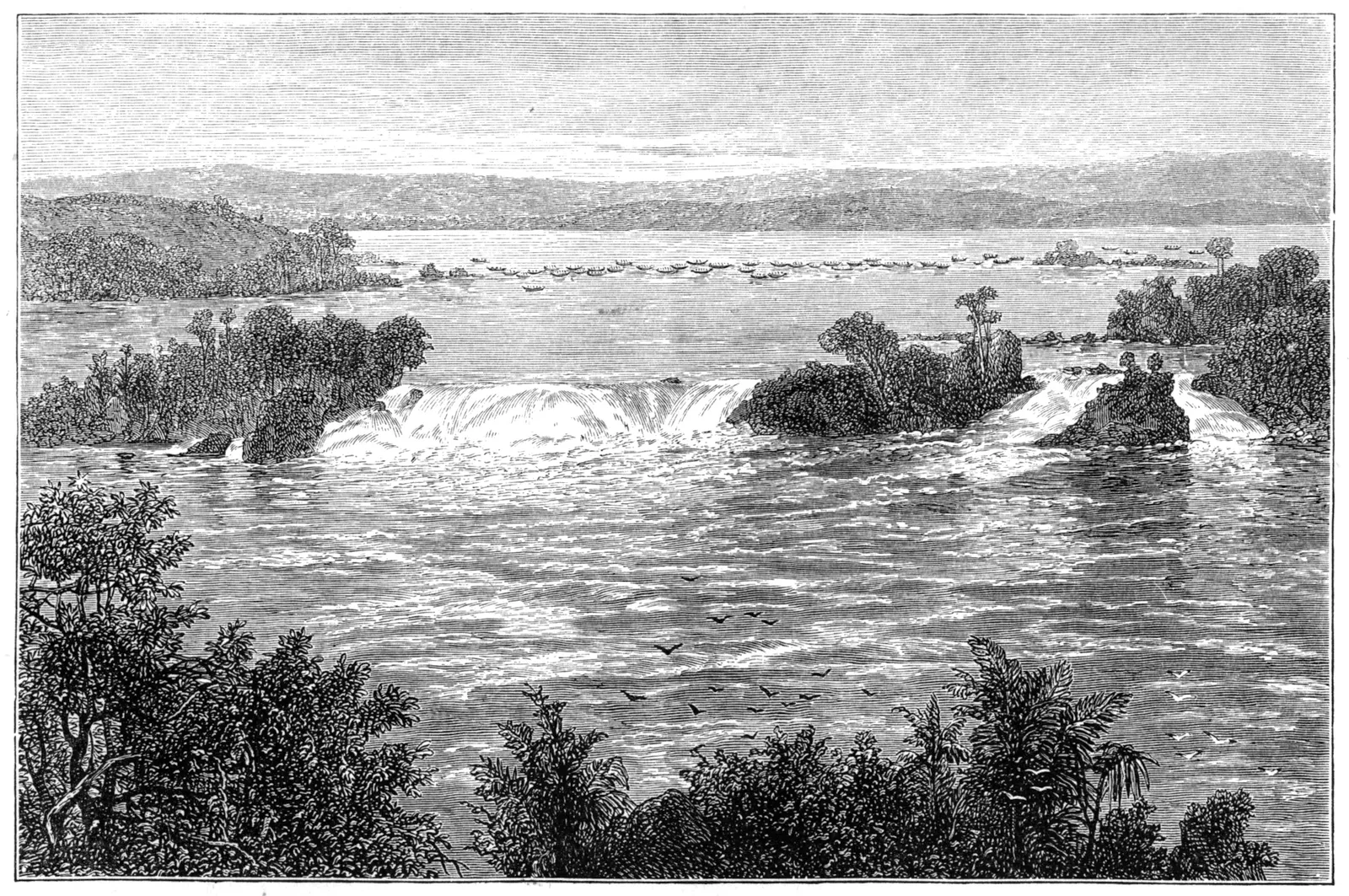
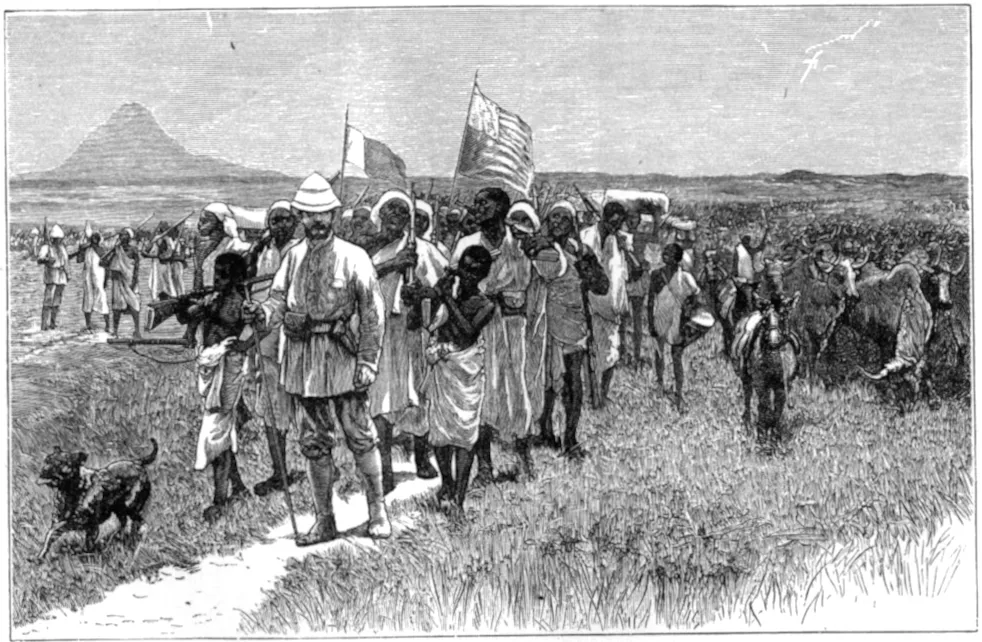
The Napoleon Channel, Lake Victoria, from the Heights above the Ripon Falls. Flotilla of the Emperor of Uganda crossing from Usoga to Uganda. (From a photograph by the Author)
My new mission—The Daily Telegraph—“Yes; Bennett”—The Lady Alice—My
European staff—Disappointed applicants and thoughtful friends—My
departure for Africa. Part II. The sources of the Nile—Herodotus on
the Nile—Burton on the Nile basin—Lake Tanganika—Lake Victoria—Speke,
Grant, and Cameron—The Livingstone River—The work before me.
While returning to England in April 1874 from the
Ashantee War, the news reached me that Livingstone was
dead—that his body was on its way to England!
Livingstone had then fallen! He was dead! He had
died by the shores of Lake Bemba, on the threshold of the
dark region he had wished to explore! The work he had
promised me to perform was only begun when death overtook
him!
The effect which this news had upon me, after the first
shock had passed away, was to fire me with a resolution
to complete his work, to be, if God willed it, the next
martyr to geographical science, or, if my life was to be
spared, to clear up not only the secrets of the Great
River throughout its course, but also all that remained
still problematic and incomplete of the discoveries of
Burton and Speke, and Speke and Grant.
The solemn day of the burial of the body of my great
friend arrived. I was one of the pall-bearers in Westminster
Abbey, and when I had seen the coffin lowered into the
grave, and had heard the first handful of earth thrown
over it, I walked away sorrowing over the fate of David
Livingstone.
I laboured night and day over my book, ‘Coomassie and
2Magdala,’ for I was in a fever to begin that to which I now
had vowed to devote myself. Within three weeks the
literary work was over, and I was free.
Soon after this I was passing by an old book-shop, and
observed a volume bearing the singular title of ‘How to
Observe.’ Upon opening it, I perceived it contained
tolerably clear instructions of ‘How and what to observe.’
It was very interesting, and it whetted my desire to know
more; it led me to purchase quite an extensive library of
books upon Africa, its geography, geology, botany, and
ethnology. I thus became possessed of over one hundred
and thirty books upon Africa, which I studied with the
zeal of one who had a living interest in the subject, and with
the understanding of one who had been already four times
on the continent. I knew what had been accomplished by
African Explorers, and I knew how much of the dark
interior was still unknown to the world. Until late hours
I sat up, inventing and planning, sketching out routes,
laying out lengthy lines of possible exploration, noting
many suggestions which the continued study of my project
created. I also drew up lists of instruments and other
paraphernalia that would be required to map, lay out, and
describe the new regions to be traversed.
I had strolled over one day to the office of the Daily
Telegraph, full of the subject. While I was discussing
journalistic enterprise in general with one of the staff, the
Editor entered. We spoke of Livingstone and the unfinished
task remaining behind him. In reply to an eager remark
which I made, he asked:—
“Could you, and would you, complete the work? And
what is there to do?”
I answered:
“The outlet of Lake Tanganika is undiscovered. We
know nothing scarcely—except what Speke has sketched out—of
Lake Victoria; we do not even know whether it
consists of one or many lakes, and therefore the sources
of the Nile are still unknown. Moreover, the western half
of the African continent is still a white blank.”
“Do you think you can settle all this, if we commission
you?”
“While I live, there will be something done. If I
survive the time required to perform all the work, all shall
be done.”
3The matter was for the moment suspended, because
Mr. James Gordon Bennett, of the New York Herald, had
prior claims on my services.
A telegram was despatched to New York to him:
“Would he join the Daily Telegraph in sending Stanley
out to Africa, to complete the discoveries of Speke, Burton,
and Livingstone?” and, within twenty-four hours, my “new
mission” to Africa was determined on as a joint expedition,
by the laconic answer which the cable flashed under the
Atlantic: “Yes; Bennett.”
A few days before I departed for Africa, the Daily
Telegraph announced in a leading article that its proprietors
had united with Mr. James Gordon Bennett in organizing an
expedition of African discovery, under the command of
Mr. Henry M. Stanley. “The purpose of the enterprise,”
it said, “is to complete the work left unfinished by the
lamented death of Dr. Livingstone; to solve, if possible, the
remaining problems of the geography of Central Africa; and
to investigate and report upon the haunts of the slave-traders.”
* * * * “He will represent the two nations whose
common interest in the regeneration of Africa was so well
illustrated when the lost English explorer was rediscovered
by the energetic American correspondent. In that memorable
journey, Mr. Stanley displayed the best qualities of an
African traveller; and with no inconsiderable resources at his
disposal to reinforce his own complete acquaintance with the
conditions of African travel, it may be hoped that very
important results will accrue from this undertaking to the
advantage of science, humanity, and civilisation.”
Two weeks were allowed me for purchasing boats—a
yawl, a gig, and a barge—for giving orders for pontoons,
and purchasing equipment, guns, ammunition, rope, saddles,
medical stores, and provisions; for making investments in
gifts for native chiefs; for obtaining scientific instruments,
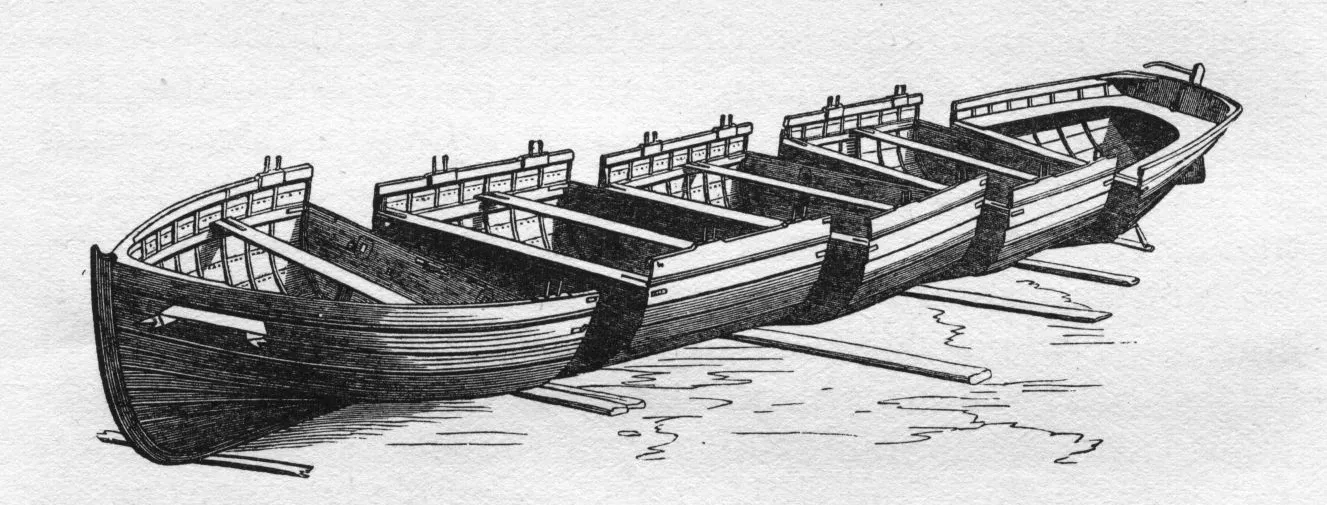
stationery, &c., &c. The barge was an invention of
my own.
It was to be 40 feet long, 6 feet beam, and 30 inches
deep, of Spanish cedar ⅜ inch thick. When finished, it was
to be separated into five sections, each of which should be
8 feet long. If the sections should be over-weight, they
were to be again divided into halves for greater facility of
carriage. The construction of this novel boat was undertaken
by Mr. James Messenger, boat-builder, of Teddington,
4near London. The pontoons were made by Cording, but
though the workmanship was beautiful, they were not a
success, because the superior efficiency of the boat for all
purposes rendered them unnecessary. However, they were
not wasted. Necessity compelled us, while in Africa, to
employ them for far different purposes from those for which
they had originally been designed.
There lived a clerk at the Langham Hotel, of the name
of Frederick Barker, who, smitten with a desire to go to
Africa, was not to be dissuaded by reports of its unhealthy
climate, its dangerous fevers, or the uncompromising views
of exploring life given to him. “He would go, he was
determined to go,” he said. To meet the earnest entreaties
of this young man, I requested him to wait until I should
return from the United States.
THE ‘LADY ALICE’ IN SECTIONS.
Mr. Edwin Arnold, of the Daily Telegraph, also suggested
that I should be accompanied by one or more young English
boatmen of good character, on the ground that their river
knowledge would be extremely useful to me. He mentioned
his wish to a most worthy fisherman, named Henry Pocock,
of Lower Upnor, Kent, who had kept his yacht for him, and
who had fine stalwart sons, who bore the reputation of
being honest and trustworthy. Two of these young men
volunteered at once. Both Mr. Arnold and myself warned
the Pocock family repeatedly that Africa had a cruel
character, that the sudden change from the daily comforts
of English life to the rigorous one of an explorer would try
the most perfect constitution; would most likely be fatal to
the uninitiated and unacclimatized. But I permitted myself
to be overborne by the eager courage and devotion of these
adventurous lads, and Francis John Pocock and Edward
5Pocock, two very likely-looking young men, were accordingly
engaged as my assistants.
I crossed over to America, the guest of Mr. Ismay, of the
‘White Star’ line, to bid farewell to my friends, and after a
five days’ stay returned in a steamer belonging to the same
Company.
Meantime, soon after the announcement of the “New
Mission,” applications by the score poured into the offices of
the Daily Telegraph and New York Herald for employment.
Before I sailed from England, over 1200 letters were received
from “generals,” “colonels,” “captains,” “lieutenants,”
“midshipmen,” “engineers,” “commissioners of hotels,”
mechanics, waiters, cooks, servants, somebodies and nobodies,
spiritual mediums and magnetizers, &c. &c. They
all knew Africa, were perfectly acclimatized, were quite sure
they would please me, would do important services, save me
from any number of troubles by their ingenuity and resources,
take me up in balloons or by flying carriages, make us all
invisible by their magic arts, or by the “science of
magnetism” would cause all savages to fall asleep while
we might pass anywhere without trouble. Indeed I feel
sure that, had enough money been at my disposal at that
time, I might have led 5000 Englishmen, 5000 Americans,
2000 Frenchmen, 2000 Germans, 500 Italians, 250 Swiss, 200
Belgians, 50 Spaniards and 5 Greeks, or 15,005 Europeans,
to Africa. But the time had not arrived to depopulate
Europe, and colonize Africa on such a scale, and I was
compelled to respectfully decline accepting the valuable
services of the applicants, and to content myself with
Francis John and Edward Pocock, and Frederick Barker—whose
entreaties had been seconded by his mother, on
my return from America.
I was agreeably surprised also, before departure, at the
great number of friends I possessed in England, who testified
their friendship substantially by presenting me with useful
“tokens of their regard” in the shape of canteens, watches,
water-bottles, pipes, pistols, knives, pocket companions,
manifold writers, cigars, packages of medicine, Bibles,
prayer-books, English tracts for the dissemination of
religious knowledge among the black pagans, poems, tiny
silk banners, gold rings, &c. &c. A lady for whom I have
a reverent respect presented me also with a magnificent prize
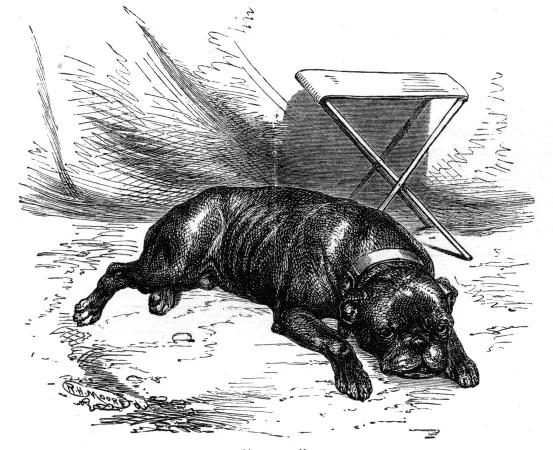
mastiff named ‘Castor,’ an English officer presented me with
6another, and at the Dogs’ Home at Battersea I purchased a
retriever, a bull-dog, and a bull-terrier, called respectively by
the Pococks, ‘Nero,’ ‘Bull,’ and ‘Jack.’
There were two little farewell dinners only which I
accepted before my departure from England. One was at
the house of the Editor of the Daily Telegraph, where I met
Captain Fred. Burnaby and a few other kind friends. Captain
Burnaby half promised to meet me at the sources of the
Nile. The other was a dinner given by the representative
of the New York Herald, at which were present Mr. George
Augustus Sala, Mr. W. G. Stillman, Mr. George W. Smalley,
and three or four other journalists of note. It was a kindly
quiet good-bye, and that was my last of London.
On the 15th of August, 1874, having shipped the
Europeans, boats, and dogs, and general property of the
expedition—which, through the kindness of Mr. Henry
Bayley, of the Peninsular and Oriental Company, and
Mr. William Mackinnon, of the British India Steam
Navigation Company, were to be taken to Zanzibar at
half-fares—I left England for the east coast of Africa to
begin my explorations.
7
“Yet still no views have urged my ardour more
Than Nile’s remotest fountains to explore;
Then say what source the famous stream supplies,
And bids it at revolving periods rise;
Show me the head from whence since time begun
The long succession of his waves have run;
This let me know, and all my toils shall cease,
The sword be sheathed, and earth be blessed with peace.”
Pharsalia (Cæsar loq.).
In the fifth century, before the Christian era began,
Herodotus, the first great African traveller, wrote about
the Nile and its sources as follows:—
“Respecting the nature of this river, the Nile, I was
unable to gain any information, either from the priests or
any one else. I was very desirous, however, of learning
from them why the Nile, beginning at the summer solstice,
fills and overflows for a hundred days; and when it has
nearly completed this number of days, falls short in its
stream, and retires; so that it continues low all the winter,
until the return of the summer solstice. Of these particulars
I could get no information from the Egyptians, though I
inquired whether this river has any peculiar quality that
makes it differ in nature from other rivers. Being anxious,
then, of knowing what was said about this matter, I made
inquiries, and also how it comes to pass that this is the only
one of all rivers that does not send forth breezes from its
surface. Nevertheless, some of the Greeks, wishing to be
distinguished for their wisdom, have attempted to account
for these inundations in three different ways; two of these
ways are scarcely worth mentioning, except that I wish to
show what they are. One of them says that the Etesian
winds are the cause of the swelling of the river, by preventing
8the Nile from discharging itself into the sea. But
frequently the Etesian winds have not blown, yet the Nile
produces the same effects; besides, if the Etesian winds were
the cause, all other rivers that flow opposite to the same
winds must of necessity be equally affected and in the same
manner as the Nile; and even so much the more, as they
are less and have weaker currents; yet there are many
rivers in Syria, and many in Libya, which are not all
affected as the Nile is. The second opinion shows still
more ignorance than the former, but, if I may so say, is
more marvellous. It says that the Nile, flowing from the
ocean, produces this effect; and that the ocean flows all
round the earth. The third way of resolving this difficulty
is by far the most specious, but most untrue. For by
saying that the Nile flows from melted snow, it says
nothing, for this river flows from Libya through the middle
of Ethiopia and discharges itself in Egypt; how therefore,
since it runs from a very hot to a colder region, can it flow
from snow? Many reasons will readily occur to men of
good understanding, to show the improbability of its
flowing from snow. The first and chief proof is derived
from the winds, which blow hot from those regions; the
second is, that the country, destitute of rain, is always free
from ice; but after snow has fallen, it must of necessity
rain within five days; so that if snow fell, it would also
rain in these regions. In the third place, the inhabitants
become black from the excessive heat: kites and swallows
continue there all the year; and the cranes, to avoid the cold
of Scythia, migrate to these parts as winter quarters: if then
ever so little snow fell in this country through which the
Nile flows, and from which it derives its source, none of
these things would happen, as necessity proves. But the
person who speaks about the ocean, since he has referred
his account to some obscure fable, produces no conviction
at all, for I do not know any river called the Ocean, but
suppose that Homer, or some other ancient poet, having
invented the name, introduced it into poetry.”
Captain Burton the learned traveller has some excellent
paragraphs in his ‘Nile Basin,’ and remarks on this topic in
connection with Ptolemy:—
“That early geographer places his lake Nilus a little to
the south of the Equator (about ten degrees), and 5° E. long.
from Alexandria—that is, in 34° or 35° E. long. by our mode
9of reckoning. He was led into an error in placing these
portions of the interior, bearing, as he conceived, from certain
points in the east. Thus he places Cape Aromatum (Cape
Asser or Cape Guardafui) in 6° N. lat., which we know to be
in 11° 48′ 50″, being thus, say, 6° out of its true place. He
places the lake, the source of the western branch of the river,
1° more to the north and 8° more to the west than the one
for the eastern branch; subsequent inquiries may show us
that these great features of Africa may yet turn out to be
substantially correct.
“We cannot here enter into any disquisition regarding
the discrepancies that appear amongst the very ancient
authors regarding these parts of Africa. We notice only
those that are consistent and most valuable, and as bearing
upon the priority of discovery and geographical knowledge.
The earliest period we hear of Ethiopia is in the capture of
the capital thereof by Moses 1400 years before our era, and
90 or 100 years before the departure of the Israelites from
Egypt. Josephus calls it Saba, and states that it was very
strong, situated on the River Astosabos, and that the name
was changed to Meroë, by Cambyses, in honour of his sister
Meroë. There were known to ancient writers three great
tributaries to the Nile in Ethiopia, namely, the Astaboras
(Tatazze), the Astosabos (Blue River), and the Astapus
(White River). Herodotus says the source of the Nile,
Astosabos, was twenty days’ journey to the south of Meroë,
which will bring it to Lake Dembea or Tzana. According
to Ptolemy, the position of Meroë was in 16° 25′ N. lat.,
but the ancient astronomer Hipparchus has placed it in
16° 51′, which may be taken as the most correct. Caillaud
found the vast ruins in 16° 56′. Under Psammeticus, the
first Egyptian king that reigned after the final expulsion
of the Ethiopian kings from Egypt, 240,000 emigrants from
Egypt settled in an island south of the island of Meroë, that
is beyond Khartoum, between the Blue and the White
Rivers, and at eight days’ journey east of the Nubæ, or
Nubatæ. Subsequently the Roman arms extended to those
parts. Petronius, the Roman general under Augustus, thirty
years before our era, took and destroyed Napata, the ancient
capital of Tirhaka, situated on the great northern bend of
the Nile at Mount Barkhall, where vast ruins are still found.
Meroë certainly, the capital of Queen Candace, mentioned in
the New Testament (Acts viii. 27), also fell under the Roman
10yoke. Nero, early in his reign, sent a remarkable exploring
party, under two centurions, with military force, to explore
the source of the Nile and the countries to the west of the
Astapus or White River, at that early day considered to be
the true Nile. Assisted by an Ethiopian sovereign (Candace,
no doubt), they went through the district now known as
Upper Nubia, to a distance of 890 Roman miles from Meroë.
In the last part of their journey they came to immense
marshes, the end of which no one seemed to know, amongst
which the channels were so narrow that the light boat or
canoe in use was barely sufficient to carry one man across
them. Still they continued their course south till they saw
the river tumbling down or issuing out between the rocks,
when they turned back, carrying with them a map of the
regions through which they had passed: for Nero’s guidance
and information. This, it may be remarked, is exactly the
case still. The Dutch ladies told us last year that they
found the channels amongst these marshes so thick that the
lightest canoe, made of bulrushes, scarcely fit to carry one
man, could not find room to pass on them or across them.
After this Pliny, Strabo, and other Roman authors took
notice of this position of Africa, but without giving us anything
important or new.”
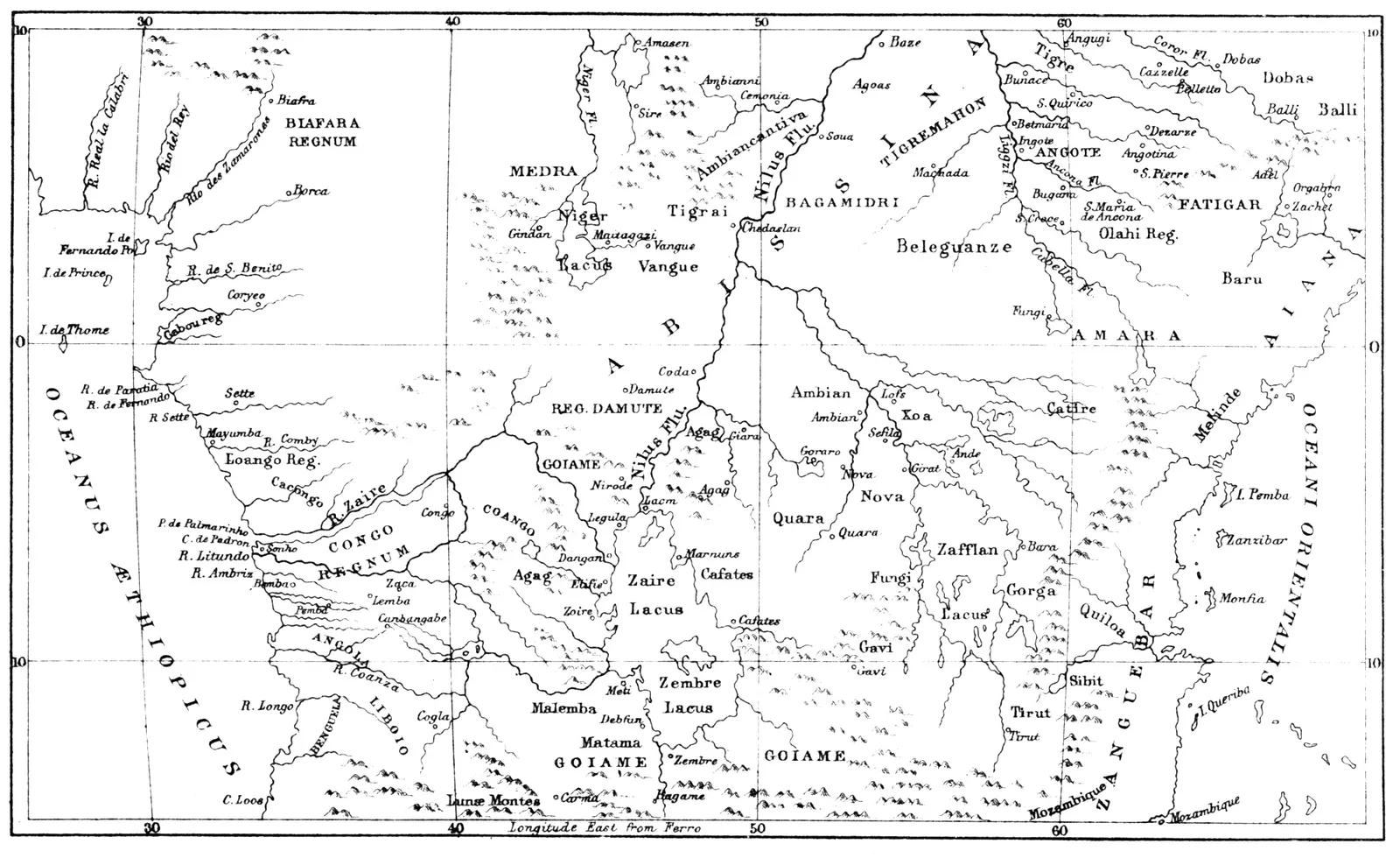
Equatorial Africa (Segundo O Mappa De Dapper) 1676.
London, Sampson Low, Marston & Company, Limited. E. Weller, Litho.
I quote from Captain Burton once more certain passages.
“Edrisi, who was born in Nubia, but who wrote in Egypt
about A.D. 1400, says, in that part of Ethiopia south and
south-west of Nubia is first seen the separation of the two
Niles. The one flows from south to north into Egypt, and
the other part of the Nile flows from east to west; and upon
that branch of the Nile lie all, or at least the most celebrated
kingdoms of the Negroes. ‘From the Mountains of the
Moon,’ says Scheadeddin, ‘the Egyptian Nile takes its
rise. It cuts horizontally the equator in its course north.
Many rivers come from this mountain, and unite in a great
lake. From this lake comes the Nile, the greatest and most
beautiful of the rivers of all the earth. Many rivers derived
from this great river water Nubia,’ &c.
“From the Arabs we may fairly descend to our own
times. The early Portuguese discoverers obtained a great
deal of geographical information regarding the interior of
Africa, and especially regarding two lakes near the Equator,
from one of which, the most northern, the Egyptian Nile
was stated to flow. This information was largely used
11by the French geographer (D’Anville), and the Dutch
geographers of that time. Subsequently Bruce and others
told us about the great disparity in magnitude between
the Blue and the White Rivers; the latter, they asserted,
rose far to the south, near to the Equator, and amongst
mountains covered with eternal snow. Twenty-five years
ago, Mohammed Ali, the clear-sighted and energetic ruler
of Egypt, sent an expedition, consisting of several barques
well provided with everything necessary, and under able
naval officers, to explore the White Nile to its source, if
possible. They did their work so far well, but were forced
to turn back on the 26th of January, 1840, in lat. 30°
22′ N., for want of sufficient depth of water for their vessels.
At lat. 3° 30′ they found the river 1370 feet broad and say
six feet deep. In every day’s work on the voyage they
gave the width of the river, the depth of the river, the
force of its current, its temperature, and the miles
(geographical) made good daily.”
These quotations bring us down to our own times. A
few of the principal characters, through whose agency the
problem of the Sources of the Nile has been solved, still
live. The old African Association became merged in 1831
into the Royal Geographical Society. The change of title
seems to have evoked greater energies, and the publications
of the new society, the position of its President, his influence,
learning, and tact, soon attracted general public attention.
In the midst of this, Messrs. Krapf and Rebmann and
Erhardt, missionaries located at Mombasa, on the east
coast of Africa, announced that Arab traders and natives
acquainted with the interior informed them that far inland
there was a very large lake, or several lakes, which some
spoke of under one collective title. The information thus
obtained was illustrated by a sketch map by Mr. Erhardt,
and was published in the ‘Proceedings of the Royal
Geographical Society’ in 1856, “the most striking feature
of which was a vast lake of a curious shape, extending
through 12° of latitude.”
The Royal Geographical Society was induced to despatch
an expedition to East Africa for the exploration of this
interesting inland region, the command of which it entrusted
12to Lieutenant Richard Francis Burton, and Lieutenant
John Hanning Speke, officers of the East Indian Army.
Lieutenant Burton was already distinguished as an
enterprising traveller by his book, ‘Pilgrimage to Mekka
and Medina.’ Speke had, until this time, only a local
reputation, but bore the character of being a very promising
officer, and an amiable gentleman with a fondness for natural
history and botanical studies, besides being an ardent sportsman
and an indefatigable pedestrian.
Burton and Speke’s expedition landed at Zanzibar on
the 20th of December, 1856. On the 13th of February,
1858, after a journey of 950 miles, and at a distance of 540
lineal geographical miles from the point of departure on
the Indian Ocean, they first sighted and discovered Lake
Tanganika. How much they explored of the lake is best
illustrated by their map, which is appended to this present
volume. Speke first crossed Lake Tanganika to the western
side to Kasengé, an island, then returned by the same route
to Kawelé, the district or quarter occupied at that time by
the Arabs, in a large straggling village on the shores of the
lake, in the country of Ujiji.
On the second exploration of the lake, Lieutenant
Burton accompanied Lieutenant Speke to a cove in Uvira,
which is about thirteen miles from the north end of the
lake. Unable to reach the extremity of the lake, they
both returned to Ujiji. Lieutenant Speke was most anxious
to proceed on a third tour of exploration of the lake, but
was overruled by his chief, Lieutenant Burton. On the
26th of May, 1858, the expedition turned homewards,
arriving in Unyanyembé on the 20th of June.
While Lieutenant Burton preferred to rest in Unyanyembé
to collect the copious information about the Lake Regions
from the Arabs and natives, which we see set forth in a
masterly manner in his book, Lieutenant Speke, of a more
active disposition, mustered a small force of men, and,
with his superior’s permission, set out northward on July 9,
1858, on an exploring tour, and on the 30th of the same
month arrived at the south end of a lake called by the
Wanyamwezi who were with him the N’yanza, or the Lake,
and by the Arabs, Ukerewé.
Mappa De Krapf, Rebmann, Livingstone, & Erhardt _ 1849-56.
London: Sampson Low, Marston & Company, Limited. E. Weller, Litho.
13At Muanza, in Usukuma, he took a survey of the body
of the water such as might be embraced in a view taken
from an altitude of 200 feet above the lake.
In his reflections on the magnitude of the water expanse
before him, Speke wrote: “I no longer felt any doubt that
the lake at my feet gave birth to that interesting river, the
source of which has been the subject of so much speculation,
and the object of so many explorers.”
* * * * * *
And again: “This is a far more extensive lake than
the Tanganika; so broad you could not see across it, and
so long that nobody knew its length.” To this magnificent
lake Lieutenant Speke, its discoverer, gave the name of
Victoria N’yanza.
From this short view of the Victoria Lake, Speke
returned to Unyanyembé, and announced to Lieutenant
Burton that he had discovered the source of the White
Nile. Lieutenant Burton did not acquiesce in his companion’s
views of the importance of the discovery, and in
his ‘Lake Regions’ and ‘Nile Basins,’ in lectures, speeches,
and essays in magazines, and conversations with friends,
always vigorously combated the theory.
On the 30th of February, 1859, Burton and Speke’s task
of exploration, which had occupied twenty-five months,
terminated with the arrival of the expedition at the
little maritime village of Konduchi, on the Indian Ocean.
* * * * * *
On opening John Hanning Speke’s book, ‘Journal of the
Discovery of the Source of the Nile,’ we are informed on the
very first page that his second important expedition into
Africa, “which was avowedly for the purpose of establishing
the truth of the assertion that the Victoria N’yanza (which
he discovered on the 30th of July, 1858) would eventually
prove to be the source of the Nile, may be said to have
commenced on the 9th of May, 1859, the first day of his
return to England from his last expedition, when, at the
invitation of Sir Roderick Impey Murchison, he called at his
house to show him his map, for the information of the Royal
Geographical Society.”
Mr. Speke who was now known as Captain Speke, was
intrusted with the command of the succeeding expedition
which the Royal Geographical Society determined to send
out for the purpose of verifying the theories above stated.
14He was accompanied this time by an old brother officer in
India, Captain James Augustus Grant.
The expedition under Speke and Grant set out from
Zanzibar on the 25th of September, 1860. On the 23rd of
January, 1861, it arrived at the house occupied by Burton
and Speke’s expedition, in Tabora, Unyanyembé, having
traversed nearly the entire distance along the same route
that had been adopted formerly. In the middle of May
the journey to Karagwé began. After a stay full of interest
with Rumanika, king of Karagwé, they followed a route
which did not permit them even a view of Lake Victoria,
until they caught sight of the great lake near Meruka, on
the 31st of January, 1862. From this point, the expedition,
up to its arrival at the court of Mtesa, emperor of Uganda,
must have caught several distant views of the lake, though
not travelling near its shores. During a little excursion
from the Emperor’s capital, they also discovered a long
broad inlet, which is henceforth known as Murchison Bay,
on its northern coast.
On the 7th of July, 1862, the two travellers started in
a north-easterly direction, away from the lake, and Speke
states that he arrived at Urondogani on the 21st. From
this point he marched up the river along the left bank, and
reached the Ripon Falls at the outlet of Lake Victoria on
the 20th of July. He thus sums up the result and net
value of the explorations of himself and companion in the
years 1860-62:—
“The Expedition had now performed its functions. I
saw that old Father Nile without any doubt rises in the
Victoria N’yanza, and as I had foretold, that Lake is the
great source of the holy river which cradled the first
expounder of our religious belief.... The most remote
waters, or top-head of the Nile, is the southern end of the
lake, situated close on the 3° lat., which gives to the Nile
the surprising length in direct measurement, rolling over
34 degrees of latitude, of above 2300 miles, or more than
one-eleventh of the circumference of our globe. Now, from
the southern point round by the west, to where the great
Nile stream rises, there is only one feeder of any importance,
and that is the Kitangule River; while from the southernmost
point round by the east, to the strait, there are no
rivers of any importance.”...
Livingstone, Burton & Speke, Speke & Grant & Von der Decken _ 1856-1863.
London: Sampson Low, Marston & Company, Limited. E. Weller, Litho.
He christened the falling effluent, where it drops from
15the level of the lake and escapes northerly into the Victoria
Nile, “Ripon Falls,” in honour of the Earl of Ripon, who
was President of the Royal Geographical Society when the
expedition was organised, and the arm of the lake from
which the Victoria Nile issued, Napoleon Channel, as a token
of respect to the Paris Geographical Society, who had
honoured him with a gold medal for the discovery of Lake
Victoria.
Following this paragraph, Captain Speke makes an
important statement, to which I beg attention: “One
thing seemed at first perplexing, the volume of water in
the Kitangule (Alexandra Nile) looked as large as the Nile
(Victoria), but then the one was a slow river, and the
other swift, and on this account I could form no adequate
judgment of their relative values.”
On the 4th of June, Captain Speke and Grant embarked
at Alexandria, Egypt, for England, where they arrived after
an absence of 1146 days.
Though one might suppose that the explorers had
sufficient grounds for supposing that Lake Victoria covered
an enormous area, quite as large, or, approaching to the
29,000 square miles’ extent Captain Speke boldly sketched
it, there were not wanting many talented men to dispute
each point in the assertions he made. One of the boldest
who took opposing views to Speke was his quondam companion,
Captain R. F. Burton, and he was supported by very
many others, for very plausible reasons, which cannot, however,
be touched upon here.
Doctor David Livingstone, while on his last expedition,
obtained much oral information in the interior of Africa
from Arab traders, which dissected Speke’s Grand Lake into
five; and it really seemed as if, from the constant assaults
made upon it by geographers and cartographers, it would in
time be erased from the chart altogether, or become a mere
“rush drain,” like one of those which Speke and Grant found
so numerous in that region. It was evident, therefore, that
a thorough exploration of Lake Victoria was absolutely
necessary to set at rest, once and for ever, one of the great
problems that was such a source of trouble and dissatisfaction
to the geographers of Europe and America.
16
The next European to arrive at the shores of Lake
Tanganika, after Burton and Speke, was Dr. David Livingstone.
He first saw it as he stood on the verge of the
plateau which rises steeply from the surface of the Tanganika
at its south-west corner, on the 2nd of April, 1867;
and on the 14th of March, 1869, and after traversing
nearly the whole of the western shore from the extreme
south end of the lake to Kassengé, the island which Speke
visited in 1858, he crossed over to the east side and reached
Ujiji.
On the 15th of July, 1869, after camping at Kassengé,
when on his way to Manyema, he writes in his journal the
following opinion of Lake Tanganika; “Tanganika narrows
at Uvira or Vira, and goes out of sight among the
mountains; then it appears as a waterfall into the Lake
of Quando, seen by Banyamwezi.”
In his letters home Dr. Livingstone constantly made
mention of two lakes, called Upper Tanganika, which Burton
discovered, and Lower Tanganika, which Sir Samuel Baker
discovered, and which formed, as he said, the second line
of drainage trending to and discharging its waters into the
Nile.
He makes record in his Journals of the causes which
induced him to verify his opinions by a personal investigation
of the north end of Lake Tanganika on the 16th of
November, 1871, a few days after my arrival, at Ujiji, I
being the fourth European who had arrived on the shores
of the Lake, in this manner:—
“16th November, 1871.—As Tanganika Explorations are
said by Mr. Stanley to be an object of interest to Sir
Roderick, we go at his expense and by his men to the
north end of the lake.”
“24th November.—To Point Kisuka in Mukamba’s
country. A Mgwana came to us from King Mukamba,
and asserted most positively that all the water of Tanganika
flowed into the River Lusizé, and then on to
Ukerewe of Mteza; nothing could be more clear than his
statements.”
“25th November.—Our friend of yesterday now declared
as positively as before, that the water of Lusizé flowed into
17Tanganika, and not the way he said yesterday! Tanganika
closes in except at one point N. and by W. of us.”
“26th November.—The end of Tanganika seen clearly, is
rounded off about 4′ broad from east to west.”
On the 29th of November, Livingstone and I, in a canoe
manned by several strong rowers, entered into Lusizé, or
Rusizi, and discovered that it flowed into Lake Tanganika by
three mouths with an impetuous current.
The explorations of Livingstone and myself in November
1871 to the north end of Lake Tanganika resolved that
portion of the problem, but described only about thirteen
miles of coast unvisited by Burton and Speke. On our way
back, however, by a southern route to Unyanyembé, we
added to the knowledge of the Tanganika coast-line, on the
eastern side from Kabogo Point as far as Urimba, about
twenty miles farther than Speke had seen.
In August 1872, about five months after I had departed
from him homewards, he recommenced his last journey. On
the 8th of October of the same year he saw the Tanganika
again about sixty miles south of the point where he and I
bade farewell to the lake, eight months previously. Clinging
to the lake, he travelled along the eastern shore, until he
reached the southernmost end of it.
From this it will appear evident that the only portion of
Lake Tanganika remaining unvisited was that part of the
west-end shore, between Kasengé Island and the northernmost
point of what Burton and Speke called Ubwari Island,
and what Livingstone and I called Muzimu Island. Doubtless
there were many portions of Livingstone’s route overland
which rendered the coast line somewhat obscure, and
in his hurried journey to Ujiji in 1869, by canoe from
Mompara’s to Kasengé, a portion of the Uguha coast was
left unexplored. But it is Livingstone who was the first to
map out and give a tolerably correct configuration to that
part of Lake Tanganika extending from Urimba round to
the south end and up along the eastern shore to Kasengé
Island, as it was Burton and Speke who were the first to
map out that portion of the Tanganika extending from Ujiji
to a point nearly opposite Ubwari and the north-west, from
Ubwari’s north end as far as Uvira.
In February 1874 Lieutenant Verney Lovett Cameron,
R.N., arrived at the same village of Ujiji, which had been
seen by Burton and Speke in 1858, and which was known as
18the place where I discovered Livingstone in 1872. He had
traversed a route rendered familiar to thousands of the
readers of the ‘Lake Regions of Central Africa,’ ‘the Journal
of the Discovery of the Nile,’ and ‘How I found Livingstone,’
through a country carefully mapped, surveyed and
described. But the land that lay before him westerly had
only been begun by Livingstone, and there were great and
important fields of exploration beyond the farthest point he
had reached.
Lieutenant Cameron procured two canoes, turned south,
and coasted along the eastern shore of the Tanganika, and
when near the southern end of the Lake, crossed it, turned
up north along the western shore, and discovered a narrow
channel, between two spits of pure white sand. Entering
this channel, the Lukuga creek, he traced it until farther
progress was stopped by an immovable and impenetrable
barrier of papyrus. This channel, Lieutenant Cameron
wrote, was the outlet of Lake Tanganika. Satisfied with
his discovery, he withdrew from the channel, pursued his
course along the west coast as far as Kasengé Island, the
camping-place of both Speke and Livingstone, and returned
direct to Ujiji without making further effort.
Lake Tanganika, as will be seen, upon Lieutenant
Cameron’s departure, had its entire coast-line described,
except the extreme south end, the mouth of the Lufuvu and
that portion of coast lying between Kasengé Island and the
northern point of Ubwari, about 140 miles in extent.
What we knew distinctly of this great river began with
Livingstone’s last journey, when he wrote from Ujiji in
1869, repeating what he had already written in 1867, at
the town of Cazembe, in a despatch to Lord Clarendon.
Briefly, this last journey began, let us say, at Zanzibar,
the date of his arrival being the 28th of January, 1866. On
the 19th of March he sailed in H.M.S. Penguin for the
mouth of the Rovuma river, after invoking the blessing of
the Most High upon his meditated intercourse with the
heathen. Effecting a landing at Mikindini Bay, he directed
his course in a south-westerly direction, arriving within view
of Lake Nyassa on the 13th of September, 1866.
Schweinfurth, Baker, Livingstone, Stanley & Cameron _ 1866-75.
London: Sampson Low, Marston & Company, Limited. E. Weller, Litho.
On the 16th of January, 1867, he reached the most
19southerly streams emptying into the Chambezi, after crossing
the mountains which separate the streams flowing east to the
Loangwa. He describes the northern slope which gives
birth to the affluents of the new river thus: “It is needless
to repeat that it is all forest on the northern slopes of the
mountains—open glade and miles of forest; ground at
present all sloppy, oozes full and overflowing, feet constantly
wet. Rivulets rush with clear water; though they
are in flood we can guess which are perennial and which are
torrents that dry up; they flow northwards and westwards
to the Chambezi.”
Eight days later, in S. lat. 10° 34′, he reached the main
river—the Chambezi—a stream “flooded with clear water-banks
not more than 40 yards apart, showing abundant
animal life in its waters and on its banks as it flowed
westwards.” Just at the point Livingstone first saw the
Chambezi, numerous streams are gathered from all points—northerly,
easterly, and southerly, from the westerly
slope of the uplands of Mambwe into the main river,
which presently becomes a formidable river, and which
subsequent explorations proved to enter Lake Bemba on its
eastern side.
On the 8th of November, 1867, the traveller makes a
very comprehensive statement. It is the evening of his
arrival at Lake Mweru or Moero. “Lake Moero seems
of goodly size, and is flanked by ranges of mountains on the
east and west. Its banks are of coarse sand, and slope
gradually down to the water; outside of these banks stands
a thick belt of tropical vegetation in which fishermen build
their huts. The country called Rua lies on the west, and
is seen as a lofty range of dark mountains; another range
of less height, but more broken, stands along the eastern
shore.”
* * * * * *
“The northern shore has a fine sweep, like an unbent
bow, and round the western end flows the water that makes
the River Lualaba, which, before it enters Mweru, is the
Luapula, and that again (if the most intelligent report speak
true) is the Chambezi before it enters Lake Bemba or
Bangweolo.”
On page 261, vol i., of ‘Livingstone’s Last Journals,’ he
sums up very succinctly what knowledge he has gained of
the country which was the scene of his explorations, 1866-67.
20“First of all the Chambezi runs in the country of Mambwe,
N.E. of Molemba. It then flows S.W. and W. till it reaches
11° S. lat. and long. 29° E., where it forms Lake Bemba or
Bangweolo. Emerging thence, it assumes the new name
Luapula, and comes down here to fall into Mweru. On
going out of this lake it is known by the name Lualaba as it
flows N.W. in Rua to form another lake with many islands
called Ulengé or Urengé. Beyond this, information is not
positive as to whether it enters Tanganika, or another lake
beyond that.”
On the 18th of July, 1868, the discovery of Lake Bemba
or Bangweolo was made by Dr. Livingstone.
On page 59, vol. ii., ‘Last Journals,’ we think we have
an explanation of the causes which led him to form those
hypotheses and theories which he subsequently made public
by his letters, or elaborated in his journals, on the subject of
the Nile Sources.
“Bambarre, 25th August, 1870.—One of my waking
dreams is that the legendary tales about Moses coming up
into Lower Ethiopia, with Merr his foster mother, and
founding a city which he called in her honour ‘Meroe,’
may have a substratum of fact.”
* * * * * *
“I dream of discovering some monumental relics of
Meroe, and if anything confirmatory of sacred history does
remain, I pray to be guided thereunto. If the sacred
chronology would thereby be confirmed, I would not grudge
the toil and hardship, hunger and pain I have endured—the
irritable ulcers would only be discipline.”
The old explorer, a grand spectacle and a specimen of
most noble manhood in these latter days of his life, travels
on and on, but never reaches nearer the solution of the
problem which puzzles his soul than the Arab depot
Nyangwé, which is situate a few miles south of 4° S. lat.
and a little east of 26° E. long. where he leaves the great
river still flowing north.
Livingstone never returned to this point, but retracing
his steps to Ujiji, thence to the north end of Lake Tanganika
and back again to Ujiji and Unyanyembé, directed his course
to the southern shore of Lake Bemba, where he died of
dysentery in the beginning of May 1873.
Stanley _ 1874-77.
London: Sampson Low, Marston & Company, Limited. E. Weller, Litho.
In the month of August 1874, Lieutenant Cameron,
whom we left at Ujiji after the delineation of that part of
21Lake Tanganika south of Ujiji, after traversing Livingstone’s
route to Kasongo’s Manyema, and travelling by canoe about
thirty-five miles, reaches Nyangwé, his predecessor’s farthest
point. Though he does not attempt to resolve this problem,
or penetrate the region north of Nyangwé, Lieutenant
Cameron ventures upon the following hypothesis: “This
great stream must be one of the head-waters of the Kongo,
for where else could that giant amongst rivers, second only
to the Amazon in its volume, obtain 2,000,000 cubic feet of
water which it unceasingly pours each second into the
Atlantic? The large affluents from the north would explain
the comparatively small rise of the Kongo at the coast; for
since its enormous basin extends to both sides of the equator,
some portion of it is always under the zone of rains, and
therefore the supply to the main stream is nearly the same
at all times, instead of varying as is the case with tropical
rivers, whose basins lie completely on one side of the
equator.” Lieutenant Cameron illustrates his hypothesis by
causing Livingstone’s great river to flow soon after leaving
Nyangwé straight westward, the highest part of which is
only 3° 30′ S. lat.
At Nyangwé, Lieutenant Cameron crossed the river,
proceeded south with some Arab traders a few days’ journey,
then, accompanied by guides, travelled still south to Juma
Merikani’s, or Kasongo’s, thence, after a stay of nearly nine
months, accompanied by Portuguese traders, he proceeded to
Benguella, a small port belonging to the Portuguese Government
on the Atlantic Ocean, having crossed Africa from east
to west south of S. lat. 4°.
The above is a brief sketch which with the aid of the
small maps attached to this volume explains and illustrates
the several geographical problems left by my predecessors.
I now propose to describe how these problems were solved,
and the incomplete discoveries of Burton and Speke, Speke
and Grant, and Doctor Livingstone were finished, and how
we sighted the lake Muta N’zigé, by its broad arm, which I
have called Beatrice Gulf, by a comprehensive exploration,
lasting, from sea to sea, two years eight months and twenty
days; the results of which are to be found embodied in these
two volumes, entitled: ‘Through the Dark Continent; the
Sources of the Nile, around the Great Lakes of Africa, and
down the “Livingstone” to the Atlantic Ocean.’
22
VIEW OF A PORTION OF THE SEA-FRONT OF ZANZIBAR, FROM THE WATER BATTERY TO SHANGANI POINT. (From a photograph by Mr. Buchanan, of Natal.)]
CHAPTER I.
Arrival at Zanzibar Island—Life at Zanzibar—The town of Zanzibar, its
roadstead and buildings—The One Cocoa-nut tree and the red cliffs—Selection
and purchase of goods for the journey—Residence of Prince
Barghash—Busy mornings—Pleasant rides and quiet evenings.
Sept. 21.—Twenty-eight months had elapsed between my
departure from Zanzibar after the discovery of Livingstone
and my re-arrival on that island, September 21, 1874.
The well-remembered undulating ridges, and the gentle
slopes clad with palms and mango trees bathed in warm
vapour, seemed in that tranquil drowsy state which at all
times any portion of tropical Africa presents at first appearance.
A pale-blue sky covered the hazy land and sleeping
sea as we steamed through the strait that separates Zanzibar
from the continent. Every stranger, at first view of the
shores, proclaims his pleasure. The gorgeous verdure, the
distant purple ridges, the calm sea, the light gauzy atmosphere,
the semi-mysterious silence which pervades all nature,
evoke his admiration. For it is probable that he has sailed
through the stifling Arabian Sea, with the grim, frowning
mountains of Nubia on the one hand, and on the other the
23drear, ochreous-coloured ridges of the Arab Peninsula; and
perhaps the aspect of the thirsty volcanic rocks of Aden
and the dry brown bluffs of Guardafui is still fresh in his
memory.
But a great change has taken place. As he passes close
to the deeply verdant shores of Zanzibar Island, he views
nature robed in the greenest verdure, with a delightful
freshness of leaf, exhaling fragrance to the incoming
wanderer. He is wearied with the natural deep-blue of the
ocean, and eager for any change. He remembers the
unconquerable aridity and the dry bleached heights he last
saw, and lo! what a change! Responding to his half formed
wish, the earth rises before him verdant, prolific, bursting
with fatness. Palms raise their feathery heads and mangoes
their great globes of dark green foliage; banana plantations
with impenetrable shade, groves of orange, fragrant cinnamon,
and spreading bushy clove, diversify and enrich the landscape.
Jack-fruit trees loom up with great massive crowns of leaf
and branch, while between the trees and in every open space
succulent grasses and plants cover the soil with a thick
garment of verdure. There is nothing grand or sublime in
the view before him, and his gaze is not attracted to any
special feature, because all is toned down to a uniform
softness by the exhalation rising from the warm heaving
bosom of the island. His imagination is therefore caught
and exercised, his mind loses its restless activity, and reposes
under the influence of the eternal summer atmosphere.
Presently on the horizon there rises the thin upright
shadows of ships’ masts, and to the left begins to glimmer a
pale white mass which, we are told, is the capital of the
island of Zanzibar. Still steaming southward, we come
within rifle-shot of the low green shores, and now begin to
be able to define the capital. It consists of a number of
square massive structures, with little variety of height and
all whitewashed, standing on a point of low land, separated
by a broad margin of sand beach from the sea, with a bay
curving gently from the point, inwards to the left towards us.
Within two hours from the time we first caught sight of
the town, we have dropped anchor about 700 yards from the
beach. The arrival of the British India Company’s steamer
causes a sensation. It is the monthly “mail” from Aden
and Europe! A number of boats break away from the beach
and come towards the vessel. Europeans sit at the stern,
24the rowers are white-shirted Wangwana[3] with red caps.
The former are anxious to hear the news, to get newspapers
and letters, and to receive the small parcels sent by friendly
hands “per favour of captain.”
The stranger, of course, is intensely interested in this life
existing near the African Equator, now first revealed to him,
and all that he sees and hears of figures and faces and sounds
is being freshly impressed on his memory. Figures and faces
are picturesque enough. Happy, pleased-looking men of
black, yellow, or tawny colour, with long white cotton
shirts, move about with quick, active motion, and cry out,
regardless of order, to their friends or mates in the Swahili
or Arabic language, and their friends or mates respond with
equally loud voice and lively gesture, until, with fresh
arrivals, there appears to be a Babel created, wherein
English, French, Swahili, and Arabic accents mix with Hindi,
and, perhaps, Persian.
In the midst of such a scene I stepped into a boat to be
rowed to the house of my old friend, Mr. Augustus Sparhawk,
of the Bertram Agency. At this low-built, massive-looking
house near Shangani Point, I was welcomed with all the
friendliness and hospitality of my first visit, when, three
years and a half previously, I arrived at Zanzibar to set out
for the discovery of Livingstone.
With Mr. Sparhawk’s aid I soon succeeded in housing
comfortably my three young Englishmen, Francis John and
Edward Pocock and Frederick Barker, and my five dogs,
and in stowing safely on shore the yawl Wave, bought for
me at Yarmouth by Mr. Edwin Arnold, the gig, and the tons
of goods, provisions, and stores I had brought.
Life at Zanzibar is a busy one to the intending explorer.
Time flies rapidly, and each moment of daylight must be
employed in the selection and purchase of the various kinds
of cloth, beads, and wire, in demand by the different tribes
of the mainland through whose countries he purposes
journeying. Strong, half-naked porters come in with great
bales of unbleached cottons, striped and coloured fabrics,
handkerchiefs and red caps, bags of blue, green, red, white
and amber-coloured beads, small and large, round and oval,
and coils upon coils of thick brass wire. These have to be
inspected, assorted, arranged, and numbered separately, have
to be packed in portable bales, sacks, or packages, or boxed
25according to their character and value. The house-floors are
littered with cast-off wrappings and covers, box-lids, and a
medley of rejected paper, cloth, zinc covers and broken boards,
sawdust and other débris. Porters and servants and masters,
employés and employers, pass backwards and forwards, to
and fro, amid all this litter, roll bales over, or tumble about
boxes; and a rending of cloth or paper, clattering of
hammers, demands for the marking-pots, or the number of
bale and box, with quick, hurried breathing and shouting,
are heard from early morning until night.
Towards evening, after such a glaring day of glaring heat
and busy toil, comes weariness: the arm-chair is sought, and
the pipe or cigar with a cup of tea rounds off the eventful
hours. Or, as sometimes the case would be, we would strike
work early, and after a wholesome dinner at 4.30 P.M. would
saddle our horses and ride out into the interior of the island,
returning during the short twilight. Or we would take the
well-known path to Mnazi-Moya—the One Cocoa-nut Tree,
where it stands weird and sentinel-like over humble tombs
on the crest of an ancient beach behind Shangani Point. Or,
as the last and only resource left to a contemplative and
studious mind, we would take our easy-chairs on the flat
roof, where the cowhides of the merchant are poisoned and
dried, and, with our feet elevated above our heads, watch the
night coming.
If we take our ride, in a few minutes we may note, at
the pleasantest hour, those local features which, with the
thermometer at 95° Fahr., might have been a dangerous
pleasure, or, at any rate, disagreeable. Through a narrow,
crooked, plastered lane, our horses’ feet clattering noisily as
we go, we ride by the tall, white-washed, massive houses,
which rise to two and three stories above our heads. The
residences of the European merchants and the officials here
stand side by side, and at the tall doorway of each sits the
porter—as comfortable as his circumstances will permit. As
we pass on, we get short views of the bay, and then plunge
again into the lane until we come in view of the worm-eaten
old fort, crumbling fast into disuse and demolition.
Years ago, behind it, I saw a market where some slaves were
being sold. Happily there is no such market now.
We presently catch sight, on our right, of the entrance
to the fort at which sit on guard a few lazy Baluchis and
dingy-looking Arabs. On our left is the saluting battery,
26which does frequent service for the ignition of much powder,
an antique mode of exchanging compliments with ships of
war, and of paying respect to Government officials. The
customs sheds are close by, and directly in front of us rises
the lofty house and harem of Prince Barghash. It is a
respectable-looking building of the Arab architecture which
finds favour at Muscat, three stories high and whitewashed—as
all houses here appear to be. It is connected by a covered
gangway, about 30 feet above our heads, with a large house
on the opposite side of the lane, and possesses an ambitious
doorway raised 3 feet above the street, and reached by four
or five broad and circular-steps. Within the lower hall are
some soldiers of the same pattern as those at the fort, armed
with the Henry-Martini rifle, or matchlock, sword, and targe.
A very short time takes us into a still narrower lane, where
the whitewash is not so white as at Shangani, the European
quarter. We are in the neighbourhood of Melindi now,
where the European who has not been able to locate himself
at Shangani is obliged to put up with neighbours of East
Indian race or Arabs. Past and beyond Melindi is a medley
of tall white houses and low sheds, where wealth and squalor
jostle side by side, and then we find ourselves at the bridge
over the inlet of Malagash, which extends from the bay up
to Mnazi-Moya, or the One Cocoa-nut, behind Shangani.
The banks on either side are in view as we pass over the
bridge, and we note a dense mass of sheds and poor
buildings, amid hills of garbage and heaps of refuse, and
numbers of half-naked negroes, or people in white clothes,
giving the whole an appearance somewhat resembling the
more sordid village of Boulak, near Cairo.
Having crossed the bridge from Melindi, we are in what
is very appropriatelyappropriately termed Ngambu, or “t’other side.”
The street is wide, but the quarter is more squalid. It is
here we find the Wangwana, or Freedmen of Zanzibar, whose
services the explorer will require as escort on the continent.
Here they live very happily with the well-to-do Coastman,
or Mswahili, poor Banyans, Hindis, Persians, Arabs, and
Baluchis, respectable slave artisans, and tradesmen. When
the people have donned their holiday attire, Ngambu becomes
picturesque, even gay, and yields itself up to wild, frolicsome
abandon of mirth. On working days, though the colours are
still varied, and give relief to the clay walls and withered
palm-frond roofs, this poor man’s district has a dingy hue,
27which black faces and semi-naked bodies seems to deepen.
However, the quarter is only a mile and a half long, and
quickening our paces, we soon have before us detached
houses and huts, clusters of cocoa-nut palms and ancient
mango trees crowned with enormous dark green domes
of foliage. For about three miles one can enjoy a gallop
along an ochreous-coloured road of respectable width,
bordered with hedges. Behind the hedges grow the sugar-cane,
banana, palm, orange, clove cinnamon, and jack-fruit
trees, cassava, castor-oil, diversified with patches of millet,
Indian corn, sweet-potatoes, and egg-plant, and almost
every vegetable of tropic growth. The fields, gently undulating,
display the variety of their vegetation, on which
the lights and shadows play, deepening or paling as the
setting sun clouds or reveals the charms of the verdure.
Finally arriving upon the crest of Wirezu hill, we have a
most beautiful view of the roadstead and town of Zanzibar,
and, as we turn to regard it, are struck with the landscape
lying at our feet. Sloping away gradually towards the town,
the tropical trees already mentioned seem, in the bird’s-eye
view, to mass themselves into a thin forest, out of which,
however, we can pick out clearly the details of tree and hut.
Whatever of beauty may be in the scene, it is Nature’s own,
for man has done little; he has but planted a root, or a seed,
or a tender sapling carelessly. Nature has nourished the
root and the seed and the sapling, until they became sturdy
giants, rising one above another in hillocks of dark green
verdure, and has given to the whole that wonderful depth
and variety of colour which she only exhibits in the
Tropics.
The walk to Mnazi-Moya will compel the traveller to
moralize, and meditate pensively. Decay speaks to him,
and from the moment he leaves the house to the moment
he returns, his mind is constantly dwelling upon mortality.
For, after lounging through two or three lanes, he comes to
a populous graveyard, over which the wild grass has obtained
supreme control, and through the stalks of which show white
the fading and moss-touched headstones. Across the extensive
acreage allotted to the victims of the sad cholera
years, the Prince of Zanzibar has ruthlessly cut his way to
form a garden, which he has surrounded with a high wall.
Here a grinning skull and there a bleached thigh bone or
sunken grave exposing its ghastly contents attract one’s
28attention. From time immemorial this old beach has been
the depository of the dead, and unless the Prince prosecutes
his good work for the reclamation of this golgotha (and the
European officials urge it on him), the custom may be continued
for a long period yet.
Beyond this cemetery is to be seen the muddy head of
Malagash inlet, between which and the sea south of Shangani
there lies only this antique sand bar, about two hundred
yards in breadth. On the crest of the sand bar stands the
One Cocoa-nut Palm which has given its name to this locality.
Sometimes this spot is also known as the “fiddler’s” grave.
It is the breathing place of the hard-worked and jaded
European, and here, seated on one of the plastered tombs
near the base of the One Cocoa-nut Palm, with only a furtive
look now and then at the “sleep and a forgetting” which
those humble white structures represent, he may take his fill
of ocean and watch the sun go down to his daily rest.
RED CLIFFS BEHIND UNIVERSITIES MISSION.
Beyond Mnazi-Moya is Mbwenni, the Universities Mission,
and close behind are some peculiar red cliffs, which are
worth seeing.
From the roof of the house, if we take the “last resource”
already mentioned, we have a view of the roadstead and bay
of Zanzibar. Generally there ride at anchor two or three
British ships of war just in from a hunt after contumacious
29Arabs, who persist, against the orders of their prince, in
transporting slaves on the high seas. There is a vessel
moored closer to Frenchman’s Island, its “broken back” a
memento of the Prince’s fleet shattered by the hurricane of
1872. Nearer in-shore float a number of Arab dhows, boats,
lighters, steam launches, and two steamers, one of which is
the famous Deerhound. One day I counted as a mere matter
of curiosity, the great and small vessels in roadstead and
harbour, and found that there were 135.
From our easy-chairs on the roof we can see the massive
building occupied formerly by the Universities Mission, and
now the residence of Captain Prideaux, Acting British Consul
and Political Resident, whose acquaintance I first made soon
after his release from Magdala in 1868. This building stands
upon the extremity of Shangani Point, and the first line of
houses which fronts the beach extends northerly in a gentle
sweep, almost up to Livingstone’s old residence on the other
side of Malagash inlet.
During the day the beach throughout its length is alive
with the moving figures of hamals, bearing clove and
cinnamon bags, ivory, copal and other gums, and hides, to
be shipped in the lighters waiting along the water’s edge,
with sailors from the shipping, and black boatmen discharging
the various imports on the sand. In the evening
the beach is crowded with the naked forms of workmen and
boys from the “go-downs,” preparing to bathe and wash the
dust of copal and hides off their bodies in the surf. Some of
the Arab merchants have ordered chairs on the piers, or
bunders, to chat sociably until the sun sets, and prayer time
has come. Boats hurry by with their masters and sailors
returning to their respective vessels. Dhows move sluggishly
past, hoisting as they go the creaking yards of their lateen
sails, bound for the mainland ports. Zanzibar canoes and
“matepes” are arriving with wood and produce, and others
of the same native form and make are squaring their mat
sails, outward bound. Sunset approaches, and after sunset
silence follows soon. For as there are no wheeled carriages
with the eternal rumble of their traffic in Zanzibar, with the
early evening comes early peace and rest.
The intending explorer, however, bound for that dark
edge of the continent which he can just see lying low along
the west as he looks from Zanzibar, has thoughts at this hour
which the resident cannot share. As little as his eyes can
30pierce and define the details in that gloomy streak on the
horizon, so little can he tell whether weal or woe lies before
him. The whole is buried in mystery, over which he ponders,
certain of nothing but the uncertainty of life. Yet will he
learn to sketch out a comparison between what he sees at
sunset and his own future. Dark, indeed, is the gloom of the
fast-coming night over the continent, but does he not see that
there are still bright flushes of colour, and rosy bars, and
crimson tints, amidst what otherwise would be universal
blackness? And may he not therefore say—“As those
colours now brighten the darkening west, so my hopes
brighten my dark future”?
A HOUSE AT ZANZIBAR.
CHAPTER II.
31
Seyyid Barghash—His prohibition of slavery, character and reforms—Treaty
with British Government by Sir Bartle Frere—Tramways the need of
Africa—Arabs in the interior—Arabs in Zanzibar—Mtuma or Mgwana?—The
Wangwana, their vices and virtues—A Mgwana’s highest ambition—The
Wanyamwezi “the coming race.”
Oct. 1874.—The foot-note at the bottom of this page will
explain all that need be known by the general reader in connection
with the geography of the Island of Zanzibar.[4]
Any student who wishes to make the island a special study
will find books dealing most minutely with the subject at
all great libraries. Without venturing, therefore, into more
details than I have already given in ‘How I found Livingstone,’
I shall devote this chapter to the Sultan of Zanzibar—Barghash
bin Sayid—the Arabs, the Wangwana, and the
Wanyamwezi, with whose aid the objects of the Anglo-American
Expedition were attained.
It is impossible not to feel a kindly interest in Prince
Barghash, and to wish him complete success in the reforms
32he is now striving to bring about in his country. Here
we see an Arab prince, educated in the strictest school of
Islam, and accustomed to regard the black natives of Africa
as the lawful prey of conquest or lust, and fair objects of
barter, suddenly turning round at the request of European
philanthropists and becoming one of the most active opponents
of the slave-trade—and the spectacle must necessarily
create for him many
well-wishers and
friends.
SEYYID BARGHASH.
Though Prince Barghash
has attributed
to myself the visit of
those ships of war
under Admiral Cumming,
all who remember
that period, and are
able, therefore, to trace
events, will not fail to
perceive that the first
decided steps taken by
the British Government
for the suppression
of the slave-trade
on the east coast of
Africa were due to the
influence of Livingstone’s
constant appeals.
Some of his letters, they
will remember, were
carried by me to England,
and the sensation
caused by them was
such as to compel the
British Government to
send Sir Bartle Frere in the Enchantress, as a special envoy
to Zanzibar, to conclude a treaty with Prince Barghash.
When the Prince’s reluctance to sign became known, the
fleet under Admiral Cumming made its appearance before
Zanzibar, and by a process of gentle coercion, or rather
quiet demonstration, the signature of the Prince was at last
obtained. One thing more, however, still remained to be
done before the treaty could be carried into full effect, and
33that was to eradicate any feeling of discontent or sullenness
from his mind which might have been created by the
exhibition of force, and this I was happy to see, was effected
by the hospitable reception he enjoyed in England in 1875.
There was a difference in the manner and tone of the Sultan
of 1874 and of 1877, that I can only attribute to the greater
knowledge he had gained of the grandeur of the power
which he had so nearly provoked. We must look upon him
now as a friendly and, I believe, sincere ally, and as a man
willing to do his utmost for the suppression of the slave-trade.
[To face page 32.
VIEW FROM THE ROOF OF MR. AUGUSTUS SPARHAWK’S HOUSE.
Frank Pocock. Frederick Barker. A Zanzibar boy. Edward Pocock. Kalulu. Bull-terrier “Jack.” “Bull.” Retriever “Nero.” Mastiff “Captain.” Prize Mastiff “Castor.”
(From a photograph by the Author.)
The philanthropist having at last obtained such signal
success with the Prince, it is time the merchant should
attempt something with him. The Prince must be considered
as an independent sovereign. His territories include, besides
the Zanzibar, Pemba, and Mafia islands, nearly 1000 miles
of coast, and extend probably over an area of 20,000 square
miles, with a population of half a million. The products of
Zanzibar have enriched many Europeans who traded in them.
Cloves, cinnamon, tortoise-shell, pepper, copal gum, ivory,
orchilla weed, indiarubber, and hides have been exported for
years; but this catalogue does not indicate a tithe of what
might be produced by the judicious investment of capital.
Those intending to engage in commercial enterprise would
do well to study works on Mauritius, Natal, and the
Portuguese territories, if they wish to understand what
these fine, fertile lands are capable of. The cocoa-nut
palm flourishes at Zanzibar and on the mainland, the oil
palm thrives luxuriantly in Pemba, and sugar-cane will
grow everywhere. Caoutchouc remains undeveloped in the
maritime belts of woodland, and the acacia forests, with
their wealth of gums, are nearly untouched. Rice is sown
on the Rufiji banks, and yields abundantly; cotton would
thrive in any of the rich river bottoms; and then there are,
besides, the grains, millet, Indian corn, and many others, the
cultivation of which, though only in a languid way, the
natives understand. The cattle, coffee, and goats of the
interior await also the energetic man of capital and the
commercial genius.
First, however, the capitalist must find means of carriage,
otherwise he will never conquer African difficulties. Cutting
roads through jungles, and employing waggons, are mere
temporary conveniences, requiring great outlay, patience, and
constant reinforcement of work and energies. Almost as
34fast as the land is cleared, it is covered again—so prolific is
the soil—with tall wild grasses of the thickness of cane, and
one season is sufficient to undo the work of months of the
pioneer. Cattle die, tormented out of life by the flies or
poisoned by the rank grasses; natives perish from want of
proper nourishment, and, while suffering from fatigue and
debility, are subject to many fatal diseases.
A tramway is one thing that is needed for Africa. All
other benefits that can be conferred by contact with
civilisation will follow in the wake of the tramway, which
will be an iron bond, never to be again broken, between
Africa and the more favoured continents.
However energetic the small merchant may be, he can
effect nothing permanent for the good of a country that has
neither roads nor navigable rivers, whose climate is alike
fatal to the starved hamal as it is to the beast of burthen.
The maritime belt must first be crossed by an iron road, and
another must tap the very centre of the rice-fields of the
Rufiji valley, in order to insure cheap, nutritious food in
abundance. To a company, however, which can raise the
sum required to construct a tramway, East Africa holds out
special advantages. The Sultan himself offers a handsome
sum, five lakhs of dollars or, roughly, £100,000, and there
are rich Hindis at Zanzibar who, no doubt, would invest
large sums, and thus the company would become the
principal merchants along the line. The Sultan has also
poor subjects enough who would be only too glad of the
opportunities thus afforded to work for reasonable pay, so
that very little fear need be entertained of lack of labour.
Besides, there are natives of the interior who, after two or
three bold examples, would soon be induced to apply for
employment along the line.
Those whom we call the Arabs of Zanzibar are either
natives of Muscat who have immigrated thither to seek their
fortunes, or descendants of the conquerors of the Portuguese.
As the present Sultan calls himself Barghash the son of
Sayid, the son of Sultan, the son of Hamid, so all Arabs,
from the highest to the lowest of his subjects, are known by
their proper names—Ahmed, or Khamis, or Abdullah, as
being the sons of Mussoud, of Mustapha, or of Mohammed.
Some of them boast of unusually long pedigrees, and one or
two I am acquainted with proclaimed themselves of purer
and more aristocratic descent than even the Sultan.
35The Arab conquerors who accompanied Seyyid Sultan,
the grandfather of the present Seyyid Barghash, took unto
themselves, after the custom of polygamists, wives of their
own race according to their means, and almost all of them
purchased negro concubines, the result of which we trace to-day
in the various complexions of those who call themselves
Arabs. By this process of miscegenation the Arabs of the
latest migration are already rapidly losing their rich colour
and fine complexions, while the descendants of the Arabs of
the first migration are now deteriorated so much that on the
coast they can scarcely be distinguished from the Aborigines.
While many of the descendants of the old settlers who came
in with Seyyid Sultan, still cling to their homesteads, farms,
and plantations, and acquire sufficient competence by the
cultivation of cloves, cinnamon, oranges, cocoa-nut palms,
sugar-cane, and other produce, a great number have emigrated
into the interior to form new colonies. Hamed
Ibrahim has been eighteen years in Karagwé, Muini Kheri
has been thirty years in Ujiji, Sultan bin Ali has been
twenty-five years in Unyanyembé, Muini Dugumbi has been
eight years in Nyangwé, Juma Merikani has been seven
years in Rua, and a number of other prominent Arabs may
be cited to prove that, though they themselves firmly believe
that they will return to the coast some day, there are too
many reasons for believing that they never will.
None of the Arabs in the interior with whom I am
acquainted ever proceeded thither with the definite intention
of colonisation. Some were driven thither, by false hopes of
acquiring rapid fortunes by the purchase of slaves and ivory,
and, perceiving that there were worse places on earth than
Africa, preferred to remain there, to facing the odium of
failure. Others borrowed large sums on trust from credulous
Hindis and Banyans, and having failed in the venture
now prefer to endure the exclusion to which they have
subjected themselves, to returning and being arrested by
their enraged creditors. Others again are not merely
bankrupts, but persons who have fled the vengeance of
the law for political offences, as well as ordinary crimes.
There are many who are in better circumstances in the
interior than they would be on their own island of Zanzibar.
Some of them have hundreds of slaves, and he would be a
very poor Arab indeed who possessed only ten. These
slaves, under their masters’ direction have constructed
36roomy, comfortable, flat-roofed houses, or lofty cool huts,
which, in the dangerous and hostile districts, are surrounded
by strong stockades. Thus, at Unyanyembé there are sixty
or seventy large stockades enclosing the owner’s house and
storerooms, as well as the numerous huts of his slaves.
Ujiji, again, may be described as a long straggling village,
formed by the large tembes of the Arabs; and Nyangwé is
another settlement similar to Ujiji. Many of the Arabs
settled in the pastoral districts possess large herds of cattle
and extensive fields where rice, wheat, Indian corn, and
millet are cultivated, besides sugar-cane and onions, and the
fruit trees of Zanzibar—the orange, lemon, papaw, mango,
and pomegranate—are now being gradually introduced.
The Arabs of Zanzibar, whether from more frequent
intercourse with Europeans or from other causes, are undoubtedly
the best of their race. More easily amenable
to reason than those of Egypt, or the shy, reserved, and
bigoted fanatics of Arabia, they offer no obstacles to the
European traveller, but are sociable, frank, good-natured,
and hospitable. In business they are keen traders, and of
course will exact the highest percentage of profit out of the
unsuspecting European if they are permitted. They are
staunch friends and desperate haters. Blood is seldom
satisfied without blood, unless extraordinary sacrifices are
made.
The conduct of an Arab gentleman is perfect. Indelicate
matters are never broached before strangers; impertinence
is hushed instantly by the elders, and rudeness is never
permitted. Naturally, they have the vices of their education,
blood, and race, but these moral blemishes are by their
traditional excellence of breeding seldom obtruded upon the
observation of the stranger.
After the Arabs let us regard the Wangwana, just as in
Europe, after studying the condition and character of the
middle classes, we might turn to reflect upon that of the
labouring population.
Of the Wangwana there will be much written in the
following pages, the outcome of careful study and a long
experience of them. Few explorers have recorded anything
greatly to their credit. One of them lately said that the
negro knows neither love nor affection; another that he is
simply the “link” between the simian and the European.
Another says, “The wretches take a trouble and display an
37ingenuity in opposition and disobedience, in perversity,
annoyance, and villainy, which rightly directed would make
them invaluable.” Almost all have been severe in their
strictures on the negro of Zanzibar.
The origin of the Mgwana or Freeman may be briefly
told. When the Arabs conquered Zanzibar, they found the
black subjects of the Portuguese to be of two classes, Watuma
(slaves) and Wangwana (freemen). The Freemen were very
probably black people who had either purchased their freedom
by the savings of their industry or were made free upon the
death of their masters; these begat children who, being born
out of bondage, were likewise free. Arab rulers, in classifying
their subjects, perceived no great difference in physique or
general appearance between those who were slaves and those
who were free, both classes belonging originally to the same
negro tribes of the interior. Thus, when any of these were
brought before the authorities convicted of offences, the
question naturally asked was, “Are you a Mtuma, a slave,
or a Mgwana, a freeman?” A repetition of these questions
through a long course of years established the custom of
identifying the two classes of Zanzibar negroes as Watuma—slaves—and
Wangwana—freemen. Later, however, came
a new distinction, and the word Watuma, except in special
and local cases, was dropped, for, with the advent of the
free native traders direct from the mainland, and the
increase of traffic between Zanzibar and the continent, as
well as out of courtesy to their own slaves, the Arabs began
to ask the black stranger, “Are you Mgwana, a freeman, or
Mshensi, a pagan?” In disputes among themselves the
question is still asked, “Are you a slave or a freeman?”
but when strangers are involved, it is always, “Are you
Mgwana, a freeman or a native of Zanzibar, or a Mshensi, a
pagan or an uncircumcised native of the mainland?”
It will be thus seen that the word “Wangwana” is now
a generic, widely used, and well understood for the coloured
natives of Zanzibar. When, therefore, the term is employed
in this book, it includes alike both the slaves and the freemen
of Zanzibar.
After nearly seven years’ acquaintance with the Wangwana,
I have come to perceive that they represent in their
character much of the disposition of a large portion of the
negro tribes of the continent. I find them capable of great
love and affection, and possessed of gratitude and other
38noble traits of human nature; I know too, that they can be
made good, obedient servants, that many are clever, honest,
industrious, docile, enterprising, brave and moral; that they
are, in short, equal to any other race or colour on the face
of the globe, in all the attributes of manhood. But to be
able to perceive their worth, the traveller must bring an
unprejudiced judgment, a clear, fresh, and patient observation,
and must forget that lofty standard of excellence
upon which he and his race pride themselves, before he can
fairly appreciate the capabilities of the Zanzibar negro. The
traveller should not forget the origin of his own race, the
condition of the Briton before St. Augustine visited his
country, but should rather recall to mind the first state of
the “wild Caledonian,” and the original circumstances and
surroundings of Primitive Man.
Louis Figuier says: “However much our pride may
suffer by the idea, we must confess that, at the earliest
period of his existence, man could have been but little
distinguished from the brute. His pillow was a stone, his
roof was the shadow of a wide-spreading tree, or some dark
cavern, which also served as a refuge against wild beasts.”
And again, in his chapter on the ‘Iron Epoch,’ he notes
how “From the day when iron was first placed at man’s
disposal, civilisation began to make its longest strides, and
as the working of this metal improved, so the dominion of
man—his faculties and his intellect—real activity—likewise
enlarged in the same proportion.” And at the end of a
most admirable book, he counsels the traveller, “Look to it,
less thy pride cause thee to forget thy own origin.”
Being, I hope, free from prejudices of cast, colour, race,
or nationality, and endeavouring to pass what I believe to
be a just judgment upon the negroes of Zanzibar, I find that
they are a people just emerged into the Iron Epoch, and
now thrust forcibly under the notice of nations who have
left them behind by the improvements of over 4000 years.
They possess beyond doubt all the vices of a people still
fixed deeply in barbarism, but they understand to the full
what and how low such a state is; it is, therefore, a duty
imposed upon us by the religion we profess, and by the
sacred command of the Son of God, to help them out of the
deplorable state they are now in. At any rate, before we
begin to hope for the improvement of races so long benighted,
let us leave off this impotent bewailing of their
39vices, and endeavour to discover some of the virtues they
possess as men, for it must be by the aid of their virtues,
and not by their vices, that the missionary of civilisation
can ever hope to assist them. While, therefore, recording
my experiences through Africa, I shall have frequent occasion
to dilate upon both the vices and the virtues of the
Wangwana as well as of the natives of the interior, but
it will not be with a view to foster, on the one hand, the
self-deception of the civilised, or the absurd prejudices
created by centuries of superior advantages, nor, on the
other hand, to lead men astray by taking a too bright view
of things. I shall write solely and simply with a strong
desire to enable all interested in the negro to understand his
mental and moral powers rightly.
COXSWAIN ULEDI, AND MANWA SERA, CHIEF CAPTAIN. (From a photograph.)
The Mgwana or native of Zanzibar, who dwells at
Ngambu, is a happy, jovial soul. He is fond of company,
therefore sociable. His vanity causes him to be ambitious
of possessing several white shirts and bright red caps, and
since he has observed that his superiors use walking-sticks,
40he is almost certain, if he is rich enough to own a white
shirt and a red cap, to be seen sporting a light cane. The
very poorest of his class hire themselves, or are hired out by
their masters, to carry bales, boxes, and goods, from the
custom-house to the boat, or store-room, or vice versâ, and
as a general beast of burden, for camels are few, and of
wheeled vehicles there are none. Those who prefer light
work and have good characters may obtain positions as
doorkeepers or house-servants, or for washing copal and
drying hides for the European merchants. Others, trained
as mechanics, obtain a livelihood by repairing muskets,
manufacturing knives, belts, and accoutrements, or by
carpentering and ship-building. There is a class of Wangwana
living at Ngambu, in the small gardens of the interior
of the island, and along the coast of the mainland, who
prefer the wandering life offered to them by Arab traders
and scientific expeditions to being subject to the caprice,
tyranny, and meanness of small estate proprietors. They
complain that the Arabs are haughty, grasping, and exacting;
that they abuse them and pay them badly; that,
if they seek justice at the hands of the Cadis, judgment,
somehow, always goes against them. They say, on the
other hand, that, when accompanying trading or other
expeditions, they are well paid, have abundance to eat,
and comparatively but little work.
But the highest ambition of a Mgwana is to have a
house and shamba or garden of his own. The shamba may
only be large enough to possess a dozen cocoa-nut-trees, a
dozen rows, thirty yards long, of cassava shrubs, half-a-dozen
banana plants, half-a-dozen rows planted with sweet-potatoes,
and two or three rows of ground-nuts; nevertheless,
this would be his garden or estate, and therefore of
priceless estimation. At one corner of this tiny but most
complete estate, he would erect his house, with an exclusive
courtyard, which he would stock with half-a-dozen chickens
and one goat, which last he would be sure to spoil with
kindness. Three hundred dollars would probably be the
total value of house, garden, chickens, goat, domestic
utensils, tools, and all, and yet, with this property, he would
be twice married, the father of four or five children, and
even the owner of a domestic slave or two. If such be his
condition, he will snap his fingers at the cruel world, and
will imagine himself as prosperous, well-to-do, and comfortable
41as any Arab in Zanzibar. But he is seldom spoiled
by this great prosperity. He is a sociable, kindly-disposed
man, and his frank, hearty nature has won for him hosts of
friends. Beer made of fermented mtama or Indian corn,
wine of the palm or cocoa-nut milk, or the stronger eau de
vie sold by the Goanese in the town at twenty-five cents
the bottle, serve to diffuse and cement these friendships.
It is to the Wangwana that Livingstone, Burton, Speke
and Grant owe, in great part, the accomplishment of their
objects, and while in the employ of these explorers, this race
rendered great services to geography. From a considerable
distance north of the Equator down to the Zambezi and
across Africa to Benguella and the mouth of the Livingstone,
they have made their names familiar to tribes who, but for
the Wangwana, would have remained ignorant to this day
of all things outside their own settlements. They possess
with many weaknesses, many fine qualities. While very
superstitious, easily inclined to despair, and readily giving
ear to vague, unreasonable fears, they may also, by judicious
management, be induced to laugh at their own credulity and
roused to a courageous attitude; to endure like Stoics, and
fight like heroes. It will depend altogether upon the leader
of a body of such men whether their worst or best qualities
shall prevail.
There is another class coming into notice from the
interior of Africa, who, though of a sterner nature, will,
I am convinced, as they are better known, become greater
favourites than the Wangwana. I refer to the Wanyamwezi,
or the natives of Unyamwezi, and the Wasukuma, or the
people of Usukuma. Naturally, being a grade less advanced
towards civilization than the Wangwana, they are not so
amenable to discipline as the latter. While explorers would
in the present state of acquaintance prefer the Wangwana
as escort, the Wanyamwezi are far superior as porters.
Their greater freedom from diseases, their great strength
and endurance, the pride they take in their profession of
porters, prove them born travellers of incalculable use and
benefit to Africa. If kindly treated, I do not know more
docile and good-natured creatures. But the discipline must
not be strict, until they have had opportunities of understanding
their employer’s nature and habits, and of comprehending
that discipline does not mean abuse. Their
courage they have repeatedly proved under their Napoleonic
42leader Mirambo, in many a well-fought field against the
Arabs and Wangwana. Their skill in war, tenacity of
purpose, and determination to defend the rights of their
elected chief against foreigners, have furnished themes for
song to the bards of Central Africa. Tippu-Tib has led
500 of these men through distant Bisa and the plains of
Rua: Juma Merikani has been escorted by them into the
heart of the regions beyond the Tanganika: Khamis bin
Adallah commanded a large force of them in his search for
ivory in the intra-lake countries. The English discoverer
of Lake Tanganika and, finally, I myself have been equally
indebted to them, both on my first and last expeditions.
NEW CHURCH ON SITE OF OLD SLAVE MARKET, ZANZIBAR.
From their numbers, and their many excellent qualities,
I am led to think that the day will come when they will be
regarded as something better than the “best of pagazis;”
that they will be esteemed as the good subjects of some
enlightened power, who will train them up as the nucleus
of a great African nation, as powerful for the good of the
Dark Continent, as they threaten, under the present condition
of things, to be for its evil.
CHAPTER III.
43
Organisation of the Expedition—The shauri—“Poli, poli”—Msenna’s successful
imposture—Black sheep in the flock—The Lady Alice remodelled—Sewing
a British flag—Tarya Topan, the millionaire—Signing the covenants—“On
the word of a white man”—Saying good-bye—Loading the dhows—Vale!—Towards
the Dark Continent.
Nov. 1874.—It is a most sobering employment, the organizing
of an African expedition. You are constantly engaged,
mind and body; now in casting up accounts, and now
travelling to and fro hurriedly to receive messengers,
inspecting purchases, bargaining with keen-eyed, relentless
Hindi merchants, writing memoranda, haggling over extortionate
prices, packing up a multitude of small utilities,
pondering upon your lists of articles, wanted, purchased, and
unpurchased, groping about in the recesses of a highly
exercised imagination for what you ought to purchase, and
cannot do without, superintending, arranging, assorting, and
packing. And this under a temperature of 95° Fahr.
In the midst of all this terrific, high-pressure exercise
arrives the first batch of applicants for employment. For
it has long ago been bruited abroad that I am ready to enlist
all able-bodied human beings willing to carry a load, be they
Wangwana or Wanyamwezi, Wagalla, Somali, Wasagara,
Wayow, Wajindo, Wagogo, or Wazaramo. Ever since I
arrived at Zanzibar, since which date I have been absent
exploring the Rufiji river, I have had a very good reputation
among Arabs and Wangwana. They have not forgotten
that it was I who found the “old white man”—Livingstone—in
Ujiji, nor that liberality and kindness to my men were
my special characteristics. They have also, with the true
Oriental spirit of exaggeration, proclaimed that I was but
a few months absent; and that, after this brief excursion,
they returned to their homes to enjoy the liberal pay
awarded them, feeling rather the better for the trip than
otherwise. This unsought-for reputation brought on me
the laborious task of selecting proper men out of an extraordinary
number of applicants. Almost all the cripples, the
44palsied, the consumptive, and the superannuated that
Zanzibar could furnish applied to be enrolled on the muster
list, but these, subjected to a searching examination, were
refused. Hard upon their heels came all the roughs, rowdies,
and ruffians of the island, and these, schooled by their
fellows, were not so easily detected. Slaves were also
refused, as being too much under the influence and instruction
of their masters, and yet many were engaged of whose
character I had not the least conception until, months
afterwards, I learned from their quarrels in the camp how
I had been misled by the clever rogues.
All those who bore good characters on the Search
Expedition, and had been despatched to the assistance of
Livingstone, in 1872, were employed without delay. Out
of these the chiefs were selected: these were, Manwa Sera,
Chowpereh, Wadi Rehani, Kachéché, Zaidi, Chakanja,
Farjalla, Wadi Safeni, Bukhet, Mabruki Manyapara, Mabruki
Unyanyembé, Muini Pembe, Ferahan, Bwana Muri, Khamseen,
Mabruki Speke, Simba, Gardner, Hamoidah, Zaidi
Mganda, and Ulimengo.
But before real business could be entered into, the
customary present had to be distributed to each.
Ulimengo, or the World, the incorrigible joker and
hunter-in-chief of the Search and Livingstone’s expeditions,
received a gold ring to encircle one of his thick black
fingers, and a silver chain to suspend round his neck, which
caused his mouth to expand gratefully. Rojab, who was
soon reminded of the unlucky accident with Livingstone’s
Journal in the muddy waters of the Mukondokwa, was
endowed with a munificent gift which won him over to my
service beyond fear of bribery. Manwa Sera, the redoubtable
ambassador of Speke and Grant to Manwa Sera—the
royal fugitive distressed by the hot pursuit of the Arabs—the
leader of my second caravan in 1871, the chief of the
party sent to Unyamyembé to the assistance of Livingstone
in 1872, and now appointed Chief Captain of the Anglo-American
Expedition, was rendered temporarily speechless
with gratitude because I had suspended a splendid jet necklace
from his neck, and ringed one of his fingers with a
heavy seal ring. The historical Mabruki Speke, called by
one of my predecessors “Mabruki the Bull-headed,” who has
each time in the employ of European explorers conducted
himself with matchless fidelity, and is distinguished for his
45hawk-eyed guardianship of their property and interests,
exhibited extravagant rapture at the testimonial for past
services bestowed on him; while the valiant, faithful, sturdy
Chowpereh, the man of manifold virtues, was rewarded for
his former worth with a silver dagger, gilt bracelet, and
earrings. His wife was also made happy with a suitable
gift, and the heir of the Chowpereh estate, a child of two
years, was, at his father’s urgent request, rendered safe by
vaccine from any attack of the small-pox during our absence
in Africa.
All great enterprises require a preliminary deliberative
palaver, or, as the Wangwana call it, “Shauri.” In East
Africa particularly shauris are much in vogue. Precipitate,
energetic action is dreaded. “Poli, poli!” or “Gently!” is
the warning word of caution given.
The chiefs arranged themselves in a semi-circle on the
day of the shauri, and I sat à la Turque fronting them.
“What is it, my friends? Speak your minds.” They
hummed and hawed, looked at one another, as if on their
neighbours’ faces they might discover the purport of their
coming, but, all hesitating to begin, finally broke down in a
loud laugh.
Manwa Sera, always grave, unless hit dexterously with
a joke, hereupon affected anger, and said, “You speak, son
of Safeni; verily we act like children! Will the master
eat us?”
Wadi, son of Safeni, thus encouraged to perform the
spokesman’s duty, hesitates exactly two seconds, and then
ventures with diplomatic blandness and graciosity. “We
have come, master, with words. Listen. It is well we
should know every step before we leap. A traveller
journeys not without knowing whither he wanders. We
have come to ascertain what lands you are bound for.”
Imitating the son of Safeni’s gracious blandness, and his
low tone of voice, as though the information about to be
imparted to the intensely interested and eagerly listening
group were too important to speak it loud, I described in
brief outline the prospective journey, in broken Kiswahili.
As country after country was mentioned of which they had
hitherto but vague ideas, and river after river, lake after
lake named, all of which I hoped with their trusty aid to
explore carefully, various ejaculations expressive of wonder
and joy, mixed with a little alarm, broke from their
46lips, but when I concluded, each of the group drew a
long breath, and almost simultaneously they uttered admiringly,
“Ah, fellows, this is a journey worthy to be
called a journey!”
“But, master,” said they, after recovering themselves,
“this long journey will take years to travel—six, nine, or ten
years.” “Nonsense,” I replied. “Six, nine, or ten years!
What can you be thinking of? It takes the Arabs nearly
three years to reach Ujiji, it is true, but, if you remember,
I was but sixteen months from Zanzibar to Ujiji and back.
Is it not so?” “Ay, true,” they answered. “Very well,
and I assure you I have not come to live in Africa. I have
come simply to see those rivers and lakes, and after I have
seen them to return home.” “Ah, but you know the old
master, Livingstone,” rejoined Hamoidah, who had followed
the veteran traveller nearly eight years, “said he was only
going for two years, and you know that he never came back,
but died there.” “That is true enough, but if I were quick
on the first journey, am I likely to be slow now? Am I
much older than I was then? Am I less strong? Do I
not know what travel is now? Was I not like a boy then,
and am I not now a man? You remember while going to
Ujiji I permitted the guide to show the way, but when we
were returning who was it that led the way? Was it not
I, by means of that little compass which could not lie like
the guide?” “Ay, true, master, true every word.” “Very
well, then, let us finish the shauri, and go. To-morrow we
will make a proper agreement before the consul;” and in
Scriptural phrase, “they forthwith arose and did as they
were commanded.”
Upon receiving information from the coast that there
was a very large number of men waiting for me, I became
still more fastidious in my choice. But with all my care and
gift of selection, I was mortified to discover that many faces
and characters had baffled the rigorous scrutiny to which I
had subjected them, and that some scores of the most
abandoned and depraved characters on the island had been
enlisted by me on the Expedition. One man, named Msenna,
imposed upon me by assuming such a contrite penitent look,
and weeping such copious tears, when I informed him that
he had too bad a character to be employed, that my good-nature
was prevailed upon to accept his services, upon the
understanding that, if he indulged his murderous propensities
47in Africa, I should return him chained the entire
distance to Zanzibar, to be dealt with by his Prince.
The defence of his conduct was something like this:
“Bwana,[5] you see these scars on my head and neck. They
are from the sabres of the Seyyid’s soldiers. Demand of
any, Arab or Freeman, why I received them. They will tell
you they were inflicted for rebellion against Prince Majid
at Melinda. The Arabs hate me because I joined the coast
men against their authority. Can any one charge me with
worse deeds?”—appealing to the Wangwana. All were
silent. “I am a free-born son of the coast, and never did
any man or woman who did not molest me the smallest
injury. Allah be praised! I am strong, healthy, and
contented with my lot, and if you take me you will never
have cause to regret it. If you fear that I shall desert, give
me no advance pay, but pay me when I come back to
Zanzibar according to my deserts.”
This appeal was delivered with impassioned accents and
lively gestures, which produced a great effect upon the
mixed audience who listened to him, and gathering from
their faces more than from my own convictions, that poor
scarred Msenna was a kind of political refugee, much abused
and very much misunderstood, his services were accepted,
and as he appeared to be an influential man, he was
appointed a junior captain with prospects of promotion
and higher pay.
Subsequently, however, on the shores of Lake Victoria it
was discovered—for in Africa people are uncommonly communicative—that
Msenna had murdered eight people, that
he was a ruffian of the worst sort, and that the merchants of
Zanzibar had experienced great relief when they heard that
the notorious Msenna was about to bid farewell for a season
to the scene of so many of his wild exploits. Msenna was
only one of many of his kind, but I have given in detail
the manner of his enlistment that my position may be better
understood.
Soon after my return from the Rufiji delta, the B. I. S. N.
Company’s steamer Euphrates had brought the sectional
exploring boat, Lady Alice, to Zanzibar. Exceedingly
anxious for the portability of the sections, I had them at
once, weighed, and great were my vexation and astonishment
when I discovered that four of the sections weighed 280 lbs.
48each, and that one weighed 310 lbs.! She was, it is true,
a marvel of workmanship, and an exquisite model of a boat,
such, indeed, as few builders in England or America could
rival, but in her present condition her carriage through the
jungles would necessitate a pioneer force a hundred strong to
clear the impediments and obstacles on the road.
While almost plunged into despair, I was informed that
there was a very clever English carpenter, named Ferris,
about to leave by the Euphrates for England. Mr. Ferris
was quickly made acquainted with my difficulty, and for a
“consideration” promised, after a personal inspection of the
boat, to defer his departure one month, and to do his utmost
to make the sections portable without lessening her efficiency.
When the boat was exhibited to him, I explained that the
narrowness of the path would make her portage absolutely
impossible, for since the path was often only 18 inches wide
in Africa, and hemmed in on each side with dense jungle,
any package 6 feet broad could by no means be conveyed
along it. It was therefore necessary that each of the four
sections should be subdivided, by which means I should
obtain eight portable sections, each three feet wide, and that
an afterpiece could easily be made by myself upon arriving
at the lakes. Mr. Ferris, perfectly comprehending his instructions,
and with the aid given by the young Pococks,
furnished me within two weeks with the newly modelled
Lady Alice. But it must be understood that her success
as a safe exploring boat is due to the conscientious workmanship
which the honest and thoroughly reliable boat-builder
of Teddington lavished upon her.
The pride which the young Pococks and Frederick
Barker entertained in respect to their new duties, in the
new and novel career of adventure now opening before
them, did not seem to damp that honourable love of
country which every Englishman abroad exhibits, and is
determined to gratify if he can. Their acquaintance with
the shipwright, Mr. Ferris, who had evidently assisted
at the ceremony of planting the British flag at the mast-head
of many a new and noble structure, destined to plough strange
seas, reminded them, during one of the social evening hours
which they spent together, that it would be a fine thing if
they might also be permitted to hoist a miniature emblem
of their nationality over their tent in camp, and over their
canoes on the lakes and rivers of Africa.
A MAP OF THE ROUTE OF STANLEY “THROUGH THE DARK CONTINENT” 1874-1877, AS WELL AS OF THE EMIN PASHA RELIEF EXPEDITION THROUGH AFRICA.]
49The Pococks and Barker accordingly, a few days before
our departure, formed themselves into a deputation, and
Frank, who was the spokesman, surprised me with the
following request:—
“My brother, Fred Barker, and myself, Sir, have been
emboldened to ask you a favour, which no doubt you will
think strange and wrong. But we cannot forget, wherever
we go, that we are Englishmen, and we should like to be
permitted to take something with us that will always remind
us of who we are, and be a comfort to us, even in the darkest
hours of trouble, perhaps even encourage us to perform our
duties better. We have come to ask you, Sir, if we may be
permitted to make a small British flag to hoist above our
tent, and over our canoe on the lakes.”
“My dear fellow,” I replied, “you surprise me by
imagining for one moment that I could possibly refuse you.
This is not an American Government or a British Government
Expedition, and I have neither the power nor the
disposition to withhold my sanction to your request. If it
will be any pleasure to you, by all means take it, I cannot
have the slightest objection to such an innocent proceeding.
All that I shall require from you in Africa is such service as
you can give, and if you prove yourselves the highly recommended
lads you are, I shall not interfere with any innocent
pleasure you may feel yourselves at liberty to take. If one
British flag is not enough, you may take a thousand so far as
I am concerned.”
“Thank you kindly, Sir. You may rest assured that we
have entered your service with the intention to remember
what my old father and our friends strictly enjoined us to do,
which was to stick to you through thick and thin.”
The young Englishmen were observed soon afterwards
busy sewing a tiny flag, about 18 inches square, out of some
bunting, and after a pattern that Mr. Ferris procured
for them. Whether the complicated colours, red, blue,
white, were arranged properly, or the crosses according to
the standard, I am ignorant. But I observed that, while they
were occupied in the task, they were very much interested,
and that, when it was finished, though it was only the size of
a lady’s handkerchief, they manifested much delight.
Zanzibar possesses its “millionaires” also, and one of the
richest merchants in the town is Tarya Topan—a self-made
man of Hindustan, singularly honest and just; a devout
50Muslim, yet liberal in his ideas; a sharp business man, yet
charitable. I made Tarya’s acquaintance in 1871, and the
righteous manner in which he then dealt by me caused
me now to proceed to him again for the same purpose as
formerly, viz. to sell me cloth, cottons, and kanikis, at
reasonable prices, and accept my bills on Mr. Joseph M.
Levy, of the Daily Telegraph.
Honest Jetta, as formerly, was employed as my vakeel to
purchase the various coloured cloths, fine and coarse, for
chiefs and their wives, as well as a large assortment of beads
of all sizes, forms, and colours, besides a large quantity of
brass wire ⅙ inch in thickness.
TARYA TOPAN.
The total weight of goods, cloth, beads, wire, stores,
medicine, bedding, clothes, tents, ammunition, boat, oars,
rudder and thwarts, instruments and stationery, photographic
apparatus, dry plates, and miscellaneous articles too
numerous to mention, weighed a little over 18,000 lbs., or
rather more than 8 tons divided as nearly as possible into
loads weighing 60 lbs. each, and requiring therefore the
carrying capacity of 300 men. The loads were made more
than usually light, in order that we might travel with
celerity, and not fatigue the people.
51But still further to provide against sickness and weakness,
a supernumerary force of forty men were recruited at
Bagamoyo, Konduchi, and the Rufiji delta, who were
required to assemble in the neighbourhood of the first-mentioned
place. Two hundred and thirty men, consisting
of Wangwana, Wanyamwezi, and coast people from Mombasa,
Tanga, and Saadani, affixed their marks opposite their names
before the American Consul, for wages varying from 2 to
10 dollars per month, and rations according to their capacity,
strength, and intelligence, with the understanding that they
were to serve for two years, or until such time as their
services should be no longer required in Africa, and were to
perform their duties cheerfully and promptly.
On the day of “signing” the contract, each adult
received an advance of 20 dollars, or four months’ pay, and
each youth 10 dollars, or four months’ pay. Ration money
was also paid them from the time of first enlistment, at the
rate of 1 dollar per week, up to the day we left the coast.
These conditions were, however, not entered into without
requiring the presence of each person’s friends and relatives
to witness and sanction the engagements, so that on this day
the parents, uncles, cousins, and near and distant relatives,
wives and children, were in attendance, and crowded every
room and court at the American Consulate. The entire
amount disbursed in cash for advances of pay and rations at
Zanzibar and Bagamoyo was 6260 dollars, or nearly £1300.
The obligations, however, were not all on one side.
Besides the due payment to them of their wages on demand,
and selling them such cloths as they would require for dress
while in Africa at reasonable prices, which would be a little
above cost price at Zanzibar, I was compelled to bind myself
to them, on the word of an “honourable white man,” to
observe the following conditions as to conduct towards
them:—
1st. That I should treat them kindly, and be patient
with them.
2nd. That in case of sickness, I should dose them with
proper medicine, and see them nourished with the best the
country afforded. That if patients were unable to proceed,
they should not be abandoned to the mercy of heathen, but
were to be conveyed to such places as should be considered
safe for their persons and their freedom, and convenient for
their return, on convalescence, to their friends. That with
52all patients thus left behind, I should leave sufficient cloth
or beads to pay the native practitioner for his professional
attendance, and for the support of the patient.
3rd. That in cases of disagreement between man and
man, I should judge justly, honestly, and impartially. That
I should do my utmost to prevent the ill-treatment of the
weak by the strong, and never permit the oppression of
those unable to resist.
4th. That I should act like a “father and mother” to
them, and to the best of my ability resist all violence offered
to them by “savage natives, and roving and lawless
banditti.”
They also promised, upon the above conditions being
fulfilled, that they would do their duty like men, would
honour and respect my instructions, giving me their united
support and endeavouring to the best of their ability to be
faithful servants, and would never desert me in the hour of
need. In short, that they would behave like good and loyal
children, and “may the blessing of God,” said they, “be
upon us.”
How we kept this bond of mutual trust and forbearance,
and adhered to each other in the hours of sore trouble and
distress, faithfully performing our duties to one another:
how we encouraged and sustained, cheered and assisted one
another, and in all the services and good offices due from
man to man, and comrade to comrade, from chief to servants
and from servants to chief, how we kept our plighted word
of promise, will be best seen in the following chapters, which
record the strange and eventful story of our journeys.
Nov. 12.—The fleet of six Arab vessels which were to
bear us away to the west across the Zanzibar Sea were at
last brought to anchor a few yards from the wharf of the
American Consulate. The day of farewell calls had passed,
and ceremoniously we had bidden adieu to the hospitable
and courteous Acting British Consul, Captain William
F. Prideaux, and his accomplished wife,[6] to friendly and
amiable Dr. James Robb and Mrs. Robb, to Dr. Riddle, and
the German and French Consuls. Seyyid Barghash bin
Sayid received my thanks for his courtesy, and his never-failing
kindness, and my sincere wishes for his lasting
53prosperity and happiness. Many kind Arab and Hindi
friends also received my parting salaams. Grave Sheikh
Hashid expressed a hope that we should meet again on
earth, Captain Bukhet, the pilot, wished me a quick and safe
return from the dread lands of the heathen, and the princely
Indian merchant, Tarya Topan, expressed his sincere hopes
that I should be prosperous in my undertaking, and come
back crowned with success.
The young Englishmen, whose charming, simple manners
and manly bearing had won for them a number of true
friends at Zanzibar, were not without many hearty well-wishers,
and received cheerful farewells from numerous
friends.
At the end of Ramadan, the month of abstinence of
Mohammedans, the Wangwana, true to their promise that
they would be ready, appeared with their bundles and mats,
and proceeded to take their places in the vessels waiting for
them. As their friends had mustered in strong force to take
their final parting and bestow last useful hints and prudent
advice, it was impossible to distinguish among the miscellaneous
crowd on the beach those who were present, or to
discover who were absent. The greater part of my company
were in high spirits, and from this I inferred that they had
not forgotten to fortify themselves with stimulants against
the critical moment of departure.
As fast as each dhow was reported to be filled, the
Nakhuda or Captain was directed to anchor further off shore
to await the signal to sail. By 5 P.M. of the 12th of
November, 224 men had responded to their names, and five
of the Arab vessels, laden with the personnel, cattle, and
matériel of the expedition, were impatiently waiting with
anchor heaved short, the word of command. One vessel
still lay close ashore, to convey myself, and Frederick Barker—in
charge of the personal servants—our baggage, and
dogs. Turning round to my constant and well-tried friend,
Mr. Augustus Sparhawk, I fervently clasped his hand, and
with a full heart though halting tongue, attempted to pour
out my feelings of gratitude for his kindness and long
sustained hospitality, my keen regret at parting and hopes
of meeting again. But I was too agitated to be eloquent,
and all my forced gaiety could not carry me through the
ordeal. So we parted in almost total silence, but I felt
assured that he would judge my emotions by his own
54feelings, and would accept the lame efforts at their expression
as though he had listened to the most voluble rehearsal
of thanks.
A wave of my hand, and the anchors were hove up and
laid within ship, and then, hoisting our lateen sails, we bore
away westward to launch ourselves into the arms of Fortune.
Many wavings of kerchiefs and hats, parting signals from
white hands, and last long looks at friendly white faces, final
confused impressions of the grouped figures of our well-wishers,
and then the evening breeze had swept us away
into mid-sea beyond reach of recognition.
The parting is over! We have said our last words for
years, perhaps for ever, to kindly men! The sun sinks fast
to the western horizon, and gloomy is the twilight that now
deepens and darkens. Thick shadows fall upon the distant
land and over the silent sea, and oppress our throbbing,
regretful hearts, as we glide away through the dying light
towards The Dark Continent.
“TOWARDS THE DARK CONTINENT.”
CHAPTER IV.
55
Bagamoyo—Taming the dark brother—Bagamoyo in a ferment—An exciting
scene—The disturbance quelled—The Universities Mission, its origin,
history, decline and present condition—The Rev. Edward Steere—Notre
Dame de Bagamoyo—Westward ho!—In marching order—Sub Jove fervido—Crossing
the Kingani—The stolen women.
Bagamoyo, Whindi, and Saadani, East African villages on
the mainland near the sea, offer exceptionally good starting-points
for the unexplored interior, for many reasons. First.
Because the explorers and the people are strangers to one
another, and a slight knowledge of their power of mutual
cohesion, habits, and relative influences, is desirable before
launching out into the wilds. Second. The natives of those
maritime villages are accustomed to have their normally
languid and peaceful life invaded and startled by the bustle
of foreigners arriving by sea and from the continent, Arab
traders bound for the interior and lengthy native caravans
from Unyamwezi. Third. An expedition not fully recruited
to its necessary strength at Zanzibar may be easily reinforced
at these ports by volunteers from native caravans
who are desirous of returning to their homes, and who, day
by day, along the route, will straggle in towards it until the
list is full and complete.
These, then, were the principal reasons for my selection
of Bagamoyo as the initial point, from whence, after inoculating
the various untamed spirits who had now enlisted
under me, with a respect for order and discipline, obedience
and system (the true prophylactic against failure) I should
be free to rove where discoveries would be fruitful. This
“inoculation” will not, however, commence until after a
study of their natures, their deficiencies and weaknesses.
The exhibition of force, at this juncture, would be dangerous
to our prospects, and all means gentle, patient, and persuasive,
have, therefore, to be tried first. Whatever
deficiencies, weaknesses, and foibles the people may develop
56must be so manipulated that, while they are learning
the novel lesson of obedience, they may only just suspect
that behind all this there lies the strong unbending force
which will eventually make men of them, wild things
though they now are. For the first few months, then,
forbearance is absolutely necessary. The dark brother,
wild as a colt, chafing, restless, ferociously impulsive,
superstitiously timid, liable to furious demonstrations,
suspicious and unreasonable, must be forgiven seventy
times seven, until the period of probation is passed.
Long before this period is over, such temperate conduct
will have enlisted a powerful force, attached to their leader
by bonds of good-will and respect, even, perhaps, of love
and devotion, and by the moral influence of their support
even the most incorrigible mauvais sujet will be restrained,
and finally conquered.
Many things will transpire during the first few weeks
which will make the explorer sigh and wish that he had
not ventured upon what promises to be a hopeless task.
Maddened by strong drinks and drugs, jealous of their
status in the camp, regretting also, like ourselves, that
they had been so hasty in undertaking the journey,
brooding over the joys of the island fast receding from
them, anxious for the future, susceptible to the first and
every influence that assails them with temptations to
return to the coast, these people require to be treated with
the utmost kindness and consideration, and the intending
traveller must be wisely circumspect in his intercourse with
them. From my former experiences of such men, it will be
readily believed that I had prepared for the scenes which I
knew were to follow at Bagamoyo, and that all my precautions
had been taken.
Nov. 13.—Upon landing at Bagamoyo on the morning of
the 13th, we marched to occupy the old house where we had
stayed so long to prepare the First Expedition. The goods
were stored, the dogs chained up, the riding asses tethered,
the rifles arrayed in the store-room, and the sectional boat laid
under a roof close by, on rollers, to prevent injury from the
white ants—a precaution which, I need hardly say, we had
to observe throughoutthroughout our journey. Then some more ration
money, sufficient for ten days, had to be distributed among
the men, the young Pococks were told off to various camp
duties to initiate them to exploring life in Africa, and then,
57after the first confusion of arrival had subsided, I began to
muster the new engagés.
But within three hours Bagamoyo was in a ferment.
“The white man has brought all the robbers, ruffians, and
murderers of Zanzibar to take possession of the town,” was
the rumour that ran wildly through all the streets, lanes,
courts, and bazaars. Men with bloody faces, wild, bloodshot
eyes, bedraggled, rumpled and torn dresses, reeled up to our
orderly and nearly silent quarters clamouring for rifles and
ammunition. Arabs with drawn swords, and sinewy Baluchis
with matchlocks and tinder ready to be ignited, came up
threatening, and, following them, a miscellaneous rabble of
excited men, while, in the background, seethed a mob of
frantic women and mischievous children.
“What is the matter?” I asked, scarcely knowing how
to begin to calm this turbulent mass of passionate beings.
“Matter!” was echoed. “What is the matter?” was
repeated. “Matter enough. The town is in an uproar.
Your men are stealing, murdering, robbing goods from the
stores, breaking plates, killing our chickens, assaulting
everybody, drawing knives on our women after abusing
them, and threatening to burn the town and exterminate
everybody. Matter indeed! matter enough! What do you
mean by bringing this savage rabble from Zanzibar?” So
fumed and sputtered an Arab of some consequence among
the magnates of Bagamoyo.
“Dear me, my friend, this is shocking; terrible. Pray
sit down, and be patient. Sit down here by me, and let us
talk this over like wise men,” I said in soothing tones to
this enfant terrible, for he really looked in feature, dress, and
demeanour, what, had I been an imaginative raw youth, I
should have set down as the “incarnate scourge of Africa,”
and he looked wicked enough with his bare, sinewy arms,
his brandished sword, and fierce black eyes, to chop off my
innocent head.
The Arab, with a short nod, accepted my proposition
and seated himself. “We are about to have a Shauri—a
consultation.” “Hush there! Silence!” “Words!”
“Shauri!” “Words—open your ears!” “Slaves!”
“Fools!” “List, Arabs!” “You Baluch there, rein
in your tongue!” &c. &c., cried out a wild mixture of
voices in a strange mixture of tongues, commanding, or
imploring, silence.
58The Arab was requested to speak, and to point out, if he
knew them, the Wangwana guilty of provoking such astonishing
disorder. In an indignant and eloquent strain
he rehearsed his special complaint. A man named Mustapha
had come to his shop drunk, and had abused him like a low
blackguard, and then, snatching up a bolt of cotton cloth,
had run away with it, but, being pursued and caught, had
drawn a knife, and was about to stab him, when a friend of
his opportunely clubbed the miscreant and thus saved his
life. By the mouths of several witnesses the complaint
was proved, and Mustapha was therefore arrested, disarmed
of his knife, and locked up in the dark strong-room,
to reflect on his crimes in solitude. Loud approval greeted
the sentence.
“Who else?”
A score of people of both sexes advanced towards me
with their complaints, and it seemed as though silence could
never be restored, but by dint of threatening to leave the
burzah from sheer despair, quietness was restored. It is
unnecessary to detail the several charges made against them,
or to describe the manner of conviction, but, after three
hours, peace reigned in Bagamoyo once more, and over
twenty of the Wangwana had been secured and impounded
in the several rooms of the house, with a dozen of their
comrades standing guard over them.
To avoid a repetition of this terrible scene, I despatched
a messenger with a polite request to the Governor, Sheikh
Mansur bin Suliman, that he would arrest and punish all
disorderly Wangwana in my service, as justice should
require, but I am sorry to say that the Wali (governor)
took such advantage of this request that few of the Wangwana
who showed their faces in the streets next day escaped
violence. Acting on the principle that desperate diseases
require desperate remedies, over thirty had been chained
and beaten, and many others had escaped abuse of power
only by desperate flight from the myrmidons of the now
vengeful sheikh.
Another message was therefore sent to the Governor,
imploring him to be as lenient as possible, consistent with
equitable justice, and explaining to him the nature and
cause of these frantic moods and ebullitions of temper on
the part of the Wangwana. I attempted to define to him
what “sprees” were, explaining that all men, about to
59undergo a long absence from their friends and country,
thought they were entitled to greater freedom at such a
period, but that some weak-headed men, with a natural
inclination to be vicious, had, in indulging this privilege,
encroached upon the privileges of others, and that hence
arose collision and confusion. But the Governor waxed still
more tyrannical: beatings, chainings, and extortionate exactions
became more frequent and unbearable, until at last
the Wangwana appeared in a body before me, and demanded
another “Shauri.”
The result of this long consultation—after an earnest
protest from me against their wild conduct, calculated, as I
told them, to seriously compromise me, followed by expostulation
with them on their evil course, and a warning that
I felt more like abetting the Governor in his treatment of
them than seeking its amelioration—was an injunction to be
patient and well-behaved during our short stay, and a
promise that I would lead them into Africa within
two days, when at the first camp pardon should be extended
to all, and a new life would be begun in mutual
peace and concord, to continue, I hoped, until our return
to the sea.
There is an institution at Bagamoyo which ought not to
be passed over without remark, but the subject cannot be
properly dealt with until I have described the similar institution,
of equal importance, at Zanzibar, viz. the Universities
Mission. Besides, I have three pupils of the Universities
Mission who are about to accompany me into Africa—Robert
Feruzi, Andrew, and Dallington. Robert is a stout lad of
eighteen years old, formerly a servant to one of the members
of Lieutenant Cameron’s Expedition, but discharged at Unyanyembé,
for not very clear reasons, to find his way back.
Andrew is a strong youth of nineteen years, rather reserved,
and, I should say, not of a very bright disposition. Dallington
is much younger, probably only fifteen, with a face
strongly pitted with traces of a violent attack of small-pox,
but as bright and intelligent as any boy of his age, white or
black.
The Universities Mission is the result of the sensation
caused in England by Livingstone’sLivingstone’s discoveries on the Zambezi
and of Lakes Nyassa and Shirwa. It was despatched
by the Universities of Oxford and Cambridge in the year
1860, and consisted of Bishop Mackenzie, formerly Archdeacon
60of Natal, and the Rev. Messrs. Proctor, Scudamore,
Burrup, and Rowley. These devoted gentlemen reached the
Zambezi river in February 1861.
When the Universities Mission met Livingstone, then
engaged in the practical work of developing the discovery
of the Zambezi and other neighbouring waters, a consultation
was held as to the best locality for mission work to begin at.
The Bishop and his followers were advised by Livingstone to
ascend the Rovuma river, and march thence overland to some
selected spot on Lake Nyassa. But, upon attempting the
project, the river was discovered to be falling, and too
shallow to admit of such a steamer as the Pioneer, and as
much sickness had broken out on board, the Mission sailed
to the Comoro Islands to recruit. In July 1861 they reached
the foot of the Murchison Cataracts on the Shiré. Soon
after, while proceeding overland, they encountered a caravan
of slaves, whom they liberated, with a zeal that was commendable
though impolitic. Subsequently, other slaves were
forcibly detained from the caravans until the number collected
amounted to 148, and with these the missionaries determined
to begin their holy work.
While establishing its quarters at Magomero, the Mission
was attacked by the Ajawas, but the reverend gentlemen
and their pupils drove off the enemy. Shortly after this, a
difference of opinion arising with Livingstone as to the
proper policy to be pursued, the latter departed to pursue his
explorations, and the Bishop and his party continued to
prosecute their work with every promise of success. But in
its zeal for the suppression of the slave-trade, the Mission
made alliance with the Manganjas, and joined with them in a
war against the Ajawas, whom they afterwards discovered to
be really a peaceable people. Thus was the character of the
Mission almost changed by the complicated politics of the
native tribes in which they had meddled without forethought
of the consequences. Then came the rainy season with its
unhealthiness and fatal results. Worn out with fever and
privations, poor Bishop Mackenzie died, and in less than a
month the Rev. Mr. Burrup followed him. Messrs. Scudamore,
Dickinson, and Rowley removed the Mission to the
banks of the Shiré, where the two former died, and the few
remaining survivors, despairing of success, soon left the
country, and the Universities Mission to Central Africa
became only a name with which the succeeding Bishop, the
61Rev. Mr. Tozer, continued to denominate his Mission at
Zanzibar.
Nor is the record of this hitherto unfortunate and
struggling Mission in the city of Zanzibar, with access to
luxuries and comforts, brighter or more assuring than it was
at primitive Magomero, surrounded by leagues of fen and
morass. Many noble souls of both sexes perished, and the
good work seemed far from hopeful. I am reminded, as I
write these words, of my personal acquaintance with the
venerable figure of Pennell, and the young and ardent West.
The latter was alive in 1874, full of ardour, hope, and zealous
devotion. When I returned, he had gone the way of his
brother martyrs of the Zambezi.
UNIVERSITIES MISSION AT KANGANI, ZANZIBAR. (From a photograph by Mr. Buchanan, of Natal.)
Almost single-handed remains the Rev. Edward Steere,
faithful to his post as Bishop and Chief Pastor. He has
visited Lake Nyassa, and established a Mission halfway, and
another I believe at Lindi; he keeps a watchful eye upon
the operations of the Mission House established among the
Shambalas; and at the headquarters or home at Kangani, a
few miles east of Shangani Point, the old residence, he
superintends, and instructs lads and young men as printers,
carpenters, blacksmiths, and in the practical knowledge of
other useful trades. His quarters represent almost every
industrial trade useful in life as occupations for members of
the lower classes, and are in the truest sense an industrial
62and religious establishment for the moral and material
welfare of a class of unfortunates who deserve our utmost
assistance and sympathy. This extraordinary man, endowed
with piety as fervid as ever animated a martyr, looms
grander and greater in the imagination as we think of him
as the one man who appears to have possessed the faculties
and gifts necessary to lift this Mission, with its gloomy
history, into the new life upon which it has now entered.
With all my soul I wish him and it success, and while he
lives, provided he is supported, there need be no fear that
the Mission will resume that hopeless position from which
he, and he alone, appears to have rescued it.
From the same source that the Universities Missions have
drawn their pupils, namely, the youthful victims of the
slave-trade, her Majesty’s Consul has supplied to a great
extent the French Catholic Missions at Zanzibar and
Bagamoyo. The Mission in the island which has now been
established for years is called the St. Joseph’s, that at
Bagamoyo bears the title of “Notre Dame de Bagamoyo.”
The first possesses two priests and four brothers, with
one lay professor of music; the other, which is the principal
one, consists of four priests, eight brothers, and twelve
sisters, with ten lay brothers employed in teaching agriculture.
The French fathers superintend the tuition of 250
children, and give employment to aboutabout 80 adults; 170 freed
slaves were furnished from the slave-captures made by British
cruisers. They are taught to earn their own living as soon
as they arrive of age, are furnished with comfortable lodgings,
clothing, and household utensils.
“Notre Dame de Bagamoyo” is situated about a mile and
a half north of Bagamoyo, overlooking the sea, which washes
the shores just at the base of the tolerably high ground on
which the mission buildings stand. Thrift, order, and that
peculiar style of neatness common to the French are its
characteristics. The cocoa-nut palm, orange, and mango
flourish in this pious settlement, while a variety of garden
vegetables and grain are cultivated in the fields; and broad
roads, cleanly kept, traverse the estate. During the Superior’s
last visit to France he obtained a considerable sum for the
support of the Mission, and he has lately, during my absence
in Africa, established a branch mission at Kidudwe. It is
evident that, if supported constantly by his friends in France,
the Superior will extend his work still farther into the
63interior, and it is, therefore, safe to predict that the road to
Ujiji will in time possess a chain of mission stations affording
the future European trader and traveller safe retreats with
the conveniences of civilized life.
There are two other missions on the east coast of Africa,
that of the Church Missionary Society, and the Methodist
Free Church at Mombasa. The former has occupied this
station for over thirty years, and has a branch establishment
at Rabbai Mpia, the home of the Dutch missionaries, Krapf,
Rebmann, and Erhardt. But these missions have not
obtained the success which such long self-abnegation and
devotion to the pious service deserved.
It is strange how British philanthropists, clerical and lay,
persist in the delusion that the Africans can be satisfied with
spiritual improvement only. They should endeavour to
impress themselves with the undeniable fact that man, white,
yellow, red or black, has also material wants which crave to
be understood and supplied. A barbarous man is a pure
materialist. He is full of cravings for possessing something
that he cannot describe. He is like a child which has not
yet acquired the faculty of articulation. The missionary
discovers the barbarian almost stupefied with brutish
ignorance, with the instincts of a man in him, but yet
living the life of a beast. Instead of attempting to develop
the qualities of this practical human being, he instantly
attempts his transformation by expounding to him the
dogmas of the Christian Faith, the doctrine of transubstantiation
and other difficult subjects, before the barbarian has had
time to articulate his necessities and to explain to him that
he is a frail creature requiring to be fed with bread, and not
with a stone.
My experience and study of the pagan prove to me,
however, that if the missionary can show the poor materialist
that religion is allied with substantial benefits and
improvement of his degraded condition, the task to which
he is about to devote himself will be rendered comparatively
easy. For the African once brought in contact with the
European becomes docile enough; he is awed by a consciousness
of his own immense inferiority, and imbued with
a vague hope that he may also rise in time to the level of
this superior being who has so challenged his admiration.
It is the story of Caliban and Stefano over again. He comes
to him with a desire to be taught and, seized with an
64ambition to aspire to a higher life, becomes docile and
tractable, but to his surprise he perceives himself mocked
by this being who talks to him about matters that he
despairs of ever understanding, and therefore with abashed
face and a still deeper sense of his inferiority, he retires to
his den, cavern, or hut with a dogged determination to be
contented with the brutish life he was born in.
Nov. 17.—On the morning of the 17th of November,
1874, the first bold step for the interior was taken. The
bugle mustered the people to rank themselves before our
quarters, and each man’s load was given to him according as
we judged his power of bearing burthen. To the man of
strong sturdy make, with a large development of muscle,
the cloth bale of 60 lbs. was given, which would in a couple
of months by constant expenditure be reduced to 50 lbs., in
six months perhaps to 40 lbs., and in a year to about 30 lbs.,
provided that all his comrades were faithful to their duties;
to the short compactly formed man, the bead sack of 50 lbs.
weight; to the light youth of eighteen or twenty years old,
the box of 40 lbs., containing stores, ammunition, and sundries.
To the steady, respectable, grave-looking men of advanced
years, the scientific instruments, thermometers, barometers,
watches, sextant, mercury bottles, compasses, pedometers,
photographic apparatus, dry plates, stationery, and scientific
books, all packed in 40-lb. cases, were distributed; while the
man most highly recommended for steadiness and most
cautious tread was entrusted with the carriage of the three
chronometers which were stowed in balls of cotton, in a light
case weighing not more than 25 lbs. The twelve Kirangozis,
or guides, tricked out this day in flowing robes of crimson
blanket cloth, demanded the privilege of conveying the
several loads of brass wire coils, and as they form the second
advance guard, and are active, bold youths—some of whom
are to be hereafter known as the boat’s crew, and to be
distinguished by me above all others, except the chiefs—they
are armed with Snider rifles, with their respective accoutrements.
The boat-carriers are herculean in figure and
strength, for they are practised bearers of loads, having
resigned their ignoble profession of hamal in Zanzibar to
carry sections of the first European-made boat that ever
floated on Lakes Victoria and Tanganika and the extreme
sources of the Nile and the Livingstone. To each section of
the boat there are four men, to relieve one another in couples.
65They get higher pay than even the chiefs, except the chief
captain, Manwa Sera, and, besides receiving double rations,
have the privilege of taking their wives along with them.
There are six riding asses also in the expedition, all saddled,
one for each of the Europeans—the two Pococks, Barker,
and myself—and two for the sick: for the latter there
are also three of Seydel’s net hammocks, with six men
to act as a kind of ambulance
party.
WIFE OF MANWA SERA. (From a photograph.)
Though we have not yet
received our full complement
of men, necessity compels us
to move from the vicinity of
the Goanese liquor shops,
and from under the severe
authority of Sheikh Mansur
bin Suliman, whose views of
justice would soon demoralize
any expedition. Accordingly
at 9 A.M. of the 17th, five
days after leaving Zanzibar,
we filed out from the town,
receiving some complimentary
and not a few uncomplimentary
parting words from the
inhabitants, male and female,
who are out in strong force to
view the procession as follows:
Four chiefs a few hundred
yards in front; next the twelve
guides clad in red robes of
Joho, bearing the wire coils;
then a long file 270 strong,
bearing cloth, wire, beads, and sections of the Lady Alice;
after them thirty-six women and ten boys, children of
some of the chiefs and boat-bearers, following their mothers
and assisting them with trifling loads of utensils, followed
by the riding asses, Europeans and gun-bearers; the long
line closed by sixteen chiefs who act as rear-guard, and
whose duties are to pick up stragglers, and act as supernumeraries
until other men can be procured: in all 356
souls connected with the Anglo-American Expedition. The
lengthy line occupies nearly half a mile of the path which
66at the present day is the commercial and exploring highway
into the Lake regions.
Edward Pocock is kind enough to act as bugler, because
from long practice at the military camps at Aldershot and
Chatham he understands the signals. He has familiarized
Hamadi, the chief guide, with its notes, so that in case of
a halt being required, Hamadi may be informed immediately.
The chief guide is also armed with a prodigiously long horn
of ivory, his favourite instrument, and one that belongs to
his profession, which he has permission to use only when
approaching a suitable camping-place, or to notify to us
danger in the front. Before Hamadi strides a chubby little
boy with a native drum, which is to beat only when in the
neighbourhood of villages, to warn them of the advance of
a caravan, a caution most requisite, for many villages are
scattered in the midst of a dense jungle, and the sudden
arrival of a large force of strangers before they had time
to hide their little belongings might awake jealousy and
distrust.
In this manner we begin our long journey, full of hopes.
There is noise and laughter along the ranks, and a hum of
gay voices murmuring through the fields, as we rise and
descend with the waves of the land and wind with the
sinuosities of the path. Motion had restored us all to a
sense of satisfaction. We had an intensely bright and
fervid sun shining above us, the path was dry, hard, and
admirably fit for travel, and during the commencement of
our first march nothing could be conceived in better order
than the lengthy thin column about to confront the
wilderness.
Presently, however, the fervour of the dazzling sun
grows overpowering as we descend into the valley of the
Kingani river. The ranks become broken and disordered;
stragglers are many; the men complain of the terrible heat;
the dogs pant in agony. Even we ourselves under our solar
topees, with flushed faces and perspiring brows, with handkerchiefs
ever in use to wipe away the drops which almost
blind us, and our heavy woollens giving us a feeling of
semi-asphyxiation, would fain rest, were it not that the
sun-bleached levels of the tawny, thirsty valley offer no
inducements. The veterans of travel push on towards the
river three miles distant, where they may obtain rest and
shelter, but the inexperienced are lying prostrate on the
67ground, exclaiming against the heat, and crying for water,
bewailing their folly in leaving Zanzibar. We stop to tell
them to rest a while, and then to come on to the river,
where they will find us; we advise, encourage, and console
the irritated people as best we can, and tell them that it is
only the commencement of a journey that is so hard, that all
this pain and weariness are always felt by beginners, but
that by-and-by it is shaken off, and that those who are
steadfast emerge out of the struggle heroes.
Frank and his brother Edward, despatched to the ferry
at the beginning of these delays, have now got the sectional
boat Lady Alice all ready, and the ferrying of men, goods,
asses, and dogs across the Kingani is prosecuted with vigour,
and at 3.30 P.M. the boat is again in pieces, slung on the
bearing poles, and the Expedition has resumed its journey to
Kikoka, the first halting-place.
But before we reach camp, we have acquired a fair idea
as to how many of our people are staunch and capable, and
how many are too feeble to endure the fatigues of bearing
loads. The magnificent prize mastiff dog “Castor” died of
heat apoplexy, within two miles of Kikoka, and the other
mastiff, “Captain,” seems likely to follow soon, and only
“Nero,” “Bull,” and “Jack,” though prostrate and breathing
hard, show any signs of life.
Nov. 18.—At Kikoka, then, we rest the next day. We
discharge two men, who have been taken seriously ill, and
several new recruits, who arrive at camp during the night
preceding and this day, are engaged.
There are several reasons which can be given, besides
heat of the Tropics and inexperience, for the quick collapse
of many of the Wangwana on the first march, and the
steadiness evinced by the native carriers confirms them.
The Wangwana lead very impure lives on the island, and
with the importation of opium by the Banyans and Hindis,
the Wangwana and many Arabs have acquired the vicious
habit of eating this drug. Chewing betel-nut with lime is
another uncleanly and disgusting habit, and one that can
hardly benefit the morale of a man; while certainly most
deleterious to the physical powers is the almost universal
habit of vehemently inhaling the smoke of the Cannabis
sativa, or wild hemp. In a light atmosphere, such as we
have in hot days in the Tropics, with the thermometer rising
to 140° Fahr. in the sun, these people, with lungs and vitals
68injured by excessive indulgence in these destructive habits,
discover they have no physical stamina to sustain them.
The rigour of a march in a loaded caravan soon tells upon
their weakened powers, and one by one they drop from the
ranks, betraying their impotence and infirmities.
During the afternoon of this day, as I was preparing
my last letters, I was rather astonished by a visit paid to
my camp by a detachment of Baluchi soldiers, the chief of
whom bore a letter from the governor of Bagamoyo—Mansur
bin Suliman—wherein he complained that the Wangwana
had induced about fifteen women to abandon their masters,
and requested me to return them.
Upon mustering the people, and inquiring into their
domestic affairs, it was discovered that a number of women
had indeed joined the Expedition during the night. Some
of them bore free papers given them by H.M. Political
Resident at Zanzibar, but nine were by their own confessions
runaways. After being hospitably received by the Sultan
and the Arabs of Zanzibar, it was no part of my duty, I
considered, unauthorized as I was by any Government, to
be even a passive agent in this novel method of liberating
slaves. The order was therefore given that these women
should return with the soldiers, but as this did not agree
with either the views of the women or of their loving
abductors, a determined opposition was raised, which bore
every appearance of soon culminating in sanguinary strife.
The men seized their Snider rifles and Tower muskets, and
cartridges, ramrods and locks were handled with looks which
boded mischief. Acting upon the principle that as chief of
my own camp I had a perfect right to exclude unbidden
guests, I called out the “faithfuls” of my first expedition,
forty-seven in number, and ranked them on the side of the
Sultan’s soldiers, to prove to the infuriated men that, if they
fired, they must injure their own friends, brothers, and
chiefs. Frank Pocock also led a party of twenty in their
rear, and then, closing in on the malcontents, we disarmed
them, and lashed their guns into bundles, which were
delivered up to the charge of Edward Pocock. A small
party of faithfuls was then ordered to escort the Sultan’s
soldiers and the women out of camp, lest some vengeful men
should have formed an ambuscade between our camp and
the river.
From the details furnished in this and the two preceding
69chapters, a tolerably correct idea may be gained by the
intending traveller, trader, or missionary in these lands, of
the proper method of organization, as well as the quality
and nature of the men whom he will lead, the manner of
preparation and the proportion of articles to be purchased.
As there are so many subjects to be touched upon along
the seven thousand miles of explored lines, I propose to be
brief with the incidents and descriptive sketches of our route
to Ituru, because the country for two-thirds of the way has
been sufficiently described in ‘How I found Livingstone.’
THE EXPEDITION AT ROSAKO. (From a photograph.)
CHAPTER V.
70
On the March—Congorido to Rubuti—The hunting-grounds of Kitangeh—Shooting
zebra—“Jack’s” first prize—Interviewed by lions—Geology of
Mpwapwa—Dudoma—Dudoma—“The flood-gates of heaven” opened—Dismal reflections—The
Salina—A conspiracy discovered—Desertions—The path lost—Starvation
and deaths—Trouble imminent—Grain huts plundered—Situation
deplorable—Sickness in the camp—Edward Pocock taken ill—His
death and funeral.
The line of march towards the interior, which, after due
consideration, we adopted, runs parallel to the routes known
to us, by the writings of many travellers, but extends as far
as thirty miles north of the most northerly of them.
At Rosako the route began to diverge from that which
led to Msuwa and Simba-Mwenni, and opened out on a
stretch of beautiful park land, green as an English lawn,
dipping into lovely vales, and rising into gentle ridges.
Thin, shallow threads of water in furrow-like beds or in deep
narrow ditches, which expose the sandstone strata on which
the fat ochreous soil rests, run in mazy curves round forest
71clumps, or through jungle tangles, and wind about among
the higher elevations, on their way towards the Wami
river.
Nov. 23.—On the 23rd, we halted at the base of one of
the three cones of Pongwé, at a village situated at an altitude
of 900 feet above the sea. The lesser Pongwé cone rises
about 800 feet higher than the village, and the greater
probably 1200 feet. The pedometers marked forty-six miles
from Bagamoyo.
Congorido, a populous village, was reached on the 24th.
From my hut, the Pongwé hills were in clear view. The
stockade was newly built, and was a good defensive enclosure.
The drinking-water was brackish, but after long search,
something more potable was discovereddiscovered a short distance to the
south-east.
Mfuteh, the next village, was another strong, newly
enclosed construction after the pattern of the architecture of
Unyamwezi. The baobab, at this height, began to flourish,
and in the depressions of the land the doum, borassus, and
fan-palm were very numerous. The soil westward of
Congorido, I observed, contains considerable alkali, and it is
probable that this substance is favourable to the growth of
palms. The villagers are timid and suspicious. Lions are
reported to abound towards the north.
Westward of Mfuteh we travelled along the right or
southern bank of the Wami for about four miles. Its banks
are fringed with umbrageous wooded borders, and beyond
these extends an interesting country. The colossal peak of
Kidudu rears its lofty crown to a great height, and forms
a conspicuous landmark, towering above its less sublime
neighbours of Nguru, about fifteen or twenty miles north of
the Wami’s course.
Nov. 29.—From Mfuteh to Rubuti, a village on the
Lugumbwa creek, which we reached on the 29th, game is
numerous, but the landscape differs little from that described
above. We crossed the Wami three times in one march, the
fords being only 2½ feet deep. Granite boulders protruded
above the surface, and the boiling points at one of the fords
showed a considerable height above the sea. At one of the
fords there was a curious suspension bridge over the river,
constructed of llianes with great ingenuity by the natives.
The banks were at this point 16 feet high above the river,
and from bank to bank the distance was only 30 yards: it
72was evident, therefore, that the river must be a dangerous
torrent during the rainy season.
The road thence, skirting a range of mountains, leads
across numerous watercourses and some very clear rivers—one,
the Mkindo, near Mvomero, being a beautiful stream,
and the water of which I thought very invigorating. I
certainly imagined I felt in excellent spirits the whole of the
day after I had taken a deep draught of it.
Dec. 3.—On the 3rd of December we came to the Mkundi
river, a tributary of the Wami, which divides Nguru country
from Usagara. Simba-Mwenni, or Simba-Miunyi—the Lion
Lord—not the famous man farther south—owns five villages
in this neighbourhood. He was generous, and gratified us
with a gift of a sheep, some flour, and plantains, accepting
with pleasure some cloth in return.
The Wa-Nguru speak the same dialect as the Waseguhha
and Wasagara, and affect the same ornaments, being fond of
black and white beads and brass wire. They split the lobes
of their ears, and introduce such curious things as the necks
of gourds or round discs of wood to extend the gash. A
medley of strange things are worn round the neck, such as
tiny goats’ horns, small brass chains, and large egg-like
beads. Blue Kanika and the red-barred Barsati are the
favourite cloths in this region. The natives dye their faces
with ochre, and, probably influenced by the example of
Wanyamwezi, dress their hair in long ringlets, which are
adorned with pendicles of copper, or white or red beads of
the large Sam-sam pattern.
Dec. 4.—Grand and impressive scenery meets the eye as
we march to Makubika, the next settlement, where we attain
an altitude of 2675 feet above the ocean. Peaks and knolls
rise in all directions, for we are now ascending to the eastern
front of the Kaguru mountains. The summits of Ukamba
are seen to the north, its slopes famous for the multitude of
elephants. The mountain characteristically called the “Back
of the Bow” has a small, clear lake near it, and remarkable
peaks or mountain crests break the sky line on every side.side.
Indeed, some parts of this great mountain range abound in
scenery both picturesque and sublime.
Between Mamboya and Kitangeh, I was much struck by
the resemblance that many of the scenes bear to others that
I had seen in the Alleghanies. Water is abundant, flowing
clear as crystal from numerous sources. As we neared
73Eastern Kitangeh, villages were beheld dotted over every
hill, the inhabitants of which, so often frightened by inroads
of the ever marauding Wamasai, have been rendered very
timid. Here, for the first time, cattle were observed as we
travelled westerly from Bagamoyo.
By a gradual ascent from the fine pastoral basin of
Kitangeh, we reached the spine of a hill at 4490 feet, and
beheld an extensive plain, stretching north-west and west,
with browsing herds of noble game. Camping on its verge,
between a lumpy hill and some rocky knolls, near a beautiful
pond of crystal-clear water, I proceeded with my gun-bearer,
Billali, and the notorious Msenna, in the hope of bringing
down something for the Wangwana, and was heartily
encouraged thereto by Frank and Ted Pocock.
VIEW FROM THE VILLAGE OF MAMBOYA.
The plain was broader than I had judged it by the eye
from the crest of the hill whence we had first sighted it. It
was not until we had walked briskly over a long stretch of
tawny grass, crushed by sheer force through a brambly
jungle, and trampled down a path through clumps of slender
cane stalks, that we came at last in view of a small herd of
zebras. These animals are so quick of scent and ear, and so
vigilant with their eyes, that, across an open space, it is
most difficult to stalk them. But by dint of tremendous
74exertion, I contrived to approach to within 250 yards, taking
advantage of every thin tussock of grass, and, almost at
random, fired. One of the herd leaped from the ground,
galloped a few short maddened strides, and then, on a
sudden, staggered, kneeled, trembled, and fell over, its legs
kicking the air. Its companions whinnied shrilly for their
mate, and, presently wheeling in circles with graceful motion,
advanced nearer, still whinnying, until I dropped another
with a crushing ball through the head—much against my
wish, for I think zebras were created for better purpose than
to be eaten. The remnant of the herd vanished, and the
bull-terrier “Jack,” now unleashed, was in an instant
glorying in his first strange prizes. How the rogue plunged
his teeth in their throats! with what ardour he pinned them
by the nose! and soon bathing himself in blood, he appeared
to be the very Dog of Murder, a miracle of rabid ferocity.
Billali, requested to run to camp to procure Wangwana to
carry the meat to camp, was only too happy, knowing what
brave cheers and hearty congratulations would greet him.
Msenna was already busy skinning one of the animals, some
300 yards from me; Jack was lying at my feet, watchful
of the dead zebra on which I was seated, and probably
calculating, so I supposed, how large a share would fall
to him for his assistance in seizing the noble quarry by
the nose. I was fast becoming absorbed in a mental picture
of what might possibly lie behind the northern mountain
barrier of the plain, when Jack sprang up and looked
southward. Turning my head, I made out the form of
some tawny animal, that was advancing with a curious long
step, and I recognised it to be a lion. I motioned to
Msenna, who happened to be looking up, and beckoned him.
“What do you think it is, Msenna?” I asked. “Simba (a
lion), master,” he answered.
Finding my own suspicions verified, we both lay down,
and prepared our rifles. Two explosive bullets were slipped
into an elephant rifle, and I felt sure with the perfect rest
which the body of the zebra gave for the rifle, that I could
drop anything living larger than a cat at the distance of
100 yards; so I awaited his approach with composure. The
animal advanced to within 300 yards, and then, giving a
quick bound as though surprised, stood still. Shortly afterwards,
after a deliberate survey, he turned sharp round and
trotted off into a low shrubby jungle, about 800 yards away.
75Ten minutes elapsed, and then as many animals emerged
from the same spot into which the other had disappeared,
and approached us in stately column. But it being now
dusk, I could not discern them very clearly. We both were,
however, quite sure in our own minds that they were lions,
or at any rate some animals so like them in the twilight that
we could not imagine them to be anything else. When the
foremost had come within 100 yards, I fired. It sprang up
and fell, and the others disappeared with a dreadful rush.
We now heard shouts behind us, for the Wangwana had
come; so, taking one or two with me, I endeavoured to
discover what I felt to be a prostrate lion, but it could not
be found. It occupied us some time to skin and divide our
game, and as the camp was far, we did not reach it until
9 P.M., when, of course, we received a sincere welcome from
people hungry for meat.
The next day Manwa Sera went out to hunt for the lion-skin,
but returned after a long search with only a strong
doubt in his mind as to its having been a lion, and a few
reddish hairs to prove that it was something which had been
eaten by hyenas. This day I succeeded in shooting a small
antelope of the springbok kind.
Dec. 11.—We crossed the plain on the 11th of
December, and arrived at Tubugwé. It is only six miles
in width, but within this distance we counted fourteen
human skulls, the mournful relics of some unfortunate
travellers, slain by an attack of Wahumba from the north-west.
I think it is beyond doubt that this plain, extending,
as it does, from the unexplored north-west, and projecting
like a bay into a deep mountain fiord south-east of our road,
must in former times have been an inlet or creek of the
great reservoir of which the Ugombo lake, south of here,
is a residuum. The bed of this ancient lake now forms the
pastoral plains of the Wahumba, and the broad plain-like
expanses visible in the Ugogo country.
Rounding the western extremity of a hilly range near
the scene of our adventures, we followed a valley till it
sloped into a basin, and finally narrowed to a ravine, along
the bottom of which runs a small brackish stream. A bed
of rock-salt was discovered on the opposite side.
Two miles farther, at the base of a hilly cone, we arrived
at a wooded gully, where very clear and fresh water is
found, and from which the path runs west, gradually rising
76along the slope of a hill until it terminates in a pass
3700 feet above sea-level, whence the basin of Tubugwé
appears in view, enclosing twenty-five square, stockaded
villages and many low hills, and patched with cultivated
fields. A gentle descent of about 400 feet brought us to
our camp, on the banks of a small tributary of the
Mukondokwa.
OUR CAMP AT MPWAPWA. (From a photograph.)
Dec. 12.—On the 12th of December, twenty-five days’
march from Bagamoyo, we arrived at Mpwapwa.
The region traversed from the eastern slopes of that
broad range which we began to skirt soon after passing
to the left bank of the Wami river, as far as Chunyu (a few
miles west of Mpwapwa), comprises the extreme breadth
of the tract distinguished in the work, ‘How I found
Livingstone,’ as the Usagara mountains. The rocks are
of the older class, gneiss and schists, but in several localities
granite protrudes, besides humpy dykes of trap. From the
brackish stream east of Tubugwé, as far as Mpwapwa, there
are also several dykes of a feldspathic rock, notably one
that overlooks the basin of Tubugwé. The various clear
streams coursing towards the Mukondokwa, as we dipped
and rose over the highest points of the mountains among
77which the path led us, reveal beds of granite, shale, and
rich porphyritic brown rock, while many loose boulders
of a granitic character lie strewn on each side, either
standing up half covered with clambering plants in precarious
positions upon a denuded base, or lying bare in
the beds of the stream, exposed to the action of the running
water. Pebbles also, lodged on small shelves of rock in the
streams, borne thither by their force during rainy seasons,
attest the nature of the formations higher up their course.
Among these, we saw varieties of quartz, porphyry, green-stone,
dark grey shale, granite, hematite, and purple jasper,
chalcedony, and other gravels.
The rock-salt discovered has a large mass exposed to the
action of the stream. In its neighbourhood is a greyish
tufa, also exposed, with a brown mossy parasite running in
threads over its face.
Wood is abundant in large clumps soon after passing
Kikoka, and this feature of the landscape obtains as far as
Congorido. The Wami has a narrow fringe of palms on
either bank; while thinly scattered in the plains and less
fertile parts, a low scrubby brushwood, of the acacia species,
is also seen, but nowhere dense. Along the base and slopes
of the mountains, and in its deep valleys, large trees are
very numerous, massing, at times, even into forests. The
extreme summits, however, are clothed with only grass and
small herbage.
Mpwapwa has also some fine trees, but no forest; the
largest being the tamarind, sycamore, cottonwood, and
baobab. The collection of villages denominated by this
title lies widely scattered on either side of the Mpwapwa
stream, at the base of the southern slope of a range of
mountains that extends in a sinuous line from Chunyu to
Ugombo. I call it a range because it appeared to be one
from Mpwapwa; but in reality it is simply the northern
flank of a deep indentation in the great mountain chain that
extends from Abyssinia, or even Suez, down to the Cape of
Good Hope. At the extreme eastern point of this indentation
from the western side lies Lake Ugombo, just twenty-four
miles from Mpwapwa.
Desertions from the expedition had been frequent. At
first, Kachéché, the chief detective, and his gang of four
men, who had received their instructions to follow us a day’s
journey behind, enabled me to recapture sixteen of the
78deserters; but the cunning Wangwana and Wanyamwezi
soon discovered this resource of mine against their well-known
freaks, and, instead of striking east in their departure,
absconded either south or north of the track. We then had
detectives posted long before dawn, several hundred yards
away from the camp, who were bidden to lie in wait in the
bush, until the expedition had started, and in this manner
we succeeded in repressing to some extent the disposition to
desert, and arrested very many men on the point of escaping;
but even this was not adequate. Fifty had abandoned us
before reaching Mpwapwa, taking with them the advances
they had received, and often their guns, on which our safety
might depend.
Several feeble men and women also had to be left behind;
and it was evident that the very wariest methods failed to
bind the people to their duties. The best of treatment and
abundance of provisions daily distributed were alike insufficient
to induce such faithless natures to be loyal. However,
we persisted, and as often as we failed in one way, we
tried another. Had all these men remained loyal to their
contract and promises, we should have been too strong for
any force to attack us, as our numbers must necessarily have
commanded respect in lands and among tribes where only
power is respected.
One day’s march from Mpwapwa, the route skirting a
broad arm of the Marenga Mkali desert, which leads to the
Ugombo lake, brought us to Chunyu—an exposed and weak
settlement, overlooking the desert or wilderness separating
Usagara from Ugogo. Close to our right towered the
Usagara mountains, and on our left stretched the inhospitable
arm of the wilderness. Fifteen or twenty miles distant to the
south rose the vast cluster of Rubeho’s cones and peaks.
The water at Chunyu is nitrous and bitter to the taste.
The natives were once prosperous, but repeated attacks from
the Wahehé to the south and the Wahumba to the north
have reduced them in numbers, and compelled them to seek
refuge on the hill-summits.
Dec. 16.—On the 16th of December, at early dawn, we
struck camp, and at an energetic pace descended into the
wilderness, and at 7 P.M. the vanguard of the expedition
entered Ugogo, camping two or three miles from the frontier
village of Kikombo. The next day, at a more moderate
pace, we entered the populated district, and took shelter
79under a mighty baobab a few hundred yards distant from
the chief’s village.
The fields, now denuded of the dwarf acacia and gum
jungle which is the characteristic feature of the wilderness
of Marenga Mkali and its neighbourhood, gave us a clear
view of a broad bleak plain, with nothing to break its
monotony to the jaundiced eye save a few solitary baobab,
some square wattled enclosures within which the inhabitants
live, and an occasional herd of cattle or flock of goats that
obtain a poor subsistence from the scanty herbage. A few
rocky hills rise in the distance on either hand.
Kikombo, or Chikombo, stands at an altitude by aneroid
of 2475 feet. The hills proved, as we afterwards ascertained
on arriving at Itumbi, Sultan Mpamira’s, to be the eastern
horn of the watershed that divides the streams flowing south
to the Rufiji from those that trend north.
We march under a very hot sun to Mpamira’s village;
and through the double cover of the tent the heat at
Itumbi rose to 96° Fahr. Within an hour of our arrival,
the sky, as usual in this season, became overcast, the weather
suddenly became cold, and the thermometer descended to
69° Fahr., while startling claps of thunder echoed among
the hills, accompanied by vivid flashes of lightning. About
three miles to the south-west, we observed a thick fog, and
knew that rain was falling, but we only received a few
drops. Half an hour later, a broad and dry sandy stream-bedstream-bed,
in which we had commenced to dig for water, was
transformed into a swift torrent of 18 inches deep and
50 yards wide, the general direction of which was north
by east. Within two or three hours, there were only a few
gentle threads of water remaining; the torrent had subsided
as quickly as it had risen.
On our road to Leehumwa, we passed over a greyish
calcareous tufa. On either side of us rise hills bare of soil,
presenting picturesque summits, some of which are formed
by upright masses of yellow feldspar, coloured by the presence
of iron and exposure to weather.
The next settlement, Dudoma, is situated on a level
terrace to the north of the hills which form the watershed,
and from its base extends, to the unknown north, the great
plain of Uhumba, a dry, arid, and inhospitable region, but
covered with brushwood, and abandoned to elephants, lions,
large game, and intractable natives.
80Dec. 23.—The rainy season began in earnest on the 23rd
of December, while we halted at Dudoma, and next day we
struggled through a pelting storm, during an eight miles’
march to Zingeh, the plain of which we found already half
submerged by rushing yellow streams.
Dec. 25.—The following sketch is a portion of a private
letter to a friend, written on Christmas Day at Zingeh: “I
am in a centre-pole tent, seven by eight. As it rained all
day yesterday, the tent was set over wet ground, which, by
the passing in and out of the servants, was soon trampled
into a thick pasty mud bearing the traces of toes, heels, shoe
nails, and dogs’ paws. The tent walls are disfigured by
large splashes of mud, and the tent corners hang down limp
and languid, and there is such an air of forlornness and
misery about its very set that it increases my own misery,
already great at the sight of the doughy muddy ground with
its puddlets and strange hieroglyphic traceries and prints.
I sit on a bed raised about a foot above the sludge, mournfully
reflecting on my condition. Outside, the people have
evidently a fellow feeling with me, for they appear to me
like beings with strong suicidal intentions or perhaps they
mean to lie still, inert until death relieves them. It has
been raining heavily the last two or three days, and an
impetuous downpour of sheet rain has just ceased. On the
march, rain is very disagreeable; it makes the clayey path
slippery, and the loads heavier by being saturated, while it
half ruins the cloths. It makes us dispirited, wet, and cold,
added to which we are hungry—for there is a famine or
scarcity of food at this season, and therefore we can only
procure half-rations. The native store of grain is consumed
during the months of May, June, July, August, September,
October, and November. By December, the planting month,
there is but little grain left, and for what we are able to
procure, we must pay about ten times the ordinary price.
The natives, owing to improvidence, have but little left. I
myself have not had a piece of meat for ten days. My food
is boiled rice, tea, and coffee, and soon I shall be reduced to
eating native porridge, like my own people. I weighed 180
lbs. when I left Zanzibar, but under this diet I have been
reduced to 134 lbs. within thirty-eight days. The young
Englishmen are in the same impoverished condition of body,
and unless we reach some more flourishing country than
famine-stricken Ugogo, we must soon become mere skeletons.
81“Besides the terribly wet weather and the scarcity of
food from which we suffer, we are compelled to undergo the
tedious and wearisome task of haggling with extortionate
chiefs over the amount of black-mail which they demand,
and which we must pay. We are compelled, as you may
perceive, to draw heavy drafts on the virtues of prudence,
patience, and resignation, without which the transit of Ugogo,
under such conditions as above described, would be most
perilous. Another of my dogs, ‘Nero,’ the retriever, is dead.
Alas! all will die.”
Dec. 26.—The next camp westward from Zingeh which
we established was at Jiweni, or the Stones, at an altitude
above sea-level of 3150 feet; crossing on our march three
streams with a trend southerly to the Rufiji. Formerly
there had been a settlement here, but in one of the raids of
the Wahumba it had been swept away, leaving only such
traces of man’s occupation as broken pottery, and shallow
troughs in the rocks caused probably by generations of female
grinders of corn.
Through a scrubby jungle, all of which in past times had
been cultivated, we marched from the “Stones” to Kitalalo,
the chief of which place became very friendly with me, and,
to mark his delight at my leading a caravan to his country—the
first, he hoped, of many more—he presented a fat ox
to the Wangwana and Wanyamwezi.
The outskirts of Kitalalo are choked with growths of
acacia, tamarisk, and gum, while clusters of doum palms are
numerous. Further west stretches the broad plain of
Mizanza and Mukondoku, with its deceitful mirage, herbless
and treeless expanse, and nitrous water.
One Somali youth, Mohammed, deserted just eastward of
Kitalalo, and was never afterwards heard of.
Dec. 29.—Early on the 29th of December, guided by
Kitalalo’s son, we emerged from our camp under the ever
rustling doum palms, and a short mile brought us to the
broad and almost level Salina, which stretches from Mizanza
to the south of the track to the hills of Unyangwira, north.
The hilly range or upland wall which confronted us on
the west ever since we left the “Stones,” and which extends
from Usekké northwards to Machenché, is the natural
boundary accepted by the natives as separating Ugogo
from Uyanzi—or Ukimbu, as it is now beginning to be
called. The slope of the Salina, though slight and imperceptible
82to the eye, is southerly, and therefore drained by the
Rufiji. The greatest breadth of this plain is twenty miles,
and its length may be estimated at fifty miles. The march
across it was very fatiguing. Not a drop of water was discovered
en route, though towards the latter part of the
journey a grateful rain shower fell, which revived the
caravan, but converted the plain into a quagmire.
On approaching the Mukondoku district, which contains
about a hundred small villages, we sighted the always
bellicose natives advancing upon our van with uplifted
spears and noisy show of war. This belligerent exhibition
did not disturb our equanimity, as we were strangers and
had given no cause for hostilities. After manifesting their
prowess by a few harmless boasts and much frantic action,
they soon subsided into a more pacific demeanour, and
permitted us to proceed quietly to our camp under a
towering baobab near the king’s village.
This king’s name is Chalula, and he is a brother of
Masumami of Kitalalo. Unlike his nobler brother, he is
crafty and unscrupulous, and levies extortionate tribute on
travellers, for which he never deigns to send the smallest
present in return. His people are numerous, strong, and
bold, and, sharing the overweening pride of their king, are
prone to insolence and hostility upon the slightest cause.
Being so powerful, he is cordially detested by his royal
brothers of Kiwyeh, Khonko, and Mizanza. We experienced
therefore much difficulty in preserving the peace, as his
people would insist upon filling the camp, and prying into
every tent and hut.
A conspiracy was discovered at this place, by which fifty
men, who had firmly resolved to abscond, were prevented
from carrying out their intention by my securing the ring-leaders
and disarming their deluded followers. Twenty men
were on the sick list, from fever, sore feet, ophthalmia, and
rheumatism. Five succeeded in deserting with their guns
and accoutrements, and two men were left at Mukondoku
almost blind. Indeed, to record our daily mischances and
our losses up to this date in full detail would require half of
this volume; but these slight hints will suffice to show that
the journey of an expedition into Africa is beset with
troubles and disaster.
Frank and Edward Pocock and Frederick Barker rendered
me invaluable services while endeavouring to harmonise the
83large, unruly mob with its many eccentric and unassimilating
natures. Quarrels were frequent, sometimes even dangerous,
between various members of the Expedition, and at such
critical moments only did my personal interference become
imperatively necessary. What with taking solar observations
and making ethnological notes, negotiating with chiefs
about the tribute moneys and attending on the sick, my time
was occupied from morning until night. In addition to all
this strain on my own physical powers, I was myself
frequently sick from fever, and wasted from lack of proper,
nourishing food; and if the chief of an expedition be thus
distressed, it may readily be believed that the poor fellows
depending on him suffer also.
Jan. 1.—Having received our guides from Chalula, king
of Mukondoku, on the 1st of January 1875 we struck north,
thus leaving for the first time the path to Unyanyembé, the
common highway of East Central Africa. We were skirting
the eastern base of the upland wall, or hilly range (which, as
I have said, we sighted westward from the “Stones”), by a
path which connected several Wahumba villages. Though
humble to the European eye, these villages owned several
herds of humped, short-horned cattle, flocks of sheep and
goats, with many strong asses and dogs. Some of the young
women were unusually pretty, with regular features, well-formed
noses, thin, finely chiselled lips, and graceful forms.
We—the Europeans—were as great curiosities to the
natives as though they lived hundreds of miles from the
Unyanyembé road. Each of the principal men and women
extended to us pressing invitations to stop in their villages,
and handsome young chiefs entreated us to become their
blood-brothers. Young Keelusu, the son of the chief of
Mwenna, even came to my camp at night, and begged me to
accept a “small gift from a friend,” which he had brought.
This gift was a gallon of new milk, still warm from the
udder. Such a welcome present was reciprocated with a gilt
bracelet, with a great green crystal set in it, a briarwood
pipe, stem banded in silver, a gilt chain, and a Sohari cloth,
with which he was so overjoyed as almost to weep. His
emotions of gratitude were visible in the glistening and
dilated eyes, and felt in the fervent grasp he gave my hand.
By some magic art with his sandals of cowhide, he predicted
success to my journey. As the right sandal after being
tossed three times upward, each time turned upside down,
84my good health and well-being, he said, were assured, without
a doubt.
Jan. 2.—The next halt was made at Mtiwi, the chief of
which was Malewa. The aneroid here indicated an altitude
of 2825 feet. Our faithless Wagogo guides having deserted
us, we marched a little distance farther north, and ascended
the already described “upland wall,” where the aneroid at
our camp indicated a height of 3800 feet—or about 950 feet
above the plain on which Mtiwi, Mwenna, and Mukondoku
are situated.
The last night at Mtiwi was a disturbed one. The
“floodgates of heaven” seemed literally opened for a period.
After an hour’s rainfall, 6 inches of water covered our camp,
and a slow current ran southerly. Every member of the
expedition was distressed, and even the Europeans, lodged
in tents, were not exempted from the evils of the night. My
tent walls enclosed a little pool, banked by boxes of stores
and ammunition. Hearing cries outside, I lit a candle, and
my astonishment was great to find that my bed was an island
in a shallow river, which, if it increased in depth and current,
would assuredly carry me off south towards the Rufiji. My
walking boots were miniature barks, floating to and fro on a
turbid tide seeking a place of exit to the dark world of waters
without. My guns, lashed to the centre pole, were stock
deep in water. But the most comical sight was presented
by Jack and Bull, perched back to back on the top of an
ammunition-box, butting each other rearward, and snarling
and growling for that scant portion of comfort.
In the morning, I discovered my fatigue cap several
yards outside the tent, and one of my boots sailing down
south. The harmonium, a present for Mtesa, a large
quantity of gunpowder, tea, rice and sugar, were destroyed.
Vengeance appeared to have overtaken us. At 10 A.M. the
sun appeared, astonished no doubt at a new lake formed
during his absence. By noon the water had considerably
decreased, and permitted us to march; and with glad hearts
we surmounted the upland of Uyanzi, and from our busy
camp, on the afternoon of the 4th of January, gazed upon
the spacious plain beneath, and the vast broad region of
sterility and thorns which we had known as inhospitable
Ugogo.
Jan. 4.—On the upland which we were now about to
traverse, we had arrived at an elevation which greatly
85altered the character of the vegetation. On the plain of
Ugogo flourish only dwarf bush, a mongrel and degenerate
variety of the noble trees growing in Uyanzi, consisting of
acacia, rank-smelling gum-trees, and euphorbias. Here we
have the stately myombo or African ash. This tree grows
on the loftier ridges and high uplands, flourishing best on
loose ferruginous soil. It utterly rejects the rich alluvium,
as well as the shady loam. Where the tree assumes its
greatest height and girth, we may be sure also that not far
off strange freaks of rock will be found in the bosom of the
forest, such as gigantic square blocks of granite, of the
magnitude of cottages, and at a distance reminding the
traveller of miniature castles and other kinds of human
dwellings. Large sheets of hematite and gneiss denuded of
soil are also characteristics of this plateau, while still another
feature is a succession of low and grandly swelling ridges, or
land-waves.
On our road to Muhalala, we met hundreds of fugitives
who were escaping from the battle-grounds near Kirurumo,
the natives of which were being harassed by Nyungu, son of
Mkasiwa of Unyanyembé, for expressing sympathy with
Mirambo, the warrior chief of Western Unyamwezi.
Jan. 6.—Muhalala is a small settlement of Wakimbu, the
chief of which declares he owes a nominal allegiance to
Malewa of Mtiwi. Procuring guides here, on the 6th of
January we ascended a ridge, its face rough with many a
block of iron ore, and a scabby grey rock, on which torrents
and rains had worked wonderful changes, and within two
hours arrived at Kashongwa, a village situated on the verge
of a trackless wild, peopled by a mixture of Wasukuma,
renegade Wangwana, and Wanyamwezi. We were informed
by officious Wangwana, who appeared glad to meet their
countrymen, that we were but two days’ march from Urimi.
As they had no provisions to sell, and each man and woman
had two days’ rations, we resumed our journey, accompanied
by one of them as a guide, along a road which, they informed
us, would take us the day after to Urimi, and after two hours
camped near a small pool.
Jan. 8.—The next day we travelled over a plain which
had a gradual uplift towards the north-west, and was covered
with dense, low bush. Our path was ill-defined, as only
small Wagogo caravans travelled to Urimi, but the guide
assured us that he knew the road. In this dense bush there
86was not one large tree. It formed a vast carpet of scrub and
brush, tall enough to permit us to force our way among the
lower branches, which were so interwoven one with another
that it sickens me almost to write of this day’s experience.
Though our march was but ten miles, it occupied us as many
hours of labour, elbowing and thrusting our way, to the
injury of our bodies and the detriment of our clothing. We
camped at 5 P.M. near another small pool, at an altitude of
4350 feet above the sea. The next day, on the afternoon of
the 8th, we should have reached Urimi, and, in order to be
certain of doing so, marched fourteen miles to still another
pool at a height of 4550 feet above sea-level. Yet still we
saw no limit to this immense bush-field, and our labours had,
this day, been increased tenfold. Our guide had lost the
path early in the day, and was innocently leading us in an
easterly direction!
The responsibility of leading a half-starved expedition—as
ours now certainly was—through a dense bush, without
knowing whither or for how many days, was great; but I
was compelled to undertake it rather than see it wander
eastward, where it would be hopeless to expect provisions.
The greater number of our people had consumed their rations
early in the morning. I had led it northward for hours,
when we came to a large tree to the top of which I requested
the guide to ascend, to try if he could recognise any
familiar feature in the dreary landscape. After a short
examination, he declared he saw a ridge that he knew, near
which, he said, was situate the village of Uveriveri. This
news stimulated our exertions, and, myself leading the van,
we travelled briskly until 5 P.M., when we arrived at the
third pool.
Meantime Barker and the two Pococks, assisted by
twenty chiefs, were bringing up the rear, and we never
suspected for a moment that the broad track which we
trampled over grass and through bush would be unperceived
by those in rear of us. The Europeans and chiefs, assisted
by the reports of heavily loaded muskets, were enabled to
reach camp successfully at 7 P.M.; but the chiefs then reported
that there had not arrived a party of four men, and a
donkey boy who was leading an ass loaded with coffee. Of
these, however, there was no fear, as they had detailed the
chief Simba to oversee them, Simba having a reputation among
his fellows for fidelity, courage, and knowledge of travel.
87Jan. 9.—The night passed, and the morning of the 9th
dawned, and I anxiously asked about the absentees. They
had not arrived. But as each hour in the jungle added to the
distress of a still greater number of people, we moved on to
the miserable little village of Uveriveri. The inhabitants
consisted of only two families, who could not spare us one
grain! We might as well have remained in the jungle, for
no sustenance could be procured here.
In this critical position, many lives hanging on my
decision, I resolved to despatch forty of the strongest men—ten
chiefs and thirty of the boldest youths—to Suna in
Urimi, for the villagers of Uveriveri had of course given us
the desired information as to our whereabouts. The distance
from Uveriveri to Suna was twenty-eight miles, as we
subsequently discovered. Pinched with hunger themselves,
the forty volunteers advanced with the resolution to reach
Suna that night. They were instructed to purchase 800 lbs.
of grain, which would give a light load of 20 lbs. to each
man, and urged to return as quickly as possible, for the
lives of their women and friends depended on their
manliness.
Manwa Sera was also despatched with a party of twenty
to hunt up the missing men. Late in the afternoon they
returned with the news that three of the missing men were
dead. They had lost the road, and, travelling along an
elephant track, had struggled on till they perished, of
despair, hunger, and exhaustion. Simba and the donkey-boy,
the ass and its load of coffee, were never seen or heard
of again.
Jan. 10.—With the sad prospect of starvation impending
over us, we were at various expedients to sustain life until
the food purveyors should return. Early on the morning of
the 10th, I travelled far and searched every likely place for
game, but though tracks were numerous, we failed to sight
a single head. The Wangwana also roamed about the forest—for
the Uveriveri ridge was covered with fine myombo trees—in
search of edible roots and berries, and examined various
trees to discover whether they afforded anything that could
allay the grievous and bitter pangs of hunger. Some found
a putrid elephant, on which they gorged themselves, and
were punished with nausea and sickness. Others found a
lion’s den, with two lion whelps, which they brought to me.
Meanwhile, Frank and I examined the medical stores, and
88found to our great joy we had sufficient oatmeal to give
every soul two cupfuls of thin gruel. A “Torquay dress
trunk” of sheet-iron was at once emptied of its contents and
filled with 25 gallons of water, into which were put 10 lbs.
of oatmeal and four 1-lb. tins of “revalenta arabica.” How
the people, middle-aged and young, gathered round that
trunk, and heaped fuel underneath that it might boil the
quicker! How eagerly they watched it lest some calamity
should happen, and clamoured, when it was ready, for their
share, and how inexpressibly satisfied they seemed as they
tried to make the most of what they received, and with what
fervour they thanked “God” for his mercies!
At 9 P.M., as we were about to sleep, we heard the faint
sound of a gun fired deliberately three times, and we all
knew then that our young men with food were not very far
from us. The next morning, about 7 A.M., the bold and
welcome purveyors arrived in camp with just enough millet-seed
to give each soul one good meal. This the people
soon despatched, and then demanded that we should resume
our journey that afternoon, so that next morning we might
reach Suna in time to forage.
Skirting the southern base of the wooded ridge of
Uveriveri, we continued to ascend almost imperceptibly for
eight miles, when we arrived at another singular series of
lofty rocks, called at once by the Wangwana the Jiweni or
“Stones.” We camped near a rocky hill 125 feet high, from
the summit of which I obtained a view of a green grassy
plain stretching towards the north. The altitude of this
camp was 5250 feet above sea-level. Towards night I shot
a wild boar and a duck, but several of the Wangwana, being
strict Muslims, could not be induced to eat the pork. From
the “Stones” we came to what we had called a plain from
the summit, but what was really, from its marshy nature,
more of a quagmire. It appeared to be a great resort for
elephants; thousands of the tracks of these great animals
ran in all directions. Plunging into another jungle, we
reappeared, after marching twenty miles, in the cultivated
fields of Suna; and on the verge of a coppice we constructed
a strong camp, whence we had a view of the “Stones,” which
we had left in the morning, no other eminences being visible
above what appeared a very ocean of bush.
Jan. 12.—Next morning there was a strange and peculiar
air of discontent, like a foreshadowing of trouble, among the
89natives who appeared before our camp. They did not appear
to understand us. They were seen hurrying their women
and children away, and deserting their villages, while others
hovered round our camp menacingly, carrying in their hands
a prodigious quantity of arms—spears, bows and arrows, and
knob-sticks. Trouble seemed imminent. To prevent it, if
possible, I stepped out to them with empty hands, motioned
them to be seated, and, calling an interpreter, likewise
unarmed, I attempted to explain the nature of our expedition
and a few of its objects, one of which of course was to
reach Lake Victoria. To those elders who appeared to have
most influence, I gave some beads, as an expression of goodwill
and friendship. But nothing seemed to be of avail
until, after close questioning, I ascertained they had a grievance.
Some of the Wangwana, in their ravenous hunger,
had plundered the grain huts, and stolen some chickens.
The natives were requested to come and point out the thieves.
They did so, and pointed their fingers at Alsassi, a notorious
thief and gourmand. Convicted of the crime after a strict
examination of his quarters by Kachéché, the chief detective,
Alsassi was flogged in their presence, not severely but
sufficiently to mark my sense of extreme displeasure. The
value of the stolen food was given to the defrauded natives,
and peace and tranquillity were restored.
The Warimi are the finest people in physique we saw
between their country and the sea. They are robust, tall,
manly in bearing, and possess very regular features. As
they go stark naked, we perceived that the males had undergone
the process of circumcision. Their ornaments are
cinctures of brass wire round the loins, armlets and leglets
of brass, brass-wire collars, beads plentifully sprinkled over
their hair, and about a dozen long necklaces suspended from
the neck. The war costumes which they were wearing when
I had thought that trouble was near were curious and various.
Feathers of the kite and hawk, manes of the zebra and
giraffe, encircled their foreheads. Their arms consisted of
portentous-looking spears, bows and yard-long arrows, and
shields of rhinoceros hide. The women, I imagine, are
generally a shade lighter than the men. I failed to see in
a day’s examination a single flat nose or thick lip, though
they were truly negroidal in hair and colour. I ought to
have said that many shaved their heads, leaving only a
thin wavy line over the forehead.
90The rolling plain of Suna was at this season utterly
devoid of grass. An immenseimmense area was under cultivation;
clusters of small villages were sprinkled over all the prospect
the eye embraced, and large flocks of goats and sheep and
herds of cattle proved that they were a pastoral as well as an
agricultural people.
The Warimi appear to have no chief, but submit to
direction by the elders, or heads of families, who have
acquired importance by judicious alliances, and to whom
they refer civil causes. In time of war, however, as we
observed the day after we arrived, they have for their elder
one who has a military reputation. This fighting elder, to
whom I remarked great deference was paid, was certainly 6½
feet in height. The species of beads called Kanyera were,
it seemed to me, most in favour; brass wire was also in
demand, but all cloth was rejected except the blue Kaniki.
We halted four days at Suna, as our situation was deplorable.
A constantly increasing sick list, culminating in
the serious illness of Edward Pocock, the evident restlessness
of the Warimi at our presence, who most certainly wished us
anywhere except in their country, and yet had no excuse for
driving us by force from their neighbourhood, the insufficient
quantity of food that could be purchased, and the growing
importunacy of the healthy Wangwana to be led away from
such a churlish and suspicious people, plunged me in perplexity.
We had now over thirty men ailing. Some suffered from
dysentery, others from fever, asthma, chest diseases, and
heart sickness; lungs were weak, and rheumatism had its
victims. Edward Pocock, on the afternoon of the day we
arrived at Suna, came to me, and complained of pain in the
loins, a throbbing in the head—which I attributed to weariness
after our terribly long march—and a slight fever. I
suggested to him that he had better lie down and rest.
Before I retired, I reminded Frank, his brother, that he
should give Edward some alterative medicine. The next day
the young man was worse. His tongue was thickly coated
with a dark fur, his face fearfully pallid, and he complained
of wandering pains in his back and knees, of giddiness and
great thirst. I administered to him sweet spirits of nitre
with orange water, and a few grains of ipecacuanha as an
emetic. The fourth day he was delirious, and we were about
to sponge him with cold water, when I observed that small
91red pimples with white tops covered his chest and abdomen,
arms and neck. One or two were very like small-pox pustules,
which deceived me for a time into the belief that it
was a mild case of small-pox. However, by carefully noticing
the symptoms, I perceived that it was unmistakably a case
of the dreadful typhus.
Jan. 17.—There were two or three cases of sickness
equally dangerous in camp, but far more dangerous was the
sickness of temper from which the Warimi suffered. It
became imperative that we should keep moving, if only two
or three miles a day. Accordingly, on the 17th of January,
after rigging up four hammocks, and making one especially
comfortable for Edward Pocock, roofed over with canvas, we
moved from the camp through the populated district at a
very slow pace; Frank Pocock and Fred Barker at the side
of the hammock of the sick European, and a chief and four
men attending to each suffering Wangwana. Hundreds of
natives fully armed kept up with us on either side of our
path.
Never since leaving the sea were we weaker in spirit than
on this day. Had we been attacked, I doubt if we should
have made much resistance. The famine in Ugogo, and that
terribly protracted trial of strength through the jungle of
Uveriveri, had utterly unmanned us; besides, we had such a
long list of sick, and Edward Pocock and three Wangwana
were dangerously ill in hammocks. We were an unspeakably
miserable and disheartened band; yet, urged by our destiny,
we struggled on, though languidly. Our spirits seemed
dying, or resolving themselves into weights which oppressed
our hearts. Weary, harassed, and feeble creatures, we
arrived at Chiwyu, four hundred miles from the sea, and
camped near the crest of a hill, which was marked by aneroid
as 5400 feet above the level of the ocean.
Edward Pocock was reported by Frank to have muttered
in his delirium, “The master has just hit it,” and to have
said that he felt very comfortable. On arriving at the camp,
one of the boat sections was elevated above him as a protection
from the sun, until a cool grass hut could be erected.
A stockade was being constructed by piling a thick fence of
brushwood around a spacious circle, along which grass huts
were fast being built, when Frank entreated me to step to
his brother’s side. I sprang to him—only in time, however,
to see him take his last gasp. Frank gave a shriek of sorrow
92when he realised that the spirit of his brother had fled for
ever, and removing the boat section, bent over the corpse
and wailed in a paroxysm of agony.
We excavated a grave 4 feet deep at the foot of a hoary
acacia with wide-spreading branches, and on its ancient trunk
Frank engraved a deep cross, the emblem of the faith we all
believe in, and, when folded in its shroud, we laid the body
in its final resting-place during the last gleams of sunset.
We read the beautiful prayers of the church service for the
dead, and, out of respect for the departed, whose frank,
sociable, and winning manners had won their friendship and
regard, nearly all the Wangwana were present to pay a last
tribute of sighs to poor Edward Pocock.
IN MEMORIAM
EDWARD POCOCK + DIED JAN. 17. 1875
When the last solemn prayer had been read, we retired
to our tents, to brood in sorrow and silence over our
irreparable loss.
[To face page 92.
BURYING OUR DEAD IN HOSTILE TURU: VIEW OF OUR CAMP.
CHAPTER VI.
93
From Chiwyu to Vinyata—Kaif Halleck murdered—The magic doctor—Giving
away the heart—Deeds of blood—“The white men are only women”—A
three days’ fight—Punishment of the Wanyaturu—The ubiquitous Mirambo—The
plain of the Luwamberri—In a land of plenty—Through the open
country—“I“I have seen the lake, sir, and it is grand!”—Welcomed at
Kagehyi.
Jan. 18.—We have seen no remarkable feature in the landscape
since we surmounted that steep wall of the upland
which bounds Ugogo on the west. Near its verge, it is true,
it rose in steep terraces, until finally it extended westward
and northward in a broad jungle-covered plain, which had a
gradual rise, culminating in the myombo-clad slopes of the
Uveriveri ridge. While standing at Suna, we were in view
of that vast waste out of which, after terrible experience, we
had emerged as it were only with our lives.
At Chiwyu, we camped near the loftiest altitude of the
gradual and almost unbroken rise of upland, at a height of
5400 feet. To the northward of Suna and Chiwyu, the
country, however, no longer retained that grand unfurrowed
uplift, but presented several isolated hills and short ranges,
while to the westward also we saw that it was divided into
oval basins, rimmed with low hills. From these same
hollows and furrows and basins at the base of the hills,
scattered to the north and west of Suna and Chiwyu, issue
the first tiny rivulets, which, as we continue our journey
to the north-west, gradually converge to one main stream,
trending towards Lake Victoria. It is in this region, therefore,
that the most extreme southern Sources of the Nile
were discovered.
Since leaving Mpwapwa, we have not crossed one
perennial stream. All our drinking water has been obtained
from pools, or shallow depressions lately filled by rain.
Between Suna and Chiwyu was crossed one small rill flowing
north-easterly, which soon afterwards joins another and still
another, and gathering volume, swerves north, then north-west.
94These are the furthest springs and head-waters of
a river that will presently become known as the Leewumbu,
then as the Monangah, and lastly as the Shimeeyu, under
which name it enters Lake Victoria on the south-east coast
of Speke Gulf.
Descending into the basin of Matongo from Chiwyu with
its melancholy associations, we crossed several narrow and
shallow furrows, which a few late rains had probably caused,
and came to a clear stream flowing north through a deep
rocky channel. Near this ravine was a space about a square
mile in extent, strangely torn up and exhibiting thousands
of boulders and blocks, large and small, with smooth, waterworn
tops; and the sides of what is now a small hill in the
centre of the basin showed visible traces of the action of
furious torrents through centuries of time. The hard granite
was worn into cones, the tops of which bore a calcined
appearance, proving the effect of intense heat suddenly
cooled by rain. The rocky channel of this stream in the
Matongo basin was a veritable geological section. The
surface consisted of massive granite boulders imbedded in
vegetable deposit; below this was a stratum of sand about
3 feet deep, below the sand a stratum of coarse shingle
of quartz, feldspar, and porphyry, about 8 feet thick, and
below this was alluvium, resting on solid rock.
Jan. 20.—During these days the thermometer had
seldom risen higher than 78°; for hours during the day
it stood at 66°, while at night the mean was 63°. Seven
miles from Chiwyu stand the villages of Mangura on the
borders of Ituru. Soon after leaving Mangura we ought
to have followed the left-hand road, which, after traversing
a forest, would have brought us to Mgongo Tembo, where
we should have found Wangwana and Wanyamwezi. We
also discovered that we had already lost the regular path
to Usukuma at Kashongwa, which would have taken us, we
were told, to Utaturu and thence to Mgongo Tembo. But
the Mangura natives, though they were otherwise tolerant
of our presence and by no means ill-disposed, would not
condescend to show us the road, and we were therefore
exposed to a series of calamities, which at one time threatened
our very existence.
After passing Mangura, we entered Ituru. Streams now
became numerous, all flowing northward; but though such
a well-watered country, the cattle in it were poor and gaunt
95in frame, the dogs half starved, and the sheep and goats
mere skeletons. Only the human beings seemed to me to
be in good condition. Among the birds of this region which
attracted our attention, we noted spur-winged geese, small
brown short-billed ducks, delicate of flesh and delicious
eating, long-legged plover, snipe, cranes, herons, spoonbills,
parroquets and jays, and a large greyish-brown bird with
short legs resembling a goose, and very shy and difficult of
approach.
The language of Ituru is totally distinct from that of
Ugogo or of Unyamwezi. Besides possessing large herds
of cattle, nearly every village boasts of one or two strong
Masai asses. As the Wanyaturu stood in groups indulging
their curiosity outside our camps, I observed they had a
curious habit of employing themselves in plucking the hair
from their faces and armpits. Being extremely distant in
their manner, we found it difficult to gain their confidence,
though we were assiduous in our attempts to cultivate their
goodwill.
Izanjeh was our next camp after Mangura, and the first
place we halted at in Ituru. It was 5450 feet above
the sea.
On leaving Izanjeh, Kaif Halleck, the bearer of the
letter-bag to Livingstone in 1871, was afflicted with asthma,
and as we were compelled to travel slowly, I entreated him
not to lag behind the Expedition while it traversed such a
dangerous country. But I have observed that sick men
seldom heed advice. Being obliged to go forward to the
front during these evil and trying days, I had to leave the
rearguard under Frank Pocock and Fred Barker and the
Wangwana chiefs. As my duties would be mainly to
introduce and ingratiate our expedition with the natives,
I could not possibly know what happened in the rear until
we reached camp, and reports were made to me by Frank
and Manwa Sera.
Jan. 21.—From the top of a ridge, accompanied by a
guide whose goodwill had been secured by me, I descended
to the basin of what the Wangwana at Mgongo Tembo call
Vinyata, but which the guide, I feel assured, called Niranga.
The basin is oval, about twelve miles long by six miles wide,
cut through the centre by the Leewumbu, as it flows in a
W.N.W. direction, becoming lost, soon after leaving the
basin, in a cluster of woodclad hills. Numbers of villages
96are sprinkled over it from end to end, and from the summit
of the ridge we guessed it to contain a populous and wealthy
community. On the evening of the same day, the 21st of
January 1875, we arrived at Vinyata.
There was nothing in the horizon of our daily life that
the most fearful and timid could have considered ominous.
Nevertheless, consistent with custom, the camp was constructed
on the summit of a slightly swelling ground,
between a forest and the fields in the basin. The people
of the small village nearest to us deserted it upon first sight
of our party, but they were finally persuaded to return.
Everything promised at night to be peaceful, though anxiety
began to be felt about the fate of Kaif Halleck. He had not
been seen for two days. Some suggested he had deserted,
but “faithfuls” rarely desert upon mere impulse, without
motive or cause. It was necessary therefore to halt a day
at Vinyata to despatch a searching party. Manwa Sera
was told to take four staunch men, one of whom was the
scout and famous detective, Kachéché, to hunt up the sick
“letter-carrier of 1871.”
During Manwa Sera’s absence, Frank, Barker, and myself
were occupied in reducing our loads, and rejecting every
article that we could possibly subsist without. Our sick
were many, twenty had died, and eighty-nine had deserted,
between the coast and Vinyata!
While examining the cloth bales, we discovered that
several were wet from the excessive rains of Ugogo, and to
save them from being ruined, it was imperative, though
impolitic, that we should spread the cloths to dry. In the
midst of this work the great magic doctor of Vinyata came
to pay me a visit, bringing with him a fine fat ox as a peace
offering. Being the first we had received since leaving
Kitalalo, we regarded it as a propitious omen, and I showed
by my warmth toward the ancient Mganga that I was ready
to reciprocate his kindness. He was introduced to my tent,
and after being sociably entertained with exceedingly sweet
coffee and some of Huntley and Palmer’s best and sweetest
biscuits, he was presented with fifteen cloths, thirty necklaces,
and ten yards of brass wire, which repaid him fourfold
for his ox. Trivial things, such as empty sardine boxes,
soup and bouilli pots, and empty jam tins, were successively
bestowed on him as he begged for them. The horizon
appeared clearer than ever, when he entreated me to go
97through the process of blood-brotherhood, which I underwent
with all the ceremonious gravity of a pagan. As he was
finally departing, he saw preparations being made to despatch
the ox, and he expressed his desire that the heart of the
animal should be returned to him. While he stayed for it,
I observed with uneasiness that he and his following cast
lingering glances upon the cloths which were drying in
camp.
During the day the Wangwana received several days’
back rations, towards repairing the havoc which the jungle
of Uveriveri and famine-stricken Ugogo had effected in their
frames, and our intercourse with the natives this day was
most friendly. But before retiring for the night, Manwa
Sera and his scouts returned with the report that “Kaif
Halleck’s” dead body had been discovered, gashed with over
thirty wounds, on the edge of a wood between Izanjeh and
Vinyata!
“We cannot help it, my friends,” I said after a little
deliberation. “We can mourn for him, but we cannot
avenge him. Go and tell the people to take warning from
his fate not to venture too far from the camp, and when on
the march not to lag behind the caravan; and you, who
are the chiefs and in charge of the rear, must not again
leave a sick man to find his way unprotected to camp.”
Jan. 22.—The next day the magic doctor appeared about
8 A.M. to receive another present, and as he brought with
him about a quart of curded milk, he was not disappointed.
He also received a few beads for his wife and for each
of his children. We parted about 9.30 A.M., after shaking
hands many times, apparently mutually pleased with each
other. No mention was made to any native of Vinyata
of the murder of Kaif Halleck, lest it might be suspected
we charged our new friends with being cognisant of, or
accessory to, the cruel deed, which would, without doubt,
have caused new complications.
Half an hour after the departure of the magic doctor,
while many of the Wangwana were absent purchasing grain,
and others were in the forest collecting faggots, we heard
war-cries. Imagining that they were the muster-call to
resist their neighbours of Izanjeh, or of some tribe to the
east, we did not pay much attention to them. However, as
these peculiar war-cries, which may be phonetically rendered
“Hehu-a-hehu,” appeared to draw nearer, we mustered a
98small party on the highest ground of the camp, in an
attitude of doubt and inquiry, and presently saw a large
body of natives armed with spears, bows and arrows, and
shields, appear within a hundred yards on a similar high-ground
outside the camp. The sight suggested to us that
they had mustered against us, yet I could divine no cause
of grievance or subject of complaint to call forth a warlike
demonstration.
I despatched two unarmed messengers to them to inquire
what their intentions were, and to ascertain the object of
this apparently hostile mob. The messengers halted midway
between the camp and the crowd, and sitting down, invited
two of the natives to advance to them for a “shauri.”
We soon discovered upon the return of the messengers
that one of the Wangwana had stolen some milk, and that
the natives had been aroused to “make war”[7] upon us
because of the theft. They were sent back to inform the
natives that war was wicked and unjust for such a small
crime, and to suggest that they should fix a price upon the
milk, and permit us to atone for the wrong with a handsome
gift. After some deliberation the proposition was agreed to.
A liberal present of cloth was made, and the affair had
apparently terminated.
But as this mob was about to retire peacefully, another
large force appeared from the north. A consultation ensued,
at first quietly enough, but there were one or two prominent
figures there, who raised their voices, the loud, sharp, and
peremptory tones of which instinctively warned me that their
owners would carry the day. There was a bellicose activity
about their movements, an emphasis in their gestures, and
a determined wrathful fury about the motion of head and
pose of body that were unmistakable. They appeared to
be quarrelling doggedly with those who had received cloth
for the milk, and were evidently ready to fight with them if
they persisted in retiring without bloodshed.
In the midst of this, Soudi, a youth of Zanzibar, came
hastily upon the scene. He had a javelin gash near the
right elbow joint, and a slight cut as though from a flying
spear was visible on his left side, while a ghastly wound
from a whirling knobstick had laid open his temples. He
reported his brother Suliman as lying dead near the forest,
to the west of the camp.
99We decided, nevertheless, to do nothing. We were
strong disciples of the doctrine of forbearance, for it seemed
to me then as if Livingstone had taught it to me only the
day before. “Keep silence,” I said: “even for this last
murder I shall not fight; when they attack the camp, it will
be time enough then.” To Frank I simply said that he
might distribute twenty rounds of ammunition without
noise to each man, and dispose our party on either side
of the gate, ready for a charge should the natives determine
upon attacking us.
The loudly arguing mob had not yet settled conclusively
what they should do, and possibly hostilities might have
been averted, had not the murderers of young Suliman,
advancing red-handed and triumphant, extorted from all
the unanimous opinion that it would be better after all to
fight “the cowardly Wangwana and the white men, who
were evidently only women.”
They quickly disposed themselves, delivered loud whoops
of triumph, prepared their bows, and shot their first arrows.
The Wangwana became restless, but I restrained them.
Perceiving no sign of life in our camp, the Wanyaturu
judged, doubtless, that we were half dead with fright, and
advanced boldly to within thirty yards, when the word was
given to the Wangwana and Wanyamwesi, who rushed
outside and, by the very momentum of the rush, drove
the savages to a distance of 200 yards. The Wangwana
were then ordered to halt, and deployed as skirmishers.
We still waited without firing. The savages, not comprehending
this extraordinary forbearance, advanced once
more. The interpreters were requested to warn them that
we should delay no longer. They replied, “Ye are women,
ye are women; go, ask Mirambo how he fared in Ituru,”
saying which they twanged their bows. It was only then,
perceiving that they were too savage to understand the
principles of forbearance, that the final word to “fight” was
given. A brisk encounter was maintained for an hour, and
then, having driven the savages away, the Wangwana were
recalled to camp.
Meanwhile Frank was busy with sixty men armed with
axes in constructing a strong stockade, and on the return
of the Wangwana they were employed in building
marksmen’s “nests” at each corner of the camp. We
also cleared the ground to the space of 200 yards around
100the camp. By night our camp was secure, and perfectly
defensible.
Jan. 24.—On the morning of the 24th we waited
patiently in our camp. Why should we attack? We were
wretched enough as it was without seeking to add to our
wretchedness. We numbered only seventy effective men,
for all the others were invalids, frightened porters, women,
donkey-boys, and children. The sick list was alarming,
but, try how we might, the number was not to be reduced.
While we lived from hand to mouth on a few grains of corn
a day, after a month’s experience of famine fare, our plight
must not only remain pitiable, but become worse. We were
therefore in a mood to pray that we might not be attacked,
but permitted to leave the camp in safety.
At 9 A.M., however, the enemy appeared, reinforced both
in numbers and confidence, for the adjoining districts on the
north and east had been summoned to the “war.” This
word means now, as is evident, daily attacks upon our
camp, with forces hourly increasing, until we shall have
also perhaps strange tribes to the westward invited to the
extermination of the strangers, and ourselves be in the
meantime penned in our hold until hunger reduces us to
surrender, to be butchered without mercy.
Our position, as strangers in a hostile country, is such
that we cannot exist as a corporate expedition, unless we
resist with all our might and skill, in order to terminate
hostilities and secure access to the western country. We
therefore wait until they advance upon our camp, and drive
them from its vicinity, as we did the day before. In half
an hour our people are back, and organised into four detachments
of ten men each under their separate chiefs, two more
detachments of ten men each being held in reserve, and one
other, of ten also, detailed for the defence of the camp. They
are instructed to proceed in skirmishing order in different
directions through the hostile country, and to drive the
inhabitants out wherever they find them lodged, to a
distance of five miles east and north, certain rocky hills,
the rendezvous of the foe, being pointed out as the place
where they must converge. Messengers are sent with each
detachment to bring me back information.
The left detachment, under chief Farjalla Christie, were
soon thrown into disorder, and were killed to a man except
the messenger who brought us the news, imploring for the
101reserve, as the enemy were now concentrated on the second
detachment. Manwa Sera was therefore despatched with
fifteen men, and arrived at the scene only in time to save
eight out of the second detachment. The third plunged
boldly on, but lost six of its number; the fourth, under
chief Safeni, behaved prudently and well, and, as fast as
each enclosed village was taken, set it on fire. But ten
other men despatched to the scene retrieved what the third
had lost, and strengthened Safeni.
About 4 P.M. the Wangwana returned, bringing with
them oxen, goats, and grain for food. Our losses in this
day’s proceedings were twenty-one soldiers and one messenger
killed, and three wounded.
Jan. 25.—On the morning of the 25th we waited until
9 A.M., again hoping that the Wanyaturu would see the
impolicy of renewing the fight; but we were disappointed,
for they appeared again, and apparently as numerous as
ever. After some severe volleys we drove them off again
on the third day, but upon the return of the Wangwana,
instead of dividing them into detachments I instructed them
to proceed in a compact body. Some of the porters volunteered
to take the place of the soldiers who perished the
previous day, and we were therefore able to show still a
formidable front. All the villages in our neighbourhood
being first consumed, they continued their march, and
finally attacked the rocky hill, which the Wanyaturu had
adopted as a stronghold, and drove them flying precipitately
into the neighbouring country, where they did not follow
them.
We knew now that we should not be disturbed. Some
of the guns, lost the day before, we recaptured. On reckoning
up our loss on the evening of the third day, we ascertained
it to be twenty-two men killed, three men wounded, twelve
guns lost, and four cases of ammunition expended. Including
Kaif Halleck and Suliman murdered, our losses in
Ituru were therefore twenty-four men killed and four
wounded, and as we had twenty-five on the sick-list, it
may be imagined that to replace these fifty-three men
great sacrifices were necessary on the part of the survivors,
and much ingenuity had to be exercised. Twelve loads
were accordingly placed on the asses, and ten chiefs were
detailed to carry baggage until we should arrive at Usukuma.
Much miscellaneous property was burned, and on the morning
102of the 26th, just before daybreak, we resumed our interrupted
journey.
The expedition on this day consisted of three Europeans,
206 Wangwana and Wanyamwezi, twenty-five women, and
six boys. At 9.30 A.M. we camped at a place which might
be called a natural fortress. To our right and left rose two
little hills 100 feet high and almost perpendicular. Behind
us dropped a steep slope 400 feet down to the Leewumbu
river, so that the only way of access was the narrow gap
through which we had entered. We soon closed the gateway
with a dense wall of brushwood, and in perfect security lay
down to rest.
This camp was at an altitude of 5650 feet above the
ocean, and due west of Vinyata about ten miles. On one
side of us was the deep-wooded valley through which the
rapid Leewumbu rushes. Its banks on each side slope
steeply upward, and at the top become detached hills clothed
with forest; from their base wave the uplands in grand and
imposing wooded ridges. North of the Leewumbu the hills
are bolder than those to the south.
Jan. 27.—On the 27th, at dawn, we crossed the Leewumbu,
and the whole of that day and the day following
our route was through a forest of fine myombo, intersected
by singular narrow plains, forming at this season of the year
so many quagmires. Other features of this region were
enormous bare rocks, looming like castles through the forest,
and hillocks composed of great fragments of splintered granite
and broad heaving humps of grey gneiss. One of these
singular features of this part of Africa gives its name to
Mgongo Tembo, “The Elephant’s Back.” Far to the south
is a similar hill, which I passed by during the first expedition;
and its chief, emigrating to Iramba, has bestowed
upon a like feature at the site of his new colony the name
of his former village, to remind him of old associations.
Jan. 29.—On the 29th we entered Mgongo Tembo, and
became acquainted with the chief, who is also known by
the fantastic name which he has given his new quarters,
though his real name is Malewa. He is a strong conservative,
dislikes innovations, declares young men nowadays to
be too fond of travel, and will not allow his sons—he has
sixteen—to visit either Unyanyembé or Zanzibar lest they
should learn bad habits. He is a hearty, jovial soul, kindly
disposed if let alone. He has lately emerged triumphantly
103out of a war with Maganga of Rubuga, an ally of the famous
Mirambo.
It had been an object with me at one time to steer clear
of Mirambo, but as I recognised and became impressed with
his ubiquitous powers, I failed to perceive how the system
of exploration I had planned could be effected if I wandered
great distances out of his way. On the first expedition some
of my people perished in a conflict with him, and on returning
with Livingstone to Unyanyembé, we heard of him dealing
effective blows with extraordinary rapidity on his Arab and
native foes. Since leaving Ugogo, we heard daily of him on
this expedition. He was one day advancing upon Kirirumo,
at another place he was on our flanks somewhere in Utaturu.
He fought with Ituru, and, according to Mgongo Tembo’s chief,
lost 1100 men two months before we entered the country.
Mgongo Tembo, who kept a wary eye upon the formidable
chief’s movements, informed us that Mirambo was in front
of us, fighting the Wasukuma. Mgongo Tembo further said,
in explanation of the unprovoked attacks of the Wanyaturu
upon us, that we ought not to have bestowed the heart of
the presented ox upon the magic doctor of Vinyata, as by
the loss of that diffuser of blood, the Wanyaturu believed we
had left our own bodies weakened and would be an easy prey
to them. “The Wanyaturu are robbers, and sons of robbers,”
said he fiercely, after listening to the recital of our experiences
in Ituru.
Feb. 1.—On the 1st of February, after a very necessary
halt of two days at Mgongo Tembo, with an addition to
our force of eight pagazis and two guides, and encouraged
by favourable reports of the country in front, we entered
Mangura in Usukuma near a strange valley which contained
a forest of borassus palms. In the beds of the several
streams we crossed this day we observed granite boulders,
blue shale, basalt, porphyry and quartz.
Beyond Mangura, or about six miles west of it, was
situate Igira, a sparse settlement overlooking the magnificent
plain of Luwamberri, at an altitude by boiling-point of 5350
feet. A camp which we established in this plain, was ascertained
with the same apparatus to be 4475 feet. Ten miles
farther, near a sluggish ditch-like creek, the boiling-point
showed 4250 feet, only 100 feet higher than Lake Victoria.
As far as Igira the myombo flourished, but when we
descended into the plain, and the elevation above the sea
104decreased to 4000 feet, we discovered that the baobab became
the principal feature of the vegetation, giving place soon
after to thorny acacias and a variety of scrub, succeeded in
their turn by a vast expanse of tawny grass.
The Luwamberri plain—with its breadth of nearly forty
miles, its indefinite length of level reach towards the N.N.W.,
its low altitude above the Victorian Lake, the wave-worn
slopes of the higher elevations which hem it on the east and
the south—appears to me to have been in ancient times a
long arm of the great lake which was our prospective goal at
this period. About sixteen miles from Igira there is a small
sluggish stream with an almost imperceptible current northward,
but though it was insignificant at the time of our
crossing, there were certain traces on the tall grass to show
that during the middle of the rainy season it is nearly a
mile broad, and very deep. Several nullahs or ravines with
stagnant water, when followed up, prove to have their exit
in the broad channel.
In the centre of the level plain rises a curious elevation,
like an island crowned with a grove, whither the game with
which the plain teems resort during the wet season. At the
period of our crossing, however, they roved in countless
numbers over the plain—giraffe, zebra, gnu, buffalo, springbok,
water-buck, kudu, hartebeest, wild-boar, and several
varieties of smaller antelope; while birds abounded, ibis,
field-larks, fish-hawks, kingfishers, spur-winged geese, ducks,
vultures, flamingoes, spoonbills, and cranes.
With such a variety before them, it may readily be conceived
that the Wangwana and Wanyamwezi which now
numbered, with the accessions to our strength gained at
Mangura and Igira, 280 men, earnestly hoped that I should
be successful in the sport to which I now devoted myself
with the aid of my faithful factotum Billali. One day I shot
a giraffe and a small antelope; on the next, in the neighbourhood
of the woody elevation in the plain, five zebra; and
the third day on the western verge, I shot two gnu, one
buffalo, and a zebra, besides bagging two spur-winged geese,
four guinea-fowl, and five ducks. Meat was now a drug in
our camp. It was cooked in various styles, either stewed,
roasted, fried, or pounded for cakes. Some of the Wanyamwezi
carried, besides their cloth bale of 60 lbs. weight, nearly
35 lbs. of dried meat.
Feb. 2.—On the western verge of the grassy plain we
105crossed the Itawa river, a broad but sluggish stream choked
with grass, and camped in a locality which seemed to be
favourable only to the production of baobab and mimosa.
After a few hours’ travel west of the Itawa, we crossed the
Gogo river with a course N.N.E. towards the Luwamberri
plain. Here we arrived at the easternmost of a chain of low
hills with truncated tops. These hills, pleasant to the eye,
and covered with waving grass and a sprinkling of thin
dwarf bush, consisted of silicious feldspathic rock, the stratification
of which was vertical, in other parts diagonal, with a
dip to the north-west. The slopes of the hills were thickly
covered with detached pieces of this rock, and at the base
with shingle. The plain beneath, close to the vicinity of the
hills, had extensive beds of the same rock, which, in places,
rose above it, exposed in great sheets.
Feb. 9.—On the 9th of February we crossed the Nanga
ravine, and the next day, by a gradual ascent, arrived at the
Seligwa, flowing to the Leewumbu, and, after following it for
four miles, reached the hospitable village of Mombiti. We
had fairly entered the rich country of Usukuma, where the
traveller, if he has resources at his disposal, need never fear
starvation.
The products of the rich upland were here laid at our feet,
and it must be conceded that the plenteous stores of grain,
beans, potatoes, vetches, sesamum, millet, vegetables, such as
melons and various garden herbs, honey, and tobacco, which
we were enabled to purchase at Mombiti, were merited by
the members of the long-enduring expedition. The number
of chickens and goats that were slaughtered by the people
was enormous. Long arrears of rewards were due to them
for the many signal examples of worth they had shown; and
here I earned anew the flattering appellation bestowed upon
me three years previously in Africa—“The white man with
the open hand”—“Huyu Msungu n’u fungua mikono.”
With the rewards they received, the Wangwana and
Wanyamwezi, men, women, and children, revelled in the
delights of repleted stomachs, and the voice of the gaunt
monster, Hunger, was finally hushed. In festive rejoicings
and inordinate fulness we spent three days at Mombiti.
A fresh troop of porters was here engaged to relieve the
long-suffering people, and with renewed spirits and rekindled
vigour, and with reserve stores of luxuries on our shoulders,
we plunged into the jungle in the direction of the Monangah
106valley and Usiha, in preference to the ever-troubled route by
Usanda, Nguru, and Masari. Mirambo, it was reported, was
also in the neighbourhood of Masari, and hovering about our
path like a phantom.
Feb. 14.—During the second day’s march from Mombiti,
Gardner, one of the faithful followers of Livingstone during
his last journey, succumbed to a severe attack of typhoid
fever. We conveyed the body to camp, and having buried
him, raised a cairn of stones over his grave at the junction
of two roads, one leading to Usiha, the other to Iramba.
His last words were, “I know I am dying. Let my money
(370 dollars), which is in charge of Tarya Topan of Zanzibar,
be divided. Let a half be given to my friend Chumah, and
a half be given to these my friends—pointing to the Wangwana—that
they may make the mourning-feast.” In honour
of this faithful, the camp is called after his name—“Camp
Gardner.”
A gradual descent from the ridges and wavy upland
brought us to the broad, brown valley of the Leewumbu, or
the Monangah river, as the Wasukuma now called the river.
At the ford in this season the Monangah was 30 yards wide
and 3 feet deep, with a current of about a mile an hour, but
discoloured marks high above its present level denote a
considerable rise during the rainy season. A few hills on the
south bank showed the same features of the silicified feldspathic
rock visible near the Gogo stream. Giraffe were
numerous, feeding on the dwarf acacia, but the country was
too open to permit my approaching them. However, I
succeeded in dropping a stray springbok in a hunting
excursion which I made in the evening.
On leaving the Monangah, we struck northerly across a
pathless country seamed with elephant tracks, rhinoceros
wallows, and gullies which contained pools of grey muddy
water. Four miles from the river, Kirira Peak bore W.N.W.,
Usanda west by north, Wanhinni N.N.W., and Samui west
by south. A chain of hill-cones ran from Samui to
Wanhinni.
Feb. 17.—Surmounting a ridge which bounded the valley
of the Monangah on the north, and following its crest
westerly, we arrived on the morning of the 17th of February
at Eastern Usiha. When in sight of their conical cotes, we
despatched one of our native guides ahead, to warn the
natives that a caravan of Wangwana was approaching, and
107to bear messages of peace and goodwill. But in his absence,
one of the Kinyamwezi asses set up a terrific braying, which
nearly created serious trouble. It appears that on one of
his former raids the terrible Mirambo possessed a Kinyamwezi
ass which also brayed, and, like the geese of the Roman
Capitol, betrayed the foe. Hence the natives insisted, despite
the energetic denial of our guide, that this ass must also
belong to Mirambo, and for a short period he was in a perilous
state. They seized and bound him, and would probably
have despatched him had not the village scouts returned
laughing heartily at the fright the vicious ass had caused.
Usiha is the commencement of a most beautiful pastoral
country, which terminates only in the Victoria Nyanza.
From the summit of one of the weird grey rock piles which
characterise it, one may enjoy that unspeakable fascination
of an apparently boundless horizon. On all sides there
stretches toward it the face of a vast circle replete with
peculiar features, of detached hills, great crag-masses of
riven and sharply angled rock, and outcropping mounds,
between which heaves and rolls in low, broad waves a green
grassy plain whereon feed thousands of cattle scattered about
in small herds.
As fondly as the Wangwana with their suffering vitals
lingered over their meals in the days of plenty at Mombiti,
so fondly did I gloat over this expanding extent, rich in
contrasts and pleasing surprises. Fresh from the tawny
plains of Monangah, with its thirsty and sere aspect, I was
as gratified as though I possessed the wand of an enchanter,
and had raised around me the verdant downs of Sussex. I
seated myself apart, on the topmost grey rock. Only my
gunbearer was near me, and he always seemed intuitively to
know my moods. I revelled therefore undisturbed in the
bland and gracious prospect. The voices of the Wangwana
came to me now and again faint by distance, and but for
this I might, as I sat there, have lost myself in the delusion
that all the hideous past and beautiful present was a dream.
After the traveller has performed his six hundred miles
from the ocean to Usiha, however phlegmatic he may be, he
will surely glow with pleasure when he views this fair scene
of promise. The delicious smell of cattle and young grass
comes up from the plain quick, and reminds one of home-farm
memories, of milk and cheese, and secret dippings into
cream-pots, and from the staked bomas and the hedge-encircled
108villages there rise to my hearing the bleating of
young calves, and the lowing of the cows as they looked
interested towards the village, and I could see flocks of kids
and goats, and sheep with jealously watchful shepherd-boys
close by—the whole prospect so peaceful and idyllic that it
made a strangely affecting impression on me.
Feb. 19.—Daybreak of the 19th of February saw the
refreshed Expedition winding up and down the rolling
pasture-land, escorted by hundreds of amiable natives who
exchanged pleasant jests with our people, and laughed recklessly
and boisterously to show us that they were glad we
had visited their country. “Come yet again,” said they, as
they turned to go back after escorting us three miles on our
way. “Come always, and you will be welcome.”
We thoroughly enjoyed marching with such a broad
prospect on either hand. We felt free, and for the first time
enjoyed something of the lordly feeling to which it is said
man is born, but to which we had certainly been strangers
between the ocean and the grassy plains of Usukuma. One
half the distance, it appears to me, we had ploughed our
way through the lower regions of vegetation—the dense
intermeshed tangle of a full-grown jungle—or we had
crawled about like an army of ants, with the ordinary
grasses of the maritime lands, the Luwamberri and the
Monangah plains, towering like a forest of cane above our
heads. The myombo forests of Uveriveri, and wood-clad
ridges—drained by the crystal-clear streams and rivulets
which supply the furthest waters to Egypt’s sacred river—though
tolerably open, did not inspire us with such a large,
indescribable sense of freedom as the open short-grass lands
in which we now found ourselves.
A fair idea of the rugged rock-heaps which relieved a
landscape that might otherwise have been monotonous may
be obtained from the photograph of Wezi’s rocks. They are
extremely picturesque from their massiveness and eccentricity,
which distance increases and charms into ruined castles or
antique human dwellings.
Villages were numerous between Usiha and Wandui.
Sweet springs bubbled from all sides, especially from the
opposing bases of the granite ridges which, like walls, flank
the broad natural avenue, at the upper end of which stands
the capital of the king of Usiha, shaded by glorious baobab
and bowery masses of milk-weed.
109Feb. 20.—As we were marching from Wandui to Mondo,
on the 20th of February, we were once again mistaken by
the warlike natives for Mirambo, but the mistake went no
further than war-cries, long, loud, and melodious, caught up
by hundreds of clear voices, and a demonstrative exhibition
of how they would have exterminated us had we been really
and truly Mirambo. In proportion as Mirambo haunts their
vicinity, so do the natives appear to be possessed and
disturbed. Wandui and Usiha become suddenly exercised at
seeing their cattle run frightened from some prowling beast,
and immediately the cry of “Mirambo, Mirambo!” is raised,
and from every height the alarming cry is echoed, until from
Usiha to Usanda, and from Masari north to Usmau, the
dread name is repeated. Then two neighbours, finding
it was a mistake, quarrel with each other, and begin fighting,
and in the midst of their local war Mirambo veritably
appears, as though from the ground, and attacks both.
North of Mondo, as far as Abaddi, or Baddi—sometimes
Abatti—the country rolled, clear and open, like a treeless
park, with scarcely a single shrub or tree. The grass was
only an inch high. The rock-crowned hills were, however,
still frequent features. All the male adults of Abaddi
stalked about stark naked, but their women were clad with
stiff skins and half tanned cowhides. The herds of cattle
and flocks of goats and sheep absolutely whitened the
glorious park country.
The following brief list of prices will serve to illustrate
this extraordinary land of plenty:—
Prices at Abaddi.
1
ox
6 yards of sheeting.
1
goat
2 ” ”
1
sheep
2 ” ”
1
chicken
1 necklace.
6
chickens
2 yards of sheeting.
40
kubaba of Mtama
4 ” ”
Prices in Ugogo.
1
ox
48 yards of sheeting.
1
goat
12 ” ”
1
sheep
10 ” ”
1
chicken
From 5 to 10 necklaces.
6
chickens
12 yards of sheeting.
40
kubaba of Mtama
16 ” ”
The villages of this part of Usukuma are surrounded by
hedges of euphorbias, milk-weed, the juice of which is most
110acrid, and when a drop is spattered over such a tender organ
as the eye, the pain is almost intolerable. My poor bull-terrier
“Jack,” while chasing a mongoose into one of these
hedges, quite lost the use of one eye.
Feb. 22.—Our next camp was Marya, fifteen miles north
by east Mag. from Mondo, and 4800 feet above the sea. We
were still in view of the beautiful rolling plain, with its rock-crested
hills, and herds of cattle, and snug villages, but the
people, though Wasukuma, were the noisiest and most
impudent of any we had yet met. One of the chiefs
insisted on opening the door of the tent while I was
resting after the long march. I heard the tent-boys
remonstrate with him, but did not interfere until the chief
forcibly opened the door, when the bull-dogs “Bull” and
“Jack,” who were also enjoying a well-earned repose, sprang
at him suddenly and pinned his hands. The terror of the
chief was indescribable, as he appeared to believe that the
white man in the tent had been transformed into two
ferocious dogs, so little was he prepared for such a reception.
I quickly released him from his position, and won his
gratitude and aid in restoring the mob of natives to a more
moderate temper.
Feb. 24.—A march of seventeen miles north by west
across a waterless jungle brought us on the 24th to South
Usmau. Native travellers in this country possess native
bells of globular form with which, when setting out on a
journey, they ring most alarming though not inharmonious
sounds, to waken the women to their daily duties.
The journey to Hulwa in North Usmau was begun by
plunging through a small forest at the base of some rocky
hills which had been distinctly visible from Marya, thirty-one
miles south. A number of monkeys lined their summits,
gazing contemptuously at the long string of bipeds condemned
to bear loads. We then descended into a broad and
populous basin, wherein villages with their milk-weed hedges
appeared to be only so many verdant circlets. Great fragments
and heaps of riven granite, gneiss, and trap rock, were
still seen cresting the hills in irregular forms.
Through a similar scene we travelled to Gambachika in
North Usmau, which is at an altitude of 4600 feet above the
sea, and fourteen miles from Hulwa. As we approached the
settlement, we caught a glimpse to the far north of the
mountains of Urirwi, and to the north-east of the Manassa
111heights which, we were informed by the natives, formed the
shores of the Great Lake.
Feb. 27.—On the morning of the 27th of February we
rose up early, and braced ourselves for the long march of
nineteen miles, which terminated at 4 P.M. at the village of
Kagehyi.
The people were as keenly alive to the importance of this
day’s march, and as fully sensitive to what this final journey
to Kagehyi promised their wearied frames, as we Europeans.
They, as well as ourselves, looked forward to many weeks of
rest from our labours and to an abundance of good food.
When the bugle sounded the signal to “Take the road,”
the Wanyamwezi and Wangwana responded to it with
cheers, and loud cries of “Ay,
indeed, ay, indeed, please God;”
and their goodwill was contagious.
The natives, who had
mustered strongly to witness
our departure, were affected by
it, and stimulated our people
by declaring that the lake was
not very far off—“but two or
three hours’ walk.”
MNYAMWEZI PAGAZI.
We dipped into the basins
and troughs of the land, surmounted
ridge after ridge,
crossed watercourses and ravines,
passed by cultivated
fields, and through villages
smelling strongly of cattle, by good-natured groups of
natives, until, ascending a long gradual slope, we heard,
on a sudden, hurrahing in front, and then we too, with the
lagging rear, knew that those in the van were in view of the
Great Lake!
Frank Pocock impetuously strode forward until he gained
the brow of the hill. He took a long sweeping look at
something, waved his hat, and came down towards us, his
face beaming with joy, as he shouted out enthusiastically
with the fervour of youth and high spirits, “I have seen
the Lake, Sir, and it is grand!” Frederick Barker, riding
painfully on an ass, and sighing wearily from illness and the
length of the journey, lifted his head to smile his thanks to
his comrade.
112Presently we also reached the brow of the hill, where we
found the expedition halted, and the first quick view revealed
to us a long broad arm of water, which a dazzling sun
transformed into silver, some 600 feet below us, at the
distance of three miles.
A more careful and detailed view of the scene showed us
that the hill on which we stood sloped gradually to the
broad bay or gulf edged by a line of green wavy reeds and
thin groves of umbrageous trees scattered along the shore,
on which stood several small villages of conical huts.
Beyond these, the lake stretched like a silvery plain far
to the eastward, and away across to a boundary of dark
blue hills and mountains, while several grey rocky islets
mocked us at first with an illusion of Arab dhows with
white sails. The Wanyamwezi struck up the song of
triumph:—
Sing, O friends, sing; the journey is ended:
Sing aloud, O friends; sing to the great Nyanza.
Sing all, sing loud, O friends, sing to the great sea;
Give your last look to the lands behind and then turn to the sea.
Long time ago you left your lands,
Your wives and children, your brothers and your friends;
Tell me, have you seen a sea like this
Since you left the great salt sea?
Chorus.
Then sing, O friends, sing; the journey is ended:
Sing aloud, O friends; sing to this great sea.
This sea is fresh, is good, and sweet;
Your sea is salt, and bad, unfit to drink.
This sea is like wine to drink for thirsty men,
The salt sea—bah! it makes men sick.
Lift up your heads, O men, and gaze around;
Try if you can see its end.
See, it stretches moons away,
This great, sweet, fresh-water sea.
We come from Usukuma land,
The land of pastures, cattle, sheep and goats,
The land of braves, warriors, and strong men,
And lo! this is the far-known Usukuma sea.
Ye friends, ye scorned at us in other days.
Ah, ha! Wangwana. What say ye now?
Ye have seen the land, its pastures and its herds,
Ye now see the far-known Usukuma sea.
Kaduma’s land is just below;
He is rich in cattle, sheep, and goats.
The Msungu is rich in cloth and beads;
His hand is open, and his heart is free.
113To-morrow the Msungu must make us strong
With meat and beer, wine and grain.
We shall dance and play the livelong day,
And eat and drink, and sing and play.
I have in the above (as literal a translation as I can
render it) made no attempt at rhyme—nor, indeed, did the
young, handsome, and stalwart Corypheus who delivered the
harmonious strains with such startling effect. The song,
though extemporised, was eminently dramatic, and when
the chorus joined in, it made the hills ring with a wild and
strange harmony. Reanimated by the cheerful music, we
flung the flags to the breeze, and filed slowly down the
slopes towards the fields of Kagehyi.
VIEW OF KAGEHYI FROM THE EDGE OF THE LAKE. (From a photograph.)
About half a mile from the villages we were surprised by
seeing hundreds of warriors decked with feathered head-dresses
and armed to the teeth, advancing on the run
towards us, and exhibiting, as they came, their dexterity
with bows and arrows and spears. They had at first been
alarmed at the long procession filing down the hill, imagining
that we were the ubiquitous Mirambo and his force, but,
though discovering their error, they still thought it too
good an opportunity to be lost for showing their bravery,
and therefore amused us with this byplay. Sungoro Tarib,
114an Arab resident at Kagehyi, also despatched a messenger
with words of welcome, and an invitation to us to make
Kagehyi our camp, as Prince Kaduma, chief of KagehyiKagehyi, was
his faithful ally.
In a short time we had entered the wretched-looking
village, and Kaduma was easily induced by Sungoro to
proffer hospitalities to the strangers. A small conical hut
about 20 feet in diameter, badly lighted, and with a strong
smell of animal matter—its roof swarmed with bold rats,
which, with a malicious persistence, kept popping in and out
of their nests in the straw roof and rushing over the walls—was
placed at my disposal as a store-room. Another small
hut was presented to Frank Pocock and Fred Barker as their
quarters.
FRANK POCOCK. (From a photograph by the Author at Kagehyi.)
In summing up, during the evening of our arrival at this
115rude village on the Nyanza, the number of statute miles
travelled by us, as measured by two rated pedometers and
pocket watch, I ascertained it to be 720. The time occupied—from
November 17, 1874, to February 27, 1875, inclusive—was
103 days, divided into 70 marching and 33 halting
days, by which it will be perceived that our marches averaged
a little over 10 miles per day. But as halts are imperative,
the more correct method of ascertaining the rate of travel
would be to include the time occupied by halts and marches,
and divide the total distance by the number of days occupied.
This reduces the rate to 7 miles per diem.
CHAPTER VII.
116
A burzah held—Paying off recruits—Kagehyi becomes a great trading centre—A
Central African “toper”—Prince Kaduma—Hopes of assistance from
him relinquished—The boat ready for sea—No volunteers—Selecting my
crew—The start for the circumnavigation of Lake Victoria.
Feb. 28.—We all woke up on the morning of the 28th of
February with a feeling of intense relief. There were no
more marches, no more bugle summons to rouse us up for
another fatiguing day, no more fear of hunger—at least
for a season.
We Europeans did not rise from bed until 8 A.M., and
we then found the Wangwana and Wanyamwezi still
extended at their full lengths on their mats and goat-skins,
and peacefully reposing after their fatigues; and had I not
finally sallied out into the open air at this hour, I believe
that Sungoro and Kaduma, who, by the bye, were inseparable
friends, would, from motives of delicacy, have
refrained from paying a morning call, supposing that I
should need many hours of rest.
At 9 A.M. a burzah, or levee, was held. First came Frank
and Fred—now quite recovered from fever—to bid me good
morning, and to congratulate themselves and me upon the
prospective rest before us. Next came the Wangwana and
Wanyamwezi chiefs, to express a hope that I had slept well,
and after them the bold youths of the Expedition; then
came Prince Kaduma and Sungoro, to whom we were bound
this day to render an account of the journey and to give the
latest news from Zanzibar; and, lastly, the princess and her
principal friends—for introductions have to be undergone in
this land as in others. The burzah lasted two hours, after
which my visitors retired to pursue their respective avocations,
which I discovered to be principally confined, on the
part of the natives, to gossiping, making or repairingrepairing fishing-nets,
hatchets, canoes, food-troughs, village fences, and huts;
and on the part of our people to arranging plans for building
117their own grass-huts, being perfectly content to endure a
long stay at Kagehyi.
Though the people had only their own small domestic
affairs to engage their attentions, and Frank and Fred were
for this day relieved from duty, I had much to do—observations
to take to ascertain the position of Kagehyi, and its
altitude above the sea; to prepare paper, pens, and ink for
the morrow’s report to the journals which had despatched
me to this remote and secluded part of the globe; to make
calculations of the time likely to be occupied in a halt at
Kagehyi, in preparing and equipping the Lady Alice for sea,
and in circumnavigating the great “Nianja,” as the Wasukuma
call the lake. It was also incumbent upon me to
ascertain the political condition of the country before leaving
the port and the camp, that my mind might be at rest
about its safety during my contemplated absence. Estimates
were also to be entered upon as to the quantity of cloth and
beads likely to be required for the provisioning of the
expeditionary force during my absence, and as to the amount
of tribute and presents to be bestowed upon the King of
Uchambi—of which Kagehyi was only a small district, and
to whom Prince Kaduma was only a subordinate and
tributary. In brief, my own personal work was not begun,
and pages would not suffice to describe in detail the full
extent of the new duties now devolving upon me.
During the afternoon the WasukumaWasukuma recruits were
summoned to receive farewell gifts, and nearly all were
discharged. Then 13 doti of cloth were measured for the
King of Uchambi, and 10 doti for Prince Kaduma; and
beads were also given in proportion—the expectations of
these two magnates and their favourite wives being thus
satisfactorily realised. These grave affairs were not to be
disposed of as mere trivialities, and occupied me many hours
of our second day’s life at Kagehyi. Meanwhile the Wangwana
and Wanyamwezi required me to show my appreciation
of their fidelity to me during the march, and chiefs and men
received accordingly substantial tokens thereof. Besides new
cloths to wear, and beads to purchase luxuries, I was expected
to furnish them with meat for a banquet; and in accordance
with their just wishes, six bullocks were purchased and
slaughtered for their benefit. In addition to which, as a
banquet would be rather tame without wine for cheer, twenty
gallons of pombé—beer in a state of natural fermentation—were
118distributed. To satisfy all which demands and expectations,
three full bales of cloth and 120 lbs. of beads were
disbursed.
March 1-8.—On the evening of the second day, I was
rewarded for my liberality when I saw the general contentment,
and heard on all sides expressions of esteem and
renewed loyalty.
Nor were Frank and Fred forgotten, for I gave permission
for them to issue for themselves, each day while in
camp, four yards of cloth, or two fundo of beads, to be
expended as they thought fit, over and above ration money.
Small as this may seem, it was really equal to a gift of
4s. per day pocket-money. Though they lived on similar
food to that cooked for myself, I observed that they chose to
indulge in many things which I could not digest, or for
which I had no appetite, such as ground-nuts, ripe bananas,
plaintains, and parched green corn. Fred Barker was
remarkably partial to these things. This extra pocket-money
also served to purchase a larger quantity of milk,
eggs, chickens, and rice from the Wasukuma and Sungoro.
My daily fare at this time consisted principally of chickens,
sweet-potatoes, milk, tea and coffee. Pocock and Barker
varied this diet with rice, with which Sungoro furnished
them, and bread made of Indian corn and millet.
The village of Kagehyi, in the Uchambi district and
country of Usukuma, became after our arrival a place of
great local importance. It attracted an unusual number of
native traders from all sides within a radius of twenty or
thirty miles. Fishermen from Ukerewé, whose purple hills
we saw across the arm of the lake, came in their canoes,
with stores of dried fish; those of Igusa, Sima, and Magu,
east of us in Usukuma, brought their cassava, or manioc,
and ripe bananas; the herdsmen of Usmau, thirty miles
south of Kagehyi, sent their oxen; and the tribes of
Muanza—famous historically as being the point whence
Speke first saw this broad gulf of Lake Victoria—brought
their hoes, iron wire, and salt, besides great plenty of sweet-potatoes
and yams.
Reports of us were carried far along the paths of trade
to the countries contiguous to the highways of traffic,
because we were in a land which had been, from time
immemorial, a land of gossip and primitive commerce; and
a small band of peaceful natives, accustomed to travel, might
119explore hundreds of square miles in Usukuma without
molestation. But though Unyanyembé, and through it
Zanzibar, might receive within a few months reliable information
about our movements, there were countries in the
immediate neighbourhood of Kagehyi whither traders never
venture, which were for ever cut off from the interesting
intelligence that there were three white men on the shores
of the lake, who were said to be most amiable and sociable.
Ujiji, far away on Lake Tanganika, might be set to
wondering whether they had come from Masr (Cairo) or
from Zanzibar, but Wirigedi, close at hand here, on Speke
Gulf, might still be in profound ignorance of the arrival.
Mtesa of Uganda might prick up his ears at the gratifying
intelligence, and hope they would soon visit him, while
Ukara, though only about twenty-five geographical miles
from Kagehyi, might be excluded for ever from discussing
the strange topic. The natives of Karagwé and their gentle
king might be greatly exercised in their minds with the
agreeable news, and wonder whether they, in their turn,
should ever see the white men, and yet Komeh, 300 miles
nearer to us, might only hear of the wonderful event years
after our departure! Thus it is that information is only
conveyed along the lines of traffic, and does not filter into
those countries which are ostracised from common interests
and events by the reputed ferocity of their inhabitants and
their jealous hostility to strangers, even though they may
actually border upon the localities where those interests and
events are freely discussed.
Prince Kaduma, truth compels me to state, is a true
Central African “toper”—a naturally amiable man, whose
natural amiability might be increased to enormous proportions,
provided that it was stimulated by endless supplies
of pombé. From perpetual indulgence in his favourite vice,
he has already attained to that blear-eyed, thick-tongued,
husky-voiced state from which only months of total abstinence
can redeem a man. In his sober moments—I
cannot say hours—which were soon after he rose in the
morning, he pretended to manifest an interest in his cattle-yard,
and to be deeply alive to the importance of doing
something in the way of business whenever opportunities
offered. In fact, he would sometimes go so far as to say
to his half-dozen elders that he had something in view even
then—“but we must have a shauri first.” Becoming exceedingly
120interested, the elders would invite him to speak,
and instantly assume that wise, thoughtful, grave respect
which you sometimes see in members of Parliament,
Congress, Reichstag, &c. “Ah, but,” Kaduma would say,
“does a man work when he is hungry? Can he talk when
he is thirsty?” The elders slily exchange winks and nods
of approval, at which Kaduma bursts into a hoarse chuckle—never
a laugh—for Kaduma is remarkable for possessing
the conceit of humour. Others may laugh at his dry
sayings, but he himself never laughs: he chuckles.
The great jar of froth-topped pombé[8] is then brought up
by a naked youth of fourteen or fifteen years, who is
exceedingly careful to plant the egg-bottomed jar firmly
on the ground lest it should topple over. Beside it is
conveniently placed Kaduma’s favourite drinking cup, as
large as a quart measure, and cut out of a symmetrically
shaped gourd. Kaduma is now seated on a favourite low
stool, and folds his greasy Sohari cloth about him, while the
elders are seated on either side of him on wood chips, or axe
handles, or rocks. The foaming jar is ready, and the dusky
Ganymede attentive. Kaduma stretches out his hand
languidly—it is all affectation, for Kaduma is really thirsty—and
Ganymede, with both hands, presents the cup
kneeling. The pombé being broached, the valves of the
“shauri” are opened. During the hour devoted to the
consumption of the pombé, Kaduma may be said to be
rational, and even interested in business. Withal he is gay,
light-hearted, and pleasant in conversation; grand projects
are hinted at; trading expeditions even as far as Ujiji
suggested; a trip to Unyanyembé and Zanzibar appears
to be in serious contemplation with him. But, alas! the
pombé is ended. Kaduma goes to sleep. At three o’clock
he expands again into a creature of intelligence. Two or
three pots are exhausted between 3 and 6 P.M., and finally
Kaduma reels to his cot like the inebriated sot he really is.
Alas! for the virtues of a naturally intelligent nature
drowned by such intemperance! Alas! for the fine attributes
of manhood conquered by vile indulgences! Alas!
for the brains muddled by such impurities!
It will be apparent, then, that, though the Prince of
Kagehyi is a well-meaning and well-disposed creature, he
possessed an infirmity that rendered him incapable of
121rendering me that service which he had himself suggested
to me. He promised that he would accompany me in my
exploration of Lake Victoria! It is to be doubted, after
acquiring such a knowledge of his character, whether his
intentions could be fulfilled. Yet he informed me that he
had visited Ukerewé, Ururi, and Ugeyeya, and would, for
a consideration, place himself at my disposal. The consideration
was ready, but Kaduma, unfortunately for me, I saw,
could not be ready within a decade! Hopes of his assistance
and influence were therefore relinquished; and, since the
chief was not available, it became evident that none of his
people could be obtained for the service of exploration.
Without this insight into Kaduma’s life and manners, it
would have been a matter for fair speculation whether his
weakness and intemperance, or his dread of the vast lake,
were the real causes of his reluctance to accompany me.
The prince was learned in the names of several countries
or villages—but which they were, I was then ignorant. But
if every name he repeated to my interested ears were the
names of real countries, then, I began to think, it might be
true, as he himself believed, that the lake was so large that
its exploration would occupy years. Nearly all the Wangwana,
while the Lady Alice was being prepared for sea,
were impressed with the vastness of the enterprise, as Prince
Kaduma, his people, Sungoro, and his slaves—who had
really only reached Ururi—sketched it to them with their
superstitious and crude notions of its size. There were, they
said, a people dwelling on its shores who were gifted with
tails; another who trained enormous and fierce dogs for
war; another a tribe of cannibals, who preferred human
flesh to all other kinds of meat. The lake was so large
it would take years to trace its shores, and who then at the
end of that time would remain alive? Therefore, as I
expected, there were no volunteers for the exploration of
the Great Lake. Its opposite shores, from their very
vagueness of outline, and its people, from the distorting
fogs of misrepresentation through which we saw them, only
heightened the fears of my men as to the dangers which
filled the prospect.
Within seven days the boat was ready, and strengthened
for a rough sea life. Provisions of flour and dried fish,
bales of cloth and beads of various kinds, odds and ends
of small possible necessaries were boxed, and she was
122declared, at last, to be only waiting for her crew. “Would
any one volunteer to accompany me?” A dead silence
ensued. “Not for rewards and extra pay?” Another
dead silence: no one would volunteer.
“Yet I must,” said I, “depart. Will you let me go
alone?”
“No.”
“What then? Show me my braves—those men who
freely enlist to follow their master round the sea.”
All were again dumb. Appealed to individually, each
said he knew nothing of sea life; each man frankly declared
himself a terrible coward on water.
“Then, what am I to do?”
Manwa Sera said:—
“Master, have done with these questions. Command
your party. All your people are your children, and they
will not disobey you. While you ask them as a friend,
no one will offer his services. Command them, and they
will all go.”
So I selected a chief, Wadi Safeni—the son of Safeni—and
told him to pick out the elect of the young men.
Wadi Safeni chose men who knew nothing of boat life.
Then I called Kachéché, the detective, and told him to
ascertain the names of those young men who were accustomed
to sea life, upon which Kachéché informed me
that the young guides first selected by me at Bagamoyo
were the sailors of the Expedition. After reflecting upon
the capacities of the younger men, as they had developed
themselves on the road, I made a list of ten sailors and
a steersman, to whose fidelity I was willing to entrust myself
and fortunes while coasting round the Victorian Sea.
Accordingly, after drawing up instructions for Frank
Pocock and Fred Barker on about a score of matters concerning
the wellbeing of the Expedition during my absence,
and enlisting for them, by an adequate gift, the goodwill
of Sungoro and Prince Kaduma, I set sail on the 8th of
March, 1875, eastward along the shores of the broad arm
of the lake which we first sighted, and which henceforward
is known, in honour of its first discoverer, as “Speke Gulf.”
CHAPTER VIII.
123
Afloat on the lake—We catch a guide—Saramba’s terror—The Shimeeyu—Pyramid
Point—The island of Ukerewé—In the haunts of crocodiles—Shizu
Island—The hippopotami—Ururi—The headlands of Goshi—Bridge Island—Volcanoes—U-go-weh—the
inebriates of Ugamba—Treachery at Maheta—Primitive
man—The art of pleasing—A night at Uvuma—Mobbed by
Wavuma—Barmecide fare—Message from Mtesa—“In the Kabaka’s name”—Camp
on Soweh Island.
March 8.—Afloat on the waters of Speke Gulf! The sky is
gloomy and the light grey water has become a dull ashen
grey; the rocks are bare and rugged; and the land, sympathising
with the gloom above, appears silent and lonely.
The people sigh dolorously, their rowing is as that of men
who think they are bound to certain death, and now and
again wistful looks are thrown towards me as though they
expected an order to return. Their hearts are full of misgivings.
Slowly, however, we move through the dull, dead
waters; slowly we pass by the dull grey rocks of Lutari
Point, and still slower do the boatmen row when the rugged
rocks shut off the view of Kagehyi and front them with their
bare rude masses.
Five miles brought us to Igusa, a settlement doubtless
pleasant enough under a fair sky, but bearing this afternoon
its share of the universal gloom. Without a guide or interpreter,
we bore in for a little reed-lined creek. A fisherman,
with a head of hair resembling a thick mop, came down to
the boat. He had, it seems, visited Kagehyi two or three
days before, and recognised us. A better acquaintance was
soon begun, and ended in his becoming captivated with our
promises of rewards and offering his services as guide. The
boatmen were overjoyed; for the guide, whose name was
Saramba, proved to have been one of Sungoro’s boatmen in
some of that Arab’s trading excursions to Ururi. We passed
a cheerless night, for the reeds turned out to be the haunt
of a multitude of mosquitoes, and the air was cold. However,
with Saramba as guide, we promised ourselves better
quarters in future.
124March 9.—At 6 A.M., after Saramba’s appearance, we
resumed our voyage, and continued on our way eastward,
clinging to the shores of Sima. At 11 A.M. the clouds, which
had long been gathering over the horizon to the north-west,
discharged both squall and gale, and the scene soon became wild
beyond description. We steered from the shore, and were soon
involved in the dreadful chaos of watery madness and uproar.
The wind swept us over the fierce waves, the Lady Alice
bounding forward like a wild courser. It lashed the waters
into spray and foam, and hurled them over the devoted crew
and boat. With a mere rag presented to the gale, we drove
unresistingly along. Strange islets in the neighbourhood of
Mashakka became then objects of terror to us, but we passed
them in safety and saw the grey hills of Magu far in front of
us. The boatmen cowered to windward: Saramba had collapsed
in terror, and had resignedly covered his moppy head
with his loin-cloth. Zaidi Mganda, the steersman, and
myself were the only persons visible above the gunwale, and
our united strengths were required to guide the boat over
the raging sea. At 2 P.M. we came in view of the Shimeeyu
river, and, steering close to the little island of Natwari
swept round to leeward, and through a calm water made our
way into harbour, opposite the entrance to the river.
March 10.—The next day was beautiful. The wild
waters of yesterday were calm as those of a pond. The bold
hills of Magu, with all their sere and treeless outlines, stood
out in fine relief. Opposite them, at about 1300 yards distant,
were the brush-covered tops of the Mazanza heights;
while between them lay glittering the broad and noble creek
which receives the tribute flood of the Shimeeyu, the extreme
southern reach of Nile waters. The total length of the course
of this river, as laid out on the chart, is 300 miles, which gives
the course of the Nile a length of 4200 miles: thus making
it the second longest river in the world. The creek extends
to a considerable distance, and then contracts to a width of
about 400 yards, through which the Monangah, after uniting
with the Luwamberri and the Duma rivers, discharges its
brown waters, under the name of the Shimeeyu, into the
lake.
After an examination of these features, we continued
our journey along the coast of Mazanza, which forms the
eastern shore of the bay of Shimeeyu, passing by the boldly
rising and wooded hills of Manassa. At 4 P.M. we attempted
125to land in a small cove, but were driven away by a multitude
of audacious hippopotami, who rushed towards us open-mouthed.
Perceiving that they were too numerous and bold
for us, we were compelled to drop our stone anchors in
40 feet of water, about two miles from shore.
March 11.—On the 11th of March, after rowing nearly
the whole day against a head-wind, we arrived at the eastern
end of Speke Gulf, which here narrows to about seven miles.
On the southern side Manassa extends from Mazanza, its
coast-line marked by an almost unbroken ridge about two
miles inland, varied here and there by rounded knolls and
hills, from whose base there is a gradual slope covered with
woods down to the water’s edge. The eastern end of the
gulf is closed by the land of the Wirigedi or, as Saramba
called them, the Wajika. At the north-eastern end begins
Shahshi, consisting of a group of sterile hills, which, as we
proceed west along the north side of the gulf, sink down into
a naked plain. The Ruana river empties itself into the head
of the gulf by two narrow mouths through a low wooded
shore.
March 12.—On the 12th we continued to coast along
Shahshi’s low, bare plain, margined at the water’s edge by
eschinomenæ, and a little farther inland lined by mimosa,
thence past Iramba, a similar country to Shahshi, until we
reached Pyramid Point, so christened from the shape of its
hills, but on running up into the bay (which has its greatest
width at Rugedzi Strait), we found that Pyramid Point
really forms the south-western end of a mountain-range.
One of the most conspicuous objects we saw, as we stood on
the uplands of Usmau, looking towards the N.N.E., was this
Pyramid Point, but at that time we had, of course, only a
dim idea of its neighbourhood to the lake.
Near the Point is a group of small islands, the principal
being Kitaro, on which cattle and goats are found. Though
the islanders obtain but a scanty subsistence from the soil,
they find reason to congratulate themselves in that they are
safe from the periodical raids made by the Wajika, or
Wirigedi, a tribe unpleasantly distinguished for the length
of their knives and the breadth and weight of their spears.
On one of this group, which was uninhabited, we stayed
to cook our midday meal. It appeared fair and pleasant
enough from without—one mass of deepest verdure, with a
cone rising about 100 feet above the lake. Upon exploring
126it, we found it to be a heap of gigantic rocks, between which
the deposit of vegetable matter had given birth to a forest of
young trees, the spreading green foliage of which was rendered
still more impervious to sunshine by a multitude of
parasitical plants and llianes, which had woven the whole into
as thick and dense a shade as I ever remember to have seen.
Below this mass of tangled branch and leaf the thermometer
descends to 70° Fahr.; without, exposed to the blazing sun,
it ascends to 115° Fahr.
In the evening we camped on a small island in the middle
of the bay of Ukerewé, east of the beautiful isle of Nifuah,
which is inhabited and is the home of an industrious colony
subject to the king of Ukerewé.
From the summit of Nifuah we could distinguish the tall
trees which gave shade to our camp and to Kaduma’s village
of Kagehyi, across Speke Gulf. Upon coming down to the
water’s edge, we saw nothing but the blue hills, 600 feet
high, situated three miles south of Kagehyi; nor, turning
our eyes to the north, could we see anything of the low shore
which the Rugedzi Channel cuts. Standing close to the
water at Nifuah, we would have imagined that Ukerewé was
an island separated by a strait about two miles broad; but
turning our boat to the north, a couple of hours’ rowing
brought us so near that we could see that the opposing point
of the mainland is joined to the island, or appears to be
joined, by a very low bush-covered neck of land a mile in
width, which thus separates the waters of Speke Gulf from
the great body of Lake Victoria. A still closer examination,
however, reveals the fact that this narrow neck is cut by a
shallow channel 6 feet wide and in some places only 3 feet
deep. The ground, though extremely low on each side, is
firm and compact enough; but here and there it is of a
boggy nature. Hence it will be seen that Captain Speke,
who called Ukerewé an island, was literally correct.
March 13.—On the 13th we enjoyed a fine six-knot
breeze, and were able to make a good day’s work, though
we still clung to the shore of Ukerewé near enough to note
clearly the features of the water-line. A glance at the
country of Ukerewé showed it to be exceedingly populous
and extensively cultivated. From Matembé to Yambuyah
extends a bold ridge about 300 feet above the lake, and
beyond this point is a deep indentation, called Ukwya, near
the western horn of which we perceived a group of islets
127named Kiregi. These are the haunts of an immense number
of crocodiles, and one nest discovered here contained fifty-eight
eggs. At almost every step I took, when walking round
one of the reed-lined islets, a specimen of the ugly Saurian
tribe sprang with a startling rush into the lake. There
appeared also to be as many monitors as there were crocodiles
in this infested islet, and all round me, from the little creeks,
and sometimes in very close proximity, lowed the hippopotami.
I shot one of the monitors, and it measured 7 feet from the
tip of the snout to the tip of the tail. One of the boat’s
crew skinned it, but, not having means or time to preserve
it, we were finally compelled to abandon our treasure.
Being extremely keen-eyed and agile in its movements, the
monitor is a valuable auxiliary to the more indolent crocodile,
which it wakes frequently from slumber, and by its impetuous
rush at sight of the intruder saves it from becoming a prey to
the hunter. In return for its services the greater monster
furnishes it with many a delicious meal on its eggs. The
enormous number of smaller lizards, skinks, and geckos,
which these islets also sustain, prove that the monitors have
abundant means of supplies.
From here we sailed round the coast of Wiru, and
leaving about four miles on our left the Kuneneh group,
we steered N.N.W. Mag. for the Irangara Islands, at the
north-western extremity of Ukerewé, the shore presenting
to our view throughout only a low hill range clothed with
woods. Leaving Irangara behind us, we emerged in view
of the vast amplitude, as though of ocean, of the Victoria
Nyanza.[9]
After sailing past the Kamassi and Kindevi islets, we
rounded the hilly point of Masonga, and beheld on our right,
as far as Shizu Island, a broad bay, bounded by a crescent-shaped
ridge, springing some 300 feet above the lake,
and extensively wooded, while on our left lay the large
and populous island of Ukara, peopled by an intensely
superstitious colony, who cherish the most devout faith in
charms and witchcraft.
March 16.—As we rowed past Shizu Island, we beheld
the table-topped mountain of Majita rising, massive and
128grand, to the eastward. On the 16th of March we encamped
on one of the bird-rocks about three miles from the base of
Majita, which rises probably between 2000 and 3000 feet
above the lake. From the northern angle of Majita we
sailed, on a north-east course for the district of Wye, across
a deep bay distinguished only for the short hill range of
Usambara, between which, on either side, extends the low
and almost treeless plain of Shahshi to the waters of Speke
Gulf.
From Wye we coasted along populous Ururi. The
country appears well cultivated, and villages are numerous.
Some of the Waruri fishermen informed us we should be
eight years circumnavigating the lake! Numerous rocky
islands, almost all uninhabited at this period, stud the neighbourhood
of the mainland, and the coast is so indented
with deep bays and inlets that it requires very careful
attention to survey it. Its features are similar to those
of Usukuma, namely, swelling and uneven lines of hills,
sometimes with slopes extending for three or four miles,
more often, as in the case of nearly all the headlands,
with points springing abrupt and sheer from the water’s
edge. Wherever the ridges rise gradually and at a
distance from the lake, special advantages for cultivation
appear to obtain, for I have noted that all such sites
were thickly populated by the tribes of Ururi, Ukerewé,
Sima, Magu, or Uchambi. A few of the Burdett-Coutts
Islands exhibited traces of having been the resort of fugitives,
for on several of them we discovered bananas and other
garden plants, and ruined huts. We struck across the bay
to Ikungu, and thence across another to picturesque Dobo,
nearly opposite Irieni.
March 17.—Having arrived at anchorage at dusk, we
were led to seek shelter under the lee of one of the outlying
rocks of Dobo. We had moored both by bow and stern,
to prevent being swept by the restless surf against the
rocks, but about midnight a storm arose from the eastward,
exposing us to all its fury. We were swept with great force
against the rocks, and should inevitably have been lost had
not the oars, which we had lashed outside the boat as
fenders, protected it. Through the pelting rain, and amid
the thunders of the aroused waves which lashed the reef,
we laboured strenuously to save ourselves, and finally
succeeded in rowing to the other lee.
129Externally, the aspect of these islands on the coast of
Ururi is very rugged, bare, and unpromising, but within are
many acres of cultivable soil covered with green grass, and
the hippopotami, which abound in the neighbourhood of
these deserted, grassy islands, here find luxurious pasturage.
Like the tribes on the mainland, these amphibiæ appear to
possess also their respective boundaries and their separate
haunts. The hippopotami of Lake Victoria, moreover, are
an excessively belligerent species, and the unwary voyager,
on approaching their haunts, exposes himself to danger.
We were frequently chased by them; and as the boat was
not adapted for a combat with such pachyderms, a collision
would have been fatal to us. The settlements at Irieni
possess large herds of cattle, but the soil does not seem to
be highly cultivated. In this respect the people appear to
resemble in character the Watusi in Unyamwezi, who live
only on the milk of their cattle, and such grain as they are
enabled to obtain by its sale.
March 18.—Suspecting, after leaving Irieni, and approaching
Mori Bay, that a river of considerable importance
emptied into it, we paid particular attention to every
indentation on its uneven coast; but on arriving at a lofty
though small island at the eastern extremity, and climbing
to its summit 150 feet above the lake, we saw that the
river was small, and that its course was from south of east.
Observation Island was rich in plants, though only a few
hundred yards in length. The wild pine-apple, mimosas,
acacia, thorn, gum, vines, euphorbias, eschinomenæ, llianes,
water-cane, and spear-grass flourished with a luxuriance
quite astonishing. As we passed Utiri, we observed that
the natives were much interested in our boat, and some
fishermen whom we encountered fell into ecstasies of laughter
when they saw the novel method we adopted for propelling
her. They mocked us good-naturedly, and by their gestures
seemed to express contempt for the method in question, as
not being equal to paddling. The rudder and its uses also
excited unusual astonishment, and when the sail was hoisted,
they skurried away as though it were an object of terror.
March 19.—After leaving the hilly coast of Utiri, the
lowlands of Shirati and Mohruru rose into view, and the
black mountain mass of Ugeyeya appeared to the eastward
at the distance of about twenty miles. To the west of it,
grim and lofty, loomed the island of Ugingo. Clusters of
130grey, rocky islets stud the lake along the coast of Shirati,
while from the water’s edge, to a distance of five or six
miles, an uninteresting plain, unenlivened by forest or verdure,
slopes slowly up to where the land breaks into groups and
masses of irregular hills. This continues to the mouth of
a river which the natives call Gori, and which terminates
the country of Ururi. On the right bank of the river begins
mountainous Ugeyeya, the south-western extremity of which
runs out into the lake like a promontory.
Gori is an important and powerful river during the rainy
season. It is said to rise in a north-easterly direction near
Kavi. Far inland on the east, to a distance of twenty-five
days’ journey, the country is reported to be a continuous
plain, dotted with low hills and containing water only in
pools. About fifteen days’ journey from the lake, the
natives also report a region wherein are “low hills which
discharge smoke and sometimes fire from their tops.” This
district is called Susa, and is a portion of the Masai Land.
All concurred in stating that no stream runs north, but that
all waters for at least twenty days’ journey enter the lake.
Beyond that distance lies a small lake which discharges a
stream eastward—supposed by me to be the Pangani.
March 21.—On the 21st of March we were passing under
the lee—for the wind blew then from the north-east, off the
land—of the dark headlands of Goshi, which at first rise
steeply from the lake 900 feet and, later, receding from the
lake, attain a height of from 2000 to 3000 feet. On our
left towered the tall, tree-clad island of Ugingo, extending
far to the north-west. Thin blue columns of smoke rising
from the depths of its woods announced the presence of man,
probably fishermen or fugitives from the mainland. Judging
from what I observed of the slopes of this extremity of
Ugeyeya, I should say that much of this portion is uninhabited.
Rounding the point that confronts the island
of Ugingo, we passed between two more uninhabited islands,
and then the dome-like hills of Wakuneh burst upon our
view. Our impression of the land on this side was that it
was a pastoral country, and more thickly populated, for
smoke curled more frequently from above depressions and
sheltered positions.
At evening we camped on Bridge Island, so named from
a natural bridge of basaltic rock which forms an irregular
arch of about 24 feet in length by about 12 feet in depth,
131and under which we were able to pass from one side of the
island to the other. The island is covered with brushwood
and tall grass, and in the interstices of the rocks, where the
vegetable deposit was of great depth, grew several fine
mangroves. The height is about 50 feet above the lake,
and from its summit we obtained a fine view of Ugingo
Island, brooding in its gloomy solitude, and of the steep
and high ranges of Ugeyeya, with the level plains of
Wagansu and Wigassi extending eastward. To the west
stretched an apparently boundless sea, its face ruffled by
a strong breeze, and farther northward still loomed upward
unknown lands, their contour broken now by rounded domes
and again by sharp cones.
BRIDGE ISLAND.
March 22.—The number of islands encountered next day
proved so troublesome to us that we were compelled to creep
cautiously along the shore. As we neared Nakidimo, we
observed the water change from its usual clear grey colour to
that of a rich brown, and, seeing a creek close by, felt fully
assured that we had discovered some important river. As
we entered, the creek widened and disclosed picturesque
features of outlined hill and wooded slope. We pulled
steadily to its farther extremity, but the stream which
entered here was small, and oozed through a reedy marsh.
We endeavoured for an hour to induce a canoe with three
fishermen in it to approach, but all we could make out from
Saramba, who, I fear, did not understand them, was that the
name of the country was Ugoweh, which sounded so like
132You go ’way that I declined accepting it, until the natives
shouted out still more clearly and emphatically, “U-go-weh.”
It was evident, however, that these natives spoke a language
that our guide from the south did not quite comprehend.
We continued our keen inspection of the numerous indentations
from Ugoweh (?) to Nakidimo Creek, into which
an important stream debouches. The hippopotami were
numerous, and as bold as those of Speke Gulf.
Emerging once more into the lake, we anchored about
a mile from the shore in 6 fathoms, and found that there was
a current of about half a knot setting westward. At 2 P.M.
we hoisted sail, and with a fair wind were able to hug the
mainland and make good progress, within view of a very
populous and extensively cultivated shore. This was the
land of Maheta, we were told, and the same which we had
sighted from the summit of Bridge Island. We flew away
with a bellying sail along the coast of Maheta, where we
saw a denser population and more clusters of large villages
than we had beheld elsewhere. We thought we would make
one more effort to learn of the natives the names of some of
these villages, and for that purpose steered for a cove on
the western shore. We anchored within 50 yards, and so
paid out our cable that only a few feet of deep water
separated us from the beach. Some half-dozen men, wearing
small land-shells above their elbows and a circle of them
round their heads, came to the brink. With these we
opened a friendly conversation, during which they disclosed
the name of the country as “Mahata” or “Maheta” in
Ugeyeya; but more they would not communicate unless
we would land. We prepared to do so, but the numbers
on the shore increased so fast that we were compelled to
pull off again until they should moderate their excitement
and make room. They seemed to think we were about to
pull off altogether, for there suddenly appeared out of the
bush on each side of the spot where we had intended to
land such a host of spears that we hoisted sail, and left
them to try their treachery on some other boat or canoe
more imprudent than ours. The discomfited people were
seen to consult together on a small ridge behind the bush
lining the lake, and no doubt they thought we were about
to pass close to a small point at the north end of the cove,
for they shouted gleefully at the prospect of a prize; but,
lowering sail, we pulled to windward, far out of the reach
133of bow or sling, and at dusk made for a small island to
which we moored our boat, and there camped in security.
March 24.—From our little island off Maheta, we sailed
at the dawn of day towards the low shores, and were
making good progress, when we bumped over the spine of
a rising hippopotamus, who, frightened by this strange and
weighty object on his back, gave a furious lunge, and shook
the boat until we all thought she would be shaken to pieces.
The hippo, after this manifestation of disgust, rose a few
feet astern, and loudly roared his defiance; but after
experiencing his great strength, we rowed away hard from
his neighbourhood.
About 10 A.M. we found ourselves abreast of the cones of
Manyara, and discovered the long and lofty promontory
which had attracted our attention ever since leaving Maheta
to be the island of Usuguru, another, though larger copy of
Ugingo. Through a channel two miles broad we entered the
bay of Manyara, bounded on the east by the picturesque hills
of that country, on the north by the plain of Ugana, and on
the west by Muiwanda and the long, narrow promontory of
Chaga. This bay forms the extreme north-east corner of
Lake Victoria, but strangers, travelling by land, would
undoubtedly mistake it for a separate lake, as Usuguru, when
looked at from this bay, seems to overlap the points of Chaga
and Manyara.
About six miles from the north-eastern extremity of the
bay, we anchored on the afternoon of the 24th of March,
about 100 yards from the village of Muiwanda. Here we
found a people speaking the language of Usoga. A good
deal of diplomacy was employed between the natives and
ourselves before a friendly intercourse was established, but
we were finally successful in inducing the natives to exchange
vegetable produce and a sheep for some of the blue glass
beads called Mutunda. Neither men nor women wore any
covering for their nakedness save a kirtle of green banana-leaves,
which appeared to me to resemble in its exceeding
primitiveness the fig-leaf costume of Adam and Eve. The
men were distinguished, besides, by the absence of the upper
and lower front teeth, and by their shaven heads, on which
were left only irregular combs or crescents of hair on the
top and over the forehead. While we were negotiating for
food, a magnificent canoe, painted a reddish brown, came up
from the western side of the village, but, despite the loud
134invitations tendered to them, the strangers kept on their
way and proceeded up the bay of Manyara.
March 25.—On the 25th, refreshed by the meat and
vegetables we had purchased, we began our voyage along the
northern coast of Lake Victoria, and, two hours later, were
in conversation with the natives of Chaga or Shaga, who
informed us that Murambo, king of Usuguru, was also king
of Chaga. I am unable to decide whether Chaga is a
promontory or an island, but I believe that there is a narrow
channel navigable for canoes (of the same nature as the
Rugedzi[10] Channel) separating Chaga from the mainland.
Between its southern point and Usuguru Island, there is a
strait about three-quarters of a mile wide, through which we
passed to Fisherman’s Island, where we rested for our noonday
meal. At 2 P.M. we arrived, after an hour’s rowing,
near Ngevi Island, and when close to it, we were compelled
to take shelter from a furious nor’-wester.
We had been at anchor scarcely ten minutes before we
saw a small canoe, paddled by two men, boldly approach us
from the shore of Ugamba, distant about a mile and a half
on our right or to the east of us. In our mildest accents we
hailed them, and, after a protracted interval employed by
them in curiously scanning us, they permitted us to hear the
sound of their voices. But nothing would induce them to
come nearer than about 100 yards. In the midst of these
vain efforts to win their confidence, a canoe similar in form
and colour to that which had won our admiration at
Muiwanda advanced towards us. A false prow projected
upward, curving in the shape of a bent elbow, from the tip
of which to the top of the bow of the canoe was strung a
taut line, and along this was suspended some fine grass,
which waved like a mane as she charged up, bold and
confident, propelled by forty paddlers. Half of this number,
who were seated forward, sprang up when they came within
50 yards, and, seizing long tufted lances and shields, began
to sway them menacingly. As we made no demonstration
of resistance, they advanced cautiously, and when within 20
yards, swerved aside, wheeling round us in a defiant style.
Finally we broke silence, and demanded who they were,
and why they came up as though they would attack us. As
they did not understand either Kingwana, Kisukuma, or
135Kinyamwezi, one of my boatmen attempted Kiganda, a
little of which they appeared to understand; and by this
means we opened a conversation. They edged towards us a
little nearer, and ended by ranging their long canoe alongside
of our boat. Our tame, mild manners were in striking
contrast to their bullying, overbearing, and insolent demeanour.
The paddlers, half of whom were intoxicated, laid
their hands with familiar freedom upon everything. We
still smiled, and were as mild and placable as though anger
and resentment could never enter our hearts. We were so
courteous, indeed, that we permitted them to handle our
persons with a degree of freedom which to them appeared
unaccountable—unless we were so timid that we feared to
give offence. If we had been so many sheep, we could not
have borne a milder or a more innocent aspect. Our bold
friends, reeling and jostling one another in their eagerness to
offend, seized their spears and shields, and began to chant in
bacchanalian tones a song that was tipsily discordant. Some
seized their slings and flung stones to a great distance, which
we applauded. Then one of them, under the influence of
wine, and spirits elated by the chant, waxed bolder, and
looked as though he would aim at myself, seated observant
but mute in the stern of my boat. I made a motion with
my hand as though deprecating such an action. The sooty
villain seemed to become at once animated by an hysteric
passion, and whirled his stone over my head, a loud drunken
cheer applauding his boldness.
Perceiving that they were becoming wanton through our
apparently mild demeanour, I seized my revolver and fired
rapidly into the water, in the direction the stone had been
flung, and the effect was painfully ludicrous. The bold,
insolent bacchanals at the first shot had sprung overboard,
and were swimming for dear life to Ngevi, leaving their
canoe in our hands. “Friends, come back, come back; why
this fear?” cried out our interpreter; “we simply wished to
show you that we had weapons as well as yourselves. Come,
take your canoe; see, we push it away for you to seize it.”
We eventually won them back with smiles. We spoke to
them sweetly as before. The natives were more respectful
in their demeanour. They laughed, cried out admiringly;
imitated the pistol shots; “Boom, boom, boom,” they
shouted. They then presented me with a bunch of
bananas! We became enthusiastic admirers of each other.
136Meantime, two more large canoes came up, also bold and
confident, for they had not yet been taught a lesson. These
new-comers insisted that we should visit their king Kamoydah.
We begged to be excused. They became still more
urgent in their request. We said it was impossible; they
were strangers, and not very well behaved; if they wished
to barter with us, they could load their canoes and come to
Ngevi, where we would be happy to exchange beads or cloth
for their articles. Three other canoes were now seen
approaching. We sat, however, extremely still, patient,
and placable, and waited for them. The united voices of
the 130 natives made a terrible din, but we endured it with
saintly meekness and the fortitude of stoics—for a period.
We bore the storm of entreaties mixed with rude menace
until instinct warned me that it was becoming dangerous. I
then delivered some instructions to the boat’s crew, and,
nodding to the shore, affected to surrender with an indifferent
grace. They became suddenly silent. We lifted the stone
anchor, and took to our oars, steering to the broken water,
ruffled by the nor’-wester, beyond the shelter of the island,
convoyed by the six canoes. We accompanied them some
hundreds of yards, and then, suddenly hoisting sail, swept
by them like an arrow. We preferred the prospect of the
lone watery expanse to the company of the perverse inebriates
of Ugamba.
We continued sailing for half an hour, and as it was then
near sunset, dropped anchor in 75 feet of water. The wind,
which had swept in strong gusts from the north-west,
suddenly fell, for in the north-east the aspect of the sky
had long been threatening. Clouds surged up in thick
masses from that direction, and cast a gloom over the wood-clothed
slopes and crests of Usuguru, which became almost
as black as a velvet pall, while the lake grew as quiet as
though vitrified into glass. Soon the piled up cloud-mass
grew jagged, and a portentous zigzag line of deep sable hue
ran through its centre, from which the storm seemed to
issue. I requested the crew to come farther aft, and,
fastening a double rope to the stone anchor, prepared every
mug and baler for the rain with which we were threatened.
The wind then fell, as though from above, upon our bowed
heads with an overpowering force, striving against the
resistance which it met, as if it would bear us down to the
bottom of the lake, and then, repelled by the face of the
137water, it brushed it into millions of tiny ripples. The
temperature fell to 62° Fahr., and with this sudden cold
down dropped a severe shower of hailstones of great size,
which pelted us with great force, and made our teeth chatter.
After this the rain fell in sheets, while the lightning blazed,
preceding the most dreadful thunder-claps I remember to
have ever heard.
The rain, indeed, fell in such quantities that it required
two men for each section to keep the boat sufficiently buoyant
to ride the crest of the waves. The crew cried out that the
boat was sinking—that, if the rain continued in such volume,
nothing could save us. In reply, I only urged them to bale
her out faster.
The sable mass of Usuguru—as I observed by the bars of
intense light which the lightning flashed almost every second—was
still in front, and I knew, therefore, that we were not
being swept very fast to sea. Our energies were wholly
devoted to keeping our poor pelted selves afloat, and this
occupied the crew so much that they half forgot the horrors
of the black and dismal night. For two hours this experience
lasted, and then, unburdening our breasts with sighs of
gladness not unmixed with gratitude, we took our anchor on
board, and stole through the darkness to the western side of
Ngevi Island, where, after kindling a fire, we dried our
clothes and our wetted bodies, and, over a hot potful of
Liebig, affected to laugh at our late critical position.
March 26.—In the morning the world appeared re-born,
for the sky was a bluish crystal, the shores looked as if fresh
painted in green, the lake shone like burnished steel, the
atmosphere seemed created for health. Glowing with new
life, we emerged out of our wild arbour of cane and
mangrove to enjoy the glories of a gracious heaven, and
the men relieved their grateful breasts by chanting loudly
and melodiously one of their most animating boat-songs.
As we rowed in this bright mood across the bay of Ugamba,
we noticed a lofty mount which I should judge to be fully
3000 feet above the lake, towards the north-east. From
the natives of Usamu Island, we obtained the name of
Marsawa for this the most conspicuous feature of the neighbourhood.
After obtaining a clear meridian altitude, on a
small island between Usamu and Namungi, we steered for
the latter. The art of pleasing was never attempted with
such effect as at Namungi. Though we had great difficulty
138in even obtaining a hearing, we persisted in the practice of
the art with all its amusing variations, until our perseverance
was finally rewarded. A young fisherman was despatched
to listen from the shore, but the young wretch
merely stared at us. We tossed into his canoe a bunch of
beads, and he understood their signification. He shouted
out to his fellows on the shore, who were burning with
curiosity to see closer the strange boat and strange crew,
amongst whom they saw a man who was like unto no man
they had ever seen or heard, or dreamed of.
A score of canoes loaded with peaceful, harmless souls
came towards us, all of whom begged for beads. When we
saw that they could be inspired to talk, we suggested to
them that, in return for food, abundance of beads might be
obtained. They instantly raced for the banana and plantain
groves in great excitement. We were so close that we could
hear the heavy clusters falling under the native machetes,
and within a short time so many bunches were held out to
us that we might have sunk under the waves had we purchased
all. After storing a sufficient quantity to provision
us for three days, of bananas, fowls and eggs, and sweet
maramba or banana wine, and eliciting the names of the
various islands, capes, and most prominent hills, we attempted
to resume our journey. But the people, upon
whom our liberality had produced too strong an effect,
would not permit us to do so until we had further celebrated
our acquaintance with copious draughts of their
delicious wine. The Wangwana would have been delighted
to have exhausted many days in such a fascinating life, but
the coast of the Victoria was lengthy, the winds not always
favourable, and we had a large number of friends in Usukuma
who might become restless, were we too long absent.
We therefore set sail, convoyed a long distance by about
thirty canoes, manned by light-hearted guileless creatures
in an extreme state of enjoyment and redundant hilarity.
This was altogether a remarkable scene; our exploring
boat, with its lug-sail set, dragging about thirty canoes,
whose crews were all intoxicated, and whose good-nature was
so excessive as to cause them to supply our boat’s crew with
copious quantities of their wine, until all were in an uncommonly
joyous mood. It would be well worth describing
in detail, but I am compelled to be brief. After sailing in
company a few miles, we finally freed ourselves from our
139hospitable entertainers, and steering across the channel to
the island opposite Neygano, coasted along its well-wooded
shores. Perceiving a deep bay farther west, we entered it,
and near the extreme eastern end of Uvuma anchored about
150 yards off the village of Mombiti.
Had we been better acquainted with the character of the
Wavuma, we probably should have been less inclined to
visit their shores, but, ignorant of their ferocity, and
zealous to perform our duties, we persevered in attempting
to open intercourse with this tribe. We were, however,
prudent enough not to rush into danger by taking it for
granted that most savages were a guileless, amiable set,
who would never dream of injuring or molesting strangers—and
this circumspection most likely saved our lives.
After a few minutes’ distant conversation, the Wavuma
approached us, and we were enabled to purchase fuel for
cooking, making a liberal payment. We hoped they would
be induced to sell us food also, not that we were really in
need of it, but because it furnished us with another motive
for continuing our intercourse, and enlarged our opportunities
for studying their nature and habits, and obtaining names for
the localities around. We had numerous visitors, who appeared
to be fine, manly, well-made fellows, but nothing
would induce them to bring the smallest quantity of food
for sale. We therefore resignedly forbore from troubling
them, but inspected them with as much interest as they
inspected us. They were evidently people with abundant
self-confidence, from the cool complacency with which they
regarded us. Their canoes were beautiful specimens, and
descriptions and pictures of them will be given hereafter.
The shores were bold, irregular in outline, and
clothed with a luxuriance of vegetation and many tall trees,
between which were seen the banana groves, their pale green
colour strongly contrasting with the darker tints of the forest
foliage.
The night that followed was wild. At sunset the
temperature fell to 70° Fahr., and the wind was charged
with a cold drizzle. Being in rather an exposed position,
we moved our anchorage near the mouth of the Munulu
river, and not a minute too soon, for the wind increased to
a gale; and the gale, heralded by a short-lived squall,
brought hailstones with it. Preparing to pass the night
here, we covered the boat with a sail, under which the
140sailors slept, though the watch, frequently relieved, was
obliged to maintain a strict look-out. Throughout the
long hours of darkness, the gale maintained its force; the
boat pitched and groaned, and the rain fell in torrents;
the seas frequently tossed capfuls of water into us, so that,
under such circumstances, we enjoyed no rest.
March 27.—By morning the gale had subsided, and the
heavy, sluggish waves were slumbering. After waiting
to cook our morning meal, and assisting the restoration
of animal heat with draughts of Liebig’s extract liquefied,
we resumed our journey along the southern coast of Uvuma
about 8 A.M.
Upon leaving the bay of Mombiti, we were compelled to
pass by a point of land closely covered with tall grass,
whither we saw a large force of natives rush to take up
advantageous positions. As we slowly neared the point,
a few of them advanced to the rocks, and beckoned us to
approach nearer. We acceded so far as to approach within
a few feet, when the natives called out something, and
immediately attacked us with large rocks. We sheered
off immediately, when a crowd emerged from their hiding-place
with slings, with which they flung stones at us, striking
the boat and wounding the steersman, who was seated next
to me. To prevent further harm, I discharged my revolver
rapidly at them, and one of the natives fell: whereupon the
others desisted from their attack, and retreated into the
grass, leaving us to pursue our way unmolested.
Again edging close to the shore, we continued our
investigations of the numerous indentations. The island
rose with steep, grassy, treeless slopes to a height of about
300 feet above the lake. Herds of cattle were abundant,
and flocks of goats grazed on the hillsides. The villages
were many, but unenclosed, and consisted of a few dome-like
huts, from which we inferred that the Wavuma were a
people who could well defend themselves. At this time the
lake was as still as a pond; no clouds hung over any part of
the horizon; the sky was of a steel-blue colour, out of which
the sun shone with true tropical fervour. But the atmosphere
was not clear; a light vapour rose out of the lake, trembling
in the heat, rendering islands but five miles distant dim and
indistinct.
Arrived in the channel between the tawny, grass-clad
island of Bugeyeya and that of Uvuma, we steered midway,
141that we might take compass bearings. From a small cove
in the Uvuma shores, abreast of us, emerged quite a fleet of
canoes, thirteen in number. The more advanced held up
a handful of sweet-potatoes to our view, and we ceased
rowing, but left the sail hoisted, which, with the very slight
breeze then blowing, drifted us westward about half a knot
an hour.
The Wavuma were permitted to range alongside, and we
saw that they were fully armed with spear and shield. We
offered several kinds of beads for the potatoes they had
offered to sell, but with a gesture of contempt they refused
everything, and from their actions and manner we became
soon convinced that they had manned their canoes for other
purposes than barter; besides, they possessed only about
twenty potatoes, which, singularly enough, were all in the
first canoe. Strange to say, also, the men of the first canoe
were, though disinclined to sell, moderate in their behaviour;
but their temper changed as soon as their comrades had
arrived, and had taken up their positions in front of our
boat, blocking our progress through the water. The
Wavuma, now emboldened by their numbers, waxed noisy,
then insolent, and finally aggressive. They seized one thing
after another with a cunning dexterity, which required all
our attention to divine their purpose; and while we were
occupied with the truculent rabble in our front, a movement
of which we were unaware was being made successfully at
the stern; but the guide, Saramba, catching sight of a thief,
warned me to cast my eyes behind, and I detected him in
the act of robbery. Becoming assured by this time that the
Wavuma had arrived in such numbers for the sole purpose
of capturing what appeared to them an apparently easy
prey, and their manœuvres were evidently intended to
embarrass us and distract our attention, I motioned them
to depart with my hand, giving orders at the same time
to the boat’s crew to make ready their oars. This movement,
of necessity, caused them to declare their purposes,
and they manifested them by audaciously laying their hands
on the oars, and arresting the attempts of the boat’s crew to
row. Either we were free or we were not. If yet free men,
with the power to defend our freedom, we must be permitted
to continue our voyage on the sea without let or hindrance.
If not free men, we had first to be disarmed. I seized my
gun, and motioned them again to depart. With a loud,
142scornful cry they caught up their spears and shields, and
prepared to launch their weapons. To be saved, we must
act quickly, and I fired over their heads; and as they fell
back from the boat, I bade my men pull away. Forming a
line on each side of us, about 30 yards off, they flung their
spears, which the boat’s crew avoided by dropping into the
bottom of the boat. The canoes astern clapped their hands
gleefully, showing me a large bunch of Mutunda beads which
had been surreptitiously abstracted from the stern of the
boat. I seized my repeating rifle and fired in earnest, to
right and left. The fellow with the beads was doubled up,
and the boldest of those nearest to us was disabled. The
big rifle, aimed at the waterline of two or three of the canoes,
perforated them through and through, which compelled the
crews to pay attention to their sinking crafts, and permitted
us to continue our voyage into Napoleon Channel and to
examine the Ripon Falls.[11] On an uninhabited point of
Usoga, near the falls, we encamped; and on the 29th
of March crossed the channel, and coasted along Uganda
between numerous islands, the largest of which are densely
inhabited.
At Kiwa Island we rested for the day, and were received
with the greatest cordiality by the chief, who sent messengers
to the island of Keréngé, a distance of three miles, to purchase
bananas and jars of maramba wine, for the guest, as he said,
of the Kabaka Mtesa. As it was the first time for twenty-two
days that we had lived with natives since leaving
Kagehi we celebrated, as we were in duty bound, our arrival
among friends.
March 30.—The next day, guided and escorted by the
chief, we entered Ukafu, where we found a tall handsome
young Mtongoleh in command of the district, before whom
the chief of Kiwa Island made obeisance as before a great
lord. The young Mtongoleh, though professing an ardent
interest in us, and voluble of promises, treated us only to
Barmecide fare after waiting twenty-four hours. Perceiving
that his courtesies, though suavely proffered, failed to satisfy
the cravings of our jaded stomachs, we left him still protesting
enormous admiration for us, and still volubly assuring
us that he was preparing grand hospitalities in our honour.
143I was staggered when I understood in its full extent the
perfect art with which we had been duped. “Could this be
Central Africa,” I asked myself, “wherein we find such
perfect adepts in the art of deception? But two days ago
the savagery of the land was intense and real, for every
man’s hand was raised in ferocity against the stranger. In
the land next adjoining we find a people polite, agreeable,
and professing the warmest admiration for the stranger, but
as inhospitable as any hotel-keeper in London or New York
to a penniless guest!”
At a little village in the bay of Buka we discovered we
were premature in our judgment. The Mtongoleh at this
place invited us to his village, spread out before us a feast of
new as well as clotted milk, mellow and ripe bananas, a kid,
sweet-potatoes, and eggs, and despatched a messenger instantly
to the Kabaka Mtesa to announce the coming of
a stranger in the land, declaring, at the same time, his
intention not to abandon us until he had brought us face
to face with the great monarch of Equatorial Africa, in
whom, he smilingly assured us, we should meet a friend,
and under whose protection we might sleep secure.
April 1.—We halted one more day to enjoy the bounteous
fare of the chief of Buka. My admiration for the land and
the people steadily increased, for I experienced with each
hour some pleasing civility. The land was in fit accord with
the people, and few more interesting prospects could Africa
furnish than that which lovingly embraces the bay of Buka.
From the margin of the lake, lined by waving water-cane, up
to the highest hill-top, all was verdure—of varying shades.
The light green of the elegant matete contrasted with the
deeper tints of the various species of fig; the satin-sheeny
fronds of the graceful plantains were overlapped by clouds
of the pale foliage of the tamarind; while between and
around all, the young grass of the pastured hillsides spreads
its emerald carpet. In free, bold, and yet graceful outline,
the hills shut in the scene, swelling upward in full dome-like
contour, here sweeping round to enclose within its hollow a
gorgeous plantain-grove, there projecting boldly into abrupt,
steep headlands, and again receding in a succession of noble
terraces into regions as yet unexplored by the white man.
One village had a low pebbly beach, that ran in a sinuous
light-grey line between the darker grey face of the lake and
the living perennial green of a banana plantation. I imagined
144myself fallen into an estate which I had inherited by right
divine and human, or at least I felt something akin to that
large feeling which heirs of unencumbered broad lands may
be supposed to feel, and attributed such an unusual feeling
to an attack of perfect digestion, and a free, unclogged, and
undisturbed liver.
April 2.—On the 2nd of April we proceeded, in an
amiable, light-hearted mood, the favourites both of men and
nature, along the beautiful shore separating Buka Bay from
Kadzi Bay, and halted about noon at the village of Kirudo,
where we experienced hospitalities similar to those of the day
previous. We purposely made our voyages short, in order
that the Kabaka might be informed in time of our coming.
April 3.—Just as we were about to depart next morning,
we saw six beautiful canoes, crowded with men, coming round
a point, and for a very short period were under the impression
that they composed another piratical fleet on its way to
intercept us, but on surveying them with my glass I saw
that several who were seated amidships were dressed in
white, like the Wangwana, and our Waganda guides, among
whom was our hospitable entertainer of Buka, informed us
that they were the Kabaka’s people. As they approached us,
the commander was seen arraying himself for the occasion.
He donned a bead-worked head-dress, above which long
white cock’s feathers waved, and a snowy white and long-haired
goat-skin, while a crimson robe, depending from his
shoulders, completed the full dress.
In the middle of the bay of Kadzi we encountered, and a
most ceremonious greeting took place. The commander was
a fine lusty young man of twenty or thereabouts, and after
springing into our boat he knelt down before me, and
declared his errand to the following effect:—
“The Kabaka sends me with many salaams to you. He
is in great hopes that you will visit him, and has encamped
at Usavara, that he may be near the lake when you come.
He does not know from what land you have come, but I
have a swift messenger with a canoe who will not stop until
he gives all the news to the Kabaka. His mother dreamed a
dream a few nights ago, and in her dream she saw a white
man on this lake in a boat coming this way, and the next
morning she told the Kabaka, and, lo! you have come.
Give me your answer, that I may send the messenger.
Twiyanzi-yanzi-yanzi!” (Thanks, thanks, thanks.)
145Whereupon, as the young commander, whose name was
Magassa, understood Kiswahili, I delivered the news to him
and to his people freely and frankly; and after I had ended,
Magassa translated what the information was into Kiganda,
and immediately the messenger departed. Meanwhile
Magassa implored me to rest for this one day, that he
might show me the hospitality of his country, and that I
might enter the Kabaka’s presence in good humour with
him. Persuaded also by my boat’s crew to consent, we
rowed to the village of Kadzi. Magassa was in his glory
now. His voice became imperious to his escort of 182 men;
even the feathers of his curious head-dress waved prouder,
and his robe had a sweeping dignity worthy of a Roman
emperor’s. Upon landing, Magassa’s stick was employed
frequently. The sub-chief of Kadzi was compelled to yield
implicit obedience to his vice-regal behests.
“Bring out bullocks, sheep, and goat’s milk, and the
mellowest of your choicest bananas, and great jars of
maramba, and let the white man and his boatmen eat,
and taste of the hospitalities of Uganda. Shall a white
man enter the Kabaka’s presence with an empty belly? See
how sallow and pinched his cheeks are. We want to see
whether we cannot show him kindness superior to what the
pagans have shown him.”
Two bullocks and four goats, a basketful of fat mellow
bananas, and four two gallon jars of maramba, were then
brought before us, to which extraordinary bounty the boat’s
crew did ample justice. Nor were the escort of Magassa
without supplies. The country was at their mercy. They
killed three bullocks for themselves, cut down as many
bananas as they wished, and made a raid on the chickens,
in accordance with Magassa’s serene gracious permission to
help themselves.
“A wonderful land!” I thought, “where an entire
country can be subjected to such an inordinate bully and
vain youth as this Magassa, at the mere mention of the
Kabaka’s name, and very evidently with the Kabaka’s sanction!”
Uganda was new to us then. We were not aware
how supreme the Kabaka’s authority was; but, having a
painful suspicion that the vast country which recognised his
power was greatly abused, and grieving that the poor people
had to endure such rough treatment for my sake, I did my
best to prevent Magassa from extorting to excess.
146April 4.—The next day we sallied forth from Kadzi Bay,
with Magassa’s escort leading the way. We crossed Bazzi
Bay, from the middle of which we gained a view of old
Sabaganzi’s Hill, a square tabular mount, from the summit
of which Magassa said we should see the whole of Murchison
Bay and Rubaga, one of the Kabaka’s capitals. About
10 A.M. we rounded Muvwo Point, and entered Murchison
Bay. The entrance is about four miles wide, and naturally
guarded by Linant Island, a lofty, dome-shaped island,
situated between the opposing points of Muvwo and
Umbiru. Upon leaving Muvwo south of us we have a
full view of this fine body of water, which reaches its
extreme width between Soweh Island and Ukumba. This,
the farthest reach of its waters west, is about ten miles
across, while its extreme length, from Linant Island to the
arm of Monyono Bay, where Mtesa keeps his favourite
canoes, cannot be less than fourteen miles.
We encamped, according to Magassa’s wish, behind
Soweh Island, on the east side of Murchison Bay, whence,
the next day, we were to start for Usavara, the Kabaka’s
hunting village.
CHAPTER IX.
147
An extraordinary monarch—I am examined—African “chaff”—Mtesa, Emperor
of Uganda—Description of Mtesa—A naval review—Arrival at the imperial
capital—Mtesa’s palace—Fascination of the country—I meet a white man—Col.
Linant de Bellefonds—The process of conversion—A grand mission
field—A pleasant day with Col. de Bellefonds—Starting for my camp.
April 5.—The little insight we obtained into the manners
of Uganda between Soweh Island, Murchison Bay, and Kiwa
Island, near Ukafu Bay, impressed us with the consciousness
that we were about to become acquainted with an extraordinary
monarch and an extraordinary people, as different
from the barbarous pirates of Uvuma, and the wild, mop-headed
men of Eastern Usukuma, as the British in India are
from their Afridi fellow-subjects, or the white Americans of
Arkansas from the semi-civilized Choctaws. If politeness
could so govern the actions of the men of Kiwa Island, far
removed as they were from contact with the Uganda court,
and suave duplicity could so well be practised by the
Mtongoleh of Ukafu, and such ready, ungrudging hospitality
be shown by the chief of Buka, and the Kabaka’s
orders be so promptly executed by Magassa, the messenger,
and the chief of Kadzi, what might we not expect at the
court, and what manner of man might not this “Kabaka” be!
Such were our reflections as Magassa, in his superb canoe,
led the way from behind Soweh Island, and his little slave
drummed an accompaniment to the droning chant of his
canoe-men.
Compared with our lonely voyage from our camp at
Usukuma round all the bays and inlets of the much-indented
coasts of the Great Lake, these five superb canoes forming
line in front of our boat, escorting us to the presence of the
great potentate of Equatorial Africa, formed a scene which
promised at least novelty, and a view of some extraordinary
pomp and ceremony.
When about two miles from Usavara, we saw what we
estimated to be thousands of people arranging themselves in
148order on a gently rising ground. When about a mile from
the shore, Magassa gave the order to signal our advance
upon it with fire-arms, and was at once obeyed by his dozen
musketeers. Half a mile off I saw that the people on the
shore had formed themselves into two dense lines, at the
ends of which stood several finely-dressed men, arrayed in
crimson and black and snowy white. As we neared the
beach, volleys of musketry burst out from the long lines.
Magassa’s canoes steered outward to right and left, while
200 or 300 heavily loaded guns announced to all around that
the white man—whom Mtesa’s mother had dreamed about—had
landed. Numerous kettle and bass drums sounded a
noisy welcome, and flags, banners, and bannerets waved, and
the people gave a great shout. Very much amazed at all
this ceremonious and pompous greeting, I strode up towards
the great standard, near which stood a short young man,
dressed in a crimson robe which covered an immaculately
white dress of bleached cotton, before whom Magassa, who
had hurried ashore, kneeled reverently, and turning to me
begged me to understand that this short young man was the
Katekiro. Not knowing very well who the “Katekiro”
was, I only bowed, which, strange to say, was imitated by
him, only that his bow was far more profound and stately
than mine. I was perplexed, confused, embarrassed, and I
believe I blushed inwardly at this regal reception, though I
hope I did not betray my embarrassment.
A dozen well-dressed people now came forward, and
grasping my hand declared in the Swahili language that I
was welcome to Uganda. The Katekiro motioned with his
head, and amid a perfect concourse of beaten drums, which
drowned all conversation, we walked side by side, and
followed by curious thousands, to a courtyard, and a circle
of grass-thatched huts surrounding a larger house, which I
was told were my quarters.
The Katekiro and several of the chiefs accompanied me
to my new hut, and a very sociable conversation took place.
There was present a native of Zanzibar, named Tori, whom
I shortly discovered to be chief drummer, engineer, and
general jack-of-all-trades for the Kabaka. From this clever,
ingenious man I obtained the information that the Katekiro
was the prime minister, or the Kabaka’s deputy, and that
the titles of the other chiefs were Chambarango, Kangau,
Mkwenda, Sekebobo, Kitunzi, Sabaganzi, Kauta, Saruti.
149There were several more present, but I must defer mention
of them to other chapters.
[To face page 148.
RECEPTION BY KING MTESA’S BODY-GUARD AT USAVARA.
Waganda, as I found subsequently, are not in the habit
of remaining incurious before a stranger. Hosts of questions
were fired off at me about my health, my journey, and its
aim, Zanzibar, Europe and its people, the seas and the
heavens, sun, moon, and stars, angels and devils, doctors,
priests, and craftsmen in general; in fact, as the representative
of nations who “know everything,” I was subjected to
a most searching examination, and in one hour and ten
minutes it was declared unanimously that I had “passed.”
Forthwith after the acclamation, the stately bearing became
merged into a more friendly one, and long, thin, nervous
black hands were pushed into mine enthusiastically, from
which I gathered that they applauded me as though I had
won the honours of a senior wrangler. Some proceeded
direct to the Kabaka and informed him that the white man
was a genius, knew everything, and was remarkably polite
and sociable, and the Kabaka was said to have “rubbed his
hands as though he had just come into the possession of a
treasure.”
The fruits of the favourable verdict passed upon myself
and merits were seen presently in fourteen fat oxen, sixteen
goats and sheep, a hundred bunches of bananas, three dozen
fowls, four wooden jars of milk, four baskets of sweet-potatoes,
fifty ears of green Indian corn, a basket of rice, twenty fresh
eggs, and ten pots of maramba wine. Kauta, Mtesa’s
steward or butler, at the head of the drovers and bearers
of these various provisions, fell on his knees before me and
said:—
“The Kabaka sends salaams unto his friend who has
travelled so far to see him. The Kabaka cannot see the
face of his friend until he has eaten and is satisfied. The
Kabaka has sent his slave with these few things to his friend
that he may eat, and at the ninth hour, after his friend has
rested, the Kabaka will send and call for him to appear at
the burzah. I have spoken. Twiyanzi-yanzi-yanzi!”
I replied suitably, though my politeness was not so
excessive as to induce me to kneel before the courtly butler
and thank him for permission to say I thanked him.
My boat’s crew were amazed at this imperial bounty,
which provided more than a bullock apiece for each member
of my following. Saramba, the mop-headed guide from
150Usukuma, was requested to say what he thought of the
Kabaka, who gave bullocks and goats in proportion as the
Usukuma chief gave potatoes to his guests. Saramba’s wits
were all this time under a cloud. He was still dressed in the
primitive goatskin of his country, as greasy and dingy as a
whaling cook’s pan-cloth—the greasiest thing I ever saw. He
was stared at, jeered, and flouted by the courtly, cleanly
pages of the court, who by this time had taken such keen
and complete mental inventories of my features, traits, and
points of character as would have put to shame even a
Parisian newsmonger.
“What land is this undressed pagan from?” asked the
pages, loud enough for poor Saramba to hear.
“Regard the pagan’s hair,” said another.
“He had better not let the Kabaka see him,” said a
third.
“He is surely a pagan slave—worth about a goat,”
remarked a fourth.
“Not he. I would not buy him for a ripe banana,”
ventured a fifth.
I looked up at Saramba, and half fancied that he paled.
Poor Saramba! “As soon as they are gone, off goes
that mop, and we will dress you in white cloth,” said Safeni,
the coxswain, compassionately.
But Baraka, one of the boatmen, an incorrigible scoffer,
said, “What is the use? If we give him cloth, will he wear
it? No; he will roll it up and tie it with a piece of string,
and save it for his mammy, or sell it in Usukuma for a
goat.”
To my surprise the boatmen endeavoured to impress the
fact on Saramba’s mind that the Kabaka was a special
personal friend of theirs; that all these cattle, goats, and
fowls were the Kabaka’s usual gifts to Wangwana, and they
endeavoured, with a reckless disregard for accuracy, to
enumerate fabulous instances of his generosity to a number
of other Safenis, Sarbokos, Barakas, and Zaidis, all natives,
like themselves, of Zanzibar. Let Englishmen never henceforth
indulge in the illusion, or lay the flattering unction to
their self-love, that they are the only people who have
studied the art of “chaff.” The Zanzibaris are perfect in
the art, as the sordid barbarian Saramba discovered to his
cost.
The ninth hour of the day approached. We had bathed,
151brushed, cleaned ourselves, and were prepared externally and
mentally for the memorable hour when we should meet the
Foremost Man of Equatorial Africa. Two of the Kabaka’s
pages, clad in a costume semi-Kingwana and semi-Kiganda,
came to summon us—the Kingwana part being the long
white shirt of Zanzibar, folded with a belt or band about the
loins, the Kiganda part being the Sohari doti cloth depending
from the right shoulder to the feet. “The Kabaka invites
you to the burzah,” said they. Forthwith we issue from our
courtyard, five of the boat’s crew on each side of me armed
with Snider rifles. We reach a short broad street, at the
end of which is a hut. Here the Kabaka is seated with a
multitude of chiefs, Wakungu[12] and Watongoleh, ranked
from the throne in two opposing kneeling or seated lines,
the ends being closed in by drummers, guards, executioners,
pages, &c. &c. As we approached the nearest group, it
opened, and the drummers beat mighty sounds; Tori’s
drumming being conspicuous from its sharper beat. The
Foremost Man of Equatorial Africa rises and advances, and
all the kneeling and seated lines rise—generals, colonels,
chiefs, cooks, butlers, pages, executioners, &c. &c.
The Kabaka, a tall, clean-faced, large-eyed, nervous-looking,
thin man, clad in a tarbush, black robe, with a
white shirt belted with gold, shook my hands warmly and
impressively, and, bowing not ungracefully, invited me to
be seated on an iron stool. I waited for him to show the
example, and then I and all the others seated ourselves.
He first took a deliberate survey of me, which I returned
with interest, for he was as interesting to me as I was to
him. His impression of me was that I was younger than
Speke, not so tall, but better dressed. This I gathered from
his criticisms as confided to his chiefs and favourites.
My impression of him was that he and I would become
better acquainted, that I should make a convert of him, and
make him useful to Africa—but what other impressions I
had may be gathered from the remarks I wrote that evening
in my diary:—
“As I had read Speke’s book for the sake of its geographical information, I
retained but a dim remembrance of his description of his life in Uganda. If
I remember rightly, Speke described a youthful prince, vain and heartless, a
wholesale murderer and tyrant, one who delighted in fat women. Doubtless
152he described what he saw, but it is far from being the state of things now.
Mtesa has impressed me as being an intelligent and distinguished prince, who,
if aided in time by virtuous philanthropists, will do more for Central Africa
than fifty years of Gospel teaching, unaided by such authority, can do. I think
I see in him the light that shall lighten the darkness of this benighted region;
a prince well worthy the most hearty sympathies that Europe can give him.
In this man I see the possible fruition of Livingstone’s hopes, for with his aid
the civilisation of Equatorial Africa becomes feasible. I remember the ardour
and love which animated Livingstone when he spoke of Sekeletu; had he seen
Mtesa, his ardour and love for him had been tenfold, and his pen and tongue
would have been employed in calling all good men to assist him.”
Five days later I wrote the following entry:—
“I see that Mtesa is a powerful Emperor, with great influence over his
neighbours. I have to-day seen the turbulent Mankorongo, king of Usui, and
Mirambo, that terrible phantom who disturbs men’s minds in Unyamwezi,
through their embassies kneeling and tendering their tribute to him. I saw
over 3000 soldiers of Mtesa nearly half civilised. I saw about a hundred chiefs
who might be classed in the same scale as the men of Zanzibar and Oman, clad
in as rich robes, and armed in the same fashion, and have witnessed with
astonishment such order and law as is obtainable in semi-civilised countries.
All this is the result of a poor Muslim’s labour; his name is Muley bin Salim.
He it was who first began teaching here the doctrines of Islam. False and
contemptible as these doctrines are, they are preferable to the ruthless instincts
of a savage despot, whom Speke and Grant left wallowing in the blood of
women, and I honour the memory of Muley bin Salim—Muslim and slave-trader
though he be—the poor priest who has wrought this happy change. With a
strong desire to improve still more the character of Mtesa, I shall begin
building on the foundation stones laid by Muley bin Salim. I shall destroy his
belief in Islam, and teach the doctrines of Jesus of Nazareth.”
It may easily be gathered from these entries that a feeling
of admiration for Mtesa must have begun very early, and that
either Mtesa is a very admirable man, or that I am a very impressionable
traveller, or that Mtesa is so perfect in the art of
duplicity and acted so clever a part, that I became his dupe.
[To face page 152.
SEKEBOBO,MTESA,CHAMBARANGO, CHIEF OF CHAGWÉ.THE EMPEROR OF UGANDA.THE CHIEF. POKINO, THE PRIME MINISTER. OTHER CHIEFS. (From a photograph by the Author.)
The chief reason for admiration lay, probably, in the
surprise with which I viewed the man whom Speke had
beheld as a boy—and who was described by him through
about two hundred pages of his book as a vain, foolish,
peevish, headstrong youth and a murderous despot—sedate
and composed in manner, intelligent in his questions and
remarks beyond anything I expected to meet in Africa.
That I should see him so well dressed, the centre of a court
equally well dressed and intelligent, that he should have
obtained supremacy over a great region into which moneyed
strangers and soldiers from Cairo and Zanzibar flocked for
the sake of its supreme head, that his subjects should speak
of him with respect, and his guests, so far as I could gather,
honour him, were minor causes, which, I venture to consider,
were sufficient to win my favourable judgment. That he
153should have been so royally liberal in his supplies to me,
have proffered other courtesies in a tone of sincerity, and
have appeared to me a kindly, friendly soul, who affected all
the dignity of one who entertains a vast respect for himself
and his position without affronting or giving wanton offence
to those around him who also have wants, hopes, and self-respect,
may also be offered as reasons which contributed not
a little towards creating a favourable impression on me. I
am aware that there are negrophobists who may attribute
this conduct of Mtesa to a natural gift for duplicity. He is
undoubtedly a man who possesses great natural talents, but
he also shows sometimes the waywardness, petulance, and
withal the frank, exuberant, joyous moods, of youth. I will
also admit that Mtesa can be politic, as, indeed, future pages
will show, but he has also a child’s unstudied ease of manner.
I soon saw that he was highly clever, and possessed of the
abilities to govern, but his cleverness and ability lacked the
mannerisms of a European’s.
Whether or no I became Mtesa’s dupe will be seen in the
chapters on Uganda. Meanwhile, he appeared to me to be a
generous prince and a frank and intelligent man, and one
whose character was well worth studying for its novel
intensity and extreme originality, and also as one whom I
judged could be made to subserve higher ends than he
suspected he was fashioned for. I met his friendly advances
with the utmost cordiality, and the burzah concluded at
sunset, with the same ceremony that had inaugurated it,
leaving Mtesa and myself mutually pleased and gratified
with our acquaintance.
A description of Mtesa’s person was written in my diary on
the third evening of my visit to him, from which I quote:—
“April 7.—In person Mtesa is tall, probably 6 feet 1 inch, and slender. He
has very intelligent and agreeable features, reminding me of some of the faces
of the great stone images at Thebes, and of the statues in the Museum at Cairo.
He has the same fulness of lips, but their grossness is relieved by the general
expression of amiability blended with dignity that pervades his face, and the
large, lustrous, lambent eyes that lend it a strange beauty, and are typical of
the race from which I believe him to have sprung. His colour is of a dark red
brown, of a wonderfully smooth surface. When not engaged in council, he
throws off unreservedly the bearing that characterises him when on the throne,
and gives rein to his humour, indulging in hearty peals of laughter. He seems
to be interested in the discussion of the manners and customs of European
courts, and to be enamoured of hearing of the wonders of civilisation. He is
ambitious to imitate as much as lies in his power the ways of the white man.
When any piece of information is given him, he takes upon himself the task of
translating it to his wives and chiefs, though many of the latter understand the
Swahili language as well as he does himself.”
154On this day I recorded an interesting event which
occurred in the morning. Mtesa, about 7 A.M., sallied out of
his quarters, accompanied by a host of guards, pages,
standard bearers, fifers, drummers, chiefs, native guests,
claimants, &c., and about two hundred women of his household,
and as he passed by my courtyard, he sent one of his
pages to request my presence. While he passed on, I paid
some attention to my toilet, and made as presentable an
appearance as my clothes-bag enabled me, and then, accompanied
by two of my boat’s crew as gunbearers, followed the
court to the lake. Mtesa was seated on an iron stool, the
centre of a large group of admiring women, who, as soon as
I appeared, focussed about two hundred pairs of lustrous,
humid eyes on my person, at which he laughed.
“You see, ‘Stamlee,’” said he, “how my women look at
you; they expected to see you accompanied by a woman of
your own colour. I am not jealous though. Come and sit
down.”
Presently Mtesa whispered an order to a page, who sprang
to obey, and responding to his summons, there darted into
view from the bend in Murchison Bay west of Usavara forty
magnificent canoes, all painted an ochreous brown, which I
perceived to be the universally favourite colour. En passant,
I have wondered whether they admire this colour from an
idea that it resembles the dark bronze of their own bodies.
For pure Waganda are not black by any means. The women
and chiefs of Mtesa, who may furnish the best specimens of
Waganda, are nearly all of a bronze or a dark reddish brown,
with peculiar smooth, soft skins, rendered still more tender
and velvety to the touch by their habit of shampooing with
butter. Some of the women, I observed, were of a very light
red-gold colour, while one or two verged on white. The
native cloths—the national dress—which depended from the
right shoulders of the larger number of those not immediately
connected with the court were of a light brown also. It
struck me, when I saw the brown skins, brown robes, and
brown canoes, that brown must be the national colour.
These forty canoes, which now rode on the calm grey-green
waters of Murchison Bay, contained in the aggregate
about 1200 men. The captain of each canoe was dressed in
a white cotton shirt and a cloth head-cover, neatly folded
turban-fashion, while the admiral wore over his shirt a
crimson jacket, profusely decorated with gold braid, and on
155his head the red fez of Zanzibar. Each captain, as he passed
us, seized shield and spear, and, with the bravado of a matador
addressing the Judge of the Plaza to behold his prowess, went
through the performance of defence and attack by water.
The admiral won the greatest applause, for he was the Hector
of the fleet, and his actions, though not remarkably graceful,
were certainly remarkably extravagant. The naval review
over, Mtesa commanded one of the captains of the canoes to
try and discover a crocodile or a hippopotamus. After
fifteen minutes he returned with the report that there was a
young crocodile asleep on a rock about 200 yards away.
“Now, Stamlee,” said Mtesa, “show my women how white
men can shoot.” To represent all the sons of Japhet, on this
occasion, was a great responsibility, but I am happy to say
that—whether owing to the gracious influence of some unseen
divinity who has the guardianship of their interests or
whether from mere luck—I nearly severed the head of the
young crocodile from its body at a distance of 100 yards with
a three-ounce ball, which was accepted as conclusive proof that
all white men are dead shots.
In the afternoon we amused ourselves with target practice,
at which an accident occurred that might have produced grave
results. A No. 8 double-barrelled rifle was fractured in
Mtesa’s hands at the second shot, but fortunately without
injuring either him or the page on whose shoulder it rested.
General alarm prevailed for a short time, until that, seeing it
was about to be accepted as a bad omen, I examined the rifle
and showed Mtesa an ancient flaw in the barrel, which his
good sense perceived had led to the fracture. The gun was a
very old one, and had evidently seen much service.
April 10.—On the 10th of April the court broke up its
hunting lodges at Usavara, on Murchison Bay, and moved to
the capital, whither I was strongly urged to follow. Mtesa,
escorted by about two hundred musketeers and the great
Wakungu and their armed retainers, travelled quickly, but
owing to my being obliged to house my boat from the hot
sun, I did not reach the capital until 1 P.M.
The road had been prepared for his Imperial Majesty’s
hunting excursion, and was 8 feet wide, through jungle and
garden, forest and field. Beautiful landscapes were thus
enjoyed of rolling land and placid lake, of gigantic tamarinds
and gum-trees, of extensive banana groves and plantations of
the ficus, from the bark of which the national dress or mbugu,
156is made. The peculiar dome-like huts, each with an attempt
at a portico, were buried deep in dense bowers of plantains
which filled the air with the odour of their mellow rich fruit.
The road wound upward to the summits of green hills
which commanded exquisite prospects, and down again into
the sheltered bosoms of woody nooks, and vales, and tree-embowered
ravines. Streams of clear water murmured
through these depressions as they flowed towards Murchison
Bay. The verdure was of a brilliant green, freshened by the
unfailing rains of the Equator; the sky was of the bluest,
and the heat, though great, was tempered by the hill breezes,
and frequently by the dense foliage overhead.
Within three hours’ march from Usavara, we saw the
capital crowning the summit of a smooth rounded hill—a
large cluster of tall conical grass huts, in the centre of which
rose a spacious, lofty, barn-like structure. The large building,
we were told, was the palace! the hill, Rubaga; the cluster
of huts, the imperial capital!
From each side of the tall cane fence enclosing the grass
huts on Rubaga hill radiated very broad avenues, imperial
enough in width. Arriving at the base of the hill, and
crossing by a “corduroy” road over a broad slimy ooze, we
came up to one of these avenues, the ground of which was a
reddish clay strongly mixed with the detritus of hematite.
It gave a clear breadth of 100 feet of prepared ground, and
led by a gradual ascent to the circular road which made the
circuit of the hill outside the palace enclosure. Once on the
dome-like height, we saw that we had arrived by the back
avenue, for the best view of this capital of magnificent
distances was that which was obtained by looking from the
burzah of the palace, and carrying the eye over the broad
front highway, on each side of which, as far as could be
defined from the shadows of the burzah, the Wakungu had
their respective courts and houses, embowered in gardens of
banana and fig. Like the enclosure round the palace courts
and quarters, each avenue was fenced with tall matete (water-cane)
neatly set very close together in uniform rows. The
by-streets leading from one avenue to another were narrow
and crooked.
While I stood admiring the view, a page came up, and,
kneeling, announced that he had been despatched by the
Emperor to show me my house. Following him, I was
ushered within a corner lot of the fenced square, between
157two avenues, into what I might appropriately term a
“garden villa” of Uganda. My house, standing in the
centre of a plantain garden about 100 feet square, was 20
feet long, and of a marquee shape, with a miniature portico
or eave projecting like a bonnet over the doorway, and was
divided into two apartments. Close by, about 30 feet off,
were three dome-like huts for the boat’s crew and the kitchen,
and in a corner of the garden was a railed space for our
bullocks and goats. Were it not that I was ever anxious
about my distant camp in Usukuma, I possessed almost
everything requisite to render a month’s stay very agreeable,
and for the time I was as proud of my tiny villa as a London
merchant is of his country house.
In the afternoon I was invited to the palace. A number
of people in brown robes, or white dresses, some with white
goatskins over their brown robes, others with cords folded
like a turban round their heads, which I heard were distinguishing
marks of the executioners, were also ascending to
the burzah. Court after court was passed until we finally
stood upon the level top in front of the great house of cane
and straw, which the Waganda fondly term Kibuga, or the
Palace. The space at least was of aulic extent, and the
prospect gained at every point was also worthy of the
imperial eyes of the African monarch.
On all sides rolled in grand waves a voluptuous land of
sunshine, and plenty, and early summer verdure, cooled by
soft breezes from the great equatorial freshwater sea.
Isolated hill-cones, similar to that of Rubaga, or square
tabular masses, rose up from the beautiful landscape to
attract, like mysteries, the curious stranger’s observation, and
villages and banana groves of still fresher green, far removed
on the crest of distant swelling ridges, announced that Mtesa
owned a land worth loving. Dark sinuous lines traced the
winding courses of deep ravines filled with trees, and grassy
extents of gently undulating ground marked the pastures;
broader depressions suggested the cultivated gardens and the
grain fields, while on the far verge of the horizon we saw the
beauty and the charm of the land melting into the blues of
distance.
There is a singular fascination about this country. The
land would be loved for its glorious diversified prospects,
even though it were a howling wilderness; but it owes
a great deal of the power which it exercises over the
158imagination to the consciousness that in it dwells a people
peculiarly fascinating also. “How comes it,” one asks,
“that this barbarous, uneducated, and superstitious monarch
builds upon this height?” Not for protection, surely, for
he has smoothed the uneven ground and formed broad
avenues to approach it, and a single torch would suffice
to level all his fences? Does he, then, care for the
charms of the prospect? Has he also an eye to the
beauties of nature?
Were this monarch as barbarous as other African chiefs
whom I had met between Zanzibar and Napoleon Channel,
he would have sought a basin, or the slope of some ridge, or
some portion of the shores of the lake where his cattle might
best graze, and would there have constructed his grass
dwellings. But this man builds upon a hill that he may
look abroad, and take a large imperial view of his land.
He loves ample room; his house is an African palace,
spacious and lofty; large clean courtyards surround it;
he has spacious quarters for his harem, and courtyards
round those; he has spacious quarters for his guards,
and extensive courtyards round those; a cane enclosure
surrounds all, and beyond the enclosure again is a wide
avenue running round the palace fences. His people, great
and small, imitate him as much as lies in their power. They
are well dressed, and immodesty is a crime in the land. Yet
I am still in Africa, and only yesterday, as it were, I saw
naked men and naked women. It may be that such a
monarch and people fascinate me as much as their land.
The human figures in the landscape have, indeed, as much
interest for me as the gracious landscape itself.
The drums sounded. Mtesa had seated himself on the
throne, and we hastened to take our seats.
Since the 5th of April, I had enjoyed ten interviews with
Mtesa, and during all I had taken occasion to introduce
topics which would lead up to the subject of Christianity.
Nothing occurred in my presence but I contrived to turn it
towards effecting that which had become an object to me,
viz., his conversion. There was no attempt made to confuse
him with the details of any particular doctrine. I simply
drew for him the image of the Son of God humbling Himself
for the good of all mankind, white and black, and told him
how, while He was in man’s disguise, He was seized and
crucified by wicked people who scorned His divinity, and yet
159out of His great love for them, while yet suffering on the
cross, He asked His great Father to forgive them. I showed
the difference in character between Him whom white men
love and adore, and Mohammed, whom the Arabs revere;
how Jesus endeavoured to teach mankind that we should
love all men, excepting none, while Mohammed taught his
followers that the slaying of the pagan and the unbeliever
was an act that merited Paradise. I left it to Mtesa and his
chiefs to decide which was the worthier character. I also
sketched in brief the history of religious belief from Adam
to Mohammed. I had also begun to translate to him the
Ten Commandments, and Idi, the Emperor’s writer, transcribed
in Kiganda the words of the Law as given to him in
choice Swahili by Robert Feruzi, one of my boat’s crew, and
a pupil of the Universities Mission at Zanzibar.
The enthusiasm with which I launched into this work of
teaching was soon communicated to Mtesa and some of his
principal chiefs, who became so absorbingly interested in
the story as I gave it to them that little of other business
was done. The political burzah and seat of justice had now
become an alcove, where only the moral and religious laws
were discussed.
Before we broke up our meeting Mtesa informed me that
I should meet a white man at his palace the next day.
“A white man, or a Turk?”
“A white man like yourself,” repeated Mtesa.
“No; impossible!”
“Yes, you will see. He comes from Masr (Cairo), from
Gordoom (Gordon) Pasha.”
“Ah, very well, I shall be glad to see him, and if he is
really a white man I may probably stay with you four or
five days longer,” said I to Mtesa, as I shook hands with him,
and bade him good-night.
April 11.—The “white man,” reported to be coming the
next day, arrived at noon with great éclat and flourishes of
trumpets, the sound of which could be heard all over the
capital. Mtesa hurried off a page to invite me to his burzah.
I hastened up by a private entrance. Mtesa and all his
chiefs, guards, pages, executioners, claimants, guests, drummers
and fifers were already there, en grande tenue.
Mtesa was in a fever, as I could see by the paling of the
colour under his eyes and his glowing eyeballs. The chiefs
shared their master’s excitement.
160“What shall we do,” he asked, “to welcome him?”
“Oh, form your troops in line from the entrance to the
burzah down to the gate of the outer court, and present
arms, and as he comes within the gate, let your drums and
fifes sound a loud welcome.”
“Beautiful!” said Mtesa. “Hurry Tori, Chambarango,
Sekebobo; form them in two lines just as Stamlee says.
Oh, that is beautiful! And shall we fire guns, Stamlee?”
“No, not until you shake hands with him; and as he is a
soldier, let the guards fire, then they will not injure anyone.”
Mtesa’s flutter of excitement on this occasion made me
think that there must have been a somewhat similar scene
before my landing at Usavara, and that Tori must have
been consulted frequently upon the form of ceremony to be
adopted.
What followed upon the arrival of the white man at the
outer gate had best be told as an interlude by the stranger
himself:
“At two o’clock, the weather having cleared up, Mtesa sent a messenger to
inform me that he was ready to receive me. Notice is given in the camp;
every one puts on his finest clothes; at last we are ready; my brave Soudanians
look quite smart in their red jackets and white trousers. I place myself at
their heads; trumpets flourish and drums sound as we follow an avenue from
eighty-five to a hundred yards wide, running direct north and south, and
terminating at Mtesa’s palace.”...
“On entering this court, I am greeted with a frightful uproar; a thousand
instruments, each one more outlandish than the other, produce the most
discordant and deafening sounds. Mtesa’s bodyguard, carrying guns, present
arms on my appearance; the king is standing at the entrance of the reception
hall. I approach and bow to him à la turque. He holds out his hand, which I
press; I immediately perceive a sunburnt European to the left of the king, a
traveller, whom I imagine to be Cameron. We exchange glances without
speaking.
“Mtesa enters the reception room, and we follow him. It is a narrow hall
about 60 feet long by 15 feet wide, the ceiling of which, sloping down at the
entrance, is supported by a double row of wooden pillars which divide the room
into two aisles. The principal and central room is unoccupied, and leads to the
king’s throne; the two aisles are filled with the great dignitaries and chief
officers. At each pillar stands one of the king’s guard, wearing a long red
mantle, a white turban ornamented with monkey skin, white trousers and black
blouse with a red band. All are armed with guns.
“Mtesa takes his place on his throne, which is a wooden seat in the shape of
an office arm-chair; his feet rest upon a cushion; the whole placed on a leopard’s
skin spread over a Smyrna carpet. Before the king is a highly polished
elephant’s tusk, and at his feet are two boxes containing fetishes; on either
side the throne is a lance (one copper, the other steel), each held by a guard;
these are the insignia of Uganda; the dog which Speke mentions has been done
away with. Crouching at the foot of the king are the vizier and two scribes.
“Mtesa is dignified in his manner, and does not lack a certain natural air
of distinction; his dress is elegant: a white couftan finished with a red band,
stockings, slippers, vest of black cloth embroidered with gold, and a tarbouche
with a silver plate on the top. He wears a sword with ivory-inlaid hilt (a
Zanzibar weapon), and a staff.
161“I exhibited my presents, which Mtesa scarcely pretended to see, his dignity
forbidding him to show any curiosity.
“I address the traveller, who sits in front of me, on the left of the king:
‘Have I the honour of speaking to Mr. Cameron?’
“Stanley. ‘No, sir; Mr. Stanley.’
“Myself. ‘M. Linant de Bellefonds, member of the Gordon-Pasha Expedition.’
“We bow low to each other, as though we had met in a drawing-room, and
our conversation is at an end for the moment.
“This meeting with Mr. Stanley greatly surprises me. Stanley was far from
my thoughts; I was totally ignorant of the object of his Expedition.
“I take leave of the king, who meanwhile has been amusing himself by
making my unlucky soldiers parade and flourish their trumpets. I shake
hands with Mr. Stanley, and ask him to honour me with his presence at
dinner.
“I had scarcely been more than a few minutes in my hut when Mr. Stanley
arrived. After having mutually expressed the pleasure our meeting gave us,
Mr. Stanley informed me that Cameron had written from Ujiji that he was
starting for the Congo. Mr. Cameron, he told me, must have been much
embarrassed by the question of money, having exceeded the amount allowed by
the Royal Geographical Society. At Ujiji, he would have lost all his companions,
and would be actually alone. Mr. Stanley was loud in his praises of Cameron,
and hoped that he would succeed in his expedition.”...
“Leaving his expedition at Usukuma, Mr. Stanley embarked with eleven
men on the Victoria Lake, in a small boat which he had brought with him; he
explored all the eastern part of the lake, penetrating into all the bays, gulfs, and
creeks, and taking the bearings of islands and capes. I saw Mr. Stanley’s work,
which is very extensive. He showed me some curious sketches of islands he
had seen; the islands of the Bridge, the Grotto, and the Sphinx. The first is a
natural bridge of granite, with all the appearance of a bridge made by the hand
of man; the second is like the grotto of the enchantress Calypso; the third
greatly resembles the Egyptian Sphinx.”...
Colonel Linant de Bellefonds having thus described our
meeting, there remains but little for me to add.
As soon as I saw him approaching the burzah, I recognised
him to be a Frenchman. Not being introduced to
him—and as I was then but a mere guest of Mtesa, with
whom it was M. Linant’s first desire to converse—I simply
bowed to him, until he had concluded addressing the Emperor,
when our introduction took place as he has described.
I was delighted at seeing him, and much more delighted
when I discovered that M. Linant was a very agreeable man.
I observed that there was a vast difference between his treatment
of his men and the manner in which I treated mine,
and that his intercourse with the Waganda was conducted
after exactly opposite principles to those which governed
my conduct. He adopted a half military style which the
Waganda ill brooked, and many things uncomplimentary
to him were uttered by them. He stationed guards at the
entrance to his courtyard to keep the Waganda at a distance,
except those bearing messages from Mtesa, while my courtyard
was nearly full of Watongolehs, soldiers, pages, children,
162with many a dark-brown woman listening with open ears to
my conversation with the Waganda. In fact, my courtyard
from morning to night swarmed with all classes, for I loved
to draw the natives to talk, so that perfect confidence
might be established between us, and I might gain an
insight into their real natures. By this freer converse
with them I became, it seemed, a universal favourite,
and obtained information sufficient to fill two octavo
volumes.
M. Linant passed many pleasant hours with me. Though
he had started from Cairo previous to my departure from
Zanzibar, and consequently could communicate no news from
Europe, I still felt that for a brief period I enjoyed civilised
life. His cuisine was after the French fashion. He possessed
French beans and olive oil, various potted meats of Paris
brands, pâtés de foie gras and Bologna sausage, sardines and
Marseilles biscuits, white sugar, coffee, cocoa, chocolate, and
tea. If we add to this list the articles that the natives and
Mtesa’s bounty furnished—milk, beef, kid, green and ripe
bananas, eggs, sweet-potatoes, tomatoes, melons, and cassava
flour—it will be seen that his cook had abundance of material
wherewith to supply and satisfy our moderate gastronomic
tastes. The pleasure we mutually felt in each other’s
company, and the exceptional good health which blessed
us, sharpened our appetites and improved our digestion.
The religious conversations which I had begun with Mtesa
were maintained in the presence of M. Linant de Bellefonds,
who, fortunately for the cause I had in view, was a
Protestant.[13] For when questioned by Mtesa about the
facts which I had uttered, and which had been faithfully
transcribed, M. Linant, to Mtesa’s astonishment, employed
nearly the same words, and delivered the same responses.
The remarkable fact that two white men, who had never
met before, one having arrived from the south-east, the
other having emerged from the north, should nevertheless
both know the same things, and respond in the same
words, charmed the popular mind without the burzah as
a wonder, and was treasured in Mtesa’s memory as being
miraculous.
163The period of my stay with Mtesa drew to a close, and I
requested leave to depart, begging the fulfilment of a promise
he had made to me that he would furnish me with transport
sufficient to convey the Expedition by water from Kagehyi
in Usukuma to Uganda. Nothing loth, since one white man
would continue his residence with him till my return, and
being eager to see the gifts I told him were safe at Usukuma,
he gave his permission, and commanded Magassa to collect
thirty canoes, and to accompany me to my camp.
April 15.—On the 15th of April, then, escorted by
Magassa and his Watongolehs, and also by M. Linant and
ten of his Nubian soldiers, we left Rubaga.
We arrived at Usavara about 10 A.M., and I imagined,
foolishly enough, that Magassa would be ready for the
voyage. But the Magassa of the 15th of April was several
grades higher in his own estimation than the Magassa of the
1st of April. Fifteen days’ life in the Emperor’s favour and
promotion to an admiralship had intoxicated the youth.
Magassa could not be ready for two days.
“Not if I send a messenger back to Mtesa with this
information?” I asked.
“Ah, yes, perhaps to-morrow morning.”
“Only a few hours longer, M. Linant; so it does not
matter much. Meantime we will take possession of our
old quarters at Usavara, and pass the evening in a ramble
along the shores of the bay, or a sail in the boat.” To
which suggestion M. Linant assented.
There was matter sufficient to engage us in conversation.
The rich region we trod, landscapes steeped in most vivid
green, the splendour of the forest foliage, the magnificent
lake of Equatorial Africa, studded with a thousand isles, the
broad and now placid arm known as Murchison Bay, the
diversity of scenery, the nature of the rocks, the variety of
the plants, ourselves met upon this far strand of the inland
sea, to part perhaps for ever—a continuous chain of topics
which, with an intelligent and sympathetic companion like
M. Linant, might have served to make our rambles and our
evenings in the hut enjoyable for weeks.
In the evening I concluded my letters dated 14th of
April 1875, which were sent to the Daily Telegraph and the
New York Herald, the English and American journals I
represented here, appealing for a Christian mission to be
sent to Mtesa.
164The appeal written hurriedly, and included in the letter
left at Usavara, was as follows:—
“I have, indeed, undermined Islamism so much here that Mtesa has
determined henceforth, until he is better informed, to observe the Christian
Sabbath as well as the Muslim Sabbath, and the great captains have unanimously
consented to this. He has further caused the Ten Commandments of
Moses to be written on a board for his daily perusal—for Mtesa can read
Arabic—as well as the Lord’s Prayer and the golden commandment of our
Saviour, ‘Thou shalt love thy neighbour as thyself.’ This is great progress for
the fewfew days that I have remained with him, and, though I am no missionary,
I shall begin to think that I might become one if such success is feasible. But
oh! that some pious, practical missionary would come here! What a field and
harvest ripe for the sickle of civilisation! Mtesa would give him anything he
desired—houses, lands, cattle, ivory, etc.! he might call a province his own in
one day. It is not the mere preacher, however, that is wanted here. The
bishops of Great Britain collected, with all the classic youth of Oxford and
Cambridge, would effect nothing by mere talk with the intelligent people of
Uganda. It is the practical Christian tutor, who can teach people how to
become Christians, cure their diseases, construct dwellings, understand and
exemplify agriculture, and turn his hand to anything, like a sailor—this is the
man who is wanted. Such an one, if he can be found, would become the
saviour of Africa. He must be tied to no church or sect, but profess God and
His Son and the moral law, and live a blameless Christian, inspired by liberal
principles, charity to all men, and devout faith in Heaven. He must belong to
no nation in particular, but to the entire white race. Such a man or men,
Mtesa, Emperor of Uganda, Usogo, Unyoro, and Karagwé—an empire 360
geographical miles in length, by 50 in breadth—invites to repair to him. He
has begged me to tell the white men that, if they will only come to him, he will
give them all they want. Now, where is there in all the pagan world a more
promising field for a mission than Uganda? Colonel Linant de Bellefonds is
my witness that I speak the truth, and I know he will corroborate all I say.
The Colonel, though a Frenchman, is a Calvinist, and has become as ardent a
well-wisher for the Waganda as I am. Then why further spend needlessly
vast sums upon black pagans of Africa who have no example of their own
people becoming Christians before them? I speak to the Universities Mission
at Zanzibar and to the Free Methodists at Mombasa, to the leading philanthropists,
and the pious people of England. ‘Here, gentlemen, is your
opportunity—embrace it! The people on the shores of the Nyanza call upon
you. Obey your own generous instincts, and listen to them; and I assure you
that in one year you will have more converts to Christianity than all other
missionaries united can number. The population of Mtesa’s kingdom is very
dense; I estimate the number of his subjects at 2,000,000. You need not fear
to spend money upon such a mission, as Mtesa is sole ruler, and will repay its
cost tenfold with ivory, coffee, otter skins of a very fine quality, or even in
cattle, for the wealth of this country in all these products is immense. The
road here is by the Nile, or viâ Zanzibar, Ugogo, and Unyanyembé. The
former route, so long as Colonel Gordon governs the countries of the Upper
Nile, seems the most feasible.’”
When the letters were written and sealed, I committed
them to the charge of Colonel Linant. My friend promised
he would await my return from Usukuma; meanwhile he
lent me a powerful field-glass, as mine, being considerably
injured, had been given to Mtesa.
Magassa was not ready on the second day of our arrival.
One of his women had absconded, or some of Mtesa’s chiefs
165had seized her. Only ten canoes had arrived by the evening
of the 16th.
April 17.—The parting between M. Linant and myself,
I shall allow him to describe:
“At 5 A.M. drums are beaten: the boats going with Stanley are collecting
together.
“Mr. Stanley and myself are soon ready. The Lady Alice is unmoored;
luggage, sheep, goats, and poultry are already stowed away in their places.
There is nothing to be done except to hoist the American flag and head the
boat southwards. I accompany Stanley to his boat; we shake hands and
commend each other to the care of God. Stanley takes the helm; the Lady
Alice immediately swerves like a spirited horse, and bounds forward, lashing
the water of the Nyanza into foam. The starry flag is hoisted, and floats
proudly in the breeze; I immediately raise a loud hurrah with such hearty
good will as perhaps never before greeted the traveller’s ears.
“The Lady Alice is already far away. We wave our handkerchiefs as a last
farewell; my heart is full; I have just lost a brother. I had grown used to
seeing Stanley, the open-hearted, sympathetic man and friend and admirable
traveller. With him I forgot my fatigue; this meeting had been like a return
to my own country. His engaging instructive conversation made the hours
pass like minutes. I hope I may see him again, and have the happiness of
spending several days with him.”
CHAPTER X.
166
Parting with Colonel Linant—Magassa’s vanity and disloyalty—The sailor’s
island—Jumba’s Cove—Uganga—Dumo—The Alexandra Nile—Lupassi
Point—In danger at Makongo—Alone with Nature—Insect life—Dreams
of a happier future—A dark secret—Murabo and the fish—Alice Island—A
night never to be forgotten—The treachery of Bumbireh—Saved!—Refuge
Island—Wiru—“Go and die in the Nyanza!”—Back in camp—Sad
news.
April 17.—“Adieu! adieu! mon ami Linant! Remember
my words, I shall return within a month; if not, present my
compliments to your friends at Ismailia (Gondokoro), and
tell them they may see me on the Albert Nyanza,” were the
last words I said to M. Linant de Bellefonds, as I seated
myself in my boat on the morning of the 17th of April.[14]
We had scarcely gone three miles on our voyage, before
the vanity of the youth Magassa exceeded all bounds.
Deeming it prudent—before it was too late—to lecture him,
and hold out prospects of a reward conditional upon good
behaviour, I called to him to approach me, as I had something
to say to him. He would not come, but continued on
his way with a slight grimace and a saucy inclination of the
head. I reserved the lecture until we should arrive in camp.
At noon I took observations for latitude at the entrance
to Murchison Bay, and during the afternoon we rowed hard
upon our voyage, reaching Chiwanuko Island near sunset.
Magassa soon followed me, and as I landed, I laid hold of
him gently but firmly, and seating him by my side, employed
myself in holding forth grand expectations before
him, only, however, on the condition that he obeyed Mtesa’s
orders, behaved well, and acted in unison with me. Magassa
167promised faithfully, and as a sign that he was sincere, begged
to be permitted to continue his voyage to Sessé, a large island
where Mtesa’s canoes were beached, to procure the full quota
of thirty promised to me. Leaving five canoes in charge of
Sentum and Sentageya, two of his Watongolehs, he departed
by night, which I thought was a remarkable instance of
energy. The truth was, however, that he only proceeded
two miles, and slept at a village, where he abused his
authority by seizing a woman, and binding the chief.
April 20.—The next day we proceeded with the Watongolehs,
Sentum and Sentageya, and camped at Jumba’s Cove.
Jumba is the hereditary title of one of the junior admirals in
command of a section of the imperial canoe fleet, to whom is
awarded the district of Unjaku, a headland abutting on the
left or north bank of the Katonga river. It is an exceedingly
fertile district, separating Gabunga’s, or the chief admiral’s,
district from Sambuzi’s, a sub-chief of Kitunzi.
The whole of the north coast from Murchison Bay
presents a panorama of beautiful views, of square table-topped
mounts, rounded hills, and cones forming low ranges,
which run in all directions, but with a general inclination
east and west, and form, as it were, a natural boundary to
the lake on the north. These masses of mountain, forming
irregular ranges, suggest to the observer that no rivers of
importance issue into the lake from the north side. They
are terminated suddenly at the Katonga, and from the north-west
along their base the river flows sluggishly into the
lake. On the right or southern bank the land appears to be
very low, as far as the hills of Uddu, four miles off. The
Katonga river at this mouth is about 400 yards wide, but
its current is very slow, almost imperceptible.
Uganda is a lowland district lying at the mouth of the
Katonga, on the south or right bank, whence a large bay
with well-wooded shores rounds from this river to the southward
in a crescent form, to Bwiru, from which point we begin
to trace the coast of Uddu. Uganda proper extends only as
far as the Katonga river; from its bank Uddu begins, and
stretches as far as the Alexandra Nile or Kagera.
Sessé Island extends from a point six miles south of
Kibonga, westward to a point seven miles south of Jumba’s
village, and southward—parallel almost with the coast
of Uddu—to a distance of about twenty-three miles. Its
extreme length is about forty-two miles, while its extreme
168breadth must be about twenty miles. The principal canoe
builders and the greater number of the sailors of Mtesa’s
empire dwell in Sessé, and because of their coal-black colour,
timidity, superstition, and general uncleanly life, are regarded
as the helots of Uganda.
April 21.—On the 21st we made a tedious, eventless
voyage along the low, swampy, and jungly shores of Ujaju
to Dumo, a village situated on the mainland nearly opposite
the extreme southern end of Sessé Island. From a curious
stony hill near Dumo, which bears traces of ancient effects
of water, we obtained a distant view of the outskirts of a
pastoral plateau rising westward.
Magassa appeared in the evening from his unsuccessful
quest for canoes. He gave a graphic account of the dangers
he had encountered at Sessé, whose inhabitants declared they
would rather be beheaded by the Kabaka than risk themselves
on an endless voyage on the stormy sea, but he had
obtained a promise from Magura, the admiral in charge of
the naval yards at Sessé, that he would endeavour to
despatch fourteen canoes after us. Meanwhile, Magassa
had left me at Chiwanuko with five canoes, but returned
with only two, alleging that the other three leaked so much
that they were not seaworthy. He suggested also that, as
Magura might cause great delay if left alone, I should
proceed with Sentum and Sentageya, and leave him in
charge of five. Having witnessed his vanity and heard
of his atrocious conduct near Chiwanuko, I strongly suspected
him of desiring to effect some more mischief at
Dumo, but I was powerless to interpose the strong arm,
and therefore left him to answer for his shortcomings to
Mtesa, who would doubtless hear of them before long.
After leaving Dumo and Sessé north of us, we had a
boundless horizon of water on the east, while on the west
stretched a crescent-shaped bay, bordered by a dense forest,
ending south at Chawasimba Point. From here another
broad bay extends southwards, and is terminated by the
northernmost headland of Uzongora. Into this bay issues
the Alexandra Nile in one powerful deep stream, which, from
its volume and dark iron colour, may be traced several miles
out. At its mouth it is about 150 yards wide, and at two
miles above narrows to about 100 yards. We attempted
to ascend higher, but the current was so strong that we
made but slow progress, and after an ascent of three miles
169were obliged to abandon it. The plain on either side has a
breadth of from five to ten miles, which during the rainy
season is inundated throughout its whole extent. The deepest
soundings we obtained were 85 feet. I know no other river
to equal this in magnitude among the affluents of the Victoria
Nyanza. The Shimeeyu river thus becomes the second largest
affluent of the lake, and the two united would form a river
equal to that which has its exit by the Ripon Falls.
The Waganda Watongolehs, Sentum and Sentageya, call
the Alexandra Nile the “Mother of the River at Jinja,” or
the Ripon Falls.
The Alexandra Nile constitutes a natural boundary
between the sovereignty of Uganda and its subject kingdoms
of Karagwé and Uzongora, which begin south of the river.
The plain of the Alexandra stretches south a few miles to an
irregular line of grassy and treeless mountains, which are the
characteristics of the fine pastoral countries of Uzongora and
Karagwé. At Lupassi Point the mountains project steeply,
almost cliff-like, into the lake, with heights varying from
200 feet to 500 feet. The steep slopes bristle at many
points with grey gneiss rocks—massy débris from the
mountain brows. Near this point I discovered a stream
which had a fall of 3 feet issuing from an orifice in a
rocky cliff, though above it there was not the faintest sign
of a watercourse. In the gullies and clefts of the cliff-sides
most beautiful ferns abounded.
I managed to climb to the top of the bluffs, and to my
surprise overlooked a plateau, with a grandly rolling surface,
covered with pasture and almost treeless, except near the
villages, where grew dense groves of bananas. Further west,
however, the plateau heaves upwards into mountain masses
of the same naked character. Looking towards the east,
directly in front of North Uzongora, stretches an apparently
illimitable silvery sea; but towards the south one or two lofty
islands are visible, situated about twenty-five miles from the
mainland, serene and royal in their lone exclusiveness.
The first village we halted at on the coast of Uzongora
was Makongo. It nestles in a sheltered nook in a bay-like
indentation of the lofty mountain wall crowded with banana
groves and huts scattered under their impenetrable shades—with
a strip of grey gravel beach gently sloping from the
water’s edge about 40 feet upward to where it meets the
prodigious luxury of the grove. There were about a dozen
170natives clad in dingy goat-skins seated on the beach, sucking
the potent maramba from gourds when we came up, and
without question we hauled our boat and two canoes high
and dry. To our greetings the natives responded readily
and civilly enough. With rather glazed eyes they offered
us some of the equatorial nectar. The voyage had been
long on this day, and we were tired, and it might be that
we sighed for such cordial refreshing drink as was now proferred
to us. At any rate, we accepted their hospitable gift,
and sucked heartily, with bland approval of the delicacy of
the liquid, and cordial thanks for their courtesy. An
observation for longitude was taken, the natives looking on
pleased and gratified. To all our questions as to the names
of the localities and islands in view they replied like friends.
Sunset came. We bade each other good-night. At
midnight there was a fearful drumming heard, which kept
us all awake from the sheer violence of the sound. “Is
anything wrong?” we demanded of Sentum and Sentageya.
“Oh, no!” they answered. Still the drumming sounded
hoarsely through the dark night, and the desire for sleep
fled.
My men were all up before dawn, impatient for the day.
Instinct, startled by that ominous drumming, warned them
that something was wrong. I was still in my boat with
drawn curtains, though able to communicate with my people.
At sight of the natives Safeni, the coxswain, hailed me. As
I was dressed, I arranged my guns and soon stepped out, and
my astonishment was great when I perceived that there were
between 200 and 300 natives, all in war costume and armed
with spears, and bows and arrows, and long-handled cleaver-like
weapons, with ample and long cane shields for defence,
so close to us. For this terrible looking body of men stood
only about thirty paces off, regarding us steadfastly. It
was such a singular position, so unusual and so strangely
theatrical, that, feeling embarrassed, I hastened to break the
silence, and advanced towards a man whom I recognised as
the elder who had given me some native wine on the
previous evening.
“What means this, my friend?” I asked. “Is anything
wrong?”
He replied rapidly, but briefly and sternly, in the
Kinyambu language, which as I did not understand, I called
the Mtongoleh Sentum to translate for me.
171“What do you mean by drawing your canoes on our
beach?” I was told he asked.
“Tell him we drew them up lest the surf should batter
them to pieces during the night. The winds are rough
sometimes, and waves rise high. Our canoes are our homes,
and we are far from our friends who are waiting for us.
Were our canoes injured or broken how should we return to
our friends?”
He next demanded, “Know you this is our country?”
“Yes, but are we doing wrong? Is the beach so soft
that it can be hurt by our canoes? Have we cut down your
bananas, or entered into your houses? Have we molested
any of your people? Do you not see our fires by which we
slept exposed to the cold night?”
“Well, you must leave this place at once. We do not
want you here. Go!”
“That is easily done,” I answered; “and had you told us
last night that our presence was not welcome to you, we
should have camped on yonder island.”
“What did you come here for?”
“We came to rest for the night, and to buy food, and
is that a crime? Do you not travel in your canoes?
Supposing people received you as you received us this
morning, what would you say? Would you not say they
were bad? Ah, my friend, I did not expect that you who
were so good yesterday would turn out thus! But never
mind; we will go away quickly and quietly, and the Kabaka
Mtesa shall hear of this, and judge between us.”
“If you wish food, I will send some bananas to yonder
island, but you must go away from this, lest the people, who
wish to fight you, should break out.”
We soon shoved the boat and two canoes into the water,
and I and my boat’s crew embarked and rowed away a few
yards. But Sentum was angry with the people, and instead
of quietly departing, was loudly expostulating with them.
To prevent mischief and the massacre of his entire party, I
shouted to Sentum, commanding him to embark at once,
which after a short time he obeyed, growling.
We steered for Musira Island, about three miles from
Makongo, where we found four or five canoes from Kamiru’s
country loaded with coffee and butter. The Waganda,
Sentum and Sentageya, with feelings embittered against the
natives, seized upon several packages of coffee, which drew a
172loud remonstrance from the natives. The Waganda sailors,
ever ready for a scramble, followed their chiefs’ example, and
assisted in despoiling the natives, which caused one of them
to appeal to me. I was busy directing my boat’s crew to set
my tent, when I was thus made acquainted with the conduct
of the Waganda. The property taken from them was restored
immediately, and Sentum and Sentageya were threatened
with punishment if they molested them further, and the
natives were advised to leave for another island about five
miles north of us, as soon as the lake should become
calm.
About 10 A.M. the chief of Makongo, true to his promise,
sent us ten bunches of green bananas, sufficient for one day’s
provisions for the sixty-two men, Waganda and Wangwana,
of whom our party consisted.
After these events I strolled alone into the dense and
tangled luxuriance of the jungle woods which lay behind our
camp. Knowing that the people would be discussing their
bananas, that no foe could molest them, and that they could
not quarrel with any natives—there being nobody else on
the island of Musira but ourselves—I was able to leave them
to pass the time as they might deem most agreeable. Therefore,
with all the ardour of a boy, I began my solitary
exploration. Besides, it was so rare for me to enjoy solitude
and silence in such perfect safety as was here promised to
me. My freedom in these woods, though I was alone, none
could endanger or attempt to restrain; my right to climb
trees, or explore hollows, or stand on my head, or roll about
on the leaves or ruins of branch and bark, or laugh or sing,
who could oppose? Being thus absolute monarch and
supreme arbiter over myself, I should enjoy for a brief period
perfect felicity.
That impulse to jump, to bound, to spring upward and
cling to branches overhead, which is the characteristic of a
strong green age, I gave free rein to. Unfettered for a time
from all conventionalisms, and absolved from that sobriety
and steadiness which my position as a leader of half wild men
compelled me to assume in their presence, all my natural
elasticity of body came back to me. I dived under the
obstructing bough or sprang over the prostrate trunk,
squeezed into almost impossible places, crawled and writhed
like a serpent through the tangled undergrowth, plunged
down into formidable depths of dense foliage, and burrowed
173and struggled with frantic energy among shadowing pyramids
of vines and creepers, which had become woven and plaited
by their numbers into a solid mass.
What eccentricities of creation I became acquainted with
in this truanting in the wild woods! Ants, red, black,
yellow, grey, white, and parti-coloured, peopling a miniature
world with unknown emmet races. Here were some members
of the belligerent warrior caste always threatening the harmless,
and seeking whom they might annoy, and there the
ferocious food-providers, active for the attack, ranging bole,
bough, twigs and leaf for prey; the meek and industrious
artisans absorbed in defending the poor privilege of a short
existence; the frugal neuters tugging enormous loads towards
their cunningly constructed nests; sentries on watch at the
doors to defend the approaches to their fastnesses. They
swarmed among the foliage in columns of foraging and
plundering marauders and countless hordes of ruthless destroyers.
In the decaying vegetation I heard all around me
the xylophagous larvæ of great beetles hard at work by
thousands, and saw myriads of termites destroying with
industrious fury everything that lay in their path, whether
animal or vegetable. Armies of psyllæ and moths innumerable
were startled from the bushes, and from every
bough shrilled the tiresome cicada, ever noisy. Here the
relentless ant-lions prepared their pitfalls, and there the
ghostly mantis, green or grey, stood waiting for unwary
insects. Diamond beetles abounded, and many other species,
uncouth and horrid, scrambled away from before my feet.
Nor are these a thousandth part of the insect nations that I
disturbed; the secluded island was a world of infinite
activities.
Beyond the flats I came at last to where the ground
sloped upward rapidly, though still clothed with tall trees
and their parasitical plants and undergrowth; and in spite
of the intense heat, I continued my exploration, determined
to view the upper regions. Clambering up the steep side, I
had a large choice of supports; here a tamarind and next a
bombax, now a projecting branch of mimosa and now a thick
lliane, hung down, inviting me to haul myself upward and
forward: the young and pliant teak sapling or slender
jasmine bent as I seized them to assist my labouring feet,
and at last I emerged above the trees and the tangle of
meshed undergrowth, and stood upright on the curious
174spiky grass, studded with wild pine-apple, ground orchids
and aloes, which covered the summit.
After a general look around the island, I discovered it
was in the form of a rudely shaped boot-last, lying east and
west, the lowest parts being the flats through which I had
just struggled. It was about three-quarters of a mile long
and about 200 yards wide. The heel was formed by a
narrow projecting ledge rising about 50 feet nearly perpendicularly
from the water. From this ledge rose the
rock 80 feet above it, and 130 feet therefore above the
water.
I gazed long on the grand encircling prospect. A
halcyon calm brooded on the lake, eastward, northward, and
southward, until the clear sky and stainless silver water met,
the clear bounds of both veiled by a gauzy vapour, suggesting
infinity. In a bold, majestic mass to the south-east
rose Alice Island, while a few miles south-east of it appeared
the Bumbireh group. Opposite me, to the west, and two
miles from where I stood, was the long cliffy front of the
plateau of Uzongora, its slowly-rising summit gemmed with
patches of evergreen banana, until it became banked in the
distance by lines of hazy blue mountains.
It is a spot from which, undisturbed, the eye may rove
over one of the strangest yet fairest portions of Africa—hundreds
of square miles of beautiful lake scenes—a great
length of grey plateau wall, upright and steep, but indented
with exquisite inlets, half surrounded by embowering plantains—hundreds
of square miles of pastoral upland dotted
thickly with villages and groves of banana. From my lofty
eyrie I can see herds upon herds of cattle, and many minute
specks, white and black, which can be nothing but flocks of
sheep and goats. I can also see pale blue columns of
ascending smoke from the fires, and upright thin figures
moving about. Secure on my lofty throne, I can view their
movements and laugh at the ferocity of the savage hearts
which beat in those thin dark figures; for I am a part of
Nature now, and for the present as invulnerable as itself.
As little do they know that human eyes survey their forms
from the summit of this lake-girt isle as that the eyes of the
Supreme in heaven are upon them. How long, I wonder,
shall the people of these lands remain thus ignorant of Him
who created the gorgeous sunlit world they look upon each
day from their lofty upland! How long shall their untamed
175ferocity be a barrier to the Gospel, and how long shall they
remain unvisited by the Teacher!
[To face page 174.
RECEPTION AT BUMBIREH ISLAND, VICTORIA NYANZA.
What a land they possess! and what an inland sea!
How steamers afloat on the lake might cause Ururi to shake
hands with Uzongora, and Uganda with Usukuma, make the
wild Wavuma friends with the Wazinza, and unite the
Wakerewé with the Wagana! A great trading port might
then spring up on the Shimeeyu, whence the coffee of
Uzongora, the ivory, sheep, and goats of Ugeyeya, Usoga,
Uvuma, and Uganda, the cattle of Uwya, Karagwé, Usagara,
Ihangiro, and Usukuma, the myrrh, cassia, and furs and
hides of Uganda and Uddu, the rice of Ukerewé, and the
grain of Uzinza, might be exchanged for the fabrics brought
from the coast; all the land be redeemed from wildness, the
industry and energy of the natives stimulated, the havoc of
the slave-trade stopped, and all the countries round about
permeated with the nobler ethics of a higher humanity. But
at present the hands of the people are lifted—murder in
their hearts—one against the other; ferocity is kindled at
sight of the wayfarer; piracy is the acknowledged profession
of the Wavuma; the people of Ugeyeya and Wasoga go
stark naked; Mtesa impales, burns, and maims his victims;
the Wirigedi lie in wait along their shores for the stranger,
and the slingers of the islands practise their art against him;
the Wakara poison anew their deadly arrows at sight of a
canoe; and each tribe, with rage and hate in its heart,
remains aloof from the other. “Verily, the dark places of
the earth are full of the habitations of cruelty.”
Oh for the hour when a band of philanthropic capitalists
shall vow to rescue these beautiful lands, and supply the
means to enable the Gospel messengers to come and quench
the murderous hate with which man beholds man in the
beautiful lands around Lake Victoria!
I descended from the lofty height, the summit of Musira
Island, by another way, which disclosed to me the character
of the rocky island, and exposed to my view the precipitous
walls of shale, rifted and indented by ages of atmospheric
influences, that surround the island upon all sides but the
western. After great difficulty I succeeded in getting upon
the top of a portion of an upper ledge that had fallen on the
north-east corner and now formed a separate projection about
30 feet high. In a cavernous recess upon the summit of it,
I discovered six human bodies in a state of decomposition,
176half covered with grass and débris of rock. One of the skulls
showed the mark of a hatchet, which made me suspect that a
tragedy had occurred here but a short time before. No
doubt the horrible event took place on the island on the
ground occupied by our camp, for there was no other spot
where such a deed could have been wrought, and probably
the victims were taken in canoes, and deposited in this
hidden recess, that strangers might not be alarmed at the
sight of the bodies, or of such evidence of violence as the
hatchet-cleft skull. Probably, also, these strangers were
murdered for their cargo of coffee or of butter by the natives
of the mainland, or by a later arrival of strangers like my
own Waganda, who because of their numerical superiority
had begun their molestation and robbery of the coffee
traders, without other cause than that they were strong and
the traders weak.
About 5 P.M., having long before returned to camp, I
saw on the horizon Magassa’s fleet of canoes, and counted
fourteen. I despatched Safeni and some of the Waganda in
a canoe to the small islands we passed just before reaching
Makongo, begging Magassa to hasten and join me early next
morning, as we were short of provisions, and starvation
would ensue if we were delayed in our voyage. Safeni
returned about 9 P.M. with a request from Magassa that I
would go on as early as I wished, and a promise that he
would follow me to camp.
April 26.—I waited, however, for Magassa until 10 A.M.,
and as Alice Island—which Sentum and Sentageya advised
me was the best place to touch at in order to make a short
course for Usukuma—was about thirty miles from Musira, I
could delay no longer. It was then agreed that Sentum
should stay at Musira Island until Magassa arrived, and
inform him of the direction which Sentageya and I had
taken.
We had proceeded on our voyage but three miles
when Sentageya turned back with all speed towards
Musira, waving his hand to me to continue my journey.
Imagining that he had merely forgotten something, I did
as he directed.
We reached Alice Island about 9 P.M., for we had been
delayed by a strong head wind since 4 P.M. As it was
pitch-dark, we were guided to a camping-place by a
flickering light which we saw on the shore. The light
177for which we steered was that of a fire kindled by two men
and a boy, who were drying fish in a cavern the entrance of
which opened on the lake. Though the fishermen were
rather frightened at first, they were discreet enough to
remain passive; and to calm their fears, I assumed an air of
extreme blandness and amiability. It being late, I prepared
to rest in the stern-sheets of my boat, but as I was about to
lie down, I heard the natives expostulating. I knew by this
that the boat’s crew must be committing depredations on
their fish stores; so I sprang out—and only just in time to
save them a serious loss. Murabo had already made himself
master of half-a-dozen large fish, when I came up with naked
feet behind him, announcing my arrival by a staggering
blow, which convinced the fishermen better than any amount
of blandness and affectation of amiability could have done,
that I was sincere, and convinced the Wangwana also that
injustice would not be permitted. The fishermen received
a handful of beads as an atonement for the attempted
spoliation, and to secure the Wangwana against further
temptation, I gave them double rations.
April 27.—The next morning, when I woke, I found that
we were camped under the shadow of a basaltic cliff, about
50 feet high, at the base of which was the fishermen’s cavern,
extending about 15 feet within. The island was lofty, about
400 feet above the lake at its highest part, nearly four miles
in length, and a mile and a half across at its greatest breadth.
The inhabitants consisted of about forty families from
Ukerewé, and owned King Lukongeh as their liege lord.
The summit of Alice Island is clothed with an abundance
of coarse grass, and the ravines and hollows are choked with
a luxuriance of vegetable life—trees, plants, ferns, ground
orchids, and wild pine-apples: along the water’s edge there
waves a thin strip of water-cane. The people became fast
friends with us, but their keen trading instincts impelled
them to demand such exorbitant prices for every article, that
we were unable to purchase more than a few ears of corn.
I obtained a view from the summit with my field-glass, but
I could distinguish nothing east or south-east. South-west
we saw the Bumbireh group, and to purchase food we were
compelled to proceed thither—disagreeably convinced that
we had lost a whole day by calling at Alice Island, whereas,
had we kept a direct course to the south, we might have
reached the Bumbireh group in a few hours.
178April 28.—As we started only at noon from Alice Island,
being delayed by expectations of seeing Magassa, and also
by the necessity for purchasing something even at high
prices to prevent starvation, we did not reach Barker’s
Island—the easternmost of the Bumbireh group—until
night, which we passed most miserably in a little cove
surrounded by impenetrable brushwood. It was one downpour
of rain throughout the whole night, which compelled us
to sit up shivering and supperless, for, to crown our discomforts,
we had absolutely nothing to eat. No more
abject objects can be imagined than the human beings that
occupied the boat through the hours of darkness. There
were my crew all sitting as closely as possible, back to back
or side by side, on the oars and boards which they had
arranged like a platform on the thwarts, and I sitting alone
under the awning in the stern sheets, wearily trying to outline
their figures, or vaguely taking mental notes of the
irregularities of the bush, with occasional hasty glances at
the gloomy sky, or at Bumbireh, whose black mass looked
grim and lofty in the dark, and all the time the rain kept
pouring down with a steady malignant impetuosity. I
doubt if even the happiest hours which may fall to my lot in
the future will ever obliterate from my memory that dismal
night of discomfort and hunger.
But as it generally happens, the dismal night was followed
by a beautiful, bright morning. Every inch of nature
that we could scan seemed revivified, refreshed, and gay,
except the little world which the boat contained. We were
eager to renew our acquaintance with humanity, for only by
contact with others could we live. We accordingly sailed
for Bumbireh, which lay about two miles from Barker’s
Island, and ran down the coast in search of a cove and
haven for our boat, while we should be bartering our beads
for edibles.
Bumbireh Island is about eleven miles in extreme length
by two miles greatest breadth. It is in appearance a hilly
range, with a tolerably even and softly rolling summit line
clothed with short grass. Its slopes are generally steep, yet
grassy or cultivated. It contains probably fifty small
villages, averaging about twenty huts to a village, and if
we calculate four souls to each hut, we have a population of
about 4000 including all ages.
Herds of cattle grazed on the summit and slopes; a
179tolerably large acreage here and there showed a brown soil
upturned for planting, while extensive banana groves marked
most of the village sites. There was a kindly and prosperous
aspect about the island.
As soon as we had sailed a little distance along the coast,
we caught sight of a few figures which broke the even and
smooth outline of the grassy summit, and heard the well-known
melodious war-cries employed by most of the Central
African tribes, “Hehu-a-hehu-u-u-u!” loud, long-drawn, and
ringing.
The figures increased in number, and fresh voices joined
in the defiant and alarming note. Still, hungry wretches as
we were, environed by difficulties of all kinds, just beginning
to feel warm after the cold and wet of the night before, with
famine gnawing at our vitals, leagues upon leagues of sea
between us and our friends at Usukuma, and nothing eatable
in our boat, we were obliged to risk something, reminding
ourselves “that there are no circumstances so desperate which
Providence may not relieve.”
At 9 A.M. we discovered a cove near the south-east end of
the long island, and pulled slowly into it. Immediately the
natives rushed down the slopes, shouting war-cries and
uttering fierce ejaculations. When about 50 yards from the
shore, I bade the men cease rowing, but Safeni and Baraka
became eloquent, and said, “It is almost always the case,
master, with savages. They cry out, and threaten, and look
big, but you will see that all that noise will cease as soon as
they hear us speak. Besides, if we leave here without food,
where shall we obtain it?”
The last argument was unanswerable, and though I gave
no orders to resume their oars, four of the men impelled the
boat on slowly, while Safeni and Baraka prepared themselves
to explain to the natives, who were now close within hearing,
as they came rushing to the water’s edge. I saw some lift
great stones, while others prepared their bows.
We were now about 10 yards from the beach, and Safeni
and Baraka spoke, earnestly pointing to their mouths, and
by gestures explaining that their bellies were empty. They
smiled with insinuating faces; uttered the words “brothers,”
“friends,” “good fellows,” most volubly; cunningly interpolated
the words Mtesa—the Kabaka—Uganda, and Antari
king of Ihangiro, to whom Bumbireh belongs. Safeni and
Baraka’s pleasant volubility seemed to have produced a good
180effect, for the stones were dropped, the bows were unstrung,
and the lifted spears lowered to assist the steady, slow-walking
pace with which they now advanced.
Tafeni and Baraka turned to me triumphantly and asked,
“What did we say, master?” and then, with engaging
frankness, invited the natives, who were now about two
hundred in number, to come closer. The natives consulted
a little while, and several—now smiling pleasantly themselves—advanced
leisurely into the water until they touched
the boat’s prow. They stood a few seconds talking sweetly,
when suddenly with a rush they ran the boat ashore, and
then all the others, seizing hawser and gunwale, dragged her
about 20 yards over the rocky beach high and dry, leaving
us almost stupefied with astonishment!
Then ensued a scene which beggars description. Pandemonium—all
its devils armed—raged around us. A forest
of spears was levelled; thirty or forty bows were drawn
taut; as many barbed arrows seemed already on the wing;
thick, knotty clubs waved above our heads; two hundred
screaming black demons jostled with each other and struggled
for room to vent their fury, or for an opportunity to deliver
one crushing blow or thrust at us.
In the meantime, as soon as the first symptoms of this
manifestation of violence had been observed, I had sprung
to my feet, each hand armed with a loaded self-cocking
revolver, to kill and be killed. But the apparent hopelessness
of inflicting much injury upon such a large crowd
restrained me, and Safeni turned to me, though almost
cowed to dumbness by the loud fury around us, and pleaded
with me to be patient. I complied, seeing that I should get
no aid from my crew; but, while bitterly blaming myself
for my imprudence in having yielded—against my instincts—to
placing myself in the power of such savages, I vowed
that, if I escaped this once, my own judgment should guide
my actions for the future.
I assumed a resigned air, though I still retained my
revolvers. My crew also bore the first outburst of the
tempest of shrieking rage which assailed them with almost
sublime imperturbability. Safeni crossed his arms with the
meekness of a saint. Baraka held his hands palms outward,
asking with serene benignity, “What, my friends, ails you?
Do you fear empty hands and smiling people like us? We
are friends, we came as friends to buy food, two or three
181bananas, a few mouthfuls of grain, or potatoes, or muhogo
(cassava), and, if you permit us, we shall depart as friends.”
Our demeanour had a great effect. The riot and noise
seemed to be subsiding, when some fifty new-comers rekindled
the smouldering fury. Again the forest of spears swayed on
the launch, again the knotty clubs were whirled aloft, again
the bows were drawn, and again the barbed arrows seemed
flying. Safeni received a push which sent him tumbling,
little Kirango received a blow on the head with a spear-staff,
Saramba gave a cry as a club descended on his back.
I sprang up this time to remonstrate, with the two
revolvers in my left hand. I addressed myself to an elder,
who seemed to be restraining the people from proceeding
too far. I showed him beads, cloth, wire, and invoked the
names of Mtesi, and Antari their king.
The sight of the heaps of beads and cloth I exposed
awakened, however, the more deliberate passions of selfishness
and greed in each heart. An attempt at massacre, they
began to argue, would certainly entail the loss of some of
themselves. “Guns might be seized and handled with
terrible effect even by dying men, and who knows what
those little iron things in the white man’s hands are?” they
seemed to be asking themselves. The elder, whatever he
thought, responded with an affectation of indignation, raised
his stick, and to right and left of him drove back the
demoniac crowd. Other prominent men now assisted this
elder, whom we subsequently discovered to be Shekka, the
king of Bumbireh.
Shekka then, having thus bestirred himself, beckoned to
half-a-dozen men and walked away a few yards behind the
mass. It was the “shauri,” dear to a free and independent
African’s heart, that was about to be held. Half the crowd
followed the king and his council, while the other half
remained to indulge their violent, vituperative tongues
on us, and to continually menace us with either club or
spear. An audacious party came round the stern of the
boat and, with superlatively hideous gestures, affronted me;
one of them even gave a tug at my hair, thinking it was a
wig. I avenged myself by seizing his hand, and suddenly
bending it back almost dislocated it, causing him to howl
with pain. His comrades swayed their lances, but I
smilingly looked at them, for all idea of self-preservation
had now almost fled.
182The issue had surely arrived. There had been just one
brief moment of agony when I reflected how unlovely death
appears in such guise as that in which it then threatened
me. What would my people think as they anxiously waited
for the never returning master! What would Pocock and
Barker say when they heard of the tragedy of Bumbireh!
And my friends in America and Europe! “Tut, it is only a
brief moment of pain, and then what can the ferocious dogs
do more? It is a consolation that, if anything, it will be
short, sharp, sudden—a gasp, and then a silence—for ever
and ever!” And after that I was ready for the fight and
for death.
“Now, my black friends, do your worst; anything you
choose; I am ready.”
A messenger from the king and the council arrives, and
beckons Safeni. I said to him, “Safeni, use your wit.”
“Please God, master,” he replied.
Safeni drew nearly all the crowd after him, for curiosity is
strong in the African. I saw him pose himself. A born
diplomatist was Safeni. His hands moved up and down,
outward and inward; a cordial frankness sat naturally on
his face; his gestures were graceful; the man was an orator,
pleading for mercy and justice.
Safeni returned, his face radiant. “It is all right, master,
there is no fear. They say we must stop here until to-morrow.”
“Will they sell us food?”
“Oh, yes, as soon as they settle their shauri.”
While Safeni was speaking, six men rushed up and seized
the oars.
Safeni, though hitherto politic, lost temper at this,
and endeavoured to prevent them. They raised their clubs
to strike him. I shouted, “Let them go, Safeni.”
A loud cheer greeted the seizure of the oars. I became
convinced now that this one little act would lead to others;
for man is the same all over the world. Set a beggar on
horseback, and he will ride to the devil; give a slave an
inch, and he will take an ell; if a man submit once, he must
be prepared to submit again.
The “shauri” proceeded. Another messenger came,
demanding five cloths and five fundo of necklaces. They
were delivered. But as it was now near noon, and they
were assured we could not escape, the savages withdrew
183to their nearest village to refresh themselves with wine
and food.
After the warriors had departed, some women came to
look at us. We spoke kindly to them, and in return they
gave us the consoling assurance that we should be killed;
but they said that if we could induce Shekka to make blood-brotherhood,
or to eat honey with one of us, we should be
safe. If we failed, there was only flight or death. We
thanked them, but we would wait.
About 3 P.M. we heard a number of drums beaten. Safeni
was told that if the natives collected again he must endeavour
to induce Shekka with gifts to go through the process of
blood-brotherhood.
A long line of natives in full war costume appeared on
the crest of the terrace, on which the banana grove and
village of Kajurri stood. Their faces were smeared with
black and white pigments. Almost all of them bore the
peculiar shields of Usongora. Their actions were such as the
dullest-witted of us recognised as indicating hostilities.
Even Safeni and Baraka were astounded, and their first
words were, “Prepare, master. Truly, this is trouble.”
“Never mind me,” I replied, “I have been ready these
three hours. Are you ready, your guns and revolvers
loaded, and your ears open this time?”
“We are,” they all firmly answered.
“Don’t be afraid; be quite cool. We will try, while
they are collecting together, the woman’s suggestion. Go
frankly and smilingly, Safeni, up to Shekka, on the top of
that hill, and offer him these three fundo of beads, and ask
him to exchange blood with you.”
Safeni proceeded readily on his errand, for there was no
danger to him bodily while we were there within 150 yards,
and their full power as yet unprepared. For ten minutes he
conversed with them, while the drums kept beating, and
numbers of men bepainted for war were increasing Shekka’s
force. Some of them entertained us by demonstrating with
their spears how they fought; others whirled their clubs
like tipsy Irishmen at Donnybrook fair. Their gestures were
wild, their voices were shrill and fierce, they were kindling
themselves into a fighting fever.
Safeni returned. Shekka had refused the pledge of
peace. The natives now mustered over 300.
Presently fifty bold fellows came rushing down, uttering
184a shrill cry. Without hesitation they came straight to the
boat, and, hissing something to us, seized our Kiganda
drum. It was such a small affair we did not resist; still
the manner in which it was taken completely undeceived
us, if any small hope of peace remained. Loud applause
greeted the act of gallantry.
Then two men came towards us, and began to drive some
cows away that were grazing between us and the men on the
hill. Safeni asked one of themone of them, “Why do you do that?”
“Because we are going to begin fighting presently, and
if you are men, you may begin to prepare yourselves,” he
said scornfully.
“Thanks, my bold friend,” I muttered to myself. “Those
are the truest words we have heard to-day.”
The two men were retiring up the hill. “Here Safeni,”
I said, “take these two fine red cloths in your hand; walk
slowly up after them a little way, and the minute you hear
my voice run back; and you, my boys, this is for life and
death, mind; range yourselves on each side of the boat, lay
your hands on it carelessly, but with a firm grip, and when
I give the word, push it with the force of a hundred men
down the hill into the water. Are you all ready, and do
you think you can do it? Otherwise we might as well
begin fighting where we are.”
“Yes, Inshallah Master,” they cried out with one voice.
“Go, Safeni!”
I waited until he had walked fifty yards away, and
saw that he acted precisely as I had instructed him.
“Push, my boys; push for your lives!”
The crew bent their heads and strained their arms; the
boat began to move, and there was a hissing, grinding noise
below me. I seized my double-barrelled elephant rifle and
shouted, “Safeni! Safeni, return!”
The natives were quick-eyed. They saw the boat moving,
and with one accord they swept down the hill uttering the
most fearful cries.
My boat was at the water’s edge. “Shoot her into the
lake, my men; never mind the water”; and clear of all
obstructions she darted out upon the lake.
Safeni stood for an instant on the water’s edge, with the
cloths in his hand. The foremost of a crowd of natives was
about twenty yards from him. He raised his spear and
balanced himself.
185“Spring into the water, man, head first,” I cried.
The balanced spear was about to fly, and another man
was preparing his weapon for a deadly cast, when I raised
my gun and the bullet ploughed through him and through
the second. The bowmen halted and drew their bows. I
sent two charges of duck-shot into their midst with terrible
effect. The natives retreated from the beach on which the
boat had lately lain.
Having checked the natives, I assisted one of my men
into the boat, and ordered him to lend a hand to the others,
while I reloaded my big guns, keeping my eyes on the natives.
There was a point about 100 yards in length on the east,
which sheltered the cove. Some of the natives made a rush
for this, but my guns commanded the exposed position, and
they were obliged to retire.
The crew seized their rifles, but I told them to leave them
alone, and to tear the bottom-boards out of the boat and use
them as paddles; for there were two hippopotami advancing
upon us open-mouthed, and it seemed as if we were to be
crushed in the water after such a narrow escape from the
ferocious people ashore. I permitted one of the hippos to
approach within ten yards, and, aiming between his eyes,
perforated his skull with a three-ounce ball, and the second
received such a wound that we were not molested by him.
Meanwhile the savages, baffled and furious at seeing their
prey escape, had rushed, after a short consultation, to man
two canoes that were drawn up on the beach at the north-west
corner of the cove. Twice I dropped men as they
endeavoured to launch the boats; but they persisted, and
finally, launching them, pursued us vigorously. Two other
canoes were seen coming down the coast from the eastern side
of the island.
Unable to escape, we stopped after we had got out of the
cove, and waited for them.
My elephant rifle was loaded with explosive balls for this
occasion. Four shots killed five men and sank two of the
canoes. The two others retired to assist their friends out of
the water. They attempted nothing further, but some of
those on shore had managed to reach the point, and as we
resumed our paddles, we heard a voice cry out, “Go and die
in the Nyanza!” and saw them shoot their arrows, which
fell harmlessly a few yards behind us. We were saved!
It was 5 P.M. We had only four bananas in the boat,
186and we were twelve hungry men. If we had a strong fair
breeze, a day and a night would suffice to enable us to reach
our camp. But if we had head-winds, the journey might
occupy a month. Meanwhile, after the experience of Makongo,
Alice Island, and Bumbireh, where should we apply for food?
Fresh water we had in abundance, sufficient to satisfy the
thirst of all the armies of the world for a century. But food?
Whither should we turn for it?
A gentle breeze came from the island. We raised the lug
sail, hoping that it would continue fair for a south-east course.
But at 7 P.M. it fell a dead calm. We resumed our extemporized
paddles—those thin weak bottom-boards. Our
progress was about three-quarters of a mile per hour.
Throughout the night we laboured, cheering one another.
In the morning not a speck of land was visible: all was a
boundless circle of grey water.
April 29.—About 9 A.M. a squall came fair and drove us
about eight miles to the south; about 10.30 it became calm
again, but still we paddled unceasingly. At night we found
ourselves about seven miles away from an island to the
southward of us, and we made noble efforts to reach it. But
a gale came up from the south-west, against which it was
useless to contend. The crew were fatigued and weakened
after paddling forty-nine hours without food.
We resigned ourselves to the waves and the rain that was
falling in sheets, and the driving tempest. Up and down we
rose and sank on the great waves, battered from side to side,
swung round, plunged in dark hollows, and bathed in spray.
We baled the boat out, and again sat down. At midnight
the gale moderated and the moon rose, throwing a weird
light upon the face of the lake and its long heaving billows,
which still showed high crests whitened with foam. Up and
down we rose and plunged. The moon now shone clear upon
the boat and her wretched crew, ghastlily lighting up the
crouching, wearied, despairing forms, from which there
sometimes rose deep sighs that wrung my heart. “Cheer up,
my lads, think nothing of the curse of those of Bumbireh;
bad men’s curses sometimes turn out blessings,” I said, to
encourage them. One of the thwarts was chopped up, and
we made a fire, and with some of the coffee which I had
obtained from Colonel Linant at Mtesa’s we felt somewhat
refreshed. And then, completely wearied out, they all slept,
but I watched, busy with my thoughts.
187April 30.—The morning came, the morning of the 30th
of April, and though my men had only eaten four bananas
between them and tasted, besides, a cup of coffee since 10 A.M.
of the 27th, they nevertheless, sixty-eight hours afterwards,
when I urged them to resume their paddles that we might
reach an island twelve miles south of us, rallied to my
appeal with a manliness which won my admiration,
responding with heroic will but, alas! with little strength.
At 2 P.M.—seventy-six hours after leaving Alice Island—we
approached a cove in an uninhabited island, which I have
distinguished on the chart by the name of “Refuge.” We
crawled out of the boat, and each of us thanked God for
even this little mercy and lay down on the glowing sand to
rest.
But food must be obtained before night. Baraka and
Safeni were sent to explore the interior in one direction,
Murabo and Marzouk in another. Robert and Hamoidah
were set to kindle a fire, and I took my shot-gun to shoot
birds. Within half an hour I had obtained a brace of large
fat ducks; Baraka and Safeni returned each with two bunches
of young green bananas, and Murabo and his comrade had
discovered some luscious berries like cherries.
And what glad souls were we that evening around our
camp fire with this gracious abundance to which a benignant
Providence had led us, storm-tossed, bruised, and hungry
creatures that we were but a few hours before! Bananas,
ducks, berries, and coffee! The tobacco gourd and pipe closed
one of the most delicious evenings I ever remember to have
passed. No wonder that before retiring, feeling ourselves
indebted to the Supreme Being, who had preserved us
through so many troubles, we thanked Him for His mercies
and His bounties.
May 2.—We rested another day on Refuge Island to
make oars; and further explorations enabled us to procure
half-a-dozen more bunches of bananas. Our appetites were
so keen that there was but little left next morning by the
time we were ready to start afresh. With oar and sail we
set out for Singo Island. Perceiving it was uninhabited, we
steered for Ito Island, the slopes of which were rich with
plantains, but the natives slung stones at us, and we were
therefore obliged to continue on our way to the Kuneneh
group, near the peninsula of Ukerewé.
May 4.—On the afternoon of the 4th of May, a stormy
188head-wind rising, we were compelled to turn into the cove of
Wiru, where, through the influence of Saramba the guide,
who was at home in this country, we were hospitably received,
and meat, potatoes, milk, honey, bananas both ripe and green,
eggs and poultry, were freely sold to us. We cooked these
delicacies on board, and ate them with such relish and appetite
as only half-starved men can appreciate.
May 5.—Hoping to reach our camp next morning, we set
sail at 9 P.M., steering across Speke Gulf. But about 3 A.M.,
when we were nearly in mid-gulf, the fickle wind failed us,
and then, as if resolved we should taste to the uttermost the
extreme of suffering, it met us with a tempest from the N.N.E.,
as fearful in other respects as that which we experienced at
Usuguru, but with the fresh torments added of hailstones as
large as filberts. The sky was robed in inky blackness, not
a star was visible, vivid lightnings flashed accompanied by
loud thunder crashes, and furious waves tossed us about as
though we were imprisoned in a gourd, the elements thus
combining to multiplymultiply the terrors of our situation. Again we
resigned the boat to wind and wave, as all our efforts to keep
our course were unavailing.
We began to think that the curse of the people of Bumbireh,
“Go and die in the Nyanza,” might be realized after
all—though I had much faith in the staunch craft which
Messenger of Teddington so conscientiously constructed.
May 6.—A grey, cheerless morning dawned at last, and
we discovered ourselves to be ten miles north of Rwoma, and
about twenty miles north-west of Kagehyi. We put forth
our best efforts, hoisted sail, and though the wind was but
little in our favour at first, it soon veered round, and sent us
sailing merrily over the tall waves, and along the coast of
Usukuma, straight towards camp.
Shouts of welcome greeted us from shore, for the people
had recognized us by our sail when miles away, and as
we drew nearer the shouts changed to volleys of musketry,
and the waving of flags, and the land seemed alive with
leaping forms of the glad-hearted men. For we had been
fifty-seven days away from our people, and many a false
rumour had reached them of our deaths, strengthened each
day that our return was deferred and our absence grew longer.
But the sight of the exploring boat sailing towards Kagehyi
dissipated all alarm, concern, and fear.
As the keel grounded, fifty men bounded into the water,
189dragged me from the boat, and danced me round the camp on
their shoulders, amid much laughter, and clapping of hands,
grotesque wriggling of forms, and real Saxon hurrahing.
Frank Pocock was there, his face lit up by fulness of joy,
but when I asked him where Frederick Barker was, and why
he did not come to welcome me, Frank’s face clouded with
the sudden recollection of our loss, as he answered, “Because
he died twelve days ago, Sir, and he lies there,” pointing
gravely to a low mound of earth by the lake!
CAIRN ERECTED TO THE MEMORY OF FREDERICK BARKER: MAJITA, AND URIRWI MOUNTAINS IN THE DISTANCE, ACROSS SPEKE GULF.
(From a photograph by the Author.)]
CHAPTER XI.
190
Barker’s illness and death—Other deaths—Traitors in the camp—Rest!—Sickness—Rwoma
blocks our passage by land—Magassa fails us by water—A
serious dilemma—Lukongeh comes to the rescue—History of Ukerewé—Educated
amphibians—Leaving Kagehyi with half the Expedition—The
foundering canoes—All saved—Ito conciliates us—Arrival at Refuge Island
with half the Expedition—I return for the rest—A murderous outbreak in
camp—Final departure from Kagehyi—All encamped on Refuge Island—We
ally ourselves with Komeh—A dance of kings—Mahyiga Island (in the
Bumbireh group)—Interviewed by Iroba canoes—Our friendship scorned—The
king of Bumbireh a hostage—The massacre of the Kytawa chief and
his crew—The punishment of the murderers—Its salutary effect upon
their neighbours—We arrive in Uganda.
May 6.—When the hysterical congratulations of the
Expedition had somewhat slackened, Prince Kaduma and the
friends of Saramba, the guide (who was now quite a hero),
and Frank accompanied me to my hut—the dogs Jack and
Bull following—to give me a brief narrative of the events
that had transpired.
Fred Barker, according to Frank, had good health till the
middle of April; after which he began to experience aguish
fits. On the 22nd he had enjoyed a hippopotamus hunt on
the shore between Kagehyi and Lutari, and on the morning
of the 23rd had bathed in the lake and eaten a hearty early
breakfast. At 9 A.M., however, he complained of feeling ill,
and lay down. Almost immediately a cold fit seized him,
and his blood seemed to stagnate in its veins.veins. Frank and
Barker’s servants employed their utmost art to increase the
warmth of his body. They administered brandy and hot tea,
put heated stones to his feet, and piled blanket after blanket
upon him, but the congealed blood would not run, and at
11 A.M. the poor young man was dead.
“At 3 P.M. we buried him,” said Frank, “close to the
Nyanza. Poor fellow! many and many a time he said during
the last few days, ‘I wish the master would come back. I
should then feel as if there were some chance of life for me,
but I shall die stagnating and rotting here if he does not
come.’ I think, Sir, he would have pulled through had you
been here.”
191I missed young Barker very much. He had begun to
endear himself to me by his bright intelligence and valuable
services. When ill, my least wish was immediately gratified:
he understood the least motion or sign. He was also a good
writer, and he kept the accounts of the various stores, cloths,
and beads. He was an admirable companion to Frank, and
the two young men were good company for me; they had
also won the hearts of the Wangwana by their gentle, amiable
conduct. An oath or a profane word I seldom heard from
either of them; and when angry, their anger at the stupidity
or insolence of the people was of the passive kind; they
never resorted to violence without appealing to me.
But Frank had other bad news to tell. Mabruki Speke,
whom Burton called the bull-headed—the faithful servant of
Burton and Speke, Speke and Grant, of myself on the first
expedition, of Livingstone on his last journey, and one of the
most trusted men of my present following from Zanzibar to
Lake Victoria—was dead. Jabiri (one of the stout boat-bearers)
was dead, and so was old Akida, besides three others.others.
All had died of dysentery. Msenna the “bully of Zanzibar”
had broken out once more, after nearly six months of good
behaviour. I arrived at Kagehyi on the 5th of May from
the exploration of the lake; on the 6th he was to have led
a body of sixty men to Unyanyembé, if the master did not
return!
Kipingiri, chief of Lutari, and brother of Kaduma, chief of
Kagehyi, had formed a conspiracy with Kurrereh, chief of
Kyenzi, and the chief of Igusa, to unite their forces to attack
and plunder the camp. But the Wangwana chiefs, Manwa
Sera and Kachéché, had discovered the plot, and Frank and
Fred Barker, after sounding Kaduma, had distributed ammunition,
with every intention of employing their best abilities
to resist the attack. Prince Kaduma’s loyalty to his absent
friend, and Frank and Fred’s bold conduct, with the sudden
death of the chief of Igusa, had caused Kipingiri to abandon
the wicked conspiracy.
Frank informed me also that he had suffered one or two
slight attacks of fever, but that he had “easily shaken them
off.” The Wangwana were wonderfully recovered from the
miserable attenuation which the scant fare of Ugogo and
Urimi had wrought in their frames, and some were so robust
and fat that I scarcely knew them. Upon examining the
stock of goods left in the store-room, I was gratified to
192discover that Frank had been extremely economical. I
found him in perfect accord with Prince Kaduma, good
friends with Sungoro, and respected by the Wangwana;
and on inspecting his work, there was nothing in his
conduct that did not deserve hearty approval and commendation.
May 7.—Our return to Kagehyi was followed by Sabbath
repose and rest, fairly earned and much needed. When I
placed myself under the spring-balance scales, I found I
weighed only 115 lbs., just 63 lbs. less than when leaving
Zanzibar. Frank Pocock weighed 162 lbs.! I saved this
excessive reduction of flesh to scant fare and days of hunger,
not to sickness.
Sweet were those first days of rest! Frank was eager to
hear all that had befallen us, in our 1000 miles’ sail round the
lake, and the Wangwana formed circles many deep, to hear
the Iliad of our woes. What hearty sympathisers these
poor, black, untutored men were! Kaduma was all amazement,
and Sungoro never ceased to express his wonder as to
how we managed to go round the lake in the “little boat.”
The Wasukuma extemporized songs in her honour, which
they sang in the evenings; and the naked urchins made
miniature boats out of the stem of the banana, with twigs as
masts and leaves for sails. The influence of one example
had, it seemed to me, already produced fruit here, and the
efforts of the little ones proved to me that the natives needed
but one or two more such examples to stimulate them to
similar enterprises. Future explorers will find many ready
to imitate bold Saramba’s conduct as guides, and the
Wasukuma may become in future as docile boatmen as they
are capable porters and steady travellers on land.
Then came sickness. The African fever having found
my frame weakened from privations attacked me vigorously
one day after another. Three fevers reduced me 7 lbs. in
weight. But I quininized myself thoroughly from dawn of
day to set of sun, and on the fifth day stepped out, sallow,
pale, weak, and trembling, it is true, with jaundiced eyes,
palpitating heart, and ringing ears—but the fever had been
conquered.
Where was Magassa with his canoes? Day after day we
hoped and wished he would appear, but his canoes were
never sighted on the horizon, and we finally abandoned all
hope of seeing him, or of being able to reach Uganda by
193water. We prepared therefore to march overland by way of
Mweré through King Rwoma’s country. We made no secret
of it. Kaduma was informed, and he communicated it to
every one, and it soon came to Rwoma’s ears.
But King Rwoma, being an ally of Mirambo, entertained
a strong objection to Wangwana, and he had exaggerated
ideas of the appearance of the white men who were at Kagehyi.
Some silly child of nature had told him there was a white
man at Kagehyi with “long red hair, and great red eyes”—it
was probably Frank, though a libellous caricature of him
certainly—and the report induced Rwoma to send an
embassy to Kagehyi. He said, “Rwoma sends salaams to
the white man. He does not want the white man’s cloth,
beads, or wire, and the white man must not pass through
his country; Rwoma does not want to see him or any other
white man with long red hair down to his shoulders, white
face, and big red eyes; Rwoma is not afraid of him, but if
the white man comes near his country, Rwoma and Mirambo
will fight him.” To this bold but frank challenge the
Wasukuma added other reasons to prove that the overland
route was impassable. The road between Muanza and
Mweré was closed by factious tribes. Rwoma was an ally
of Mirambo; Kijaju, his neighbour, was an ally of the
predatory Watuta; the chief of Nchoza, hard by him, was
at war with the Watuta; Antari, king of Ihangiro and
Bumbireh, would naturally resent our approach; Mankorongo,
successor of Swarora of Usui, could only be appeased
with such tribute as would be absolutely ruinous. If I proceeded
south to Unyanyembé the Wangwana could never be
held together, and the Expedition would dissolve like snow.
By water, what was the outlook? Magassa and his fleet
were not to be heard of. He had probably returned from
Musira Island, afraid to risk his canoes in the great waste of
waters between Musira Island and Alice Island, for Waganda
canoes made of plank and sewn together with fibre of cane
sometimes founder in bad weather, and the lake in the rainy
season is dangerous to such. The Wasukuma possessed no
canoes, and I but one boat capable of carrying fifteen men in
rough weather. Yet my duty urged me to proceed to
Uganda. Lake Albert must be visited, for I had given my
word of honour that I would attempt it. Yet the land
route was impassable, and to all appearance so also was the
lake route!
194While explaining my difficulties to Sungoro, he informed
me, after responding to various other questions, that
Lukongeh, king of Ukerewé, possessed numerous canoes, but
he doubted if he would lend them to me. “However,” said
he, “he is an agreeable man, and a good friend if he takes
a fancy to one.” I thought of Lukongeh, but another attack
of fever cut short my deliberations. My system was much
injured by exposure and privations, and in my delirium I
fancied myself pleading with the king, and throughout each
day’s sick vagaries, “Lukongeh, Lukongeh,” nothing but
Lukongeh, flitted through my brain.
May 15.—On the 15th of May I was convalescent, and
arranged that Prince Kaduma, Sungoro’s carpenter, and
Frank Pocock should proceed together to Lukongeh, bearing
ten fine cloths, ten fundo of beads, and five fathom of brass
wire, to open negotiations either for the sale or hire of canoes.
May 28.—On the 28th, Frank and his party returned
with fifty canoes and their crews, under the command of two
chiefs and the “premier” of Ukerewé. I gripped Frank’s
hand with ardour, but was dismayed when I was told that
these canoes were to convey the Expedition to Ukerewé!
This was by no means a desirable thing, for its progress
might be delayed for months by caprice, or by any future
ill will arising from a too intimate acquaintance between the
Wangwana and the natives. I refused, and told the chiefs
they could accompany me back to Ukerewé, as I would see
Lukongeh myself.
May 29.—Accordingly, on the 29th, after providing myself
with presents such as might win any African’s goodwill—fine
rugs, blankets, crimson cloth, and striped cloths of
Kutch and Muscat, besides beads of a rare quality, and
other things too numerous to mention, equal to about 800
dollars’ worth—I started for Msossi, Lukongeh’s capital on
the north side of Ukerewé.
May 30.—We halted a few hours at Wezi, and its
curious granite rocks were photographed by me, and in the
afternoon continued our journey, arriving at Kisorya at
4 P.M., where we camped. The next morning, about 9 A.M.,
we passed through Rugedzi Channel, which connects Speke
Gulf with Majita Bay. It was 6 feet wide in some places, and
if left undisturbed there was every indication from the
grasses and water-plants which grew in it that it would soon
be choked, but by vigorous punting with poles we succeeded
195in getting through. Some of the Wakerewé say that Majita
mountain is separated from the mainland by a similar
channel, at which I should not be surprised. We reached
Msossi, and received a hut to house ourselves in, an ox for
meat, bananas for vegetables, and milk for drink.
To face page 194.
THE STRANGE GRANITE ROCKS OF WEZI ISLAND, MIDWAY BETWEEN USUKUMA AND UKEREWÉ. (From a photograph by the Author.) [This island is reported to be that on which Lieutenant Smith and Mr. O’Neill were lately killed by the Wakerewé.]
May 31.—At 9 A.M. of the 31st we advanced upon the
aulic council of Ukerewé, which, seated on some rising rocks
on a plain, was quite picturesque, with the gay figure of
Lukongeh in the centre, round which the lesser lights
revolved. The king, a handsome, open-faced, light-coloured
young man of twenty-six or twenty-eight years
old, merely gazed his fill; and his chiefs Msiwa, Mosota,
Mgeyeya, and Wakoreh, followed his example, as well as
the lesser chiefs, men, boys, and women.
From his questions I perceived that Lukongeh would be
quite as much influenced by conversations about Europe as
Mtesa of Uganda, and I soon saw in him as eligible a
convert to Christianity, though the future was too fraught
with anxiety for me to attempt it. No business could be
commenced on this day. We were to eat and rest, and
the next, if the king felt in good health, we might begin
the negotiations.
On the second day Lukongeh was fortunately in
excellent health and spirits, and I felt so also, and with the
greatest possible suavity I proposed that he should either
sell or lend me thirty canoes. All his objections were met
and overruled by the exhibition of my presents. But when
he saw me thus publicly expose the gorgeous cloths in broad
daylight, he trembled, and bade me cover them up quickly,
saying that he would visit me in my hut at night, and that
I might rest assured he would do his best for me. On the
evening of the 4th of June, he stole into my hut at night,
in company with his faithful premier, and four principal
chiefs, and here I presented him with two fine rugs, one
Scotch plaid, two red blankets, ornaments of copper, thirty
fine cloths, fifty fundo of beads, and two coils of brass wire,
besides various other things, such as dishes, plates, tin pots, &c.
His chiefs received five cloths each and five fundo (a fundo
consists of ten necklaces) of beads, and two fathoms each of
brass wire. For these munificent presents, I should obtain
my answer shortly; but in the meantime I must enjoy
myself. “Feed and get fat,” said Lukongeh, as he withdrew,
happy with his wealth.
196The Wakerewé, following the example of their king,
treated us with consideration. We had to undergo a narrow
inspection, and a keen analysis of physiognomy, that they
might compare us with the Arab Sungoro; but we had long
become accustomed to this, and therefore bore it with unconcern.
There are representatives of many tribes in Ukerewé—such
as Wataturu, Wa-hya, Wattambara, Wasumbwa, Waruri,
Wakwya and Wazinja.
The elders, to whom are entrusted the traditions of
the country, furnished me with a list of the following
kings:—
1. Ruhinda I.
2. Kasessa.
3. Kytawa.
4. Kahana I.
5. Gurta I.
6. Nagu.
7. Mehigo I.
8. Mehigo II.
9. Kahana II.
10. Gurta II.
11. Ruhinda II.
12. Kahana III.
13. Iwanda.
14. Machunda.
15. Lukongeh, the present king.
The founder of Ukerewé, Ruhinda I., is the king whose
memory is most revered. He brought his people in canoes
from Usongora and Ihangiro, which was known in old times
by the name of U-wya. He it was who introduced the
plantain and banana plants into Ukerewé. The aborigines,
whom he conquered, were called Wa-kwya—another name
for the inhabitants of Majita Mount. A small remnant of
the tribe still live on the south coast of Ukerewé, opposite
Kagehyi.
The royal sepulchre is at Kitari. The hill on which it
is situated is seen in the photograph of the boat at the
landing-place of Msossi, and an eminent chief of Ukerewé
has the charge of it to protect it inviolate. The kings are
all buried in a sitting posture.
Lukongeh’s dominions east of Rugedzi Channel were
acquired by the forcible dispossession of Wataturu shepherds,
after a fierce battle, which lasted five days, during which
many of the Wakerewé were slain by the poisoned arrows,
of the shepherds. Though they live harmoniously together
now, there is as much difference between the Wakerewé
and the Wataturu as exists between a Nubian and a Syrian
Arab. The Wataturu are light-coloured, straight, thin-nosed
and thin-lipped, while the Wakerewé are a mixture of the
Ethiopic and negro type.
197The king is supposed to be endowed with supernatural
power, and Lukongeh seizes every opportunity to heighten
this belief. He is believed to be enabled to create a drought
at pleasure, and to cause the land to be drenched with rain.
It is fortunate that, since his accession to power, rain has
been regular and copious in its season. The king has not
been slow to point out this immense advantage which
Ukerewé has gained since he succeeded his father; he is
therefore beloved and feared.
AT THE LANDING-PLACE OF MSOSSI: VIEW OF KITARI HILL TO THE LEFT: MAJITA MOUNTAIN TO THE RIGHT.
(From a photograph by the Author.)
Aware of the value of a reputation as rain-maker, he was
ambitious to add to it that of “great medicine man,” and
besought me earnestly to impart to him some of the grand
secrets of Europe—such as how to transform men into lions
and leopards, to cause the rains to fall or cease, the winds
to blow, to give fruitfulness to women and virility to men.
Demands of this character are commonly made by African
chiefs. When I stated my inability to comply with his
requests, he whispered to his chiefs:—
“He will not give me what I ask, because he is afraid he
will not get the canoes; but you will see when my men
return from Uganda, he will give me all I ask.”
198The custom of greeting the king is a most curious one,
differing from any I have observed elsewhere. His people,
after advancing close to him, clap their hands and kneel to
him. If the king is pleased, he reveals his pleasure by
blowing and spitting into their hands, with which they
affect to anoint their faces and eyes. They seem to believe
that the king’s saliva is a collyrium for the eyes.
To each other the Wakerewé kneel, clap hands, and cry,
“Waché! waché!” “Waché sug!” “Mohoro!” “Eg sura?”“Mohoro!” “Eg sura?”
which, translated, signifies, “Morning! morning!” “Good-morning!”
“A good day!” “Are you well?”
The stories current in this country about the witchcraft
practised by the people of Ukara Island proe that those
islanders have been at pains to spread abroad a good repute
for themselves, that they are cunning, and, aware that
superstition is a weakness of human nature, have sought
to thrive upon it. Their power—according to the Wakerewé—over
the amphibiæ is wonderful. One Khamis, son of
Hamadi, the carpenter of Sungoro, having been a long time
constructing a dhow, or sailing vessel, for his employer,
shared most thoroughly in these delusions.
Khamis averred, with an oath, that there was a crocodile
who lived in the house of the chief of Ukara, which fed from
his hands, and was as docile and obedient to his master as
a dog, and as intelligent as a man. Lukongeh had once
a pretty woman in his harem, who was coveted by the Ukara
chief, but the latter could devise no means to possess her for
a long time until he thought of his crocodile. He instantly
communicated his desire to the reptile, and bade him lie in
wait in the rushes near Msossi until the woman should
approach the lake to bathe, as was her custom daily, and
then seize and convey her without injury across the eight-mile
channel to Ukara. The next day, at noon, the woman
was in the Ukara chief’s house.
When I expressed a doubt about the veracity of the marvellous
tale, Khamis said, indignantly, “What, you doubt me?
Ask Lukongeh, and he will confirm what I have told you.”
He then added, “Machunda, Lukongeh’s father, owned a
crocodile that stole an Arab’s wife, and carried her across
the country to the king’s house!” To Khamis, and the
Wangwana who listened to him, this last was conclusive
evidence that the crocodiles of Ukara were most astonishing
creatures.
199
1 Storage for grain, Ukerewé.
5 Woman’s breasts, Ukerewé.
2 House, Ukerewé.
6 A warrior of Ukerewé.
3 Stool, Ukerewé.
7 Women with coils of brasswork, Ukerewé.
4 Canoe, Ukerewé.
8 Fish-nets, Ukerewé.
200The Wakerewé also believe that, if a hawk seizes
a fish belonging to the Wakara, it is sure to die in the
very act!
Kaduma Kagehyi, according to Khamis, possessed a
hippopotamus which came to him each morning, for a long
period, to be milked!
It requires twelve goats and three hoes to purchase a
wife in Ukerewé from her parents. Sungoro, the Arab, was
obliged to pay Lukongeh 350 lbs. of assorted beads and 300
yards of good cloth before he succeeded in obtaining one of
his young sisters in marriage. If the lover is so poor that
he has neither goats nor hoes, he supplies such articles as
spears, or bows and arrows, but he cannot obtain a wife
until he furnishes a sufficient dowry to please her parents.
If the parents or older relatives are grasping, and impose
hard conditions, the state of the lover is hard indeed, as
frequently after marriage demands are made for cattle, sheep,
goats, &c., a refusal of which renders the marriage void
until children have been born, when all connection with
her blood relatives ceases.
Thieves, adulterers, and murderers are put to death by
decapitation. They may escape death, however, by becoming
the slaves of the party they have wronged.
Coils of brass wire are much coveted by the Wakerewé,
for the adornment of their wives, who wear it in such
numerous circlets round their necks as to give them at a
distance an appearance of wearing ruffs. Wristlets of
copper and brass and iron, and anklets of the same metal,
besides armlets of ivory, are the favourite decorations of
the males.
Families in mourning are distinguished by bands of
plaintain leaf round their heads, and by a sable pigment
of a mixture of pulverized charcoal and butter. The
matrons who have fallen into the sere of life are peculiar
for their unnatural length of breasts, which, depending like
pouches down to the navel, are bound to their bodies by
cords. The dresses of men and women consist of half
dressed ox-hides, goat-skins, or a cincture of banana leaves,
or kirtles of a coarsely made grass cloth.
June 6.—On the 6th of June, Lukongeh, having issued
instructions to his chiefs how to assist me, called on me at
night, accompanied by his premier, to impart his decisions
and plans.
201Said he, “My people are very timid in strange lands.
They are no travellers like the Wangwana. I am obliged
therefore to act in the dark with them, otherwise I could
not help you. I am going to give you twenty-three canoes
and their paddles. They are not worth much, and if they
give you trouble, you must not blame me. I am telling my
people you are coming back to Ukerewé. Don’t deny it,
and don’t talk about it, or they will be sure to run away back
here. If you are clever, they will follow you to Usukuma.
Once there, take the canoes and paddles, because I give them
to you; and here are my young nephew and cousin, who
will follow you to Uganda, and make friends with the
Wazinja, as far as Ihangiro, for you. When you reach
Uganda, I wish you to make Mtesa and myself brothers, and
we will exchange gifts. You must also remember to send my
young men back from Uganda. Good-bye. I have said all.”
I was also enjoined to send to Lukongeh by his young
nephew and cousin two suits of crimson and blue flannels,
medicine for rheumatism and headache, one revolver and
ammunition, one bale of cloth, beads of various kinds to
the amount of 50 lbs., two fezes, one English rug, one
Kiganda canoe, capable of carrying forty men, two tusks
of ivory, Usoga goat-skins, otter furs, and iron and brass
wire—all of which of course I promised most faithfully
to send.
June 7.—Lukongeh and his chiefs were out early on the
morning of the 7th of June to bid me farewell. But
there were only five small canoes ready! “How is this,
Lukongeh?” I asked. “Never mind, go on; and remember
what I have said to you, my brother. Lukongeh is true,”
he replied, with dignity.
“Wonderful man,” I thought, “to have a respect for truth
in this country. He is assuredly one of the first. However,
we shall see.”
We punted our boat through the narrow Rugedzi
Channel, and rowed to Kisorya. Lukongeh’s premier, his
nephew and cousin, who were to be our guides, were with us.
June 11.—From the hills of Kisorya I obtained a capital
photograph of the deep bay which leads from Speke Gulf
to Rugedzi Channel, and of the mountains of Urirwi, across
the bay. From Kisorya we moved to Ugoma, where we
halted, a sore trial to our patience, until the 11th of June,
on which day, with twenty-seven canoes of Ukerewé, we
202rowed to Wezi Island,[15] situate nearly midway in Speke Gulf
between Ukerewé and Kagehyi.
June 12.—The next day, upon landing at Kagehyi, I
whispered instructions to Frank and Manwa Sera to haul
up the canoes to a distance of eighty yards on land, and
with the aid of Lukongeh’s premier and the king’s relatives
induced the Wakerewé canoe-men, 216 in number, to store
their paddles in my hut.
The Wakerewé were then apprised of the strategy of their
king, and told that there were four canoes left to them to
return to Ukerewé, and that, as it would occupy four days
to transport their entire party back, beads would be given
for ten days’ provisions. At this the Wakerewé were
naturally very much surprised, and the uproar became
tremendous. They seized the premier, but he audaciously
shuffled the fault upon the young relatives, so releasing him
they bound Lukongeh’s relatives, and would undoubtedly
have murdered them then and there but for the precautions
I had taken. A nod to Frank and Manwa Sera, and fifty
Wangwana had dashed up to the rescue and, charging on
the excited mob with the muzzles of their guns, drove them
clear out of the village of Kagehyi.
When the Wakerewé were outside, we held a palaver
with them, at which it was explained that we should wait
six days at Kagehyi, during which time they could communicate
with Lukongeh, and if the king repented of his
promise, the canoes should be sent back, or that, if they
pleased, they could return and, by manning the canoes for
us, would be sure of earning each man his reward, but that
the relatives of Lukongeh, being in my camp and in my
service, must not be molested, as I was bound to protect
them.
This firm decision being fully explained to them, forty-five
took the four canoes given and returned to Ukerewé,
to communicate with Lukongeh. Six additional canoes,
despatched by their friends the next day, assisted in the
transport of the natives of Ukerewé back to their country;
and on the third day our camp was emptied of almost all of
203them, but though we waited seven days at Kagehyi, no
further communication came from Lukongeh, and therefore
the premier and his five servants departed.
[To face page 202.
VIEW OF THE BAY LEADING TO RUGEDZI CHANNEL FROM KIGOMA, NEAR KISORYA, SOUTH SIDE OF UKEREWÉ, COAST OF SPEKE GULF.
(From a photograph by the Author.)
Meanwhile I had despatched messengers to all the
districts around to summon the people to a grain market,
whereat all grain brought to Kagehyi would be purchased,
at the rate of eight measures (similar to pecks) at the rate of
one doti or four yards of blue, white, or coloured cloth. By
the 19th of June, 12,000 lbs. of grain, sesamum, millet, and
Indian corn, and 500 lbs. of rice had been purchased and
stowed in cloth sacks, each containing about 100 lbs.
As the canoes were so rotten, the crews of each were
detailed under the supervision of Lukanjah, the nephew, and
Mikondo, the cousin of Lukongeh, to repair them. This
was done by re-sewing many of the planks with cane-fibre
and caulking them with the bruised stalk of the banana.
June 20.—At early dawn we began the embarkation of
150 men, women, and children, with 100 loads of cloth,
beads, and wire, 88 sacks of grain, and 30 cases of ammunition;
and as I could not delegate to others the care of
the flotilla without feeling uncontrollable anxiety about it,
the Lady Alice, loaded with most of the ammunition, led
the way at 9 A.M. to Mabibi. These islets are three miles
westward of Wezi, six miles from Ukerewé, and about nine
miles from Kagehyi.
To my great satisfaction I perceived that the Wangwana
would soon acquire the art of paddling, though many were
exceedingly timid on the water. Until they gained confidence
in their new duties, our plan was to avail ourselves
of the calm periods, and not to risk so many lives and so
much property in a tempestuous sea.
A strong breeze from the north-west lasted all the
morning, but at noon it moderated, and two hours afterwards,
taking advantage of the calm, we pushed off from
Mabibi, and, rounding the south-west corner of the Ukerewé
peninsula, pulled for the Kunneneh islets, which we reached
without loss or accident. Again the north-west breeze blew
strong, and, as it had power over a greater expanse of water,
the waves did not subside until 2 P.M. It was tough labour
rowing against the heavy swell, and the distance to the
Miandereh Islands was long. By persevering, however, we
made good progress, yet at sunset Miandereh islets were not
in sight.
204Intense darkness set in. We could not see one another,
though we could hear the measured, rhythmic beat and
splash of oar and paddle, but no voices. Now and then I
flashed a waxlight over the dark waste as a beacon to the
thoughtless and unwary. By this means, and by threats
of punishment to those who strayed from the line, the
canoes were kept together.
We had proceeded quietly for three hours in the darkness,
when suddenly shrill cries were heard for “the boat.”
Hurrying to the spot, I managed to distinguish, to my
astonishment, round dark objects floating on the water,
which we found to be the heads of men who were swimming
towards us from a foundered canoe. We took the frightened
people on board, and picked up four bales of cloth, but a box
of ammunition and 400 lbs. of grain had sunk.
We moved forward again, but had scarcely gone half a
mile when again piercing cries from the deep gloom startled
us. “The boat, oh, the boat!” was screamed in frenzied
accents.
As we steered for the spot, I lit a wax taper and set fire
to the leaves of a book I had been reading during the afternoon,
to lighten up the scene. Heads of struggling men
and bales were found here likewise in the water, and a canoe
turned bottom up with a large rent in its side; and while
distributing these among the other canoes, we heard to our
alarm that five guns had sunk, but fortunately no lives were
lost or other property, except four sacks of grain.
My boat was now up to her gunwale with twenty-two
men and thirty loads, and if a breeze rose, she would, unless
we lightened her of property, inevitably sink.
Through the darkness I shouted out to the frightened
men, that if any more canoes collapsed, the crews should at
once empty out the grain and beads, but on no account
abandon their boats, as they would float and sustain them
until I could return to save them.
I had scarcely finished speaking before the alarming cries
were raised again: “Master, the canoe is sinking! Quick,
come here. Oh, master, we cannot swim!”
Again I hurried up to the cries, and distinguished two
men paddling vigorously, while five were baling. I was
thinking how I could possibly assist them, when other cries
broke out: “The boat! Bring the boat here! Oh, hurry—the
boat, the boat!” Then another broke out, “And we
205are sinking—the water is up to our knees. Come to us,
master, or we die! Bring the boat, my master!”
It was evident that a panic was raging amongst the
timid souls, that the people were rapidly becoming utterly
unnerved. In reply to their frenzied cries, and as the only
way to save us all, I shouted out sternly: “You who would
save yourselves, follow me to the islets as fast as you can;
and you who are crying out, cling to your canoes until we
return.”
We rowed hard. The moon rose also, and cheered us in
half an hour with a sight of Miandereh, for which we steered.
Her brightness had also the effect of rousing up the spirits
of the Wangwana; but still the piteous cries were heard
far behind: “Master! oh, master! bring your boat—the
boat.”
“Hark to them, my boys—hark,” I sang out to my crew,
and they responded to my appeal by causing the Lady Alice
to fly through the water, though the waves almost curled
over her sides. “Pull, my men; break your oars; shoot her
through the water; life and death hang on your efforts.
Pull like heroes.” She hissed through the waves, as ten
men, bending with the wildest, most desperate effort, spurred
her with their oars.
Miandereh islets rose larger and clearer into view.
“Hurrah, my boys, here is our island! pull and defy the
black water—your brothers are drowning!”
We reached Miandereh—shot the goods out, lightened
her of the wrecked men, and flew back again, skimming over
the dark surface.
There were two brothers who had been made coxswains of
canoes, who came prominently into notice on this terrible
night. Each had his special crew, friends and people of the
same tribe, and their names were Uledi and Shumari; the
former about twenty-five years old, the latter eighteen.
As I was returning with my boat to the scene, two canoes
passed me like arrows. “Who go there?” I demanded.
“Uledi and Shumari’s canoes,” replied somebody.
“Return instantly, after unloading, to save the people.”
“It is what we intend to do, Inshallah!” answered a
voice.
“Fine fellows those, I warrant them,” I thought. “Their
very action and tone reveal their brave spirits.”
Away we flew to the rescue, blowing the bugle to
206announce our approach. We passed three or four canoes,
racing by us to the islets. Thank Heaven, the lake was
calm, and the moon shone clear and strong, casting a golden
light upon the waters.
“You are brave fellows; pull, my sons; think of those
poor men in the lake in sinking canoes.” Responding to my
prayers, the crew almost cracked their hearts in the mighty
efforts they made; their quick-swaying figures, the deep
sighs which burst from their breasts, the careering boat, the
excited helmsman, everything sympathized with me. I
seized one of the oars myself to relieve a lad, and to assist
the force which now dashed the boat over the water. She
seemed instinct with life.
We now heard the cries for aid, “Oh, the boat! Master,
bring the boat!” come once more pealing over the golden
lake from the foundering canoes.
“Do you hear, men? break the oars—lift the boat over
the water. We will save them yet. It is to-night or
never!”
With fresh force she bounded upward. Every fibre of
our straining bodies and the full strength of our energies
were roused, and in five minutes we ran alongside first one
canoe, then a second and a third—until again the boat was
down in the water to within an inch of her gunwale. But
all the people—men, women, and children—were saved.
The light material of which the canoes were constructed had
sufficed to float the loads that were in them.
We rested until help should arrive, and presently Uledi’s
and Shumari’s canoes were seen advancing side by side, with
lines of pale foam flashing from each bow, as they were
driven with the force of strong men towards us. With loud,
glad cries they stopped their furious career alongside, and
the first words they uttered were, “Are all safe?”
“Yes, all,” we replied.
“El hamd-ul’-illah!” (“Thanks be to God!”), they
answered fervently.
With the aid of these two canoes we were able to return
to the islets with the thirty-two men, women, and children,
and the entire property safe. Our loss during this fearful
night was five canoes, five guns, one case of ammunition,
and twelve hundred pounds of grain.
June 21.—The next morning, leaving a third of the
party and goods at Miandereh, we departed for Singo, which
207we reached at 9 A.M. A few canoes were then hastened back
to Miandereh for the remainder.
It will be remembered that, while the boat was returning
from Uganda and passing by Ito, an island situated half a
mile south-west of Singo, the natives of Ito drove us away
by slinging stones at us. Such a force as we now numbered
could not be received with such rudeness: at the same time
they were secure from molestation by us. I despatched
therefore Lukanjah and Mikondo, the Wakerewé guides, to
the Island of Ito, to explain to the natives who we were, and
to remove all fears of reprisal. Lukanjah was extremely
successful, and brought the chief of Ito, who, as some
atonement for our previous treatment, had furnished himself
with peace-offerings in the shape of a couple of fat kids, and
several bunches of mellow plantains. The large island of
Komeh also, on the next day, sent its king to rejoice with us
over numerous jars of potent beer and many slaughtered
goats. The king of Komeh sold us besides four good, almost
new, canoes of sufficient capacity to render us secure from
further anxiety.
The Wangwana, after their terrible experiences while
crossing the entrance to Speke Gulf, were awakened to the
necessity of narrowly inspecting and carefully repairing their
canoes. At Kagehyi the repairs had been extremely superficial,
but the men were now fully alive to the importance
of good caulking and a thorough relacing of the planks
together, while Frank, Lukanjah, and I superintended their
work.
June 24.—Seven hours’ paddling on the 24th of June
brought us to Refuge Island, and on its south side we
proceeded to establish a small camp. The 25th was employed
in constructing one large store hut for the grain, and another
for the property of the Expedition; and the huts of the
garrison were built with due regard to the strict watch of
the camp.
After selecting forty-four men as garrison, and appointing
Frank Pocock captain and Manwa Sera his lieutenant, with
the two guides, Lukanjah and Mikondo, as interpreters in
case of visitors, and leaving four canoes for the garrison to
communicate, if they wished, with the natives of Itawagumba
on the mainland, I began my return to Usukuma on the 26th
with the boat, seventeen canoes, and 106 men.
July 1.—Four days afterwards we reached Kagehyi, at
2083 P.M. But as the voyage had been extremely rough, only
fourteen canoes were mustered in the cove.
When five days had passed, and we received no tidings
of the three canoes and their crews of thirteen men which
were still absent, I despatched a canoe with two Wangwana
and eight Wasukuma to Lukongeh, the king, requesting him
to hunt up the laggards, who no doubt had either deserted
or had been captured by the Wakerewé.
On this day also I purchased from Kipingiri, for 40 yards
of cloth, a large canoe capable of carrying thirty men, which
the Wangwana, on account of her uncouth shape, called the
“Hippopotamus.” The wood of which she was made was
sycamore, and she was so rotten at the stern that one thrust
of my foot kicked a hole in her 9 inches in diameter.
Though she was an ancient craft, and heavy with saturation,
she might, I thought, be still made serviceable for the
transport of the riding asses.
Whilst Uledi and Salaam Allah, the carpenters, and two
or three chiefs, were assisting me to repair the venerable
“Hippo” in a hollow close to the water’s edge, a man came
rushing down, crying, “Quick! quick! Master, the Wangwana
are murdering one another! They are all dead men!”
Leaving one man to look after our tools, we ran up the
hill, and witnessed a most horrible scene. About thirty men
armed with guns were threatening one another in an excited
manner; others brandished clubs or knobsticks; some held
spears menacingly, while several flourished knives. A frenzy
seemed to have possessed the hitherto well-behaved people.
One man was already dead with a ghastly knife-wound in
his heart, another lay prostrate with a fractured skull from
a knobstick, and the author of this deed was even then
striding with sweeping flourishes of a long club through the
ranks of a turbulent crowd, delivering sounding blows on
their heads and shoulders.
Snatching a stout stick, I rapped the ruffian so vigorously
over his knuckles that he dropped his club and was secured
by my assistants, and then, calling the chiefs to my aid, we
disarmed the infuriates. This summary proceeding soon
quelled the disturbance, and then, perceiving that pombé—beer—was
at the bottom of the mischief, all who were sober
were ordered to fall into line, by which we discovered that
fifty-three were quite intoxicated.
Upon examination it was found that the murderer of
209Membé, one of the stoutest of our boat-bearers, was Fundi
Rehani, and that he who had fractured the other man’s skull
was Rehani, the brother of Membé. Both were immediately
secured for trial before Prince Kaduma, the Arab Sungoro,
and the Wangwana chiefs. The jars of pombé were broken,
and diligent search made in every place for beer.
This bloodshed upon the soil of Usukuma had to be paid
for out of my cloth stores to mollify Prince Kaduma, and
further payment was required for the privilege of burial.
The jury which I convened to adjudge the case sentenced
the murderer to death; but, as I would not consent to this
extreme measure, the sentence was changed to two hundred
lashes and the chain, until his arrival at Zanzibar, when he
might be rendered to his prince. The drunken madman
Rehani, though he had been inspired to the fury which led
him to fracture a man’s skull by the sight of his dead
brother, was also condemned by the jury, for endangering
the life of a perfectly innocent man, to fifty lashes. These
sentences, faithfully executed with due ceremony in presence
of all the Wangwana, affected them greatly, and I took
advantage of this scene to call the attention of the bully
Msenna, and others who had distinguished themselves in the
previous day’s ebullition of madness, to the punishment
which must assuredly follow the commission of such dreadful
acts.
July 5.—On the 5th of July, to my great joy, the scouts
sent to Lukongeh in search of the missing canoes returned
with two of them, but of the third we received no news,
until a year later—after our arrival at Ujiji—when we
heard that they had deserted and had proceeded direct to
Unyanyambé with their guns. The crews of the two canoes,
now happily restored to us, informed me that they had been
driven by the gale to seek shelter on the mainland of
Ukerewé, where they were instantly seized and conveyed to
Lukongeh, when, instead of being slain, as the natives
expected the captives would be, they were kindly treated by
the king, proving to the islanders that the white man had
only acted by his orders.
July 6.—On the 6th of July, after giving farewell
presents to Prince Kaduma and his clever, genial princess,
to the Arab Sungoro, Prince Kipingiri of Lutari, and
Kurereh—though the two latter little deserved them—as
well as to many others, I embarked all the people,
210animals, and effects of the Expedition, and by ten o’clock
we were safely clear of Kipingiri’s power and vicious intents,
and, for the last time, of Kagehyi.
There was not one feeling of regret in my breast at
leaving this place, where the Expedition had found a camp
for over four months. Not that the village was in any way
destitute of comforts, for these it afforded, nor that the
natives were in any manner repugnant to me, for they were
not; but the objects for which we came into the land could
never be attained by unnecessary residence at any one spot.
The time had simply arrived to begin our travels again,
and I was glad of it, for the bold and bad Kipingiri was, I
suspected, ever exercising an evil influence over Kaduma.
July 11.—On the 11th of July we arrived safely and
without accident at Refuge Island, where I found the
garrison thriving admirably. Through the influence of
young Lukanjah—the cousin of the king of Ukerewé—the
natives of the mainland had been induced to exchange their
churlish disposition for one of cordial welcome, and the
process of blood-brotherhood had been formally gone through
between Maawa Sera, on my part, and Kijaju, king of
Komeh, and the king of Itawagumba on the other part.
Lukanjah, aware of the respect paid by his dusky brothers
to power, had deftly exaggerated my influence and the
numbers of my force, until a friendly alliance with one so
powerful became a cherished project with Kijaju, and caused
him to seek it by a tribute of three fat oxen, six goats, and
fifty bunches of bananas, besides a store of delectable
maramba, upon which I found that the garrison had been
subsisting during my absence from Refuge Island.
I deputed Frank to repay with cloths, beads, and wire
Kijaju’s generosity, for the constant anxiety which I suffered
during the passages between Refuge Island and Kagehyi,
for the safety of my people and effects, had induced such a
serious illness, that for five days I was unable to leave my
hut on the island.
July 17.—On the sixth day, however, I left my bed and
strolled over the island on which, on that terrible day of
our escape from Bumbireh, we had found a refuge and
relief in our distress, and now an asylum for half of the
Expedition for about a month. The younger portion of
the garrison knew every nook and cranny of our island
home, and had become quite attached to it. On the eastern
211side about fifteen fruit trees had been discovered by them,
laden with delicious berries, the flavour of which seemed
something of a mixture of custard apple and a ripe goose-berry.
The stones of this small fruit were two in number,
like small date-stones. The leaves of the tree resemble
those of the peach; its fruit are smooth-surfaced, and hang
in threes; its wood is tough and flexible. It is no doubt
a species of the Verbenaceæ. The garrison had failed to
consume half the quantity found, so that, when I arrived
with a reinforcement of 150 men, there was a sufficient
quantity left to cause them all to remember the sweet fruit
of Refuge Island.
On this day, Kijaju, king of Komeh, visited me, to our
mutual satisfaction. He furnished me with two guides to
accompany me to Uganda, who were to be returned to
Komeh along with Lukanjah and Mikondo. Their assistance
was valuable only as the means of furnishing me with the
names of localities between Refuge Island and Uzongora.
In the same manner that we had left Kagehyi, we
departed from Refuge Island, viz. by embarking the garrison,
and leaving those who had stayed at Kagehyi to rest upon
Refuge Island until we should return for them.
The night was passed with a wild dance under the
moonlight, at which three kings were present, who participated
with all the light-hearted gaiety of children in the
joyous sport.
Old Kijaju distinguished himself on the wild “fantastic
toe” most extraordinarily. Itawagumba, jealous of his
uncle’s performance, exerted himself with mad vigour, and
the stalwart chief of Bwina bounded upward as though
performing on the flying trapeze. Young Lukanjah of
Ukerewé, and his royal relative Mikondo, with all the
suppleness of acrobats, made their début on this night with
great spirit, and the hundred warriors from the mainland
sang to the dance with such force of lungs as startled the
colossal rocks of Refuge Island into echoing the wild
harmony. The Wangwana, headed by Frank and the
gallant Manwa Sera, enlarged the vast circle with 150 men
and 20 women, and all voices chimed to the song which old
Kijaju sang to celebrate the day on which the white chief
made brotherhood with the king of Komeh.
Refreshments were not wanting to cheer the dancers.
Great masses of beef were roasted over glorious fires, and
212many jars of beer and maramba, brought from Bwina and
Komeh, invited the special attention of the thirsty.
July 18.—As we left Refuge Island, on the morning of
the 18th of July, the guides furnished by Kijaju, king of
Komeh, propitiated the genius of the lake with beads given
to him for the occasion, and adjured it by saying:—
“Be kind to the white M’kama, O Nianja, I charge
thee! Give him a safe and prosperous voyage across thy
wide waters.”
From Kazaradzi Island, on which we rested for the night,
we beheld a most glorious sunset. The western sky, halfway
up to the zenith, was all aglow for about an hour with
resplendent gold, which tinted mountain, hill, plain, and lake
with the reflection of the lustrous hue.
July 19.—Next day we sailed for Wawizua Island; and
on the 20th, passing by the picturesque islands of Mysomeh
and Rumondo—every canoe hoisting small lug-sails, made of
the loin-cloths of the crew, in order to benefit by the strong
south-easter—we steered for Nameterré Island, where we
arrived without accident.
July 21.—On the 21st of July we arrived at the
southernmost of the dreaded Bumbireh group, Mahyiga
Island, which I ascertained, after careful survey, was not
inhabited.
At a little cove on the western side we discovered relics
of a large camp, which, by the shape of the dome-like huts
and bonneted doorways had, we were assured, been constructed
by Waganda. Yet what force of Waganda could
have penetrated thus far to the south?
As we were now in a dangerous neighbourhood, it
behoved us to form a proper camp, as a small party would
be compelled to remain upon this island until the remainder
of the Expedition could be brought from Refuge Island.
For this purpose, every hand was employed to clear the
scrub and bush for a distance of 200 yards from the cove,
and a road 12 feet wide was cut from the south side of
Mahyiga Island to the north end.
About 5 P.M. while we were still at work, two large
canoes approached cautiously from the direction of Iroba
Island towards our cove. They took great pains to ascertain
the number of our canoes, and we could see that they
endeavoured to reckon up the number of men on the island
213before they spoke a word. Finally they hailed us, and
Lukanjah, of Ukerewé, and Kijaju’s man were requested to
reply to them.
Our conversation, which was of great interest to us, as
we burned to know what to expect from Bumbireh, was as
follows:—
“Is this the white chief who was at Bumbireh?”
“Yes.”
“Oh, he was not lost on the Nianja then?”
“No, he lives, and has returned.”
“Oh. The white chief must not be angry with Iroba.
We did not trouble him, therefore he has no quarrel with
us. The people of Bumbireh are bad. What has the white
chief come for?”
“He is going to Uganda.”
“How can he go to Uganda? Does he not know that
Bumbireh is in the way, and Ihangiro’s eyes will be upon
him? Will he fly?”
“No; he will proceed by water in his canoes. Tell
Bumbireh the white chief is not afraid; his young men are
many in number. If the men of Bumbireh wish to make
friends, let Shekka send the oars he stole, and the white
chief will be glad.”
“Magassa,” replied they, “who camped on that island
you are on, received the oars from Shekka, and he took them
away to Uganda, believing you were lost in the Nianja.”
“The white chief was not lost; he is here. If it is true
that the oars are gone to Uganda, let Shekka make friends
with the white chief, and send him two or three men to go
with him to Makongo, in Uzongora, or to Uganda, as
Lukongeh of Ukerewé and Kijaju of Komeh have done, and
there will be no more words between them.”
“Shekka is very strong, and the men of Bumbireh are
bold. Antari of Ihanghiro, the great king, is stronger, and
Shekka is his son. All this Nianja about here is his water,
and they will not let you pass. What will the white
chief do?”
“Tell Shekka and Antari, his father, that the white chief
will remain here for many days. He will be glad to hear
good words from them. When he is ready to go away, he
will let them know. If the king of Iroba is the white chief’s
friend, let him send food here to sell.”
After promising to perform all that we required, and to
214bring food the next day, the two canoes paddled away, two
or three of their crews laughing ostentatiously.
July 23.—On the morning of the 23rd, about 10 A.M.,
another canoe, containing fifteen men, approached us from
Iroba, in a bold, defiant manner. We asked their crew if
they brought food for sale. They replied, “No; but you
will get food in plenty by-and-by.” After taking a searching
look at our camp, they turned away, giving expression to
their contempt by a method which obtains all round the
Uvuma, Uganda, Uzongora, and Ukerewé coasts, viz. by
throwing up water behind them in the air with their paddles,
which is as well understood as the British youth’s gesture of
placing a thumb to his nose.
Lukanjah smiled when he saw this, and when requested
to give me his thoughts, he said significantly, “Those people
mean something.”
July 24.—On the morning of the 24th, long before
dawn, in order that the Iroba or Bumbireh people might
not espy their departure, I despatched sixteen of the largest
canoes under Manwa Sera, to return to Refuge Island for the
remainder of the Expedition, after many injunctions to be
cautious, and not to commit any folly.
Our camp was now in perfect condition, and presented as
clean and orderly an appearance as two days’ labour could
render it. Watch-huts were also erected upon the highest
part of the island, and five men under a chief were detached
for the duty of observation. The garrison left with me upon
the island consisted of forty-five men and the four guides
from my friends Lukongeh and the Kijaju.
On this day also canoes came from Iroba, to the crews of
which, as they rested in the water, we exhibited beads and
cloth, copper bracelets and bright brass wire. In return for
our professions of friendliness and our proffers of gifts, they
spurned the water towards us, and replied with mockery.
July 25.—On the 25th, when the Iroba natives came, I
adopted, after due forethought, a sterner tone, perceiving
that amiability was liable to contempt and misconstruction.
I told them that the king of Iroba must prove his friendship
by sending food for sale by noon of the next day; and
that as I was assured he was in communication with the
king of Bumbireh, his neighbour, I should expect either the
return of the oars or two or three men as sureties and
pledges of peace. I knew the mainland was hostile, and
215since I was compelled to proceed to Uganda, I resolved to
be assured, before venturing the lives of the women and
children in rotten and crowded canoes, that I should be
permitted to proceed in peace, and not be attacked midway
between Bumbireh and the mainland.
The natives, cowed a little by the tone of voice, promised
that there should be no delay in sending provisions, bananas,
milk, honey, chickens, even oxen, for the white M’kama.
July 26.—On the morning of the 26th, the men at the
observation-post reported that they saw a great many canoes
proceeding from the mainland towards the great island of
Bumbireh. I ascended the road to the summit, and with
my glass I counted eighteen canoes, heavily laden with men,
and watched them till they had passed round Iroba’s westernmost
point towards Bumbireh. It was evident that mischief
was brewing, but how or in what shape I could not tell. It
was probable that they would attack the island by night,
knowing we were not very strong in numbers at the time.
It was a very possible feat, for the islanders, as we had
experienced, were not dull-witted, and were resolute and
brave. Meantime, what should I do in such a case?
I waited until 3 P.M. for the king of Iroba. He did not
come. Instant action on my part was therefore imperative.
I manned my boat and four of the canoes with thirty-five
men, leaving only Safeni with fourteen men in charge of the
camp and island, and proceeded to Iroba to make a reconnaissance.
As we came up, I observed a flutter of
excitement on the shore. I steered straight for the beach
opposite a village, and landed. Twenty-five of the men
were deployed as skirmishers along the shore, to give due
effect to what I purposed. Lukanjah of Ukerewé was told
to request the king of Iroba and elders to approach, or we
should begin fighting.
They came to us, about fifteen in number. “Tell him,
Lukanjah,” I said, “that Iroba has behaved badly by sending
his young men to laugh at us. Since he has lied so many
times to me, he himself and two of his chiefs must depart
with me to my camp. He will not be hurt, but he must stay
with me until Shekka of Bumbireh is in my hands, or peace
is made as I suggested.”
There was no violence used, and the king of Iroba and
two chiefs quietly walked into the boat. When they were
216seated, the king was requested to give instructions to his
young men how to capture Shekka of Bumbireh and two
Bumbireh chiefs; and a solemn promise was given that on
their appearance the king of Iroba and his friends would be
released. The natives of Iroba, who were collected by this
time on the beach, entered into the project with animation.
They declared that next day Shekka should be in my hands.
July 27.—On the morning of the 27th, a canoe from
Iroba came with provisions for the king and chiefs, and to
report their failure at Bumbireh. One of the young men,
said to be the king’s son, offered to remain in his father’s
place, while he himself should try to obtain possession of
Shekka’s person. This touching confidence so affected me that,
after inducing the king of Iroba to go through the process of
blood-brotherhood with one of the Wangwana, he was released.
At 5 P.M., faithful to his promise that he would perform
what I wished, the king of Iroba brought the treacherous
king of Bumbireh with two of his chiefs, whose appearance,
after he had landed at Mahyiga and been recognised, was
hailed with a loud shout by the Wangwana. He was about
to be maltreated, and had I not been present at the time,
there is no doubt that he would have been murdered by the
enraged boat’s crew. But they calmed down when they
were told that his life and services were necessary to us, and
that good treatment might secure his friendship and peace
with Bumbireh.
My purpose in possessing myself of the person of the
king of Bumbireh and his two chiefs may easily be divined.
It must have been perceived that weakness and irresolution—or,
in other words, over-gentleness and want of firmness—had
proved harmful on several previous occasions. Thus, the
hesitation to act immediately after the commission of murder
by the Wanyaturu led them to imagine that it was fear
which withheld us; the forbearance exhibited at Ngevi Island
only brought upon us more annoyance; our mildness at
Mombiti in Uvuma suggested the attack upon us by stoning;
our long-suffering temper at the straits between Uvuma and
Ugeyeya induced the Wavuma to proceed to piracy and
violence; our patient bearing at Bumbireh led the natives to
think we might be murdered like lambs; our placability
merited and received the contempt of the natives of Iroba;
and a hundred times afterwards did I see that the savage
only respects force, power, boldness, and decision; and that
217he is totally ignorant of the principles which govern the
conduct of Christian man to man. Forbearance is to him
cowardice: mildness, patience, and an equable temper are, in
his undeveloped and unreasoning mind, only evidences of
effeminacy. But the murderous Wanyaturu, when we
finally turned out of our camp, learned, when it was too late,
that our womanly gentleness covered power; the audacious
Wakamba at Ngevi Island were only brought to their senses
when they heard the startling reports of the revolver; the
intention of the daring Wavuma to murder was only checked
by quick, and energetic action; the treacherous rock-slingers
of Mombiti only desisted when fired upon; the ferocious
Wa-Bumbireh only respected us after our successful escape;
the cunning king of Iroba only became really friendly when
we quietly showed our power, and his rapidly growing
insolence was only cowed by the exhibition of sternness.
But the exercise of power without magnanimity is
simply brutality, and has only a transient effect. If,
therefore, I could only show the king of Bumbireh and his
people that the first white man they had seen was extremely
gentle in his manner until aroused, but, though strong and
powerful when angered, was magnanimous afterwards, I
should, I felt, leave a lasting good effect upon their minds.
Though Shekka’s capture was necessary, in order to ensure
the passage of the Expedition between Bumbireh and
Ihangiro in peace and safety, his good treatment and after-release
were none the less necessary also—provided that
nothing serious occurred in the meantime to prevent the
exhibition of clemency towards him.[16]
Perceiving himself to be in the power of those whom he
had outraged with a wanton ferocity, and whom he had
compelled to risk the terrors of the stormy sea without the
means of subsistence, or means to seek shelter from the
gales and tempests which prevail during the rainy season,
Shekka’s behaviour became as abject as it had been ferocious
when our positions were reversed. But he was informed in
mild tones that we sought not his life, but our own safety;
that he was captured to secure ourselves from violence by
218the possession of his person; that, while he was a prisoner
with us, there would be no fear that Antari of Ihangiro and
the people of Bumbireh would attack us by night, as they
must know that we possessed the means of retaliation
through him.
He was pleased to be communicative on this assurance,
and informed us that Antari was collecting a vast force on
Bumbireh, by day and night, for the purpose of attacking
us on the island of Mahyiga. He imparted to us also the
narrative of how Antari’s father, in conjunction with Kytawa
in the days of old, had successfully defied for a long period
the full power of the great Suna of Uganda, and he was
curious to know how a small body of men like ourselves
could hope to escape from Antari[17]—or “the Lion”—of
Ihangiro.
Shekka was advised that, as we knew how to defend
ourselves when attacked, he had better send word to
Bumbireh and to Antari that we did not seek trouble, but
were desirous of establishing peaceful relations between the
Wangwana and the natives. Three of the ordinary natives
of Bumbireh, who had been brought with Shekka and his
two chiefs, were therefore permitted to depart with the
king of Iroba and his friends.
July 28.—At 9 A.M. the king of Iroba appeared again,
this time with gifts of milk, honey, bananas, and a fat kid,
which kindness we liberally reciprocated, not without much
politic ostentation for the advantage of Shekka and the
natives.
At noon he reappeared with three large canoes, containing
twenty men each, from Ihangiro, under the command
of Antari’s chief elder. They were permitted to land,
though they were numerically superior to the garrison on
the island. But before I had given them permission to that
effect, Frank was requested to hold thirty men under arms
to prevent treachery and surprise.
Our greeting was friendly, though there was a certain
proud reserve in their manner.
“What says the king Antari?” I asked through
Lukanjah.
“Antari asks, ‘Why have you come to his waters and
camped on his island?’”
“We have come because we must pass through to
219Uganda, and have rested on Mahyiga to wait for our people.
As I have not sufficient canoes to carry my people and
property in one passage, I must leave some here, while I
proceed to Uganda with the first half of the party. I wish
to be assured by Antari that in my passage by Bumbireh we
shall not be attacked, nor the party which must be left in
my absence on this island be molested. What say you?”
“Antari says he is a great and strong king. All the
mainland which you see from Rumondo to Kytawa’s is his,
so are all these islands and waters. He has never seen
strangers before travelling by sea; they always went by
land. He says, ‘You must go back.’”
“We cannot go back, tell him,” I replied. “This water
belongs to every stranger, as much as the wind. The island
may be his, but no one dwells on Mahyiga, and we will not
injure the rocks.”
“Antari says he will make peace only if you go back.
He sends these three bunches of bananas to you, and this
woman and child.”
“We do not deal in slaves, and three bunches of bananas
are of no use to us. We want permission to pass quietly
and peacefully through to Uganda, and if Antari will send
many bananas to us, we will buy them, as we have many
mouths with us.”
“Then Antari says he will make war on you, and kill
you all.”
“Ah, does he say those words?”
“Yes, Antari says those words.”
I whispered to Frank to bring Shekka, who was immediately
brought to their presence. When they saw him,
they all rose to a man with threatening actions. We all
rose also, in a prepared attitude, which convinced them that
violence was useless. I said to the elders—
“Sit down, and carry my words to Antari. Open your
ears wide, and understand. Antari is Mtesa’s slave; I am
Mtesa’s friend. Antari’s people rob and try to murder
Mtesa’s friend, but he escapes, and has now come back on
his way to Mtesa. Again, Antari and his people are busy
preparing war against Mtesa’s—Antari’s master’s—friend.
He sends many canoes and hundreds of men to Bumbireh.
He also sends three canoes to tell me that he is about to
fight me, and perhaps—you know best—to rescue Shekka,
who is my means for securing my safety. Tell Antari that
220the white man is not a woman, and that lying words will
not be swallowed by him. He means to go to Uganda,
whether Antari will let him or not. If Antari fights, tell
him to remember how the white man escaped from Bumbireh.
The white man wants peace, but he is not afraid of Antari.
Now go, and carry every word to Antari, and to-morrow, by
noon, I must have his answer, or I shall carry Shekka and
his two chiefs to Uganda, and deliver them up to Mtesa.”
Without giving them time to consider further, we urged
them towards their canoes, not violently, but firmly. When
the principal elder had recovered his senses, which he did
not until he felt himself safe in his canoe, it seemed to dawn
on his mind that I was purposely avoiding violence, and he
said—
“Let the white man rest in peace. You have Antari’s
son, Shekka, in your hands. Antari will not fight you. I
will speak to him truly, and when the sun is high I shall
return with words of peace.”
“It is well. Tell Antari his son shall not be hurt, and
will be delivered over to his people as soon as we shall have
passed Bumbireh safely.”
Those were days which required caution, for the first false
or weak step would have ensured the destruction of the
Expedition, the members of which I was bound by every
principle of honour to protect and defend to the best of my
ability. They had pledged themselves to me only upon the
condition that I should secure their safety, and they looked
to me to watch and guard their lives with paternal care. In
my opinion, considering all the circumstances, I could not
have better avoided trouble than—while the savages were
actively preparing and offensively boasting—by acting as
I did.
About 4 P.M. a small fleet of six beautiful canoes, painted
a brown colour, were seen approaching us, having travelled
mid-channel between Bumbireh and Ihangiro. We soon
made them out to be Waganda, and when the chief, who was
received with loud and warm greetings, had landed, he gave
his name as Sabadu.
He soon informed us that he was on a double errand,
one of which was to proceed to Kagehyi in Usukuma to
convey the Arab Sungoro to Uganda, and the other was to
hunt up news of myself. He said also that I had been
reported by the long-lost Magassa, on his return to Uganda,
221to have been either murdered by the savages of Bumbireh
or to have foundered in the lake. He had returned with
the oars and drum to Mtesa, who was much shocked at the
sight of them, for he believed that, as the oars were our
“feet,” we were murdered. But as nothing else was found,
such as traces or parts of the boat, Mtesa was in doubt; he
had therefore enjoined Sabadu to make strict inquiries at all
points about me, and had despatched Magassa with a strong
force by land to Uzongora and Ihangiro, and a Mtongoleh,
called M’kwanga, with a fleet of eight canoes, to prosecute
a more rigid search by water along all the coasts. Sabadu
said also that, while he was at Kytawa’s with M’kwanga, on
the mainland, he had heard of our danger, and had hurried
up to assist us, and that M’kwanga would appear on the
morrow with eight canoes, manned by Waganda, and five
canoes manned by Kytawa’s people under two chiefs, who,
by their influence with Antari, might negotiate a successful
peace.
Sabadu, upon delivering his news, was, as may well be
imagined, heartily welcomed, and was readily induced, upon
my taking the responsibility, to remain with me, to assist
in the transport of the Expedition to Uganda, for which his
canoes, with those of M’kwanga and Kytawa, would prove
amply sufficient. He was also informed in his turn of the
state of affairs at Bumbireh and Ihangiro, at which he
expressed great indignation; but both he and Bugomba—a
youth of sixteen, the brother of the Katekiro, or Premier, of
Uganda—were confident that, when they should proceed to
Bumbireh to treat with the natives through the assistance
of Kytawa’s chiefs, they would be able to persuade them to
abandon their hostile attitude. My experience of the people
of Bumbireh, however, would not permit me to entertain this
feeling of assurance.
July 29.—About 11 A.M. M’kwanga’s search expedition,
consisting of eight large canoes, accompanied by five of a
smaller size, under two chiefs of Kytawa, arrived at Mahyiga
Island, containing about 250 Waganda and 50 Wazongora.
Including the crews of Sabadu’s canoes, the garrison of
Mahyiga, and the natives of Komeh and Ukerewé, I had
now a force of 470 men. There was no fear of the issue
of an attack on the island now, but a fear of famine
remained.
The king of Iroba was appealed to, and for an adequate
222remuneration he promised to supply the Waganda with
bananas; while we possessed sufficient grain upon which
the Wangwana might subsist for a few days longer. The
king of Iroba again confirmed the information that Antari
was collecting a large force of canoes, and about sunset a
single canoe, powerfully manned, dashed up opposite our
camp, and one man stood up with spear and shield, and
delivered a stout defiance, after which the canoe as hastily
departed for Bumbireh, without paying any attention to
Kytawa’s chiefs.
It was apparent that our departure for Uganda would be
hotly contested, but of the result there could be but one
opinion. What kind of canoes Antari possessed I knew by
the specimens which Kytawa, who was neighbour to him,
sent to us at Mahyiga. Their number would be probably
a hundred, which, with a crew of ten men in each, would
amount to a thousand. Allowing six bowmen in each canoe,
this would make the fighting force about 600 strong, against
which I could offer 70 guns and about 350 effective spearmen
of Uganda.
August 2.—However, it was my duty to persist in
avoiding the bloody conflict, as it would assuredly be by
water, and employ all my efforts towards bringing Antari
and the natives of Bumbireh to a sense of the inutility of
hostile demonstrations. Messages of a peaceful nature accordingly
passed between us. Antari’s elders visited us
once more, on the 2nd of August, this time with an assurance
that we should not be molested, as a proof of which they said
that Antari had given orders to the people of Bumbireh to
sell us provisions upon the condition that we should deliver
Shekka, Antari’s son, and two other chiefs to Kytawa, the
day we should arrive on the mainland.
This news was received with shouts of applause by all, and
no one was more sincerely glad that the trouble was over
than myself, though there was something in the manner of
the delivery, in the sly exchange of looks between Antari’s
elders and the prisoners, that I did not like. It may have
been that a slight suspicion still lurked in my mind, but I
did not permit any sign of doubt to escape me, but treated
the elders affably and courteously.
Sabadu—who was of a sanguine disposition—and young
Bugomba were for testing the truth of this manifestation of
friendship at once, but I restrained them for this day, as
223we possessed sufficient food for the time being. The
Waganda also were eager to remind me that they were a
people decidedly averse to scarcity, and they obtained my
promise that next morning they should have cloths and
beads wherewith to purchase food.
August 3.—Accordingly the next day Sabadu was
despatched with beads, cowries, and cloths to Kajurri,
from the cove of which we had made our escape in April.
They were absent about six hours, during which time I was
very anxious, as the event would decide our future.
“What is the news, Sabadu?” I asked eagerly as he
stepped on the shore near our camp with gloomy looks.
“Anything wrong?”
“Ah,” he sighed; “the people of Bumbireh are bad,
wicked people. We went on shore at Kajurri, saw some
twenty people there, and Kytawa’s chief talked with them.
They said we might go and cut as many bananas as we
wanted, and they would talk afterwards about the price we
should have to pay. The Waganda left their spears, and,
taking only their mundu—bill-hooks—proceeded to cut the
fruit while I remained in the canoe. Suddenly I heard a
shout and a rustling in the banana grove, and the Waganda
came running back, and pushing the canoes into the water,
plunged in, and got on board. Kytawa’s chief had his left
arm chopped clean off, and then they cut him on the head,
which killed him. Eight of the Waganda[18] have been badly
hurt. They will be carried on shore presently, and you shall
see them. Bumbireh! ah, ah! Bumbireh is bad!” he said
emphatically.
The wounded men were brought on shore with ghastly
wounds from spears, and one or two from arrows, at the
sight of which a grand rush was made upon the captives by
two or three hundred excited Waganda and Wazongora,
but with the aid of the Wangwana and Frank we saved
them.
“Gently, gently, friends,” we cried; “these men are not
they who are guilty of this deed. Do not ill-use them; they
are innocent.”
M’kwanga, the chief of the search expedition of Waganda,
was furious. He seized his shield and three spears, and
called his men together, telling them to arm, as he would
224lead them through and through Bumbireh, and then would
proceed to Antari and slay him in his house, would cut down
every banana, burn down every hut, and scorch Ihangiro to
a cinder, &c.
But M’kwanga was persuaded to be patient, and not
foolishly throw more lives away. We should, I told him,
consult together, and if I found, after consideration, that my
duty was to avenge this deed, I should do it.
Said he: “If you do not assist me to punish this
treachery, you need never expect to see Mtesa’s face or
Uganda again. The Waganda came to do you service; they
came to seek you while Mtesa believed you were lost. The
Waganda, with myself and Sabadu, promised to stand by
you when we heard you were in danger. The Waganda left
your camp with your consent to go and get food for you
as well as for us. Kytawa’s chief is dead, and here are
eight wounded men. What will you do?”
“Only what I think is right, and after proper consideration.
If I do not assist you, it will not prevent you from
going to fight them to-morrow.”
“But,” said M’kwanga, “if I go to fight to-morrow by
myself, I shall never return to Mahyiga.”
He stalked away sullenly, and the Waganda became cold
and distant towards us, as though we were to blame for the
sad event. The Wazongora bewailed their chief aloud, and
the strangely mournful tones of their lamentations produced
a powerful impression on all who heard them.
Before many minutes had elapsed, I had manned my
boat and five canoes, and was on my way to Iroba before
the intelligence could be spread, simply with the view to
ascertain how far the king of Iroba was involved in this
affair. I found him to be perfectly innocent of all knowledge
of anything that had occurred at Bumbireh since
morning. Upon asking him if any natives of Ihangiro were
there, he answered that one of Antari’s youngest sons was
there. We proceeded to the hut, and the young man was
secured and conveyed into the boat, and the king of Iroba
was instructed to convey the intelligence to Bumbireh to
the chiefs of Antari’s people, and to tell them that, if they
intended to make peace, they must be quick, and send me
word of it before noon of the next day, as I should not
be able to restrain the Waganda or defer my departure
another day.
225The arrival of messengers from the post of observation
on the summit of the island announcing that the canoes of
the Expedition were seen coming from the south, distracted
the attention of all for a period, and soon the summit was
lined with the figures of the anxious Wangwana, some of
whom had wives and children, besides relatives and friends
in the little fleet that was bearing towards the island with
miniature sails set.
By sunset they were answering their safe arrival close
to us with cheer after cheer, and soon had landed amid
hearty greetings.
But Manwa Sera, to cap the day’s dismal and tragic
record, had to report the loss of two men, who were drowned
by the collapse of one of the rotten canoes, which added
another cause for grief. The riding asses also were in a
pitiable condition, for the poor things, being obliged to be
bound in the small canoes, were terribly chafed even to the
quick, and could scarcely stand. The rest of the force were
in good condition, and no property had been lost or other
accident occurred.
That evening, while the sorrowing Wazongora made the
camp doleful with their loud mournful cries for the dead
chief, Frank and all the Wangwana chiefs were summoned to
my tent to discuss our future. I only wished to hear their
views, to discover their sentiments, not to disclose my own.
The unanimous opinion of the party was that we were bound
to fight. All I could say on the other side availed nothing
to shake the decision they had arrived at. Then they were
dismissed with a promise that I should impart my resolution
in the morning. I also enjoined on Frank to double the
guard over the captives, lest they might be injured during
the night.
Alone with myself, I began to discuss seriously the strict
line of duty. If it were a military Expedition that I commanded,
duty would have pointed out the obvious course
to follow; but though the Expedition was governed for its
own well-being after military principles, it was an expedition
organized solely for the purposes of exploration, with a view
to search out new avenues of commerce to the mutual
advantage of civilization and such strange lands as we found
suitable for commercial and missionary enterprise. But
whatever its character, its members possessed the privilege
of self-defence, and might justly adopt any measures, after
226due deliberation, for self-protection. The principles of right
and justice every educated Christian professes to understand,
and may be credited with a desire to observe, but in addition
to these, it was desirable in a person in my position—knowing
how frequently it is necessary to exercise them in
barbarous lands—to remember charity and forbearance, in
order to ensure the objects in view, and to create good
impressions for the benefit of those who might succeed
the pioneer.
Thirteen days had elapsed since our arrival at Mahyiga,
and the thirteenth day was signalized by this bloody attack
upon people entrapped to their death maliciously, and
evidently by a preconcerted arrangement between Antari’s
elders and the chiefs of Bumbireh. Sabadu said also that
the last words he had heard as the Waganda paddled away
from Bumbireh were, “Look out for mischief to-morrow,”
which no doubt meant that the war “shauri” was nearly
terminated, and that all were by this time worked up into
proper fighting spirit.
The Expedition was now ready to move towards Uganda,
but the water-way had first to be opened; whatever plot
was on hand must be frustrated, and treachery punished;
otherwise impunity would inspire an audacity which might
be dangerous to our safety.
Apart, therefore, from a duty owing to the wounded
Waganda and the dead chief of Kytawa, as well as to our
respect for and gratitude to Mtesa and Kytawa—apart from
the justice which, according to all laws human and divine,
savage and civilized, demands that blood shall atone for
blood, especially when committed with malice prepense, and
the memory of our narrow escape from their almost fatal
wiles, and the days of agony we had suffered—there lay the
vital, absolute, and imperative necessity of meeting the
savages lest they should meet us. For they were by this
time reinforced by about 2000 auxiliaries from the mainland;
they were flushed with triumph at their success in the snare
they had set for the unsuspecting Waganda, and the sight
of their dead victim would only inspire them with a desire
for more blood.
As I could not see any way to avoid the conflict, I
resolved to meet them on their own island, and by one
decisive stroke break this overweening savage spirit. I
should, however, wait the result of my last message, for it
227might be that the capture of one of Antari’s sons might
induce them to embrace peaceful proposals.
August 4.—Accordingly next morning a couple of ammunition
boxes were opened, and twenty rounds distributed
to each man who bore a ride or musket; 230 spearmen
and fifty musketeers were detailed for a fighting party,
and eighteen canoes were prepared to convey them to
Bumbireh.
I waited until noon, having gazed through a field-glass
many times in the direction of Bumbireh, but nothing was
observed approaching Mahyiga.
The force was therefore mustered, and I addressed it to
this effect—
“My friends and Wangwana,—We must have the sea
clear. Whatever mischief these people have meditated must
be found out by us, and must be prevented. I am about to
go and punish them for the treacherous murder of our friends.
I shall not destroy them, therefore none of you are to land
unless we find their canoes, which we must break up. We
must fight till they or we give in, for it can only be decided
in this manner. While in the fight you will do exactly as I
tell you, for I shall be able to judge whether their fierce
spirit is broken, or whether we shall have to fight on land.”
As the distance between Bumbireh and Mahyiga was
about eight miles, we did not arrive until 2 P.M. before the
former island. It was evident that the savages had expected
us, for the heights of the hilly ridge were crowded with large
masses, and every point was manned with watchmen.
Through my field-glass I observed messengers running
fast to a thick plantain grove which crowned the southernmost
hill, and commanded a view of all approach to a cove
that penetrated to its base. It was clear that the main force
of the natives was ready in the shadows of the grove.
Calling the canoes together, I told the chiefs to follow my
boat, and to steer exactly as I did. We made a feint of
entering into this cove, but when near the point, perceiving
that we were hidden by the lofty hill from the observation
of those in the grove and of the look-outs, we swerved to the
left, and, clinging to the land, pulled vigorously until we
came to a cape, after rounding which we came in view of a
fine and noble bay to our right.
By this manœuvre the enemy was revealed in all his
strength. The savages were massed behind the plantains
228as I had suspected, and from their great numbers proved
much too strong to be attacked under cover. All the
eastern and northern sides of the bay were surrounded by
lofty hills, which sloped steeply to within a few feet of the
water’s edge, and were covered with small shingly rocks and
thin short grass. The low shelf of land that lay between the
hill base and the water was margined with tall cane-grass.
We steered straight east towards the more exposed hill
slopes. The savages, imagining we were about to effect a
landing there, hurried from their coverts, between 2000 and
3000 in number. I examined the shores carefully, to see if
I could discover the canoes which had conveyed this great
number of warriors from the mainland. Meanwhile we
pulled slowly, to afford them time to arrange themselves.
Arrived within 100 yards of the land, we anchored in
line, the stone anchors being dropped from midships that the
broadsides might front the shore. I told Lukanjah of
Ukerewé to ask the men of Bumbireh if they would make
peace, whether we should be friends, or whether we should
fight.
“Nangu, nangu, nangu!” (“No, no, no!”) they answered
loudly, while they flourished spears and shields.
“Will they not do anything to save Shekka?”
“Nangu, nangu! Keep Shekka; he is nobody. We
have another M’kama” (king).
“Will they do nothing to save Antari’s son?”
“Nangu, nangu. Antari has many sons. We will do
nothing but fight. If you had not come here, we should
have come to you.”
“You will be sorry for it afterwards.”
“Huh,” incredulously. “Come on; we are ready.”
Further parley was useless; so each man having taken
aim was directed to fire into a group of fifty or thereabouts.
The result was several killed and wounded.
The savages, perceiving the disastrous effect of our fire
on a compact body, scattered, and came bounding down to
the water’s edge, some of the boldest advancing until they
were hip-deep in water; others, more cautious, sought the
shelter of the cane-grass, whence they discharged many
sheaves of arrows, all of which fell short of us.
We then moved to within 50 yards of the shore, to fire
at close quarters, and each man was permitted to exercise
himself as he best could. The savages gallantly held the
229water-line for an hour, and slung their stones with better
effect than they shot their arrows. The spirit which animated
them proved what they might have done had they succeeded
in effecting a landing at Mahyiga by night, but here, however,
the spear, with which they generally fight, was quite
useless.
Perceiving that their spirit was abating, we drew the
canoes together, and made a feint as though we were about
to make a precipitate landing, which caused them to rush
forward by hundreds with their spears on the launch. The
canoes were then suddenly halted, and a volley was fired into
the spearmen, which quite crushed their courage, causing
them to retreat up the hill far away from the scene. Our
work of chastisement was complete.
The Waganda spearmen (230 strong), who had been, up
to this time, only interested spectators, now clamoured
loudly to be permitted to land and complete the work of
vengeance. M’kwanga was fierce in his demands; the
Wangwana seconded the Waganda, and in their hot ardour
several of the canoes rushed on the shore, but as this
extremity was not my object, I resisted them, and when,
despite my refusal, they persisted in their attempts to land,
I threatened to fire upon the first man, Mgwana or Mgwanda,
who set foot upon the shore, and this threat restored order.
Lukanjah was again told to warn the natives of Bumbireh
that, if they had not had enough of fighting, we should
return next day, but that we would allow them a night to
think over it.
It was dark when we arrived at our camp; but we did
not omit, while passing Iroba, to comfort the friendly king
with the assurance that he need not fear trouble, as he was
not involved in the atrocious acts of Bumbireh.
August 5.—Having thus shown sufficient boldness in
meeting the enemy and demonstrated our ability for the
encounter, it was now clear that the passage of the channel,
with the women and children and property of the Expedition,
might be performed without danger. Accordingly, on the
5th of August, at early dawn, we began the embarkation.
The fourteen Kiganda canoes were large, with ample storage
room, and all the goods, ammunition, and asses, and all
the timid, men, women, children, and Wanyamwezi, were
placed in these. Our eighteen canoes of Ukerewé and Komeh
and five lent us by generous Kytawa proved sufficient to
230transport the remainder, consisting of the more active
members of the party, who were directed, in the event of
trouble, to range on either side.
At the tap of M’kwanga’s drum, without which no party
of Waganda march, and a cheery blast from Hamadi’s bugle,
the thirty-seven canoes and boat, containing 685 souls, departed
from our island cove towards Bumbireh.
About 9 A.M. we were abreast of Bumbireh, and when, on
coming to the bay, we saw hundreds of people lining the
topmost ridges, I deemed it expedient to make a demonstration
once more in order to discover the effect of the
previous day’s engagement. On arriving near the shore, a
shot was fired, the effect of which was to cause about a
hundred to scamper away hastily. Others, whom we distinguished
as elders, after hailing us, came down towards us.
Lukanjah was requested to ask, “If we were to begin the
fight again?”
“Nangu, nangu, M’kama.” (“No, no, king.”)
“The trouble is over then?”
“There are no more words between us.”
“If we go away quietly, will you interfere with us
any more?”
“Nangu, nangu.”
“You will leave strangers alone in future?”
“Yes, yes.”
“You will not murder people who come to buy food
again?”
“Nangu, nangu.”
I then told them that, having murdered one and wounded
eight of Mtesa’s people, it would be my duty to convey
Shekka and his friends to him, but I should intercede for
them, and they would probably be back in two moons.
Advantage was also taken to point out the contrast between
the conduct of Bumbireh and that of Ukerewé, Komeh,
Itawagumba, Kytawa, and Kamiru, and to adorn the brief
speech with a moral.
Turning away, we coasted along the much indented
shores of the savage island, and several times had opportunities
of distinguishing the altered demeanour of the
natives and to observe that their fierce temper had abated.
King Kamiru received us with princely magnificence.
The Wazongora who were with us extolled me as a father
and begged his permission to accompany me to Uganda.
231Kamiru, a bluff, hearty old man, kindly consented, and
furnished us with canoes to replace four of the most rotten
of the vessels from Ukerewé, which required constant
caulking and baling to prevent their foundering. The
generous king supplied Frank and myself with such a
quantity of milk and honey that several potfuls broke, and
a section of the boat was a couple of inches deep with the
luscious mixture, which the boat’s crew licked up with broad
grins of satisfaction.
A bay separates Ihangiro from King Kamiru’s land. We
were encamped on the north side, which belongs to Kamiru;
had we ventured on the south side, we should have been in
the enemy’s country. Desirous of showing some kindness to
Shekka and his friends, I made proposals to Kamiru to accept
them on behalf of Mtesa and to negotiate with Antari for
their release, but the king peremptorily refused, saying that
he would be unable to protect them, and that as they were
Mtesa’s subjects, they ought to be given up to him.
August 8.—On the 8th of August we arrived once more
on the little island of Musira, whither we had before been
driven by the natives of Makongo, in King Kytawa’s country.
The elders of all the villages along his coast greeted us with
acclamation. Makongo outdid the generosity of Kamiru, for
it sent four oxen besides 200 bunches of bananas. Kytawa
despatched quite a little army to bear his salaams and gifts
of provisions and messages, thanking me for avenging the
death of his chief, and making an offer of twenty canoes if I
were short of vessels.
Inspired by the effect on the Wazongora which the
punishment of the natives of Bumbireh had created, Sabadu
hinted that it would be desirable to threaten Kyozza, the
king of northern Uzongora, but he was speedily made to
understand that white men only fought in self-defence.
As we proceeded by Kyozza’s villages, Kagya, Weza, and
Bugavu, the inhabitants lined the shores without arms and
loudly greeted us; and when we stopped for our midday
meal at a village near Weza, a messenger from Kyozza came
and promised us ten oxen if we would wait for that day and
accept his hospitalities. We returned a courteous reply, but
refused, upon the ground that we were in a hurry to proceed
to Uganda.
August 12.—We halted at Mezinda, and on the 12th of
August, passing by the mouth of the Alexandra Nile and
232Chawasimba Point, directed our course for Dumo, in Uganda,
at which place we arrived in the afternoon without further
incident of interest.
The next day was devoted to preparing a camp, arranging
for supplies with the neighbouring Watongoleh of Mtesa
during my absence, and writing letters to the Daily Telegraph
and New York Herald, giving in brief an account of the
events which are described in detail in this chapter, a copy
of which was left with Frank to send to the coast by way of
Karagwé and Unyanyembé.
A score of small matters employed my attention until
midnight, of a similar nature to those arranged before setting
out from Kagehyi on the exploration by circumnavigation of
Lake Victoria in March. Before retiring, messengers arrived
in camp from Magassa—the dilatory admiral of the canoe
fleet despatched as my convoy in April—entreating me to
wait a couple of days for him before setting out for the capital
of Uganda. But as every hour was now precious, I was not
able to defer my departure.
CHAPTER XII.
233
We find Mtesa at war—“Jack’sJack s Mount”—Meeting with Mtesa—The Waganda
army in camp and on the march—The imperial harem—In sight of the
enemy—The Waganda fleet—Preliminary skirmishing—The causeway—The
massacre of Mtesa’s peace party—“What“What do you know of angels?”—Mtesa’s
education proceeds in the intervals of war—Translating the Bible—Jesus
or Mohammed?—Mtesa’s decision—The royal proselyte.
August 13.—At Dumo rumour and gossip were busy about
a war and a mighty preparation which Mtesa, the Emperor
of Uganda, was making for an expedition against the
Wavuma. He had not been as yet actually engaged, it
was said, though it was expected he would be shortly. In the
hope, then, of finding him at his capital, I resolved to be
speedy in reaching him, so that, without much delay, I
might be able to return and prosecute my journey to Lake
Albert.
The first day, favoured by a gale from the north-west,
the Lady Alice left the fastest of the Waganda canoes
far behind, but, obliged to halt for her company, put in
for the night among the mosquito-haunted papyrus of
Bwiru. The next day, after sailing across Sessé Channel,
and passing the mouth of the Katonga, we rested at Jumba’s
Cove in Unjaku. From this cove runs a wide road constructed
by Mtesa about two years before, when he undertook
to invade Ankori and punish Mtambuko, the king of
that shepherd state. Though untouched during two years,
it is still sufficiently clear of grass to define its width and
illustrate the energy of Mtesa when aroused.
August 18.—On the 18th of August we sailed to Ntewi,
where we learned two reliable facts. The king had already
marched towards Usoga, and had an engagement with his
enemies, the Wavuma. When I heard this news, I felt
more than half inclined to turn back, for I knew by
experience that African wars are tedious things, and I was
not in the humour to be delayed long; but on reflection,
and after much importunity from the Waganda, I adhered to
234the first intention, by which I thought that probably, though
delayed, I might reach the Albert Nyanza by a short route,
which would in a manner balance the delay occasioned by
visiting Mtesa.
We also heard that the Wavuma were abroad on the
lake in hundreds of canoes searching for prey, and, not
wishing the Lady Alice, which had already done me such
good service, to fall into their hands, we conveyed the boat
into the centre of the village, where we stored her and her
appurtenances—oars, sails, rudder, &c. I also heard that
the oars, which Magassa had received from Bumbireh, were
in the chief of Ntewi’s house, and had the satisfaction of
seeing them once more under the charge of the boat-keeper.
We halted at Ntewi one day, by which I was enabled not
only to house the boat properly and to receive the oars, but
to meet the two soldiers left as guard of honour with
Magassa and to receive salaams from Mtesa, and more
guards to ensure my welcome and comfort en route to him.
August 20.—Under the auspices of a considerable
addition to our convoy, we left Ntewi, and, paddling
vigorously during the afternoon of the 20th, arrived at
Nankuma, in the bay of Buka. Here we left the canoes,
and the next day prosecuted our journey overland to avoid
the Wavuma, and camped at Ziba, at the base of “Jack’s
Mount.”
This name is derived from a fatal accident to my faithful
companion Jack, a bull-terrier of remarkable intelligence and
affection which accompanied me from England. A wild cow
given by the Mtongoleh for the subsistence of the king’s
stranger, being rather obstreperous in her behaviour, was
assaulted by Jack, but the cow in her turn tossed the
unfortunate dog and gored him to death. He died
“regretted by all who knew his many good qualities.” His
companion, “Bull,” the last of five English dogs, when
he beheld his poor mate stretched out still and dead,
also expressed, as clearly as canine nature would allow,
his great sorrow at his lamentable fate. Grave and
deliberate from years and long travel, he walked round the
body two or three times, examining it carefully, and then
advanced to me with his honest eyes wide open as if to ask,
“What has caused this?” Receiving no answer, he went
aside and sat down with his back to me, solemn and sad,
as though he were ruminating despondingly on the evils
235which beset dog and man alike in this harsh and wicked
world.
[To face page 234.
VIEW OF RIPON FALLS FROM THE UGANDA SIDE.
(From a photograph by the Author.)
August 22.—The next day, marching in an east by north
direction from Jack’s Mount, we crossed the Zedziwa, a stream
rising at the base of a hill situated but two miles from the
north-western extremity of “Grant[19] Bay,” which I believe
to be the “Luajerri,” a stream Speke sketched on his map as
issuing from the Victoria and forming a second outlet into
the Nile.
Having explored by water all the coast washed by the
Victoria Nyanza and having since travelled on foot the entire
distance between Nakaranga Cape and Buku Bay, I can state
positively that there is but one outlet from the lake, viz. the
Ripon Falls. There are three rivers, one on the Usoga side
of Napoleon Channel, called the Nagombwa, and two on the
Uganda side—the Zedziwa, rising in Makindo near Grant
Bay, and the Mwerango, rising west of Mtesa’s capital—any
of which, seen by travellers journeying at a little distance
from the lake, might be supposed by them to be outlets of
Lake Victoria. The Nagombwa empties into the Victoria
Nile not far from Urondogani; the Zedziwa empties into the
Victoria Nile near Urondogani, and the Mwerango flows into
the Mianja, the Mianja flows into the Kafu, and the Kafu
into the Victoria Nile, somewhere in the neighbourhood of
Rionga’s Island.
At Makindo I received the Emperor’s salaams for the
fifth time since arriving in Uganda, and his walking-stick,[20]
as a token that it really was Mtesa who sent the repeated
messages of welcome. By sea and by land his messengers
of welcome had met me, and each stage was supplied with
an “augmented greeting” with many manifestations of his
regard. I was well convinced, from the repeated expeditions
sent by land and water to hunt up news of me when Magassa
reported me as dead, that the friendship conceived for me by
Mtesa was something more than in name.
August 23.—Arriving next day at Ugungu, opposite
Jinja, or the Ripon Falls, two more messengers came up
breathless from the imperial camp—which I could see
covering many miles of ground—with yet an additional
welcome, and pointed out on the opposite side Mtesa and
236his chiefs, most picturesque in their white dresses and red
caps, with a large concourse of attendants, waiting to see
my party cross the channel. Five large canoes were in
readiness at the ferry, and also soldiers of the royal guard to
escort us through the vast crowds on the other side of the
channel.
Far different was the scene on this day around the Falls
to that which Speke had gazed upon in 1863, and to that
which I had seen five months before when I entered this
channel after a skirmish with the Wavuma. For now the
channel swarmed with large canoes, and the shores of Ugungu
and Jinja were covered with thousands of men, women, and
children; while then all was silent and lonely, and the
monotonous noise of falling waters was the only sound that
was heard.
Crossing the channel amid the noise and bustle of many
thousands, we soon found ourselves in the midst of the vast
army that Mtesa had collected from all parts of his empire.
Natives of Karagwé, lean, lank-bodied, and straight-nosed,
with their deficiencies of calf made up for by a preposterous
fulness of ankle, caused by hundreds of coils of fine iron
wire, gathered round us with as much curiosity as the
ferocious Wakedi, who intruded their bodies, naked as when
they were born, among the clean-robed Waganda, reckless
of the laughter and jeering which their nudity provoked.
The vain Wasoga also seemed to forget, while they gazed
on us, that they were as much objects of curiosity to the
rustic yet unabashed natives of Sessé, who stood by them,
as we were to them; for, indeed, look where I might, the
undisguised vanity of the Wasoga made them extremely
conspicuous. Though amidst such a large army of sable
warriors, a solah topee, European complexion, and boots
wonderfully created of some kind of leather, might well be
deemed curiosities; yet lambskins of all colours, stuffed with
grass, and standing erect on men’s heads, and long white-haired
goat-skin for robes and loin coverings, were not a
whit less curious to the canoe-building natives of Sessé,
who until now had never, it seemed, witnessed such things.
But, taking advantage of the quiet complacency with which
we permitted these warriors to gaze on us, they began to
press on us more closely than was convenient, until they
were scattered by the mighty sticks of the guards, who
felled them to right and left without remorse, and Wasoga,
237Wanyambu, Wakedi, Wazongora, and Waganda were compelled
to be more careful of their bones than curious to
see us.
[To face page 236.
THE OUTFALL OF THE VICTORIA NYANZA: RIPON FALLS, WHICH GIVE BIRTH TO THE VICTORIA NILE. CAMP OF REAR GUARD ON HILL. (From a photograph taken by the Author, from the Usoga side.)
A short time afterwards, near the imperial quarters, I
met the great chiefs of Uganda with whom I had struck up
an acquaintance on my first visit, among whom I recognized
tall and handsome Chambarango, the king’s steward Kauta,
Sambuzi, and lastly the Katekiro—the Premier—brilliant
in his scarlet robe, white dress, and fez, attended by a
retinue almost regal. They all expressed their satisfaction
at seeing me alive and safe, and were all anxious to hear
how we had escaped from Bumbireh.
August 24.—The next day at the usual levee hour of
Mtesa—8 A.M.—the drums announced the levee as begun,
and half an hour later the pages came to conduct me to the
presence of Mtesa. The imperial quarters covered an area
of about 200 yards square, and though but temporarily put
up, few Europeans could have constructed such commodious
houses and neat courts with such means, as the Waganda had
prepared for their sovereign.
The gates of the outer court were thronged with representatives
of many countries, anxious to get a glimpse
of the great monarch in his state; but the guards were
merciless, and with gunstock and baton rudely thrust or
beat back the intrusive nameless, and were as flint-hearted
in their office as London policemen are on a similar occasion.
For me the pages sufficed. Their presence cleared a broad
road to the gate, which was drawn widely open to allow our
procession to go by. One court was passed, and when the
gate of the levee court was drawn back, a most picturesque
scene was disclosed. In the centre rose a conical hut, at
the broad doorway of which sat a silent figure; on either
side were standard-bearers and the hereditary guards, while,
forming a broad crescent in the front rank, were the chiefs
and important captains of the Empire seated on mats. In
the background the bodyguards of Mtesa stood at “shoulder
arms” in double ranks; in one corner were arranged the
drummers and musicians, while scattered here and there in
the open space before the monarch stood groups of claimants
and courtiers.
As I advanced, Mtesa rose, and came to the edge of the
leopard-rug, on which his feet rested while seated, and there
was even greater warmth in this greeting than on the former
238occasion at Usavara. After a short pause, Sabadu, the chief
who had conducted me from Bumbireh, was called forward
to relate the incidents of our meeting, our fight with
Bumbireh, and other events of the journey, which he did
with a most wonderful minuteness of detail. He then in
my name presented the captives of Bumbireh to the king,
with an intercession that he would not slay them, but keep
them in durance until their ransom was paid by Antari.
Mtesa was then informed of the purpose of my coming,
which was to obtain the guides he had promised me on my
first visit, to show me the road to Muta Nzigé; and I begged
he would furnish them without much delay, as I had already
lost considerable time from his canoes having failed me.
Mtesa replied that he was now engaged in a war with
the rebellious people of Uvuma, who insolently refused to
pay their tribute, harassed the coast of Chagwé, and
abducted his people, “selling them afterwards for a few
bunches of bananas,” and that it was not customary in
Uganda to permit strangers to proceed on their journeys
while the Kabaka was engaged in war, but that the war
would soon be over, when, if I would wait, he would send a
chief with an army to conduct me to the Nyanza (Muta
Nzigé) by the shortest road.
“Besides,” said he, “a small force cannot reach that lake.
Kabba Rega of Unyoro is at present at war with the whites
of Kaniessa (Gondokoro), and the people of Ankori do not
admit strangers into their territory for trade or otherwise,
and all the roads to the lake run through their countries.”
After this intelligence I saw that I had either to renounce
the project of exploring the Albert, and proceed at once to
the Tanganika—which, after coming so far out of the way,
would perhaps have been regarded in Europe as madness—or
to wait patiently until the war was over, and then make
up by forced marches for lost time. But being again assured
that the war would not last long, I resolved to stay and
witness it as a novelty, and to take advantage of the
time to acquire information about the country and its
people.
August 27.—On the 27th of August, Mtesa struck his
camp, and began the march to Nakaranga, a point of land
lying within 700 yards of the island of Ingira, which had
been chosen by the Wavuma as their depôt and stronghold.
He had collected an army numbering 150,000 warriors, as it
239was expected that he would have to fight the rebellious
Wasoga as well as the Wavuma. Besides this great army
must be reckoned nearly 50,000 women, and about as many
children and slaves of both sexes, so that at a rough guess,
after looking at all the camps and various tributary nations
which at Mtesa’s command had contributed their quotas, I
estimated the number of souls in Mtesa’s camp to be about
250,000!
This large total may seem startling, but not more so to
those acquainted with the customs and population of Uganda
and the nature and extent of Mtesa’s authority, than the
five millions and a quarter said to have started with Xerxes
in his invasion of Greece. I myself, though I saw the vast
area which the several camps occupied, did not believe it
possible, until one day I asked Mtesa, for the sake of
satisfying my curiosity, to permit me to make a muster-roll
of his chiefs. Always affable and willing to please white
men, for whom he entertains profound respect, he called
together all his principal chiefs and officers (who in Uganda
are distinguished by the titles of Wakungu and Watongoleh),
and commanded them to bring the respective numbers of
their sub-chiefs. The following is the muster-roll of the
generals and colonels made at the time:—
Names of Generals.
Number of Sub-chiefs or Colonels.
1.
Pokino, the Katekiro, Chief of Uddu, and Premier of Uganda
6
2.
Chambarango, Chief of Usiro
6
3.
Kaeema
6
4.
Kitunzi, Chief of the Katonga valley
2
5.
Sekebobo, Chief of Chagwé
24
6.
Mkwenda
19
7.
Kasuju, guardian of the imperial family
5
8.
Kagu
5
9.
Kangau
18
10.
Kimbugwé
24
11.
Katambalé
2
12.
Nana Masurie, Mtesa’s mother
10
13.
Sabaganzi, Mtesa’s uncle
4
Emperor’s personal bodyguard
23
Total
154
These sub-chiefs command followers numbering from 50
to 3000, and Mtesa’s bodyguard, though claiming twenty-three
Watongoleh, must not be estimated at a less number
than 3000 in the aggregate. Now, roughly calculating the
240native Waganda force at 125,000, we have to add the quotas
furnished by Karagwé, Uzongora, Ukedi, Usoga, Sessé, and
the islands of the lake, Irwaji, Lulamba, Kiwa, Uziri, Kibibi,
&c., also all the Arabs and Wangwana guests who came with
their guns to assist Mtesa, and 25,000 seems to me to be
a reasonable estimate of the force drawn from these sources.
The advance-guard had departed too early for me to see
them, but, curious to see the main body of this great army
pass, I stationed myself at an early hour at the extreme limit
of the camp.
First with his legion came Mkwenda, who guards the
frontier between the Katonga valley and Willimiesi against
the Wanyoro. He is a stout, burly young man, brave as a
lion, having much experience of wars, and cunning and
adroit in their conduct, accomplished with the spear, and
possessing, besides, other excellent fighting qualities. I
noticed that the Waganda chiefs, though Muslimized, clung
to their war-paints and national charms, for each warrior,
as he passed by on the trot, was most villainously bedaubed
with ochre and pipe-clay. The force under the command of
Mkwenda might be roughly numbered at 30,000 warriors
and camp-followers, and though the path yesterday was a
mere goat-track, the rush of this legion on the half-trot soon
crushed out a broad avenue.
The old general Kangau, who defends the country
between Willimiesi and the Victoria Nile, came next with
his following, their banners flying, drums beating and pipes
playing, he and his warriors stripped for action, their bodies
and faces daubed with white, black, and ochreous war-paint.
Next came a rush of about 2000 chosen warriors, all tall
men, expert with spear and shield, lithe of body and nimble
of foot, shouting as they trotted past their war-cry of
“Kavya, kavya” (the two last syllables of Mtesa’s title
when young—Mukavya, “king”), and rattling their spears.
Behind them at a quick march came the musket-armed bodyguard
of the Emperor, about two hundred in front, a hundred
on either side of the road, enclosing Mtesa and his Katekiro,
and two hundred bringing up the rear, with their drums
beating, pipes playing, and standards flying, and forming
quite an imposing and warlike procession.
[To face page 240.
THE VICTORIA NILE, NORTH OF RIPON FALLS, RUSHING TOWARDS UNYORO, FROM THE USOGA SIDE OF THE FALLS. (From a photograph by the Author.)
Mtesa marched on foot, bare-headed, and clad in a dress
of blue check cloth, with a black belt of English make round
his waist, and—like the Roman emperors, who, when returning
241in triumph, painted their faces a deep vermilion—his
face dyed a bright red. The Katekiro preceded him, and
wore a dark grey cashmere coat, which M. de Bellefonds had
given him. I think this arrangement was made to deceive
any assassin who might be lurking in the bushes. If this
was the case, the precaution seemed wholly unnecessary, as
the march was so quick that nothing but a gun would have
been effective, and the Wavuma and Wasoga have no such
weapons.
After Mtesa’s bodyguard had passed by, chief after chief,
legion after legion, followed, each distinguished to the native
ear by its different and peculiar drum-beat. They came on
at an extraordinary pace, more like warriors hurrying up
into action than on the march, and it is their custom, I am
told, to move always at a trot when on an enterprise of a
warlike nature.[21]
About two hours after the main body began its march,
Kasuju, the guardian of the young princes and Mtesa’s
women, preceded by a thousand spears and followed by a
similar number, trotted by. The women numbered about
5000, but not more than 500 can be styled the Emperor’s
concubines; the others were for the duties of the household.
If beautiful women of sable complexion are to be found
in Africa, it must, I thought, be in the household of such a
powerful despot as Mtesa, who has the pick of the flower of
so many lands. Accordingly I looked sharply amongst the
concubines, that I might become acquainted with the style of
pure African beauty. Nor was I quite disappointed, though
I had imagined that his wives would have all been of superior
personal charms. But Mtesa apparently differs widely from
Europeans in his tastes. There were not more than twenty
out of all the five hundred worthy of a glance of admiration
from a white man with any eye for style and beauty, and
certainly not more than three deserving of many glances.
242These three, the most comely among the twenty beauties of
Mtesa’s court, were of the Wahuma race, no doubt from
Ankori. They had the complexion of quadroons, were
straight-nosed and thin-lipped, with large lustrous eyes. In
the other graces of a beautiful form they excelled, and Hafiz
might have said with poetic rapture that they were “straight
as palm-trees and beautiful as moons.” The only drawback
was their hair—the short crisp hair of the negro race—but
in all other points they might be exhibited as the perfection
of beauty which Central Africa can produce. Mtesa, however,
does not believe them to be superior, or even equal, to
his well-fleshed, unctuous-bodied, flat-nosed wives: indeed,
when I pointed them out to him one day at a private
audience, he even regarded them with a sneer. Speke, if
I remember rightly, declares that fatness in womankind is
synonymous with beauty in Uganda. This may once have
been the case, but it is certainly not so now, for in few
women regarded with favour by Mtesa or his chiefs have I
seen any gross corpulence of body. Naturally, where there
is abundance of good digestible food, and the climate is
agreeable, humanity of the respectable class will generally
be found to be well clothed in flesh, be it in Uganda or in
England, but it is somewhat unreasonable to state that the
respectable class therefore considers superfluous rotundity to
be an element of beauty.
After the royal harem followed Mtesa’s uncle, ancient and
well-featured Sabaganzi, whom, as regards the multitude of
women that followed him, I looked upon for a long time as
a very Solomon among the Waganda, until one day I learned
that large possessions of womankind mean wealth in Uganda,
for all of them have a market value, and are saleable for
wares of any kind, be they cloth, cows, beads, or guns. Still
I cannot quite acquit the old gentleman of the imputation of
gallantry, for one night, at Nakaranga, he slew with his own
hand a lover who had come to serenade one of his numerous
Dulcineas. Besides the character I have credited him with,
I must dub him as a jealous, vindictive, choleric old pagan,
despite his fine features and smooth tongue.
Wearied with gazing on the vast multitude, which rolled
by steadily in wave after wave, a living tide of warriors,
and having gained sufficient insight into their numbers and
method of travel, I left my post of observation and struck
into the line of march behind Sabaganzi’s rear-guard, where,
243to say the least, I was much annoyed by the rush of
hurrying warriors, all of whom thought it necessary to
push on to the front in spite of all obstacles. The guards
given to me by Mtesa to conduct me on the road did their
utmost to check the furious, persistent impetuosity of the
on-coming warriors, and used their stout staffs with angry
violence. The blows, however, were quite harmless, as they
were warded off by ample shields of wood and cane.
Perceiving it useless to contend against such a weight of
numbers and such well-established custom, I submitted to
the annoyance patiently, as the march to Nakaranga would
not occupy more than two or three days.
At Mpani, where we camped that night, we learned that
the Wavuma, soon after our departure from Jinja, or the
“Stones,” had paid a visit to it, and set the abandoned
imperial quarters and the camp on fire, besides spearing
some five or six unfortunates before the chief appointed to
guard the camp was aware of their presence. At sunset we
saw the canoes of the Wavuma, some two or three hundred
in number, returning in triumph to their island.
Sept. 1.—Four days afterwards, or on the 1st of
September, the army of Mtesa occupied Nakaranga, where
it commenced to construct its camp, each chief surrounded
by the men of his own command in the position assigned
to him by the Katekiro.
The legion commanded by the officers of the queen-mother
occupied the ground east of Cape Nakaranga; the
chief Ankori and his fantastically dressed Wasoga camped
north of Nana Masurie’s people; to the gallant Mkwenda
with his formidable legion was assigned the entire north
of the camp; and to the redoubtable Sekebobo, when he
should arrive from Namagongo Point, was appointed the
lake side, from Mkwenda to the end of Nakaranga Cape.
The imperial quarters occupied an area of 400 yards square
in the centre of the vast camp, and was jealously guarded
by the bodyguard, the legions of the Katekiro, Chambarango,
and Kimbugwé, by Kasuju with the guard of the imperial
family, and the bluff, outspoken Kitunzi, chief of the Katonga
valley.
The following rough sketch may assist the reader to
understand better the locality which at this period was of
such importance to Uganda. By sunset the army was
comfortably housed in some 30,000 dome-like huts, above
244which here and there rose a few of a conical shape and
taller than the rest, showing the temporary residences of
the various chiefs.
Amid all the hurry and bustle the white stranger
“Stamlee” (as all the Waganda now called me) was not
forgotten. Commodious quarters were erected and allotted
to him and his boat’s crew, by express orders from Mtesa,
near the great broadway which the Katekiro constructed,
leading from the imperial quarters to the point of Cape
Nakaranga.
Anxious to see what chances Mtesa possessed of victory
over his rebellious subjects, I proceeded along the road over
the mountain to a position which commanded a clear view
of Ingira Island, whither the rebels had betaken themselves,
their families, and a few herds of cattle. Considered as
being in possession of some twenty thousand savages, whose
only weapons of war were the spear and the sling, Ingira
Island presented no very formidable obstacle to a power
such as the Emperor of Uganda had amassed on this cape,
only 700 yards from it. In length it was barely a mile, and
only half a mile in width from the base of the mountain
which confronted the cape to the water’s edge on the Uvuma
side. The mountain rose on all sides with rather a steep
slope, but was easy of ascent to the nimble-footed and deep-chested
natives. The Wavuma, however, were not without
allies to assist them in averting the punishment that Mtesa
245threatened them with, and the common danger, as well as
a common hate of the dread monarch, had drawn together,
for one strong effort to win their freedom, the inhabitants
of Ugeyeya and Utamba Islands, as well as Kitenteh—famous
in the annals of Uganda for its long but unfortunate
struggle with the Emperor Suna, the father of Mtesa.
The people of the entire coast of Usoga from Nakaranga
to Uganda had voluntarily enlisted in the cause of Uvuma,
and had despatched over 150 large canoes fully manned to
the war. The confederates, in arranging their plan of action,
had chosen Ingira Island as the rendezvous of the united
fleets of canoes. Mtesa’s plan was to capture this island,
and to cross over from Ingira to the next, and then to
Uvuma, when, of course, only immediate and complete
submission would save them; and I rejoiced that I was
present, for I was in hopes that at such a period my
influence might be sufficient to avert the horrors that
generally attend victory in Africa. Though I had no
reason to love the Wavuma, and for the time was a warm
ally of Mtesa, I was resolved that no massacre of the submissive
should take place while I was present.
The redoubtable Sekebobo, commanding twenty-four
Watongoleh, or colonels, and a force of about 50,000,
occupied Namagongo, and the fleet of Mtesa was under
his charge, waiting orders to cross the bay with them.
The Uganda war fleet numbered 325 large and small
canoes, out of which only 230 might be said to be really
effective for war. One-half of these were manned by
Wasessé, natives of the large island of Sessé; the other
half by the courageous natives of the Irwaji and Lulamba
Islands, by picked men collected from the coast between
Usavara and Buka Bay under the command of Chikwata,
the Vice-Admiral, by crews of Unjaku under Vice-Admiral
Jumba, and by the naval brigade of Gabunga, the Admiral
of the Fleet.
Gabunga, though entitled to be called Grand Admiral of
the Fleet, because under his charge were placed all the
canoes of Uganda, numbering perhaps 500 altogether, must
not be supposed to exercise supreme command in action.
His duty was simply to convey the orders of the fighting
general to his captains and lieutenants, for the sailors, as in
England in former times—except in desperate extremity—seldom
fight.
246The fighting men of each canoe owe obedience only to
their General-in-chief; the sailors or paddlers obey Gabunga,
the Grand Admiral of the Fleet, who, again, is controlled by
the General-in-chief.
Many readers, unless detained to consider the naval force
of Mtesa, might be contented with the mere figures giving
the numerical strength of his war-vessels. But let us for
the sake of curiosity calculate the number of men required
to man these 230 effective war-canoes.
The largest canoe seen by me in this fleet measured 72
feet in length, 7 feet 3 inches in breadth, and was four feet
deep within, from keel to gunwale. The thwarts were 32
in number, to seat 64 paddlers besides the pilot. There
were probably over 100 canoes between 50 and 70 feet in
length, and about 50 between 30 and 50 feet long; the
remaining 80 fighting-boats were of all sizes, from 18 to 30
feet long. The rest, of the fleet consisted of small boats fit
only to carry from three to six men.
The largest class—100 in number—would require on an
average fifty men each to man them, which would be equal
in the aggregate to 5000. The second class would require
on an average forty men each, or 2000 to man the fifty
canoes. The third class would average twenty men each,
and being eighty in number, would require 1600 men to
man them, the sum total standing therefore at 8600.
A very respectable figure for a naval force, most men
would think. But in a battle on the lake, or for such an
occasion as the present, when the resources of the empire
were mustered for an important war, they would be further
required to carry a strong force to assault Ingira Island.
The canoes for the assault would therefore be crammed with
fighting men, the largest class carrying from 60 to 100 men
exclusive of their crews; so that the actual fact is that
Mtesa can float a force of from 16,000 to 20,000 on Lake
Victoria for purposes of war.
Of the spirit with which the Wavuma intended to fight
the Waganda, we had proof enough on the second day of
our arrival. They dashed up close to the shore, and back
again into the lake, three or four times, before the Waganda
remembered that they had means at hand in the shape of
muskets to purge them of this bravado. As the shots were
fired at the canoes, most of the Wavuma bent their heads
low and paddled their canoes with one hand, but a few of
247the boldest stood up exhibiting for our benefit their dexterity
in the use of the spear, and to show how well they could
maintain their footing on the thwarts of their narrow canoes.
Their bravado was not without its effect on many of the
Waganda, for I heard several remark that the Wavuma
would be hard to conquer.
On the third morning Sekebobo, having been instructed
during the night, began to cross the bay of Nakaranga with
the imperial fleet. Mtesa had sent a messenger to inform
me that the chief was about to start, and I hastened up to
the beach to witness the sight. I found that almost all the
Waganda were animated with the same curiosity, for the
beach was lined for three or four miles with dense masses
of people, almost all clad in the national brown, bark-cloth
robes.
The Wavuma meanwhile kept their eyes on Sekebobo,
and from the summit of their mountain island discerned,
almost as well as if they had been told by Mtesa, what was
about to be done; and to frustrate this, if possible, or at
least to gather booty, they hastily manned 100 canoes or
thereabouts, and darted out like so many crocodiles towards
Namagongo. Before Sekebobo could arrange the fleet in
order, the Wavuma were in the middle of the bay to
dispute his passage, and calmly awaiting his coming into
deep water.
A hundred canoes against 325 was rather an unequal
contest, and so the Wavuma thought, for as the fleet of
Mtesa approached in a compact, tolerably well-arranged
mass, the Wavuma opened their line to right and left, and
permitted their foe to pass them. The Waganda, encouraged
by this sign, began to cheer, but scarcely had the first
sounds of self-gratulation escaped them when the Wavuma
paddles were seen to strike the water into foam, and, lo!
into the midst of the mass from either flank the gallant
islanders dashed, sending dismay and consternation into the
whole Uganda army.
What work those desperate Wavuma might have done,
I know not, but Mtesa at the sight leaped up high, and
shouted his war-cry, “Kavya, kavya!” and the army, men,
women, and children, screamed “Kavya, kavya!” and the
approaching fleet, hearing the cry, echoed it fiercely, and
turned itself on the enemy with spirit. But the Wavuma,
having made fourteen good prizes, did not wish, so unequally
248matched, to meet the Waganda in a pitched fight, and
accordingly hastened away—contented for the time—into
deeper water, whither, strangely enough, the Waganda fleet
did not dare to follow them.
This short but spirited scene caused me to reflect deeply,
and to ask myself why, if the Wavuma were so courageous, I
was permitted to escape from their hands; and why one boat
and a double-barreled elephant-rifle were sufficient to release
us, in our voyage of discovery, from thirteen well-manned
Wavuma canoes. Some answers to this question were
derived subsequently from observation of events.
A pause of two or three days without incident followed
the arrival of Sekebobo’s legion and Mtesa’s fleet. Then
Mtesa sent for me, and was pleased to impart some of his
ideas on the probable issue of the war to me, in something
like the following words:—
“Stamlee, I want your advice. All white men are very
clever, and appear to know everything. I want to know
from you what you think I may expect from this war. Shall
I have victory or not? It is my opinion we must be clever,
and make headwork take that island.”
Smiling at his naïve, candid manner, I replied that it
would require a prophet to be able to foretell the issue of the
war, and that I was far from being a prophet; that headwork,
were it the best in the world, could not take Ingira Island
unassisted by valour.
He then said, “I know that the Waganda will not fight
well on the water; they are not accustomed to it. They are
always victorious on land, but when they go in canoes, they
are afraid of being upset; and most of the warriors come from
the interior, and do not know now how to swim. The
Wavuma and Wasoga are very expert in the water, and
swim like fish. If we could devise some means to take the
Waganda over to the island without risking them in the
canoes, I should be sure of victory.”
I replied, “You have men, women, and children here in
this camp as numerous as grass. Command every soul able
to walk to take up a stone and cast into the water, and you
will make a great difference in its depth; but if each person
carries fifty stones a day, I will warrant you that in a few
days you will walk on dry land to Ingira.”
Mtesa at this slapped his thighs in approval, and forthwith
commanded the Katekiro to muster two legions and set
249them to work, and very soon the face of the rocky mountain
was covered with about 40,000 warriors, or about a sixth of
the multitude at the cape, toiling at the unusual work of
making a rocky causeway to connect Nakaranga with Ingira
Island. After they had been at work three hours, I proceeded
to view the progress they were making, and saw that they
were expending their energies in making a causeway about
100 feet wide. I told the Katekiro that it would take a year
to finish such a work, but if he would limit the width to 10
feet, and form the people into rows, he would have the satisfaction
of setting foot on Ingira Island without danger. But
though the Premier and first lord of Uganda lost none of
his politeness, and never forgot that Mtesa, his master, was
pleased to call me his friend, I was not slow in perceiving
that he would not accept friendly advice from a stranger and
a foreigner. It was not by words, or even a hint or unfriendly
gesture, that the fact was betrayed, but simply by
inattention to my advice. The most courtly European could
not have excelled the Uganda Premier. He offered in the
same friendly manner a gourdful of the honey-sweet wine of
the plantain, talked sociably upon various matters, invited
verbal sketches of European life, and smiled in an aristocratically
insolent manner. Nevertheless, under this urbane mask,
I detected a proud spirit, unbending as steel. With such an
unruffled, composed, smiling patrician of Uganda, what could
I do but groan inwardly that good, brave, excellent Mtesa
should be served by such men? At the same time, I could
not help smiling at the diplomatic insouciance of this man,
who indeed represented in only a too perfect degree the
character of the Waganda chiefs.
For two days the work was carried on in the way I had
described, namely, with rocks, and then Mtesa thought that
filling the passage with trees would be a speedier method,
and the Katekiro was so instructed. For three days the
Waganda were at work felling trees, and a whole forest was
levelled and carried to Nakaranga Point, where they were
lashed to one another with bark-rope, and sunk.
On the morning of the fifth day Mtesa came down to the
point to view the causeway, and was glad to see that we
were nearer by 130 yards to Ingira Island. While viewing
the island, he asked me what I thought of sending a peace
party over to ascertain the feeling of the Wavuma. I replied
that it would be a good and wise thing in Europe, but not in
250Central Africa, as I feared the Wavuma would massacre the
entire party. Mtesa, however, advised by the chiefs or one
of the Wagwana, persisted in the idea, and a favourite page,
named Webba, was about to be sent in a large canoe with
fifty men to open negotiations for peace with the Wavuma,
when I entreated that he would listen to me, and send a
small, rotten canoe instead. He listened to me so far as to
send a canoe manned with only fifteen men. As they were
paddling on, unthinking and undreading danger, I cried out
to Mtesa, who was about twenty yards from me, “Say
farewell to Webba, for you will see little Webba no more.”
The Katekiro and two or three of his chiefs smiled as if
this was most absurd. I felt precisely at this moment as I
felt the first time I saw a bull-fight: a cold shiver of horror
crept over me. I was helpless and unable to avert the tragedy
which instinct warned me would be enacted.
The entire Uganda army was concentrated on the slope of
Nakaranga mountain, and the eyes of the vast multitude
were fastened upon this scene; and no doubt they thought
as I did, that it was a moment of thrilling interest. The men
of the Uganda canoe fleet were in their camps, and the canoes
were all beached near them.
The peace party held on its way until near Ingira, when
one of them opened a conversation with the Wavuma, the
result of which was an invitation to take their canoe in-shore.
As they paddled the canoe gently in among the rushes that
lined the island, I observed that all the Wavuma gathered
together near the place where the Waganda were expected to
land, and that several Wavuma canoes pushed out in order
that the Waganda might have no chance of escape.
We waited only a few seconds for what was about to
happen. The canoe of the peace party had scarcely touched
their island before we heard the shrieks of the unfortunates
pealing across the water, and then the triumphant shouts of
the Wavuma; and soon we saw men rushing to the point of
their island nearest the causeway, and with jeers and scoffing
they showed the bloody heads of the unfortunates to Mtesa,
and tossed them into the lake. Mtesa rose gloomy and disconcerted,
and returned to his quarters much depressed in
spirits, but he gave instructions to his Katekiro to continue
the work on the causeway.
The Katekiro, placidly obedient, instructed two chiefs,
the two chiefs instructed their Watongoleh, the Watongoleh
251instructed their men, and the result of these several
instructions was, that about 100 men out of 150,000 were
seen lounging idly on the causeway and that was all, for the
novelty of the idea had now worn off.
Nothing more was heard of the bridge, for Mtesa had
conceived a new idea, which was, to be instructed in the
sciences of Europe. I was to be a scientific encyclopædia to
him. Not wishing to deny him, I tried, during the afternoon
of the massacre, to expound the secrets of nature and the
works of Providence, the wonders of the heavens, the air,
and the earth. We gossiped about the nature of rocks and
metals, and their many appliances, which the cunning of the
Europeans had invented to manufacture the innumerable
variety of things for which they are renowned. The dread
despot sat with wide-dilated eyes and an all-devouring
attention, and, in deference to his own excitable feelings, his
chiefs affected to be as interested as himself, though I have
no doubt several ancients, such as Kangau and Sabaganzi,
thought the whole affair decidedly tedious, and the white
man a “bore.” The more polite and courtly Katekiro,
Chambarango, and Kauta vied with each other in expressing
open-mouthed and large-eyed interest in this encyclopædic
talk. I drifted from mechanics to divinity, for my purpose
in this respect was not changed. During my extemporised
lectures, I happened to mention angels. On hearing the
word, Mtesa screamed with joy, and to my great astonishment
the patricians of Uganda chorused, “Ah-ah-ah!” as if they
had heard an exceedingly good thing. Having appeared so
learned all the afternoon, I dared not condescend to inquire
what all this wild joy meant, but prudently waited until the
exciting cries and slapping of thighs were ended.
The boisterous period over, Mtesa said, “Stamlee, I have
always told my chiefs that the white men know everything,
and are skilful in all things. A great many Arabs, some
Turks, and four white men have visited me, and I have
examined and heard them all talk, and for wisdom and
goodness the white men excel all the others. Why do the
Arabs and Turks come to Uganda? Is it not for ivory and
slaves? Why do the white men come? They come to see
this lake, our rivers and mountains. The Arabs bring cloth,
beads, and wire, to buy ivory and slaves; they also bring
powder and guns; but who made all these things the Arabs
bring here for trade? The Arabs themselves say the white
252men made them, and I have seen nothing yet of all they
have brought that the white men did not make. Therefore,
I say, give me the white men, because if you want
knowledge, you must talk with them to get it. Now,
Stamlee, tell me and my chiefs what you know of the
angels.”
Verily the question was a difficult one, and my answer
would not have satisfied Europeans. Remembering, however,
St. Paul’s confession that he was all things to all men,
I attempted to give as vivid a description of what angels are
generally believed to be like, and as Michael Angelo and
Gustave Doré have laboured to illustrate them, and with the
aid of Ezekiel’s and Milton’s descriptions I believe I succeeded
in satisfying and astonishing the king and his court; and in
order to show him that I had authority for what I said, I
sent to my camp for the Bible, and translated to him what
Ezekiel and St. John said of angels.
This little incident, trivial as it may appear, had very
interesting results. Encyclopædic talk was forgotten in the
grander and more sublime themes which Scripture and
divinity contributed. The Emperor cast covetous eyes on
the Bible and my Church of England Prayer Book, and perceiving
his wish, I introduced to him a boy named Dallington,
a pupil of the Universities Mission at Zanzibar, who could
translate the Bible into Kiswahili for him, and otherwise
communicate to him what I wished to say.
Henceforth, during the intervals of leisure that the war
gave us, we were to be seen—the king, court, Dallington,
and I—engaged in the translation of an abstract of the Holy
Scriptures. There were readers enough of these translations,
but Mtesa himself was an assiduous and earnest
student.
Having abundance of writing-paper with me, I made a
large book for him, into which the translations were fairly
copied by a writer called Idi. When completed, Mtesa
possessed an abridged Protestant Bible in Kiswahili,
embracing all the principal events from the Creation to
the Crucifixion of Christ. St. Luke’s Gospel was translated
entire, as giving a more complete history of the Saviour’s
life.
When the abridged Bible was completed, Mtesa called all
his chiefs together, as well as the officers of his guard, and
when all were assembled, he began to state that when he
253succeeded his father he was a Mshensi (a heathen), and
delighted in shedding blood because he knew no better, and
was only following the customs of his fathers; but that when
an Arab trader, who was also a Mwalim (priest), taught him
the creed of Islam, he had renounced the example of his
fathers, and executions became less frequent, and no man
could say, since that day, that he had seen Mtesa drunk with
pombé. But there were a great many things he could not
understand, such as, why circumcision was necessary to gain
Paradise, and how it was possible that men having died could
enjoy earth’s pleasures in heaven, and how men could walk
along a bridge of the breadth of a hair, for such were some
of the things the sons of Islam taught. He could not comprehend
all these things, as his sense condemned them, and
there was no one in Uganda able to enlighten him better.
But as it was in his heart to be good, he hoped God would
overlook his follies and forgive him, and send men who knew
what was right to Uganda. “Meanwhile,” said he with a
smile, “I refused to be circumcised, though the Arabs say it
is the first thing that should be done to become a true son of
Islam. Now, God be thanked, a white man, ‘Stamlee,’ has
come to Uganda with a book older than the Koran of
Mohammed, and Stamlee says that Mohammed was a liar,
and much of his book taken from this; and this boy and Idi
have read to me all that Stamlee has read to them from this
book, and I find that it is a great deal better than the book
of Mohammed, besides, it is the first and oldest book. The
prophet Moses wrote some of it a long, long time before
Mohammed was even heard of, and the book was finished
long before Mohammed was born. As Kintu, our first king,
was a long time before me, so Moses was before Mohammed.
Now I want you, my chiefs and soldiers, to tell me what we
shall do. Shall we believe in Isa (Jesus) and Musa (Moses)
or in Mohammed?”
Chambarango replied, “Let us take that which is the
best.”
The Katekiro said, “We know not which is the best.
The Arabs say their book is the best, and the white men say
their book is the best—how then can we know which speaks
the truth?”
Kauta, the imperial steward, said, “When Mtesa became
a son of Islam, he taught me, and I became one; if my
master says he taught me wrong, having got more knowledge,
254he can now teach me right. I am waiting to hear his
words.”
Mtesa smiled and said, “Kauta speaks well. If I taught
him how to become a Muslim, I did it because I believed it
to be good. Chambarango says, ‘Let us take that which is
best.’ True, I want that which is the best, and I want the
true book; but Katekiro asks, ‘How are we to know which
is true?’ and I will answer him. Listen to me: The Arabs
and the white men behave exactly as they are taught by
their books, do they not? The Arabs come here for ivory
and slaves, and we have seen that they do not always speak
the truth, and that they buy men of their own colour, and
treat them badly, putting them in chains and beating them.
The white men, when offered slaves, refuse them, saying,
‘Shall we make our brothers slaves? No; we are all sons of
God.’ I have not heard a white man tell a lie yet. Speke
came here, behaved well, and went his way home with his
brother Grant. They bought no slaves, and the time they
were in Uganda they were very good. Stamlee came here,
and he would take no slaves. Abdul Aziz Bey (M. Linant
Bellefonds) has been here, and is gone, and he took no slaves.
What Arab would have refused slaves like these white men?
Though we deal in slaves, it is no reason why it should not
be bad; and when I think that the Arabs and the white men
do as they are taught, I say that the white men are greatly
superior to the Arabs, and I think therefore that their book
must be a better book than Mohammed’s, and of all that
Stamlee has read from his book I see nothing too hard for me
to believe. The book begins from the very beginning of this
world, tells us how it was made, and in how many days;
gives us the words of God Himself, and of Moses, and the
prophet Solomon, and Jesus, the son of Mary. I have listened
to it all well pleased, and now I ask you, shall we accept this
book or Mohammed’s book as our guide?”
To which question, no doubt seeing the evident bent of
Mtesa’s own mind, they all replied, “We will take the white
man’s book”; and at hearing their answer a manifest glow of
pleasure lighted up the Emperor’s face.
In this manner Mtesa renounced Islamism, and professed
himself a convert to the Christian Faith, and he now
announced his determination to adhere to his new religion,
to build a church, and to do all in his power to promote the
propagation of Christian sentiments among his people, and
255to conform to the best of his ability to the holy precepts
contained in the Bible.
I, on the other hand, proud of my convert, with whom I
had diligently laboured during three months, promised that,
since Dallington wished it, I would release him from my
service, that he might assist to confirm him in his new faith,
that he might read the Bible for him, and perform the service
of a Bible reader until the good people of Europe should send
a priest to baptize him and teach him the duties of the
Christian religion.
“Stamlee,” said Mtesa to me, as we parted, nearly two
months after the massacre of the peace party, “say to the
white people, when you write to them, that I am like a man
sitting in darkness, or born blind, and that all I ask is that I
may be taught how to see, and I shall continue a Christian
while I live.”
CHAPTER XIII.
256
The war-drum beaten—The wizards play their part—In full war-paint—Bullets
against spears—The Wavuma baulked—Mtesa’s fury—Victory or the
stake!—Hard fighting—The captive chief: a struggle between the pagan
and the Christian—A floating mystery—“Return, O spirit! the war is
ended!”—The camp on fire: a race for life.
Sept. 14.—On the 14th of September the Emperor of
Uganda decided to give battle to the Wavuma, who were
daily becoming bolder and more boastful. In the morning,
in accordance with Mtesa’s orders, forty Waganda canoes
sallied out from the beach in front of our camps to Nakaranga
Point, where they formed in line of battle before the causeway,
with the sterns of their canoes fronting Ingira, and their bows
towards Nakaranga Point.
Mtesa was followed by about three-fourths of his army
when he proceeded to the point to view the battle, and with
him went the great war-drums, to the number of fifty or
thereabouts, and fifes about a hundred, and a great number
of men shaking gourds filled with pebbles, and the court
criers and mad charmers against evil were not wanting to
create din and noise, and celebrate victory.
A hut of ample size had been erected on the mountain
slope overlooking the strait, into which Mtesa and his
favourite women retired. When the Emperor was seated, the
“prophets of Baal,” or the priests or priestesses of the
Muzimu, or witchcraft, came up, more than a hundred in
number, and offered the charms to Mtesa one after another in
a most tedious, ceremonious way, and to all of them Mtesa
condescended to point his imperial forefinger.
The chief priest was a most fantastically dressed madman.
It is customary before commencing a battle to carry all the
potent medicines or charms of Uganda (thus propitiating the
dreadful Muzimu or evil spirits) to the monarch, that he may
touch or point his forefinger at them. They consist of dead
lizards, bits of wood, hide, nails of dead people, claws of
animals, and beaks of birds, a hideous miscellany, with
257mysterious compounds of herbs and leaves carefully enclosed
in vessels ornamented with vari-coloured beads.
During the battle these wizards and witches chant their
incantations, and exhibit their medicines on high before the
foe, while the gourd-and-pebble bearers sound a hideous
alarum, enough to cause the nerves of any man except an
African to relax at once.
Mtesa and his army were in full war-paint, and the
principal men wore splendid leopard skins over their backs,
but the Wasoga bore the palm for splendour of dress and
ornate equipments.
Ankori the chief and his officers were wonderfully gay.
Snow-white ostrich plumes decorated their heads, and lion
and leopard skins covered their backs, while their loins were
girded with snow-white, long-haired monkey and goat skins;
even the staves of their lances were ornamented with feathers
and rings of white monkey skin.
There was ample time afforded to observe all these things,
and to be exceedingly amused and interested in what
promised to be an animating scene, before all attention was
drawn to and engaged by the battle. The spectators were
seated, safe from harm or danger, on the slope of Nakaranga
mountain, from the water’s edge to the mountain summit,
tier above tier, and rank above rank, in thousands upon thousands.
The canoes, having formed line, slowly moved sternwise
towards Ingira. The Wavuma were not inactive spectators
of this manœuvre, but as yet their warriors had not embarked.
They were busy mustering, while those appointed to garrison
the island, with the women and children, several thousands
in number, sate down on the slopes of the opposite mountain
of Ingira Island. The rushes and weeds lining the water’s
edge were too tall and thick to enable us to estimate exactly
the number of the enemy’s war-canoes, but the brown-coloured
prows, long and curving, of a great many were seen thrust
out from among the vivid green banana plantations, or
arranged on the rising beach of the island beyond its reedy
margin.
Having advanced with the utmost regularity of line, near
enough to the island to make their “Brown Bess” muskets
effective, the Waganda began to open fire in a steady,
deliberate manner, and succeeded after a while in annoying
the foe and arousing him to action. At a given signal from
258their chiefs, forth from the reeds and rushes shot the prows
of the Wavuma canoes; and then, giving utterance to most
shrill war-cries, the rowers impelled them from all quarters,
to the number of 194, with an extraordinary velocity upon
the Waganda line, which now began to retire slowly towards
the causeway.
On the causeway at its farthest extremity were assembled
a force of a hundred musketeers and four small boat howitzers
under the command of the Katekiro and Mtesa’s factotum
Tori.
The furious advance of the Wavuma soon caused the
Waganda to hurry their movements, and on approaching the
causeway they parted their line, rushing on either side of it,
giving the Katekiro and Tori ample opportunity to wreak
their will on the pursuers. But owing to the want of skill
of the cannoniers, and the nervousness of the musketeers,
very little damage was inflicted on the Wavuma, but the
noise and whirring of lead and iron sufficed to check them,
and caused them to withdraw with much of the baffled aspect
of hungry crocodiles cheated of their prey. This was all the
battle—but, short as it was, it had sufficed to prove to me
that Mtesa would be unable to take Ingira Island, garrisoned
and defended as it was by such a determined foe. After a
while Mtesa withdrew from the scene, the army returned to
its quarters, and the canoes of the Waganda, closely hugging
the Nakaranga shore, went back to their rendezvous, leaving
the Wavuma masters of the situation.
During the afternoon of this day Mtesa held a grand
levee, and when all were assembled, he addressed them
publicly to the effect that in a few days another battle would
be fought, but as he had heard very important news, he
intended to wait a while to ascertain if it was true.
Work progressed but languidly at the causeway. It was
very tedious waiting, but my time was principally occupied
in teaching Mtesa and his principal chiefs, and in gleaning
such information as might enable me to understand the
complicated politics of the empire.
Sept. 18.—Suddenly on the 18th of September, at early
dawn, orders were communicated to the chiefs to prepare
for battle. The first intelligence of it that I received was
from the huge war-drums which summoned both sailors and
warriors to action.
But first a burzah, or council, was held. Though eager
259to learn the news, I dared not appear too much interested in
the war. Sabadu, who would be present on guard, would be
sure to relate to me all the details of whatever transpired.
At night, though I interpolate it here for the benefit of
the narrative, gossipy Sabadu, whose retentive brain I knew
I could trust, conveyed to me a faithful report of the
proceedings; and I cannot do better than give it to the
reader in Sabadu’s language.
“Ah! master, you have missed a sight. I never saw
Mtesa as he was to-day. Oh, it was awful! His eyes were
as large as my fists. They jumped from their sockets, and
they were glowing as fire. Didn’t the chiefs tremble! They
were as children, whimpering and crying for forgiveness. He
said to them, ‘Wherein have I been unkind to you, that you
will not fight for me, for my slaves who were sent to Usoga
have returned saying there was not a man but either had
joined me or had already joined the Wavuma? Who gave
you those clothes that you wear? Who gave you those guns
that you have? Was it not I? Did Suna my father give
his chiefs such fine things as I give? No; yet they fought
for him, and the boldest of them would not have dared to
advise him to fly, as you have done me. Am I not Kabaka?
Is this not Uganda, as well as my capital? Have I not my
army here? And you, Katekiro, were you not a peasant
before I dressed you and set you up as a chief of Uddu?
And you, Chambarango, who made you a chief? And you,
Mkwenda, and you, Sekebobo, and you, Kimbugwé, Kitunzi,
Kaeema, Kangau, Kagu, speak, was it not Mtesa who made
you chiefs? Were you princes, that you came to be made
chiefs, or peasants whom it was my pleasure to make chiefs?
Ah, ha! I shall see to-day who will not fight; I will see
to-day who dares to run away from the Wavuma. By the
grave of my father, I will burn the man over a slow fire who
runs away or turns his back, and the peasant who distinguishes
himself to-day shall eat his land. Look out for
yourselves, chiefs. I will sit down to-day and watch for the
coward, and the coward I will burn. I swear it.’ Instantly
the Katekiro fell on his face to the earth, and cried, ‘Kabaka’
(emperor), ‘send me to-day to fight, watch my flag, and
if I turn my back to the Wavuma, then take and burn me or
cut me to little pieces.’ The example of the Katekiro was
followed by the other chiefs, and they all swore to be
desperately brave.”
260About 8.30 A.M., while I was at the point of Nakaranga,
the sound of drums approached me, and I knew that the
council was ended, and that the battle would soon begin.
Mtesa appeared anything but a Christian, judging from his
looks. Fires of fury shot from his eyes; and pages, women,
chiefs, and all seemed awe-stricken. I was then ignorant of
what had taken place, but when I observed the absence of
Chambarango, and several of the great Wakungu, or generals,
I felt assured that Mtesa had lately been in the midst of a
scene.
Presently other drums sounded from the water-side, and
soon the beautiful canoes of Uganda appeared in view. The
entire war-fleet of 230 vessels rode gracefully on the calm
grey waters of the channel.
The line of battle, I observed, was formed by Chambarango,
in command of the right flank, with fifty canoes;
Sambuzi, Mukavya, Chikwata, and Saruti, all sub-chiefs,
were ranged with 100 canoes under the command of Kauta,
the imperial steward, to form the centre; the left flank was
in charge of the gallant Mkwenda, who had eighty canoes.
Tori commanded a force of musketeers, and with his four
howitzers was stationed on the causeway, which was by this
time 200 yards from the shore.
In the above manner the fleet of vessels, containing some
16,000 men, moved to the attack upon Ingira. The centre,
defended by the flanks, which were to menace the rear of the
Wavuma should they approach near the causeway, resolutely
advanced to within thirty yards of Ingira, and poured in a
most murderous fire among the slingers of the island, who,
imagining that the Waganda meant to carry the island by
storm, boldly stood exposed, resolved to fight. But they
were unable to maintain that courageous behaviour long.
Mkwenda then moved up from the left, and attacked with his
musketeers the Wavuma on the right, riddling their canoes,
and making matters specially hot for them in that quarter.
[To face page 260.
ONE OF THE GREAT NAVAL BATTLES BETWEEN THE WAGANDA AND THE WAVUMA, IN THE CHANNEL BETWEEN INGIRA ISLAND AND CAPE NAKARANGA.
The Wavuma, seeing matters approaching a crisis, and
not wishing to die tamely, manned their canoes, and 196
dashed impetuously, as at first, from the rushes of Ingira
with loud shrill yells, and the Waganda lines moved backward
to the centre of the channel, where they bravely and
coolly maintained their position. As the centre of the
Uganda line parted in front of the causeway and disclosed
the hotly advancing enemy, Tori aimed the howitzers and
261fired at a group of about twenty canoes, completely shattering
more than half of them, and reloading quickly, he discharged
several bolts of iron three inches long among them with
terrible effect. Before this cool bearing of the Waganda, the
Wavuma retired to their island again, and we saw numbers of
canoes discharging their dead and wounded, and the Waganda
were summoned to Nakaranga shore to receive the congratulations
of the Emperor and the applause of the vast multitude.
Mtesa went down to the water’s edge to express his satisfaction
at their behaviour.
“Go at them again,” said he, “and show them what
fighting is.” And the line of battle was again formed, and
again the Wavuma darted from the cover of the reeds and
water-cane, with the swiftness of hungry sharks; beating the
water into foam with their paddles, and rending the air with
their piercing yells. It was one of the most exciting and
animating scenes I ever beheld; but, owing to the terror of
the stake with which their dread monarch had threatened
them, the Waganda distinguished themselves for coolness
and method, and the Wavuma, as on a former occasion, for
intrepidity and desperate courage.
A third time the Waganda were urged to the battle, and
a third time the unconquerable and desperate enemy dashed
on them, to be smitten and wounded sore in a battle where
they had not the least chance of returning blow for blow
without danger of being swept by the cannon and muskets
on the causeway.
A third battle was fought a few days after between 178
Wavuma canoes and 122 Waganda; but had the Waganda
possessed the spirit and dash of their enemies, they might
have decided the war on this day, for the Wavuma were
greatly dispirited.
A fourth battle was fought the next day by 214 Waganda
canoes and 203 Wavuma canoes, after the usual delay and
premonitory provocation. The Wavuma obtained the victory
most signally, chasing the Waganda within 40 yards of
Nakaranga Cape, and being only driven from their prey by
the musketeers and the howitzers on the causeway, which
inflicted great execution on them at such close quarters. The
Waganda did not attempt a second trial this day, for they
were disorganized and dispirited after the signal defeat they
had experienced.
The fleet of the Waganda returned to their rendezvous
262with the jeers and scoffs of the intrepid Wavuma ringing in
their ears. On enquiring into the cause of the disaster, I
learned that Mtesa’s gunpowder was almost exhausted, and
that he had scarcely a round left for each musket. This fact
alarmed him, and compelled him to request me to lend him
my powder in the camp at Dumo, which was refused in such
a decided tone that he never repeated the request.
Oct. 5.—It was now the 5th of October, and I had left my
camp on the 12th of August. It was necessary that I should
participate in some manner in the war and end it. Yet I
scarcely knew how I should act effectively to produce results
beneficial to all parties. For though my own interests and
the welfare of the Expedition were involved and in a manner
staked on the success of the Waganda, and though a passive
partisan of Mtesa, yet the brave Wavuma, by their magnificent
daring and superb courage, had challenged my fullest
sympathies. My energies and thoughts were bent, therefore,
upon discovering a solution of the problem how to injure
none, yet satisfy all.
It was clear that the Wavuma would not surrender
without a frightful waste of life; it was equally evident that
Mtesa would not relax his hold upon them without some
compensation or satisfaction, nor assist me in my projects of
exploration unless I aided him in some manner.
At length I devised a plan which I thought would succeed;
but before I was enabled to perfect my scheme an incident
occurred which called for my immediate intervention.
Mtesa, by means of his scouts, had succeeded in capturing
one of the principal chiefs of the Wavuma, and
his Wakungu and principal strangers had been invited
to be present to witness the execution of this chief at
the stake.
When I arrived at the scene, a large quantity of faggots
had already been collected to burn him. By this mode of
punishment, Mtesa thought he would be able to strike terror
into the souls of the Wavuma.
Mtesa was in high glee when I entered the council: he
was unable to hide the triumph he felt at the terrible
vengeance he was about to take for the massacre of Webba,
his favourite page, and the peace party.
“Now, Stamlee,” he said, “when the chief is at the
stake,”—he was an old man of sixty or thereabouts—“you
shall see how a chief of Uvuma dies. He is about to be burnt.
263The Wavuma will tremble when they hear of the manner of
his death.”
“Ah, Mtesa,” I said, “have you forgotten the words of
the good book which I have read to you so often? ‘If thy
brother offend thee, thou shalt forgive him many times.’
‘Love thy enemies.’ ‘Do good to them that hate you.’
‘Thou shalt love thy neighbour as thyself.’ ‘Forgive us our
trespasses, as we forgive them that trespass against us.’”
“But this man is a native of Uvuma, and the Wavuma
are at war with me. Have you forgotten Webba?”
“No, I remember poor little Webba. I saw him die, and
I was very sorry.”
“Shall this man not die, Stamlee? Shall I not have
blood for him, Stamlee?”
“No.”
“But I shall, Stamlee. I will burn this man to ashes. I
will burn every soul I catch. I will have blood! blood! the
blood of all in Uvuma.”
“No, Mtesa! no more blood. It is time the war was
ended.”
“What!” said Mtesa, bursting into one of those paroxysms
of fury which Sabadu had so graphically described. “I will
slay every soul in Uvuma, will cut down every plantain, and
burn every man, woman, and child on that island. By the
grave of my father Suna, I will.”
“No, Mtesa, you must stop this wild pagan way of
thinking. It is only a pagan who always dreams of blood
and talks of shedding blood as you do. It is only the pagan
boy Mtesa who speaks now. It is not the man Mtesa whom
I saw, and whom I made a friend. It is not ‘Mtesa the
Good,’ whom you said your people loved. It is not Mtesa
the Christian, it is the savage. Bah! I have had enough of
you, I know you now.”
“Stamlee! Stamlee! Wait a short time, and you will
see. What are you waiting for?” he said, suddenly
turning round to the executioners, who were watching
his looks.
Instantly the poor old man was bound; but, suddenly
rising, I said to Mtesa, “Listen to one word. The white man
speaks but once. Listen to me for the last time. You
remember the tale of Kintu which you told me the other
day. He left the land of Uganda because it stank with
blood. As Kintu left Uganda in the old, old days, I shall
264leave it, never to return. To-day Kintu is looking down
upon you from the spirit-land, and as he rebuked Ma’anda
for murdering his faithful servant, so is he rebuking you to-day
through me. Yes, kill that poor old man, and I shall
leave you to-day, unless you kill me too, and from Zanzibar
to Cairo I shall tell every Arab I meet what a murderous
beast you are, and through all the white man’s land I shall
tell with a loud voice what wicked act I saw Mtesa do, and
how the other day he wanted to run away because he heard
a silly old woman say the Wasoga were marching upon him.
How grand old Kamanya must have wept in the spirit-land
when he heard of Mtesa about to run away. How the lion-hearted
Suna must have groaned when he saw Mtesa shiver
in terror because an old woman had had a bad dream. Good-bye,
Mtesa. You may kill the Mvuma chief, but I am going,
and shall not see it.”
Mtesa’s face had been a picture wherein the passions of
brutish fury and thirsty murder were portrayed most faithfully;
but at the mention of Suna and Kamanya in the
spirit-land looking down upon him, the tears began to well
in his eyes, and finally, while they rolled in large drops
down his face, he sobbed loudly like a child, while the chiefs
and executioners, maintaining a deathly silence, looked very
uncomfortable. Tori the cannonier and Kauta the steward,
however, sprang up, and, unrolling their head-dresses,
officiously wiped Mtesa’s face, while the poor wayward
man murmured audibly as I walked away from the scene:—
“Did not Stamlee talk about the spirit-land, and say that
Suna was angry with me? Oh, he speaks too true, too true!
Oh father, forgive me, forgive me.” After which, I was told
he suddenly broke away from the council.
An hour afterwards I was summoned by a page to his
presence, and Mtesa said:—
“Stamlee will not say Mtesa is bad now, for he has
forgiven the Mvuma chief, and will not hurt him. Will
Stamlee say that Mtesa is good now? And does he think
Suna is glad now?”
“Mtesa is very good,” and I clasped his hand warmly.
“Be patient, all shall come out right, and Kintu and Suna
must be glad when they see that Mtesa is kind to his guests.
I have something to tell you. I have thought over your
trouble here, and I want to finish this war for your good
without any more trouble. I will build a structure which
265shall terrify the Wavuma, and make them glad of a peace,
but you must give me plenty of men to help me, and in three
days I shall be ready. Meantime shout out to the Wavuma
from the causeway that you have something which will be
so terrible that it will finish the war at once.”
“Take everybody, do anything you like; I will give you
Sekebobo and all his men.”
Oct. 6.—The next morning Sekebobo brought about 2000
men before my quarters, and requested to know my will. I
told him to despatch 1000 men to cut long poles 1 inch thick,
300 to cut poles 3 inches thick and 7 feet long, 100 to cut
straight long trees 4 inches thick, and 100 to disbark all
these, and make bark rope. Himself and 500 men I wished
to assist me at the beach. The chief communicated my
instructions and urged them to be speedy, as it was the
Emperor’s command, and himself accompanied me to the
canoe fleet.
THE FLOATING FORTLET MOVING TOWARDS INGIRA.
I selected three of the strongest-built canoes, each 70 feet
long and 6½ feet wide, and, after preparing a space of ground
near the water’s edge, had them drawn up parallel with one
another, and 4 feet apart from each other. With these three
canoes I began to construct a floating platform, laying the
tall trees across the canoes, and lashing them firmly to the
thwarts, and as fast as the 7-foot poles came, I had them
lashed in an upright position to the thwarts of the outer
canoes, and as fast as the inch poles arrived, I had them
twisted in among these uprights, so that, when completed, it
resembled an oblong stockade, 70 feet long by 27 feet wide,
which the spears of the enemy could not penetrate.
Oct. 7.—On the afternoon of the second day, the floating
266fort was finished, and Mtesa and his chiefs came down to the
beach to see it launched and navigated for a trial trip. The
chiefs, when they saw it, began to say it would sink, and
communicated their fears to Mtesa, who half believed them.
But the Emperor’s women said to him: “Leave Stamlee
alone; he would not make such a thing if he did not know
that it would float.”
Oct. 8.—On receiving orders to launch it, I selected
sixty paddlers and 150 musketeers of the bodyguard to
stand by to embark as soon as it should be afloat, and
appointed Tori and one of my own best men to superintend its
navigation, and told them to close the gate of the fort as
soon as they pushed off from the land. About 1000 men
were then set to work to launch it, and soon it was floating
in the water, and when the crew and garrison, 214 souls,
were in it, it was evident to all that it rode the waves of the
lake easily and safely—
“The invention all admired, and each how he
To be the inventor missed, so easy it seemed
Once found, which yet unfound most would have thought
Impossible”—
and a burst of applause from the army rewarded the
inventor.
Several long blue Kaniki and white and red cloths were
hoisted above this curious structure, which, when closed up
all round, appeared to move of its own accord in a very
mysterious manner, and to conceal within its silent and
impenetrable walls some dread thing, well calculated to
strike terror into the mind of the ignorant savage.
Oct. 13.—At eight o’clock on the morning of the 13th of
October the army was assembled at Nakaranga with unusual
display, and it was proclaimed across the strait from the
extremity of the causeway that a terrible thing was
approaching which would blow them into atoms if they
did not make peace at once and acknowledge the power
of Mtesa; and I believe that they declared that all the
Muzimus and the charms of Uganda were within, for I
heard something said about Muzimu and Uganda. The
old Mvuma chief was also placed in prominent view, and
induced to urge them to accept the terms which Mtesa
offered, viz. pardon to all, provided they went through the
form of submission. After this announcement, which was
made with all gravity, the awful mysterious structure
267appeared, while the drums beat a tremendous sound, and
the multitude of horns blew a deafening blast.
It was a moment of anxiety to me, for manifold reasons.
The fort, perfectly defensible in itself against the most
furious assaults by men armed with spears, steadily approached
the point, then steered direct for the island of
Ingira, until it was within fifty yards.
“Speak,” said a stentorian voice amid a deathly silence
within. “What will you do? Will you make peace and
submit to Mtesa, or shall we blow up the island? Be quick
and answer.”
There was a moment’s consultation among the awe-stricken
Wavuma. Immediate decision was imperative.
The structure was vast, totally unlike anything that was
ever visible on the waters of their sea. There was no
person visible, yet a voice spoke clear and loud. Was it
a spirit, the Wazimu of all Uganda, more propitious to their
enemy’s prayers than those of the Wavuma? It might
contain some devilish, awful thing, something similar to
the evil spirits which in their hours of melancholy and
gloom their imagination invoked. There was an audacity
and confidence in its movements that was perfectly appalling.
“Speak,” repeated the stern voice; “we cannot wait
longer.”
Immediately, to our relief, a man, evidently a chief,
answered, “Enough, let Mtesa be satisfied. We will
collect the tribute to-day, and will come to Mtesa. Return,
O spirit, the war is ended!” At which the mysterious
structure solemnly began its return back to the cove where
it had been constructed, and the quarter of a million of savage
human beings, spectators of the extraordinary scene, gave a
shout that seemed to split the very sky, and Ingira’s bold
height repeated the shock of sound back to Nakaranga.
Three hours afterwards a canoe came from Ingira Island,
bearing fifty men, some of whom were chiefs. They brought
with them several tusks of ivory, and two young girls,
daughters of the two principal chiefs of Uvuma. These
were the tribute. The ivory was delivered over to the
charge of the steward, and the young girls were admitted
to the harem of Mtesa, into the mystery of which no man
dare penetrate and live. The old Mvuma chief was surrendered
to his tribe, and thus the long war terminated on
the evening of the 13th of October, 1875.
268Glad shouts from both sides announced all parties equally
pleased. The same afternoon the canoe fleet of Uganda,
which had by this time been reduced to 275 in number, was
escorted as far as Jinja by twenty Wavuma canoes, and after
it had departed and rounded Namagongo Point, releasing
their late foe from all fear of treachery, the Wavuma canoes
presented us with a peaceful exhibition of their dexterity,
and gave us an opportunity of viewing them more distinctly
than we had previously been able to do through the smoke
of gunpowder.
Oct. 15.—We set out next morning, the 15th of
October, at three o’clock. We were wakened by the tremendous
“Jojussu,” the great king of war-drums. Instantly
we began to pack up, but I was scarcely dressed before my
people rushed up to me, crying that the immense camp was
fired in a hundred different places. I rushed out of my hut,
and was astounded to see that the flames devoured the grass
huts so fast that, unless we instantly departed, we should be
burnt along with them. Hastily snatching my pistols, I
bade the Wangwana shoulder the goods and follow me as
they valued their lives.
The great road from Mtesa’s quarters to Nakaranga
Point, though 100 feet wide, was rendered impassable by
furious, overlapping waves of fire. There was only one way
left, which was up the slope of Nakaranga mountain, and
through the camp of the Wasoga. We were not alone in
the attempt to escape by this way, for about 60,000 human
beings had sought the same path, and were wedged into
an almost solid mass, so great was the danger and the anxiety
to be away from the cruel sea of fire below.
It was a grand scene, but a truly terrible one; and I
thought, as I looked down on it, that the Waganda were
now avenging the dead Wavuma with their own hands, for
out of a quarter of a million human beings there must have
been an immense number of sick unable to move. Besides
these, what numbers of witless women and little ones having
lost presence of mind must have perished; and how many
must have been trampled down by the rush of such a vast
number to escape the conflagration! The wide-leaping,
far-reaching tongues of flame voraciously eating the dry,
tindery material of the huts, and blown by a strong breeze
from the lake, almost took my breath away, and several
times I felt as if my very vitals were being scorched; but
269with heads bent low we charged on blindly, knowing no guide
save the instinct of self-preservation.
[To face page 268.
THE NAPOLEON CHANNEL, LAKE VICTORIA, FROM THE HEIGHTS ABOVE THE RIPON FALLS. FLOTILLA OF THE EMPEROR OF UGANDA CROSSING FROM USOGA TO UGANDA.
(From a photograph by the Author.)
As soon as an opportunity permitted, I looked after the
laggards of my party, and by dint of severity kept them
together, but three or four were more than half inclined
to give in before we breathed cooler air, and could congratulate
ourselves upon our safety.
Indignant at such a murderous course, for I mentally
taxed Mtesa with this criminal folly, I marched my party
far from the route of the Waganda army, and though
repeatedly urged by Mtesa to attach myself to his party,
I declined to do so until he should explain to me why he
had commanded the camp to be fired without giving warning
to his people or to myself, his guest. His messenger at once
acquitted him of such gross recklessness, and declared that
he had arrested several persons suspected of having fired the
camp, and that he himself had suffered the loss of goods and
women in the flames. I thereupon, glad that he was not
the author of the catastrophe, sent my salaams, and a promise
to rejoin him at Ugungu, on the Uganda side of the Ripon
Falls, which I did on the 18th of October.
FISH FOUND IN LAKE VICTORIA.
Sama-Moa, in the Nyassa tongue; round, open-mouthed, scaled, and pig-headed-looking creature, 20 inches long.
CHAPTER XIV.
270
The Legend of the Blameless Priest—The heroes of Uganda—Chwa—Kimera,
the giant—Nakivingi—Kibaga, the flying warrior—Ma’anda—Wakinguru,
the champion—Kamanya, the conqueror of the Wakedi—Suna, the cruel—His
massacre of the Wasoga—Namujurilwa, the Achilles of Uganda—Setuba
and his lions—Kasindula the hero, peasant, and premier—Mtesa
the mild-eyed.
Having arrived safely in Uganda, through most extraordinary
and novel scenes, I may be permitted to leave
the direct narrative of our travels and our life in Uganda
in order to inform the reader on certain points of the history
of Mtesa’s country, beginning with Kintu, Priest, Patriarch,
and first King of Uganda.
Whatever of the incredible or marvellous may be discovered
by the learned critic in this chapter must not be
debited against the author, but against Sabadu and the
elders who are responsible for the tale of Kintu, the wars of
Kamanya, Suna, and Mtesa, and the feats of Namujurilwa,
Setuba, and Kasindula the heroes, while Mtesa himself
furnished me with the names of the kings his forefathers,
with many other facts contained in this chapter.
For my part I regret only that want of space compels
me to compress what I have gathered of the history of this
interesting country into a few pages, but brief as it is, I
venture to believe that it will not be without interest to a
large class of readers.
Uganda, then, was first peopled by immigrants from the
north, about the thirteenth or fourteenth century. But
the date at which I thus fix the arrival of the patriarch
Kintu may be wrong; he may have arrived at a much
earlierearlier period, and the names of a large number of his successors
may have sunk into oblivion.
Tradition, as well as it has been able, has faithfully
preserved the memory of the acts of the first of these
immigrants, though it has contemptuously omitted the acts
of his successors, and, as usual, has contrived to endow its
271favourites, here as elsewhere, with marvellous power and
extraordinary attributes.
Kintu, the first immigrant and the founder of Uganda,
came from the north, and perhaps derived his descent from
some African Arab or ancient Ethiopic family. He was a
mild, humane, and blameless man, and from his character was
probably a priest of some old and long forgotten order. He
brought with him one wife, one cow, one goat, one sheep,
one banana-root, and a sweet potato; and, journeying in
search of a suitable land to dwell in, established himself
finally on the western bank of the Mwerango river, at
Magonga,[22] near the present frontier of Unyoro. He found
the country uninhabited, for not a single soul then dwelt in
all the land lying between the lakes Victoria and Albert and
Muta Nzigé. Usoga was a wilderness, Ukedi a desolate
plain, and the fertile valleys of Unyoro were unpeopled.
The priest Kintu was alone in his kingdom. But these
countries were not destined to remain desolate long, for his
wife was remarkably prolific. She brought forth four children
at a birth each year, and each male issued into the world
with an incipient beard and the powers of lusty prime youth;
and the female children at two years of age bore children,
who at an equally early age conceived and bore sons and
daughters, until the land began to be fully peopled, the
forests to be cut down, the land to be cultivated, and planted
with bananas and corn.
The single cow, goat, sheep, and chicken increased after
their kind by some extraordinary manner, until they grew
so numerous that each of the offspring of Kintu soon
possessed large herds of cattle, and flocks of sheep and
goats, and numerous chickens. The banana-root also, once
planted in the soil of Uganda by the holy hands of Kintu,
sprang up almost instantly into a stalk of vast girth, from
the top of which hung pendent such a cluster of fruit as is
not seen in Uganda nowadays, and the root spread itself
over a large area, from which hundreds of bananas shot
upward with great stalks and all the leafy luxuriance of a
large plantation. The potato-plant also vied with the
banana, for so great was its vitality that it appeared to crawl
over the ground so fast was its growth.
272When his offspring had grown so numerous that they
crowded Magonga, Kintu cut portions of the original banana-root
and potato-plant and gave to each family a portion,
and having taught them how “to sow the glebe and plant
the generous vine,” bade them seek each a home, and
establish themselves in the land round about him. Those
who received the banana established their home south of
Magonga, while those who received the sweet potato-plant
migrated to the north of Magonga, and dwelt in the valleys
of Unyoro. Hence it is that to this day the people of
Uganda, south, and all about Magonga, prefer the banana
for food, while the people of Wanyoro have such a predilection
for sweet potatoes.
Being a priest, Kintu entertained a special aversion to
the shedding of blood, whether of man, animal, bird, or
insect, but he did not instruct his offspring to abstain from
shedding the blood of beasts. If any animal was to be slain
for food, it was ordained that it should be taken far from the
neighbourhood of his house, and if a man was to be executed
for murder, the executioner dare not slay his victim near
Kintu or his house or his garden, neither might the man of
blood at any time approach the patriarch’s person. If the
culprit on his way to execution could contrive to make his
way to Kintu’s presence and touch his feet or his garments,
or were the patriarch even to cast his eyes on him, his life
was safe.
When the good patriarch became old, his children forgot
to follow his pious example, for from the banana they had
discovered the art of making wine and strong drinks, with
which they debauched themselves, and, being daily intoxicated,
committed indecencies, became violent in language,
reckless and hardened in impiety, and, worse than all, so
rebellious as to threaten to depose and kill him. Kintu bore
this conduct in his unloving children with meekness and
sorrow for a long time, but warned them that their impiety
and violence would be punished some day; but they heeded
him not, for the wine had maddened them.
After a time, finding his admonitions of no avail, he said
to his wife, “See my sons whom I brought into this world
have become wicked and hard of heart, and they threaten to
drive their father away or kill him, for they say I am
become old and useless. I am like a hateful stranger
amongst my own children. They shed the blood of their
273brothers daily, and there is nothing but killing and bloodshed
now, until I am sick of blood. It is time for us to
get away and depart elsewhere. Come, let us go.” And in
the night Kintu and his wife departed, taking with them
their original cow, goat, sheep, chicken, a banana-root, and a
sweet potato-plant.
In the morning it became known that their father Kintu
was not in his house, nor to be found anywhere, that he had
left the country with all the things which he had brought
thither when he first arrived. Then all were filled with
sorrow, and great lamentation was made throughout the land.
After three days, during which search was instituted far
and wide for the lost patriarch, Chwa, the eldest son, took
his spear and shield in his hand and said, “I am the first-born,
and it is my right to sit in the place of my father.
Now you, my brothers, be good and beware of my spear”;
and Chwa being strong, his brothers feared him, and paid
homage to him as their king.
Chwa did not abandon the search for his father, though
he had attained the regal power. He seems to have cherished
a hope that in some distant country his father would be discovered,
whither he might be able to proceed to him and
ask his forgiveness.
A rumour sometimes reached Chwa that his father had
been seen, but none of his several messengers succeeded in
seeing him, and he at last died without the hope being
gratified.
Chwa was succeeded by his son Kamiera, a name to this
day retained by the members of the imperial family. Like
his father Chwa, Kamiera searched for the patriarch Kintu
until his own death, without success.
Kamiera was succeeded by his gigantic son Kimera, who
distinguished himself as a hunter. He first introduced dogs
for the chase, and was so fond of them that he always led
one by the cord wherever he went. It was from this king
that his successors inherited their partiality for the canine
race, and in the memory of many yet living Suna is
remembered for his extraordinary attachment to dogs, for
the special subsistence of which he surrendered whole
districts. Mtesa was also seen by Speke showing great
fondness for a dog, but the present monarch has long ago
abandoned this traditional predilection, and he now prohibits
their presence in his court.
274Kimera was of such size, strength, and weight that his
feet made marks in rocks, and the impress of one of his feet
is shown to this day by the antiquarians of Uganda in a
rock situated not far from the capital, Ulagalla. It is said
that this mark was made by one of his feet slipping while
he was in the act of launching his spear at an elephant.
Kimera also explored countries remote and near, searching
all the forests, the wilderness, the plains, the fastnesses of the
mountains, the summits of hills and the caves, and travelled
along all the river-banks in vain quest for the lost Kintu.
The fact seemed to be impressed on the minds of all that
Kintu was only lost, not dead, that he was immortal, and
Kimera, even more than his predecessors, was indefatigable
in his efforts to verify this belief. He led in person large
expeditions, and offered great rewards to peasants, promising
to make him who discovered Kintu next to the king in
power—the Katekiro of Uganda. But he likewise failed in
the search, and finally died.
Almass (which name, if Arabic, rendered into English,
means “Diamond”) succeeded Kimera the hunter. This
king’s name is a favourite one among the Arabs, which I
take to be further evidence that the founder of the Uganda
monarchy had Asiatic blood in his veins. Of Almass,
tradition says nothing save that, like his father, he hoped
to find Kintu. On his death he was succeeded by his son
Tembo.
After Tembo came Kigara, Wanpamba, Kaeema, and
Nakivingi, the last being remembered for his heroic valour
and many conquests.
Nakivingi fought and subjected the Wanyoro, who, from
their predilection for sweet potatoes, may have deemed
themselves long ago a separate people from the Waganda,
a theory by no means supported by the authority of
venerable tradition.
After Nakivingi we have a long list of kings, about whom
tradition, fable, and history are all alike silent. Morondo
succeeded Nakivingi—the Charlemagne of Uganda—and
after him followed Sekamanya, Jemba, Suna I., Kimbugwé,
Katerega, Ntewi, and Juko. This last, it is said, had a headstrong,
violent, and disobedient son, named Kyemba, whom
he was obliged to pacify with the island of Uvuma, whence
afterwards he appeared in Uganda, deposed his father Juko,
and, slaying him, reigned in his stead.
275One of the heroes of Nakivingi was a warrior named
Kibaga, who possessed the power of flying. When the king
warred with the Wanyoro, he sent Kibaga into the air to
ascertain the whereabouts of the foe, who, when discovered
by this extraordinary being, were attacked on land in their
hiding-places by Nakivingi, and from above by the active
and faithful Kibaga, who showered great rocks on them,
and by these means slew a vast number.
It happened that among the captives of Unyoro Kibaga
saw a beautiful woman, who was solicited by the king in
marriage. As Nakivingi was greatly indebted to Kibaga
for his unique services, he gave her to Kibaga as wife, with
a warning, however, not to impart the knowledge of his
power to her, lest she should betray him. For a long time
after marriage his wife knew nothing of his power, but
suspecting something strange in him from his repeated
sudden absences and reappearances at his home, she set
herself to watch him, and one morning as he left his hut
she was surprised to see him suddenly mount into the air
with a burden of rocks slung on his back. On seeing this
she remembered the Wanyoro complaining that more of
their people were killed by some means from above than by
the spears of Nakivingi, and Delilah-like, loving her race
and her people more than she loved her husband, she
hastened to her people’s camp, and communicated, to the
surprise of the Wanyoro, what she had that day learned.
To avenge themselves on Kibaga, the Wanyoro set
archers in ambush on the summits of each lofty hill, with
instructions to confine themselves to watching the air and
listening for the brushing of his wings, and to shoot their
arrows in the direction of the sound, whether anything
was seen or not. By this means on a certain day, as
Nakivingi marched to the battle, Kibaga was wounded to
the death by an arrow, and upon the road large drops of
blood were seen falling, and on coming to a tall tree the
king detected a dead body entangled in its branches. When
the tree was cut down, Nakivingi saw to his infinite sorrow
that it was the body of his faithful flying warrior Kibaga.
Succeeding Kyemba came Tibandéké, Mdowra, Kaguru,
Kikuruwé, and Ma’anda. It was the fortune of this last
king to discover news of the lost Kintu, after a most
remarkable and romantic manner.
Though history and fable are silent respecting the acts
276of many of Ma’anda’s predecessors, we may well believe that
each king made efforts to discover the missing Kintu, as the
belief that he was still alive obtained as firm credence in the
reign of Ma’anda as in the days of Chwa and Kimera.
With Ma’anda this belief was very strong, and spurred by
the hope that some day it would be his happy fortune to be
successful, he was ardent in the chase, penetrating great
forests, and traversing extensive plains and valleys, ostensibly
to hunt game, but really to hunt up news of Kintu.
It happened one day, after returning to his capital from
one of these expeditions, that a peasant living not far off
was compelled from lack of fuel for his family to enter a
forest to cut wood. Having over-exerted himself, and being
very much fatigued, and his home being far, he resolved to
sleep in the forest, near his wood pile. For the sake of
security and uninterrupted sleep he constructed a rude hut,
and fenced it round with the branches of the prostrate
trees, and when it was completed he laid himself down
and slept.
And a sound sleep it was, we may imagine, induced by
hard labour and fatigue, though not a dreamless one. For
in his sleep, it is said, he dreamed a strange dream, wherein
he thought he heard a voice, which said, “Go to a place in
this forest, where the trees are very thick, round an open
space near a stream running by, and you will there see
something which will give you great wealth, and make you
a great chief.” Three times the dream was repeated. These
words caused the heart of the sleeping peasant to bound for
joy; so much so that it woke him, and then he began to
regret that the good which was promised him was but a
dream and a mockery. But reflecting that he knew the
place described, for he had often been there, and that it was
not very far off, he thought he might as well obey the voice
in the dream, if only for the sake of satisfying his curiosity.
He had dreamed the same dream thrice, and each time the
voice had been emphatic and precise, and he thought that
there might be something of truth conveyed in it.
After a few hours’ hurried travel, he approached the place
described, and his movements towards the spot became now
very cautious, lest some event might occur quite the reverse
of his hopes, as dreams sometimes go by contraries. He
heard the murmur and gurgle of the stream, and the
soughing of the branches of the forest overhead in such a
277solitary place filled his heart with awe. He began to feel
frightened, though he knew not at what, and was more than
half inclined to turn back. Yet this eerie feeling and alarm
might be causeless; he therefore advanced into the open
space, and suddenly he saw there a sight that almost
petrified him.
Ranged in two rows, on either side of a venerable man,
who reclined on a kind of throne, were many warriors seated
on mats. They held spears and shields in their hands, and
the complexion of these men was so light as to resemble that
of white men. The central figure on the throne was that
of an old man, whose long beard was white with age, and
his complexion was similar to the warriors seated on the
mats. All were clothed in spotless white robes.
For a time no man spoke, though all eyes were turned
on the astonished and awed peasant, and regarded him with
a stern and awful gaze. Finally, the silence was broken by
the voice of the old man, which sounded to the peasant like
that which he had heard in the dream, and it said, “Peasant,
tell me what country this is.”
The peasant answered, trembling, and perspiring through
excessive fear, “Eh, don’t you know? This is Uganda.”
“And who was the first king?” demanded the old man.
“Come tell me his name?”
“Kintu,” answered the peasant.
“True,” said the old man. “Now tell me the name of
the present king.”
“Ma’anda,” replied the peasant.
“Well then, depart instantly, and haste to Ma’anda the
king, and bid him come to Kintu, who shall be here to meet
him, for Ma’anda has long searched for Kintu, and Kintu
has somewhat to tell Ma’anda. Bid him come hither
accompanied only by his mother and thyself, and mark me,
not even his dog must follow him. Haste and tell King
Ma’anda all thou hast seen and heard, and if thou art faithful,
thy reward shall be great.”
The peasant needed to hear no more, but turned and fled
away with the speed of an antelope, and early at dawn next
day arrived at the capital, and proceeded direct to the
Katekiro, to whom he said, “I have news to tell King
Ma’anda, and no man else must hear it. Take me to the
king without delay.”
The man’s manner, though he was mean in appearance,
278was peremptory, and the Katekiro dared not refuse his
request, but rose and conducted him to the king.
It happened, strangely enough, that at the same moment
Ma’anda was relating to his mother, whom he had sent for,
the story of a strange dream he had dreamed during the
night. He had scarcely finished its relation when the
Katekiro was announced, who said to him, “King, here is a
strange man, a peasant, I believe, who states that he has
important news to tell thee, and thee alone,” which when
the king heard, and had seen the peasant, he said to his
mother, “Lo! now, this is the very man I saw in my dream,
who told me such wonderful news.”
Then turning eagerly to the peasant, he said to him,
“Speak, man, what is it thou hast to say to me?”
“O, king,” he replied, “I may not speak except to thee
and thy mother, for so have I been commanded.”
Then Ma’anda impatiently commanded the Katekiro to
retire and, that they might not be disturbed, to set a guard
at the outer gate, so that on no account either man, woman,
or child might enter the inner court.
When they were quite alone, the peasant began to unfold
to Ma’anda his story from the beginning to the end, just as
it is told here, concluding with the old man’s words: “Bid
the king come with his mother and thyself, and, mark me,
not even his dog must follow him.”
On hearing this news, Ma’anda said, “Come, let us go,
only us three, for so the old man said,” and taking his spear
and shield, the king strode out of the inner court through
a private gate followed by his mother and the peasant
without communicating to a soul else whither he was going.
Despite this secrecy, however, it soon became publicly
known that King Ma’anda and his mother had left the
palace, accompanied by a peasant, and that they had taken
the direction of the forest, towards which they had been
seen travelling with rapid steps by one who communicated
the information to the Katekiro.
This news plunged the principal chief of the kingdom into
a state of perplexity. He was for a moment at a loss what
to do, for had his master desired any other company he
would undoubtedly have made it known; but, on the other
hand, this conduct was inexplicable, and the king might have
been lured by some cunning plausible tale to proceed in this
manner, whereby he might be destroyed without detection.
279As the thought of treachery to the king flashed through
his mind, he instantly resolved to follow him and watch after
his safety, and should the peasant mean harm to him, he
would be at hand, though unsuspected, to assist his master.
He therefore seized his spear and shield, and sped away after
the king in stealthy pursuit. Soon he discovered the king,
the king’s mother, and the peasant, and, slackening his steps,
sought only to keep them in view, and to elude the quick,
searching glances which he saw the king frequently dart
behind him. They travelled in this manner all that day and
half of the next day, when the peasant informed the king
that they were approaching the appointed place.
The king, to assure himself that they had not been followed
by any one, looked keenly around once more, and
having satisfied himself that they were alone, he commanded
the peasant to move on and point out the meeting-place.
Gliding under the shadows of the dense grove surrounding
the open space, they soon emerged from them, and were in
front of the extraordinary assembly, who appeared to have
preserved the same posture and attitude since the departure
of the peasant on his errand to the king.
As the three advanced near the extremity of the rows of
seated warriors, the old man on the throne asked the king,
who was in advance, and gazing on the scene with the greatest
astonishment, “Who art thou?”
“I am Ma’anda,” he replied.
“Art thou the king?”
“I am.”
“And who is that woman with thee?” the old man
demanded.
“My mother,” the king answered.
“It is well,” said he; “but how is it you did not
observe what I commanded? Why came ye not alone?”
“We have done exactly as we were told,” said the king.
“There are only my mother and this peasant with me, for
no one knew of my departure.”
“But I have seen another man behind thee,” persisted
the old man. “Tell me who he is?”
“Rest assured,” said Ma’anda, “there is no man save this
peasant with me, for yesterday and to-day I looked several
times behind me to make sure that I was not followed.”
“Who was the first king of Uganda?” suddenly asked
the old man.
280“Kintu,” answered Ma’anda.
“Thou sayest truly,” said the old man slowly and deliberately;
“and Kintu was good. He injured no man,
beast, bird, or insect, and no living thing had cause to complain
of him. He never even struck a man with a stick, or
caused him pain in any manner, for he loved his children
like a kind father should; but his sons grew exceedingly
wicked, headstrong, disobedient, and utterly unmanageable.
They loved to shed blood. They first slaughtered beasts,
and became so accustomed to blood that at last they slew
their brothers and sisters. They became so madly in love
with blood that they wished to shed that of their good father
Kintu. Then Kintu saw that Uganda was no more a land
for him, that it was unfit for him to live in, and, oh! when
he looked on the face of the land at first, it was so fair and
pure that it delighted his eyes, but when it became red and
filthy with the blood of innocent men and women and children,
it became hateful to Kintu, and he departed from the
horrid, cruel land. From Chwa down to Ma’anda each king
has sought to find Kintu, though in vain. Thou, Ma’anda,
shalt see Kintu face to face, and thou shalt hear him speak;
but first I have somewhat to tell thee from him. Listen,
and mark well his words—but tell me who was that man
that followed thee hither?” he suddenly asked.
Ma’anda, well pleased that he of all his predecessors was
selected to see and converse with Kintu, had become all
attention, and every fibre and nerve quivered to hear the
prelude to the introduction; but when interrogated by the
old man again upon a subject already satisfactorily answered,
he asked impatiently, “Why dost thou ask again when I
have already told thee that no man followed me here, because
no man could have known whither I went?”
“But I,” said the old man calmly, “saw a man follow
thee step by step. Why didst thou let him come, when I
expressly told thee thou must come only with thy mother
and this peasant?”
The king’s mother and the peasant declared that Ma’anda
had spoken truly, and that no man followed them.
“I saw him behind that tree listening. Behold! there
he stands,” said the old man, suddenly pointing to the Katekiro,
who, perceiving that he was discovered, now came
forward.
The three turned their eyes on hearing the words of the
281old man, and at the sight of the Katekiro, Ma’anda grew
desperately enraged, and with passionate fury he seized his
spear, launched it, and pierced his faithful servant through
the heart, who with a short, sharp shriek, fell dead at his
feet.
But, lo! when King Ma’anda and his companions turned
to discover what effect this scene had upon the old man and
the seated warriors, they found that they had vanished, and
that not even the slightest trace of them was left; at which
the three stared at one another in the wildest astonishment.
Then the king, recovering from his surprise, fell upon the
ground and wept aloud, calling upon the name of Kintu; and
the king’s mother and the peasant added their cries to his,
and wept as if their hearts would break. But no blood-hating
Kintu answered to them, only the tall deep woods
echoed their cries, “Kintu, Kintu-u, Kintu-u-u-u,” as if in
mockery of their sorrow.
All night they kept watch, breaking out now and then
into moaning and wailings for the last loss of the great father
of Uganda. But Kintu, after this scene, never more appeared
in Uganda, and to this day he has not been seen or heard of
by any man.
After Ma’anda’s death succeeded Msangi, Namugara, and
Chabagu. In the time of this latter king flourished Wakinguru,
a hero, whose name history, cherished within the
memories of admiring men, has preserved for his unparalleled
deeds. When Chabagu invaded Usoga, it appears that the
Wasoga were very numerous, and, having as yet never been
reduced to submission by the Waganda, very bold and fearless.
The people of Usoga mocked the victorious Waganda
until Chabagu was roused to declare war upon them; and to
show them the prowess of the people whom they had so
insolently defied Chabagu permitted Wakinguru to cross
over to Jinja alone, that he might exhibit the warlike
qualities of his nation in his own person.
Wakinguru, we are led to believe, was a man of herculean
frame, and we may well suppose him gifted with more than
common courage. He marched to the height of Jinja with a
large bundle of spears on his back, and his shield was so
ample and thick that it required two ordinary men to lift it.
Arriving at a place where he could command a clear view
of the Wasoga camp, he shouted out a bold challenge to any
man, or to all at once, to approach him, that he might show
282them what manner of men were those who had been so
frequently insulted by them. Several of the Wasoga, responding
to the challenge, rushed up to try his mettle, but
Wakinguru’s spears were so formidable, and his strength so
great, that long before any of the foe came within distance
permitting an ordinary man to launch his spear, they were
all dead men. The hero then plucked his spears from the
corpses, and prepared to meet the next party, who came up
in hot haste to avenge the deaths of their friends. Again
the redoubtable man launched his fatal spears, and again the
Wasoga had to lament the deaths of their champions.
Enraged by this, the Wasoga at length advanced in a
body, and formed a large circle round him; but Wakinguru
only laughed at this manœuvre, and continued remorselessly
slaying, launching his whirring lengthy shafts with the most
deadly effect; and then, picking up the spears of his enemies,
with which the ground near him was plentifully strewn, he
returned their own weapons to them, launching them with
the swiftness and certainty of arrows. His strength sustained
him in this unequal contest from sunrise to sunset, when it
was discovered that Wakinguru had slain 600 men with his
own hand! At night he crossed Jinja (or the Falls) to
Ugungu unharmed, where he refreshed himself with the
bananas and milk and water of Uganda, and where he
received the warmest congratulations from King Chabagu
and his army.
Next morning Wakinguru renewed the battle, and it
continued throughout the whole of the second day, during
which time the hero slew a similar number; and on the
third day also he fought with the same success, until at last
the Wasoga confessed that they were unable to meet him.
Then King Chabagu crossed the water above Jinja
(Napoleon Channel), and completed the conquest of Usoga.
After Chabagu succeeded Junju, Waseje, and Kamanya.
This last king, grandfather of the present monarch, is remembered
for his victories over the Wakedi, a most ferocious and
warlike people occupying country north of Usoga. The
Wakedi, it is said, wore armour, and employed in their wars
an immense number of great dogs, as large as young lions.
Besides, the country of the Wakedi was surrounded by broad
rivers or small lakes,[23] and these several advantages had made
283the Wakedi rather feared by the Waganda. But vexed by
the repeated forays made by them into the very heart of his
country, and the impunity with which they carried them,
Kamanya determined to prosecute a war against them until
one side or the other should be declared beyond doubt the
stronger. For this purpose he assembled his chiefs, and,
having stated the advantages of situation which Ukedi
enjoyed against attack, commanded them to advise him as to
the means and ways of conducting the campaign.
Stimulated by large rewards, the chiefs proposed various
tactics for retaliating upon the enemy; but it was the plan
of the grandfather of Sabadu the historian that was deemed
the best. This person advised Kamanya to command 100
canoes to proceed by water to Jinja, where they might be
taken to pieces and conveyed overland through Usoga to
the Nagombwa river,[24] whence, after reconstruction, they
could proceed to attack the Wakedi in the rear, while the
king himself could proceed with his army to Urondogani,
along the western bank of the Victoria Nile, and menace
Ukedi from that side. This wise counsel was loudly applauded
and at once adopted, the charge of the canoes being given to
Sabadu’s grandfather himself.
The Wakedi, as might be imagined, attacked in such an
unlooked-for direction, were greatly surprised and discouraged.
They fled for refuge to their fenced villages, leaving their
cattle in the hands of the Waganda, who drove them across
the Nagombwa to Usoga. The vengeance of the Waganda
not being yet complete, they proceeded to attack the Wakedi
in their fenced villages, using red-hot arrows wrapped in
bark cloth, by which the straw huts were set on fire, and
the inhabitants driven out to meet the spears of the
Waganda.
Perceiving that the presence of Kamanya on the opposite
bank of the Nile was only a ruse, the Wakedi concentrated
their forces to drive the Waganda who had come by way of
the Nagombwa out of the country. When the two nations
met, a desperate battle ensued, rather to the disadvantage of
the Waganda, for the enemy wore iron armour, which their
spears could not penetrate.
After consultation, it was decided by the Waganda that
at the next battle they would not waste their time in launching
284their spears, but would rush on the foe with naked hands and
capture and bind them.
Having received large reinforcements, the Waganda
resumed the battle, but instead of throwing their spears they
simply defended their bodies with their shields, and rushing
on their encumbered adversaries, seized and bound them with
cords. Perceiving that affairs were becoming desperate for
them, the Wakedi mustered all their war-hounds, which, while
the Waganda were engaged with their masters, rushed upon
them from all sides, with their large mouths wide open,
barking tremendously, and bit and tore them in such a
manner that the Waganda became stricken with panic, and
fled to their canoes. The hounds, with their fury unappeased,
rushed after the canoes into the water, where an immense
number of them were easily slaughtered by the Waganda,
whose senses, it appears, were by this time collected. Fearing
that they would lose all their faithful war-hounds, the Wakedi
recalled their dogs, paid tribute, and acknowledged the
superiority and supremacy of the Waganda, and to this day
the Wakedi have been true to their allegiance.
As we arrive nearer our own times, the history of Uganda
becomes, of course, more precise and trustworthy. Thus,
when we come to Suna II., the son of Kamanya, and predecessor
and father of Mtesa, we are told that he was about
sixteen years of age when he succeeded to his father, and
about forty when he died, and that he reigned, therefore,
twenty-four years. As Mtesa ascended the throne in his
nineteenth year, and as he has already reigned fifteen years
(up to 1875), Suna must have been born in 1820, begun to
reign in 1836, and died in 1860.
Suna, so his intimate friends still alive told me, was short
of stature and of very compact build, most despotic and cruel,
but brave and warlike.
He had a peculiar habit, it is said, of sitting with his head
bent low, seldom looking up. His attitude seemed to be that
of one intently tracing designs on the ground, though in
reality he was keenly alive to all that was transpiring around
him. He frequently beheaded his people by hundreds. It
is reported that one day he executed 800 people of Uganda
for a single crime committed. Other punishments which he
inflicted were dreadful, such as gouging out eyes, and slitting
ears, noses, and lips. It is said that he so seldom lifted his
eyes from the ground that whenever he did look up at a
285person, the executioners, called “Lords of the Cord,” understood
it as a sign of condemnation.
Any messenger arriving with news was compelled to crawl
on his knees, and in this position to whisper it into the king’s
ears. Whenever he passed along a path, the announcement,
“Suna is coming,” sufficed to send the people flying in a panic
from the neighbourhood.
To strangers from other countries he was most liberal and
hospitable, and many Arab traders have had cause to bless
the good fortune that conducted them to Uganda in the days
of Suna.
This Emperor, or Kabaka, as the rulers of Uganda, after
their vast conquest, were styled, was also exceedingly fond
of dogs. For the sustenance of one of his pets he caused an
entire district to be cultivated and planted with the sweet
potato, which was its favourite diet; and when it died, he
caused each chief to contribute bark-cloths for its burial.
He also kept a lion and a leopard, and another animal
which, from its description, I take to have been either a
species of wolf or lynx; the two former became quite tame,
but the latter was so incorrigibly fierce that he finally ordered
it to be destroyed.
From such a disposition as that of Suna, it was natural
that he should engage in frequent wars, and from his determined
and resolute character we cannot be surprised to hear
that they were most bloody and terrible. He conquered
Ankori, overran Unyoro and Usoga, and was the first to
conquer the united nations of Uzongora. The lion-hearted
Wavuma owned him as their liege lord; even distant Ruanda
heard of his name, tried him in battle, and became convinced
of his greatness. The details of the two last wars in which
Suna was engaged I have collected, and present them here,
as told by Sabadu, from which the reader may perceive for
himself the character of this monarch and the general nature
of wars in Central Africa.
Suna heard that Usoga had rebelled and refused to pay
tribute to him, whereupon, after rendering homage and dues
to the Muzimu, or spirits,[25] he levied a vast army and marched
to Jinja, or the rocks overlooking the Ripon Falls, where he
rested four days. The Wasoga, upon Suna’s advance, fled to
286Kitenteh Island (situate in the channel between Uvuma and
Usoga, about seven miles from Nakaranga Cape). On this
island the Wasoga placed their women and children, and large
herds of cattle, and it was evident from the measures they
adopted that they intended to make a desperate and prolonged
resistance.
After marching through Usoga, he camped on the mainland,
about half a mile from Kitenteh Island. The Wavuma,
responding to his command to muster their canoes for the
war, supplied him with over 100, manned by natives of Uziri,
Wema, and Kibibi; Lulamba, Irwaji, and Sessé Islands
supplied him with 200; while from the Uganda coast he
obtained 200 more; so that, in all, Suna had 500 canoes for
the war.
Usoga, an extensive country of itself, did its best to meet
the monarch of Uganda with a large and powerful fleet, and,
assisted by its islands, Namungi and Neygano; as also by
Usuguru, Chaga, Muiwanda, and Ugana, was able to match
Suna’s fleet, canoe for canoe.
But the spirit which animated the warriors of the two
nations differed greatly. On the one side was the determination
to win freedom; on the other a monarch resolved to
retain in subjection, but lacking people to meet the Wasoga
on the water, and only able to compel his warriors to fight at
all on that element by the most horrible threats and the
inspiration of terror.
Having assembled his fleet, Suna ordered the assault;
but the Wasoga met the Waganda in the channel, and after a
desperate battle drove the Waganda in precipitate retreat to
the mainland. For the period of a month repeated efforts
were made to effect a landing on the island, but the Wasoga,
with great spirit and bravery, repelled the Waganda with
severe loss. The Wasoga also, adding insult to injury, were
accustomed to approach the mainland and taunt the king
with bitter words, telling him to seek the graves of Kaguru
and Kamanya, and bury himself there for very shame.[26] At
length, enraged by these taunts, Suna called his chiefs to
him, and in assembly assailed them with bitter reproaches,
and asking them if he was not the Emperor, and if Emperor,
why the Wasoga were permitted to taunt him, and stung to
frenzy by the memory of the insults lately received, commanded
his chiefs to man their canoes on the morrow and
287assault the island, threatening them, if they failed, with
roasting, decapitation, and utter destruction.
The chiefs prostrated themselves one after another, and
swore to set their feet on Kitenteh Island the next day.
The morrow came, and each chief was in his canoe with his
most chosen warriors. The battle ensued, but only four
chiefs were true to their promise—the Katekiro, Namujurilwa
(Majwara’s father[27]), and two others of equal bravery and
eminence. The Katekiro on landing killed two with his
spear at one thrust, so great was the throng of Wasoga who
rushed against him. Namujurilwa’s spear was plunged
through three at a time, but unable to draw his weapon out,
he was attacked by a Msoga, who with his javelin pinned
both his arms, and he was only saved by a rush of his own
men, who bore him away to his canoe. The two other chiefs
slew two men each, and were obliged to retire, being
unsupported by their people. Many other chiefs distinguished
themselves, and many died fighting in the attempt to land
on the island.
The Wasoga had formed themselves into four ranks on
this day. The first comprised the slingers, and the second
the spearmen, the third, on higher ground, slingers again,
and the fourth a reserve of spearmen, for the final and
supreme struggle.
For three successive days the chiefs of Uganda led in
person the Waganda to the assault, until finally the queen’s
father requested Suna not to sacrifice all his chiefs while the
peasants were standing idle spectators. Suna yielded to his
request, and perceiving that bravery was of no avail against
the desperate Wasoga, he adopted the plan of surrounding
the island day and night with his canoes, and starving the
rebels into submission. What food the unfortunate Wasoga
were able to obtain was inadequate for their wants, and cost
them much trouble and many lives, both on shore, in distant
parts of the coast, and in the channel, for Suna had constructed
large camps along the coast of Usoga, and his canoes kept
strict watch and ward over Kitenteh Island.
For two months the Wasoga endured this state of things,
but at the end of that period, being reduced to the verge of
absolute starvation, four of their chiefs approached the camp
of Suna with offers of submission. Suna refused to see them,
288but gave them thirty head of cattle to convey to the island,
with a request to the chiefs to eat, and think well first of
what they offered, promising that, if on the fourth day
they were still of the same mind, he would be willing to talk
with them.
At the end of the fourth day twenty chiefs came over
from Kitenteh Island, stating that they were willing to
submit to Suna, to pay tribute, and to render service. He
received them graciously, and ordered them to commence the
next day, with the assistance of his own canoes, the transportation
of the Wasoga to his camp, in order that they
might all render their submission to him.
For three days, it is said, the Waganda and Wasoga
canoes were engaged in this service, and as fast as the
Wasoga arrived they were conducted to a large stockade
erected expressly for them during the night of the surrender.
On the fourth day, his late enemies being all in his camp,
surrounded by his own people, he called their chiefs and
told them he would be gratified if they and their warriors
would perform their war-dance before him next day. Unsuspecting
evil, they willingly promised.
Suna after their departure to the stockade instructed the
Waganda chiefs to bring all their people, early next morning,
each man supplied with a cord, and to form them in two
ranks four deep, and when he gave the signal, to fall upon
the Wasoga and bind them. On the morning of the fifth
day the Waganda were all drawn up as instructed, and the
Wasoga, seeing nothing in this but Suna’s desire of showing
his power and pomp, and without the least idea what this
war-dance portended to them, marched within the fatal lines,
armed only with sticks, as had been agreed—upon the
cunning plea that the Waganda might take offence at seeing
them play with edged weapons before Suna. They were the
more completely thrown off their guard by the kindness
shown to them by the Emperor and by the liberal supplies
of cattle and bananas supplied to them since their surrender.
We can imagine how the unhappy Wasoga advanced
smiling into Suna’s presence on this great day, and how,
wishing to please the fearful despot, they danced to the best
of their power. But on a sudden, while they were exerting
their voices (30,000 is the number given) into a grand
swelling chorus at the triumphal finale of the fictitious war
which they had been representing, Suna gave the signal, and
289100,000 Waganda warriors fell upon them, and despite
their fearful, desperate struggles—when all too late the
treachery of Suna became apparent—bound them hand and
foot.
Out of this immense number of prisoners, sixty of the
principal chiefs were selected and placed before Suna, who
said to them:—“For three months you have kept me and
my people waiting for your submission; you rebelled against
my authority, and attempted to throw off your allegiance;
you have slain more than half of my principal chiefs, and you
have vexed me with taunts, telling me to go and seek the
graves of Kaguru and Kamanya, and to hide myself there for
shame. You have mocked me—me! who am called Suna—Suna,
the Emperor (Kabaka). I go to my grave by-and-by,
but by the grave of my father Kamanya you shall die to-day,
and you may tell your fathers that Suna the Emperor sent
you to them.”
Then turning to the Waganda, he fiercely shouted, “Cut
them to little pieces, and pile their remains on the plain
without the camp.” As Suna commanded, so was it done,
and the Waganda were employed on this monstrous work for
five days, for they obeyed his command literally, and, beginning
at the legs and arms, hacked their victims to pieces
without taking the trouble to despatch them first.
Usoga, upon hearing of this terrible deed, sent all its
principal men and chiefs to implore pardon and proffer submission
and allegiance, which Suna was pleased to accept.
This event closed the war, and Suna returned to his palace
in Uganda with a train of 5000 female captives and 8000
children.
Soon after his return to Uganda the Wasoga rebelled a
second time under the leadership of Rura, chief of Nakaranga,
upon hearing which Suna smiled grimly and said, “Rura has
taken much time to make up his mind; since he has waited
so long let him wait a little longer, and I will show him who
his master is.”
Meantime Namujurilwa, chief of Uddu, after returning to
visit his home, heard that his neighbour the king of Ankori
or Usagara was preparing to invade his country with a mighty
force. Ever prompt for mischief and war, Namujurilwa did
not wait to meet the Wasagara on his own soil, but beat his
war-drum, and, mustering his followers, marched through
Bwera and penetrated into the very heart of Ankori, and
290there surprised his enemies, assembled under five princes, in
their own camp.
Namujurilwa fell upon them with a ferocity and vigour
that the numerical superiority of his enemies could not equal.
For five hours the battle lasted without intermission or
advantage to either side, when Namujurilwa was accidentally
met by one of the princes of Ankori.
“Not dead yet, Namujurilwa?” cried the prince. “Wait
a little for me,” saying which he took a bow from one of his
servants and shot an arrow which hit the border of the tough
double bull-hide shield which the chief of Uddu generally
carried.
Namujurilwa did not wait for a second arrow, but
bounded forward, crying out, “No, not dead yet, prince”
(Mlangira), “and shall not die until I have killed you,” and
forthwith launched his dirk-pointed spear, which pinned both
the shield and body of the unfortunate youth.
Another prince coming up and observing his brother fall,
shot an arrow, and pierced the leopard-skin of the Uddu
chief, who returned the compliment with one of his long
spears, which penetrated his body and protruded far through
his back. The death of these two princes decided the
battle, for the Wasagara became panic-stricken and fled,
leaving a vast spoil of cattle and effects in the conqueror’s
hands.
Upon returning to Uddu from the war, the victorious
chief sent 300 women, 600 children of both sexes, and 1000
head of cattle to the Emperor Suna, as his share of the spoil,
who on viewing the magnificent gift said to his chiefs in
assembly, “Truly, Namujurilwa is brave, there is none like
him in Uganda.”
Setuba, a great chief, holding under Suna an extensive
tract of country[28] bordering upon Unyoro, whispered to his
neighbour, “H’m, you hear how Suna praises Namujurilwa;
let us go to Unyoro and show Suna that he has other chiefs
as brave as Namujurilwa.”
Requesting and obtaining leave of the Emperor to visit
his own country, Setuba soon left the capital, and after
arriving at his chief village, beat his war-drum and summoned
his people to war.
291Taking with him 300 head of cattle, he crossed the frontier
of Unyora, where he slew his cattle and made his followers
eat beef to make themselves strong. Having devoured the
meat, his people informed Setuba that they were now as
strong as lions and all prepared for war.
Setuba smiled and said to them, “I have given you 300
head of my own cattle; go and bring me 3000 head and I
shall consider that you have paid me for what you have
eaten.”
The warriors responded to Setuba’s words with a shout,
and at once set out to collect spoil from the Wanyoro, while
Setuba and a chosen band remained in camp. The Waganda,
however, were promptly met by the Wanyoro in considerable
numbers, and after a few hours were defeated and pursued as
far as Setuba’s camp.
The chief received the fugitives sternly and said, “Where
are those lions whom I lately fed with my cattle? Are you
about to return to Uganda with empty hands? Yes, go on,
and as you fly proclaim that Setuba, your chief, is dead.”
Saying which Setuba seized his spears and shield, and followed
by his chosen band bounded out of his camp to meet the
advancing Wanyora.
Fired with indignation and shame, Setuba soon met the
Wanyora, and began flinging his spears with splendid effect.
With his first spear he killed three, with the second he slew
two more. The fugitives, seeing the vigour and courage of
their chief, halted, and began to ask of one another, “Who
dares go and tell Suna that Setuba is dead? Let us fight
and die with Setuba.”
The word “Setuba, tuba, tuba!” became a war-cry,
echoed fiercely far and near, turning the fugitives on their
pursuers, who in a short time became the pursued. For
two days the Waganda rioted in the blood of the now terror-stricken
Wanyora, who were finally compelled to fly to the
summit of the mountains for refuge, leaving their families
and cattle in the valleys to be swept away by the fierce
Waganda.
On returning to Uganda Setuba sent 2000 women, 4000
children, and 2000 heads of cattle, besides goats and sheep
without number, to the Emperor as his share, and Setuba
heard Suna declare proudly that he knew of no monarch
who could show heroes to equal Setuba and Namujurilwa,
and that his heart was big with pride.
292There stood that day, when the Emperor publicly mentioned
with praise the names of Setuba and Namujurilwa, a
young man listening to him, who from that moment resolved
to eclipse both chiefs. His name was Kasindula, a sub-chief
or Mtongoleh of the great Sekebobo’s country of Chagwe,
who had neither pride of birth nor riches to boast of. He
was a mere worthy young fellow, who had distinguished
himself in a few engagements under Sekebobo, for which
the old chief had promoted him from a peasant (kopi) to be
a sub-chief (mtongoleh).
A few days after the great levee of Suna, Kasindula proceeded
to Sekebobo, and requested him to ask permission
of the Emperor that he should be allowed to rebuild his
majesty’s camp at Jinja, as many of the huts were in a most
ruinous state, and many of Suna’s women were compelled
to sleep in the open air.
Sekebobo introduced Kasindula to the Emperor, and
preferred his request to him, who graciously acceded to it,
adding that it was not every day that men came to ask
leave to do him a service: they generally asked him for some
gift or other.
Kasindula was profuse in his thanks, and then departed
with 2000 men from Sekebobo to assist him in the work of
reconstructing the imperial camp at Jinja, and the kind old
chief also gave him several large canoes, to transport the
working force across Napoleon Channel.
The young chief lost no time after his arrival at Jinja,
but industriously set to work, and in a few days had entirely
rebuilt the houses, and surrounded them with their respective
courts, and had cleared the whole camp from much accumulated
rubbish, until the camp would have pleased even
fastidious Suna himself.
He then caused the war-drum to be sounded, and,
responding to its ominous call, all who were capable of
lifting the spear, dwelling in the neighbourhood of Jinja,
gathered round Kasindula, who said:—
“Warriors of Uganda and children of Suna, listen to me.
You know how, after Suna slew the rebellious Wasoga before
Kitenteh Island, that the chiefs of Usoga all came and
swore allegiance to him; and how, when Suna had returned
to Uganda, the Wasoga chief Rura headed another rebellion,
and challenged Suna to return to Usoga to fight him. When
Suna heard the challenge of the boastful Rura, he only
293smiled, and said, ‘Let him wait a little.’ Suna is too great
to fight with Rura, for Kasindula, a Mtongoleh of Sekebobo,
is sufficient for him. To-night we march to Nakaranga, and
to-morrow morning before sunrise Rura shall sleep with
his brothers who died before Kitenteh. Warriors, prepare
yourselves!”
Though Nakaranga was fully thirty miles from Jinja,
Kasindula had reached about midnight the principal village
of the chief, and after surrounding it with his people, fired
the huts at daybreak, thus expelling the sleeping Wasoga
from them, to fall by the spears of the ambushed Waganda.
Having made clean work of all Rura’s district, Kasindula
gathered the spoil, and long before noon was far on his
return to Jinja.
The Usoga confederacy, hearing of this raid and of the
death of Rura and his sons, hurried to Nakaranga to avenge
the slaughter, but they found only black desolation and
emptiness in Rura’s district, while the raiders had escaped
in safety to Jinja, whither they dared not follow them, and
accordingly returned, each chief to his own district.
After a few days’ rest Kasindula made another raid in
a totally different direction with similar results, and again
the Wasoga hurried up, only to find the houses all consumed,
the warriors all dead, and the women and children and cattle
all deported away.
“What manner of man is this,” asked the astonished
Wasoga of one another, “who comes in the night, like a
hyena, and vanishes with the daylight, with his maw gorged
with blood?” Consoling themselves, however, with a vow
to be revenged on him at a fitting opportunity, they
returned again to their own districts.
But hard upon their heels followed the wary and resolute
Kasindula; and again he destroyed an entire district, with
all its males, and carried the women and children into
captivity. This news was too disheartening to the Wasoga,
for now they began to dread that they would be utterly
destroyed in detail, whereupon, perceiving that their
principal chiefs were all dead, they sent an embassy to
Suna, with a tribute of the most comely women and a large
quantity of maramba, asking his forgiveness.
Kasindula, meanwhile, finding his hands full of spoil,
collected all together, and drove his captives and cattle, by
forced marches, to Suna, who, warned of his approach,
294prepared to receive him in state and in a full assembly of
the chiefs.
Having arranged the women and children by thousands
before him, and parked the cattle in full view of the Emperor,
Kasindula, clad in a humble and dingy bark cloth, prostrated
himself before him and said:—
“Great Kabaka, I went to Jinja, and built your camp,
and housed your women as you commanded me; and hearing
how Namujurilwa and Setuba had avenged you on the
Wasagara and Wanyoro, I thought myself strong enough
to answer the challenge sent by Rura and his friends
to you.
“My dear lord, Namujurilwa and Setuba are great chiefs,
and stand in your presence daily, but I am only a Mtongoleh
under Sekebobo. I have neither farm nor house, wife nor
child, and my only wealth consists of my spear and my
shield, and my only cloth is this rotten mbugu. Namujurilwa
and Setuba brought slaves and cattle by hundreds, but the
kopi Kasindula brings his thousands to Suna. Behold where
they stand! Kasindula brings them all to Suna.” And
putting his hands together, he cried aloud, “Twiyanzi, yanzi,
yanzi, yanzi!” with all the fervour of one having received
a bountiful gift.
The Emperor, upon inquiring the number of the spoil,
was told that it amounted to 7000 slaves, 2000 cows and
oxen, 3000 goats, and 500 sheep; upon which he said,
“Kasindula has spoken truly; he has brought more than
either Namujurilwa or Setuba. In return, I make him now
a chief of the first rank, with land, cattle, and slaves of his
own.” And Kasindula was immediately invested with white
cloths, and with all the honours, privileges, and greatness of
a Mkungu of Uganda.
After this turbulent epoch there were some months of
tranquillity, when one day there came a challenge from
Kytawa, the mighty king of Uzongora, who had made an
alliance with the kings Kyozza, Kamiru, and Rugomero,
and with Antari, king of Ihangiro, against Suna.
The Emperor sent the messenger of Kytawa back to him
with a bullet and a hoe, saying, “Give these to Kytawa;
tell him to choose whether he will take the bullet and have
war, or whether he will keep the hoe and cultivate his fields
in peace; and bring his answer to me.”
Kytawa imagined himself and his allies strong enough
295to meet Suna in war, and kept the bullet. When the
messenger returned with this answer, Suna commanded his
Katekiro to make up 300 man-loads of hoes and old iron
and to send them to Kytawa, and to say to him, “Suna
sends these hoes and iron to you, for may be that you are
short of spears, arrow-heads, and hatchets. Make war
weapons for your people in abundance during three months,
and prepare for war, for in the fourth month you shall see
me and my people in your country, and I shall eat it up
clean, and there shall nothing be left alive in it.”
This was the last war in which Suna was engaged.
After three days’ desperate fighting the Wazongora and
their allies were defeated, and Kytawa and the confederate
kings were compelled to fly for refuge to the island of
Kishakka, where they were besieged, until all the kings
implored forgiveness, and swore to become tributary to him.
Falling ill from small-pox, the Emperor accepted their
oaths, and, raising the siege, departed for Uganda. When
he perceived that he was about to die, he called his chiefs
together and commanded them to make Kajumba, his eldest
son, his successor.
This Kajumba, the Prince Imperial, however, was no
favourite with the Waganda, for he appears to have been
a violent, headstrong youth of gigantic size and strength.
These qualities recommended him strongly to Suna, who
thought that with such a successor Uganda would retain its
prestige and supremacy, and apprehended nothing of danger
to his own people in a person of such violent passions; and,
indeed, it is to be doubted whether, after exercising with
the utmost licence his own undisputed authority, he even
thought them worthy of consideration.
Kajumba was Suna’s favourite, and the war-loving father
on his death-bed pointed out with pride to his chiefs the
heroic qualities of the prince, reminded them how when a
mere boy he had slain a buffalo with a club and an elephant
with a single spear, and assured them with his latest breath
that Kajumba would become more renowned than either
lion-like Kimera or renowned Nakivingi.
After his father’s death Prince Kajumba seized his
weighty spear and ample shield and proclaimed himself his
father’s successor and choice, and announced his determination
to uphold his dignity to the death. The chiefs, however,
fearing Kajumba’s violence, laid hands on him, and
296bound him hand and foot, and selected the mild-spoken,
large-eyed boy Mtesa, and made him Emperor of Uganda
by acclamation.
Suna was then buried with all the usual pomp attending
such ceremonies in Uganda; and the young Emperor,
having paid all honour to his father’s remains, and feeling
himself firmly established in power, began to reveal the
true spirit which had been masked by the fair speech and
large eyes.
He soon found reasons for slaying all his brothers, and,
having disposed of them, turned upon the chiefs, who had
elected him Emperor of Uganda, and put them to death,
saying that he would have no subject about him to remind
him that he owed his sovereignty to him.
According to his father’s custom, he butchered all who
gave him offence, and that lion in war, Namujurilwa, as also
the Katekiro, he caused to be beheaded. Frequently, when
in a passion, he would take his spear in hand and rush to his
harem, and spear his women until his thirst for blood was
slaked.
It is probable that Mtesa was of this temper when Speke
saw him, and that he continued in it until he was converted
by the Arab Muley bin Salim into a fervid Muslim. After
this, however, he became more humane, abstained from the
strong native beer which used to fire his blood, and renounced
the blood-shedding custom of his fathers.
Mtesa’s reign, like that of his predecessor, has been
distinguished by victories over many nations, such as the
Wanyankori, Wanyoro, Wasui, Wazongora, and Wasoga,
and his Katekiro has carried his victorious flag to Ruanda
and to Usongora on the Muta Nzigé. He has likewise sent
embassies to the Khedive’s pasha of Gondokoro, to Sultans
Majid and Barghash of Zanzibar, and, having entertained
most hospitably Captains Speke and Grant, Colonel Long of
the Egyptian army, myself, and M. Linant de Bellefonds, is
now desirous of becoming more intimate with Europe, to
introduce specie into his country, and to employ European
artisans to teach his people.
For the interesting facts of the preceding pages, the
world is indebted to the gossip Sabadu, for until his revelations,
as herein recorded, Uganda and a large portion of
Equatorial Africa were (to use the words of ancient Pistol)
liked a closed oyster, but which now, with his aid, we have
297partly opened, thus obtaining glimpses, however unsatisfactory,
into the origin, custom, and history of the country.
An epic poem might be written upon the legend of the
search for the lost patriarch, or a prose romance, for there
is material enough for a great work in the tale Sabadu
told me.
If we begin to speculate as to who this Kintu, the blameless
priest, really was, and whether the legend does not bear
some dim and vague resemblance to the histories of Adam or
Noah, handed down from generation to generation through
remote times among an unlettered people, we may easily
become lost in a maze of wild theories and conjectures.
There is, however, just as much ground for building such
suppositions, and to plausibly demonstrate them to be
actualities and facts, as there is for many other fables now
generally accepted as verities.
It is impossible, while reading the tale of Kintu, the
Blameless Priest, not to be reminded at one time of Adam, at
another of Noah—for both Adam and Noah found the earth
void and uninhabited, as Kintu is said to have found Uganda
and the neighbouring lands. In the gigantic Kimera, “the
mighty hunter,” we remember Nimrod, and in the wicked
children of the patriarch can suspect a faint resemblance to
the shameless Ham. The prolific wife, and no less prolific
cow, goat, sheep, and the wonderful banana-plant, have their
counterparts in the traditions of every people under the sun.
And do we not ourselves believe
“That all began
In Eden’s shade, and one created man”?
The ingenious mind can also find the prototype of the
miraculously flying Kibaga in the angel that destroyed
the first-born of Egypt, or that other who smote the host
of Assyria; and Nakivingi, or Chabagu and his mighty
warrior Wakinguru, might stand for David and his champions,
and the final disappearance of Kintu may be taken to
represent the end of the age of miracles. But speculation on
these points will only lead one into wild and vain theories:
and it is enough for the purposes of this book to accept the
tale of Kintu as a simple tradition of Central Africa.
There is great reason to believe, however, that Kintu, if
not a myth, is a far more ancient personage than Mtesa’s list
of kings would lead us to suppose. At any rate, from
298other sources I have collected the names of three kings of
Uganda omitted by him. These are Semi-kokiro, Karago,
and Kimguvu.
That the reader may be able to estimate the duration of
the Uganda monarchy, I append in a tabular form the list
of the kings, including the names of the three kings not
mentioned by Mtesa:—
1. Kintu.
2. Chwa.
3. Kamiera.
4. Kimera.
5. Almass.
6. Tembo.
7. Kigara.
8. Wanpamba
9. Kaeema.
10. Semi-kokiro.
11. Karago.
12. Nakivingi.
13. Morondo.
14. Sekamanya.
15. Kimguvu.
16. Jemba.
17. Suna I.
18. Kimbugwé.
19. Katerega.
20. Ntewi.
21. Juko.
22. Kyemba.
23. Tiwandeké.
24. Mdowra.
25. Kaguru.
26. Kikuruwé.
27. Ma’anda.
28. Msangi.
29. Namugara.
30. Chabagu.
31. Junju.
32. Wasejé.
33. Kamanya.
31. Suna II.
35. Mtesa.
The above forms a very respectable list of kings for a
country in Central Africa, and proves Uganda to be a
monarchy of no mean antiquity, if the number of names
may be taken as any indication. Many names may also
have been forgotten—to be resuscitated perhaps by some
future traveller with the patience and time at command to
rescue them from oblivion.
CHAPTER XV. — The “Kabaka” or Emperor. — General Remarks.
299
Life and manners in Uganda—The Peasant—The Chief—The Emperor—The
Land.
To behold the full perfection of African manhood and beauty,
one must visit the regions of Equatorial Africa, where one
can view the people under the cool shade of plantains,
and amid the luxuriant plenty which those lands produce.
The European traveller, after noting the great length and
wondrous greenness of the banana fronds, the vastness of
their stalks and the bulk and number of the fruit, the fatness
of the soil and its inexhaustible fertility, the perpetual springlike
verdure of the vegetation, and the dazzling sunshine,
comes to notice that the inhabitants are in fit accord with
these scenes, and as perfect of their kind as the bursting-ripe
mellow bananas hanging above their heads.
Their very features seem to proclaim, “We live in a land
of butter and wine and fulness, milk and honey, fat meads
and valleys.” The vigour of the soil, which knows no
Sabbath, appears to be infused into their veins. Their
beaming lustrous eyes—restless and quick glancing—seem
to have caught rays of the sun. Their bronze-coloured
bodies, velvety smooth and unctuous with butter, their
swelling sinews, the tuberose muscles of the flanks and arms,
reveal the hot lusty life which animates them.
Let me try to sketch one of these robust people, a Kopi or
peasant of Uganda, at home.
The “Kopi” or Peasant.
Were it not for one thing, it might be said that the
peasant of Uganda realises the ideal happiness all men
aspire after and would be glad to enjoy. To see him in
the imagination, you must discard from your mind the
inebriated, maudlin, filthy negro surrounded by fat wives
and a family of abdominous brats. He may be indolent if
300you please, but not so indolent as to be unmindful of his
own interests. For his gardens are thriving, his plants are
budding, and his fields are covered with grain. His house
has just been built and needs no repairs, and the fenced
courts round it are all in good condition.
Roll the curtain up and regard him and his surroundings!
He steps forth from his hut, a dark-brown-coloured man
in the prime and vigour of manhood, a cleanly, decent
creature, dressed after the custom of his country in a clay-coloured
robe of bark cloth, knotted at the shoulder and
depending to his feet—apparently a contented, nay, an extremely
happy man, for a streak of sunshine having caught
his face, we have a better view of it and are assured it reflects
a felicitous contentment.
He saunters—while arranging his robe with due respect
to decency—to his usual seat near the gate of the outer
court, above which a mighty banana towers, shading it with
its far-reaching fronds.
In the foreground, stretched before him, is his garden,
which he views with placid satisfaction. It is laid out in
several plats, with curving paths between. In it grow large
sweet potatoes, yams, green peas, kidney beans, some crawling
over the ground, others clinging to supporters, field beans,
vetches and tomatoes. The garden is bordered by castor-oil,
manioc, coffee, and tobacco plants. On either side are small
patches of millets, sesamum, and sugar-cane. Behind the
house and courts, and enfolding them, are the more extensive
banana and plantain plantations and grain crops,
which furnish his principal food, and from one of which he
manufactures his wine and from the other his potent pombé.
Interspersed among the bananas are the umbrageous fig-trees,
from the bark of which he manufactures his cloth.
Beyond the plantations is an extensive tract left for grazing,
for the common use of his own and his neighbours’ cattle and
goats.
It is apparent that this man loves privacy and retirement,
for he has surrounded his own dwelling and the huts of his
family—the cones of which are just visible above—with
courts enclosed by tall fences of tough cane. While we
leave the owner contemplating his garden, let us step within
and judge for ourselves of his mode of life.
Within the outer court we come to a small square hut,
sacred to the genius of the family, the household Muzimu.
301This genius, by the dues paid to him, seems to be no very
exacting or avaricious spirit, for the simplest things, such as
snail-shells, moulded balls of clay, certain compounds of
herbs, small bits of juniper wood, and a hartebeest horn
pointed with iron and stuck into the earth, suffice to propitiate
him.
Proceeding from the outer court, we enter the inner one
by a side entrance, and the tall, conical hut, neatly constructed,
with its broad eaves overshadowing the curving
doorway, which has a torus consisting of faggots of cane
running up and round it, stands revealed.
It is of ample circumference, and cosy. On first entering
we find it is rather dark, but as the eye becomes accustomed
to the darkness, we begin to distinguish objects. That which
first arrests observation is the multitude of poles with which
the interior is crammed for the support of the roof, until it
resembles a gloomy den in the middle of a dense forest.
These poles, however, serve to guide the owner to his cane
bunk, but their number would confuse a nocturnal marauder
or intruding stranger. The rows of poles form, in fact,
avenues by which the inmates can guide themselves to any
particular spot or object.
The hut, we observe also, is divided into two apartments,
front and rear, by a wall of straight canes, parted in the
centre, through which the peasant can survey—himself being
unseen—any person entering.
In the rear apartment are bunks arranged round the
walls for the use of himself and family. Over the doorway
of the hut within may be observed a few charms, into whose
care and power the peasant commits the guardianship of his
house and effects.
A scarcity of furniture is observable, and the utensils are
few in number and of poor quality. Under the former title
may be classed a couple of carved stools and a tray for native
backgammon; under the latter, some half-dozen earthenware
pots and a few wicker and grass basins. Some bark cloth,
a few spears, a shield, a drum, a bill-hook or two, a couple
of hoes, some knobsticks and pipe stems, and a trough for
the manufacture of banana wine, complete the inventory of
the household effects.
Behind the peasant’s own dwelling are two huts of
humbler pretensions, also surrounded by courts, where we
may behold the females of the family at work. Some are
302busy kneading the bananas to extract their juice, which, when
fermented, is called maramba—delicious in flavour when well
made; others are sorting herbs for broth-food, medicines, or
some cunning charm; others, again, are laying out tobacco-leaves
to dry, whilst the most elderly are engaged in
smoking from long-stemmed pipes, retailing between the
leisure-drawn draughts of smoke the experiences of their
lives.
Such is the kopi at home.
If the picture is not a faithful one of all his class, it may
be attributed to his own indolence, or to some calamity
lately befallen him. From it will be seen that the average
native of Uganda has an abundance and a variety of good
food, that he is comfortably lodged, as far as his wants
require, is well and often married, and is secure from enemies
so far as a powerful sovereign and warlike multitudes can
command security. Still, there is one thing more that is
necessary for his happiness—protection from his sovereign.
The “Mkungu” or Chief.
It might be supposed that, if a peasant’s lot appears so
enviable in that land, a Mkungu’s or chief’s of the first rank
would be happier a thousandfold. That such is not always
the case will be seen from the following sketch of the present
Premier, or Katekiro, of Uganda, whose name originally, now
almost forgotten, was Magassa. It may be proper to state
here that all Waganda, from the Emperor to the peasant,
change their names according as they advance in popular
estimation.
About the time that Mtesa succeeded his father and
beheaded the senior chiefs of Uganda, there was observed
at the court a smart, clever, cleanly looking lad, assiduous
in his attendance on the monarch, and attentive to his
smallest wishes. He was the son of a Mtongoleh or sub-chief,
and his name was Magassa. To his other desirable
qualities might be added a fine set of white teeth, bright
eyes, and general good looks. Mtesa became enamoured of
him, and made him guardian over the imperial lavatory, an
office of great trust in Uganda.
HUTS OF EAST CENTRAL AFRICA.
1. Wangwana hut in camp.
2. Do. do.
3. Unyamwei hut.
4. Hut of Karagwé Uddu.
5. Hut of Uganda.
6. Small tembé of Ugogo.
As Mtesa grew to man’s estate, Magassa the boy also
became a young man, for he was about the same age as his
master, and, retaining and improving those qualities which
304first attracted the monarch’s eyes, was promoted in time to
be a Mtongoleh of the body-guard, and a double-barrelled
gun was put into his hands, with the power of gunpowder,
and a few bullets and percussion caps, which caused the heart
of young Magassa to bound with joy. Perhaps he was even
prouder in the possession of a gun than he was of his rank,
for frequently the Mtongoleh of the body-guard has only the
empty name to boast of.
However, being Mtongoleh (or colonel), he was liable to
be despatched at a moment’s notice to distant parts of the
Empire on special service, and the day came finally when
Magassa was chosen.
Imagine a young British subaltern despatched by the
Queen’s command, specially chosen by the Queen for special
service. How the young heart palpitates, and the nerves
tingle with delight! He spurns the ground, and his head
aspires to the stars! If a young British officer feels so
joyful at a constitutional sovereign’s choice, what must the
elect of a despotic autocrat like the Emperor of Uganda,
feel?
No sooner has he left the imperial presence with the proud
command ringing in his ears than his head seems to swell,
and almost burst from delirious vertigo. His back, hitherto
bent through long servile dread, has suddenly become rigid
and straight as the staff of his spear, and an unusual sternness
of face has somehow replaced the bland smiles which
hitherto decked it. For is he not “Kabaka” while on
the Emperor’s errand? Do not his soldiers respond to him
when summoned with aweful alacrity, saying, “‘Kabaka’
(Emperor), behold us”?
Woe to the party from whom offence came if young
Magassa was sent with his warriors to them! And woe to the
warrior who committed any breach of discipline when under
Magassa’s command, or even to him who crossed his humour
when on the march on special service! Magassa’s spear was
sharp and swift, and his hands were at all times quick to
gather spoil, and soon it was observed that the poor Magassa
was getting rich in slaves, waxing great in name, and becoming
exceedingly influential at court.
Promotions rewarded his adroitness and quick execution
of commands, lands of his own and bounties of slaves and
cattle were bestowed upon him, until Magassa became a
Mkungu, or chief, of the second order.
305Such a spirit as Magassa possessed, however, could not
long remain satisfied with this, while many above him could
not boast of a tithe of his deftness and ability, and were
blind to observe and forestall the humours of the despotic
monarch; and a day came when a Mkungu of the first order,
named Pokino, offended Mtesa.
Casting his eyes about for a fit man to succeed him,
Mtesa’s eyes lighted on the sparkling, bright face of Magassa,
and his decision was at once made.
“Here, Magassa,” cried the Emperor, and the accomplished
courtier fell at his feet to the ground, to hear his
command. “Haste, Magassa, take men and eat up Pokino’s
land and name, for old Pokino has forgotten me.”
“Twiyanzi, yanzi!” he cried and moaned, “Twiyanzi,
yanzi, yanzi!” each time more emphatic, and rubbing his
cheeks in the dust; and then, springing to his feet, he seized
his spear, and, holding it aloft, as if in the act of launching
it, he proclaimed aloud, “By the Emperor’s orders, I go to
eat up Pokino. I will eat him clean out of land and
name, and Magassa shall become Pokino. Emperor behold
me!” and again he fell to the ground, screaming his
thankful Twiyanzis, and loyally abasing himself in the dust.
After the levee was over, Magassa, eager to change his
name for Pokino’s, beat his war-drum, unfolded his banner,
and mustered his followers, and, like the fell leopard, pounced
upon purblind Pokino, whom he quickly deprived of life,
land, and name, and in place of their former owner became
their master. But with even old Pokino’s vast estates and
large possessions the young Pokino was apparently discontented.
Shortly afterwards the Emperor commanded him
to “eat up” Namujurilwa, the Achilles of Uganda, and it
is owing to young Pokino’s thirst for power and riches that
Majwara, an infant son of that great chief, became a slave
to Njara of Unyanyembé, from whom I purchased his freedom
in 1871. I afterwards sent him to Livingstone, to whom
young Majwara ministered faithful service until that great
traveller’s death.
With the fall of Namujurilwa, young Pokino became
Lord of all Uddu, from the Katonga valley to the Alexandra
Nile, a district embracing over 3000 square miles, with
twenty sub-chiefs recognizing him as their master, possessing
two great capitals, Namujurilwa’s at Masaka, and Pokino’s,
hundreds of women-slaves, and thousands of youthful slaves
306of both sexes, with cattle also by the thousand, and chief
of a population numbering over 100,000. What a change
this—from the keeper of the lavatory to the Lord of Uddu!
Pokino’s life at his capital of Uddu, Masaka, is almost
regal. He has “eaten up” the lands of two great chiefs,
old Pokino and the lion-like Namujurilwa, and now out of
the eater cometh forth meat, and out of the strong cometh
forth sweetness. His sub-regal court is crowded with applicants
and claimants for bounties, and slaves requiring to be
fed, and good offices are given with a liberal hand, and
cattle are slaughtered by hundreds, until Pokino’s open
hand and large heart is published throughout Uganda.
By this politic liberality he secures the affection of the
natives of Uddu, the friendship of the great chiefs at the
court, and the approbation of the Emperor.
Is Pokino satisfied? Not yet, for there remains one
more office which Mtesa can give; but he must wait awhile
for this.
The Emperor hears there is a country called Usongora,
west of Gambaragara[29] somewhere, rich in vast herds of
cattle, and he commands Pokino to go and gather some of
them. Immediately the great war-drum of Masaka sounds
the call to war, and the natives from the banks of the
Alexandra Nile, the slopes of Koki plateau, and all the
lake shore from the Alexandra to the Katonga respond to it
by thousands, for it is a call to them to gather spoil, and
when did a peasant of Uganda linger at such a summons?
When Pokino begins his journey, he discovers he has a
vast army at his command, for other chiefs also are represented
here by columns. Kitunzi of the Katonga valley has
sent Sambuzi, and Mkwenda, Kangau, and Kimbugwé have
also sent sub-chiefs with hundreds of warriors. Before
Pokino’s great army the people of Gambaragara retire up the
slopes of their lofty snow mountain, and, pursuing them as
far as prudence will permit, Pokino’s eyes view from afar the
rolling grassy plateau of Usongora, and an immense lake
stretching beyond, which he is told is Muta Nzigé.
Descending from the slopes of the snow mountain, he
marches with incredible speed to Usongora, sweeps in with
long sure arms large herds of cattle, despite the frantically
brave natives, collects thousands of straight-nosed, thin-lipped,
307and comely women and children, and drives them towards
Uganda.
Several difficulties present themselves in the way. The
plain of Usongora is covered with salt and alkali, which, intemperately
eaten, causes many deaths; and in the valleys
sprout up mud-springs, and from the summits of conical
hills strange fire and smoke issue, and now and then the
very earth utters a rumbling sound, and appears to shake.
The Wanyoro, also, by thousands, combine with the
natives of Gambaragara to dispute his return. They lay
ambuscades for him, and obstinately harass him night and
day. But Pokino’s spirit is up in arms. He defies the
supernatural noises of that Land of Wonders, Usongora, and
by skill and sagacity avoids the meshes laid to entrap him,
and, when opportunity affords, snares his ambushed enemies
and annihilates them, and finally appears in Uganda at the
imperial capital with a spoil of cattle and slaves fit to gladden
even the imperial heart.
The Emperor appoints a day to receive him and his
warriors, and, that meed may be given only to the brave, has
caused to be brewed immense potfuls of potent pombé,
which shall serve as a test to point out the brave and the
coward.
The day arrives. The Emperor is seated in unusual state,
with his harem behind him, his chiefs on either hand in order
of rank, his musketeers on guard, and his drummers and
musicians close by, while aloft wave the crimson-and-white-barred
standards adopted by the empire. Before the Emperor
are arranged the pots of test-beer.
Pokino advances, prostrates himself in the dust, and begins
to relate his adventures and his doings in Usongora, while the
heroes of the great raid are enmassed in view and within
hearing of his words.
After the conclusion of the story, the Emperor says briefly,
“Drink, if thou darest.”
Pokino rises, advances to the test-pots, receives the ladle,
and dips it into the pombé; then taking it up, he holds it
aloft, and, turning to the warriors who followed him, cries
aloud, “Tekeh?” (“Am I worthy or not?”)
“Tekeh!” (“Thou art worthy!”) responds the multitude
with a shout.
Again he asks “Tekeh?” and again “Tekeh!” is shouted
with renewed acclamation, and, being found worthy, he drinks,drinks,308utters his grateful Twiyanzis to the Emperor, and retires to
permit others to advance and drink the test-beer. Those
found worthy are rewarded, those unworthy are doomed to
death by popular condemnation.
Soon after this, Myanja, the Katekiro, was found guilty
of the overweening pride of appropriating to himself the
most beautiful of the female slaves without regarding his
master’s right to select his allotment first, and the result
of this was that Myanja was disgraced and shortly beheaded.
The Premier’s place being now vacant, Pokino was
appointed to fill it; and thus was the once humble Magassa
elevated to be next in power to the Emperor, with the utmost
of his ambition fulfilled.
He is now daily seated on the carpet at the right hand
of his sovereign, controls all things, commands all men, and,
when leaving the presence of his master, he is escorted by all
the chiefs to his own quarters, waylaid by multitudes on the
road with profound greeting, has the pick of all females
captured in war, the choicest of all cattle, and his shares of
all cloths, beads, wine, and other gifts brought to Mtesa;
for the Katekiro, alias Pokino, alias Magassa, is now
Premier, First Lord, and Secretary of State! But what
next?
One day, while on a visit to my quarters, I permitted him
to examine my store of medicines. On explaining the various
uses of laudanum, he remarked, to my surprise, with a sigh,
“Ah! that is the medicine I wish to have. Can you not
spare some for me?”
Poor Magassa! poor Pokino! poor Katekiro! He is
already watching, while yet young, in the prime and vigour
of manhood, for he knoweth not the hour when the Lord of
the Cord may beckon to him.
It is left for some future traveller to tell us of his interview
with Kasuju, the chief executioner.
[To face page 308.
RUBAGA, THE NEW CAPITAL OF THE EMPEROR MTESA.
The curtain rolls up, and discloses a hill covered with tall
conical huts, whose tops peep out above the foliage of plantains
and bananas, and lofty fences of cane. Up the hill’s gradually
ascending slopes run broad smooth avenues, flanked by cane
palisades, behind which clusters of huts show grey under a
blazing sun, amid the verdure of the leafy groves around
309them. The avenues are thronged by natives, clad in picturesque
costumes. White clothes gleam in the sunshine,
in strong contrast to red and brown. The people are
wending their way to the imperial quarters on the summit
of the hill. While no ingress is permitted, they crowd
around the gates in social gossip, exchanging morning
greetings.
AUDIENCE HALL OF THE PALACE.]
Suddenly the murmur of voices ceases, and the long
rumbling roll of a kettle-drum is heard, announcing that the
monarch is seated on the burzah. The gates are at once
drawn aside, and a multitude of chiefs, soldiers, peasants,
strangers rush up tumultuously, through eight or ten courts,
towards the audience-hall, and in their noisy haste we may
see the first symptoms of that fawning servility characteristic
of those who serve despots.
The next scene we have is a section of a straw house,
with a gable-roof—about 25 feet high, 60 feet long, and
18 feet in breadth.
At the farther end, by the light afforded by the wide
entrance, we perceive the figure of a man clad in an
embroidered scarlet jacket and white skirt seated on a
chair, guarded on either side by a couple of spearmen and
two men bearing muskets. The chiefs and principal men
now hastening through the gates bow profoundly before
310him; some, after the Muslim’s custom, kiss the palms and
back of his right hand; others, adhering to the original
customs of the country, prostrate themselves to the ground,
and, throwing their hands towards him, exclaim, while
kneeling, “Twiyanzi, yanzi!” after which they severally
betake themselves to their respective seats in order of rank.
Two long rows of seated men are thus formed along the
caned walls of the hall of audience, facing towards the centre,
which is left vacant for the advent of strangers and claimants,
and the transaction of business, justice, &c.
Being privileged, we also enter, and take a seat on the
right-hand side, near the Katekiro, whence we can scrutinize
the monarch at our leisure.
The features, smooth, polished, and without a wrinkle,
are of a young man, who might be of any age between
twenty-five and thirty-five. His head is clean-shaven and
covered with a fez, his feet are bare and rest on a leopard-skin,
on the edge of which rests a polished white tusk of
ivory, and near this are a pair of crimson Turkish slippers.
The long fingers of his right hand grasp a gold-hilted Arab
scimitar; the left is extended over his left knee, reminding
one of the posture of Rameses at Thebes. The only natural
peculiarities of the face, causing it to differ from other faces
around me, are the glowing, restless large eyes, which seem
to take in everything at a glance. The character of the face,
however, is seen to change rapidly; even in repose it lacks
neither dignity nor power, but as cross thoughts flash
through his mind the corners of the lips are drawn in,
the eyes expand, the eyeballs project, his hands twitch
nervously, and the native courtier begins to apprehend a
volcanic outburst of rage. If pleased, however, the eyes
appear to recede and contract, the lips relax their vigour,
and soon a hearty laugh rings through the hall.
But hush! here advance some ten or twelve people along
the centre, and prostrate themselves before the Emperor,
and begin through a spokesman to tell him of something
to which, strangely enough, he does not seem to listen.
By means of an interpreter we are informed that it is an
embassy from the lawless bandit Mirambo, who, hearing that
Mtesa was likely enough to send some 50,000 sharp spears
to hunt him up, has sent these men with propitiating gifts,
and a humble declaration that he has no cause of quarrel
with Uganda. The gifts are unrolled to view and counted.
311So many cloths, so much wire, some half-dozen dinner plates
of European make, an ample brass coffee tray, an Arab
dagger silver-hilted, and a scarlet coat.
Mtesa has been meanwhile carelessly talking to his chiefs
while the embassy addressed him, but suddenly he turns on
the embassy his large glowing eyes, and speaks quickly and
with decision:—
“Tell Mirambo from me that I do not want his gifts,
but I must have the head of his man who slew my chief
Singiri a year ago, as he was returning from Zanzibar to
Uganda, or I will hunt him up with more Waganda than
there are trees in his country. Go!”
Another party now comes up. A chief is dead, and they
wish to know who shall succeed him, and they have brought
his sons along with them, that the Emperor may make his
choice.
Mtesa smiles and asks his chiefs to name the successor.
One names Bugomba, another Taniziwa, another Kaseje,
another Sempa. The chiefs fail to agree, and Mtesa asks
playfully, “Which shall be chief?” whereupon the majority
name Taniziwa as elected, after which we have to hear the
“Twiyanzis” of the favoured one, and his ardent vows of
allegiance to the Emperor.
Just at this moment appears a long procession of females,
old and young, at the sight of whom the Emperor rises to his
feet, and his example is followed by all. Curious to know
who they are, we ask, and are told that they are descendants
of Kamanya and Suna, wards and members of the imperial
family. These ladies, it appears, know when to time their
visits, and contrive to enter the levee late, as European
ladies, to attract attention, are supposed to enter church
late.
As these ladies advance to the carpet, Mtesa greets each
with a kind word, and after they are seated proceeds to
them, seats himself in their laps, and embraces one after
another. In return for these imperial courtesies, they afterwards
present him with live fowls, which he is compelled to
receive with his own hands, and pass over to a chief to hold,
that he may not appear to despise any of them. Surely if
such a despotic monarch can condescend to be so affable and
kind to females, there must be some good in him.
But the Emperor on this morning has caught a cold, and
the watchful chiefs have been observing the little uneasiness,
312and forthwith half-a-dozen rush forward prone on their knees,
and offer their head-cloths, into which the imperial nose may
relieve itself.
The Emperor playfully draws back in his chair, and says,
“Oh, I don’t want all these.”
“Well, take mine,” says one.
“No, take mine, Kabaka; mine is white, and of fine soft
cloth;” and Mtesa, prevailed upon by the whiteness and
softness of the texture, takes it, and relieves his afflicted
nose, and then hands the cloth back to its owner, who rubs
it together hard, as though he wished to punish well the
cause of the affliction.
Suddenly from some place in the hall is heard a hawking
sound, as from some one likewise afflicted with a cold in the
throat, and the eyes of the Emperor are quickly fixed on the
person; but the chiefs cry out indignantly, “Out, out with
you, quick!” and, peremptorily and sternly, half-a-dozen
“lords of the cord” seize upon the unfortunate and eject him
in no gentle manner.
After this interruption the tones of the native harp are
heard, and the Emperor calls to the minstrel and bids him
play on his instrument, which the accomplished musician is
nothing loth to do. But while we listen to the monotonous
music, all are startled at the loud report of a gun!
A dozen ejaculations are uttered, and as many chiefs rush
out to enquire the cause; but they have been forestalled by
the adroit and eager lords of the cord, who have thrown their
nooses round the man’s neck and, half strangling him, drag
him into the Presence, whose imperial nerves have been
somewhat disturbed by the sudden discharge of gunpowder.
The lords of the cord, kneeling, say that the man let his gun
fall while on guard, and their eyes seem to ask, “What shall
we do to him?” “Give him fifty blows with a stick,” cries
the angry Emperor, and the unfortunate fellow is hauled
away to receive such a punishment as will lame him for
a month.
There is now heard a lowing of cattle, of fat beeves and
milch-cows, in the court before the audience-hall, and a man
advances, and after prostration and “Twiyanzis” says he has
brought a present from Mankorongo, king of Usui.
“H’m. See to them, Katekiro, and give one to my
steward Ka-uta to dress up, and let each chief have an ox
to-day, and give ten to my body-guard.” At this liberality
313all the chiefs rush forward, abase themselves in the dust, and
cry aloud their fervid “Twiyanzis.”
The chiefs resume their seats after this exhibition of their
gratitude, and a messenger arrives from the banks of the
Victoria Nile, and relates, to the monarch’s surprise, that
Namionju, a petty prince near Unyoro, has cast off his
allegiance to him, and opened negotiations with Kabba Rega,
king of Unyoro.
On hearing the messenger’s news, the Emperor exclaims,
his eyes expanding widely, and projecting, “What! are all
my people dead at Nakaranga? Have I no chief, no people
left, that Namionju treats me so?”
The answer is heard in the voices of the chiefs, who
spring to their feet simultaneously and rush out before the
entrance of the audience-hall, seize their spears or walking-sticks,
and call aloud on the Emperor to behold and number
his chiefs, and with wild impressive gestures toss their spears
and arms on high until a stranger would fancy that a
revolution had suddenly begun. The Emperor, however,
calmly answers, “It is well,” upon which the chiefs leave
their spears without and regain their seats.
Then casting his eyes about him, he selects a fiery-looking
young chief—Maoor-ugungu by name—who instantly darts
forward from his seat, and prostrating himself exclaims,
“Kabaka, I am here.”
“Go, Maoor-ugungu, take five Watongoleh and their men,
and eat up Namionju and his country.”
Maoor-ugungu, prompt as tinder upon receiving such an
order, utters many “Twiyanzis,” then springs to his feet, and,
seizing a couple of spears and a shield, throws himself into a
heroic attitude with all the ardour of a true son of Mars, and
cries aloud:—
“Emperor, behold me! The Emperor commands, and
Namionju shall die, and I will gather the spoil. I will eat
the land up clean. Twiyanzi-yanzi-yanzi-yanzi!” and so on
ad infinitum.
The Emperor rises. Tori the drummer beats the long roll
on his drum, and all the chiefs, courtiers, pages, claimants,
messengers and strangers, start to their feet. The Emperor—without
a word more—retires by a side door into the inner
apartments, and the morning burzah is ended.
Those curious to know further of the Emperor’s life must
pass through a multitude of sharp-eyed, watchful guards,
314pages, and executioners, thronging the court of the audience-hall,
into the private courts, many of which they will find
apparently of no use whatever except to ensure privacy, and
to confuse a stranger.
In one they may see Mtesa drilling his Amazons and
playing at soldiers with his pets. They are all comely and
brown, with fine virginal bosoms. But what strikes us most
is the effect of discipline. Those timid and watchful eyes
which they cast upon the monarch to discover his least wish
prove that, though they may be devoted to him, it is evident
that they have witnessed other scenes than those of love.
In another court, perhaps, they may find Mtesa just
sitting down to eat a slight noon meal, consisting of ripe
bananas and curded milk; or they may find him laughing
and chatting with his favourite wives and female children,
who all sit around him, seeming to govern their faces
according to the despot’s humour; or perhaps he may happen
to be found with a favourite page examining the contents of
the treasure-house, where the gifts of various travellers,
European, Turkish, and Arabic, are stored; or he may be
engaged with Tori, his factotum, planning some novelty, in
the shape of a waggon, carriage, ship, or boat, or whatever
the new fancy may be which has taken possession of his mind.
The Land.
Having learned somewhat through these sketches of the
character of the peasant, the chief, and the monarch, it now
remains for us to take a view of the land in order to understand
its extent, nature, and general aspect.
The form of the Empire governed by Mtesa may be
best described as a crescent. Its length is about 300
geographical miles, and its breadth about 60, covering—with
the islands of Sessé, Lulamba, Bufwe, Sadzi, Lulamha, Damba,
Lukomeh, Iramba, Irwaji, Kiwa, Wema, Kibibi, Uziri, Wanzi,
Uruma, Utamba, Mwama, Ugeyeya, Usamu, and Namungi—an
area of 30,000 square miles. If we reckon in also Unyoro,
Ukedi, and Ankori, which recognize Mtesa’s power, and pay
tribute to him, though somewhat irregularly, we must add a
further area of 40,000 square miles, making the total extent
of his empire about 70,000 square miles.
[To face page 314.
MTESA’S AMAZONS. (From a photograph by the Author.)
Some estimate of the population ought also to be offered.
But it is to be understood that it is only a rough estimate,
315made by a traveller who has had to compile his figures by
merely taking into consideration the number of the army
assembled at Nakaranga, and enumerating districts and
villages alone; the line of his travels.
Countries and Districts.
Population.
Uganda proper (from Ripon Falls) to Katonga river
750,000
Uddu
100,000
Bwera
30,000
Koki
70,000
Usoga
500,000
Ukedi
150,000
Unyoro
500,000
Usagara or Ankori
200,000
Karagwé
150,000
Usui
80,000
Uzongora, including Ihangiro and Bumbireh
200,000
Sessé Island
20,000
Uvuma
15,000
All other islands
10,000
2,775,000
This number gives about thirty-eight persons to the
square mile throughout the empire of Uganda.
The productions of the land are of great variety, and, if
brought within reach of Europeans, would find a ready
market—ivory, coffee, gums, resins, myrrh, lion, leopard,
otter, and goat[30] skins, ox-hides, snow-white monkey-skins,
and bark cloth, besides fine cattle, sheep, and goats. Among
the chief vegetable productions are the papaw, banana,
plantain, yams, sweet potatoes, peas, several kinds of beans,
melons, cucumbers, vegetable marrow, manioc, and tomatoes.
Of grains, there are to be found in the neighbourhood of the
capital wheat, rice, maize, sesamum, millets, and vetches.
The soil of the lake coast region from the extremity of
Usogo to the Alexandra Nile is of inexhaustible fertility.
The forests are tall and dense, and the teak and cottonwood,
tamarind, and some of the gum trees grow to an extraordinary
height, while many of the lower uninhabited parts
near the lake are remarkable for the density, luxuriance, and
variety of their vegetation.
The higher land, for the most part devoid of trees and
covered with grass, appears better adapted for pasture,
though the plantain and fig trees flourish on the summit of
the hills with the same vigour as near the lake.
316Westward of the smooth, rolling, pastoral country which
characterizes the interior of Usoga and Uganda, we observe
that the land has lost its surface of pasture grass, and its
gently undulating character, and heaves itself upwards into
many-headed hills of rugged, abrupt forms, and as we
penetrate farther, these hills become mountains of a stupendous
type, with summits which, except on a fine clear day,
the naked eye cannot define. Deep, deep valleys, from
whose depths we hear the roar of resounding cataracts and
falls, sunder these lofty mountains. Upon their lengthy
slopes great masses of glistening white rock are seen half
embedded in débris, where they have remained since they
were severed from the parent mountain which raises its head
so proudly into the sky above.
Beyond this scene again we come to where the land
appears to have concentrated itself, and fused all lesser
mountains and hills into one grand enormous mass, the
height and size of which dwarfs all hitherto seen, and which,
disdaining vulgar observation, shrouds its head with snow
and grey clouds.
Indeed, so gradual is the transition and change in the
aspect of the land from Lake Victoria to Beatrice Gulf that
one may draw this one-hundred-miles-wide belt into five
divisions of equal breadth, and class them according to the
limits given above. Let us imagine a railway constructed
to run from one lake to the other—what scenes unrivalled
for soft beauty, luxuriance, fertility, and sublimity would
be traversed!
Starting from the sea-like expanse of the Victoria Lake,
the traveller would be ushered into the depths of a tall
forest, whose meeting tops create eternal night, into leafy
abysms, where the gigantic sycamore, towering mvulé, and
branchy gum strive with one another for room, under whose
shade wrestle with equal ardour for mastery the less
ambitious trees, bushes, plants, llianes, creepers, and palms.
Out of this he would emerge into broad day, with its
dazzling sunshine, and view an open rolling country, smooth
rounded hills, truncated cones, and bits of square-browed
plateaus, intersected by broad grassy meads and valleys
thickly dotted with ant-hills overgrown with brushwood.
Few trees are visible, and these, most likely, the candelabra
or the tamarisk, with a sprinkling of acacia. As some
obstructing cone would be passed, he would obtain glimpses
317of wide prospects of hill, valley, mead, and plain, easy swells
and hollows, grassy basins, and grassy eminences, the whole
suffused with fervid vapour.
These scenes passed, he would find himself surrounded
by savage hills, where he would view the primitive rock in
huge, bare, round-backed masses of a greyish-blue colour,
imparted to them by moss and lichens, or large fragments
flung together as in some Cyclopean cairn, sundered and
riven by warring elements. At their base lie, thickly strewn,
the débris of quartz-veined gneiss and granite and iron-coloured
rock, half choking the passage of some petty stream,
which vents its petulance, as it struggles through it to gain
the clear, disencumbered valley, and the placid river, guarded
by banks of slender cane and papyrus.
And then the traveller would observe that the valleys
are gradually deepening, and the hills increasing in height
until suddenly he would be ushered into the presence of
that king of mountains, Mount Gordon-Bennett, which
towers sheer up to the azure with a white veil about his
crown, surrounded by clusters of savage heights and ridges,
and before whose indisputable sublimity his soul seems to
shrink. Escaping from the vicinity of this mountain
monarch, he would be swept over a brown parched plateau
for a short hour, and then, all suddenly, come to a pause at
the edge of an awful precipice some 1500 feet in depth. At
the bottom of this, slumbering serenely, and reflecting the
plateau walls on its placid surface, lies the blue Muta Nzigé.
I have still to add some details of interest. Mtesa, in
the preceding introduction to the reader, playing the part
of Emperor at a public burzah, has still only a vague and
indistinct personality, and so, to complete the portrait, I
venture to append the following remarks.
On first acquaintance, as I have already said, he strikes
the traveller as a most fascinating and a peculiarly amiable
man, and should the traveller ever think of saving this
pagan continent from the purgatory of heathendom, the
Emperor must occur to him as of all men in Africa the
most promising to begin with. For his intelligence and
natural faculties are of a very high order, his professions of
love to white men great, and his hospitality apparently
318boundless. Had he been educated in Europe, there can be
little doubt but that he would have become a worthy member
of society; but nursed in the lap of paganism, and graduate
only in superstition and ignorance, he is to-day no more than
an extraordinary African.
Flattering as it may be to me to have had the honour
of converting the pagan Emperor of Uganda to Christianity,
I cannot hide from myself the fact that the conversion is
only nominal, and that, to continue the good work in earnest,
a patient, assiduous, and zealous missionary is required. A
few months’ talk about Christ and His blessed work on earth,
though sufficiently attractive to Mtesa, is not enough to
eradicate the evils which thirty-five years of brutal, sensuous
indulgence have stamped on the mind: this only the unflagging
zeal, the untiring devotion to duty, and the paternal
watchfulness of a sincerely pious pastor can effect. And it
is because I am conscious of the insufficiency of my work,
and his strong evil propensities, that I have not hesitated
to describe the real character of my “convert.” The grand
redeeming feature of Mtesa, though founded only on self-interest,
is his admiration for white men.
When the traveller first enters Uganda, his path seems
to be strewn with flowers, greetings with welcome gifts
follow one another rapidly, pages and courtiers kneel before
him, and the least wish is immediately gratified, for to make
a request of the Emperor is to honour him with the power
of giving. So long as the stranger is a novelty, and his
capacities or worth have not yet been sounded, his life in
Uganda seems to be a sunshiny holiday.
Meanwhile, however, the pages, pursuivants, messengers,
and courtiers have been measuring him by rules and
methods of their own. His faculties have been calculated,
his abilities keenly observed and noted, and his general
utility and value become accurately gauged, and all the
time he has been entertained royally, and courted and
favoured beyond all his expectations.
But now approaches the time for him to make return,
to fulfil the promise tacitly conveyed by his ready and
friendly acceptance of gifts and favours. He is surprised
by being asked if he can make gunpowder, manufacture a
gun, cast a cannon, build a ship, or construct a stone or
a brick house. If a priest ordained, and his garb and meek,
quiet behaviour prove it, his work is ready cut for him; he
319has only to teach and preach. But if a soldier, why should
he not know how to make guns, cannon, ships, brick houses,
&c.? If he informs the Emperor that he is ignorant of
these things, why then he must pay in other coin. He has
guns with him, he must “give”; he has watches, “give”;
he has various trifles of value, such as a gold pencil-case,
or a ring, “give”; he wears good clothes, “give”; he has
beads, cloth, wire, “Give, give, give”; and so “give” to
his utter beggary and poverty. If he does not give with
the liberality of a “Speki” or a “Stamlee,” who will henceforth
be quoted to his confusion and shame, there will be
found other ways to rid him of his superfluities. His men
will be found unfaithful, and will desert, attracted by the
rewards of Mtesa and glowing descriptions of his liberality,
and one day, when he is about to congratulate himself that
he is more fortunate than others, he will find himself
suddenly bereft of half or three-fourths of his entire stock
of goods. If the traveller states that he is acquainted with
a few arts, he is expected to prove his words to the loss of
his time and patience, and the waste of many precious
months; even then what little he has been able to do
with such lazy knaves as the Waganda will prove insufficient,
and he also, by craft, will be relieved of a few guns
and bales.
From these exactions only the resident missionary would
be exempt, because he will be able to make ample amends
for all deficiencies by staying to teach and preach, and he
in time would, in reality, be the Emperor. To him Mtesa
would bend with all the docility of a submissive child, and
look up with reverence and affection. The peculiar wayward,
petulant, inconsistent nature would become moulded anew,
or be re-born, to be presented henceforth to European
travellers in an amiable, nay loveable, aspect. Mtesa is the
most interesting man in Africa, and one well worthy of our
largest sympathies; and I repeat that through him only
can Central Africa be Christianized and civilized.
It will be observed that I have styled Mtesa “Emperor”
of Uganda, and not king, like my predecessors Speke and
Grant. But my readers may remember that it has been
mentioned in the brief sketch of the Premier given above
that all the Waganda, from the Emperor to the peasant,
change their titles and names according as they are estimated
in the popular consideration.
320Before Suna’s death Mtesa was a Mlangira (prince);
when he succeeded his father, being yet young, he received
the title of Mukavya or Mkavya (king) of Uganda, but after
he had distinguished himself in the conquest of other kings,
and won the imperial right, this title was changed for
Kabaka or Kawaka (Emperor). For the Empire of Uganda,
as already described, embraces several countries besides
Uganda proper.
I was not aware of these several distinctions or grades
until I had been a long time resident at the court. The
title of Mkama, again, such as that of Mkama Rumanika
of Karagwé, Mkama Mankorongo of Usui, is synonymous
with viceroy or sub-king, though literally translated it
means “lord.” Polite courtiers prone on the ground,
abasing themselves in the dust before Mtesa, will often
address him as “Mkama ange” (my own lord).
The children of Mtesa are all styled Ulangira (princes).
Below this title there seems to be no other designation of
hereditary condition save Kopi (peasant). Wakungu and
Watongoleh alike are peasants born, and therefore still
peasants, though they may rank as chiefs and sub-chiefs, or
governors and lieutenant-governors, or generals and colonels.
Thus Mtesa at Nakaranga, when he was pleased to promise
to reward him who first landed at Ingira Island with the
place of Katekiro, asked the assembled chiefs, “For what is
Pokino really? Is he not a peasant?”
The moral character of the people is far below that of
the Emperor. Indeed, if it were not for him, no stranger
would dare to enter Uganda. They have no respect for
human life or human rights. Among themselves they
recognise only might, and Mtesa might even be pardoned
for exercising greater severity than he does, for this fierce
people requires to be governed with the almost unexampled
severity of might and power which Suna so cruelly employed.
They are crafty, fraudful, deceiving, lying, thievish knaves,
taken as a whole, and seem to be born with an uncontrollable
love of gaining wealth by robbery, violence, and
murder, in which they resemble—except that they have the
lawless instinct to a greater degree than most—nearly all
African tribes. Owing, however, to their terror of punishment,
the stranger is permitted to wander in almost certain
safety throughout Uganda, and is hospitably treated as the
“Emperor’s guest” (Mgeni). One has only to hear the word
321“Nganya” (spoil) given by a person in authority to be surprised
at the greed there and then exhibited.
The adage has long been accepted for true, “Like father
like son,” and equally true would be the saying, “Like king
like people.” The conduct of the chiefs proves that in
Uganda at least it is true, for, like the Emperor, they adopt
a despotic style, and require to be served by their inferiors
with abject servility and promptitude. Like him, also, the
chiefs are fond of pomp and display, and, as far as their
rank and means permit, they exhibit this vanity to the
utmost.
Thus, the monarch has always about two score of
drummers, a score of fifers, half a score of native guitar-players,
several mountebanks, clowns, dwarfs, and albinoes,
a multitude of errand-boys, pages, messengers, courtiers,
claimants, besides a large number of bodyguards and two
standard-bearers, either following or preceding him wherever
he goes, to declare his state and quality. The chiefs, therefore,
have also their followers, standard-bearers, and pages,
and so on down to the peasant or cowherd, who makes an
infantile slave trot after him to carry his shield and spears.
In person the Waganda are tall and slender. I have
seen hundreds of them above 6 feet 2 inches in height, while
I saw one who measured 6 feet 6 inches. Of course the
native Waganda must be distinguished from strangers and
slaves and their descendants imported from conquered lands,
and generally they differ from these by their more pleasing
looks and more agreeable features. This last, however, may
be attributed to a general love of cleanliness, neatness, and
modesty, which pervades all, from the highest to the lowest.
A naked or immodest person is a downright abomination to
a follower of Mtesa’s court, and even the poorest peasants
frown and sneer at absolute nudity.
It has been mentioned above that the Waganda surpass
other African tribes in craft and fraud, but this may, at the
same time, be taken as an indication of their superior
intelligence. This is borne out by many other proofs.
Their cloths are of finer make; their habitations are better
and neater; their spears are the most perfect, I should say, in
Africa, and they exhibit extraordinary skill and knowledge
of that deadly weapon; their shields are such as would
attract admiration in any land, while the canoes surpass all
canoes in the savage world.
322The Waganda frequently have recourse to drawing on
the ground to illustrate imperfect oral description, and I
have often been surprised by the cleverness and truthfulness
of these rough illustrations. When giving reasons firstly,
secondly, and thirdly, they have a curious way of taking a
stick and breaking it into small pieces. One piece of a stick
delivered with emphasis, and gravely received by the listener
in his palm, concludes the first reason, another stick
announces the conclusion of the second reason, until they
come to the “thirdly,” when they raise both hands with
the palms turned from them, as if to say, “There, I’ve
given you my reasons, and you must perforce understand
it all now!”
Nearly all the principal attendants at the court can write
the Arabic letters. The Emperor and many of the chiefs
both read and write that character with facility, and
frequently employ it to send messages to one another, or
to strangers at a distance. The materials which they use
for this are very thin smooth slabs of cotton-wood. Mtesa
possesses several score of these, on which are written his
“books of wisdom,” as he styles the results of his interviews
with European travellers. Some day a curious traveller may
think it worth while to give us translations of these proceedings
and interviews.
The power of sight of these natives is extraordinary.
Frequently a six-guinea field-glass was excelled by them.
Their sense of hearing is also very acute.
It is really wonderful into how many uses the ingenious
savage of these regions can convert a simple plant. Regard
the banana-plant, for instance. At first view, in the eyes of
the untaught civilized man, it seems to be of no other use
than to bear fruit after its kind, for the stalk of it cannot be
employed as fuel, and its fronds soon fade and wither and
rend, and unless the savage pointed out its various uses, I
fear the civilized man would consider it of slight value.
It is, however, of exceeding utility to the native of Uganda.
1. Its fruit, green or ripe, forms his principal food.
When green, the Waganda peels his bananas, folds them
carefully up in the form of a parcel, enclosed in green
banana-leaves, and, putting a small quantity of water in his
pot, cooks them with the steam alone. This mode of cooking
green bananas renders them floury in appearance, and, in
taste, most sweet and palatable. When ripe, they form
323an admirable dessert, and, taken in the morning before
coffee, serve with some constitutions as an agreeable laxative.
MUSICAL INSTRUMENTS.
1. Kinauda. 2. Whistle of Ubujwe. 3. Caravan horn of guide. 4. Drum of Uzimba. 5. Flute of kopi or peasant. 6. Drum of Uganda. 7. Guitar of Usoga. 8. Great war-drum of Uganda. 9. Guitar of Uganda. 10. One-stringed banjo of Unyamwezi.
Of the banana proper, there are several varieties, each
distinguished by a special name, just as the European
324gardener distinguishes his several varieties of potatoes.
Some are 3 inches in length, with deep green coats, and
seem fat with matter. Others, 6 inches in length, and of a
lighter green colour, are considered the best; others are
short, plumpy fruit, great favourites also. There is another
species, known by a dark point, rather bitter to the taste
and unfit for food, but specially reserved for the manufacture
of wine, for which it alone is adapted.
2. The fruit of this latter species furnishes the natives
with the maramba, a honey-sweet, cider-flavoured wine, and,
when mixed with a little millet, sweet beer also. When
fermented and perfect, the latter is a potent liquid, and a
quart suffices to disturb the equilibrium of many men; but
there are old topers, like Prince Kaduma, who would toss off
a gallon and be apparently only slightly elated after it. A
small draught of maramba taken at dawn I found beneficial
to the system.
3. The banana-fronds serve as thatch for houses, fences
for enclosures, and as bedding. They are also used to protect
milk, water, and flour vessels from dust and impurities, are
employed as table-cloths, on which food is spread, and, like
newspapers or brown paper, are used as wrappers for gifts
of eatables, such as ripe bananas, butter, meat, eggs, fish,
&c., while they serve daily and universally as pudding-cloths
in the Kiganda households. The cool, thick shade afforded
by a banana plantation is well known.
4. The stems are sometimes used for fences and defensive
enclosures; they are also frequently employed as rollers, to
move heavy logs, or for the transportation of canoes overland
from point to point, when the strategies of war demand
it. The pith or heart of the stalk is scraped and made into
sponges of a dough-cake pattern, and may be seen in almost
all Kiganda lavatories. Frequently the indolent prefer to
knead a fresh sponge-cake and make their ablutions with this
to going to the river, lake, pond, or well, or troubling themselves
to fetch a vessel of water.
The fibres of the stalk are used as cord, and are adapted
for almost every purpose for which cord is useful. The
poorest peasants make rough but serviceable shields also from
the stalk, while the fishermen of the lake make large sun-hats
from it. Many other uses might be mentioned, but the above
are sufficient to prove that, besides its cool agreeable shade,
the banana-plant will supply a peasant of Uganda with bread,
325potatoes, dessert, wine, beer, medicine, house and fence, bed,
cloth, cooking-pot, table-cloth, parcel-wrapper, thread, cord,
rope, sponge, bath, shield, sun-hat, even a canoe—in fact
almost everything but meat and iron. With the banana-plant,
he is happy, fat, and thriving; without it, he is a
famished, discontented, woe-begone wretch, hourly expecting
death.
NGOGO FISH.
10 inches long, 3 inches deep; scaleless; horn at each shoulder; two long thick filaments on upper lip, four on lower. Found in Speke Gulf, Lake Victoria.
CHAPTER XVI. TO MUTA NZIGÉ AND BACK TO UGANDA.
326
The ladies of Mtesa’s family—SambuziSambuzi ordered to take me to Muta Nzigé—My
last evening with Mtesa—En route for Muta Nzigé—Sambuzi suffers from
“the big head”—We come to an understanding—The white people of
Gambaragara—War music—Through a deserted country—Sinister auguries—A
cowards’ council of war—Panic in the camp—Sambuzi announces his
intention of deserting me—The flight when none pursued—The “Spoiler”
eaten up—Mtesa tries to persuade me to return—At Kafurro.
Oct. 29.—On the 29th of October Mtesa and his grand army
arrived at the old capital of Ulagalla. There was but little
demonstration made to welcome the monarch from the war,
except what was made by the females of the imperial household,
who were mustered in strong force under the leadership
of Nana Mazuri, the Emperor’s mother, a venerable old lady
of decidedly masculine mind, and of a revengeful and fierce
disposition.
The Emperor honours his mother greatly, and bestowed
hearty embraces on her and on the ancient relicts of Suna
his father, who were also brought to meet him and to do him
honour, and to receive the son of heroic Suna as became their
respect for him and their awe of his rank and power. Lu-lu-luing
and welcomes and fond smiles were the order of the
day; a great drinking of maramba wine and potent beer
followed; and musketry salutes, killing of beeves and goats,
and interchanging of presents, closed the day of the return
to the capital.
After allowing a few days to transpire for rest, I began
to recall to the Emperor’s mind the original purpose of my
visit to him, and of his promise to conform to my request.
He consented to my departure, and kindly permitted me to
make my own choice out of his chiefs for the leader of the
force which was to give its aid to our Expedition for the exploration
of the country between Muta Nzigé and Lake Victoria.
I selected Sambuzi, a young man of thirty years of age or
327thereabouts, whose gallantry and personal courage had
several times been conspicuously displayed during the war
with the Wavuma, and whose rank and station guaranteed
a force strong enough to withstand, if well managed, a
328greater power than the king of Unyoro—then at war with
Gordon Pasha—could conveniently despatch to oppose us.
Description of the Illustration.—1. East Manyema spear. 2. Urundi, Karagwé, and Uhha spear. 3. Unyoro shield. 4. Uregga knife. 5. Rua knife. 6. Uvuma and Usoga knife. 7. Manyema knife. 8. Uregga knife. 9. Uganda knife. 10. Ukerewé knife. 11. Clubs and walking stick. 12. Ordinary spear of Unyamwezi. 13. Uregga spear. 14. Uganda macheté. 15. Manyema shield. 16. Uhyeya billhook. 17. Uganda shield. 18. Unyamwezi billhook. 19. Usongora and Bumbireh shield. 20. Usongora and Bumbireh macheté. 21. Manyema spear. 22. Uganda spear.
Mtesa, admitting that Sambuzi was a wise choice, stated
with the usual exaggeration of an African or an Oriental that
he should have 5000 warriors, and all the chiefs at the levee
concurred with him. On my request to him that he would
repeat, clearly and within hearing of all, his commands to
Sambuzi, Mtesa called the chief to him, who, while prostrate
on the ground, received the following command in a loud
and clear voice:—
“Sambuzi, my guest Stamlee is going to Muta Nzigé.
He has asked that you should lead the Waganda to the
lake, and I have consented. Now listen to my words.words.
Nearly all the white men who have accepted my people as
escort complain that the Waganda gave great trouble to
them. Let me not hear this of you. I shall send messengers
to Kabba Rega to inform him of your object, and command
him to abstain from molesting you. Now go, muster all
your men, and I shall send four sub-chiefs with 1000 men
each under Watongoleh to assist you. Do whatever Stamlee
advises or suggests should be done, and by no means return
to Uganda until you have absolutely performed my commands.
If you do return without Stamlee’s letter authorizing
you to abandon the project, you will dare my anger.
I have said.”
“Thanks, thanks, thanks, oh, thanks, my lord!” Sambuzi
replied, rubbing his face in the dust. Then standing up,
he seized his spears, and, levelling them, cried out: “I go
at the Emperor’s command to take Stamlee to the Muta
Nzigé. I shall take Stamlee through the heart of Unyoro
to the lake. We shall build a strong boma, and stay there
until Stamlee has finished his work. Who shall withstand
me? My drum shall be sounded for the muster to-day, and
I shall gather all the young men of the Katonga valley
under my flag! When Sambuzi’s flag is seen, the Wanyora
will fly and leave my road white and free, for it is Kabaka
who sends him, and Sambuzi comes in the name of Kabaka!
Thanks, thanks, oh, many thanks, my lord, my own dear
lord!”
The eve of my departure was spent in conversation with
the Emperor, who seemed really sorry that the time had
arrived for a positive and final leave-taking. The chief
subject of conversation was the Christian church, which had
329just begun to be erected, where the rites of the Church were
to be performed by Dallington after the style and manner
shown to him by the Universities mission at Zanzibar, until
one more worthy to take his place should arrive.
We went together over the grounds of the Christian
faith, and Mtesa repeated to me at my request as much
as he knew of the advantages to be gained by the adoption
of the Christian religion, and of its superiority to that of
Islam, in which he had first been taught. By his remarks he
proved that he had a very retentive memory, and was
tolerably well posted in his articles of belief. At night I left
him with an earnest adjuration to hold fast to the new faith,
and to have recourse to prayer to God to give him strength
to withstand all temptations that should tend to violate the
commandments written in the Bible.
Early next morning my convert sent me many presents
as tokens of his esteem, such as four shields, sixteen spears,
twelve knives, ten billhooks, six walking-sticks, twelve finely
prepared skins and furs of wild animals, 20 lbs. of myrrh,
four white monkey-skins, ten beeves, sixteen goats, bananas
and beer and wine, and an escort of one hundred warriors to
proceed by the lake to Dumo.
For our mutual friend Lukongeh, king of Ukerewé, he
sent at my request five long tusks of ivory, one comely
virgin of fifteen as a wife suitable for a king, being of the
beautiful race of Gambaragara, also 20 lbs. of fine iron wire,
six white monkey-skins, and one large new canoe, capable
of carrying fifty men.
For my friend the king of Komeh Island and the lake
shore of Uzinja he sent the same, and distributed beeves
among the ambassadors from the king, whom I had brought
to receive these presents.
From myself I sent to my kind friend Lukongeh one
bale of assorted cloth, two coils of brass wire, 60 lbs. of fine
beads, and two suits of blue and red flannel, besides a plush
velvet rug.
Happy that I had so prospered despite the vexatious
delay which was unavoidable, and that I had been able
to do even more than I had promised to the kings of
Ukerewé and Komeh, I set out from Ntewi with twenty
large canoes full of Waganda warriors, five canoes for my
own special escort, two to escort the embassy of Ukerewé
home, two to escort the embassy of Komeh home, and
330eleven to open trade by the lake route, with Unyanyembé
viâ Kagehyi—also a suggestion of mine.
On the same day that I set out from Ntewi, Sambuzi led
a thousand men from Ulagalla overland to our rendezvous
on the Katonga river, where he was to be joined by the
Expedition from Dumo, and the four sub-chiefs Sekajugu,
Mkoma, Kurji, and Ngezi.
Our party proceeding by the lake were hospitably entertained
at Nakavija by the grand admiral of Mtesa, Gabunga,
and by Jumba, vice-admiral at Unjaku, with beeves, milk,
wine, beer, bananas, tomatoes, and sweet potatoes.
At Ujaju our india-rubber pontoon was condemned, and
a new and light canoe was substituted for it, and named the
Livingstone, to take to Muta Nzigé to assist the Lady Alice
in the exploration of that lake.
After four days’ coasting we arrived at Dumo, and
greeted the Expedition after an absence of three months and
five days. Frank Pocock had enjoyed splendid health, and
the soldiers showed by their robust forms that they had
lived on the best in Uddu, and that the Emperor’s commands
respecting them had not been neglected. All this time they
had been sustained free of cost to me, and I could not
find it in my heart to return the Waganda escort back
to the Emperor without some token of my gratitude,
and accordingly I made up a present of four bales of
cloth, and 140 lbs. of choice beads, besides various other
presents.
A few days sufficed to reform the Expedition, repack all
loads, and to prepare the boat, which had now seen nearly
nine months of rough service on Lake Victoria, for transport
overland to Muta Nzigé.
The Livingstone canoe was also taken to pieces, and made
into portable loads for the journey. This canoe was 23 feet
long, 34 inches wide, and 2 feet deep, and was formed of four
long planks and one keel-piece sewn together with cane fibre,
which, with the thwarts and bow-piece, formed light portable
loads for seven men.
On the seventh day after my return to Dumo we began
the march towards the general rendezvous of the exploring
army on the Katonga river. We journeyed through Uddu
in a north-north-westerly direction, until, striking the Kyogia
river, we followed the course of that tributary of the Katonga
river as far as Kikoma, when we crossed the stream and
331entered the country of Bwera, which lies parallel to Uddu,
and extends from Koki westward of Uddu as far as the
Katonga river.
At Kikoma we were compelled to come to a halt until
Sambuzi was informed of our arrival, and guides could be
obtained from him to lead us to the rendezvous.
Meanwhile I took advantage of the halt to hunt game
and to obtain meat-provision for the expedition. During
the five days of our halt here I was so fortunate as to shoot
fifty-seven hartebeest, two zebra, and one water-buck. The
abundance of game in this wild debatable district, and the
immunity they enjoy from man—in consequence of the
numerous lions and leopards, and also the neighbourhood
of raiders from the hostile country of Ankori—was the
principal cause of my great success. The first day I set
out I bagged five fine animals within a few minutes, which
astonished not only the Waganda body-guards of Mtesa, but
also myself.
We heard of lions as being abundant in the neighbourhood
of Kikoma, but though I roved far into the wilderness west
of Kikoma, I never saw the slightest trace of either lions or
leopards.
The arrival of guides from “General” Sambuzi broke up
our halt, and caused us to resume our march, and the second
day brought us to the Katonga river, or rather lagoon, for
I could detect no running water. The bed of the Katonga is
about half a mile wide, choked with spear grass and papyrus,
with stagnant water 3, 4, and even 7 feet deep in some
places.
The crossing of the Katonga consumed an entire day, and
was effected by means of the Lady Alice, which had to be
forced through the dense reeds. At Ruwewa, on the north
bank of the Katonga, Sambuzi’s delay caused us another halt
of five days, which was a sore tax on my patience, and but
little in accordance with either my hopes or Mtesa’s instructions.
However, we were so far entered into the enterprise,
and were now so remote from any other possible means of
advance, that we had to console ourselves with the reflection
that “what cannot be mended must be borne,” though
mentally I cruelly condemned our dilatory general. The
landscape between Dumo and the Katonga river presents
smooth, rounded, hilly ridges separated by broad, grassy
valleys dotted with ant-hills and scantily clothed with brushwood.
332It is a fine pastoral country, eminently suited for
grazing, but in the absence of a sufficient population it
is a famous haunt for noble game, so unsuspicious as to
be easily accessible to a tolerable shot. In the uninhabited
portions of the country few trees are seen, save the rugged
euphorbiæ.
The eye here commands many views of extensive prospects
of rolling country, of grassy hills and grassy valleys, following
one another in regular series.
As we all enjoyed unusual good health during our journey
through this country, one could not help fancying that it was
to the far-receding prospects opening on every side that we
owed much of our healthfulness. It was certain that the
blood flowed quicker, that the eye kindled with brighter light,
and that we breathed more freely when we stood on one of
those high, commanding grassy ridges and somewhat fondly
compared the land to others we had seen elsewhere, where
fever and ague were not so prevalent.
To describe Uddu and Bwera in detail would be a tedious
task, for there is much sameness of outline in hill and valley,
swell and hollow, ridge and basin, but viewed as a whole from
the summit of any eminence, there is something really noble
and grand in the survey.
I observed that the parts inhabited by the Waganda are,
as a rule, the ridges and tabular summits of the hills, and that
the hollows and basins are left for grazing purposes to the
roving Wahuma shepherds.
On the sixth day after our arrival at Ruwewa, in the
district of Kahwangau, we marched to Laugurwe, where we
met—as courtiers had pre-informed us—General Sambuzi
with a thousand men. We camped half a mile off from the
general, occupying an entire village, from the plantations of
which we were at liberty to help ourselves to our hearts’
content. Sambuzi’s force occupied the villages north of us.
In the afternoon I called to pay my respects to the
general, for common sense informed me that the best way of
attaining the objects in view was to pay the utmost possible
attention to the failings of this African general, and to observe
all ceremony and politeness towards him.
During the war with Uvuma, while I was a constant and
honoured attendant at the morning levee of the Emperor,
Sambuzi had occupied with his force the ground in rear of
our detachment, and this chief had then courted my friendship
333most assiduously. This in fact was one of the reasons
why I had made choice of him, and preferred his name to
Mtesa. But when I now saw him, I found his behaviour to
be an overacted imitation of the Emperor, without the
monarch’s courtliness and kindliness of manner.
As I entered the court, which had been constructed with
a view to enhance his dignity, if space can be said to increase
dignity, I observed that the general stood up from amongst
his subordinates and stiffly maintained that position until I
grasped him by the hand, when he managed to utter a faint
greeting in response to mine.
I was not altogether unprepared for this result of his
promotion; still it chilled me, angered me a little, I must
confess, and induced me to ask him if anything was wrong.
“No,” he said, “nothing was wrong.”
“Then why are you so stiff with your friend?” I asked.
“Do you not like the idea of going to Muta Nzigé? If you
regret your appointment, I can apply for another man.”
“My liking or not liking the journey will not alter the
command of Kabaka,” he replied. “I have received my
commands to take you to Muta Nzigé, and I will take you
there. I am not a child, I am a man, and my name is known
pretty well in Unyoro, for the Wanyoro and Wasongora have
felt the sharpness of my spear, and it is not likely that they
can turn me back before I bring you to the lake. I stand
in the place of Kabaka now, for I represent him here, and the
army is under my command. Sambuzi, your friend at
Uvuma, is changed now to Sambuzi the general. You
understand me?”
“Perfectly,” I answered. “I have a few words to say in
reply, and you will then understand me as well as I understand
you. I wish to go to Muta Nzigé lake. So long as
you take me there and do exactly as the Emperor has
commanded you, you shall have as much honour and respect
from me as though you were the Emperor himself, and
besides that you shall have so rich a reward that the Katekiro
of Uganda himself will envy you. With your mode of
marching and camping I have nothing to do so long as we
are in Uganda, but when we enter Unyoro, I would advise
you as a friend, since we are about to enter the country
against the will of the people, that you keep the army
together, that one camp be made and good positions occupied,
and that when any trouble threatens us, you do not act
334without the advice of others, able and willing to give advice.
That is all.”
“It is well,” he said, “we understand one another now.
We will march by slow degrees as far as the frontier, that
the other chiefs may have time to come up, and you shall
then judge for yourself whether the Waganda know how to
march.”
Considered as we would consider of things European,
Sambuzi could not be blamed for assuming dignity, and I
therefore excused what otherwise might be called gross
behaviour on his part. Sambuzi’s force would be quite twenty
times stronger in numbers than mine, and he was my only
means of pushing through Unyoro. Prudence counselled me
therefore not to let false pride be an obstacle to the
accomplishment and success of the enterprise, and I determined
to listen to its counsel.
Our journey to Kawanga, on the frontier of Uganda, was
along the north bank of the Katonga, through an open rolling
country, cut up frequently by watercourses which feed the
Katonga. These watercourses, though called rivers, show no
running stream, but only river-like marshes or broad “rush
drains,” choked with spear-grass and papyrus of the same
nature as the Katonga. North or south of the Katonga, at the
distance of ten miles or so, the land rises rapidly, and here
numerous streams of clear, sweet water take their origin, but
in their descent to the Katonga valley they become united
and absorbed by great breadths of river-like marshes, the
oozy contents of which are drained by the broad lagoon-like
Katonga.[31] It maintains this character until near the base
of a low hill which separates the feeders of Muta Nzigé from
those of Lake Victoria. The crest of this hill is not more
than 250 feet above the bed of the Katonga, and it is not
more than two miles from its eastern to its western base, yet
along the eastern base curves the bed of the Katonga from
the north-west, and along the western rushes the Rusango,
from the foot of Mount Lawson southward towards the
Muta Nzigé.
Except in the vicinity of the Katonga there is scarcely
one square mile of level ground to be seen. Our eyes dwelt
everywhere on grassy hollows, slopes, and ridges, and
the prospect each day was bounded by lines of blue hills,
335which, as we progressed westward, assumed mountainous
altitudes.
At Kawanga, when Sambuzi’s force had been all collected,
our army consisted of fighting-men as follows:—
The Daily Telegraph and New York Herald expedition
180
Sambuzi, general
1000
Mkoma, colonel
250
Ngezi, colonel
250
Sekajugu, colonel
450
Mrowla, captain
100
Kurji, captain
40
2270
Mtesa’s bodyguards under Sabadu (sergeant)
20
Total
2290
Following this little army there were about 500 women
and children, giving a grand total of nearly 2800 souls.
With Colonel Sekajugu were four men of Gambaragara,
who were of a remarkably light complexion, approaching to
that of dark-faced Europeans, who differed altogether in
habits and manners from the Waganda. They possessed
their own milch-cows, and their diet appeared to consist
entirely of milk. The features of these people, besides their
complexion, were so regular and remarkable that my curiosity
was aroused to the highest pitch concerning them. I had
seen stray representatives of these people at the court of
Mtesa, but I had not the opportunity then that I had now to
enquire definitely about them. I here set down, as I was
told, what I gathered respecting them, both from their own
lips and those of Colonel Sekajugu, who was the best informed
of the Waganda.
These light-complexioned, regular-featured people are
natives of Gambaragara—a country situated between Usongora
and Unyoro. Gambaragara embraces all the immediate
districts neighbouring the base of the lofty Mount Gordon-Bennett,
upon the summit of which snow is often seen. We
caught a view, as we travelled through Unyoro, of this lofty
mountain, which lay north-westerly from Western Benga,
in Unyoro; but the distance was too great for me to describe
it exactly. It appeared to be an enormous and blunted cone
about 14,000 or 15,000 feet high.
According to Sekajugu, the mountain springs up in a
series of terraces from a level plain; numerous waterfalls
plunge down its steep slopes, and two days are usually
occupied in the ascent to the highest summit. The king,
336Ny-ika, with his principal chiefs and their families, live
during war-time on the highest part of the mountain, which
appears to be, from report, something like an extinct crater.
They described it to me as a hollow surrounded by high
walls of rock, which contains a small round lake, from the
centre of which rises a lofty columnar rock. It is very cold
there, and snow frequently falls. The slopes, base, and
summit are thickly populated, but though powerful in
numbers, the courage and skill of the people in war are
much derided by the Waganda, who speak of them as
preferring to take refuge in caves, and on the summits of
almost inaccessible rocks, to venturing into the open for a
fair fight.
Though probably inferior in courage to the Waganda,
they must have distinguished themselves in war at one
time, otherwise I cannot account for the brave and warlike
people of Usongora being the subjects of Ny-ika, king of
Gambaragara.
This king possesses several villages in different parts of
the mountain, and appears to move from one to another, as
his numerous herds of cattle become stinted in their pasture.
Milk being the principal diet of these people, it may be
supposed that cattle are abundant in Gambaragara and
Usongora. The Katekiro of Uganda in his great raid on
this region is said to have collected “50,000” head of cattle.
General Sambuzi accompanied him during that famous time,
and has often amused my leisure hours with lively descriptions
of his adventures.
The people are a peculiarly formed race. At one time
they are said to have been all white, and to have emigrated
from Northern Unyoro, but at the present time the black
and light-complexioned are about equal in numbers. The
blacks are the result of successive wars during ancient times
and intermarriages between the captors and captives, the
result being a singularly long-limbed and slender-bodied
people. The royal family and the chiefs’ families continue
to preserve their exclusiveness, and hence it is that the
original colour of the founders of the state has been
preserved. The women are said to be singularly beautiful;
I have seen several of them, and though I will not call them
beautiful, as we understand the term in Europe and America,
they are superior to any women I have seen in Africa, and
have nothing in common with negroes except the hair.
337They are said also to be entrusted with the keeping of the
charms of Kabba Rega, and to be endowed by hereditary
right with the privilege of priests of the Muzimu of Unyoro.
[To face page 336.
MARCHING THROUGH UNYORO: MOUNT GORDON-BENNETT IN THE DISTANCE.
To my disappointment I heard of nothing that would
lead me to suppose they were superior to their less favoured
neighbours in manners or customs or their ways and means
of life.
Jan. 1.—On New Year’s Day, 1876, the exploring army,
nearly 2800 strong, filed out from under the plantain shades
of Kawanga, each detachment under the flag of its respective
leader, and each known by the particular style of music
adopted by the great chief to whom it owed martial service.
Thus Sambuzi’s own force could be distinguished at a great
distance by a peculiar strain, which, as the Waganda explained,
announced, “Mta-usa, Mta-usa is coming!” or,
“The Spoiler, the Spoiler is coming!” Lukoma’s bands of
music in the same way rang out, “Mkoma, Lukoma is near!”
“Look out for Lukoma!” Sekajugu’s name, on the other
hand, appeared after the style of ding-dong-bell, or drawn
out into “Se-ka-ju-gu, Sekajugu!”
On emerging from under the shelter of our plantain-embowered
camp, we were drawn up in a long line along
the narrow road. Sekajugu was appointed to take the
advance, Lukoma the rear, Sambuzi and the Anglo-American
Expedition the centre, while the smaller detachments, under
Colonel Ngezi, Mrowla, and Kurji, took positions on the
right and left, to keep the main column undisturbed by
ambuscades. There was no time lost in these arrangements,
and at sunrise the great drum of Sambuzi gave the signal for
the march. At noon we occupied a deserted camp, known
as the Salt Bunder, on the Nabutari river, which separated
Unyoro from Uganda. The heights on the opposite side
were observed to be manned by many Wanyoro.
With the eastern bank of the Nabutari, or Nabwari, river
terminated the soft pastoral scenes among which our route
had lain ever since leaving Dumo, on Lake Victoria, for
from the western bank began a more rugged country, which,
as we proceeded westward, daily assumed a more mountainous
character. The country resolved itself into mountain masses
of great altitude—bare and serrated hilly ridges, isolated
craggy hills, separated by a rolling country, whose surface
often presented great sheets of ironstone rock, mixed with
fragments of granite. Each day’s march presented two or
338three mountains of unusual height, which, dwarfing all
others, became of great service to us in taking bearings and
laying down a correct route.
Jan. 2.—On the 2nd of January we crossed the Nabutari,
or Nabwari, river, and entered hostile Unyoro, and, undisturbed,
made a march of ten miles, occupying at the end
of it several villages in Southern Ruoko, Unyoro. Had we
not been informed of the change, we should have recognised
at once the fact that we had entered into a new country, by
the difference in the construction of the huts, and in the
vegetables which formed the principal subsistence of the
natives. While in Uganda bananas formed our principal
food—and very good, wholesome, and digestible they proved—throughout
Unyoro our diet consisted of sweet potatoes
and salt, varied with such other vegetables as foraging could
obtain.
It was an amusing scene to see the haste with which
the several detachments rushed about to dig up their rations.
It appeared at first glance as if we had brought the exploring
army to recultivate Unyoro, so thickly strewn and so busy
were the diggers over the village fields. The digging was
continued until sunset, and such quantities of potatoes came
to camp that I fancied something like a desire to plunder
the Wanyoro animated our people.
In the meantime our advance was unchecked, and our
occupation of Southern Ruoko unmolested; Sambuzi and
Sekajugu drew from this sinister auguries. “The Wanyoro,”
said they, “must be mustering elsewhere to oppose us; for
usually, when we make a raid on this country, the natives
hail us from the hill-tops, to learn the motive of our coming;
but now the country is all silent and deserted; not one
native can be seen.” They therefore determined to send
out spies in all directions, to ascertain the feeling of the
natives respecting our strange invasion of their country;
and in order to give time to obtain correct information, a
halt was ordered for the next day.
Jan. 5.—On the 5th January the various musical bands
and war-drums announced another march. The Waganda
being unencumbered with baggage, except such bedding,
mats, and superfluous robes as their women carried, marched
quickly, and tasked the heavily loaded expedition greatly;
but my people did not fail me; they had long ago been
thoroughly drilled for such occasions as the present, and
339they kept step and pace with the lightly equipped Waganda.
The men who carried the boat-sections and canoe raced like
horses, and arrived soon after the advanced-guard at camp.
Traversing the district of South Ruoko, we plunged into an
uninhabited tract of mountain country, and, after a march
of eleven miles, camped at Kazinga, in Eastern Benga.
Jan. 6.—The next day we crossed the Katonga, for our
course was now westerly, and occupied Western Benga, from
the summit of a tall hill in which we obtained a faint view
of an enormous blue mass afar off, which we were told was
the Great Mountain in the country of Gambaragara. I
named it Gordon-Bennett, in honour of my American chief.
MOUNT EDWIN ARNOLD.
Our foragers here obtained for the first time a sight and
hearing of some natives, who shouted out that we might
proceed without fear, though they doubted our ability to
return, unless we took wings like birds and flew aloft. Some
hiding-places of the natives were also discovered by accident
amongst the tall grass beyond the fields. A little way from
the village we found many deep pits, with small circular
mouths, which proved, on examination, to lead by several
passages from the mouth of the pit to more roomy excavations,
like so many apartments. These underground dwellings
are numerous in Southern Unyoro.
Jan. 8.—After a march of sixteen miles through a wild
country we camped, on the 8th of January, on the east
340bank of the Mpanga river. This stream takes its rise near
the base of Mount Gordon-Bennett, and, flowing a few miles
to the east of the lofty hump of Mount Edwin Arnold, is
met by the Rusango river, flowing north-west from Mount
Lawson, in the district of Kibanga, in Ankori; the two
streams then, united, rush with impetuous force a little north
of west, and, after several falls, plunge into Beatrice Gulf.
Mount Edwin Arnold, of an altitude of some 9000 feet above
the sea, stood west of our camp, on the Mpanga, at the
distance of six miles.
We had now left Unyoro proper and entered Ankori, or
Usagara. An old dilapidated wooden enclosure denoted
that this extreme corner of Ankori was sometimes visited
by Wasagara herdsmen for the sake of pasture.
The average altitude of our several camps since leaving
the Victoria Lake did not exceed 4600 feet; but as we drew
west, the nights were bitterly cold. On the night of the
7th the thermometer fell to 53° Fahr., and on the night of
the 8th to 55° Fahr., this cold temperature being, no doubt,
caused by night winds from Gordon-Bennett Mountain. Fogs,
rivalling the famed November fogs in London, prevailed
as a rule every morning, rendering the earlier part of each
day damp, disagreeable, and cheerless. It was so thick that
a man’s form could not be seen at the distance of fifty yards,
and horn and drums alone guided us on our march. During
the afternoons the atmosphere slightly cleared, and the sun,
struggling in the western skies from behind deep banks of
sullen clouds, endeavoured to announce to us that the day
was far spent.
Jan. 9.—On the 9th of January, 1876, the drums
sounded for the march two hours before sunrise, for we
had a long journey before us, and Uzimba, the country of
chief Ruigi, was to be entered on this day.
Until daylight we journeyed along, or not far from, the
Rusango, its many falls, rapids, and cascades telling of the
rapid rush and furious plunge of the river towards Muta
Nzigé. Dawn found us in a singularly wild and beautifully
picturesque country, the Switzerland of Africa.
Peaks, cones, mountain humps, and dome-like hills shot
up in every direction, while ice-cold streams rolled between
riven and dismantled rocks or escaped beneath natural bridges
of rock, with furious roar. These gritty sandstone obstructions
to the Rusango’s waters presented most distorted and
341eccentric forms, appearing often like masses of scoriæ. The
traces of some agency, which long ago had convulsed this
region, were visible in what appeared to be the wreck of
mountains. The strata were perpendicular, seams of white
quartz travelled along the lay of the strata in some places,
and in others it appeared to have been encased in round
moulds, which the impetuous waters, with their ceaseless
wear and tear, had worn through, sweeping away the quartz,
and leaving large hollows, cavities, and fissures in the sandstone.
A small tributary of the Rusango from the south ran
over a bed of polished basalt, which likewise contained large
veins of quartz.
Soon after noon the main column arrived at the centre of
a dip in the Uzimba ridge, 5600 feet above the sea, whence,
far below us, we viewed the fields, gardens, and villages of
the populous country of King Ruigi. But the sudden
advance of the vanguard amongst the surprised natives, with
banners flying and drums beating, had depopulated for the
time the fair, smiling country, and left a clear, open road
for the main body. Had the natives known of our approach,
they might have reaped a rich harvest of revenge amongst
the laggards in the rear, for the long march of nineteen miles
had irremediably dissolved the hitherto compact Expedition
into small knots of dispirited and tired stragglers. One
fellow, named Andrew, of the British Mission at Zanzibar,
had thrown his load down, and plunged into the bushes to
sleep his weariness off, and a rescue party of twenty men
had to be sent back five miles from camp to hunt up news
of him, and they, fortunately, saved him, though menaced
by a band of natives. Some sick Waganda fell victims in
the evening to the wrath of a roving party of the natives,
who had been disturbed in mind by our presence.
Our descent into the fields of Uzimba was so unexpected
that the inhabitants were utterly ignorant of our character
and country. As they ran away, they asked the advance
guard why the king of Ankori had sent his people to their
country, and warned them that the next day they would
come to fight. At night, however, the great war-drum of
General Sambuzi revealed far and wide the character of
the force, and announced that the Waganda were amongst
them.
A council of all the chiefs and leaders of our Expedition
was held next day, at which it was resolved to send out that
342night 200 men to capture a few prisoners, through whom we
could communicate our intentions to Ruigi of Uzimba, and
Kasheshé, king of Unyampaka, which country bordered the
lake west of Uzimba. As the lake was only four miles
distant, it became necessary to know how we were regarded
by the natives, and whether we might expect peaceful
possession of a camp for a month or so.
Some ten prisoners were captured, and, after receiving
gifts of cloth and beads, were released, to convey the news
to their respective chiefs that the Waganda had brought a
white man, who wished to see the lake, and who asked
permission to reside in peace in the country a few days;
that the white man intended to pay for all food consumed
by the strangers; that he would occupy no village, and
injure no property, but would build his camp separate from
the villages, into which the natives, having food to sell, were
requested to bring it, and to receive payment in cloth, beads,
brass, or copper, assured that, so long as they offered no
cause, and kept the peace, they should receive no annoyance.
An answer, we said, was expected within two days.
Jan. 11.—On the 11th of January we left the villages of
Uzimba, and marched to within a mile of the edge of the
plateau,[32] at the base of which, about 1500 feet below, lay
the lake. True to our promise, we occupied no village, but
built our camp on the broad summit of a low ridge, whence
we commanded a clear, open view of our neighbourhood.
The Expedition occupied the lake end of the ridge, while
the Waganda occupied the centre and eastern end. On the
southern and northern sides the hill sloped down to open
grassy hollows. No trees or other obstructions impeded our
command of the approaches. The Waganda camps were
surrounded by huts, the doors of which turned outwards,
whence night and day the inmates could observe, without
being observed.
Jan. 12.—The next day an answer was brought that the
inhabitants were not accustomed to strangers, and did not
like our coming into their country; that Uzimba and
Unyampaka belonged to Unyoro; that as the king of
Unyoro was fighting with white men, how could the white
man come behind him and expect peace? that our words
were good, but our purposes, they were assured, were none
343the less wicked; and that we must, therefore, expect war on
the morrow.
HOUSE AND WOODEN UTENSILS OF UZIMBA AND ANKORI. 1. Wooden stool. 2. Wooden milking vessel. 3. Wooden stool. 4. Wooden goblet. 5. Wooden porridge dish. 6. Wooden porridge plate. 7. Wooden milking vessel of Ankori. 8. Wooden bowl. 9. Earthenware cooking pot. 10. Earthenware cooking pot. 11. Earthenware water vessel. 12. Wooden dish. 13. Wooden cup. 14. Wooden family banana and sweet potato dish. 15. House in Uzimba. 16. Wooden water vessel of Uzimba. 17. Wooden bowl of Uzimba.
This answer was brought by about three hundred natives,
who, while they delivered their message, were observed to
344have taken precautions not to be caught at a disadvantage.
Having announced their object, they withdrew in the
direction of Mount Uzimba.
This declaration of war unsettled the nerves of the
Waganda chiefs, principally the inferior chiefs and the
bodyguards of Mtesa, and a stormy meeting was the result.
Sabadu and Bugomba, the brother of the Premier, used
their utmost eloquence to persuade Sambuzi to return;
while Sekajugu and Lukoma cunningly held out strong
reasons why they should, return immediately. At the
same time they said they were quite willing to stay by
Sambuzi to the death.
The danger of a panic was imminent, when I begged
that Sambuzi would listen to a few words from me. I
explained to him that, though we were only a bullet’s flight
from the Nyanza, we had not yet seen the lake, and that
Mtesa had ordered him to take me to the Nyanza; that,
before we had even looked for a strong camp, we were
talking of returning; that, if they were all resolved to
return, I required them to give me two days only, at the
end of which I would give them a letter to Mtesa, which
would absolve them from all blame; that, in the meantime,
five hundred of the Waganda and fifty of my people should
be sent out to select a path to the lake by which the boat,
canoe, and loads could be let down the plateau wall without
injury, and to endeavour to discover, on their arrival at the
lake, whether canoes were procurable, to embark the expedition.
This advice pleased the chiefs; and, as no time was
to be lost, at 8 A.M. five hundred Waganda and fifty of our
Expedition were sent, under Lukoma and Manwa Sera, my
captain, to the lake, with instructions to proceed cautiously,
and by no means to alarm the natives of the lake shore.
I also led a party of fifty men to explore the plateau edge
for a feasible and safe descent to the lake. The lake lay
below us like a vast mirror, tranquil and blue, except along
the shore, which was marked with a thin line of spluttering
surf. The opposite coast was the high ridge of Usongora,
which I should judge to be about fifteen miles distant, though
the atmosphere was not very clear. Usongora bounds Beatrice
Gulf westward.
At noon Lukoma and Manwa Sera returned from the
lake and reported that it would be a difficult job to lower
the boat down the precipice of 50 feet, which marked the
345first descent to the lake, without long and strong ropes;
that the natives in passing up from the salt market on the
lake hoisted their salt-bags, well wrapped in bull-hides, up
the precipice; that no man could either descend or ascend with
a load on his back, as he required the use of both his hands
for the climbing. They also reported that they could only
find five small fishing canoes, which would be perfectly
useless for the transport of men or goods on the lake. Great
stores of salt had been seen, which had come from Usongora,
and abundance of Indian corn, millet, sweet potatoes, bananas,
and sugarcane had also been seen on the lake shore.
This unwelcome news infused a fever in the minds of
the Waganda to be gone on the instant. Large numbers of
natives, posted on the summit of every hill around us,
added to the fear which took possession of the minds of the
Waganda, and rumours were spread about by malicious men
of an enormous force advancing from the south for the next
day’s fight. This urged the Waganda to pack up large stores
of sweet potatoes for their return journey through the wilderness
of Ankori. The members of the Expedition even caught
the panic, and prepared in silence to follow the Waganda,
as common-sense informed them, that, if a force of over
2000 fighting men did not consider itself strong enough to
maintain its position, our Expedition consisting of 180 men
could by no means do so. They were observed openly
preparing for flight, before any commands had been issued
to that effect, or even the alternative had been discussed.
Others wandered off to mix with gadding crowds of Waganda,
well disposed in mind to participate in their fears.
The Wangwana captains of the Expedition, extremely
depressed in spirit, came to me in the afternoon, and
requested to know what I had determined upon. I informed
them that I hoped to be able to bribe Sambuzi with one-fourth
of the entire property of the Expedition to stay by
us two days, during which time I hoped to be able to lower
the boat and canoe down the cliffs, and launch them on the
Nyanza, by which I could free sixty soldiers from encumbrances,
to act as guard for the land party. The boat and
canoe would follow the coast line, to act as auxiliaries to
the land party, in case of attack, or to transport them across
rivers, until we should arrive in the neighbourhood of some
uninhabited island, to which place of safety the Expedition
might be conveyed, until exploration should discover more
346peaceable lands or other means of prosecuting our journey.
The captains approved this method of meeting the danger
which threatened us.
At 5 P.M. a messenger from Sambuzi called me to a
council, at which all of his chief men were present, to discuss
what advantages we possessed for offence and defence, for
meeting the danger or for flight. Sabadu the captain of
the detachment of Mtesa’s bodyguard with us, was called
upon to speak, which he did with all the cowardly malice
of a Thersites. Every hint that could damp a virtuous
resolution to obey Mtesa’s commands was thrown out with
all the effect that his position as chief of the bodyguard and
his supposed influence with the Emperor lent his opinions,
and he confidently assumed the power to charm away the
anger of his dread master, and turn it upon the head of
Kabba Rega, the king of Unyoro. Bugomba, the brother
of the Premier of Uganda, though only a lad of sixteen,
having far more influence in this council, and far more
ability than would possibly be believed by Europeans,
seconded SabaduSabadu in an assumed humble voice, and what
Sabadu had neglected to urge, youthful Bugomba, the
Emperor’s page, adroitly threw in, and thus clenched the
argument for absolute and immediate flight.
The council heard him with great approval, and many
were of the opinion that it would be best to fly at once,
without waiting for night or for morning. Lukoma and
Sekajugu, the colonels under Sambuzi, gravely besought
Sambuzi to think well of the numbers that would certainly
oppose us in the battle next day; to remember that we
were far from assistance, if overcome; that all the advantages
of war were on the side of the enemy. The enemy would
fight on his own soil, and mindful that he was fighting for
his own home. If repulsed the first day the enemy would
come again in greater numbers than ever, and each day,
as the bruit of war should spread and time gained, the whole
strength of Unyoro, a country as large as Uganda, would be
drawn to dislodge and massacre us. However, Sambuzi,
was their general and chief, and if he thought it best to
stand by “Stamlee,” they would stand by their chief to the
death.
Sambuzi then asked me to speak. Wrath almost choked
my speech, for I felt bitterly angry that I should be asked
to speak when they were all so resolved to act contrary to
347the object and purpose of the journey that even fear of the
Emperor was not sufficient to induce them to stay, and that
a chief like Sambuzi, of such experience and acknowledged
bravery, should stoop to listen to boys like Bugomba and
such men as Sabadu. However, I summoned up my patience,
and said: “I do not see much use in my saying anything,
because I know you will act against all advice I can give;
but, that you may not blame me for not giving the advice,
and pointing out the danger you run into in returning, I
will speak. You, Sambuzi, at Laugurwe, told me you were
not a child, but a man. If you are a man how comes it
that you allow a boy like Bugomba, whose fears have run
away with his wits, to speak in a council of tried warriors
such as I see here? Do you think that Bugomba can save
your head when the Emperor hears of your cowardly flight?
No; that boy’s love which he professes to have for you,
will fly when he sees the frown on Mtesa’s face. Will the
Katekiro stand by you because you love his brother
Bugomba? No; the Premier will scourge Bugomba, and
be the first to slay you. If you are a man and a chief, why
is it that you listen to this slave Sabadu, who no more dares
approach the footstool of Mtesa than he would dare meet
the Wanyoro to-morrow in battle? Is Sabadu the chief and
general of the Waganda, or is it Sambuzi, the chief who
fought so well at Uvuma? If your chiefs, Lukoma and
Sekajugu, advise you to run away, you do wrong to listen
to them, for it is not they whom Mtesa will punish, but you.
I therefore, as your friend, advise you to stay here two days,
while I fix the boat and canoe. At the end of two days I
will write a letter to Mtesa, which will absolve you from all
blame; and if you so far concede to me two days, I will
give one-fourth of my moneys—nay, I will give one-half of
all beads, wire, and cloth I have to you, with which you
may reward yourself and your friends. Be not afraid of
the Wanyoro; to-night we can build a palisade so strong
that, were Kabba Rega himself here, he could do nothing
against us. There is no great danger in staying a couple of
days, but in returning to Uganda without my letter you go
to certain death. I have spoken.”
After a little pause, during which he interchanged some
remarks with his people, Sambuzi said: “Stamlee, you are
my friend, the Emperor’s friend, and a son of Uganda, and
I want to do my duty towards you as well as I am able to;
348but you must hear the truth. We cannot do what you
want us to do. We cannot wait here two days, nor one
day. We shall fight to-morrow, that is certain; and if you
think I speak from fear, you shall see me handle the spear.
These people know me from past times, and they are well
aware that my spear is sharp and fatal. We shall fight
to-morrow at sunrise, and we must cut our way through the
Wanyoro to Uganda. We cannot fight and continue in
camp; for once the war is begun, it is war which will last
as long as we are alive—for these people take no slaves as
the Waganda do. Then the only chance for our lives that I
see is to pack up to-night, and to-morrow morning at sunrise
to march and fight our way through them. Now tell me as
your friend what you will do. Will you stop here, or go
with us, and try another road? For I must tell you, if you
do not know it and see it for yourself, that you will never
put your boat and the canoe on the Nyanza at this place.
How can you get your boat down the cliffs while you are
fighting, and thousands pressing round you? Even if you
reach the water’s edge, how can you work on her two days,
and fight?”
To his questions I replied:—“I knew what your decision
would be from what the Waganda have done on former
occasions. When Magassa was sent with me to Usukuma
by the lake, he ran away and left me to fight Bumbireh
alone. When the Waganda were sent with Abdul Assiz Bey
(M. Linant de Bellefonds) to Gondokoro, they followed him
as far as Unyoro, and when they saw the Wanyoro coming,
they deserted him, and stole nearly all his boxes, and Abdul
Assiz Bey had to fight his way to Gondokoro alone. We
white men will soon learn that there is no man so cowardly
as a native of Uganda. For your advice I thank you; to-night
I will give you my answer.”
As soon as I left the council, Sambuzi caused the great
war-drum to be sounded for the morrow’s march and
expected battle. It also announced to the anxious members
of the Expedition that the Waganda had resolved to return.
On arriving at camp, I saw looks of dismay on each face. I
called Pocock and the captains of the Expedition, and
proceeded to unfold our position and Sambuzi’s intention to
return, described to them what dangers environed us, and
what hopes were left, and then asked them to give their own
opinion of the matter freely.
349After a long hesitation and silence the gallant and ever
faithful Kachéché spoke and said:—“Master, I do not know
what my brothers here think of the matter, but I see plainly
that we have been brought to the edge of a deep pit, and
that the Waganda will push us into it if we do not follow
them. For my part, I have nothing further to say, except
that I will do exactly as you command. Live or die, all is
one to me. If you say, let us go on, and leave the Waganda
to return without us, I say so also; if you say, return, I also
say, return. That is my opinion. But I would like to ask
you, if we determine to go on by ourselves, have we any
chance at all of being able to start from this camp, because I
see we are surrounded by natives bent on war? If all these
Waganda with our help are not able to make our position
good, how can such a small party as we are hope to do so?
This is what is in my heart, and what I believe is the cause
of the panic in the Expedition. And I will tell you one
thing; when Sambuzi beats the drum to-morrow to march,
more than half of this Expedition will follow him, and you
cannot prevent it.”
“Well,” I replied, “this is my decision. I was sent to
explore this lake. When I started from Usukuma, I doubted
if I could do it unaided by Waganda, because there are no
people on this lake friendly to strangers; it was for this
reason I requested Mtesa to lend me so large a body of men.
As no friendly port could be found where you might rest
while I navigated the lake in my boat, I thought of taking
possession of a port for a month or two and holding it.
The force I relied on now fails me, and the people are
hostile; it therefore only remains for me to return with
Sambuzi, and to try the lake by another road. If no other
road can be found, we must even be content with what we
have done.”
The Wangwana outside heard the decision with joy, and
shouted, “Please God, we shall find another road, and the
next time we go on work of this kind we shall do it without
Waganda.”
Sambuzi was made acquainted with our resolution, and
requested to send twenty men to assist our wearied men to
carry the goods back to Uganda. At dawn we mustered
our forces, and with more form and in better order than we
had entered Unyampaka, prepared to quit our camp on the
cliffs of Muta NzigéNzigé. A thousand spearmen with shields
350formed the advanced guard, and a thousand spearmen and
thirty picked Wangwana with shields composed the rear-guard.
The goods and Expedition occupied the centre.
The drums and fifes and musical bands announced the signal
for the march.
The natives, whom we expected would have attacked us,
contented themselves with following us at a respectful
distance until we were clear of Uzimba, when, perceiving
that our form of march was too compact for attack, they
permitted us to depart in peace.peace.
Our return route was to the southward of that by which
we had entered the lake-land of Uzimba. It penetrated
Ankori, and our camp that day was made at 4 P.M. on the
banks of the Rusango river.
Jan. 15.—On the morning of the 15th, after crossing a
low ridge, two miles in width, we crossed the Katonga coming
from the north-west, and entered Unyoro once more. Our
Expedition was the rear-guard this day, and when within a
few miles of Kazinga, in Benga, a furious attack was made
on our rear from an ambuscade, which was in a short time
repulsed without loss to us.
Jan. 27.—On the 27th we were encamped at Kisossi, in
Uganda, a little east of where Sambuzi had joined us with his
force. At this camp we parted; Sambuzi, or Mta-usa, the
Spoiler, to his own land close by, I to what fortune, or
misfortune, had still reserved in store for me and mine. The
“Spoiler” made his cognomen good, for on the road from the
lake he despoiled me of 180 lbs. of variously assorted beads,
by failing to return three loads of beads given him for
carriage to Uganda, thus adding another reason to my
dissatisfaction with him.
I halted at Kisossi three days to give the Expedition a
little of that rest they so well deserved. During this time I
despatched Kachéché and two others with a letter to Mtesa,
wherein I did not fail to report to him of the failure of
Sambuzi to perform what he had promised me, of his theft of
three bags of beads, and of the strange conduct of Sabadu
and Bugomba.
The effect of my letter on Mtesa and his court, Kachéché
informed me a few days later, when he overtook us at
Charugawa, was one of shame, surprise, and rage. Kachéché
was called to the Durzah, and told to repeat in a loud voice
all that had happened between Sambuzi and myself since we
351had met at Laugurwe, while Mtesa and his chiefs listened
intently, the recital broken by violent exclamations and
ominous ejaculations from the Emperor.
When Kachéché had ended, Mtesa said, “Do you see now
how I am shamed by my people? This is the third time I
have been made to break my word to white men. But, by
the grave of Suna” (a strong oath in Uganda), “my father,
I will teach Sambuzi, and all of you, that you cannot mock
Kabaka! Stamlee went to this lake for my good as well as
for his own, but you see how I am thwarted by a base slave
like Sambuzi, who undertakes to be more than I myself
before my guest. When was it I dared to be so uncivil to
my guest as this fellow has been to Stamlee? You, Saruti,”
he said suddenly to the chief of his bodyguard, “take
warriors, and eat up Sambuzi’s country clean, and bring him
chained to me.”
Saruti prostrated himself, and swore he would eat the
“Spoiler’s” land clean, and become the “Spoiler” himself,
and that Sambuzi should be brought to him chained like a
slave. Yet let it be noted here that Saruti and Sambuzi
were as loving at the Nakaranga camp as two sworn
brothers.
“And you, Katekiro,” said Mtesa, turning his glowing
eyes on him, “how is it that your brother Bugomba—a mere
little boy—plays the great man on duty? Tell me whence
he obtained this ‘big head’ of his?”
“My lord” (“Mkama ange”), “Bugomba is a child, and
deserves a rod for this conduct, and I myself will see that he
suffers for it.”
“Very well, send for Bugomba, and that long-tongued
Sabadu, and bring them to me at once, and I will see that
they never use their tongues against a guest of mine again.”
“Now, Kachéché,” said Mtesa, “what is Stamlee going to
do now?now? Do you suppose that, if I give him 100,000 men,
under Sekebobo and Mkwenda, that he will be induced to try
the lake Muta Nzigé again?”
“He may, Kabaka, but I do not think he will believe the
Waganda again, for this is twice they have deceived him.
Magassa ran away, and Sambuzi ran away, and he, perhaps,
will say Sekebobo will do the same. The Waganda are very
good before you, Kabaka, but when away from you they
forget your commands, and steal people, cattle, and goats,”
said plain-spoken Kachéché.
352Sekebobo and Mkwenda sprang to their feet before the
Emperor, and said loudly, “Nay, let us go, Kabaka, and we
will cut through the heart of Kabba Rega of Unyoro, or
through Mtambuko, king of Ankori, to the Muta Nzigé, and
all the nations round about shall not drive us back!”
“It is well,” said the Emperor. “Now you, Dallington,”
said he to the English mission pupil left at his court, “write
a letter to Stamlee. Tell him to come to the Katonga once
again, and Sekebobo and Mkwenda with 60,000, even 100,000,
shall take him to Muta Nzigé, and stay there until he has
finished his work. Tell him that if these fail him he shall
execute his own pleasure on every chief that returns to
Uganda.”
At Charugawa, near the Alexandra Nile, I received
Dallington’s letter, asking me to return and attempt the lake
once more.[33] This letter plunged me into perplexity, but
after long and calm deliberation I decided that it was not
safe to trifle away time in this manner; besides, such an
undisciplined force would be uncontrollable, and would no
doubt entail misery on the people. I was also too far from
Muta Nzigé now, and to return for an uncertainty, such as
the character of the Waganda caused me to believe it to be,
despite the protestation and promises of the Emperor, was in
my opinion well deserving a fool’s cap. I accordingly wrote
to this effect to Mtesa, and closed the letter with thanks for
his kindness, and a friendly farewell.
Kachéché, on returning from the capital with the
Emperor’s letter met the unfortunate Sambuzi loaded with
353chains, and the blunt, plain-spoken soldier, far from pitying
him, could not refrain from taunting him with, “Ah, ha,
Sambuzi, you are not so fine as you were a while ago. You
are going to Mtesa to play Kabaka before him; fare you well,
Sambuzi.”
Saruti, the “eater,” obtained great spoil, for he was now
lord over 200 wives and 300 milch-cows, besides a large, fat
district in the Katonga valley, well populated with lusty,
industrious peasants and warriors, all of whom were from
henceforth subject to him.
The final farewell letter to Mtesa terminated our intercourse
with the powerful monarch of Uganda, and concluded
our sojourn in that land of bananas and free entertainment.
Henceforth the Expedition should be governed by one will
only, and guided by a single man, who was resolved not to
subject himself or his time to any other man’s caprice,
power, or favour any more.
As we neared the Alexandra Nile, at a place called
Ndongo, this virtuous resolution came near being put to the
test, for the unquiet immigrants settled here proclaimed that
we should not pass through until we had paid something to
the chief to obtain his good-will. But, after receiving a firm
refusal they permitted us to cross the Alexandra Nile without
molestation.
Reports and rumours of the breadth and powerful current
of the river called the “Kagera,” the “Kitangule,” and the
“Ingezi,” received from representatives of Uganda, Kiziwa,
and Karagwé, some of whom were very intelligent natives,
and professed a perfect knowledge of its course, had created
in me a constant desire to examine the river more carefully
than I had previously done at its exit into Lake Victoria.
At the crossing between bank and bank it was about 450
yards in width; but about 350 yards of this breadth flowed
or oozed, with little current, amongst sedge, water-cane, and
papyrus. The remaining 100 yards was a powerful and deep
body of water, with a current of three knots and a half an
hour. The water had a dull iron colour, yet extremely pure
for a large river, and such as might proceed from some lake
at no great distance off.
The Waganda and Wanyambu of Rumanika’s court style
this river the “Mother of the River at Jinga” (Victoria Nile),
but the former have very wild ideas about its source. They
say it issues from Muta Nzigé in Mpororo, and, flowing south,
354cuts Ruanda in halves, and, rounding Kishakka, runs north,
dividing Karagwé from Ruanda.
CANOES AND PADDLES OF AFRICA.
1. Usukuma.
3. Unyampaka (Beatrice Gulf.)
5. Uganda.
7. Karagwé, on Alexandra Nile.
2. Ujiji and Urundi.
4. Manyema, on Luama river.
6. Ukerewé.
8. Arab dhow at Ujiji.
Rumanika, king of Karagwé, is no less singular in his
theory of the source of the Alexandra Nile, for he says it
355issues from Lake Tanganika, through Urundi. However,
these and sundry other reports only roused my interest in
the noble river, and created a greater inclination to pursue
the subject to its ultimate end. For a very few soundings
of it enabled me, after my circumnavigation of Lake Victoria,
and on examination of the several streams emptying into it,
to judge this to be the principal affluent and feeder of the
lake.
A journey of fourteen miles southerly across the valley
of the Alexandra from its southern bank brought us to the
base of the lofty ranges of Karagwé. This country comprises
all the mountainous ridges between Usongora on the east and
the Alexandra Nile to the west. It appears as if at a distant
epoch these ridges had been connected with the uplands of
Koki and Ankori north, and Ruanda west, but that, as Lake
Victoria had channelled a way for its outlet through the clays
and shale of Usoga and Uganda, and its altitude above the
sea had subsided, the furious current of the Kagera or
Alexandra had channelled a deeper course through the heart
of what was formerly a lofty plateau, and that its thousands
of petty tributaries then rushed down into the deep depression
formed by it.
On the 24th of February we were camped at Nakahanga,
a village situated twelve miles west of south of Kiyanga, and
the next day, after a march of thirteen miles, we entered the
Arab depot of Kafurro, in Karagwé.
CHAPTER XVII.
356
Kafurro and its magnates—Lake Windermere—Rumanika, the gentle king of
Karagwé—His country—The Ingezi—Among the mosquitoes—Ihema Island—The
triple cone of Ufumbiro—Double-horned rhinoceros—The hot springs
of Mtagata—The Geographical Society of Karagwé—The philosophy of
noses—Rumanika’s thesauron—Some new facts about the rhinoceros and
elephant—Uhimba—Paganus, var. esuriens—Retrospect.
Feb. 25.—Kafurro owes its importance to being a settlement
of two or three rich Arab traders, Hamed Ibrahim, Sayid
bin Sayf, and Sayid the Muscati. It is situated within a deep
hollow or valley fully 1200 feet below the tops of the
surrounding mountains, and at the spring source of a stream
flowing east and afterwards north to the Alexandra Nile.
Hamed Ibrahim is rich in cattle, slaves, and ivory.
Assuming his own figures to be correct, he possesses 150
cattle, bullocks, and milch cows, forty goats, 100 slaves, and
450 tusks of ivory, the greater part of which last is reported
to be safely housed in the safe keeping of his friend the chief
of Urangwa in Unyamwezi.
Hamed has a spacious and comfortable gable-roofed house.
He has a number of concubines, and several children. He is
a fine, gentlemanly-looking Arab, of a light complexion,
generous and hospitable to friends, liberal to his slaves, and
kind to his women. He has lived eighteen years in Africa,
twelve of which have been spent in Karagwé. He knew Suna,
the warlike Emperor of Uganda, and father of Mtesa. He
has travelled to Uganda frequently, and several times made
the journey between Unyanyembé and Kafurro. Having
lived so long in Karagwé, he is friendly with Rumanika, who,
like Mtesa, loves to attract strangers to his court.
Hamed has endeavoured several times to open trade with
the powerful Empress of Ruanda, but has each time failed.
Though some of his slaves succeeded in reaching the imperial
court, only one or two managed to effect their escape from
the treachery and extraordinary guile practised there. Nearly
all perished by poison.
357He informed me that the Empress was a tall woman of
middle age, of an almost light Arab complexion, with very
large brilliant eyes. Her son, the prince, a boy of about
eighteen, had some years ago committed suicide by drinking
a poisonous potion, because his mother had cast some sharp
cutting reproaches upon him, which had so wounded his
sensitive spirit that, he said, “nothing but death would
relieve him.”
Hamed is of the belief that these members of the imperial
family are descendants of some light-coloured people to the
north, possibly Arabs; “for how,” asked he, “could the
king of Kishakka possess an Arab scimitar, which is a venerated
heir-loom of the royal family, and the sword of the
founder of that kingdom?”
“All these people,” said he, “about here are as different
from the ordinary Washensi—pagans—as I am different from
them. I would as soon marry a woman of Ruanda as I
would a female of Muscat. When you go to see Rumanika,
you will see some Wanya-Ruanda, and you may then
judge for yourself. The people of that country are not
cowards. Mashallah! they have taken Kishakka, Muvari,
and have lately conquered Mpororo. The Waganda measured
their strength with them, and were obliged to retreat. The
Wanya-Ruanda are a great people, but they are covetous,
malignant, treacherous, and utterly untrustworthy. They
have never yet allowed an Arab to trade in their country,
which proves them to be a bad lot. There is plenty of ivory
there, and during the last eight years Khamis bin Abdullah,
Tippu-Tib, Sayid bin Habib, and I myself have attempted
frequently to enter there, but none of us has ever succeeded.
Even Rumanika’s people are not allowed to penetrate far,
though he permits everybody to come into his country, and
he is a man of their own blood and their own race, and
speaks with little difference their own language.”
Hamed Ibrahim was not opening out very brilliant
prospects before me, nevertheless I resolved to search out in
person some known road to this strange country that I
might make a direct course to Nyangwé.
Feb. 28.—On the third day after arrival, the king having
been informed of my intended visit, Hamed Ibrahim and
Sayid bin Sayf accompanied me on an official visit to
Rumanika, king of Karagwé, and a tributary of Mtesa,
Emperor of Uganda.
358Kafurro, according to aneroid, is 3950 feet above the
ocean. Ascending the steep slope of the mountain west of
Kafurro, we gained an altitude of 5150 feet, and half an hour
afterwards stood upon a ridge 5350 feet above the sea, whence
we obtained a most grand and imposing view. Some 600 feet
below us was a grassy terrace overlooking the small Windermere
Lake, 1000 feet below, its placid surface rivalling in
colour the azure of the cloudless heaven. Across a narrow
ridge we looked upon the broad and papyrus-covered valley
of the Alexandra, whilst many fair, blue lakelets north and
south, connected by the winding silver line of the Alexandra
Nile, suggested that here exploring work of a most interesting
character was needed to understand the complete
relations of lake, river, and valley to one another.
Beyond the broad valley rose ridge after ridge, separated
from each other by deep parallel basins, or valleys, and
behind these, receding into dim and vague outlines, towered
loftier ridges. About sixty miles off, to the north-west,
rose a colossal sugar-loaf clump of enormous altitude, which
I was told was the Ufumbiro mountains. From their
northern base extended Mpororo country and to the south,
Ruanda.
At the northern end of the Windermere Lake, an irregular
range, which extends north to Ugoi, terminates in the dome-like
Mount Isossi. South of where I stood, and about a
mile distant, was the bold mount of Kazwiro, and about
thirty miles beyond it I could see the irregular and confused
masses of the Kishakka mountains.
On the grassy terrace below us was situated Rumanika’s
village, fenced round by a strong and circular stockade, to
which we now descended after having enjoyed a noble and
inspiriting prospect.
Our procession was not long in attracting hundreds of
persons, principally youths, all those who might be considered
in their boyhood being perfectly nude.
“Who are these?” I inquired of Sheikh Hamed.
“Some of the youngest are sons of Rumanika, others are
young Wanya-Ruanda,” he replied.
The sons of Rumanika, nourished on a milk diet, were in
remarkably good condition. Their unctuous skins shone as
though the tissues of fat beneath were dissolving in the
heat, and their rounded bodies were as taut as a drum-head.
Their eyes were large, and beaming and lustrous with life,
359yet softened by an extreme gentleness of expression. The
sculptor might have obtained from any of these royal
boys a dark model for another statue to rival the classic
Antinous.
As we were followed by the youths, who welcomed us
with a graceful curtesy, the appropriate couplet came to my
mind—
“Thrice happy race! that innocent of blood,
From milk innoxious, seek their simple food.”
We were soon ushered into the hut wherein Rumanika
sat expectant, with one of the kindliest, most paternal smiles
it would be possible to conceive.
I confess to have been as affected by the first glance at
this venerable and gentle pagan as though I gazed on the
serene and placid face of some Christian patriarch or saint of
old, whose memory the Church still holds in reverence. His
face reminded me of a deep still well; the tones of his voice
were so calm that unconsciously they compelled me to
imitate him, while the quick, nervous gestures and the bold
voice of Sheikh Hamed, seeming entirely out of place, jarred
upon me.
It was no wonder that the peremptory and imperious,
vivid-eyed Mtesa respected and loved this sweet-tempered
pagan. Though they had never met, Mtesa’s pages had
described him, and with their powers of mimicry had brought
the soft modulated tones of Rumanika to his ears as truly
as they had borne his amicable messages to him.
What greater contrasts can be imagined than the natures
of the Emperor Mtesa and the King Rumanika? In some
of his volcanic passions Mtesa seemed to be Fury personified,
and if he were represented on the stage in one of his furious
moods, I fear that the actor would rupture a blood-vessel,
destroy his eyes, and be ever afterwards afflicted with
madness. The Waganda always had recourse to action and
gesture to supplement their verbal description of his raging
fits. His eyes, they said, were “balls of fire and large as
fists,” while his words were “like gunpowder.”
Nature, which had endowed Mtesa with a nervous and
intense temperament, had given Rumanika the placid temper,
the soft voice, the mild benignity, and pleasing character of a
gentle father.
The king appeared to me, clad as he was in red blanket
360cloth, when seated, a man of middle size, but when he
afterwards stood up, he rose to the gigantic stature of
6 feet 6 inches or thereabouts, for the top of my head, as
we walked side by side, only reached near his shoulders.
His face was long, and his nose somewhat Roman in shape;
the profile showed a decidedly refined type.
Our interview was very pleasing, and he took excessive
interest in every question I addressed to him. When I
spoke, he imposed silence on his friends, and leaned forward
with eager attention. If I wished to know anything about
the geography of the country, he immediately sent for some
particular person who was acquainted with that portion, and
inquired searchingly of him as to his knowledge. He
chuckled when he saw me use my note-book, as though he
had some large personal interest in the number of notes I
took. He appeared to be more and more delighted as their
bulk increased, and triumphantly pointed out to the Arabs
the immense superiority of the whites to them.
LUMANIKA’S TREASURE-HOUSE.
He expressed himself as only too glad that I should
explore his country. It was a land, he said, that white
men ought to know. It possessed many lakes and rivers,
and mountains and hot springs, and many other things, which
no other country could boast of.
“Which do you think best, Stamlee—Karagwé or
Uganda?”
“Karagwé is grand, its mountains are high, and its valleys
deep. The Kagera is a grand river, and the lakes are very
pretty. There are more cattle in Karagwé than in Uganda,
except Uddu and Koki; and game is abundant. But
Uganda is beautiful and rich; its banana plantations are
forests, and no man need to fear starvation, and Mtesa
361is good—and so is Father Rumanika,” I replied smiling
to him.
“Do you hear him, Arabs? Does he not speak well?
Yes, Karagwé is beautiful,” he sighed contentedly. “But
bring your boat up and place it on the Rweru (lake), and
you can go up the river as far as Kishakka, and down to
Morongo (the falls), where the water is thrown against a
big rock and leaps over it, and then goes down to the
Nianja of Uganda. Verily, my river is a great one; it is
the mother of the river at Jinga (Ripon Falls). You shall
see all my land; and when you have finished the river,
I will give you more to see—Mtagata’s hot springs!”
March 6.—By the 6th of March, Frank had launched
the boat from the landing at Kazinga village on the waters
of the Windermere Lake,[34] or the Rweru of Rumanika, and
the next day Rumanika accompanied me in state to the
water. Half-a-dozen heavy anklets of bright copper adorned
his legs, bangles of the same metal encircled his wrists, a
robe of crimson flannel was suspended from his shoulders.
His walking-staff was 7 feet in length, and his stride was
a yard long. Drummers and fifers discoursing a wild music,
and fifty spearmen, besides his sons and relatives, Wanya-Ruanda,
Waganda, Wasui, Wanyamwezi, Arabs, and Wangwana,
followed us in a mixed multitude.
Four canoes manned by Wanyambu were at hand to race
with our boat, while we took our seats on the grassy slopes
of Kazinga to view the scene. I enjoined Frank and the
gallant boat’s crew to exert themselves for the honour of us
Children of the Ocean, and not to permit the Children of the
Lakes to excel us.
A boat and canoe race on the Windermere of Karagwé,
with 1200 gentle-mannered natives gazing on! An African
international affair! Rumanika was in his element; every
fibre of him tingled with joy at the prospective fun. His
sons, seated around him, looked up into their father’s face,
their own reflecting his delight. The curious natives shared
in the general gratification.
The boat-race was soon over; it was only for about
800 yards, to Kankorogo Point. There was not much
difference in the speed, but it gave immense satisfaction.
The native canoemen, standing up with their long paddles,
362strained themselves with all their energy, stimulated by the
shouts of their countrymen, while the Wangwana on the
shore urged the boat’s crew to their utmost power.
March 8.—The next day we began the circumnavigation
of the Windermere. The extreme length of the lake during
the rainy season is about eight miles, and its extreme breadth
two and a half. It lies north and south, surrounded by
grass-covered mountains which rise from 1200 to 1500 feet
above it. There is one island called Kankorogo, situated
midway between Mount Isossi and the extreme southern end.
I sounded three times, and obtained depths of 48, 44, and 45
feet respectively at different points. The soil of the shores
is highly ferruginous in colour, and, except in the vicinity of
the villages, produces only euphorbia, thorny gum, acacia,
and aloetic plants.
March 9.—On the 9th we pulled abreast of Kankorogo
Island, and, through a channel from 500 to 800 yards wide,
directed our course to the Kagera, up which we had to
contend against a current of two knots and a half an hour.
The breadth of the river varied from 50 to 100 yards.
The average depth of all the ten soundings we made on this
day was 52 feet along the middle; close to the papyrus
walls, which grew like a forest above us, was a depth of
9 feet. Sometimes we caught a view of hippopotamus
creeks running up for hundreds of yards on either side
through the papyrus. At Kagayyo, on the left bank, we
landed for a short time to take a view of the scene around,
as, while in the river, we could see nothing except the
papyrus, the tops of the mountain ridge of Karagwé, and
the sky.
We then learned for the first time the true character of
what we had imagined to be a valley when we gazed upon
it from the summit of the mountain between Kafurro and
Rumanika’s capital.
The Ingezi, as the natives called it, embraces the whole
space from the base of the mountains of Muvari to that of
the Karagwé ridges with the river called Kagera, the Funzo
or the papyrus, and the Rwerus or lakes, of which there are
seventeen, inclusive of Windermere. Its extreme width
between the bases of the opposing mountains is nine miles;
the narrowest part is about a mile, while the entire acreage
covered by it from Morongo or the falls in Iwanda, north
to Uhimba, south, is about 350 square miles. The Funzo or
363papyrus covers a depth of from 9 feet to 14 feet of water.
Each of the several lakes has a depth of from 20 to 65 feet,
and they are all connected, as also is the river, underneath
the papyrus.
When about three miles north of Kizinga, at 5 P.M., we
drew our boat close to the papyrus, and prepared for a
night’s rest, and the Wanyambu did the same.
The boat’s crew crushed down some of the serest papyrus,
and, cutting off the broom-like tops, spread their mats upon
the heap thus made, flattering themselves that they were
going to have a cozy night of it. Their fires they kindled
between three stalks, which sustained their cooking-pots.
It was not a very successful method, as the stalks had to be
replaced frequently; but finally their bananas were done to
a turn. At night, however, mosquitoes
of a most voracious species attacked
them in dense multitudes, and nothing
but the constant flip-flap of the
papyrus tops mingled with complaints
that they were unable to sleep
were heard for an hour or two. They
then began to feel damp, and finally
wet, for their beds were sinking into
the depths below the papyrus, and
they were compelled at last to come
into the boat, where they passed a
most miserable night, for the mosquitoes
swarmed and attacked them
until morning with all the pertinacity characteristic of these
hungry bloodsuckers.
A NATIVE OF UHHA.
March 10.—The next day, about noon, we discovered a
narrow, winding creek, which led us to a river-like lake, five
miles in length, out of which, through another creek, we
punted our boats and canoes to the grazing island of
Unyamubi.
From a ridge which was about 50 feet above the Ingezi
we found that we were about four miles from Kishakka and
a similar distance due east from a point of land projecting
from Muvari.
March 11.—The next day we ascended the Kagera about
ten miles, and returning fourteen miles entered Ihema Lake,
a body of water about 50 square miles, and camped on
Ihema Island, about a mile from Muvari.
364The natives of Ihema Island stated to me that Lake
Muta Nzigé was only eleven days’ journey from the Muvari
shores, and that the Wanya-Ruanda frequently visited them
to obtain fish in exchange for milk and vegetables. They
also stated that the Mworongo—or, as others called it,
Nawarongo—river flows through the heart of Ruanda from
the Ufumbiro mountains, and enters the Kagera in a south-west
by west direction from Ihema: that the Akanyaru was
quite a large lake, a three days’ journey round in canoes, and
separated Ruanda, Uhha, and Urundi from each other; that
there was an island in the midst, where canoes leaving Uhha
were accustomed to rest at night, arriving in Ruanda at noon.
They were a genial people those islanders of Ihema, but
they were subject to two painful diseases, leprosy and
elephantiasis. The island was of a shaly substructure,
covered with a scant depth of alluvium. The water of the
Lake Ihema was good and sweet to the taste, though, like all
the waters of the Alexandra Nile, distinguished for its dull
brown iron colour.
We began from the extreme south end of the lake the next
day to coast along the Muvari or Ruanda coast, and near a
small village attempted to land, but the natives snarled like
so many spiteful dogs, and drew their bows, which compelled
us—being guests of Rumanika—to sheer off and leave them
in their ferocious exclusiveness.
Arriving at the Kagera again, we descended it, and at
7 P.M. were in our little camp of Kasinga, at the south end
of Windermere.
On the 11th we rowed into the Kagera, and descended
the river as far as Ugoi, and on the evening of the 12th
returned once more to our camp on Windermere.
March 13.—The next day, having instructed Frank to
convey the boat to Kafurro, I requested Rumanika to furnish
me with guides for the Mtagata hot springs, and faithful to
his promise, thirty Wanyambu were detailed for the service.
Our route lay north along the crest of a lofty ridge
between Kafurro and Windermere. Wherever we looked,
we beheld grassy ridges, grassy slopes, grassy mountain
summits, and grassy valleys—an eminently pastoral country.
In a few gorges or ravines the dark tops of trees are seen.
When Windermere Lake and Isossi, its northern mount,
were south of us, we descended into a winding grassy valley,
and in our march of ten miles from Isossi to Kasya I counted
365thirty-two separate herds of cattle, which in the aggregate
probably amounted to 900 head. We also saw seven
rhinoceroses, three of which were white, and four a black
brown. The guides wished me to shoot one, but I was scarce
of ammunition, and as I could not get a certain shot, I was
loath to wound unnecessarily, or throw away a cartridge.
VIEW OF UFUMBIRO MOUNTAINS FROM MOUNT NEAR MTAGATA HOT SPRINGS.
March 14.—The next day, at 8 A.M., near the end of the
valley, we came to Meruré Lake, which is about two miles
long, and thence, crossing three different mountains, arrived
at Kiwandaré mountain, and from its summit, 5600 feet
above the sea, obtained a tolerably distinct view of the triple
cone of Ufumbiro, in a west-north-west direction, Mag. I
should estimate the distance from Kiwandaré to Ufumbiro
to be about forty-five miles, and about sixty miles from the
mountain height above Rumanika’s capital. Several lines of
mountains, with lateral valleys between, rose between the
valley of the Alexandra Nile and Ufumbiro.
From Kiwandaré we descended gradually along its crest
to a lower terrace. About 5 P.M. one of our party sighted
a dark brown double-horned rhinoceros, and as we had no
meat, and the nature of the ground permitted easy approach,
I crept up to within fifty yards of it unperceived and sent
in a zinc bullet close to the ear, which bowled it over dead.
The quantity of meat obtained from the animal was more
than would supply the eighteen men, Wangwana, of my
party; therefore, acceding to their wish, we camped on the
spot, exposed to the chilly mountain winds, which visited us
during the night. The men, however, continued to pick up
abundance of fuel from a wooded gorge close by, and,
366engaged in the interesting and absorbing task of roasting
meat before many blazing fires, did not suffer greatly.
March 15.—At 9 A.M. the next day we descended to the
wooded gorge of Mtagata, having travelled thirty-five miles
almost due north from Kafurro.
This gorge is formed by an angle where the extreme
northern end of Kiwandaré mountain meets a transverse
ridge. It is filled with tall trees which have been nourished
to a gigantic size and density of foliage by the warm vapours
from the springs and the heated earth. A thick undergrowth
of plants, llianes, and creepers of all sizes has sprung up
under the shade of the aspiring trees, and the gloom thus
caused within the gorge is very striking. I imagine a person
would find it a most eerie place at night alone. Great
baboons and long-tailed monkeys roared and chattered in the
branches, causing the branches to sway and rustle as they
chased one another from tree to tree.
At the time of our visit the springs were frequented by
invalids from Iwanda, Ngoi, Kiziwa, Usongora, and Usui, for,
as may be believed, they have obtained a great repute throughout
the districts of Karagwé and neighbouring countries.
The springs are six in number, and at their extreme
source they had, when I tested them, a temperature of
129½° Fahr. The bathing pools, which are about 12 feet
in diameter, and from 2 to 5 feet deep, showed a temperature
of 110° Fahr., except one on the extreme north, which was
only 107° Fahr.
I bottled eight ounces of water from one of these springs,
and on arriving in London sent it to Messrs. Savory and
Moore, the well-known chemists, 143 Bond Street, who in
a few days kindly returned me the following analysis:—
“The fluid was clear, colourless, and odourless; on standing at rest, a small
quantity of red granular matter was deposited.
“Examined chemically, it was found to have a faint alkaline reaction, and
its specific gravity, corrected to 60° F., was 1004, water being considered 1000.
“One hundred grammes evaporated left a white crystalline residue, weighing
·37 of a gramme, and it was composed of sodium carbonate, calcium carbonate,
calcium sulphate and sodium chlorine; this order represents their proportions,
sodium carbonate being the chief constituent, and the other salts existing in
more minute quantities.
“The deposit was removed and examined microchemically: it was thus
found to consist of ferruginous sand, and two minute pieces of vegetable
cellulose.
“It was therefore a faintly alkaline water, and its alkalinity depended on
the presence of sodium carbonate possibly existing in solution as bicarbonate,
as the water held in solution carbonic acid gas, and this gas was evolved by
heating the water.”
367The natives praised the water of these springs so highly
that I resolved to stay three days to test in my own person
what virtues it possessed. I drank an enormous quantity of
the water with a zealous desire to be benefited, but I experienced
no good—on the contrary, much ill, for a few days afterwards
I suffered from a violent attack of intermittent
fever, occasioned, I fancy, by the malaria inhaled from the
tepid atmosphere. It is true I luxuriated morning and evening
in the bath which was reserved for me by Luajumba, son of
Rumanika, but that was all the advantage that accrued to me.
Patients suffering from cutaneous diseases profit rapidly
from, I believe, the unusual cleanliness; and during the few
days we camped here numbers of natives came and went, and
merriment and cleansing, bathing and lounging, music and
barbarous chanting, kept awake the echoes of the gorge.
Our stay at the springs was cheered also by the presence
of Luajumba, who, following the example of his father
Rumanika, was hospitable and bland in his manners. An ox,
two goats, ten fowls, besides bananas, sweet potatoes and
flour, and fourteen large gourdfuls of maramba were received
with thanks and paid for.
March 18.—On the 18th of March we set out on our
return to Kafurro from the hot springs, and on the road I
shot a white rhinoceros, which the people soon cut up to
convey to their comrades. On the 19th we arrived at
Kafurro, each of the Wangwana being loaded with over
twenty lbs. of meat.
March 21.—After two days’ rest I paid another visit to
Rumanika, where we had a great geographical discussion. It
is unnecessary to describe the information I had to give
Rumanika respecting the geographical distribution of tribes
and races over the Dark Continent, but conscious that the
geographical world will take an interest in what Rumanika
and the native travellers at his court imparted, I here append,
verbatim, the notes I took upon the spot.
Hamed Ibrahim spoke and said:—
“My slaves have travelled far, and they say that the Ni-Nawarongo River
rises on the west side of Ufumbiro mountains, takes a wide sweep through
Ruanda, and enters Akanyaru, in which lake it meets the Kagera from the
south. United they then empty from the lake between Uhha and Kishakka,
and flowing between Karagwé and Ruanda, go into the Nianza (Nyanza).
“The Rwizi River, also rising at the northern base of the Ufumbiro cones,
in Mpororo, flows through Igara, then Shema, then Ankori, into the king of
Koki’s (Luampula) lake, and becoming the Chibarré or Kiwaré River, joins the
Kagera below Kitangulé.
368“If you proceed toward sunset from Mpororo, you will see Muta Nzigé, the
Nianza of Unyoro. There are many large islands in it. Utumbi is a country
of islands, and the natives are very good, but you cannot proceed through
Mpororo, as the people are Shaitans—devils—and the Wanya-Ruanda are
wicked; and because something happened when Wangwana first tried to go
there, they never tolerate strangers. A strange people, and full of guile
verily.verily.
“West of Ruanda is a country called Mkinyaga, and there is a large lake
there, so I have heard—no Arabs have ever been there.”
Then a native of Western Usui, at the request of
Rumanika, said:—
“Mkinyaga is west of Kivu Lake or Nianja Cha Ngoma, from which the
Rusizi River flows into the lake of Uzigé (Tanganika). To reach Mkinyaga,
you must pass through Unyambungu first, then you will see the great Lake of
Mkinyaga. Lake Kivu has a connection with the lake Akanyaru, though there
is much grass, as in the Ingezi, below here. A canoe could almost reach Kivu
from Kishakka, but it would be hard work.
“Akanyaru, which the Wahha call Nianja Cha-Ngoma, is very wide. It
will take a day and a half to cross, and is about two or three days’ canoe
journey in length. It lies between Ruanda, Uhha, and Urundi. The Kagera
coming from between Uhha and Urundi flows into it. The Nawarongo empties
into the Ruvuvu between Ugufu and Kishakka. The Ruvuvu between Kishakka
and Karagwé enters the Kagera; the Kagera comes into the Ingezi, and flows
by Kitangulé into the Nianja of Uganda; Kivu lake is west-south-west from
Kibogora’s capital, in West Usui. Kivu has no connection with Muta Nzigé,
the lake of Unyoro.”
Then a native of Zanzibar who had accompanied Khamis
bin Abdallah to North-Western Uhha said:—
“I have been west of King Khanza’s Uhha, and I saw a large lake. Truly
there is much water there. Urundi was to my left. Ruanda fronted me across,
and I stood on Uhha.”
Rumanika followed, and imparted at length all his information,
of which I append only the pith:—
“Leaving Mpororo, you may reach by canoes Makinda’s, in Utumbi, in half
a day. The island is called Kabuzzi. Three hours will take a canoe thence to
Karara Island, and from Karara Island another half-day will take you to
Ukonju, where there is a tribe of cannibals.
“Mkinyaga is at the end of Ruanda, and its lake is Muta Nzigé, on which
you can go to Unyoro. There is a race of dwarfs somewhere west of Mkinyaga
called the Mpundu, and another called the Batwa or Watwa, who are only two
feet high. In Uriambwa is a race of small people with tails.
“Uitwa, or Batwa—Watwa, is at the extreme south end of Uzongora.
“From Butwa, at the end of a point of land in Ruanda, you can see Uitwa,
Usongora.
“From Butwa, Mkinyaga is to the left of you about three days’ journey.
“Some of the Waziwa saw a strange people in one of those far-off lands who
had long ears descending to their feet; one ear formed a mat to sleep on, the
other served to cover him from the cold like a dressed hide! They tried to
coax one of them to come and see me, but the journey was long, and he died
on the way.”
Dear old Rumanika, how he enjoyed presiding over the
Geographical Society of Karagwé, and how he smiled when he
369delivered this last extraordinary piece of Münchhausenism!
He was determined that he should be considered as the best
informed of all present, and anticipated with delight the
pleasure old and jaded Europe would feel upon hearing of
these marvellous fables of Equatorial Africa. He was also
ambitious to witness my note-book filled with his garrulity,
and I fear he was a little disposed to impose upon the
credulity of sober Christians. However, with this remark of
caution to the reader, his fables may be rendered harmless,
and we can accord him thanks for his interesting information.
Since I am publishing these geographical items, I may as
well append here, also in brief, some other information
obtained elsewhere relating to Muta Nzigé from a native of
Usongora, whom we found at Kawanga with Sekajugu, one
of the Watongoleh who accompanied us to Beatrice Gulf.
“When you leave Ruoko in Unyoro, you will have Gambaragara to your
right, and Usagara or Ankori will be on your left. Uzimba, Ruigi’s country,
will be four days’ journey west of you.
“On reaching Uzimba, if you turn to the left you will reach Luhola.
Usongora will be on your right hand.
“On your left will also be Unyampaka, Kasita, Kishakka, Chakiomi, Nyteré,
Buhuju, Makara, Unyamururu, Munya Chambiro, and the Bwambu, who are
cannibals.
“If you go to your right from Ruigi’s, you reach Usongora, Mata, two days
after Nabweru, then Butwa. Standing at Butwa, you will see Ruanda on the
left hand.
“The country of Ruigi is called Uzimba.
“Kitagwenda is the name of the neighbouring country.
“Unyanuruguru lies between Ruanda and Usongora.
“All the Wasongora emigrated from Unyoro.”
The following is information from a native of Unyampaka
upon Muta Nzigé;—
“My king’s name is Bulema. Kashéshé is the great king of Uzimba.
Ruigi is dead. Usongora, as you look towards sunset, will lie before you, as
you stand at Kashéshé’s. To go to Usongora from Kashéshé’s, you go to Nkoni
Island, then to Ihundi Island, and then to Usongora.
“Far to your left, as you face the sunset, you have Utumbi, the Mahinda,
Karara, and Kabuzzi Islands.
“There is abundance of salt in Usongora, and we go from Unyampaka (my
country) to get salt, and sell it to all the country round. Ankori country does
not extend to Muta Nzigé. Buhuju and Unyanuruguru lie between Ankori
and the lake.
“Nyika is king of Gambaragara and Usongora. North of Gambaragara is
Toru, or Tori, country, a part of Unyoro. Kabba Rega is the great king of all
those lands. The medicines (charms) of Unyoro are kept by Nyika on the top
of his high mountain. There are as many white people there as there are
black. On the top there is a little Nianja, and a straight rock rises high out
from the middle. There is plenty of water falling from the sides of the
mountain, sometimes straight down, with a loud noise. Herds upon herds of
cattle, hundreds of them are in Gambaragara and Usongora. The people of
Usongora are great fighters, they carry three spears and a shield each, and they
live on nothing but milk and potatoes.”
370I now proceed to give some “reflections” of a young
philosopher of Uganda, one of the pages of Sambuzi, who had
accompanied his master in the Katekiro’s great raid upon
Usongora three years before.
This young lad startled me out of the idea that philosophizing
was not a common gift, or that only members of the
white race were remarkable for their powers of observation,
by the following question:—
“Stamlee, how is it, will you tell me, that all white men
have long noses, while all their dogs have very short noses,[35]
while almost all black men have short noses, but their dogs
have very long noses?”
A youth of Uganda, thought I, who can propound such a
proposition as that, deserves attention.
“Speak,” I said, “all you know about Muta Nzigé and
the Kagera.”
“Good; you see the Kagera, it is broad and deep and swift, and its water
though dark is clear. Where can it come from? There is an enormous
quantity of water in that river. It is the mother of the river at Jinja, because
were it not for this river our Niyanza would dry up!
“Tell me where it can come from? There is no country large enough to
feed it, because when you reach Rumanika’s it is still a large river. If you go
to Kishakka, farther south, it is still large, and at Kibogora’s it is still a large
river. Urundi is not far, and beyond that is the Tanganika.
“Tell me, where does the water of the Muta Nzigé go to? It goes into the
Kagera, of course; the Kagera goes into our Niyanza, and the river at Jinja
(Victoria Nile) goes to Kaniessa (Gondokoro). I tell you truly that this must
be the way of it. You saw the Rusango and Mpanga, did you not, go to Muta
Nzigé? Well, there must be many rivers like that going to Muta Nzigé
also. And what river drinks all those rivers but the Kagera?” he asked
triumphantly.
“Usongora is a wonderful land! Its people are brave, and when the
Katekiro, who was accompanied by Mkwenda and Sekebobo’s chiefs, and some
of Kitunzi’s, met them, they were different people from Gambaragara. They
are very tall, long-legged people, and are armed with spears and shields. They
tried every dodge with us. When we stood on the banks of a river going north,
through the Tinka-tinka, like that in the Katonga, the Wasongora stood on the
opposite side and shouted out to us that they were ready. Sambuzi came near
being killed next day, and we lost many men, but the Katekiro, he does not
fight like other chiefs, he is exceedingly brave, and he wanted to please Mtesa.
We fought six days.
“The Wasongora had a number of large dogs also which they set upon us;
as we drove their cattle towards Gambaragara, the earth shook, springs of mud
leaped up, and the water in the plain was very bitter, and killed many
Waganda; it left a white thing around its borders like salt.
“We first saw Muta Nzigé as we followed Nyika to the top of his big
mountain in Gambaragara. We could not quite get to the top, it was too high.”
(This is Mount Gordon-Bennett.) “But we could see Usongora, and a great
371lake spreading all round it. When we came back with our spoil to Mtesa, he
sent us back a short time afterwards to Ankori, and from the top of a high
mountain near Kibanga (Mount Lawson) we saw Muta Nzigé again spreading
west of us. Oh, it is a grand lake, not so wide as our Niyanza, but very long.
We get all our salt from Usongora, as Nyika pays tribute to us with so many
bags, collected from the plains, but it is unfit to eat, unless you wash it and
clean it.”
This young lad accompanied me to Karagwé, and by his
intelligence and his restless curiosity extracted from the
Wanyambu courtiers at King Rumanika’s information which
he delivered to me in the following manner:—
“Master, I have been asking questions from many Wanyambu, and they say
that you can take a canoe from here to Ujiji, only a certain distance you will
have to drag your canoes by land. They say also that Ndagara, Rumanika’s
father, wishing to trade with the Wajiji, tried to cut a canal or a ditch for his
canoes to pass through. They say also that Kivu is connected with Akanyaru,
and that the Rusizi leaves Kivu and goes to Tanganika through Uzigé, but the
Kagera comes through Karagwé towards Uganda. Do you believe it?”
To close the interesting day, Rumanika requested Hamed
Ibrahim to exhibit the treasure, trophies and curiosities in the
king’s museum or armoury, which Hamed was most anxious
to do, as he had frequently extolled the rare things there.
The armoury was a circular hut, resembling externally a
dome thatched neatly with straw. It was about 30 feet in
diameter.
The weapons and articles, of brass and copper and iron,
were in perfect order, and showed that Rumanika did not
neglect his treasures.
There were about sixteen rude brass figures of ducks with
copper wings, ten curious things of the same metal which
were meant to represent elands, and ten headless cows of
copper. Billhooks of iron, of really admirable make, double-bladed
spears, several gigantic blades of exceedingly keen
edge, 8 inches across and 18 inches in length, exquisite spears,
some with blades and staves of linked iron; others with
chained-shaped staves, and several with a cluster of small
rigid rings massed at the bottom of the blade and the end of
the staff; others, copper-bladed, had curious intertwisted iron
rods for the staff. There were also great fly-flaps set in iron,
the handles of which were admirable specimens of native
art; massive cleaver-looking knives with polished blades and
a kedge-anchor-shaped article with four hooked iron prongs,
projecting out of a brass body. Some exquisite native cloths,
manufactured of delicate grass, were indeed so fine as to vie
with cotton sheeting, and were coloured black and red, in
372patterns and stripes. The royal stool was a masterpiece of
native turnery, being carved out of a solid log of cotton-wood.
Besides these specimens of native art were drinking-cups,
goblets, trenchers and milk dishes of wood, all beautifully
clean. The fireplace was a circular hearth in the centre of
the building, very tastefully constructed. Ranged round the
wall along the floor were other gifts from Arab friends,
massive copper trays, with a few tureen lids of Britannia ware,
evidently from Birmingham. Nor must the revolving rifle
given to him by Captain Speke be forgotten, for it had an
honoured place, and Rumanika loves to look at it, for it
recalls to his memory the figures of his genial white friends
Speke and Grant.
The enormous drums, fifty-two in number, ranged outside,
enabled us, from their very appearance, to guess at the
deafening sounds which celebrate
the new moon or deliver the signals
for war.
GROUND PLAN OF KING’S HOUSE.
My parting with the genial old
man, who must be about sixty years
old now, was very affecting. He
shook my hands many times, saying
each time that he was sorry that
my visit must be so short. He
strictly charged his sons to pay me
every attention until I should arrive
at Kibogora’s, the king of Western
Usui, who, he was satisfied, would
be glad to see me as a friend of Rumanika.
March 26.—On the 26th of March the Expedition, after
its month’s rest at Kafurro, the whole of which period I had
spent in exploration of Western Karagwé, resumed its
journey, and after a march of five miles camped at
Nakawanga, near the southern base of Kibonga mountain.
The next day a march of thirteen miles brought us to the
northern extremity of Uhimba lake, a broad river-like body
of water supplied by the Alexandra Nile.
March 27.—On the 27th I had the good fortune to shoot
three rhinoceroses, from the bodies of which we obtained
ample supplies of meat for our journey through the
wilderness of Uhimba. One of these enormous brutes
possessed a horn 2 feet long, with a sharp dagger-like point
below, a stunted horn, 9 inches in length. He appeared to
373have had a tussle with some wild beast, for a hand’s breadth
of hide was torn from his rump.
TREASURE HOUSE, ARMS, AND TREASURES OF RUMANIKA.
The Wangwana and Wanyambu informed me with the
utmost gravity that the elephant maltreats the rhinoceros
374frequently, because of a jealousy that the former entertains
of his fiery cousin. It is said that if the elephant observes
the excrement of the rhinoceros unscattered, he waxes furious,
and proceeds instantly in search of the criminal, when woe
befall him if he is sulky, and disposed to battle for the
proud privilege of leaving his droppings as they fall! The
elephant in that case breaks off a heavy branch of a tree,
or uproots a stout sapling like a boat’s mast, and belabours
the unfortunate beast until he is glad to save himself by
hurried flight. For this reason, the natives say, the rhinoceros
always turns round and thoroughly scatters what he
has dropped.
Should a rhinoceros meet an elephant, he must observe
the rule of the road and walk away, for the latter brooks no
rivalry; but the former is sometimes headstrong, and the
elephant then despatches him with his tusks by forcing him
against a tree and goring him, or by upsetting him, and
leisurely crushing him.
At the distance of twenty-six miles from Kafurro we
made our third camp near some wave-worn sheets and
protruding humps of brown-veined porphyry, and close to an
arm of the Uhimba lake, which swarmed with hippopotami.
There were traces of water or wave action on this hard
porphyry visible at about fifty feet above the present level.
Some of these humps were exposed in the water also, and
showed similar effects to those observed behind our camp.
March 27.—During the next two days we travelled
twenty-seven miles south through a depression, or a longitudinal
valley, parallel to Uhimba lake and the course of the
Alexandra, with only an intervening ridge excluding the
latter from our view. Tall truncated hill-cones rise every
now and then with a singular resemblance to each other, to
the same altitude as the grassy ridges which flank them.
Their summits are flat, but the iron-stone faithfully indicates
by its erosions the element which separated them from the
ridges, and first furrowed the valley.
Uhimba, placed by Rumanika in the charge of his sons
Kakoko, Kananga, and Ruhinda, is sixty-eight miles south
of his capital, and consists of a few settlements of herdsmen.
It was, a few years ago, a debatable land between Usui and
Karagwé, but upon the conquest of Kishakki by Ruanda,
Rumanika occupied it lest his jealous and ill-conditioned
rival, Mankorongo of Usui, should do so.
375At this place I met messengers from Mankorongo
despatched by him to invite me to go and see him, and who,
with all the impudence characteristic of their behaviour to
the Arabs, declared that if I attempted to traverse any
country in his neighbourhood without paying him the
compliment of a visit, it would be my utter ruin.
They were sent back with a peaceful message, and told
to say that I was bound for Kibogora’s capital, to try and
search out a road across Urundi to the west, and that if I
did not succeed I would think of Mankorongo’s words; at
the same time, Mankorongo was to be sure that if I was
waylaid in the forest by any large armed party with a view
to intimidation, that party would be sorry for it.
I had heard of Mankorongo’s extortions from Arabs and
Waganda, and how he had proved himself a worthy successor
to the rapacious Swarora, who caused so much trouble to
Speke and Grant.
During the second day of our courteous intercourse with
Kakoko, I ascended a mount some 600 feet high about three
miles from camp, to take bearings of the several features
which Kananga was requested to show me. Five countries
were exposed to view, Karagwé, Kishakka, Ruanda beyond,
Ugufu, and Usui. Parallel with Usui was pointed out King
Khanza’s Uhha; beyond Uhha we were told was Urundi,
beyond Urundi, west, the Tanganika and Uzigé, and then
nobody knew what lands lay beyond Uzigé. Akanyaru
stretched south of west, between Ruanda, Uhha, and Urundi;
in a south-west direction was said to be Kivu; in a west by
north Mkinyaga, and in the west Unyambungu. Ugufu was
separated from Kishakka by the Nawarongo or Ruvuvu, and
from Uhha and Usui by the Alexandra Nile which came
from between Uhha and Urundi. A river of some size was
also said to flow from the direction of Unyambungu into the
Akanyaru.[36]
March 30.—The next day we entered Western Usui, and
camped at Kafurra’s. In Usui there was a famine, and it
required thirty-two doti of cloth to purchase four days’
rations. Kibogora demanded and obtained thirty doti, one
coil of ware, and forty necklaces of beads as tribute;
Kafurra, his principal chief, demanded ten doti and a
376quantity of beads; another chief required five doti; the
queen required a supply of cloth to wear; the princes put
in a claim; the guides were loud for their reward. Thus, in
four days, we were compelled to disburse two bales out of
twenty-two, all that were left of the immense store we had
departed with from Zanzibar. Under such circumstances,
what prospect of exploration had we, were we to continue
our journey through Uhha, that land which in 1871 had
consumed at the rate of two bales of cloth per diem?
Twenty days of such experience in Uhha would reduce
us to beggary. Its “esurient” Mutwarés and rapacious
Mkamas and other extortionate people can only be quieted
with cloth and beads disbursed with a princely hand. One
hundred bales of cloth would only suffice to sustain a
hundred men in Uhha about six weeks. Beyond Uhha
lay the impenetrable countries of Urundi and Ruanda, the
inhabitants of which were hostile to strangers.
Kibogora and Kufurra were sufficiently explicit and
amiably communicative, for my arrival in their country
had been under the very best auspices, viz. an introduction
from the gentle and beloved Rumanika.
I turned away with a sigh from the interesting land, but
with a resolution gradually being intensified, that the third
time I sought a road west nothing should deter me.
April 7.—On the 7th of April we reluctantly resumed
our journey in a southerly direction, and travelled five
miles along a ravine, at the bottom of which murmured
the infant stream Lohugati. On coming to its source we
ascended a steep slope until we stood upon the summit of a
grassy ridge at the height of 5600 feet by aneroid.
Not until we had descended about a mile to the valley of
Uyagoma did I recognize the importance of this ridge as the
water-parting between one of the feeders of Lake Victoria
and the source of the Malagarazi, the principal affluent of
Lake Tanganika.
Though by striking across Uhha due west or to the
south-west we should again have reached the Alexandra
Nile and the affluents of the Alexandra Lake, our future
course was destined never to cross another stream or rivulet
that supplied the great river which flows through the land of
Egypt into the Mediterranean Sea.
From the 17th of January, 1875, up to the 7th of April,
1876, we had been engaged in tracing the extreme southern
377sources of the Nile, from the marshy plains and cultivated
uplands where they are born, down to the mighty reservoir
called the Victoria Nyanza. We had circumnavigated the
entire expanse; penetrated to every bay, inlet, and creek;
become acquainted with almost every variety of wild human
nature—the mild and placable, the ferocious and impracticably
savage, the hospitable and the inhospitable, the
generous-souled as well as the ungenerous; we had viewed
their methods of war, and had witnessed them imbruing their
hands in each other’s blood with savage triumph and glee;
we had been five times sufferers by their lust for war and
murder, and had lost many men through their lawlessness
and ferocity; we had travelled hundreds of miles to and fro
on foot along the northern coast of the Victorian Sea, and,
finally, had explored with a large force the strange countries
lying between the two lakes Muta Nzigé and the Victoria,
and had been permitted to gaze upon the arm of the lake
named by me “Beatrice Gulf,” and to drink of its sweet
waters. We had then returned from farther quest in that
direction, unable to find a peaceful resting-place on the lake
shores, and had struck south from the Katonga lagoon down
to the Alexandra Nile, the principal affluent of the Victoria
Lake, which drains nearly all the waters from the west and
south-west. We had made a patient survey of over one-half
of its course, and then, owing to want of the means to feed
the rapacity of the churlish tribes which dwell in the vicinity
of the Alexandra Nyanza, and to our reluctance to force our
way against the will of the natives, opposing unnecessarily
our rifles to their spears and arrows, we had been compelled,
on the 7th of April, to bid adieu to the lands which supply
the Nile, and to turn our faces towards the Tanganika.
I have endeavoured to give a faithful portrayal of nature,
animate and inanimate, in all its strange peculiar phases, as
they were unfolded to us. I am conscious that I have not
penetrated to the depths; but then I have not ventured
beyond the limits assigned to me, viz. the Exploration of the
Southern Sources of the Nile, and the solution of the problem
left unsolved by Speke and Grant—Is the Victoria Nyanza[37]
one lake, or does it consist of five lakes, as reported by
Livingstone, Burton, and others? This problem has been
satisfactorily solved, and Speke has now the full glory of
378having discovered the largest inland sea on the continent of
Africa, also its principal affluent, as well as the outlet. I
must also give him credit for having understood the
geography of the countries he travelled through better than
any of those who so persistently assailed his hypothesis, and
I here record my admiration of the geographical genius that
from mere native report first sketched with such a masterly
hand the bold outlines of the Victoria Nyanza.
CHAPTER XVIII.
379
The twin rivers—Mankorongo baulked of his loot—Poor Bull! True to the
death—Msenna breaks out again—The Terror of Africa appears on the
scene—Mars at peace—“Dig potatoes, potatoes, potatoes”—Mirambo, the
bandit chief, and I make blood-brotherhood—Little kings with “big heads”—Practical
conversion of the chief of Ubagwé—The Watuta, the Ishmaels
of Africa—Their history—African nomenclature—From Msené across the
Malagarazi to Ujiji—Sad memories.
April 7.—Along the valley of Uyagoma, in Western Usui,
stretches east and west a grass-covered ridge, beautiful in
places with rock-strewn dingles, tapestried with ferns and
moss, and bright with vivid foliage. From two such fair
nooks, halfway down either slope, the northern and the
southern, drip in great rich drops the sources of two
impetuous rivers—on the southern the Malagarazi, on the
other the Lohugati. Though nurtured in the same cradle,
and issuing within 2000 yards of one another, the twin
streams are strangers throughout their lives. Through the
thick ferns and foliage, the rivulets trickle each down his
appointed slope, murmuring as they gather strength to run
their destined course—the Lohugati to the Victoria Lake, the
Malagarazi to distant Tanganika.
While the latter river is in its infancy, collecting its first
tribute of waters from the rills that meander down from the
mountain folds round the basin of Uyagoma, and is so shallow
that tiny children can paddle through it, the people of Usui
call it the Meruzi. When we begin our journey from
Uyagoma, we follow its broadening course for a couple of
hours, through the basin, and by that time it has become a
river nomine dignum, and, plunging across it, we begin to
breast the mountains, which, rising in diagonal lines of
ridges from north-east to south-west across Usui, run in
broken series into Northern Uhha, and there lose themselves
in a confusion of complicated masses and clumps.
The Meruzi wanders round and through these mountain
masses in mazy curves, tumbles from height to height, from
380terrace to terrace, receiving as it goes the alliance of myriads
of petty rivulets and threads of clear water, until, arriving
at the grand forest lands of Unyamwezi, it has assumed
the name of Lukoke, and serves as a boundary between
Unyamwezi and Uhha.
Meanwhile we have to cross a series of mountain ridges
clothed with woods; and at a road leading from Kibogora’s
land to the territory of the turbulent and vindictive
Mankorongo, successor of Swarora, we meet an embassy,
which demands in a most insolent tone that we should pass
by his village. This means, of course, that we must permit
ourselves to be defrauded of two or three bales of cloth,
half-a-dozen guns, a sack or two of beads, and such other
property as he may choose to exact, for the privilege of
lengthening our journey some forty miles, and a delay of
two or three weeks.
The insolent demand is therefore not to be entertained,
and we return a decided refusal. They are not satisfied
with the answer, and resort to threats. Threats in the free,
uninhabited forest constitute a casus belli. So the chiefs are
compelled to depart without a yard of cloth on the instant,
and after their departure we urge our pace until night, and
from dawn next morning to 3 P.M. we continue the journey
with unabated speed, until we find ourselves in Nyambarri,
Usambiro, rejoiced to find that we have foiled the dangerous
king.
April 13.—On the 13th of April we halted to refresh the
people. Usambiro, like all Unyamwezi, produces sufficient
grain, sesamum, millet, Indian corn, and vetches, besides
beans and peas, to supply all caravans and expeditions. I
have observed that lands producing grain are more easy of
access than pastoral countries, or those which only supply
milk, bananas, and potatoes to their inhabitants.
At Nyambarri we met two Arab caravans fresh from
Mankorongo, of whom they gave fearful accounts, from
which I inferred that the extortionate chief would be by no
means pleased when he came to understand how he had been
baffled in his idea of spoliating our Expedition.
Here the notorious Msenna for the third time ruptured
the peace. He was reported to be inciting a large number
of Wangwana and Wanyamwezi to desert in a body, offering
himself as guide to conduct them to Unyanyembé; and
several young fellows, awed by his ungovernable temper and
381brutal disposition, had yielded to his persuasions. Msenna
was therefore reduced to the ranks, and instead of being
entrusted with the captaincy of ten men, was sentenced to
carry a box, under the watchful eye of Kachéché, for a period
of six months.
April 14.—During the march from Nyambarri to Gambawagao,
the chief village of Usambiro, ancient “Bull,” the
last of all the canine companions which left England with
me, borne down by weight of years and a land journey of
about 1500 miles, succumbed. With bulldog tenacity he
persisted in following the receding figures of the gun-bearers,
who were accustomed to precede him in the narrow
way. Though he often staggered and moaned, he made
strenuous efforts to keep up, but at last, lying down in the
path, he plaintively bemoaned the weakness of body that
had conquered his will, and soon after died—his eyes to the
last looking forward along the track he had so bravely tried
to follow.
“BULL.” (From a photograph by the Author.)
Poor dog! Good and faithful service had he done me!
Who more rejoiced than he to hear the rifle-shot ringing
through the deep woods! Who more loudly applauded
success than he with his deep, mellow bark! What long
382forest-tracts of tawny plains and series of mountain ranges
had he not traversed! How he plunged through jungle and
fen, morass and stream! In the sable blackness of the night
his voice warned off marauders and prowling beasts from the
sleeping camp. His growl responded to the hideous jabber
of the greedy hyæna, and the snarling leopard did not
dismay him. He amazed the wondering savages with his
bold eyes and bearing, and by his courageous front caused
them to retreat before him; and right bravely did he help
us to repel the Wanyaturu from our camp in Ituru. Farewell,
thou glory of thy race! Rest from thy labours in the
silent forest! Thy feet shall no more hurry up the hill or
cross mead and plain; thy form shall rustle no more through
the grasses, or be plunging to explore the brake; thou shalt
no longer dash after me across the savannahs, for thou art
gone to the grave, like the rest of thy companions!
The king of Usambiro exchanged gifts with us, and
appeared to be a clever, agreeable young man. His people,
though professing to be Wanyamwezi, are a mixture of
Wahha and Wazinja. He has constructed a strong village,
and surrounded it with a fosse 4 feet deep and 6 feet wide,
with a stockade and “marksmen’s nests” at intervals round
it. The population of the capital is about 2000.
Boma Kiengo, or Msera, lies five miles south-south-east
from the capital, and its chief, seeing that we had arrived at
such a good understanding with the king, also exerted
himself to create a favourable impression.
April 18.—Musonga lies twelve miles south-south-east
of Boma Kiengo, and is the most northerly village of the
country of Urangwa. On the 18th of April, a march of
fifteen miles enabled us to reach the capital, Ndeverva,
another large stockaded village, also provided with “marksmen’s
nests,” and surrounded by a fosse.
We were making capital marches. The petty kings,
though they exacted a small interchange of gifts, which
compelled me to disburse cloth a little more frequently than
was absolutely necessary, were not insolent, nor so extortionate
as to prevent our intercourse being of the most
friendly character.
But on the day we arrived at Urangwa, lo! there came
up in haste, while we were sociably chatting together, a
messenger to tell us that the phantom, the bugbear, the
terror whose name silences the children of Unyamwezi and
383Usukuma, and makes women’s hearts bound with fear; that
Mirambo himself was coming—that he was only two camps,
or about twenty miles, away—that he had an immense army
of Ruga-Ruga (bandits) with him!
The consternation at this news, the dismay and excitement,
the discussion and rapid interchange of ideas suggested
by terror throughout the capital, may be conceived. Barricades
were prepared, sharp-shooters’ platforms, with thick
bulwarks of logs, were erected. The women hastened to
prepare their charms, the Waganga consulted their spirits,
each warrior and elder examined his guns and loaded them,
ramming the powder down the barrels of their Brummagem
muskets with desperately vengeful intentions, while the king
hastened backwards and forwards with streaming robes of
cotton behind him, animated by a hysterical energy.
SEROMBO HUTS.
I had 175 men under my command, and forty of the
Arabs’ people were with me, and we had many boxes of
ammunition. The king recollected these facts, and said,
“You will stop to fight Mirambo, will you not?”
“Not I, my friend; I have no quarrel with Mirambo,
and we cannot join every native to fight his neighbour. If
Mirambo attacks the village while I am here, and will not go
away when I ask him, we will fight; but we cannot stop
here to wait for him.”
The poor king was very much distressed when we left the
next morning. We despatched our scouts ahead, as we
usually did when traversing troublous countries, and omitted
no precaution to guard against surprise.
April 19.—On the 19th we arrived at one of the largest
villages or towns in Unyamwezi, called Serombo or Sorombo.
384It was two miles and a half in circumference, and probably
contained over a thousand large and small huts, and a
population of about 5000.
The present king’s name is Ndega, a boy of sixteen, the
son of Makaka, who died about two years ago. Too young
himself to govern the large settlement and the country
round, two elders, or Manyapara, act as regents during his
minority.
We were shown to a peculiar-shaped hut, extremely like
an Abyssinian dwelling. The height of the doorway was
7 feet, and from the floor to the top of the conical roof it
was 20 feet. The walls were of interwoven sticks, plastered
over neatly with brown clay. The king’s house was 30 feet
high from the ground to the tip of the cone, and 40 feet in
diameter within; but the total diameter including the
circular fence or palisade that supported the broad eaves,
and enclosed a gallery which ran round the house, was
54 feet.
Owing to this peculiar construction a desperate body
of 150 men might from the circular gallery sustain a
protracted attack from a vastly superior foe, and probably
repel it.
Ndega is a relative of Mirambo by marriage, and he soon
quieted all uneasy minds by announcing that the famous
man who was now advancing upon Serombo had just concluded
a peace with the Arabs, and that therefore no trouble
was to be apprehended from his visit, it being solely a
friendly visit to his young relative.
Naturally we were all anxious to behold the “Mars of
Africa,” who since 1871 has made his name feared by both
native and foreigner from Usui to Urori, and from Uvinza
to Ugogo, a country embracing 90,000 square miles, who,
from the village chieftainship over Uyoweh, has made for
himself a name as well known as that of Mtesa throughout
the eastern half of Equatorial Africa, a household word from
Nyangwé to Zanzibar, and the theme of many a song of
the bards of Unyamwezi, Ukimbu, Ukonongo, Uzinja, and
Uvinza.
On the evening of our arrival at Serombo’s we heard
his Brown Besses—called by the natives Gumeh-Gumeh—announcing
to all that the man with the dread name lay
not far from our vicinity.
At dusk the huge drums of Serombo signalled silence for
385the town-criers, whose voices, preceded by the sound of iron
bells, were presently heard crying out:—
“Listen, O men of Serombo. Mirambo, the brother of
Ndega, cometh in the morning. Be ye prepared, therefore,
for his young men are hungry. Send your women to dig
potatoes, dig potatoes. Mirambo cometh. Dig potatoes,
potatoes, dig potatoes, to-morrow!”
April 20.—At 10 A.M. the Brown Besses, heavily charged
and fired off by hundreds, loudly heralded Mirambo’s approach,
and nearly all my Wangwana followed the inhabitants of
Serombo outside to see the famous chieftain. Great war-drums
and the shouts of admiring thousands proclaimed
that he had entered the town, and soon little Mabruki,
the chief of the tent-boys, and Kachéché, the detective,
on whose intelligence I could rely, brought an interesting
budget to me.
Mabruki said: “We have seen Mirambo. He has arrived.
We have beheld the Ruga-Ruga, and there are many of
them, and all are armed with Gumeh-Gumeh. About a
hundred are clothed in crimson cloth and white shirts, like
our Wangwana. Mirambo is not an old man.”
Kachéché said: “Mirambo is not old, he is young: I
must be older than he is. He is a very nice man, well
dressed, quite like an Arab. He wears the turban, fez,
and cloth coat of an Arab, and carries a scimitar. He
also wears slippers, and his clothes
under his coat are very white. I
should say he has about a thousand
and a half men with him, and they
are all armed with muskets or double-barrelled
guns. Mirambo has three
young men carrying his guns for him.
Truly, Mirambo is a great man!”
The shrill Lu-lu-lu’s, prolonged
and loud, were still maintained by
the women, who entertained a great
respect for the greatest king in
Unyamwezi.
A “RUGA-RUGA,” ONE OF MIRAMBO’S PATRIOTS.
Presently Manwa Sera, the chief
captain of the Wangwana, came to
my hut, to introduce three young men—Ruga-Ruga
(bandits), as we called them, but must do so no more lest
we give offence—handsomely dressed in fine red and blue
386cloth coats, and snowy white shirts, with ample turbans
around their heads. They were confidential captains of
Mirambo’s bodyguard.
“Mirambo sends his salaams to the white man,” said the
principal of them. “He hopes the white man is friendly to
him, and that he does not share the prejudices of the Arabs,
and believe Mirambo a bad man. If it is agreeable to the
white man, will he send words of peace to Mirambo?”
“Tell Mirambo,” I replied, “that I am eager to see him,
and would be glad to shake hands with so great a man, and
as I have made strong friendship with Mtesa, Rumanika, and
all the kings along the road from Usoga to Unyamwezi, I
shall be rejoiced to make strong friendship with Mirambo
also. Tell him I hope he will come and see me as soon as
he can.”
April 22.—The next day Mirambo, having despatched
a Ruga-Ruga—no, a patriot, I should have said—to
announce his coming, appeared with about twenty of his
principal men.
I shook hands with him with fervour, which drew a smile
from him as he said, “The white man shakes hands like a
strong friend.”
His person quite captivated me, for he was a thorough
African gentleman in appearance, very different from my
conception of the terrible bandit who had struck his telling
blows at native chiefs and Arabs with all the rapidity of a
Frederick the Great environed by foes.
I entered the following notes in my journal on April 22,
1876:—
“This day will be memorable to me for the visit of the famous Mirambo.
He was the reverse of all my conceptions of the redoubtable chieftain, and the
man I had styled the ‘terrible bandit.’
“He is a man about 5 feet 11 inches in height, and about thirty-five years
old, with not an ounce of superfluous flesh about him. A handsome, regular-featured,
mild-voiced, soft-spoken man, with what one might call a ‘meek’
demeanour, very generous and open-handed. The character was so different
from that which I had attributed to him that for some time a suspicion clung
to my mind that I was being imposed upon, but Arabs came forward who
testified that this quiet-looking man was indeed Mirambo. I had expected to
see something of the Mtesa type, a man whose exterior would proclaim his life
and rank; but this unpresuming, mild-eyed man, of inoffensive, meek exterior,
whose action was so calm, without a gesture, presented to the eye nothing of
the Napoleonic genius which he has for five years displayed in the heart of
Unyamwezi, to the injury of Arabs and commerce, and the doubling of the
price of ivory. I said there was nothing; but I must except the eyes, which
had the steady, calm gaze of a master.
“During the conversation I had with him, he said he preferred boys or
young men to accompany him to war; he never took middle-aged or old men,
387as they were sure to be troubled with wives or children, and did not fight half
so well as young fellows who listened to his words. Said he, ‘They have
sharper eyes, and their young limbs enable them to move with the ease of
serpents or the rapidity of zebras, and a few words will give them the hearts of
lions. In all my wars with the Arabs, it was an army of youths that gave me
victory, boys without beards. Fifteen of my young men died one day because
I said I must have a certain red cloth that was thrown down as a challenge.
No, no, give me youths for war in the open field, and men for the stockaded
village.’
“‘What was the cause of your war, Mirambo, with the Arabs?’ I asked.
“‘There was a good deal of cause. The Arabs got the big head’ (proud),
‘and there was no talking with them. Mkasiwa of Unyanyembé lost his head
too, and thought I was his vassal, whereas I was not. My father was king of
Uyoweh, and I was his son. What right had Mkasiwa or the Arabs to say
what I ought to do? But the war is now over—the Arabs know what I can
do, and Mkasiwa knows it. We will not fight any more, but we will see who
can do the best trade, and who is the smartest man. Any Arab or white man
who would like to pass through my country is welcome. I will give him meat
and drink, and a house, and no man shall hurt him.’”
Mirambo retired, and in the evening I returned his visit
with ten of the principal Wangwana. I found him in a
bell-tent, 20 feet high and 25 feet in diameter, with his
chiefs around him.
Manwa Sera was requested to seal our friendship by
performing the ceremony of blood-brotherhood between
Miramba and myself. Having caused us to sit fronting
each other on a straw-carpet, he made an incision in each of
our right legs, from which he extracted blood, and, interchanging
it, he exclaimed aloud:—
“If either of you break this brotherhood now established
between you, may the lion devour him, the serpent poison
him, bitterness be in his food, his friends desert him, his
gun burst in his hands and wound him, and everything that
is bad do wrong to him until death.”
My new brother then gave me fifteen cloths to be
distributed among my chiefs, while he would accept only
three from me. But not desirous of appearing illiberal, I
presented him with a revolver and 200 rounds of ammunition,
and some small curiosities from England. Still ambitious to
excel me in liberality, he charged five of his young men to
proceed to Urambo—which name he has now given Uyoweh,
after himself—and to select three milch-cows with their
calves, and three bullocks, to be driven to Ubagwé to meet
me. He also gave me three guides to take me along the
frontier of the predatory Watuta.
April 23.—On the morning of the 23rd he accompanied
me outside Serombo, where we parted on the very best
terms with each other. An Arab in his company, named
388Sayid bin Mohammed, also presented me with a bar of
Castile soap, a bag of pepper and some saffron. A fine
riding-ass, purchased from Sayid, was named Mirambo by
me, because the Wangwana, who were also captivated by
Mirambo’s agreeable manners, insisted on it.
We halted on the 23rd at Mayangira, seven miles and a
half from Serombo, and on the 24th, after a protracted march
of eleven miles south-south-east over flooded plains, arrived
at Ukombeh.
April 24.—At Masumbwa, ten miles from Ukombeh, we
encountered a very arrogant young chief, who called himself
Mtemi, or king, and whose majesty claimed to be honoured
with a donation of fifteen cloths—a claim which was peremptorily
refused, despite all he could urge in satisfaction
of it.
Through similar flooded plains, with the water hip-deep
in most places, and after crossing an important stream
flowing west-south-west towards the Malagarazi, we arrived
at Myonga’s village, the capital of southern Masumbwa.
This Myonga is the same valorous chief who robbed
Colonel Grant as he was hurrying with an undisciplined
caravan after Speke. (See Speke’s Journal, page 159, for
the following graphic letter:—
“In the Jungles, near M’yonga’s,
“16th Sept. 1861.
“My dear Speke,—The caravan was attacked, plundered, and the men
driven to the winds, while marching this morning into M’yonga’s country.
“Awaking at cock-crow, I roused the camp, all anxious to rejoin you; and
while the loads were being packed, my attention was drawn to an angry
discussion between the head men and seven or eight armed fellows sent by
Sultan M’yonga to insist on my putting up for the day in his village. They
were summarily told that as you had already made him a present, he need not
expect a visit from me. Adhering, I doubt not, to their master’s instructions,
they officiously constituted themselves our guides till we chose to strike off
their path, when, quickly heading our party, they stopped the way, planted
their spears, and dared our advance!
“This menace made us firmer in our determination, and we swept past the
spears. After we had marched unmolested for some seven miles, a loud
yelping from the woods excited our attention, and a sudden rush was made
upon us by, say, two hundred men, who came down seemingly in great glee.
In an instant, at the caravan’s centre, they fastened upon the poor porters.
The struggle was short; and with the threat of an arrow or spear at their
breasts, men were robbed of their cloths and ornaments, loads were yielded and
run away with before resistance could be organised; only three men of a
hundred stood by me; the others, whose only thought was their lives, fled into
the woods, where I went shouting for them. One man, little Rahan—rip as he
is—stood with cocked gun, defending his load against five savages with
uplifted spears. No one else could be seen. Two or three were reported
killed, some were wounded. Beads, boxes, cloths, &c., lay strewed about the
woods. In fact, I felt wrecked. My attempt to go and demand redress from
389the sultan was resisted, and, in utter despair. I seated myself among a mass of
rascals jeering round me, and insolent after the success of the day. Several
were dressed in the very cloths, &c., they had stolen from my men.
“In the afternoon about fifteen men and loads were brought me, with a
message from the sultan, that the attack had been a mistake of his subjects—that
one man had had a hand cut off for it, and that all the property would be
restored!
“Yours sincerely,
“J. A. Grant.”)
Age had not lessened the conceit of Myonga, increased
his modesty, or moderated his cupidity. He asserted the
rights and privileges of his royalty with a presumptuous
voice and a stern brow. He demanded tribute! Twenty-five
cloths! A gun and five fundo of beads! The Arabs,
my friends, were requested to do the same!
“Impossible, Myonga!” I replied, yet struck with admiration
at the unparalleled audacity of the man.
“People have been obliged to pay what I ask,” the old
man said, with a cunning twinkle in his eyes.
“Perhaps,” I answered; “but whether they have or not,
I cannot pay you so much, and, what is more, I will not. As
a sign that we pass through your country, I give you one
cloth, and the Arabs shall only give you one cloth.”
Myonga blustered and stormed, begged and threatened,
and some of his young men appeared to be getting vicious,
when rising I informed him that to talk loudly was to act
like a scolding woman, and, that, when his elder should
arrive at our camp, he would receive two cloths, one from
me and one from the Arabs, as acknowledgment of his right
to the country.
The drum of Myonga’s village at once beat to arms, but
the affair went no further, and the elder received the reasonable
and just tribute of two cloths, with a gentle hint that it
would be dangerous to intercept the Expedition on the road
when on the march, as the guns were loaded.
Phunze, chief of Mkumbiro, a village ten miles south by
east from Myonga, and the chief of Ureweh, fourteen miles
and a half from Phunze’s, were equally bold in their demands,
but they did not receive an inch of cloth; but neither of
these three chiefs were half so extortionate as Ungomirwa,
king of Ubagwé, a large town of 3000 people.
April 27.—We met at Ubagwé an Arab trader en route to
Uganda, and he gave us a dismal tale of robbery and extortion
practised on him by Ungomirwa. He had been compelled
390to pay 150 cloths, five kegs or 50 lbs. of gunpowder, five
guns double-barrelled, and 35 lbs. of beads, the whole being
of the value of 625 dollars, or £125, for the privilege of
passing unmolested through the district of Ubagwé.
When the chief came to see me, I said to him:—
“Why is it, my friend, that your name goes about the
country as being that of a bad man? How is it that this
poor Arab has had to pay so much for going through Ubagwé?
Is Ubagwé Unyamwezi, that Ungomirwa demands so much
from the Arabs? The Arab brings cloths, powder, guns into
Unyamwezi. If you rob him of his property, I must send
letters to stop people coming here, then Ungomirwa will
become poor, and have neither powder, guns, nor cloths to
wear. What has Ungomirwa to say to his friend?”
“Ungomirwa,” replied he, “does no more than Ureweh,
Phunze, Myonga, Ndega, Urangwa, and Mankorongo: he
takes what he can. If the white man thinks it is wrong, and
will be my friend, I will return it all to the Arab.”
“Ungomirwa is good. Nay, do not return it all; retain
one gun, five cloths, two fundo of beads, and one keg of
powder; that will be plenty, and nothing but right. I have
many Wanyamwezi with me, whom I have made, good men.
I have two from Ubagwé, and one man who was born at
Phunze’s. Let Ungomirwa call the Wanyamwezi, and ask
them how the white man treats Wanyamwezi, and let him
try to make them run away, and see what they will say.
They will tell him that all white men are very good to those
who are good.”
Ungomirwa called the Wanyamwezi to him, and asked
them why they followed the white man to wander about the
world, leaving their brothers and sisters. The question
elicited the following reply:—
“The white people know everything. They are better
than the black people in heart. We have abundance to eat,
plenty to wear, and silver for ourselves. All we give to the
white man is our strength. We carry his goods for him,
and he bestows a father’s care on his black children. Let
Ungomirwa make friends with the white man, and do as he
says, and it will be good for the land of Unyamwezi.”
To whatever cause it was owing, Ungomirwa returned the
Arab nearly all his property, and presented me with three
bullocks; and during all the time that I was his guest at
Ubagwé, he exhibited great friendship for me, and boasted of
391me to several Watuta visitors who came to see him during
that time; indeed, I can hardly remember a more agreeable
stay at any village in Africa than that which I made in
Ubagwé.
Unyamwezi is troubled with a vast number of petty
kings, whose paltriness and poverty have so augmented their
pride, that each of them employ more threats, and makes
more demands, than Mtesa, Emperor of Uganda.
The adage that “Small things make base men proud”
holds true in Africa as in other parts of the world. Sayid
bin Sayf, one of the Arabs at Kafurro, begged me as I valued
my property and peace of mind not to march through
Unyamwezi to Ujiji, but to travel through Uhha. I attribute
these words of Sayid’s to a desire on his part to hear of my
being mulcted by kings Khanza, Iwanda, and Kiti in the
same proportion that he was. He confessed that he had paid
to Kiti sixty cloths, to Iwanda sixty cloths, and to King
Khanza 138, which amounted in value to 516 dollars, and
this grieved the gentle merchant’s soul greatly.
On my former journey in search of Livingstone, I tested
sufficiently the capacity of the chiefs of Uhha to absorb
property, and I vowed then to give them a wide berth for all
future time. Sayid’s relation of his experiences, confirmed
by Hamed Ibrahim, and my own reverses, indicated but too
well the custom in vogue among the Wahha. So far, between
Kibogora’s capital and Ubagwé, I had only disbursed thirty
cloths as gifts to nine kings of Unyamwezi, without greater
annoyance than the trouble of having to reduce their demands
by negotiation.
No traveller has yet become acquainted with a wilder
race in Equatorial Africa than are the Mafitté or Watuta.
They are the only true African Bedawi; and surely some
African Ishmael must have fathered them, for their hands
are against every man, and every man’s hand appears to be
raised against them.
To slay a solitary Mtuta is considered by an Arab as
meritorious, and far more necessary, than killing a snake.
To guard against these sable freebooters, the traveller, while
passing near their haunts, has need of all his skill, coolness,
and prudence. The settler in their neighbourhood has need
to defend his village with impregnable fences, and to have
look-outs night and day: his women and children require to
be guarded, and fuel can only be procured by strong parties,
392while the ground has to be cultivated spear in hand, so
constant is the fear of the restless and daring tribe of
bandits.
The Watuta, by whose lands we are now about to travel,
are a lost tribe of the Mafitté, and became separated from
the latter by an advance towards the north in search of
plunder and cattle. This event occurred some thirty years
ago. On their incursion they encountered the Warori, who
possessed countless herds of cattle. They fought with them
for two months at one place, and three months at another;
and at last, perceiving that the Warori were too strong for
them—many of them having been slain in the war and a
large number of them (now known as the Wahehé, and
settled near Ugogo) having been cut off from the main
body—the Watuta skirted Urori, and advanced north-west
through Ukonongo and Kawendi to Ujiji. It is in the
memory of the old Arab residents at Ujiji how the Watuta
suddenly appeared and drove them and the Wajiji to take
refuge upon Bangwé Island.
Not glutted with conquest by their triumph at Ujiji,
they attacked Urundi; but here they met different foes
altogether from the negroes of the south. They next
invaded Uhha, but the races which occupy the intra-lake
regions had competent and worthy champions in the Wahha.
Battled at Uhha and Urundi, they fought their devastating
path across Uvinza, and entered Unyamwezi, penetrated
Usumbwa, Utambara, Urangwa, Uyofu, and so through
Uzinja to the Victoria Nyanza, where they rested for some
years after their daring exploit. But the lands about the
lake were not suited to their tastes, and they retraced their
steps as far as Utambara. Kututwa, king of Utambara,
from policy, wooed the daughter of the chief of the Watuta,
and as a dower his land was returned to him, while the
Watuta moving south occupied the neighbouring country of
Ugomba, situate between Uhha and Unyamwezi. It is a
well-watered and a rich grazing country, therefore well
adapted to their habits and modes of life. The Kinyamwezi
kings of Serombo, Ubagwé, Ureweh, Renzeweh, and kings
Mirambo and Phunze have contracted alliances with influential
chiefs, and are on tolerably good terms with
them; but stubborn old Myonga still holds aloof from the
Watuta.
It will be remembered by readers of ‘How I Found
393Livingstone’ how Mirambo appeared at Tabora with
thousands of the Watuta free-lances, slaughtered Khamis
bin Abdullah and five other Arabs, and ravaged that
populous settlement. From the above sketch of these
terrible marauders, they will now be able to understand
how it was that he was able to obtain their aid, while the
following paragraph explains how I obtained the facts of
this predatory migration.
ONE OF THE WATUTA.
The wife of Wadi Safeni—one of the Wangwana captains,
and coxswain of the Lady Alice during her cruise round the
Victoria Nyanza—when proceeding one day outside the
stockade of Ubagwé to obtain water, accidentally heard our
Watuta visitors gossiping together. The dialect and accent
sounding familiar to her, she listened, and a few moments
afterwards she was herself volubly discussing with them
the geography of the locality inhabited by the Mafitté
between Lake Nyassa and Tanganika. It was mainly from
this little circumstance—confirmed by other informants,
Arab, Wangwana, and Wanyamwezi—that the above brief
sketch of the wanderings of the Watuta has been obtained.
“Mono-Matapa,” that great African word, which, from
its antiquity and its persistent appearance on our maps—occupying
various positions to suit the vagaries of various
394cartographers and the hypotheses of various learned travellers—has
now become almost classic, bears a distant relation to
the tribe of the Watuta.
The industrious traveller, Salt, in his book on Abyssinia,
dated 1814, says:
“This country is commonly called Monomatapa, in the accounts of which a
perplexing obscurity has been introduced, by different authors having confounded
the names of the districts with the titles of the sovereigns, indiscriminately
styling them Quitéve, Mono-matapa, Benemotapa, Bene-motasha,
Chikanga, Manika, Bokaranga and Mokaranga. The fact appears to be that
the sovereign’s title was Quitéve, and the name of the country Motapa, to which
Mono has been prefixed, as in Monomugi, and many other names on the coast,
that beyond this lay a district called Chikanga, which contained the mines of
Manica, and that the other names were applicable solely to petty districts at
that time under the rule of the Quitéve.”
Zimbaoa, the capital of this interesting land, was said to
be fifteen days’ travel west from Sofala, and forty days’
travel from Senâ.
Indefatigable and patient exploration by various intelligent
travellers has now enabled us to understand
exactly the meaning of the various names with which early
geographers confused us. The ancient land of the Mono-Matapa
occupied that part of South-East Africa now held
by the Matabeles, and the empire embraced nearly all the
various tribes and clans now known by the popular terms of
Kaffirs and Zulus.
The reputation which Chaka obtained throughout that
upland, extending from the lands of the Hottentots to the
Zambezi, roused, after his death, various ambitious spirits.
His great captains, leading warlike hosts after them, spread
terror and dismay among the tribes north, south, and west.
Mosèlé-katzé overran the Transvaal, and conquered the
Bechuanas, but was subsequently compelled by the Boers
to migrate north, where his people, now known as the
Matabeles, have established themselves under Lo Bengwella,
his successor.
Sebituané, another warlike spirit after the style of Chaka,
put himself at the head of a tribe of the Basutos, and,
after numerous conquests over small tribes, established his
authority and people along the Zambezi, under the name
of Makololo. Sebituané was succeeded by Sekeletu, Livingstone’s
friend, and he by Impororo—the last of the Makololo
kings.
One of Chaka’s generals was called Mani-Koos. It ought
395to be mentioned here that Mani, Mana, Mono, Moeni, Muini,
Muinyi, are all prefixes, synonymous with lord, prince, and
sometimes son: for example, Mana-Koos, Mani-Ema, now
called Man-yema and Mana-Mputu, lord of the sea; Mono-Matapa,
Mana-Ndenga, Mana-Butti, Mana-Kirembu, Mana-Mamba,
and so forth. In Uregga the prefix becomes Wana, or
Wane, as in Wane-Mbesa, Wane-Kirumbu, Wane Kamankua,
Wana-Kipangu, Wana-Mukwa, and Wana-Rukura; while in
the Bateké and the Babwendé lands it is changed into
Mwana, as Mwana-Ibaka, or Mwana-Kilungu, which title
was given to the Livingstone river by the Babwendé,
meaning “lord of the sea.” To return. This Mani-Koos,
a general of Chaka’s, attacked the Portuguese at Delagoa
Bay, Sofala, and Inhambané, and compelled them to pay
tribute. The party then crossed the Zambezi river above
Teté, the capital of the Portuguese territory, and, after
ravaging the lands along the Nyassa, finally established
itself north-west of the Nyassa, between that lake and the
Tanganika. To-day they are known as the Manitu, Mafitté,
or Ma-viti; and three offshoots of this tribe are—the Watuta
in the neighbourhood of Zombé, south-east end of Lake
Tanganika; the Wahehé, who cause such dire trouble to the
Wagogo; and the Watuta, the allies of Mirambo, and called
by the Wanyamwezi the Mwangoni.
May 4.—On the 4th of May, having received the milch
cows, calves, and bullocks from my new brother Mirambo, we
marched in a south-south-west direction, skirting the territory
of the Watuta, to Ruwinga, a village occupying a patch of
cleared land, and ruled by a small chief who is a tributary
to his dreaded neighbours.
May 5.—The next day, in good order, we marched across
a portion of the territory of the Watuta. No precaution
was omitted to ensure our being warned in time of the
presence of the enemy, nor did we make any delay on the
road, as a knowledge of their tactics of attack assured us
that this was our only chance of avoiding a conflict with
them. Msené, after a journey of twenty miles, was reached
about 2 P.M., and the king, Mulagwa, received us with
open arms.
The population of the three villages under Mulagwa
probably numbers about 3500. The king of the Watuta
frequently visits Mulagwa’s district; but his strongly fenced
villages and large number of muskets have been sufficient to
396check the intentions of the robbers, though atrocious acts are
often committed upon the unwary.
Maganga, the dilatory chief of one of my caravans during
the first Expedition, was discovered here, and, on the strength
of a long acquaintance with my merits, induced Mulagwa to
exert himself for my comfort.
I saw a poor woman, a victim of a raid by the Watuta,
who, having been accidentally waylaid by them in the fields,
had had her left foot barbarously cut off.
Ten miles south-west of Msené is Kawangira, a district
about ten miles square, governed by the chief Nyambu, a
rival of Mulagwa. Relics of the ruthlessness and devastating
attacks of the Watuta are visible between the two districts,
and the once populous land is rapidly resuming its original
appearance of a tenantless waste.
May 9.—The next village, Nganda, ten miles south-west
from Kawangira, was reached on the 9th of May. From this
place, as far as Usenda (distant fourteen miles south-south-west),
extended a plain, inundated with from 2 to 5 feet of
water from the flooded Gombé which rises about forty miles
south-east of Unyanyembé. Where the Gombé meets with
the Malagarazi, there is a spacious plain, which during each
rainy season is converted into a lake.
We journeyed to the important village of Usagusi on the
12th, in a south-south-west direction. Like Serombo,
Myonga’s, Urangwa, Ubagwé, and Msené, it is strongly
stockaded, and the chief, conscious that the safety of his
principal village depends upon the care he bestows upon its
defences, exacts heavy fines upon those of his people who
manifest any reluctance to repair the stockade; and this
vigilant prudence has hitherto baffled the wolf-like marauders
of Ugomba.
I met another old friend of mine at the next village,
Ugara. He was a visitor to my camp at Kuziri, in Ukimbu,
in 1871. Ugara is seventeen miles west-south-west. I
found it troubled with a “war,” or two wars, one between
Kazavula and Uvinza, the other between Ibango of Usenyé
and Mkasiwa of Unyanyembé.
Twenty-five miles in a westerly direction, through a
depopulated land, brought us to Zegi, in Uvinza, where
we found a large caravan, under an Arab in the employ
of Sayid bin Habib. Amongst these natives of Zanzibar was
a man who had accompanied Cameron and Tippu-Tib to
397Utotera. Like other Münchhausens of his race, he informed
me upon oath that he had seen a ship upon a lake west of
Utotera, manned by black Wazungu, or black Europeans!
Before reaching Zegi, we saw Sivué lake, a body of water
fed by the Sagala river: it is about seven miles wide by
fourteen miles long. Through a broad bed, choked by reeds
and grass and tropical plants, it empties into the Malagarazi
river near Kiala.
Zegi village also swarmed with Rusunzu’s warriors.
Rusunzu has succeeded his father, Nzogera, as king of
Uvinza, and, being energetic, is disposed to combat
Mirambo’s ambitious projects of annexation. I took care
not to disclose our relationship with Mirambo, lest the
warriors might have supposed we countenanced his designs
against their beloved land.
These warriors, perceiving that the word Ruga-Ruga, or
bandits, influences weak minds, call themselves by that
name, and endeavour to distinguish themselves by arresting
all native travellers suspected of hostility or property. One
of these unfortunates just captured was about to have his
weasand cut, when I suggested that he had better be sold, as
his corpse would be useless.
“You buy him, then,” said the excited fellows; “give us
ten cloths for him.”
“White men don’t buy slaves; but rather than you
should murder an innocent man, I will give you two for
him.”
After considerable discussion, it was agreed that he
should be transferred to me for two cloths; but the poor
old fellow was so injured from the brutal treatment he had
undergone that he died a few days afterwards.
Zegi, swarming with a reckless number of lawless men,
was not a comfortable place to dwell in. The conduct of
these men was another curious illustration of how “small
things make base men proud.” Here were a number of
youths suffering under that strange disease peculiar to vain
youth in all lands which Mirambo had called “big head.”
The manner in which they strutted about, their big looks
and bold staring, their enormous feathered head-dresses and
martial stride, were most offensive. Having adopted, from
bravado, the name of Ruga-Ruga, they were compelled in
honour to imitate the bandits’ custom of smoking banghi
(wild hemp), and my memory fails to remind me of any
398similar experience to the wild screaming and stormy sneezing,
accompanied day and night by the monotonous droning of
the one-string guitar (another accomplishment de rigueur
with the complete bandit) and the hiccuping, snorting, and
vocal extravagances which we had to bear in the village
of Zegi.
May 18.—We paid a decent tribute of fifteen cloths to
Rusunzu, out of the infamous “sixty” he had demanded
through his Mutwaré or chief; and the Mutwaré received
only four out of the twenty he had said should be paid to
himself; and after the termination of the bargaining we
marched to Ugaga, on the Malagarazi, on the 18th.
May 20.—The Mutwaré of Ugaga the next day made a
claim of forty doti or cloths before giving us permission to
cross the Malagarazi. I sent Frank with twenty men to a
point three miles below Ugaga to prepare our boat; and
meanwhile we delayed negotiations until a messenger came
from Frank informing us that the boat was ready, and then
after making a tentative offer of two cloths, which was
rejected with every ludicrous expression of contempt, we
gave four. The Mutwaré then said that Rusunzu the king
had commanded that we should return to Zegi to fight his
enemies, otherwise he withheld his permission to cross the
river. At this piece of despotism we smiled, and marched
towards the boat, where we camped. At 4 A.M. of the 20th
of May I had eighty guns across the mile-wide[38] Malagarazi,
and by 3 P.M. the entire Expedition, and our Arab friends
whom we had met at Zegi, were in Northern Uvinza.
May 21.—The next day, avoiding the scorched plains of
Uhha, of bitter memory to me, we journeyed to Ruwhera,
eleven miles; thence to Mansumba, due west, nine miles and
a half through a thin jungle; whence we despatched some
Wanyamwezi across the frontier to Uhha to purchase corn
for the support of the Expedition in the wilderness between
Uvinza and Ujiji.
Strange to say, the Wahha, who are the most extortionate
tribute-takers in Africa, will not interfere with a caravan
when once over the frontier, but will readily sell them food.
About fifty Wahha even brought grain and fowls for sale to
our camp at Mansumba. Though truth compels me to say
that we should have fared very badly had we travelled
through Uhha, I must do its people the justice to say
399that they are not churlish to strangers beyond their own
limits.
It is a great pity that the Malagarazi is not navigable.
There is a difference of nearly 900 feet between the altitude
of Ugaga and that of Ujiji. One series of falls are south-south-west
from Ruwhera, about twenty-five miles below
Ugaga. There is another series of falls about twenty miles
from the Tanganika.
May 24.—At noon on the 24th we camped on the
western bank of the Rusugi river. A small village, called
Kasanga, is situated two miles above the ford. Near the
crossing on either side are the salt-pans of Uvinza, which
furnish a respectable revenue to its king. A square mile of
ground is strewn with broken pots, embers of fires, the refuse
of the salt, lumps of burnt clay, and ruined huts. As
Rusunzu now owns all the land to within fifteen miles of
Ujiji, there is no one to war with for the undisputed possession
of the salt-pans.
Through a forest jungle separated at intervals by narrow
strips of plain, and crossing six small tributaries of the
Malagarazi by the way, we journeyed twenty-three miles, to
a camp near the frontier of the district of Uguru, or the hill
country of Western Uhha.
The northern slopes of these mountain masses of Uguru,
about fifteen miles north of the sources of the Liuché, are
drained by the southern feeders of the Alexandra Nile; the
western, by the Mshala; the southern by the Liuché; and
the eastern, by the Uhha tributaries of the Malagarazi. The
boundaries of Uhha, Urundi, and Ujiji meet at these mountains,
which are probably 6500 feet above the sea.
We greeted our friend of Niamtaga, whom we had met
in November in 1871, but, alas for him! two weeks later he
was taken by surprise by Rusunzu, and massacred with nearly
three-fourths of his people.
May 27.—At noon of the 27th of May the bright waters
of the Tanganika broke upon the view, and compelled me
to linger admiringly for a while, as I did on the day I first
beheld them. By 3 P.M. we were in Ujiji. Muini Kheri,
Mohammed bin Gharib, Sultan bin Kassim, and Khamis the
Baluch greeted me kindly. Mohammed bin Sali was dead.
Nothing was changed much, except the ever-changing mud
tembés of the Arabs. The square or plaza where I met
David Livingstone in November 1871 is now occupied by
400large tembés. The house where he and I lived has long ago
been burnt down, and in its place there remain only a few
embers and a hideous void. The lake expands with the same
grand beauty before the eyes as we stand in the market-place.
The opposite mountains of Goma have the same blue-black
colour, for they are everlasting, and the Liuché river continues
its course as brown as ever just east and south of Ujiji. The
surf is still as restless, and the sun as bright; the sky retains
its glorious azure, and the palms all their beauty: but the
grand old hero, whose presence once filled Ujiji with such
absorbing interest for me, was gone!
LONDON: PRINTED BY WILLIAM CLOWES AND SONS, LIMITED, STAMFORD STREET
2. I have received the honour of appointment as Officier de l’Instruction
Publique, France; Gold Medallist of the Geographical Societies of London,
Paris, Italy, and Marseilles; Silver Medallist of the Chamber of Commerce of
Marseilles, and of the Municipality of Marseilles; Honorary Member of the
Geographical Societies of Antwerp, Berlin, Bordeaux, Bremen, Hamburg,
Lyons, Marseilles, Montpellier, Vienna, &c.
6. No lady was ever more universally respected at Zanzibar than Mrs.
Prideaux, and no death ever more sincerely regretted by the European
community than was hers.
7. “Make war” is the literal translation of fanya vita.
8. Native beer, made from fermented grain or coarse flour.
9. Out of respect to the memory of Captain Speke, I leave the word Nyanza
as he spelled it, adding only the explanation that none but the Arabs and
Wangwana pronounce it N’yanza. All the native tribes and nations round the
lake pronounce it either Nee-yanja or Nee-yanza, Niyanja or Niyanza.
10. Rugedzi is the name of the narrow channel which separates Ukerewé from
the mainland.
11. A more detailed account of this part of the lake will be given in later
chapters, as I paid three visits to the Ripon Falls, and during the third visit
photographed them.
12. Wakungu is the plural of mkungu, a rank equivalent to “general.”
Watongoleh is the plural of mtongoleh, or “colonel.”
13. In the original manuscript, which is in the possession of General C. P.
Stone, Chief of the Staff in his Highness the Khedive’s service, M. Linant has
alluded in the most flattering manner to these hours devoted to religious
instruction.
14. Owing to the events which are recorded in this chapter I was unable to
return to Mtesa’s capital within the time specified to M. Linant, but it is evident
that my friend waited nearly six weeks for me. He sustained a fierce attack for
fourteen hours from several thousand Wanyoro en route to Ismailia, but finally
succeeded in making his escape, and reaching Colonel Gordon’s headquarters
in safety. On the 26th August, however, being on another mission, he was
attacked by the Baris near a place called Labore, and he and his party of
thirty-six soldiers were massacred. This sad event occurred four days after I
returned on my second visit to the Ripon Falls.
15. This island has since had attached to it a sad interest. At Wezi,
Lieutenant Shergold Smith, and Mr. O’Neil, of the Church Missionary Society,
together with Sungoro the Arab, and many of their followers, lately lost their
lives while endeavouring to remove the Arab’s women—among whom was
Lukongeh’s young sister—from Ukerewé, without the king’s permission or
consent.
16. On page 32, vol. i., ‘Last Journals,’ Livingstone says:—“It may have
been for the best that the English are thus known as people who can hit hard
when unjustly attacked, as we on this occasion most certainly were.” Other
instances could be cited from his books to prove Dr. Livingstone’s views on
such occasions.
17. Antari, or “the lion,” is a favourite name with the Wahuma tribes.
18. Six of these died subsequently to our arrival in Uganda, from the effects
of these wounds.
19. So called after Colonel James Augustus Grant, the amiable and chivalrous
companion of Speke.
20. This custom of sending walking-sticks also obtains in Dahomey.
21. The war-cries of the Waganda begin by shouting the full title of their
respective chiefs, and end with the last syllables, thus:—
“Mukavya, kavya, kavya!”
“Chamburango, ango, ango!”
“Mkwenda, kwenda, kwenda!”
“Sekibobo, bobo, bobo!”
“Kitunzi, tunzi, tunzi!”
This perhaps explains why Speke spelt thanks “N’yanzig,” for Waganda
return thanks by first saying, “Twiyanzi-yanzi-yanzi,” and this, when repeated
rapidly, sounds like “N’yanzig.”
22. Some of the Waganda believe, however, that Kintu, or Ham, as Mtesa
now believes him to be, was buried at Magonga; but I prefer to adhere to the
legend as it was related to me.
23. I have been struck at the frequent geographical hints thrown out by
Sabadu.
24. Another geographical hint, which has been verified by investigation. I
have no doubt the Nagombwa will turn out to be the Asua.
25. I have observed that Sabadu’s narrative contains many interesting
ethnological facts. Perhaps the reader needs to be informed that I stenographed
Sabadu’s story as he related it to me before my camp fire at
Nakaranga.
26. In almost exactly the same manner the Wavuma daily taunted Mtesa.
27. Majwara is the little boy who alone watched the last hours of Dr. Livingstone.
28. Each Mkungu is invested with a barony or county upon attaining this
high rank, and with absolute authority over the people and their effects, upon
condition of rendering service to his sovereign whenever required. The least
dereliction of duty would entail a forfeiture of lands, and often of life.
29. This part of Pokino’s history was related to me by Pokino himself,
Kitunzi, Sambuzi, and his page.
30. The white goats of Usoga are like the famous Angora goats, with fine
silky hair from 4 to 8 inches in length.
31. At the confluence of the Wakassi with the Katonga, boiling-point showed
an altitude of 4111 feet above the sea, only 18 feet higher than Ripon Falls!
32. Our camp by boiling-point was at an altitude of 4724 feet above
the sea.
“What meant by his news that we see Sabadu coming without a letter in
time? He came first. I asked him, ‘Where is the letter that you brought?’
So he answered me, ‘The letter is my mouth’; but I believed not in his words.
Then went I to the Sûltan and told him these things. Then the Sûltan called
Sabadu and asked him, ‘Where is the letter?’ and he answered, ‘There is no
letter.’ So he send him to Pokino—the Katekiro; but I who know in my
heart that they been run away from you. So now he send others people instead
of them, and he go to punish Sambuzi. It is far better for you to waite for
Waganda to take you to Mutanzige, because they see that Sambuzi been
punished, and all the others will obey the word of the king. I, Dallington, the
servant of wite men, I won’t tell you lie, but I will tell you the truth. The
Sûltan (Mtesa) is not bad. This letter I write it in a hurry, and send me two
or three papers to write the last to you.
“Seyyid Mtesa.
“Son of Sûltan Suna of Uganda,
“January 30th, 1876.”
34. This lake received this name from Captain Speke, because Colonel Grant,
his companion, thought it resembled the Windermere Lake in England.
35. The young philosopher had observed the broad short noses of my British
bulldog and bull terrier “Jack,” and he had hastily arrived at the conclusion
that all white men’s dogs were pug-nosed.
36. I learned from Warundi and Wazigé, three months later, that the river
that came from the west was the Ruanda, flowing into the Rusizi, thence into
the Tanganika.
37. Speke’s hypothetic sketch made this lake 29,000 square miles in extent.
My survey of it has reduced it to 21,500 square miles.
38. In the dry season the Malagarazi is only about 60 yards wide at Ugaga.
Transcriber’s Note
The hyphenation of compound words is not always consistent. When
such words appear midline, they are retained as printed. Where the hyphenation
occurs on a line break, the hyphen is either removed or retained
to agree with the preponderance of appearances elsewhere.
Other errors deemed most likely to be the printer’s have been corrected, and
are noted here. The references are to the page and line in the original.