London, England,
Hotel Russell, September 27, 1902
Crossing the Russian border in the night, we arrived at Berlin almost
before the dawn; the city lies only three hours (by train) beyond the
Russian line.
The station we entered was spacious and clean, in sharp contrast to
the dirty stations of Russia; we were evidently come into a land
blessed with a civilization of higher type. Leaving the car, we were
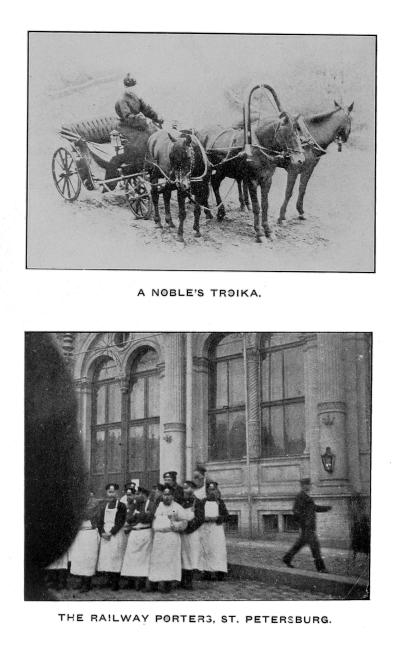
instantly beset by a regiment of smartly uniformed porters—old
soldiers all of them—and were piloted by one tall veteran to a
waiting fiacre, which soon carried us to the Hotel Savoy. It was
early, not yet five o’clock, but the streets were already alive with
an orderly and animated throng, who appeared to be workmen largely,
carpenters, masons and day-laborers, each clad in his distinctive
laborer’s garb. They were on their way to work, for the working day is
long in Germany, ten and twelve hours, and the workingman is up
betimes. We passed over asphalted streets where men in
military-looking uniforms, with hose in hand, were washing down their
surfaces, while others with big coarse brooms were sweeping them
clean. Berlin is a clean city, clean and neat as the proverbial German
in America is known to be. Alighting from our carriage, I was greeted
in my own tongue, by the friendly mannered concierge, who instantly
marked me for an American, and gave us comfortable quarters such as
American dollars usually secure.
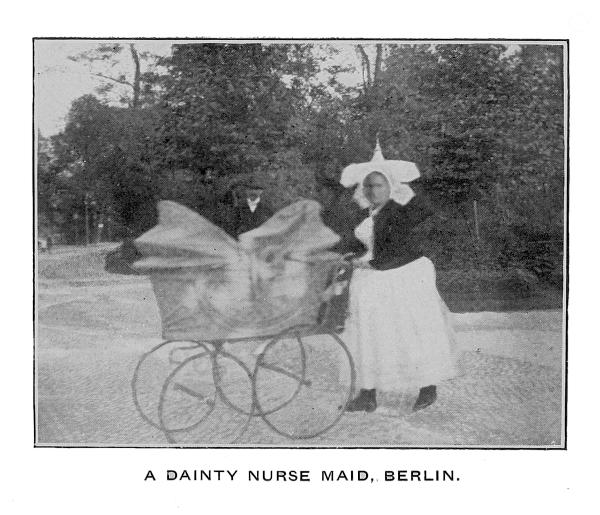
A DAINTY NURSE MAID, BERLIN.
H and I were now alone, our companions, Mr. and Mrs. C having left us
at Warsaw, where they would spend a week or two and learn something of
Poland. Perhaps I might tell you right here, that the next morning, as
we were leaving the hotel, I felt a hand upon my shoulder and, turning
round, faced the two Chicago travelers just then arrived. They had cut
short their stay in Warsaw, for the only American-speaking guide in
that city was away on a vacation, and German and French to them were
as impossible as Polish. They confessed, also, that they had sorely
missed their American fellow-travelers, and had hurried after us,
hoping they might induce us to sojourn a little while in their good
company.
We spent our single day without trying to see museums and picture
galleries, but taking a guide and a carriage, drove about the city and
viewed its avenues and parks, its markets and busy thoroughfares, and
noble public buildings, to catch what glimpse we might of the waxing
Capital of the German Empire. The first impression Berlin makes upon
the stranger, especially the stranger new-come from Russia, is that of
its cleanliness and orderliness; and, I think, I here also felt the
sympathy of blood-kinship with the well set-up and neatly clad men and
women, whose faces might have been those of my fellow countrymen of
St. Louis, Cincinnati or New York. Berlin, to-day, fitly typifies
modern Germany and the modern German spirit. We drove everywhere over
smooth streets, kept scrupulously clean. On either hand stretched
miles of new and handsome buildings, modern in architecture and modern
in construction, while the signs I saw were in Latin Text, instead of
the Gothic, a striking evidence of German progression.
When we came to the lovely Unter Den Linden, we left the carriage and
wandered beneath its umbrageous trees and enjoyed, as every one must,
the beauty of its vistas of greensward and carefully tended flowers.
The German loves his flowers almost as devotedly as does his English
cousin. We strolled also along the famous Thier Garten, which would be
a magnificent boulevard in any city; and which the German Kaiser has
sought to ornament with innumerable ponderous groups of sculpture,
preserving for the astonished world the commonplace memories of paltry
ancestors. How much better would it have been to have adorned this
stately thoroughfare with statues of illustrious Germans, whose great
deeds and works have contributed to the world’s enlightenment and the
Fatherland’s renown! To a Democrat, bred to contemn the empty glitter
and pretense of inherited privilege, it almost stirs one’s anger to
see so splendid a public highway as the Thier Garten thus arrogantly
defaced.
In this Capital of an Empire, whose foundation is set on bayonets and
swords and the “biggest guns,” where militarism runs riot, there is no
surprise in finding the streets filled with soldiers and officers, and
to meet frequently a marching company, nor does it astonish one to see
here the extreme development of the spirit of military caste. Here,
the civilian, man as well as woman—no matter how well clad he or she
may be—must turn aside for strutting officer and also, as for that,
for the common soldier, and all traffic must hold back to let a
company of soldiery pass by, even though they are out only on errand
of trivial exercise. Here in Germany, perhaps as nowhere else, have
the clever supporters of Royal and Imperial pretension worked the army
racket to the limit, through creating a perpetual scare that greedy
neighbors will devour the Fatherland. The citizen of Berlin is never
allowed to forget that little more than a century ago, Cossack hordes
pastured their ponies in the parks and gardens of the German capital;
and can gallop there again from their Polish camps in a single day.
The army has been built up on the pretense that it is necessary for
national defense, and thus the Kaiser, who is permitted to occupy the
position of army chief, holds at his command these enormous military
forces, while he uses them the rather to exalt his own prerogative
and subvert the people’s inborn rights of individual sovereignty,
which is the highest gift of God to man.
The splendid building of the Reichstag, where the Socialist party of
Germany, to-day, makes its almost vain attempt toward securing to the
people a freer exercise of man’s natural rights, is thus menaced by
the colossal military group which stands before it, as though to teach
the lesson that the sword still rules the Fatherland.
In the evening, our guide, who had privately confessed to me that
within the year he would travel to New York there to become manager of
a great hotel, led us to one of the more notable Bier Garten, where we
saw a most German vaudeville, the feats of whose performers were
greeted with vociferous hochs, and where we listened to a splendid
band, and where H had her first sight of ponderous Germans absorbing
beer, with which spectacle she was much impressed.
Wednesday, we were early astir, driving to the Hamburgischer Bahnhoff,
where we took the fast nine o’clock express for Hamburg, and flew
along over a well-ballasted road-bed through a dead-flat country, in
what the Germans proudly call their “fastest” train. The panorama was
one of market gardens and intensely cultivated land. It was a
monotonous prospect, where the alikeness of the vistas was emphasized
by the sentinel stiffness of the ever recurring rows of
Lombardy-poplars. As in Russia, men and women were everywhere
working in the fields and gardens, but unlike Russia, they were well
clad and well fed, and bore an air of thrifty contentment. There was
no dilapidation anywhere. We saw no longer the tumbled-down shacks of
the mujik, but everywhere substantial, neat homesteads of brick and
stone.
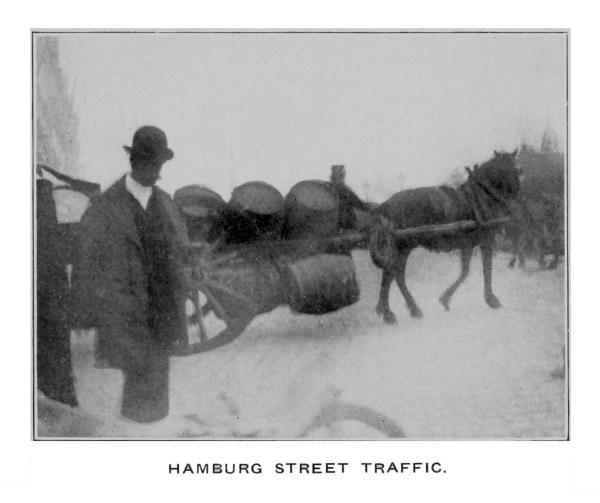
HAMBURG STREET TRAFFIC.
Ours was a through train connecting with the Hamburg-American Line of
steamers for New York, and with the through railway express traffic
for France and Belgium, via Cologne. The passengers were chiefly of
the well-to-do commercial classes, or those substantial travelers who
would hasten quickly between Germany and France. None the less, at the
few stations where we halted, did the entire company instantly burst
forth, hastening to the long counters, where they convulsively
swallowed foaming schooners of beer and eagerly devoured sundry
dainties, such as rye bread spread with goose grease and over-laid
with kraut or wurst, and varnished pretzels salted to the limit.
Even the babies were held at the open windows and foaming mugs of beer
poured into them by their fond parents. The passion of the German for
his bier equals the Russian’s thirst for vodka.
We reached Hamburg a little after half past one, when, taking a
fiacre, we immediately drove to Cook’s Tourists’ Agency, where I
booked to London, via Amsterdam, The Hague, the Hook of Holland, and
Harwich. Then, for an hour, we strolled about the city.
Hamburg possesses fine retail shops and abounds in restaurants,
Bier-Keller and Wein-Stuben, establishments devoted to the solace of
the inner man.
Stricken with hunger-pangs, and not knowing just where to go, I
accosted a tall and prosperous-looking burger, telling him we were
Americans in search of food. Lifting his hat, he “begged to be allowed
to guide us to the finest Wein Stube” in the town, whither his own
steps were at that moment bent. He led the way to a quiet side street,
where, descending a flight of stone steps, he introduced us to the
portly master of the stube. We entered a succession of large
cellars, paneled and ceiled in oak and floored with patterned tiles,
where small round-topped wooden tables were set about. We were
conducted to a cozy corner, and Rhine wine, cheese, sausage and fresh
rye bread were set before us, as well as mustard and sour pickles and
pats of sweet unsalted butter, and to this was added a palatable stew.
The room was filled with men—big, well-fed, well-clothed men,
apparently merchants, ship-masters and men of affairs. They fell-to
upon their flagons of wein, their wurst and kraut, their
braten and fisch with serious and deliberate devotion. It was that
time of day when, in America, the prospering businessman eats lightly,
smokes sparingly and touches liquor not at all, holding his intellect
alert and whetted to its keenest edge. We watched with wonder these
men of Hamburg, while they poured down quart after quart of wine, the
air growing thick with the fumes of strong tobacco. This capacity
of Hans to eat heavily and mightily liquor-up and yet transact
affairs, bespeaks a hardness of head and toughness of stomach which
ranks him neck and neck alongside his cousin Bull as co-champion of
the bibulating, gastronomizing world.
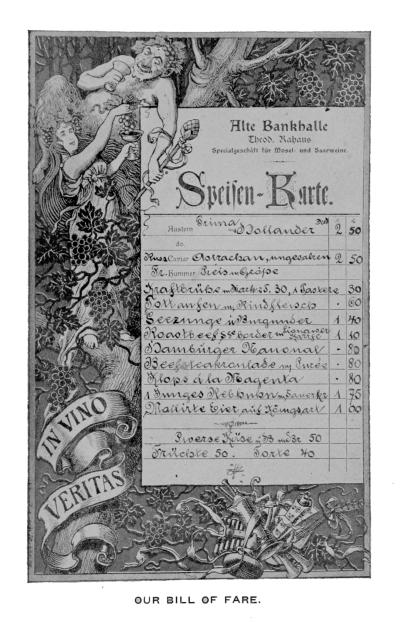
OUR BILL OF FARE.
Although H was the only woman in the stube, being recognized as
Americans, we were treated by the company with greatest courtesy and
that invariable friendliness with which, in Germany, my countrymen are
everywhere received.
Upon departing, Mein Host presented me with an attractive little
ash-tray to add to my collection of souvenirs and, with much ceremony,
bestowed also upon mine frau an illuminated catalogue of his store
of wines.
Later, we entered a comfortable landau and for several hours were
driven about the city. Hamburg has always been an important city and
one where great volume of business has been transacted. In the Middle
Ages it was a member of the Hanseatic League; in after days it was a
Free City and, even at this time, its citizens view its absorption
within the German Empire not altogether with satisfaction. It bears
the marks of great antiquity. Quaint and picturesque are the lofty
mediaeval buildings which lean over its canals, where men and women
push, with long poles, blunt-ended canal boats and clumsy-looking, but
storm-proof, sloops and luggers, among perpetual cries and clamors;
where sturdy black tug boats incessantly shove their way; and where
is a jam and jostle of inland water-life not unlike that seen in
Holland. Many narrow streets cross these canals on high-built bridges,
bearing a continuous and deliberately-moving traffic.
Hamburg also possesses noble boulevards, long and straight and wide,
and well-shaded with umbrageous lindens, where, set back behind high
walls and strong-barred gates, are miles of sumptuous mansions, in
which her merchant princes maintain their households in unostentatious
luxury. The wealth of the merchants of Hamburg is said to exceed that
of the aristocratic office-holding classes of Berlin.
There are also spacious docks in Hamburg, convenient and modernly
equipped, where, year by year, gathers an increasing shipping to fetch
and carry the rapidly developing foreign commerce of the German
Empire. The wealth and energy of the German Hinterlands pours itself
eagerly into Hamburg’s lap and the ancient mediaeval city now finds
itself, unlike somnolent Copenhagen, at the very forefront of Europe’s
activity. Hamburg is, commercially, more alive and active than Berlin,
and as a port receives more shipping than London. Hamburg is almost as
wide awake as is New York.
After our drive, we came to the Hotel Europaer, where we dined and
rested, and then departed a little before midnight for Amsterdam.
Although this is the regular passenger service to Holland, there was
no through sleeper, and we were compelled to change at Oestenburg,
where we caught the night express from Cologne. Then in a comfortable
“schlafwagen,” wrapped in our sea-rugs, we slept soundly the balance
of the night.
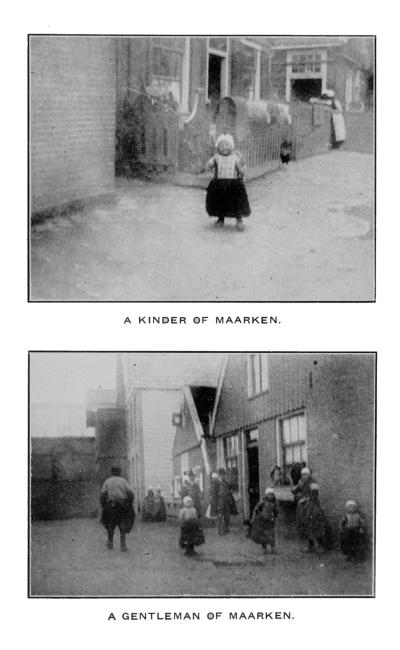
A KINDER OF MAARKEN.
&
A GENTLEMAN OF MAARKEN.
We arrived at Amsterdam near eight o’clock and found our way to the
Hotel Victoria, near the station, where I enjoyed such delicious
coffee two years ago, and there we breakfasted: coffee,—a great pot
of fragrant Java,—abundant milk, sweet and delicious,—rolls and big
fresh eggs, and a fish which much resembled the Danish roed spoette
and English sole. It was a delightful breakfast, such as one is always
sure to have in Holland.
Two years ago, I devoted my time to viewing the city, so now we
resolved to see somewhat of the country beyond the limits of the town.
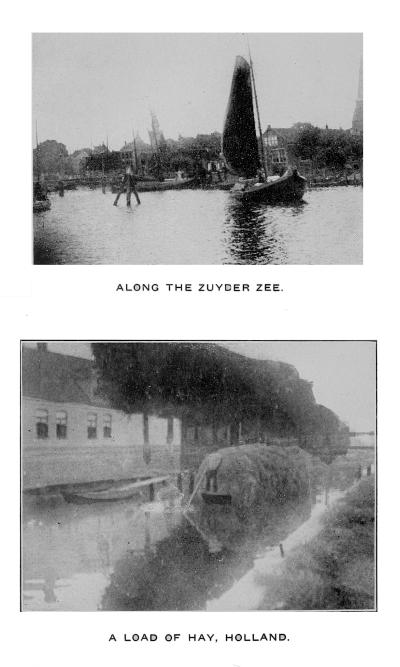
Thus it happened that we boarded a taut little boat in the midmorning
and all day long steamed through canals, with many locks, passing
above picturesque farmsteads and villages, down upon which we looked
from the higher level of the diked-up waters, and floated at last upon
the Zuyder Zee. We later visited the Island of Maarken with its
fisher-folk in quaint and ancient costume. Once “simple peasants,” but
now, alas! ruined by the staring, money-shedding tourist. We had
scarcely set foot upon the Island, when we were stormed by a horde of
men and women, boys and girls, each demanding “mooney,” and imploring
us to snap the kodak at them for the cash; begging us also to visit
their particular homes, where we would be allowed to look inside the
door, and perhaps inspect the house, for more Dutch cents and even
gulden. So persistent were these “simple fisher-folk” that I almost
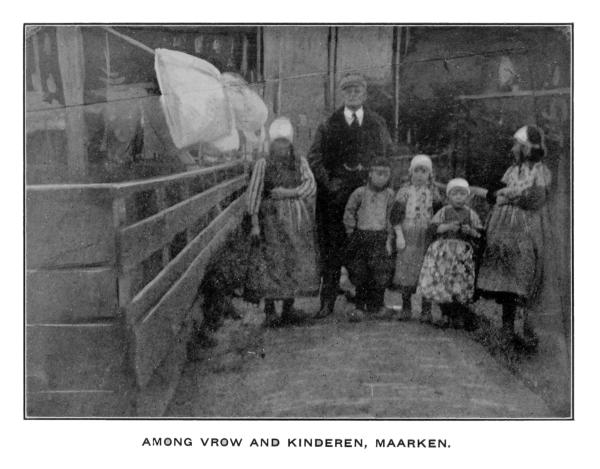
fell into dire mishap. H suggested she should take my photograph,
whereupon I arranged myself before the camera, when, just as the kodak
clicked, a vrow and several kinderen rushed up and took position
by my side, thus necessarily appearing in the picture, as you will
see. The lady backed by her brood thereupon demanded, “Mooney, mooney,
mooney.” Naturally, I refused to pay for what had been given without
request. The little company immediately raised a loud lament, at sound
of which an immense and bow-legged fisherman appeared upon the scene,
lifting a great oar and threatening my annihilation, unless money were
put up. However, I was firm and fearless, and finally convinced him
that I had not requested the family to stand before the lens, while I
showed him I had already added half a gulden to his chest for
inspection of the home. Comprehending this at last, his anger then
turned upon his spouse, and he sulkily drove her and the kinderen
within their door, using language that sounded much like the English
damn.
Leaving the Island, we came home across the Zee and passed through the
huge new locks of the River Amstel, the “Dam” of which, keeping out
the waters of the Zuyder Zee, gives to the city its
name,—Amstel-dam.
AMONG VROW AND KINDEREN, MAARKEN.
The little boat we sailed upon was chiefly filled with Holland folk,
for we were behind the tourist season. They were a quiet,
undemonstrative company and, on the deck, sat about in little groups
and were served with Schiedam schnapps in small glasses by
white-aproned waiters and smoked long, light-colored Sumatra cigars.
The proverbial Hollander, fat and chunky with an enormous pipe, is now
a mere tradition. The Dutchman of to-day, like his English cousin, is
long and lean, and might almost be taken for a New England Yankee.
An hour by rail brought us to “Den Haag.” We passed among broad
meadows, marked by wide black ditches from which gigantic pumps
incessantly suck out the seeping waters and pour them into the sea.
These meadows were once the bottom of the ocean, the soil being
composed of the rich alluvial silt which the continental rivers have
for centuries discharged. Indeed, Holland may be said to consist of
the submerged deltas of the rivers Scheldt and Rhine, which the
indefatigable industry of man has rescued from the sea. These lands
are of inexhaustible fertility and upon them, everywhere, we saw
grazing herds of black-and-white Holstein cows, whence come the butter
and cheese for which Holland is famous, and the delicious milk which
is so abundantly offered us at every meal. The roadbed ran high above
the meadows, down upon which we looked. Here and there we espied a
cluster of neat farm buildings, reminding me much of the Dutch
homesteads along the Hudson River valley, and stretching from Albany
along the Mohawk, in New York,—with this difference, however, that
here, each house and barn and garden lay surrounded with its own
diminutive canal, where were little foot-bridges and skiffs fastened
near the kitchen door, even a large canal boat being often moored
against a barn, the better to float away the loaded hay. The Dutchman
finds life intolerable unless he has his own canal right at his
threshold.
Farther along, the landscape was marked with innumerable windmills
turning their ponderous arms slowly to the breeze which crept in from
the sea; we counted I do not know how many, there seemed never to be
an end. The people we saw were stout and rosy-cheeked, and moved with
less alertness than do the Norwegians, nor did they have about them
that air of busy-ness which the modern German begins to show. The
impression made by the Hollander is that of sureness and deliberation.
The cocky strut of the Frenchman, who moves ever as though on
dress-parade, is entirely wanting to the Hollander, whose demure
exterior gives no hint of the wealth, the talent, the high importance
hid within.
The journey from Amsterdam to The Hague takes scarcely an hour, and
before we knew it we drew in to the large station of the Dutch
capital. The soldierly-clad porters are not here as numerous as in
Germany, nor did those who served us move with so self-conscious
and self-important a gait. Men in quiet, dark-blue uniforms quickly
put our baggage into an open fiacre and we drove to the hotel of the
“Twe Stadten,” a comfortable inn facing a large well-shaded “park.”
We were given a commodious chamber looking out upon a pretty garden
and dined, at a later hour, in the long, low-ceilinged dining room.
The guests were few, only one other party beside ourselves dining thus
late. They were two tall and white-haired dames, gowned in black silk
with much old lace round about the throat, and with them a petite and
pretty Señorita, who spoke in Spanish and insisted upon puffing
cigarettes. She led the way from the dining room smoking jauntily, the
two chaperones following respectfully behind.
ALONG THE ZUYDER ZEE.
&
A LOAD OF HAY, HOLLAND.
DUTCH TOILERS.
&
A WATERY LANE, DEN HAAG.
In the morning we spent delightful hours in the national picture
galleries looking at the priceless collections of the Rembrandts and
Rubens, which the Dutch government has here assembled; in the
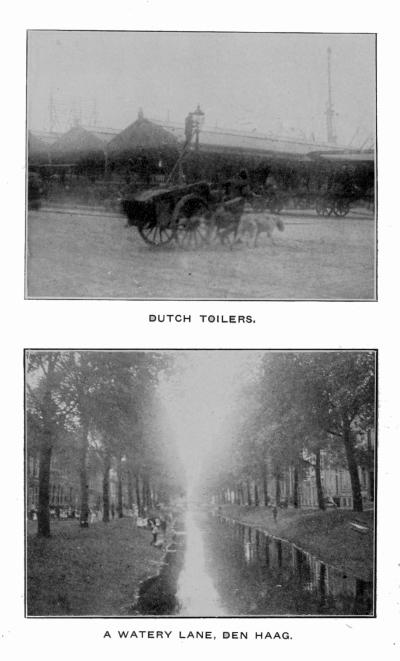
afternoon we strolled about the clean, quiet city, beneath the
over-spreading elms; and then we supped at Scheveningen, where we saw
the sea again and the last of the season’s fashionable folk.
A moment before leaving our hotel to take the train, which would carry
us to The Hook, I had my last adventure among the canny Dutch. Upon
the table in our chamber lay an attractive little ash-receiver, which
any smoker must needs long to own. Quite naturally, it became
entangled with our sundry purchases and scattered belongings and with
them was inadvertently put away. Just as we were quitting the
apartment, the head waiter of the inn, in whose charge we seemed to
be, burst in upon us with wild anxiety in his eye and explained in
broken English, that he instantly observed, upon scrutinizing the
chamber, that a most valuable piece of Delft ware had mysteriously
disappeared. Perhaps we had broken it? At any rate, it was gone and he
would be held responsible for its loss. Two gulden would barely
replace it! “What should he do?” Naturally, I explained that my wife
by mistake had probably packed it up, and begged him to advise the
office that, upon settling my bill, it would give me pleasure to
deposit two gulden against the loss. At a later time, when
exhibiting this relic to wiser eyes, I was forced to recognize that
the little ash-receiver was merely common ware, of value perhaps ten
Dutch cents! So much for the knowing Dutchman who traps the traveler
in search of souvenirs!
Two hours after leaving The Hague we were upon the ship which would
carry us to England. By early morning we were again at Harwich, and we
arrived in London by mid-afternoon. Our only fellow passenger upon the
train was a tall, dark, silent man, who carried with him an enormous
overcoat of fur. We thought him a Russian, and wondered if he also had
come directly from the Empire of the Czar.
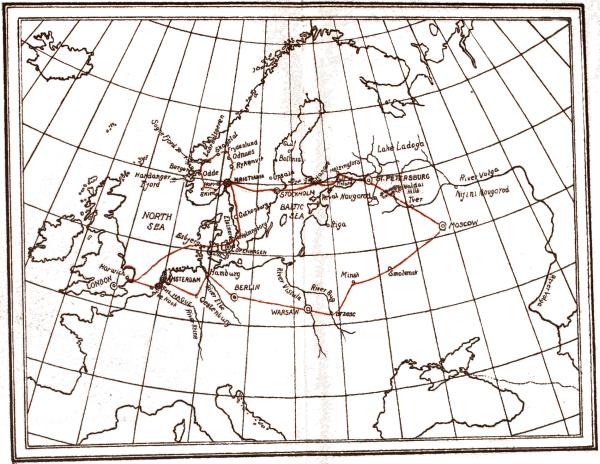
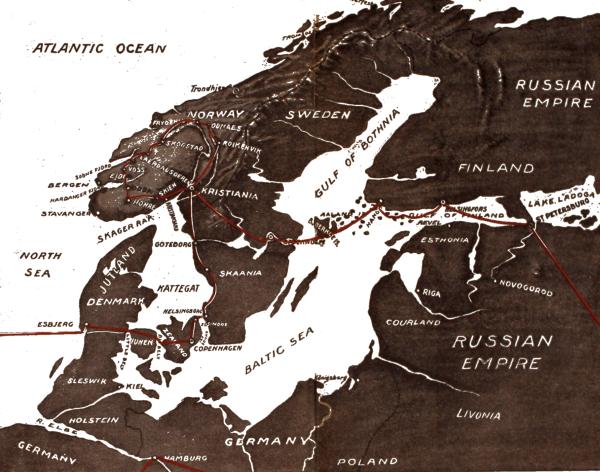
We are now returned to London, whence we departed five weeks ago. We
have crossed the North Sea, and journeyed through Denmark, and
Norway, and Sweden, and visited their capitals. We have voyaged
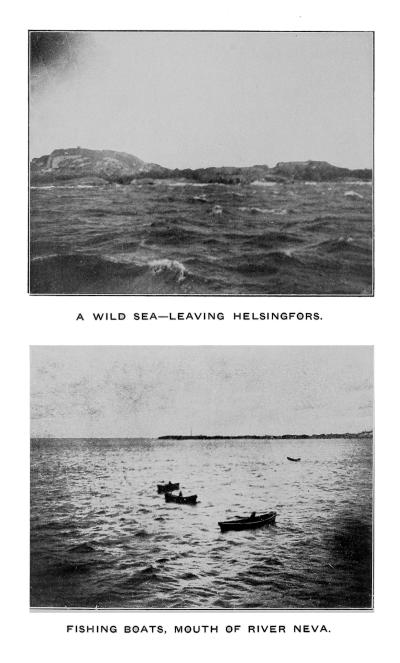
across the Baltic Sea and the Gulf of Finland; we have caught a
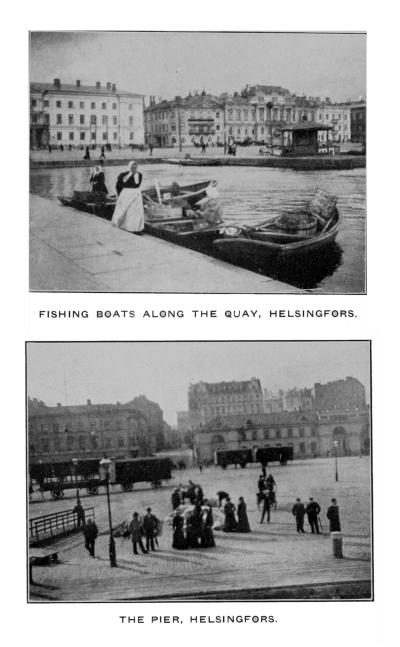
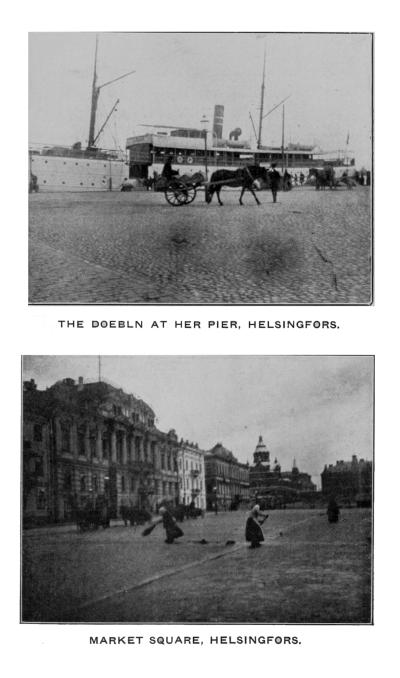
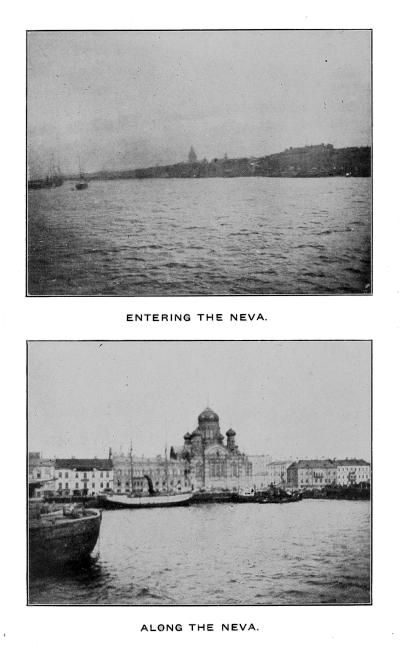
passing glimpse of Helsingfors, and looked upon St. Petersburg and
Moscow, and traveled many hundred versts through the Empire of the
Czar. We have sped through Germany and felt at home in the noble
cities of Berlin and Hamburg. We have tarried in Amsterdam and Den
Haag, where we felt the strangely familiar atmosphere of Dutch New
York. We have looked upon many peoples of the Teutonic races and, when
among them, have felt that subtle throb of kinship, which common blood
and common origin awake; we have also plunged a moment within the
mediaeval and yet semi-barbarous dominions of the Slav and found
ourselves upon the threshold of mysterious Asia.
THE GOSSIPS, DEN HAAG.
&
THE FISH MARKET, DEN HAAG.
We have everywhere been thankful in our hearts that we were born and
bred beneath the Stars and Stripes in the great Republic of the West,
where hope and opportunity are not merely our own, but are also the
loadstars which beckon thither the youth and vigor of these older
peoples of the World.