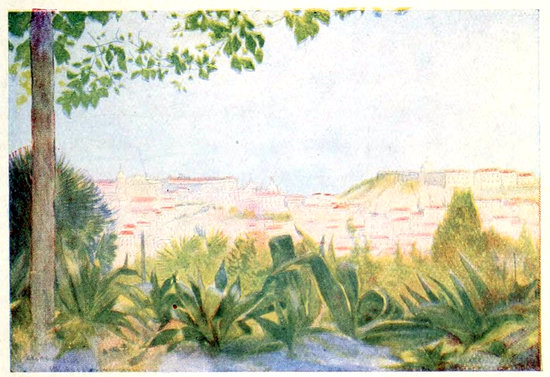
Portugal had been familiar to me from my
earliest youth, for my road to and from Spain
had often lain that way, and circumstances had
made me conversant with the language and history
of the country; and yet this book is not the
outcome of any such previous knowledge, but
mainly of one short voyage in search of change
and health. It happened in this way. As oft
befalls men who in this striving world have to
wring their brains for drachmas, the completion
of a particularly arduous book had left me temporarily
a nervous wreck, sleepless and despairing.
The first and most obvious need dictated to me
by those who settle such matters, was to forget
for a time that pens, ink, and paper existed, and
to seek relaxation in a clime where printers cease
from troubling and reviewers are at rest. But
where? Spain certainly would offer me no such
a haven: France was too near home, Germany
I disliked, Switzerland was trite and overrun,
the novelty of Italy I had long before exhausted,
and Greece was too far away. A sea voyage was
xiia desideratum, but it must not be too long, and
as the autumn was already verging towards winter
the south alone was available.
Then in the midst of my perplexity the happy
thought suggested itself that, often as I had
passed through Portugal, I had never seen the
country. Why not try Portugal? I had some
prejudices to overcome, prejudices, indeed, which
up to that time had prevented me from seeking
a deeper knowledge of the land and people than
could be gained by an incurious glance on the
way through. For I had been brought up in
the stiff Castilian tradition that Portugal was
altogether an inferior country, and the Portuguese
uncouth boors who in their separation from their
Spanish kinsmen had left to the latter all the
virtues whilst they themselves had retained all the
vices of the race. But, withal, I chose Portugal,
and have made this book my apologia as a
self-prescribed penance for my former injustice
towards the most beautiful country and the most
unspoilt and courteous peasantry in Southern
Europe. Portugal and the Portuguese, indeed,
have fairly conquered me, and the voyage, of
which some of the incidents are here set forth,
was for me a continual and unadulterated delight
from beginning to end, bringing to me refreshment
and renewed vigour of soul, mind, and
body, opening to my eyes, though they had seen
xiiimuch of the world, prospects of beauty unsurpassed
in my experience, and revealing objects of
antiquarian and artistic interest unsuspected by
most of those to whom the attractions of the
regular round of European travel have grown
flat and familiar.
It is impossible, of course, to pass on to others
the full measure of enjoyment felt by an appreciative
traveller in a happy trip through an unhackneyed
pleasure-ground; but it has occurred
to me that some record of my impressions on
the way may lead other Englishmen to seek for
themselves a repetition of the pleasure and benefit
which I experienced in the course of a short
holiday trip through Portugal from north to
south. I am not pretending to write a guidebook:
those that exist are doubtless sufficient
for all purposes, although I have intentionally
refrained from consulting any of them, in order
that my impressions might not be biassed, even
unconsciously, by the opinions of others; nor
do I claim to speak of Portugal with the fulness
of knowledge exhibited by Mr. Oswald Crawford
in his books on the country where he resided so
long. My object is rather to treat the subject
from the point of view of the intelligent visitor
in search of sunshine, health, or relaxation; to
suggest from my own experience routes of travel
and points of attraction likely to appeal to such
xiva reader as I have in my mind, and to warn him
frankly of the inevitable small inconveniences
which he must be prepared to tolerate cheerfully
if he would enjoy to the full a holiday spent in
a country not as yet overrun by tourists who
insist upon carrying England with them wherever
they go. If he will consent to “play the game,”
and not expect the impossible in such a country,
I can promise my traveller a voyage full of colour,
interest, and novelty in this “garden by the side
of the sea,” where pines and palms grow side by
side, and the stern north and softer south blend
their gifts in lavish luxuriance beneath the happy
conjunction of almost perpetual sunshine and
moist Atlantic breezes.
MARTIN HUME.
THROUGH PORTUGAL
I OPORTO
1
I stood in the centre of a daring bridge, spanning
with one bold arch of nigh six hundred feet a
winding rocky gorge. Far, far below me ran
a chocolate-coloured river crowded with quaint
craft, some with high-raised sheltered poops and
crescent-peaked prows, some low and long astern
with bows like gondolas and bright red lateen
sails, upon which the fierce sun blazed sanguinely.
On the right side thickly, and on the left more
sparsely, climbing up the stony sides of the gorge,
were piled hundreds of houses, pink, pale-blue,
buff, and white, all with glowing red-tiled roofs,
and each set amidst a riot of verdure which
trailed and waved upon every nook and angle
uncovered by buildings. Trellised vines clustered
and flowers flaunted in tiny back-yards
2and square-enclosed courts by the score, all on
different levels, but all open to the down-gazing
eyes of the spectator on the bridge high above
them. Here and there a tall palm waved its
plumes as in unquiet slumber, but everywhere
else was the impression of ardent, throbbing,
exuberant life, such as all organic creation feels
under the spur of stinging sunshine and the salt
twang of the sea-breeze. The river gorge winds
and turns so tortuously that the view forward
and backward is not extensive, but as far as the
eye reaches on each side of the umber stream
the hills of houses and far-spread terraced vineyards
beyond rise precipitously, with just a quayside
at foot on the banks of the stream, thronged
now with folk who swarm, gather, and separate
like gaudy ants, and apparently no bigger, as
seen from the coign of vantage on the bridge.
To my left, as I stand looking towards the west,
there crowns the summit of the ridge close by
a vast white monastery against a green background;
a monastery now, alas! like all others
in this Catholic land, profanated and turned to
purposes of war instead of peace, but, withal,
there still rears its modest rood aloft upon the
crest one poor little round chapel where the
3sainted image of Pilar of the Ridge stolidly
receives the devotion of the faithful. To the
right, the height is crowned by a vast square
episcopal palace, and near it, over all, is the
glittering golden cross that shines upon the
city from the summit of the square cathedral
towers. This is Oporto, The Port par excellence,
which gives its name to Portugal, seen from
the double-decked iron bridge of Dom Luis
over the Douro.
For days I had been striving in vain to get
into touch with the psychic principle of this
strange city. I had mixed with the motley
multitudes that lounge and labour upon the
quays, I had lingered in the gilded churches
where worshippers were ominously few, and
stood for hours observant in chaffering marketplaces
and amidst the crowds of sauntering
citizens in the inevitable Praça de Dom Pedro;
but till the revelatory moment came to me in
one enlightening flash upon the Bridge of Dom
Luis, I had always been alone in a foreign throng
whose composite inner soul I could not read.
But now all was changed. Thenceforward I
saw Oporto whole and not in disintegrated fragments
as before; for I had learnt the secret of
4putting the pieces of the puzzle together and the
heart of the city was bared to me, a stranger.
Every large, enduring community comes to
attain a distinct character of its own, which the
outlander can only know by long association or
sympathetic insight, sometimes not at all. I had
looked for a people exuberant and gay in outward
seeming with an underlying spirit of bitter
mockery, such as I had known in so many other
Iberian cities; but somehow these Oporto people
were quite different. Grave and quiet, with
introspective eyes, even the children seemed to
take their play soberly. Look at the slim slip
of a boy who gravely walks at the head of
this team of enormous fawn-coloured oxen, toilsomely
dragging their ponderous load up a hill
so steep as almost to need a ladder to ascend.
The urchin cannot be more than ten or eleven,
and in any other country would alternately skip
and idle, or at least allow his attention to wander
with every fresh object that struck his fancy.
Here he stalks along for hours at a time, without
lingering or straying, always calm and patient,
whilst his soiled and hardened bare feet plod on,
heedless both of the white mire and sharp stones
of the way. Over his shoulder he carries a long
5lithe wand, double as tall as himself, with which
he directs the course of the great wide-horned
bullocks. A mere turn of the wand is sufficient
to indicate the way, and with low bowed heads
beneath the heavy yoke the dull beasts plod
slowly onward as long-suffering as their guide.
The whole equipage might belong to the times
when the world itself was young, so idyllic is
it in form. The wain is narrow and high-set
upon two wheels, like an ancient chariot, with
boards or high rods to form its sides; the wheels
are built up ponderously of solid wood, the two
thick spokes that connect the heavy tire with the
hub filling up most of the circle, and the axle,
a heavy log of wood, itself turns with the wheels.
In this part of Portugal there stands erect upon
the neck of the team an adornment which is
usually the pride of the owner’s heart, and the
one superfluous article of luxury he possesses.
It is a thick board of hardwood, about eighteen
inches high and some five feet broad, intricately
and beautifully carved in fretted open-work
arabesques. The patterns are traditional, handed
down from time immemorial, and usually consist
of involved geometrical and curvilinear designs;
sometimes, but not often, with a cross introduced
6in the centre, and with a row of little bristle
brushes as an extra adornment along the top. A
glance at this elaborate piece of ox furniture will
show that its decoration is of Moorish origin,
and the canga itself may be the survival of the
high ox yoke still seen in some oriental countries.
To complete the quaint picture of the universal
ox team, for this part of Portugal is not a
country of horses or mules, the dress of the
small teamster must be described. The boy’s
breeches usually do not reach below the knee,
the rest of the legs and feet being bare; a jacket
of brown homespun is slung upon one shoulder,
except at night or during the cold winter days
of December and January, when it is worn, and
the shirt, open at the neck and breast, leaves
much of the upper part of the body exposed.
The headgear is peculiar. It is nearly always a
knitted stocking bag cap, something like an old-fashioned
nightcap, with a tassel at the end of
the bag which hangs down the back or upon the
shoulder of the wearer, its colour being sometimes
green and red, but more frequently black.
The boy, like his similarly garbed elders, takes
life very seriously, but neither he nor they seem
sad or depressed. There is here none of the
7squalid misery or whining mendicancy that are
so distressing to strangers in Spain and Southern
Italy, for the Portuguese of the north is a sturdy,
self-respecting peasant, who works hard and lives
frugally upon his three testoons (1s. 3d.) per day;
and so long as he can earn his dried stockfish,
his beans, bread, and grapes, with a little red wine
to drink, he scorns to beg for the indulgence of
his idleness.
These are the people, and their social betters
of the same race, whom a sudden flash of sympathy
brought closer to me, as in the pellucid
golden sunlight all Oporto was spread before and
beneath me, palpitating with life. The absence
of vociferation and vehemence in the people did
not mean sulkiness or stupidity, but was the
result of the intense earnestness with which their
daily life was faced; their unregarding aloofness
towards strangers was not rudeness, but the
highest courtesy which bade them avoid obtrusive
curiosity; and soon I learnt to know that
their cold exterior barely concealed a disinterested
desire to extend in fullest measure aid and sympathy
to those who needed them. In all my
wanderings I have never met, except perhaps in
Norway, a peasantry so full of willingness to
8show courtesy to strangers without thought of
gain to themselves as these people of north
Portugal, almost pure Celts as they are, with
the Celtic innate kindliness of heart and ready
sympathy, though, of course, with the Celtic shortcomings
of jealousy, inconstancy, and distrust.
I know few more characteristic thoroughfares
than the road by the river-side at Oporto, called the
Ribeira, which is the centre of maritime activity
of the port. The path runs beneath what was the
ancient river-wall, now pierced or burrowed out
to form caverns of shops, where wine and food,
cordage and clothing are sold to sailor men.
Many of the open doors have vine trellises before
them, in the shade of which quaintly garbed
groups forgather, and a constant tide of men
and women flows along the path, eddying into
and out of the cavernous recesses in the ancient
wall. Colour, flaring and fierce in the sun,
flaunts everywhere; for the multi-tinted rags of
the south festoon and flutter from every door
and window and deck the persons of all the
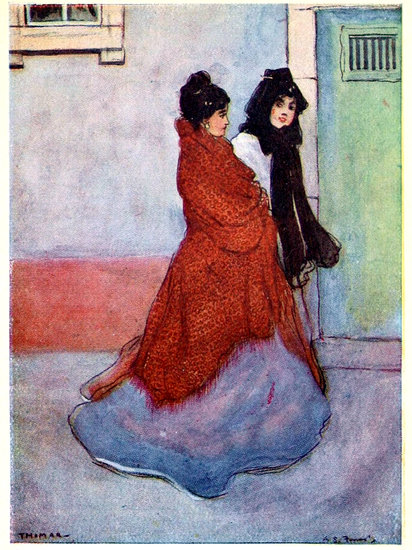
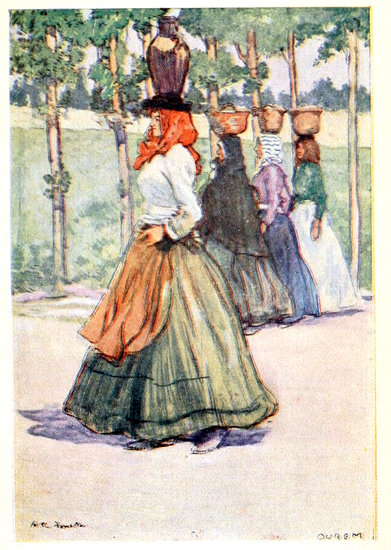
womankind. Swinging along, with peculiar and
ungainly gait, go the women with prodigious
burdens upon their heads. Everything, from
babies to bales of merchandise, is borne upon the
female head in Portugal; and these women of
the north wear a peculiar headgear adapted to
this custom. It is a round, soft, pork-pie hat of
black cloth or velveteen, fitting well upon the
top of the head, the upper rim being adorned
with a sort of standing silk fringe. Such a hat,
especially when surmounted by a knot, suffers no
damage from a burden placed upon it; but the
constant carrying of tremendous weights upon
the head of females, even of little girls, quite
spoils the figures of the women, thrusting the
hips and pelvis forward inordinately, and rendering
the movements in walking most ungraceful.
The women and girls almost invariably go barefooted,
whilst the men, except the fishermen,
usually are shod; and the females of a family
share to the full the work and hardships which
are the common lot.
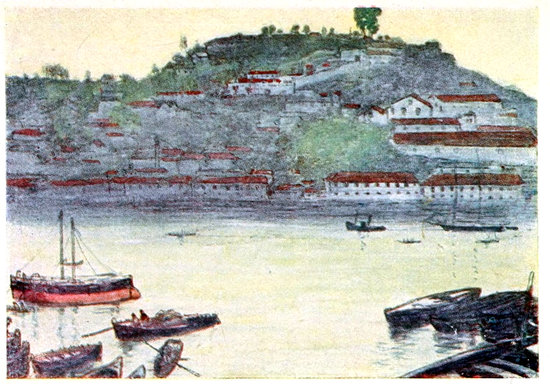
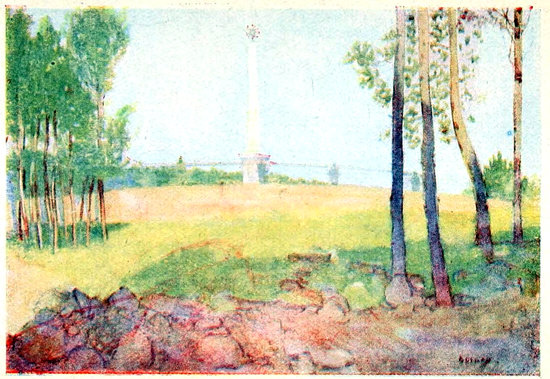
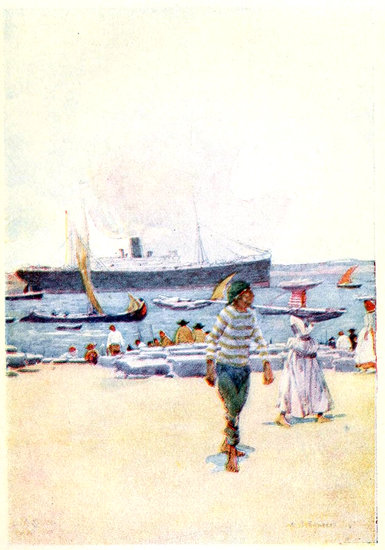
EVENING OPPOSITE OPORTO.
9Along the shore of the busy Ribeira lie ships
unloading, small craft they usually are, for the
bar of the Douro is a terrible one, and the big
ships now enter the harbour of Leixões, a league
away. In a constant stream the men and women
pass across the planks from ship to shore, carrying
the cargo upon their heads or shoulders
in peculiar boat-shaped baskets, which are the
10inseparable companion of the Oporto workers.
Here is a smart schooner hailing from the Cornish
port of Fowey, from which stockfish from Newfoundland
is being landed on the heads of women,
flat salt slabs as hard and dry as wood, but good
nutritious food for all that; and farther along,
with their prows to the shore, rest a dozen un-ladened
wine and fruit boats from up the Douro,
and flat-bottomed passenger skiffs into which
women and men with baskets and bundles, representing
their week’s supplies purchased in Oporto,
are crowding to be carried back to their homes
in the rich vineyard villages miles up the river.
One by one the quaint craft hoist their crimson
sails, and struggle out from the tangle of the
bank, until the breeze catches them, and in a
shimmer of red gold from the setting sun they
hustle through the brown tide until a projecting
corner hides them from view. It is a scene never
to be forgotten.
The centre of the Ribeira is the Praça called
after it, where a sloping square facing the water
opens out. The scene is picturesque in the
extreme. The space is thronged by men, either
sleeping in their baskets or carrying them filled
with fish or merchandise upon their heads: a
11motley, water-side crowd, men of all nations, pass
to and fro, or gossip under the vine trellis before
the wine shop overlooking the square, and as
the observer casts his eyes upwards he sees the
gaily coloured houses piled apparently on the
top of one another, until at the top of all, as
if overhead, is the glaring white palace of the
bishop, and the glittering cathedral cross, standing
out hard and clear against a sky of fathomless
indigo.
This busy river-side way of the Ribeira is, so
to speak, a street of two storeys. Below is
the walk I have described, with the cavernous
shops in the face of the old river-wall, and on
the top of the wall is another path reached
by occasional flights of steps, and also bordered
by the squalid medley of dark shops in which
strange savoury-odoured victuals are washed down
by strong red wine, and quiet brown men and
women, and grave-eyed swarthy babies are inextricably
mixed up with brown merchandise in
the gloom beyond the glaring sunlight. Unexpected
steep alleys, arched and mysterious,
lead to the thoroughfares higher up the precipitous
slope, and the next storey, a parallel
narrow street, the Rua do Robelleiro, narrow,
12dark, and ancient, is almost as picturesque as the
Ribeira itself.
A slab let into the river-wall by the beach
commemorates one of the most terrible days in
Oporto’s history. The English army had been
chased to its ships at Corunna, and the Spanish
levies scattered: the Peninsula seemed to be at
the mercy of the French legions, which, under
Napoleon’s greatest marshals, held the richest
provinces of Spain in the name of King Joseph
Bonaparte. But 9000 English troops remained
in Lisbon, and with Portugal in the hands of
his enemies Napoleon knew that he would never
be master of Spain. So the word went forth
that Soult was to march down with a great army
from Galicia, and sweep the English out of
Portugal. It seemed easy, and authorities even
in England believed that Portugal was untenable
and should be evacuated. All but one man,
Arthur Wellesley, whose victory at Vimeiro in
the previous year had been wasted by the inept
old women who were his superior officers. With
20,000 men, said Wellesley, he would hold
Portugal against 100,000 French, the marshals
notwithstanding; and the great Englishman had
his way. Beresford was sent out to reorganise
13the scattered Portuguese fighting men, and
Arthur Wellesley sailed from England with his
little army to face Soult in Portugal. Before
he arrived in Lisbon the French had swept down
from Galicia, and on the 27th March 1809,
Soult summoned Oporto to surrender. The
warlike Bishop of Oporto was heading the hastily
organised defence; his forces were undisciplined
and badly armed, but their hearts were stout,
and behind their poor earthworks the citizens of
Oporto and their bishop bade defiance to Soult
and his invading army.
On the 29th March at dawn the devoted city
was stormed by Napoleon’s veterans, who swept
all before them. There was no quarter, no
mercy, and the steep streets of the city were
turned to blood-smeared shambles. Down to
the river bank flocked the affrighted people,
falling as they ran under the rain of bullets that
pursued them. Over the river from the Ribeira
was a bridge of boats, and upon this the crowd
of panic-stricken fugitives poured. The weight
sank it, and thousands were drowned in the
Douro, or struggled ashore only to be despatched
by the French, whilst many of those who had been
in arms deliberately drowned themselves rather
14than surrender. Eighteen thousand Portuguese
perished on that awful day, without counting the
drowned who were never recovered; whilst of
the whole Portuguese host only two hundred
live prisoners were taken.
Six weeks afterwards the tables were turned;
six weeks spent by Soult in intrigues for his
own advancement, and by his officers in discontented
idleness. On the 12th May Wellesley and
his army from Lisbon surprised him at Oporto in
broad daylight, crossing the river a few miles
above the city by a brilliant piece of daring, and
Soult ignominiously fled north, leaving impedimenta
and baggage behind him, harassed and
scattered by the Portuguese peasants in arms,
until a mere remnant of his force finally found
refuge in Spain. The very dinner to which he
was about to sit down at Oporto when he was
surprised regaled Sir Arthur Wellesley instead,
and the victor took up his residence in that big
white monastery on the Serra de Pilar, which
from the height on the left of the bridge affords
a panorama of unequalled beauty of the city
opposite on its amphitheatre of hills, shining
white and stately against the dark background
of the sky.
15However you go from the lower level by the
river-side to the main streets of the city the
climb is a severe one, for in this town of precipitous
hills the gradients are startling, even for
the electric trams which of late years have completely
taken possession of the streets. But we
will leave the electric trams on this peregrination,
and face the ascent on foot from the lower level
of the bridge on the Ribeira itself to the upper
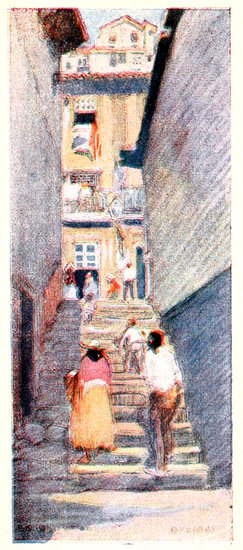
town. First some toilsome flights of steps which
have taken the place of the lower end of a
precipitous alley, cut away to make the approach
to the bridge, lead you up about two hundred
feet to an ancient winding lane which itself is
almost a flight of steps. Quaint foreign interiors
are disclosed through the open doors of the dark
humble abodes that line the way, and poor little
home industries are carried on coram populo; half-way
up the ladder-like ascent there is a ruined
church, and by-and-by on the right we skirt the
great battlemented wall of the vast disestablished
monastery of Santa Clara. At a turn in the
wall the corner of the grim old edifice itself
appears, fortress-like and looming here as built
for defence in the fierce times of long ago.
Through the doubly-grated windows, a few feet
16above our heads, brown paws are thrust out,
and a hoarse murmur from within takes form,
by-and-by, as a demand for alms in the name
of God. A glance inside makes one start back
in horror, almost in disgust, though the sorry
spectacle unfortunately soon becomes familiar to
those who sojourn in any large Portuguese town.
Huddled in squalor and filth together are half-naked,
savage-looking criminals, old men, sturdy
vagabonds, and youths almost children, staring
out from the gloom of the prison-house through
the unglazed barred windows, with whining prayer
for charity, ribald jest, or explosive curses. These
gaol-birds, herded publicly in their unutterable
degradation behind the gratings, form the blackest
spot visible in Portuguese life. Even Spain for
the most part has brought her prisons into some
semblance of civilised order, but Portugal in this
one respect lags inexplicably behind.
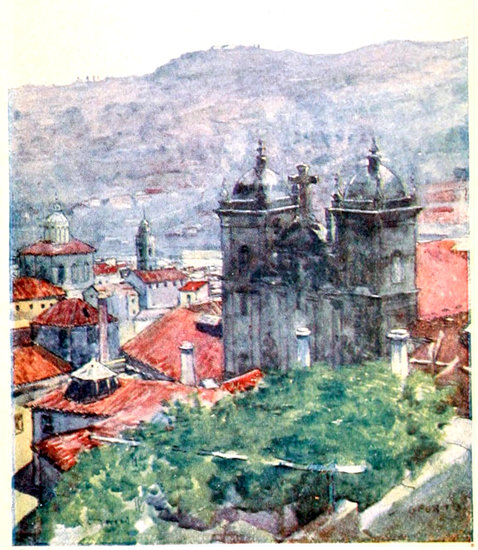
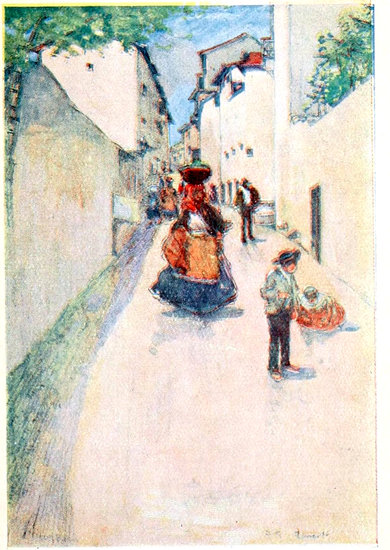
FROM THE RIBEIRA, OPORTO.
A few yards distant, through a little maze of
mediæval streets, is the cathedral, the Sé, with a
quiet little courtyard before it, from the parapet
of which the red roofs and abundant verdure of
the city spread downward in waves to the water-side.
These north Portuguese cathedrals are
marvellously alike; sharing the early beauties and
17later barbarities of their successive generations of
masters. This of Oporto is a good specimen.
The sturdy warrior kings who wrested Portugal,
bit by bit, from Castilian and from Moor, in the
twelfth and thirteenth centuries, were true crusaders.
Where they set their foot sprang up the
Christian church, to testify for ever their gratitude
for victory vouchsafed to the Cross that
symbolised their faith. Solid and staidly devotional
were the edifices they raised; and wherever
their work remains unconcealed by the scrolly
banalities of a later age, it bears still the impress
of simple faith and unostentatious grandeur.
Here on the hill crest at Oporto stand two
massive low towers, one still crowned by the
pointed Morisco machicolations of the twelfth
century, whilst its fellow, partly rebuilt, is spoilt
by the addition of a trivial eighteenth-century
parapet, with urns as an adornment. Still, the
massive solidity of the towers remains, which is
something to be thankful for when we regard the
hideous top-heavy early eighteenth-century façade
that connects them. The south door, of majestic
romanesque, is similarly marred. Around it has
been built a barbarous porch, overloaded with
meaningless ornament, which not only obscures
18the serious work of the early builder, but half
covers and cuts in two a lovely old round
window above the door which lights the transept
inside. But, however much these curly horrors
of the late seventeenth and early eighteenth centuries
may distract the eye, they do not destroy
what is still visible of the old edifice. The double
flight of low steps, for instance, which leads to
this south door has for handrails two ancient
stone serpents, so simple in design, yet so effective
and perfectly adapted for their purpose, as to
prove the unaffected but consummate artistry of
the designer, whose taste must have been formed
whilst yet the Byzantine traditions were strong in
the stern romanesque.
One is struck at once in entering any of these
cathedrals, and more particularly that of Oporto
and its close congener Braga, with the vast difference
between them and the pompous, splendid
Spanish cathedrals. In the latter the span of the
nave is usually tremendous, the church is plunged
in tinted gloom, and the whole of the centre of
the nave is blocked by an immense choir. Here
in North Portugal the note struck in the cathedrals
is not mystery richly dight, as in Spain, but
sincere austerity, and a simple faith so essential in
19the edifice that the grave granite columns and
arches appear as unaffected by the heaps, and
piles, and masses of curly carved gilt wood around
them as a monolith might be by the lizards that
bask and slither round its base. Here in Oporto,
for instance, the low, massive, granite pillars that
line the narrow nave, and support the round
romanesque arches, seem sullenly to bid defiance
to time and decay; such is their prodigious
solidity. And yet even these a later age has
surmounted, if not adorned, with curly Corinthian
capitals of carved gilt wood! Every altar
here, and indeed nearly all over Portugal, is an
overloaded mass of this particular barbaric style
of decoration dear to the Portuguese since the
seventeenth century. The skill in its production
is undeniably great, especially in the chapel of St.
Vincent in Oporto Cathedral; and in moderation
the employment of richly painted, carved, and
gilded wood generally may be advantageous where
the light is low and the architectural style ornate.
But here, where the simple romanesque prevails
and the churches are flooded with light, it overwhelms
one. In this low, old, plain Sé, either
gilded wood or high-relief designs in beaten gold
or silver in endless intricacy strike the eye unmercifully
20at every turn. On one of these ornate
altars, screened by a curtain which a fee will
raise, stands the ancient effigy, which those
who still hold the simple faith of their fathers
venerate so devoutly—Our Lady of Alem. Ages
ago, so the story runs, when this old fane was yet
a-building in the twelfth century, some Douro
fishermen found their nets heavy with an unusual
burden, and raising them, found this image, a
miraculous gift vouchsafed them from the sea.
Since then the prayers of those who win their
living on the deep have been ceaselessly offered
to the Lady of Alem for safety and good luck,
and simple offerings of gratitude for boons thus
gained—for sickness healed or safe return—hang
thickly round the shrine.
The beautiful little cloisters of the cathedral
are of a later date than the church—grave and
simple Gothic of the late fourteenth century, with
three small pointed lancet arches in each span, and
a plain round light in the tympanum above. But
even here the eighteenth century has done some
damage by building out highly ornamental buttresses
between the main spans. All around on
the inner wall of the cloister is a decoration which
abounds in nearly every Portuguese church that
21has lived through the seventeenth and eighteenth
centuries—namely, large pictorial representations
in blue and white tiles, like those commonly connected
with the town of Delft. In the churches
these tile pictures usually represent scenes from
Scripture history, with a large admixture of
heathen mythology or ordinary emblematic fancies,
as here in Oporto, and the effect is quaint and
not unpleasing. One of the things indeed which
most strongly strike a stranger in Portugal, in
the north especially, is the almost universal employment
of glazed tiles, azulejos, both inside
and outside buildings of all kinds, the majority of
the better sort of dwelling-houses being entirely
covered outside by tile designs in colours, sometimes
very elaborate and beautiful. The custom
exists to some extent in Spain, but is not so
common there as in Portugal. In each case, however,
the taste and original manufacture, like the
name of these tiles, are clearly Moorish, and in
some of the older edifices, to be mentioned later,
the tiles themselves date from a period when
Moors or Mudejares produced them.
In the sacristy of Oporto Cathedral they
will show you a painting on terra-cotta of the
Virgin and Child, backed by St. Joseph and
22angels bearing a cross, which is asserted to be
a Raphael. The composition and drawing are
clearly the work of a disciple of his school,
but the colouring is dull and grey, such as
the great one of Urbino would never have
produced. Not this so-called Raphael, but
another picture of the highest interest and
beauty, is the principal artistic treasure of the
city. In the board-room of Oporto’s most
cherished and beneficent institution, the vast
charitable organisation called the Misericordia,
there hangs a painting that has few, if any,
equals in Portugal. It is claimed for Jan Van
Eyck, who is known to have been in Portugal
for two years at about the period (1520) represented
by the work, though personally I
could see but slight traces of the peculiar
quality of either of the brothers Van Eyck.
Certainly it is broader in style than anything
I have seen from the brush of the younger
brother Jan, and may well be the work of
Hubert Van der Goes or Hans Memling.
But, whoever may be the painter, the picture
is a magnificent one. Against a background
representing a typical Flemish landscape and
walled town, such as Memling loved to paint,
23there is a highly ornamented font filled with
a pool of blood replenished from the stream
that issues from the Saviour’s side, as He
hangs upon the cross rising from the centre
of the pool. Upon the edge of the font, on
each side of the cross, in attitudes of prayer,
stand two lovely life-size figures of the Virgin
and St. John, whilst in the foreground there
kneel, in regal robes of crimson, ermine, and
gold brocade, the figures of the founder of
the Misericordia in 1499, King Manuel the
Fortunate and his wife. Kneeling behind them
in decreasing size are members of their family,
and on the farther side beyond the font are
groups of ecclesiastics and laymen, all evidently
life-like portraits of prominent courtiers, or
benefactors of the institution. The colouring
of the picture is glowing and gorgeous in the
extreme, and the loving care expended upon
the details is such as only the early Flemings
had patience to exercise, accompanied by a
breadth and boldness unusual in most of them.
Fons Vitæ, as the painting is called, from
an inscription on the edge of the font, is
emblematical of the foundation of the home
of mercy it adorns. Nor is it the only art
24treasure the Misericordia possesses, apart from
the hundreds of awful daubs representing dead
and gone benefactors that crowd every inch of
wall-space. There is to be seen a beautiful
Gothic gold chalice of fifteenth-century Portuguese
work, some fifteen inches high, a specimen
of the famous handicraft of the city, of great
interest, the work being of the most intricate
and elaborate description, and the condition of
the jewel perfect.
Away from the river-side and the immediate
surroundings of the cathedral, Oporto has little
to show in the form of architectural quaintness.
A busy, bustling place of modern-looking
houses for the most part, the streets dominated
by the indispensable electric tramways, casting
scorn upon the lumbering ox wains that alone
compete with them. Yet the city has some
striking points that should not be missed. The
view is very fine, for instance, from the top of
the main modern shopping thoroughfare, the
Rua de S. Antonio, which swoops down suddenly
like a giant switchback to the Praça de Dom
Pedro, the centre of the city, and then as the
Rua dos Clerigos soars aloft again as suddenly
to another eminence crowned by the extraordinary
25tower of the Church of the Clerigos,
one of the loftiest spires in Portugal. The
effect, looking up on either side from the
Praça de Dom Pedro, is as curious as any
streetscape of its kind in Europe. The Praça
de Dom Pedro itself, crowded almost day and
night with people, busy and idle, is a typical
Portuguese “place,” paved, as most of them
are, by the strange wave pattern in black and
white stone mosaic that gives to the Praça de
Dom Pedro in Lisbon (the Rocio) the English
name of “rolling motion square.”
From the Praça de Dom Pedro in Oporto,
leading downward towards the river-side, is the
famous street of the old city called Rua das
Flores, where now, as for centuries past, the
gold and silver filigree jewelry for which
Oporto is famous is made and sold in a score
of dark old-fashioned little shops; and still
farther down is the Praça do Comercio, with
a striking statue amidst the flower-beds of
Portugal’s national hero, Prince Henry the
Navigator. In this square stands, too, the
principal architectural boast of modern Oporto,
the Exchange, of which the interior is really
grandiose in the florid style so beloved by the
26Portuguese. The elaborate high-relief carvings
prevalent in Portugal are usually executed in
soft marble-like limestone, which hardens with
exposure to the air; but here in the Bolsa of
Oporto the intricate festoons and ingenious
caprices that stand out everywhere in relief on
walls, pillars, and staircases are carved out of
the solid grey granite of which the edifice is
built, as if out of defiance the most difficult
material had been sought. Some of the fine
apartments, especially the Tribunal of commerce,
are beautifully decorated in frescoes by
Salgado, in style much resembling those of
Lord Leighton; and the great ballroom is a
gorgeous hall in the brilliant gold and coloured
arabesques of the Alhambra.
The Exchange is built upon the site of a disestablished
Franciscan monastery, and cowering
under the shadow of its modern magnificence
there still stands the convent Church of St.
Francis. The seventeenth century has left little
of the original fifteenth-century church standing,
and the interior is a mass of extravagantly rococo
carved and gilt wood and other monstrosities;
but in an ancient south transept chapel there is
an altar-piece of interest in the style of Mantegna,
27though the sacristan ascribes it to some
impossible artist of another school and century.
Nothing, indeed, can equal the ignorance of, and
apparent indifference to, antique and artistic objects
in Portugal by the persons in charge of
them. Even in national museums and historic
buildings belonging to the Government, the
guardians appear to have been chosen without
the slightest regard to their fitness for understanding
or describing the objects in their care,
and the demeanour of the Portuguese people
generally towards such objects is such as to
force the conviction that, however proud they
may be that their country has produced gems
of art admired by strangers, they themselves
have but a vague appreciation of their beauties
or their merit.
The precipitous street leading up from the
Praça de Dom Pedro to the conspicuous Church
of the Clerigos is gay with a line of the
drapers’ shops, with the gaudy wares aflaunt, which
appeal specially to the country folk who flock
in with their produce to the picturesque market
of the Anjo behind the church. Red and yellow,
blue and green, strive for mastery from street
kerb to parapet, for the stock is as much outside
28the shops as in; and under the blazing sun, with
the eternally deep azure sky overhead, the feast
of colour in the clear air is so lavish as to dazzle
eyes accustomed to the low tones and soft outlines
of England. But relief is near. Through
the chaffering market, with its piles of luscious
fruit and all the bounteous gifts of earth and sea
spread temptingly before brightly clad country
wenches with flashing black eyes, the wayfarer
may pass but need not tarry; nor is it worth his
while to penetrate into the over-florid eighteenth-century
churches of the Clerigos and the Carmo,
which lie in his way—for just beyond them is
a beautiful sub-tropical garden where shady
groves of palms invite to repose, and towering
planes temper the glare with a soft haze of sea-green.
Seated in a quiet nook, with leisure now
to watch the passers-by closely, one is struck
by the prosperous busy look of the working
people. There is no undue noise, and a stranger
is allowed to go his way without unwelcome
attention; above all, marvellous to relate, beggars
are rare, whilst the persistent, offensive,
mendicancy, amounting often to sheer blackmail,
which is a perfect plague in Spain, is here quite
unknown.
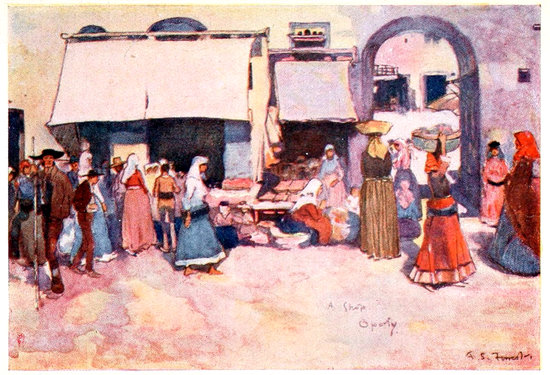
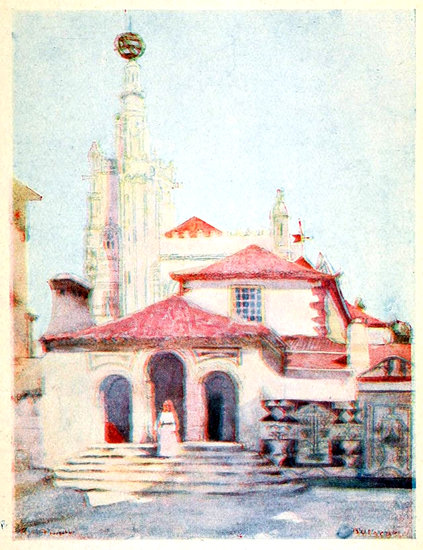
A SHOP IN OLD OPORTO.
29The manners of these people of North
Portugal, indeed, are irreproachable. So courteous
are they that it seems almost rude of the
stranger to note too closely the quaint garb of
the working people around him. The peasant
women especially keep their ancient costume
unchanged. Barefoot they go, old and young,
with their heavy burdens piled in their boat-shaped
baskets upon the black, pork-pie hats
they wear. Their skirts, usually black but
often with a broad horizontal stripe of colour
round the bottom, are very short, and gathered
with great fulness at the waist and over the
hips. Upon the shoulders there is almost invariably
a brilliantly coloured handkerchief, and
sometimes another upon the head beneath the
hat; and long, pendant, gold earrings shine
against their coarse jet-black hair. It is evident
that for the most part they work quite as hard
as the men, but they have no appearance of
privation or ill-treatment, except that their
habit of carrying heavy weights upon their
heads has the effect of ruining their figures in
the manner already described. There are no
indications anywhere of excessive drinking, and
even smoking is not conspicuous amongst the
30working men and boys in the streets; they seem,
indeed, too seriously busy for that, except on
some feast day, when, with their best clothes
on, they are gay enough, though not vociferous
even then, as most southern peoples are.
There is an ancient little church in the
northern suburb of Oporto, which will be of
some interest to students of architecture. It is
little more than a fragment now, but represents
the earliest orthodox Catholic foundation in the
city, and indeed in this part of the Peninsula.
In the clashing of creeds in the early centuries
of Christianity, Visigothic Spain had been officially
Arian, whilst orthodox trinitarianism was the
creed of the great churchmen, and the majority
of the Romanised people. In 559 Mir, King
of the Suevians, who ruled in the north-west
corner of the Peninsula, was distracted by the
imminent danger of his son, who was ill apparently
to death. He was an Arian, but the
priests of the orthodox Church assured him
that safety to his son might be gained by the
aid of certain relics of St. Martin of Tours,
and Mir swore that if the relics worked the
miracle he and all his people would join the
Catholic communion, and he would build a
31church to St. Martin within a year in his
capital city. The prince recovered, and Mir
was as good as his word. To the dismay of
the Gothic monarchs of Spain, Suevia joined
the orthodox fold, and in hot haste this Church
of St. Martin was built; “Cedofeita,” “soon
done,” being its name to this day. The upper
part of the little cruciform church has been
restored and the inner walls have been lined
with the universal blue and white picture tiles;
but the pillars and arches are pure romanesque,
with capricious carvings on the capitals, and the
charming little cloister is entered by a romanesque
doorway of great beauty. The capitals, too, of
the north doorway of the church are very curious,
though apparently later than the cloister door,
one of the carvings representing a man in a
long gown being devoured by an animal’s head,
doubtless an allegory of which the significance
is lost to us.
Another church of some interest is that of
Mattosinhos, a large and prosperous village adjoining
the harbour of Leixões, where those who
come by sea to Oporto land. The way thither
from the city by the electric tramway lies along
the river-side, and past the charming tropical-looking
32public gardens at the Foz de Douro,
where in the summer heat the citizens of Oporto
idle, flirt, and disport themselves in the surf that
breaks upon the sandy beach. The Church of
Mattosinhos is a great place of pilgrimage, for it
possesses amongst other attractions a miraculous
image of Christ, which is venerated throughout
Portugal, and the shrine is a famous one. The
church lies on a gentle eminence, and is approached
by a beautiful, wide, mosaic pavement,
bordered by avenues of planes and cork trees,
under the shadow of which are six chapels containing
life-sized groups representing scenes in
the passion of Our Lord. The soft warm air
from the sea comes heavy-laden with the scent
of flowers, and on one side of the church a
grove of orange trees shelters a merry school
of boys, who do not even pause in their games
to glance at the curious stranger peering about
amongst them. The outside of the church,
somewhat squat and solid eighteenth-century
work, presents a fair specimen of a style of
which we shall see much later; a style not at
all ineffective, although its description may not
sound attractive. Its peculiarity consists in the
admixture of brownish-grey granite, of which all
the architectural lines and salient points consist,
33with panels or spaces of snow-white plaster between.
In this pure air, under a brilliant sun,
the subdued colour of the granite softens the
outlines, whilst the white spaces prevent an
appearance of gloom or heaviness. Inside, the
Church of Mattosinhos is grave and simple in its
architectural features, but, as usual, the altars,
and especially the chancel, are a riotous mass of
gilt wood carving, without repose or restraint.
Down by the shore the great Atlantic rollers
are thundering upon the beach, as if hungering to
devour the crescent-shaped sardine boats drawn
higher up for safety; and a long mail steamer,
in the little harbour of Leixões, has its blue peter
flying and its funnel smoking ready to sail for
England. It is autumn there, no doubt, for the
calendar tells us so and cannot lie; but here it is
glorious summer still, for the palms and planes
wave softly green in the languorous air, and the
flowers, in great white and purple masses, hang
over every wall and wrestle with the blue-black
grapes that deck the trellises before the cottage
doors. Everywhere is vivid colour and sharp outline
in an atmosphere of marvellous clarity, and as
we are carried rapidly through the balmy, voluptuous
breeze to the city, we feel that life under
such conditions is indeed worth living.
II BRAGA AND BOM JESUS
34
The famous port-wine is grown upon a well-defined
region nearly sixty miles up the river
from Oporto, and, interesting as the manufacture
is, the arid and inhospitable-looking land of terraced
hillsides, where the glorious grape grows
upon the loose, stony soil, offers little attraction
to the seeker after the picturesque. To the
north of Oporto, and indeed in most of the
province of Minho, the wine produced, though
varying in excellence, is generally of stout claret
character, not unlike the Rioja wine grown in
the north of Spain. But North Portugal, though
cultivated like a garden wherever possible by
a peasantry probably unequalled in Europe for
self-respecting independence and laboriousness,
thanks largely to causes that have made them
practically owners as well as tillers of the soil,
does not strike a cursory observer as being
naturally fertile. For miles together, and as far
35as the eye reaches, pine-clad hillsides stretch:
beautiful straight pines, rising in huge forests or
isolated clumps, the light-green feathery foliage
shining against the clear indigo background of
the sky, high above the sandy soil carpeted with
a thick soft cushion of pine-needles. But closer
view shows that down in the sheltered valleys
between the hills and on the lower slopes there
nestle hundreds of little vineyards and fields of
maize and rye, the staple breadstuffs of the
people.
The peasantry live well in their way, and are
not content with inferior food. Not for them is
the poor makeshift of white bread and the fat
cold bacon of the English farm hand. The
bread of rye with an admixture of maize flour,
the broa or brona, as it is called in north-western
Spain, is dark in colour and coarse in texture;
but it is a fine sustaining food, upon which, in
Galicia, I have often made a good meal. The
ever-present dried codfish, bacalhau, cooked with
garlic and oil, and sometimes with rice, flavoured
with saffron, is also not by any means a food to
be contemned, unpalatable as it is to those who
taste it for the first time. But this, although
forming the staple fare of the Minho peasant and
36small farmer, does not exhaust his menu. There
is for high days and holidays the savoury estofado
of stewed meat and vegetables, of which the Portuguese
peasant housewife is pardonably proud;
there are olives, onions, and fruit ad libitum, and
good, sound, new wine, tart, but not unpleasant,
at the price of the cheapest small beer in England.
But the foreign visitor who comes simply for a
short pleasure trip on the more or less beaten
tracks will not be expected to regale himself upon
this peasant fare, good as it is in its way. Of
mutton he will find little or none, but veal,
especially in the national stew, he will see at most
meals, and ox-tongue, with a rich sauce, will appear
on the table more frequently than is usual elsewhere.
A thin, and, it must be confessed, usually
tough steak, to which the adopted English name
of beef (spelt bife) is given, will be placed before
him pretty often, and he will find both the thing
and the word omelette—which is never used in
Spanish—universal in Portuguese dining-rooms.
Through a glorious country of pine-clad uplands
and sheltered vineyards the railway runs
from Oporto to the former great city of Braga,
in Roman times Bracara Augusta, and capital of
the whole north-western part of the Iberian Peninsula.
37Its position on a slight elevation in the
midst of a vast undulating plain or cuenca, surrounded
by mountains, has made of Braga the
natural emporium of the province, and in each
succeeding racial dispensation a royal seat and
capital; and it remains to-day, though shorn
of its splendour, the ecclesiastical capital of
the Spains, claiming precedence over imperial
Toledo for its archbishopric and primacy. It is
a busy, prosperous place, humming with little
spinning and weaving factories, where woollen
and cotton fabrics are turned out in great quantities,
and hold their own not only here in Minho,
but in the rest of Portugal and far Brazil and
Portuguese Africa.
At the railway station at Braga, in the outskirts
of the city, a noisy, assertive little steam-train of
several carriages is waiting in the street, and with
much puffing and whistling, it carries the travellers
up the slope into the narrow thoroughfares
of the town. It is Sunday, and the streets are
thronged with gaily-dressed people, the women,
heavily decked with the ancient gold jewellery,
long earrings, heavy neck chains, and crosses upon
the white shirt that covers the bosom. Across the
shoulders of most of them there is a brilliantly
38coloured silk handkerchief, whilst their full-pleated
short skirts are usually of some thick
dark-coloured cloth, and upon their heads here
in Braga they often wear, like their sisters in
Oporto, the peculiar round cloth pork-pie hat,
with the curling silk fringe on the top of the rim.
The men are less picturesque in their Sunday
trim, for many of them wear felt wide-brimmed
hats instead of the workaday bag cap; but even
they have usually added a bit of colour to their
sombre masculine garb in the form of a bright
scarf encircling their waists to do the duty of
braces.
Under the Porta Nova the fussy little train
rushes, and up the narrow, picturesque street,
the top-heavy stone scutcheon upon the
eighteenth-century gate striking at the very
entrance the dominant note of the ancient
city. Here and everywhere the archiepiscopal
insignia, the tasselled hat and mitre, and the
Virgin and Child on the city arms, tell that
the place from the earliest Christian times has
been an ecclesiastical seignory. Churches, too,
greet the eye at every turn; most of them
massive seventeenth and eighteenth century
structures in the peculiar style mentioned in
39the description of the Church of Mattosinhos
in the last chapter: brownish grey granite outlines
and salient points, with dazzling white
plaster spaces between. Opposite one such
church, in a tiny praça leading off from the
main square of the city, the Largo da Lapa,
I came across a picturesque scene worthy of
the brush of John Philip. In a corner of the
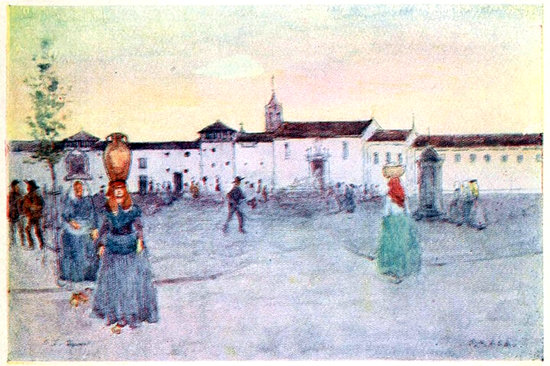
little square of San Francisco was an ancient
recessed fountain in the wall, and around it,
with water jars high and graceful like Roman
amphoræ, there fluttered a group of women
waiting their turn at the jet. Moving to and
fro and clustering in the deep shadow contrasting
with the blinding sunlight, these
full-bosomed, black-haired women, with fine
Roman heads and flashing eyes, were so many
points of glaring colour, forming a brilliant
giant kaleidoscope, whilst the chattering of
many tongues, the jest and taunt thrown over
the shoulder to rival or to swain, the careless
laughter, seemed to blend and fill the languid
air with a vague harmony to the ear, such as
the mixed discordant colours in their aggregation
produced to the eye. By the side of the
gay fountain stood the contrast that heightened
40its effect. A frowning monastery with heavily
grated windows high upon the wall, from which
glowered evil faces and thrust thievish hands.
For here, again, on this happy holiday afternoon
in Braga, the gaol-birds held their levee.
Beneath their bars stood their womenkind and
children, consoling or grieving; and little bags
hung down at the end of strings from the
windows to receive the gifts it pleased their
friends to send up to the sinister rascals, whose
hoarse ribaldry or whining appeal broke in ever
and anon upon the gay chatter of the fountain.
As if in irony, the church that faced
the monastery prison bore upon its front the
name the “Temple of the Sacred Order of
Penitence.” Of contrition one saw little sign
on the part of those who from behind their
bars looked for all their weary day upon the
church commemorating the unmerited self-reproach
of the “Seraphic Father St. Francis.”
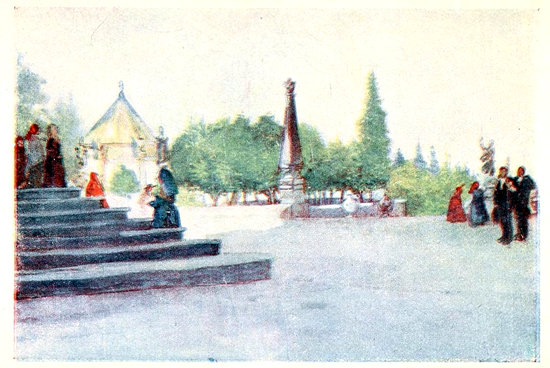
THE AFTER-GLOW AT BRAGA.
There is one thing throughout Portugal that
may be unhesitatingly condemned, and here in
Braga the evil is as patent as elsewhere. The
old traditional and, in many cases, historical
names of the praças and streets have been
changed wholesale and wantonly for those of
41passing and second-rate celebrities, political and
otherwise. In Braga the ancient Largo da
Lapa has been turned into Largo de Hintze
Ribeiro, after the leader of the Liberal party
in the Cortes, and there is hardly a town in
Portugal in which the principal squares and
thoroughfares do not bear the name of Hintze
Ribeiro, or of his rival politician, Conselheiro
João Franco. Serpa Pinto and Mouzinho de
Albuquerque, two fire-eating African explorers,
who in the jingo colonial fever of a few years
ago, when the feeling against England ran high,
were made heroes, are commemorated in streets
innumerable throughout Portugal, to the exclusion
of names which were often quaint and
significant landmarks of long ago.
The palace of the Archbishops of Braga
hardly corresponds in appearance with the
high claims of the primate, for the church
in Portugal is sadly shorn of its splendour,
and part of the rambling palace is a ruin;
but the cathedral offers many points of interest.
Enthusiastic local antiquarians are confident
that the first edifice was raised by Saint
James himself in the lifetime of the Holy
Virgin. But, however that may be, the present
42church certainly dates from the twelfth
century; and though, as usual, the seventeenth
century did its best to spoil and smother its
primitive simplicity; yet, as in the case of
Oporto Cathedral, which that of Braga much
resembles, the stern solidity of the original work
stands out clear from the frippery by which it
is overlaid.
The narrow nave is divided from the aisles
by massive low clustered granite pillars supporting
slightly pointed arches, above which
spring the simple groins that form the vaulted
roof. At the west end the church is darkened
by the gilt wooden ceiling that supports the
choir and the great gilded organ with spread
trumpet pipes that is the pride of the cathedral.
The choir itself, raised upon a loft and occupying
the whole west end of the church, is of
surprising magnificence; carving and gilding
have run wild; cupids, cherubim, angels,
musicians, and fabulous monsters jostle each
other exuberantly upon choir stalls, lecterns,
and panels: all the caprice, skill, and invention
of sixteenth and seventeenth century Portuguese
art have been lavished upon the work. And
the effect is rich in the extreme, but utterly
43incongruous with the sober early ogival of the
church itself. Even in the nave the massive
granite pillars have been crowned by later
vandals with florid capitals of carved gilt
wood. The walls, too, are much covered with
pictorial blue and white tiles, and the effect
of this, though inartistic, is quaint and not
displeasing. From the tiny cloister of plain
romanesque there opens the chapel of St.
Luke, where in two splendid sepulchres lie
the bodies of the Leonese princess, Teresa, and
her Burgundian husband, Count Henrique, to
whom she brought the county of Portugal in
the late eleventh century. These are the progenitors
of the Kings of Portugal, the parents
of Affonso Henriques, of whom we shall hear
much later; and to Donna Teresa is owing the
re-foundation of the Cathedral of Braga. In
the side chapels, in the cloisters, and in the
sumptuous chapel of St. Gerald, the patron
saint, there lie dead and mouldering archbishops
not a few; one of them, it is said,
incorrupt after eight centuries, though in consequence
of the flesh having been varnished he
has the appearance of a mulatto, and shows
to this day the honourable scar across his
44cheek that the warrior archbishop gained
whilst
fighting valiantly by the side of the Master
of Avis at the ever-memorable battle of
Aljubarrota, that gave the regal crown of
Portugal to the illegitimate scion of the House
of Burgundy.
Another coffin there is, just inside the west
door, that has for most people a still more
human interest. It is of gilt copper, apparently
French in design, bearing upon its
lid an effigy of a pretty boy of ten, the little
Prince Affonso, whose bones lie within, and
who died at Braga in the year 1400.
The exterior of the cathedral has, like the interior,
been much spoilt by later builders, the little
square towers having been crowned by a mean-looking
balustrade and crockets; but the exterior
of the sixteenth-century Lady Chapel is a favourable
specimen of the peculiar florid Portuguese
renaissance style called Manueline, of which I shall
have more to say later. Here at the Lady Chapel
at Braga it is more restrained and presents fewer
daring departures from the Gothic canons than
elsewhere, though the surprising intricacy of the
parapet and pinnacles show that the new spirit
was strongly moving when it was built. That
the artists who executed the work were Spaniards
45from Biscay is probably the reason why in this
instance the peculiar and more questionable
features of the style are less conspicuous than in
the productions of native Portuguese craftsmen
of the same period. The other churches of Braga
have little show. They are mostly rococo seventeenth-century
structures, granite and plaster outside,
and nightmares of carved gilt wood inside;
but almost under the shadow of the overloaded
rococo façade of Santa Cruz there is a lovely
little early ogival votive chapel standing by itself,
and containing a characteristically Portuguese
group of the dead Christ, infinitely touching and
beautiful.
And so through the quaint old streets the
stranger finds his way, passing by a house here
and there whose balconies and windows are
covered with the intricate wooden jalousies that
linger still as a tradition of oriental civilisation.
The whole place is bathed and flooded with vivid
sunlight, except where the lengthening shadows
fall almost purple in their depth; and wandering
without special aim, past the public garden called
the Campo de Sant’ Anna, towards the outskirts
of the city, I found myself at the foot of a steep
hill rising suddenly on the left of the walk.
46Climbing it, I found a little plateau on the top
with a tiny quaint seventeenth-century hermitage
chapel, the Guadalupe I learned was its name,
under a clump of shady planes and chestnut trees.
Around the plateau was a dwarf parapet upon
which two lovers were sitting, oblivious to all
around save each other; but as I reached the
parapet, and my eyes took in the prospect spread
before me, a cry of wonderment at its marvellous
beauty sprang involuntarily from me, and aroused
for a moment the attention of the youth and the
girl, who sat with their backs to the landscape,
caring nothing for such things. It was but a
glance they gave me, and I could enjoy thenceforward
without interruption or notice the rapture
I felt from the scene, the first of many such
peculiarly Portuguese prospects of rolling valleys
and soaring mountains to be gained from comparatively
low elevations; scenes such as in other
countries can only be attained after long and
arduous climbs up high mountains. I soon found,
it is true, that this view from the Guadalupe in
Braga was but a trifle in comparison with many
others to be encountered in the course of a few
weeks’ travel; but when it first burst unexpectedly
upon me it filled me with an ecstasy
47that no subsequent prospect, however fine, could
produce.
Just below me was a tangle of vines, and then
a mass of oaks, planes, cork-trees, and acacias,
with their fluttering light foliage, descending in a
gracious ocean of greenery of every shade across a
broad valley till they climbed half up the glowing
red mountains miles away. White houses gleamed
amidst the trees, and upon every hill-top a
hermitage or shrine stood out with its shining
cross above it. But that which attracted the eye
most was what looked like a giant white marble
staircase of immense width, leading right up the
side of a wooded mountain spur opposite, upon
the summit of which, at the head of the stupendous
stair, set deep in the verdure of woods,
stood a huge white temple. Seen from the Guadalupe,
the architectural approach up the mountain
side to the place of pilgrimage above looked
almost too vast to be made by man. Beyond, on
the right, rose a majestic range of granite peaks,
bare of vegetation, and scattered to the summit
with tremendous boulders; and over all the
setting sun threw a glow of golden light that
tipped the grey granite with crimson, orange, and
purple, and deepened the shadows of the climbing
48woods to umber and to black. The light fell,
and by-and-by only the crests of the red and grey
mountains glowed, for the woods across the vast
plain lay in the black shadow of the peaks. But
still, white and gleaming, like a stupendous staircase
of shining silver, there shone, clear from the
surrounding gloom, the great pilgrimage of Bom
Jesus do Monte. And so in the gathering
twilight, sated with the beauty of the inanimate
world, I slowly wandered down into the pulsing
city again, leaving the lad and his lass still whispering
on the parapet, alone in their happy
blindness.
From the door of the hotel in the Campo Sant’
Anna the tyrannical little street train that bullies
Braga several times a day carries us to the foot of
the Bom Jesus on the spur of Mount Espinho.
For nearly two miles of continuous gentle ascent
the road passes through a long stretching suburb
of humble houses; and then a quarter of a mile
through a close grove of shady trees brings us to
the outer portico of the sanctuary, a white gateway
at the head of a flight of steps, backed
apparently by a dense luxuriant wood. Hard by
the portico is the starting platform of an elevator
railway, by which pilgrims may, if they please,
49dodge the rigours of the penance, and arrive at
the summit without exertion. This course, on
my arrival, commended itself to me, and I left
until the next day a full exploration of the place.
On the summit of the spur, by the side and
behind the great church, white outlined by brown
granite as usual, there lies a land of enchantment.
Vegetation of surprising luxuriance is everywhere,
giant trees full of verdure nearly all the year
round, mosses, ferns, and flowers in every crevice.
Gushing fountains and cascades, rustic bridges,
and sweet winding paths through the woods,
everything that can conduce to tranquil repose
and comfort is here, with air so pure and exhilarating
at this great elevation as to raise the most
depressed to vivacity. On a picturesque little
clearing on the summit there are two or three
hotels, the principal of which, the Grand Hotel,
a long one-storey wooden building overhung by
great trees, I can vouch for as excellent.
The sanctuary is naturally a great resort
amongst the people of Braga in the hot summers
on the plain, and I cannot conceive a more
agreeable place to pass a few days for rest at any
time of the year; but the special religious element
draws many devotees who conscientiously go
50through the pilgrimage to the shrines, and on
the 3rd of May and Whit Sunday especially
many hundreds of pilgrims flock to the sanctuary
for devotion as well as for pleasure. The astonishing
feature of the place is, of course, the
devotional approach to the church up the side of
the mountain, and it is difficult in a few words to
give an idea of the eccentricity of the structure. It
may be admitted at once that the taste displayed
is atrociously bad, for it belongs to that eighteenth
century which has loaded Portugal with rococo
monstrosities; but the very vastness of Bom
Jesus, and its exquisite position, save it from
triviality; and looked at as a whole, either from
above or below, the effect is grandiose in the
extreme.
ON THE TERRACE, BOM JESUS.
Some sort of sanctuary had existed here from
the fifteenth century, but it was not until the
middle of the seventeenth that a miraculous
figure of Christ drew to the hermitage large
numbers of pilgrims, and gradually in the later
eighteenth century the present structures grew
under the care of successive archbishops of Braga.
Standing upon the spacious open terrace before
the church on the summit I looked down soon
after sunrise upon the scene spread before me.
51If the view hitherward from the Guadalupe was
fine this was more striking still. Wreaths of
grey mist still floated in the valley far below,
and the vast plain with Braga in its centre
embosomed amongst trees, and surrounded as
far as the eye reached with red-roofed hamlets,
still lay in grey shadow. But ridge over ridge,
crag beyond crag, in the background rose the
mountains all tipped with shining gold with
chasms of tender heliotrope; and then, before
the mind had well realised the beauty of the
contrast, the whole plain woke and smiled with
sunshine.
The platform or terrace upon which I stood
with my back to the church was flanked with
granite obelisks and statues, and fronted by a
wide stone parapet with a beautiful stone fountain
above it. By two broad flights of steps at the
sides a lower landing, or platform, was reached
with an arched fountain set in the face of the
wall, then by steps down to a similar platform,
whence a pair of flights led to yet another, and so
on, the parapets and balustrades in each case being
surmounted by obelisks and statues, the fountains
on the wall-faces being, like the figures, an extraordinary
mixture of sacred and mythological art.
52Each alternate pair of platforms, after the first
six, extending right across the structure and
paved with the favourite black and white stone
mosaic, was flanked by two shrines or little open
chapels, each with a beautiful life-sized coloured
group of figures representing scenes in the passion
of our Lord. Half-way down there was an
entrance from one of the platforms into a lovely
old-world terraced garden, overflowing with
flowers, palms, and sweet-scented verdure, and
overhung by the dark yews and pines that bordered
the graded descent from top to bottom.
At length after descending many flights of steps
and passing many terraced platforms with fountains,
figures, and obelisks, a large mosaic-paved
semicircular space was reached, ending in a stone
parapet. Turning and looking upwards from
here an extraordinary effect was presented. The
alternate zigzags of the stairs and the faces of
the walls, indeed all the architectural features,
were outlined, like the great church towering
far overhead, with brown grey granite, and faced
with perfectly white plaster. Stage upon stage
the great staircase rose, its parapets at the side
and the centre line being marked by statues
rising alternately one over the other at each
53successive stage of the ascent. Dark greenery,
palms, yews, acacias, orange trees, and trailing
flowers overhung the ascent on each side, and
it was not difficult to understand the devotional
fervour of pilgrims, who with tears and contrition
toil up this vast viâ dolorosa by the hundred on
the special anniversary, worshipping at the affecting
shrines on the landings, and ending in an agony
of remorse at the foot of the miraculous Christ
which is the main attraction of the Sanctuary.
Nor is the scene looking down over the parapet
at the bottom of the main flight less striking.
Sheer over the precipice you see the billowy
masses of dark thick woods far below. On one
side of the wide mosaic landing is a stair leading
to another chapel, and so down by a succession
of zigzag flights, bordered by thick greenery, to
the porch, set in its grove of yews, and leading
to the outer world. But mere words are weak
to describe the charm and beauty of the Bom
Jesus. There is nothing quite like it anywhere
else in Europe, and as sanctuary, health resort,
and architectural curiosity it deserves to be better
known than it is.
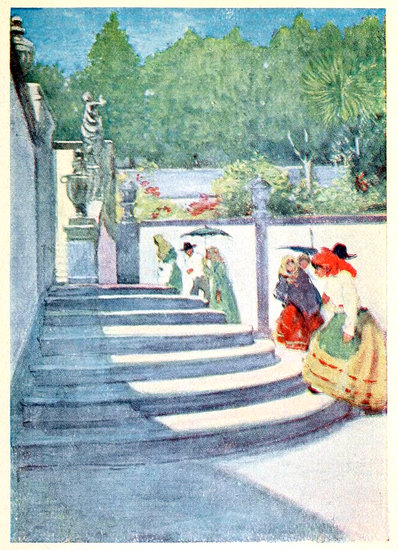
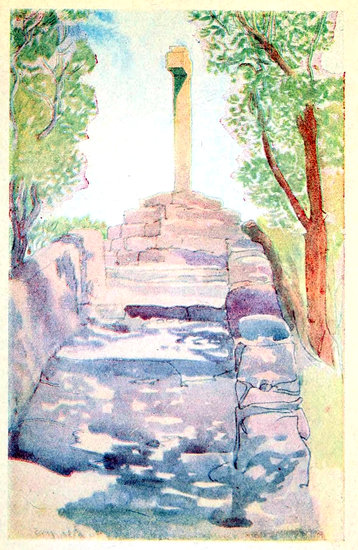
ON THE HOLY STAIR, BOM JESUS.
III CITANIA AND GUIMARÃES
54
I drove out of Braga in the early morning.
Passing over the ancient bridge spanning the
little stream, at which lines of women knelt and
washed their household linen, we left the city
behind us and faced the mountain range beyond
which lay my goal. Far above reared the
grey crest of Mount Picoto, with a gilt cross
dominating its highest point; and as the road
wound upwards and ever upward in zigzags,
at each turn of the path Braga, white and
shining, set in its bed of verdure, receded far
below. All around were glorious sun-kissed
peaks scattered to the summit with huge granite
boulders, as if the youthful Titans had there
indulged in the sport of stone-throwing. Then
over a hill pass, we dipped into a valley with
the Falperra range clear before us, and beautiful
St. Marta, with its crown of woods and its
gleaming hermitage in the foreground, almost,
55as it seemed, over our heads. Maize fields
spread across the valley and on the hill slopes
all around us; and on the wayside, and dividing
the fields, rows of oaks, chestnuts, planes, and,
above all, white poplars, ran, every tree covered
to the top by a trailing vine, loaded with
purple grapes. The effect produced is most
extraordinary, and the practice of thus utilising
timber trees is peculiar to this part of the
country.
For many miles, as we drove over valley
and hill, tall poplars by the thousand, their
light green leaves blending with the bronze,
served as vine poles; and every white cottage
had its shady trellis pergola before its open
doorway, the great luscious bunches of fruit
hanging temptingly over the heads of the women
busy spinning, surrounded by quiet, brown,
barefooted children.
The prevalence of granite is noticeable everywhere.
The fields are divided from the path
by granite walls, gate-posts, trellis standards,
and even telegraph poles are slender granite
monoliths, and the cottages themselves are
granite built, solid and weather-proof. Many
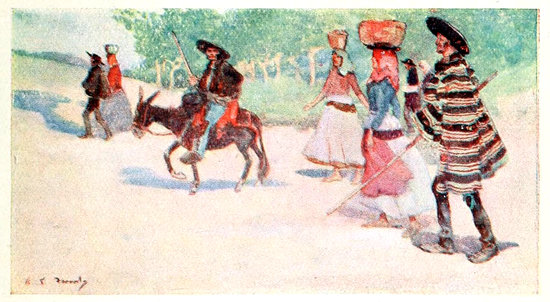
people meet us on their way to Braga: men in
56velvet jackets, wide, brown, homespun trousers,
often with inserted patterns of other coloured
cloth, and broad brimmed hats; the women,
gay with bright kerchiefs over head and
shoulders, but all barefooted, and many carrying
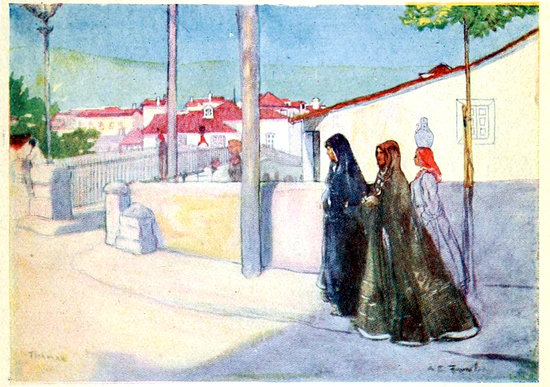
poised upon their heads the slender red
water jars, the fashion of which has known no
change since the time when the legions of
Augustus ruled the Celts and Suevians with
iron hand from Bracara Augusta. Ox-carts
slowly toil along, the bowed necks of the
bullocks bearing above them the elaborately
carved canga, here seen at its best. And still
the road lies mainly upward through the keen
pure air, the mountain slopes below and around
us green with pine forests, and above us the
eternal grey granite boulders. The land is
bathed in a flood of sunlight, with here and
there upon the widespread slopes and valleys
the dark shadow of a passing cloud. Even up
here amidst the masses of granite the fruit-laden
vine persists, covering and embracing
with its reaching tendrils poplars, oaks, and
olives on the sheltered slopes, whilst the proud
pines alone, towering on the exposed surfaces,
defy the creeper’s insidious caress.
57At length the high pass of the Falperra range
is crossed, and before us spreads a vast fertile
plain, with villages and homesteads scattered
across its bosom. Soon the grey boulders
disappear from around us, and the air grows
softer, though granite still supplies the place
of wood by the roadside. The fields of maize
are usually not above an acre in extent, and are
bordered everywhere by vine-clad poplars. It
is clear to see that the little farms are for the
most part cultivated by the owners and by hand
labour, for no yard of tillable soil is left to
waste. It is market day at Taipas, and flocks
of picturesque husbandmen and their womenkind
are wending their way into the village
from distant hillside hamlets and lonely granite
granges. It is a gaily clad and prosperous-looking
crowd that chaffer and bargain for
their herds of thin porkers, their vegetables,
fruit, red clay pottery, and flaring textiles; all
spread out to the best advantage beneath the
trees of the market-place and by the shady
wayside. The women almost invariably carry
upon their heads in long spacious baskets the
merchandise they buy or sell, be it live-stock,
produce, yarn for weaving, or household stuff;
58and as invariably is the burden covered with a
snowy cloth, and the woman herself is clean,
well-fed, and upstanding.
Taipas, the famous thermal mineral baths of
the Romans, did not detain me except to order
lunch to be ready when I should return a few
hours later to the primitive inn attached to the
ancient baths, for I was bound for a place still
more ancient than Roman Taipas, the mysterious
buried city of Citania, the Portuguese Pompeii.
A few miles’ drive upon an excellent road and
through a prosperous smiling country of maize,
vines, and olives, brought me to the tiny hamlet
of São Estevão de Briteiros, just a humble little
grey church, a large farmhouse, an inn, a few
cottages and a school. The road had led almost
at right angles to that by which we had reached
Taipas, and the Falperra range, which we had
crossed earlier in the day, again loomed nearer;
the nearest spur, a bold hill of nine hundred or
a thousand feet high at some distance from the
range, projecting far out into the plain, and
rising precipitously from the little village of
Briteiros, which was the present limit of my drive.
Long before we reached it the abrupt hill with
its tiny white hermitage chapel of São Romão
on the highest point had stood out conspicuously,
and seen from below looked impossible of ascent.
From Briteiros, however, the climb was seen to
be not so formidable; for a rough path started
from behind the humble schoolhouse, through
little farmsteads, gradually winding and zigzagging
up the precipitous slope through the trees
and brushwood that clothed the lower portion
of the hill. The population of Briteiros were
mostly at Taipas for the market, and a demand
for the services of um rapaz, a boy, to guide
the stranger to the lost city of long ago met
with the reply that no man nor boy was readily
available.
ON THE WAY TO MARKET, TAIPAS.
59After some short delay an aged woman produced
a substitute in the form of an elfin little
maiden of ten or eleven, with great black eyes,
half-bashful, half-bold, and jet black hair floating
unrestrained over her shoulders. With her bare
feet and scanty floating raiment she skipped like
a dryad from stone to stone over the rugged
pathway, looking back now and again as if in
wondering contempt at the lumbering stranger
slipping and floundering after her upon the
thick carpet of pine needles that clothed the
spaces between the boulders forming the track.
60Track it was and no more, scarped on the hillside,
and evidently had been made by hands; for the
stones still showed some signs of regularity and
the larger masses had been removed to the side,
whilst those which stood upon the causeway
itself proved by their flat and polished surfaces
that ages of human feet had passed over them
up and down the hill. As the weird little damsel
sprang with the free action of a wild thing from
stone to stone, her black hair floating in the
pine-scented breeze, it was easy for me to imagine
how the people who long, long ago, before history
records, had dwelt upon this hill and made
this causeway had looked and moved. Racial
inundations had passed over the land since then,
leaving traces perhaps in this or the other type
of the countryside, but the girl’s far-off ancestors,
dwelling always upon the same spot, had struck
deeper and more lasting root than their stone
walls and causeways, and as the little guide
flittered up the rough climb before me, the ages
seemed to fall away and the dim past to grow
in clearness.
Half up the hill the trees cease, and the stony
causeway rises precipitously through a region of
purple heather, broom and yellow gorse, thickly
61strewn with giant granite boulders. Presently
the ruins of a wall of rough stones cemented
together stretch across right and left; and running
parallel, and just inside of it, a dry water channel
well made of hewn stones. The ground-plans
and walls a yard or two high, of houses are on
all sides of us; and climbing a little higher and
turning the shoulder of the hill we see spread
before us, covering the whole of the south upper
slopes of the declivity, a vast stretch of uncovered
ruins—a once-populous town of the unrecorded
past.
Before describing in detail these, by far the
most complete and interesting Celtiberian remains
in the Peninsula, a few words may be said with
regard to the discovery and exploration of them,
as well as to the theories as to their origin. For
reasons which need not be re-stated here the
Celtic element was less intimately mixed with the
Iberian in the north-western part of the Peninsula
than elsewhere, and the tribes in this part of the
country were those which withstood longest the
imposition of the Roman bureaucratic system
after the assassination of the patriot Viriatus, and
the fall of Numancia in the second century B.C.
Not till the time of the great Julius did the
62legionaries, stationed then permanently at Braga,
sweep all this province clean of revolt, and bring
the tribesmen to their knees after dire slaughter
and destruction. The Celtiberian tribes in this
remote corner had lived their simple pastoral
lives from time unrecorded in small family clans,
each independent, with its own law and its own
gods; but for purposes of mutual defence in later
times confederations of many clans were formed,
mòr thuatha, as in Ireland. Each of these confederations
possessed a fortified centre or stronghold
as a place of assembly and refuge, usually
upon an eminence, wherein the scattered clans
might meet for defence or in council to treat
of common interests. The Roman historian,
Valerius Maximus speaks especially of some such
fortress upon a mountain in Lusitania, and praises
its inhabitants for their stubborn bravery. He
calls it by the name of Citania, and antiquaries
have given to the extensive ruins now before us
that name during the last few years, on the
assumption that this may be the place referred
to by the Roman chronicler.
Vague stories had always pervaded the countryside
of buried ruins, with the accompanying
legends of witches, warlocks, and enchanted
63Moors existing upon the hill of São Romão;
and in the eighteenth century the curate of
São Estevão de Briteiros at the foot of the hill
had brought down from the hill-top and placed
in his church porch a great mysterious slab of
stone covered with mystic devices and of strange
fashioning. But not until our own times did
a man come with public spirit enough to devote
his life and small fortune to the exploration of
this city of the past, for in Portugal public encouragement
of any such objects is rare indeed.
This man was Dr. Sarmento, who for many years
until his death recently, made a labour of love
in uncovering systematically the vestiges of the
prehistoric city.
All over the plain, for many miles around,
the ruins of Celto-Roman villages have been
found, and in many cases partially explored by
Dr. Sarmento and others; the objects discovered,
like those found in Citania, having been deposited
in the museum at Guimarães belonging to the
explorer, but in consequence of his death henceforward
to be a public institution subsidised by
the State. As I shall point out when I describe
my visit to the museum, the objects unearthed
at Sabroso, St. Iria, and other neighbouring places
64are immensely more numerous than those from
Citania itself; great masses of coins, personal
ornaments, arms, inscriptions, and utensils in the
museum proving that these places existed far
into Roman times, and perhaps much later.
The chaotic condition of the Sarmento collection
at present, and the apparent absence of
any skilled and enthusiastic guardianship, have
probably been a reason why certain investigators
have attributed to Citania many objects discovered
elsewhere, and have founded upon them
theories which must necessarily be misleading.
Dr. Hübner, who did not see the place personally,
aroused the wrath of Dr. Sarmento in this
way, and other archæologists have spoken somewhat
loosely as to the nature of the finds in the
Citania excavations. The great interest of the
hill stronghold, indeed, consists in the fact that
we have here practically an unspoilt Celtic or
Celtiberian town, in which Roman civilisation
had but little part. It will be seen by the objects
actually unearthed that the place was
inhabited after the Roman influence and language
had dominated the district, as late, indeed, as
the time of Hadrian; but of purely Roman
remains, so plentiful elsewhere in the district
65there are in Citania hardly any; the construction
and plan of the houses having much in common
with the Irish and Scotch Celtic cashels, and the
absence of all indications of Christianity being
complete.
Following a well-paved causeway of some
seven or eight feet wide, the flat stones of
which have been worn smooth by countless
generations of forgotten footsteps, we can perceive
perfectly the ground plan of the houses
on each side. In most cases Dr. Sarmento has
excavated down to the stone-laid flooring of the
houses inside, and to the base of the masonry
outside; and it is possible to wander through
the main lanes or streets of the town, crossing
each other at right angles here and there, and
interspersed by little circular paved open spaces,
and to reconstruct in the mind’s eye the primitive
life of this city of long ago. Here, for instance,
just inside the wall by which we entered is a
little square house, some twelve feet wide, containing
two rough millstones, of which many
have been found. The walls are of huge, rough
stones, evidently taken as they came and fitted
together with small stones where necessary to
fill in interstices, the whole cemented together
66by some hard rubbly compost. Running past
this building and through the town (in one or
two cases, indeed, through the houses themselves)
is one of the several stone water channels protected
by low walls on each side, and supplied
in ancient times by the springs that still gush
out plentifully on the hillside.
Some of the houses are much larger, and must
have contained two or more apartments. But
what strikes the eye of the observer most is the
relatively large number of purely circular edifices,
and this it is that has mainly attracted the speculations
of archæologists. Mr. Oswald Crawford,
who went over the place whilst the excavations
were in their earlier stages many years ago, was
mistaken in his estimate that the round buildings
were eight or nine times more numerous than the
square, and he founded upon this and other data
the opinion that the whole place was a great
granary, where the food of the tribes might be
stored in safety. So far from the round houses
being eight times as numerous as the square,
found at least four square houses to every one
round; but that which struck me as most curious,
and so far as I could learn, it had not specially
attracted the attention of previous visitors, was
67that in a large number of cases the round houses
were enclosed in a square or angular walled space,
not very much larger than the circle, but leaving
a passage of some two feet wide, in most cases on
the right-hand side, between the two walls, leading
to a space at the back between the circular
wall and the wall of the square enclosure, the
left-hand side of the circular wall being mostly
built to touch the square wall on that side.
Dr. Sarmento was of opinion that the space thus
formed was for the purpose of sheltering cattle
and domestic animals, and says that he had found
some rough stone excavations like troughs in
them, with, in one or two cases, a ring in the
wall as if to tether beasts. The width of the
entrance passage and the extent of the enclosed
space in the rear of the circle would be too small
to admit any large animal; but probably goats
would be housed in them easily. In one or two
cases I noted that the stone post forming a jamb
to the entrance to the passage between the round
house and the square enclosure was grooved on
the inner surface. This in Dr. Sarmento’s opinion
proved that the entrance to the passage was closed
by a lifting hatch of wood, which to some extent
confirms the idea that the back space was intended
68to shelter animals such as goats, as a lifting door
set in a groove would be much less likely to be
forced by them than a swing door turning, as the
house door did, on wooden pegs.
There are very few instances of party walls
being utilised for two adjoining houses, though
the buildings are often only a few inches apart.
Even in the case of the round houses enclosed in
square spaces and touching the square wall, the
circular structure is quite complete at the point
of contact. In one instance I measured a large
walled parallelogram fronting on the principal
causeway, seventeen yards in length, enclosing
within it one square house of nine yards wide,
and two circular houses, one on each side, the
structures in each case being complete, but the
circular walls in this instance merged for a few
inches only at the point of contact with the square
outer wall at the side. Whether these square
or outer enclosures were tiled or were merely
enclosed yards it is difficult to say, but that the
houses themselves were so covered is evident from
the immense number of well-made red shards
scattered everywhere, and particularly inside the
houses, the tiles being turned up at each end, so
that a concave tile to cover over the joint between
69them would make a roof covered with them quite
watertight. A door jamb and lintel in one
house showed a well-carved rope moulding, but
in most cases they were plain, the lintels and
doorsteps containing, however, at the side a
square-cut hollow, in which a block of wood was
apparently inserted to receive the wooden peg
or pivot which formed a sort of hinge for the
door, an arrangement still adopted for the doors
of barns, &c., in the neighbourhood; though
Dr. Sarmento was of opinion that no wood was
employed in the construction of the houses themselves,
the polished rounded stones fixed to the
walls in some of the houses, which Dr. Hübner
considered to be bases of pillars, being in the
opinion of the Portuguese archæologist seats for
the inhabitants.
The round houses are usually about fourteen
feet in diameter, and the walls remaining rarely
rise above four or five feet from the surface.
The doorstep is usually raised a foot or so
above the level of the ground. One round
house has been tentatively rebuilt by Dr. Sarmento
on the level space on the top of the
hill, an unattractive beehive-looking structure
without windows, but later investigation convinced
70him that he had built it too high; and
that it should not be of so great an elevation
as the measure of its diameter. The principal
thoroughfares running transversely on the slope
of the hill are carefully walled upon the scarped
inner side, and in some cases the stone water
channel runs alongside of it.
On reaching the bare space at the very summit
of the hill, upon which the little modern Christian
chapel stands, a good idea may be formed of
the whole plan of the place. The town, covering
perhaps five or six acres, all lies over the crest
and down the south and south-west slopes. The
wall by which we entered from the south is
apparently the inner wall of three, and practically
encloses the top of the hill and the centre of the
town on the slope. The second wall, which
shows signs of a moat, is of greater extent,
following the irregular contour of the hill,
whilst the third or outer defence extends far
down almost to the plain on the west and south-west
side; traces of buildings, although but
little explored, being very abundant between
the two inner walls on the south and south-west,
and clearly defined paths leading down from
the main city to the outer defences and the
71suburbs. In consequence of the formation of
the ground, attack was to be looked for mainly
from the most accessible point, namely, the north-east;
for here the three lines of defences are
almost close together, and each of the walls is
here brought to a rough angle. From the apex
of the outer wall on this side there are indications
of another defence running straight out at right
angles along the saddle which connects the hill
with an outlying spur easy of approach, and at
the end of this long projection there appears to
have been two parallel horizontal outworks
running across the end of the saddle, this being
the vulnerable point of the fortress.
It is easy to imagine how almost impregnable
such a place could be made. The hill at any
other point than this could only be scaled, if at
all, with the greatest difficulty, and the huge
boulders on its side would enable even weak
defenders under their cover to hurl down stones
or spears upon an advancing foe. The south
side of the hill is the least accessible of all for
any considerable body, and there the defences
are the most distant and the weakest.
In the midst of the ruined town I found a
bright intelligent peasant lad, busy arranging
72fragments of pottery upon a stone for the later
inspection of some one in authority; and from
him I heard much quaint and simple local folklore.
His own interest was greatest in what
he called the cemetery, four or five small grave-like
troughs, about three or four feet long and
a foot deep, neatly made and lined with dressed
stone slabs. The so-called graves lie close to the
causeway and amongst the houses, in an irregular
group, and can hardly have been sepulchral,
considering their size and position; Dr. Sarmento
inclining to the belief that they were troughs for
feeding cattle. The cemetery, if there be any,
would probably lie far down the slope outside
the second, perhaps outside the outer, wall, but
here no excavation of any importance has been
executed. At some little distance down have
been found three perfectly plain dolmens of the
usual shape, which are usually sepulchral; and
doubtless extensive exploration around them
would reveal human remains. My peasant
friend was also much concerned in a mysterious
“mine,” as it is called, from which he assured
me, in awe-stricken tones, that enchanted Moors
came at night and carried evil over the plain. It
is supposed that this cave, which is of no great
73extent, some two yards in diameter at the mouth,
and a few yards deep, was adjoining or under the
place where the great slab which the country-people
call Pedra Formosa, the handsome-stone,
to which I shall revert presently, was found.
I have mentioned that Mr. Crawford was of
opinion that the round houses were granaries,
but seeing that the Celts of Ireland and Scotland
frequently built and lived in round houses within
their cashels, and bearing in mind the existence of
the spaces for animals, which I have described as
attached to those of Citania, I am strongly of
opinion that, comfortless as they appear, these
were the veritable dwellings of many of the
neolithic folk who for centuries held their foes
at bay upon this headland jutting out upon the
rich plain of Guimarães. Still another solution
of the round-house problem is, as I understand
his words, suggested by my friend Professor
Altamira in his Historia de Espana y de la Civilization
espanõla. The earlier generations of this
people, he says, buried their dead under dolmens
which when covered were circular; and later
generations retained the tradition of circular
sepulchres. “They were built round,” he says,
“with a sort of domed roof, the middle of which
74was supported by a pillar of wood or stone.
Some of such tombs had passages (or galleries)
to enter by—which was frequently the case also
with the dolmens—and some had lateral chambers....
Of this class are those discovered at Citania,
on the hill of San Roman in Portugal.” Apart
from the fact that no human remains have been
found in these round houses at Citania, there is
no sepulchral suggestion about them. They are,
it is true, if Dr. Sarmento be right, windowless
and rough, but the comparison must not be made
with the dwellings of to-day, but with the haunts
of cave men, who had been the progenitors of the
early settlers of Citania; and judged by that
standard, these stout, weather-proof, stone houses,
with doors and an enclosed separate space behind
for cattle, were almost luxurious. In any case,
a close examination of them left in my mind no
doubt at all that they had been the dwellings
of human creatures in the earlier stages of
civilisation.
It required no great effort of the imagination
to people the narrow paved paths on the hillside
and the little round central spaces with the
dwellers in these rough abodes: wild-looking,
shaggy men, with long hair, and clad in skin or
75rough woollen garments, going about their daily
toil as hunters, husbandmen, potters, or smiths, to
paint to oneself the alarm of an approaching foe,
the savage warfare to repel attack, and finally the
victorious host of Roman legionaries of Augustus
levelling the poor homes, slaughtering, ravishing,
destroying, until the poor remnant of the vanquished
knelt in the dust and bowed their necks
evermore to the yoke of discipline and civilisation.
The place continued to be the abode of men
long afterwards, for Latin became the speech of
some people who lived there, and coins as late as
Tiberius and one of Hadrian (117 A.D.) have
been unearthed at Citania; but with the Roman
officers supreme at Braga, and the whole plain
prospering and smiling under the arts of peace
and Roman luxury, poor Citania on its bold hill-top
lost its reason for existence, and must have
dwindled, until long before the time of the Goths
and Suevians all men forgot it, and the ages
covered it with the mantle of earth, undisturbed
till now.
But whilst I am thus speculating, my little girl
guide is getting restless, and the westerly tending
sun tells me that I have long outstayed the
appointed time when I was to return to Taipas.
76So, reluctantly, and with my brain full of idle
fancies which made me dream of creatures such
as those I have pictured lurking behind the thick-strewn
boulders, and challenging my intrusion
upon their stronghold, I slowly paced the paved
lanes again through the lines of stark ruined walls,
and so out upon the precipitous hillside down to
Briteiros, where the carriage awaited me in the
grateful shade.
The market people were homeward bound
from Taipas now; the women with their purchases
or unsold wares swaying rhythmically upon
their heads as they walked, and the men leading
live stock or bent beneath burdens, but never too
heavily laden to prevent them from courteously
saluting the passing stranger. The inn, nearly
empty of bathing visitors now that the summer
was past, was feverishly anxious to do its best;
and, though Citania had detained me for hours
longer than I had reckoned, Taipas contrived to
offer me a tolerable lunch, the first meal I had
eaten in that long day of delight. Upon a wall
of the open courtyard before the inn is an ancient
fountain with a pompous poetical inscription, setting
forth that John I. of Portugal, Para que a
morte mais tropheos não conte, “that death should no
77more trophies boast,” had raised this miraculous
fountain of healing water. But John I. was a
mere modern in these ancient thermes; for here
the great Hadrian was cured of his malady, and
founded the sumptuous baths, of which extensive
remains have in recent times been discovered, but
not explored to any extent. In a field nearly
opposite the inn is an enormous block of granite,
upon which a long Roman inscription tells that
this work was erected by the orders of the Imperial
Cæsar Trajan, son of Nerva, conqueror of
the Germans, and much more to similar effect;
whilst upon another face of the block an interminable
list of modern Portuguese names of
gentlemen interested in the rehabilitation of the
baths in recent times shows the universal hankering
after immortality in company with the great
felt by the little men of the world.
The bathing establishment itself is primitive
enough, consisting of about twenty baths large
and small, in separate wooden compartments, built
round three sides of a square, the temperature of
the water being about 85° Fahr., very abundant,
clear, and bright, and with a strong sulphureous
taste and smell. The waters are said to be
extraordinarily efficacious in cutaneous affections,
78maladies of the mucous membranes, laryngitis,
bronchitis, and rheumatism, and as many as 1500
patients visit them from May to September every
year, the flow of water being a quarter of a million
litres a day.
All the way from Taipas to Guimarães the
road lay through maize fields bordered thickly
by vine-covered poplars; a prosperous land of
well-fed, laborious people. Near the ancient city,
the birthplace of the Portuguese monarchy, the
ground rises, and the pine forests spread for miles
on the uplands all around, the fresh sweet scent
of the woods adding one more sensuous joy to
a closing day of incomparable loveliness. As the
carriage clattered over the cobble stones, through
the narrow streets of the town, and so into the
beautiful alameda and the public garden, in which
the principal hotel stands, there rose as if from
the end of the alameda the giant granite peak of
the Penha, all glorified and transfigured by the
setting sun. The mountain, almost sheer as seen
from this side, seemed to tower right overhead:
green woods clothed its sides up the greater part
of its height, and then, like a wall, sprang a
precipice of bare scarred rock, now orange and
purple against a violet sky. On the summit of
79the apparently inaccessible saw edge of the peak
stood out the white walls of a building, which
may have been a hermitage, but I am told is
now a guest-house, where in the most torrid
summer the citizens of Guimarães find cool
breezes and refreshment. As I gazed, entranced
at the changing colours of the sunset on the
peak—orange deepening to crimson and to bronze,
purple fading by soft degrees to slaty-blue, and
the rose-pink of the growing after-glow softening
the rugged outlines with tender light—there came
the clanging of an acolyte’s bell, and across the
alameda there wound a devout little procession
bearing the Host, with flaring tapers, swinging
censers, priests, and choristers. It was the one
note needed to complete the picture. Guimarães
in the gathering twilight took me back in one
happy moment to the ages long ago, when
simple faith unbroken reigned, and all was beautiful
and all was true.
Guimarães has a proper pride in itself, and
boldly asserts its claim to be not only one of
the most ancient, but the most glorious and
prosperous city in Portugal.
“A nobre Guimarães tem por brazão
Ser Corte primeira Portugueza,”
80sings the poet, but the pride of Guimarães extends
far beyond this boast. Seated in the centre of
the province of Minho, in the very garden of
Portugal, with abundant streams and fertile valleys
for miles round, protected by the mountains on
each side that enclose the plain from inclement
winds, the town is in an ideal situation. Forming,
as it did in old times, one of the fiefs of the left-handed
royal house of Braganza, that made the
dukes richer than the king, one of the legitimate
Infantes is said to have exclaimed jealously,
as he looked down upon the rich domain,
Quem te deu não te via; se te vira não te dera,
“he who gave thee never saw thee; if he had
seen thee he would not give thee,” and one of
the greatest of Portuguese writers, Manoel de
Faria, speaking of Guimarães said: “If the Elysian
fields ever existed on earth it must have been
here, and if they did not exist they should have
been created in order to place them here.” But
another subject of pride, and an article of faith
with all good citizens of the town, is that
Guimarães possesses the most beautiful women
in Europe. Personally I must confess that they
did not strike me as being more comely than
their sisters of the rest of North Portugal, especially
81of Braga and Coimbra, but from ancient
times the women of Araduca, the modern
Guimarães, were held to be pre-eminent, and it
is too late now to gainsay it, confirmed as it is
by writers Portuguese and French innumerable.
In any case, the city is as beautiful as it is
historically interesting. Here on the site of the
ruined ancient town of Celts and Romans, a
Leonese princess, in the tenth century, founded
the great Benedictine house, around which the
mediæval town gradually grew. But its principal
glory began when Count Henrique of Burgundy
and his royal Leonese bride, Teresa, came to
govern Portugal as Count, for his father-in-law,
Alfonso VI., the friend and foe of the Cid. Here
at Guimarães in the splendid castle, even now
sturdy in its dismantlement, the first Count of
Portugal held his court, and here his great son,
Affonso Henriques, the national hero and first
king, was born in 1109 and passed his youth.
It is impossible to imagine a ruin more stately
than that of the grand mediæval castle which,
upon a gentle eminence on the outskirts, dominates
the town. Granite built upon a granite
base, the walls sharp and clear to-day, look as
if cut but nine years ago instead of nine centuries.
82Here is the dignity of age without its feebleness.
A vast battlemented outer wall, with corner
bastions and pointed crenellations, surrounds the
majestic keep, the monolithic battlements of
which, huge single stones, stand uninjured still
by time or the more destructive hand of man.
The cyclopean masses are reddened now by lichen
and stained by weather, but nine centuries have
failed to crumble them, and they stand a splendid
monument of the first of the two outstanding
epochs in Portuguese history, when the nation
was stirred with vast ambitions and endowed with
heroic energy to fulfil them. Affonso Henriques
of Guimarães was the protagonist of the first
epoch, that of national independence; Prince
Henry the Navigator, the protagonist of the
second, that of national expansion.
Guimarães is delightful, and an artist might
spend a month in its quaint streets and alleys
without exhausting the “bits” that call for
delineation. One charming old-world corner
is the square in which stands the church that
alone remains of the vast monastery founded
by the Leonese Princess Munia—the Collegiada
the townspeople call it, although I believe it
bears officially another name. The early florid
83Gothic tower is a beautiful one, and more
beautiful still the detached rood canopy at its
west end, with its quaint mixture of early Gothic
with Greek and Byzantine ornament. Opposite
this is the low-arched sixteenth-century arcade
beneath the town-hall, and the houses that
surround the irregular little praça are in picturesque
keeping with the rest. There is in a
street called Largo dos Trigães, one of the finest
stretches of crenellated wall that ever I saw. It
must be three hundred yards long, and at least
five-and-twenty feet high, independent of its
pointed battlements, and is in the most perfect
preservation though many centuries old. It is
said to enclose the grounds of a disestablished
monastery, for Guimarães was in old times
monastic or nothing.
But curious and interesting as Guimarães is,
I was not drawn thither mainly to see the town,
but to examine in the Sarmento museum the
objects discovered in the excavation of Citania.
The collection is at present in a state of chaos,
which may possibly be remedied when the reconstruction
of the house is completed by the
authorities. The number of objects is immense,
though by far the greater part of them came
84from other places in the neighbourhood than
Citania, and are mainly attributable to the
Roman period, though many of them are very
early and ante-Christian. The few purely Roman
objects, however, found at Citania are neither
peculiar to the place nor of special interest.
What is far more attractive to the student are
the relics that exist of the real and original
Celtiberian makers of the hill town.
First of all is the famous Pedra Formosa, to
which reference has been made. It stands at
present in the open at the back of the Sarmento
house, but protected from the weather by a low
roof which unfortunately prevents a photograph
being secured of it. It is a thick slab of granite,
seven feet long by nine feet wide, and notwithstanding
the contention of Dr. Hübner, who
has not seen it, I am convinced that, whatever
may have been its purpose, its position was intended
to be horizontal, and that it is not a
sepulchral stone to be set on edge. At present
it is mounted on four low posts or pillars,
like a table, and the elaborate carving upon it
can be consequently seen plainly. At the top
of its shorter diameter in the centre is a hollow,
ending in a point, the outer circumference of
85the hollow being about the size of a human
head. From this, extending downwards about
six feet to a semicircular gap cut into the
stone, at the foot is a raised cord-like pattern
cut out of the thickness of the stone, beneath
which is bored a tunnel, or channel, leading
from the point of the hollow cone at the top
down to a hole through the stone at the bottom,
a few inches from the semicircular gap. From
the base of the hollow at the top, leading
obliquely to the sides, are two other raised
cord-like ridges similar to that from top to
bottom; the main design being roughly that of
a human being with the hollow for the head,
the straight cord from top to bottom for the
body and legs, and the oblique cords for the
arms. The whole of the spaces between the
cords are filled with a most intricate series of
designs, beautifully incised in the stone, concentric
whorls, curves, and scrolls being in each
case the main motive.
Whatever may have been the purpose of the
stone—religious, sacrificial, or tribal—the work
must have occupied many men for a long
period, and the skill, both of design and execution,
prove that the artificers must have
86reached a relatively high stage of artistic development.
The art is obviously ante-Christian,
and the form of the stone suggests that it may
have been sacrificial, with the hollow cone to
receive the blood from a severed jugular and
the tunnel beneath the central cord to convey
it to where the priest stood in the gap to
catch it as it ran through the hole at the
bottom of the stone. The incised design shows
no indication of Greek or Roman influence, but
the concentric curves are identical with some of
the earliest ornamental decoration of the stonework
in the museum brought from other
Celto-Roman places in the neighbourhood, and
also with the decoration upon Celtic pottery
found elsewhere in Portugal and at Carmona
in Spain.
87
A stone of great interest found also at Citania
may perhaps add more to our knowledge than the
mysterious Pedra Formosa. It bears an inscription
in the Celtiberian character, of which comparatively
few specimens have hitherto been discovered, and
no key has been found to decipher them. One
of those known and reproduced by Dr. Hübner
was found at Peñalba de Castro in Spain, and
appears to be nearly identical in character with
that from Citania; whilst another, also in Hübner,
brought from Barcelona, presents several important
differences. The Citania inscription is here
reproduced, and I am indebted to Professor Rhys,
the famous Celtic authority, for an interesting
suggestion, namely, that the whole inscription,
although written in the unknown Celtiberian
character, may be intended to be read in Latin;
in which case the first line and a half might
represent Syatenunius. This point, however, I
must leave as being too abstruse for a book of
this kind. We are on firmer ground in the case
of the very numerous specimens of red pottery
found at Citania and stamped with a mark entirely
unknown elsewhere. The marks of Roman
potters on jars and pitchers were always printed
88in small letters outside the mouth, whereas the
marked pieces in question from Citania bear in
letters an inch long inside the mouth “Camal” or
“Arg,” and sometimes both words, and scores of
red tiles have also been found similarly marked
ARG CAMAL. Upon a lintel-stone from Citania in the
museum I read the words CORONERI CALI
DOMUS, and another, apparently from the same
house, is mentioned by Dr. Sarmento, but which
I did not see, bearing the inscription CRON
CAMALI DOMUS, most of the pottery bearing
Camal’s name having been found near
this house. Whether Camal was a Celto-Roman
potter, or, as seems much more likely, a great
personage or chief of Citania, is a point yet to
be decided; but from the fact that the name on
the clay vessels is not situated where the potter’s
mark is usually inscribed, would tend to the
belief that he was the owner rather than the
manufacturer. Arg, or Airg, as it may be read,
may have represented a Celtiberian title or
dignity, and Camal, or Camalus, is undoubtedly
a Celtic name. It is unlikely, moreover, that
if Camal had simply been a potter his son
Coronerus would have considered it necessary to
record upon his stone door-lintel the fact of his
89descent, which he probably would have done if
his father Camalus was a person of consequence.
Another peculiar fact in connection with the
incised ornamentation upon stones at Citania is
the repetition of the Swastick or wheeled cross
and the wheeled whorl, which are of pre-Christian
and oriental origin, this design being also quite
frequent in the objects found in other places in
the neighbourhood, and amongst Celtic remains
in other parts of the Peninsula.
The death of Dr. Sarmento has, of course, put
an end to his self-sacrificing life-task, leaving by
far the greater part of the exploration of the
outer zones of Citania unattempted. It is almost
too much to hope that any other similarly public-spirited
Portuguese will provide the funds needed
for the purpose, for there is little enthusiasm for
such subjects in the country; but if funds could
be obtained to excavate extensively the lower
slopes of the hill on the south side where
numerous hillocks suggest that sepulchral remains
may lie beneath, it is probable that discoveries
of great importance in Celtiberian
civilisation would be made, and perhaps the
riddle of the Celtiberian alphabet solved.
IV BUSSACO
90
After losing sight of the marvellous view across
the river of the city upon its amphitheatre of hills,
the road from Oporto towards the south runs
through a country of drifting sands parallel with
the seashore. Pines bending away from the prevailing
westerly wind stand singly and in clumps at
first, and then in vast tracts, as in the Landes about
Arcachon, binding the unstable soil together; and
within a few miles of Oporto here and there a
sea-bathing village of châlets and houses of entertainment
breaks the monotony of the scene. It
was but seven in the evening, but the autumn
day had already sunk into dusk with an angry
streaked black and crimson after-glow when I
came to the little thermal bathing village of
Luzo, on the lower slopes of the mountains that
cover the whole of the north of Portugal except
the strip of country bordering the sea. For some
miles, ever since we had left the main railway
91line from Oporto to Lisbon at Pampilhosa junction,
we had been rising, whilst the pines bordering
the line had been growing thicker and more
sturdy, and from Luzo onward the way grew
still steeper. The stars shone brightly, but a
dew almost as heavy as rain was falling as the
carriage that had met me at the station drawn
by two gigantic mules, rattled along the excellent
road through Luzo.
There is always a feeling of uncanniness in
speeding through an unknown town at night for
the first time. Here at Luzo little white cottages
flashed past us, a dim light flickered before a
shrine at a street corner, a man dimly visible
tinkled a bandurra a by the side of a grated window,
little groups whispered mysteriously in the semi-darkness:
they were all shadows to me, whilst I,
poor waif, to them was nothing, for the clatter
of the mules and the rattle of the carriage over
the cobble stones were the only signs they had of
the momentary presence of a man who, like a
ship passing in the night, flitted in the darkness
through the village which to them was life and
death and all things. Our road lay ever upward.
By the dim light of a waning moon one could
see the trunks of great pines close together, and
92the soft moist air was heavily charged with the
grateful balsamic scent of the trees. As we toiled
patiently upward and still upward, in the darkness
of the night the hush of the woods fell
deeply upon us, for no breath of wind stirred
the lofty tops that closed over us like an arch,
and the summer night-birds had already taken
flight farther south. Presently we passed through
what in the dimness looked like an imposing
architectural gateway set in a high wall, and then
the wood grew perceptibly denser. By the wayside
the bank on the left rose sheer from the
road covered with verdure, and one felt rather
than saw that up and up, as it seemed infinitely,
the great trees towered higher and higher upon
the steep slope, whilst on the right hand the
huge eucalyptus trunks shining white through
the blackness of the night, stood upon the brink
of a precipitous drop, from which emerged now
and again tree tops and a tumult of vegetation
that showed, even though one saw but little of
it, that we were in the midst of a luxuriant forest
such as those I have seen on the Amazon and
in Brazil, but never before in Europe.
Presently we drove into a circle of light, and
one of the surprises of my life burst upon me.
93A palace so stately and beautiful, so new and
spotless withal, as to seem like a scene from a
fairy tale. But no—this flashing white dream in
stone is no scenic illusion; the carved tracery,
like petrified lace, and leaves, and branches, infinite
in caprice and variety, the lovely cloistered
terrace, the monumental staircase, and the almost
insolent wealth and intricacy of sculptured ornament,
are all solid chiselled stone, and this
splendid royal castle in the most wondrous wood
in Europe is an ordinary hotel, or rather an
extraordinary one run on ordinary lines.
The first instinct of a traveller when he lights
upon such a find as this is to keep it to himself
rather than diminish his enjoyment in the possession
of his secret by sharing it with others;
but Bussaco is big enough, and it would be
ungenerous to hide it. It was built by the
Portuguese Government, it is said, for a royal
residence, and is hardly yet quite finished, for
an annexe is now being constructed for the use
of the royal family during their summer sojourn,
and some of the frescoes in the main castle are
still to be added; but it is difficult to understand—unless
the intention really was, as stated,
to make the place a permanent royal residence—the
94reason for spending the vast sums of money
that the place must have cost upon a house of
public entertainment. However, there it stands,
with its stately tower, its majestic carved staircase,
and all its heraldic blazonry, in the midst
of a crown domain seized from a Carmelite
monastery, probably the most beautiful hotel in
Europe, certainly by far the best in the Peninsula;
in an exquisite climate, with perfect sanitation
and water, a good white wine grown on its own
hillside, a cuisine with which no fault can reasonably
be found, cleanliness, and order; a Swiss
lessee who speaks English fluently and understands
English needs, a bill of almost disconcerting
moderation ... and the woods! For, after
all, the hotel-palace, the golf-links, the tennis-lawn,
the ballroom, and all the rest of the added
attractions of the place, are but subsidiary incidents
to the terrestrial paradise that surrounds
it, enclosed in its high granite wall six miles in
circumference.
Manueline Architecture at the Hotel, Bussaco
It was night when the gleaming salt-white
palace first flashed upon me out of the darkness,
but when I opened my shutters as the dawn was
breaking the next morning, and stepped out upon
the wide battlements of the castle, the scene
95before me was so wonderful as to force from me
an involuntary prayer of praise and thankfulness
to God that so much of beauty should be vouchsafed
to my senses. Below and around me for
miles on all sides stretched the woods, woods such
as I have seen nowhere else in Europe, though
the private gardens and plantations of Cintra and
Monserrat approach them in luxuriant fertility.
Great palms and towering cedars of Lebanon
grow side by side with oaks of giant bulk: oranges
and fig-trees, cork and acacia, maple, birch, and
willow stand beneath the straight eucalyptus,
“tall as the mast of some great admiral”: araucarias
spread their spiny branches with a luxuriance
never seen at home, and mosses, ivy, and
ferns clothe thickly every inch of ground, every
bank, and even the time-worn stones, that all
around testify to the existence of dwelling here
long before the white palace raised its tall tower
over the darkening wood.
Beyond the trees, on the fair morning I first
beheld the scene, the shadow of twilight still
lingered in the valleys and the horizon was
veiled in mist, but already the sun was touching
the mountain-tops all around. One range after
another caught the golden light, and as far as the
96vision reached mountain succeeded mountain like
mighty waves suddenly stayed in their onward
sweep and turned into rosy rock. Here and
there amidst the greenery, far below upon the
plains, a white cottage, or the clustered red roofs
of a village lit up the picture with a note of
emphasis, and the sweet, cool air of the mountains,
fresh with the scent of pine, eucalyptus,
and wild flowers innumerable, came to the jaded
town-dweller like a foretaste of some exquisite
new sense to endow mankind in a fuller life to
come.
Straight before me, as I stood upon the battlements
looking towards the south, there rose as
it seemed quite close a steep mountain slope
clothed with a mass of verdure so thick as to
look like a solid billowy surface of every tint of
green, from tender primrose to deepest bronze.
Here and there a straight pine or cedar, more
lofty than its fellows, caught with its feathery top
a glinting sun-ray and held it, whilst high up,
almost overhead, upon a rocky spur emerging
from the foliage there stood a humble hermitage,
and on the very summit, looking so inaccessible
that no human foot could reach it, a little white
tower of another hermitage reared its cross over all.
FROM THE BATTLEMENT, BUSSACO.
97On the right hand, as one looked down over
the battlements, the pretty gardens of the palace,
with flowers and palms, are spread at the foot,
whilst, resting humbly under the shadow of
the palace, is the ancient church and the tiny
monastery, which for centuries housed the silent
Trappists, whose loving care made this holy wood
to grow upon the spurs and glens of a granite
mountain. Beyond the garden, the wood slopes
suddenly down in billows of greenery, and then
at its foot spreads the vast plain, with towns and
villages nestling in its hollows. And as the sun
grows in brightness I see beyond the limits of the
plain, far away, a long strip of white, and over it,
high up, as it seems above the horizon, a deep
violet wall. It is the sea, the broad Atlantic,
with its fringe of silvery sand many miles distant,
and it gives the supreme touch to a scene of perfect
beauty. On the other side of the castle the view
is just as lovely in a different way. Beyond the
palms and flowers at the foot, seen over a hundred
carved crockets and capricious stone pinnacles
and gargoyles, with the great tower of the castle
and its armillary sphere over all, is a far stretch
of undulating wood; and then a vast tumble of
mountains, range over range, all but the highest
98clothed to the top with forests, and beyond and
above them all the bare granite peaks of the
Caramulo range, iridescent now with the morning
sun. The domain occupies the whole of the
north-western end of a long continuous mountain
ridge, some eight miles in total length, running
from south-east to north-west and extremely
precipitous on all sides. From the earliest times,
at all events since the fourth century, the glens
and ravines that score these slopes have been
jealously guarded by ecclesiastical masters. The
sheltered position and soft westerly breezes from
the Atlantic endowed the spot with a climate
mild, equable, and healthy, even for Portugal,
whilst the purity and abundance of the springs
and the marvellous fertility of the soil in the
deep, moist gorges on the mountain-side made
it an enviable place of secluded residence. Whilst
the minimum winter temperature is about forty
degrees, frost being unknown, the summer heat
is tempered by the altitude of the place and by
the abundant shade of the woods, so that the
temperature rarely exceeds that of a warm July
day in England.
With these climatic conditions it is natural
that this end of the ridge, protected on all sides,
99should develop a vegetation of extraordinary
luxuriance. So remarkably was this the case
that the successive ecclesiastical bodies to which
it belonged for fifteen hundred years decreed
that the woods were for ever to be held sacred
as a place of sanctuary and devotion. From the
eleventh century onward the domain belonged
to the Archbishops of Braga, and in 1626 one
of them granted it to the order of shoeless Carmelites,
as a retreat remote from the world,
where the monks following the strict Trappist
rule might meditate in silence undisturbed by
the turmoil of their fellow-men. In poverty,
and with the hard labour of their own hands,
the monks built the little monastery and humble
church as they now stand, with other portions
since demolished; and, year by year, for two
hundred years, planted and tended with devout
care the sacred wood which was their one earthly
concern. From all quarters of the globe where
the Portuguese flag waved, from India, South
America, and the Far East, rare plants and trees
were sent by Carmelites to their beloved “Matto
de Bussaco.” Medicinal herbs, rare and lovely
ferns, and exotic fruit and flowers, impossible in
other places in Europe, here grew luxuriantly,
100and the silent, white-robed gardeners planted
and tended their domain until it became not
a wood but a sylvan garden of surpassing
beauty, as it remains to-day.
A high wall shuts it in from the rest of
the world, whilst a special Bull of Urban VIII.,
deeply cut to this day upon a great slab on the
principal gateway, condemned to major excommunication
any person who violated the sanctuary
or injured any plant within the sacred precincts;
and another papal Bull bans any woman who
dares to set her foot upon the domain. Beautiful
terraced paths were cut upon the hillsides, and
zigzagging down the ravines, fountains that gushed
spontaneously from the mossy rocks were dedicated
to saints and adorned with sculptured
shrines or rustic grottoes. Everything that
single-hearted toil and devotional spirit could
do, for centuries the shoeless Carmelites did for
their remote monastery and the fairy glens of
Bussaco; and since the abolition of the monastic
orders in Portugal, the Government have tended
and guarded the spot as carefully as the silent
monks before them. One trembles for each
innovation in such a spot as this, and the present
road-cutting operations through the wood and
101just around the palace, though the new approaches
will doubtless add to the accessibility
of the place, cannot fail to injure somewhat its
sylvan beauty; just as the building of the palace
itself, and especially of the new annexe now in
course of construction, further dwarfs and hides
the quaint little monastery, which really seems
to strike the note harmonious with the place.
To describe in detail the beauties of Bussaco is
impossible in the space at my disposal, but one
ramble amongst many may be cited as an example
of the effect produced by them upon an appreciative
visitor. The sky was the deep, lustrous,
sapphire blue of which Portugal alone seems to
hold the secret, and the fierce sunlight, held
in check by the lofty canopy of leaves, just
dappled with golden tesselation the steep path
up which I wandered from the palace door. On
each side of the well-kept walk stood low stone
walls, a mass of brilliant emerald, clothed, as
they were, with long trailing mosses and tender
fronds of ferns innumerable. Autumn as yet
had done nothing to braise and brand the greenness
of summer; for in this favoured spot the
seasons make but slight difference in the vegetation.
Verdant glades and dim recesses of sea-green
102shadow open up at every turn in the winding
path; domed masses of foliage above and below
on the steep sides of the glen seem like the silent
naves and aisles of vast cathedrals. To say that
the air was like wine is a commonplace. This
was primeval air, the breath of a myriad trees
and sweet health-giving plants, inhaled upon a
mountain top overlooking the boundless sea.
Not like wine grossly made by man was this,
but like some vital elixir distilled in a magician’s
laboratory, bringing new life and vigour, with
a sensuous joy added by the spirit of the place
and the soft warmth of the shaded sun.
Towering eucalyptus trees, the fawn-coloured
bark hanging in long loose strips and showing
the silver skin beneath, alternated with pied
planes and feathery palms. Pines and cedars
of Lebanon, and a score of trees one knows not
by name, tower over all, their great trunks (I
measured one cedar twenty feet round), clothed
at foot by a dense undergrowth of flowering
plants. Large camellia trees, agaves and magnolias
full of bloom, the big white pendent
flower of the datura, the pink and blue masses
of hydrangea, and the glistening foliage of
orange trees, lit up the shadowy slopes overhung
by the dense foliage of the forest; and
trails of smilax, and I know not what other
verdant creepers hung in festoons from branch
to branch.
THE HOTEL, BUSSACO, FROM THE WOODS.
103At the top of the path a moss-grown cross at
the foot of a flight of broken stone steps, hard
by a crumbling archway, marks the beginning
of one of the several pilgrimages of the Cross
scattered through the woods, a lichen-covered
slab upon the cross recording that: “These
two hermitages of the pilgrimage of the Cross
were built by order of the Illustrious João de
Melo, Bishop and Count, in the year 1694.”
The little hermitages stand almost intact, though
their thick walls are all overgrown with bright
mosses and reaching arms of verdure. Passing
beneath the archway, shadowed by a mighty
cedar, I find myself at the foot of this Via
Sacra, a steep ascent with green and crumbling
steps before each open shrine of the Passion
every hundred yards or so. The shrines, little
quaint square buildings, with the window-like
opening breast high, and a kneeling-stone
before each, are all dismantled and empty
now; though with their cloak of foliage and
ferns and their lichen-clothed slabs telling the
104scene of the sacred Passion which used to be
exhibited inside, they are perhaps more beautiful
so than ever they were. Weeks after, when I saw
at Caldas, in course of construction, some very
fine sacred groups in enamelled earthenware,
the figures half life-size, and was told that
these scenes of the Passion were intended by
the Government for the restoration of the
shrines at Bussaco, I breathed a silent hope
that, though the groups might be replaced, no
attempt would be made to restore to newness
the shrines themselves.
As one trod the old path of the pilgrimage,
up mossy steps and past despoiled shrines, with
glimpses of sunlit glades and shady green dells,
it was impossible to shut away from one’s
thoughts those generations of silent white-clad
figures, who, shoeless, had toiled so often up
the Via Dolorosa, with tears of penitence,
perhaps agonies of regret, for the life from
which they had fled. All around were relics
of their unrecorded labour. Sculptured stones,
chapels, hermitages, fountains, grottoes, and
shrines were all built by their patient hands;
paths scarped on steep hillsides, seats placed in
quiet nooks for the meditative and the weary,
nay, the trees and plants from all lands growing
so proudly now had all been tended anxiously
by the same dumb shadows that for centuries
waited for death within the walls enclosing
the sacred wood. If ever a place was haunted
by sad, harmless ghosts, these paths of pilgrimage
at Bussaco must still be thronged by
the white-robed phantoms of those who made
them.
On the Via Sacra, Bussaco.
105Turning aside and descending the glen by a
narrower path, a ramble of half a mile brings
me to another scene of marvellous beauty.
In the foreground is a pool covered with water
lilies and overshadowed by trees; and from it,
leading straight up the hillside, is the “holy
stair,” or cold spring, as it is called. Eleven
double flights of stone stairs, each pair of
flights leading to a landing of black and white
mosaic, whilst in the centre between the two
lines of steps a rocky cataract leads a rushing
stream of icy cold clear water from the
fountain gushing at the top from the rock in
its mosaic recess down to the bottom of the
hill, where it tumbles tumultuously into the
pool. Through the whole length of the long
fall, flanked by stairs, perhaps two hundred
106feet, rare ferns and mosses grow with wild
luxuriance, especially in and about the pools
on the ten landings; and, embosomed as the
whole hillside is in dense greenery, it is impossible
to exaggerate the delicious coolness
and beauty of this secluded spot.
From the top of the Fonte Fria, or Scala
Santa, the path leads through a valley, and
then precipitously up the ascent that faced
me when on the morning after my arrival I
stood upon the battlements for the first time.
The hermitage of St. Antão stands upon a
ledge high up the slope, a tiny dismantled cell,
from which a view is gained on a clear day
that fairly takes one’s breath away. Below, set
in its vast bed of verdure, the white stone castle
stands, the gold armillary sphere that crowns
its tower glittering in the sun; whilst on the
left the far-flung panorama of the plain, with
the blue wall of the sea beyond, and the grey
mountains on the north, is flooded with an
inundation of light, and scattered with the
abodes of men—the sombre masses of greenery
and the profound silence that surround us
making the contrast the more striking. A
wider view still than this is obtained from the
highest point of the domain, on the very outskirts
towards the south, where the Cruz Alta,
the “high cross,” marks the site of what in
ancient times was a watch-tower of soldier-monks,
overlooking the country towards Coimbra,
whence the Moors might come to invade
the sacred wood.
IN THE GARDENS, BUSSACO.
107A greater battle than ever Christian and
Moslem fought raged in later times upon this
“Bussaco’s iron ridge,” just outside the granite
walls of the wood on the north-west slopes of the
long mountain. “Victory’s darling,” Massena,
was to bring stubborn Portugal to heel at last.
Soult had been expelled in 1809, after Wellington’s
surprise of Oporto; and the Emperor
was determined that nothing should stand
between him and his small victim this time.
Massena was at the height of his glory and
success, and the flower of the imperial legions,
eighty thousand men, marched through Spain,
and carried all before him at first in Portugal.
Almeida and Vizeu fell into his hands without
a struggle; and the invaders thought
that no serious obstacle would be offered to
the march upon Lisbon by way of Coimbra.
The road led them through the valley between
108the long mountains of Bussaco and the Cremullo
range opposite, and Wellington, whose headquarters
were at Coimbra, fifteen miles distant,
decided to stop their progress there. Before the
whole of his forces could be got into position,
news came that the French had crossed the
river Mondego, and the Anglo-Portuguese
force gradually fell back, always fighting with
the French advance-guard, until the whole of
Wellington’s army of nearly 50,000 were
stationed upon the long ridge of Bussaco,
from the east wall of the domain to the
river Mondego, where the mountain ends.
A curious relation exists, hitherto unnoted in
English narratives, in which a monk of Bussaco
gives a minute account from day to day of the
events there from the 20th September 1810 until
after the battle on the 27th, and the artless
details of the good man are more personally
interesting perhaps than the broad facts of the
great battle itself. He tells that, on the 20th
September, an orderly of Lord Wellington came
to the monastery, and: “As soon as the door
was opened to him he said, ‘I want to see the
monastery, ha! ha! ha! To-morrow at two
o’clock the commander-in-chief is coming here.
He slept last night at Lorvão, and the French
have already arrived at Tondella....’ The prior
was told, and he showed the orderly the monastery
and chapel, ordering the best lodging-chamber to
be cleaned and got ready for the general, and
the orderly, after drinking a little wine, galloped
back to Lorvão.”
THE PORTA DA SULLA, BUSSACO.
109Early next morning the whole wood, the
hermitages, the monastery, and the chapel were
filled with English officers, fifty officers being
quartered in the monastery itself. Wellington
arrived at midday, and when the prior showed
him the best guest-chamber, swept and garnished
for his use, he refused it, “although it was the
best,” because it had only one door, and another
apartment with two doors had to be found for
him. Whilst this lodging was being prepared
and cleaned, the general rode out of the domain
by the gate on the north side and inspected the
whole position from the highest point of the
ridge to the east, on the bare granite crest of
which he fixed his own position for the day of
the battle. Standing upon this spot there spreads
below the steep slopes in the foreground an
undulating plain, some five miles across, with
Caramulo mountains on the other side. Through
110this broken plain Massena was forced to march
in order to turn or cross the Bussaco mountains,
and proceed on his road to Coimbra, Lisbon, and
Oporto. When he learnt that the English general
had decided to risk everything by making a stand
there with forces inferior to his own he at first
refused to believe it, for constant success had
made him think that his troops could do anything;
and if Wellington were beaten here, then
annihilation would await the English, and Portugal
would follow Spain in bowing to the yoke of
France. But if Wellington does take the risk,
said Massena, “Je le tiens! demain nous finirons la
conquête de Portugal, et en un pen de jours je noyerai
le léopard.” Ney, Junot, and Regnier in vain
counselled Massena not to fling his men away
upon attacking such a tremendous position as
that of Bussaco, and urged him to retire and
await reinforcements from France; but Massena
laughed at their wise fears, and decided to storm
the height. “There is only the rearguard of the
English there,” he said; “if the whole army is there
so much the better, the good luck of the darling of
victory will not abandon him.”
Every cell and every corner of the monastery
and dependencies were full of English troops,
111“except Father Antonio of the Angels’ cell,
which no one would have, as it was filled with
all sorts of old rags, rubbish, and old iron he
could pick up, and the monks had to sleep anywhere.”
On the 26th September the French
were seen on the mountains opposite and upon
the plain below, where skirmishing was constant
between advance-guards. The north-east wall
of the domain was partly demolished and crowded
with English troops, whilst batteries of artillery
topped the crest of the ridge, and Crawford’s
corps held an outlying spur that projects into
the plain from opposite the north gate (Porta
da Rainha) of the wood. Lord Wellington rose
very early on the morning of the 27th, and to
the dismay of the monks ordered his baggage
to be sent out of the wood towards Coimbra.
It was not for flight, as the monks feared, but
prudence, and after breakfast the great general
rode out and took his stand upon the top of the
ridge of Bussaco, overlooking the long valley.
His own troops were to a large extent hidden
behind the crest of the hill, and occupied the whole
length of the mountain from beyond the Mondego
on the north-east to the monastery on the west,
Crawford’s position on the projecting spur on
112the English left flank making the position at
that end practically semicircular; this left flank
consequently enfiladed with its artillery the face
of the declivity upon whose crest Wellington’s
centre was stationed. On the extreme right of
the English, on the other side of the Mondego,
General Hill was in command, with the Portuguese
under General Fane; but the whole of the rest
of the Anglo-Portuguese army was posted upon
or behind the long crest of Bussaco, the extreme
left under General Crawford being thrust forward
upon the projecting spur. At six o’clock on
the morning of the 27th September, under cover
of a heavy mist, two desperate attacks were
delivered upon the centre of the English position.
That on the right of the centre was led
by Regnier with incredible dash and bravery,
but with terrible loss to the French. A whole
division of Frenchmen at one point here finally
struggled to the summit of the ridge, and the
eagles planted on the granite crest proclaimed to
Massena that the victory was won. But the 88th
and 45th regiments were in reserve behind the
crest, and at the captured position gallant Picton
was in command. Like an avalanche the two
regiments, with a Portuguese battalion, advanced
along the ridge with fixed bayonets at the charge.
With irresistible impetus they swept all before
them. The French division was hurled helter-skelter
down the precipitous declivity with hideous
ruin and devastation. All the face of Bussaco
at that point was sown with the dead and dying,
the French loss exceeding four thousand, and
the legions of the Darling of Victory experienced
the bitterness of their first defeat. This awful
carnage took place at some little distance to the
right of where Wellington stood on the summit
of the ridge though well within sight, and a
similar attempt, but with even less success was
made still nearer to him on his left; whilst
a stubborn and sanguinary struggle took place
upon the spur on the extreme English left
occupied by Crawford and Packe, upon one point
of which now stands the obelisk commemorating
the battle.
BUSSACO’S IRON RIDGE.
113The English and Portuguese under English
officers vied with each other in stubborn bravery,
and the moral result of Bussaco was tremendous,
though the material advantage was small. From
that hour of defeat the legions of the Emperor
knew that they were not invincible, and the sun
that was to set at Waterloo first turned its
114meridian when Massena’s gallant infantry were
hurled headlong down the hill. By a masterly piece
of strategy Wellington, the day after the victory,
sent off a division to occupy Coimbra, and when
defeated Massena by a circuitous route arrived
in the neighbourhood of the city he found himself
forestalled, though the English shortly after
evacuated it and fell back. The lines of Torres
Vedras finally frustrated the French, but Bussaco
was the turning-point of victory.
The monkish diarist has many poignant little
stories to tell of the horrors into which the
monastery was plunged during and after the
battle. The wounded were everywhere, but
were packed especially close in the little unfinished
chapel outside the walls of the wood
opposite Crawford’s position, now a commemorative
chapel where many relics of the fight are
shown.
At midnight on the 28th an English officer
hurried to the monastery and reported that
Massena was retreating and endeavouring to
reach Coimbra by another road. The night was
dark and the rain fell heavily, but Wellington
rose from his bed, and at once gave orders for
the English army to march upon Coimbra. Like
115magic the monastery and wood—even the great
mountain itself—was freed from armed men, and
before midday nothing was left but the débris
of battle and the dead and wounded. The monk
who tells his simple tale says that they managed
to give beds in the monastery to most of the
English officers during their stay, “and a general
who was in the bishop’s chapel had a tablecloth,
two brass candlesticks, and a great copper jar
for water, and also some napkins. All of this,”
he adds, “was lost.” “To Lord Wellington,” he
continues, “we gave the best napkins we had,
four dozens of candles, and everything that the
other officers were continually asking for. Even
to the common soldiers and the people who came
for refuge, we gave salt and all we could. We
gave out a lot of wine, bread, cheese, oil, and
other things for the troops, and when Lord
Wellington was leaving he sent word to the
prior that he would pay for what had been
supplied, if he would tell him the amount.
The prior replied that he asked for nothing
but peace. This monastery of ours lost very
heavily by the troops. Nearly everything we
provided for the beds and tables of the officers
disappeared, and not a thing of any value was
116left.... Besides this they stole all the oranges
in our two orchards, they forced the door of the
storehouse and took all the bread and wine they
chose, with a basket of eggs, and a comb of honey,
and many other things. Indeed they acted just
as badly or worse than the French.”
And so, after the short agony, the wave of
war and horror swept away from Bussaco, leaving
only the memory behind; and the sacred wood
was abandoned to the white-robed monks:—
“The Carmelite, who in his cell recluse
Was wont to sit, and from a skull receive
Death’s silent lesson, wheresoe’er he walked,
Henceforth may find his teacher. He shall see
The Frenchman’s bones in glen and grove, on rock
And height where’er the wolves and carrion birds
Have strewn them, washed in torrents bare and bleached
By sun and rain, and by the winds of Heaven.”
THE BATTLE MONUMENT, BUSSACO.
It is all forgotten now, and nothing matters
much, I mused, as I wandered up the dark avenue
of cypress, yew, and pine that leads to the low
three-arched façade of the old monastery. Before
the quaint little one-storey porch, faced with
designs of coats-of-arms, flowers, and scrolls in
black and white mosaic, stands an ancient cross,
and within the entrance is the tiny cloister and
117church that alone remains of the monastery.
I wandered into the dim cloister full of thoughts
of Bussaco’s baptism of blood, though it was all
quiet and peaceful now in this humble retreat.
At each corner of the cloister stands a dismantled
altar, faced with coloured tiles of Talavera majolica,
and the walls between the windows are hung
with mouldering and tattered canvases of dead
and gone Carmelites—saintly men whose bones
lie beneath our feet and in the little green enclosure
formed by the cloister. Around the
walls on three sides are the doors of the cells,
each door covered, as are the timbers of the
cloister, with rough cork bark, which adds
to the appearance of antiquity. One picture
attracted my attention, a poor defaced painting,
faded by time and weather, representing at full
length a white-clad monk holding a skull in
his left hand, and in his right a scroll. Something
noble and dignified in the appearance of
the face attracted me, and I tried to decipher the
almost effaced inscription on the scroll. It was
difficult, but at last I read that the monk was the
“Reverend Father, Fray Luis de Jesus,” who in
the world had been called the Marquis of
Mancera, when the seventeenth century was
118young. And beneath the name this distich
ran:—
“A morte me fas deixar
O que me podia danar.”
As I pondered on this curious couplet, “Death
makes me leave What might me grieve,” in the
shadowy cloister, there came towards me a phantom
of the past. It was an old, old man dressed
in brown undyed homespun, short jacket, and
breeches of a bygone fashion, and the universal
black knitted stocking nightcap of the Portuguese
peasant. He hobbled out of the cell where
the great duke had slept the nights before the
battle; and as he came slowly towards me, supported
by a long staff, he courteously doffed his
cap, and wished me good day. He was, he told
me, ninety-three years old, but his eyes were still
bright and his skin clear, and I fell into discourse
with the ancient, as we rested together upon a
bench in the darkling cloister, through the end
door of which a bright splash of orange sunlight
sent shimmering waves into the dimness.
Yes! graças à Deus, he was well, notwithstanding
his great age, and he dwelt, past work now,
with his son, a sort of foreman on the domain, in
the double cell which had been that of the prior
119of the monastery. He was born in a neighbouring
village, and had never been far away. He
had witnessed the expulsion of the monks and
the building of the beautiful palace that had
pushed aside the pathetic abode of penitence,
humility, and patience. In his prime he had
known and talked to many of those who had
witnessed the great battle on Bussaco’s slopes,
and he told me artlessly, and in his quavering
treble, how all down the slope, upon which I
saw him the next day, the dead and wounded
Frenchmen had lain thickly, with their arms,
drums, and big shakoes scattered around them;
how the poor wretches, crying in their agony for
a draught of water, were refused by the country
people, who hated so bitterly the invaders of their
fatherland; how the good monks strove their
hardest, succouring the wounded, French, English,
and Portuguese alike, and reverently burying
the dead in consecrated ground.
As the old man spoke, quietly and gently,
telling at first-hand the story of nearly a century
ago, my mind went back to another old man
whom I had known when I was little more than
a child, who himself had fought in this battle;
but to my eager inquiries for details had little
120of satisfaction to impart. But, somehow, the
mere fact of having known an actor in the scene,
however inarticulate, and now to be speaking upon
the spot with one who had all his life heard direct
from those who witnessed it the story that made
his countryside for ever famous, brought nearer
to me the vivid vision of long ago. Bussaco
fight to me for a brief space was real, as Salamanca
and Vitoria never can be, and I feel that
for one half hour I have lived in the time when
the giants of the world contended for mastery.
Outside the cloister the dream vanished. The
lofty white tower with its golden globe, emblem
of Portugal’s princely pioneer of extended empire,
spoke of another age and aroused other memories:
peace, luxury, and security reigned now supreme
in this ancient abode of austerity, and no invader
of the land was possible. The far-spread forest
wafted its balsamic breath to me, and the myriad
leaves softly whispered in the sensuous breeze, as
if that awful day of the 27th September 1810
had never dawned upon the sacred wood. Bussaco
is beautiful enough to live in the present
without its one cruel memory, gently pensive
occasionally at the thought of the stern, sad,
anchorites who laboured to make it perfect for
121the glory of God. But to Englishmen—aye,
and to Frenchmen and Portuguese too—there
must come at least once during their stay a
rousing bugle blast that calls their souls to arms
and bids them honour their glorious dead who
stood and fell so gallantly upon Bussaco’s granite
ridge in the long long ago.
ENTRANCE TO THE CLOISTER, BUSSACO.
V COIMBRA, THOMAR, AND LEIRIA
122
The morning was sparkling, the sky without
a fleck, and the air like draughts of nectar, as
I slowly descended from the monastery and
hotel of Bussaco, through the lovely umbrageous
“valley of ferns” to the “Gate of Grottoes,”
in the south wall of the wood, where I had
directed a carriage to await me and carry me
to Coimbra, fifteen miles distant. I was loath
to leave this exquisite spot, which art and
nature have conspired to make perfect; the
fairy glens, the unrivalled prospects from the
heights, the spacious magnificence and homely
comfort of the guest-house—but I had already
exceeded my allotted time, and other places
called me.
ON THE SUMMIT OF BUSSACO, THE CRUZ ALTA.
Our road lay downward for a mile or two,
through a beautiful country of pines and gorgeous
stretches of purple heather in full bloom;
and here and there long trellised vineyards,
123with the red bronze of the vine-leaves adding
a splash of colour to the scene. As we wound
down and along the plain, there always towered
above us, as it seemed right overhead, the
“Cruz Alta” of Bussaco amidst the trees
at the highest point of the wood, near where
the wall limited the greenery; and soon the
whole of the long, sharp hog’s-back of granite
ridge, standing clear and distinct from surrounding
mountains, tremendous in bulk, is seen
from the plain. It was hard to realise that
only yesterday I had stood, without fatigue or
trouble, upon that giddy height of the Cruz
Alta, which looked from here as if an eagle
alone might reach it.
Patient ox-teams toil along, led by small boys
in black nightcaps, gravely courteous to the
stranger, and black-eyed solemn children play
soberly by the wayside and take no heed. Soon
we pass through the big, poor-looking village
of Pampilhosa, and leave the pines and heather
behind us; for here down in the valley olives,
cork trees, ilex, and vines abound, with figs,
pears, and apples, in orchards nestled round the
white cottages. Aloe hedges, with the big,
fleshy lancet leaves of silver-grey, show that
124we are in a sub-tropical land, and patches of
succulent sugar-cane for cattle fodder grow
brilliantly green against the maize and millet
fields; whilst all along the wayside the light-leafed
poplars rear their straight shafts, heavily
burdened by masses of purple grapes and flaming
vine leaves, the only sign of autumn, though
October is now upon us.
As we near Coimbra, though it is not much
past noon, we meet many groups of handsome
country women, with, as usual, heavy burdens
upon their heads, returning home from the
weekly market in the city. Barefooted they
go invariably, with their fine broad shoulders,
full bosoms, classical faces, and broad, low
brows, their gay kerchiefs on head and bosom,
and their fine eyes gazing straight forth with
modest dignity; and mentally I deny assent
to the boast of Guimarães that its maids and
matrons reign supreme in buxom grace, for
those of Coimbra need bow the head to none on
earth. All around the city are gently rounded
undulating hills covered by olive orchards, and
as the road tops one of them we see the picturesque
old capital beneath us upon its steep
slope, the broad Mondego at its foot, and
125beyond the river a high green ridge crowned by
an immense white convent.
In the ancient times, as the Christian monarchs
wrested from the Moors one territory after
another, and drove the Crescent ever farther
south, the capital of Portugal followed the
victorious standard, and Guimarães soon had
to cede its place to Coimbra, which remained
the capital from the time of the first Affonso
(Henriques) in the twelfth century until the
extinction of his dynasty in the fourteenth, and
occasionally later. Coimbra is crowded with
memories of the heroic times, of combats with
the Moors, and of deeds of violence and blood
perpetrated within its walls; and in its quaint
crowded streets are corners that can hardly
have changed since the Affonsos and Sanchos
here held their court—the Arco d’Almedina
leading out of the principal street, Rua do
Visconde da Luz, for instance, and the quaint
renascence palace, incorrectly called the palace
of the martyred Maria de Telles, in the Rua de
Sub-Ripas.
But to the famed Church of Santa Cruz, all
that remains intact of a vast Augustian monastery,
the pilgrim’s steps first turn. It stands
126in an open place at the end of the Rua do
Visconde da Luz, sunk several feet below the
present level of the street, and the magnificent
Manueline, or Portuguese renascence front is
spoilt by a mean and hideous detached portico,
in front of the real doorway, with its fine
carved figures and capricious canopies. The
lower part of the octagonal tower is much
damaged, and the delicately carved decorations
destroyed; but enough remains of the upper
part to prove the magnificence with which King
Manuel in the beginning of the sixteenth century
rebuilt the sepulchre of the earliest kings. In
this church, of which the interior, lined with
pictorial blue tiles, is now reduced to eighteenth-century
aridity, with the exception of the roof
and chancel where the magnificent tombs with
recumbent figures of Affonso Henriques and
his son, King Sancho, shame the tastelessness
of the later work, a dramatic scene was once
enacted. Both these first kings of Portugal
had worn the habit of St. Augustine, and were
lay members of this monastery where their
bones were laid. In order to establish his
right to the patronage of the foundation, King
Manuel, in 1510, rebuilt the church and monastery
127in the exuberant and gorgeous style
associated with his reign; and when the time
came to restore the bodies of the kings to the
new sepulchres prepared for them, Manuel
caused the mummified corpse of Affonso Henriques
to be clad in royal robes and kingly crown,
enthroned before the high altar of Santa Cruz,
and there receive the homage of his subjects
as if still alive. The pulpit of the church,
the work of Jean de Rouen, though stripped
now of its side pilasters and famous canopy,
is one of the most splendid examples of early
French renascence; but the richest treasure of
the church is a splendid early triptych, in the
mysterious style of the so-called Gran Vasco
(who is a mythical painter), in which the early
Flemings are imitated exactly by apparently Portuguese
hands. This triptych, which should be
compared with the “Fountain of Life” described
in the chapter on Oporto, and also with the famous
“St. Peter” at Vizeu, is signed “Vellascus,” and
represents in its three panels the “Ecce Homo,”
the “Calvary” and the “Pentecost,” with the
exquisite finish and glowing colour of Van Eyck
and Memling. The cloisters of the church are
a beautiful specimen, as is much of the exterior
128of the church itself, of the peculiar Manueline
renascence Gothic, of which I have so frequently
spoken, the motives being the capricious intertwining
of cordage and branches, spiral bossed
mouldings, exuberant pinnacles, and pendent
floreated ornaments on the interior lines of
arches and vaultings. Of this style the Bussaco
palace-hotel is a notable modern specimen, and
in a later chapter I propose to treat in some
detail the other examples inspected during my
trip. By the side of Santa Cruz, separated
from it by a road formerly spanned by a high
bridge, lies a splendid massive tower, and a
huge block of the old monastic buildings now
turned into a squalid barrack, so often the
fate of the profanated religious houses in Portugal,
whilst behind the church and cloister
lies another large portion also turned to secular
uses.
A STREET IN COIMBRA.
Coimbra is famous as the seat of learning for
all Portugal—for many centuries, and still, the
only university town in the realm. The huge
square bulk of the university buildings on the
crest of the hill overlooking the town typify
the absolute domination of the place by the
academical tradition. The hotel on the Alameda,
129like other hostelries of its sort, has no lack of
commercial customers, but even they, assertive
as they are, are swamped by the university
professors, staff and graduates, who flock to its
tables for their meals; whilst in the streets
bookshops jostle each other all filled with
text-books, and the unmistakable students are
everywhere. And yet, with all this academical
presence, there is none of that staid atmosphere
of aloof erudition which is especially noticeable
at Cambridge, and, to a lesser degree, at Oxford.
It is true that the youngsters at Coimbra affect
a garb at which the present-day undergraduate
at Cambridge would scoff, if he did not proceed
to more violent means to reduce its primness.
A very clerical-looking black frock-coat, buttoned
to the chin, is de rigueur, covered by a long black
cloak reaching to the wearer’s heels, although,
to tell the truth, this cloak, like a Cambridge
third-year man’s gown, is oftener festooned over
one shoulder or trailed along upon the arm than
worn decorously as intended.
These Coimbra youths wear no head covering,
and affect a gravity of demeanour whilst in the
streets that gives them all the appearance of
budding priests. But the absence of a collegiate
130system brings both staff and students into more
direct contact with the town than is the case with
our older universities, and the peculiar learned
atmosphere of the High at Oxford or King’s
Parade at Cambridge does not exist. It is a stiff
climb up the hill to the university, and the
cathedrals. The former is built round three
sides of a large court, with a tower in one corner
and an observatory in the open face, the enormous
palace of the rector occupying one entire
side of the square. Seven good light classrooms
and a fine hall, senate-house, and examination
rooms, give ample accommodation; and the view
of the city from the end of the corridor containing
the lecture-rooms is exceedingly fine. The
library is a gorgeous gilt and over-decorated
room in the florid taste of the eighteenth century,
the worst possible style for a place of quiet study;
and almost the only attractive feature in the
exterior of the university is the fine Manueline
doorway to the chapel in the great quadrangle.
Here twisted cables, rich mouldings, floreated
crockets and pinnacles, armillary spheres and
crosses, the usual notes of the style, mark the
work as being of the period when Portugal was
ebullient with feverish energy and ambition.
131Hard by is the bishop’s palace, now almost a
ruin, but with some lovely bits of Manueline,
and a delightful sixteenth-century courtyard like
a scene upon the stage. The old cathedral (Sé
Velha) upon the same hill, is perhaps the most
perfect and unspoilt specimen of pure Romanesque
of the twelfth century in the Peninsula.
The deeply recessed west door, with round arch,
quadruple ball mouldings, finely decorated
Byzantine Romanesque pillars, and a large, recessed
window in the same style above, occupy
a square projecting battlemented tower flanked
on each side by other square towers at the corners.
On the south side the early renascence door
reaching to the battlemented roof of the aisle
is practically in ruins; but the pure, solid Romanesque
of the rest of the building stands
sturdy as ever after eight centuries. Small and
grave, the nave and aisles, with the beautiful
round-headed, recessed clerestory windows and
capricious Romanesque Byzantine capitals, remain
unmarred, though gilt and alabaster altars and
chapels clamour for notice, and splendid sarcophagi
of bishops and nobles on all sides contrast
with the stern lines of the original building.
Two features of the more recent periods deserve
132attention, the truly superb high-altar of Flemish
workmanship of the first years of the sixteenth
century, and the circular chapel of the Soares
family, dated 1566. I could not tear myself
away from the contemplation of the exterior of
this old Sé on the hill over Coimbra, and at
night when the darkness of the ancient city was
hardly disturbed by flickering lamps, I lingered
in the square around the battlemented walls and
sturdy towers, reconstructing the scenes that had
been enacted here, and calling up in imagination
from their eternal sleep those great ones who
rested so quietly within.
The new cathedral (Sé Nova) is a plain and
ugly pseudo-classical building, in the so-called
Jesuit style, standing on the summit of the hill,
and only merits notice on account of its treasures.
These form a veritable museum of early ecclesiastical
art, from the twelfth century onward. I
have rarely seen a finer specimen of goldsmith’s
work than the custode of George d’Almeida, of
pure Portuguese Gothic, in a similar style, but
more imposing than the chalice already described
at the Misericordia at Oporto.
Looking across the beautiful river Mondego
from the acacia-shaded alameda where stands
133the hotel, the high wooded ridge straight opposite
is crowned by the vast white convent of
Santa Clara, once the glory of Coimbra and the
cloister of queens, now partly destroyed and
partly desecrated and turned into a factory.
The heat was oppressive on the morning after
my arrival at Coimbra, but a pilgrimage to the
shrine of Saint Isabel the Queen, and to the
shrine of love near to it, could not be foregone.
Crossing the bridge I first wended my way to a
beautiful villa almost on the banks of the river,
in whose grounds there stands the Gothic ruin
of a palace, and adjoining it gushing from a rock
shaded by dark cedars a copious spring leaps
joyously along a stone channel of some twenty
feet long into a stone tank covered with water
lilies. It is a lovely tranquil spot, where no
sound reaches but the rustling of leaves and the
gurgling of crystal water, and yet here, tradition
says, was enacted in the long ago one of those
tragedies that inspire poets, painters, and dramatists
for all time. It was in 1355, and Ines de
Castro, the lovely mistress of the Prince Dom
Pedro, had so infatuated him that he refused to
marry another at his father’s bidding. The
King, Alfonso IV., incensed at the recalcitrancy
134of his heir, caused Ines to be done to death
here beside the “Fountain of Love” by three
courtiers. The son, Dom Pedro, rose in rebellion,
and saw his father no more; but when two years
afterwards the king died and Pedro succeeded
him, he worked his ghastly revenge upon those
who had persecuted his beloved. Ines had been
buried at Santa Clara, the convent near, to which
this estate belonged, and now her body was
disinterred, dressed in royal robes, crowned with
a diadem and adorned with jewels, and placed,
a crumbling corpse, thus arrayed upon a throne in
the monastery-Church of Alcobaça, whilst all the
courtiers upon their knees kissed the dead hand
of her whom they had insulted and contemned
in life. Upon a stone by the side of the fountain
this verse of Camões is inscribed:—
“As filhas do Mondego morte escura,
Longo tempo chorando morarão:
E por memoria eterna em fonte pura
As lagrimas choradas transformarão,
O nome e reputação que inda dura
Dos amores de Ignes que ali pasarão
Vede que fresca fonte rega as flores
Que lagrimas são agua, e o nome amores.”
“The fountain of love in the garden of tears”
is the spot called to this day, and a crumbling
135little Gothic convent founded by the lover king
between this and the river bears the name of
“the convent of tears.”
Above us gleams the long white building of
Santa Clara, and zigzagging up the steep hill lies
the path, shrines at each turn of the way inviting
to devotion and to rest. The sun beats fiercely
on the steep white road, but the view from the
summit upon the esplanade that faces the convent
church repays the trouble of the climb. Opposite,
across the river, the city is piled up upon its grand
amphitheatre of hills, the huge, square bulk of
the university and the Sé Nova topping it all;
whilst beyond the rolling hills covered with olives
provide a dark-green background, which throws
into higher relief the blue, white, and pink houses
grouped in the limpid air, under a cloudless sky,
flooded with sunlight.
Of all the rich foundation of the royal convent
of Santa Clara all that now remains devoted to
religious uses is the white church, and the adjoining
sanctuary of the saintly queen, tended by
ladies dedicated to charitable work, but not cloistered.
The church is mainly of the seventeenth
century, in the usual “Jesuit” style, and is crowded
with gilt and carved woodwork; a large stately,
136unencumbered interior, containing several sarcophagi
of members of the royal house, and the rich
treasure in the sacristy must on no account be
missed. A turret stair at the west end leads into
a small loft overlooking the church, and richly,
but sombrely decorated. Here stands a little
altar, and on lifting a trap in the centre of it,
and peering down through a grating a most impressive
scene is presented to the view. A large,
solemn choir-chamber, with carved stalls in rows,
extending lengthwise along it, and the ample
central space occupied by a magnificent canopy,
under which, lit by a tiny red lamp burning
eternally before it, lies a great coffin of rich
repoussé silver, in which there rests the body of
the sainted queen, the patron of Coimbra, the
heroic Aragonese princess, who in 1323, rode
between the armies of her husband, King Diniz,
and their rebellious son, and stayed their unnatural
strife at her own great peril.
SANTA CLARA, COIMBRA.
One other royal shade at least haunts the royal
convent of Santa Clara. Here, retired from the
turmoil of ambitions and wrongs, of which through
her youth she had been the victim, passed the
long years of her devout renunciation that injured
Princess Joan, “the Beltraneja,” daughter of
137Henry IV. of Castile, whom the great Isabel
the Catholic ousted from her inheritance. Here
in Coimbra, too, the tragedy of Maria de Telles,
subject of poems and plays innumerable, was
enacted in real life. King Ferdinand the Handsome,
about 1371, though betrothed to a Castilian
princess, fell in love with a lady called Leonor
de Telles, and so endangered the recently concluded
alliance. His people rose in revolt, and
the lady’s family, especially her sister Maria,
resented the adulterous connection. Leonor,
secure in her mastery over the king, wreaked a
terrible revenge upon those who opposed her;
poison, the dagger, and the dungeon doing her
fell work, until all Portugal was in fear at her
feet, and the king became her wedded husband.
The virtuous sister, Maria de Telles, happily
married to the king’s half-brother, João, and
safe in her palace at Coimbra, was difficult to
attack. But the wicked Leonor was equal to
the occasion, and, like a female Iago, instilled
into the ears of the prince suspicions of his wife’s
fidelity, and with forged evidence prompted him
to revenge. The enraged husband murdered his
protesting and innocent wife in cold blood at
Coimbra (but not at the house now shown as
138the scene of the tragedy), and as soon as the
foul deed was done Queen Leonor, who had been
waiting in an adjoining room, entered, and, in
the presence of the murdered Maria, mocked at
the husband’s pain, and showed him that her
sister was innocent. The prince in his rage
attempted to murder the treacherous queen, but
was seized, and subsequently escaped into exile,
whilst Leonor lived to perpetrate other misdeeds.
I paced the acacia-shaded alameda as the sun
sank below the hills, thinking of these sad
memories of the times long past; of the noble
self-sacrifice of the sainted queen, of the long
agony of the Beltraneja, and of the blood-stained
soul of Leonor. The air was cool and fresh, and
the glowing sunset faded from crimson to dead
rose in the west; but across the shimmering
river the after-glow, like a luminous opal dawn,
threw up the black silhouette of the wooded
ridge, and the vast bulk of Santa Clara on the
crest stood sharp and clear as if cut out of black
velvet and laid upon pearly satin. And just over
the great convent church a star of dazzling brilliancy—the
brightest star, it seemed to me, I have
ever beheld—blazed out alone in the pellucid sky,
and tipped with diamond the cross above the
139silent silver shrine with its dim red lamp burning
through the centuries. Thus sweet self-sacrifice
conquers over time and death. The mouldering
bones are naught, darkness enshrouds even the
huge building in which they lie; yet far aloft the
cross still stands distinct above all, gemmed with
its glittering star, as the eternal memory of good
deeds done still illumines the blackness of the
world.
The next morning I took the train for Chão
de Maçãs, a little roadside station, where a carriage
had been ordered to meet me, and carry me two
leagues over the mountains to Thomar. There
was some stay at Pombal, where it was a feast
day, and the peasant costumes were seen at their
best—good upstanding people these, gaily clad,
sober, and orderly, coming to the railway stations
in good time and unhurried, but not hours before
the train starts, as the peasants do in Spain.
In the market, under the shadow of the great
mediæval castle ruins on the hill, they do their
buying and selling, live-stock for the most part
to-day, without vociferation, but with an earnest
quietness which is as far as possible from depression.
Here at Pombal, and at Albergaria near,
the men wear brown undyed homespun jackets,
140and trousers girt with red sashes. The bag cap
is almost universal, and mutton-chop whiskers
are the rule, but what will attract a foreign
visitor most in their dress are the curious triple-caped
ulsters, made of layers of grass, seen in
many places in Portugal in wet weather, but especially
in this neighbourhood. These garments,
bulky as they look, are not heavy, and are an
excellent protection against heavy rain.
The women here have very full, short, gathered
skirts, and though none of them wear shoes or
stockings hardly any are without heavy ancient
jewelry of gold filigree apparently of considerable
value. The bodices of the dresses are mostly
red or yellow, and a broad horizontal stripe of
bright colour often enlivens the skirt also, their
brilliant head-kerchiefs being usually topped by
a broad-brimmed velveteen hat, for the pork-pie
hat of the north has been left behind now.
We had mounted into the country of pines
and heather when we stopped at the little station
of Chão de Maçãs, dumped down, as it seemed,
in the wilderness with just a row of one-storey
whitewashed cottages opposite. But where was
the carriage? None had been heard of there,
and I found myself several miles from anywhere,
141and with no means of conveyance. Sympathetic
interest was not wanting. A muleteer loudly
deplored that he was engaged to carry a load
of goods to Ourem, and could not take me to
Thomar. Clearly something must be done, however;
so the little meeting of grave consultants
adjourned from the station platform to the door
of the humble general shop and tavern opposite to
continue the important discussion. It happened
that the whole village was just then deeply
absorbed in witnessing an itinerant barber cutting
a man’s hair in an open stable whilst the onlookers
criticised and suggested improvements and variations
in the process; but when the news spread
that a strange gentleman was stranded at Chão
de Maçãs with no conveyance to take him to
Thomar, the critics of the barber’s art adjourned
en masse to the tavern, and respectfully joined in
the discussion as to my fate. They were quite
unanimous in agreeing that the Senhor Mathias
Araujo, the hotelkeeper at Thomar, could not
have received the letter or he would certainly
have sent the carriage, of that there could
be no doubt whatever. But oh! that correio,
the post, was always at fault; and then many
anecdotes were given at great length of hairbreadth
142escapes and heavy losses incurred by the
sins and omissions of the Portuguese post-office.
All this was no doubt interesting, but not helpful
to me in my quandary, and I gently led the
talk again to the chance of my getting a conveyance.
The outlook was not hopeful, but
the sympathetic muleteer somewhat doubtfully
suggested to the innkeeper that some one near
had a pair of mules. A significant look passed
round, but the hint was not lost upon me, and
by dint of much diplomacy a rapaz was sent off
for the mules. He returned by-and-by with an
excellent-looking pair of animals, and an ancient
shandrydan was pulled out of a stable. I wondered
what had caused the hesitation, but my
wonder did not last long. No sooner were the
mules hitched to the bar than they began to kick
furiously. Kicking chains were of little use;
the lout who drove the team used his whip with
heart and arm, the pieced and spliced rope and
chain harness was strained almost to breaking,
and the ancient “machine” threatened every
moment to disintegrate into splinters.
A COUNTRY RAILWAY STATION.
And so the team kicked their hardest all the
seven miles to Thomar, and performed the distance,
as it seemed to me, in one continued
143gymnastic exercise, more on their fore-legs than
on their full complement of limbs. But kicking
mules were powerless to mar the delight of the
drive. The road was a perfect one, over hills
covered with pines and dales ablaze with purple
heather. The cool mountain breeze, laden with
the scent of wild thyme, brought with it a new
sense of delight which made breathing a conscious
enjoyment, and the jaded elderly person in the
shivering shandrydan felt impelled to shout aloud
in mere exhilaration of living in such an atmosphere.
Only a three weeks before I had seen
Deeside at its best, but Deeside heather was dull,
and the Deeside pine-clad hills in their wreaths of
clouds were depressing, in comparison with this
sparkling sweep of sandy moor and mountain.
Turning the shoulder of the highest ridge
we came in sight of the vast and beautiful
valley below us with Thomar in its midst
upon its river bank nestling in greenery, with
its steep, abrupt hill and castle standing sentinel
over it. It was Sunday, and, although
broad daylight when I drove into Thomar, a
flight of rockets rushed into the air from the
town-hall, and the braying of a brass band told
me that the town was en fête. It was, I learnt,
144the ceremony of prize-giving and treating the
school children by the town council, and all the
little ones, clean, chubby, and well-clad they
looked, were trooping, shouting, and cheering, as
children do the world over. I found a warm
welcome at the Hotel União, and was soon convinced
that the Chão de Maçãs meeting was right
in their assurance that the failure to send the
carriage was from no fault of the host, a gentleman
of cultured manners and tastes, quite unlike
the ordinary type of Portuguese innkeeper. He
was distressed to have received no letter to advise
him of my coming, as he ought to have done
two days before, but an hour or two afterwards
he rushed into my room, excited and triumphant.
He had forced them to open the post-office,
Sunday though it was, and had rescued my letter
from a heap which some careless postman had
neglected to deliver! Thenceforward Senhor
Jose Mathias Araujo, a pattern of Portuguese
hotelkeepers, was indefatigable in making me,
a mere passing stranger though I was, of whose
name he had only heard vaguely, feel at home
and comfortable at Thomar.
A CORNER OF THE TOWN HALL AND THE CONVENT, THOMAR.
The place is one which to my latest days
I shall never forget. A clean little rectangular
145town with straight streets of singularly modern
aspect, on the banks of an exquisitely beautiful
stream fringed by trees and gardens. The
shops for the most part are but doorways open
upon the street, for they have not adopted
the modern fashion of windows for the display
of goods. And life in general seems to pass
drowsily, for with the exception of a small
factory in some ancient conventual buildings on
the farther bank of the stream, there is not
much doing in the place.
But the object of my coming to this sweet,
dull, little town pervades it everywhere. At the
end of the three straight streets running from
the river to the square market-place, with its
ancient church and town-hall, there looms upon
a steep hill, right up over the roofs as it seems,
the most splendid and interesting mediæval castle-monastery
in this land of hill-top strongholds—the
ancient fortress headquarters of the crusading
knights of the Order of Christ, successors
in Portugal of the Templars. Thomar was the
metropolis and fief of the Order, and on all
sides the emblem of their peculiar cross is
evident. Impressed upon my mind for ever
is the view as I first gazed upon it from the
146main street (of course, incongruously called now
after Serpa Pinto) on the sparkling autumn day.
Clear and sharp high up on the hill against the
indigo sky stood a ruined bell tower through
whose gaping window the light shone, with
tall, pointed cypresses by its side, and flanked
by a mighty stretch of warm, grey battlements,
above which rose the bulk of a great square
keep.
A zigzag path leads from behind the sixteenth-century
town-hall in the praça up the rocky
sides of the precipitous hill. Gnarled olive
trees, dwarf oaks, and aloes grew in the crevices
and amidst the ruins of outer walls upon the
face of the declivity; and the outer donjon,
still standing unwrecked across the path, shows
the tremendous strength even of these exterior
defences. Above these loomed the Titanic
walls, their battlemented sides and turrets, all
stained a golden yellow with the lichen that
covered them. The inner donjon, which adjoins
the picturesque ruined bell tower, gives entrance
to a charming grassy garden with tall cypresses,
orange trees, and gay flowers, growing in what
was once the wide courtyard of the castle; and
the huge square main keep standing in the
midst, all dismantled as it is, rears its flame-tinged
battlements as proudly as when the
soldiers of the Cross held this isolated stronghold
against the hordes of Islam. The walls
are everywhere pierced with loopholes in the
shape of a cross surmounting a globe, and the
cruciform device of the Order is graven upon
stones on all sides.
SOME BEAUTIES OF THOMAR.
147Connected with the walls of the ancient castle,
and upon a somewhat higher level than the keep,
there stands the high round church of the Templars,
with buttresses of immense strength reaching
to the parapet, and a crumbling square bell
tower upon one of its faces. Upon an ancient
slab let into the sides of the church an inscription
tells how Dom Affonso, first King of
Portugal, and Gualdrim Paes, master of the
Portuguese Templars, constructed this edifice in
1108. Joined to this ancient structure is one of
the most astounding specimens of Manueline
architecture in Portugal, built in the early
sixteenth century, when all the country was
pulsating with new life and eager longings. It
is the choir and chapter-house, and behind them
is the ruin of the great monastery of the Order of
Christ. Words are weak to convey an idea of
148the capricious splendour of the choir and chapter-house
so far as they remain undefaced, for
later ages have done their best to spoil the
edifice. Eight cloisters have been built around
it, and tacked on to it, by the sixteenth and
seventeenth centuries. Its lovely Manueline
doorway has been marred, and the east end of
the building blocked as high as its upper
windows by the “Cloister of the Philips.”
The Choir and Chapter-House, Thomar.
But notwithstanding all the vandalism, enough
of the Manueline building remains intact to
strike the beholder with reverent wonder at
the intricate beauty of the work, and the inexhaustible
invention of the design. The doorway
stands in a recess reaching to the parapet,
and enclosed within an arch of surprising beauty,
of which the under curve is lined with an
elaborate pendent ornament. Within the recess
filling the whole space and over the door itself,
figures in niches stand under canopies and upon
pillars in which caprice and intricacy surpass themselves.
Coiled cables, bossed spirals, floreated
pinnacles, armillary spheres, crosses, and intertwined
branches, stand out in high relief and
under cut, as if the sculptors had purposely
sought difficulties in order to overcome them.
149The arch of the door itself is beyond description,
so luxuriant is the design of the chiselled
stone which forms the three grooves and two
spiral pilasters around it. The parapet of the
whole edifice is similarly rich, alternating
the cross of the Order with the armillary
sphere; and although most of the lower part
of the walls is hidden, the view of the east
end with its two corner towers, as seen from
the roof of the adjoining cloister, is magnificent.
The lower window, which lights the interior
of the choir, is a massive tangle of outstanding
cables; each point being crowned by the cross
and the armillary sphere which formed the
device of the grand master, the famous Prince
Henry the Navigator. Around one of the
corner towers a great chain cable, each link
carved entire in stone, is braced, and around
the other an equally tremendous buckled belt,
representing the Order of the Garter, which
the Prince, a Plantagenet on his mother’s side,
possessed. The upper window which lights
the chapter-house is more suggestive still. It
is a highly decorated circular light bevilled
into the deep thickness of the wall, and represents
upon the sloping inner face of the
150circle a series of bulging staysails, each held
down by a rope.
But all this description in detail is incapable
of conveying an idea of the richness of effect
produced by the whole work. The exuberance
of the style and its tricky capriciousness may
be, and are, condemned by purists as in questionable
taste; but as an outcome of national
feeling, and as an example of original inventive
ingenuity and patience, this and other notable
specimens of the style, to which reference
will be made later, are of the highest interest
to the student, and a delight to the ordinary
observer who can free himself from the straightlaced
traditions of the schools.
Inside the grave old round church of the
Templars, to which this gorgeous edifice was to
serve as a choir for the warrior monks of Christ,
a fine Byzantine altar stands in the centre. The
interior of the edifice itself is a quaint and curious
mixture of Byzantine, Moorish, Romanesque, and
Gothic, the pillars being painted and gilt in
oriental taste, whilst the splendid canopy over
the central altar is pure Gothic, and dated 1500.
In four of the eleven arched spaces upon the
wall of the circular church there are some
151ancient pictures of the highest interest, the remaining
seven having been stolen by the French
invaders in the Napoleonic wars. The paintings
are fine enough to be by the hand of Jan Van
Eyck himself, and are, as usual, ascribed by
Portuguese to the mythical Gran Vasco. It is
far more likely, however, that they may be the
work of a painter called Jean Dralia of Bruges,
who was living in this monastery at the end of
the fifteenth century, and is buried here. It is
lamentable to see the condition to which these
masterpieces have been allowed to fall from sheer
want of care; and unless they are promptly
rescued, a few years more will complete their
ruin.
The great choir, added on to the round
church, presents in its interior the same wealth
of fancy as that already described on the
outside; but the wonderful choir stalls of the
Manueline period were stolen or destroyed during
the French invasion. As I stood under the
exquisitely carved ceiling of this choir, looking
towards the Byzantine altar in the round
church before me, my mind flew back to a scene
enacted here in April 1581, which I had more
than once endeavoured to describe in writing
152without having seen the place. Philip II. had
followed in the devastating steps of Alba to
wrest from the native Portuguese pretender the
crown he coveted. Portugal had sullenly bent
its neck to the yoke, and the nobles had either
been exiled or bought to the side of the Spaniard.
But one thing more was needed to make grim
Philip legally King of Portugal as well as King
of Spain. The Portuguese Cortes, elected of the
people, though in this case elected with Alba’s
grip upon its throat, had to swear allegiance to
the new monarch, and Philip had to pledge his
oath to respect the rights and liberties of his new
subjects. The stronghold of the Knights of
Christ at Thomar was chosen by the Spaniard
for the crowning act of Portuguese national
subjection; and here Philip arrived on the 15th
March 1581. On the 3rd April, in one of those
charming little letters to his orphan daughters,
he wrote from Thomar saying that the Cortes
would sit soon, for many people were already
arriving, and the oaths would be taken as soon
as they were met. “You have heard,” he says,
“that they insist upon my dressing in brocade,
much against my will, but they say it is the
custom here.”
153On the 16th of April the church of the
monastery was aglow with shimmer of gold
and gems and rich stuffs. Under a dais at
the end of this choir Philip sat in a robe of
cloth of gold over a dress of crimson brocade;
though his heart was sad for the death of his
last wife, and he hated splendour in his broken
old age. After mass had been said, the Cortes
did homage and swore to keep their faith to
him as king; and then stepping down from
the throne, he advanced to the high altar and
solemnly pledged his word to respect the laws
and liberties of Portugal. How little he relished
the splendour is seen in a letter he sent to his
girls from Thomar a fortnight later, as soon
as he could find time to write to those whom
he loved more dearly than any other creatures
on earth. “How much I wish,” he wrote, “you
could have seen the ceremony of taking the oath
from a window as my nephew [the Archduke
Albert] did, who saw everything excellently.
But I send you a full account of it all....
I have given the Golden Fleece to the Duke of
Braganza, and he went with me to mass, both
of us wearing the collar of the Order; which
upon my mourning looked very bad, and I can
154tell you he looked much smarter than I did,
although they say that the day of the oath was
the first time he had worn low shoes, though
everybody is wearing them here now except
myself.” Thomar, for the last time in its existence,
was a blaze of splendour for those six
feverish weeks; for Spanish and Portuguese nobles,
jealous of each other, vied in lavish expenditure;
and then the fortress of the Knights was left
to its solitude: gradually royal encroachments
stripped the Order of its wealth and power, and
Thomar lived in memory alone.
The upper chamber of the Manueline building
over the choir is the chapter-house of the Order
of Christ. A grand, low, pillared hall, with the
twisted cables and the repeated cross and sphere,
testifying once more to the reigning idea of the
period of the Navigator Grand-Master. Here
it was that the Portuguese Cortes sat to confirm
the religious act of allegiance to Philip, and set
the seal of subservience upon the nation for
nearly a century. Every carved stone and
crocket has a story to tell if we could but hear
it. Here in the older monastic building the
Navigator himself held his chapters, dwelling
in the adjoining palace, in the intervals of his
155life-task upon his eyrie at Sagres; here in the
“cloisters of the Philips,” dull Philip III. held his
monastic court upon his one visit to Portugal;
and the magnificent cloister of John III. testifies
to the classical reaction after the exuberance of
the times of his father Dom Manuel.
In the quaint little Gothic cloister around the
burial-place of the monks, called the “Cloister
of Dom Henrique,” a strange sight is to be seen
in the upper ambulatory. Baltasar de Faria was
the instrument of Philip II. in forcing the Spanish
form of Inquisition ruthlessly upon Portugal,
and in cruelty surpassed his master. So bitterly
hated was he that the saying ran that earth itself
would reject and refuse to assimilate the body of
such a monster. In the lid of a stone coffin in
the cloister a pane of glass is set, and he who will
may gaze and see how Baltasar de Faria looks
now. He was a splendid courtier in his time,
and doubtless a gallant-looking one too, for it
was a sumptuous age; but the poor gentleman’s
looks have now little to recommend them, as he
lies contorted and mummified but perfect in his
narrow home, to be gazed and wondered at by
those who list—a scoff for the ribald, a text for
the moralist.
156More there was, much more, to describe in
this wonderful monastery, but I have said more
than enough to prove that the visitor to Portugal
who misses Thomar has failed to see a relic,
which, in its way, has hardly an equal in Europe.
The drives around Thomar are exquisitely
beautiful, the view from the hill across the
river embracing the monastery and the great
white sanctuary of the Misericordia, with its
long scala sacra, upon the twin hill, being one
never to be forgotten. Just outside the town,
hard by an ancient pillar marking the junction
place of the armies which won for a second time
the independence of Portugal from Spain (at
Aljubarrota, 1385), there stands the beautiful
old church of Santa Maria, a perfect Gothic
fane; and close to its west end a strong tower
built as a place of refuge for its constructors
against the constant attacks of the Moors. Much
I should like to linger upon Thomar: upon the
quaint garb of the peasants, the picturesque bits
of the old Manueline church of St. João in the
praça, upon the lovely private gardens by the side
of the stream, upon the noble aqueduct, and upon
the sweet tranquillity of the acacia-shaded walks;
but I dare not delay further, for the carriage is
at the door of the humble though hospitable,
Hotel União, to carry me on this brilliant
morning the twenty-five miles to Leiria, where
I must pass the night. As we drove clear of
the town the loveliness of its situation came
home to one with more intensity than ever.
The peaceful stream winding through the plain,
its course marked by a continuous line of poplars,
the pine-clad hills all around—miles away but
in this clear air seeming within touching distance
of the hand—the cluster of white and pink houses
with red roofs, and, almost sheer above them,
the two hills, one crowned by its never-to-be-forgotten
monastery-castle with its long battlemented
walls, its high keep, and, most striking
of all, its gaunt bell tower, with its guard of tall
cypresses; whilst climbing up the gentler green
slope of the other hill is the snow-white scala
sacra of twenty-five flights of steps leading to
the gleaming sanctuary of the Misericordia.
Above all a sky of deep luminous blue, and
pervading all the soft warm air, sweet with the
scent of thyme, basil, cistus, and pines.
CHURCH OF ST. JOÃO IN THE PRAÇA, THOMAR.
157Thus, for two hours or more, I drove over a
good road, winding round the foot of rising
hills, and following the sinuosity of fertile valleys,
158above me grey boulders, around me pines, olives,
and sweeps of flowering heather on the red earth.
At length, afar off, there loomed a bolder hill
than the rest, rising abruptly and crowned by
another great fortress, as it seemed at an unscalable
height, with a cluster of ancient houses
nestled just beneath it. Patience and a scarped
road on the hillside, however, enabled us to reach
without apparent difficulty half up the hill to
the modern village of Ourem, where a rest for
the horses and a meal for myself had been agreed
upon. The place was dead, basking in the hot
sunshine, all the village, as it seemed, baked to
the uniform yellowish-white colour of the soil of
the hill upon which it stood. The gaunt yellow
castle above[1] softened only by the verdure of
a crown of pines, and just below its walls the
ancient town and a great monastery of long ago.
THE BRIDGE AT THOMAR.
159The hostelry was humble enough, but a chatty,
shrewd-looking, old lady provided an excellent
luncheon for me in an upper room, and became
charmingly friendly when I praised her wine,
of which she was very proud, and with reason,
grown, as she told me, in the vineyard at the
back of the house, and as good a wine of its
sort as I care to drink. She was equally pleased
with the approval of her quince marmalade, and
pressed no end of home-made confections upon
her passing guest, whilst she kept repeating that
“os senhores ingleses que veem sempre alabão muito
o nosso vinho;” for the approval of Englishmen
in this country is always taken as fixing the final
seal of excellence upon anything.
Outside in the main street of the town complete
quiet reigned in the fierce sunshine of
midday. Against the indigo sky the immense
castle on its peak showed clear, as nothing is
ever seen in our mist-laden atmosphere. A man
passes, bearing a great boat-shaped basket piled
with big black grapes, the bloom upon them
still undisturbed; four cronies in black nightcaps
and with long staves in their hands gossip in the
parallelogram of black shadow thrown athwart
the road by the church tower; and, by-and-by,
160three lithe damsels with bright yellow head-kerchiefs
flowing as they walk, swing by joyously;
then comes, painfully hobbling beneath a heavy
burden of yellow gourds, a barefooted old woman,
and anon a man riding à la gineta, a pacing
nag with brass-embossed harness, and great box
stirrups. Then silence again for another half-hour,
and this is life at Ourem.
Still through a land of pine and heather with
beautiful little valleys full of vines, figs, and
olives, we drove for two hours more, and, just
as the black shadows began to lengthen, we drove
into the town of Leiria, the Calippo of the Romans,
and for long the stronghold whence the Moors
harried the advancing Christians to the north.
It is a lovely place on the banks of the Liz,
set in the midst of pine-clad hills, and the centre
of a great agricultural district. Here, again,
the two abrupt eminences that loom over the
town are crowned respectively by the enormous
mediæval stronghold and the religious house
that for ever seems to keep it company—the
sword and the cross, twin instruments of soldier
and priest, to keep the people in subjection, both
alike happily now superseded, in Portugal at
least, by more enlightened means.
IN THE MAIN STREET OF OUREM.
161I started soon after my arrival at the inn,
where there was no particular temptation to
remain, to scale the hill from which the castle
frowned down upon the town. The townspeople
seemed to care nothing for the vast ruin that to
me was the one attraction of the place. No one
cared to guide me up the steep. It was easy,
they said, to find the way by following the path,
and the castle ruins were open to all. So I
started alone, and wound round the lower ascent,
finding myself at last on the side of the hill
farthest from the town, and at a point from
which the castle was apparently quite inaccessible,
as the ascent was almost a sheer precipice. A
couple of women and some children were in a
field by the wayside, and from them I learnt
that I should have taken another path, and have
ascended on the opposite face of the hill. It
was annoying, for the day was already declining,
and I had other things to do on the morrow.
Just then an officious urchin of twelve volunteered
to show me a way he knew of by the side
I was on, and rather than lose my opportunity I
followed him across a ploughed field to the foot
of the steep.
A rocky path aslant the hill amidst the undergrowth
162seemed to offer no great difficulty at first,
and I began the climb. The path, if it can so
be called, was continued by other slanting ascents
more difficult than the first, but still intent only
upon each next step, I scrambled on by the aid of
tufts of esparto grass, until I became aware that
the track had ended altogether, and that the
farther ascent was apparently impossible. Not
until then had I looked down, but when I did so
I understood in a moment the peril in which I
was. I stood at a height of some five hundred
feet above the level, and descent by the way I
had come was absolutely impossible. For the last
hundred feet I had only scrambled up by the aid
of occasional stones that afforded a momentary
lodgment for the toe and by clutching tufts of
grass, but these would not help me to descend.
The pine-needles that lay thick underfoot made
the slope as slippery as ice, and I knew that if
I attempted to retrace my steps I should certainly
be dashed to pieces. The poor women below
knew it too; for one was wringing her hands in
horror, and had thrown her apron over her face to
hide from her the coming catastrophe, whilst the
other was loudly bewailing, whilst she belaboured
the head of the urchin who had been the cause
163of the trouble. For one moment panic seized
me, but it was succeeded immediately by a cool
wave of critical, speculative interest, as if another
person’s life and not mine were at stake, as to
the sporting chance of my ever being able to
negotiate the hundred feet of sheer precipice that
lay between me and the top. Each step achieved
was a triumph, and my whole soul was concentrated
upon the chances of the next being
successful. Of course, the ascent had to be made
by long zigzags on the face of the precipice, and
again and again, as a stone slipped from beneath
my foot or a frond of bracken yielded to my
grasp, I gave myself up for lost. But I never
glanced below, and the jagged and frowning
battlements above me gradually drew nearer and
nearer, until at last, I know not how, I stood
beneath them, panting but safe, and then, looking
from the giddy height to the field below, I saw
quite a large group of peasants now, waving
their black nightcaps, and shouting in token of
rejoicing at my safety.
The great castle around me, built by King
Diniz the Farmer, in the thirteenth century,
upon the site of the Moorish stronghold, was of
immense extent, and included ruins of residential
164edifices of later mediæval times. As I saw it now
it was a dream of beauty. The setting sun falling
athwart its lichen-covered stones dyed them
as red as blood. Within the vast crenellated
walls two distinct castles stood, one the cyclopean
early structure, and the other a lovely Gothic
palace, whose ogival windows, pointed arches, and
slender pillars were still graceful in decay. The
dismantled chapel is exquisite, and if light had
served or any intelligent guidance had been obtainable,
the inscriptions in it would have been
interesting. But the twilight was falling, and
the magnificent view from the battlements over
the town, the plain, and the mountains called
to me.
THE CASTLE, LEIRIA.
It was a feast of loveliness to the eye. The
golden light of the setting sun glorified the vast
plain below me, with its silver river fringed by
poplars winding through it for many a mile, and
the hills in the distance clothed to the crests with
lofty pines, black and solemn now in the fading
light. On a hill adjoining that upon which I
stood the great white Convent and Sanctuary of
the Incarnation looks across at the crumbling
castle that it has outlived; and, just below me,
between the inner and outer defences of the
165stronghold, on a green grassy slope, some children
are playing joyously. As I wander down
the way, safe and easy on this side, through
mighty donjons, and thick, tunnelled walls which
have seen so many bloody sights and echoed so
many dismal sounds, the very spirit of peace seems
to pervade the place. Half-way down, leaning
over one of the grim walls, was a beautiful peasant
girl talking to her young lover, who stood at the
foot, and cascading masses of purple flowers fell
across the jagged stones here and there, giving
the just touch of colour needed to perfect the
scene. Past a quaint old desecrated church and
the enormous monastery of St. Peter, now, like
most of such places, a barrack, I tread the picturesque
praça of the town again, and stroll
along the fine avenue of planes and eucalyptus
by the side of the river as the after-glow lights
up the cliff and the castle with a pearly reflected
glamour. The hill from below is like that of
Edinburgh, but apparently double as high, and
the vast extent of the battlements is more evident
than when seen on the summit. Huge buttresses
of rock seem to sustain the curtain that connects
the keep of the fortress with the Gothic palace,
and everywhere the grey of the granite is covered
166with a patina of yellow lichen, and the crevices
filled with yew, aloes, and olives.
ON THE ALAMEDA, LEIRIA.
The next day was market-day at Leiria, and
long before dawn the town was busy. This
was by far the largest country market I saw in
Portugal, and the gathering of peasantry the
quaintest and most picturesque. The shops,
particularly those in the mosaic-paved praça, are
mainly wholesale warehouses for the supply of
village traders, and a very extensive distributing
trade must be done. The town itself, on this
occasion, was one vast emporium, and multitudes
of people bargained from early morning till past
midday in the acacia avenues under the brilliant
dark-blue sky. A gay-looking crowd they were:
for the costume here is quite distinct. The
women invariably wear a velvet pork-pie hat
over a yellow or red head-kerchief, of which the
ends hang down the back, and the older women
have full black cloaks with hoods, whilst most of
them have a broad band, some nine inches wide,
of yellow cloth round the bottom of the skirt.
The wares exposed for sale were infinite. In
the praça great heaps of maize, grapes, potatoes,
chestnuts, and beans covered the mosaic
pavement, whilst stalls displayed calicoes and
167cloths of vivid colours. Giant yellow gourds
in high piles lined the footpath, and elsewhere
under the shade of the trees stacks of grass-fodder
and maize-leaves for cattle stood. In another
space heaps of salt, and long lines of stalls for
the sale of salted sardines and salted pork, were
followed by a score of temporary butchers’ shops.
Then came stands for the sale of fresh fish, skate,
sardines, and cod, with the inevitable bacalhau;
and farther on, spread upon the ground, were
hundreds of homely crocks, red amphoræ, slender
and beautiful in shape, coarse household dishes
gaudily decorated, and unglazed jars to keep water
cool. Beneath a beautiful picturesque arcade of
ancient arches in the praça women were seated
before panniers piled with pears, figs, apples,
melons, and grapes, such as Covent Garden might
glory in; and hard by strings of garlic, onions,
and eschalot claimed their purchasers. In a field
by the side of the river long lines of oxen, horses,
and asses were for sale, and men in red and green
nightcaps, and trousers made of two or three
different coloured cloths, soberly bargained for
the beasts. Over all was the dark-blue arch of
the sky, and the brilliant sun, tempered beneath
the trees by the light-green of the acacia leaves:
168but what strikes most an observer who is familiar
with the south, is the absence of vociferation and
apparent excitement. There was no shouting,
no pushing or quarrelling, and every transaction
in the chaffering town seemed to be got through
with serious deliberation. Even the cluster of
gaily-dressed women around the stately sixteenth-century
fountain adjoining the hotel, gossiped
staidly, and the children playing beneath the
trees were as grave as little judges. This is
Leiria as I saw it on market-day; but long before
sunset the country people trudged homeward
again; the ox-wains carried away the produce
and merchandise; the stalls and booths folded
their canvas sides and disappeared, and the next
morning Leiria resumed its habitual sleep, from
which it awakens but once a week.
THE ENCARNAÇÃO, LEIRIA.
1. I noted with interest that this castle of Ourem, and others
of these vast hill-top strongholds, had the outer defences
arranged similarly to those I have described in the chapter on
the buried city of Citania; namely, that on the side of the hill,
where attack was difficult or impracticable, the outer walls
dipped far down the slope, whilst at the point where danger
might be apprehended the three lines of circumvallation were
comparatively close together. This arrangement of hill-top
defences was evidently long pre-Roman in the Peninsula,
and seems to have been adopted by the Romans and their
Gothic successors.
VI BATALHA AND ALCOBAÇA
169
I drove out of Leiria in the morning just as
the business of the market was in full swing;
and for the first half-hour of the upward way
amidst a country of vines and olives, we met
crowds of country people riding into the town
on heavily laden asses. Then, mounting high
above the plain, we passed into the region of
pines and heather, where the warm but invigorating
air came charged with the scent of
thyme, lavender, and rosemary. At a point of
the road, about eight miles from Leiria, a deep
hollow opens to the left, and at the bottom of it,
and reached by a downhill road running almost
parallel with the way we came, lies the world-famed
abbey of Batalha, the wonder and envy of
ecclesiastical architects for six centuries, and even
now, dismantled and bedevilled as it is, one of
the most beautiful Gothic structures in existence.
Before its west front I stand lost in admiration.
170The whole edifice is built of a marble-like limestone,
which time has turned to a beautiful soft
yellowish cream colour, similar to that of an
old Japanese ivory carving. Like most Portuguese
cathedrals the body of the church is somewhat
narrow; but in this case a large chapel
on the north side extends the apparent width
of the exterior west front. How can one hope
to convey in written words an adequate impression
of this exquisite façade? To the severe
perpendicular parallel lines over the door and
window, reminiscent of the west front of
Lincoln, is added a lace-like elaboration of
parapets, pinnacles, and glorious flying buttresses,
which almost bewilders by its aerial gaiety and
transparent richness. A beautiful Gothic breastrail
stands before a double flight of steps
leading down to the west door, for the abbey
is lower even than the road before it; “the
portal,” wrote William Beckford, a hundred
and twenty years ago, “full fifty feet in height,
surmounted by a window of perforated marble
of nearly the same lofty dimensions, deep as a
cavern, and enriched with canopies and imagery
in a style that would have done honour to
William of Wykeham, some of whose disciples or
171co-disciples in the train of the founder’s consort,
Philippa of Lancaster, had probably designed it.”
To me this door presented itself rather more
in detail. I saw a portal the whole width of
the nave-space, the deep, bevilled sides being
occupied by the Twelve Apostles standing under
rich Gothic canopies, and from the capitals above
them a slightly pointed arch sprang ending in
a floreated cross finial, the arch itself being
composed of six orders, each occupied by a
row of Kings of the House of David under
exquisite Gothic canopies. The great window
above is full of tracery so intricate and plastic
in appearance as almost to banish the impression
of a work in stone. The octagonal lantern of
the side chapel is supported by flying buttresses
of indescribable grace and lightness, and is fronted
by a screen pierced with three Gothic windows
almost level with the main west front; and
upon every point of the building and along
each side of the roof of the nave crocketed
pinnacles rise, supported by fairy flying buttresses—the
effect of the whole exterior from
the west front being an exquisite blending of
seriousness and exuberant rejoicing.
And these were precisely the feelings that
172prompted the establishment here of the Dominican
abbey at the instance of its English
foundress, Philippa of Lancaster, daughter of
John of Gaunt, married in 1386 John, the
Master of Avis, the high-minded and patriotic
bastard of the royal house, who had successfully
resisted Spanish aggression the year before,
and, with the assistance of the English archers
at Aljubarrota, had gained for himself the
crown of Portugal. Here in the neighbourhood
of the battle, at the instance of Philippa, was
built this abbey of Dominican monks in devotional
thankfulness for the signal victory, and
for the rescue of the King from threatened
death. All through the older portion of the
building the English Plantagenet influence is
predominant, and marks the abbey as being
entirely different from all other ecclesiastical
buildings in Portugal.
The monastery was always a poorly endowed
one, in glaring contrast to the neighbouring
Cistercian house of Alcobaça, one of the richest
monastic houses in the world. Beckford, in his
humorous description of his visit to both houses
in 1782, draws a lively comparison between
the two. Accompanied by two great Portuguese
173prelates, of whom he makes merciless
fun, he had gone to see Alcobaça at the wish of
the Prince Regent. His great train of servants
and attendants had been received with lavish
splendour and Gargantuan gluttony at Alcobaça,
and on the way with the prelate of the latter
house to visit Batalha, the whole party had got
drunk at Aljubarrota, whose wine is famous.
They arrived at Batalha at night.
“Whilst our sumpter mules were unloading, and ham and
pies and sausages were rolling out of plethoric hampers, I
thought these poor monks looked on rather enviously. My
more fortunate companions—no wretched cadets of the mortification
family these, but the true elder sons of fat mother
church—could hardly conceal their sneers of conscious superiority.
A contrast so strongly marked amused me not a little....
The Batalha prior and his assistants looked quite
astounded when they saw the gauze-curtained bed and the
Grand Prior’s fringed pillow, and the Prior of St. Vincent’s
superb coverlid, and basins and ewers and other utensils of
glittering silver being carried in. Poor souls! they hardly
knew what to do or say or be at—one running to the right,
another to the left—one tucking up his flowing garments to
run faster, and another rebuking him for such a deviation from
monastic decorum.”
I have in my library a manuscript account
by Lord Strathmore of the visit he paid to the
two monasteries twenty years before Beckford,
and his account of the poverty of Batalha in
174comparison with Alcobaça is more emphatic
still. He says:—
“Though far from rich, they received us with great hospitality.
The prior, an exceedingly good, kind, old man,
exerted his utmost efforts to do us honour, and had a cook sent
to him from the Bishop of Leria upon ye occasion. We here
with many thanks dismist our militia, who had been mounting
guard hitherto at ye door of our apartment. This convent is of
ye most elaborate and exquisite Gothic architecture I ever
saw, one part being left imperfect, being so beautiful that
nobody dar’d to finish it. When we took leave of our old
prior next morning ye only request he made us was that we
would relate to ye minister how much their fabric had
suffered by the earthquake [i.e. of 1755], and how much they
needed ye King’s assistance to repair it: whereas I could not
help observing that every one of our friends who had been
particularly assiduous about us at Alcobaça desired us to
remember their names particularly at Lisbon.”
Alas! priors and monks, rich and poor, have
all gone now, and the place is a “national
monument,” with hardly a pretence of being
a place of worship.
The interior of the church is almost severe
in its plainness, the lofty narrow nave being
divided by clustered pillars arranged in a
somewhat peculiar manner; the three pillars
facing the nave supporting the groins of the
main roof, whilst from the remaining three
spring the groining of the aisle. Before
175the high altar, and close to the steps, are
two magnificent tombs side by side, the recumbent
figures upon them hand in hand;
the male in full armour, the woman clasping a
book. “Hic Jacet Eduardus I., Port. et Alg., Rex et
Regina, Elenora Uxor Ejus,” runs the inscription
around the fillet; and this is the tomb of the
unhappy Duarte, son of John the Great and
Philippa of Lancaster, who died of a broken
heart, whilst still young, at the disaster to his
arms and house in the defeat of his crusading
attack upon Tangier.
As Beckford saw the church during service
it must have throbbed with the life and colour
that it now lacks.
“There is greater plainness [i.e. than Winchester], less
panelling, and fewer intersections in the vaulted roof: but the
utmost richness of hue, at this time of day at least, was not
wanting. No tapestry however rich, no painting however
vivid, could equal the gorgeousness of the tint, the splendour of
the golden and ruby light which streamed forth from the long
series of stained glass windows: it played, flickering about in
all directions on pavement and on roof, casting over every
object myriads of glowing mellow shadows, ever in undulating
motion, like the reflection of branches swayed to and fro in the
breeze. We all partook of these gorgeous tints, the white
monastic garments of my conductors seemed as it were embroidered
with the brightest flowers of paradise, and our whole
procession kept advancing invested with celestial colours.”
176Iconoclasm and war have wrought their fell
work upon Batalha since then; but still the
lovely fane stands materially uninjured. The
transept-chapels and sacristy are fine, especially
the latter, though the seventeenth-century
carved woodwork matches ill with the exquisite
pure Gothic groining of the roof, and the great
yellow sarcophagus of Diego Lopez de Souza,
master of the Order of Christ, in the adjoining
chapel of St. Barbara, is a remarkable piece of
sixteenth-century work.
One of the great glories of Batalha is the side
chapel already mentioned, the octagonal “chapel
of the Founder.” The arrangement of it and
its general effect are strikingly like those of
Queen Victoria’s mausoleum at Frogmore. In
the centre, standing high and imposing in all
the pomp of Gothic tracery, are the twin tombs
of John the Great and his English wife, their
sculptured effigies hand in hand as the noble
pair went through life; and around the chapel
are ranged the sarcophagi of their sons Pedro,
João, Fernando (who chivalrously passed all
the best years of his life a hostage to the Moor),
and, the greatest of them all, the Prince Dom
Henrique the Navigator, who made Portugal
177a world power. Upon each stone coffin are
carved the insignia of the Garter and the arms
of England quartered with those of Portugal,
and along the fillets run the quaint mottoes
that each royal personage adopted for his
device. Some of them are enigmatical; such
as that which consists of the repetition of the
word “Désir” alternating with the scale of
justice, and the other that offers the riddle of
“VII.,” a cogwheel, and “Jamais” repeated
again and again. “Pro rege pro grege,” on
the other hand, if hackneyed, is still quite
intelligible.
“All these princes,” says Beckford, “in whom the high bearing
of their intrepid father and the exemplary virtues and strong
sense of their mother were united, repose after their toil and
suffering in this secluded chapel, which, indeed, looks a place of
rest and holy quietude; the light equally diffused, forms, as it
were, a tranquil atmosphere, such as might be imagined worthy
to surround the predestined to happiness in a future world. I
withdrew from the contemplation of these tombs with reluctance,
every object in the chapel that contains them being so
pure in taste, so harmonious in colour, every armorial device,
every mottoed label, so tersely and correctly sculptured....
The Plantagenet cast of the whole chamber conveyed to me a
feeling so interesting, so congenial, that I could hardly persuade
myself to move away.”
Every word written by Beckford a hundred
and twenty years ago of this chapel is true to-day,
178and I could have lingered for hours before
the coffins of these heroic princes and their
parents in a day-dream of recollection prompted
by their noble lives and deeds.
Just outside the door of the chapel, in the
pavement of the nave, is a stone bearing the
almost effaced inscription that below it lies
the body of “Martin Gonsalves de Maçada,
who saved the life of the King Dom John in
the battle of Aljubarrota”; and one speculates
that had it not been for the fortunate deed of
this obscure gentleman, this great abbey would
never have been built, and the kings and princes
that lie in it would never have existed, with
the exception of the Master of Avis himself,
who would have passed down to history not as
the founder of a dynasty but as an unsuccessful
rebel.
A door in the south aisle leads into the renowned
cloister, and here, the work being of a
later date than the church, controversy has spent
itself as to whether the luxuriant exuberance of
the sculpture is, or is not, in perfect taste.
Personally I find the cloister exquisite beyond
description, and I care not whether the purists
condemn it or not. The sensation produced,
179it is true, is—like all Manueline sculpture—neither
purely devotional nor highly exalted, but
rather one of joyous delight in the actual handiwork,
in the gracious curves, in the kaleidoscopic
variety, in the dexterous adaptation of means to
ends, and these sensations, though I am told that
they are vulgar when produced by ecclesiastical
sculpture, I experience in the fullest measure as
I gaze at this marvel of human skill, the cloistered
court of Batalha. Standing in the centre of the
courtyard and looking up at the abbey, one sees
three beautiful lace-like parapets rise one above the
other along the whole length, on cloister, clerestory,
and nave, clear-cut edges of perfect curves
against the blue sky. Each of the cloister arches
is filled with stone tracery of amazing richness
and variety, the cross of the Order of Christ and
the armillary sphere being deftly introduced in
the fretwork with great effect. This cloister,
like that of Belem, of which I shall speak later,
seems to mark the purer and less extravagant
development of the Manueline style, in which
the Gothic traditions have not been entirely cast
aside, and only the most callous soul could remain
unmoved by its exquisite beauty. From
the cloister there opens a chapter-house of the
180same style and period, a perfect gem, although
the entrance arch leading to it shows signs, in
the lace-like pendent ornament that lines it, of
the over-elaboration which finally led to decadence.
The chapter-house is thus described by
Beckford with special reference to what struck
me most—namely, the exquisite groining, springing
like palm branches from clustered pillars in
the wall, and all centring in the apex of the
roof:—“It is,” he said, “a square of seventy
feet, and the most strikingly beautiful apartment
I ever beheld. The graceful arching of the
roof, unsupported by console or column, is unequalled;
it seems suspended by magic, indeed
human means failed twice in constructing this
bold unembarrassed space. Perseverance and the
animating encouragement of the sovereign founder
at length conquered every difficulty, and the
work remains to this hour secure and perfect.”
Close by is the great refectory of the monks,
now used as a sort of lumber-room museum of
débris; and leading from it the vast, vaulted
kitchen, its stone roof blackened still by the
smoke of centuries of cooking fires. The
humble little ancient cloister of the original
monastery still remains, with its rows of cells
in the upper ambulatory. Here there is no
Manueline exuberance or wealth, only reverent
pointed Gothic, grave groined roofs and arches
unadorned, enclosing, as of old, the sweet,
quiet little garden that more than a century ago
aroused the admiration of Beckford.
The Cloisters, Batalha.
181From there the distance is but a few steps
to the “unfinished chapels”; but the contrast
of feeling between the two places is wide indeed.
The chapels consist of a sort of Lady chapel
or apse built out at the back of the high altar,
like Henry VII.’s chapel at Westminster. A
large central chapel with ten smaller chapels
round it rise to perhaps half their intended
height, and roofless, for when King Manuel died
in 1521 the work was stopped and has never
been resumed. The first view of this fragment,
and particularly of the great arch by which
it was intended to connect it with the church,
strikes an observer with astonishment that human
brains and hands could ever compass such intricacy
of design and execution. Convolutions more
tortuous than those of Arab art, floridness more
overloaded than Churriguerra ever dreamt of,
boldness for which the only just word is insolence,
here run riot unrestrained, fatiguing
182the eye, tiring the mind, and ending by palling
upon the senses from mere over-exuberance.
The lower portion and pillars, and the exterior
of the chapels, are restrained and sober, and this
makes the more overwhelming the arches and
the upper pillars designed to support the roof.
One feels that the design is that of a genius,
but of a genius whom another step would have
led to madness, and who threw aside all the
accepted canons of his art. But, withal, though
Beckford avoids detailed notice of these chapels,
it is impossible even for the purist in architecture
to pass such work by without some admiration
being mixed with his surprise. The great arch
leading into the church is the culminating point
of the work; its western side being a mass of
intertwined foliage, knots, cables, flowers, and
concentric lines, cut in high relief in seven
distinct mouldings or orders, and the inner line
of the arch is decorated with a deep pendent
open-work border; whilst forming part of the
intricate design of the whole arch, the enigmatical
words “Tanias el Rey” are repeated
hundreds of times on small labels. What the
words mean nobody knows, though the most
probable guess is that they may be an anagram
for “Arte e Linyas” (“art and lines,” in old
Portuguese).
“The Unfinished Chapels,” Batalha
183As I walked up the road leading from the
hollow in which the abbey stands, I looked back
again and again at the perfect loveliness of the
building I was leaving behind. The flying
buttresses, the lines upon lines of fretwork
edging, the multitude of floreated pinnacles, and
the glorious Gothic of the west front, all of
the softened hue of old gold, presented in my
eyes the perfection of a Gothic building. I have
seen the stately grandeur of Amiens, the soaring
pride of Cologne, the vast magnificence of Burgos,
and the fairy prettiness of Milan, and I have
worshipped at the shrines of Ely, Norwich, and
Lincoln. Each one in its way is supreme and
incomparable; but Batalha, reservedly nestling
in its green hollow far from the busy haunts of
men, has a charm of its own that I have found
in no other Gothic church; and as I finally
turned my back upon it, I carried with me a
memory which in my life will never fade.
We are soon amongst the pines and heather
again, driving along an elevated ridge with a
valley and bold mountain ranges beyond upon
either side, the effect of the distant hills seen
184through the perpendicular lines formed by the
straight pine trunks that cluster on each side
being very beautiful. A sort of light-blue veil
seems to cover the far landscape, such an atmosphere
as Corot loved to paint; not a mist
arising from dampness, but the azure tint of
the air itself seen by its clarity to a vast distance
through the dark pine copses.
The first sign of systematic begging that I
had experienced in Portugal was at Batalha;
groups of children, encouraged apparently by
the constant visitors to a show place, making
a regular business of cadging: for we were
getting now into the centre of Portugal where
the people are less sturdy and the position of
the peasant less prosperous than in the north.
Along the road from Batalha to Alcobaça, a
new and really charming form of begging was
resorted to by the children on the wayside—chubby,
well-fed mites they looked most of
them, evidently not in abject want. They
kneel on the roadside in an attitude of prayer,
their hands joined in supplication, their eyes
closed reverently and their expression rapt, like
little dirty angels. They have before them a
few cut flowers, and the moment the carriage
185passes them they start like a flash of lightning
from their devotions, and throw the flowers
into the stranger’s lap, whilst they begin to
trot by the side of the vehicle in a dogged, persistent
way, not articulately asking for alms, but
simply trying to win a penny by reproachful
glances and disregard of all entreaties to them to
stop their dog-trot and go away. Needless to
say, such tactics are usually successful, for only
a very hard heart could withhold the small coin
they covet, when an angelic-looking child of
seven has panted half a mile barefooted by the
side of a carriage going at a brisk pace.
Half-way to Alcobaça the ridge upon which
the road runs narrows to a mere knife edge, and
on the left hand a wide valley sweeps down
suddenly, a bold long hill rising beyond. This is
the battlefield of Aljubarrota, upon which John,
the Master of Avis, won his crown, and for the
second time asserted the independence of Portugal
from Castile on the 14th August 1385. From
Thomar he had brought all the power that
patriotic Portugal could raise, and upon this
ridge awaited the attack of the Castilians, who,
if once they could pass it, would have all the seacoast
of Portugal at their mercy down almost to
186the mouth of the Tagus. The position is not
very dissimilar from that of Bussaco, but upon
a smaller scale. The Portuguese right and left
flanks were both defended by projecting spurs;
upon one of which the English bowmen were
posted, and by standing upon the centre of the
position it is easy to see, even to-day, how skilfully
John the Great had chosen his ground for
the decisive struggle, and how difficult it was
for the Castilians to succeed. They dared not
proceed along the valley leaving this strong force
of enemies upon the heights behind them, able
to cut them off from their base, and harass them
flank and rear; whilst to swarm up these precipitous
slopes in the face of a semicircle of determined
opponents, and enfiladed by archers on
both flanks, seemed inviting defeat. All was
against the Spaniards. A mysterious epidemic
was prostrating them, the King of Castile was
ill, and had to be carried to the battle in a litter,
and, above all, the Portuguese were struggling
for the independence of their country, whilst the
Spaniards were fighting at the behest of a corrupt
and unpopular king. So on that fateful morning
in August, five hundred and twenty-three years
ago, as the chivalry of Castile struggled up these
187broken slopes, the men upon the ridge from
which I look down now over the smiling plain,
stood like a steel wall, and with mace and battle-axe,
and double-handed swords, clove and smote
them, whilst the cloth-yard arrows pierced and
bowled them over by hundreds ere they reached
the summit. The hearts of the Spaniards failed
them, and down the slope they fled, delivered
now to carnage and to capture. Ten thousand
of them, the best fighting men in Castile, fell,
the king barely escaped by flight, whilst half his
court were taken. Aljubarrota was won, the house
of Avis fixed upon the throne for two hundred
years, and the alliance between England and
Portugal cemented so strongly as to have lasted
unbroken to this day.
Through the poverty-stricken looking village
of Aljubarrota, where some questionable relics
of the battle are exhibited for a consideration
(though no one offers me wine, as they did to
Beckford’s princely cavalcade), a few miles more
brings me to a point, whence looking down on
the right side of the ridge the town of Alcobaça
is seen below, surrounded by miles of vineyards,
touched now with bronze and crimson, for the
vintage is nearly over, and a big hummock of a
188building over all, that I know is the famous
Cistercian monastery, the sepulchre of so many
princes of the ancient royal house of Portugal
that I have travelled thus far to see.
The church and monastery stand fronting a
very extensive triangular praça, crossed by long
avenues of acacias, and the first sight of the
edifice is distinctly disappointing. An ordinary
façade in the seventeenth-century, Spanish
“Jesuit” style of the time of Philip IV., with
white walls and yellow stone outlines, and flanked
on both sides by monastery buildings of great
extent in the same taste, or want of it, did not
quite fulfil the hopes which Beckford’s description
of the splendours of Alcobaça had aroused.
It is true that the west door of the church somewhat
redeemed it, for it was evidently the remains
of the original front in pure unadorned Gothic.
The whole edifice is raised above the surface of
the praça upon a platform some ten feet high,
and upon this parade the monks in old time
were mustered to receive distinguished visitors.
Beckford thus describes the reception of his own
party—
ON THE PRAÇA AT ALCOBAÇA.
“The first sight of this regal monastery is very imposing,
and the picturesque well-wooded and well-watered village out
189of the quiet bosom of which it seems to rise relieves the mind
from the sense of oppression the huge domineering bulk of the
conventual buildings inspire. We had no sooner hove in sight,
and we loomed large, than a most tremendous ring of bells of
extraordinary power announced our speedy arrival. A broad
hint from the Secretary of State recommending these magnificent
monks to receive the Grand Prior and his companions
with peculiar graciousness, the whole community, including
fathers, friars and subordinates, at least four hundred strong, were
drawn up in grand spiritual array on the vast platform before
the monastery to bid us welcome. At their head the Abbot
himself, in his costume of High Almoner of Portugal, advanced
to give us a cordial embrace.”
All is quiet enough now, for the monks are
gone these seventy years, and the huge dilapidated
edifice behind, forming a vast square, is
partly occupied as a barrack, and the rest falling
into ramshackle ruin. Nor is anything stirring
in the prim little town, which has grown up
around the wealthy foundation, and now lives
placidly upon the produce of its vineyards.
The interior of the church presents a marked
contrast to the façade. The impression produced
is one of ponderous solidity and permanence,
and the stern devotional character of
all the ecclesiastical buildings founded by the
great Affonso Henriques, first king of Portugal,
in the twelfth century is again conspicuous,
though even here a cornice of gilt curly wood
190lines the fine chancel arch. The nave though
somewhat narrow is impressive and handsome,
separated from the aisles by square pillars of
immense size, broader than the spaces between
them. From brackets or ledges at various heights
from the ground upon the front and sides of
these pillars spring the simple arches and groining
of the roof, each pillar carrying its arch right
over the nave, so that each set of simple groins
is separated from the rest by the arch moulding.
The aisles, very narrow, seem overwhelmed by
the immense square pillars, and it is easy to
understand in the face of this stern interior
that the notoriously luxurious and self-indulgent
monks of Alcobaça did their best to soften the
austerity of their surroundings. That they did
so to some purpose is seen both by Beckford’s
account of his visit and by my Strathmore manuscript
of 1760. The account given by Lord
Strathmore is worth transcribing:—
“The minister having ... ordered them to do us ye utmost
honour they were capable of, we found a large place before the
convent so crowded with people that it was necessary for a
guard of militia which they had summoned to make a lane for
us up ye steps. At ye door we were reciev’d in form by ye
guardian and first people of ye fraternity with ye utmost ceremony,
and conducted by ye light of torches thro’ cloisters of
191Gothic arcades with ye whole college in procession to our
apartments.... Our rooms were extremely spacious, and were
hung with crimson damask and gold, ye floor cover’d with
Persian carpets, and our beds in alcoves deck’d with embroidered
coverlids. We had a basin and ewer brought to wash
before supper, and on another salver a napkin of fine linen,
curiously pinck’t and strew’d with rose-leaves and orange-flowers.
We then pas’t into the next room, where we found a
large table groaning under a service of monstrous dishes.”
The writer comments unfavourably upon all
the eatables placed before him, reeking, as they
did, he says, of garlic, bad oil, and other horrors,
and he comments upon the tasteless lavishness
of the fare. He then continues:—
“At last, after having drank reciprocally all ye healths that
we thought would be required on either side, we retir’d to
repose. The next morning we were no sooner dres’t than we
found ye whole college assembled in ye next room at our levee.
We breakfasted in state, at ye end of a long table with ye
rest seated round ye room, and admiring ye peculiar grace with
which we put every morsel into our mouths. After breakfast
we were attended thro’ ye convent, and had everything explain’d
to us, which I must own gave me great pleasure. They are of
ye Cistercian order, and ye richest in Portugal, possessing a
vast tract of land which is said to bring them in £50,000 per
annum. Their magnificence is in every way proportionable.
Their church is Gothic, but extremely noble, ye plate, jewels
and ornaments, copes, etc. are as rich as possible.... They
have no taste or design in their expenditure, and seem to study
richness rather than elegance in all they do. As they reign,
so they entertain, like princes over the district. In the evening
we saw their great altar lighted up at vespers, which at the
192end of a long Gothic aisle had a most striking effect with ye
organ and voices altogether impressing upon the mind most
solemn awe.”
Remains of the tasteless splendour referred to
are still to be seen on all sides. The gilt-trimmed
chancel arch, the high altar, with its blue starred
globe and wooden gilt rays in the centre, and
popes carved and gilt in niches each side, amidst
gold whirligigs galore, are as incongruous as can
be with the stern, simple nave: and the altars of
the north transept and retro choir all present the
same features, some of them, moreover, being in
a lamentable state of dilapidation, inciting to
derision rather than devotion. In the north
transept, hard by the thirteenth-century sepulchral
stones of Affonso II. and Affonso III., is
a dark but beautiful Gothic hall, the holy of
holies of the monastery, “the chapel of the
tombs,” the resting-place of several of the earlier
princes of the royal house.
UNDER THE ACACIAS, ALCOBAÇA.
The most striking objects in it are two magnificent
sarcophagi in florid decorated Gothic.
The recumbent figures of king and queen upon
them, as fair and perfect as the day they were
sculptured, rest, not hand in hand as upon most
similar tombs, but foot to foot. For these are
193the sepulchres of Pedro the Just and his murdered
mistress, Ines de Castro, done to death by
servile nobles beside the “fountain of love” in
the “garden of tears” at Coimbra, and the faithful
king ordered the body of himself and his
beloved to be laid thus, so that when the universal
trump should call him to arise, the first
object upon which his reopened eyes should rest
would be her, who, though unwed, was yet his
wife through all eternity.
Kings, queens, and princes, whose names now
mean little even in the country where they held
sway and nothing elsewhere, lie around in tombs
of varying magnificence, together with débris and
relics of times earlier than any of them. The usual
dense ignorance is displayed by the guardian of
the objects he is supposed to describe; for he
points out two very small ancient sarcophagi, one
of them obviously Byzantine Romanesque, and
the other probably pre-Christian, and tells you
gravely that they once contained the bodies of
Ines de Castro’s children. Both of them are centuries
earlier than her time, and her only children
grew up and survived her. But this is not more
absurd than the representation, in the current
English “History of Portugal,” of a lady in the
194height of the Portuguese fashion of the end of
the seventeenth century as Ines de Castro, who
lived in the fourteenth.
The cloister of the monastery presents the
characteristics of two styles. The lower part is
pure early Gothic, like the church and chapter-house,
with simple rose lights in each arch;
but the upper storey has evidently been added or
rebuilt in the early sixteenth century in good
Manueline taste; and in one corner there is a
very beautiful fountain in the same style bearing
the monogram of the “Fortunate” monarch
Manuel himself. The vast refectory, of which
Beckford spoke so sneeringly, as dirty and
slovenly, is entered by a handsome Manueline
doorway, and is now being restored. The entrance
to the sacristy is also a fine specimen of
Manueline, but inside the bad taste of the late
seventeenth-century monks is rampant. All
around the great square apartment are carved
and gilt niches, in which are dozens of life-sized
busts also carved and gilt, of saints and bishop,
each of which has a hollow for a relic upon the
breast, all now despoiled of their contents; and
the precious treasury of jewels, ornaments, and
embroidery that aroused the envious admiration
195of the virtuoso Beckford, has all disappeared, many
of the most beautiful and precious objects being
now in the Museum of Fine Arts at Lisbon, a storehouse
of mediæval goldsmith’s work unsurpassed
in Europe, though almost completely neglected
both by residents and visitors to the capital.
One more show chamber there is in the
“national monument” portion of Alcobaça: a
hall lined with eighteenth-century pictorial blue
tiles, representing in large tableaux memorable
deeds of the kings of Portugal, with statues of
the kings themselves upon brackets above; the
great tableau at the end, representing the coronation
of Affonso Henriques, being an exceptionally
good specimen of a poor artistic medium.
As I walk through the grave, silent church again,
and so out into the bright praça, with its avenues
of shady acacias casting long shadows, the façade
of the church strikes me as more inharmonious
than before, now that the wonderful glow of the
slanting sunrays touch the salient points with fire.
The front with its seventeenth-century figures, its
Manueline central round window, and its elaboration
of outlines, so characteristic of the Spanish
“Jesuit” style, are utterly incongruous with the
pure early Gothic of the doorway, and it is with a
196sigh of regret that one turns from the contemplation
of such a result of wealth divorced from
artistry.
The vast monastic building behind the church
is squalid and ugly, for the occupation of soldiery
does not tend to the æsthetic maintenance of a
building. The famous kitchen of the monastery
is used now for military purposes, but may be
seen by easily obtained permission. As I looked
upon it, a bare, great, vaulted hall, with the
channel for water still running through it, and the
marks of the long line of ovens extending across
the wall, I cast my thoughts back at the busy scene
that the place presented in the palmy days of
the monks, when the flesh-pots of Alcobaça were
proverbial through the land. This is how the
place struck Beckford on his memorable visit.
“The three prelates lead the way to, I verily believe, the
most distinguished temple of gluttony in all Europe. What
Glastonbury may have been in its palmy state I cannot answer,
but my eyes never beheld in any modern convent of France,
Italy, or Germany, such an enormous space dedicated to
culinary purposes. Through the centre of the immense and
nobly groined hall, not less than sixty feet in diameter, ran
a brisk rivulet of the clearest water, flowing through pierced
wooden reservoirs, containing every sort and size of the finest
river fish. On one side loads of game and venison were heaped
up, on the other vegetables and fruit in endless variety. Beyond
197a long line of stoves extended a row of ovens, and close to them
hillocks of wheaten flour whiter than snow, rocks of sugar,
jars of the purest oil, and pastry in vast abundance, which a
numerous tribe of lay brothers and their attendants were rolling
and puffing up into a hundred different shapes, singing all the
while as blithely as larks in a cornfield.”
Abbots and monks, lay brothers, and cooks
have gone the way of all flesh; and of the
plethoric plenty of old no vestige remains in
the enormous dingy hall. So, there being no
fatted calf killed for me in these degenerate
days, I wend my way through the acacia avenues
to the humble hostelry where a dinner is prepared
for me, eatable, it is true, but a sad falling
off from the culinary splendours of Alcobaça in
the good old times.
Then in the gloaming I drove four miles
through woods of pine and eucalyptus, balsamic
now in the soft evening air, to Vallado station
on the railway to Lisbon. Out of the darkness
at about seven there sprang a long spinning
factory blazing with electric light, and humming
with the whirr of wheels. The “hands” were
just flocking out from their daily toil, and filled
the black, unlit road with a gay babbling crowd.
There was no town near, and the mill was deeply
embosomed in the pine woods: this seemed to
198me an ideal form of factory life, in which the
house of toil, instead of debouching its crowd of
pallid workers into fetid town-slums to fester
unwholesomely until the morrow, needed but
a step from its threshold to plunge them into
the sweet air of the pines and heather; and
where the “hands,” though they worked in
crowds underneath a roof, never ceased to be
country folk. It was but a passing flash and
hubbub to me in the darkness of my lonely
drive, and the toilers to me, and I to them,
but fleeting shadows. But seen thus, there
seemed to me something of suggestive possibilities
in this hive of what is usually an urban
industry, set in the midst of lofty pines, sweet
mountain herbs, and far-flung folds of purple
heather. A railway journey of three-quarters
of an hour brought me to the famous medicinal
thermal watering-place of Caldas da Rainha,
where in the excellent Hotel Lisbonense, which
the proprietor, one of those frugal, honest,
Gallegos who are the industrial salt of the
Peninsula, told me was the largest in Portugal,
as it is certainly one of the best, I ended a long
day of overcrowded impressions by a night of
delightful dreamless sleep.
VII CINTRA
199
I had often before seen Caldas in the height
of the bathing season, when the midsummer
heat made Lisbon intolerable and inspired people
with more or less imaginary maladies to get
cured. The place then, with its crowds of
visitors and pleasant parties, was bright and
lively enough; but now that the last pleasure-seeker
had fled, and the only people taking the
wonderful health-giving waters were the few
really sick, and the inmates of the great
“Queen’s hospital” adjoining the hot springs,
Caldas looked mean and ugly. The drives
through the pine forests in the neighbourhood,
it is true, are pleasant; but for a fortnight
I had been passing through a glorious pine
country much more diversified and elevated
than these, and Caldas had no fresh attractions
to offer me. A visit to the famous factory of
enamelled faience, charmingly situated in the
200midst of gardens, yielded an hour’s interest in
the inspection of the late Bordallo Pinheiro’s
fine sacred figure groups now in course of production
for the shrines at Bussaco, and the
hundred curious Palissy-like pieces in high
relief, plates of fruit, fish, &c., which are the
specialty of the factory. But that being finished
the charms of Caldas were exhausted, so far
as I was concerned, and the train for Cintra
claimed me irresistibly.
The first station from Caldas (Obidos), with
its little town, nestles at the foot of an eminence
upon which another of the stupendous mediæval
castles peculiar to Portugal rears its massive battlements,
castles in comparison with which most of
the English feudal strongholds are mere sentry-boxes.
For these Portuguese fortresses were
national outposts thrust forward successively into
conquered or debatable land; bases for further
extension southward and bulwarks against the
return of the tide of Islam. Another two hours
of travelling brought us into a country of red
rolling hills, with a bold granite ridge on the
east and a still loftier ridge beyond merging
into the blue mist on the horizon. For miles
on either side grand sweeps of flowering heather
201flushed against breaks and slides of ochre-earth,
touched here and there with the light feathery
green of the pines; whilst in the dips of hills
sheltered valleys of bronzing vines and little
white granges, slept tranquilly after the bustle
of the just finished vintage. Soon we get nearer
the granite hills before us, and looming over the
station, upon a great projecting spur of one of
these there frowns another of these tremendous
strongholds, from which, running towards the
east and south between us and Lisbon, there
bars the way a series of gigantic ridges and
peaks. Most of the heights are capped by
towers, and scored along the faces of the mountains
may still be discerned lines and marks of
earthworks and redoubts. These are the never-to-be-forgotten
lines of Torres Vedras, by which
the genius of Wellington finally held the legions
of Napoleon at bay, and saved Portugal—and
incidentally Europe—from the domination of the
French.
All the earth seems soaked and saturated in
sunlight and brilliant colour; little ancient towns,
like Runa, perched on the tops of cliffs, at the
foot of which more modern hamlets cluster,
testify to the changed conditions between the
202days when the first need was safety from aggression,
and the later times when, the danger of
wanton attacking being past, men sought accessibility
and ease. Acacias, aloes, canes, olives,
and vines spreading down the plain, tell of a
benign and equable climate enjoyed in security
and peace; a beautiful and favoured land, where
nature has done its best to make man happy
without making him idle. As the twilight
begins to fall we change trains at Cacem, the
junction of the small local line from Lisbon
to Cintra, and thenceforward we travel due west
towards the sea. Before us looms a great isolated
mountain, the “Rock of Lisbon,” which seafarers
know so well, with its bold outline and its
gleaming towers on the topmost crag.
“And Cintra’s mountain greets them on the way.”
—Childe Harold, canto i.
The “mountain of the moon,” and of its
goddess Cynthia, devoted from the dawn of time
to the worship of deities that, one by one,
have been deposed, this long-backed hummock,
stretching nearly fifteen miles from end to end and
rising well-nigh two thousand feet above the plain,
is one of Europe’s acknowledged beauty spots,
and, like a human professional beauty, on this
203occasion coyly hid its charms from too ready a
discovery by cloaking its summit with a cloud
as black as ink, forerunner of the coming night.
The gradient of the line continues upward as we
wind round the base of the hill, and it is quite
dark when the terminal station of Cintra is
reached, and after a long drive upward the
quaint little English hostelry, known to four
generations of Britons, welcomes me to dinner
and to rest.
Like the similar mountain of Bussaco, the
“Rock of Lisbon” is scored by ravines and dells
innumerable, sheltered valleys open to the soft
sea-breezes charged with grateful moisture; and
from time immemorial the luxuriance and variety
of its vegetation have been proverbial. At a time
when Lisbon, only some fifteen miles away, is
sweltering and breathless within its south facing
semicircle of hills, the slopes of the mountain of
Cintra are fresh and invigorating, and some of
its gardens are a veritable paradise all the year
round. But beautiful as it undoubtedly is,
Cintra owes much of its fame to its nearness
and accessibility to the capital, and so far as
English celebrity is concerned, to the accident
of several influential Englishmen persistently
204singing its praises at a time when Lisbon was a
fashionable winter and health resort.
The village of Cintra lies in one of the folds
of the great hill, at perhaps a third of its height
up the side: a little Swiss-looking pleasure-town
round an open praça, like a set scene upon a
stage. A few hotels and shops, a church, the
inevitable big stone building at the most conspicuous
corner, with the heavily barred windows
on the level of the footpath, and the squalid
prisoners begging and bandying repartee with
the passers-by: at one end of the praça, a lovely
ancient Manueline cross upon a palm-shaded
mound, at the base of which a picturesque group
is usually lounging, and close by, the courtyard
of an old, old palace whose most conspicuous
features are two curious protruberances from the
roof, looking like a cross between Kentish oast-houses,
and giant champagne bottles. This is
Cintra as seen from its central point, but over
it all there towers that which gives unique distinction
to its otherwise somewhat trite, self-conscious
picturesqueness. Sheer aloft upon a precipice a
thousand feet and more above its roofs there
stretch the mighty battlements and massive keeps
of a huge castle of fawn-coloured stone, a castle
so immense as to dwarf Thomar, Leiria, and
even Obidos almost to insignificance. Long
lines of crenellated walls following the dips
and sinuosities of the crest of the peak appear
to grow out of the mighty rounded boulders;
some of these great masses of rock seeming to
hang over perilously—as they must have done for
thousands of years—top-heavy and threatening.
THE OLD PALACE, CINTRA.
205To climb such an eminence looks impracticable
when seen from the praça of the little town, and
yet it is but a pleasant and easy walk up the
zigzag road round the projecting shoulder of the
hill. As I start in the early morning to ascend
the two twin peaks, only one of which is visible
from the praça, the air is indescribably sweet with
the mingled freshness of the sea and the perfume
of herbs and flowers. The way winds upwards
between the trim walls of villas embosomed in
gardens. Ampelopsis, blood-red now, long trails
of wistaria and starry clematis, and large fuchsia
trees loaded with flower, hang over the pathway
everywhere, whilst masses of heliotrope clothe the
jutting gables and corners, and pervading all are
the scent and sight of oceans of flowers. Palms,
planes, poplars, and firs shoot upward, and around
their straight bare trunks there clusters a tangle
206of figs, laurels, mimosa, camellias, aloes, and
cactus. On the outer side of the road, as the
villas are left behind, you may look over the
dwarf-wall down the tree-clad slopes into glens
of deep shade, with here and there a glimpse
through the branches of a vast sunlight plain
far below, whilst on the inner side of the zigzag
way, the mosses and ferns, and the pendent
greenery of the precipitous hillside, with an occasional
break into a deep ravine, exhibit at each
turn and step some new beauty of tint or atmosphere.
Presently at a turn of the road, after
half-an-hour’s climb, you see right over head the
bare granite cliff covered with huge overhanging
boulders, and on the summit a long stretch of
yellow battlements and a huddle of enormous
towers. The trees around us are mostly oaks
now, and the grey boulders are covered on their
inner faces with ivy and lichens, whilst clumps
of purple crocuses star the grass by the wayside.
The sun is as hot as July in England, but the
breeze is delightfully fresh and pure, the sky of
spotless azure, and the air so clear that the
ancient fortress, still far above us, is seen in all
its detail as if we had it near to us under a
giant microscope.
207Suddenly as I turned a corner there burst
upon my view another and a loftier peak than
the one upon which stands the Moorish stronghold
that had hitherto been my objective. A
crag so inaccessible it looked, as to suggest that
the imposing building upon it with its lofty
towers was the work of a magician. The royal
palace of the Penha is this, piled up rather than
built upon a sheer precipice.[2] Here upon the
highest point of the rock of Lisbon was King
Manuel the Fortunate wont to linger for hours
and days for many months together, climbing
up from his palace in the town below, that he
might gaze far out upon the Atlantic, watching
and praying for the return of Vasco da Gama from
his voyage to India round the African continent,
208the route that in two generations the impetus
of Prince Henry the Navigator had opened up.
There was but a tiny Jeronomite hermitage or
penitentiary here in this savage eyrie to shelter
the anxious king,[3] and during his vigils he vowed
that if the great explorer came home successful
he would build upon the spot a worthy monastery
of the Order in memory of the event. The work
must have been a prodigious one, for even now
the place is hardly accessible by carriages, and
the quantity and the weight of material necessarily
brought from below was enormous. This
monastery like the rest, was disestablished and
secularised by the State in 1834, and King
Ferdinand, the consort of the Queen of Portugal,
and a first cousin of Queen Victoria and Prince
Albert, bought the building for conversion into a
royal palace, as it remains to-day, and here he
lived the latter years of his life with his second
wife, the ex-opera-dancer, the Countess of Edla.
209Ferdinand altered his palace, in many cases
with very doubtful taste, Moorish and German
baronial features being liberally grafted on to
the Manueline edifice, with the result that the
whole building when seen closely is a pretentious
muddle, saved from contempt by some of its
ancient portions, and by its sublime situation.
The palace on the peak was soon lost to sight
again on my climb upward, and the path led
direct to the outer donjon of the Moorish stronghold
opening upon a narrow path cut along the
face of the rock, and bordered on the outer side
by a low stone wall. The view down over the
steep, rocky slope, with the town of Cintra far
below, and the plain limitless beyond, is very
fine, and the walls that border the path are clothed
with mosses and ferns almost as lovely as those of
Bussaco. The fortress must have been impregnable
by force; and indeed was only gained at
last from the Moors by treason, this very gate
having been bought by the Christians from an
unfaithful guardian. This narrow path cut on
the face of the precipice is the only practicable
approach to the fortress, and leads soon to yet
another gate flanked by a strong tower built upon
one vast, solid boulder. The dells below are
210filled with billows of verdure; the face of the
rock on the inner side of the path is covered with
creepers, ferns, and flowers, whilst above them,
high up in the dips near the summit, great trees
lean over, shading the way by which we come.
Yet another strong gate tower we pass through;
and with a sudden turn we are inside the fortress,
on the right of us a ruined chapel, once a mosque,
and on the left a watch-tower, with, at its foot, a
monument upon which the cross is graven surmounting
the crescent, emblematical of the fate
of the adjoining chapel.
To describe in detail this prodigious ruin would
be impossible in any reasonable space. The
summit of the crag consists of two separate peaks
at some distance from each other, the higher one
occupied by the main keep, “the royal tower,”
and long battlemented walls reach from one point
to the other, with bastions at intervals and massive
square keeps at the salient angles. On all
sides within the great enclosure formed by the
battlements, covering the whole summit, remains
of towers and buildings of various sorts are scattered,
amidst the dense growth of trees and brushwood
that have intruded upon the space. The
battlements, many of them built upon the rounded
211boulders that border the precipice and following
the contour of the hill top, are strong and perfect
still; and it needs but little imagination to people
them again with the turbaned and mailed warriors,
sheltered snugly behind them, watching for the
advancing hosts of the Christian king, certain
that, so long as Islam was true to itself, no force
could take this stronghold of their race. The
view over the battlements on all sides is tremendous.
Just below the walls a Titanic scatter
of boulders, varying in size from a few feet in
diameter to the bulk of a cathedral, and then
the descending folds of greenery, with the sunlit
plains and clustering towns below; and there on
the west, seemingly almost at the foot, a long
stretch of breaker-strewn beach, and the blue line
of the sea. The view on the Cintra side is almost
appalling, the drop from the battlements and
boulders to the town being almost sheer, and on
the south-east a great bay opens, and the mouth
of the Tagus bounds the prospect.
As I gazed, entranced at this wonderful scene,
surrounded by yet sturdy relics of the war of
civilisations eight centuries old; musing upon
the immutability of nature’s face in comparison
with even the most enduring works of man, I
212noticed a wire fixed on the face of the Moorish
battlement, and thence to a boulder, and so from
point to point, I know not whither—to the palace
or the adjoining peak, perhaps. A telegraph
wire! A familiar object enough, but, as it
seemed to me, strangely out of harmony with
the stern battlements from which for centuries
the sons of the prophet held back the advance
of Western civilisation.
The point upon which the Moorish stronghold
stands is connected with the higher site of the
palace by a saddle-back dipping considerably and
then rising very precipitously. The vegetation
on all sides is marvellously luxuriant, and inside
the well-kept gardens of the royal domain flowers
and plants, temperate and sub-tropical, make the
place a horticultural paradise. Through graceful
Moorish archways, bright with Alambresque
decorations and azulejos, under rocky tunnels and
over mediæval drawbridges, all redolent of the
gimcrack taste of the forties, the upward way
leads at length to the little inner patio of the
castle, and here, at last, some of the Manueline
monastery still remains. It is little enough, a
window here and a door there, and is almost
swamped by modern Alambresque and German
213baronial additions, but the ancient chapel in the
patio is a gem. The beautiful groined ceiling
especially attracts attention, but the pride of
the place is the exquisite altar of translucent
alabaster or jasper and black marble in the
purest style of the classical Renaissance, dated
1532, a thank-offering of King John III. for the
birth of an heir. The many groups of figures in
alabaster are extremely beautiful, and as the whole
structure turns upon a pivot the perfection of the
work can be seen in various lights. A concession
to the Portuguese Manueline taste of the time is
made by the pendent festoons on each side of the
altar, which are formed of two lengths of knotted
and twisted cable in alabaster, a tour de force of
execution, though rigid purists may perhaps
question their artistic appropriateness.
The chapel is marred by the hard, bright
German stained glass inserted in the principal
window by King Ferdinand; but the modern
Portuguese is very far from being critical in
matters of art, and though hundreds of people
yearly toil up the mountain to venerate the holy
image of the Virgin of the Penha in this chapel,
and the lovely ivory figure of St. John in the
sacristy, no one apparently thinks of removing
214the flashing offence of the stained glass window
in favour of some subdued medium more appropriate
to this beautiful little church. A climb
to the highest tower of the palace is said to be
rewarded by a magnificent view. I was content
to take it on trust, for I had already climbed high
enough, and could hardly hope to behold a more
striking prospect than those I had enjoyed from
the castle battlements, and from the inner patio
of the palace itself, which is perhaps the most
striking of them all.
As I retrace my steps down the long zigzags
to Cintra again, and ever and anon look up at
the heights from which I have come, they seem
quite inaccessible. Equally, or more so, does
the somewhat lower, but even more precipitous
eminence called the Cruz Alta, from which the
prospect is of surpassing extent over land and
sea.
“Eis campinas que ao ceo seu canto elevam,
Aqui o espaço, alem a immensidade,”
“Behold the plains their psalms raise to the sea,
Here spread below in space, beyond immensity,”
as the Portuguese poem on the base of the cross
proclaims.
Everywhere the flowers trail over the walls
215of villas, and the high palms within rock softly
in the heliotrope scented breeze. Very beautiful
it is; but the gardens belong to other people,
and are jealously closed by stone walls and iron
gates. From above them, at hundreds of points
all over Cintra, you may command views of
gardens of tropical luxuriance; but without
permission of the wealthy owners you may not
enter them. Cintra’s beauty is not free like the
sacred wood of Bussaco, where you may wander
at your will through purely sylvan scenery that
not even Cintra can surpass. The grandeur
of the towering Moorish stronghold on its crest
of grey boulders is more imposing than anything
Bussaco can show, and the interior of some of the
highly cultivated private gardens of Cintra are as
fine as any in Europe; but, so far as the enjoyment
of the mere traveller is concerned, I
am inclined to agree with the opinion of those
who hold that Cintra’s fame is quite equal to
its merits. Beckford had very much to do with
it. His friends the Marialvas were amongst
the first of the Portuguese aristocracy, and
owed the large palace of Seteaes, where Byron
and some guide-books erroneously say that the
humiliating convention of Cintra was signed by
216the victorious English generals. Beckford’s visits
to them and to the court at Cintra inspired
him with an enthusiastic admiration for the
place, and his letters are full of references to
its beauty. To the immensely wealthy and
eccentric young Englishman desires and their
accomplishment ever went hand in hand, and
Beckford purchased a picturesque valley and
slopes of the mountain some two miles from
the town round the shoulder of the hill towards
the west. Here he built an eccentric house,
partly in the Moorish style, and here he displayed
the virtuoso tastes and exotic luxury
which afterwards made Fonthill famous.[4]
All that money and skill could do was lavished
upon the gardens in the ravines and slopes of
Monserrate; and long before Beckford died
217the place became famous throughout Europe.
Sir Francis Cook, Viscount de Monserrate, to
whom Monserrate belonged for many years,
greatly extended and improved the property,
and his son, Sir Frederick Cook, the present
owner, has followed the same course of munificent
maintenance of this earthly paradise; with
the result that now the beauties of the glens
at Monserrate are probably unequalled in their
own way. It was the middle of October when
I visited the gardens on this occasion, although
I had seen it in all the glory of its spring and
summer splendour on other visits, and the
luxuriance of the vegetation showed as yet
no signs of waning. Great magnolias, daturas,
and bougainvilliers were in full flower, with
roses, clematis, brilliant coleas, and immense
quantities of heliotrope. Tree ferns, aloes,
agaves, and palms grew with a freedom in the
open air that not even the hot-houses of Kew
could surpass, whilst the crimson ampelopsis
and golden-leaved maples presented gorgeous
masses of colour. Some of the sylvan views
are perfectly charming; but after all, one feels
that one is simply an interloper seeing the showplace
on sufferance by payment of a shilling—which
218the owner gives to a charity—and a
sylvan scene, perhaps less lovely, but in which
I could roam at will, as at Bussaco, would have
had greater attraction for me.
Upon a peak opposite Monserrate, and belonging
to the same owner, stands a humble
little monastery that once belonged to the
Franciscan-Capuchins. It is a quaint and
curious place, the cloister, a tiny one, being
joined to a rock, out of which the cells are
excavated. These and the doors and ceilings
of the cloister are lined with cork bark for
warmth and cosiness in this exposed position,
and for centuries the hermit-monks lived and
prayed on this peak overlooking almost as
great a panorama as the Jeronomites on the
high crest of the Penha. Franciscans and
Jeronomites are alike gone now; but in this
case at least the place has been saved from
desecration, and the little chapel is maintained
with reverent care by Sir Frederick Cook, to
whom the place belongs. Byron and Southey,
too, did much for the fame of Cintra. In a
room at Lawrence’s Hotel, commanding a fine
view of plain and sea, the former wrote a portion
of “Childe Harold,” and his references in verse
219to the beauty of the place are numerous.
Writing of the cork convent, Byron refers thus
to Honorius, a rigid ascetic who in a cave there
lived long years in self-imposed penance:—
“Deep in yon cave Honorius long did dwell,
In hope to merit heaven by making earth a hell.”
Volumes of poetry, indeed, have been in the
aggregate written about Cintra. Byron made it
practically his first stage of “Childe Harold’s
Pilgrimage,” and went in raptures over it:—
“Lo, Cintra’s glorious Eden intervenes
In variegated maze of mount and glen.
Ah, me! what hand can pencil guide or pen
To follow half on which the eye dilates,
Through views more dazzling unto mortal ken
Than those whereof such things the bard relates
Who to the awe-struck world unlocked Elysium’s gates—
The horrid crags by toppling convent crown’d,
The cork-trees hoar that clothe the shaggy steep,
The mountain moss by scorching skies embrown’d,
The sunken glen whose sunless shrubs must weep,
The tender azure of the unruffled deep,
The orange tints that gild the greenest bough,
The torrents that from cliff to valley leap,
The vine on high, the willow branch below,
Mixed in one mighty scene with varied beauty glow.”
The poet, in one of his letters to his mother
complaining of the dirt and discomfort of
220Lisbon, says: “To make amends for the filthiness
of Lisbon and its still filthier inhabitants,
the village of Cintra, about fifteen miles from
the capital, is perhaps in every respect the most
delightful in Europe. It contains beauties of
every description, natural and artificial; palaces
and gardens rising in the midst of rocks,
cataracts, and precipices; convents on stupendous
heights; a distant view of the sea and the
Tagus.... It unites in itself all the wildness
of the Western Highlands with the verdure
of the south of France.”
Robert Southey, too, calls Cintra “the most
blessed spot in the habitable globe,” and Beckford’s
letters are crowded with eloquent passages
to the same effect. “The scenery,” he says,
“is truly Elysian, and exactly such as poets
assign for the resort of happy spirits....
The mossy fragments of rock, grotesque pollards
and rustic bridges you meet with at every step,
recall Savoy and Switzerland to the imagination;
but the exotic cast of the vegetation, the
vivid green of the citron, the golden fruitage
of the orange, the blossoming myrtle, and the
rich fragrance of the turf, embroidered with the
brightest coloured and most aromatic flowers,
221allow me, without a violent stretch of fancy, to
believe myself in the garden of the Hesperides.”
The Portuguese poets have of course dwelt
much upon the beauties of Cintra, especially
Almeida Garrett, the principal Portuguese poet
of modern times. One stanza by him is cut
upon a slab erected on one of his favourite
walks in the village as a memorial, and the
following lines from it may be quoted:—
“Cintra, amena estancia,
Throno da vegetante primavera:
Quem te não ama, quem em teu regaço
Uma hora da vida lhe ha corrido,
Essa hora esquecerá?”
“Ah! Cintra, blest abode,
The throne of budding spring,
Who loves thee not: and who
Can e’er forget in life
An hour passed in thy lap?”
When the stronghold on the crest of the mountain
was securely held by the Moslem soldiery,
before the great Affonso Henriques swept southward
with the Cross victorious, the Moorish
kings of Lisbon lived in silken ease below in
their summer alcazar in the praça of Cintra—a
building this full of interest still, though injudicious
or inexperienced travellers have caused no
222little disappointment by comparing it unjustifiably
with the splendid Arab remains at Seville,
Granada, and Toledo. Truth to say, the palace
at Cintra is no Alhambra, and should not be
approached with expectations of anything of the
sort. And yet the place is very quaint and
charming as you enter the courtyard from the
praça, hard by the Manueline cross with its
spiral shaft. The front of the palace appears to
be purely Manueline, the elaborate window and
door decoration, consisting of twisted cables and
intertwined branches, and even the pillars, spouts,
and gargoyles are all redolent of Portugal’s
age of heroic expansion and wealth under the
“Fortunate” king.
It was a regal Christian palace long before his
time; for his great-grandfather, John the Great
and his wife Philippa of Lancaster, had adapted
the Moorish alcazar for their summer residence
and made it their favourite palace, their grandson
and successor Affonso being born here. But it
was in the palmy times of Dom Manuel that the
palace of Cintra became the centre of culture, wit,
and poetry, where gaily-clad courtiers listened to
the wondrous tales of Portuguese explorers returned
from Africa and the Indies, and poets
223sang the national epics telling of the opening of
the mystic East with its wealth untold to Portuguese
commerce and dominion.
Though the outside of the palace is Portuguese
Manueline, the interior exhibits at every step
portions of the original Moorish edifice unaltered.
The vast kitchen, with its enormous
champagne-bottle chimneys in the centre, has
never ceased to be available for culinary uses
from the time of the Arab kings until to-day;
whilst the dining-room is pure Moorish, lined
with beautiful Arab tiles. Arab tiles, indeed,
remain in many rooms, and the chancel of the
chapel, once of course a mosque, is exquisitely
paved with them. There is a beautiful little
Moorish patio too, with its marble fountain and
laurels, that might be a portion of a palace at
Fez or Mequinez now, so pure and intact is it.
The older rooms of the palace generally are dark,
for the Moorish architects shut out the sun
wherever possible, and the up and down floors
on all sorts of queer levels impress upon one
the immense antiquity of the place as a dwelling-house.
The finest rooms are the hall of magpies,
the hall of swans, and the hall of stags. The
224first-named is a square apartment with beautiful
Moorish tiles, and a coved ceiling covered with
paintings of magpies, each one with a motto
issuing from its mouth saying, Por Bem, “with
good intent.” The legend told is that Queen
Philippa one day surprised John the Great, who
was a gallant lover, kissing a maid of honour and
offering her a rose. The Plantagenet queen had
a temper of her own, which John probably feared
more than the Castilian charge up the slope of
Aljubarrota, and the king in exculpation cried to
his wife, “Por Bem”; as who should say, Honi
soit qui mal y pense. The reputation of John was
such that his excuse passed from mouth to mouth
derisively, the queen’s sycophantic maids repeating
it with such significant emphasis, and so frequently,
that the king to shame them adopted
“Por Bem” as his motto, and had his reception
hall at Cintra painted with the chattering birds
repeating it.
Manueline Windows in the Old Palace, Cintra
Another fine Moorish hall is called the hall of
swans, of which the ceiling is painted with those
birds, in memory of a pair of them kept in the
patio below, and given to King Manuel by his
brother-in-law, Charles V., as a very great rarity.
Another large apartment, with a conical roof, was
225constructed by King Manuel himself, who gave
to it the name of the hall of stags. Here the
king collected the armorial achievements of all
the Portuguese nobility. Seventy-four stags are
ranged around the room, each one having dependent
from its neck the scutcheon of a noble
family—except one, that of Tavora, which the
great minister Pombal, in the eighteenth century,
ordered to be erased—whilst upon a frieze running
round the hall is the following verse:—
“Pois com esforços e leaes
Servicios, foram ganhados,
Com estes e outros taes
Devem ser conservados.”
“By prowess stout and loyal fame
These honours bright were gained;
By others like or eke the same
They needs must be retained.”
The small and plain hall of audience or justice
has at the end a seat of tiled brick upon which
the Sovereigns sat, and here tradition says the
Council met, summoned by the rash young King
Sebastian in 1578, to sanction the crusading
attack upon Morocco upon which he had set his
heart. All his fiery zeal and imperiousness were
needed to persuade his nobles to agree to an
adventure from which many foresaw disaster.
226But the ambitious youth had his way, and his
mysterious fate, never solved when he disappeared
for ever from the eyes of men at the
battle of Alcacer Kebir, ended the male line of
the house of Avis which John I. had begun at
Aljubarrota two hundred years before. In this
gloomy chamber the die was cast, and with the
loss of Sebastian his uncle Philip II. and his descendants
became kings of Portugal for a century.
A more modern tragedy was enacted within
these ancient walls. The vicious young debauchee,
Affonso VI., was deprived of his crown
and his wife by his brother Dom Pedro, in
1667; and here in the palace, in a room called
after him, the wretched king passed the last
twelve years of his imprisonment, shut off entirely
from the sight of men. The windows
of his prison-chamber still show the sockets
wherein the strong bars were set, and a deep
groove worn in the brick floor along one side
marks the spot where the footsteps of the caged
king, as he paced up and down for years before
his bars, have worn his enduring epitaph. Up
in a little closely barred cell overlooking the
choir of the chapel, where Affonso used to hear
mass, he died suddenly in 1683.
227The old palace of Cintra, indeed, is full of
memories, a place to linger in and about, rather
than to rush through at the tail of a guide;
although it must be confessed that the guardian
in this case does take an intelligent interest in
the objects under his care. Cintra, in short,
is beautiful beyond compare in certain directions;
but, as happens in most frequented show-places,
the chief beauties can only be enjoyed by the
permission of others, and by the use of a silver
key. The beautiful villa-gardens are jealously
shut in by high walls and forbidden by gates
marked private; the palace of the Penha, a royal
residence, is approached with bated breath and
whispering humbleness, and the palace in the
town, though not now inhabited by royalty, is
still only shown on special application. But there
is one thing in Cintra that may be enjoyed freely
and uncontrolled by all, the finest thing that
Cintra can show, the view from the town of
that stupendous Moorish fortress on its precipitous
height. In sylvan beauty, in sweetness
and freshness of atmosphere, even in its sublime
prospects of mountain, vale, and sea, Bussaco
may rival and, in some respects, surpass it; but
the long-stretched yellow battlements and massive
228towers piled upon the eternal granite boulders,
sheer up a thousand feet and more over the
little pleasure-town and its leafy ravines, would
be worth the voyage to Portugal alone to see,
even though the gardens of the rich were more
reserved and exclusive than they are.
2. Byron thus speaks of this climb up the hill of Cintra:—
“Then slowly climb the many winding way,
And frequent turn to linger as you go,
From loftier rocks new loveliness survey,
And rest ye at Our Lady’s house of woe.”
This last epithet for the monastery, which is now the royal
palace, is an error arising from a misunderstanding, which
Byron shares with many other people to the present day. The
original name of the venerated image of the Virgin, after which
the monastery was named, is “Nossa Senhora da Penha,”
“Our Lady of the Rock.” For some reason the place is still
often referred to as the “Pena,” which means “sorrow,” and
the Saint becomes “Our Lady of Woe,” as Byron called it.
3. Two German ecclesiastics, who in 1450 were sent to Lisbon
by the Emperor Frederick III. to ask for the hand of the
Portuguese Infanta Leonor, thus mention Cintra in the narrative
of their voyage: “Oh! Cintra, most pleasant place and
royal garden, with a little river in which there are good trout.
Here, too, there are devout brethren in a Jeronomite monastery,
who live according to their rule.”—Historia Desponsationis
Frederici III. cum Eleanora Lusitanica.
4. When Byron visited Cintra in 1809, Beckford, whose fame
as an author rests upon his curious Eastern tale of “Vathek,”
had left his villa at Monserrate for the more pretentious splendours
of Fonthill, and the Peninsular war was pending.
“And yonder towers the Prince’s palace fair;
There thou, too, Vathek, England’s wealthiest son,
Once formed thy paradise, as not aware,
When wanton wealth her mightiest deeds hath done,
Meek peace voluptuous lures was ever wont to shun.
Here didst thou dwell, here schemes of pleasure plan,
Beneath yon mountain’s ever beauteous brow;
But now, as if a thing unblest by man,
Thy fairy dwelling is as lone as thou.”
VIII LISBON
229
No capital city in Europe, with the exception
of Constantinople, can compare with Lisbon in
beauty of situation. On approaching the city
up the Tagus from the sea the panorama presented
is most striking; although the unæsthetic
Portuguese have done their best to mar it by
fringing the foreshore with possibly profitable,
but certainly hideous and offensive, industrial
and commercial excrescences, from the noble
and historic tower of Belem at the mouth of
the river, almost hidden in the midst of defiling
gasometers, to where the city merges into the
country at Poço do Bispo three miles away.
Piled up upon a grand amphitheatre of hills,
the city rises tier over tier, the river opening out
before it in the form of an extensive bay. Away
above Belem the vast square Ajuda palace stands
conspicuously upon a hill-top backed afar off
by the huge mass of Cintra; whilst at the other
230end of the panorama towards the east the ancient
citadel-palace of St. Jorge looks down from its
height upon the busy river-bank and the central
valley running inland, in which the rectangular
main streets are cramped.[5]
The noble Praça do Comercio, Black Horse
Square, as English visitors call it, fronts the
river in the foreground, the most imposing public
square in Europe, with the exception perhaps
of the Place de la Concorde in Paris. Previous
to the great earthquake of 1755 a royal palace
stood upon a portion of this site, and the valley
behind it was a closely crowded congeries of
narrow and filthy lanes. In my manuscript
already referred to of Lord Strathmore’s travels
in the country, an interesting account is given
231of the condition of things in 1760, when he saw
the ruined city; and a quotation from his description
of the plans then existing for rebuilding
the portion destroyed will give a good idea of
the present aspect, since the plans were executed
precisely.
“The prospect,” writes Lord Strathmore, “of this great city
rising from its ruins is still distant, as besides ye arsenal there are
but three houses built upon the intended plan. The plan of the
streets and squares is extremely well imagin’d. There is a pretty
broad valley between two hills, running down to ye Tagus in ye
part where ye palace stood. Thro’ this they intend to make
their principal street, all ye houses regularly built after one
model and tirés au cordon, terminating in a noble square open in
front to ye river, which is of great breadth here, with old Lisbon
upon high ground opposite. The other three sides [of the
square] will be surrounded by a very handsome, narrow arcade,
with public buildings above and an equestrian statue of ye King
in ye centre. The other streets will likewise be regular, and
will lead at right angles into ye great street from ye hills on
each side. Tho’ ye design is extremely noble ye architecture
is as bad [i.e. as before] except in ye square already described.
They seem to consider ye front of a house only as a high
wall with holes larger or smaller to admit light as occasion
requires.”
This exactly pictures Lisbon as it stands to-day.
From Black Horse Square on the Tagus
bank run the Rua Augusta and two other parallel
streets, called respectively the streets of “gold”
and “silver,” straight as a line to the busy centre
232of Lisbon, the fine parallelogram, called the Praça
de Dom Pedro, or the Rocio, paved with its inevitable
mosaic of black and white waves, at the
end of which is the theatre of Donna Maria, the
central railway station, and the entrance to the
handsome Avenida da Libertade, a garden and
tree-shaded drive of good houses occupying the
whole of the narrow valley for nearly two miles
into the suburbs. On either side of the Avenida
and the principal rectangular streets in the valley
the hills rise precipitously, and when the tops of
these have been surmounted a series of sudden
dips and rapid ascents succeed east and west.
The city is, therefore, a most fatiguing one to
explore, as to go anywhere away from the river-bank,
which with the exception of Black Horse
Square is irretrievably ugly and squalid, and from
the streets “tirés au cordon” in the central valley,
formidable hills have to be faced. This of late
years has been much relieved by a complete
system of electric trams, which practically cover
the city, and by the instalment of funicular railways
and lifts up some of the more difficult
ascents.
The city, on the whole, is decidedly disappointing
at close quarters. The straight
233principal streets and rectangular cross thoroughfares,
with their flat, prosaic architecture, the
high white houses all alike, are the antipodes
of picturesqueness, whilst the authorities seem
perversely to have done their utmost to make
the river-side as ugly as Rotherhithe or Wapping.
This is the more to be regretted, as since I first
knew the city many years ago, great tracts of
land have been reclaimed from the sludge and
ooze of the foreshore which might well have been
treated with some regard for public amenity.
The large strip reclaimed from the river, however,
almost as far as Belem, has for the most
part been turned into untidy deserts of dust,
shabby-looking docks, and dumping-places for
débris. The utter lack of æsthetic taste is
observable on all hands. The terrace before the
king’s residence, the palace of the Necesidades,
for instance, is upon the brow of a low hill,
and commands a splendid view of the river and
the opposite shore for many miles on either
hand; and yet even here, between the palace
and the river factory chimneys belch black
smoke day and night, hopelessly ugly industrial
buildings block the prospect, and the reclaimed
foreshore and docks are as desolate as elsewhere.
234Of the pure picturesque, indeed, little remains
in Lisbon; but what still exists must be sought
amongst the fisher folk on the river-side, and
especially in the markets that have been built
on the reclaimed land of the Ribeira Nova, not
far from the centre of the city and close to the
Hotel Central. It was pleasant to turn into
the cool, spacious, covered fish-market out of the
brilliant sunlight, which even quite early in the
day drove people to welcome shade. The air
was clear, crisp, and elastic, and every object
seemed to sparkle with light and colour. Inside
the market hundreds of people were bargaining
quietly, for even here the absence of vociferation
was remarkable; servants buying their stocks of
provisions for the day, housewives of the humbler
class doing their own marketing, baskets on their
arms, and women fish hawkers by the score
laying in their stocks. They were all shoeless,
as usual, wearing under their vast head burden
black pork-pie hats over red or yellow kerchiefs,
and they have girdles below the hips into which
the upper portion of their pleated skirts is drawn
to relieve the waist of their weight. Upon the
ground, spread around the women sellers, were
great heaps of glistening fish; cod, dory, skate,
whiting, and large quantities of squids or cuttlefish,
which are much liked by the Portuguese
poor.
ON THE QUAY, LISBON.
235The male fish-sellers of Lisbon are for a
wonder even more picturesque than the women;
for here on the Tagus the seafarers of the south
are first noticeable, quite distinct in racial characteristics
as they are from those of the north.
These Lisbon fishermen go barefooted, which
the poorest men of the north never do, they
wear breeches only to the knee, girt by a crimson
sash, and the hanging tasselled bag-cap falls and
waves over their shoulder as they loup along
with a peculiar springing gait under a long
flexible pole balanced transversely across the
shoulders, at each end of which a flat, shallow
basket of fish is suspended. The vegetable
market adjoining that devoted to fish is a
brilliant sight in this favoured land. Heaps of
scarlet pimentos and tomatoes are flanked by
enormous yellow gourds, and mountains of
purple grapes incredibly cheap, pomegranates,
and big luscious pears jostle piles of humbler
vegetables of the kitchen, and some of the
groups of bright-coloured produce seem to reproduce
the old pictures of the mythical cornucopia
236overflowing with all the best fruits of the
earth.
It is a long and tiring walk from here to
Belem, but two lines of electric trams go thither,
one along the river-bank and the other by the
parallel route past Alcantara, and either will serve
our turn. Belem is now but a suburb of Lisbon,
continuous lines of houses covering the two miles
of the route. There still remains, however,
something of distinction in this royal village,
full of memories as it is of Portugal’s great day
of power and wealth. For here it was that at
length the dream came true, and those long vigils
of the Fortunate King on the savage peak of
Cintra were rewarded by the coming of Vasco
da Gama to the squat, sturdy old tower of
Belem, that had been in his yearning thoughts
through so many trials and dangers. King
Manuel greeted his great subject, who had
brought to his native land the potentiality of
wealth illimitable, here in the village of Belem,
at the mouth of the Tagus; and as the explorer
stepped ashore, the king, overjoyed at his coming,
swore to build upon that very spot a Jeronomite
monastery splendid enough to be worthy even of
that great occasion. And he kept his word; for
237two years afterwards, in 1500, the first course
was laid of a building which surpasses all others
in its particular style, and in some respects is one
of the most remarkable ecclesiastical structures in
the world.
A long line of church and monastery adjoining
runs parallel with the sea, the conventual portion
partly in ruins but now in course of reconstruction,
and the eye is at first perfectly bewildered
by the richness of the details of the doors and
windows of the edifice. Here Manueline architecture
is at its earliest and best, before extravagance
like that of the unfinished chapels at
Batalha overwhelmed it. Here the orthodox
florid Gothic and Renaissance styles are leavened,
but not obliterated, by the new spirit of expansion
and aspiration that found its national
expression in what is called Manueline. The
west door of the church, where the monastic
buildings join it, is extremely beautiful. On
each side are rich canopies under which kneel
the king and queen with their patron saints,
and smaller figures exquisitely carved surround
the rest of the door, which is surmounted by
flamboyant pinnacles in the Manueline taste.
The general idea of the windows, which are
238very large and high, is of a round-topped arch
three or four courses or orders deep, each course
being set with bosses of a different, but always
elaborate, pattern, an outer moulding representing
a twisted cable or twined branches in infinite
variety, ending in a series of pinnacles, surrounding
the window on the surface of the wall.
The great south doorway facing the road
and the Tagus, the principal door of entrance,
almost defies description by its richness and
complexity of ornament, this and the cloisters
of the church being perhaps the best specimen
of Gothic Manueline in Portugal. Between the
two doorways into which the entrance is divided
there is a pillar or column, upon which, under
a rich Gothic canopy, stands a large figure of a
man wearing a tabard. The scheme of decoration
is carried up by a series of flamboyant
pinnacles and canopied figures beautifully interlaced
to the top of the aisle wall. The two
great windows flanking this gorgeous doorway
match it in magnificence, and one feels on
turning away from this monument of human
skill and ingenuity that here the short-lived art
of the Portuguese Renaissance has reached its
highest flight.
The South Door at Belem
239The impression, however, hardly survives the
moment when you cross the threshold and enter
the church itself; for here you see an interior
unlike any other great temple. The first impression
is one of immense unencumbered
spaciousness. The ordinary arrangement of
nave and aisles does not exist, but from the
floor there spring straight up to a height that
seems prodigious six slender isolated marble
pillars, three on each side. They form no
continued arcade, although, of course, they
are aligned, and each pillar is decorated lavishly
in high relief with Renaissance ornamentation in
panels, with canopied niches half-way up their
height. From the top of each column spring
a series of branches like the fronds of a palm-leaf,
which, meeting in beautiful graceful curves,
form the intricate series of bossed groins which
compose the vaulted marble roof. At the west
end of the church three low-pointed Manueline
arches support the choir-loft, and along the
north wall twelve Manueline doorways are
ranged, with rich canopied niches above them,
whilst the magnificent transept, with its gorgeous
ceiling and royal chapels and tombs, and its
vast Manueline chancel arch of twisted cables
240and cordage supporting rich canopied pulpits,
altogether produce an effect of overpowering
majesty.
Here in the chancel repose, in splendid
tombs, the ashes of the king, Manuel the
Fortunate, and his son, John III., the two
great builders of the fane; and here too lie,
in a transept chapel, Vasco da Gama himself,
and Camões, who enshrined in deathless epic
the spirit of exalted enterprise of which the
great explorer was the personification, and the
Infante, Prince Henry, the prophetic inspirer.
Kings, queens, princes, and princesses lie around
in fretted sepulchres—that ill-used Catharine of
Braganza, Queen-Consort of England, amongst
them, here where she passed the long years of
her widowhood—but their very names are for
the most part forgotten now; and this memorable
church of Belem, whilst its daring beauty
stands, will remain the shrine of the two
greatest figures of Portugal’s golden age, and
of the “Fortunate Monarch,” Manuel, in whose
reign the vision of the Infante was realised.
The cloisters of the monastery vie with those
of Batalha in beauty, which is saying much.
Each of the twenty arches, four on each face
241and one at each corner, is filled with Manueline
tracery, exhibiting inexhaustible caprice and invention,
no two being alike in pattern; whilst
highly decorated Manueline doorways line the
inner walls. The upper ambulatory is wider and,
if possible, more elaborate than the lower, an
unusual arrangement, each upper arch buttress
being capped by a beautifully decorated finial.
The chapter-house, as usual, leads out of the
cloister, an exquisitely rich specimen of Manueline,
and is now devoted to the stately tomb of
Alexandre Herculano, the nineteenth-century
Portuguese historian. Pompous as are the
sepulchres of kings and heroes in the adjoining
church, this monument to the historian—a
respectable figure in literature, it is true, but
by no means a genius of universal fame—surpasses
them all. Here, alone in the midst of
this grandiose chapter-house of the monks, the
dead man-of-letters rests more splendidly than
monarch or millionaire. Modern Portugal, at
least, can honour the gifted pen; for the names
of Camões, of Almeida-Garrett, the nineteenth-century
poet, and Herculano, the historian, are
all through the country commemorated by
street names. How long shall we have to
242wait before Englishmen, so ready to bow the
knee before successful finance, will thus do
homage to an historian? Verily, little as we
may relish the truth, we have much to learn
from Portugal, and not in this alone.
The monastery buildings of Belem shelter
twelve hundred orphan boys, who are there
clothed, fed, and educated by the State, and it
was a fine sight to witness them all at table in the
great Manueline refectory of the vanished monks,
and pleasant to hear the ringing of their youthful
laughter as they played joyously in the stately
cloisters. In the museum adjoining there is a
collection of ancient royal coaches, some of them
very imposing and curious, but generally speaking
not so interesting a collection as that in the
royal caballerizas at Madrid.
Sated almost with sculptural richness, I left
the monastery, and rested beneath the grateful
shade of palms in the public garden opposite,
with the broad Tagus before me and the glowing
blue sky overhead until the perfect day began to
wane. Then through the fine Praça de Dom
Fernando, with its handsome Manueline pillar
and statue of Albuquerque, the great viceroy of
the Indies, I slowly wended my way back by the
243chaotic river-bank to Lisbon. Belem is beautiful
and suggestive enough to provide reflection for
one day without allowing other impressions to
disturb it, and the sordid sights and sounds of
the water-side were nothing to me, for the airy
fancies of the artist in stone and the romantic
memories of the heroic days surrounded me as
with a mantle.
Lisbon is a city of prospects, and, uninteresting
as are its main streets, it is only necessary to stand
upon one of its many eminences to see spread
before you a wide and varied panorama. The
end windows of the upper corridors in the Hotel
de Bragança afford a splendid view of the port
and the mouth of the Tagus, whilst from the
ancient citadel of St. Jorge, and from the
dome of the big classical church of Estrella, the
city and the rolling hills for miles around are
spread out at the foot like a map in relief.
Speaking for myself, I have always considered
one of the most attractive coigns of vantage in
Lisbon to be the Largo da Gloria just over the
entrance of the Avenida. This can be reached
either up the Rua de São Roque or by the funicular
lift from the Avenida itself. The view
from this pretty public garden on the top of a
244precipitous bluff is charming. The whole of the
central valley lies under you with its straight
lines of streets, starting from the great parallelogram
of the Rocio just below and reaching the
Tagus. Just in front of you across the valley
rise the hills covered with houses of all colours
amidst greenery, with the great old citadel of the
Moors and their conquerors crowning the highest
point towards the river; the square battlemented
towers of the old cathedral being seated upon a
lower hill at its foot. To the left an ocean of
mountainous hills covered with verdure and
buildings stretch as far as the eye reaches; whilst
on the right beyond the extensive Black Horse
Square shines the wide estuary of the river, and
miles away across the water the mountains that
bound the prospect towards the south.
As you stand and look down from the garden
of Gloria to the big busy square, with its wavy
black and white pavement, and tall column just
underneath you, you may notice that at the
north-east corner of the square the valley broadens
somewhat, and a maze of narrow streets starts
from that corner. If when you descend from
your eminence you penetrate and explore this
corner you will find in it all that is left of the
245quaint Lisbon of before the great earthquake.
For here, in a district still called the Mouraria,
and in what once was the Villa Nova de Gibraltar
adjoining it, dwelt outside the ancient walls the
Moors and Jews, who for centuries almost
monopolised the wealth of Portugal, until at
the bidding of his Spanish father-in-law and
mother-in-law, Ferdinand and Isabel, the “Fortunate”
King Manuel made short work of the
children of Israel. Here in the ghetto, of which
the ancient gateway still stands, the streets are
narrow and tortuous. Crumbling gables and
quaint corner turrets overhang the pathway, and
dark mysterious entries, lined with oriental
azulejos, tell of the time when men lived in daily
fear of rapine and violence.
Almost sheer over the district of the Mouraria
towers the hill upon which the fortress of St.
Jorge stands, and if you care to climb it you may
see Lisbon, and beyond from the point opposite
to that from which you have just descended.
The cathedral stands upon a hill nearer the
river, and may best be reached by following the
tram-lines up the Rua da Conceição. The sturdy
old church fronts a triangular space, from which
picturesque glimpses of the roofs of the old
246town and river-bank may be caught. Two square
Romanesque towers, which, like the rest of the
cathedral, are now in course of restoration from
the vandalism of the seventeenth and eighteenth
centuries, stand on each side of and connect with a
large square porch before the west door. Cupolas
and a railed parapet formerly surmounted these
towers, but battlements in accordance with the
original design are in future to replace them,
and the lavish additions of carved wood capitals
to the pillars and coats of stucco over ancient
decorations are being cleared away, thanks largely
to the encouragement of the present Queen of
Portugal, who is interested in the work.
Here on this hill stood the mosque of the
Moslem kings, and here, when in 1147 Affonso
Henriques, the first King of Portugal, captured
the city, the first Christian church was built by
the conqueror, who nominated an English warrior-monk,
Gilbert, to be the first bishop of the
new See. Upon a stone within the porch of the
west door, the carved legend tells how the Moors
were vanquished by the Christian king, and the
cross set up in this place, and the twelfth-century
round-arched doorway with the grotesque capitals
of its pillars demonstrate that this part of the
247edifice at least dates from the earliest years of the
Portuguese monarchy.
The interior presents six round arches on clustered
marble columns, now stripped of the stucco
that disfigured them for centuries, though the
Corinthian capitals which were added in the
eighteenth century still remain. When Lord
Strathmore saw the church in 1760, five years
after the earthquake, he referred to these Corinthian
capitals in a sketch he drew of the church:
“I have left out,” he says, “the large Corinthian
capitals and marble pedestals which have been
added to the pillars within memory. The fire
has burnt most of the capitals off, both of the
ambulatory and the nave arches, and the other
capitals have been so much impaired that you can
only see remains of basket-work, foliage, and
flowers.” The intention referred to by Lord
Strathmore to restore the church to its original
simplicity was so far from being carried out that
new gilt wood acanthus leaf capitals were added
to these fine old Romanesque pillars. At last,
however, the church is really being judiciously
treated, and is rapidly assuming the grave, devotional
appearance of the early Christian temples
raised after the victories of Affonso Henriques.
248The roof is particularly striking in its solid
majesty, the middle flute of each cluster of
columns springing to the ceiling and supporting
a round arch carried over the nave to the opposite
column, something like the roof plan at Alcobaça.
The transepts have majestic rose windows at each
end, and the central lantern tower or cimborio
stands on pillars of lofty clustered columns,
forming round arches rising as high as the roof
of the nave; all this being as early as the first
foundation of the church. The chancel is very
beautiful early Gothic, with pointed arches, and
a gorgeous ceiling, and the little Gothic chapels
round the ambulatory are many of them interesting.
Tombs and sarcophagi of archbishops, most
of ages long past, crumble in dark corners and
dim, grated chapels, and two splendid royal
tombs of Affonso IV. and his wife are on the
left of the high altar. Here, to be seen only
on great occasions, rest the bones of the patron
saint, Vincent, opportunely discovered by the
king, Affonso Henriques, in their hiding-place
far away, where, guarded by ravens, they had been
saved from the desecration of the unbelieving
Moors. The ship that brought the holy relics
from the southernmost point of Portugal, for
249reverent preservation, to Lisbon was always
escorted by the faithful ravens, thenceforward
sacred birds for the cathedral church of Lisbon,
where some of them are kept to this day in
memory of their piety.
Along the walls of the aisles run large pictorial
tableaux of scenes in the life of St. Vincent and
incidents in the miracles of the ravens, the ancient
blue and white tiles of which the pictures are composed
showing clear indications of the still lingering
Moorish traditions in early Christian ceramics.
It was Saturday afternoon as I mused in the old
church, which was blocked and encumbered in
many places by the materials of the restoring
workmen; and, wandering past an open doorway
in the end of the south aisle, I heard the
hum of voices. It came from the ruined cloister,
where a sad-looking young priest and a sister of
charity were teaching classes of little children.
It was a charming picture. The bright sun
filtered through the half-ruined twin lancet lights
of the ogival arches and fell in dappled patches
of gold upon the ancient sarcophagi and dismantled
altars that lined the humble arcade: a
wild, neglected little garden, all abloom with
untended masses of autumn flowers and trails of
250crimson creepers, and the droning hum of the
children reciting in turn the sacred lesson they
were conning. Peace and remoteness from the
world seemed to reign in this quiet nook of the
busy capital. Here was none of the sculptured
glories such as dazzled the beholder at Belem or
Batalha; only two plain pointed narrow arches
in each bay of the arcade, with a round light
above, bordered by a simple nailhead or rouleau
moulding. Everything is ruinous and in course
of restoration, but devout humility is the note
struck throughout the cathedral, from the solemn,
restrained Romanesque of the nave to the plain
sepulchral little Gothic cloister, where, in the
dim sea-green light filtering through leaves and
crumbling arches young children learn the letter
of their faith.
There is in these Portuguese churches no affectation
of the gloomy splendour and mystery
which is the characteristic of the Spanish cathedrals.
At mass on Sundays the faithful gather,
and on other days a certain number attend; but
the constant coming and going of worshippers at
all hours of the day, and the celebration of mass
at one altar or another continuously from dawn to
midday that in Spain is universal, find no counterpart
251in the Portuguese portion of the Peninsula.
Here, and above all in the north, the priest is not
constantly in evidence, as he is in Spain, and his
garb is, as a rule, as unobtrusive as that of an
English clergyman; for the shovel-hat and flowing
cassock and cloak have in Portugal almost
disappeared. However religious the Portuguese
may be the apparatus and panoply of religion are
not conspicuous, and when once mass is over in the
Portuguese church, the place is usually deserted.
Although with justice, Lisbon is usually considered
an extremely unæsthetic capital, and has
not much to show worth seeing in pictorial art,
there is one feature, in which, little known or
noticed as it is by visitors, Lisbon can boast of
unrivalled artistic possessions. I mean in that of
ecclesiastical orfèvrerie. When the religious houses
were suppressed, and the State appropriated church
property, the priceless productions of the old
goldsmiths, gifts of devout sovereigns and grandees
for centuries to sacred shrines, were not
plundered or frittered away in private hands, as
happened in England and France, but carefully
preserved by the State for public enjoyment.
Truth to say, no one seems to enjoy these
exquisite objects very much now, for of the many
252times I have spent hours in admiring the collections
in the National Museum, and in that of
São Roque, I have rarely seen any but an occasional
stranger in either place.
The Museum of Fine Arts at Lisbon possesses,
it is true, few objects of importance, apart from
the goldsmith’s work and ecclesiastical embroidery,
and the lack of a catalogue of the paintings—except
for the collection given to the nation by
Count de Carvalhido—stands in the way of their
enjoyment. Most that is worth seeing here in
pictorial art comes from the suppressed religious
houses and churches, especially the early Flemish
and German paintings, of which several are really
fine. But the collection of ancient pictures is so
lamentable in condition as a whole, and so badly
lit, as to make the study of them difficult. Count
de Carvalhido’s large collection, which is separately
housed in two rooms in the Museum, contains
a few good pictures and many by obscure
artists quite the reverse, the specimens of the
Flemish and Germanic schools predominating.
The attribution of the works to named painters
is often quite wide of the mark, many pictures
bearing no resemblance whatever to the style of
their alleged authors. There is, for instance, a
253little panel attributed to Sir Thomas Lawrence.
It is called “Seduction,” and represents, in the
usual eighteenth-century French genre style, an
interior with a young man seated at an open escritoire
offering jewels and money to a girl, whilst
an old woman watches through a half-closed door.
Anything more unlike Lawrence, either in technique
or subject, it would be difficult to conceive.
Another picture, a large canvas attributed to Zaniberti,
an Italian painter, who died in 1636, represents
a Carnival in Rome with a large number of
maskers and spectators, all of whom are dressed
in the fashion of the late eighteenth century, a
hundred and fifty years after Zaniberti’s death.
But the wealth of church and altar plate more
than makes up for the shortcomings of the picture
galleries. Monstrances in gold of great
antiquity and beauty, covered with precious stones,
are to be seen literally by the dozen. Silver gilt
processional crosses of the fourteenth and fifteenth
centuries, some almost Byzantine, some nearly
Mudejar in design, abound; chalices of unimaginable
richness in pure Gothic and Manueline
styles, reliquaries in gold and gems beyond price,
and gold and enamelled crowns and girdles, altar
crosses, and candlesticks without number, are
254displayed in cases in a suite of rooms commanding
a fine view over the Tagus. Alcobaça has
contributed the lion’s share of these treasures, but
Batalha and many other religious houses have been
placed under involuntary contribution; and the
result is a collection of early ecclesiastical art in
gold and silver that I have never seen approached
elsewhere. The church vestments, too, are rich
and numerous beyond description; and a large
series of beautifully embroidered court dresses
of the eighteenth century displays the influence
exerted by the Portuguese connection with the far
East upon artistic embroidery of the period.
The collection of church property contained
in the small museum attached to the Jesuit church
of São Roque is circumscribed in period to the
late seventeenth and early eighteenth centuries;
but as the whole collection is derived from the
possessions of a single chapel—that of St. John—in
the adjoining church, a vivid idea is gained
of the lavishness with which the church in Portugal
was endowed in the days of the national
prosperity.
The church and district of São Roque have
always possessed special interest for me. The
monastery, standing upon a bluff overlooking the
255valley, was the point of attack when the English
under Norris and the Earl of Essex tried to
capture Lisbon for the Pretender, Dom Antonio,
in 1589;[6] and, though the monks were in favour
of the English protégé, the Spanish musketeers
filled the long line of windows commanding the
approach from the English camp, on the opposite
hill outside the gate of São Antão, and frustrated
all attempts to force the position.
Inside the great square church there is an object
of interest that first attracted my attention many
years ago, and always demands from me a pilgrimage
to São Roque, up the hill of the Carmo,
as soon as I arrive in Lisbon. Sir Francis
Tregian was one of those stout Cornish Catholic
recusant gentlemen whose career in the days of
Elizabeth I had had occasion to follow in detail;
and his persecution and escape were familiar to
me, as they are to many students of the religious
troubles of the last years of the Tudor queen;
but I had never known where he had found a
last resting-place. Here in São Roque a large
upright slab stands beneath the pulpit on the
north side of the church which quaintly tells the
256story: “Aqui esta, em pé, o corpo de Dom Francisco
Tregian, fidalgo inglés mui illustre, o qual depois de
confiscados os seus estados, e grandes trabalhos padecidos
em 28 annos de prisam, polla defensa da fe catholica
em Inglaterra, na persecuçam da Rainha Isabel, no
anno 1608 ao 25 Dezembro morreó nesta cidade de
Lisboa, com fama de santidade. Avendo 17 annos
que estava sepultado nesta igrega de S. Roque da
Companhia de Jesus, no anno de 1625 ao 25 Abril, se
achouo seu corpo inteiro e incorrupto, e foe collocado
neste lugar pelos ingleses catholicos residentes en esta
cidade, ao 25 Abril 1626.” “Here upright stands
the body of Sir Francis Tregian, a very illustrious
English gentleman, who, after his estates were
confiscated and he had suffered great tribulation
during twenty-eight years of imprisonment for
the defence of the Catholic faith in England, in
the persecution of Queen Elizabeth, died on the
25th December 1608 in this city of Lisbon, famed
for his saintliness. After he had been entombed
for seventeen years in this church of São Roque
of the Company of Jesus, in the year 1625, on
the 25th April, his body was found intact and
uncorrupted, and was placed in this position by
the English Catholics resident in this city on the
25th April 1626.”
257The chapel on the north side of São Roque
nearest the altar is the beautifully decorated
chapel of St. John. It had been for centuries
the poorest chapel in the sanctuary; but with
the advent of King John V., at the dawn of
the eighteenth century, the new monarch
declared his intention of making the shrine of
his patron saint the richest altar in Portugal.
And he did so, with gifts both lavish and
beautiful, an example naturally followed by his
courtiers; so that when the Jesuits were expelled,
the treasures of St. John, the property
thenceforward of the State, formed a museum
of their own. The objects exhibited, monstrances,
reliquaries, crosses, altar furniture,
banners, frontals, and vestments, are of surpassing
magnificence; although they often attract
more by their intrinsic worth than by the
purity of their taste, as, for instance, the silver-gilt
altar candlesticks ten feet high, and the great
silver repousé altar front: but as specimens of the
decorative art—Italian, French, and Portuguese—of
their period, they are well worth study.
Lower down the hill stands the beautiful
ruined Gothic-Manueline church of the Carmo,
now an archæological museum, filled with many
258fragments of the older buildings of Lisbon
saved from the ruin of the earthquake that
wrecked the Carmo itself.
Lisbon abounds in public gardens of almost
tropical luxuriance. The fine plantations before
the big classical church of the Estrella, the
park of the Necessidades palace, the square of
the Principe Real, the Avenida itself, and the
pretty garden of the Gloria already referred to,
might for the vegetation in them almost be in
the West Indies; whilst the Botanic Gardens,
especially, can show palm groves to be matched
nowhere in Europe, except at Elche in the
east of Spain. And not palms alone grow here
in a way wonderful in the midst of a populous
city, but cacti, aloes, daturas, and magnolias
bloom with great luxuriance, and huge tropical
forest trees from South America thrive in the
open as if on their native soil.
The climate of Lisbon, indeed, is extraordinarily
soft and mild relatively to its
latitude, owing to its sheltered position and to
the prevalence of westerly sea breezes. As a
winter resort it has unaccountably fallen somewhat
out of fashion of late years in favour of
the Mediterranean Riviera, where the climate is
259much less equable and more trying to those in
delicate health. The latitude of Lisbon is about
the same as that of Palermo, three hundred
miles south of that of the Mediterranean
Riviera, and the mean winter temperature
(December, January, and February) in Lisbon
is 10.63° Centigrade (51° Fahrenheit), against
7.79° at Biarritz, and 7.91° at Nice. Not only
is Lisbon thus much warmer on an average
than the winter resorts now most affected by
English visitors, but the climate is more uniform,
the diurnal fluctuation in winter being
considerably less at Lisbon than at Biarritz,
Nice, or even at Palermo in the same latitude.
The winter atmospheric humidity of Lisbon
slightly exceeds that of Biarritz and Nice,
though in summer Lisbon is atmospherically
much drier than either: but in the matter of
the entire winter rainfall the average of Lisbon
is considerably higher, and this it is that to
some extent has set English physicians against
the place as a winter health resort, although
the average rainfall for the whole year is much
less at Lisbon[7] than either at Biarritz or Nice.
260The rains in Lisbon, however, which fall heavily
in the months of November, December, and
January (a mean of 277 milimetres, as against
254 milimetres at Biarritz and 167 milimetres
at Nice), are usually rapid and torrential, and
pass away at once.
Snow is practically unknown at Lisbon, and
frost is extremely rare. But, withal, equable
and mild as the average hibernal climate of
Lisbon is, I do not personally recommend it as a
residence for those who are forced in the winter
to seek a warm, dry, and bracing atmosphere.
The smoke of the numerous factories, and the
mist that clings about the river and in the
narrow gullies that contain much of the town,
make the place somewhat depressing. But
within fifteen miles of the city, and free from
the objections natural to the valley of the
Tagus, there are two resorts which are, in my
opinion, and I speak from experience of both
of them, ideal places in which the unpleasantness
and danger of winter in a northern climate
may be escaped. It is, indeed, difficult to overrate
the attractions in this respect of Cascaes
and Mont’ Estoril, especially the latter. Cascaes
stands in a lovely bay surrounded by bold,
261rocky scenery, and backed by hills which protect
it from the north. A fine sheltered promenade
facing the sea possesses a grove of palms more
luxuriant than any that Nice or Cannes can
show, and the walks along the coast are
beautiful. Mont’ Estoril, which is within a
mile or so of Cascaes, on the point of the
Bay, is of more modern reputation, but is in
some respects to be preferred to Cascaes as a
winter resort. The train from Lisbon, running
along the coast for fourteen miles, lands the
visitor to Mont’ Estoril in the midst of a
beautifully picturesque village of hotels and
villas, grouped upon the slope of a hill
descending in a semicircle to the sea, with
pines and eucalyptus woods above, and palms
everywhere below. The high range of Cintra,
and the lower hills on the north and east,
completely protect the place from inclement
winds, whilst the open sea-front on west and
south prevents the sweltering stuffiness and
relaxing effect of so many shut-in places.
There are several excellent hotels specially
intended for winter visitors; and for any one
to whom a three-days’ voyage at sea in a
commodious, well-found steamer has no terrors,
262this Portuguese Riviera just outside the Tagus
forms a winter refuge which it will be difficult
to beat in Europe. The climate of Mont’
Estoril is noticeably warmer than Lisbon in the
winter, and the diurnal variations of temperature
are smaller; whilst the humidity and rainfall,
which in Lisbon during the three winter
months form its only natural drawback, are
very much smaller at Mont’ Estoril. It is,
indeed, very rare that mist is seen at the
latter place, even when the Tagus valley is
full of haze. From personal knowledge of
both places I should say that the mean winter
rainfall of Mont’ Estoril is much less than that
of Biarritz, whilst certainly its temperature is
higher and its uniformity greater.
I have dwelt only upon the winter climatic
conditions, because it is in this respect that
misapprehension usually exists. The spring and
autumn climate generally is simply perfect,
and from the middle of March onward fine
warm weather, with only an occasional heavy
shower in April, May, and October, may be
counted upon almost with certainty. During
the particular tour of which this book is a
record, I passed thirty days in Portugal in the
263month of October. Out of this period I saw
rain on four days only—namely, three hours of
deluge at Oporto, a portion of the day at
Bussaco, and two days at Lisbon; whilst in
previous journeys in Portugal I have on more
than one occasion seen an even smaller quantity
of rain in October, April, and May. November
is usually wet, though not so wet as at Biarritz
or Nice for the same month (Lisbon, 106 milimetres;
Biarritz, 122 milimetres; Nice, 114
milimetres), whilst in December and January
Lisbon and Biarritz have about an equal rainfall,
Nice being in those months drier than
either. From March onward Lisbon has a
decided advantage over both places.
5. Byron, who, much as he loved Cintra, hated Lisbon and
the Portuguese generally, which perhaps is not very surprising
when it is considered that he visited it in 1809, after the
first French invasion and before the Peninsular War, thus
wrote of Lisbon:—
“What beauties does Lisboa first unfold;
Her image floating on that noble tide,
Which poets vainly pave with sands of gold,
And now whereon a thousand keels do ride.
But whoso entereth within this town,
That sheening far celestial seems to be,
Disconsolate will wander up and down,
Mid many things unsightly to strange ee.”
6. The story of the expedition is told in full in “The Year
after the Armada,” by the present writer.
Tyneside itself cannot be more disagreeable than
Lisbon on the rare occasions when really bad
weather comes up the Tagus from the west.
Smoke of unusual blackness and abundance is
poured without let or hindrance from innumerable
industrial chimneys by the water-side, and
the heavy sea-mist, clinging and wet, holds the
carbon in its embrace until the atmosphere would
hardly disgrace a London particular at Blackwall.
I had stood it for a day, but as I knew I could
get away from it by a short railway journey out
of the valley of the Tagus I determined to endure
it no longer, but to fly to the other side of the
hills. The weather was as bad as ever when I
started the next morning by the ferry-boat to
cross the four miles or so of river to Barreiro,
which is the terminus of the southern system of
railways for Lisbon. Through an arid-looking
country of vines producing the famous Lavradio
265wine, but ugly and poor, on the slopes of the
Tagus watershed, we gradually rose to the region
of pines and eucalyptus. Leaving all the mist
and rain behind us we topped the sandy hills and
descended towards the south in an atmosphere
brilliantly clear and as exhilarating as nitrous
oxide gas.
Portuguese railways are slow, and it took an
hour and a half to cover the eighteen miles
between Barreiro and Setubal—the Saint Ubes
of the English geographies. A clean spacious
little town, beautifully situated, is this metropolis
of sardines and salt. The days of its saline preeminence,
it is true, have passed away—the times
of humming prosperity at the salt-pans, when
the harbours was wont to be crowded by ships
loading salt for England and elsewhere; but still
the local trade is considerable, and the great
extension of the tinned sardine trade in Portugal
has made up for everything, there being as many
as thirty-four sardine-packing factories at present
in full work at Setubal. Five minutes after we
had got clear out of the Tagus valley and over
the last ridge, the aspect of the land had changed
as if by magic. Oranges, lemons, and almond-trees
stretch in groves and orchards on all sides;
266broad tracts of cereal land and dark olive plantations
mix with the vineyards, telling of a country
of overflowing fertility; whilst long lines of tall
eucalyptus trees, with hanging strips of bark,
add a strange and exotic note to the scene. This
fertile plain descending to the sea on the south
is enclosed by high mountain ranges, especially
towards the west, upon an outlying spur of which,
a great isolated hill, stands aloft Palmella, another
of those stupendous fortresses for which Portugal
bears the palm. At the foot of the plain, on the
edge of the sea, sits the sparkling little town of
Setubal, with Palmella, six miles away, looming
behind it, but in the marvellous clear air looking
as if within reach of one’s hand.
Before the town of Setubal, and three miles
away across the estuary, there extends a long
sandy spit or island completely enclosing the
harbour and river mouth on the south, the only
entrance being from the west where a rocky point,
an extreme spur of the great Arrabida range, runs
out into the Atlantic facing the sandy point.
This land-locked haven of clear blue water is
one of the most beautiful I have ever seen,
especially when entering it from the sea. The
climate of Setubal is perhaps the warmest of any
267in Portugal, and the fertility of the country at
the back is remarkable, the hills behind it completely
shutting off the winds from the north.
And yet the people in this part of the country
present an undefinable trace of poverty and hardship,
such as is never seen in North Portugal.
They are hard-working and frugal, but they are
somehow less upstanding and independent in their
bearing, and their conditions of life are evidently
inferior. The difference is no doubt to some
extent racial; for here the sturdy Teutonic and
Celtic stocks left fewer traces than in the north:
but the land in the south is mostly owned in
large estates, and not by the small cultivators
themselves, as it is in North Portugal, and this
has probably more to do with it. A population
of wage-earners is never so well conditioned as
one of independent workers, and in some such
direction as this, surely, must be sought the
explanation for the marked difference between
the people of the north and south of a country
so small and so homogeneous as Portugal.
The long sandy island across the bay was my
objective, and I lost no time in bargaining with
the owner of a sardine-boat to carry me across.
The boat was a heavy, clumsy craft, as it needs
268to be for the sardine fisheries, the shape of a
crescent-moon with pointed prow and stern, a
high-peaked lateen sail of red canvas stretched
on canes, and long sweeps which worked over a
pin in the thwarts, fitting into a hole in a mighty
block of wood in the centre of the oars instead
of between rollocks. If the craft was picturesque
the crew was still more so: the owner, a
sturdy old seaman, and his son, a bright lad of
twenty, wore the universal bag-cap, when they
wore any head-covering at all, which was seldom.
The old man had boots as well, evidently more
for appearance than use, for he took them off
for good as soon as the bargain with me was
concluded. A flannel shirt and trousers tucked
up to the knees, and girded at the waist by a
red sash, completed the costume. The other
member of the crew, presumably a hired hand,
was a striking Levantine or Greek-looking fellow
of about seven-and-twenty, far more intelligent
than the patrão or his son, brimming over with
eager interest in the expedition, an incessant
talker, with all sorts of queer lore and information
about the strange place we were going to
see. He, for all his intelligence and readiness,
had but two ragged and scanty cotton garments
269to cover him, and made no pretence of head or
foot covering.
Whilst the boat was being brought round
to the stair, I explored the town and found a
fine old Manueline door in the church São
Julião at the corner of the spacious praça called
after the eighteenth-century poet Bocage, who
having been born at Setubal is the principal
literary glory of the town.
Not a breath of wind was stirring, and the
lumbering sardine-boat, with its big sweeps
weighing nearly half a hundredweight each, was
a heavy pull for two men. But the patrão and
his son put their backs into the work cheerfully
and with good will, the vivacious, black-eyed
tatterdemalion of a crew chattering incessantly
whilst he held the tiller; his being by
far the easiest job, apparently as a concession
to the superiority of mind over matter. No
ripple stirred the blue, clear water as we slowly
pushed out into the bay and got clear of the
town. The air was of exquisite clarity and fineness,
with some sort of subtle pungency in it that
seemed to blend the freshness of the salt sea
with the languor of the lotus land; and as we receded
from the shore there gradually opened out
270behind us, in clear, sharp outline sparkling with
colour and brilliancy, one of the most striking
coast panoramas I have ever beheld. The bay
was almost land-locked, and at the brink of the
blue water shone the town as white as snow
in the sunlight. Behind, in a great amphitheatre,
rose the hills from the deep green
masses of the orange groves upon the broad
plain at their feet. Bright red earth glowed in
big gashes upon the slopes, amidst the varying
verdure of olives, cork, and pines; and then
above the trees and hills towards the west
soared the peaks and crags of the great Arrabida
range, tinted in this golden morning from orange
to ochre and from ochre to violet, with shadows
here and there of deepest indigo. Right behind
the town the great stronghold of Palmella, upon
its sudden hill six miles away, seemed to stand
sentinel over the verdant plain and white houses:
and there, in the near distance, on the west, upon
a promontory of rock forming the point of the
inner bay, was another ancient fortress, that of
St. Philip, looking sheer down into the sea.
Beyond that as we advanced we saw still another
castle on a point; and, farther off, the end of
the Arrabida range, whose towering peaks
271dwarfed all the lower hills, pushes far into the
sea its precipitous bluff, bounding the landscape
on that side.
An hour’s hard pull brought us close to the
long island. A wild, uninhabited place it looked
as we approached it, all blown sand in dunes
and hillocks overgrown with coarse rank tussock
and esparto. Even before we reached the sandy
shore, fragments of walls and broken tiles in abundance
could be seen through the pellucid water,
half-buried in the soft, sandy bottom; and when
I landed upon the beach of pure sand some
twenty feet or more wide, a glance sufficed to
show that this was the site of a place where
many people had dwelt in the long ago. A
long sand dune, some fifteen feet high, runs
parallel with the sea, and in the face of this
dune strong walls, doorways, and ruins of all
sorts are embedded. The sand in many places
has been removed sufficiently to uncover entire
rooms and passages, and the whole beach below
is literally covered with broken tiles, apparently
Roman, which presumably formed the roofs of
the ruined dwellings. The walls are usually
formed of undressed stones, with some rubble
cement almost as hard, the courses, and sometimes
272corners, being composed of coarse red
bricks or tiles eighteen inches long by twelve
broad and two thick.
Mounting the top of the dune I saw beneath
me the houses that at various times had been
excavated, and partially cleared of sand by the
successive adventurers, who, for the sake of
profit or curiosity, have undertaken the work.
It has been done unsystematically and unscientifically;
but in the three-quarters of a century
or so that have elapsed since renewed interest
has been displayed in the place, an immense
number of Roman coins, some of the latest
period of the domination, have been found;
and numerous relics of Roman, and, as I believe,
of a much earlier civilisation have also been
discovered, many of the objects being now in
the Belem museum. Mr. Oswald Crawford
wrote an amusing account of a visit he paid
to the place about thirty years ago, and advanced
some attractive theories with regard to it; but
apparently the excavations that have taken place
since his time must have been considerable, as
some of the most significant features noticed
by me were presumably not uncovered when he
was there, as he does not mention them.
273The place has been called Troia by the Portuguese
from time immemorial; but it agrees in
position with, and probably is, the important
Roman town of Cetobriga. The name of Cetobriga
can hardly be of pure Latin origin, nor is
the situation of the place, at the end of a barren,
low-lying sandbank, such as Romans usually chose
for a settlement. It is known, however, that a
people called Bastuli, some of whom Strabo says
lived upon a narrow strip of land by the sea in
this part of Portugal were of Phœnician origin,
and inhabited this coast[8]; and this at once provides
a clue to the original founders of the city.
The Phœnicians and their successors in the Peninsula,
the Carthaginians, were a Semitic people
whose trading depôts were carried to the extreme
of the then known world. At first, and for
many centuries, purely traders and men of
peace, they made no attempt to dominate, but
established their factories, with defensive stockades
and walls around them in places, which,
though unadapted for aggression, were capable
of easy defence. It is difficult to imagine an
easily accessible place, well situated for maritime
traffic, better calculated than Troia upon its
274sandy island opposite a fertile plain for the
purposes of such a people as this; and the
opinion of antiquarians since the re-discovery
of Troia has been in favour of its Phœnician
origin.
The later Roman period, it is true, has provided
most of the remains unearthed. I saw
and measured myself, amongst many other
houses, two of undoubted Roman construction,
one apparently a temple, to judge by the now
empty niches which are constructed round three
sides of the inner wall, and the doorway of
well-dressed stone in the fourth side. Another
house near it, of which the chief apartment was
twenty-two feet in diameter, possessed a dressed
stone piscina or font in the wall, and what appeared
to be a bath of five feet in diameter and
nearly six feet deep of rubble and tiles. These
houses and practically all the others stood some
fifteen feet below the present top of the dune, but
in no case has the excavation been completed, sand
silting up almost to the door lintels in most cases.
On the beach itself near the point, I noticed what
appeared to be the base of a hollow tower ten feet
in diameter, which may well have been a pharos;
and in many places not much above sea-level are
275square cemented tanks, which some authorities
assert were used for fish salting, although its
suggestion is not a very convincing one considering
the position of the tanks.
The largest house that has been excavated is
of undressed rubble for the walls, the angles and
doors and window frames being squared with
tiles, and the principal doorway topped by a flat
arch of brick, the pitch of the roof being evidently
angular. On the other side of a sandy peninsula
facing the south, and farthest from Setubal, a very
large villa has been partially uncovered, presenting
the same construction as the rest, but with
the base of a round tower at one corner; whilst
on the point of the beach there is a house containing
four uncovered very large square concreted
tanks, sunk in the ground some twenty-five feet
deep, apparently reservoirs—perhaps vivaria for
edible fish. There is no indication—at least to
a layman in the matter like myself—that these
buildings are earlier than the Roman occupation,
though, of course, some of them may have been,
whilst a large building standing high at the very
end of the point, which the energetic boatman
who constituted himself my companion insisted
was “the chapel,” is evidently much later than
276Roman times, and may probably have been a
Christian church.
Mr. Crawford advances a theory to account
for the foundation of a populous settlement
upon a mere sandbank. He is of opinion that
when the town was originated the sand did not
exist there, but has been blown or cast up since.
Although the dune facing the beach has doubtless
accumulated greatly since the city was finally
abandoned, I cannot believe, after looking well
at the buildings, that the level has changed more
than perhaps a dozen or fifteen feet since the
town was inhabited; and there must, I think,
have been hills of sand here from Roman times
at least. Still it is possible that a thorough
excavation would establish that the remains of
the Phœnician town on solid earth underlie the
Roman buildings now existing amidst the sand.
The most interesting object that I saw at Troia
is not mentioned by Mr. Crawford, though as it
stands at the highest point of the sand dune
(though perhaps with a base of solid earth beneath
the sand) it is curious if it was not uncovered
when he visited the place. In any case,
there it is now, the most convincing proof
possible that the city was Phœnician, notwithstanding
277the extensive Roman remains of a later
time. Upon a square base or plinth there rises
a smooth conical column, some ten feet high,
four feet in diameter at base and tapering
conically to a diameter of less than two at its
apex. There is no mistaking the shape of this
column or its significance by any one who has
studied the beliefs of the ancient peoples and the
symbols of their worship. The column is apparently
composed of red tiles smoothly covered
with fine white cement; and standing, as it does,
in the most conspicuous position over the settlement,
it seems to prove that the Nature-worshippers,
Phœnicians, Carthaginians, or those who
inherited their traditions, must have been the
constructors of this column supporting nothing.
It may be advanced that this sign of ancient
paganism would not have been allowed to remain
by the Romans for four hundred years after the
Christian era; but it is possible that even then
the ritual symbolism of the column had been lost
sight of or forgotten, and that it remained as a
landmark.
I was glad to embark in my sardine boat again,
for the glare and heat of the sun beating down
upon the shadeless sand was almost intolerable,
278and the treacherous black sandflies, so harmless
looking and so venomous, in the three hours I
had been at Troia had rendered my face unrecognisable
by my nearest friends, and turned my
hands to agonised dumplings. So, with a slight
puff of breeze now and again to help us, we
slowly crossed the blue bay to Setubal where
much needed refreshment awaited me.
I was bound for the ancient city of Evora, and
I could have gone by train to Pinhal Novo junction,
where the train to the south was to receive
me. But the plain over which Palmella lords it
had captivated me, and I decided to traverse by
road the ten miles to the junction. As I drove
out of Setubal, with its clean white houses, and
gaily decked women in a long kneeling row washing
their linen in the river, the glamour of the
south was over all. Cactus hedges lined the way,
the glistening green of the orange trees with
the abundant fruit already showing, the bronzed
vines and the grey olive orchards chequered the
light red earth; the rolling slopes were thickly
wooded to the summits, and nestling amidst the
verdure on many hill-tops were glistening white
houses, abandoned cloisters, or shrines of pilgrimage.
The aspect was Andalusian, as were
279the traits of the people, and North Portugal
seemed very far away. Before us always towered
the huge castle of Palmella, with its tremendous
stretches of battlements and square towers, seen
first from one side and then from another, as we
gradually wound round and round the base of
the eminence upon which it stands. The way is
always upward, and on all sides spread below us,
growing more extensive as we round each successive
rising turn of the hill, is the fertile plain
and the sea beyond. Wheat, maize, olives, and
oranges grow here luxuriantly, the lower folds
of the sandy hillsides are covered with vines,
and the rich brown velvet trunks of the stripped
cork-trees are all along the way.
My coachman is one of the talkative type of
south Portuguese, almost oriental in the voluble
vehemence of his manner, and his eagerness to
impart information. Ah! yes Troia, Setubal,
and Palmella were all very well in their way:
but Evora! That indeed is a place. What a
pity his Excellency was not going to see Evora.
His Excellency replied that Evora was his present
destination, and the patriotic Eborense, for,
of course, the voluble coachman came from
Evora, broke out into unrestrained panegyric of
280his native city. Lisbon was nothing, Oporto was
nothing, to Evora; why, Evora was a great city
and a capital when they were villages: Evora
made Portugal what it is—and much more to the
same effect the wild-eyed coachman rattled off
with much gesticulation, whilst the patient horses,
left to themselves, slowly toiled up the winding
road to the town of Palmella, now to the right
now to the left, and anon straight overhead,
apparently inaccessible.
At length we entered the town, a poor squalid
looking place upon the steep slope; and whilst
the tired horses rested I climbed the top of the
hill to the castle. The tremendous outer defences
covered with yellow lichen, and the round bastions
of the inner circumvallation, are evidently of
Moorish origin, whilst the great square battlemented
towers inside appear to be mediæval.
The whole of the top of the hill is occupied by
the fortress; the outer walls following the contour,
with corner bastions on the spurs of the
summit. The views obtained from the battlements
of the salient bastions are tremendous.
The central keep, standing high above the rest,
is veiled with mist, though where I stand upon
the battlements is clear and bright. Over the vast
281plain spread below me bathed in sunlight dark
patches of cloud wander, and, on the south side
beyond it, is Setubal and the sea; whilst on the
other, towards the north, far away stretches the
broad estuary of the Tagus, and the distant
mountains loom upon the west. Ancient as the
castle is, it shows signs of more recent habitation
than is usual, indeed a row of humble dependencies
within the walls are still occupied by poor
people. The roofs of the principal buildings are
everywhere destroyed; and upon the very ancient
walls of one portion there rises the ruin of a
sixteenth-century palace; whilst by the side of
the great mediæval keep is the shell of a beautiful
chapel of Romanesque Gothic. The inner gateway
of the fortress bears upon it a tablet with the
arms of Portugal and the date of 1689; and I
was informed by one of the residents in the row
of dwellings that the place had only been entirely
dismantled in living memory. All is silent and
abandoned now; and the great Moorish stronghold
which Affonso Henriques captured from the
Moors in 1147, the royal fortress of the Commandery
of the Order of Santiago, and the seat
of the powerful Dukes of Palmella, as the place
successively has been, has now become what for
282all future time it will remain, a worthy compeer
with the rest of the proud old Portuguese hill-top
fortresses, whose sturdy walls dismantled
though they be, refuse to crumble into dust.
Long may they rear their noble towers intact
from man’s destroying hand, and tell their silent
lesson of heroic times to a generation that sorely
needs it.
As we wind down the hill again from the
poverty-stricken town beneath the castle walls,
carts of little black grapes meet us winding up
the hill for the belated vintage, and through the
open doors of granges we see the wide shallow
tubs being filled with grapes trodden under the
feet of swarthy lads. The air is soft and close as
the sun sets red and orange behind the tree-clad
hills, and I pass the hour waiting for the train at
Pinhal Novo under a grove of lofty eucalyptus
trees, whilst the shrill twittering of millions of
cicadas, and the languorous perfume in the air tell
me that I have left the strenuous land behind,
and am in a clime where to strive is folly.
The next morning Evora revealed its quaint
charms to me, for in the night when I arrived
all seemed gloomy and threatening in its narrow
tortuous ways. Under a glowing blue sky and
283the fierce sun the place was charming, and few
cities in Portugal, if any, present so many attractions
to the archæologist, the antiquarian, or the
simple seeker after the picturesque. The long
irregular space of the principal praça is lined by
ancient arcades like the plazas in Spanish towns,
and the people who flock hither and thither
under the covered ways are purely Andalusian in
appearance, the men wearing sheepskin zamarras
over gaudy waistcoats, and upon their heads
wide-brimmed velvet calañeses surmount bright-coloured
kerchiefs. We have almost lost sight
now of the ox as a draught animal, and big mules,
drawing a somewhat light waggon, are universal.
At unexpected corners and unlikely angles
relics of unfathomed antiquity meet you: a
Roman tower built into a sixteenth-century wall,
a Moorish arch, a low-browed doorway that may
go back to the time of the Goths, though the
house to which it gives entrance may be comparatively
modern, fragments of palaces and
beautiful bits of Manueline are everywhere. For
this city of Evora is an epitome of the historical
vicissitudes of Portugal, and under each successive
régime has played a principal part. Ebora of
the Phœnicians and Iberians, Liberalitas Julia of
284the Romans, seat of government of the patriot
rebel Sertorius, who here defied the legions of
the Cæsars (80 B.C.), Gothic capital of Lusitania,
Yebora of the Moslems for four hundred years,
and now chief city of Alemtejo and the south—the
walls and towers of its Latin and Gothic
masters are still clearly traceable, and the mediæval
defences still surround the ancient city.
Its modern Portuguese history dates from its
capture from the Moors in 1165 by the freebooter
Gerald and his band of desperadoes, who
surrendered the place to King Affonso Henriques
in exchange for pardon and reward; and from
that time its archbishops have vied with those of
Braga in the north in wealth and dignity. Infantes
of Portugal have often worn its mitre, and one
of them, Cardinal Henry, the last of his race,
became king. It is difficult to realise, looking
at this crumbling old city of fifteen thousand
inhabitants, the magnificence of which it was
the scene in times when the population must
have been much smaller than at present. I have
before me as I write an account written at the
time by an Italian ecclesiastic in the train of the
papal Legate, who came to Portugal in 1571, of
the reception of the embassy by the Archbishop
285of Evora (João de Mello), on which occasion
lavishness seems to have outdone itself. The
king’s lieutenant, with five hundred followers
and ten thousand armed militia of the province,
had met the Legate some miles outside the city,
and at the gates the governor and magistracy
awaited the visitors in full panoply, with several
bands of trumpeters dressed in cloth of gold
and scarlet caps, many companies of halberdiers
smartly garbed in various uniforms, black
drummers and cymbal players on velvet-draped
mules, the mayor and aldermen and civic officers
with their respective armed escorts, followed by—
“Ten boys dressed in green, dancing a Morris-dance to
the sound of tambourines, and then ten more dressed in yellow
with fife and drum, also dancing, each one carrying an arch
which they intertwined and disentangled with great rapidity and
dexterity. Then came ten boys dressed as pilgrims dancing
round a drum, and singing the praises of the Legate. Then
came ten women gipsies dancing their usual dance to the sound
of the drum, and performing dexterous tricks with wands and
scarfs. Following them came ten gipsy men with a drum, and
placing themselves alternately with the women, they made a
very pretty chain. Finally at the gate of the city there were
ten boys dressed in white with branches in their hands, dancing
round a carrying chair of red velvet striped with gold, which
was carried by eight little boys with white kilts, and golden
haloes round their heads. They bowed low to the Legate as
the rest did separately when they danced their measure, and
then all together, the dances continuing all the while before the
286Legate. The archbishop of Evora entertained the Legate and
prelates sumptuously at his palace, and the fidalgos splendidly
received the rest in their houses. The apartments were lined
with the finest Flanders hangings, and the floors were covered
with green sprigs and rushes, which is the custom here at
weddings and feasts. They usually remain at table two or three
hours. Each person has a separate cup, and when dinner is
half through the tablecloth is changed. The roast meats are
placed upon the table already cut up and covered, and they are
wont to put into these dishes and others, eggs, many spices, and
sugar. The viands are not sumptuous, but are abundant, and
they say most of the dishes are Moorish. They only serve one
dish at a time, and this it is that makes their dinners last so
long, whilst they pass the time chatting, drinking healths, and
helping each other to what is brought to table, they being very
gay the while.”[9]
Of this splendour in the Evora of the past
little is now apparent to the visitor, though
the modern Barahona palace, of which, and its
wealthy owner, the Eborenses seem very proud,
could probably furnish forth a good twentieth-century
equivalent for it; and behind the
closed doors and frowning walls of many
ancient noble palaces, now mostly in the hands
of rich landowners and cultivators of the
district, are doubtless luxurious interiors.
287From the Hotel Eborense, with its sixteenth-century
outside staircase and trellised balcony-landing,
looking upon a quaint, tree-shaded,
little praça, I descend through narrow streets,
that remind me of Toledo—streets that for
the most part still bear historic names, though
of course the inevitable “Serpa Pinto” has
modernised one of them. Peace and stillness
reign over all, for the sun stings shrewdly;
and those who are obliged to be out linger
drowsily under white walls and the frequent
shade of acacias, cork-trees, and vine-trellises.
A ruined church and a vast monastery attached,
and now used as a barrack, first attract my
attention, for the edifice shows signs of past
magnificence, and the white, roofless walls and
façade against the indigo sky form a beautiful
picture even in their decay. An Augustinian
monastery-church, that of Our Lady of Grace,
I am told it is; and over the broken portico
I read that it was built “sub imp. Divi
Joannis III., Patris Patriæ.” This John III.
was the son of the “Fortunate” Manuel, and
was one of the principal builders of Belem;
so that we are justified in expecting something
good from him in architecture. The expectation
is not disappointed, for the work is a gem
288in its uncommon way. It is, indeed, but little
touched with the Manueline taste of the time
it was built (1524); and has more affinity with
the fine cloister of John III. at Thomar, built
by the same monarch. It is, in fact, almost
the only specimen I have seen in Portugal of
the pure Italian Renaissance in the style of
Michael Angelo. Columns, trophies, shields,
and decorative statuary, all tell the same story
of direct Florentine influence, as apart from
the less virile Raphaelesque tendency of the
French Renaissance, which is much more common
in Portugal, and, indeed, elsewhere. Even in
the later decorations of this very church of
Graça the graved medallions, festoons, and
delicate panel carving in low relief, show that,
even a few years after the church was built,
the French style was preferred.
It is but a step from the Graça to a splendid
church which is deservedly one of the boasts
of Evora, and, for skilful solidity of construction,
one of the most extraordinary churches
in Portugal, if not in Europe. Situated in a
wide praça, and flanked on one side by shady
groves of cork-trees, stands the great square
church of S. Francisco, all that remains intact
289of an important Franciscan monastery of immense
antiquity. Adjoining it, until recent
times, stood a royal palace, of which this church
and monastery were privileged to form a part;
and the Franciscans of Evora were altogether
very lordly monks indeed. Without a tower,
as is usual with monastery churches, the big
square building, with its rows of battlemented
roof ridges, looks more like a fortress than a
church; and from the peculiarity of its construction,
it is safe to say that, unless the
hand of man or some great natural convulsion
destroys it, the next four centuries will have
as little effect upon it as the last four have
had since its construction at the end of the
fifteenth century.
The great west porch extends the whole
width of the building in fine Romanesque-Gothic.
The arches of this porch are almost
Moorish in form, with elaborated twisted-cord
capitals; and the peculiar arrangement of
supports noticed in the nave at Alcobaça is
also seen here, where the great inner supports
of the arches do not reach the ground, but
start suddenly three-quarters up the pillar, producing
the effect of the lower portion having
290been cut away. The double doorway itself is
fine early Manueline marble, surmounted by
the pelican and young, the device of John II.,
and the armillary sphere, which was that of
his son, King Manuel the Fortunate. The
inside of the church is very striking. The
immense width of nave (42 feet) is unbroken
by pillars or aisles, the side chapels being
apparently embedded in the walls and separated
from each other by fine pure Gothic pillars on
the wall surface, each pillar being carried right
up to the spring of the roof and its uninterrupted
arch carried over to the corresponding
pillar on the other side, the effect being
one of great width and spaciousness, as the
length of the nave to the chancel arch is no
less than eighty-eight feet.
The chapels, some of which are very beautiful
with carved figures of the good sixteenth and
seventeenth century Spanish period, are separated
from the nave by a handsome black and white
marble balustrade of the same period. The
transepts are exceptionally majestic, and, like
the nave, of good unadorned Romanesque-Gothic,
but the tiled walls and overloaded
altars—the latter still greatly venerated by the
291faithful—sadly mar the simple grandeur of
their main plan. The chancel is magnificent,
with its elaborately bossed and groined roof,
and fine carved choir-stalls, the work of the
Fleming, Oliver of Ghent, who carved the
now plundered stalls for the Templars’ church
at Thomar; and over the noble chancel arch
again the devices of John II. and Manuel,
with the arms of Portugal, are carved.
In the chapels, and especially in one of the
transepts, are some paintings of the highest
interest; but the light is so bad that it is
impossible to inspect them carefully. They can,
however, be seen sufficiently well—notwithstanding
their deplorable condition—to prove
that some of the great mysterious Flemish-Portuguese
masters of the late fifteenth and
early sixteenth centuries must have painted
them. One representing St. Anthony preaching
to the fishes is perfectly exquisite in its minute
conscientiousness. I was informed that in the
bishop’s palace twelve fine paintings of the
same school, attributed to the brothers Van
Eyck, are kept in similar semi-darkness and
neglect; but these I could not see. It is a
thousand pities that these art treasures and
292others of the same sort which I have mentioned,[10]
should not be rescued and reverently
kept.
A peculiarity of this church of St. Francisco, as
of the cathedral of Evora, which I shall mention
presently, is that the brown granite blocks of
which it is constructed are clearly marked out
with staring white divisions of cement, either real
or simulated. The effect is one of very questionable
taste, but the peculiarity is not a modern
innovation, and the series of white transverse lines
traced upon the brown background has some
attraction from its very strangeness. The story
goes that this monastery-church, founded originally
in 1224, twice fell down, and when, after the
second disaster late in the fifteenth century, the
famous architect, Martin Lourenço, was commissioned
to construct a new church, he swore that
his building, at least, should never share the fate
of its predecessors. Instead of a single main
outer wall he built two on each side of the
church, all of similar height, the space between
the inner and outer walls being about five feet or
less, and in the lower portion of this space the
293side chapels are accommodated. The two walls
were tied together by transverse walls of similar
strength and height between the chapels, and
upon each of these transverse walls, which are
carried over the roof to the opposite pair of walls,
similarly constructed, the roof arches rest. The
roof is, therefore, divided into six independent
sections, each one supported by its own separate
walls and arch. As if this were not enough, a
similar arrangement was made below the ground,
where corresponding sets of transverse walls were
carried across to the other side, and thus the whole
nave consisted of six complete and self-supporting
bodies joined together. Even this did not satisfy
Martin Lourenço. He built yet another wall
longitudinally along the central ridge of the roof,
and a similar one underground along the same
axis binding together both above and below the
transverse sections from end to end, and increasing
the stability of the building by the added
weight. All this it is, of course, impossible to
see from the inside, but from the praça the top
battlements of the four long lines of wall and
the roof-ridge are discernible, and the skeleton
of the church, so to speak, can be understood.
A door in the transept leads to an extraordinary
294chapel of considerable size (58 feet long by 34
broad), divided into a nave and two aisles, the
whole of the walls, pillars, and ceiling of which
are lined or constructed of skulls and other
human bones, arranged in symmetrical patterns.
The remains of many thousands of human beings
are contained in this ghastly chamber, probably
constructed by the monks in the seventeenth
century from the contents of ancient crypts and
charnel-houses. The specially venerated figure
of our Lord, of which this was formerly the
chapel, has now been transferred to an adjoining
apartment better adapted for modern worship.
Evora stands upon a gentle eminence in the
midst of a vast fertile plain, surrounded by distant
mountains, and upon the very summit of the
hill, hidden away between narrow, winding streets
leading up from the main arcaded praça, stands
the venerable Sé—the cathedral of the archbishopric.
In a quiet little open space it rears
its two solid, square, granite Romanesque towers
of the twelfth century, flanked by the whitewashed,
monastic-looking palace of the archbishop,
the two towers being united by a pure
Gothic doorway porch which fills the space
between them. The inner doorway pillars are
295adorned by early Gothic statues of the disciples,
all so direct and vivid as to put to shame the
affected elaborations of a later time. Slabs in
the porch over ancient sarcophagi in Gothic
niches tell that all this has been restored in
recent years; but it is easy to see that here, at
least, the restorer has been reverent and has spoilt
nothing.
Like most of the Portuguese cathedrals of the
period the first effect produced by the interior is
that of grave massiveness. The narrow nave and
aisles separated by clustered Romanesque pillars,
supporting early Gothic arches, very slightly
pointed, and a graceful triforium, have all the
beauty of serene severity.[11] Here again, the
clustered pillars shoot sheer up to the spring of
the roof, and carry an arch over to the other
side, and the cimborio or lantern at the intersection
of the transepts and the nave is especially
striking. The pillars that support it on four
sides, chancel, nave, and two transepts, are as
bold and aspiring as those of Ely, and seem to
cry out aloud in exalted triumphant devotion.
To gaze up at this cimborio with its lovely
296groining and its graceful spandrils carried to a
prodigious height at one sweep is a sensation
worth coming from England to experience.
High up on the wall of the nave there is
roughly sculptured the life-sized figure of a man,
bearing upon his breast a cartouche with the
Gothic letters C. C. E. cut upon it, representing,
as local antiquarians insist, the figure of the
twelfth-century architect of the building, Martin
Dominguez, and the coats-of-arms and sepulchral
figures in chapels and on walls are many. One
florid Gothic sarcophagus in the south transept
is that of André de Resende, a relative of Garcia
de Resende, the earliest Portuguese historian,
whose house, with its beautiful Manueline windows,
still stands in Evora. The chapels on each
side of the cathedral are much disfigured by
tawdry decorations and curly gilt wood carvings,
but several have finely painted altar-pieces, badly
lit and uncared for; and one altar, Our Lady of
the Angel, against a pillar in the nave, evidently
much venerated, for it is hung all over with
votive offerings, is grotesquely hideous, with its
ill-carved, big, staring doll upon a gilt monstrosity
of a stand.
The little choir loft over the west end of
297the nave, like that at Braga, is filled with
finely carved oaken choir-stalls, and the episcopal
throne, with Scripture scenes in high relief
carved upon the panelling, probably French or
Italian work of the Renaissance period. The
Eborenses complain that the French plundered
the cathedral of most of its valuable treasures;
but the church plate and vestments are still of
very great richness, and I was much struck by a
great jewelled altar cross said to contain a
fragment of the True Cross. The precious
stones upon it amount altogether to 1425, of
which 840 are diamonds; and a chalice of enamel
and gold of the sixteenth century is a veritable
thing of beauty. The chancel and high altar
of the eighteenth century, though of precious
marbles, are quite out of keeping with the church,
and I was glad to turn away from them and
linger in the pretty little ruined cloister of the
monks, of simple devotional Gothic.
But the exterior of the old Sé after all is
more picturesque than the interior. Glimpses
of shady little white courtyards, with acacias,
orange-trees, and abundant flowers; corners and
gateways of ancient palaces, with florid and
beautiful Manueline doorways; here and there
298a Roman tower or arch; narrow white streets,
almost alleys, with supporting arches from side
to side across the way; and over all a blue, blue
sky. The bold, long, battlemented ridges of the
aisles and nave of the cathedral, and the pointed
round tower of the wonderful cimborio, with its
eight turrets ranged around it, seem to force
upon the mind the dignified antiquity of the
place, hardly marred by the modern classicism of
the trivial chancel apse tacked on to it. Outside
the north-west corner of the cathedral is a
Roman tower and arch in perfect preservation,
and adjoining it a quaint triangular praça called
S. Miguel, gives entrance to a ruined mediæval
palace of the Counts of Basto. But, take a
few steps to the north of this, turn the corner
of the archbishop’s palace and the choir-boys’
college, and there bursts upon your view, silhouetted
against the blue sky, an object that
draws an exclamation of surprise and delight
from the most apathetic. In an open space,
almost surrounded by ancient battlemented
buildings, there stands alone in the midst a
majestic ruin, which makes even their hoary
antiquity but a thing of yesterday. A Roman
temple, almost complete, with six Corinthian
299columns at the end of its parallelogram and
five out of the ten that formerly existed on
each side. The supporting wall upon which
they stand is of rough stone with well-dressed
granite plinths and corners, all perfect and
complete, and standing over eleven feet from
the ground. Upon this rise the beautiful fluted
columns of granite, with bases and carved
capitals of white marble, the granite entablature
over the pillars being almost perfect.
At what was the entrance of the temple the
remains of a noble flight of steps, the whole
width of the edifice and twelve feet high, exist,
and it requires no effort of the imagination,
turning one’s back to the cathedral, to repeople
the space before us with figures of the long
past. Up the steps to the lovely temple under
the blue sky mount the white-clad citizens of
imperial Rome. Slaves there are in many, and
half-civilised Iberian tribesmen, still, perhaps,
recalcitrant to the yoke. Trembling, perchance,
for the savage vengeance of Diocletian, they
sullenly look upon the sacrifice to the pagan
gods, whilst they in their hearts hold with the
strange new creed of the Nazarene; for this
temple must have been raised in the second
300century after the advent of Christ, when already
the trumpet sound of Christianity had pierced
the hearts of the Celtiberian peoples, and had
awakened vague longings for emancipation from
the oppressive unconsoling gods of old.
And I turn back and contemplate the grave old
mediæval cathedral close by, with its modern addition
covered with flourishing cardinals hats and
saintly frippery; and I see there, too, the temple
of a creed that is losing its hold upon the hearts
and minds of men. For the great cathedral I have
just left is as empty and silent now as the temple
to the unknown God before me. In successive
ages surely the same old yearning is re-born for
direct appeal and nearer personal access to God,
free from the trammels and man-made mediations
with which all creeds in time burden the
simplicity of their faith. Here in this temple—called
of Diana with no historical warrant—devout
souls offered their sacrifice without
misgiving; and in the old Sé hearts have pierced
the church-raised clouds and reached the Throne
any day this nine hundred years. But as the
thirst for equal direct appeal for all souls
overthrew the gods of the temple, so the same
longing empties the great fane that has departed
from the severe sincerity of the age that founded
it; and thus the gods do come and go, whilst
God lives on for ever.
The “Temple of Diana,” Evora
301It is difficult to shake oneself free from retrospective
visions when standing between this
stately ruin and the cathedral that has supplanted
it; but regarded simply as a Roman material
relic, the ruin is remarkable. It is of a similar
period and much resembles the Maison Carrée
at Nimes, although as I recollect it appeared
much larger. The temple at Evora is about
eighty feet long and nearly fifty feet broad, the
height of the columns being twenty-five feet.
Behind the temple there is a pretty shady public
garden, ending in a balustrade where the hill
drops suddenly away to the plain spread out
at the foot for miles to the mountains far
away. It was a spot which will linger in my
memory to the last; and I left it sorrowfully.
Opposite the temple is the Archæological
Museum of Evora, containing a large collection
of Roman and mediæval relics, found in the city
and rescued from ruined buildings; and in the
streets still the remains of ancient architecture
greet the visitor at every turn. Evora, indeed, is a
302museum of itself; and it is impossible even to
mention a quarter of the objects in it that would
appeal to an antiquarian or archæologist. Two
buildings there are, however, that cannot be
entirely passed over. The so-called palace of
Dom Manuel is now used as an agricultural
museum, and some of the upper portion has been
rebuilt in semi-Moorish style; but the lower
portion is intact, and is a splendid specimen of
early sixteenth-century stonework. The hall is
low but tremendously massive, the walls being
three yards thick, and the octagonal pillars
supporting the simple groined roof in the centre
being massive in proportion.
From the beautiful semi-tropical public garden
in which this palace stands, just beyond the mediæval
walls of the city, it is but a step across the
road to the extraordinary hermitage church of
St. Braz. A great plague had assailed Evora in
1479, and here a temporary pesthouse was established
outside the walls. The bishop vowed that
if St. Braz would free the place from the epidemic
he would build here a permanent temple
to his honour. When the plague disappeared in
the following year, 1480, the bishop kept his
word, and the present church has stood here ever
303since. The style, in my experience, is unique—Norman-Gothic
local archæologists call it—the
building being a long, low, fortress-like structure,
with six pointed turrets along each side, and with
battlemented parapets; the two first turrets supporting
a massive battlemented ante-porch, with
plain pointed arches and Byzantine capitals, the
porch being perhaps a third the length of the
church, and of the same height. For a building
so late as the end of the fifteenth century, just
on the verge of the period that went crazy over
the exuberant Manueline, this survival of the
Norman-Byzantine tradition is extraordinary.
Evora was all aglow with the glories of the
setting sun when I left it. Long lines of lofty
eucalyptus trees stretched as far as the eye reached
along the railway, the long hanging strips of bark
and the bright clean trunks shining a brilliant
orange, whilst the drooping foliage was a bright
bronze tipped with gold. Wistaria and clematis
hung in wondrous bunches and masses over walls
and in wayside gardens, and no sign of coming
winter marred the beauty of the day. Long rows
of trucks and waggons filled with cork lined the
way, and open doors of depôts and warehouses
disclosed overflowing stores of cork in bales ready
304for transport; for Evora is the centre of this
profitable industry, and derives from it much of
its prosperity. Over all the gold and emerald
after-glow cast its strange glamour; high overhead
the deep blue of the sky was just flecked by
purple cloud, and the soft scented air was like a
breath from the Arabian Nights.
Once only in the four hours’ journey through
the night to Barreiro and Lisbon was I aroused
from the series of reveries into which the impressions
of these scenes had cast me. It was at a
station by the way, dimly lit with smoky oil
lamps. Some bundles of rags topped by nightcaps
lounged about in the gloom of the platform,
and across the way a few white cottages stood out
from a background of trees and the hills beyond,
whilst overhead, through the high branches of
the eucalyptus, the stars shone brilliantly. There
was nothing special in all this, for the same
picture is presented by most Portuguese and
Spanish railway stations by night during the
interminable waits inherent to travelling by a
train whose first interest is the conveyance of
merchandise; but what did strike me as I looked
was the name of the place: Montemor.
From here, then, from this humble remote
305place, came the man, the poet, Jorge de Montemor—or
Montemayor as he came to be called—who
set all cultured Europe running again
after the preposterous pastoral romances of lovelorn
shepherds and shepherdesses, which had
been forgotten since the eclogues and bucolics
of classical Italy had been voted old-fashioned.
From here came the inspiration that made Cervantes
write the “Galatea,” Sidney write the
“Arcadia,” and Spenser write the “Fairy Queen”:
these sweet fertile hillsides and vales of southern
Portugal were the scenes which the native poet
peopled with the erotic swains of his Spanish
pastoral, “Diana Enamorada.” It was a style
utterly foreign to arid Spain, for there the flocks
had to travel in vast multitudes from desert to
desert in search of the scanty pasture; but it
caught the fancy of a people sated with knights-errant,
and the pastoral became the rage. That
Spain itself should have given it new birth was
incredible, though Jorge de Montemor wrote in
Spanish. The neighbourhood of his birthplace
gives us the key; for here in rich pastures and
lush, half-tropical valleys flocks would need but
little tending or travelling, and here beneath the
sunny skies shepherds and their lasses might as
306easily as in Italy be imagined piping, singing, and
telling their long-winded love stories to their
hearts’ content.
Lisbon was all smiles when I arrived; clear
and crisp as if no rain-clouds and wreaths of wet
mist had ever crept up the Tagus and put her
out of temper. But the big steamer was lying in
the harbour ready to sail for England, and
though Lisbon tempted me, I could not choose
but go. Forth from the splendid panorama we
went, past the great white fortress high on the
hill, the city piled up on its amphitheatre and set
in verdant frames, the majestic square palace of
Ajuda looking down upon Belem and its glorious
church, and the sturdy old tower rising from the
water dumbly protesting against its desecration
by the gasworks that surround it.
LISBON FROM THE NORTH.
The next day at noon I stood and gazed over
an indigo sea, from whose waves the light breeze
lifted the white foam and cast it wantonly to
leeward in a shower of diamonds. All along the
coast gleaming towns nestled in the laps of the
hills. The mountains of fair Lusitania, pine-clad
to the tops, were slowly receding from my
view, covered with a glory of opal grey and gold,
touched here and there where the shadows fell
307with tints of darkling green and lavender, whilst
the sky over all melted from a horizon of palest
primrose, through turquoise, to an illimitable
vault of sapphire. As the lovely scene faded in
the distance, and the bold jagged rocks of Spain
loomed ahead, I turned away full of thankfulness
for the ineffable beauty of the world: but I could
find no word to say more than the quaint outburst
of the simple-minded priest whom the
Emperor sent to bring home his Portuguese bride
five centuries ago: “O Portugallia, O Portugallia,
bona regio!” Fifty-two hours afterwards I was
shrinking from the chill embrace of a November
fog in London.
9. The manuscript quoted is in the Vatican Library, and
is reproduced at length by Herculano in an article called
Archeologia Portugeza in “Opusculos.”
10. There are fourteen of the same sort in the Cathedral of
Viseu, one the famous St. Peter.
11. The whole interior width of the church is only 46 feet, much
less than the nave alone of Toledo, Seville, or York.
X HINTS TO TRAVELLERS IN PORTUGAL
308
How to get there.—By railway the direct route is
by the Sud Express, which leaves Paris twice
or thrice a week, according to the season, for
Oporto and Lisbon, via Bordeaux, Medina, and
Salamanca, covering the distance from Paris to
Lisbon in thirty-five hours—the cost from Paris,
single fare, first-class, being 222 francs. The
journey is naturally tedious, as well as costly, and
for tourists and pleasure-travellers who are not
absolutely averse from sea-voyages the journey
by steamer is much preferable. The Royal Mail
steamships from Southampton and the Pacific
Line from Liverpool both have splendid steamers,
which run fortnightly to Lisbon or Oporto
(Leixões), the voyage to Lisbon usually occupying
rather under three days, the fare being £8 single
and £12 return on both lines. But for those
who wish to visit Portugal either for health or
pleasure, and desire to see something of the
309country under favourable conditions the steamers
of the Booth Steamship Line offer much greater
facilities than either of the previously mentioned
companies, combined with considerable economy.
I have travelled to Portugal by all three lines,
and can find little to choose between them; the
newer vessels especially of the Booth Line being
in all respects as comfortable and well served
as the others, whilst the fare is lower. It is,
however, chiefly in the organisation of tours
through Portugal that the Booth Line offers the
greatest advantages to travellers, the arrangements
being such that most of the difficulties
of travelling in a foreign country are obviated
by holders of through tourist tickets. The
system provides for the meeting of travellers on
board the steamers and at railway stations by
representatives of the hotels, and advice is sent
forward of the travellers to be expected. The
tickets issued include coupons for hotel expenses,
carriages, and all the necessary outlay of the
journey from place to place, and, speaking from
my own experience, I may say that the portions
of my journey that were covered by Booth Line
tickets were much easier and less troublesome
than those which were undertaken without them.
310I found, moreover, that the people at the hotels
were, if anything, more anxious to show attention
to travellers accredited by the Booth Line
tickets and forward advice than to visitors arriving
unannounced. Some of the Portuguese tours
of the Booth Line seem extremely moderate in
price, including, as they do, hotel expenses as well
as travelling by sea and land, and, so far as my
experience went, everything possible was done for
the convenience and pleasure of ticket-holders.
Hotels.—We English are not particularly popular
on the Continent as travellers, though we
are better liked in Spain and Portugal than
elsewhere. Nor is the reason of our lack of
popularity far to seek. We are apt to assume
a demeanour and tone towards foreigners in
their own country which imply a belief in our
superiority, and a claim to assert priority for our
own needs and pleasures over those of others.
This attitude is worse than useless in Spain and
Portugal, for not only is it ineffectual, but it
turns otherwise polite and civil people against
us. In Portugal an honest desire to please and
serve will be encountered by travellers everywhere,
almost without exception. But tourists
must repay this, if they wish to travel smoothly,
311by cheerfully accepting the best that the people
know how to give them, and must not claim to
establish a new standard for themselves. The
hotels in the smaller towns of Portugal do not
exist for tourists. They live almost entirely
upon commercial travellers, and residents, business,
professional men, and officials, who board
at the hotel table by contract. A tourist arriving
at such an hotel will be civilly received, but no
fatted calf will be killed for him, nor charged
for, and the fare and accommodation considered
satisfactory by the regular customers of the hotel
must be good enough for him or he must go
without. Generally speaking these are fair, even
in the small towns, the beds being usually clean,
if hard and skimpy of pillow; and of the dishes
offered, some, at all events, will be found palatable,
even to an untravelled Englishman. In
any case, it will be useless to ask for others.
These remarks are not applicable either to the
hotels in Oporto and Lisbon, nor to those which
specially depend upon visitors in search of health
and pleasure, like those of Bom Jesus, Caldas,
and Bussaco. In Oporto the Grand Hotel is
said to be the best, but it still leaves much to be
desired in many respects. The cuisine, however,
312is good, though there is a tendency to charge
unduly high prices for extras, such as wine, table
water, &c. The same may be said of the Hotel
Central at Lisbon, where the cuisine is excellent
and the rooms generally good, but the extras are
charged too high. This hotel has been greatly
improved of late years, and especially since the
reclamation of the foreshore has done away with
what formerly was its principal objection. It is
very central for all the tramway routes, and for
a stay of a day or two may be convenient. The
noisy, self-assertive German commercial element
is, however, too conspicuous and demonstrative
to be agreeable to most English people travelling
for pleasure, and personally I much prefer the
Hotel Braganza, which stands on high ground
overlooking the river, and is quieter than the
Central. The Grand Hotel at Bom Jesus, in its
way, is excellent, though purely Portuguese, and
the proprietor, the son of the late Senhor Gomes,
whose enterprise made Bom Jesus what it is, is
always anxious to do his best, both here and
with his partner at their hotel at Braga, to be
useful and agreeable to visitors. The Grand
Hotel at Bussaco stands in a class by itself, and
I have spoken of it elsewhere.
313Luggage.—As little luggage should be taken
as possible, as above 60 lbs. is charged extra on
the railways, and a careful traveller will contrive
to get what he really needs in packages that
may, at a pinch, be carried, or at all events
lifted, by himself. For clothing, some warm
garments should be worn until Portugal is
reached, and again on embarking, but for use
in the country summer clothing, with one light
over-garment, is all that will be needed. The
tyranny of the top hat is almost at an end in
Portugal, and this impedimentum may be dispensed
with, though it may be advisable for some
men-travellers to take with them a dinner jacket-suit,
as these are frequently worn on board the
larger steamers, and in some of the hotels, such
as that at Bussaco.
Language.—Some acquaintance with the Portuguese
language is, of course, a great advantage,
but the knowledge of such words as
are necessary for the purposes of travel may be
acquired easily by a few hours of study. Spanish
will be generally understood in the hotels, as
practically all the hotel servants in Portugal
are Spanish Gallegos, though the ability of the
latter to reply in Castilian is variable and
314limited. Generally a foreigner speaking Spanish
will be understood in Portugal; but a knowledge
of Spanish, though enabling him to read Portuguese
without difficulty, will not aid him
much in understanding it when spoken, as the
pronunciation of the two languages is radically
different. A little French is also not uncommonly
spoken and understood even in the
smaller hotels, though very rarely is any English
at command. In Lisbon and Oporto, of course,
especially the former, English is quite common,
and is spoken at all the principal hotels.
Wine.—In all the smaller hotels the wine is
served on the table without charge, as in Spain;
and as it is, in most cases, the produce of the
neighbourhood, it is quite pure and genuine,
and in some places excellent. Where it is
not liked other wines can always be ordered.
Collares, white and red, grown at the foot of
the Cintra mountain, is always a safe wine to
order, and is very moderate in price, usually
about 250 reis per bottle (1s. 1d.). At Lisbon
Termo is also a good wine at very reasonable
price; whilst in the north of Portugal Bucellas
may be recommended, and Mirandella is a good
cheap little wine. The new or green wine,
315Vinho Verde, is much liked by the Portuguese
in the hot autumn weather, as it is light and
slightly acidulous; but it is not much adapted
to English tastes. The country wine at Bussaco
is excellent—as it is at Cintra, Ourem, and other
places. As I have mentioned elsewhere the
prices charged in the hotels named in Lisbon
and Oporto for ordinary Portuguese wines
appear to be excessive in comparison with the
price of these wines in other places. The prices
of foreign wines are everywhere well-nigh prohibitive.
Water.—The traveller will be wise to regard
with suspicion the water in most places, and to
insist upon having some of the excellent bottled
table waters from the springs which abound
in Portugal. One of the best and safest of
these waters is Sameiro, drawn from the mountain
adjoining Bom Jesus. It is in character
almost identical with Apollinaris. Lombadas
is another pure neutral water from Madeira,
somewhat resembling St. Galmier; whilst Monte
Banzão, Pedras Salgadas, and Vidago are digestive
waters similar to those of Vichy. The
medicinal waters of Luzo, just below Bussaco,
are like those of Carlsbad, Kissingen, and Vittel,
316powerfully digestive and rather laxative. It will
be unnecessary to order any such waters—unless
for purely medicinal purposes—at Bom Jesus,
Bussaco, or Cintra, the ordinary drinking water
of these places being excellent.
Travelling in Portugal.—The roads are usually
very good, and open carriages with one or two
horses can be hired in any town at an extremely
reasonable price, four or five milreis a day being
ample for a carriage and two horses, which for
the price will cover some five-and-twenty miles
or more according to circumstances. In railway
travelling it must be borne in mind that the
trains on Portuguese railways for the most
part run primarily to convey goods and merchandise,
and that passengers must be content
to wait whilst the goods are being loaded or
discharged. The trains, except an express on
the main line, are very slow. The carriages
are, however, usually comfortable. The absence
of vociferation in Portugal, which in a general
way is a boon, is somewhat a drawback in
railway travelling, as the names of the stations
are not called out, and as they are often painted
inconspicuously, and are not visible from the
carriage windows, it is necessary for strangers
317to be on the alert in order not to pass their
station. The best way is to provide oneself
with a railway guide and count the stations as
they are passed. There is, however, usually a
wait at the stations long enough for inquiries
to be made, as things are rarely done in a hurry
in Portugal.
THE END
Printed by Ballantyne, Hanson & Co.
Edinburgh & London
ERRATUM
318
Page 44. From line 2 read as follows: ‘whilst
fighting valiantly by the side of the Master
of Avis at the ever-memorable battle of
Aljubarrota, that gave the regal crown of
Portugal to the illegitimate scion of the House
of Burgundy.’