he sun shone brightly into
the science class-room
at mid-day. No gaunt
shadows nor ghostly
moonlight now threw a
spell on the magic chamber
above. The instruments
looked bright and business-like,
and the Principal, moving
amongst them, heard the subdued
hum of fifty or more voices
rising from below. It was the
lecture hour, and the subject for the day was,
"Magic glasses, and how to use them." As the
large clock in the hall sounded twelve, the Principal
gathered up a few stray lenses and prisms he had
selected, and passed down the turret stair to his
platform. Behind him were arranged his diagrams,
before him on the table stood various instruments,
and the rows of bright faces beyond looked up with
one consent as the hum quieted down and he began
his lecture.
"I have often told you, boys, have I not? that I am
a Magician. In my chamber near the sky I work
spells as did the magicians of old, and by the help
of my magic glasses I peer into the secrets of nature.
Thus I read the secrets of the distant stars; I catch
the light of wandering comets, and make it reveal
its origin; I penetrate into the whirlpools of the
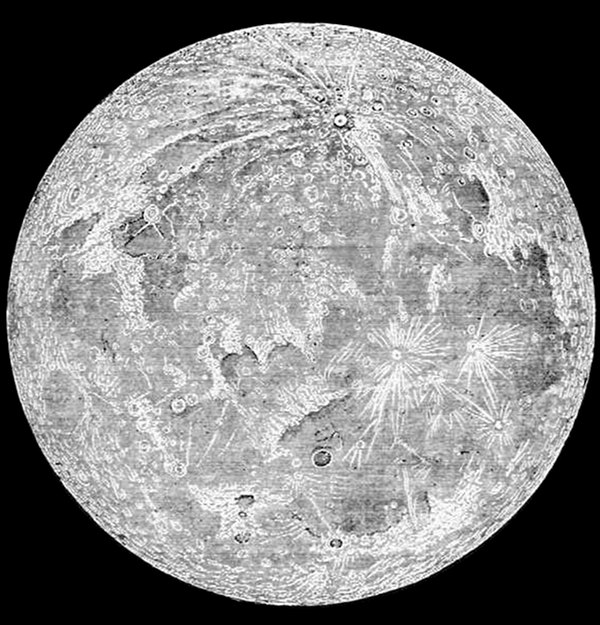
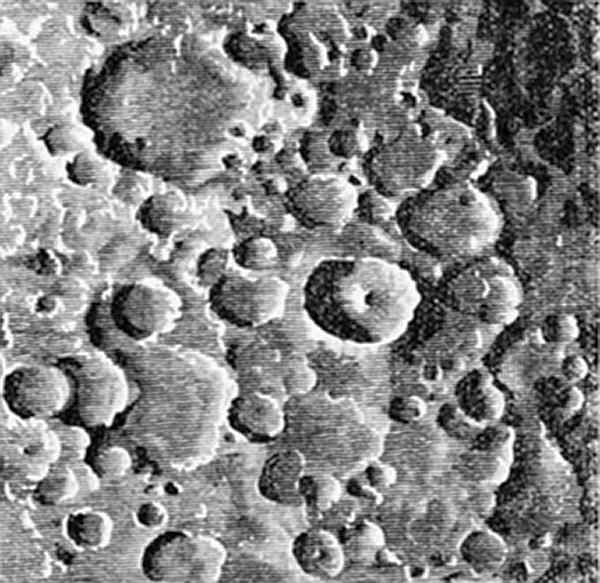
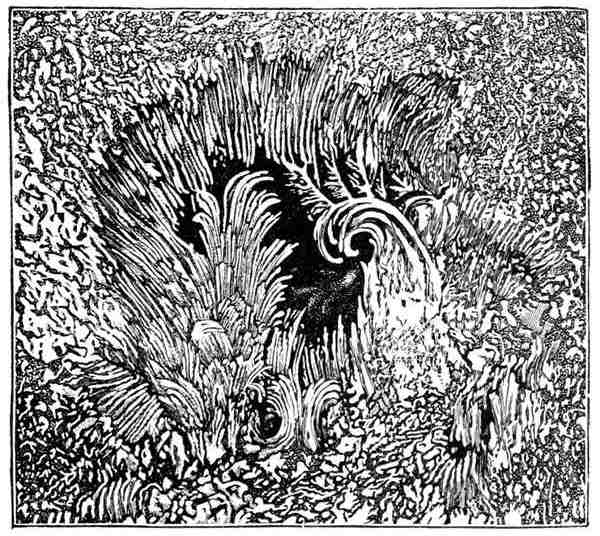
sun; I map out the craters of the moon. Nor
can the tiniest being on earth hide itself from me.
Where others see only a drop of muddy water, that
water brought into my magic chamber teems with
thousands of active bodies, darting here and whirling
there amid a meadow of tiny green plants floating
in the water. Nay, my inquisitive glass sees even
farther than this, for with it I can watch the eddies
of water and green atoms going on in each of these
tiny beings as they feed and grow. Again, if I want
to break into the secrets of the rock at my feet, I
have only to put a thin slice of it under my microscope
to trace every crystal and grain; or, if I wish
to learn still more, I subject it to fiery heat, and
through the magic prisms of my spectroscope I read
the history of the very substances of which it is
composed. If I wish to study the treasures of the
wide ocean, the slime from a rock-pool teems with
fairy forms darting about in the live box imprisoned
in a crystal home. If some distant stars are invisible
even in the giant glasses of my telescope, I
set another power to work, and make them print
their own image on a photographic plate and so
reveal their presence.
"All these things you have seen through my magic
glasses, and I promised you that one day I would
explain to you how they work and do my bidding.
But I must warn you that you must give all your
attention; there is no royal road to my magician's
power. Every one can attain to it, but only by
taking trouble. You must open your eyes and ears,
and use your intelligence to test carefully what your
senses show you.
Fig. 10.
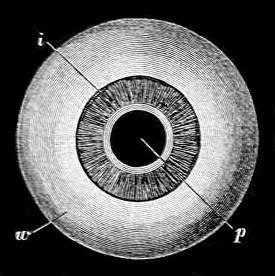 Eye-ball seen from the front.
(After Le Gros Clark.)
w, White of eye. i, Iris. p, Pupil.
"We have only to consider a little to see that we
depend entirely upon our senses for our knowledge
of the outside world. All kinds of things are going
on around us, about which we know nothing, because
our eyes are not keen enough to see, and our ears
not sharp enough to hear them. Most of all we
enjoy and study nature through our eyes, those
windows which let in to us the light of heaven, and
with it the lovely sights and scenes of earth; and
which are no ordinary windows, but most wonderful
structures adapted for conveying images to the brain.
They are of very different power in different people,
so that a long-sighted person sees a lovely landscape
where a short-sighted one sees only a confused
mist; while a short-sighted person can see minute
things close to the eye better than a long-sighted
one."
"Let us try to understand this before we go on to
artificial glasses, for it will help us to explain how
these glasses show us many things we could never
see without them. Here are two pictures of the
human eyeball (Figs. 10 and 11), one as it appears
from the front, and the other as we should see the
parts if we cut an eyeball across from the front to
the back. From these drawings we see that the
eyeball is round; it only looks oval, because it is
seen through the oval slit of the eyelids. It is really
a hard, shining, white
ball with a thick nerve
cord (on, Fig. 11) passing
out at the back,
and a dark glassy
mound c, c in the centre
of the white in front.
In this mound we
can easily distinguish
two parts—first, the
coloured iris or elastic
curtain (i, Fig. 10); and
secondly, the dark spot
or pupil p in the centre.
The iris is the part
which gives the eye its colour; it is composed
of a number of fibres, the outer ones radiating towards
the centre, the inner ones forming a ring
round the pupil; and behind these fibres is a coat
of dark pigment or colouring matter, blue in some
people, grey, brown, or black in others. When the
light is very strong, and would pain the nerves inside
if too much entered the pupil or window of the eye,
then the ring of the iris contracts so as partly to
close the opening. When there is very little light,
and it is necessary to let in as much as possible, the
ring expands and the pupil grows large. The best
way to observe this is to look at a cat's eyes in the
dusk, and then bring her near to a bright light; for
the iris of a cat's eye contracts and expands much
more than ours does."
Fig. 11.
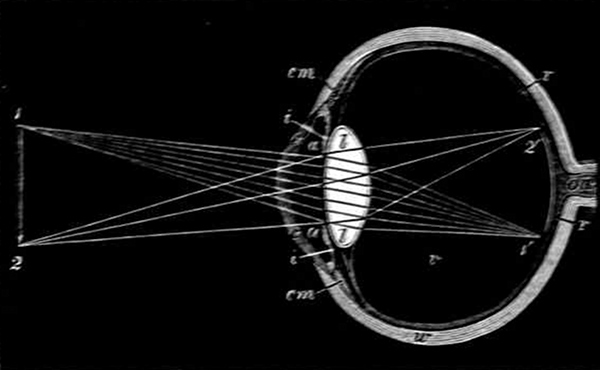 Section of an eye looking at a pencil. (Adapted from Kirke.)
c, c, Cornea. w, White of eye. cm, Ciliary muscle. a, a, Aqueous
humour. i, i, Iris. l, l, Lens. r, r, Retina. on, Optic nerve.
1, 2, Pencil. 1´, 2´, Image of pencil on the retina.
"Now look at the second diagram (Fig. 11) and notice
the chief points necessary in seeing. First you will
observe that the pupil is not a mere hole; it is protected
by a curved covering c. This is the cornea, a
hard, perfectly transparent membrane, looking much
like a curved watch-glass. Behind this is a small
chamber filled with a watery fluid a, called the
aqueous humour, and near the back of this chamber
is the dark ring or iris i, which you saw from the
front through the cornea and fluid. Close behind
the iris again is the natural 'magic glass' of our
eye, the crystalline lens l, which is composed of perfectly
transparent fibres and has two rounded or
convex surfaces like an ordinary magnifying glass.
This lens rests on a cushion of a soft jelly-like substance
v, called the vitreous humour, which fills the
dark chamber or cavity of the eyeball and keeps it
in shape, so that the retina r, which lines the chamber,
is kept at a proper distance from the lens. This
retina is a transparent film of very sensitive nerves;
it forms a screen at the back of the chamber, and has
a coating of very dark pigment or colouring matter
behind it. Lastly, the nerves of the retina all meet
in a bundle, called the optic nerve, and passing out
of the eyeball at a point on, go to the brain.
These are the chief parts we use in seeing; now how
do we use them?
"Suppose that a pencil is held in front of the
eye at the distance at which we see small objects
comfortably. Light is reflected from all parts of the
surface of the pencil, and as the rays spread, a certain
number enter the pupil of the eye. We will follow
only two cones of light coming from the points 1
and 2 on the diagram Fig. 11. These you see enter
the eye, each widely spread over the cornea c. They
are bent in a little by this curved covering, and by
the liquid behind it, while the iris cuts off the rays
near the edges of the lens, which would be too much
bent to form a clear image. The rest of the rays
fall upon the lens l. In passing through this lens
they are very much bent (or refracted) towards each
other, so much so that by the time they reach the
end of the dark chamber v, each cone of light has
come to a point or focus 1´, 2´, and as rays of this
kind have come from every point all over the pencil,
exactly similar points are formed on the retina, and
a real picture of the pencil is formed there between
1´ and 2´."
Fig. 12.
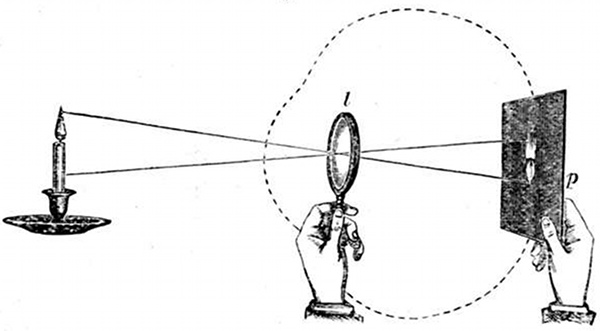 Image of a candle-flame thrown on paper by a lens.
"We will make a very simple and pretty experiment
to illustrate this. Darkening the room I light
a candle, take a square of white paper in my hand,
and hold a simple magnifying glass between the two
(see Fig. 12) about three inches away from the candle.
Then I shift the paper nearer and farther behind the
lens, till we get a clear image of the candle-flame
upon it. This is exactly what happens in our eye.
I have drawn a dotted line c round the lens and the
paper on the diagram to represent the eyeball in
which the image of the candle-flame would be on the
retina instead of on the piece of paper. The first
point you will notice is that the candle-flame is upside
down on the paper, and if you turn back to Fig. 11
you will see why, for it is plain that the cones of
light cross in the lens l, 1 going to 1´ and 2 to 2´.
Every picture made on our retina is upside down.
"But it is not there that we see it. As soon as the
points of light from the pencil strike upon the retina,
the thrill passes on along the optic nerve on, through
the back of the eye to the brain; and our mind,
following back the rays exactly as they have come
through the lens, sees a pencil, outside the eye, right
way upwards.
"This is how we see with our eyes, which adjust
themselves most beautifully to our needs. For
example, not only is the iris always ready to expand
or contract according as we need more or less light,
but there is a special muscle, called the ciliary muscle
(cm, Fig. 11), which alters the lens for us to see things
far or near. In all, or nearly all, perfect eyes the
lens is flatter in front than behind, and this enables
us to see things far off by bringing the rays from them
exactly to a focus on the retina. But when we look
at nearer things the rays require to be more bent or
refracted, so without any conscious effort on our part
this ciliary muscle contracts and allows the lens to
bulge out slightly in front. Instantly we have a
stronger magnifier, and the rays are brought to the
right focus on the retina, so that a clear and full-size
image of the near object is formed. How little we
think, as we turn our eyes from one thing to another,
and observe, now the distant hills, now the sheep
feeding close by; or, as night draws on, gaze into
limitless space and see the stars millions upon
millions of miles away, that at every moment the
focus of our eye is altering, the iris is contracting
or expanding, and myriads of images are being
formed one after the other in that little dark chamber,
through which pass all the scenes of the outer
world!
"Yet even this wonderful eye cannot show us everything.
Some see farther than others, some see more
minutely than others, according as the lens of the eye
is flatter in one person and more rounded in another.
But the most long-sighted person could never have
discovered the planet Neptune, more than 2700
millions of miles distant from us, nor could the keenest-sighted
have known of the existence of those minute
and beautiful little plants, called diatoms, which live
around us wherever water is found, and form delicate
flint skeletons so infinitesimally small that thousands
of millions go to form one cubic inch of the stone
called tripoli, found at Bilin in Bohemia."
Fig. 13.
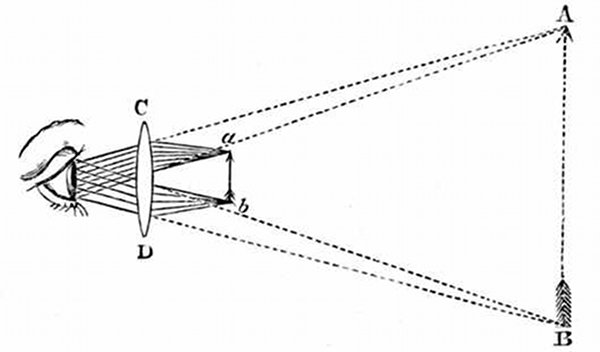 Arrow magnified by a convex lens.
a, b, Real arrow. C, D, Magnifying-glass. A, B, Enlarged
image of the arrow.
"It is here that our 'magic glasses' come to our
assistance, and reveal to us what was before invisible.
We learnt just now that we see near things by the
lens of our eye becoming more rounded in front; but
there comes a point beyond which the lens cannot
bulge any more, so that when a thing is very tiny,
and would have to be held very close to the eye for
us to see it, the lens can no longer collect the rays
to a focus, so we see nothing but a blur. More than
800 years ago an Arabian, named Alhazen, explained
why rounded or convex glasses make things appear
larger when placed before the eye. This glass which
I hold in my hand is a simple
magnifying-glass, such as we
used for focusing the candle-flame.
It bends the rays inwards
from any small object
(see the arrow a, b, Fig. 13) so
that the lens of our eye can
use them, and then, as we
follow out the rays in straight
lines to the place where we
see clearly (at A, B), every
point of the object is magnified,
and we not only see it
much larger, but every mark
upon it is much more distinct.
You all know how the little
shilling magnifying-glasses
you carry show the most
lovely and delicate structures
in flowers, on the wings of
butterflies, on the head of a bee or fly, and, in fact,
in all minute living things."
Fig. 14.
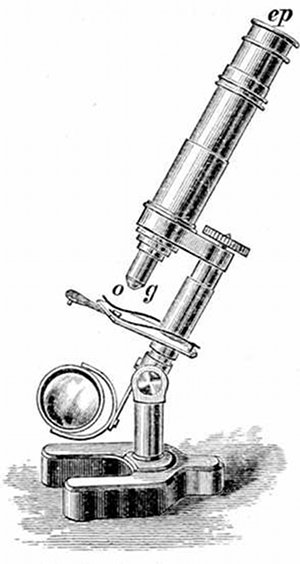 Student's microscope.
ep, Eye-piece. o, g, Object-glass.
Fig. 15.
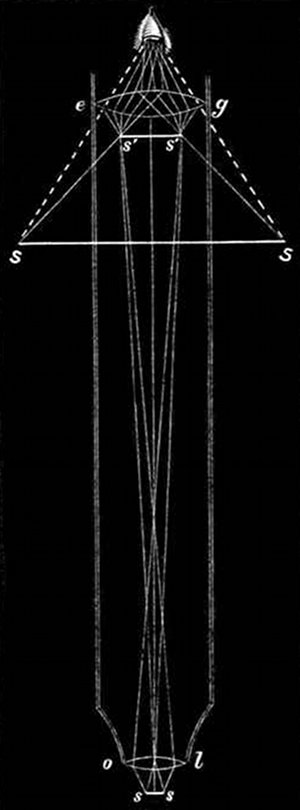 Skeleton of a microscope, showing
how an object is magnified.
Skeleton of a microscope, showing
how an object is magnified.
o, l, Object-lens. e, g, Eye-glass.
s, s, Spicule. s´, s´, Magnified
image of same in the tube.
S, S, Image again enlarged by
the lens of the eye-piece.
"But this is only our first step. Those diatoms we
spoke of just now will only look like minute specks
under even the strongest magnifying-glass. So we
pass on to use two extra
lenses to assist our eyes,
and come to this compound
microscope (Fig. 14)
through which I have before
now shown you the
delicate markings on shells
which were themselves so
minute that you could not
see them with the naked
eye. Now we have to discover
how the microscope
performs this feat. Going
back again for a minute
to our candle and magnifying-glass
(Fig. 12), you will
find that the nearer you put
the lens to the candle the
farther away you will have
to put the paper to get a
clear image. When in a
microscope we put a
powerful lens o, l close
down to a very minute
object, say a spicule of a
flint sponge s, s, quite invisible
to the unaided eye,
the rays from this spicule
are brought to a focus a
long way behind it at s´, s´,
making an enlarged image
because the lines of light have been diverging ever
since they crossed in the lens. If you could put a
piece of paper at s´ s´, as you did in the candle
experiment, you would see the actual image of the
magnified spicule upon it. But as these points of
light are only in an empty tube, they pass on, spreading
out again from the image, as they did before from
the spicule. Then another convex lens or eye-glass
e, g is put at the top of the microscope at
the proper distance to bend these rays so that they
enter our eye in nearly parallel lines, exactly as we
saw in the ordinary magnifying-glass (Fig. 13), and
our crystalline lens can then bring them to a focus
on our retina.
"By this time the spicule has been twice magnified;
or, in other words, the rays of light coming from it
have been twice bent towards each other, so that
when our eye follows them out in straight lines they
are widely spread, and we see every point of light so
clearly that all the spots and markings on this
minute spicule are as clear as if it were really as
large as it looks to us.
"This is simply the principle of the microscope.
When you come to look at your own instruments,
though they are very ordinary ones, you will find that
the object-glass o, l is made of three lenses, flat on the
side nearest the tube, and each lens is composed of
two kinds of glass in order to correct the unequal
refraction of the rays, and prevent fringes of colour
appearing at the edge of the lens. Then again the
eye-piece will be a short tube with a lens at each
end, and halfway between them a black ledge will be
seen inside the tube which acts like the iris of our
eye (i, Fig. 11) and cuts off the rays passing through
the edges of the lens. All these are devices to correct
faults in the microscope which our eye corrects
for itself, and they have enabled opticians to make
very powerful lenses.
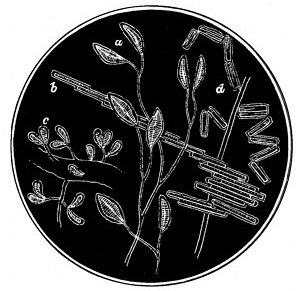
"Look now at the diagram (Fig. 16) showing a group of diatoms which you
can see under the microscope after the lecture. Notice the lovely
patterns, the delicate tracery, and the fine lines on the diatoms shown
there. Yet each of these minute flint skeletons, if laid on a piece of
glass by itself, would be quite invisible to the naked eye, while
hundreds of them together only look like a faint mist on the slide on
which they lie. Nor are they even here shown as much magnified as they
might be; under a stronger power we should see those delicate lines on
the diatoms broken up into minute round cups."
Fig. 16.
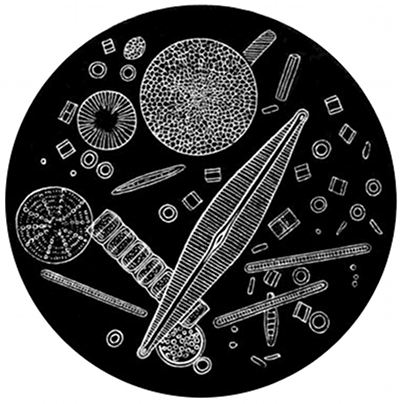 Fossil diatoms seen under the microscope.
The largest of these is an almost imperceptible
speck to the naked eye.
"Is it not wonderful and delightful to think that
we are able to add in this way to the power of our
eyes, till it seems as if there were no limit to the
hidden beauties of the minute forms of our earth, if
only we can discover them?
"But our globe does not stand alone in the universe,
and we want not only to learn all about everything
we find upon it, but also to look out into the vast
space around us and discover as much as we can
about the myriads of suns and planets, comets and
meteorites, star-mists and nebulæ, which are to be
found there. Even with the naked eye we can admire
the grand planet Saturn, which is more than 800
millions of miles away, and this in itself is very
marvellous. Who would have thought that our tiny
crystalline lens would be able to catch and focus
rays, sent all this enormous distance, so as actually
to make a picture on our retina of a planet, which,
like the moon, is only sending back to us the light
of the sun? For, remember, the rays which come to
us from Saturn must have travelled twice 800 millions
of miles—884 millions from the sun to the planet,
and less or more from the planet back to us, according
to our position at the time. But this is as nothing
when compared to the enormous distances over which
light travels from the stars to us. Even the nearest
star we know of, is at least twenty millions of millions
of miles away, and the light from it, though travelling
at the rate of 186,300 miles in a second, takes four
years and four months to reach us, while the light from
others, which we can see without a telescope, is between
twenty and thirty years on its road. Does not
the thought fill us with awe, that our little eye should
be able to span such vast distances?
"But we are not yet nearly at the end of our
wonder, for the same power which devised our eye
gave us also the mind capable of inventing an instrument
which increases the strength of that eye till we
can actually see stars so far off that their light takes
two thousand years coming to our globe. If the
microscope delights us in helping us to see things
invisible without it, because they are so small, surely
the telescope is fascinating beyond all other magic
glasses when we think that it brings heavenly bodies,
thousands of billions of miles away, so close to us
that we can examine them."
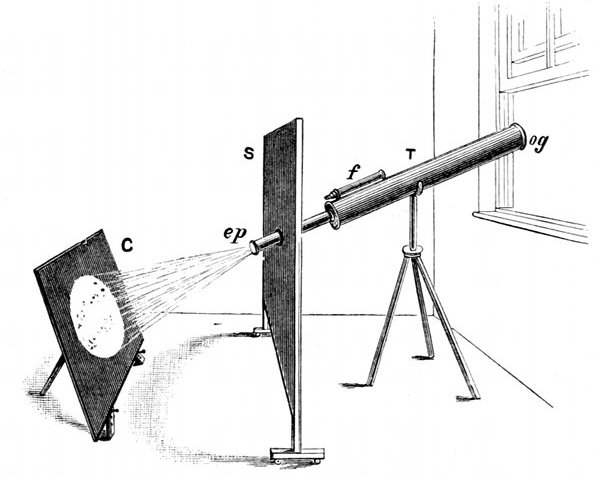
Fig. 17.
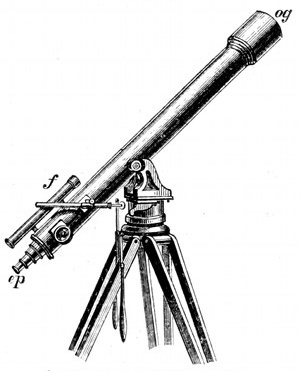 An astronomical telescope.
ep, Eye-piece. og, Object-glass.
f, Finder.
"A Telescope (Fig. 17) can, like the microscope, be
made of only two glasses: an object-glass to form
an image in the tube and
a magnifying eye-piece
to enlarge it. But there
is this difference, that the
object lens of a microscope
is put close down
to a minute object, so
that the rays fall upon
it at a wide angle, and
the image formed in the
tube is very much larger
than the object outside.
In the telescope, on the
contrary, the thing we
look at is far off, so that
the rays fall on the
object-glass at such a
very narrow angle as to be practically parallel, and the
image in the tube is of course very, very much smaller
than the house, or church, or planet it pictures.
What the object-glass of the telescope does for us, is
to bring a small real image of an object very far off
close to us in the tube of the telescope so that we
can examine it.
"Think for a moment what this means. Imagine
that star we spoke of (p. 41), whose light, travelling
186,300 miles in one second, still takes 2000
years to reach us. Picture the tiny waves of light
crossing the countless billions of miles of space
during those two thousand years, and reaching us so
widely spread out that the few faint rays which
strike our eye are quite useless, and for us that star
has no existence; we cannot see it. Then go and
ask the giant telescope, by turning the object-glass
in the direction where that star lies in infinite space.
The widespread rays are collected and come to a
minute bright image in the dark tube. You put the
eye-piece to this image, and there, under your eye, is
a shining point: this is the image of the star, which
otherwise would be lost to you in the mighty
distance.
"Can any magic tale be more marvellous, or any
thought grander, or more sublime than this? From
my little chamber, by making use of the laws of light,
which are the same wherever we turn, we can penetrate
into depths so vast that we are not able even
to measure them, and bring back unseen stars to tell
us the secrets of the mighty universe. As far as the
stars are concerned, whether we see them or not
depends entirely upon the number of rays collected
by the object-glass; for at such enormous distances
the rays have no angle that we can measure, and
magnify as you will, the brightest star only remains
a point of light. It is in order to collect enough
rays that astronomers have tried to have larger and
larger object-glasses; so that while a small good
hand telescope, such as you use, may have an object-glass
measuring only an inch and a quarter across,
some of the giant telescopes have lenses of two and a
half feet, or thirty inches, diameter. These enormous
lenses are very difficult to make and manage, and have
many faults, therefore astronomical telescopes are
often made with curved mirrors to reflect the rays,
and bring them to a focus instead of refracting them
as curved lenses do.
"We see, then, that one very important use of the
telescope is to bring objects into view which otherwise
we would never see; for, as I have already said,
though we bring the stars into sight, we cannot
magnify them. But whenever an object is near
enough for the rays to fall even at a very small
perceptible angle on the object-glass, then we can
magnify them; and the longer the telescope, and the
stronger the eye-piece, the more the object is magnified.
"I want you to understand the meaning of this, for
it is really very simple, only it requires a little thought.
Here are skeleton drawings of two telescopes (Fig.
18), one double the length of the other. Let us
suppose that two people are using them to look at
an arrow on a weathercock a long distance off. The
rays of light r, r from the two ends of the arrow will
enter both telescopes at the same angle r, x, r, cross
in the lens, and pass on at exactly the same angle into
the tubes. So far all is alike,
but now comes the difference.
In the short telescope A the
object-glass must be of such a
curve as to bring the cones of
light in each ray to a focus at
a distance of one foot behind
it,
[1] and there a small image i, i
of the arrow is formed. But B
being twice the length, allows
the lens to be less curved, and
the image to be formed two feet
behind the object-glass; and
as the rays r, r have been diverging
ever since they crossed
at x, the real image of the
arrow formed at i, i is twice the
size of the same image in A.
Nevertheless, if you could put
a piece of paper at i, i in both
telescopes, and look through
the object-glass (which you
cannot actually do, because
your head would block out the
rays), the arrow would appear
the same size in both telescopes,
because one would be
twice as far off from you as
the other, and the angle i, x, i
is the same in both."
Fig. 18.
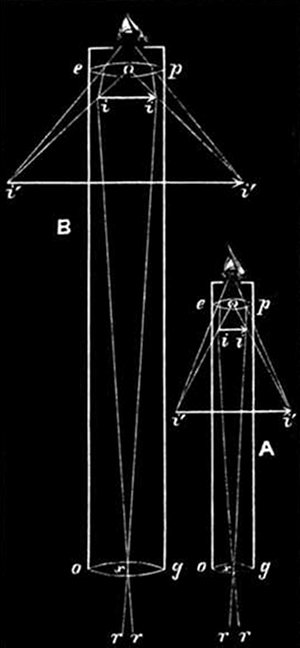 Skeletons of telescopes.
A, A one-foot telescope with
a three-inch eye-piece.
B, A
two-foot telescope with a three-inch
eye-piece.
e, p, Eye-piece.
o, g, Object-glass. r, r, Rays
which enter the telescopes and
crossing at x form an image
at i, i, which is magnified by
the lens e, p. The angles r, x, r
and i, x, i are the same. In
A the angle i, o, i is four times
greater than that of i, x, i. In
B it is eight times greater.
"But by going to the proper end of the telescope
you can get quite near the image, and can see and
magnify it, if you put a strong lens to collect the rays
from it to a focus. This is the use of the eye-piece,
which in our diagram is placed at a quarter of a
foot or three inches from the image in both telescopes.
Now that we are close to the images, the
divergence of the points i, i makes a great difference.
In the small telescope, in which the image is only
one foot behind the object-glass, the eye-piece being
a quarter of a foot from it, is four times nearer, so
the angle i, o, i is four times the angle i, x, i, and the
man looking through it sees the image magnified
four times. But in the longer telescope the image
is two feet behind the lens, while the eye-piece is,
as before, a quarter of a foot from it. Thus the eyepiece
is now eight times nearer, so the angle i, o, i is
eight times the angle i, x, i, and the observer sees the
image magnified eight times.
"In real telescopes, where the difference between
the focal length of the object-glass and that of the
eye-glass can be made enormously greater, the
magnifying power is quite startling, only the object-glass
must be large, so as to collect enough rays to
bear spreading widely. Even in your small telescopes,
with a focus of eighteen inches, and an object-glass
measuring one and a quarter inch across, we
can put on a quarter of an inch eye-piece, and so
magnify seventy-two times; while in my observatory
telescope, eight feet or ninety-six inches long, an
eye-piece of half an inch magnifies 192 times, and I
can put on a 1/8-inch eye-piece and magnify 768
times! And so we can go on lengthening the
focus of the object-glass and shortening the focus
of the eye-piece, till in Lord Rosse's gigantic
fifty-six-foot telescope, in which the image is fifty-four
feet (648 inches) behind the object-glass, an
eye-piece one-eighth of an inch from the image
magnifies 5184 times! These giant telescopes, however,
require an enormous object-glass or mirror, for
the points of light are so spread out in making the
large image that it is very faint unless an enormous
number of rays are collected. Lord Rosse's
telescope has a reflecting mirror measuring six feet
across, and a man can walk upright in the telescope
tube. The most powerful telescope yet made is that
at the Lick Observatory, on Mount Hamilton, in
California. It is fifty-six and a half feet long, the
object-lens measures thirty-six inches across. A
star seen through this telescope appears 2000 times
as bright as when seen with the naked eye.
"You need not, however, wait for an opportunity
to look through giant telescopes, for my small
student's telescope, only four feet long, which we
carry out on to the lawn, will show you endless
unseen wonders; while your hand telescopes, and
even a common opera-glass, will show many features
on the face of the moon, and enable you to see the
crescent of Venus, Jupiter's moons, and Saturn's
rings, besides hundreds of stars unseen by the naked
eye.
"Of course you will understand that Fig. 18 only
shows the principle of the telescope. In all good
instruments the lenses and other parts are more
complicated; and in a terrestrial telescope, for looking
at objects on the earth, another lens has to be put
in to turn them right way up again. In looking at
the sky it does not matter which way up we see a
planet or a star, so the second glass is not needed,
and we lose light by using it.
"We have now three magic glasses to work for
us—the magnifying-glass, the microscope, and the
telescope. Besides these, however, we have two other
helpers, if possible even more wonderful. These are
the Photographic camera and the Spectroscope."
Fig. 19.
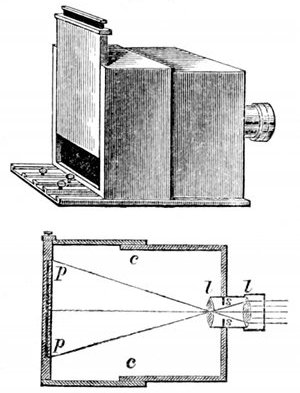 Photographic camera.
l, l, Lenses. s, s, Screen cutting
off diverging rays. c, c, Sliding
box. p, p Picture formed.
"Now that we thoroughly understand the use of
lenses, I need scarcely
explain this photographic
camera (Fig. 19), for it is
clearly an artificial eye. In
place of the crystalline lens
(compare with Fig. 11) the
photographer uses one, or
generally two lenses l, l, with
a black ledge or stop s between
them, which acts like
the iris in cutting off the
rays too near the edge of the
lens. The dark camera c
answers to the dark chamber
of the eyeball, and the
plate p, p at the back of
the chamber, which is made
sensitive by chemicals, answers our retina. The box
is formed of two parts, sliding one within the other
at c, so as to place the plate at a proper distance
from the lens, and then a screw adjusts the focus
more exactly by bringing the front lens back or forward,
instead of altering the curve as the ciliary
muscle does in our eye. The difference between the
two instruments is that in our eye the message
goes to the brain, and the image disappears when
we turn our eyes away from the object; but in
the camera the waves of light work upon the
chemicals, and the image can be fixed and remain
for ever.
"But the camera has at least one weak point. The
screen at the back is not curved like our retina, but
must be flat because of printing off the pictures, and
therefore the parts of the photograph near the edge
are a little out of proportion.
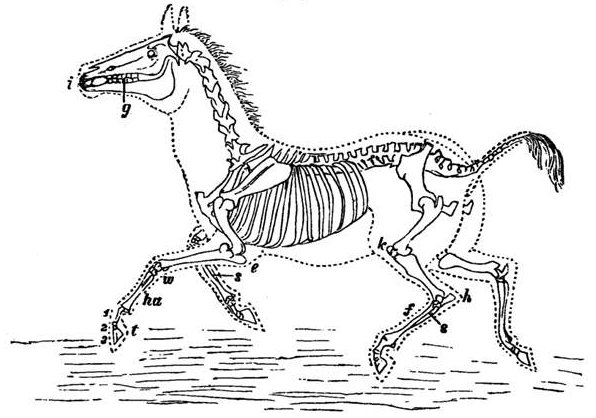
"In many ways, however, this photographic eye is
a more faithful observer than our own, and helps us
to make more accurate pictures. For instance, instantaneous
photographs have been taken of a
galloping horse, and we find that the movements are
very different from what we thought we saw with
our eye, because our retina does not throw off one
impression after another quickly enough to be quite
certain we see each curve truly in succession. Again,
the photograph of a face gives minute curves and
lines, lights and shadows, far more perfectly than
even the best artist can see them, and when the
picture is magnified we see more and more details
which escaped us before.
"But it is especially when attached to the microscope
or the telescope that the photographic
apparatus tells us such marvellous secrets; giving
us, for instance, an accurate picture of the most
minute water-animal quite invisible to the naked eye,
so that when we enlarge the photograph any one can
see the beautiful markings, the finest fibre, or the
tiniest granule; or affording us accurate pictures,
such as the one at p. 19 of the face of the moon, and
bringing stars into view which we cannot otherwise
see even with the strongest telescope.
"Our own eye has many weaknesses. For example,
when we look through the telescope at the
sky we can only fix our attention on one part at
once, and afterwards on another; and the picture
which we see in this way, bit by bit, we must draw
as best we can. But if we put a sensitive photographic
plate into the telescope just at the point (i, i,
Fig. 18), where the image of the sky is focused,
this plate gives attention, so to speak, to the whole
picture at once, and registers every point exactly as
it is; and this picture can be kept and enlarged so
that every detail can be seen.
"Then, again, if we look at faint stars, they do not
grow any brighter as we look. Each ray sends its
message to the brain, and that is all; we cannot
heap them up in our eye, and, indeed, after a time
we see less, because our nerves grow tired. But on
a photographic plate in a telescope, each ray in its
turn does a little work upon the chemicals, and the
longer the plate remains, the stronger the picture
becomes. When wet plates were used they could
not be left long, but since dry plates have been
invented, with a film of chemically prepared gelatine,
they can be left for hours in the telescope, which is
kept by clockwork accurately opposite to the same
objects. In this way thousands of faint stars, which
we cannot see with the strongest telescope, creep
into view as their feeble rays work over and over
again on the same spot; and, as the brighter stars
as well as the faint ones are all the time making
their impression stronger, when the plate comes out
each one appears in its proper strength. On the
other hand, very bright objects often become blurred
by a long exposure, so that we have sometimes to
sacrifice the clearness of a bright object in order to
print faint objects clearly.
"We now come to our last magic glass—the
Spectroscope; and the hour has slipped by so fast
that I have very little time left to speak of it. But
this matters less as we have studied it before.[2] I
need now only remind you of some of the facts. You
will remember that when we passed sunlight through
a three-sided piece of glass called a prism, we broke
up a ray of white light into a line of beautiful
colours gradually passing from red, through orange,
yellow, green, blue, and indigo, to violet, and that
these follow in the same order as we see them in the
rainbow or in the thin film of a soap-bubble. By
various experiments we proved that these colours are
separated from each other because the many waves
which make up white light are of different sizes, so
that because the waves, of red light are slow and
heavy, they lag behind when bent in the three-sided
glass, while the rapid violet waves are bent more out
of their road and run to the farther end of the line,
the other colours ranging themselves between."
Fig. 20.
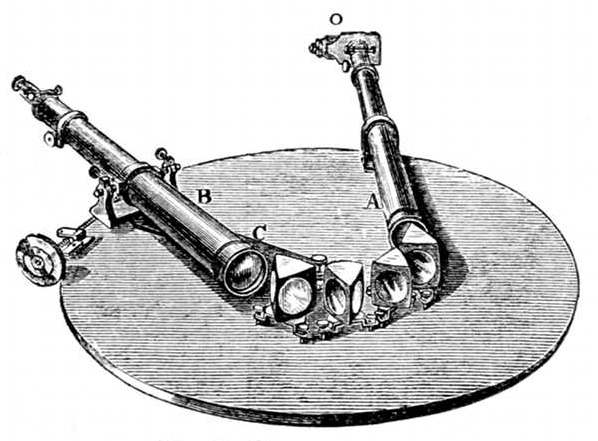 Kirchhoff's spectroscope.
A, The telescope which receives the ray of light
through the slit in O.
Fig. 21.
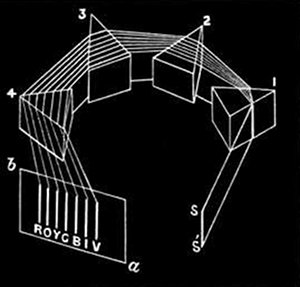 Passage of rays through the spectroscope.
S, S´, Slit through which the light falls
on the prisms. 1, 2, 3, 4, Prisms in
which the rays are dispersed more and
more. a, b, Screen receiving the spectrum,
of which the seven principal colours are
marked.
"Now when the light falls through the open
window, or through a round hole or large slit, the
images of the hole made by each coloured wave
overlap each other very much, and the colours in
the spectrum or coloured band are crowded together.
But when in the spectroscope we pass the ray of light
through a very narrow slit, each coloured image of the
upright slit overlaps the next upright image only
very little. By using several prisms one after the
other (see Fig. 21), these upright coloured lines are
separated more and more till we get a very long
band or spectrum. Yet, as you know from our
experiments with the light of a glowing wire or of
molten iron, however much you spread out the light
given by a solid or liquid, you can never separate
these coloured lines from each other. It is only
when you throw the light of a glowing gas or vapour
into the slit that you get a few bright lines standing
out alone. This is because all the rays of white light
are present in glowing solids and liquids, and they
follow each other too closely to be separated. But
a gas, such as glowing hydrogen for example, gives
out only a few separate rays, which, pouring through
the slit, throw red, greenish-blue, and dark blue lines
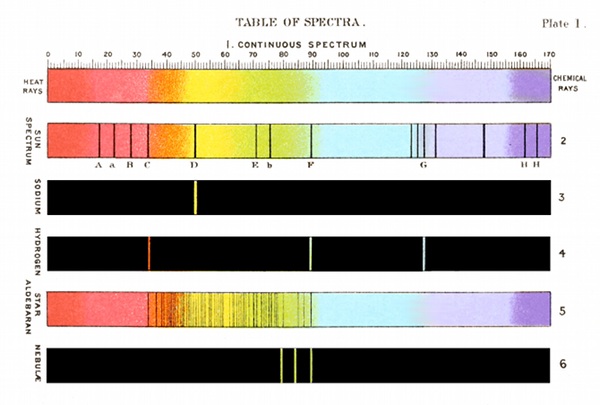
on the screen. Thus
you have seen the
double, orange-yellow
sodium line (3, Plate I.)
which starts out at
once when salt is held
in a flame and its
light thrown into the
spectroscope, and the
red line of potassium
vapour under the same
treatment; and we
shall observe these
again when we study
the coloured lights of
the sun and stars."
"We see, then, that
the work of our magic
glass, the spectroscope, is simply to sift the waves
of light, and that these waves, from their colour
and their position in the long spectrum, actually tell
us what glowing gases have started them on their
road. Is not this like magic? I take a substance
made of I know not what; I break it up, and, melting
it in the intense heat of an electric spark, throw its
light into the spectroscope. Then, as I examine this
light after it has been spread out by the prisms, I
can actually read by unmistakable lines what metals
or non-metals it contains. Nay, more; when I catch
the light of a star, or even of a faint nebula, in my
telescope, and pass it through these prisms, there,
written up on the magic-coloured band, I read off
the gases which are glowing in that star-sun or
star-dust billions of miles away.
"Now, boys, I have let you into the secrets of my
five magic glasses—the magnifying-glass, the microscope,
the telescope, the photographic camera, and
the spectroscope. With these and the help of
chemistry you can learn to work all my spells. You
can peep into the mysteries of the life of the tiniest
being which moves unseen under your feet; you
can peer into that vast universe, which we can never
visit so long as our bodies hold us down to our
little earth; you can make the unseen stars print
their spots of light on the paper you hold in your
hand, by means of light-waves, which left them
hundreds of years ago; or you can sift this light in
your spectroscope, and make it tell you what substances
were glowing in that star when they were
started on their road. All this you can do on one
condition, namely, that you seek patiently to know
the truth.
"Stories of days long gone by tell us of true magicians
and false magicians, and the good or evil they
wrought. Of these I know nothing, but I do know
this, that the value of the spells you can work with
my magic glasses depends entirely upon whether you
work patiently, accurately, and honestly. If you
make careless, inaccurate experiments, and draw
hasty conclusions, you will only do bad work, which
it may take others years to undo; but if you
question your instruments honestly and carefully,
they will answer truly and faithfully. You may
make many mistakes, but one experiment will correct
the other; and while you are storing up in your
own mind knowledge which lifts you far above this
little world, or enables you to look deep below the
outward surface of life, you may add your little
group of facts to the general store, and help to pave
the way to such grand discoveries as those of Newton
in astronomy, Bunsen and Kirchhoff in spectrum
analysis, and Darwin in the world of life."
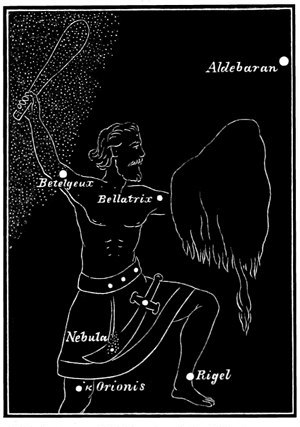
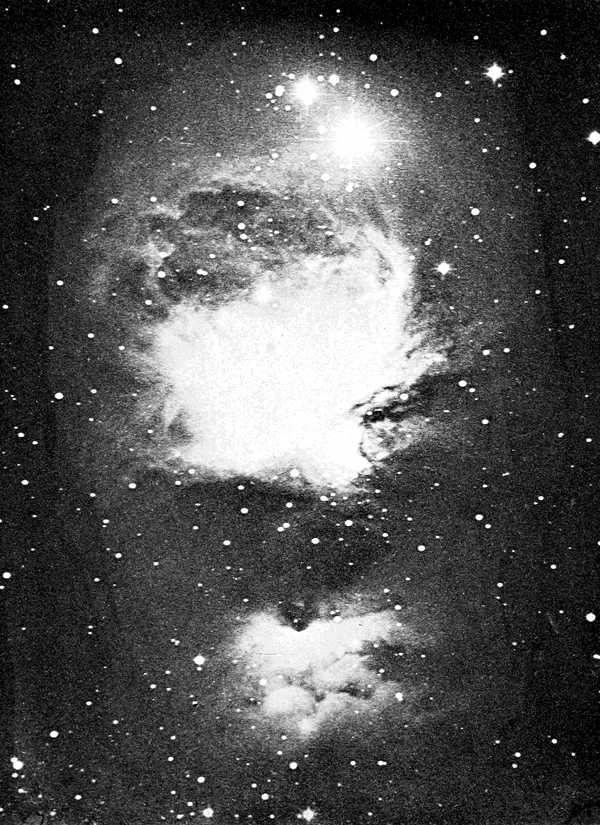 THE GREAT NEBULA OF ORION