The hero of this hazardous exploration through Hell is Hiprah Hunt, a
lecturer, reformer, ex-preacher, poet and president of a Dante Club.
Hiprah Hunt has no tolerance for the modern philosophy that denies the
existence of Hell. As a preacher he was what men of the present day call
a “back number.”
Despite “higher criticism” he continually and earnestly advocates the
justice of future punishment, and for this reason is known in the town
where he lives as “Hell-fire Hunt.”
Not unlikely his belief in a Demon-haunted Hell ruled over by a personal
Devil is in part due to atavism, for Mr. Hunt is a descendant of the
illustrious Hunts who lent their aid to the extermination of witches in
that part of New England where witchcraft once flourished.
As President of a Dante Club he collected many books on the subject of
future retribution. Among them (some 80 volumes) he chiefly prizes
Dante’s Inferno. Whenever he is given an opportunity he will deliver a
lecture on Dante and his work. In short, Hell books have so thoroughly
absorbed his mind that he becomes convinced that the under-world is as
much a reality as the upper one.
As a result of continual thinking on one subject, and that subject a hot
one, it was frequently hinted that Mr. Hunt’s brains were shrivelling
up. Whether that is true or not, he became imbued with the idea that he
must find the Infernal Regions and prove to the world that the place is
not a myth.
In the Fall of 1900 Mr. Hunt mysteriously disappeared from home. For six
weeks nothing was seen or heard of him. When he returned he set to work
immediately and wrote a poem consisting of sixty-eight cantos of blank
verse, curiously mixed with prose, quotations and numerous foot-notes.
This poem, he declares, is the account of a six weeks’ journey through
Hell.
Mr. Hunt’s original manuscript which is in possession of the writer,
together with odd charts, maps, diagrams and thermometric records, all
of them bearing marks of having come from a very hot region, are strong
proofs of the authenticity of his exploration.
Perhaps it is unnecessary to add that the author has taken many
liberties with Mr. Hunt’s text. The condition of the documents
necessitated certain guess-work, and he has freely added a number of
Inferno pictures that were drawn long before Hiprah Hunt’s valuable
papers came to his notice.
If he has illuminated the dark and serious subject with a suspicion of
fun—it is meant to convey the hope he feels for all sinners like
himself, that some relief of a slightly humorous nature may be found
even in Hell.
A. Y.
There are many portraits of Dante giving a more soulfully poetic cast to
his countenance and which are much more pleasing for admirers of the
great Florentine, to look upon, than the one reproduced here; but this
is the first portrait ever published which is intended to portray the
way the poet must really have felt at the termination of his trip
through the Infernal Regions.
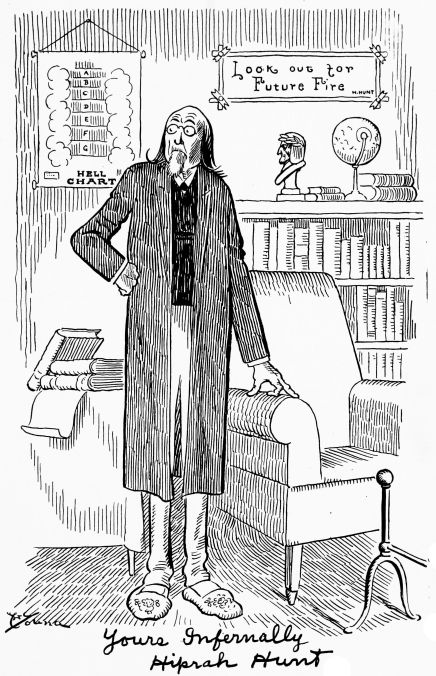
A portrait of Hiprah Hunt in his library which contains the following
well-thumbed books: John Bunyan’s “Sighs from Hell,” Jonathan Edwards’s
pamphlet on “The Justice of Endless Punishment,” Christopher Love’s
“Hell’s Terror,” William Cooper’s “Three Discourses Concerning the
Reality, the Extremity, and the Absolute Eternity of Hell Punishments,”
Jeremy Taylor on “Pains of Hell,” and Alexander Jephson’s “The Certainty
and Importance of a Future Judgment and Everlasting Retribution.”
Besides these he possesses several histories of the Devil and many old
prints pertaining to the same subject.
Yours Infernally
Hiprah Hunt.